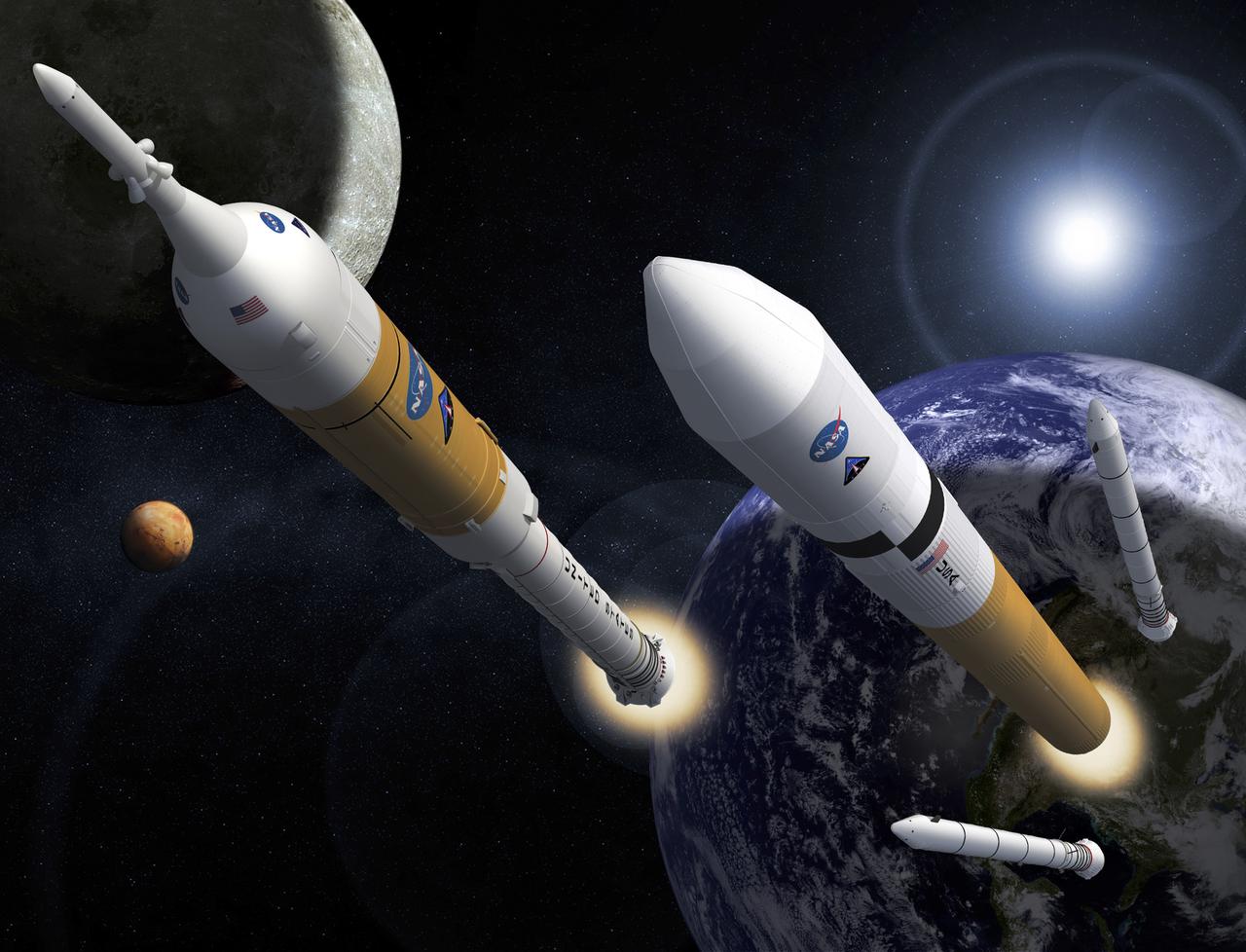
Shown is a concept illustration of the Ares I crew launch vehicle, left, and Ares V cargo launch vehicle. Ares I will carry the Orion Crew Exploration Vehicle to space. Ares V will serve as NASA's primary vehicle for delivery of large-scale hardware to space.
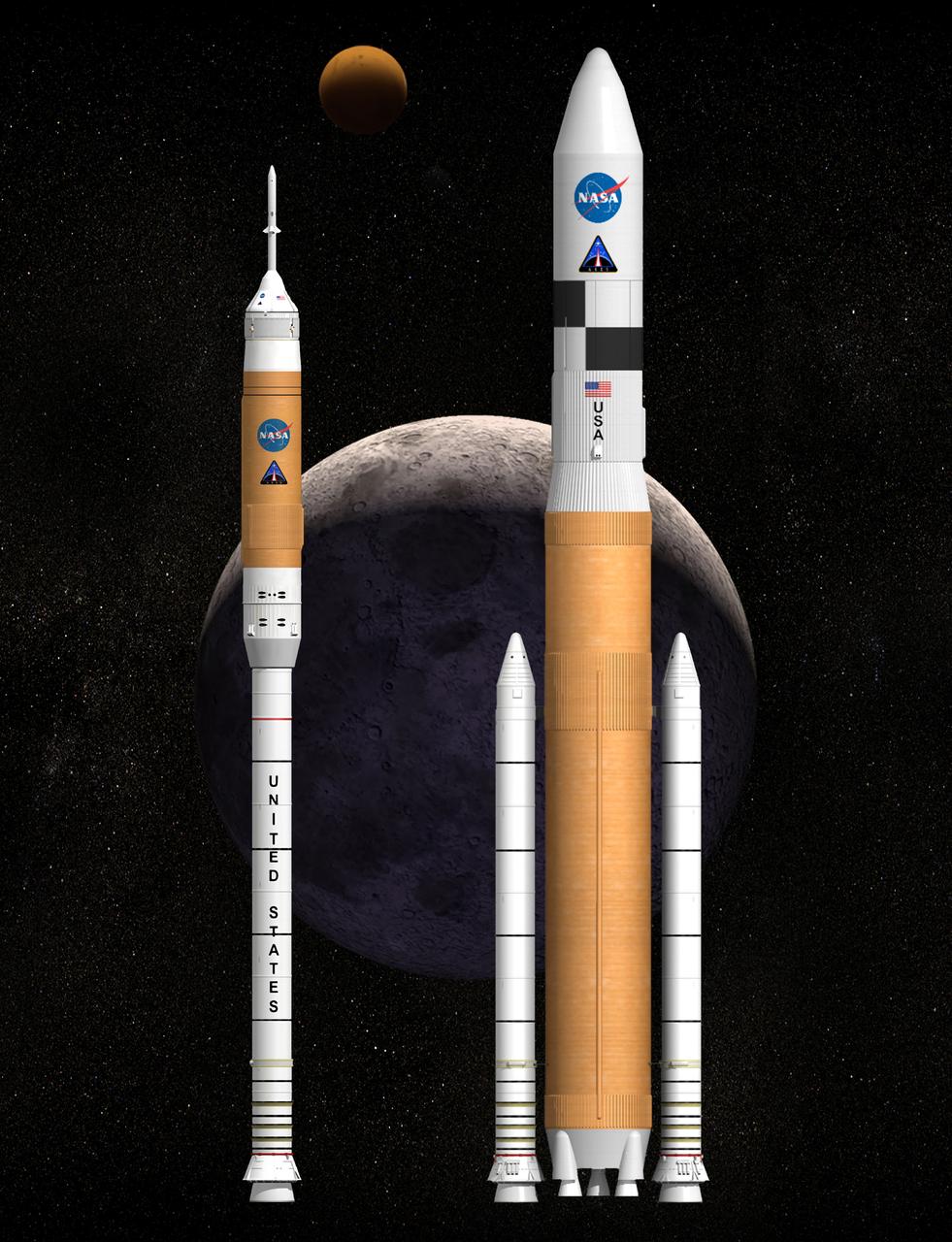
Named for the Greek god associated with Mars, the NASA developed Ares launch vehicles will return humans to the moon and later take them to Mars and other destinations. In this early illustration, the vehicle depicted on the left is the Ares I. Ares I is an inline, two-stage rocket configuration topped by the Orion crew vehicle and its launch abort system. In addition to its primary mission of carrying four to six member crews to Earth orbit, Ares I may also use its 25-ton payload capacity to deliver resources and supplies to the International Space Station (ISS), or to "park" payloads in orbit for retrieval by other spacecraft bound for the moon or other destinations. The Ares I employs a single five-segment solid rocket booster, a derivative of the space shuttle solid rocket booster, for the first stage. A liquid oxygen/liquid hydrogen J-2X engine derived from the J-2 engine used on the second stage of the Apollo vehicle will power the Ares V second stage. The Ares I can lift more than 55,000 pounds to low Earth orbit. The vehicle illustrated on the right is the Ares V, a heavy lift launch vehicle that will use five RS-68 liquid oxygen/liquid hydrogen engines mounted below a larger version of the space shuttle external tank, and two five-segment solid propellant rocket boosters for the first stage. The upper stage will use the same J-2X engine as the Ares I. The Ares V can lift more than 286,000 pounds to low Earth orbit and stands approximately 360 feet tall. This versatile system will be used to carry cargo and the components into orbit needed to go to the moon and later to Mars. Both vehicles are subject to configuration changes before they are actually launched. This illustration reflects the latest configuration as of September 2006.
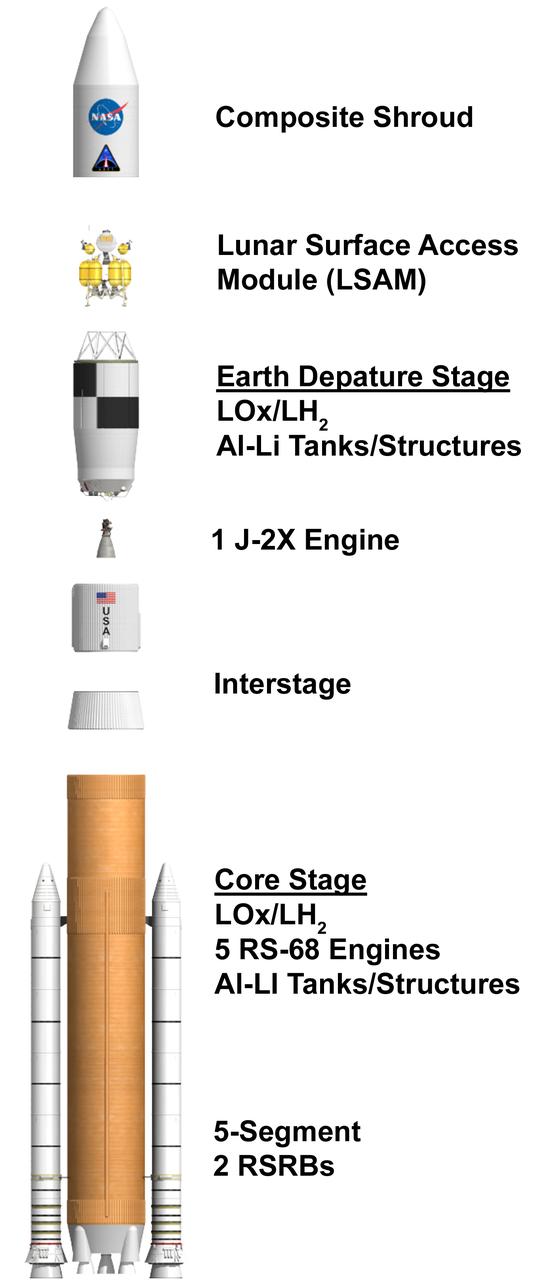
The NASA developed Ares rockets, named for the Greek god associated with Mars, will return humans to the moon and later take them to Mars and other destinations. This is an illustration of the Ares V with call outs. The Ares V is a heavy lift launch vehicle that will use five RS-68 liquid oxygen/liquid hydrogen engines mounted below a larger version of the space shuttle external tank, and two five-segment solid propellant rocket boosters for the first stage. The upper stage will use the same J-2X engine as the Ares I and past Apollo vehicles. The Ares V can lift more than 286,000 pounds to low Earth orbit and stands approximately 360 feet tall. This versatile system will be used to carry cargo and the components into orbit needed to go to the moon and later to Mars. Ares V is subject to configuration changes before it is actually launched. This illustration reflects the latest configuration as of January 2007.
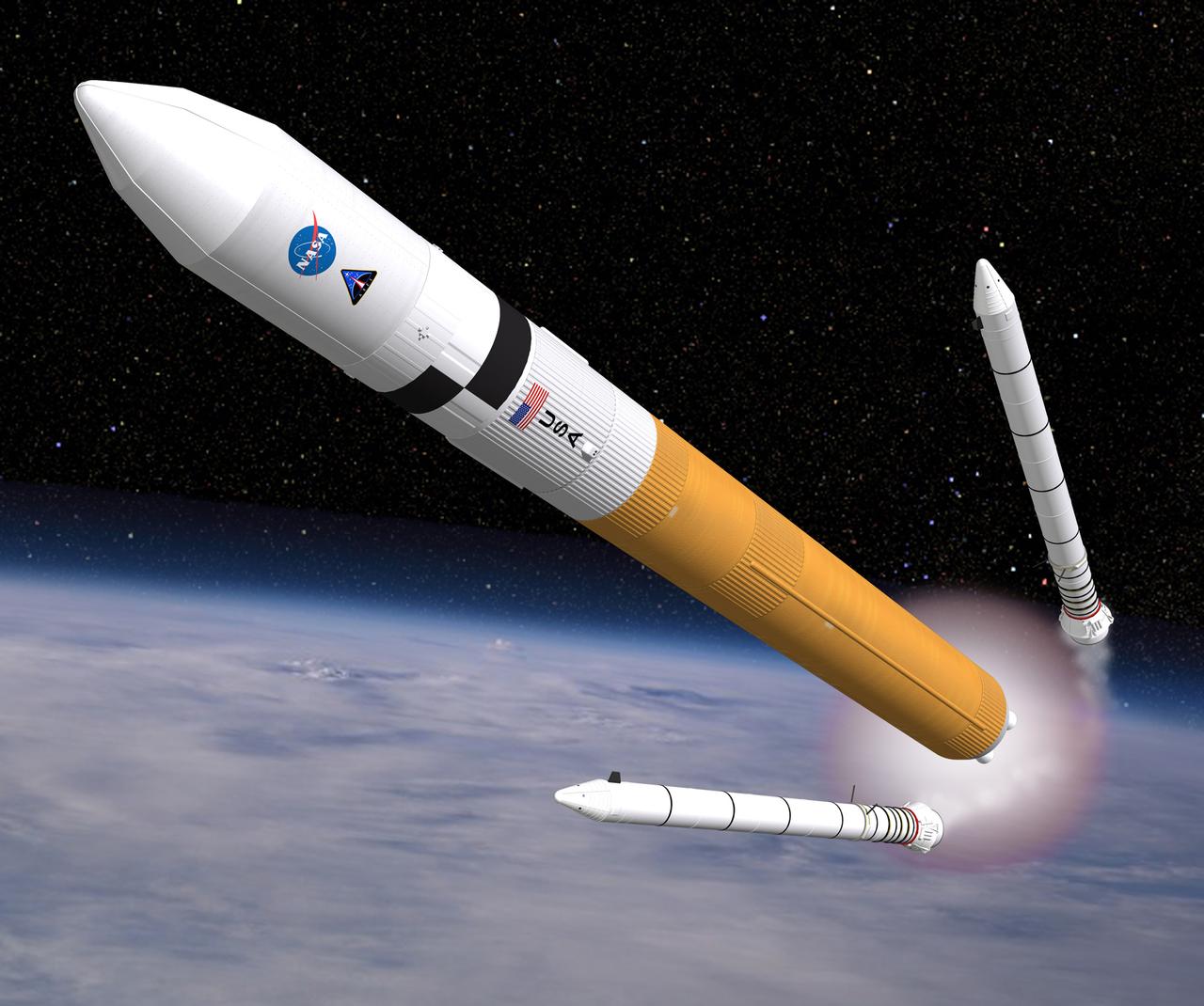
THIS CONCEPT IMAGE SHOWS THE ARES V CARGO LAUNCH VEHICLE. THE HEAVY LIFTING ARES V IS NASA'S PRIMARY VEHICLE FOR SAFE AND RELIABLE DELIVERY OF LARGE SCALE HARDWARE TO SPACE. THIS INCLUDES THE LUNAR LANDER, MATERIALS FOR ESTABLISHING A PERMANENT MOON BASE, AND THE VEHICLES AND HARDWARE NEEDED TO EXTEND A HUMAN PRESENCE BEYOND EARTH ORBIT. ARES V CAN CARRY APPROXIMATELY 290,000 POUNDS TO LOW EARTH ORBIT AND 144,000 POUNDS TO LUNAR ORBIT.
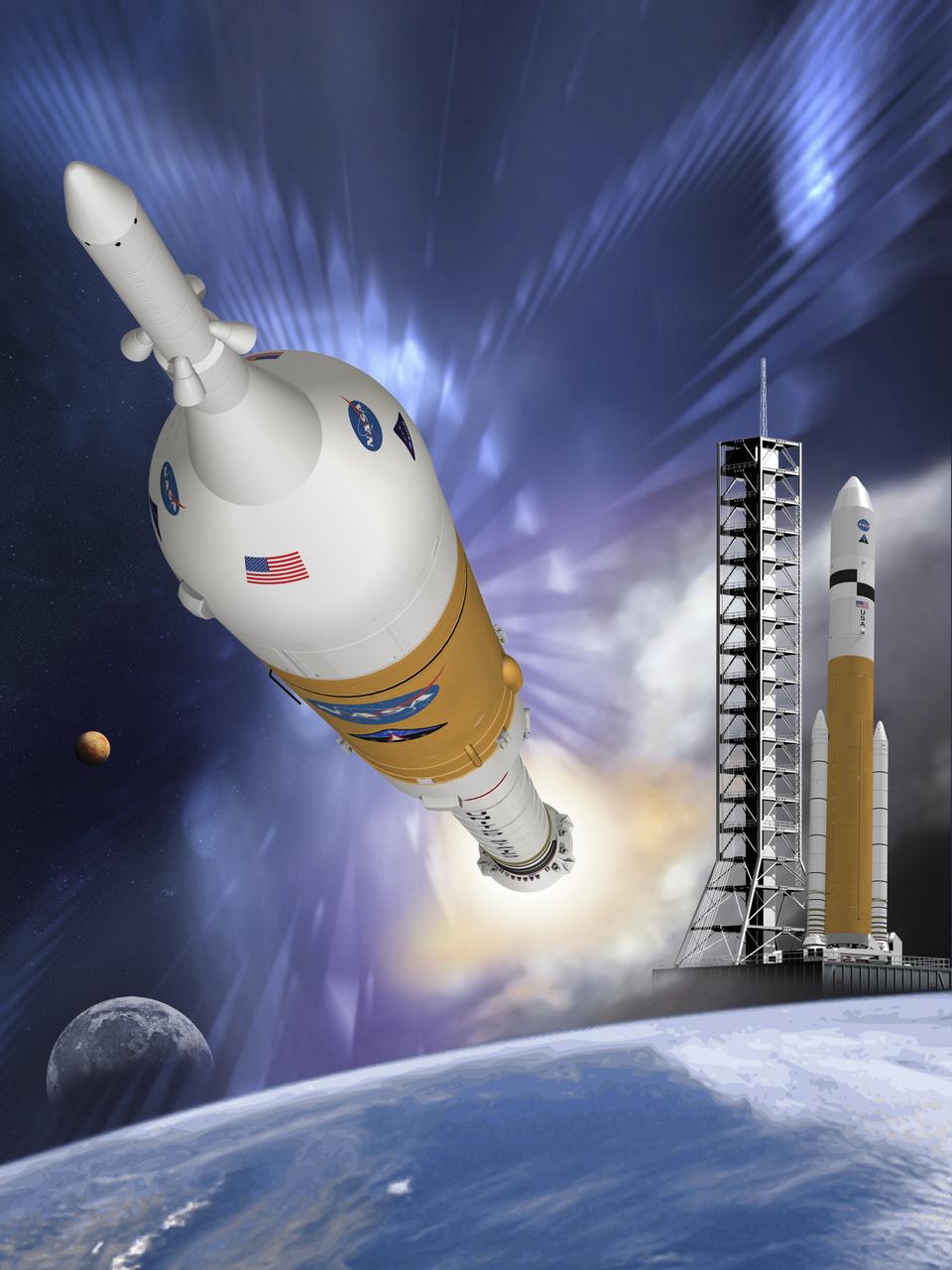
Shown is a concept illustration of the Ares I crew launch vehicle during launch and the Ares V cargo launch vehicle on the launch pad. Ares I will carry the Orion Crew Exploration Vehicle with an astronaut crew to Earth orbit. Ares V will deliver large-scale hardware to space. This includes the Altair Lunar Lander, materials for establishing an outpost on the moon, and the vehicles and hardware needed to extend a human presence beyond Earth orbit.
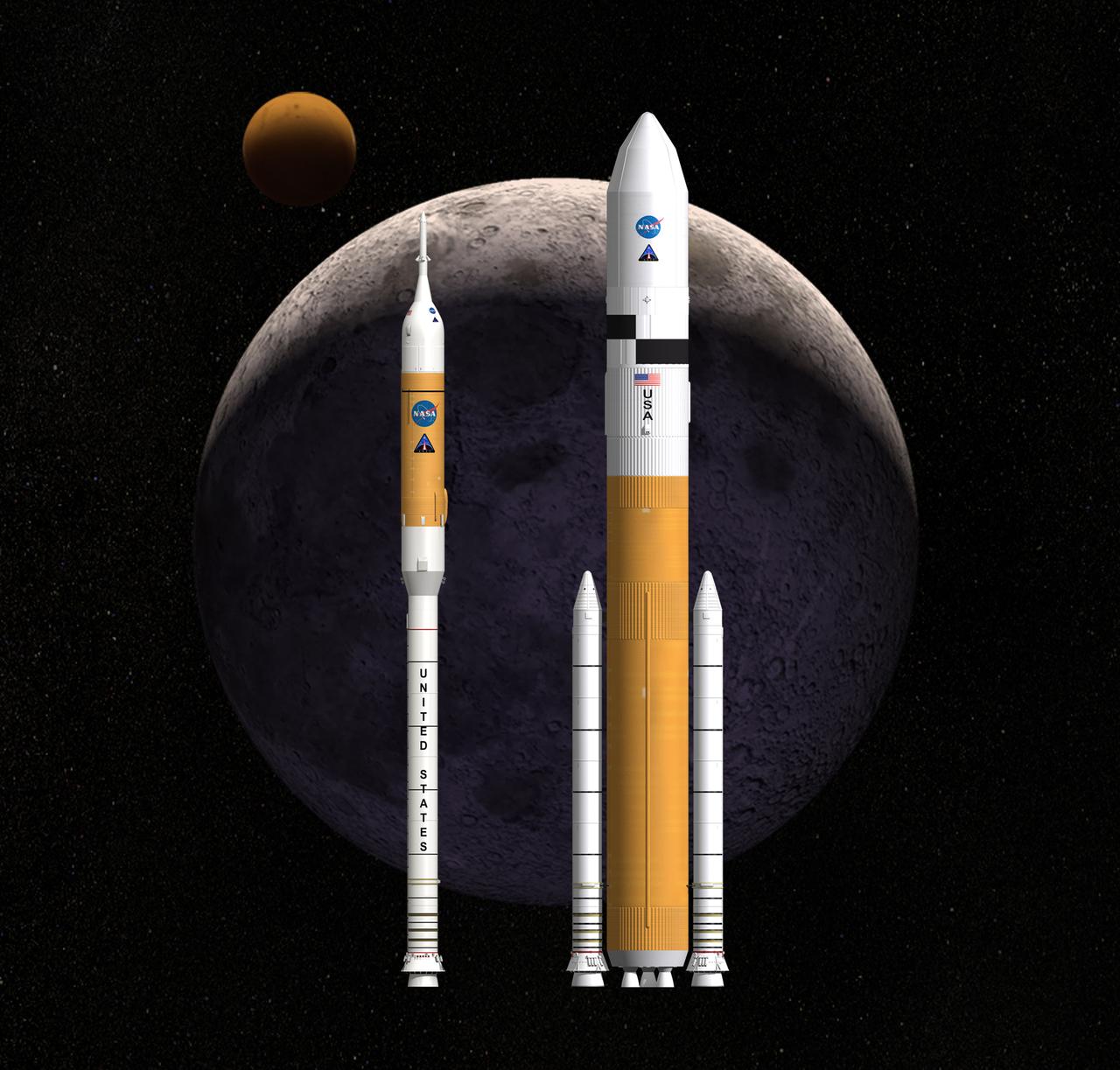
THIS CONCEPT IMAGE SHOWS NASA'S NEXT GENERATION LAUNCH VEHICLE SYSTEMS STANDING SIDE BY SIDE. ARES I, LEFT, IS THE CREW LAUNCH VEHICLE THAT WILL CARRY THE ORION CREW EXPLORATION VEHICLE TO SPACE. ARES V IS THE CARGO LAUNCH VEHICLE THAT WILL DELIVER LARGE SCALE HARDWARE, INCLUDING THE LUNAR LANDER, TO SPACE.
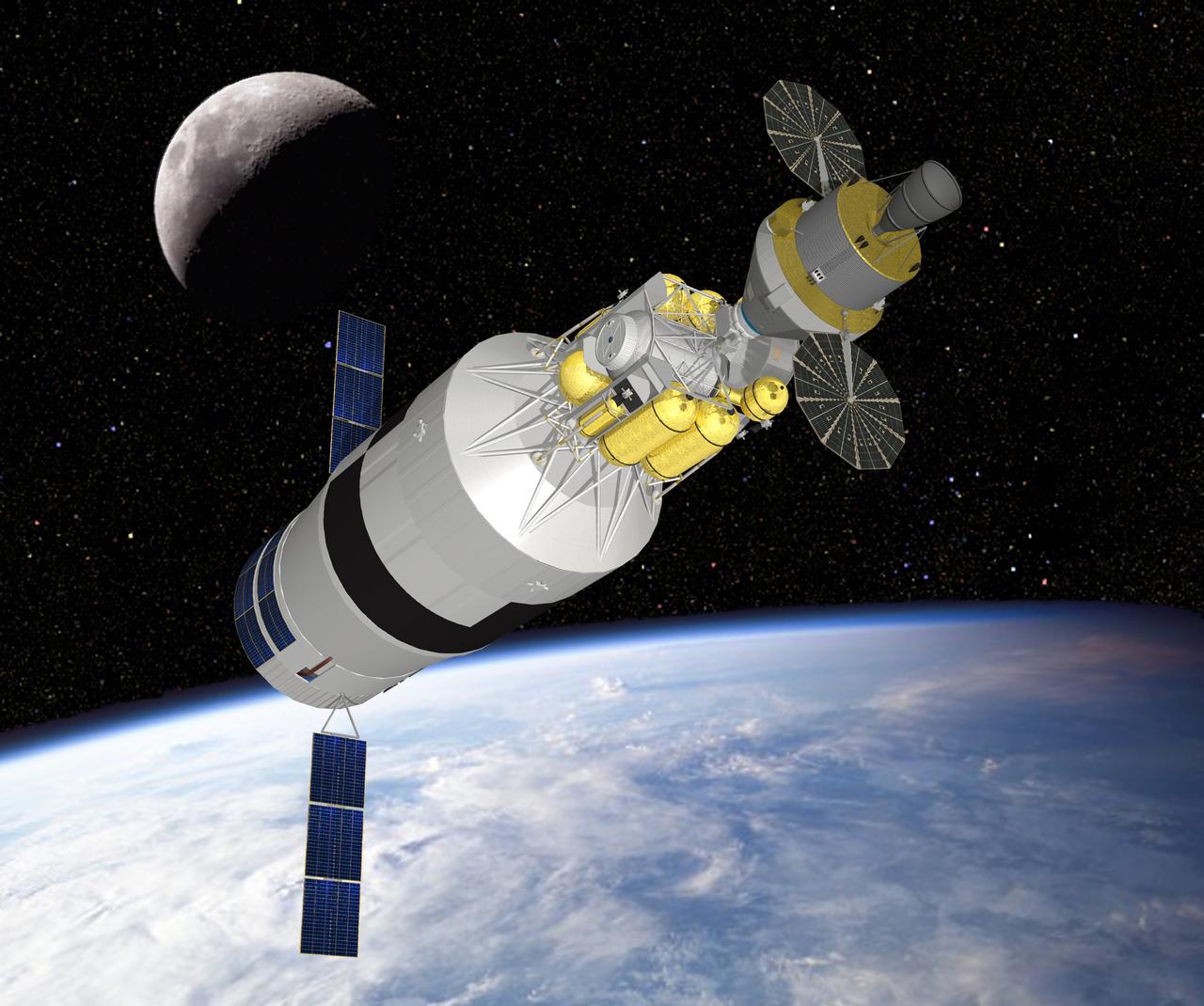
SHOWN IS A CONCEPT IMAGE OF THE ARES V EARTH DEPARTURE STAGE AND LUNAR SURFACE ACCESS MODULE DOCKED WITH THE ORION CREW EXPLORATION VEHICLE IN EARTH ORBIT. THE DEPARTURE STAGE, POWERED BY A J-2X ENGINE, IS NEEDED TO ESCAPE EARTH'S GRAVITY AND SEND THE CREW VEHICLE AND LUNAR MODULE ON THEIR JOURNEY TO THE MOON.
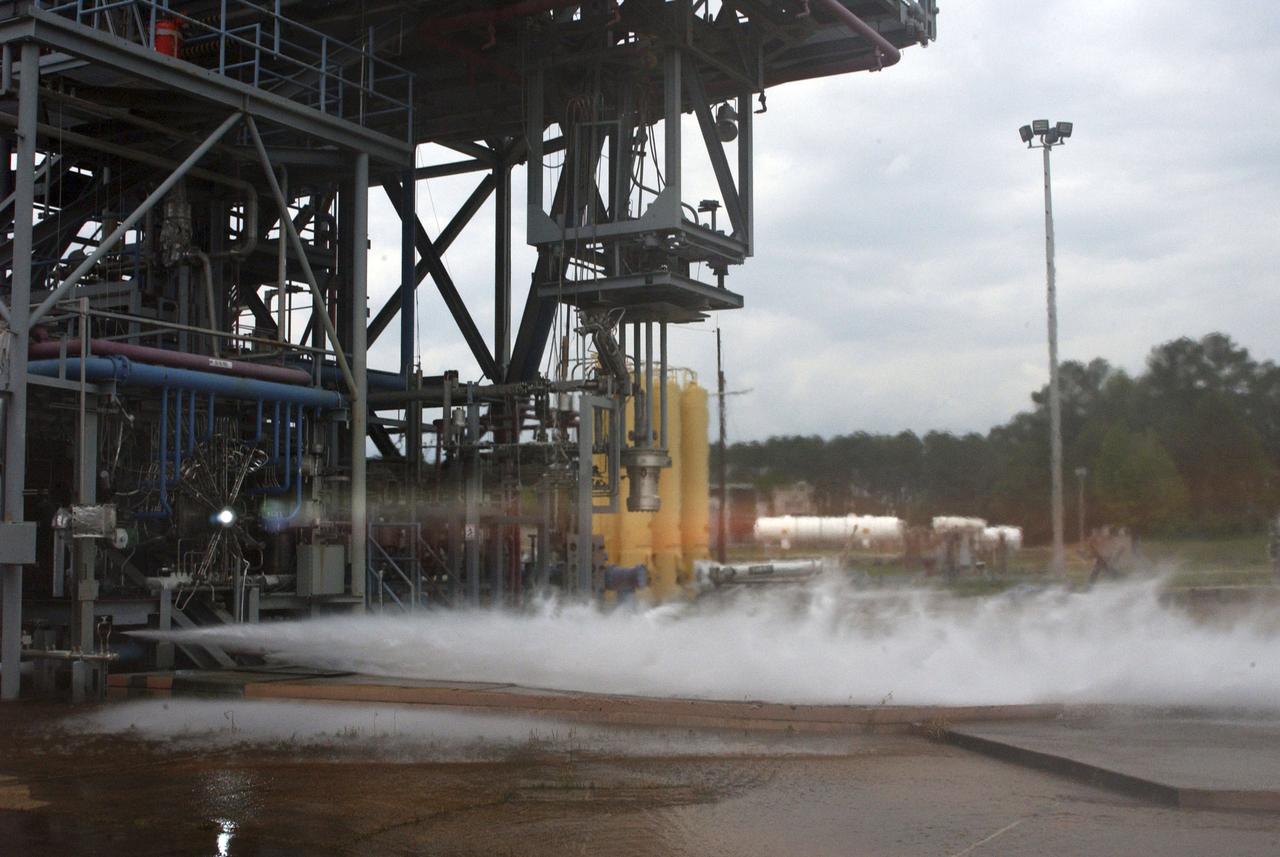
Chosen to power the upper stages of the new Ares I Crew Launch Vehicle (CLV) and the Ares V cargo segment, the J-2X engine is a stepped up version of the hydrogen/oxygen-fuelled Apollo-era J-2 engine. It was developed for NASA by Pratt & Whitney Rocketdyne (PWR), a business unit of United Technologies Corporation of Canoga Park, California. As seen in this photograph, the engine underwent a series of hot fire tests, performed on sub scale main injector hardware in the Test Stand 116 at Marshall Space Flight Center (MSFC). The injector is a major component of the engine that injects and mixes propellants in the combustion chamber, where they are ignited and burned to produce thrust.
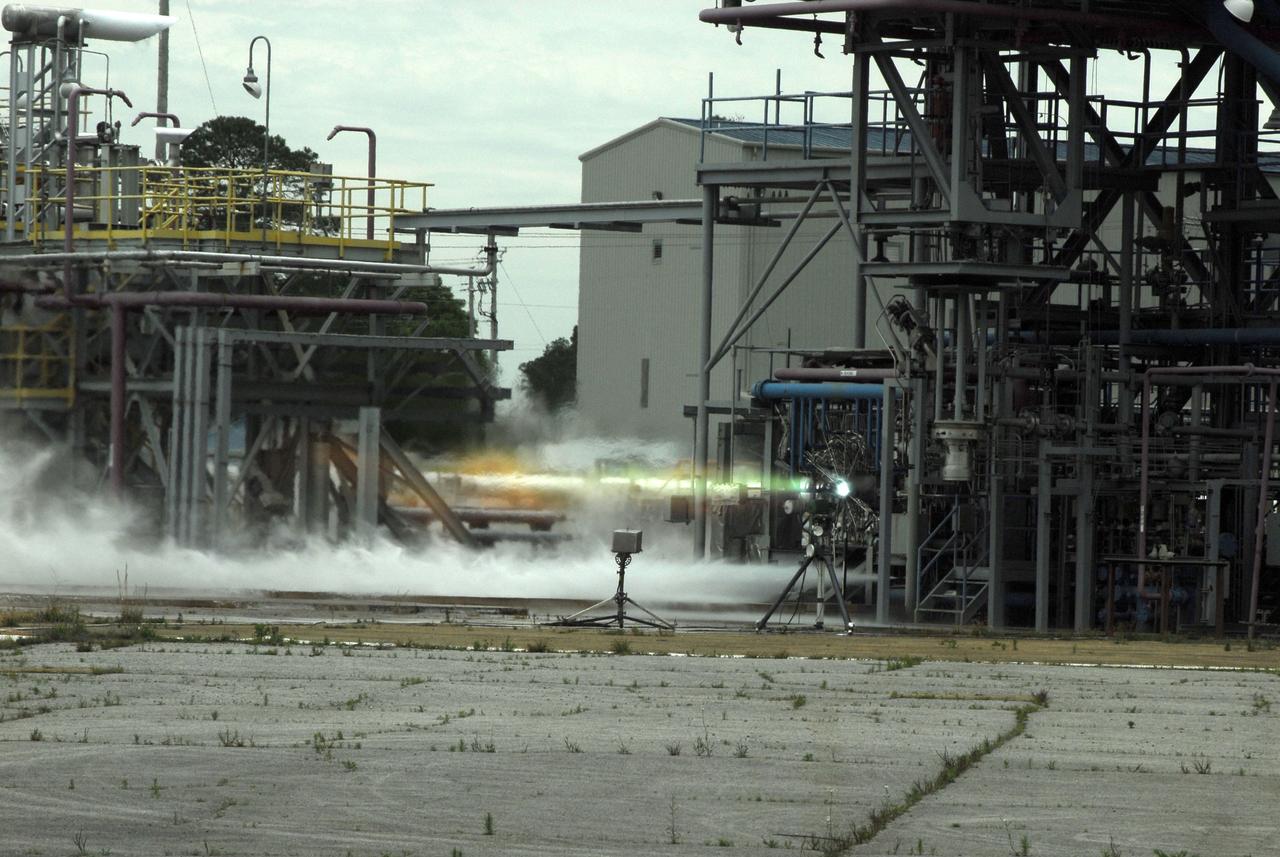
Chosen to power the upper stages of the new Ares I Crew Launch Vehicle (CLV) and the Ares V cargo segment, the J-2X engine is a stepped up version of the hydrogen/oxygen-fuelled Apollo-era J-2 engine. It was developed for NASA by Pratt & Whitney Rocketdyne (PWR), a business unit of United Technologies Corporation of Canoga Park, California. As seen in this photograph, the engine underwent a series of hot fire tests, performed on sub scale main injector hardware in the Test Stand 116 at Marshall Space Flight Center (MSFC). The injector is a major component of the engine that injects and mixes propellants in the combustion chamber, where they are ignited and burned to produce thrust.
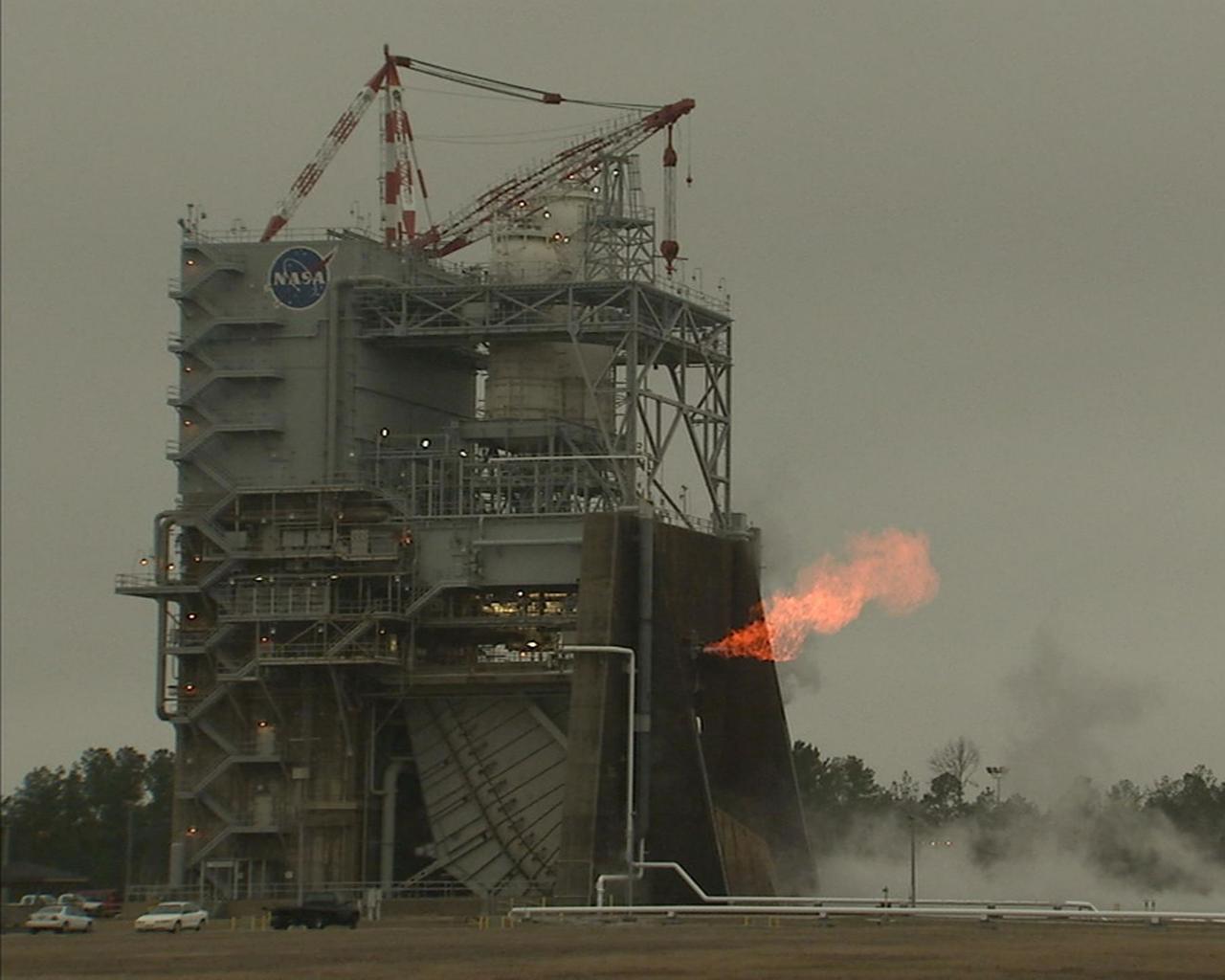
The first hot-fire test of the J-2X power pack 1A gas generator was performed Jan. 31 on the A-1 Test Stand at Stennis Space Center. Initial indications are that all test objectives were met. The test was designed as a 3.42-second helium spin start with gas generator ignition and it went the full scheduled duration. Test conductors reported a smooth start with normal shutdown and described the event as a 'good test.' The test was part of the early component testing for the new J-2X engine being built by NASA to power the Ares I and Ares V rockets that will carry humans back to the moon and on to Mars. It was performed as one in a series of 12 scheduled tests. Those tests began last November at Stennis, but the January 31 event represented the first hot-fire test. The Stennis tests are a critical step in the successful development of the J-2X engine.

The A-1 Test Stand at NASA Stennis Space Center near Bay St. Louis, Miss., was the focus of a ceremony held Thursday to transition the storied facility to a new program of work: testing the J-2X engines that will power the agency's next generation spacecraft, Ares I & V. Standing before the historic structure, with a plaque commemorating the change, are (from left) SSC Center Director Richard Gilbrech; NASA Associate Administrator for Exploration Systems Scott Horowitz; and NASA Space Operations Deputy Associate Administrator for Program Integration Michael Hawes. Ares vehicles are the crew and cargo launch vehicles being developed under NASA's Constellation Program.
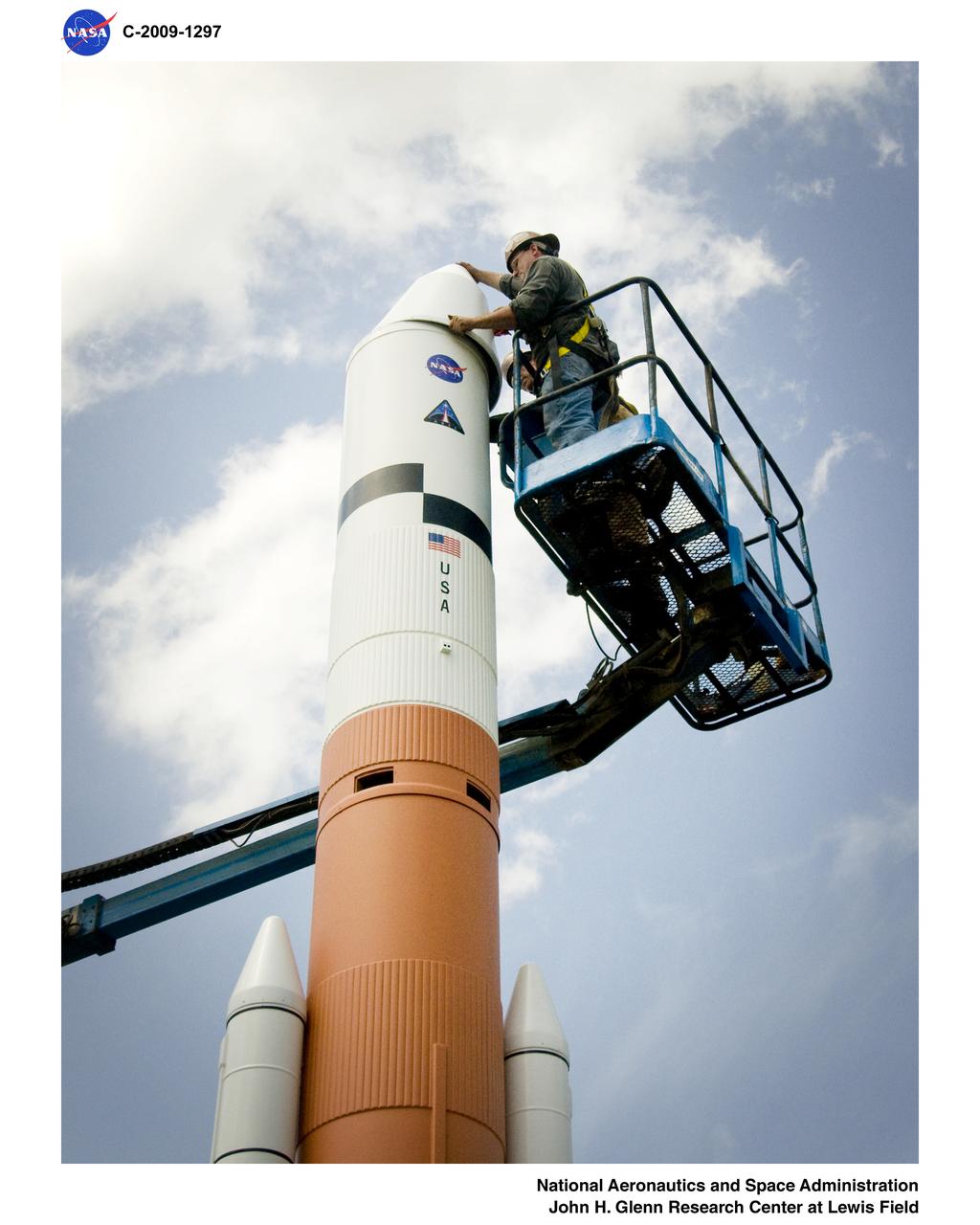
Installation of Ares V Model
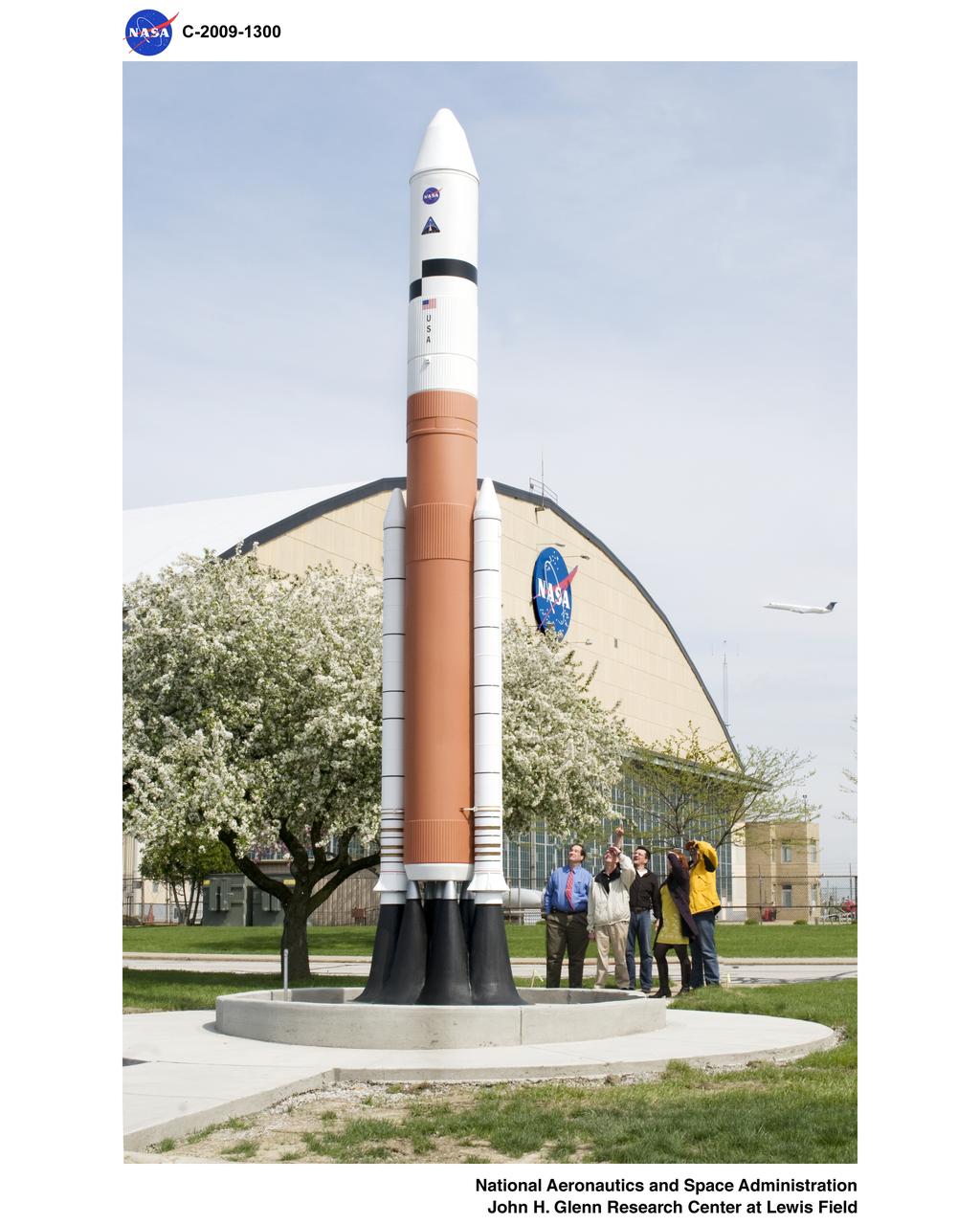
Installation of Ares V Model
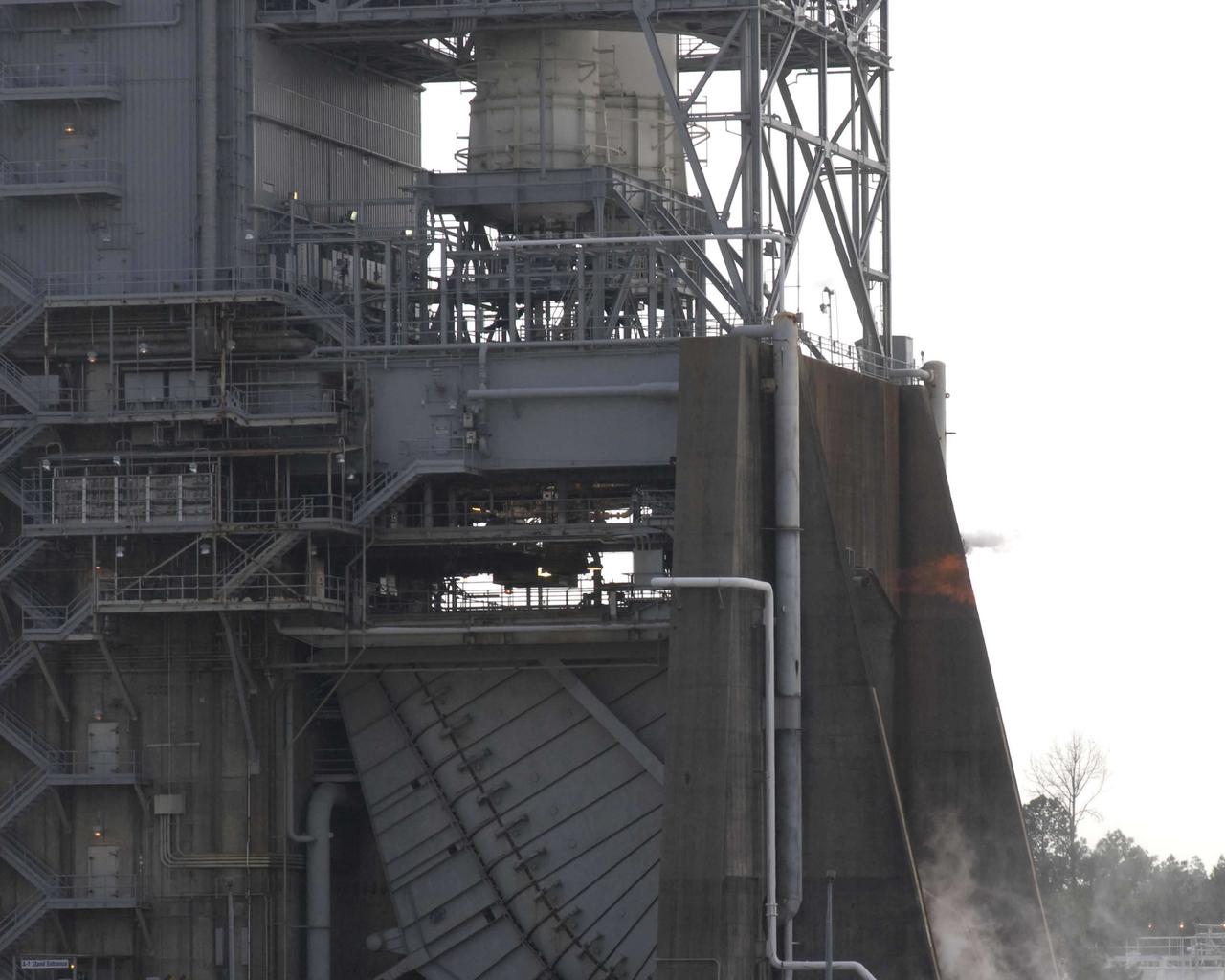
NASA engineers successfully complete the first series of tests in the early development of the J-2X engine that will power the Ares I and Ares V rockets, key components of NASA's Constellation Program.
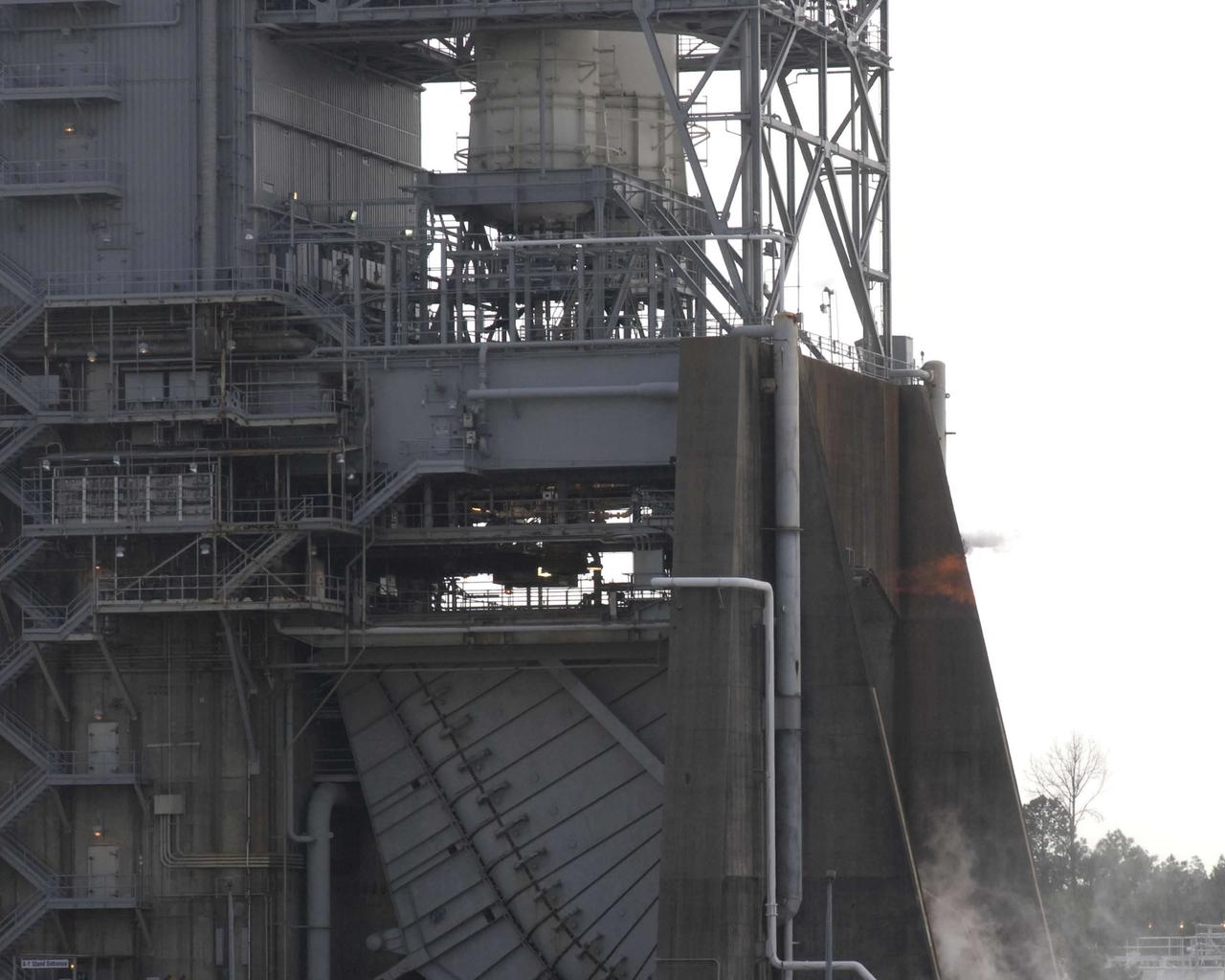
NASA engineers successfully complete the first series of tests in the early development of the J-2X engine that will power the Ares I and Ares V rockets, key components of NASA's Constellation Program.
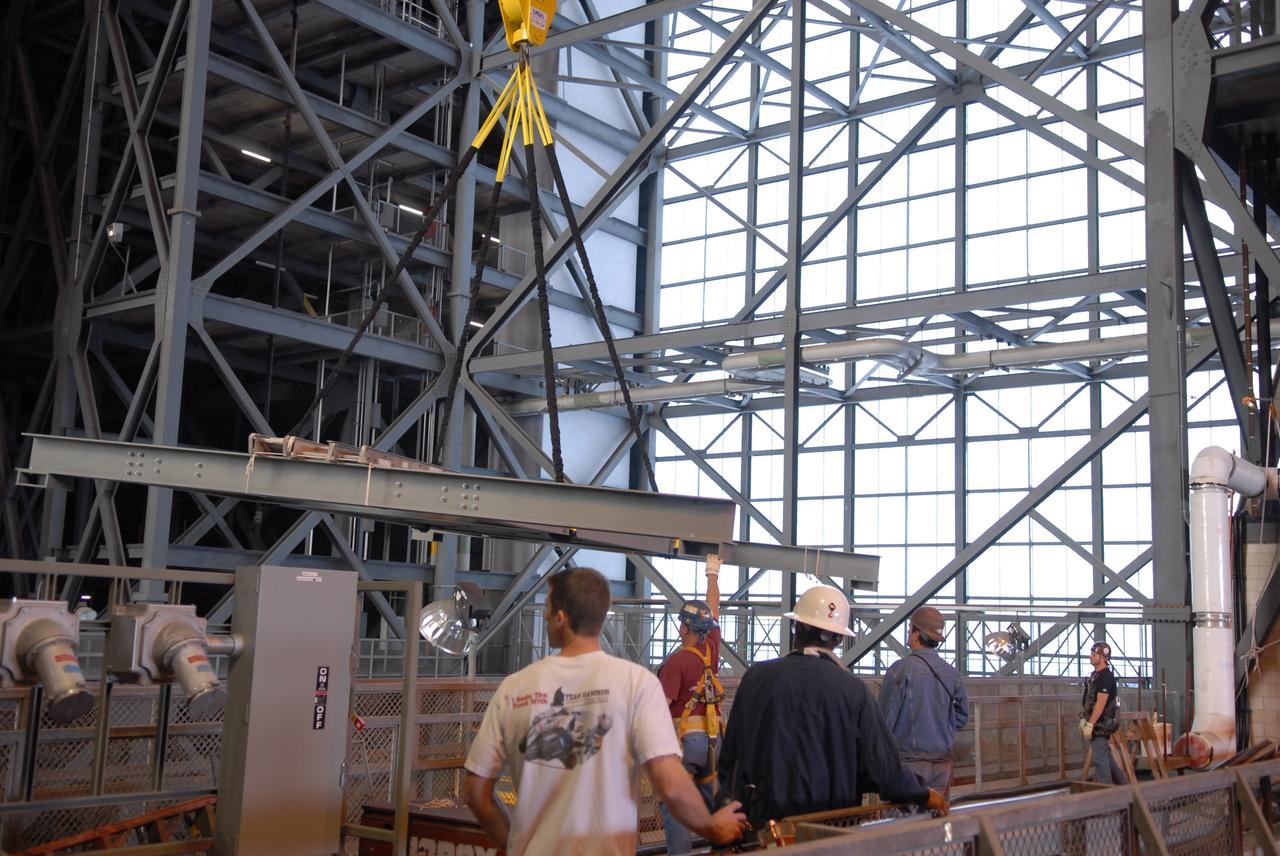
CAPE CANAVERAL, Fla. – In the Vehicle Assembly Building's high bay 3 at NASA's Kennedy Space Center in Florida, framework is lifted to the 16th floor for modifications related to the Ares I-X. The refurbishment of the facility is for the Constellation Program's Ares vehicles. The Ares I and Ares V rockets will be 325 feet and 360 feet tall, respectively, considerably taller than the space shuttle atop its mobile launcher platform. Photo credit: NASA/Troy Cryder
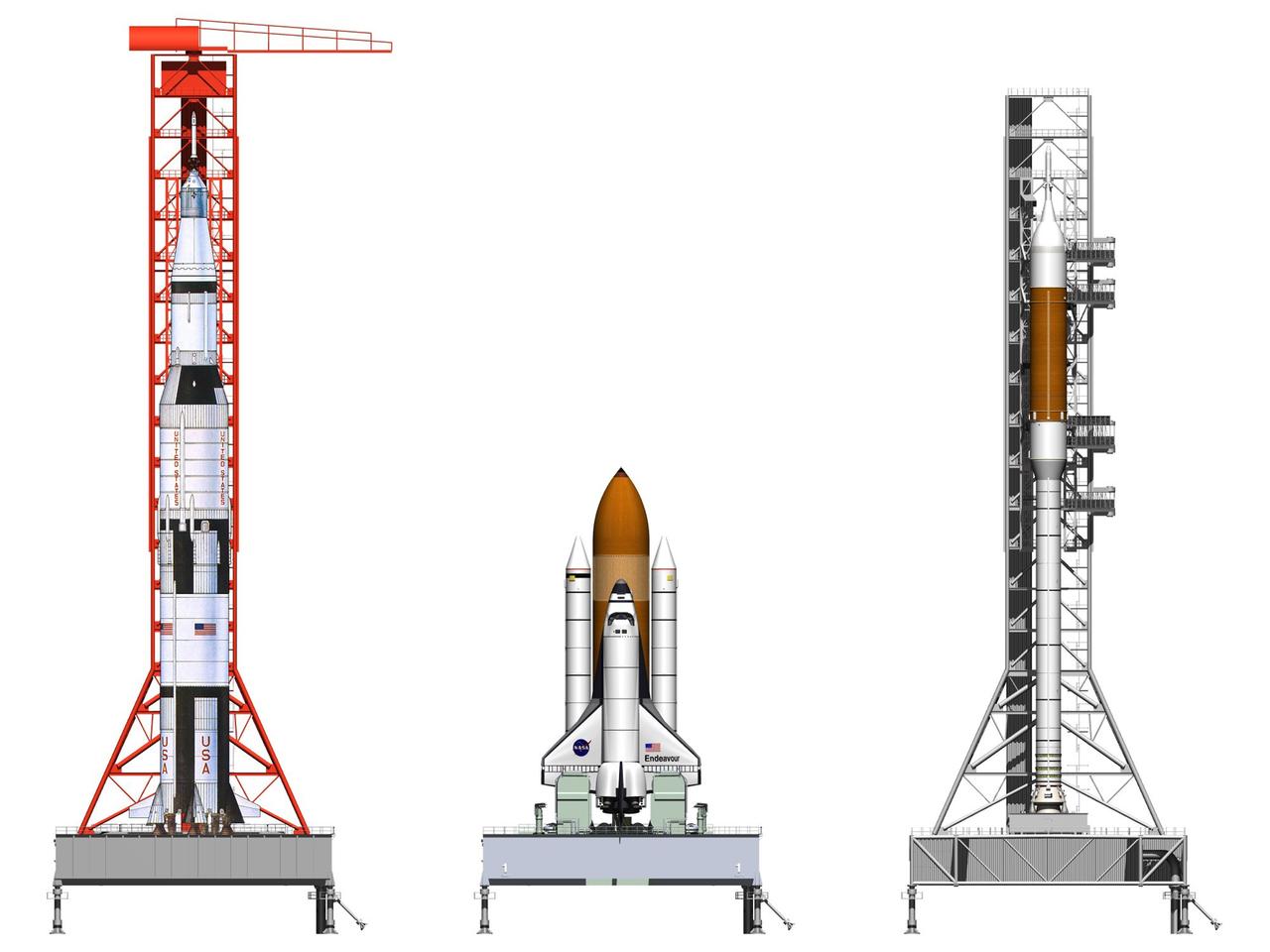
CAPE CANAVERAL, Fla. -- Artist's rendering of the Constellation Program's Ares V rocket on the mobile launcher platform (left) and the Ares I rocket on the platform (right) with the space shuttle in between for comparison. The tower of the mobile launcher will have multiple platforms for personnel access and will be approximately 390 feet tall. The tower will be used in the assembly, testing and servicing of the Ares rockets at Kennedy and will also transport the Ares rockets to the launch pad and provide ground support for launches.
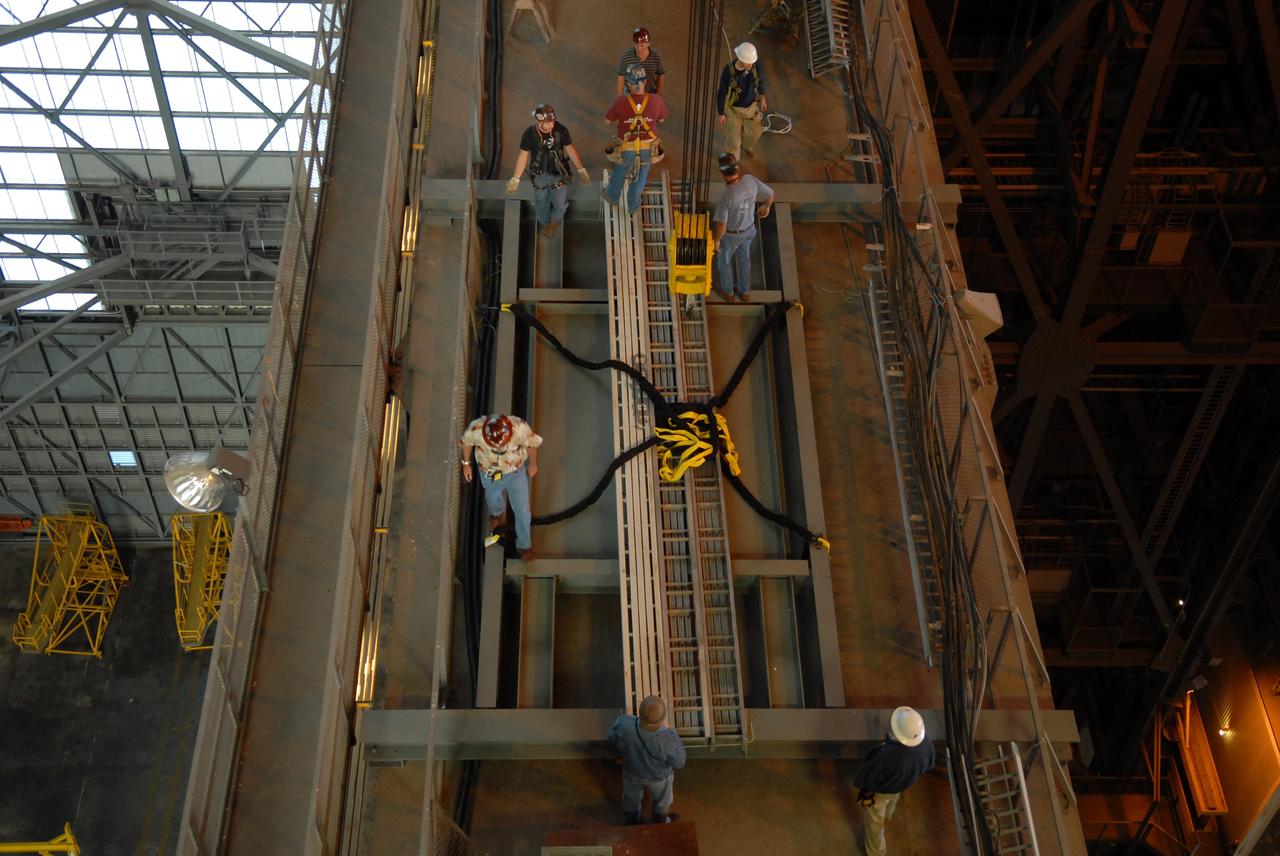
CAPE CANAVERAL, Fla. –In the Vehicle Assembly Building's high bay 3 at NASA's Kennedy Space Center in Florida, framework is lifted to the 16th floor for modifications related to the Ares I-X. The refurbishment of the facility is for the Constellation Program's Ares vehicles. The Ares I and Ares V rockets will be 325 feet and 360 feet tall, respectively, considerably taller than the space shuttle atop its mobile launcher platform. Photo credit: NASA/Troy Cryder
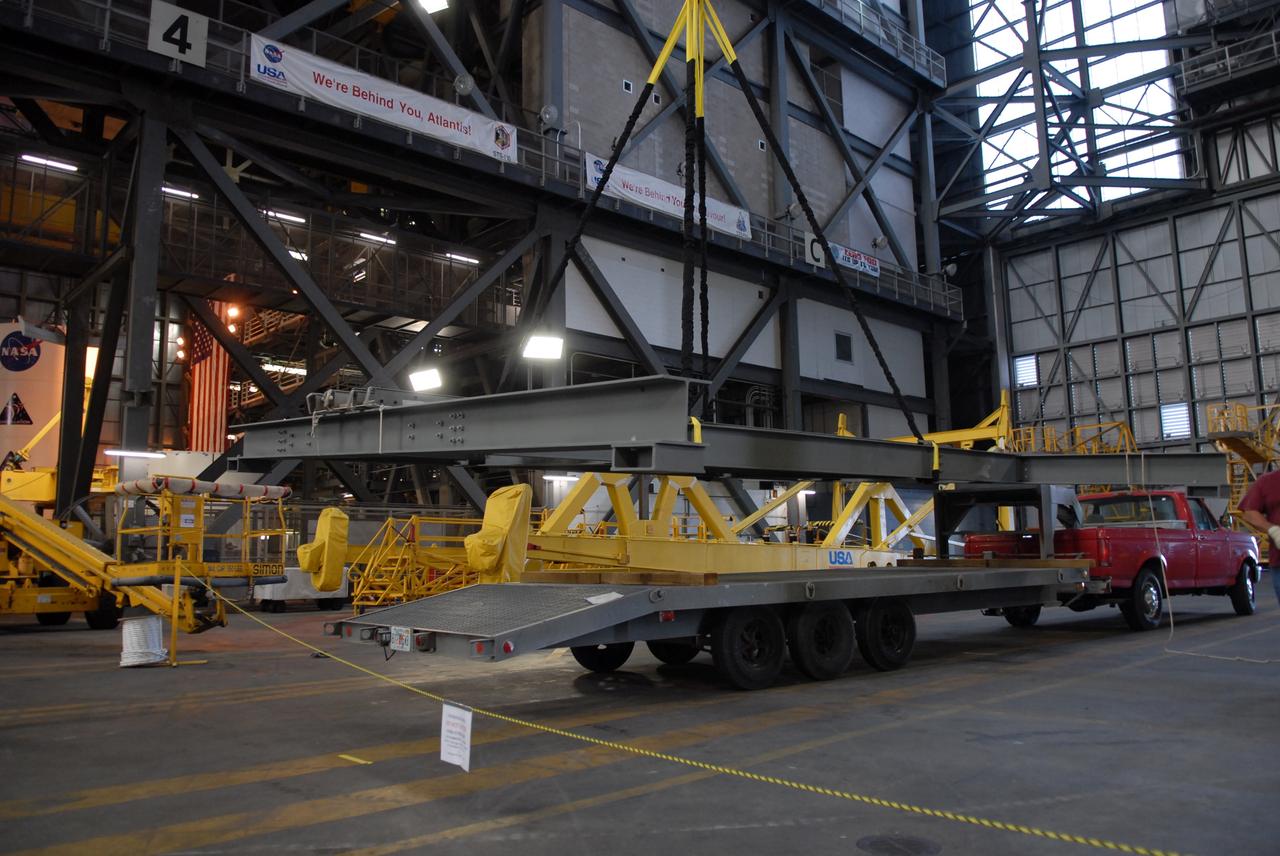
CAPE CANAVERAL, Fla. – Framework is being lifted from a transporter to be installed on the 16th floor for modifications in the Vehicle Assembly Building's high bay 3 at NASA's Kennedy Space Center in Florida related to the Ares I-X. The refurbishment of the facility is for the Constellation Program's Ares vehicles. The Ares I and Ares V rockets will be 325 feet and 360 feet tall, respectively, considerably taller than the space shuttle atop its mobile launcher platform. Photo credit: NASA/Troy Cryder
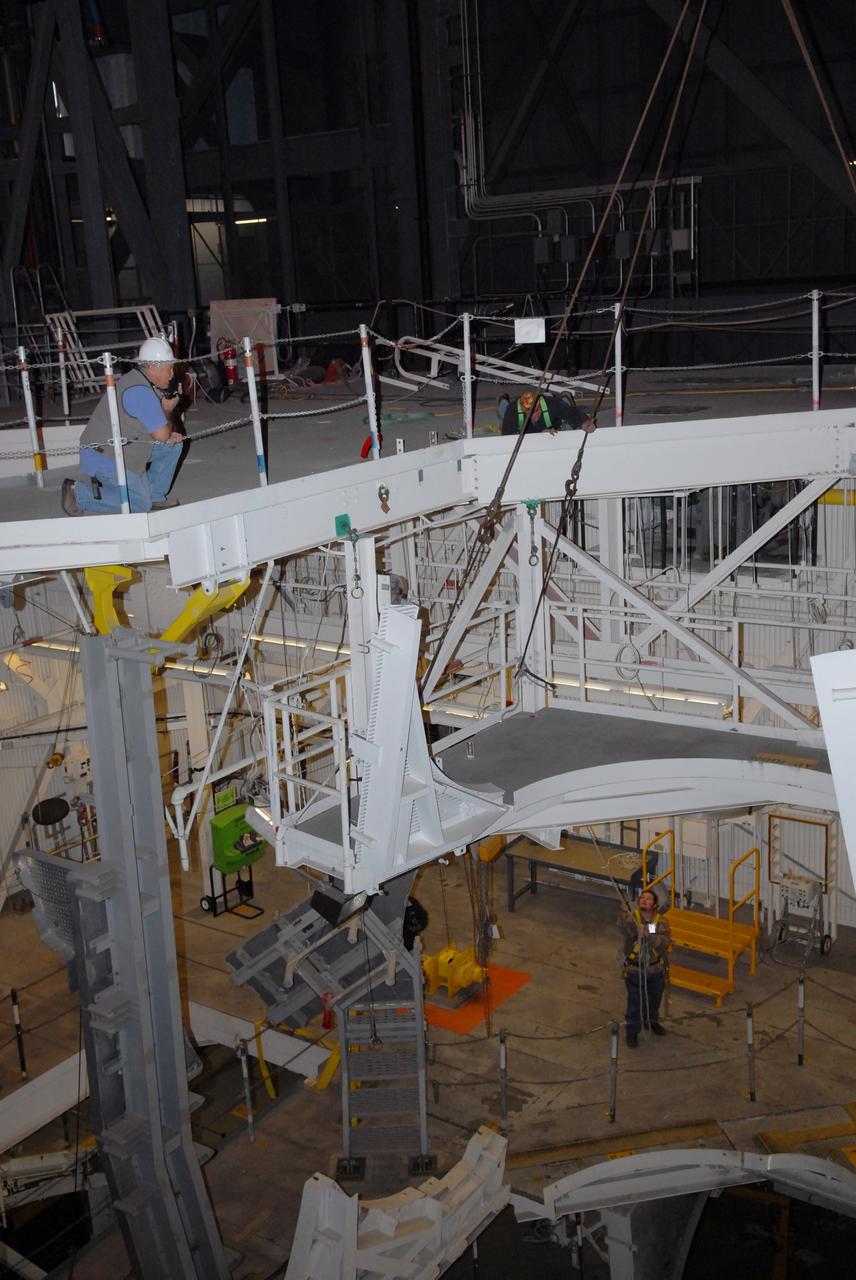
CAPE CANAVERAL, Fla. – In the Vehicle Assembly Building at NASA's Kennedy Space Center in Florida, the platform is being lifted from an upper level in high bay 3. Its removal is part of the refurbishment of the facility for the Constellation Program's Ares 1-X vehicle. The Ares I and Ares V rockets will be more than 325 feet tall, considerably taller than the space shuttle atop its mobile launcher platform. Photo credit: NASA/Jack Pfaller
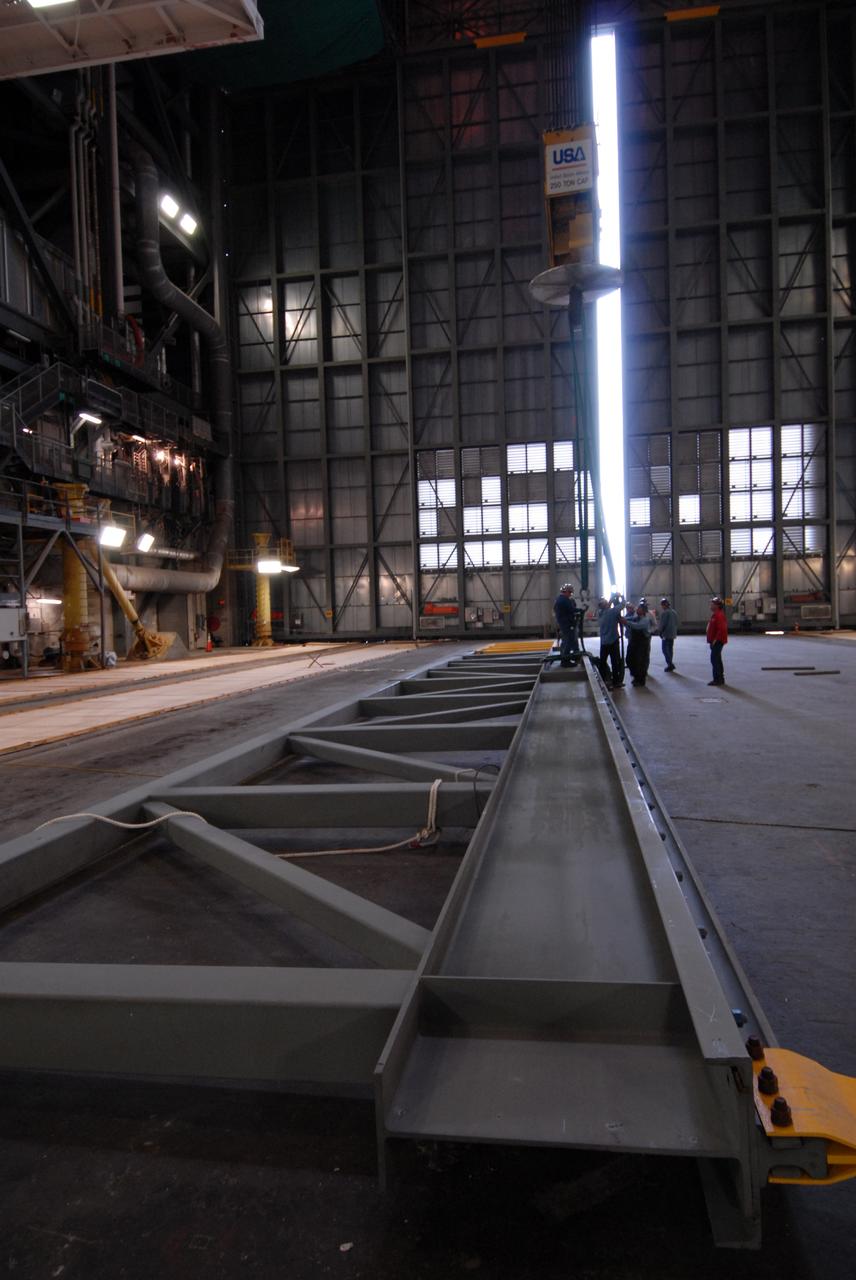
CAPE CANAVERAL, Fla. – In the Vehicle Assembly Building at NASA's Kennedy Space Center in Florida, an upper rail removed from high bay 3 rests on the floor. The removal is part of the modifications for the Constellation Program's Ares vehicles. The Ares I and Ares V rockets will be 325 feet and 360 feet tall, respectively, considerably taller than the space shuttle atop its mobile launcher platform. Photo credit: NASA/Jack Pfaller
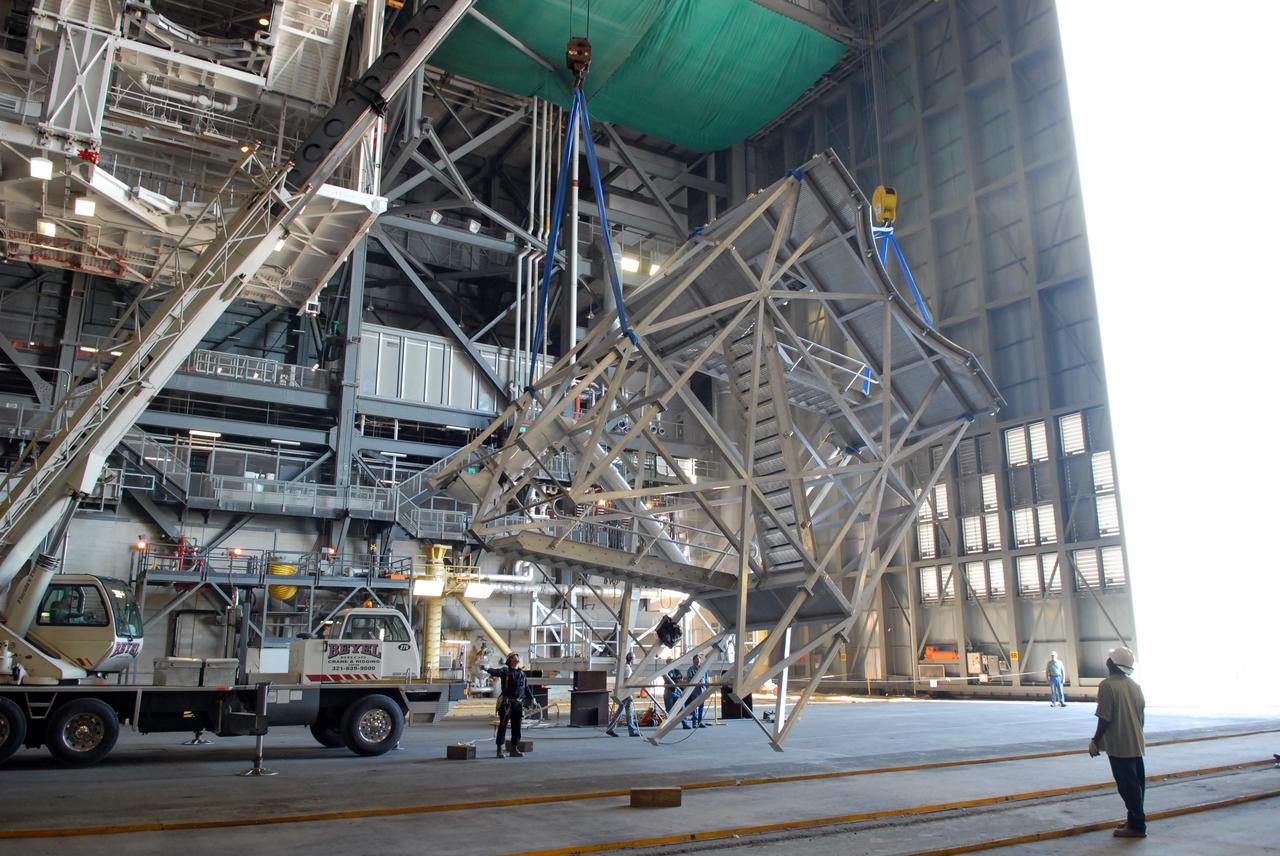
CAPE CANAVERAL, Fla. – In the Vehicle Assembly Building at NASA's Kennedy Space Center in Florida, a new platform is lifted to install on the 16th level in high bay 3. The refurbishment of the facility is for the Constellation Program's Ares vehicles. The Ares I and Ares V rockets will be 325 feet and 360 feet tall, respectively, considerably taller than the space shuttle atop its mobile launcher platform. Photo credit: NASA/Jack Pfaller
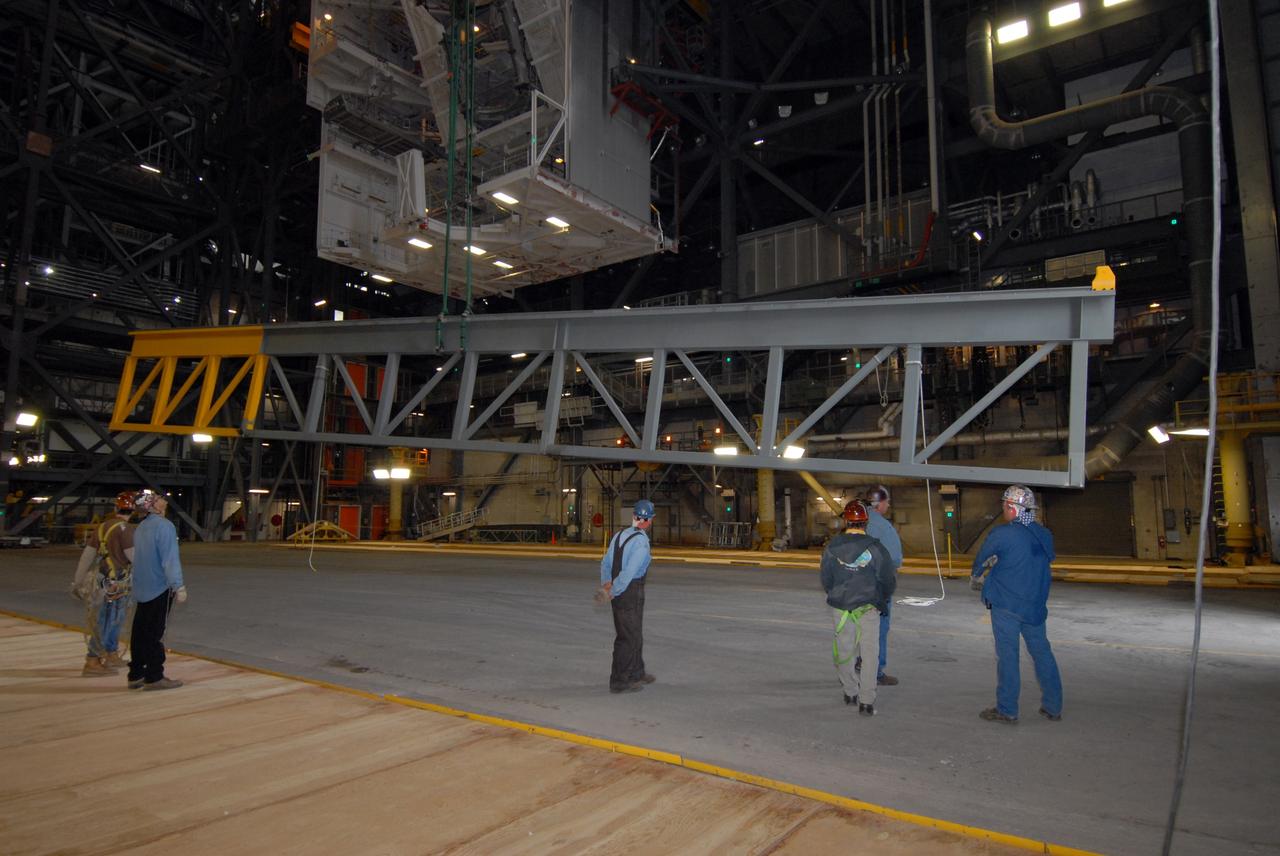
CAPE CANAVERAL, Fla. – In the Vehicle Assembly Building at NASA's Kennedy Space Center in Florida, an upper rail removed from high bay 3 is lowered onto the floor. The removal is part of the modifications for the Constellation Program's Ares vehicles. The Ares I and Ares V rockets will be 325 feet and 360 feet tall, respectively, considerably taller than the space shuttle atop its mobile launcher platform. Photo credit: NASA/Jack Pfaller
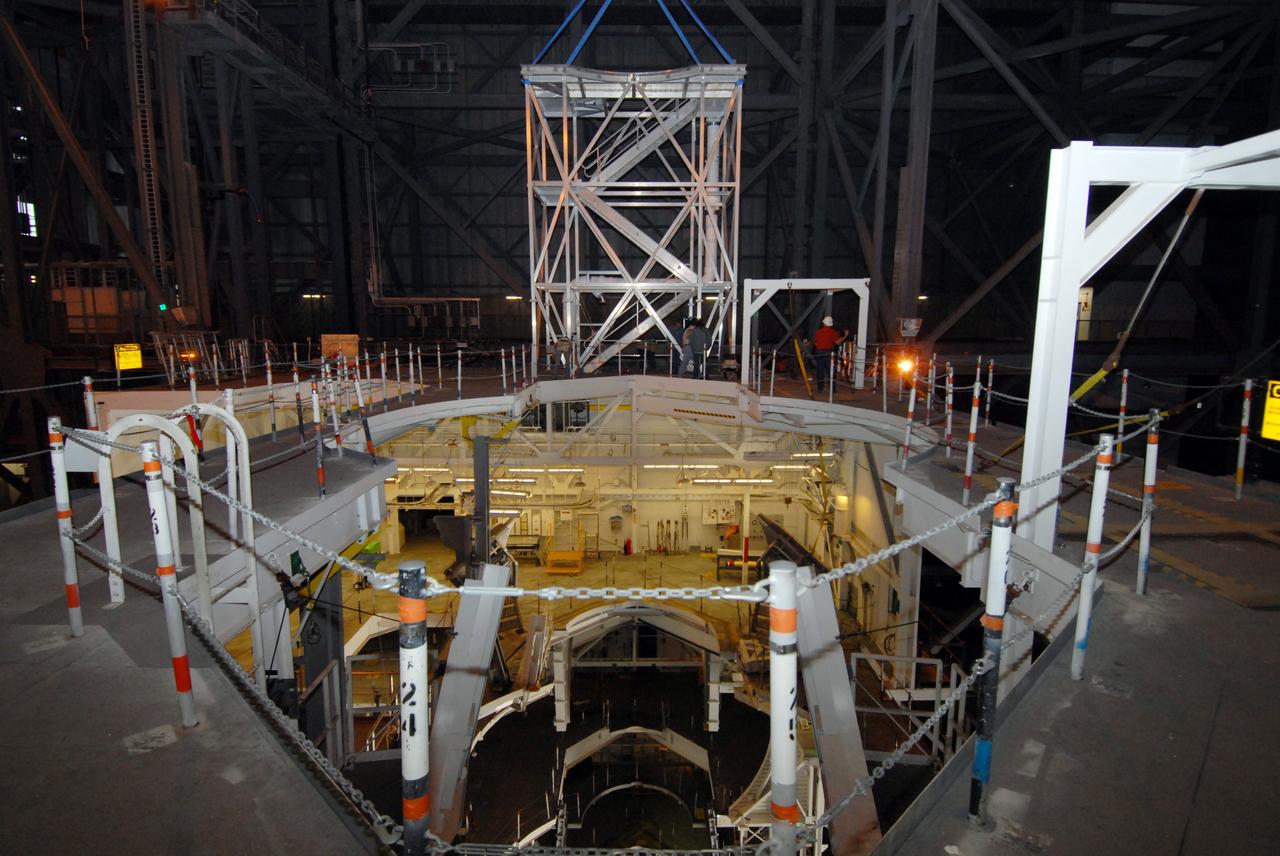
CAPE CANAVERAL, Fla. – In the Vehicle Assembly Building at NASA's Kennedy Space Center in Florida, a new platform is installed on the 16th level in high bay 3. The refurbishment of the facility is for the Constellation Program's Ares vehicles. The Ares I and Ares V rockets will be 325 feet and 360 feet tall, respectively, considerably taller than the space shuttle atop its mobile launcher platform. Photo credit: NASA/Jack Pfaller
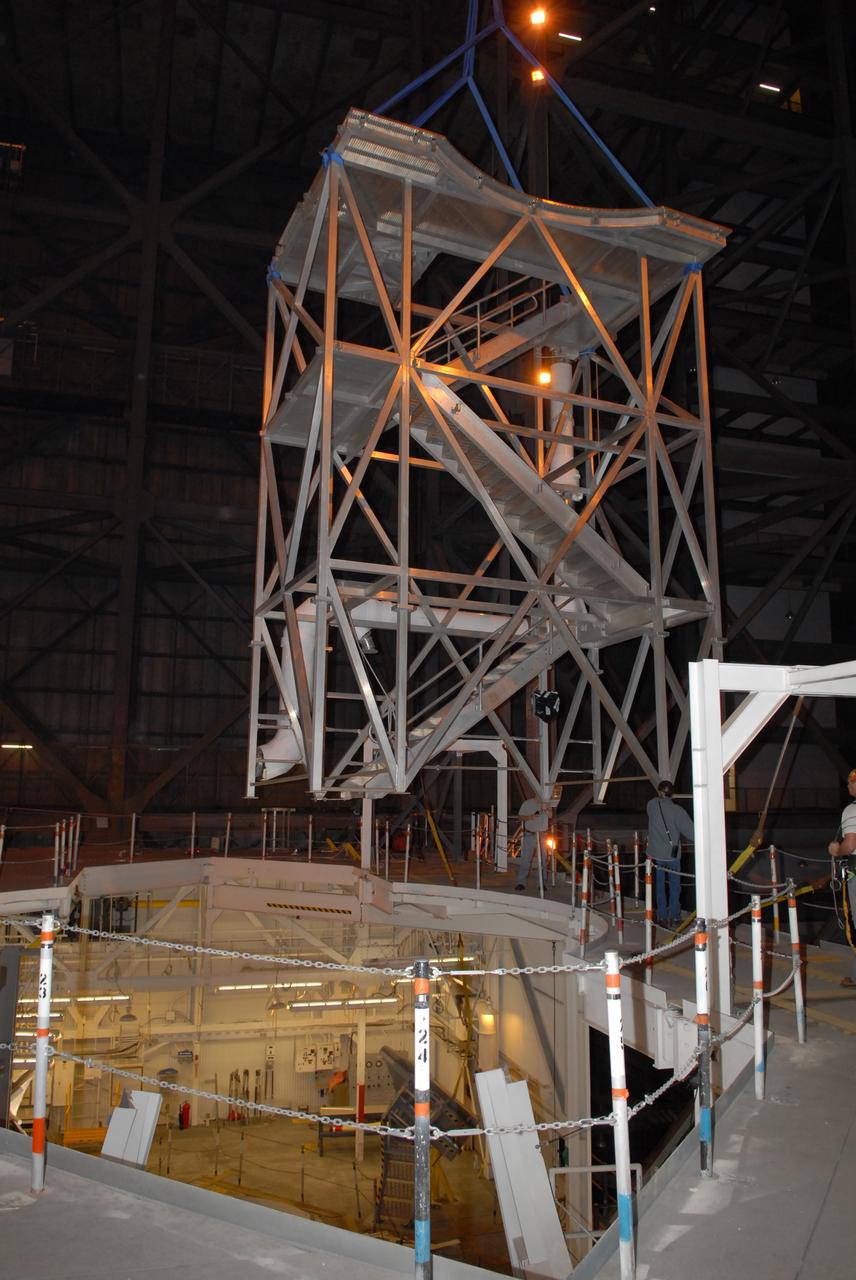
CAPE CANAVERAL, Fla. – In the Vehicle Assembly Building at NASA's Kennedy Space Center in Florida, a new platform is lifted to install on the 16th level in high bay 3. The refurbishment of the facility is for the Constellation Program's Ares vehicles. The Ares I and Ares V rockets will be 325 feet and 360 feet tall, respectively, considerably taller than the space shuttle atop its mobile launcher platform. Photo credit: NASA/Jack Pfaller

CAPE CANAVERAL, Fla. – In the Vehicle Assembly Building at NASA's Kennedy Space Center in Florida, this platform is being removed from high bay 3 as part of the refurbishment of the facility for the Constellation Program's Ares 1-X vehicle. The Ares I and Ares V rockets will be more than 325 feet tall, considerably taller than the space shuttle atop its mobile launcher platform. Photo credit: NASA/Jack Pfaller
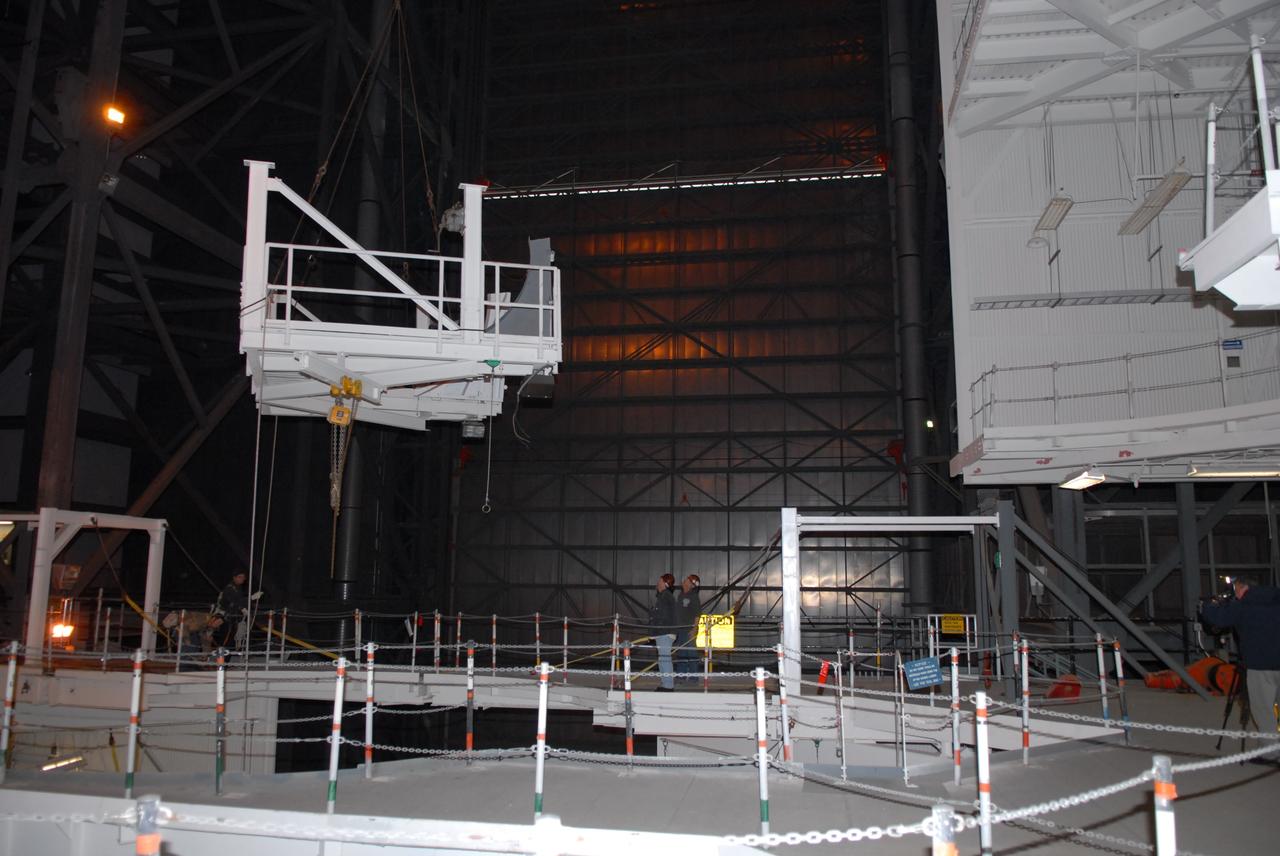
CAPE CANAVERAL, Fla. – In the Vehicle Assembly Building at NASA's Kennedy Space Center in Florida, this platform is lifted from an upper level in high bay 3. Its removal is part of the refurbishment of the facility for the Constellation Program's Ares 1-X vehicle. The Ares I and Ares V rockets will be more than 325 feet tall, considerably taller than the space shuttle atop its mobile launcher platform. Photo credit: NASA/Jack Pfaller
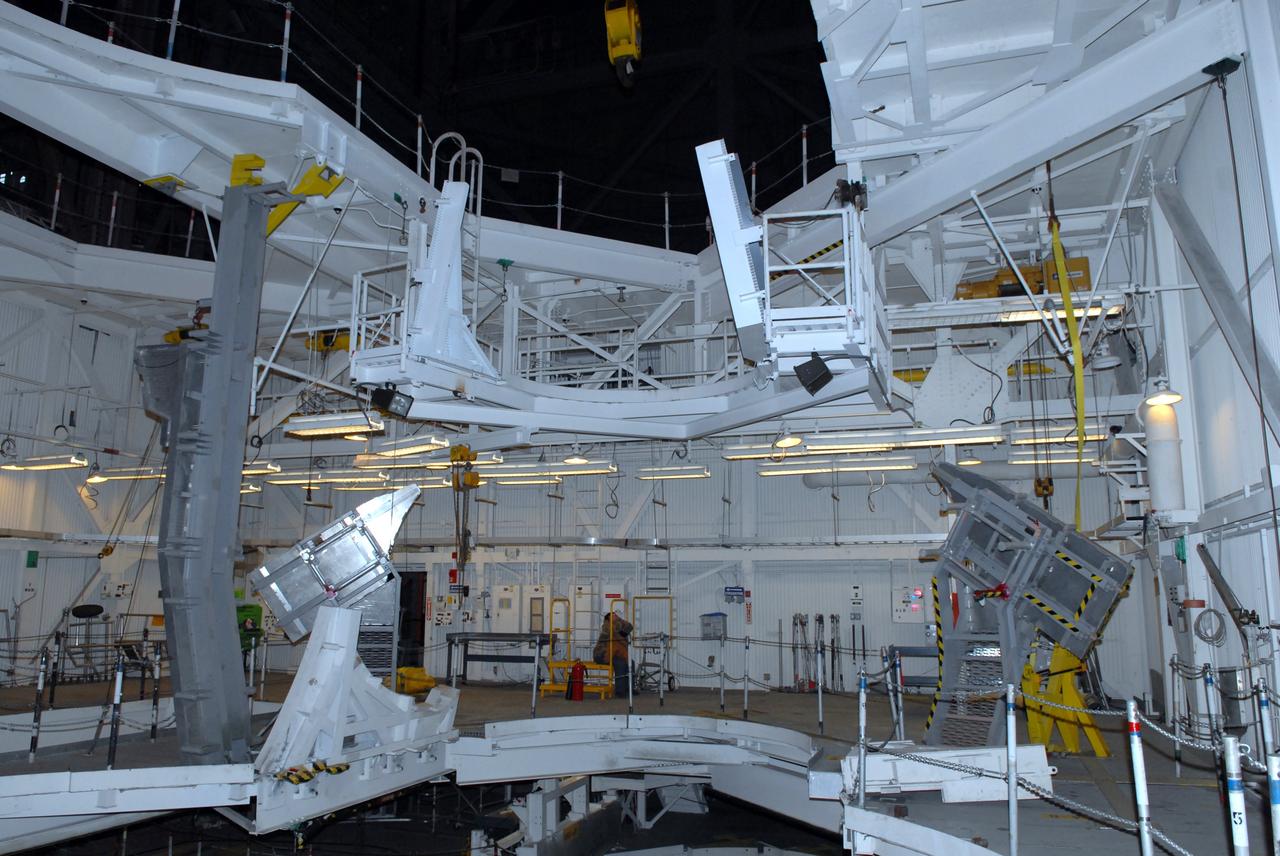
CAPE CANAVERAL, Fla. – In the Vehicle Assembly Building at NASA's Kennedy Space Center in Florida, this platform will be removed from high bay 3 as part of the refurbishment of the facility for the Constellation Program's Ares 1-X vehicle. The Ares I and Ares V rockets will be more than 325 feet tall, considerably taller than the space shuttle atop its mobile launcher platform. Photo credit: NASA/Jack Pfaller
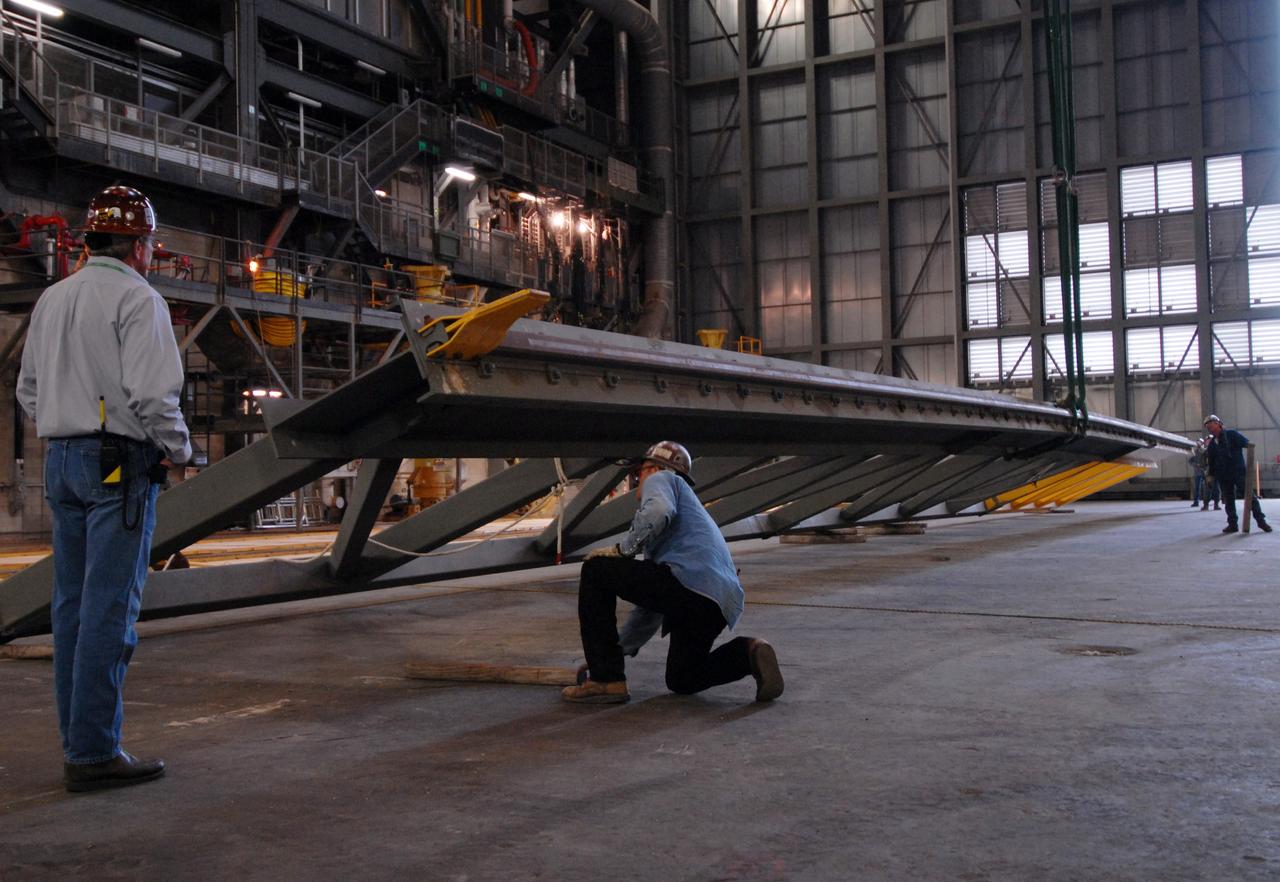
CAPE CANAVERAL, Fla. – In the Vehicle Assembly Building at NASA's Kennedy Space Center in Florida, an upper rail removed from high bay 3 is lowered onto the floor. The removal is part of the modifications for the Constellation Program's Ares vehicles. The Ares I and Ares V rockets will be 325 feet and 360 feet tall, respectively, considerably taller than the space shuttle atop its mobile launcher platform. Photo credit: NASA/Jack Pfaller
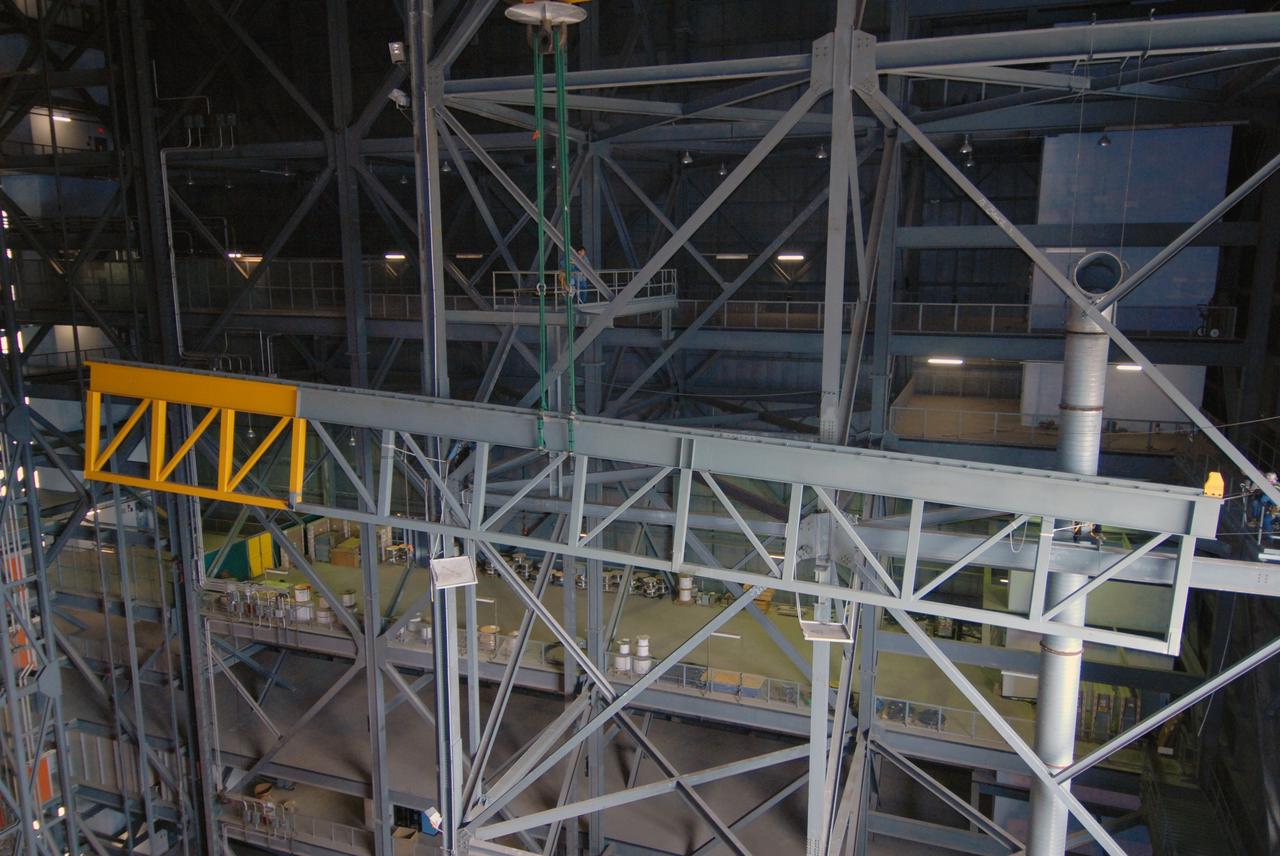
CAPE CANAVERAL, Fla. – In the Vehicle Assembly Building at NASA's Kennedy Space Center in Florida, an upper rail is being removed in high bay 3 as part of the modifications for the Constellation Program's Ares vehicles. The Ares I and Ares V rockets will be 325 feet and 360 feet tall, respectively, considerably taller than the space shuttle atop its mobile launcher platform. Photo credit: NASA/Jack Pfaller
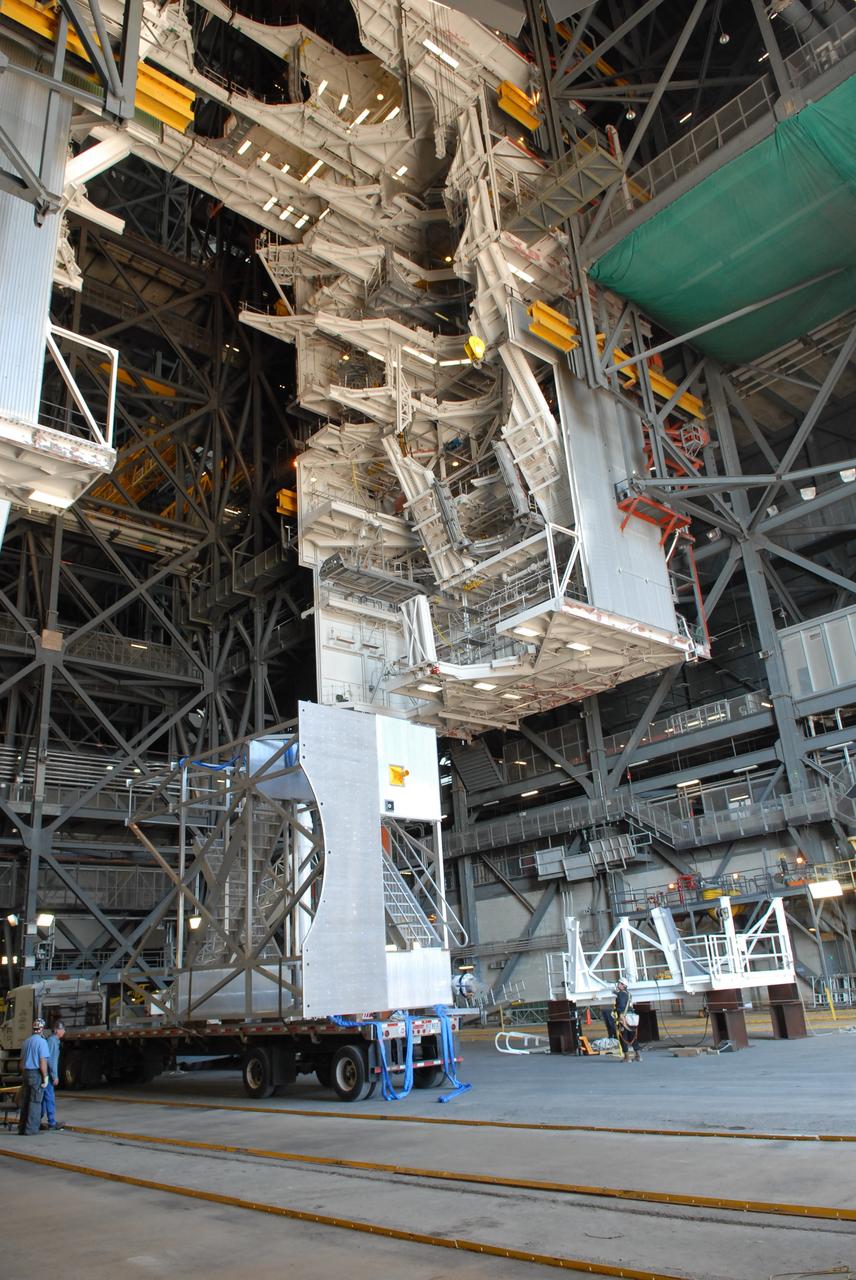
CAPE CANAVERAL, Fla. – In the Vehicle Assembly Building at NASA's Kennedy Space Center in Florida, new platforms are being added to the 16th level in high bay 3. The refurbishment of the facility is for the Constellation Program's Ares vehicles. The Ares I and Ares V rockets will be 325 feet and 360 feet tall, respectively, considerably taller than the space shuttle atop its mobile launcher platform. Photo credit: NASA/Jack Pfaller
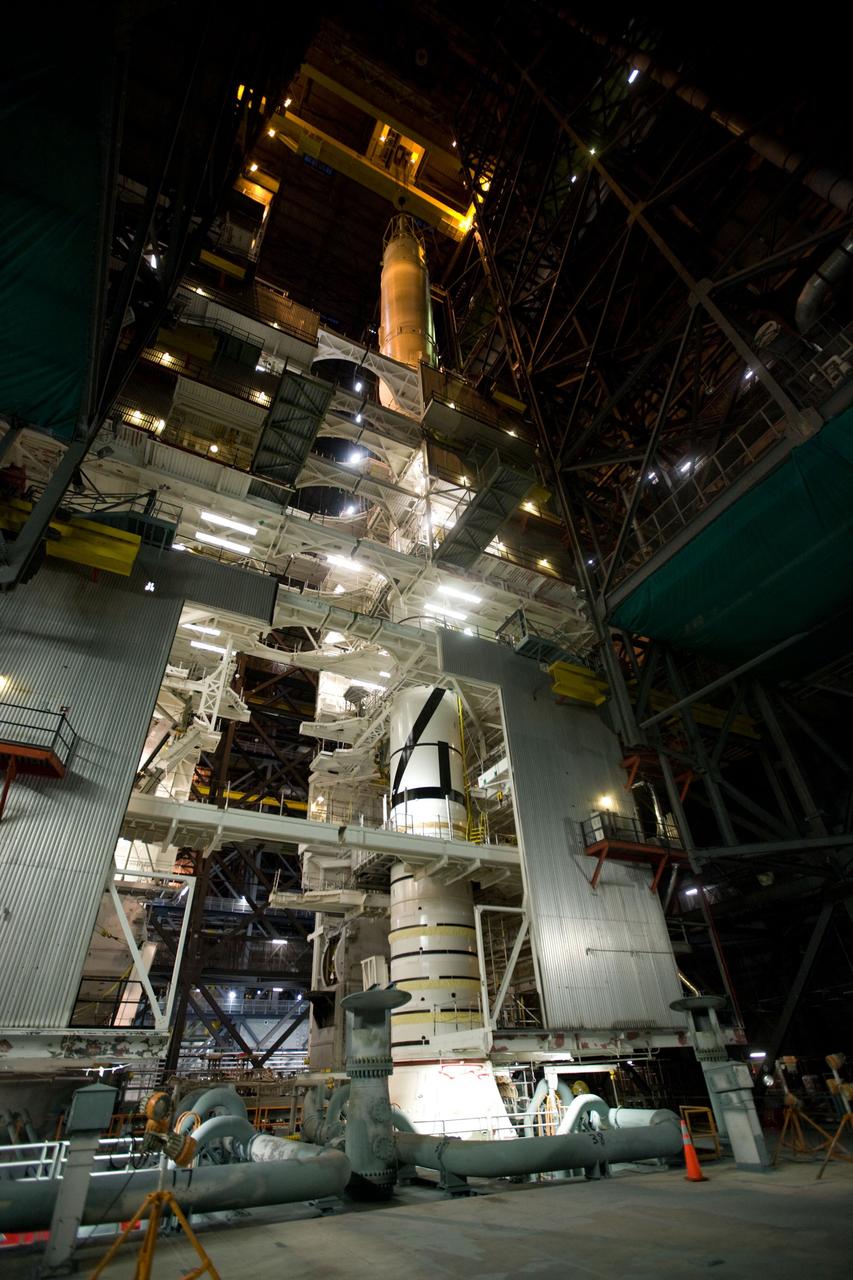
CAPE CANAVERAL, Fla. – In the Vehicle Assembly Building's High Bay 3, assembly of the Ares I-X rocket nears completion. The yellow framework, nicknamed the "birdcage," lowers Super Stack 5 onto the Ares I-X segments already in place on the mobile launcher platform. Once in position, assembly of the Ares I-X rocket will be complete. The 327-foot-tall rocket is one of the largest processed in the bay, rivaling the height of the Apollo Program's 364-foot-tall Saturn V. Five super stacks make up the rocket's upper stage that is integrated with the four-segment solid rocket booster first stage. Ares I-X is the test vehicle for the Ares I, which is part of the Constellation Program to return men to the moon and beyond. The Ares I-X flight test is targeted for Oct. 31, pending formal NASA Headquarters approval. Photo credit: NASA/Dimitri Gerondidakis

Fiber-Reinforced-Foam (FRF) Core Composite Sandwich Panel Concept for Advanced Composites Technologies Project - Preliminary Manufacturing Demonstration Articles for Ares V Payload Shroud Barrel Acreage Structure

Fiber-Reinforced-Foam (FRF) Core Composite Sandwich Panel Concept for Advanced Composites Technologies Project - Preliminary Manufacturing Demonstration Articles for Ares V Payload Shroud Barrel Acreage Structure

Fiber-Reinforced-Foam (FRF) Core Composite Sandwich Panel Concept for Advanced Composites Technologies Project - Preliminary Manufacturing Demonstration Articles for Ares V Payload Shroud Barrel Acreage Structure
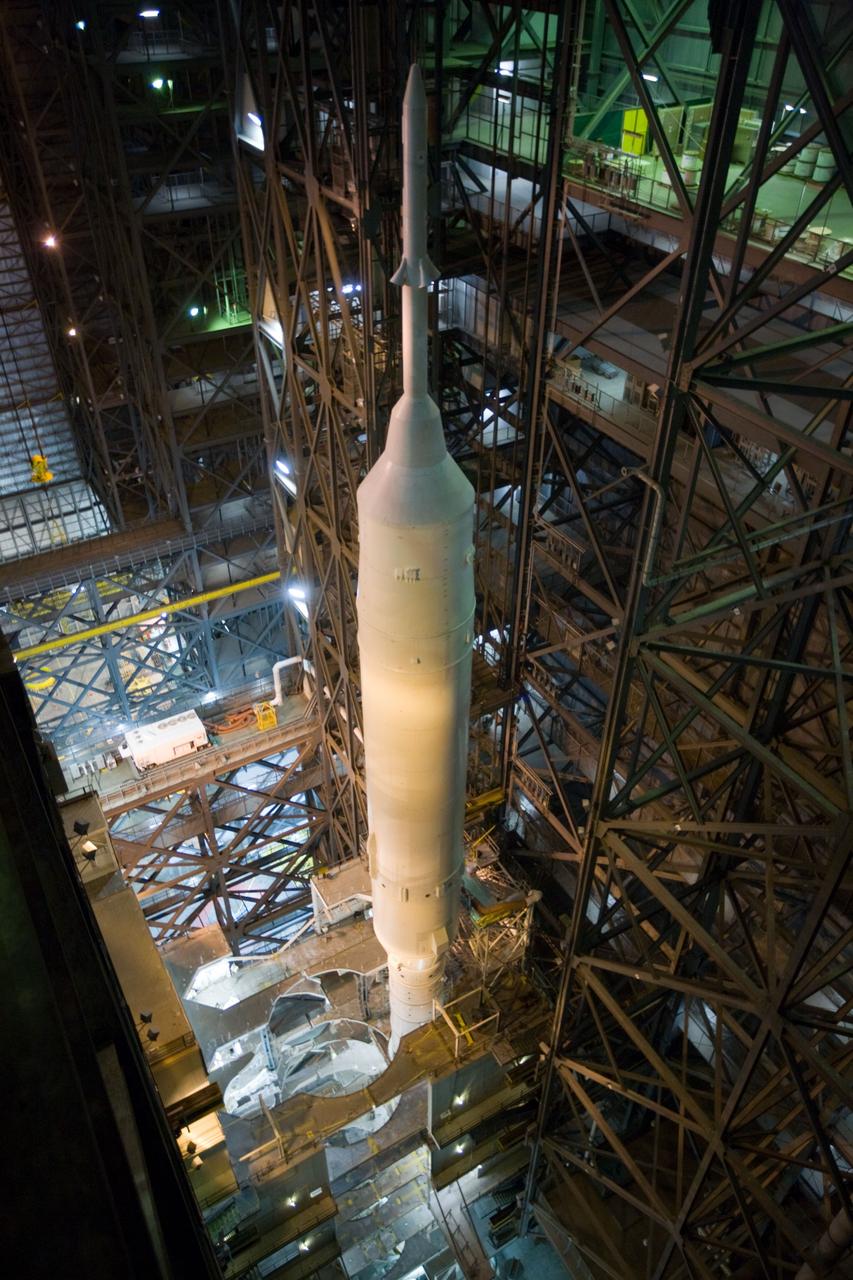
CAPE CANAVERAL, Fla. – In the Vehicle Assembly Building's High Bay 3, Super Stack 5 is secured to the Ares I-X segments already in place on the mobile launcher platform. Assembly of the Ares I-X rocket is complete. The 327-foot-tall rocket is one of the largest processed in the bay, rivaling the height of the Apollo Program's 364-foot-tall Saturn V. Five super stacks make up the rocket's upper stage that is integrated with the four-segment solid rocket booster first stage. Ares I-X is the test vehicle for the Ares I, which is part of the Constellation Program to return men to the moon and beyond. The Ares I-X flight test is targeted for Oct. 31, pending formal NASA Headquarters approval. Photo credit: NASA/Dimitri Gerondidakis
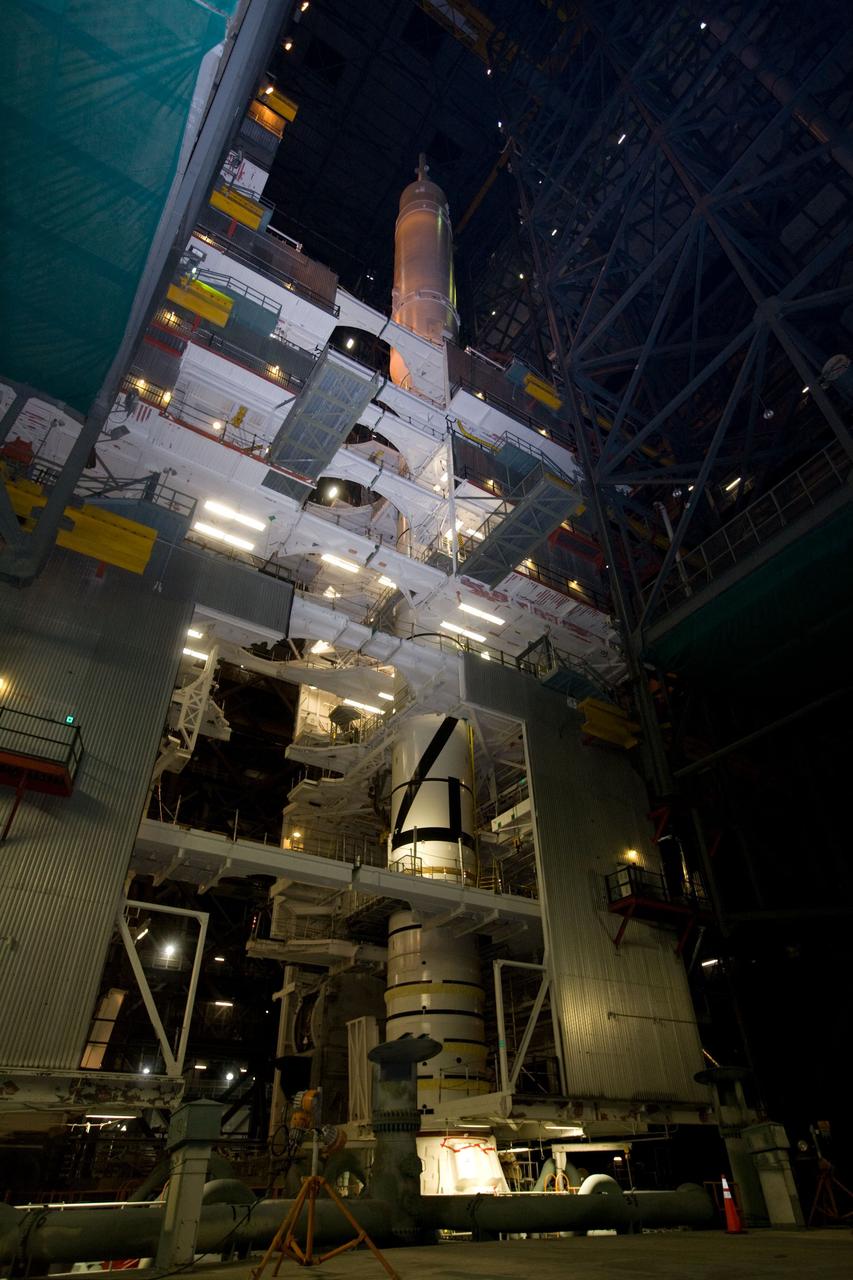
CAPE CANAVERAL, Fla. – In the Vehicle Assembly Building's High Bay 3, Super Stack 5 is secured to the Ares I-X segments already in place on the mobile launcher platform. Assembly of the Ares I-X rocket is complete. The 327-foot-tall rocket is one of the largest processed in the bay, rivaling the height of the Apollo Program's 364-foot-tall Saturn V. Five super stacks make up the rocket's upper stage that is integrated with the four-segment solid rocket booster first stage. Ares I-X is the test vehicle for the Ares I, which is part of the Constellation Program to return men to the moon and beyond. The Ares I-X flight test is targeted for Oct. 31, pending formal NASA Headquarters approval. Photo credit: NASA/Dimitri Gerondidakis
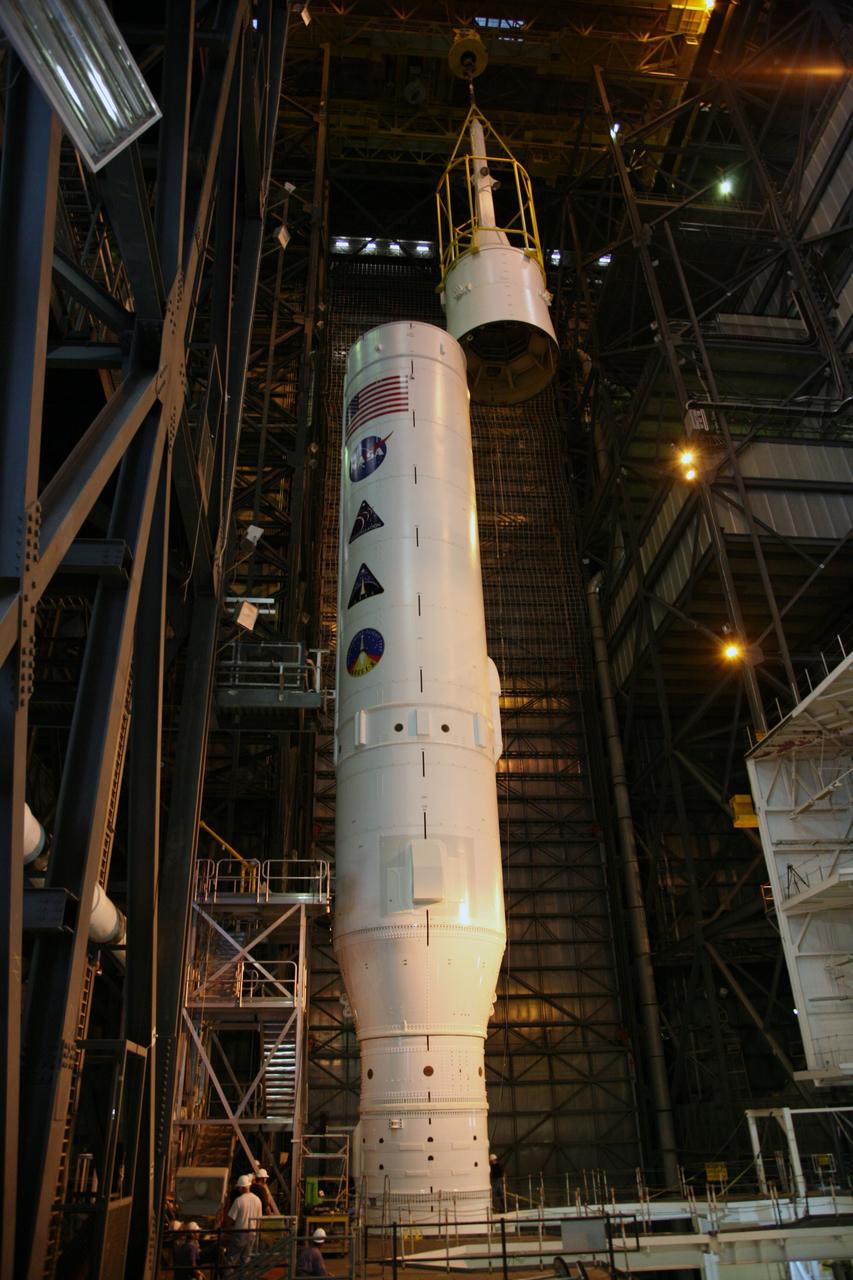
CAPE CANAVERAL, Fla. – In the Vehicle Assembly Building's High Bay 3, the yellow framework, nicknamed the "birdcage," lifts Super Stack 5 to the top of the Ares I-X segments already in place on the mobile launcher platform. Once in position, assembly of the Ares I-X rocket will be complete. The 327-foot-tall rocket is one of the largest processed in the bay, rivaling the height of the Apollo Program's 364-foot-tall Saturn V. Five super stacks make up the rocket's upper stage that is integrated with the four-segment solid rocket booster first stage. Ares I-X is the test vehicle for the Ares I, which is part of the Constellation Program to return men to the moon and beyond. The Ares I-X flight test is targeted for Oct. 31, pending formal NASA Headquarters approval. Photo credit: NASA/Dimitri Gerondidakis
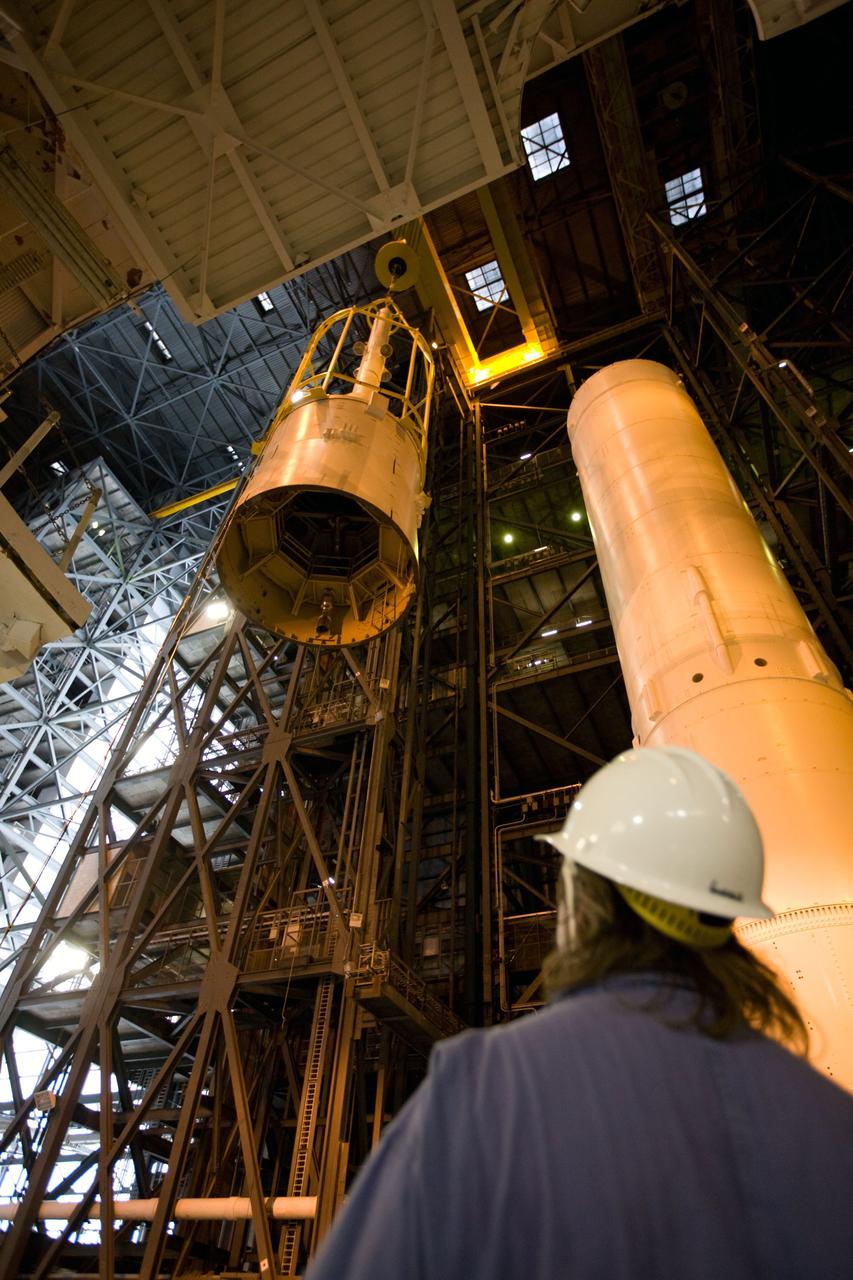
CAPE CANAVERAL, Fla. – In the Vehicle Assembly Building's High Bay 3, a technician monitors the lift of Super Stack 5 by the yellow framework, nicknamed the "birdcage," to the top of the Ares I-X segments already in place on the mobile launcher platform. Once in position, assembly of the Ares I-X rocket will be complete. The 327-foot-tall rocket is one of the largest processed in the bay, rivaling the height of the Apollo Program's 364-foot-tall Saturn V. Five super stacks make up the rocket's upper stage that is integrated with the four-segment solid rocket booster first stage. Ares I-X is the test vehicle for the Ares I, which is part of the Constellation Program to return men to the moon and beyond. The Ares I-X flight test is targeted for Oct. 31, pending formal NASA Headquarters approval. Photo credit: NASA/Dimitri Gerondidakis

KENNEDY SPACE CENTER, FLA. - At a press conference at NASA's Kennedy Space Center, NASA officials announced the names of the next-generation of rockets for future space exploration. Seated (left to right) are Dolores Beasley, with NASA Public Affairs; Scott Horowitz, NASA associate administrator of the Exploration Systems Mission Directorate; Jeff Hanley, manager of the Constellation Program at Johnson Space Center; and Steve Cook, manager of the Exploration Launch Office at Marshall Space Flight Center. The crew launch vehicle will be called Ares I, and the cargo launch vehicle will be known as Ares V. The name Ares is a pseudonym for Mars and appropriate for NASA's exploration mission. Photo credit: NASA/George Shelton
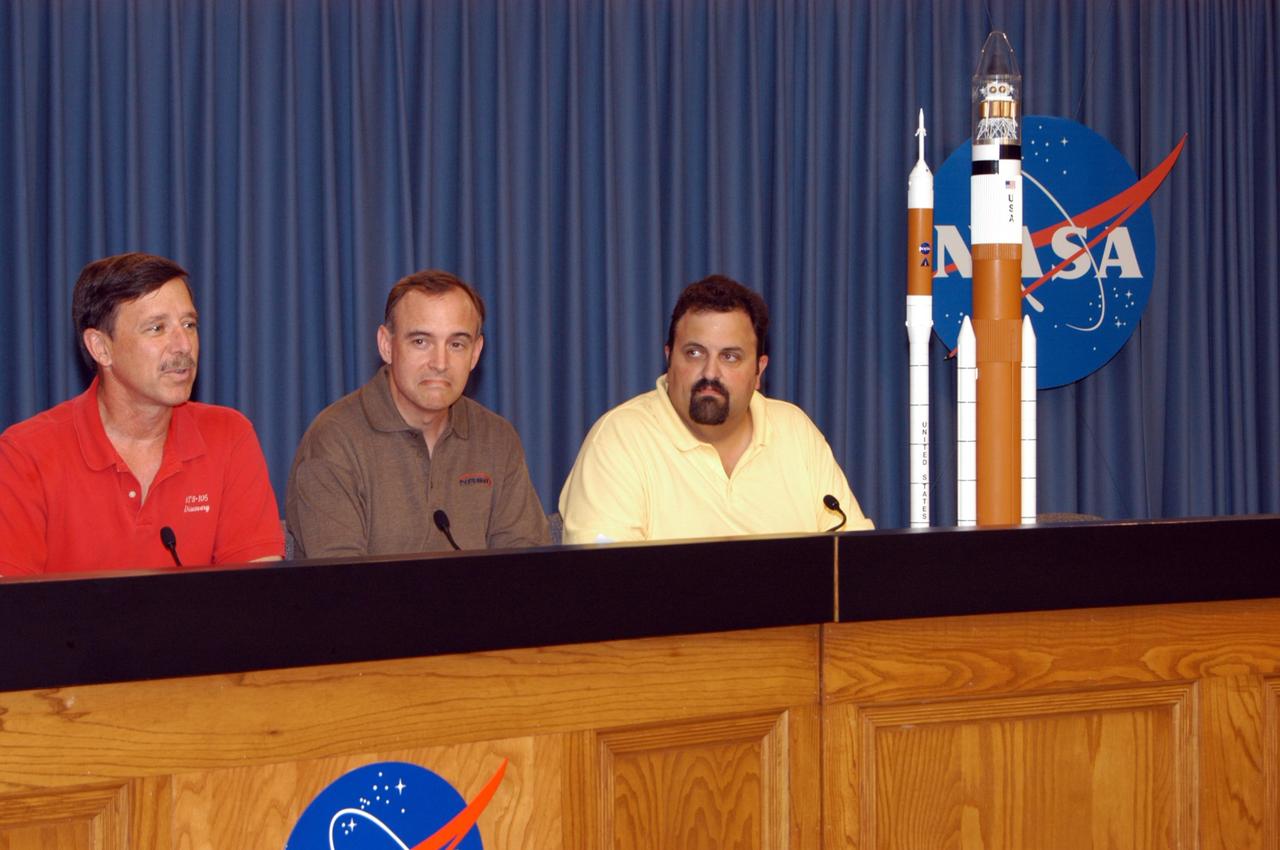
KENNEDY SPACE CENTER, FLA. - At a press conference in at NASA's Kennedy Space Center, NASA officials announced the names of the next-generation of rockets for future space exploration. Seated at the dais are (left to right) Scott Horowitz, NASA associate administrator of the Exploration Systems Mission Directorate; Jeff Hanley, manager of the Constellation Program at Johnson Space Center; and Steve Cook, manager of the Exploration Launch Office at Marshall Space Flight Center. The crew launch vehicle will be called Ares I, and the cargo launch vehicle will be known as Ares V. The name Ares is a pseudonym for Mars and appropriate for NASA's exploration mission. Photo credit: NASA/George Shelton
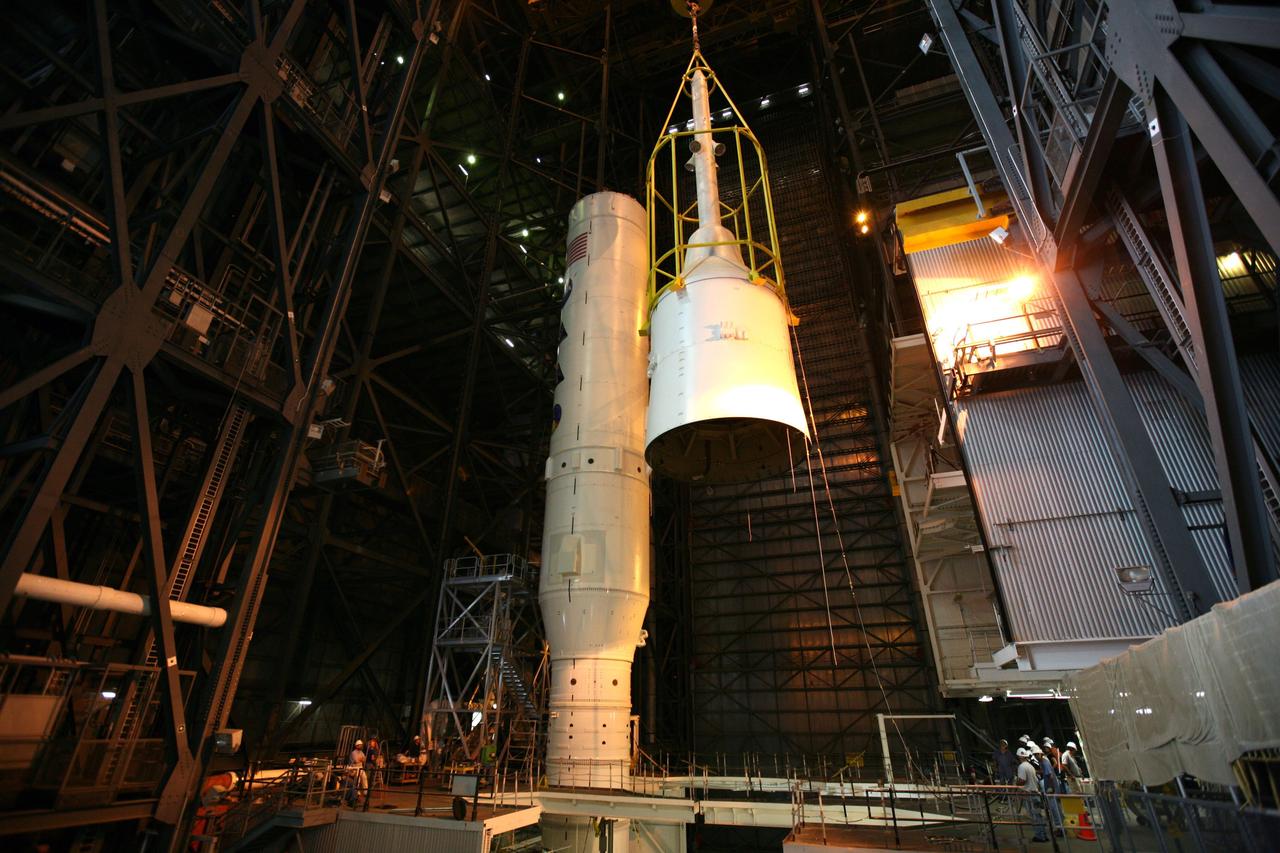
CAPE CANAVERAL, Fla. – In the Vehicle Assembly Building's High Bay 3, assembly of the Ares I-X rocket nears completion. The yellow framework, nicknamed the "birdcage," lifts Super Stack 5 to the top of the segments already in place on the mobile launcher platform. Once in place, assembly of the rocket will be complete. The 327-foot-tall rocket is one of the largest processed in the bay, rivaling the height of the Apollo Program's 364-foot-tall Saturn V. Five super stacks make up the rocket's upper stage that is integrated with the four-segment solid rocket booster first stage. Ares I-X is the test vehicle for the Ares I, which is part of the Constellation Program to return men to the moon and beyond. The Ares I-X flight test is targeted for Oct. 31, pending formal NASA Headquarters approval. Photo credit: NASA/Dimitri Gerondidakis
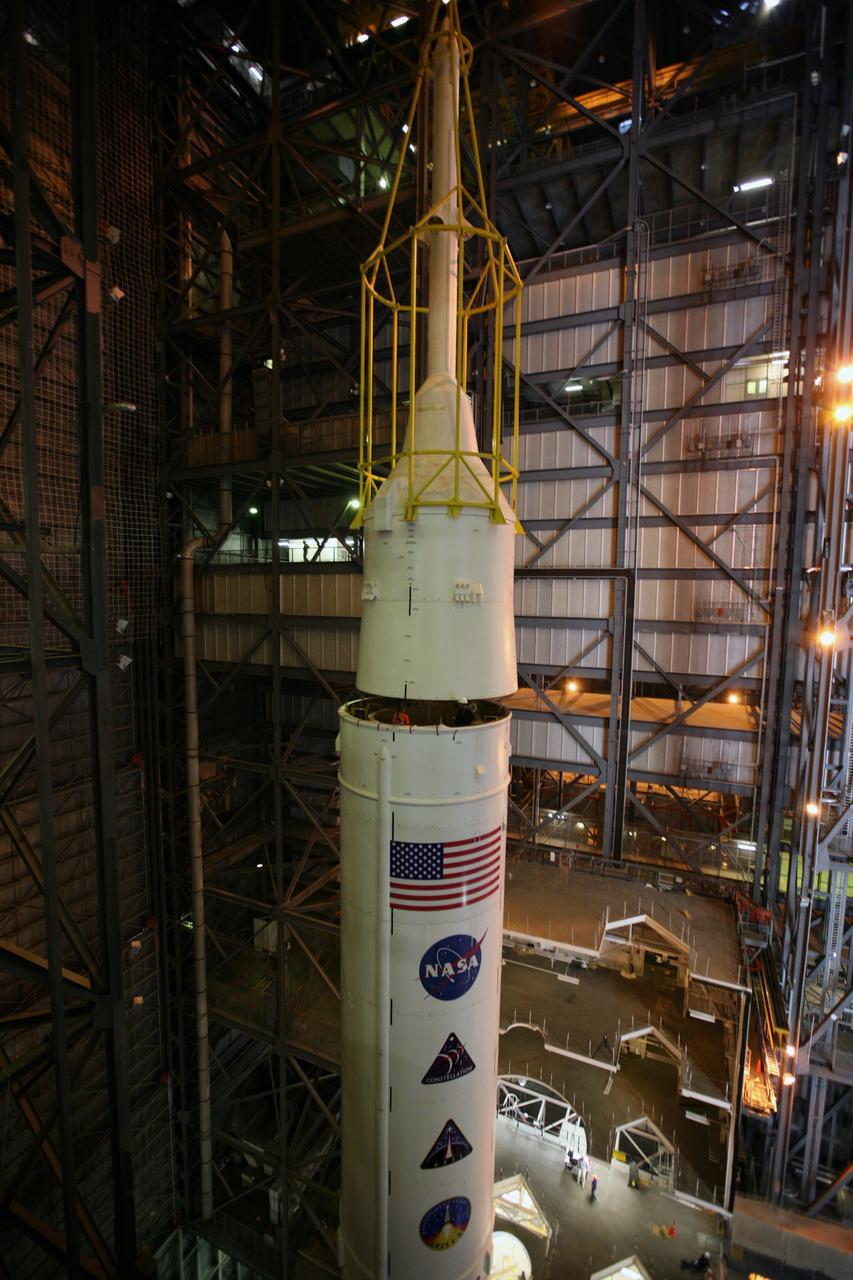
CAPE CANAVERAL, Fla. – In the Vehicle Assembly Building's High Bay 3, the yellow framework, nicknamed the "birdcage," lifts Super Stack 5 atop Super Stack 4. Once in position, assembly of the Ares I-X rocket will be complete. The 327-foot-tall rocket is one of the largest processed in the bay, rivaling the height of the Apollo Program's 364-foot-tall Saturn V. Five super stacks make up the rocket's upper stage that is integrated with the four-segment solid rocket booster first stage. Ares I-X is the test vehicle for the Ares I, which is part of the Constellation Program to return men to the moon and beyond. The Ares I-X flight test is targeted for Oct. 31, pending formal NASA Headquarters approval. Photo credit: NASA/Dimitri Gerondidakis
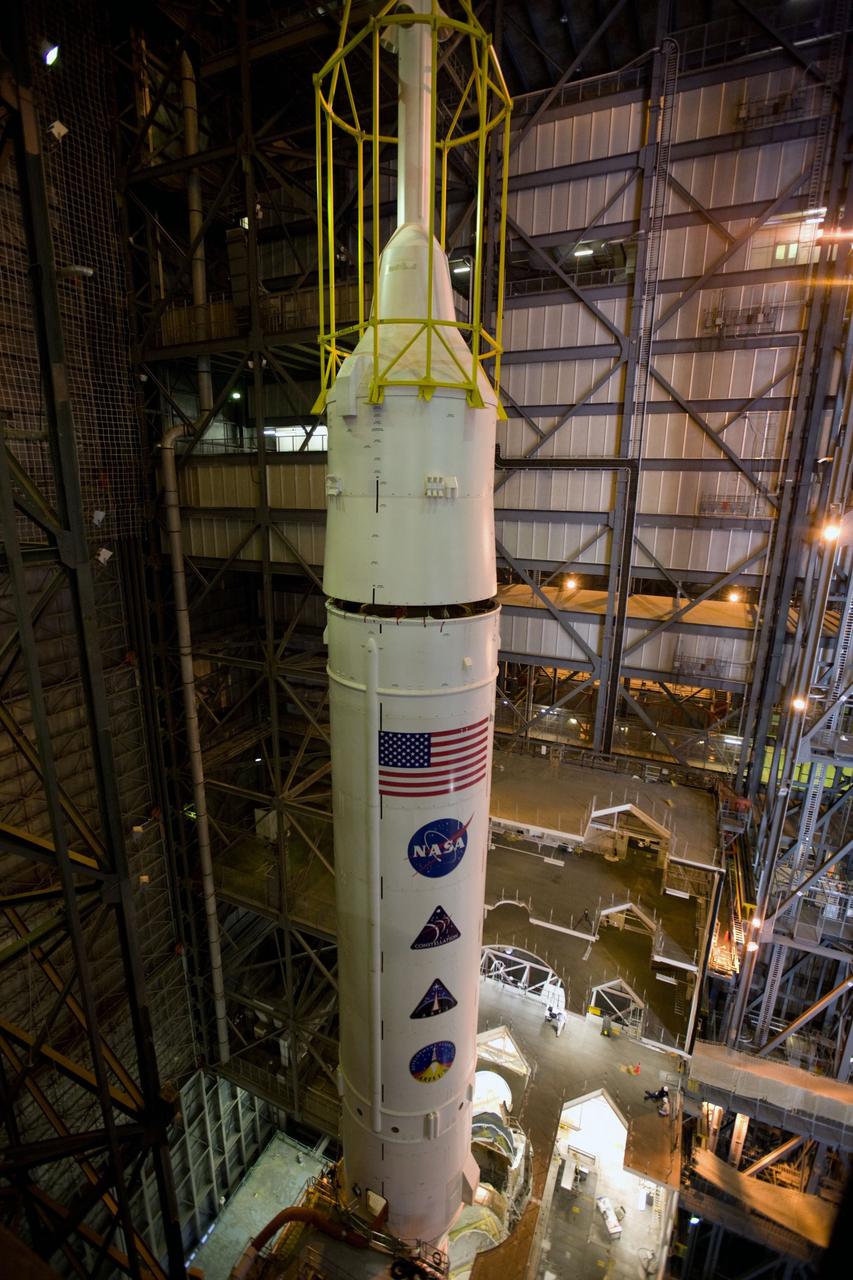
CAPE CANAVERAL, Fla. – In the Vehicle Assembly Building's High Bay 3, the yellow framework, nicknamed the "birdcage," lowers Super Stack 5 onto Super Stack 4. Once in position, assembly of the Ares I-X rocket will be complete. The 327-foot-tall rocket is one of the largest processed in the bay, rivaling the height of the Apollo Program's 364-foot-tall Saturn V. Five super stacks make up the rocket's upper stage that is integrated with the four-segment solid rocket booster first stage. Ares I-X is the test vehicle for the Ares I, which is part of the Constellation Program to return men to the moon and beyond. The Ares I-X flight test is targeted for Oct. 31, pending formal NASA Headquarters approval. Photo credit: NASA/Dimitri Gerondidakis
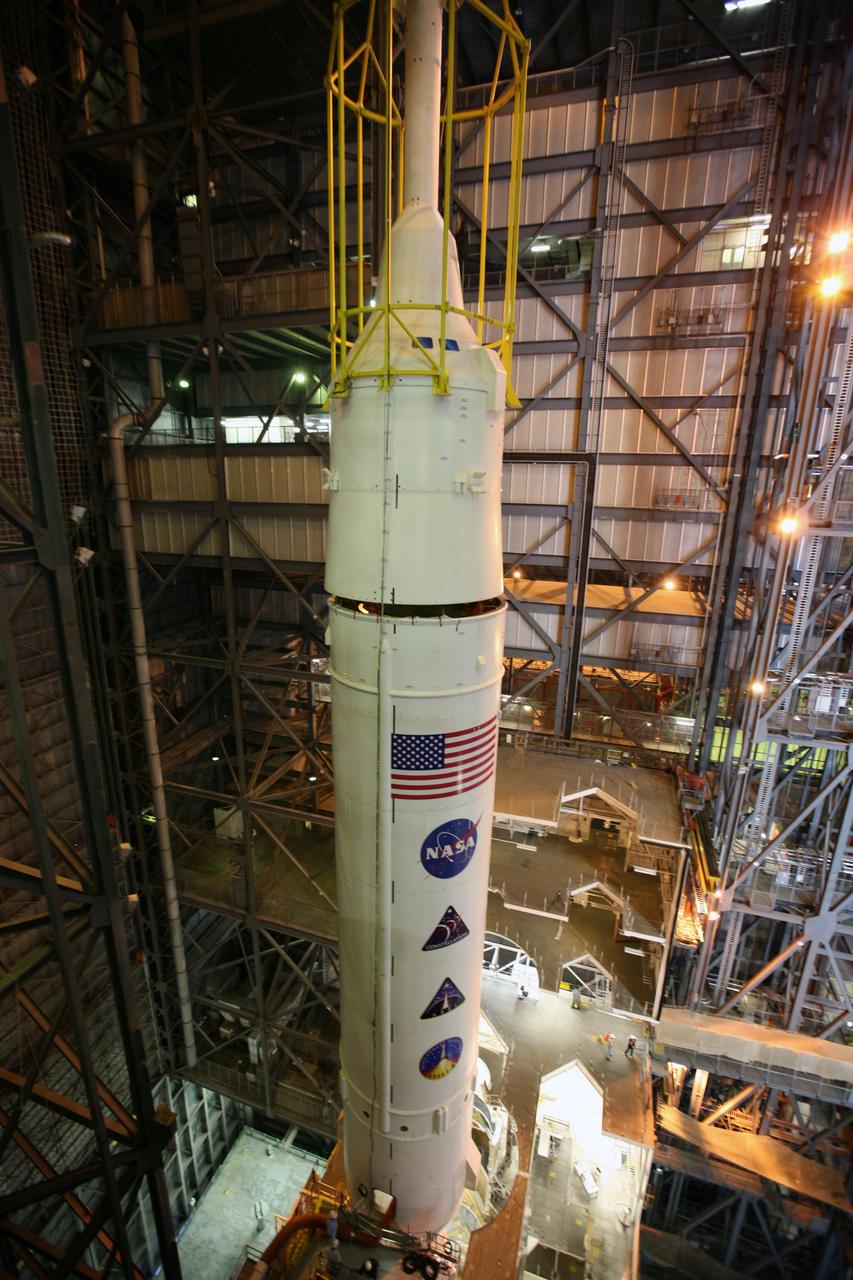
CAPE CANAVERAL, Fla. – In the Vehicle Assembly Building's High Bay 3, the yellow framework, nicknamed the "birdcage," lowers Super Stack 5 onto Super Stack 4. Once in position, assembly of the Ares I-X rocket will be complete. The 327-foot-tall rocket is one of the largest processed in the bay, rivaling the height of the Apollo Program's 364-foot-tall Saturn V. Five super stacks make up the rocket's upper stage that is integrated with the four-segment solid rocket booster first stage. Ares I-X is the test vehicle for the Ares I, which is part of the Constellation Program to return men to the moon and beyond. The Ares I-X flight test is targeted for Oct. 31, pending formal NASA Headquarters approval. Photo credit: NASA/Dimitri Gerondidakis
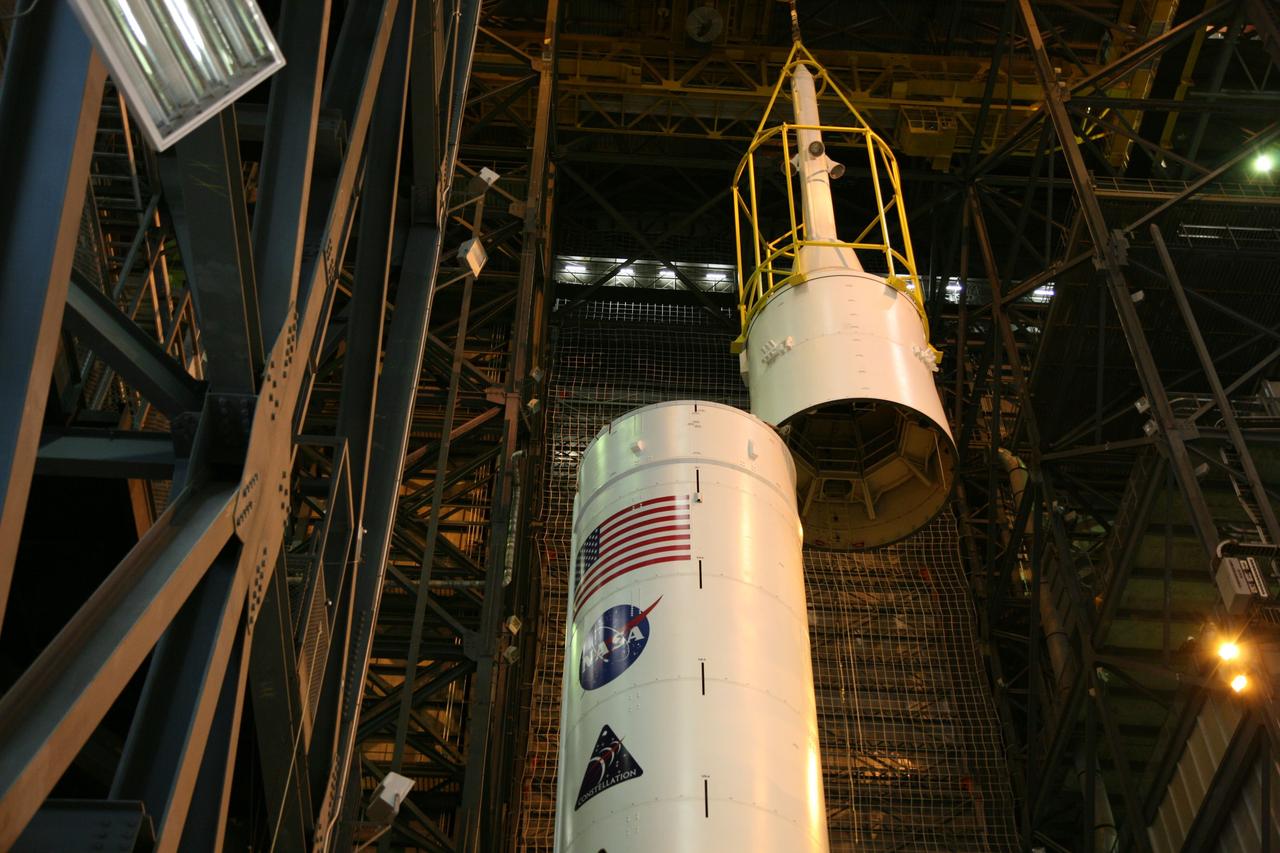
CAPE CANAVERAL, Fla. – In the Vehicle Assembly Building's High Bay 3, the yellow framework, nicknamed the "birdcage," lifts Super Stack 5 atop Super Stack 4. Once in position, assembly of the Ares I-X rocket will be complete. The 327-foot-tall rocket is one of the largest processed in the bay, rivaling the height of the Apollo Program's 364-foot-tall Saturn V. Five super stacks make up the rocket's upper stage that is integrated with the four-segment solid rocket booster first stage. Ares I-X is the test vehicle for the Ares I, which is part of the Constellation Program to return men to the moon and beyond. The Ares I-X flight test is targeted for Oct. 31, pending formal NASA Headquarters approval. Photo credit: NASA/Dimitri Gerondidakis
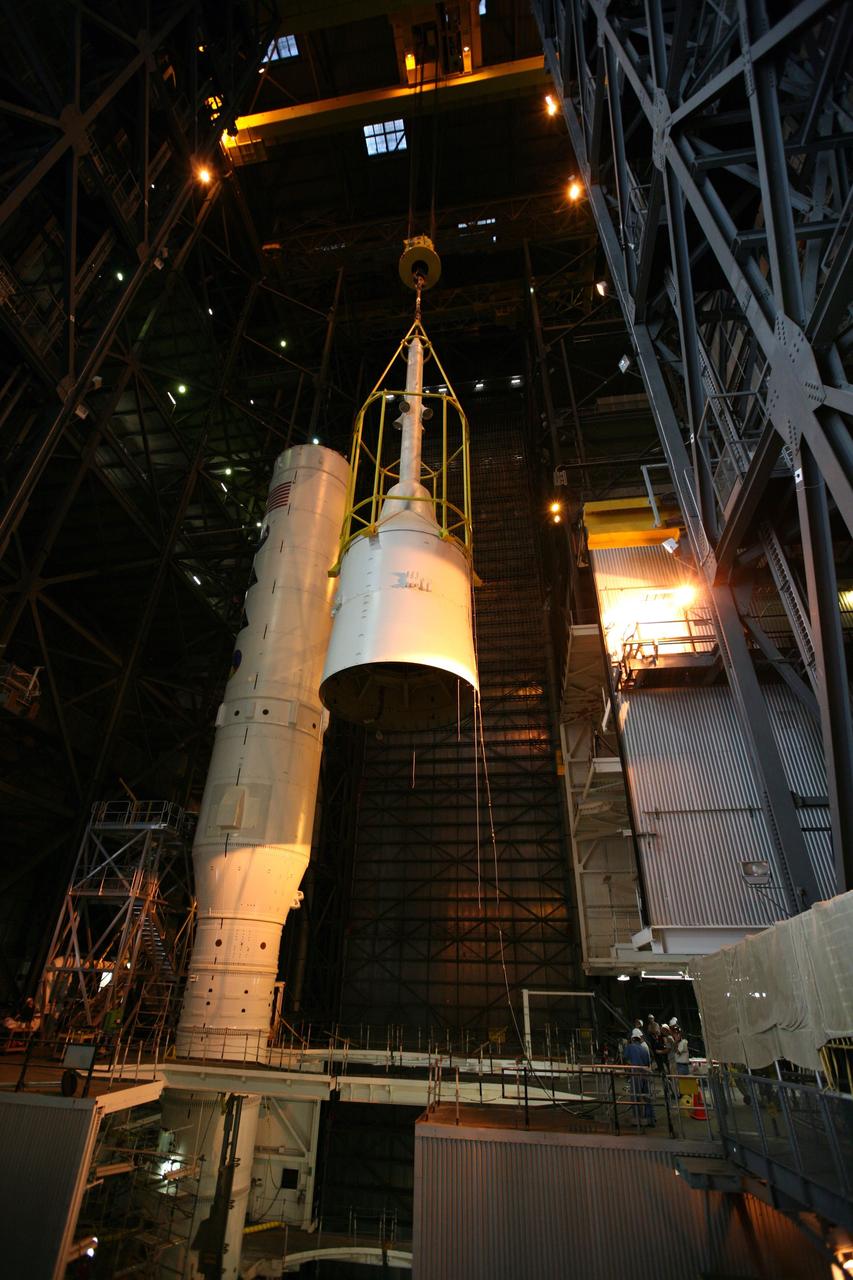
CAPE CANAVERAL, Fla. – In the Vehicle Assembly Building's High Bay 3, assembly of the Ares I-X rocket nears completion. The yellow framework, nicknamed the "birdcage," lifts Super Stack 5 to the top of the segments already in place on the mobile launcher platform. Once in position, assembly of the rocket will be complete. The 327-foot-tall rocket is one of the largest processed in the bay, rivaling the height of the Apollo Program's 364-foot-tall Saturn V. Five super stacks make up the rocket's upper stage that is integrated with the four-segment solid rocket booster first stage. Ares I-X is the test vehicle for the Ares I, which is part of the Constellation Program to return men to the moon and beyond. The Ares I-X flight test is targeted for Oct. 31, pending formal NASA Headquarters approval. Photo credit: NASA/Dimitri Gerondidakis
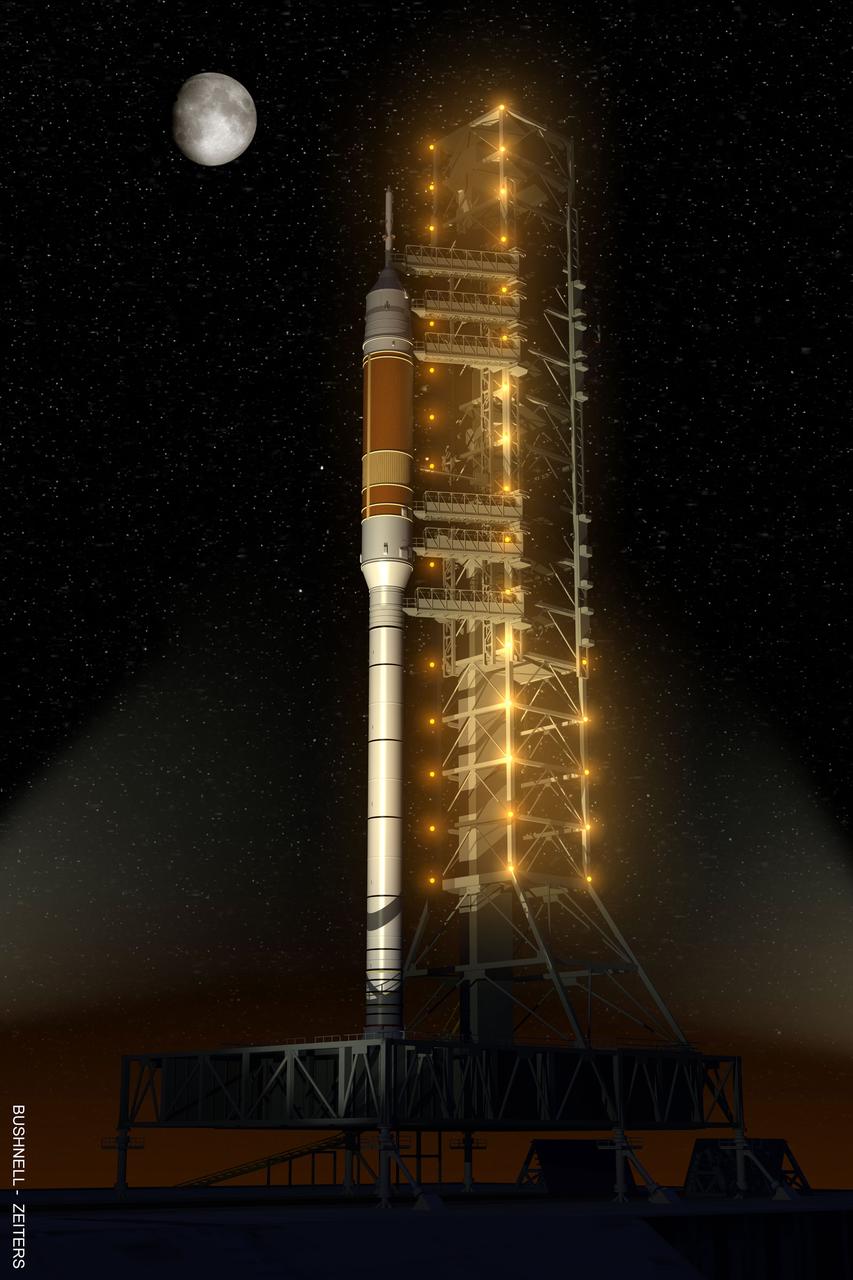
Under the goals of the Vision for Space Exploration, Ares I is a chief component of the cost-effective space transportation infrastructure being developed by NASA's Constellation Program. This transportation system will safely and reliably carry human explorers back to the moon, and then onward to Mars and other destinations in the solar system. Launch Pad 39B of the Kennedy Space Flight Center (KSC), currently used for Space Shuttle launches, will be revised to host the Ares launch vehicles. The fixed and rotating service structures standing at the pad will be dismantled sometime after the Ares I-X test flight. A new launch tower for Ares I will be built onto a new mobile launch platform. The gantry for the shuttle doesn't reach much higher than the top of the four segments of the solid rocket booster. Pad access above the current shuttle launch pad structure will not be required for Ares I-X because the stages above the solid rocket booster are inert. For the test scheduled in 2012 or for the crewed flights, workers and astronauts will need access to the highest levels of the rocket and capsule. When the Ares I rocket rolls out to the launch pad on the back of the same crawler-transporters used now, its launch gantry will be with it. The mobile launchers will nestle under three lightning protection towers to be erected around the pad area. Ares time at the launch pad will be significantly less than the three weeks or more the shuttle requires. This “clean pad” approach minimizes equipment and servicing at the launch pad. It is the same plan NASA used with the Saturn V rockets and industry employs it with more modern launchers. The launch pad will also get a new emergency escape system for astronauts, one that looks very much like a roller coaster. Cars riding on a rail will replace the familiar baskets hanging from steel cables. This artist's concept illustrates the Ares I on launch pad 39B.
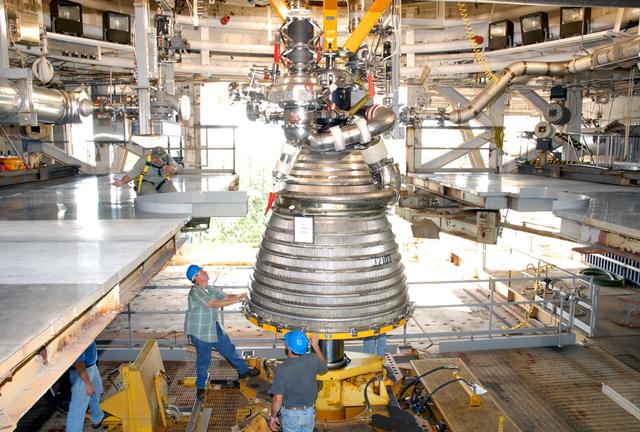
Core components of the J-2X engine being designed for NASA's Constellation Program recently were installed on the A-1 Test Stand at NASA's Stennis Space Center near Bay St. Louis, Miss. Tests of the components, known as Powerpack 1A, will be conducted from November 2007 through February 2008. The Powerpack 1A test article consists of a gas generator and engine turbopumps originally developed for the Apollo Program that put Americans on the moon in the late 1960s and early 1970s. Engineers are testing these heritage components to obtain data that will help them modify the turbomachinery to meet the higher performance requirements of the Ares I and Ares V launch vehicles. The upcoming tests will simulate inlet and outlet conditions that would be present on the turbomachinery during a full-up engine hot-fire test.
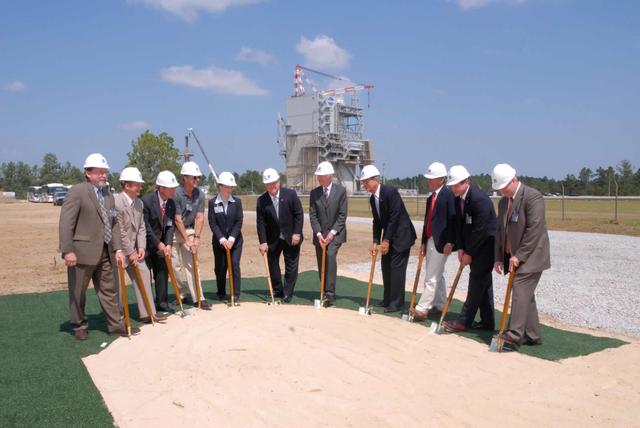
NASA officials and government leaders participated in a groundbreaking event for a new rocket engine test stand at NASA's Stennis Space Center, Miss. Pictured (left to right) are Deputy Associate Administrator for Exploration Systems Doug Cooke, Pratt & Whitney Rocketdyne President Jim Maser, Stennis Space Center Director Richard Gilbrech, NASA Associate Administrator for Exploration Systems Scott Horowitz, NASA Deputy Administrator Shana Dale, Mississippi Gov. Haley Barbour, Sen. Thad Cochran, Sen. Trent Lott, Rep. Gene Taylor, SSC's Deputy Director Gene Goldman, and SSC's A-3 Project Manager Lonnie Dutreix. Stennis' A-3 Test Stand will provide altitude testing for NASA's developing J-2X engine. That engine will power the upper stages of NASA's Ares I and Ares V rockets. A-3 is the first large test stand to be built at SSC since the site's inception in the 1960s.
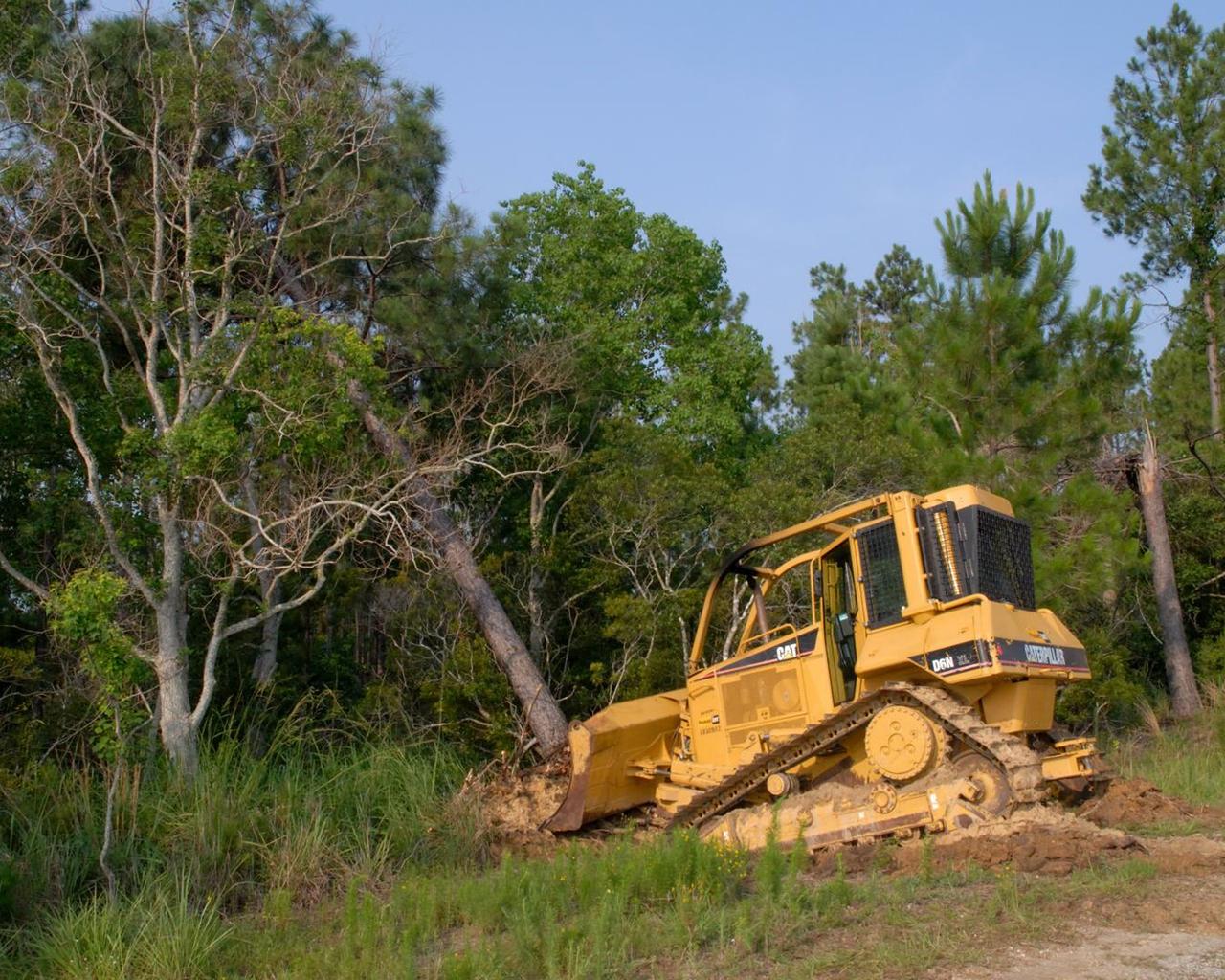
Tree clearing for the site of the new A-3 Test Stand at Stennis Space center began June 13. NASA's first new large rocket engine test stand to be built since the site's inception, A-3 construction begins a historic era for America's largest rocket engine test complex. The 300-foot-tall structure is scheduled for completion in August 2010. A-3 will perform altitude tests on the Constellation's J-2X engine that will power the upper stage of the Ares I crew launch vehicle and earth departure stage of the Ares V cargo launch vehicle. The Constellation Program, NASA's plan for carrying out the nation's Vision for Space Exploration, will return humans to the moon and eventually carry them to Mars and beyond.
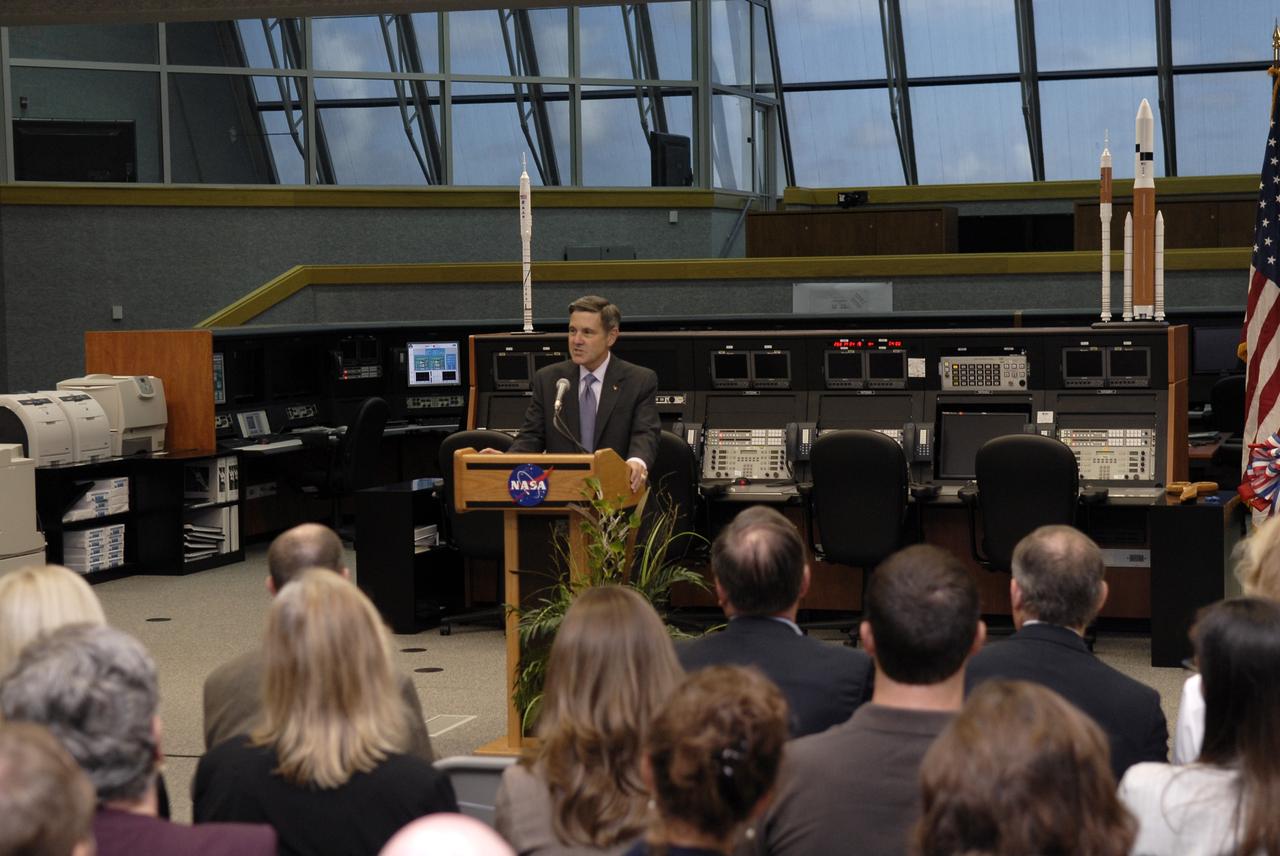
CAPE CANAVERAL, Fla. – NASA Kennedy Space Center Director Bob Cabana welcomes guests to the ceremony that officially turns over the Launch Control Center's Firing Room 1 from the Space Shuttle Program to the Constellation Program at Kennedy. The room has undergone demolition and construction and been outfitted with consoles for the upcoming Ares I-X rocket flight test targeted for launch on Oct. 27. As the center of launch operations at Kennedy since the Apollo Program, the Launch Control Center, or LCC, has played a central role in NASA's human spaceflight programs. Firing Room 1 was the first operational firing room constructed. From this room, controllers launched the first Saturn V, the first crewed flight of Saturn V, the first crewed mission to the moon and the first space shuttle. Firing Room 1 will continue this tradition of firsts when controllers launch the Constellation Program's first flight test. Also, this firing room will be the center of operations for the upcoming Ares I and Orion operations. Photo credit: NASA/Kim Shiflett
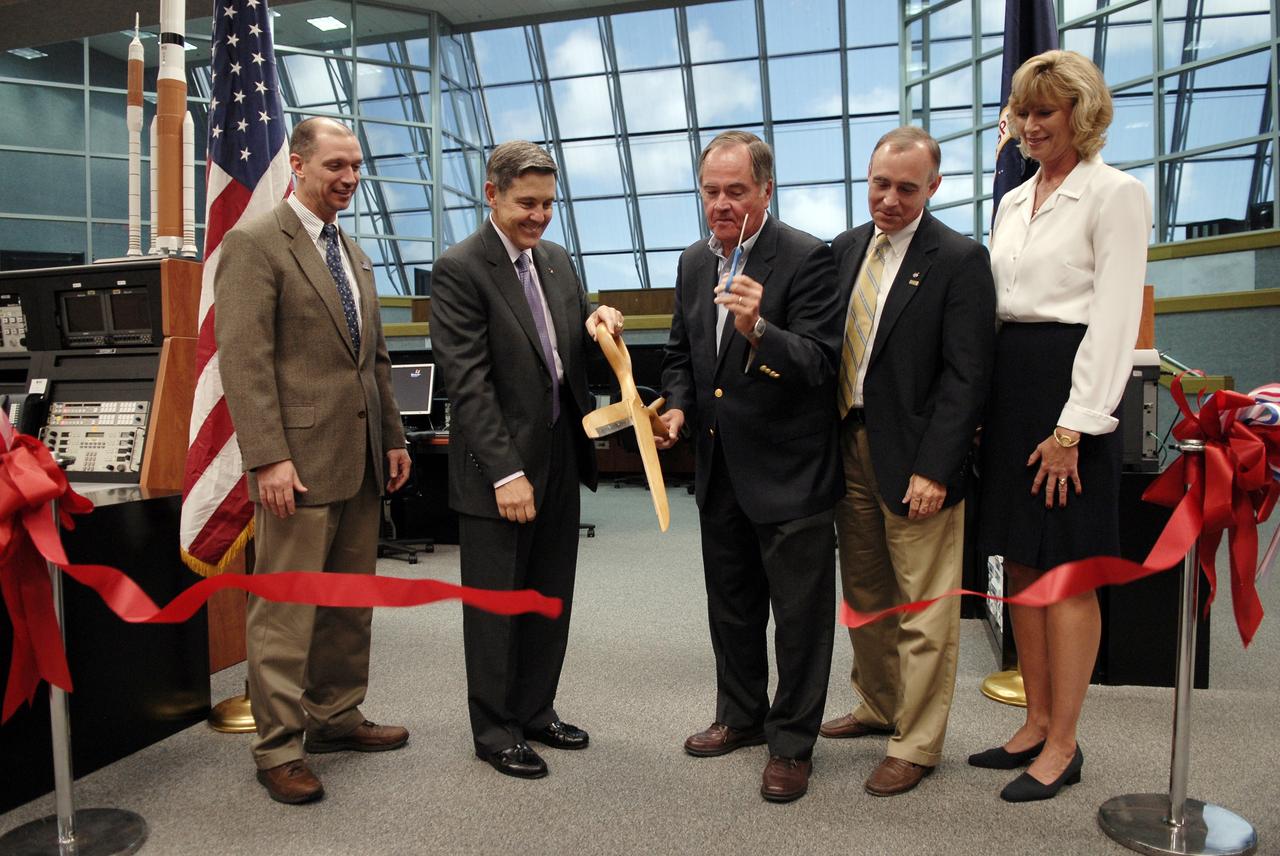
CAPE CANAVERAL, Fla. – This ribbon cutting officially turns over NASA Kennedy Space Center's Launch Control Center Firing Room 1 from the Space Shuttle Program to the Constellation Program. Participating are (from left) Pepper Phillips, director of the Constellation Project Office at Kennedy; Bob Cabana, Kennedy's director; Robert Crippen, former astronaut; Jeff Hanley, manager of the Constellation Program at NASA's Johnson Space Center; and Nancy Bray, deputy director of Center Operations at Kennedy. The room has undergone demolition and construction and been outfitted with consoles for the upcoming Ares I-X rocket flight test targeted for launch on Oct. 27. As the center of launch operations at Kennedy since the Apollo Program, the Launch Control Center, or LCC, has played a central role in NASA's human spaceflight programs. Firing Room 1 was the first operational firing room constructed. From this room, controllers launched the first Saturn V, the first crewed flight of Saturn V, the first crewed mission to the moon and the first space shuttle. Firing Room 1 will continue this tradition of firsts when controllers launch the Constellation Program's first flight test. Also, this firing room will be the center of operations for the upcoming Ares I and Orion operations. Photo credit: NASA/Kim Shiflett
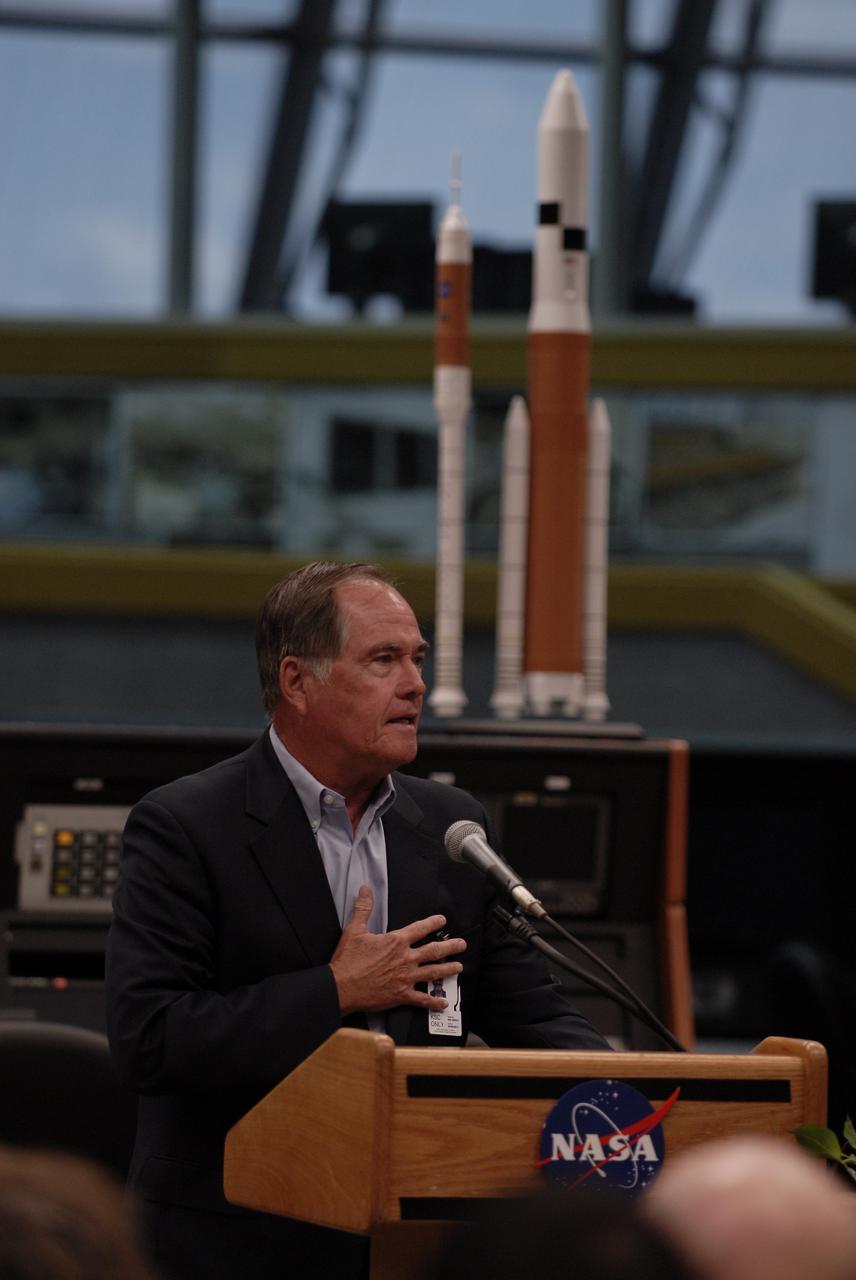
CAPE CANAVERAL, Fla. – During a ceremony that officially turns over NASA Kennedy Space Center's Launch Control Center Firing Room 1 from the Space Shuttle Program to the Constellation Program, former astronaut Robert Crippen shares personal experiences. The room has undergone demolition and construction and been outfitted with consoles for the upcoming Ares I-X rocket flight test targeted for launch on Oct. 27. As the center of launch operations at Kennedy since the Apollo Program, the Launch Control Center, or LCC, has played a central role in NASA's human spaceflight programs. Firing Room 1 was the first operational firing room constructed. From this room, controllers launched the first Saturn V, the first crewed flight of Saturn V, the first crewed mission to the moon and the first space shuttle. Firing Room 1 will continue this tradition of firsts when controllers launch the Constellation Program's first flight test. Also, this firing room will be the center of operations for the upcoming Ares I and Orion operations. Photo credit: NASA/Kim Shiflett
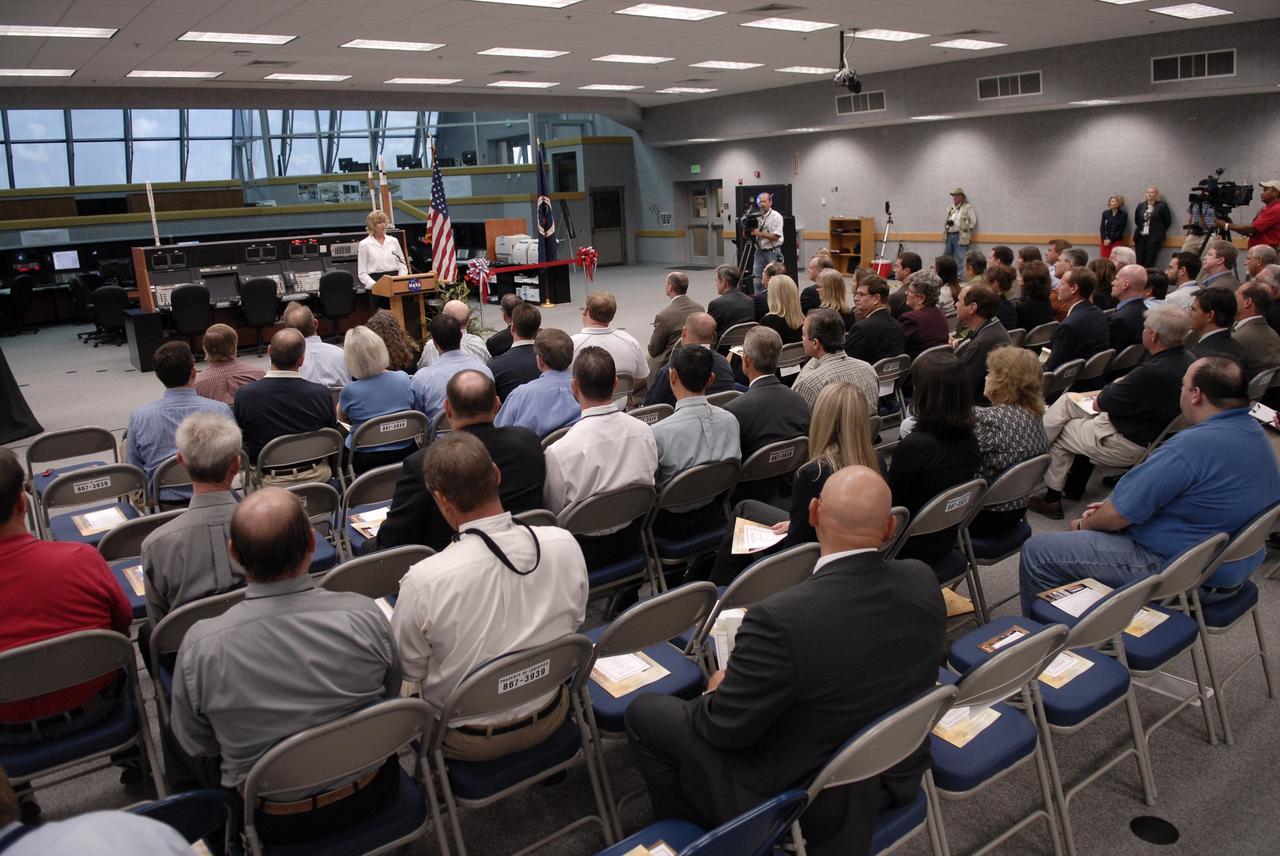
CAPE CANAVERAL, Fla. – Deputy director of Center Operations at NASA's Kennedy Space Center in Florida Nancy Bray provides some history of the Launch Control Center's Firing Room 1 during a ceremony turning over the facility from the Space Shuttle Program to the Constellation Program at Kennedy. The room has undergone demolition and construction and been outfitted with consoles for the upcoming Ares I-X rocket flight test targeted for launch on Oct. 27. As the center of launch operations at Kennedy since the Apollo Program, the Launch Control Center, or LCC, has played a central role in NASA's human spaceflight programs. Firing Room 1 was the first operational firing room constructed. From this room, controllers launched the first Saturn V, the first crewed flight of Saturn V, the first crewed mission to the moon and the first space shuttle. Firing Room 1 will continue this tradition of firsts when controllers launch the Constellation Program's first flight test. Also, this firing room will be the center of operations for the upcoming Ares I and Orion operations. Photo credit: NASA/Kim Shiflett
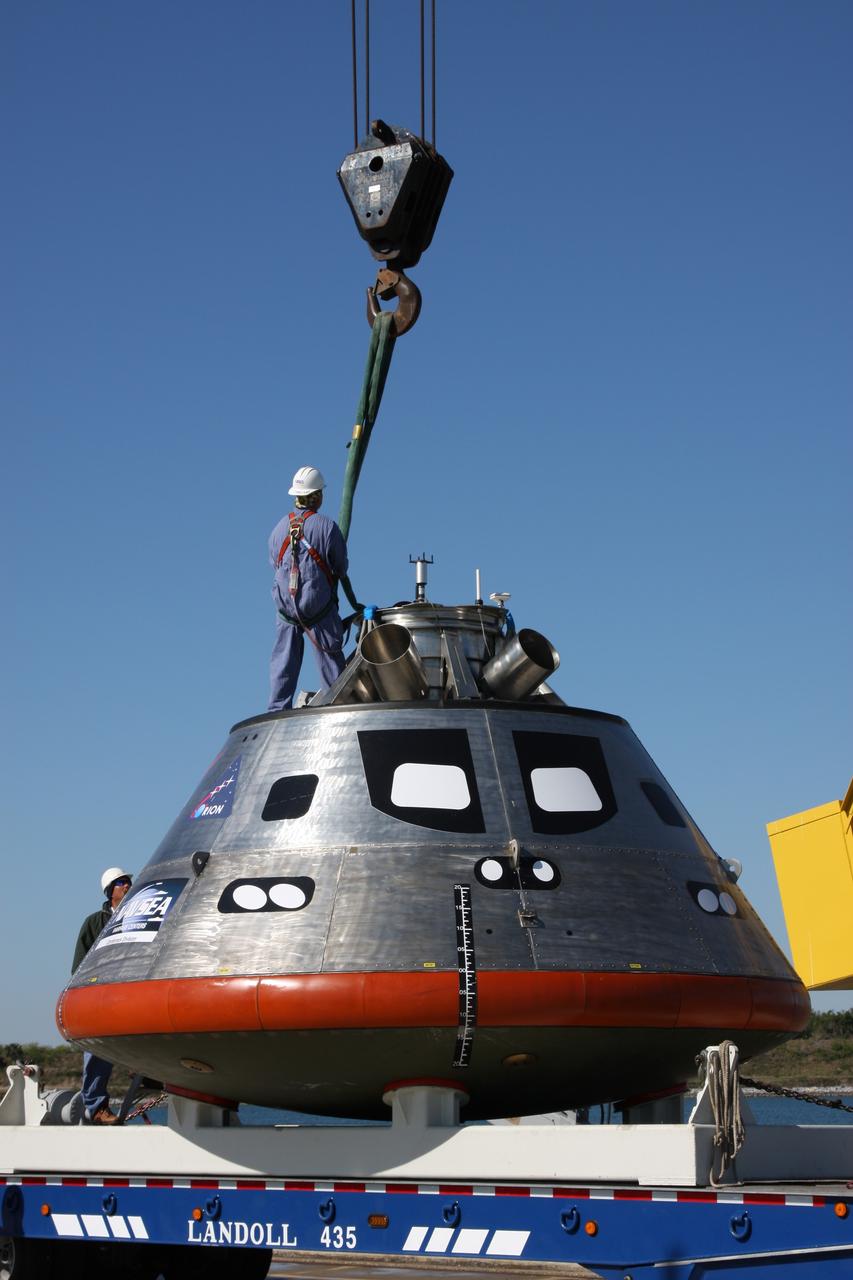
CAPE CANAVERAL, Fla. – The mockup Orion crew exploration vehicle is prepared to be lifted into the water at the Trident Basin at Port Canaveral, Fla., for testing. Orion is targeted to begin carrying humans to the International Space Station in 2015 and to the moon by 2020. The goal of the operation, dubbed the Post-landing Orion Recovery Test, or PORT, is to determine what kind of motion astronauts can expect after landing, as well as outside conditions for recovery teams. Orion, along with the Ares I and V rockets and the Altair lunar lander, are part of the Constellation Program. Photo credit: NASA/Dimitri Gerondidakis
CAPE CANAVERAL, Fla. – The mockup Orion crew exploration vehicle floats in the water at the Trident Basin at Port Canaveral, Fla. Orion is targeted to begin carrying humans to the International Space Station in 2015 and to the moon by 2020. The mockup vehicle will undergo testing in open water. The goal of the operation, dubbed the Post-landing Orion Recovery Test, or PORT, is to determine what kind of motion astronauts can expect after landing, as well as outside conditions for recovery teams. Orion, along with the Ares I and V rockets and the Altair lunar lander, are part of the Constellation Program. Photo credit: NASA/Dimitri Gerondidakis
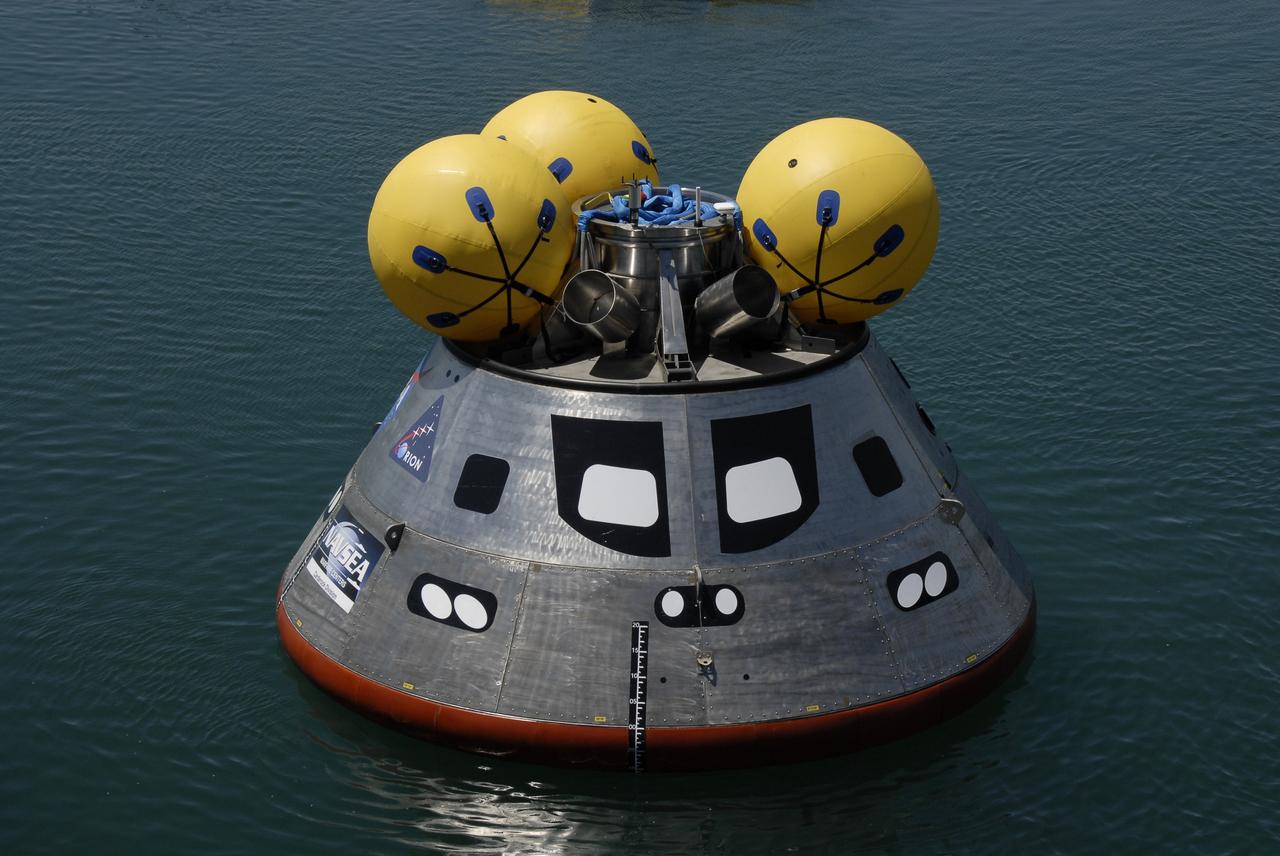
CAPE CANAVERAL, Fla. – The mockup Orion crew exploration vehicle floats in the water at the Trident Basin at Port Canaveral, Fla. On top of Orion are additional flotation devices. Orion is targeted to begin carrying humans to the International Space Station in 2015 and to the moon by 2020. The mockup vehicle is undergoing testing in open water. The goal of the operation, dubbed the Post-landing Orion Recovery Test, or PORT, is to determine what kind of motion astronauts can expect after landing, as well as outside conditions for recovery teams. Orion, along with the Ares I and V rockets and the Altair lunar lander, are part of the Constellation Program. Photo credit: NASA/Kim Shiflett
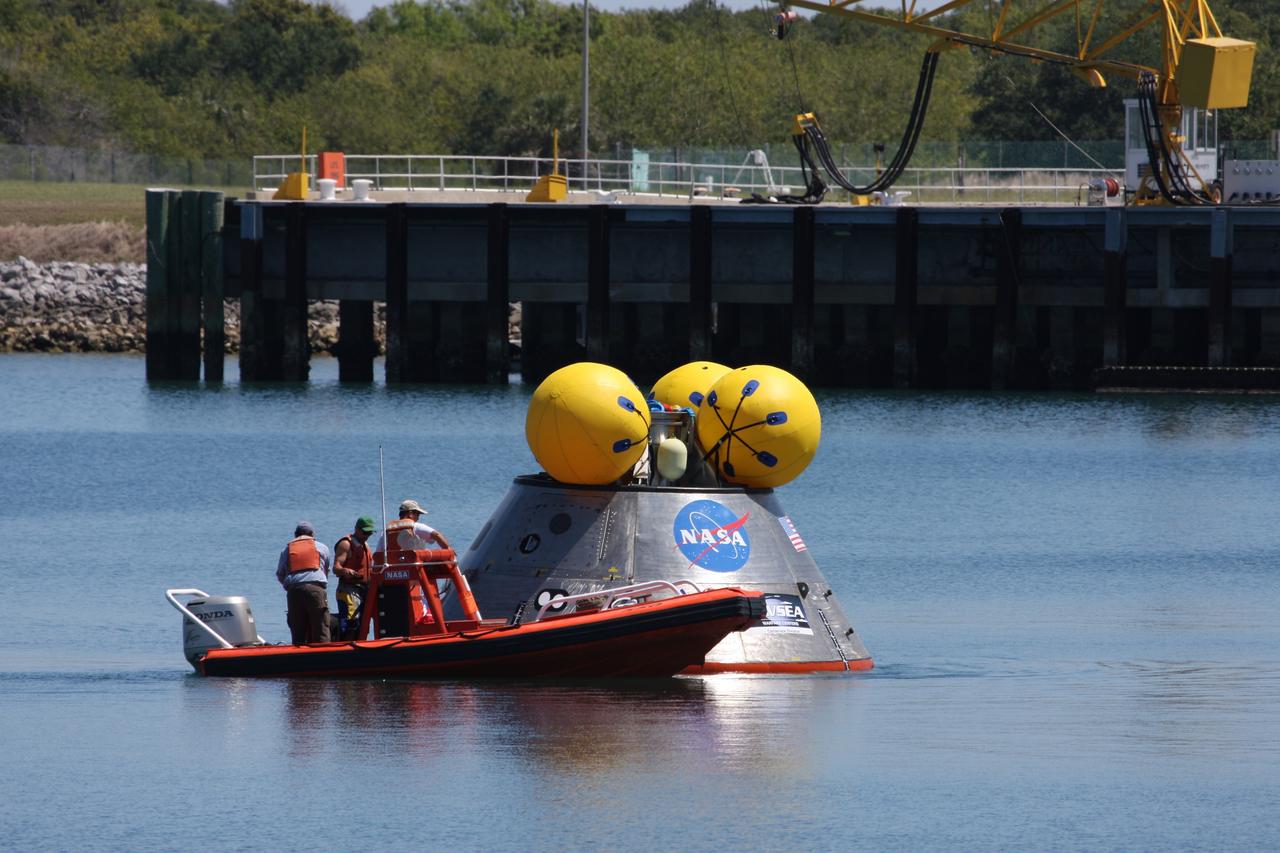
CAPE CANAVERAL, Fla. – Members of the 920th Rescue Wing get ready to release a flotation collar around the mockup Orion crew exploration vehicle at the Trident Basin at Port Canaveral, Fla. On top of Orion are additional flotation devices. The goal of the operation, dubbed the Post-landing Orion Recovery Test, or PORT, is to determine what kind of motion astronauts can expect after landing, as well as outside conditions for recovery teams. Orion is targeted to begin carrying humans to the International Space Station in 2015 and to the moon by 2020. Orion, along with the Ares I and V rockets and the Altair lunar lander, are part of the Constellation Program. Photo credit: NASA/Dimitri Gerondidakis
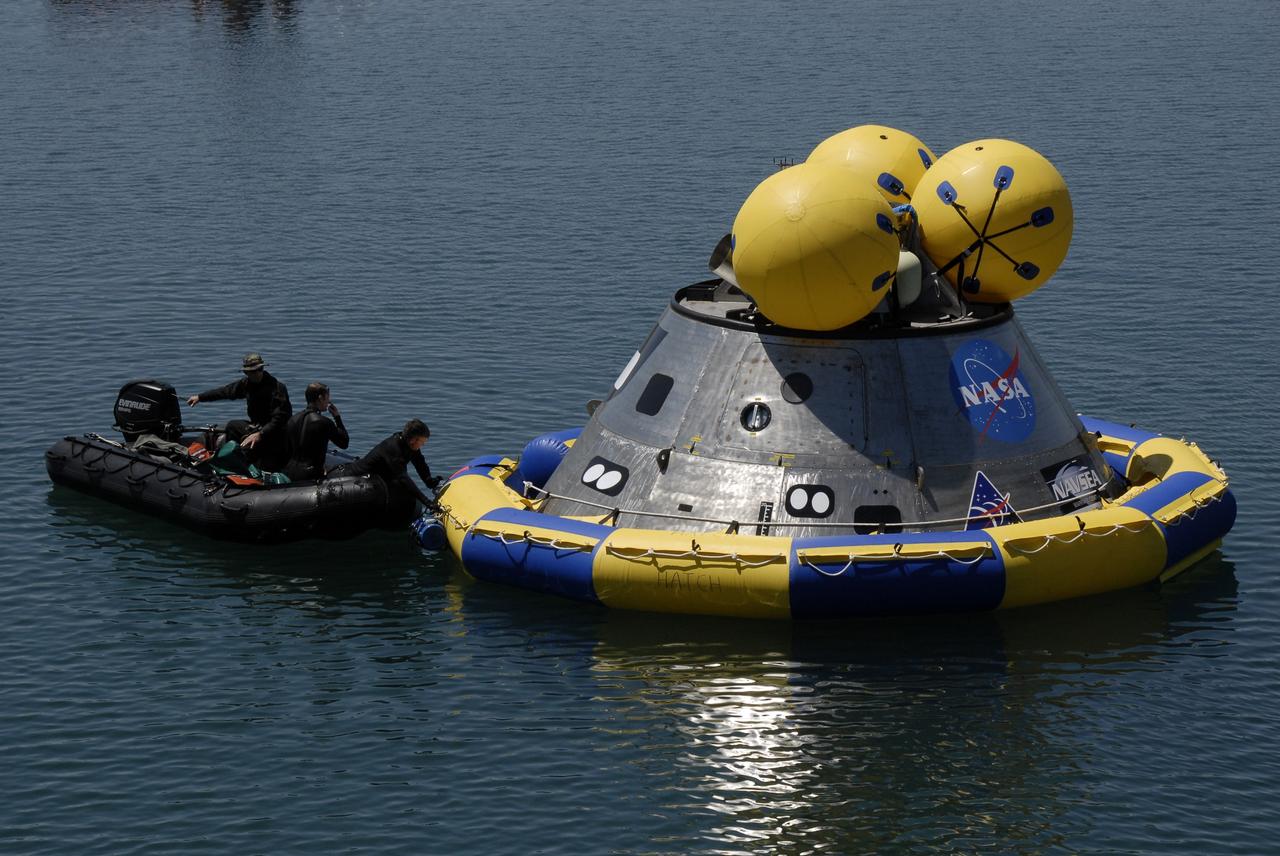
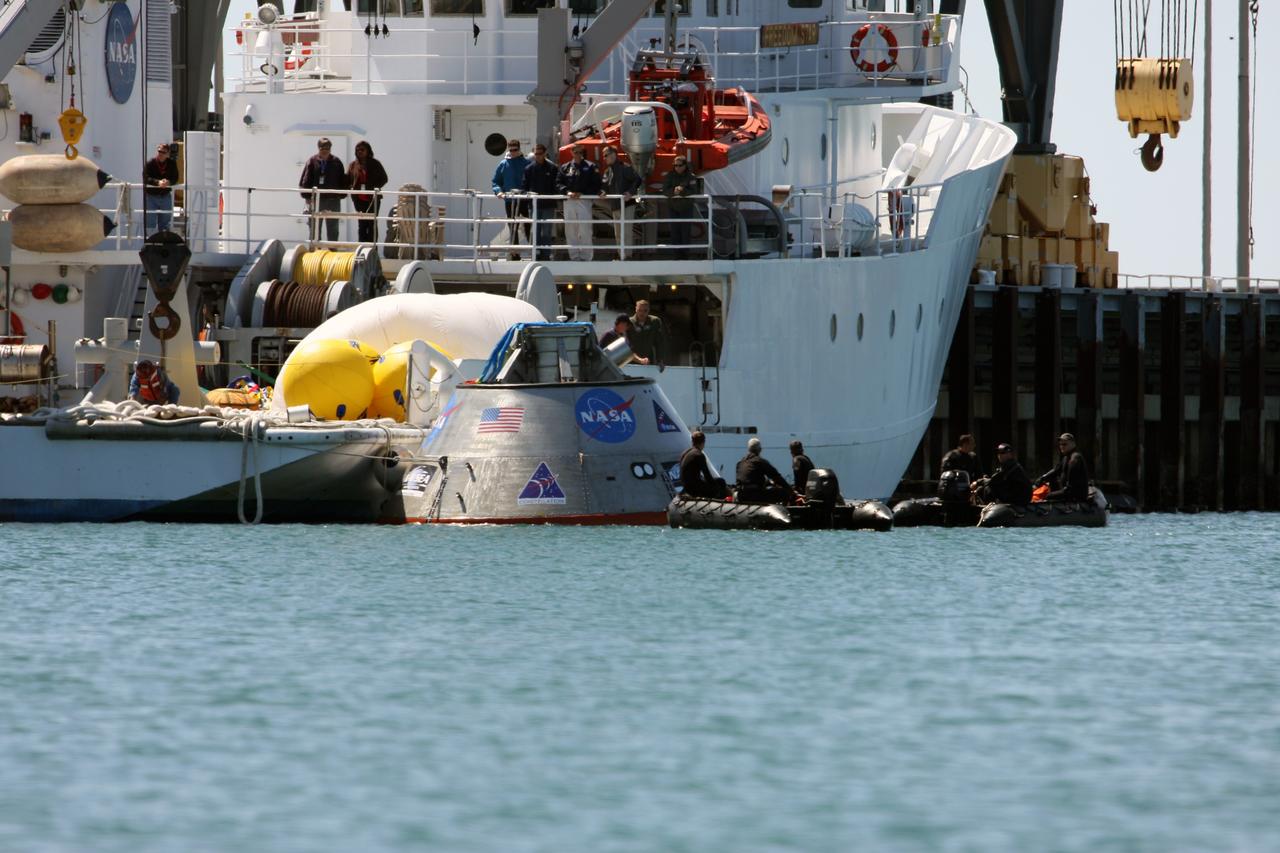
CAPE CANAVERAL, Fla. – Members of the 920th Rescue Wing secure a flotation collar around the mockup Orion crew exploration vehicle at the Trident Basin at Port Canaveral, Fla. On top of Orion are additional flotation devices. The mockup vehicle will undergo testing in open water. The goal of the operation, dubbed the Post-landing Orion Recovery Test, or PORT, is to determine what kind of motion astronauts can expect after landing, as well as outside conditions for recovery teams. Orion is targeted to begin carrying humans to the International Space Station in 2015 and to the moon by 2020. Orion, along with the Ares I and V rockets and the Altair lunar lander, are part of the Constellation Program. Photo credit: NASA/Kim Shiflett
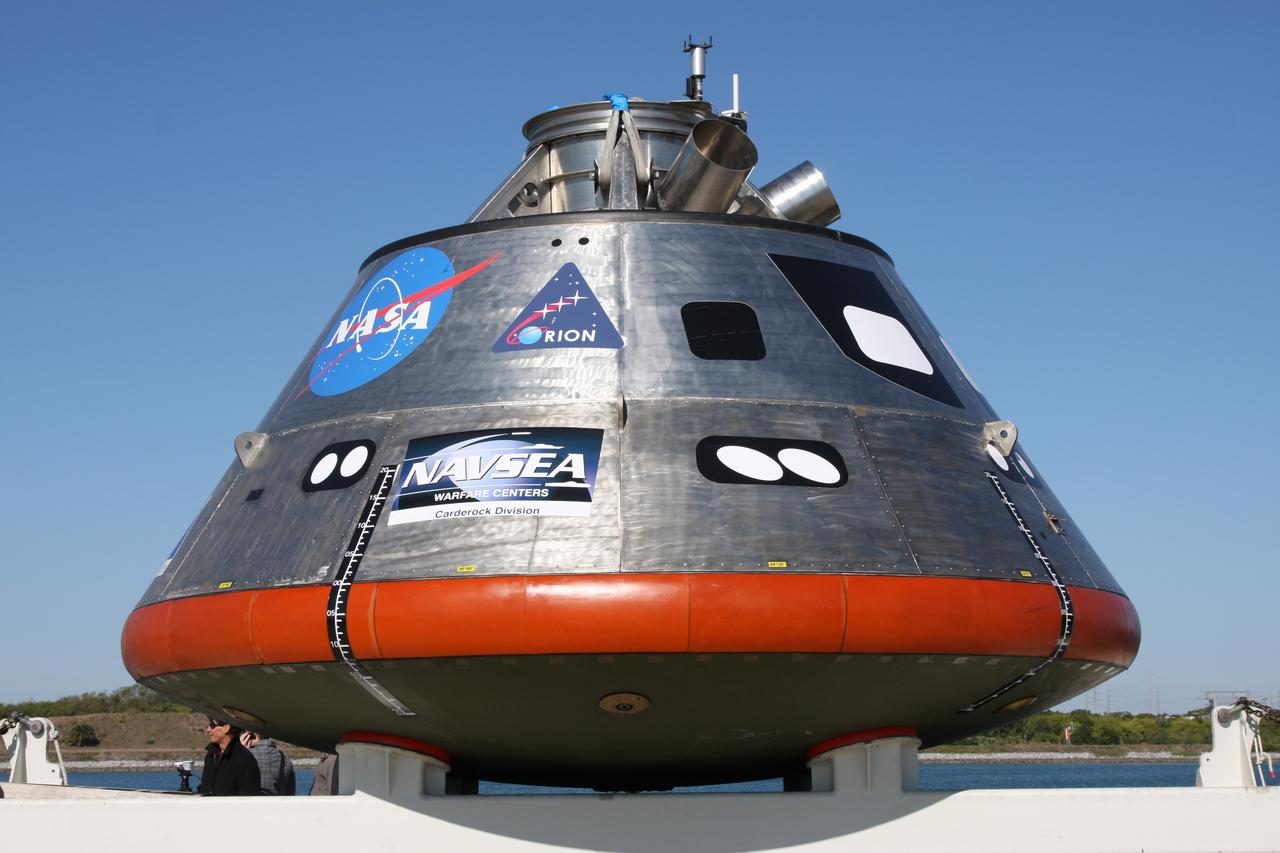
CAPE CANAVERAL, Fla. – The mockup Orion crew exploration vehicle is on the dock at the Trident Basin at Port Canaveral, Fla., waiting to be tested in open waters. Orion is targeted to begin carrying humans to the International Space Station in 2015 and to the moon by 2020. The goal of the operation, dubbed the Post-landing Orion Recovery Test, or PORT, is to determine what kind of motion astronauts can expect after landing, as well as outside conditions for recovery teams. Orion, along with the Ares I and V rockets and the Altair lunar lander, are part of the Constellation Program. Photo credit: NASA/Dimitri Gerondidakis
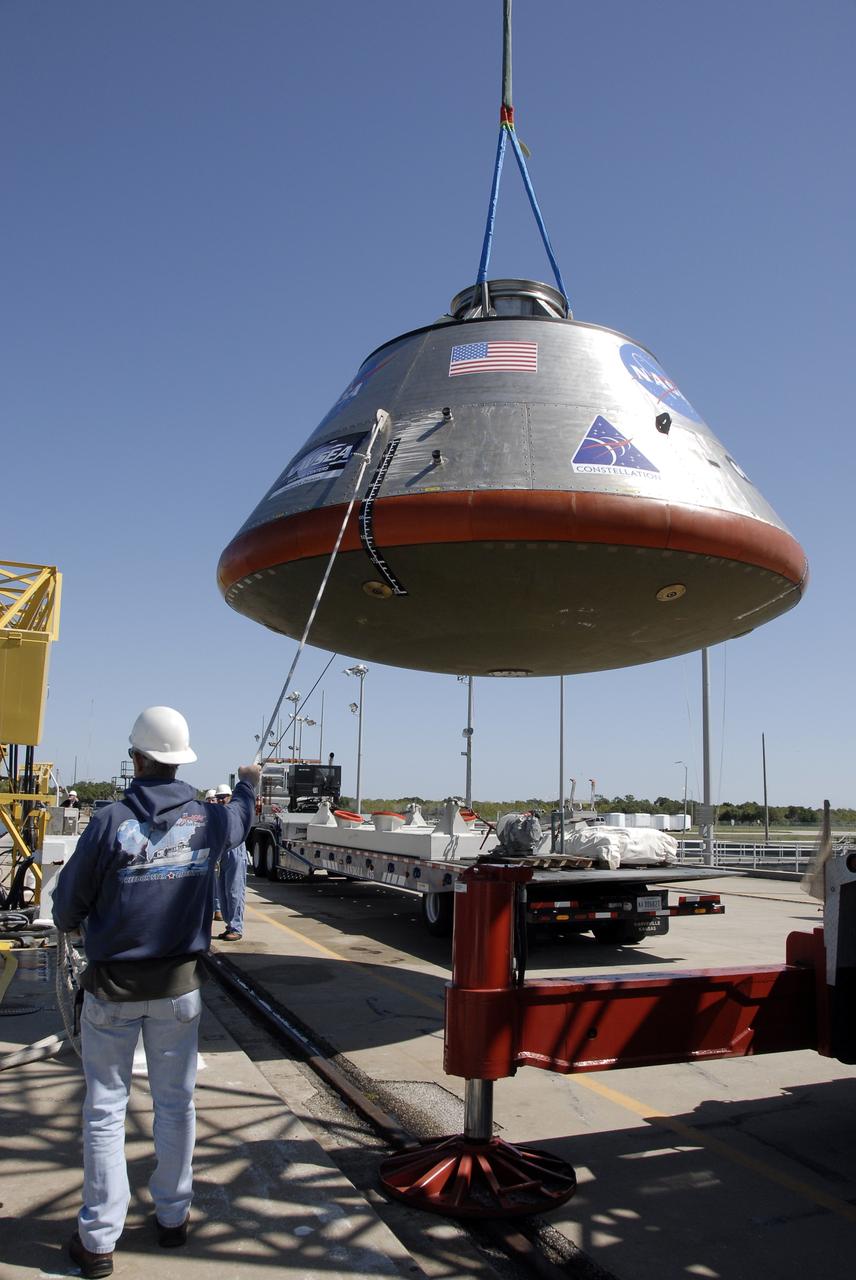
CAPE CANAVERAL, Fla. – The mockup Orion crew exploration vehicle is prepared to be lifted into the water at the Trident Basin at Port Canaveral, Fla., for testing in open water. The goal of the operation, dubbed the Post-landing Orion Recovery Test, or PORT, is to determine what kind of motion astronauts can expect after landing, as well as outside conditions for recovery teams. Orion is targeted to begin carrying humans to the International Space Station in 2015 and to the moon by 2020. Orion, along with the Ares I and V rockets and the Altair lunar lander, are part of the Constellation Program. Photo credit: NASA/Kim Shiflett
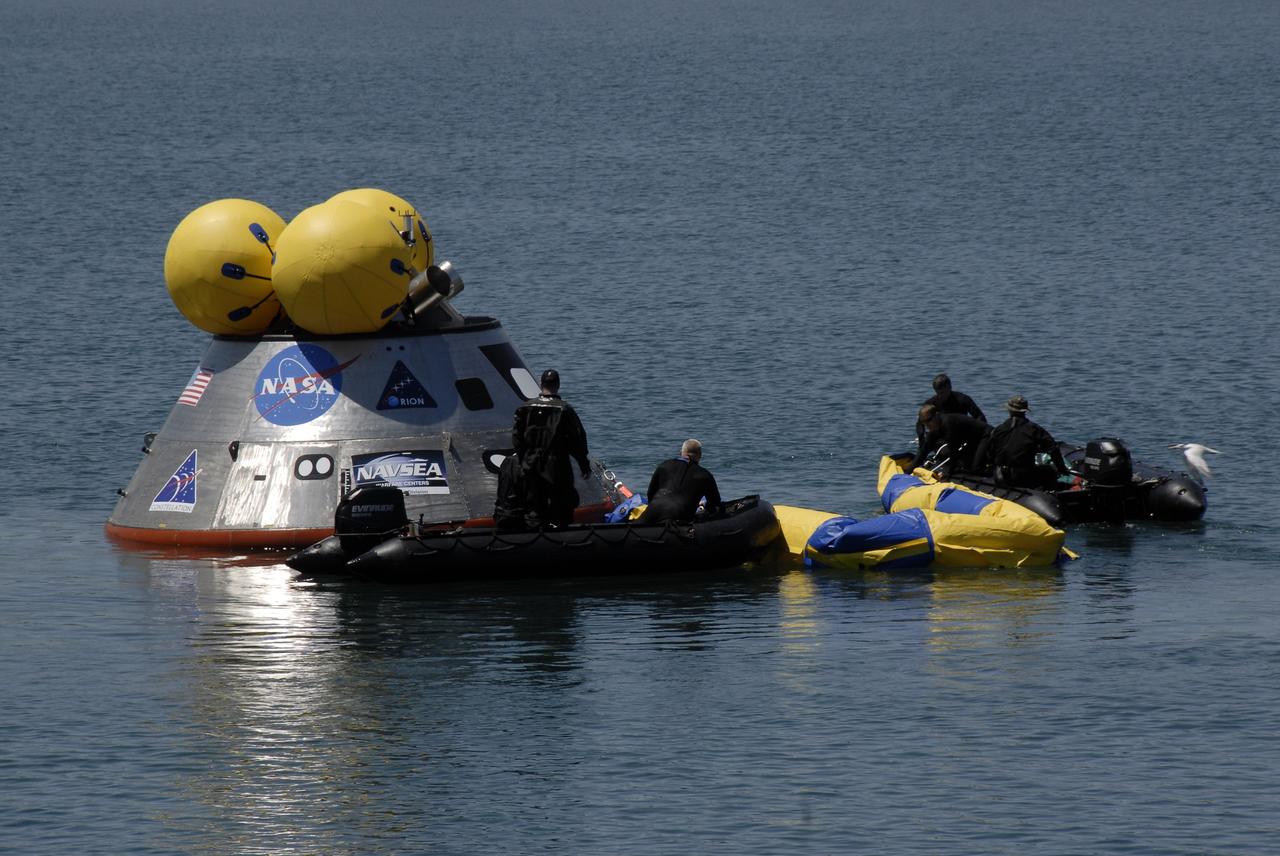
CAPE CANAVERAL, Fla. – Members of the 920th Rescue Wing release a flotation collar around the mockup Orion crew exploration vehicle at the Trident Basin at Port Canaveral, Fla. On top of Orion are additional flotation devices. The mockup vehicle will undergo testing in open water. The goal of the operation, dubbed the Post-landing Orion Recovery Test, or PORT, is to determine what kind of motion astronauts can expect after landing, as well as outside conditions for recovery teams. Orion is targeted to begin carrying humans to the International Space Station in 2015 and to the moon by 2020. Orion, along with the Ares I and V rockets and the Altair lunar lander, are part of the Constellation Program. Photo credit: NASA/Kim Shiflett
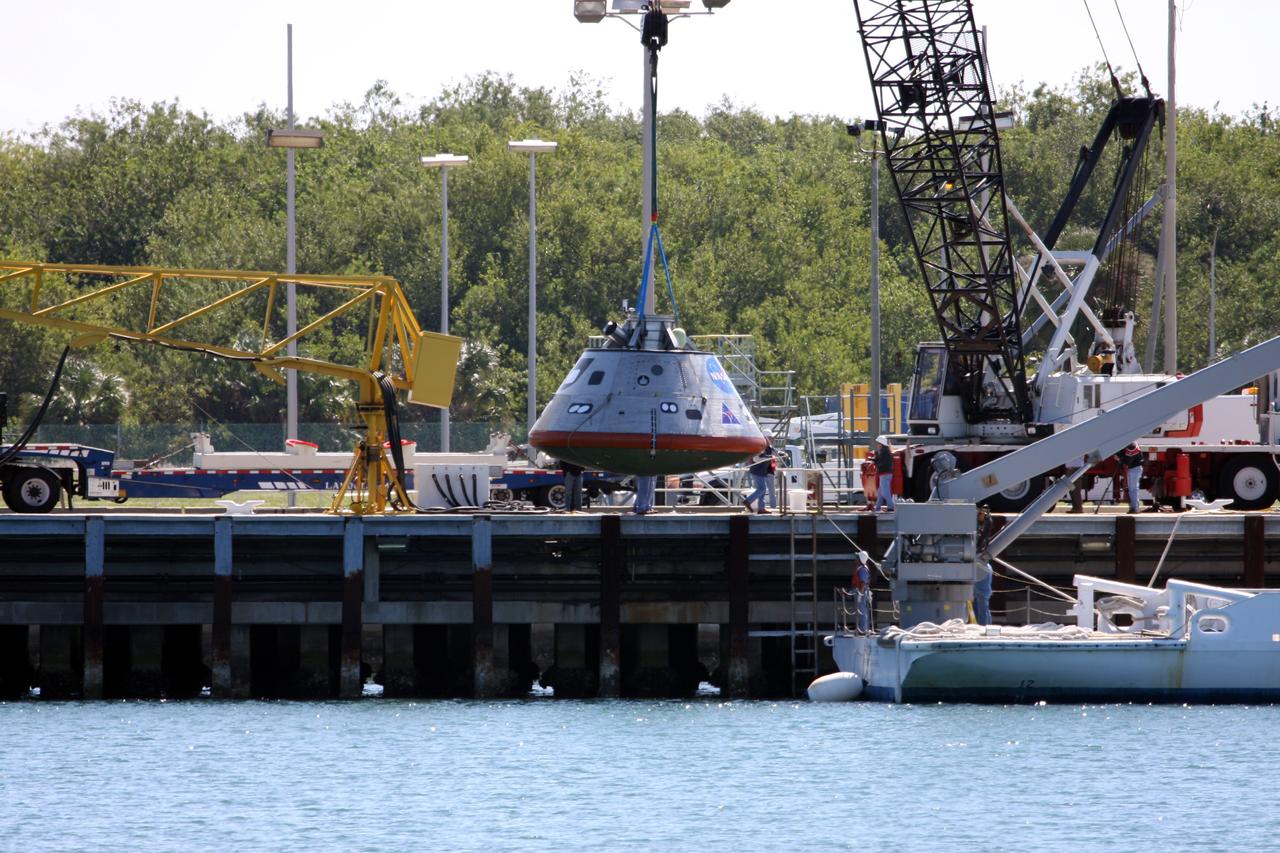
CAPE CANAVERAL, Fla. – The mockup Orion crew exploration vehicle is lowered toward the water at the Trident Basin at Port Canaveral, Fla., for testing. Orion is targeted to begin carrying humans to the International Space Station in 2015 and to the moon by 2020. The goal of the operation, dubbed the Post-landing Orion Recovery Test, or PORT, is to determine what kind of motion astronauts can expect after landing, as well as outside conditions for recovery teams. Orion, along with the Ares I and V rockets and the Altair lunar lander, are part of the Constellation Program. Photo credit: NASA/Dimitri Gerondidakis
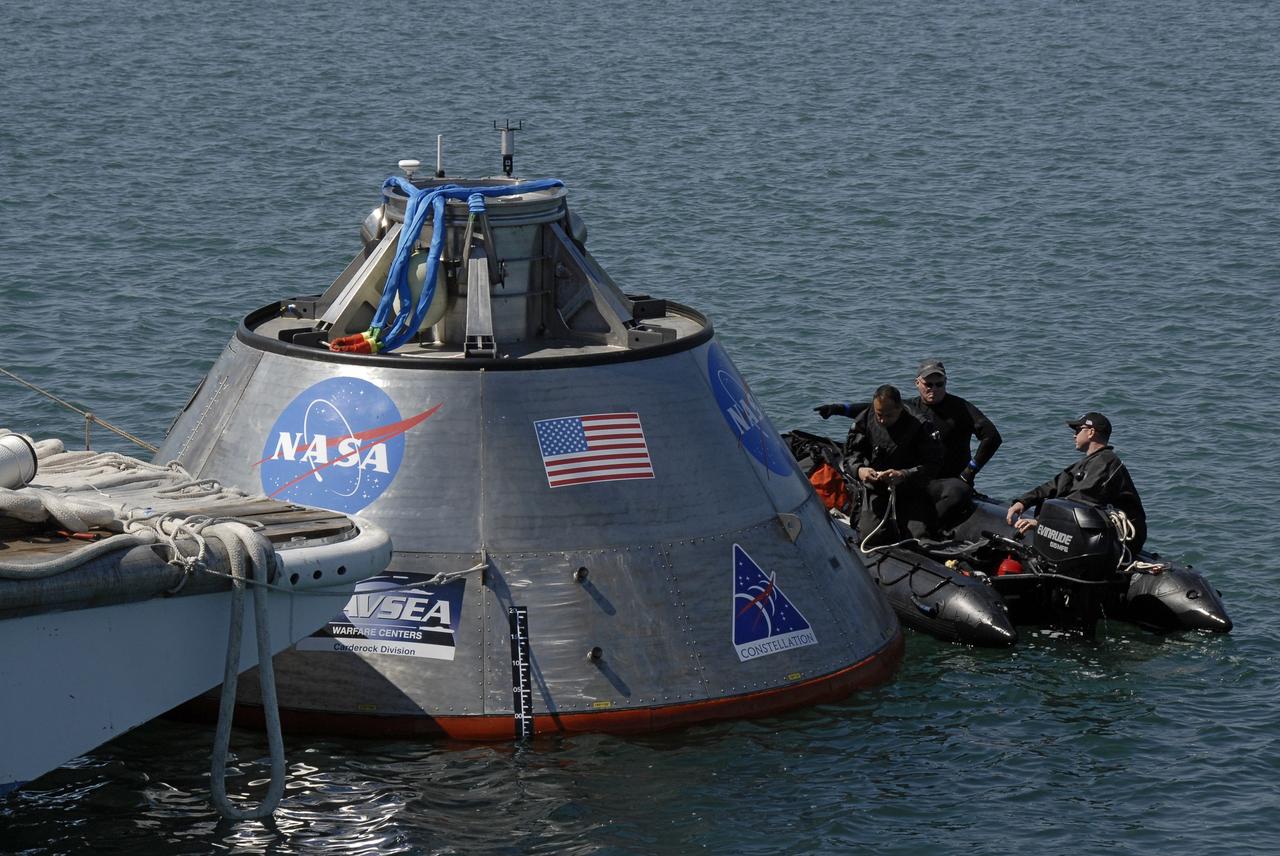
CAPE CANAVERAL, Fla. – Members of the 920th Rescue Wing help prepare the mockup Orion crew exploration vehicle for testing in the open water at the Trident Basin at Port Canaveral, Fla. The mockup vehicle will undergo testing in open water. The goal of the operation, dubbed the Post-landing Orion Recovery Test, or PORT, is to determine what kind of motion astronauts can expect after landing, as well as outside conditions for recovery teams. Orion is targeted to begin carrying humans to the International Space Station in 2015 and to the moon by 2020. Orion, along with the Ares I and V rockets and the Altair lunar lander, are part of the Constellation Program. Photo credit: NASA/Kim Shiflett
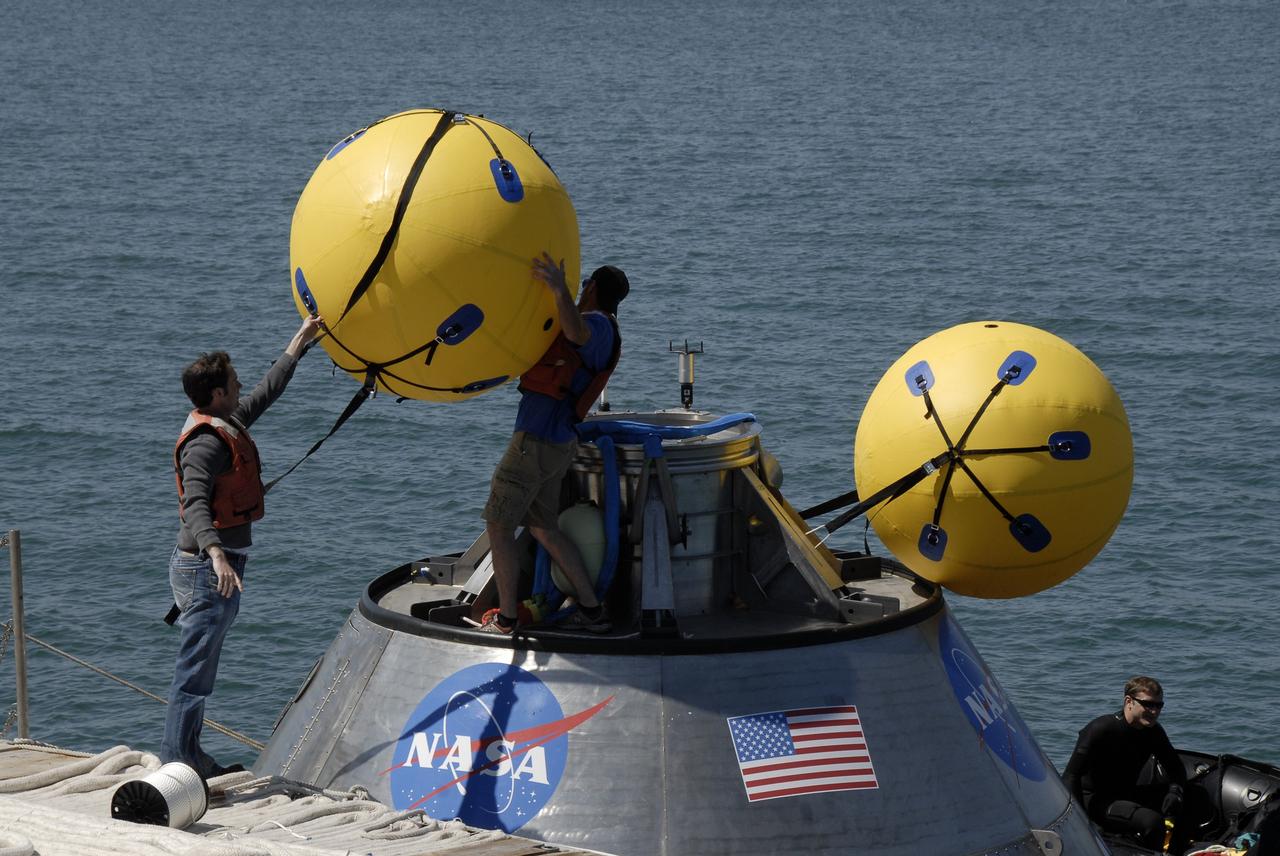
CAPE CANAVERAL, Fla. – Flotation devices are attached to the top of the mockup Orion crew exploration vehicle before the testing in the open water at the Trident Basin at Port Canaveral, Fla. The mockup vehicle will undergo testing in open water. The goal of the operation, dubbed the Post-landing Orion Recovery Test, or PORT, is to determine what kind of motion astronauts can expect after landing, as well as outside conditions for recovery teams. Orion is targeted to begin carrying humans to the International Space Station in 2015 and to the moon by 2020. Orion, along with the Ares I and V rockets and the Altair lunar lander, are part of the Constellation Program. Photo credit: NASA/Kim Shiflett
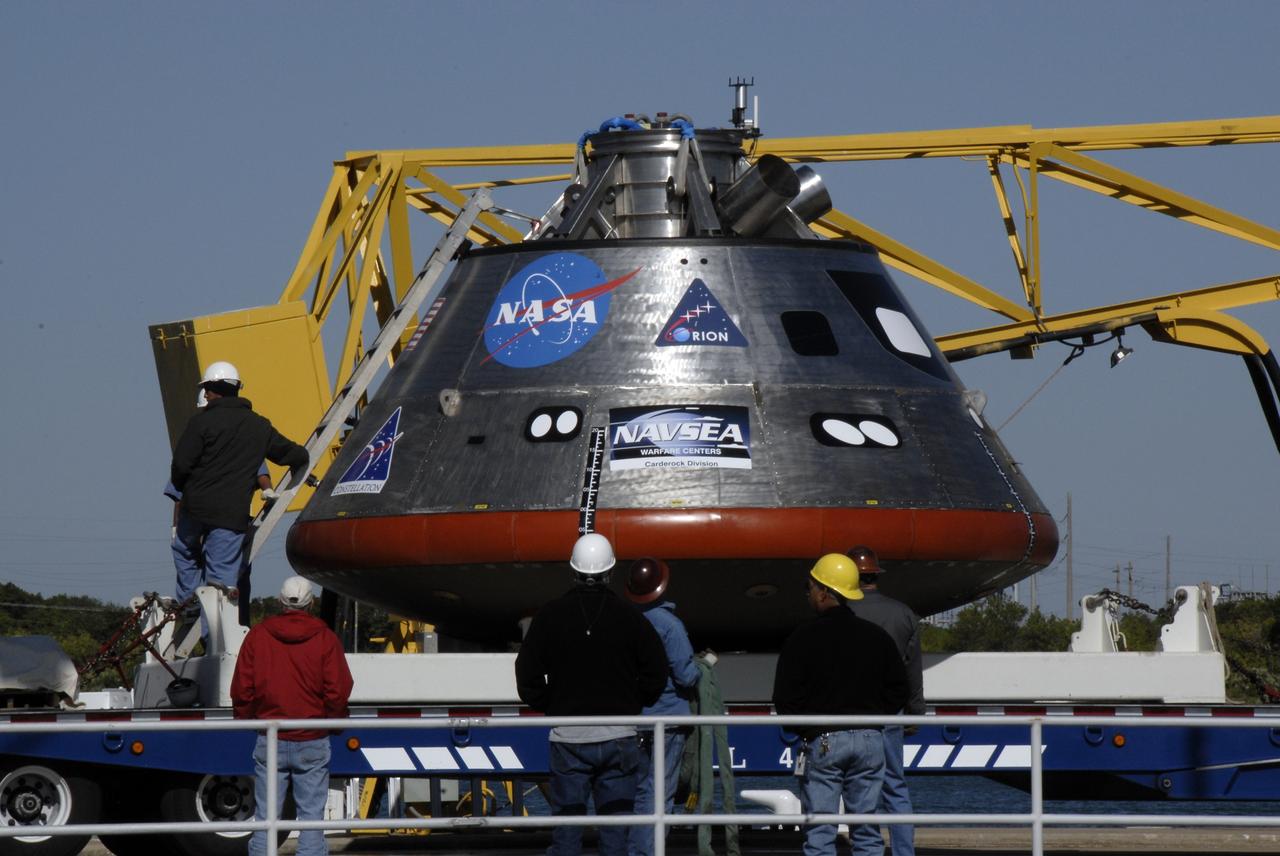
CAPE CANAVERAL, Fla. – The mockup Orion crew exploration vehicle is on the dock at the Trident Basin at Port Canaveral, Fla., waiting to be tested in open water. The goal of the operation, dubbed the Post-landing Orion Recovery Test, or PORT, is to determine what kind of motion astronauts can expect after landing, as well as outside conditions for recovery teams. Orion is targeted to begin carrying humans to the International Space Station in 2015 and to the moon by 2020. Orion, along with the Ares I and V rockets and the Altair lunar lander, are part of the Constellation Program. Photo credit: NASA/Kim Shiflett
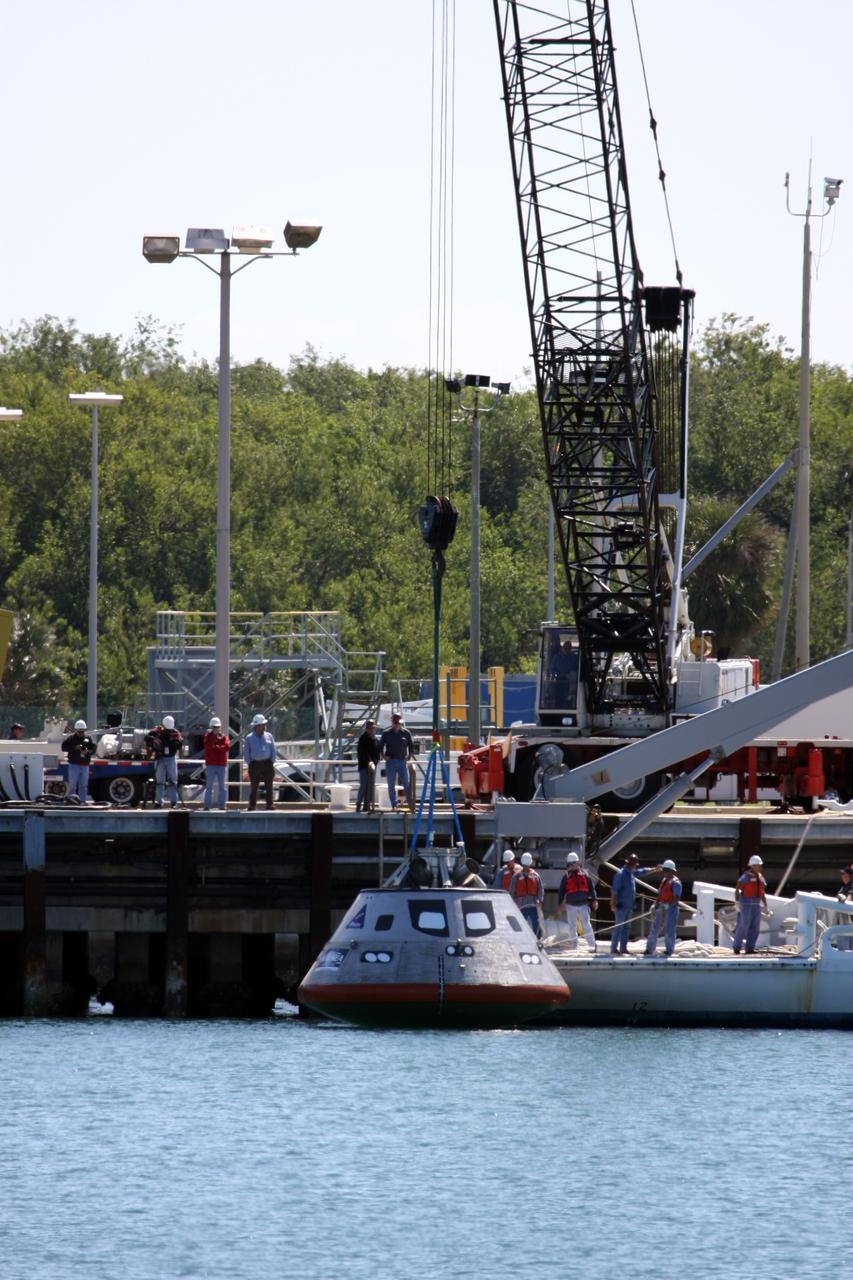
CAPE CANAVERAL, Fla. – The mockup Orion crew exploration vehicle is lowered into the water at the Trident Basin at Port Canaveral, Fla., for testing. Orion is targeted to begin carrying humans to the International Space Station in 2015 and to the moon by 2020. The goal of the operation, dubbed the Post-landing Orion Recovery Test, or PORT, is to determine what kind of motion astronauts can expect after landing, as well as outside conditions for recovery teams. Orion, along with the Ares I and V rockets and the Altair lunar lander, are part of the Constellation Program. Photo credit: NASA/Dimitri Gerondidakis
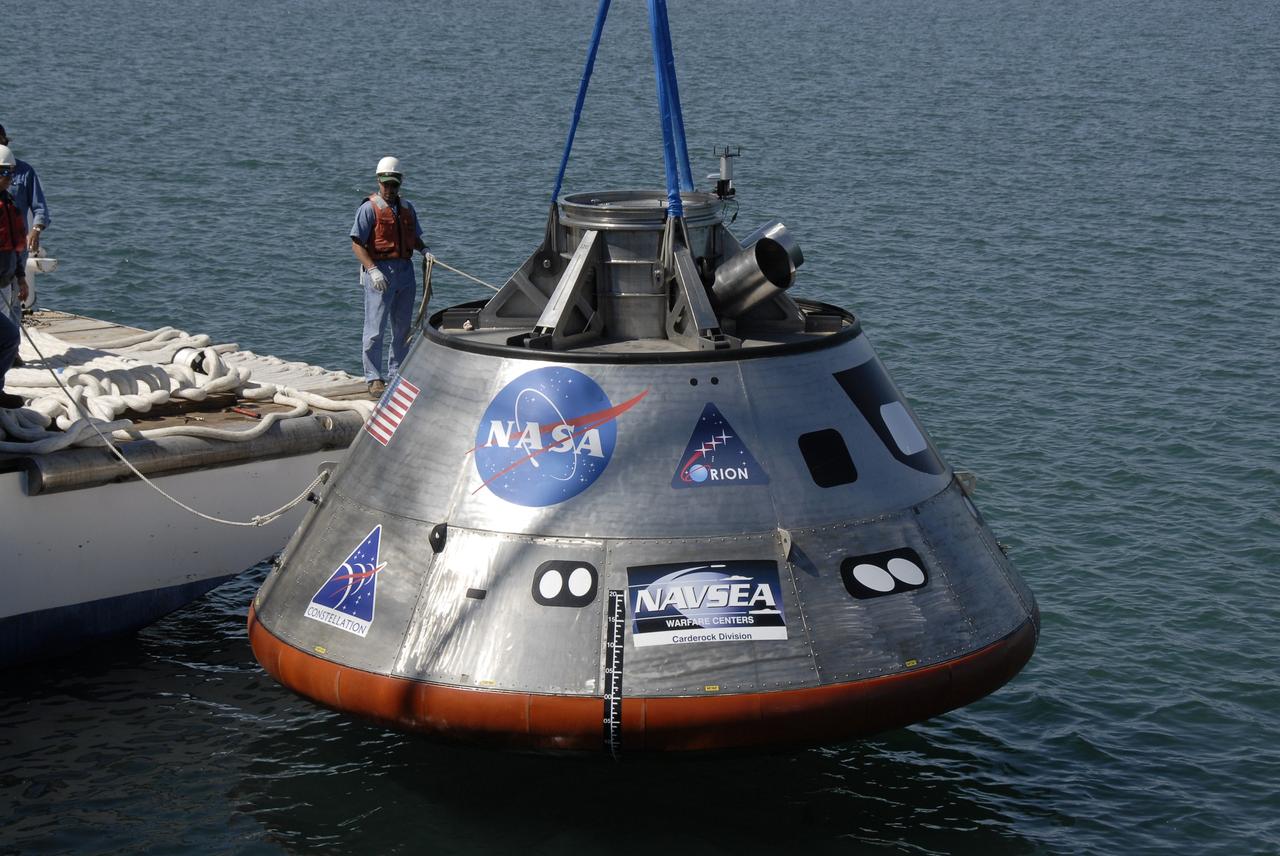
CAPE CANAVERAL, Fla. – The mockup Orion crew exploration vehicle is lowered into the water at the Trident Basin at Port Canaveral, Fla., for testing in open water. The goal of the operation, dubbed the Post-landing Orion Recovery Test, or PORT, is to determine what kind of motion astronauts can expect after landing, as well as outside conditions for recovery teams. Orion is targeted to begin carrying humans to the International Space Station in 2015 and to the moon by 2020. Orion, along with the Ares I and V rockets and the Altair lunar lander, are part of the Constellation Program. Photo credit: NASA/Kim Shiflett
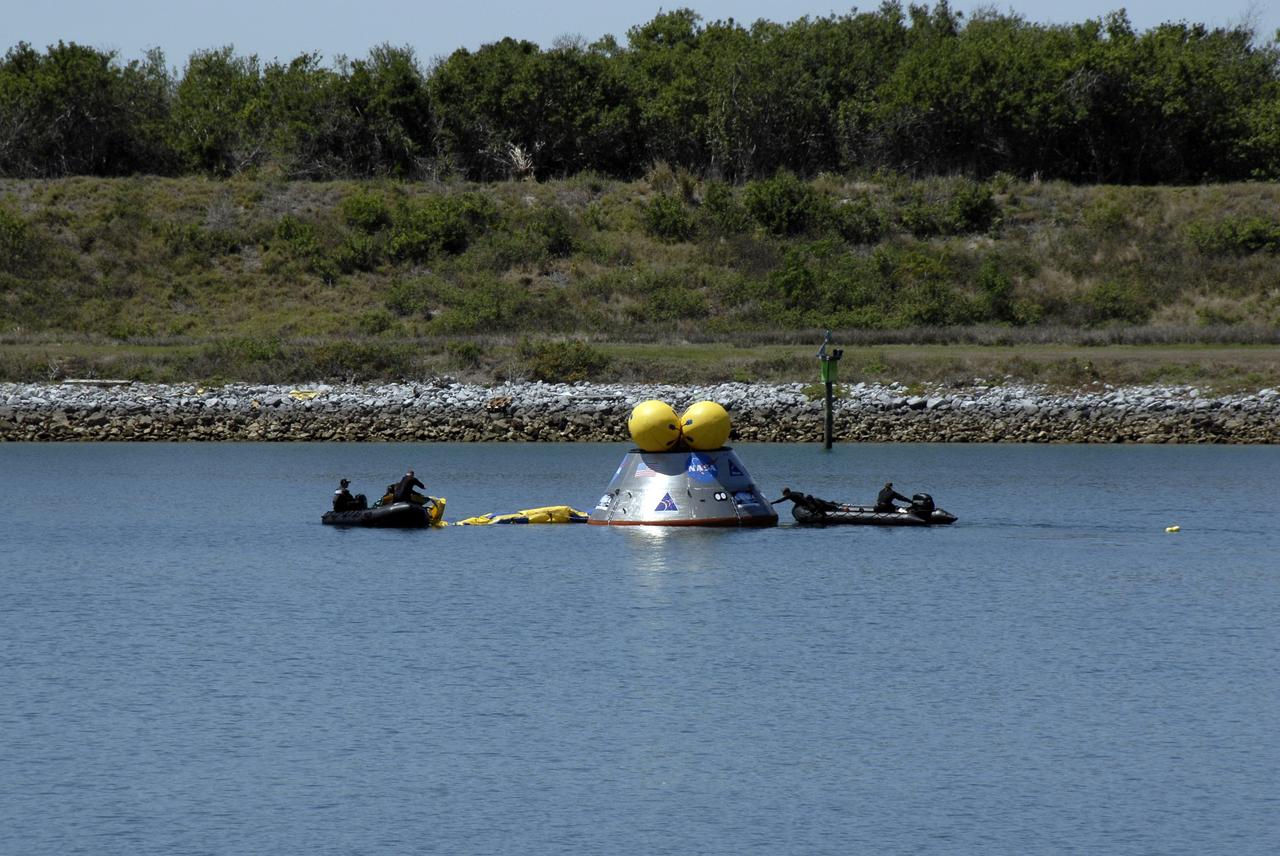
CAPE CANAVERAL, Fla. – Members of the 920th Rescue Wing release a flotation collar around the mockup Orion crew exploration vehicle at the Trident Basin at Port Canaveral, Fla. On top of Orion are additional flotation devices. The mockup vehicle will undergo testing in open water. The goal of the operation, dubbed the Post-landing Orion Recovery Test, or PORT, is to determine what kind of motion astronauts can expect after landing, as well as outside conditions for recovery teams. Orion is targeted to begin carrying humans to the International Space Station in 2015 and to the moon by 2020. Orion, along with the Ares I and V rockets and the Altair lunar lander, are part of the Constellation Program. Photo credit: NASA/Kim Shiflett
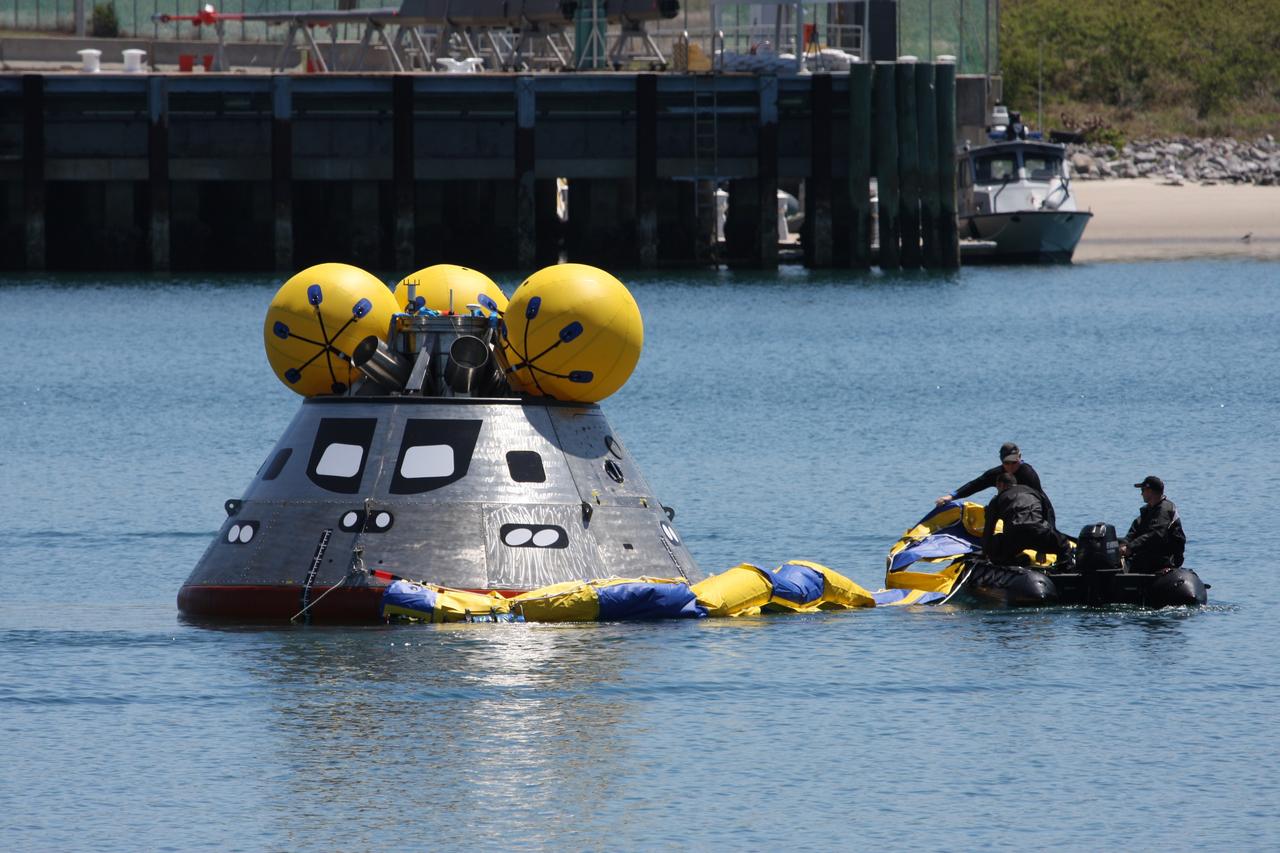
CAPE CANAVERAL, Fla. – Members of the 920th Rescue Wing release a flotation collar around the mockup Orion crew exploration vehicle at the Trident Basin at Port Canaveral, Fla. On top of Orion are additional flotation devices. The goal of the operation, dubbed the Post-landing Orion Recovery Test, or PORT, is to determine what kind of motion astronauts can expect after landing, as well as outside conditions for recovery teams. Orion is targeted to begin carrying humans to the International Space Station in 2015 and to the moon by 2020. Orion is targeted to begin carrying humans to the International Space Station in 2015 and to the moon by 2020. Orion, along with the Ares I and V rockets and the Altair lunar lander, are part of the Constellation Program. Photo credit: NASA/Dimitri Gerondidakis
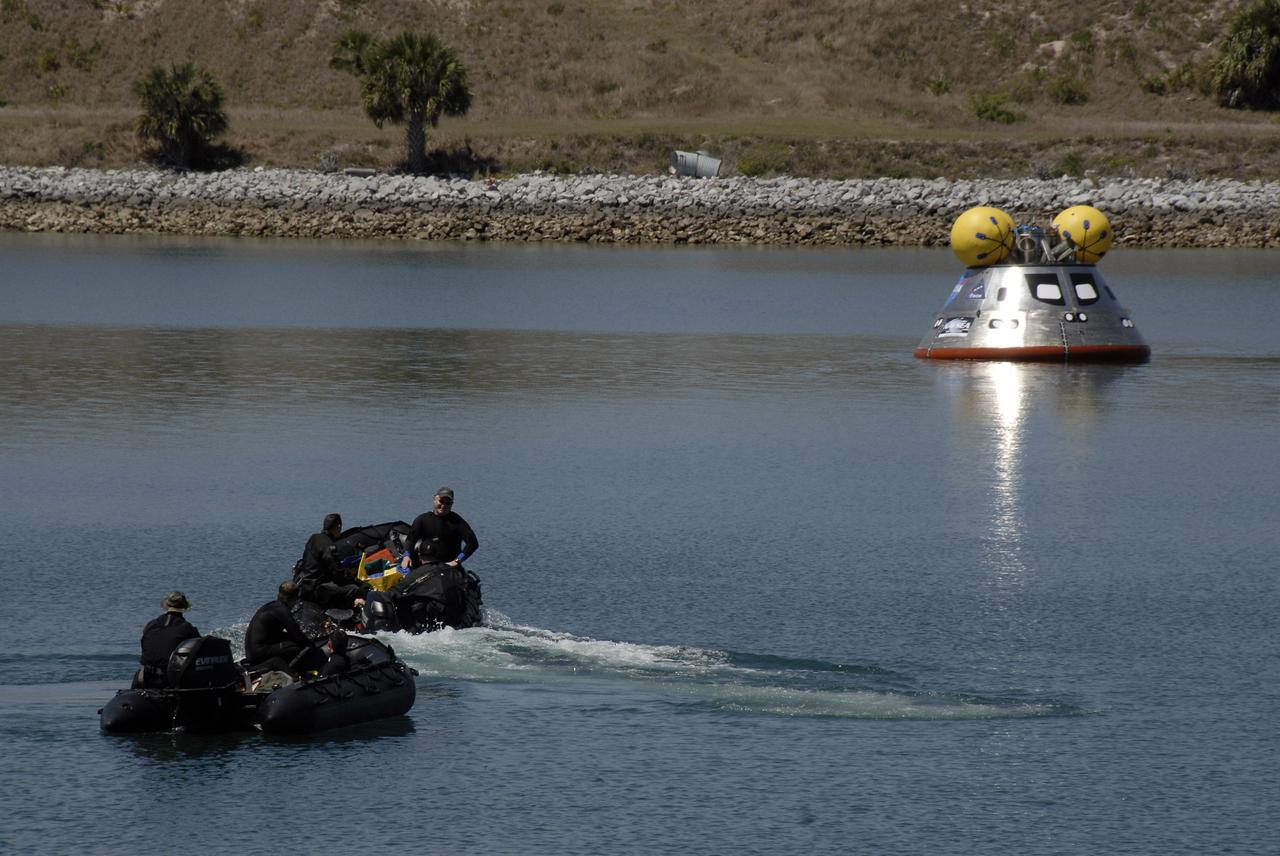
CAPE CANAVERAL, Fla. – Members of the 920th Rescue Wing make their way toward the mockup Orion crew exploration vehicle floating in the open water of the Trident Basin at Port Canaveral, Fla. They will place a flotation collar around the mockup vehicle. The mockup vehicle will undergo testing in open water. The goal of the operation, dubbed the Post-landing Orion Recovery Test, or PORT, is to determine what kind of motion astronauts can expect after landing, as well as outside conditions for recovery teams. Orion is targeted to begin carrying humans to the International Space Station in 2015 and to the moon by 2020. Orion, along with the Ares I and V rockets and the Altair lunar lander, are part of the Constellation Program. Photo credit: NASA/Kim Shiflett