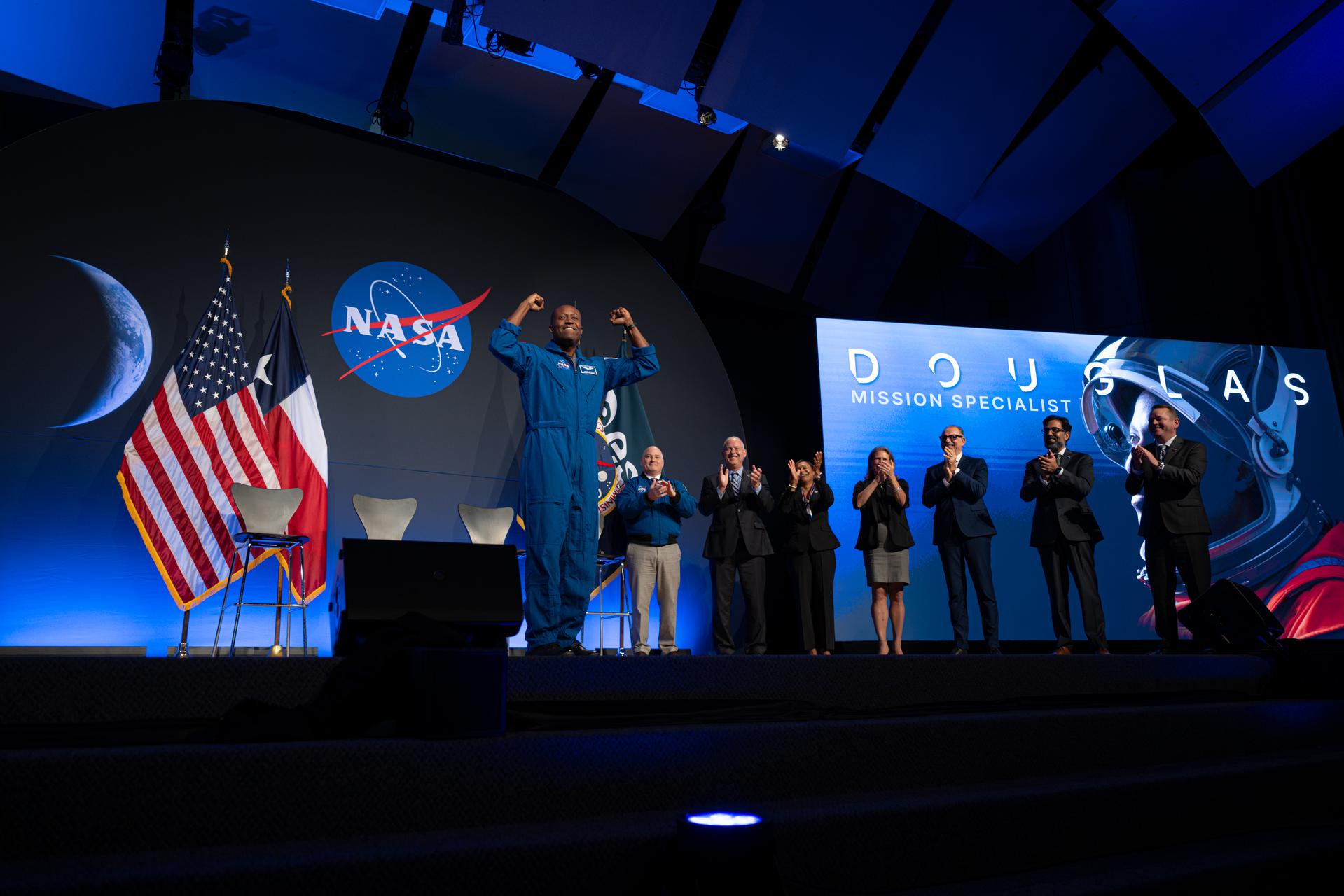
NASA astronaut Andre Douglas, Artemis III mission specialist, is introduced during the Artemis III crew announcement event, Tuesday, June 9, 2026, at NASA’s Johnson Space Center in Houston, Texas. Photo Credit: (NASA/John Kraus)
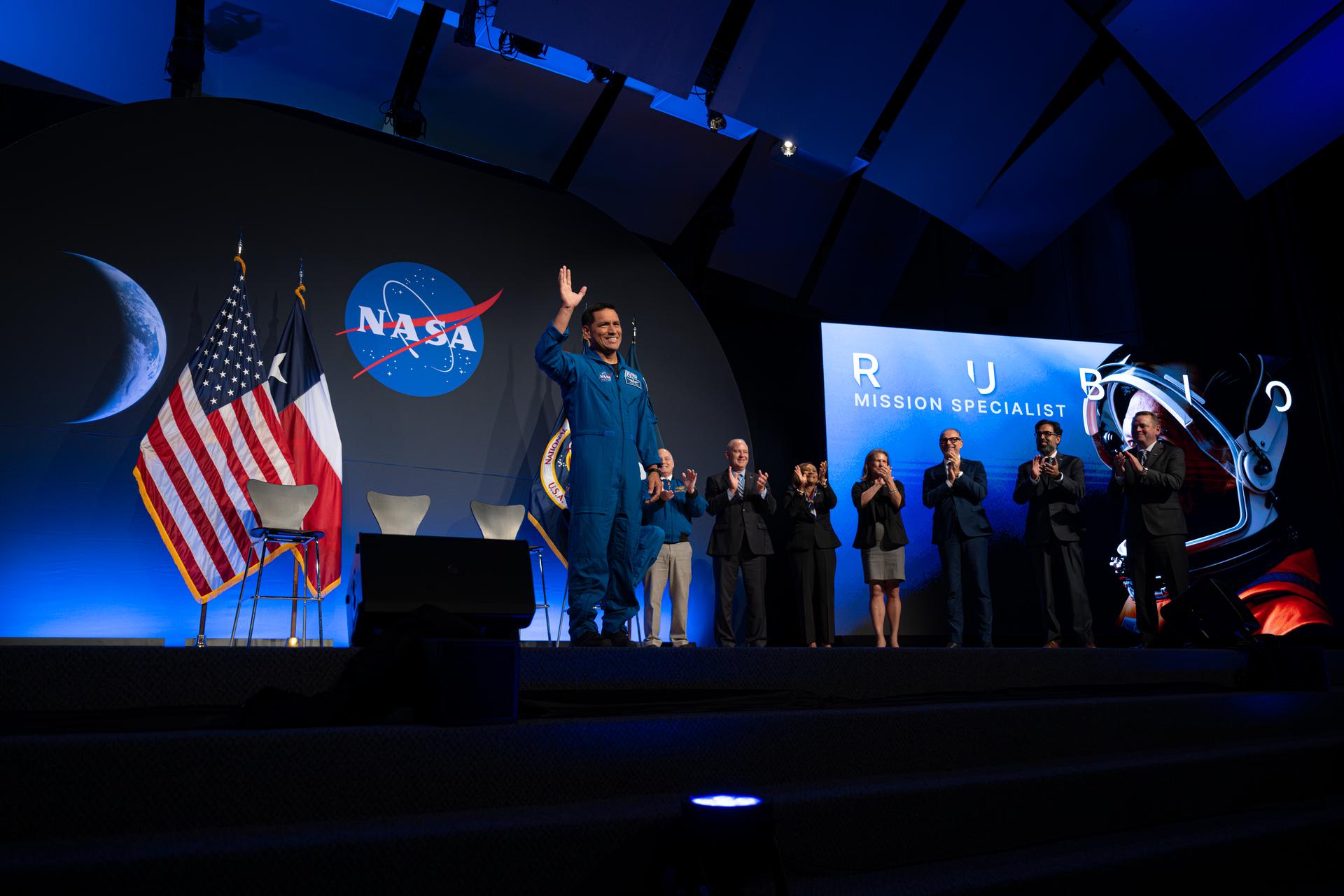
NASA astronaut Frank Rubio, Artemis III mission specialist, is introduced during the Artemis III crew announcement event, Tuesday, June 9, 2026, at NASA’s Johnson Space Center in Houston, Texas. Photo Credit: (NASA/John Kraus)
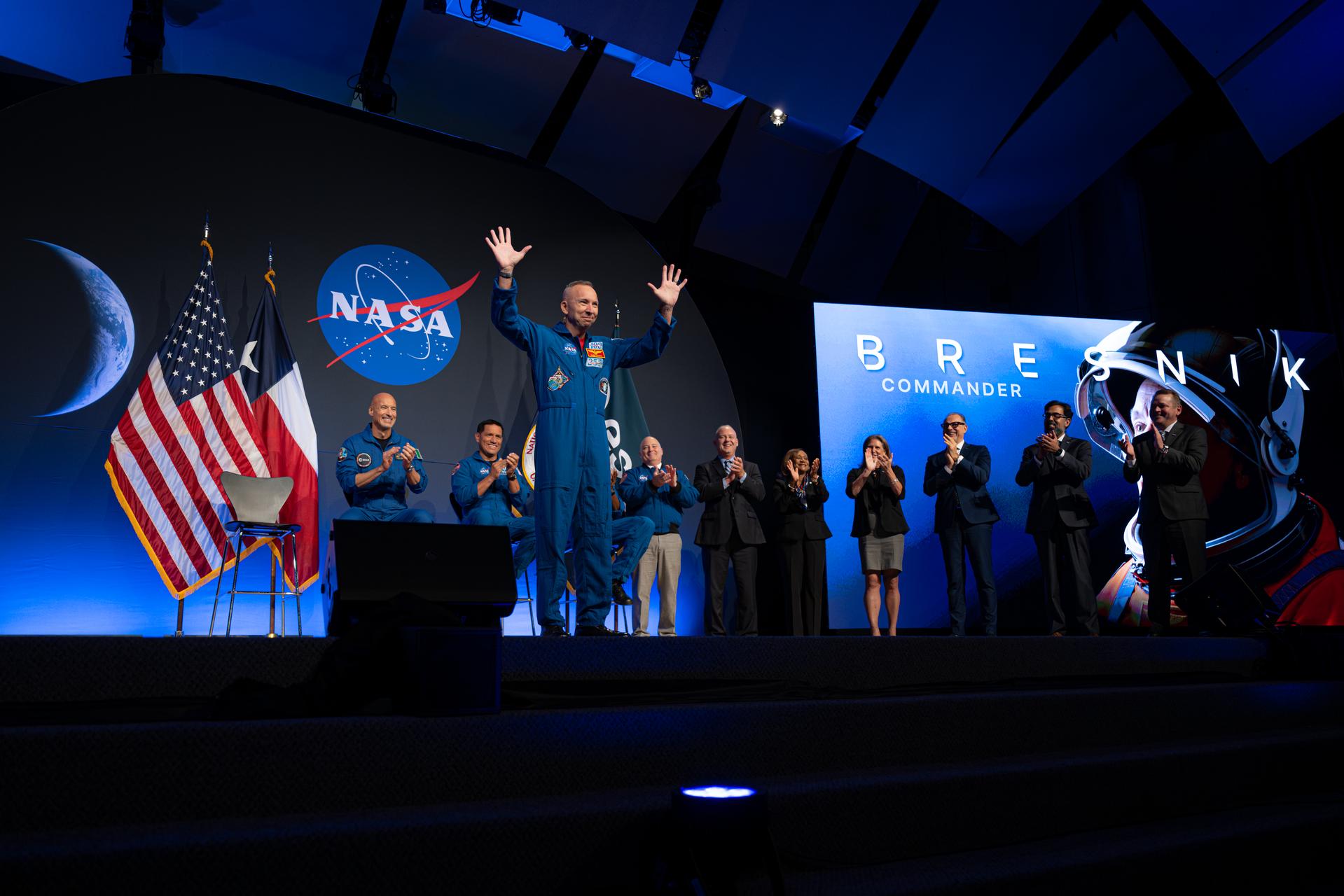
NASA astronaut Randy Bresnik, Artemis III commander, is introduced during the Artemis III crew announcement event, Tuesday, June 9, 2026, at NASA’s Johnson Space Center in Houston, Texas. Photo Credit: (NASA/John Kraus)
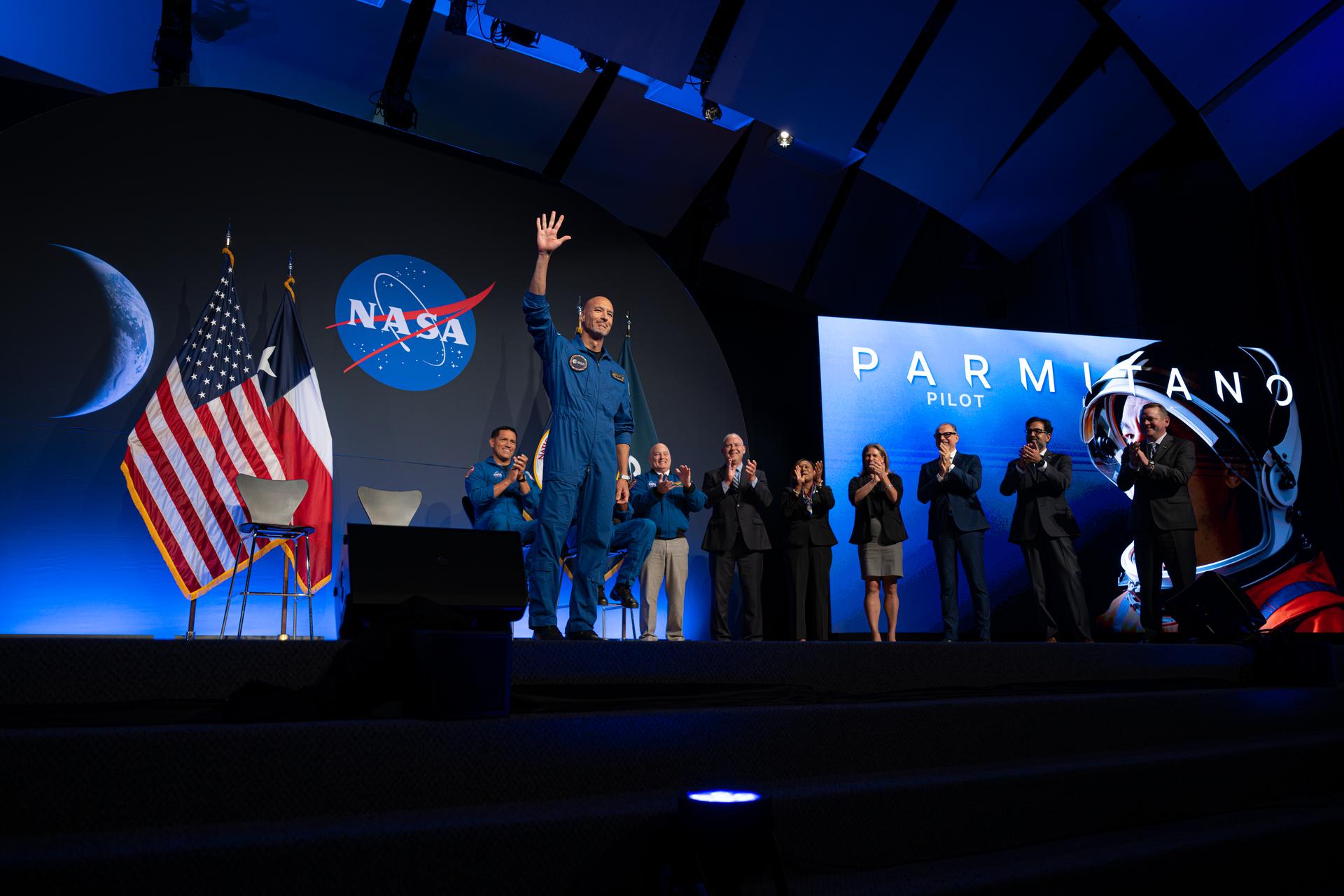
ESA (European Space Agency) astronaut Luca Parmitano, Artemis III pilot, is introduced during the Artemis III crew announcement event, Tuesday, June 9, 2026, at NASA’s Johnson Space Center in Houston, Texas. Photo Credit: (NASA/John Kraus)
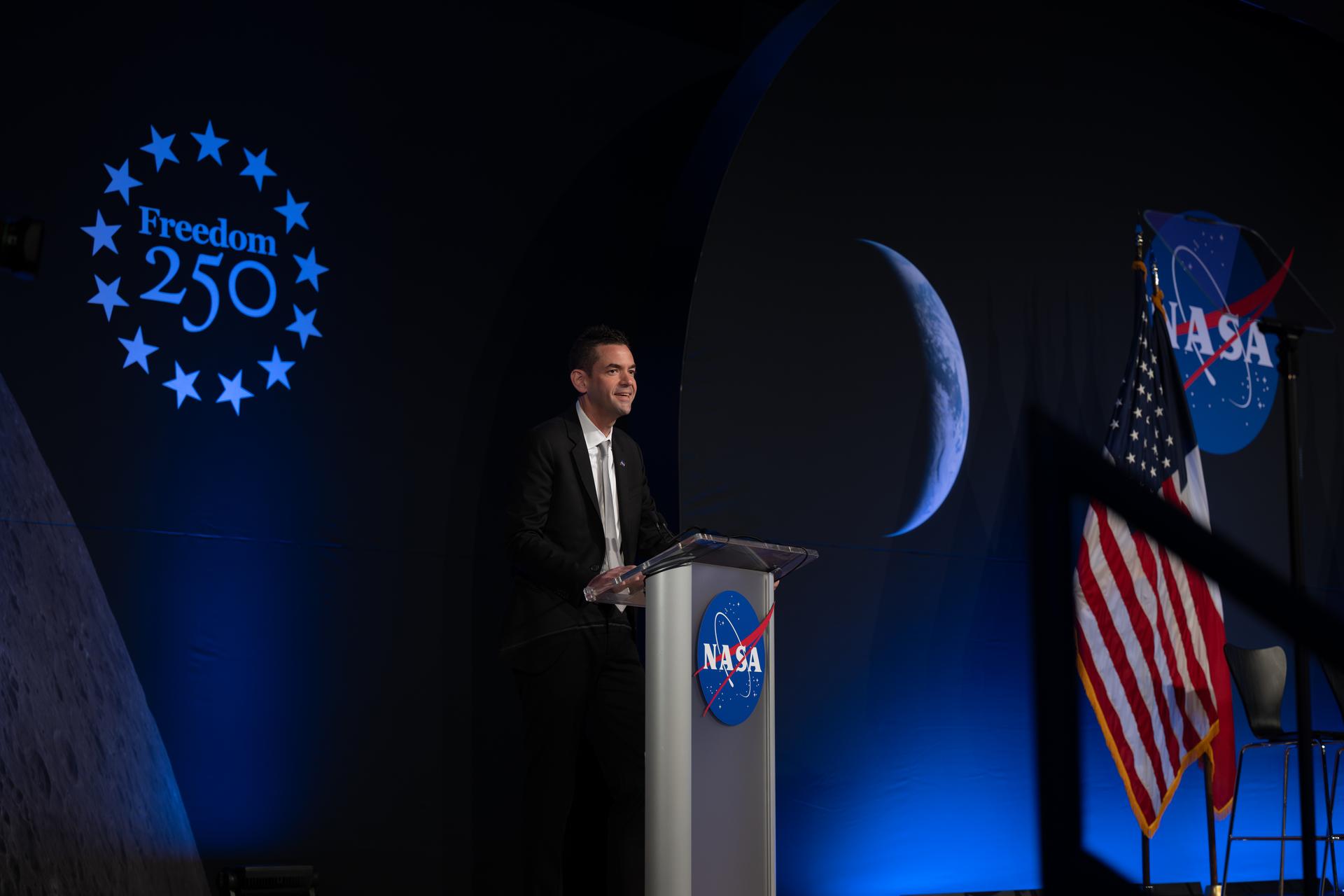
NASA Administrator Jared Isaacman gives remarks during the Artemis III crew announcement event, Tuesday, June 9, 2026, at NASA’s Johnson Space Center in Houston, Texas. Photo Credit: (NASA/John Kraus)
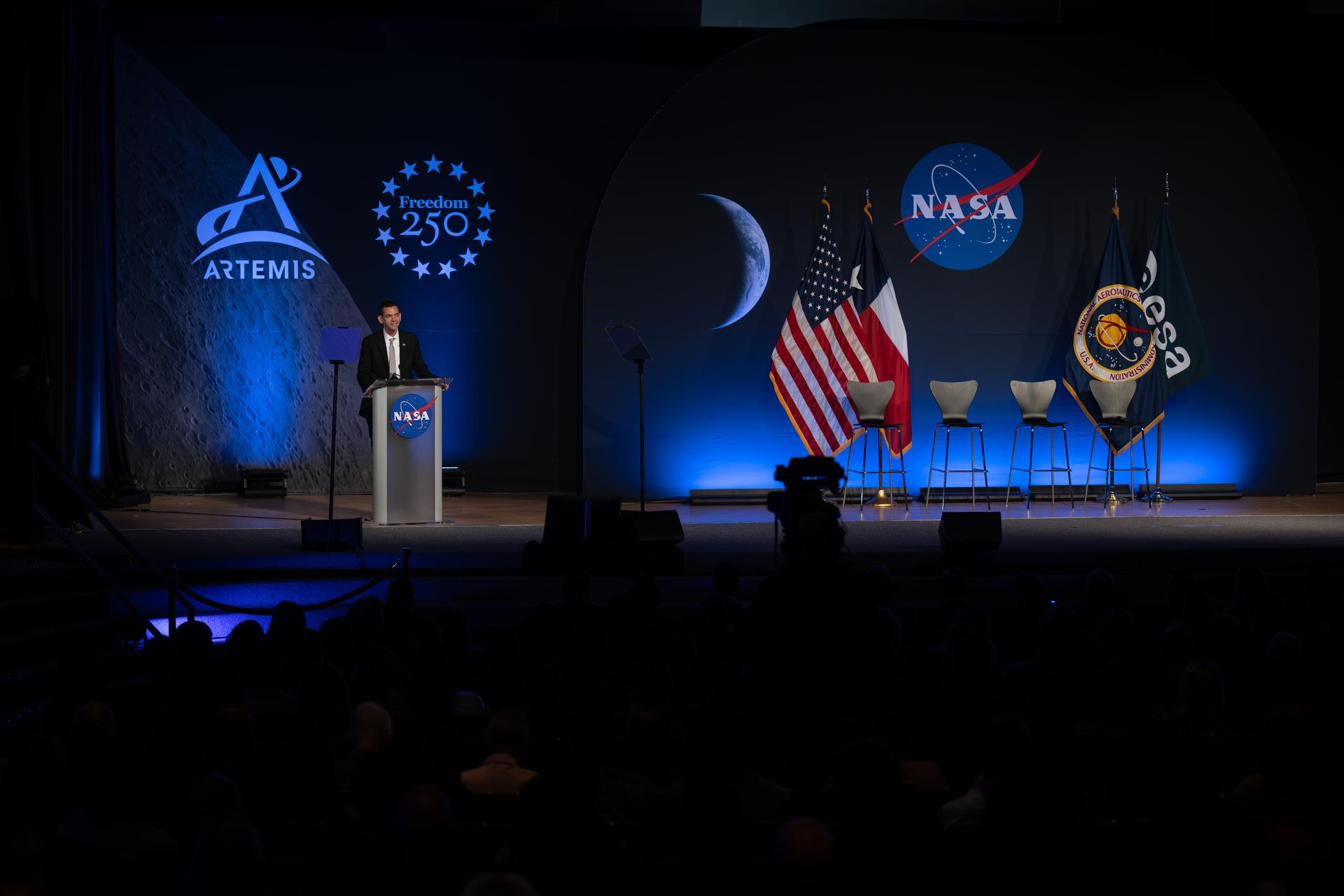
NASA Administrator Jared Isaacman gives remarks during the Artemis III crew announcement event, Tuesday, June 9, 2026, at NASA’s Johnson Space Center in Houston, Texas. Photo Credit: (NASA/John Kraus)
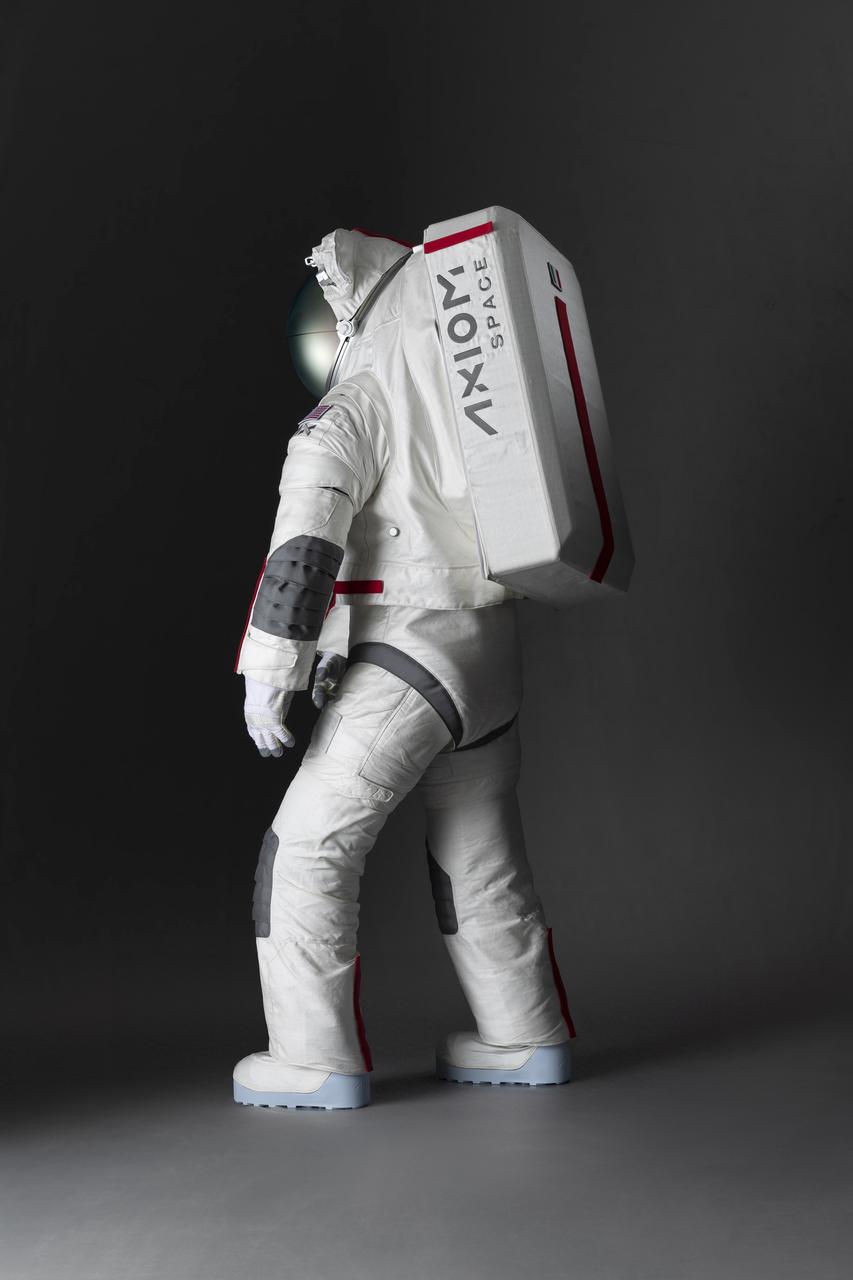
The flight design of Axiom Space's Axiom Extravehicular Mobility Unit (AxEMU) lunar spacesuit that NASA astronauts will wear during the Artemis III mission. Image Credit: Axiom Space
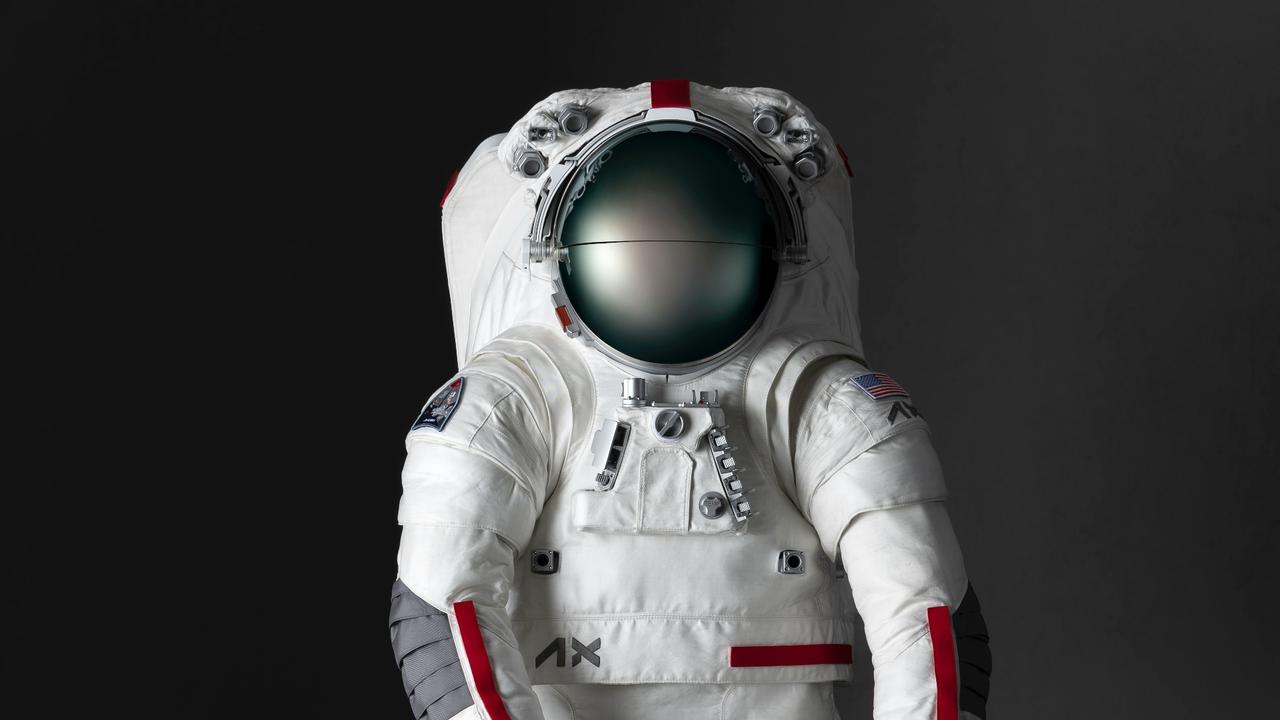
The flight design of Axiom Space's Axiom Extravehicular Mobility Unit (AxEMU) lunar spacesuit that NASA astronauts will wear during the Artemis III mission. Image Credit: Axiom Space

Technicians work on the Artemis III Orion crew module inside the Operations and Checkout Building at NASA's Kennedy Space Center in Florida on March 5, 2025.
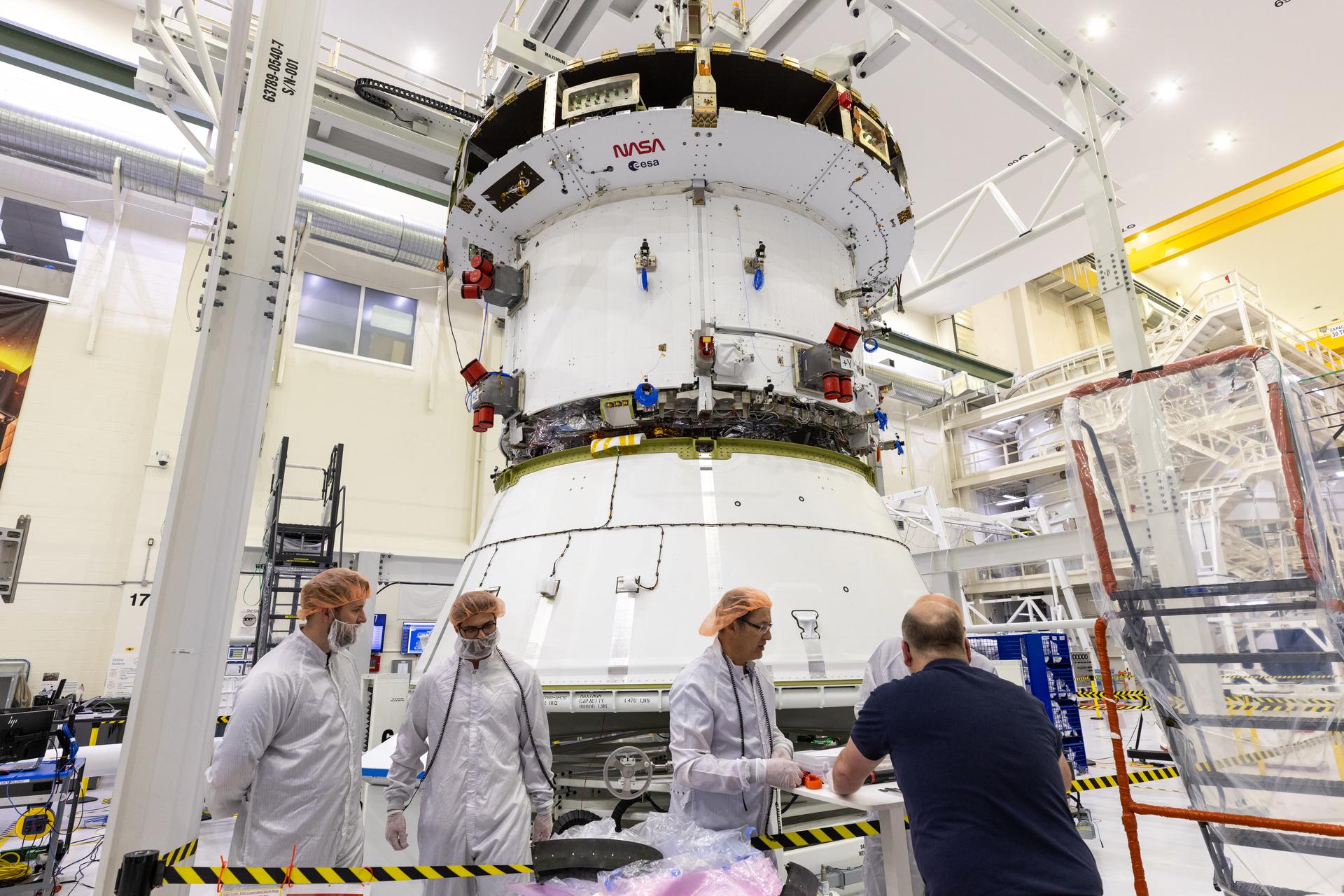
Teams prepare for the installation of the engine nozzle onto the European Service Module for NASA’s Artemis III mission on Tuesday, Feb. 17, 2026, inside the high bay of the Neil A. Armstrong Operations and Checkout Building at NASA’s Kennedy Space Center in Florida. The service module provides the Orion spacecraft’s propulsion, thermal control, electrical power, and life support systems during the Artemis III mission to send humans to explore the lunar South Pole region.
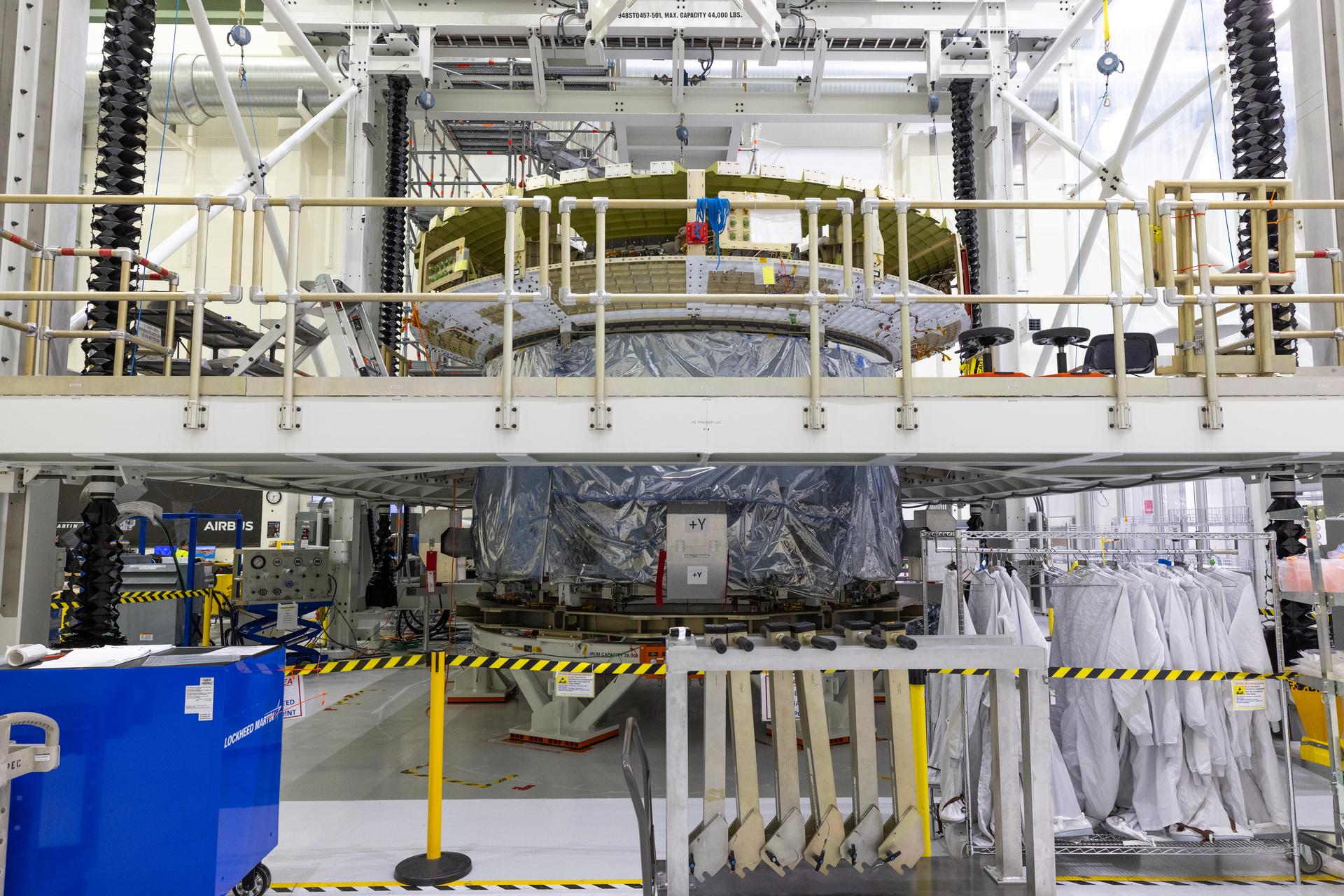
Teams prepare for the installation of the engine nozzle onto the European Service Module for NASA’s Artemis III mission on Tuesday, Feb. 17, 2026, inside the high bay of the Neil A. Armstrong Operations and Checkout Building at NASA’s Kennedy Space Center in Florida. The service module provides the Orion spacecraft’s propulsion, thermal control, electrical power, and life support systems during the Artemis III mission to send humans to explore the lunar South Pole region.
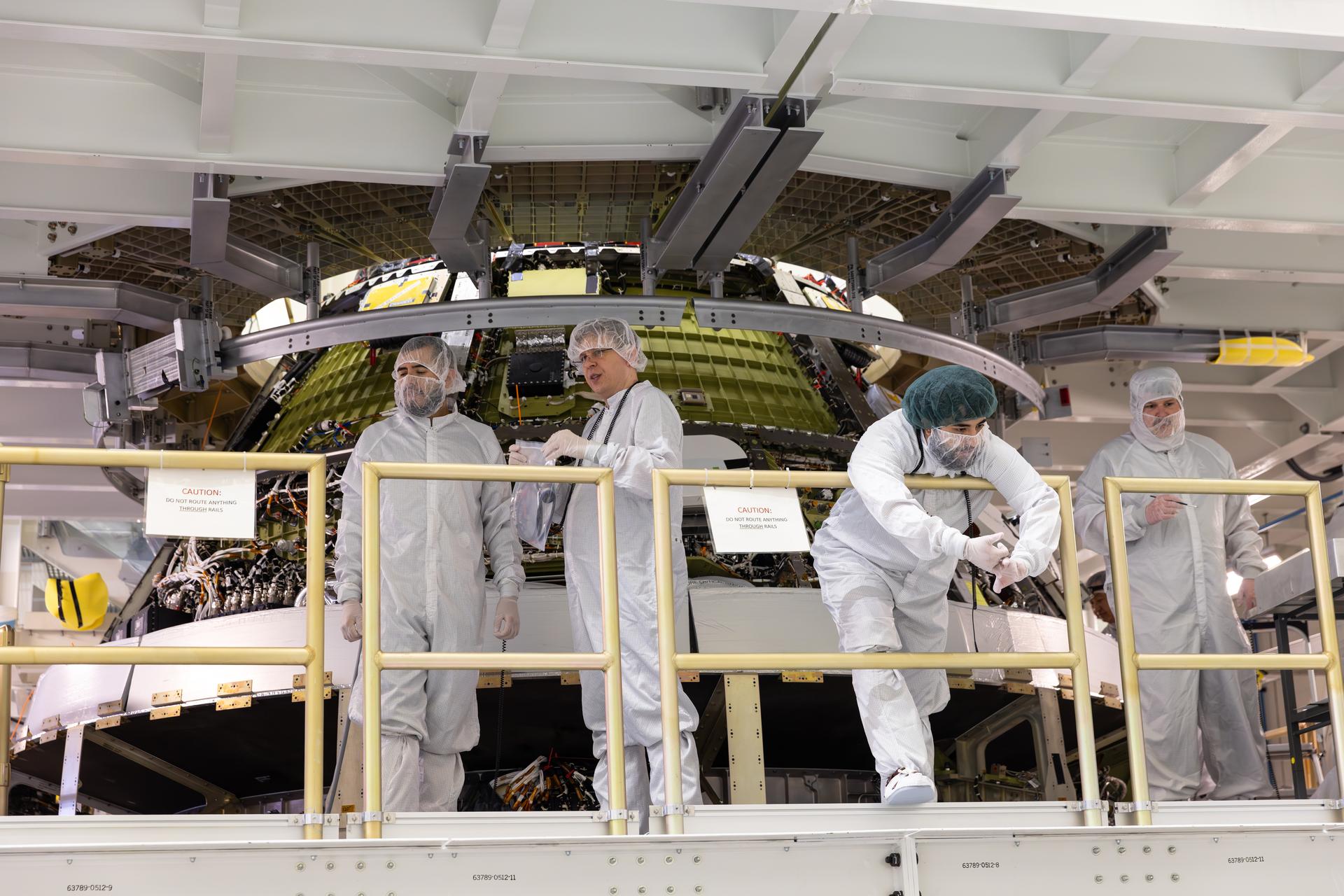
Engineers finish connecting the Artemis III Orion crew and service modules on Friday, July 31, 2026, inside the Neil A. Armstrong Operations and Checkout Building at NASA’s Kennedy Space Center in Florida. Now integrated, the team will power up the combined crew and service module for the first time then begin altitude chamber testing, which will put the spacecraft through conditions as close as possible to the environment it will experience in low Earth orbit. Artemis III and the four-person crew will carry out a series of objectives in low Earth orbit designed to demonstrate critical systems needed for future lunar landings, beginning with Artemis IV.
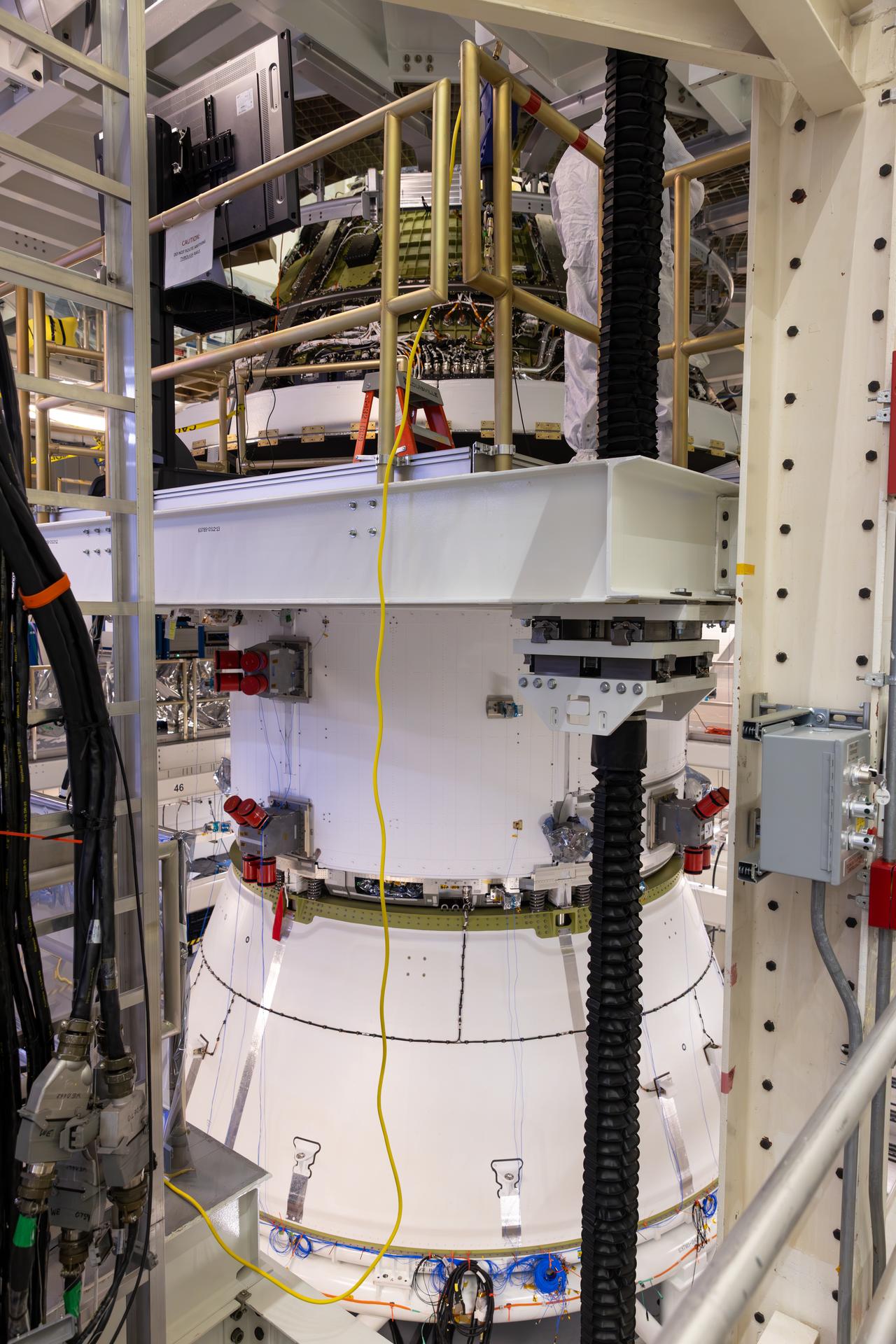
Engineers finish connecting the Artemis III Orion crew and service modules on Friday, July 31, 2026, inside the Neil A. Armstrong Operations and Checkout Building at NASA’s Kennedy Space Center in Florida. Now integrated, the team will power up the combined crew and service module for the first time then begin altitude chamber testing, which will put the spacecraft through conditions as close as possible to the environment it will experience in low Earth orbit. Artemis III and the four-person crew will carry out a series of objectives in low Earth orbit designed to demonstrate critical systems needed for future lunar landings, beginning with Artemis IV.
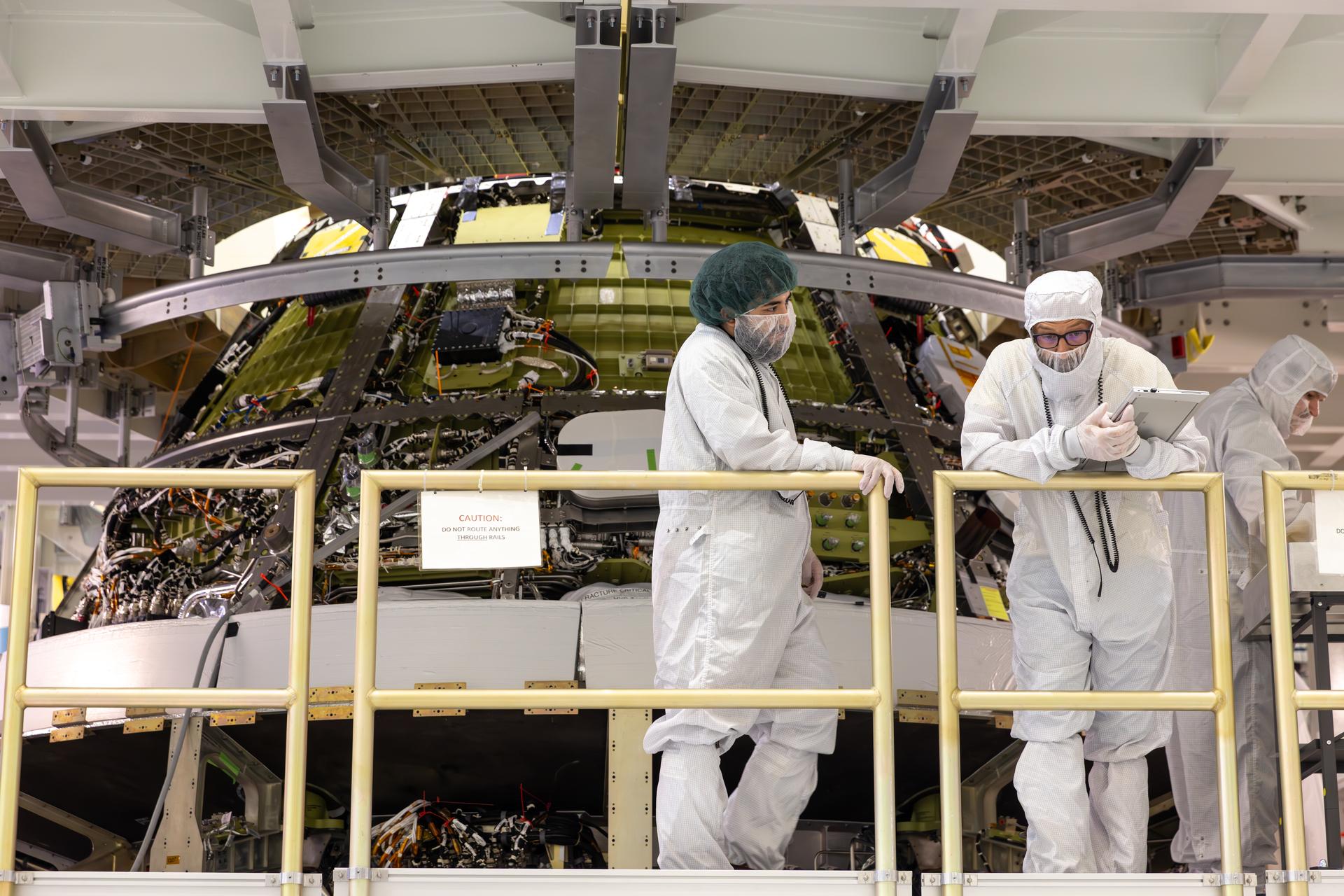
Engineers finish connecting the Artemis III Orion crew and service modules on Friday, July 31, 2026, inside the Neil A. Armstrong Operations and Checkout Building at NASA’s Kennedy Space Center in Florida. Now integrated, the team will power up the combined crew and service module for the first time then begin altitude chamber testing, which will put the spacecraft through conditions as close as possible to the environment it will experience in low Earth orbit. Artemis III and the four-person crew will carry out a series of objectives in low Earth orbit designed to demonstrate critical systems needed for future lunar landings, beginning with Artemis IV.
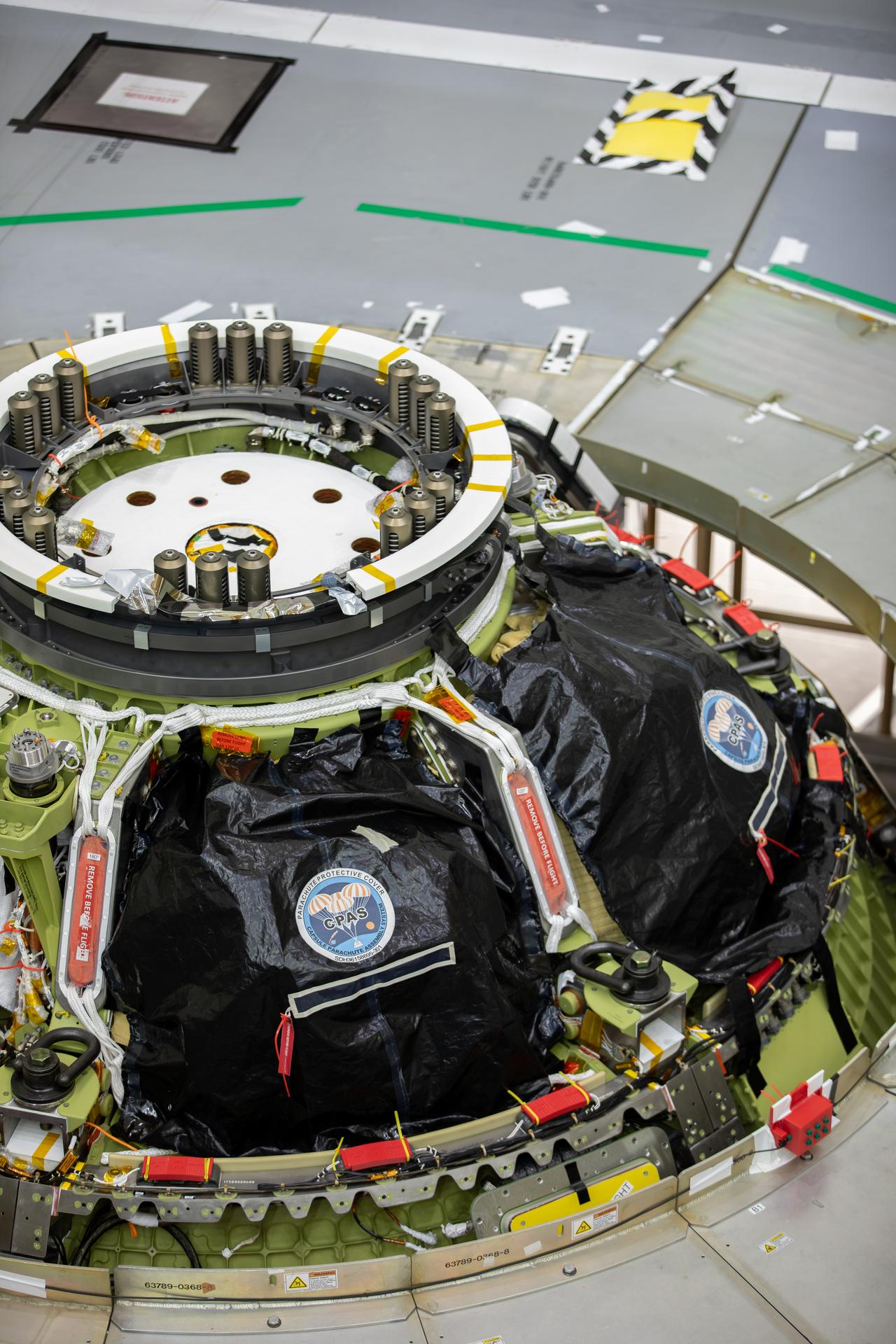
A photographer captures the top of the Artemis III Orion crew module and its parachutes after integration with the European Service Module on Friday, July 31, 2026, inside the Neil A. Armstrong Operations and Checkout Building at NASA’s Kennedy Space Center in Florida. Now integrated, the team will power up the combined crew and service module for the first time then begin altitude chamber testing, which will put the spacecraft through conditions as close as possible to the environment it will experience in low Earth orbit. Artemis III and the four-person crew will carry out a series of objectives in low Earth orbit designed to demonstrate critical systems needed for future lunar landings, beginning with Artemis IV.
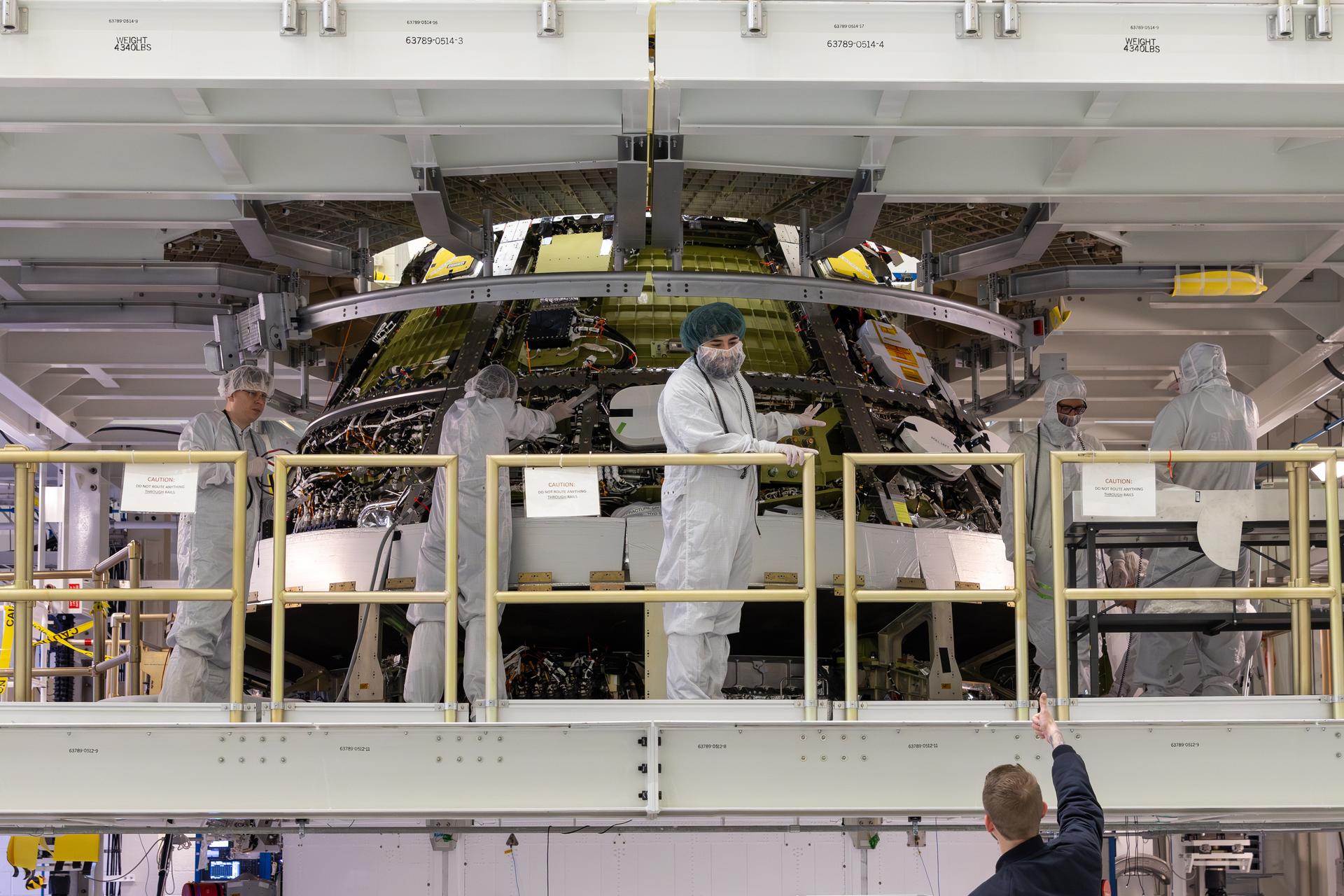
Engineers finish connecting the Artemis III Orion crew and service modules on Friday, July 31, 2026, inside the Neil A. Armstrong Operations and Checkout Building at NASA’s Kennedy Space Center in Florida. Now integrated, the team will power up the combined crew and service module for the first time then begin altitude chamber testing, which will put the spacecraft through conditions as close as possible to the environment it will experience in low Earth orbit. Artemis III and the four-person crew will carry out a series of objectives in low Earth orbit designed to demonstrate critical systems needed for future lunar landings, beginning with Artemis IV.
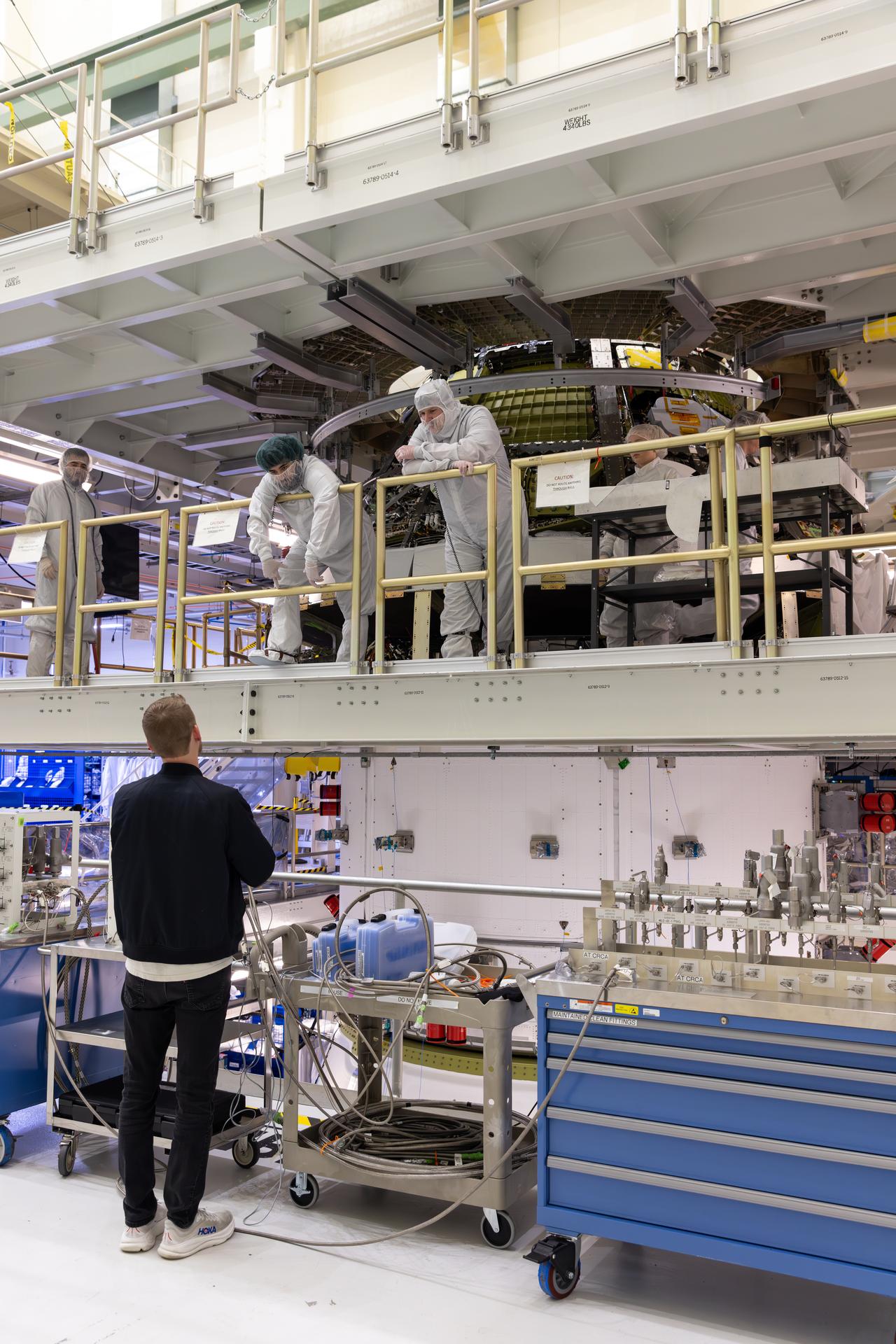
Engineers finish connecting the Artemis III Orion crew and service modules on Friday, July 31, 2026, inside the Neil A. Armstrong Operations and Checkout Building at NASA’s Kennedy Space Center in Florida. Now integrated, the team will power up the combined crew and service module for the first time then begin altitude chamber testing, which will put the spacecraft through conditions as close as possible to the environment it will experience in low Earth orbit. Artemis III and the four-person crew will carry out a series of objectives in low Earth orbit designed to demonstrate critical systems needed for future lunar landings, beginning with Artemis IV.

An Artemis launch team member participates in the Artemis III terminal countdown simulation on Thursday, May 7, 2026, inside Firing Room 1 of the Rocco A. Petrone Launch Control Center at NASA’s Kennedy Space Center in Florida. This marked the first simulation the launch team performed ahead of Artemis III.

An Artemis launch team member participates in the Artemis III terminal countdown simulation on Thursday, May 7, 2026, inside Firing Room 1 of the Rocco A. Petrone Launch Control Center at NASA’s Kennedy Space Center in Florida. This marked the first simulation the launch team performed ahead of Artemis III.

An Artemis launch team member participates in the Artemis III terminal countdown simulation on Thursday, May 7, 2026, inside Firing Room 1 of the Rocco A. Petrone Launch Control Center at NASA’s Kennedy Space Center in Florida. This marked the first simulation the launch team performed ahead of Artemis III.

An Artemis launch team member participates in the Artemis III terminal countdown simulation on Thursday, May 7, 2026, inside Firing Room 1 of the Rocco A. Petrone Launch Control Center at NASA’s Kennedy Space Center in Florida. This marked the first simulation the launch team performed ahead of Artemis III.
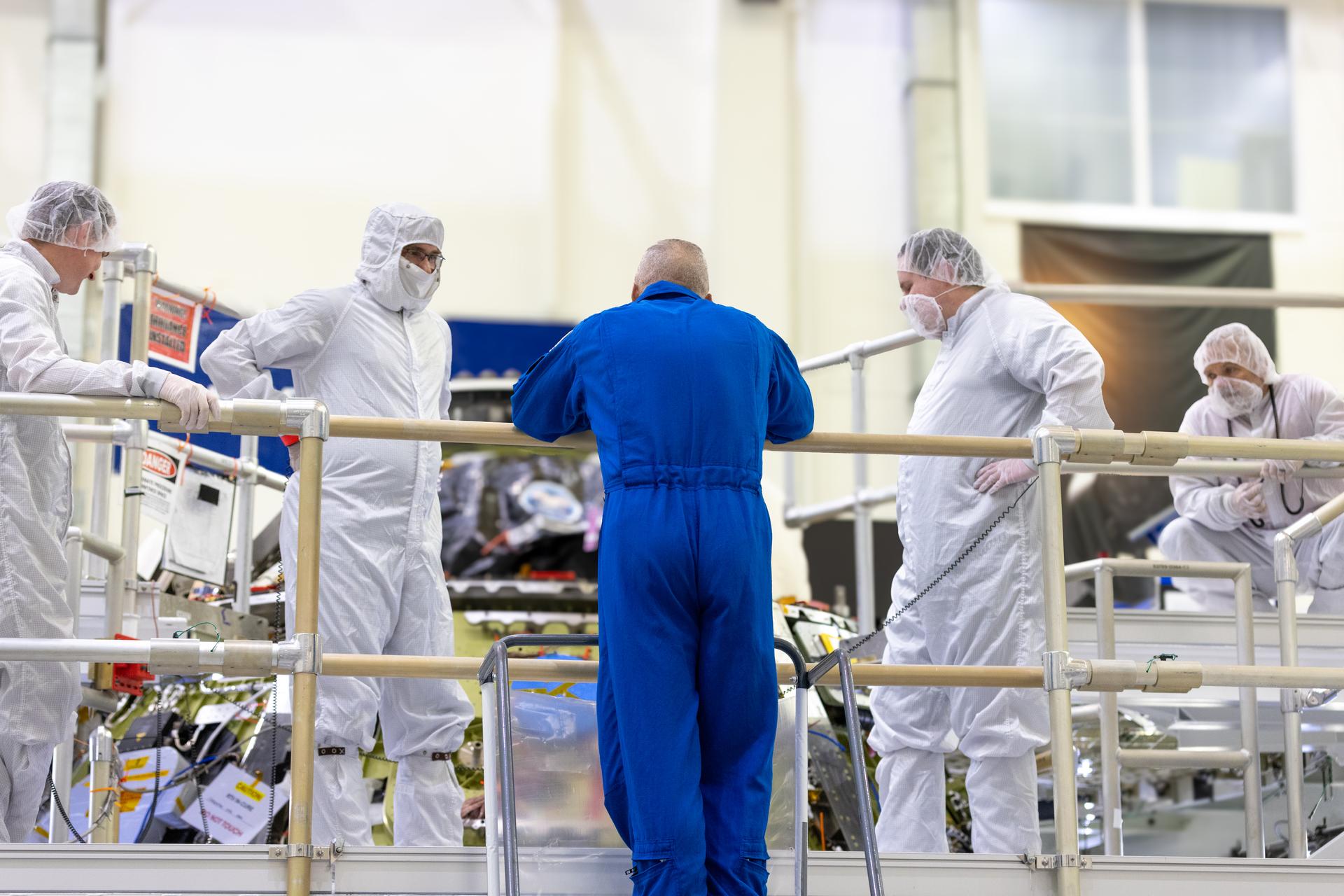
Artemis III commander, NASA astronaut Randy Bresnick (center), speaks with members of NASA’s Orion spacecraft team in front of the Artemis III crew module inside the high bay of the Neil A. Armstrong Operations and Checkout Building at NASA’s Kennedy Space Center in Florida on Friday, July 10, 2026. Bresnick and fellow Artemis III crew member, NASA astronaut Andre Douglas, met with Orion teams and got a close look at the work underway for their upcoming mission. Bresnick, Douglas, NASA astronaut Frank Rubio, and ESA (European Space Agency) astronaut Luca Parmitano will launch on the Artemis III mission to conduct critical rendezvous and docking tests with lunar lander systems in low Earth orbit, advancing the capabilities needed before astronauts return to the lunar surface on Artemis IV.
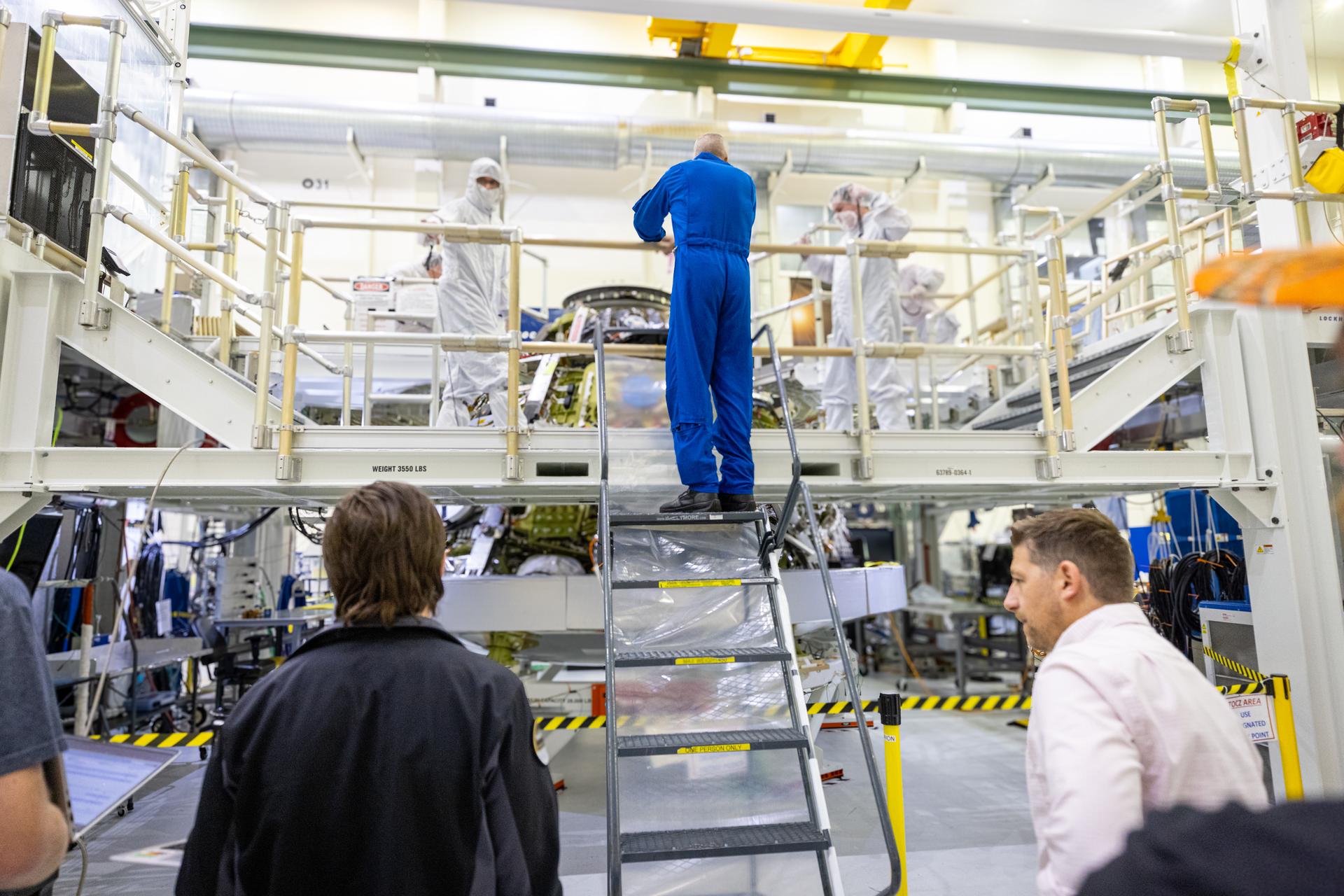
Artemis III commander, NASA astronaut Randy Bresnick (center), speaks with members of NASA’s Orion spacecraft team in front of the Artemis III crew module inside the high bay of the Neil A. Armstrong Operations and Checkout Building at NASA’s Kennedy Space Center in Florida on Friday, July 10, 2026. Bresnick and fellow Artemis III crew member, NASA astronaut Andre Douglas, met with Orion teams and got a close look at the work underway for their upcoming mission. Bresnick, Douglas, NASA astronaut Frank Rubio, and ESA (European Space Agency) astronaut Luca Parmitano will launch on the Artemis III mission to conduct critical rendezvous and docking tests with lunar lander systems in low Earth orbit, advancing the capabilities needed before astronauts return to the lunar surface on Artemis IV.

Maria Zapata, test conductor, participates in the Artemis III terminal countdown simulation on Thursday, May 7, 2026, inside Firing Room 1 of the Rocco A. Petrone Launch Control Center at NASA’s Kennedy Space Center in Florida. This marked the first simulation the launch team performed ahead of Artemis III.

Sierra Sewdass, test conductor, participates in the Artemis III terminal countdown simulation on Thursday, May 7, 2026, inside Firing Room 1 of the Rocco A. Petrone Launch Control Center at NASA’s Kennedy Space Center in Florida. This marked the first simulation the launch team performed ahead of Artemis III.

Maria Zapata, test conductor, participates in the Artemis III terminal countdown simulation on Thursday, May 7, 2026, inside Firing Room 1 of the Rocco A. Petrone Launch Control Center at NASA’s Kennedy Space Center in Florida. This marked the first simulation the launch team performed ahead of Artemis III.

The Orion spacecraft for NASA’s crewed Artemis II (right), Artemis III (left), and Artemis IV (center) missions are stationed next to each other inside the high bay of the Neil Armstrong Operations and Checkout Building at NASA’s Kennedy Space Center in Florida on June 22, 2023. Each capsule is in a different stage of production as technicians and engineers prepare the spacecraft to carry astronauts to and around the Moon on their upcoming flights.
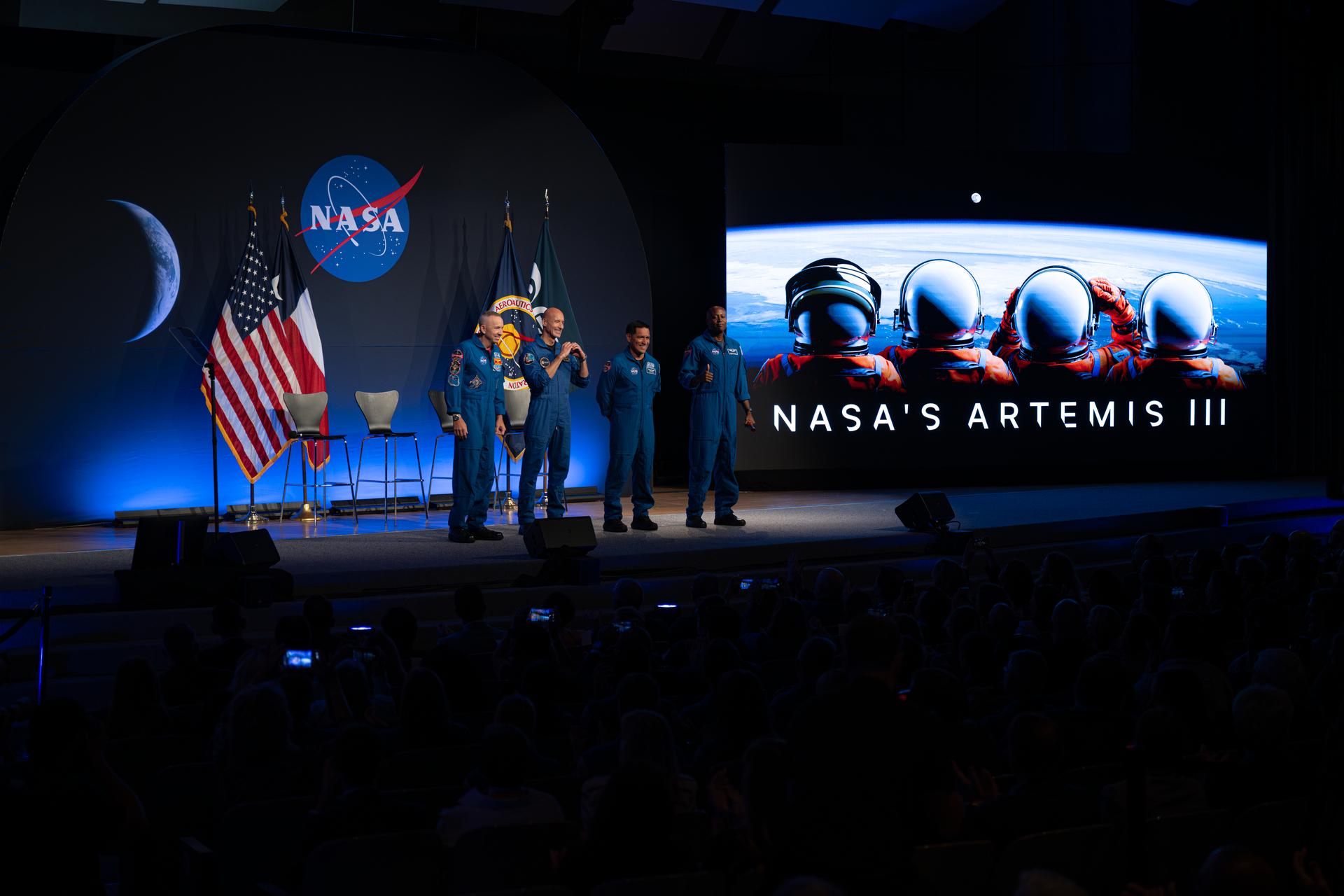
Artemis III crew members NASA astronaut Randy Bresnik, commander; ESA (European Space Agency) astronaut Luca Parmitano, pilot; and NASA astronauts Frank Rubio, mission specialist, and Andre Douglas, mission specialist, are seen during the Artemis III crew announcement event, Tuesday, June 9, 2026, at NASA’s Johnson Space Center in Houston, Texas. Photo Credit: (NASA/John Kraus)
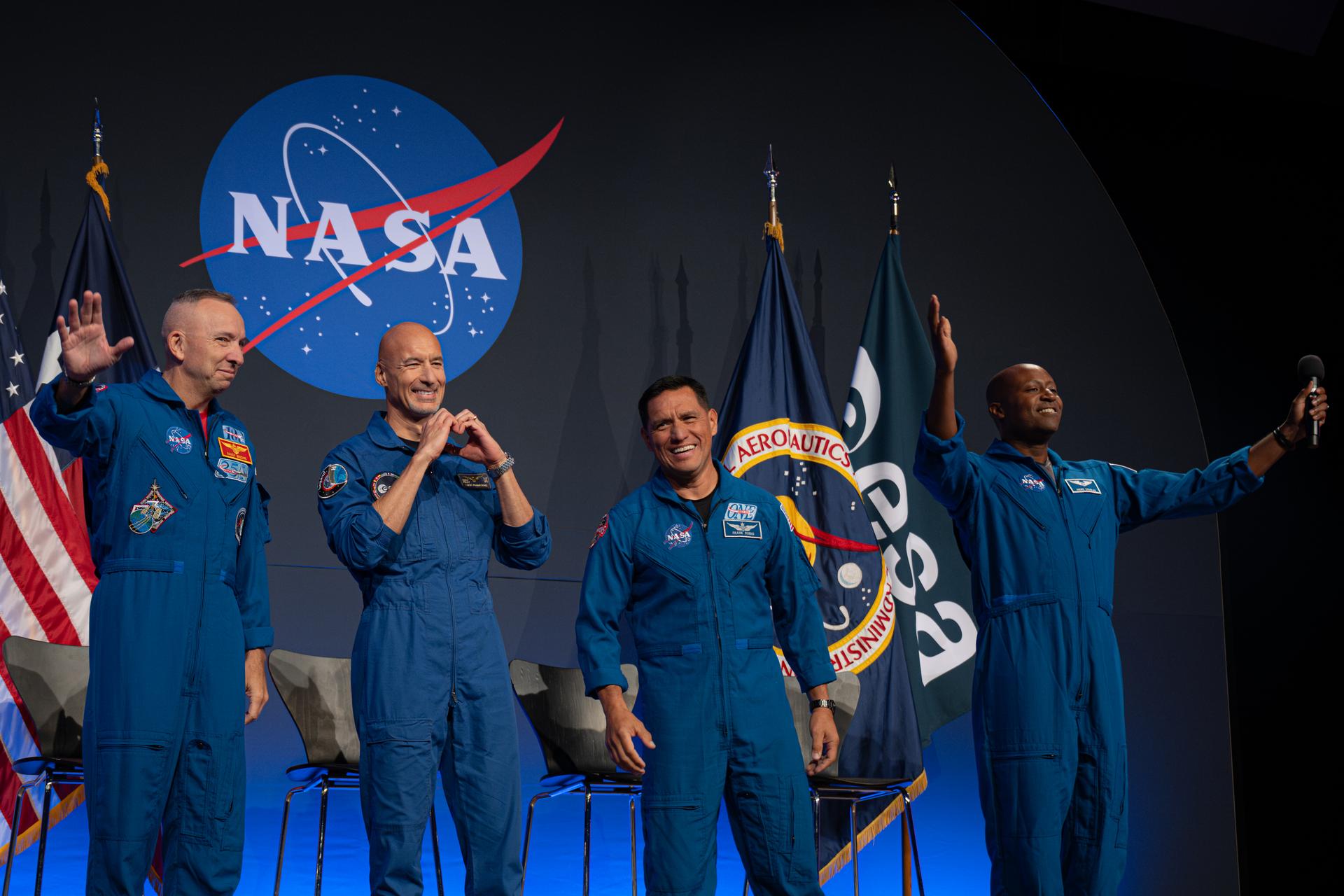
Artemis III crew members NASA astronaut Randy Bresnik, commander; ESA (European Space Agency) astronaut Luca Parmitano, pilot; and NASA astronauts Frank Rubio, mission specialist, and Andre Douglas, mission specialist, are seen during the Artemis III crew announcement event, Tuesday, June 9, 2026, at NASA’s Johnson Space Center in Houston, Texas. Photo Credit: (NASA/John Kraus)
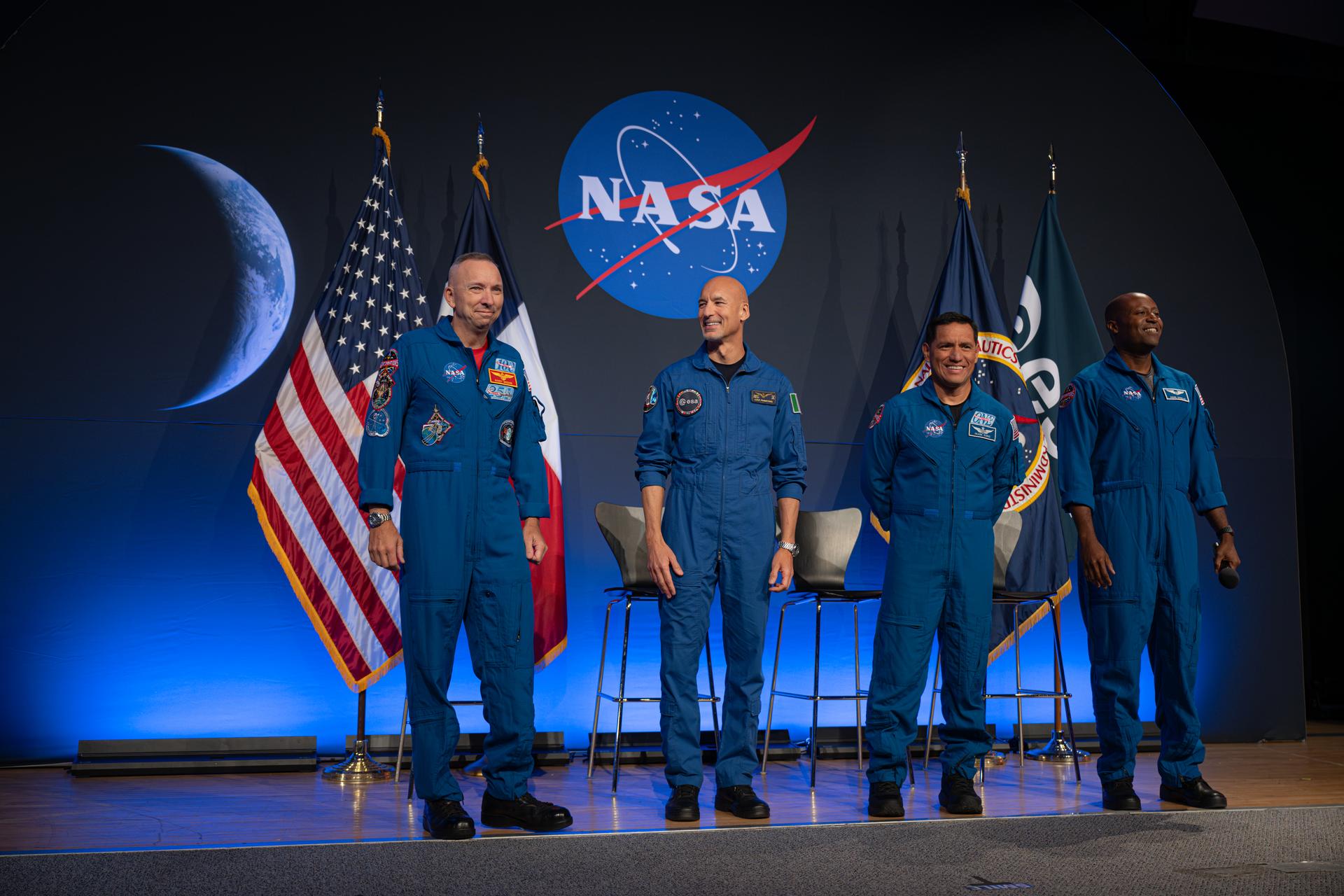
Artemis III crew members NASA astronaut Randy Bresnik, commander; ESA (European Space Agency) astronaut Luca Parmitano, pilot; and NASA astronauts Frank Rubio, mission specialist, and Andre Douglas, mission specialist, are seen during the Artemis III crew announcement event, Tuesday, June 9, 2026, at NASA’s Johnson Space Center in Houston, Texas. Photo Credit: (NASA/John Kraus)
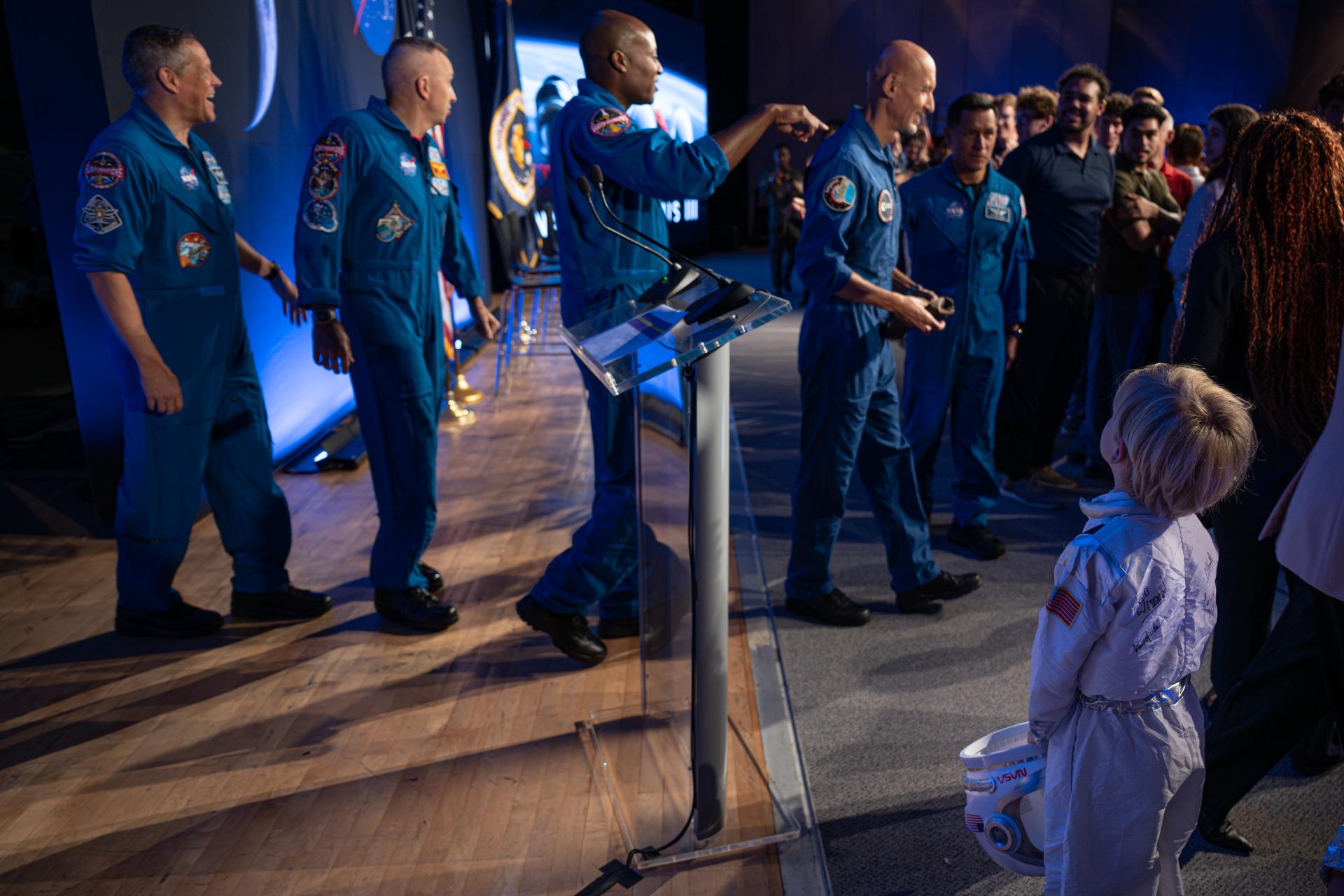
A young space enthusiast dressed as an astronaut watches as Artemis III crew members NASA astronauts Bob Hines, backup crew member; Randy Bresnik, commander; Andre Douglas, mission specialist; ESA (European Space Agency) astronaut Luca Parmitano, pilot; and NASA astronaut Frank Rubio, mission specialist, appear on stage following the Artemis III crew announcement event, Tuesday, June 9, 2026, at NASA’s Johnson Space Center in Houston, Texas. Photo Credit: (NASA/John Kraus)
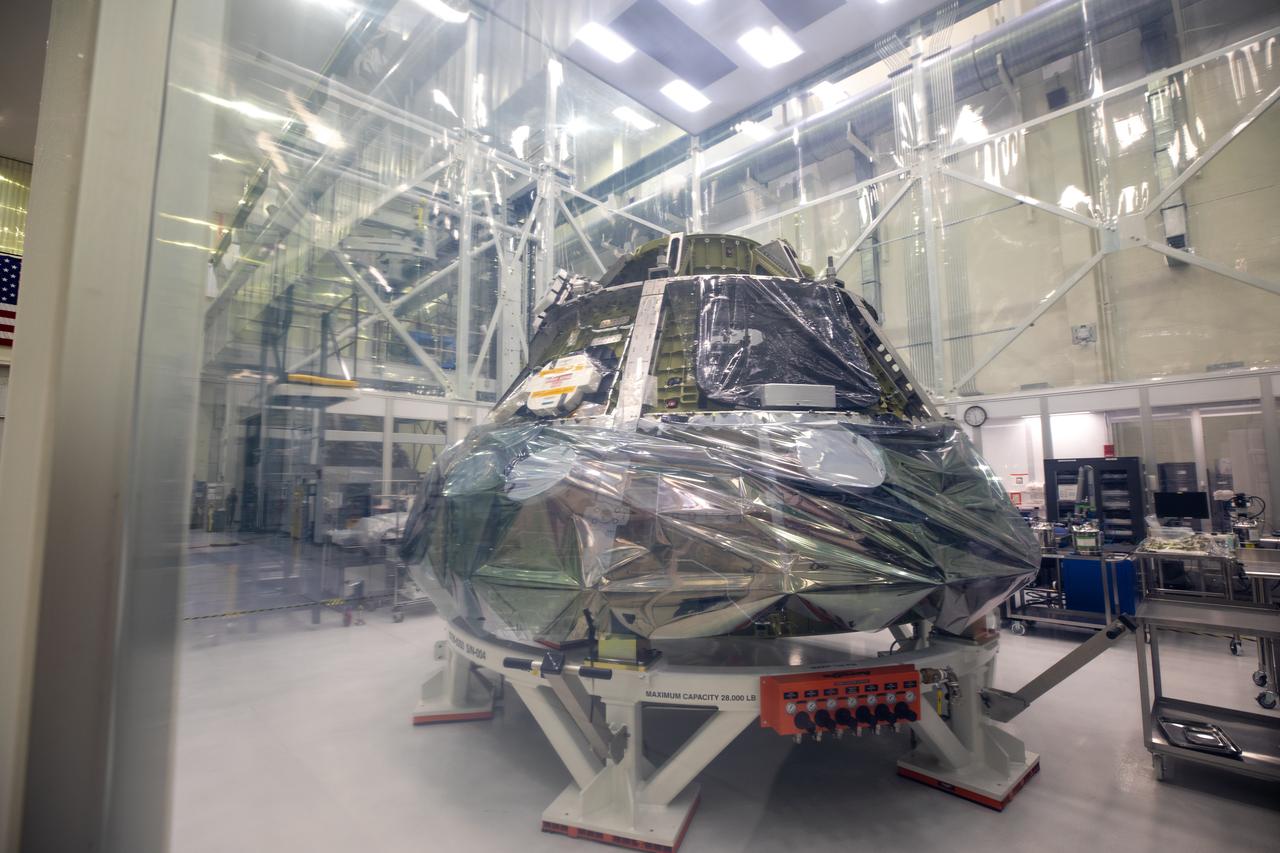
The Orion spacecraft for the Artemis III mission is in view inside a clean room in the high bay of the Neil Armstrong Operations and Checkout Building at NASA’s Kennedy Space Center in Florida on June 22, 2023. The Orion spacecraft is being prepared for its launch atop the Space Launch System rocket on Artemis III, which will send astronauts, including the first woman and first person of color, on a mission to the surface of the Moon.
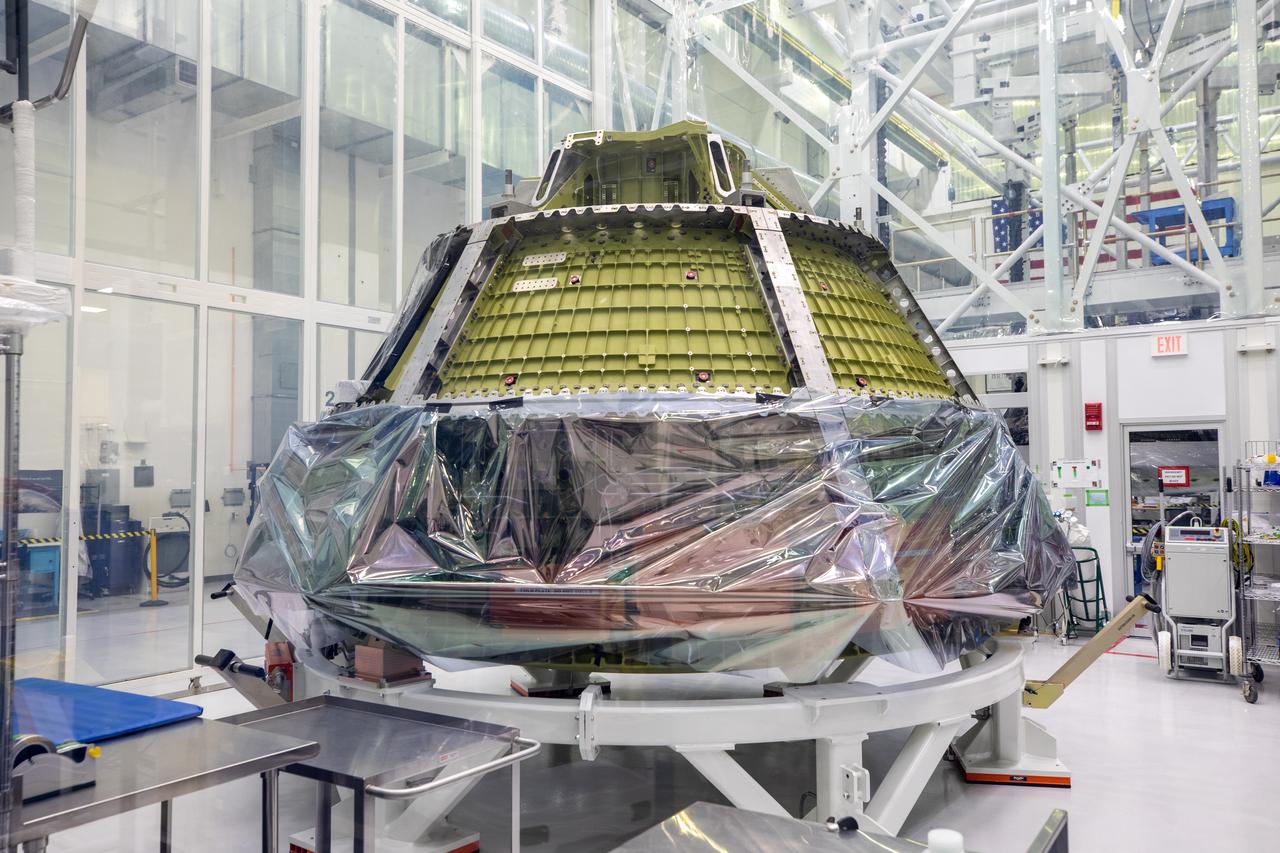
A protective wrapping is being removed from the Orion spacecraft for the Artemis III mission inside a clean room in the high bay of the Neil Armstrong Operations and Checkout Building at NASA’s Kennedy Space Center in Florida on June 22, 2023. The Orion spacecraft is being prepared for its launch atop the Space Launch System rocket on Artemis III, which will send astronauts, including the first woman and first person of color, on a mission to the surface of the Moon.

The Orion spacecraft for the Artemis III mission is in view in the high bay of the Neil Armstrong Operations and Checkout Building at NASA’s Kennedy Space Center in Florida on June 22, 2023. The Orion spacecraft is being prepared for its launch atop the Space Launch System rocket on Artemis III, which will send astronauts, including the first woman and first person of color, on a mission to the surface of the Moon.

The Artemis III Orion service module in work inside the Operations and Checkout Building at NASA's Kennedy Space Center in Florida on March 5, 2025.

Technicians work on the Artemis III Orion crew module inside the Operations and Checkout Building at NASA's Kennedy Space Center in Florida on March 5, 2025.
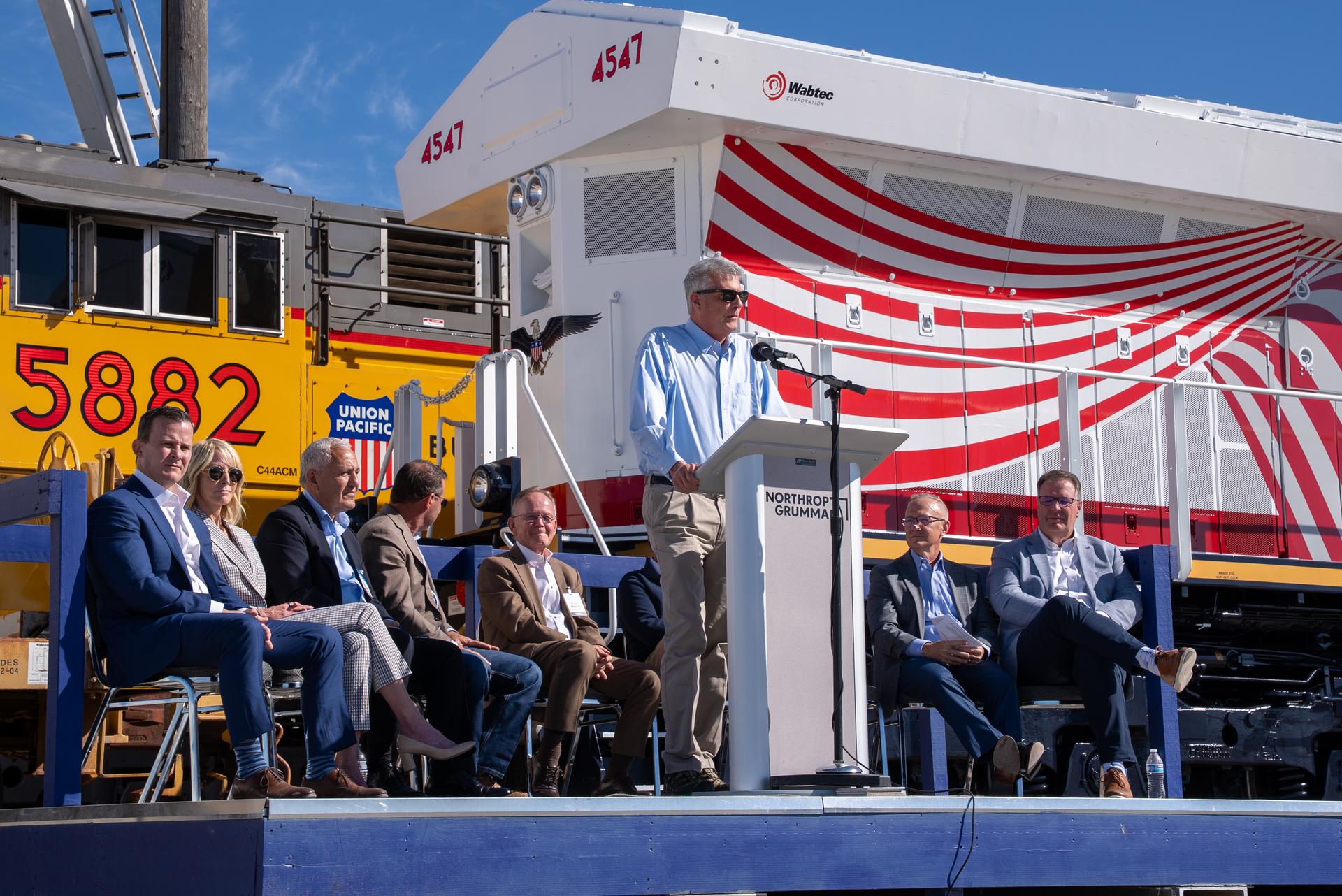
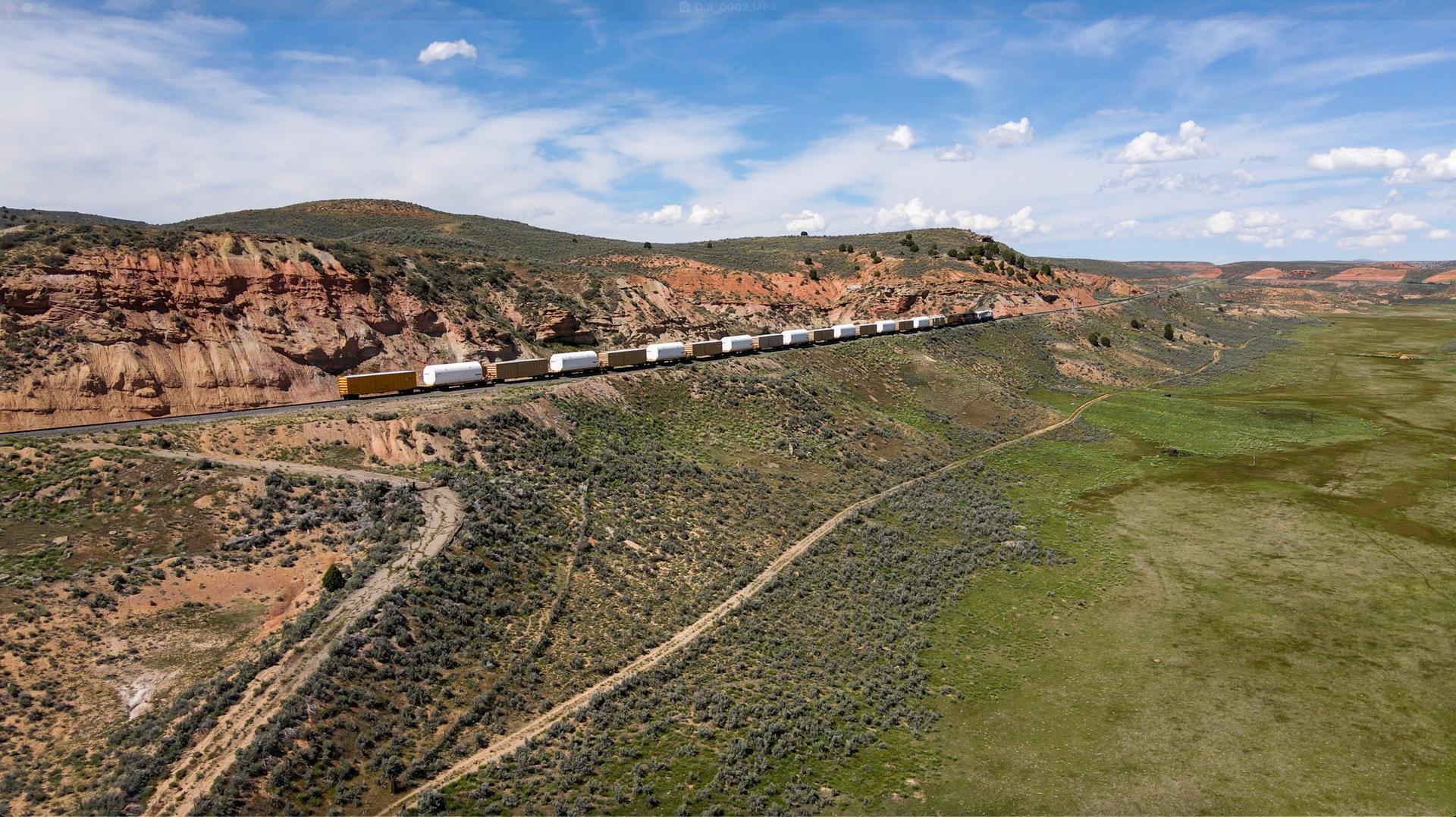
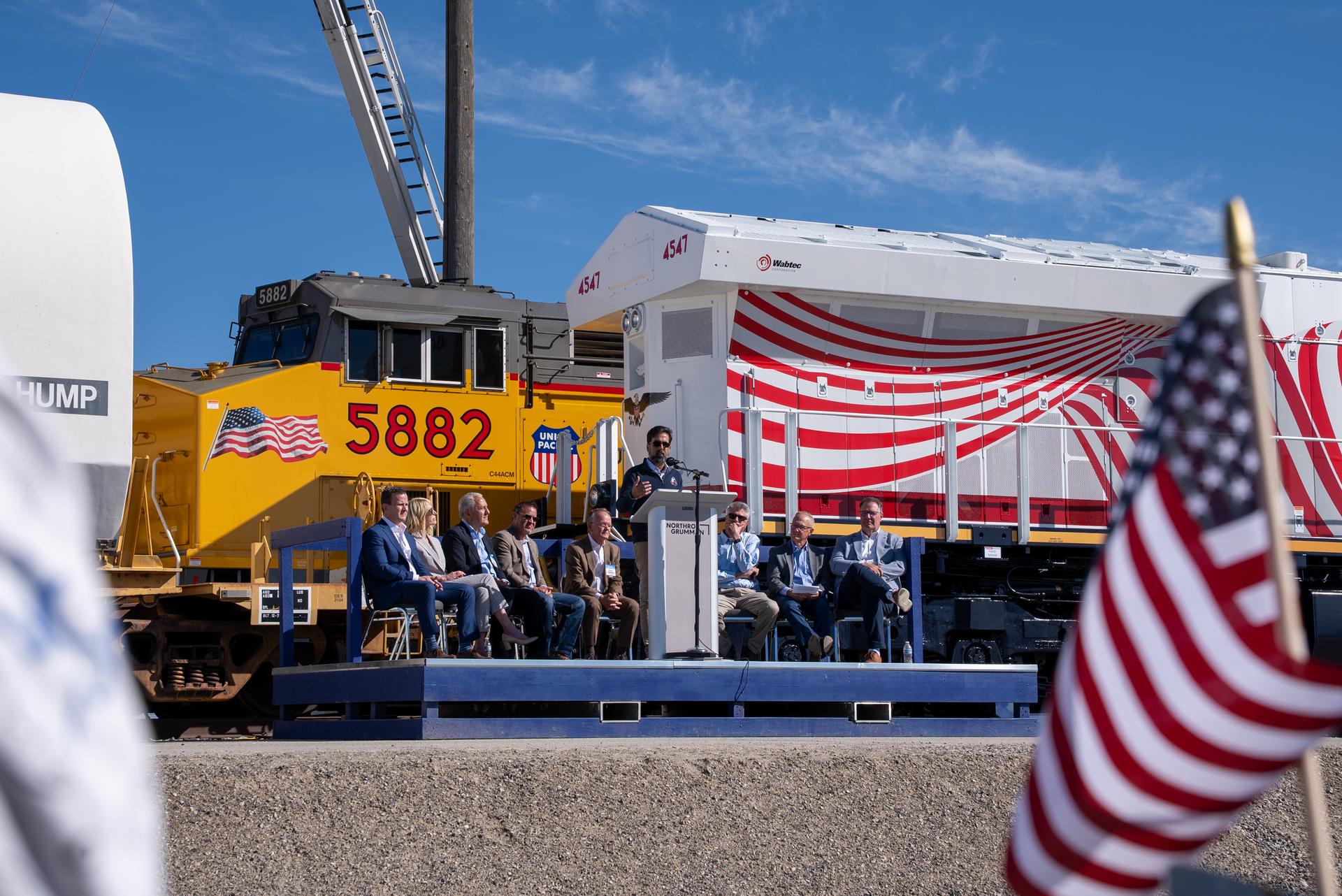
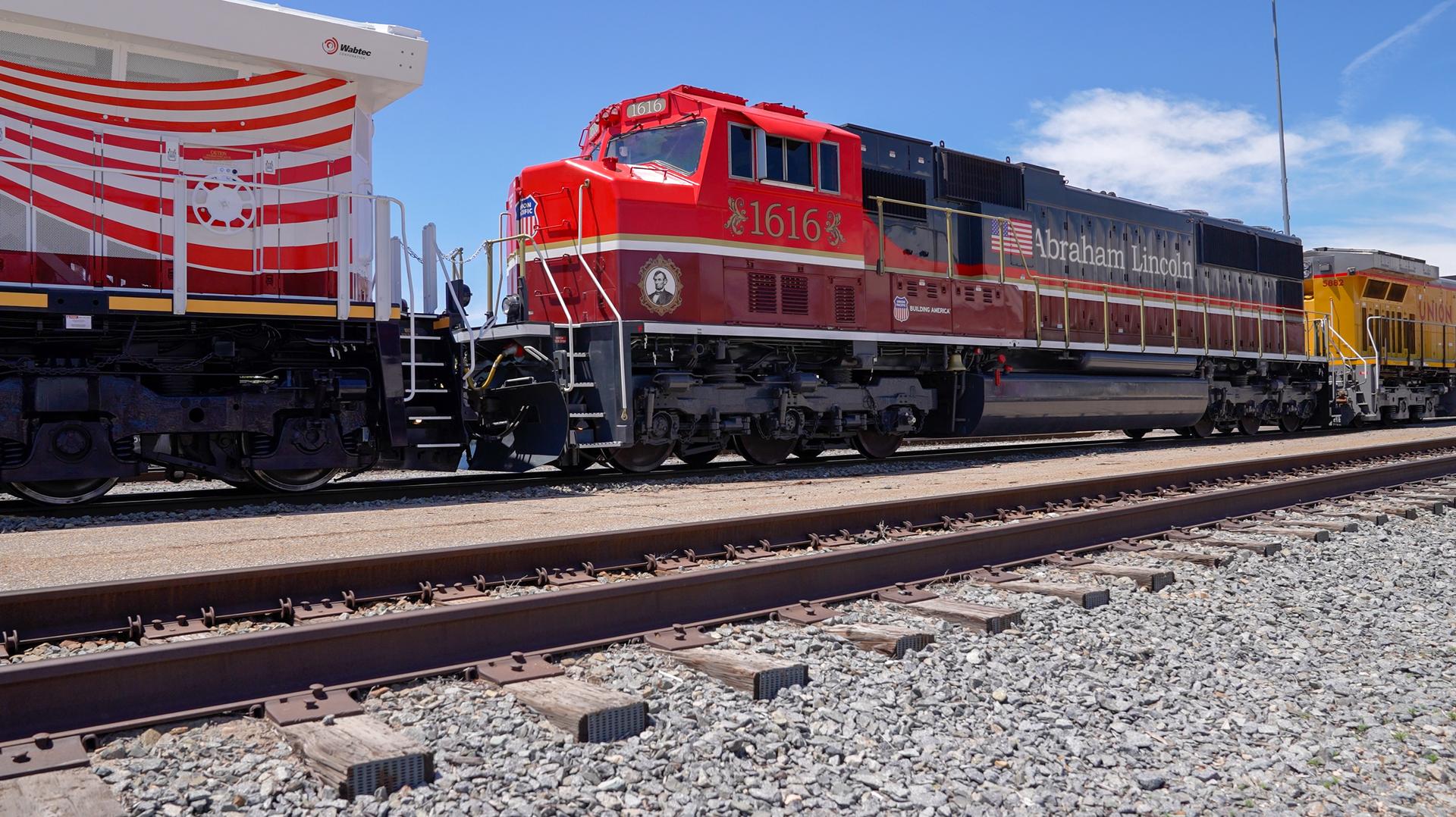
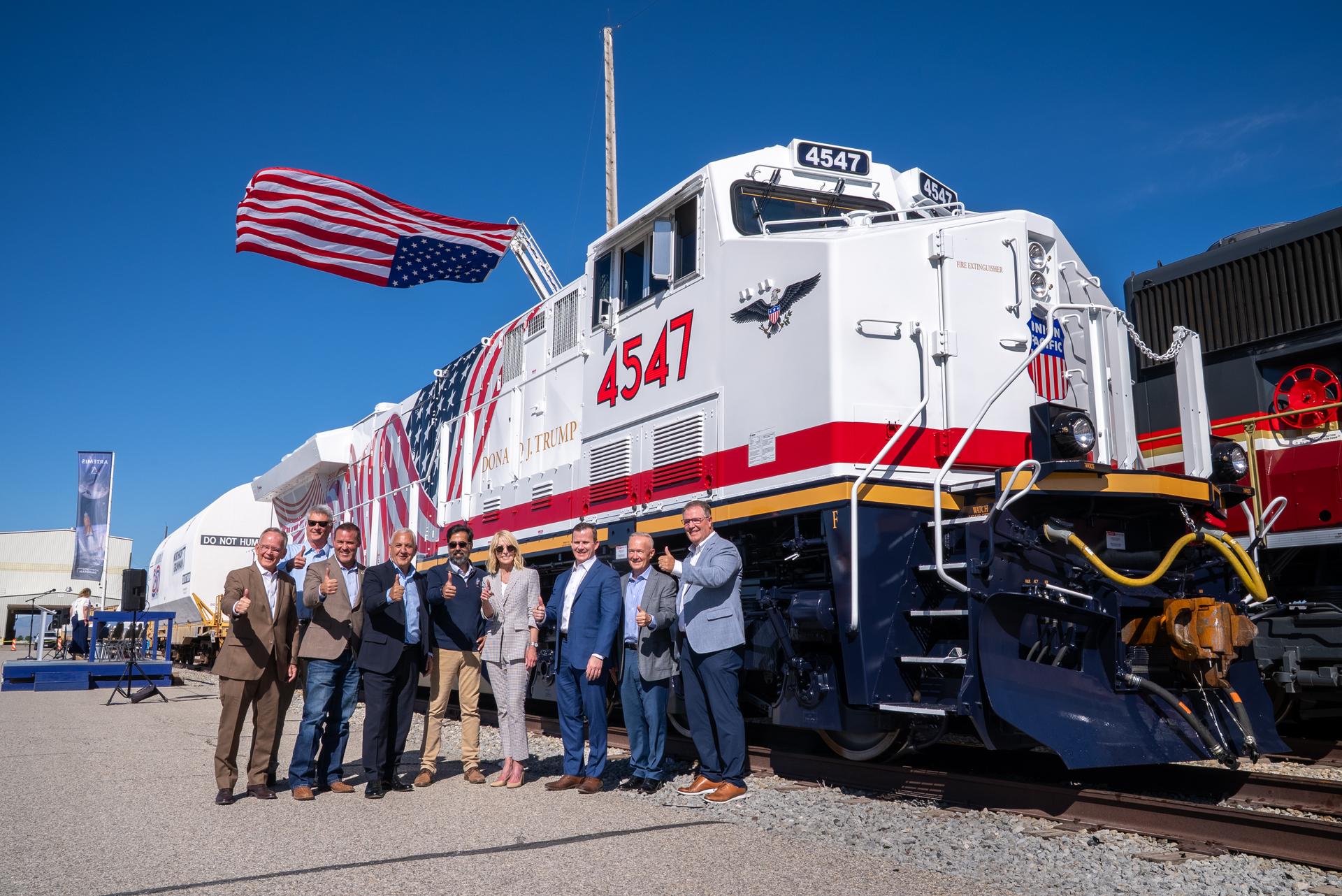
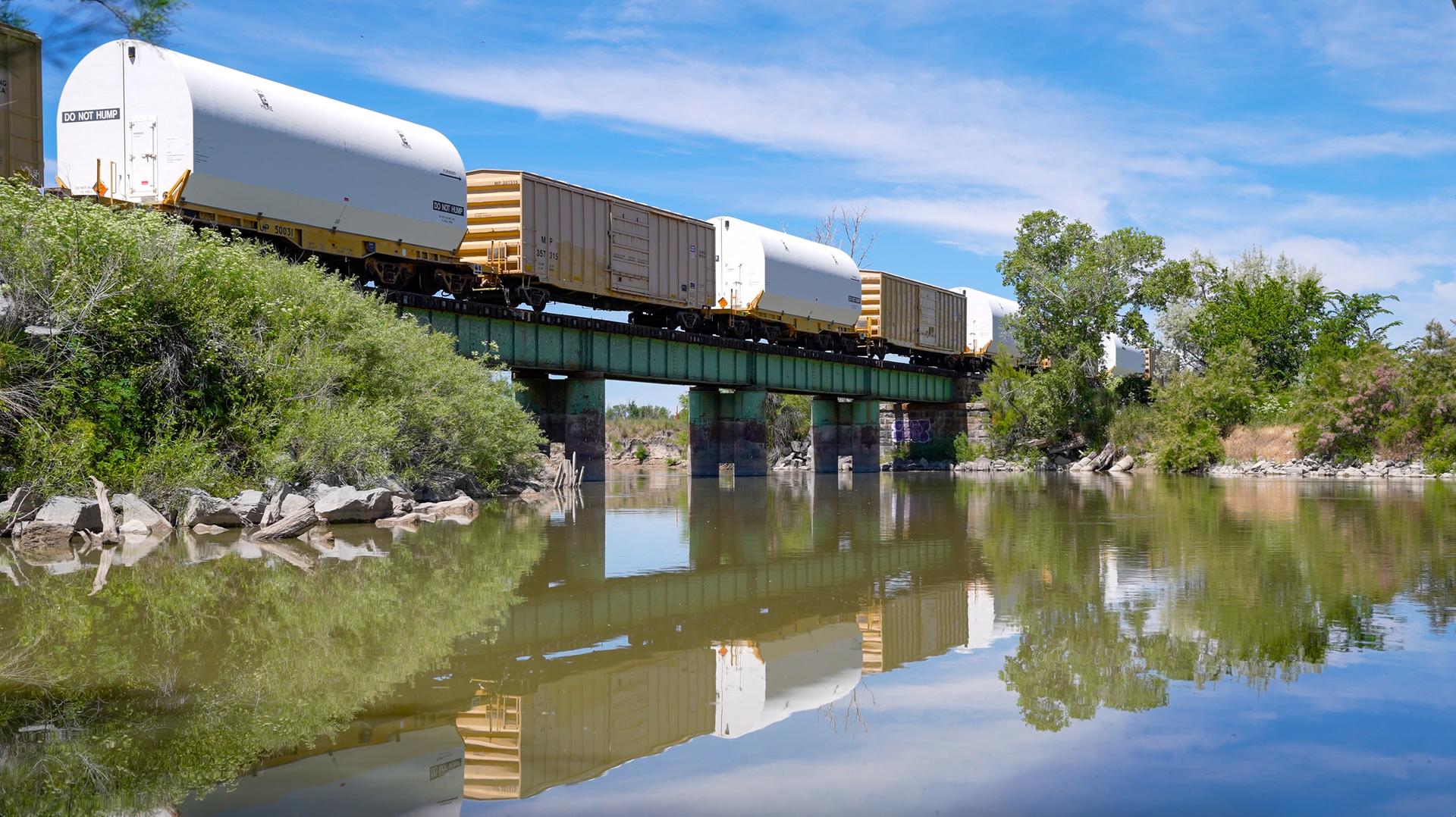
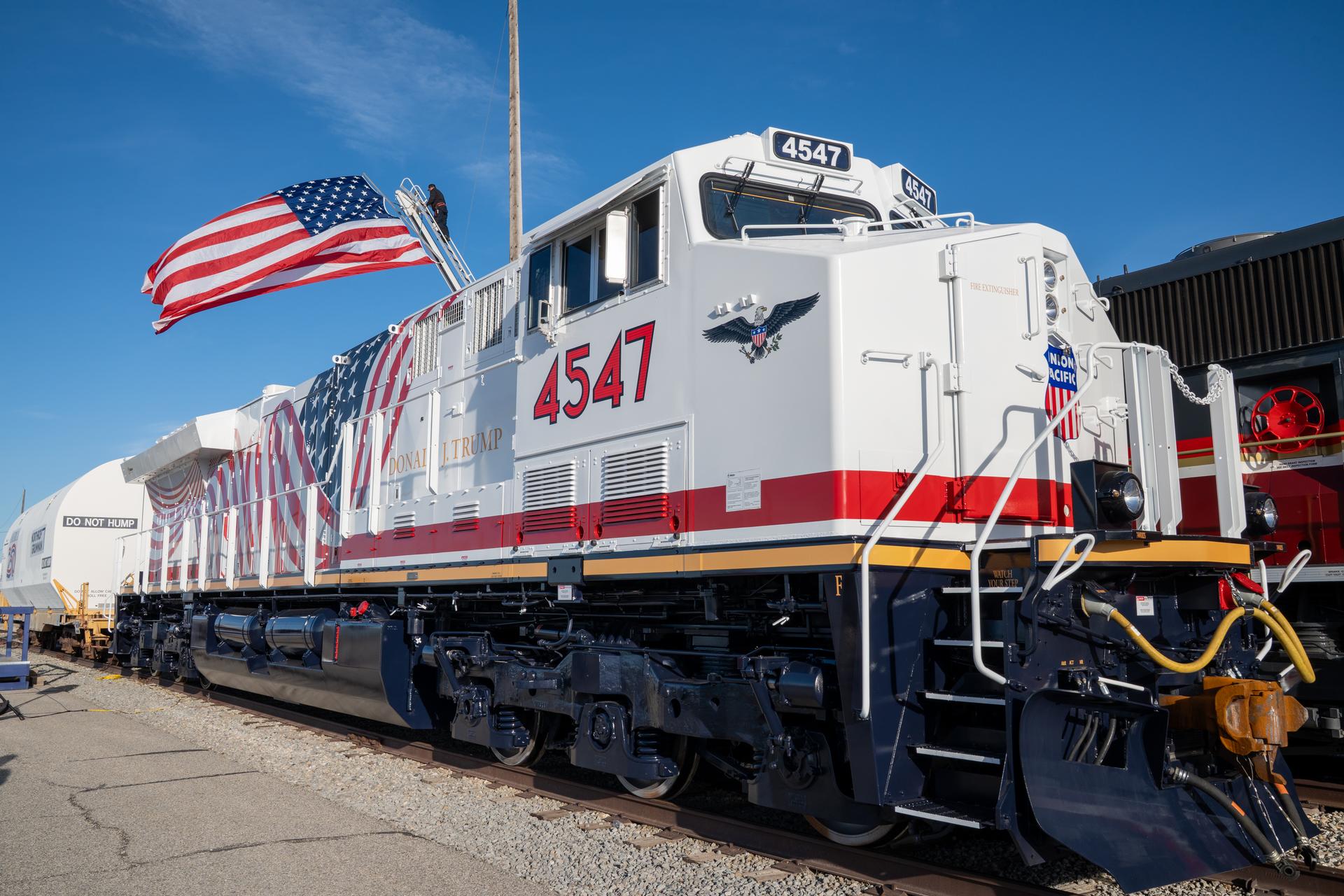
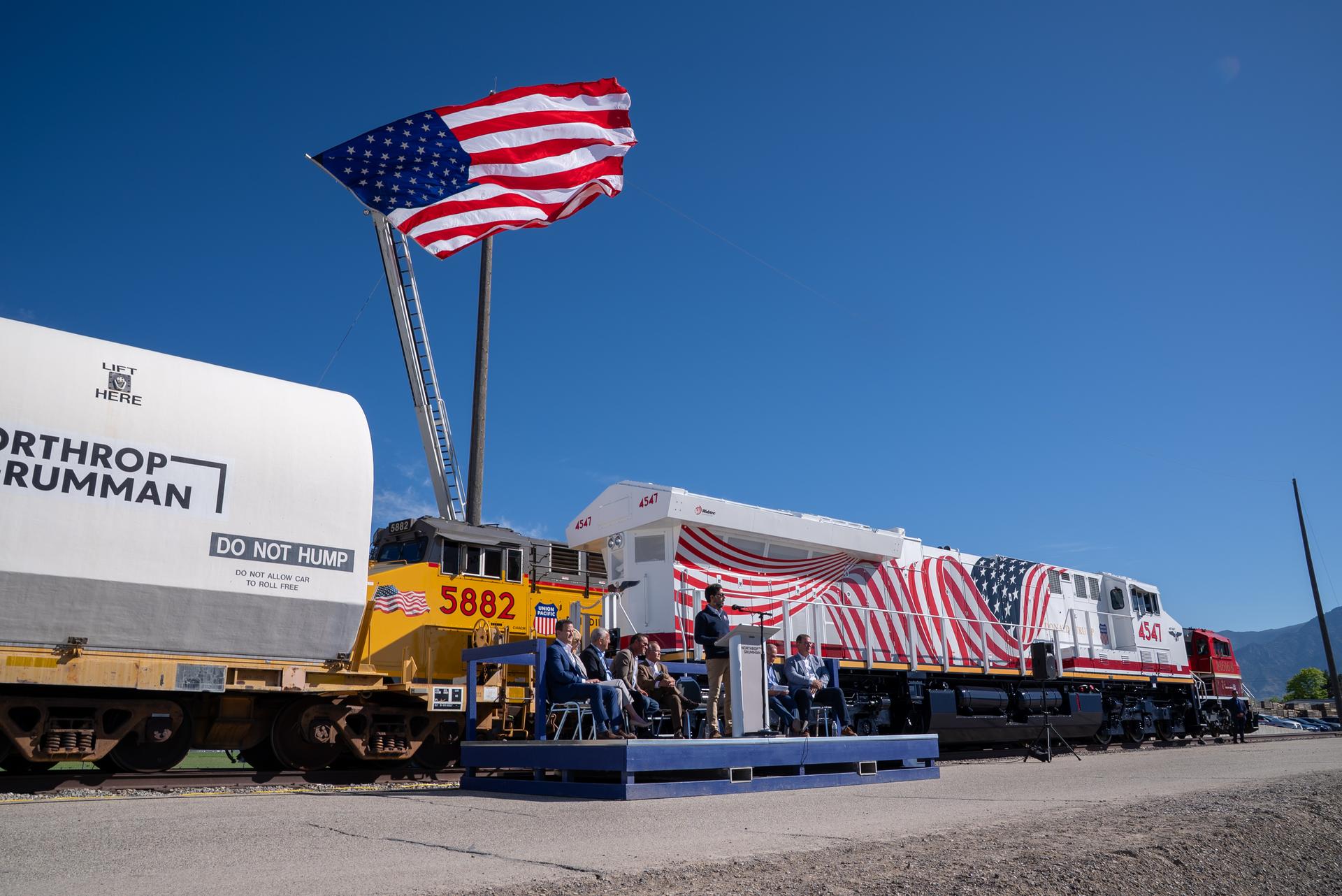
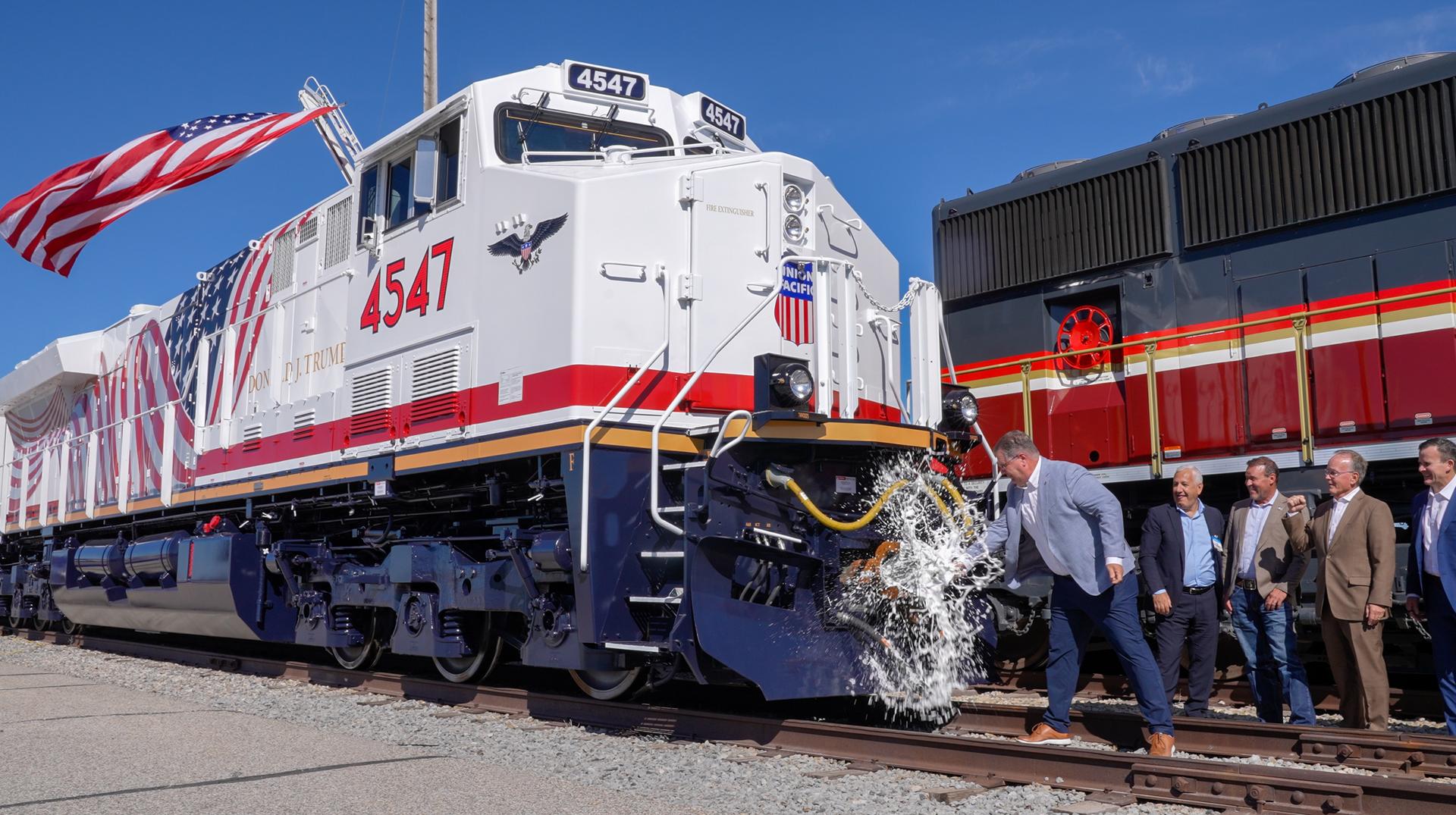
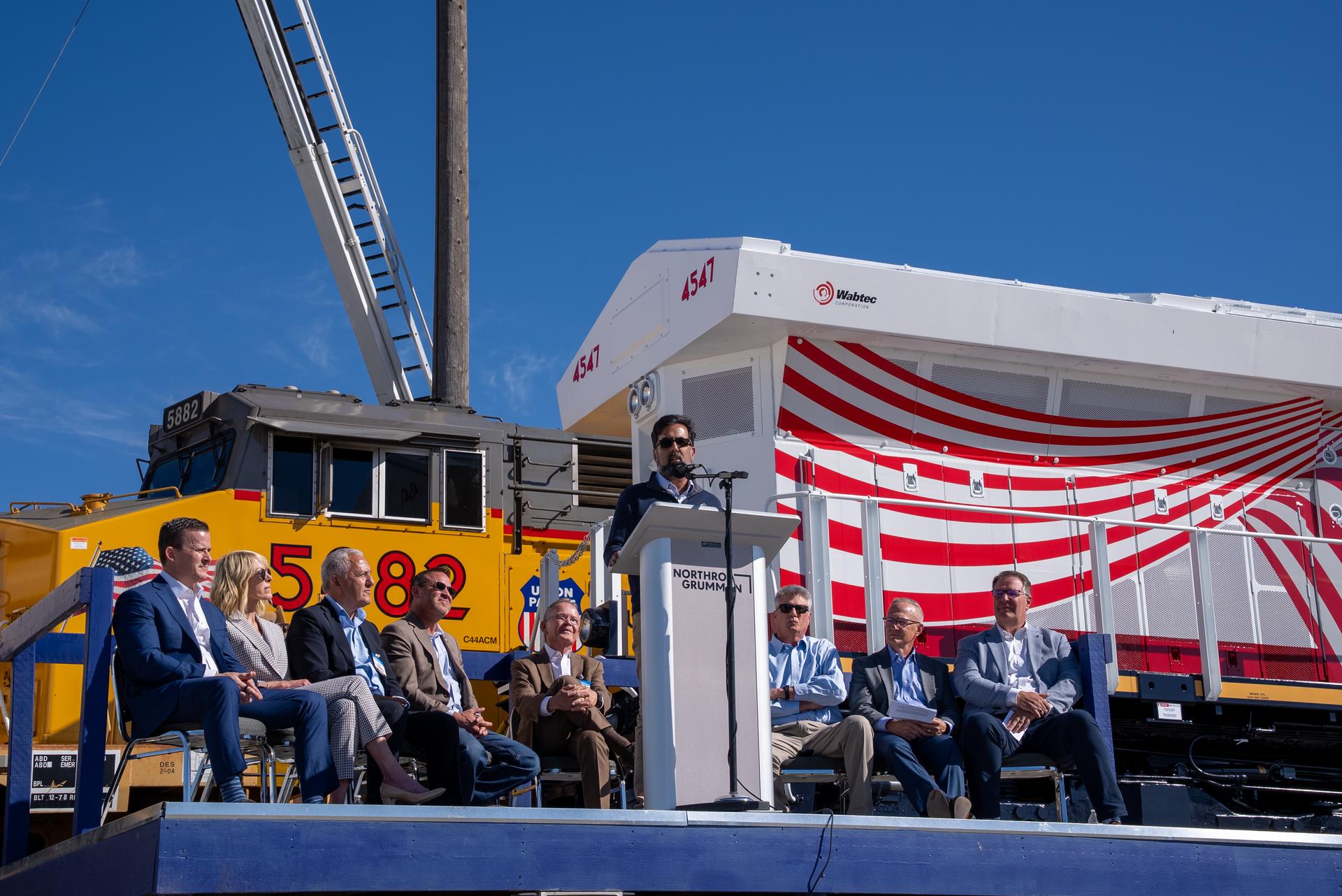
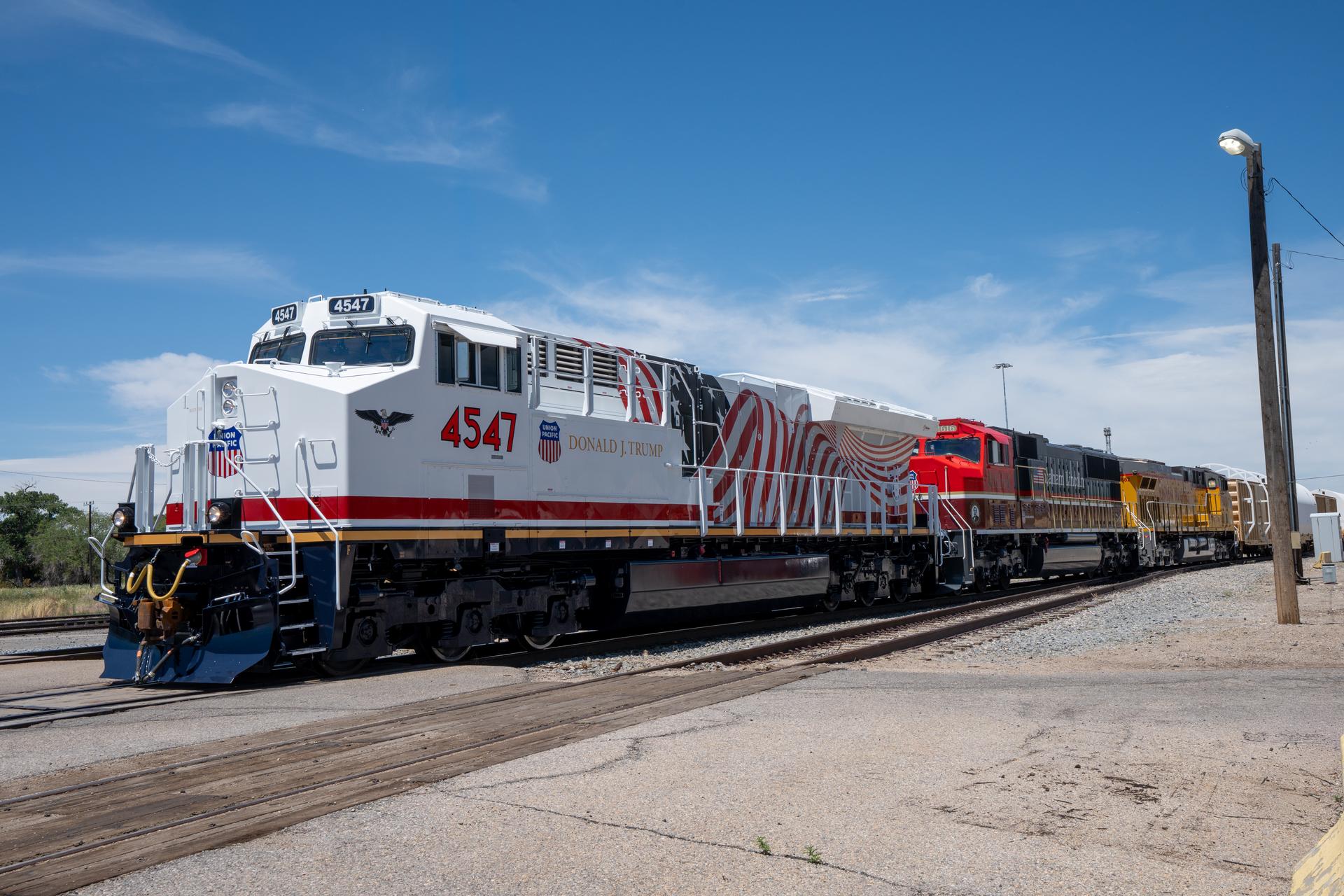
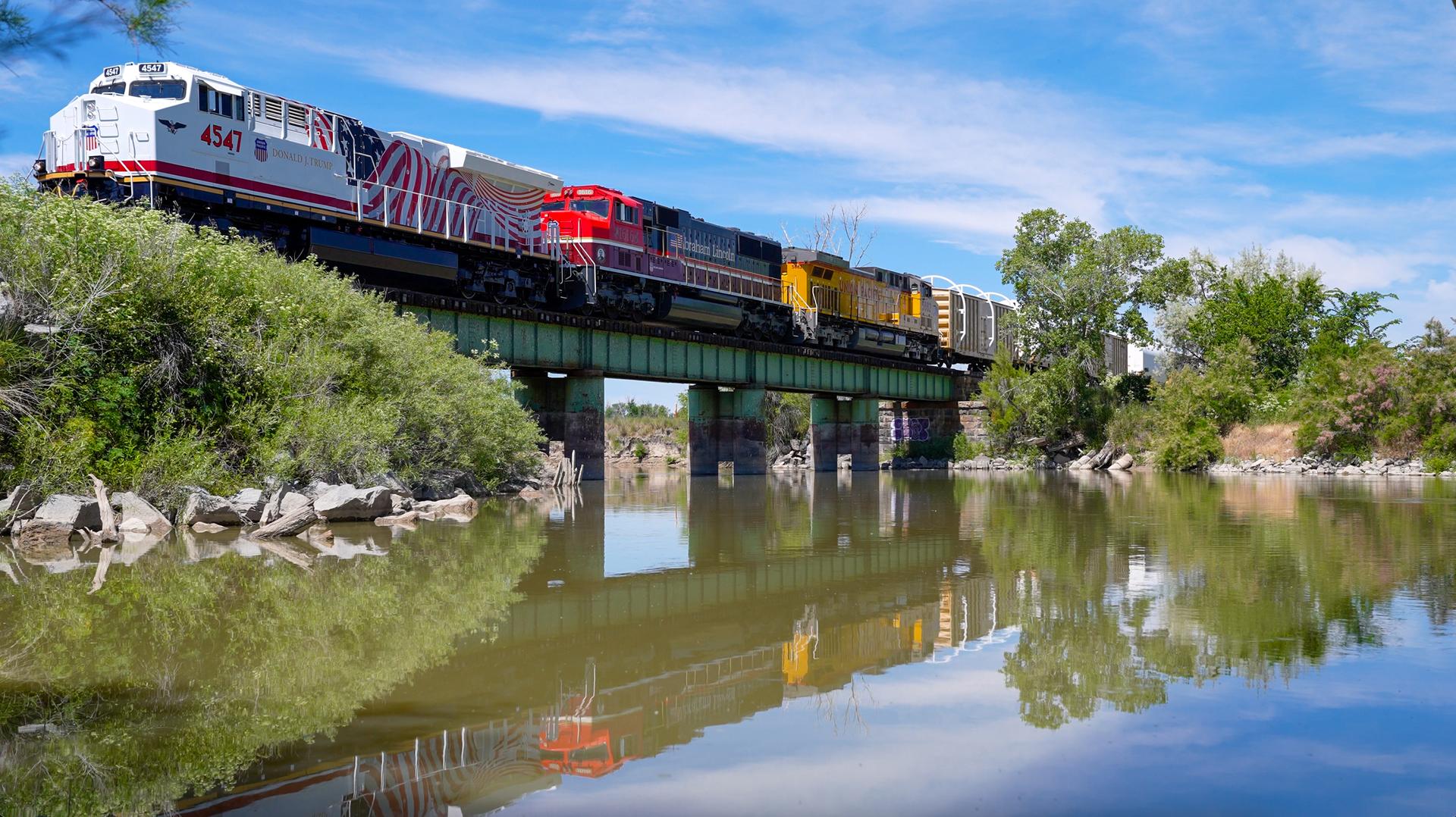
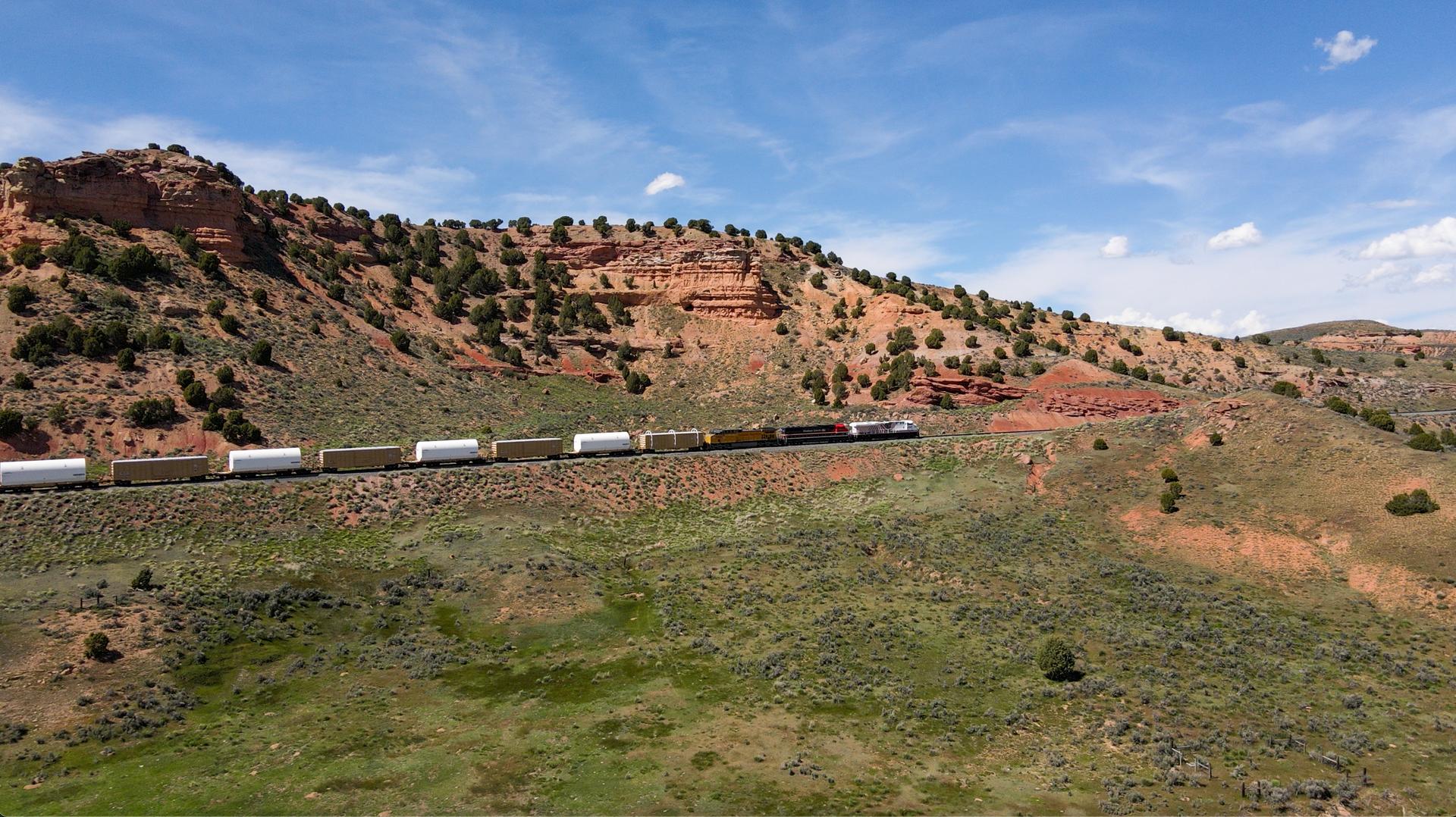
These images capture the final booster motor segments for NASA’s Artemis III mission departing Northrop Grumman’s Railyard Shipping Facility in Corinne, Utah, June 2. The eight segments will form the twin five-segment solid rocket boosters for the agency’s SLS (Space Launch System) rocket, providing more than 75% of the vehicle’s total thrust at liftoff. Due to their immense size and weight, the booster segments are transported in specialized carriers and are being hauled by Union Pacific Railroad’s newest commemorative locomotive, No. 4547. Marking its inaugural mission, the locomotive will deliver the flight hardware to NASA’s Kennedy Space Center in Florida, where stacking operations for Artemis III are set to begin later this year.
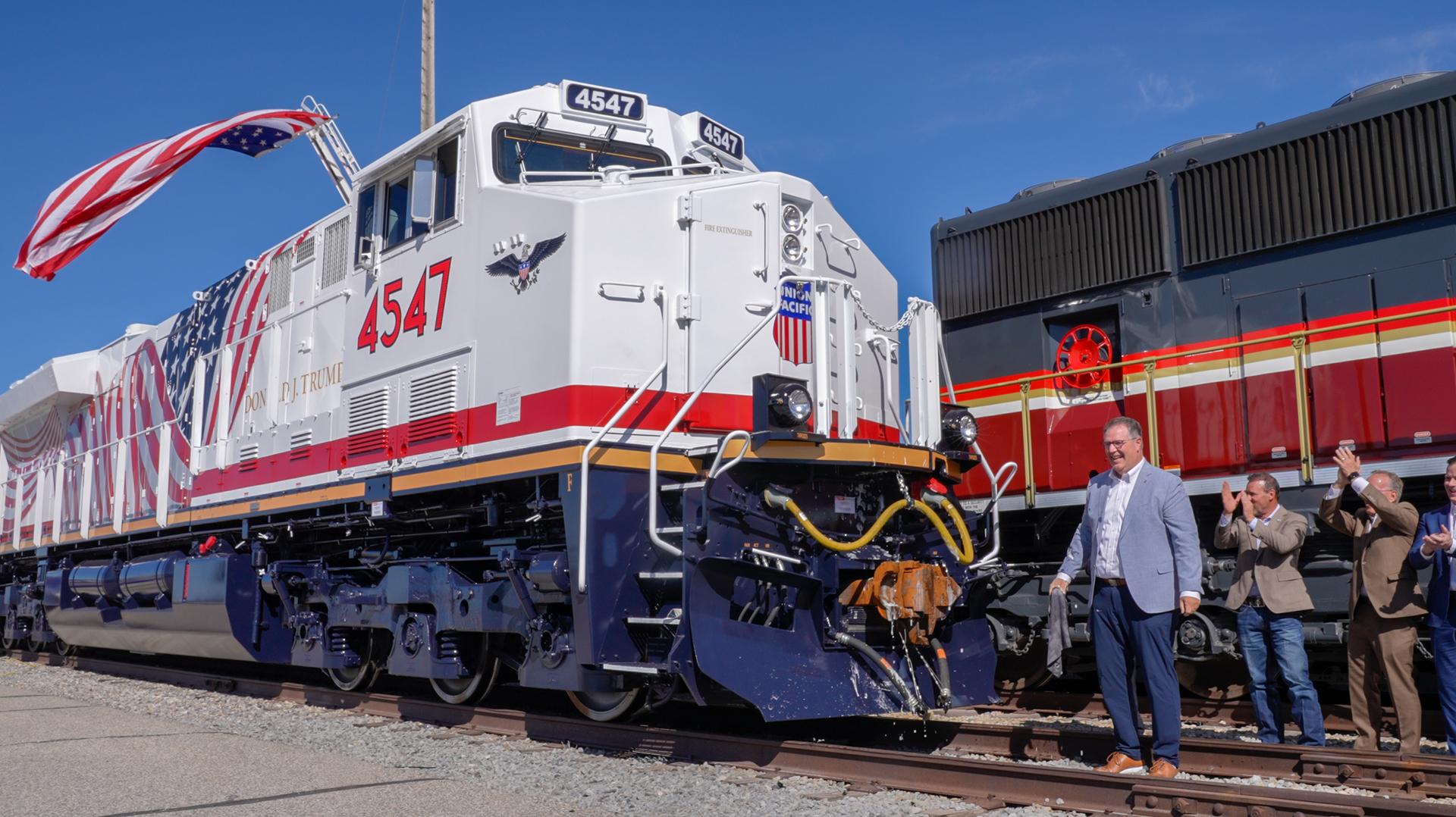
These images capture the final booster motor segments for NASA’s Artemis III mission departing Northrop Grumman’s Railyard Shipping Facility in Corinne, Utah, June 2. The eight segments will form the twin five-segment solid rocket boosters for the agency’s SLS (Space Launch System) rocket, providing more than 75% of the vehicle’s total thrust at liftoff. Due to their immense size and weight, the booster segments are transported in specialized carriers and are being hauled by Union Pacific Railroad’s newest commemorative locomotive, No. 4547. Marking its inaugural mission, the locomotive will deliver the flight hardware to NASA’s Kennedy Space Center in Florida, where stacking operations for Artemis III are set to begin later this year.
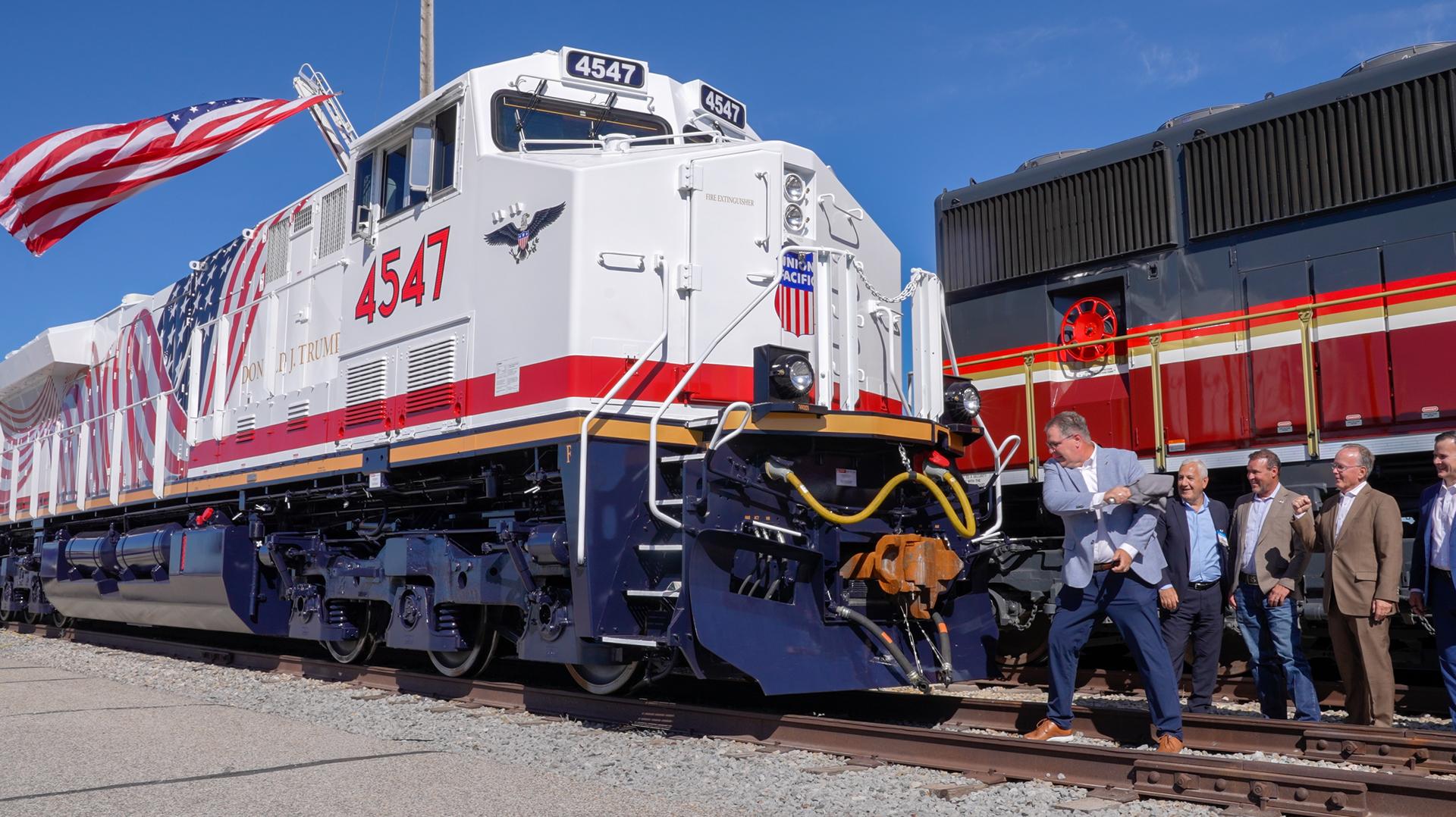
These images capture the final booster motor segments for NASA’s Artemis III mission departing Northrop Grumman’s Railyard Shipping Facility in Corinne, Utah, June 2. The eight segments will form the twin five-segment solid rocket boosters for the agency’s SLS (Space Launch System) rocket, providing more than 75% of the vehicle’s total thrust at liftoff. Due to their immense size and weight, the booster segments are transported in specialized carriers and are being hauled by Union Pacific Railroad’s newest commemorative locomotive, No. 4547. Marking its inaugural mission, the locomotive will deliver the flight hardware to NASA’s Kennedy Space Center in Florida, where stacking operations for Artemis III are set to begin later this year.

These images capture the final booster motor segments for NASA’s Artemis III mission departing Northrop Grumman’s Railyard Shipping Facility in Corinne, Utah, June 2. The eight segments will form the twin five-segment solid rocket boosters for the agency’s SLS (Space Launch System) rocket, providing more than 75% of the vehicle’s total thrust at liftoff. Due to their immense size and weight, the booster segments are transported in specialized carriers and are being hauled by Union Pacific Railroad’s newest commemorative locomotive, No. 4547. Marking its inaugural mission, the locomotive will deliver the flight hardware to NASA’s Kennedy Space Center in Florida, where stacking operations for Artemis III are set to begin later this year.
These images capture the final booster motor segments for NASA’s Artemis III mission departing Northrop Grumman’s Railyard Shipping Facility in Corinne, Utah, June 2. The eight segments will form the twin five-segment solid rocket boosters for the agency’s SLS (Space Launch System) rocket, providing more than 75% of the vehicle’s total thrust at liftoff. Due to their immense size and weight, the booster segments are transported in specialized carriers and are being hauled by Union Pacific Railroad’s newest commemorative locomotive, No. 4547. Marking its inaugural mission, the locomotive will deliver the flight hardware to NASA’s Kennedy Space Center in Florida, where stacking operations for Artemis III are set to begin later this year.
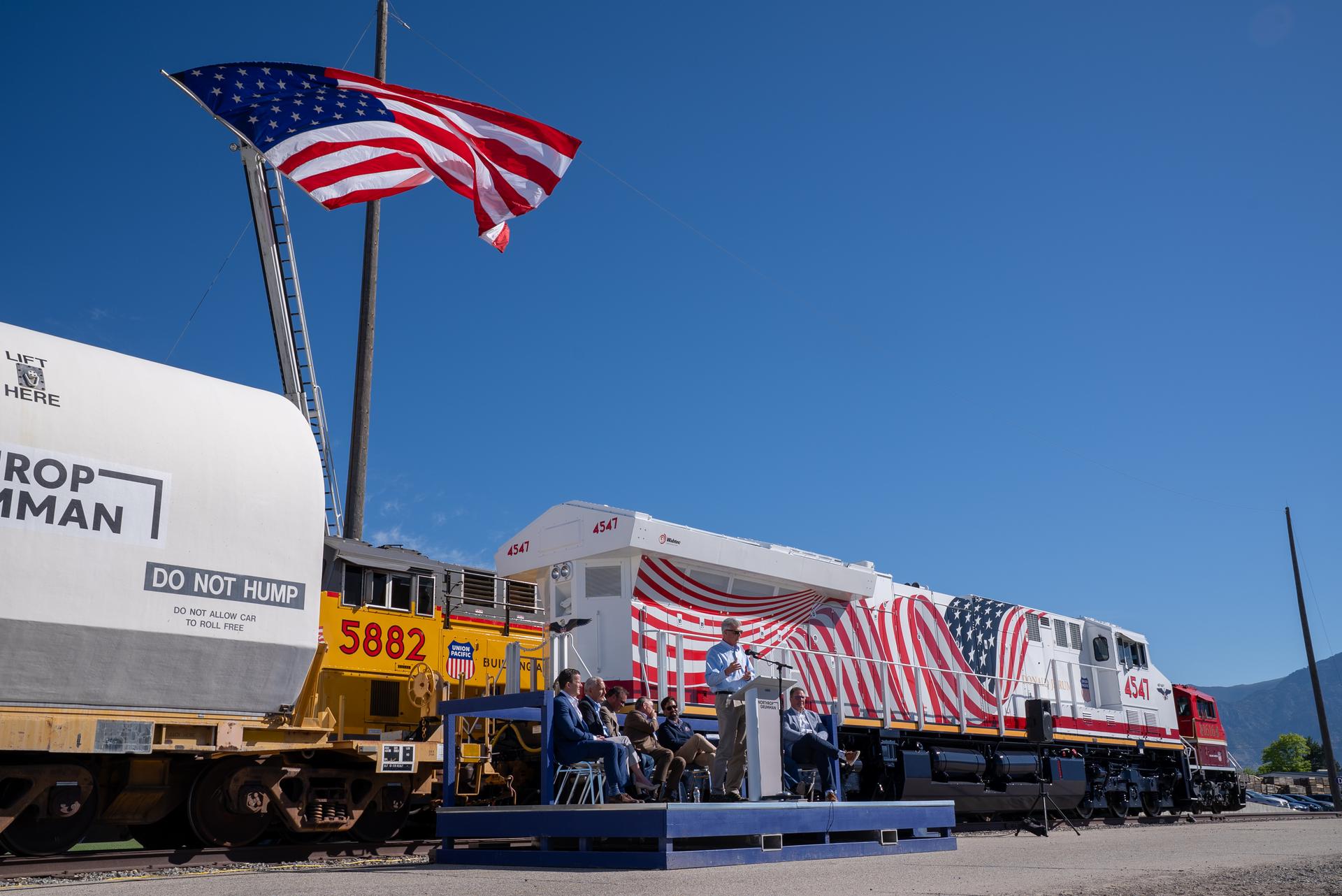
These images capture the final booster motor segments for NASA’s Artemis III mission departing Northrop Grumman’s Railyard Shipping Facility in Corinne, Utah, June 2. The eight segments will form the twin five-segment solid rocket boosters for the agency’s SLS (Space Launch System) rocket, providing more than 75% of the vehicle’s total thrust at liftoff. Due to their immense size and weight, the booster segments are transported in specialized carriers and are being hauled by Union Pacific Railroad’s newest commemorative locomotive, No. 4547. Marking its inaugural mission, the locomotive will deliver the flight hardware to NASA’s Kennedy Space Center in Florida, where stacking operations for Artemis III are set to begin later this year.
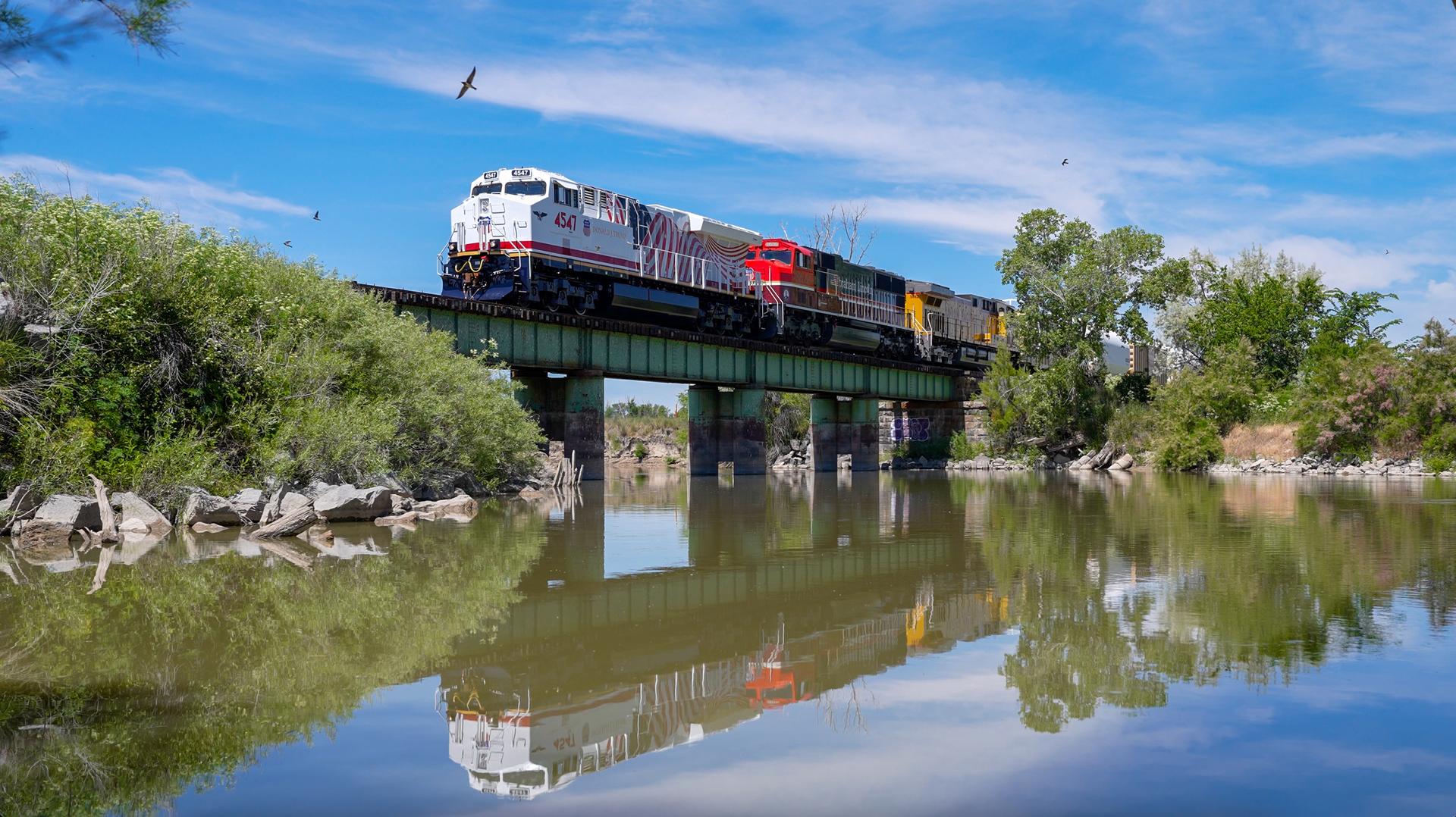
These images capture the final booster motor segments for NASA’s Artemis III mission departing Northrop Grumman’s Railyard Shipping Facility in Corinne, Utah, June 2. The eight segments will form the twin five-segment solid rocket boosters for the agency’s SLS (Space Launch System) rocket, providing more than 75% of the vehicle’s total thrust at liftoff. Due to their immense size and weight, the booster segments are transported in specialized carriers and are being hauled by Union Pacific Railroad’s newest commemorative locomotive, No. 4547. Marking its inaugural mission, the locomotive will deliver the flight hardware to NASA’s Kennedy Space Center in Florida, where stacking operations for Artemis III are set to begin later this year.

These images capture the final booster motor segments for NASA’s Artemis III mission departing Northrop Grumman’s Railyard Shipping Facility in Corinne, Utah, June 2. The eight segments will form the twin five-segment solid rocket boosters for the agency’s SLS (Space Launch System) rocket, providing more than 75% of the vehicle’s total thrust at liftoff. Due to their immense size and weight, the booster segments are transported in specialized carriers and are being hauled by Union Pacific Railroad’s newest commemorative locomotive, No. 4547. Marking its inaugural mission, the locomotive will deliver the flight hardware to NASA’s Kennedy Space Center in Florida, where stacking operations for Artemis III are set to begin later this year.
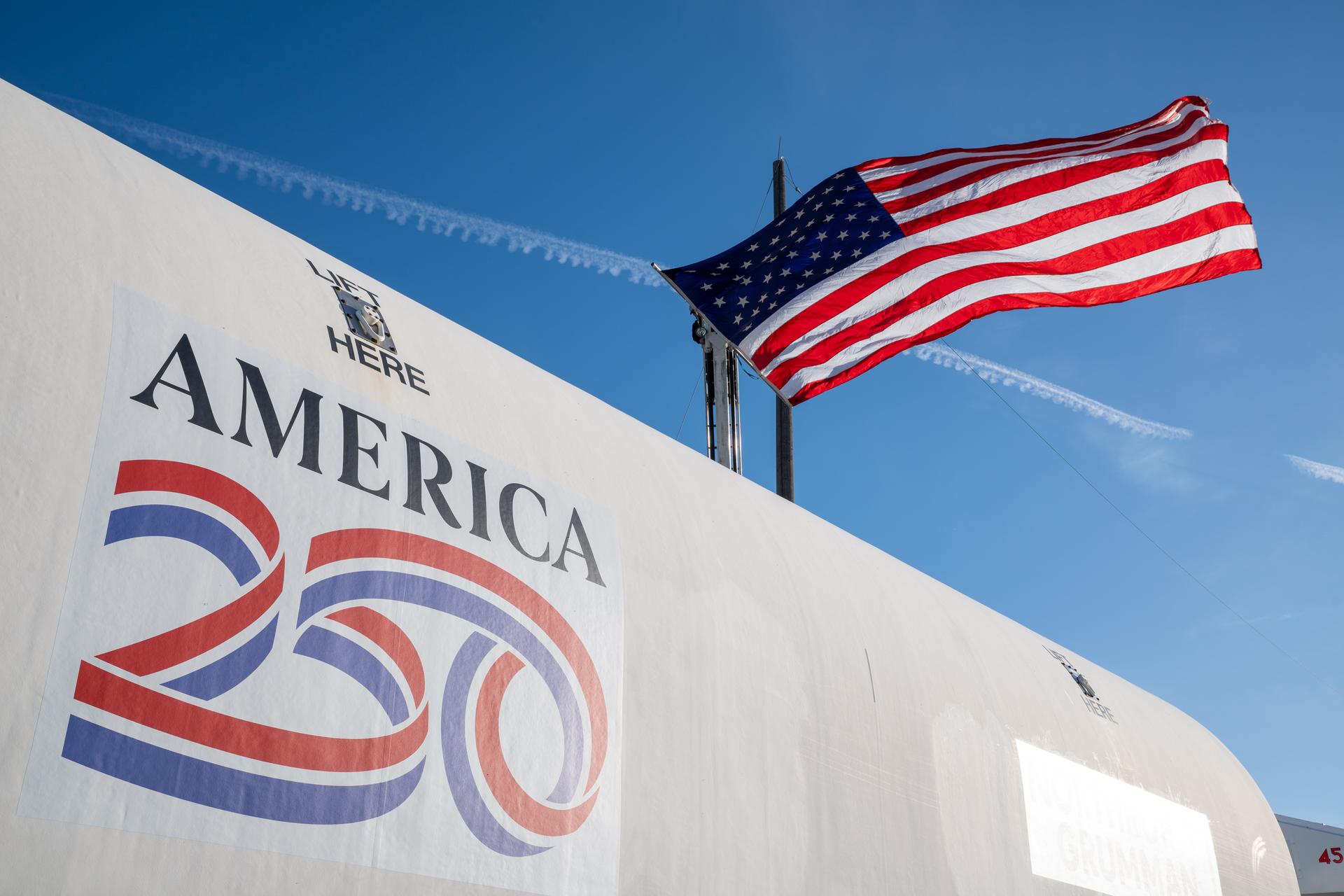
These images capture the final booster motor segments for NASA’s Artemis III mission departing Northrop Grumman’s Railyard Shipping Facility in Corinne, Utah, June 2. The eight segments will form the twin five-segment solid rocket boosters for the agency’s SLS (Space Launch System) rocket, providing more than 75% of the vehicle’s total thrust at liftoff. Due to their immense size and weight, the booster segments are transported in specialized carriers and are being hauled by Union Pacific Railroad’s newest commemorative locomotive, No. 4547. Marking its inaugural mission, the locomotive will deliver the flight hardware to NASA’s Kennedy Space Center in Florida, where stacking operations for Artemis III are set to begin later this year.
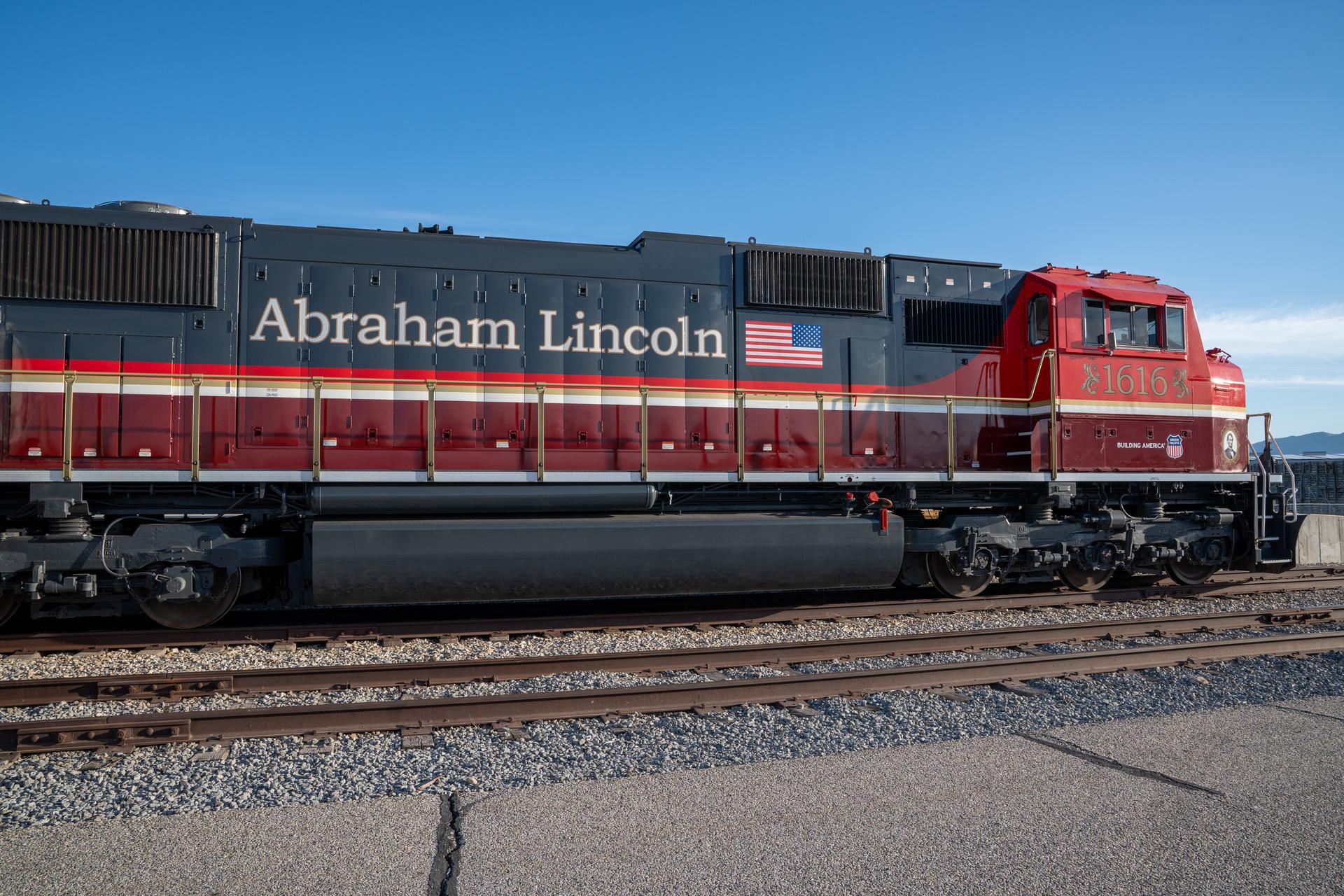
These images capture the final booster motor segments for NASA’s Artemis III mission departing Northrop Grumman’s Railyard Shipping Facility in Corinne, Utah, June 2. The eight segments will form the twin five-segment solid rocket boosters for the agency’s SLS (Space Launch System) rocket, providing more than 75% of the vehicle’s total thrust at liftoff. Due to their immense size and weight, the booster segments are transported in specialized carriers and are being hauled by Union Pacific Railroad’s newest commemorative locomotive, No. 4547. Marking its inaugural mission, the locomotive will deliver the flight hardware to NASA’s Kennedy Space Center in Florida, where stacking operations for Artemis III are set to begin later this year.
These images capture the final booster motor segments for NASA’s Artemis III mission departing Northrop Grumman’s Railyard Shipping Facility in Corinne, Utah, June 2. The eight segments will form the twin five-segment solid rocket boosters for the agency’s SLS (Space Launch System) rocket, providing more than 75% of the vehicle’s total thrust at liftoff. Due to their immense size and weight, the booster segments are transported in specialized carriers and are being hauled by Union Pacific Railroad’s newest commemorative locomotive, No. 4547. Marking its inaugural mission, the locomotive will deliver the flight hardware to NASA’s Kennedy Space Center in Florida, where stacking operations for Artemis III are set to begin later this year.
These images capture the final booster motor segments for NASA’s Artemis III mission departing Northrop Grumman’s Railyard Shipping Facility in Corinne, Utah, June 2. The eight segments will form the twin five-segment solid rocket boosters for the agency’s SLS (Space Launch System) rocket, providing more than 75% of the vehicle’s total thrust at liftoff. Due to their immense size and weight, the booster segments are transported in specialized carriers and are being hauled by Union Pacific Railroad’s newest commemorative locomotive, No. 4547. Marking its inaugural mission, the locomotive will deliver the flight hardware to NASA’s Kennedy Space Center in Florida, where stacking operations for Artemis III are set to begin later this year.
These images capture the final booster motor segments for NASA’s Artemis III mission departing Northrop Grumman’s Railyard Shipping Facility in Corinne, Utah, June 2. The eight segments will form the twin five-segment solid rocket boosters for the agency’s SLS (Space Launch System) rocket, providing more than 75% of the vehicle’s total thrust at liftoff. Due to their immense size and weight, the booster segments are transported in specialized carriers and are being hauled by Union Pacific Railroad’s newest commemorative locomotive, No. 4547. Marking its inaugural mission, the locomotive will deliver the flight hardware to NASA’s Kennedy Space Center in Florida, where stacking operations for Artemis III are set to begin later this year.
These images capture the final booster motor segments for NASA’s Artemis III mission departing Northrop Grumman’s Railyard Shipping Facility in Corinne, Utah, June 2. The eight segments will form the twin five-segment solid rocket boosters for the agency’s SLS (Space Launch System) rocket, providing more than 75% of the vehicle’s total thrust at liftoff. Due to their immense size and weight, the booster segments are transported in specialized carriers and are being hauled by Union Pacific Railroad’s newest commemorative locomotive, No. 4547. Marking its inaugural mission, the locomotive will deliver the flight hardware to NASA’s Kennedy Space Center in Florida, where stacking operations for Artemis III are set to begin later this year.
These images capture the final booster motor segments for NASA’s Artemis III mission departing Northrop Grumman’s Railyard Shipping Facility in Corinne, Utah, June 2. The eight segments will form the twin five-segment solid rocket boosters for the agency’s SLS (Space Launch System) rocket, providing more than 75% of the vehicle’s total thrust at liftoff. Due to their immense size and weight, the booster segments are transported in specialized carriers and are being hauled by Union Pacific Railroad’s newest commemorative locomotive, No. 4547. Marking its inaugural mission, the locomotive will deliver the flight hardware to NASA’s Kennedy Space Center in Florida, where stacking operations for Artemis III are set to begin later this year.
These images capture the final booster motor segments for NASA’s Artemis III mission departing Northrop Grumman’s Railyard Shipping Facility in Corinne, Utah, June 2. The eight segments will form the twin five-segment solid rocket boosters for the agency’s SLS (Space Launch System) rocket, providing more than 75% of the vehicle’s total thrust at liftoff. Due to their immense size and weight, the booster segments are transported in specialized carriers and are being hauled by Union Pacific Railroad’s newest commemorative locomotive, No. 4547. Marking its inaugural mission, the locomotive will deliver the flight hardware to NASA’s Kennedy Space Center in Florida, where stacking operations for Artemis III are set to begin later this year.
These images capture the final booster motor segments for NASA’s Artemis III mission departing Northrop Grumman’s Railyard Shipping Facility in Corinne, Utah, June 2. The eight segments will form the twin five-segment solid rocket boosters for the agency’s SLS (Space Launch System) rocket, providing more than 75% of the vehicle’s total thrust at liftoff. Due to their immense size and weight, the booster segments are transported in specialized carriers and are being hauled by Union Pacific Railroad’s newest commemorative locomotive, No. 4547. Marking its inaugural mission, the locomotive will deliver the flight hardware to NASA’s Kennedy Space Center in Florida, where stacking operations for Artemis III are set to begin later this year.
These images capture the final booster motor segments for NASA’s Artemis III mission departing Northrop Grumman’s Railyard Shipping Facility in Corinne, Utah, June 2. The eight segments will form the twin five-segment solid rocket boosters for the agency’s SLS (Space Launch System) rocket, providing more than 75% of the vehicle’s total thrust at liftoff. Due to their immense size and weight, the booster segments are transported in specialized carriers and are being hauled by Union Pacific Railroad’s newest commemorative locomotive, No. 4547. Marking its inaugural mission, the locomotive will deliver the flight hardware to NASA’s Kennedy Space Center in Florida, where stacking operations for Artemis III are set to begin later this year.
These images capture the final booster motor segments for NASA’s Artemis III mission departing Northrop Grumman’s Railyard Shipping Facility in Corinne, Utah, June 2. The eight segments will form the twin five-segment solid rocket boosters for the agency’s SLS (Space Launch System) rocket, providing more than 75% of the vehicle’s total thrust at liftoff. Due to their immense size and weight, the booster segments are transported in specialized carriers and are being hauled by Union Pacific Railroad’s newest commemorative locomotive, No. 4547. Marking its inaugural mission, the locomotive will deliver the flight hardware to NASA’s Kennedy Space Center in Florida, where stacking operations for Artemis III are set to begin later this year.
These images capture the final booster motor segments for NASA’s Artemis III mission departing Northrop Grumman’s Railyard Shipping Facility in Corinne, Utah, June 2. The eight segments will form the twin five-segment solid rocket boosters for the agency’s SLS (Space Launch System) rocket, providing more than 75% of the vehicle’s total thrust at liftoff. Due to their immense size and weight, the booster segments are transported in specialized carriers and are being hauled by Union Pacific Railroad’s newest commemorative locomotive, No. 4547. Marking its inaugural mission, the locomotive will deliver the flight hardware to NASA’s Kennedy Space Center in Florida, where stacking operations for Artemis III are set to begin later this year.
These images capture the final booster motor segments for NASA’s Artemis III mission departing Northrop Grumman’s Railyard Shipping Facility in Corinne, Utah, June 2. The eight segments will form the twin five-segment solid rocket boosters for the agency’s SLS (Space Launch System) rocket, providing more than 75% of the vehicle’s total thrust at liftoff. Due to their immense size and weight, the booster segments are transported in specialized carriers and are being hauled by Union Pacific Railroad’s newest commemorative locomotive, No. 4547. Marking its inaugural mission, the locomotive will deliver the flight hardware to NASA’s Kennedy Space Center in Florida, where stacking operations for Artemis III are set to begin later this year.
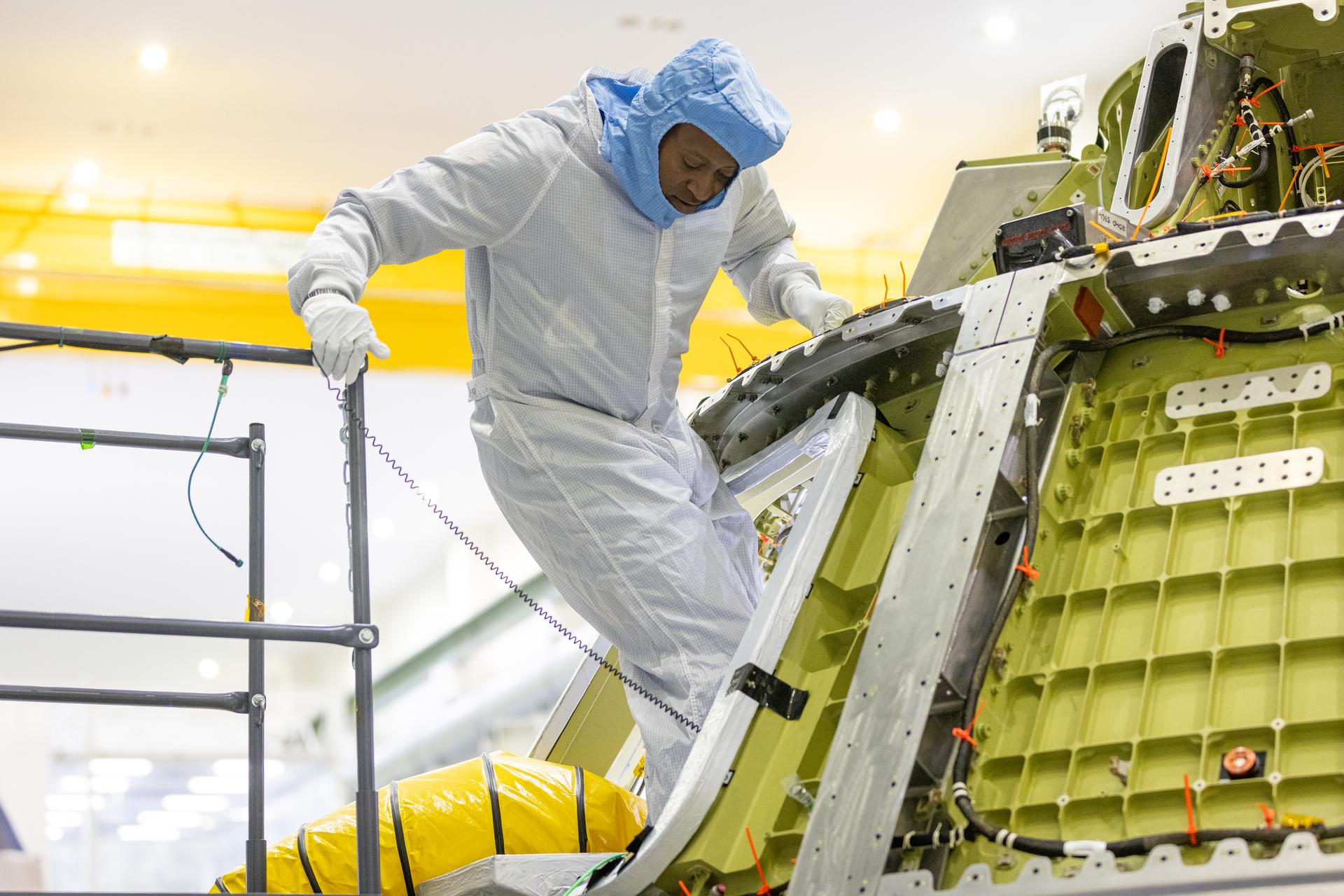
Artemis III crew member, NASA astronaut Andre Douglas enters NASA’s Artemis IV Orion spacecraft inside the high bay of the Neil A. Armstrong Operations and Checkout Building at NASA’s Kennedy Space Center in Florida on Friday, July 10, 2026. Douglas and fellow Artemis III crew member, NASA astronaut Randy Bresnick, met with Orion teams and got a close look at the work underway on the Orion spacecraft inside the facility. Bresnick, Douglas, NASA astronaut Frank Rubio, and ESA (European Space Agency) astronaut Luca Parmitano will launch on the Artemis III mission to conduct critical rendezvous and docking tests with lunar lander systems in low Earth orbit, advancing the capabilities needed before astronauts return to the lunar surface on Artemis IV.
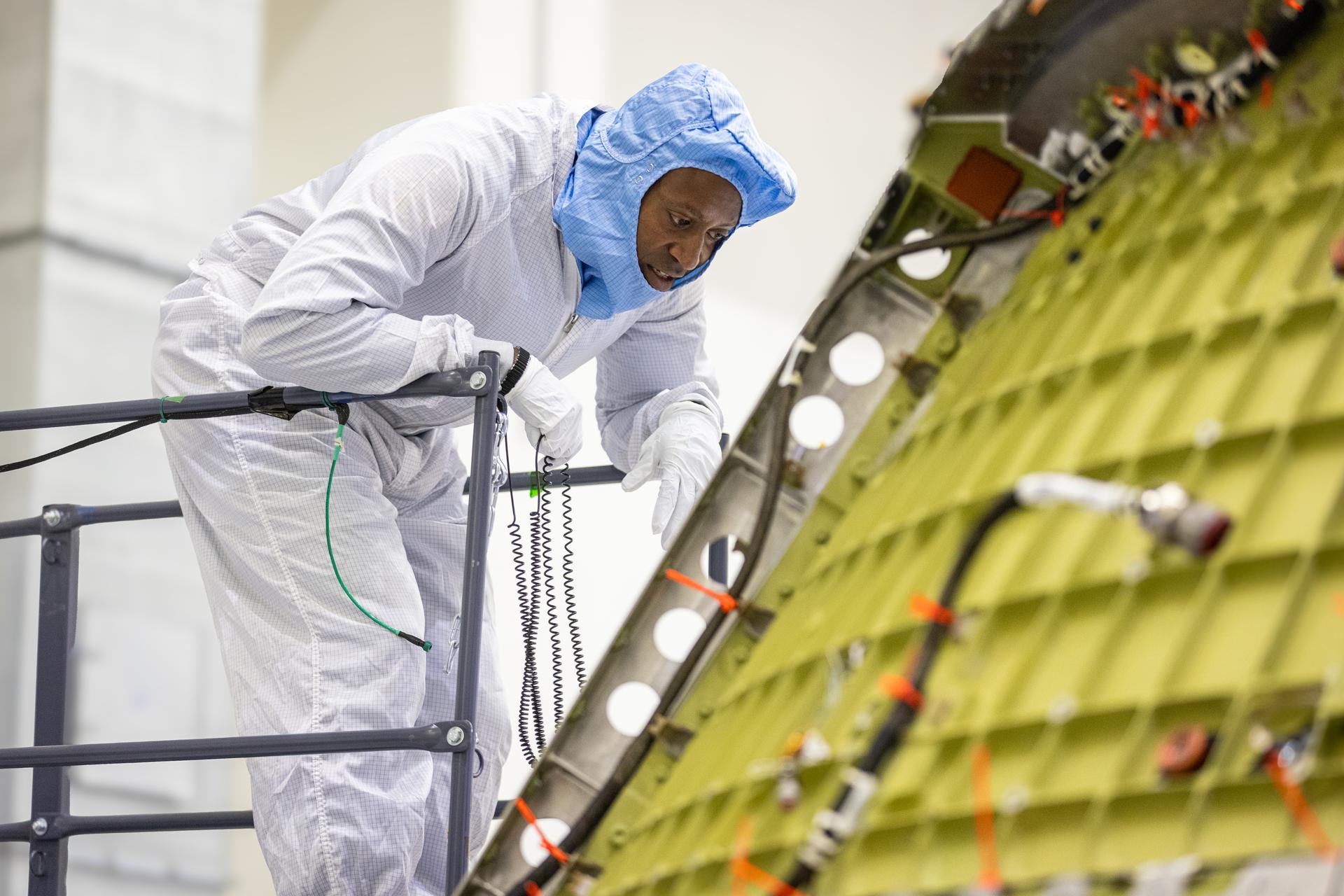
Artemis III crew member, NASA astronaut Andre Douglas enters NASA’s Artemis IV Orion spacecraft inside the high bay of the Neil A. Armstrong Operations and Checkout Building at NASA’s Kennedy Space Center in Florida on Friday, July 10, 2026. Douglas and fellow Artemis III crew member, NASA astronaut Randy Bresnick, met with Orion teams and got a close look at the work underway on the Orion spacecraft inside the facility. Bresnick, Douglas, NASA astronaut Frank Rubio, and ESA (European Space Agency) astronaut Luca Parmitano will launch on the Artemis III mission to conduct critical rendezvous and docking tests with lunar lander systems in low Earth orbit, advancing the capabilities needed before astronauts return to the lunar surface on Artemis IV.
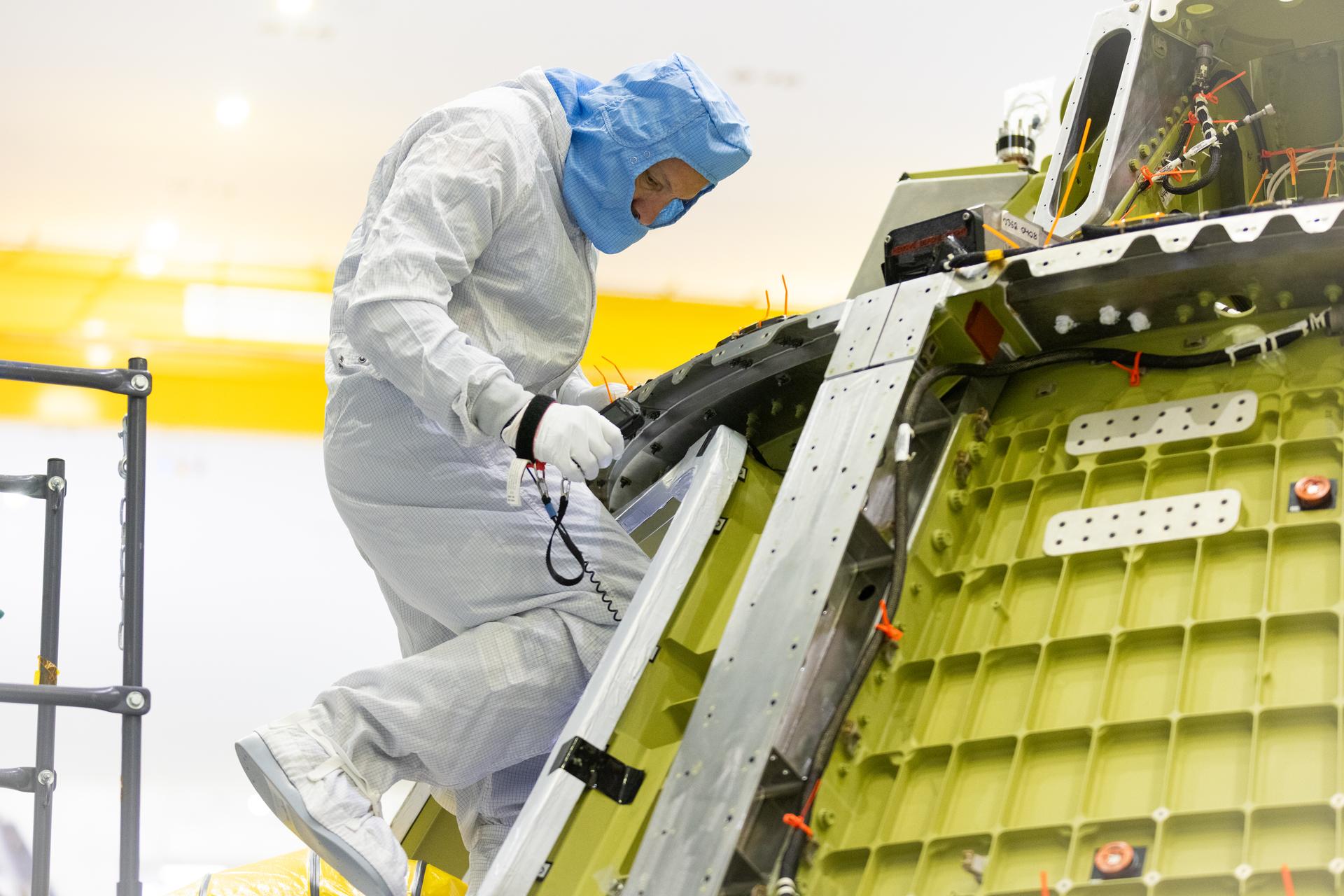
Artemis III crew member, NASA astronaut Randy Bresnick enters NASA’s Artemis IV Orion spacecraft inside the high bay of the Neil A. Armstrong Operations and Checkout Building at NASA’s Kennedy Space Center in Florida on Friday, July 10, 2026. Bresnick and fellow Artemis III crew member, NASA astronaut Andre Douglas, met with Orion teams and got a closer look at the work underway on the Orion spacecraft inside the facility. Bresnick, Douglas, NASA astronaut Frank Rubio, and ESA (European Space Agency) astronaut Luca Parmitano will launch on the Artemis III mission to conduct critical rendezvous and docking tests with lunar lander systems in low Earth orbit, advancing the capabilities needed before astronauts return to the lunar surface on Artemis IV.
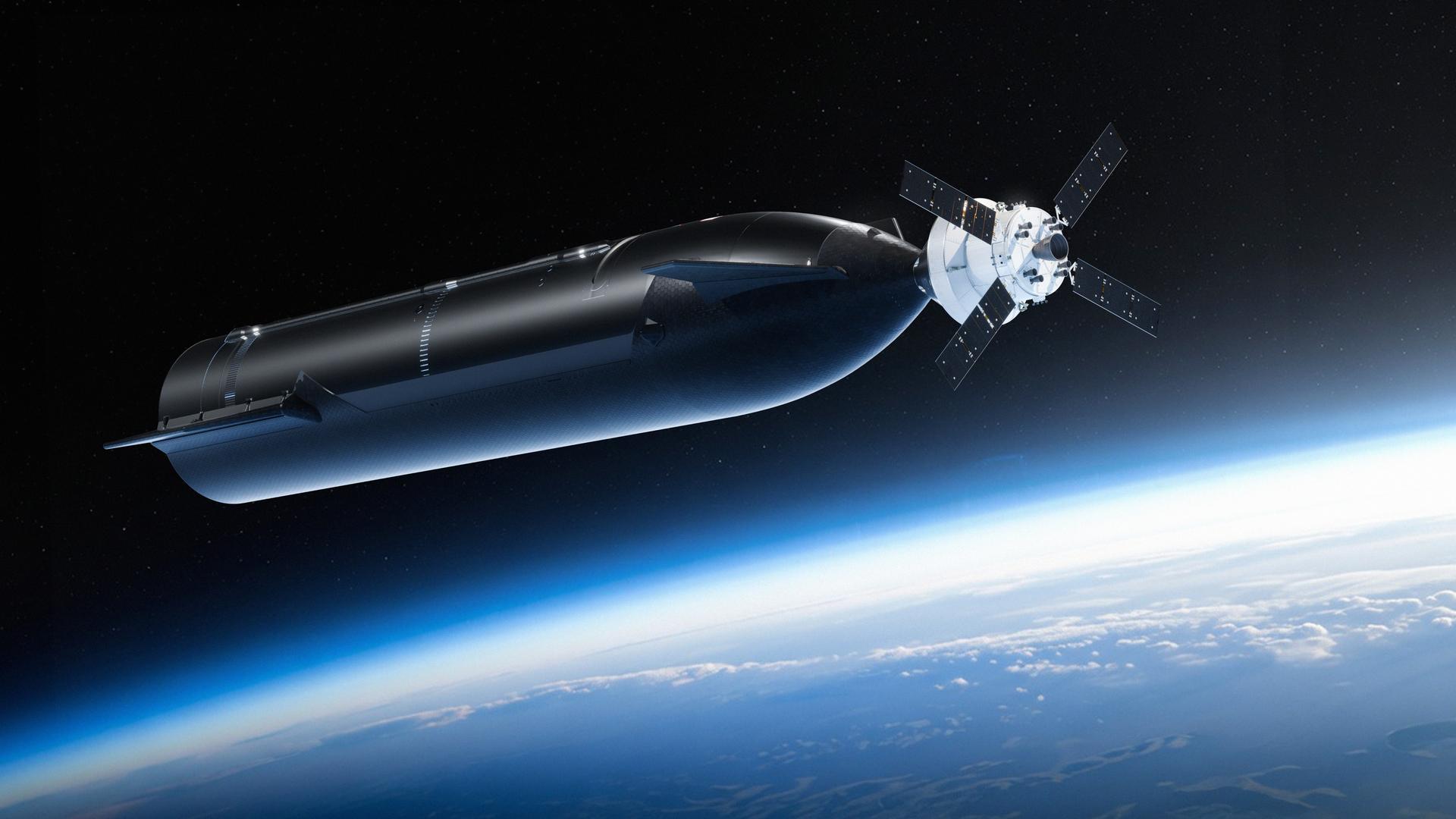
These artist’s concepts depict NASA’s Orion spacecraft and SpaceX’s Starship human landing system test article during rendezvous and docking operations as part of NASA’s upcoming Artemis III demonstration mission in low Earth orbit. NASA is working with two American companies to develop the human landing systems that will safely transport astronauts from lunar orbit to the Moon’s surface and back for future Artemis missions. For Artemis III, both SpaceX and Blue Origin will fly test versions, or test articles, of the crewed landers that will be used for future Moon landings. The lander test articles will launch by commercial rockets, while the Artemis III crew will launch to low Earth orbit in Orion atop the agency’s SLS (Space Launch System) rocket.

Artemis III launch team members participate in a cryogenic propellant loading simulation on Wednesday, June 10, 2026, inside Firing Room 1 and 2 of the Rocco A. Petrone Launch Control Center at NASA’s Kennedy Space Center in Florida. Members of NASA’s Exploration Ground Systems team rehearse the steps to load the super-cooled liquid hydrogen and liquid oxygen into the SLS (Space Launch System) rocket core stage, a process that starts several hours before liftoff for the Artemis III mission. Artemis III will carry out a series of objectives in low Earth orbit designed to demonstrate critical systems needed for future lunar landings, beginning with Artemis IV.

Artemis III launch team members participate in a cryogenic propellant loading simulation on Wednesday, June 10, 2026, inside Firing Room 1 and 2 of the Rocco A. Petrone Launch Control Center at NASA’s Kennedy Space Center in Florida. Members of NASA’s Exploration Ground Systems team rehearse the steps to load the super-cooled liquid hydrogen and liquid oxygen into the SLS (Space Launch System) rocket core stage, a process that starts several hours before liftoff for the Artemis III mission. Artemis III will carry out a series of objectives in low Earth orbit designed to demonstrate critical systems needed for future lunar landings, beginning with Artemis IV.

Artemis III launch team members participate in a cryogenic propellant loading simulation on Wednesday, June 10, 2026, inside Firing Room 1 and 2 of the Rocco A. Petrone Launch Control Center at NASA’s Kennedy Space Center in Florida. Members of NASA’s Exploration Ground Systems team rehearse the steps to load the super-cooled liquid hydrogen and liquid oxygen into the SLS (Space Launch System) rocket core stage, a process that starts several hours before liftoff for the Artemis III mission. Artemis III will carry out a series of objectives in low Earth orbit designed to demonstrate critical systems needed for future lunar landings, beginning with Artemis IV.

From left to right, Dmitriy Bank, NASA test director, and Paul Sierpinski, Artemis assistant landing and recovery director, participate in the Artemis III terminal countdown simulation on Thursday, May 7, 2026, inside Firing Room 1 of the Rocco A. Petrone Launch Control Center at NASA’s Kennedy Space Center in Florida. This marked the first simulation the launch team performed ahead of Artemis III.
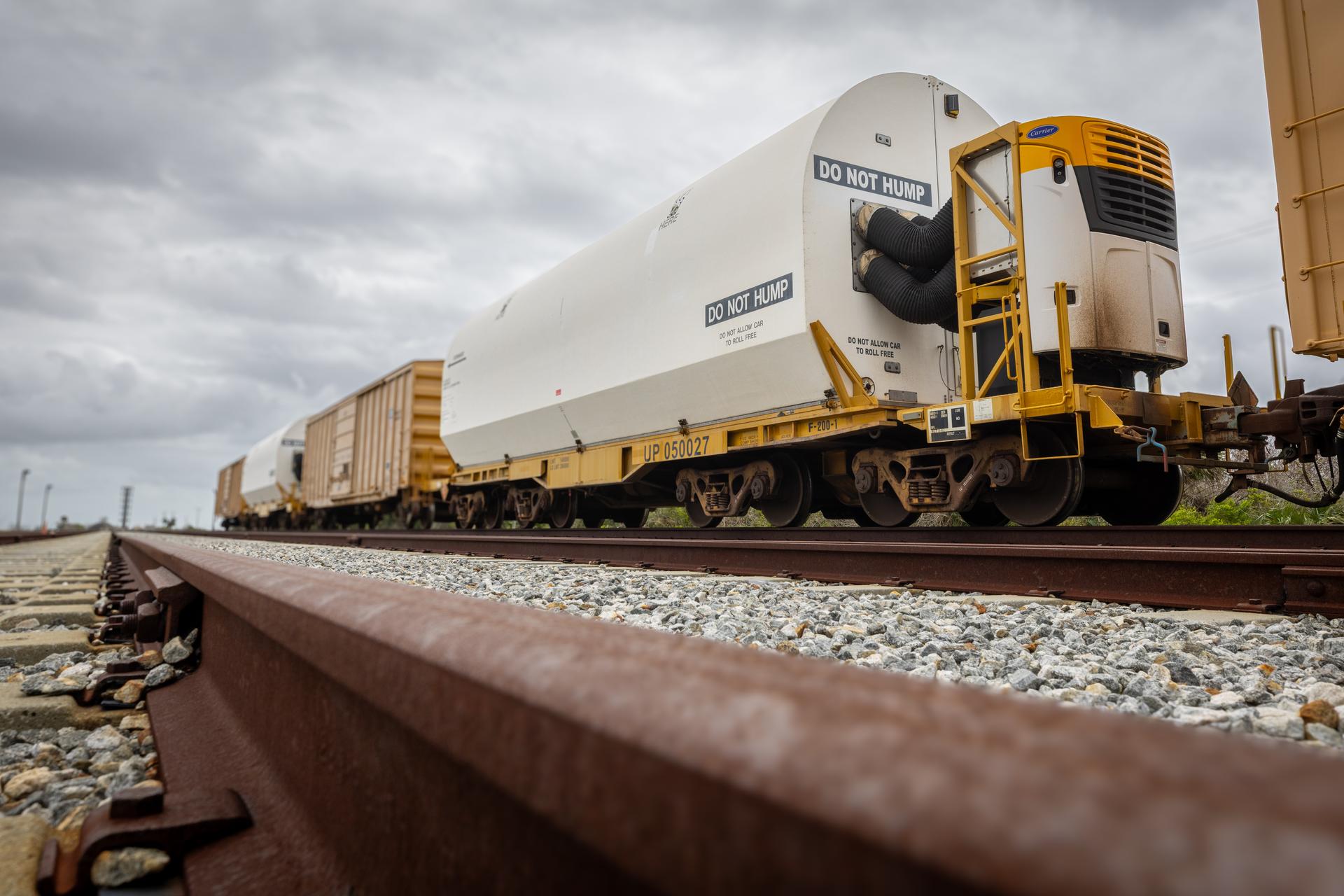
The solid rocket booster aft skirt segments for NASA’s Artemis III SLS (Space Launch System) rocket arrive at a rail yard near the agency’s Kennedy Space Center in Florida on Wednesday, April 8, 2026. Comprising the bottom of the rocket’s twin, five-segment solid rocket boosters, the aft skirt segments traveled by train in specialized transporters to the Florida spaceport and will be transferred from the rail yard to NASA Kennedy’s Rotation, Processing and Surge Facility for processing. The Artemis III mission will launch crew in the Orion spacecraft on top of the SLS rocket to test rendezvous and docking capabilities between Orion and commercial spacecraft needed to land astronauts on the Moon.

Eight of the 10 solid rocket booster motor segments for NASA’s Artemis III SLS (Space Launch System) rocket arrive at a rail yard near the agency’s Kennedy Space Center in Florida on Monday, June 8, 2026. The solid rocket boosters traveled by train in specialized transporters to the Florida spaceport and will be transferred from the rail yard to NASA Kennedy’s Rotation, Processing and Surge Facility for processing. The Artemis III mission will launch crew in the Orion spacecraft on top of the SLS rocket to test rendezvous and docking capabilities between Orion and commercial spacecraft needed to land astronauts on the Moon.
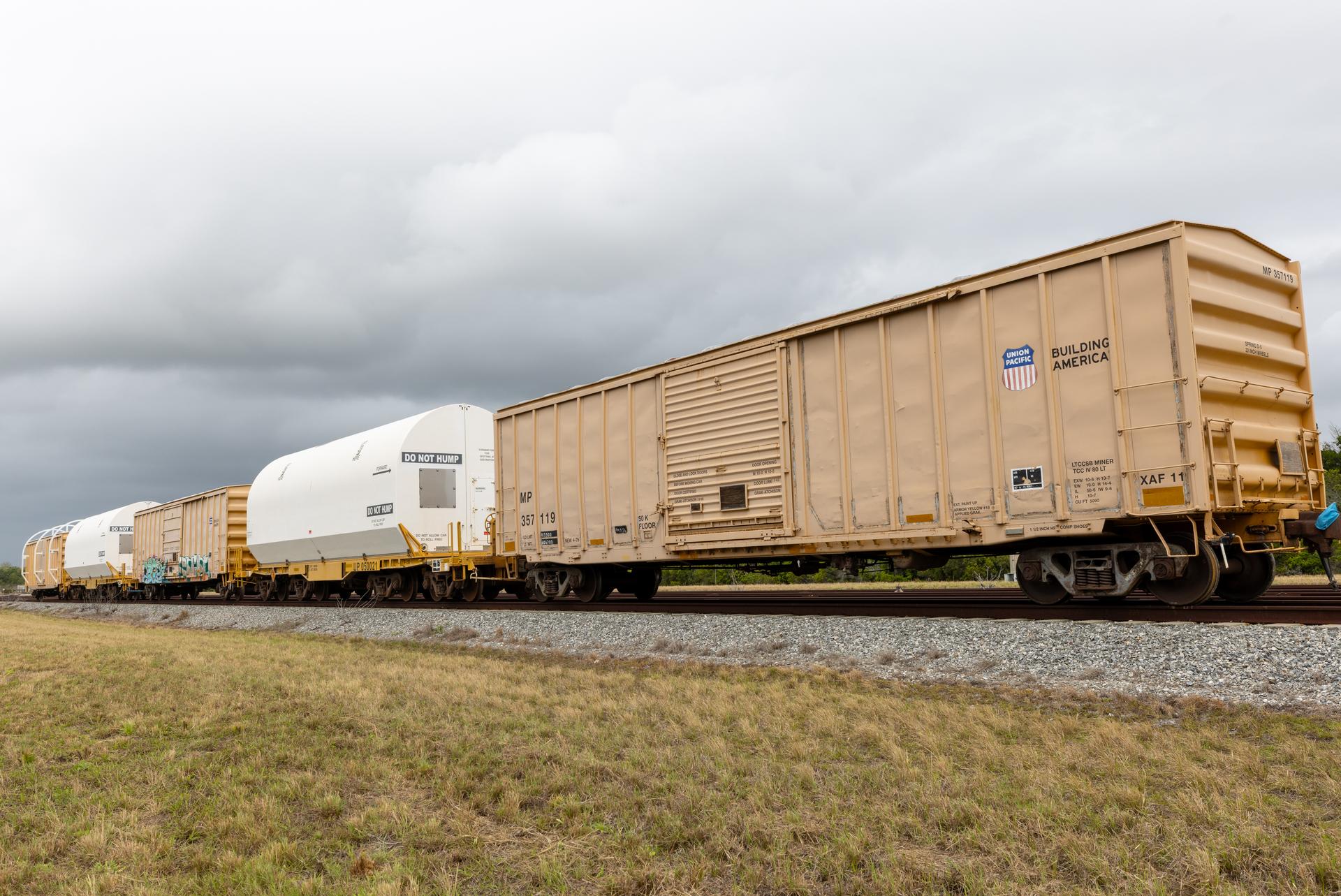
The solid rocket booster aft skirt segments for NASA’s Artemis III SLS (Space Launch System) rocket arrive at a rail yard near the agency’s Kennedy Space Center in Florida on Wednesday, April 8, 2026. Comprising the bottom of the rocket’s twin, five-segment solid rocket boosters, the aft skirt segments traveled by train in specialized transporters to the Florida spaceport and will be transferred from the rail yard to NASA Kennedy’s Rotation, Processing and Surge Facility for processing. The Artemis III mission will launch crew in the Orion spacecraft on top of the SLS rocket to test rendezvous and docking capabilities between Orion and commercial spacecraft needed to land astronauts on the Moon.

Eight of the 10 solid rocket booster motor segments for NASA’s Artemis III SLS (Space Launch System) rocket arrive at a rail yard near the agency’s Kennedy Space Center in Florida on Monday, June 8, 2026. The solid rocket boosters traveled by train in specialized transporters to the Florida spaceport and will be transferred from the rail yard to NASA Kennedy’s Rotation, Processing and Surge Facility for processing. The Artemis III mission will launch crew in the Orion spacecraft on top of the SLS rocket to test rendezvous and docking capabilities between Orion and commercial spacecraft needed to land astronauts on the Moon.
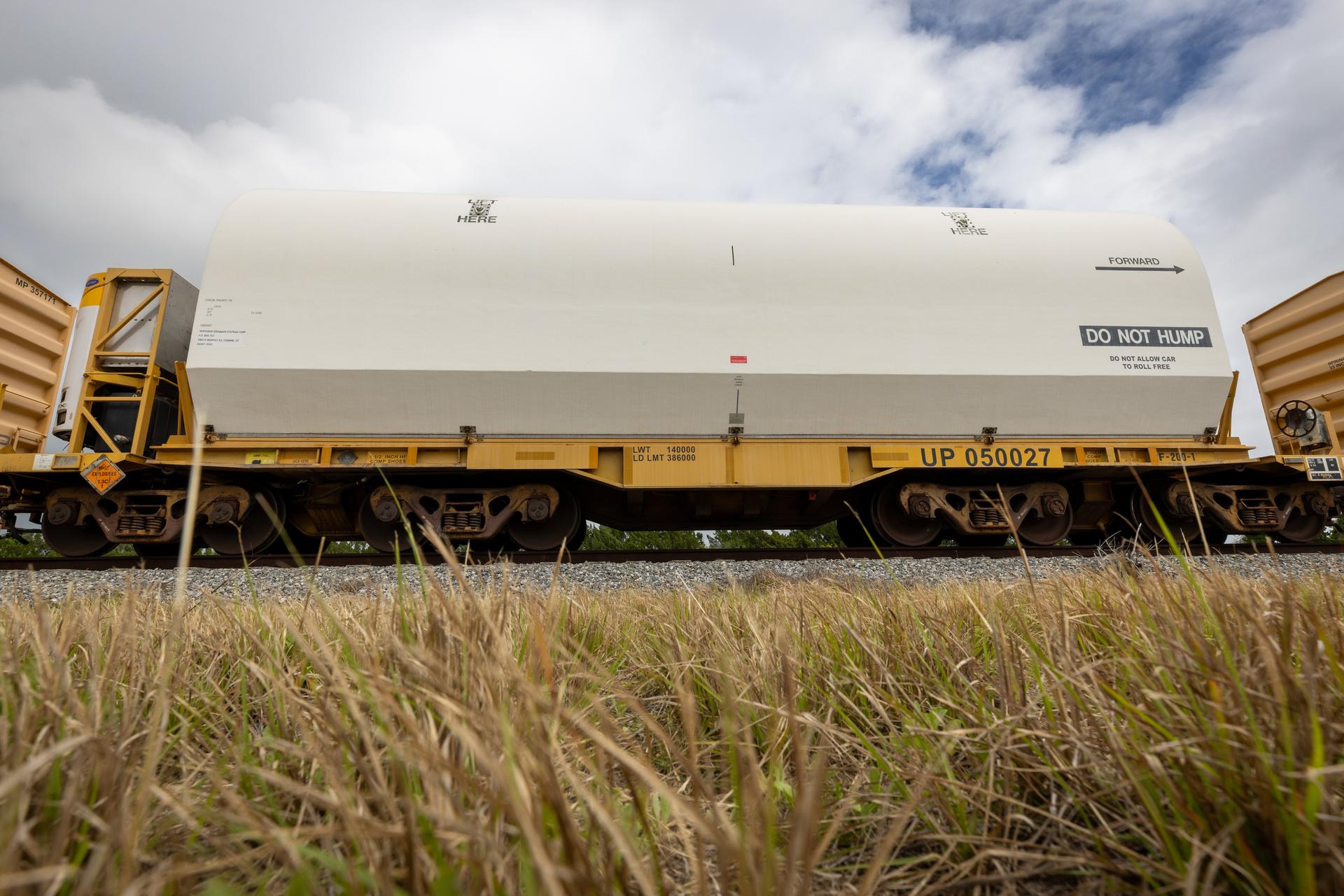
The solid rocket booster aft skirt segments for NASA’s Artemis III SLS (Space Launch System) rocket arrive at a rail yard near the agency’s Kennedy Space Center in Florida on Wednesday, April 8, 2026. Comprising the bottom of the rocket’s twin, five-segment solid rocket boosters, the aft skirt segments traveled by train in specialized transporters to the Florida spaceport and will be transferred from the rail yard to NASA Kennedy’s Rotation, Processing and Surge Facility for processing. The Artemis III mission will launch crew in the Orion spacecraft on top of the SLS rocket to test rendezvous and docking capabilities between Orion and commercial spacecraft needed to land astronauts on the Moon.

Eight of the 10 solid rocket booster motor segments for NASA’s Artemis III SLS (Space Launch System) rocket arrive at a rail yard near the agency’s Kennedy Space Center in Florida on Monday, June 8, 2026. The solid rocket boosters traveled by train in specialized transporters to the Florida spaceport and will be transferred from the rail yard to NASA Kennedy’s Rotation, Processing and Surge Facility for processing. The Artemis III mission will launch crew in the Orion spacecraft on top of the SLS rocket to test rendezvous and docking capabilities between Orion and commercial spacecraft needed to land astronauts on the Moon.
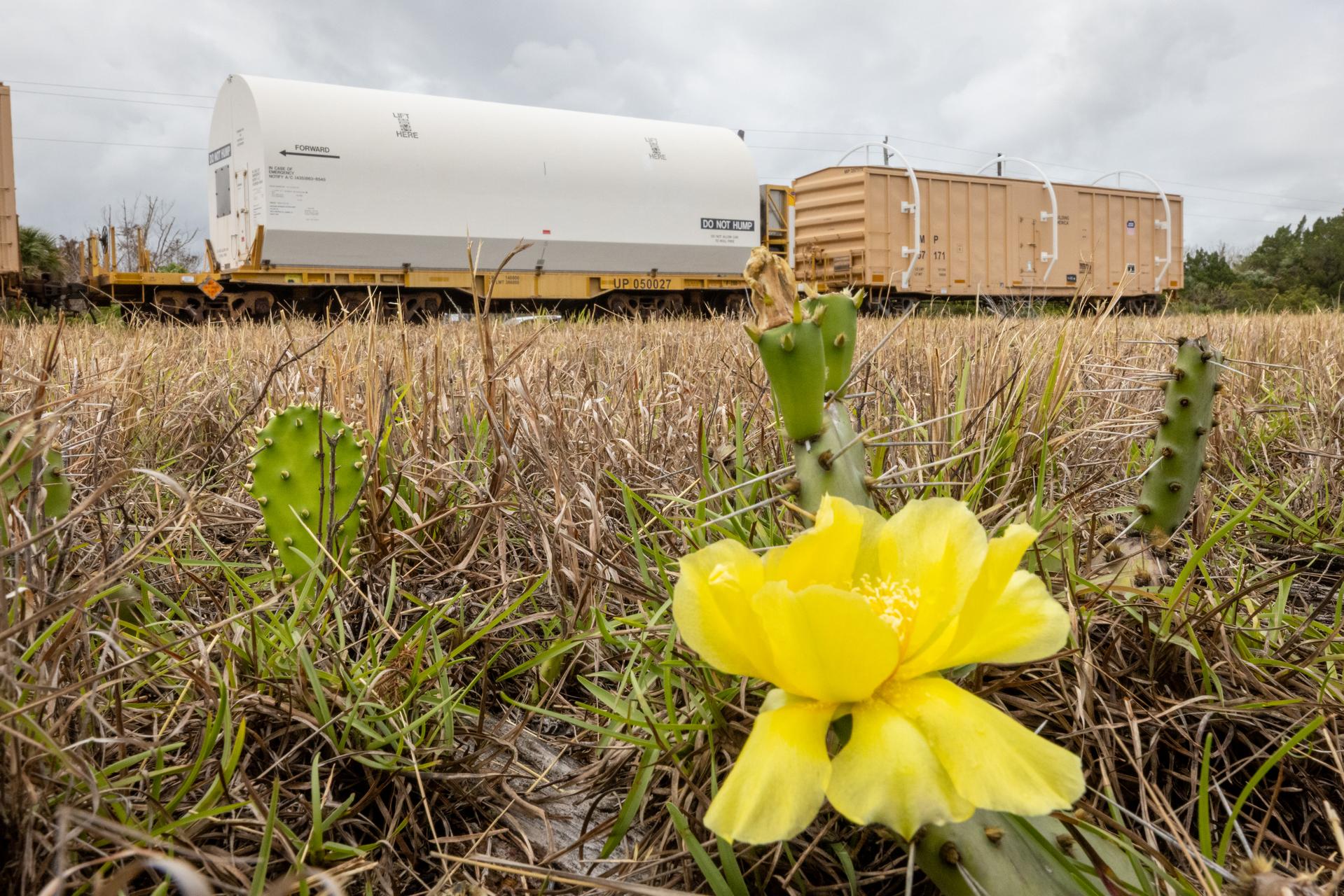
The solid rocket booster aft skirt segments for NASA’s Artemis III SLS (Space Launch System) rocket arrive at a rail yard near the agency’s Kennedy Space Center in Florida on Wednesday, April 8, 2026. Comprising the bottom of the rocket’s twin, five-segment solid rocket boosters, the aft skirt segments traveled by train in specialized transporters to the Florida spaceport and will be transferred from the rail yard to NASA Kennedy’s Rotation, Processing and Surge Facility for processing. The Artemis III mission will launch crew in the Orion spacecraft on top of the SLS rocket to test rendezvous and docking capabilities between Orion and commercial spacecraft needed to land astronauts on the Moon.
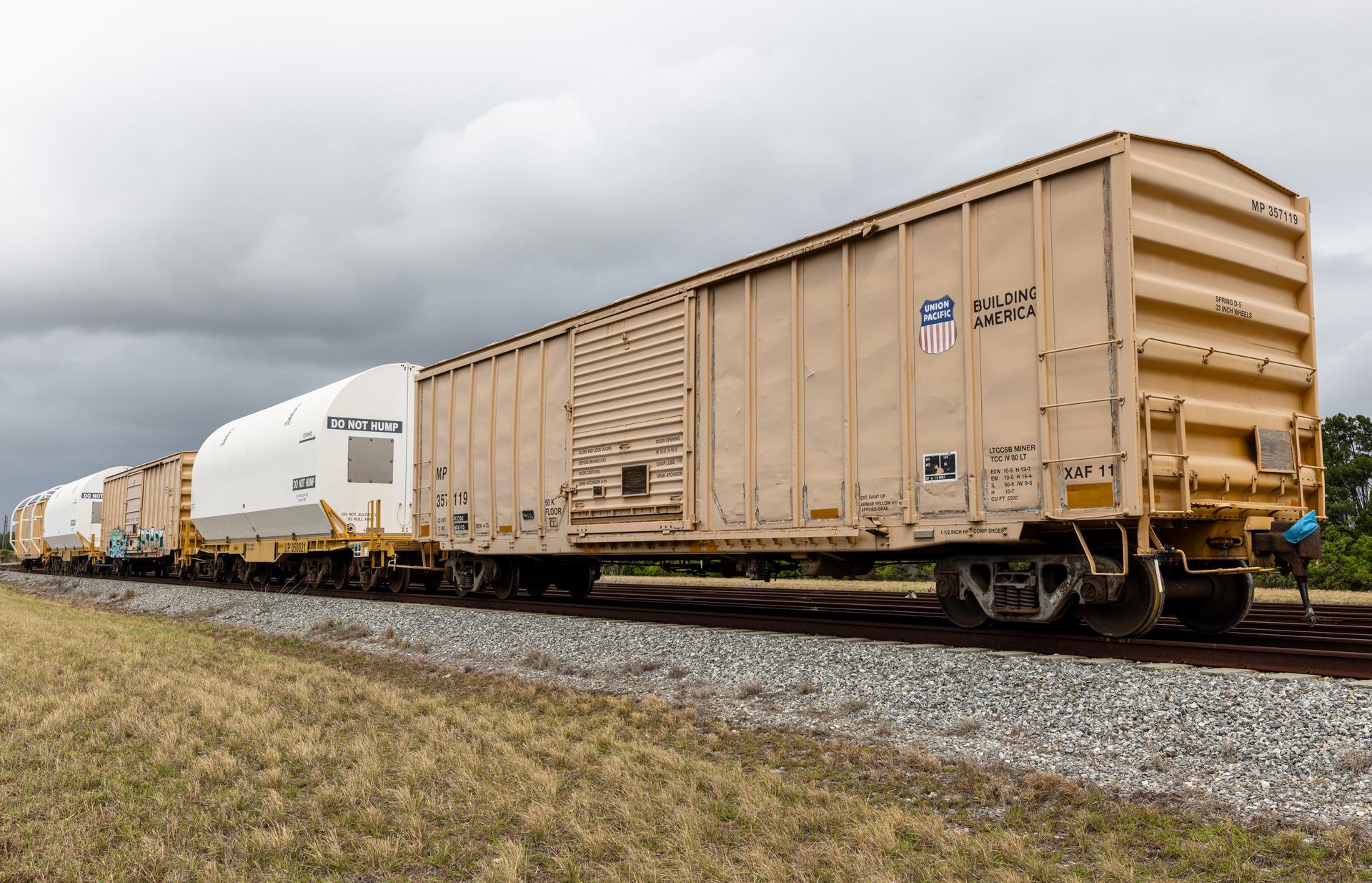
The solid rocket booster aft skirt segments for NASA’s Artemis III SLS (Space Launch System) rocket arrive at a rail yard near the agency’s Kennedy Space Center in Florida on Wednesday, April 8, 2026. Comprising the bottom of the rocket’s twin, five-segment solid rocket boosters, the aft skirt segments traveled by train in specialized transporters to the Florida spaceport and will be transferred from the rail yard to NASA Kennedy’s Rotation, Processing and Surge Facility for processing. The Artemis III mission will launch crew in the Orion spacecraft on top of the SLS rocket to test rendezvous and docking capabilities between Orion and commercial spacecraft needed to land astronauts on the Moon.
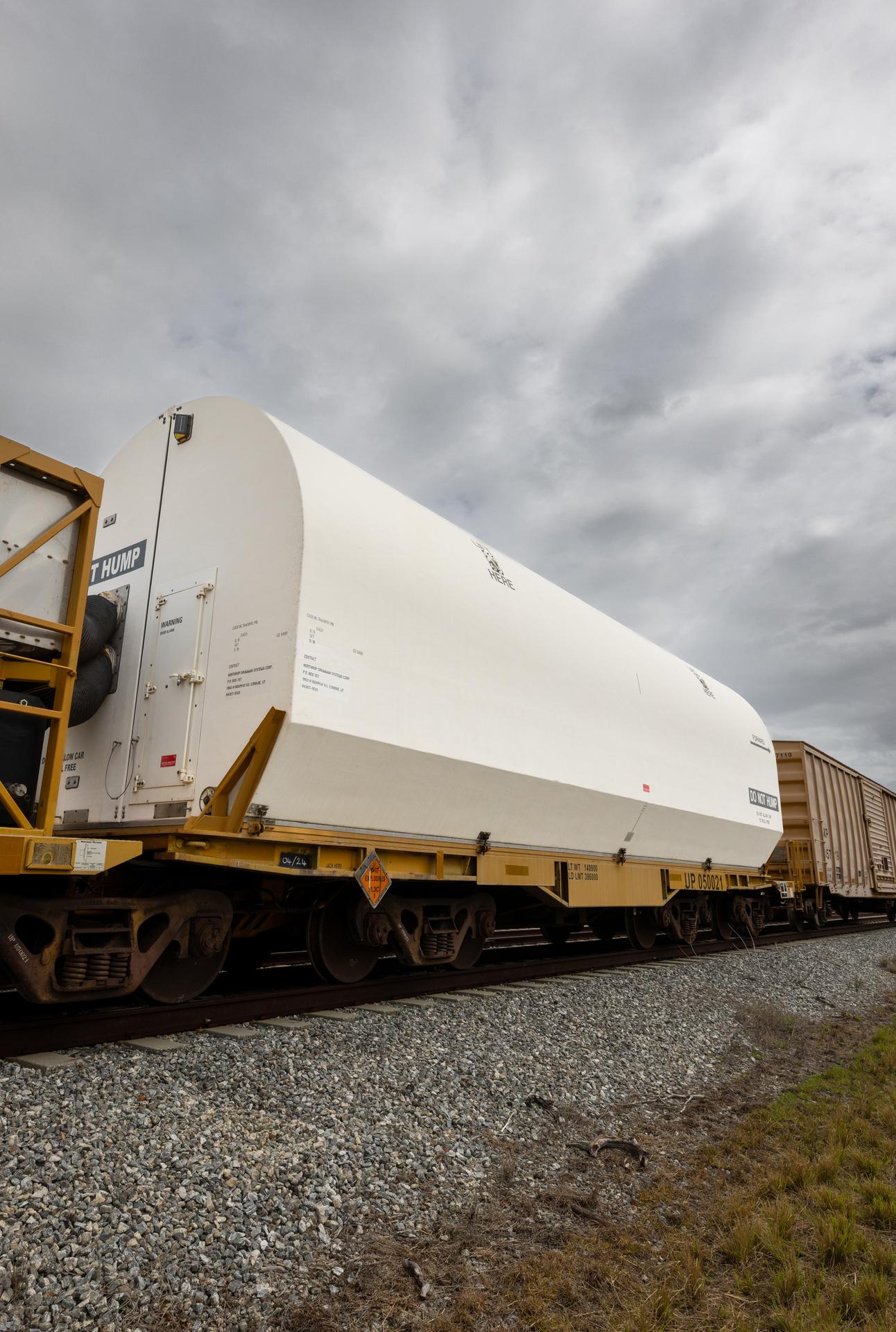
The solid rocket booster aft skirt segments for NASA’s Artemis III SLS (Space Launch System) rocket arrive at a rail yard near the agency’s Kennedy Space Center in Florida on Wednesday, April 8, 2026. Comprising the bottom of the rocket’s twin, five-segment solid rocket boosters, the aft skirt segments traveled by train in specialized transporters to the Florida spaceport and will be transferred from the rail yard to NASA Kennedy’s Rotation, Processing and Surge Facility for processing. The Artemis III mission will launch crew in the Orion spacecraft on top of the SLS rocket to test rendezvous and docking capabilities between Orion and commercial spacecraft needed to land astronauts on the Moon.
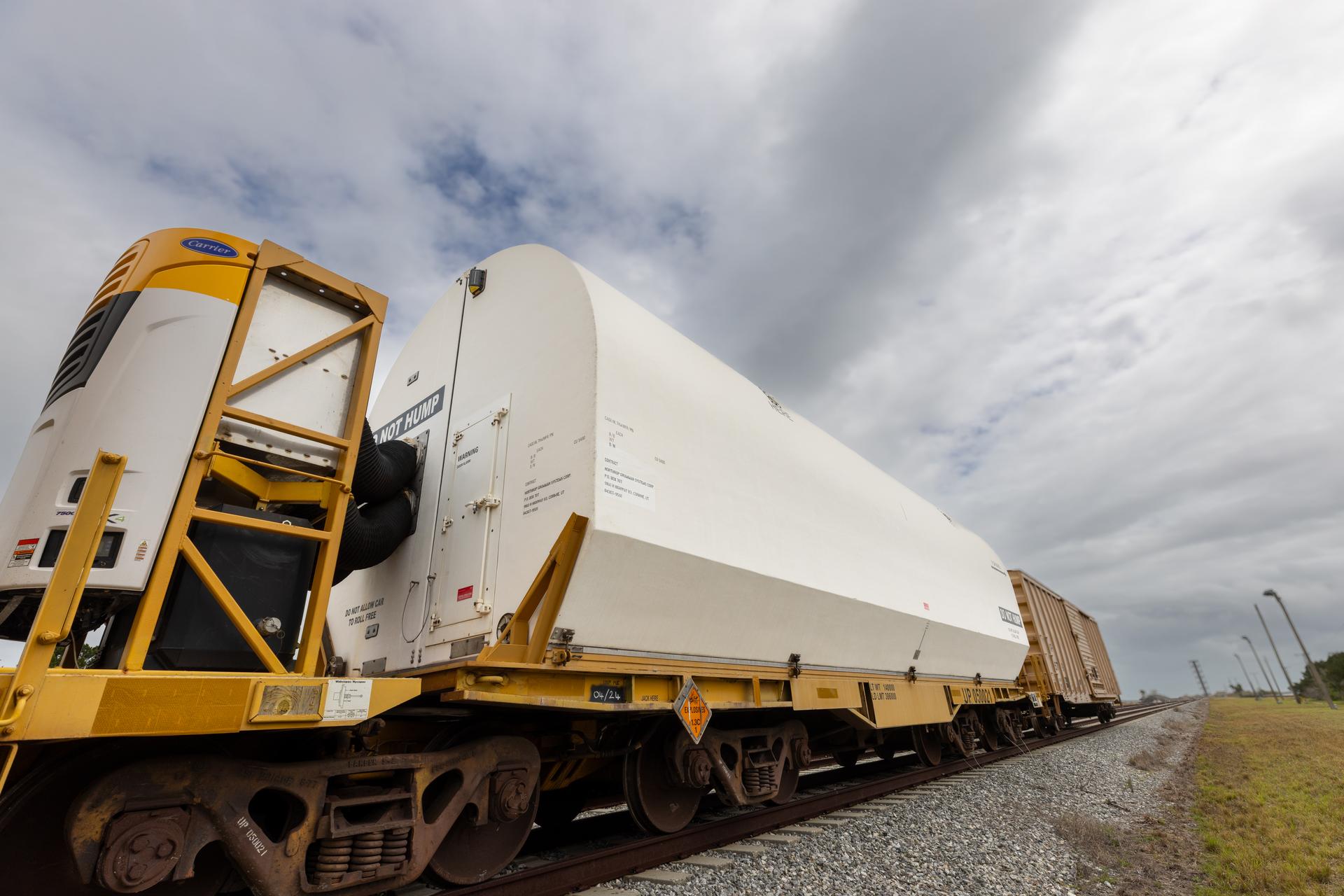
The solid rocket booster aft skirt segments for NASA’s Artemis III SLS (Space Launch System) rocket arrive at a rail yard near the agency’s Kennedy Space Center in Florida on Wednesday, April 8, 2026. Comprising the bottom of the rocket’s twin, five-segment solid rocket boosters, the aft skirt segments traveled by train in specialized transporters to the Florida spaceport and will be transferred from the rail yard to NASA Kennedy’s Rotation, Processing and Surge Facility for processing. The Artemis III mission will launch crew in the Orion spacecraft on top of the SLS rocket to test rendezvous and docking capabilities between Orion and commercial spacecraft needed to land astronauts on the Moon.

Eight of the 10 solid rocket booster motor segments for NASA’s Artemis III SLS (Space Launch System) rocket arrive at a rail yard near the agency’s Kennedy Space Center in Florida on Monday, June 8, 2026. The solid rocket boosters traveled by train in specialized transporters to the Florida spaceport and will be transferred from the rail yard to NASA Kennedy’s Rotation, Processing and Surge Facility for processing. The Artemis III mission will launch crew in the Orion spacecraft on top of the SLS rocket to test rendezvous and docking capabilities between Orion and commercial spacecraft needed to land astronauts on the Moon.
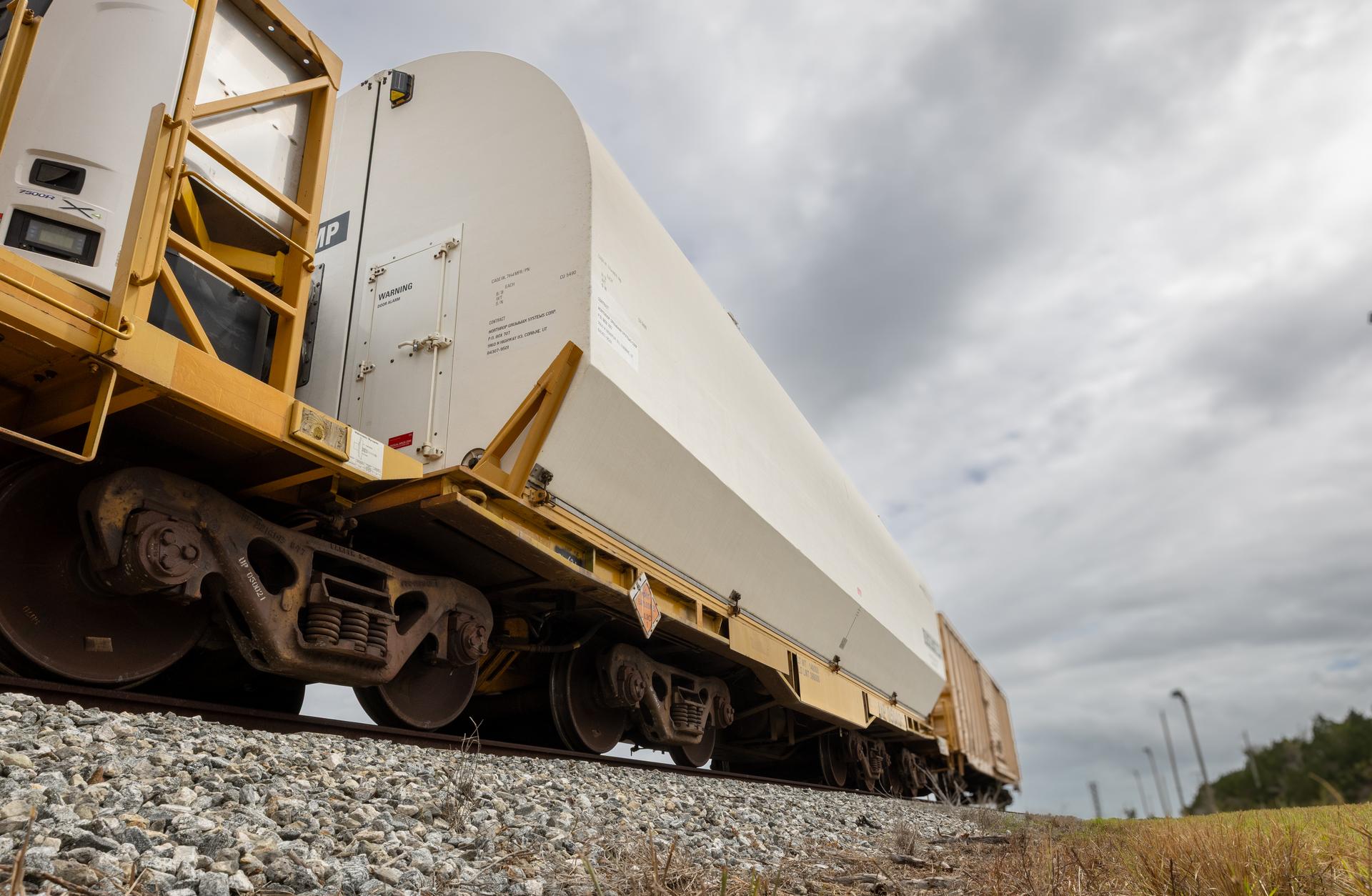
The solid rocket booster aft skirt segments for NASA’s Artemis III SLS (Space Launch System) rocket arrive at a rail yard near the agency’s Kennedy Space Center in Florida on Wednesday, April 8, 2026. Comprising the bottom of the rocket’s twin, five-segment solid rocket boosters, the aft skirt segments traveled by train in specialized transporters to the Florida spaceport and will be transferred from the rail yard to NASA Kennedy’s Rotation, Processing and Surge Facility for processing. The Artemis III mission will launch crew in the Orion spacecraft on top of the SLS rocket to test rendezvous and docking capabilities between Orion and commercial spacecraft needed to land astronauts on the Moon.
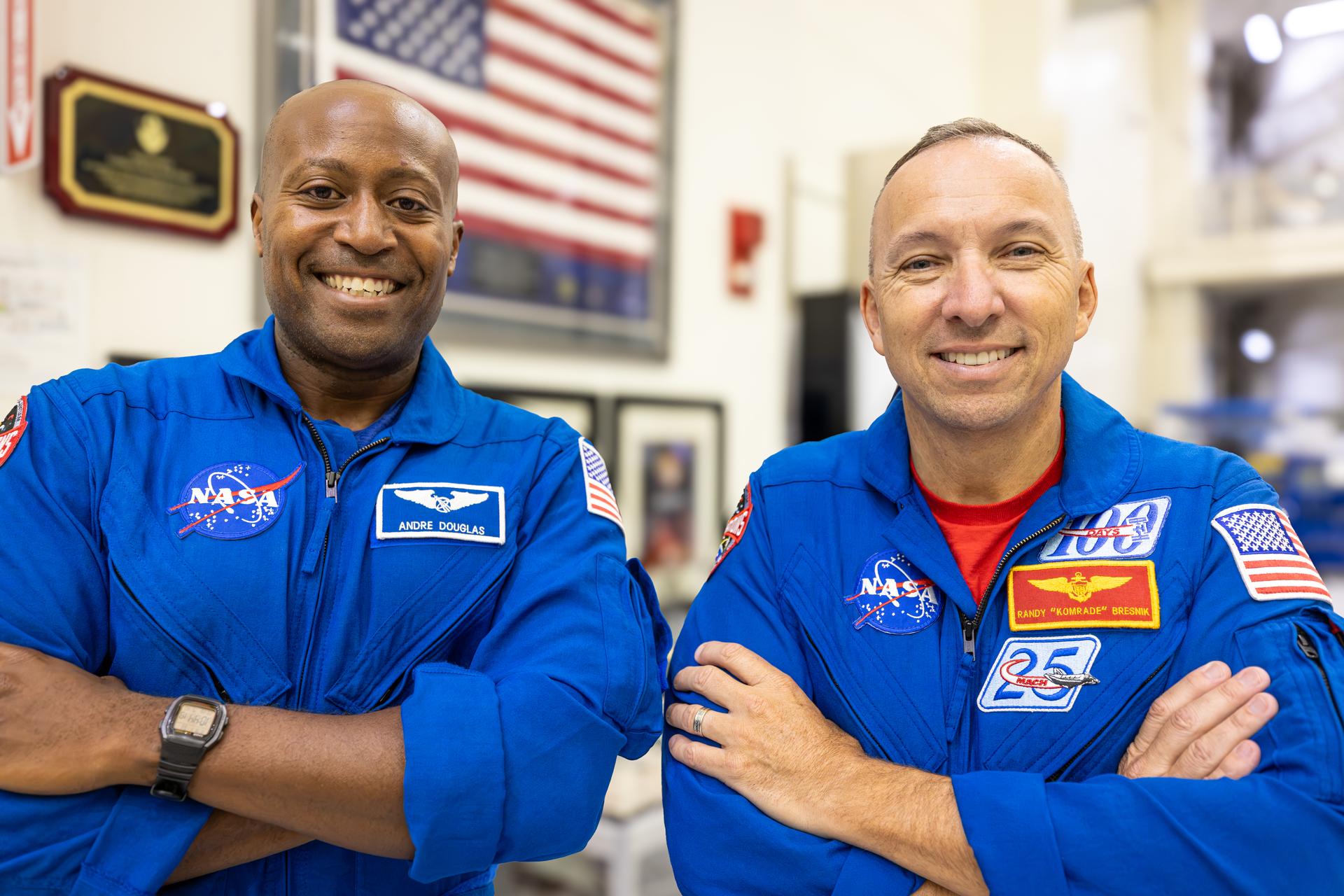
Artemis III crew members, NASA astronauts Andre Douglas (left) and Randy Bresnick, pose for a photograph inside the high bay of the Neil A. Armstrong Operations and Checkout Building at NASA’s Kennedy Space Center in Florida on Friday, July 10, 2026. The astronauts met with Orion teams and got a close look at the work underway on the Orion spacecraft inside the facility. Bresnick, Douglas, NASA astronaut Frank Rubio, and ESA (European Space Agency) astronaut Luca Parmitano will launch on the Artemis III mission to conduct critical rendezvous and docking tests with lunar lander systems in low Earth orbit, advancing the capabilities needed before astronauts return to the lunar surface on Artemis IV.
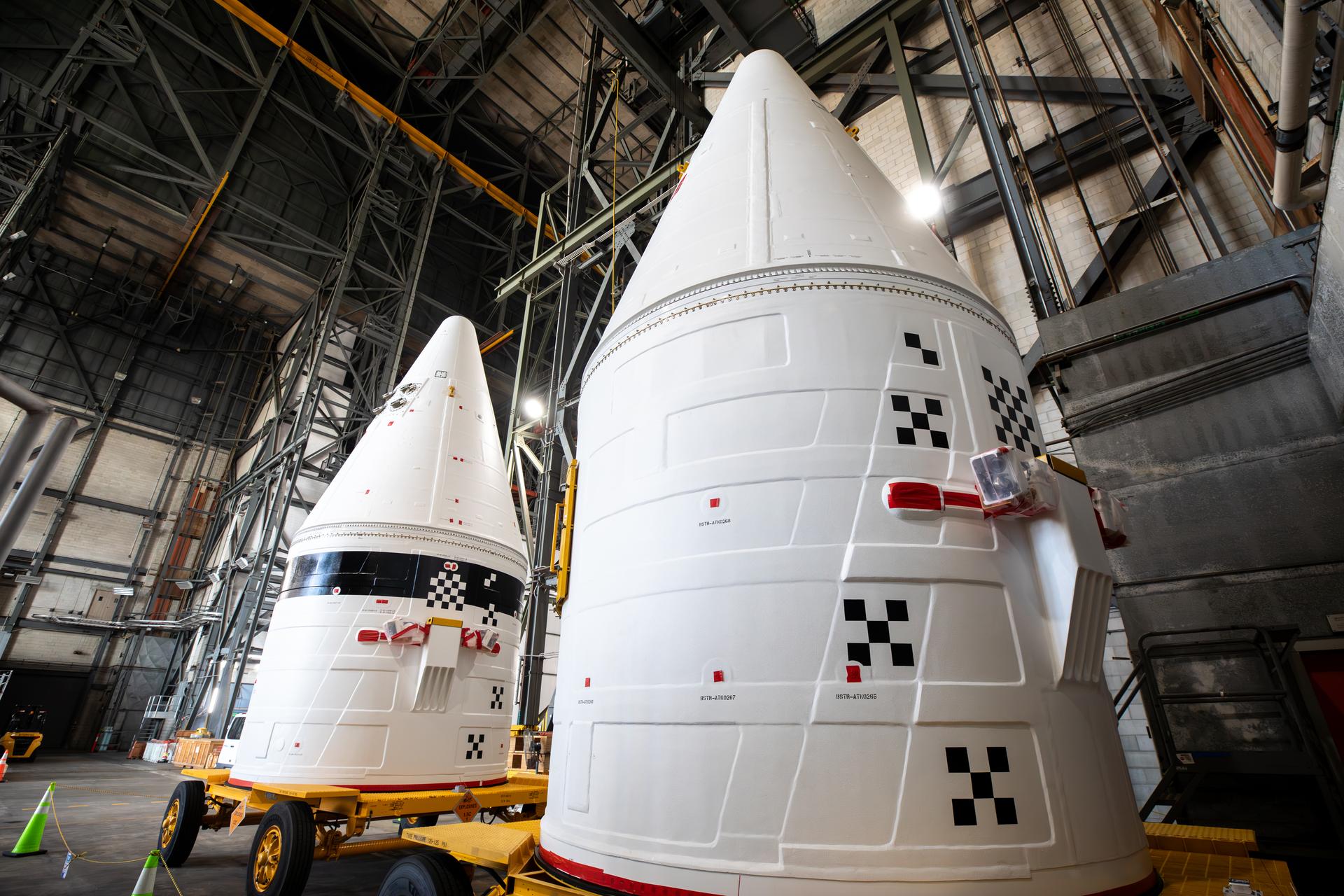
The left, with black stripe, and right aerodynamic forward assemblies for the twin SLS (Space Launch System) solid rocket boosters for Artemis III arrive at the Vehicle Assembly Building at NASA’s Kennedy Space Center in Florida on Thursday, Aug. 13, 2026. The nose cones will be integrated atop the SLS boosters to provide a smooth, pointed shape that allows the boosters to cut through the atmosphere efficiently, reducing drag and keeping the rocket stable during ascent. Artemis III will carry out a series of objectives in low Earth orbit designed to demonstrate critical systems needed for future lunar landings, beginning with Artemis IV.
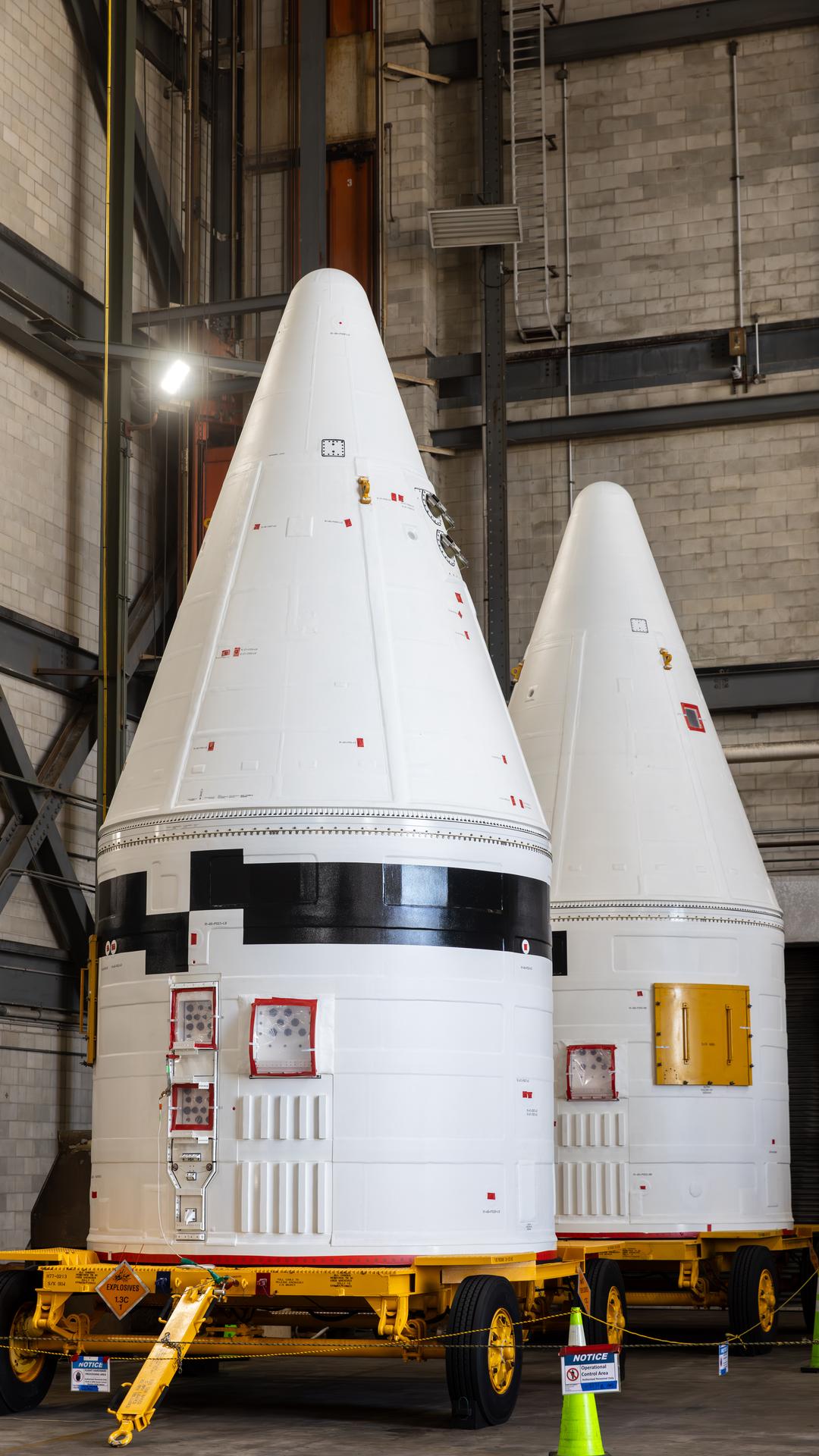
The left, with black stripe, and right aerodynamic forward assemblies for the twin SLS (Space Launch System) solid rocket boosters for Artemis III arrive at the Vehicle Assembly Building at NASA’s Kennedy Space Center in Florida on Thursday, Aug. 13, 2026. The nose cones will be integrated atop the SLS boosters to provide a smooth, pointed shape that allows the boosters to cut through the atmosphere efficiently, reducing drag and keeping the rocket stable during ascent. Artemis III will carry out a series of objectives in low Earth orbit designed to demonstrate critical systems needed for future lunar landings, beginning with Artemis IV.
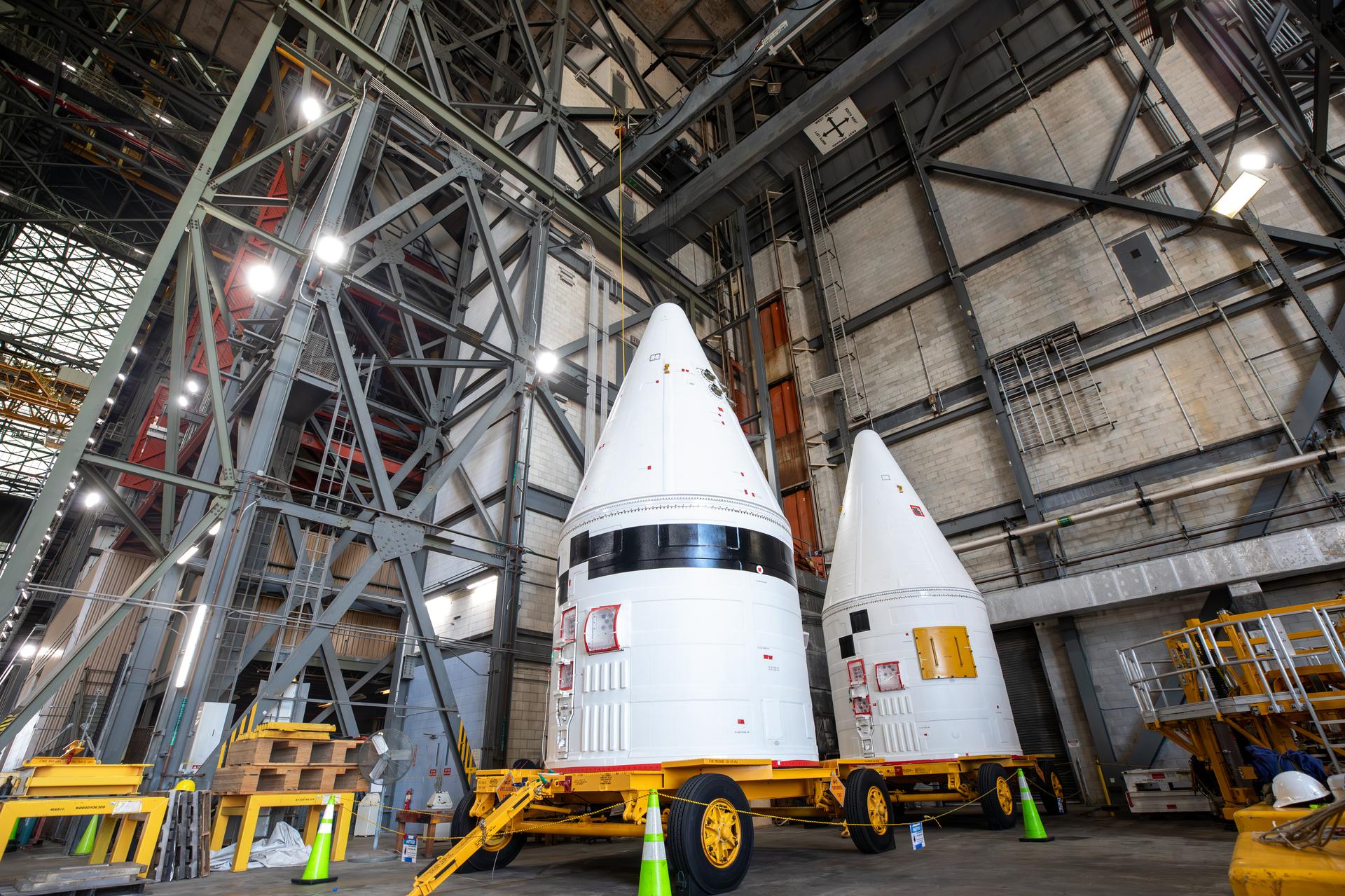
The left, with black stripe, and right aerodynamic forward assemblies for the twin SLS (Space Launch System) solid rocket boosters for Artemis III arrive at the Vehicle Assembly Building at NASA’s Kennedy Space Center in Florida on Thursday, Aug. 13, 2026. The nose cones will be integrated atop the SLS boosters to provide a smooth, pointed shape that allows the boosters to cut through the atmosphere efficiently, reducing drag and keeping the rocket stable during ascent. Artemis III will carry out a series of objectives in low Earth orbit designed to demonstrate critical systems needed for future lunar landings, beginning with Artemis IV.

Jeff Spaulding, senior NASA test director, Exploration Ground Systems Program, participates in the Artemis III terminal countdown simulation on Thursday, May 7, 2026, inside Firing Room 1 of the Rocco A. Petrone Launch Control Center at NASA’s Kennedy Space Center in Florida. This marked the first simulation the launch team performed ahead of Artemis III.

Vanessa Stroh, project engineer, Exploration Ground Systems Program, participates in the Artemis III terminal countdown simulation on Thursday, May 7, 2026, inside Firing Room 1 of the Rocco A. Petrone Launch Control Center at NASA’s Kennedy Space Center in Florida. This marked the first simulation the launch team performed ahead of Artemis III.

Jeremy Graeber, assistant launch director, Exploration Ground Systems Program, participates in the Artemis III terminal countdown simulation on Thursday, May 7, 2026, inside Firing Room 1 of the Rocco A. Petrone Launch Control Center at NASA’s Kennedy Space Center in Florida. This marked the first simulation the launch team performed ahead of Artemis III.

Charlie Blackwell-Thompson, launch director, Exploration Ground Systems Program, participates in the Artemis III terminal countdown simulation on Thursday, May 7, 2026, inside Firing Room 1 of the Rocco A. Petrone Launch Control Center at NASA’s Kennedy Space Center in Florida. This marked the first simulation the launch team performed ahead of Artemis III.

Jeremy Graeber, assistant launch director, Exploration Ground Systems Program, participates in the Artemis III terminal countdown simulation on Thursday, May 7, 2026, inside Firing Room 1 of the Rocco A. Petrone Launch Control Center at NASA’s Kennedy Space Center in Florida. This marked the first simulation the launch team performed ahead of Artemis III.

NASA’s Pegasus barge departs from NASA’s Michoud Assembly Facility in New Orleans on April 21. The barge arrived at NASA’s Kennedy Space Center in Florida on April 27 with the largest section of the core stage for the agency’s SLS (Space Launch System) rocket that will launch the crewed Artemis III mission in 2027. Engineers will complete outfitting and vertical integration of the top four-fifths – the section containing the liquid hydrogen tank, liquid oxygen tank, intertank, and forward skirt – of the SLS core stage at NASA Kennedy. Next year’s Artemis III mission will launch astronauts to Earth’s orbit aboard the Orion spacecraft on top of SLS to test rendezvous and docking capabilities between Orion and commercial spacecraft needed to land Artemis IV astronauts on the Moon in 2028. NASA’s SLS is the only rocket capable of sending Orion, astronauts, and supplies to the Moon in a single launch. Image credit: NASA/Michael DeMocker

NASA’s Pegasus barge departs from NASA’s Michoud Assembly Facility in New Orleans on April 21. The barge arrived at NASA’s Kennedy Space Center in Florida on April 27 with the largest section of the core stage for the agency’s SLS (Space Launch System) rocket that will launch the crewed Artemis III mission in 2027. Engineers will complete outfitting and vertical integration of the top four-fifths – the section containing the liquid hydrogen tank, liquid oxygen tank, intertank, and forward skirt – of the SLS core stage at NASA Kennedy. Next year’s Artemis III mission will launch astronauts to Earth’s orbit aboard the Orion spacecraft on top of SLS to test rendezvous and docking capabilities between Orion and commercial spacecraft needed to land Artemis IV astronauts on the Moon in 2028. NASA’s SLS is the only rocket capable of sending Orion, astronauts, and supplies to the Moon in a single launch. Image credit: NASA/Michael DeMocker

NASA’s Pegasus barge departs from NASA’s Michoud Assembly Facility in New Orleans on April 21. The barge arrived at NASA’s Kennedy Space Center in Florida on April 27 with the largest section of the core stage for the agency’s SLS (Space Launch System) rocket that will launch the crewed Artemis III mission in 2027. Engineers will complete outfitting and vertical integration of the top four-fifths – the section containing the liquid hydrogen tank, liquid oxygen tank, intertank, and forward skirt – of the SLS core stage at NASA Kennedy. Next year’s Artemis III mission will launch astronauts to Earth’s orbit aboard the Orion spacecraft on top of SLS to test rendezvous and docking capabilities between Orion and commercial spacecraft needed to land Artemis IV astronauts on the Moon in 2028. NASA’s SLS is the only rocket capable of sending Orion, astronauts, and supplies to the Moon in a single launch. Image credit: NASA/Michael DeMocker

NASA’s Pegasus barge departs from NASA’s Michoud Assembly Facility in New Orleans on April 21. The barge arrived at NASA’s Kennedy Space Center in Florida on April 27 with the largest section of the core stage for the agency’s SLS (Space Launch System) rocket that will launch the crewed Artemis III mission in 2027. Engineers will complete outfitting and vertical integration of the top four-fifths – the section containing the liquid hydrogen tank, liquid oxygen tank, intertank, and forward skirt – of the SLS core stage at NASA Kennedy. Next year’s Artemis III mission will launch astronauts to Earth’s orbit aboard the Orion spacecraft on top of SLS to test rendezvous and docking capabilities between Orion and commercial spacecraft needed to land Artemis IV astronauts on the Moon in 2028. NASA’s SLS is the only rocket capable of sending Orion, astronauts, and supplies to the Moon in a single launch. Image credit: NASA/Michael DeMocker

NASA’s Pegasus barge departs from NASA’s Michoud Assembly Facility in New Orleans on April 21. The barge arrived at NASA’s Kennedy Space Center in Florida on April 27 with the largest section of the core stage for the agency’s SLS (Space Launch System) rocket that will launch the crewed Artemis III mission in 2027. Engineers will complete outfitting and vertical integration of the top four-fifths – the section containing the liquid hydrogen tank, liquid oxygen tank, intertank, and forward skirt – of the SLS core stage at NASA Kennedy. Next year’s Artemis III mission will launch astronauts to Earth’s orbit aboard the Orion spacecraft on top of SLS to test rendezvous and docking capabilities between Orion and commercial spacecraft needed to land Artemis IV astronauts on the Moon in 2028. NASA’s SLS is the only rocket capable of sending Orion, astronauts, and supplies to the Moon in a single launch. Image credit: NASA/Michael DeMocker

Charlie Blackwell-Thompson, Artemis launch director, participates in a cryogenic propellant loading simulation for NASA’s Artemis III mission on Wednesday, June 10, 2026, inside Firing Room 1 of the Rocco A. Petrone Launch Control Center at the agency’s Kennedy Space Center in Florida. Members of NASA’s Exploration Ground Systems team rehearse the steps to load the super-cooled liquid hydrogen and liquid oxygen into the SLS (Space Launch System) rocket core stage, a process that starts several hours before liftoff for the Artemis III mission. Artemis III will carry out a series of objectives in low Earth orbit designed to demonstrate critical systems needed for future lunar landings, beginning with Artemis IV.

Charlie Blackwell-Thompson, Artemis launch director, participates in a cryogenic propellant loading simulation for NASA’s Artemis III mission on Wednesday, June 10, 2026, inside Firing Room 1 of the Rocco A. Petrone Launch Control Center at the agency’s Kennedy Space Center in Florida. Members of NASA’s Exploration Ground Systems team rehearse the steps to load the super-cooled liquid hydrogen and liquid oxygen into the SLS (Space Launch System) rocket core stage, a process that starts several hours before liftoff for the Artemis III mission. Artemis III will carry out a series of objectives in low Earth orbit designed to demonstrate critical systems needed for future lunar landings, beginning with Artemis IV.
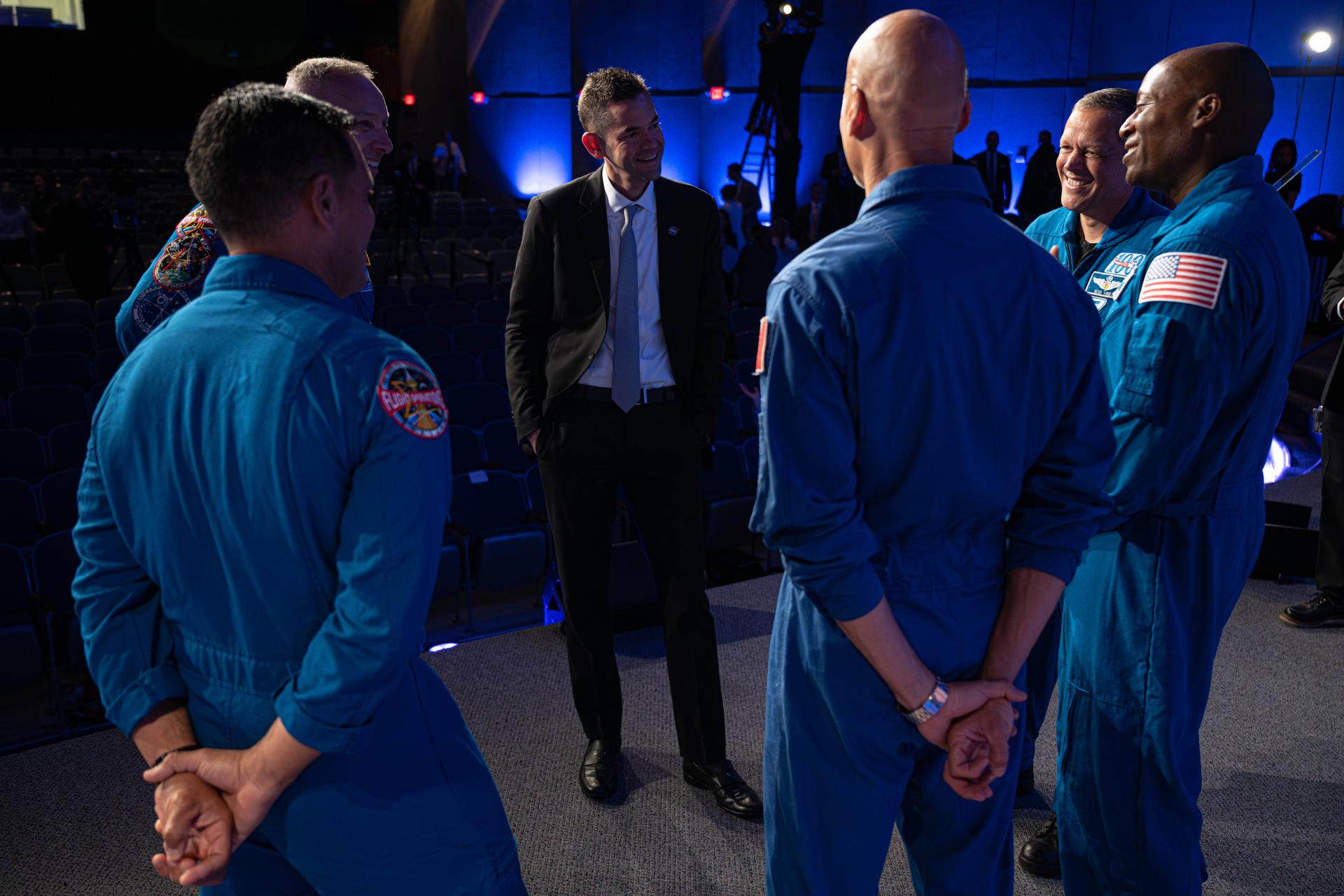
NASA Administrator Jared Isaacman, center, speaks with members of the prime and backup Artemis III crew, Tuesday, June 9, 2026, at NASA’s Johnson Space Center in Houston, Texas. The Artemis III crew consists of, from left to right, NASA astronauts Frank Rubio, mission specialist, and Randy Bresnik, commander; ESA (European Space Agency) astronaut Luca Parmitano, pilot; and NASA astronauts Bob Hines, backup crew member, and Andre Douglas, mission specialist. Photo Credit: (NASA/John Kraus)
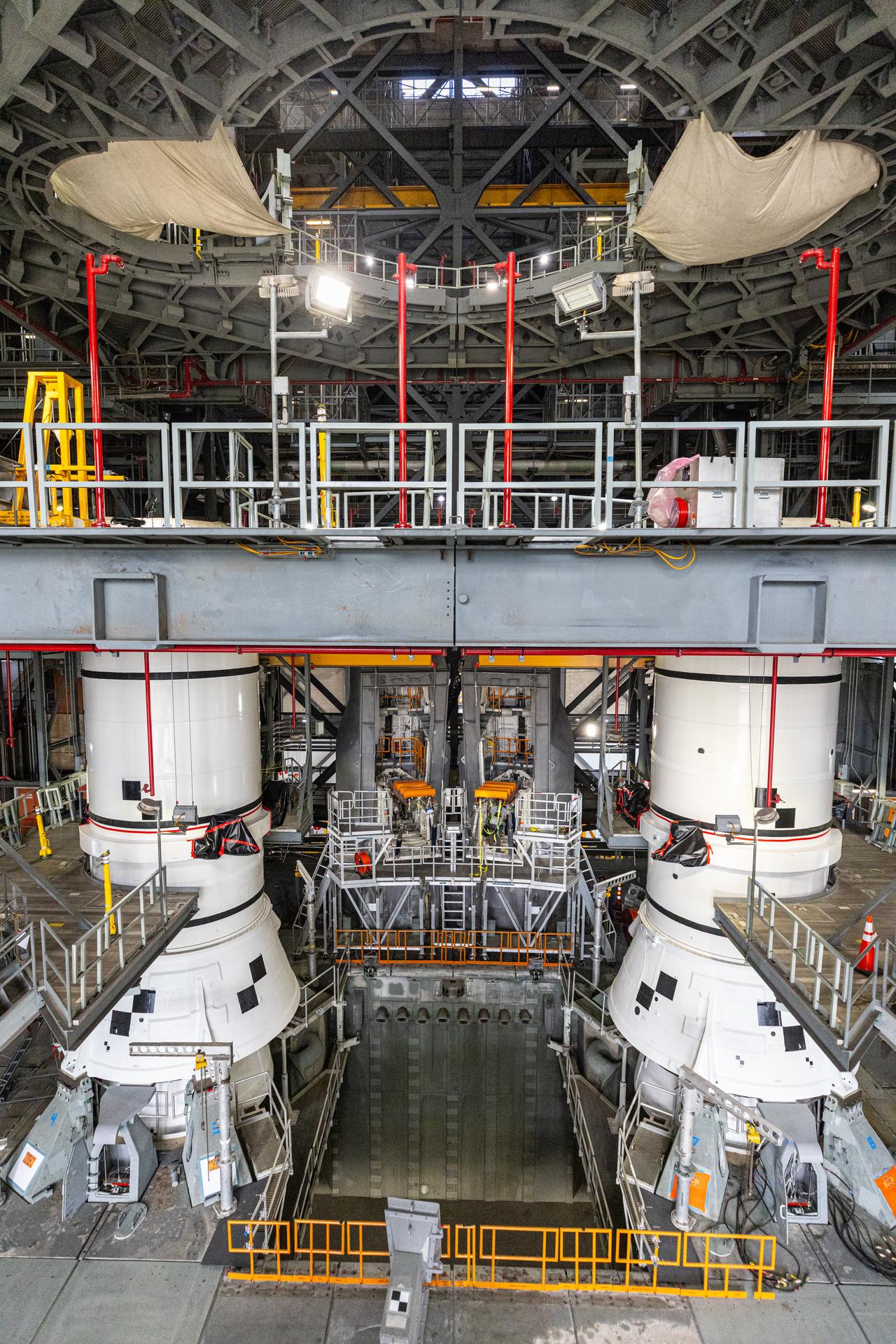
The left-hand and right-hand aft assembly solid rocket booster segments for NASA’s Artemis III SLS (Space Launch System) rocket are secured to the mobile launcher at the agency’s Vehicle Assembly Building at NASA’s Kennedy Space Center in Florida on Saturday, July 11, 2026. The twin boosters, manufactured by Northrop Grumman in Utah, will provide more than 75 percent of the SLS rocket’s total thrust at launch. The Artemis III mission will launch astronauts in the Orion spacecraft on top of the SLS rocket to test rendezvous and docking capabilities between Orion and commercial spacecraft needed to land astronauts on the Moon.
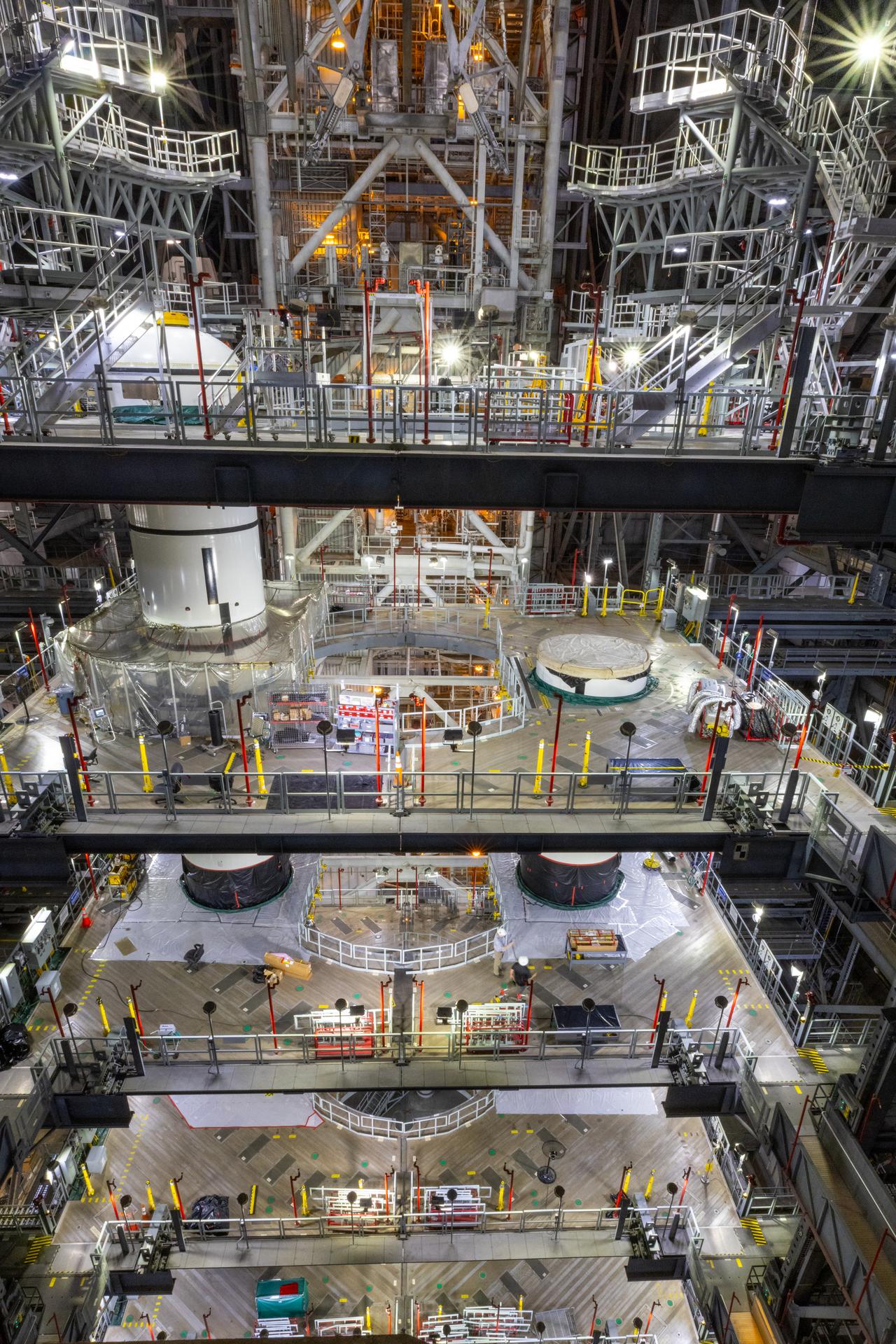
Technicians integrate the left forward booster segment for NASA’s Artemis III SLS (Space Launch System) rocket onto the left booster segments atop the mobile launcher in High Bay 3 of the Vehicle Assembly Building at NASA’s Kennedy Space Center in Florida on Thursday, Sept. 17, 2026. The SLS rocket’s twin boosters, each made up of five segments manufactured by Northrop Grumman in Utah, will provide more than 75 percent of the rocket’s total thrust at launch. The Artemis III mission will launch crew in the Orion spacecraft on top of the SLS rocket to test rendezvous and docking capabilities between Orion and commercial spacecraft needed to land astronauts on the Moon.
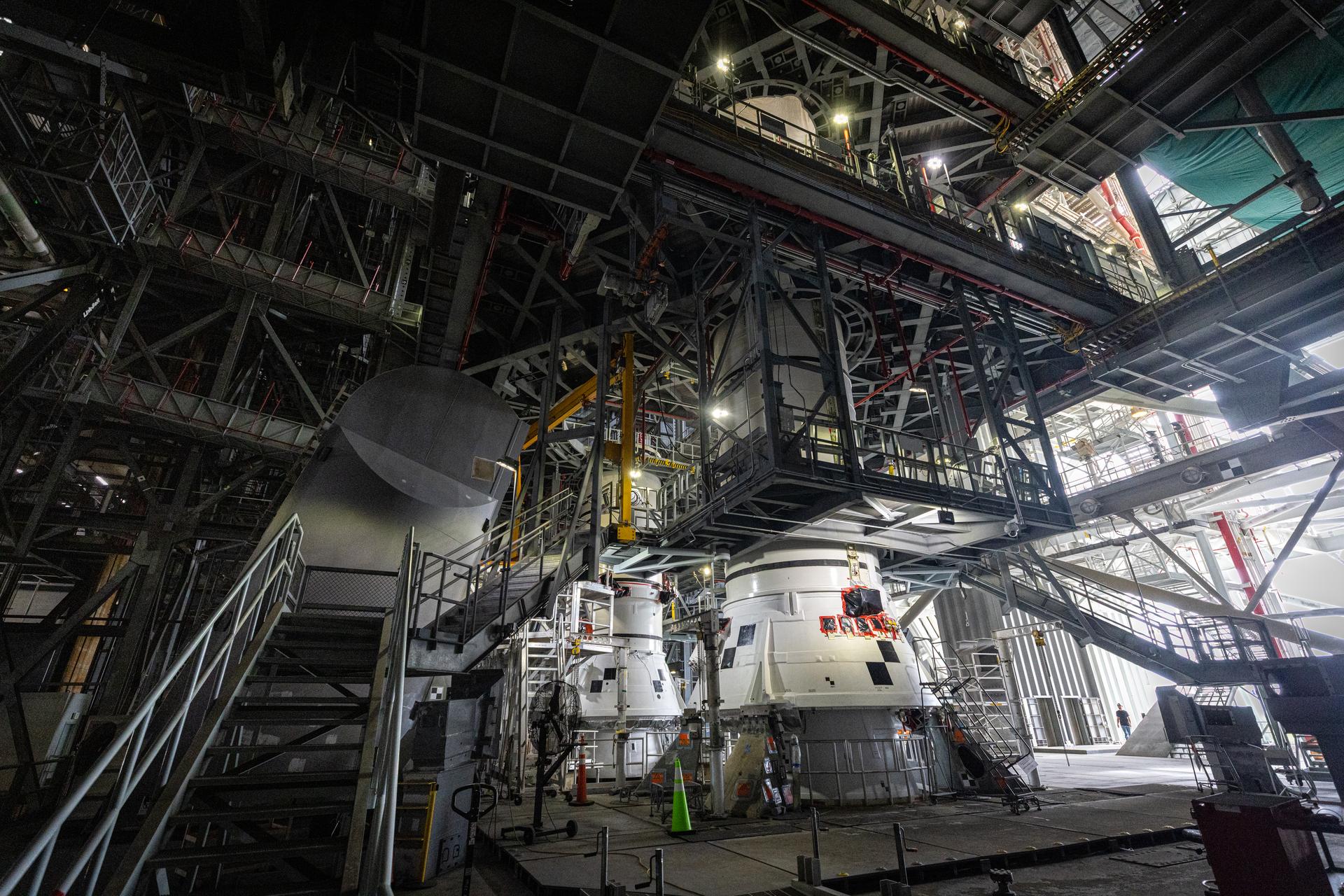
The left-hand and right-hand aft assembly solid rocket booster segments for NASA’s Artemis III SLS (Space Launch System) rocket are secured to the mobile launcher at the agency’s Vehicle Assembly Building at NASA’s Kennedy Space Center in Florida on Saturday, July 11, 2026. The twin boosters, manufactured by Northrop Grumman in Utah, will provide more than 75 percent of the SLS rocket’s total thrust at launch. The Artemis III mission will launch astronauts in the Orion spacecraft on top of the SLS rocket to test rendezvous and docking capabilities between Orion and commercial spacecraft needed to land astronauts on the Moon.
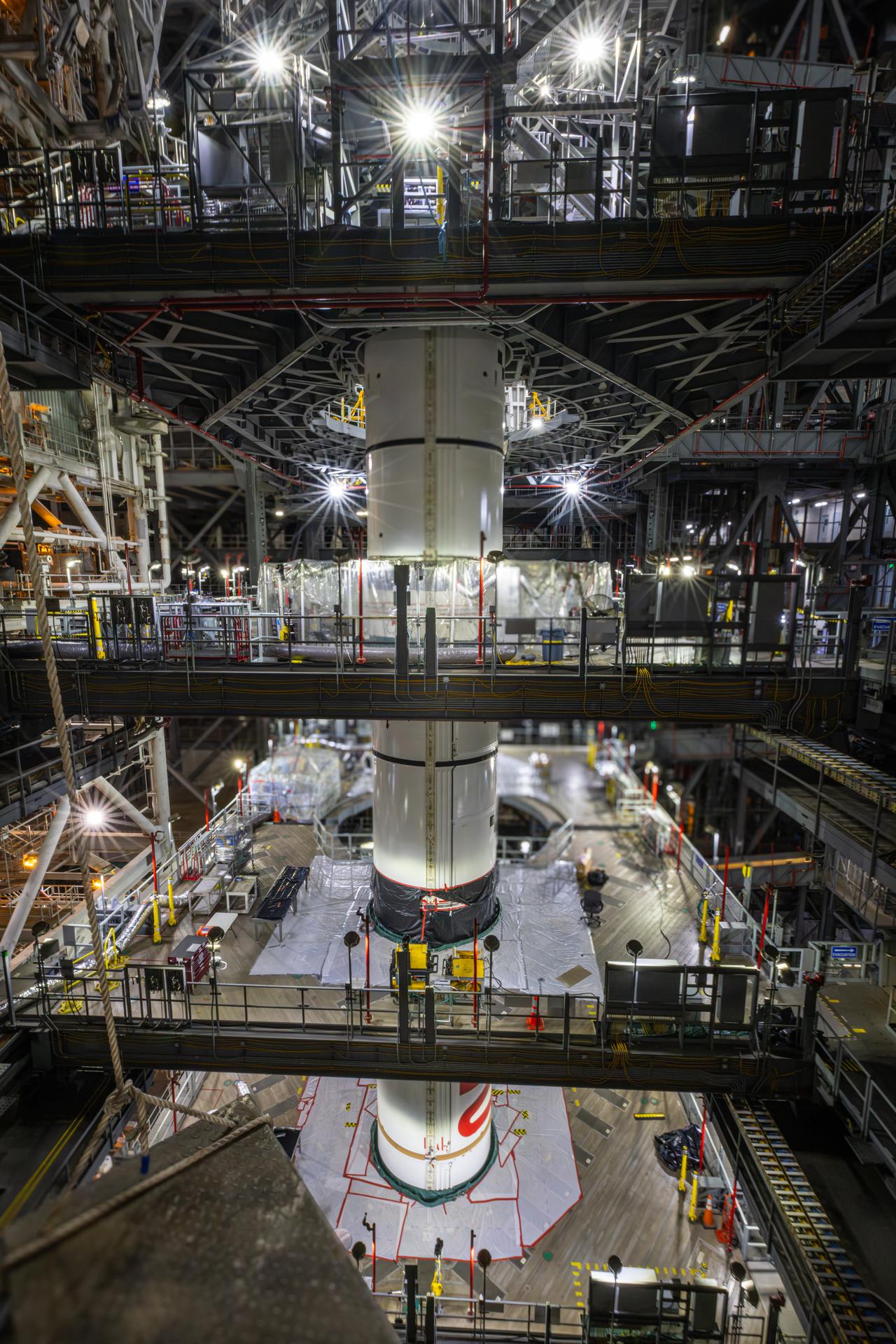
Technicians integrate the left forward booster segment for NASA’s Artemis III SLS (Space Launch System) rocket onto the left booster segments atop the mobile launcher in High Bay 3 of the Vehicle Assembly Building at NASA’s Kennedy Space Center in Florida on Thursday, Sept. 17, 2026. The SLS rocket’s twin boosters, each made up of five segments manufactured by Northrop Grumman in Utah, will provide more than 75 percent of the rocket’s total thrust at launch. The Artemis III mission will launch crew in the Orion spacecraft on top of the SLS rocket to test rendezvous and docking capabilities between Orion and commercial spacecraft needed to land astronauts on the Moon.
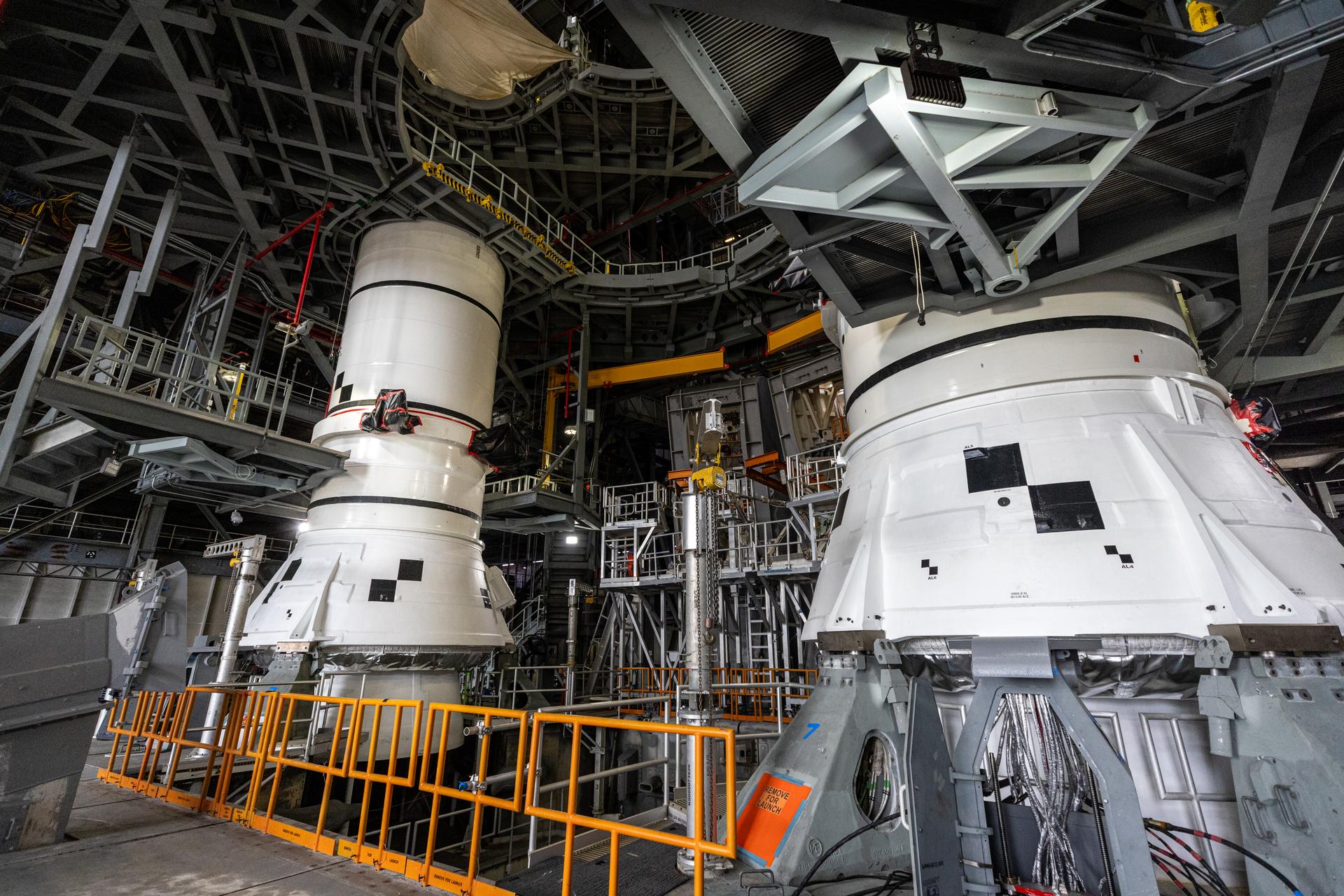
The left-hand and right-hand aft assembly solid rocket booster segments for NASA’s Artemis III SLS (Space Launch System) rocket are secured to the mobile launcher at the agency’s Vehicle Assembly Building at NASA’s Kennedy Space Center in Florida on Saturday, July 11, 2026. The twin boosters, manufactured by Northrop Grumman in Utah, will provide more than 75 percent of the SLS rocket’s total thrust at launch. The Artemis III mission will launch astronauts in the Orion spacecraft on top of the SLS rocket to test rendezvous and docking capabilities between Orion and commercial spacecraft needed to land astronauts on the Moon.
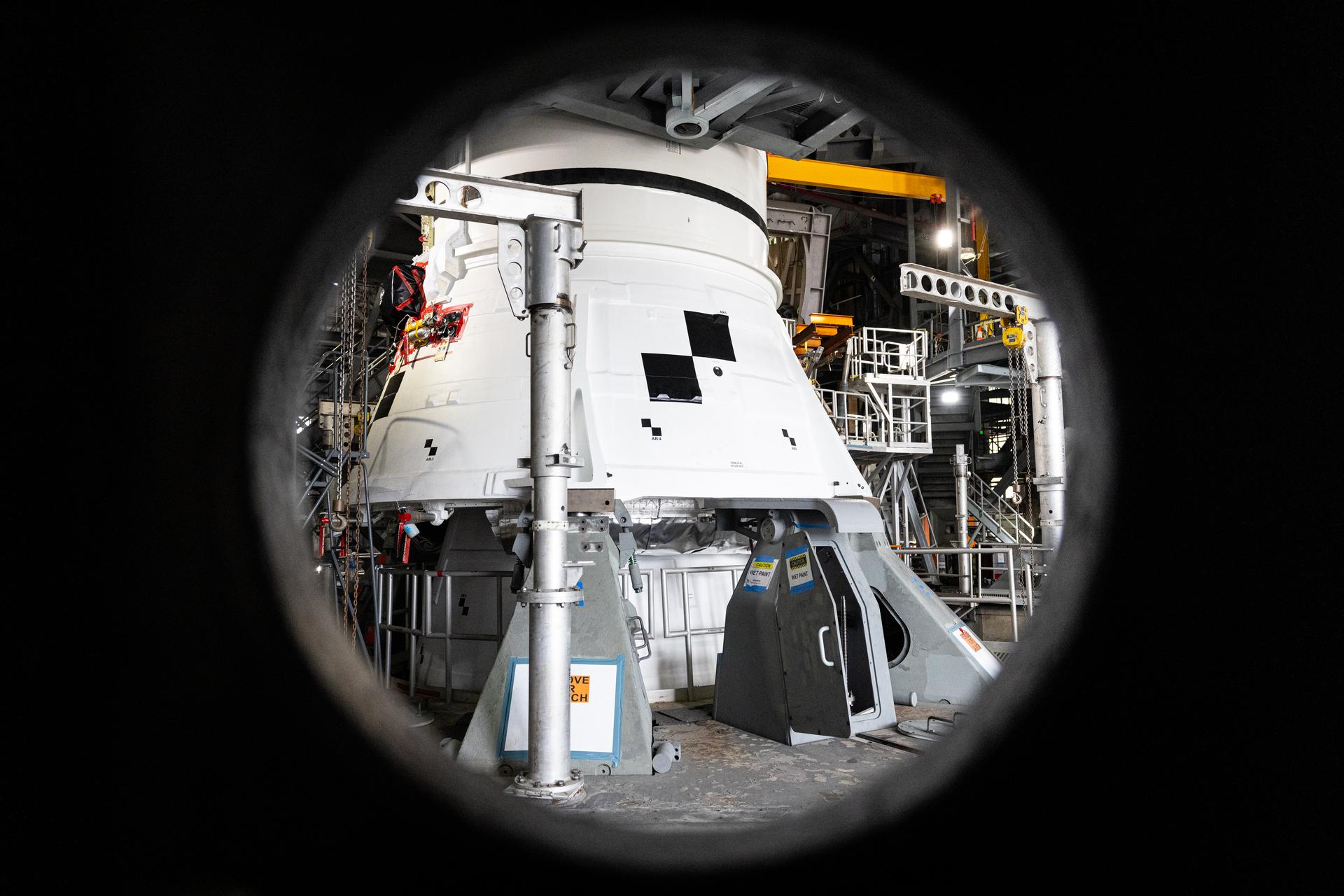
Teams with NASA’s Exploration Ground Systems Program secured the right-hand aft assembly solid rocket booster segment for the Artemis III SLS (Space Launch System) rocket to the mobile launcher at the agency’s Vehicle Assembly Building at Kennedy Space Center in Florida on Saturday, July 11, 2026. The twin boosters, manufactured by Northrop Grumman in Utah, will provide more than 75 percent of the SLS rocket’s total thrust at launch. The Artemis III mission will launch astronauts in the Orion spacecraft on top of the SLS rocket to test rendezvous and docking capabilities between Orion and commercial spacecraft needed to land astronauts on the Moon.