
Former NASA astronaut Jon McBride shares a few words during a wreath-laying ceremony honoring astronaut Owen Garriott on April 18, 2019. The ceremony was held at the Heroes and Legends exhibit within the Astronaut Hall of Fame at the Kennedy Space Center Visitor Complex in Florida. Garriott flew aboard the Skylab space station during the Skylab 3 mission and also on space shuttle Columbia for the STS-9/Spacelab-1 mission. He passed away April 15 at the age of 88.

Therrin Protze, chief operating officer of the Kennedy Space Center Visitor Complex, is photographed at a wreath-laying ceremony honoring former astronaut Owen Garriott on April 18, 2019. The ceremony was held at the Heroes and Legends exhibit within the Astronaut Hall of Fame at the center’s visitor complex in Florida. Garriott flew aboard the Skylab space station during the Skylab 3 mission and also on space shuttle Columbia for the STS-9/Spacelab-1 mission. He passed away April 15 at the age of 88.

Kennedy Space Center Director Bob Cabana is photographed at a wreath-laying ceremony honoring former astronaut Owen Garriott. The ceremony was held April 18, 2019, at the Heroes and Legends exhibit within the Astronaut Hall of Fame at the Florida spaceport’s visitor complex. Garriott flew aboard the Skylab space station during the Skylab 3 mission and also on space shuttle Columbia for the STS-9/Spacelab-1 mission. He passed away April 15 at the age of 88.

Kennedy Space Center Director Bob Cabana speaks during a wreath-laying ceremony honoring former astronaut Owen Garriott on April 18, 2019. The ceremony was held at the Heroes and Legends exhibit within the Astronaut Hall of Fame at the center’s visitor complex in Florida. Garriott flew aboard the Skylab space station during the Skylab 3 mission and also on space shuttle Columbia for the STS-9/Spacelab-1 mission. He passed away April 15 at the age of 88.

A photo of former astronaut Owen Garriott is displayed during a memorial ceremony at NASA’s Kennedy Space Center in Florida. The ceremony was held April 18, 2019, at the Heroes and Legends exhibit within the Astronaut Hall of Fame at the center’s visitor complex. Garriott flew aboard the Skylab space station during the Skylab 3 mission and also on space shuttle Columbia for the STS-9/Spacelab-1 mission. He passed away April 15 at the age of 88.

A memorial wreath has been placed in the Heroes and Legends exhibit at the Kennedy Space Center Visitor Complex in Florida following a ceremony honoring the memory of former astronaut Owen Garriott. The ceremony was held April 18, 2019. Garriott flew aboard the Skylab space station during the Skylab 3 mission and also on space shuttle Columbia for the STS-9/Spacelab-1 mission. He passed away April 15 at the age of 88.

In the Heroes and Legends exhibit at the Kennedy Space Center Visitor Complex in Florida, a memorial wreath was placed following a ceremony honoring the memory of former astronaut Owen Garriott. The ceremony was held April 18, 2019. Garriott flew aboard the Skylab space station during the Skylab 3 mission and also on space shuttle Columbia for the STS-9/Spacelab-1 mission. He passed away April 15 at the age of 88.

A memorial wreath has been placed in the Heroes and Legends exhibit at the Kennedy Space Center Visitor Complex in Florida following a ceremony honoring the memory of former astronaut Owen Garriott. The ceremony was held April 18, 2019. Garriott flew aboard the Skylab space station during the Skylab 3 mission and also on space shuttle Columbia for the STS-9/Spacelab-1 mission. He passed away April 15 at the age of 88.

In the Heroes and Legends exhibit at the Kennedy Space Center Visitor Complex in Florida, a memorial wreath was placed following a ceremony honoring the memory of former astronaut Owen Garriott. The ceremony was held April 18, 2019. Garriott flew aboard the Skylab space station during the Skylab 3 mission and also on space shuttle Columbia for the STS-9/Spacelab-1 mission. He passed away April 15 at the age of 88.

S81-29032 (1981) --- Astronaut Dr. Owen K. Garriott.

S71-51299 (21 Sept. 1971) --- Astronaut Owen K. Garriott. Photo credit: NASA

SL3-111-1505 (July-September 1973) --- View of scientist-astronaut Owen K. Garriott, Skylab 3 science pilot, in his sleep restraints in the crew quarters of the Orbital Workshop (OWS). Photo credit: NASA

Scientist-Astronaut Owen K. Garriott, science pilot of the Skylab 3 mission, is stationed at the Apollo Telescope Mount (ATM) console in the Multiple Docking Adapter of the Skylab space station in Earth orbit. From this console the astronauts actively control the ATM solar physics telescope.
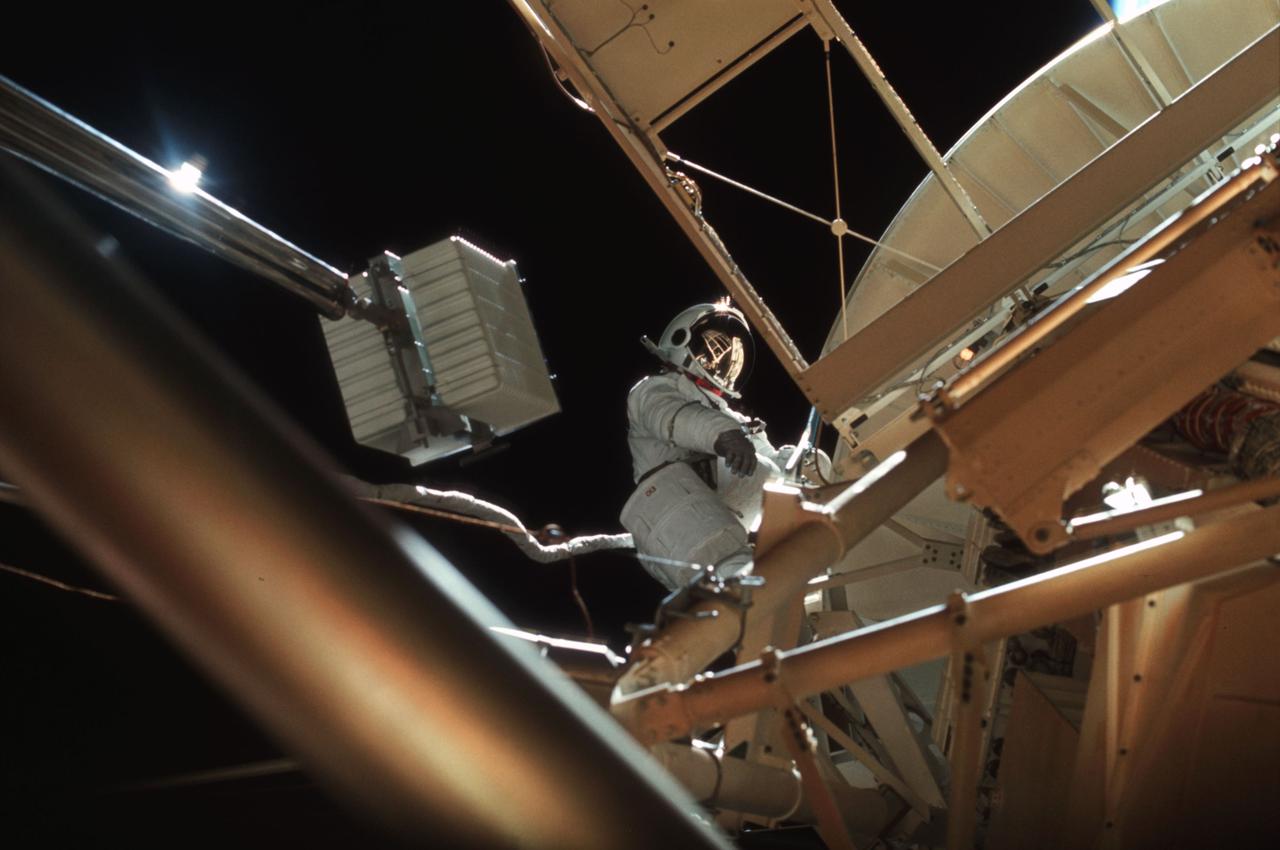
SL3-117-2109 (6 Aug. 1973) --- Scientist-astronaut Owen K. Garriott, Skylab 3 science pilot, participates in the Aug. 6, 1973 extravehicular activity (EVA) during which he and astronaut Jack Lousma, Skylab 3 pilot, deployed the twin pole solar shield to help shade the Orbital Workshop (OWS). Note the reflection of the solar shield in Garriott's helmet visor. Photo credit: NASA
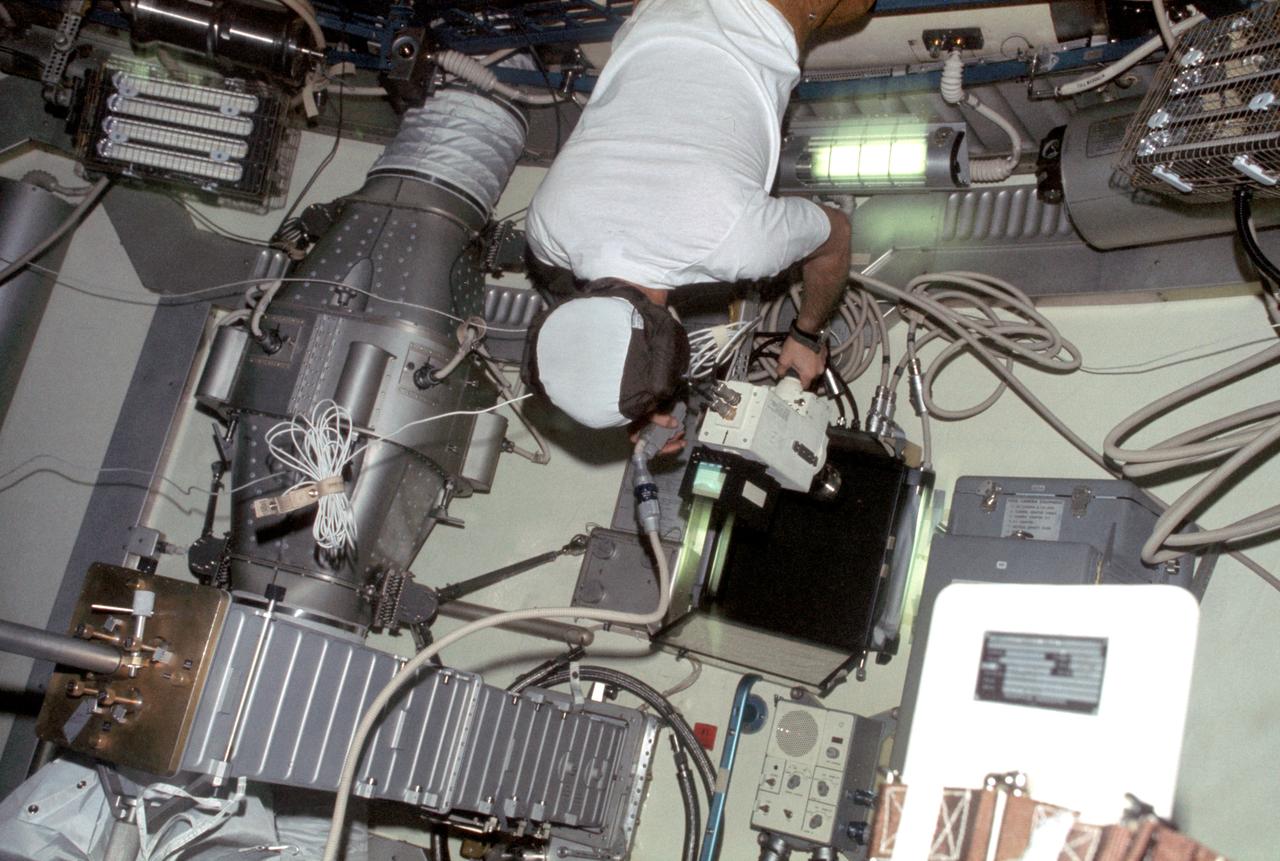
SL3-109-1345 (August 1973) --- View of scientist-astronaut Owen K. Garriott, Skylab 3 science pilot, taking TV footage of Arabella and Anita, the two Skylab 3 common cross spiders "aranous diadematus," aboard the Skylab space station cluster in Earth orbit. During the 59-day Skylab 3 mission the two spiders Arabella and Anita, were housed in an enclosure onto which a motion picture and still camera were attached to record the spiders' attempts to build a web in the weightless environment. Note the automatic data acquisition camera (DAC) about 3.5 feet to Garriott's right (about waist level). Photo credit: NASA
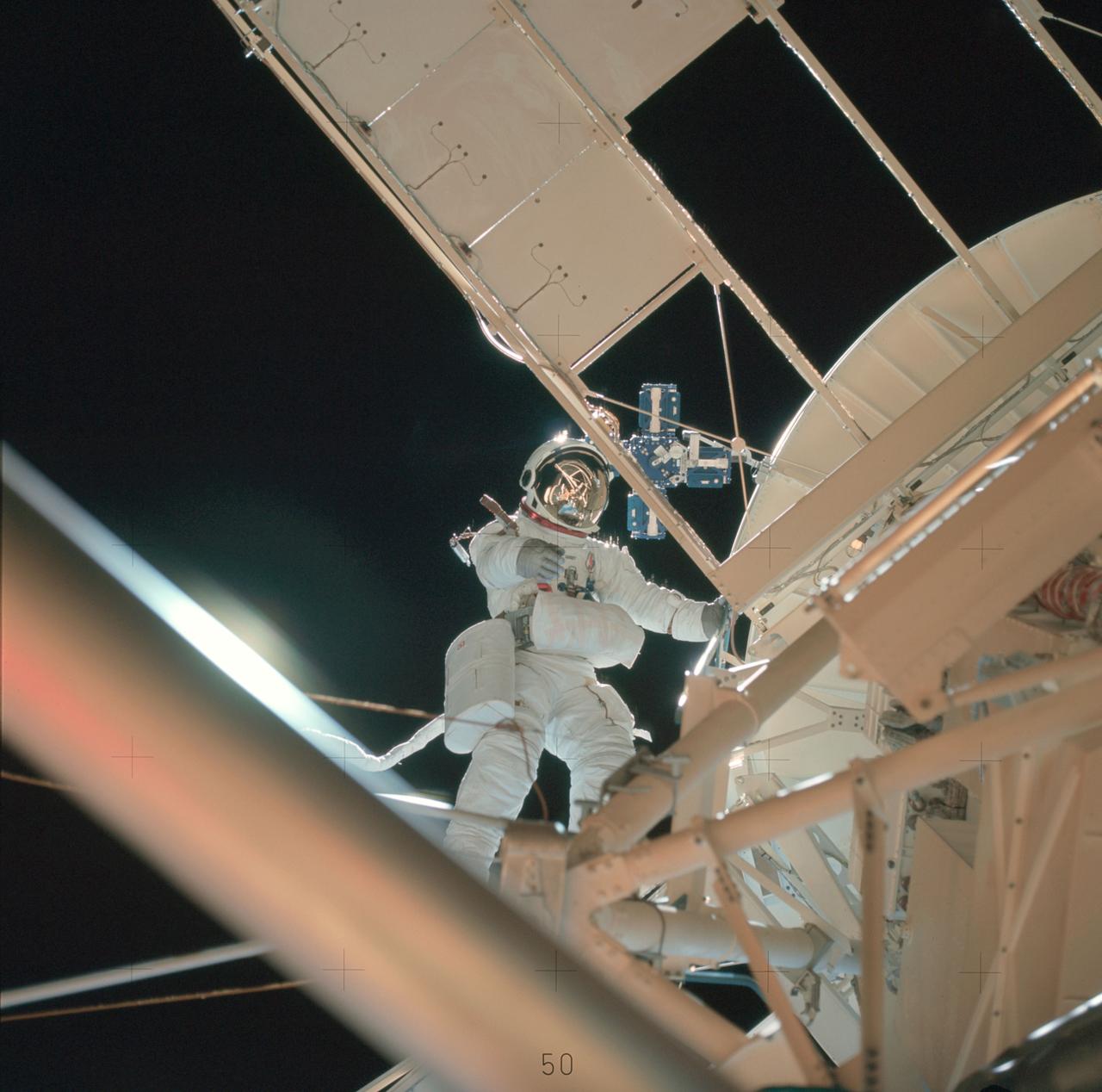
Scientist-Astronaut Owen K. Garriott, Skylab 3 science pilot, participates in the August 6, 1973 extravehicular activity (EVA) during which he and Astronaut Jack Lousma, Skylab pilot, deployed the twin pole solar shield to help shade the Orbital Workshop (OWS). Note the reflection of the solar shield in Garriett's helmet visor.
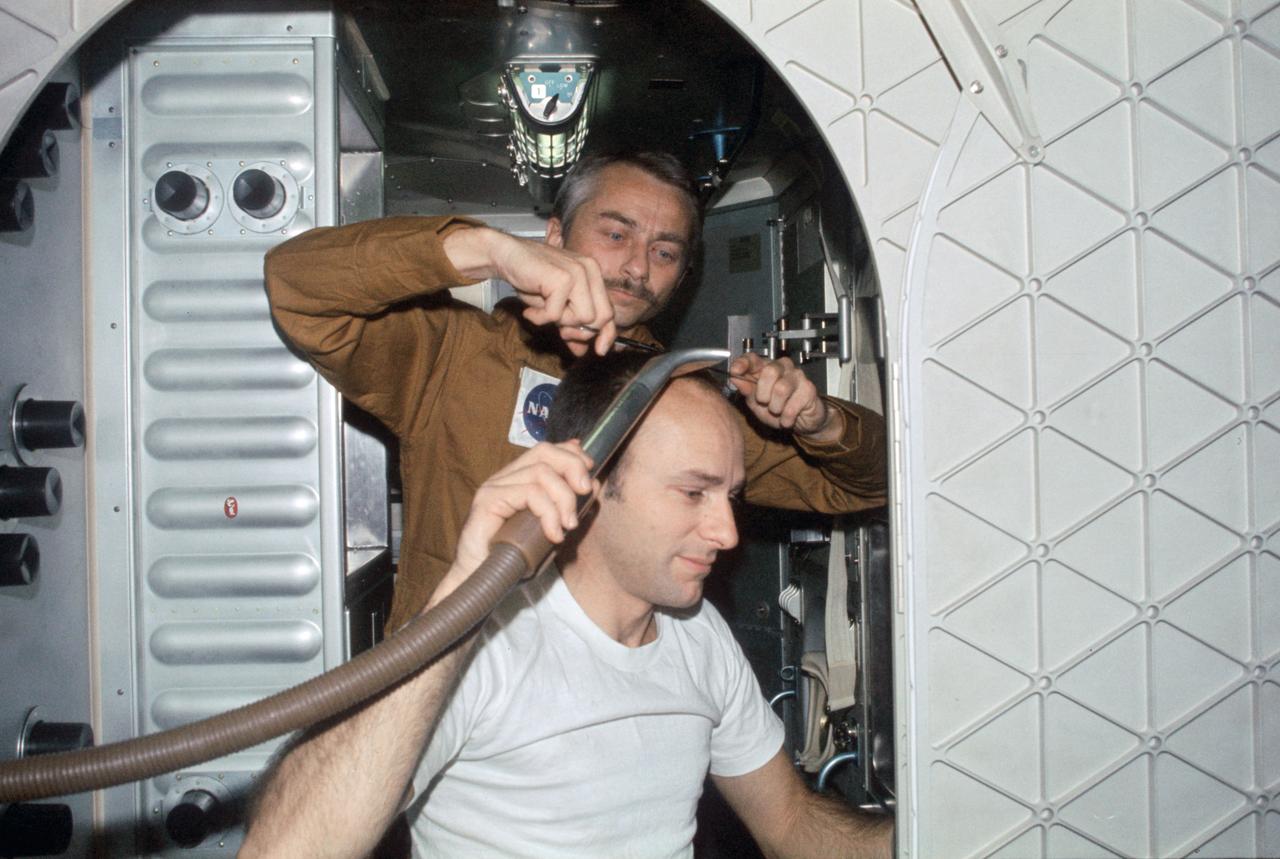
SL3-108-1292 (19 Aug. 1973) --- Scientist-astronaut Owen K. Garriott, Skylab 3 science pilot, trims the hair of astronaut Alan L. Bean, commander, in this onboard photograph from the Skylab Orbital Workshop (OWS) in Earth orbit. Astronaut Jack R. Lousma, pilot, took this picture with a 35mm Nikon camera. Bean holds a vacuum hose to gather in loose hair. The crew of the second manned Skylab flight went on to successfully complete 59 days aboard the Skylab space station cluster in Earth orbit. Photo credit: NASA
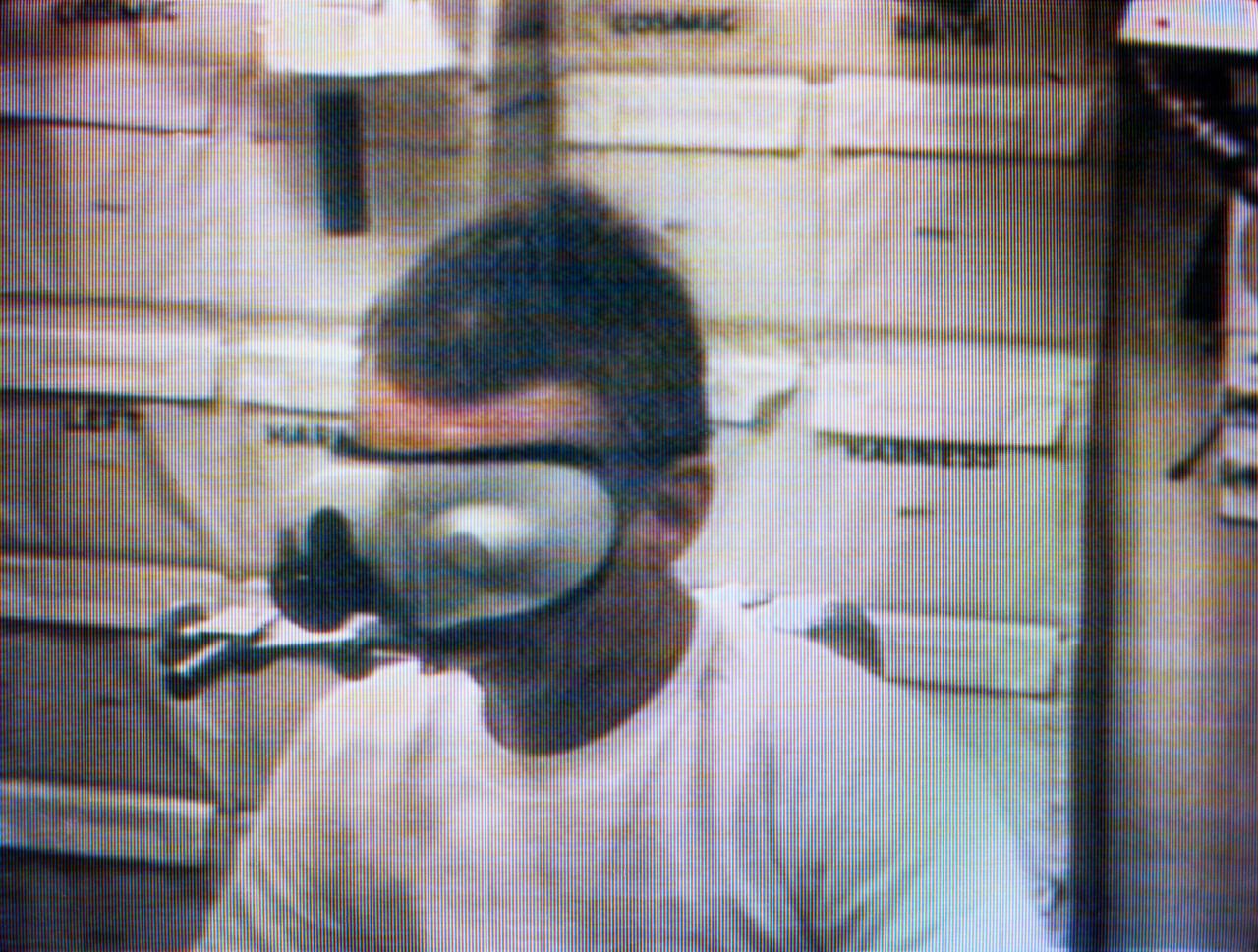
S73-32113 (9 Aug. 1973) --- Scientist-astronaut Owen K. Garriott, Skylab 3 science pilot, serves as test subject for the Skylab ?Human Vestibular Function? M131 Experiment, as seen in this photographic reproduction taken from a television transmission made by a color TV camera aboard the Skylab space station in Earth orbit. The objectives of the Skylab M131 experiment are to obtain data pertinent to establishing the validity of measurements of specific behavioral/physiological responses influenced by vestibular activity under one-g and zero-g conditions; to determine man?s adaptability to unusual vestibular conditions and predict habitability of future spacecraft conditions involving reduced gravity and Coriollis forces; and to measure the accuracy and variability in man?s judgment of spatial coordinates based on atypical gravity receptor cues and inadequate visual cues. Photo credit: NASA
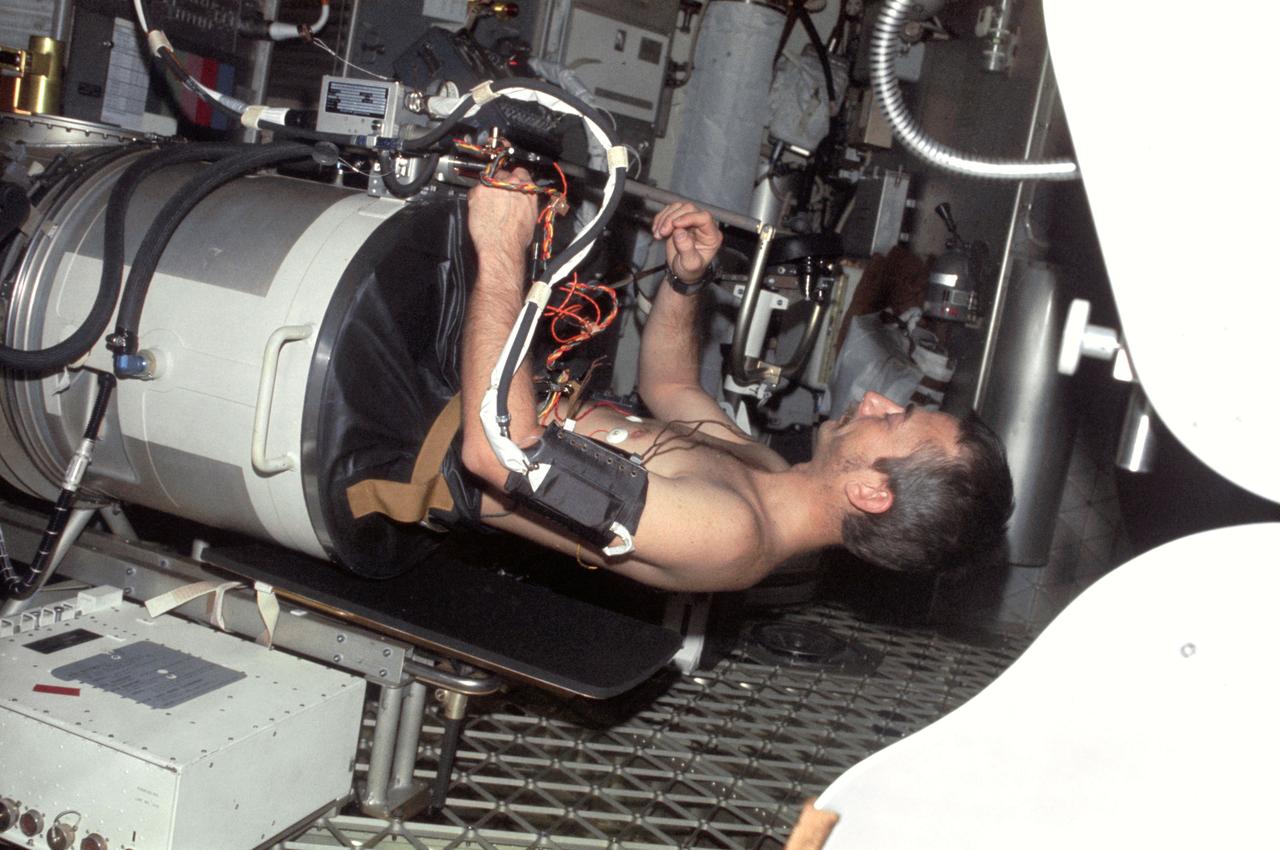
SL3-108-1278 (July-September 1973) --- Scientist-astronaut Owen K. Garriott, science pilot of the Skylab 3 mission, lies in the Lower Body Negative Pressure Device in the work and experiments area of the Orbital Workshop (OWS) crew quarters of the Skylab space station cluster in Earth orbit. This picture was taken with a hand-held 35mm Nikon camera. Astronauts Garriott, Alan L. Bean and Jack R. Lousma remained with the Skylab space station in orbit for 59 days conducting numerous medical, scientific and technological experiments. The LBNPD (MO92) Experiment is to provide information concerning the time course of cardiovascular adaptation during flight, and to provide in-flight data for predicting the degree of orthostatic intolerance and impairment of physical capacity to be expected upon return to Earth environment. The bicycle ergometer is in the right foreground. Photo credit: NASA
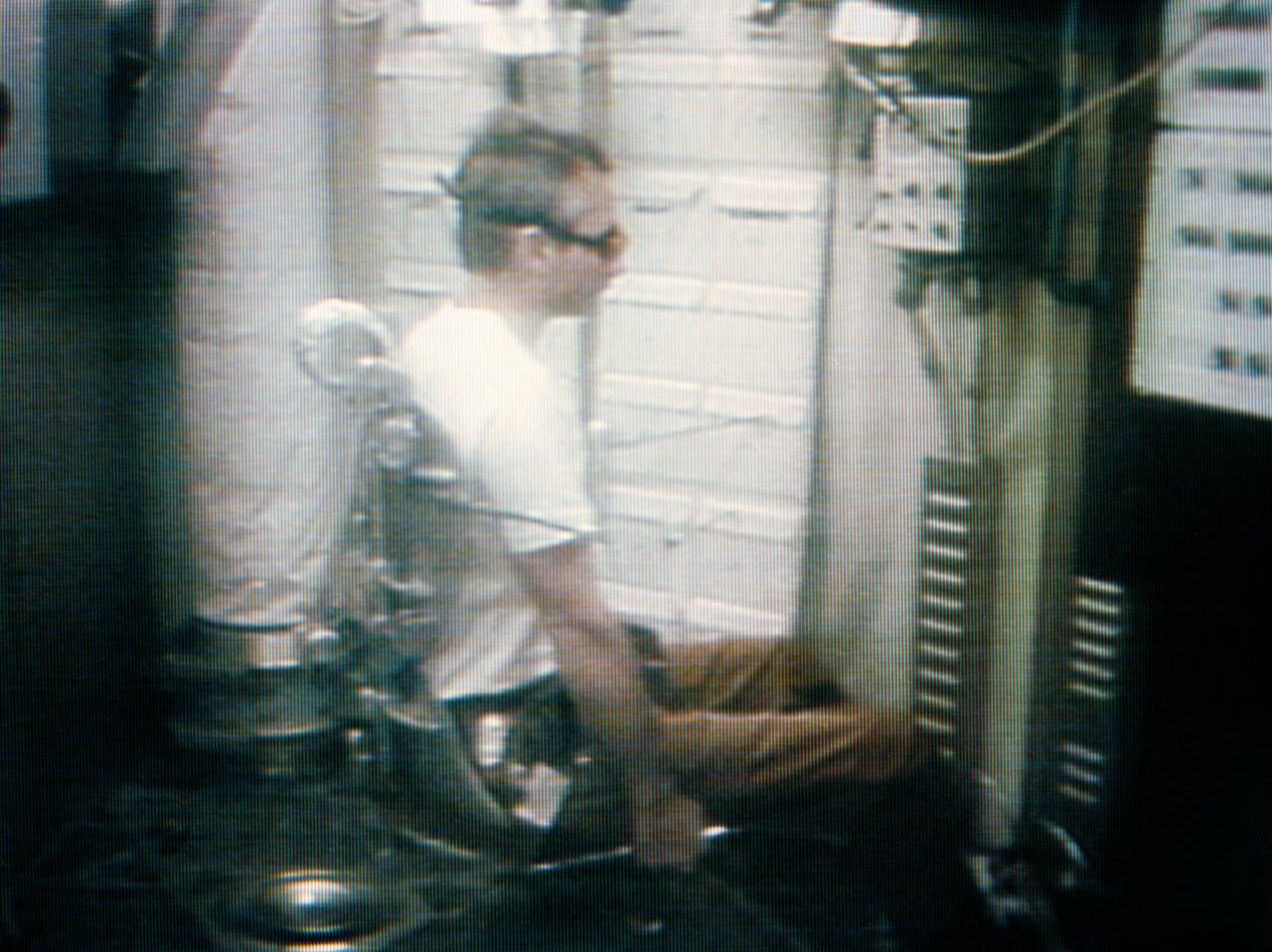
S73-34171 (9 Aug. 1973) --- Scientist-astronaut Owen K. Garriott, Skylab 3 science pilot, serves as test subject for the Skylab ?Human Vestibular Function? M131 Experiment, as seen in this photographic reproduction taken from a television transmission made by a color TV camera aboard the Skylab space station in Earth orbit. The objectives of the Skylab M131 experiment are to obtain data pertinent to establishing the validity of measurements of specific behavioral/physiological responses influenced by vestibular activity under one-g and zero-g conditions; to determine man?s adaptability to unusual vestibular conditions and predict habitability of future spacecraft conditions involving reduced gravity and Coriollis forces; and to measure the accuracy and variability in man?s judgment of spatial coordinates based on atypical gravity receptor cues and inadequate visual cures. Dr. Garriott is seated in the experiment?s litter chair which can rotate the test subject at predetermined rotational velocity or programmed acceleration/decelerational profile. Photo credit: NASA

View of Vice-President George Bush visiting with Astronaut Owen Garriott and Payload Specialist (PS) Wubbo Ockels of the Netherlands, inside the SL after the dedication ceremony, KSC Operations & Checkout (O&C) Building. 1. Astronaut Owen K. Garriott 2. Vice President George Bush 3. Wubbo Ockels - PS 4x5 Color and B&W

S73-34172 (August 1973) --- Scientist-astronaut Owen K. Garriott, Skylab 3 science pilot, watches a drink container spinning and tumbling in zero-gravity during a science demonstration television transmission from the Skylab space station in Earth orbit. Garriott is in the Orbital Workshop (OWS). Photo credit: NASA

Prior to the commencement of Apollo 11th's 30th arniversary festivities at Marshall Space Flight Center, visiting Saturn astronauts take a tour of the Center. Pictured are (L/R): Dick Gordon, Owen Garriott and Edgar Mitchell
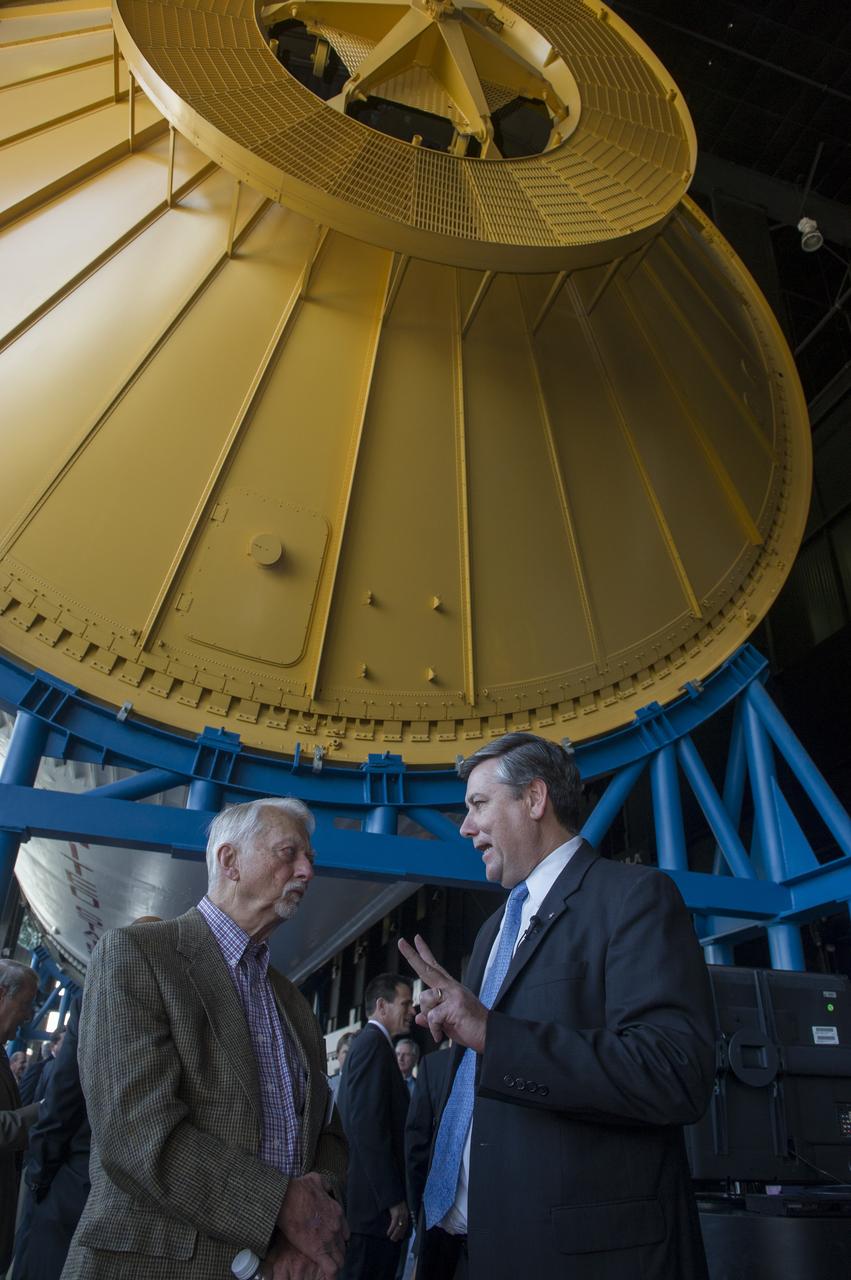
MARSHALL CENTER DIRECTOR PATRICK SCHEUERMANN, RIGHT, TALKS WITH FORMER ASTRONAUT OWEN GARRIOTT BENEATH THE SATURN V ROCKET SUSPENDED IN THE DAVIDSON CENTER FOR SPACE EXPLORATION AT THE U.S. SPACE & ROCKET CENTER
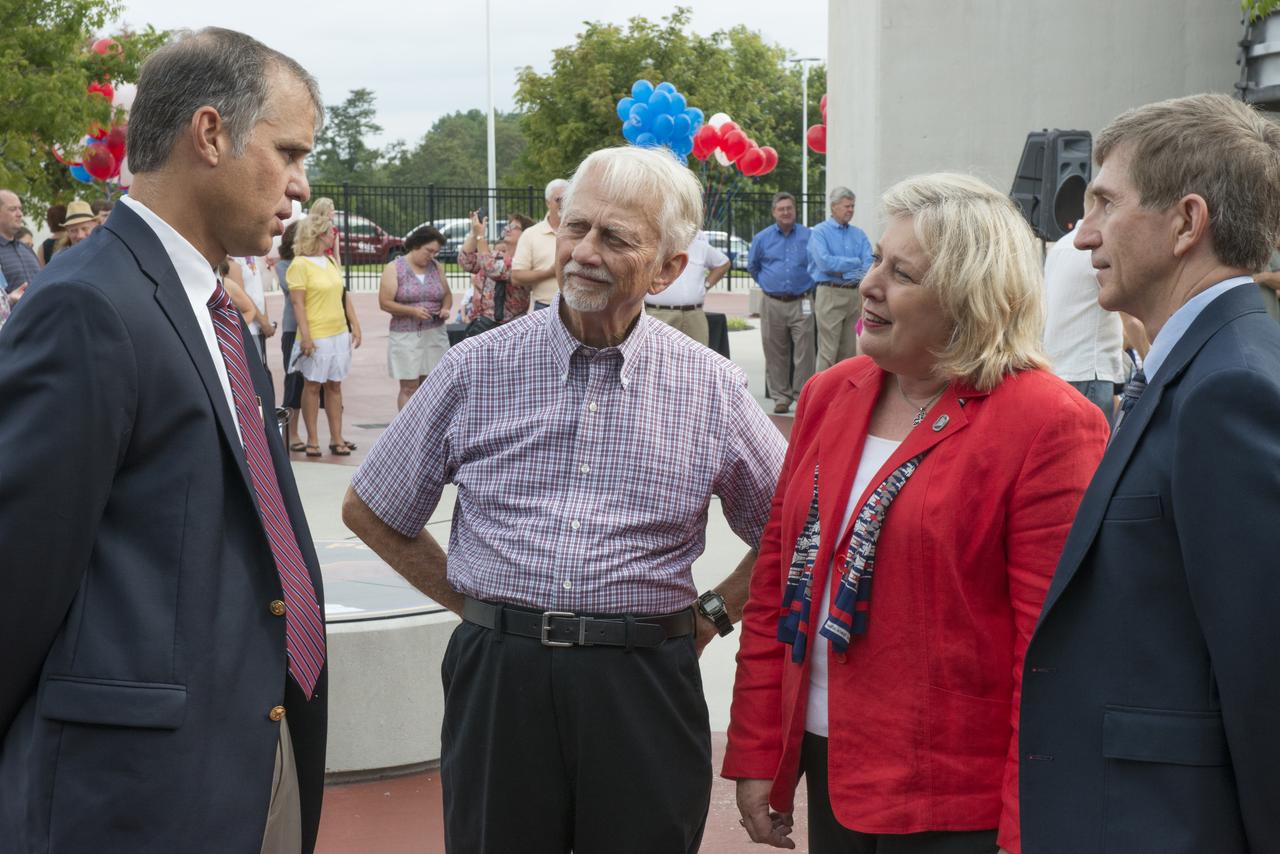
AUGUST 31, 2012 TRIBUTE TO APOLLO ASTRONAUT NEIL ARMSTRONG AT THE USSRC. L TO R: JONATHAN PETTUS, MSFC ACTING ASSOCIATE ADMINISTRATOR; FORMER ASTRONAUT OWEN GARRIOTT; FORMER ASTRONAUT JAN DAVIS AND FORMER ASTRONAUT FRED LESLIE.1200933F
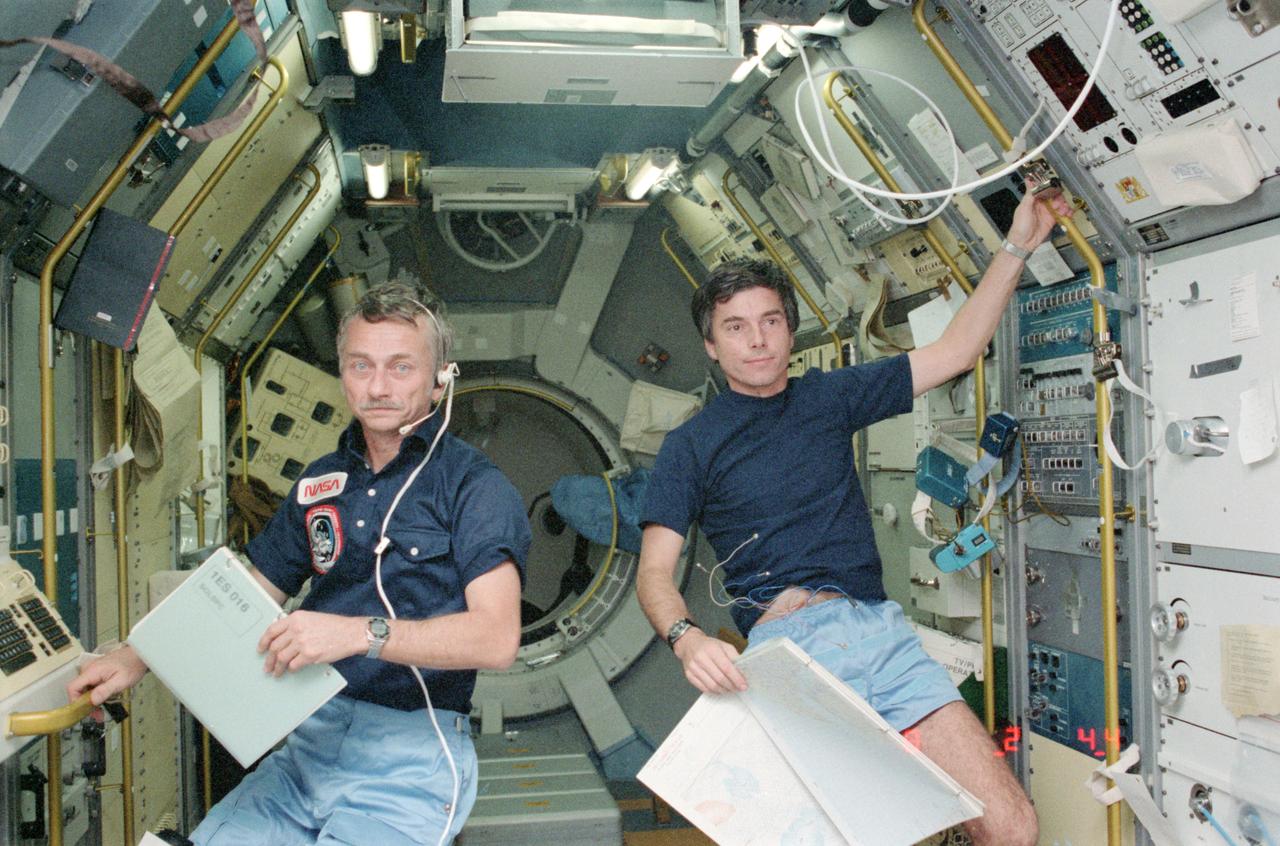
STS009-123-340 (28 Nov 1983) --- Astronaut Owen K. Garriott, STS-9 mission specialist, left, and Ulf Merbold, payload specialist, take a break from monitoring experimentation aboard Spacelab to be photographed. Dr. Garriott, holds in his left hand a data/log book for the solar spectrum experiment. Dr. Merbold, holds a map in his left hand for the monitoring of ground objectives of the metric camera.
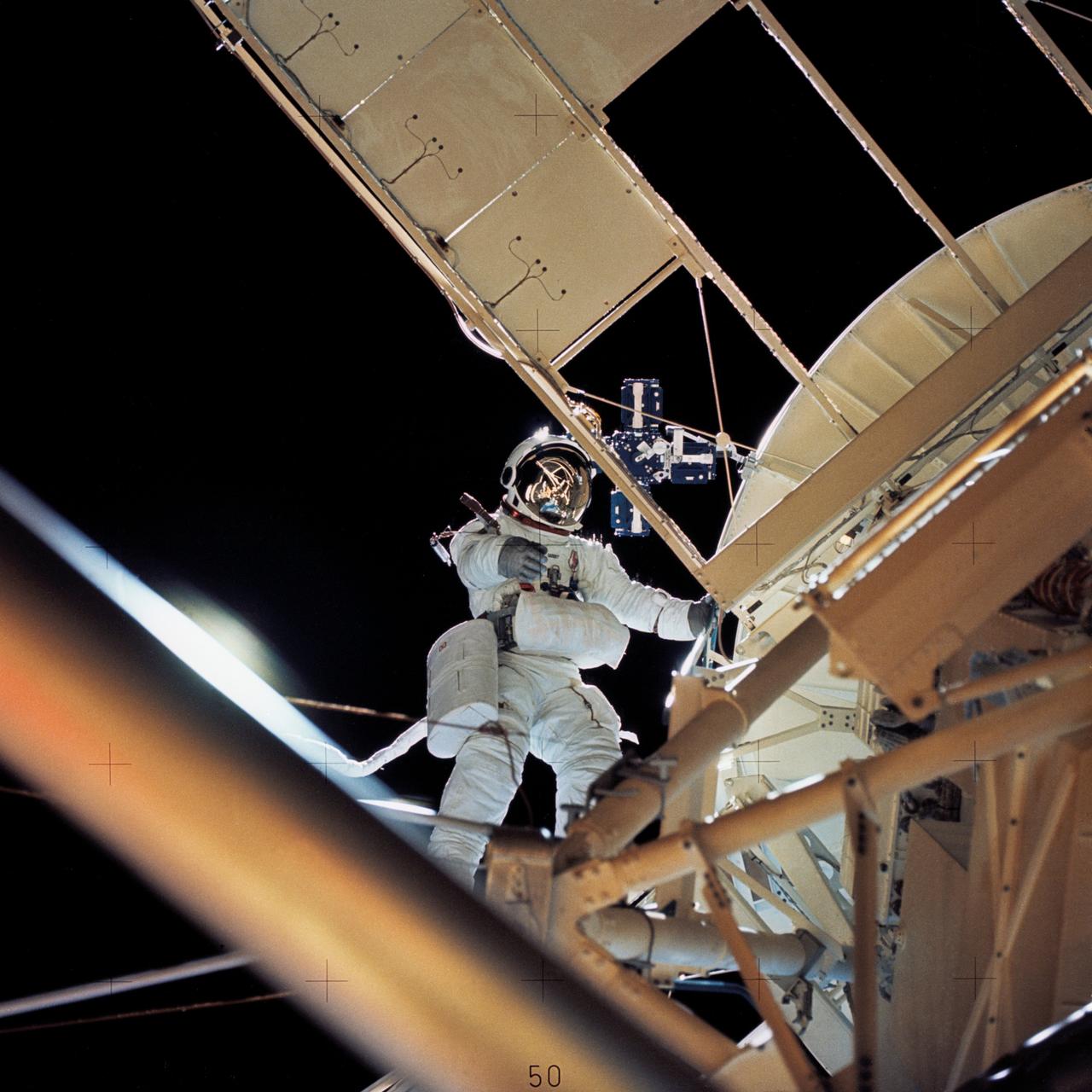
SL3-115-1837 (August 1973) --- Astronaut Owen K. Garriott, Skylab 3 science pilot, retrieves an imagery experiment from the Apollo Telescope Mount (ATM) attached to the Skylab in Earth orbit. Garriott’s was a special extravehicular activity (EVA) to remove from the attached ATM/orbiting observatory magazines which will be returned to Earth when the second manning of the Skylab space station has been completed. Photo credit: NASA
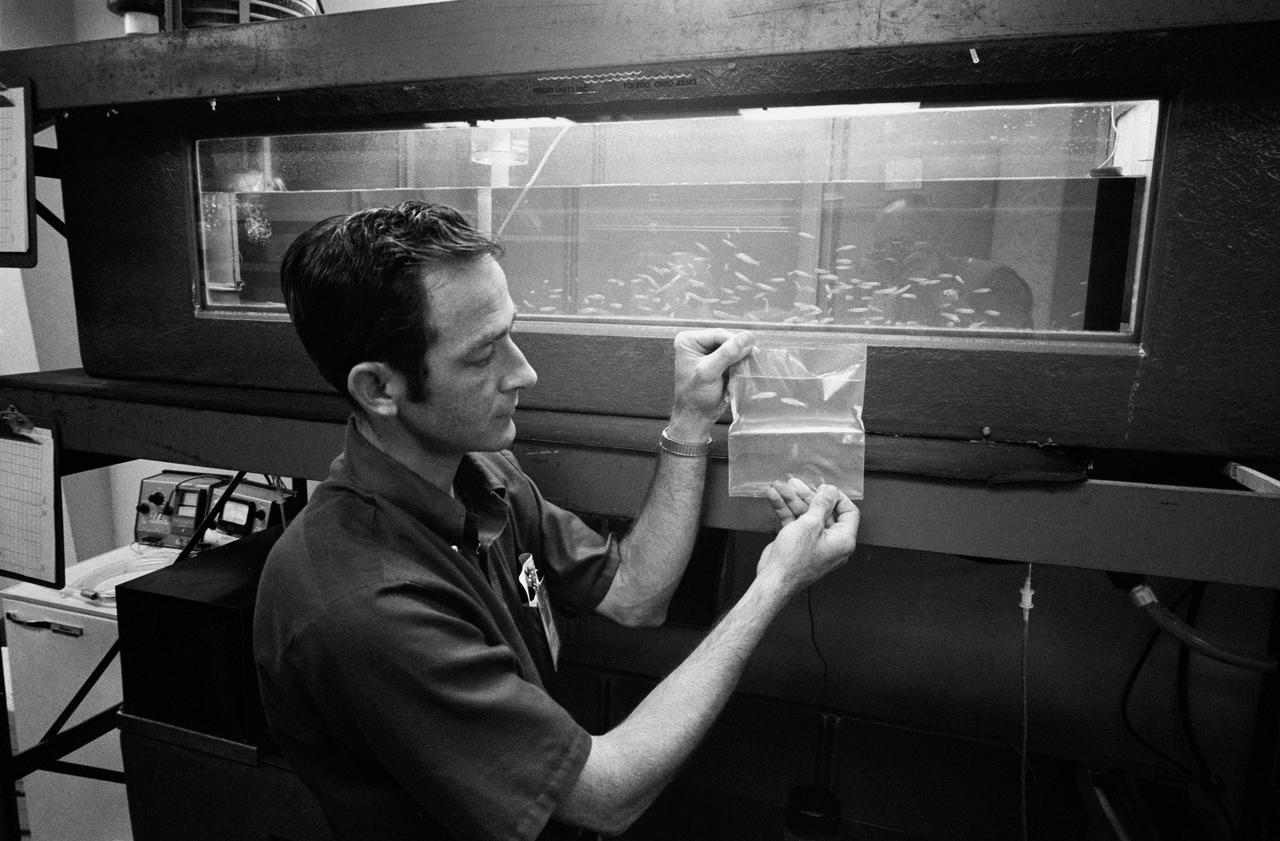
S73-30856 (29 June 1973) --- John Boyd observes a bag with two ?brackish water? minnows known as ?Mummichog Minnows? which will be onboard Skylab 3 with astronauts Alan L. Bean, Owen K. Garriott and Jack R. Lousma. The fish were added to the flight at the request of scientist-astronaut Dr. Owen K. Garriott, science pilot. Fifty eggs from the minnows will also be included in the bag. The objective of this experiment is to show what disorientation the fish will experience when exposed to weightlessness. Many fish have vestibular apparatus quite similar to man. Even though they live in an environment usually considered to resemble weightlessness, they do perceive a gravity vector. An aquarium of the minnows, caught off the coast of Beaufort, North Carolina, is in the background. Photo credit: NASA
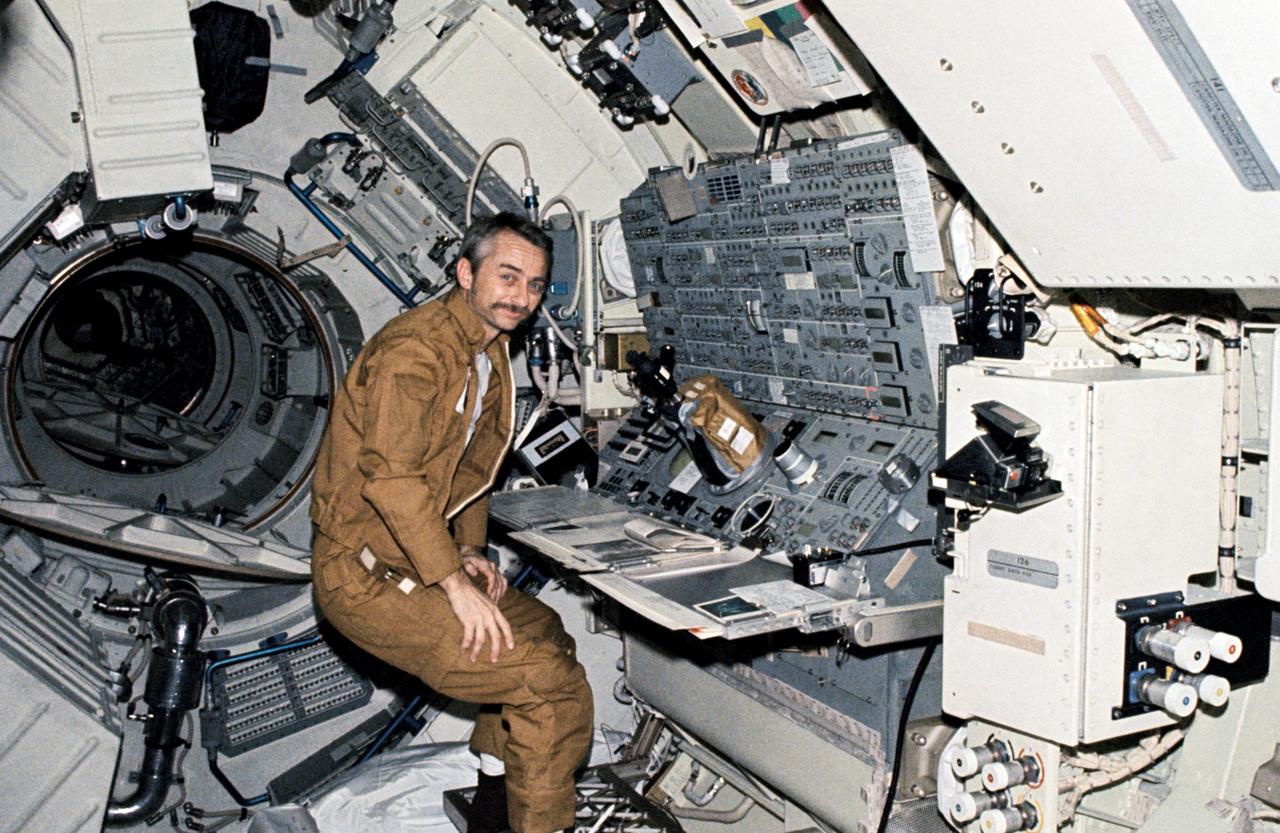
SL3-108-1288 (July-Sept. 1973) --- Astronaut Owen K. Garriott, science pilot of the Skylab 3 mission, is stationed at the Apollo Telescope Mount (ATM) console in the Multiple Docking Adapter (MDA) of the Skylab space station in Earth orbit. This picture was taken with a handheld 35mm Nikon camera. Astronauts Garriott, Alan L. Bean and Jack R. Lousma remained with the Skylab space station cluster in orbit for 59 days conducting numerous medical, scientific and technological experiments. In orbit the MDA functions as a major experiment control center for solar observations. From this console the astronauts actively control the ATM solar physics telescopes. Photo credit: NASA
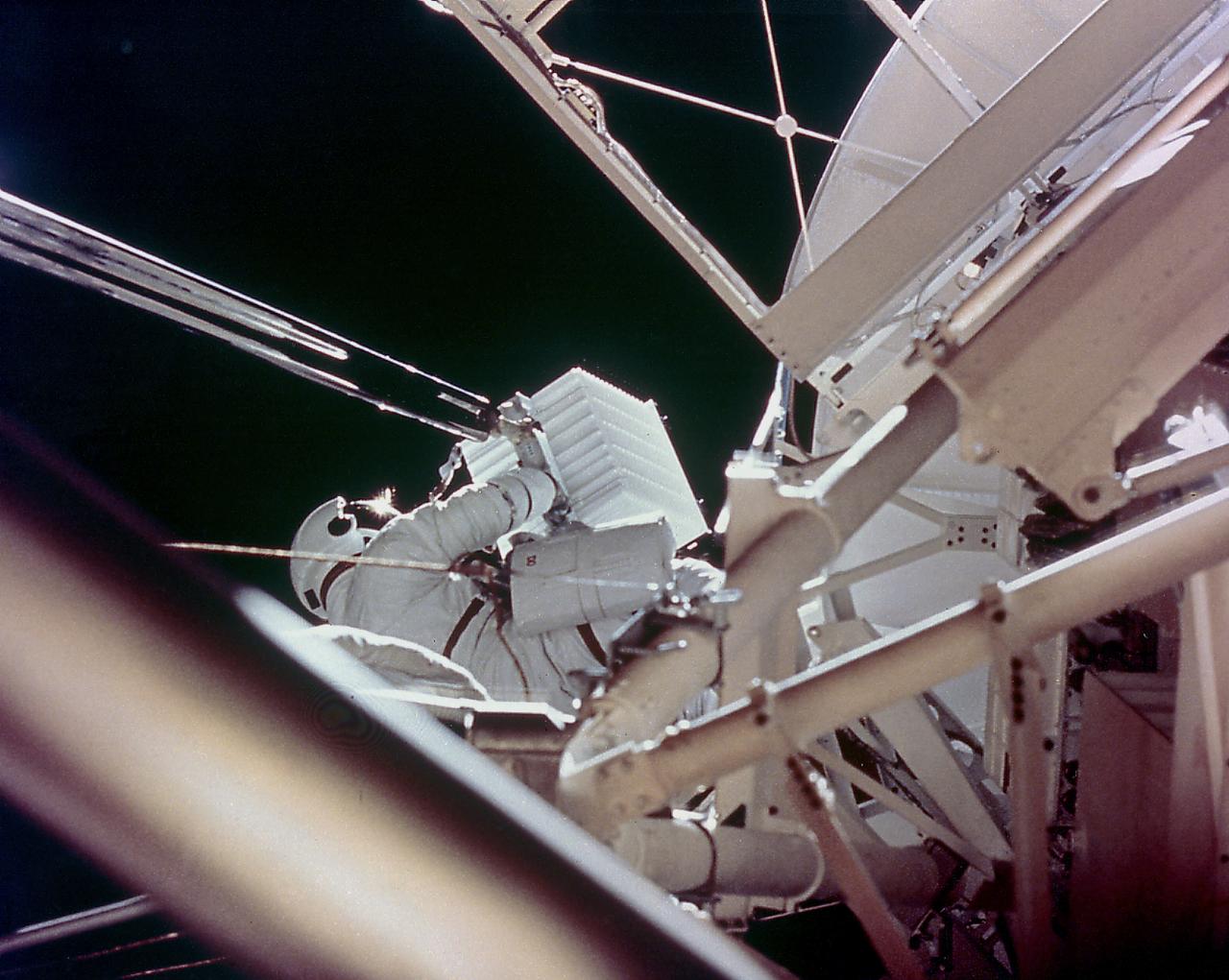
This onboard photograph depicts Astronaut Owen Garriott atop the Apollo Telescope Mount, removing a film magazine (white box) from one of Skylab's solar telescopes during an Extravehicular Activity (EVA) in the second marned Skylab mission (Skylab-3). A long boom transported it back into the waiting hands of another crew member at the airlock door below. During the operation, Garriott, film, boom, and Skylab were 435 kilometers high and speeding around the Earth at 29,000 kilometers per/hour. Because they moved together with no wind resistance, there was little sense of motion.
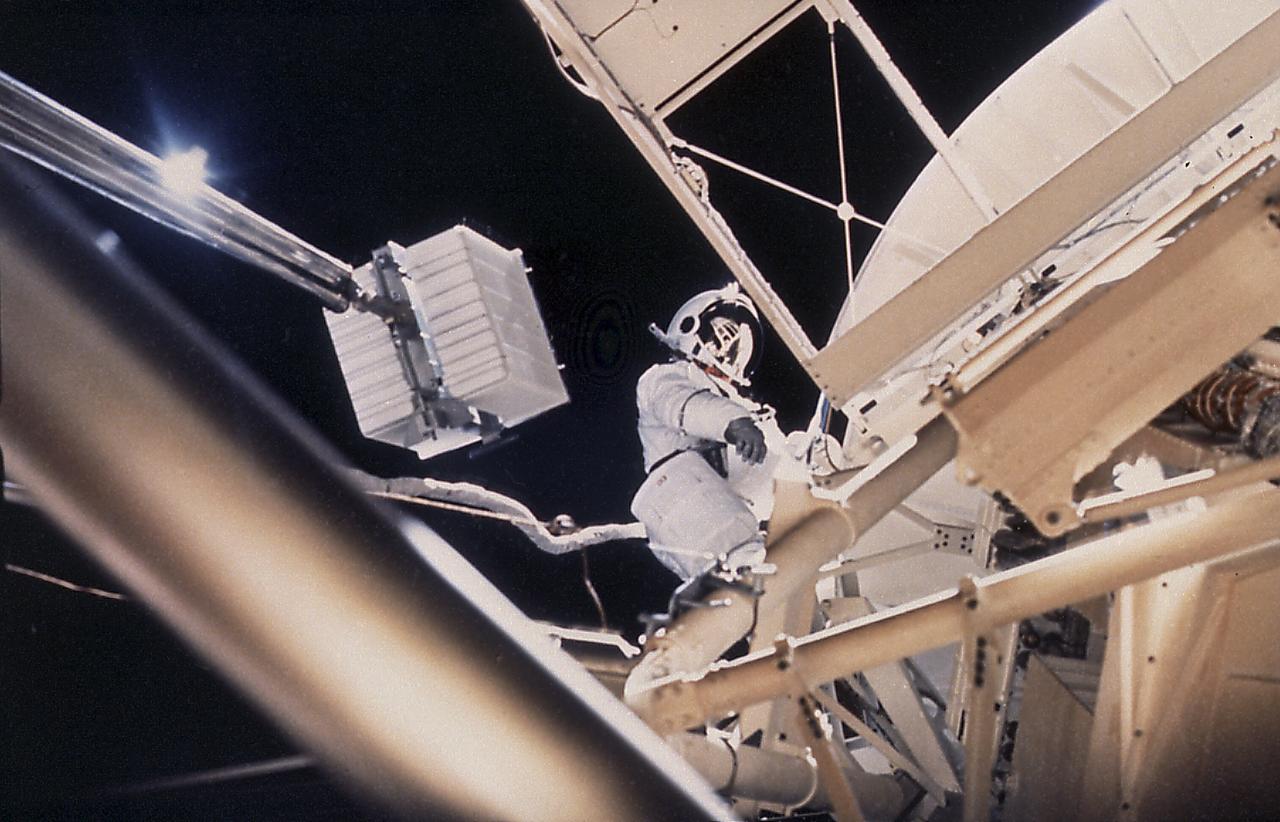
This onboard photograph depicts Astronaut Owen Garriott atop the Apollo Telescope Mount, removing a film magazine (white box) from one of Skylab's solar telescopes during an Extravehicular Activity (EVA) in the second marned Skylab mission (Skylab-3). A long boom transported it back into the waiting hands of another crew member at the airlock door below. During the operation, Garriott, film, boom, and Skylab were 435 kilometers high and speeding around the Earth at 29,000 kilometers per/hour. Because they moved together with no wind resistance, there was little sense of motion.
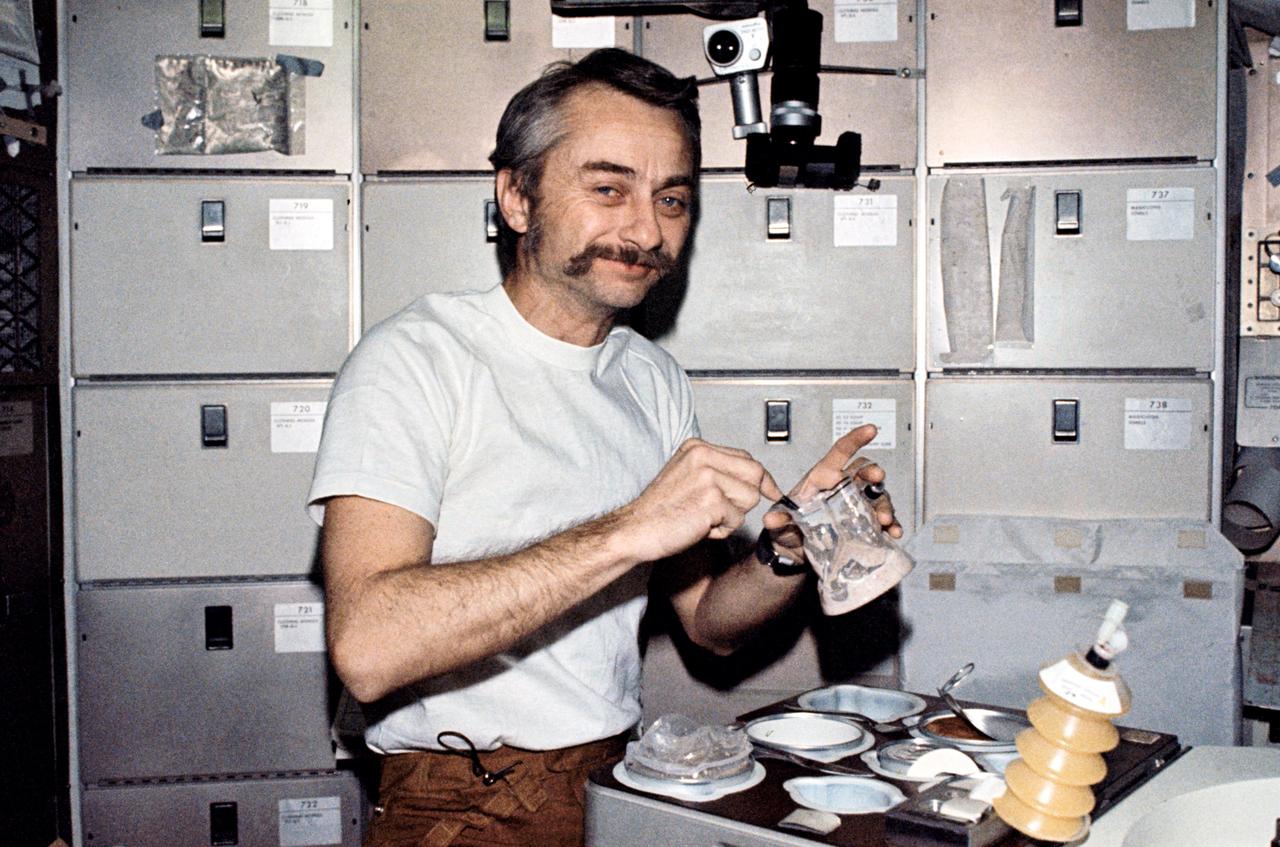
SL3-111-1519 (6 Aug. 1973) --- Scientist-astronaut Owen K. Garriott, Skylab 3 science pilot, reconstitutes a pre-packaged container of food at the crew quarters ward room table of the Orbital Workshop (OWS) of the Skylab Space Station cluster. This picture was taken with a hand-held 35mm Nikon camera. Astronauts Garriott, Alan L. Bean and Jack R. Lousma remained with the Skylab Space Station in Earth orbit for a total of 59 days conducting numerous medical, scientific and technological experiments. Note the knife and fork on the food tray and the utensil with which Garriott stirs the food mixed with water. Skylab is the first manned space program by NASA which affords the crew men an opportunity to eat with the same type utensils used on Earth. Photo credit: NASA
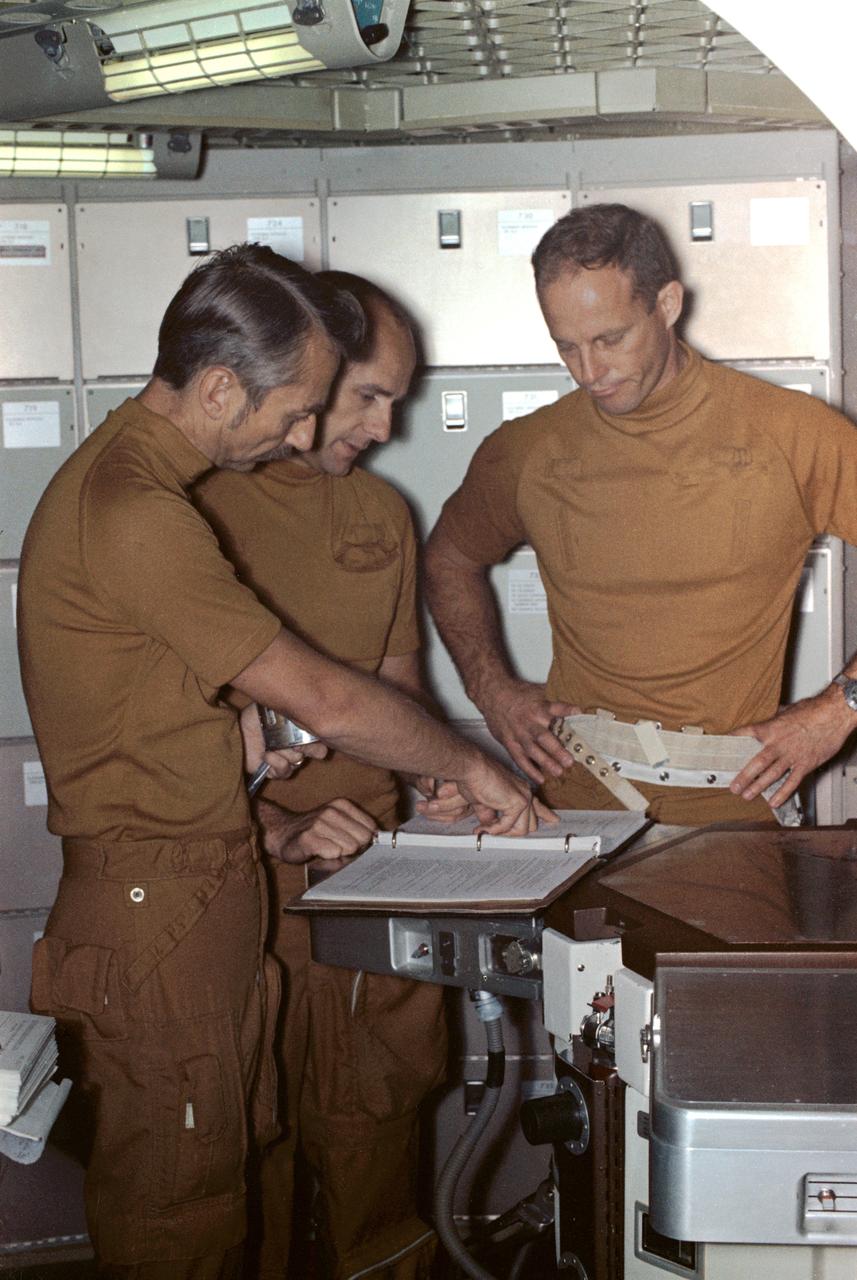
S73-28793 (16 July 1973) --- The three crewmen of the second manned Skylab mission (Skylab 3) go over a checklist during preflight training at the Johnson Space Center. They are, left to right, scientist-astronaut Owen K. Garriott, science pilot; astronaut Alan L. Bean, commander; and astronaut Jack R. Lousma, pilot. They are in the crew quarters of the Orbital Workshop trainer in the Mission Training and Simulation Facility, Building 5, at JSC. Skylab 3 is scheduled as a 59-day mission in Earth orbit. Photo credit: NASA
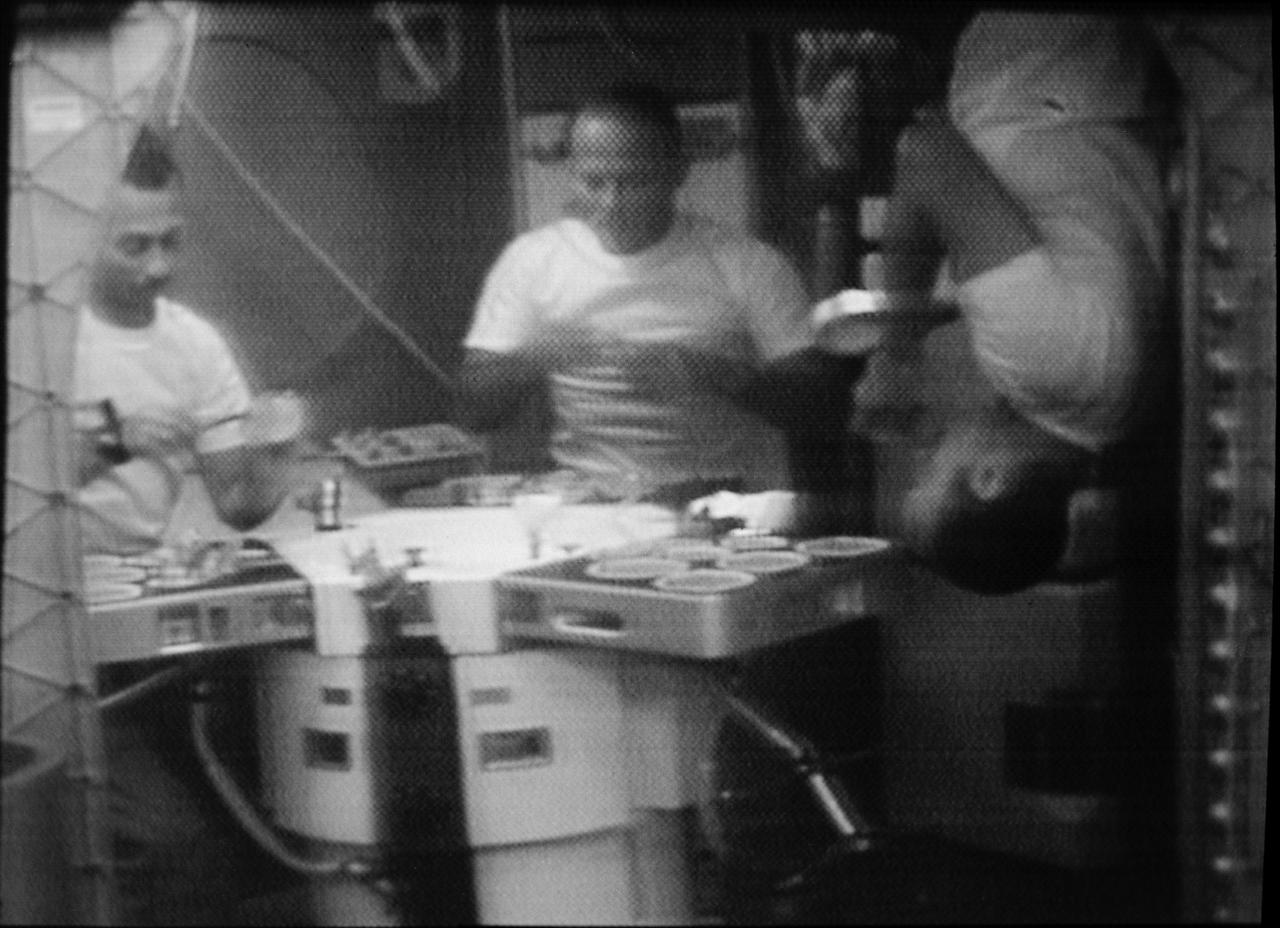
S73-31705 (1 Aug. 1973) --- The three Skylab 3 crewmen are shown eating in the Orbital Workshop (OWS) wardroom of the Skylab space station in Earth orbit, in this photographic reproduction taken from a television transmission made by a color TV camera aboard the OWS. Astronaut Alan L. Bean (right), commander, illustrates eating under zero-gravity conditions upsidedown. The two other crewmen are scientist-astronaut Owen K. Garriott (left), science pilot; and astronaut Jack R. Lousma, pilot. Photo credit: NASA
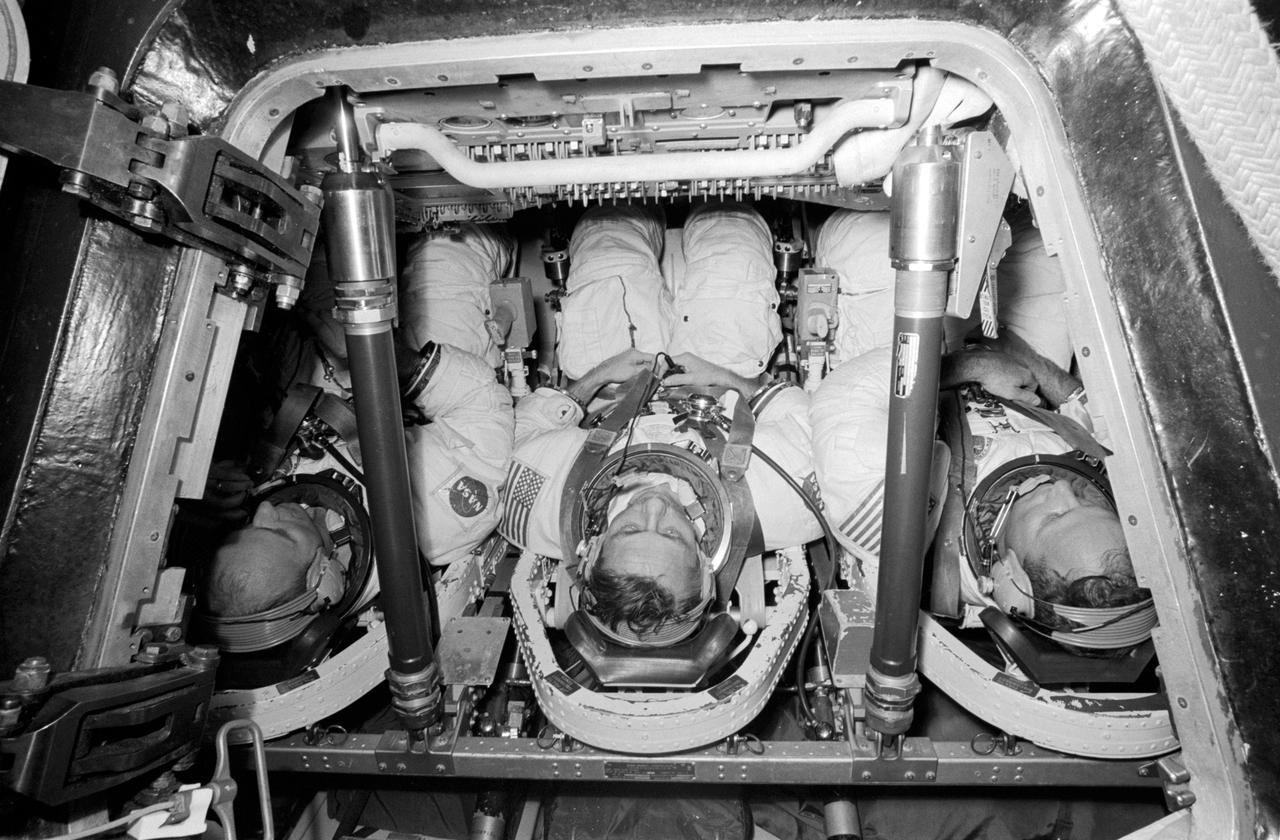
S73-27787 (1 May 1973) --- The three members of the prime crew of the second manned Skylab mission participate in prelaunch training, specifically water egress simulations, at the Johnson Space Center (JSC), Houston. They are, left to right, astronaut Alan J. Bean, commander; scientist-astronaut Owen K. Garriott, science pilot; and astronaut Jack R. Lousma, pilot. This training took place in JSC?s Building 220 on May 1, 1973. Photo credit: NASA
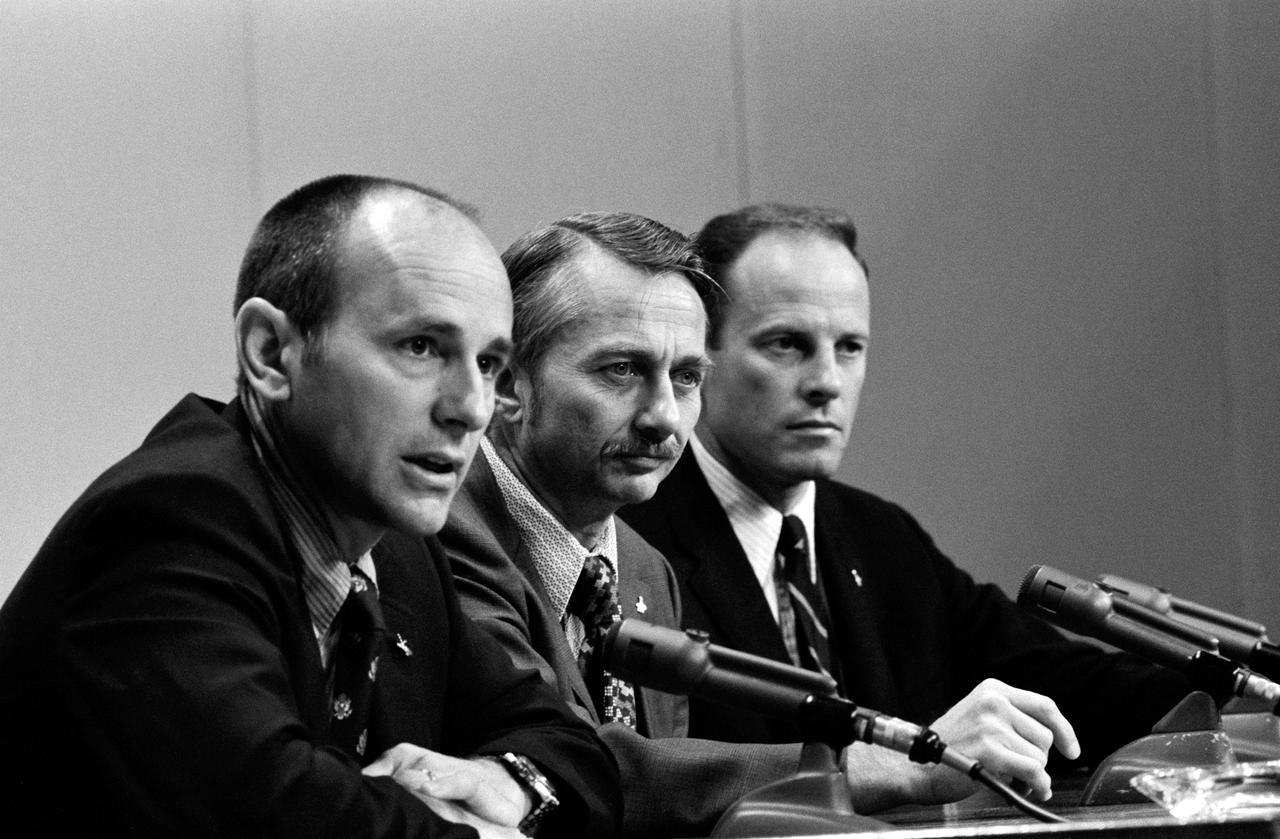
S73-30110 (30 June 1973) --- The three members of the prime crew of the second manned Skylab mission (Skylab 3) discuss their scheduled 56-day flight before a gathering of news media representatives in the large auditorium of Building 1 at the Johnson Space Center (JSC), Houston, Texas, on June 30, 1973. They are, left to right, astronaut Alan L. Bean, commander; scientist-astronaut Owen K. Garriott, science pilot; and astronaut Jack R. Lousma, pilot. Photo credit: NASA
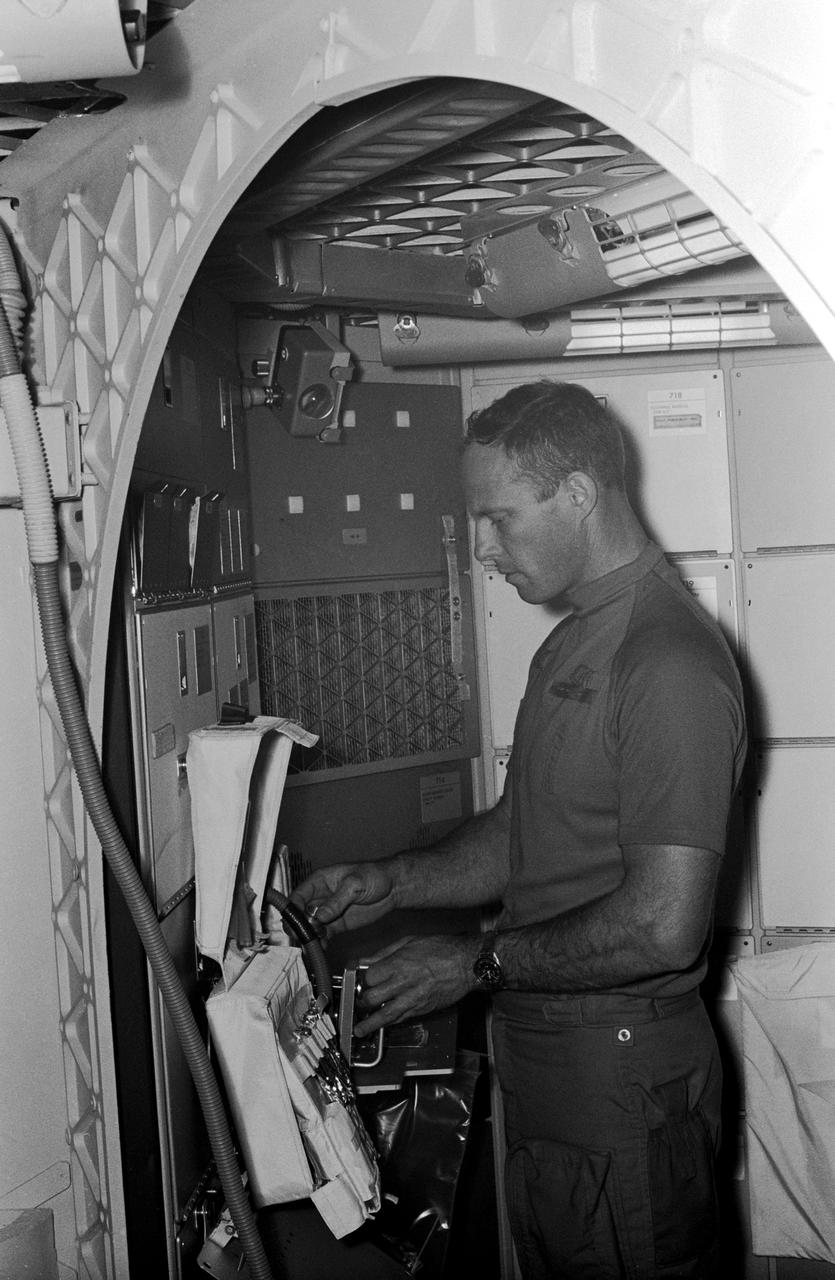
S73-28423 (16 June 1973) --- Astronaut Jack R. Lousma, Skylab 3 pilot, reaches into a medical kit, part of the Inflight Medical Support System (IMSS), during training for the second manned Skylab Earth-orbital mission. This activity took place in the OWS trainer in the Mission Simulation and Training Facility at the Johnson Space Center (JSC). Other Skylab 3 crewmen are astronaut Alan L. Bean, commander, and scientist-astronaut Owen K. Garriott, science pilot. Photo credit: NASA
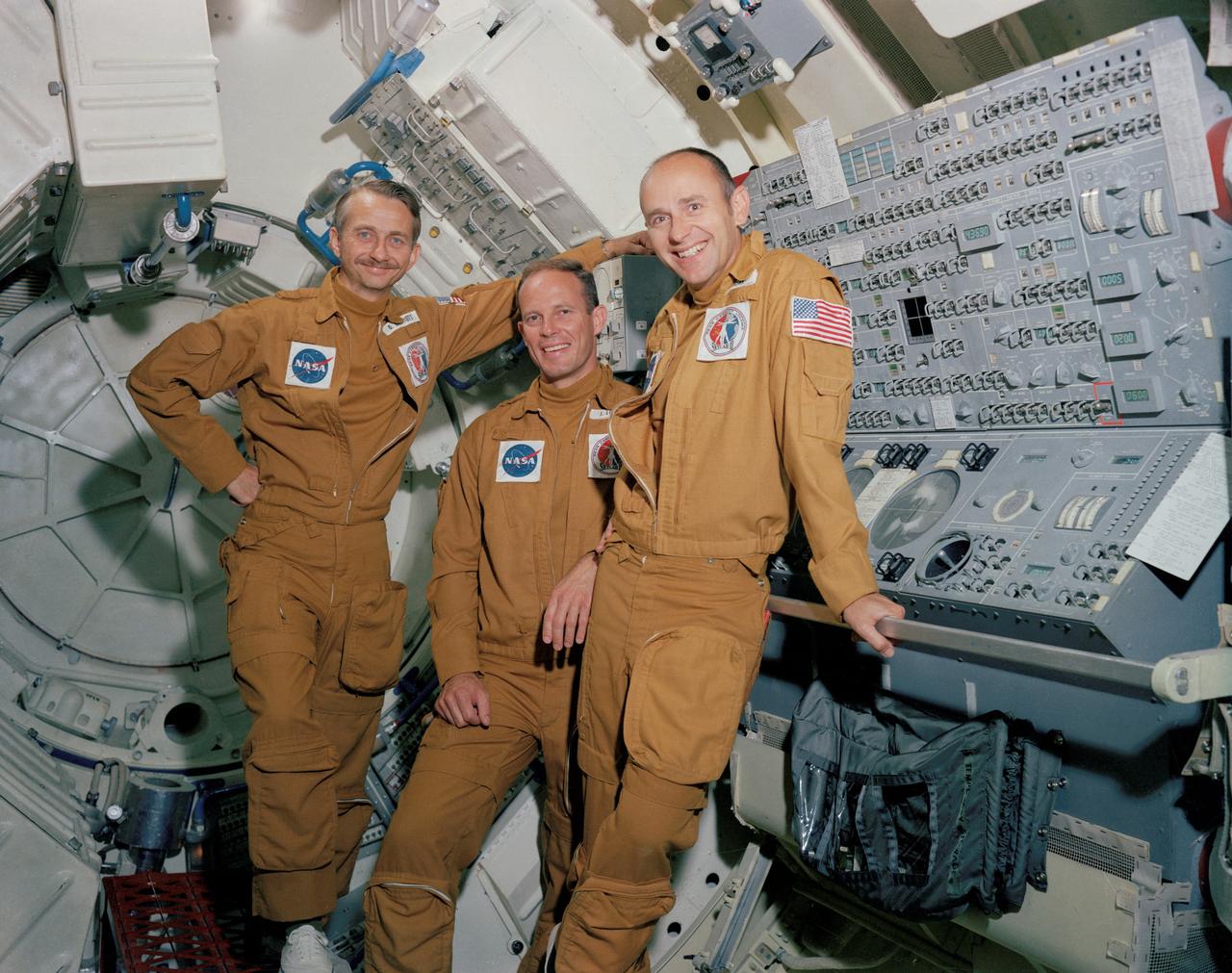
S73-28714 (29 June 1973) --- These three men are the prime crewmen for the Skylab 3 mission. Pictured in the one-G trainer Multiple Docking Adapter (MDA) at the Johnson Space Center (JSC) are, left to right, scientist-astronaut Owen K. Garriott, science pilot; and astronauts Jack R. Lousma and Alan L. Bean, pilot and commander, respectively. Photo credit: NASA

SL3-122-2610 (6 Aug. 1973) --- Scientist-astronaut Owen K. Garriott, Skylab 3 science pilot, looks at the camera as he participates in the Aug. 6, 1973 extravehicular activity (EVA) during which he and astronaut Jack R. Lousma, pilot, deployed the twin pole solar shield to help shade the Orbital Workshop (OWS). Photo credit: NASA
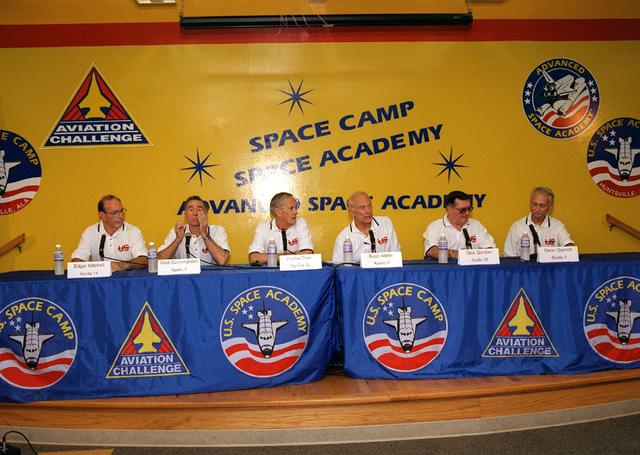
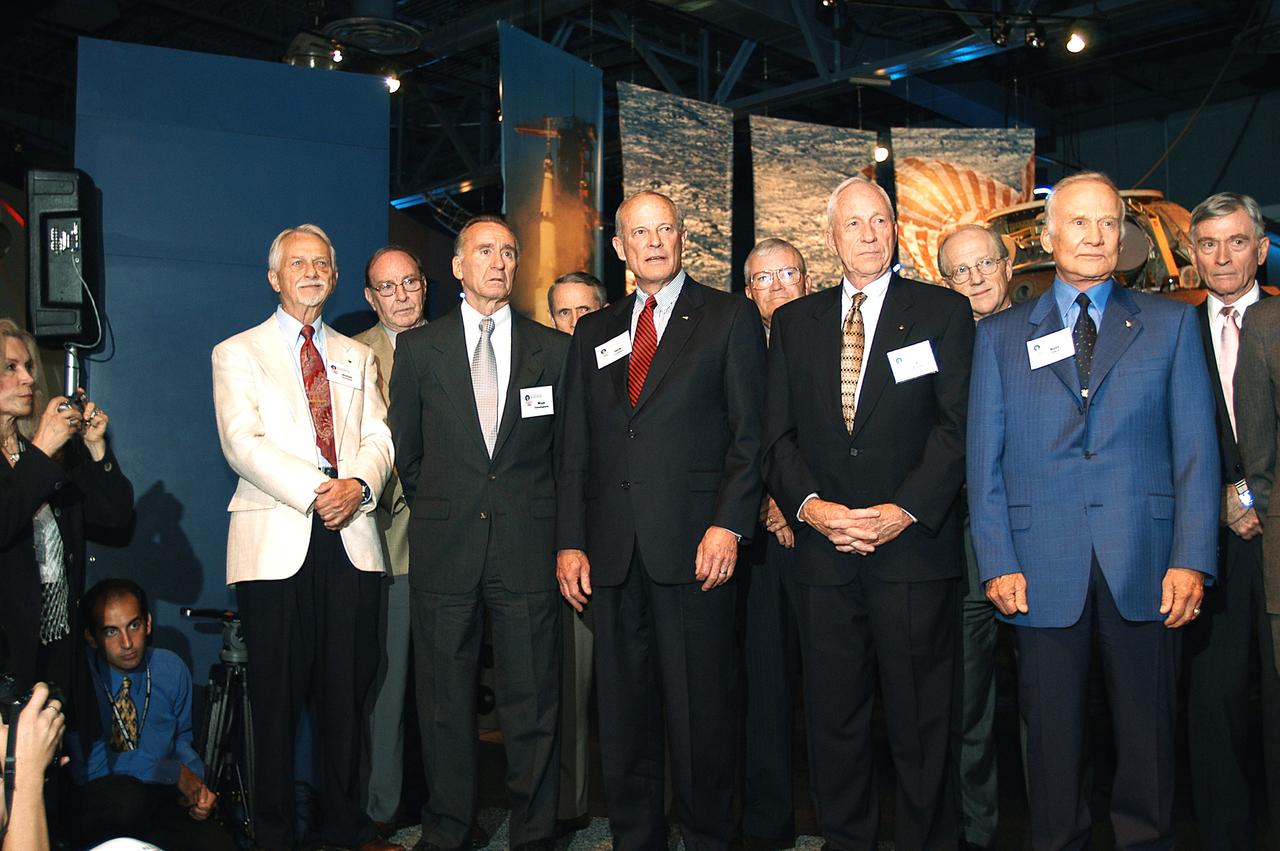
Marking the occasion of the Apollo 11 30th Anniversary, members of the Apollo and Saturn astronaut programs attended festivities at Marshall Space Flight Center in Huntsville, AL. A press conference was held at the U. S. Space and Rocket Center for the visiting astronauts. Pictured are (L/R): Edgar Mitchell, Walt Cunningham, Charlie Duke, Buzz Aldrin, Dick Gordon and Owen Garriott.

SL3-122-2609 (6 Aug. 1973) --- Scientist-astronaut Owen K. Garriott, Skylab 3 science pilot, looks at the camera as he participates in the Aug. 6, 1973 extravehicular activity (EVA) during which he and astronaut Jack R. Lousma, pilot, deployed the twin pole solar shield to help shade the Orbital Workshop (OWS). Photo credit: NASA

SL3-115-1833 (6 Aug. 1973) --- Astronaut Jack R. Lousma, Skylab 3 pilot, participates in the Aug. 6, 1973, extravehicular activity (EVA) during which he and astronaut Owen K. Garriott, science pilot, deployed the twin pole solar shield to help shade the Orbital Workshop (OWS). Note the striking reflection of the Earth in Lousma?s helmet visor. This photograph was taken with a 70mm hand-held Hasselblad camera. Photo credit: NASA
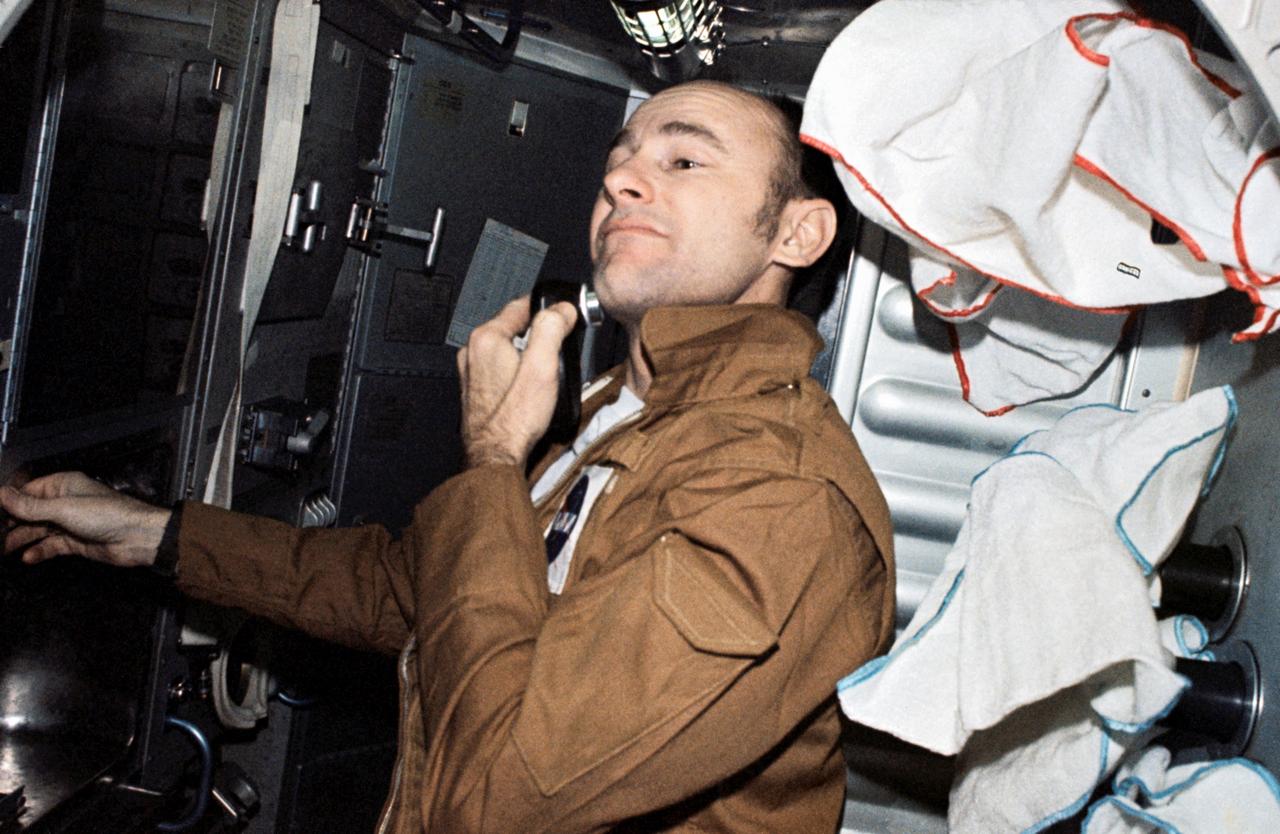
SL3-111-1516 (July-September 1973) --- Astronaut Alan L. Bean, Skylab 3 commander, uses a battery powered shaver in the crew quarters of the Orbital Workshop (OWS) aboard the Skylab space station cluster in Earth orbit. Astronaut Bean, Owen K. Garriott, science pilot, and Jack R. Lousma, pilot, went on to successfully complete 59 days aboard the Skylab cluster in Earth orbit. Photo credit: NASA
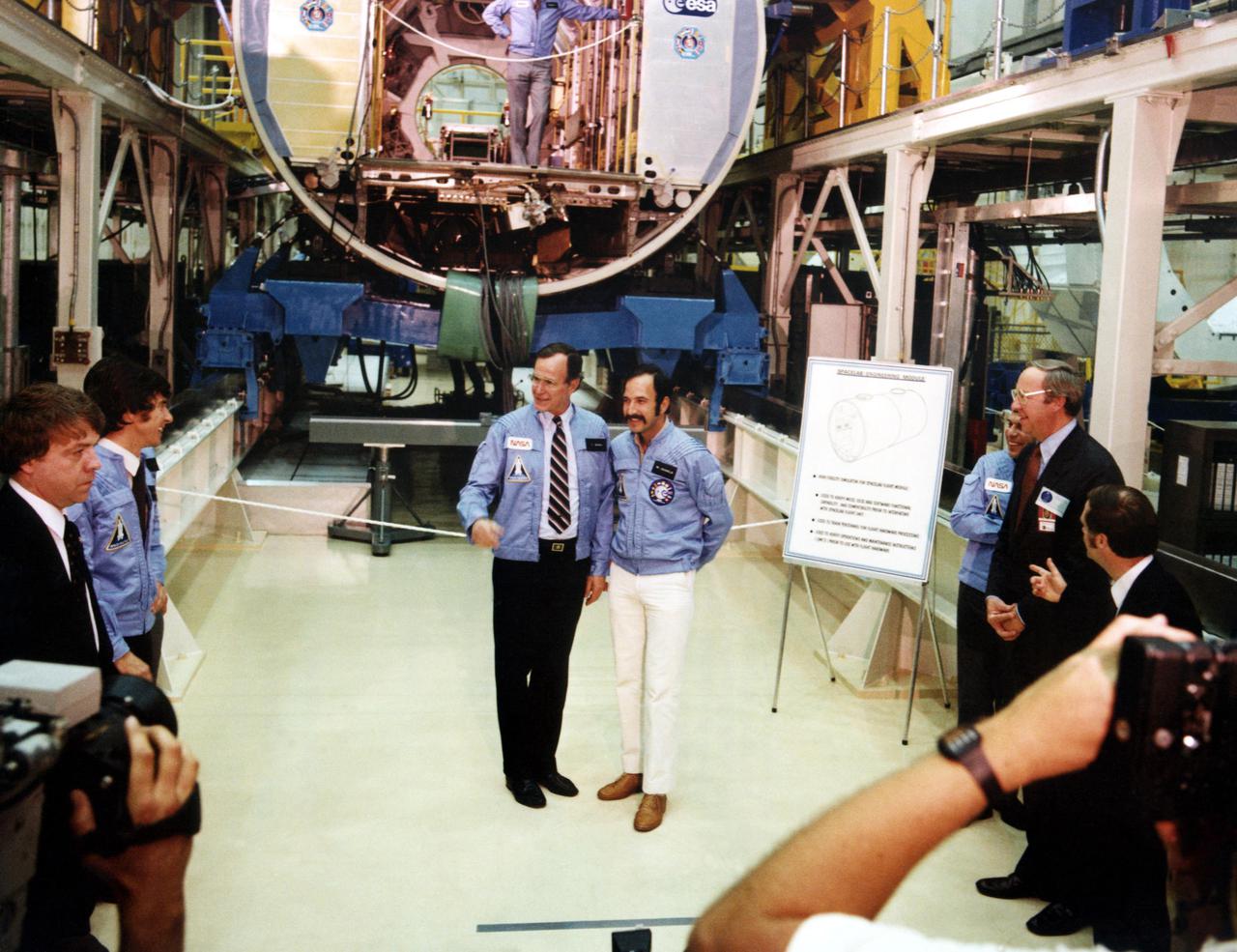
KENNEDY SPACE CENTER, FLA. -- Vice President George F. Bush, center left, is pictured with Payload Specialist Wubbo Ockels of the Netherlands during the Spacelab Arrival Ceremony. Second from left is Payload Specialist Ulf Merbold, Germany. At far right are James McCulls, chief, Special Services Branch, NASA Headquarters; and James C. Harrington, director, Spacelab Program, NASA. Overhead, astronaut Owen K. Garriott, U.S.A., stands in the Spacelab Engineering Module.
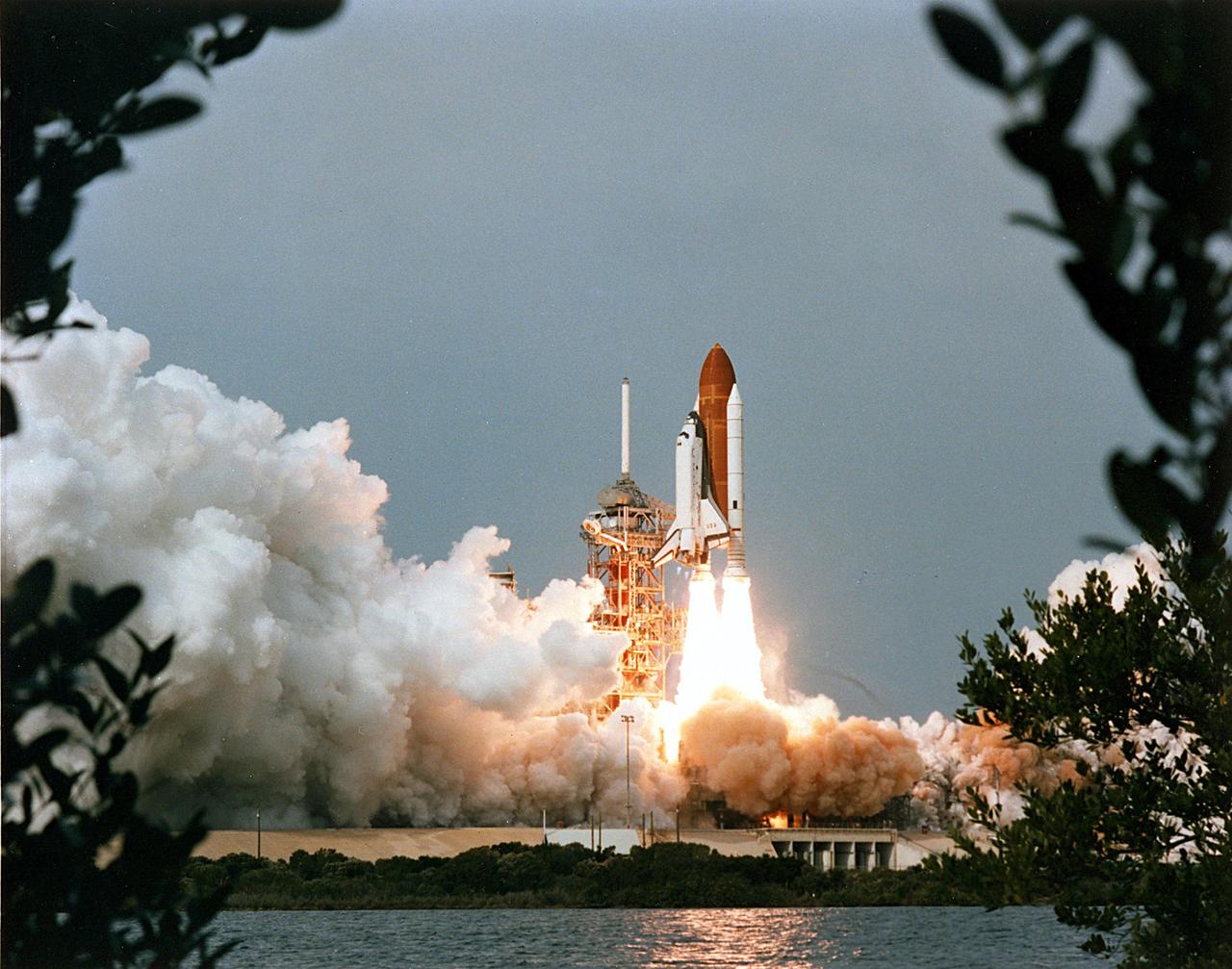
KENNEDY SPACE CENTER, FLA. -- Columbia launches on mission STS-9 from Launch Pad 39-A. This is the first Shuttle flight with six crew members: Commander John W. Young, Pilot Brewster H. Shaw Jr., Mission Specialists Owen K. Garriott and Robert A.R. Parker, and Payload Specialists Byron K. Lichtenberg and Ulf Merbold, who is with the European Space Agency (ESA). The flight carries the first Spacelab mission and first astronaut to represent ESA.

Huntsville’s Jack Giles, Alabama State Senator (left), and Dr. Rocco Petrone, Marshall Space Flight Center Director (Middle), speak with Astronaut Owen Garriott who is inside the Apollo 16 Command Module on display at the Alabama Space and Rocket Center in Huntsville, Alabama. The successful Apollo 16 manned lunar landing mission took place April 16, 1972 through April 27, 1972. (Photograph courtesy of Huntsville/Madison County Public Library)
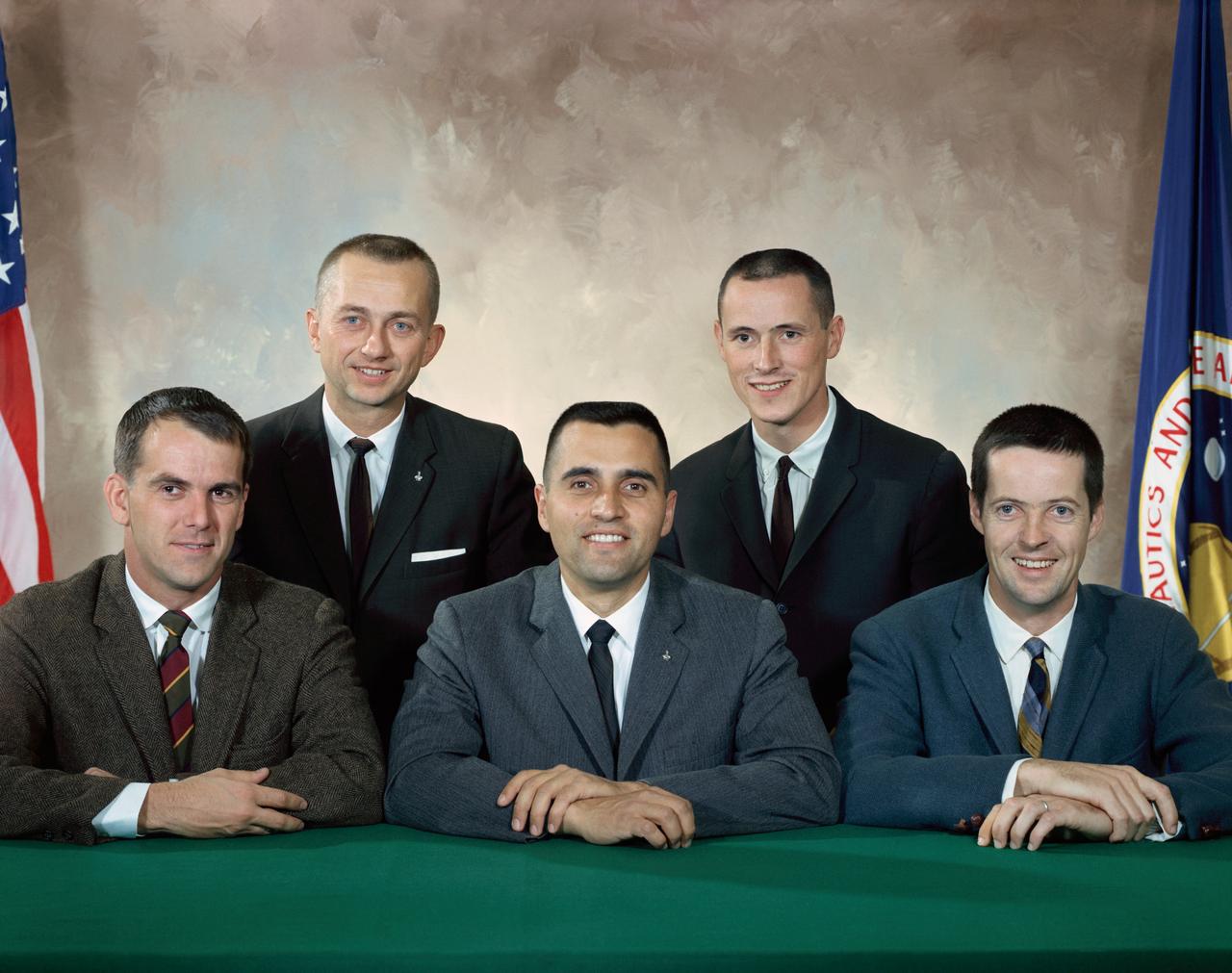
S66-65248 (November 1966) --- Five scientist-astronauts whose selection was announced by the National Aeronautics and Space Administration on June 29, 1969. Front row, left to right, are P. Curtis Michel,(physicist); Harrison H. Schmitt (astrogeologist); and Joseph F. Kerwin (physician). Back row, left to right, are Owen K. Garriott (physicist); and Edward G. Gibson (physicist). Photo credit: NASA or National Aeronautics and Space Administration
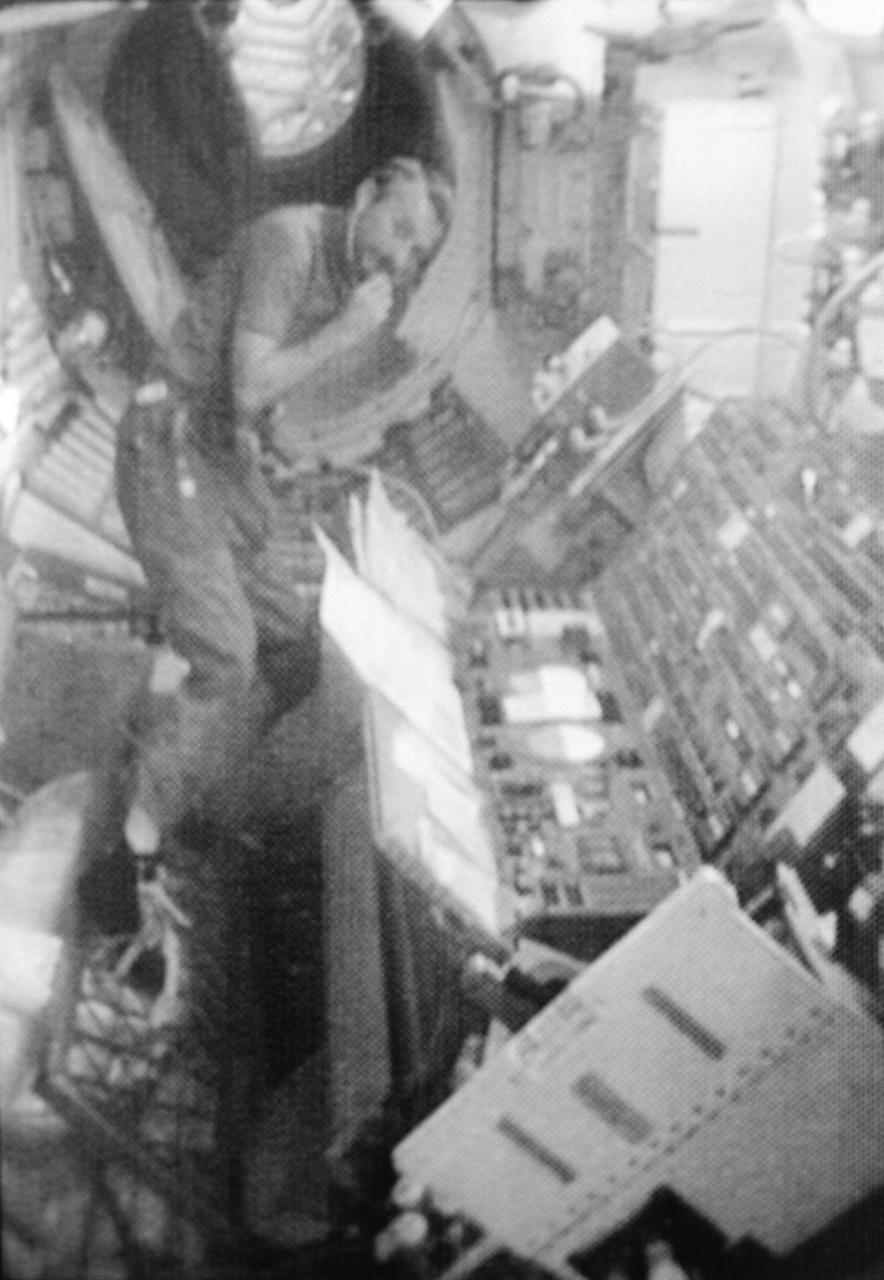
S73-31973 (August 1973) --- Scientist-astronaut Owen K. Garriott, Skylab 3 science pilot, looks at a map of Earth at the food table in the ward room of the Orbital Workshop (OWS). In this photographic reproduction taken from a television transmission made by a color TV camera aboard the Skylab space station cluster in Earth orbit. Photo credit: NASA
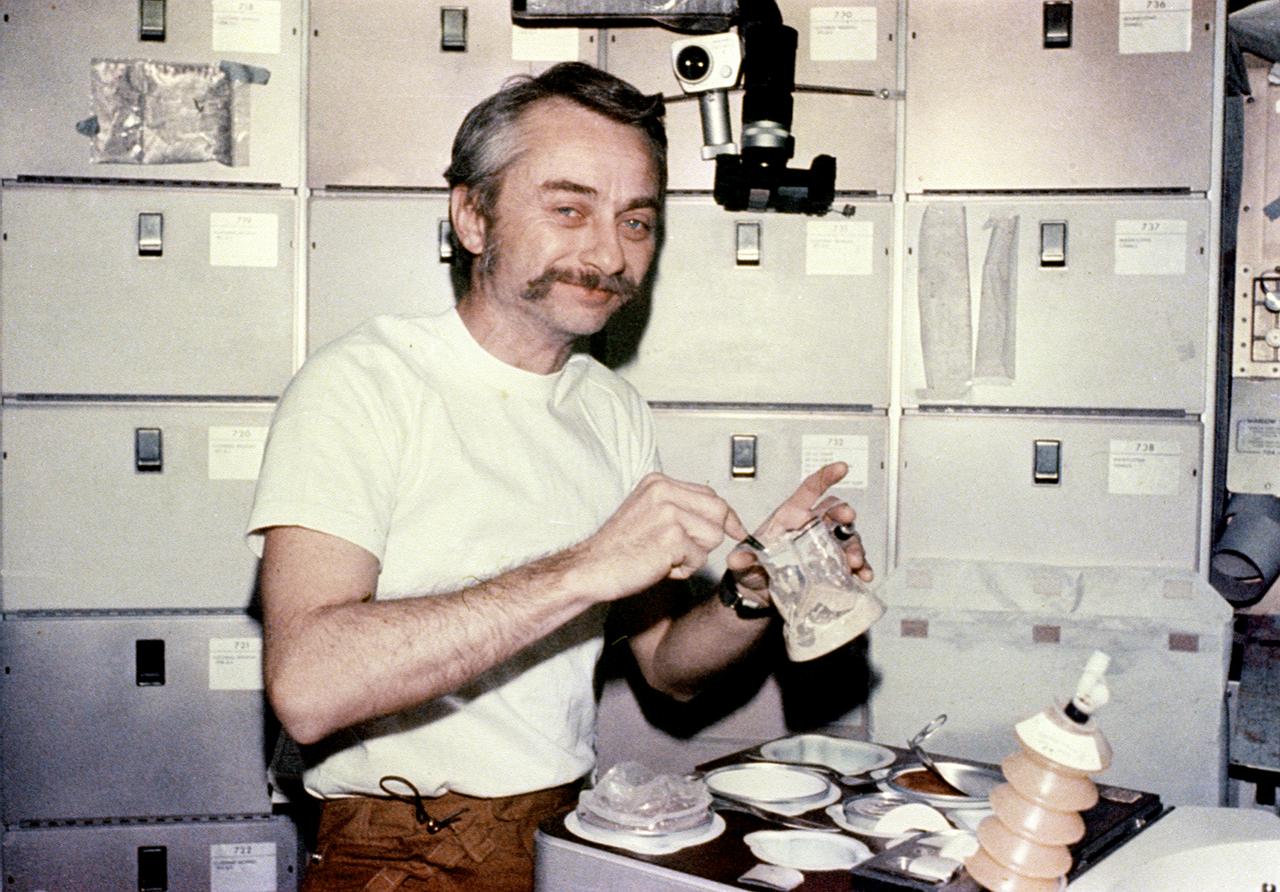
This photograph was taken during the Skylab-3 mission (2nd marned mission), showing Astronaut Owen Garriott enjoying his meal in the Orbital Workshop crew wardroom. The tray contained heating elements for preparing the individual food packets. The food on Skylab was a great improvement over that on earlier spaceflights. It was no longer necessary to squeeze liquified food from plastic tubes. Skylab's kitchen was so equipped that each crewman could select his own menu and prepare it to his own taste.
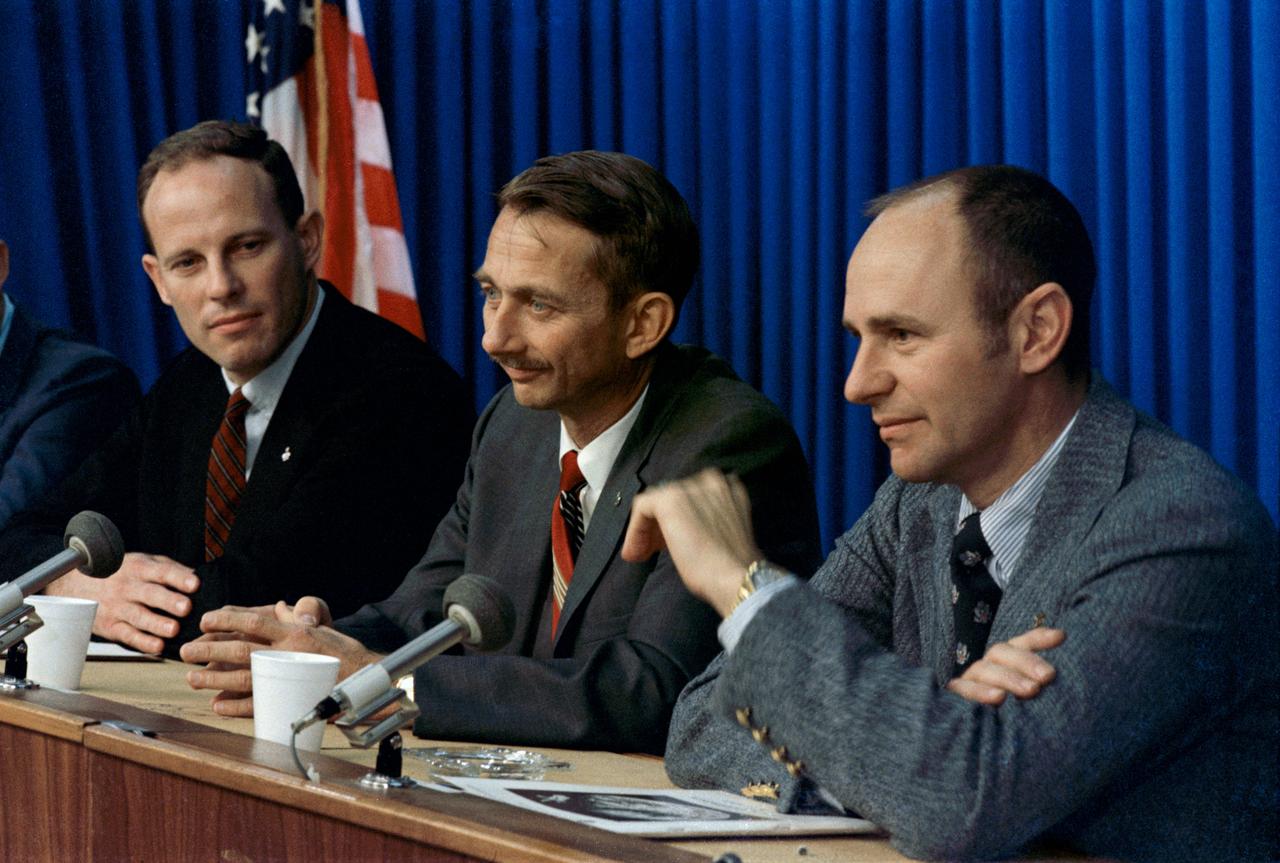
S72-46699 (19 Jan. 1972) --- Prime crew members of the scheduled second Skylab mission are introduced to the media during a press conference in January 1972 at the Manned Spacecraft Center (MSC). From left to right are astronauts Jack R. Lousma, pilot; Owen K. Garriott, science pilot, and Alan L. Bean, commander. Photo credit: NASA
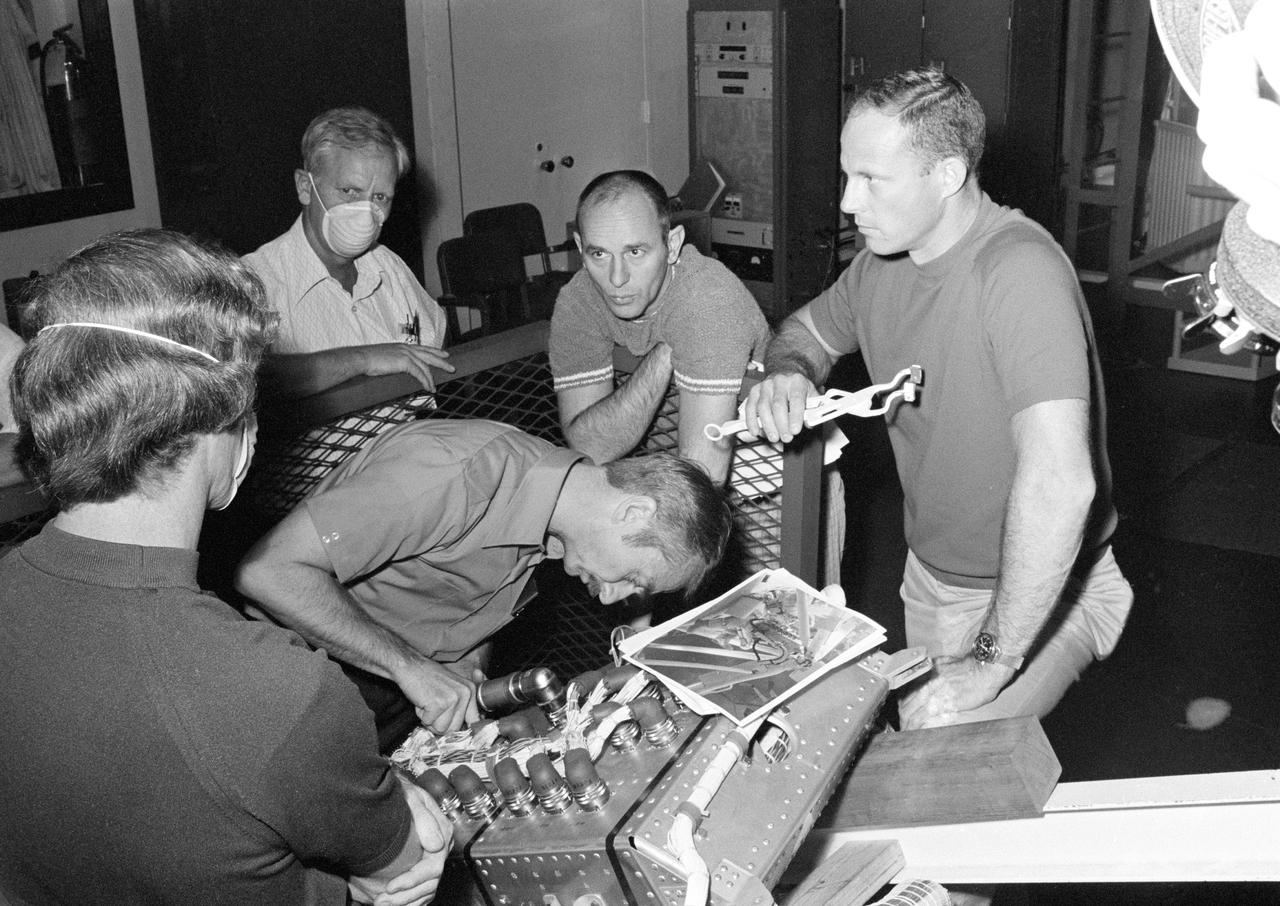
S73-31322 (30 June 1973) --- The three prime crewmen of the Skylab 3 mission practice procedures which will be used during the extravehicular activity (EVA) portion of the scheduled Skylab rate gyro six-pac installation. They are scientist-astronaut Owen K. Garriott (center), astronaut Alan L. Bean (center background) and astronaut Jack R. Lousma (right). Garriott is working with a mock-up of a trunion plug plate which is on the space station's deployment assembly. This picture was taken during Skylab 3 prelaunch training at Johnson Space Center. In the left foreground with back to camera is astronaut Russell L. Schweickart, who is assisting with the Skylab 3 training. Another training officer is in the left background. Photo credit: NASA
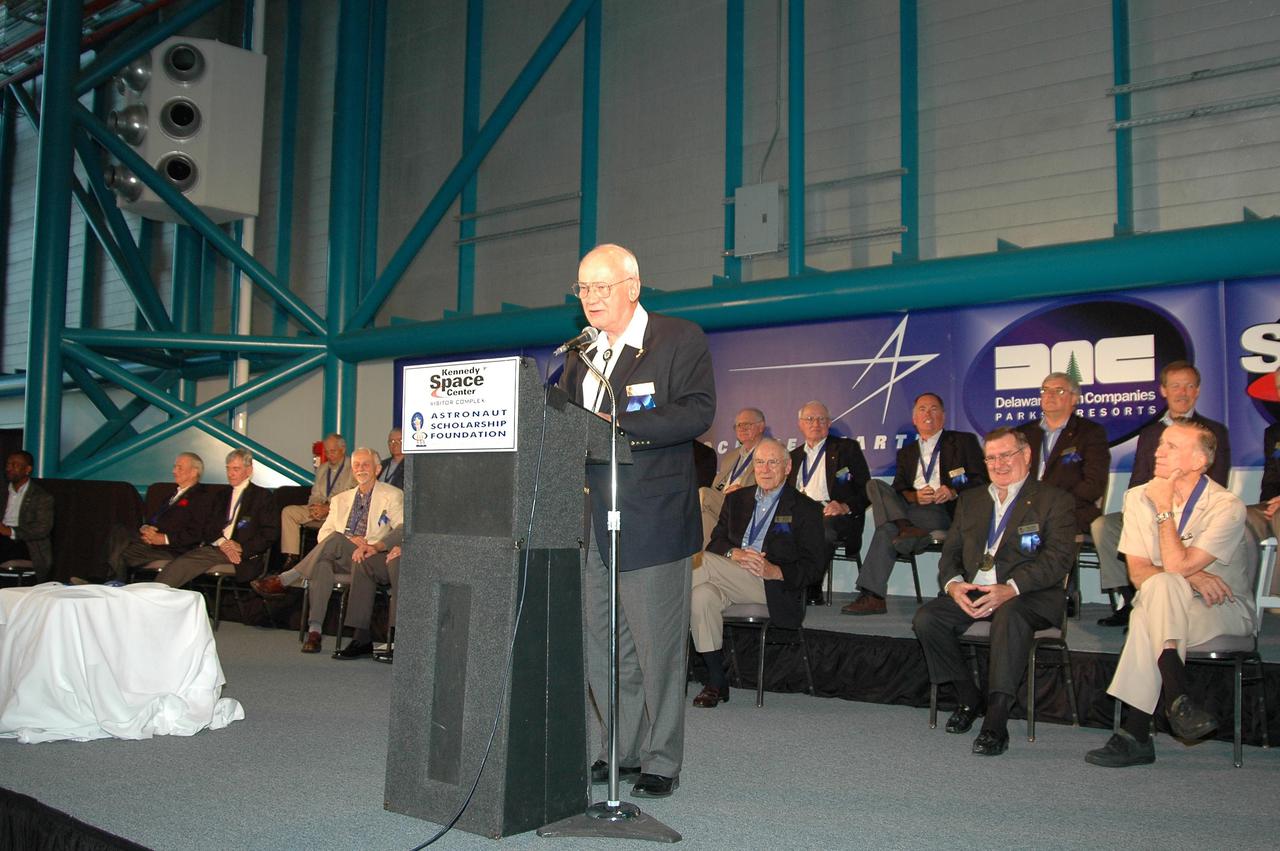
KENNEDY SPACE CENTER, FLA. - At the Astronaut Hall of Fame Induction Ceremony, new inductee Bruce McCandless speaks to the guests. Seen behind him are current Hall of Famers (back row) Al Gordon, Walt Cunningham, Jack Lousma, Bill Pogue, Robert Crippen, Dan Brandenstein and Robert “Hoot” Gibson; (front row) Scott Carpenter, John Young, Owen Garriott, Jim Lovell, Fred Haise and Vance Brand. Garriott is chairman of the Astronaut Hall of Fame. The other new inductees are Joe Allen and Gordon Fullerton. The event is being held in the Kennedy Space Center Visitor Complex’s Apollo_Saturn V Center. Recognized for their individual flight accomplishments and contributions to the success and future success of the U.S. space program, this elite group of inductees is among only 60 astronauts to be honored in the Hall of Fame and the fourth group of Space Shuttle astronauts named.
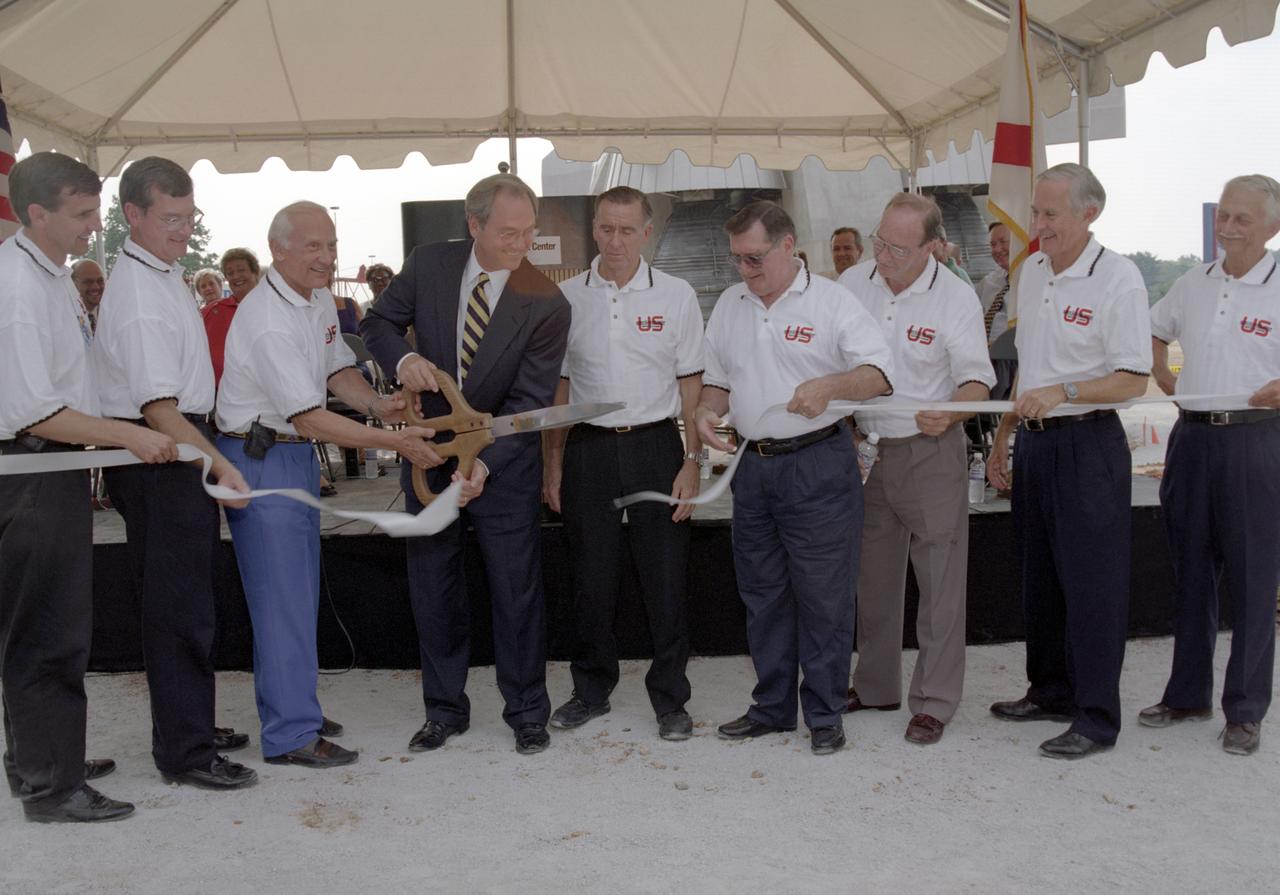
Alabama Governor Don Seigleman cuts the ribbon marking the dedication of the Saturn V rocket replica that was constructed at the U. S. Space and Rocket Center in honor of the 30th arniversary of the lunar landing. Accompanying the Governor are (L/R): Mike Wing, CEO US Space Rocket Center; Mike Gillespie, Madison County Commissioner, Dist. Seven; Buzz Aldrin, Apollo 11 Astronaut; Governor Seigleman; Walt Cunningham, Apollo 7 Astronaut; Dick Gordon, Apollo 12 Astronaut; Ed Mitchell, Apollo 14 Astronaut; Charlie Duke, Apollo 16 Astronaut; and Owen Garriott, Skylab 3 Astronaut.
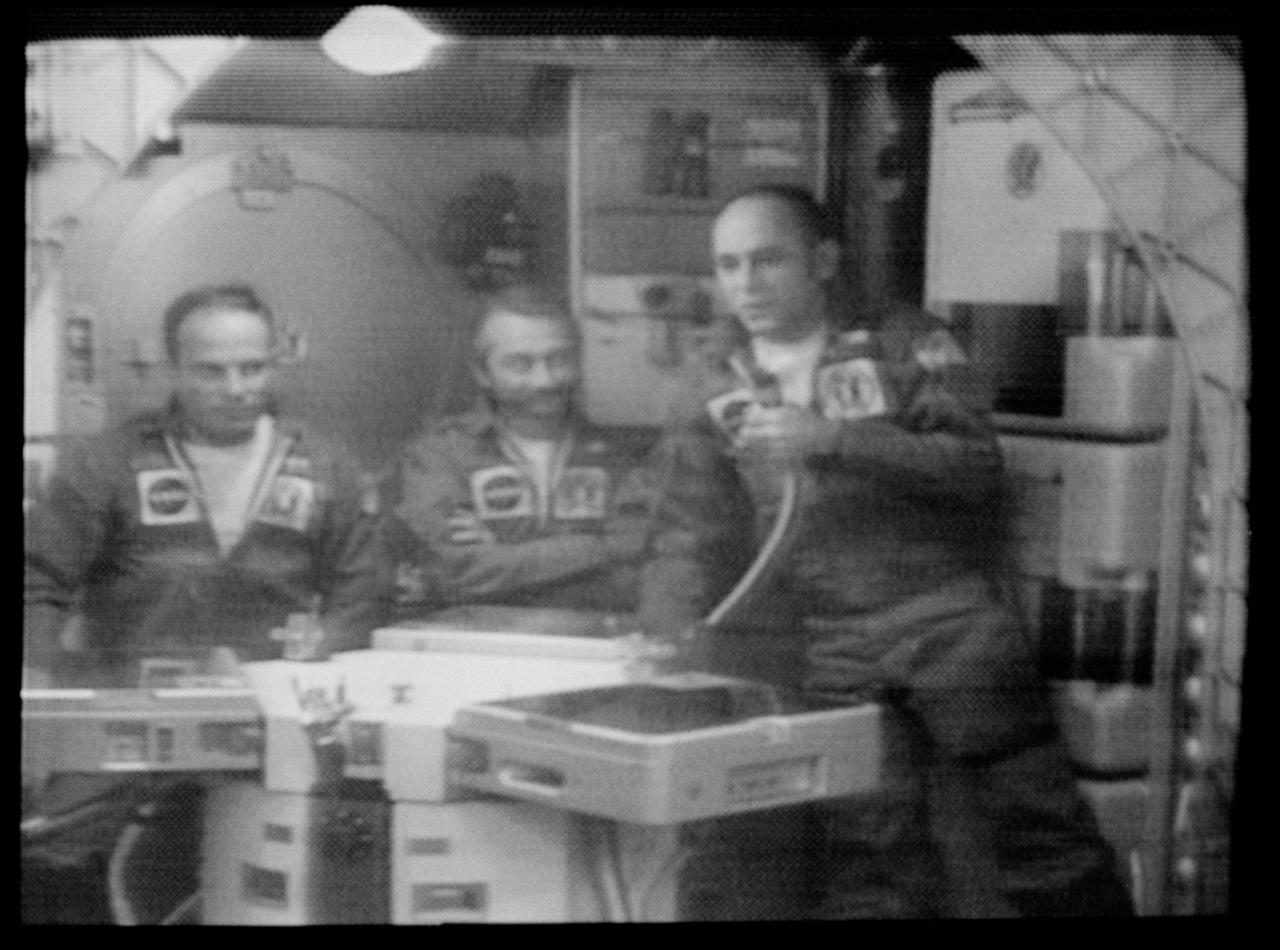
S73-34339 (21 Sept. 1973) --- Astronaut Alan L. Bean, right, Skylab 3 commander, answers a question during the Sept. 21, 1973 press conference from the Skylab space station in Earth orbit. This is a black and white reproduction taken from a television transmission made by a TV camera aboard the Skylab space station. Scientist-astronaut Owen K. Garriott, center, science pilot; and astronaut Jack R. Lousma, left, pilot, await queries from newsmen on the ground to be sent up by scientist-astronaut Story Musgrave, CAPCOM for this shift of Skylab 3. Photo credit: NASA
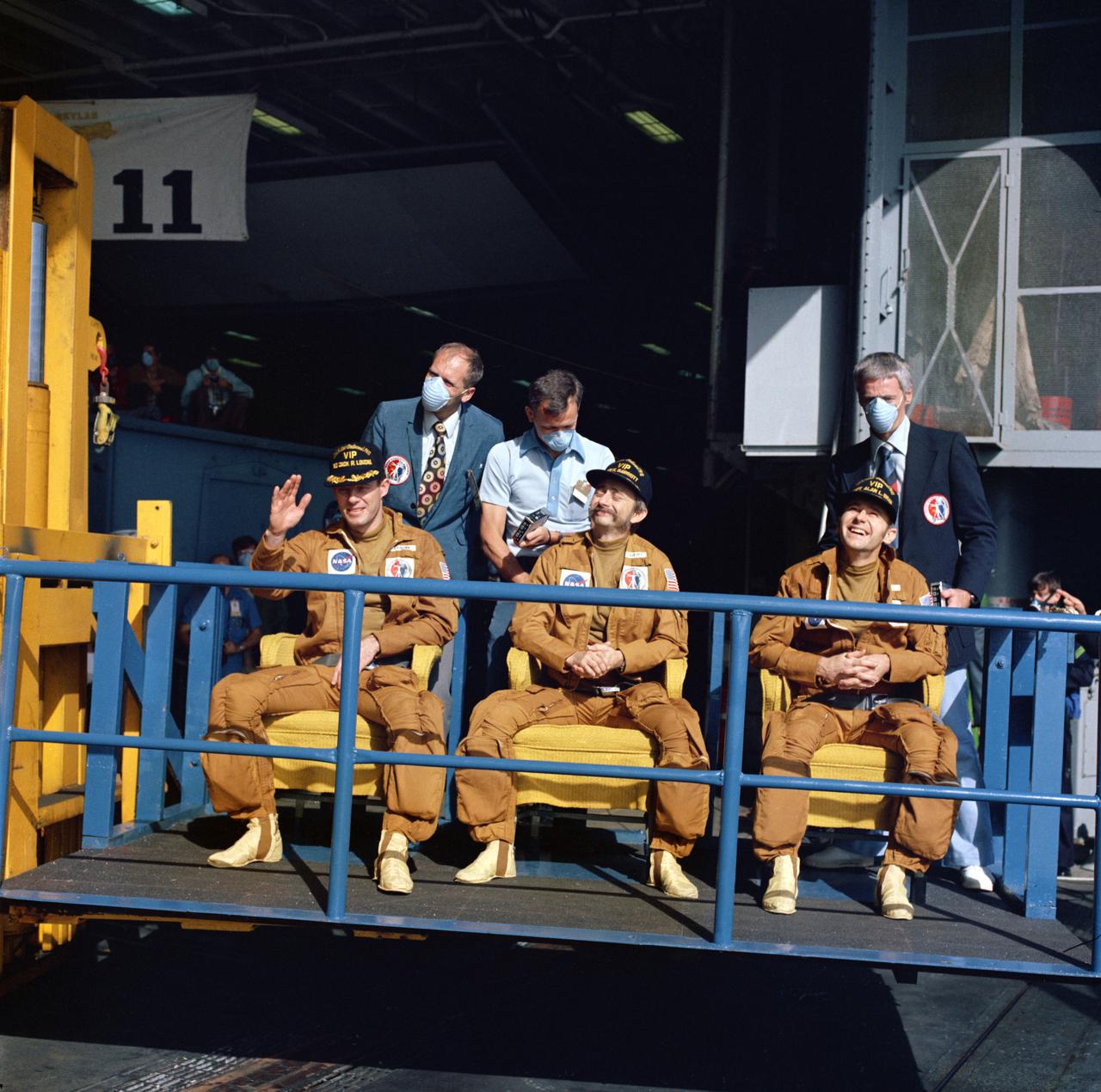
S73-36451 (25 Sept. 1973) --- The three crewmen of the Skylab 3 mission are seen aboard the prime recovery ship, USS New Orleans, following their successful 59-day visit to the Skylab space station in Earth orbit. They are, left to right, astronaut Jack R. Lousma, pilot; scientist-astronaut Owen K. Garriott, science pilot; and astronaut Alan L. Bean, commander. The Skylab 3 Command Module with the three crewmen aboard splashed down in the Pacific about 230 miles southwest of San Diego, California. They are seated atop a platform of a fork-lift dolly. Recovery support personnel are wearing face masks to prevent exposing the crewmen to disease. Photo credit: NASA

S73-31104 (17 July 1973) --- The wife and children of astronaut Alan L. Bean are photographed at their home near the Johnson Space Center (JSC), where their husband and father is preparing for NASA?s second manned Skylab mission. Bean is commander of the Skylab 3 Earth-orbital mission and will be joined by scientist-astronaut Owen K. Garriott, science pilot, and astronaut Jack R. Lousma, pilot for the schedule two-month mission. With Mrs. Sue Bean are the couple?s children Clay, 17, and Amy Sue, 10; and the family?s pet dog. Photo credit: NASA
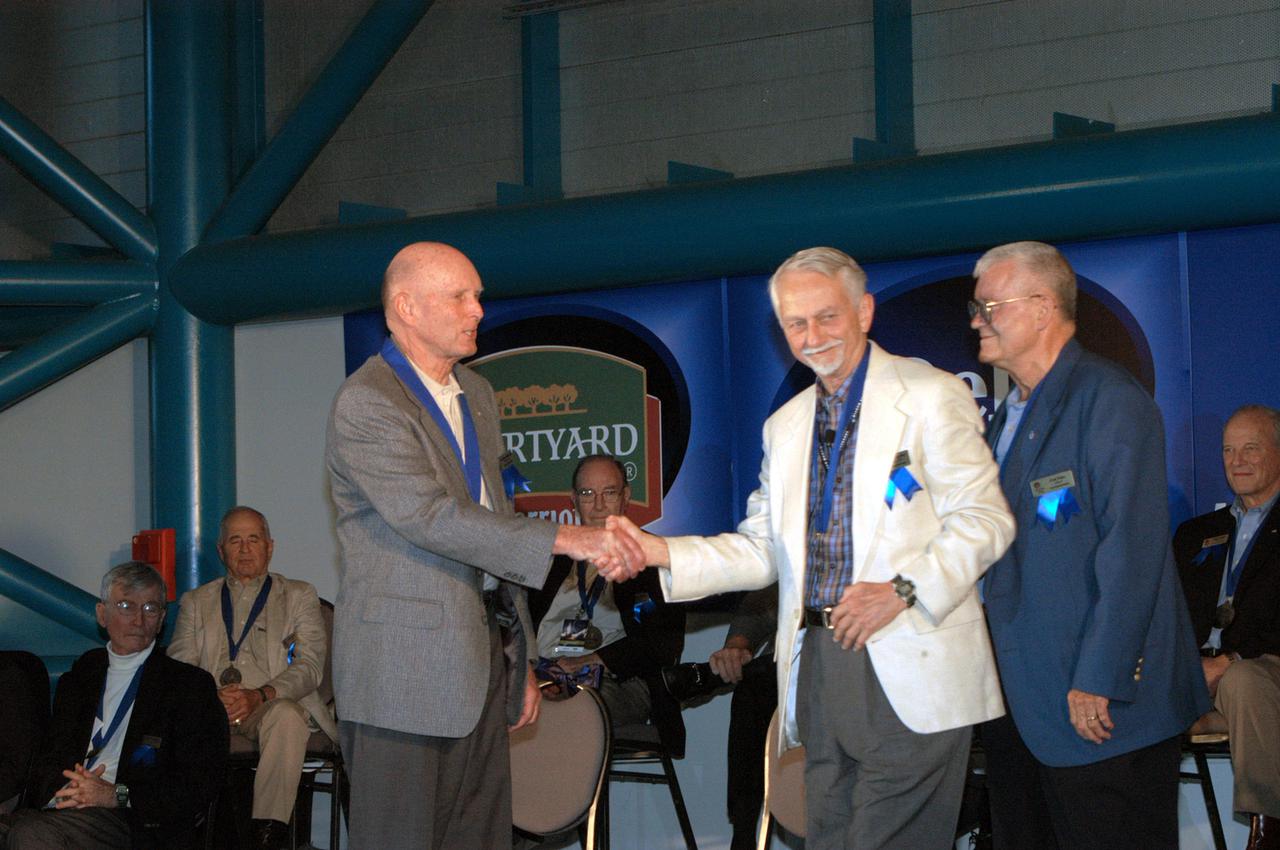
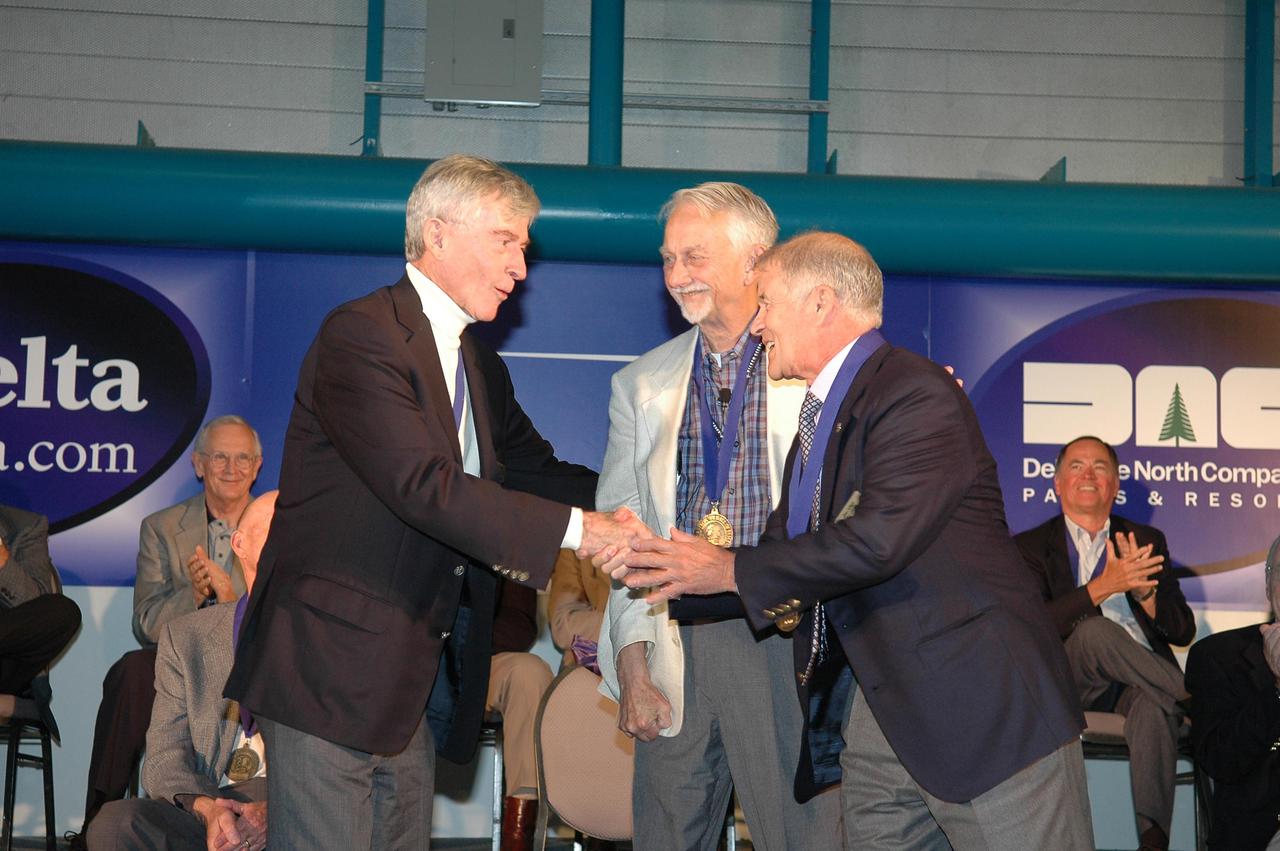
KENNEDY SPACE CENTER, FLA. - At the Astronaut Hall of Fame Induction Ceremony, new inductee Gordon Fullerton (left) is congratulated by Chairman Owen Garriott. At right is Hall of Famer Fred Haise. Other Hall of Famers are gathered on stage for the ceremony, which is being held in the Kennedy Space Center Visitor Complex’s Apollo_Saturn V Center. Recognized for their individual flight accomplishments and contributions to the success and future success of the U.S. space program, this elite group of inductees is among only 60 astronauts to be honored in the Hall of Fame and the fourth group of Space Shuttle astronauts named.
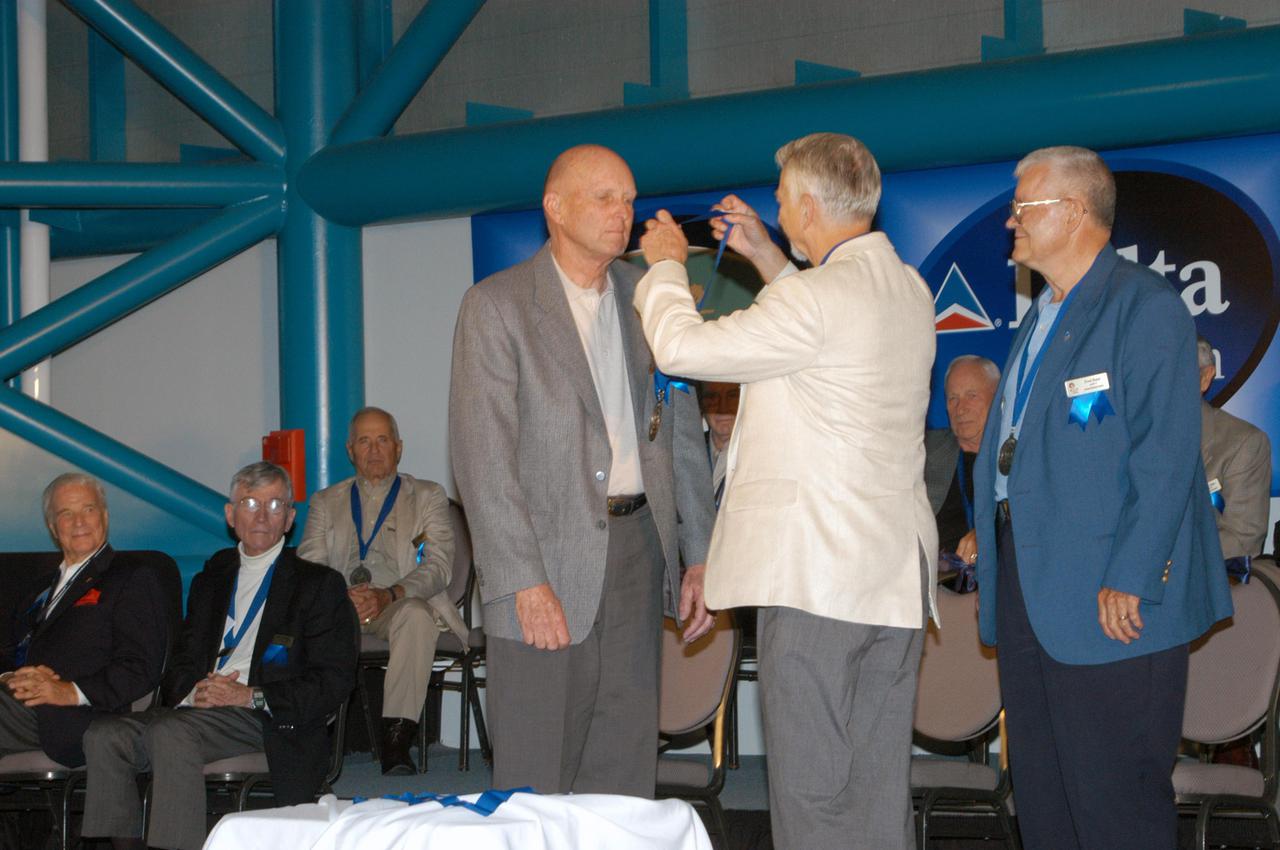
KENNEDY SPACE CENTER, FLA. - At the Astronaut Hall of Fame Induction Ceremony, Chairman Owen Garriott (center) places a medal around the neck of new inductee Gordon Fullerton. At right is Hall of Famer Fred Haise. Other Hall of Famers are gathered on stage for the ceremony, which is being held in the Kennedy Space Center Visitor Complex’s Apollo_Saturn V Center. Recognized for their individual flight accomplishments and contributions to the success and future success of the U.S. space program, this elite group of inductees is among only 60 astronauts to be honored in the Hall of Fame and the fourth group of Space Shuttle astronauts named.
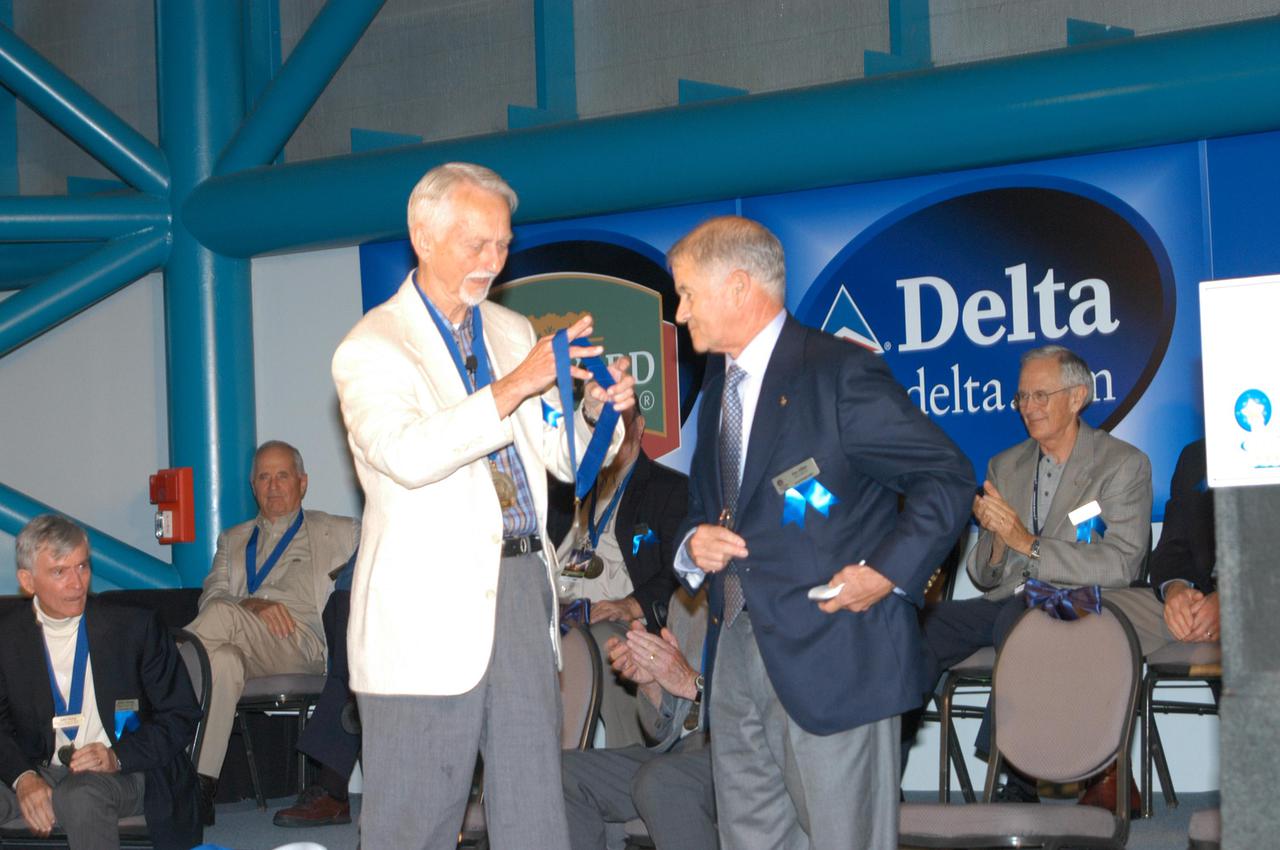
KENNEDY SPACE CENTER, FLA. - At the Astronaut Hall of Fame Induction Ceremony, Chairman Owen Garriott prepares to place a medal on the neck of new inductee Joe Allen. Current Hall of Famers in the background are John Young and Dick Gordon (at left) and Al Worden (at right). The other new inductees are Bruce McCandless and Gordon Fullerton. The event is being held in the Kennedy Space Center Visitor Complex’s Apollo_Saturn V Center. Recognized for their individual flight accomplishments and contributions to the success and future success of the U.S. space program, this elite group of inductees is among only 60 astronauts to be honored in the Hall of Fame and the fourth group of Space Shuttle astronauts named.

KENNEDY SPACE CENTER, FLA. - At the Astronaut Hall of Fame Induction Ceremony, new inductee Bruce McCandless (left) receives the medal from Chairman Owen Garriott. Seen behind them are current Hall of Famers Walt Cunningham and Bill Anders (at left), Al Worden (center), and Charlie Duke and Jack Lousma. The other new inductees are Joe Allen and Gordon Fullerton. The event is being held in the Kennedy Space Center Visitor Complex’s Apollo_Saturn V Center. Recognized for their individual flight accomplishments and contributions to the success and future success of the U.S. space program, this elite group of inductees is among only 60 astronauts to be honored in the Hall of Fame and the fourth group of Space Shuttle astronauts named.
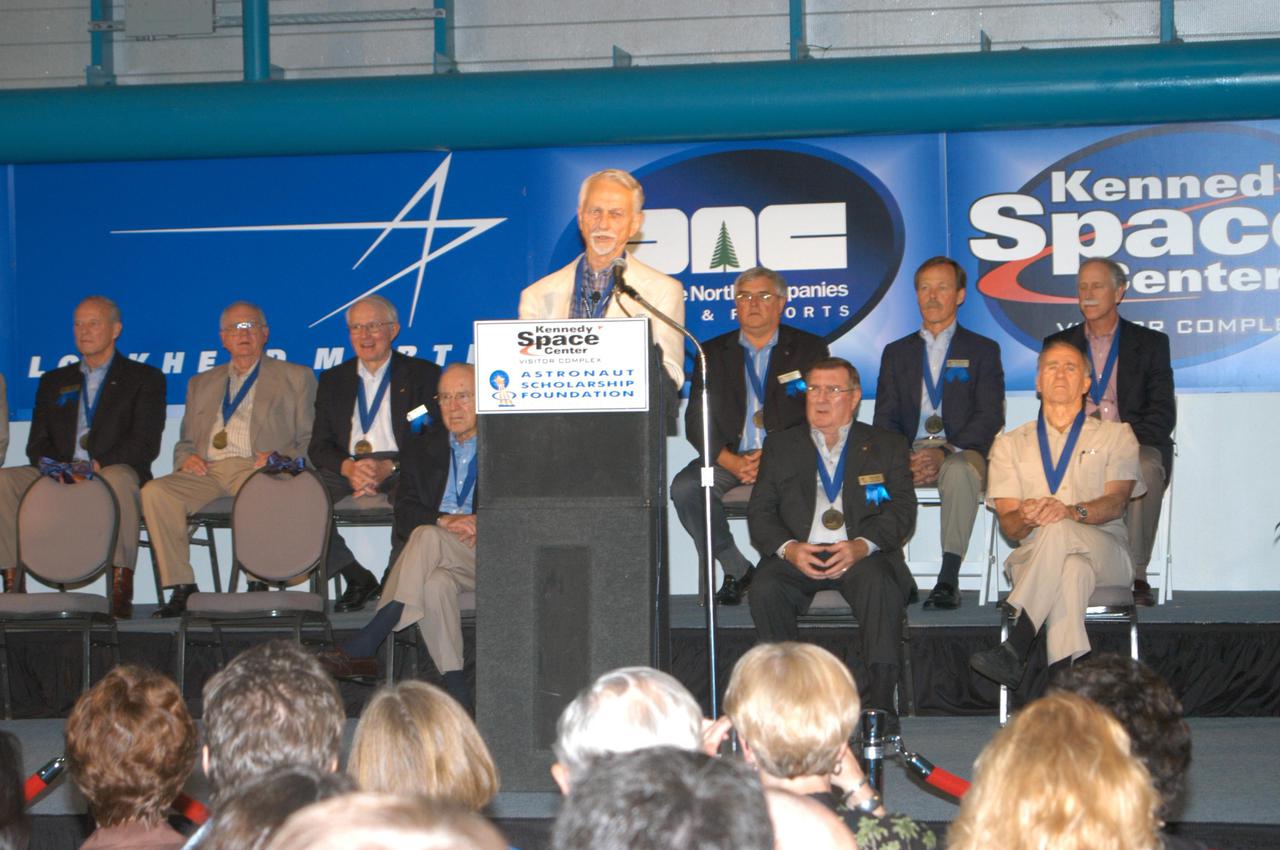
KENNEDY SPACE CENTER, FLA. - Owen Garriott, chairman of the Astronaut Hall of Fame, speaks to guests at the Induction Ceremony of three new additions to the Hall of Fame: Gordon Fullerton, Bruce McCandless and Joe Allen. Seated on stage are current Hall of Famers, from left in the back row, Charles Duke, Jack Lousma, Bill Pogue, Dan Brandenstein, Robert “Hoot” Gibson and Stephen Covey; in front row, Jim Lovell, Fred Haise and Vance Brand. Recognized for their individual flight accomplishments and contributions to the success and future success of the U.S. space program, this elite group of inductees is among only 60 astronauts to be honored in the Hall of Fame and the fourth group of Space Shuttle astronauts named.
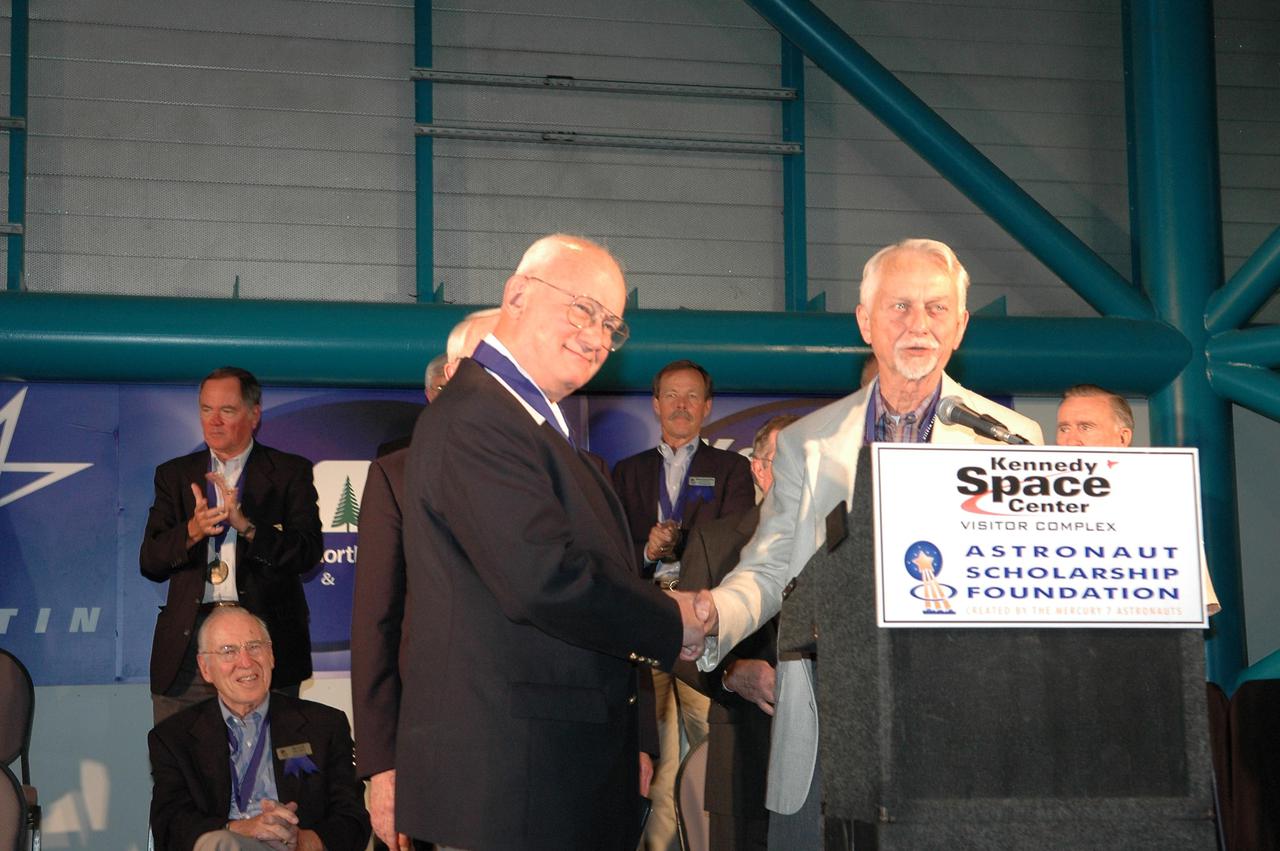
KENNEDY SPACE CENTER, FLA. - At the Astronaut Hall of Fame Induction Ceremony, new inductee Bruce McCandless (left) is congratulated by Chairman Owen Garriott. Seen behind them are current Hall of Famers (on left) Robert Crippen (standing) and Jim Lovell and (center) Robert “Hoot” Gibson. The other new inductees are Joe Allen and Gordon Fullerton. The event is being held in the Kennedy Space Center Visitor Complex’s Apollo_Saturn V Center. Recognized for their individual flight accomplishments and contributions to the success and future success of the U.S. space program, this elite group of inductees is among only 60 astronauts to be honored in the Hall of Fame and the fourth group of Space Shuttle astronauts named.
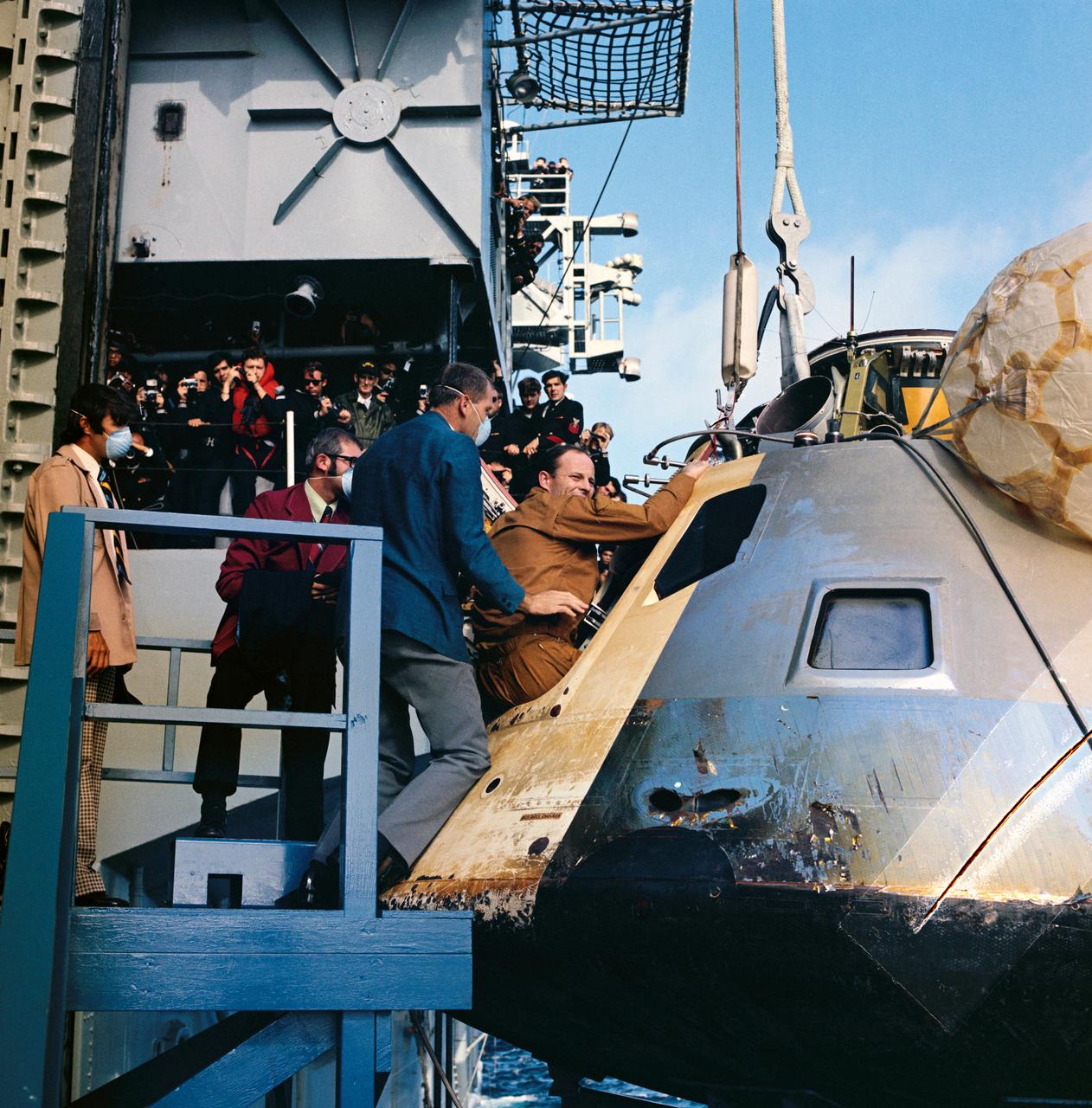
S73-36435 (25 Sept. 1973) --- Astronaut Jack R. Lousma, Skylab 3 pilot, egresses the Skylab 3 Command Module aboard the prime recovery ship, USS New Orleans, during recovery operations in the Pacific Ocean. Astronauts Lousma; Alan L. Bean, commander; and Owen L. Garriott, science pilot, had just completed a successful 59-day visit to the Skylab space station in Earth orbit. The Skylab 3 spacecraft splashed down in the Pacific about 230 miles southwest of San Diego, California. Photo credit: NASA
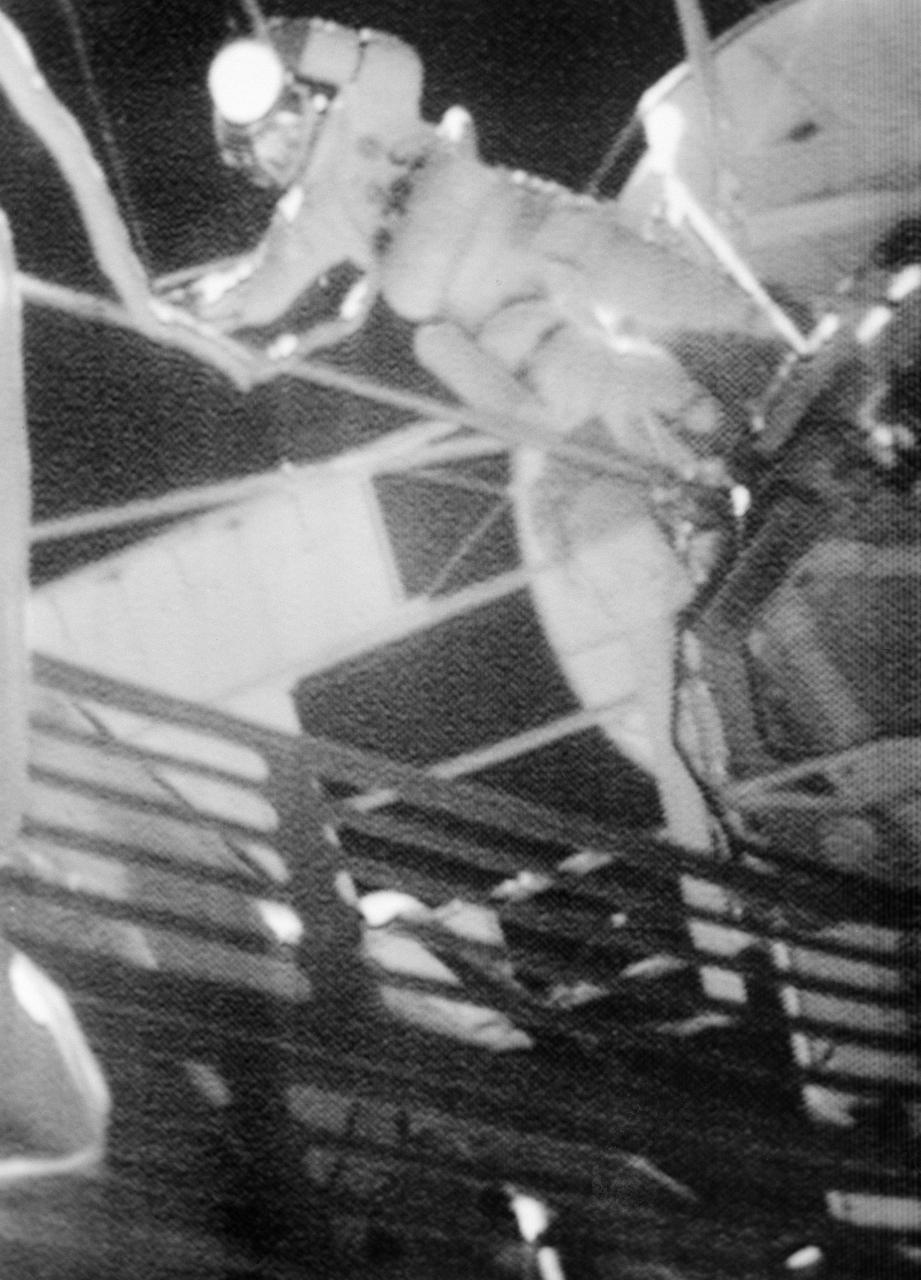
S73-31976 (5 Aug. 1973) --- Astronaut Jack R. Lousma, Skylab 3 pilot, is seen outside the Skylab space station in Earth orbit during the Aug. 5, 1973 Skylab 3 extravehicular activity (EVA) in this photographic reproduction taken from a television transmission made by a color TV camera aboard the space station. Scientist-astronaut Owen K. Garriott, Skylab 3 science pilot, participated in the EVA with Lousma. During the EVA the two crewmen deployed the twin pole solar shield to help shade the Orbital Workshop. Photo credit: NASA
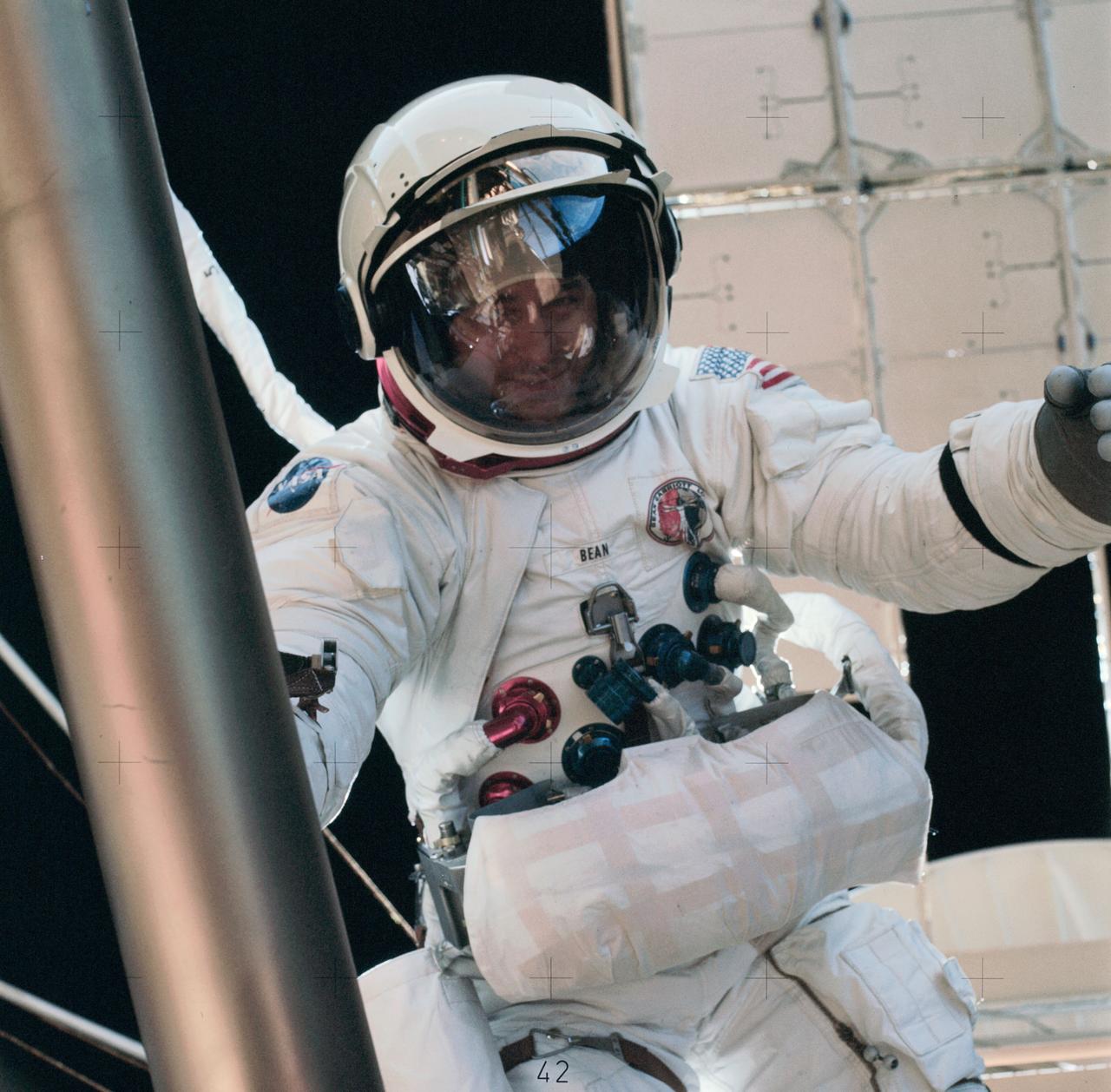
SL3-122-2612 (6 Aug. 1973) --- Astronaut Alan L. Bean, Skylab 3 commander, participates in the final Skylab 3 extravehicular activity (EVA), during which a variety of tasks were performed. Here, Bean is near the Apollo Telescope Mount (ATM) during final film change out for the giant telescope facility. Astronaut Owen K. Garriott, who took the picture, is reflected in Bean's helmet visor. The reflected Earth disk in Bean's visor is so clear that the Red Sea and Nile River area can delineated. Photo credit: NASA

SL3-122-2611 (22 Sept. 1973) --- Astronaut Alan L. Bean, Skylab 3 commander, participates in the final extravehicular activity (EVA) for that mission, during which a variety of tasks were performed. Here, Bean is near the Apollo Telescope Mount (ATM) during final film change out for the giant telescope facility. Astronaut Owen K. Garriott, who took the picture, is reflected in Bean's helmet visor. The reflected Earth disk in Bean's visor is so clear that the Red Sea and Nile River area can delineated. Photo credit: NASA
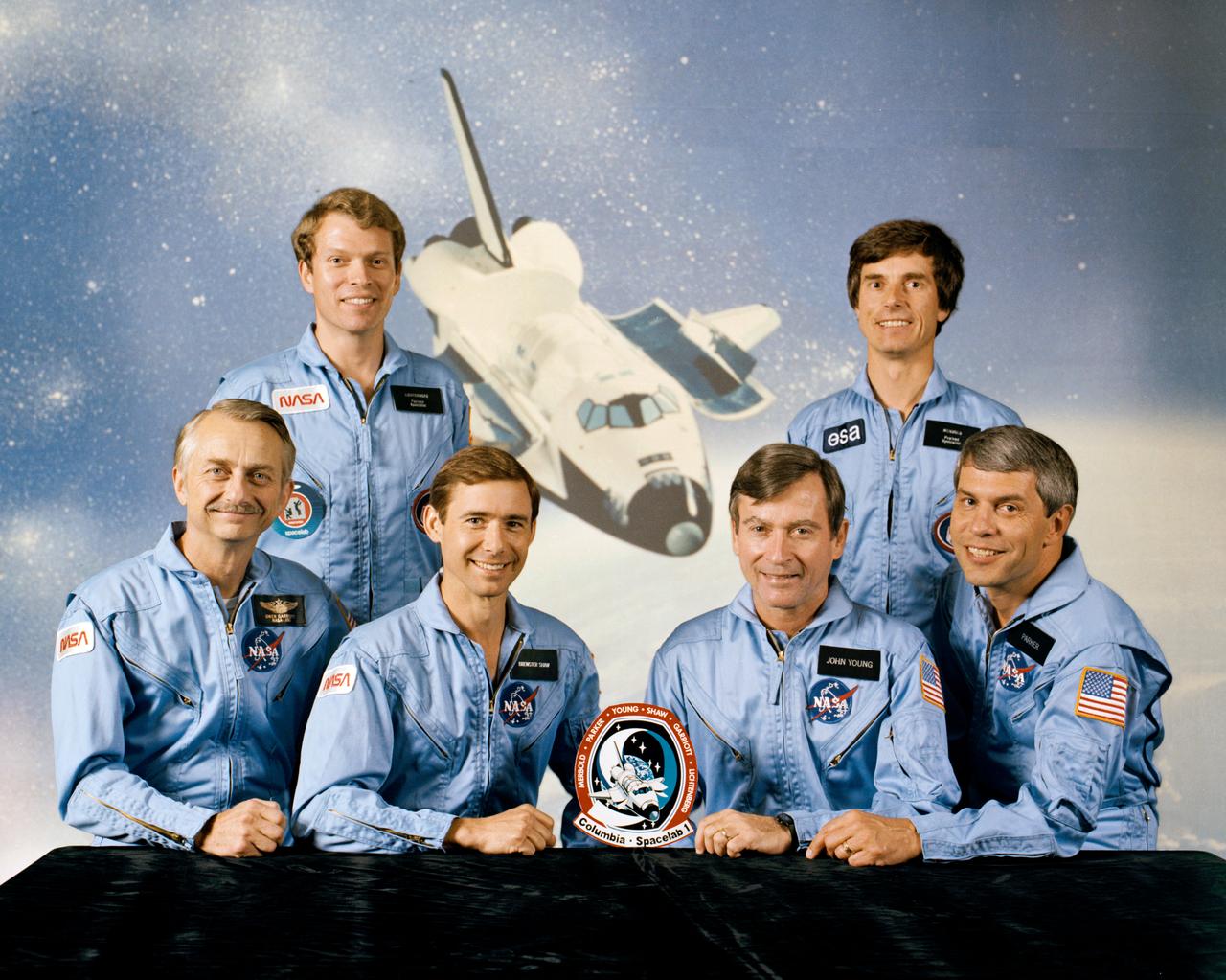
S83-35017 (June 1983) --- These six men represent the first crewmembers to man the Columbia when it gets reactivated later this year. The four NASA astronauts are joined by a European and MIT scientist payload specialist and the Spacelab module and experiment array for STS-9. On the front row are Astronauts Owen K. Garriott, mission specialist; Brewster H. Shaw, Jr., pilot; John W. Young, commander; and Robert A. R. Parker, mission specialist. Byron K. Lichtenberg of the Massachusetts of Technology, left and Ulf Merbold of the Republic of West Germany and the European Space Agency stand in front of an orbital scene featuring the Columbia. Columbia was used for the first five Space Transportation System missions in 1981 and 1982.
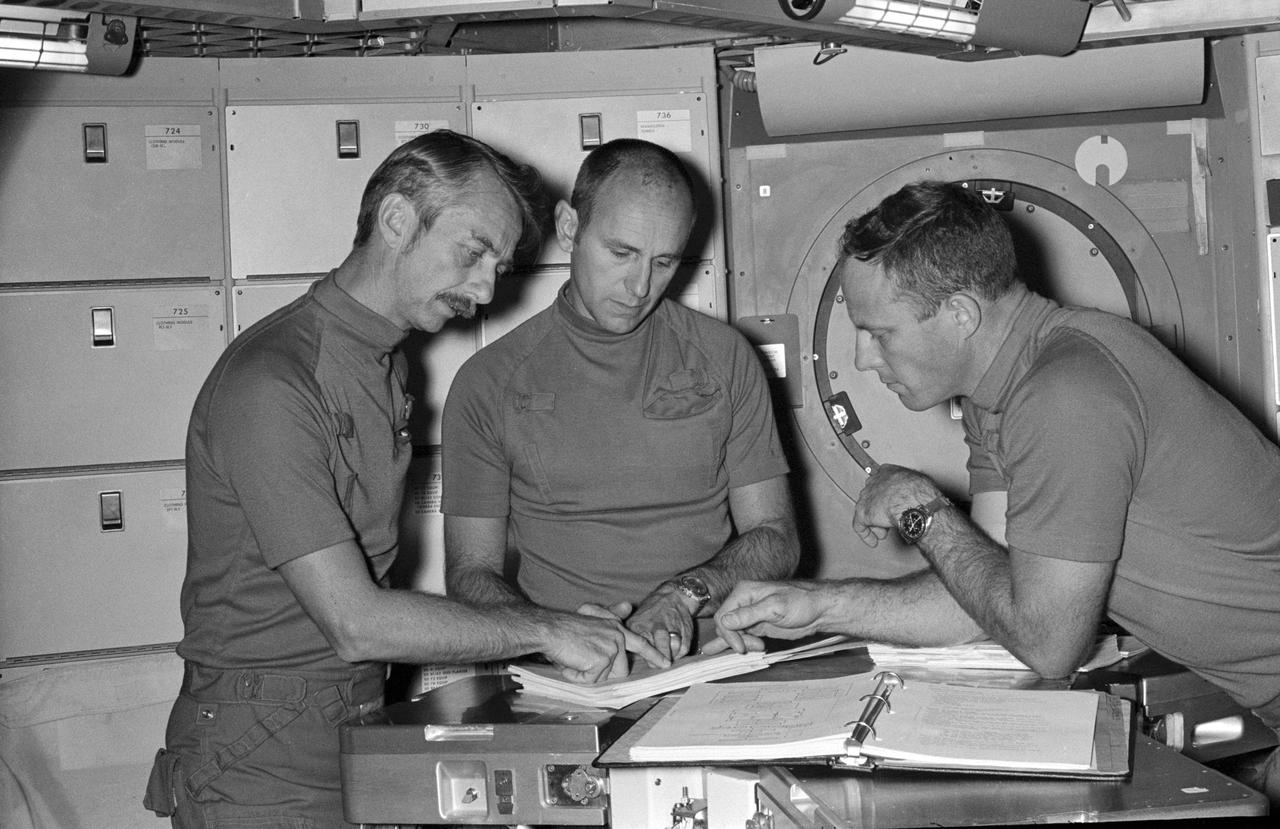
S73-28419 (16 June 1973) --- The three prime crewmen of the Skylab 3 mission check over flight data during a training session in the crew quarters of the Orbital Workshop (OWS) trainer in the Mission Simulation and Training Facility at the Johnson Space Center (JSC). They are, from left to right, scientist-astronaut Owen K. Garriott, science pilot; and astronauts Alan L. Bean, commander, and Jack R. Lousma, pilot. The 56-day, second manned Skylab Earth-orbital mission is scheduled for liftoff in the latter part of July 1973. Photo credit: NASA
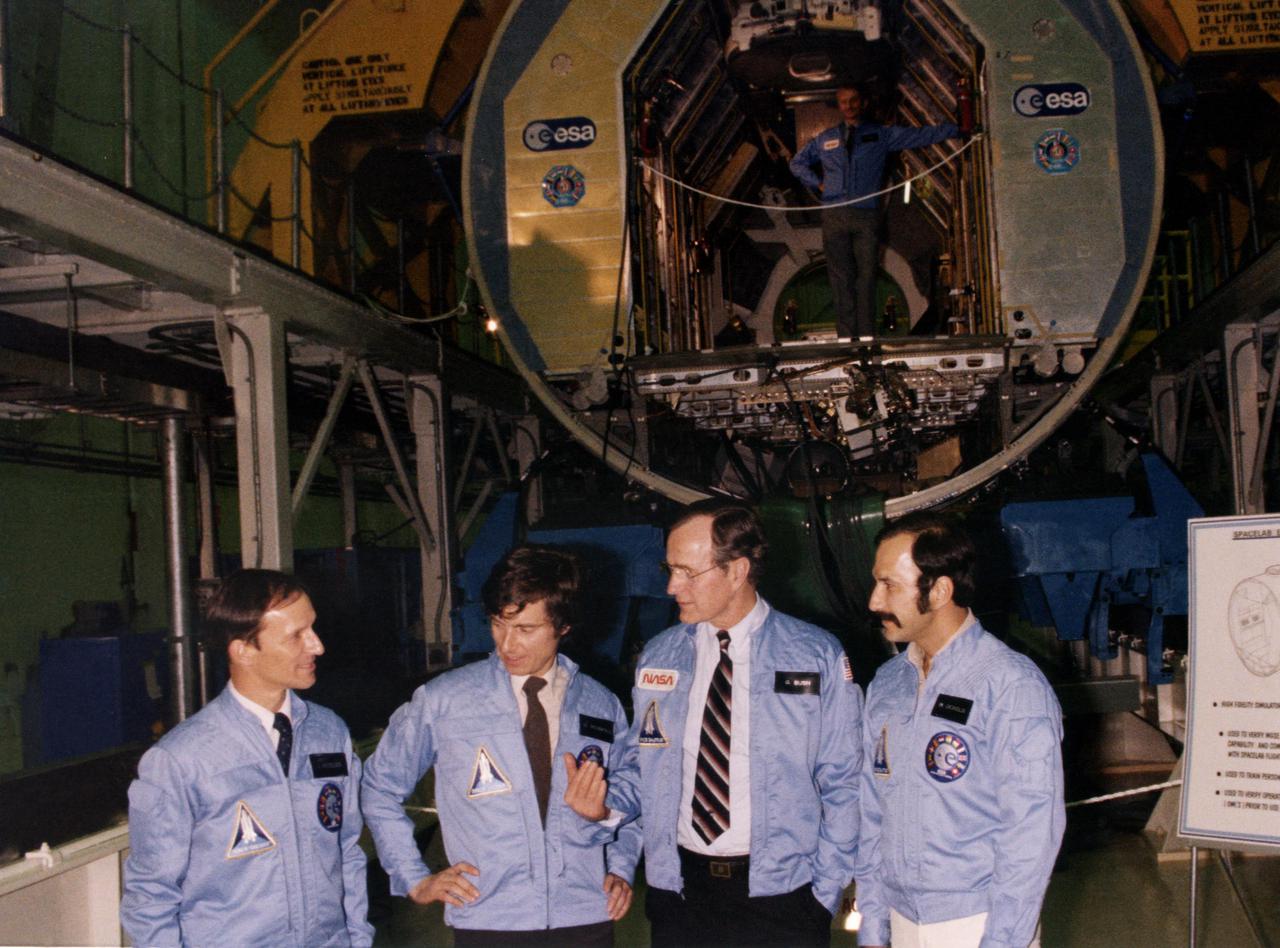
KENNEDY SPACE CENTER, FLA. -- Vice President George H.W. Bush, third from left, is pictured with the Spacelab engineering module at the Spacelab Arrival Ceremony in the Operations and Checkout Building as he visits with, from left, astronaut Claude Nicollier, European Space Agency, and payload specialists Ulf Marbod, West Germany, and Wubbo Ockels, the Netherlands. Overhead, in the module, is Owen K. Garriott, U.S. astronaut. The European-built Spacelab, designed to provide a shirt-sleeve environment for scientists working in Earth orbit, is scheduled to fly its first mission in the payload bay of the Space Shuttle in 1983.
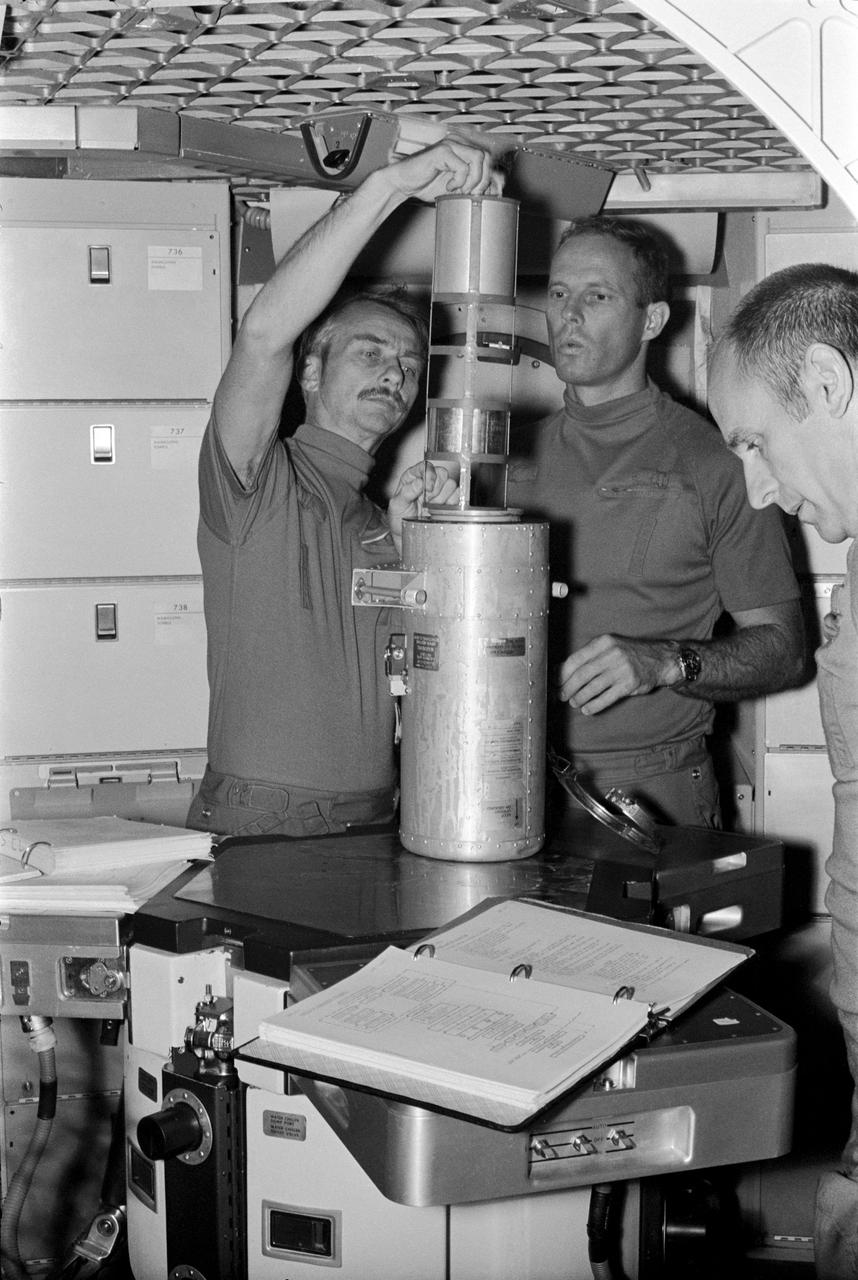
S73-28420 (16 June 1973) --- The three prime crewmen of the Skylab 3 mission check over flight data during a training session in the crew quarters of the Orbital Workshop (OWS) trainer in the Mission Simulation and Training Facility at the Johnson Space Center (JSC). Skylab 3 crew work with Inflight Medical Support System (IMSS) resupply container atop the food table in the OWS. They are from left to right, scientist-astronaut Owen K. Garriott, science pilot; and astronauts Jack R. Lousma, pilot; and Alan L. Bean, commander. Photo credit: NASA
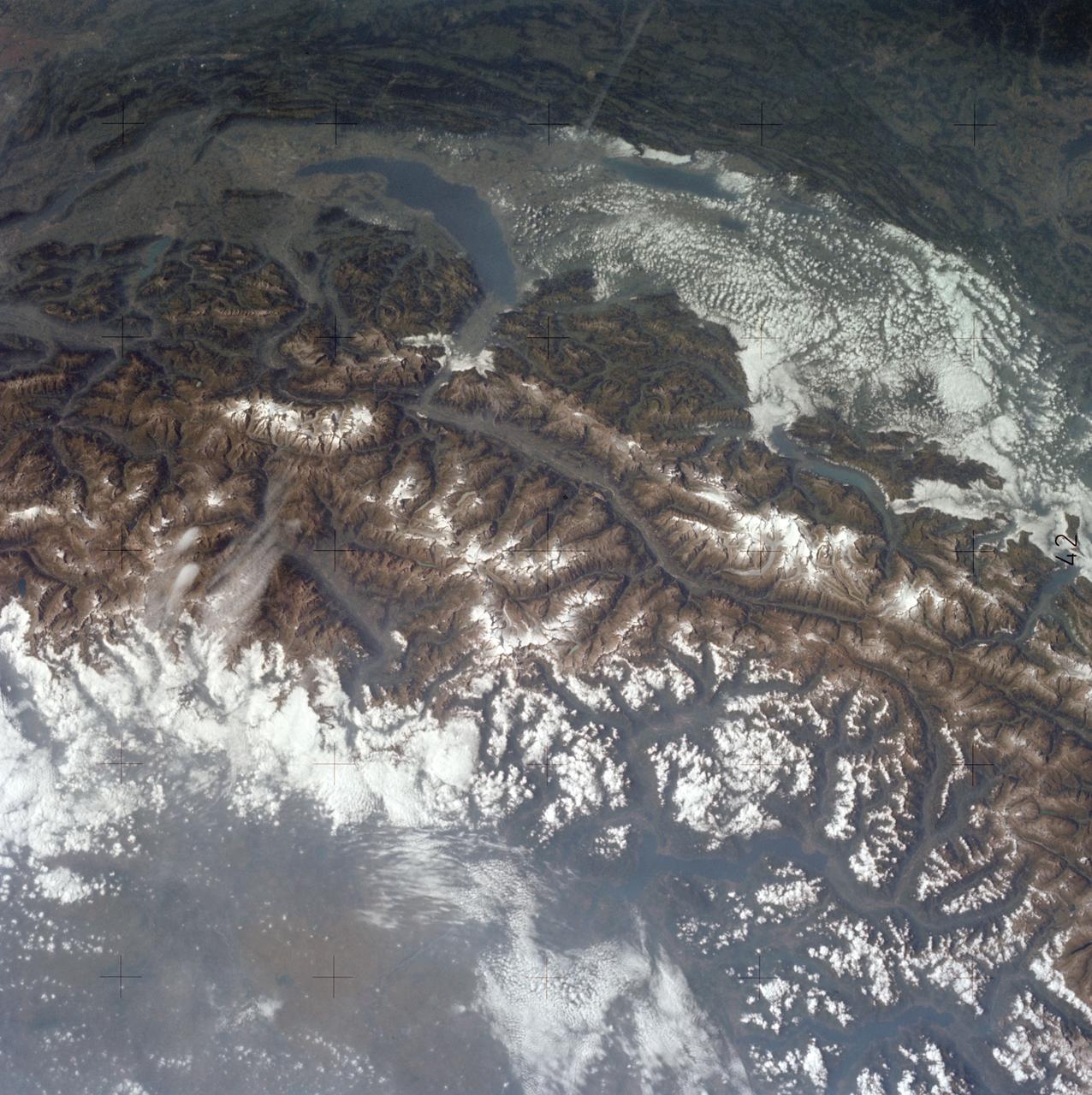
SL3-121-2438 (July-September 1973) --- The Alps of Switzerland, France and Italy are featured in this exceptional photograph taken by a hand-held camera from the Skylab space station during the second manned Skylab mission. Also visible in the out-the-window 70mm Hasselblad view are Lake Geneva, Lake of Lucerne, Rhone River and many other features. The Skylab 3 crewmen, astronauts Alan L. Bean, Owen K. Garriott and Jack R. Lousma completed a 59-day mission with a successful splashdown on Sept. 25, 1973. Photo credit: NASA
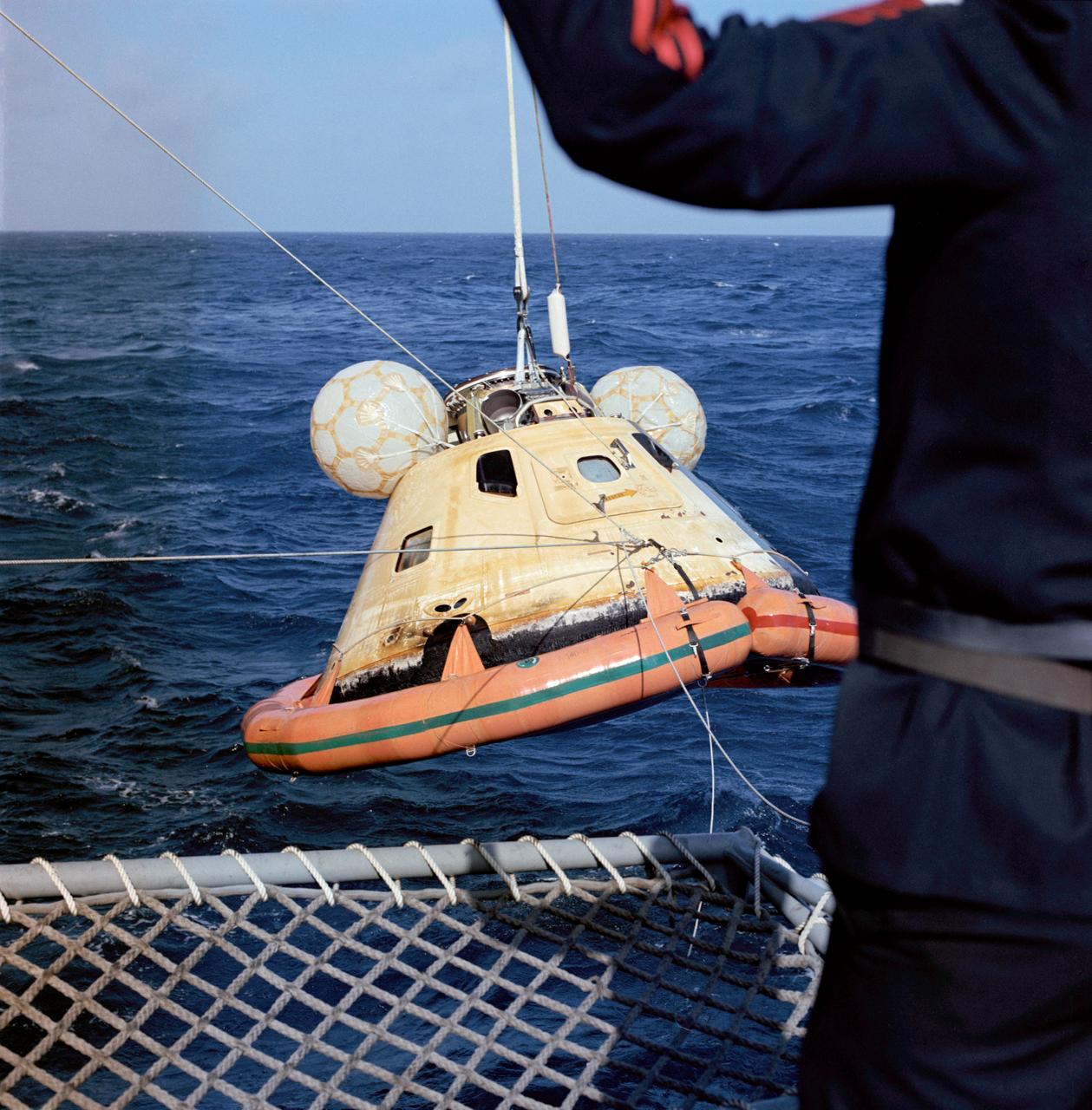
S73-36423 (25 Sept. 1973) --- The Skylab 3 Command Module, with astronauts Alan L. Bean, Owen K. Garriott and Jack R. Lousma still inside, is hoisted aboard the prime recovery ship, USS New Orleans, during recovery operations in the Pacific Ocean. The three crewmen had just completed a successful 59-day visit to the Skylab space station in Earth orbit. The Command Module splashed down in the Pacific about 230 miles southwest of San Diego, California. Earlier in the recovery operations a team of U.S. Navy swimmers attached the flotation collar to the spacecraft to improve its buoyancy. Photo credit: NASA

SL3-114-1682 (28 July 1973) --- A close-up view of the Skylab Space Station photographed against an Earth background from the Skylab 3 Command and Service Modules (CSM) during station-keeping maneuvers prior to docking. Aboard the Command Module (CM) were astronauts Alan L. Bean, Owen K. Garriott and Jack R. Lousma, who remained with the Skylab Space Station in Earth orbit for 59 days. This picture was taken with a hand-held 70mm Hasselblad camera using a 100mm lens and SO-368 medium speed Ektachrome film. Photo credit: NASA
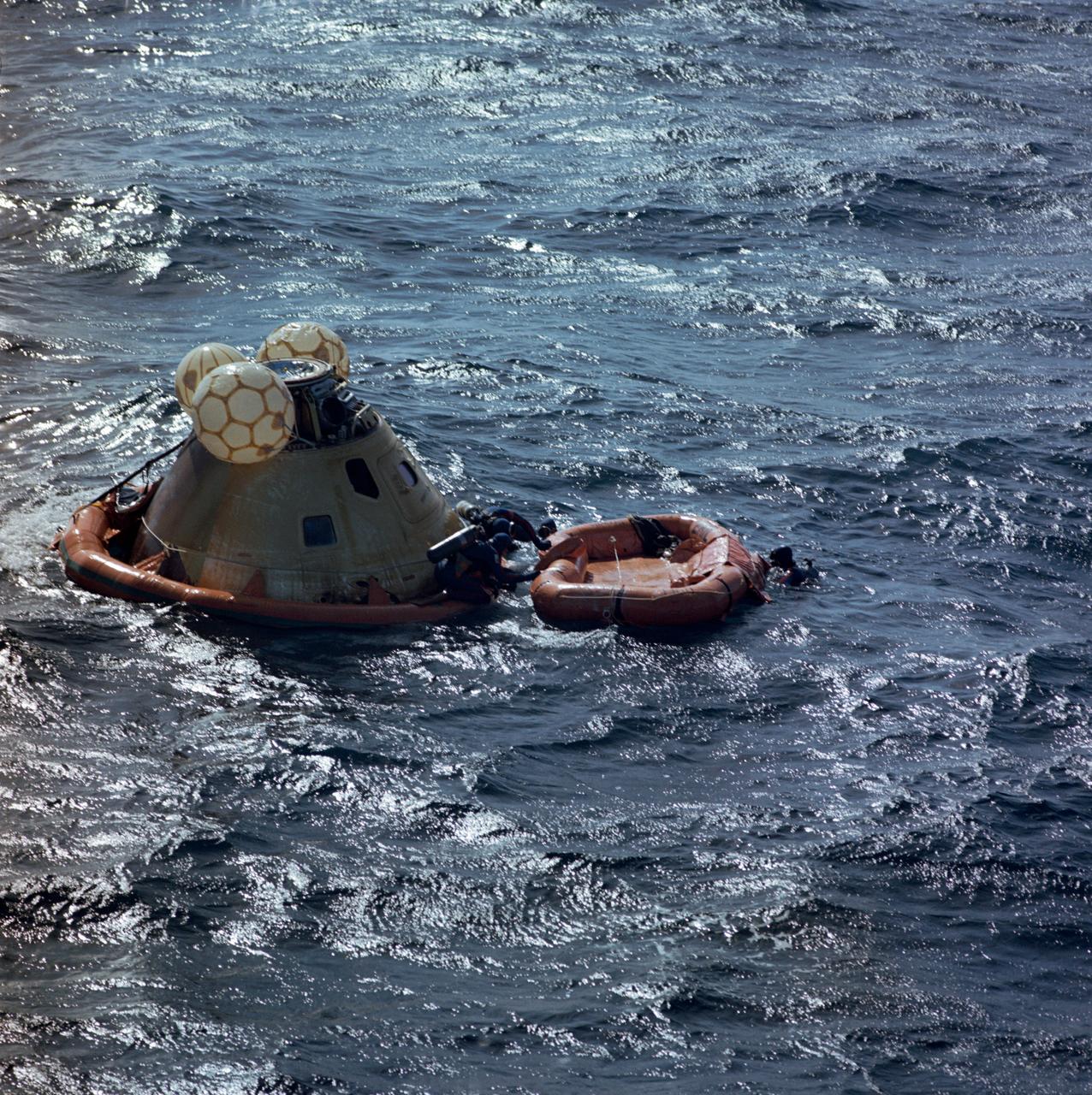
S73-36401 (25 Sept. 1973) --- A team of U.S. Navy swimmers assists with the recovery of the Skylab 3 Command Module following its splashdown in the Pacific Ocean about 230 miles southwest of San Diego, California. The swimmers had just attached a flotation collar to the spacecraft to improve its buoyancy. Aboard the Command Module were astronauts Alan L. Bean, Owen K. Garriott and Jack R. Lousma, who had just completed a successful 59-day visit to the Skylab space station in Earth orbit. Minutes later the Command Module with the three crewmen still inside was hoisted aboard the prime recovery ship, the USS New Orleans. Photo credit: NASA
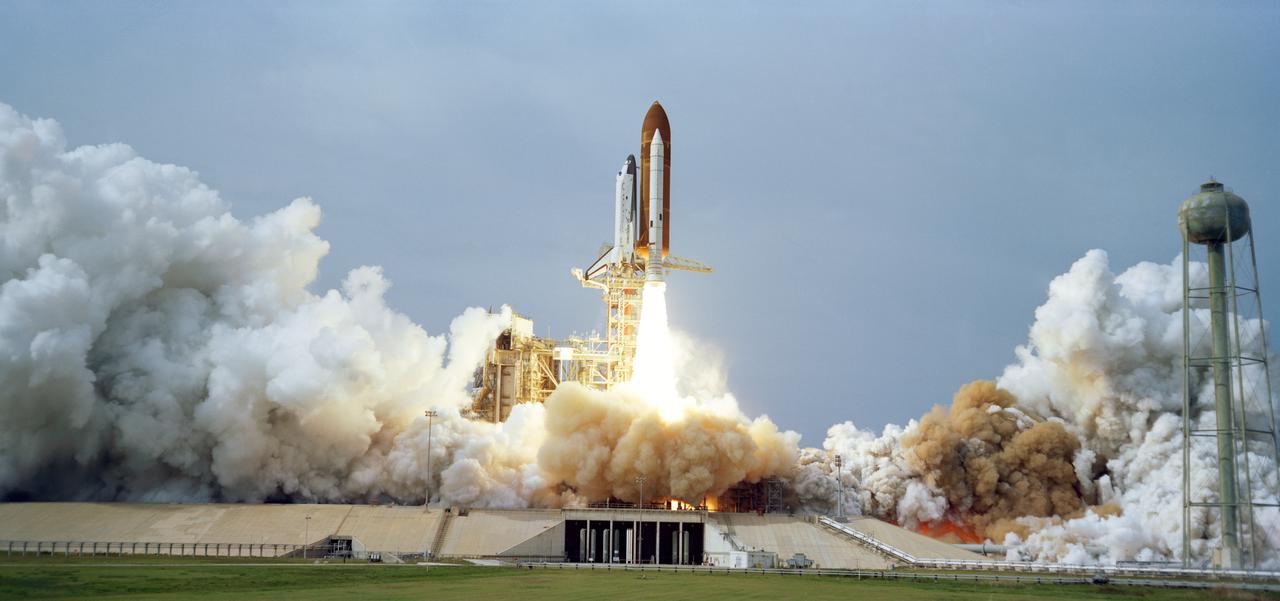
S83-44997 (28 Nov 1983) --- The Columbia lifts off once again from launch pad 39A at the Kennedy Space Center to begin a busy nine days in space for six crewmembers. Official launch time was 11:00:00:84 a.m. (EST). Onboard the spacecraft are Astronauts John W. Young, Brewster Shaw, Jr., Dr. Owen K. Garriott, Dr. Robert A. R. Parker; the European Space Agency?s Dr. Ulf Merbold; and Dr. Byron K. Lichtenberg, biomedical engineer with Massachusetts Institute of Technology.
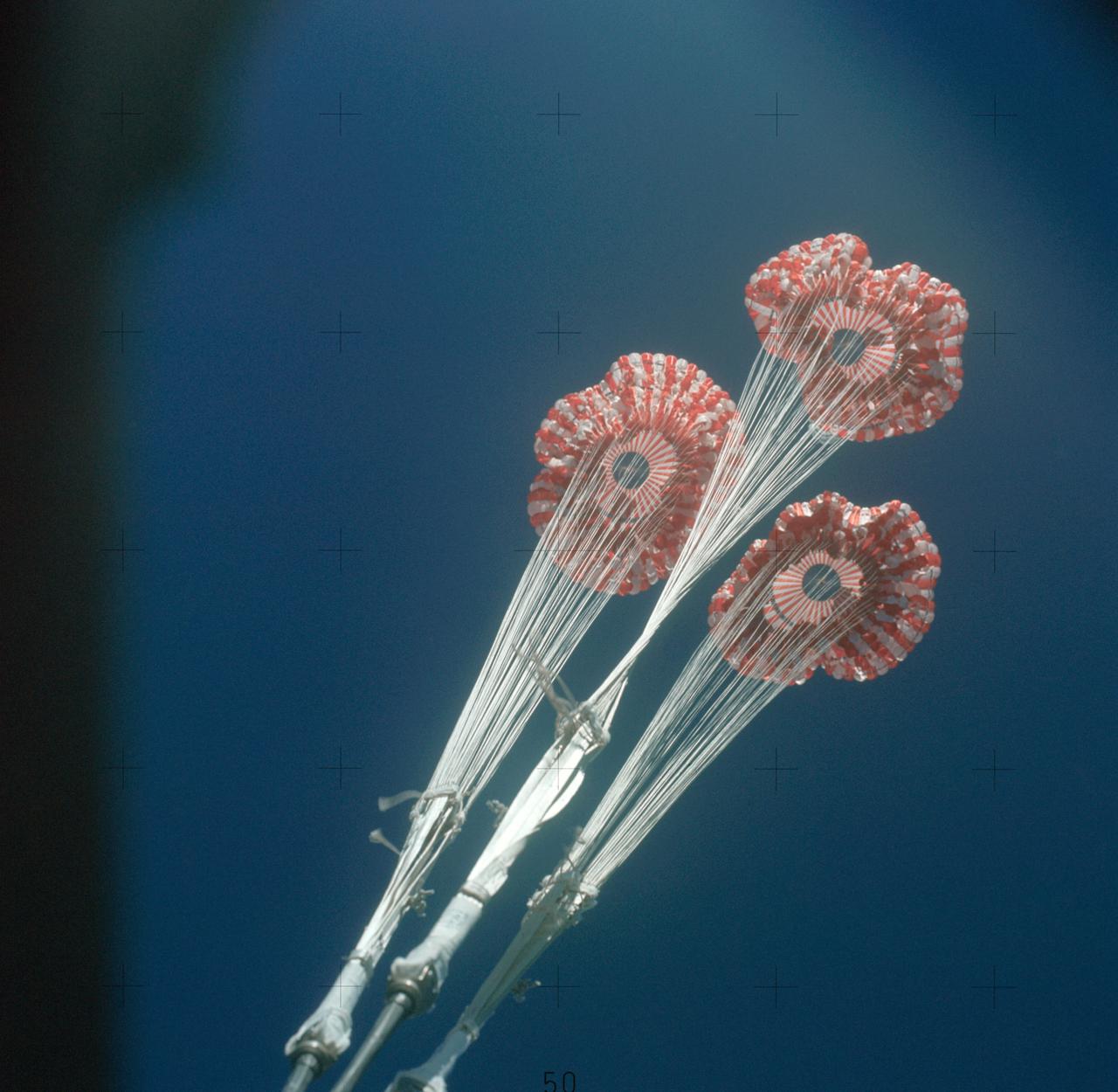
SL3-114-1760 (25 Sept. 1973) --? An excellent view of the three main ring sail parachutes of the Skylab 3 command module as they unfurl during descent to a successful splashdown in the Pacific Ocean. This picture was taken by a hand-held 70mm Hasselblad camera, looking up through a window of the command module. These parachutes open at approximately 10,000 feet altitude. Aboard the CM were astronauts Alan L. Bean, Owen K. Garriott and Jack R. Lousma, who had just completed a 59-day visit to the Skylab space station in Earth orbit. Photo credit: NASA
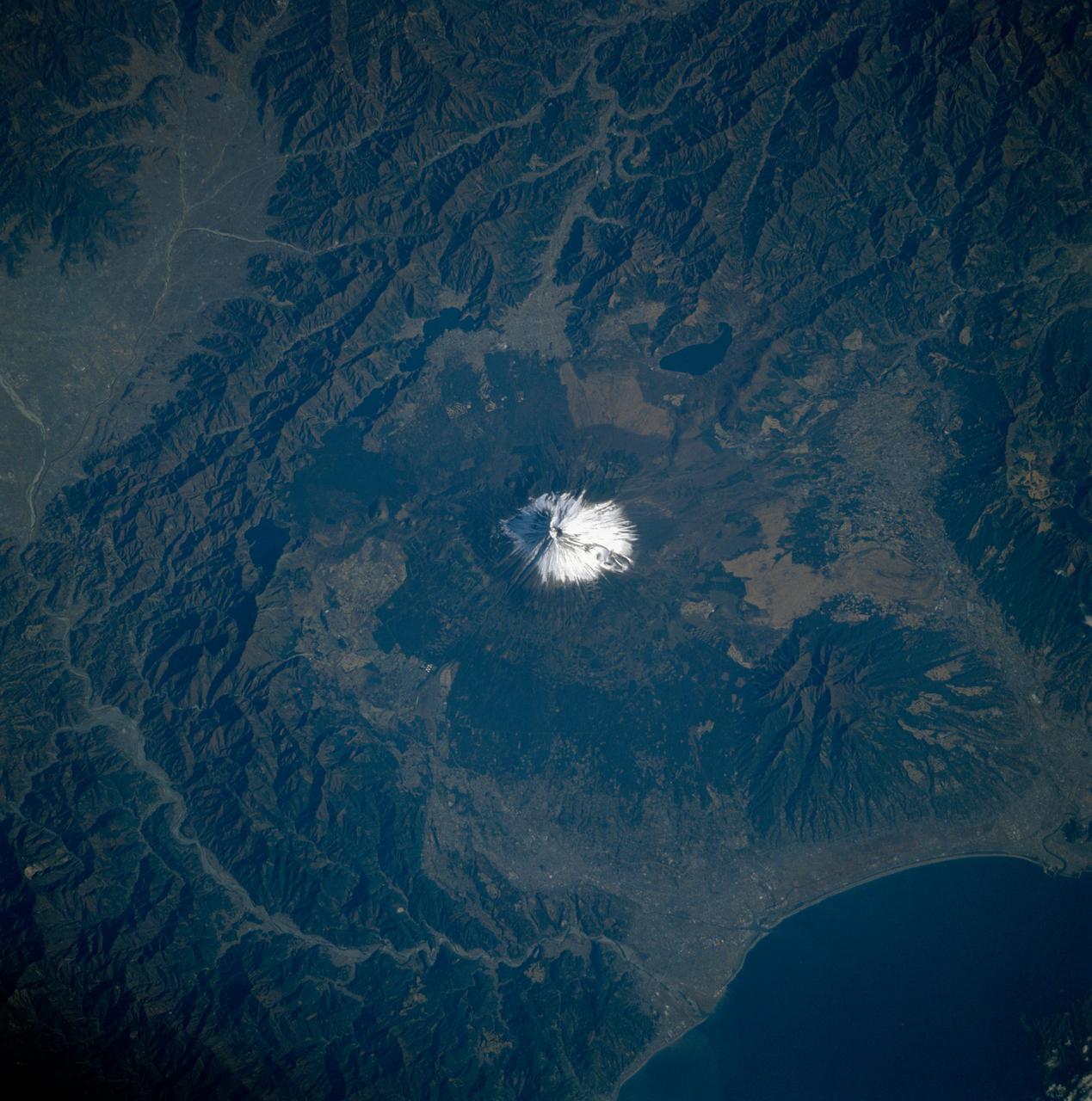
STS009-40-2575 (28 Nov-8 Dec 1983) --- This view of the Fuji volcano, Japan was taken on the 54th orbit of the Space Shuttle Columbia. The center coordinates are 35.5 degrees north latitude and 139.0 degrees east longitude. This was the first time a non-United States crew member was flown aboard the United States Space Shuttle, European Space Agency (ESA) payload specialist Ulf Merbold, Germany. The crew included NASA astronauts John W. Young, commander; Brewster H. Shaw Jr., pilot; Owen K. Garriott, mission specialist, Robert A. Parker, mission specialist; and Byron Lichtenberg, payload specialist.
KENNEDY SPACE CENTER, FLA. - A group of current and former U.S. astronauts are introduced to the audience at a ribbon cutting ceremony officially opening the U.S. Astronaut Hall of Fame as part of the Kennedy Space Center Visitor Complex. In the front row, from left, are Owen K. Garriott, Walter Cunningham, Jack R. Lousma, Alfred M. Worden, and Buzz Aldrin. In the back row, from left, are Edgar D. Mitchell, Edward G. Gibson, Fred W. Haise, Frederick H. (Rick) Hauck, and John W. Young. The ceremony was held in conjunction with the induction of four Space Shuttle astronauts into the Hall of Fame including Daniel Brandenstein, Robert "Hoot" Gibson, Story Musgrave, and Sally Ride. Conceived by six of the Mercury Program astronauts, the U.S. Astronaut Hall of Fame opened in 1990 to provide a place where space travelers could be remembered for their participation and accomplishments in the U.S. space program. The four new inductees join 48 previously honored astronauts from the ranks of the Gemini, Apollo, Skylab, Apollo-Soyuz, and Space Shuttle programs.
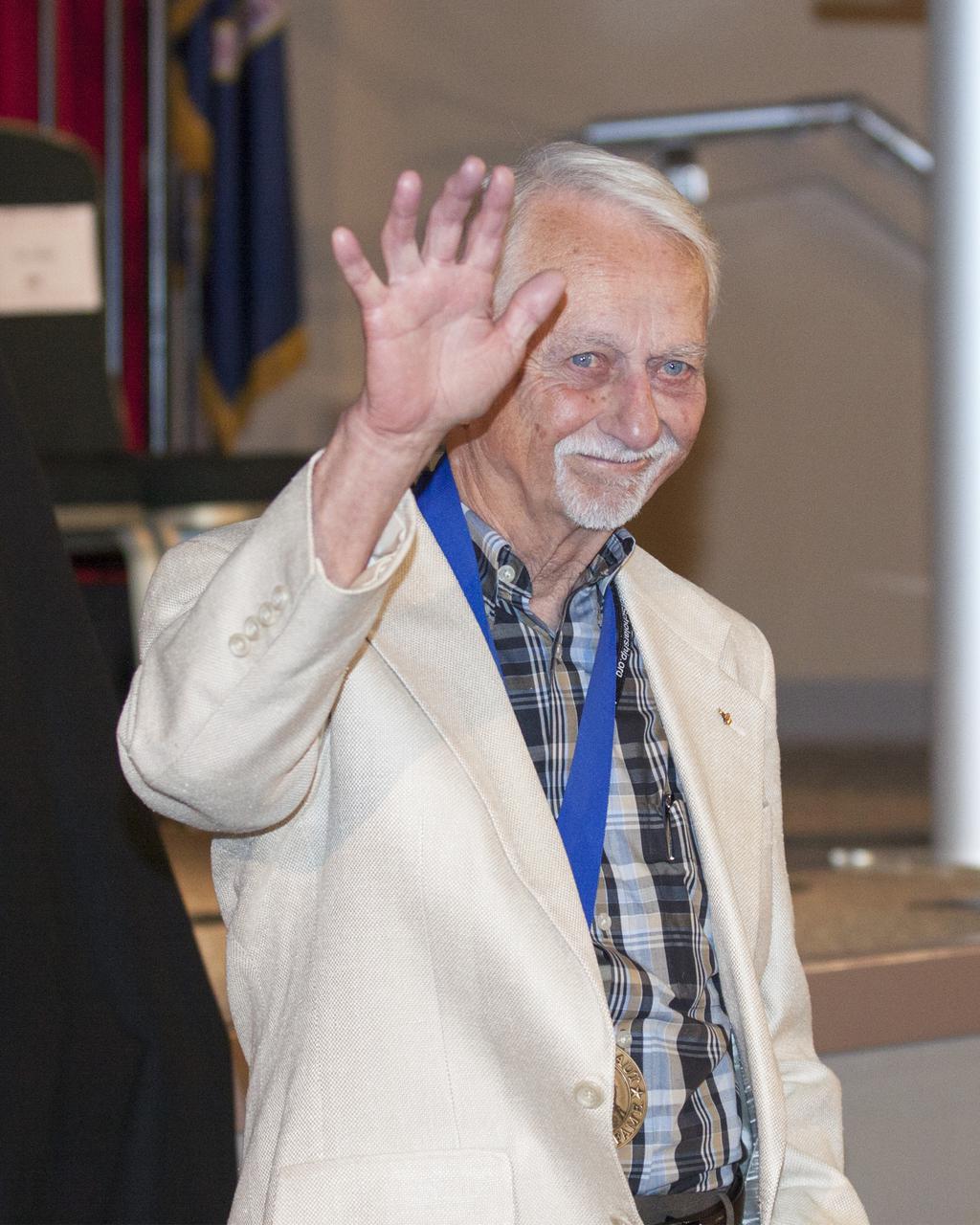
CAPE CANAVERAL, Fla. -- Inside the Space Shuttle Atlantis attraction at NASA’s Kennedy Space Center Visitor Complex in Florida, former NASA astronaut and Hall of Famer Owen Garriott walks the red carpet at the 2014 U.S. Astronaut Hall of Fame Induction ceremony. Space shuttle astronauts and space explorers Shannon Lucid and Jerry Ross were inducted into the Hall of Fame Class of 2014. The 2014 inductees are selected by a committee of Hall of Fame astronauts, former NASA officials, flight directors, historians and journalists. The process is administered by the Astronaut Scholarship Foundation. To be eligible, an astronaut must have made his or her first flight at least 17 years before the induction. Candidates must be a U.S. citizen and a NASA-trained commander, pilot or mission specialist who has orbited the earth at least once. Including Lucid and Ross, 87 astronauts have been inducted into the AHOF. Photo credit: NASA/Kim Shiflett
CAPE CANAVERAL, Fla. – U.S. Astronaut Hall of Fame member Owen Garriott is introduced at NASA’s Kennedy Space Center Visitor Complex in Florida, prior to the ceremony in which Bonnie Dunbar, Curt Brown and Eileen Collins will be inducted into the group of space pioneers. This induction is the twelfth group of space shuttle astronauts named to the AHOF, and the first time two women are inducted at the same time. The year’s inductees were selected by a committee of current Hall of Fame astronauts, former NASA officials, historians and journalists. The selection process is administered by the Astronaut Scholarship Foundation. For more on the U.S. Astronaut Hall of Fame, go to http:__www.kennedyspacecenter.com_astronaut-hall-of-fame.aspx For more on the Astronaut Scholarship Foundation, go to http:__astronautscholarship.org_ Photo credit: NASA_ Kim Shiflett
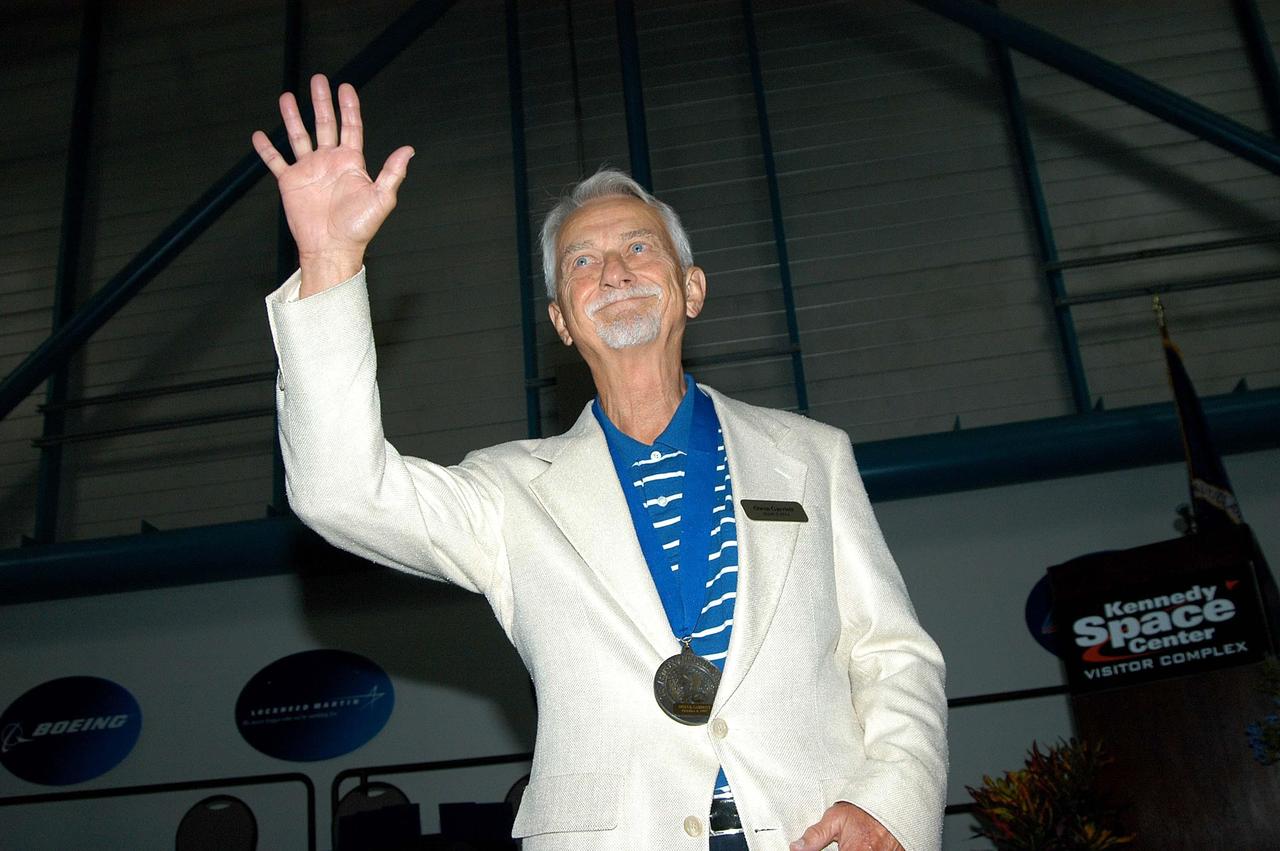
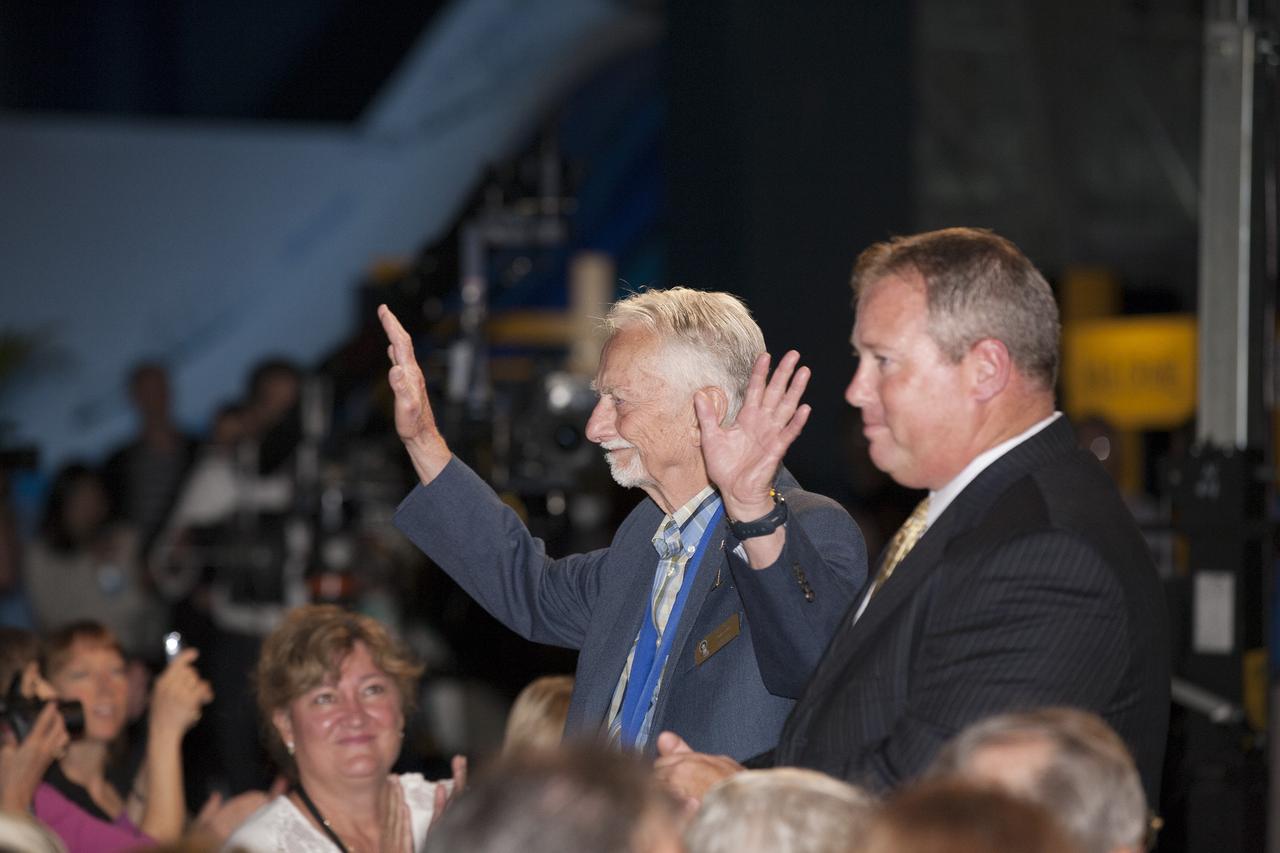
KENNEDY SPACE CENTER, FLA. -- Former astronaut Owen Garriott acknowledges the applause as he is introduced as a previous inductee into the U.S. Astronaut Hall of Fame. He and other Hall of Fame members were present for the induction of five new space program heroes into the U.S. Astronaut Hall of Fame: Richard O. Covey, commander of the Hubble Space Telescope repair mission; Norman E. Thagard, the first American to occupy Russia’s Mir space station; the late Francis R. "Dick" Scobee, commander of the ill-fated 1986 Challenger mission; Kathryn D. Sullivan, the first American woman to walk in space; and Frederick D. Gregory, the first African-American to command a space mission and the current NASA deputy administrator. Garriott exercised his expertise as a solar physicist on two space missions, the 59-day Skylab 3 flight in 1973, and an 11-day trip aboard the Space Shuttle Columbia a decade later. The induction ceremony was held at the Apollo/Saturn V Center at KSC. The U.S. Astronaut Hall of Fame opened in 1990 to provide a place where space travelers could be remembered for their participation and accomplishments in the U.S. space program. The five inductees join 52 previously honored astronauts from the ranks of the Gemini, Apollo, Skylab, Apollo-Soyuz, and Space Shuttle programs.
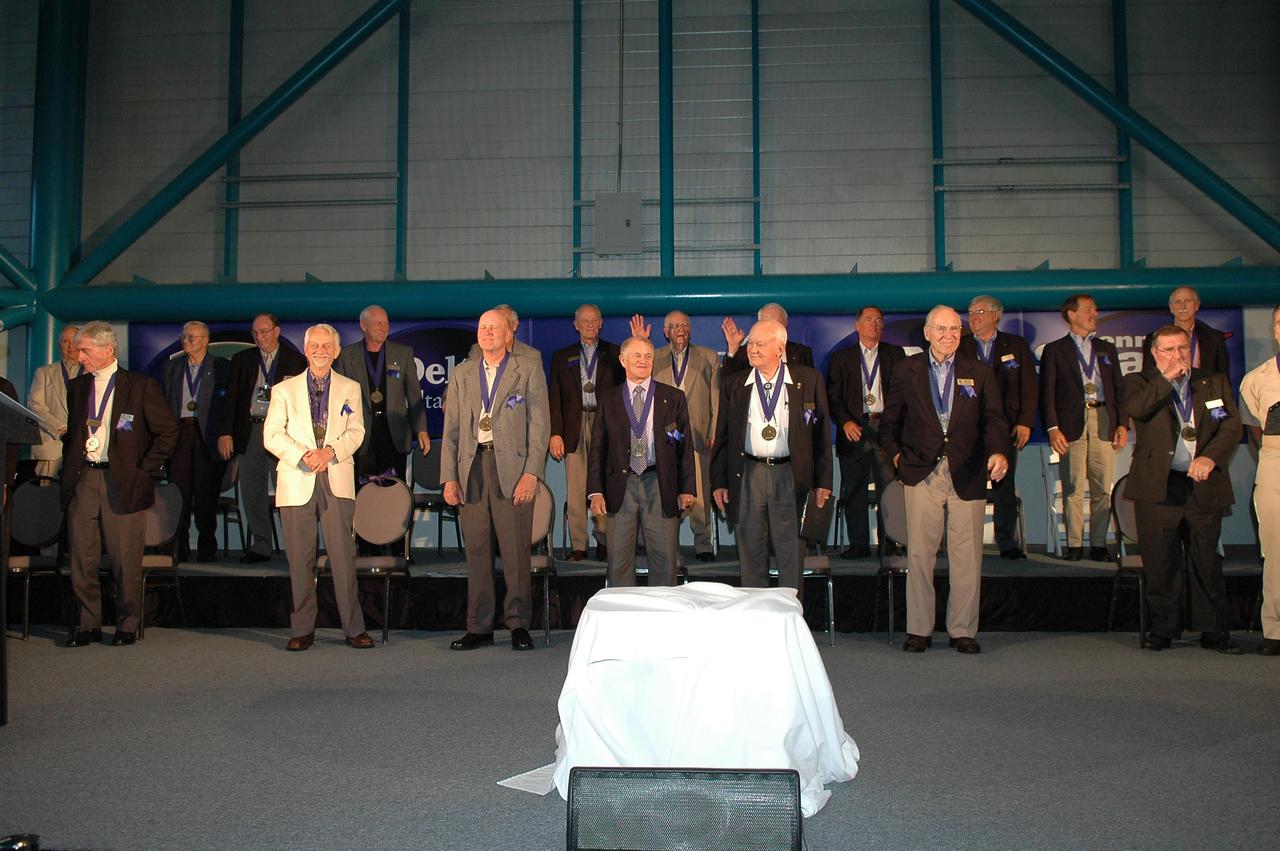
KENNEDY SPACE CENTER, FLA. - Members of the Astronaut Hall of Fame are applauded by the guests at the Astronaut Hall of Fame Induction Ceremony held at the Kennedy Space Center Visitor Complex’s Apollo_Saturn V Center. From left are Al Gordon, John Young, Walt Cunningham, Bill Anders, Owen Garriott, Ed Mitchell, Gordon Fullerton, Al Worden, Charlie Duke, Joe Allen, Jack Lousma, Bruce McCandless, Bill Pogue, Robert Crippen, Jim Lovell, Dan Brandenstein, Robert “Hoot” Gibson, Fred Haise, and Stephen Covey. Not pictured are Scott Carpenter and Vance Brand. McCandless, Allen and Fullerton are the 2005 inductees. Recognized for their individual flight accomplishments and contributions to the success and future success of the U.S. space program, this elite group of inductees is among only 60 astronauts to be honored in the Hall of Fame and the fourth group of Space Shuttle astronauts named.
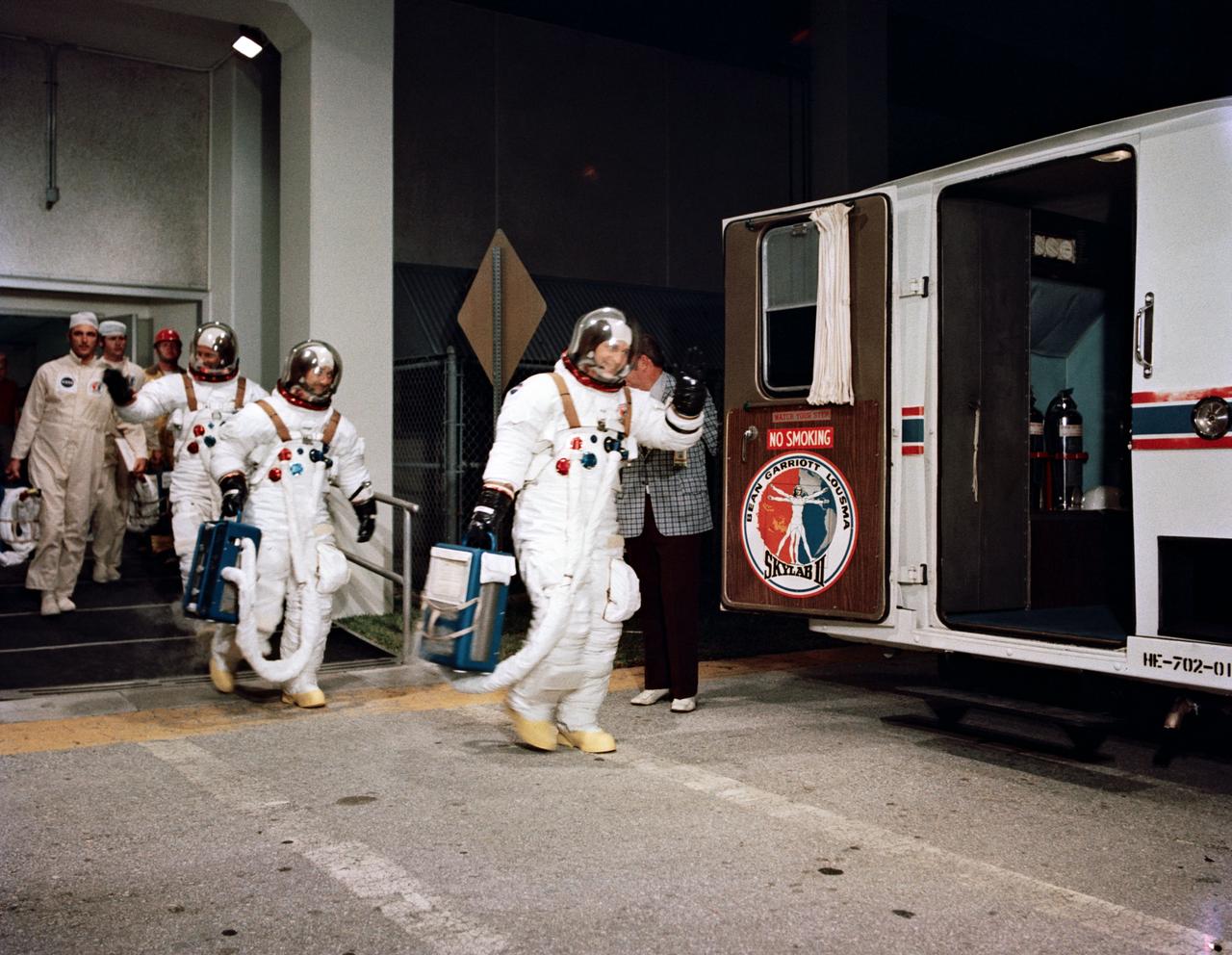
S73-31801 (28 July 1973) --- The three crewmen of the second manned Skylab mission (Skylab 3) leave the Manned Spacecraft Operations Building at the Kennedy Space Center on the morning of the Skylab 3 launch. Leading is astronaut Alan L. Bean, commander; followed by scientist-astronaut Owen K. Garriott, science pilot; and astronaut Jack R. Lousma, pilot. They entered the special van which carried them to Pad B at KSC?s Launch Complex 39 where the Skylab 3/Saturn 1B space vehicle awaited them. The Skylab 3 liftoff was at 7:11 a.m. (EDT), Saturday, July 28, 1973. The three astronauts were scheduled to spend 59 days at the Skylab space station in Earth orbit. Photo credit: NASA
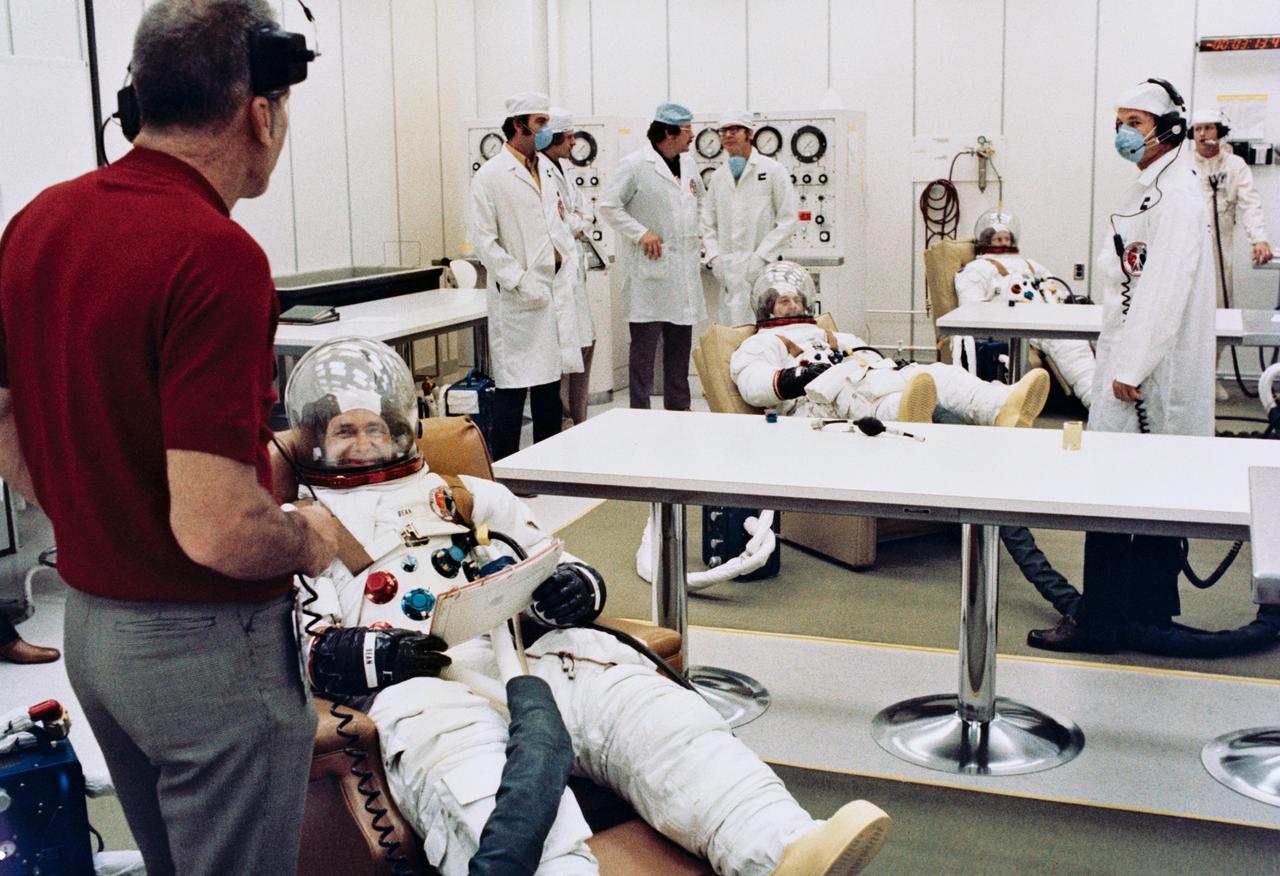
S73-31800 (28 July 1973) --- The three crewmen of the second manned Skylab mission (Skylab 3) participate in prelaunch suiting up activities in the Manned Spacecraft Operations Building at the Kennedy Space Center on the morning of the Skylab 3 launch. They are (from foreground) astronaut Alan L. Bean, commander; scientist-astronaut Owen K. Garriott, science pilot; and astronaut Jack R. Lousma, pilot. Dr. Donald K. Slayton (left foreground), Director of Flight Crew Operations, Johnson Space Center, monitors the prelaunch activities. Skylab 3 lifted off at 7:11 a.m. (EDT), Saturday, July 28, 1973. The three astronauts were scheduled to spend 59 days at the Skylab space station in Earth orbit. Photo credit: NASA
KENNEDY SPACE CENTER, FLA. - At the Astronaut Hall of Fame Induction Ceremony, Hall of Famer John Young (left) congratulates new inductee Joe Allen. Between them is Owen Garriott, chairman of the Astronaut Hall of Fame. Current Hall of Famers seen behind them are Al Worden (left) and Robert Crippen (right). The other new inductees are Bruce McCandless and Gordon Fullerton. The event is being held in the Kennedy Space Center Visitor Complex’s Apollo_Saturn V Center. Recognized for their individual flight accomplishments and contributions to the success and future success of the U.S. space program, this elite group of inductees is among only 60 astronauts to be honored in the Hall of Fame and the fourth group of Space Shuttle astronauts named.
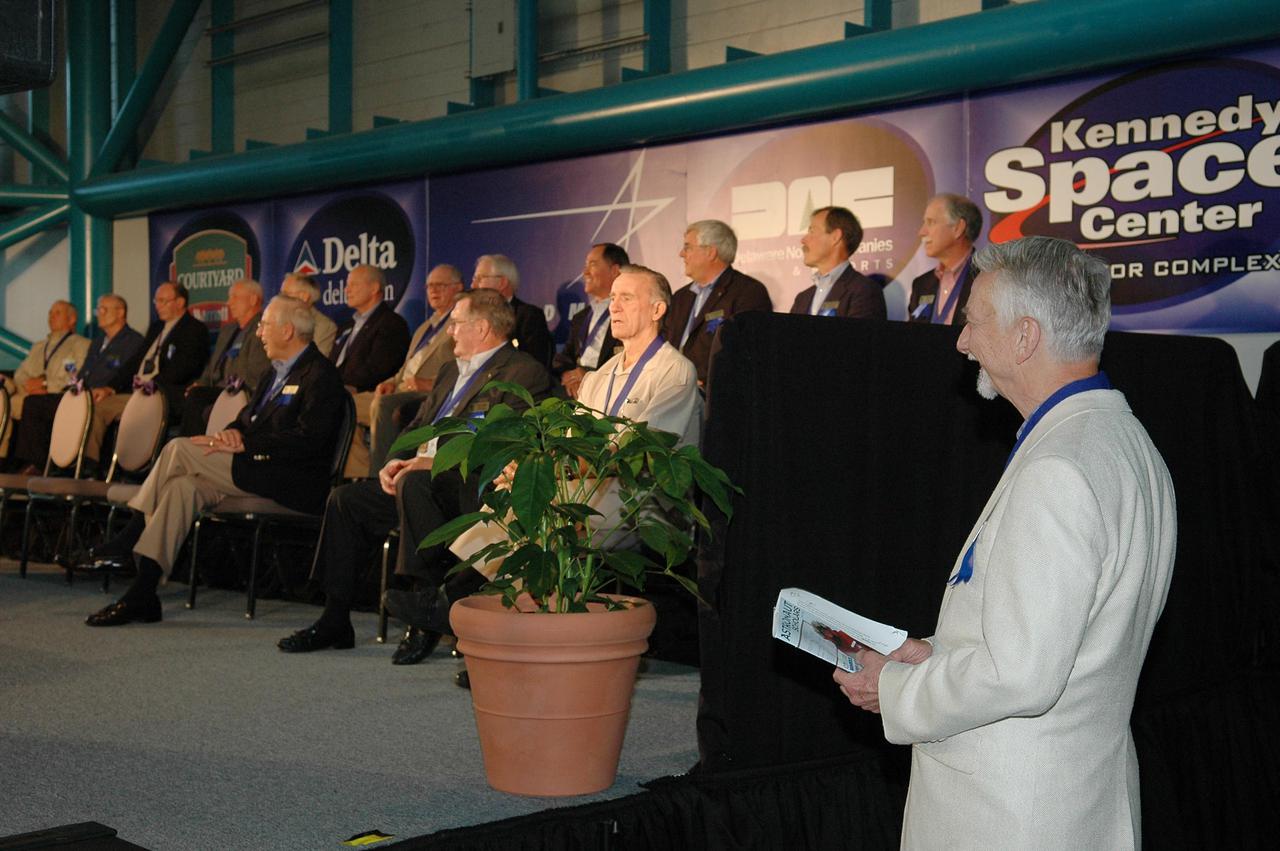
KENNEDY SPACE CENTER, FLA. - Owen Garriott, chairman of the Astronaut Hall of Fame, waits to address guests at the Astronaut Hall of Fame Induction Ceremony held at the Kennedy Space Center Visitor Complex’s Apollo_Saturn V Center. Hall of Famers seated on stage are (from left, back row), Dick Gordon, Walt Cunningham, Bill Anders, Ed Mitchell, Al Worden, Charles Duke, Jack Lousma, Bill Pogue, Robert Crippen, Dan Brandenstein, Robert “Hoot” Gibson and Stephen Covey. In front are (left to right) Jim Lovell, Fred Haise and Vance Brand. The new inductees (not pictured) are Gordon Fullerton, Bruce McCandless and Joe Allen. Recognized for their individual flight accomplishments and contributions to the success and future success of the U.S. space program, this elite group of inductees is among only 60 astronauts to be honored in the Hall of Fame and the fourth group of Space Shuttle astronauts named.
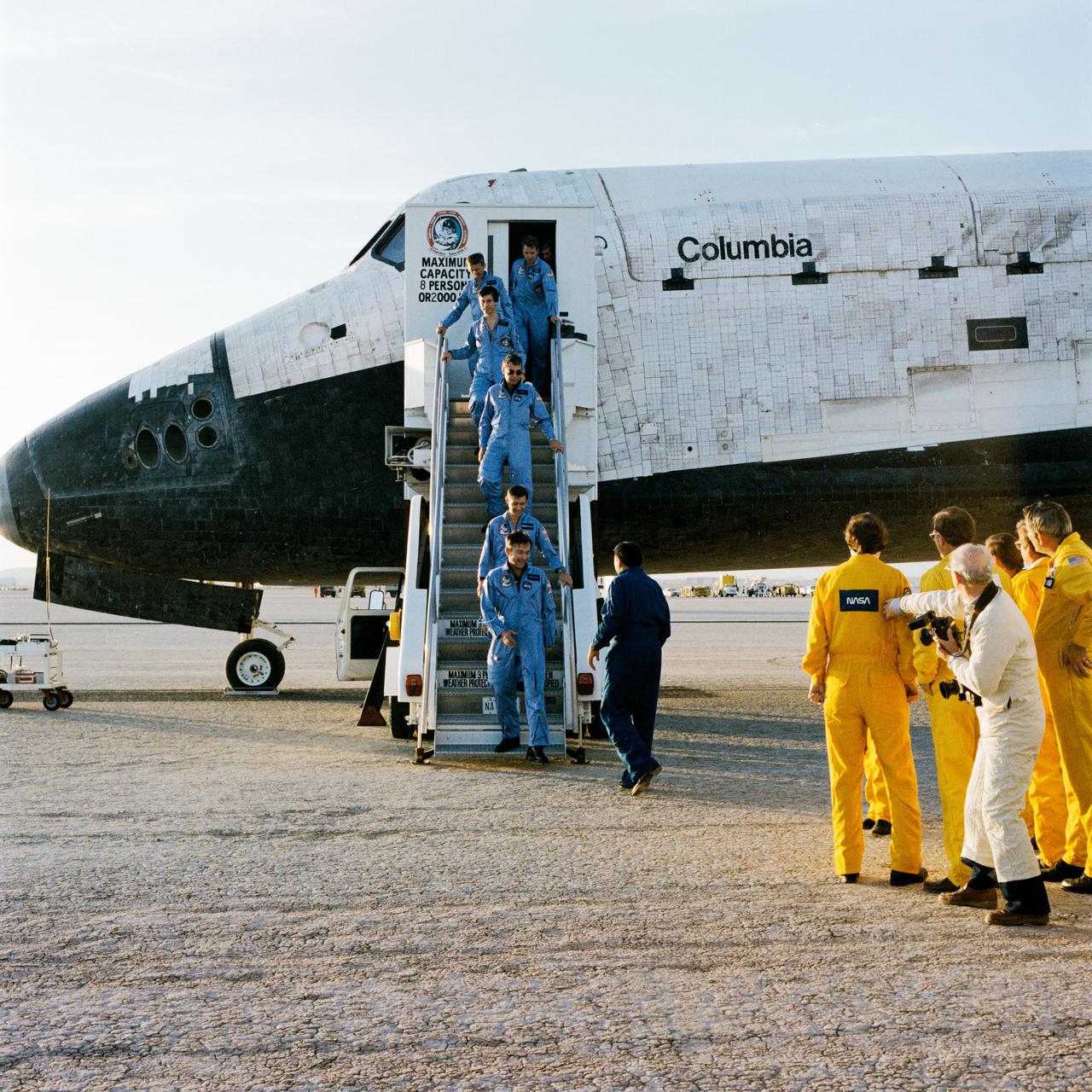
S83-45648 (8 Dec 1983) --- After more than 10 days in Earth orbit, the crewmembers for STS-9 egress the Space Shuttle Columbia following its successful landing at Edwards Air Force Base in southern California. Descending the stairs are (from bottom) Astronaut John W. Young, Brewster H. Shaw Jr. and Robert A. R. Parker; West German physicist Dr. Ulf Merbold; Astronaut Owen K. Garriott, and Dr. Byron K. Lichtenberg, a biomedical engineer from the Massachusetts Institute of Technology. Young was STS-9 crew commander; Shaw, pilot Drs. Parker and Garriott were mission specialists; and Drs. Merbold and Lichtenberg, payload specialists. Dr. Merbold was the European Space Agency?s first scientist to fly aboard a NASA spacecraft and Dr. Lichtenberg was America?s first non-astronaut to join a NASA crew in space. On hand to greet the crewmembers is George W. S. Abbey, director of flight crew operations.
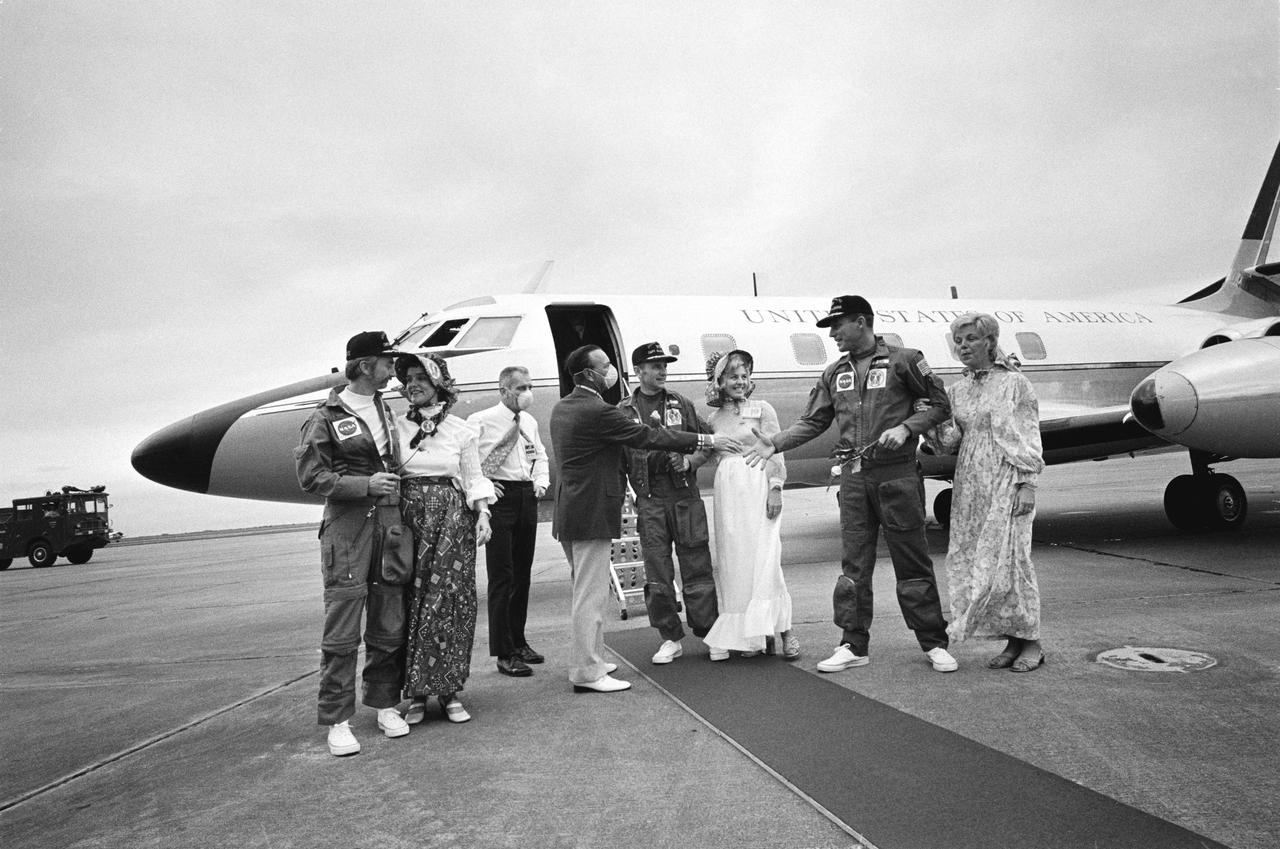
S73-34615 (27 Sept. 1973) --- Dr. Christopher C. Kraft Jr., center, shakes hands with astronaut Jack R. Lousma, Skylab 3 pilot, during welcome ceremonies following crew arrival at Ellington Air Force Base. The crewmen greet their wives after spending 59.5 days in the Skylab space station cluster in Earth orbit. From left to right are scientist-astronaut Owen K. Garriot, science pilot; Mrs. Garriott; Dr. Donald K. Slayton, Director of Flight Crew Operations at JSC; Dr. Kraft; astronaut Alan L. Bean, commander; Mrs. Bean; and the Lousmas. The group stands in front of the VC-140 (Jet Star) which flew the crewmen from San Diego to Ellington Air Force Base. Photo credit: NASA
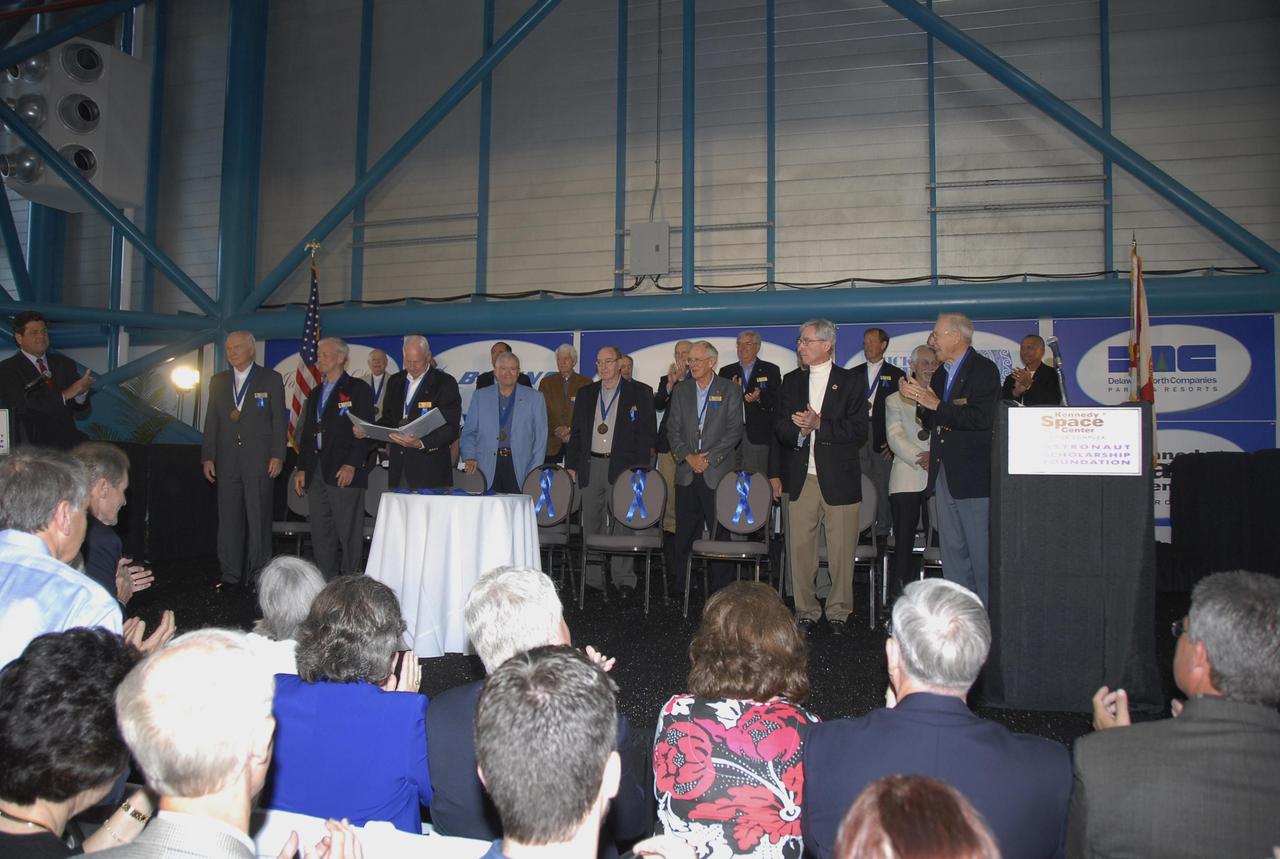
KENNEDY SPACE CENTER, FLA. -- Retired Astronaut Al Worden (third from left in front row) reads a list of the astronauts honored in past ceremonies, some of whom stand on the dais. Standing in the front row, from left, are John Glenn, Scott Carpenter, Worden, Fred Haise, Edgar Mitchell, Charlie Duke, John Young and Jim Lovell. Pictured standing in the back row, from left, are Jerry Carr, Bob Crippen, Hank Hartsfield, Joe Allen, Rick Hauck, Dan Brandenstein, Robert “Hoot” Gibson, Owen Garriott and Charlie Bolden. The May 5 induction added space shuttle commanders Michael L. Coats, Steven A. Hawley and Jeffrey A. Hoffman to the Hall of Fame. They grow the number of space explorers enshrined in the Hall of Fame to 66. The ceremony was held at the Kennedy Space Center's Apollo/Saturn V Center. Photo credit: NASA/Kim Shiflett
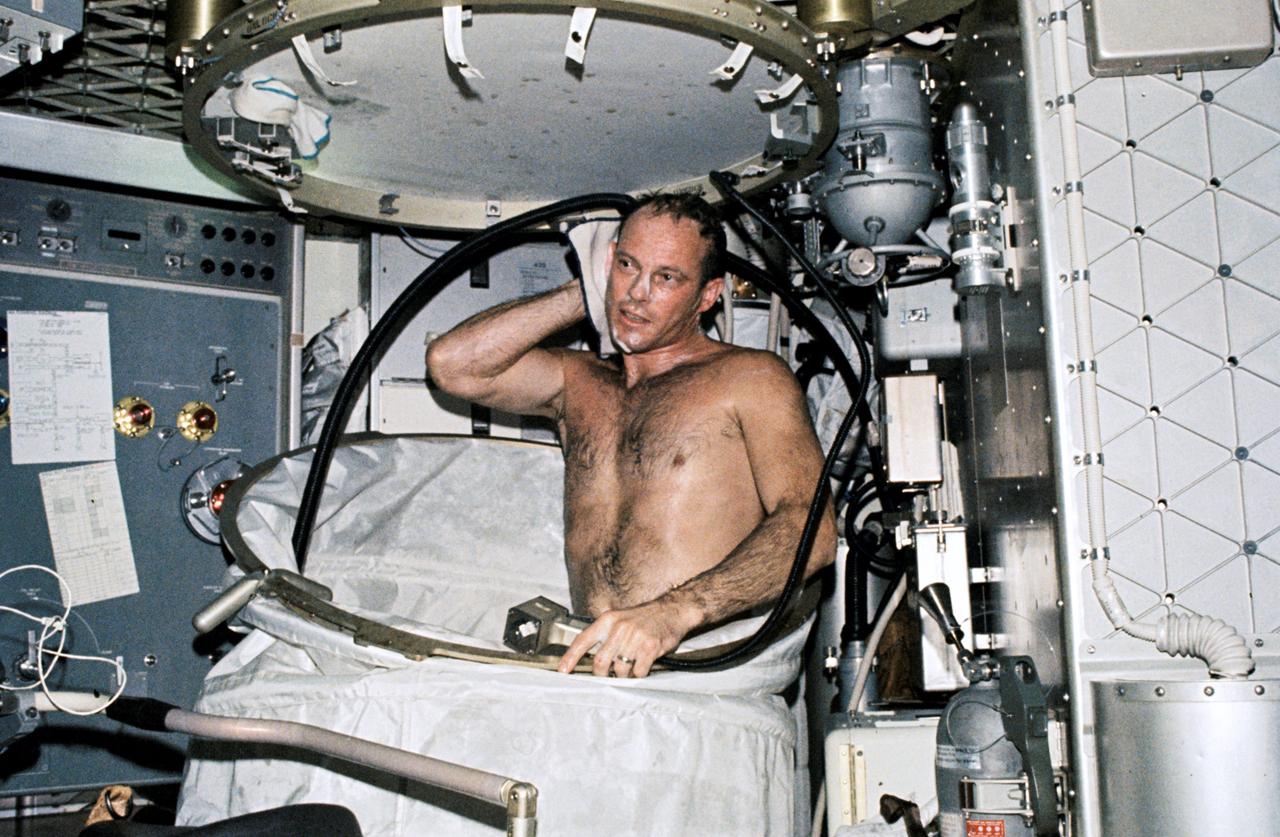
SL3-108-1295 (July-September 1973) --- A close-up view of astronaut Jack R. Lousma, Skylab 3 pilot, taking a hot bath in the crew quarters of the Orbital Workshop (OWS) of the Skylab space station cluster in Earth orbit. This picture was taken with a hand-held 35mm Nikon camera. Astronauts Lousma, Alan L. Bean and Owen K. Garriott remained with the Skylab space station in orbit for 59 days conducting numerous medical, scientific and technological experiments. In deploying the shower facility the shower curtain is pulled up from the floor and attached to the ceiling. The water comes through a push-button shower head attached to a flexible hose. Water is drawn off by a vacuum system. Photo credit: NASA
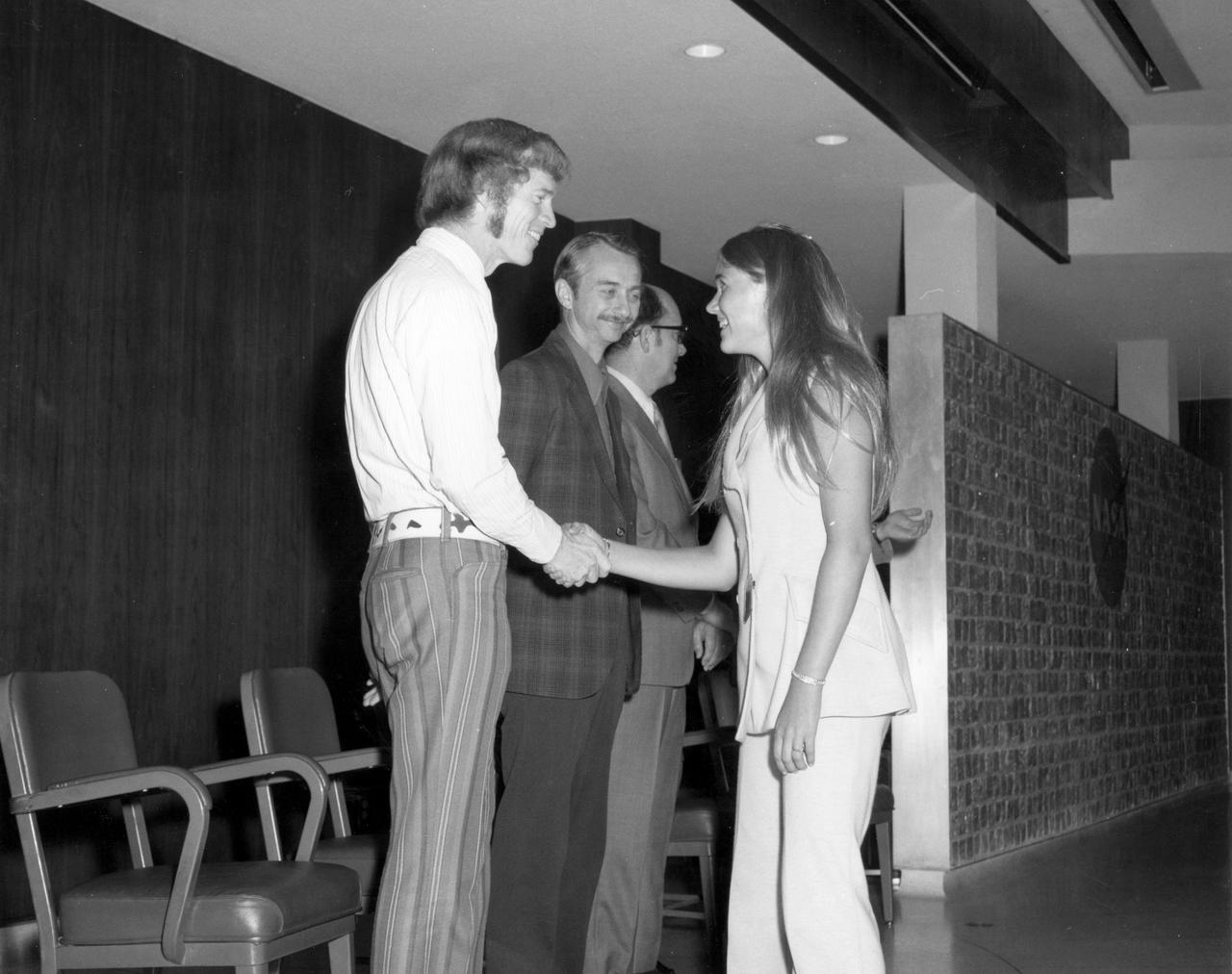
Houston, Texas high school student, Kathy L. Jackson, is greeted by astronauts Russell L. Schweickart (left) and Owen K. Garriott (center), and Marshall Space Flight Center (MSFC) Skylab Program Manager, Leland Belew during a tour of the Marshall Space Flight Center (MSFC). Jackson was among 25 winners of a contest in which some 3,500 high school students proposed experiments for the following year’s Skylab mission. The nationwide scientific competition was sponsored by the National Science Teachers Association and the National Aeronautics and Space Administration (NASA). The winning students, along with their parents and sponsor teachers, visited MSFC where they met with scientists and engineers, participated in design reviews for their experiments, and toured MSFC facilities. Of the 25 students, 6 did not see their experiments conducted on Skylab because the experiments were not compatible with Skylab hardware and timelines. Of the 19 remaining, 11 experiments required the manufacture of additional equipment.
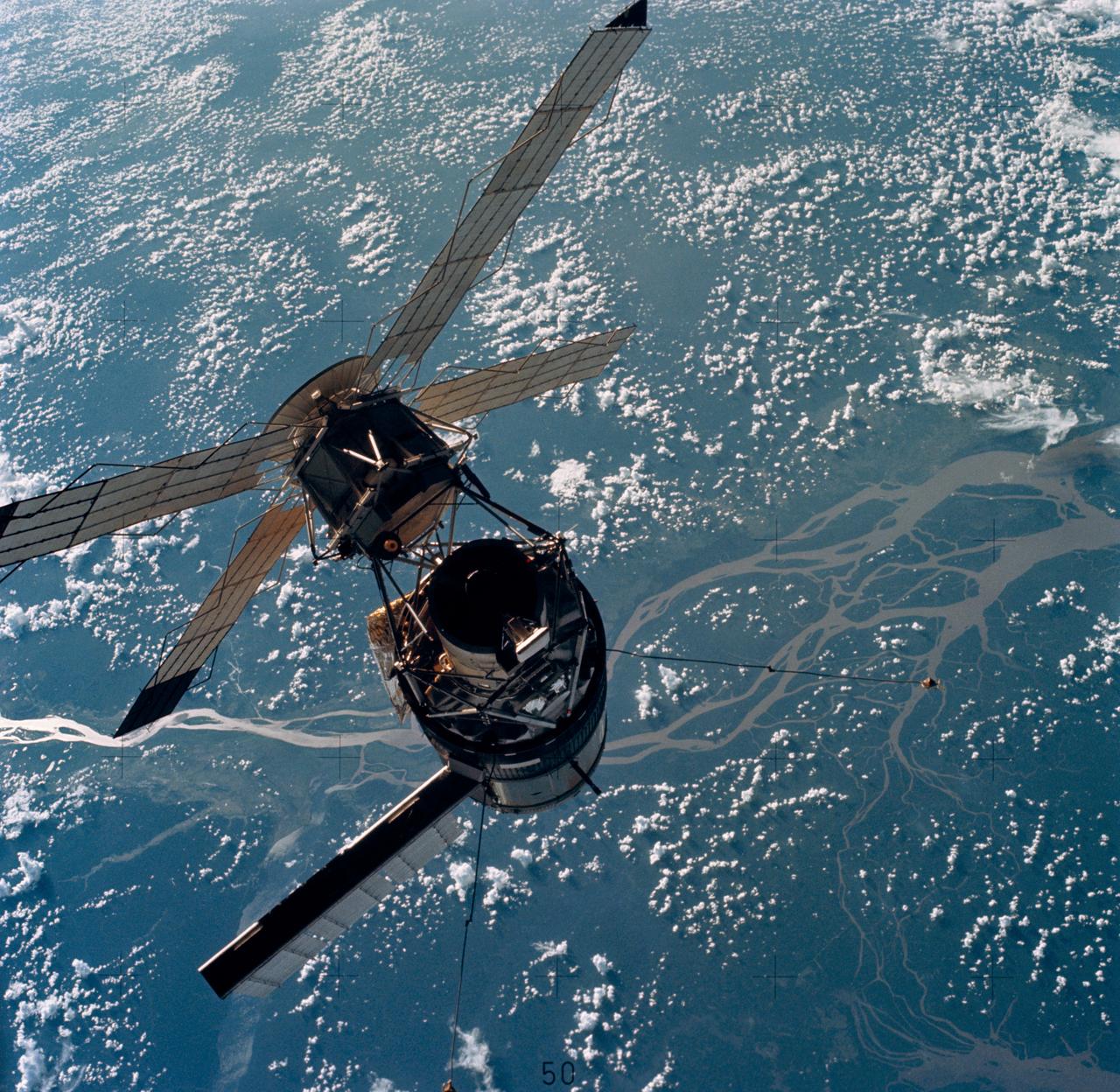
SL3-114-1683 (28 July 1973) --- A close-up view of the Skylab space station photographed against an Earth background from the Skylab 3 Command and Service Modules (CSM) during station-keeping maneuvers prior to docking. Aboard the Command Module (CM) were astronauts Alan L. Bean, Owen K. Garriott and Jack R. Lousma, who remained with the Skylab Space Station in Earth orbit for 59 days. This picture was taken with a hand-held 70mm Hasselblad camera using a 100mm lens and SO-368 medium speed Ektachrome film. Note the one solar array system wing on the Orbital Workshop (OWS) which was successfully deployed during extravehicular activity (EVA) on the first manned Skylab flight. The parasol solar shield which was deployed by the Skylab 2 crew can be seen through the support struts of the Apollo Telescope Mount (ATM). Photo credit: NASA
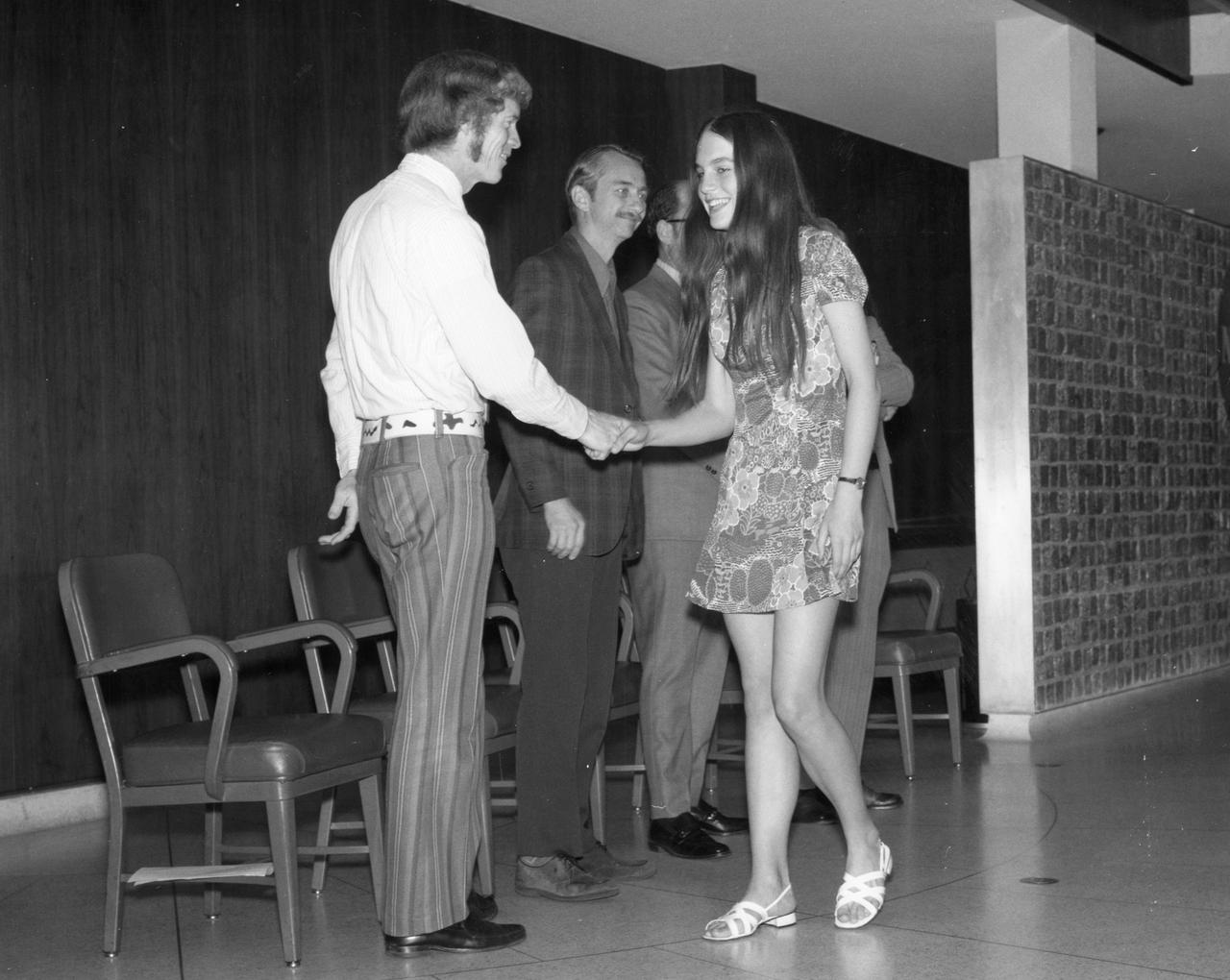
Princeton, New Jersey high school student, Alison Hopfield, is greeted by astronauts Russell L. Schweickart (left) and Owen K. Garriott (center) during a tour of the Marshall Space Flight Center (MSFC). Hopfield was among 25 winners of a contest in which some 3,500 high school students proposed experiments for the following year’s Skylab mission. The nationwide scientific competition was sponsored by the National Science Teachers Association and the National Aeronautics and Space Administration (NASA). The winning students, along with their parents and sponsor teachers, visited MSFC where they met with scientists and engineers, participated in design reviews for their experiments, and toured MSFC facilities. Of the 25 students, 6 did not see their experiments conducted on Skylab because the experiments were not compatible with Skylab hardware and timelines. Of the 19 remaining, 11 experiments required the manufacture of additional equipment.
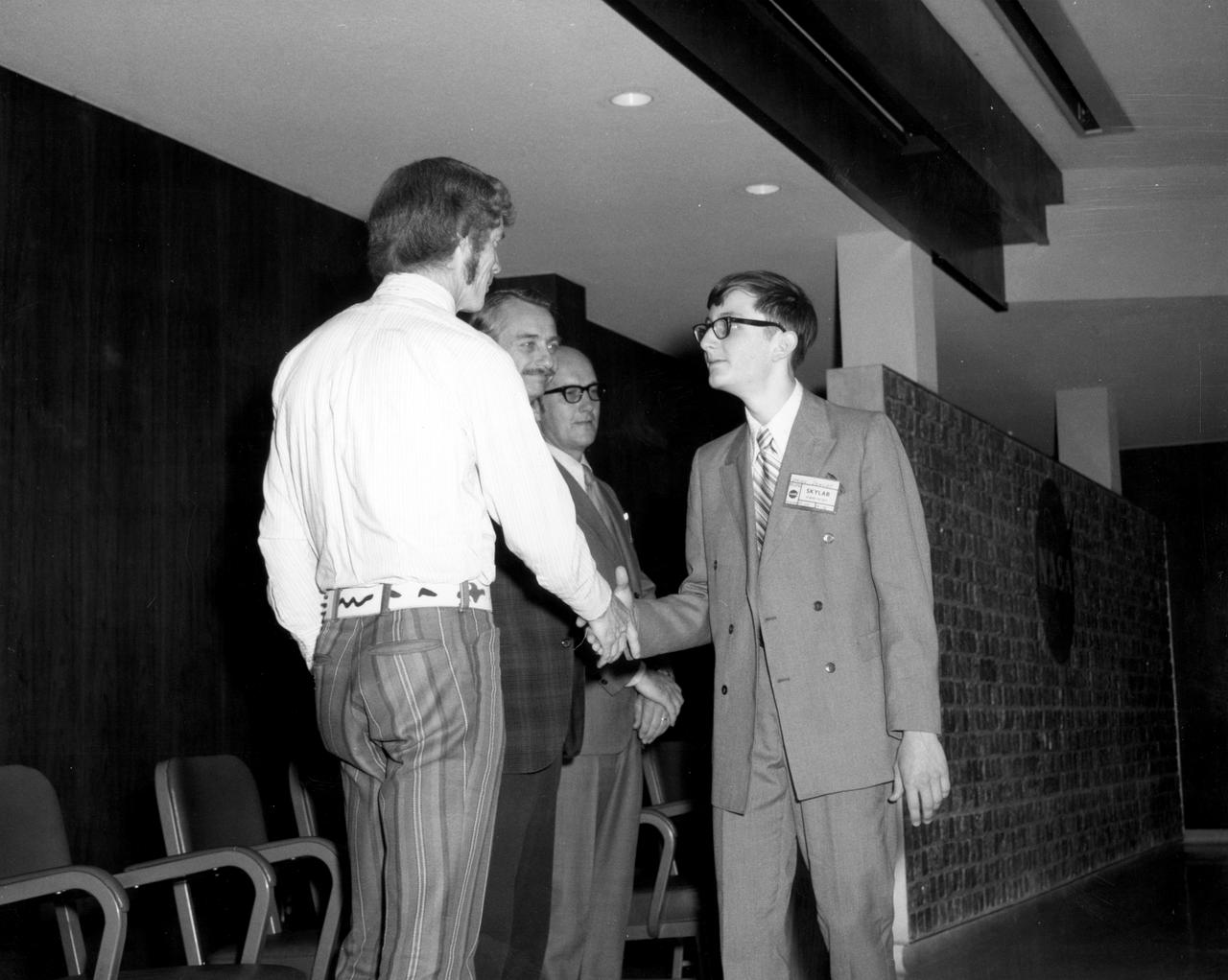
Youngstown, Ohio high school student, W. Brian Dunlap, is greeted by (left to right): Astronauts Russell L. Schweickart, and Owen K. Garriott; Marshall Space Flight Center (MSFC) Skylab Program Manager, Leland Belew; and MSFC Director of Administration and Technical Services, David Newby, during a tour of MSFC. Dunlap was among 25 winners of a contest in which some 3,500 high school students proposed experiments for the following year’s Skylab mission. The nationwide scientific competition was sponsored by the National Science Teachers Association and the National Aeronautics and Space Administration (NASA). The winning students, along with their parents and sponsor teachers, visited MSFC where they met with scientists and engineers, participated in design reviews for their experiments, and toured MSFC facilities. Of the 25 students, 6 did not see their experiments conducted on Skylab because the experiments were not compatible with Skylab hardware and timelines. Of the 19 remaining, 11 experiments required the manufacture of additional equipment.
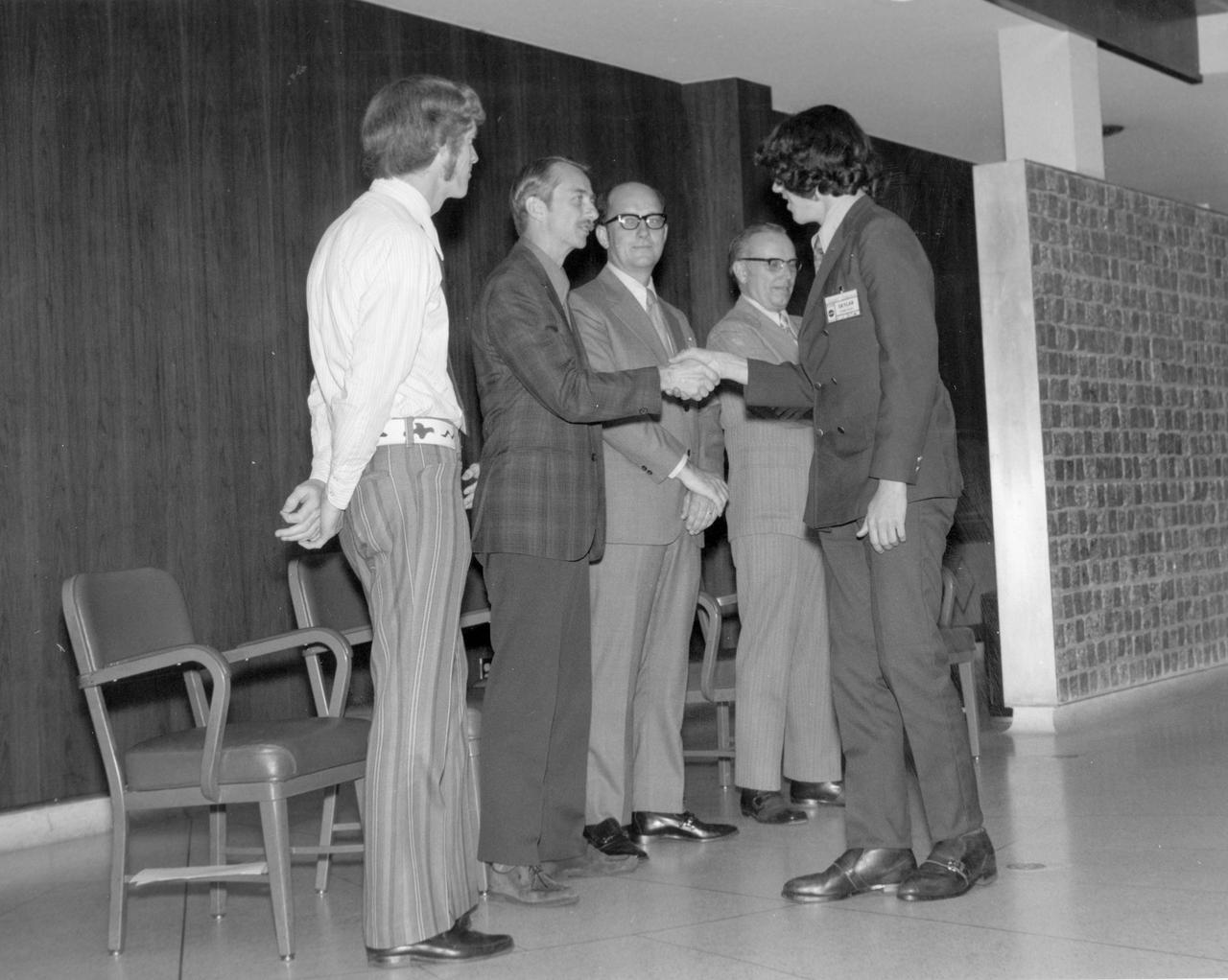
North Rochester, New York high school student, Robert L. Staehle, is greeted by (left to right): Astronauts Russell L. Schweickart, and Owen K. Garriott; Marshall Space Flight Center (MSFC) Skylab Program Manager, Leland Belew; and MSFC Director of Administration and Technical Services, David Newby, during a tour of MSFC. Staehle was among 25 winners of a contest in which some 3,500 high school students proposed experiments for the following year’s Skylab mission. The nationwide scientific competition was sponsored by the National Science Teachers Association and the National Aeronautics and Space Administration (NASA). The winning students, along with their parents and sponsor teachers, visited MSFC where they met with scientists and engineers, participated in design reviews for their experiments, and toured MSFC facilities. Of the 25 students, 6 did not see their experiments conducted on Skylab because the experiments were not compatible with Skylab hardware and timelines. Of the 19 remaining, 11 experiments required the manufacture of additional equipment.
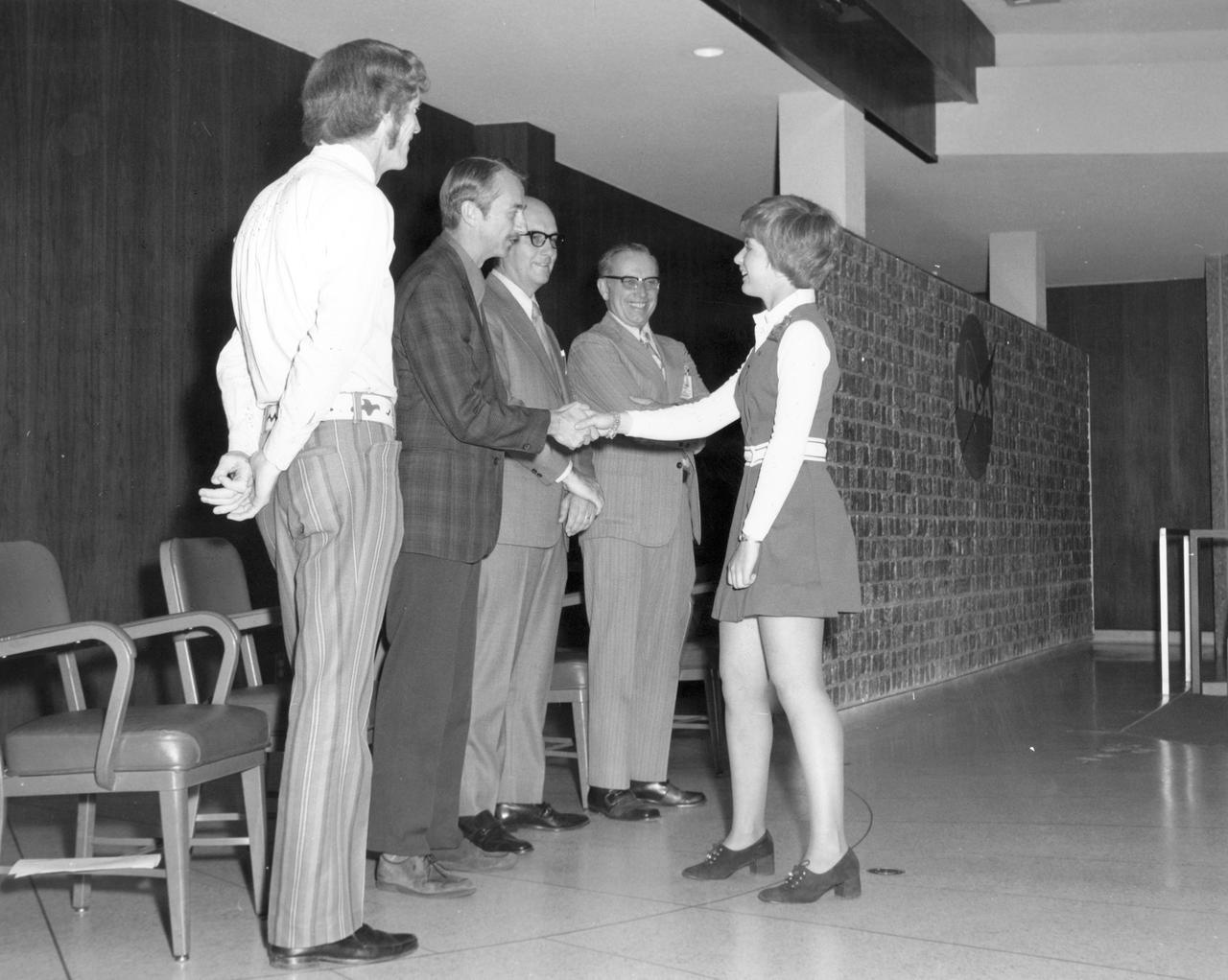
Littleton, Colorado high school student, Cheryl A. Peltz, is greeted by (left to right): Astronauts Russell L. Schweickart, and Owen K. Garriott; Marshall Space Flight Center (MSFC) Skylab Program Manager, Leland Belew; and MSFC Director of Administration and Technical Services, David Newby, during a tour of MSFC. Peltz was among 25 winners of a contest in which some 3,500 high school students proposed experiments for the following year’s Skylab mission. The nationwide scientific competition was sponsored by the National Science Teachers Association and the National Aeronautics and Space Administration (NASA). The winning students, along with their parents and sponsor teachers, visited MSFC where they met with scientists and engineers, participated in design reviews for their experiments, and toured MSFC facilities. Of the 25 students, 6 did not see their experiments conducted on Skylab because the experiments were not compatible with Skylab hardware and timelines. Of the 19 remaining, 11 experiments required the manufacture of additional equipment.
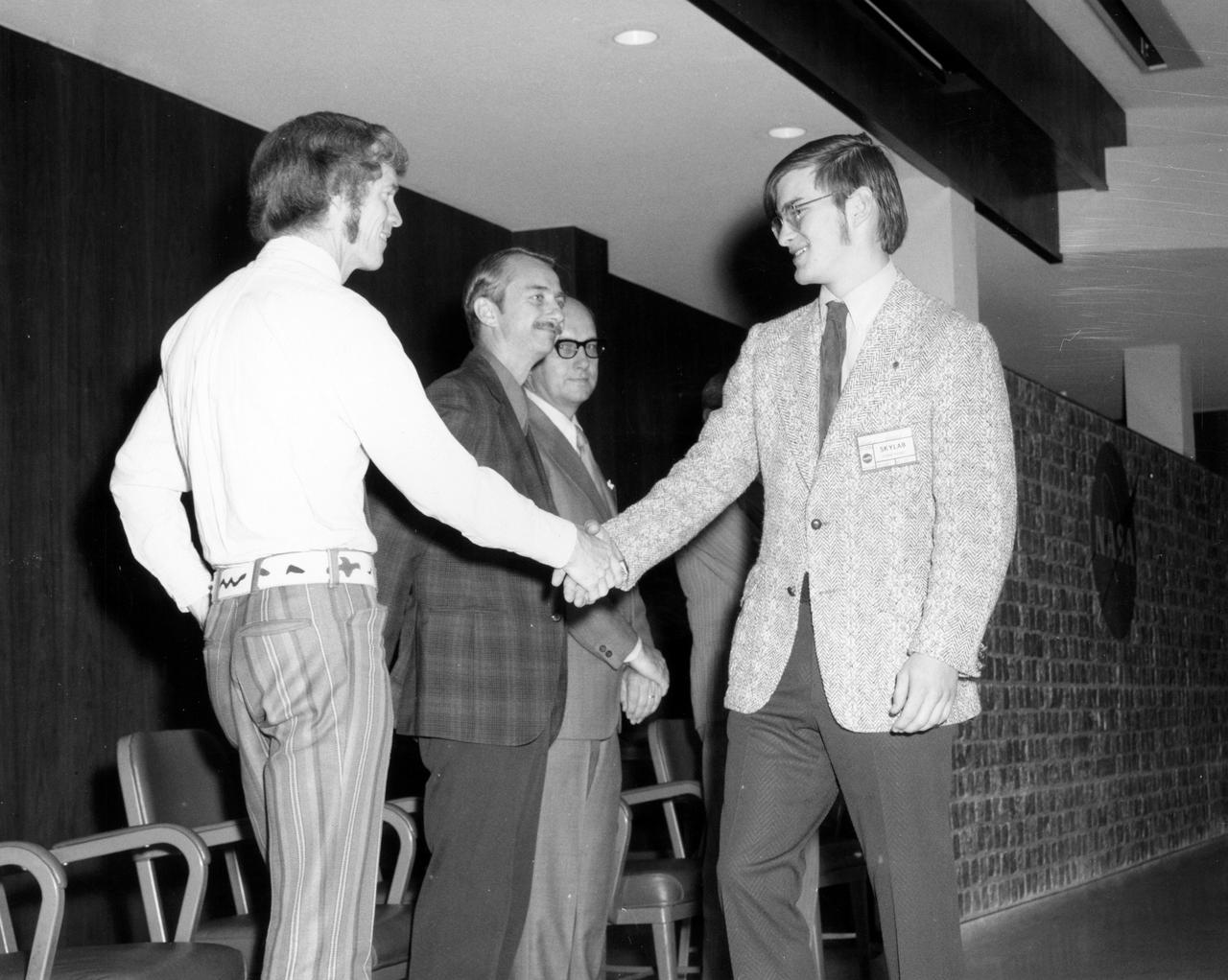
Bayport, New York high school student, James E. Healy, is greeted by (left to right): Astronauts Russell L. Schweickart, and Owen K. Garriott; Marshall Space Flight Center (MSFC) Skylab Program Manager, Leland Belew; and MSFC Director of Administration and Technical Services, David Newby, during a tour of MSFC. Healy was among 25 winners of a contest in which some 3,500 high school students proposed experiments for the following year’s Skylab mission. The nationwide scientific competition was sponsored by the National Science Teachers Association and the National Aeronautics and Space Administration (NASA). The winning students, along with their parents and sponsor teachers, visited MSFC where they met with scientists and engineers, participated in design reviews for their experiments, and toured MSFC facilities. Of the 25 students, 6 did not see their experiments conducted on Skylab because the experiments were not compatible with Skylab hardware and timelines. Of the 19 remaining, 11 experiments required the manufacture of additional equipment.
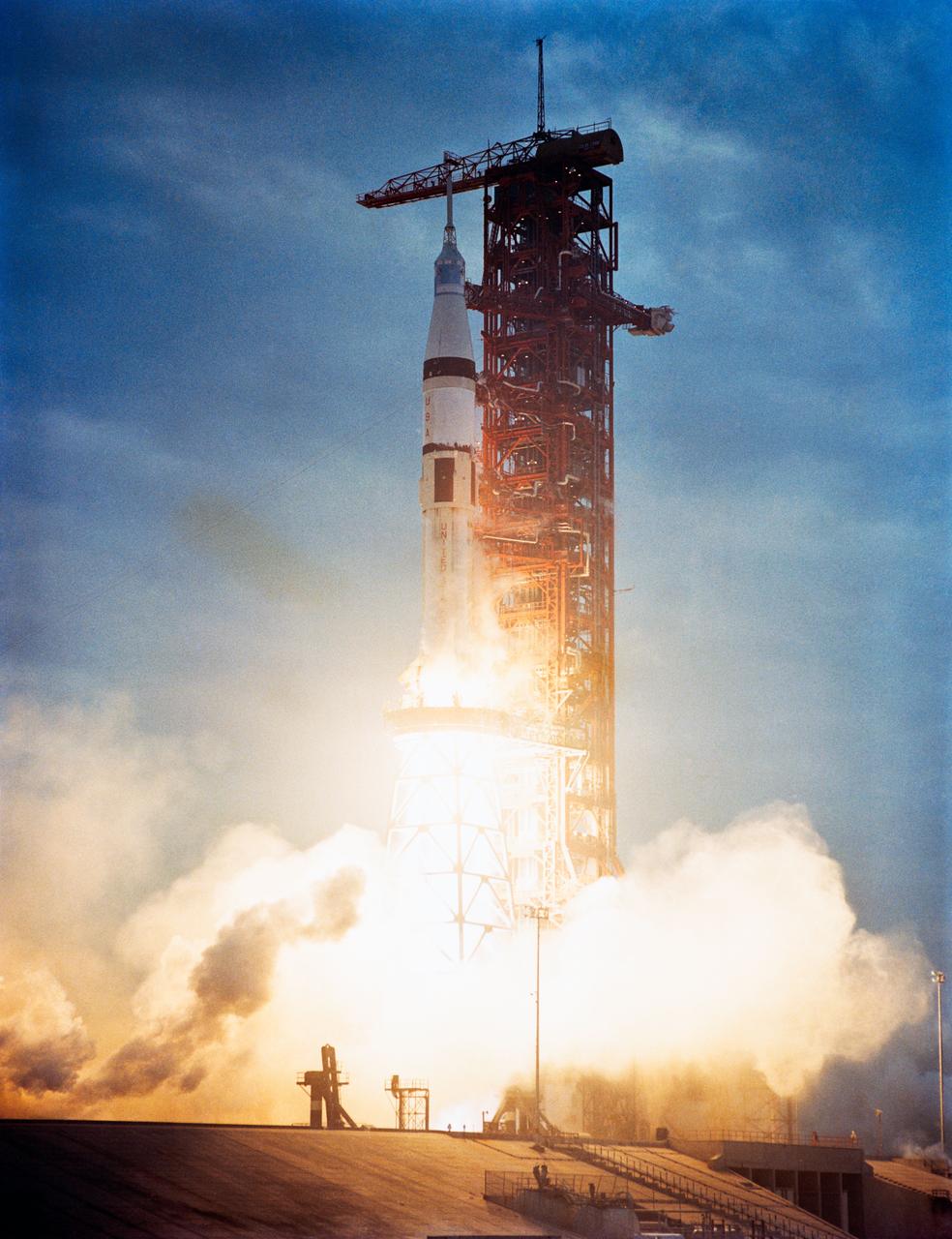
S73-32570 (28 July 1973) --- The Skylab 3/Saturn 1B space vehicle is launched from Pad B, Launch Complex 39, Kennedy Space Center, Florida, at 7:11 a.m. (EDT), Saturday, July 28, 1973. Skylab 3 is the second of three scheduled Skylab manned missions. Aboard the Skylab 3 Command/Service Module were astronauts Alan L. Bean, Owen K. Garriott and Jack R. Lousma. The Skylab 3 CSM later docked with the Skylab space station cluster in Earth orbit. In addition to the CSM and its launch escape system, the Skylab 3 space vehicle consisted of the Saturn 1B first (S-1B) stage and the Saturn 1B second (S-1VB) stage. (The Skylab 1/Saturn V space vehicle with the space station payload was launched from Pad A on May 14, 1973). Photo credit: NASA
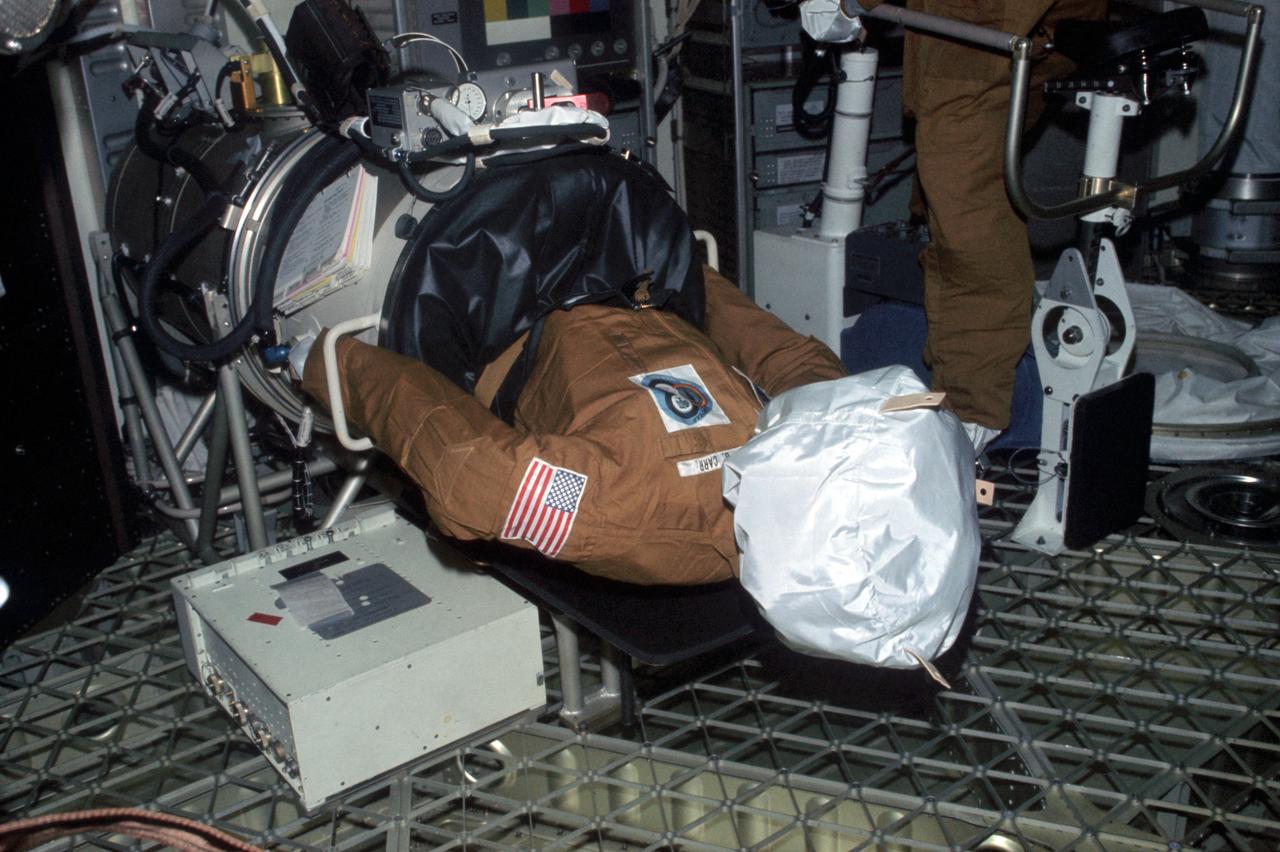
SL3-113-1586 (July-September 1973) --- This photograph is an illustration of the humorous side of the Skylab 3 crew. This dummy was left behind in the Skylab space station by the Skylab 3 crew to be found by the Skylab 4 crew. The dummy is dressed in a flight suit and placed in the Lower Body Negative Pressure Device. The name tag indicates that it represents Gerald P. Carr, Skylab 4 commander, in the background is a partial view of the dummy for William R. Pogue, Skylab 4 pilot, propped upon the bicycle ergometer. The dummy representing Edward G. Gibson, Skylab science pilot, was left in the waste compartment. Astronauts Alan L. Bean, Owen K. Garriott and Jack R. Lousma were the Skylab 3 crewmen. Photo credit: NASA
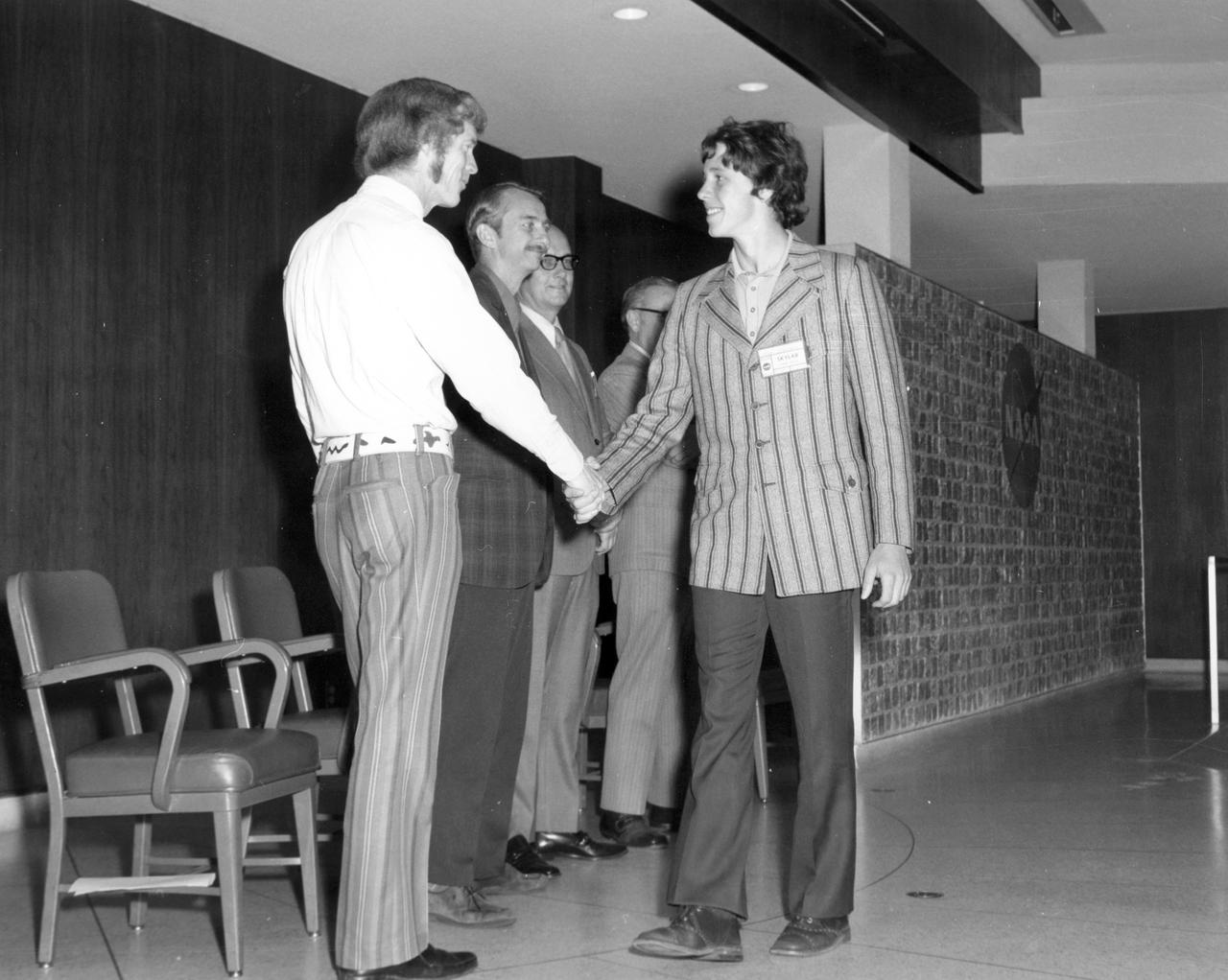
Oshkosh, Wisconsin high school student, Joe B. Zmolek, is greeted by (left to right): Astronauts Russell L. Schweickart, and Owen K. Garriott; Marshall Space Flight Center (MSFC) Skylab Program Manager, Leland Belew; and MSFC Director of Administration and Technical Services, David Newby, during a tour of MSFC. Zmolek was among 25 winners of a contest in which some 3,500 high school students proposed experiments for the following year’s Skylab mission. The nationwide scientific competition was sponsored by the National Science Teachers Association and the National Aeronautics and Space Administration (NASA). The winning students, along with their parents and sponsor teachers, visited MSFC where they met with scientists and engineers, participated in design reviews for their experiments, and toured MSFC facilities. Of the 25 students, 6 did not see their experiments conducted on Skylab because the experiments were not compatible with Skylab hardware and timelines. Of the 19 remaining, 11 experiments required the manufacture of additional equipment.