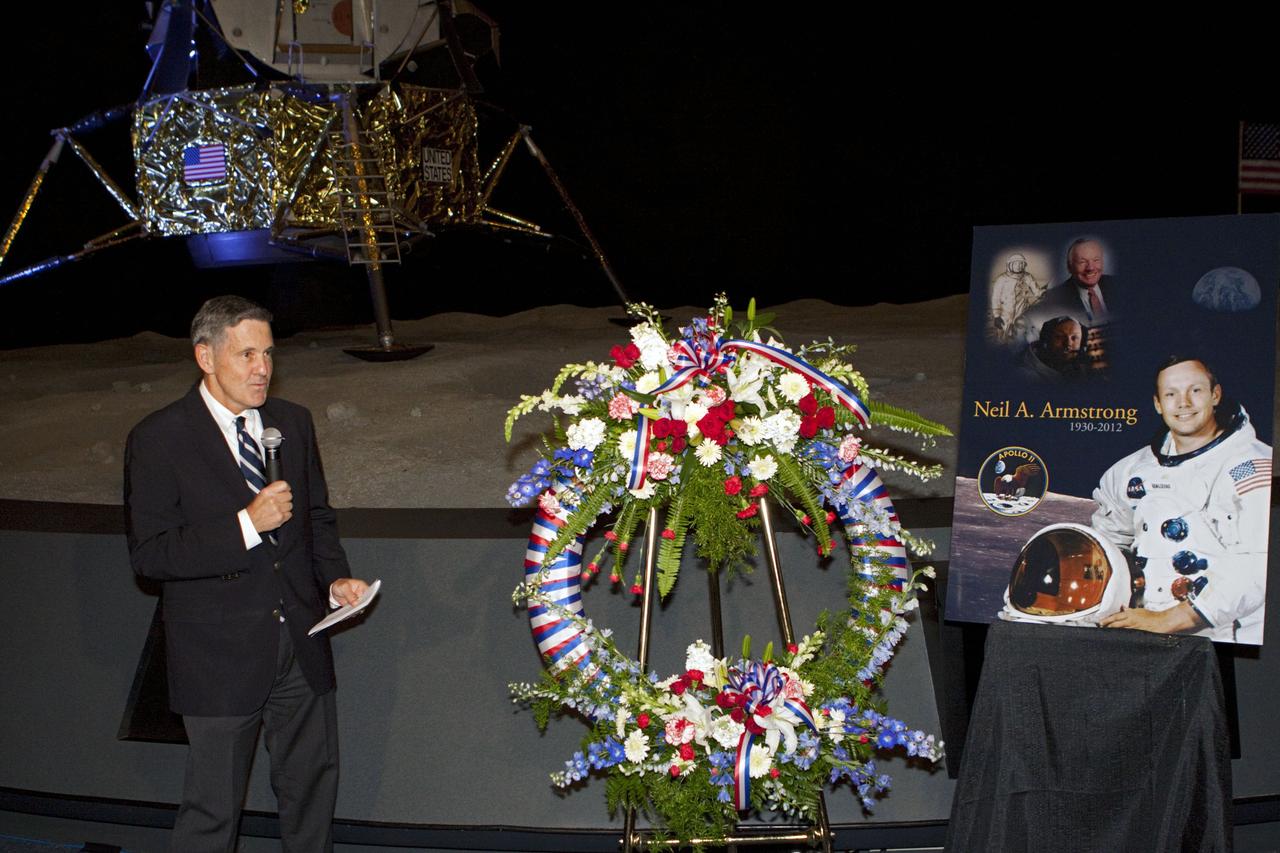
CAPE CANAVERAL, Fla. - Kennedy Space Center Director Bob Cabana spoke to spaceport employees and guests at a brief ceremony on Aug. 31, 2012 honoring Neil Armstrong, who died Aug. 25, 2012 at the age of 82. Armstrong was hailed by Cabana as one of our heroes and a truly a great American. Cabana, also a former astronaut, placed a wreath near a replica lunar module at the spaceport's Apollo-Saturn V Center. Selected as an astronaut in 1962, Neil Armstrong flew on NASA's Gemini 8 with David Scott in March 1966 and the first lunar landing mission, Apollo 11, with Mike Collins and Buzz Aldine in July 1969. On July 20, 1969, he became the first human to walk on the moon. For more information, visit: http://www.nasa.gov/centers/kennedy/news/neil_armstrong.html Photo credit: NASA/Kim Shiflett
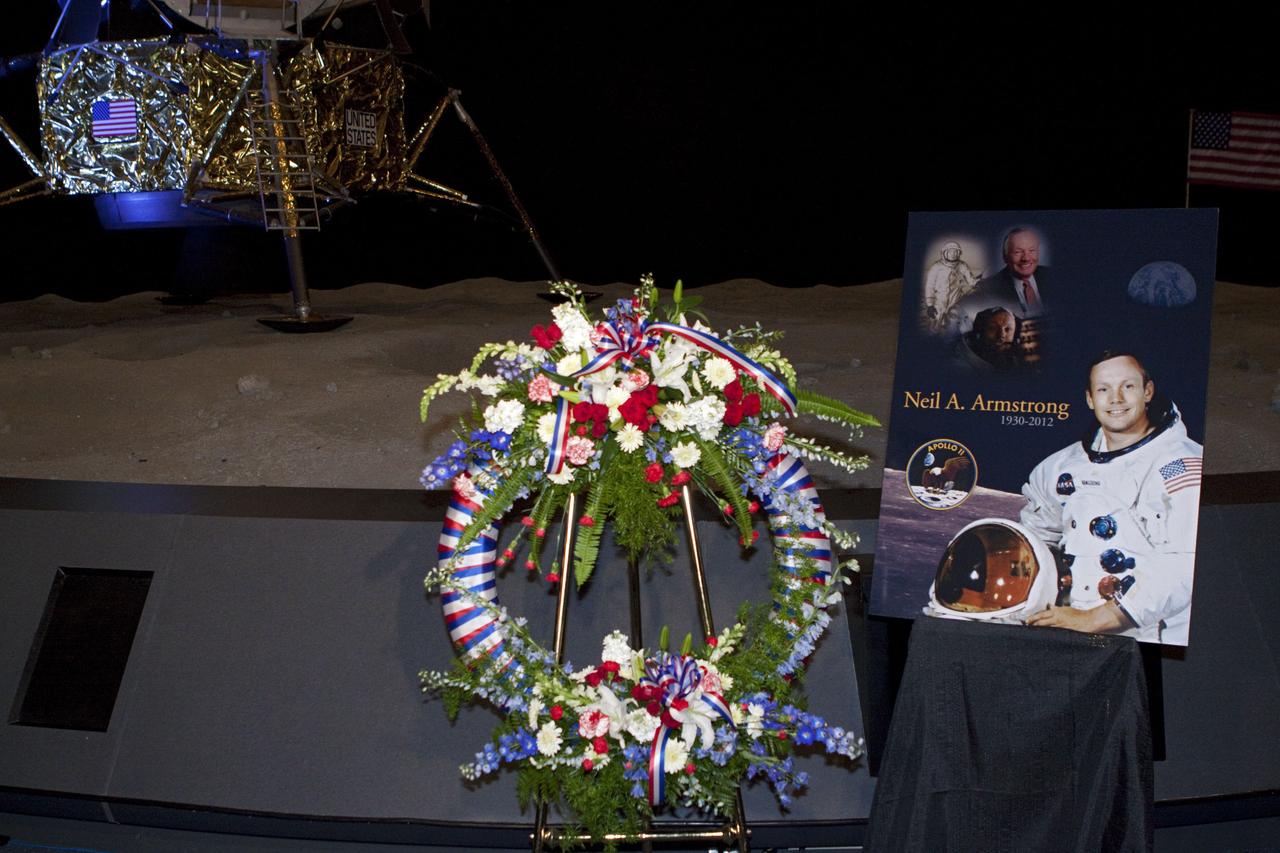
CAPE CANAVERAL, Fla. - Kennedy Space Center employees and guests gathered for a brief ceremony on Aug. 31, 2012 honoring Neil Armstrong, who died Aug. 25, 2012 at the age of 82. Armstrong was hailed by Center Director Bob Cabana as one of our heroes and a truly a great American. Cabana placed a wreath near a replica lunar module at the spaceport's Apollo-Saturn V Center. Selected as an astronaut in 1962, Neil Armstrong flew on NASA's Gemini 8 with David Scott in March 1966 and the first lunar landing mission, Apollo 11, with Mike Collins and Buzz Aldine in July 1969. On July 20, 1969, he became the first human to walk on the moon. For more information, visit: http://www.nasa.gov/centers/kennedy/news/neil_armstrong.html Photo credit: NASA/Kim Shiflett
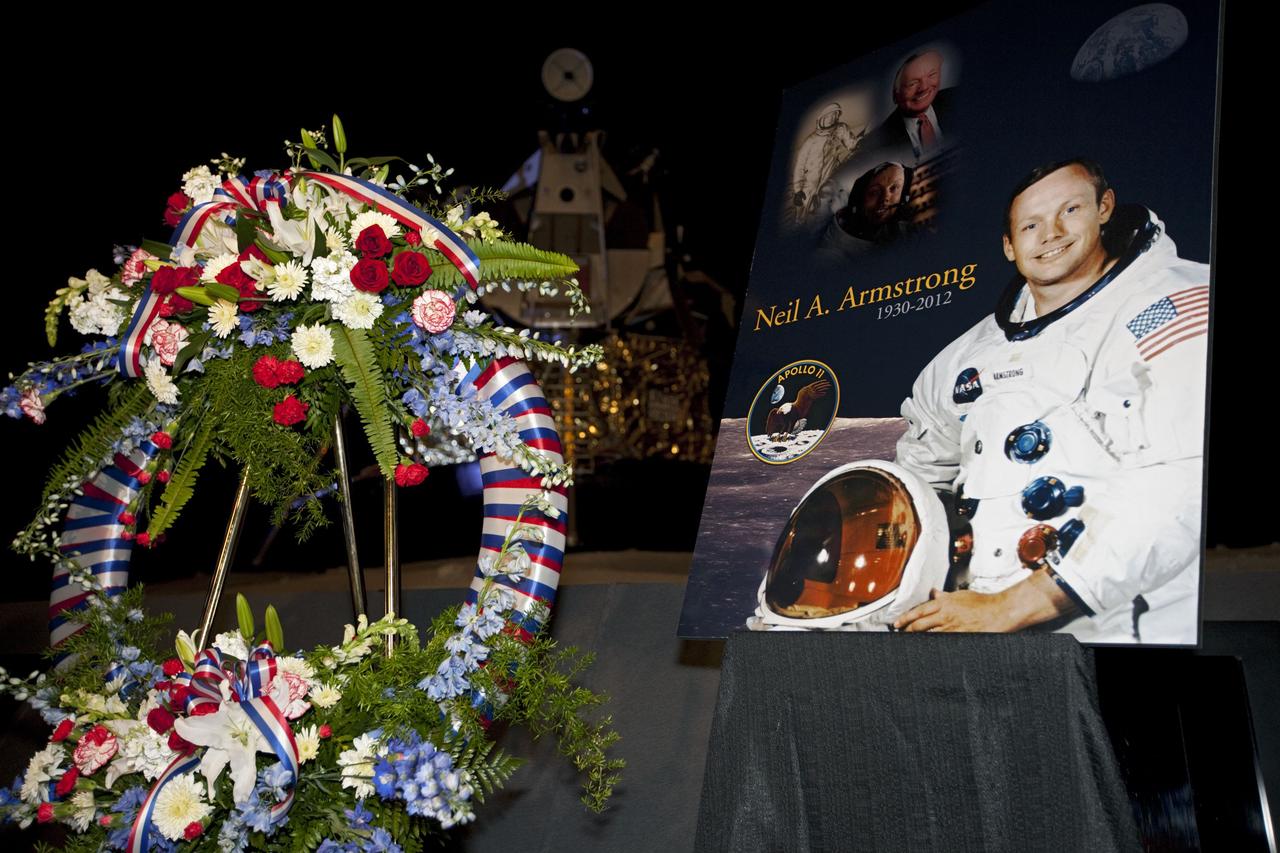
CAPE CANAVERAL, Fla. - Kennedy Space Center employees and guests gathered for a brief ceremony on Aug. 31, 2012 honoring Neil Armstrong, who died Aug. 25, 2012 at the age of 82. Armstrong was hailed by Center Director Bob Cabana as one of our heroes and a truly a great American. Cabana placed a wreath in the spaceport's Apollo-Saturn V Center. Selected as an astronaut in 1962, Neil Armstrong flew on NASA's Gemini 8 with David Scott in March 1966 and the first lunar landing mission, Apollo 11, with Mike Collins and Buzz Aldine in July 1969. On July 20, 1969, he became the first human to walk on the moon. For more information, visit: http://www.nasa.gov/centers/kennedy/news/neil_armstrong.html Photo credit: NASA/Kim Shiflett
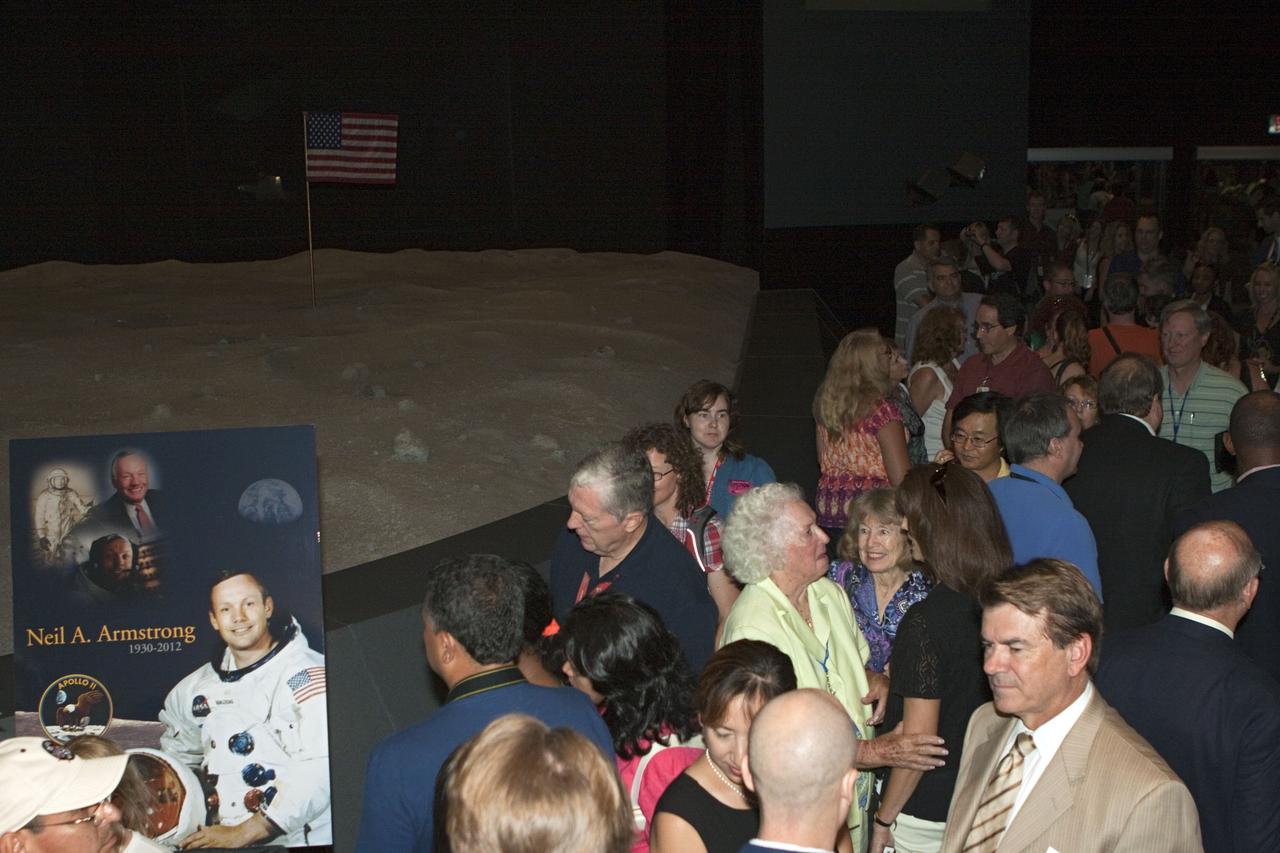
CAPE CANAVERAL, Fla. - Kennedy Space Center employees and guests gathered for a brief ceremony on Aug. 31, 2012 honoring Neil Armstrong, who died Aug. 25, 2012 at the age of 82. Armstrong was hailed by Center Director Bob Cabana as one of our heroes and a truly a great American. Cabana placed a wreath in the spaceport's Apollo-Saturn V Center. Selected as an astronaut in 1962, Neil Armstrong flew on NASA's Gemini 8 with David Scott in March 1966 and the first lunar landing mission, Apollo 11, with Mike Collins and Buzz Aldine in July 1969. On July 20, 1969, he became the first human to walk on the moon. For more information, visit: http://www.nasa.gov/centers/kennedy/news/neil_armstrong.html Photo credit: NASA/Kim Shiflett
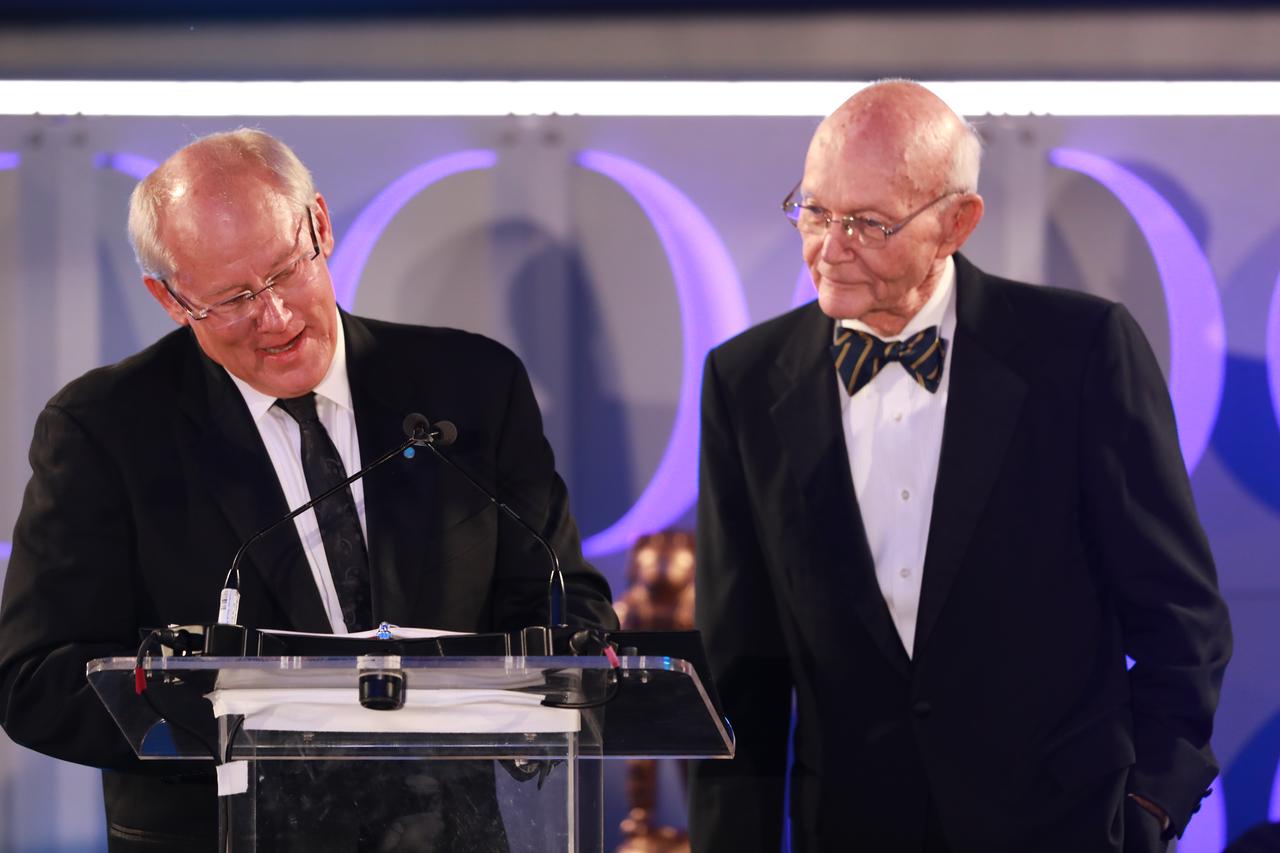
Andy Aldrin, son of Apollo 11 astronaut Buzz Aldrin, introduces Apollo 11 astronaut Michael Collins, during the Apollo 50th Gala, presented by Northrop Grumman. The event was held inside the Apollo/Saturn V Center at the Kennedy Space Center Visitor Complex in Florida on July 16, 2019.

Physicist Brian Cox serves as the moderator for a panel discussion with Apollo astronauts during the Apollo 11 50th Gala on July 16, 2019. The gala, presented by Northrop Grumman, was held inside the Apollo/Saturn V Center at the Kennedy Space Center Visitor Complex. From left, are Apollo 9 astronaut Rusty Schweichart, Apollo 11 astronaut Michael Collins, Apollo 16 astronaut Charlie Duke, and Apollo Flight Director Gerry Griffin.
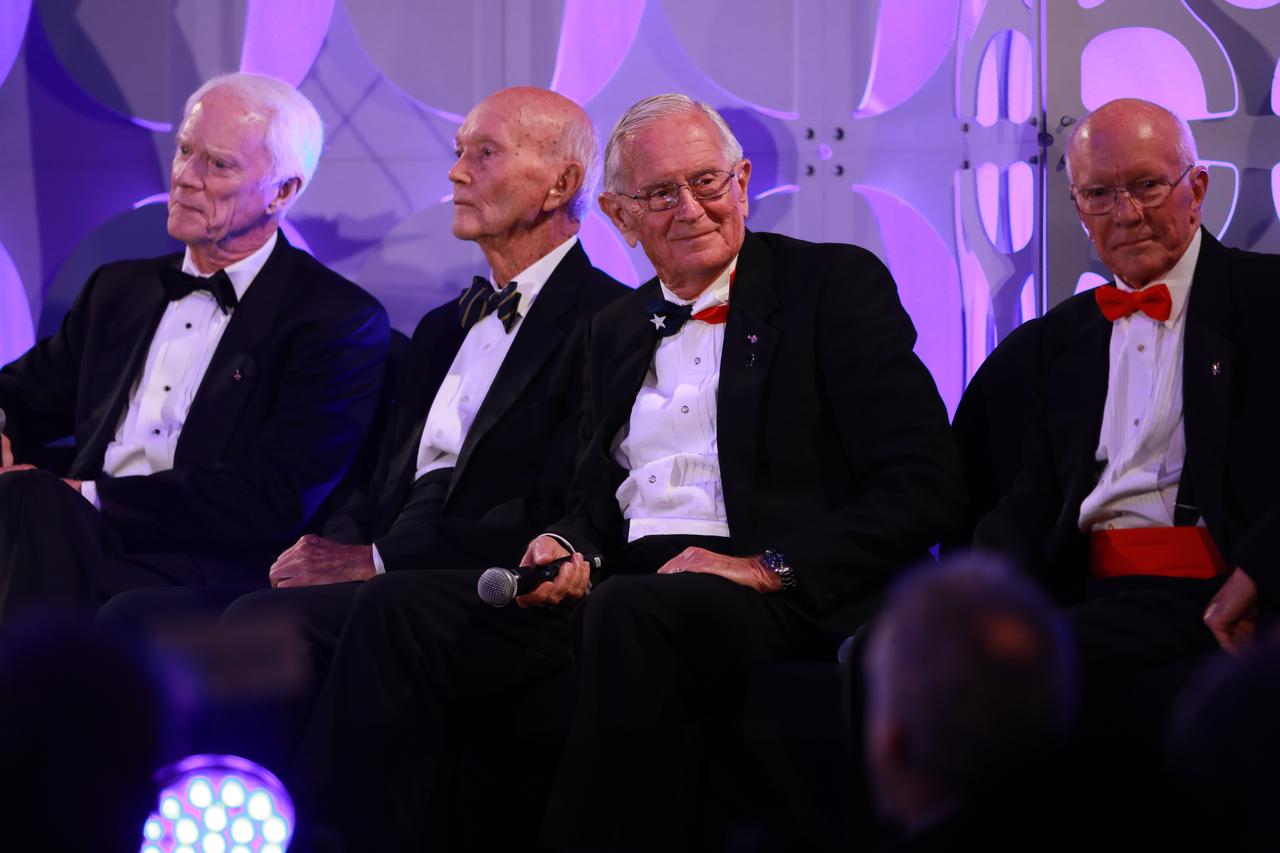
A panel discussion with Apollo astronauts took place during the Apollo 11 50th Gala, present by Northop Grumman, inside the Apollo/Saturn V Center at the Kennedy Space Center Visitor Complex in Florida on July 16, 2019. From left, are Apollo 9 astronaut Rusty Schweickart, Apollo 11 astronaut Michael Collins, Apollo 16 astronaut Charlie Duke, and Apollo Flight Director Gerry Griffin.
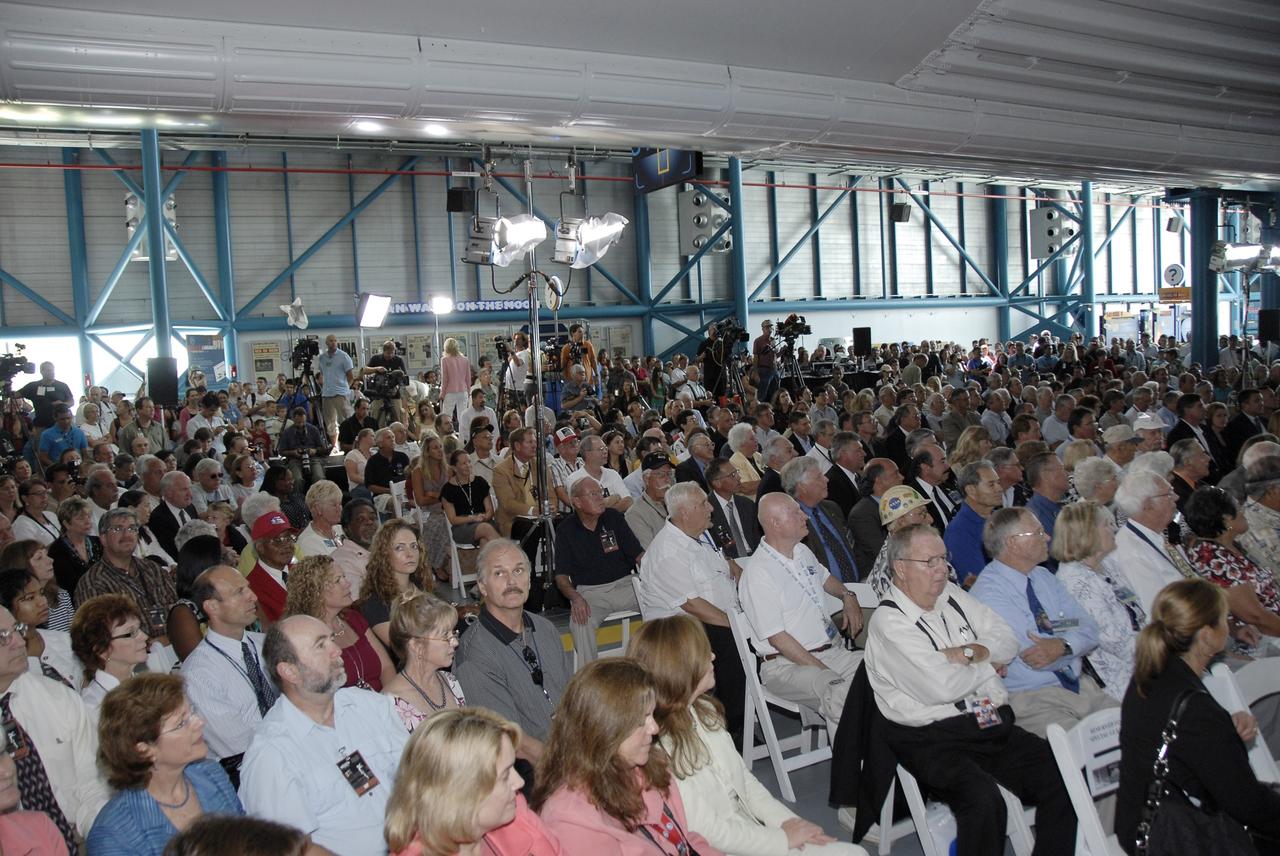
CAPE CANAVERAL, Fla. – The Apollo/Saturn V Center at NASA's Kennedy Space Center in Florida is filled with guests gathered to hear about the Apollo 11 launch and landing in July 1969 from eight Apollo astronauts. The event is part of NASA's 40th Anniversary of Apollo Celebration. Photo credit: NASA/Kim Shiflett
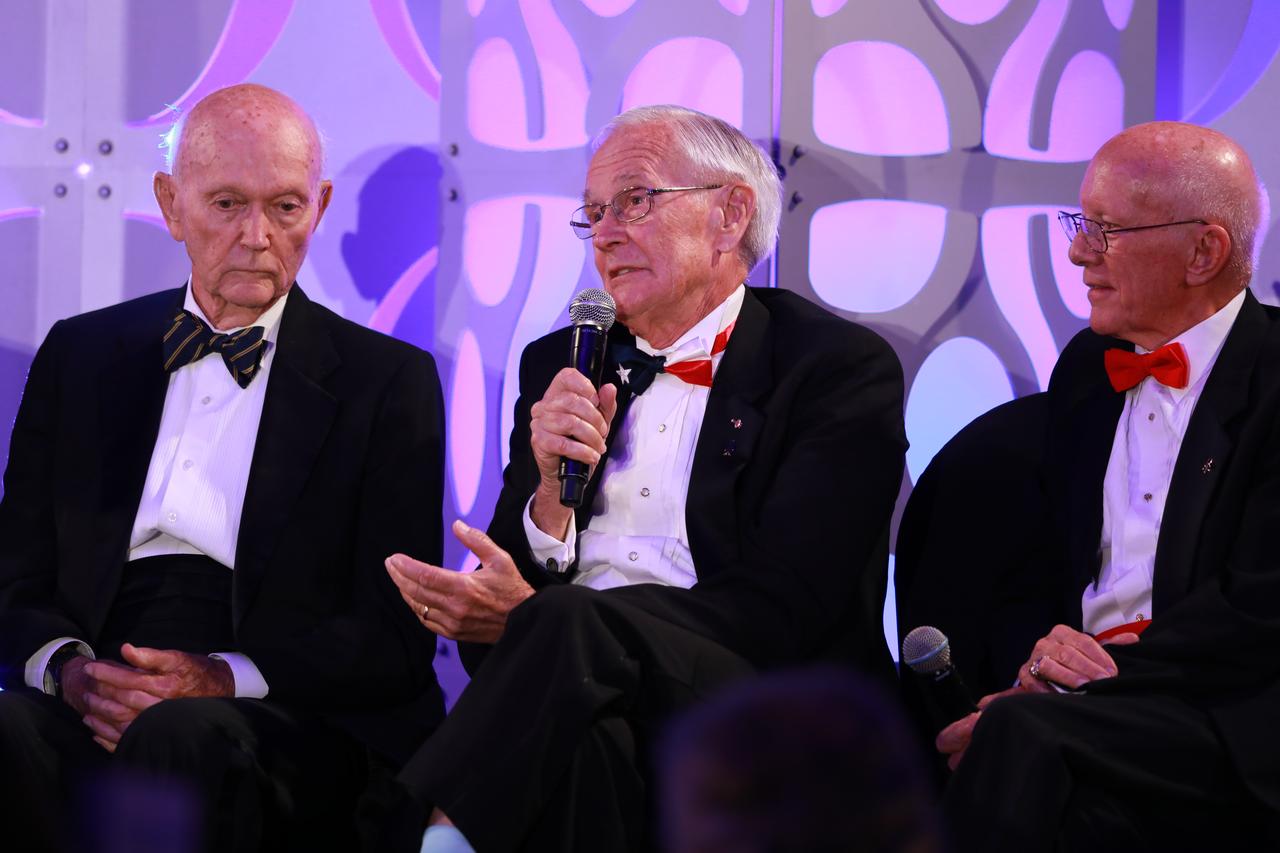
Retired NASA astronauts participate in a panel discussion during the Apollo 11 50th Gala, presented by Northrop Grumman, on July 16, 2019. The gala was held inside the Apollo/Saturn V Center at the Kennedy Space Center Visitor Complex in Florida. From left, are Apollo 11 astronaut Michael Collins, Apollo 16 astronaut Charlie Duke, and Apollo Flight Director Gerry Griffin.
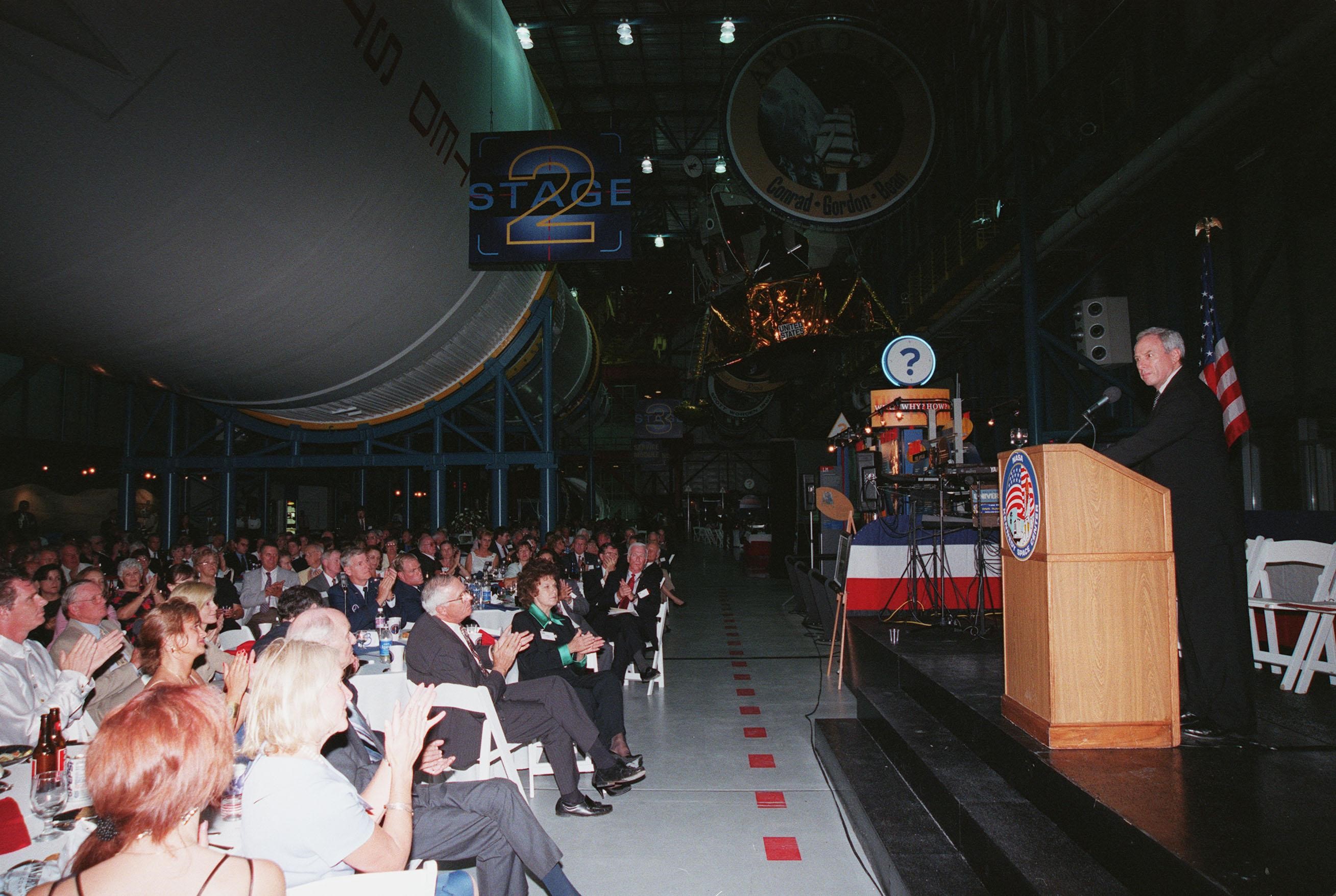
KENNEDY SPACE CENTER, FLA. -- NASA Administrator Daniel S. Goldin (right) addresses the audience at the Apollo 11 anniversary banquet honoring the Apollo team, the people who made the entire lunar landing program possible. The banquet was held in the Apollo/Saturn V Center, part of the KSC Visitor Complex, with seating under an unused Saturn V rocket like those that powered the Apollo launches . This is the 30th anniversary of the Apollo 11 launch and moon landing, July 16 and July 20, 1969. Among the guests at the banquet were former Apollo astronauts are Neil A. Armstrong and Edwin "Buzz" Aldrin who flew on Apollo 11, the launch of the first moon landing; Gene Cernan, who flew on Apollo 10 and 17 and was the last man to walk on the moon; and Walt Cunningham, who flew on Apollo 7
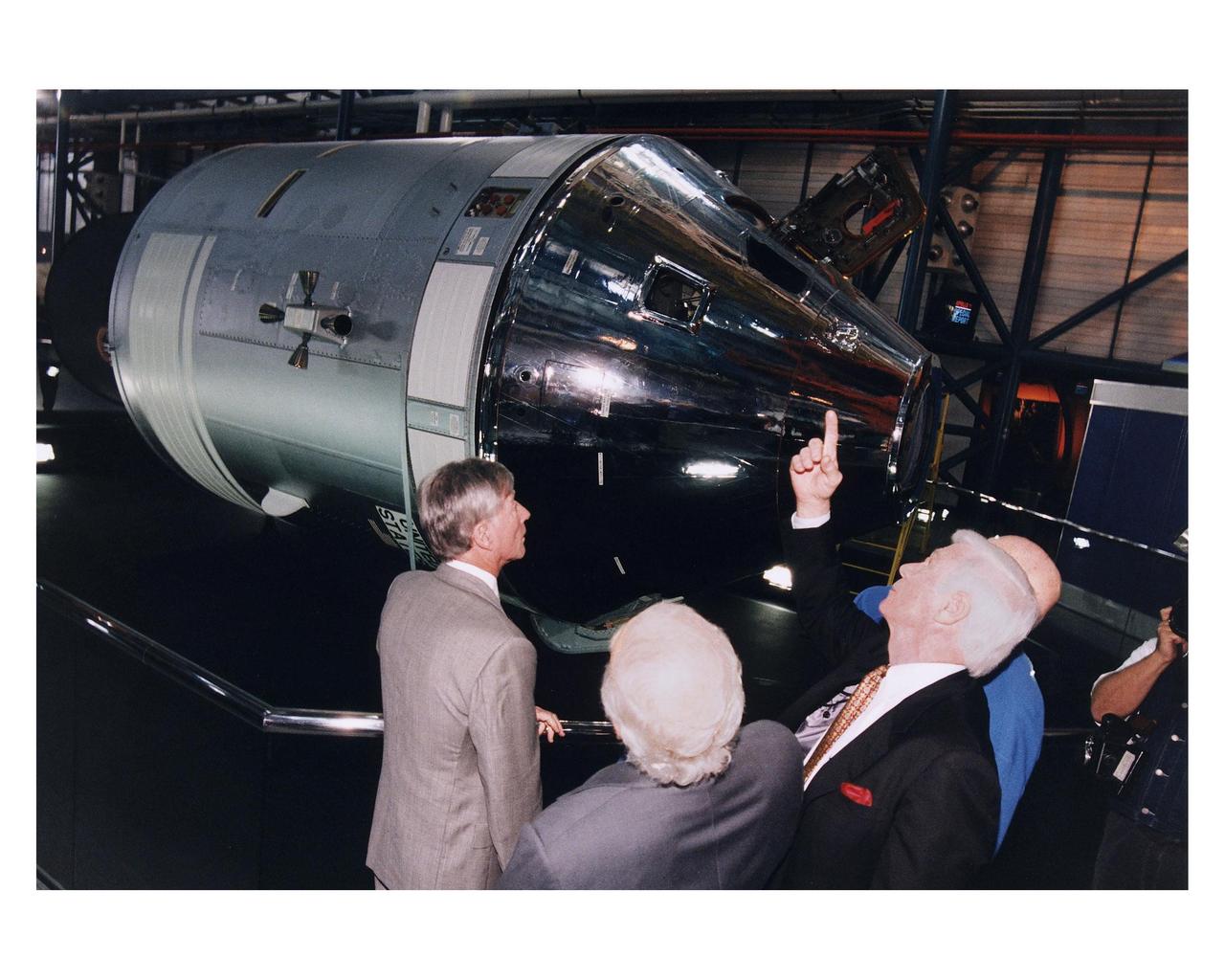
KENNEDY SPACE CENTER, FLA. -- Some of the former Apollo program astronauts admire an Apollo Command and Service Module during a tour the new Apollo/Saturn V Center (ASVC) at KSC prior to the gala grand opening ceremony for the facility that was held Jan. 8, 1997. The astronauts were invited to participate in the event, which also featured NASA Administrator Dan Goldin and KSC Director Jay Honeycutt. The astronauts are (from left): Apollo 10 Command Module Pilot and Apollo 16 Commander John W. Young;. Apollo 11 Lunar Module Pilot Edwin E. "Buzz" Aldrin, Jr.; Apollo 17 Commander Eugene A. Cernan; and Apollo 10 Commander Thomas P. Stafford. The ASVC also features several other Apollo program spacecraft components, multimedia presentations and a simulated Apollo/Saturn V liftoff. The facility will be a part of the KSC bus tour that embarks from the KSC Visitor Center
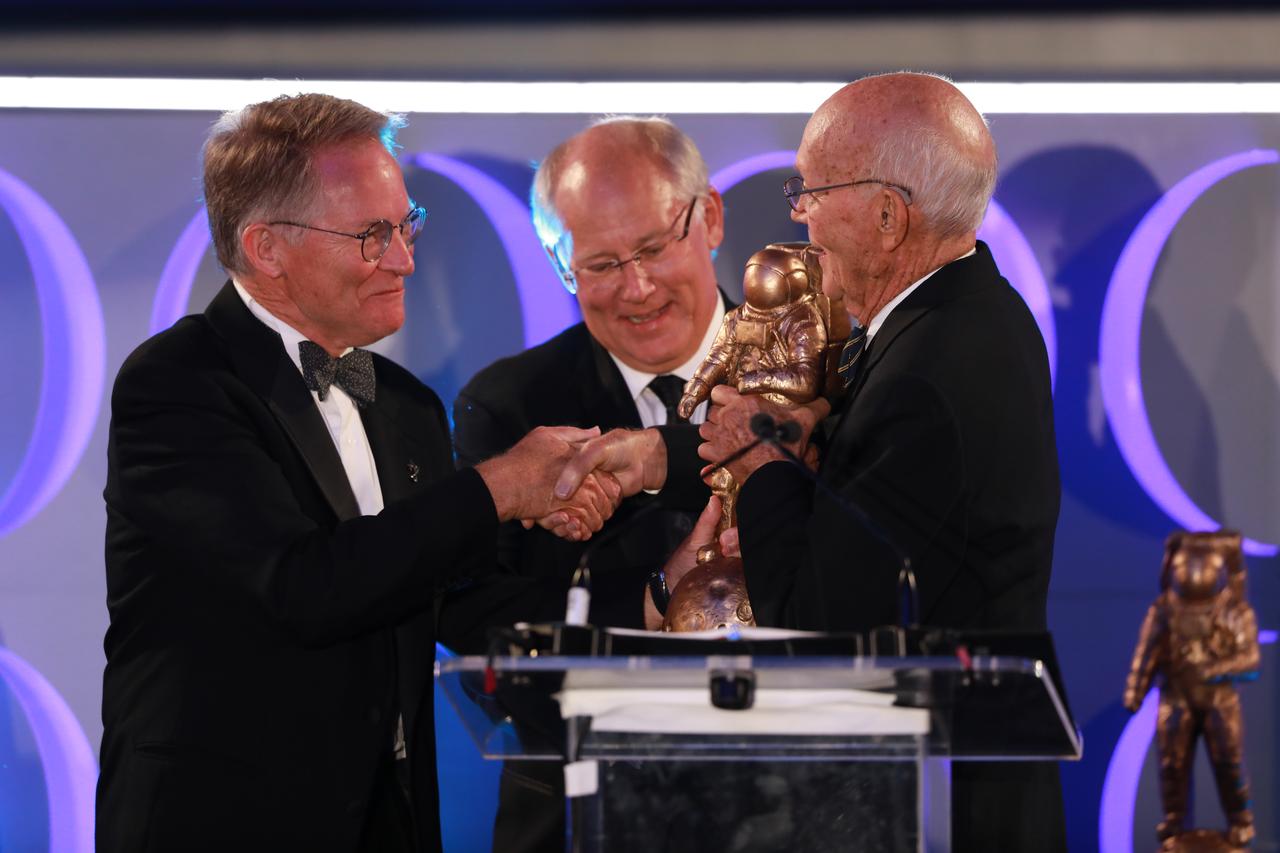
Michael Collins; right; Apollo 11 astronaut; presents the Innovation Award to David Thompson; left; founder; president and CEO of Orbital Sciences Corp (later known as Orbital ATK); during the Apollo 50th Gala on July 16; 2019. The event; presented by Northrop Grumman; was held inside the Apollo/Saturn V Center at the Kennedy Space Center Visitor Comples in Florida. In the center at the podium is Andy Aldrin; son of Apollo 11 astronaut Buzz Aldrin.
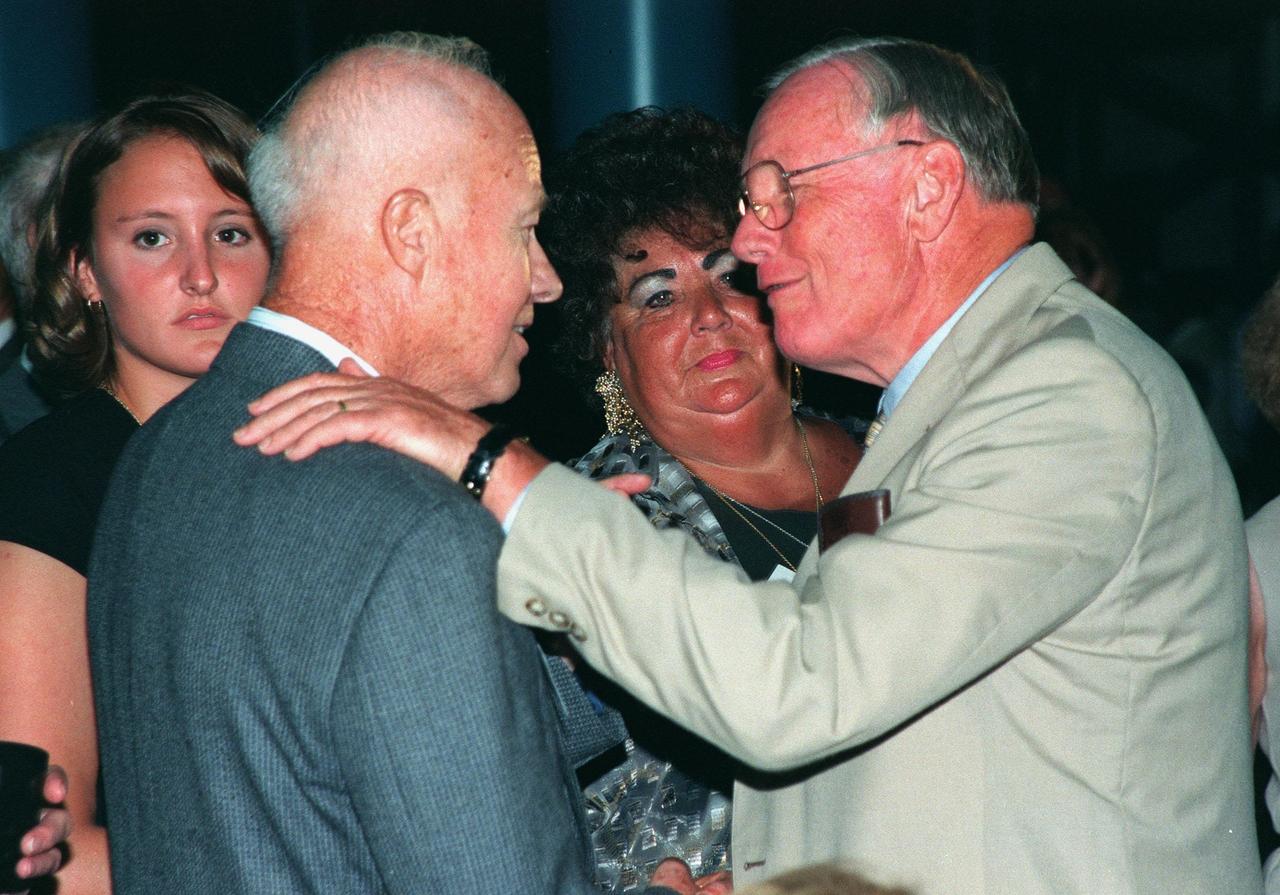
KENNEDY SPACE CENTER, FLA. -- Former Apollo 11 astronaut Neil A. Armstrong talks with a former Apollo team member during an anniversary banquet honoring the Apollo team, the people who made the entire lunar landing program possible. The banquet was held in the Apollo/Saturn V Center, part of the KSC Visitor Complex. This is the 30th anniversary of the Apollo 11 launch and moon landing, July 16 and July 20, 1969. Neil Armstrong was the first man to set foot on the moon
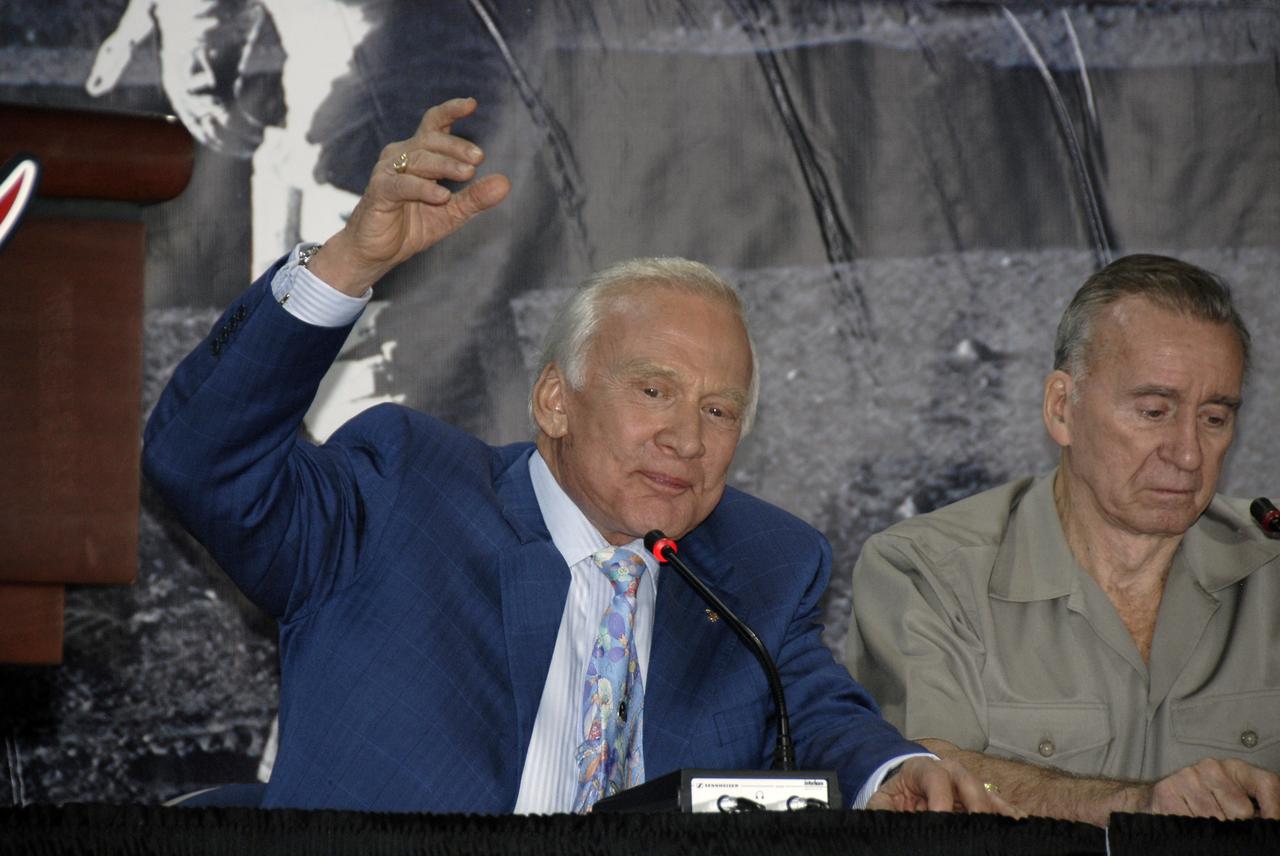
CAPE CANAVERAL, Fla. – At the Apollo/Saturn V Center at NASA's Kennedy Space Center in Florida, Apollo astronaut Buzz Aldrin comments on his experiences as one of the first moon walkers, on the Apollo 11 mission in July 1969. At right is astronaut Walt Cunningham. Aldrin, Cunningham and other Apollo astronauts participated in NASA's 40th Anniversary of Apollo Celebration. Photo credit: NASA/Kim Shiflett
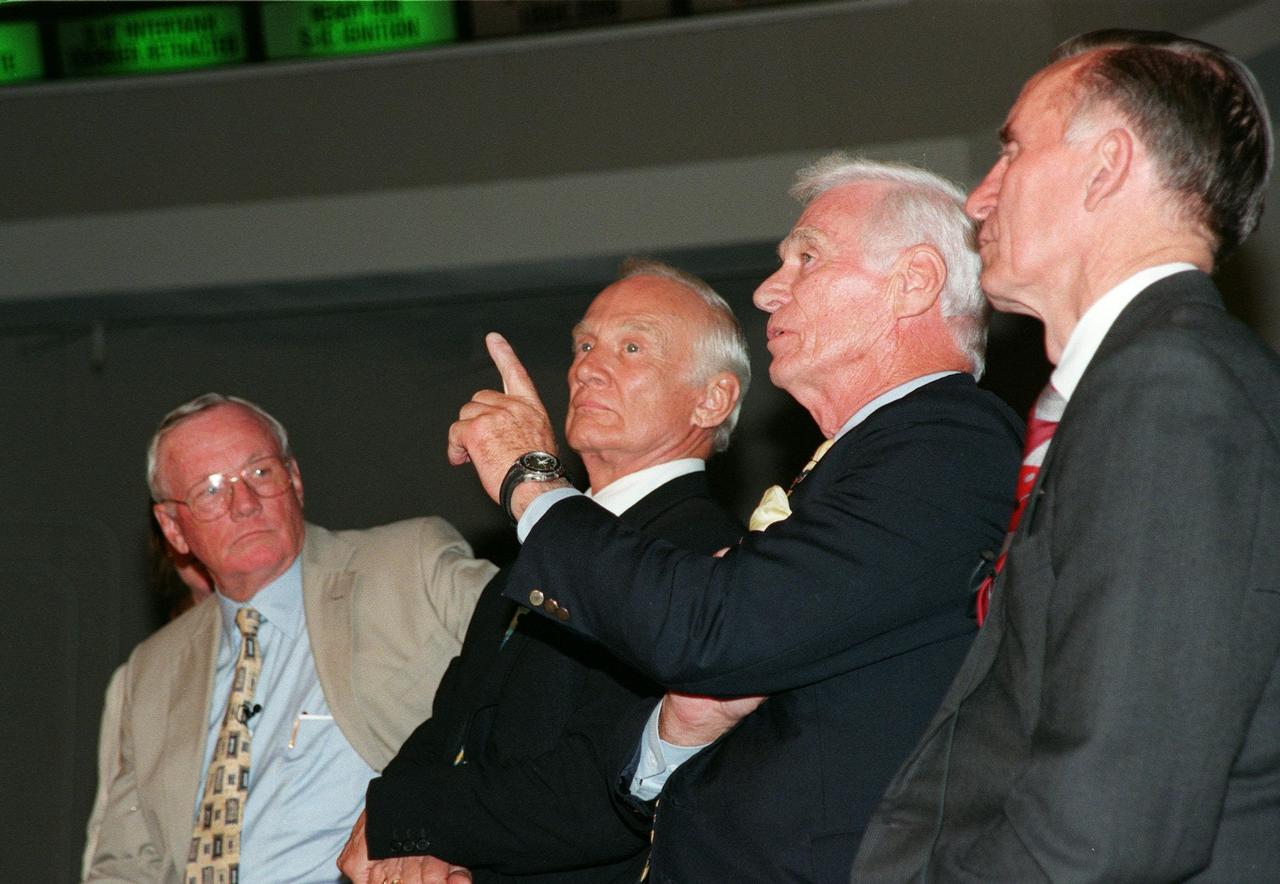
KENNEDY SPACE CENTER, FLA. -- At a media conference in the Apollo/Saturn V Center, former Apollo astronaut Gene Cernan, who flew on Apollo 10 and 17, makes a point in a comment for the press. Joining him in the conference are other Apollo astronauts (left) Neil A. Armstrong and Edwin "Buzz" Aldrin, who both flew on Apollo 11, the launch to the moon; and (right) Walt Cunningham, who flew on Apollo 7. The four astronauts were at KSC for the 30th anniversary of the Apollo 11 launch and moon landing, July 16 and July 20, 1969. Neil Armstrong was the first man to set foot on the moon
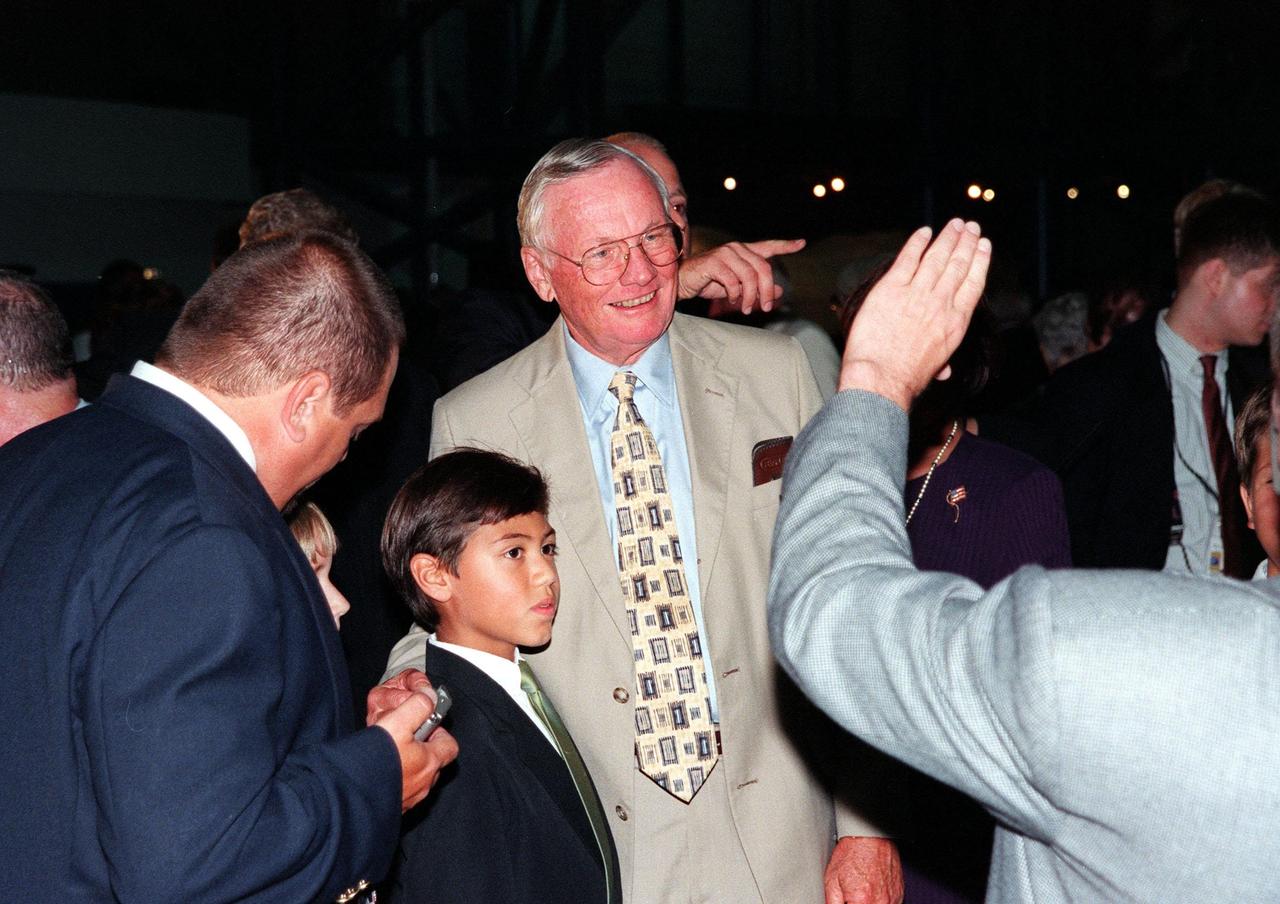
KENNEDY SPACE CENTER, FLA. -- Former Apollo 11 astronaut Neil A. Armstrong poses for a photograph with fans who attended the anniversary banquet honoring the Apollo team, the people who made the entire lunar landing program possible. The banquet was held in the Apollo/Saturn V Center, part of the KSC Visitor Complex. This is the 30th anniversary of the Apollo 11 launch and moon landing, July 16 and July 20, 1969. Neil Armstrong was the first man to set foot on the moon
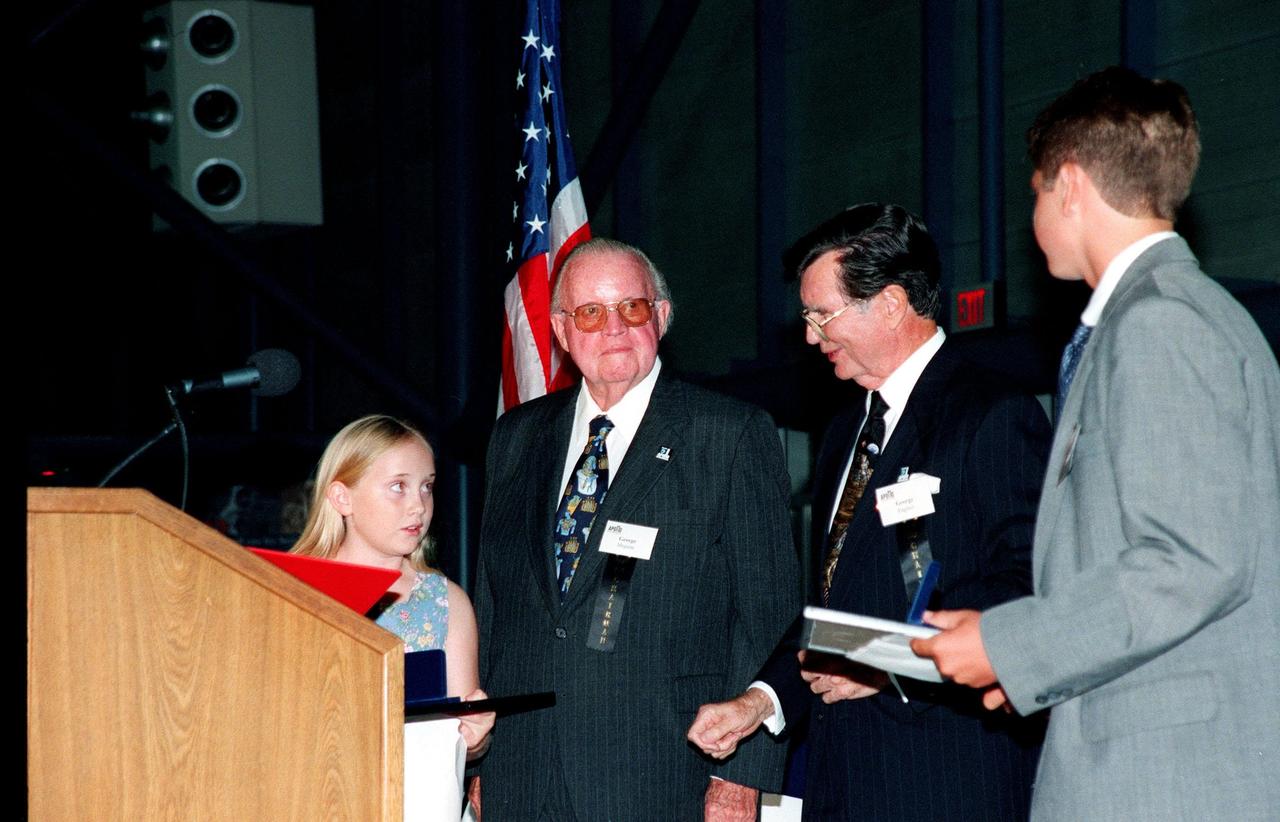
KENNEDY SPACE CENTER, FLA. -- At the Apollo/Saturn V Center, George Meguiar (center left) and George English (center right) present scholarships to two students who entered an essay contest in conjunction with the 30th Anniversary of Apollo 11. The winners shown are Kyla Davis Horn, of Cocoa Beach, and Kyle Rukaczewski, of Satellite Beach. A third winner, Jason Gagnon, of Viera, was unable to attend. Meguiar and English head the Apollo 11 Commemoration Association which sponsored the contest in conjunction with Florida Today newspaper. The presentation was made at the Apollo/Saturn V Center during an anniversary banquet that honored all the people who made the Apollo Program possible. Special guests included former Apollo astronauts Neil Armstrong, Edwin "Buzz" Aldrin, Gene Cernan and Walt Cunningham, who shared their experiences with the audience
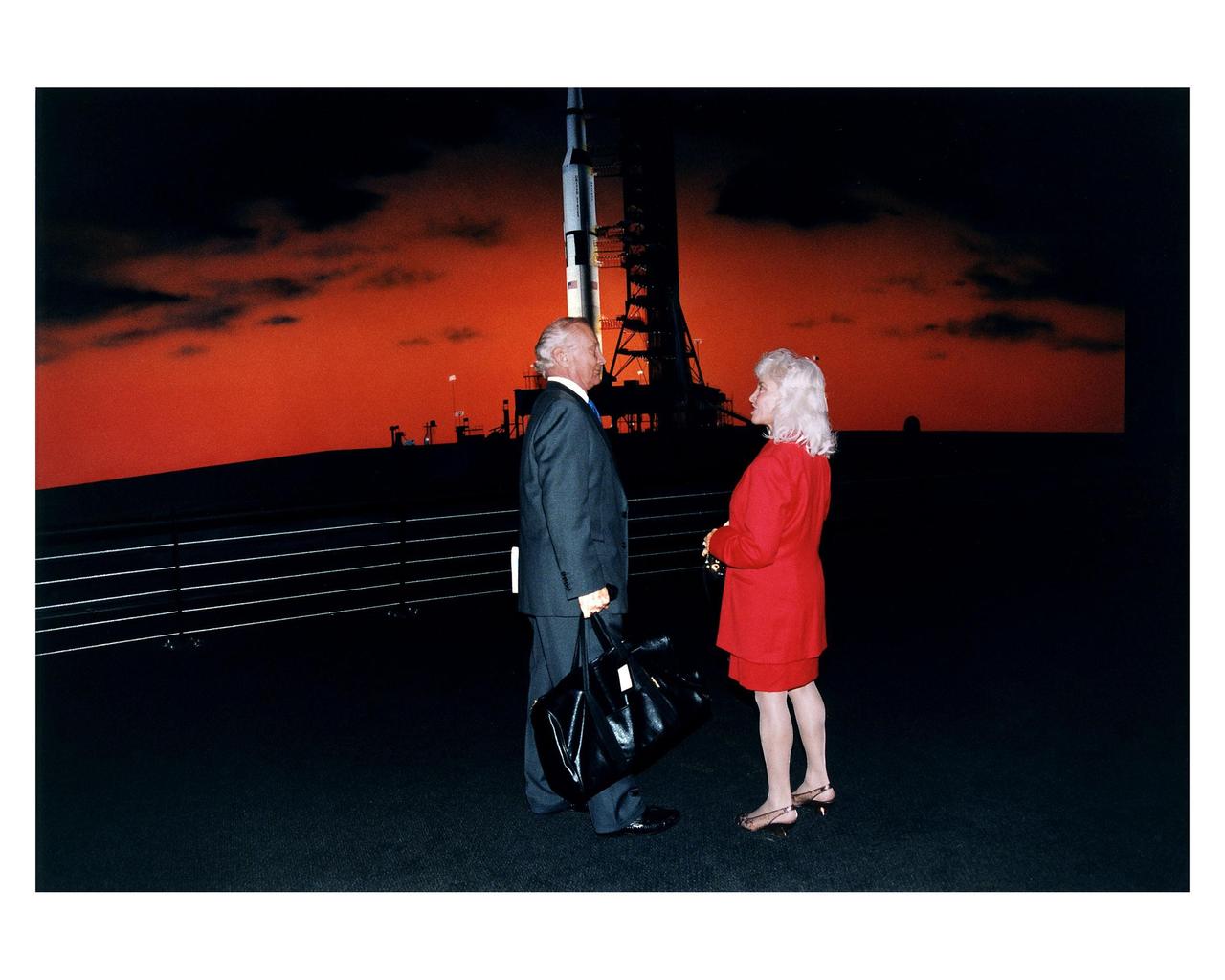
KENNEDY SPACE CENTER, FLA. -- Apollo 11 Lunar Module Pilot Edwin E. "Buzz" Aldrin, Jr. and his wife, Lois, stand before a painting of an Apollo/Saturn V launch vehicle at the pad in the new Apollo/Saturn V Center (ASVC) at KSC prior to the gala grand opening ceremony for the facility that was held Jan. 8, 1997. The astronauts were invited to participate in the event, which also featured NASA Administrator Dan Goldin and KSC Director Jay Honeycutt. The ASVC also features several other Apollo program spacecraft component displays and multimedia presentations. The facility will be a part of the KSC bus tour that embarks from the KSC Visitor Center
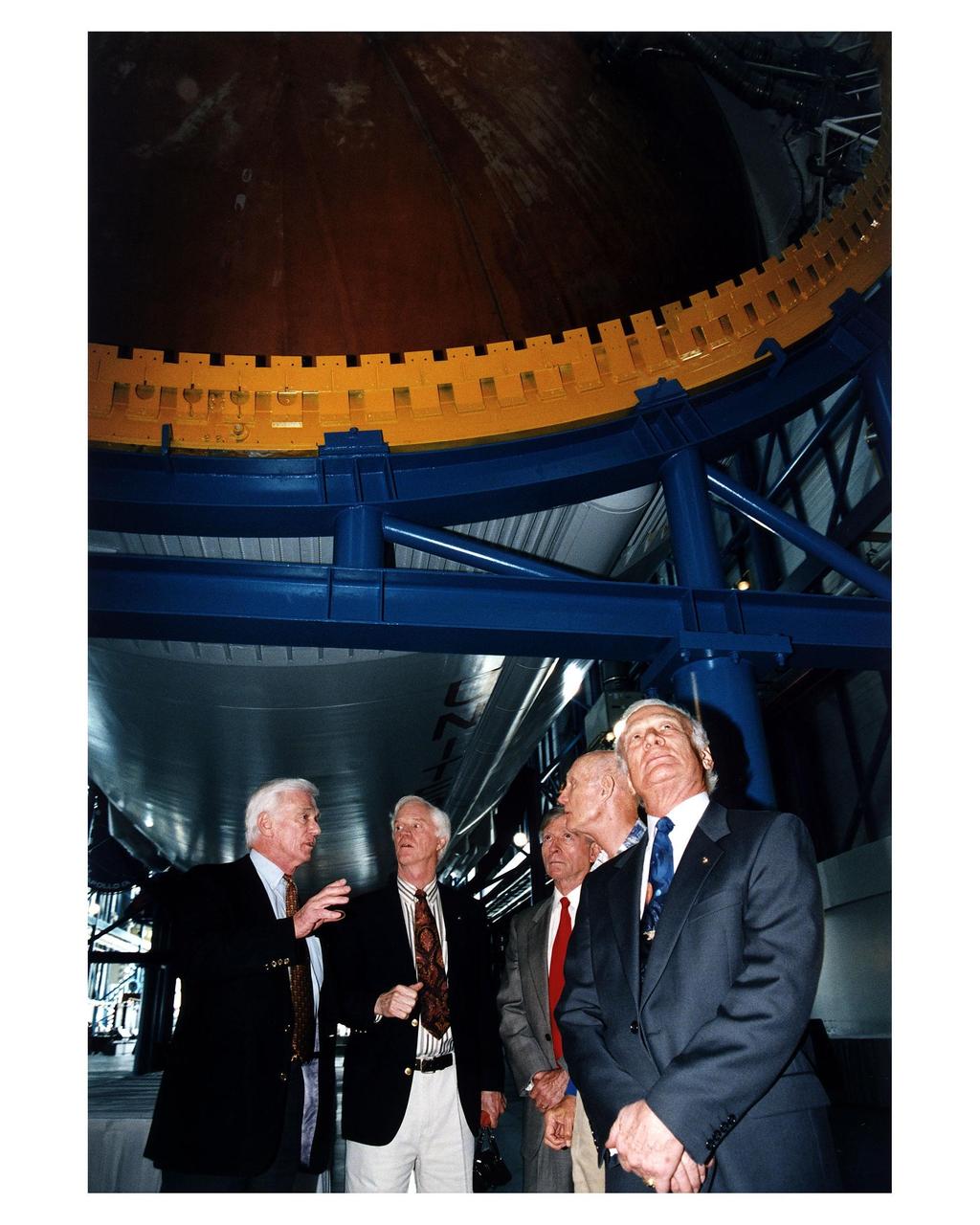
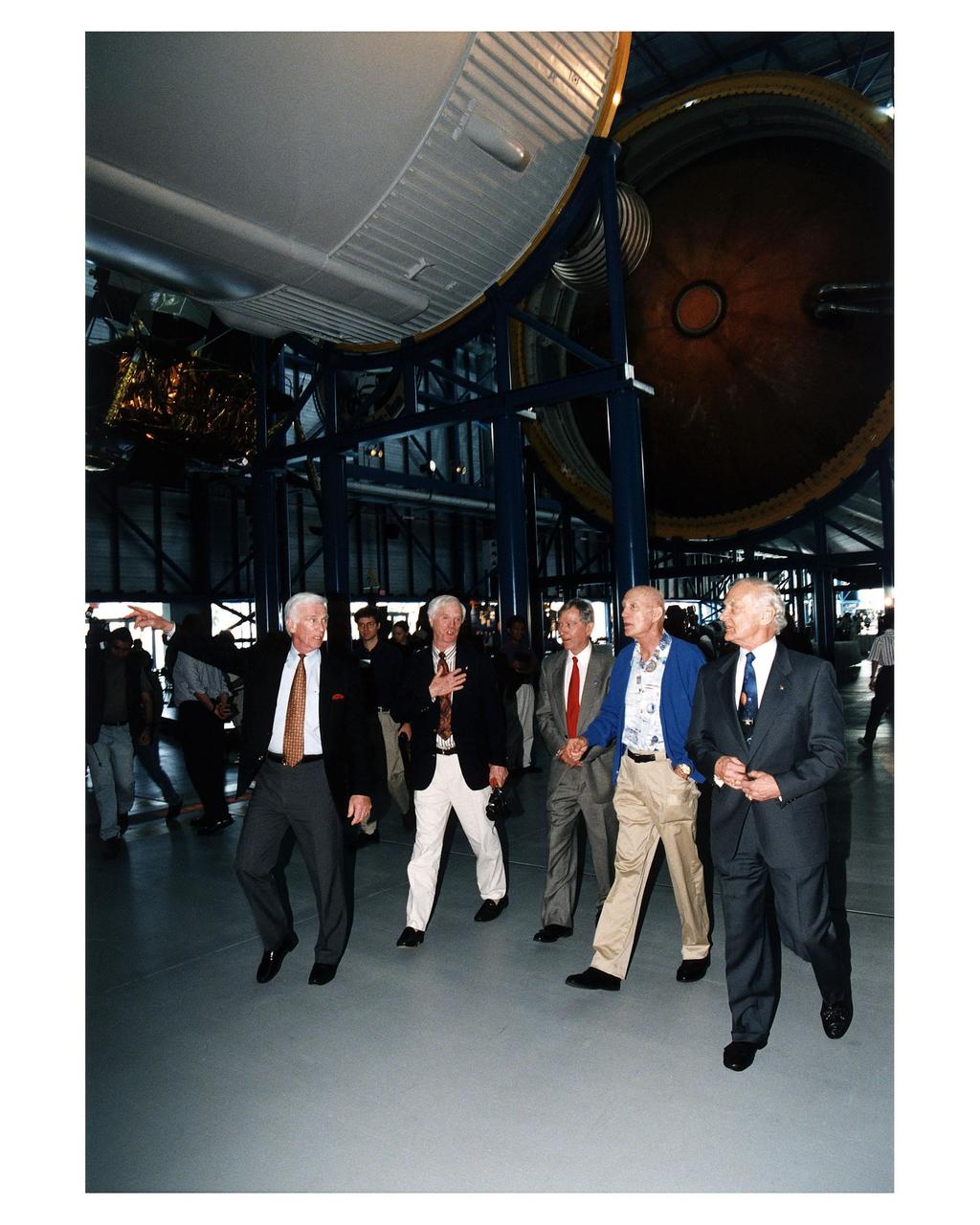
KENNEDY SPACE CENTER, FLA. -- Some of the former Apollo program astronauts tour the new Apollo/Saturn V Center (ASVC) at KSC prior to the gala grand opening ceremony for the facility that was held Jan. 8, 1997. The astronauts were invited to participate in the event, which also featured NASA Administrator Dan Goldin and KSC Director Jay Honeycutt. Passing underneath the KSC Apollo/Saturn V inside the building are (from left): Apollo 10 Lunar Module Pilot and Apollo 17 Commander Eugene A. Cernan; Apollo 9 Lunar Module Pilot Russell L. Schweikart; Apollo 10 Command Module Pilot and Apollo 16 Commander John W. Young; Apollo 10 Commander Thomas P. Stafford; and Apollo 11 Lunar Module Pilot Edwin E. "Buzz" Aldrin, Jr. The ASVC also features several other Apollo program spacecraft components, multimedia presentations and a simulated Apollo/Saturn V liftoff. The facility will be a part of the KSC bus tour that embarks from the KSC Visitor Center
KENNEDY SPACE CENTER, FLA. -- Some of the former Apollo program astronauts tour the new Apollo/Saturn V Center (ASVC) at KSC prior to the gala grand opening ceremony for the facility that was held Jan. 8, 1997. The astronauts were invited to participate in the event, which also featured NASA Administrator Dan Goldin and KSC Director Jay Honeycutt. Passing underneath the KSC Apollo/Saturn V inside the building are (from left): Apollo 10 Lunar Module Pilot and Apollo 17 Commander Eugene A. Cernan; Apollo 9 Lunar Module Pilot Russell L. Schweikart; Apollo 10 Command Module Pilot and Apollo 16 Commander John W. Young; Apollo 10 Commander Thomas P. Stafford; and Apollo 11 Lunar Module Pilot Edwin E. "Buzz" Aldrin, Jr. The ASVC also features several other Apollo program spacecraft components, multimedia presentations and a simulated Apollo/Saturn V liftoff. The facility will be a part of the KSC bus tour that embarks from the KSC Visitor Center
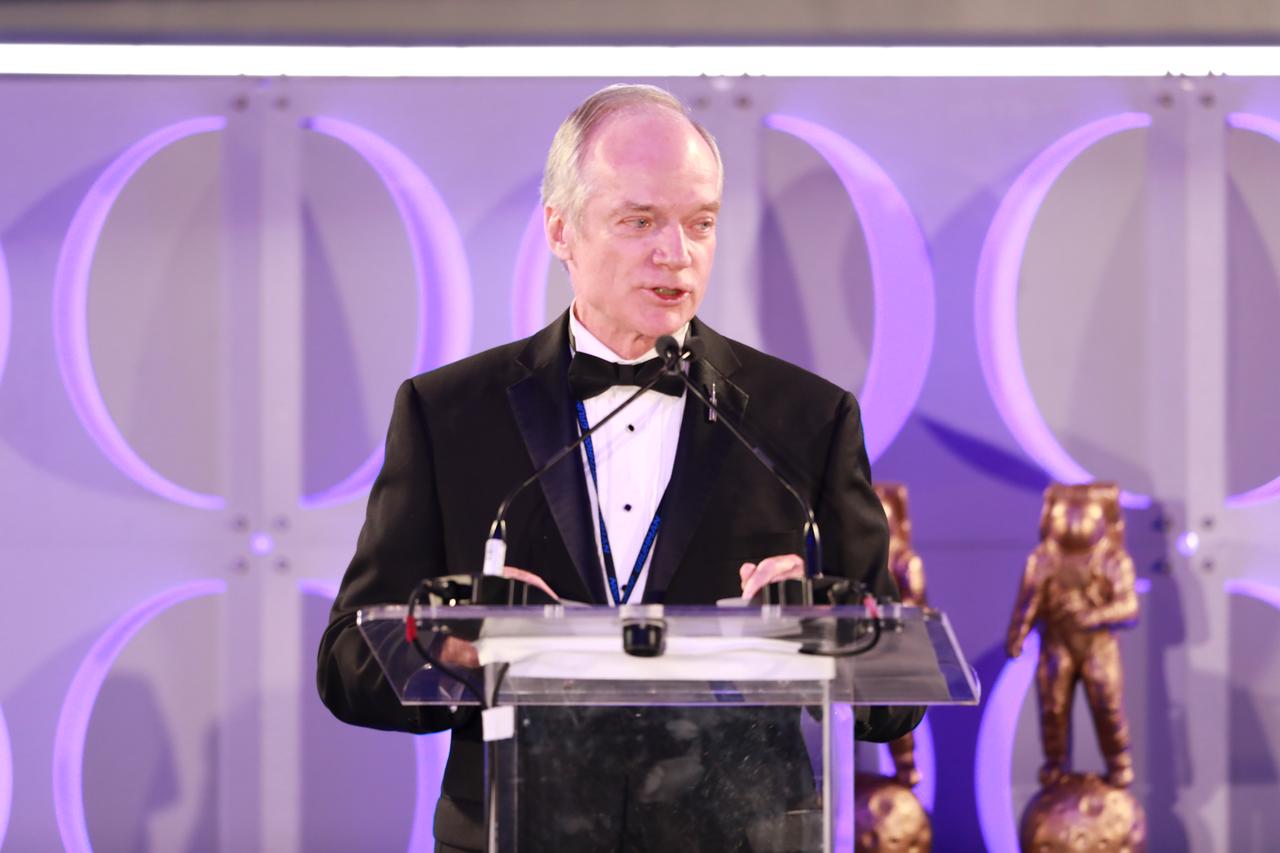
Retired NASA astronaut Charlie Precourt, vice president, propulsion systems, with Northrop Grumman, delivers remarks during the Apollo 11 50th Gala, presented by Northrop Grumman, inside the Apollo/Saturn V Center at the Kennedy Space Center Visitor Complex on July 16, 2019.
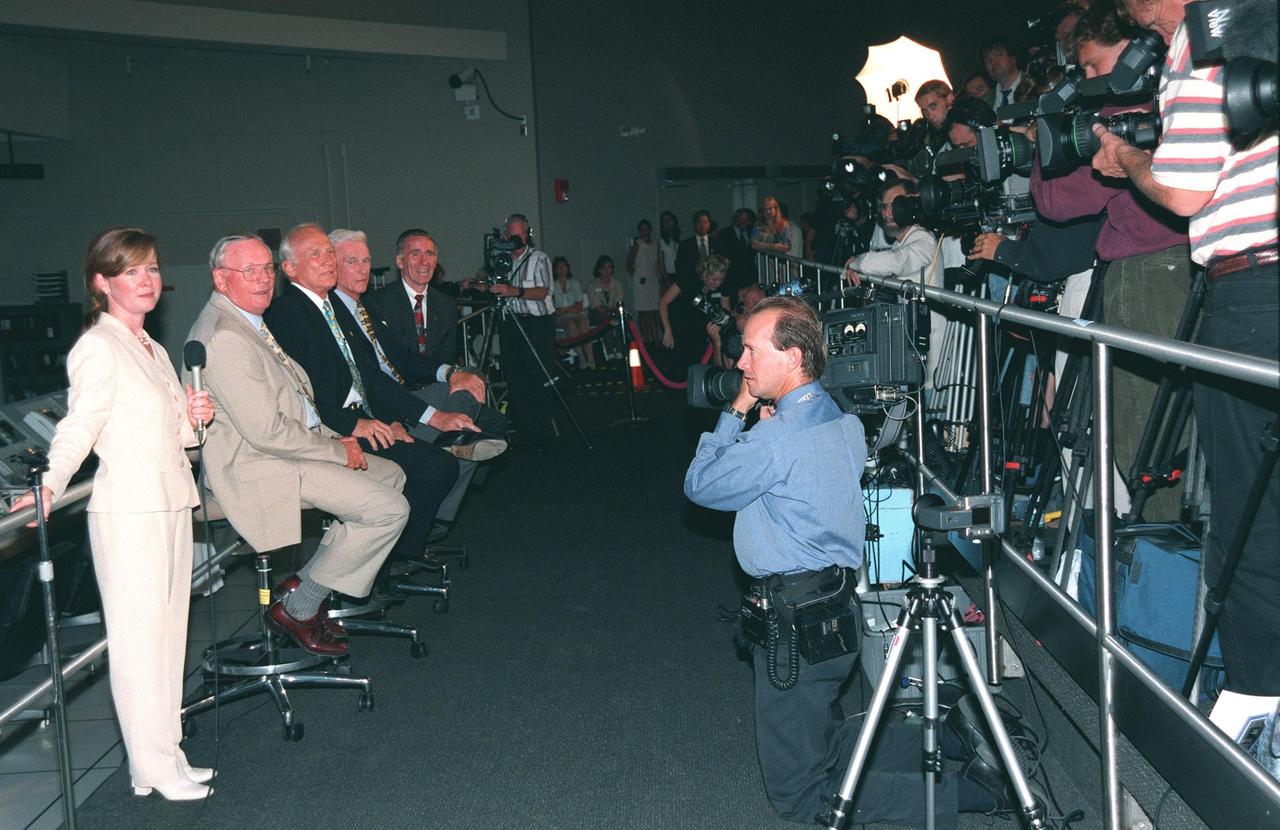
KENNEDY SPACE CENTER, FLA. -- Photographers and cameramen fill the stands of the Apollo/Saturn V Center for a press conference with former Apollo astronauts (seated, left to right) Neil A. Armstrong and Edwin "Buzz" Aldrin who flew on Apollo 11, the launch to the moon; Gene Cernan, who flew on Apollo 10 and 17; and Walt Cunningham, who flew on Apollo 7. At left is Lisa Malone, chief of KSC's Media Services branch, who monitored the session. The four astronauts were at KSC for the 30th anniversary of the Apollo 11 launch and moon landing, July 16 and July 20, 1969. Neil Armstrong was the first man to set foot on the moon
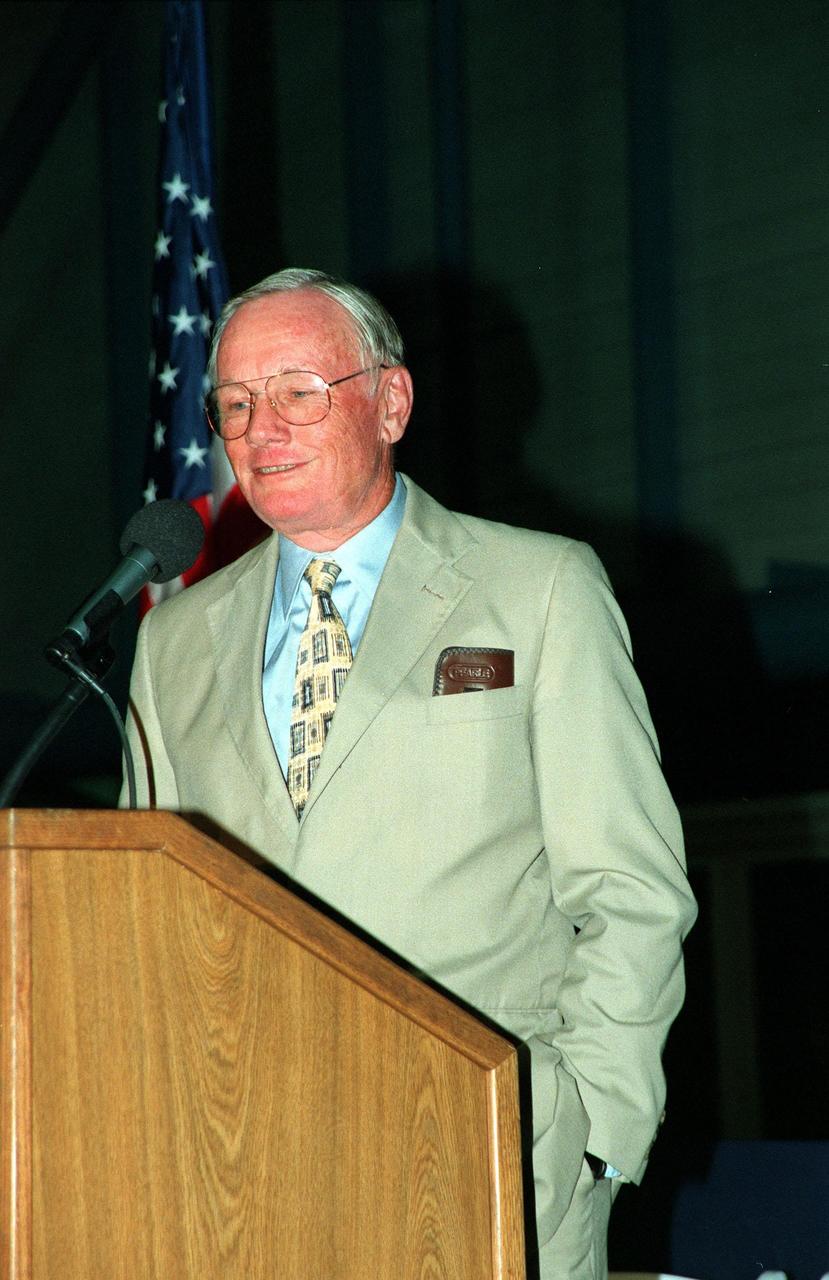
KENNEDY SPACE CENTER, FLA. -- Neil Armstrong, former Apollo 11 astronaut, and first man to walk on the moon, talks about his experiences for an enthusiastic audience at the Apollo/Saturn V Center, part of the KSC Visitor Complex. The occasion was a banquet celebrating the 30th anniversary of the Apollo 11 launch and moon landing, July 16 and July 20, 1969. Among other guests at the banquet were astronauts Wally Schirra, Edwin "Buzz" Aldrin and Walt Cunningham. Gene Cernan was the last man to walk on the moon
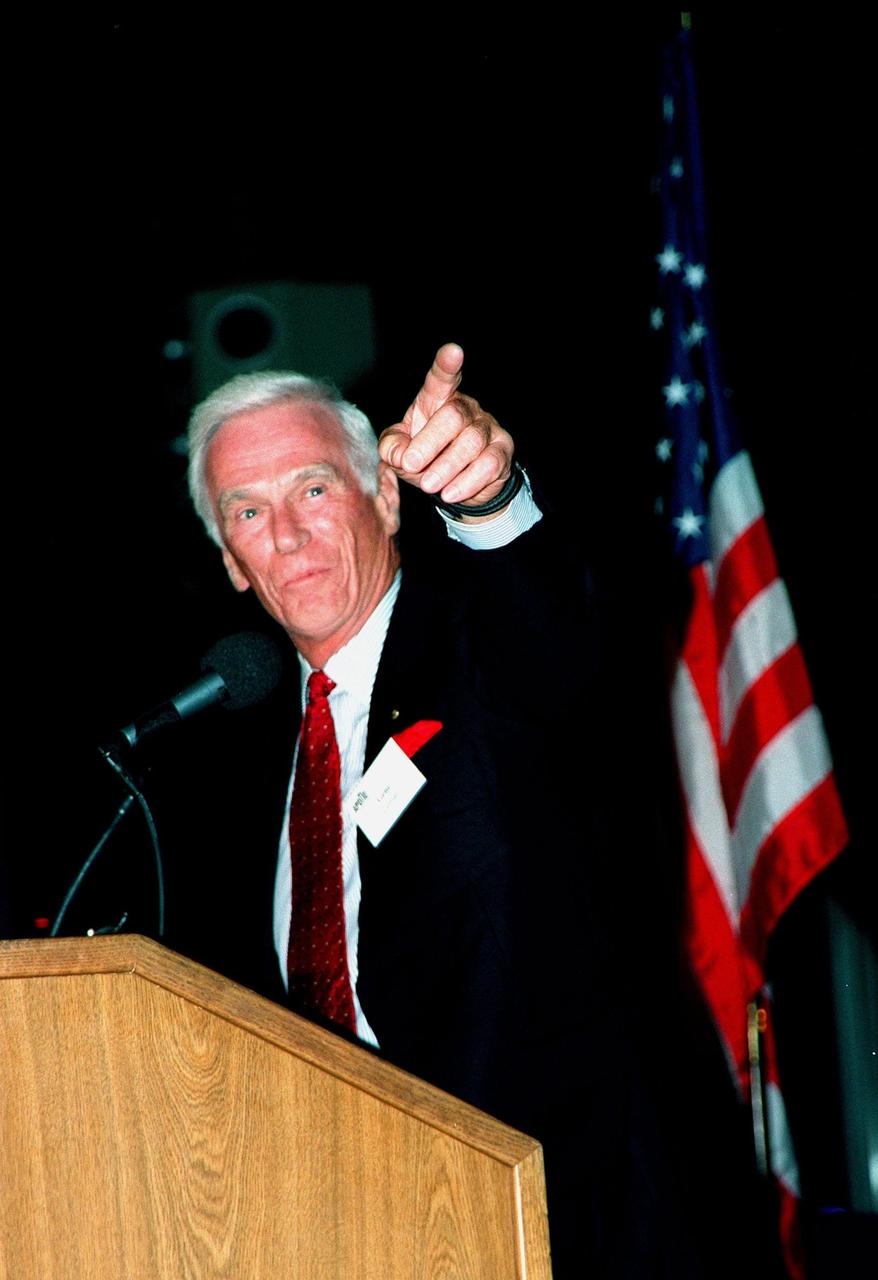
KENNEDY SPACE CENTER, FLA. -- Former Apollo astronaut Gene Cernan makes a point during a presentation at the Apollo 11 anniversary banquet honoring the Apollo team, the people who made the entire lunar landing program possible. The banquet was held in the Apollo/Saturn V Center, part of the KSC Visitor Complex. This is the 30th anniversary of the Apollo 11 launch and moon landing, July 16 and July 20, 1969. Cernan appeared with other former astronauts Neil Armstrong, the first man to walk on the moon; Edwin "Buzz" Aldrin; Walt Cunningham; and others
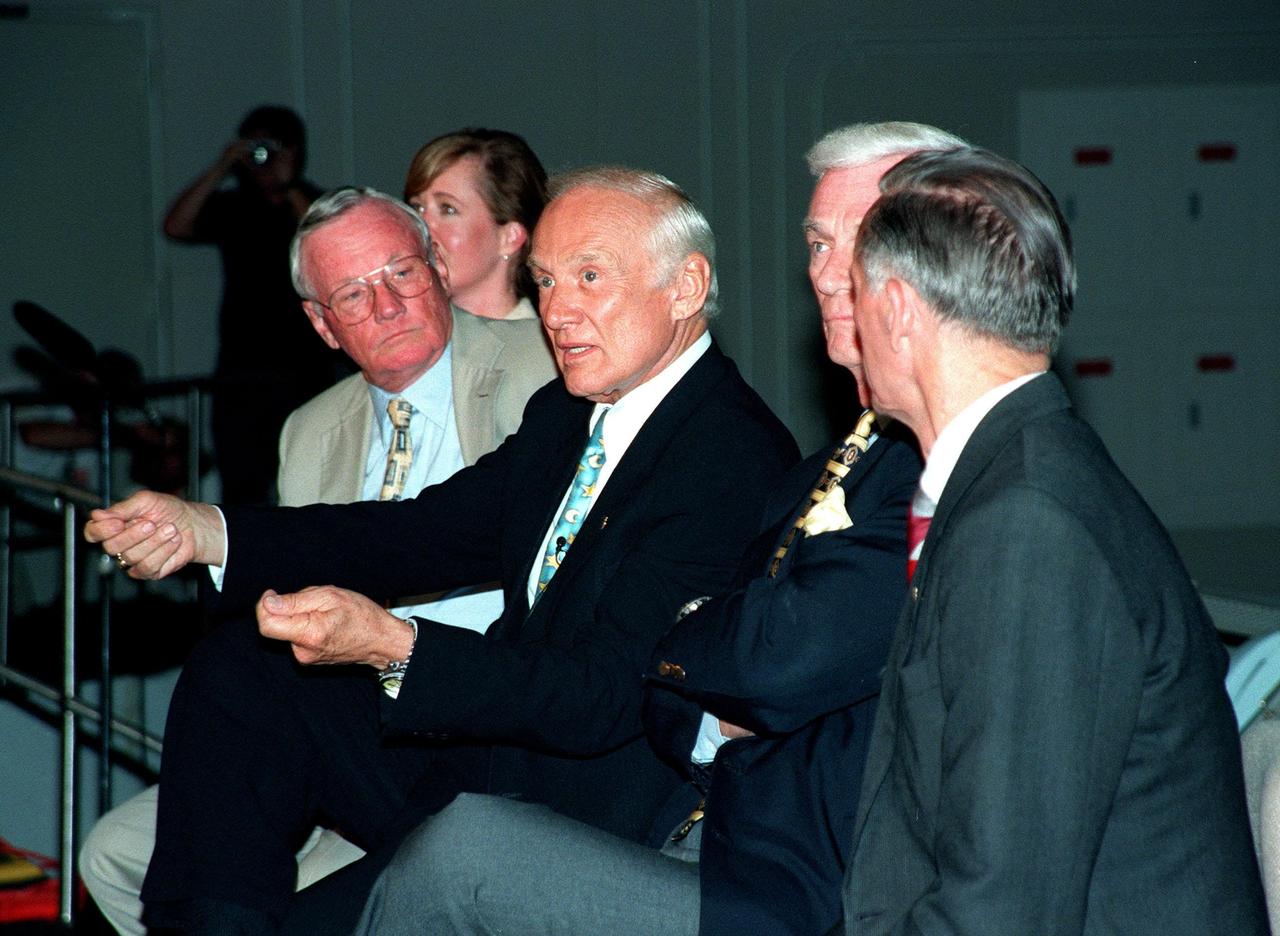
KENNEDY SPACE CENTER, FLA. -- At a media conference in the Apollo/Saturn V Center, former Apollo astronaut Edwin "Buzz" Aldrin, who flew on Apollo 11, the launch to the moon, demonstrates a point in his comment for the press. Joining him in the conference are other Apollo astronauts Neil A. Armstrong (left), who also flew on Apollo 11 and was the first man to set foot on the moon; Gene Cernan (right), who flew on Apollo 10 and 17; and Walt Cunningham (back to camera), who flew on Apollo 7. In the background is Lisa Malone, chief of KSC's Media Services branch, who monitored the session. The four astronauts were at KSC for the 30th anniversary of the Apollo 11 launch and moon landing, July 16 and July 20, 1969
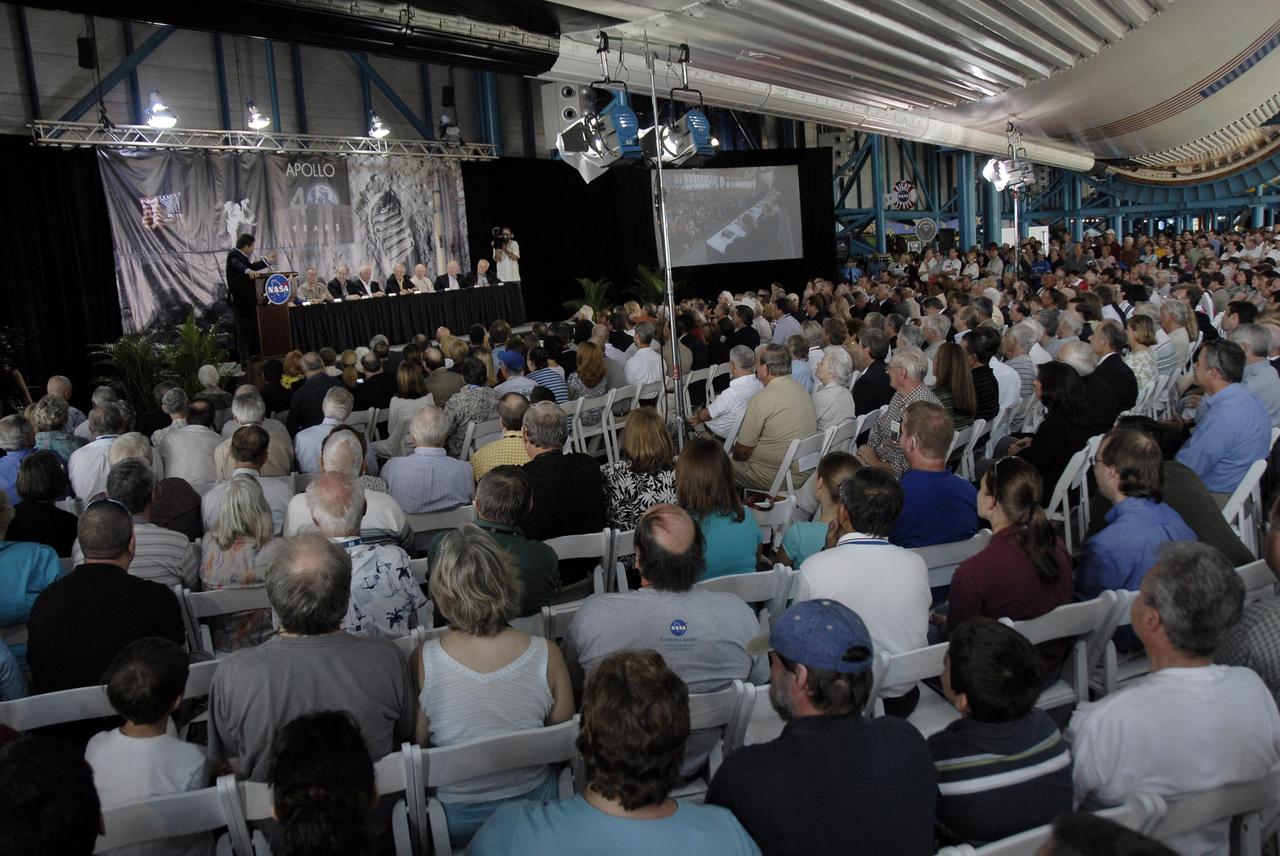
CAPE CANAVERAL, Fla. – The Apollo/Saturn V Center at NASA's Kennedy Space Center in Florida is filled with guests gathered to hear about the Apollo 11 launch and landing in July 1969 from eight Apollo astronauts: . The event is part of NASA's 40th Anniversary of Apollo Celebration. Participating are CNN correspondent, who moderated, Buzz Aldrin, Walt Cunningham, Edgar Mitchell, Al Worden, Charlie Duke, Vance Brand, Gerald Carr and Bruce McCandless. Photo credit: NASA/Kim Shiflett
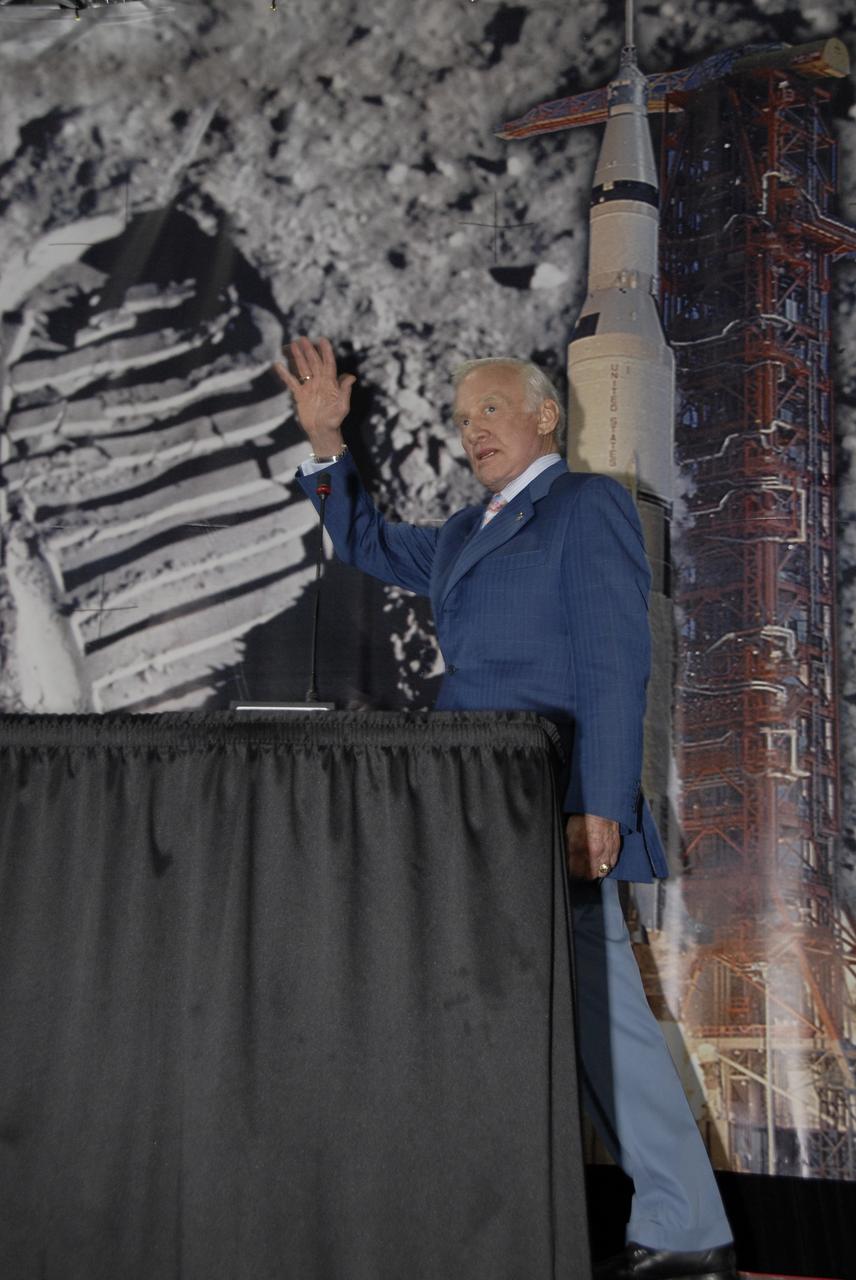
CAPE CANAVERAL, Fla. – At the Apollo/Saturn V Center at NASA's Kennedy Space Center in Florida, Apollo astronaut Buzz Aldren is introduced during NASA's 40th Anniversary of Apollo Celebration. He was joined by seven others involved in the program. Aldrin walked on the moon during the first lunar landing, Apollo 11, on July 20, 1969. Photo credit: NASA/Kim Shiflett
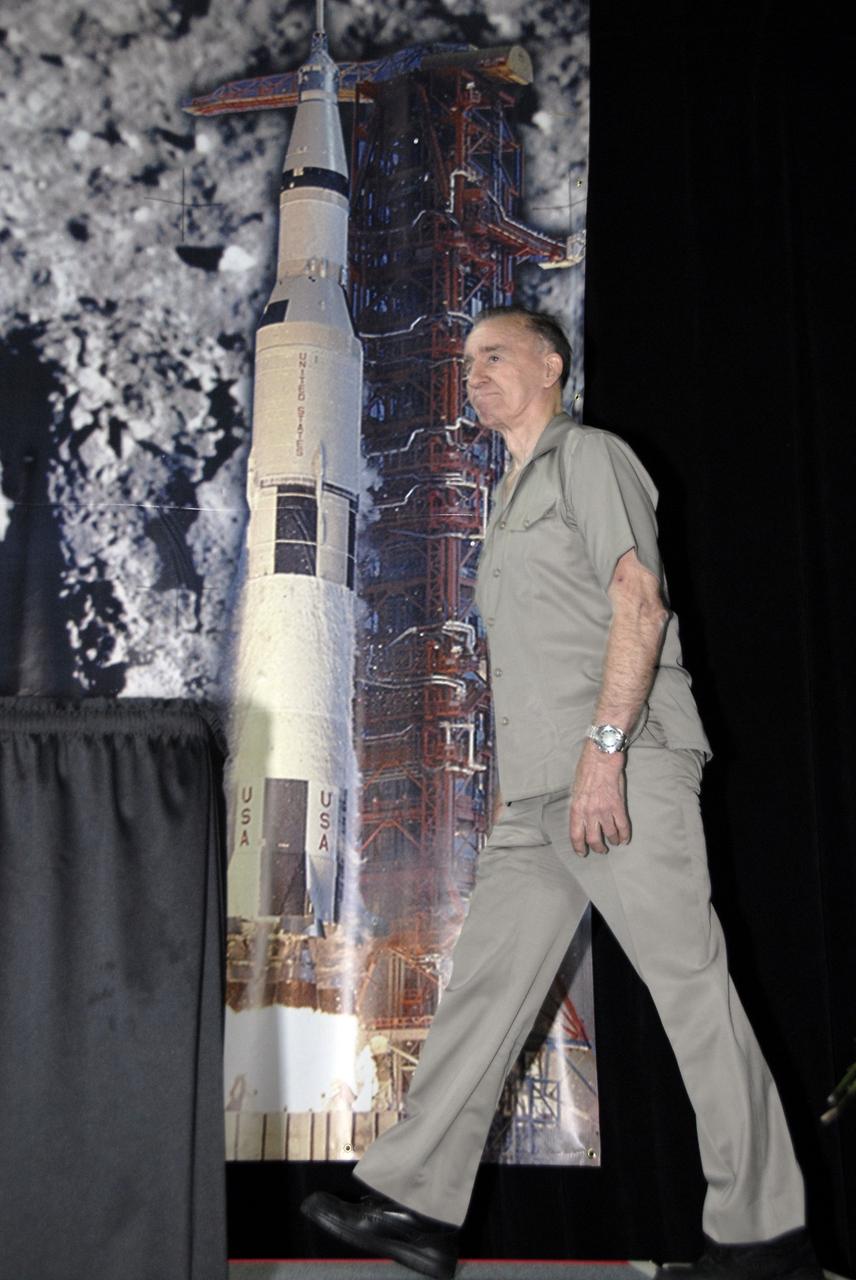
CAPE CANAVERAL, Fla. – At the Apollo/Saturn V Center at NASA's Kennedy Space Center in Florida, Apollo astronaut Walt Cunningham is introduced during NASA's 40th Anniversary of Apollo Celebration of the July 1969 launch and landing on the moon. Cunningham was joined by seven others involved in the program. Cunningham occupied the lunar module pilot seat for the 11-day flight of Apollo 7--the first manned flight test of the third-generation United States spacecraft. Photo credit: NASA/Kim Shiflett
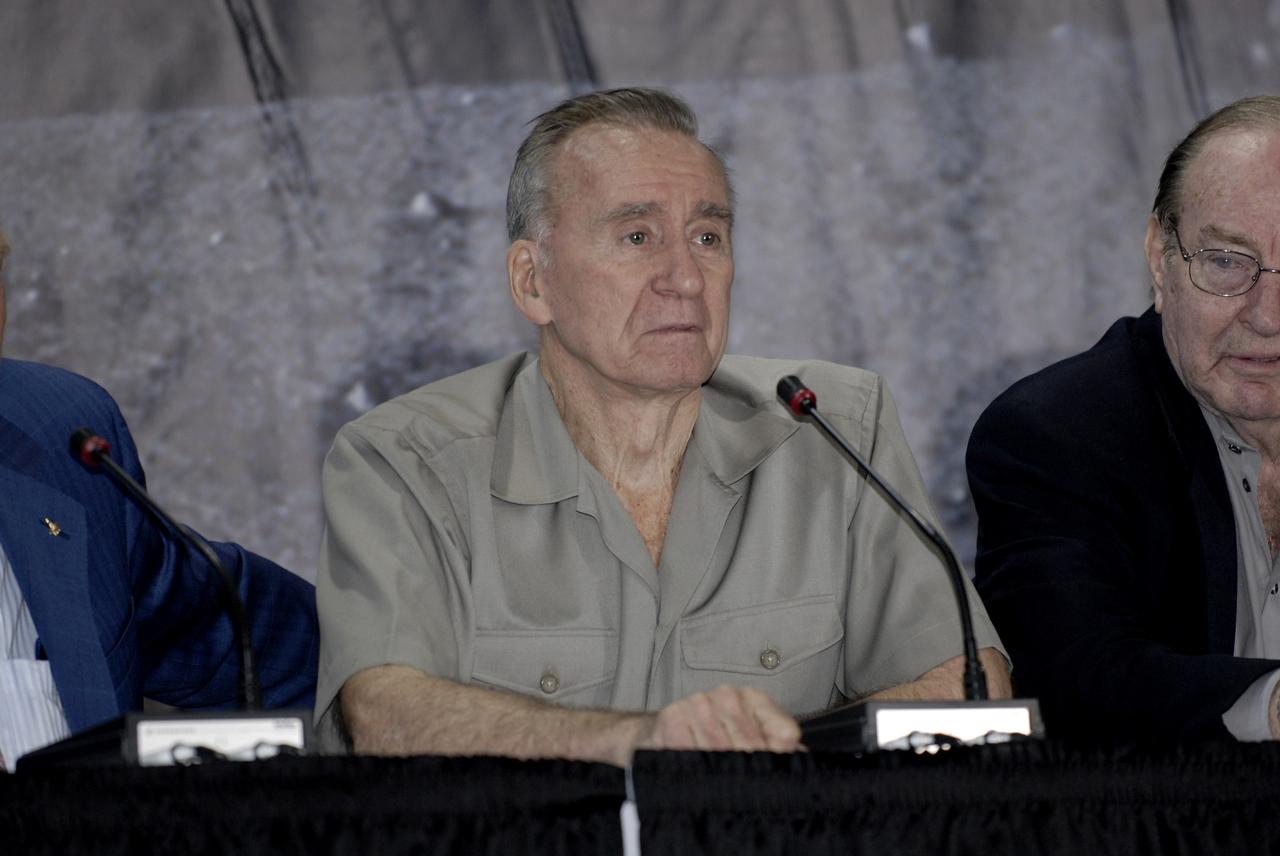
CAPE CANAVERAL, Fla. – At the Apollo/Saturn V Center at NASA's Kennedy Space Center in Florida, Apollo astronaut Walt Cunningham shares his experiences with an eager crowd gathered for NASA's 40th Anniversary of Apollo Celebration of the July 1969 launch and landing on the moon. Cunningham occupied the lunar module pilot seat for the 11-day flight of Apollo 7--the first manned flight test of the third-generation United States spacecraft. Photo credit: NASA/Kim Shiflett
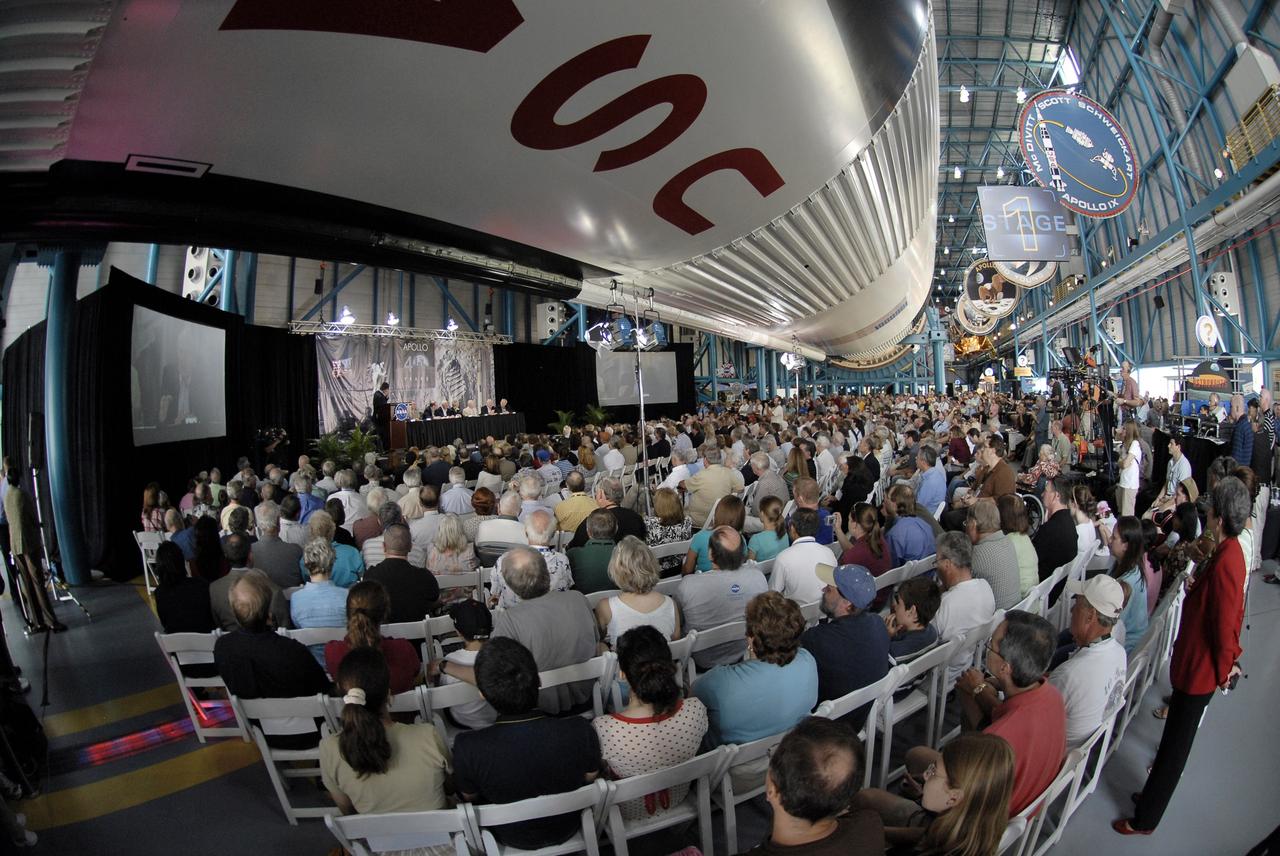
CAPE CANAVERAL, Fla. – The Apollo/Saturn V Center at NASA's Kennedy Space Center in Florida is filled with guests gathered to hear about the Apollo 11 launch and landing in July 1969 from eight Apollo astronauts: Buzz Aldrin, Walt Cunningham, Edgar Mitchell, Al Worden, Charlie Duke, Vance Brand, Gerald Carr and Bruce McCandless . The event is part of NASA's 40th Anniversary of Apollo Celebration. Photo credit: NASA/Kim Shiflett
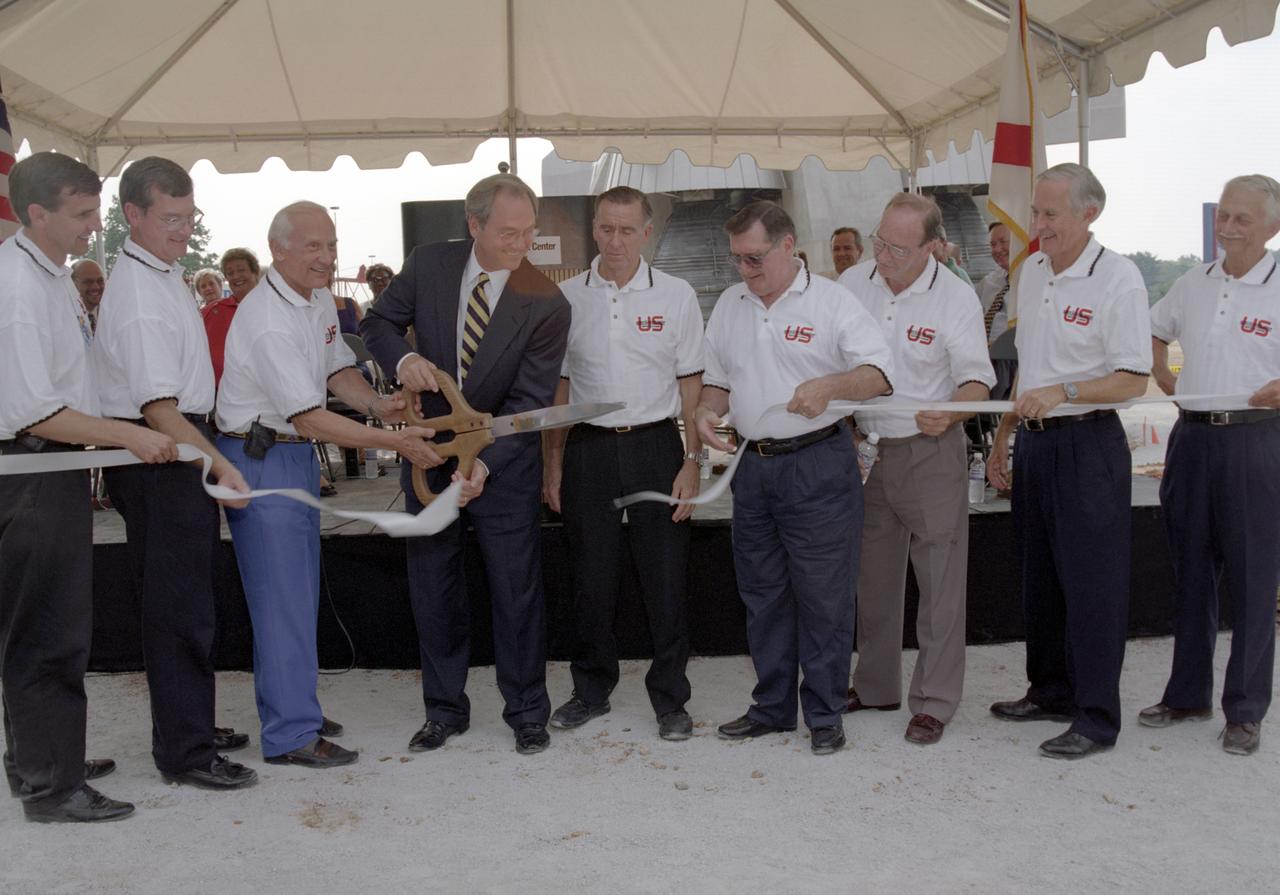
Alabama Governor Don Seigleman cuts the ribbon marking the dedication of the Saturn V rocket replica that was constructed at the U. S. Space and Rocket Center in honor of the 30th arniversary of the lunar landing. Accompanying the Governor are (L/R): Mike Wing, CEO US Space Rocket Center; Mike Gillespie, Madison County Commissioner, Dist. Seven; Buzz Aldrin, Apollo 11 Astronaut; Governor Seigleman; Walt Cunningham, Apollo 7 Astronaut; Dick Gordon, Apollo 12 Astronaut; Ed Mitchell, Apollo 14 Astronaut; Charlie Duke, Apollo 16 Astronaut; and Owen Garriott, Skylab 3 Astronaut.

NASA Kennedy Space Center Director Bob Cabana, far right, serves as moderator for the “Apollo Heroes Panel Discussion” in the IMAX Theater at the Kennedy Space Center Visitor Complex in Florida on July 16, 2019. Panelists are, from left, JoAnn Morgan, the only woman on console in the Launch Control Center for Apollo 11 launch countdown activities; Bob Sieck, Apollo-era launch team member and former space shuttle launch director; and Harrison Schmitt, Apollo 17 astronaut and moonwalker. The panel discussion is one of several events at the visitor complex to honor the 50th anniversary of NASA’s Saturn V/Apollo 11 launch and landing on the Moon.
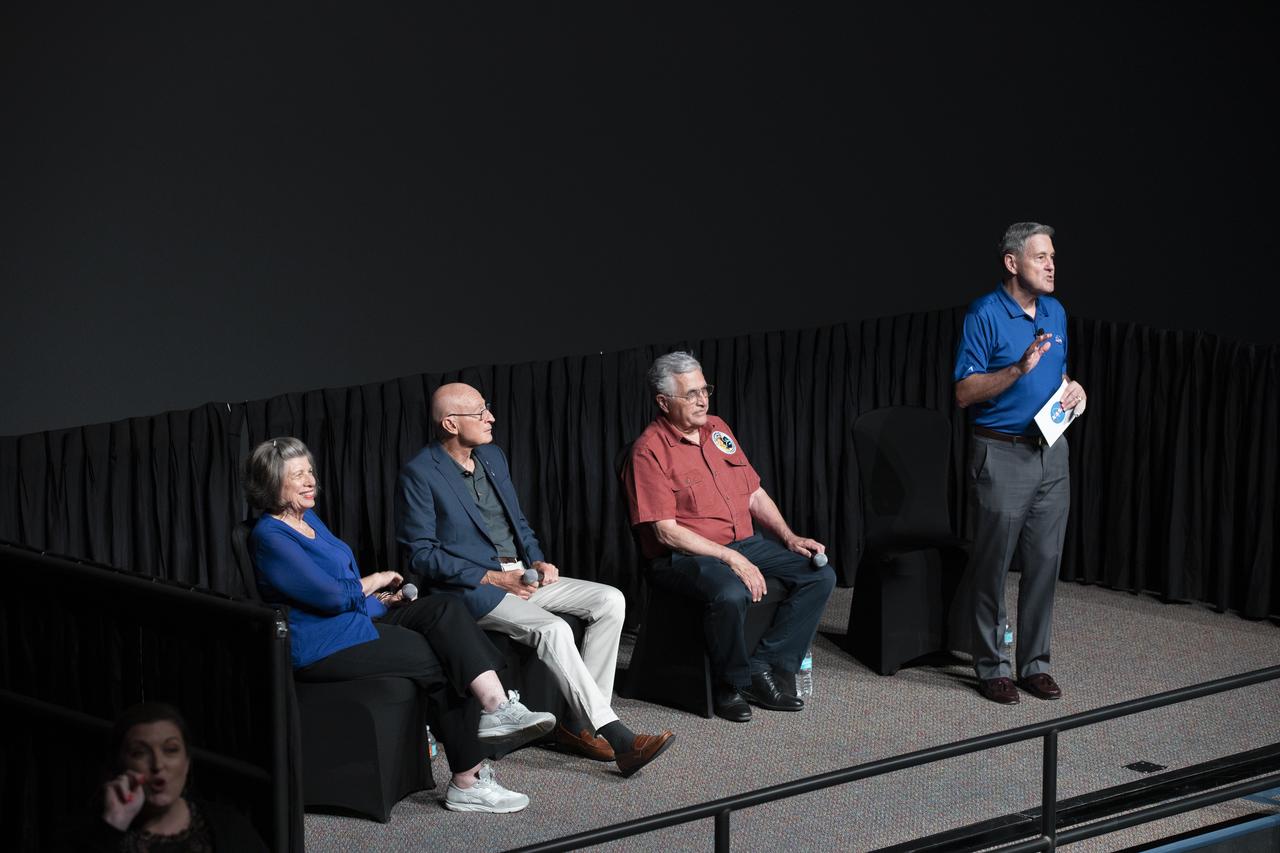
NASA Kennedy Space Center Director Bob Cabana, far right, serves as moderator for the “Apollo Heroes Panel Discussion” in the IMAX Theater at the Kennedy Space Center Visitor Complex in Florida on July 16, 2019. Panelists are, from left, JoAnn Morgan, the only woman on console in the Launch Control Center for Apollo 11 launch countdown activities; Bob Sieck, Apollo-era launch team member and former space shuttle launch director; and Harrison Schmitt, Apollo 17 astronaut and moonwalker. The panel discussion is one of several events at the visitor complex to honor the 50th anniversary of NASA’s Saturn V/Apollo 11 launch and landing on the Moon.
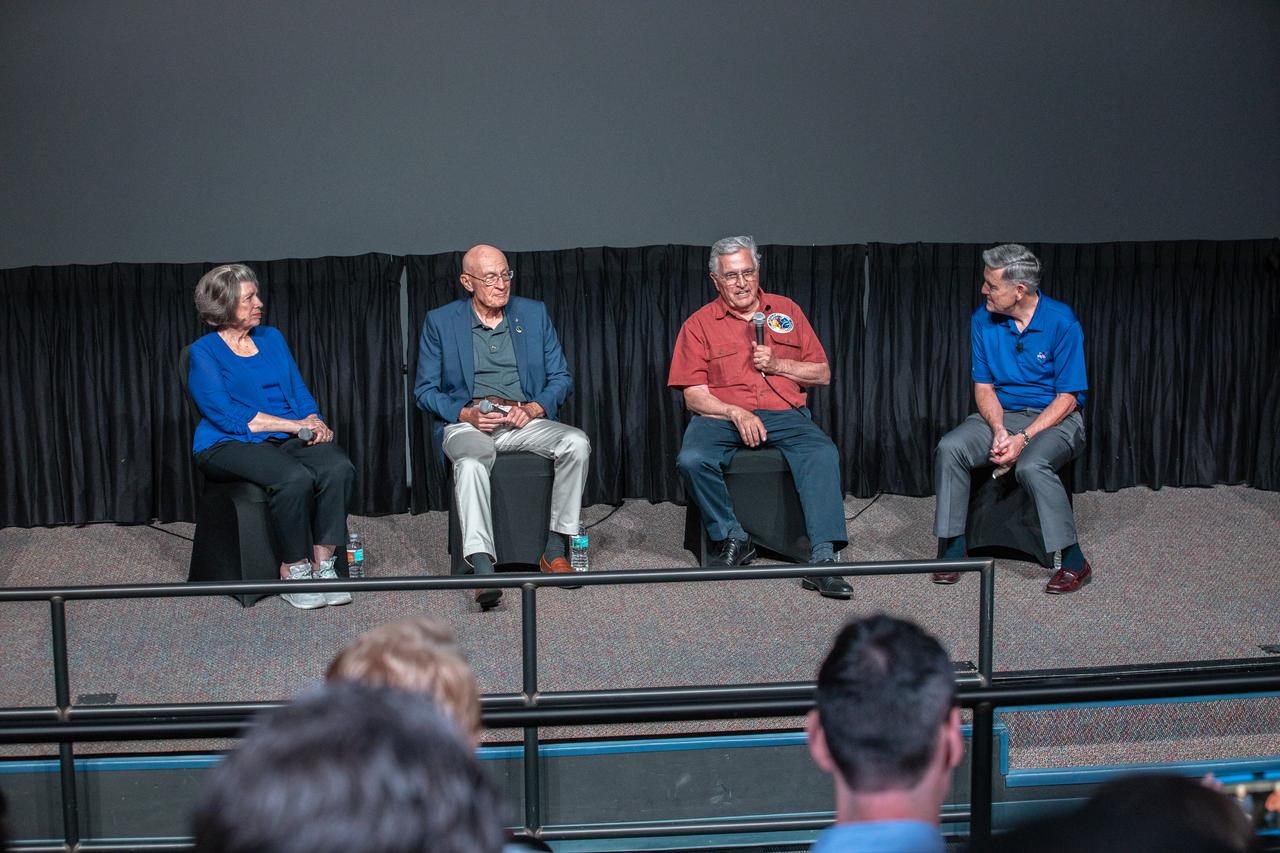
NASA Kennedy Space Center Director Bob Cabana, far right, serves as moderator for the “Apollo Heroes Panel Discussion” in the IMAX Theater at the Kennedy Space Center Visitor Complex in Florida on July 16, 2019. Panelists are, from left, JoAnn Morgan, the only woman on console in the Launch Control Center for Apollo 11 launch countdown activities; Bob Sieck, Apollo-era launch team member and former space shuttle launch director; and Harrison Schmitt, Apollo 17 astronaut and moonwalker. The panel discussion is one of several events at the visitor complex to honor the 50th anniversary of NASA’s Saturn V/Apollo 11 launch and landing on the Moon.
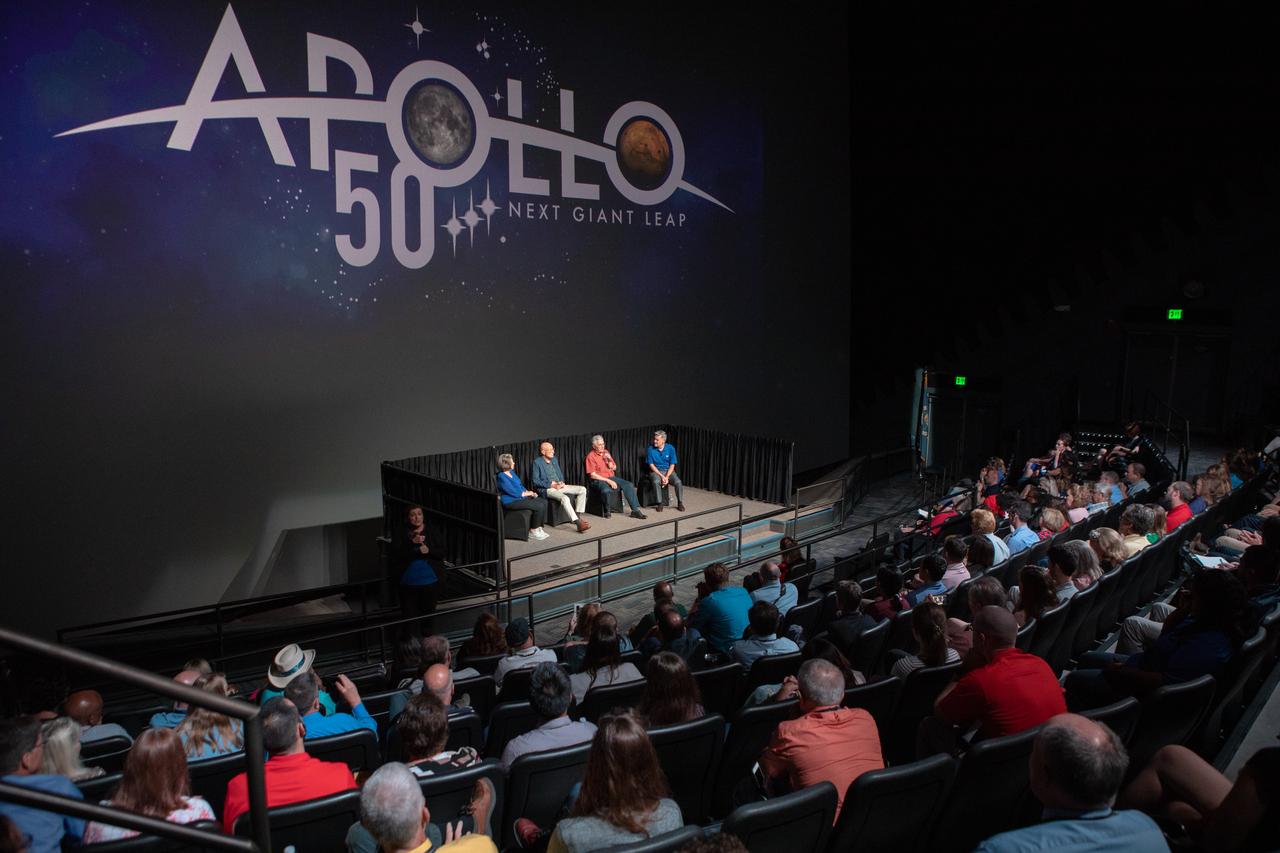
NASA Kennedy Space Center Director Bob Cabana, far right, serves as moderator for the “Apollo Heroes Panel Discussion” in the IMAX Theater at the Kennedy Space Center Visitor Complex in Florida on July 16, 2019. Panelists are, from left, JoAnn Morgan, the only woman on console in the Launch Control Center for Apollo 11 launch countdown activities; Bob Sieck, Apollo-era launch team member and former space shuttle launch director; and Harrison Schmitt, Apollo 17 astronaut and moonwalker. The panel discussion is one of several events at the visitor complex to honor the 50th anniversary of NASA’s Saturn V/Apollo 11 launch and landing on the Moon.

KENNEDY SPACE CENTER, FLA. -- Some of the former Apollo program astronauts pose in front of an Apollo Command and Service Module during a tour the new Apollo/Saturn V Center (ASVC) at KSC prior to the gala grand opening ceremony for the facility that was held Jan. 8, 1997. The astronauts were invited to participate in the event, which also featured NASA Administrator Dan Goldin and KSC Director Jay Honeycutt. The astronauts are (from left): Apollo 14 Lunar Module Pilot Edgar D. Mitchell; Apollo 10 Command Module Pilot and Apollo 16 Commander John W. Young; Apollo 11 Lunar Module Pilot Edwin E. "Buzz" Aldrin, Jr.; Apollo 10 Commander Thomas P. Stafford; Apollo 10 Lunar Module Pilot and Apollo 17 Commander Eugene A. Cernan; and Apollo 9 Lunar Module Pilot Russell L. Schweikart. The ASVC also features several other Apollo program spacecraft components, multimedia presentations and a simulated Apollo/Saturn V liftoff. The facility will be a part of the KSC bus tour that embarks from the KSC Visitor Center
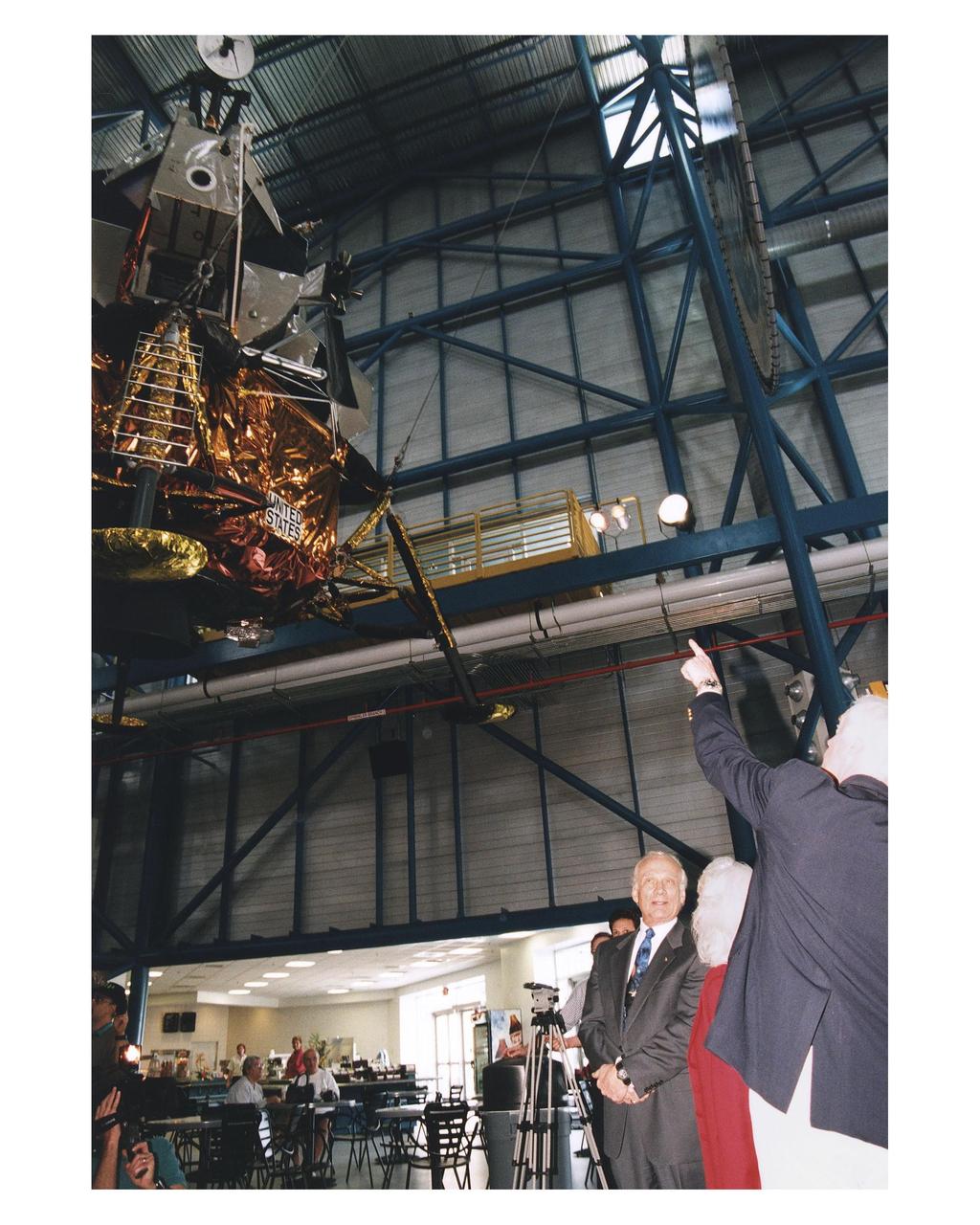
KENNEDY SPACE CENTER, FLA. -- Apollo 11 Lunar Module Pilot Edwin E. "Buzz" Aldrin, Jr. and his wife, Lois, stand near an Apollo Lunar Module suspended from the ceiling of the new Apollo/Saturn V Center (ASVC) at KSC prior to the gala grand opening ceremony for the facility that was held Jan. 8, 1997. Several Apollo astronauts were invited to participate in the event, which also featured NASA Administrator Dan Goldin and KSC Director Jay Honeycutt. The ASVC also features several other Apollo program spacecraft components, multimedia presentations and a simulated Apollo/ Saturn V liftoff. The facility will be a part of the KSC bus tour that embarks from the KSC Visitor Center
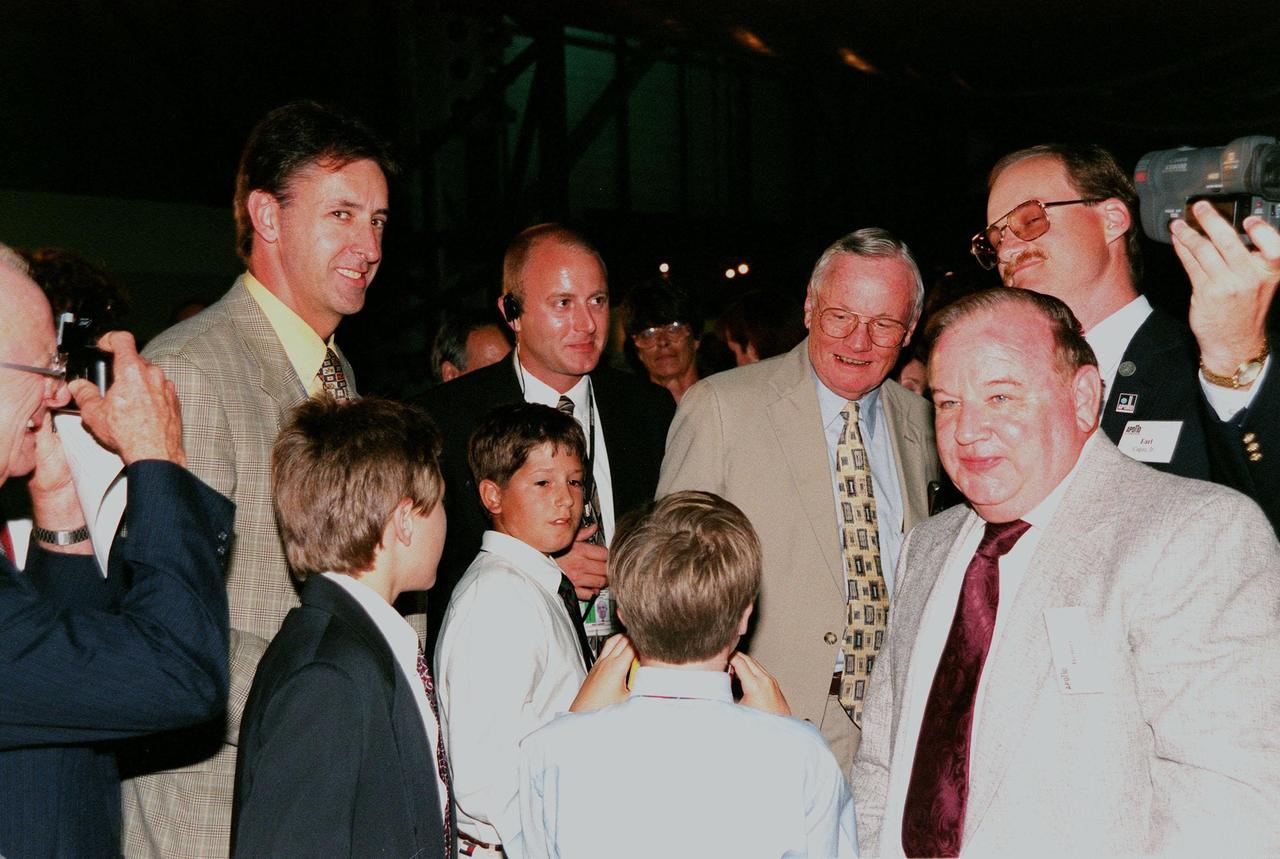
KENNEDY SPACE CENTER, FLA. -- Former Apollo 11 astronaut Neil A. Armstrong is the center of attention at the anniversary banquet honoring the Apollo team, the people who made the entire lunar landing program possible. The banquet was held in the Apollo/Saturn V Center, part of the KSC Visitor Complex. This is the 30th anniversary of the Apollo 11 launch and moon landing, July 16 and July 20, 1969. Neil Armstrong was the first man to set foot on the moon. He appeared at the banquet with other former astronauts Edwin "Buzz" Aldrin, Gene Cernan, Walt Cunningham and others
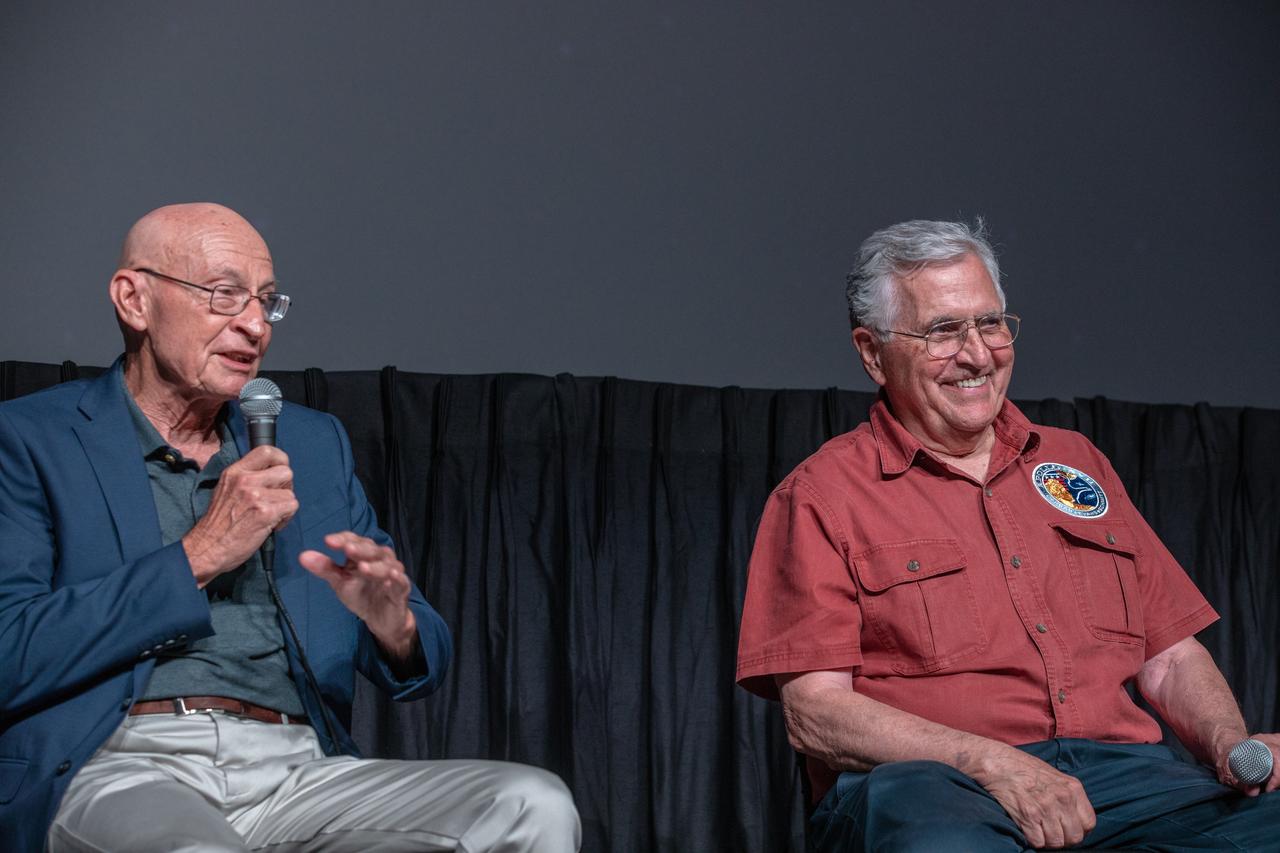
Bob Sieck, left, Apollo-era launch team member and former space shuttle launch director, and Harrison Schmitt, Apollo 17 astronaut and moonwalker, answer questions during the “Apollo Heroes Panel Discussion” in the IMAX Theater at the Kennedy Space Center Visitor Complex in Florida on July 16, 2019. The panel discussion is one of several events at the visitor complex to honor the 50th anniversary of NASA’s Saturn V/Apollo 11 launch and landing on the Moon.
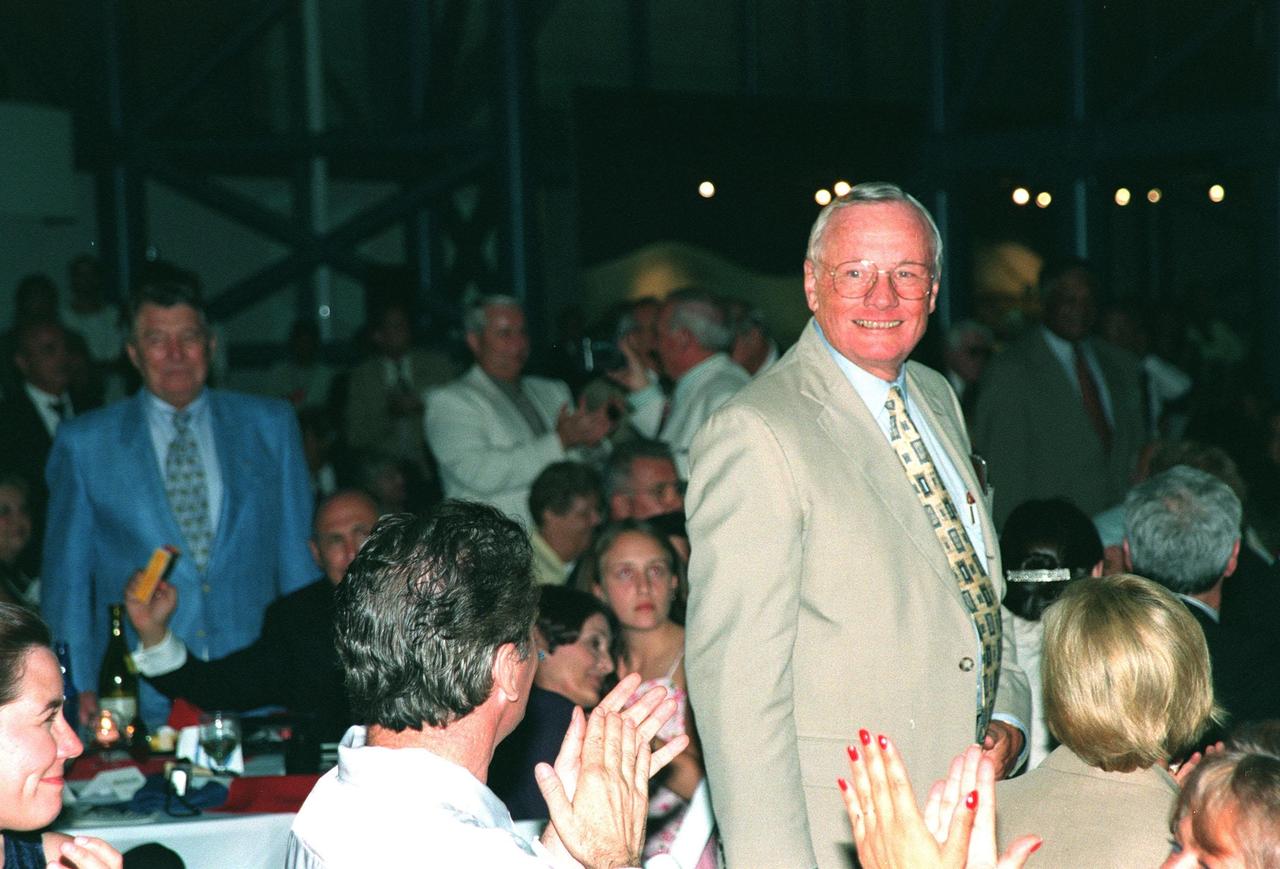
KENNEDY SPACE CENTER, FLA. -- Former Apollo 11 astronaut Neil A. Armstrong stands to a round of applause after being introduced at the anniversary banquet honoring the Apollo team, the people who made the entire lunar landing program possible. The banquet was held in the Apollo/Saturn V Center, part of the KSC Visitor Complex. This is the 30th anniversary of the Apollo 11 launch and moon landing, July 16 and July 20, 1969. Neil Armstrong was the first man to set foot on the moon. He appeared at the banquet with other former astronauts Edwin "Buzz" Aldrin, Gene Cernan, Walt Cunningham and others
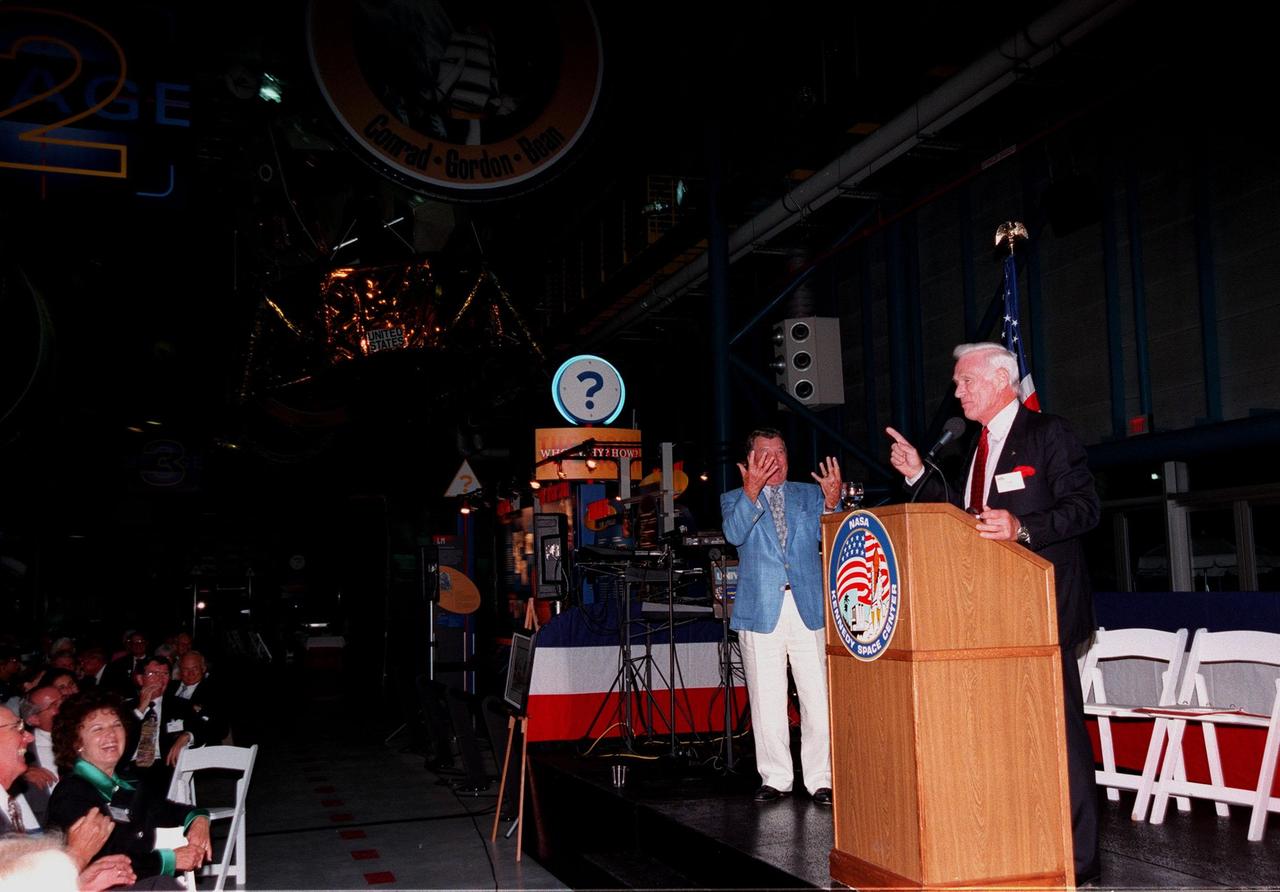
KENNEDY SPACE CENTER, FLA. -- During an anniversary banquet honoring the Apollo program team, the people who made the entire lunar landing program possible, former Apollo astronaut Gene Cernan relates a humorous comment while Wally Schirra (background) gestures behind him. Cernan, who flew on Apollo 10 and 17, was the last man to walk on the moon; Schirra flew on Apollo 7. The banquet was held in the Apollo/Saturn V Center, part of the KSC Visitor Complex. This is the 30th anniversary of the Apollo 11 launch and moon landing, July 16 and July 20, 1969. Other guests at the banquet were former Apollo astronauts are Neil A. Armstrong and Edwin "Buzz" Aldrin who flew on Apollo 11, the launch of the first moon landing, and Walt Cunningham, who also flew on Apollo 7

KENNEDY SPACE CENTER, FLA. -- In this closeup viewed from above, former Apollo astronauts (seated, left to right) Neil A. Armstrong and Edwin "Buzz" Aldrin who flew on Apollo 11, the launch to the moon; Gene Cernan, who flew on Apollo 10 and 17; and Walt Cunningham, who flew on Apollo 7, answer questions from the media during a press conference in the Apollo/Saturn V Center. At left is Lisa Malone, chief of KSC's Media Services branch, who monitored the session. In the background are the original computer consoles used in the firing room during the Apollo program. They are now part of the reenactment of the Apollo launches in the exhibit at the center. The four astronauts were at KSC for the 30th anniversary of the Apollo 11 launch and moon landing, July 16 and July 20, 1969
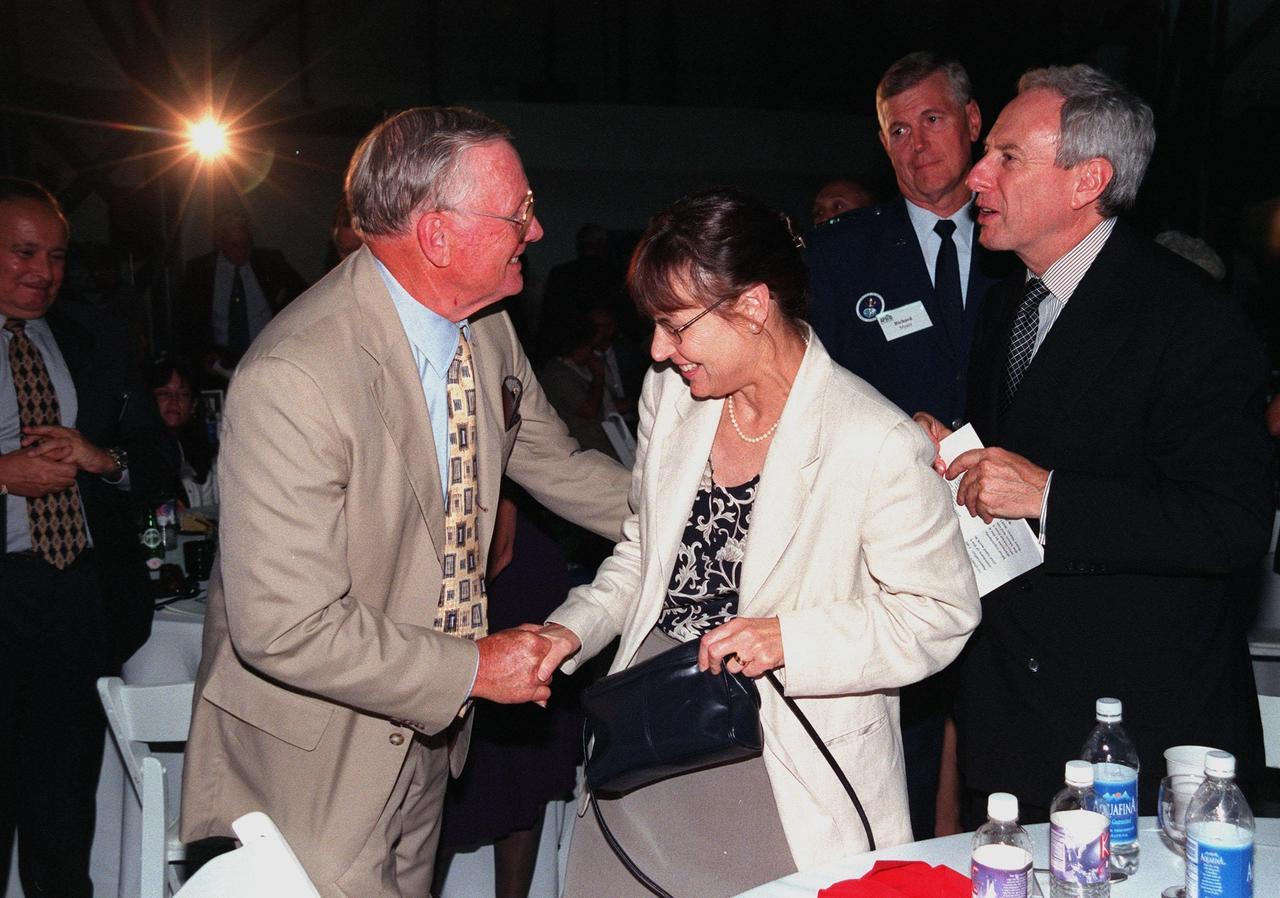
KENNEDY SPACE CENTER, FLA. -- During an anniversary banquet honoring the Apollo team, the people who made the entire lunar landing program possible, former Apollo astronaut Neil A. Armstrong (left) shakes the hand of Judy Goldin (center), wife of NASA Administrator Daniel S. Goldin (right). The banquet was held in the Apollo/Saturn V Center, part of the KSC Visitor Complex. This is the 30th anniversary of the Apollo 11 launch and moon landing, July 16 and July 20, 1969. Among the guests at the banquet were former Apollo astronauts are Neil A. Armstrong and Edwin "Buzz" Aldrin who flew on Apollo 11, the launch of the first moon landing; Gene Cernan, who flew on Apollo 10 and 17 and was the last man to walk on the moon; and Walt Cunningham, who flew on Apollo 7
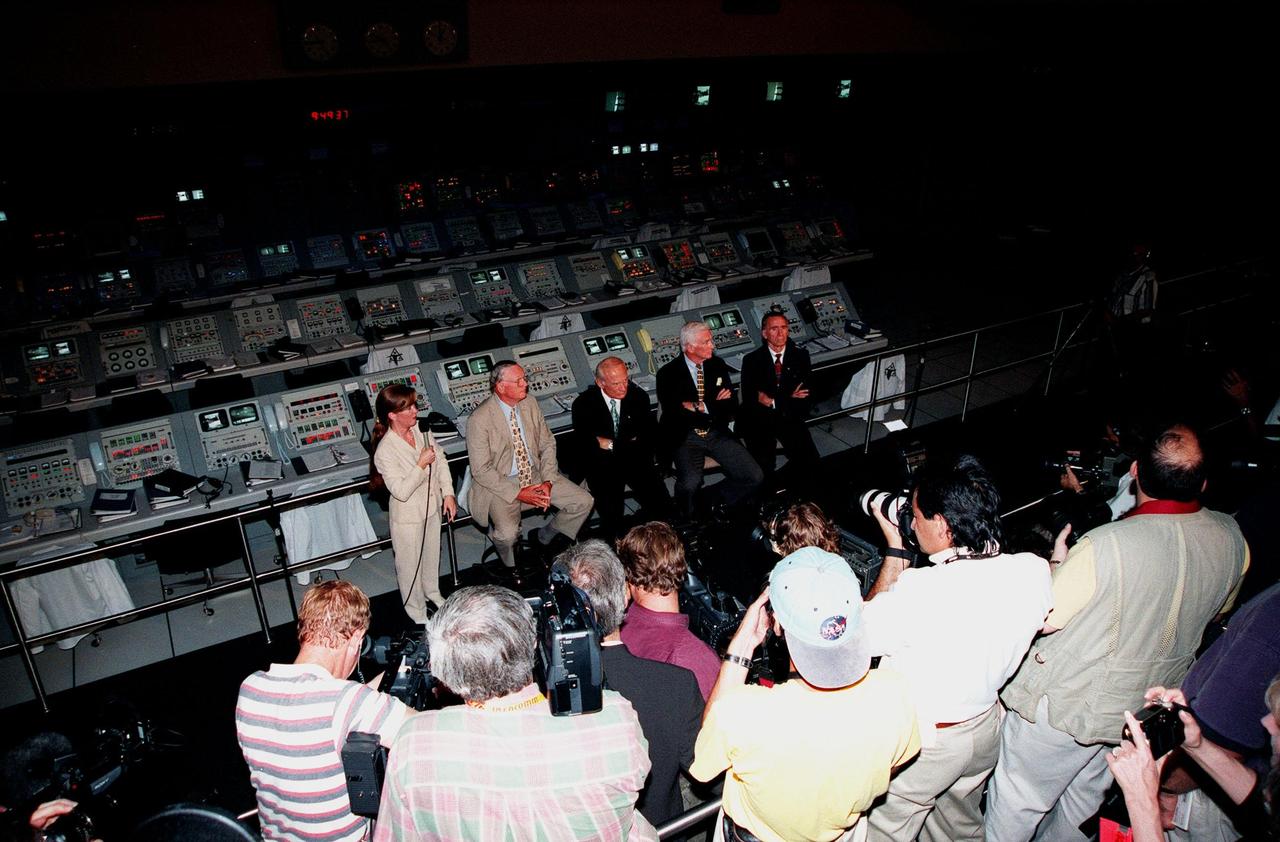
KENNEDY SPACE CENTER, FLA. -- Viewed from above, former Apollo astronauts (seated, left to right) Neil A. Armstrong and Edwin "Buzz" Aldrin who flew on Apollo 11, the launch to the moon; Gene Cernan, who flew on Apollo 10 and 17; and Walt Cunningham, who flew on Apollo 7, answer questions from the media during a press conference in the Apollo/Saturn V Center. At left is Lisa Malone, chief of KSC's Media Services branch, who monitored the session. In the background are the original computer consoles used in the firing room during the Apollo program. They are now part of the reenactment of the Apollo launches in the exhibit at the center. The four astronauts were at KSC for the 30th anniversary of the Apollo 11 launch and moon landing, July 16 and July 20, 1969
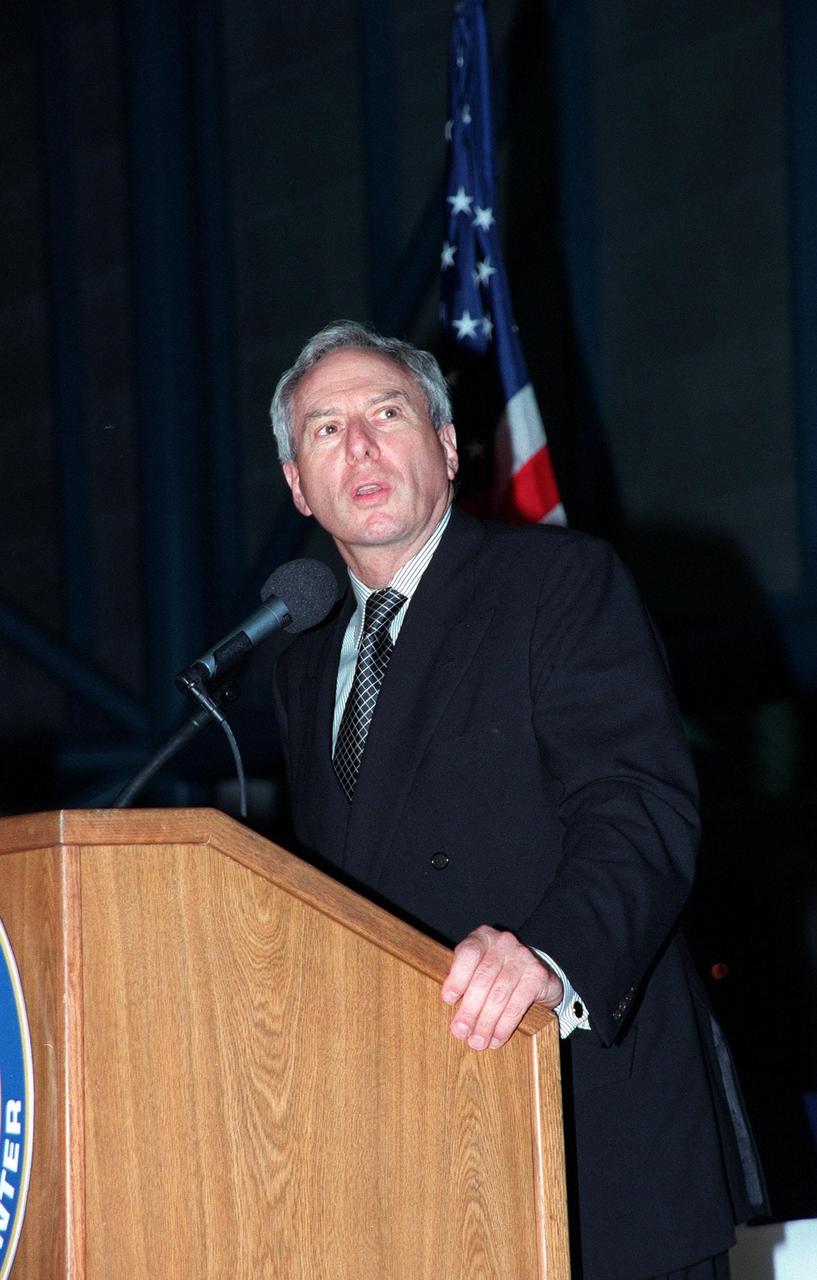
KENNEDY SPACE CENTER, FLA. -- NASA Administrator Daniel S. Goldin addresses the audience at the Apollo 11 anniversary banquet honoring the Apollo team, the people who made the entire lunar landing program possible. The banquet was held in the Apollo/Saturn V Center, part of the KSC Visitor Complex. This is the 30th anniversary of the Apollo 11 launch and moon landing, July 16 and July 20, 1969. Among the guests at the banquet were former Apollo astronauts are Neil A. Armstrong and Edwin "Buzz" Aldrin who flew on Apollo 11, the launch of the first moon landing; Gene Cernan, who flew on Apollo 10 and 17 and was the last man to walk on the moon; and Walt Cunningham, who flew on Apollo 7
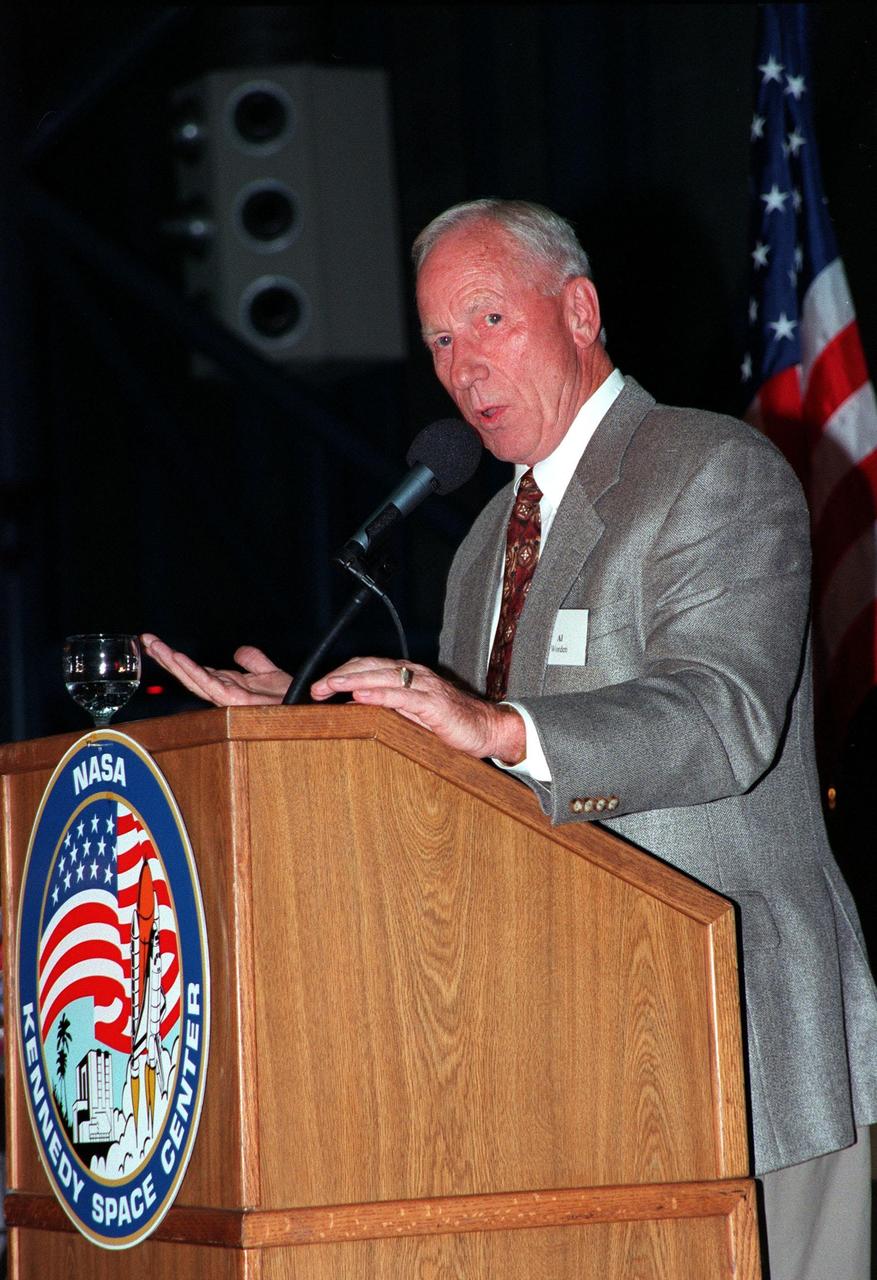
KENNEDY SPACE CENTER, FLA. -- Former Apollo 15 astronaut Alfred M. Worden relates his experiences in the Apollo Program during a banquet honoring the people who made it all possible. Held on the anniversary of the Apollo 11 mission, which was launched July 16, 1969, and landed on the moon July 20, 1969, the banquet was held in the Apollo/Saturn V Center. Worden served as command module pilot on the Apollo 15 mission. Other guests at the banquet were astronauts Neil Armstrong, Wally Schirra, Edwin "Buzz" Aldrin and Walt Cunningham. Armstrong was the first man to walk on the moon; Gene Cernan was the last
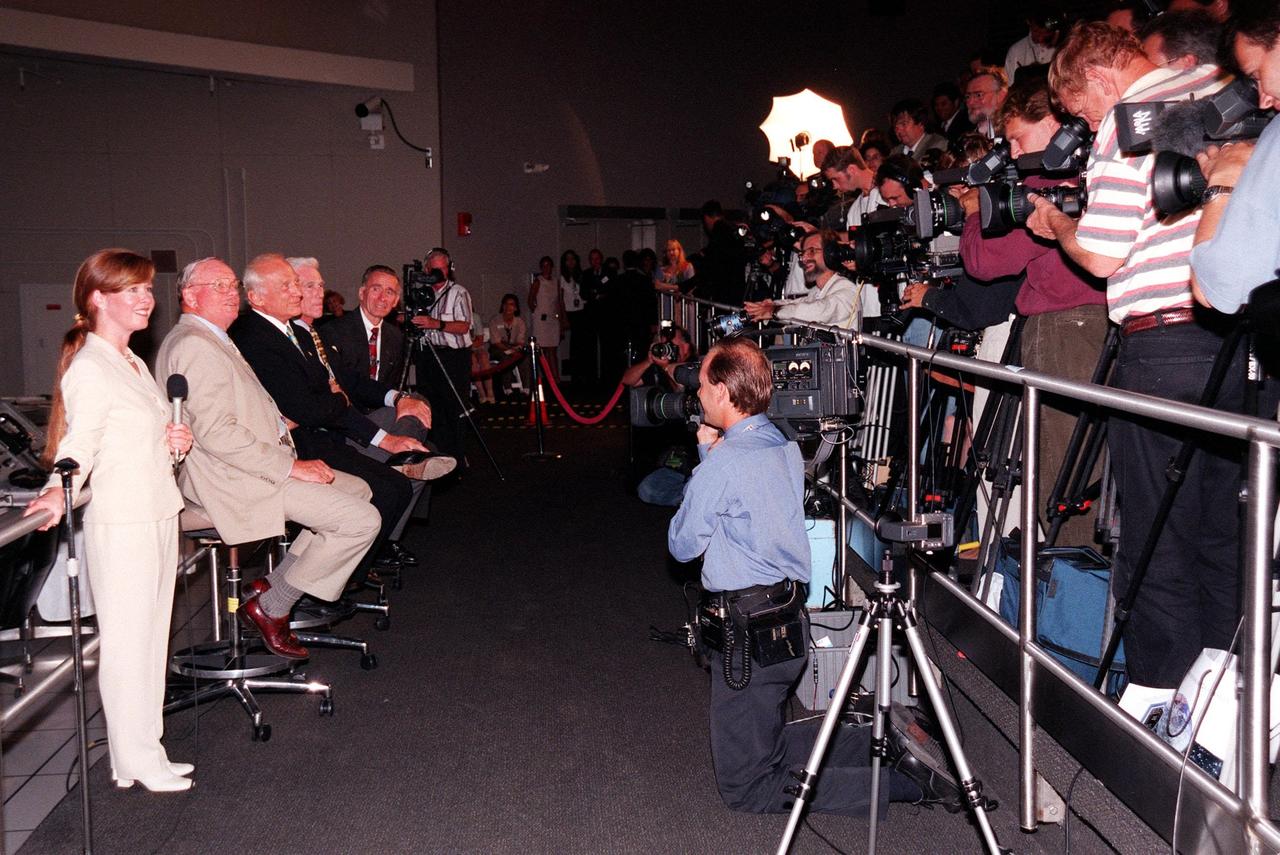
KENNEDY SPACE CENTER, FLA. -- In the Apollo/Saturn V Center, Lisa Malone (left), chief of KSC's Media Services branch, waits for photographers to take photos of former Apollo astronauts (left to right) Neil A. Armstrong and Edwin "Buzz" Aldrin who flew on Apollo 11, the launch to the moon; Gene Cernan, who flew on Apollo 10 and 17; and Walt Cunningham, who flew on Apollo 7. The four met with the media prior to an anniversary banquet highlighting the contributions of aerospace employees who made the Apollo program possible. The banquet celebrated the 30th anniversary of the launch and moon landing, July 16 and July 20, 1969. Neil Armstrong was the first man to set foot on the moon
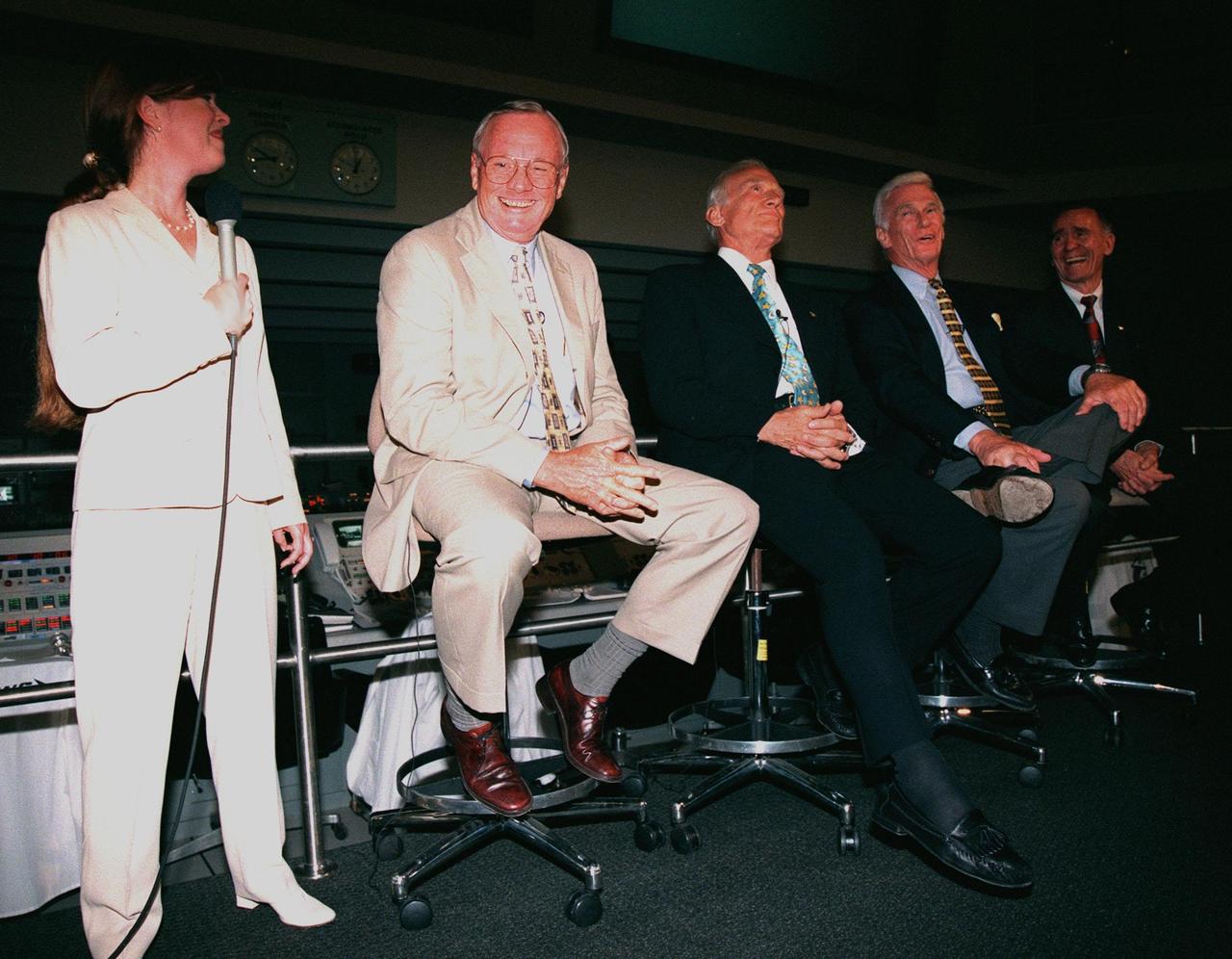
KENNEDY SPACE CENTER, FLA. -- In the Apollo/Saturn V Center, Lisa Malone (left), chief of KSC's Media Services branch, laughs at a humorous comment along with former Apollo astronauts Neil A. Armstrong and Edwin "Buzz" Aldrin who flew on Apollo 11, the launch to the moon; Gene Cernan, who flew on Apollo 10 and 17; and Walt Cunningham, who flew on Apollo 7. The four met with the media before an anniversary banquet celebrating the accomplishments of the Apollo program team. This is the 30th anniversary of the launch and moon landing, July 16 and July 20, 1969. Neil Armstrong was the first man to set foot on the moon
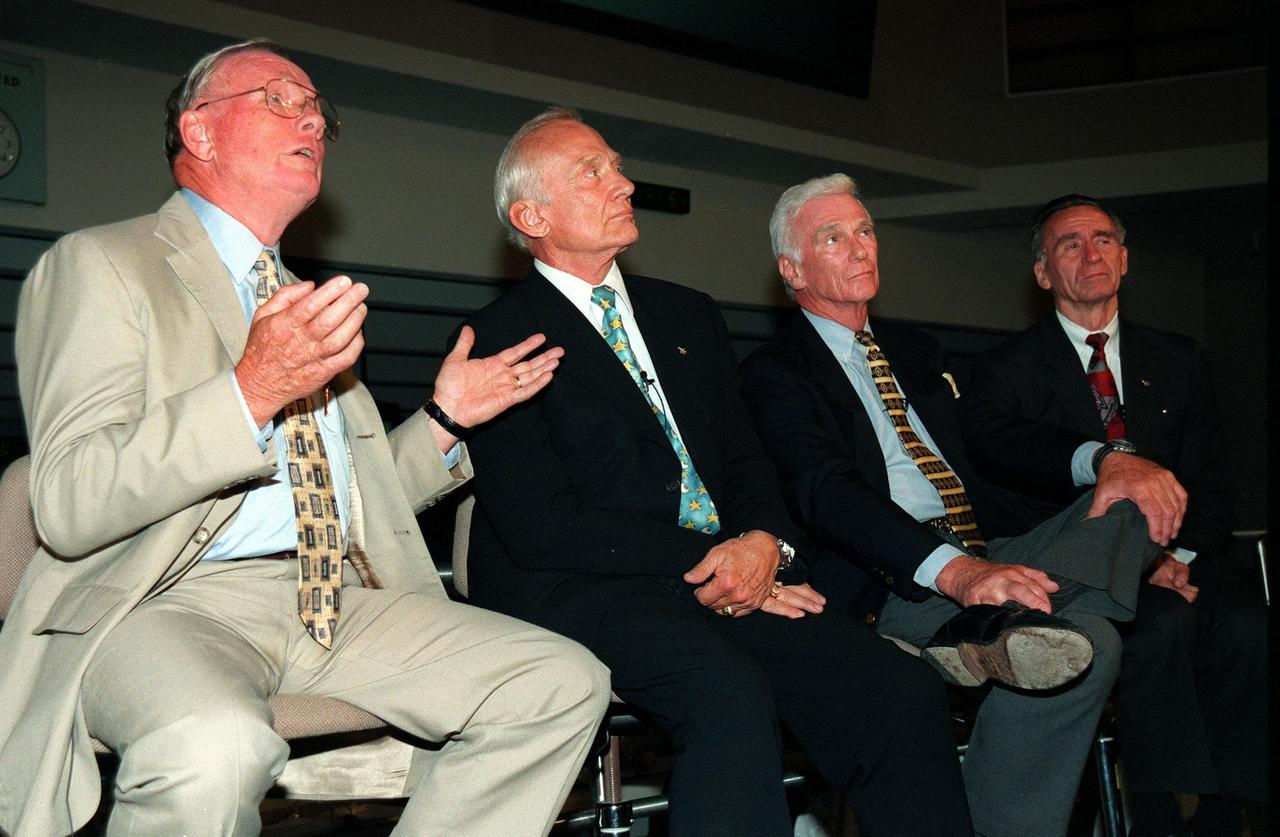
KENNEDY SPACE CENTER, FLA. -- Former Apollo astronauts meet with the media at the Apollo/Saturn V Center prior to an anniversary banquet highlighting the contributions of aerospace employees who made the Apollo program possible. From left are Neil A. Armstrong and Edwin "Buzz" Aldrin who flew on Apollo 11, the launch to the moon; Gene Cernan, who flew on Apollo 10 and 17; and Walt Cunningham, who flew on Apollo 7. This is the 30th anniversary of the launch and moon landing, July 16 and July 20, 1969. Neil Armstrong was the first man to set foot on the moon
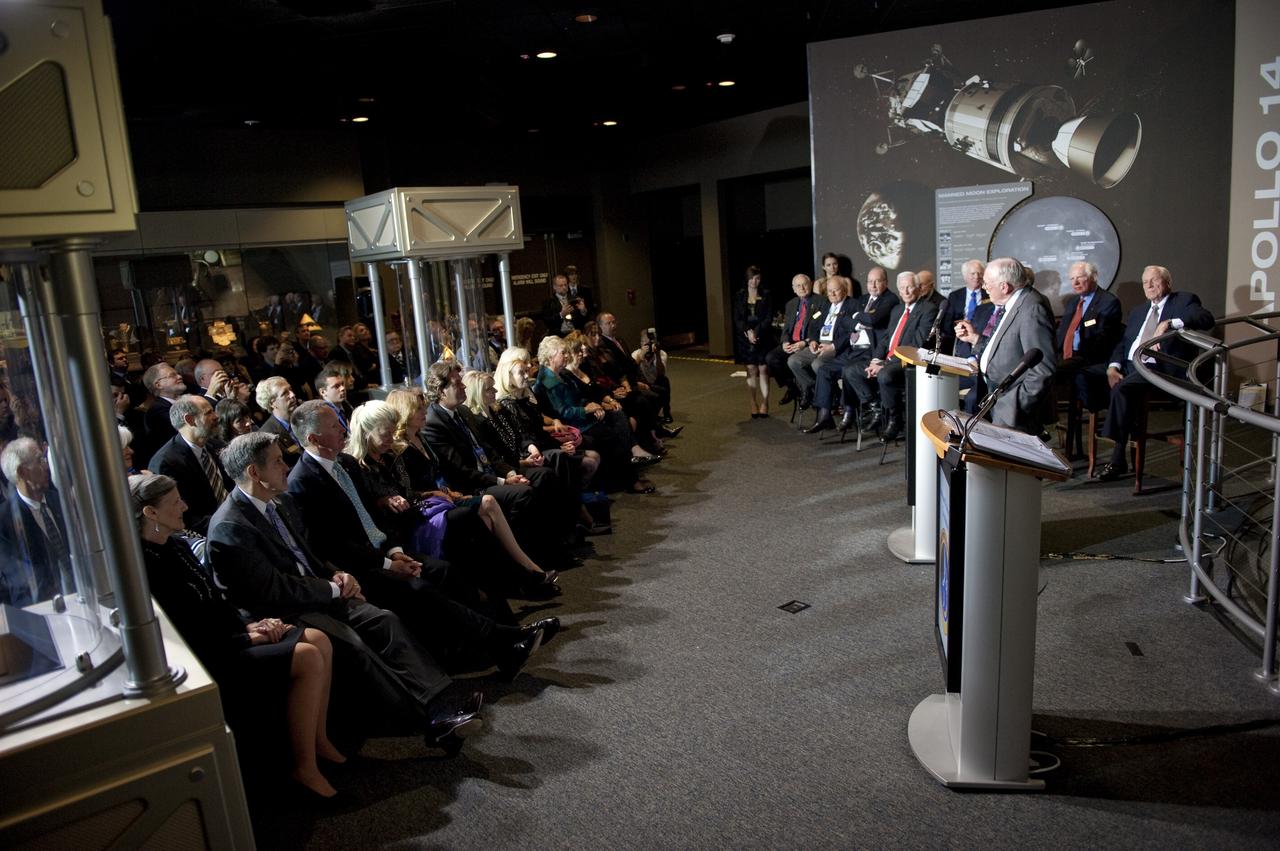
CAPE CANAVERAL, Fla. -- Apollo 11 Commander Neil Armstrong talks to attendees of the Apollo 14 Anniversary Soirée at the Kennedy Space Center Visitor Complex's Saturn V Center. The celebration was hosted by the Astronaut Scholarship Foundation. Apollo 14 landed on the lunar surface 40 years ago on Feb. 5, 1971. In 1969, Armstrong gained the distinction of being the first human to step foot on the surface of the moon. Photo credit: NASA/Kim Shiflett
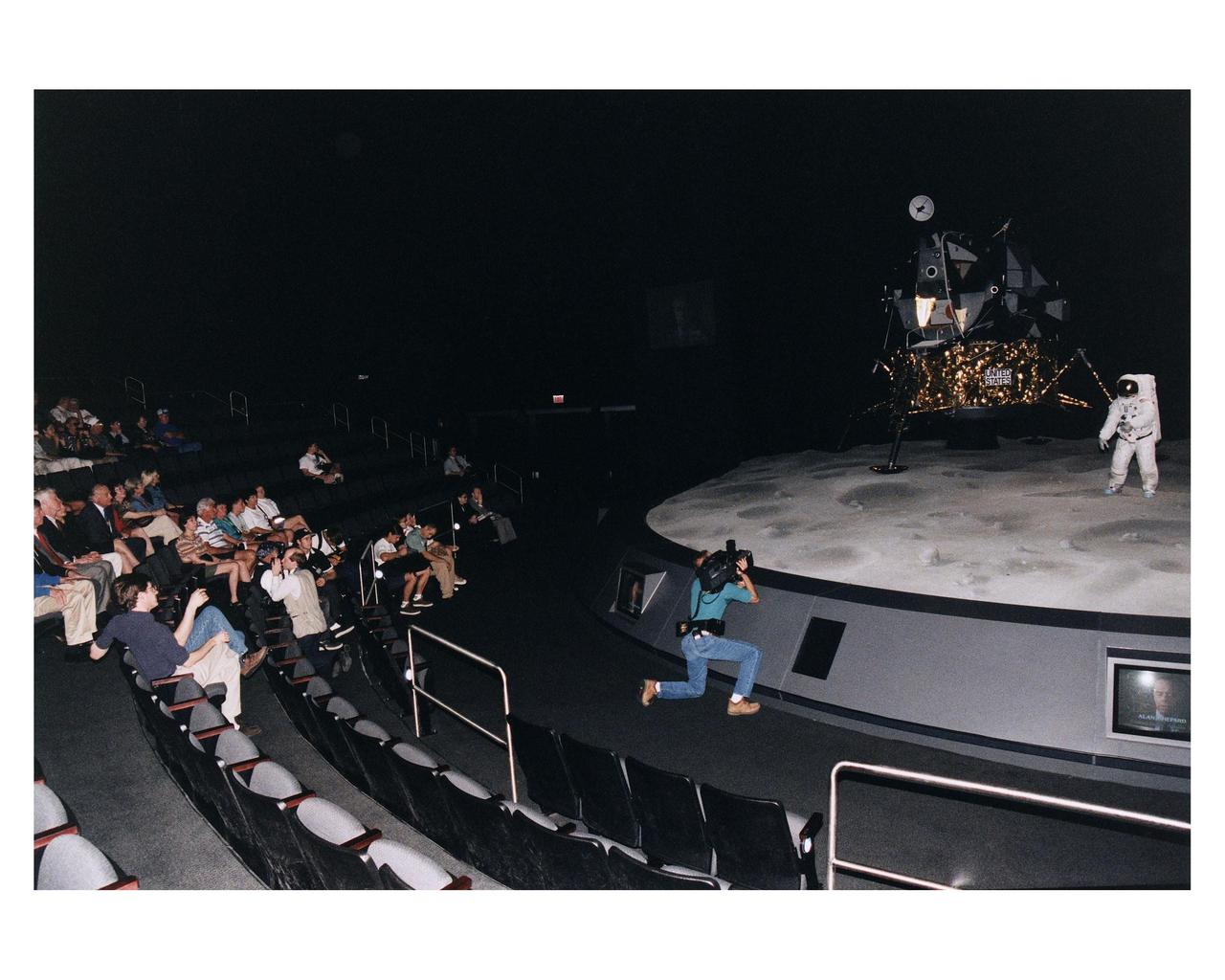
KENNEDY SPACE CENTER, FLA. -- Some of the former Apollo program astronauts observe a Lunar Module and Moon mockup during a tour the new Apollo/Saturn V Center (ASVC) at KSC prior to the gala grand opening ceremony for the facility that was held Jan. 8, 1997. The astronauts were invited to participate in the event, which also featured NASA Administrator Dan Goldin and KSC Director Jay Honeycutt. Some of the visiting astonauts were (from left): Apollo 10 Lunar Module Pilot and Apollo 17 Commander Eugene A. Cernan; Apollo 9 Lunar Module Pilot Russell L. Schweikart; Apollo 10 Command Module Pilot and Apollo 16 Commander John W. Young; Apollo 10 Commander Thomas P. Stafford; and Apollo 11 Lunar Module Pilot Edwin E. "Buzz" Aldrin, Jr. The ASVC also features several other Apollo program spacecraft components, multimedia presentations and a simulated Apollo/Saturn V liftoff. The facility will be a part of the KSC bus tour that embarks from the KSC Visitor Center
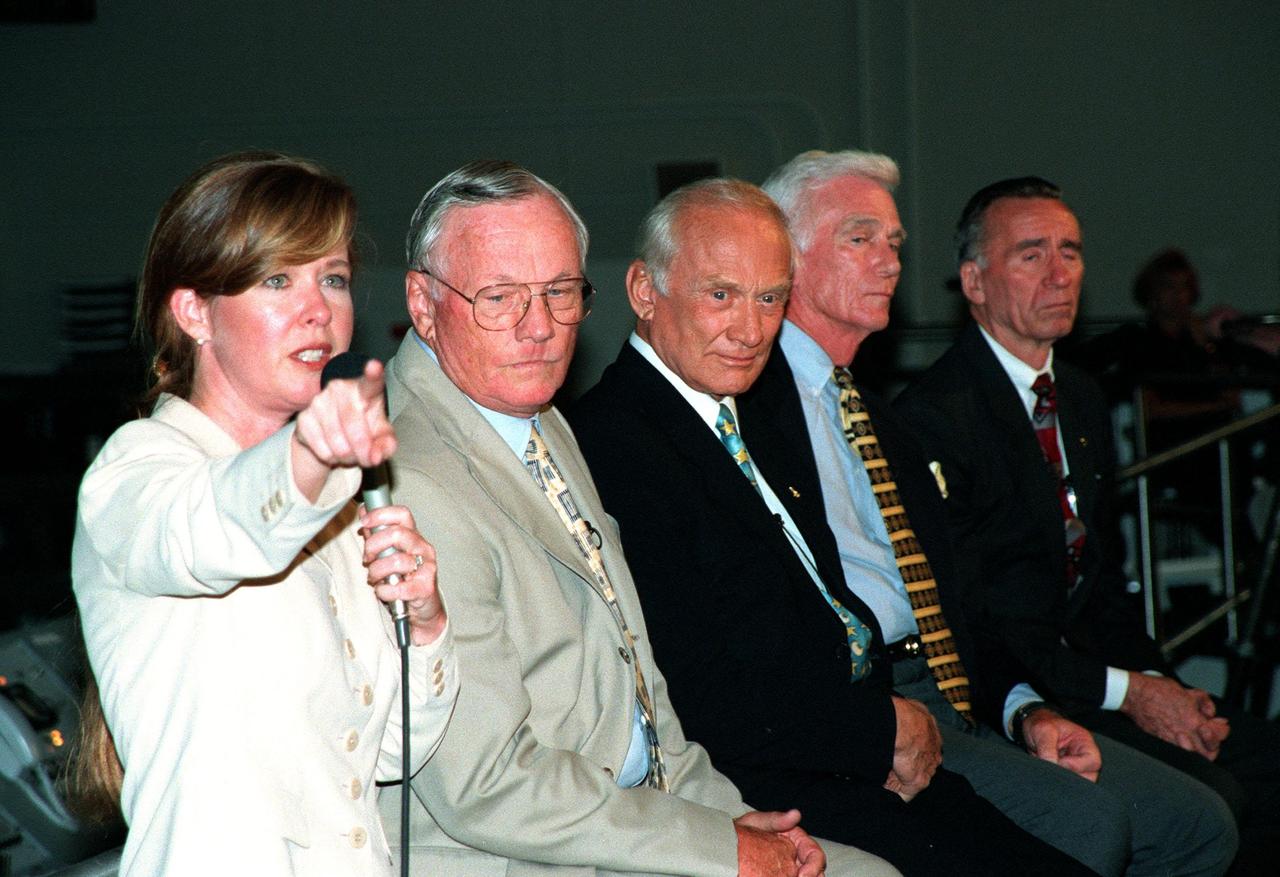
KENNEDY SPACE CENTER, FLA. -- In the Apollo/Saturn V Center, Lisa Malone (left), chief of KSC's Media Services branch, identifies a reporter to pose a question to one of the former Apollo astronauts seated next to her. From left, they are Neil A. Armstrong and Edwin "Buzz" Aldrin who flew on Apollo 11, the launch to the moon; Gene Cernan, who flew on Apollo 10 and 17; and Walt Cunningham, who flew on Apollo 7. This is the 30th anniversary of the launch and moon landing, July 16 and July 20, 1969. Neil Armstrong was the first man to set foot on the moon
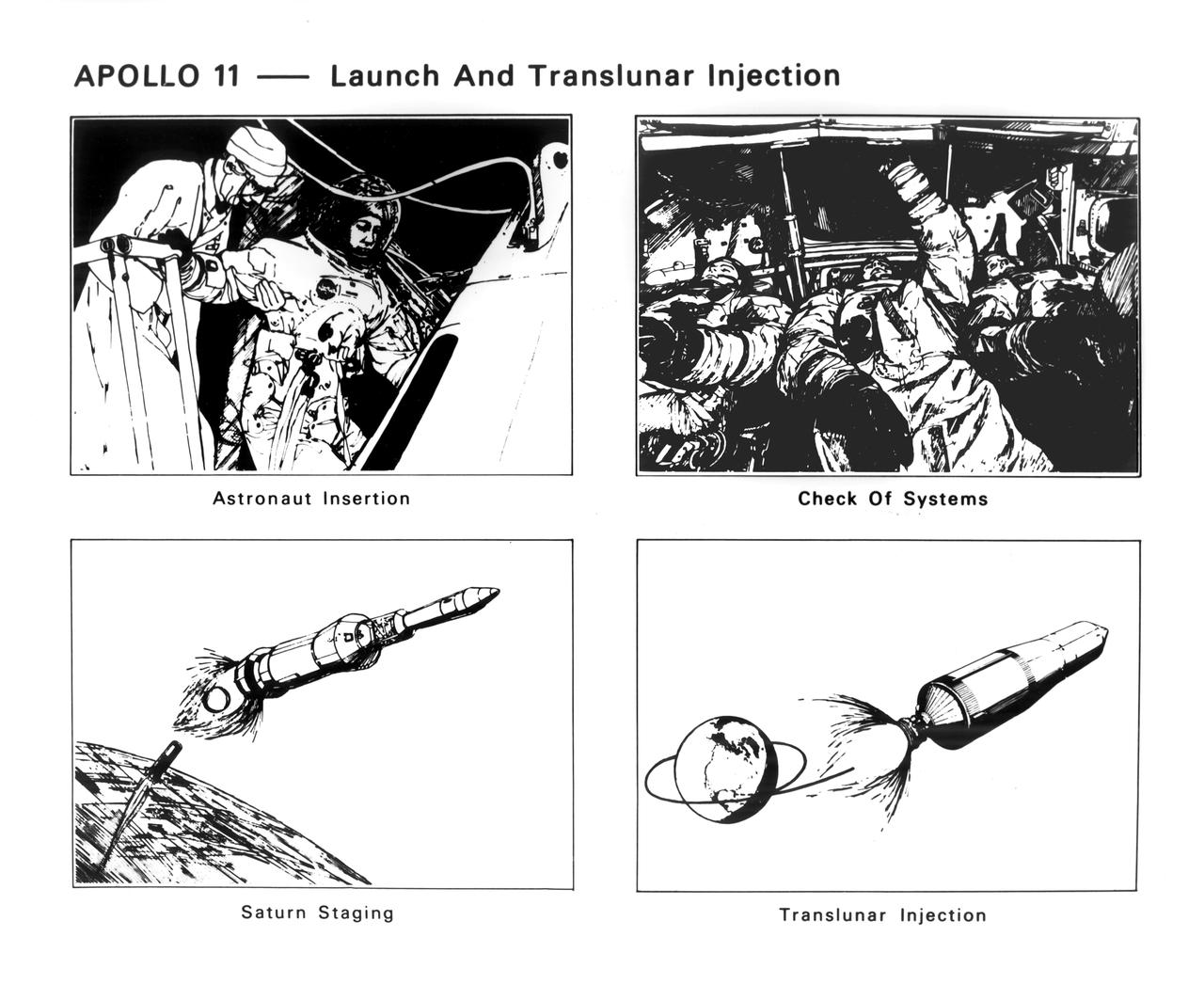
The Apollo 11 mission launched from the Kennedy Space Center (KSC) in Florida via the Marshall Space Flight Center (MSFC) developed Saturn V launch vehicle on July 16, 1969 and safely returned to Earth on July 24, 1969. Aboard the space craft were astronauts Neil A. Armstrong, commander; Michael Collins, Command Module (CM) pilot; and Edwin E. (Buzz) Aldrin Jr., Lunar Module (LM) pilot. With the success of Apollo 11, the national objective to land men on the Moon and return them safely to Earth had been accomplished. These sketches illustrate four of the early steps in the first manned lunar landing mission. The series begins with insertion of astronauts Neil Armstrong, Edwin Aldrin, and Michael Collins in the Apollo Command Module (CM). They checked out spacecraft systems and prepared for the launch. After two revolutions in Earth orbit, the Saturn V third stage reignited to place them into the translunar trajectory.
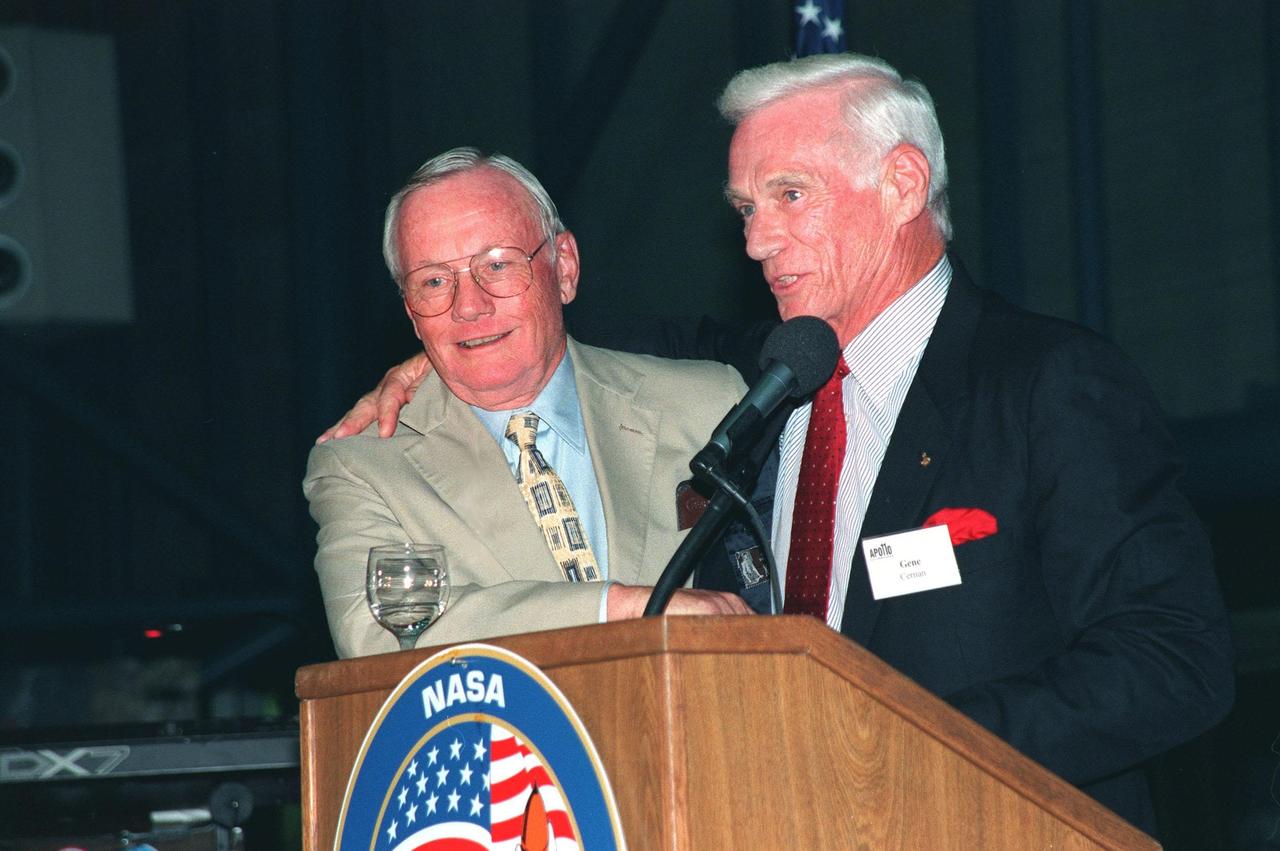
KENNEDY SPACE CENTER, FLA. -- During an anniversary banquet honoring the Apollo program team, the people who made the entire lunar landing program possible, former Apollo astronauts Neil Armstrong (left) and Gene Cernan talk about their experiences. The banquet was held in the Apollo/Saturn V Center, part of the KSC Visitor Complex. This is the 30th anniversary of the Apollo 11 launch and moon landing, July 16 and July 20, 1969. Other guests at the banquet were astronauts Wally Schirra, Edwin "Buzz" Aldrin and Walt Cunningham. Neil Armstrong was the first man to walk on the moon; Gene Cernan was the last
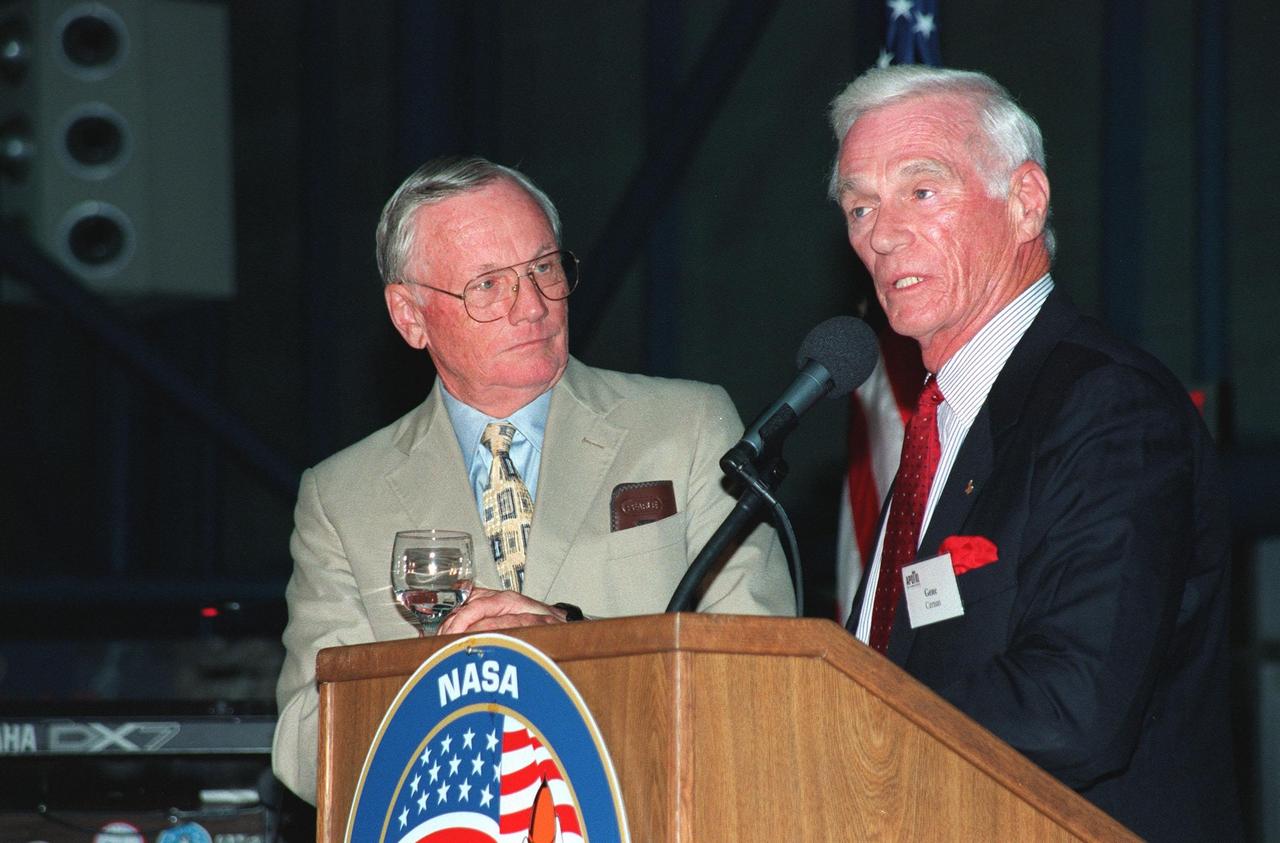
KENNEDY SPACE CENTER, FLA. -- During an anniversary banquet honoring the Apollo program team, the people who made the entire lunar landing program possible, former Apollo astronauts Neil Armstrong (left) and Gene Cernan talk about their experiences. The banquet was held in the Apollo/Saturn V Center, part of the KSC Visitor Complex. This is the 30th anniversary of the Apollo 11 launch and moon landing, July 16 and July 20, 1969. Other guests at the banquet were astronauts Wally Schirra, Edwin "Buzz" Aldrin and Walt Cunningham. Neil Armstrong was the first man to walk on the moon; Gene Cernan was the last
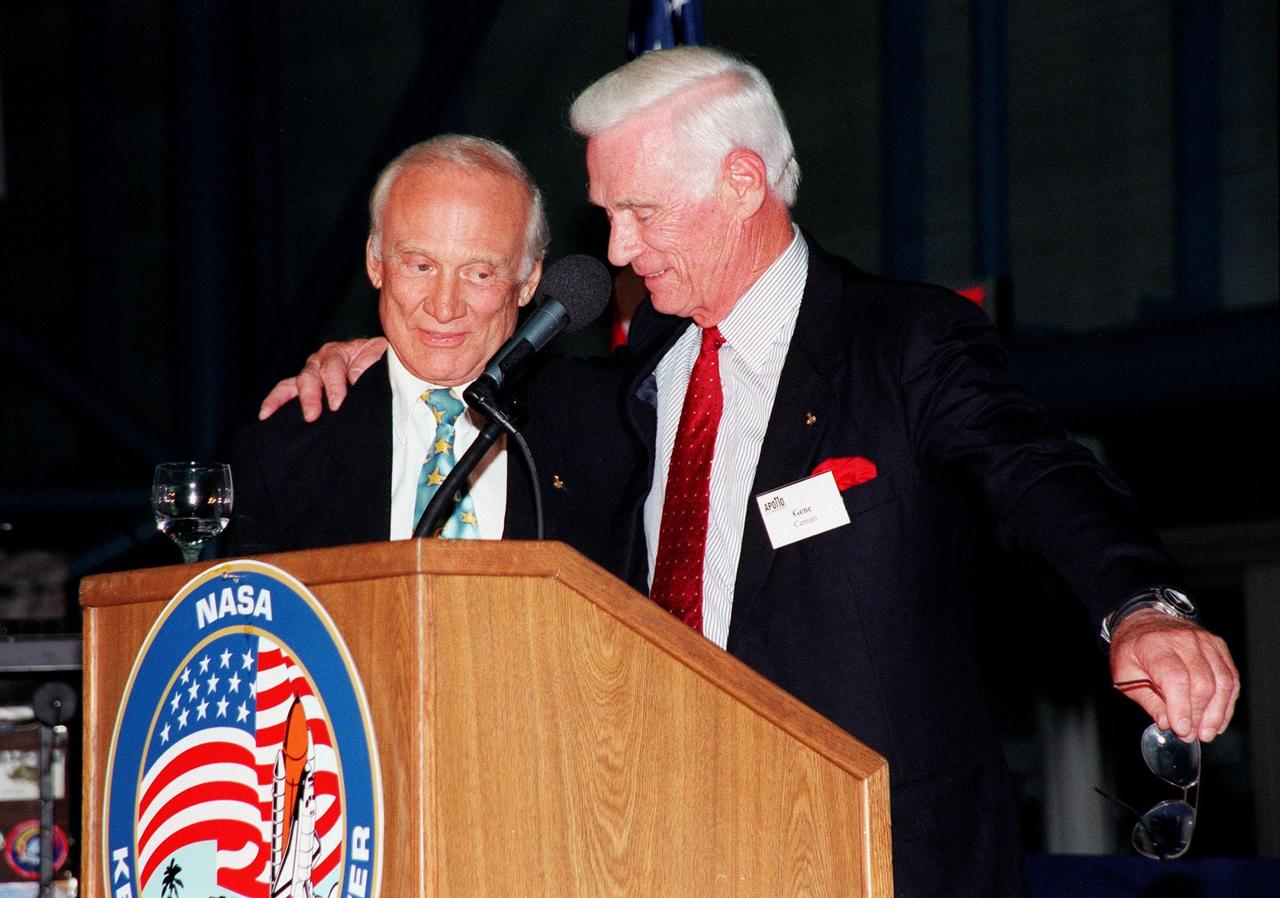
KENNEDY SPACE CENTER, FLA. -- Former Apollo astronauts Edwin "Buzz" Aldrin (left) and Gene Cernan share stories about their missions for an audience attending an anniversary banquet honoring the Apollo program team, the people who made the entire lunar landing program possible. The banquet was held in the Apollo/Saturn V Center, part of the KSC Visitor Complex. This is the 30th anniversary of the Apollo 11 launch and moon landing, July 16 and July 20, 1969. Other guests at the banquet were astronauts Wally Schirra, Gene Cernan and Walt Cunningham. Neil Armstrong was the first man to walk on the moon; Gene Cernan was the last
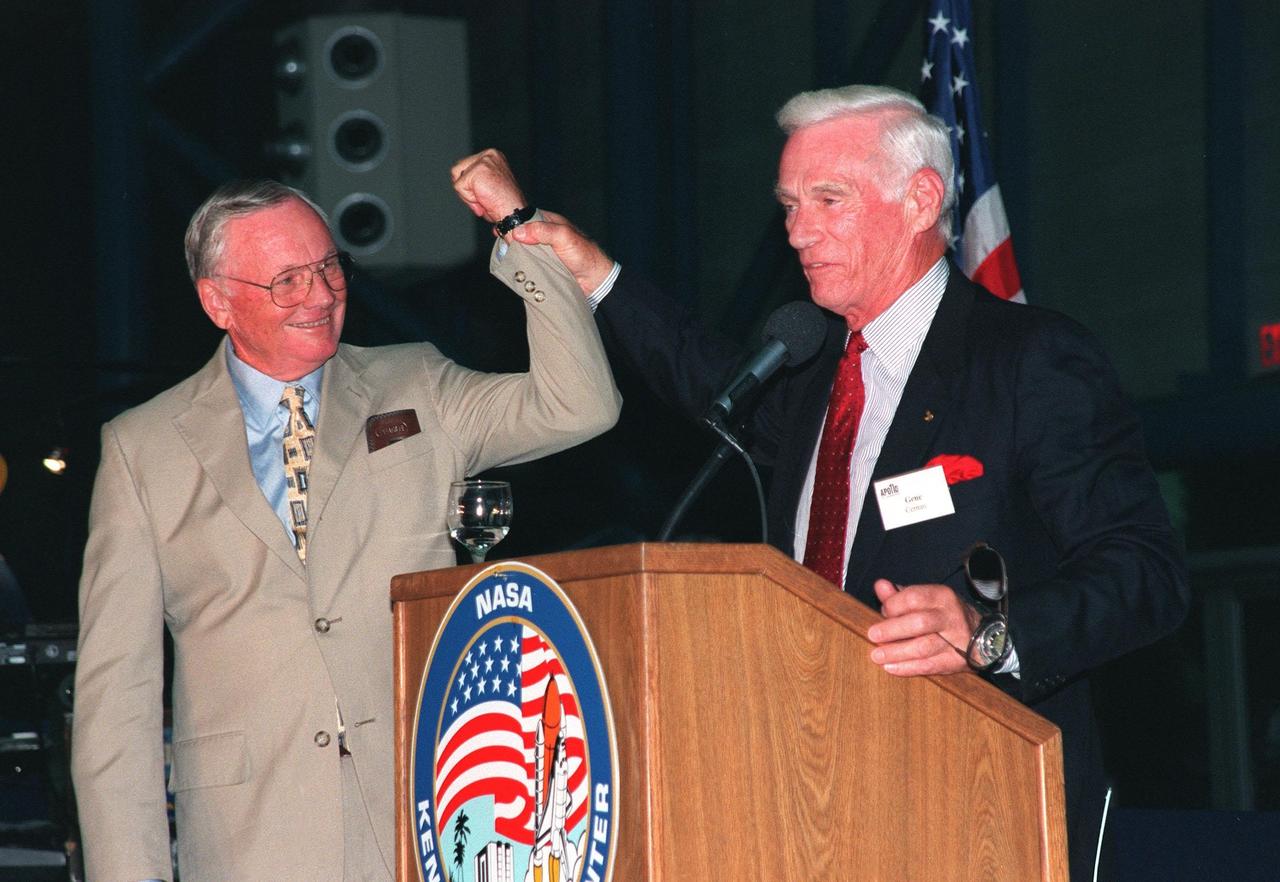
KENNEDY SPACE CENTER, FLA. -- Former Apollo astronauts Neil Armstrong (left) and Gene Cernan entertain the audience during an anniversary banquet honoring the Apollo program team, the people who made the entire lunar landing program possible. The banquet was held in the Apollo/Saturn V Center, part of the KSC Visitor Complex. This is the 30th anniversary of the Apollo 11 launch and moon landing, July 16 and July 20, 1969. Other guests at the banquet were astronauts Wally Schirra, Edwin "Buzz" Aldrin and Walt Cunningham. Neil Armstrong was the first man to walk on the moon; Gene Cernan was the last
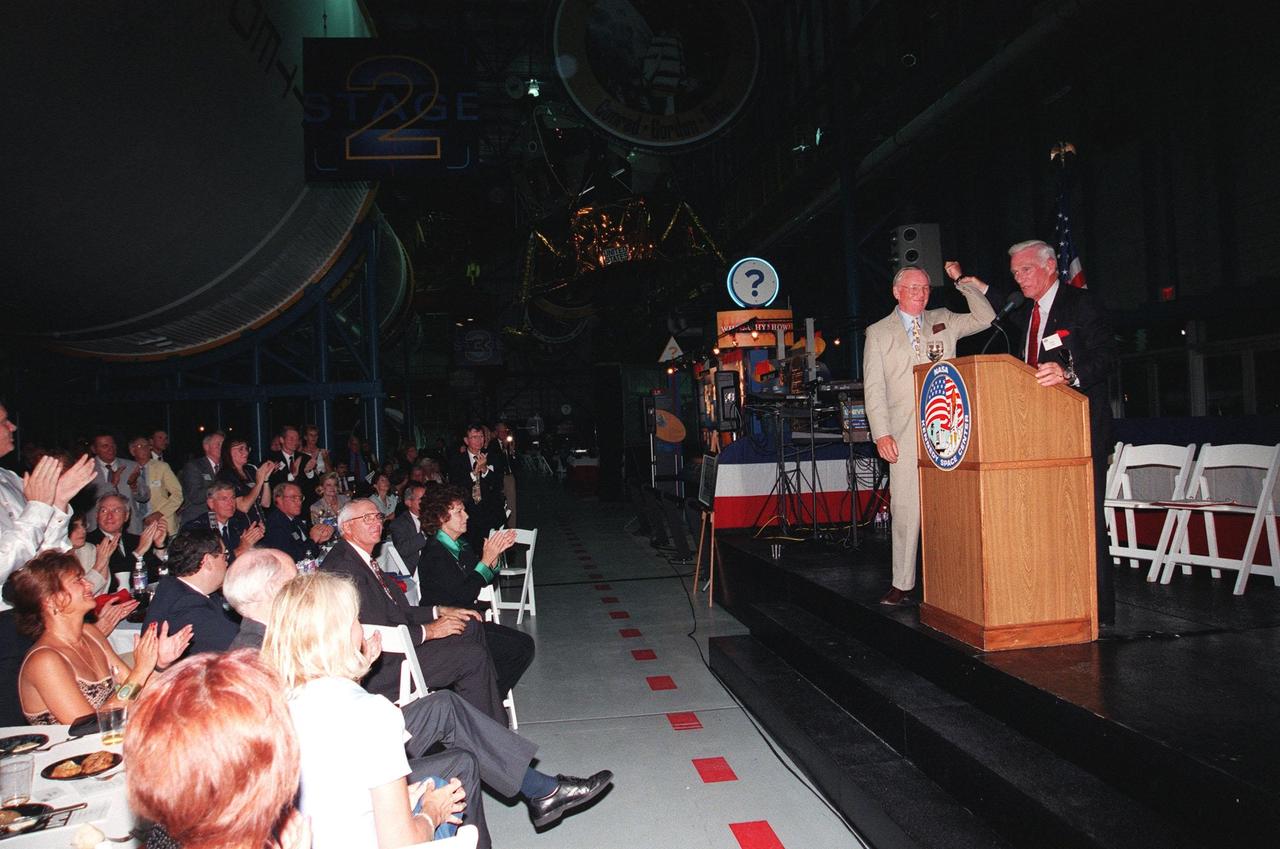
KENNEDY SPACE CENTER, FLA. -- Former Apollo astronauts Neil Armstrong (left) and Gene Cernan entertain the audience during an anniversary banquet honoring the Apollo program team, the people who made the entire lunar landing program possible. The banquet was held in the Apollo/Saturn V Center, part of the KSC Visitor Complex. This is the 30th anniversary of the Apollo 11 launch and moon landing, July 16 and July 20, 1969. Other guests at the banquet were astronauts Wally Schirra, Edwin "Buzz" Aldrin and Walt Cunningham. Armstrong was the first man to walk on the moon; Cernan was the last
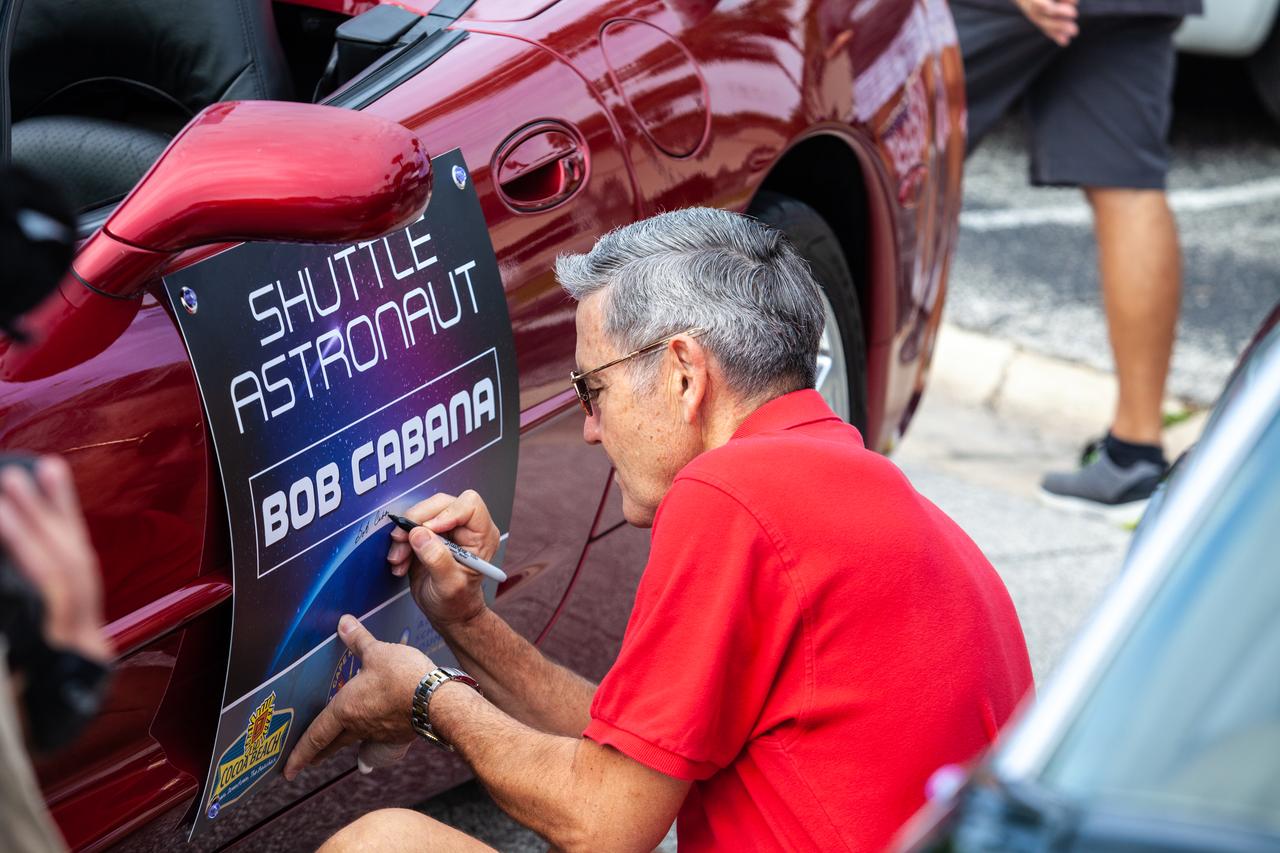
Kennedy Space Center Director and retired NASA astronaut Bob Cabana signs the placard on the Corvette he will ride in the "Man on the Moon" astronaut parade in Cocoa Beach, Florida, on July 13, 2019. The parade was held to honor the 50th anniversary of NASA’s Saturn V/Apollo 11 launch and landing on the Moon.
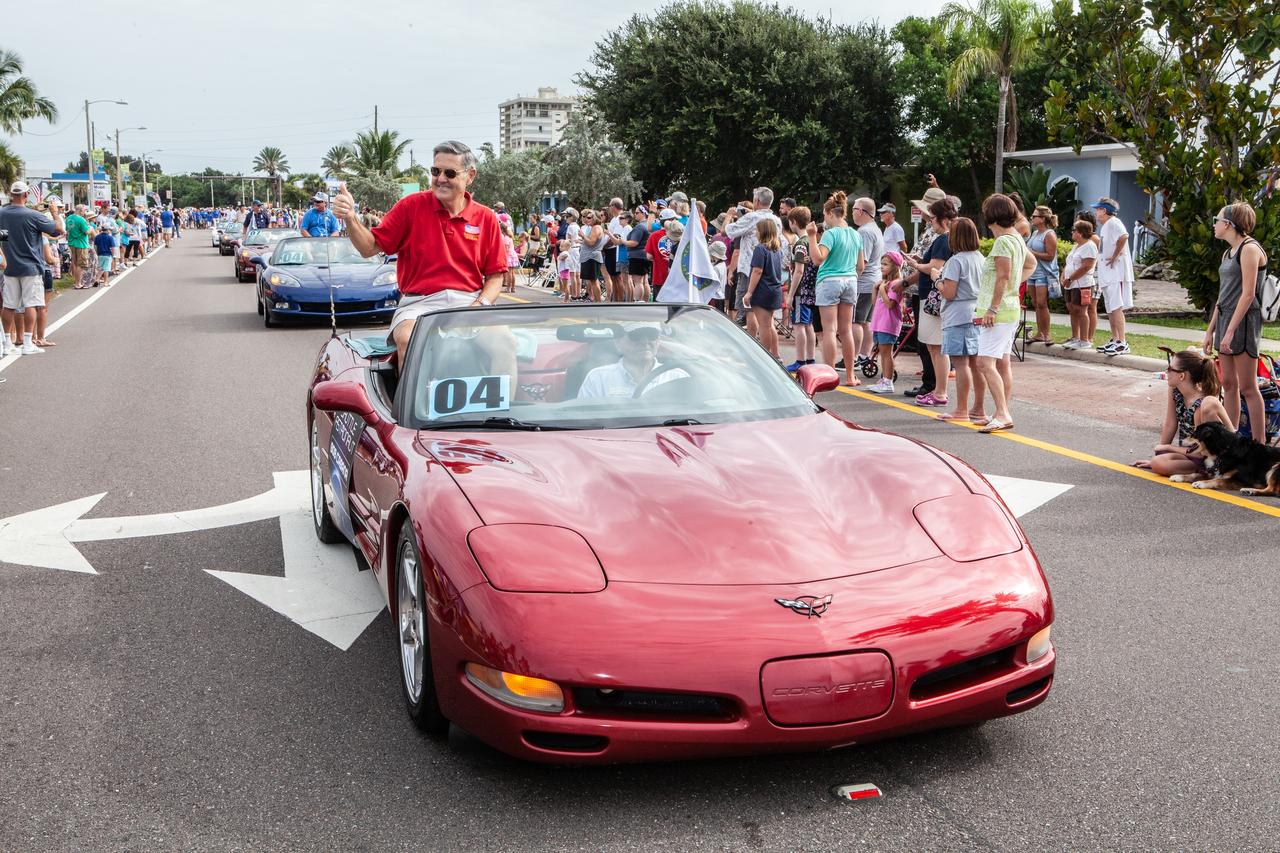
Kennedy Space Center Director and retired NASA astronaut Bob Cabana rides in a Corvette during the “Man on the Moon” astronaut parade in Cocoa Beach, Florida, on July 13, 2019. The parade was held to honor the 50th anniversary of NASA’s Saturn V/Apollo 11 launch and landing on the Moon.
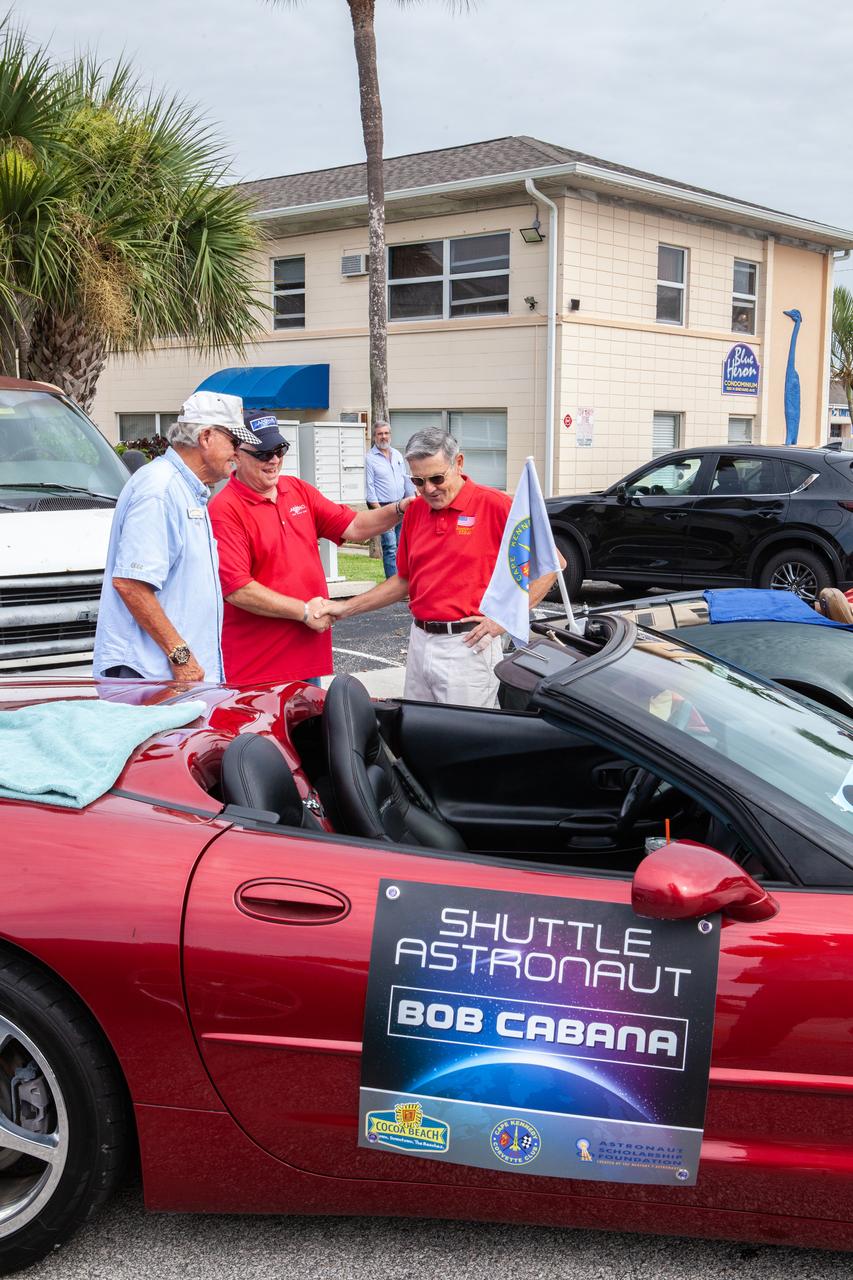
Kennedy Space Center Director and retired astronaut Bob Cabana prepares to ride in a Corvette during the "Man on the Moon" astronaut parade in Cocoa Beach, Florida, on July 13, 2019. The parade was held to honor the 50th anniversary of NASA’s Saturn V/Apollo 11 launch and landing on the Moon.
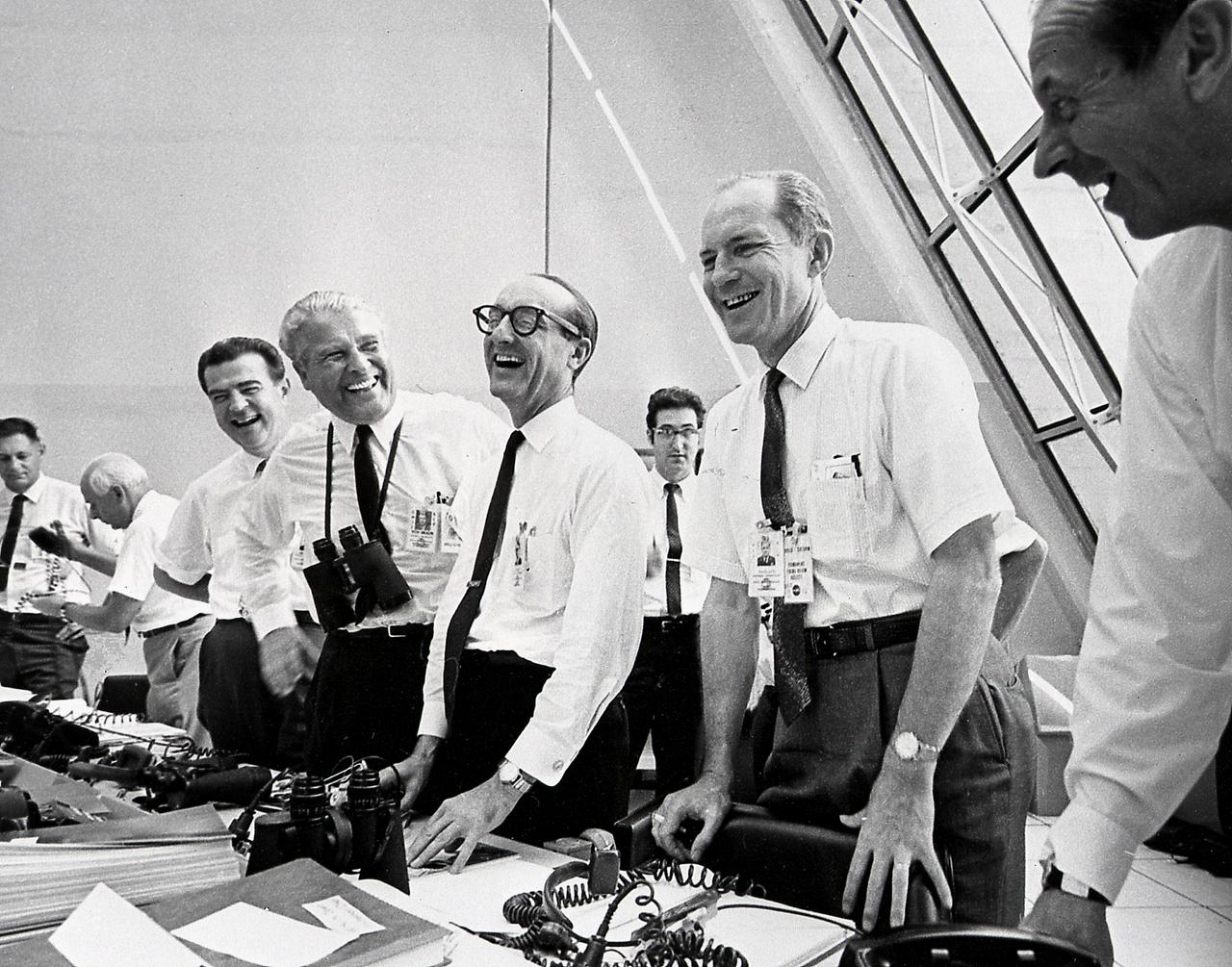
NASA officials, (left to right) Charles W. Mathews; Dr. Wernher von Braun, Director, Marshall Space Flight Center (MSFC); Dr. George E. Mueller, Associate Administrator for Marned Space Flight; and Air Force Lt. General Samuel C. Phillips, Apollo Program Director celebrate the successful launch of Apollo 11 in the control room at Kennedy Space Center (KSC) on July 16, 1969. Boosted by the Saturn V launch vehicle, the Apollo 11 mission with a crew of three: Astronauts Neil A. Armstrong, Michael Collins, and Edwin E. Aldrin, made the first manned lunar landing. The Saturn V vehicle was developed by Marshall Space Flight Center (MSFC) under the direction of Dr. von Braun.
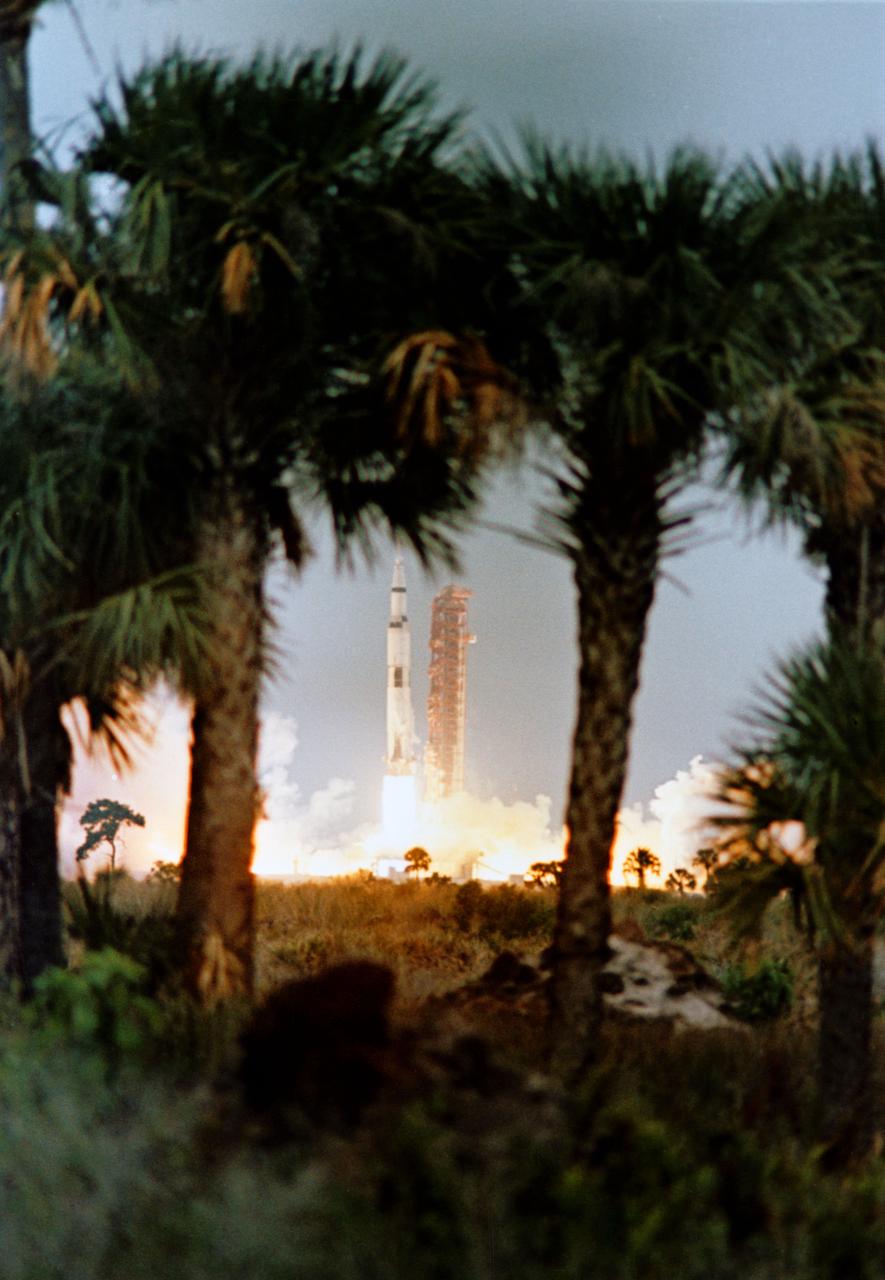
S69-25862 (3 March 1969) --- Framed by palm trees in the foreground, the Apollo 9 (Spacecraft 104/Lunar Module 3/ Saturn 504) space vehicle is launched from Pad A, Launch Complex 39, Kennedy Space Center (KSC) at 11 a.m. (EST), March 3, 1969. Aboard the spacecraft are astronauts James A. McDivitt, commander; David R. Scott, command module pilot; and Russell L. Schweickart, lunar module pilot. The Apollo 9 mission will evaluate spacecraft lunar module systems performance during manned Earth-orbital flight. Apollo 9 is the second manned Saturn V mission.

S69-27916 (11 March 1969) --- Aerial view at Launch Complex 39, Kennedy Space Center, showing the Apollo 10 (Spacecraft 106/Lunar Module-4/Saturn 505) space vehicle on its way to Pad B. The Saturn V stack and its mobile launch tower are atop a huge crawler-transporter. The Apollo 10 flight is scheduled as a lunar orbit mission. The Apollo 10 crew will be astronauts Thomas P. Stafford, commander; John W. Young, command module pilot; and Eugene A. Cernan, lunar module pilot.
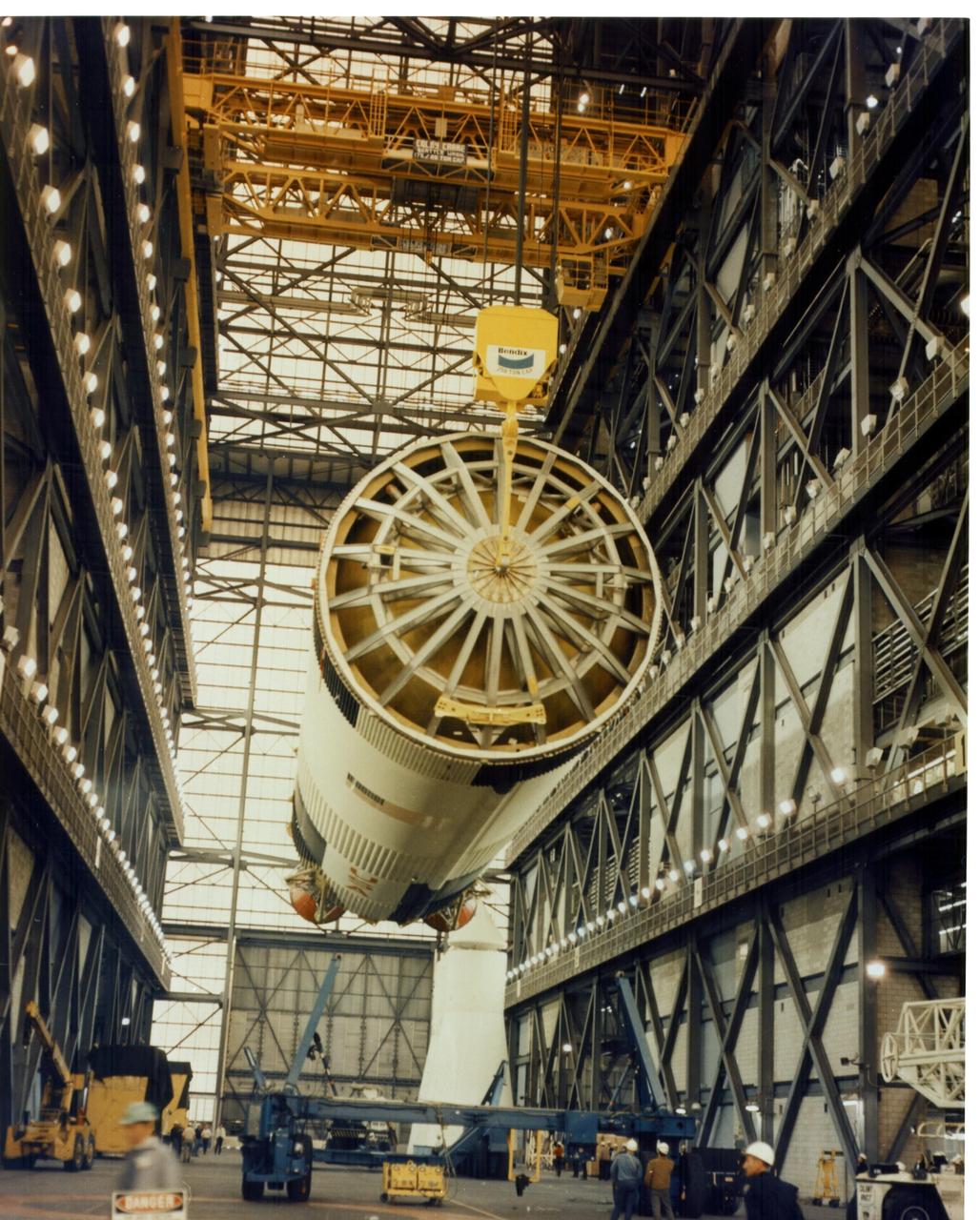
KENNEDY SPACE CENTER, FLA. - An overhead crane lifts the Saturn V first stage for the Apollo 11 mission from the transfer aisle floor in preparation for stacking on a mobile launcher within the Vehicle Assembly Building's High Bay 1. The fully assembled vehicle will be called the Apollo/Saturn 506. The 138-foot-long stage, to which two additional stages -- the instrument unit and the Apollo spacecraft -- will be added, will generate a liftoff thrust of 7.7 million pounds. Astronauts Neil A. Armstrong, Michael Collins and Edwin E. Aldrin Jr. will pilot the mission which is to include a lunar landing in the lunar module by Armstrong and Aldrin.
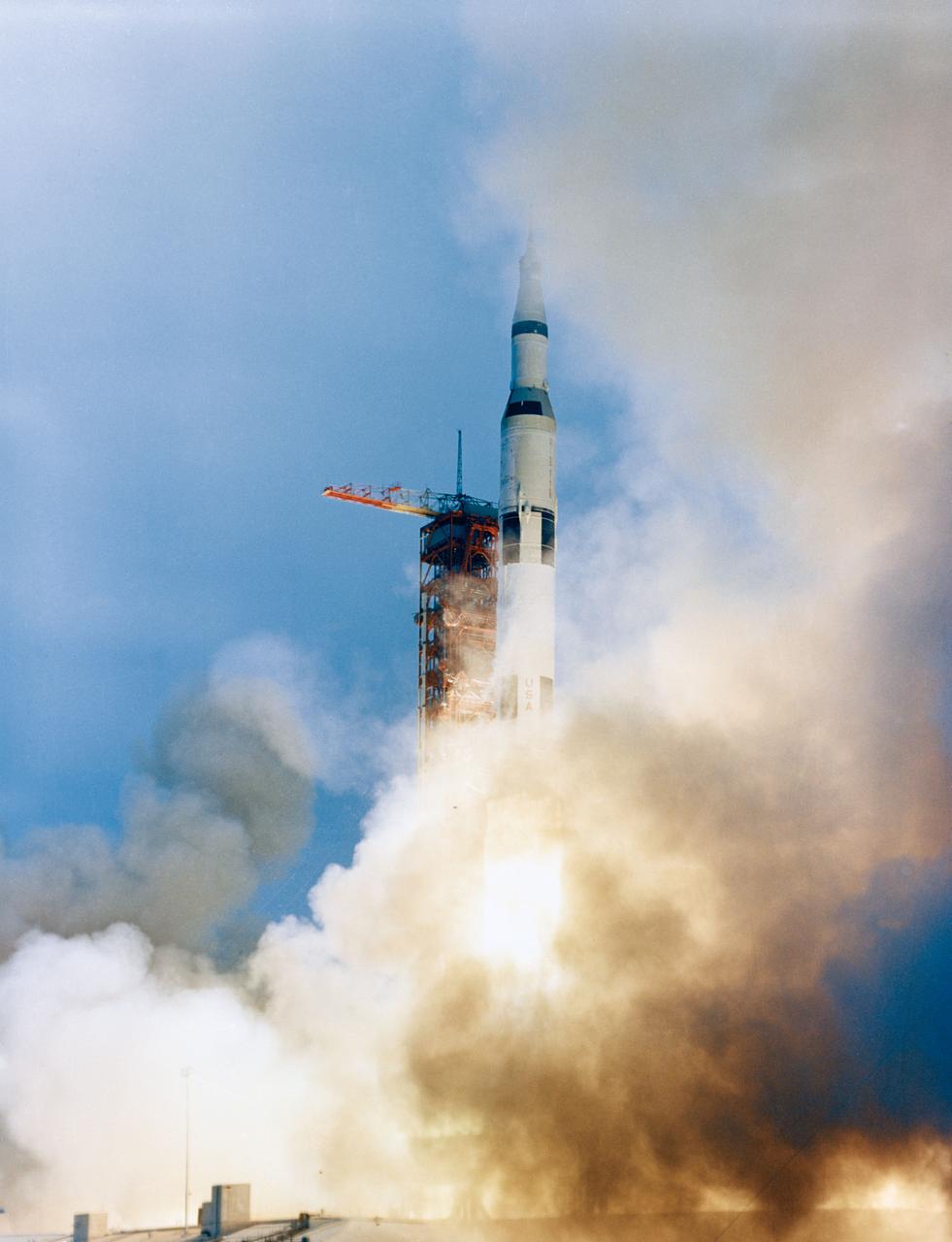
S69-25864 (3 March 1969) --- The Apollo 9 (Spacecraft 104/Lunar Module 3/Saturn 504) space vehicle is launched from Pad A, Launch Complex 39, Kennedy Space Center (KSC) at 11 a.m. (EST), March 3, 1969. Aboard the spacecraft are astronauts James A. McDivitt, commander; David R. Scott, command module pilot; and Russell L. Schweickart, lunar module pilot. The Apollo 9 mission will evaluate spacecraft lunar module systems performance during manned Earth-orbital flight. Apollo 9 is the second manned Saturn V mission.
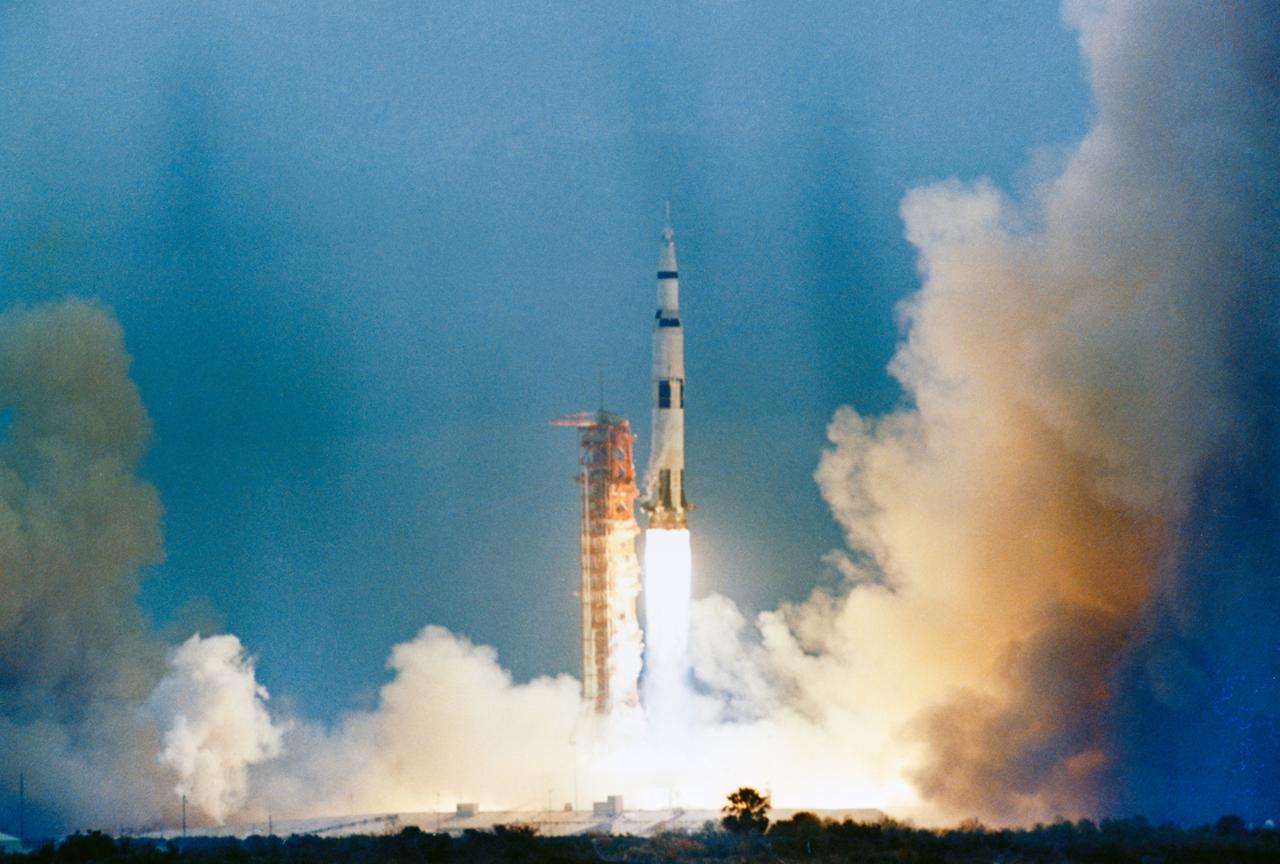
S69-25861 (3 March 1969) --- The Apollo 9 (Spacecraft 104/Lunar Module 3/ Saturn 504) space vehicle is launched from Pad A, Launch Complex 39, Kennedy Space Center (KSC) at 11 a.m. (EST), March 3, 1969. Aboard the spacecraft are astronauts James A. McDivitt, commander; David R. Scott, command module pilot; and Russell L. Schweickart, lunar module pilot. The Apollo 9 mission will evaluate spacecraft lunar module systems performance during manned Earth-orbital flight. Apollo 9 is the second manned Saturn V mission.
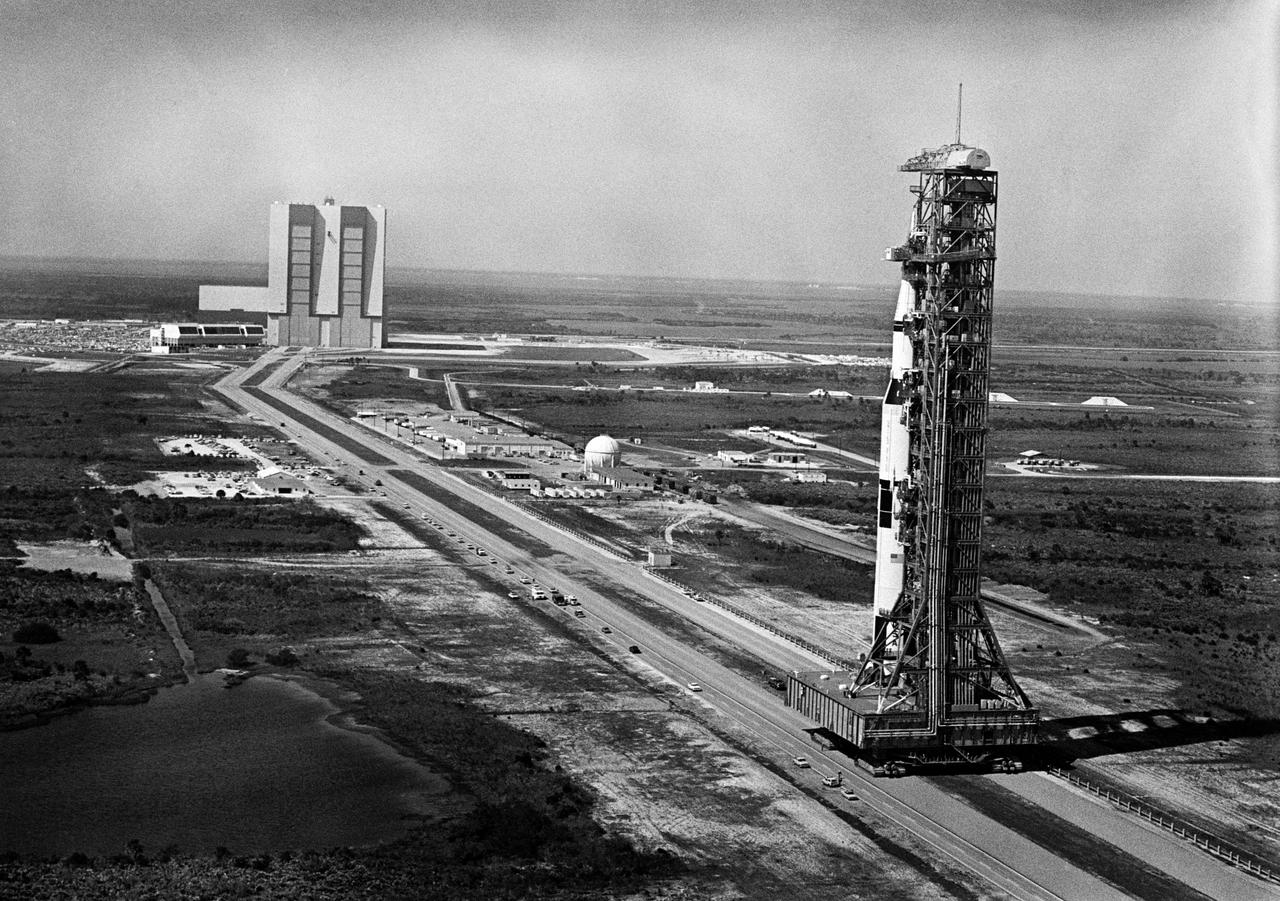
S69-27741 (11 March 1969) --- Aerial view at Launch Complex 39, Kennedy Space Center, showing the 363-feet tall Apollo 10 (Spacecraft 106/Lunar Module-4/Saturn 505) space vehicle on its way to Pad B. The Vehicle Assembly Building is in the background. The Saturn V stack and its mobile launch tower are atop a huge crawler-transporter. The Apollo 10 flight is schedule as a lunar orbit mission. The Apollo 10 crew will be astronauts Thomas P. Stafford, commander; John W. Young, command module pilot; and Eugene A. Cernan, lunar module pilot.
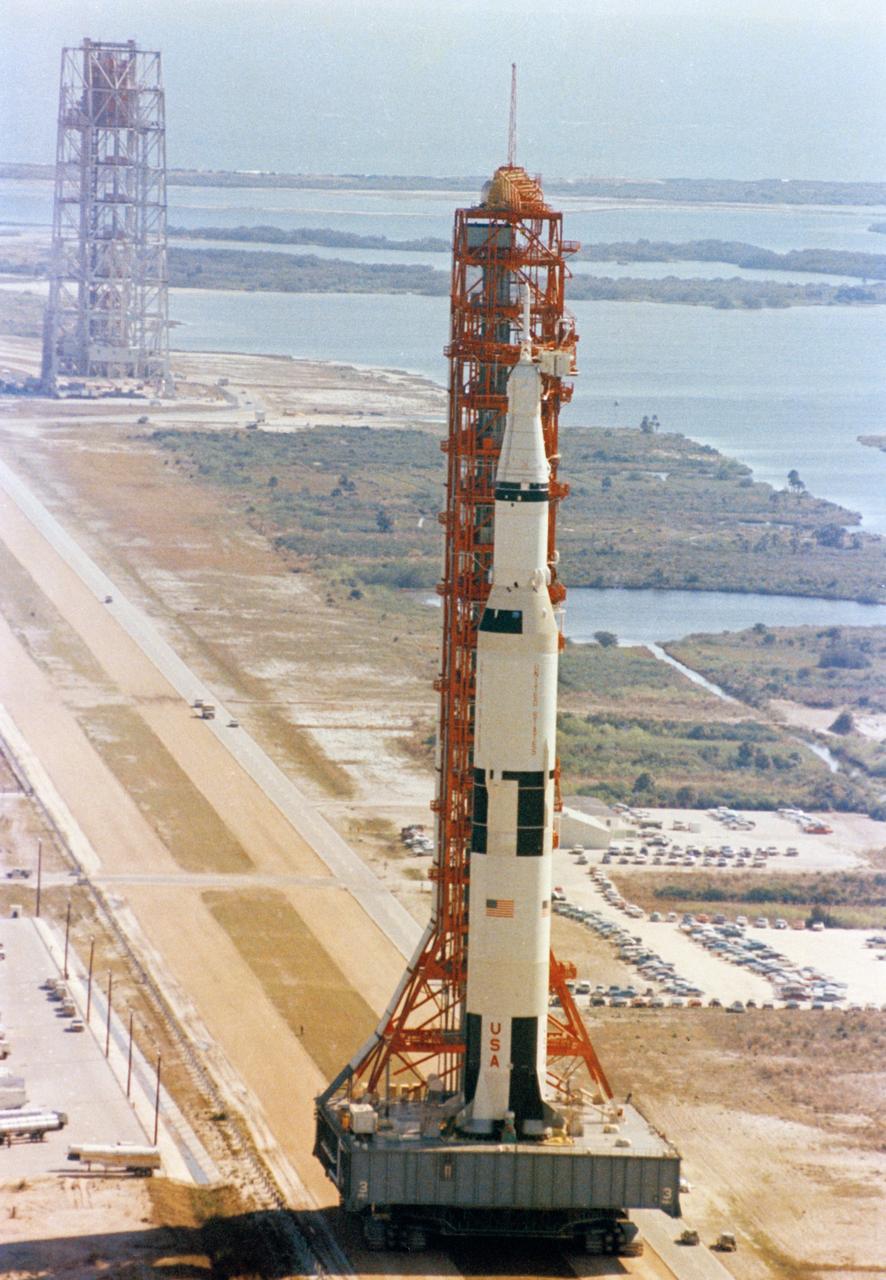
S69-27915 (11 March 1969) --- Aerial view at Launch Complex 39, Kennedy Space Center, showing a close-up of the 363-feet tall Apollo 10 (Spacecraft 106/Lunar Module 4/Saturn 505) space vehicle on its way to Pad B. The Saturn V stack and its mobile launch tower are atop a huge crawler-transporter. The Apollo 10 flight is scheduled as a lunar orbit mission. The Apollo 10 crew will be astronauts Thomas P. Stafford, commander; John W. Young, command module pilot; and Eugene A. Cernan, lunar module pilot.
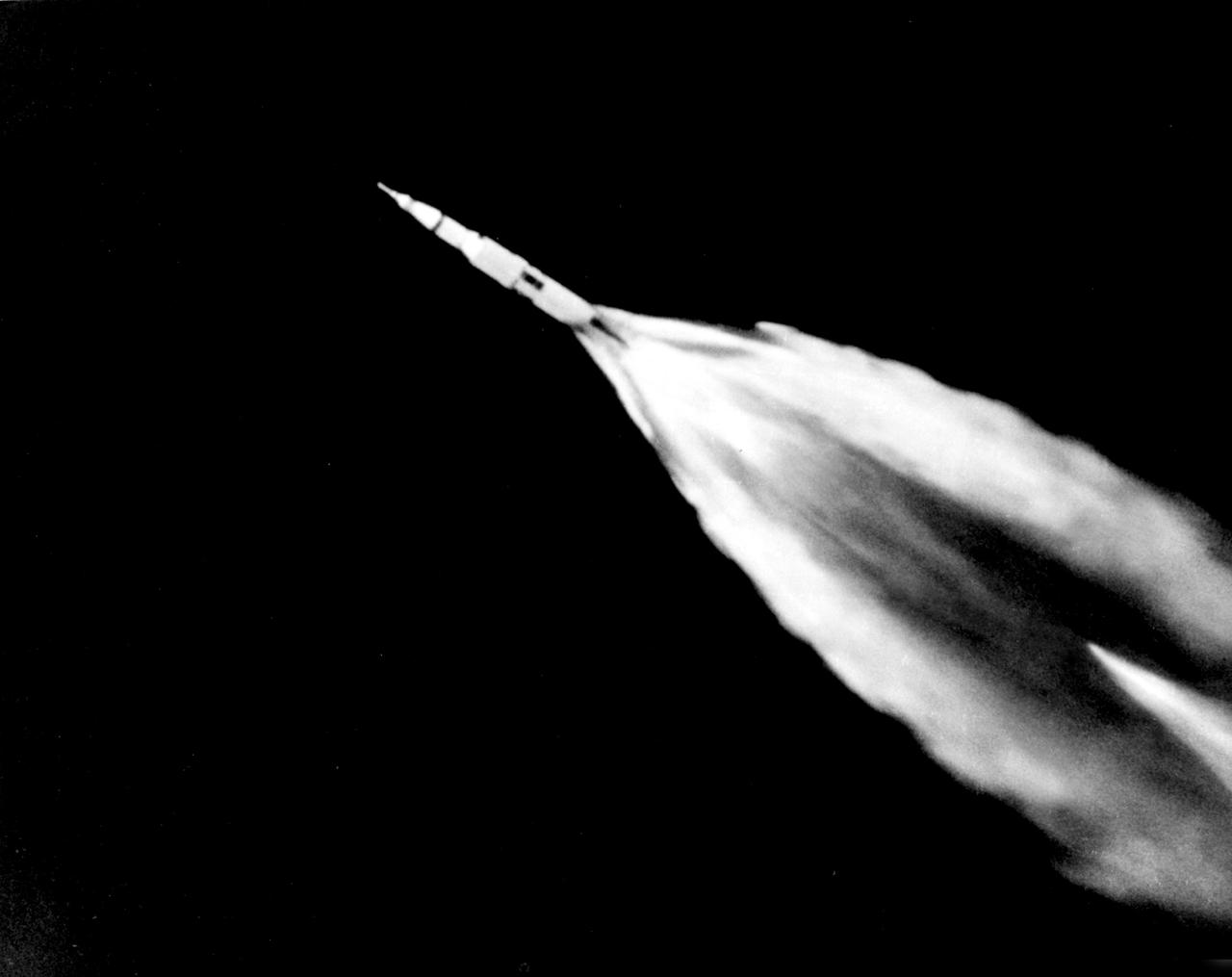
The Apollo 11 mission, the first manned lunar mission, launched from the Kennedy Space Center, Florida via the Saturn V launch vehicle on July 16, 1969 and safely returned to Earth on July 24, 1969. Leaving a wide plume of flame as it climbed into the thin atmosphere of high altitude, the 363 foot tall, 6,400,000 pound Saturn V rocket hurled the spacecraft into Earth parking orbit and then placed it on the trajectory to the moon. The Saturn V was developed by the Marshall Space Flight Center (MSFC) under the direction of Dr. Wernher von Braun. Aboard the spacecraft were astronauts Neil A. Armstrong, commander; Michael Collins, Command Module (CM) pilot; and Edwin E. Aldrin Jr., Lunar Module (LM) pilot. With the success of Apollo 11, the national objective to land men on the Moon and return them safely to Earth had been accomplished.
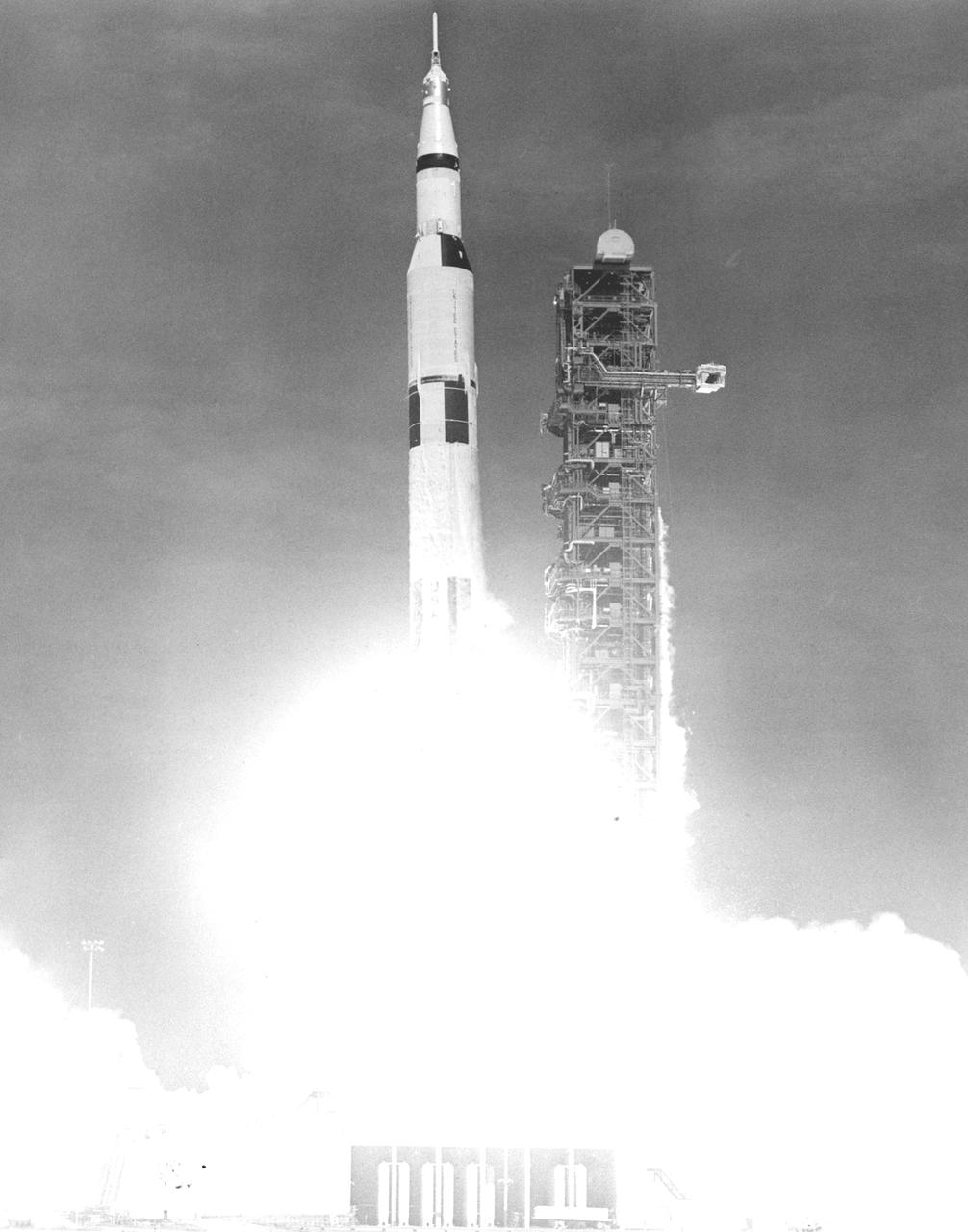
The Apollo 11 mission, the first manned lunar mission, launched from the Kennedy Space Center, Florida via the Saturn V launch vehicle on July 16, 1969 and safely returned to Earth on July 24, 1969. The Saturn V vehicle produced a holocaust of flames as it rose from its pad at Launch complex 39. The 363 foot tall, 6,400,000 pound rocket hurled the spacecraft into Earth parking orbit and then placed it on the trajectory to the moon for man’s first lunar landing. The Saturn V was developed by the Marshall Space Flight Center (MSFC) under the direction of Dr. Wernher von Braun. Aboard the spacecraft were astronauts Neil A. Armstrong, commander; Michael Collins, Command Module pilot; and Edwin E. Aldrin Jr., Lunar Module pilot. With the success of Apollo 11, the national objective to land men on the Moon and return them safely to Earth had been accomplished.
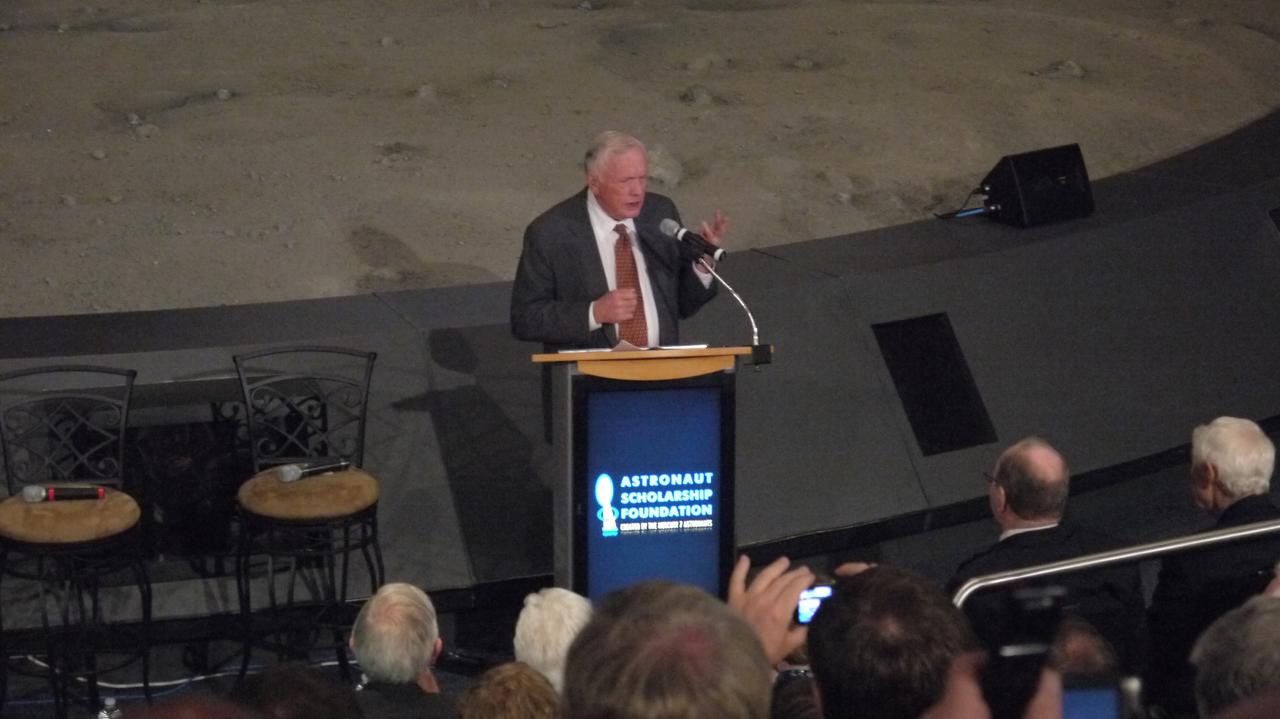
CAPE CANAVERAL, Fla. -- Apollo 11 Commander Neil Armstrong addresses the audience at the 40th anniversary celebration of Apollo 16's lunar landing, which occurred April 20, 1972. The Astronaut Scholarship Foundation hosted the soiree at the Kennedy Space Center Visitor Complex's Saturn V Center. The 11-day Apollo 16 mission featured three moonwalks, including a nearly 17-mile lunar rover road trip to collect more than 200 pounds of moon rocks to return to Earth. Photo credit: NASA/Chris Chamberland
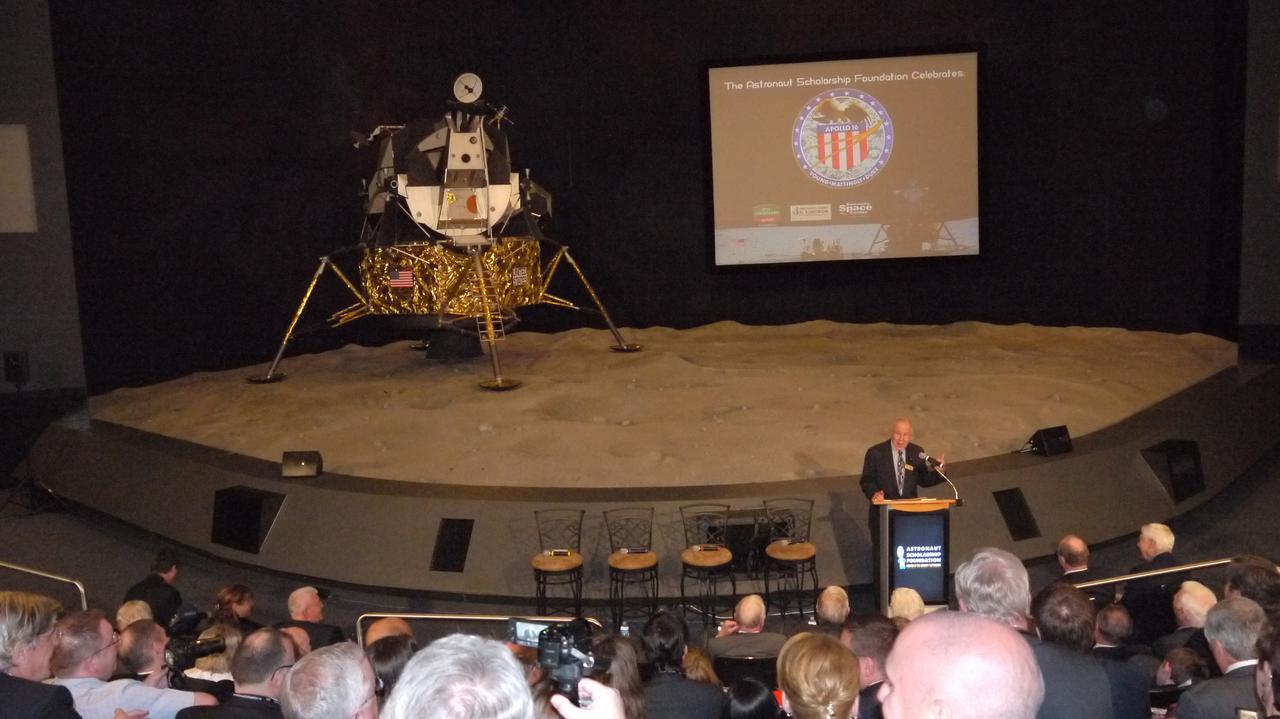
CAPE CANAVERAL, Fla. -- The Astronaut Scholarship Foundation helps celebrate the 40th anniversary of Apollo 16's lunar landing, which occurred April 20, 1972, with a soiree at the Kennedy Space Center Visitor Complex's Saturn V Center. Addressing the audience is Apollo 8 Command Module Pilot and Apollo 13 Commander Jim Lovell. The 11-day Apollo 16 mission featured three moonwalks, including a nearly 17-mile lunar rover road trip to collect more than 200 pounds of moon rocks to return to Earth. Photo credit: NASA/Chris Chamberland
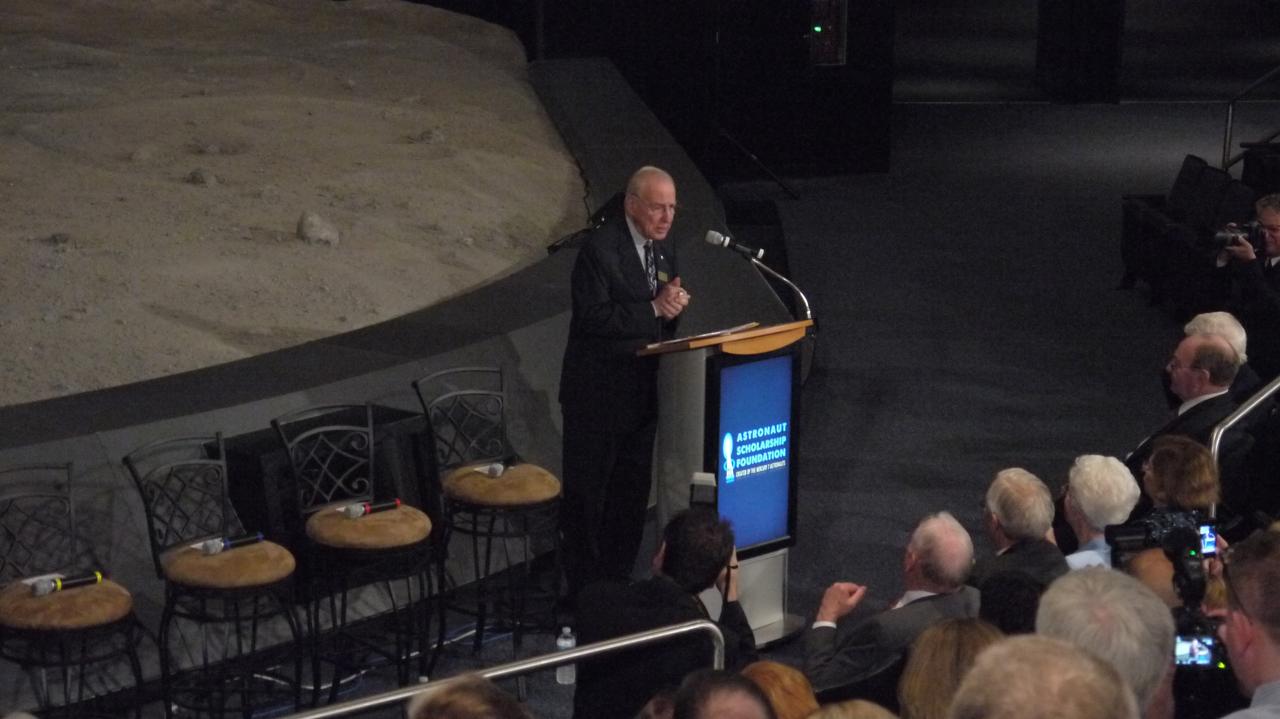
CAPE CANAVERAL, Fla. -- Apollo 8 Command Module Pilot and Apollo 13 Commander Jim Lovell addresses the audience at the 40th anniversary celebration of Apollo 16's lunar landing, which occurred April 20, 1972. The Astronaut Scholarship Foundation hosted the soiree at the Kennedy Space Center Visitor Complex's Saturn V Center. The 11-day Apollo 16 mission featured three moonwalks, including a nearly 17-mile lunar rover road trip to collect more than 200 pounds of moon rocks to return to Earth. Photo credit: NASA/Chris Chamberland
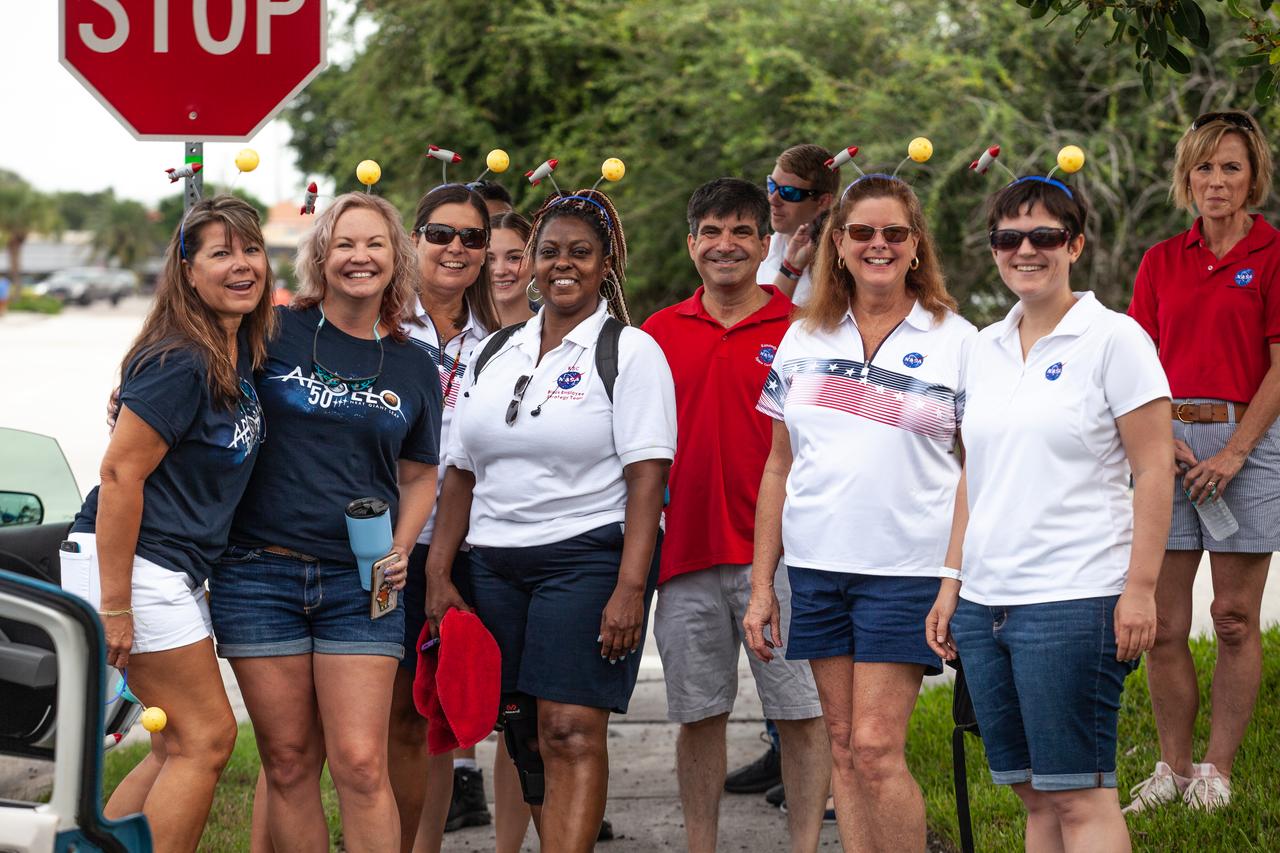
Employees from NASA’s Kennedy Space Center prepare to march in the “Man on the Moon” astronaut parade in Cocoa Beach, Florida, on July 13, 2019. The parade was held to honor the 50th anniversary of NASA’s Saturn V/Apollo 11 launch and landing on the Moon.
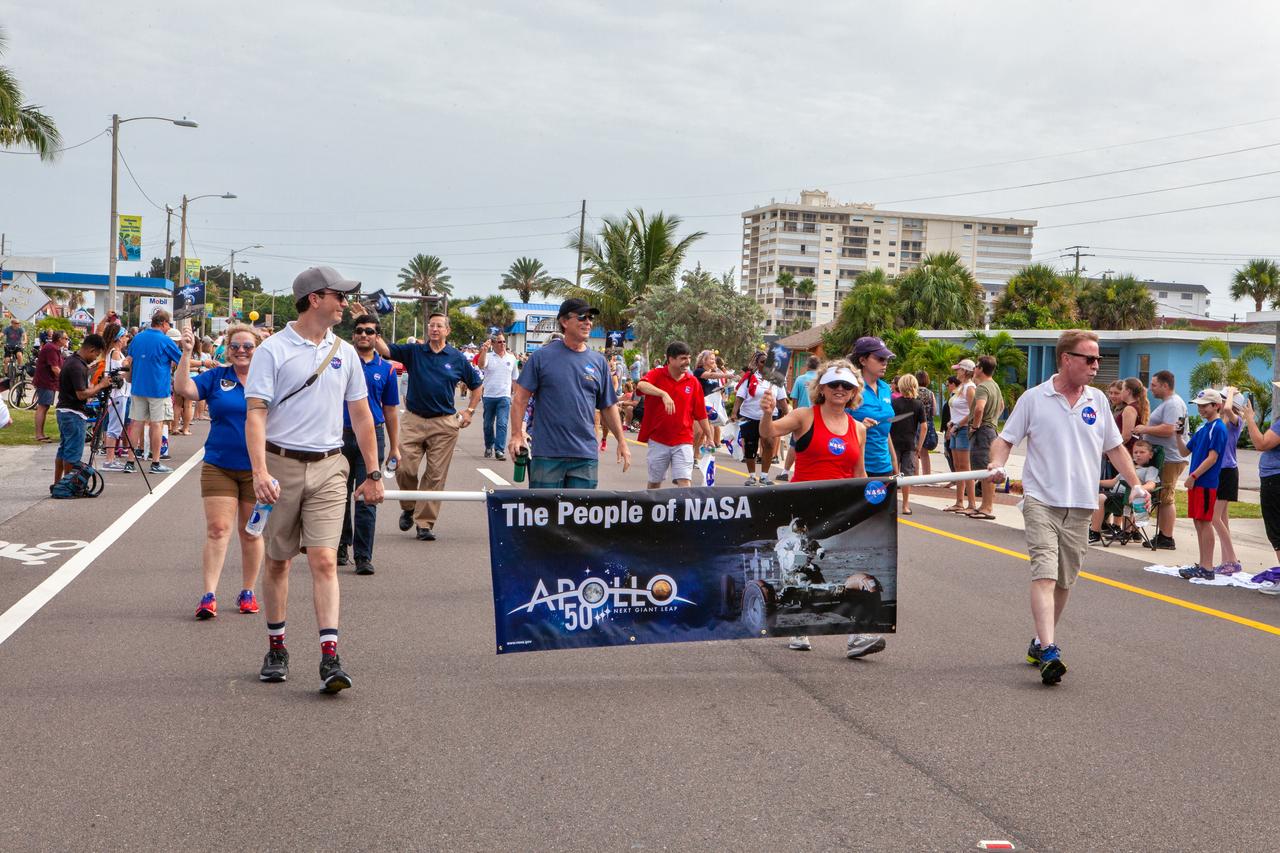
Employees from NASA’s Kennedy Space Center march in the “Man on the Moon” astronaut parade in Cocoa Beach, Florida, on July 13, 2019. The parade was held to honor the 50th anniversary of NASA’s Saturn V/Apollo 11 launch and landing on the Moon.
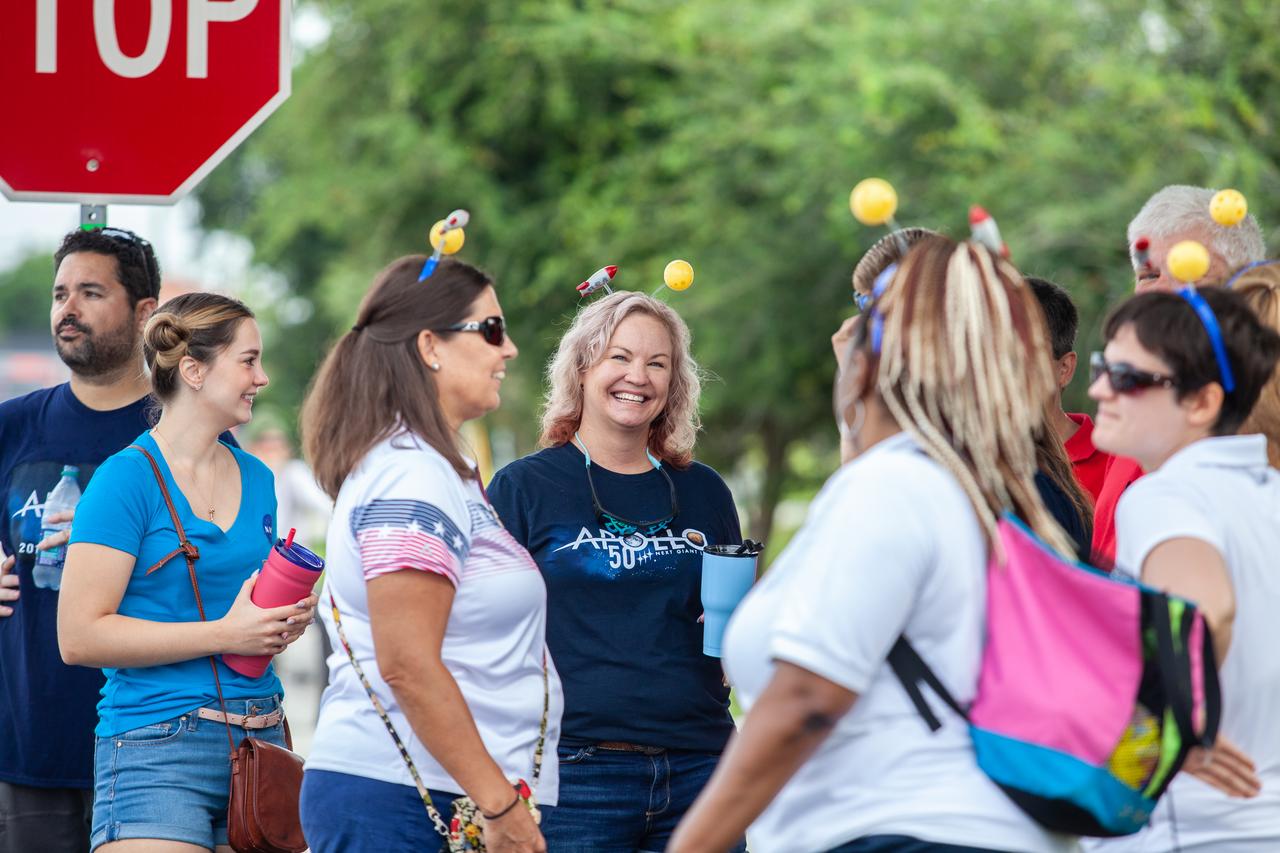
Employees from NASA’s Kennedy Space Center mingle before the start of the “Man on the Moon” astronaut parade in Cocoa Beach, Florida, on July 13, 2019. The parade was held to honor the 50th anniversary of NASA’s Saturn V/Apollo 11 launch and landing on the Moon.
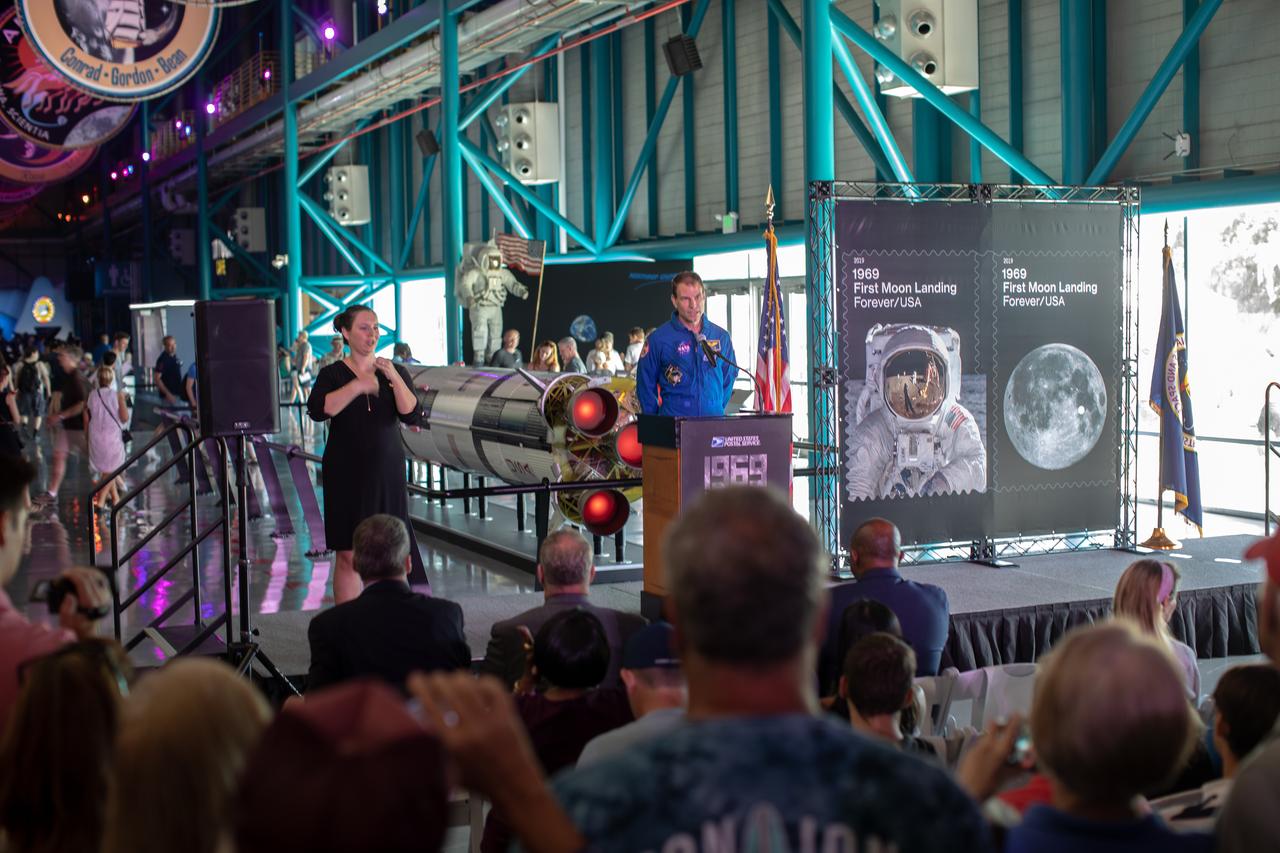
Astronaut Stan Love speaks at Kennedy Space Center’s Apollo/Saturn V Center on Friday, July 19, 2019. Love addressed a crowd at the Florida spaceport during a 50th Anniversary celebration of the Apollo 11 mission. The U.S. Postal Service issued two forever stamps to honor the historic moment. The event marked the first day of issue for the special stamps.
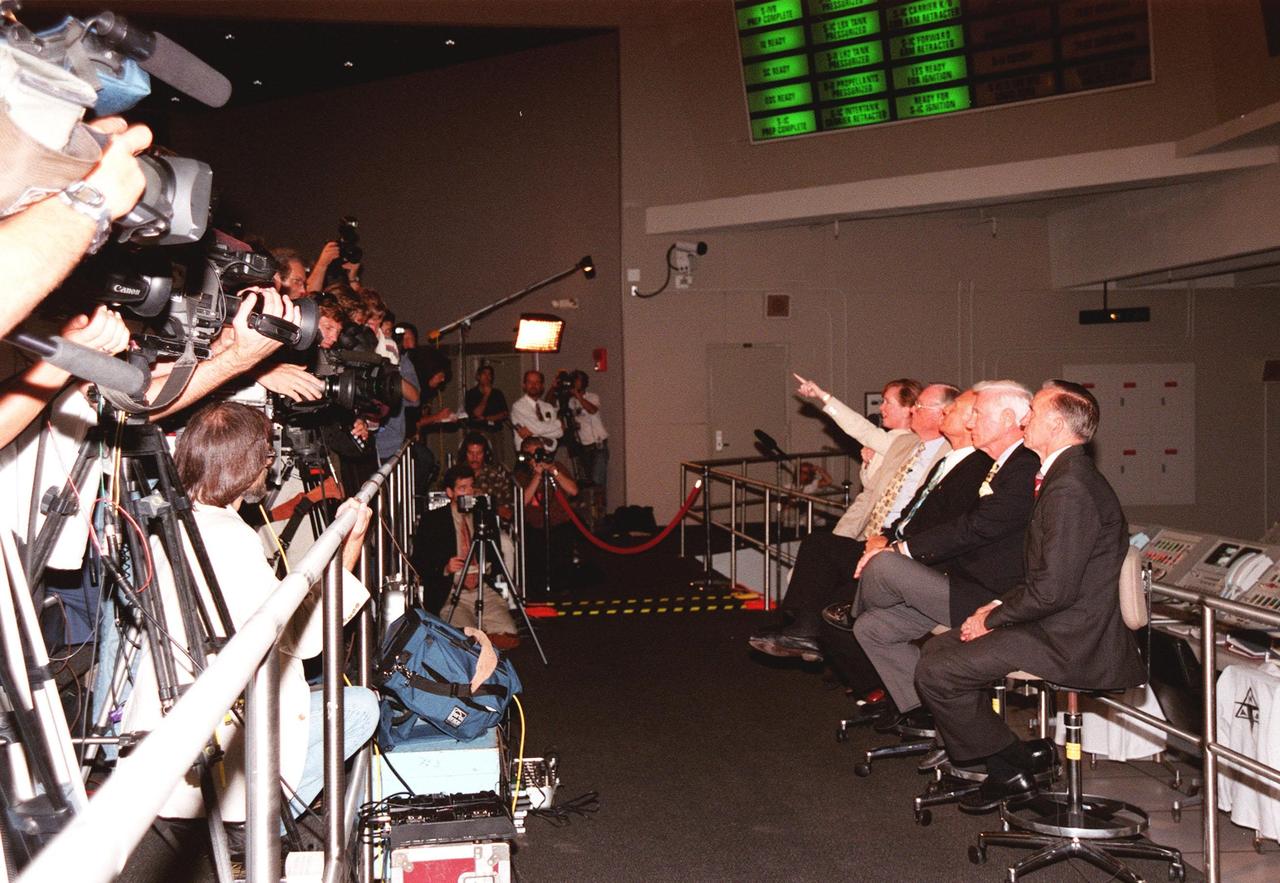
KENNEDY SPACE CENTER, FLA. -- In the Apollo/Saturn V Center, Lisa Malone, chief of KSC's Media Services branch, identifies a reporter in the stands to pose a question to one of the former Apollo astronauts seated next to her. From left to right, they are Neil A. Armstrong and Edwin "Buzz" Aldrin who flew on Apollo 11, the launch to the moon; Gene Cernan, who flew on Apollo 10 and 17; and Walt Cunningham, who flew on Apollo 7. Behind them on the lower floor are the original computer consoles used in the firing room during the Apollo program. They are now part of the reenactment of the Apollo launches in the exhibit at the center. This is the 30th anniversary of the launch and moon landing, July 16 and July 20, 1969. Neil Armstrong was the first man to set foot on the moon
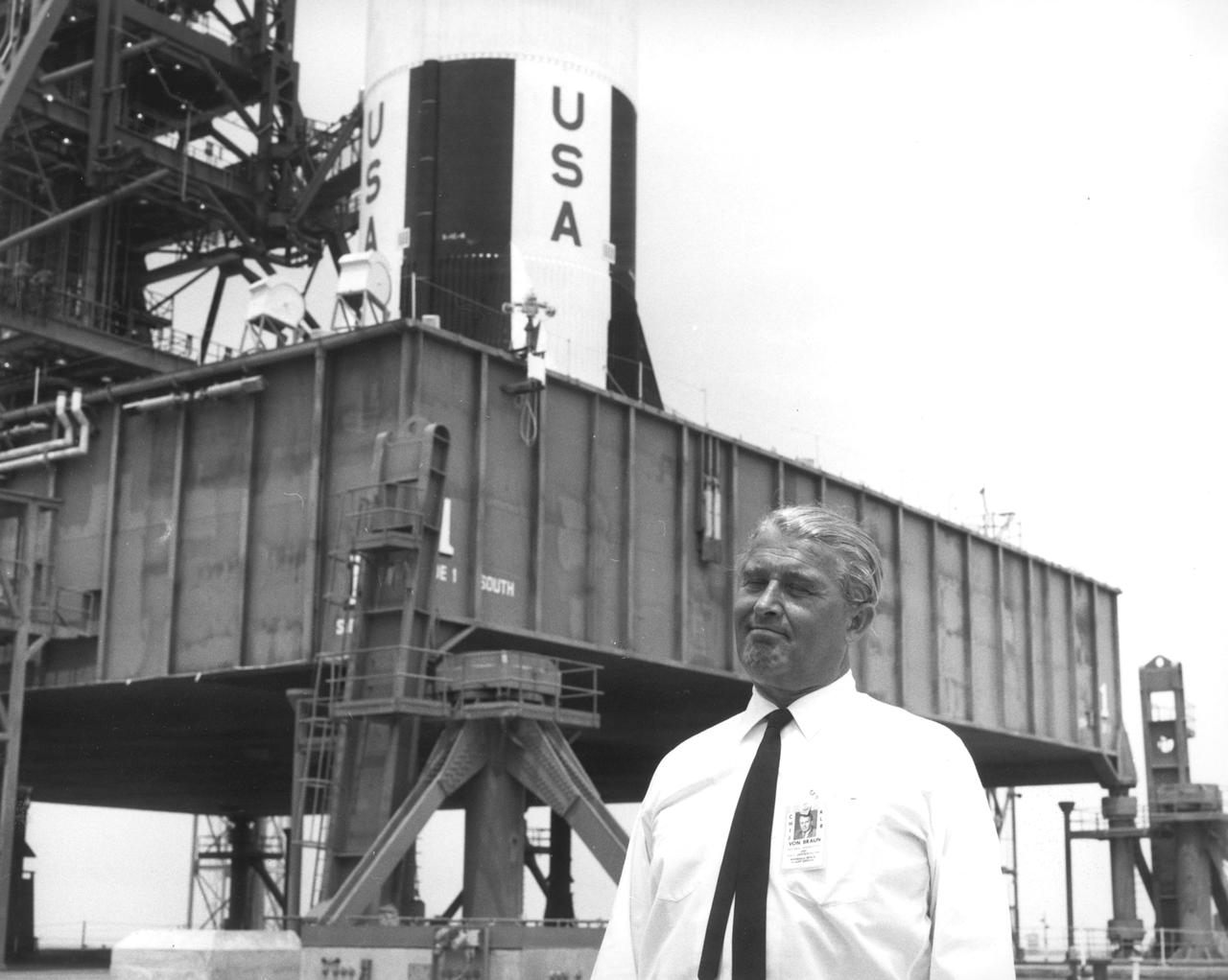
Dr. Wernher von Braun, director of the NASA Marshall Space Flight center (MSFC), appears proud as he pauses in front of the mobile launcher and base of the Saturn V rocket (AS-506) being readied for the historic Apollo 11 lunar landing mission at the Kennedy Space Center (KSC). The Saturn V vehicle was developed by MSFC under the direction of Dr. von Braun. The Apollo 11 mission launched from KSC in Florida via the MSFC developed Saturn V launch vehicle on July 16, 1969 and safely returned to Earth on July 24, 1969. Aboard the space craft were astronauts Neil A. Armstrong, commander; Michael Collins, Command Module (CM) pilot; and Edwin E. (Buzz) Aldrin Jr., Lunar Module (LM) pilot. The CM, “Columbia”, piloted by Collins, remained in a parking orbit around the Moon while the LM, “Eagle’’, carrying astronauts Armstrong and Aldrin, landed on the Moon. On July 20, 1969, Armstrong was the first human to ever stand on the lunar surface, followed by Aldrin. During 2½ hours of surface exploration, the crew collected 47 pounds of lunar surface material for analysis back on Earth. With the success of Apollo 11, the national objective to land men on the Moon and return them safely to Earth had been accomplished.
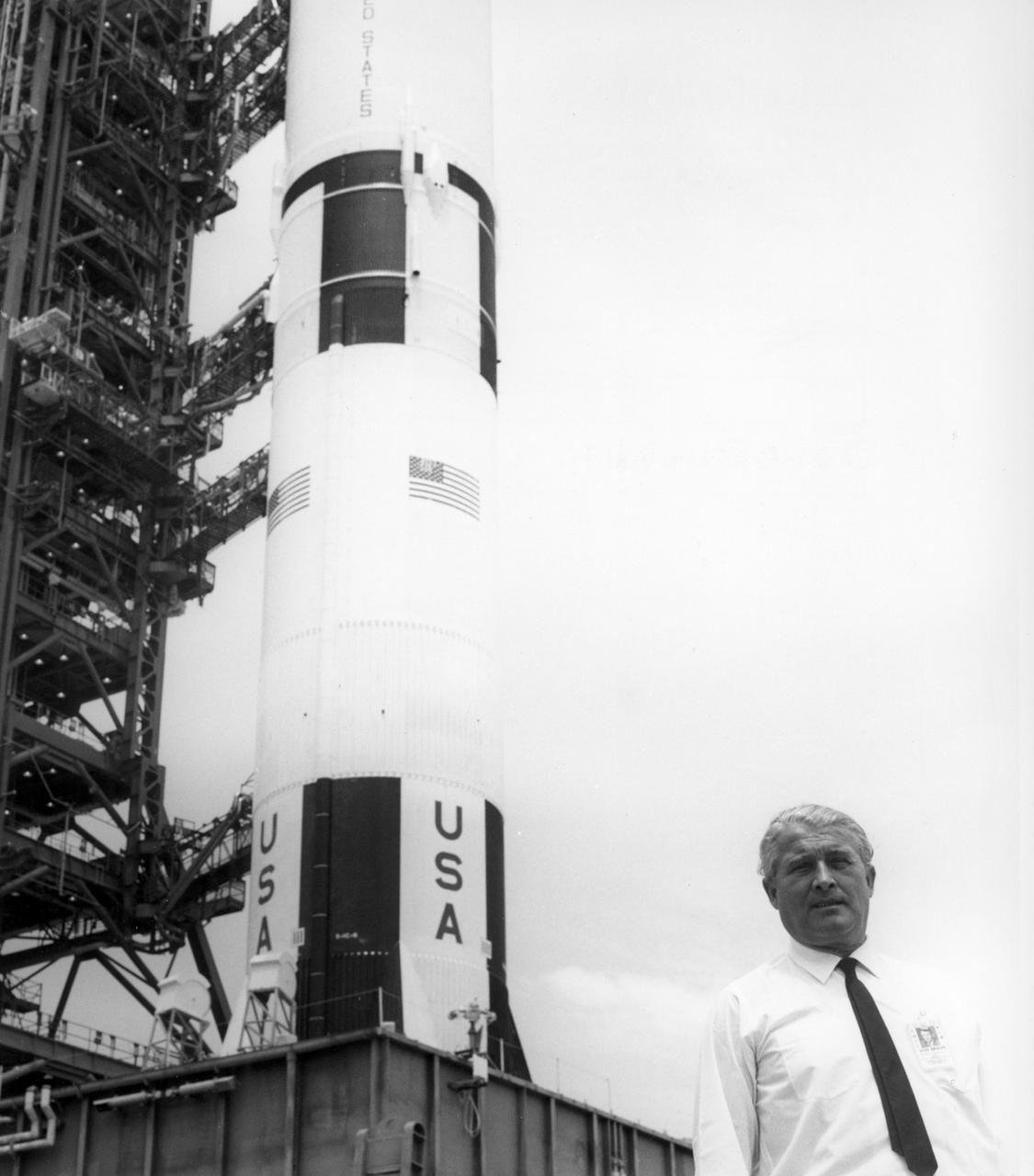
Dr. Wernher von Braun, director of the NASA Marshall Space Flight center (MSFC), talks with news reporters while paused in front of the mobile launcher and base of the Saturn V rocket (AS-506) being readied for the historic Apollo 11 lunar landing mission at the Kennedy Space Center (KSC). The Saturn V vehicle was developed by MSFC under the direction of Dr. von Braun. The Apollo 11 mission launched from the KSC in Florida via the MSFC developed Saturn V launch vehicle on July 16, 1969 and safely returned to Earth on July 24, 1969. Aboard the space craft were astronauts Neil A. Armstrong, commander; Michael Collins, Command Module (CM) pilot; and Edwin E. (Buzz) Aldrin Jr., Lunar Module (LM) pilot. The CM, “Columbia”, piloted by Collins, remained in a parking orbit around the Moon while the LM, “Eagle’’, carrying astronauts Armstrong and Aldrin, landed on the Moon. On July 20, 1969, Armstrong was the first human to ever stand on the lunar surface, followed by Aldrin. During 2½ hours of surface exploration, the crew collected 47 pounds of lunar surface material for analysis back on Earth. With the success of Apollo 11, the national objective to land men on the Moon and return them safely to Earth had been accomplished.
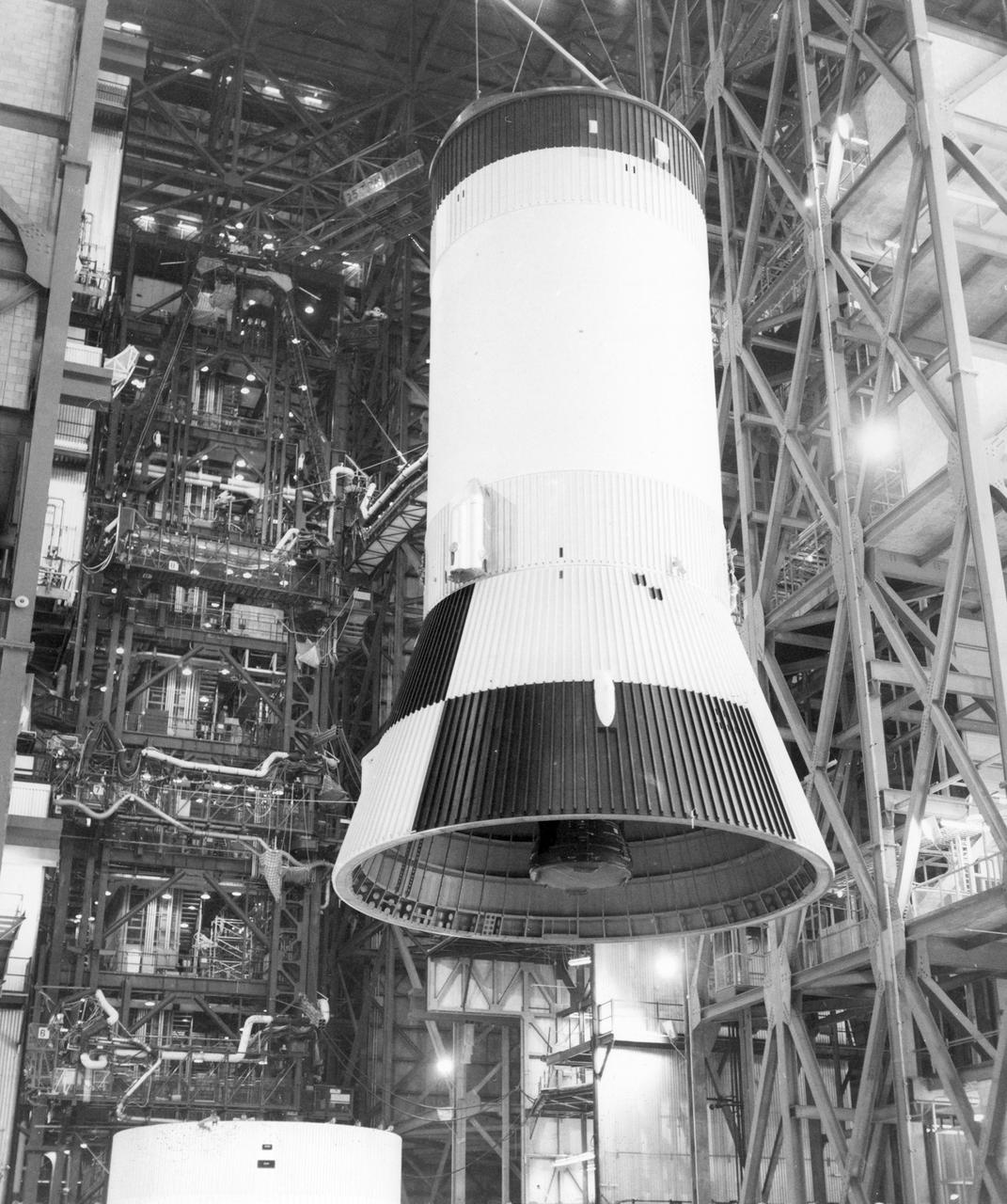
The third stage (S-IVB) of the Saturn V launch vehicle for the Apollo 11 lunar landing mission is hoisted in the vehicle assembly building at the NASA Kennedy Space Center (KSC) for mating with the second stage (S-II). The vehicle, designated as AS-506, projected the first lunar landing mission, Apollo 11, on a trajectory for the Moon. The Apollo 11 mission launched from KSC in Florida via the Marshall Space Flight Center (MSFC) developed Saturn V launch vehicle on July 16, 1969 and safely returned to Earth on July 24, 1969. Astronauts onboard included Neil A. Armstrong, commander; Michael Collins, Command Module (CM) pilot; and Edwin E. Aldrin, Jr., Lunar Module (LM) pilot. The CM, “Columbia”, piloted by Collins, remained in a parking orbit around the Moon while the LM, “Eagle’’, carrying astronauts Armstrong and Aldrin, landed on the Moon. On July 20, 1969, Armstrong was the first human to ever stand on the lunar surface, followed by Aldrin. During 2½ hours of surface exploration, the crew collected 47 pounds of lunar surface material for analysis back on Earth. With the success of Apollo 11, the national objective to land men on the Moon and return them safely to Earth had been accomplished.
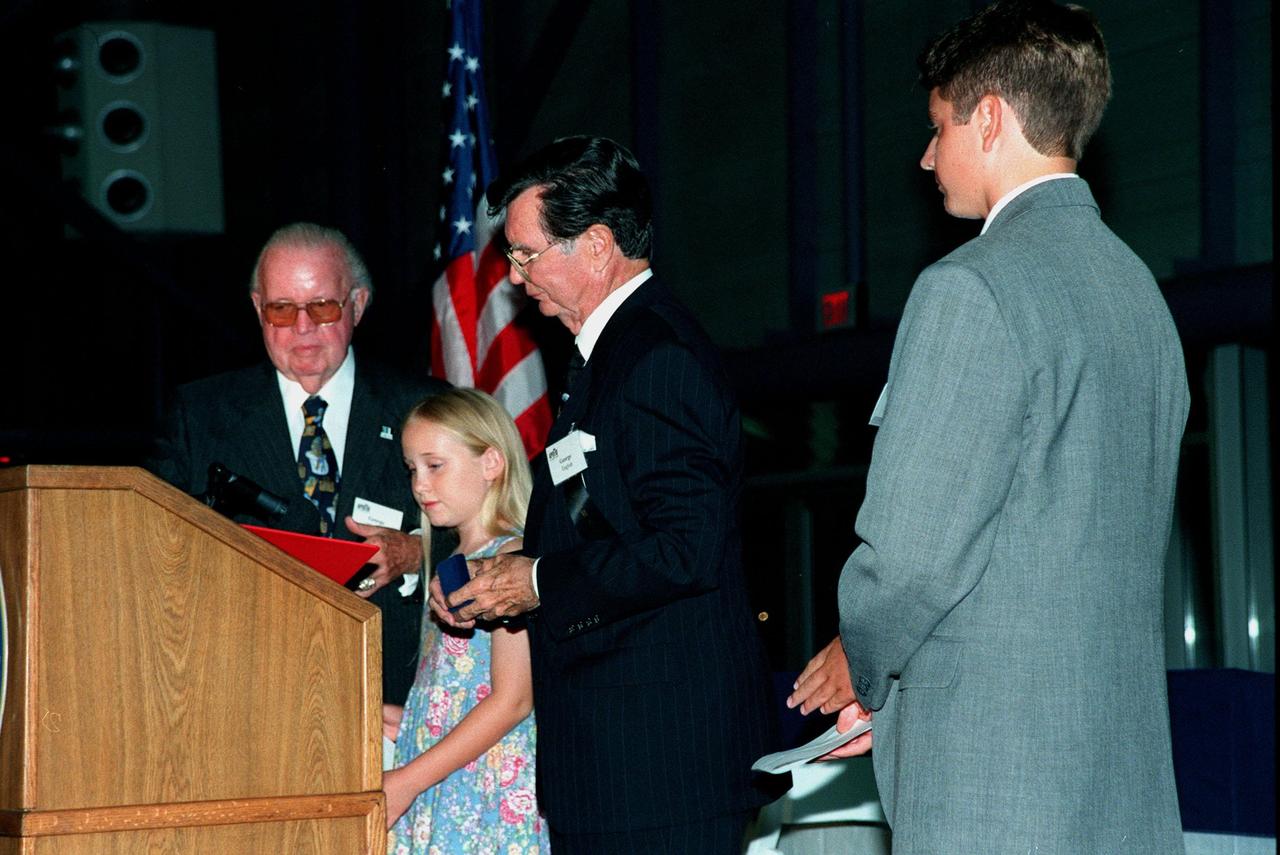
KENNEDY SPACE CENTER, FLA. -- George Meguiar (left) presents a scholarship award to Kyla Davis Horn, of Cocoa Beach, one of the winners of an essay contest related to the 30th Anniversary of Apollo 11. Meguiar and George English (second from right) head the Apollo 11 Commemoration Association who sponsored the contest in conjunction with Florida Today newspaper. The other scholarship winner is Kyle Rukaczewski, of Satellite Beach (far right). A third winner, Jason Gagnon, of Viera, was unable to attend. The presentation was made at the Apollo/Saturn V Center during an anniversary banquet that honored all the people who made the Apollo Program possible. Special guests included former Apollo astronauts Neil Armstrong, Edwin "Buzz" Aldrin, Gene Cernan and Walt Cunningham, who shared their experiences with the audience
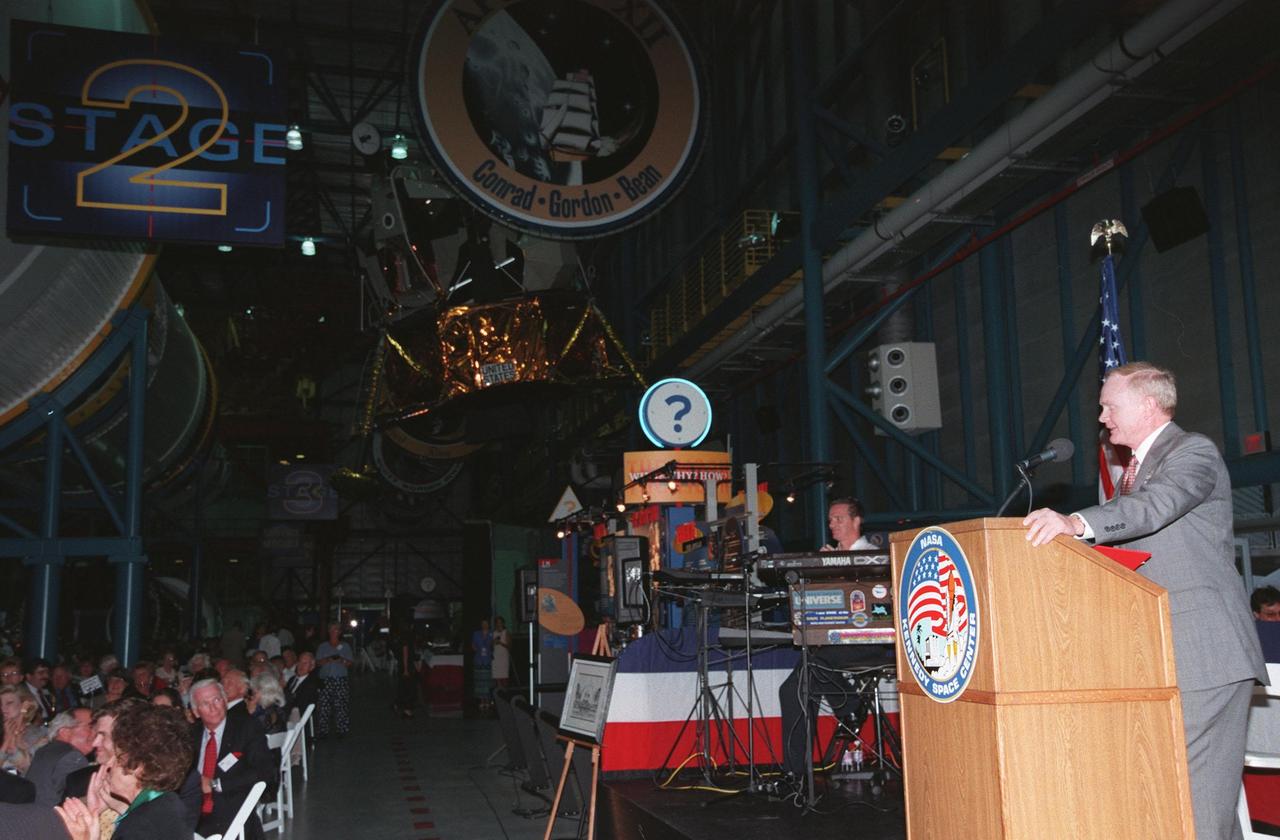
KENNEDY SPACE CENTER, FLA. -- At an anniversary banquet honoring the Apollo program team, the people who made the entire lunar landing program possible, Center Director Roy D. Bridges offers remarks. The banquet was held in the Apollo/Saturn V Center, part of the KSC Visitor Complex. This is the 30th anniversary of the Apollo 11 launch and moon landing, July 16 and July 20, 1969. Among the guests at the banquet were astronauts Neil Armstrong, Edwin "Buzz" Aldrin, Wally Schirra, Gene Cernan and Walt Cunningham. Neil Armstrong was the first man to walk on the moon; Gene Cernan was the last
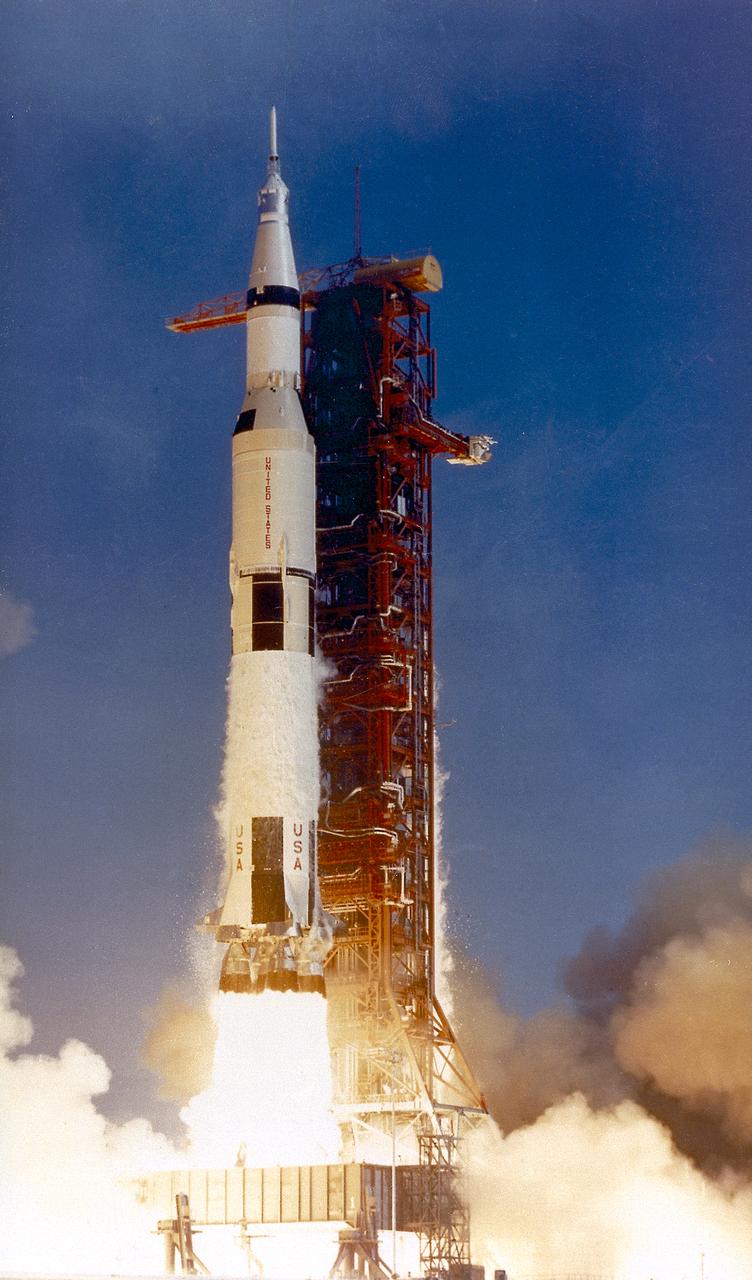
This photograph shows the Saturn V launch vehicle (SA-506) for the Apollo 11 mission liftoff at 8:32 am CDT, July 16, 1969, from launch complex 39A at the Kennedy Space Center. Apollo 11 was the first manned lunar landing mission with a crew of three astronauts: Mission commander Neil A. Armstrong, Command Module pilot Michael Collins, and Lunar Module pilot Edwin E. Aldrin, Jr. It placed the first humans on the surface of the moon and returned them back to Earth. Astronaut Armstrong became the first man on the lunar surface, and astronaut Aldrin became the second. Astronaut Collins piloted the Command Module in a parking orbit around the Moon.
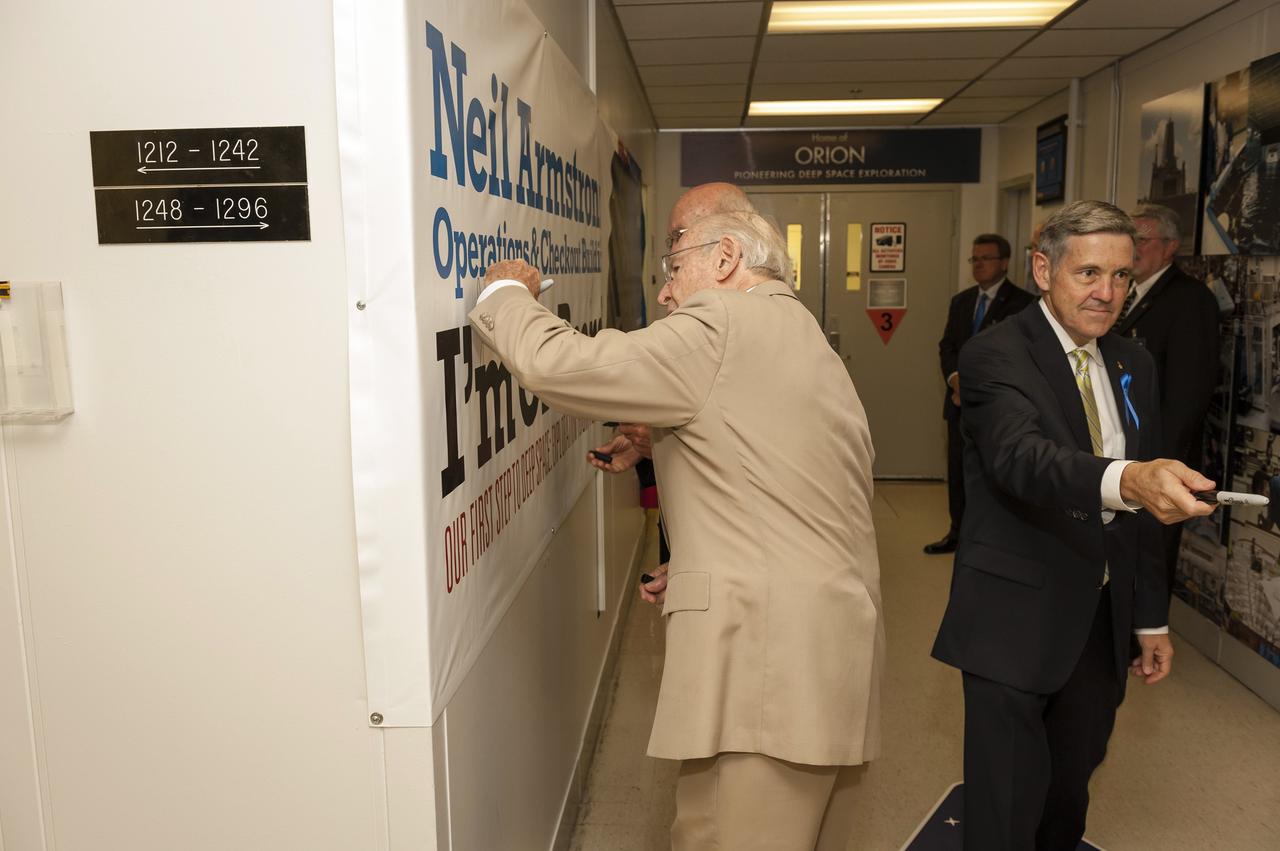
CAPE CANAVERAL, Fla. -- Apollo astronauts and their families receive a briefing in one of the remodeled firing rooms in the Launch Control Center at NASA's Kennedy Space Center in Florida. The facility's firing rooms were used to conduct the Saturn V countdowns during the Apollo Program. The tour followed a ceremony renaming the refurbished Operations and Checkout Building for Apollo 11 astronaut Neil Armstrong, the first person to set foot on the moon. Second from left is Apollo 11 moonwalker Buzz Aldrin and former astronaut Jim Lovell, a member of the Apollo 8 and Apollo 13 crews, standing next to him, at center. The ceremony was part of NASA's 45th anniversary celebration of the Apollo 11 moon landing. As the world watched, Neil Armstrong and Buzz Aldrin landed in the moon's Sea of Tranquility on July 20, 1969, aboard the lunar module Eagle. Meanwhile, crewmate Michael Collins orbited above in the command module Columbia. For more, visit http://www.nasa.gov/press/2014/july/nasa-honors-historic-first-moon-landing-eyes-first-mars-mission. Photo credit: NASA/Kevin O'Connell

CAPE CANAVERAL, Fla. -- Apollo astronauts and their families receive a briefing in one of the remodeled firing rooms in the Launch Control Center at NASA's Kennedy Space Center in Florida. The facility's firing rooms were used to conduct the Saturn V countdowns during the Apollo Program. The tour followed a ceremony renaming the refurbished Operations and Checkout Building for Apollo 11 astronaut Neil Armstrong, the first person to set foot on the moon. Second from left is Apollo 11 moonwalker Buzz Aldrin and former astronaut Jim Lovell, a member of the Apollo 8 and Apollo 13 crews, standing next to him, at center. The ceremony was part of NASA's 45th anniversary celebration of the Apollo 11 moon landing. As the world watched, Neil Armstrong and Buzz Aldrin landed in the moon's Sea of Tranquility on July 20, 1969, aboard the lunar module Eagle. Meanwhile, crewmate Michael Collins orbited above in the command module Columbia. For more, visit http://www.nasa.gov/press/2014/july/nasa-honors-historic-first-moon-landing-eyes-first-mars-mission. Photo credit: NASA/Kim Shiflett
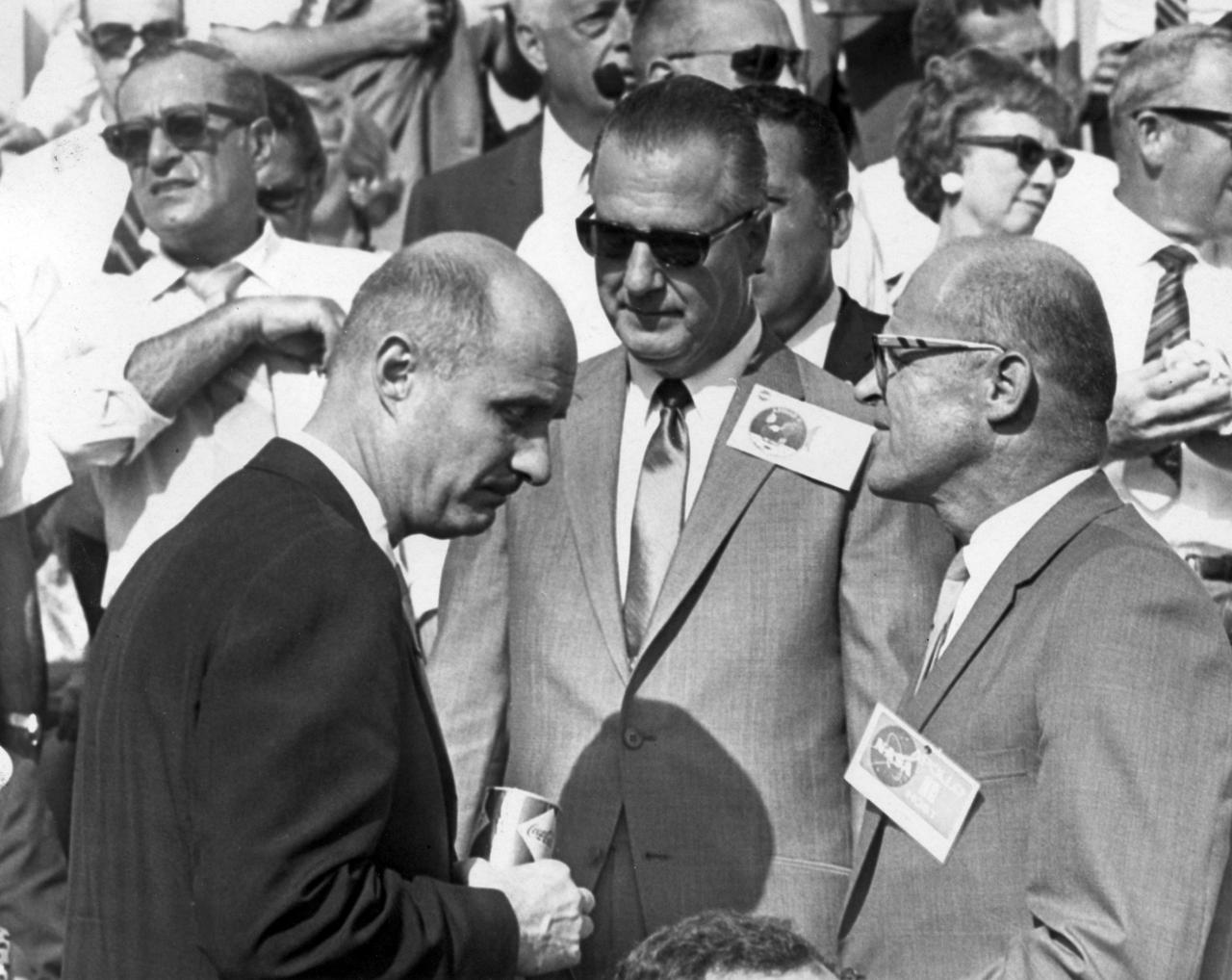
Apollo 10 commander, Thomas P. Stafford (left) and Kennedy Space Center (KSC) Deputy Director Albert Siepert (right) talk with U.S. Vice President Spiro T. Agnew a few minutes before the launch of Apollo 11. The Apollo 11 mission, the first manned lunar mission, launched from KSC, Florida via the Saturn V launch vehicle on July 16, 1969 and safely returned to Earth on July 24, 1969. The Saturn V vehicle was developed by the Marshall Space Flight Center (MSFC) under the direction of Dr. Wernher von Braun. Aboard the space craft were astronauts Neil A. Armstrong, commander; Michael Collins, Command Module (CM) pilot; and Edwin E. Aldrin Jr., Lunar Module (LM) pilot. The CM, piloted by Michael Collins remained in a parking orbit around the Moon while the LM, named “Eagle’’, carrying astronauts Neil Armstrong and Edwin Aldrin, landed on the Moon. Armstrong was the first human to ever stand on the lunar surface, followed by Edwin (Buzz) Aldrin. During 2½ hours of surface exploration, the crew collected 47 pounds of lunar surface material for analysis back on Earth. With the success of Apollo 11, the national objective to land men on the Moon and return them safely to Earth had been accomplished.
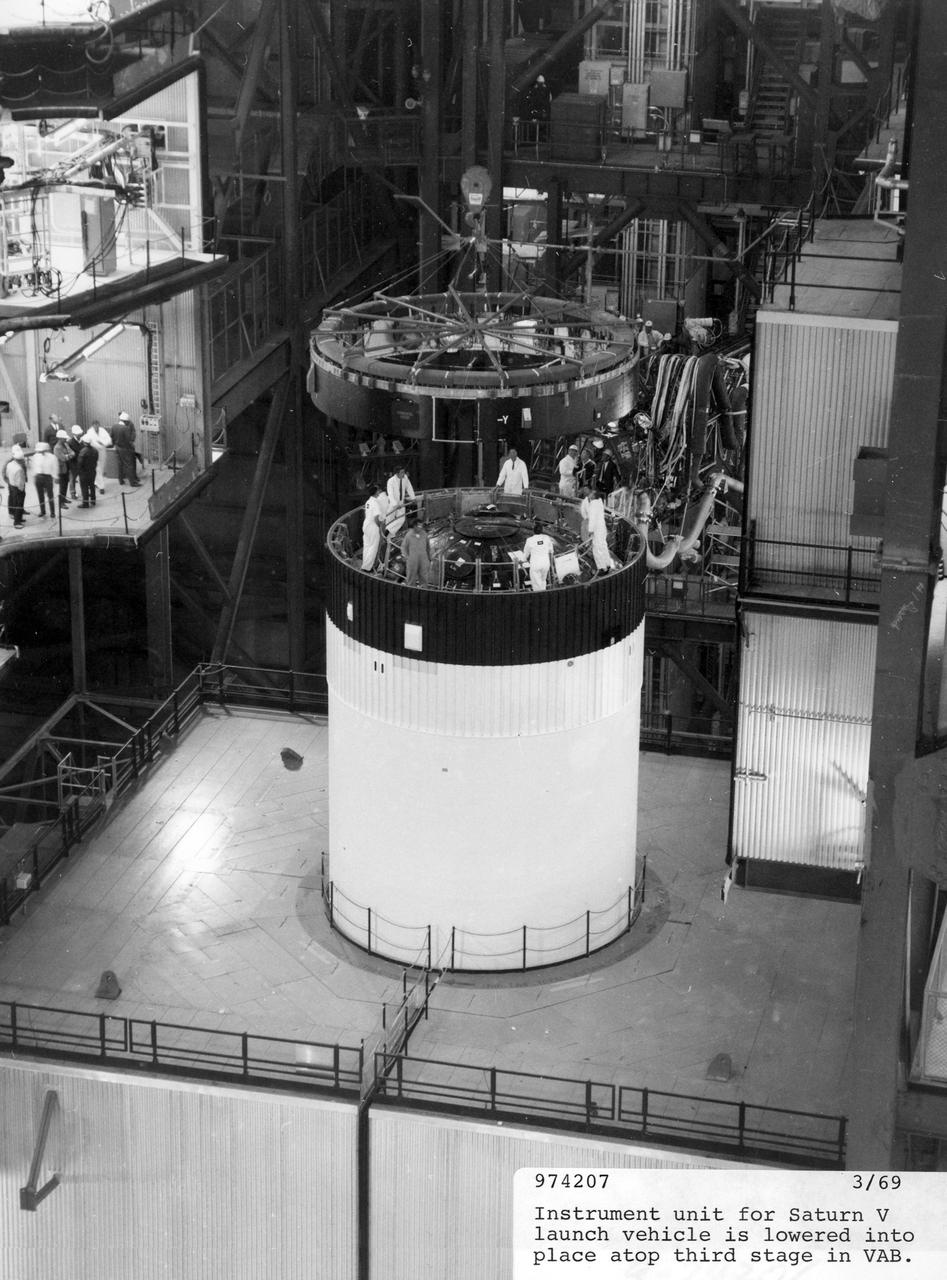
The instrument unit for the Saturn V launch vehicle, AS-506, used to propel the Apollo 11 lunar landing mission, is lowered into place atop the third (S-IVB) stage in the vehicle assembly building at the NASA Kennedy Space Center (KSC). Designed by the NASA Marshall Space Flight Center (MSFC), the instrument unit served as the Saturn’s “nerve center” providing guidance and control, command and sequence of vehicle functions, telemetry, and environmental control. The Apollo 11 mission launched from KSC in Florida via the MSFC developed Saturn V launch vehicle on July 16, 1969 and safely returned to Earth on July 24, 1969. Astronauts onboard included Neil A. Armstrong, commander; Michael Collins, Command Module (CM) pilot; and Edwin E. Aldrin, Jr., Lunar Module (LM) pilot. The CM, “Columbia”, piloted by Collins, remained in a parking orbit around the Moon while the LM, “Eagle’’, carrying astronauts Armstrong and Aldrin, landed on the Moon. On July 20, 1969, Armstrong was the first human to ever stand on the lunar surface, followed by Aldrin. During 2½ hours of surface exploration, the crew collected 47 pounds of lunar surface material for analysis back on Earth. With the success of Apollo 11, the national objective to land men on the Moon and return them safely to Earth had been accomplished
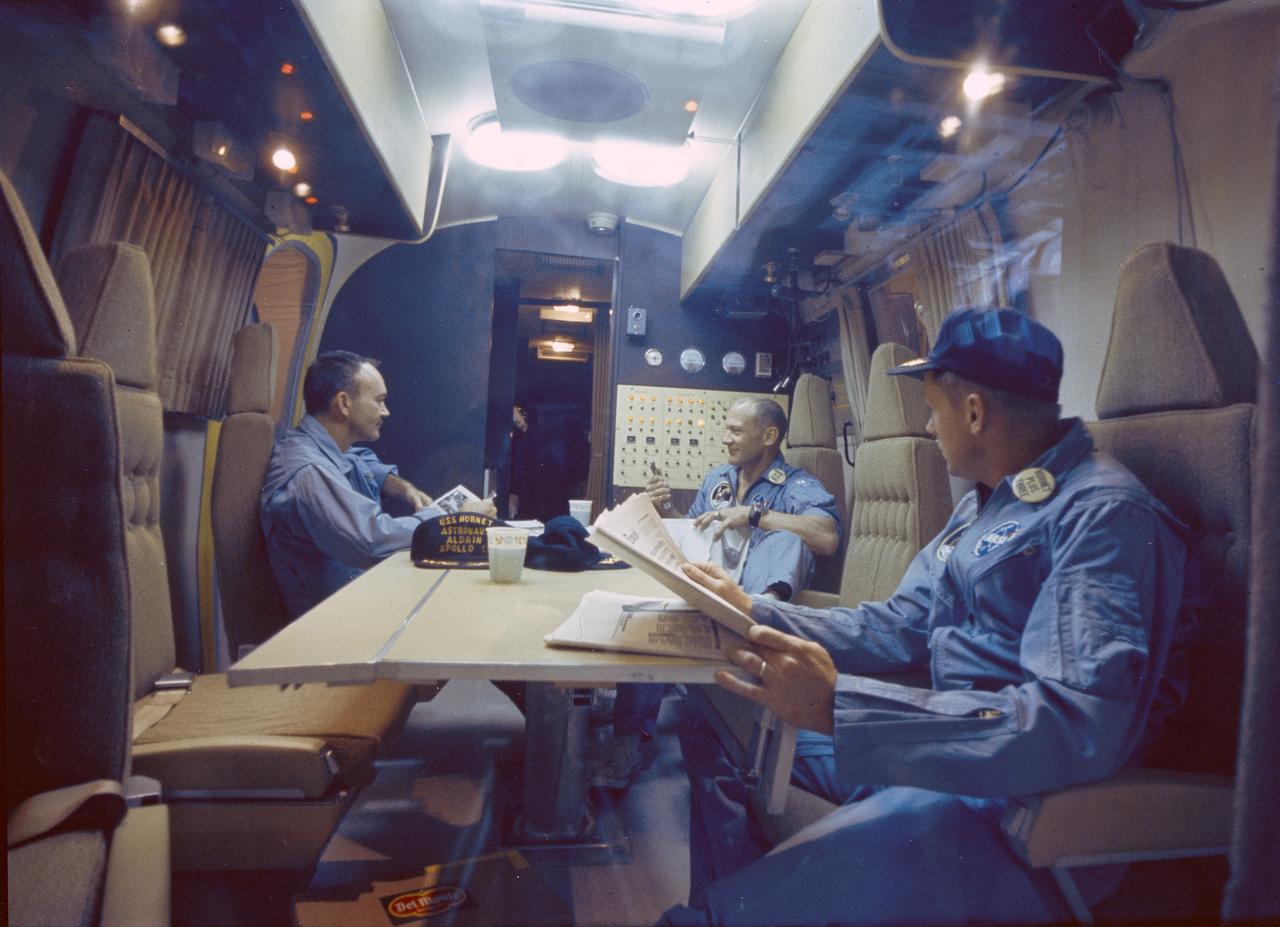
The Apollo 11 mission, the first manned lunar mission, launched from the Kennedy Space Center, Florida via a Saturn V launch vehicle on July 16, 1969 and safely returned to Earth on July 24, 1969. The Saturn V vehicle was developed by the Marshall Space Flight Center (MSFC) under the direction of Dr. Wernher von Braun. Aboard were Neil A. Armstrong, commander; Michael Collins, Command Module pilot; and Edwin E. Aldrin Jr., Lunar Module pilot. The Command Module (CM), piloted by Michael Collins remained in a parking orbit around the Moon while the Lunar Module (LM), named “Eagle’’, carrying astronauts Neil Armstrong and Edwin Aldrin, landed on the Moon. Armstrong was the first human to ever stand on the lunar surface, followed by Edwin (Buzz) Aldrin. The surface exploration was concluded in 2½ hours, in which the crew collected 47 pounds of lunar surface material for analysis back on Earth. Upon splash down in the Pacific Ocean, Navy para-rescue men recovered the capsule housing the 3-man Apollo 11 crew. The crew was taken to safety aboard the USS Hornet, where they were quartered in a mobile quarantine facility. Shown here is the Apollo 11 crew inside the quarantine facility. With the success of Apollo 11, the national objective to land men on the Moon and return them safely to Earth had been accomplished.
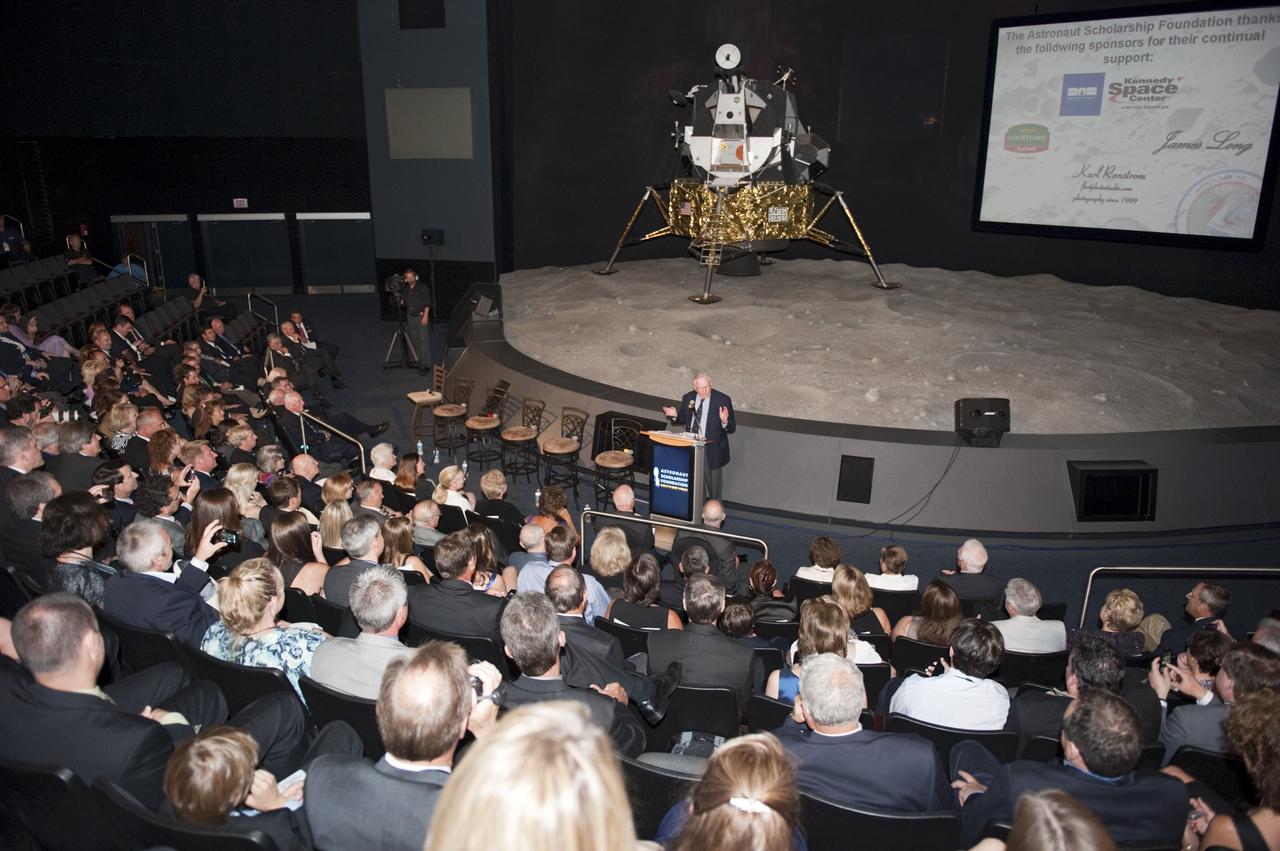
CAPE CANAVERAL, Fla. -- The Apollo/Saturn V Center at NASA's Kennedy Space Center in Florida hosted a celebration on the 40th anniversary of NASA's Apollo 15 mission. Apollo 15 Commander Dave Scott and Command Module Pilot Al Worden and an elite gathering of Apollo-era astronauts were on hand for the event and panel discussion. Here, Apollo 11 Commander Neil Armstrong speaks to the invited guests. In the background is a model of the Lunar Module, part of the lander portion of the Apollo spacecraft. Worden circled the moon while Scott and the late Jim Irwin, the Lunar Module commander, made history when they became the first humans to drive a vehicle on the surface of the moon. They also provided extensive descriptions and photographic documentation of geologic features in the vicinity of the Hadley Rille landing site during their three days on the lunar surface. Photo credit: NASA/Kim Shiflett
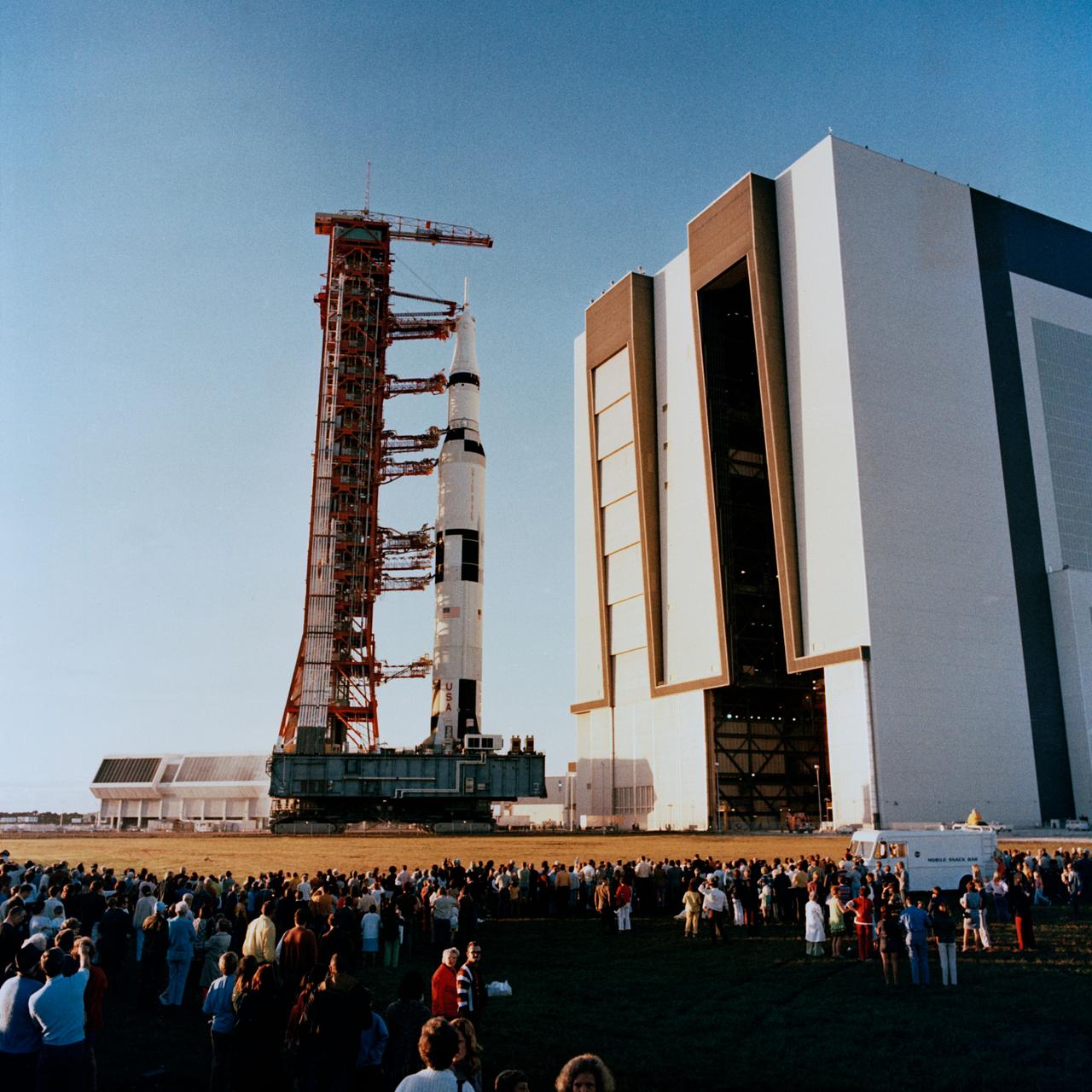
S72-19795 (13 Dec. 1971) --- A large crowd of spectators look on as the 363-feet tall Apollo 16 (Spacecraft 113/Lunar Module 11/Saturn 511) space vehicle moves out of the Vehicle Assembly Building (VAB) at the Kennedy Space Center's (KSC) Launch Complex 39 toward Pad A. The Saturn V stack and its mobile launch tower are atop a huge crawler-transporter. The prime crew men of the scheduled Apollo 16 lunar landing mission are astronauts John W. Young, commander; Thomas K. Mattingly, command module pilot; and Charles M. Duke Jr., lunar module pilot.
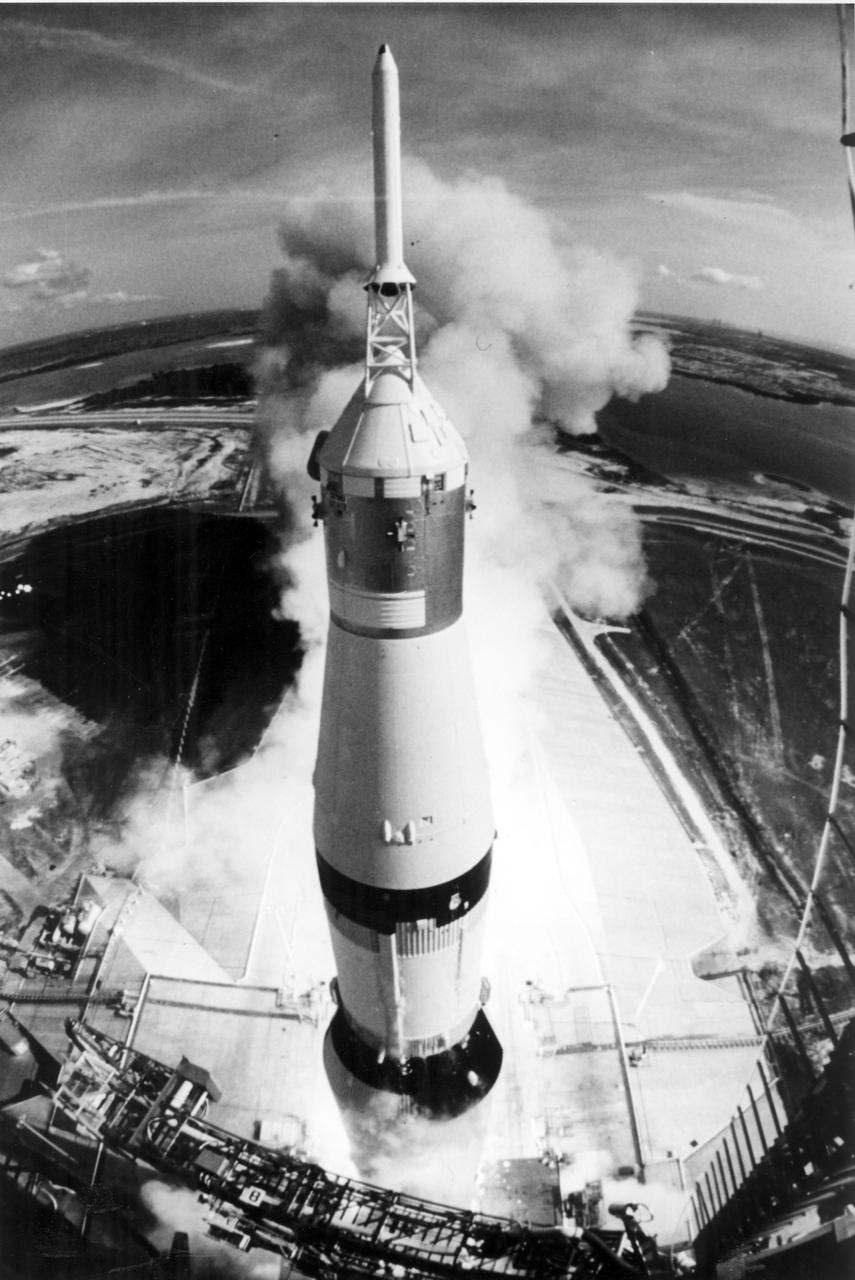
The Apollo 11 mission, the first lunar landing mission, launched from the Kennedy Space Center, Florida via the Marshall Space Flight Center (MSFC) developed Saturn V launch vehicle on July 16, 1969 and safely returned to Earth on July 24, 1969. The Saturn V vehicle produced a holocaust of flames as it rose from its pad at Launch complex 39. The 363 foot tall, 6,400,000 pound rocket hurled the spacecraft into Earth parking orbit and then placed it on the trajectory to the moon for man’s first lunar landing. This high angle view of the launch was provided by a ‘fisheye’ camera mounted on the launch tower. Aboard the space craft were astronauts Neil A. Armstrong, commander; Michael Collins, Command Module pilot; and Edwin E. Aldrin Jr., Lunar Module pilot. With the success of Apollo 11, the national objective to land men on the Moon and return them safely to Earth had been accomplished.
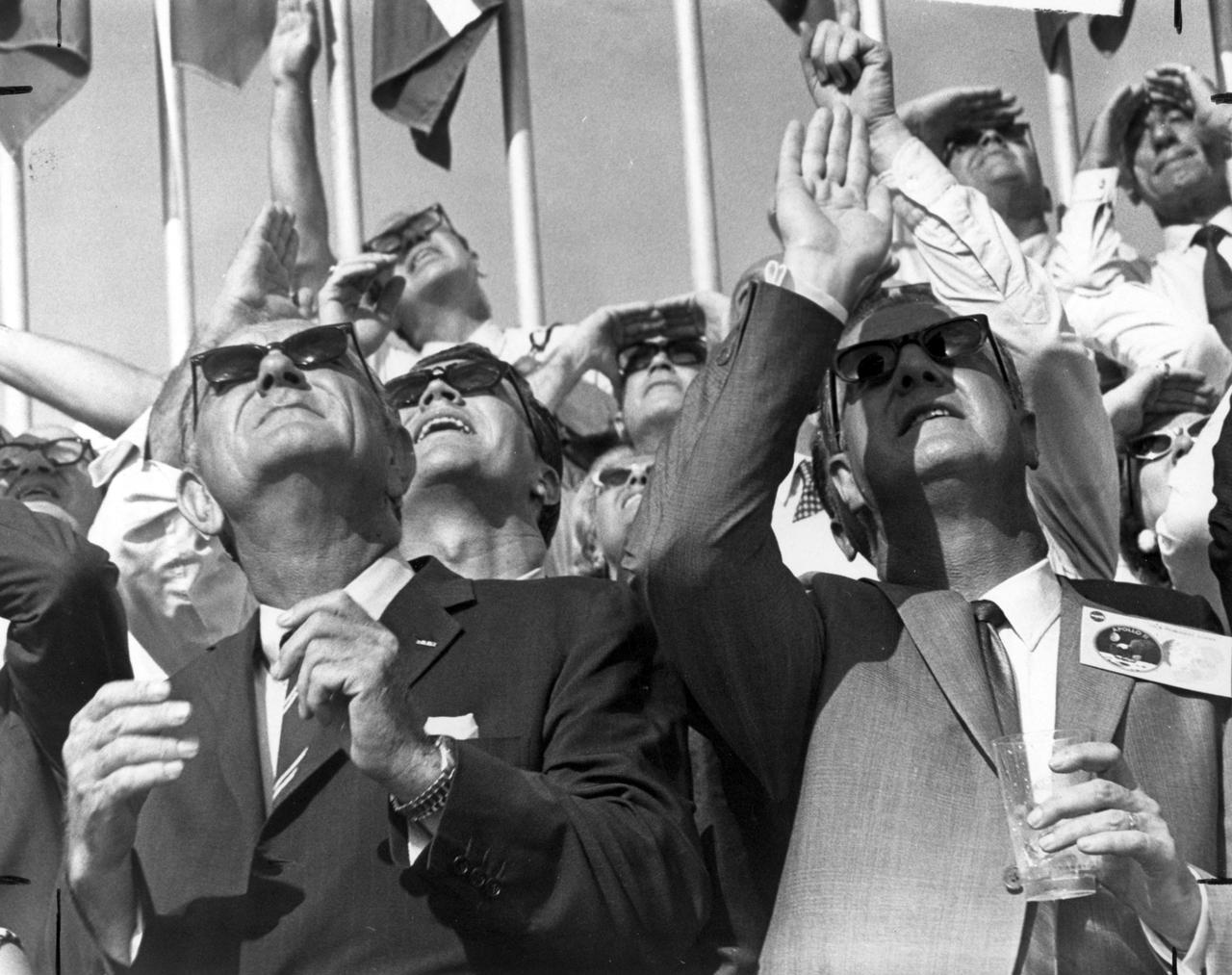
Amidst a crowd of other onlookers, U.S. Vice President Spiro T. Agnew (right) and former U.S. President Lyndon B. Johnson watch the Saturn V vehicle roar skyward carrying the Apollo 11 manned spacecraft into the vast regions of space. On a trajectory to the Moon, the craft lifted off from launch pad 39 at Kennedy Space Flight Center (KSC) on July 16, 1969. The moon bound crew included astronauts Neil A. Armstrong, commander; Michael Collins, Command Module (CM) pilot; and Edwin E. Aldrin Jr., Lunar Module (LM) pilot. The mission finalized with splashdown on July 24, 1969. With the success of Apollo 11, the national objective to land men on the Moon and return them safely to Earth had been accomplished. The Saturn V was developed by the Marshall Space Flight Center (MSFC) under the direction of Werher von Braun.
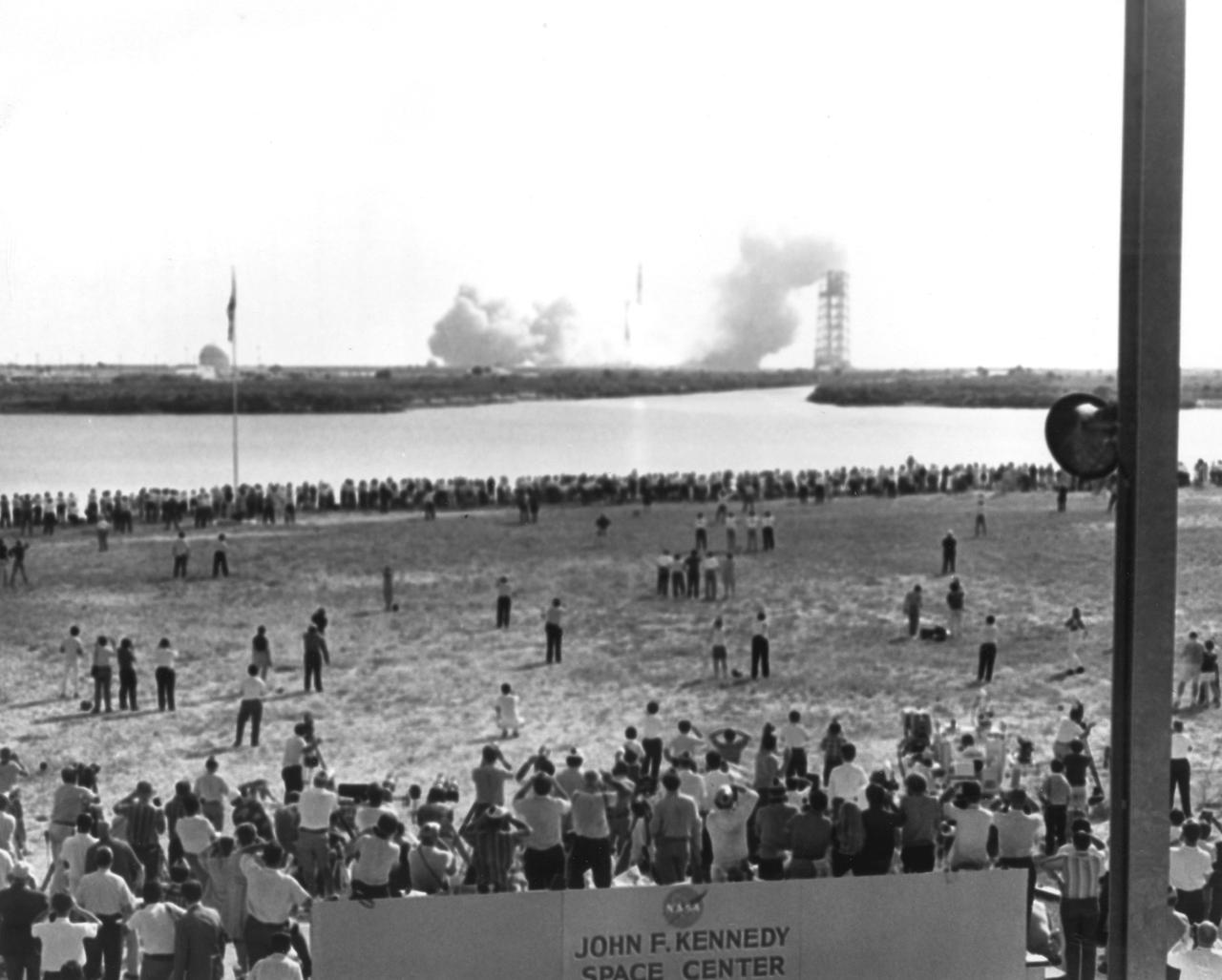
At the press site, thousands of news reporters from the world over watched, taking many pictures, as the Saturn V launch vehicle (AS-506) lifted off to start Apollo 11 on its historic mission to land on the Moon. The total number of news people officially registered to cover the launch was 3,497. The craft lifted off from launch pad 39 at Kennedy Space Flight Center (KSC) on July 16, 1969. A three man crew included astronauts Neil A. Armstrong, commander; Michael Collins, Command Module(CM) pilot; and Edwin E. Aldrin Jr., Lunar Module (LM) pilot. The mission finalized with splashdown into the Pacific Ocean on July 24, 1969. With the success of Apollo 11, the national objective to land men on the Moon and return them safely to Earth had been accomplished. The Saturn V was developed by the Marshall Space Flight Center (MSFC) under the direction of Werher von Braun.
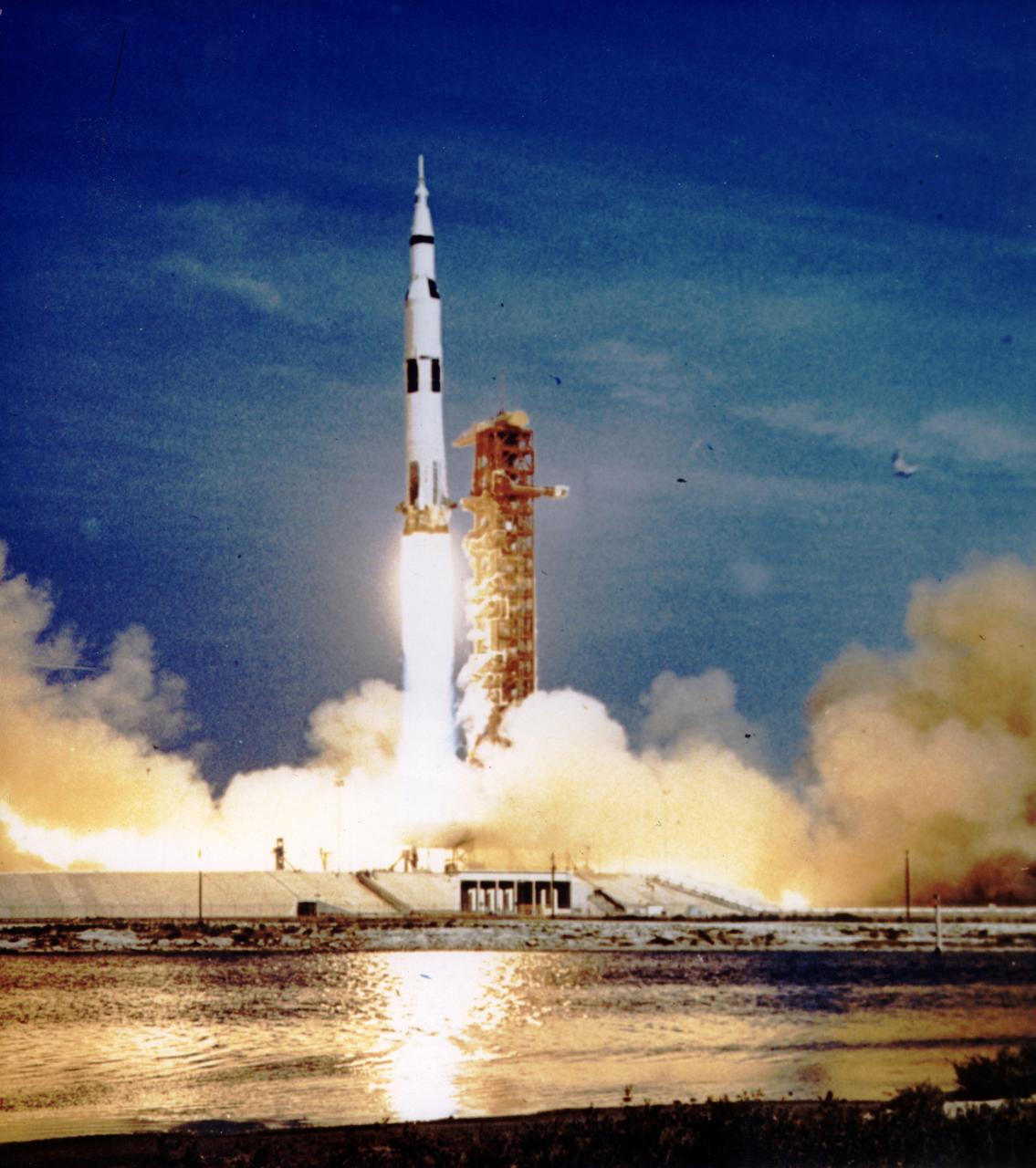
The Apollo 11 mission, the first manned lunar mission, launched from the Kennedy Space Center, Florida via the Marshall Space Flight Center (MSFC) developed Saturn V launch vehicle on July 16, 1969 and safely returned to Earth on July 24, 1969. The Saturn V vehicle produced a holocaust of flames as it rose from its pad at Launch complex 39. The 363 foot tall, 6,400,000 pound rocket hurled the spacecraft into Earth parking orbit and then placed it on the trajectory to the moon for man’s first lunar landing. Aboard the space craft were astronauts Neil A. Armstrong, commander; Michael Collins, Command Module pilot; and Edwin E. Aldrin Jr., Lunar Module pilot. With the success of Apollo 11, the national objective to land men on the Moon and return them safely to Earth had been accomplished.
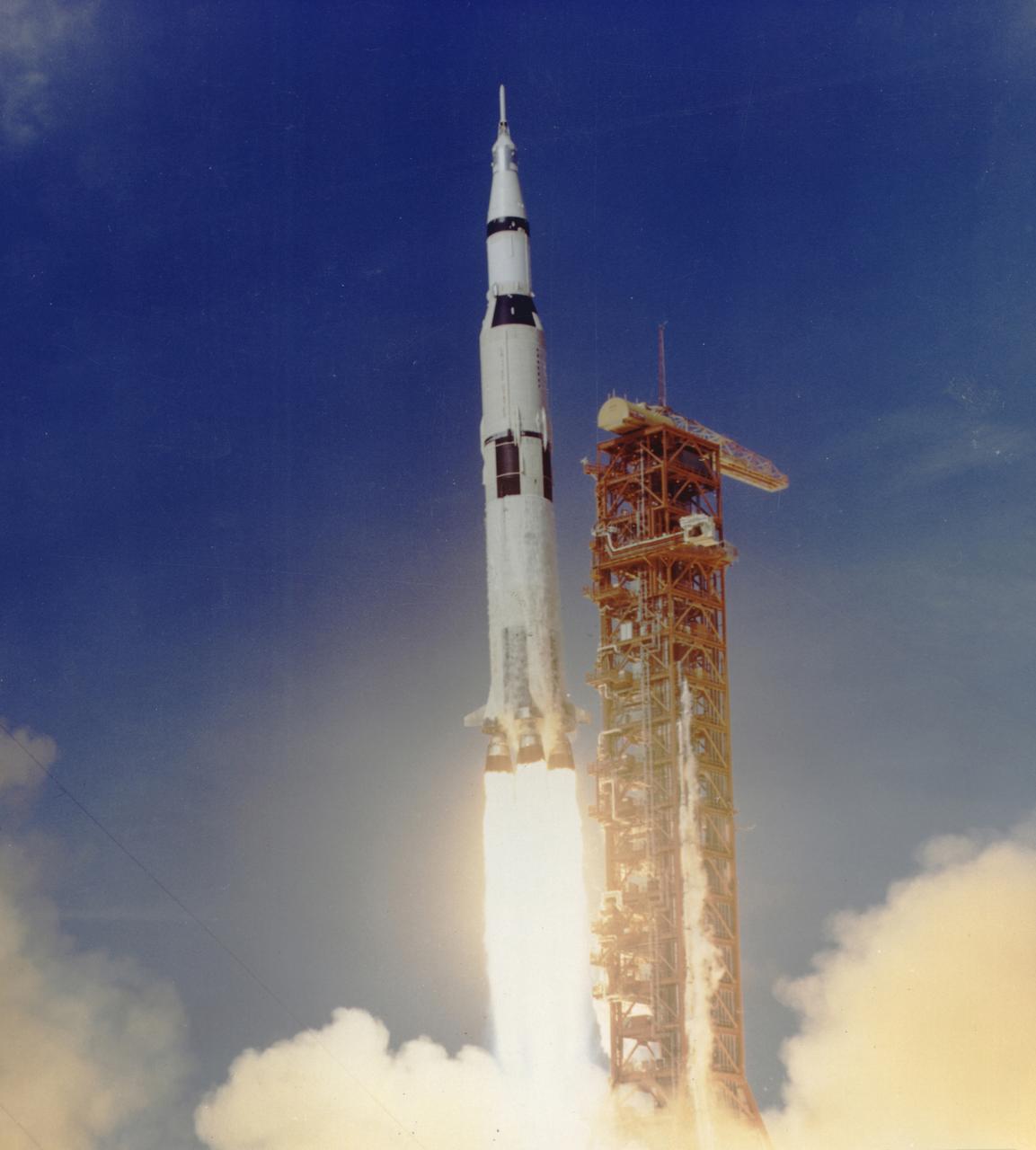
The Apollo 11 mission, the first manned lunar mission, launched from the Kennedy Space Center, Florida via the Marshall Space Flight Center (MSFC) developed Saturn V launch vehicle on July 16, 1969 and safely returned to Earth on July 24, 1969. The Saturn V vehicle produced a holocaust of flames as it rose from its pad at Launch complex 39. The 363 foot tall, 6,400,000 pound rocket hurled the spacecraft into Earth parking orbit and then placed it on the trajectory to the moon for man’s first lunar landing. Aboard the space craft were astronauts Neil A. Armstrong, commander; Michael Collins, Command Module pilot; and Edwin E. Aldrin Jr., Lunar Module pilot. With the success of Apollo 11, the national objective to land men on the Moon and return them safely to Earth had been accomplished.
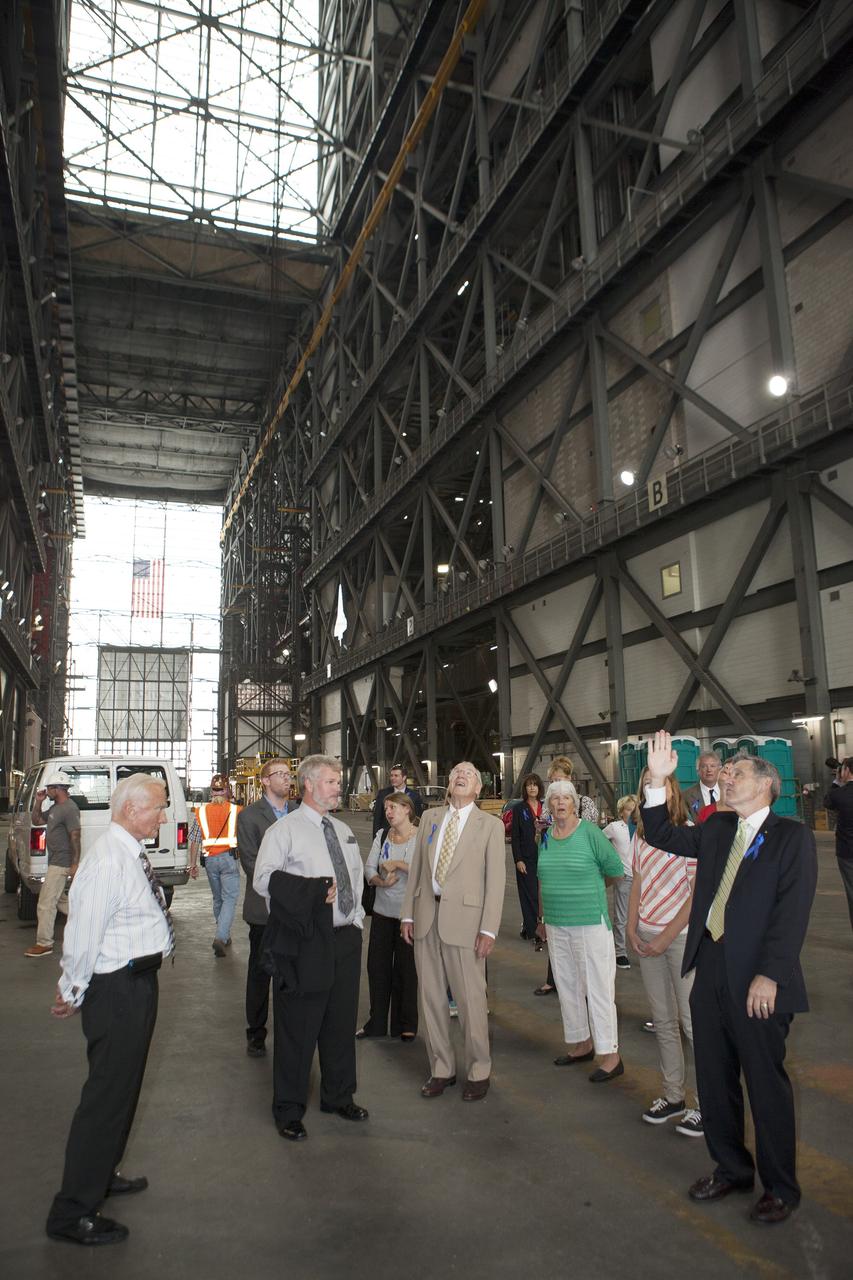
CAPE CANAVERAL, Fla. -- Kennedy Space Center Director Robert Cabana, at right, escorts Apollo astronauts and their families through the transfer aisle of the 525-foot-tall Vehicle Assembly Building, the facility in which Apollo's Saturn V rockets were processed at NASA's Kennedy Space Center in Florida. The visit followed a ceremony renaming Kennedy's refurbished Operations and Checkout Building for Apollo 11 astronaut Neil Armstrong, the first person to set foot on the moon. In front of the group, from left, are Apollo 11 moonwalker Buzz Aldrin, Armstrong's son Mark, Apollo astronaut Jim Lovell, Armstrong's former wife Janet, and Cabana. The ceremony was part of NASA's 45th anniversary celebration of the Apollo 11 moon landing. As the world watched, Neil Armstrong and Buzz Aldrin landed in the moon's Sea of Tranquility on July 20, 1969, aboard the lunar module Eagle. Meanwhile, crewmate Michael Collins orbited above in the command module Columbia. For more, visit http://www.nasa.gov/press/2014/july/nasa-honors-historic-first-moon-landing-eyes-first-mars-mission. Photo credit: NASA/Kim Shiflett
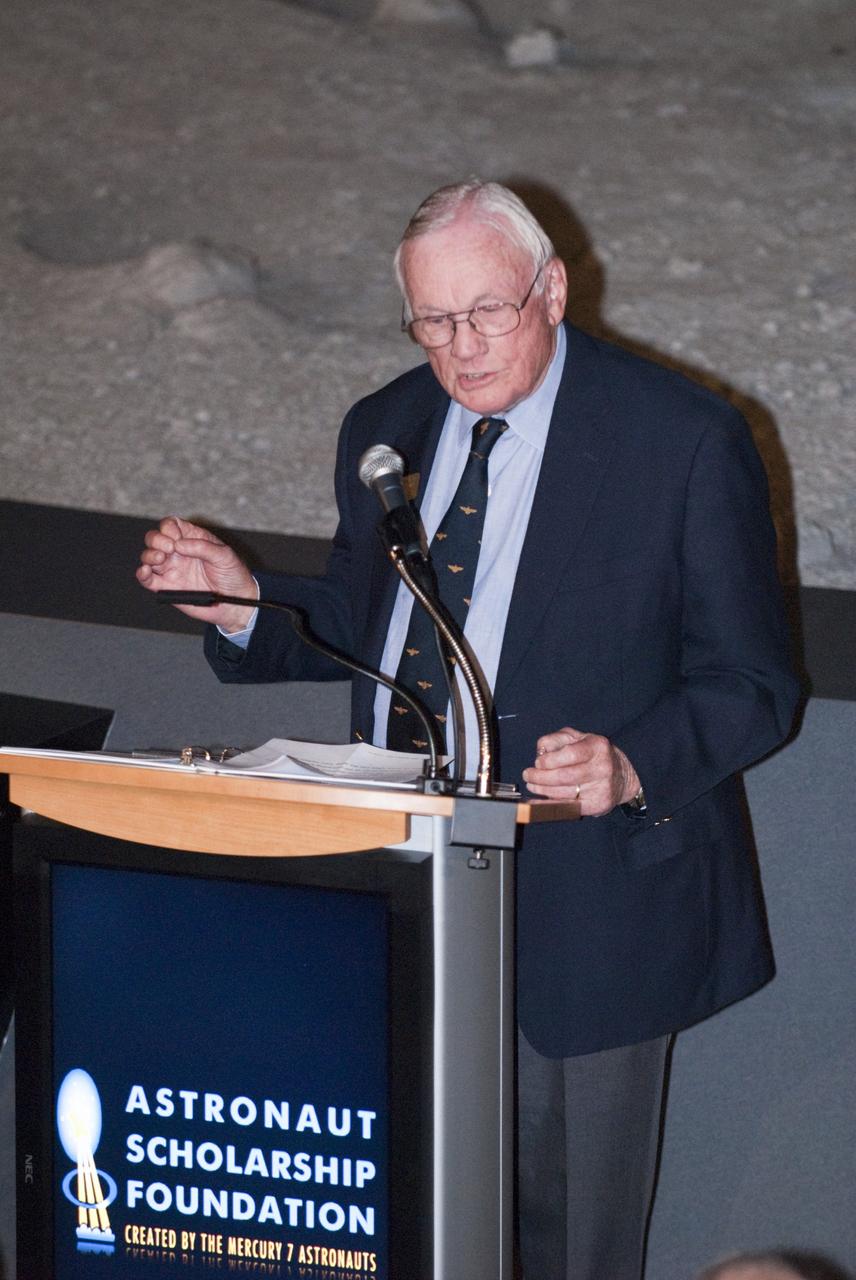
CAPE CANAVERAL, Fla. -- The Apollo/Saturn V Center at NASA's Kennedy Space Center in Florida hosted a celebration on the 40th anniversary of NASA's Apollo 15 mission. Apollo 15 Commander Dave Scott, Command Module Pilot Al Worden and an elite gathering of Apollo-era astronauts were on hand for the event and panel discussion. Here, Apollo 11 Commander Neil Armstrong speaks to the invited guests. Worden circled the moon while Scott and the late Jim Irwin, the Lunar Module commander, made history when they became the first humans to drive a vehicle on the surface of the moon. They also provided extensive descriptions and photographic documentation of geologic features in the vicinity of the Hadley Rille landing site during their three days on the lunar surface. Photo credit: NASA/Kim Shiflett
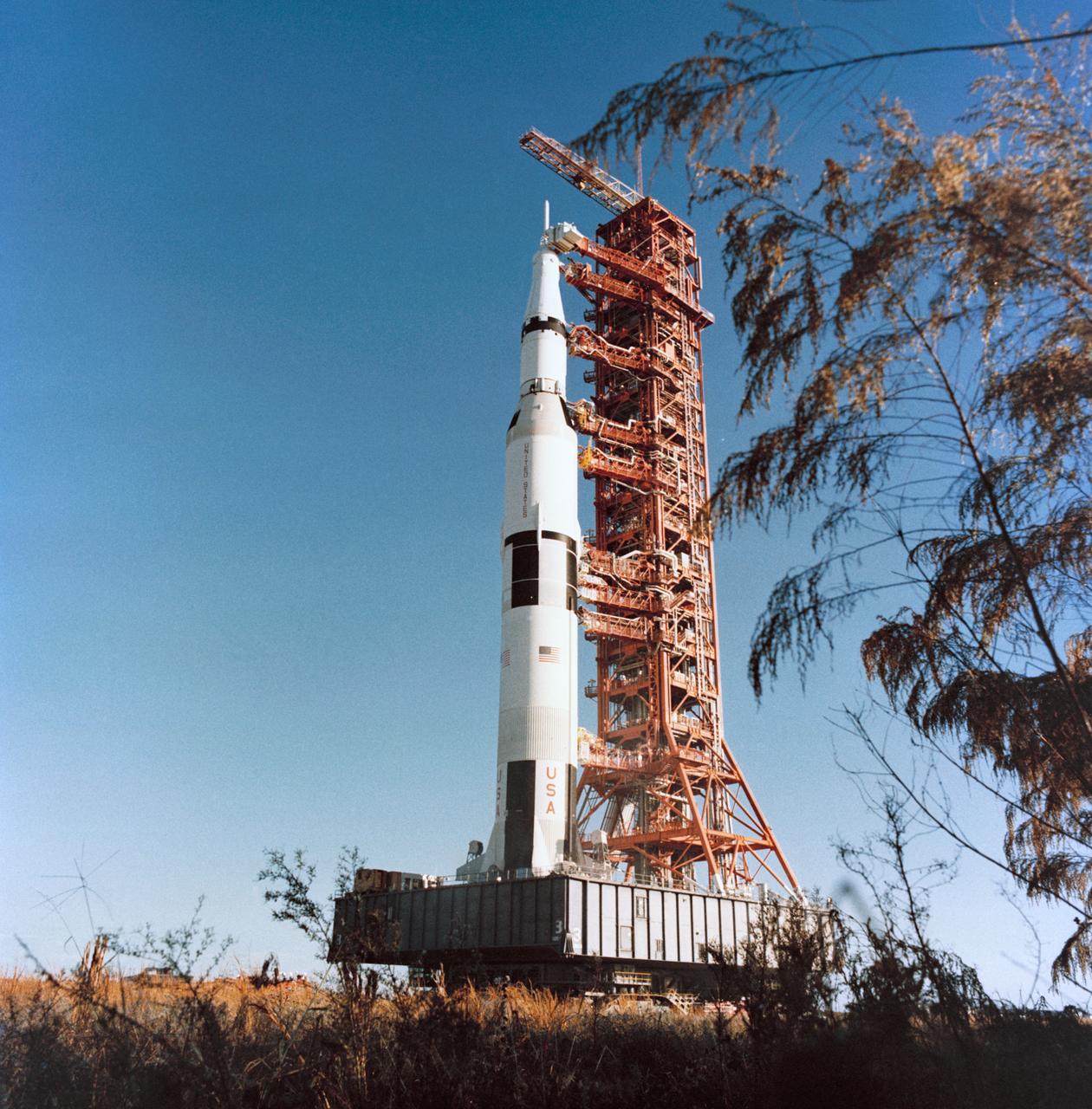
S72-19794 (13 Dec. 1971) --- A ground-level view showing the tall Apollo 16 (Spacecraft 113/Lunar Module 11/Saturn 511) space vehicle at the Kennedy Space Center's (KSC) Launch Complex 39 being moved from the Vehicle Assembly Building (VAB) toward Pad A. The Saturn V stack and its mobile launch tower are atop a huge crawler-transporter. The prime crew men of the scheduled Apollo 16 lunar landing mission are astronauts John W. Young, Apollo 16 lunar landing mission are astronauts John W. Young, commander; Thomas K. Mattingly II, command module pilot; and Charles M. Duke Jr., lunar module pilot.