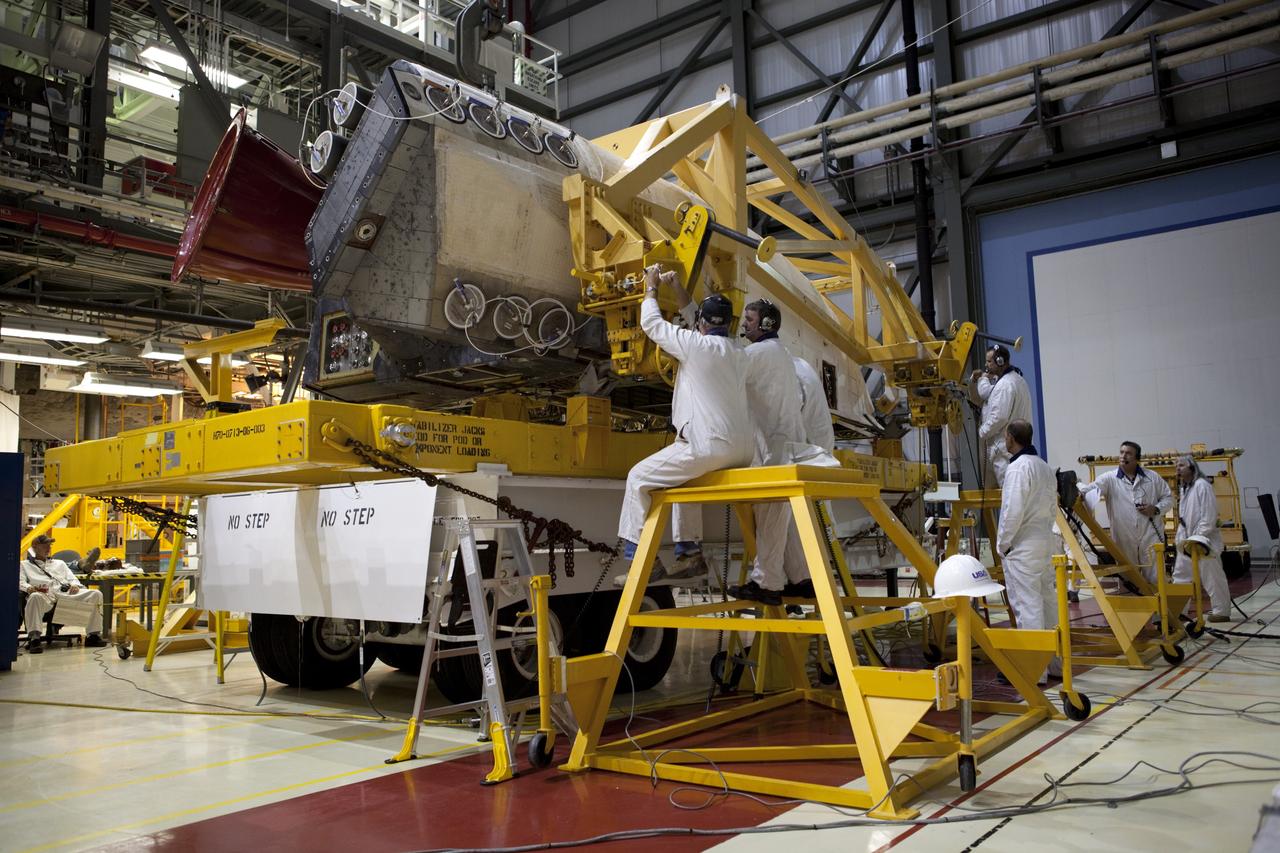
CAPE CANAVERAL, Fla. – Inside Orbiter Processing Facility-2 at NASA’s Kennedy Space Center in Florida, technicians help secure space shuttle Atlantis’ right orbital maneuvering system (OMS) pod onto a pallet. The work is part of the Space Shuttle Program’s transition and retirement processing of shuttle Atlantis. Both OMS pods will be removed and sent to White Sands Space Harbor in New Mexico where they will undergo a complete deservicing and cleaning and then be returned to Kennedy for reinstallation on Atlantis. Atlantis is being prepared for display at the Kennedy Space Center Visitor Complex. Photo credit: NASA/Dimitri Gerondidakis
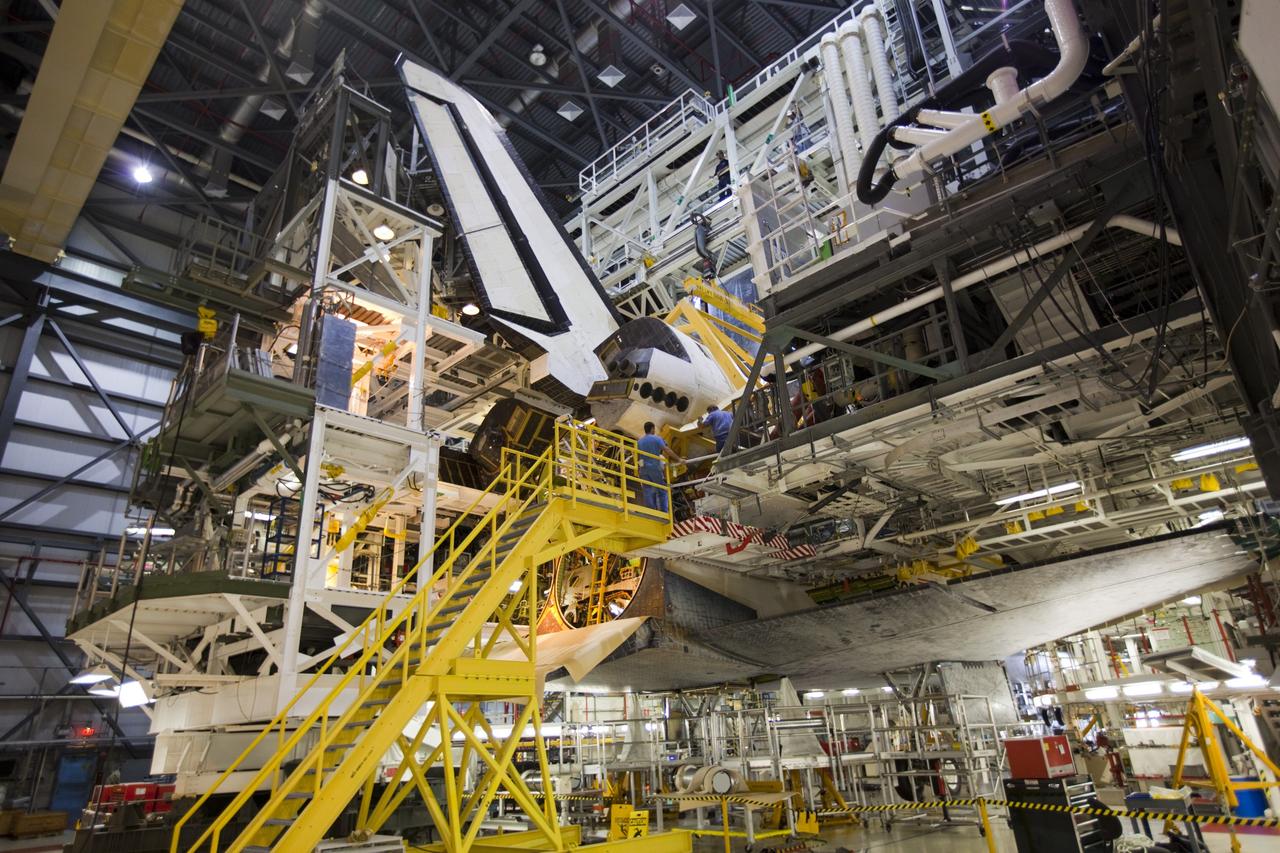
CAPE CANAVERAL, Fla. – Inside Orbiter Processing Facility-1 at NASA’s Kennedy Space Center in Florida, a large crane lowers the right orbital maneuvering system, or OMS, pod onto space shuttle Atlantis. It is the last time an OMS pod will be installed on Atlantis. The OMS provided the shuttle with thrust for orbit insertion, rendezvous and deorbit, and could provide up to 1,000 pounds of propellant to the aft reaction control system. The OMS is housed in two independent pods located on each side of the shuttle’s aft fuselage. Each pod contains one OMS engine and the hardware needed to pressurize, store and distribute the propellants to perform the velocity maneuvers. Atlantis’ OMS pods were removed and sent to the test facility at White Sands Space Harbor in New Mexico to be cleaned of residual toxic propellant. The work is part of the Space Shuttle Program’s transition and retirement processing of the space shuttle fleet. A groundbreaking was held Jan. 18 for Atlantis’ future home, a 65,000-square-foot exhibit hall in Shuttle Plaza at the Kennedy Space Center Visitor Complex. Atlantis is scheduled to roll over to the visitor complex in November in preparation for the exhibit’s grand opening in July 2013. For more information, visit http://www.nasa.gov/transition. Photo credit: NASA/Dimitri Gerondidakis
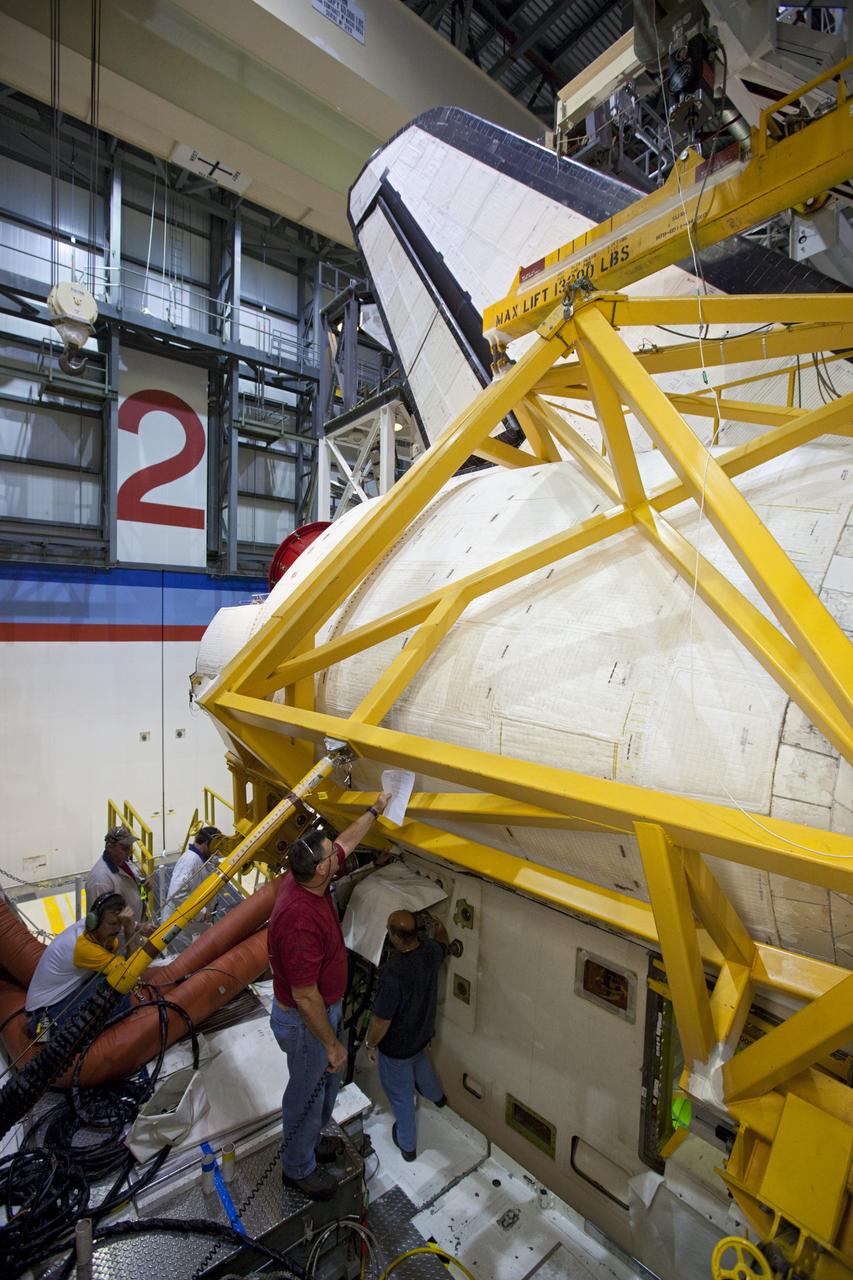
CAPE CANAVERAL, Fla. -- Inside Orbiter Processing Facility-2 at NASA’s Kennedy Space Center in Florida, technicians help secure a sling around space shuttle Atlantis’ right orbital maneuvering system (OMS) pod. The work is part of the Space Shuttle Program’s transition and retirement processing of shuttle Atlantis. The OMS pod will be removed and sent to White Sands Space Harbor in New Mexico where it will undergo a complete deservicing and cleaning and then be returned to Kennedy for reinstallation on Atlantis. Atlantis is being prepared for display at the Kennedy Space Center Visitor Complex. Photo credit: NASA/Dimitri Gerondidakis
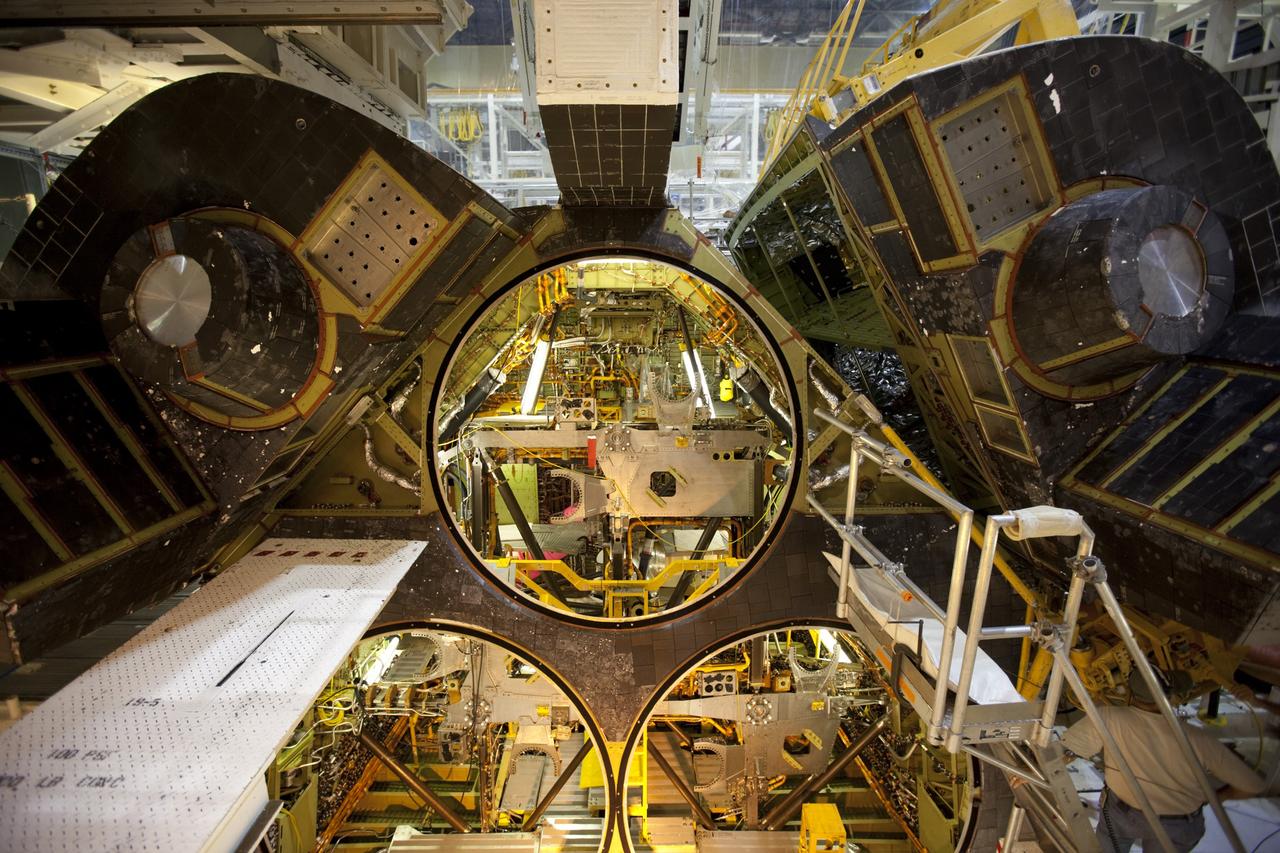
CAPE CANAVERAL, Fla. –Inside Orbiter Processing Facility-1 at NASA’s Kennedy Space Center in Florida, a unique close-up view shows a large crane lowering the right orbital maneuvering system, or OMS, pod closer to space shuttle Atlantis and the left OMS pod already installed. It is the last time an OMS pod will be installed on Atlantis. The OMS provided the shuttle with thrust for orbit insertion, rendezvous and deorbit, and could provide up to 1,000 pounds of propellant to the aft reaction control system. The OMS is housed in two independent pods located on each side of the shuttle’s aft fuselage. Each pod contains one OMS engine and the hardware needed to pressurize, store and distribute the propellants to perform the velocity maneuvers. Atlantis’ OMS pods were removed and sent to the test facility at White Sands Space Harbor in New Mexico to be cleaned of residual toxic propellant. The work is part of the Space Shuttle Program’s transition and retirement processing of the space shuttle fleet. A groundbreaking was held Jan. 18 for Atlantis’ future home, a 65,000-square-foot exhibit hall in Shuttle Plaza at the Kennedy Space Center Visitor Complex. Atlantis is scheduled to roll over to the visitor complex in November in preparation for the exhibit’s grand opening in July 2013. For more information, visit http://www.nasa.gov/transition. Photo credit: NASA/Dimitri Gerondidakis
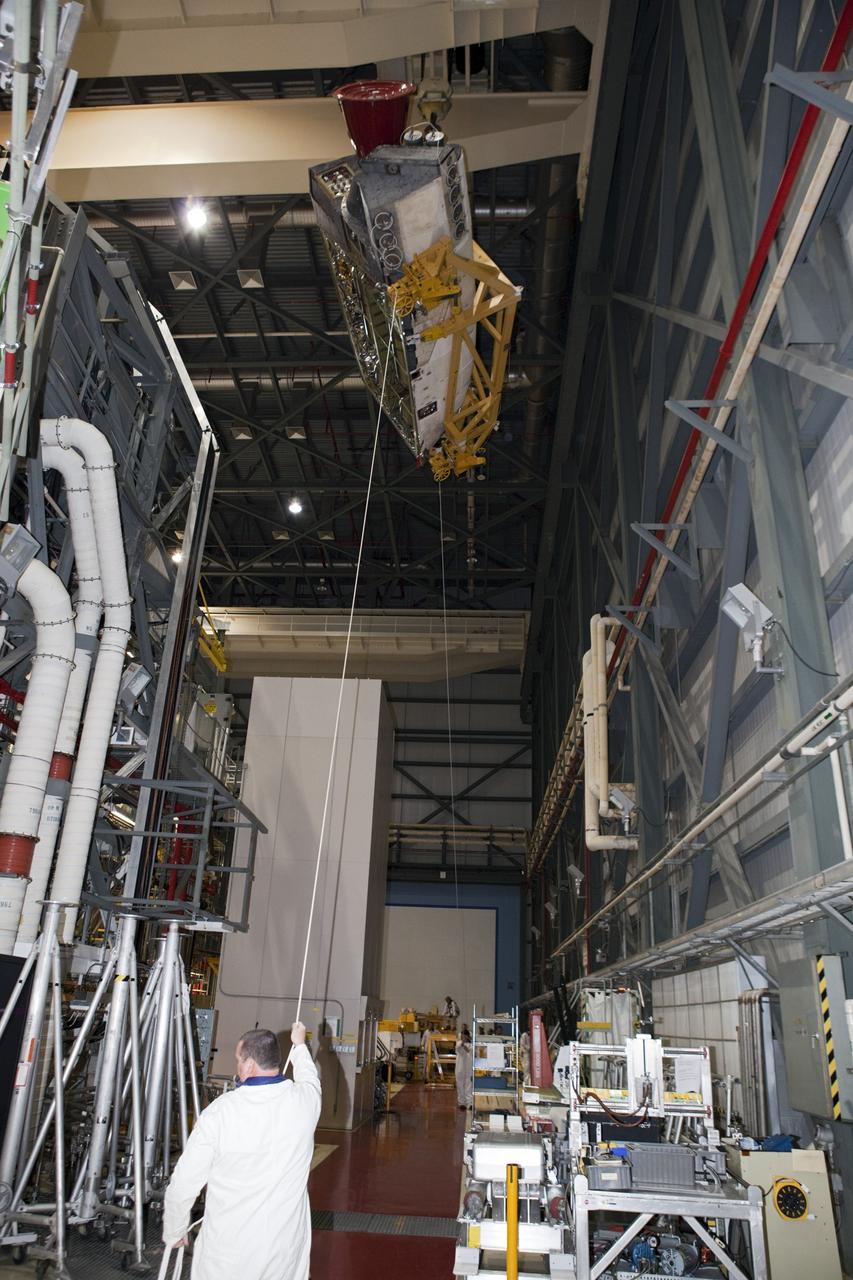
CAPE CANAVERAL, Fla. – Inside Orbiter Processing Facility-2 at NASA’s Kennedy Space Center in Florida, a large crane is being used to move the right orbital maneuvering system (OMS) pod away from space shuttle Atlantis. The work is part of the Space Shuttle Program’s transition and retirement processing of shuttle Atlantis. Both OMS pods will be removed and sent to White Sands Space Harbor in New Mexico where they will undergo a complete deservicing and cleaning and then be returned to Kennedy for reinstallation on Atlantis. Atlantis is being prepared for display at the Kennedy Space Center Visitor Complex. Photo credit: NASA/Dimitri Gerondidakis
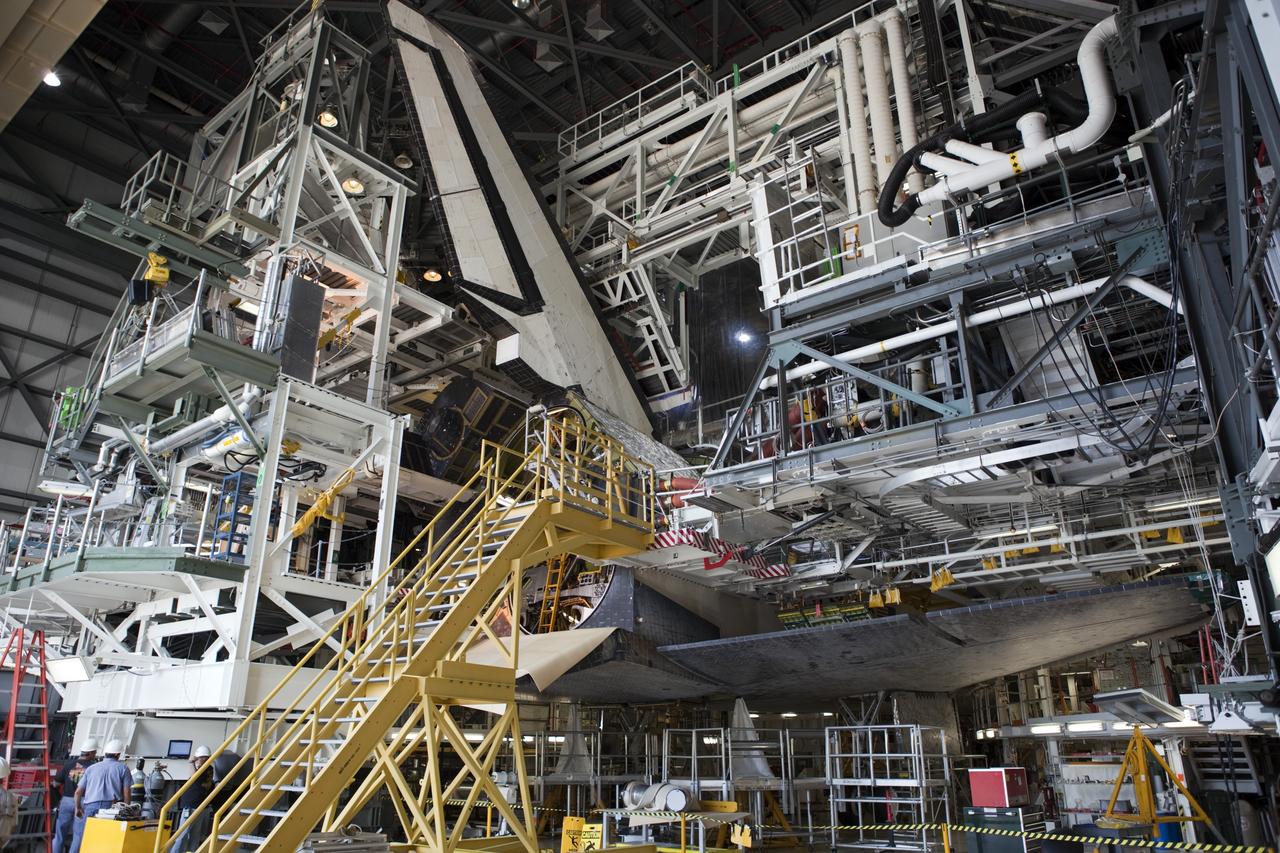
CAPE CANAVERAL, Fla. – Inside Orbiter Processing Facility-1 at NASA’s Kennedy Space Center in Florida, preparations are underway to install the right orbital maneuvering system, or OMS, pod on space shuttle Atlantis. It will be the last time an OMS pod is installed on Atlantis. The OMS provided the shuttle with thrust for orbit insertion, rendezvous and deorbit, and could provide up to 1,000 pounds of propellant to the aft reaction control system. The OMS is housed in two independent pods located on each side of the shuttle’s aft fuselage. Each pod contains one OMS engine and the hardware needed to pressurize, store and distribute the propellants to perform the velocity maneuvers. Atlantis’ OMS pods were removed and sent to the test facility at White Sands Space Harbor in New Mexico to be cleaned of residual toxic propellant. The work is part of the Space Shuttle Program’s transition and retirement processing of the space shuttle fleet. A groundbreaking was held Jan. 18 for Atlantis’ future home, a 65,000-square-foot exhibit hall in Shuttle Plaza at the Kennedy Space Center Visitor Complex. Atlantis is scheduled to roll over to the visitor complex in November in preparation for the exhibit’s grand opening in July 2013. For more information, visit http://www.nasa.gov/transition. Photo credit: NASA/Dimitri Gerondidakis
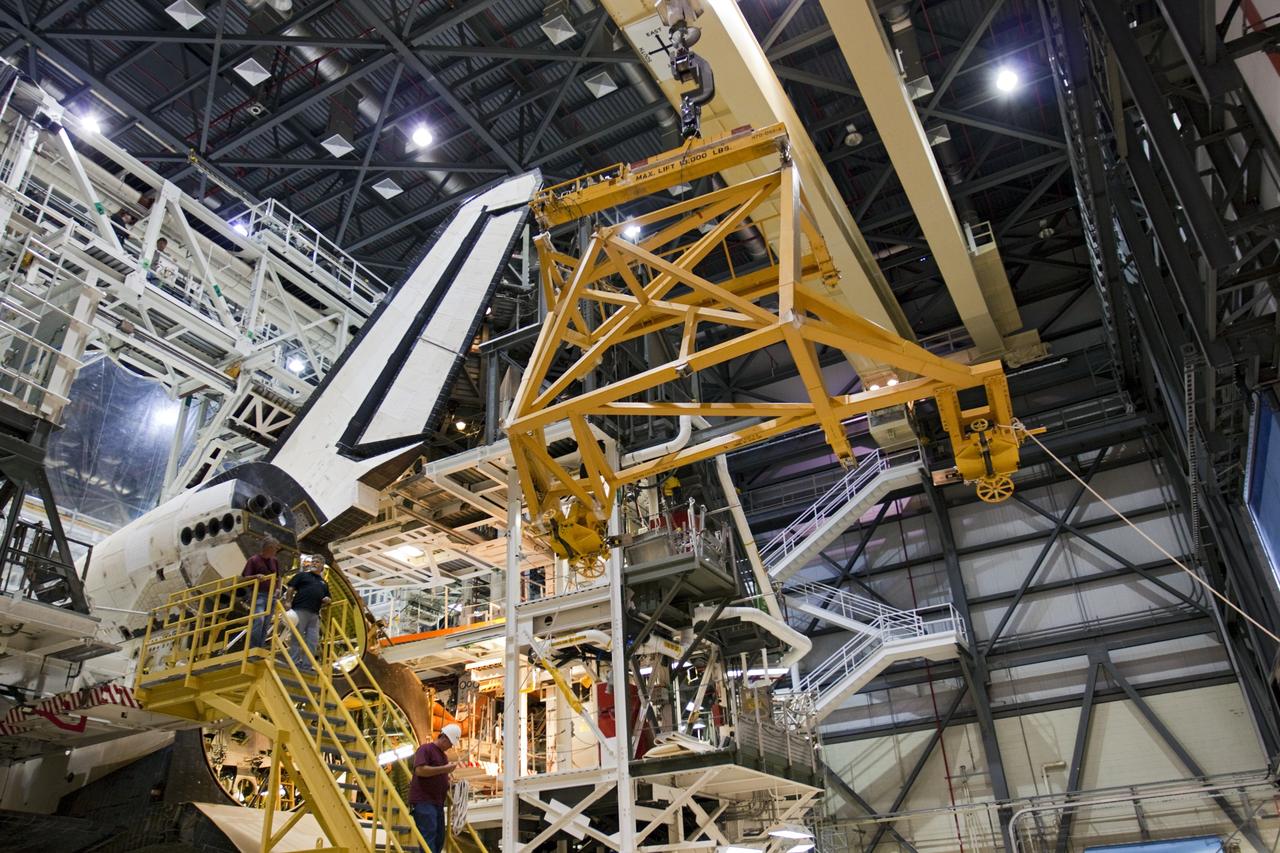
CAPE CANAVERAL, Fla. –Inside Orbiter Processing Facility-1 at NASA’s Kennedy Space Center in Florida, a large crane is moved away after it lowered the left orbital maneuvering system, or OMS, pod onto space shuttle Atlantis. The OMS provided the shuttle with thrust for orbit insertion, rendezvous and deorbit, and could provide up to 1,000 pounds of propellant to the aft reaction control system. The OMS is housed in two independent pods located on each side of the shuttle’s aft fuselage. Each pod contains one OMS engine and the hardware needed to pressurize, store and distribute the propellants to perform the velocity maneuvers. Atlantis’ OMS pods were removed and sent to White Sands Test Facility in New Mexico to be cleaned of residual toxic propellant. The work is part of the Space Shuttle Program’s transition and retirement processing of the space shuttle fleet. A groundbreaking was held Jan. 18 for Atlantis’ future home, a 65,000-square-foot exhibit hall in Shuttle Plaza at the Kennedy Space Center Visitor Complex. Atlantis is scheduled to roll over to the visitor complex in November in preparation for the exhibit’s grand opening in July 2013. For more information, visit http://www.nasa.gov/transition. Photo credit: NASA/Ben Smegelsky
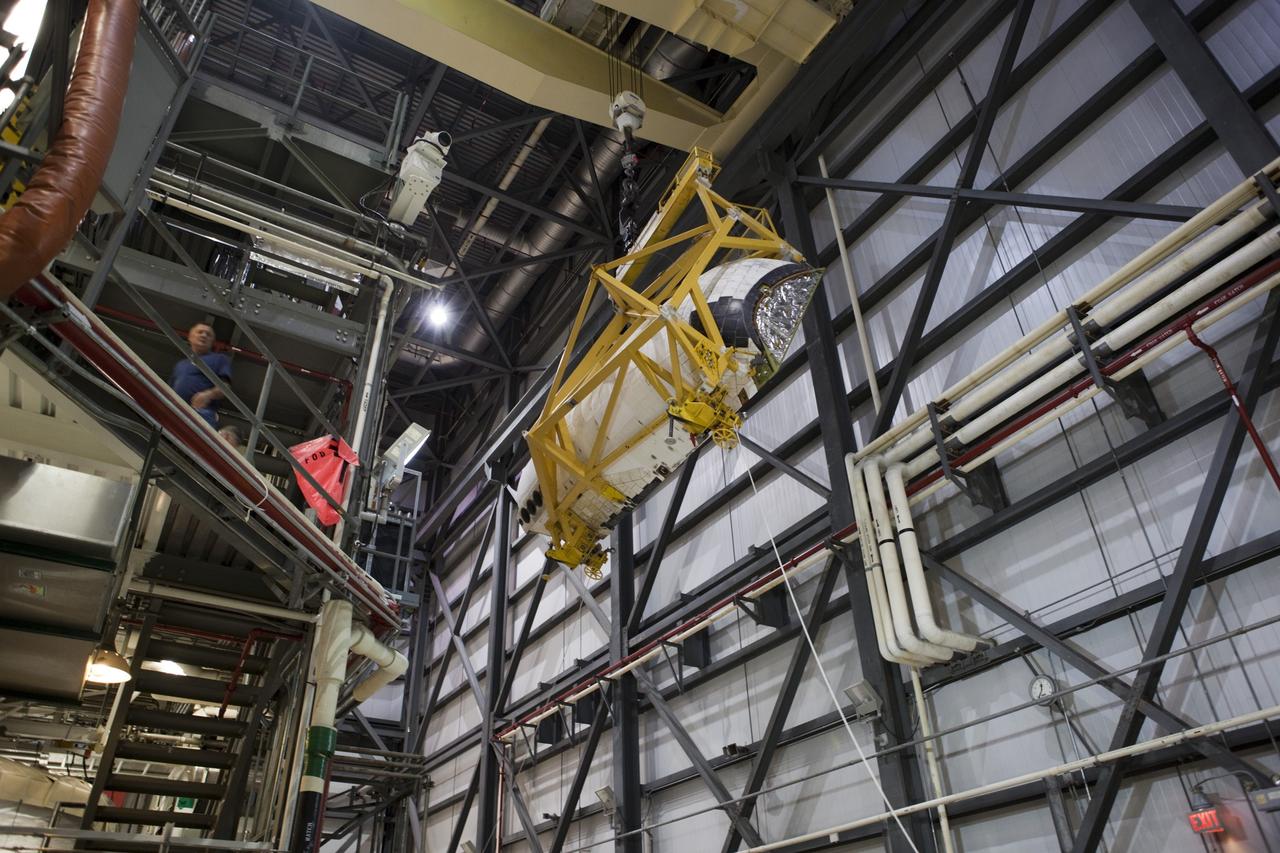
CAPE CANAVERAL, Fla. – Inside Orbiter Processing Facility-1 at NASA’s Kennedy Space Center in Florida, a United Space Alliance technician monitors the progress as a large crane lifts the right orbital maneuvering system, or OMS, pod for installation on space shuttle Atlantis. It is the last time an OMS pod will be installed on Atlantis. The OMS provided the shuttle with thrust for orbit insertion, rendezvous and deorbit, and could provide up to 1,000 pounds of propellant to the aft reaction control system. The OMS is housed in two independent pods located on each side of the shuttle’s aft fuselage. Each pod contains one OMS engine and the hardware needed to pressurize, store and distribute the propellants to perform the velocity maneuvers. Atlantis’ OMS pods were removed and sent to the test facility at White Sands Space Harbor in New Mexico to be cleaned of residual toxic propellant. The work is part of the Space Shuttle Program’s transition and retirement processing of the space shuttle fleet. A groundbreaking was held Jan. 18 for Atlantis’ future home, a 65,000-square-foot exhibit hall in Shuttle Plaza at the Kennedy Space Center Visitor Complex. Atlantis is scheduled to roll over to the visitor complex in November in preparation for the exhibit’s grand opening in July 2013. For more information, visit http://www.nasa.gov/transition. Photo credit: NASA/Dimitri Gerondidakis
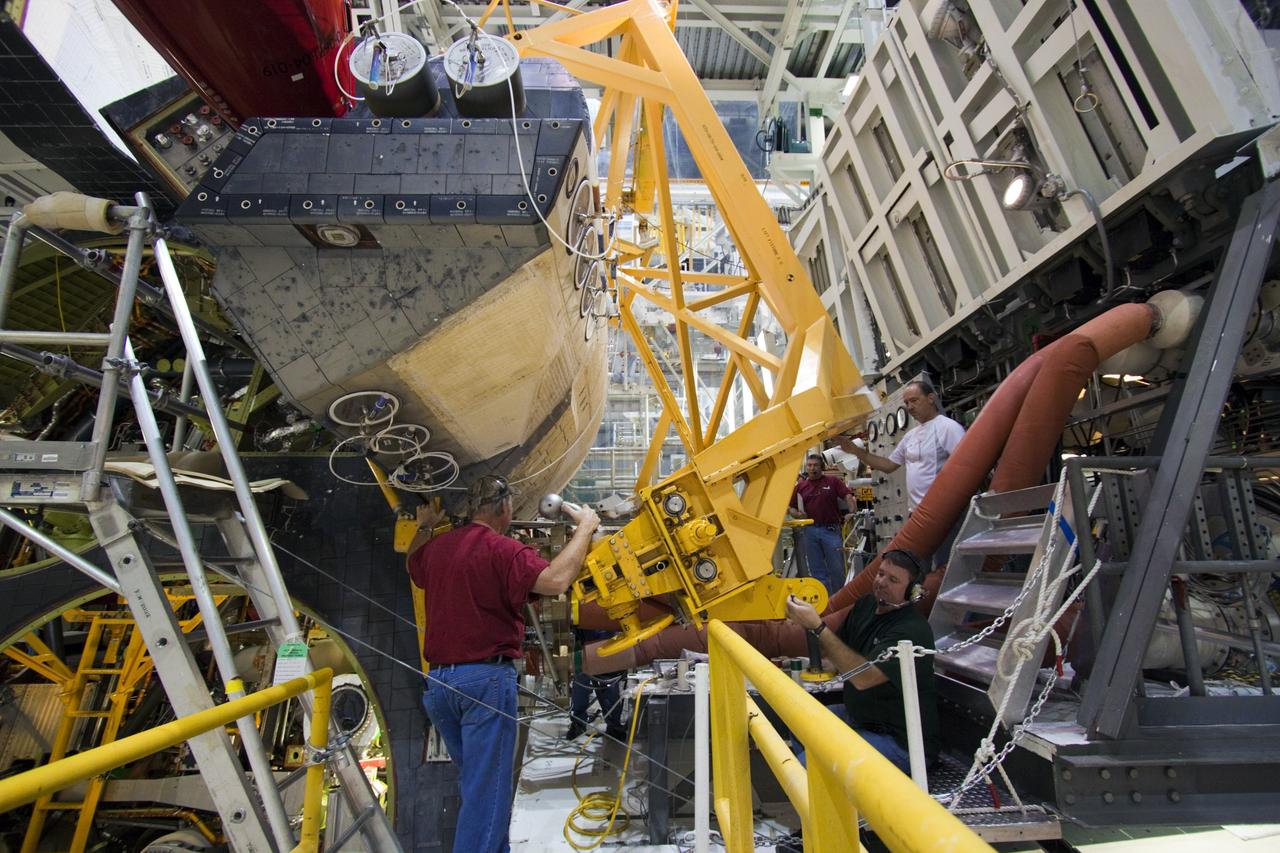
CAPE CANAVERAL, Fla. -- Inside Orbiter Processing Facility-2 at NASA’s Kennedy Space Center in Florida, technicians monitor the progress as a large crane lowers a sling that will be secured around space shuttle Atlantis’ right orbital maneuvering system (OMS) pod. The work is part of the Space Shuttle Program’s transition and retirement processing of shuttle Atlantis. The OMS pod will be removed and sent to White Sands Space Harbor in New Mexico where it will undergo a complete deservicing and cleaning and then be returned to Kennedy for reinstallation on Atlantis. Atlantis is being prepared for display at the Kennedy Space Center Visitor Complex. Photo credit: NASA/Jim Grossmann
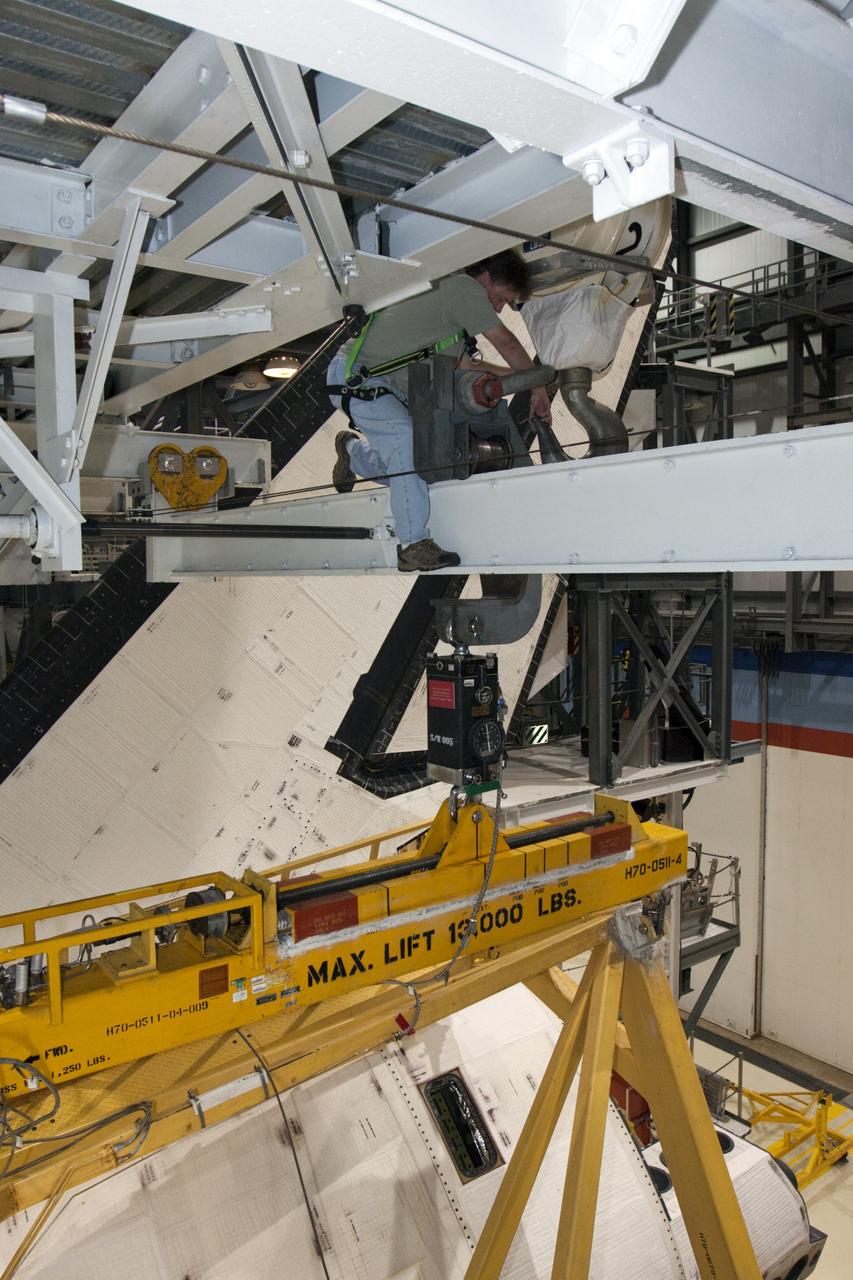
CAPE CANAVERAL, Fla. – Inside Orbiter Processing Facility-1 at NASA’s Kennedy Space Center in Florida, a United Space Alliance technician assists as a large crane lowers the left orbital maneuvering system, or OMS, pod toward space shuttle Atlantis. The OMS provided the shuttle with thrust for orbit insertion, rendezvous and deorbit, and could provide up to 1,000 pounds of propellant to the aft reaction control system. The OMS is housed in two independent pods located on each side of the shuttle’s aft fuselage. Each pod contains one OMS engine and the hardware needed to pressurize, store and distribute the propellants to perform the velocity maneuvers. Atlantis’ OMS pods were removed and sent to White Sands Test Facility in New Mexico to be cleaned of residual toxic propellant. The work is part of the Space Shuttle Program’s transition and retirement processing of the space shuttle fleet. A groundbreaking was held Jan. 18 for Atlantis’ future home, a 65,000-square-foot exhibit hall in Shuttle Plaza at the Kennedy Space Center Visitor Complex. Atlantis is scheduled to roll over to the visitor complex in November in preparation for the exhibit’s grand opening in July 2013. For more information, visit http://www.nasa.gov/transition. Photo credit: NASA/Ben Smegelsky
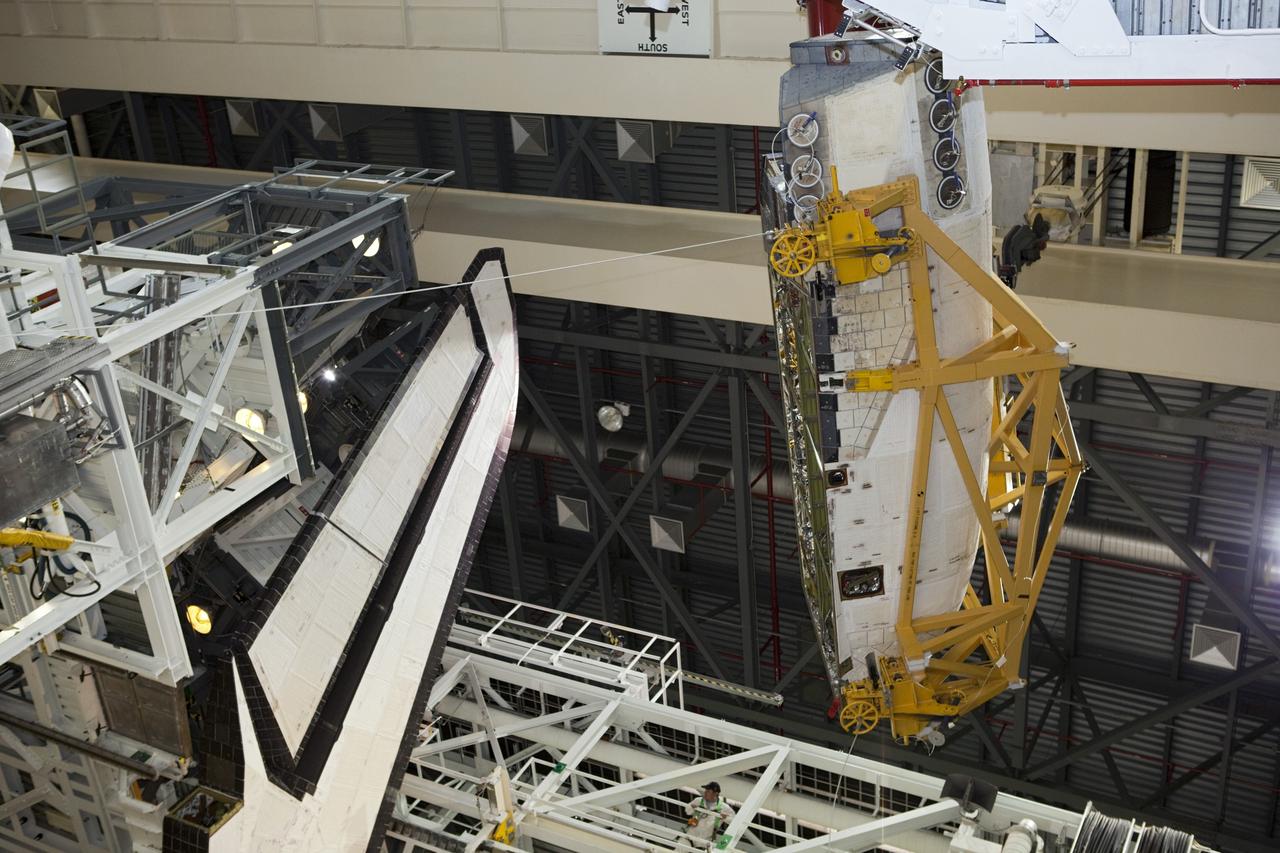
CAPE CANAVERAL, Fla. – Inside Orbiter Processing Facility-2 at NASA’s Kennedy Space Center in Florida, a large crane is being used to move the right orbital maneuvering system (OMS) pod away from space shuttle Atlantis. The work is part of the Space Shuttle Program’s transition and retirement processing of shuttle Atlantis. Both OMS pods will be removed and sent to White Sands Space Harbor in New Mexico where they will undergo a complete deservicing and cleaning and then be returned to Kennedy for reinstallation on Atlantis. Atlantis is being prepared for display at the Kennedy Space Center Visitor Complex. Photo credit: NASA/Dimitri Gerondidakis
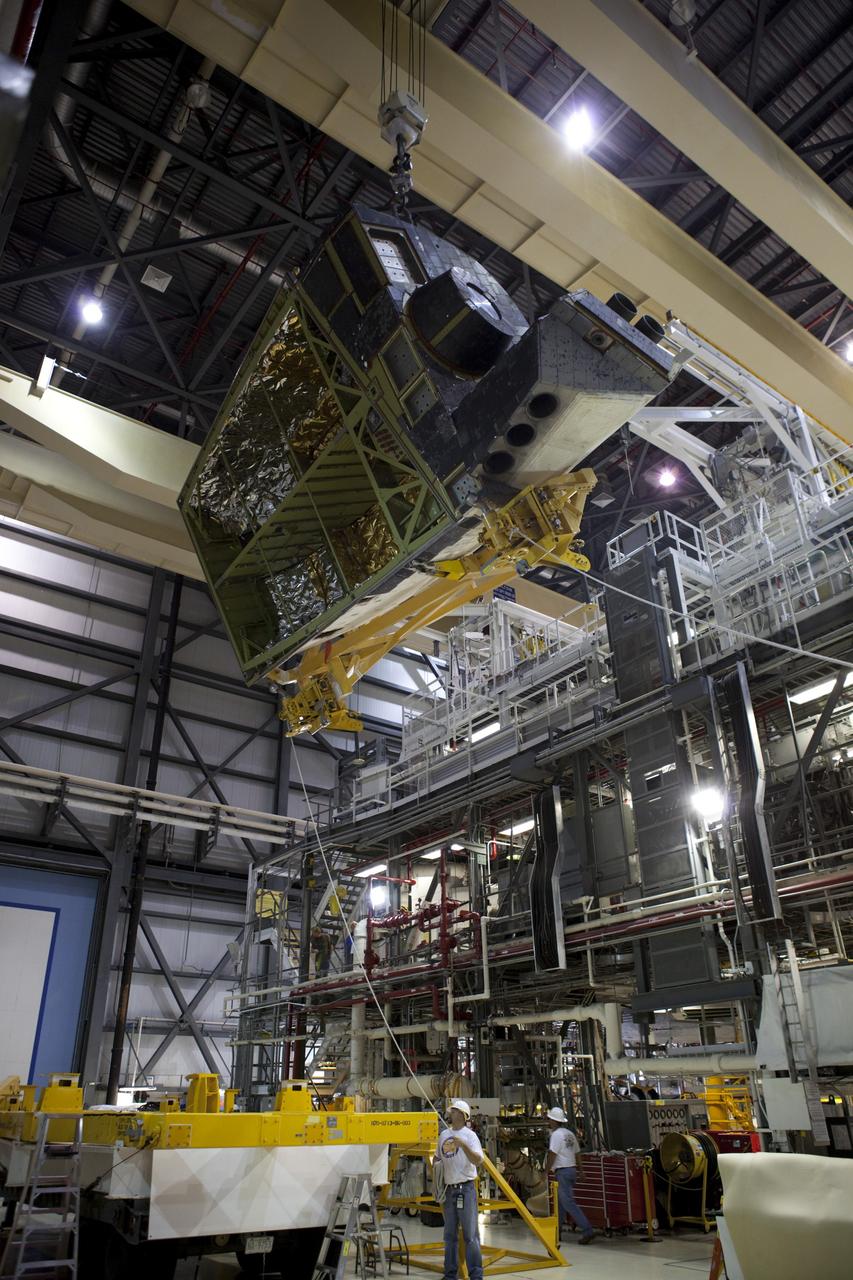
CAPE CANAVERAL, Fla. – Inside Orbiter Processing Facility-1 at NASA’s Kennedy Space Center in Florida, United Space Alliance technicians monitor the progress as a large crane lifts the right orbital maneuvering system, or OMS, pod for installation on space shuttle Atlantis. It is the last time an OMS pod will be installed on Atlantis. The OMS provided the shuttle with thrust for orbit insertion, rendezvous and deorbit, and could provide up to 1,000 pounds of propellant to the aft reaction control system. The OMS is housed in two independent pods located on each side of the shuttle’s aft fuselage. Each pod contains one OMS engine and the hardware needed to pressurize, store and distribute the propellants to perform the velocity maneuvers. Atlantis’ OMS pods were removed and sent to the test facility at White Sands Space Harbor in New Mexico to be cleaned of residual toxic propellant. The work is part of the Space Shuttle Program’s transition and retirement processing of the space shuttle fleet. A groundbreaking was held Jan. 18 for Atlantis’ future home, a 65,000-square-foot exhibit hall in Shuttle Plaza at the Kennedy Space Center Visitor Complex. Atlantis is scheduled to roll over to the visitor complex in November in preparation for the exhibit’s grand opening in July 2013. For more information, visit http://www.nasa.gov/transition. Photo credit: NASA/Dimitri Gerondidakis
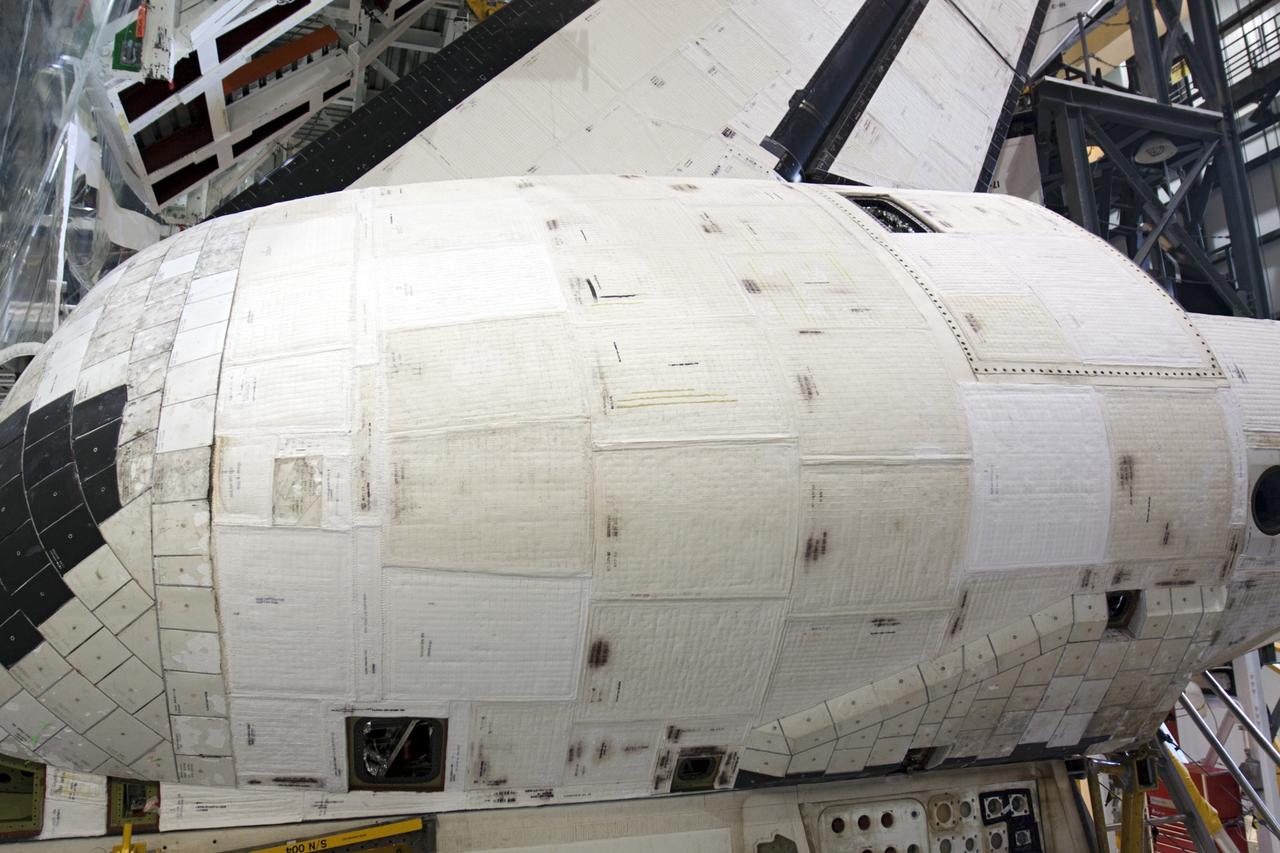
CAPE CANAVERAL, Fla. – Inside Orbiter Processing Facility-1 at NASA’s Kennedy Space Center in Florida, the left orbital maneuvering system, or OMS, pod has been installed onto space shuttle Atlantis. The OMS provided the shuttle with thrust for orbit insertion, rendezvous and deorbit, and could provide up to 1,000 pounds of propellant to the aft reaction control system. The OMS is housed in two independent pods located on each side of the shuttle’s aft fuselage. Each pod contains one OMS engine and the hardware needed to pressurize, store and distribute the propellants to perform the velocity maneuvers. Atlantis’ OMS pods were removed and sent to White Sands Test Facility in New Mexico to be cleaned of residual toxic propellant. The work is part of the Space Shuttle Program’s transition and retirement processing of the space shuttle fleet. A groundbreaking was held Jan. 18 for Atlantis’ future home, a 65,000-square-foot exhibit hall in Shuttle Plaza at the Kennedy Space Center Visitor Complex. Atlantis is scheduled to roll over to the visitor complex in November in preparation for the exhibit’s grand opening in July 2013. For more information, visit http://www.nasa.gov/transition. Photo credit: NASA/Ben Smegelsky
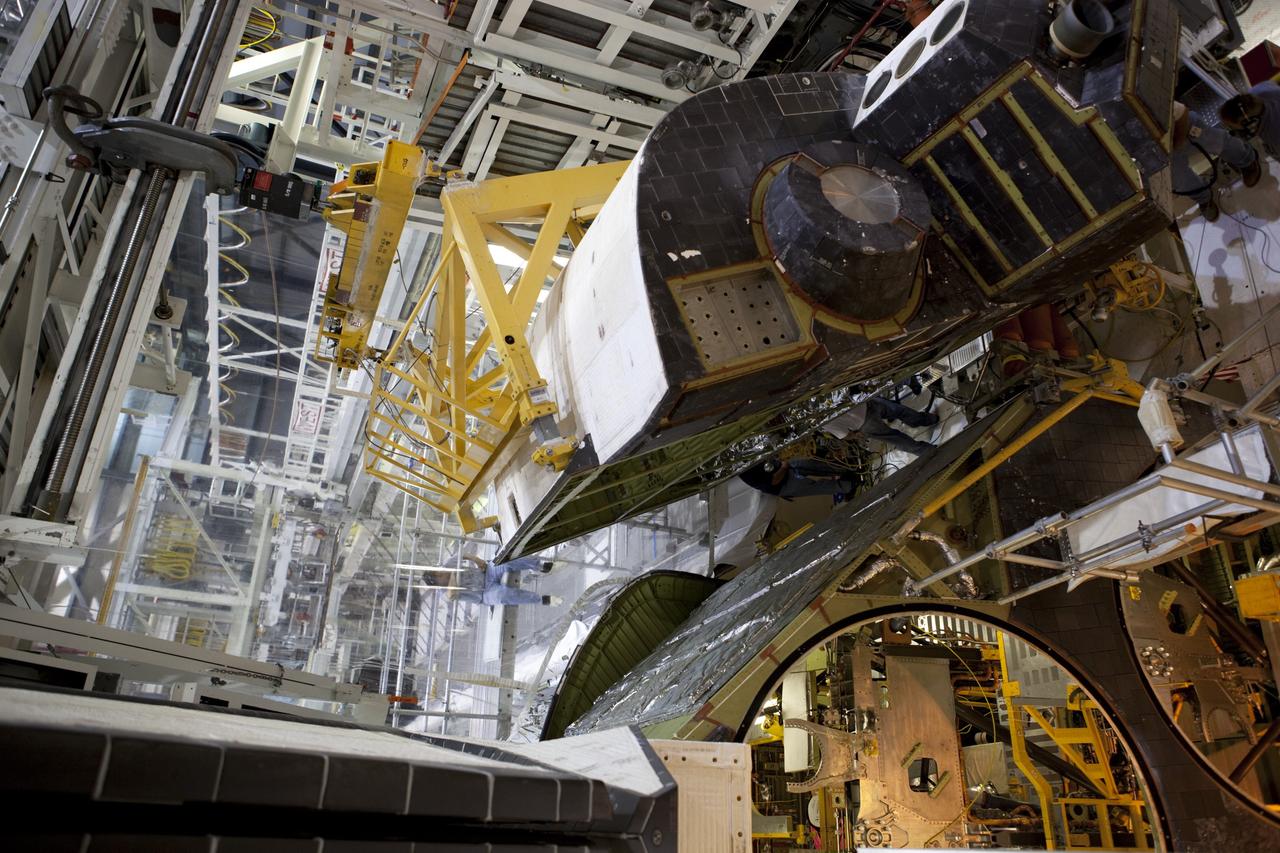
CAPE CANAVERAL, Fla. – Inside Orbiter Processing Facility-1 at NASA’s Kennedy Space Center in Florida, a unique close-up view shows a large crane lowering the right orbital maneuvering system, or OMS, pod closer to space shuttle Atlantis. It is the last time an OMS pod will be installed on Atlantis. The OMS provided the shuttle with thrust for orbit insertion, rendezvous and deorbit, and could provide up to 1,000 pounds of propellant to the aft reaction control system. The OMS is housed in two independent pods located on each side of the shuttle’s aft fuselage. Each pod contains one OMS engine and the hardware needed to pressurize, store and distribute the propellants to perform the velocity maneuvers. Atlantis’ OMS pods were removed and sent to the test facility at White Sands Space Harbor in New Mexico to be cleaned of residual toxic propellant. The work is part of the Space Shuttle Program’s transition and retirement processing of the space shuttle fleet. A groundbreaking was held Jan. 18 for Atlantis’ future home, a 65,000-square-foot exhibit hall in Shuttle Plaza at the Kennedy Space Center Visitor Complex. Atlantis is scheduled to roll over to the visitor complex in November in preparation for the exhibit’s grand opening in July 2013. For more information, visit http://www.nasa.gov/transition. Photo credit: NASA/Dimitri Gerondidakis
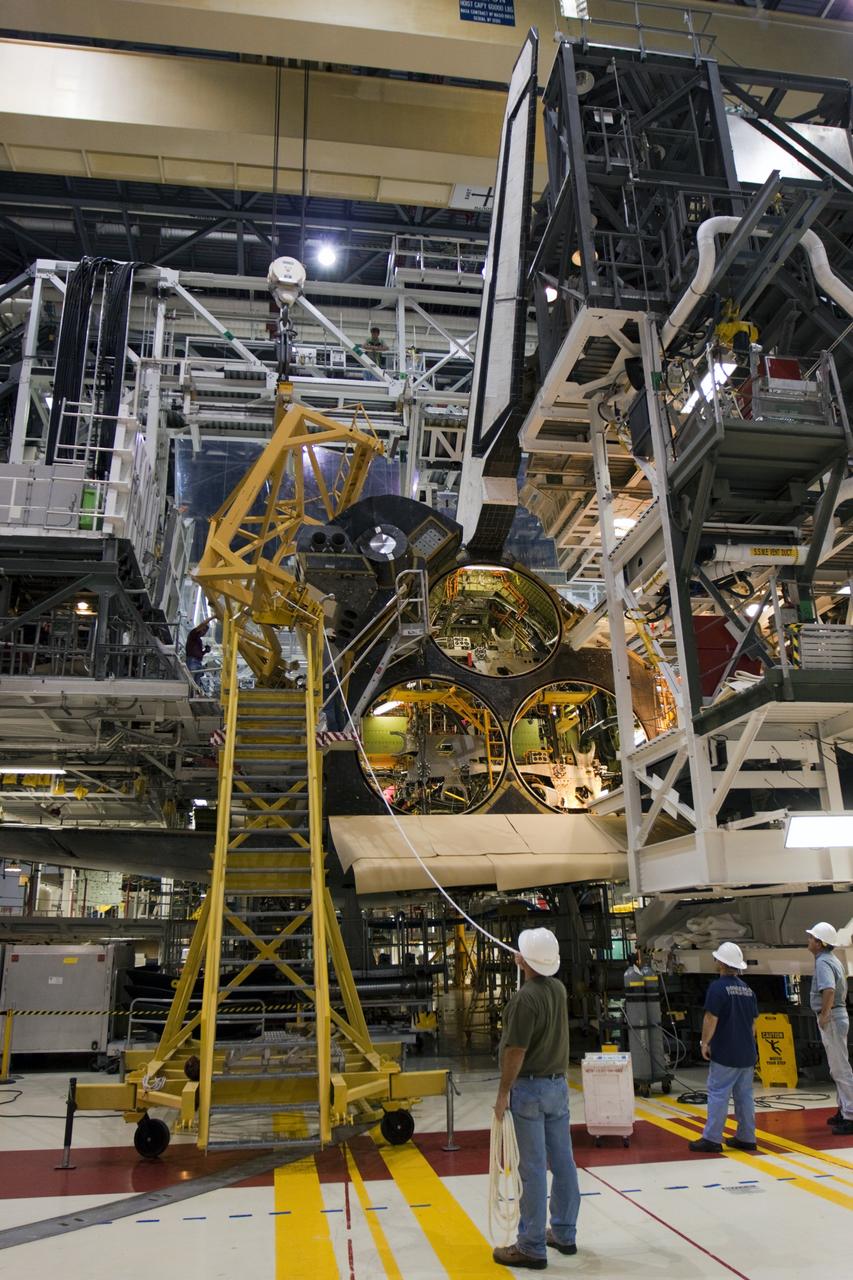
CAPE CANAVERAL, Fla. – Inside Orbiter Processing Facility-1 at NASA’s Kennedy Space Center in Florida, United Space Alliance technicians monitor the progress after a large crane lowers the left orbital maneuvering system, or OMS, pod onto space shuttle Atlantis. The OMS provided the shuttle with thrust for orbit insertion, rendezvous and deorbit, and could provide up to 1,000 pounds of propellant to the aft reaction control system. The OMS is housed in two independent pods located on each side of the shuttle’s aft fuselage. Each pod contains one OMS engine and the hardware needed to pressurize, store and distribute the propellants to perform the velocity maneuvers. Atlantis’ OMS pods were removed and sent to White Sands Test Facility in New Mexico to be cleaned of residual toxic propellant. The work is part of the Space Shuttle Program’s transition and retirement processing of the space shuttle fleet. A groundbreaking was held Jan. 18 for Atlantis’ future home, a 65,000-square-foot exhibit hall in Shuttle Plaza at the Kennedy Space Center Visitor Complex. Atlantis is scheduled to roll over to the visitor complex in November in preparation for the exhibit’s grand opening in July 2013. For more information, visit http://www.nasa.gov/transition. Photo credit: NASA/Ben Smegelsky
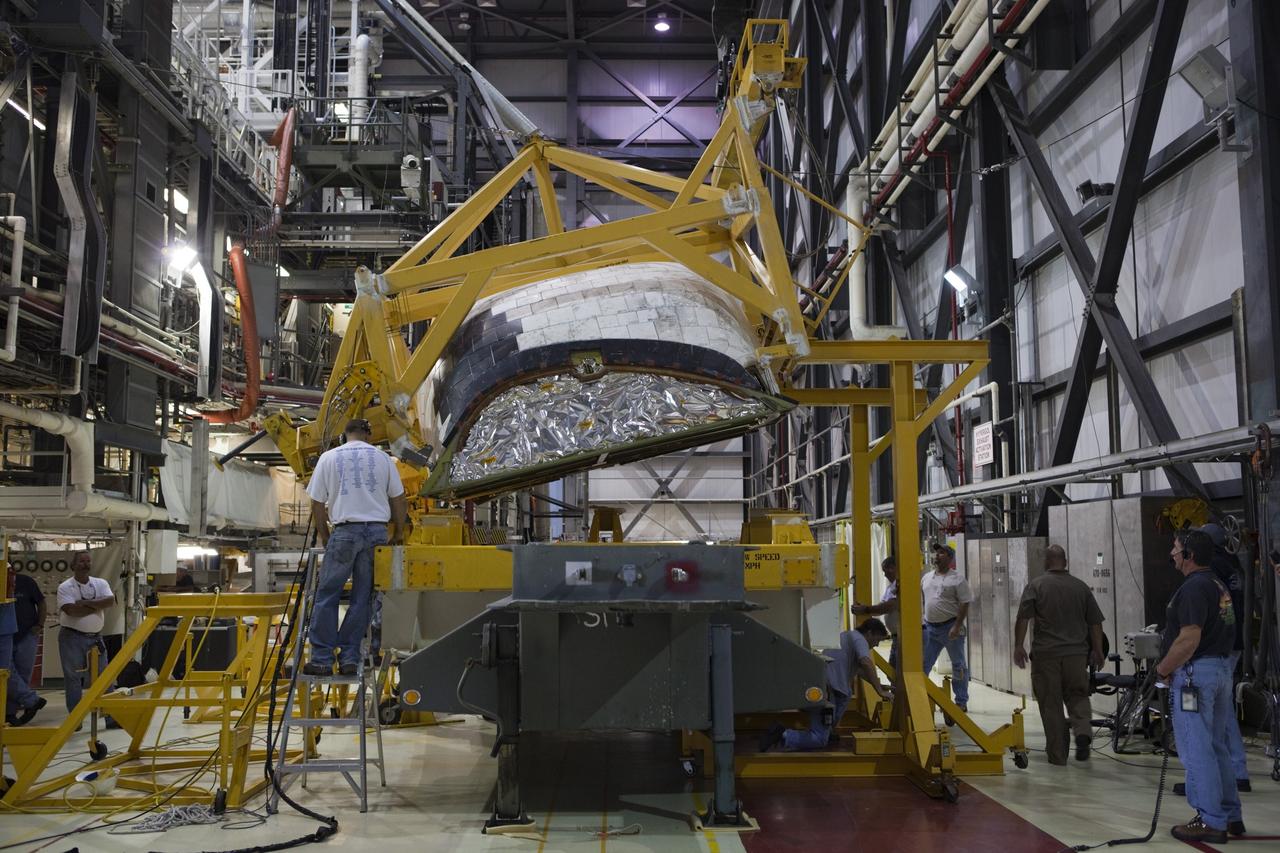
CAPE CANAVERAL, Fla. – Inside Orbiter Processing Facility-1 at NASA’s Kennedy Space Center in Florida, United Space Alliance technicians monitor the progress as a large crane begins to lift the right orbital maneuvering system, or OMS, pod for installation on space shuttle Atlantis. It is the last time an OMS pod will be installed on Atlantis. The OMS provided the shuttle with thrust for orbit insertion, rendezvous and deorbit, and could provide up to 1,000 pounds of propellant to the aft reaction control system. The OMS is housed in two independent pods located on each side of the shuttle’s aft fuselage. Each pod contains one OMS engine and the hardware needed to pressurize, store and distribute the propellants to perform the velocity maneuvers. Atlantis’ OMS pods were removed and sent to the test facility at White Sands Space Harbor in New Mexico to be cleaned of residual toxic propellant. The work is part of the Space Shuttle Program’s transition and retirement processing of the space shuttle fleet. A groundbreaking was held Jan. 18 for Atlantis’ future home, a 65,000-square-foot exhibit hall in Shuttle Plaza at the Kennedy Space Center Visitor Complex. Atlantis is scheduled to roll over to the visitor complex in November in preparation for the exhibit’s grand opening in July 2013. For more information, visit http://www.nasa.gov/transition. Photo credit: NASA/Dimitri Gerondidakis
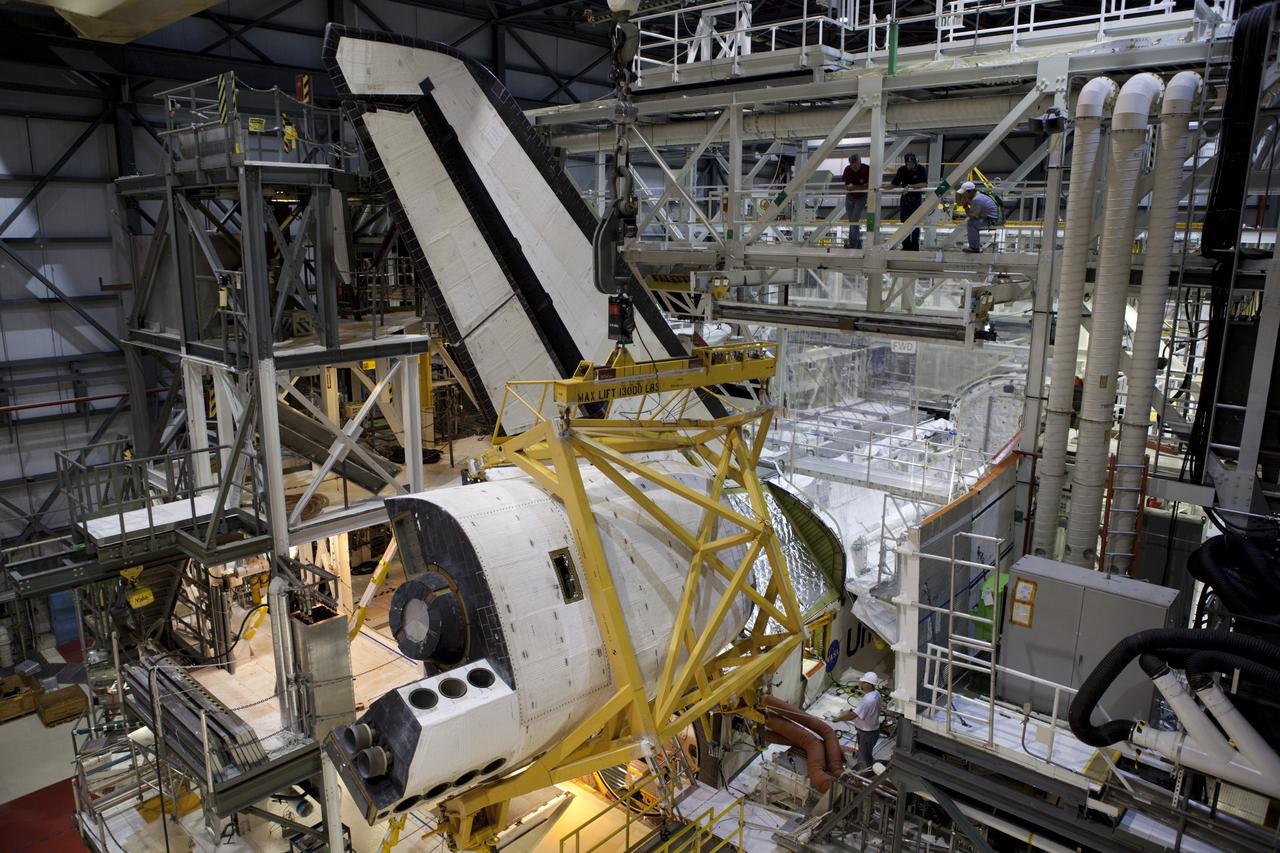
CAPE CANAVERAL, Fla. – Inside Orbiter Processing Facility-1 at NASA’s Kennedy Space Center in Florida, United Space Alliance technicians monitor the progress as a large crane moves the right orbital maneuvering system, or OMS, pod closer to space shuttle Atlantis. It is the last time an OMS pod will be installed on Atlantis. The OMS provided the shuttle with thrust for orbit insertion, rendezvous and deorbit, and could provide up to 1,000 pounds of propellant to the aft reaction control system. The OMS is housed in two independent pods located on each side of the shuttle’s aft fuselage. Each pod contains one OMS engine and the hardware needed to pressurize, store and distribute the propellants to perform the velocity maneuvers. Atlantis’ OMS pods were removed and sent to the test facility at White Sands Space Harbor in New Mexico to be cleaned of residual toxic propellant. The work is part of the Space Shuttle Program’s transition and retirement processing of the space shuttle fleet. A groundbreaking was held Jan. 18 for Atlantis’ future home, a 65,000-square-foot exhibit hall in Shuttle Plaza at the Kennedy Space Center Visitor Complex. Atlantis is scheduled to roll over to the visitor complex in November in preparation for the exhibit’s grand opening in July 2013. For more information, visit http://www.nasa.gov/transition. Photo credit: NASA/Dimitri Gerondidakis
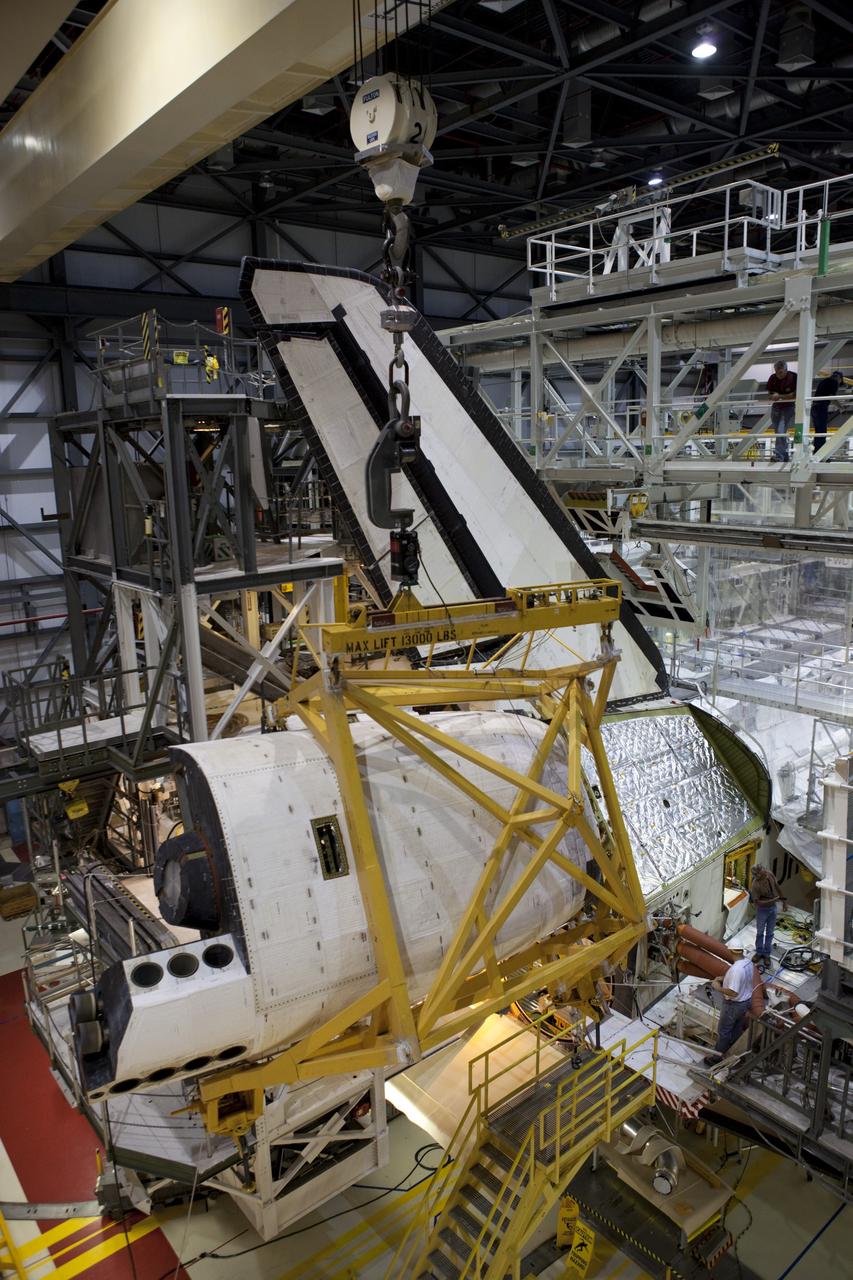
CAPE CANAVERAL, Fla. – Inside Orbiter Processing Facility-1 at NASA’s Kennedy Space Center in Florida, a large crane moves the right orbital maneuvering system, or OMS, pod closer to space shuttle Atlantis. It is the last time an OMS pod will be installed on Atlantis. The OMS provided the shuttle with thrust for orbit insertion, rendezvous and deorbit, and could provide up to 1,000 pounds of propellant to the aft reaction control system. The OMS is housed in two independent pods located on each side of the shuttle’s aft fuselage. Each pod contains one OMS engine and the hardware needed to pressurize, store and distribute the propellants to perform the velocity maneuvers. Atlantis’ OMS pods were removed and sent to the test facility at White Sands Space Harbor in New Mexico to be cleaned of residual toxic propellant. The work is part of the Space Shuttle Program’s transition and retirement processing of the space shuttle fleet. A groundbreaking was held Jan. 18 for Atlantis’ future home, a 65,000-square-foot exhibit hall in Shuttle Plaza at the Kennedy Space Center Visitor Complex. Atlantis is scheduled to roll over to the visitor complex in November in preparation for the exhibit’s grand opening in July 2013. For more information, visit http://www.nasa.gov/transition. Photo credit: NASA/Dimitri Gerondidakis
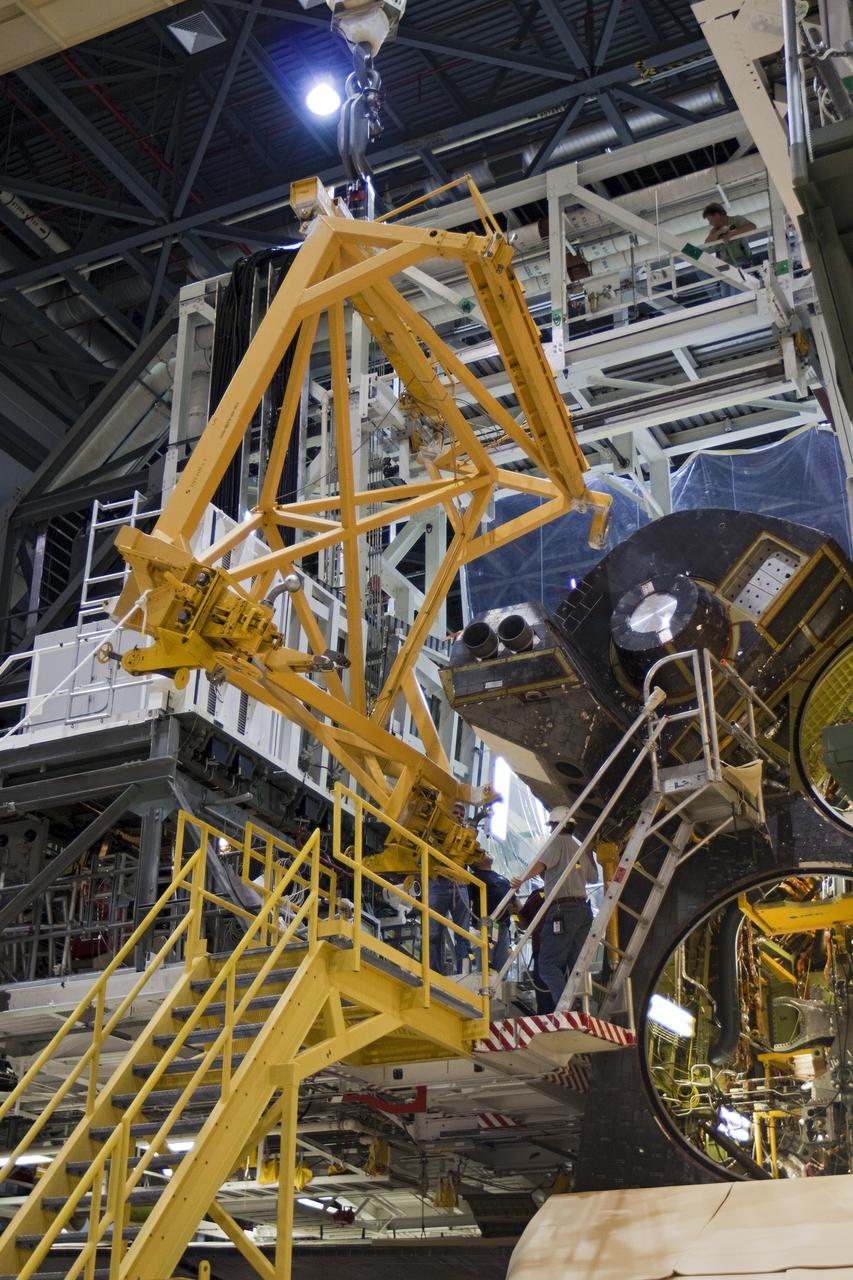
CAPE CANAVERAL, Fla. – Inside Orbiter Processing Facility-1 at NASA’s Kennedy Space Center in Florida, a large crane was used to lower the left orbital maneuvering system, or OMS, pod onto space shuttle Atlantis. The OMS provided the shuttle with thrust for orbit insertion, rendezvous and deorbit, and could provide up to 1,000 pounds of propellant to the aft reaction control system. The OMS is housed in two independent pods located on each side of the shuttle’s aft fuselage. Each pod contains one OMS engine and the hardware needed to pressurize, store and distribute the propellants to perform the velocity maneuvers. Atlantis’ OMS pods were removed and sent to White Sands Test Facility in New Mexico to be cleaned of residual toxic propellant. The work is part of the Space Shuttle Program’s transition and retirement processing of the space shuttle fleet. A groundbreaking was held Jan. 18 for Atlantis’ future home, a 65,000-square-foot exhibit hall in Shuttle Plaza at the Kennedy Space Center Visitor Complex. Atlantis is scheduled to roll over to the visitor complex in November in preparation for the exhibit’s grand opening in July 2013. For more information, visit http://www.nasa.gov/transition. Photo credit: NASA/Ben Smegelsky
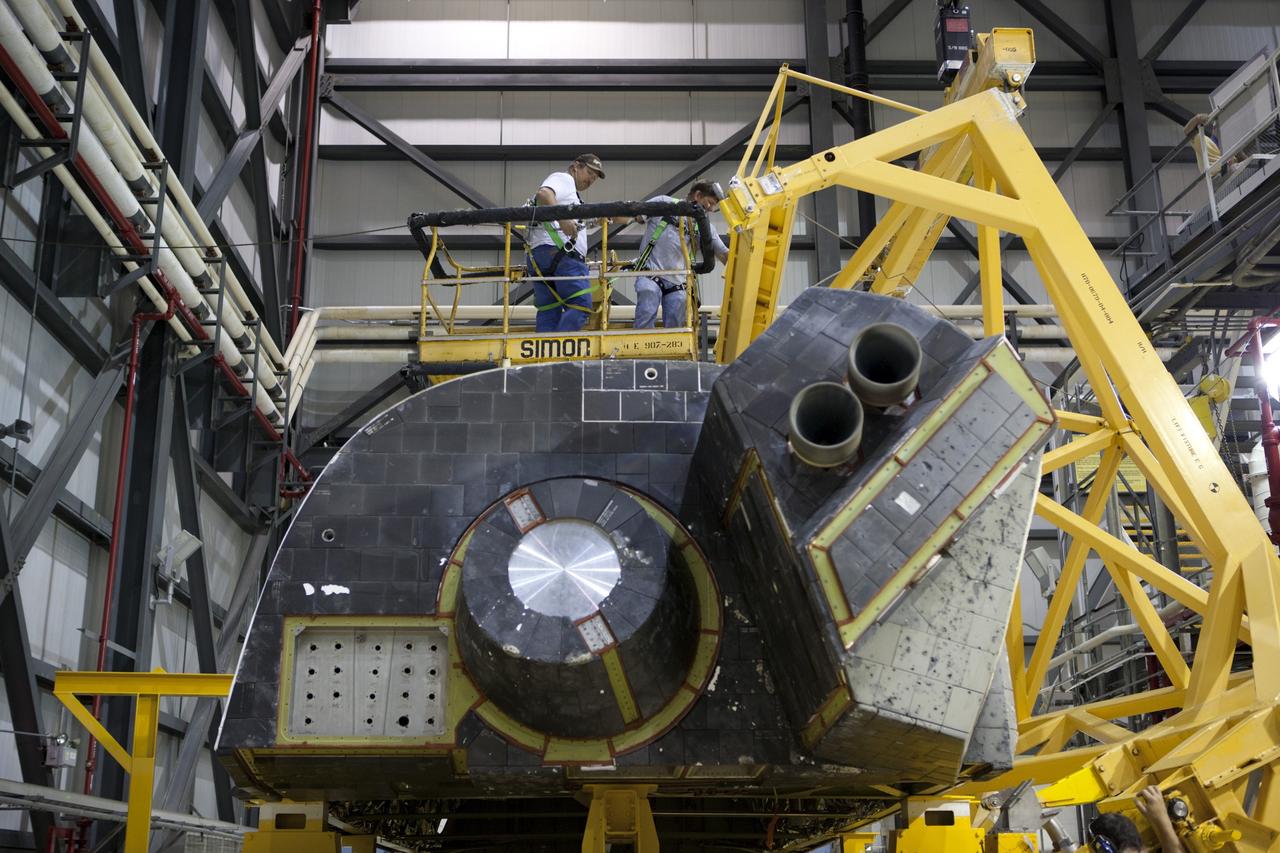
CAPE CANAVERAL, Fla. – Inside Orbiter Processing Facility-1 at NASA’s Kennedy Space Center in Florida, United Launch Alliance technicians monitor the progress as a large crane moves the right orbital maneuvering system, or OMS, pod for installation on space shuttle Atlantis. It will be the last time an OMS pod is installed on Atlantis. The OMS provided the shuttle with thrust for orbit insertion, rendezvous and deorbit, and could provide up to 1,000 pounds of propellant to the aft reaction control system. The OMS is housed in two independent pods located on each side of the shuttle’s aft fuselage. Each pod contains one OMS engine and the hardware needed to pressurize, store and distribute the propellants to perform the velocity maneuvers. Atlantis’ OMS pods were removed and sent to the test facility at White Sands Space Harbor in New Mexico to be cleaned of residual toxic propellant. The work is part of the Space Shuttle Program’s transition and retirement processing of the space shuttle fleet. A groundbreaking was held Jan. 18 for Atlantis’ future home, a 65,000-square-foot exhibit hall in Shuttle Plaza at the Kennedy Space Center Visitor Complex. Atlantis is scheduled to roll over to the visitor complex in November in preparation for the exhibit’s grand opening in July 2013. For more information, visit http://www.nasa.gov/transition. Photo credit: NASA/Dimitri Gerondidakis
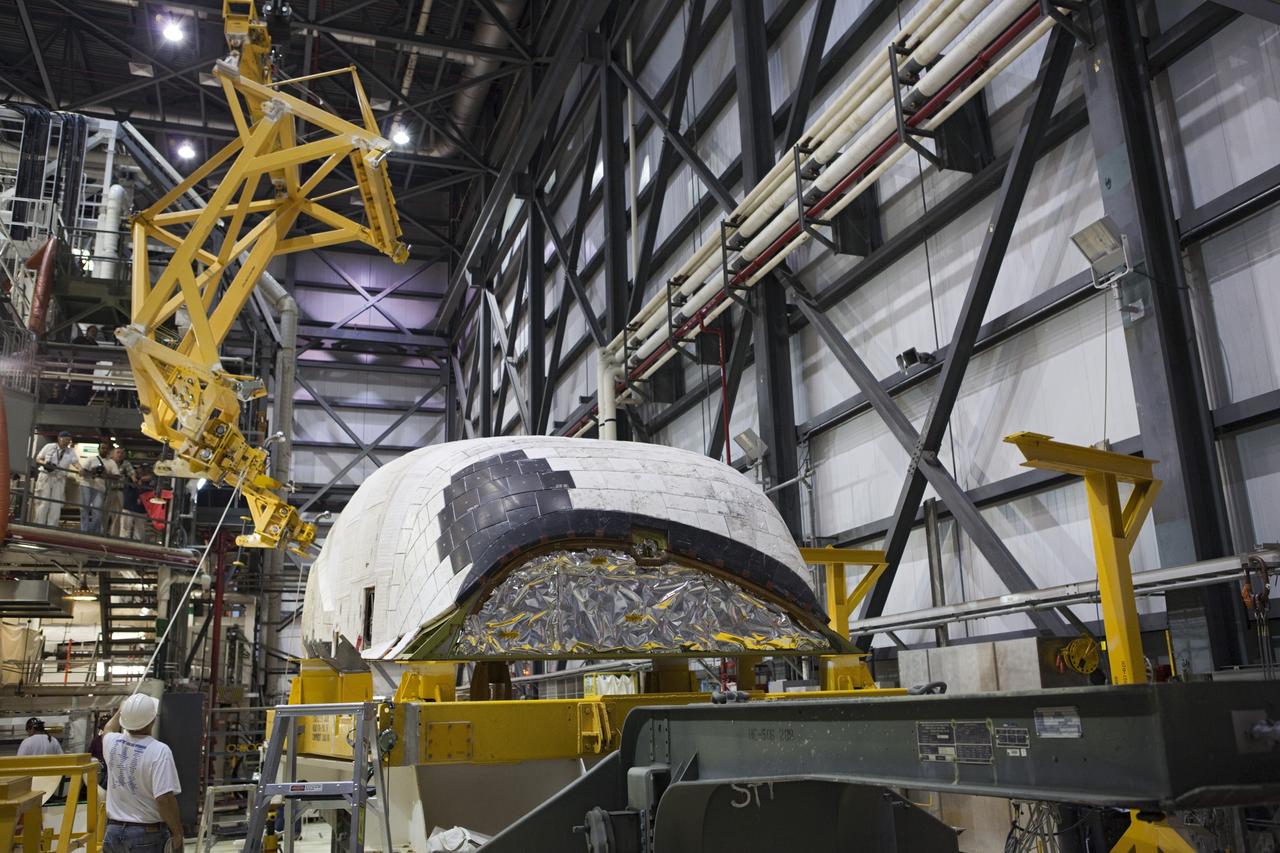
CAPE CANAVERAL, Fla. – Inside Orbiter Processing Facility-1 at NASA’s Kennedy Space Center in Florida, a large crane moves the right orbital maneuvering system, or OMS, pod closer to space shuttle Atlantis. It is the last time an OMS pod will be installed on Atlantis. The OMS provided the shuttle with thrust for orbit insertion, rendezvous and deorbit, and could provide up to 1,000 pounds of propellant to the aft reaction control system. The OMS is housed in two independent pods located on each side of the shuttle’s aft fuselage. Each pod contains one OMS engine and the hardware needed to pressurize, store and distribute the propellants to perform the velocity maneuvers. Atlantis’ OMS pods were removed and sent to the test facility at White Sands Space Harbor in New Mexico to be cleaned of residual toxic propellant. The work is part of the Space Shuttle Program’s transition and retirement processing of the space shuttle fleet. A groundbreaking was held Jan. 18 for Atlantis’ future home, a 65,000-square-foot exhibit hall in Shuttle Plaza at the Kennedy Space Center Visitor Complex. Atlantis is scheduled to roll over to the visitor complex in November in preparation for the exhibit’s grand opening in July 2013. For more information, visit http://www.nasa.gov/transition. Photo credit: NASA/Dimitri Gerondidakis
CAPE CANAVERAL, Fla. – Inside Orbiter Processing Facility-1 at NASA’s Kennedy Space Center in Florida, United Space Alliance technicians monitor the progress as a large crane is lowered toward the right orbital maneuvering system, or OMS, pod for space shuttle Atlantis. It will be the last time an OMS pod is installed on Atlantis. The OMS provided the shuttle with thrust for orbit insertion, rendezvous and deorbit, and could provide up to 1,000 pounds of propellant to the aft reaction control system. The OMS is housed in two independent pods located on each side of the shuttle’s aft fuselage. Each pod contains one OMS engine and the hardware needed to pressurize, store and distribute the propellants to perform the velocity maneuvers. Atlantis’ OMS pods were removed and sent to the test facility at White Sands Space Harbor in New Mexico to be cleaned of residual toxic propellant. The work is part of the Space Shuttle Program’s transition and retirement processing of the space shuttle fleet. A groundbreaking was held Jan. 18 for Atlantis’ future home, a 65,000-square-foot exhibit hall in Shuttle Plaza at the Kennedy Space Center Visitor Complex. Atlantis is scheduled to roll over to the visitor complex in November in preparation for the exhibit’s grand opening in July 2013. For more information, visit http://www.nasa.gov/transition. Photo credit: NASA/Dimitri Gerondidakis
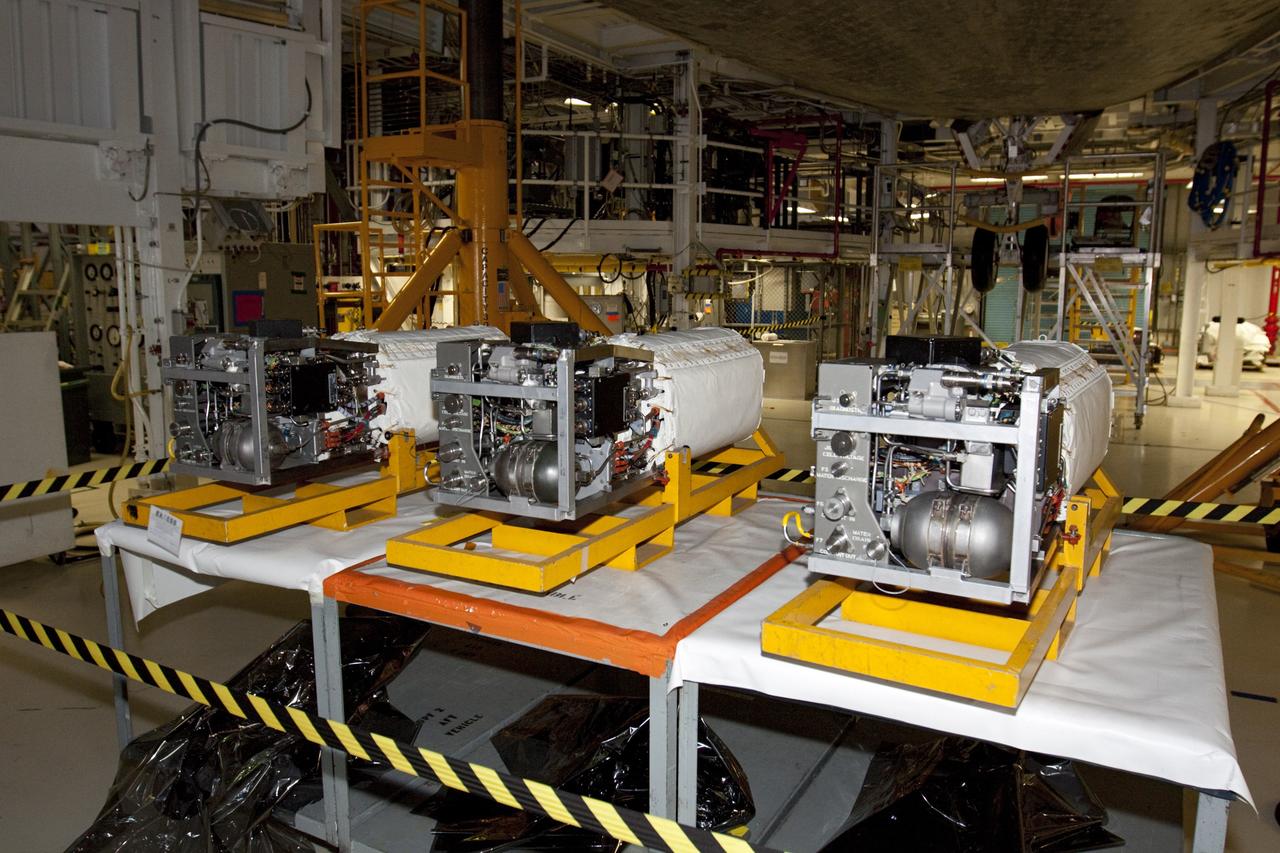
CAPE CANAVERAL, Fla. – Inside Orbiter Processing Facility-1 at NASA’s Kennedy Space Center in Florida, three excessed fuel cells are on a work bench beneath space shuttle Atlantis. The left orbital maneuvering system, or OMS, pod has been installed onto Atlantis. The OMS provided the shuttle with thrust for orbit insertion, rendezvous and deorbit, and could provide up to 1,000 pounds of propellant to the aft reaction control system. The OMS is housed in two independent pods located on each side of the shuttle’s aft fuselage. Each pod contains one OMS engine and the hardware needed to pressurize, store and distribute the propellants to perform the velocity maneuvers. Atlantis’ OMS pods were removed and sent to White Sands Test Facility in New Mexico to be cleaned of residual toxic propellant. The work is part of the Space Shuttle Program’s transition and retirement processing of the space shuttle fleet. A groundbreaking was held Jan. 18 for Atlantis’ future home, a 65,000-square-foot exhibit hall in Shuttle Plaza at the Kennedy Space Center Visitor Complex. Atlantis is scheduled to roll over to the visitor complex in November in preparation for the exhibit’s grand opening in July 2013. For more information, visit http://www.nasa.gov/transition. Photo credit: NASA/Ben Smegelsky
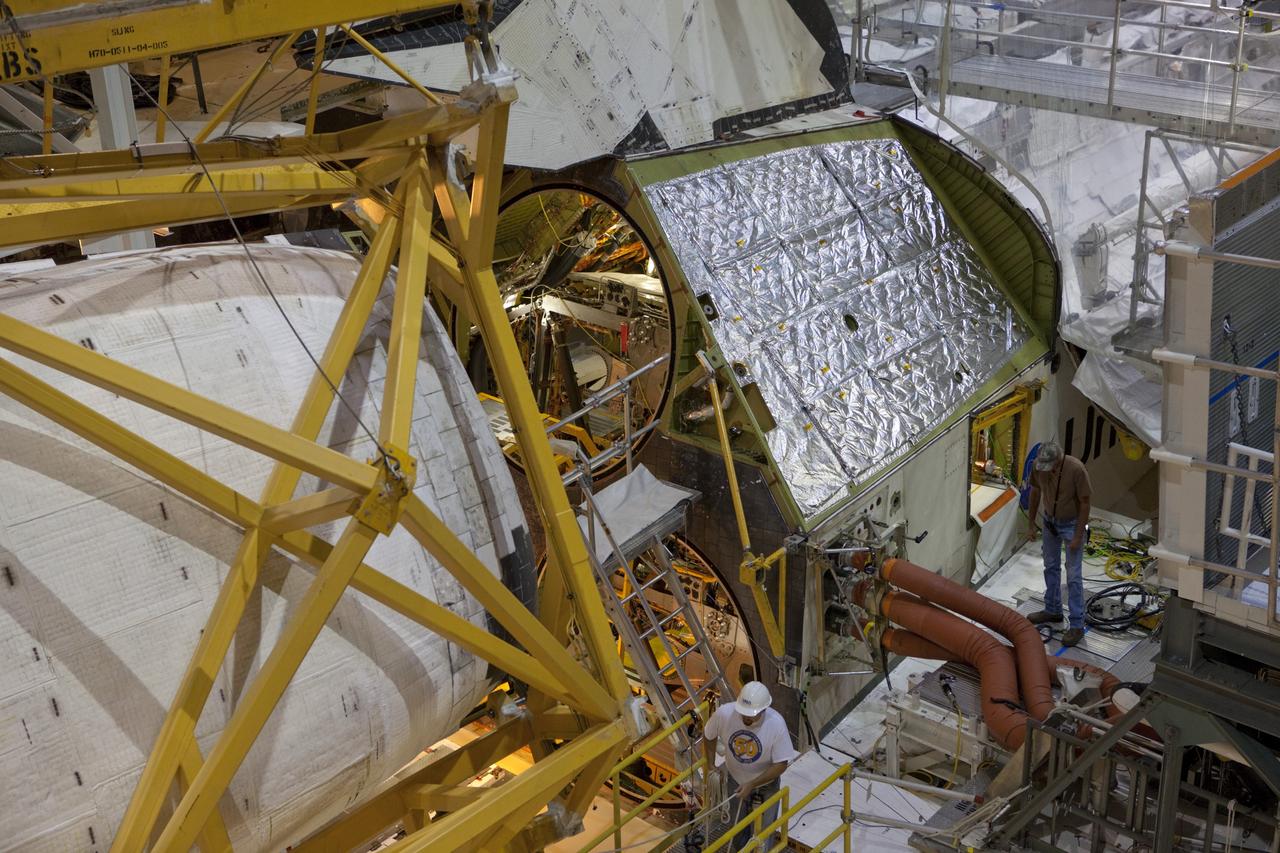
CAPE CANAVERAL, Fla. – Inside Orbiter Processing Facility-1 at NASA’s Kennedy Space Center in Florida, United Space Alliance technicians monitor the progress as a large crane moves the right orbital maneuvering system, or OMS, pod closer to space shuttle Atlantis. It is the last time an OMS pod will be installed on Atlantis. The OMS provided the shuttle with thrust for orbit insertion, rendezvous and deorbit, and could provide up to 1,000 pounds of propellant to the aft reaction control system. The OMS is housed in two independent pods located on each side of the shuttle’s aft fuselage. Each pod contains one OMS engine and the hardware needed to pressurize, store and distribute the propellants to perform the velocity maneuvers. Atlantis’ OMS pods were removed and sent to the test facility at White Sands Space Harbor in New Mexico to be cleaned of residual toxic propellant. The work is part of the Space Shuttle Program’s transition and retirement processing of the space shuttle fleet. A groundbreaking was held Jan. 18 for Atlantis’ future home, a 65,000-square-foot exhibit hall in Shuttle Plaza at the Kennedy Space Center Visitor Complex. Atlantis is scheduled to roll over to the visitor complex in November in preparation for the exhibit’s grand opening in July 2013. For more information, visit http://www.nasa.gov/transition. Photo credit: NASA/Dimitri Gerondidakis
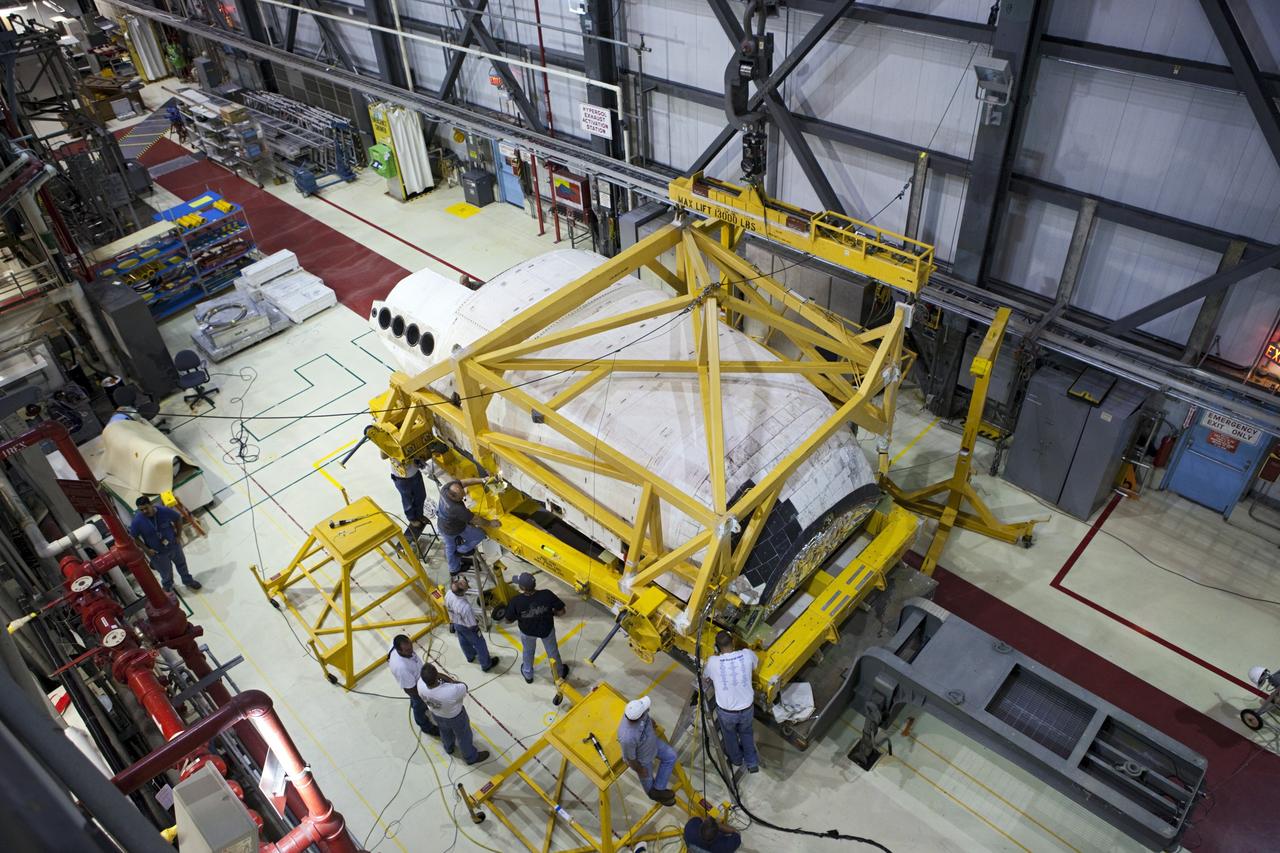
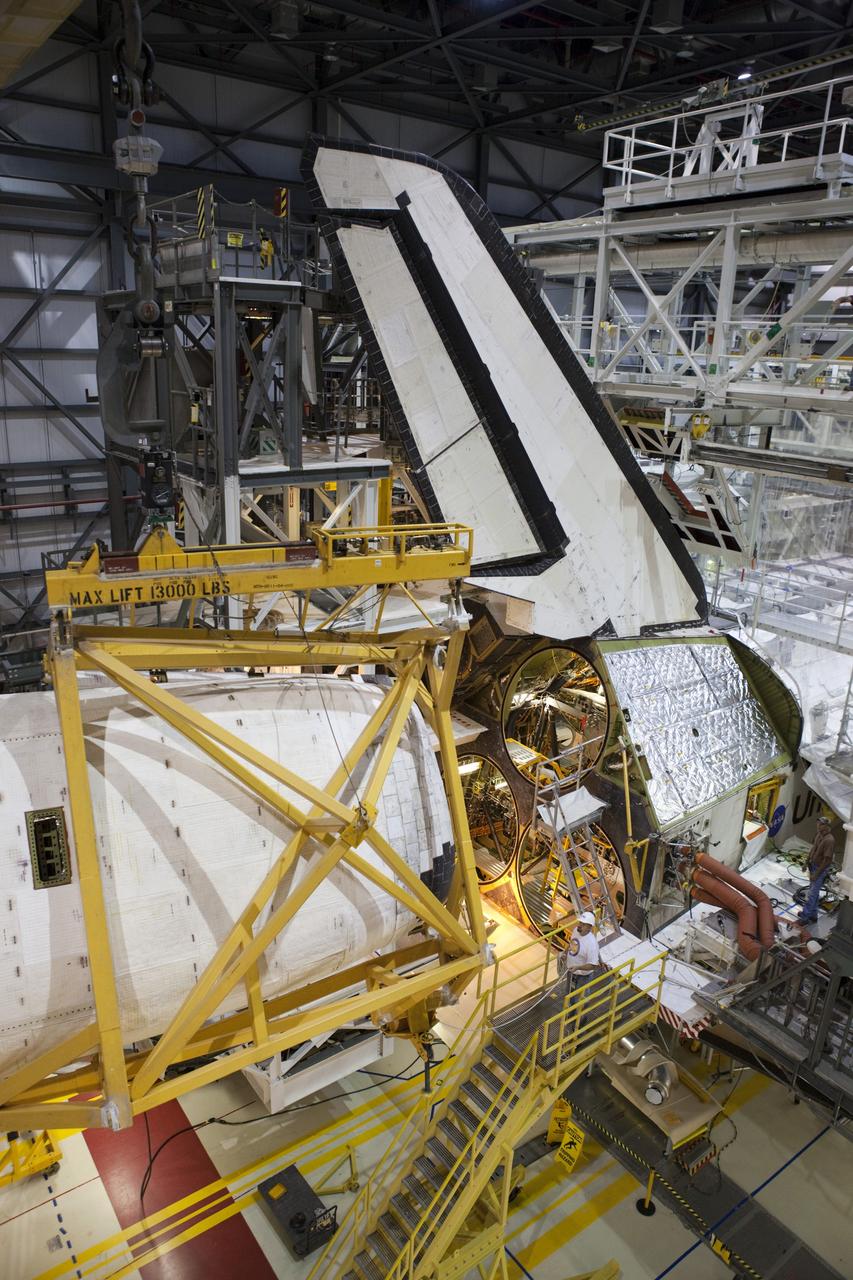
CAPE CANAVERAL, Fla. – In a view from above inside Orbiter Processing Facility-1 at NASA’s Kennedy Space Center in Florida, United Space Alliance technicians monitor the progress as a crane is attached to the right orbital maneuvering system, or OMS, pod for space shuttle Atlantis. It is the last time an OMS pod will be installed on Atlantis. The OMS provided the shuttle with thrust for orbit insertion, rendezvous and deorbit, and could provide up to 1,000 pounds of propellant to the aft reaction control system. The OMS is housed in two independent pods located on each side of the shuttle’s aft fuselage. Each pod contains one OMS engine and the hardware needed to pressurize, store and distribute the propellants to perform the velocity maneuvers. Atlantis’ OMS pods were removed and sent to the test facility at White Sands Space Harbor in New Mexico to be cleaned of residual toxic propellant. The work is part of the Space Shuttle Program’s transition and retirement processing of the space shuttle fleet. A groundbreaking was held Jan. 18 for Atlantis’ future home, a 65,000-square-foot exhibit hall in Shuttle Plaza at the Kennedy Space Center Visitor Complex. Atlantis is scheduled to roll over to the visitor complex in November in preparation for the exhibit’s grand opening in July 2013. For more information, visit http://www.nasa.gov/transition. Photo credit: NASA/Dimitri Gerondidakis
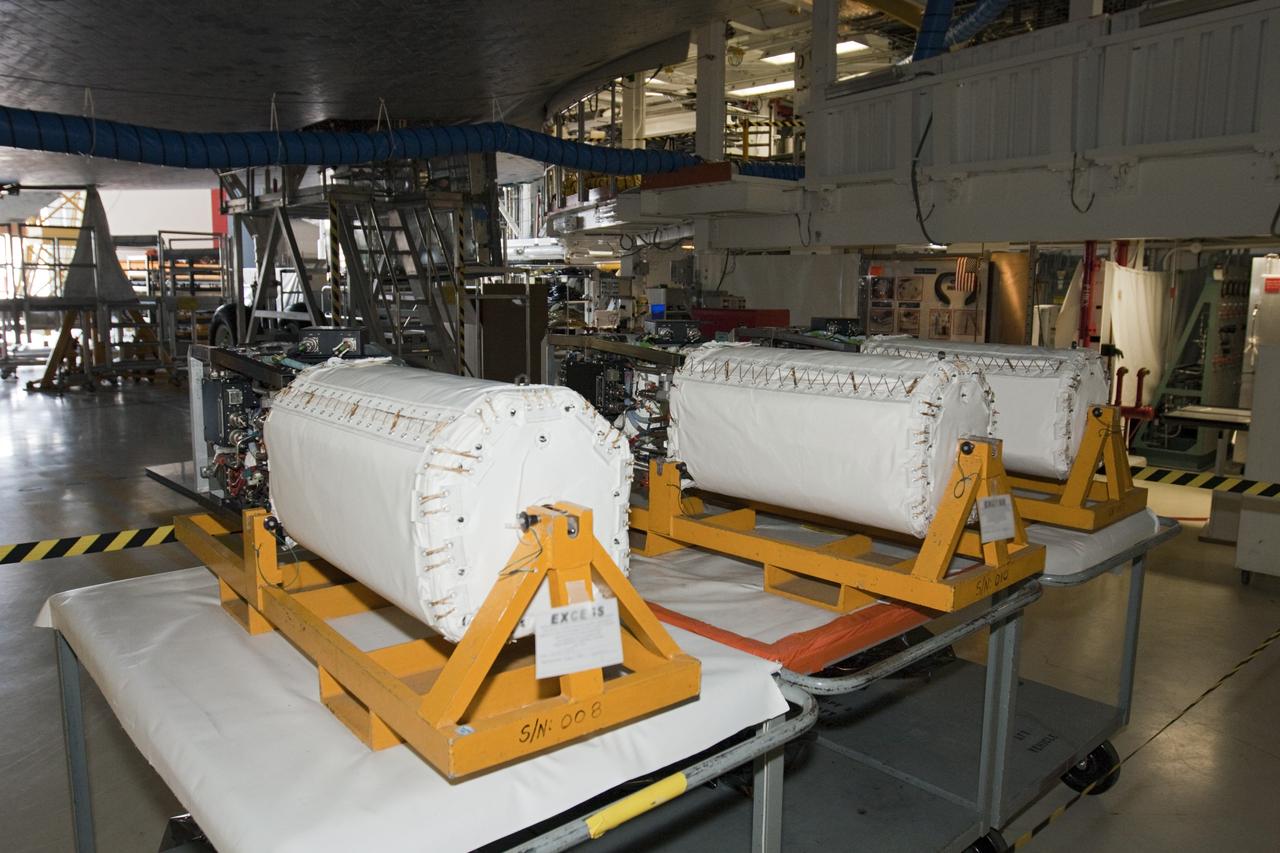
CAPE CANAVERAL, Fla. – Inside Orbiter Processing Facility-1 at NASA’s Kennedy Space Center in Florida, three excessed fuel cells are on a work bench beneath space shuttle Atlantis. The left orbital maneuvering system, or OMS, pod has been installed onto Atlantis. The OMS provided the shuttle with thrust for orbit insertion, rendezvous and deorbit, and could provide up to 1,000 pounds of propellant to the aft reaction control system. The OMS is housed in two independent pods located on each side of the shuttle’s aft fuselage. Each pod contains one OMS engine and the hardware needed to pressurize, store and distribute the propellants to perform the velocity maneuvers. Atlantis’ OMS pods were removed and sent to White Sands Test Facility in New Mexico to be cleaned of residual toxic propellant. The work is part of the Space Shuttle Program’s transition and retirement processing of the space shuttle fleet. A groundbreaking was held Jan. 18 for Atlantis’ future home, a 65,000-square-foot exhibit hall in Shuttle Plaza at the Kennedy Space Center Visitor Complex. Atlantis is scheduled to roll over to the visitor complex in November in preparation for the exhibit’s grand opening in July 2013. For more information, visit http://www.nasa.gov/transition. Photo credit: NASA/Ben Smegelsky
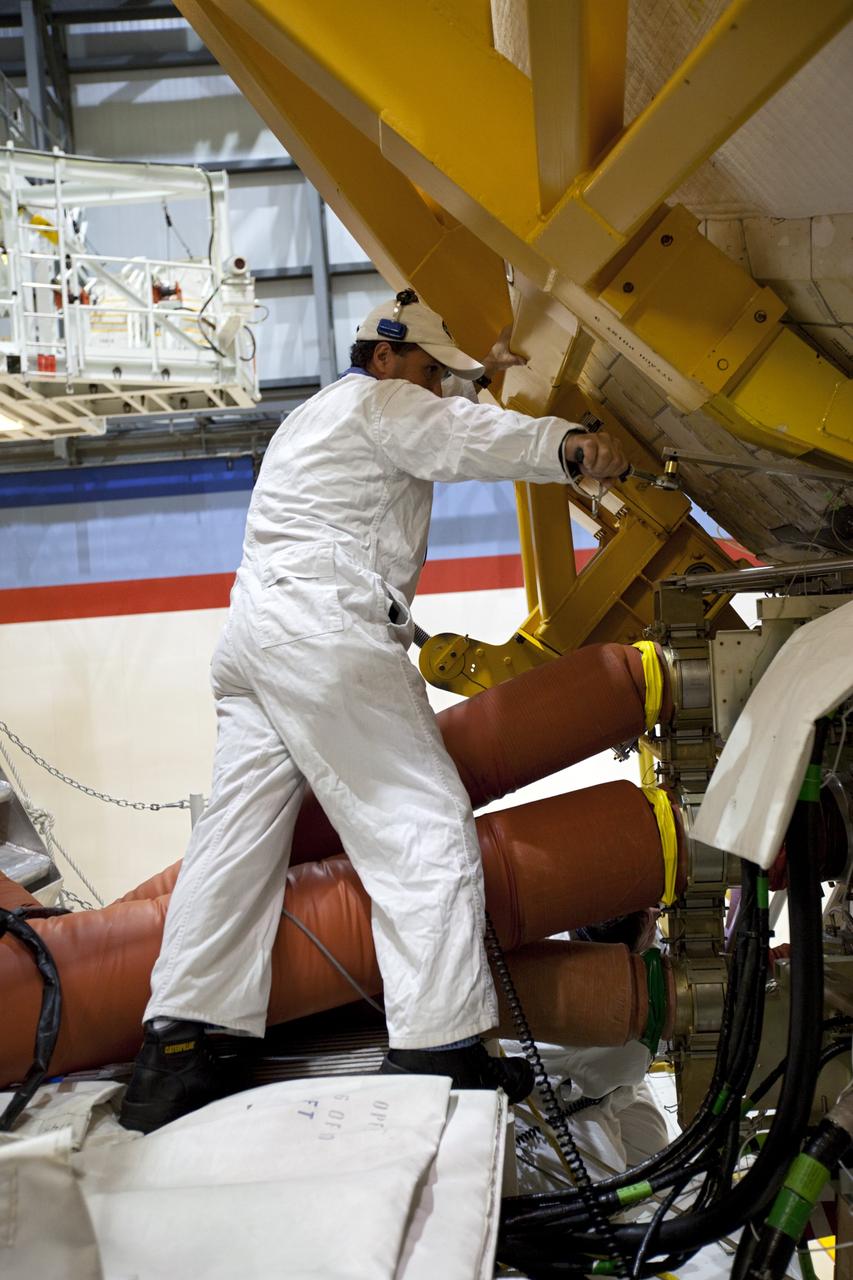
CAPE CANAVERAL, Fla. --Inside Orbiter Processing Facility-2 at NASA’s Kennedy Space Center in Florida, technicians help secure a sling around space shuttle Atlantis’ right orbital maneuvering system (OMS) pod. The work is part of the Space Shuttle Program’s transition and retirement processing of shuttle Atlantis. The OMS pod will be removed and sent to White Sands Space Harbor in New Mexico where it will undergo a complete deservicing and cleaning and then be returned to Kennedy for reinstallation on Atlantis. Atlantis is being prepared for display at the Kennedy Space Center Visitor Complex. Photo credit: NASA/Dimitri Gerondidakis

CAPE CANAVERAL, Fla. – Inside Orbiter Processing Facility-1 at NASA’s Kennedy Space Center in Florida, a large crane lowers the right orbital maneuvering system, or OMS, pod closer to space shuttle Atlantis. It is the last time an OMS pod will be installed on Atlantis. The OMS provided the shuttle with thrust for orbit insertion, rendezvous and deorbit, and could provide up to 1,000 pounds of propellant to the aft reaction control system. The OMS is housed in two independent pods located on each side of the shuttle’s aft fuselage. Each pod contains one OMS engine and the hardware needed to pressurize, store and distribute the propellants to perform the velocity maneuvers. Atlantis’ OMS pods were removed and sent to the test facility at White Sands Space Harbor in New Mexico to be cleaned of residual toxic propellant. The work is part of the Space Shuttle Program’s transition and retirement processing of the space shuttle fleet. A groundbreaking was held Jan. 18 for Atlantis’ future home, a 65,000-square-foot exhibit hall in Shuttle Plaza at the Kennedy Space Center Visitor Complex. Atlantis is scheduled to roll over to the visitor complex in November in preparation for the exhibit’s grand opening in July 2013. For more information, visit http://www.nasa.gov/transition. Photo credit: NASA/Dimitri Gerondidakis
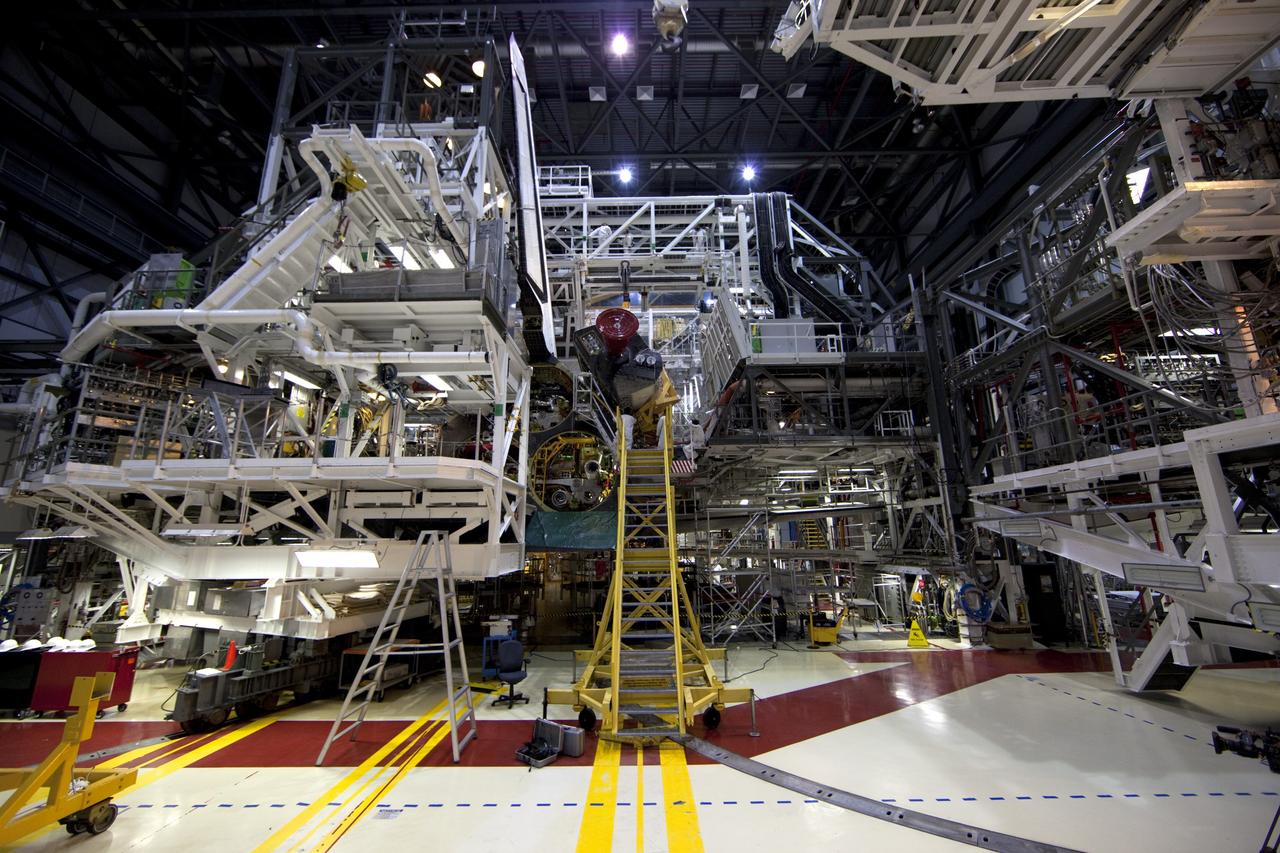
CAPE CANAVERAL, Fla. – Inside Orbiter Processing Facility-2 at NASA’s Kennedy Space Center in Florida, technicians monitor the progress as a large crane lifts the right orbital maneuvering system (OMS) pod from space shuttle Atlantis. The work is part of the Space Shuttle Program’s transition and retirement processing of shuttle Atlantis. Both OMS pods will be removed and sent to White Sands Space Harbor in New Mexico where they will undergo a complete deservicing and cleaning and then be returned to Kennedy for reinstallation on Atlantis. Atlantis is being prepared for display at the Kennedy Space Center Visitor Complex. Photo credit: NASA/Dimitri Gerondidakis
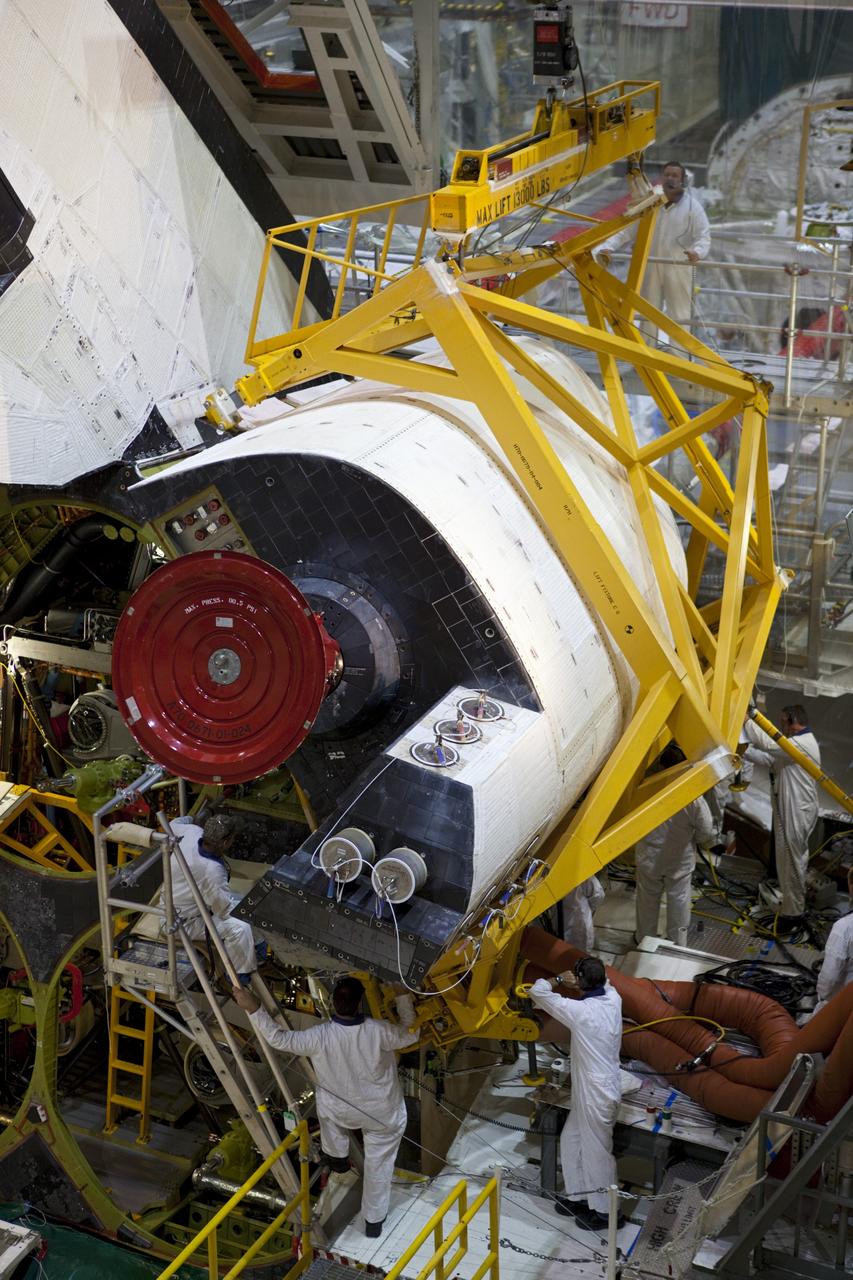
CAPE CANAVERAL, Fla. -- Inside Orbiter Processing Facility-2 at NASA’s Kennedy Space Center in Florida, technicians help secure a sling around space shuttle Atlantis’ right orbital maneuvering system (OMS) pod and prepare it for removal. The work is part of the Space Shuttle Program’s transition and retirement processing of shuttle Atlantis. The OMS pod will be removed and sent to White Sands Space Harbor in New Mexico where it will undergo a complete deservicing and cleaning and then be returned to Kennedy for reinstallation on Atlantis. Atlantis is being prepared for display at the Kennedy Space Center Visitor Complex. Photo credit: NASA/Dimitri Gerondidakis
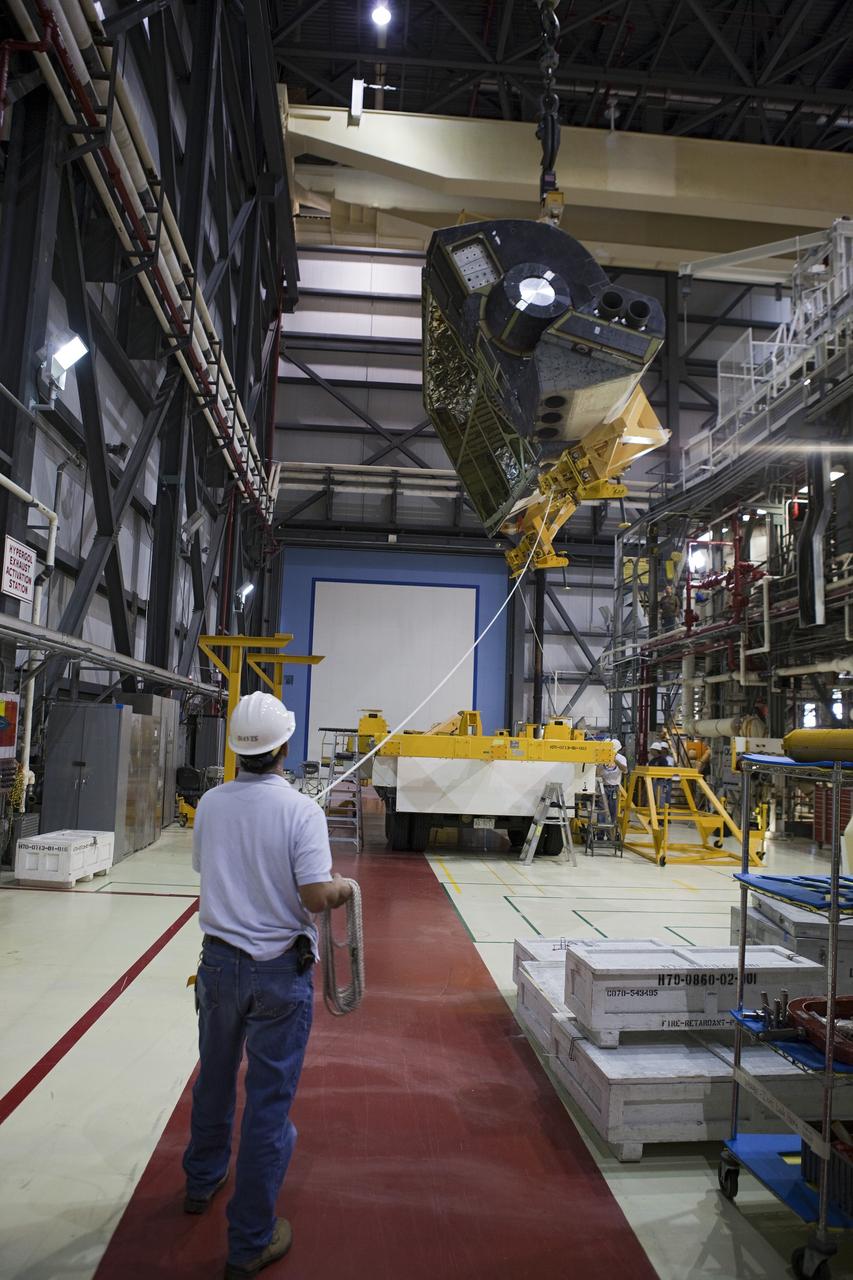
CAPE CANAVERAL, Fla. – Inside Orbiter Processing Facility-1 at NASA’s Kennedy Space Center in Florida, a United Space Alliance technician monitors the progress as a large crane lifts the right orbital maneuvering system, or OMS, pod for installation on space shuttle Atlantis. It is the last time an OMS pod will be installed on Atlantis. The OMS provided the shuttle with thrust for orbit insertion, rendezvous and deorbit, and could provide up to 1,000 pounds of propellant to the aft reaction control system. The OMS is housed in two independent pods located on each side of the shuttle’s aft fuselage. Each pod contains one OMS engine and the hardware needed to pressurize, store and distribute the propellants to perform the velocity maneuvers. Atlantis’ OMS pods were removed and sent to the test facility at White Sands Space Harbor in New Mexico to be cleaned of residual toxic propellant. The work is part of the Space Shuttle Program’s transition and retirement processing of the space shuttle fleet. A groundbreaking was held Jan. 18 for Atlantis’ future home, a 65,000-square-foot exhibit hall in Shuttle Plaza at the Kennedy Space Center Visitor Complex. Atlantis is scheduled to roll over to the visitor complex in November in preparation for the exhibit’s grand opening in July 2013. For more information, visit http://www.nasa.gov/transition. Photo credit: NASA/Dimitri Gerondidakis
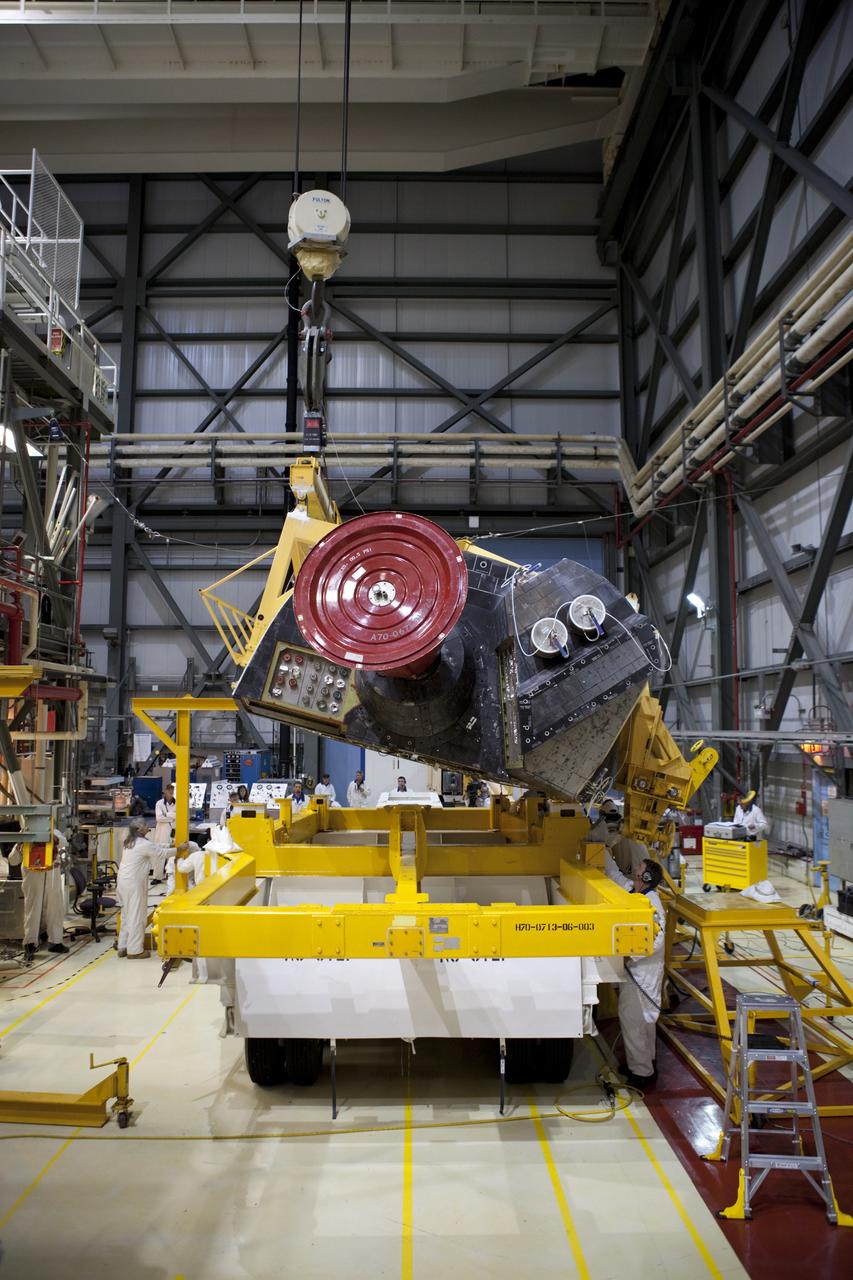
CAPE CANAVERAL, Fla. – Inside Orbiter Processing Facility-2 at NASA’s Kennedy Space Center in Florida, technicians monitor the progress as a large crane lowers space shuttle Atlantis’ right orbital maneuvering system (OMS) pod onto a pallet. The work is part of the Space Shuttle Program’s transition and retirement processing of shuttle Atlantis. Both OMS pods will be removed and sent to White Sands Space Harbor in New Mexico where they will undergo a complete deservicing and cleaning and then be returned to Kennedy for reinstallation on Atlantis. Atlantis is being prepared for display at the Kennedy Space Center Visitor Complex. Photo credit: NASA/Dimitri Gerondidakis
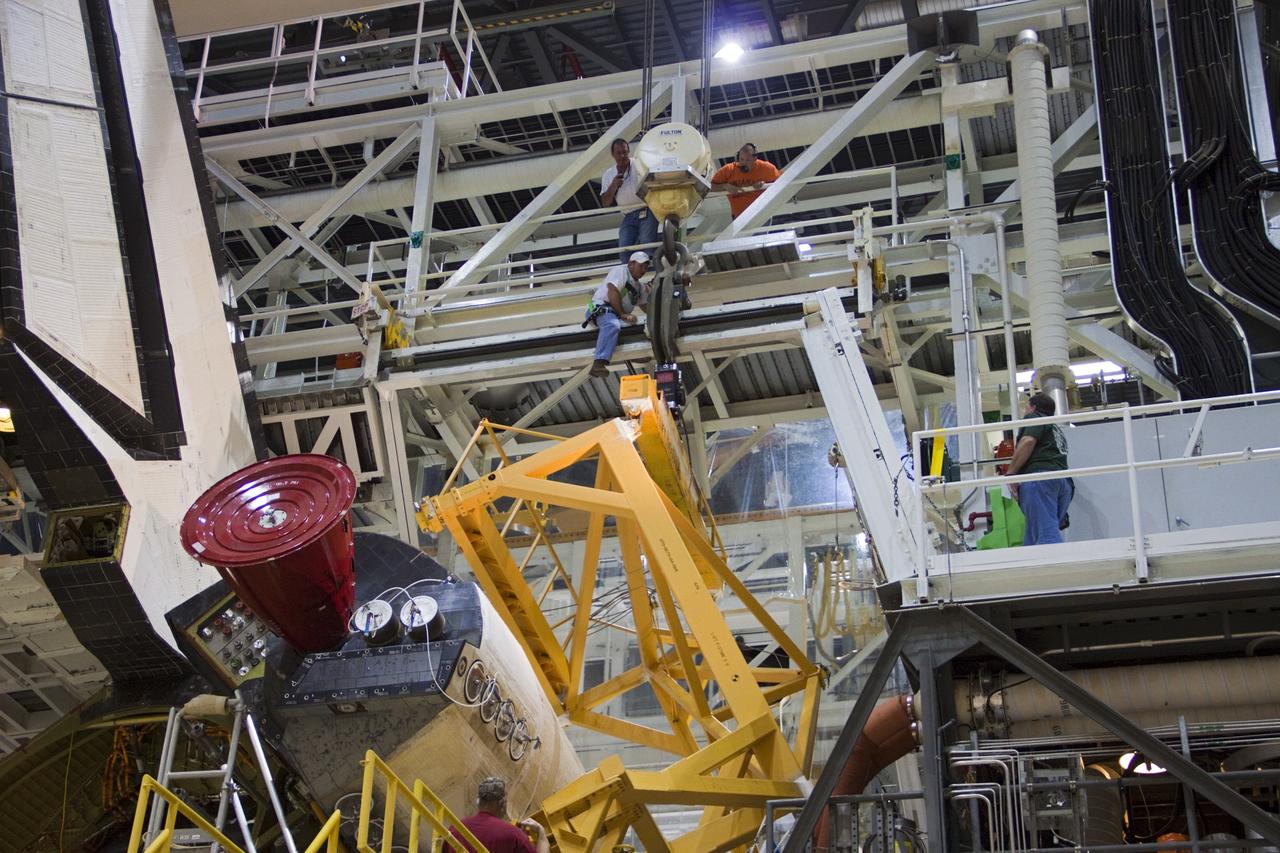
CAPE CANAVERAL, Fla. -- Inside Orbiter Processing Facility-2 at NASA’s Kennedy Space Center in Florida, technicians monitor the progress as a large crane lowers a sling toward space shuttle Atlantis’ right orbital maneuvering system (OMS) pod. The work is part of the Space Shuttle Program’s transition and retirement processing of shuttle Atlantis. The OMS pod will be removed and sent to White Sands Space Harbor in New Mexico where it will undergo a complete deservicing and cleaning and then be returned to Kennedy for reinstallation on Atlantis. Atlantis is being prepared for display at the Kennedy Space Center Visitor Complex. Photo credit: NASA/Jim Grossmann
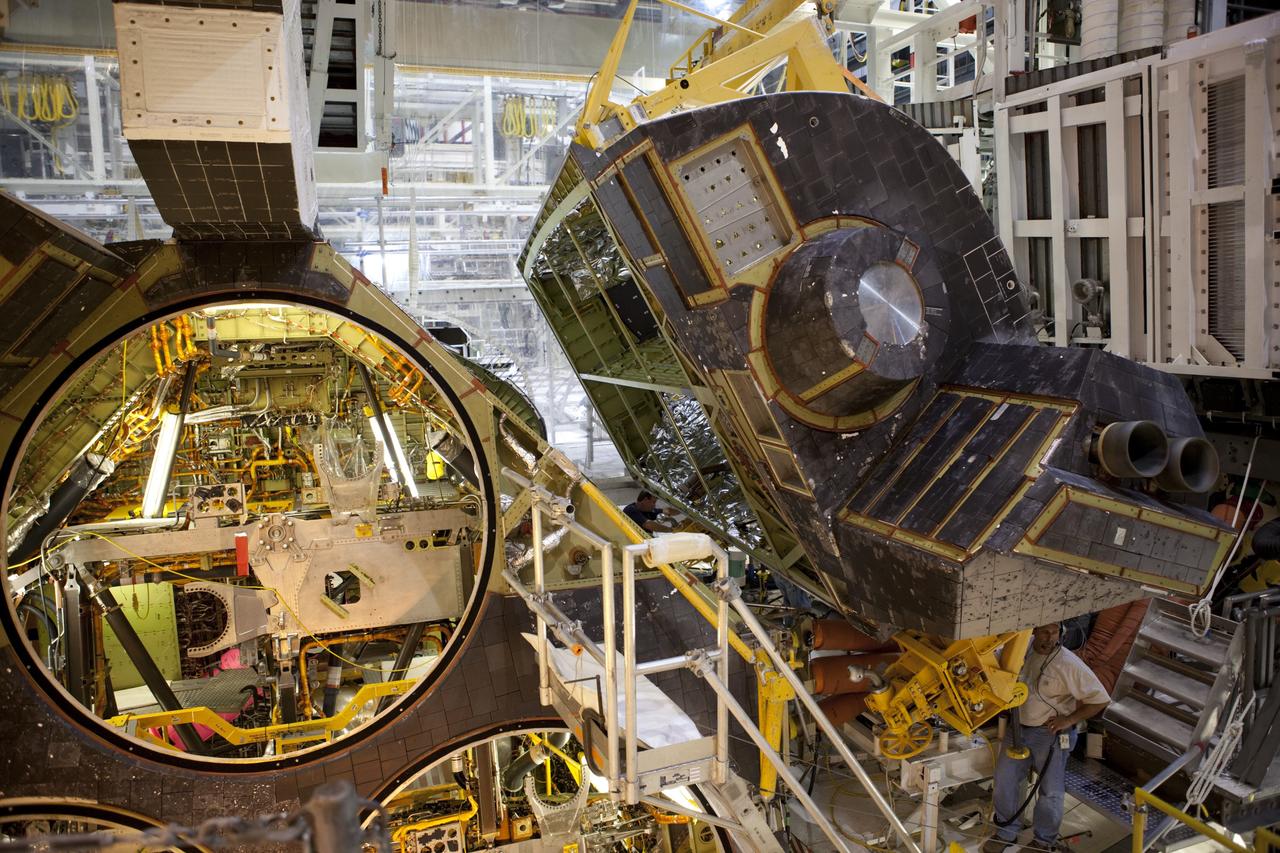
CAPE CANAVERAL, Fla. – Inside Orbiter Processing Facility-1 at NASA’s Kennedy Space Center in Florida, a unique close-up view shows a large crane lowering the right orbital maneuvering system, or OMS, pod closer to space shuttle Atlantis. It is the last time an OMS pod will be installed on Atlantis. The OMS provided the shuttle with thrust for orbit insertion, rendezvous and deorbit, and could provide up to 1,000 pounds of propellant to the aft reaction control system. The OMS is housed in two independent pods located on each side of the shuttle’s aft fuselage. Each pod contains one OMS engine and the hardware needed to pressurize, store and distribute the propellants to perform the velocity maneuvers. Atlantis’ OMS pods were removed and sent to the test facility at White Sands Space Harbor in New Mexico to be cleaned of residual toxic propellant. The work is part of the Space Shuttle Program’s transition and retirement processing of the space shuttle fleet. A groundbreaking was held Jan. 18 for Atlantis’ future home, a 65,000-square-foot exhibit hall in Shuttle Plaza at the Kennedy Space Center Visitor Complex. Atlantis is scheduled to roll over to the visitor complex in November in preparation for the exhibit’s grand opening in July 2013. For more information, visit http://www.nasa.gov/transition. Photo credit: NASA/Dimitri Gerondidakis
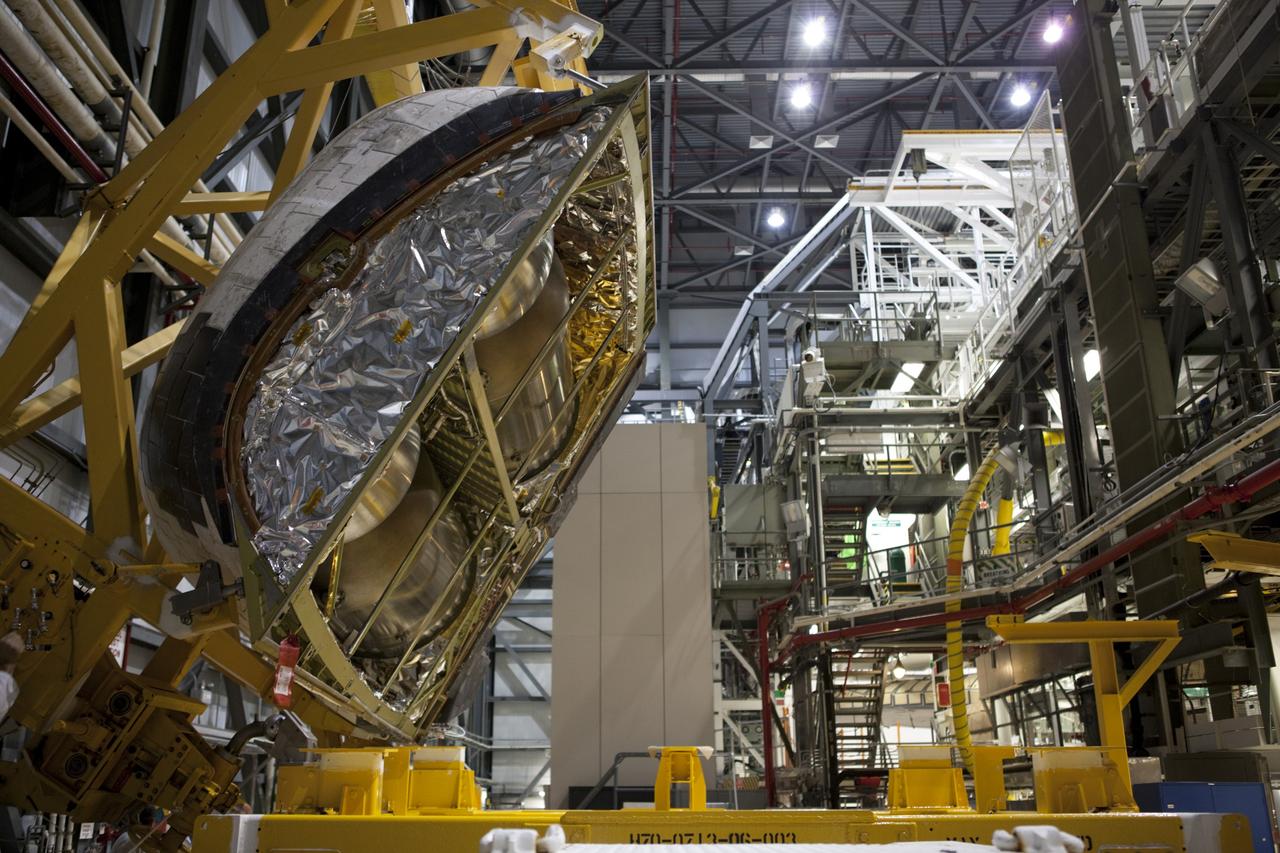
CAPE CANAVERAL, Fla. – Inside Orbiter Processing Facility-2 at NASA’s Kennedy Space Center in Florida, technicians monitor the progress as a large crane lowers space shuttle Atlantis’ right orbital maneuvering system (OMS) pod onto a pallet. The work is part of the Space Shuttle Program’s transition and retirement processing of shuttle Atlantis. Both OMS pods will be removed and sent to White Sands Space Harbor in New Mexico where they will undergo a complete deservicing and cleaning and then be returned to Kennedy for reinstallation on Atlantis. Atlantis is being prepared for display at the Kennedy Space Center Visitor Complex. Photo credit: NASA/Dimitri Gerondidakis

CAPE CANAVERAL, Fla. – Inside Orbiter Processing Facility-2 at NASA’s Kennedy Space Center in Florida, technicians monitor the progress as a large crane lowers space shuttle Atlantis’ right orbital maneuvering system (OMS) pod onto a pallet. The work is part of the Space Shuttle Program’s transition and retirement processing of shuttle Atlantis. Both OMS pods will be removed and sent to White Sands Space Harbor in New Mexico where they will undergo a complete deservicing and cleaning and then be returned to Kennedy for reinstallation on Atlantis. Atlantis is being prepared for display at the Kennedy Space Center Visitor Complex. Photo credit: NASA/Dimitri Gerondidakis
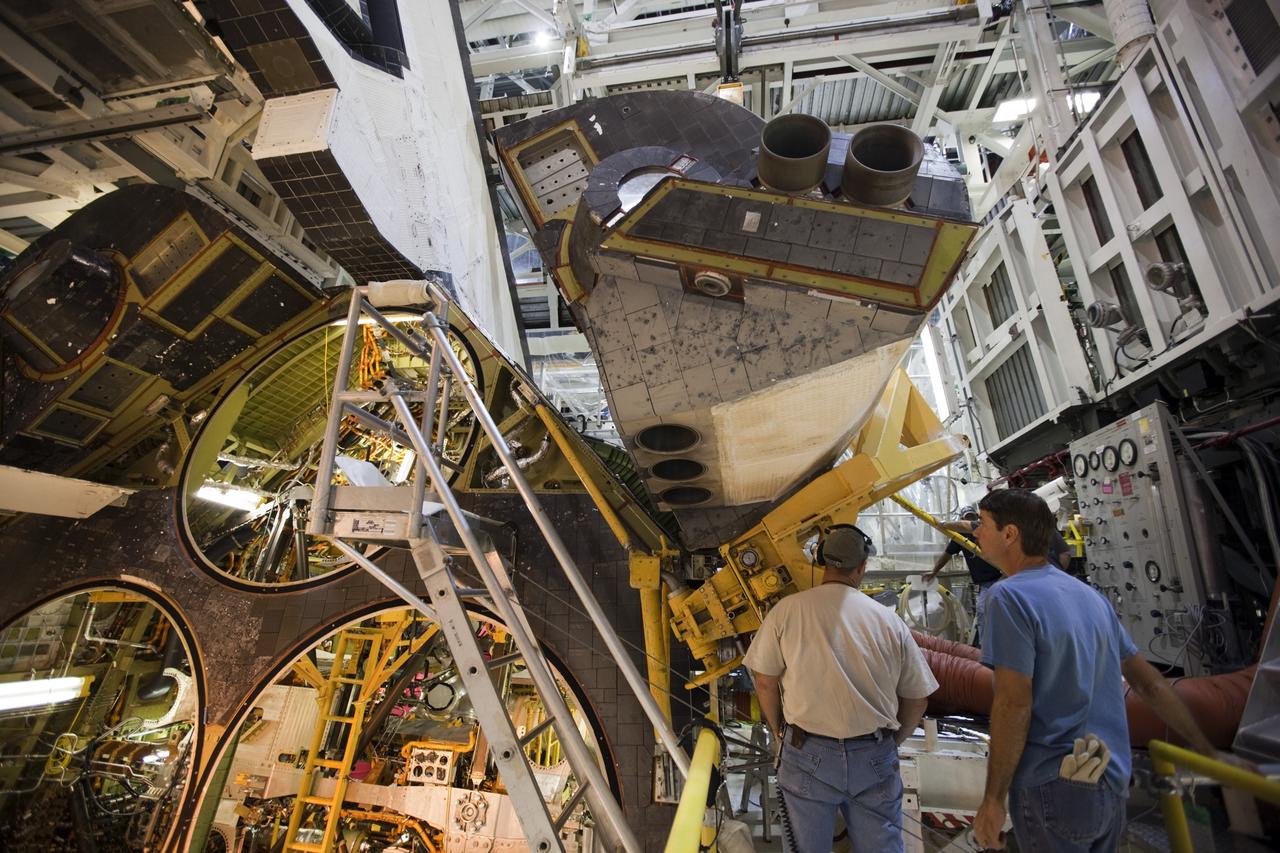
CAPE CANAVERAL, Fla. – Inside Orbiter Processing Facility-1 at NASA’s Kennedy Space Center in Florida, United Space Alliance technicians monitor the progress as a large crane lowers the right orbital maneuvering system, or OMS, pod onto space shuttle Atlantis. It is the last time an OMS pod will be installed on Atlantis. The OMS provided the shuttle with thrust for orbit insertion, rendezvous and deorbit, and could provide up to 1,000 pounds of propellant to the aft reaction control system. The OMS is housed in two independent pods located on each side of the shuttle’s aft fuselage. Each pod contains one OMS engine and the hardware needed to pressurize, store and distribute the propellants to perform the velocity maneuvers. Atlantis’ OMS pods were removed and sent to the test facility at White Sands Space Harbor in New Mexico to be cleaned of residual toxic propellant. The work is part of the Space Shuttle Program’s transition and retirement processing of the space shuttle fleet. A groundbreaking was held Jan. 18 for Atlantis’ future home, a 65,000-square-foot exhibit hall in Shuttle Plaza at the Kennedy Space Center Visitor Complex. Atlantis is scheduled to roll over to the visitor complex in November in preparation for the exhibit’s grand opening in July 2013. For more information, visit http://www.nasa.gov/transition. Photo credit: NASA/Dimitri Gerondidakis
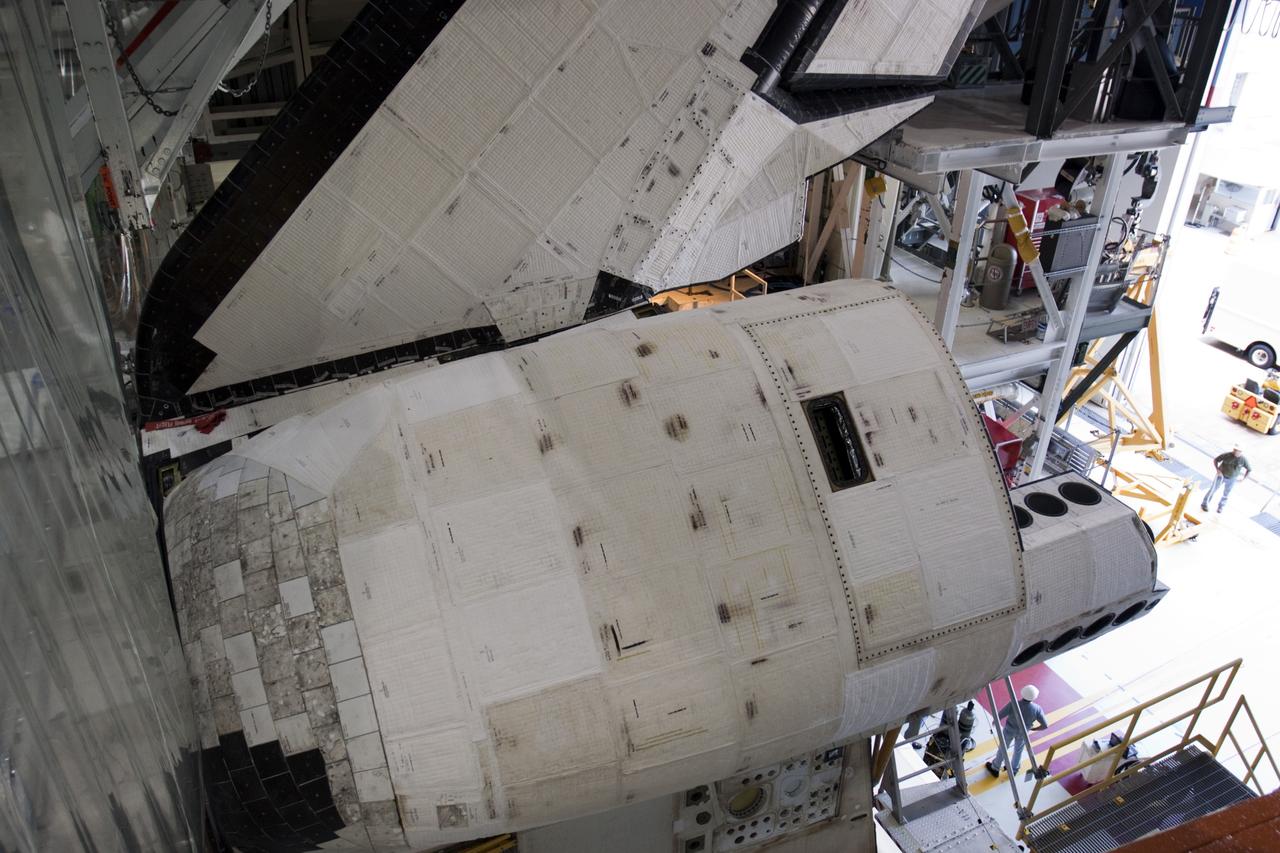
CAPE CANAVERAL, Fla. – Inside Orbiter Processing Facility-1 at NASA’s Kennedy Space Center in Florida, the left orbital maneuvering system, or OMS, pod has been installed onto space shuttle Atlantis. The OMS provided the shuttle with thrust for orbit insertion, rendezvous and deorbit, and could provide up to 1,000 pounds of propellant to the aft reaction control system. The OMS is housed in two independent pods located on each side of the shuttle’s aft fuselage. Each pod contains one OMS engine and the hardware needed to pressurize, store and distribute the propellants to perform the velocity maneuvers. Atlantis’ OMS pods were removed and sent to White Sands Test Facility in New Mexico to be cleaned of residual toxic propellant. The work is part of the Space Shuttle Program’s transition and retirement processing of the space shuttle fleet. A groundbreaking was held Jan. 18 for Atlantis’ future home, a 65,000-square-foot exhibit hall in Shuttle Plaza at the Kennedy Space Center Visitor Complex. Atlantis is scheduled to roll over to the visitor complex in November in preparation for the exhibit’s grand opening in July 2013. For more information, visit http://www.nasa.gov/transition. Photo credit: NASA/Ben Smegelsky
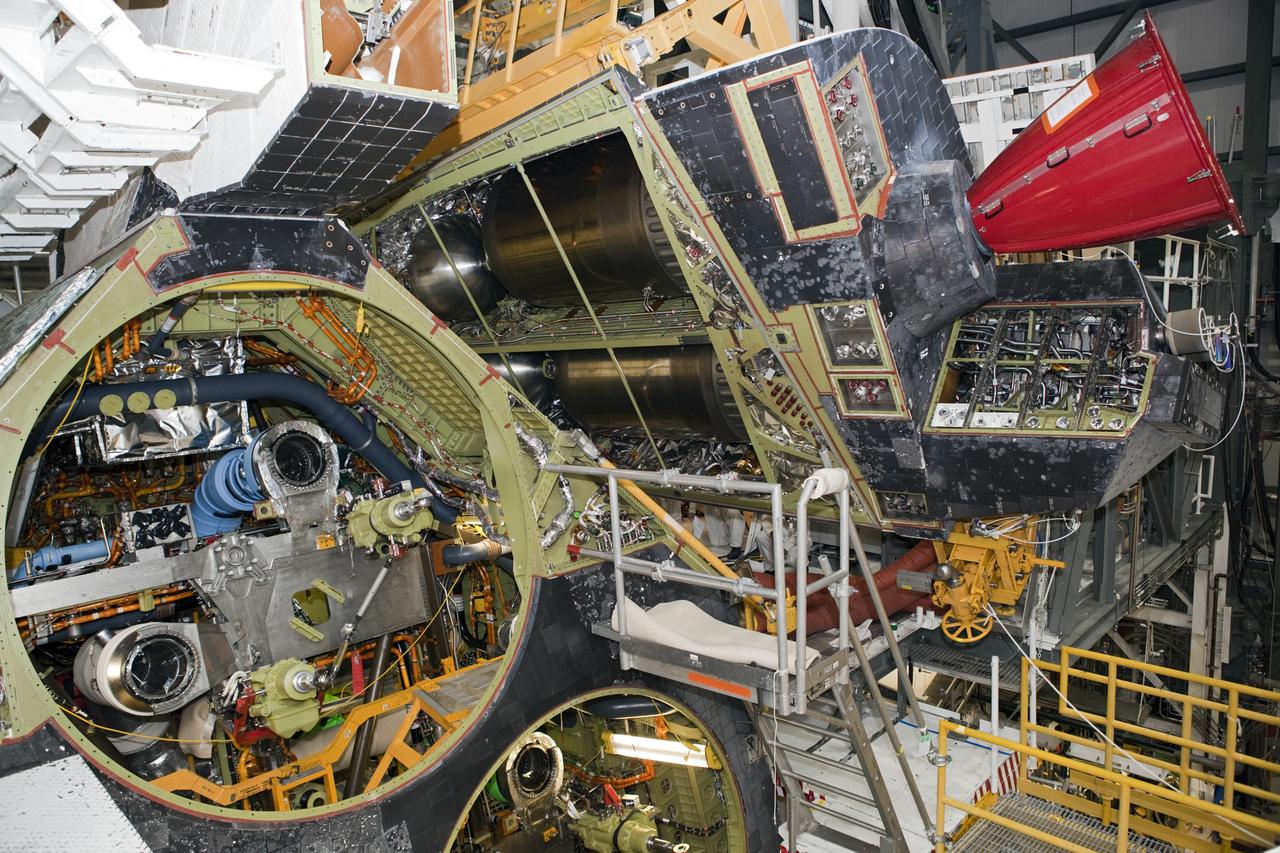
CAPE CANAVERAL, Fla. – Inside Orbiter Processing Facility-2 at NASA’s Kennedy Space Center in Florida, a large crane is being used to remove the right orbital maneuvering system (OMS) pod from space shuttle Atlantis. The work is part of the Space Shuttle Program’s transition and retirement processing of shuttle Atlantis. Both OMS pods will be removed and sent to White Sands Space Harbor in New Mexico where they will undergo a complete deservicing and cleaning and then be returned to Kennedy for reinstallation on Atlantis. Atlantis is being prepared for display at the Kennedy Space Center Visitor Complex. Photo credit: NASA/Dimitri Gerondidakis
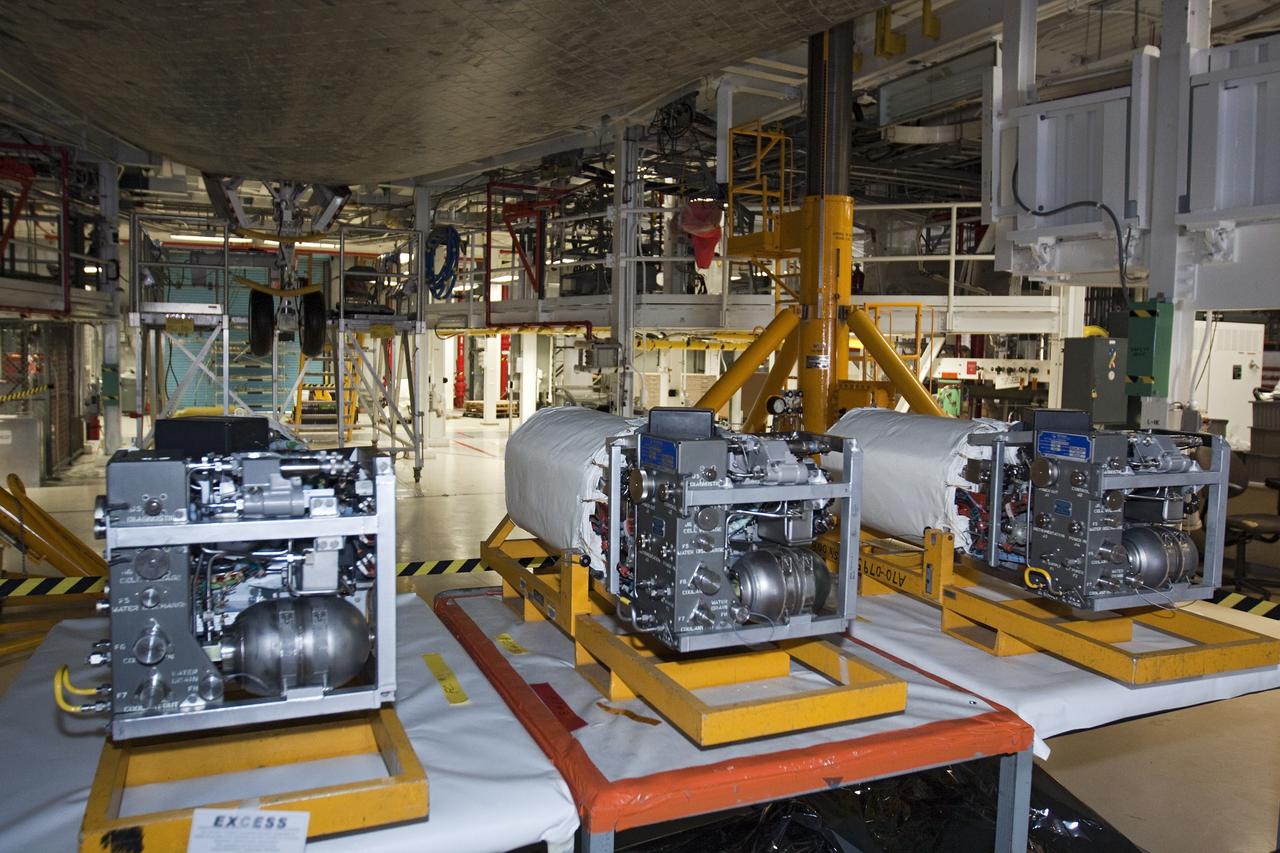
CAPE CANAVERAL, Fla. – Inside Orbiter Processing Facility-1 at NASA’s Kennedy Space Center in Florida, three excessed fuel cells are on a work bench beneath space shuttle Atlantis. The left orbital maneuvering system, or OMS, pod has been installed onto Atlantis. The OMS provided the shuttle with thrust for orbit insertion, rendezvous and deorbit, and could provide up to 1,000 pounds of propellant to the aft reaction control system. The OMS is housed in two independent pods located on each side of the shuttle’s aft fuselage. Each pod contains one OMS engine and the hardware needed to pressurize, store and distribute the propellants to perform the velocity maneuvers. Atlantis’ OMS pods were removed and sent to White Sands Test Facility in New Mexico to be cleaned of residual toxic propellant. The work is part of the Space Shuttle Program’s transition and retirement processing of the space shuttle fleet. A groundbreaking was held Jan. 18 for Atlantis’ future home, a 65,000-square-foot exhibit hall in Shuttle Plaza at the Kennedy Space Center Visitor Complex. Atlantis is scheduled to roll over to the visitor complex in November in preparation for the exhibit’s grand opening in July 2013. For more information, visit http://www.nasa.gov/transition. Photo credit: NASA/Ben Smegelsky
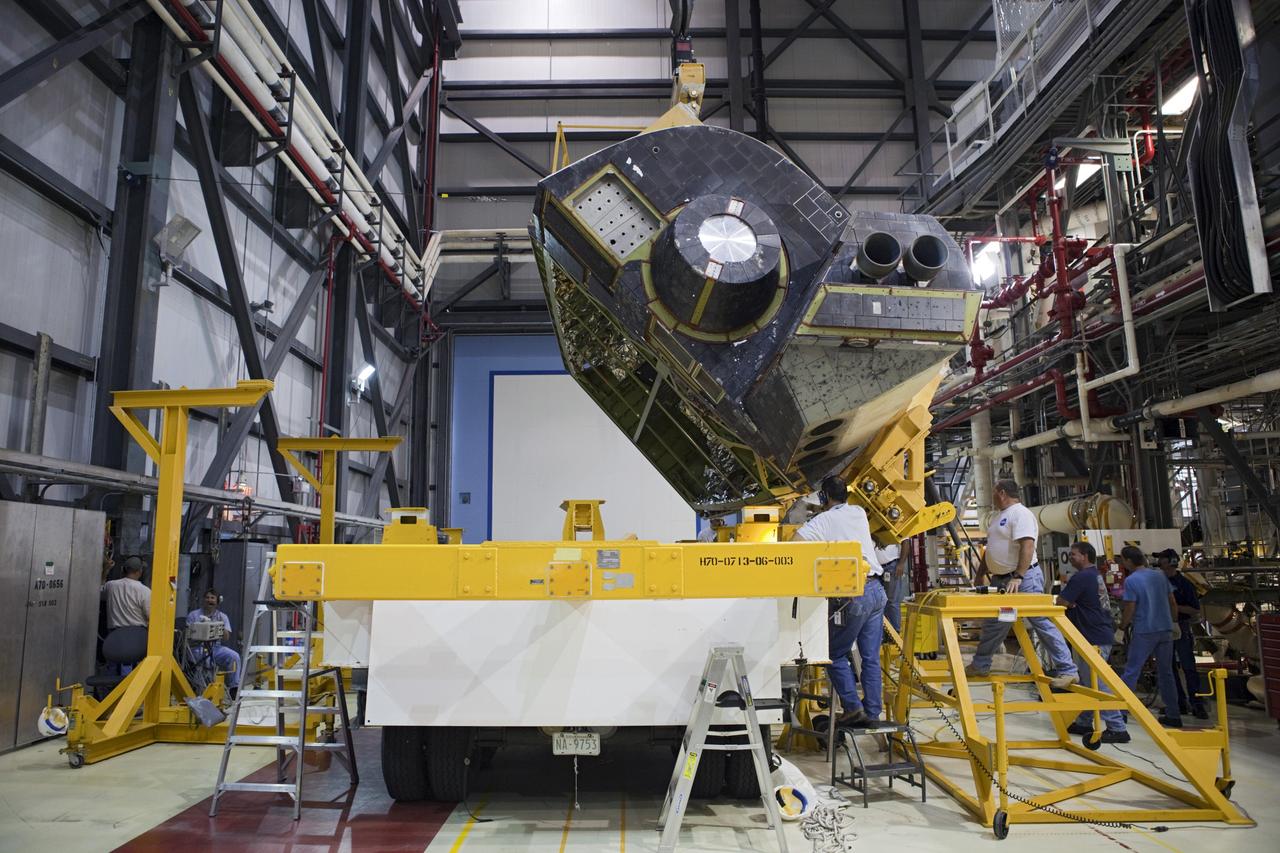
CAPE CANAVERAL, Fla. – Inside Orbiter Processing Facility-1 at NASA’s Kennedy Space Center in Florida, United Space Alliance technicians monitor the progress as a large crane begins to lift the right orbital maneuvering system, or OMS, pod for installation on space shuttle Atlantis. It is the last time an OMS pod will be installed on Atlantis. The OMS provided the shuttle with thrust for orbit insertion, rendezvous and deorbit, and could provide up to 1,000 pounds of propellant to the aft reaction control system. The OMS is housed in two independent pods located on each side of the shuttle’s aft fuselage. Each pod contains one OMS engine and the hardware needed to pressurize, store and distribute the propellants to perform the velocity maneuvers. Atlantis’ OMS pods were removed and sent to the test facility at White Sands Space Harbor in New Mexico to be cleaned of residual toxic propellant. The work is part of the Space Shuttle Program’s transition and retirement processing of the space shuttle fleet. A groundbreaking was held Jan. 18 for Atlantis’ future home, a 65,000-square-foot exhibit hall in Shuttle Plaza at the Kennedy Space Center Visitor Complex. Atlantis is scheduled to roll over to the visitor complex in November in preparation for the exhibit’s grand opening in July 2013. For more information, visit http://www.nasa.gov/transition. Photo credit: NASA/Dimitri Gerondidakis
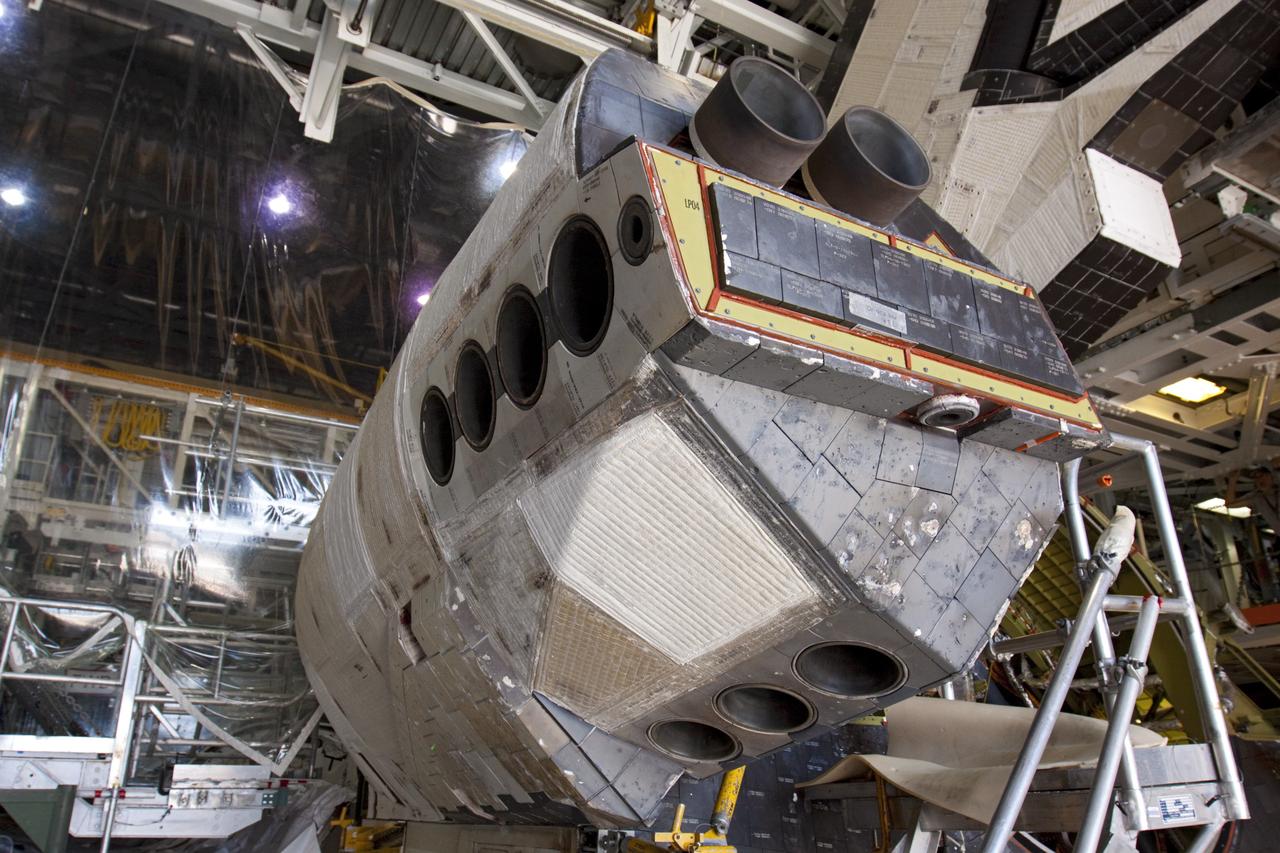
CAPE CANAVERAL, Fla. – Inside Orbiter Processing Facility-1 at NASA’s Kennedy Space Center in Florida, the left orbital maneuvering system, or OMS, pod has been installed onto space shuttle Atlantis. The OMS provided the shuttle with thrust for orbit insertion, rendezvous and deorbit, and could provide up to 1,000 pounds of propellant to the aft reaction control system. The OMS is housed in two independent pods located on each side of the shuttle’s aft fuselage. Each pod contains one OMS engine and the hardware needed to pressurize, store and distribute the propellants to perform the velocity maneuvers. Atlantis’ OMS pods were removed and sent to White Sands Test Facility in New Mexico to be cleaned of residual toxic propellant. The work is part of the Space Shuttle Program’s transition and retirement processing of the space shuttle fleet. A groundbreaking was held Jan. 18 for Atlantis’ future home, a 65,000-square-foot exhibit hall in Shuttle Plaza at the Kennedy Space Center Visitor Complex. Atlantis is scheduled to roll over to the visitor complex in November in preparation for the exhibit’s grand opening in July 2013. For more information, visit http://www.nasa.gov/transition. Photo credit: NASA/Ben Smegelsky
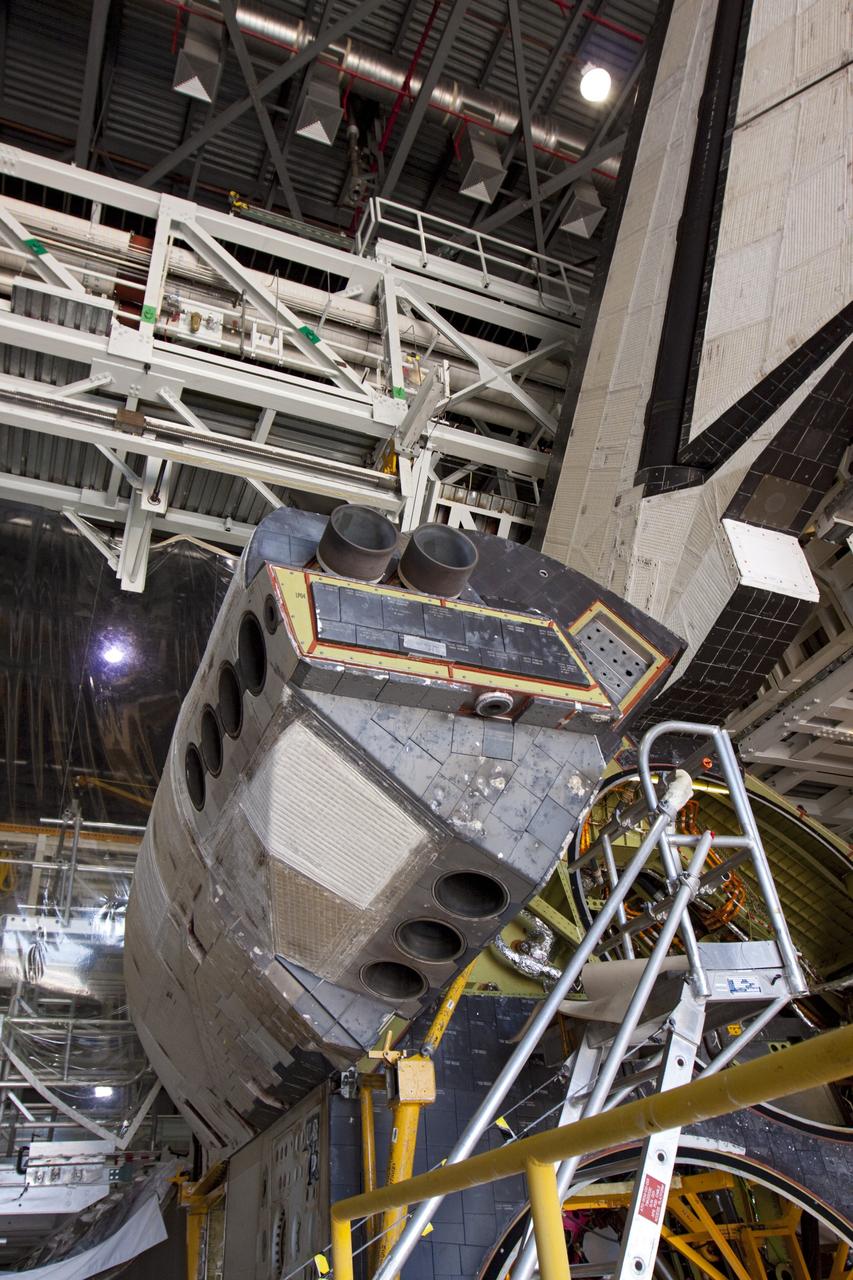
CAPE CANAVERAL, Fla. – Inside Orbiter Processing Facility-1 at NASA’s Kennedy Space Center in Florida, the left orbital maneuvering system, or OMS, pod has been installed onto space shuttle Atlantis. The OMS provided the shuttle with thrust for orbit insertion, rendezvous and deorbit, and could provide up to 1,000 pounds of propellant to the aft reaction control system. The OMS is housed in two independent pods located on each side of the shuttle’s aft fuselage. Each pod contains one OMS engine and the hardware needed to pressurize, store and distribute the propellants to perform the velocity maneuvers. Atlantis’ OMS pods were removed and sent to White Sands Test Facility in New Mexico to be cleaned of residual toxic propellant. The work is part of the Space Shuttle Program’s transition and retirement processing of the space shuttle fleet. A groundbreaking was held Jan. 18 for Atlantis’ future home, a 65,000-square-foot exhibit hall in Shuttle Plaza at the Kennedy Space Center Visitor Complex. Atlantis is scheduled to roll over to the visitor complex in November in preparation for the exhibit’s grand opening in July 2013. For more information, visit http://www.nasa.gov/transition. Photo credit: NASA/Ben Smegelsky
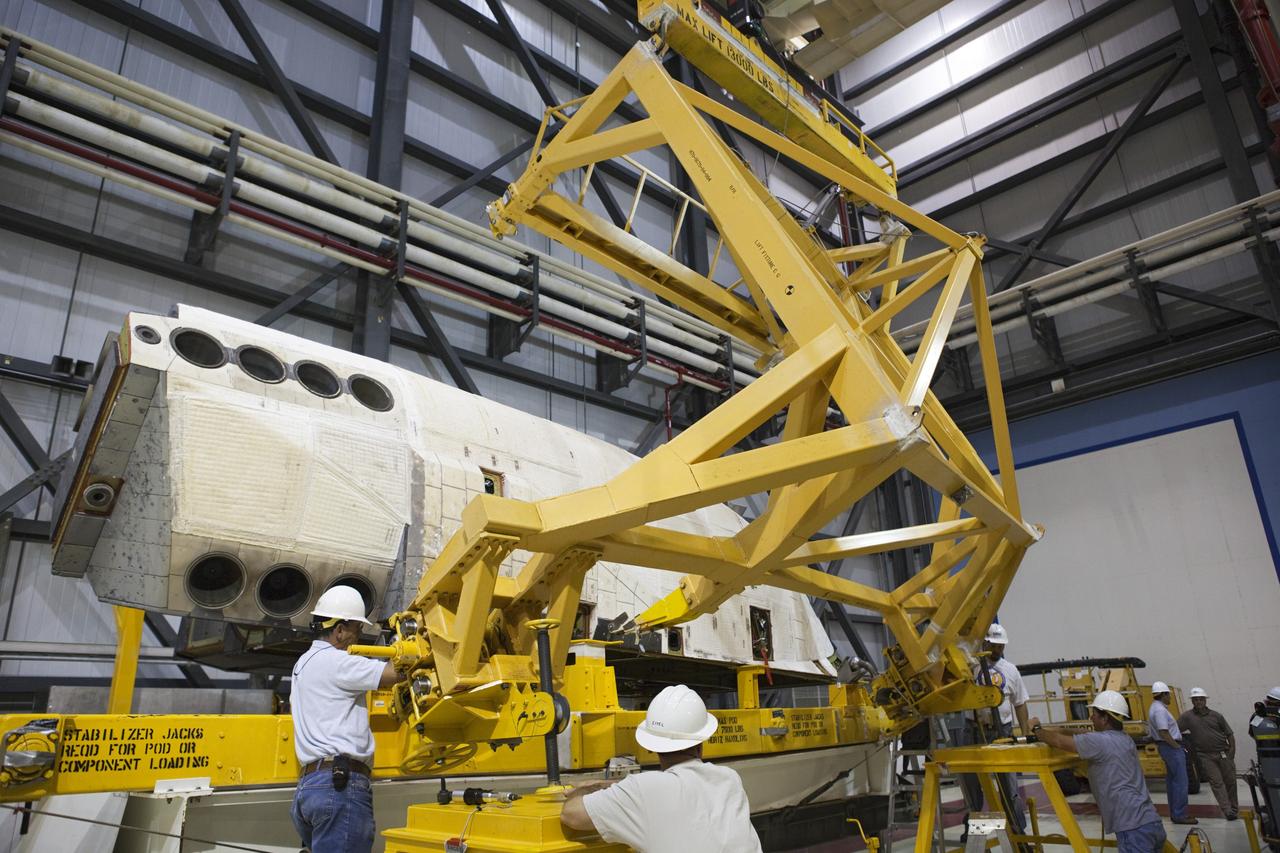
CAPE CANAVERAL, Fla. – Inside Orbiter Processing Facility-1 at NASA’s Kennedy Space Center in Florida, United Launch Alliance technicians provide assistance as a large crane is lowered toward the right orbital maneuvering system, or OMS, pod for space shuttle Atlantis. It will be the last time an OMS pod is installed on Atlantis. The OMS provided the shuttle with thrust for orbit insertion, rendezvous and deorbit, and could provide up to 1,000 pounds of propellant to the aft reaction control system. The OMS is housed in two independent pods located on each side of the shuttle’s aft fuselage. Each pod contains one OMS engine and the hardware needed to pressurize, store and distribute the propellants to perform the velocity maneuvers. Atlantis’ OMS pods were removed and sent to the test facility at White Sands Space Harbor in New Mexico to be cleaned of residual toxic propellant. The work is part of the Space Shuttle Program’s transition and retirement processing of the space shuttle fleet. A groundbreaking was held Jan. 18 for Atlantis’ future home, a 65,000-square-foot exhibit hall in Shuttle Plaza at the Kennedy Space Center Visitor Complex. Atlantis is scheduled to roll over to the visitor complex in November in preparation for the exhibit’s grand opening in July 2013. For more information, visit http://www.nasa.gov/transition. Photo credit: NASA/Dimitri Gerondidakis
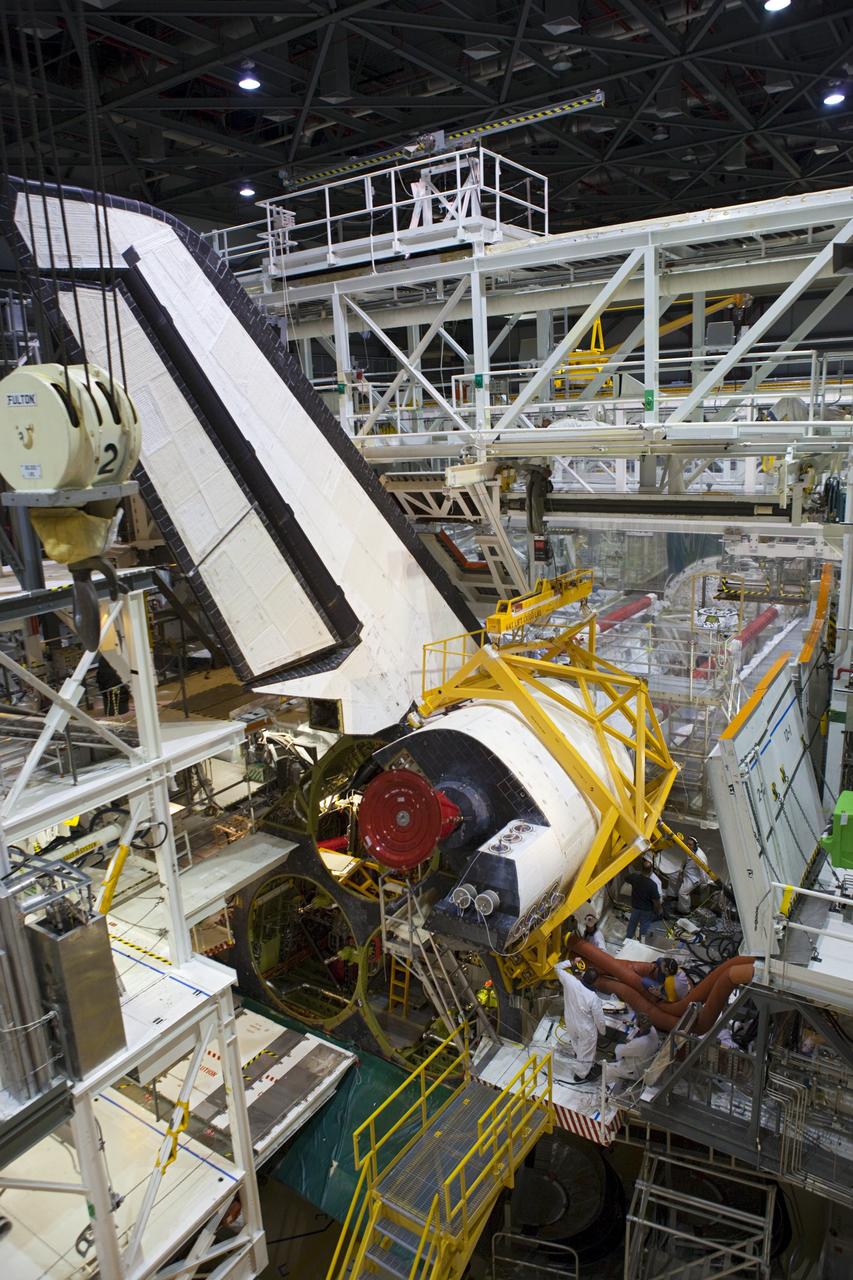
CAPE CANAVERAL, Fla. -- Inside Orbiter Processing Facility-2 at NASA’s Kennedy Space Center in Florida, technicians help secure a sling around space shuttle Atlantis’ right orbital maneuvering system (OMS) pod and prepare it for removal. The work is part of the Space Shuttle Program’s transition and retirement processing of shuttle Atlantis. The OMS pod will be removed and sent to White Sands Space Harbor in New Mexico where it will undergo a complete deservicing and cleaning and then be returned to Kennedy for reinstallation on Atlantis. Atlantis is being prepared for display at the Kennedy Space Center Visitor Complex. Photo credit: NASA/Dimitri Gerondidakis
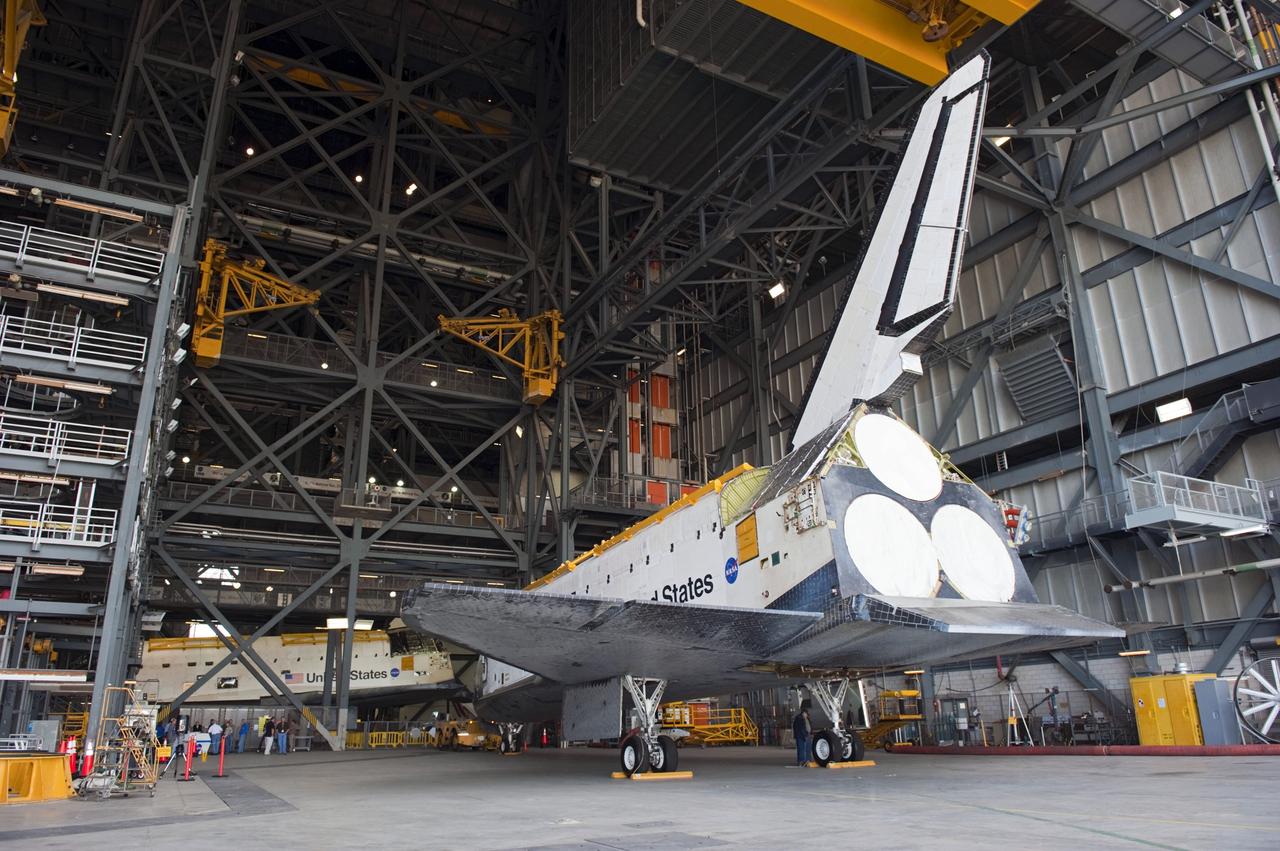
CAPE CANAVERAL, Fla. – Inside the Vehicle Assembly Building at NASA’s Kennedy Space Center in Florida, space shuttle Endeavour is being prepared to be backed out and towed to Orbiter Processing Facility-2 (OPF-2). In the background is space shuttle Atlantis. Shuttle Endeavour will remain in OPF-2 so that the orbiter maneuvering system (OMS) pods and forward reaction control system can be installed. Technicians also will offload water and Freon gas from lines located in Endeavour’s midbody. The work is part of Endeavour’s transition and retirement processing. The spacecraft is being prepared for public display at the California Science Center in Los Angeles. Endeavour flew 25 missions, spent 299 days in space, orbited Earth 4,671 times and traveled 122, 883, 151 miles over the course of its 19-year career. Endeavour’s STS-134 and final mission was completed after landing on June 1, 2011. Photo credit: Kim Shiflett
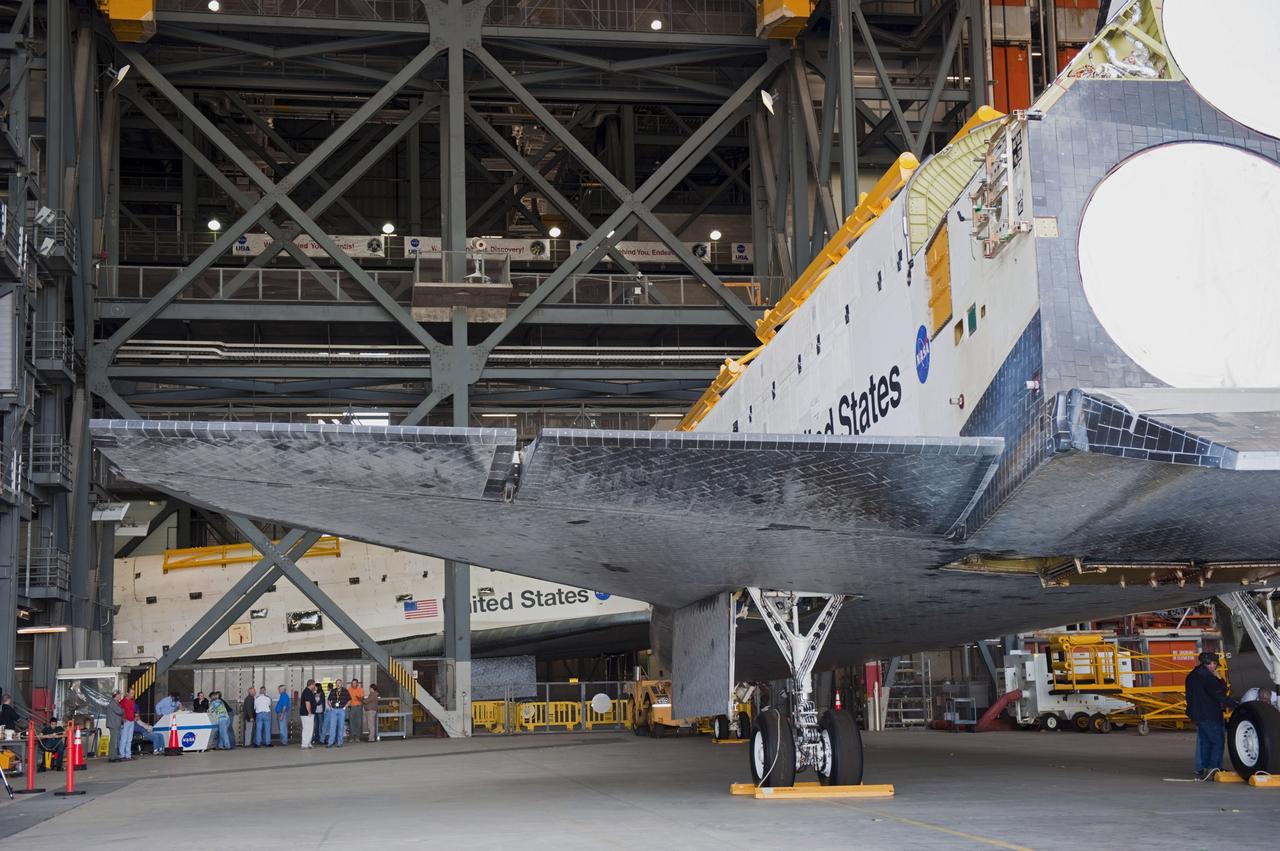
CAPE CANAVERAL, Fla. – Inside the Vehicle Assembly Building at NASA’s Kennedy Space Center in Florida, space shuttle Endeavour is being prepared to be backed out and towed to Orbiter Processing Facility-2 (OPF-2). In the background is space shuttle Atlantis. Shuttle Endeavour will remain in OPF-2 so that the orbiter maneuvering system (OMS) pods and forward reaction control system can be installed. Technicians also will offload water and Freon gas from lines located in Endeavour’s midbody. The work is part of Endeavour’s transition and retirement processing. The spacecraft is being prepared for public display at the California Science Center in Los Angeles. Endeavour flew 25 missions, spent 299 days in space, orbited Earth 4,671 times and traveled 122, 883, 151 miles over the course of its 19-year career. Endeavour’s STS-134 and final mission was completed after landing on June 1, 2011. Photo credit: Kim Shiflett