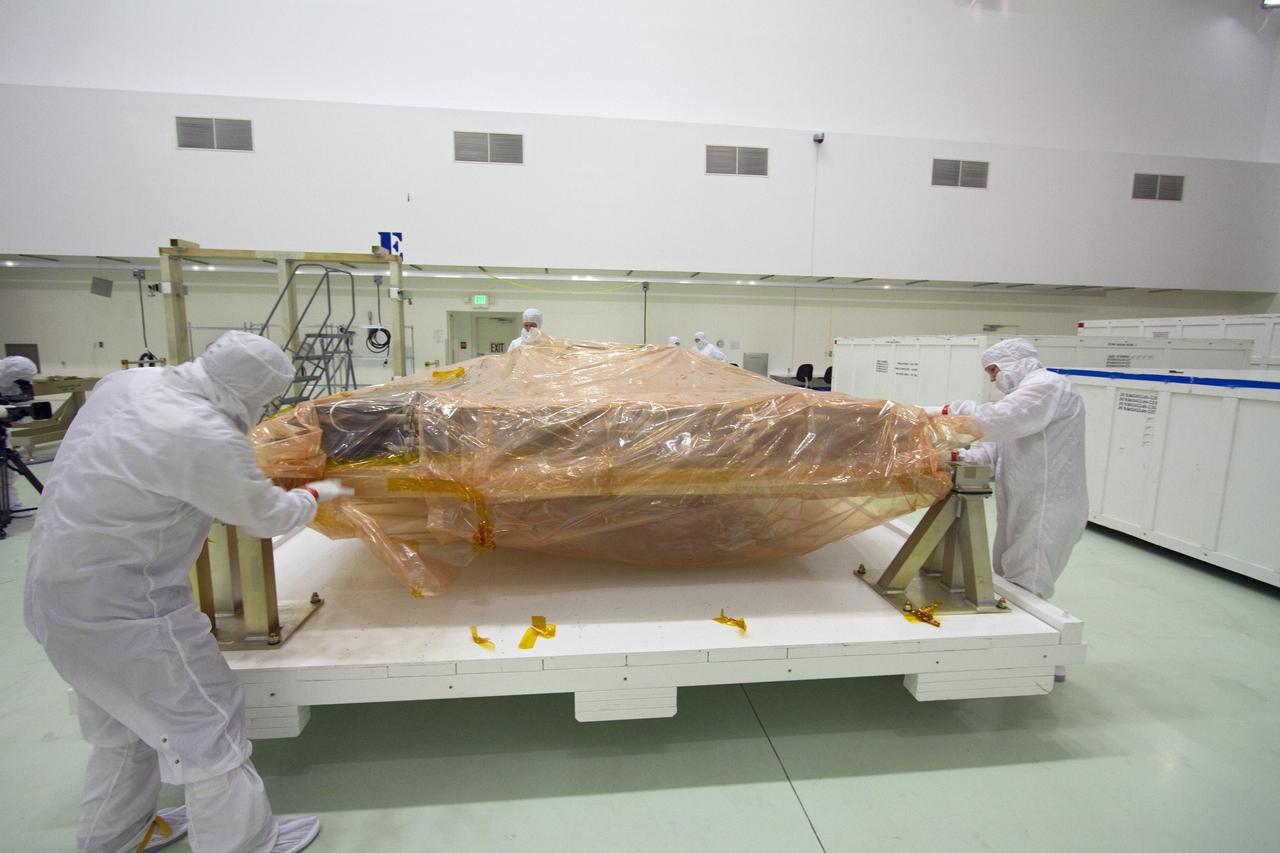
TITUSVILLE, Fla. -- Technicians in the Astrotech payload processing facility in Titusville, Fla., unpack a solar panel that will help power NASA's Juno spacecraft on a mission to Jupiter. Power-generating panels on three sets of solar arrays will extend outward from Juno’s hexagonal body, giving the overall spacecraft a span of more than 66 feet in order to operate at such a great distance from the sun. Juno is scheduled to launch aboard an Atlas V rocket from Cape Canaveral, Fla., on Aug. 5, 2011, reaching Jupiter in July 2016. The spacecraft will orbit the giant planet more than 30 times, skimming to within 3,000 miles above its cloud tops, for about one year. With its suite of science instruments, the spacecraft will investigate the existence of a solid planetary core, map Jupiter's intense magnetic field, measure the amount of water and ammonia in the deep atmosphere, and observe the planet's auroras. For more information visit, www.nasa.gov/juno. Photo credit: NASA/Jack Pfaller

TITUSVILLE, Fla. -- Technicians in the Astrotech payload processing facility in Titusville, Fla., process a solar panel that will help power NASA's Juno spacecraft on a mission to Jupiter. Power-generating panels on three sets of solar arrays will extend outward from Juno’s hexagonal body, giving the overall spacecraft a span of more than 66 feet in order to operate at such a great distance from the sun. Juno is scheduled to launch aboard an Atlas V rocket from Cape Canaveral, Fla., on Aug. 5, 2011, reaching Jupiter in July 2016. The spacecraft will orbit the giant planet more than 30 times, skimming to within 3,000 miles above its cloud tops, for about one year. With its suite of science instruments, the spacecraft will investigate the existence of a solid planetary core, map Jupiter's intense magnetic field, measure the amount of water and ammonia in the deep atmosphere, and observe the planet's auroras. For more information visit, www.nasa.gov/juno. Photo credit: NASA/Jack Pfaller
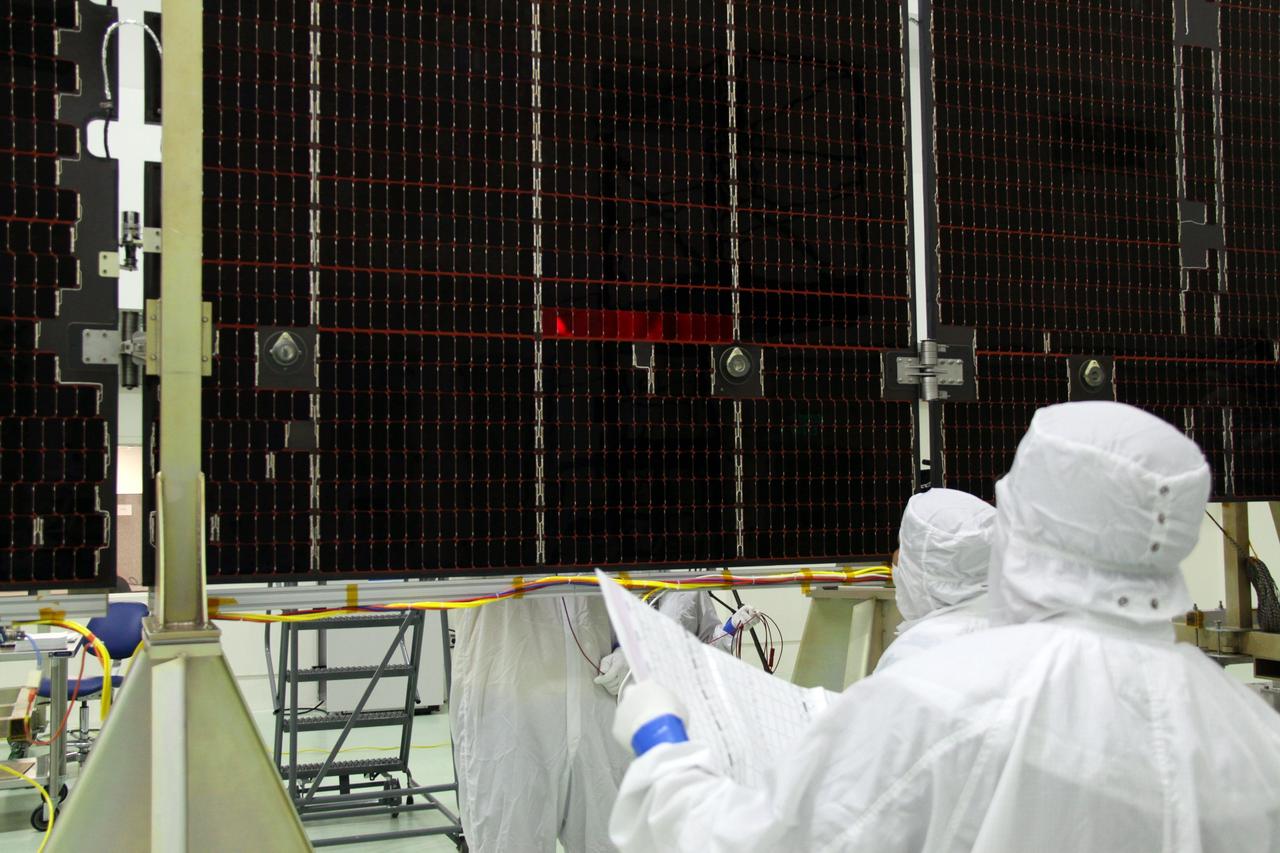
CAPE CANAVERAL, Fla. -- Technicians in the Astrotech payload processing facility in Titusville, Fla., test the electrical continuity of a solar array that will help power NASA's Juno spacecraft on a mission to Jupiter. Power-generating panels on three sets of solar arrays will extend outward from Juno’s hexagonal body, giving the overall spacecraft a span of more than 66 feet in order to operate at such a great distance from the sun. Juno is scheduled to launch aboard an Atlas V rocket from Cape Canaveral, Fla., on Aug. 5, 2011, reaching Jupiter in July 2016. The spacecraft will orbit the giant planet more than 30 times, skimming to within 3,000 miles above its cloud tops, for about one year. With its suite of science instruments, the spacecraft will investigate the existence of a solid planetary core, map Jupiter's intense magnetic field, measure the amount of water and ammonia in the deep atmosphere, and observe the planet's auroras. For more information visit, www.nasa.gov/juno. Photo credit: NASA/Jack Pfaller
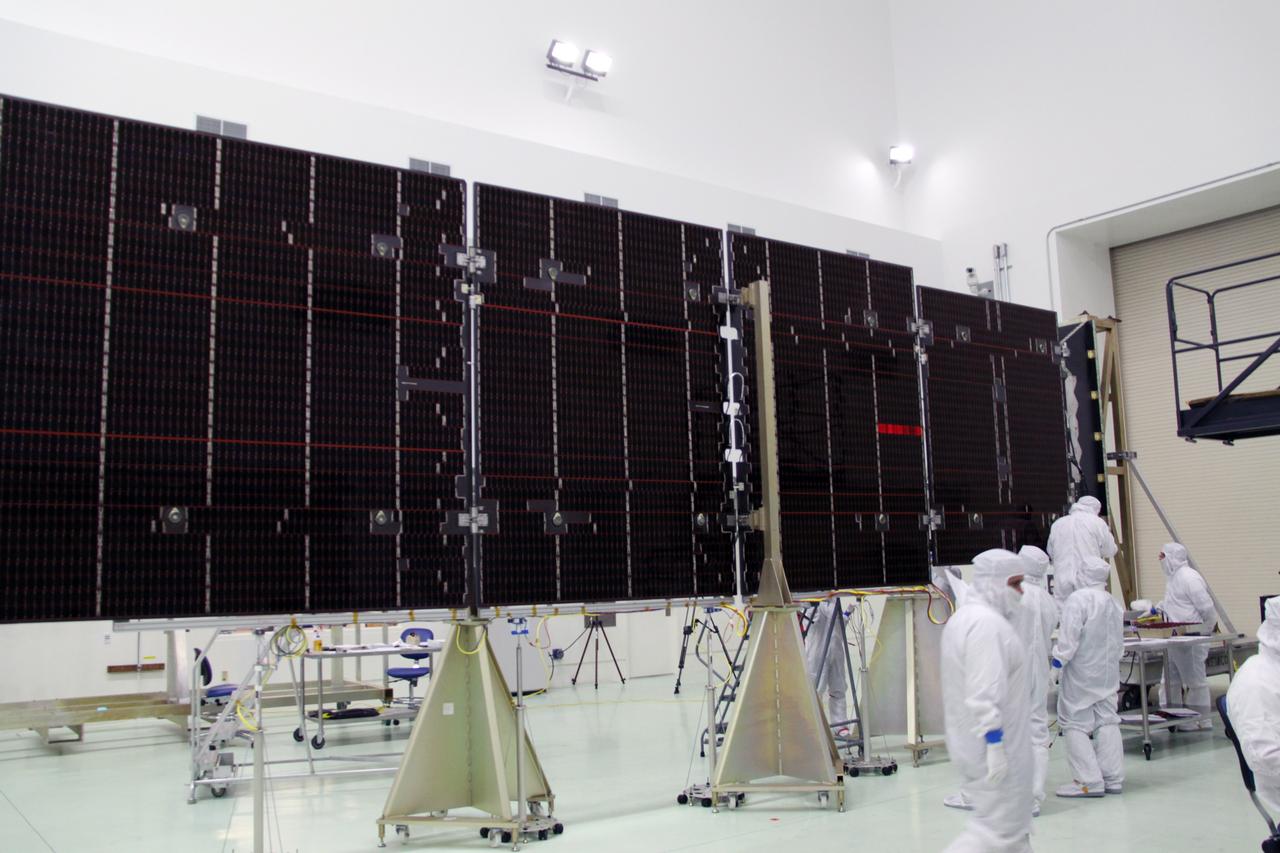
CAPE CANAVERAL, Fla. -- Technicians in the Astrotech payload processing facility in Titusville, Fla., test the electrical continuity of a solar array that will help power NASA's Juno spacecraft on a mission to Jupiter. Power-generating panels on three sets of solar arrays will extend outward from Juno’s hexagonal body, giving the overall spacecraft a span of more than 66 feet in order to operate at such a great distance from the sun. Juno is scheduled to launch aboard an Atlas V rocket from Cape Canaveral, Fla., on Aug. 5, 2011, reaching Jupiter in July 2016. The spacecraft will orbit the giant planet more than 30 times, skimming to within 3,000 miles above its cloud tops, for about one year. With its suite of science instruments, the spacecraft will investigate the existence of a solid planetary core, map Jupiter's intense magnetic field, measure the amount of water and ammonia in the deep atmosphere, and observe the planet's auroras. For more information visit, www.nasa.gov/juno. Photo credit: NASA/Jack Pfaller
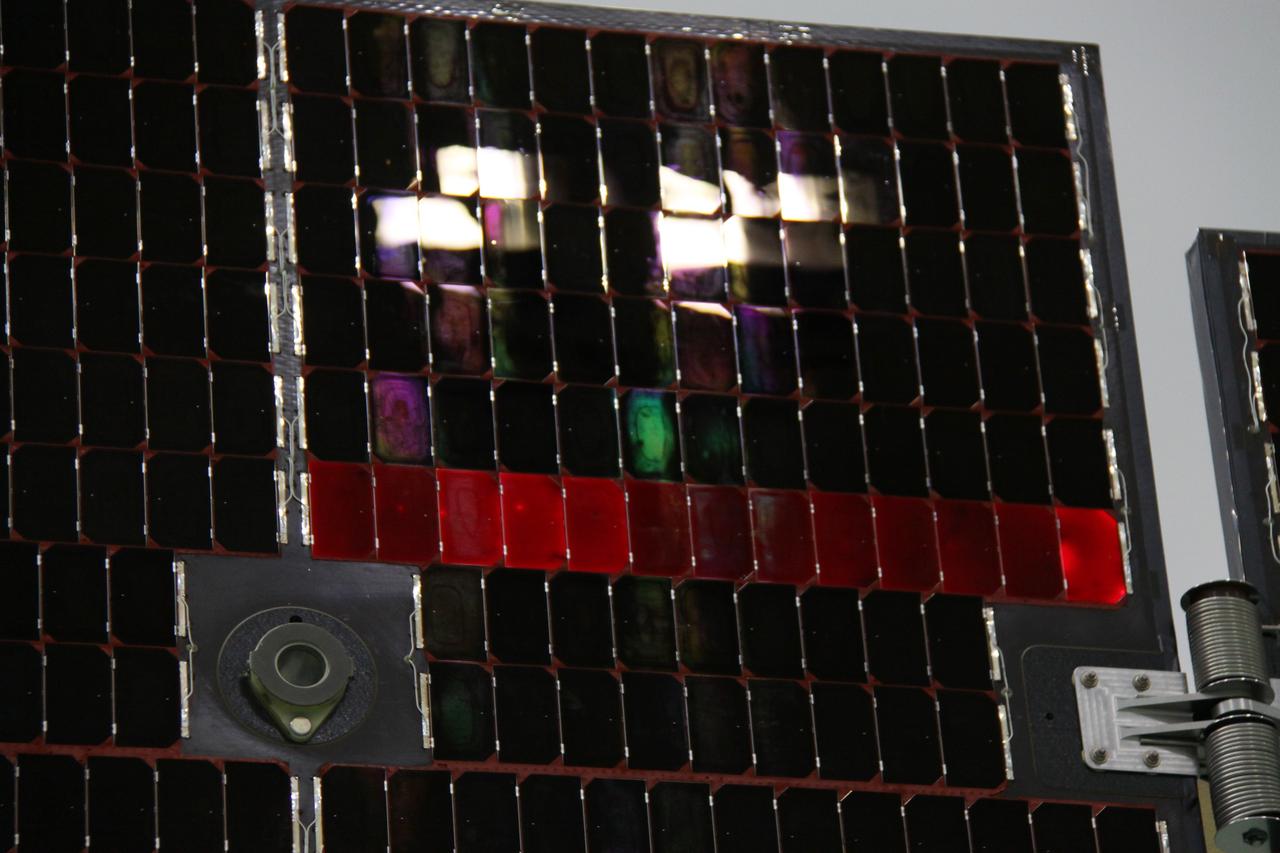
CAPE CANAVERAL, Fla. -- The electrical continuity of a solar array that will help power NASA's Juno spacecraft on a mission to Jupiter is tested in the Astrotech payload processing facility in Titusville, Fla. Power-generating panels on three sets of solar arrays will extend outward from Juno’s hexagonal body, giving the overall spacecraft a span of more than 66 feet in order to operate at such a great distance from the sun. Juno is scheduled to launch aboard an Atlas V rocket from Cape Canaveral, Fla., on Aug. 5, 2011, reaching Jupiter in July 2016. The spacecraft will orbit the giant planet more than 30 times, skimming to within 3,000 miles above its cloud tops, for about one year. With its suite of science instruments, the spacecraft will investigate the existence of a solid planetary core, map Jupiter's intense magnetic field, measure the amount of water and ammonia in the deep atmosphere, and observe the planet's auroras. For more information visit, www.nasa.gov/juno. Photo credit: NASA/Jack Pfaller
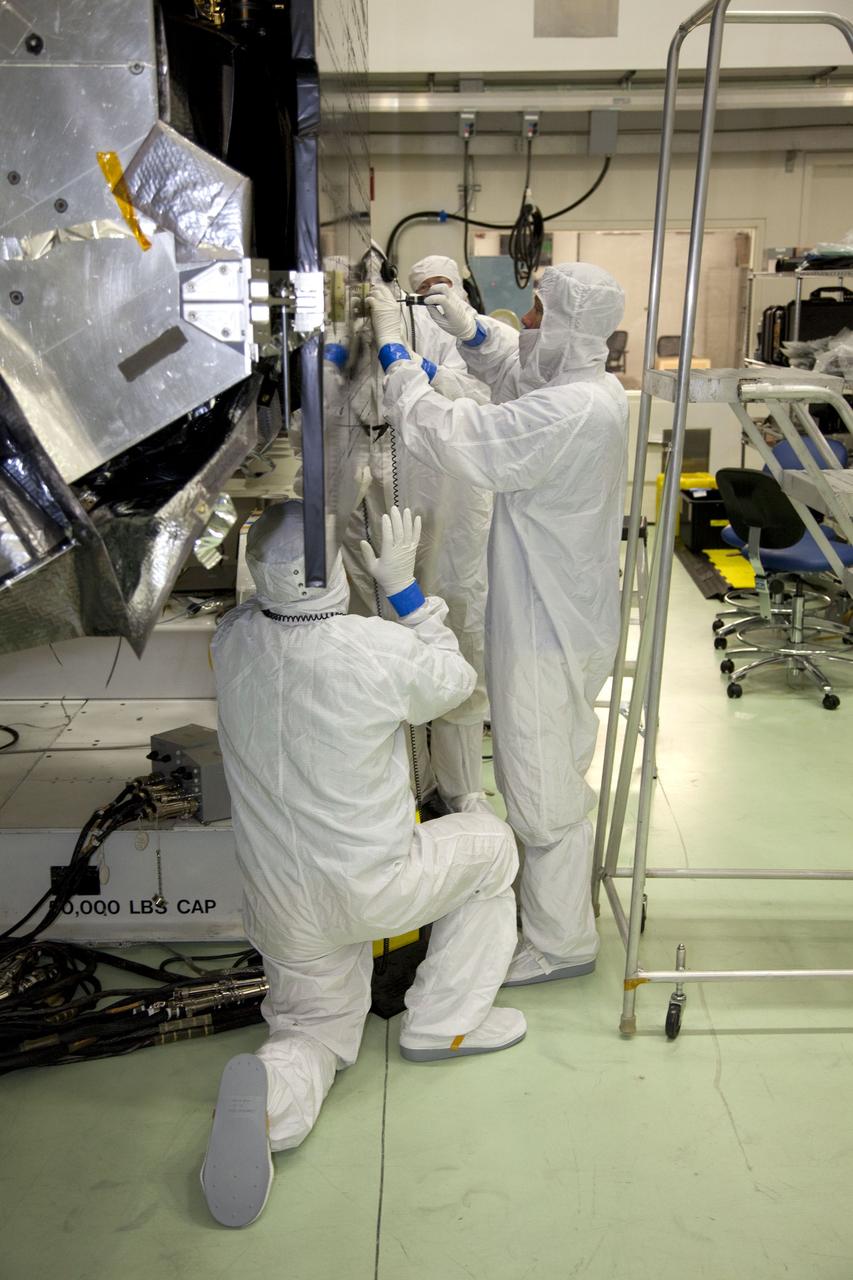
TITUSVILLE, Fla. -- Lockheed Martin technicians in the Astrotech payload processing facility in Titusville, Fla., install the Radio and Plasma Wave Sensor, called WAVES for short, on to NASA's Juno spacecraft. WAVES is a science boom instrument that will measure radio and plasma waves emitting from Jupiter. Juno is scheduled to launch aboard an Atlas V rocket from Cape Canaveral, Fla., on Aug. 5, 2011, reaching Jupiter in July 2016. The spacecraft will orbit the giant planet more than 30 times, skimming to within 3,000 miles above its cloud tops, for about one year. With its suite of science instruments, the spacecraft will investigate the existence of a solid planetary core, map Jupiter's intense magnetic field, measure the amount of water and ammonia in the deep atmosphere, and observe the planet's auroras. For more information visit, www.nasa.gov/mission_pages/juno. Photo credit: NASA/Frankie Martin
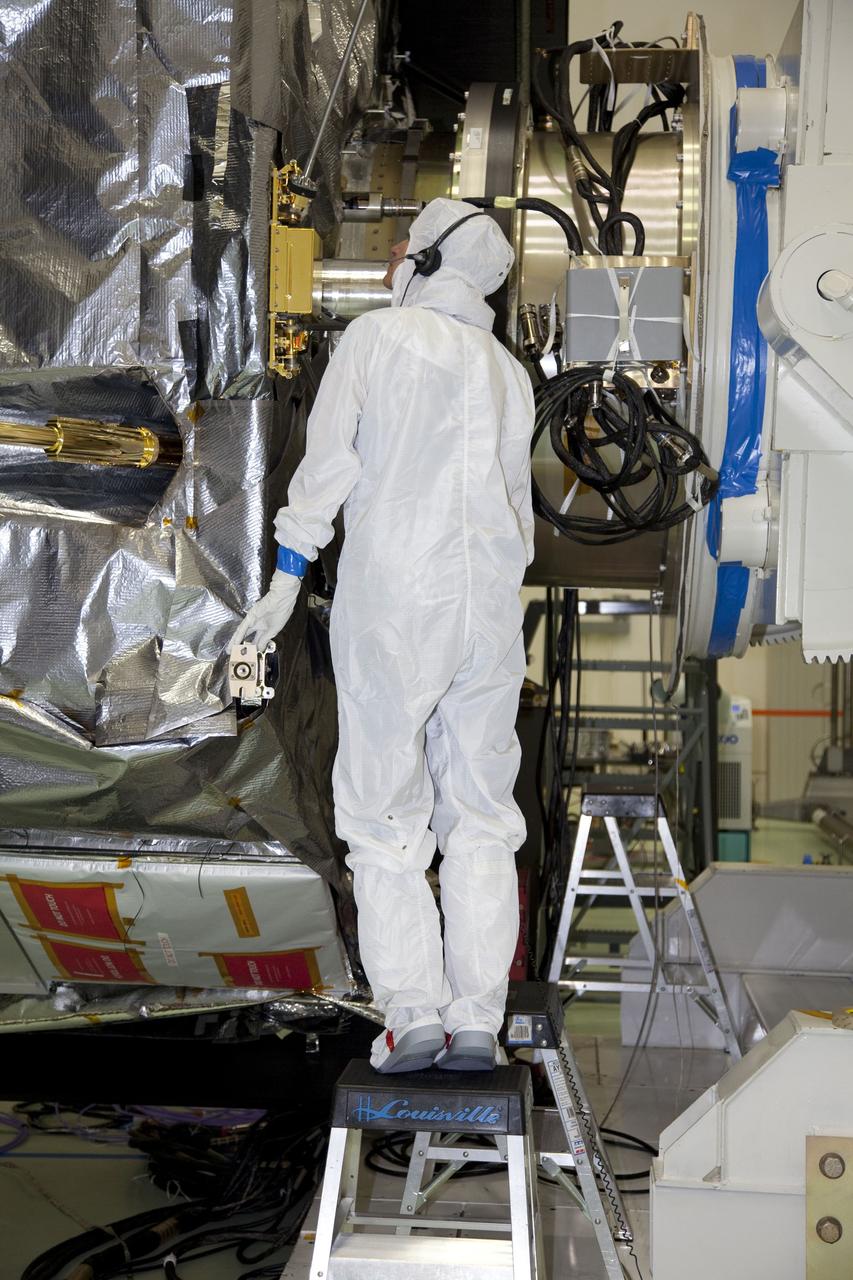
TITUSVILLE, Fla. -- Lockheed Martin technicians in the Astrotech payload processing facility in Titusville, Fla., deploy and test the Radio and Plasma Wave Sensor, called WAVES for short, on to NASA's Juno spacecraft. WAVES is a science boom instrument that will measure radio and plasma waves emitting from Jupiter. Juno is scheduled to launch aboard an Atlas V rocket from Cape Canaveral, Fla., on Aug. 5, 2011, reaching Jupiter in July 2016. Juno is scheduled to launch aboard an Atlas V rocket from Cape Canaveral, Fla., on Aug. 5, 2011, reaching Jupiter in July 2016. The spacecraft will orbit the giant planet more than 30 times, skimming to within 3,000 miles above its cloud tops, for about one year. With its suite of science instruments, the spacecraft will investigate the existence of a solid planetary core, map Jupiter's intense magnetic field, measure the amount of water and ammonia in the deep atmosphere, and observe the planet's auroras. For more information visit, www.nasa.gov/mission_pages/juno. Photo credit: NASA/Frankie Martin
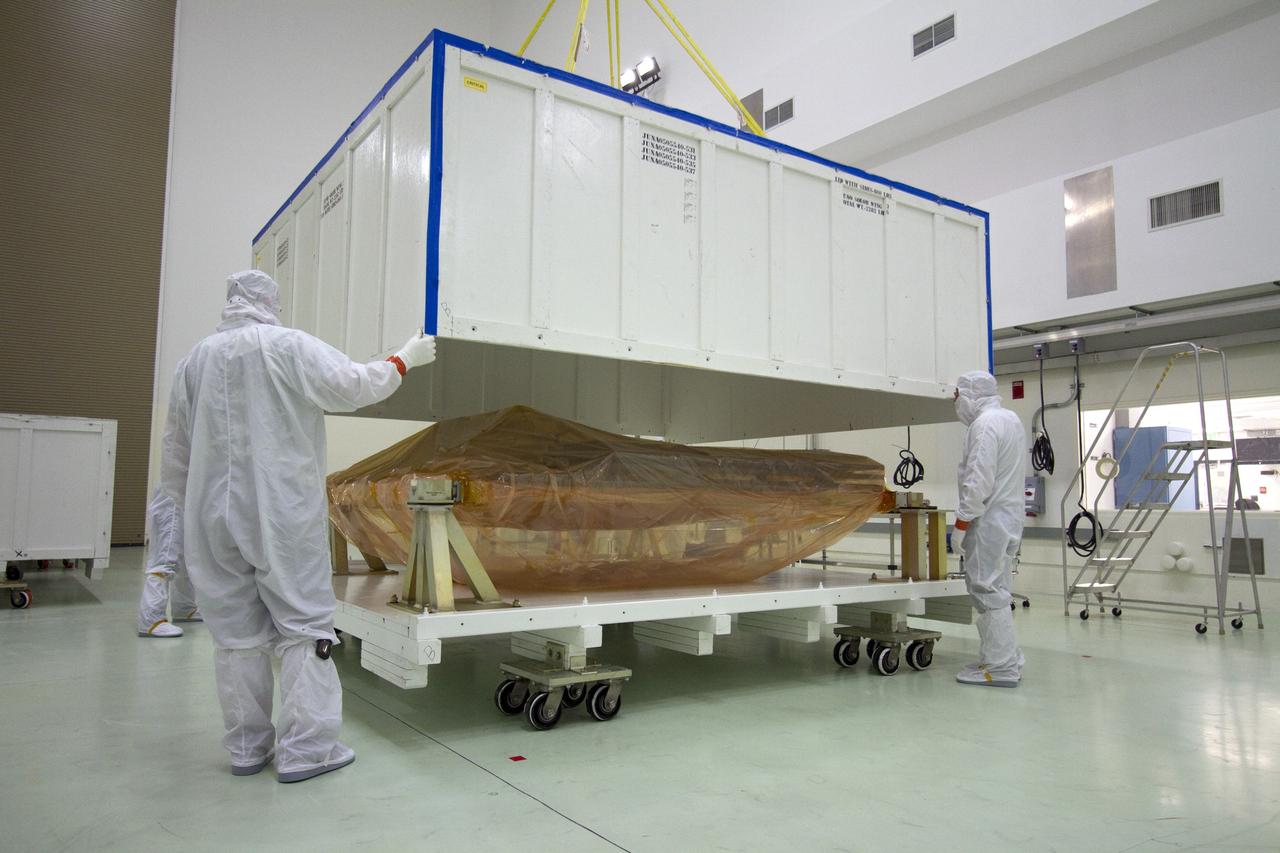
TITUSVILLE, Fla. -- A solar panel that will help power NASA's Juno spacecraft on a mission to Jupiter is unpacked in the Astrotech payload processing facility in Titusville, Fla. Power-generating panels on three sets of solar arrays will extend outward from Juno’s hexagonal body, giving the overall spacecraft a span of more than 66 feet in order to operate at such a great distance from the sun. Juno is scheduled to launch aboard an Atlas V rocket from Cape Canaveral, Fla., on Aug. 5, 2011, reaching Jupiter in July 2016. The spacecraft will orbit the giant planet more than 30 times, skimming to within 3,000 miles above its cloud tops, for about one year. With its suite of science instruments, the spacecraft will investigate the existence of a solid planetary core, map Jupiter's intense magnetic field, measure the amount of water and ammonia in the deep atmosphere, and observe the planet's auroras. For more information visit, www.nasa.gov/juno. Photo credit: NASA/Jack Pfaller
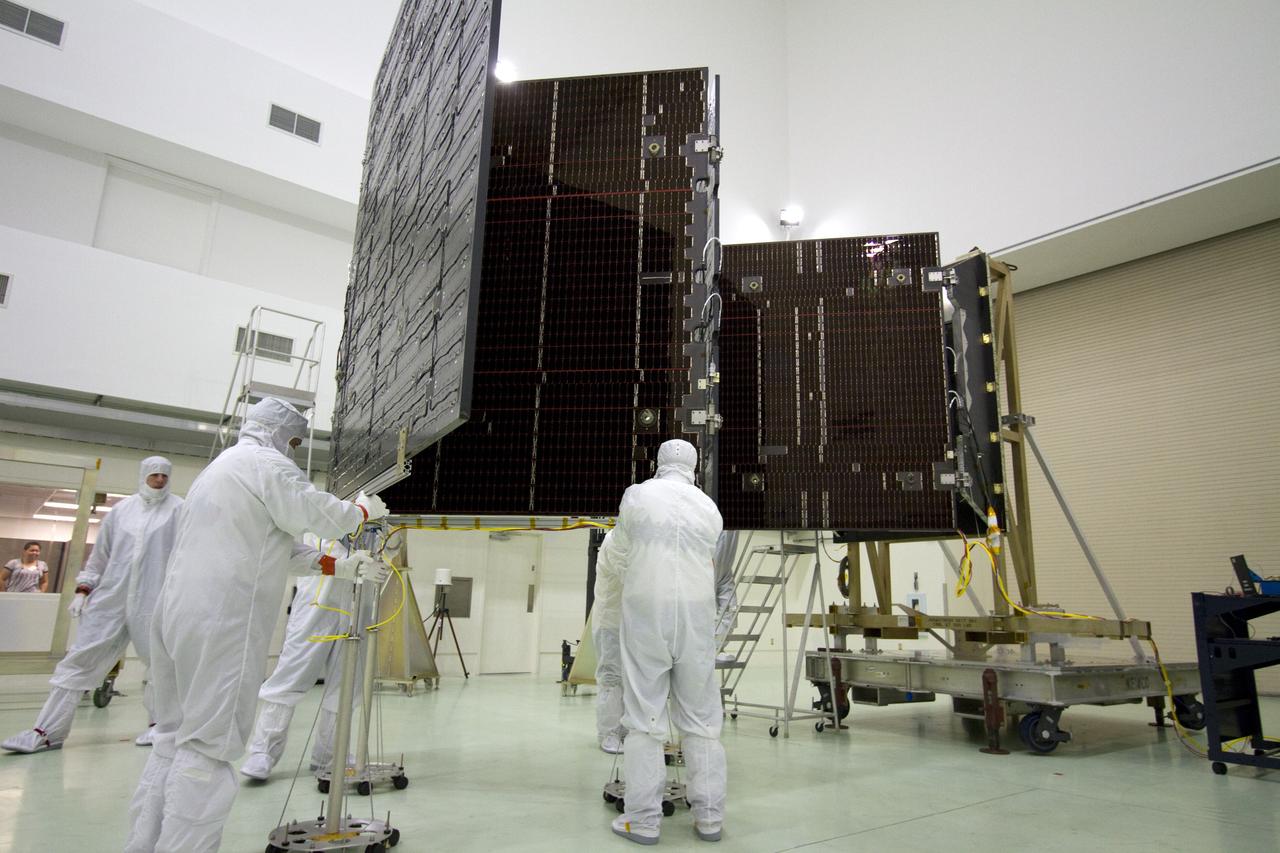
CAPE CANAVERAL, Fla. -- Technicians in the Astrotech payload processing facility in Titusville, Fla., unfurl a solar panel that will help power NASA's Juno spacecraft on a mission to Jupiter. Power-generating panels on three sets of solar arrays will extend outward from Juno’s hexagonal body, giving the overall spacecraft a span of more than 66 feet in order to operate at such a great distance from the sun. Juno is scheduled to launch aboard an Atlas V rocket from Cape Canaveral, Fla., on Aug. 5, 2011, reaching Jupiter in July 2016. The spacecraft will orbit the giant planet more than 30 times, skimming to within 3,000 miles above its cloud tops, for about one year. With its suite of science instruments, the spacecraft will investigate the existence of a solid planetary core, map Jupiter's intense magnetic field, measure the amount of water and ammonia in the deep atmosphere, and observe the planet's auroras. For more information visit, www.nasa.gov/juno. Photo credit: NASA/Jack Pfaller
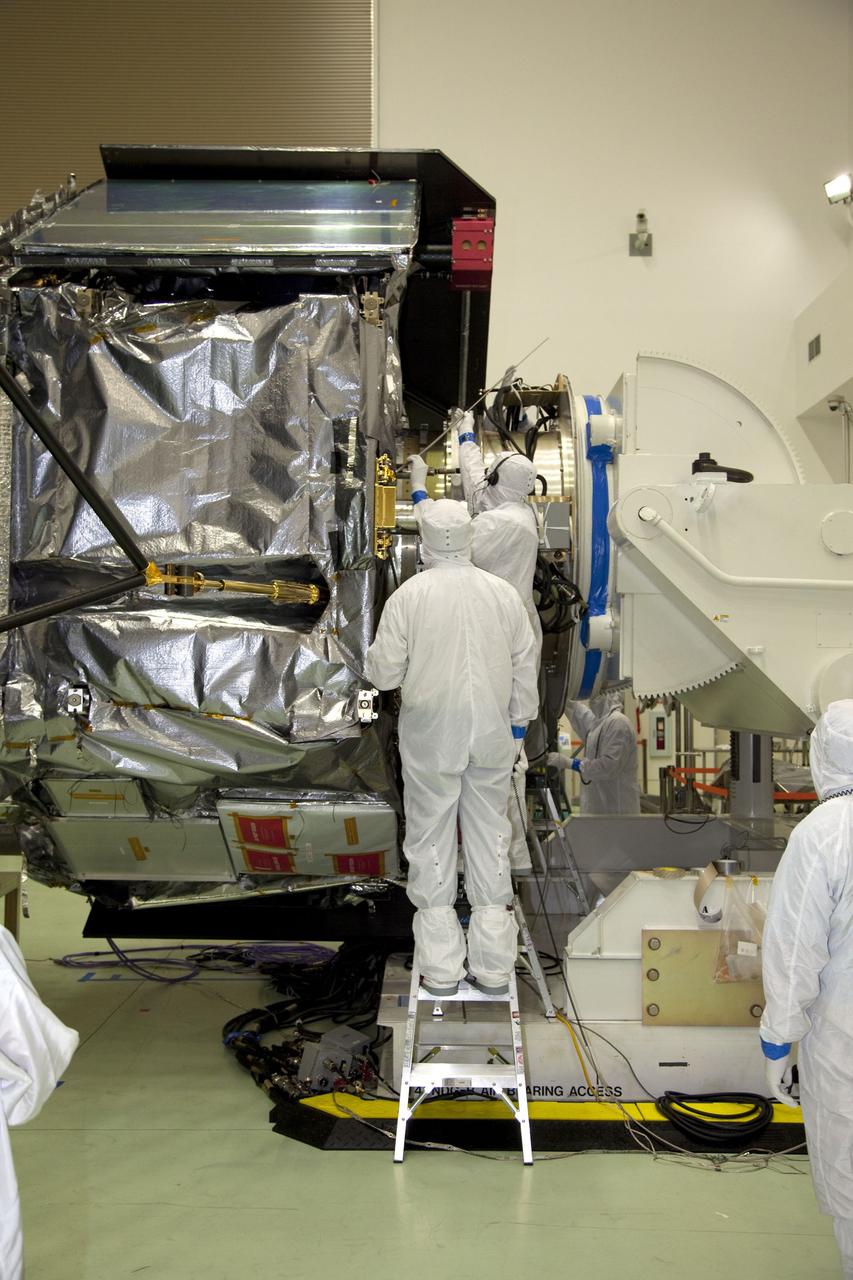
TITUSVILLE, Fla. -- Lockheed Martin technicians in the Astrotech payload processing facility in Titusville, Fla., install the Radio and Plasma Wave Sensor, called WAVES for short, on to NASA's Juno spacecraft. WAVES is a science boom instrument that will measure radio and plasma waves emitting from Jupiter. Juno is scheduled to launch aboard an Atlas V rocket from Cape Canaveral, Fla., on Aug. 5, 2011, reaching Jupiter in July 2016. Juno is scheduled to launch aboard an Atlas V rocket from Cape Canaveral, Fla., on Aug. 5, 2011, reaching Jupiter in July 2016. The spacecraft will orbit the giant planet more than 30 times, skimming to within 3,000 miles above its cloud tops, for about one year. With its suite of science instruments, the spacecraft will investigate the existence of a solid planetary core, map Jupiter's intense magnetic field, measure the amount of water and ammonia in the deep atmosphere, and observe the planet's auroras. For more information visit, www.nasa.gov/mission_pages/juno. Photo credit: NASA/Frankie Martin
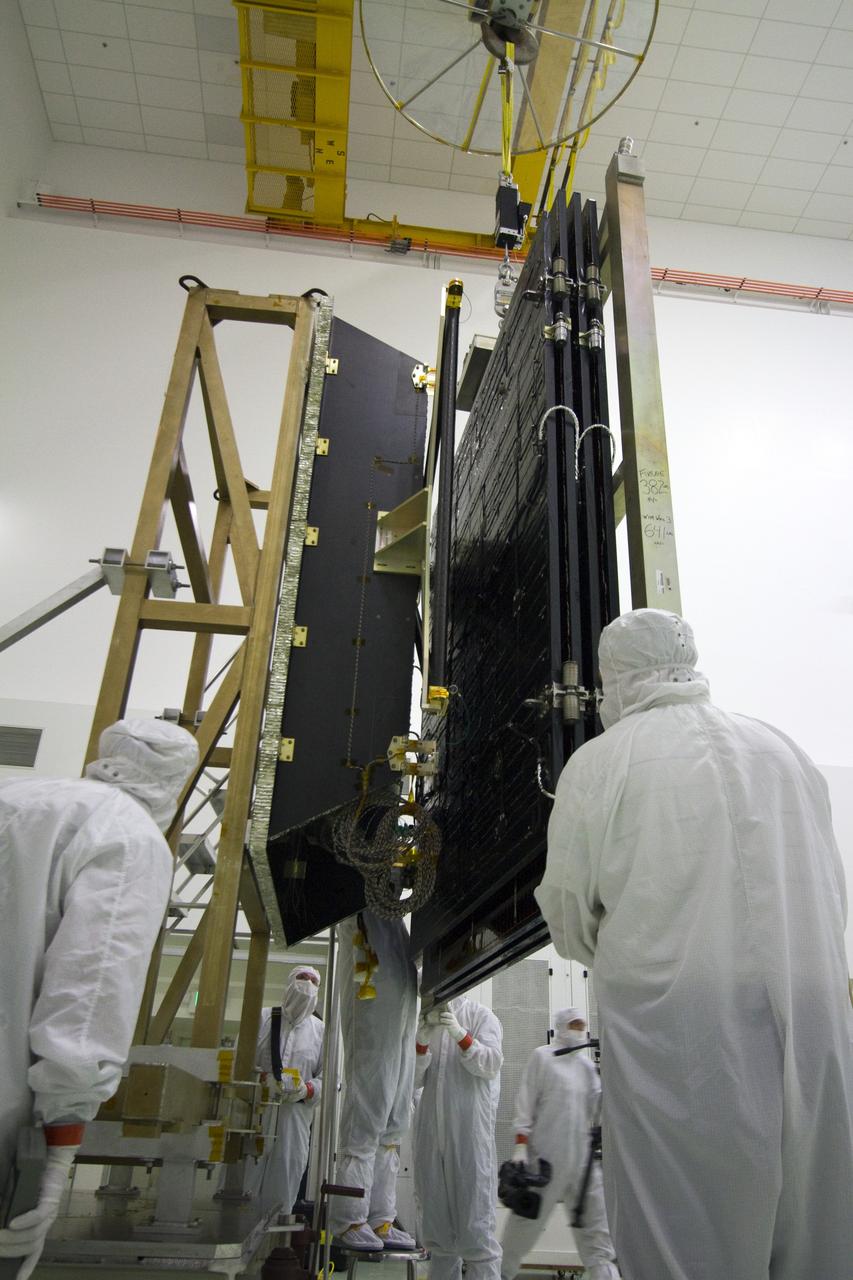
TITUSVILLE, Fla. -- Technicians in the Astrotech payload processing facility in Titusville, Fla., process a solar panel that will help power NASA's Juno spacecraft on a mission to Jupiter. Power-generating panels on three sets of solar arrays will extend outward from Juno’s hexagonal body, giving the overall spacecraft a span of more than 66 feet in order to operate at such a great distance from the sun. Juno is scheduled to launch aboard an Atlas V rocket from Cape Canaveral, Fla., on Aug. 5, 2011, reaching Jupiter in July 2016. The spacecraft will orbit the giant planet more than 30 times, skimming to within 3,000 miles above its cloud tops, for about one year. With its suite of science instruments, the spacecraft will investigate the existence of a solid planetary core, map Jupiter's intense magnetic field, measure the amount of water and ammonia in the deep atmosphere, and observe the planet's auroras. For more information visit, www.nasa.gov/juno. Photo credit: NASA/Jack Pfaller
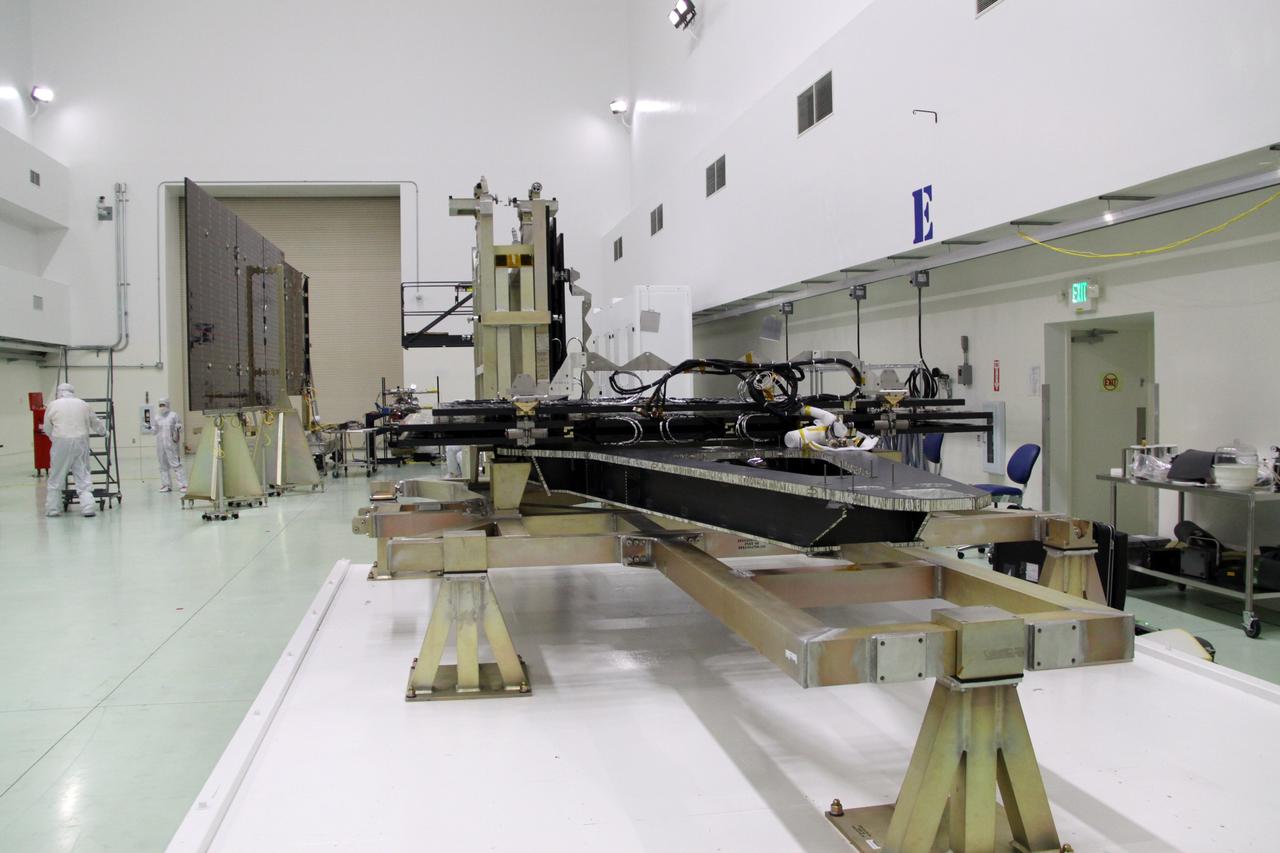
CAPE CANAVERAL, Fla. -- Technicians in the Astrotech payload processing facility in Titusville, Fla., test the electrical continuity of a solar array, left, that will help power NASA's Juno spacecraft on a mission to Jupiter. Two other arrays are in work stands on the right. Power-generating panels on three sets of solar arrays will extend outward from Juno’s hexagonal body, giving the overall spacecraft a span of more than 66 feet in order to operate at such a great distance from the sun. Juno is scheduled to launch aboard an Atlas V rocket from Cape Canaveral, Fla., on Aug. 5, 2011, reaching Jupiter in July 2016. The spacecraft will orbit the giant planet more than 30 times, skimming to within 3,000 miles above its cloud tops, for about one year. With its suite of science instruments, the spacecraft will investigate the existence of a solid planetary core, map Jupiter's intense magnetic field, measure the amount of water and ammonia in the deep atmosphere, and observe the planet's auroras. For more information visit, www.nasa.gov/juno. Photo credit: NASA/Jack Pfaller
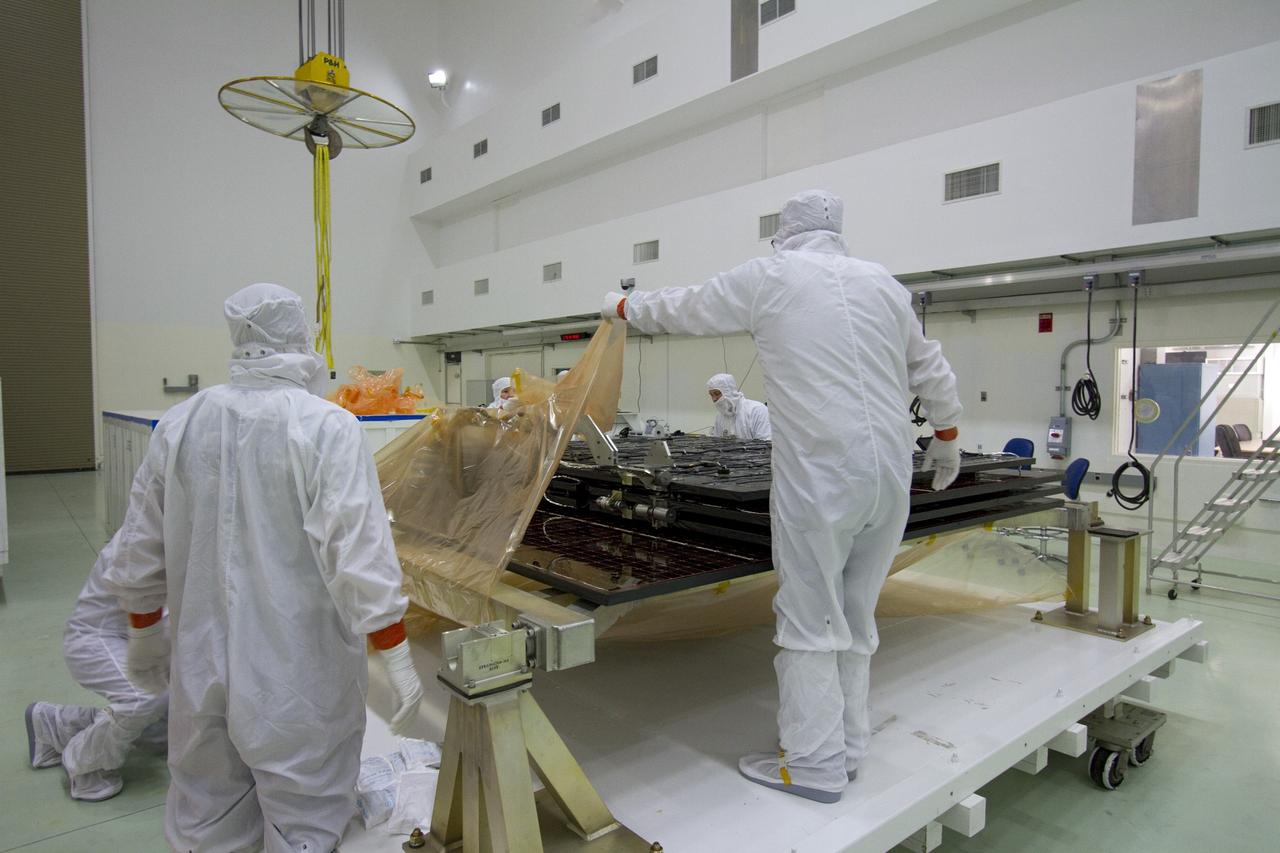
TITUSVILLE, Fla. -- Technicians in the Astrotech payload processing facility in Titusville, Fla., unpack a solar panel that will help power NASA's Juno spacecraft on a mission to Jupiter. Power-generating panels on three sets of solar arrays will extend outward from Juno’s hexagonal body, giving the overall spacecraft a span of more than 66 feet in order to operate at such a great distance from the sun. Juno is scheduled to launch aboard an Atlas V rocket from Cape Canaveral, Fla., on Aug. 5, 2011, reaching Jupiter in July 2016. The spacecraft will orbit the giant planet more than 30 times, skimming to within 3,000 miles above its cloud tops, for about one year. With its suite of science instruments, the spacecraft will investigate the existence of a solid planetary core, map Jupiter's intense magnetic field, measure the amount of water and ammonia in the deep atmosphere, and observe the planet's auroras. For more information visit, www.nasa.gov/juno. Photo credit: NASA/Jack Pfaller
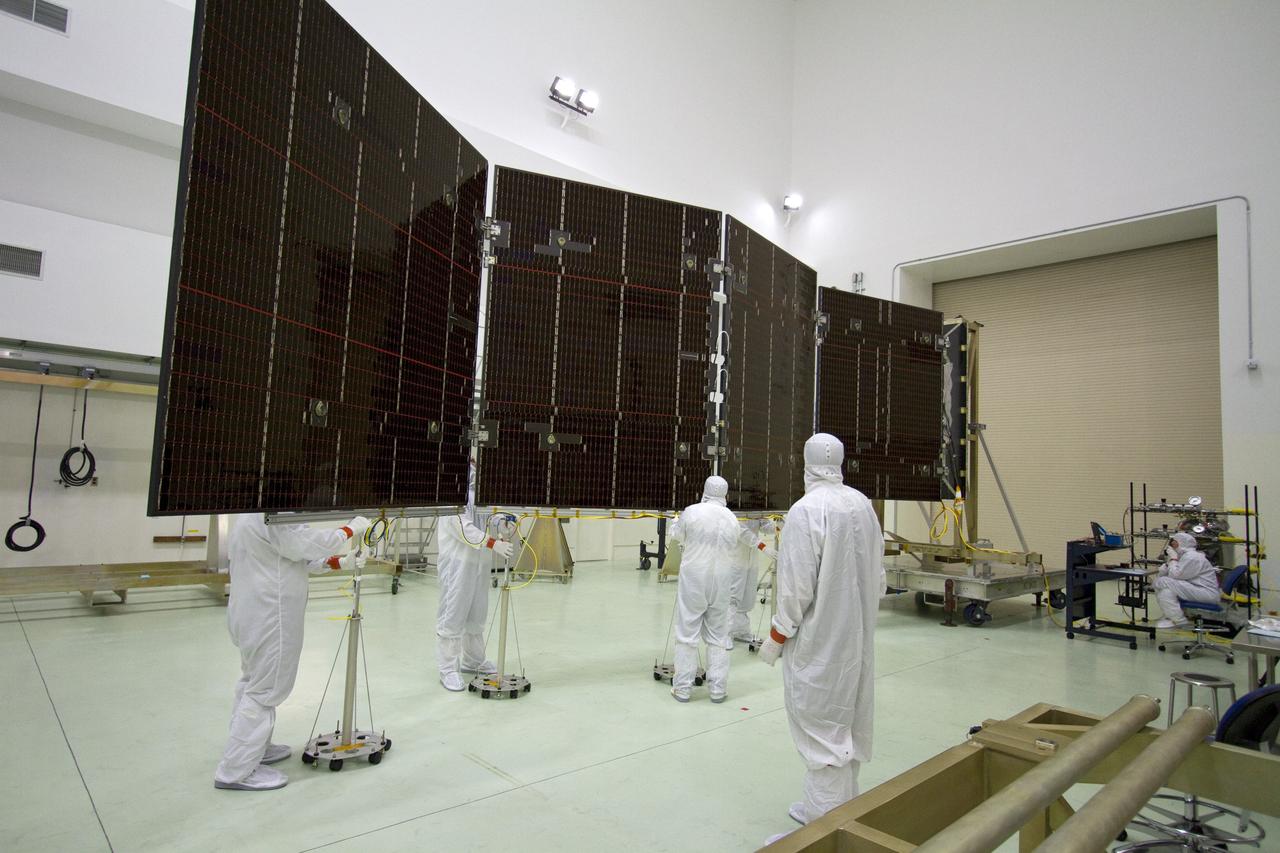
CAPE CANAVERAL, Fla. -- Technicians in the Astrotech payload processing facility in Titusville, Fla., unfurl a solar panel that will help power NASA's Juno spacecraft on a mission to Jupiter. Power-generating panels on three sets of solar arrays will extend outward from Juno’s hexagonal body, giving the overall spacecraft a span of more than 66 feet in order to operate at such a great distance from the sun. Juno is scheduled to launch aboard an Atlas V rocket from Cape Canaveral, Fla., on Aug. 5, 2011, reaching Jupiter in July 2016. The spacecraft will orbit the giant planet more than 30 times, skimming to within 3,000 miles above its cloud tops, for about one year. With its suite of science instruments, the spacecraft will investigate the existence of a solid planetary core, map Jupiter's intense magnetic field, measure the amount of water and ammonia in the deep atmosphere, and observe the planet's auroras. For more information visit, www.nasa.gov/juno. Photo credit: NASA/Jack Pfaller
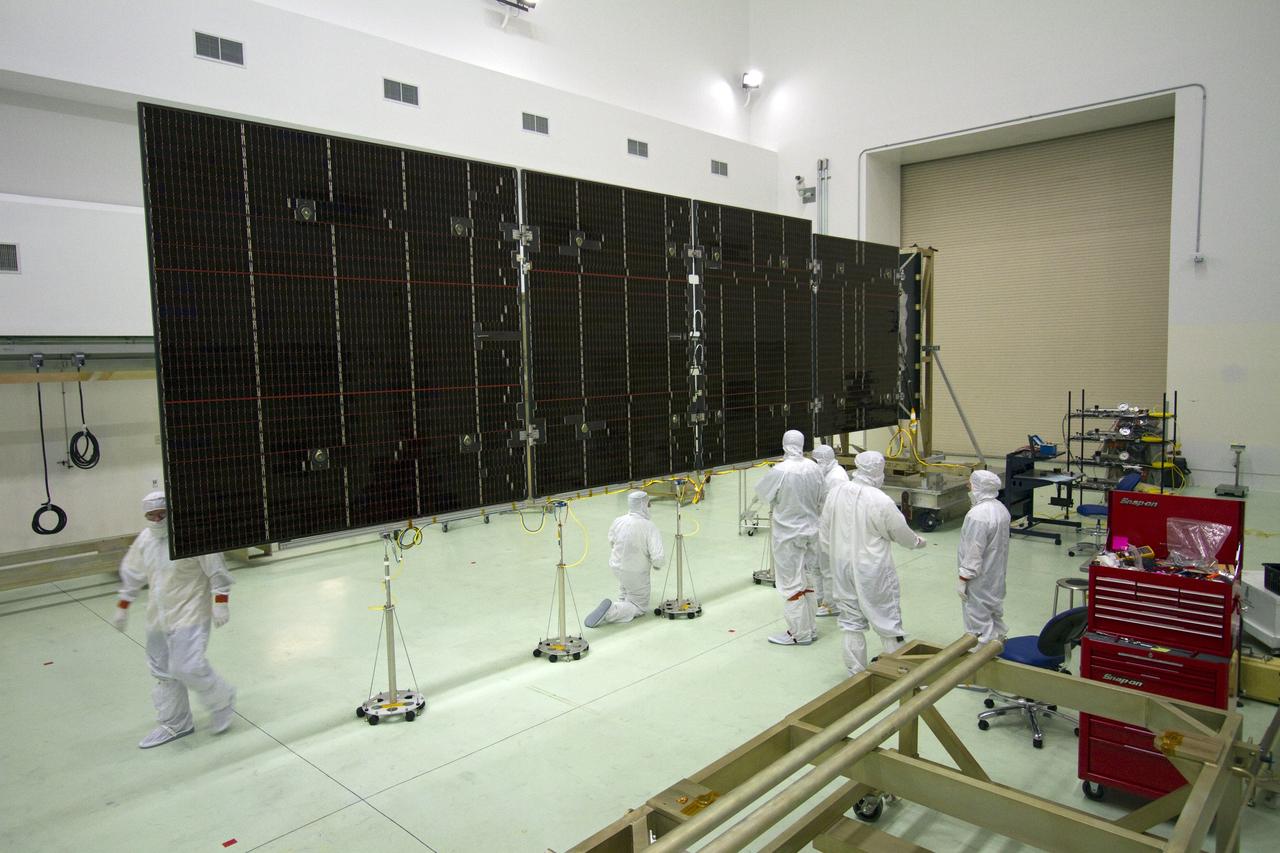
CAPE CANAVERAL, Fla. -- Technicians in the Astrotech payload processing facility in Titusville, Fla., check out an unfurled solar panel that will help power NASA's Juno spacecraft on a mission to Jupiter. Power-generating panels on three sets of solar arrays will extend outward from Juno’s hexagonal body, giving the overall spacecraft a span of more than 66 feet in order to operate at such a great distance from the sun. Juno is scheduled to launch aboard an Atlas V rocket from Cape Canaveral, Fla., on Aug. 5, 2011, reaching Jupiter in July 2016. The spacecraft will orbit the giant planet more than 30 times, skimming to within 3,000 miles above its cloud tops, for about one year. With its suite of science instruments, the spacecraft will investigate the existence of a solid planetary core, map Jupiter's intense magnetic field, measure the amount of water and ammonia in the deep atmosphere, and observe the planet's auroras. For more information visit, www.nasa.gov/juno. Photo credit: NASA/Jack Pfaller
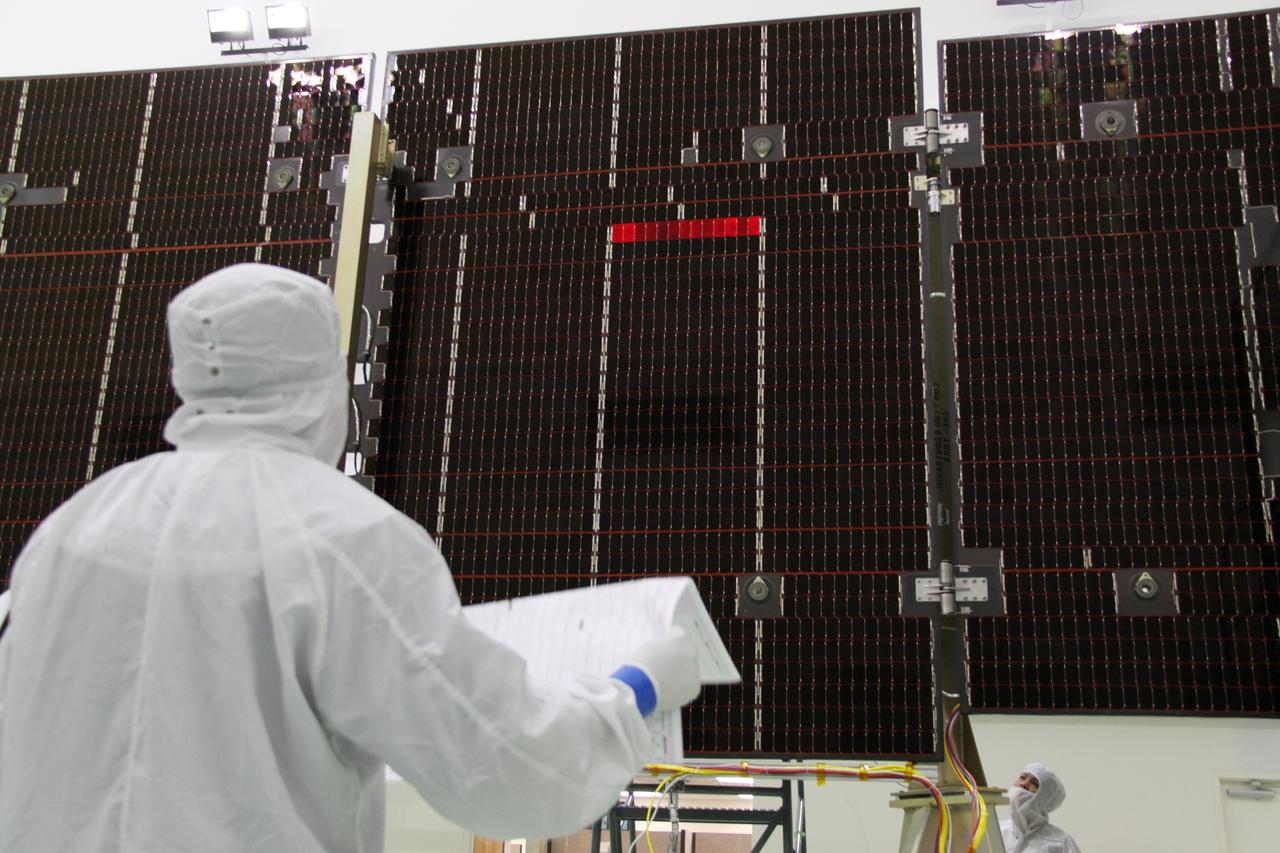
CAPE CANAVERAL, Fla. -- Technicians in the Astrotech payload processing facility in Titusville, Fla., test the electrical continuity of a solar array that will help power NASA's Juno spacecraft on a mission to Jupiter. Power-generating panels on three sets of solar arrays will extend outward from Juno’s hexagonal body, giving the overall spacecraft a span of more than 66 feet in order to operate at such a great distance from the sun. Juno is scheduled to launch aboard an Atlas V rocket from Cape Canaveral, Fla., on Aug. 5, 2011, reaching Jupiter in July 2016. The spacecraft will orbit the giant planet more than 30 times, skimming to within 3,000 miles above its cloud tops, for about one year. With its suite of science instruments, the spacecraft will investigate the existence of a solid planetary core, map Jupiter's intense magnetic field, measure the amount of water and ammonia in the deep atmosphere, and observe the planet's auroras. For more information visit, www.nasa.gov/juno. Photo credit: NASA/Jack Pfaller
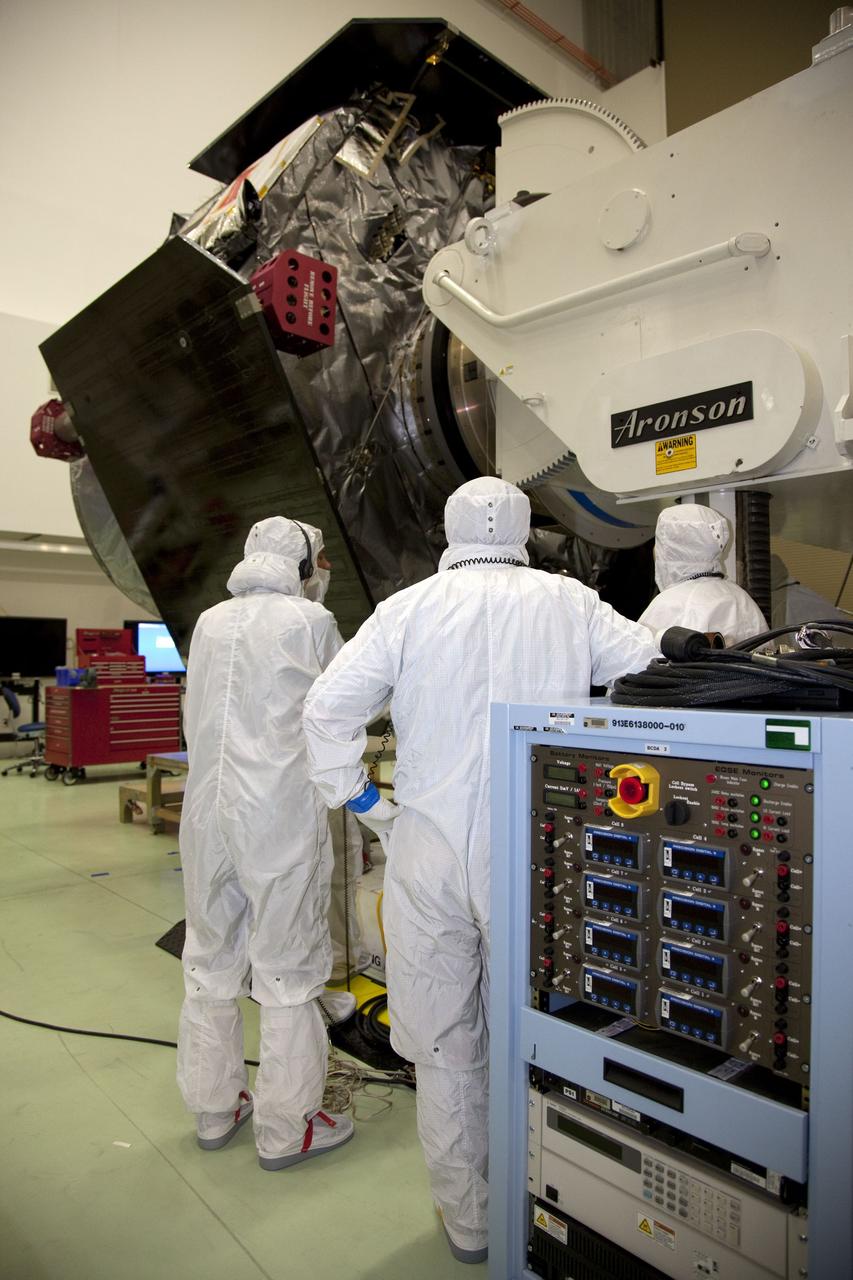
TITUSVILLE, Fla. -- Lockheed Martin technicians in the Astrotech payload processing facility in Titusville, Fla., prepare to install, deploy and test the Radio and Plasma Wave Sensor, called WAVES for short, on to NASA's Juno spacecraft. WAVES is a science boom instrument that will measure radio and plasma waves emitting from Jupiter. Juno is scheduled to launch aboard an Atlas V rocket from Cape Canaveral, Fla., on Aug. 5, 2011, reaching Jupiter in July 2016. The spacecraft will orbit the giant planet more than 30 times, skimming to within 3,000 miles above its cloud tops, for about one year. With its suite of science instruments, the spacecraft will investigate the existence of a solid planetary core, map Jupiter's intense magnetic field, measure the amount of water and ammonia in the deep atmosphere, and observe the planet's auroras. For more information visit, www.nasa.gov/mission_pages/juno. Photo credit: NASA/Frankie Martin

TITUSVILLE, Fla. -- Lockheed Martin technicians in the Astrotech payload processing facility in Titusville, Fla., deploy and test the Radio and Plasma Wave Sensor, called WAVES for short, on to NASA's Juno spacecraft. WAVES is a science boom instrument that will measure radio and plasma waves emitting from Jupiter. Juno is scheduled to launch aboard an Atlas V rocket from Cape Canaveral, Fla., on Aug. 5, 2011, reaching Jupiter in July 2016. Juno is scheduled to launch aboard an Atlas V rocket from Cape Canaveral, Fla., on Aug. 5, 2011, reaching Jupiter in July 2016. The spacecraft will orbit the giant planet more than 30 times, skimming to within 3,000 miles above its cloud tops, for about one year. With its suite of science instruments, the spacecraft will investigate the existence of a solid planetary core, map Jupiter's intense magnetic field, measure the amount of water and ammonia in the deep atmosphere, and observe the planet's auroras. For more information visit, www.nasa.gov/mission_pages/juno. Photo credit: NASA/Frankie Martin
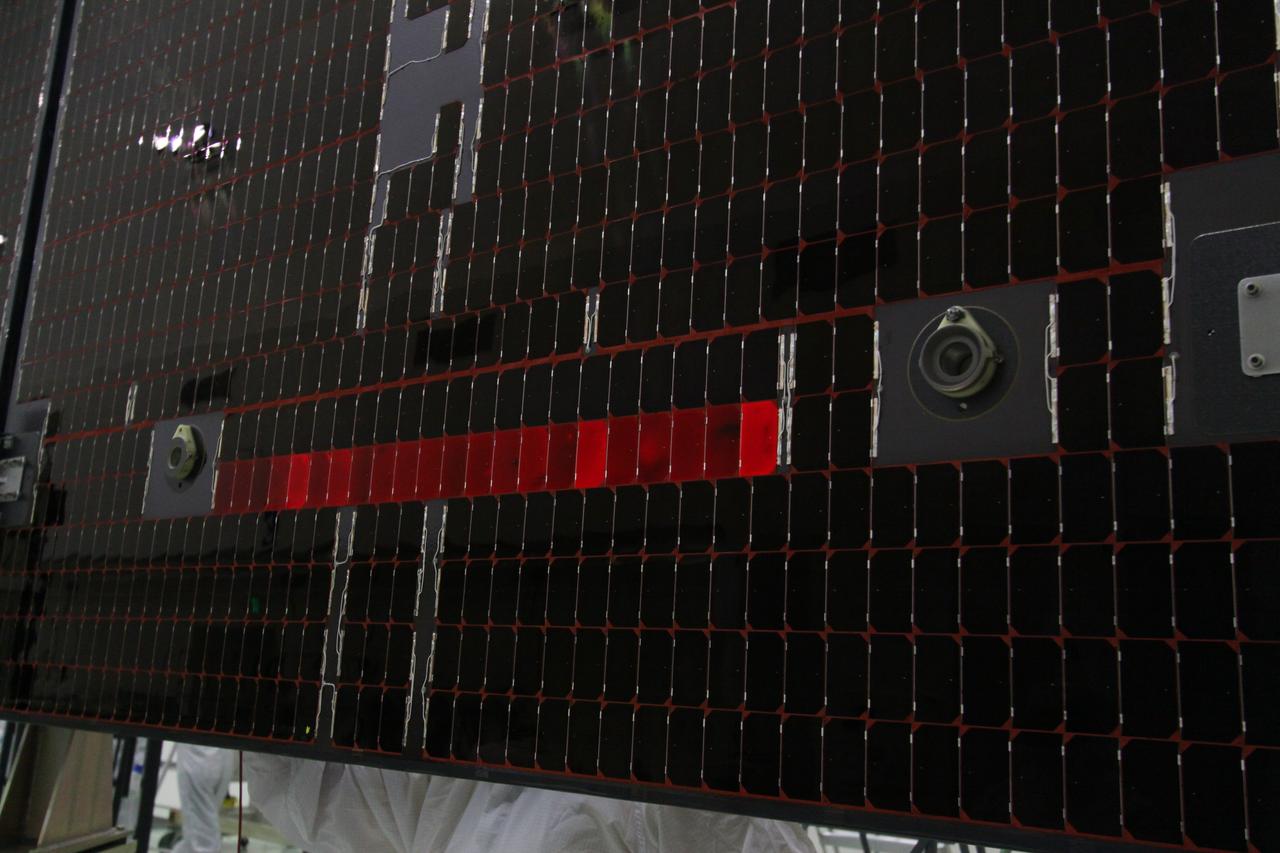
CAPE CANAVERAL, Fla. -- The electrical continuity of a solar array that will help power NASA's Juno spacecraft on a mission to Jupiter is tested in the Astrotech payload processing facility in Titusville, Fla. Power-generating panels on three sets of solar arrays will extend outward from Juno’s hexagonal body, giving the overall spacecraft a span of more than 66 feet in order to operate at such a great distance from the sun. Juno is scheduled to launch aboard an Atlas V rocket from Cape Canaveral, Fla., on Aug. 5, 2011, reaching Jupiter in July 2016. The spacecraft will orbit the giant planet more than 30 times, skimming to within 3,000 miles above its cloud tops, for about one year. With its suite of science instruments, the spacecraft will investigate the existence of a solid planetary core, map Jupiter's intense magnetic field, measure the amount of water and ammonia in the deep atmosphere, and observe the planet's auroras. For more information visit, www.nasa.gov/juno. Photo credit: NASA/Jack Pfaller
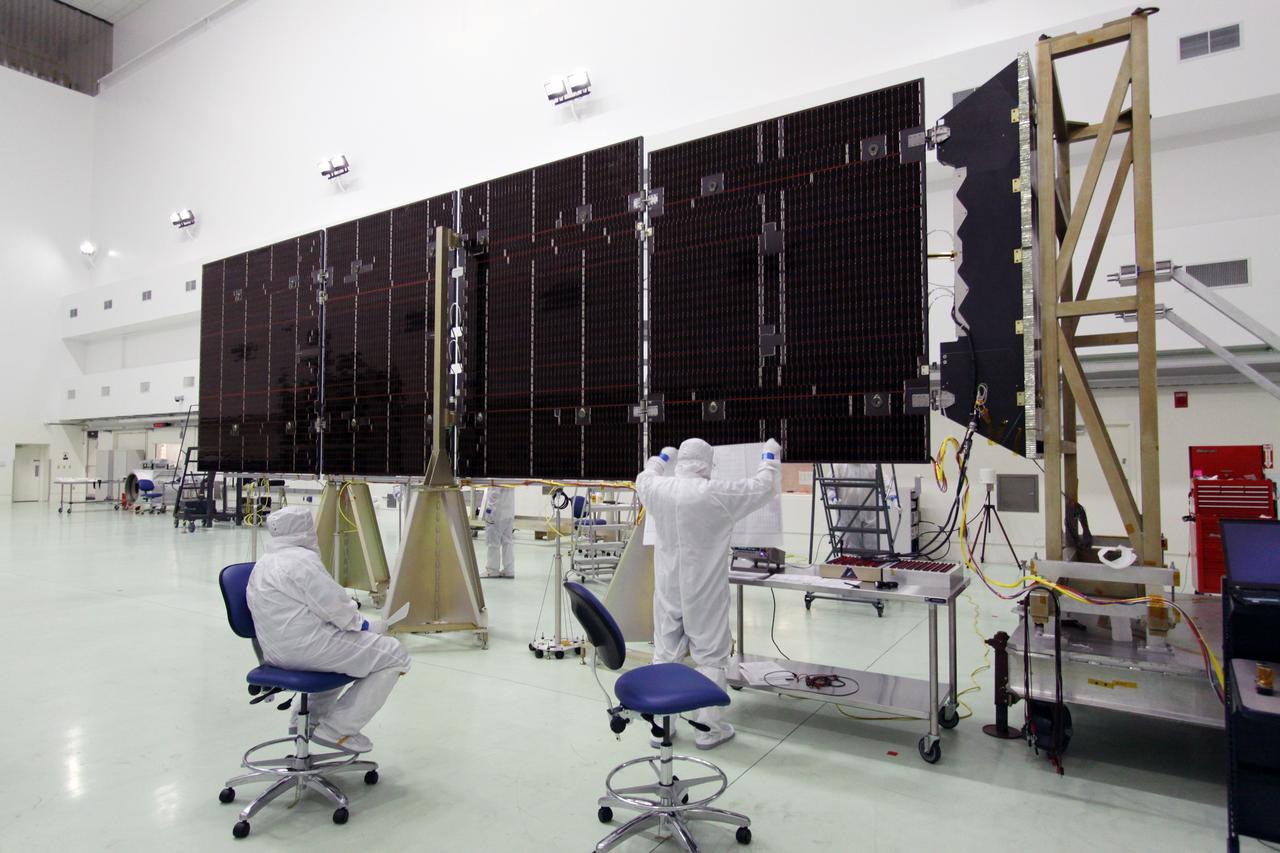
CAPE CANAVERAL, Fla. -- Technicians in the Astrotech payload processing facility in Titusville, Fla., prepare to test the electrical continuity of a solar array that will help power NASA's Juno spacecraft on a mission to Jupiter. Power-generating panels on three sets of solar arrays will extend outward from Juno’s hexagonal body, giving the overall spacecraft a span of more than 66 feet in order to operate at such a great distance from the sun. Juno is scheduled to launch aboard an Atlas V rocket from Cape Canaveral, Fla., on Aug. 5, 2011, reaching Jupiter in July 2016. The spacecraft will orbit the giant planet more than 30 times, skimming to within 3,000 miles above its cloud tops, for about one year. With its suite of science instruments, the spacecraft will investigate the existence of a solid planetary core, map Jupiter's intense magnetic field, measure the amount of water and ammonia in the deep atmosphere, and observe the planet's auroras. For more information visit, www.nasa.gov/juno. Photo credit: NASA/Jack Pfaller
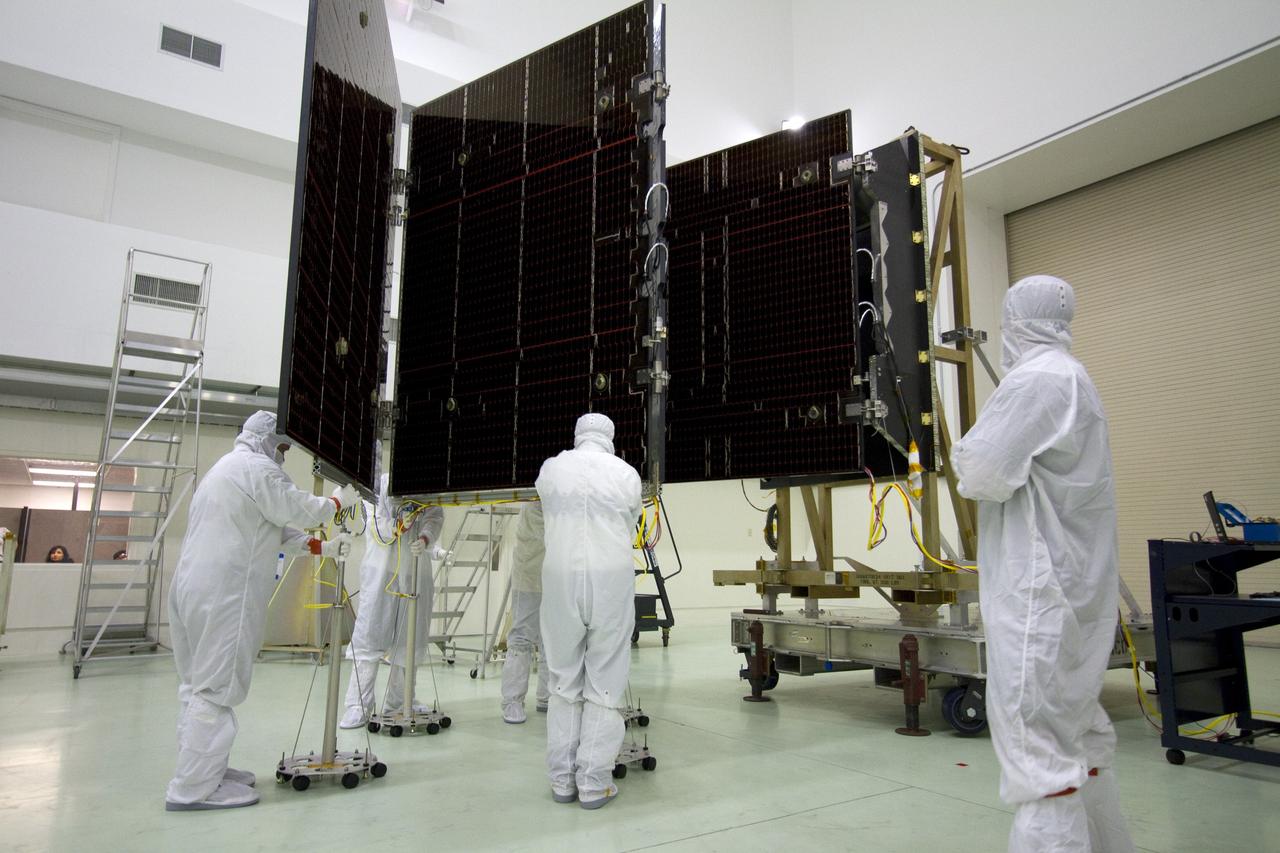
CAPE CANAVERAL, Fla. -- Technicians in the Astrotech payload processing facility in Titusville, Fla., begin to unfurl a solar panel that will help power NASA's Juno spacecraft on a mission to Jupiter. Power-generating panels on three sets of solar arrays will extend outward from Juno’s hexagonal body, giving the overall spacecraft a span of more than 66 feet in order to operate at such a great distance from the sun. Juno is scheduled to launch aboard an Atlas V rocket from Cape Canaveral, Fla., on Aug. 5, 2011, reaching Jupiter in July 2016. The spacecraft will orbit the giant planet more than 30 times, skimming to within 3,000 miles above its cloud tops, for about one year. With its suite of science instruments, the spacecraft will investigate the existence of a solid planetary core, map Jupiter's intense magnetic field, measure the amount of water and ammonia in the deep atmosphere, and observe the planet's auroras. For more information visit, www.nasa.gov/juno. Photo credit: NASA/Jack Pfaller
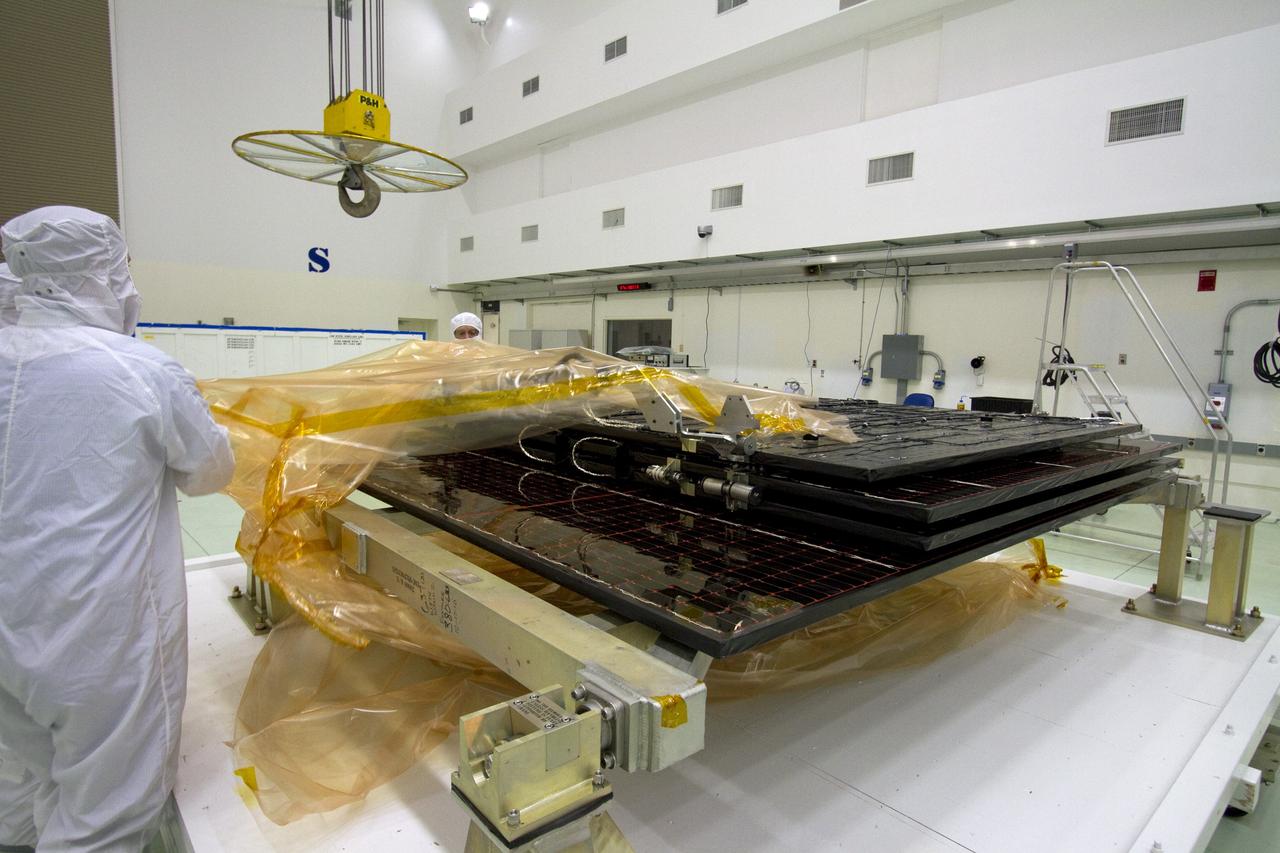
CAPE CANAVERAL, Fla. -- Technicians in the Astrotech payload processing facility in Titusville, Fla., unpack a solar panel that will help power NASA's Juno spacecraft on a mission to Jupiter. Power-generating panels on three sets of solar arrays will extend outward from Juno’s hexagonal body, giving the overall spacecraft a span of more than 66 feet in order to operate at such a great distance from the sun. Juno is scheduled to launch aboard an Atlas V rocket from Cape Canaveral, Fla., on Aug. 5, 2011, reaching Jupiter in July 2016. The spacecraft will orbit the giant planet more than 30 times, skimming to within 3,000 miles above its cloud tops, for about one year. With its suite of science instruments, the spacecraft will investigate the existence of a solid planetary core, map Jupiter's intense magnetic field, measure the amount of water and ammonia in the deep atmosphere, and observe the planet's auroras. For more information visit, www.nasa.gov/juno. Photo credit: NASA/Jack Pfaller
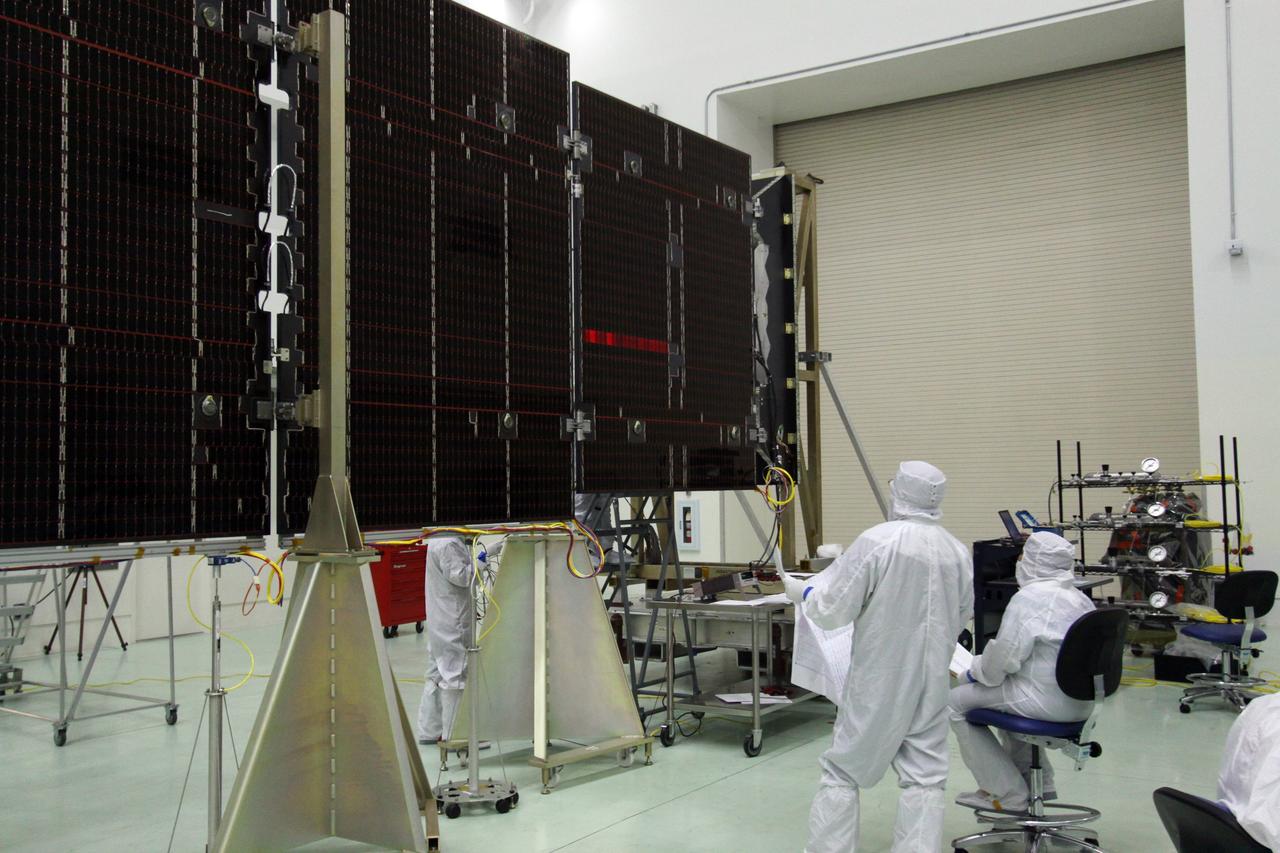
CAPE CANAVERAL, Fla. -- Technicians in the Astrotech payload processing facility in Titusville, Fla., test the electrical continuity of a solar array that will help power NASA's Juno spacecraft on a mission to Jupiter. Power-generating panels on three sets of solar arrays will extend outward from Juno’s hexagonal body, giving the overall spacecraft a span of more than 66 feet in order to operate at such a great distance from the sun. Juno is scheduled to launch aboard an Atlas V rocket from Cape Canaveral, Fla., on Aug. 5, 2011, reaching Jupiter in July 2016. The spacecraft will orbit the giant planet more than 30 times, skimming to within 3,000 miles above its cloud tops, for about one year. With its suite of science instruments, the spacecraft will investigate the existence of a solid planetary core, map Jupiter's intense magnetic field, measure the amount of water and ammonia in the deep atmosphere, and observe the planet's auroras. For more information visit, www.nasa.gov/juno. Photo credit: NASA/Jack Pfaller
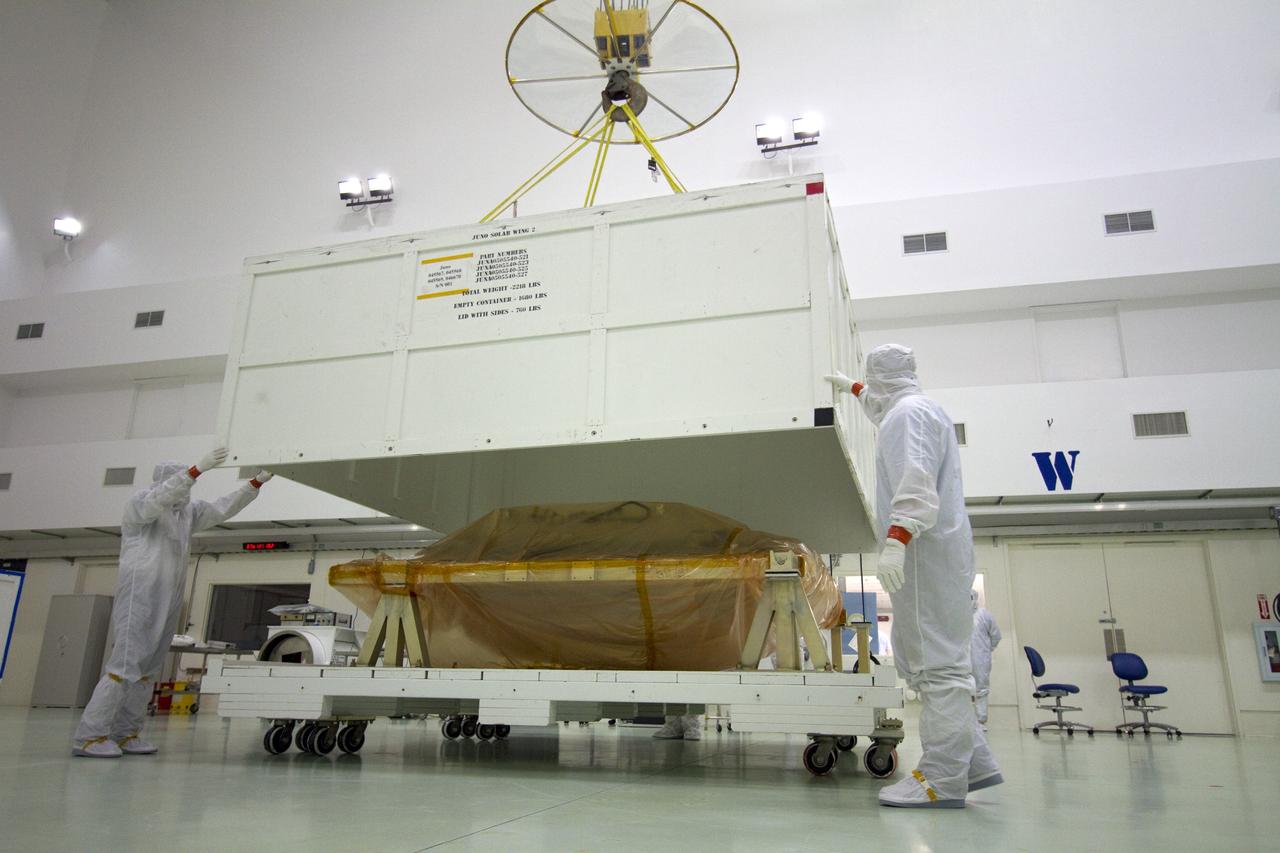
CAPE CANAVERAL, Fla. -- A solar panel that will help power NASA's Juno spacecraft on a mission to Jupiter is unpacked in the Astrotech payload processing facility in Titusville, Fla. Power-generating panels on three sets of solar arrays will extend outward from Juno’s hexagonal body, giving the overall spacecraft a span of more than 66 feet in order to operate at such a great distance from the sun. Juno is scheduled to launch aboard an Atlas V rocket from Cape Canaveral, Fla., on Aug. 5, 2011, reaching Jupiter in July 2016. The spacecraft will orbit the giant planet more than 30 times, skimming to within 3,000 miles above its cloud tops, for about one year. With its suite of science instruments, the spacecraft will investigate the existence of a solid planetary core, map Jupiter's intense magnetic field, measure the amount of water and ammonia in the deep atmosphere, and observe the planet's auroras. For more information visit, www.nasa.gov/juno. Photo credit: NASA/Jack Pfaller

CAPE CANAVERAL, Fla. -- Technicians in the Astrotech payload processing facility in Titusville, Fla., begin processing a solar panel that will help power NASA's Juno spacecraft on a mission to Jupiter. Power-generating panels on three sets of solar arrays will extend outward from Juno’s hexagonal body, giving the overall spacecraft a span of more than 66 feet in order to operate at such a great distance from the sun. Juno is scheduled to launch aboard an Atlas V rocket from Cape Canaveral, Fla., on Aug. 5, 2011, reaching Jupiter in July 2016. The spacecraft will orbit the giant planet more than 30 times, skimming to within 3,000 miles above its cloud tops, for about one year. With its suite of science instruments, the spacecraft will investigate the existence of a solid planetary core, map Jupiter's intense magnetic field, measure the amount of water and ammonia in the deep atmosphere, and observe the planet's auroras. For more information visit, www.nasa.gov/juno. Photo credit: NASA/Jack Pfaller
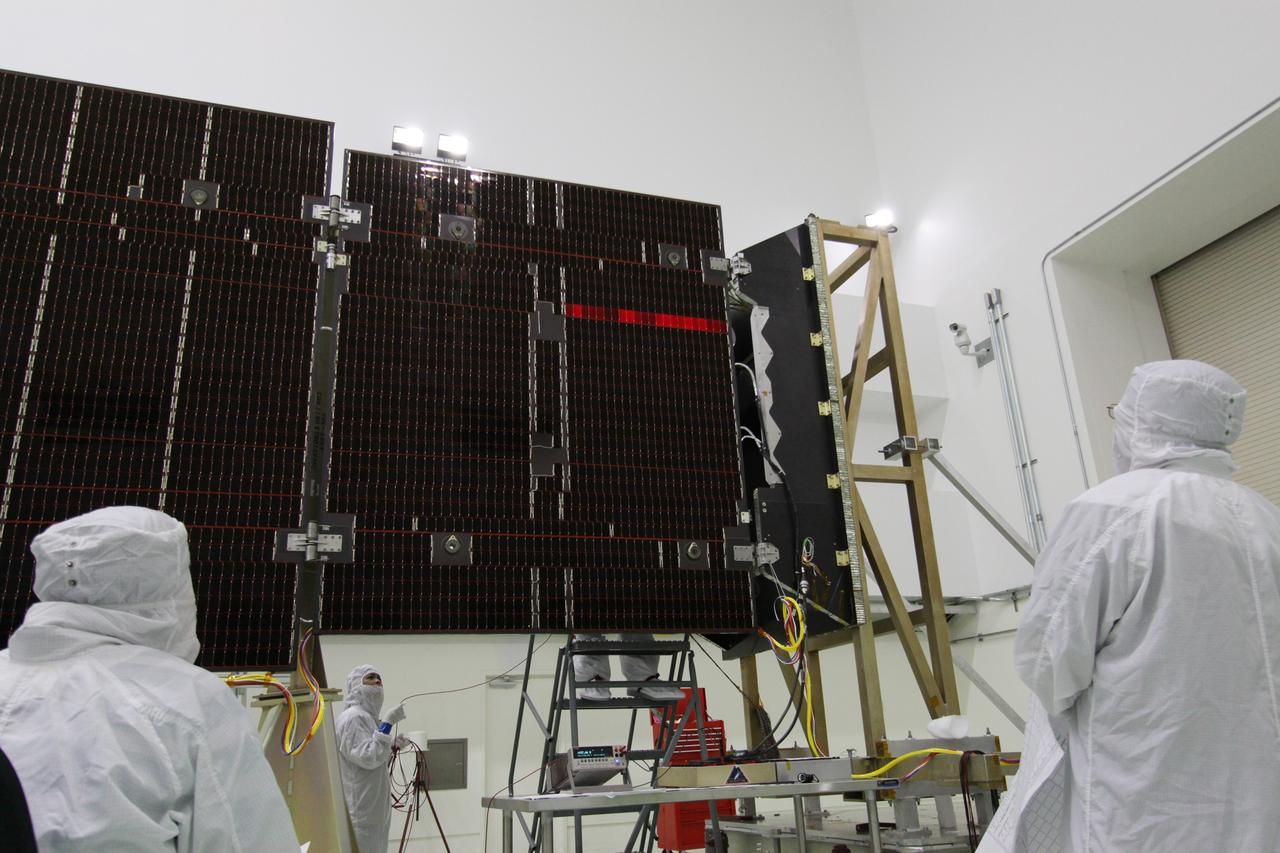
CAPE CANAVERAL, Fla. -- Technicians in the Astrotech payload processing facility in Titusville, Fla., test the electrical continuity of a solar array that will help power NASA's Juno spacecraft on a mission to Jupiter. Power-generating panels on three sets of solar arrays will extend outward from Juno’s hexagonal body, giving the overall spacecraft a span of more than 66 feet in order to operate at such a great distance from the sun. Juno is scheduled to launch aboard an Atlas V rocket from Cape Canaveral, Fla., on Aug. 5, 2011, reaching Jupiter in July 2016. The spacecraft will orbit the giant planet more than 30 times, skimming to within 3,000 miles above its cloud tops, for about one year. With its suite of science instruments, the spacecraft will investigate the existence of a solid planetary core, map Jupiter's intense magnetic field, measure the amount of water and ammonia in the deep atmosphere, and observe the planet's auroras. For more information visit, www.nasa.gov/juno. Photo credit: NASA/Jack Pfaller
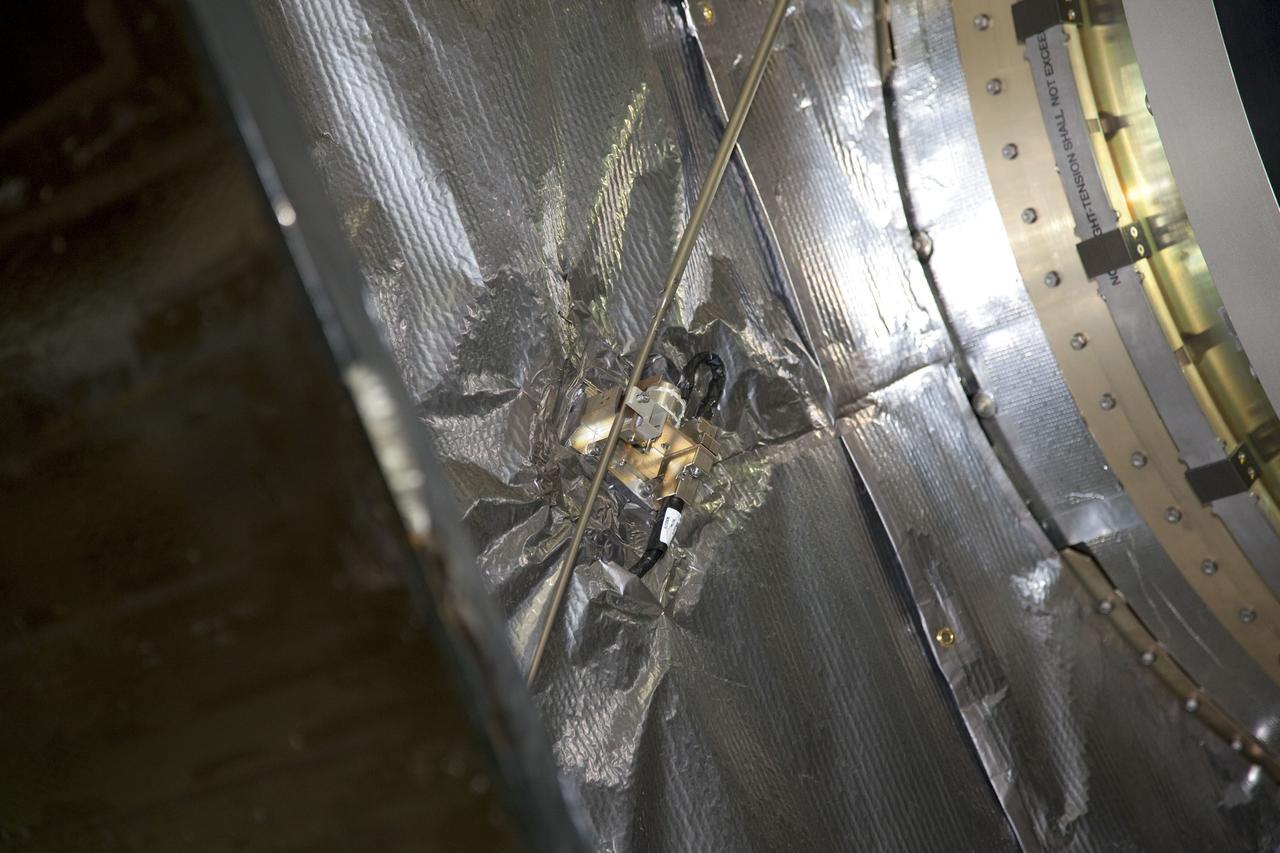
TITUSVILLE, Fla. -- In the Astrotech payload processing facility in Titusville, Fla., the Radio and Plasma Wave Sensor, called WAVES for short, will be installed, deployed and tested on to NASA's Juno spacecraft. WAVES is a science boom instrument that will measure radio and plasma waves emitting from Jupiter. Juno is scheduled to launch aboard an Atlas V rocket from Cape Canaveral, Fla., on Aug. 5, 2011, reaching Jupiter in July 2016. The spacecraft will orbit the giant planet more than 30 times, skimming to within 3,000 miles above its cloud tops, for about one year. With its suite of science instruments, the spacecraft will investigate the existence of a solid planetary core, map Jupiter's intense magnetic field, measure the amount of water and ammonia in the deep atmosphere, and observe the planet's auroras. For more information visit, www.nasa.gov/mission_pages/juno. Photo credit: NASA/Frankie Martin