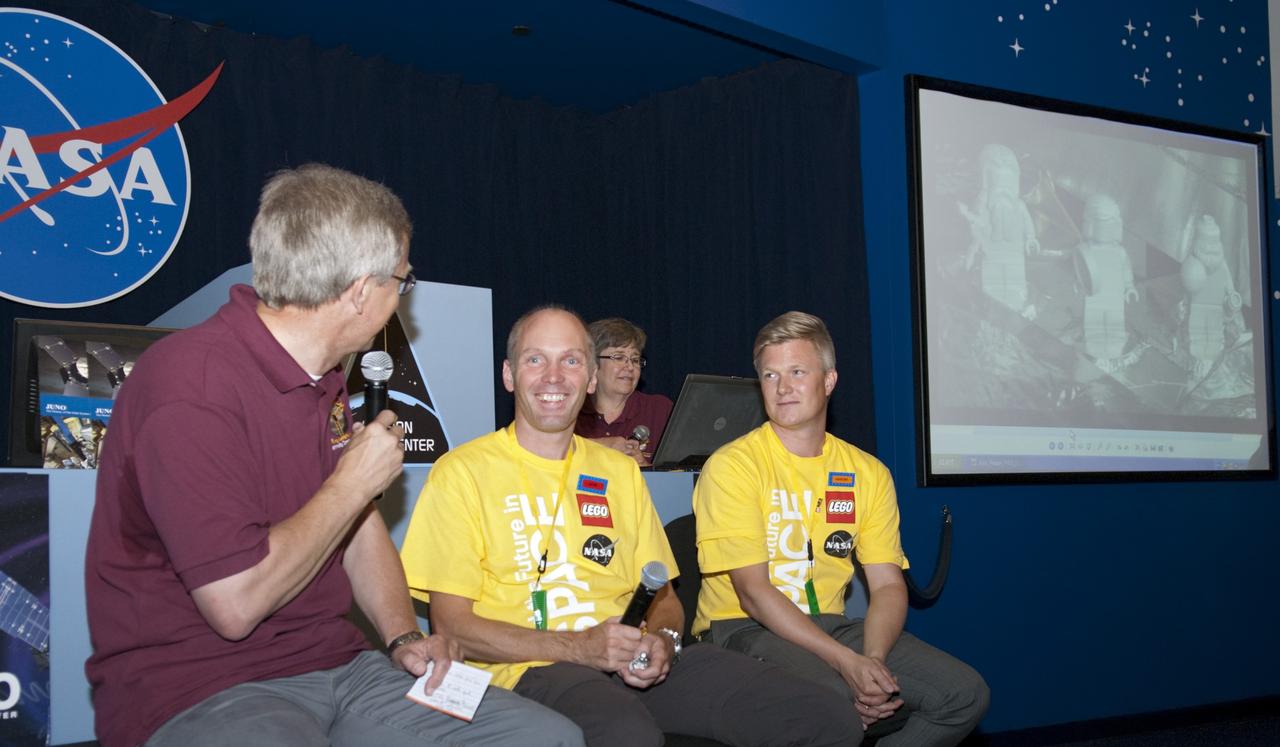
CAPE CANAVERAL, Fla. -- From left, Dr. Steve Lee, with the Denver Museum of Nature and Science; Ulrik Solberg Lund, a LEGO minifigure designer; and Karsten Juel Bunch, a LEGO City senior designer, participate in an educational webcast in the Mission Status Center at the Kennedy Space Center Visitor Complex in Florida. On hand to ask questions of the guests were students, teachers, and mentors of the Goldstone Apple Valley Radio Telescope (GAVRT) project who were invited to Kennedy to watch the launch of NASA's Juno spacecraft atop a United Launch Alliance Atlas V rocket. GAVRT is a partnership between NASA, the Jet Propulsion Laboratory (JPL), and The Lewis Center for Educational Research (LCER) in Apple Valley, Calif. It allows students to control a 34-meter radio telescope that, until recently, was part of NASA’s Deep Space Network, and to interact with scientists outside the classroom setting. Photo credit: NASA/Glenn Benson
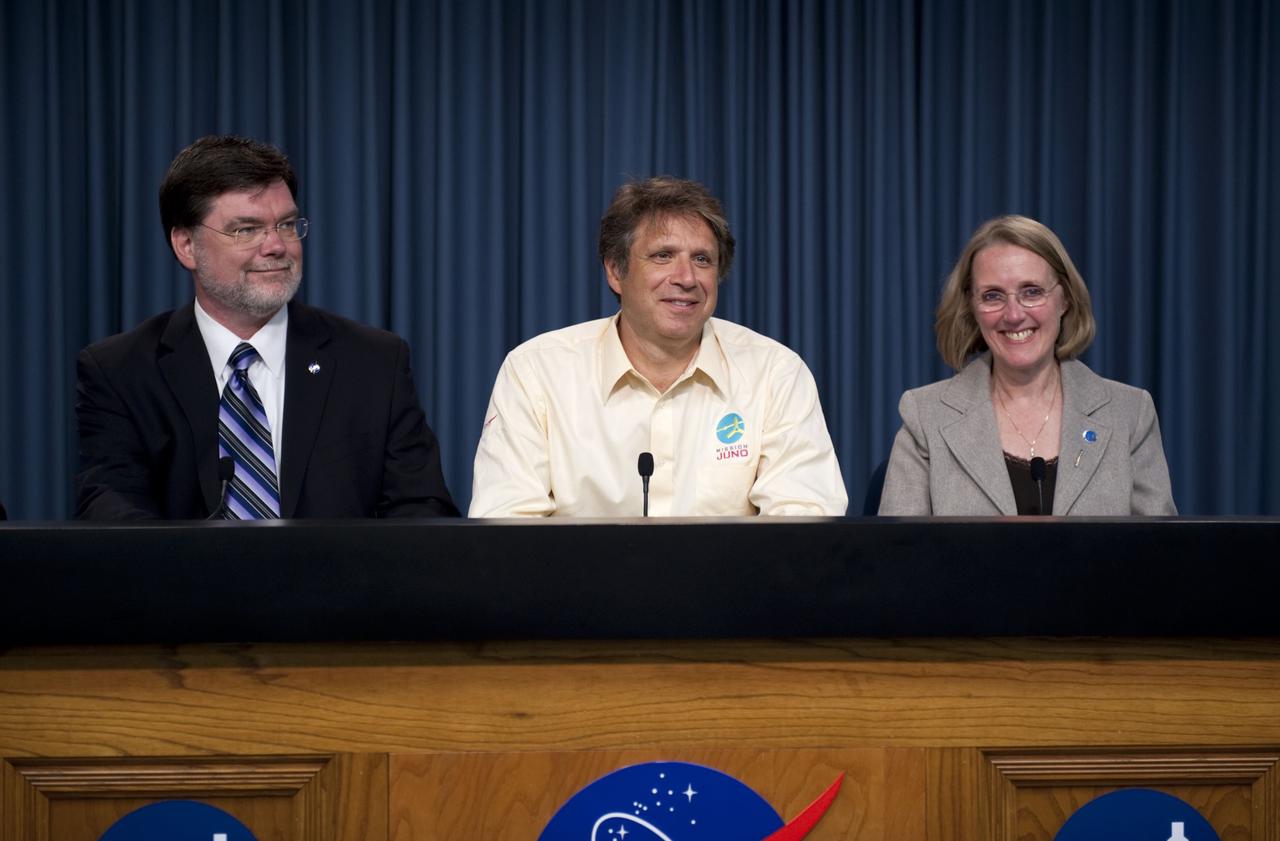
CAPE CANAVERAL, Fla. -- From left, Jim Adams, the deputy director of NASA's Planetary Science Division; Scott Bolton, Juno's principal investigator at the Southwest Research Institute (SWRI); and Jan Chodas, Juno's project manager at the Jet Propulsion Laboratory (JPL), participate in a post-launch news conference following the successful liftoff of the Juno spacecraft atop a United Launch Alliance Atlas V rocket. Launch was at 12:25 p.m. EDT Aug. 5. The solar-powered spacecraft now is on a five-year journey to Jupiter, where it will orbit the planet's poles 33 times to find out more about the gas giant's origins, structure, atmosphere and magnetosphere and investigate the existence of a solid planetary core. For more information, visit www.nasa.gov/juno. Photo credit: Kim Shiflett

CAPE CANAVERAL, Fla. -- Dr. Steve Lee, with the Denver Museum of Nature and Science, left, hosts an educational webcast in the Mission Status Center at the Kennedy Space Center Visitor Complex in Florida. On hand to ask questions were students, teachers, and mentors of the Goldstone Apple Valley Radio Telescope (GAVRT) project who were invited to Kennedy to watch the launch of NASA's Juno spacecraft atop a United Launch Alliance Atlas V rocket. GAVRT is a partnership between NASA, the Jet Propulsion Laboratory (JPL), and The Lewis Center for Educational Research (LCER) in Apple Valley, Calif. It allows students to control a 34-meter radio telescope that, until recently, was part of NASA’s Deep Space Network, and to interact with scientists outside the classroom setting. Photo credit: NASA/Glenn Benson
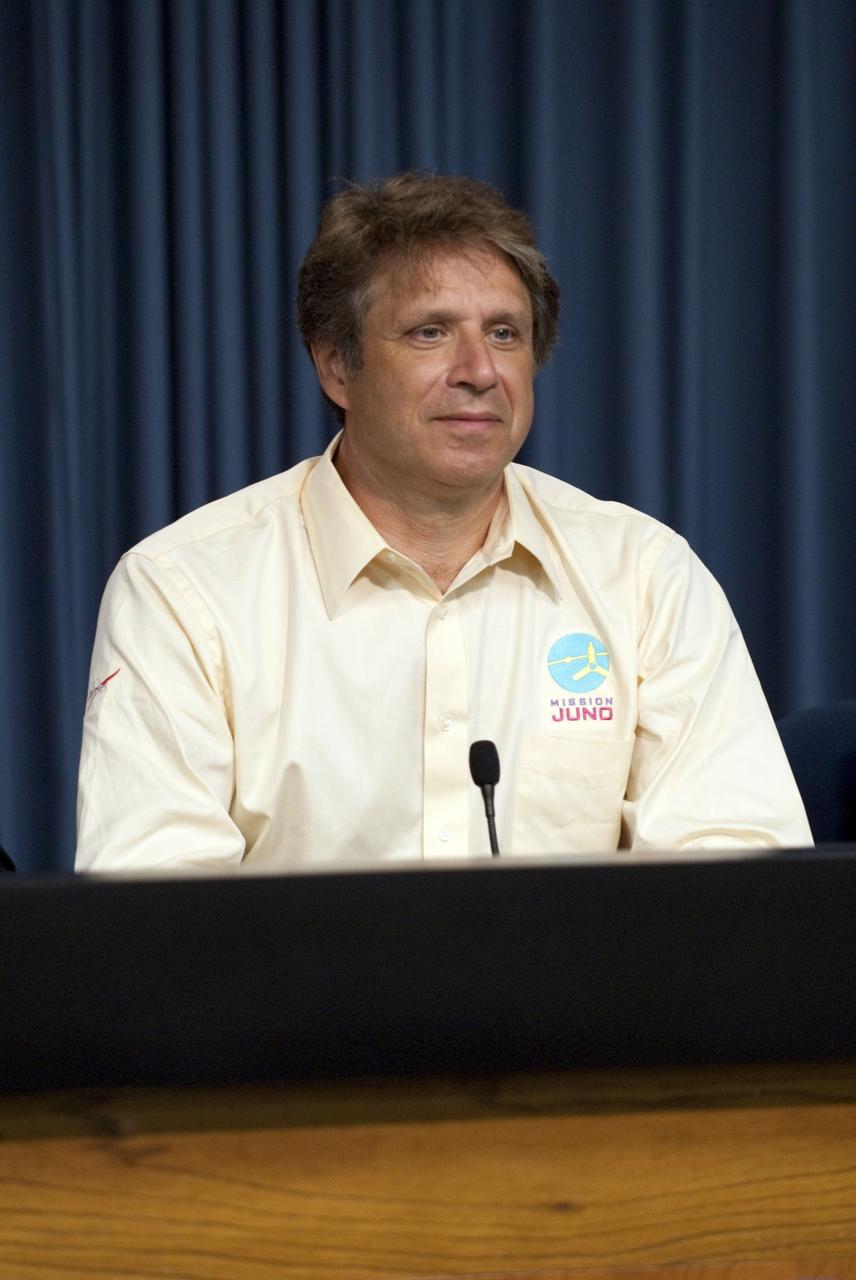
CAPE CANAVERAL, Fla. -- Scott Bolton, Juno's principal investigator at the Southwest Research Institute (SWRI), talks to media representative during a post-launch news conference following the successful liftoff of the Juno spacecraft atop a United Launch Alliance Atlas V rocket. Launch was at 12:25 p.m. EDT Aug. 5. The solar-powered spacecraft now is on a five-year journey to Jupiter, where it will orbit the planet's poles 33 times to find out more about the gas giant's origins, structure, atmosphere and magnetosphere and investigate the existence of a solid planetary core. For more information, visit www.nasa.gov/juno. Photo credit: Kim Shiflett

CAPE CANAVERAL, Fla. -- From left, Dr. Steve Lee, with the Denver Museum of Nature and Science; Ulrik Solberg Lund, a LEGO minifigure designer; and Karsten Juel Bunch, a LEGO City senior designer, participate in an educational webcast in the Mission Status Center at the Kennedy Space Center Visitor Complex in Florida. On hand to ask questions of the guests were students, teachers, and mentors of the Goldstone Apple Valley Radio Telescope (GAVRT) project who were invited to Kennedy to watch the launch of NASA's Juno spacecraft atop a United Launch Alliance Atlas V rocket. GAVRT is a partnership between NASA, the Jet Propulsion Laboratory (JPL), and The Lewis Center for Educational Research (LCER) in Apple Valley, Calif. It allows students to control a 34-meter radio telescope that, until recently, was part of NASA’s Deep Space Network, and to interact with scientists outside the classroom setting. Photo credit: NASA/Glenn Benson
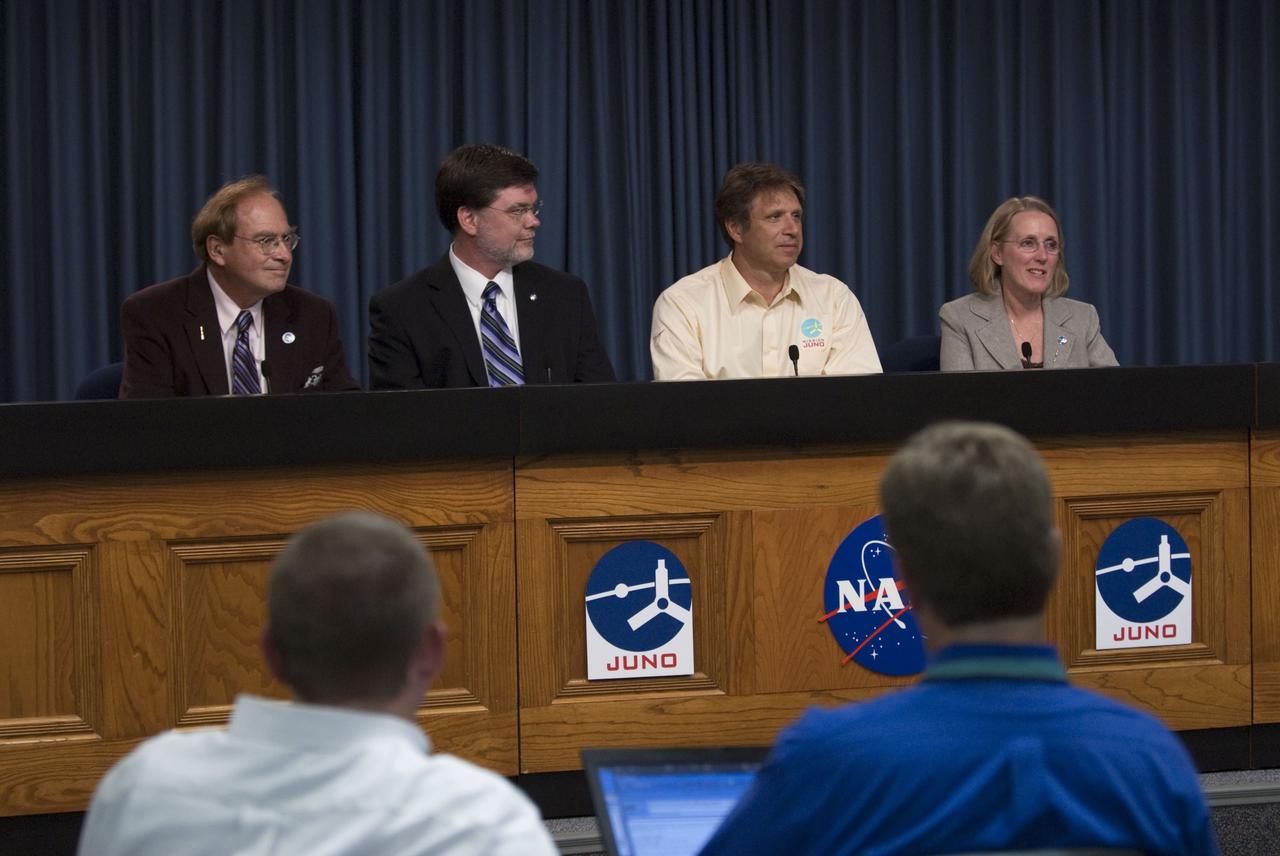
CAPE CANAVERAL, Fla. -- From left, NASA Public Affairs Officer George Diller; Jim Adams, the deputy director of NASA's Planetary Science Division; Scott Bolton, Juno's principal investigator at the Southwest Research Institute (SWRI); and Jan Chodas, Juno's project manager at the Jet Propulsion Laboratory (JPL), participate in a post-launch news conference following the successful liftoff of the Juno spacecraft atop a United Launch Alliance Atlas V rocket. Launch was at 12:25 p.m. EDT Aug. 5. The solar-powered spacecraft now is on a five-year journey to Jupiter, where it will orbit the planet's poles 33 times to find out more about the gas giant's origins, structure, atmosphere and magnetosphere and investigate the existence of a solid planetary core. For more information, visit www.nasa.gov/juno. Photo credit: Kim Shiflett

CAPE CANAVERAL, Fla. -- Jan Chodas, Juno's project manager at the Jet Propulsion Laboratory (JPL), talks to media representative during a post-launch news conference following the successful liftoff of the Juno spacecraft atop a United Launch Alliance Atlas V rocket. Launch was at 12:25 p.m. EDT Aug. 5. The solar-powered spacecraft now is on a five-year journey to Jupiter, where it will orbit the planet's poles 33 times to find out more about the gas giant's origins, structure, atmosphere and magnetosphere and investigate the existence of a solid planetary core. For more information, visit www.nasa.gov/juno. Photo credit: Kim Shiflett