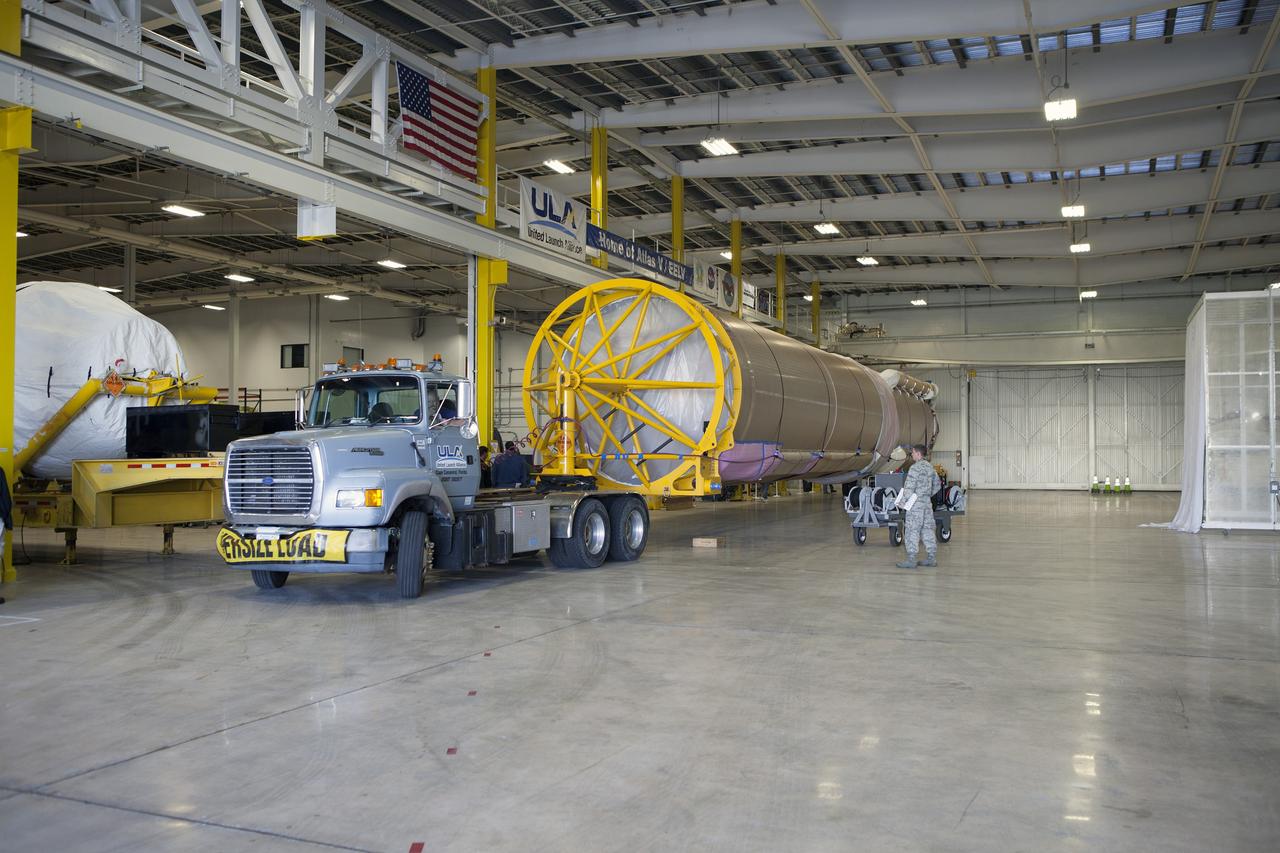
CAPE CANAVERAL, Fla. – A truck positions an Atlas V booster stage inside the hangar at the Atlas V Spaceflight Operations Center at Cape Canaveral Air Force Station. The rocket will be used to launch NASA's Magnetospheric Multiscale mission. To learn about the MMS, go to http://go.nasa.gov/1GUbzxb. Photo credit: NASA/Ben Smegelsky
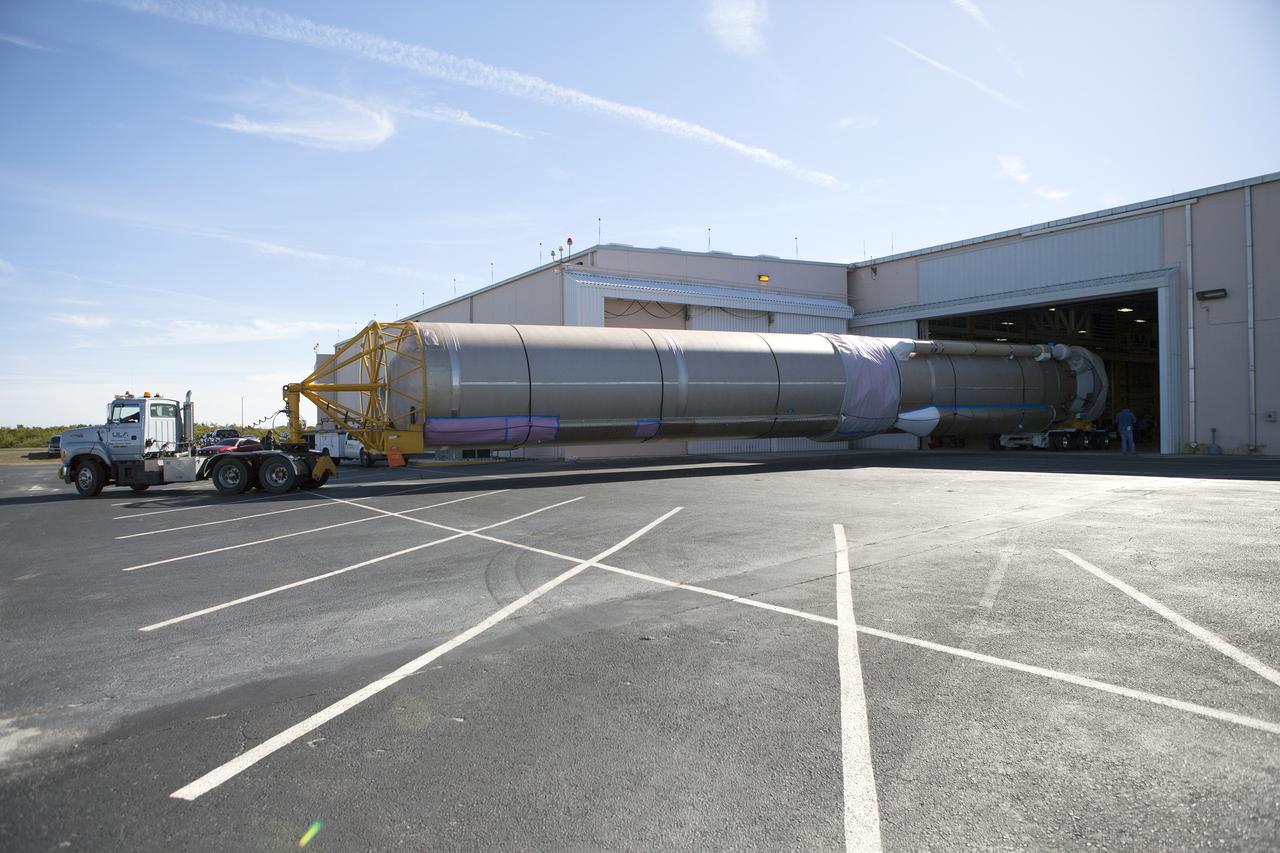
CAPE CANAVERAL, Fla. – A truck positions an Atlas V booster stage inside the hangar at the Atlas V Spaceflight Operations Center at Cape Canaveral Air Force Station. The rocket will be used to launch NASA's Magnetospheric Multiscale mission. To learn about the MMS, go to http://go.nasa.gov/1GUbzxb. Photo credit: NASA/Ben Smegelsky

CAPE CANAVERAL, Fla. – A truck positions a Centaur upper stage inside the hangar at the Atlas V Spaceflight Operations Center at Cape Canaveral Air Force Station. The upper stage will be used as part of the Atlas V rocket that will be used to launch NASA's Magnetospheric Multiscale mission. To learn about the MMS, go to http://go.nasa.gov/1GUbzxb. Photo credit: NASA/Ben Smegelsky
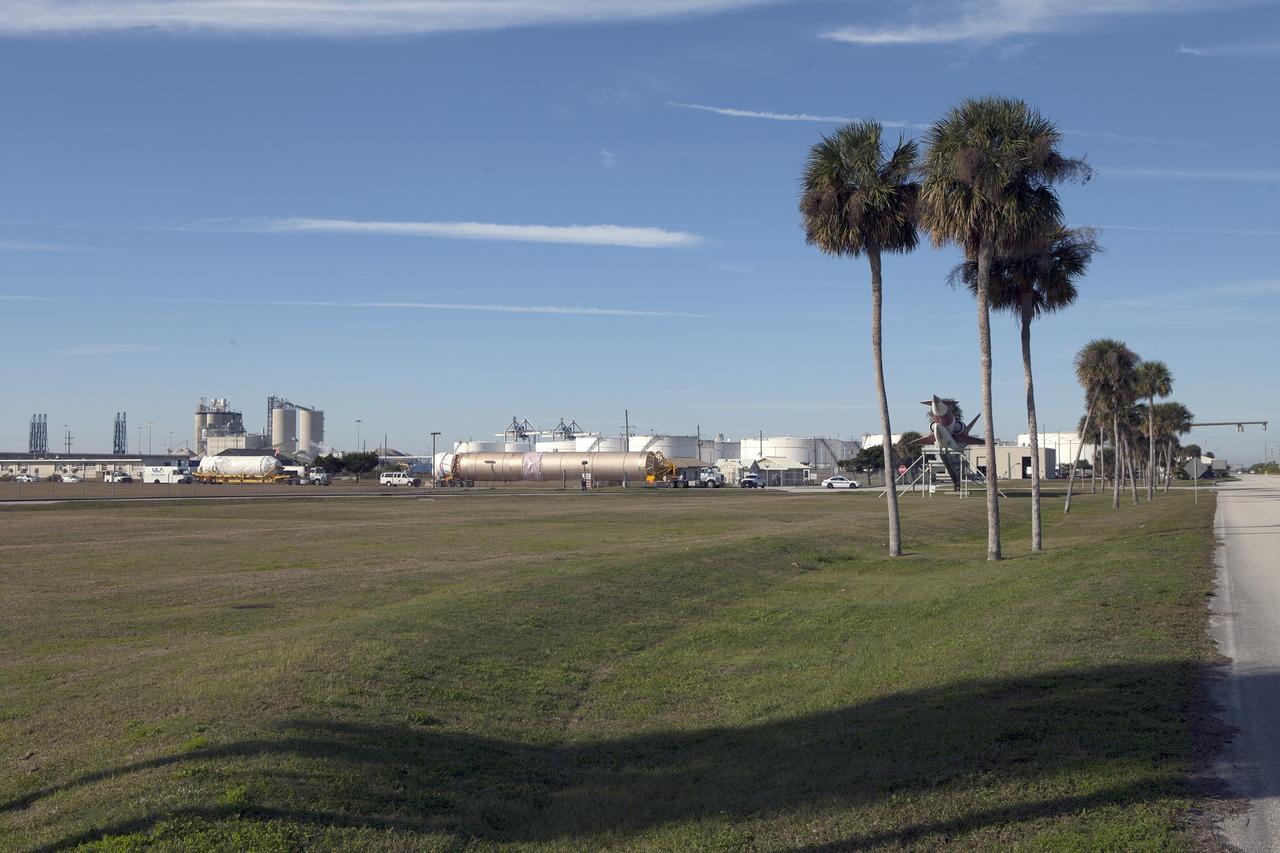
CAPE CANAVERAL, Fla. – Trucks transport the Atlas V rocket and Centaur upper stage from the United Launch Alliance Delta Mariner to the Atlas V Spaceflight Operations Center at Cape Canaveral Air Force Station. The rocket will be used to launch NASA's Magnetospheric Multiscale mission. To learn about the MMS, go to http://go.nasa.gov/1GUbzxb. Photo credit: NASA/Ben Smegelsky
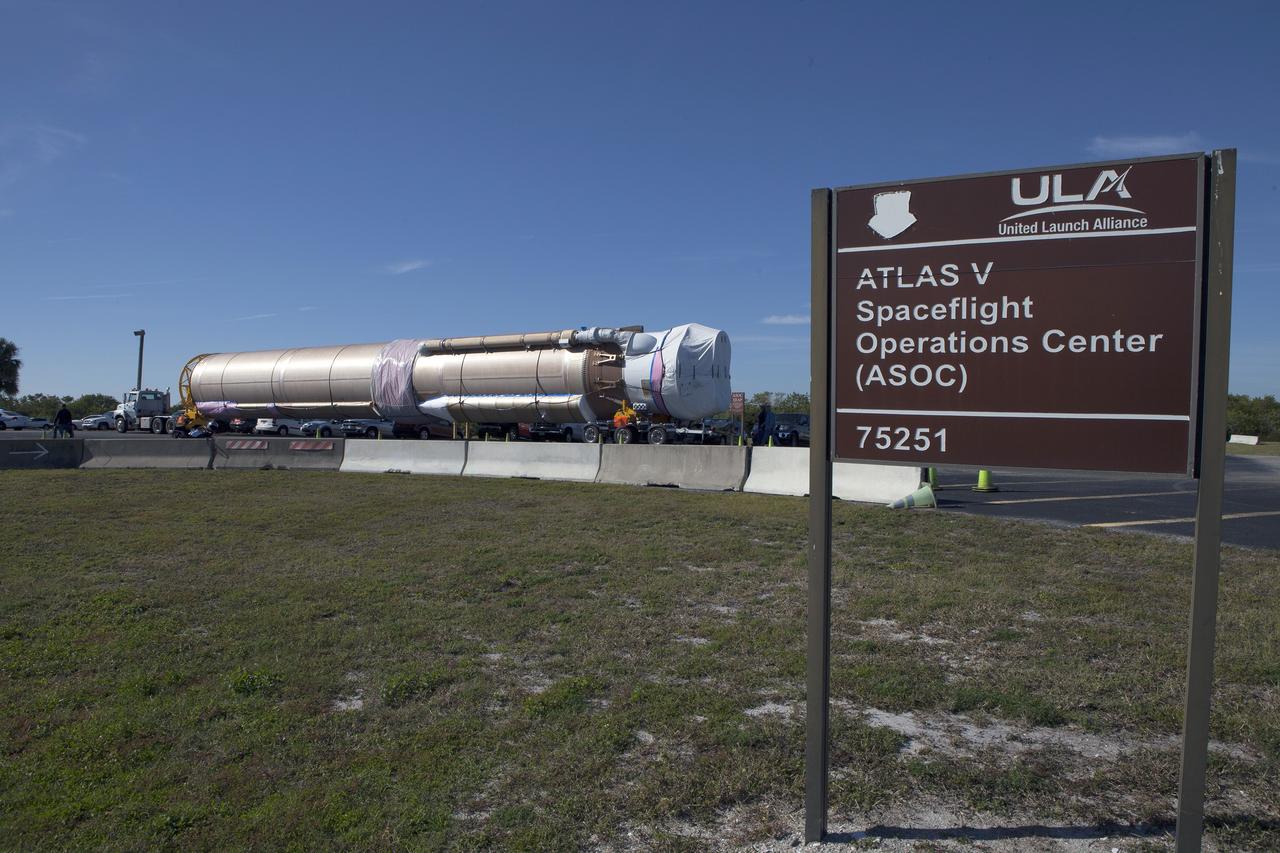
CAPE CANAVERAL, Fla. – Trucks transport the Atlas V rocket and Centaur upper stage from the United Launch Alliance Delta Mariner to the Atlas V Spaceflight Operations Center at Cape Canaveral Air Force Station. The rocket will be used to launch NASA's Magnetospheric Multiscale mission. To learn about the MMS, go to http://go.nasa.gov/1GUbzxb. Photo credit: NASA/Ben Smegelsky
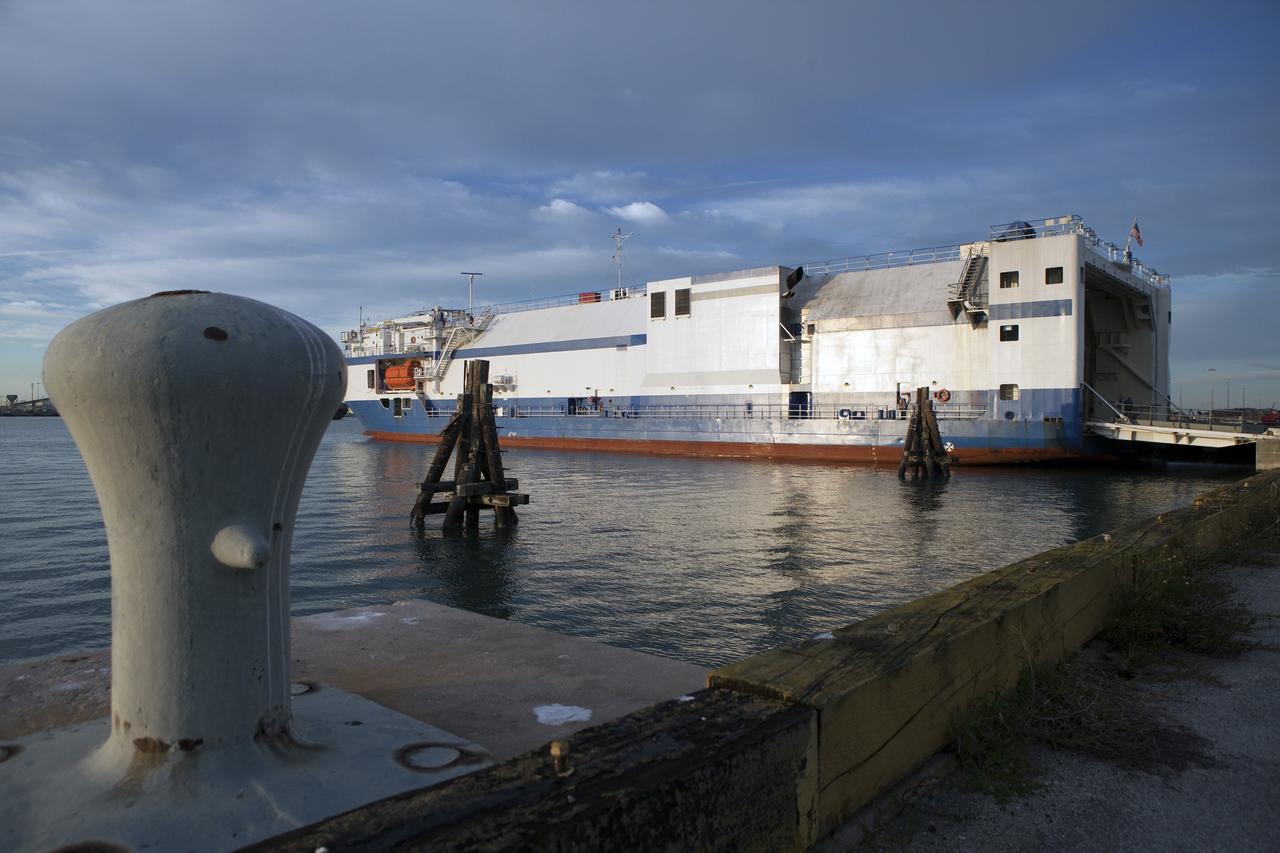
CAPE CANAVERAL, Fla. – The United Launch Alliance Delta Mariner arrives at Port Canaveral to deliver the Atlas V rocket that will be used to launch NASA's Magnetospheric Multiscale mission. To learn about the MMS, go to http://go.nasa.gov/1GUbzxb. Photo credit: NASA/Ben Smegelsky
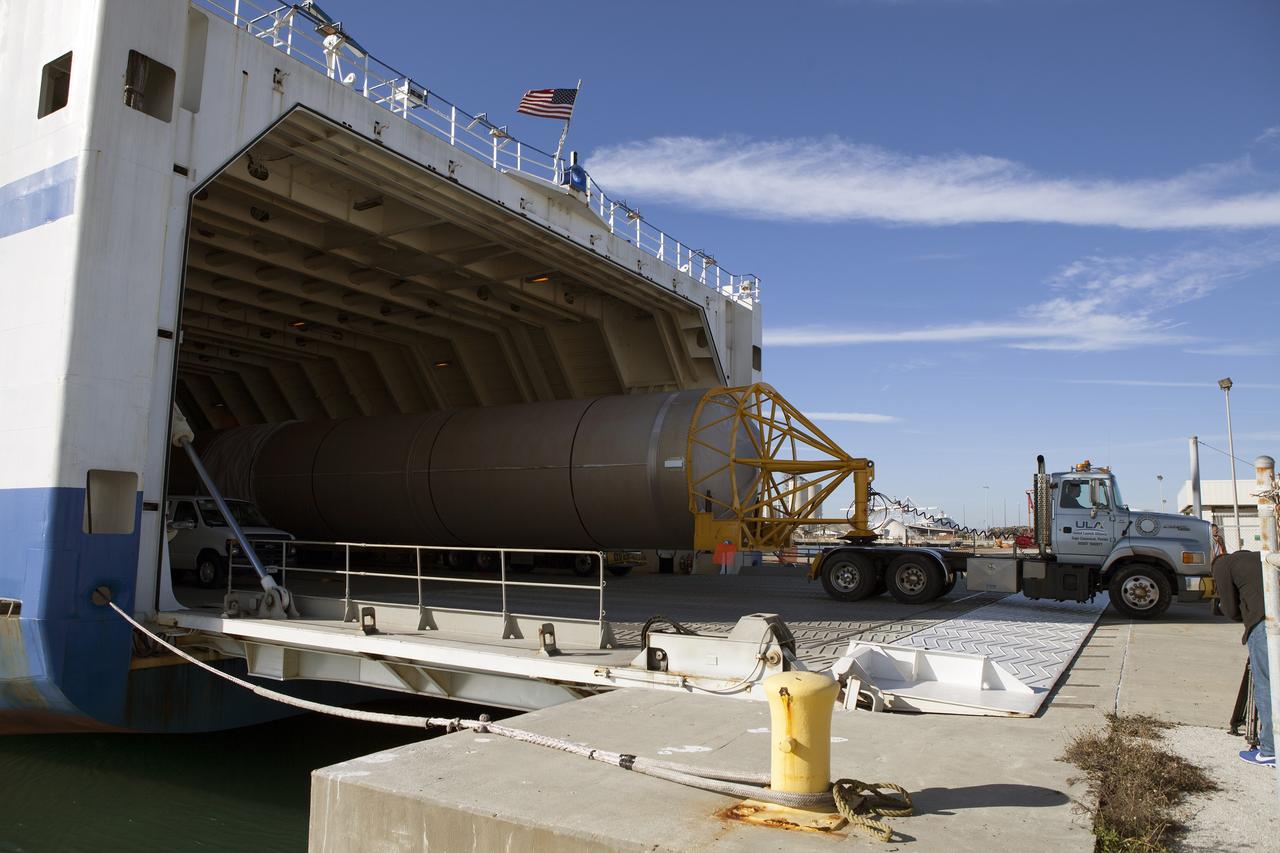
CAPE CANAVERAL, Fla. – A truck begins to transport the Atlas V booster stage from the United Launch Alliance Delta Mariner. The rocket will be used to launch NASA's Magnetospheric Multiscale mission. To learn about the MMS, go to http://go.nasa.gov/1GUbzxb. Photo credit: NASA/Ben Smegelsky
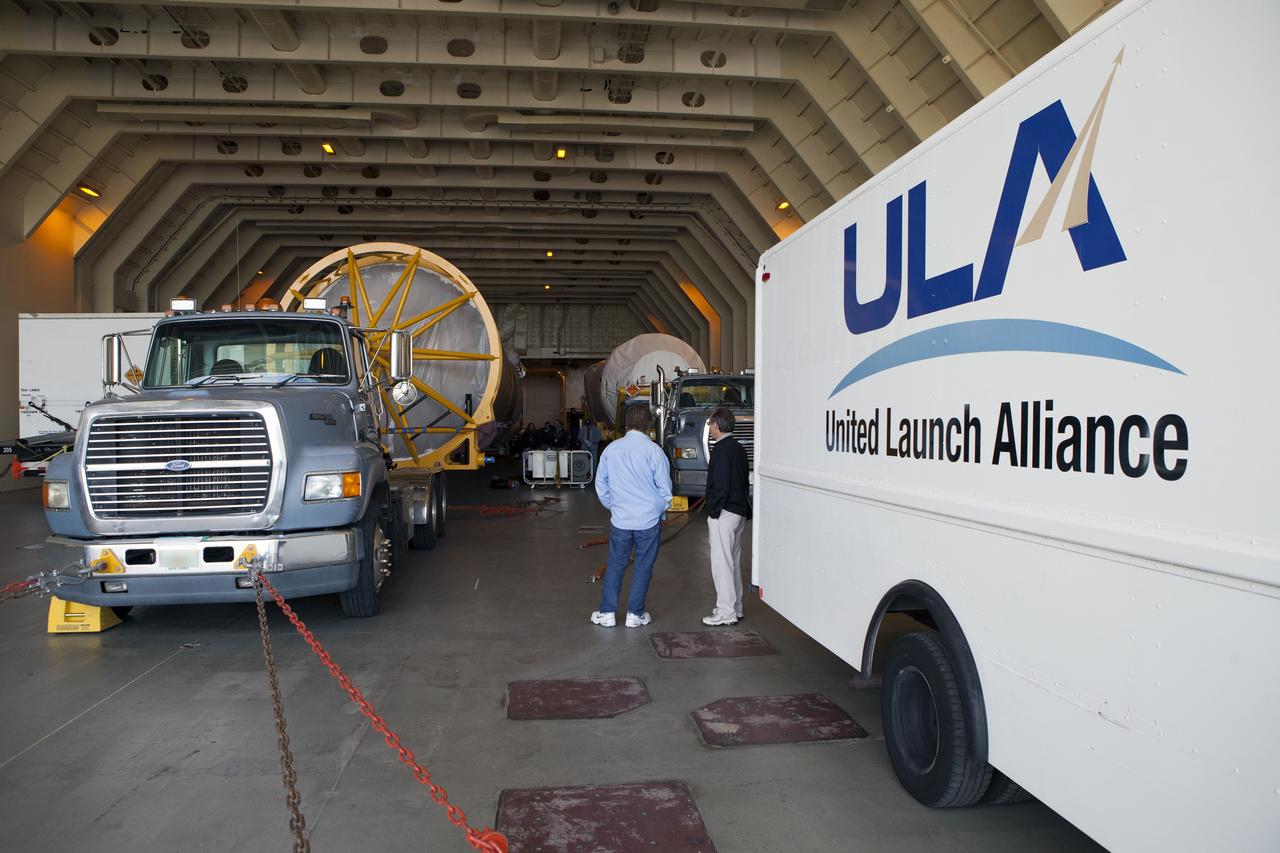
CAPE CANAVERAL, Fla. – Trucks inside the United Launch Alliance Delta Mariner prepare to transport the Atlas V rocket and Centaur upper stage that will be used to launch NASA's Magnetospheric Multiscale mission. To learn about the MMS, go to http://go.nasa.gov/1GUbzxb. Photo credit: NASA/Ben Smegelsky
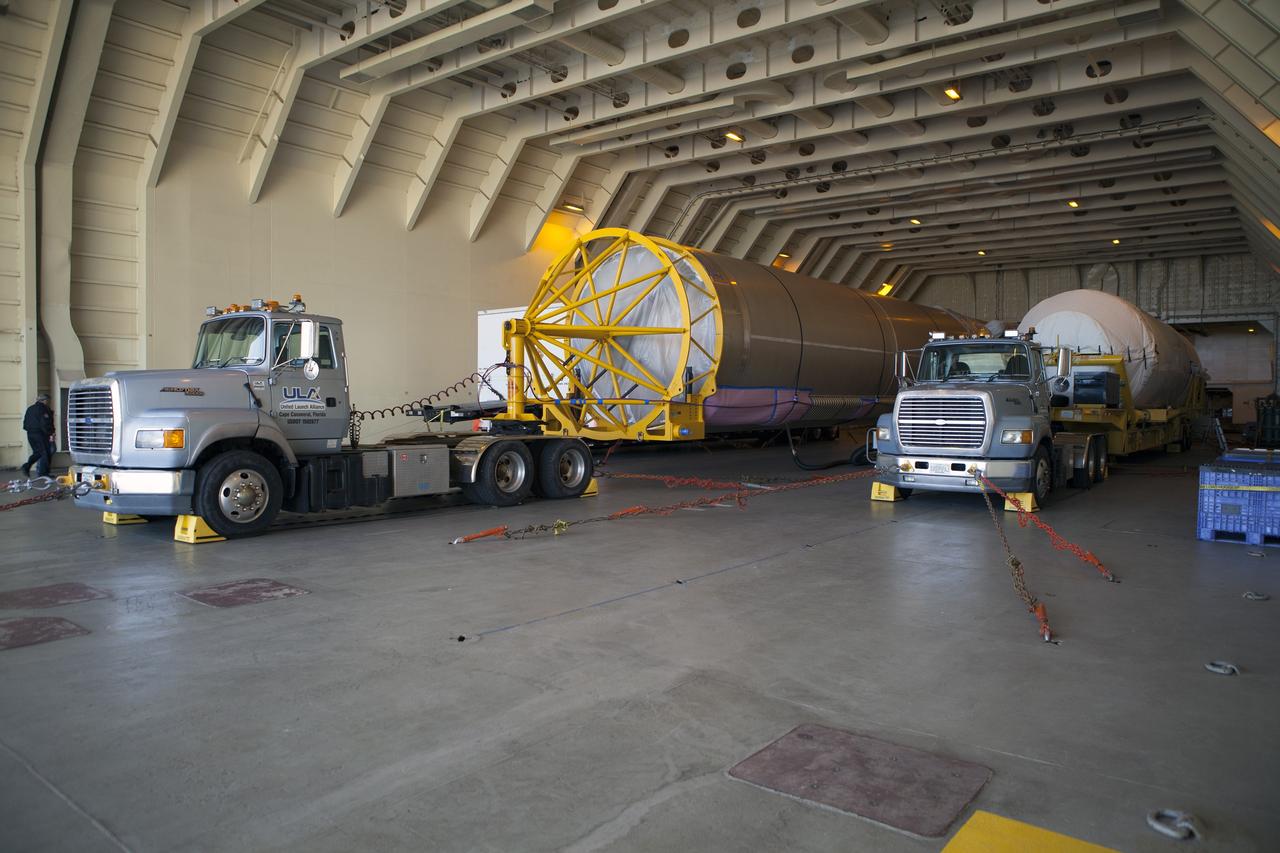
CAPE CANAVERAL, Fla. – Trucks inside the United Launch Alliance Delta Mariner prepare to transport the Atlas V rocket and Centaur upper stage that will be used to launch NASA's Magnetospheric Multiscale mission. To learn about the MMS, go to http://go.nasa.gov/1GUbzxb. Photo credit: NASA/Ben Smegelsky
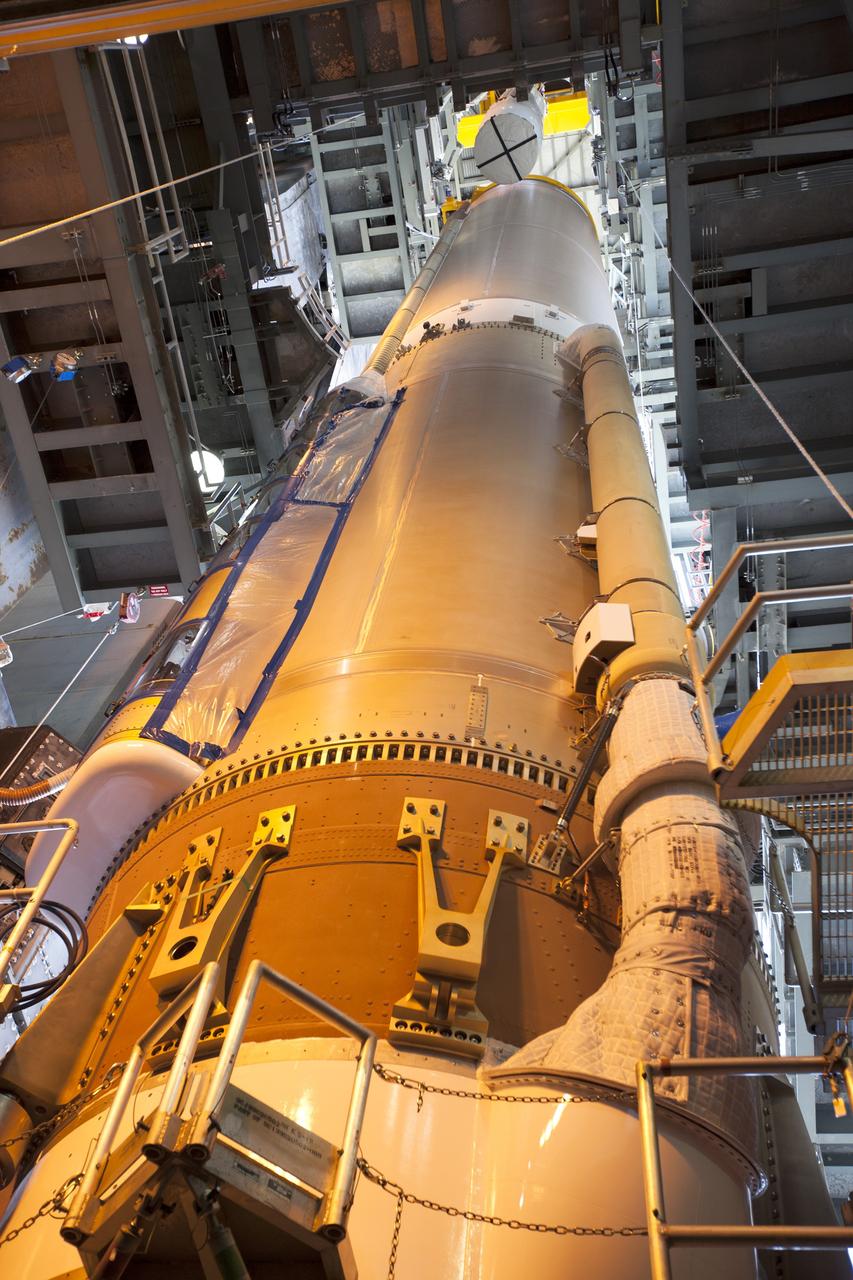
A solid rocket motor for the United Launch Alliance Atlas V rocket slated to boost NASA's Magnetospheric Multiscale mission, or MMS, is lowered into position inside the mobile service tower at Space Launch Complex 41 on Cape Canaveral Air Force Station in Florida. Four identical MMS spacecraft will study the mystery of how magnetic fields around Earth connect and disconnect, explosively releasing energy via a process known a magnetic reconnection. Launch is set for March 12. To learn more: http://www.nasa.gov/mms. Photo credit: NASA/ Kim Shiflett

A solid rocket motor for the United Launch Alliance Atlas V rocket slated to boost NASA's Magnetospheric Multiscale mission, or MMS, is lifted at the mobile service tower at Space Launch Complex 41 on Cape Canaveral Air Force Station in Florida. Four identical MMS spacecraft will study the mystery of how magnetic fields around Earth connect and disconnect, explosively releasing energy via a process known a magnetic reconnection. Launch is set for March 12. To learn more: http://www.nasa.gov/mms. Photo credit: NASA/ Kim Shiflett
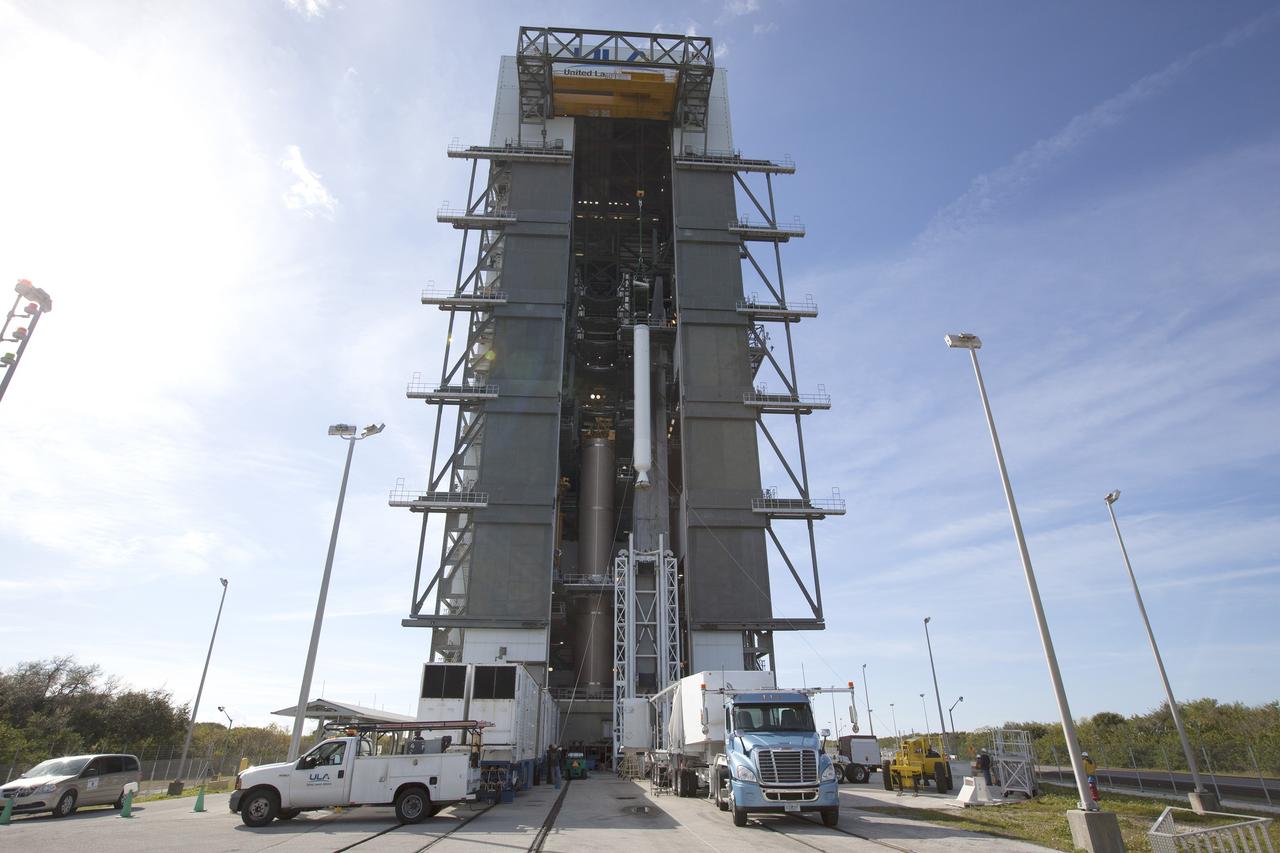
A solid rocket motor for the United Launch Alliance Atlas V rocket slated to boost NASA's Magnetospheric Multiscale mission, or MMS, is lifted at the mobile service tower at Space Launch Complex 41 on Cape Canaveral Air Force Station in Florida. Four identical MMS spacecraft will study the mystery of how magnetic fields around Earth connect and disconnect, explosively releasing energy via a process known a magnetic reconnection. Launch is set for March 12. To learn more: http://www.nasa.gov/mms. Photo credit: NASA/ Kim Shiflett
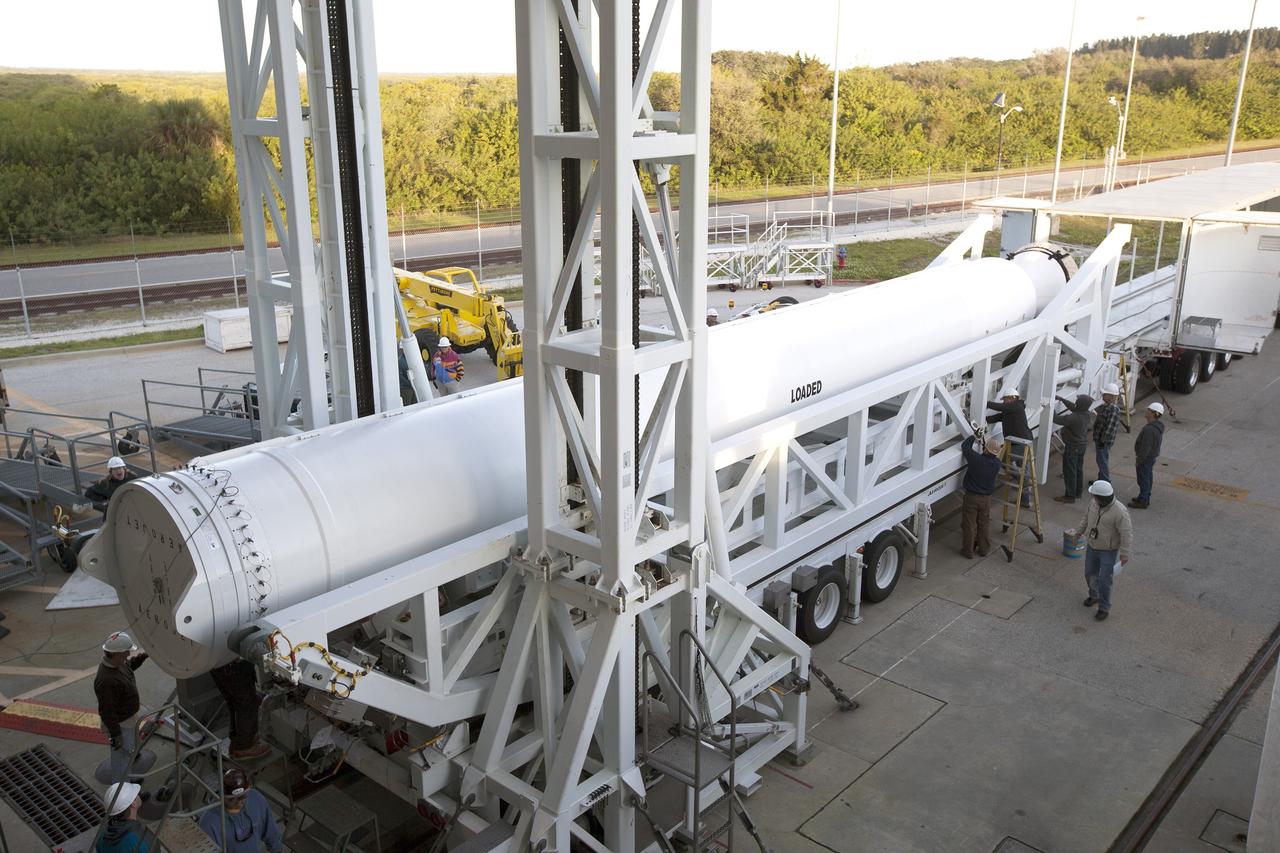
A solid rocket motor for the United Launch Alliance Atlas V rocket slated to boost NASA's Magnetospheric Multiscale mission, or MMS, arrives at the mobile service tower at Space Launch Complex 41 on Cape Canaveral Air Force Station in Florida. Four identical MMS spacecraft will study the mystery of how magnetic fields around Earth connect and disconnect, explosively releasing energy via a process known a magnetic reconnection. Launch is set for March 12. To learn more: http://www.nasa.gov/mms. Photo credit: NASA/ Kim Shiflett

A solid rocket motor for the United Launch Alliance Atlas V rocket slated to boost NASA's Magnetospheric Multiscale mission, or MMS, is lowered into position inside the mobile service tower at Space Launch Complex 41 on Cape Canaveral Air Force Station in Florida. Four identical MMS spacecraft will study the mystery of how magnetic fields around Earth connect and disconnect, explosively releasing energy via a process known a magnetic reconnection. Launch is set for March 12. To learn more: http://www.nasa.gov/mms. Photo credit: NASA/ Kim Shiflett
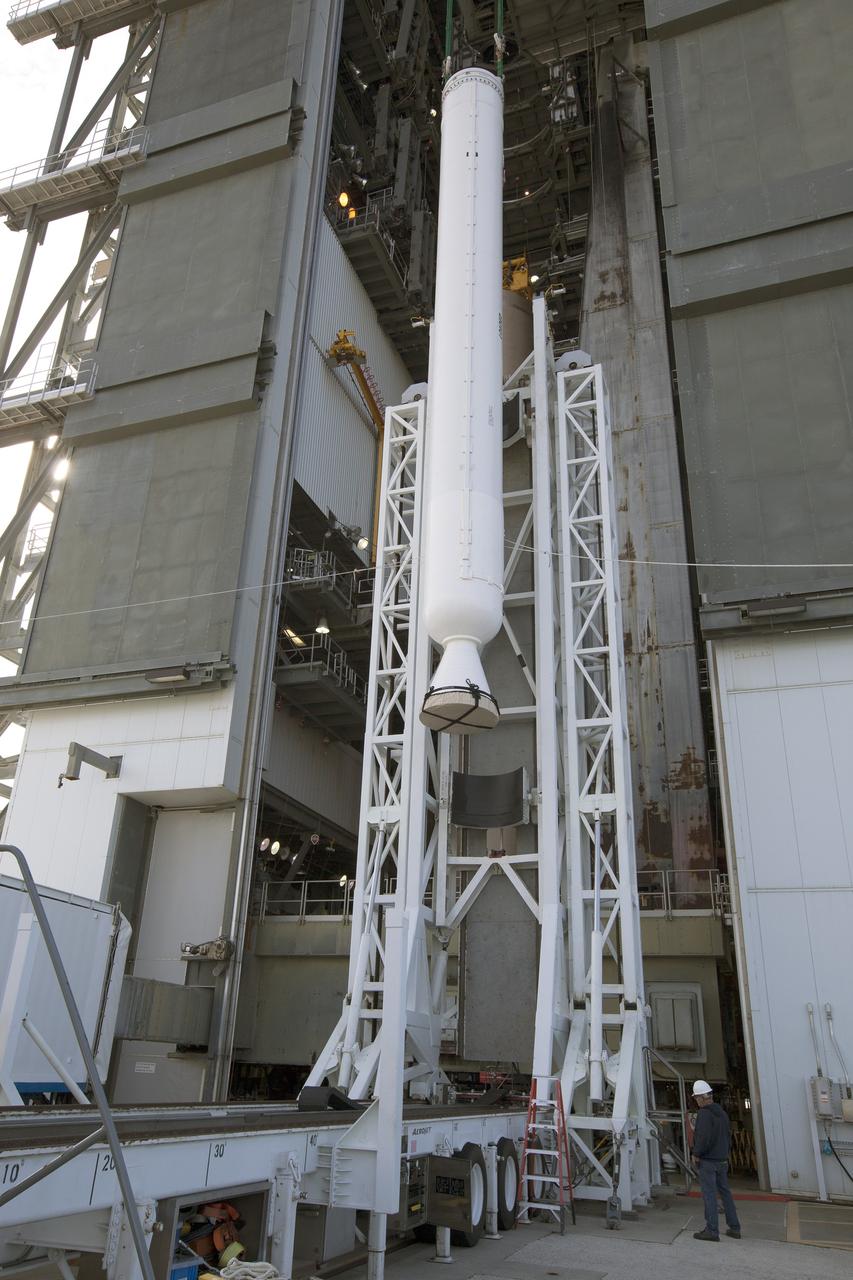
A solid rocket motor for the United Launch Alliance Atlas V rocket slated to boost NASA's Magnetospheric Multiscale mission, or MMS, is lifted at the mobile service tower at Space Launch Complex 41 on Cape Canaveral Air Force Station in Florida. Four identical MMS spacecraft will study the mystery of how magnetic fields around Earth connect and disconnect, explosively releasing energy via a process known a magnetic reconnection. Launch is set for March 12. To learn more: http://www.nasa.gov/mms. Photo credit: NASA/ Kim Shiflett
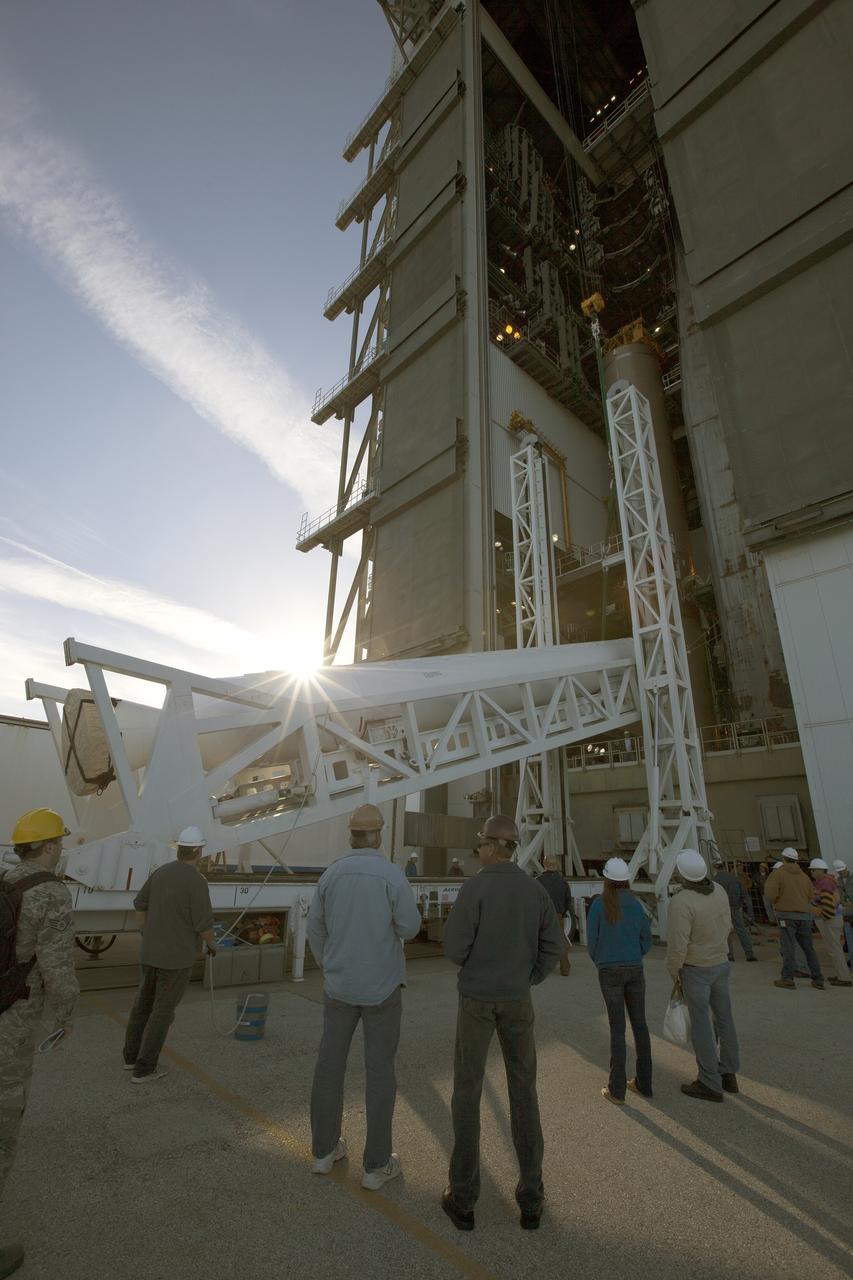
A solid rocket motor for the United Launch Alliance Atlas V rocket slated to boost NASA's Magnetospheric Multiscale mission, or MMS, is lifted at the mobile service tower at Space Launch Complex 41 on Cape Canaveral Air Force Station in Florida. Four identical MMS spacecraft will study the mystery of how magnetic fields around Earth connect and disconnect, explosively releasing energy via a process known a magnetic reconnection. Launch is set for March 12. To learn more: http://www.nasa.gov/mms. Photo credit: NASA/ Kim Shiflett
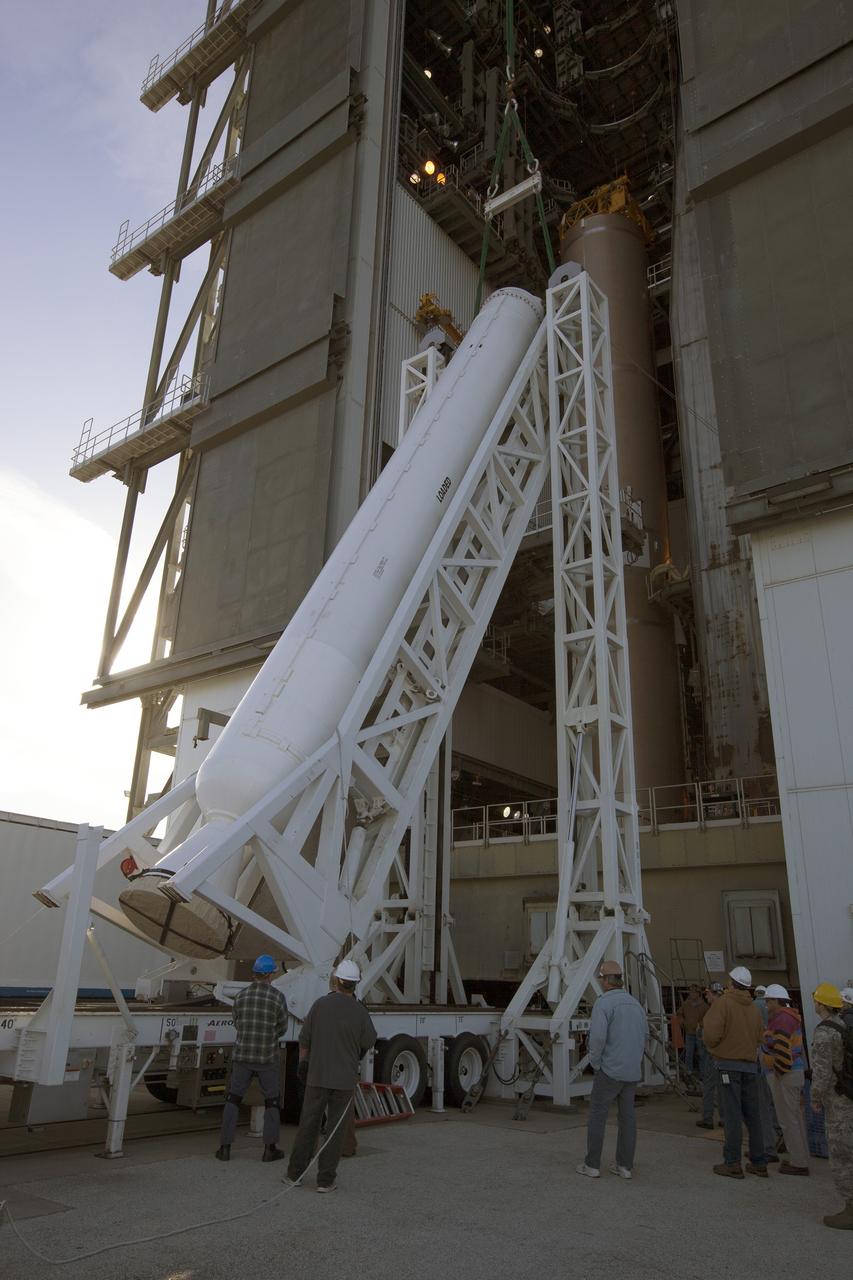
A solid rocket motor for the United Launch Alliance Atlas V rocket slated to boost NASA's Magnetospheric Multiscale mission, or MMS, is lifted at the mobile service tower at Space Launch Complex 41 on Cape Canaveral Air Force Station in Florida. Four identical MMS spacecraft will study the mystery of how magnetic fields around Earth connect and disconnect, explosively releasing energy via a process known a magnetic reconnection. Launch is set for March 12. To learn more: http://www.nasa.gov/mms. Photo credit: NASA/ Kim Shiflett
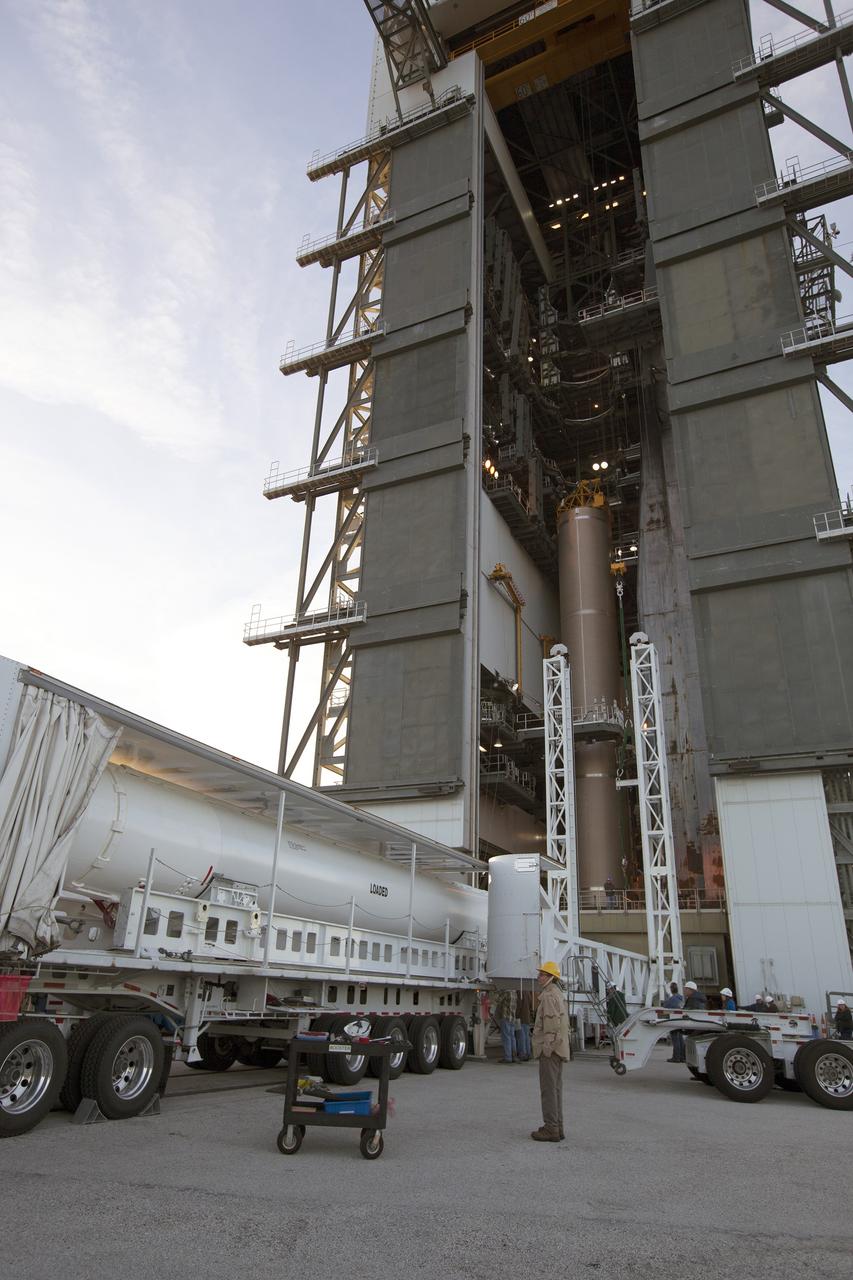
A solid rocket motor for the United Launch Alliance Atlas V rocket slated to boost NASA's Magnetospheric Multiscale mission, or MMS, arrives at the mobile service tower at Space Launch Complex 41 on Cape Canaveral Air Force Station in Florida. Four identical MMS spacecraft will study the mystery of how magnetic fields around Earth connect and disconnect, explosively releasing energy via a process known a magnetic reconnection. Launch is set for March 12. To learn more: http://www.nasa.gov/mms. Photo credit: NASA/ Kim Shiflett
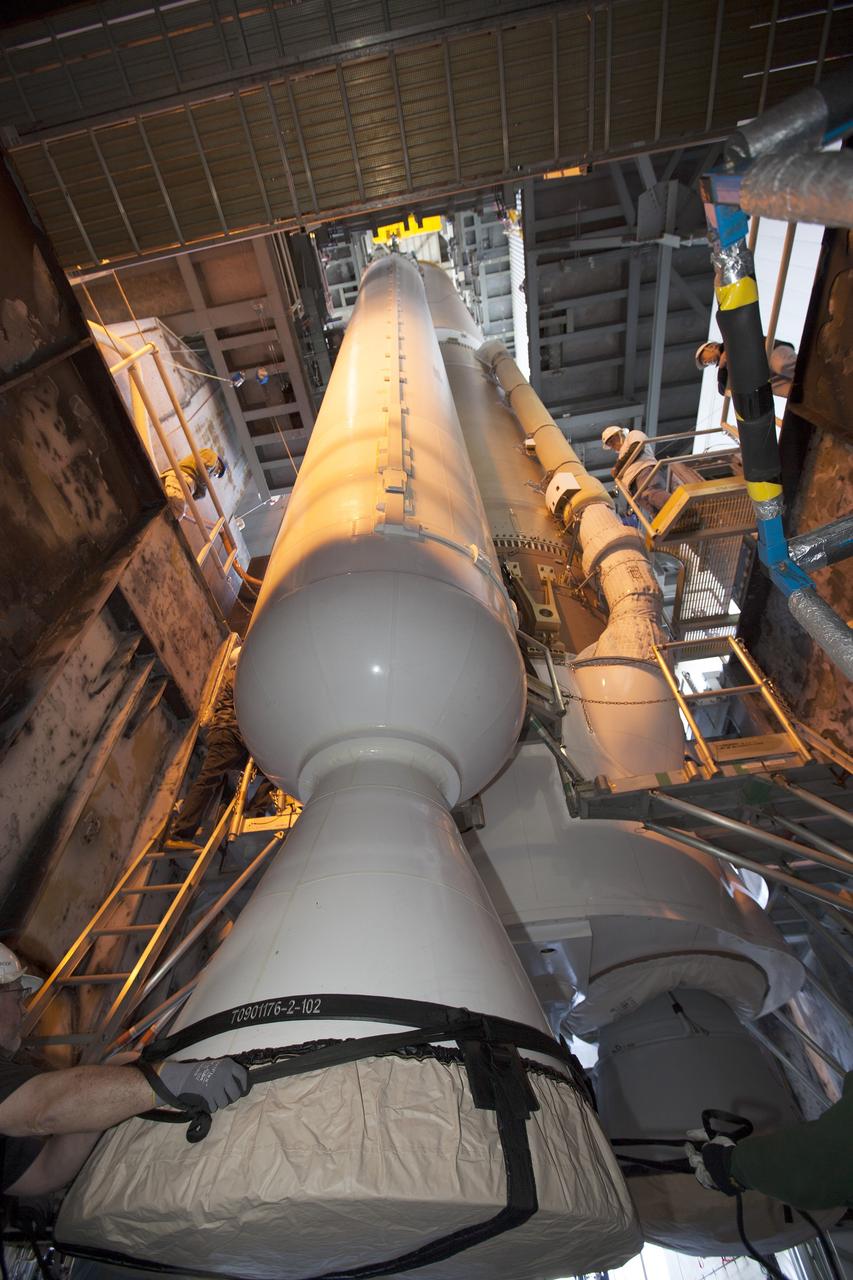
A solid rocket motor for the United Launch Alliance Atlas V rocket slated to boost NASA's Magnetospheric Multiscale mission, or MMS, is lowered into position inside the mobile service tower at Space Launch Complex 41 on Cape Canaveral Air Force Station in Florida. Four identical MMS spacecraft will study the mystery of how magnetic fields around Earth connect and disconnect, explosively releasing energy via a process known a magnetic reconnection. Launch is set for March 12. To learn more: http://www.nasa.gov/mms. Photo credit: NASA/ Kim Shiflett
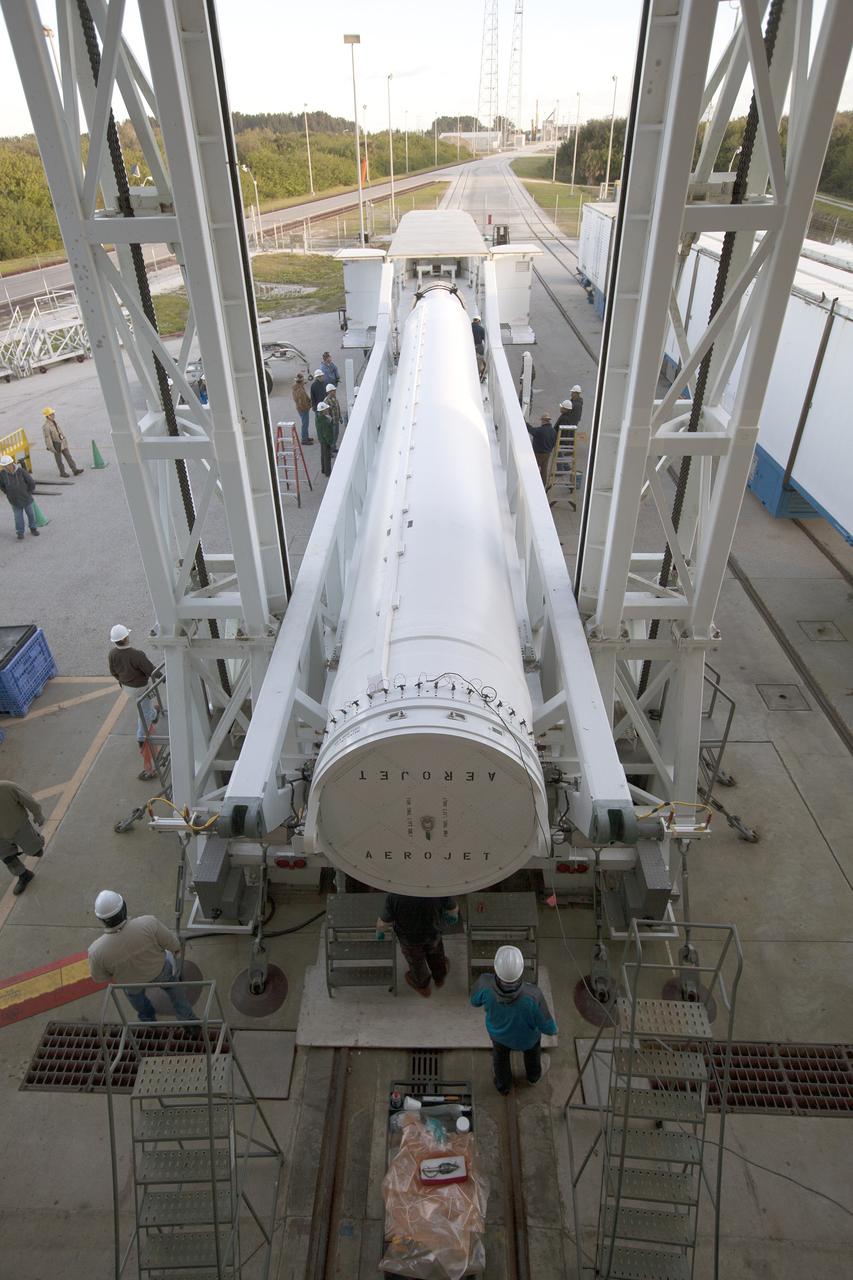
A solid rocket motor for the United Launch Alliance Atlas V rocket slated to boost NASA's Magnetospheric Multiscale mission, or MMS, arrives at the mobile service tower at Space Launch Complex 41 on Cape Canaveral Air Force Station in Florida. Four identical MMS spacecraft will study the mystery of how magnetic fields around Earth connect and disconnect, explosively releasing energy via a process known a magnetic reconnection. Launch is set for March 12. To learn more: http://www.nasa.gov/mms. Photo credit: NASA/ Kim Shiflett

A solid rocket motor for the United Launch Alliance Atlas V rocket slated to boost NASA's Magnetospheric Multiscale mission, or MMS, is lowered into position inside the mobile service tower at Space Launch Complex 41 on Cape Canaveral Air Force Station in Florida. Four identical MMS spacecraft will study the mystery of how magnetic fields around Earth connect and disconnect, explosively releasing energy via a process known a magnetic reconnection. Launch is set for March 12. To learn more: http://www.nasa.gov/mms. Photo credit: NASA/ Kim Shiflett
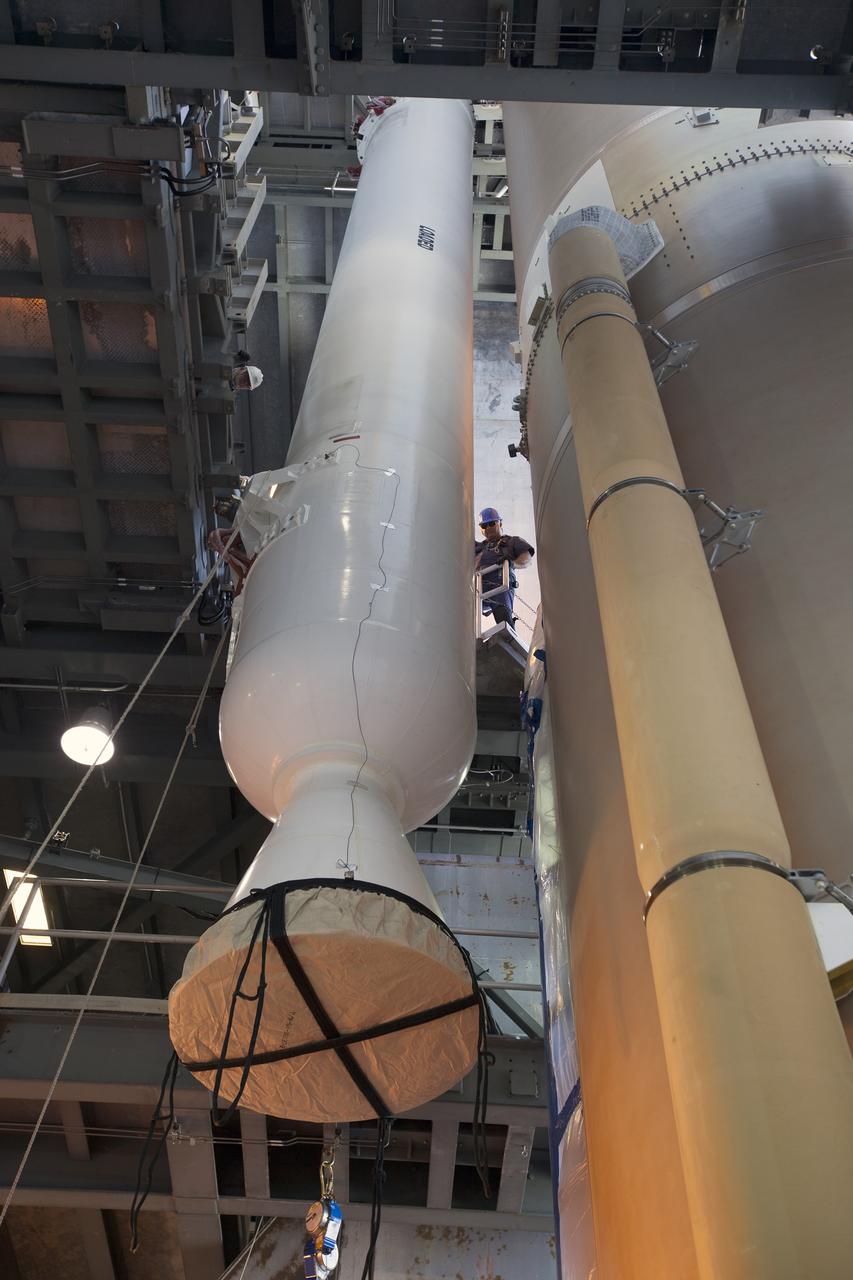
A solid rocket motor for the United Launch Alliance Atlas V rocket slated to boost NASA's Magnetospheric Multiscale mission, or MMS, is lowered into position inside the mobile service tower at Space Launch Complex 41 on Cape Canaveral Air Force Station in Florida. Four identical MMS spacecraft will study the mystery of how magnetic fields around Earth connect and disconnect, explosively releasing energy via a process known a magnetic reconnection. Launch is set for March 12. To learn more: http://www.nasa.gov/mms. Photo credit: NASA/ Kim Shiflett
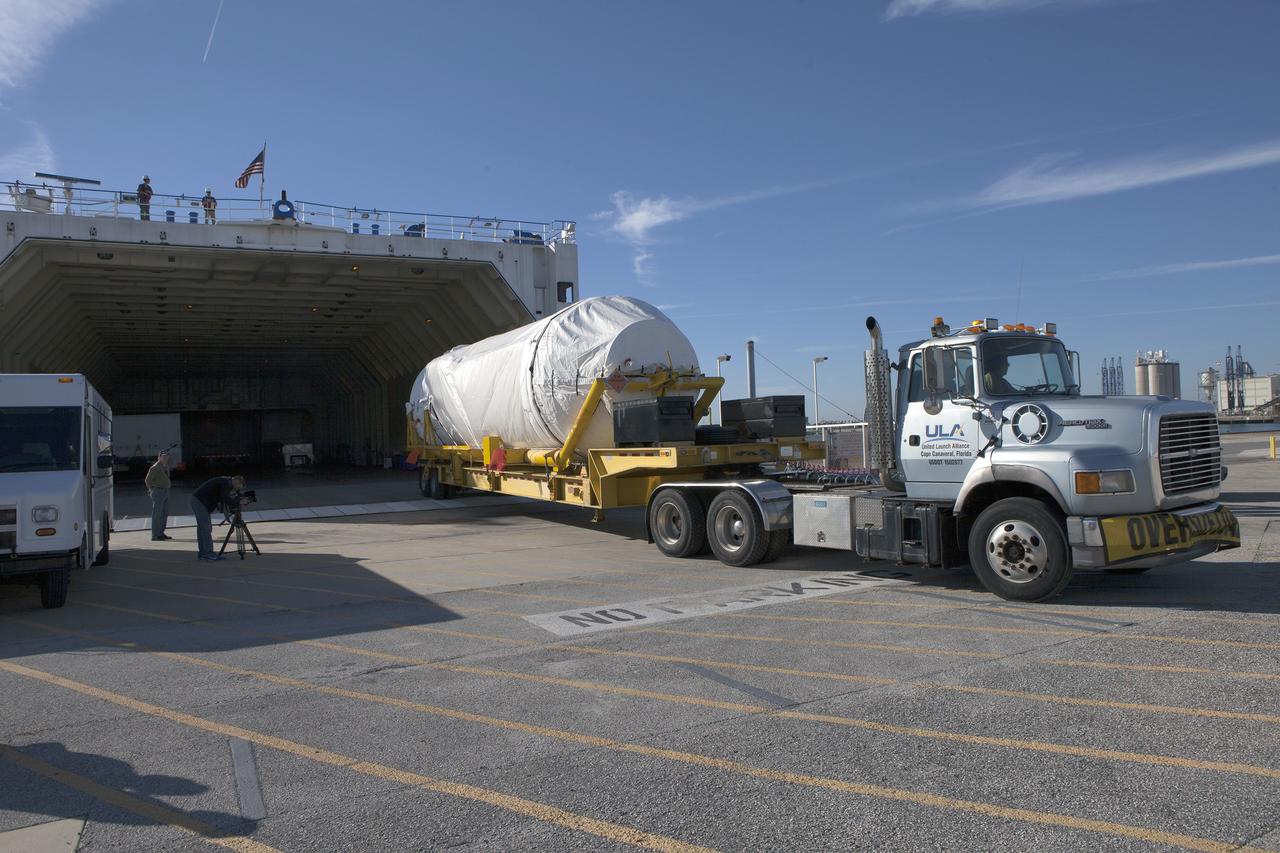
CAPE CANAVERAL, Fla. – A truck begins to transport a Centaur upper stage from the United Launch Alliance Delta Mariner to the Atlas V Spaceflight Operations Center at Cape Canaveral Air Force Station. The rocket will be used to launch NASA's Magnetospheric Multiscale mission. To learn about the MMS, go to http://go.nasa.gov/1GUbzxb. Photo credit: NASA/Ben Smegelsky

CAPE CANAVERAL, Fla. – The first stage of the United Launch Alliance Atlas V rocket for NASA's Magnetospheric Multiscale mission, or MMS, is lifted into the mobile service tower at Space Launch Complex 41 on Cape Canaveral Air Force Station in Florida. MMS will study the mystery of how magnetic fields around Earth connect and disconnect, explosively releasing energy via a process known a magnetic reconnection. MMS consists of four identical spacecraft that work together to provide the first three-dimensional view of this fundamental process, which occurs throughout the universe. Launch is set for March 12. To learn more about MMS, visit http://www.nasa.gov/mms. Photo credit: NASA/Jim Grossmann
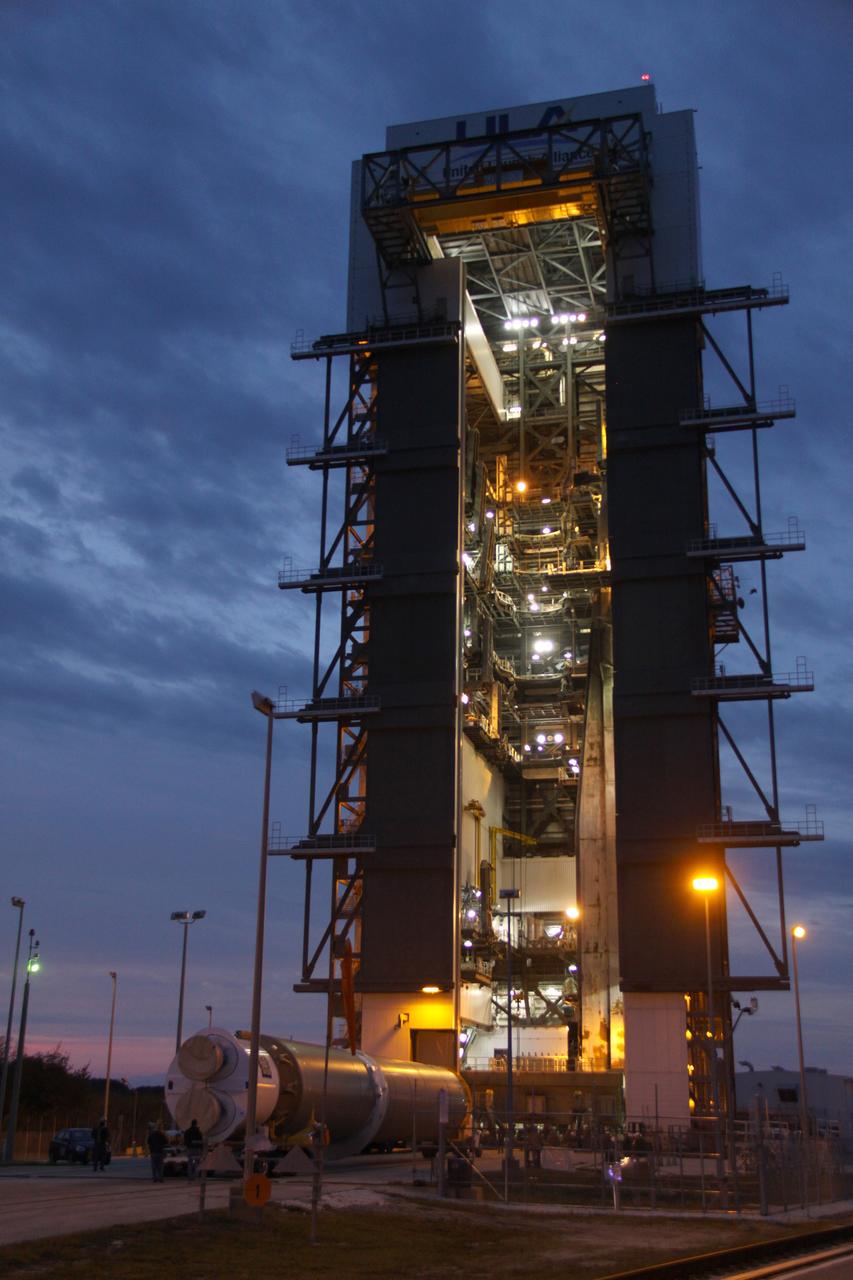
CAPE CANAVERAL, Fla. – The first stage of the United Launch Alliance Atlas V rocket for NASA's Magnetospheric Multiscale mission, or MMS, arrives at the mobile service tower at Space Launch Complex 41 on Cape Canaveral Air Force Station in Florida. MMS will study the mystery of how magnetic fields around Earth connect and disconnect, explosively releasing energy via a process known a magnetic reconnection. MMS consists of four identical spacecraft that work together to provide the first three-dimensional view of this fundamental process, which occurs throughout the universe. Launch is set for March 12. To learn more about MMS, visit http://www.nasa.gov/mms. Photo credit: NASA/Jim Grossmann
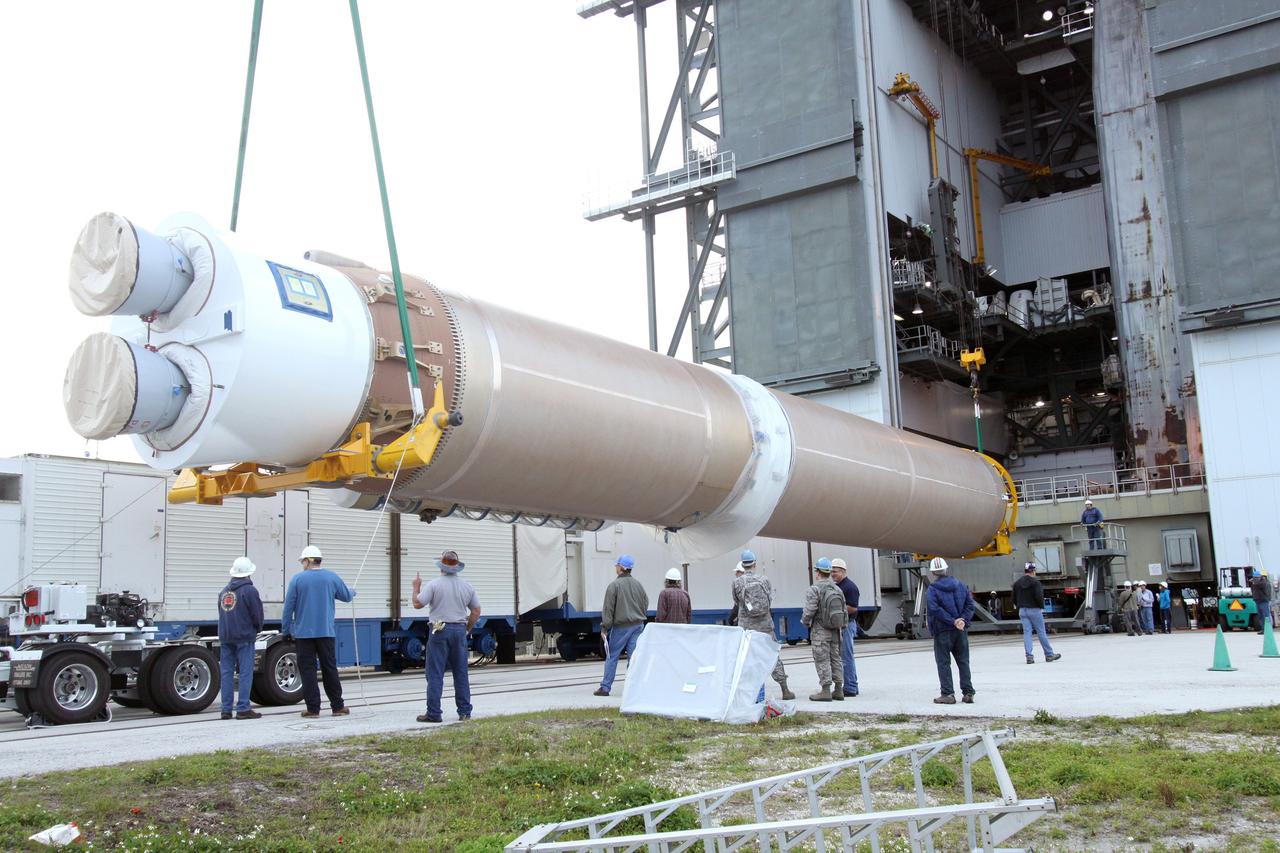
CAPE CANAVERAL, Fla. – The first stage of the United Launch Alliance Atlas V rocket for NASA's Magnetospheric Multiscale mission, or MMS, is lifted into the mobile service tower at Space Launch Complex 41 on Cape Canaveral Air Force Station in Florida. MMS will study the mystery of how magnetic fields around Earth connect and disconnect, explosively releasing energy via a process known a magnetic reconnection. MMS consists of four identical spacecraft that work together to provide the first three-dimensional view of this fundamental process, which occurs throughout the universe. Launch is set for March 12. To learn more about MMS, visit http://www.nasa.gov/mms. Photo credit: NASA/Jim Grossmann
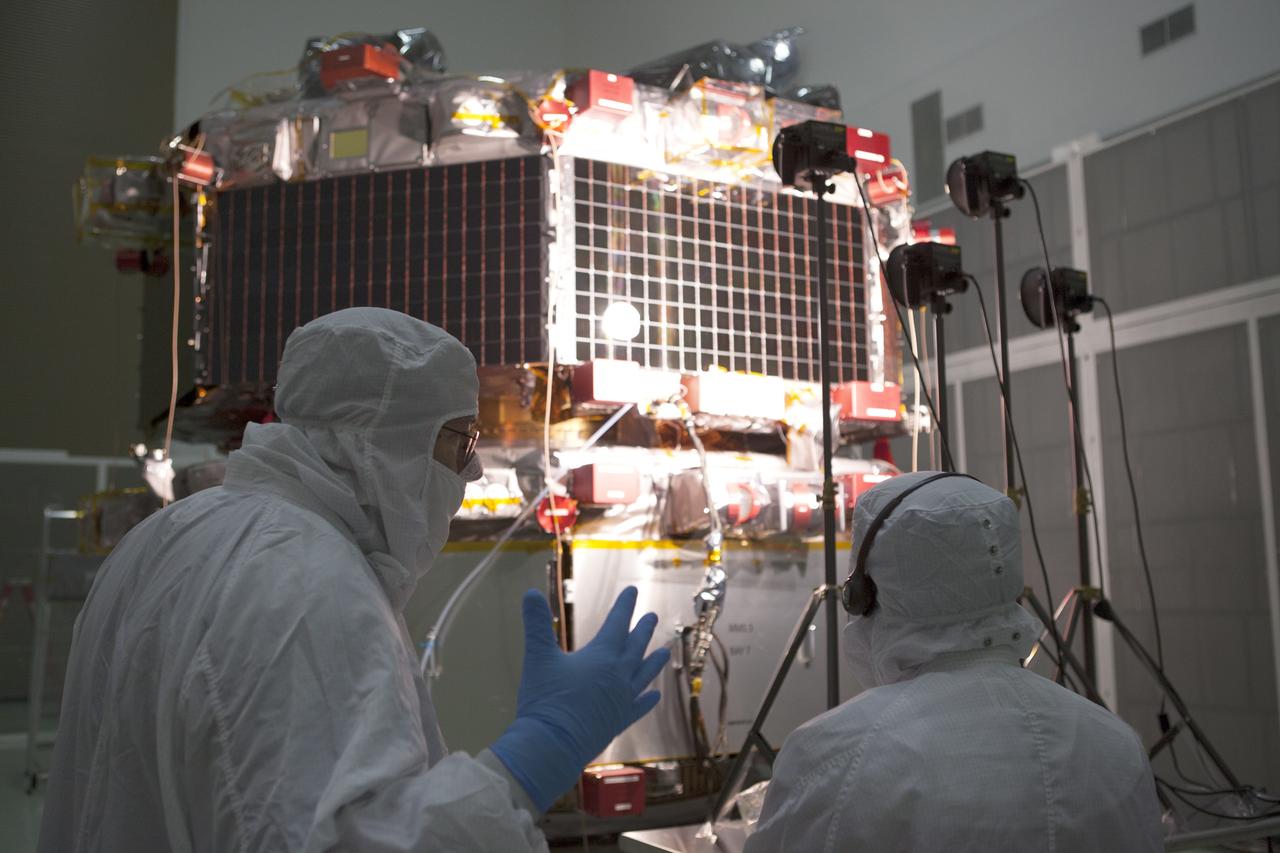
Workers conduct a solar array illumination test on the upper stack of the Magnetospheric Multiscale spacecraft, or MMS, in the Astrotech payload processing facility in Titusville, Florida, near Kennedy Space Center. Illumination testing of the lower instrumentation payload stack was completed in December. Launch aboard a United Launch Alliance Atlas V rocket from Space Launch Complex 41 on Cape Canaveral Air Force Station is targeted for March 12. To learn more about MMS, visit http://www.nasa.gov/mms. Photo credit: NASA/Kim Shiflett
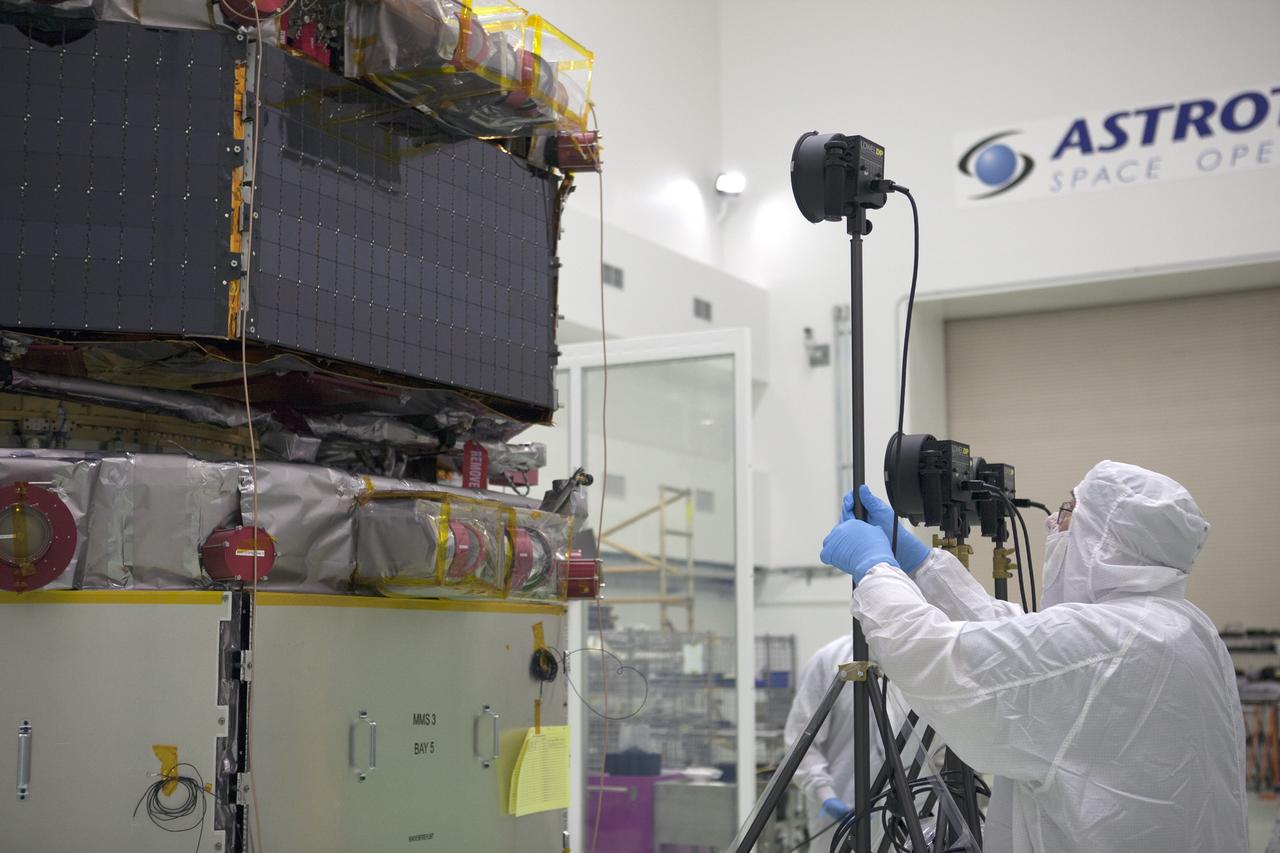
Preparations are underway for illumination testing of the solar panels on the upper stack of the Magnetospheric Multiscale spacecraft, or MMS, in the Astrotech payload processing facility in Titusville, Florida, near Kennedy Space Center. Illumination testing of the lower instrumentation payload stack was completed in December. Launch aboard a United Launch Alliance Atlas V rocket from Space Launch Complex 41 on Cape Canaveral Air Force Station is targeted for March 12. To learn more about MMS, visit http://www.nasa.gov/mms. Photo credit: NASA/Kim Shiflett
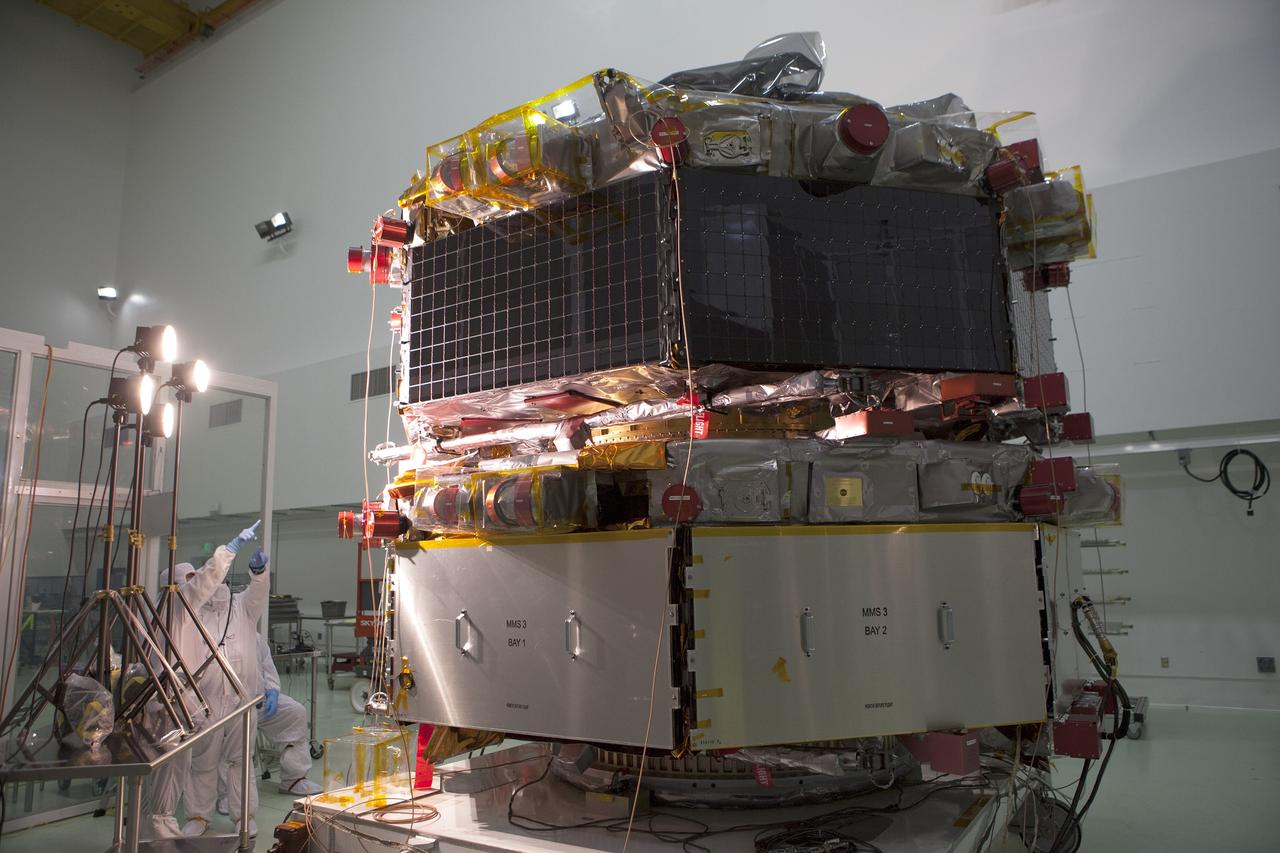
A solar array illumination test is performed on the upper stack of the Magnetospheric Multiscale spacecraft, or MMS, in the Astrotech payload processing facility in Titusville, Florida, near Kennedy Space Center. Illumination testing of the lower instrumentation payload stack was completed in December. Launch aboard a United Launch Alliance Atlas V rocket from Space Launch Complex 41 on Cape Canaveral Air Force Station is targeted for March 12. To learn more about MMS, visit http://www.nasa.gov/mms. Photo credit: NASA/Kim Shiflett
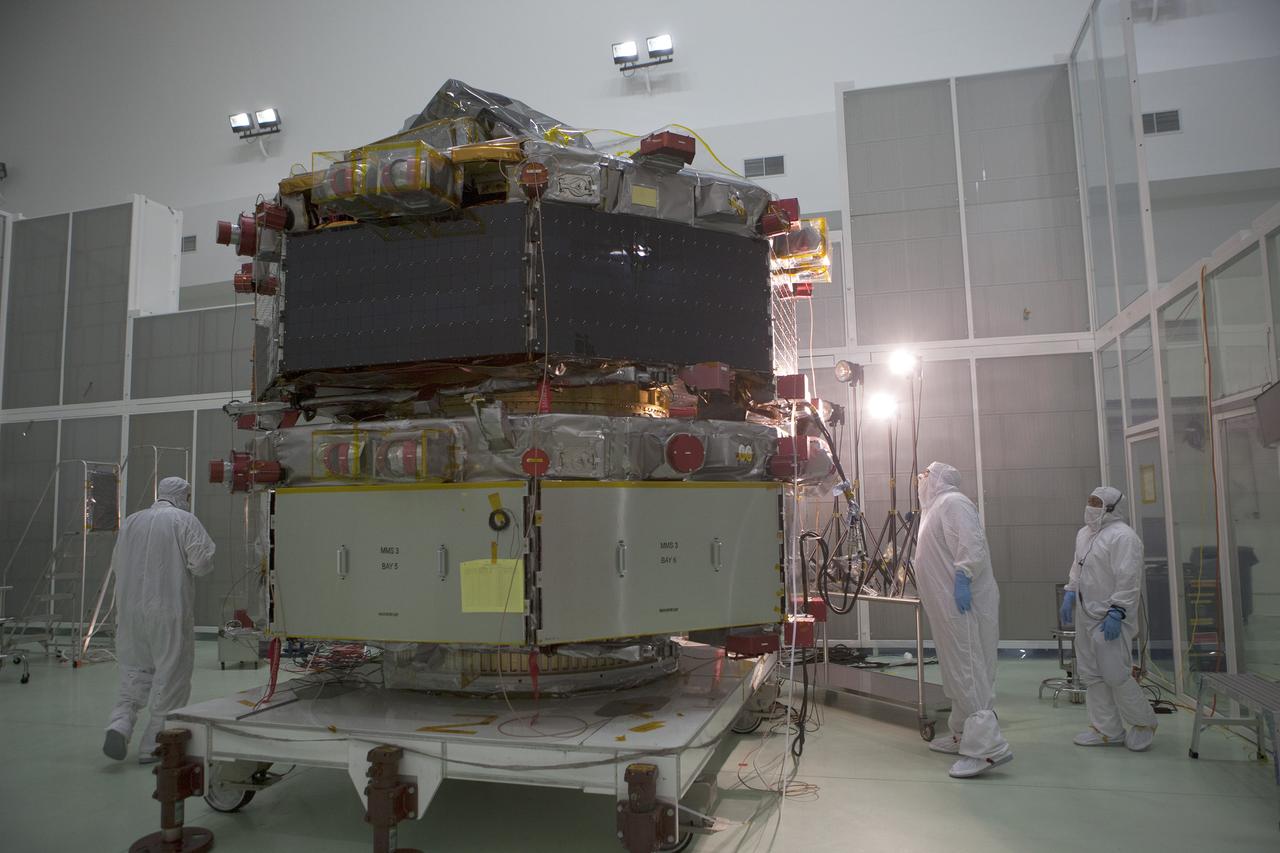
Workers conduct a solar array illumination test on the upper stack of the Magnetospheric Multiscale spacecraft, or MMS, in the Astrotech payload processing facility in Titusville, Florida, near Kennedy Space Center. Illumination testing of the lower instrumentation payload stack was completed in December. Launch aboard a United Launch Alliance Atlas V rocket from Space Launch Complex 41 on Cape Canaveral Air Force Station is targeted for March 12. To learn more about MMS, visit http://www.nasa.gov/mms. Photo credit: NASA/Kim Shiflett
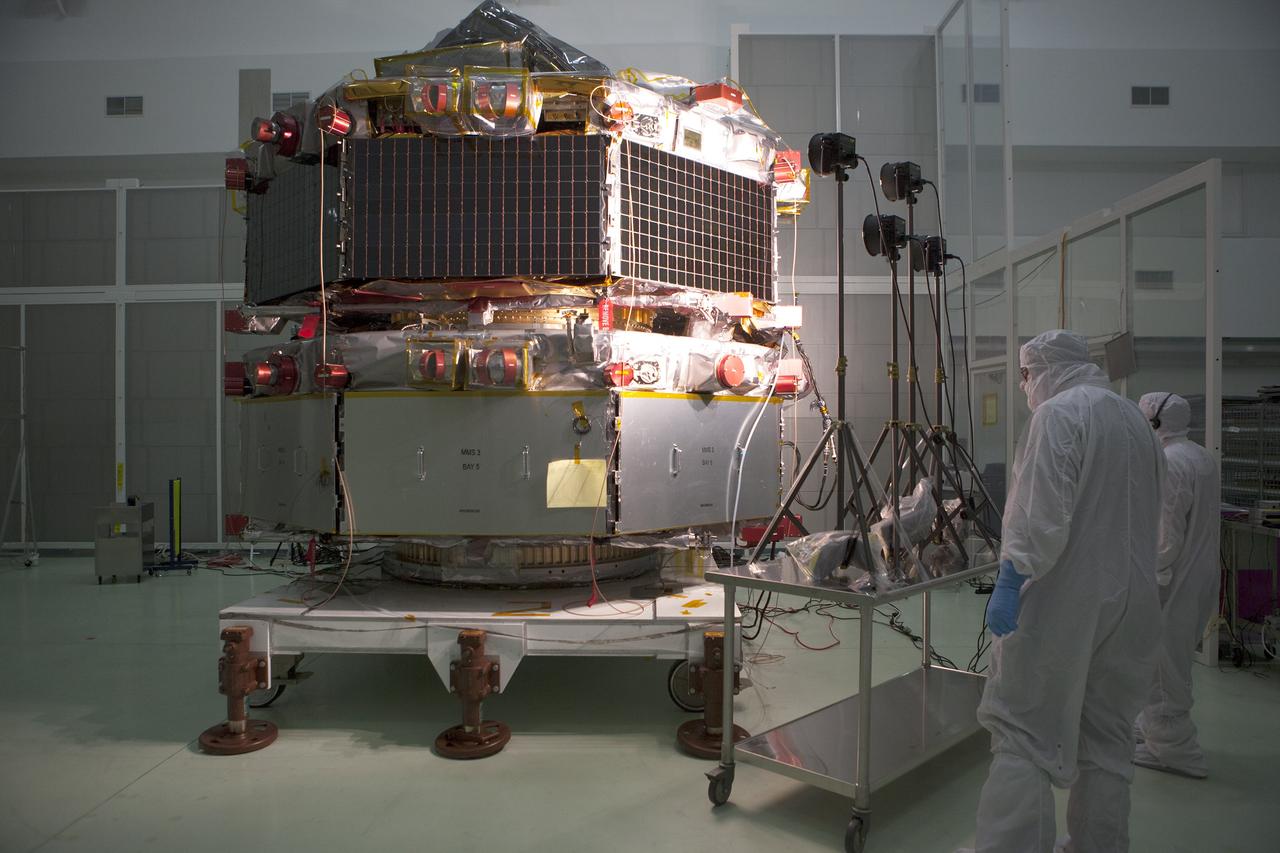
A solar array illumination test is performed on the upper stack of the Magnetospheric Multiscale spacecraft, or MMS, in the Astrotech payload processing facility in Titusville, Florida, near Kennedy Space Center. Illumination testing of the lower instrumentation payload stack was completed in December. Launch aboard a United Launch Alliance Atlas V rocket from Space Launch Complex 41 on Cape Canaveral Air Force Station is targeted for March 12. To learn more about MMS, visit http://www.nasa.gov/mms. Photo credit: NASA/Kim Shiflett
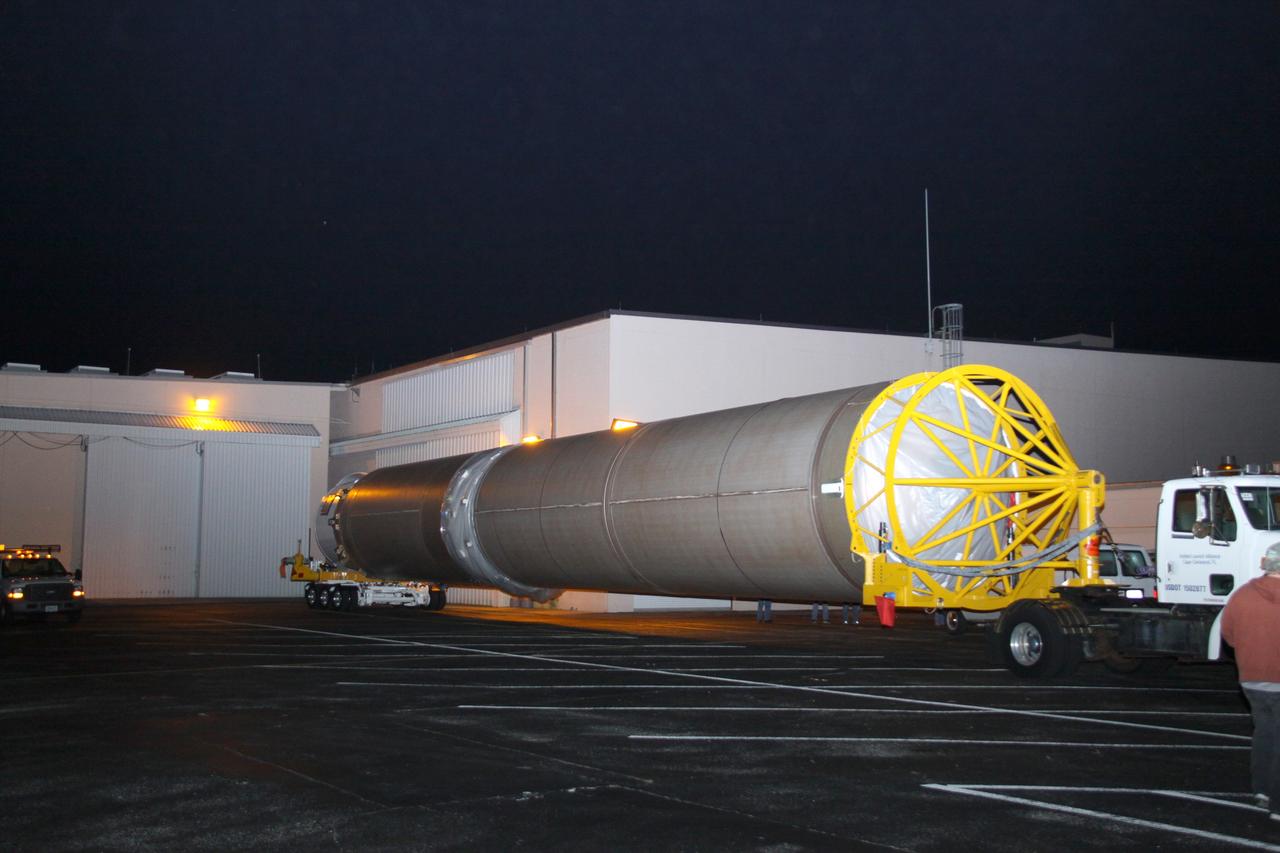
CAPE CANAVERAL, Fla. – The first stage of the United Launch Alliance Atlas V rocket for NASA's Magnetospheric Multiscale mission, or MMS, begins the short journey from the Atlas Spaceflight Operations Center, or ASOC, on Cape Canaveral Air Force Station in Florida to Space Launch Complex 41. MMS will study the mystery of how magnetic fields around Earth connect and disconnect, explosively releasing energy via a process known a magnetic reconnection. MMS consists of four identical spacecraft that work together to provide the first three-dimensional view of this fundamental process, which occurs throughout the universe. Launch is set for March 12. To learn more about MMS, visit http://www.nasa.gov/mms. Photo credit: NASA/Jim Grossmann
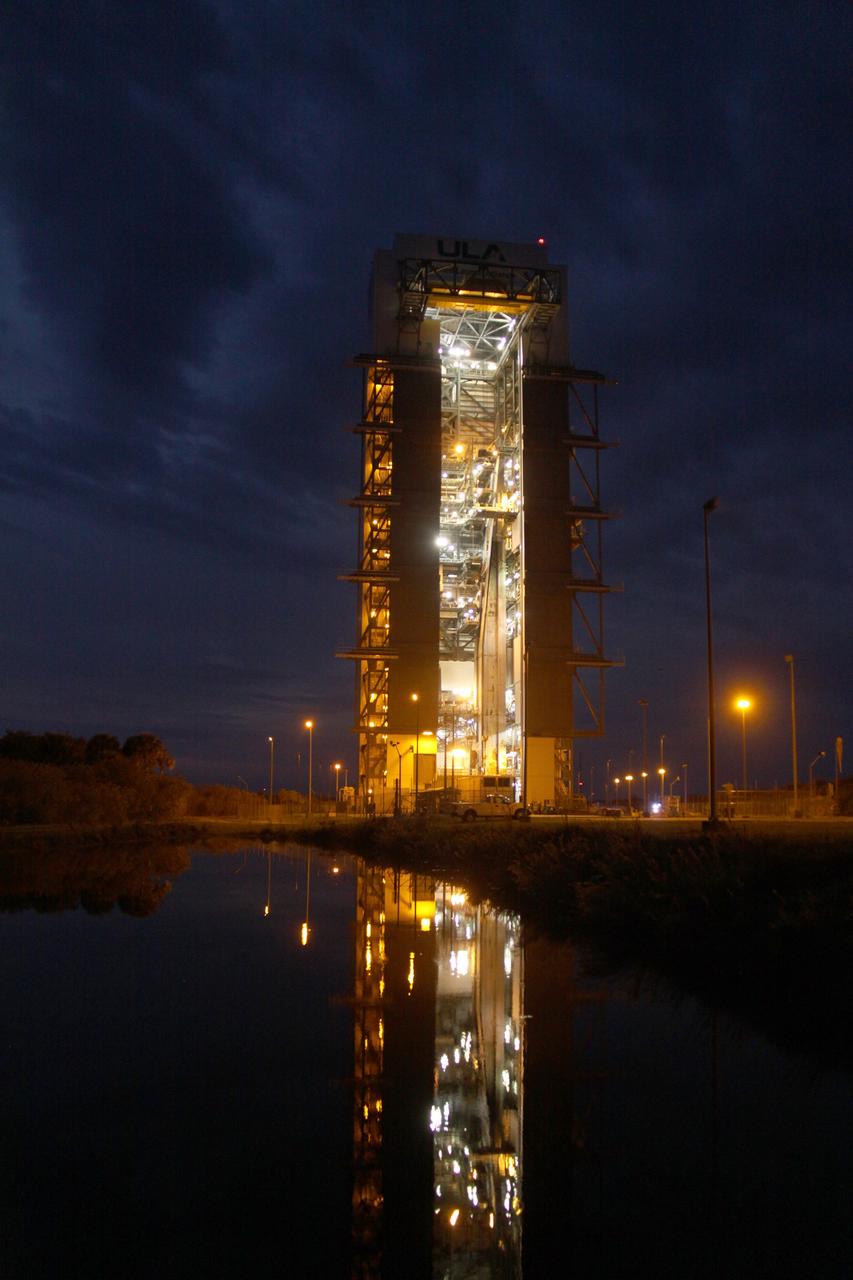
CAPE CANAVERAL, Fla. – Preparations are underway in the mobile service tower at Space Launch Complex 41 on Cape Canaveral Air Force Station in Florida for the arrival of the first stage of a United Launch Alliance Atlas V rocket from the Atlas Spaceflight Operations Center, or ASOC. The rocket will launch NASA's Magnetospheric Multiscale mission, or MMS. MMS will study the mystery of how magnetic fields around Earth connect and disconnect, explosively releasing energy via a process known a magnetic reconnection. MMS consists of four identical spacecraft that work together to provide the first three-dimensional view of this fundamental process, which occurs throughout the universe. Launch is set for March 12. To learn more about MMS, visit http://www.nasa.gov/mms. Photo credit: NASA/Jim Grossmann
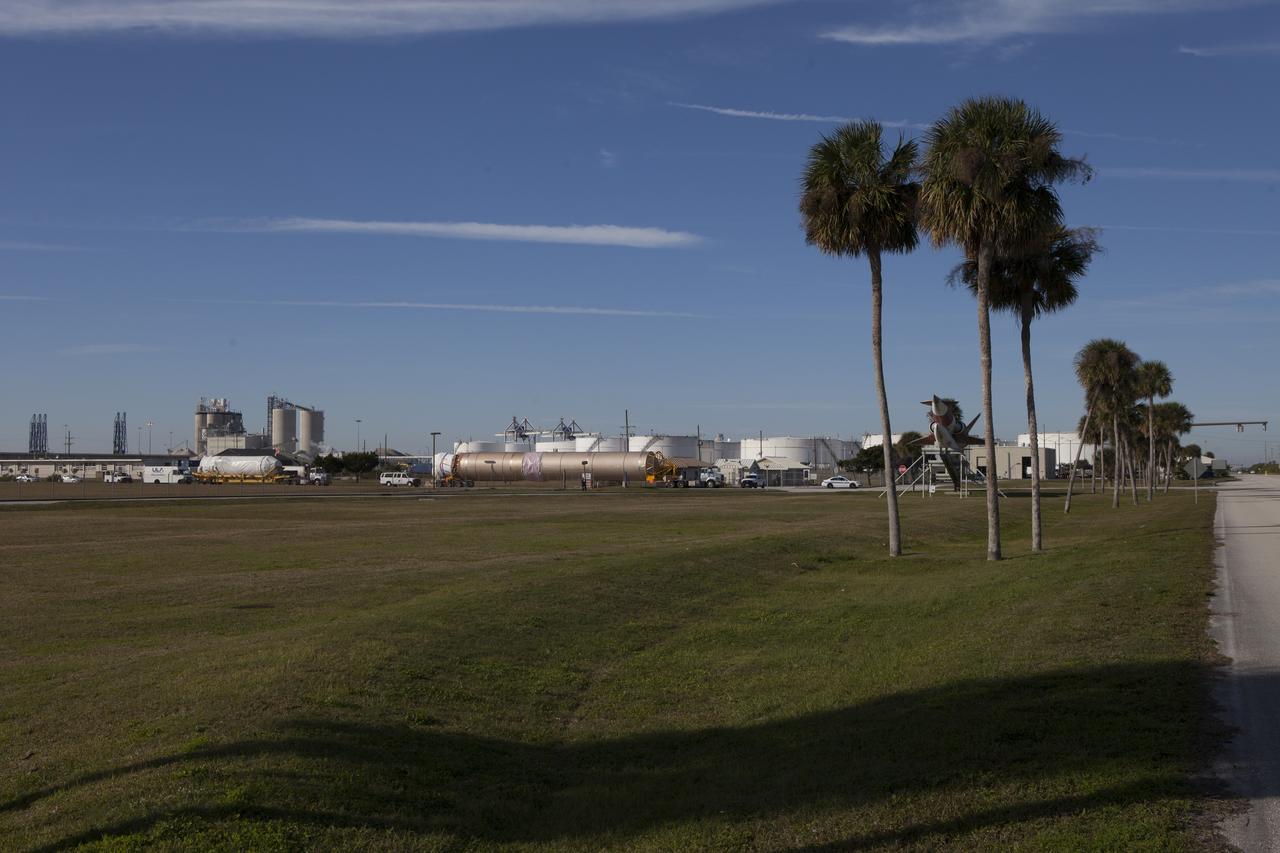
Trucks transport the Atlas V rocket and Centaur upper stage from the United Launch Alliance Delta Mariner to the Atlas V Spaceflight Operations Center at Cape Canaveral Air Force Station. The rocket will be used to launch NASA's Magnetospheric Multiscale mission.
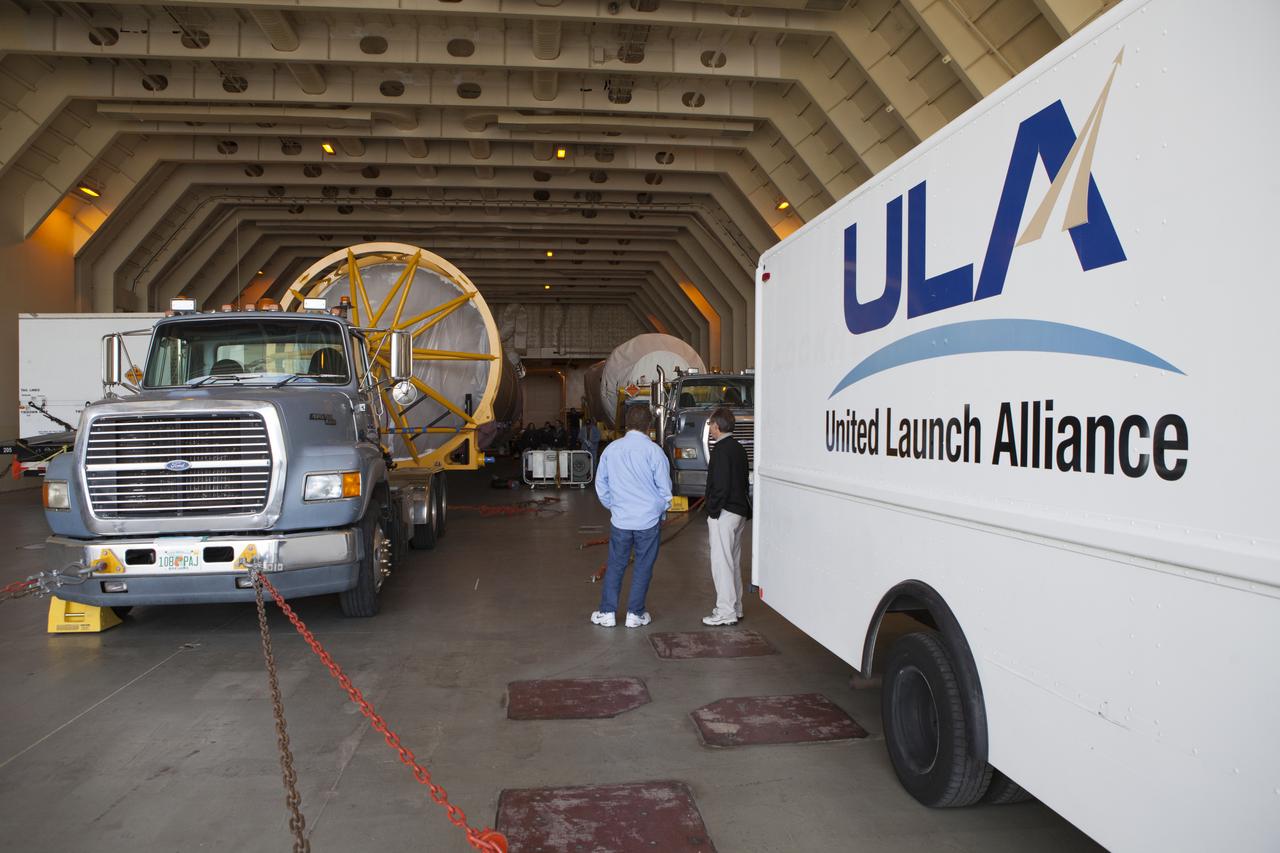
Trucks inside the United Launch Alliance Delta Mariner prepare to transport the Atlas V rocket and Centaur upper stage that will be used to launch NASA's Magnetospheric Multiscale mission.
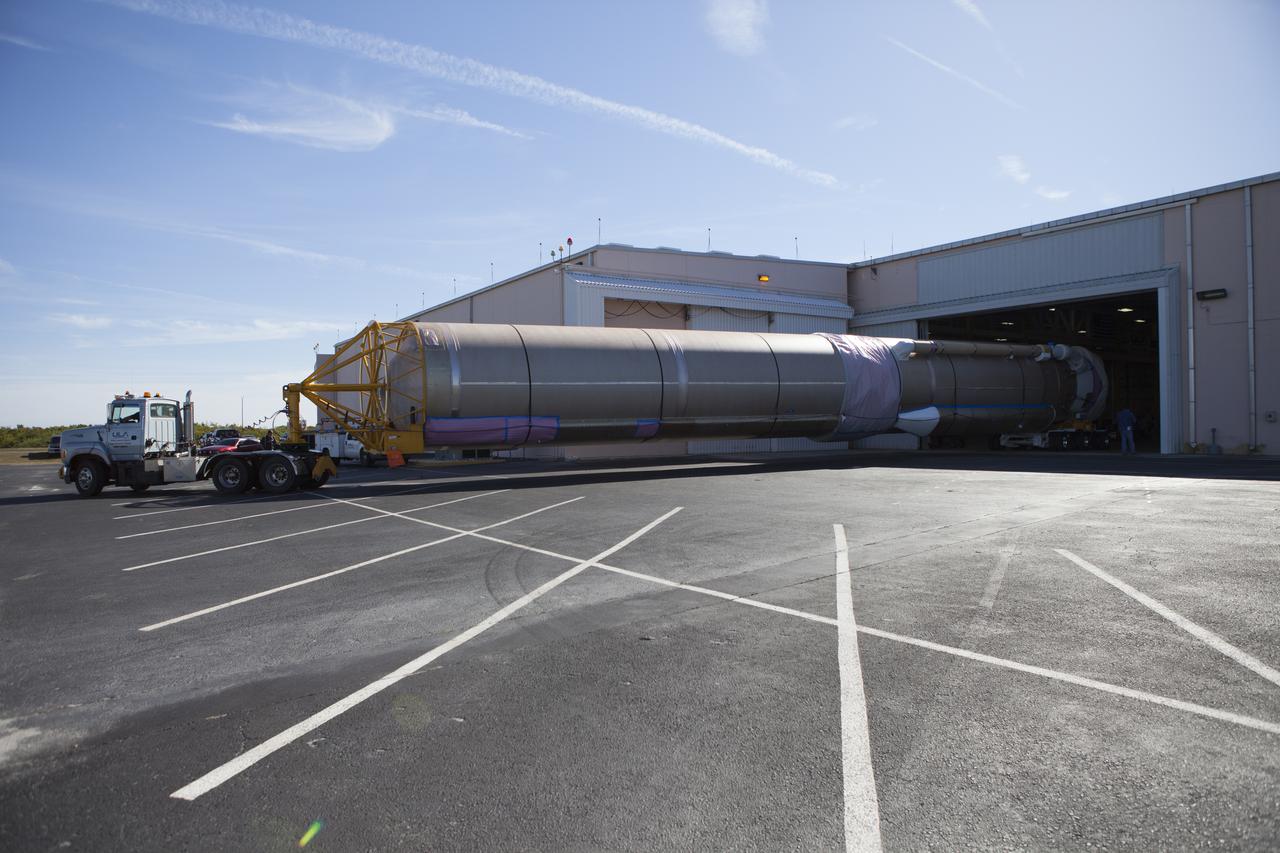
A truck positions an Atlas V booster stage inside the hangar at the Atlas V Spaceflight Operations Center at Cape Canaveral Air Force Station. The rocket will be used to launch NASA's Magnetospheric Multiscale mission.
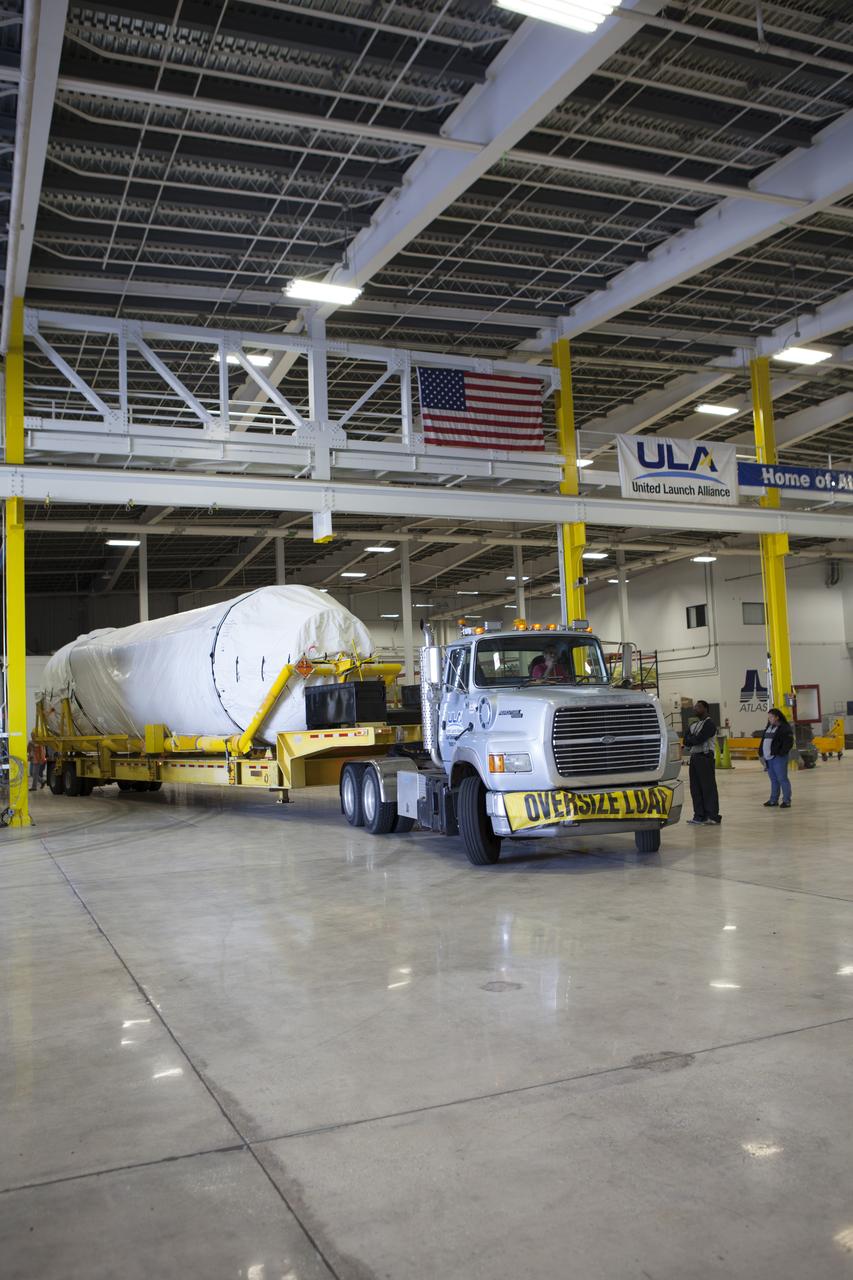
A truck positions a Centaur upper stage inside the hangar at the Atlas V Spaceflight Operations Center at Cape Canaveral Air Force Station. The upper stage will be used as part of the Atlas V rocket that will be used to launch NASA's Magnetospheric Multiscale mission.
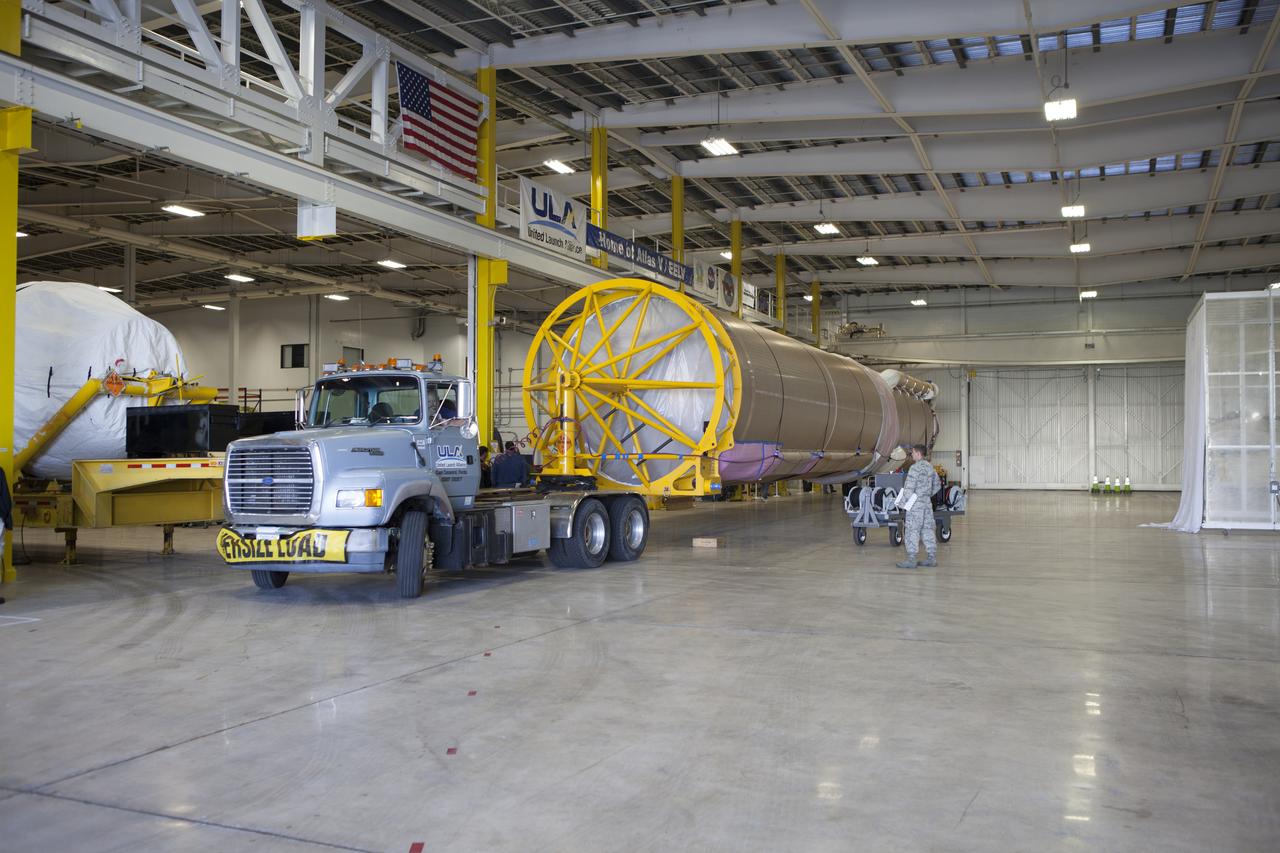
A truck positions an Atlas V booster stage inside the hangar at the Atlas V Spaceflight Operations Center at Cape Canaveral Air Force Station. The rocket will be used to launch NASA's Magnetospheric Multiscale mission.
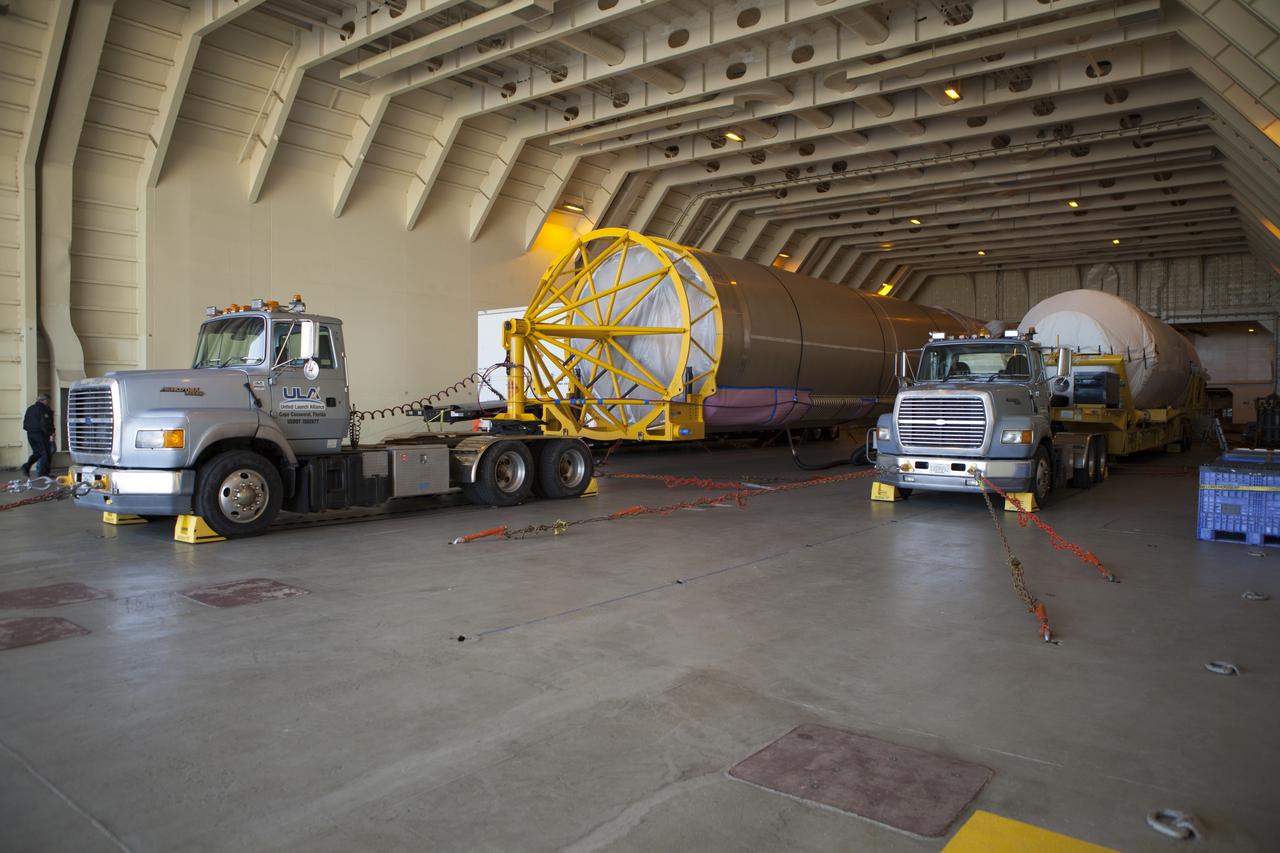
Trucks inside the United Launch Alliance Delta Mariner prepare to transport the Atlas V rocket and Centaur upper stage that will be used to launch NASA's Magnetospheric Multiscale mission.
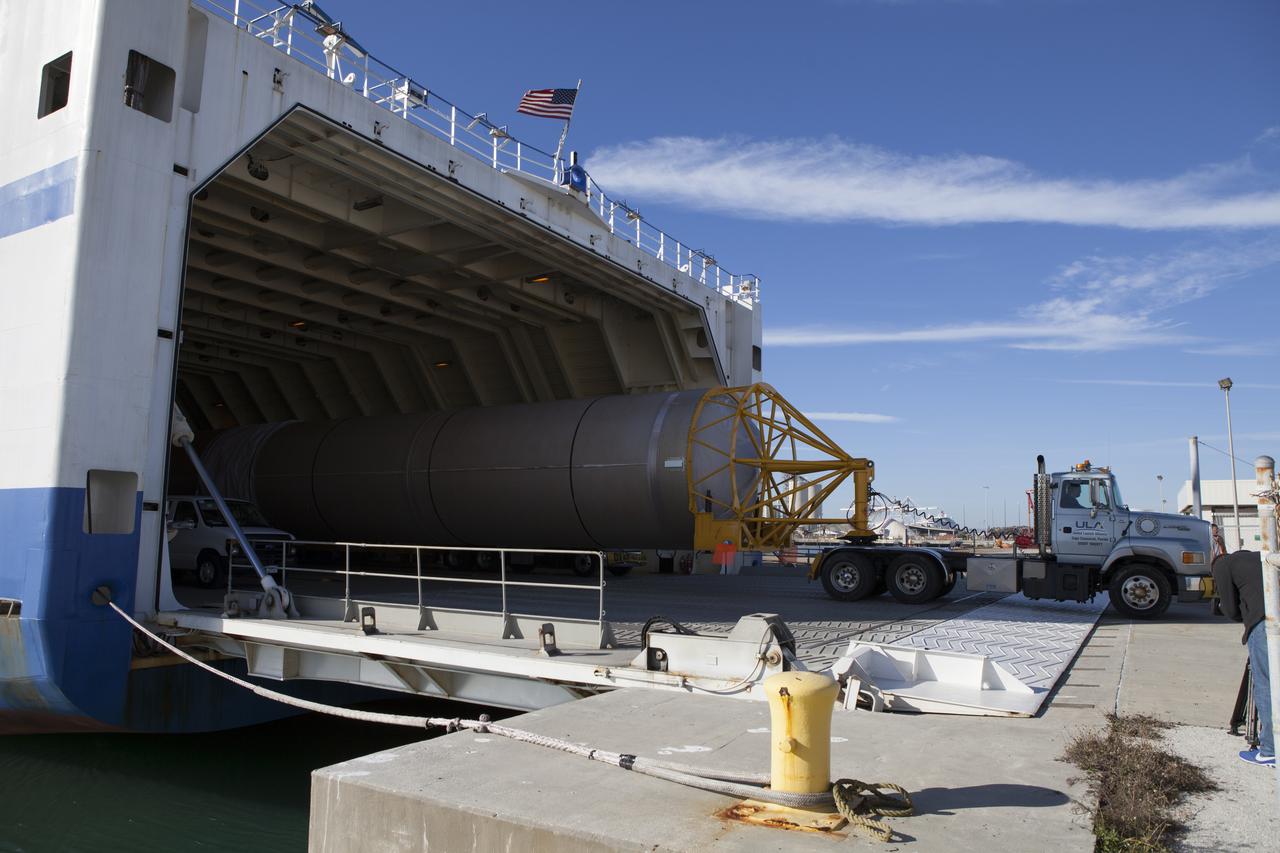
A truck begins to transport the Atlas V booster stage from the United Launch Alliance Delta Mariner. The rocket will be used to launch NASA's Magnetospheric Multiscale mission.
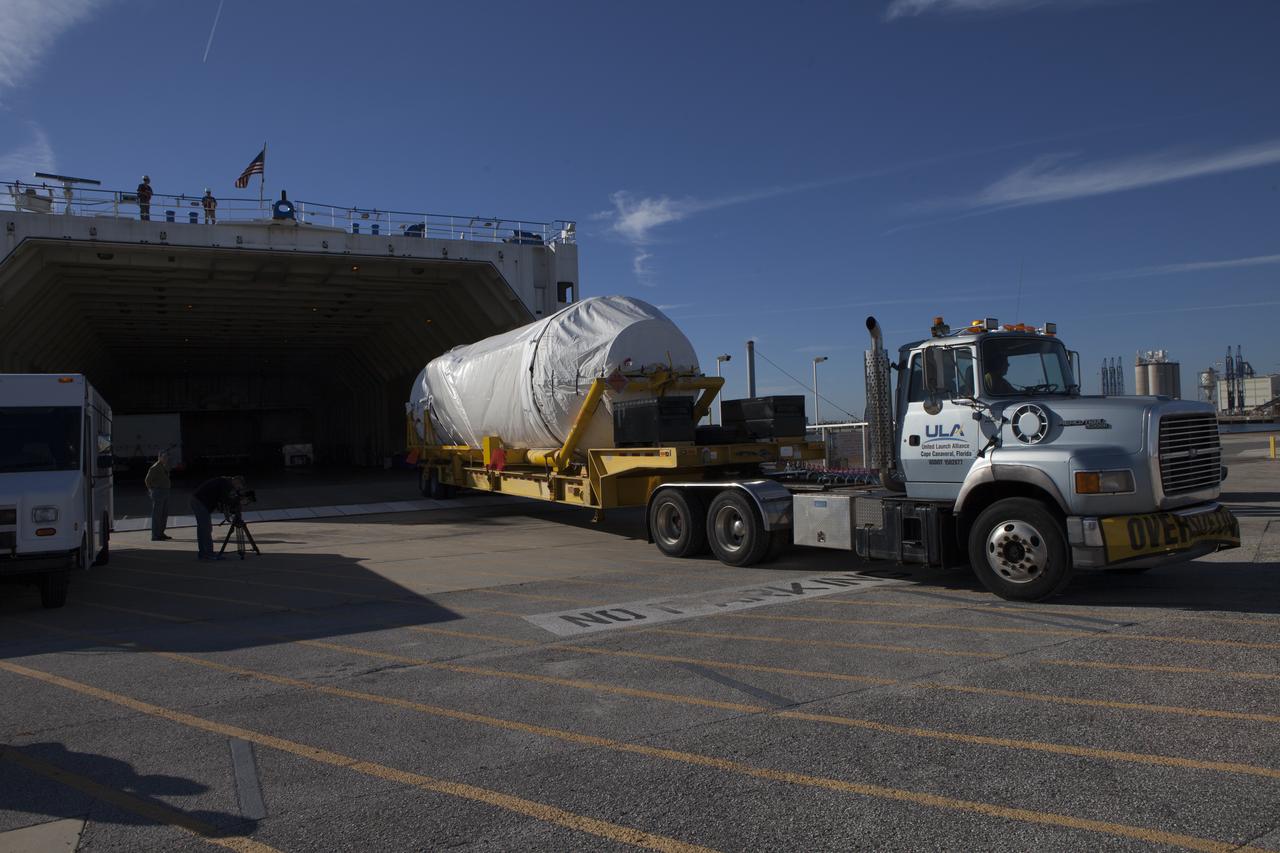
A truck begins to transport a Centaur upper stage from the United Launch Alliance Delta Mariner to the Atlas V Spaceflight Operations Center at Cape Canaveral Air Force Station. The rocket will be used to launch NASA's Magnetospheric Multiscale mission.
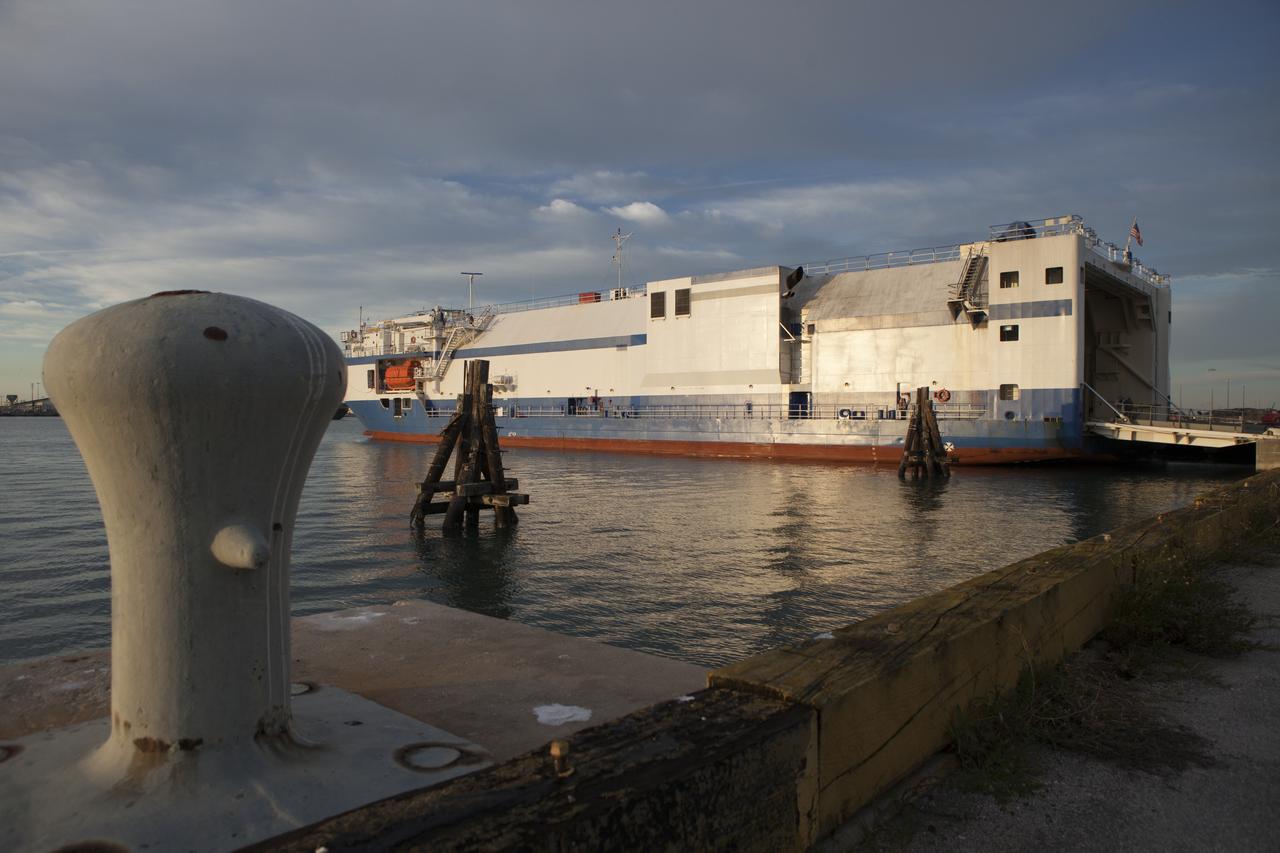
The United Launch Alliance Delta Mariner arrives at Port Canaveral to deliver the Atlas V rocket that will be used to launch NASA's Magnetospheric Multiscale mission.
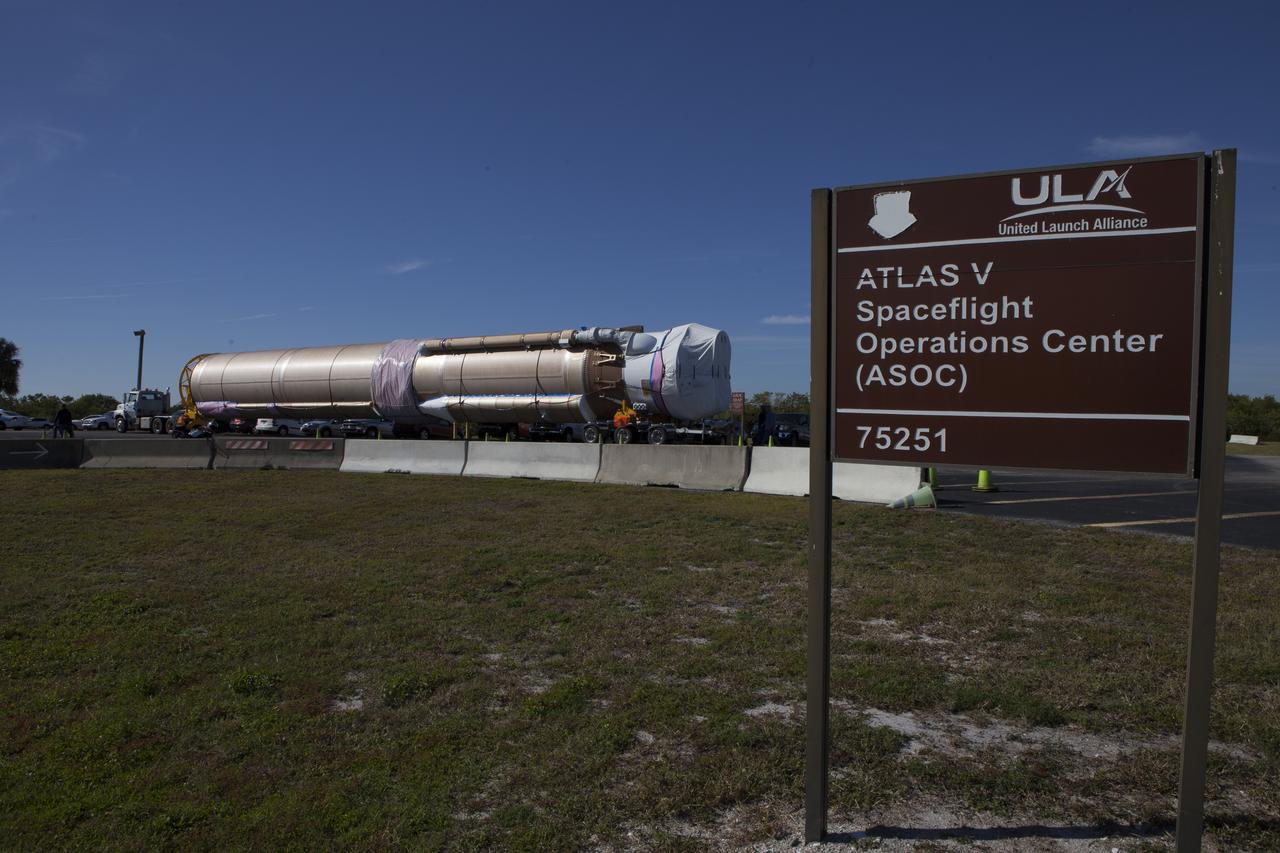
Trucks transport the Atlas V rocket and Centaur upper stage from the United Launch Alliance Delta Mariner to the Atlas V Spaceflight Operations Center at Cape Canaveral Air Force Station. The rocket will be used to launch NASA's Magnetospheric Multiscale mission.
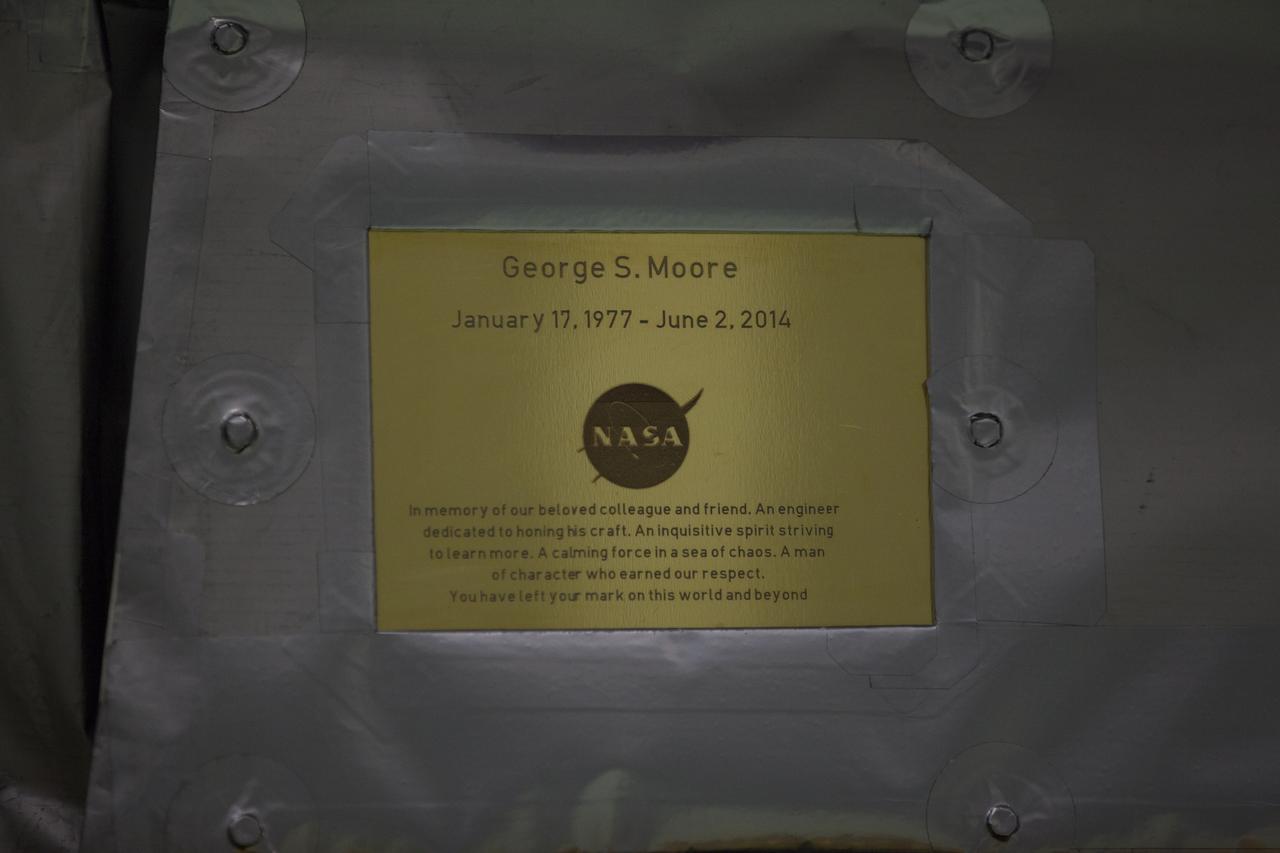
A plaque affixed to the side of a Magnetospheric Multiscale, or MMS, observatory dedicates the mission to George S. Moore, now deceased, an engineer who was a beloved colleague and friend to the MMS team. MMS, led by a team from NASA's Goddard Space Flight Center, is a Solar Terrestrial Probes mission consisting of four identically instrumented spacecraft that will use Earth’s magnetosphere as a laboratory to study the microphysics of three fundamental plasma processes: magnetic reconnection, energetic particle acceleration and turbulence. Launch aboard a United Launch Alliance Atlas V rocket from Space Launch Complex 41 on Cape Canaveral Air Force Station is targeted for March 12, 2015.
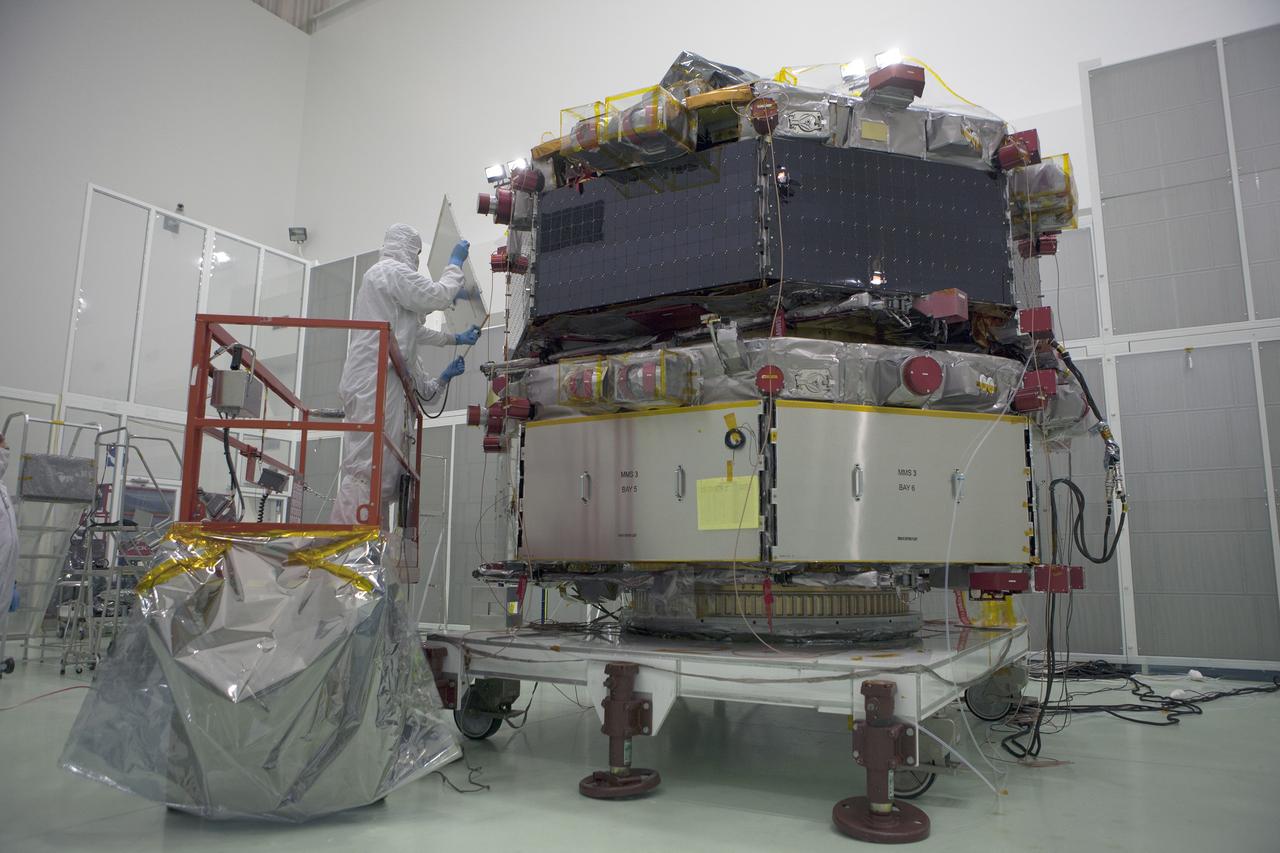
The protective covers are removed from around the solar panels on the upper stack of the Magnetospheric Multiscale spacecraft, or MMS, in the Astrotech payload processing facility in Titusville, Florida, near Kennedy Space Center. Preparations are underway for illumination testing of the spacecraft's upper stack. Illumination testing of the lower instrumentation payload stack was completed in December. Launch aboard a United Launch Alliance Atlas V rocket from Space Launch Complex 41 on Cape Canaveral Air Force Station is targeted for March 12. To learn more about MMS, visit http://www.nasa.gov/mms. Photo credit: NASA/Kim Shiflett
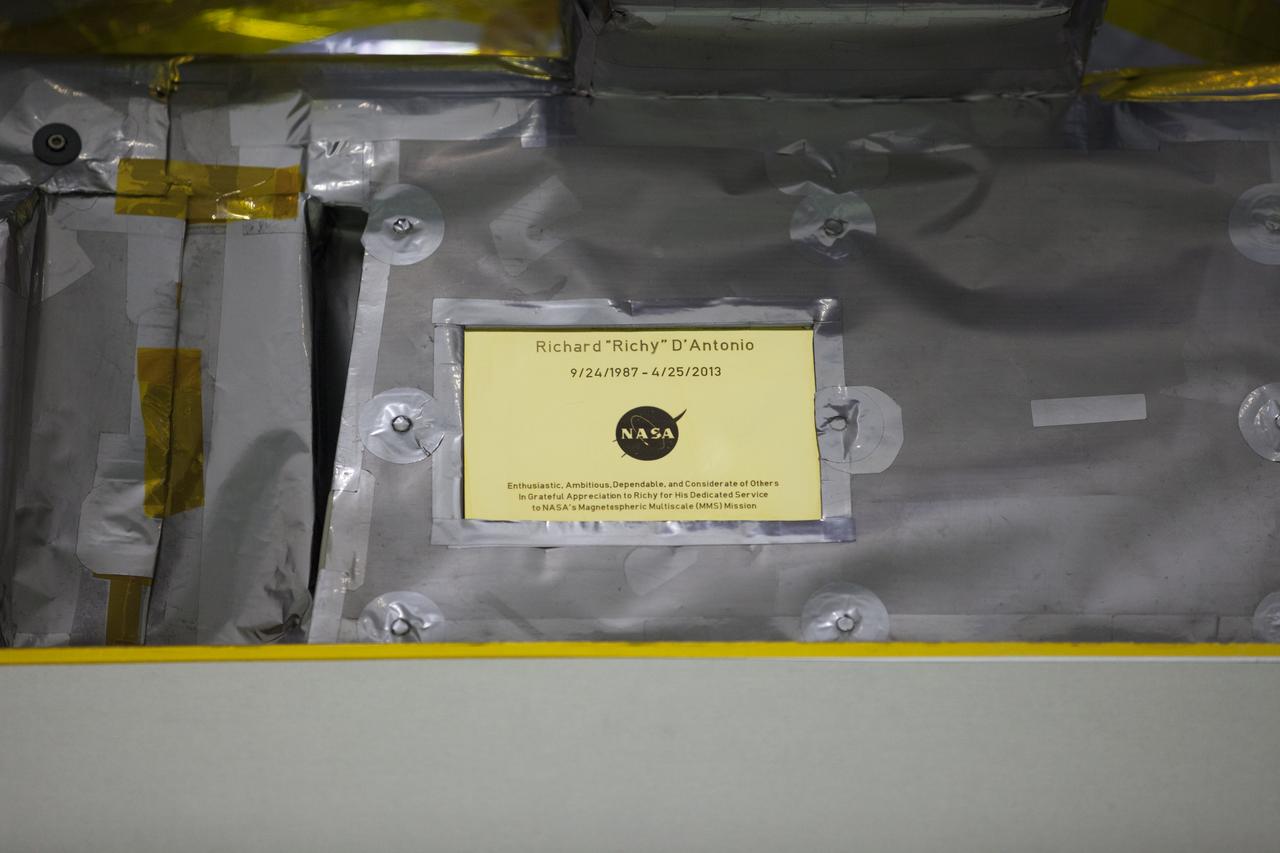
A plaque affixed to the side of a Magnetospheric Multiscale, or MMS, observatory dedicates the mission to Richard “Richy” D’Antonio, now deceased, in grateful appreciation for his dedicated service to NASA’s MMS mission. MMS, led by a team from NASA's Goddard Space Flight Center, is a Solar Terrestrial Probes mission consisting of four identically instrumented spacecraft that will use Earth’s magnetosphere as a laboratory to study the microphysics of three fundamental plasma processes: magnetic reconnection, energetic particle acceleration and turbulence. Launch aboard a United Launch Alliance Atlas V rocket from Space Launch Complex 41 on Cape Canaveral Air Force Station is targeted for March 12, 2015.
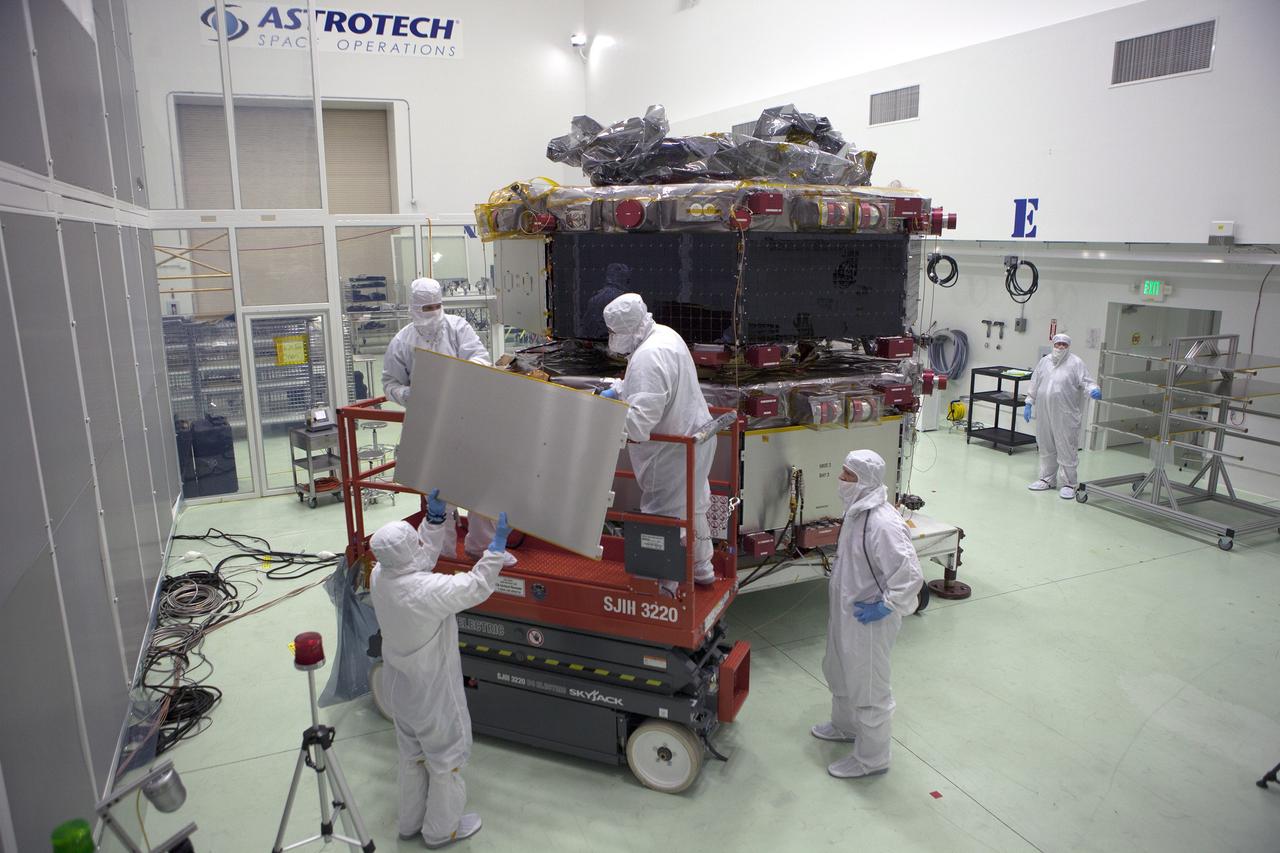
The protective covers are removed from around the solar panels on the upper stack of the Magnetospheric Multiscale spacecraft, or MMS, in the Astrotech payload processing facility in Titusville, Florida, near Kennedy Space Center. Preparations are underway for illumination testing of the spacecraft's upper stack. Illumination testing of the lower instrumentation payload stack was completed in December. Launch aboard a United Launch Alliance Atlas V rocket from Space Launch Complex 41 on Cape Canaveral Air Force Station is targeted for March 12. To learn more about MMS, visit http://www.nasa.gov/mms. Photo credit: NASA/Kim Shiflett
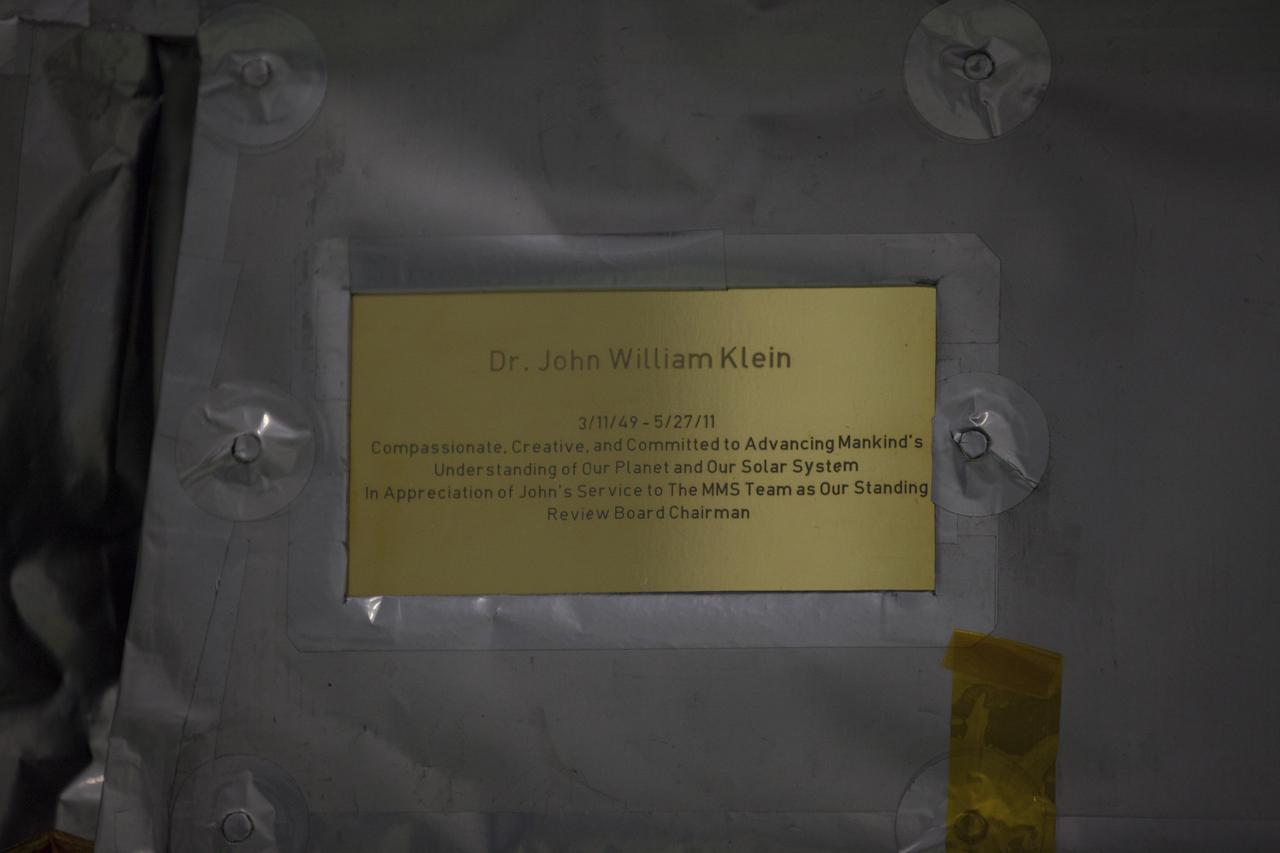
A plaque affixed to the side of a Magnetospheric Multiscale, or MMS, observatory dedicates the mission to Dr. John William Klein, now deceased, who served the MMS team as the standing review board chairman. MMS, led by a team from NASA's Goddard Space Flight Center, is a Solar Terrestrial Probes mission consisting of four identically instrumented spacecraft that will use Earth’s magnetosphere as a laboratory to study the microphysics of three fundamental plasma processes: magnetic reconnection, energetic particle acceleration and turbulence. Launch aboard a United Launch Alliance Atlas V rocket from Space Launch Complex 41 on Cape Canaveral Air Force Station is targeted for March 12, 2015.
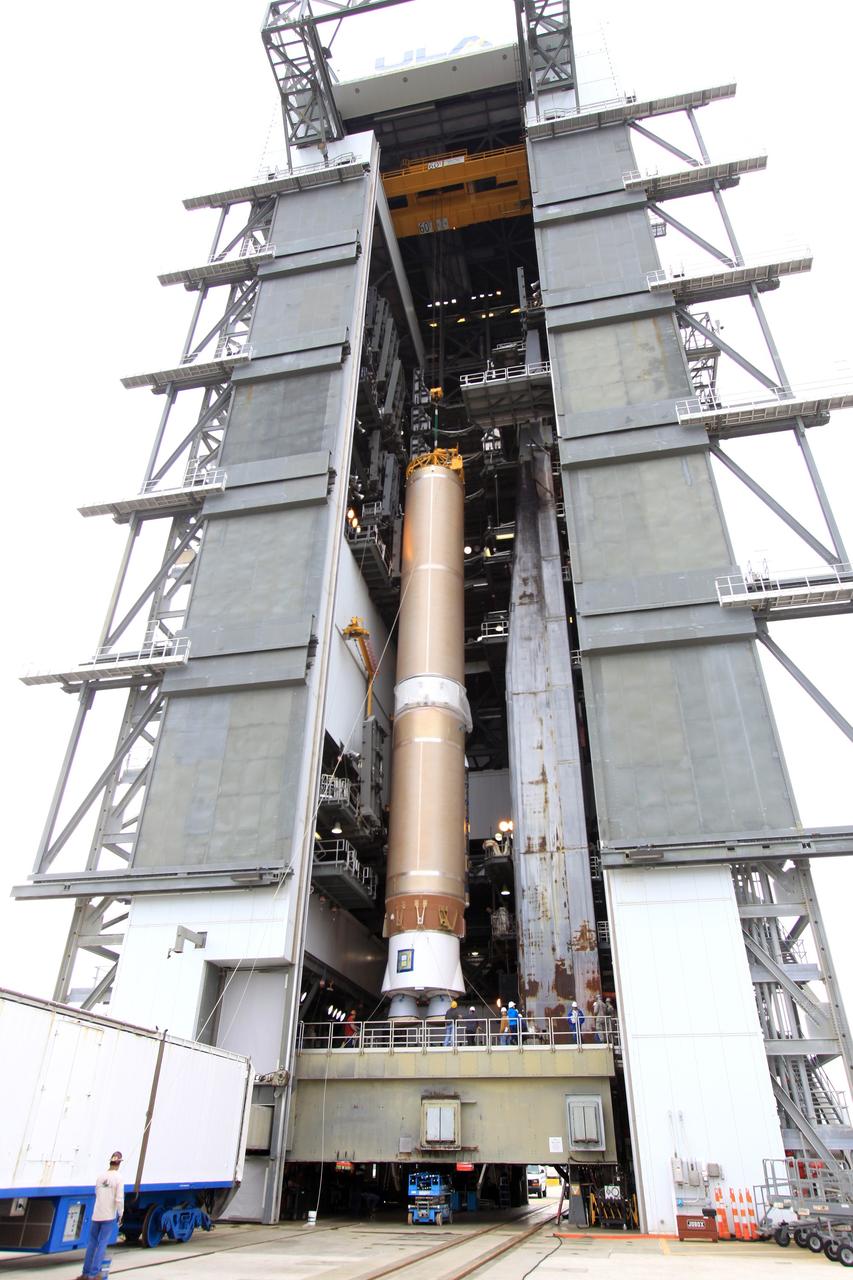
CAPE CANAVERAL, Fla. – The first stage of the United Launch Alliance Atlas V rocket for NASA's Magnetospheric Multiscale mission, or MMS, is positioned on the launch platform in the mobile service tower at Space Launch Complex 41 on Cape Canaveral Air Force Station in Florida. MMS will study the mystery of how magnetic fields around Earth connect and disconnect, explosively releasing energy via a process known a magnetic reconnection. MMS consists of four identical spacecraft that work together to provide the first three-dimensional view of this fundamental process, which occurs throughout the universe. Launch is set for March 12. To learn more about MMS, visit http://www.nasa.gov/mms. Photo credit: NASA/Jim Grossmann
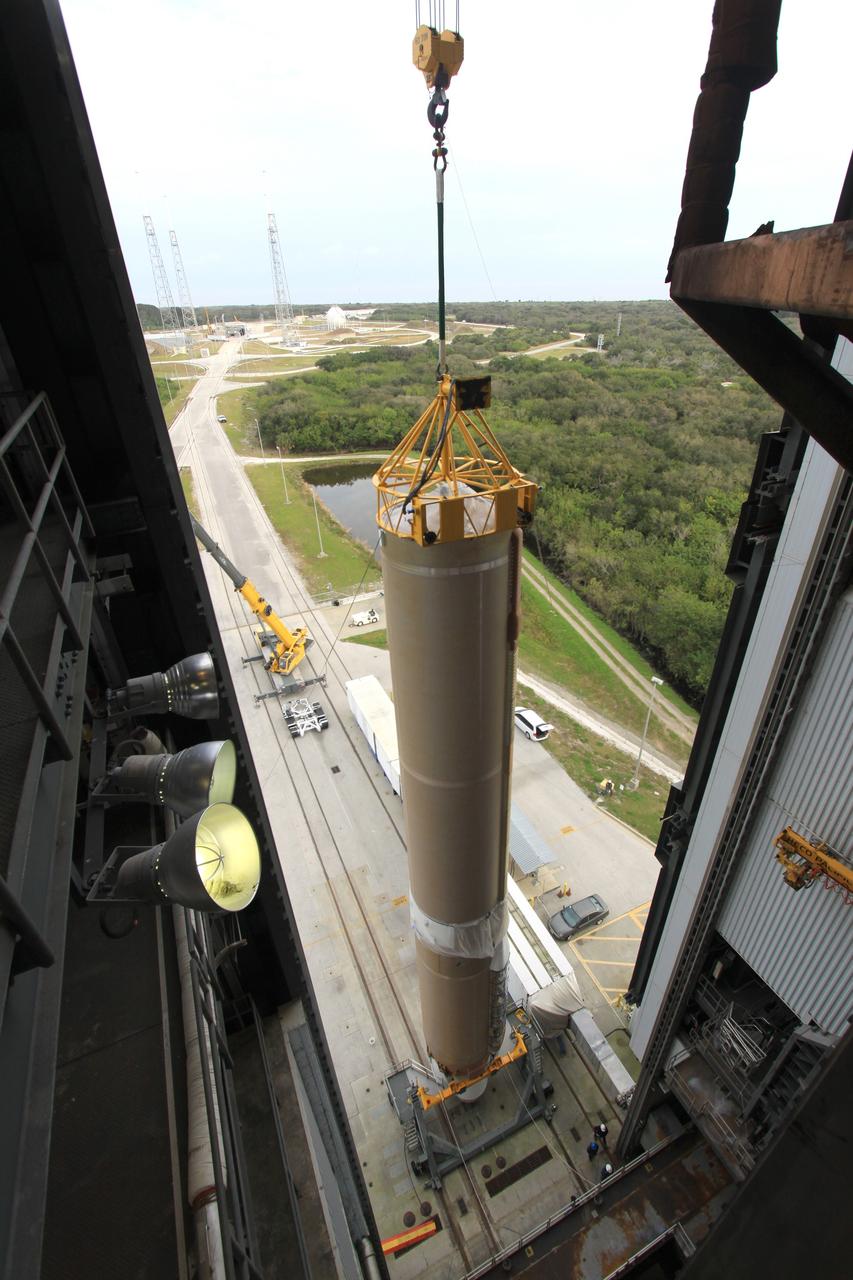
CAPE CANAVERAL, Fla. – A crane lifts the first stage of the United Launch Alliance Atlas V rocket for NASA's Magnetospheric Multiscale mission, or MMS, into the mobile service tower at Space Launch Complex 41 on Cape Canaveral Air Force Station in Florida. MMS will study the mystery of how magnetic fields around Earth connect and disconnect, explosively releasing energy via a process known a magnetic reconnection. MMS consists of four identical spacecraft that work together to provide the first three-dimensional view of this fundamental process, which occurs throughout the universe. Launch is set for March 12. To learn more about MMS, visit http://www.nasa.gov/mms. Photo credit: NASA/Jim Grossmann
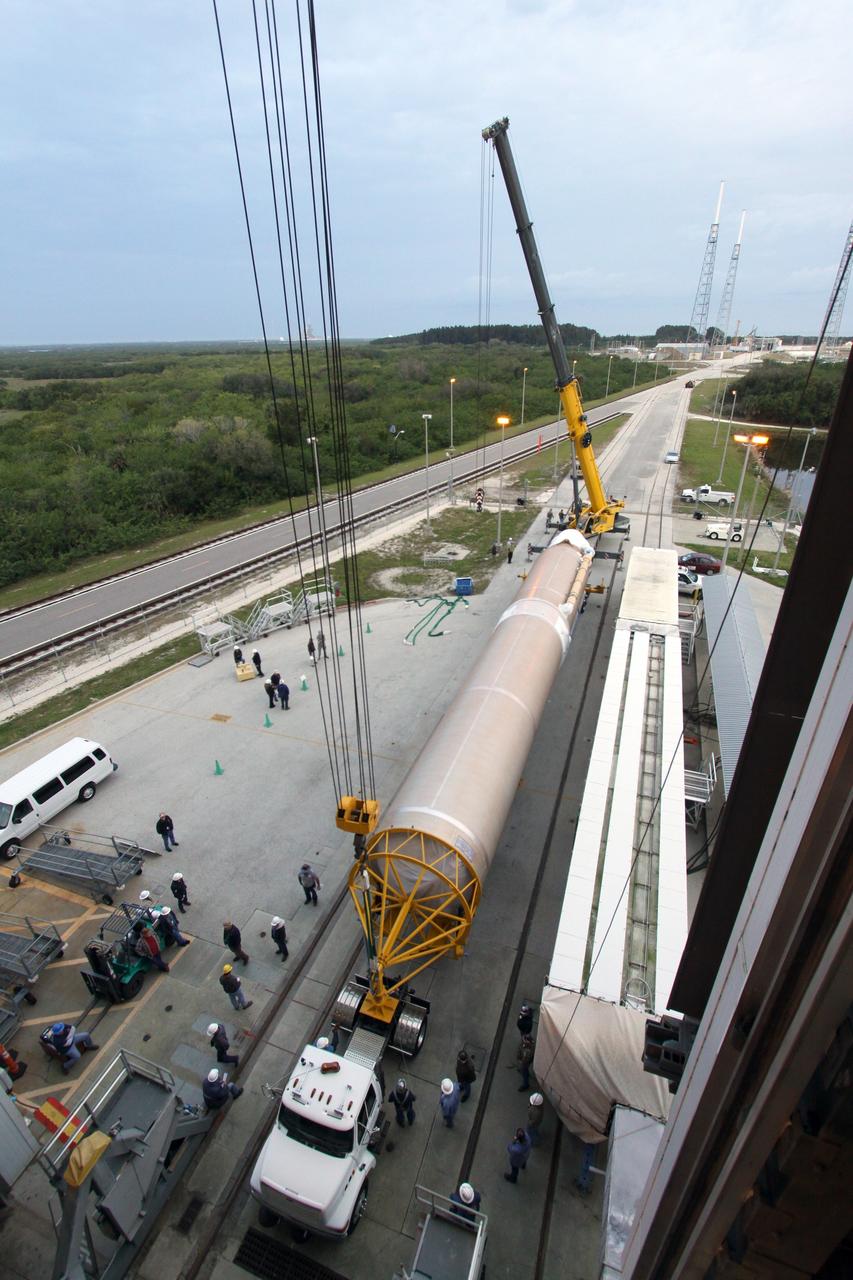
CAPE CANAVERAL, Fla. – Operations are underway at Space Launch Complex 41 on Cape Canaveral Air Force Station in Florida to lift the newly delivered first stage of a United Launch Alliance Atlas V rocket into the mobile service tower. The rocket will launch NASA's Magnetospheric Multiscale mission, or MMS. MMS will study the mystery of how magnetic fields around Earth connect and disconnect, explosively releasing energy via a process known a magnetic reconnection. MMS consists of four identical spacecraft that work together to provide the first three-dimensional view of this fundamental process, which occurs throughout the universe. Launch is set for March 12. To learn more about MMS, visit http://www.nasa.gov/mms. Photo credit: NASA/Jim Grossmann
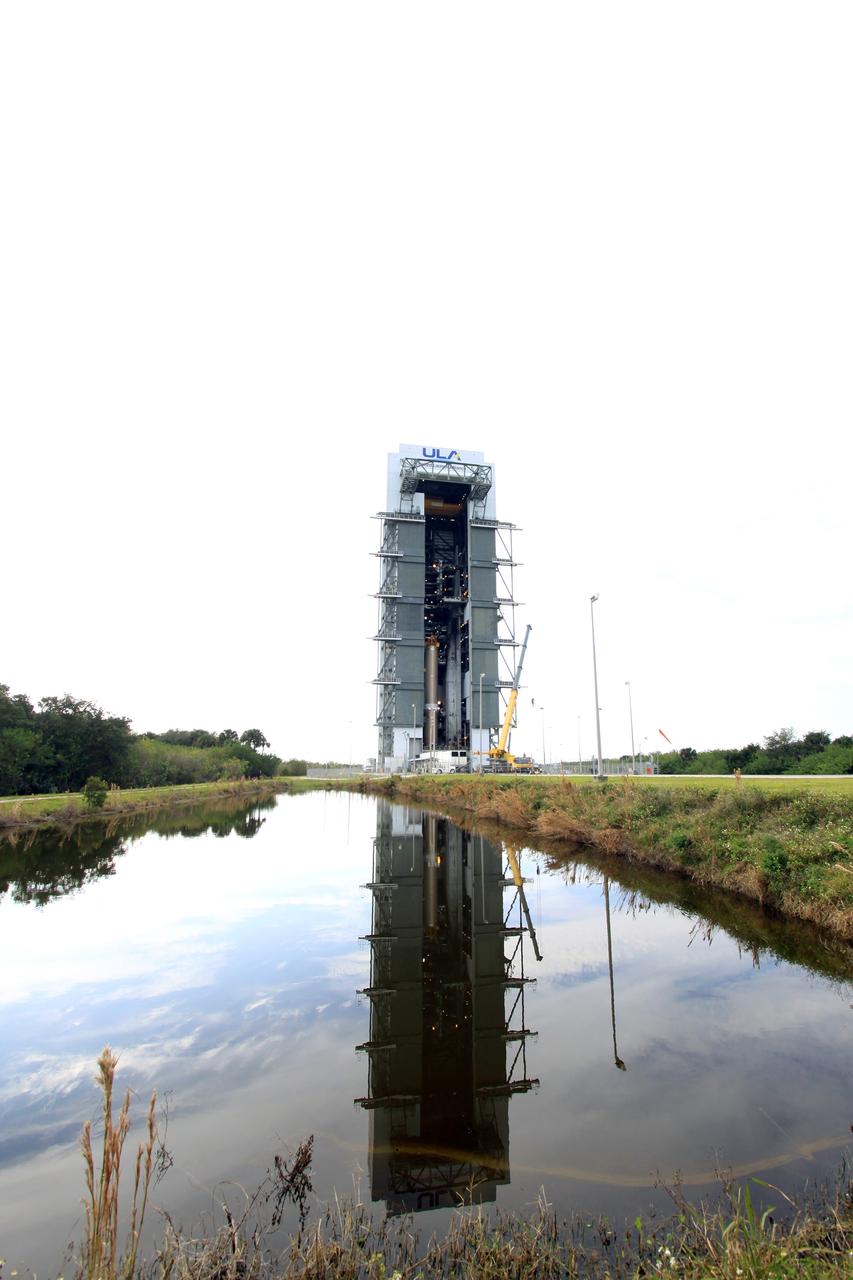
CAPE CANAVERAL, Fla. – The first stage of the United Launch Alliance Atlas V rocket for NASA's Magnetospheric Multiscale mission, or MMS, is in position on the launch platform in the mobile service tower at Space Launch Complex 41 on Cape Canaveral Air Force Station in Florida. MMS will study the mystery of how magnetic fields around Earth connect and disconnect, explosively releasing energy via a process known a magnetic reconnection. MMS consists of four identical spacecraft that work together to provide the first three-dimensional view of this fundamental process, which occurs throughout the universe. Launch is set for March 12. To learn more about MMS, visit http://www.nasa.gov/mms. Photo credit: NASA/Jim Grossmann
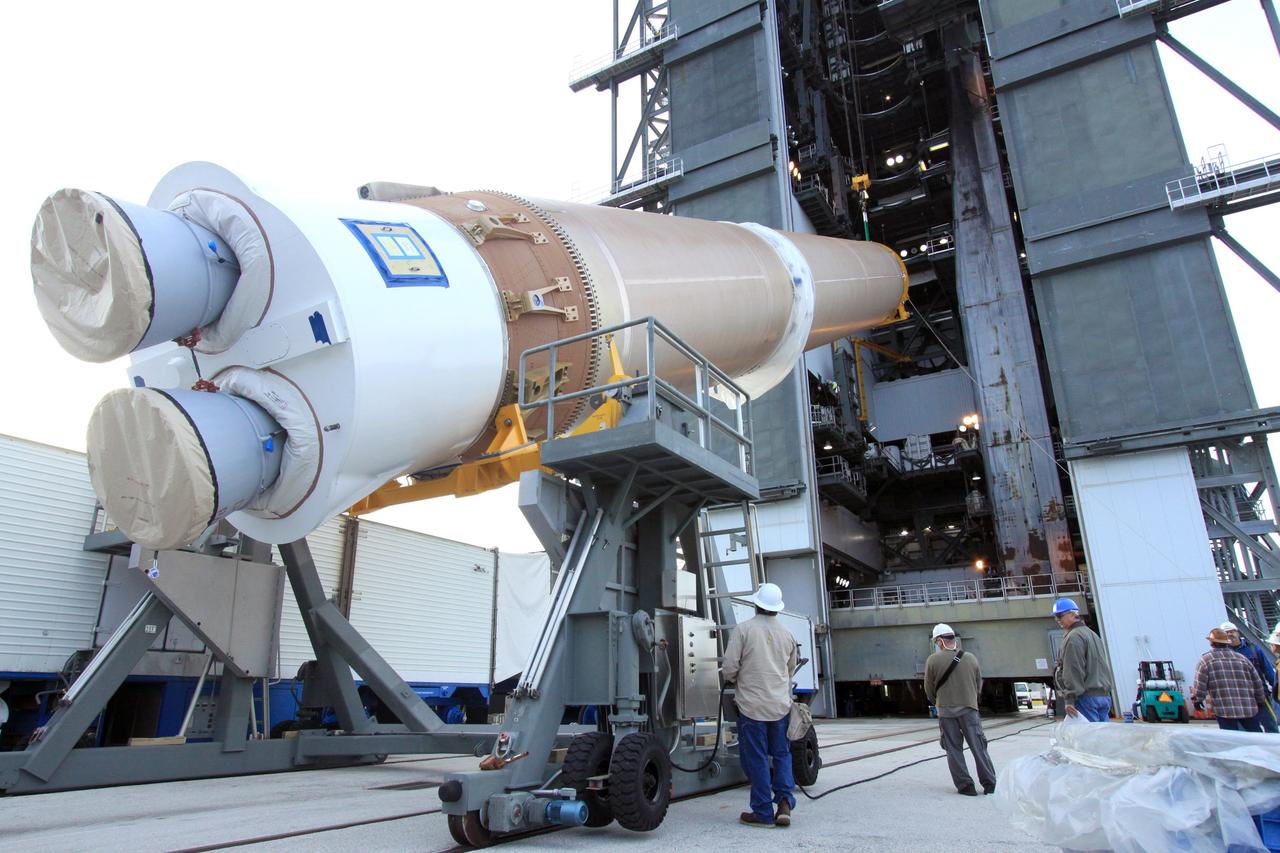
CAPE CANAVERAL, Fla. – Workers supervise the lift of the first stage of the United Launch Alliance Atlas V rocket for NASA's Magnetospheric Multiscale mission, or MMS, into the mobile service tower at Space Launch Complex 41 on Cape Canaveral Air Force Station in Florida. MMS will study the mystery of how magnetic fields around Earth connect and disconnect, explosively releasing energy via a process known a magnetic reconnection. MMS consists of four identical spacecraft that work together to provide the first three-dimensional view of this fundamental process, which occurs throughout the universe. Launch is set for March 12. To learn more about MMS, visit http://www.nasa.gov/mms. Photo credit: NASA/Jim Grossmann
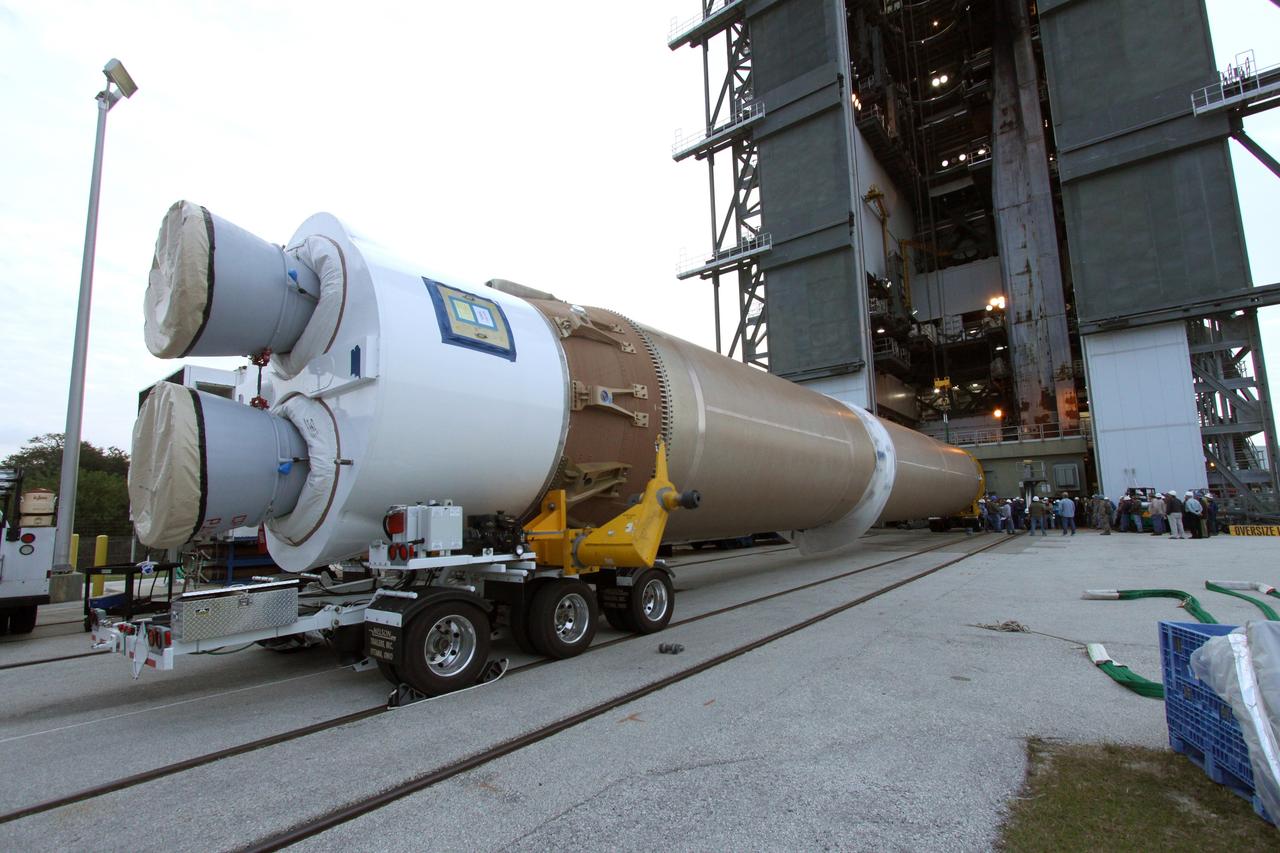
CAPE CANAVERAL, Fla. – Operations are underway at Space Launch Complex 41 on Cape Canaveral Air Force Station in Florida to lift the newly delivered first stage of a United Launch Alliance Atlas V rocket into the mobile service tower. The rocket will launch NASA's Magnetospheric Multiscale mission, or MMS. MMS will study the mystery of how magnetic fields around Earth connect and disconnect, explosively releasing energy via a process known a magnetic reconnection. MMS consists of four identical spacecraft that work together to provide the first three-dimensional view of this fundamental process, which occurs throughout the universe. Launch is set for March 12. To learn more about MMS, visit http://www.nasa.gov/mms. Photo credit: NASA/Jim Grossmann
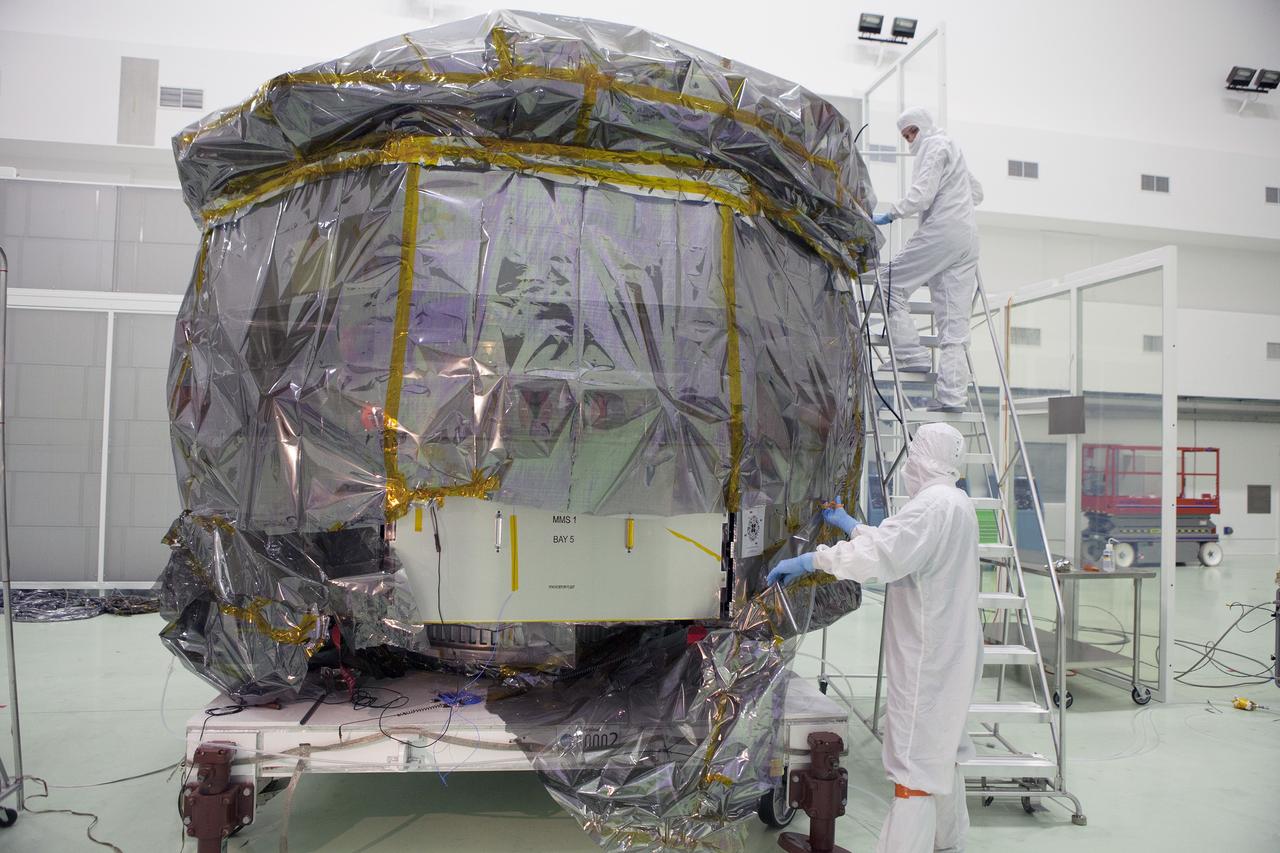
CAPE CANAVERAL, Fla. – Technicians begin to remove the protective covering from the lower stack, mini-stack number 1, two of the observatories for NASA's Magnetospheric Multiscale Observatory, or MMS, in Building 1 D high bay at the Astrotech payload processing facility in Titusville, Florida, near Kennedy Space Center. The MMS upper stack, mini-stack number 2, is scheduled to arrive in about two weeks. MMS is a Solar Terrestrial Probes mission comprising four identically instrumented spacecraft that will use Earth’s magnetosphere as a laboratory to study the microphysics of three fundamental plasma processes: magnetic reconnection, energetic particle acceleration and turbulence. Launch aboard a United Launch Alliance Atlas V rocket from Space Launch Complex 41 on Cape Canaveral Air Force Station is targeted for March 12, 2015. To learn more about MMS, visit http://mms.gsfc.nasa.gov. Photo credit: NASA/Dan Casper
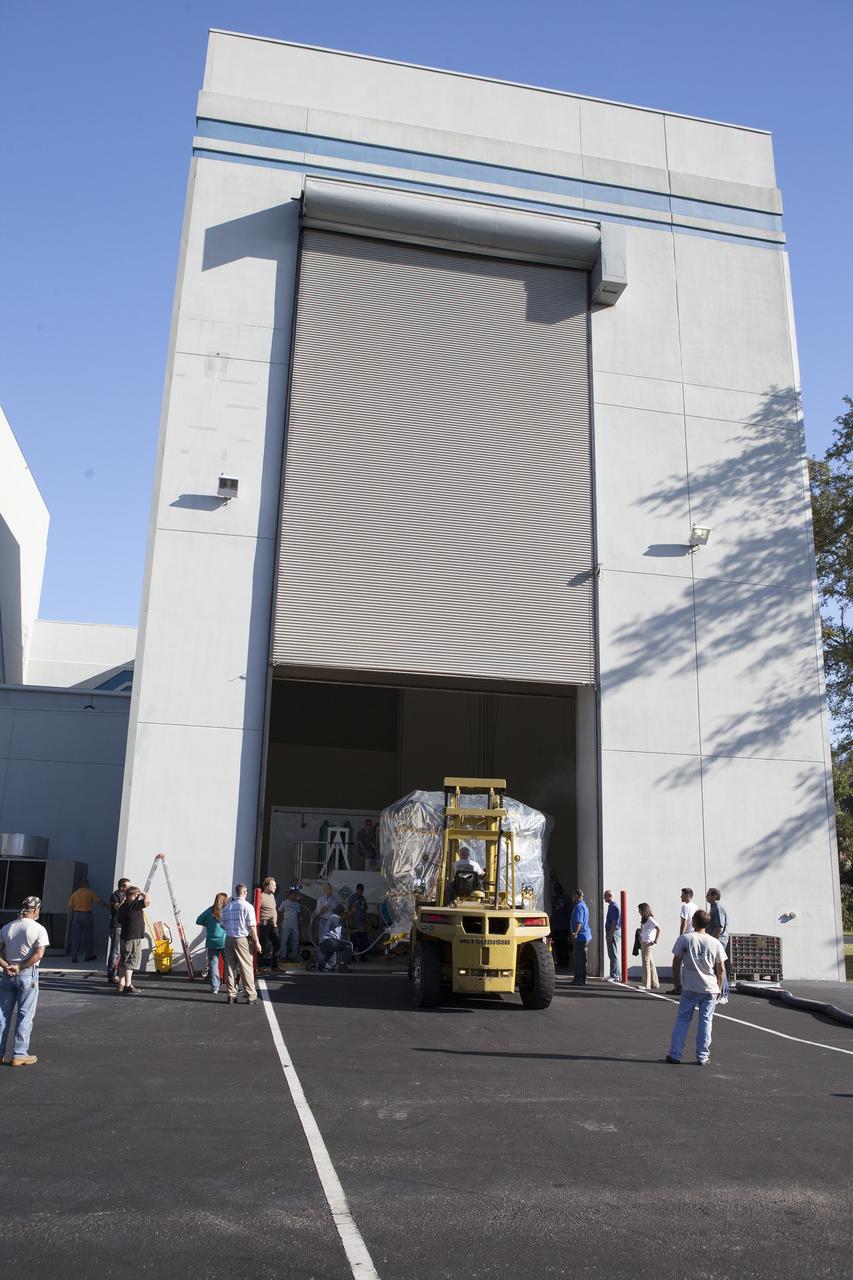
CAPE CANAVERAL, Fla. – Two of the observatories for NASA's Magnetospheric Multiscale Observatory, or MMS, the lower stack, mini-stack number 1, begin the trip from the Building 2 south encapsulation bay to the Building 1 high bay at the Astrotech payload processing facility in Titusville, Florida, near Kennedy Space Center. The MMS upper stack, mini-stack number 2, is scheduled to arrive in about two weeks. MMS is a Solar Terrestrial Probes mission comprising four identically instrumented spacecraft that will use Earth’s magnetosphere as a laboratory to study the microphysics of three fundamental plasma processes: magnetic reconnection, energetic particle acceleration and turbulence. Launch aboard a United Launch Alliance Atlas V rocket from Space Launch Complex 41 on Cape Canaveral Air Force Station is targeted for March 12, 2015. To learn more about MMS, visit http://mms.gsfc.nasa.gov. Photo credit: NASA/Dan Casper
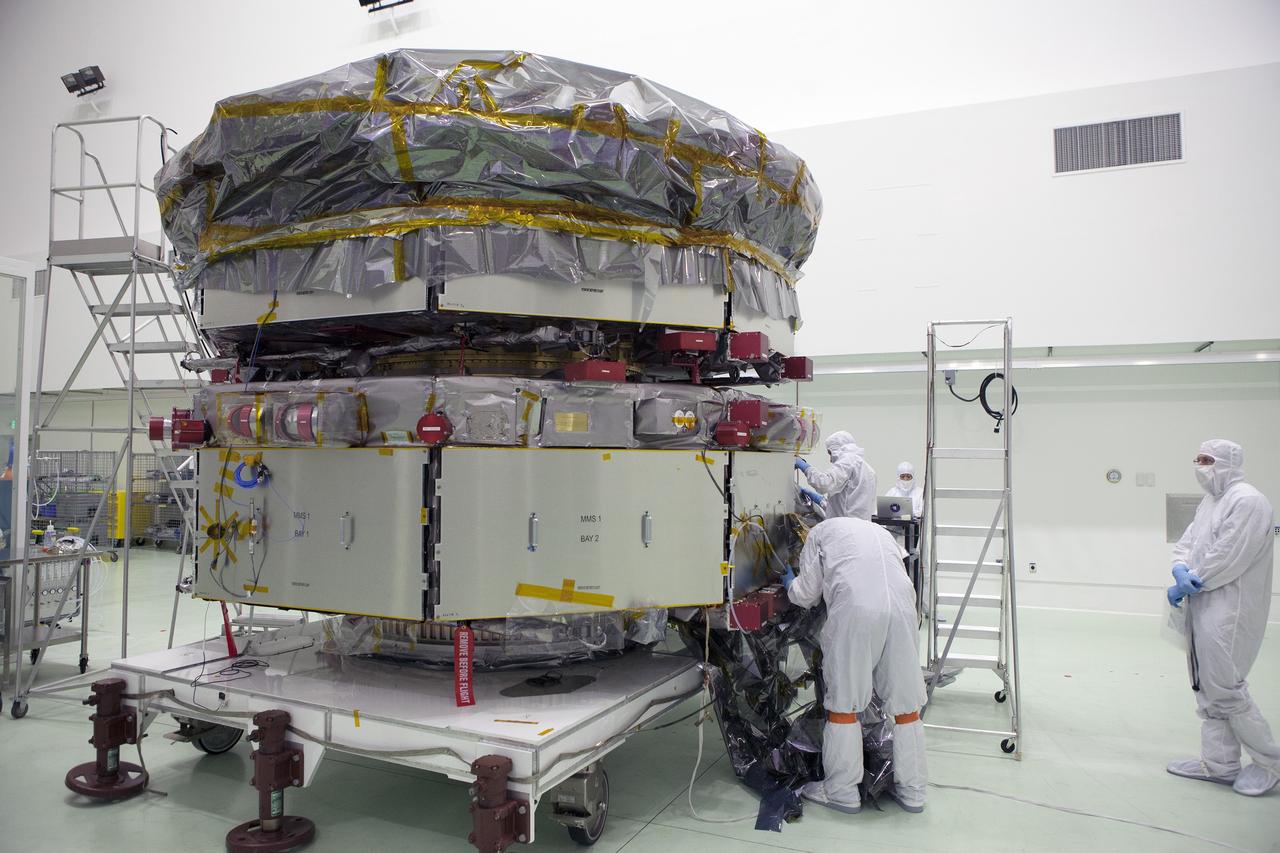
CAPE CANAVERAL, Fla. – Technicians remove the protective covering from the lower stack, mini-stack number 1, two of the observatories for NASA's Magnetospheric Multiscale Observatory, or MMS, in Building 1 D high bay at the Astrotech payload processing facility in Titusville, Florida, near Kennedy Space Center. The MMS upper stack, mini-stack number 2, is scheduled to arrive in about two weeks. MMS is a Solar Terrestrial Probes mission comprising four identically instrumented spacecraft that will use Earth’s magnetosphere as a laboratory to study the microphysics of three fundamental plasma processes: magnetic reconnection, energetic particle acceleration and turbulence. Launch aboard a United Launch Alliance Atlas V rocket from Space Launch Complex 41 on Cape Canaveral Air Force Station is targeted for March 12, 2015. To learn more about MMS, visit http://mms.gsfc.nasa.gov. Photo credit: NASA/Dan Casper
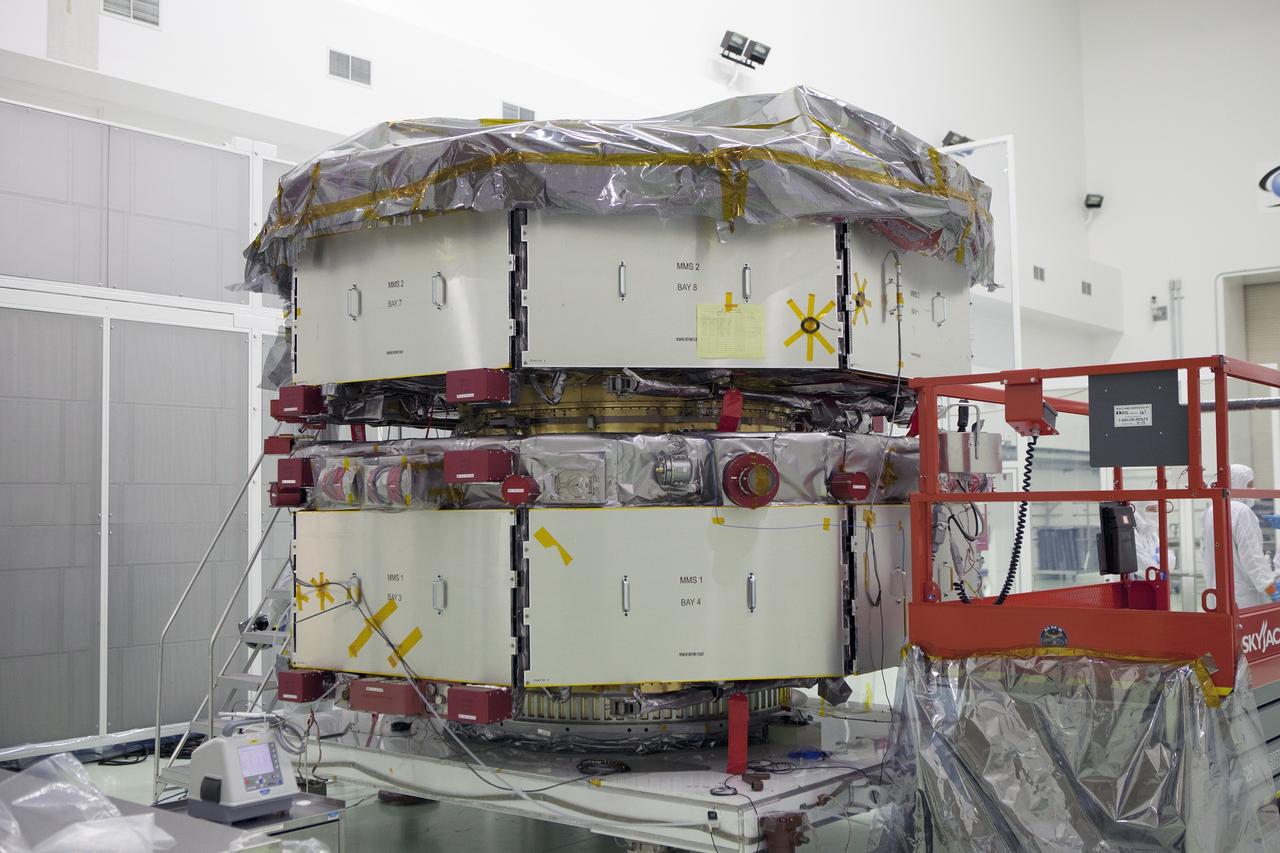
CAPE CANAVERAL, Fla. – Most of the protective covering has been removed from the lower stack, mini-stack number 1, two of the observatories for NASA's Magnetospheric Multiscale Observatory, or MMS, inside Building 1 D high bay at the Astrotech payload processing facility in Titusville, Florida, near Kennedy Space Center. The MMS upper stack, mini-stack number 2, is scheduled to arrive in about two weeks. MMS is a Solar Terrestrial Probes mission comprising four identically instrumented spacecraft that will use Earth’s magnetosphere as a laboratory to study the microphysics of three fundamental plasma processes: magnetic reconnection, energetic particle acceleration and turbulence. Launch aboard a United Launch Alliance Atlas V rocket from Space Launch Complex 41 on Cape Canaveral Air Force Station is targeted for March 12, 2015. To learn more about MMS, visit http://mms.gsfc.nasa.gov. Photo credit: NASA/Dan Casper
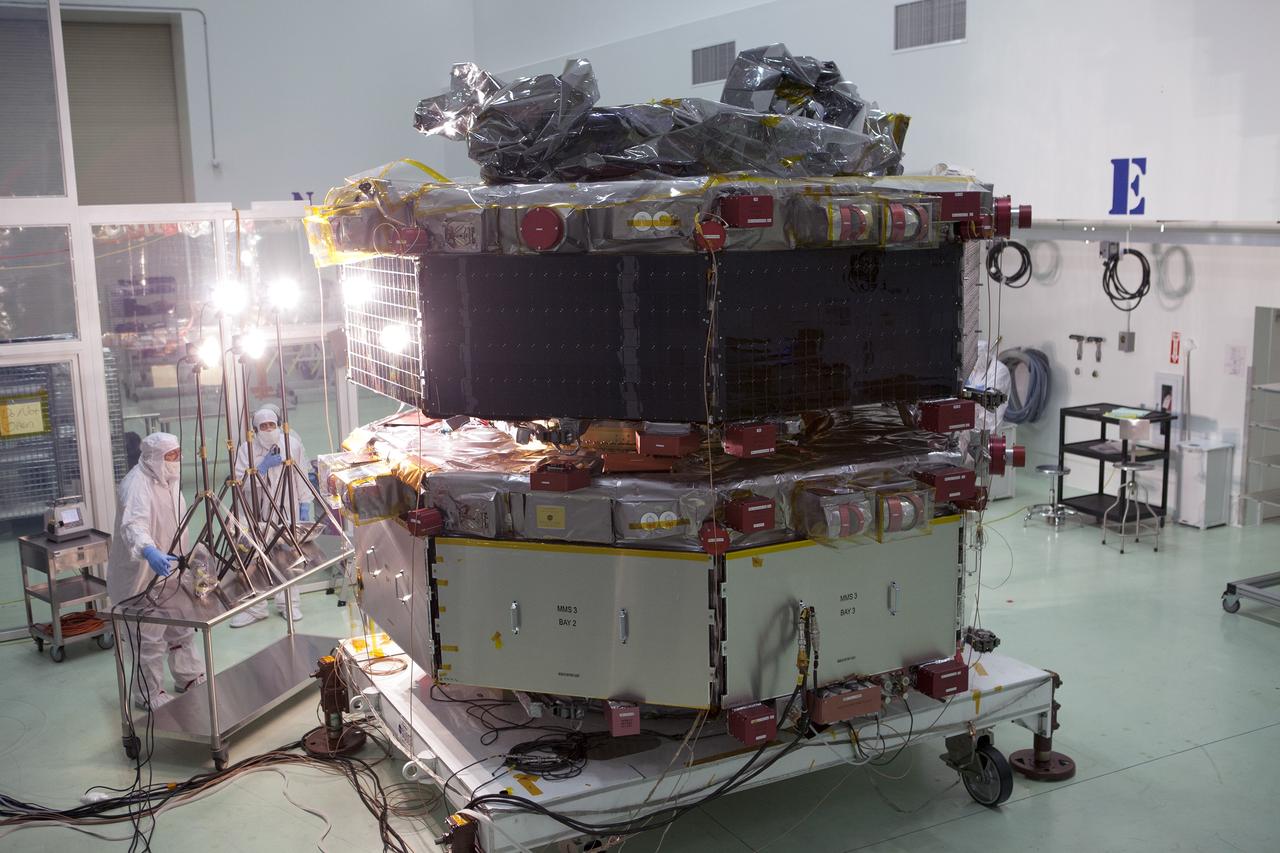
CAPE CANAVERAL, Fla. – A solar array illumination test is performed on the upper stack of the Magnetospheric Multiscale spacecraft, or MMS, in the Astrotech payload processing facility in Titusville, Florida, near Kennedy Space Center. Illumination testing of the lower instrumentation payload stack was completed in December. MMS is a Solar Terrestrial Probes mission comprising four identically instrumented spacecraft that will use Earth’s magnetosphere as a laboratory to study the microphysics of three fundamental plasma processes: magnetic reconnection, energetic particle acceleration and turbulence. Launch aboard a United Launch Alliance Atlas V rocket from Space Launch Complex 41 on Cape Canaveral Air Force Station is targeted for March 12, 2015. To learn more about MMS, visit http://www.nasa.gov/mms. Photo credit: NASA/Kim Shiflett
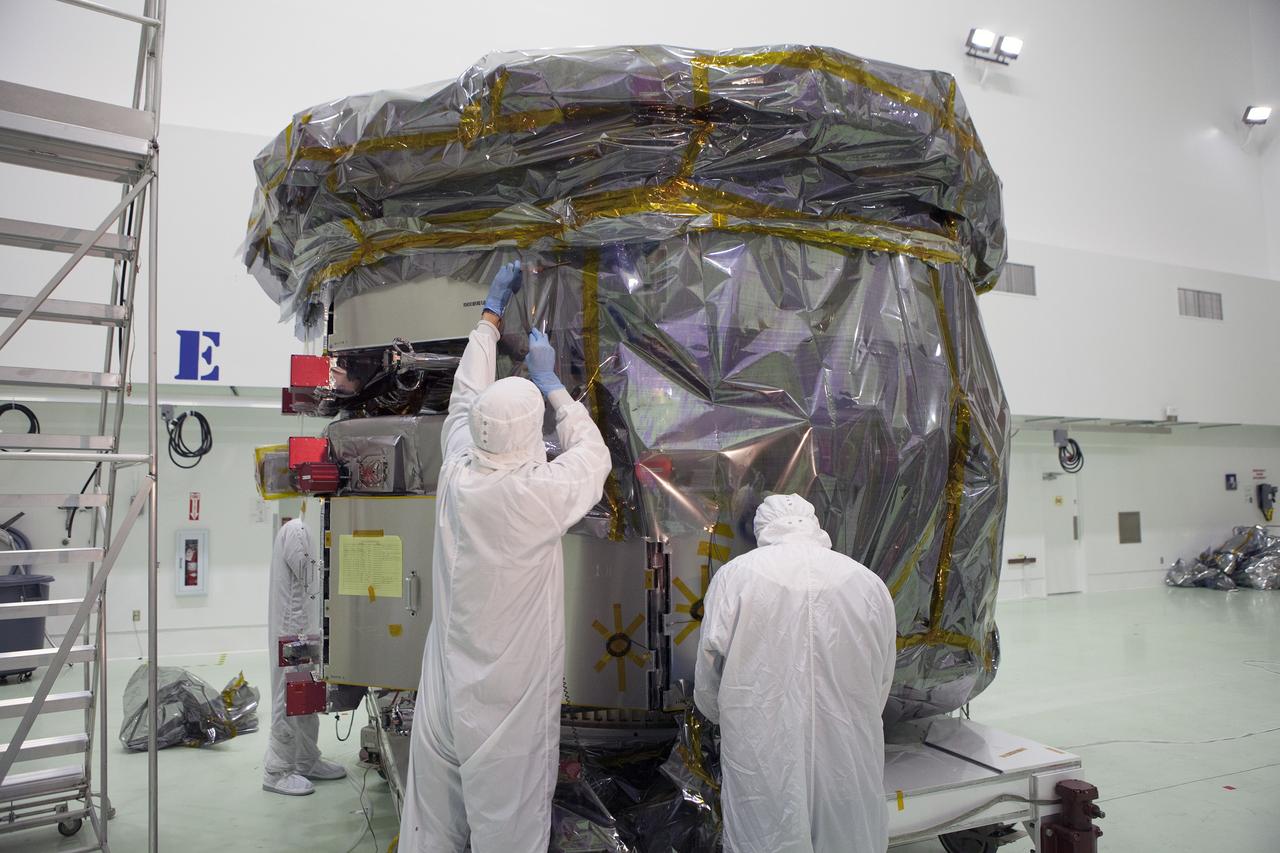
CAPE CANAVERAL, Fla. – Technicians remove the protective covering from the lower stack, mini-stack number 1, two of the observatories for NASA's Magnetospheric Multiscale Observatory, or MMS, in Building 1 D high bay at the Astrotech payload processing facility in Titusville, Florida, near Kennedy Space Center. The MMS upper stack, mini-stack number 2, is scheduled to arrive in about two weeks. MMS is a Solar Terrestrial Probes mission comprising four identically instrumented spacecraft that will use Earth’s magnetosphere as a laboratory to study the microphysics of three fundamental plasma processes: magnetic reconnection, energetic particle acceleration and turbulence. Launch aboard a United Launch Alliance Atlas V rocket from Space Launch Complex 41 on Cape Canaveral Air Force Station is targeted for March 12, 2015. To learn more about MMS, visit http://mms.gsfc.nasa.gov. Photo credit: NASA/Dan Casper
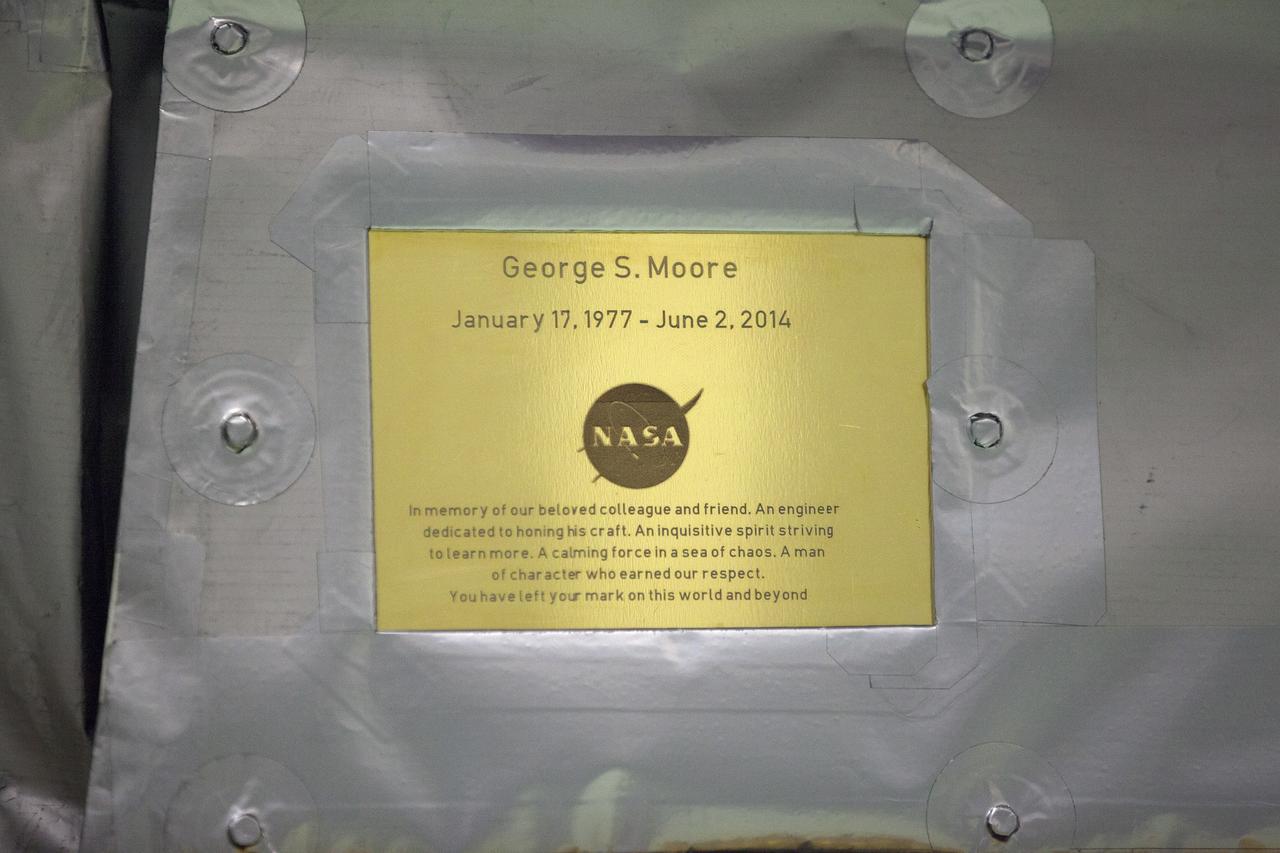
CAPE CANAVERAL, Fla. – A plaque affixed to the side of a Magnetospheric Multiscale, or MMS, observatory dedicates the mission to George S. Moore, now deceased, an engineer who was a beloved colleague and friend to the MMS team. MMS, led by a team from NASA's Goddard Space Flight Center, is a Solar Terrestrial Probes mission consisting of four identically instrumented spacecraft that will use Earth’s magnetosphere as a laboratory to study the microphysics of three fundamental plasma processes: magnetic reconnection, energetic particle acceleration and turbulence. Launch aboard a United Launch Alliance Atlas V rocket from Space Launch Complex 41 on Cape Canaveral Air Force Station is targeted for March 12, 2015. To learn more about MMS, visit http://mms.gsfc.nasa.gov. Photo credit: NASA/Kim Shiflett
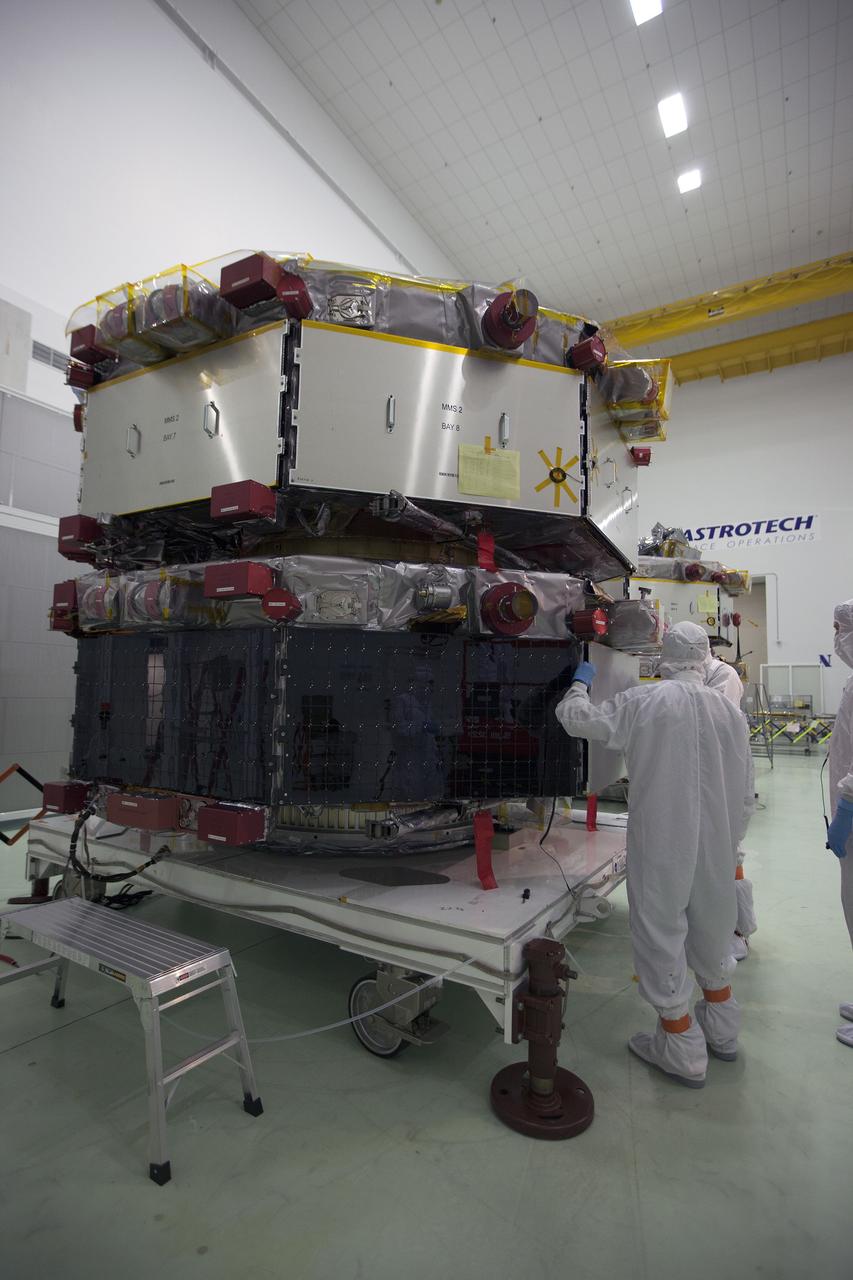
CAPE CANAVERAL, Fla. – Workers inspect the solar arrays on the Magnetospheric Multiscale, or MMS, observatories in the Building 1 D high bay of the Astrotech payload processing facility in Titusville, Florida, near Kennedy Space Center. The two MMS spacecraft comprising the upper deck arrived Nov. 12; the two comprising the lower stack arrived Oct. 29. MMS, led by a team from NASA's Goddard Space Flight Center, is a Solar Terrestrial Probes mission consisting of four identically instrumented spacecraft that will use Earth’s magnetosphere as a laboratory to study the microphysics of three fundamental plasma processes: magnetic reconnection, energetic particle acceleration and turbulence. Launch aboard a United Launch Alliance Atlas V rocket from Space Launch Complex 41 on Cape Canaveral Air Force Station is targeted for March 12, 2015. To learn more about MMS, visit http://mms.gsfc.nasa.gov. Photo credit: NASA/Kim Shiflett
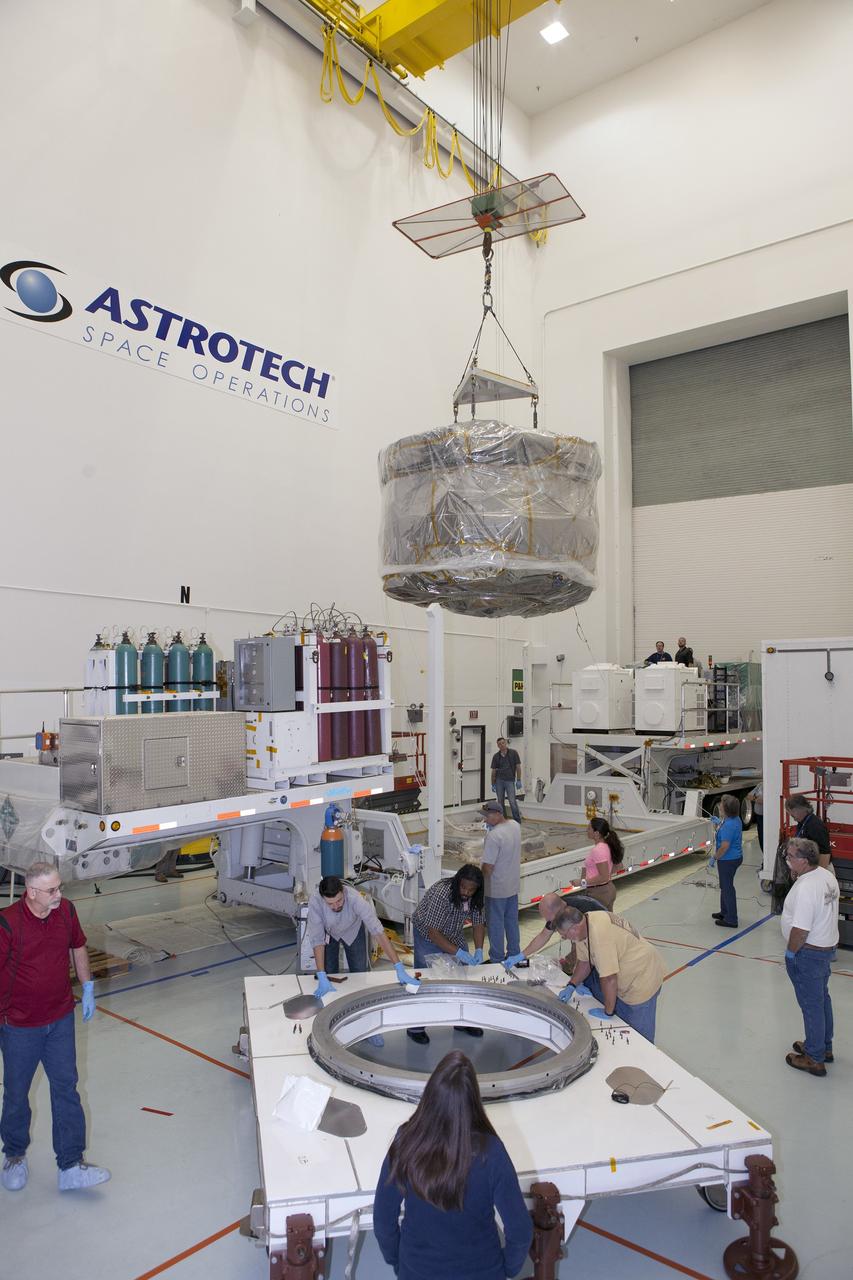
CAPE CANAVERAL, Fla. – Two of the observatories, the lower stack, mini-stack number 1, for NASA's Magnetospheric Multiscale Observatory, or MMS, glides toward a payload dolly during uncrating operations in the Building 2 south encapsulation bay at the Astrotech payload processing facility in Titusville, Florida, near Kennedy Space Center. The MMS upper stack, mini-stack number 2, is scheduled to arrive in about two weeks. MMS is a Solar Terrestrial Probes mission comprising four identically instrumented spacecraft that will use Earth’s magnetosphere as a laboratory to study the microphysics of three fundamental plasma processes: magnetic reconnection, energetic particle acceleration and turbulence. Launch aboard a United Launch Alliance Atlas V rocket from Space Launch Complex 41 on Cape Canaveral Air Force Station is targeted for March 12, 2015. To learn more about MMS, visit http://mms.gsfc.nasa.gov. Photo credit: NASA/Dan Casper
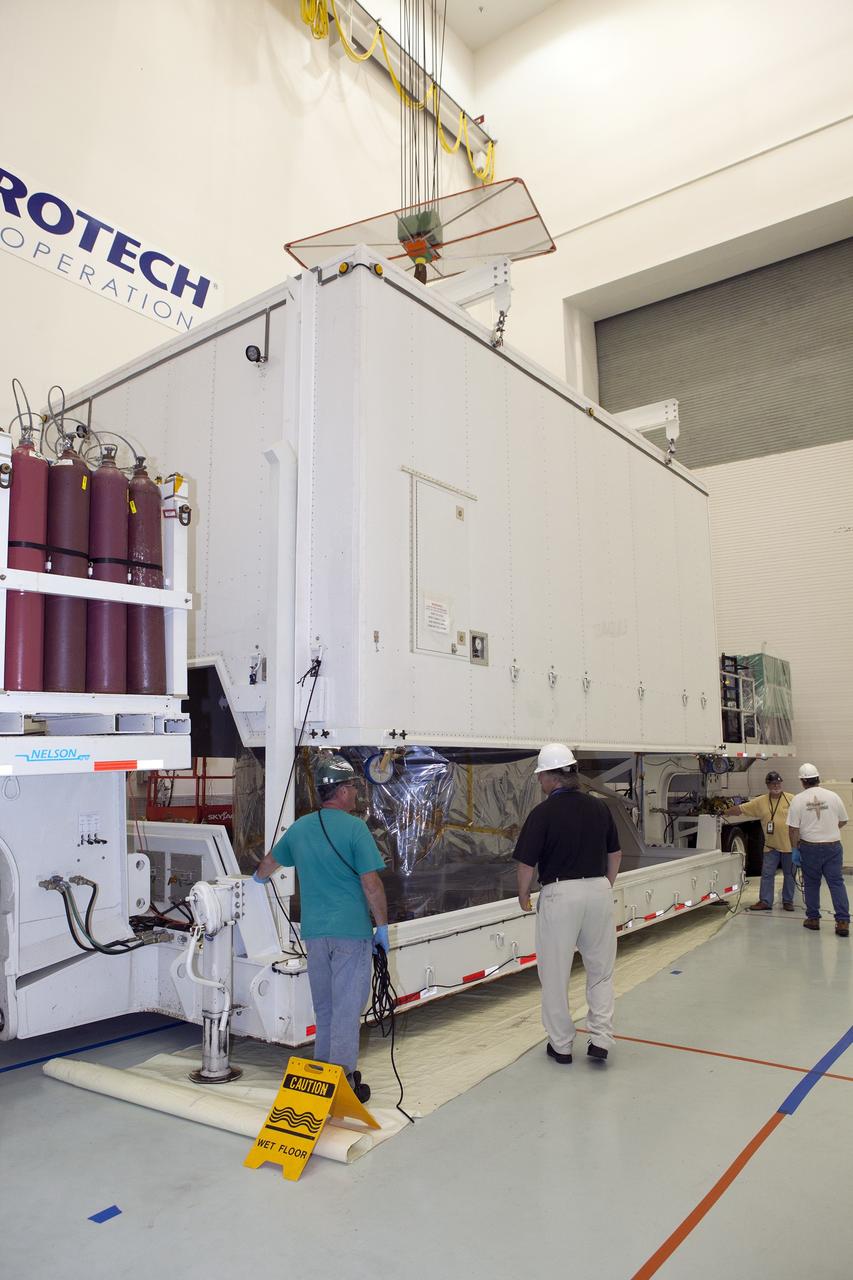
CAPE CANAVERAL, Fla. – The protective shipping container is lifted from the lower stack, mini-stack number 1, two of the observatories for NASA's Magnetospheric Multiscale Observatory, or MMS, in the Building 2 south encapsulation bay at the Astrotech payload processing facility in Titusville, Florida, near Kennedy Space Center. The MMS upper stack, mini-stack number 2, is scheduled to arrive in about two weeks. MMS is a Solar Terrestrial Probes mission comprising four identically instrumented spacecraft that will use Earth’s magnetosphere as a laboratory to study the microphysics of three fundamental plasma processes: magnetic reconnection, energetic particle acceleration and turbulence. Launch aboard a United Launch Alliance Atlas V rocket from Space Launch Complex 41 on Cape Canaveral Air Force Station is targeted for March 12, 2015. To learn more about MMS, visit http://mms.gsfc.nasa.gov. Photo credit: NASA/Dan Casper
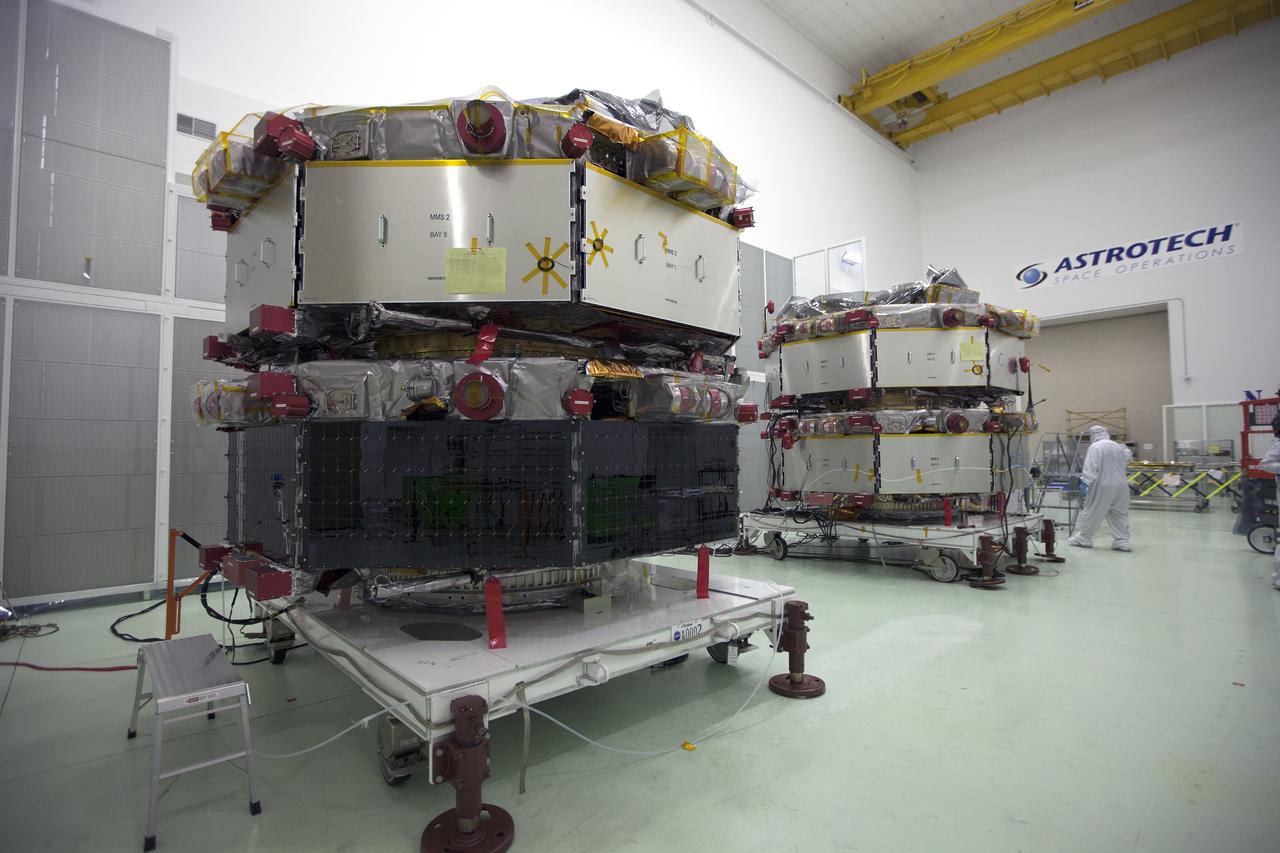
CAPE CANAVERAL, Fla. – The solar arrays on the Magnetospheric Multiscale, or MMS, observatories are uncovered for an inspection in the Building 1 D high bay of the Astrotech payload processing facility in Titusville, Florida, near Kennedy Space Center. The two MMS spacecraft comprising the upper deck arrived Nov. 12; the two comprising the lower stack arrived Oct. 29. MMS, led by a team from NASA's Goddard Space Flight Center, is a Solar Terrestrial Probes mission consisting of four identically instrumented spacecraft that will use Earth’s magnetosphere as a laboratory to study the microphysics of three fundamental plasma processes: magnetic reconnection, energetic particle acceleration and turbulence. Launch aboard a United Launch Alliance Atlas V rocket from Space Launch Complex 41 on Cape Canaveral Air Force Station is targeted for March 12, 2015. To learn more about MMS, visit http://mms.gsfc.nasa.gov. Photo credit: NASA/Kim Shiflett
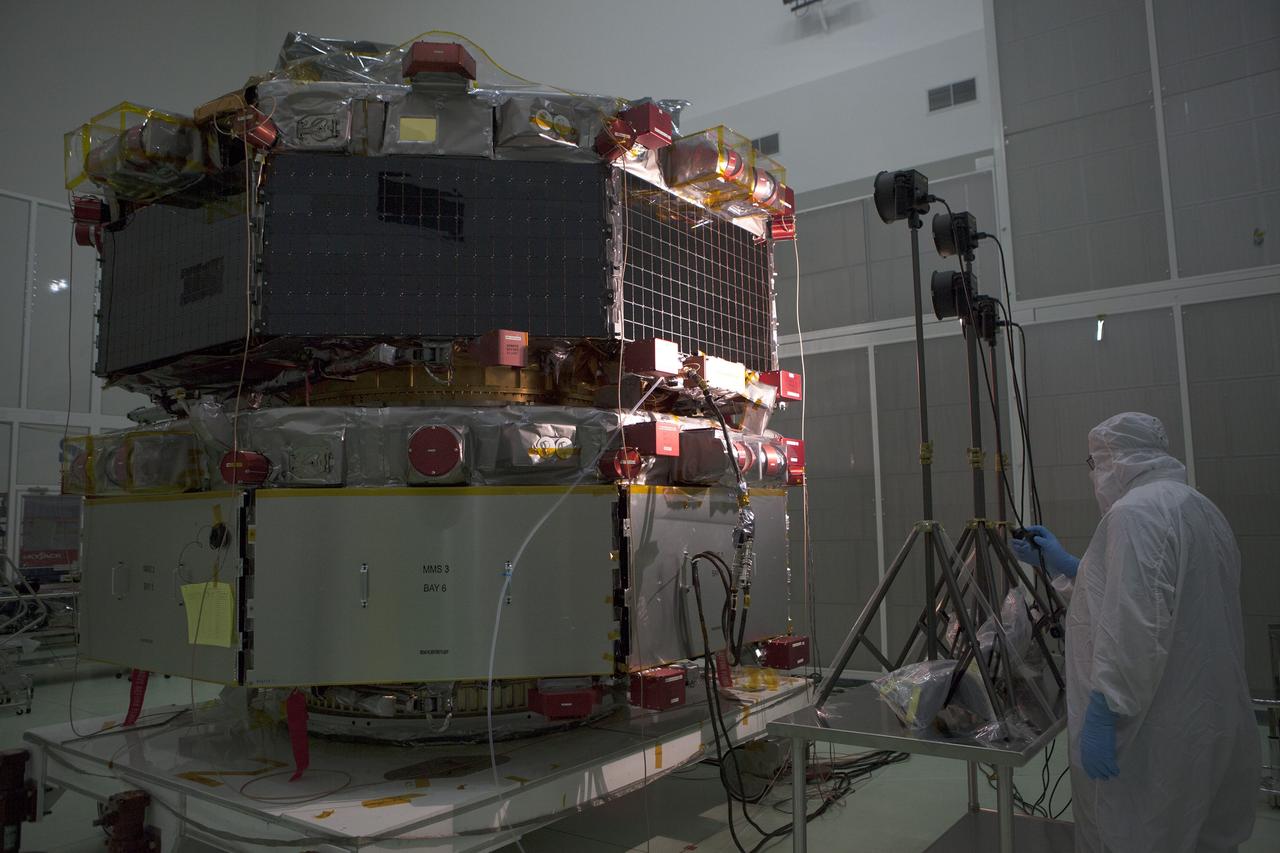
CAPE CANAVERAL, Fla. – A solar array illumination test is performed on the upper stack of the Magnetospheric Multiscale spacecraft, or MMS, in the Astrotech payload processing facility in Titusville, Florida, near Kennedy Space Center. Illumination testing of the lower instrumentation payload stack was completed in December. MMS is a Solar Terrestrial Probes mission comprising four identically instrumented spacecraft that will use Earth’s magnetosphere as a laboratory to study the microphysics of three fundamental plasma processes: magnetic reconnection, energetic particle acceleration and turbulence. Launch aboard a United Launch Alliance Atlas V rocket from Space Launch Complex 41 on Cape Canaveral Air Force Station is targeted for March 12, 2015. To learn more about MMS, visit http://www.nasa.gov/mms. Photo credit: NASA/Kim Shiflett

CAPE CANAVERAL, Fla. – Most of the protective covering has been removed from the lower stack, mini-stack number 1, two of the observatories for NASA's Magnetospheric Multiscale Observatory, or MMS, inside Building 1 D high bay at the Astrotech payload processing facility in Titusville, Florida, near Kennedy Space Center. The MMS upper stack, mini-stack number 2, is scheduled to arrive in about two weeks. MMS is a Solar Terrestrial Probes mission comprising four identically instrumented spacecraft that will use Earth’s magnetosphere as a laboratory to study the microphysics of three fundamental plasma processes: magnetic reconnection, energetic particle acceleration and turbulence. Launch aboard a United Launch Alliance Atlas V rocket from Space Launch Complex 41 on Cape Canaveral Air Force Station is targeted for March 12, 2015. To learn more about MMS, visit http://mms.gsfc.nasa.gov. Photo credit: NASA/Dan Casper
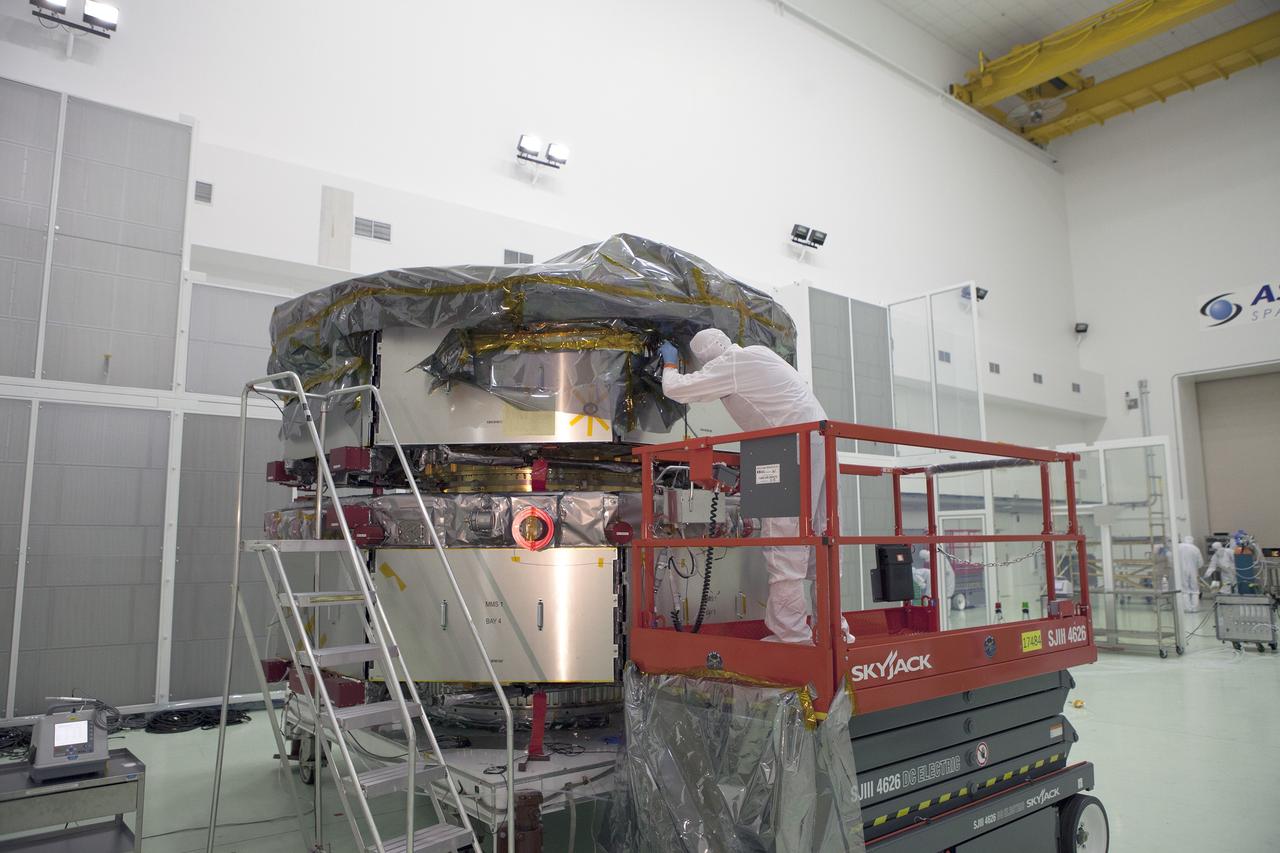
CAPE CANAVERAL, Fla. – A technician carefully removes the protective covering from the lower stack, mini-stack number 1, two of the observatories for NASA's Magnetospheric Multiscale Observatory, or MMS, in Building 1 D high bay at the Astrotech payload processing facility in Titusville, Florida, near Kennedy Space Center. The MMS upper stack, mini-stack number 2, is scheduled to arrive in about two weeks. MMS is a Solar Terrestrial Probes mission comprising four identically instrumented spacecraft that will use Earth’s magnetosphere as a laboratory to study the microphysics of three fundamental plasma processes: magnetic reconnection, energetic particle acceleration and turbulence. Launch aboard a United Launch Alliance Atlas V rocket from Space Launch Complex 41 on Cape Canaveral Air Force Station is targeted for March 12, 2015. To learn more about MMS, visit http://mms.gsfc.nasa.gov. Photo credit: NASA/Dan Casper
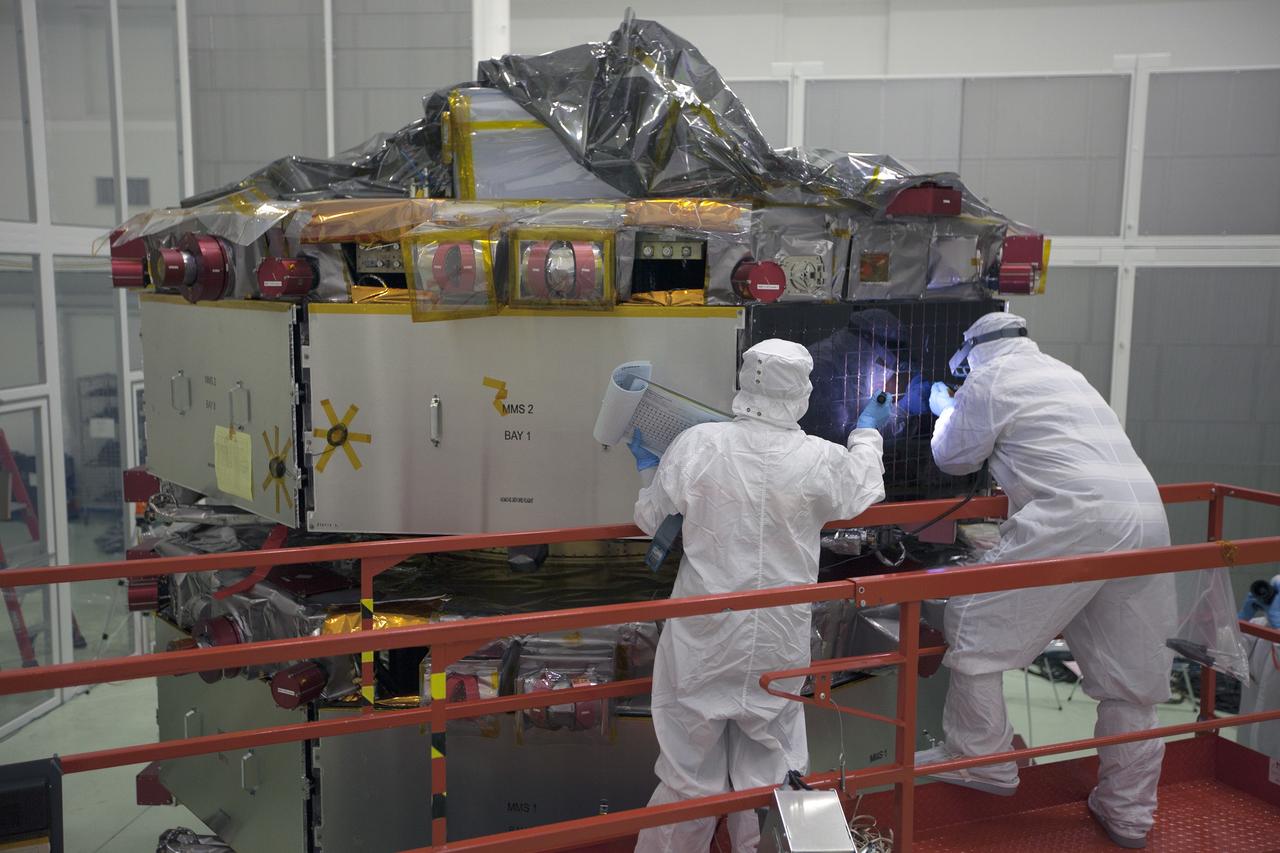
CAPE CANAVERAL, Fla. – Workers inspect the solar arrays on the Magnetospheric Multiscale, or MMS, observatories in the Building 1 D high bay of the Astrotech payload processing facility in Titusville, Florida, near Kennedy Space Center. The two MMS spacecraft comprising the upper deck arrived Nov. 12; the two comprising the lower stack arrived Oct. 29. MMS, led by a team from NASA's Goddard Space Flight Center, is a Solar Terrestrial Probes mission consisting of four identically instrumented spacecraft that will use Earth’s magnetosphere as a laboratory to study the microphysics of three fundamental plasma processes: magnetic reconnection, energetic particle acceleration and turbulence. Launch aboard a United Launch Alliance Atlas V rocket from Space Launch Complex 41 on Cape Canaveral Air Force Station is targeted for March 12, 2015. To learn more about MMS, visit http://mms.gsfc.nasa.gov. Photo credit: NASA/Kim Shiflett
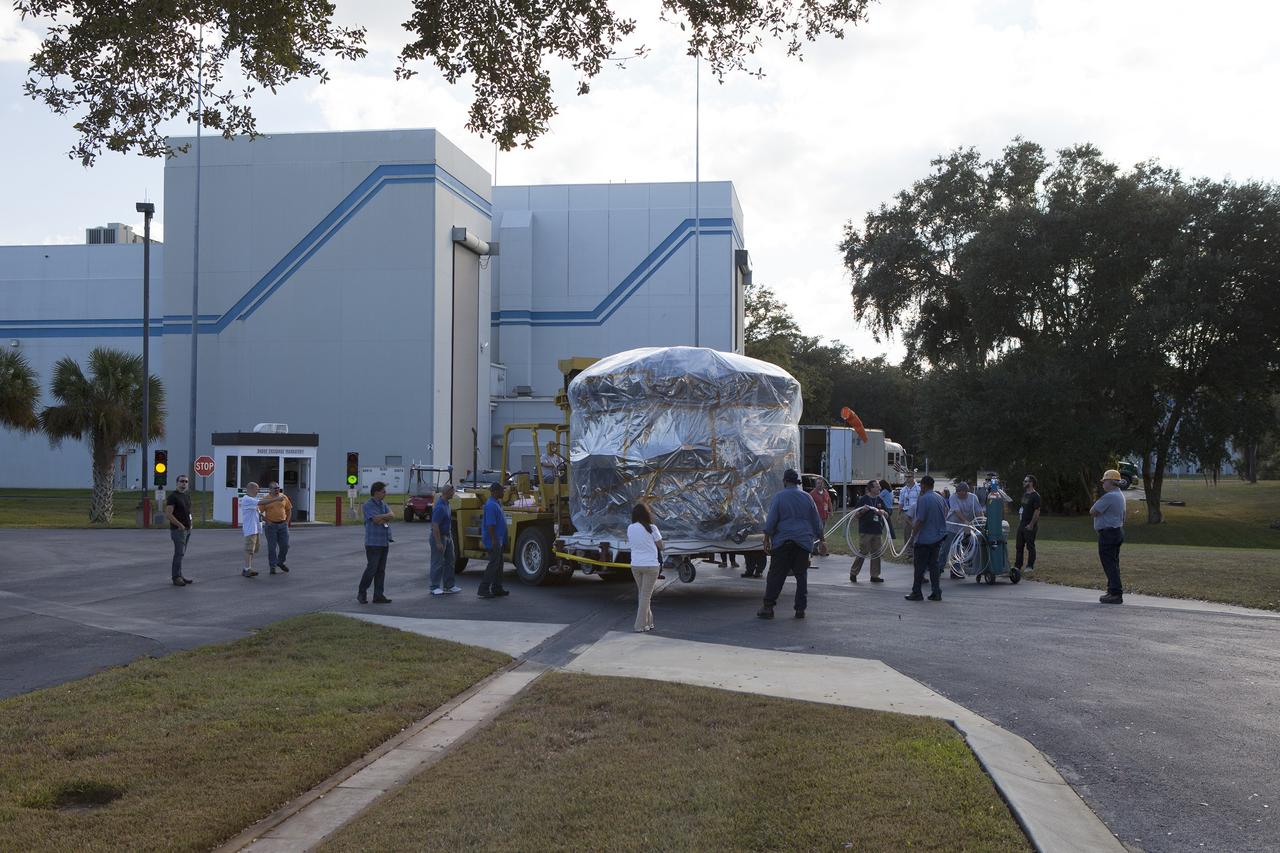
CAPE CANAVERAL, Fla. – Workers surround two of the observatories, the lower stack, mini-stack number 1, for NASA's Magnetospheric Multiscale Observatory, or MMS, on their trip from the Building 2 south encapsulation bay to the Building 1 high bay at the Astrotech payload processing facility in Titusville, Florida, near Kennedy Space Center. The MMS upper stack, mini-stack number 2, is scheduled to arrive in about two weeks. MMS is a Solar Terrestrial Probes mission comprising four identically instrumented spacecraft that will use Earth’s magnetosphere as a laboratory to study the microphysics of three fundamental plasma processes: magnetic reconnection, energetic particle acceleration and turbulence. Launch aboard a United Launch Alliance Atlas V rocket from Space Launch Complex 41 on Cape Canaveral Air Force Station is targeted for March 12, 2015. To learn more about MMS, visit http://mms.gsfc.nasa.gov. Photo credit: NASA/Dan Casper
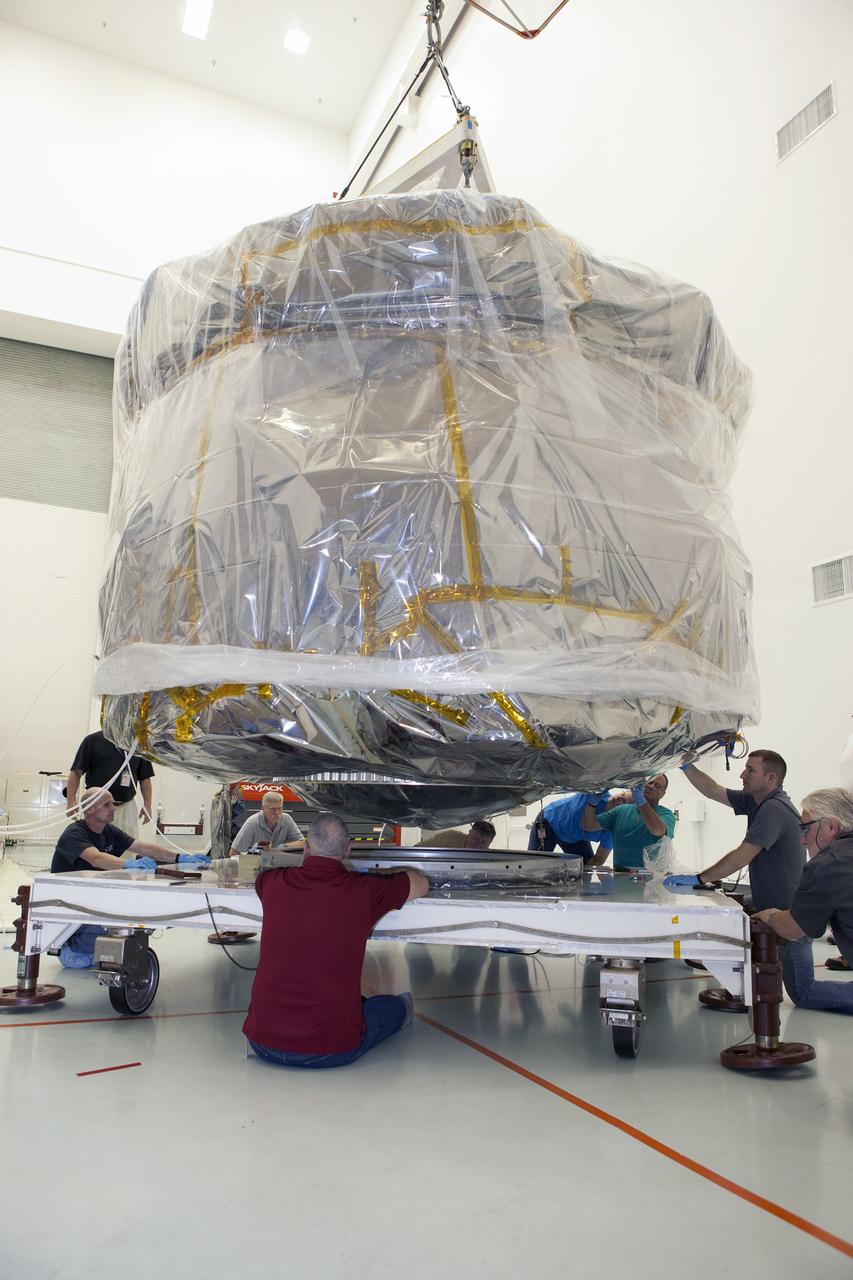
CAPE CANAVERAL, Fla. – Workers position two of the observatories, the lower stack, mini-stack number 1 for NASA's Magnetospheric Multiscale Observatory, or MMS, onto a payload dolly in the Building 2 south encapsulation bay at the Astrotech payload processing facility in Titusville, Florida, near Kennedy Space Center. The MMS upper stack, mini-stack number 2, is scheduled to arrive in about two weeks. MMS is a Solar Terrestrial Probes mission comprising four identically instrumented spacecraft that will use Earth’s magnetosphere as a laboratory to study the microphysics of three fundamental plasma processes: magnetic reconnection, energetic particle acceleration and turbulence. Launch aboard a United Launch Alliance Atlas V rocket from Space Launch Complex 41 on Cape Canaveral Air Force Station is targeted for March 12, 2015. To learn more about MMS, visit http://mms.gsfc.nasa.gov. Photo credit: NASA/Dan Casper
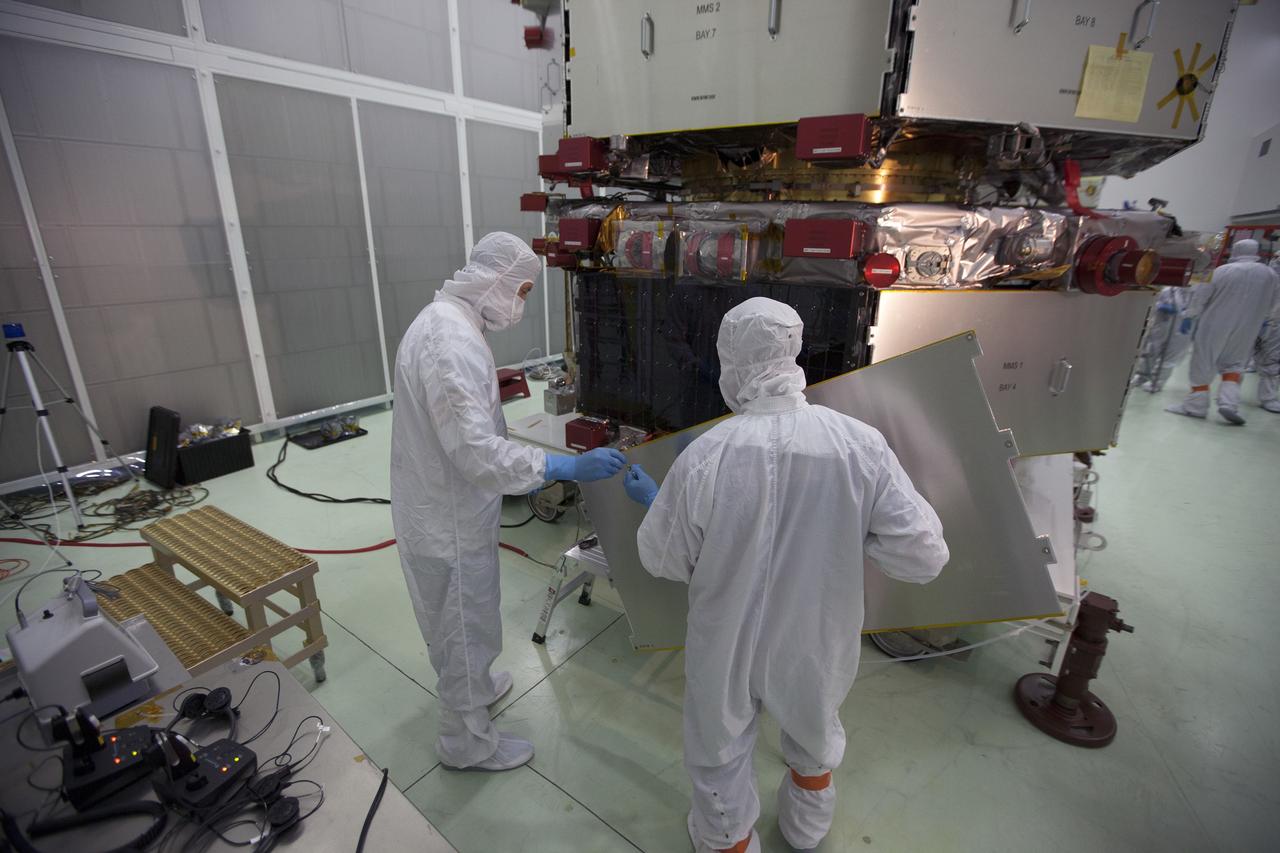
CAPE CANAVERAL, Fla. – Workers inspect the solar arrays on the Magnetospheric Multiscale, or MMS, observatories in the Building 1 D high bay of the Astrotech payload processing facility in Titusville, Florida, near Kennedy Space Center. The two MMS spacecraft comprising the upper deck arrived Nov. 12; the two comprising the lower stack arrived Oct. 29. MMS, led by a team from NASA's Goddard Space Flight Center, is a Solar Terrestrial Probes mission consisting of four identically instrumented spacecraft that will use Earth’s magnetosphere as a laboratory to study the microphysics of three fundamental plasma processes: magnetic reconnection, energetic particle acceleration and turbulence. Launch aboard a United Launch Alliance Atlas V rocket from Space Launch Complex 41 on Cape Canaveral Air Force Station is targeted for March 12, 2015. To learn more about MMS, visit http://mms.gsfc.nasa.gov. Photo credit: NASA/Kim Shiflett
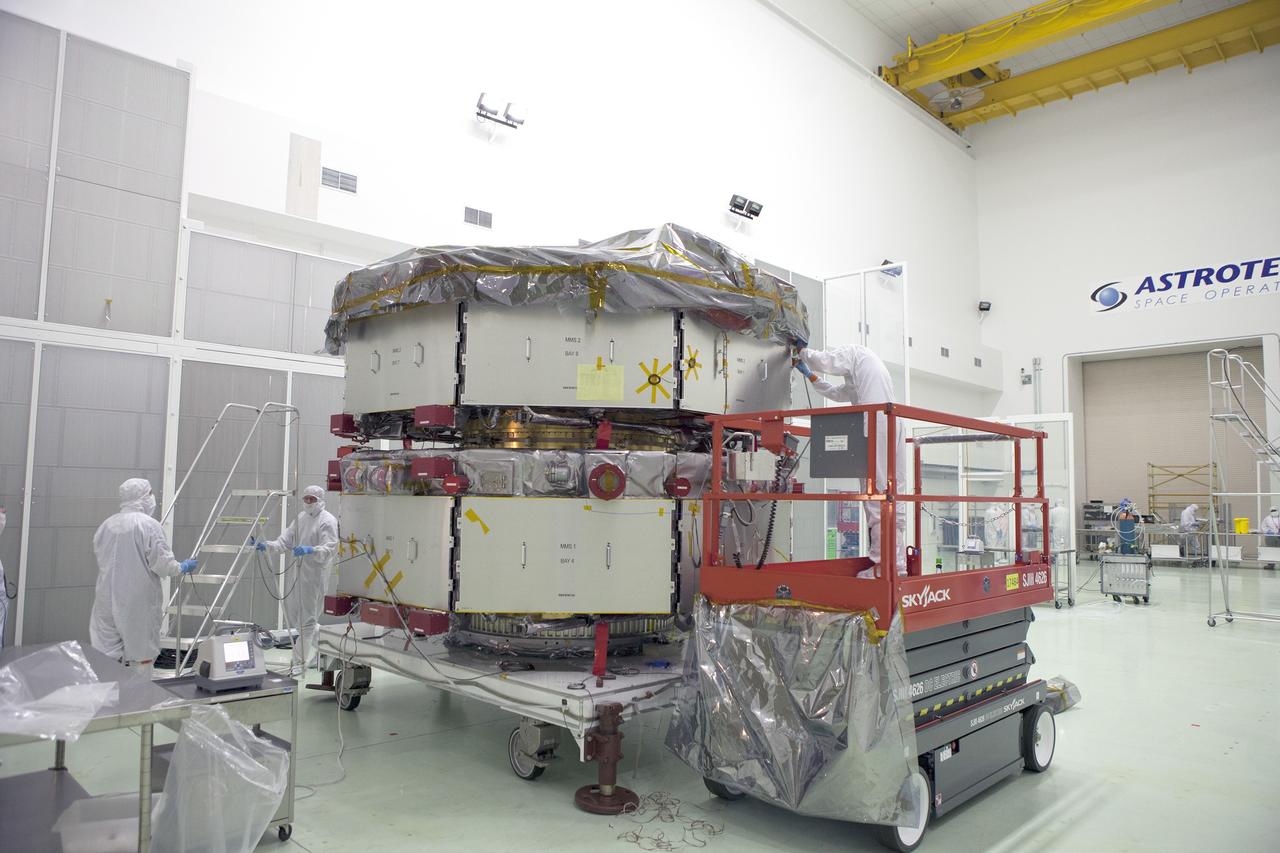
CAPE CANAVERAL, Fla. – Technicians have removed most of the protective covering from the lower stack, mini-stack number 1, two of the observatories for NASA's Magnetospheric Multiscale Observatory, or MMS, in Building 1 D high bay at the Astrotech payload processing facility in Titusville, Florida, near Kennedy Space Center. The MMS upper stack, mini-stack number 2, is scheduled to arrive in about two weeks. MMS is a Solar Terrestrial Probes mission comprising four identically instrumented spacecraft that will use Earth’s magnetosphere as a laboratory to study the microphysics of three fundamental plasma processes: magnetic reconnection, energetic particle acceleration and turbulence. Launch aboard a United Launch Alliance Atlas V rocket from Space Launch Complex 41 on Cape Canaveral Air Force Station is targeted for March 12, 2015. To learn more about MMS, visit http://mms.gsfc.nasa.gov. Photo credit: NASA/Dan Casper
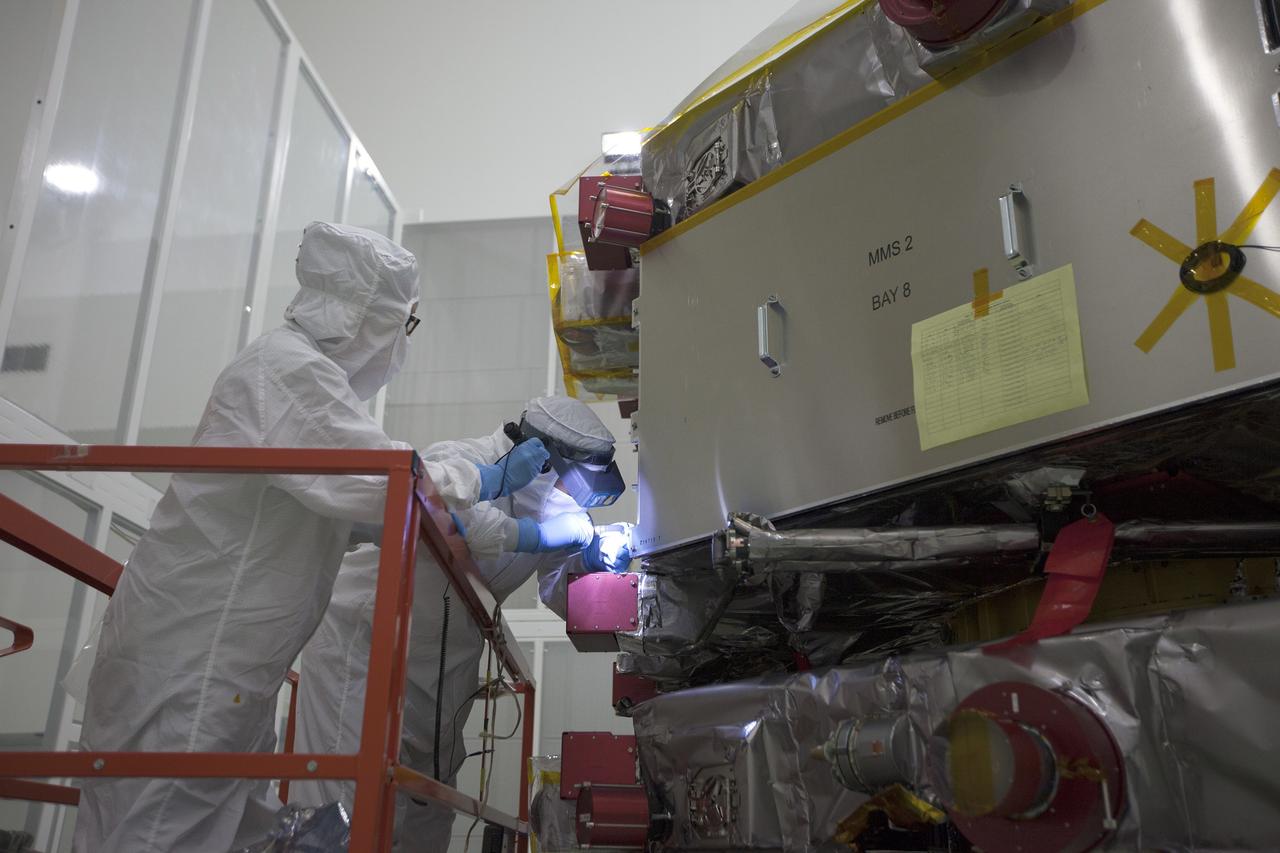
CAPE CANAVERAL, Fla. – Workers inspect the solar arrays on the Magnetospheric Multiscale, or MMS, observatories in the Building 1 D high bay of the Astrotech payload processing facility in Titusville, Florida, near Kennedy Space Center. The two MMS spacecraft comprising the upper deck arrived Nov. 12; the two comprising the lower stack arrived Oct. 29. MMS, led by a team from NASA's Goddard Space Flight Center, is a Solar Terrestrial Probes mission consisting of four identically instrumented spacecraft that will use Earth’s magnetosphere as a laboratory to study the microphysics of three fundamental plasma processes: magnetic reconnection, energetic particle acceleration and turbulence. Launch aboard a United Launch Alliance Atlas V rocket from Space Launch Complex 41 on Cape Canaveral Air Force Station is targeted for March 12, 2015. To learn more about MMS, visit http://mms.gsfc.nasa.gov. Photo credit: NASA/Kim Shiflett
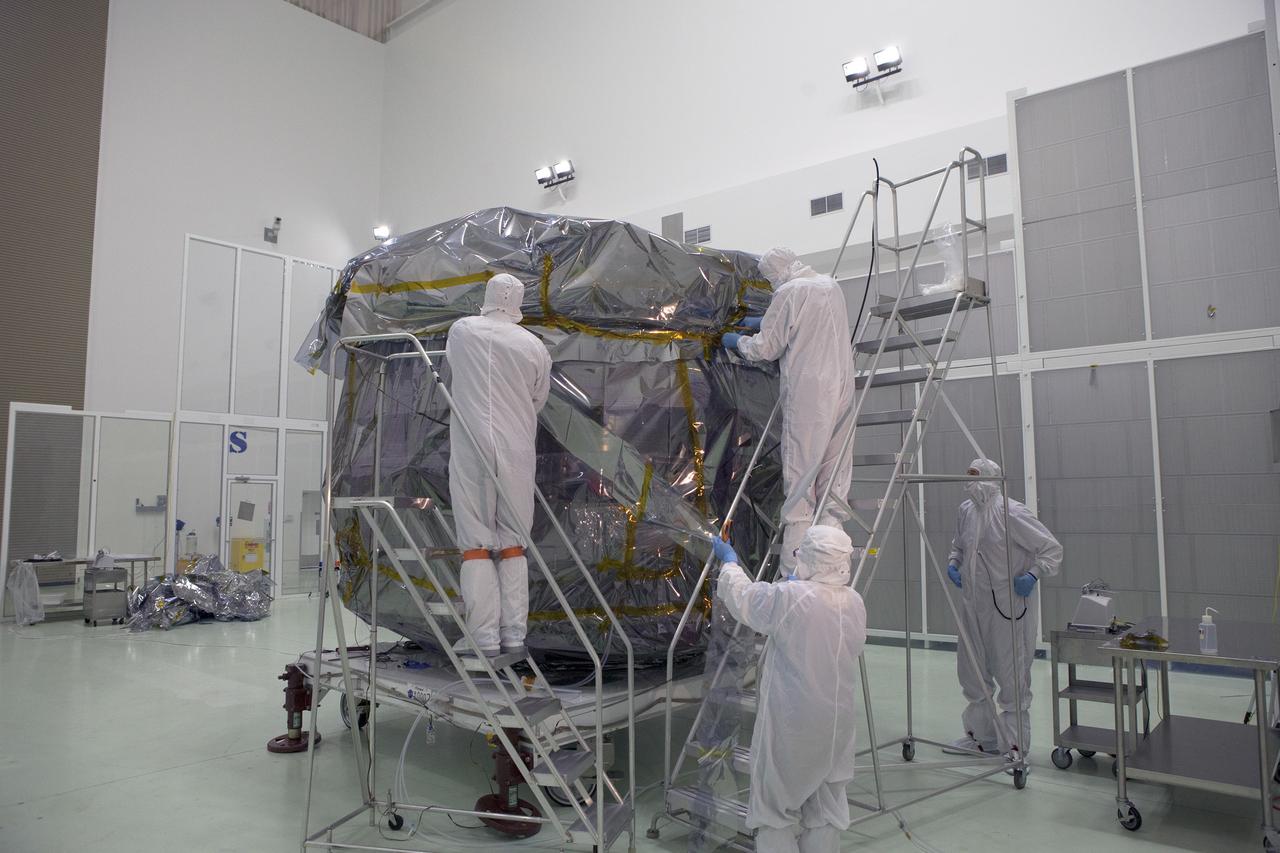
CAPE CANAVERAL, Fla. – Technicians prepare to remove the protective covering from the lower stack, mini-stack number 1, two of the observatories for NASA's Magnetospheric Multiscale Observatory, or MMS, in Building 1 D high bay at the Astrotech payload processing facility in Titusville, Florida, near Kennedy Space Center. The MMS upper stack, mini-stack number 2, is scheduled to arrive in about two weeks. MMS is a Solar Terrestrial Probes mission comprising four identically instrumented spacecraft that will use Earth’s magnetosphere as a laboratory to study the microphysics of three fundamental plasma processes: magnetic reconnection, energetic particle acceleration and turbulence. Launch aboard a United Launch Alliance Atlas V rocket from Space Launch Complex 41 on Cape Canaveral Air Force Station is targeted for March 12, 2015. To learn more about MMS, visit http://mms.gsfc.nasa.gov. Photo credit: NASA/Dan Casper
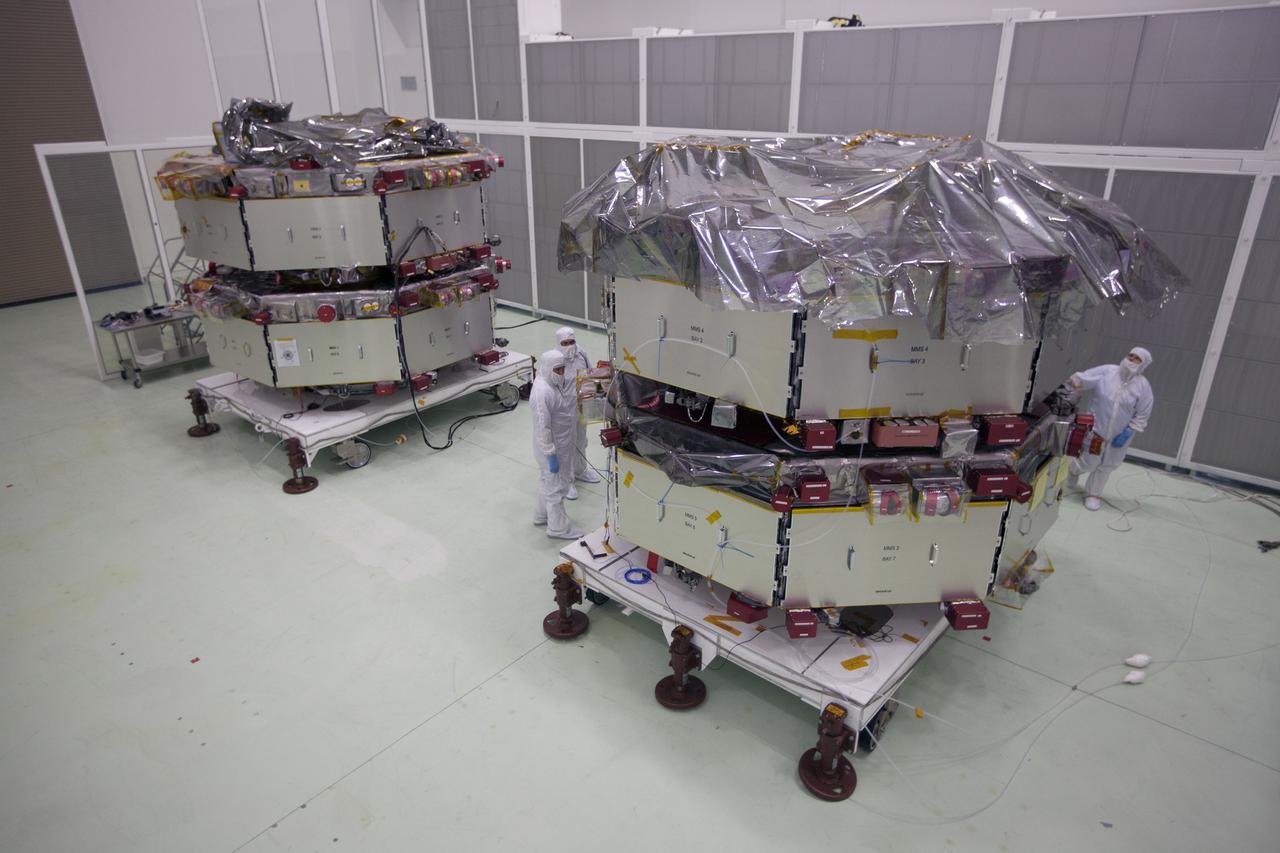
CAPE CANAVERAL, Fla. – The Magnetospheric Multiscale, or MMS, spacecraft will undergo final processing for launch now that all four are in the Building 1 high bay of the Astrotech payload processing facility in Titusville, Florida, near Kennedy Space Center. The two MMS spacecraft comprising the upper deck arrived Nov. 12; the two MMS spacecraft comprising the lower stack arrived Oct. 29. The Magnetospheric Multiscale mission is a Solar Terrestrial Probes mission comprising four identically instrumented spacecraft that will use Earth’s magnetosphere as a laboratory to study the microphysics of three fundamental plasma processes: magnetic reconnection, energetic particle acceleration and turbulence. Launch aboard a United Launch Alliance Atlas V rocket from Space Launch Complex 41 on Cape Canaveral Air Force Station is targeted for March 12, 2015. To learn more about MMS, visit http://mms.gsfc.nasa.gov. Photo credit: NASA/Kim Shiflett
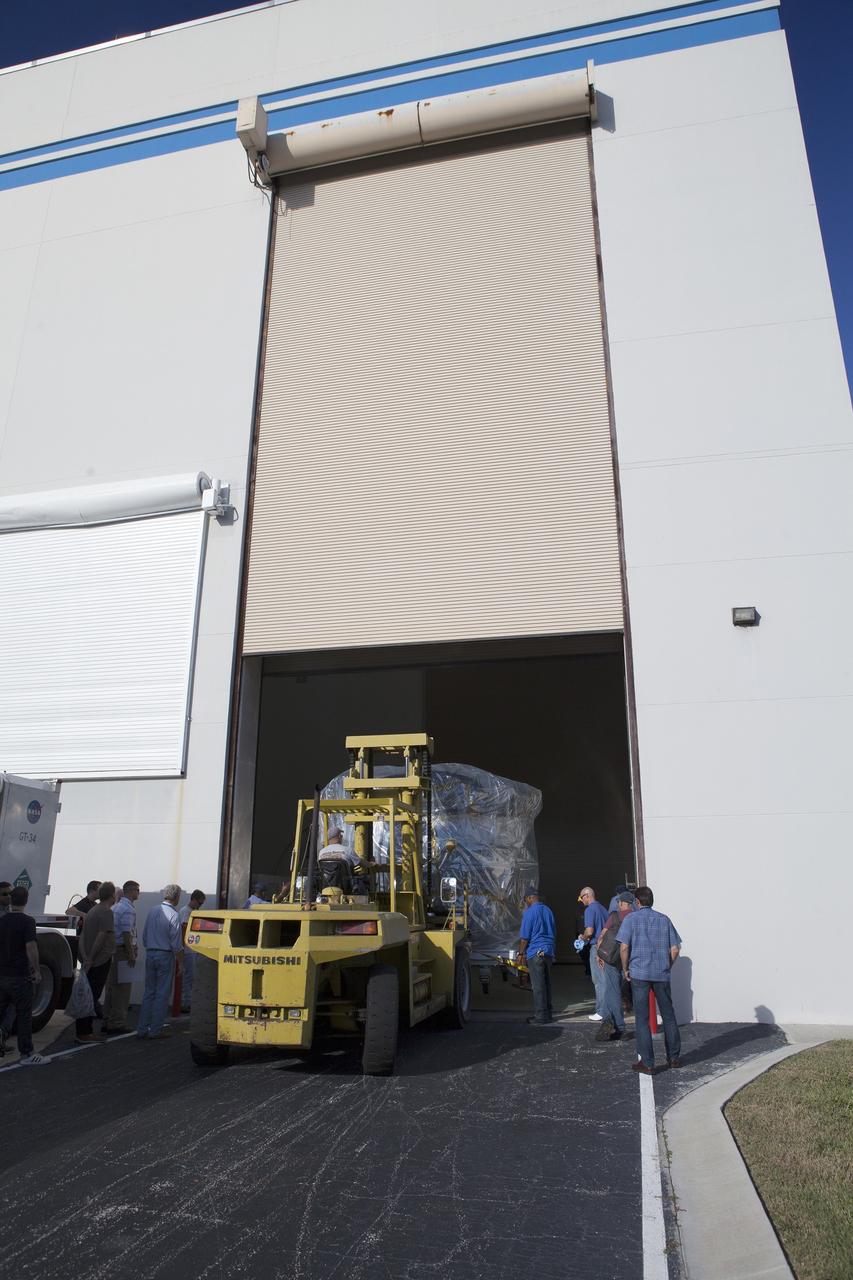
CAPE CANAVERAL, Fla. – Two of the observatories, the lower stack, mini-stack number 1, for NASA's Magnetospheric Multiscale Observatory, or MMS, roll into the Building 1 airlock at the Astrotech payload processing facility in Titusville, Florida, near Kennedy Space Center. The MMS upper stack, mini-stack number 2, is scheduled to arrive in about two weeks. MMS is a Solar Terrestrial Probes mission comprising four identically instrumented spacecraft that will use Earth’s magnetosphere as a laboratory to study the microphysics of three fundamental plasma processes: magnetic reconnection, energetic particle acceleration and turbulence. Launch aboard a United Launch Alliance Atlas V rocket from Space Launch Complex 41 on Cape Canaveral Air Force Station is targeted for March 12, 2015. To learn more about MMS, visit http://mms.gsfc.nasa.gov. Photo credit: NASA/Dan Casper
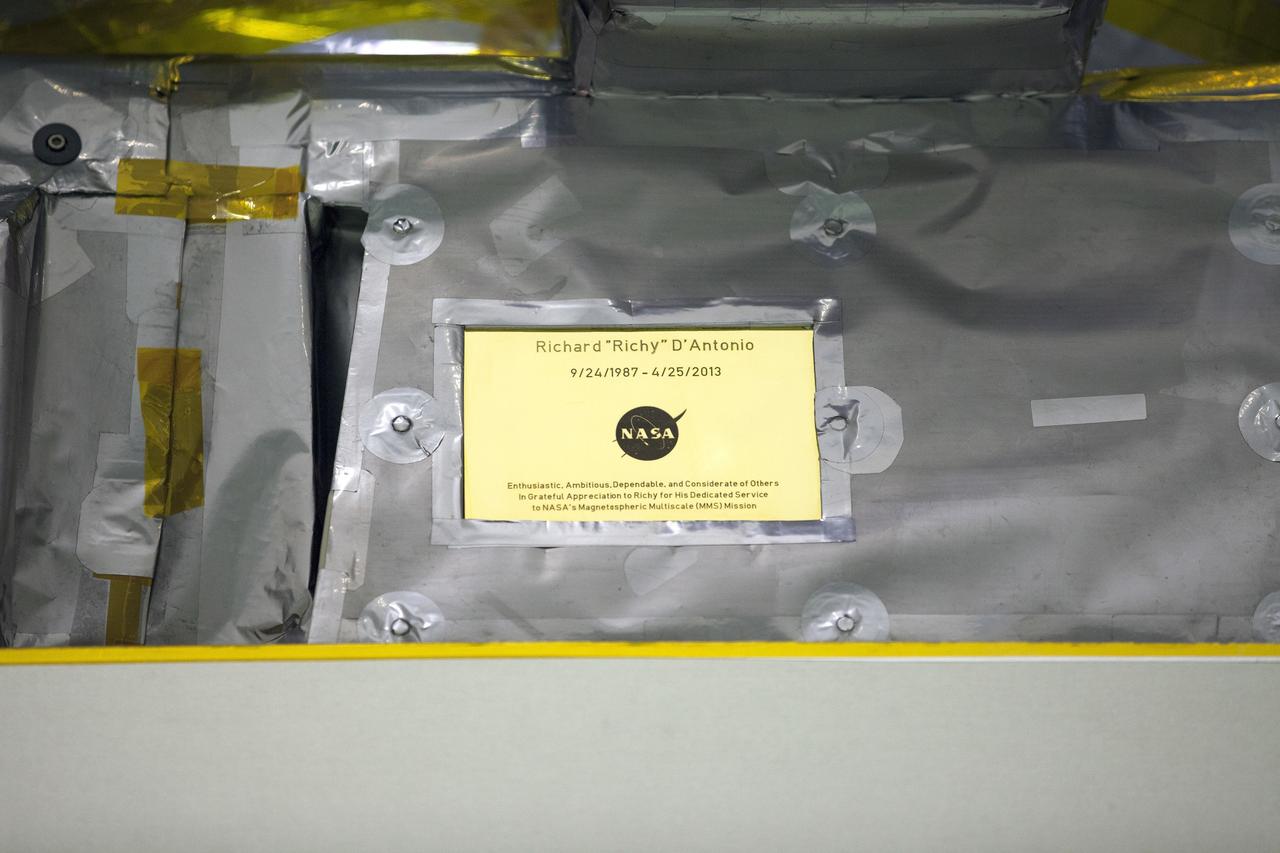
CAPE CANAVERAL, Fla. – A plaque affixed to the side of a Magnetospheric Multiscale, or MMS, observatory dedicates the mission to Richard “Richy” D’Antonio, now deceased, in grateful appreciation for his dedicated service to NASA’s MMS mission. MMS, led by a team from NASA's Goddard Space Flight Center, is a Solar Terrestrial Probes mission consisting of four identically instrumented spacecraft that will use Earth’s magnetosphere as a laboratory to study the microphysics of three fundamental plasma processes: magnetic reconnection, energetic particle acceleration and turbulence. Launch aboard a United Launch Alliance Atlas V rocket from Space Launch Complex 41 on Cape Canaveral Air Force Station is targeted for March 12, 2015. To learn more about MMS, visit http://mms.gsfc.nasa.gov. Photo credit: NASA/Kim Shiflett

CAPE CANAVERAL, Fla. – All four of the Magnetospheric Multiscale, or MMS, spacecraft have arrived in the Building 1 high bay of the Astrotech payload processing facility in Titusville, Florida, near Kennedy Space Center. The two MMS spacecraft comprising the upper deck arrived Nov. 12; the two MMS spacecraft comprising the lower stack arrived Oct. 29. The Magnetospheric Multiscale mission is a Solar Terrestrial Probes mission comprising four identically instrumented spacecraft that will use Earth’s magnetosphere as a laboratory to study the microphysics of three fundamental plasma processes: magnetic reconnection, energetic particle acceleration and turbulence. Launch aboard a United Launch Alliance Atlas V rocket from Space Launch Complex 41 on Cape Canaveral Air Force Station is targeted for March 12, 2015. To learn more about MMS, visit http://mms.gsfc.nasa.gov. Photo credit: NASA/Kim Shiflett
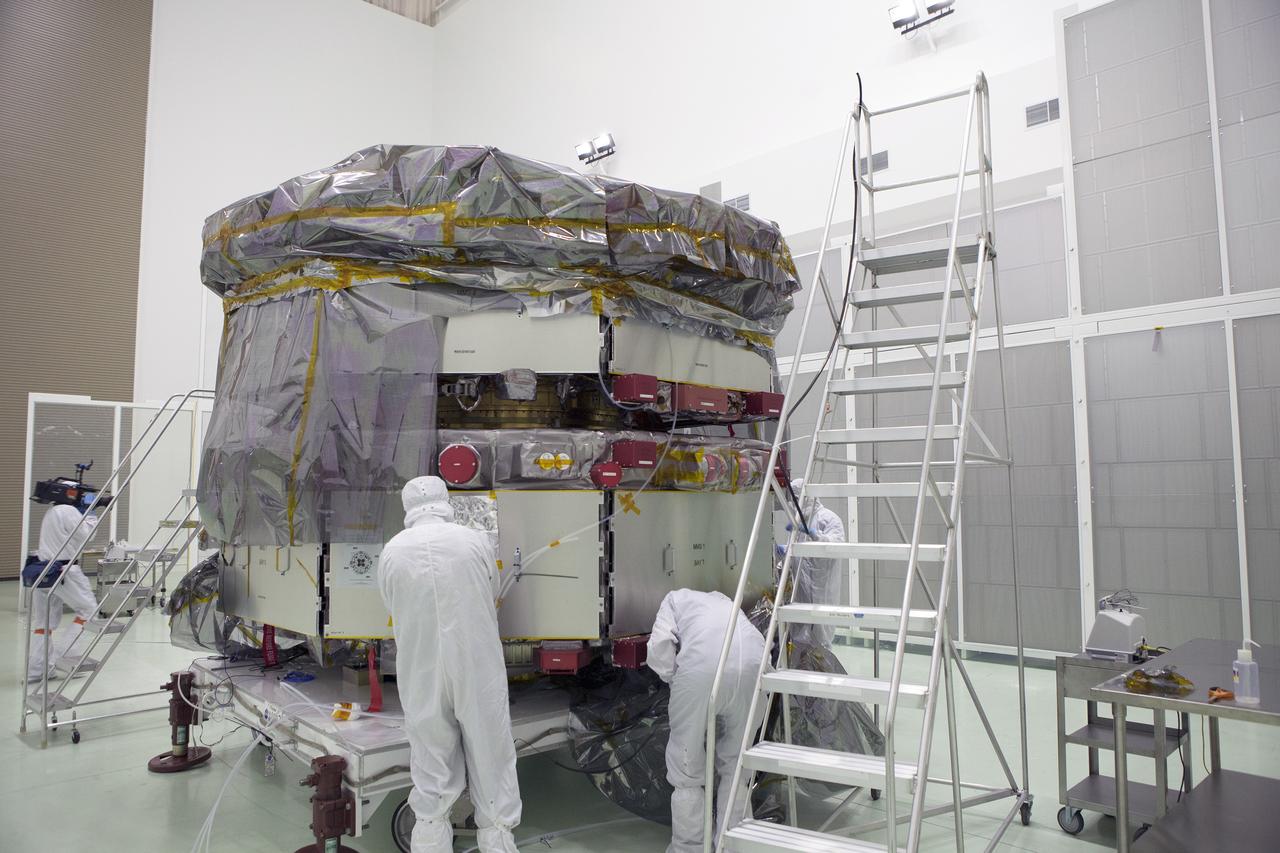
CAPE CANAVERAL, Fla. – Technicians remove the protective covering from the lower stack, mini-stack number 1, two of the observatories for NASA's Magnetospheric Multiscale Observatory, or MMS, in Building 1 D high bay at the Astrotech payload processing facility in Titusville, Florida, near Kennedy Space Center. The MMS upper stack, mini-stack number 2, is scheduled to arrive in about two weeks. MMS is a Solar Terrestrial Probes mission comprising four identically instrumented spacecraft that will use Earth’s magnetosphere as a laboratory to study the microphysics of three fundamental plasma processes: magnetic reconnection, energetic particle acceleration and turbulence. Launch aboard a United Launch Alliance Atlas V rocket from Space Launch Complex 41 on Cape Canaveral Air Force Station is targeted for March 12, 2015. To learn more about MMS, visit http://mms.gsfc.nasa.gov. Photo credit: NASA/Dan Casper
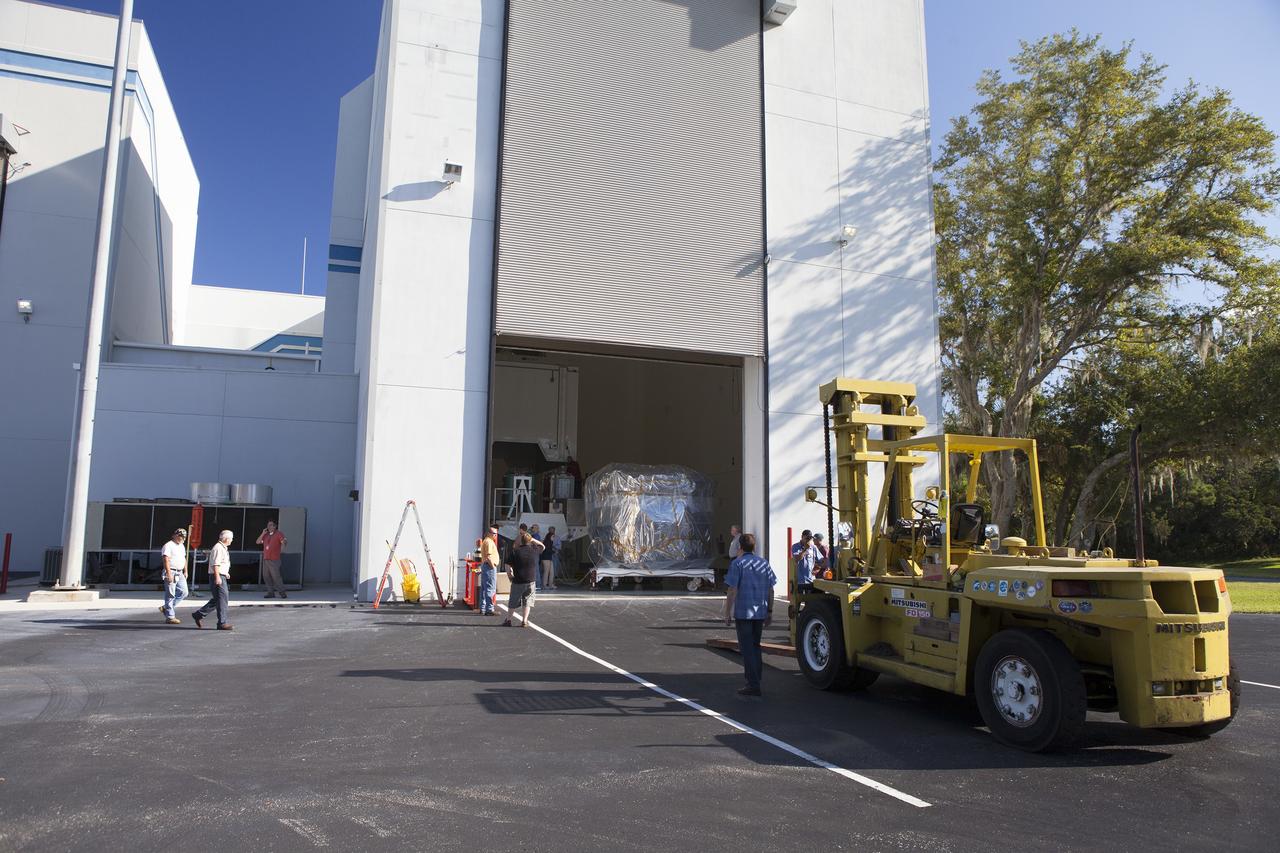
CAPE CANAVERAL, Fla. – Preparations are underway to tow two of the observatories, the lower stack, mini-stack number 1, for NASA's Magnetospheric Multiscale Observatory, or MMS, from the Building 2 south encapsulation bay to the Building 1 high bay at the Astrotech payload processing facility in Titusville, Florida, near Kennedy Space Center. The MMS upper stack, mini-stack number 2, is scheduled to arrive in about two weeks. MMS is a Solar Terrestrial Probes mission comprising four identically instrumented spacecraft that will use Earth’s magnetosphere as a laboratory to study the microphysics of three fundamental plasma processes: magnetic reconnection, energetic particle acceleration and turbulence. Launch aboard a United Launch Alliance Atlas V rocket from Space Launch Complex 41 on Cape Canaveral Air Force Station is targeted for March 12, 2015. To learn more about MMS, visit http://mms.gsfc.nasa.gov. Photo credit: NASA/Dan Casper
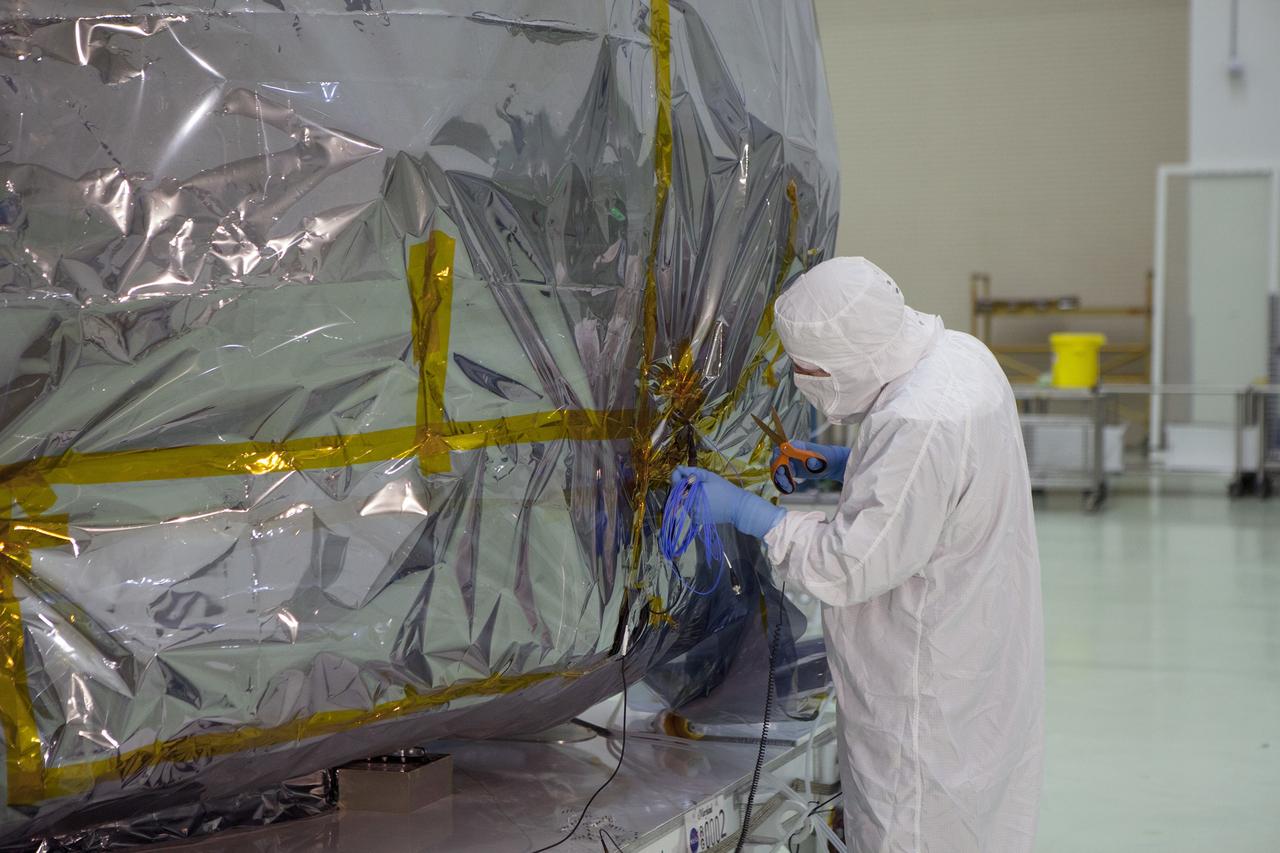
CAPE CANAVERAL, Fla. – A technician prepares to remove the protective covering from the lower stack, mini-stack number 1, two of the observatories for NASA's Magnetospheric Multiscale Observatory, or MMS, in Building 1 D high bay at the Astrotech payload processing facility in Titusville, Florida, near Kennedy Space Center. The MMS upper stack, mini-stack number 2, is scheduled to arrive in about two weeks. MMS is a Solar Terrestrial Probes mission comprising four identically instrumented spacecraft that will use Earth’s magnetosphere as a laboratory to study the microphysics of three fundamental plasma processes: magnetic reconnection, energetic particle acceleration and turbulence. Launch aboard a United Launch Alliance Atlas V rocket from Space Launch Complex 41 on Cape Canaveral Air Force Station is targeted for March 12, 2015. To learn more about MMS, visit http://mms.gsfc.nasa.gov. Photo credit: NASA/Dan Casper
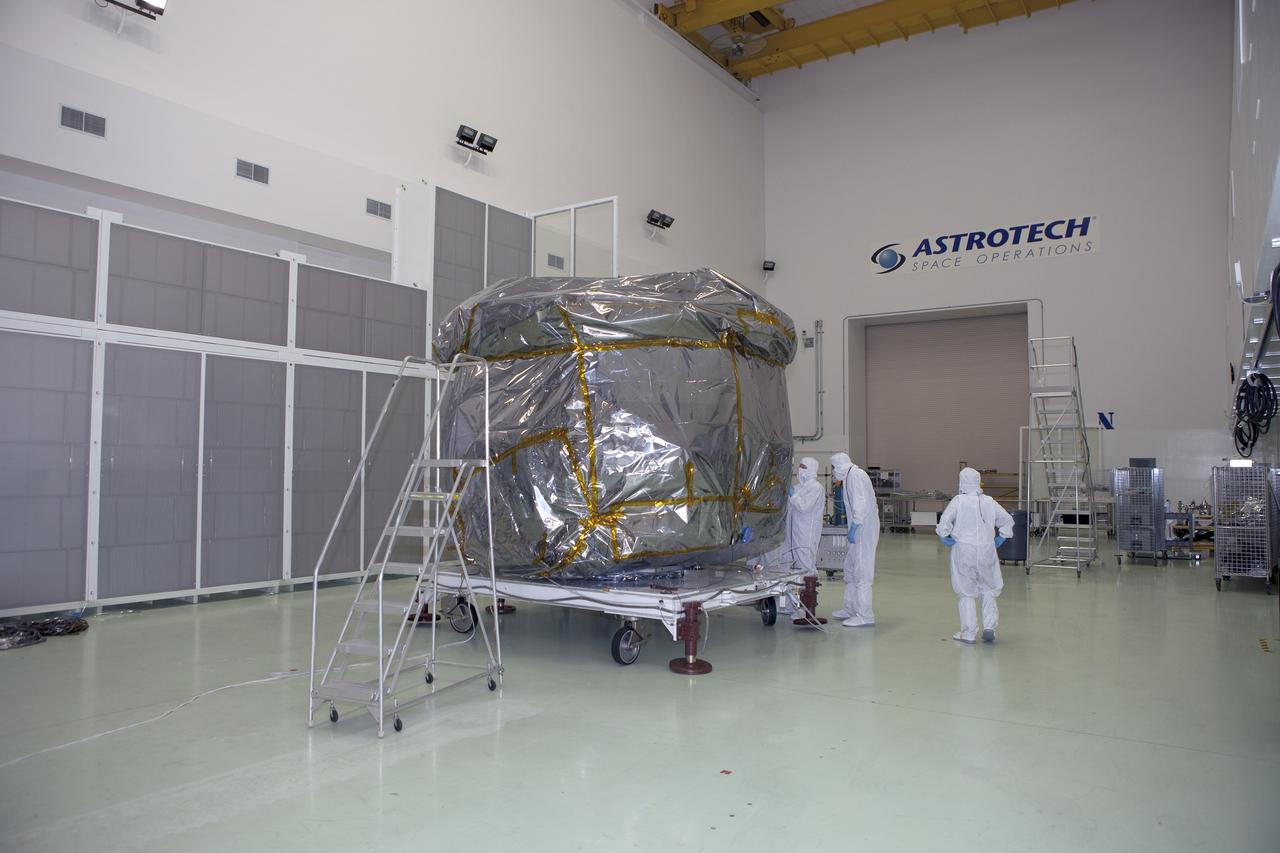
CAPE CANAVERAL, Fla. – Preparations are underway to remove the protective covering from the lower stack, mini-stack number 1, two of the observatories for NASA's Magnetospheric Multiscale Observatory, or MMS, in Building 1 D high bay at the Astrotech payload processing facility in Titusville, Florida, near Kennedy Space Center. The MMS upper stack, mini-stack number 2, is scheduled to arrive in about two weeks. MMS is a Solar Terrestrial Probes mission comprising four identically instrumented spacecraft that will use Earth’s magnetosphere as a laboratory to study the microphysics of three fundamental plasma processes: magnetic reconnection, energetic particle acceleration and turbulence. Launch aboard a United Launch Alliance Atlas V rocket from Space Launch Complex 41 on Cape Canaveral Air Force Station is targeted for March 12, 2015. To learn more about MMS, visit http://mms.gsfc.nasa.gov. Photo credit: NASA/Dan Casper
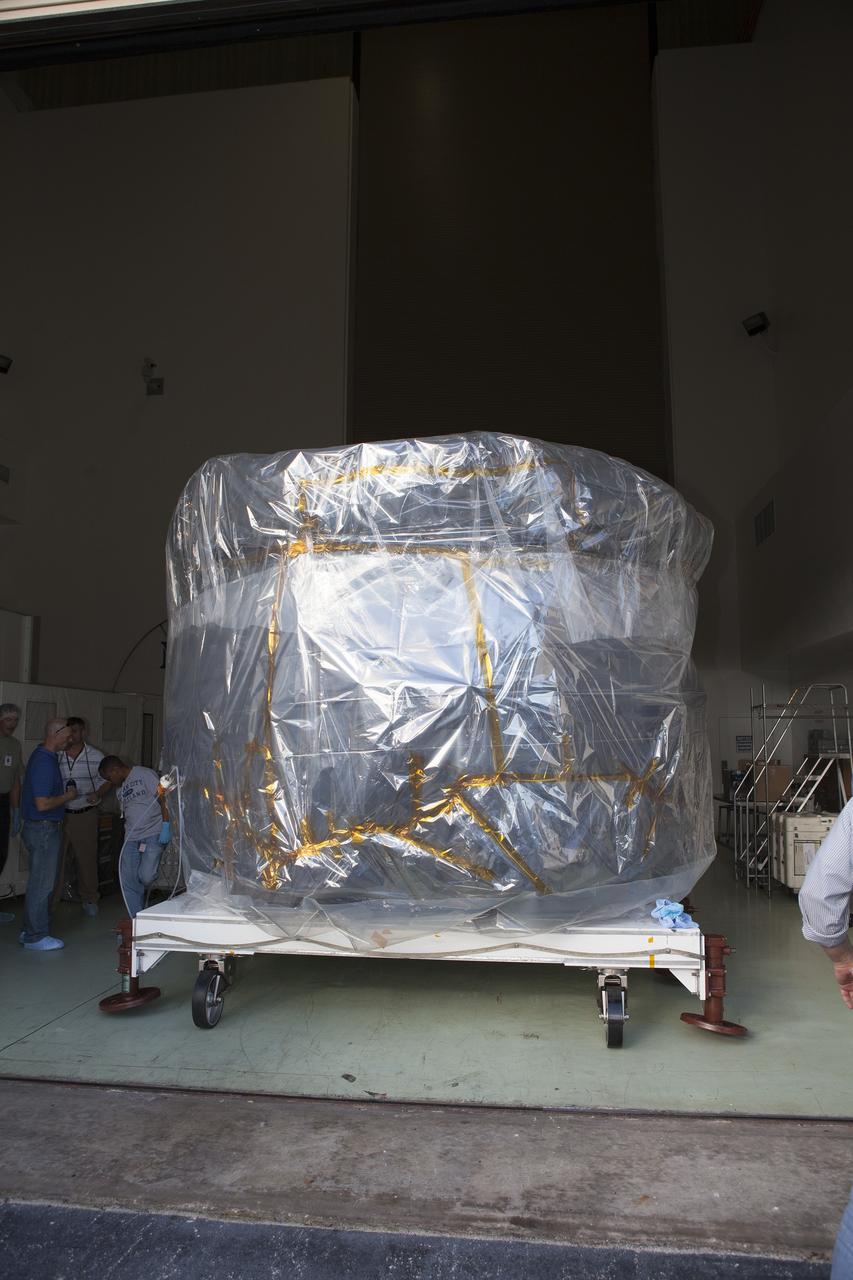
CAPE CANAVERAL, Fla. – Two of the observatories, the lower stack, mini-stack number 1, for NASA's Magnetospheric Multiscale Observatory, or MMS, arrive in the Building 1 airlock at the Astrotech payload processing facility in Titusville, Florida, near Kennedy Space Center. The MMS upper stack, mini-stack number 2, is scheduled to arrive in about two weeks. MMS is a Solar Terrestrial Probes mission comprising four identically instrumented spacecraft that will use Earth’s magnetosphere as a laboratory to study the microphysics of three fundamental plasma processes: magnetic reconnection, energetic particle acceleration and turbulence. Launch aboard a United Launch Alliance Atlas V rocket from Space Launch Complex 41 on Cape Canaveral Air Force Station is targeted for March 12, 2015. To learn more about MMS, visit http://mms.gsfc.nasa.gov. Photo credit: NASA/Dan Casper
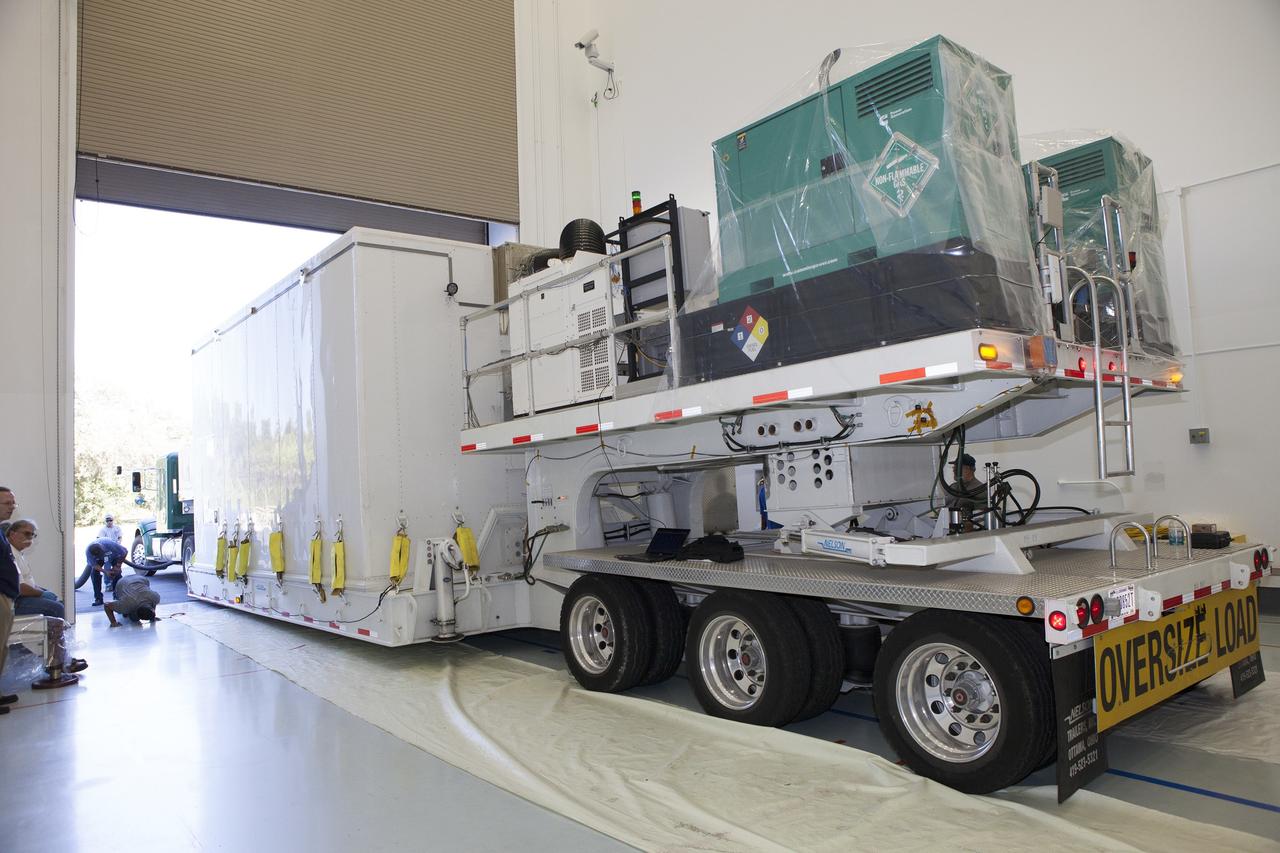
CAPE CANAVERAL, Fla. – Preparations are underway to remove the lower stack, mini-stack number 1, two of the observatories for NASA's Magnetospheric Multiscale Observatory, or MMS, from their protective shipping container in the Building 2 south encapsulation bay at the Astrotech payload processing facility in Titusville, Florida, near Kennedy Space Center. The MMS upper stack, mini-stack number 2, is scheduled to arrive in about two weeks. MMS is a Solar Terrestrial Probes mission comprising four identically instrumented spacecraft that will use Earth’s magnetosphere as a laboratory to study the microphysics of three fundamental plasma processes: magnetic reconnection, energetic particle acceleration and turbulence. Launch aboard a United Launch Alliance Atlas V rocket from Space Launch Complex 41 on Cape Canaveral Air Force Station is targeted for March 12, 2015. To learn more about MMS, visit http://mms.gsfc.nasa.gov. Photo credit: NASA/Dan Casper
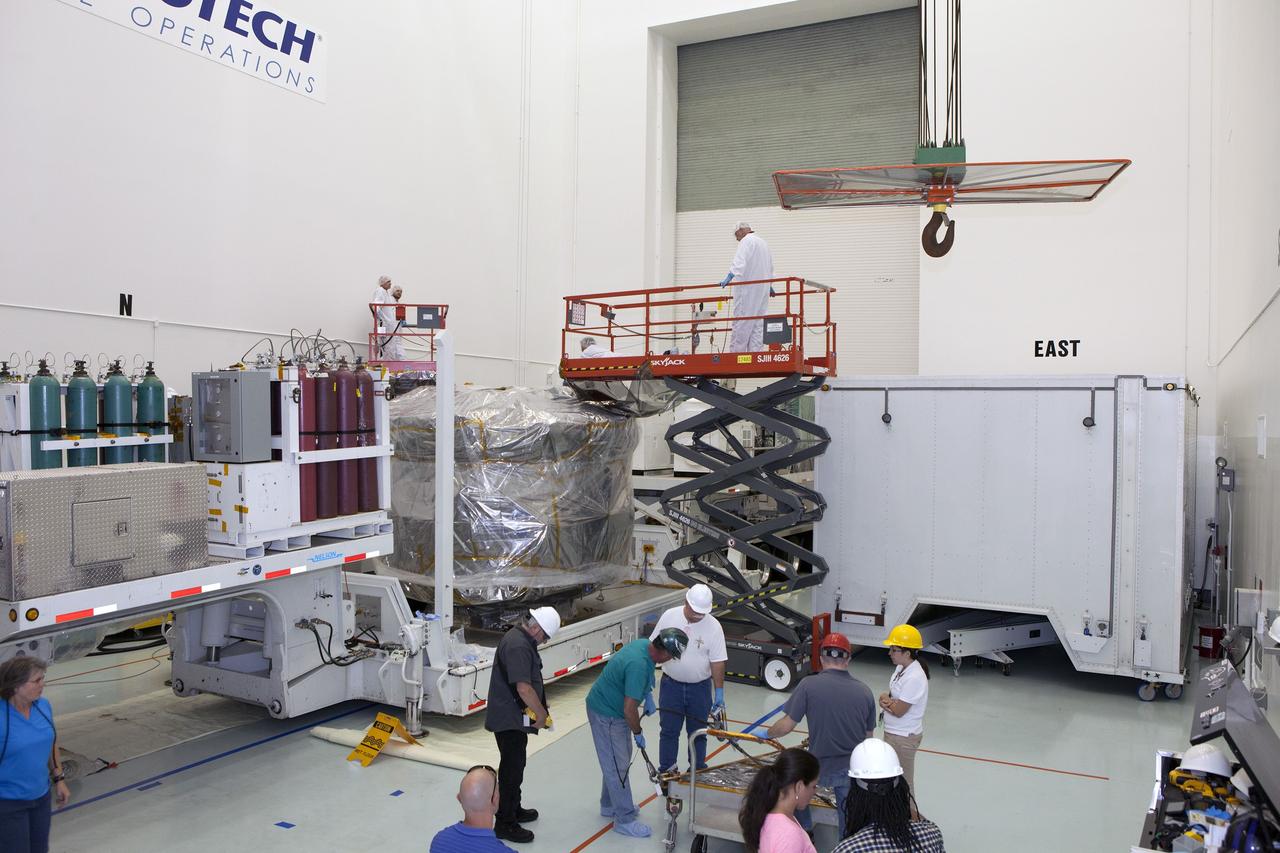
CAPE CANAVERAL, Fla. – Workers prepare a payload dolly for the lower stack, mini-stack number 1, two of the observatories for NASA's Magnetospheric Multiscale Observatory, or MMS, during uncrating operations in the Building 2 south encapsulation bay at the Astrotech payload processing facility in Titusville, Florida, near Kennedy Space Center. The MMS upper stack, mini-stack number 2, is scheduled to arrive in about two weeks. MMS is a Solar Terrestrial Probes mission comprising four identically instrumented spacecraft that will use Earth’s magnetosphere as a laboratory to study the microphysics of three fundamental plasma processes: magnetic reconnection, energetic particle acceleration and turbulence. Launch aboard a United Launch Alliance Atlas V rocket from Space Launch Complex 41 on Cape Canaveral Air Force Station is targeted for March 12, 2015. To learn more about MMS, visit http://mms.gsfc.nasa.gov. Photo credit: NASA/Dan Casper
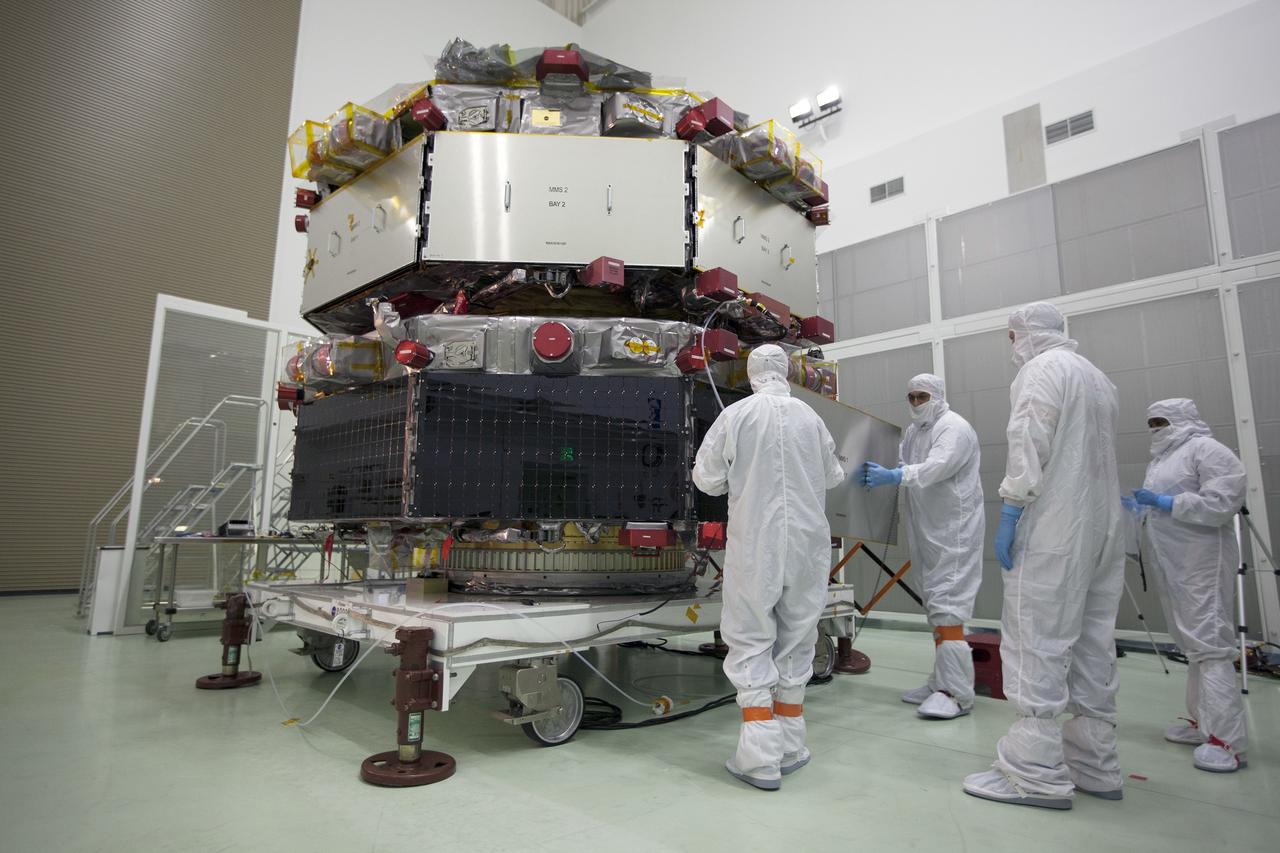
CAPE CANAVERAL, Fla. – Workers inspect the solar arrays on the Magnetospheric Multiscale, or MMS, observatories in the Building 1 D high bay of the Astrotech payload processing facility in Titusville, Florida, near Kennedy Space Center. The two MMS spacecraft comprising the upper deck arrived Nov. 12; the two comprising the lower stack arrived Oct. 29. MMS, led by a team from NASA's Goddard Space Flight Center, is a Solar Terrestrial Probes mission consisting of four identically instrumented spacecraft that will use Earth’s magnetosphere as a laboratory to study the microphysics of three fundamental plasma processes: magnetic reconnection, energetic particle acceleration and turbulence. Launch aboard a United Launch Alliance Atlas V rocket from Space Launch Complex 41 on Cape Canaveral Air Force Station is targeted for March 12, 2015. To learn more about MMS, visit http://mms.gsfc.nasa.gov. Photo credit: NASA/Kim Shiflett

CAPE CANAVERAL, Fla. – Workers inspect the solar arrays on the Magnetospheric Multiscale, or MMS, observatories in the Building 1 D high bay of the Astrotech payload processing facility in Titusville, Florida, near Kennedy Space Center. The two MMS spacecraft comprising the upper deck arrived Nov. 12; the two comprising the lower stack arrived Oct. 29. MMS, led by a team from NASA's Goddard Space Flight Center, is a Solar Terrestrial Probes mission consisting of four identically instrumented spacecraft that will use Earth’s magnetosphere as a laboratory to study the microphysics of three fundamental plasma processes: magnetic reconnection, energetic particle acceleration and turbulence. Launch aboard a United Launch Alliance Atlas V rocket from Space Launch Complex 41 on Cape Canaveral Air Force Station is targeted for March 12, 2015. To learn more about MMS, visit http://mms.gsfc.nasa.gov. Photo credit: NASA/Kim Shiflett
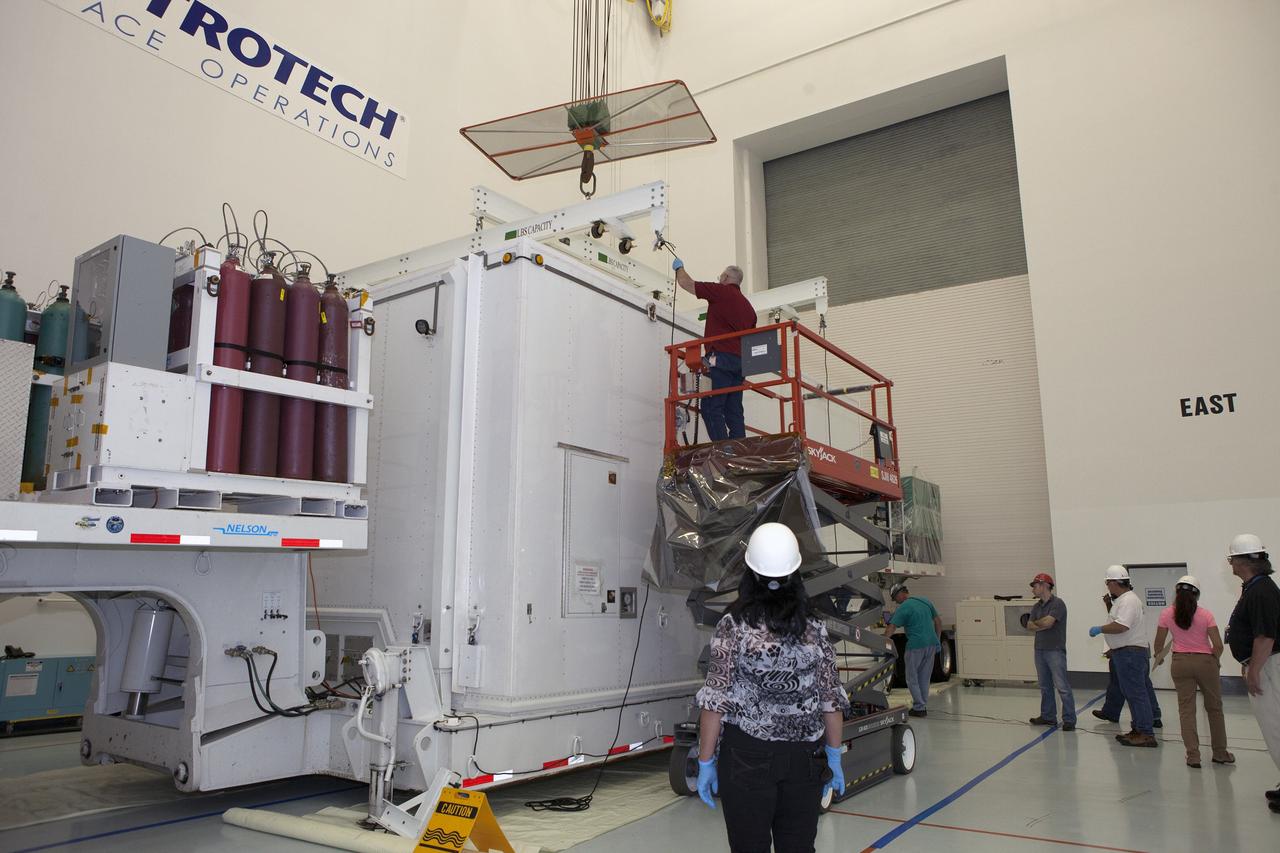
CAPE CANAVERAL, Fla. – Workers attach a crane to the protective shipping container to prepare to uncover the lower stack, mini-stack number 1, two of the observatories for NASA's Magnetospheric Multiscale Observatory, or MMS. They were delivered to the Building 2 south encapsulation bay at the Astrotech payload processing facility in Titusville, Florida, near Kennedy Space Center. The MMS upper stack, mini-stack number 2, is scheduled to arrive in about two weeks. MMS is a Solar Terrestrial Probes mission comprising four identically instrumented spacecraft that will use Earth’s magnetosphere as a laboratory to study the microphysics of three fundamental plasma processes: magnetic reconnection, energetic particle acceleration and turbulence. Launch aboard a United Launch Alliance Atlas V rocket from Space Launch Complex 41 on Cape Canaveral Air Force Station is targeted for March 12, 2015. To learn more about MMS, visit http://mms.gsfc.nasa.gov. Photo credit: NASA/Dan Casper
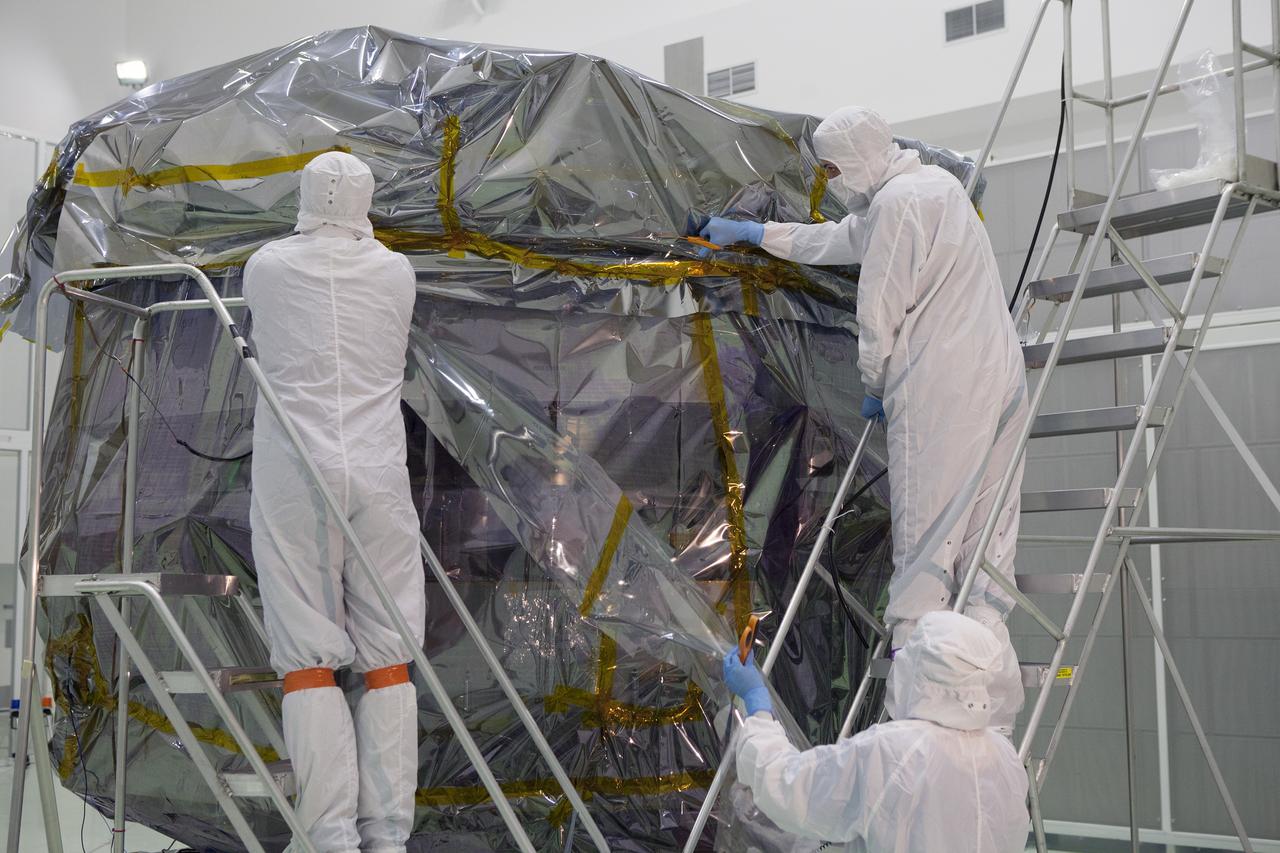
CAPE CANAVERAL, Fla. – Technicians begin to remove the protective covering from the lower stack, mini-stack number 1, two of the observatories for NASA's Magnetospheric Multiscale Observatory, or MMS, in Building 1 D high bay at the Astrotech payload processing facility in Titusville, Florida, near Kennedy Space Center. The MMS upper stack, mini-stack number 2, is scheduled to arrive in about two weeks. MMS is a Solar Terrestrial Probes mission comprising four identically instrumented spacecraft that will use Earth’s magnetosphere as a laboratory to study the microphysics of three fundamental plasma processes: magnetic reconnection, energetic particle acceleration and turbulence. Launch aboard a United Launch Alliance Atlas V rocket from Space Launch Complex 41 on Cape Canaveral Air Force Station is targeted for March 12, 2015. To learn more about MMS, visit http://mms.gsfc.nasa.gov. Photo credit: NASA/Dan Casper
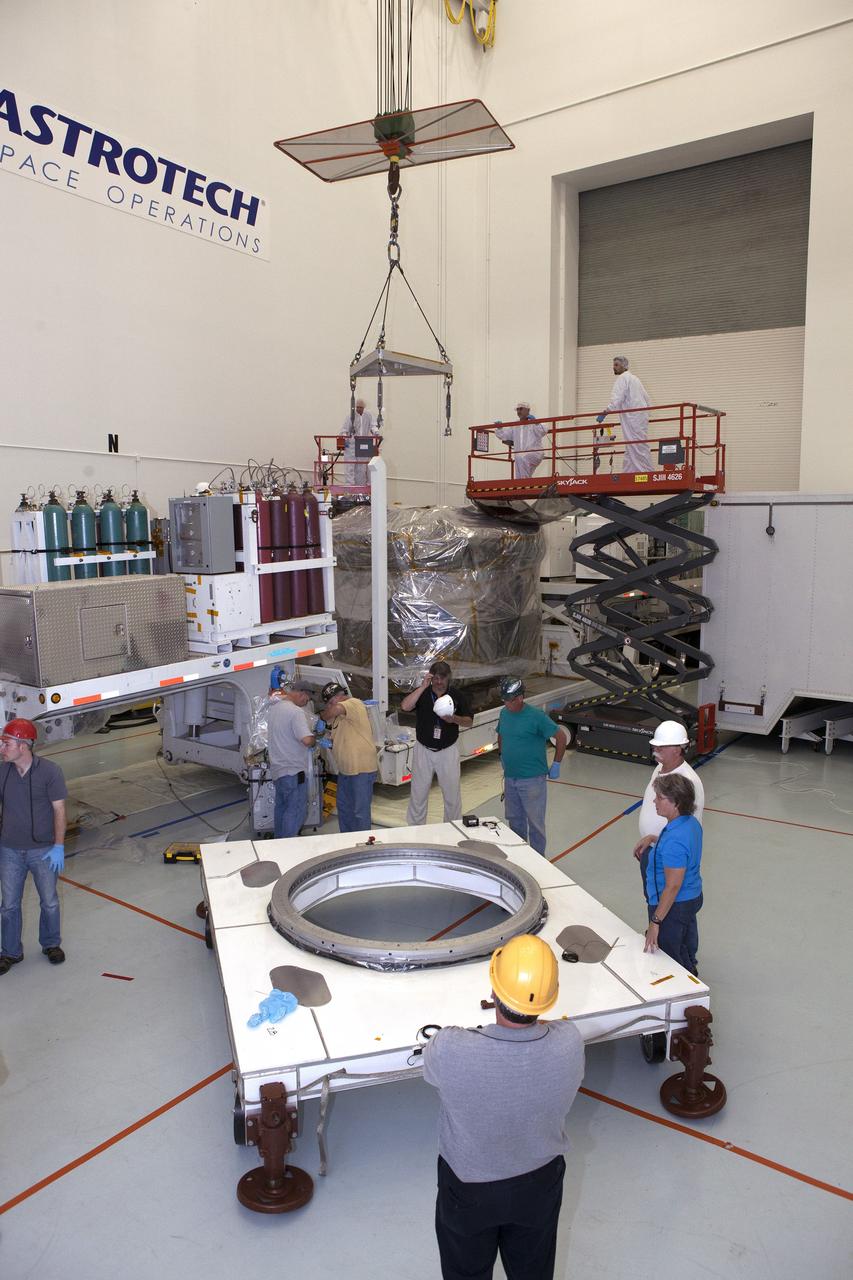
CAPE CANAVERAL, Fla. – A crane is lowered toward the lower stack, mini-stack number 1, two of the observatories for NASA's Magnetospheric Multiscale Observatory, or MMS, during uncrating operations in the Building 2 south encapsulation bay at the Astrotech payload processing facility in Titusville, Florida, near Kennedy Space Center. The MMS upper stack, mini-stack number 2, is scheduled to arrive in about two weeks. MMS is a Solar Terrestrial Probes mission comprising four identically instrumented spacecraft that will use Earth’s magnetosphere as a laboratory to study the microphysics of three fundamental plasma processes: magnetic reconnection, energetic particle acceleration and turbulence. Launch aboard a United Launch Alliance Atlas V rocket from Space Launch Complex 41 on Cape Canaveral Air Force Station is targeted for March 12, 2015. To learn more about MMS, visit http://mms.gsfc.nasa.gov. Photo credit: NASA/Dan Casper
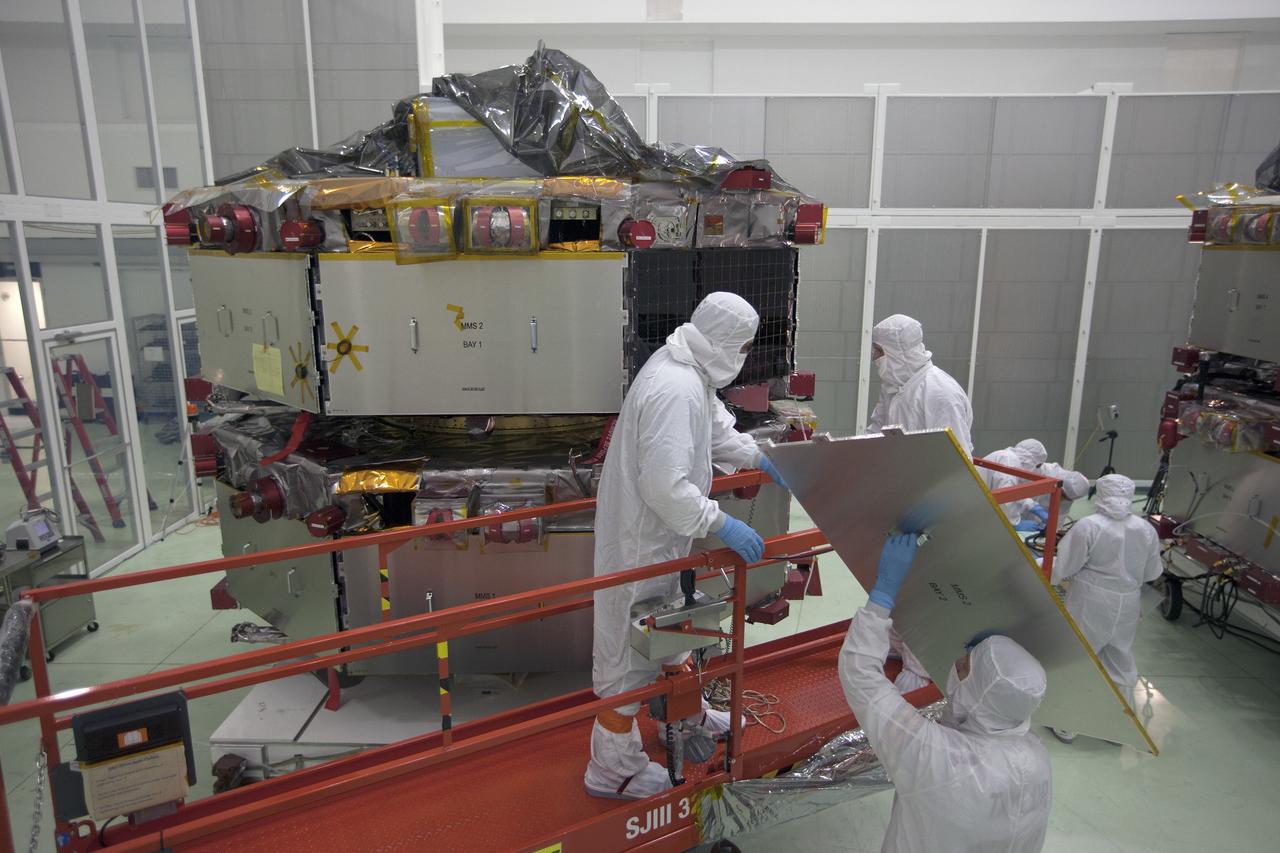
CAPE CANAVERAL, Fla. – Workers inspect the solar arrays on the Magnetospheric Multiscale, or MMS, observatories in the Building 1 D high bay of the Astrotech payload processing facility in Titusville, Florida, near Kennedy Space Center. The two MMS spacecraft comprising the upper deck arrived Nov. 12; the two comprising the lower stack arrived Oct. 29. MMS, led by a team from NASA's Goddard Space Flight Center, is a Solar Terrestrial Probes mission consisting of four identically instrumented spacecraft that will use Earth’s magnetosphere as a laboratory to study the microphysics of three fundamental plasma processes: magnetic reconnection, energetic particle acceleration and turbulence. Launch aboard a United Launch Alliance Atlas V rocket from Space Launch Complex 41 on Cape Canaveral Air Force Station is targeted for March 12, 2015. To learn more about MMS, visit http://mms.gsfc.nasa.gov. Photo credit: NASA/Kim Shiflett
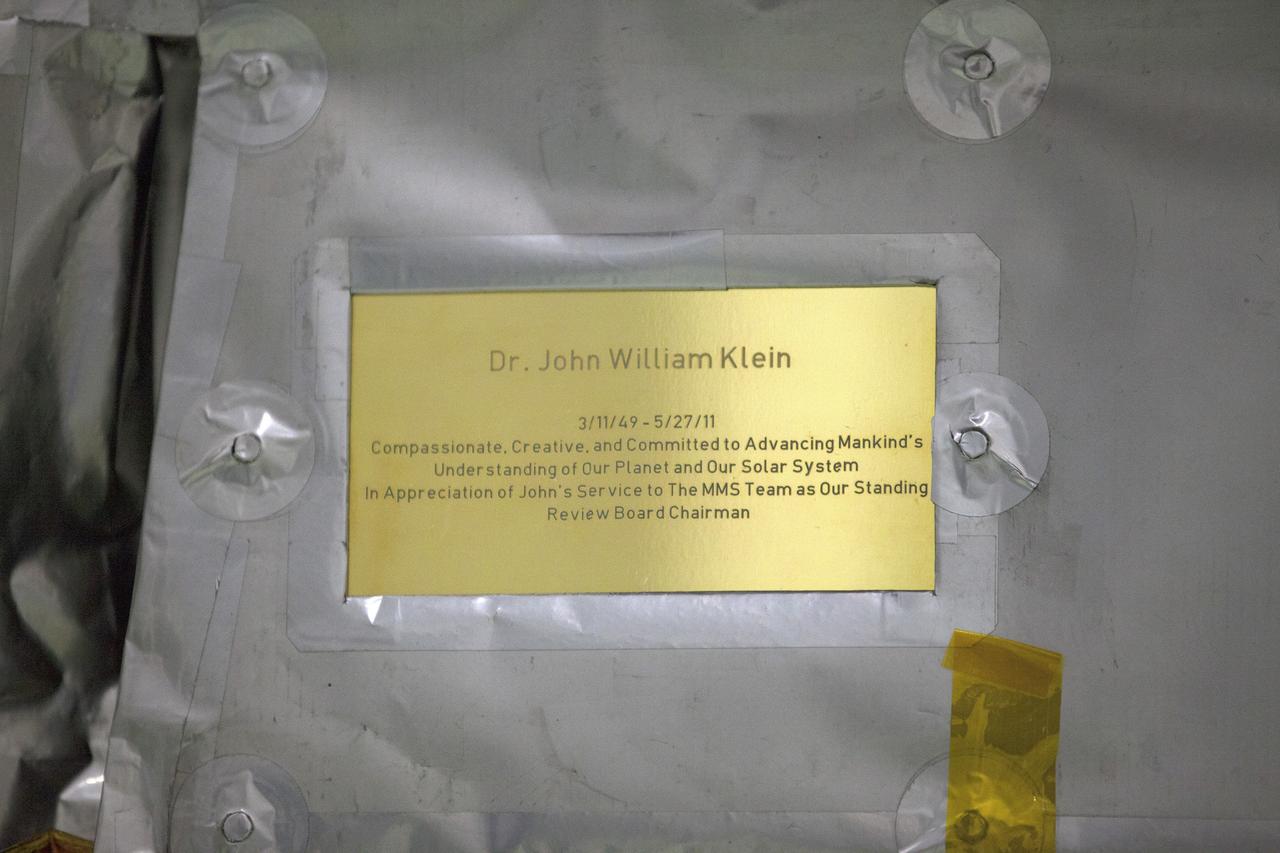
CAPE CANAVERAL, Fla. – A plaque affixed to the side of a Magnetospheric Multiscale, or MMS, observatory dedicates the mission to Dr. John William Klein, now deceased, who served the MMS team as the standing review board chairman. MMS, led by a team from NASA's Goddard Space Flight Center, is a Solar Terrestrial Probes mission consisting of four identically instrumented spacecraft that will use Earth’s magnetosphere as a laboratory to study the microphysics of three fundamental plasma processes: magnetic reconnection, energetic particle acceleration and turbulence. Launch aboard a United Launch Alliance Atlas V rocket from Space Launch Complex 41 on Cape Canaveral Air Force Station is targeted for March 12, 2015. To learn more about MMS, visit http://mms.gsfc.nasa.gov. Photo credit: NASA/Kim Shiflett
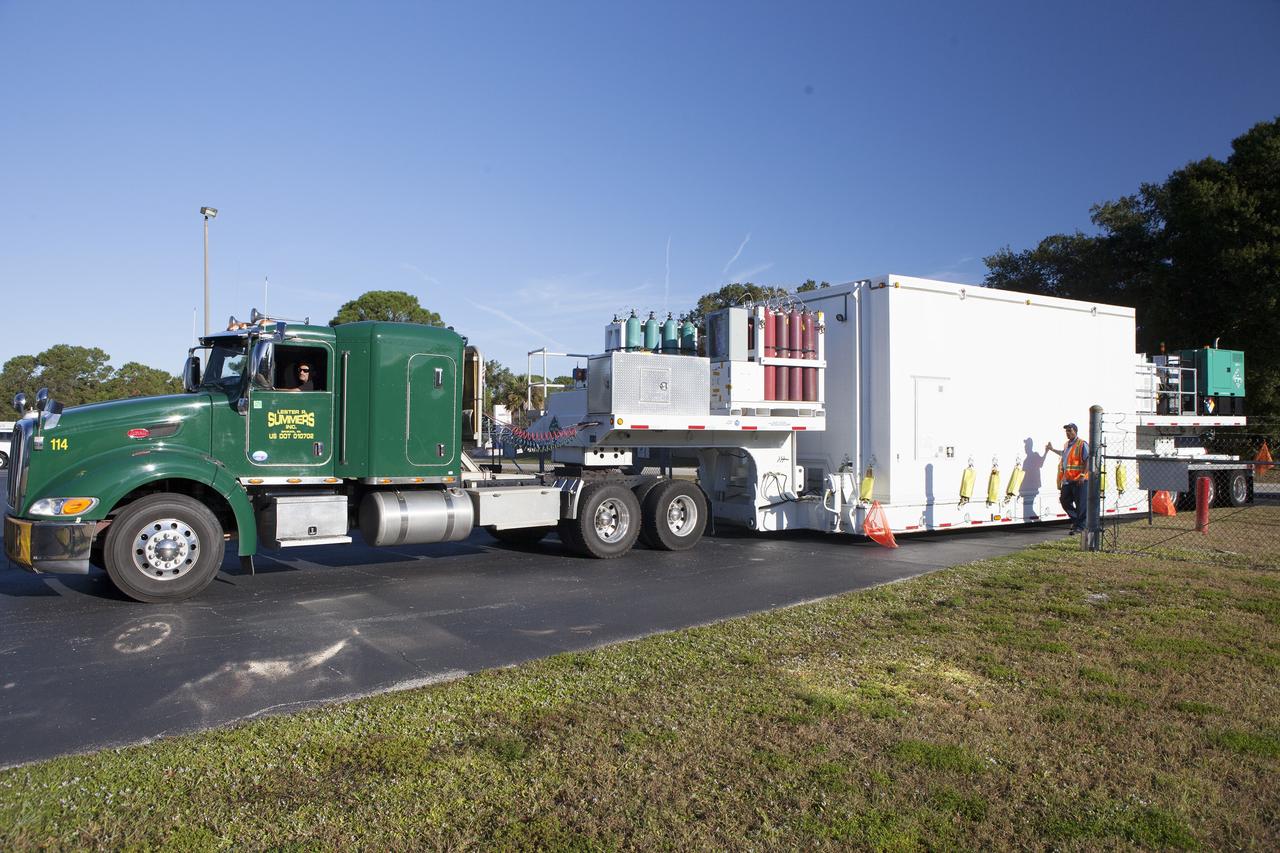
CAPE CANAVERAL, Fla. – The Magnetospheric Multiscale spacecraft, enclosed in a protective shipping container, are delivered by truck to the Astrotech payload processing facility in Titusville, Florida, near Kennedy Space Center. MMS is a Solar Terrestrial Probes mission comprising four identically instrumented spacecraft that will use Earth’s magnetosphere as a laboratory to study the microphysics of three fundamental plasma processes: magnetic reconnection, energetic particle acceleration and turbulence. Launch aboard a United Launch Alliance Atlas V rocket from Space Launch Complex 41 on Cape Canaveral Air Force Station is targeted for March 12, 2015. To learn more about MMS, visit http://mms.gsfc.nasa.gov. Photo credit: NASA/Kim Shiflett
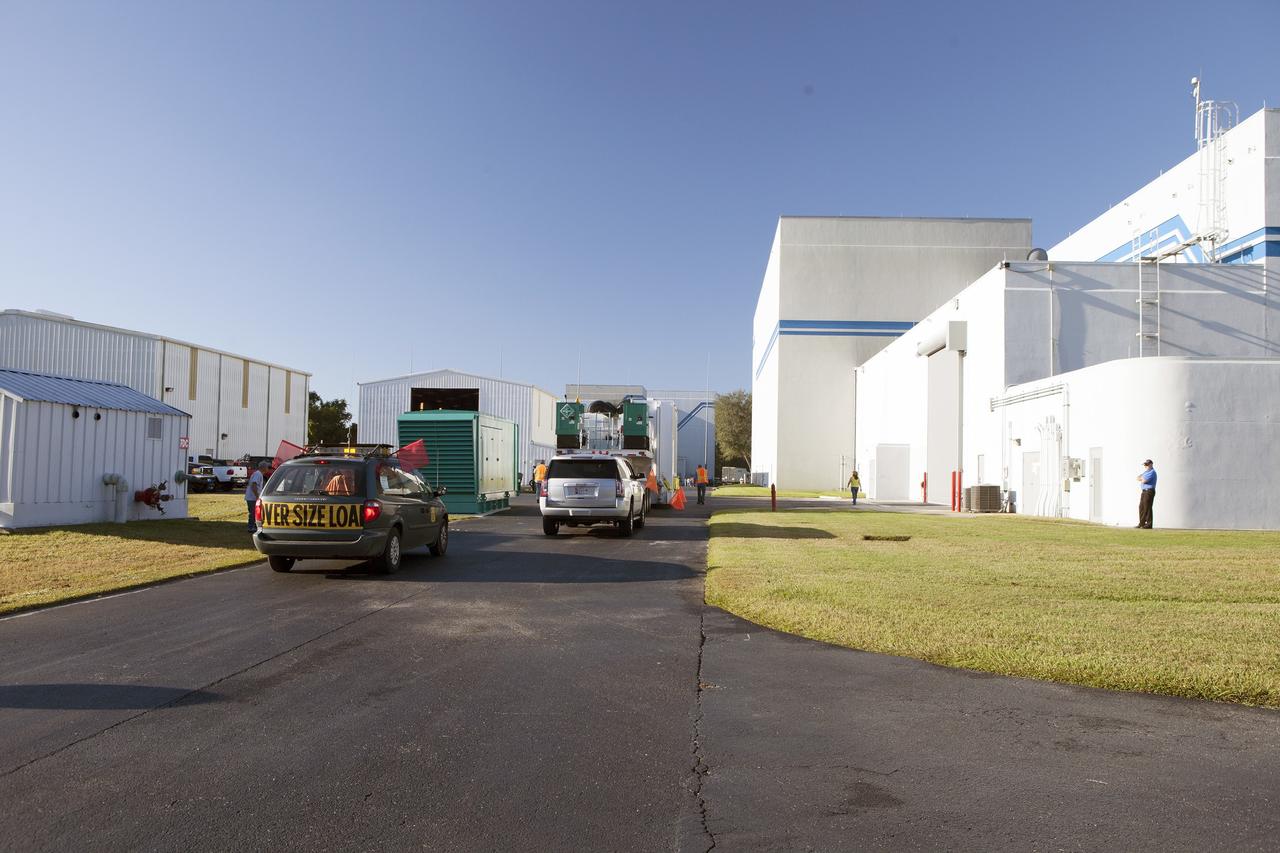
CAPE CANAVERAL, Fla. – The Magnetospheric Multiscale spacecraft, enclosed in a protective shipping container, arrive at Building 2 of the Astrotech payload processing facility in Titusville, Florida, near Kennedy Space Center. MMS is a Solar Terrestrial Probes mission comprising four identically instrumented spacecraft that will use Earth’s magnetosphere as a laboratory to study the microphysics of three fundamental plasma processes: magnetic reconnection, energetic particle acceleration and turbulence. Launch aboard a United Launch Alliance Atlas V rocket from Space Launch Complex 41 on Cape Canaveral Air Force Station is targeted for March 12, 2015. To learn more about MMS, visit http://mms.gsfc.nasa.gov. Photo credit: NASA/Kim Shiflett
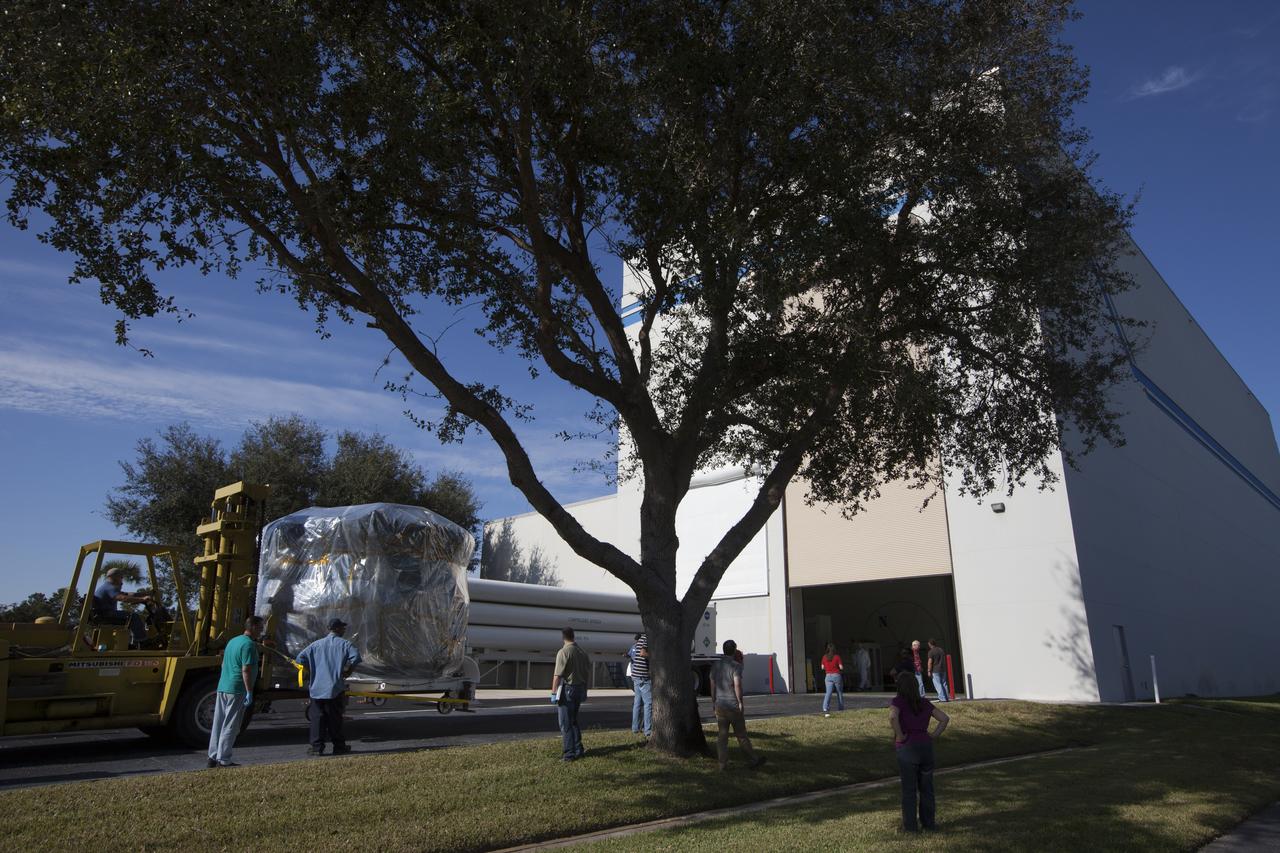
Two Magnetospheric Multiscale, or MMS, spacecraft comprising the mission’s upper stack are transported to the airlock of Building 1 of the Astrotech payload processing facility in Titusville, Florida, near Kennedy Space Center. The two MMS spacecraft comprising the lower stack arrived at Astrotech on Oct. 29. The Magnetospheric Multiscale mission is a Solar Terrestrial Probes mission comprising four identically instrumented spacecraft that will use Earth’s magnetosphere as a laboratory to study the microphysics of three fundamental plasma processes: magnetic reconnection, energetic particle acceleration and turbulence. Launch aboard a United Launch Alliance Atlas V rocket from Space Launch Complex 41 on Cape Canaveral Air Force Station is targeted for March 12, 2015.
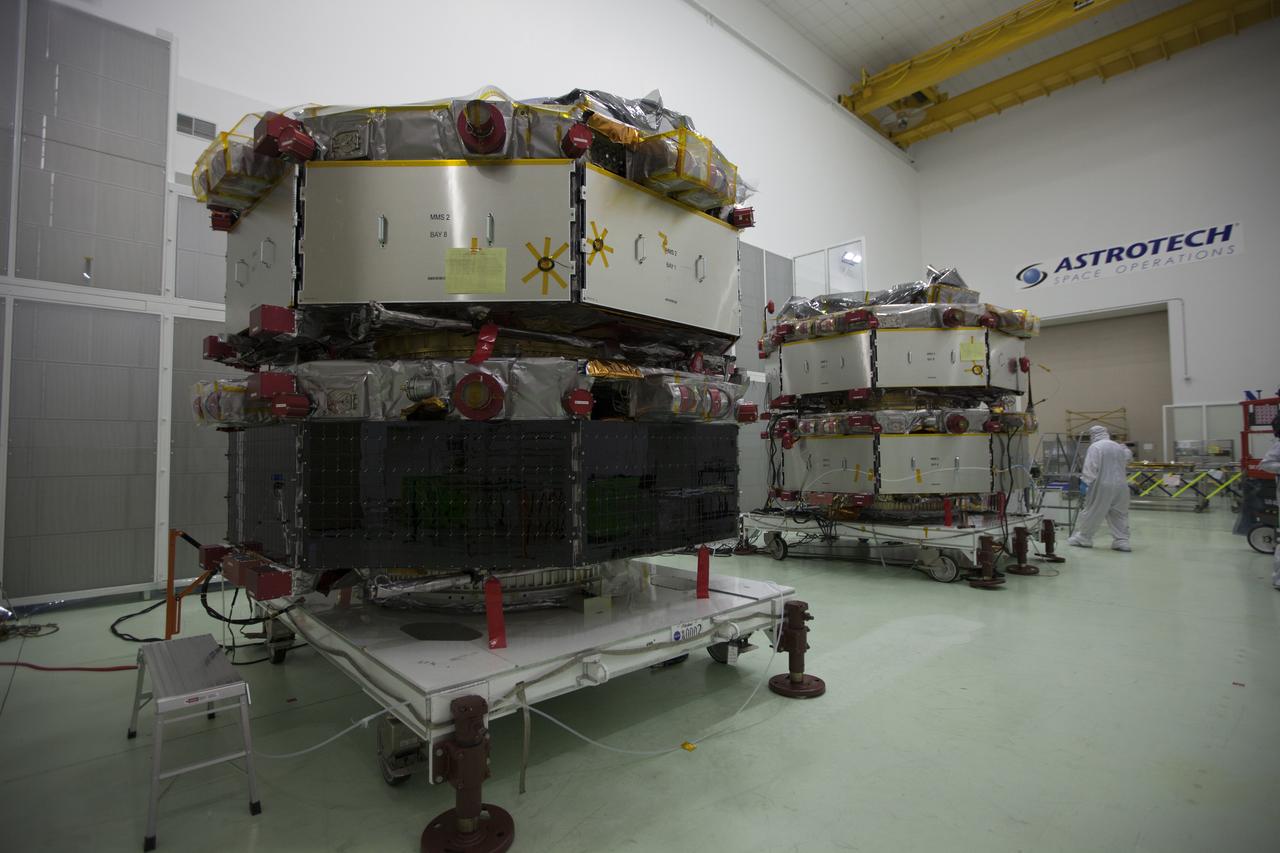
The solar arrays on the Magnetospheric Multiscale, or MMS, observatories are uncovered for an inspection in the Building 1 D high bay of the Astrotech payload processing facility in Titusville, Florida, near Kennedy Space Center. The two MMS spacecraft comprising the upper deck arrived Nov. 12; the two comprising the lower stack arrived Oct. 29. MMS, led by a team from NASA's Goddard Space Flight Center, is a Solar Terrestrial Probes mission consisting of four identically instrumented spacecraft that will use Earth’s magnetosphere as a laboratory to study the microphysics of three fundamental plasma processes: magnetic reconnection, energetic particle acceleration and turbulence. Launch aboard a United Launch Alliance Atlas V rocket from Space Launch Complex 41 on Cape Canaveral Air Force Station is targeted for March 12, 2015.
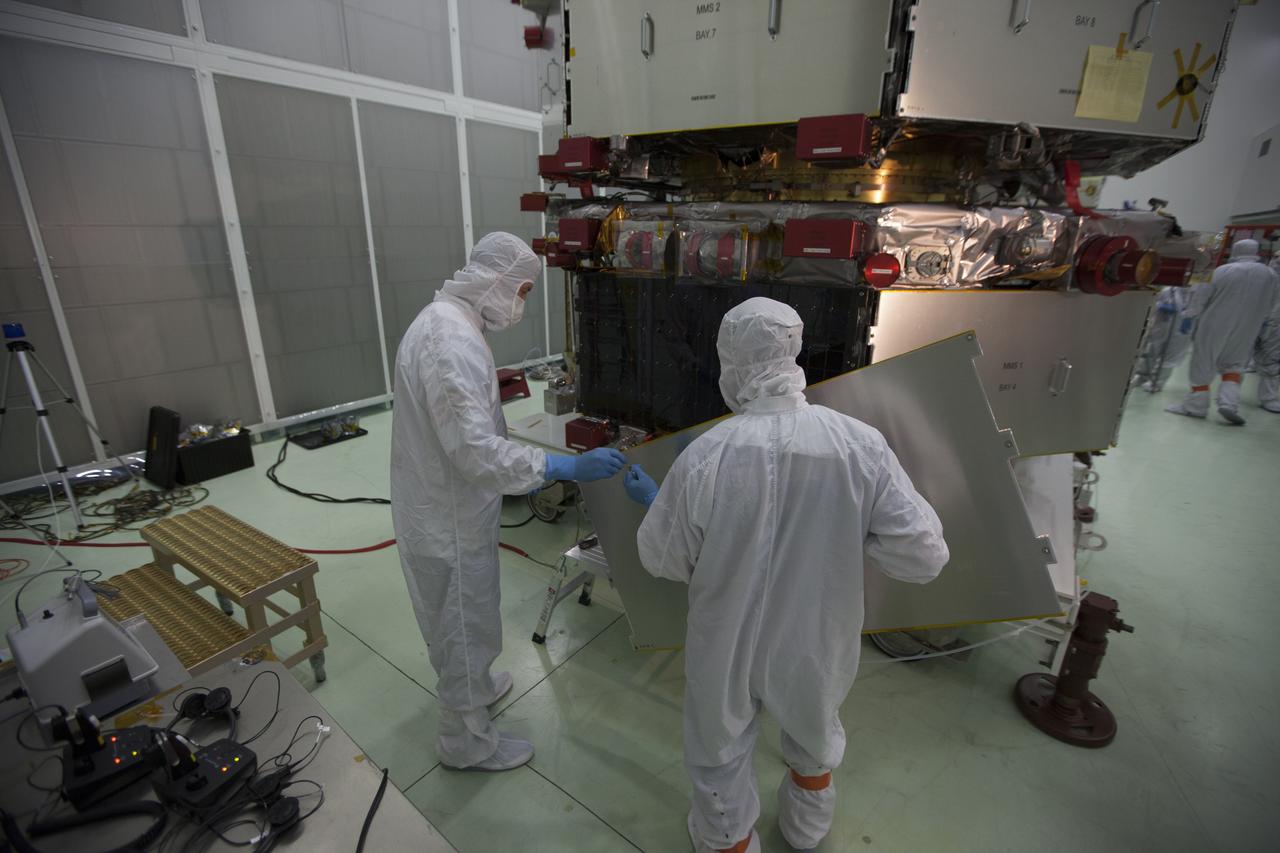
Workers inspect the solar arrays on the Magnetospheric Multiscale, or MMS, observatories in the Building 1 D high bay of the Astrotech payload processing facility in Titusville, Florida, near Kennedy Space Center. The two MMS spacecraft comprising the upper deck arrived Nov. 12; the two comprising the lower stack arrived Oct. 29. MMS, led by a team from NASA's Goddard Space Flight Center, is a Solar Terrestrial Probes mission consisting of four identically instrumented spacecraft that will use Earth’s magnetosphere as a laboratory to study the microphysics of three fundamental plasma processes: magnetic reconnection, energetic particle acceleration and turbulence. Launch aboard a United Launch Alliance Atlas V rocket from Space Launch Complex 41 on Cape Canaveral Air Force Station is targeted for March 12, 2015.
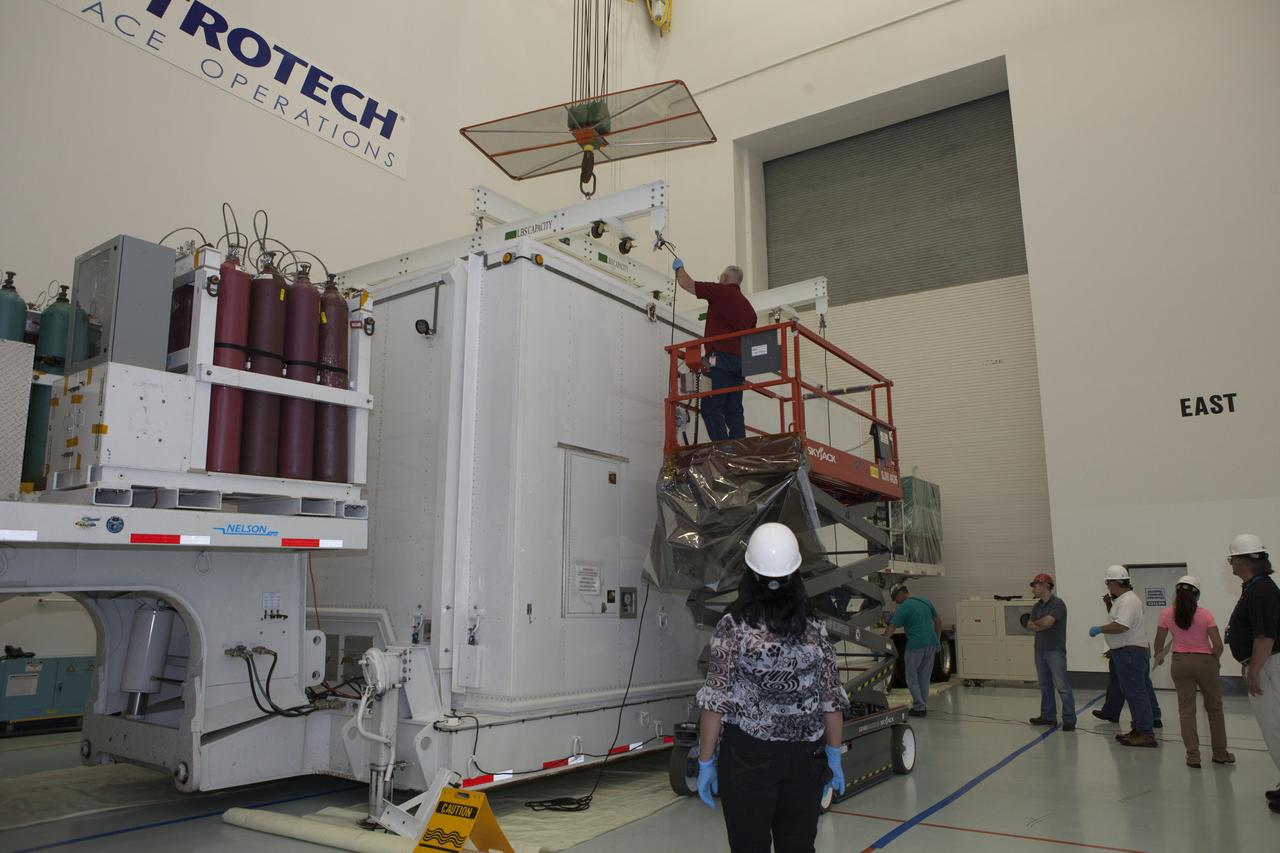
Workers attach a crane to the protective shipping container to prepare to uncover the lower stack, mini-stack number 1, two of the observatories for NASA's Magnetospheric Multiscale Observatory, or MMS. They were delivered to the Building 2 south encapsulation bay at the Astrotech payload processing facility in Titusville, Florida, near Kennedy Space Center. The MMS upper stack, mini-stack number 2, is scheduled to arrive in about two weeks. MMS is a Solar Terrestrial Probes mission comprising four identically instrumented spacecraft that will use Earth’s magnetosphere as a laboratory to study the microphysics of three fundamental plasma processes: magnetic reconnection, energetic particle acceleration and turbulence. Launch aboard a United Launch Alliance Atlas V rocket from Space Launch Complex 41 on Cape Canaveral Air Force Station is targeted for March 12, 2015.
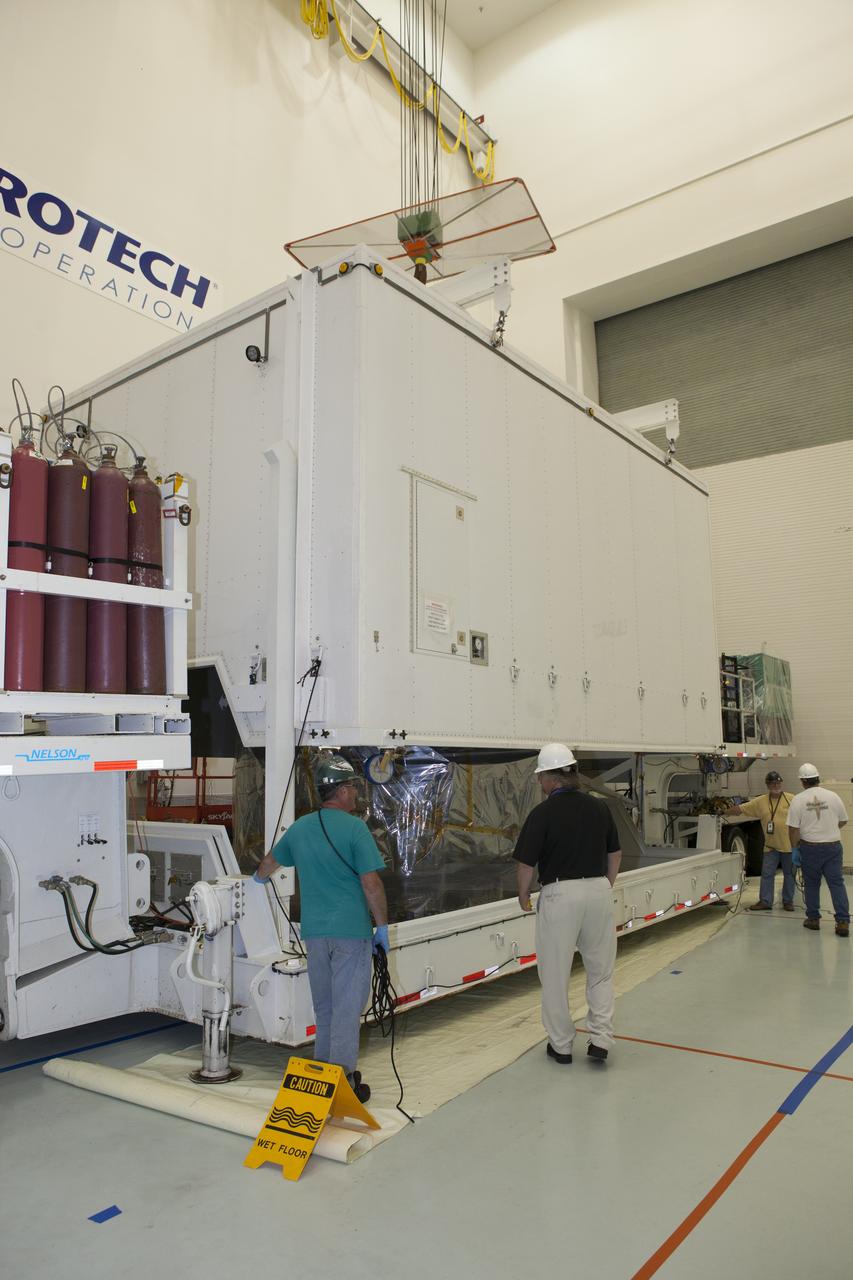
The protective shipping container is lifted from the lower stack, mini-stack number 1, two of the observatories for NASA's Magnetospheric Multiscale Observatory, or MMS, in the Building 2 south encapsulation bay at the Astrotech payload processing facility in Titusville, Florida, near Kennedy Space Center. The MMS upper stack, mini-stack number 2, is scheduled to arrive in about two weeks. MMS is a Solar Terrestrial Probes mission comprising four identically instrumented spacecraft that will use Earth’s magnetosphere as a laboratory to study the microphysics of three fundamental plasma processes: magnetic reconnection, energetic particle acceleration and turbulence. Launch aboard a United Launch Alliance Atlas V rocket from Space Launch Complex 41 on Cape Canaveral Air Force Station is targeted for March 12, 2015.