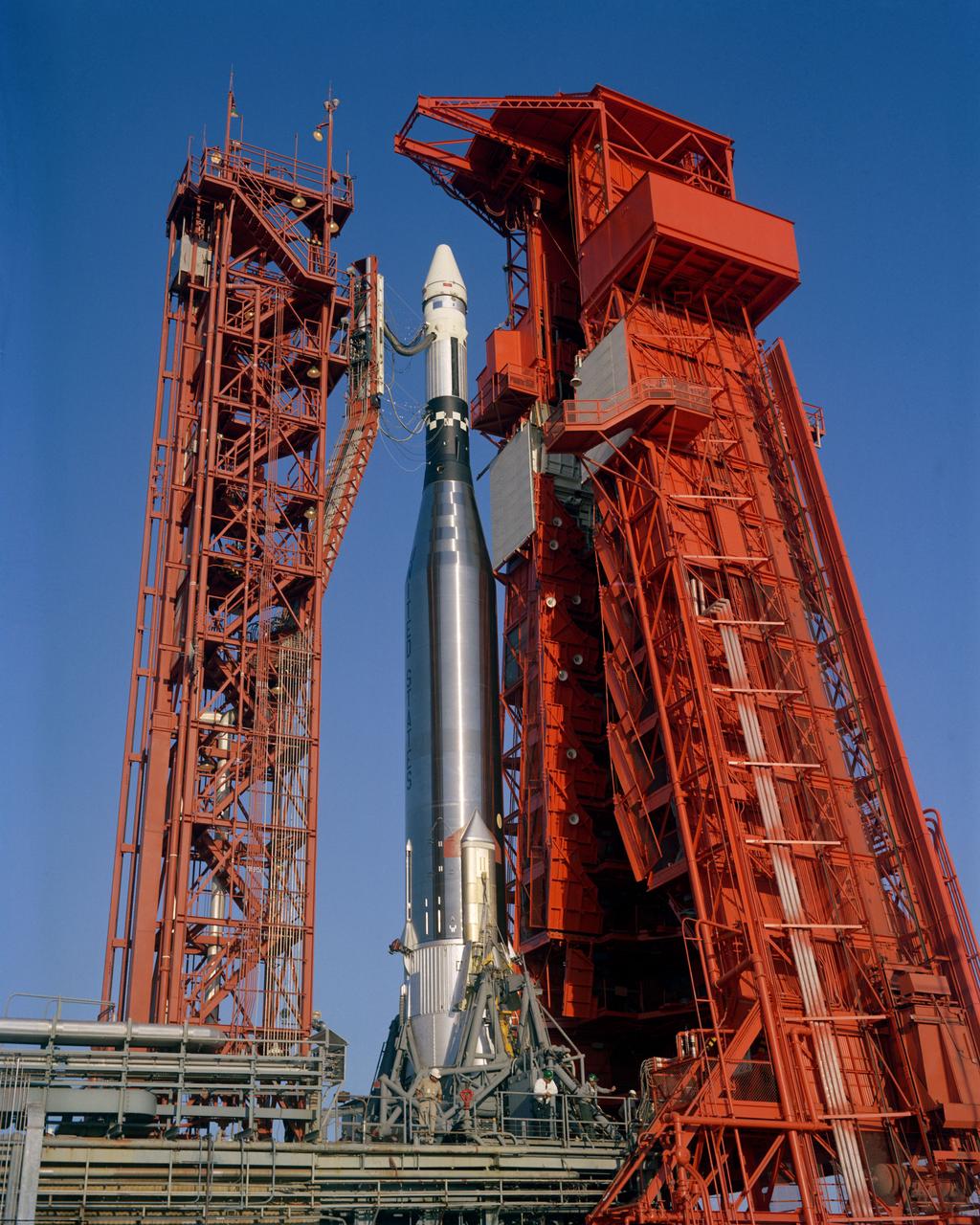
S65-57967 (25 Oct. 1965) --- View at Pad 14 during prelaunch operations for the Atlas/Agena. The Agena is mounted atop its Atlas launch vehicle. The Atlas/Agena liftoff was at 10 a.m. (EST) on Oct. 25, 1965. Intended as a rendezvous target vehicle in the Gemini-6 mission, the Agena failed to achieve orbit, and the Oct. 25 Gemini-6 launch was scrubbed. Photo credit: NASA or National Aeronautics and Space Administration
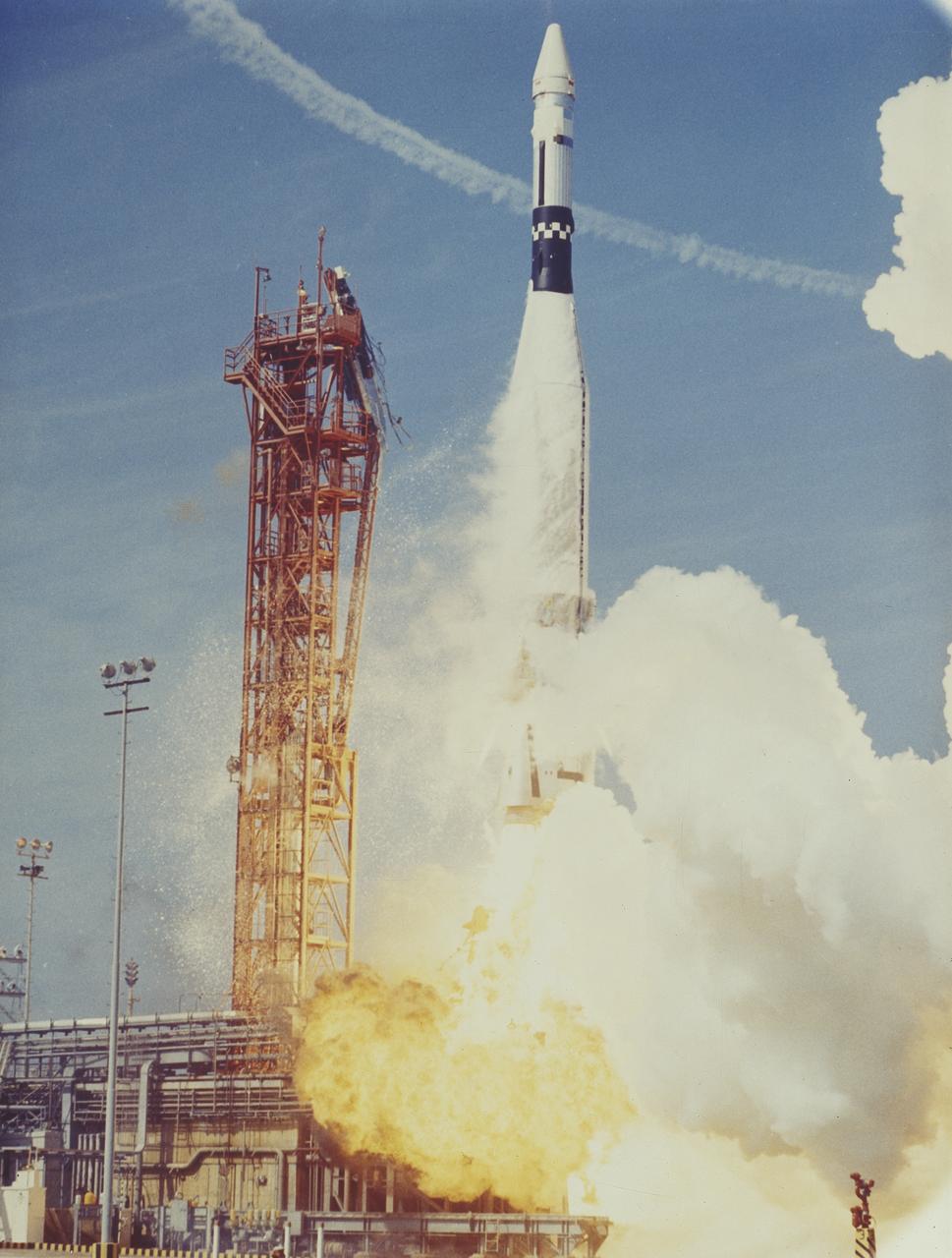
On March 16, 1966, an Atlas booster launched an Agena Target Vehicle for the Gemini 8 mission. The flight crew for the 3 day mission, astronauts Neil A. Armstrong and David R. Scott, achieved the first rendezvous and docking to Atlas/Agena in Earth orbit.

The Atlas-Agena-4 boosted the Ranger IV spacecraft for the first U.S. lunar impact on April 23, 1962.
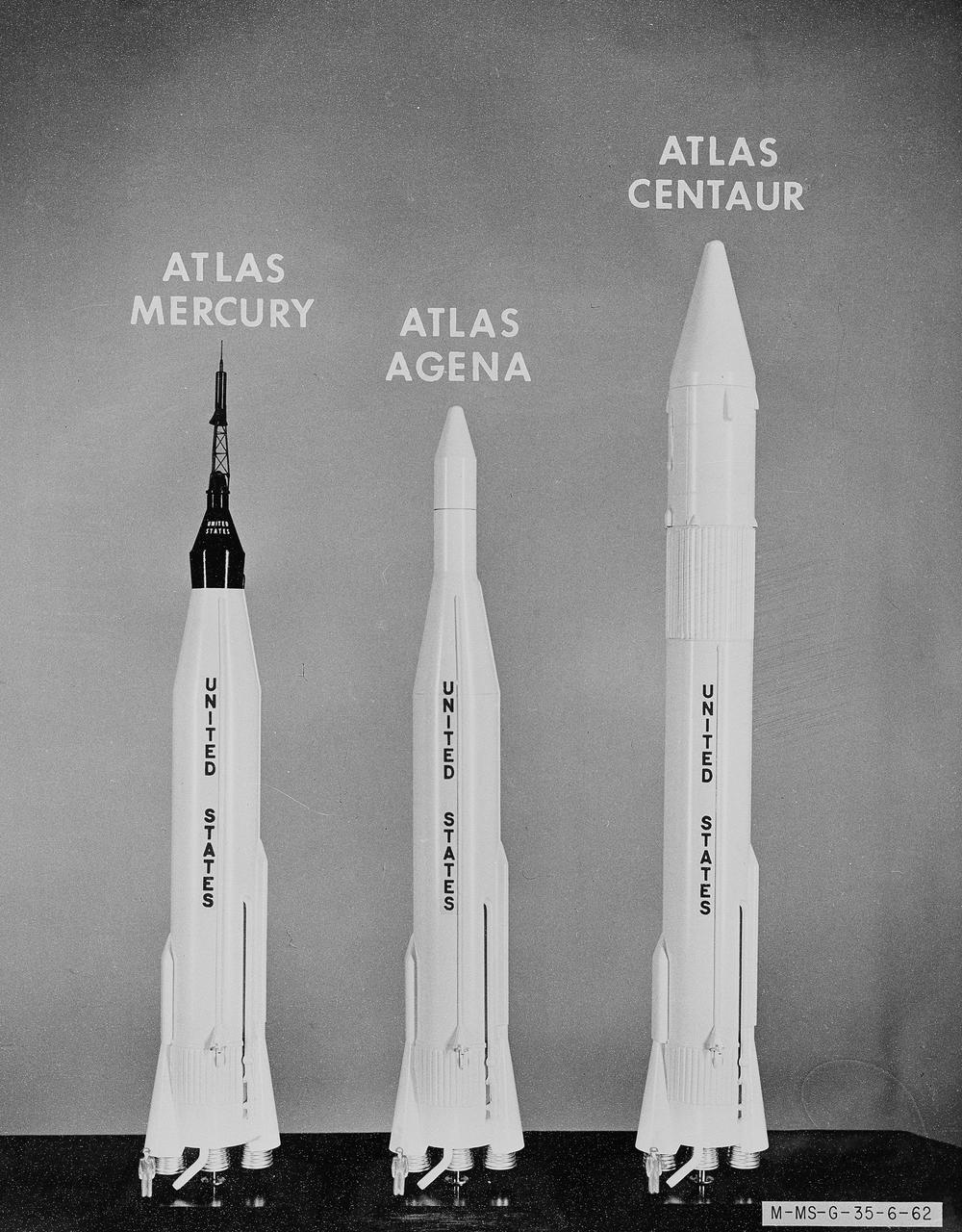
Photographed are models of early rocketry: The Atlas Mercury, Atlas Centaur, and Atlas Agena.
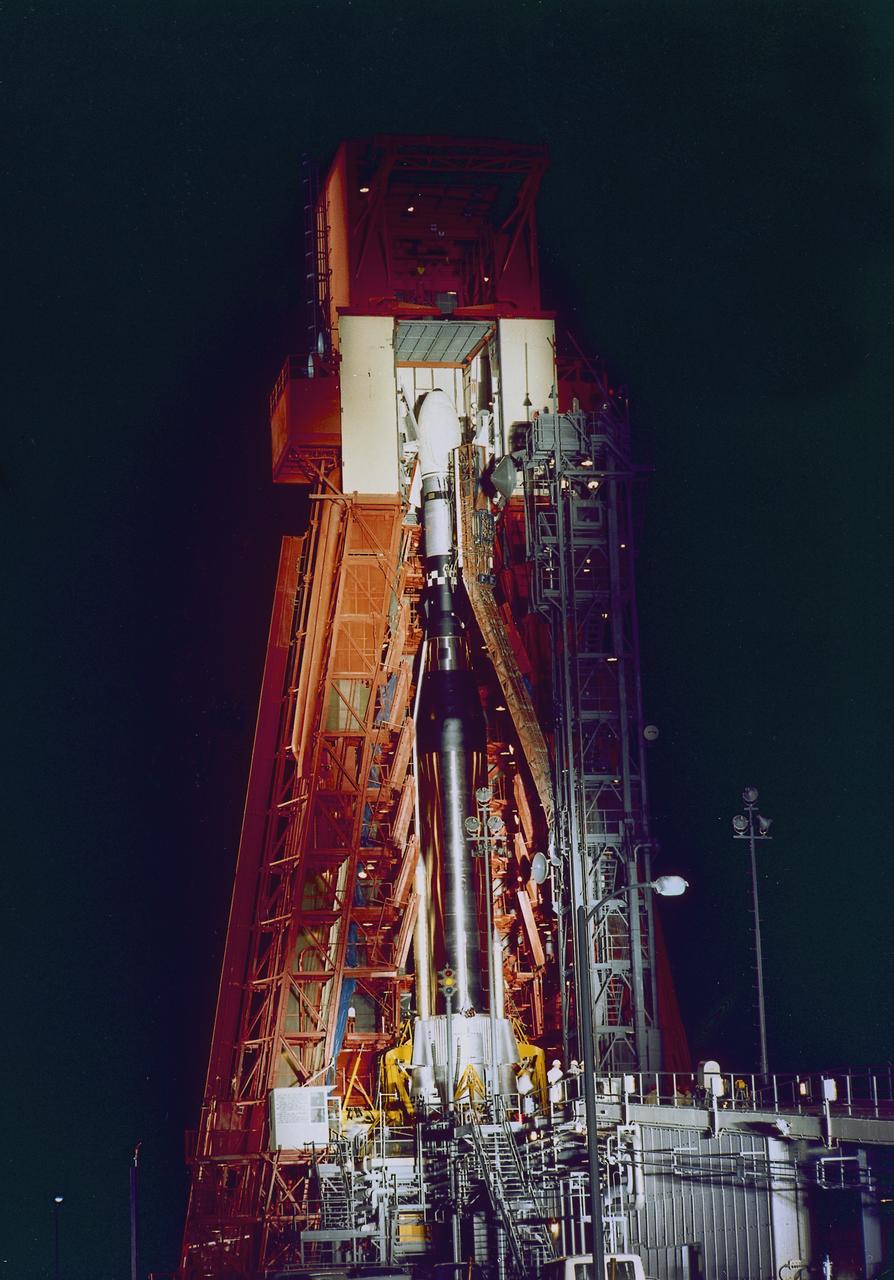
The Atlas/Agena launch vehicle carrying The Mariner-V spacecraft on launch pad on June 14, 1967. The Marina V mission was to explore the planet Venus.
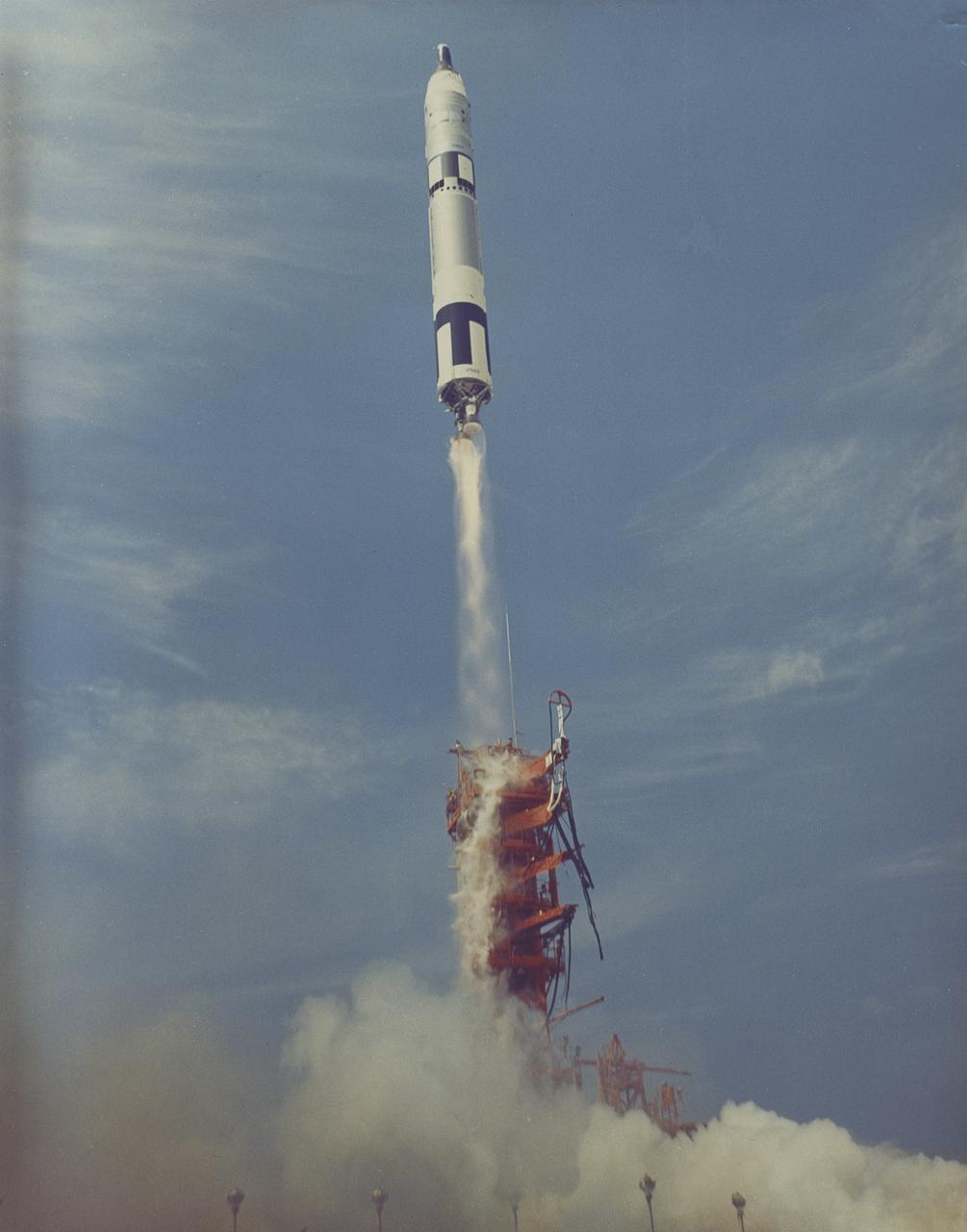
A Titan booster launched the Gemini 8 spacecraft on March 16, 1966 from launch complex 19 Cape Kennedy, Florida. The flight crew for the 3 day mission, astronauts Neil A. Armstrong and David R. Scott, achieved the first rendezvous and docking to Atlas/Agena in Earth orbit.
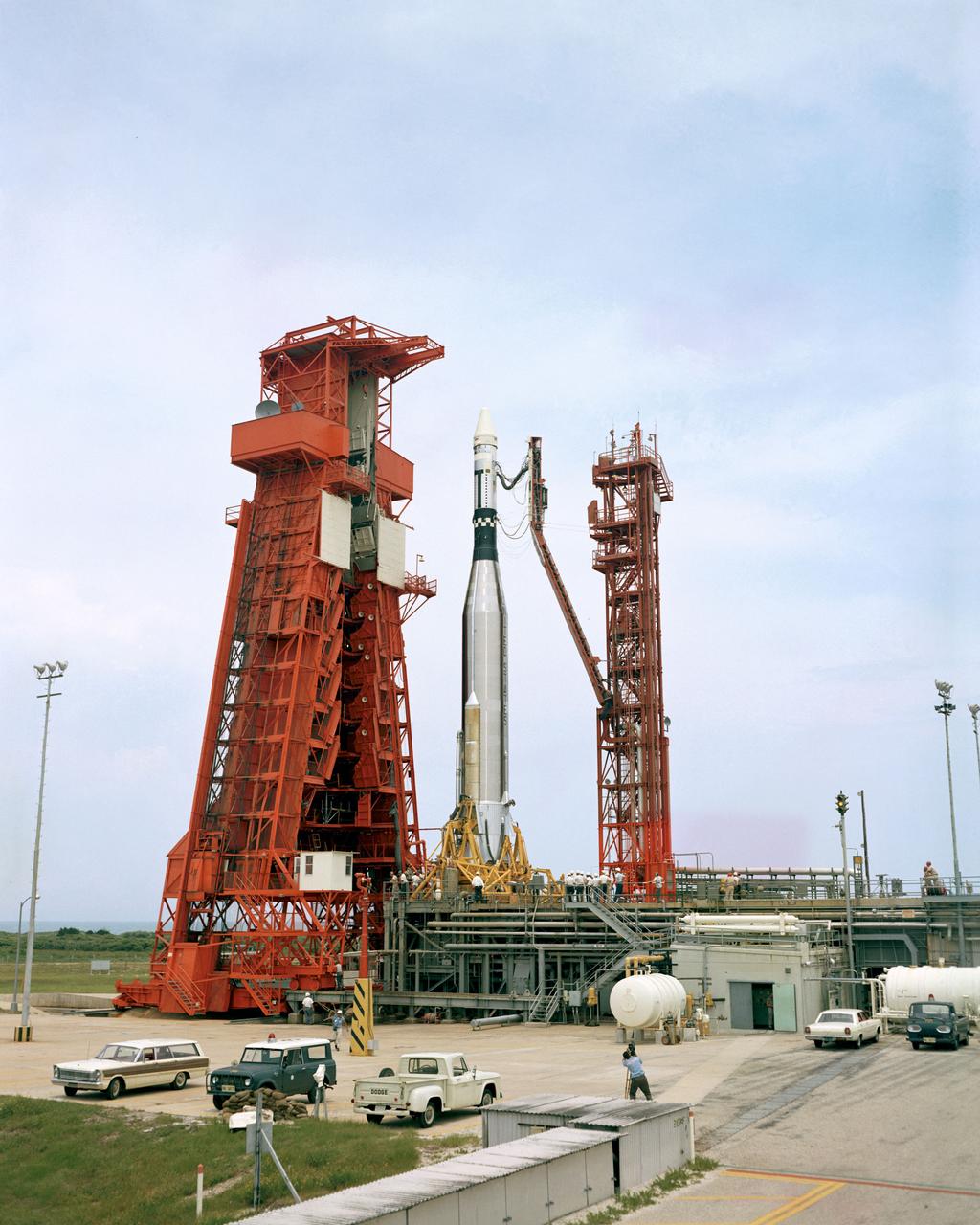
S66-42739 (18 July 1966) --- An Agena Target Docking Vehicle atop its Atlas launch vehicle during prelaunch preparations at Launch Complex 14. The Agena will be a rendezvous and docking vehicle for the Gemini-10 spaceflight. The Agena was launched on July 18, 1966, at 3:39 p.m. (EST). Photo credit: NASA
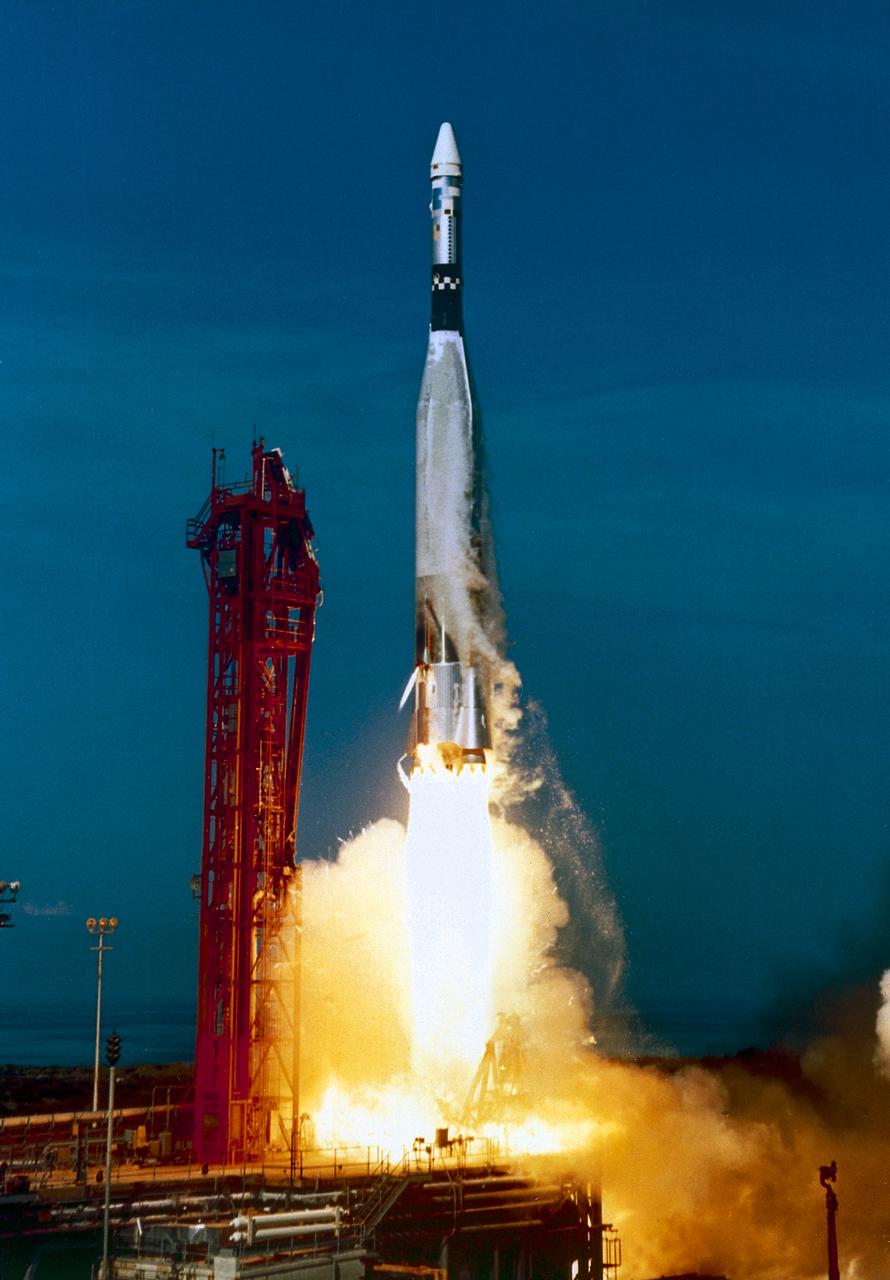
Launched atop an Atlas booster, the Agena target vehicle (ATV) was a spacecraft used by NASA to develop and practice orbital space rendezvous and docking techniques in preparation for the Apollo program lunar missions. This particular launch preceded the Gemini 12, which launched aboard a Titan launch vehicle one and one half hours later. The objective was for Agena and Gemini to rendezvous in space and practice docking procedures. An intermediate step between Project Mercury and the Apollo Program, the Gemini Program's major objectives were to subject two men and supporting equipment to long duration flights, to perfect rendezvous and docking with other orbiting vehicles, methods of reentry, and landing of the spacecraft.

LIFTOFF RANGER 3 FROM PAD 12. ATLAS AGENA-2 1/26/1962 TEST 125 ITEM 1.3.18U
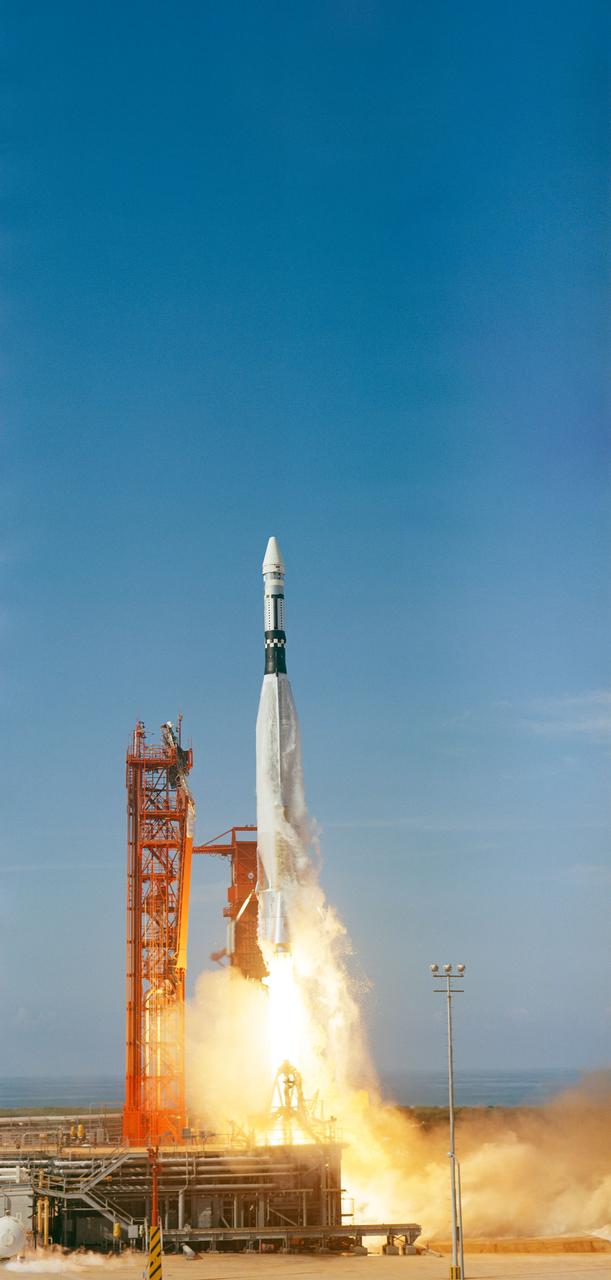
S66-64544 (11 Nov. 1966) --- An Agena Target Docking Vehicle atop its Atlas launch vehicle was launched from the Kennedy Space Center's Launch Complex 14 at 2:08 p.m. (EST), Nov. 11, 1966. The Agena served as a rendezvous and docking vehicle for the Gemini-12 spacecraft. Photo credit: NASA
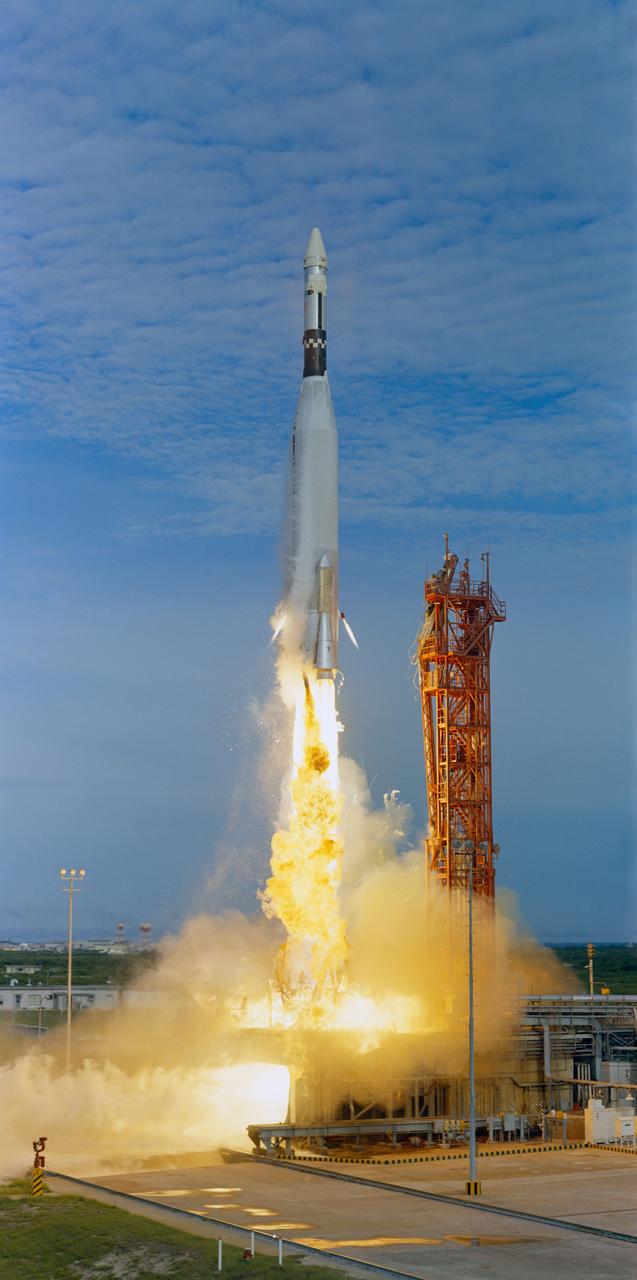
S66-50784 (12 Sept. 1966) --- An Agena Target Docking Vehicle atop its Atlas launch vehicle was launched from the Kennedy Space Center's Launch Complex 14 at 6:05 a.m., Sept. 12, 1966. The Agena served as a rendezvous and docking vehicle for the Gemini-11 spacecraft. Photo credit: NASA
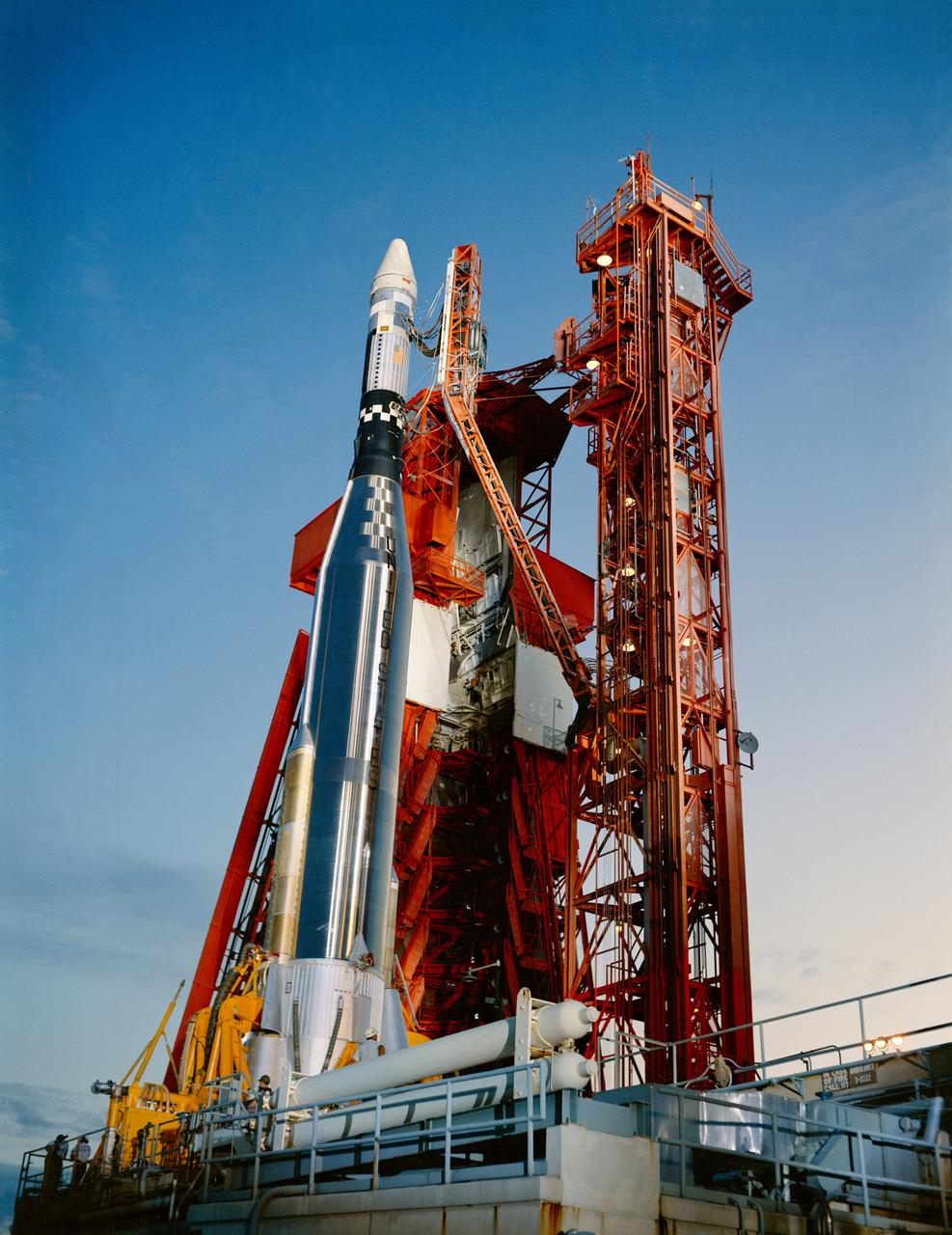
S66-50724 (12 Sept. 1966) --- An Agena Target Docking Vehicle atop its Atlas launch vehicle is ready for launch at Launch Complex 14 at Cape Kennedy, Florida. The Agena served as a rendezvous and docking vehicle for the Gemini-11 spacecraft. Photo credit: NASA

S66-42751 (18 July 1966) --- An Agena Target Docking Vehicle atop its Atlas launch vehicle was launched from the Kennedy Space Center's Launch Complex 14 at 3:39 p.m. (EST), July 18, 1966. The Gemini-10 liftoff followed the Agena liftoff by 101 minutes. The Agena served as a rendezvous and docking vehicle for the Gemini-10 spacecraft. Photo credit: NASA
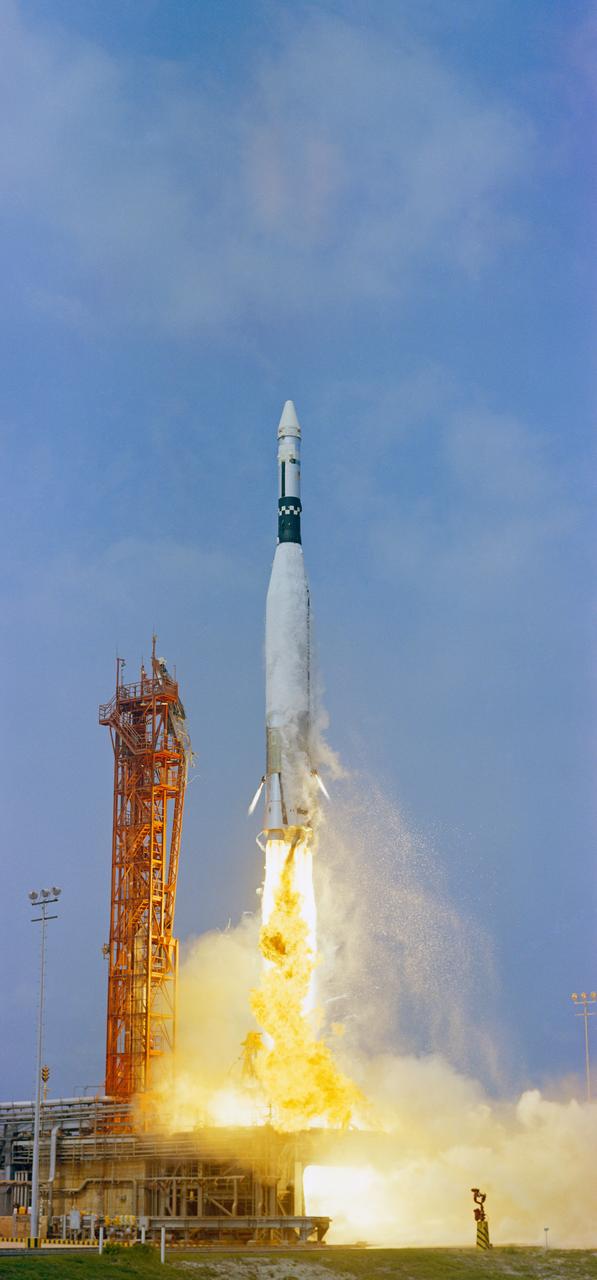
S66-34610 (17 May 1966) --- An Agena Target Vehicle atop its Atlas Launch vehicle is launched from the Kennedy Space Center (KSC) Launch Complex 14 at 10:15 am., May 17, 1966. The Agena was intended as a rendezvous and docking vehicle for the Gemini-9 spacecraft. However, since the Agena failed to achieve orbit, the Gemini-9 mission was postponed. Photo credit: NASA
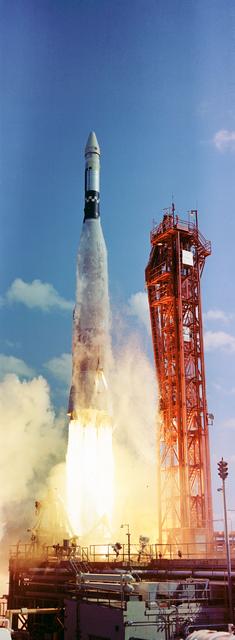
S65-56161 (25 Oct. 1965) --- The National Aeronautics and Space Administration launched an Atlas/Agena vehicle at 10 a.m. (EST) on Oct. 25, 1965, from Pad 14. Intended as a rendezvous target vehicle in the Gemini-6 mission, the Agena failed to achieve orbit, and the Gemini-6 mission was scrubbed. Photo credit: NASA or National Aeronautics and Space Administration
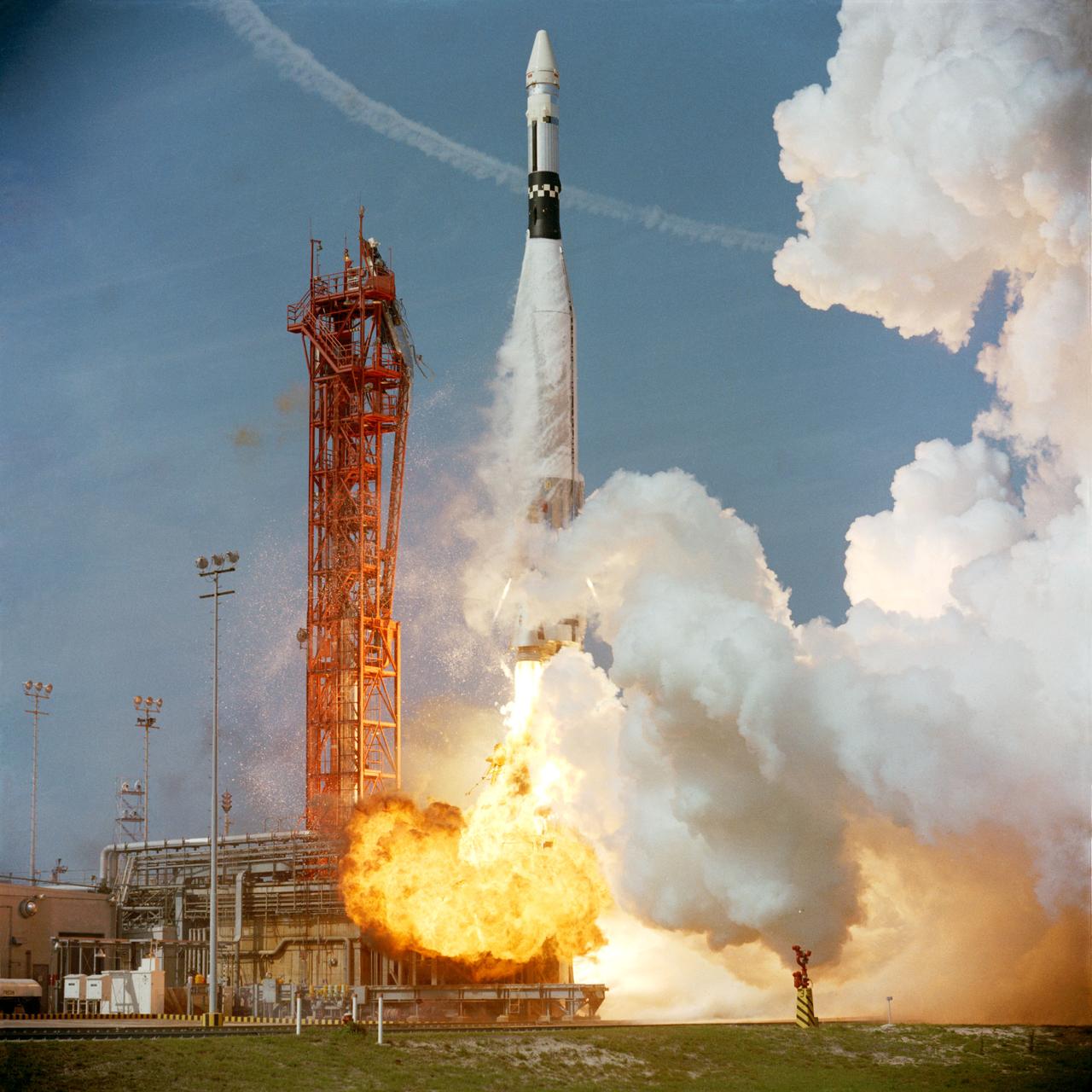
S66-24482 (16 March 1966) --- An Agena Target Docking Vehicle atop an Atlas rocket lifts off from Launch Complex 14 at Cape Kennedy at 10 a.m., March 16, 1966 just prior to the Gemini-8 liftoff at nearby Launch Complex 19. The Agena served as a rendezvous and docking vehicle for the Gemini-8 spacecraft. A chase plane leaves a contrail in the background. Photo credit: NASA
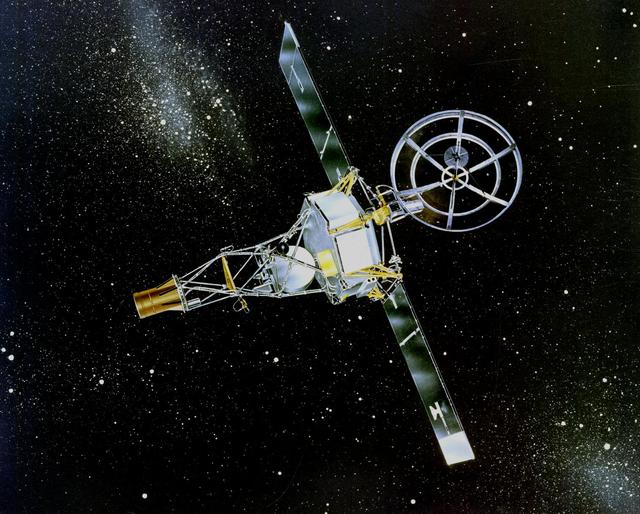
NASA Mariner 2 was the world first successful interplanetary spacecraft. Launched August 27, 1962, on an Atlas-Agena rocket, Mariner 2 passed within about 34,000 kilometers 21,000 miles of Venus.

Pre-launch alert of Atlas-Agena 7, Ranger V.

Lift-off of Atlas-Agena 7, Ranger V. (Test 5050)(ITEM 1.3- )
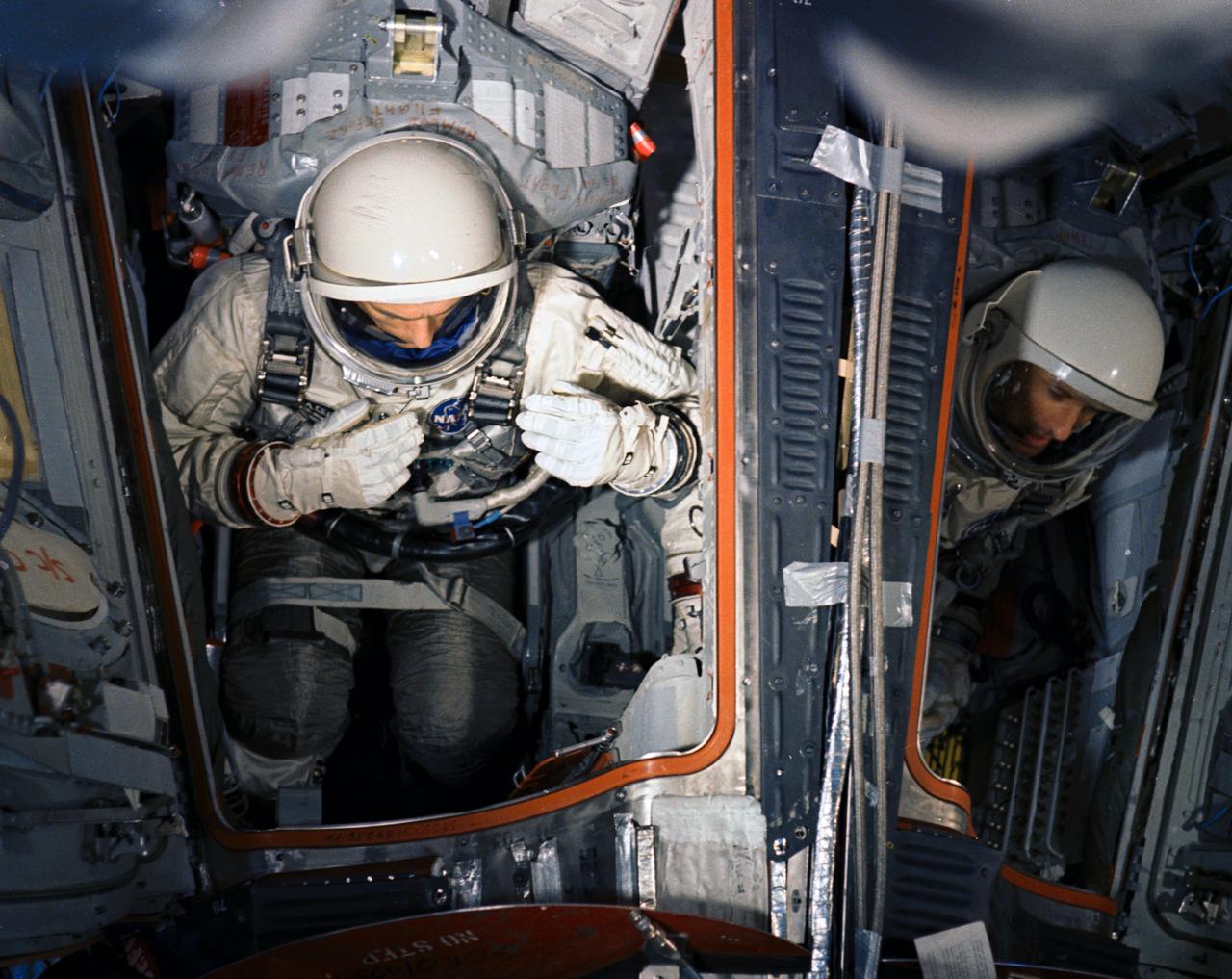
S66-33406 (10 May 1966) --- Astronaut Thomas P. Stafford (on left), command pilot, and Eugene A. Cernan, pilot, in Gemini-9 spacecraft in the white room at Pad 19 during a Gemini-9/Agena simultaneous launch demonstration. This test is a coordinated dountdown of the Atlas-Agena and the Gemini-Titan vehicles. Photo credit: NASA
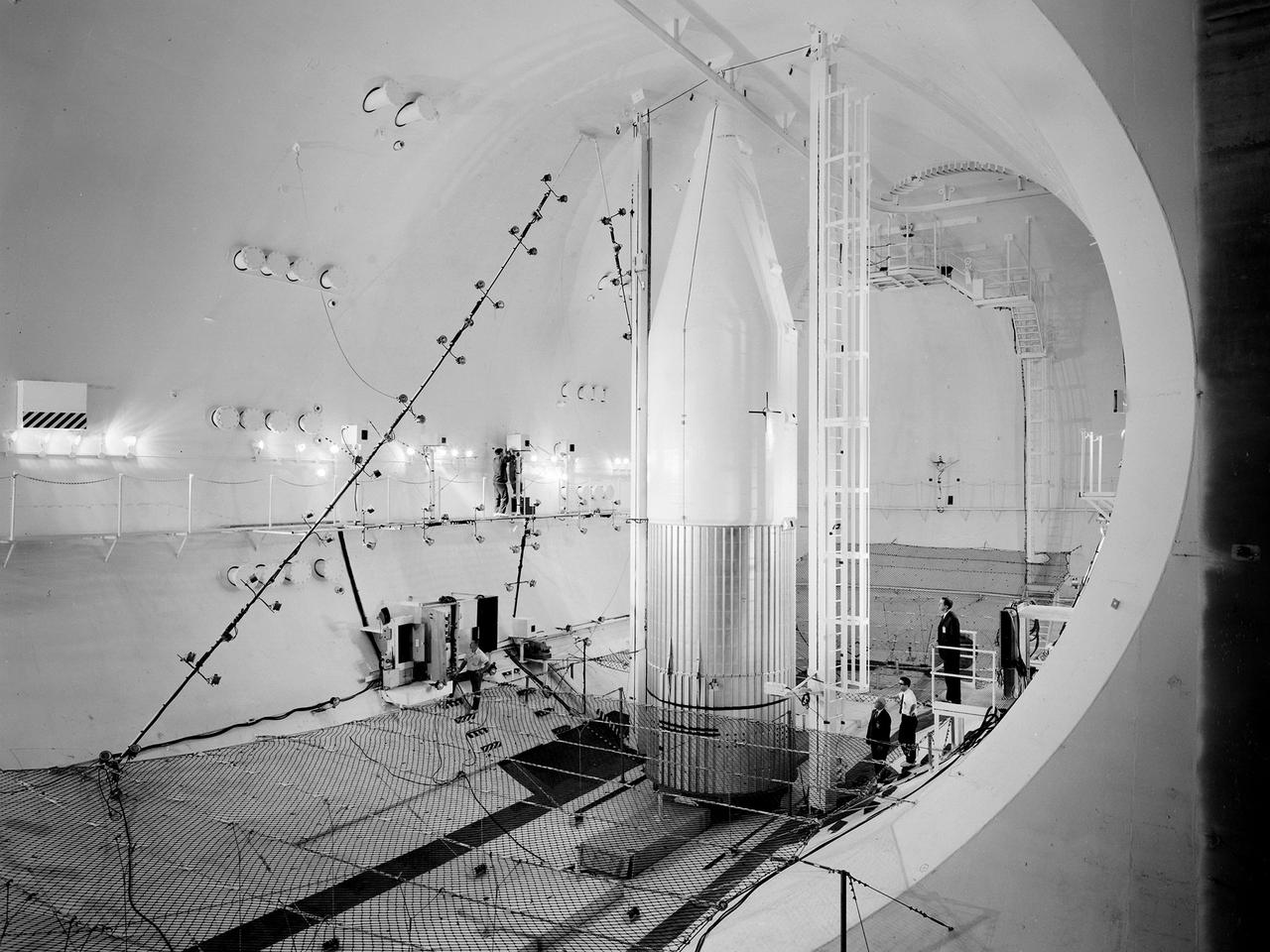
Preparations for a shroud jettison test for the Orbiting Astronomical Observatory-1 (OAO-1) satellite in the Space Power Chambers facility at the National Aeronautics and Space Administration (NASA) Lewis Research Center. The satellite was to be launched on an Atlas-Agena rocket in the spring of 1966. The 3900-pound payload was the heaviest ever attempted by Agena. The satellite was the first of three equipped with powerful telescopes to study ultraviolet data from specific stars and galaxies. In-depth observations were not possible from Earth-bound telescopes because of the filtering and distortion of the atmosphere. The OAO-1 satellite was wider in diameter than the Agena stage, so a new clamshell shroud was created to enclose both the satellite and the Agena. The clamshell shroud consisted of three sections that enclosed both the Agena and OAO-1: a fiberglass nose fairing and aluminum mid and aft fairings. The upper two fairings separated when the Atlas engines stopped, and the aft fairing fell away with the Atlas upon separation from the upper stages The large altitude tank in the Space Power Chambers could simulate altitudes up to 100,000 feet. Three shroud jettison tests were run in July 1965 and the first week of August at a simulated altitude of 20 miles. The April 8, 1966 launch from Cape Canaveral went smoothly, but the OAO-1 satellite failed after only 90 minutes due to a battery failure.
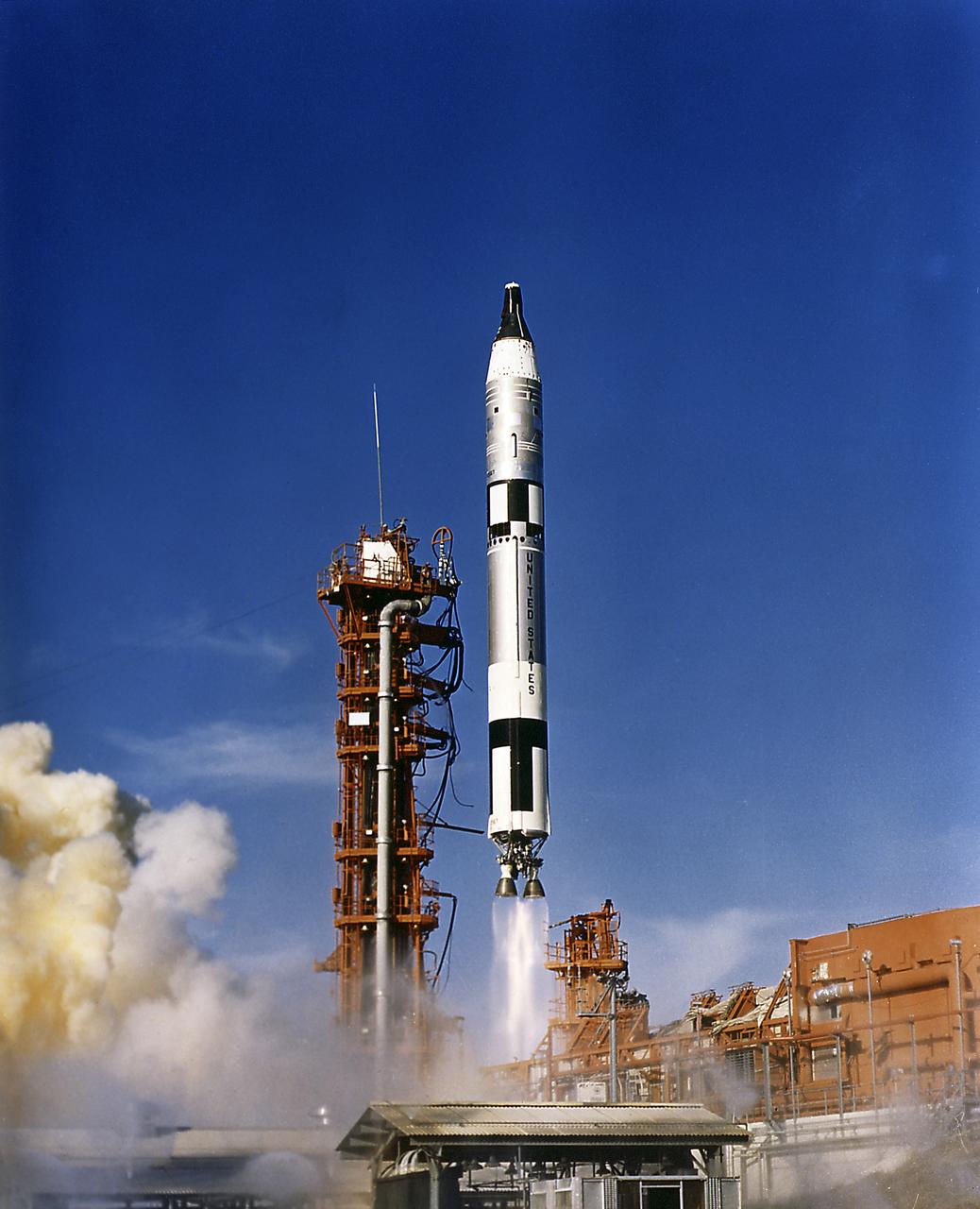
The Gemini 12 astronauts James Lovell and Edwin Aldrin lifted off aboard a Titan launch vehicle from the Kennedy Space Center on November 11, 1966, an hour and a half after their Agena target vehicle was orbited by an Atlas rocket. Launched atop an Atlas booster, the Agena target vehicle (ATV) was a spacecraft used by NASA to develop and practice orbital space rendezvous and docking techniques in preparation for the Apollo program lunar missions. The objective was for Agena and Gemini to rendezvous in space and practice docking procedures. An intermediate step between Project Mercury and the Apollo Program, the Gemini Program's major objectives were to subject two men and supporting equipment to long duration flights, to perfect rendezvous and docking with other orbiting vehicles, methods of reentry, and landing of the spacecraft.
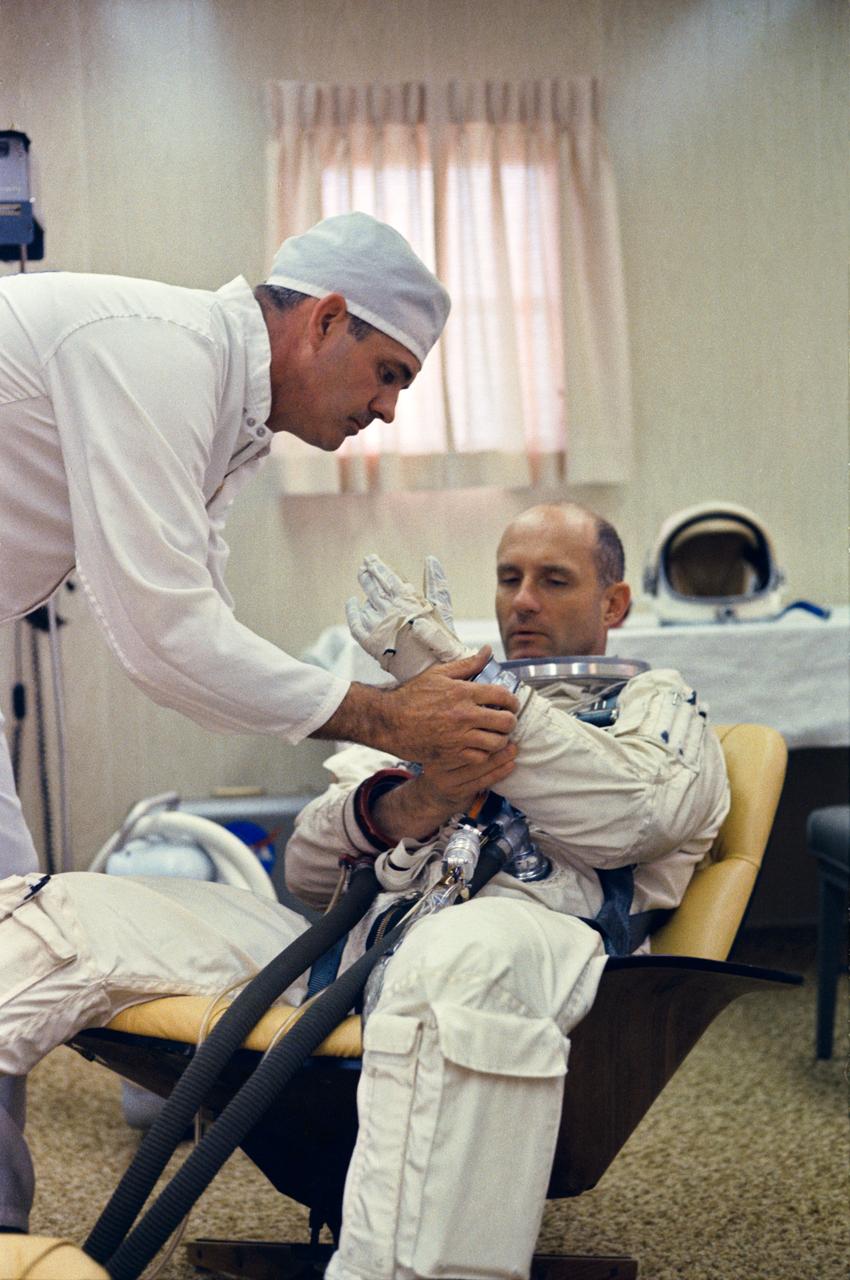
S66-33408 (10 May 1966) --- Astronaut Thomas P. Stafford, command pilot of the National Aeronautics and Space Administration's Gemini-9 spaceflight, sits in Launch Complex 16 suiting trailer while suiting up for a Gemini-9/Agena simultaneous launch demonstration. This test is a coordinated countdown of the Atlas-Agena and the Gemini-Titan vehicles. A suit technician assists Stafford. Photo credit: NASA
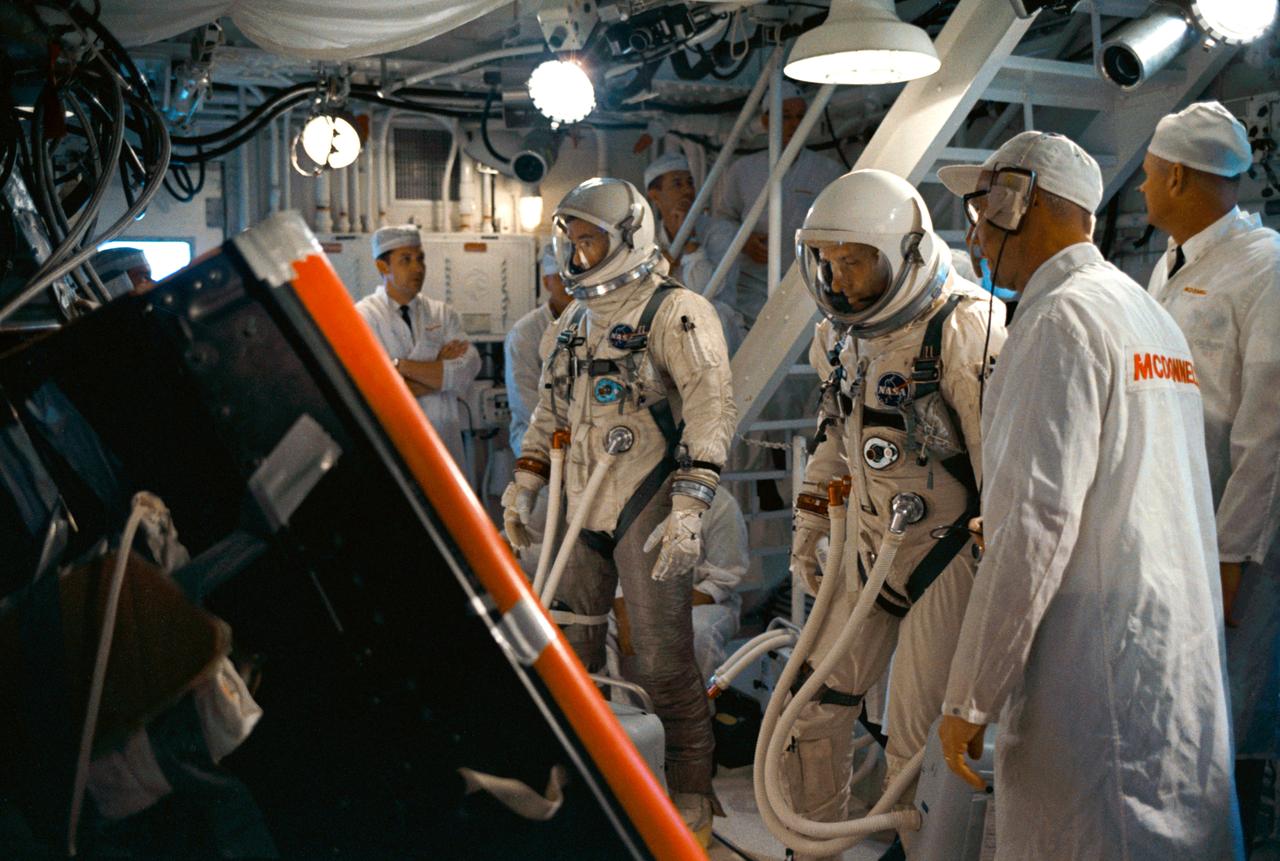
S66-33407 (10 May 1966) --- Astronauts Thomas P. Stafford (right foreground), command pilot; and Eugene A. Cernan, pilot, prepare to enter the Gemini-9 spacecraft in the white room atop Pad 19 during a Gemini-9/Agena simultaneous launch demonstration. This test is a coordinated countdown of the Atlas-Agena and the Gemini-Titan vehicles. NASA and McDonnell Aircraft Corporation personnel stand by to assist with the insertion of the astronauts into the spacecraft. Photo credit: NASA

The Atlas-Agena B space Vehicle waits on the launch pad to launch the National Aeronautics and Space Administration’s Ranger V Spacecraft on a 66 – 62 hour journey to the moon. Ranger V is a 735-pound gold and chrome Plated payload designed to perform a series of complicated tasks, including taking television pictures of the lunar surface.
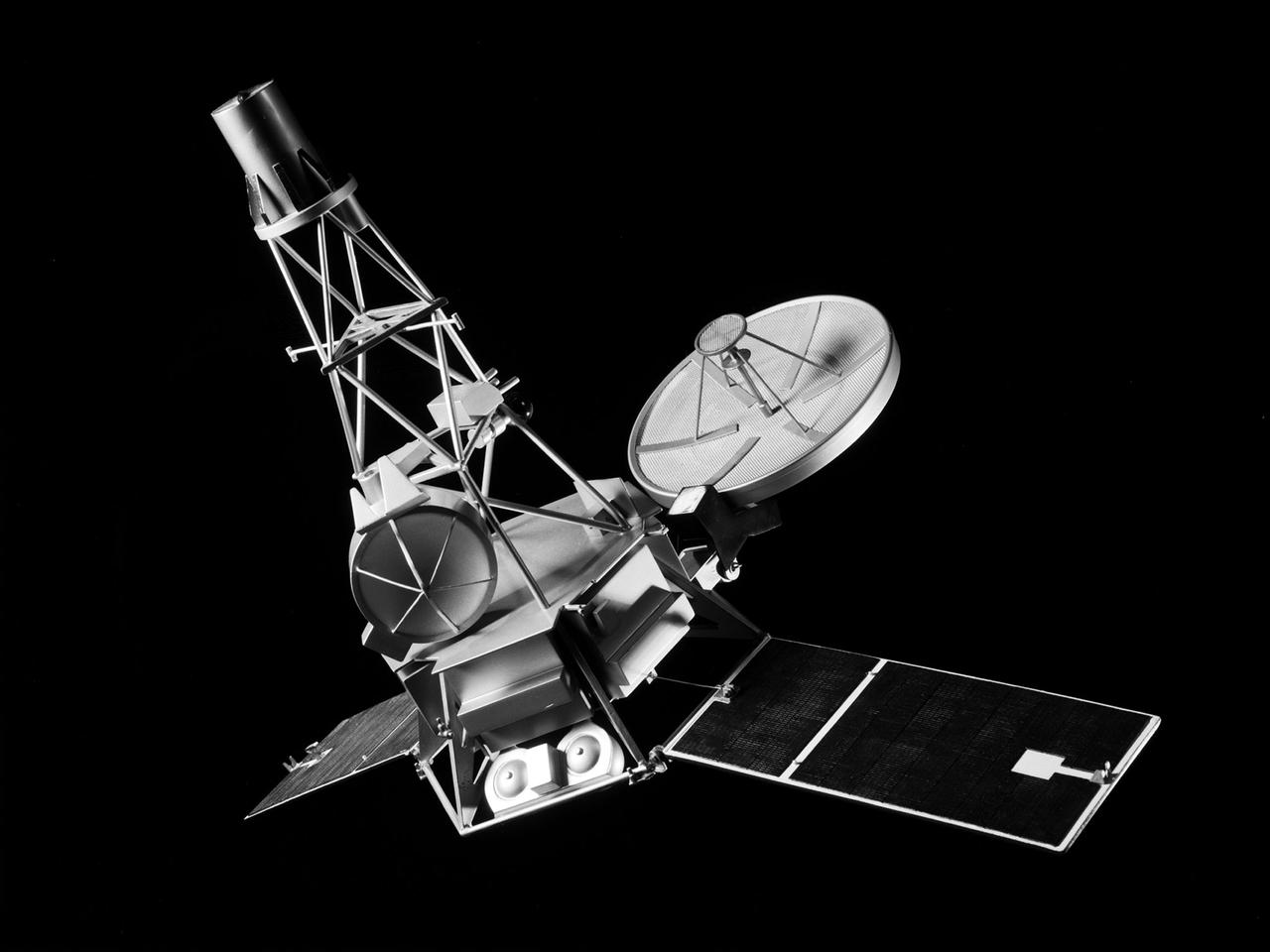
A model of the Mariner-C spacecraft at the National Aeronautics and Space Administration (NASA) Lewis Research Center for a June 1964 Conference on New Technology. Mariner-C and Mariner-D were identical spacecraft designed by the Jet Propulsion Laboratory to flyby Mars and photograph the Martian surface. Mariner-C was launched on November 4, 1964, but the payload shroud did not jettison properly and the spacecraft’s battery power did not function. The mission ended unsuccessfully two days later. Mariner-D was launched as designed on November 28, 1964 and became the first successful mission to Mars. It was the first time a planet was photographed from space. Mariner-D’s 21 photographs revealed an inhospitable and barren landscape. The two Mariner spacecraft were launched by Atlas-Agena-D rockets. Lewis had taken over management of the Agena Program in October 1962. There had been five failures and two partial failures in the 17 Agena launches before being taken over by NASA Lewis. Lewis, however, oversaw 28 successful Agena missions between 1962 and 1968, including several Rangers and the Mariner Venus '67.

Researcher Bobby Sanders examines a 0.10-scale model of the Mariner-C shroud and Agena rocket in the 8- by 6-Foot Supersonic Wind Tunnel at the National Aeronautics and Space Administration (NASA) Lewis Research Center. Mariner-C and Mariner-D were identical spacecraft designed by the Jet Propulsion Laboratory to flyby Mars and photograph the Martian surface. The two Mariner spacecraft were launched by Atlas-Agena-D rockets. Lewis had taken over management of the Agena Program in October 1962. Lewis researchers investigated two different types of shrouds for the Mariner missions—an over-the-nose design and a backup pyrotechnic design. The new shroud was wider in diameter than the Agena rocket, so there was concern that this disparity might create air flow instability that could damage the shroud or destroy the vehicle. The tests in the 8- by 6 tunnel simulated launch speeds from Mach 0.56 to 1.96. Afterwards the Agena-Mariner-C model was studied in the 10- by 10-Foot Supersonic Wind Tunnel at speeds of Mach 2.0 to 3.5. Mariner-C was launched on November 4, 1964, but the payload shroud did not jettison properly and the spacecraft’s battery power did not function. The mission ended unsuccessfully two days later. Mariner-D was launched on November 28, 1964 and became the first successful mission to Mars. It was the first time a planet was photographed from space. Mariner-D’s 21 photographs revealed an inhospitable and barren landscape.
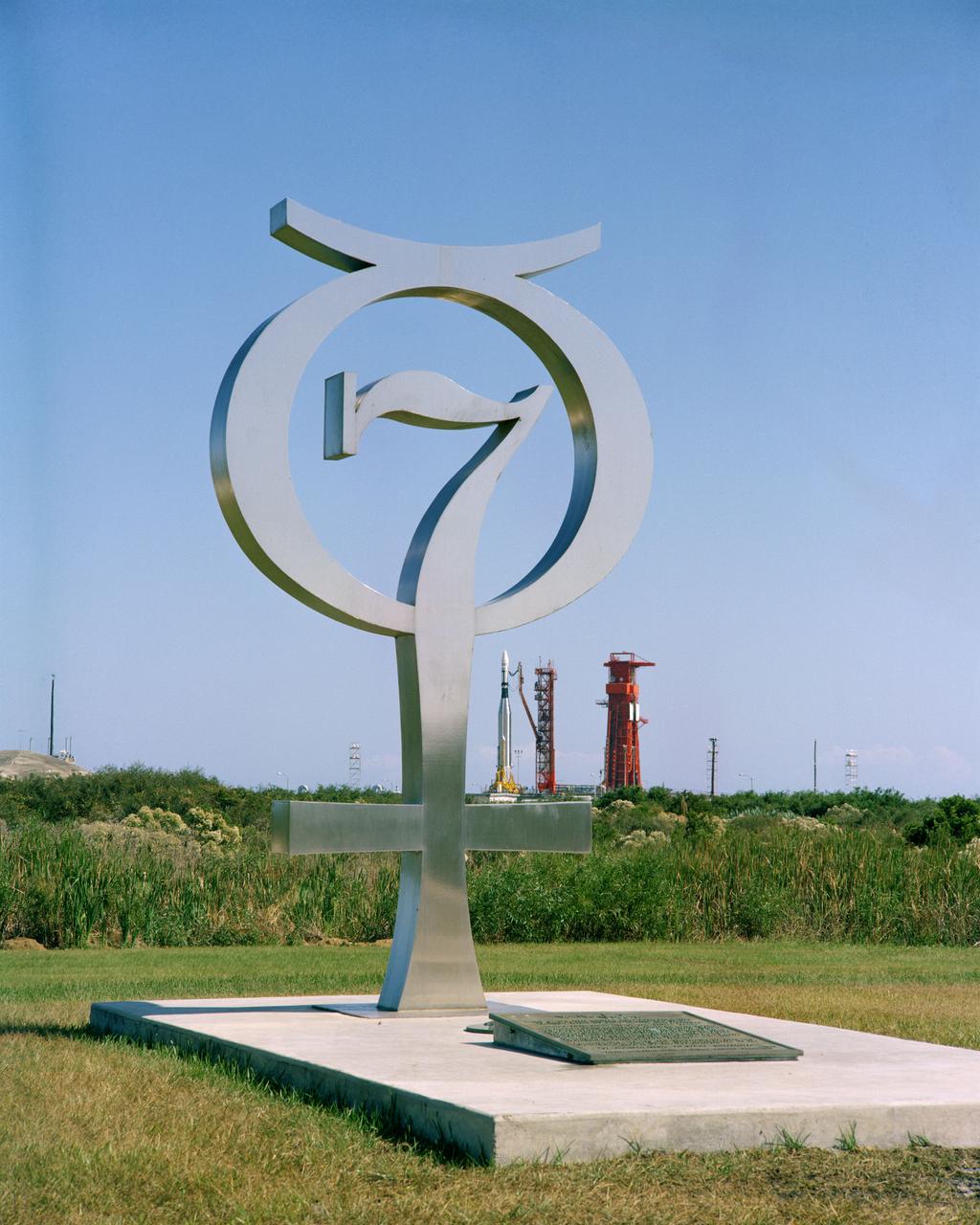
S66-59963 (9 Nov. 1966) --- Monument at Pad 14 honoring Project Mercury. The Arabic number seven represents the seven original astronauts. The other figure is the astronomical symbol of the Planet Mercury. In background is the Gemini-12 Agena Target Docking Vehicle atop its Atlas launch vehicle at Cape Kennedy, Florida. Photo credit: NASA
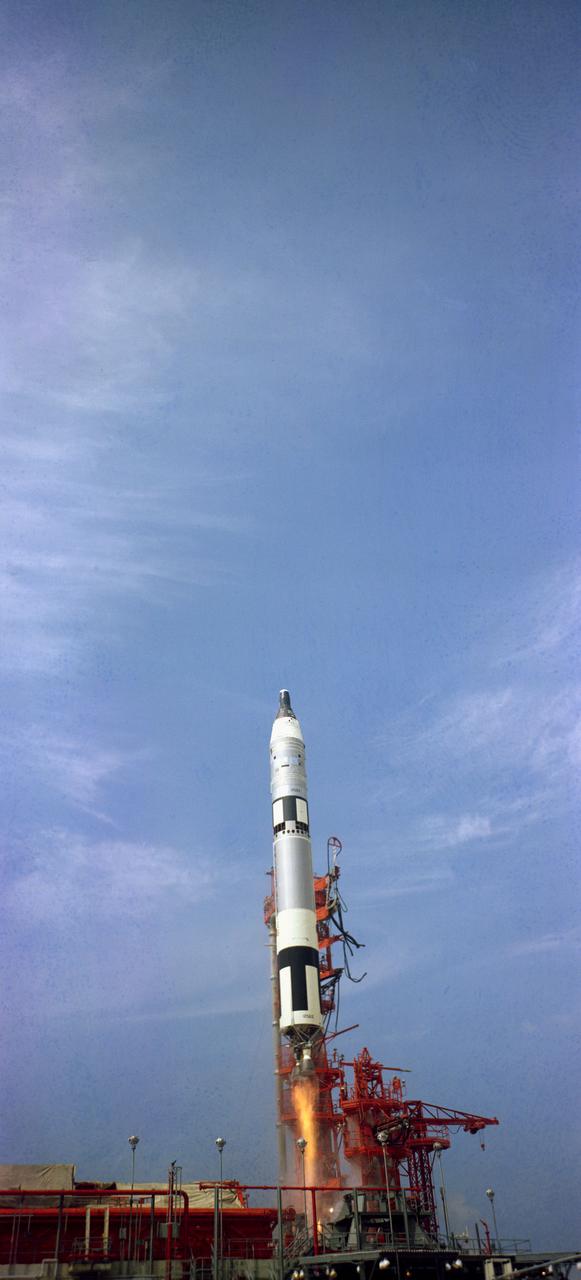
S66-24465 (16 March 1966) --- The Gemini-Titan 8 (GT-8), carrying astronauts Neil A. Armstrong, command pilot, and David R. Scott, pilot, was successfully launched by the National Aeronautics and Space Administration's (NASA) John F. Kennedy Space Center (KSC) at 11:41 a.m. (EST), March 16, 1966. An attempt will be made to rendezvous and dock the Gemini-8 spacecraft with Agena Docking Target Vehicle. Photo credit: NASA
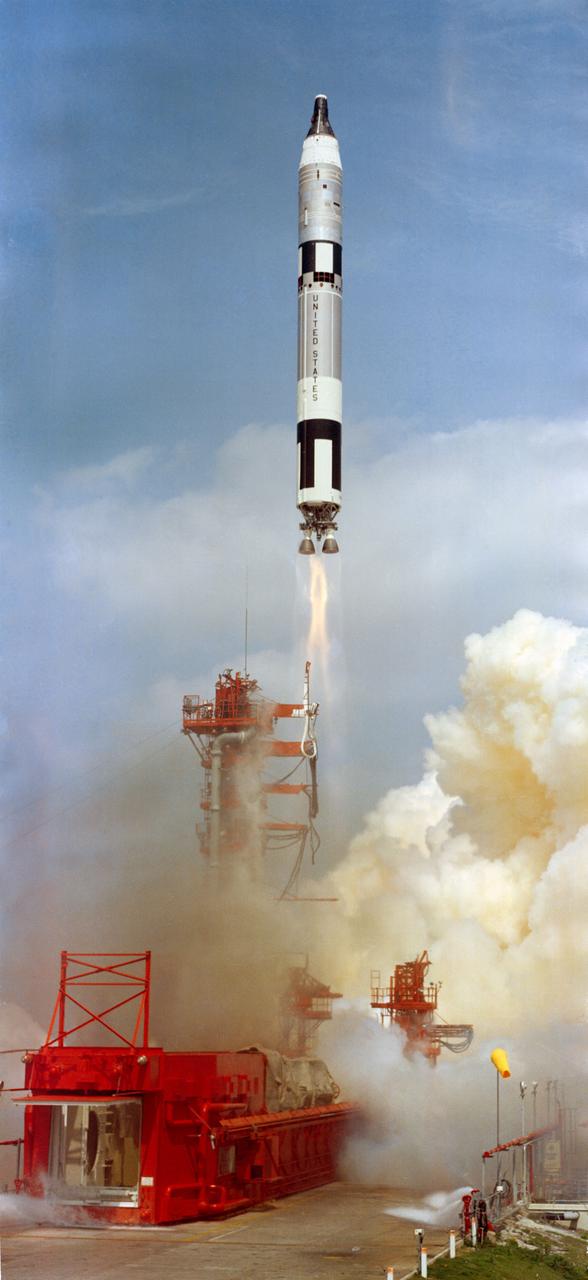
S66-18616 (16 March 1966) --- Gemini-Titan 8 (GT-8) spacecraft, carrying astronauts Neil A. Armstrong, command pilot, and David R. Scott, pilot, was successfully launched by the National Aeronautics and Space Administration's (NASA) John F. Kennedy Space Center (KSC) at 11:41 a.m. (EST), March 16, 1966. An attempt will be made to rendezvous and dock the GT-8 spacecraft with Agena Docking Target Vehicle. Photo credit: NASA
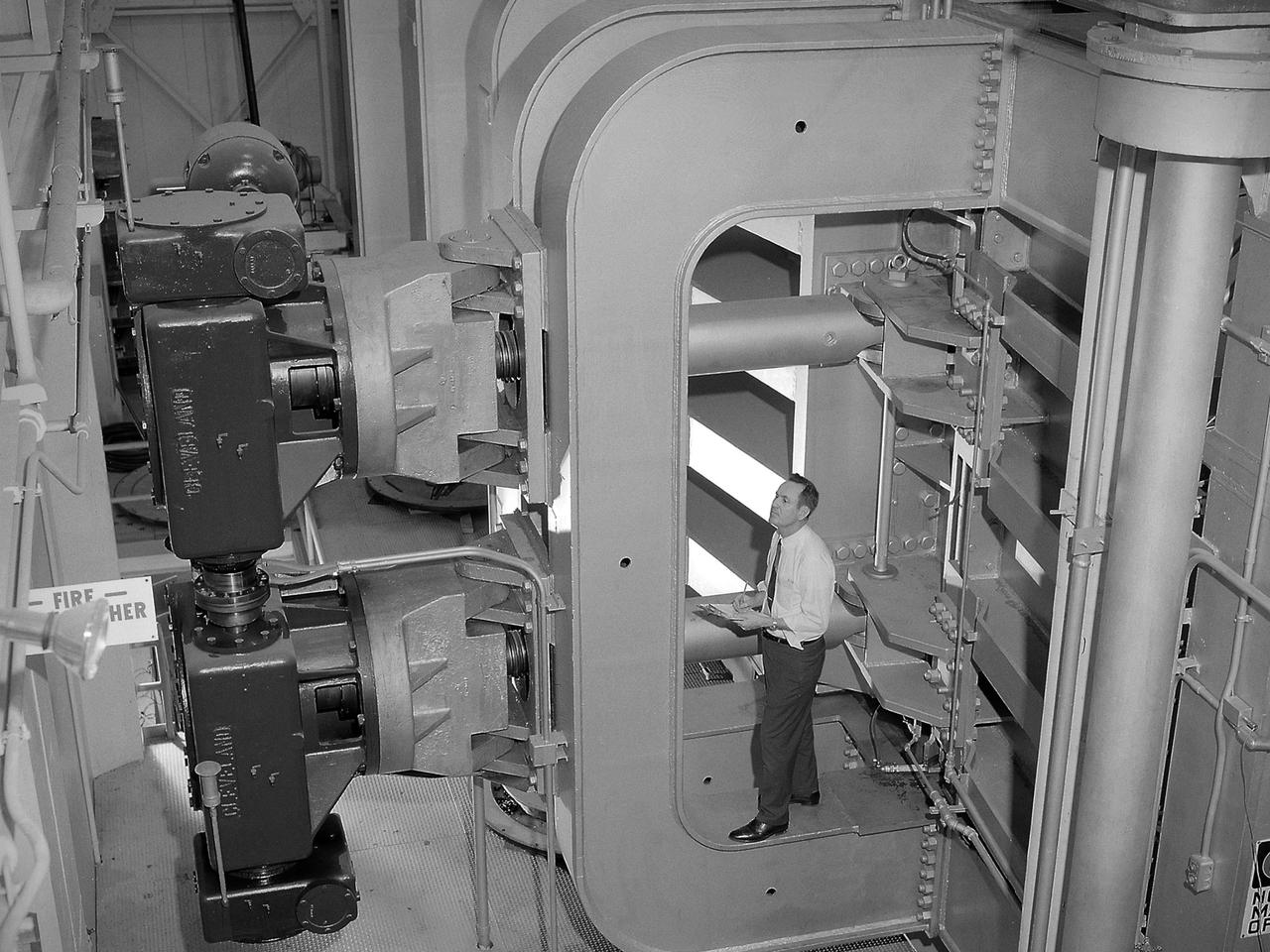
Screwjacks located on the exterior of the second throat section in the 10- by 10-Foot Supersonic Wind Tunnel at the National Aeronautics and Space Administration (NASA) Lewis Research Center. The 10- by 10 tunnel was the most powerful propulsion wind tunnel in the country when it began operating in 1956. The facility can generate wind speeds from Mach 3 to 3.5. A flexible wall nozzle located just upstream from the test section can be adjusted using screw jacks to produce the desired air flow. The 61-foot long second throat, seen here from the outside, was located just beyond the test section. It slows the supersonic air flow down to prevent shock waves. The second throat’s side walls can be adjusted up to three inches on each side using these electrically-driven screwjacks. The air and the 1.25-inch thick walls are cooled by water injection. During the 1960s the 10- by 10-foot tunnel supported the development of virtually all US launch vehicle systems. It was used for Atlas-Centaur, Saturn rockets, and Atlas-Agena testing.
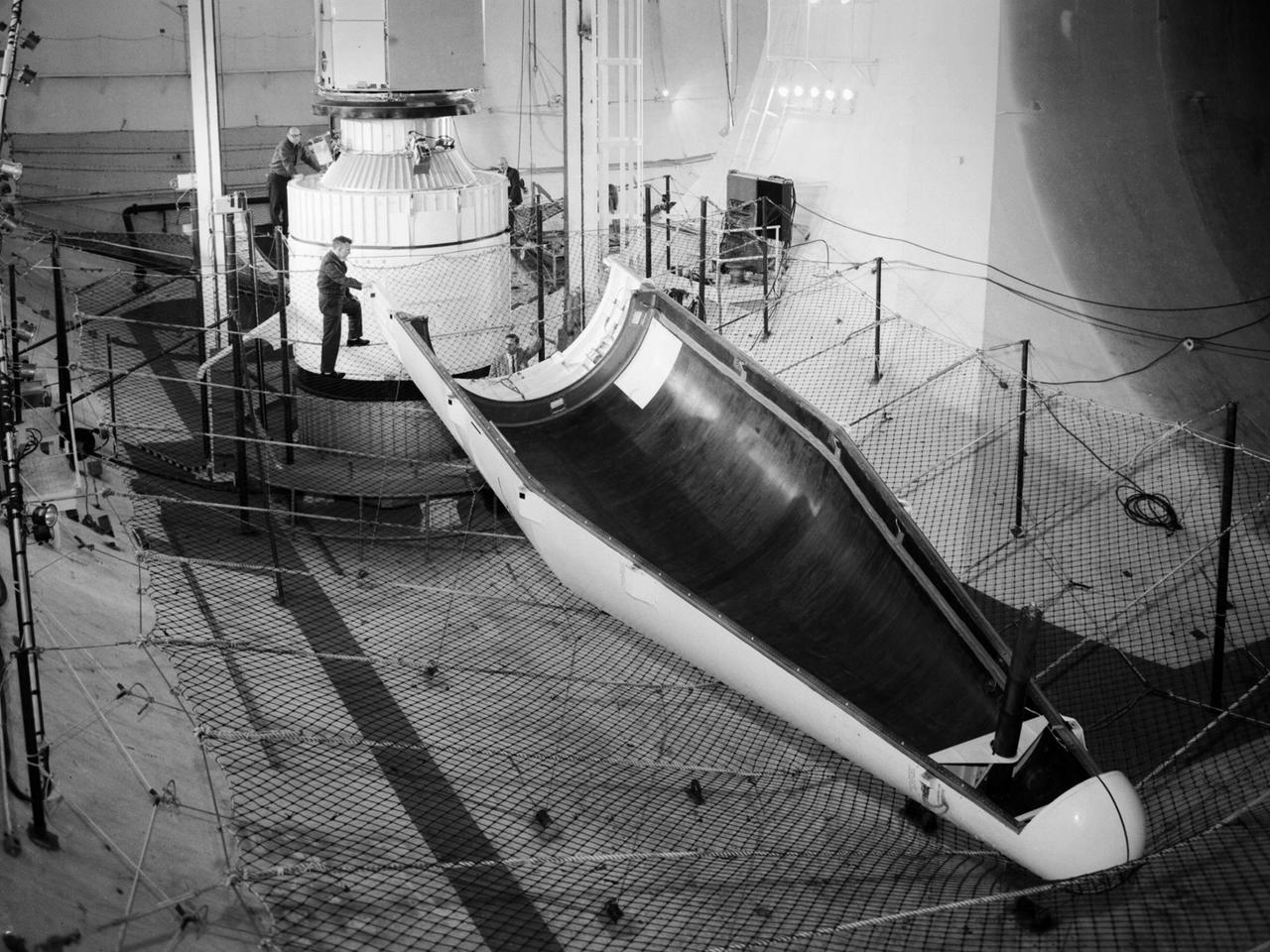
Researchers at the National Aeronautics and Space Administration (NASA) Lewis Research Center conducted a series of shroud jettison tests for the second Orbiting Astronomical Observatory (OAO-2) in the Space Power Chambers during April 1968. The Orbiting Astronomical Observatory satellites were designed by Goddard Space Flight Center to study and retrieve ultraviolet data on stars and galaxies which earthbound and atmospheric telescopes could not view due to ozone absorption. The shroud jettison system was tested in the Space Power Chambers. In 1961, NASA Lewis management decided to convert its Altitude Wind Tunnel into two large test chambers and later renamed it the Space Power Chambers. The conversion, which took over two years, included removing the tunnel’s internal components and inserting bulkheads to seal off the new chambers. The larger chamber, seen here, could simulate altitudes of 100,000 feet. These chambers were used for a variety of tests on the Centaur second-stage rocket until the early 1970s. The first OAO mission in 1965 failed due to problems with the satellite. OAO-2 would be launched on an Atlas/Centaur with a modified Agena shroud. The new shroud was 18 feet longer than the normal Centaur payload shrouds. This new piece of hardware was successfully qualified during three tests at 90,000 feet altitude in the Space Power Chambers in April 1968. For the first time, x-rays were used to verify the payload clearance once the shroud was sealed. OAO-2 was launched on December 7, 1968 and proved to be an extremely successful mission.