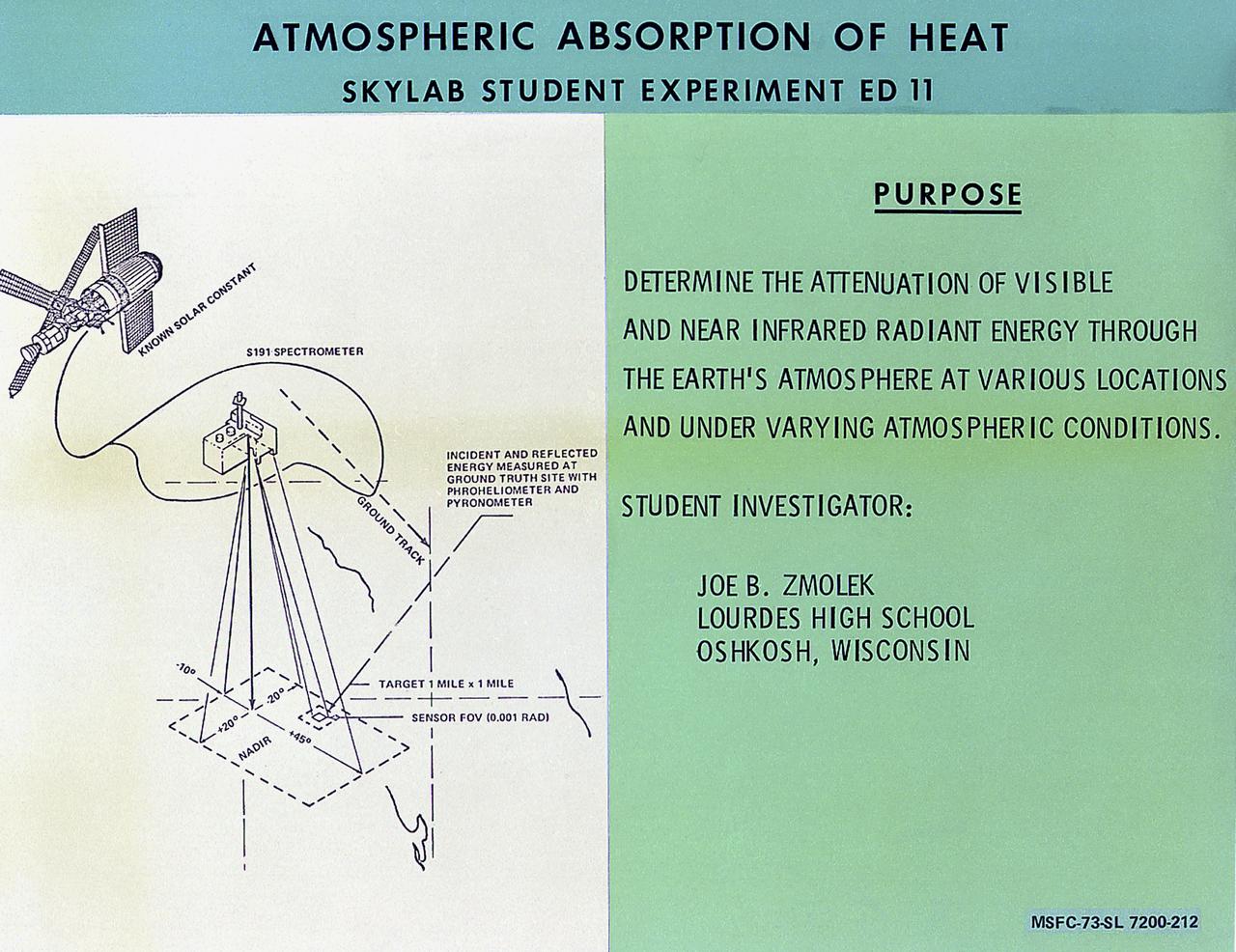
This chart describes the Skylab student experiment, Atmospheric Absorption of Heat, proposed by Joe B. Zmolek of Oshkosh, Wisconsin. This experiment utilized Skylab's Earth Resources Experiment spectrometers to determine the attenuation of radiant energy in the visible and near-infrared spectrums for both densely and sparsely populated areas. In March 1972, NASA and the National Science Teachers Association selected 25 experiment proposals for flight on Skylab. Science advisors from the Marshall Space Flight Center aided and assisted the students in developing the proposals for flight on Skylab.
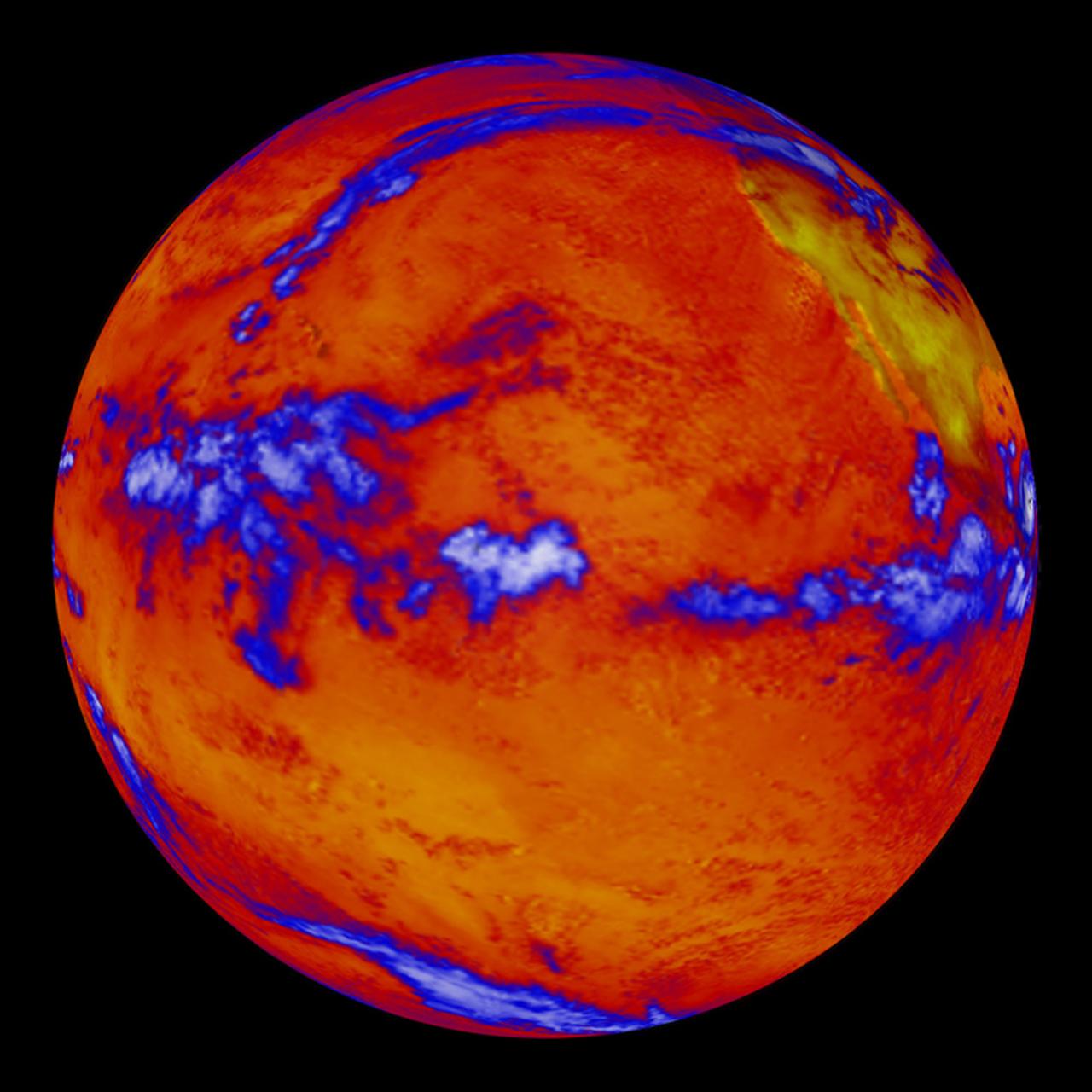
Absorption of solar energy heats up our planet's surface and atmosphere making life for us possible. But the energy carnot stay bound up in the Earth's environment forever. If it did, the Earth would be as hot as the sun. Instead, as the surface and atmosphere warm, they emit thermal long wave radiation, some of which escapes into space and allows the Earth to cool. This false color image of the Earth was produced by the Clouds and the Earth's Radiant Energy System (CERES) instrument flying aboard NASA's Terra spacecraft. The image shows where more or less heat, in the form of long-wave radiation, is emanating from the top of the Earth's atmosphere. As one can see in the image, the thermal radiation leaving the oceans is fairly uniform. The blue swaths represent thick clouds, the tops of which are so high they are among the coldest places on Earth. In the American Southwest, which can be seen in the upper right hand corner of the globe, there is often little cloud cover to block outgoing radiation and relatively little water to absorb solar energy making the amount of outgoing radiation in this area exceeding that of the oceans. Recently, NASA researchers discovered that incoming solar radiation and outgoing thermal radiation increased in the tropics from the 1980s to the 1990s. They believe the unexpected change has to do with apparent change in circulation patterns around the globe, which effectively reduce the amount of water vapor and cloud cover in the upper reaches of the atmosphere. Without the clouds, more sunlight was allowed to enter the tropical zones and more thermal energy was allowed to leave. The findings may have big implications for climate change and future global warming. (Image courtesy NASA Goddard)
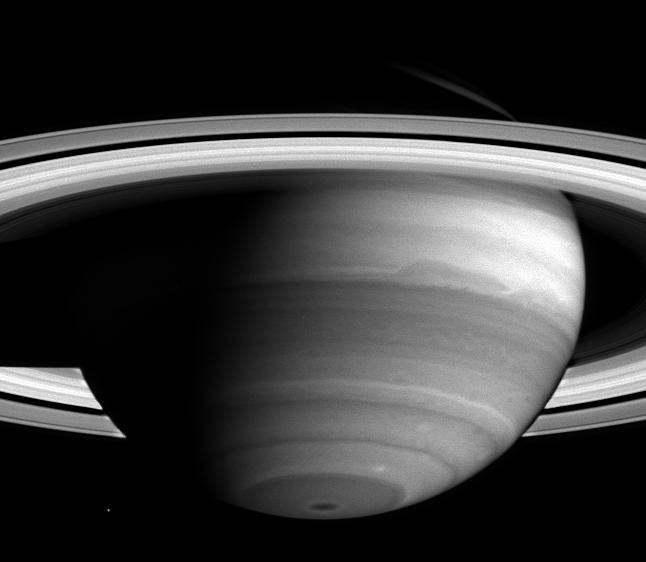
As Cassini nears its rendezvous with Saturn, new detail in the banded clouds of the planet's atmosphere are becoming visible. Cassini began the journey to the ringed world of Saturn nearly seven years ago and is now less than two months away from orbit insertion on June 30. Cassini’s narrow-angle camera took this image on April 16, 2004, when the spacecraft was 38.5 million kilometers (23.9 million miles) from Saturn. Dark regions are generally areas free of high clouds, and bright areas are places with high, thick clouds which shield the view of the darker areas below. A dark spot is visible at the south pole, which is remarkable to scientists because it is so small and centered. The spot could be affected by Saturn's magnetic field, which is nearly aligned with the planet's rotation axis, unlike the magnetic fields of Jupiter and Earth. From south to north, other notable features are the two white spots just above the dark spot toward the right, and the large dark oblong-shaped feature that extends across the middle. The darker band beneath the oblong-shaped feature has begun to show a lacy pattern of lighter-colored, high altitude clouds, indicative of turbulent atmospheric conditions. The cloud bands move at different speeds, and their irregularities may be due to either the different motions between them or to disturbances below the visible cloud layer. Such disturbances might be powered by the planet's internal heat; Saturn radiates more energy than it receives from the Sun. The moon Mimas (396 kilometers, 245 miles across) is visible to the left of the south pole. Saturn currently has 31 known moons. Since launch, 13 new moons have been discovered by ground-based telescopes. Cassini will get a closer look and may discover new moons, perhaps embedded within the planet’s magnificent rings. This image was taken using a filter sensitive to light near 727 nanometers, one of the near-infrared absorption bands of methane gas, which is one of the ingredients in Saturn's atmosphere. The image scale is approximately 231 kilometers (144 miles) per pixel. Contrast has been enhanced to aid visibility of features in the atmosphere. http://photojournal.jpl.nasa.gov/catalog/PIA05391