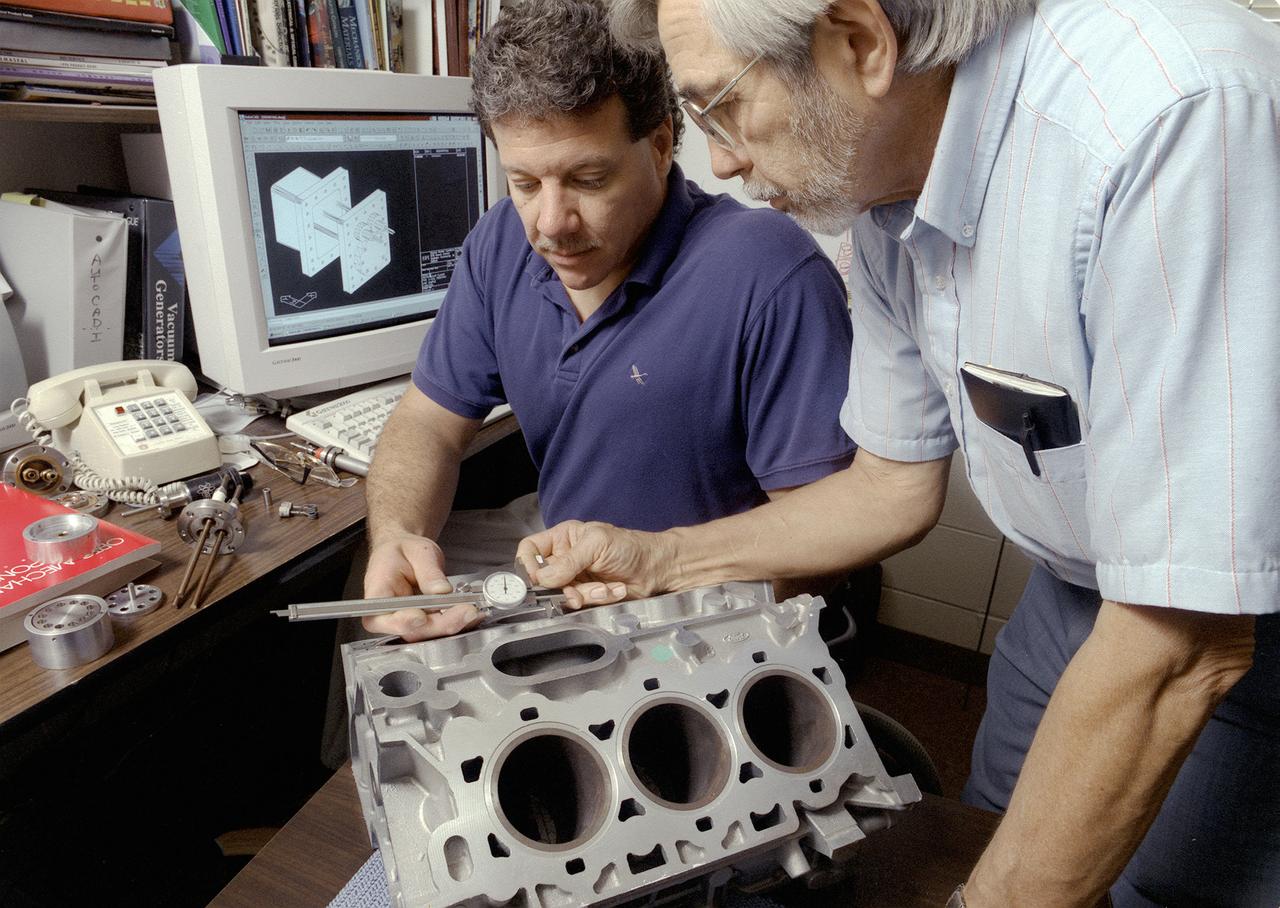
Don Sirois, an Auburn University research associate, and Bruce Strom, a mechanical engineering Co-Op Student, are evaluating the dimensional characteristics of an aluminum automobile engine casting. More accurate metal casting processes may reduce the weight of some cast metal products used in automobiles, such as engines. Research in low gravity has taken an important first step toward making metal products used in homes, automobiles, and aircraft less expensive, safer, and more durable. Auburn University and industry are partnering with NASA to develop one of the first accurate computer model predictions of molten metals and molding materials used in a manufacturing process called casting. Ford Motor Company's casting plant in Cleveland, Ohio is using NASA-sponsored computer modeling information to improve the casting process of automobile and light-truck engine blocks.
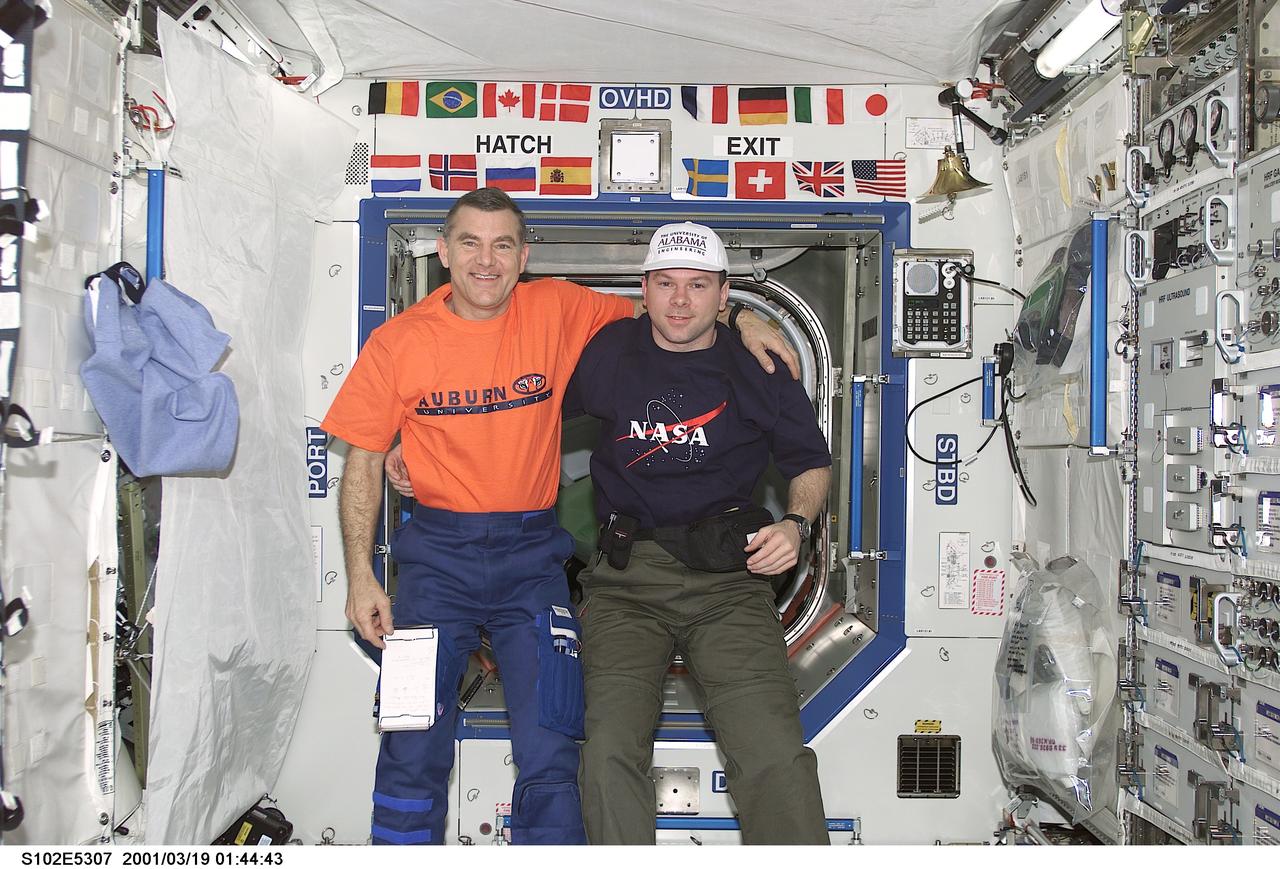
STS102-E-5307 (19 March 2001) --- Astronauts James S. Voss (left) and James M. Kelly share a friendly moment onboard the International Space Station's U.S. laboratory Destiny in spite of the long-standing academic/athletic rivalry between their respective alma maters--Auburn University and the University of Alabama. Voss, STS-102 mission specialist-turned Expedition Two flight engineer and a 1972 alumnus of Auburn with a bachelor of science degree in aerospace engineering, sports a T-shirt paying tribute to his university. Kelly, STS-102 pilot and masters of science degree graduate in aerospace engineering from the University of Alabama in 1996, is wearing a cap from that institution of higher learning.
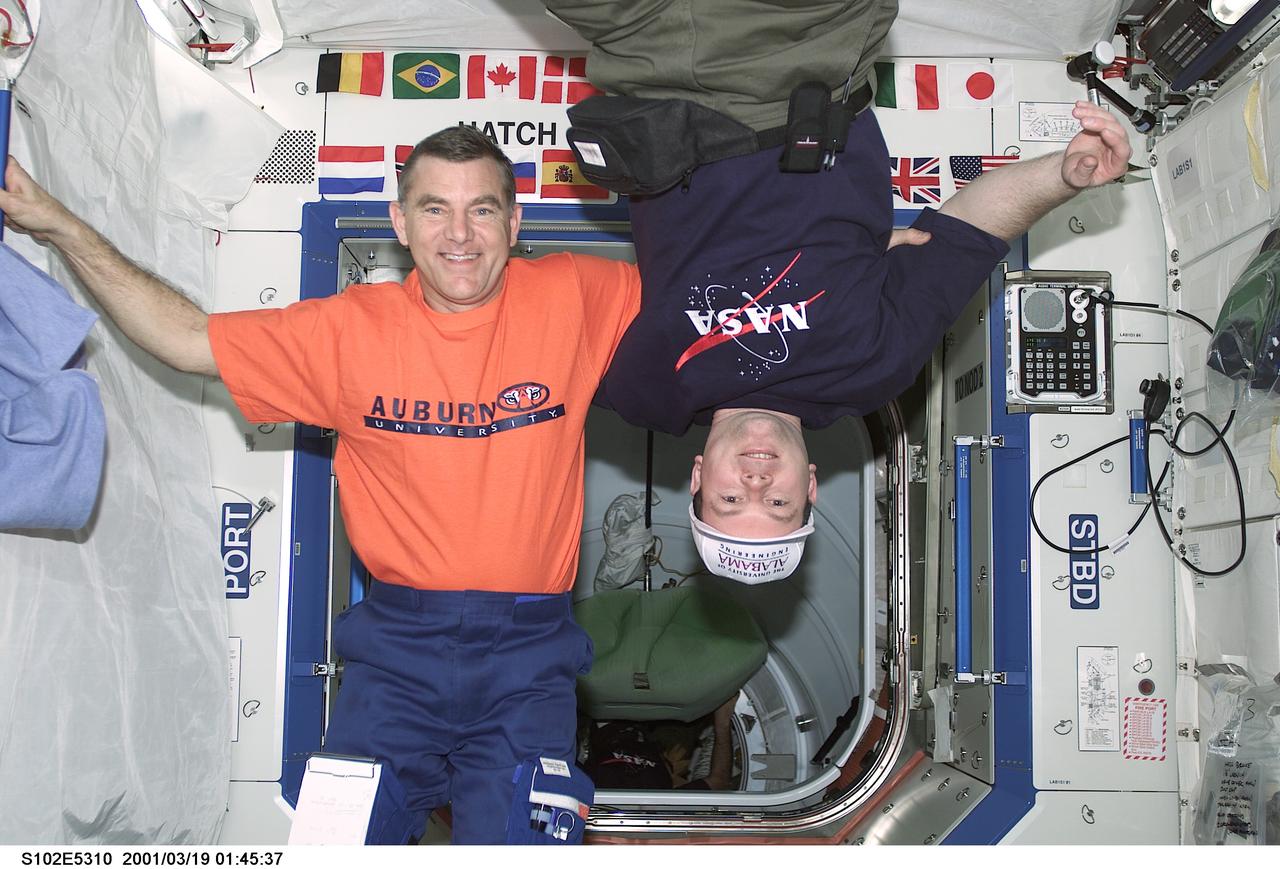
STS102-E-5310 (19 March 2001) --- Astronauts James S. Voss (left) and James M. Kelly share a friendly moment onboard the International Space Station's U.S. laboratory Destiny in spite of the long-standing academic/athletic rivalry between their respective alma maters--Auburn University and the University of Alabama. Voss, STS-102 mission specialist-turned Expedition Two flight engineer and a 1972 alumnus of Auburn with a bachelor of science degree in aerospace engineering, sports a T-shirt paying tribute to his university. Kelly, STS-102 pilot and masters of science degree graduate in aerospace engineering from the University of Alabama in 1996, is wearing a cap from that institution of higher learning.

Alabama House Minority Leader Anthony Daniels, (Left), and Auburn University President, Dr. Stephen Leahy, were part of the Leadership Alabama group that viewed the SLS Liquid Hydrogen test stand at Marshall Space Flight Center on 3/7/19.
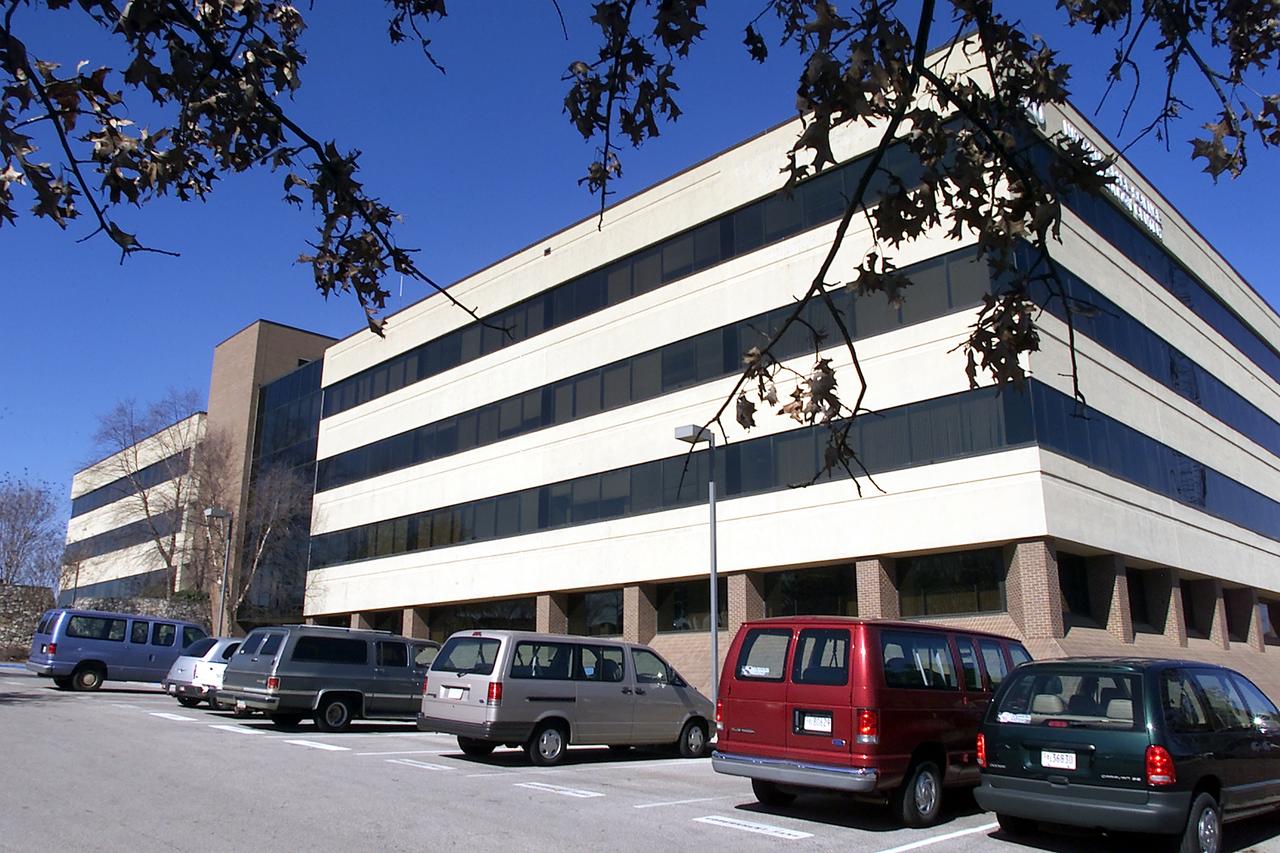
The National Space Science and Technology Center (NSSTC), located in Huntsville, Alabama, is a laboratory for cutting-edge research in selected scientific and engineering disciplines. The major objectives of the NSSTC are to provide multiple fields of expertise coming together to solve solutions to science and technology problems, and gaining recognition as a world-class science research organization. The center, opened in August 2000, focuses on space science, Earth sciences, information technology, optics and energy technology, biotechnology and materials science, and supports NASA's mission of advancing and communicating scientific knowledge using the environment of space for research. In addition to providing basic and applied research, NSSTC, with its student participation, also fosters the next generation of scientists and engineers. NSSTC is a collaborated effort between NASA and the state of Alabama through the Space Science and Technology alliance, a group of six universities including the Universities of Alabama in Huntsville (UAH),Tuscaloosa (UA), and Birmingham (UAB); the University of South Alabama in Mobile (USA); Alabama Agricultural and Mechanical University (AM) in Huntsville; and Auburn University (AU) in Auburn. Participating federal agencies include NASA, Marshall Space Flight Center, the National Oceanic and Atmospheric Administration, the Department of Defense, the National Science Foundation, and the Department of Energy. Industries involved include the Space Science Research Center, the Global Hydrology and Climate Center, the Information Technology Research Center, the Optics and Energy Technology Center, the Propulsion Research Center, the Biotechnology Research Center, and the Materials Science Research Center. An arnex, scheduled for completion by summer 2002, will add an additional 80,000 square feet (7,432 square meters) to NSSTC nearly doubling the size of the core facility. At full capacity, the completed NSSTC will top 200,000 square feet (18,580 square meters) and house approximately 550 employees.
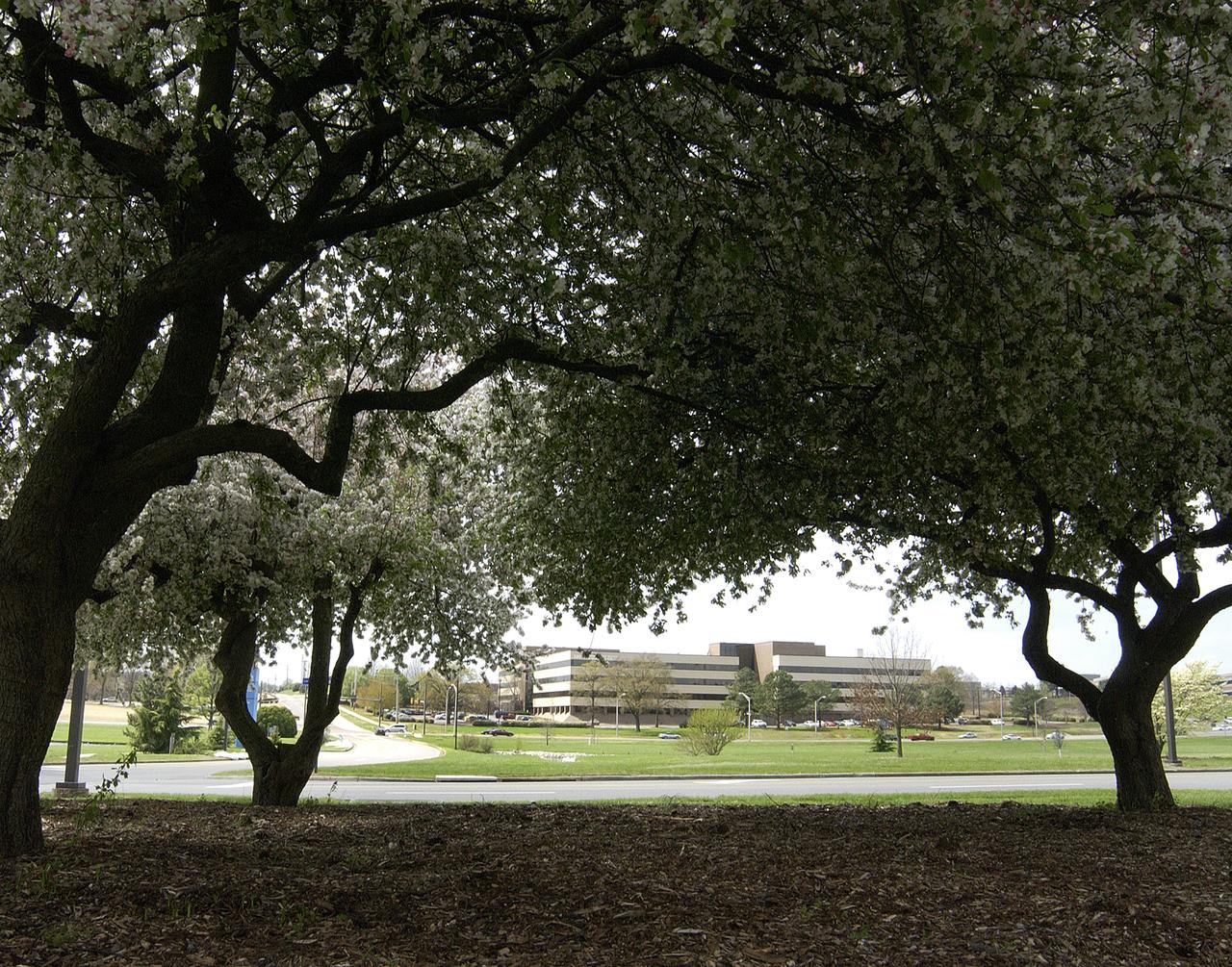
The National Space Science and Technology Center (NSSTC), located in Huntsville, Alabama, is a laboratory for cutting-edge research in selected scientific and engineering disciplines. The major objectives of the NSSTC are to provide multiple fields of expertise coming together to solve solutions to science and technology problems, and gaining recognition as a world-class science research organization. The center, opened in August 2000, focuses on space science, Earth sciences, information technology, optics and energy technology, biotechnology and materials science, and supports NASA's mission of advancing and communicating scientific knowledge using the environment of space for research. In addition to providing basic and applied research, NSSTC, with its student participation, also fosters the next generation of scientists and engineers. NSSTC is a collaborated effort between NASA and the state of Alabama through the Space Science and Technology alliance, a group of six universities including the Universities of Alabama in Huntsville (UAH),Tuscaloosa (UA), and Birmingham (UAB); the University of South Alabama in Mobile (USA);Alabama Agricultural and Mechanical University (AM) in Huntsville; and Auburn University (AU) in Auburn. Participating federal agencies include NASA, Marshall Space Flight Center, the National Oceanic and Atmospheric Administration, the Department of Defense, the National Science Foundation, and the Department of Energy. Industries involved include the Space Science Research Center, the Global Hydrology and Climate Center, the Information Technology Research Center, the Optics and Energy Technology Center, the Propulsion Research Center, the Biotechnology Research Center, and the Materials Science Research Center. This photo shows the completed center with the additional arnex (right of building) that added an additional 80,000 square feet (7,432 square meters) to the already existent NSSTC, nearly doubling the size of the core facility. At full capacity, the NSSTC tops 200,000 square feet (18,580 square meters) and houses approximately 550 employees.
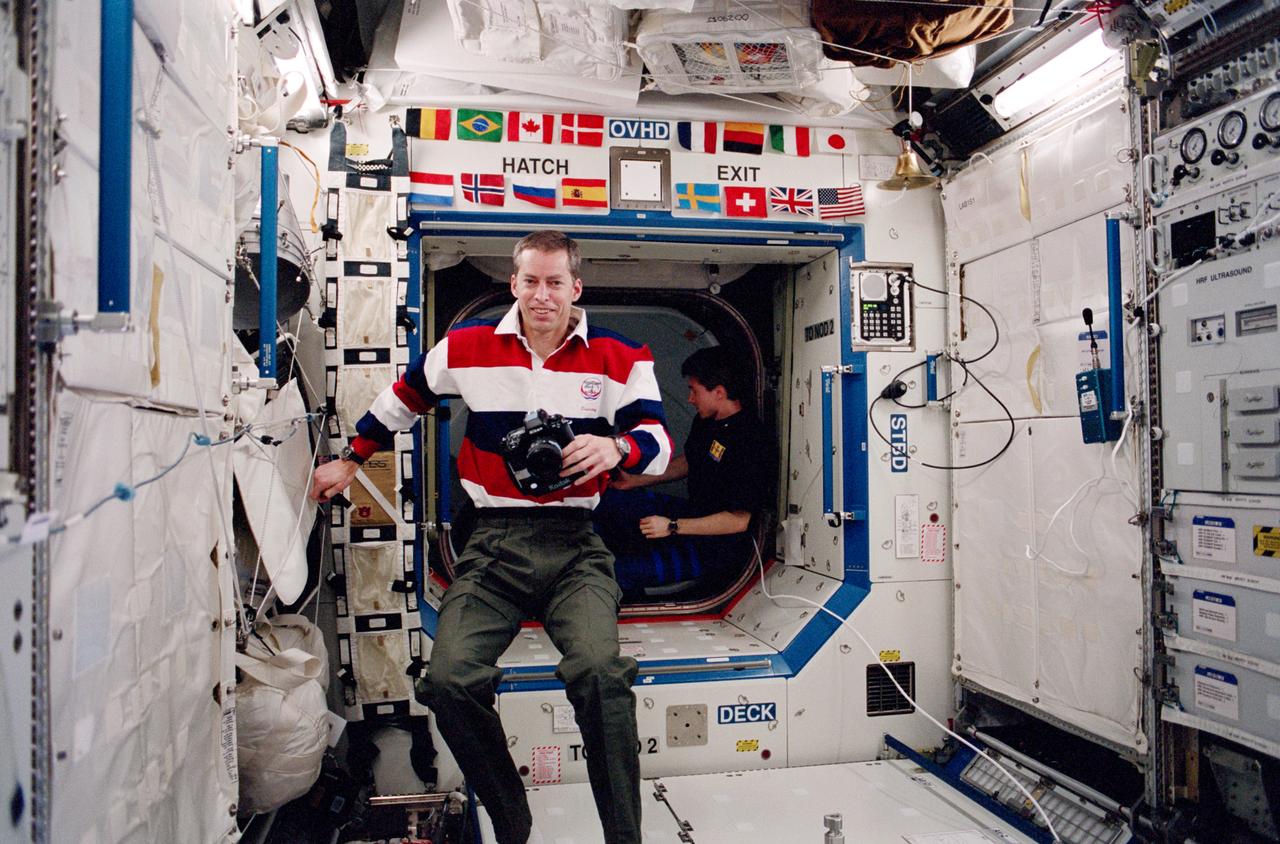
In this Space Shuttle STS-102 mission image, the Payload Equipment Restraint System H-Strap is shown at the left side of the U.S. Laboratory hatch and behind Astronaut James D. Weatherbee, mission specialist. PERS is an integrated modular system of components designed to assist the crew of the International Space Station (ISS) in restraining and carrying necessary payload equipment and tools in a microgravity environment. The Operations Development Group, Flight Projects Directorate at the Marshall Space Flight Center (MSFC), while providing operation support to the ISS Materials Science Research Facility (MSRF), recognized the need for an on-orbit restraint system to facilitate control of lose objects, payloads, and tools. The PERS is the offspring of that need and it helps the ISS crew manage tools and rack components that would otherwise float away in the near-zero gravity environment aboard the Space Station. The system combines Kevlar straps, mesh pockets, Velcro and a variety of cornecting devices into a portable, adjustable system. The system includes the Single Strap, the H-Strap, the Belly Pack, the Laptop Restraint Belt, and the Tool Page Case. The Single Strap and the H-Strap were flown on this mission. The PERS concept was developed by industrial design students at Auburn University and the MSFC Flight Projects Directorate.
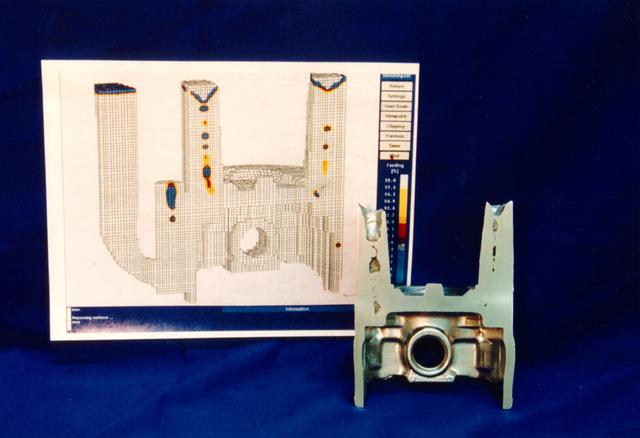
This is a computer generated model of a ground based casting. The objective of the therophysical properties program is to measure thermal physical properties of commercial casting alloys for use in computer programs that predict soldification behavior. This could reduce trial and error in casting design and promote less scrap, sounder castings, and less weight. In order for the computer models to reliably simulate the details of industrial alloy solidification, the input thermophysical property data must be absolutely reliable. Recently Auburn University and TPRL Inc. formed a teaming relationship to establish reliable measurement techniques for the most critical properties of commercially important alloys: transformation temperatures, thermal conductivity, electrical conductivity, specific heat, latent heat, density, solid fraction evolution, surface tension, and viscosity. A new initiative with the American Foundrymens Society has been started to measure the thermophysical properties of commercial ferrous and non-ferrous casting alloys and make the thermophysical property data widely available. Development of casting processes for the new gamma titanium aluminide alloys as well as existing titanium alloys will remain a trial-and-error procedure until accurate thermophysical properties can be obtained. These molten alloys react with their containers on earth and change their composition - invalidating the measurements even while the data are being acquired in terrestrial laboratories. However, measurements on the molten alloys can be accomplished in space using freely floating droplets which are completely untouched by any container. These data are expected to be exceptionally precise because of the absence of impurity contamination and buoyancy convection effects. Although long duration orbital experiments will be required for the large scale industrial alloy measurement program that results from this research, short duration experiments on NASA's KC-135 low-g aircraft are already providing preliminary data and experience.