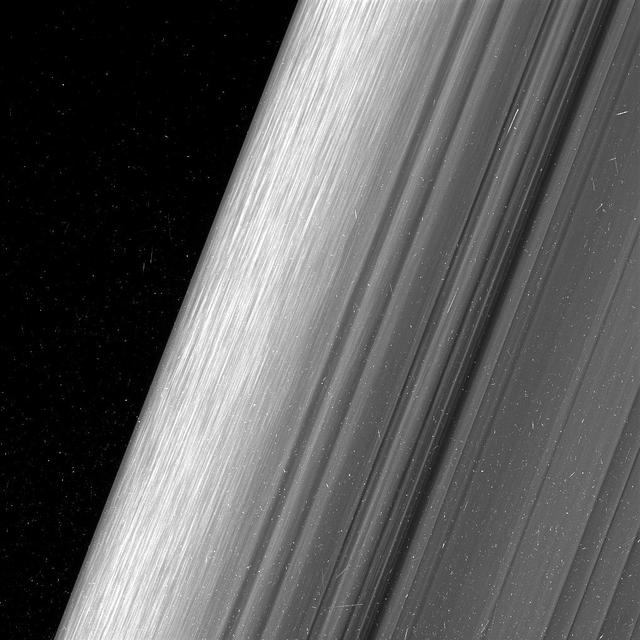
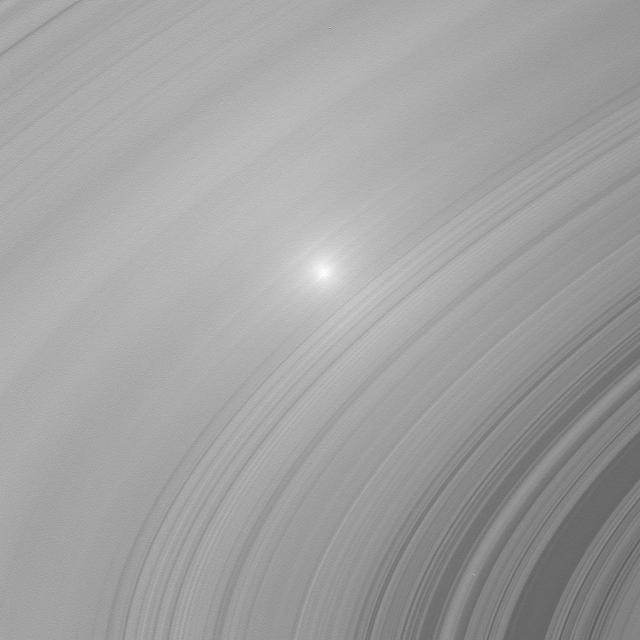
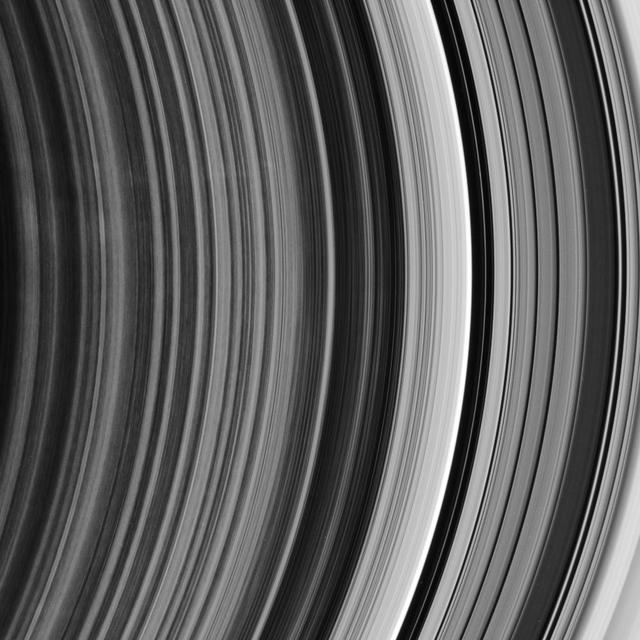
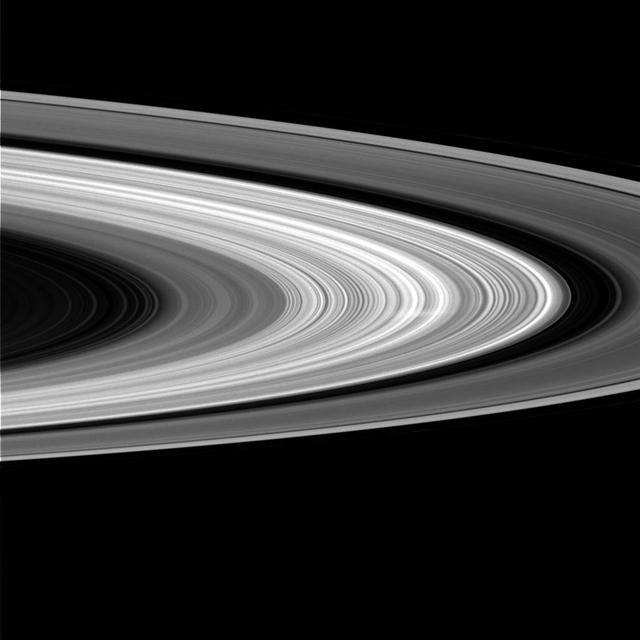
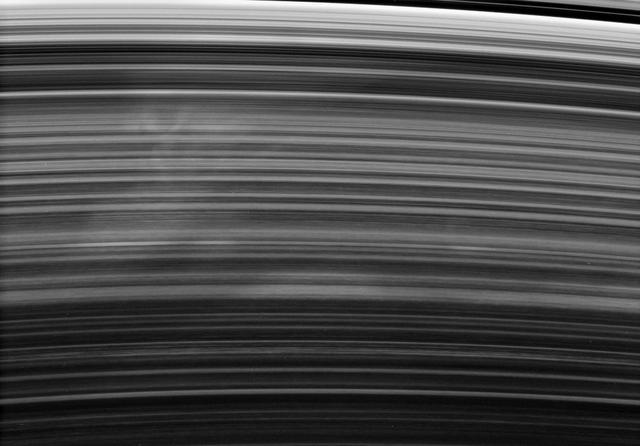
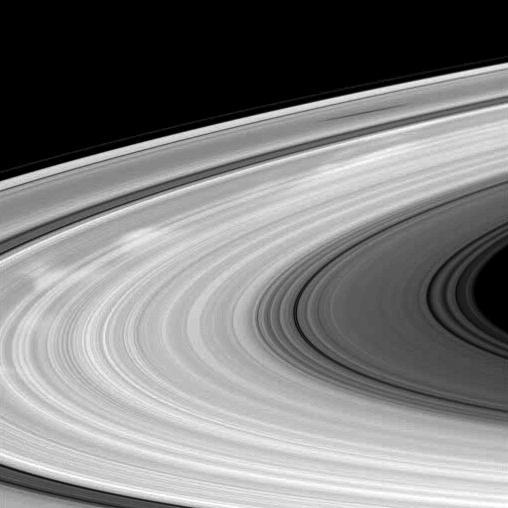
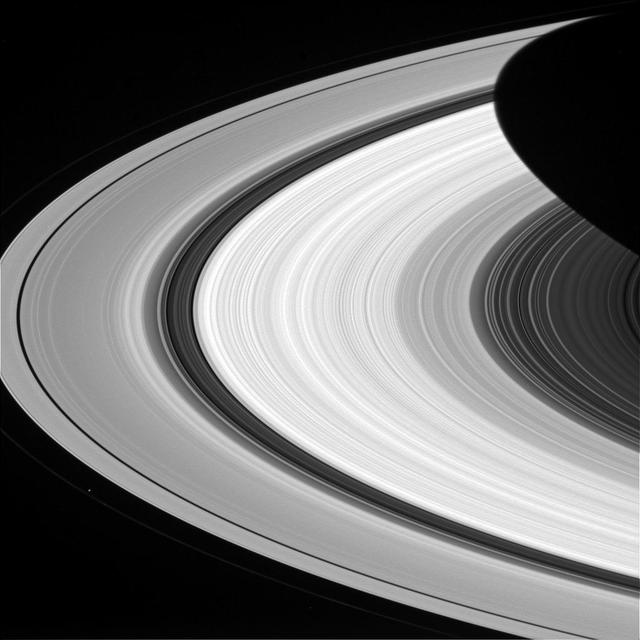
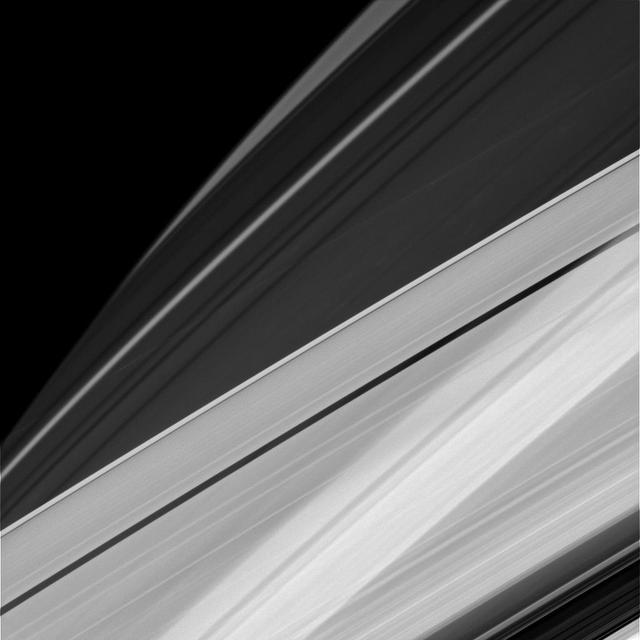
This image shows a region in Saturn's outer B ring. NASA's Cassini spacecraft viewed this area at a level of detail twice as high as it had ever been observed before. The view here is of the outer edge of the B ring, at left, which is perturbed by the most powerful gravitational resonance in the rings: the "2:1 resonance" with the icy moon Mimas. This means that, for every single orbit of Mimas, the ring particles at this specific distance from Saturn orbit the planet twice. This results in a regular tugging force that perturbs the particles in this location. A lot of structure is visible in the zone near the edge on the left. This is likely due to some combination of the gravity of embedded objects too small to see, or temporary clumping triggered by the action of the resonance itself. Scientists informally refer to this type of structure as "straw." This image was taken using a fairly long exposure, causing the embedded clumps to smear into streaks as they moved in their orbits. Later Cassini orbits will bring shorter exposures of the same region, which will give researchers a better idea of what these clumps look like. But in this case, the smearing does help provide a clearer idea of how the clumps are moving. This image is a lightly processed version, with minimal enhancement; this version preserves all original details present in the image. Another other version (Figure 1) has been processed to remove the small bright blemishes due to cosmic rays and charged particle radiation near the planet -- a more aesthetically pleasing image, but with a slight softening of the finest details. The image was taken in visible light with the Cassini spacecraft wide-angle camera on Dec. 18, 2016. The view was obtained at a distance of approximately 32,000 miles (52,000 kilometers) from the rings and looks toward the unilluminated side of the rings. Image scale is about a quarter-mile (360 meters) per pixel. http://photojournal.jpl.nasa.gov/catalog/PIA21057

Mysterious B Ring

B Ring Irregularities
B Ring in the Negative
The B Ring Variations

B Ring Terminus
A View of Saturn B-ring
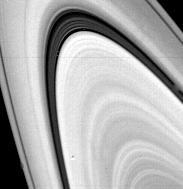
Saturn B rings
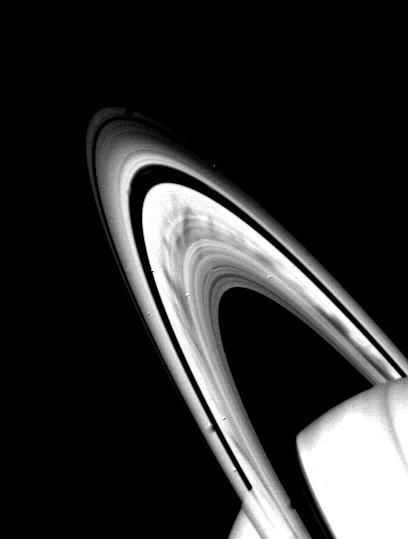
Saturn B-ring

Saturn B and C-rings

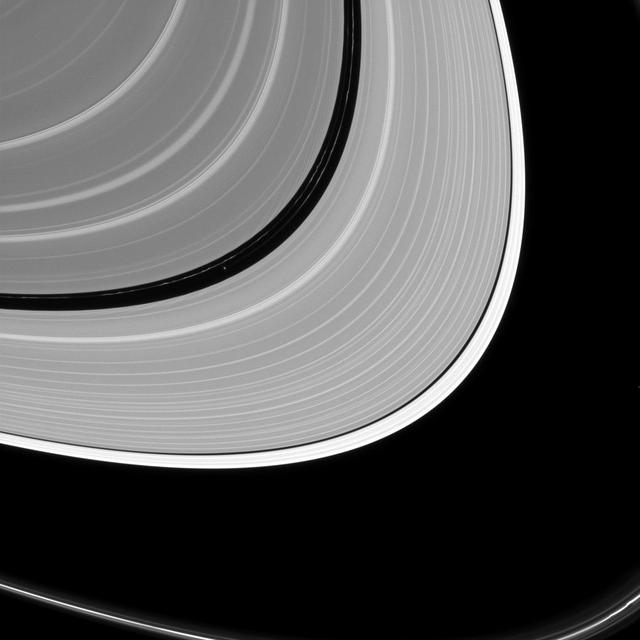
This image shows a region in Saturn's outer B ring. NASA's Cassini spacecraft viewed this area at a level of detail twice as high as it had ever been observed before. And from this view, it is clear that there are still finer details to uncover. Researchers have yet to determine what generated the rich structure seen in this view, but they hope detailed images like this will help them unravel the mystery. In order to preserve the finest details, this image has not been processed to remove the many small bright blemishes, which are created by cosmic rays and charged particle radiation near the planet. The image was taken in visible light with the Cassini spacecraft wide-angle camera on Dec. 18, 2016. The view was obtained at a distance of approximately 32,000 miles (51,000 kilometers) from the rings, and looks toward the unilluminated side of the rings. Image scale is about a quarter-mile (360 meters) per pixel. http://photojournal.jpl.nasa.gov/catalog/PIA21058

B Ring Straw-like Clumps

Outer edge of Saturn B-ring
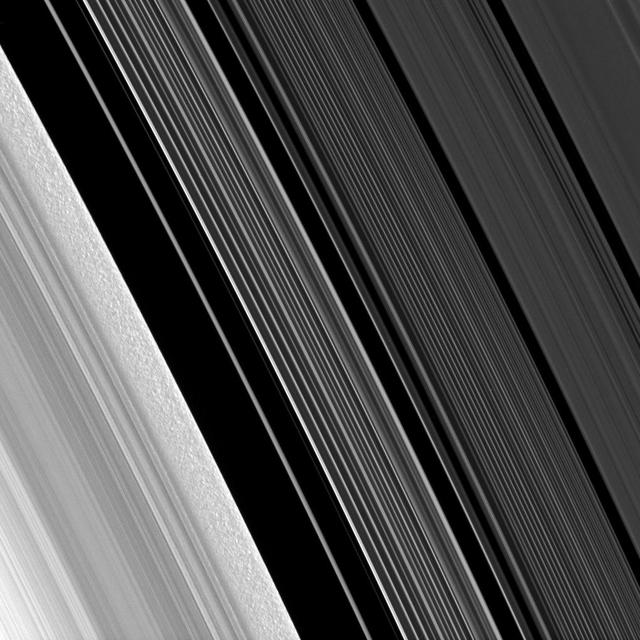
The Cassini spacecraft looks closely at the outer B ring and the Cassini Division, revealing clump-like structures in the outer edge of the B ring.
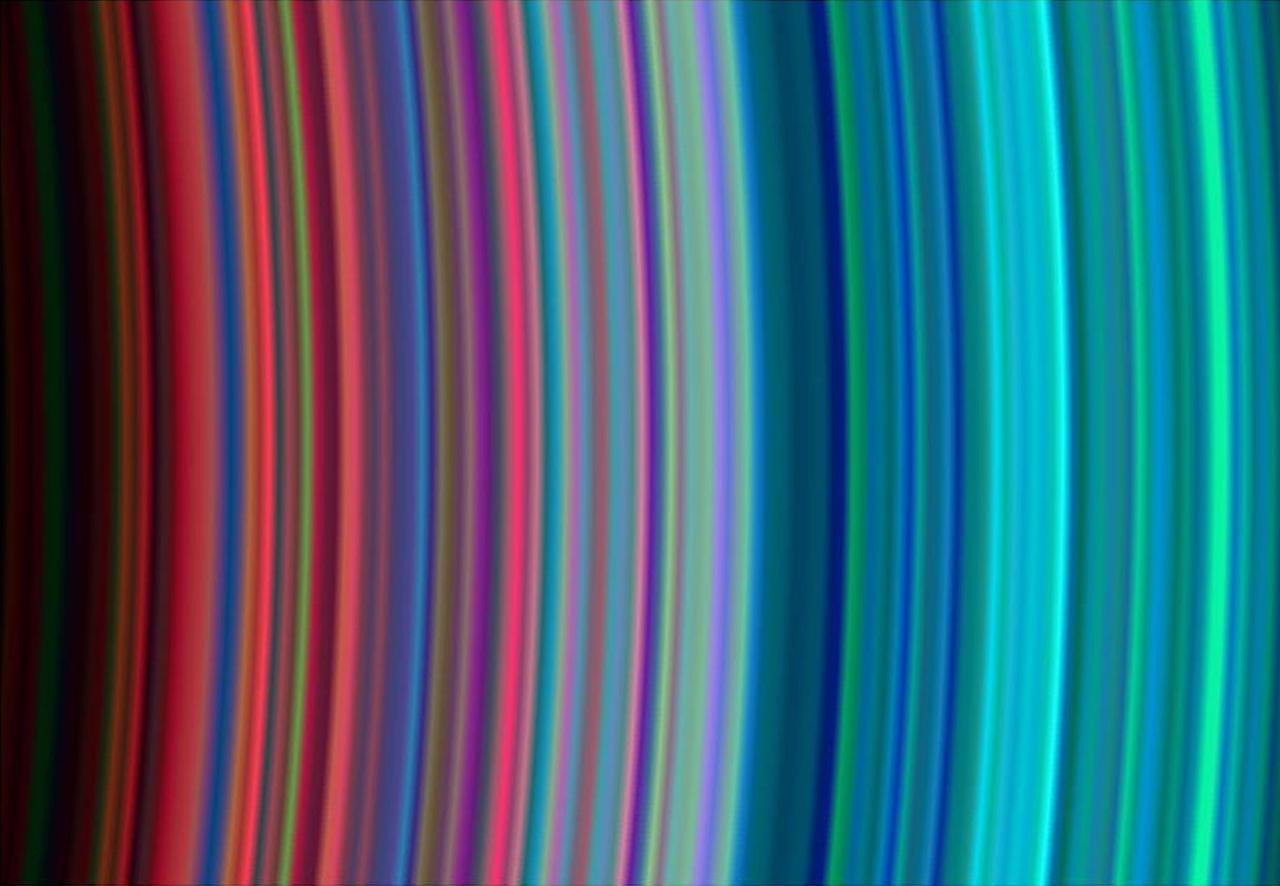
Saturn C and B Rings From the Inside Out
Two images of Saturn A and B ring showcase the opposition effect, a brightness surge that is visible on Saturn rings when the Sun is directly behind the spacecraft

The shadow of the moon Epimetheus stretches across the B ring in this image taken by Cassini as Saturn approaches its 2009 equinox.
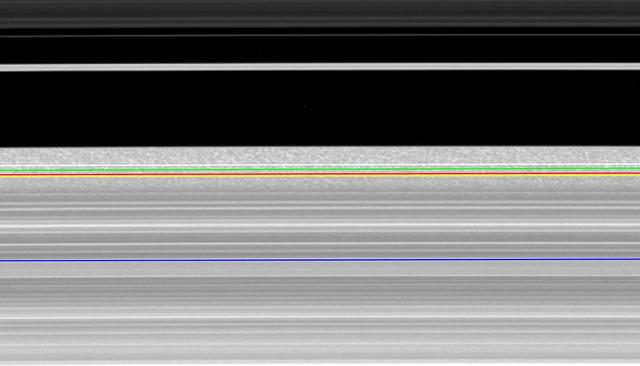
Keeping a close watch on the outer portion of Saturn B ring, NASA Cassini spacecraft records the complex inward and outward movement of the edge of the ring. This ring movement resembles the suspected behavior of spiral disk galaxies.
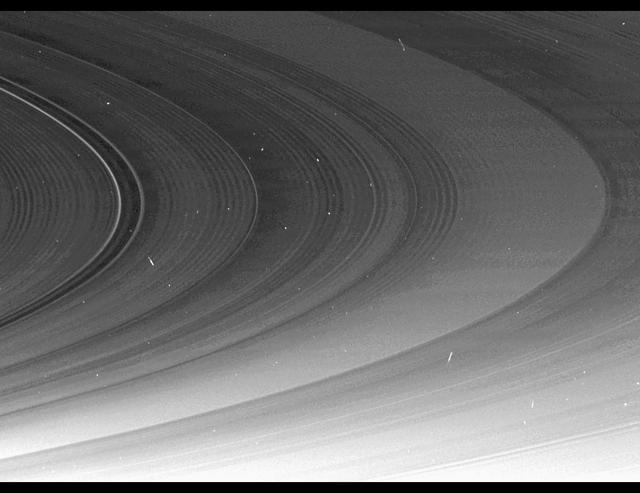
This mosaic, part of a larger mosaic of images captured by NASA Cassini Orbiter just hours before exact equinox at Saturn, shows that the spiral corrugation in the planet’s inner rings continues right up to the inner B ring.

This image NASA Cassini spacecraft shows subtle, wavelike patterns, hundreds of narrow features resembling a record grooves in Saturn outer B-ring, and a noticeable abrupt change in overall brightness beyond the dark gap near the right.
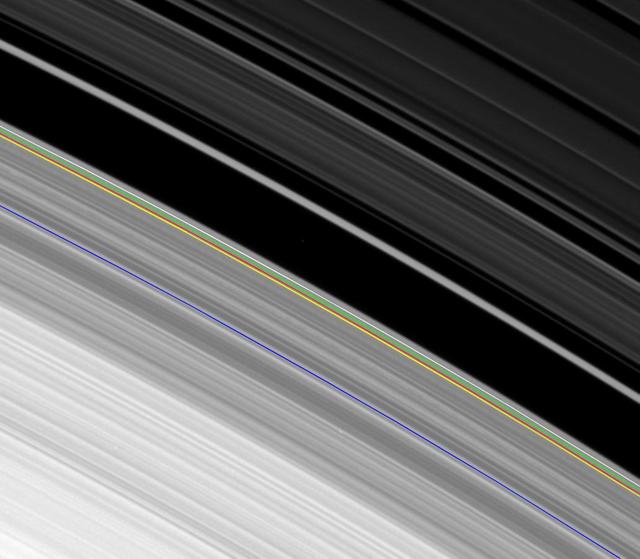
This image obtained by NASA Cassini spacecraft of the outer edge of Saturn?s B ring, reveals the combined effects of a tugging moon and oscillations that can naturally occur in disks like Saturn rings and spiral galaxies.

These are the highest-resolution color images of any part of Saturn's rings, to date, showing a portion of the inner-central part of the planet's B Ring. The view is a mosaic of two images that show a region that lies between 61,300 and 65,600 miles (98,600 and 105,500 kilometers) from Saturn's center. This image is a natural color composite, created using images taken with red, green and blue spectral filters. The pale tan color is generally not perceptible with the naked eye in telescope views, especially given that Saturn has a similar hue. The material responsible for bestowing this color on the rings -- which are mostly water ice and would otherwise appear white -- is a matter of intense debate among ring scientists that will hopefully be settled by new in-situ observations before the end of Cassini's mission. The different ringlets seen here are part of what is called the "irregular structure" of the B ring. Cassini radio occultations of the rings have shown that these features have extremely sharp boundaries on even smaller scales (radially, or along the direction outward from Saturn) than the camera can resolve here. Closer to Saturn, the irregular structures become fuzzier and more rounded, less opaque, and their color contrast diminishes. The narrow ringlets in the middle of this scene are each about 25 miles (40 kilometers) wide, and the broader bands at right are about 200 to 300 miles (300 to 500 kilometers) across. It remains unclear exactly what causes the variable brightness of these ringlets and bands -- the basic brightness of the ring particles themselves, shadowing on their surfaces, their absolute abundance, and how densely the particles are packed, may all play a role. The second image (Figure 1) is a color-enhanced version. Blue colors represent areas where the spectrum at visible wavelengths is less reddish (meaning the spectrum is flatter toward red wavelengths), while red colors represent areas that are spectrally redder (meaning the spectrum has a steeper spectrum toward red wavelengths). Observations from the Voyager mission and Cassini's visual and infrared mapping spectrometer previously showed these color variations at lower resolution, but it was not known that such well-defined color contrasts would be this sharply defined down to the scale (radial scale) of a couple of miles or kilometers, as seen here. Analysis of additional images from this observation, taken using infrared spectral filters sensitive to absorption of light by water ice, indicates that the areas that appear more visibly reddish in the color-enhanced version are also richer in water ice. The third image (Figure 2) is a composite of the "true" and "enhanced" color images for easy comparison. This image was taken on July 6, 2017, with the Cassini spacecraft narrow-angle camera. The image was acquired on the sunlit side of the rings from a distance of 47,000 miles (76,000 kilometers) away from the area pictured. The image scale is about 2 miles (3 kilometers) per pixel. The phase angle, or sun-ring-spacecraft angle, is 90 degrees. https://photojournal.jpl.nasa.gov/catalog/PIA21628
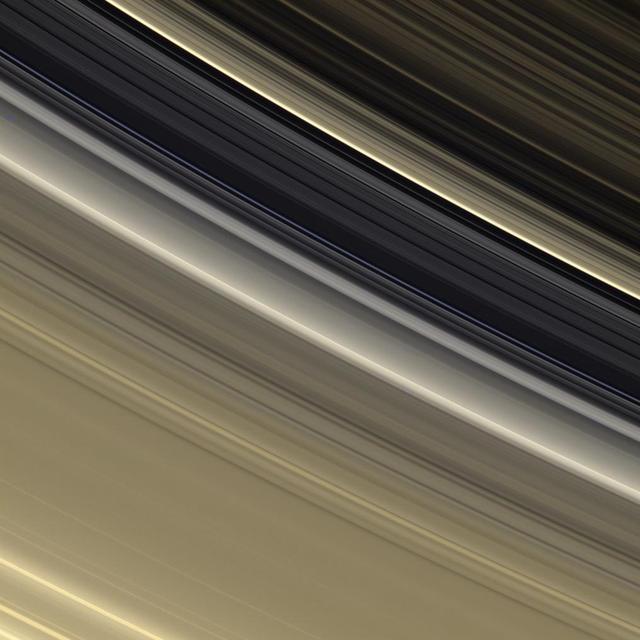
The rings are awash in subtle tones of gold and cream in this view which shows the outer B ring, the Cassini Division and the inner part of the A ring
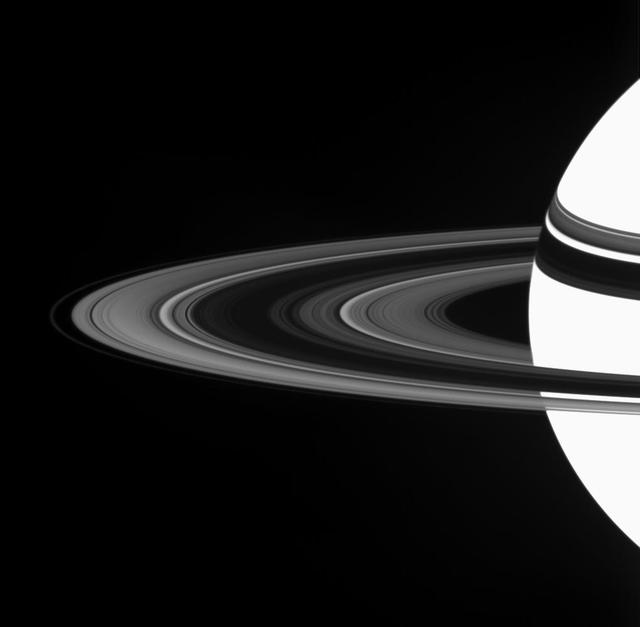
Saturn A ring displays a marked asymmetry in brightness between the region nearer to the Cassini spacecraft and the region farther from it. The A ring is the broad, bright section of the rings outside of the dark B ring
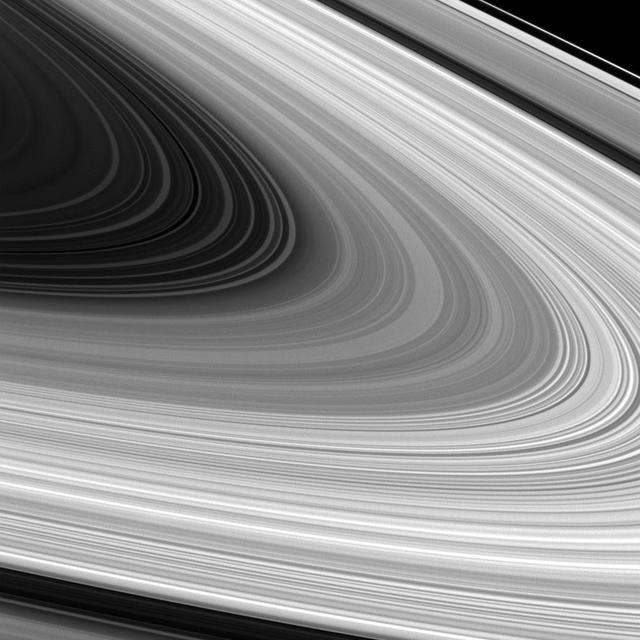
Saturn B ring is spread out in all its glory in this image from NASAS Cassini spacecraft. Scientists are trying to better understand the origin and nature of the various structures seen in the B ring.
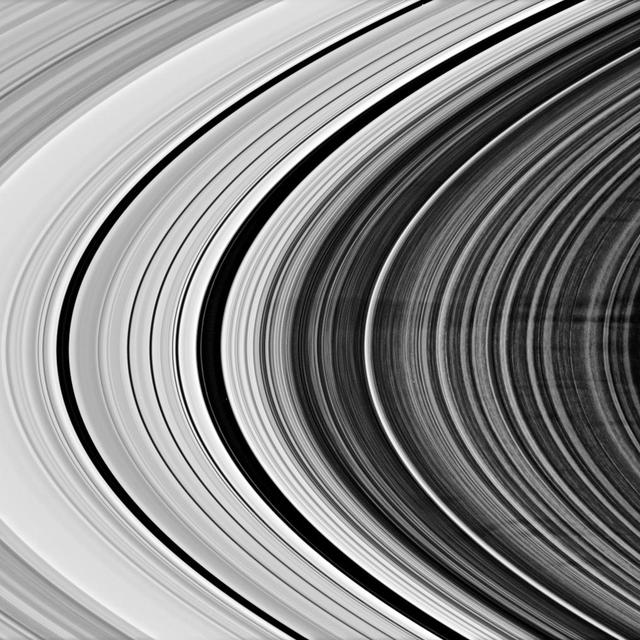
This Cassini spacecraft view shows a group of more than a dozen spokes in Saturn outer B ring. The B ring displays the azimuthal asymmetry, or variation with longitude around the planet, that is characteristic of the spoke-forming region

The shadow of the moon Tethys stretches across Saturn A ring before fading into the B ring as the shadow extends towards the lower right of this image.
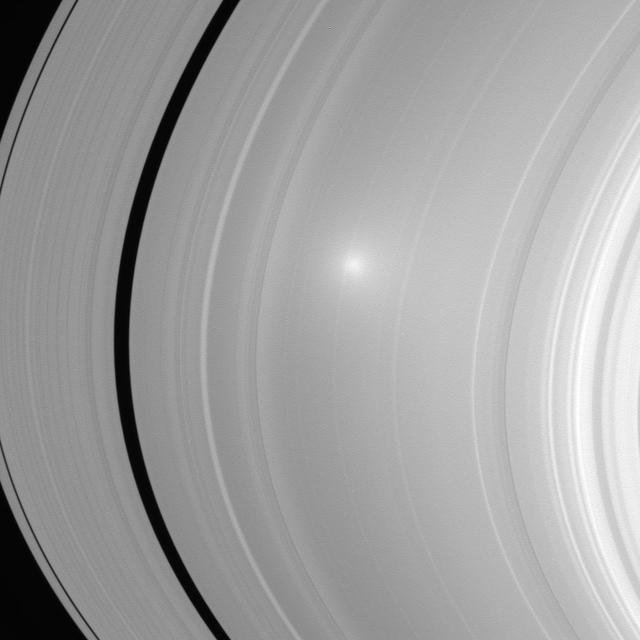
Two images of Saturn A and B ring showcase the opposition effect, a brightness surge that is visible on Saturn rings when the Sun is directly behind the spacecraft
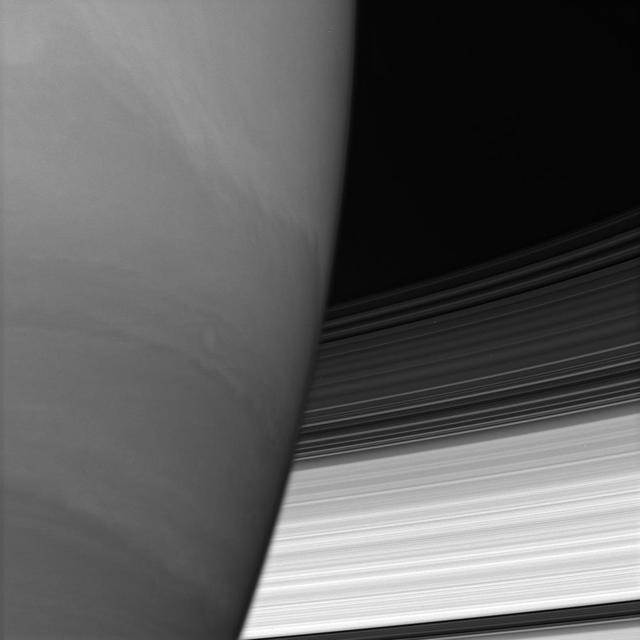
Saturn B and C rings disappear behind the immense planet. Where they meet the limb, the rings appear to bend slightly owing to upper-atmospheric refraction
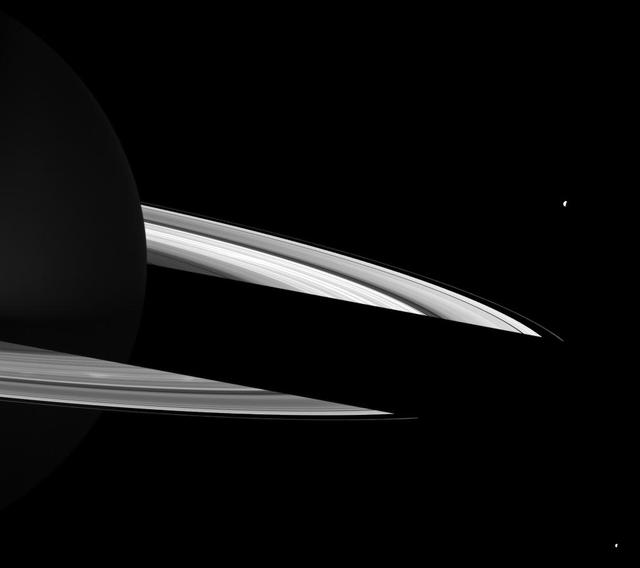
Bright spokes can be seen on Saturn B ring just in front of the shadow cast on the rings on the night side of the planet in this NASA Cassini spacecraft image.
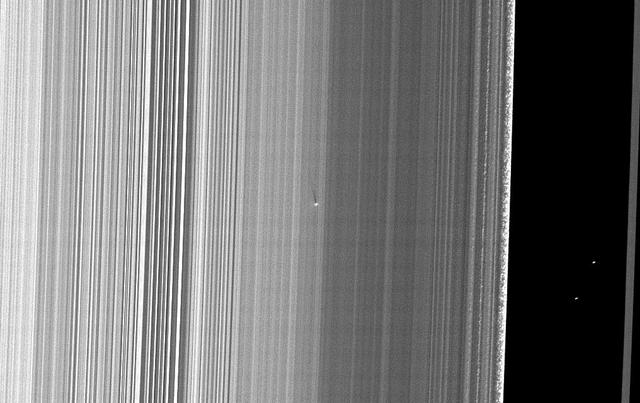
The Cassini spacecraft captured this image of a small object in the outer portion of Saturn B ring casting a shadow on the rings as Saturn approaches its August 2009 equinox.
This ringscape shows the outermost part of the rings spoke-forming region, the other edge of the B ring, and the regular bands of material within the Cassini Division

It difficult to get a sense of scale when viewing Saturn rings, but the Cassini Division seen here between the bright B ring and dimmer A ring is almost as wide as the planet Mercury as seen by NASA Cassini spacecraft.

This wide and sweeping view of the sunlit rings of Saturn takes in the impressive variety in their structure -- from the clumpy and perennially intriguing F ring to the many waves, ringlets and gaps in the A and B rings and the Cassini Division in between
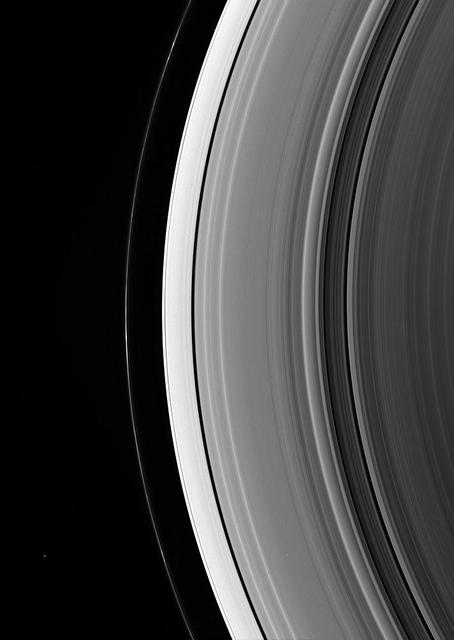
Epimetheus is a lonely dot beyond Saturn rings. The little moon appears at lower left, outside the narrow F ring. Several very faint spokes lurk in the B ring, at right
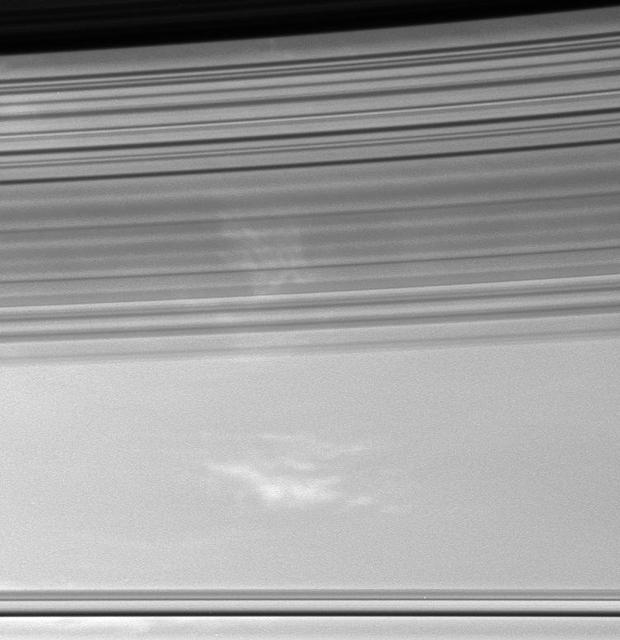
The soft, sweeping shadows of Saturn C ring cover bright patches of clouds in the planet atmosphere. The shadow-throwing rings stretch across the view at bottom. The dark inner edge of the B ring is visible at top
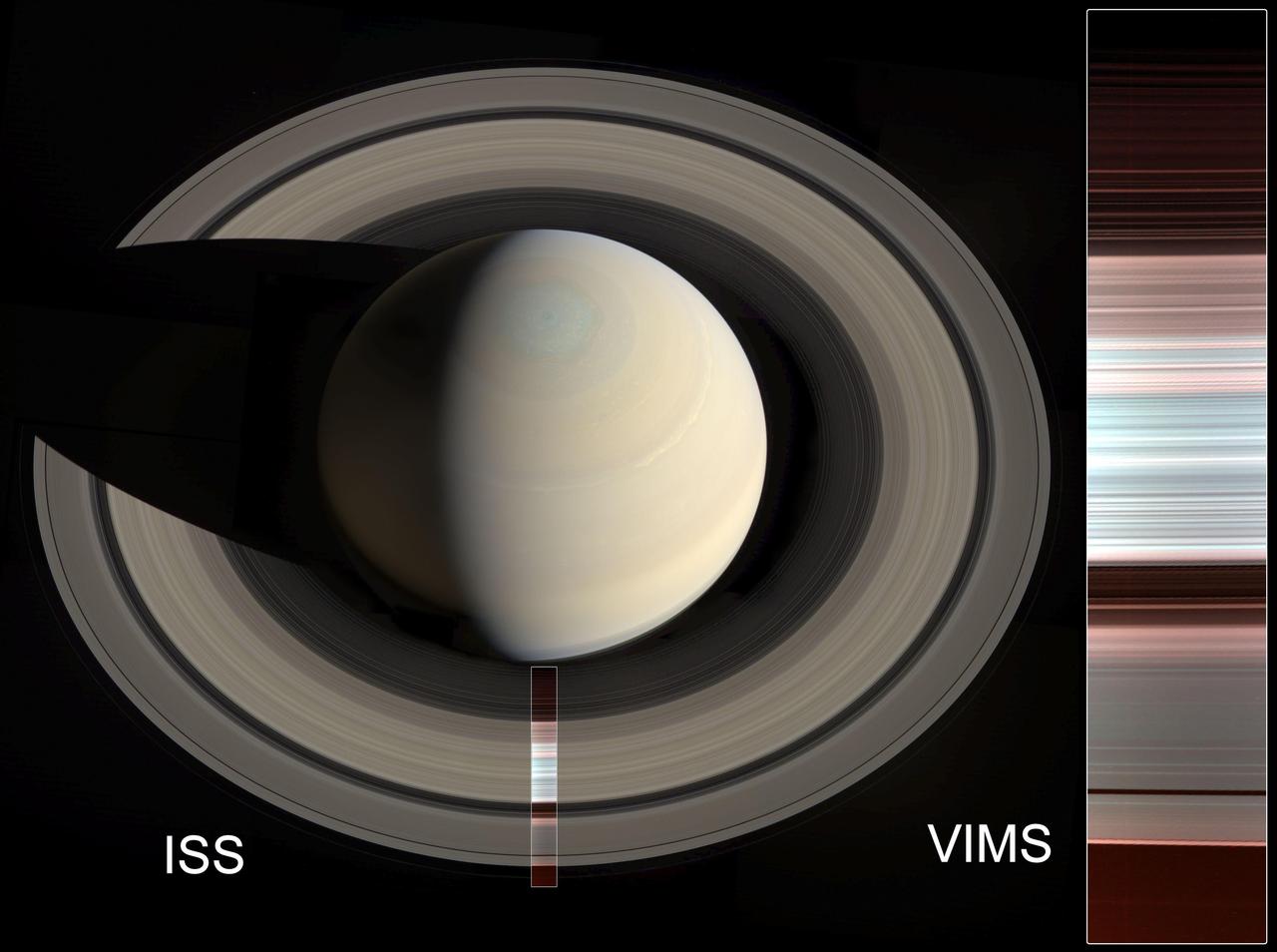
The false-color image at right shows spectral mapping of Saturn's A, B and C rings, captured by Cassini's Visible and Infrared Mapping Spectrometer (VIMS). It displays an infrared view of the rings, rather than an image in visible light. The blue-green areas are the regions with the purest water ice and/or largest grain size (primarily the A and B rings), while the reddish color indicates increasing amounts of non-icy material and/or smaller grain sizes (primarily in the C ring and Cassini Division). At left, the same image is overlaid on a natural-color mosaic of Saturn taken by Cassini's Imaging Science Subsystem. https://photojournal.jpl.nasa.gov/catalog/PIA23170

The shadow of the moon Tethys is revealed on Saturn B and C rings in this image which also includes the planet.

This group of spokes in Saturn B ring extends over more than 5,000 kilometers 3,100 miles radially across the ringplane

The Cassini spacecraft continues to observe brightness variations along the orbital direction within Saturn B ring
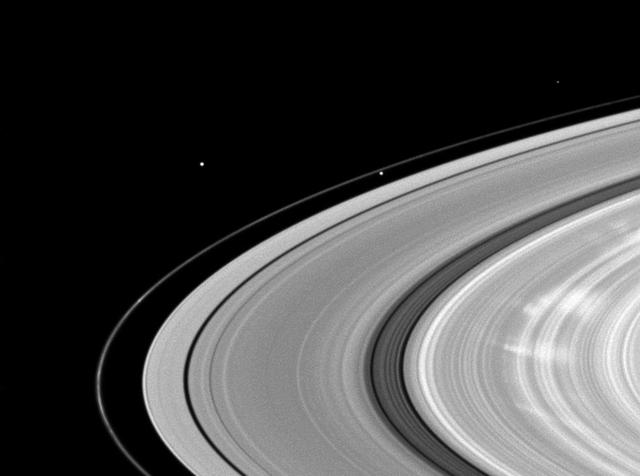
Bright spokes grace Saturn B ring in this image taken by NASA Cassini spacecraft.
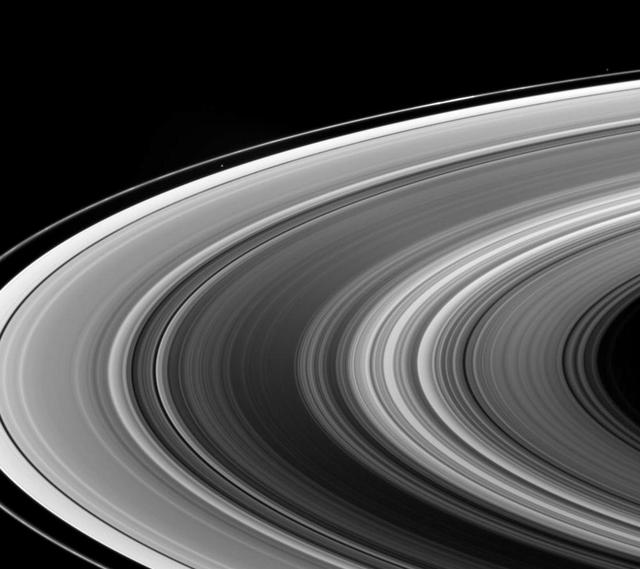
This view looks down onto the unlit side of Saturn ringplane. It nicely shows a near-arm/far-arm brightness asymmetry in the B ring: The near arm of the B ring is notably darker from this viewing geometry than is the far arm

The Cassini spacecraft looks toward the innermost region of Saturn rings, capturing from right to left the C and B rings. The dark, inner edge of the Cassini Division is just visible in the lower left corner
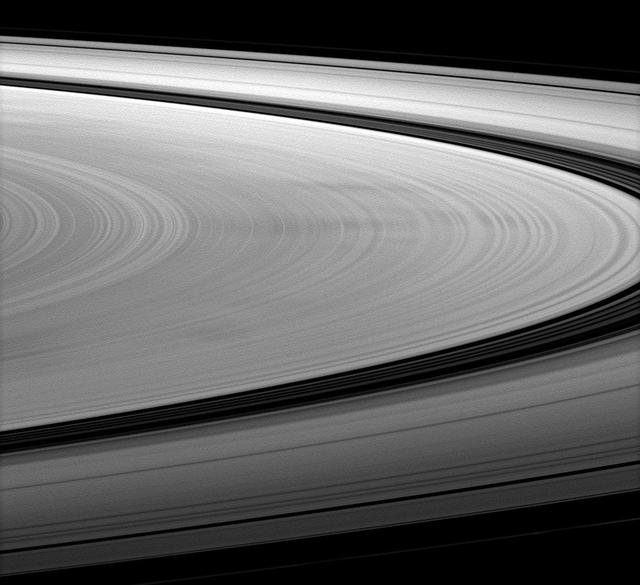
NASA Cassini spacecraft images dark spokes on Saturn B ring. Spokes are radial markings on Saturn rings that continue to interest scientists, and they can be seen here stretching left to right across the image.
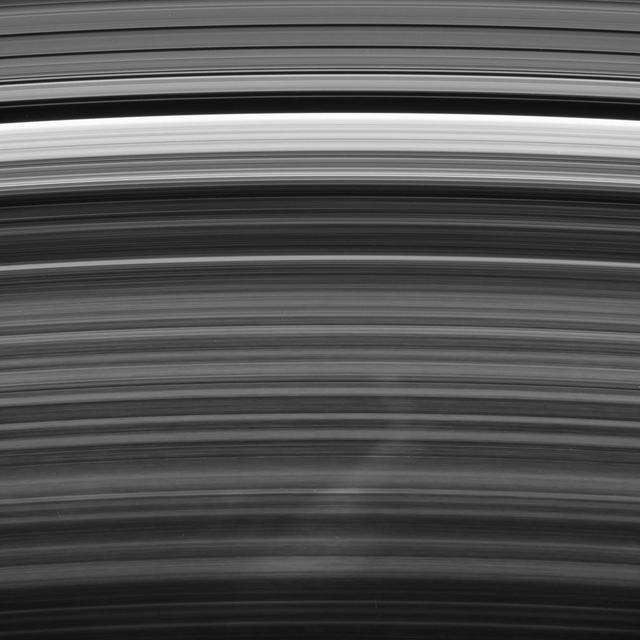
A bright spoke extends across the unilluminated side of Saturn B ring about the same distance as that from London to Cairo. The background ring material displays some azimuthal i.e., left to right asymmetry
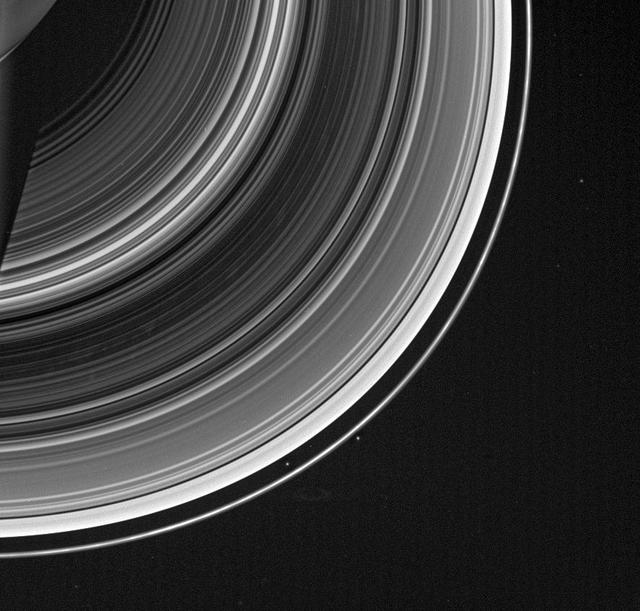
From on high, the Cassini spacecraft spots a group of faint spokes against the striped landscape of the B ring, the dark region in the middle of the rings here. The spokes appear as irregular blotches
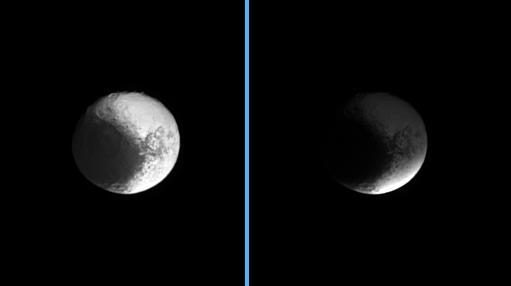
Darkness sweeps over Iapetus as the Cassini spacecraft watches the shadow of Saturn B ring engulf the dichotomous moon. The image at left shows the unshaded moon, while at right, Iapetus sits in the shadow of the densest of Saturn rings

The spoke-producing region of the B ring displays fine-scale asymmetry in the azimuthal direction -- the direction along which the ring particles orbit Saturn -- from upper left to lower right across the image
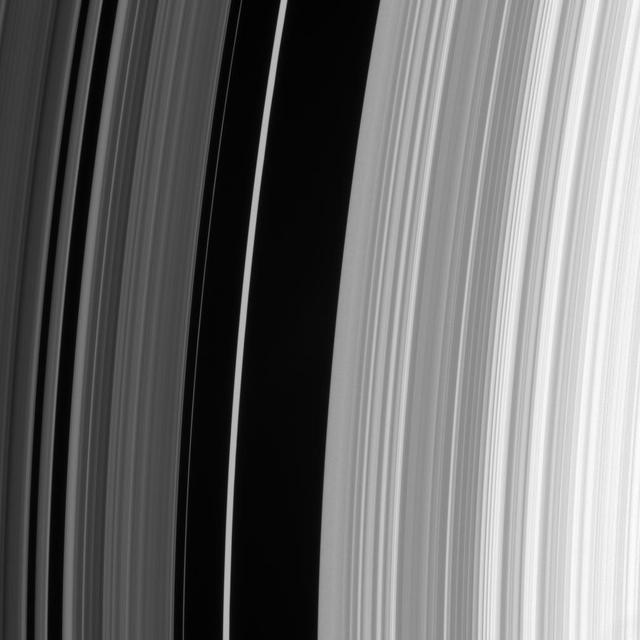
The sharp outer boundary of Saturn B ring, which is the bright ring region seen to the right in this image, is maintained by a strong resonance with the moon Mimas. For every two orbits made by particles at this distance from Saturn
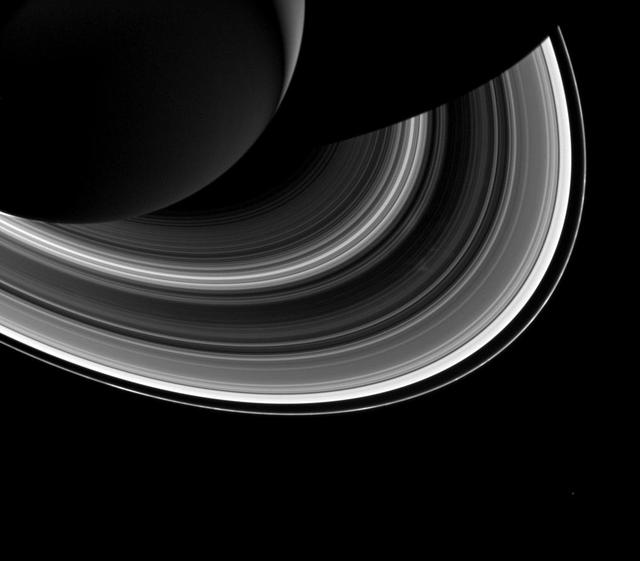
Among the interplay of Saturn shadow and rings, Mimas, which appears in the lower-right corner of the image, orbits Saturn as a set of the ever-intriguing spokes appear in the B ring to the right of center in this image from NASA Cassini spacecraft.

NASA Cassini spacecraft looks between Saturn A and B rings to spy structure in the Cassini Division. The Cassini Division, occupying the middle and left of the image, contains five dim bands of ring material, but not all of the division is shown here.

The Cassini spacecraft spies multiple spokes in Saturn outer B ring. The precise origin and evolution of these transient features continue to provide ring scientists with intriguing puzzles to solve
This image from the Cassini spacecraft shows a ghostly white streak, called a spoke, in Saturn B ring. This is the first sighting of a spoke in nearly a year, and the first spoke seen by Cassini on the sunlit side of the rings

A moon shadow strikes Saturn rings near bright spokes on the B ring near the center of this image taken by NASA Cassini spacecraft about one month after the planet August 2009 equinox.
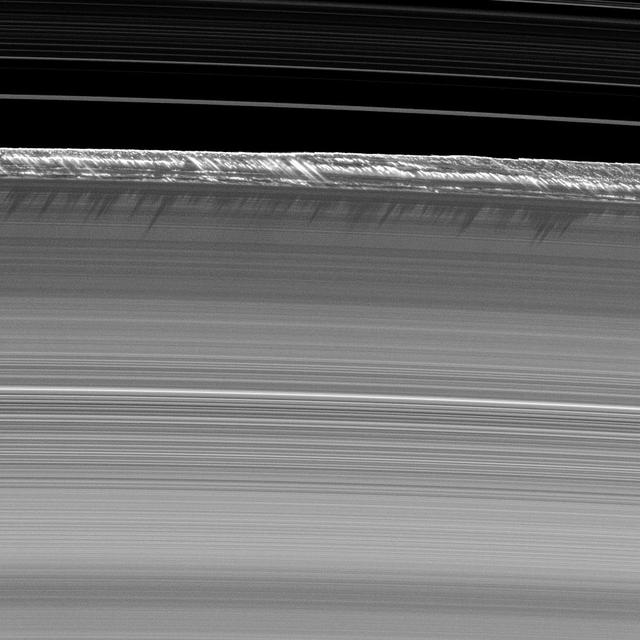
Vertical structures, among the tallest seen in Saturn main rings, rise abruptly from the edge of Saturn B ring to cast long shadows on the ring in this image taken by NASA Cassini spacecraft two weeks before the planet August 2009 equinox.
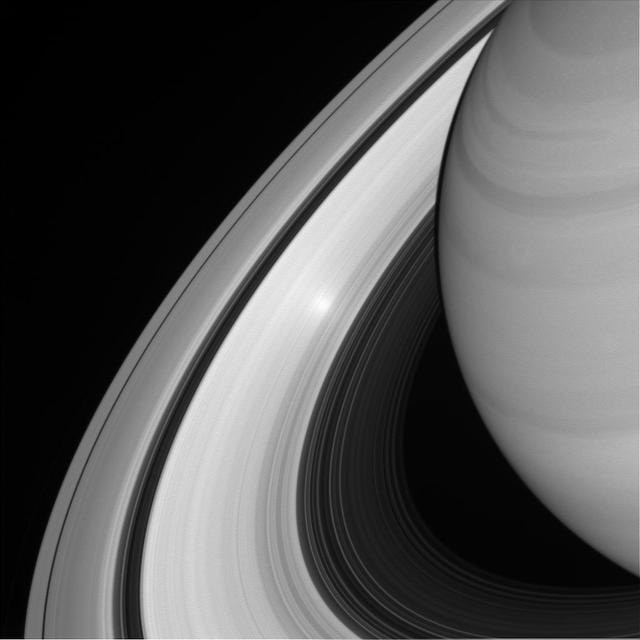
An ethereal, glowing spot appears on Saturn's B ring in this view from NASA's Cassini spacecraft. There is nothing particular about that place in the rings that produces the glowing effect -- instead, it is an example of an "opposition surge" making that area on the rings appear extra bright. An opposition surge occurs when the Sun is directly behind the observer looking toward the rings. The particular geometry of this observation makes the point in the rings appear much, much brighter than would otherwise be expected. This view looks toward the sunlit side of the rings from about 28 degrees above the ring plane. The image was taken in visible light with the Cassini wide-angle camera on June 26, 2016. The view was acquired at a distance of approximately 940,000 miles (1.5 million kilometers) from the rings and at a Sun-ring-spacecraft, or phase, angle of 0 degrees. Image scale on the rings at center is 56 miles (90 kilometers) per pixel. http://photojournal.jpl.nasa.gov/catalog/PIA20496
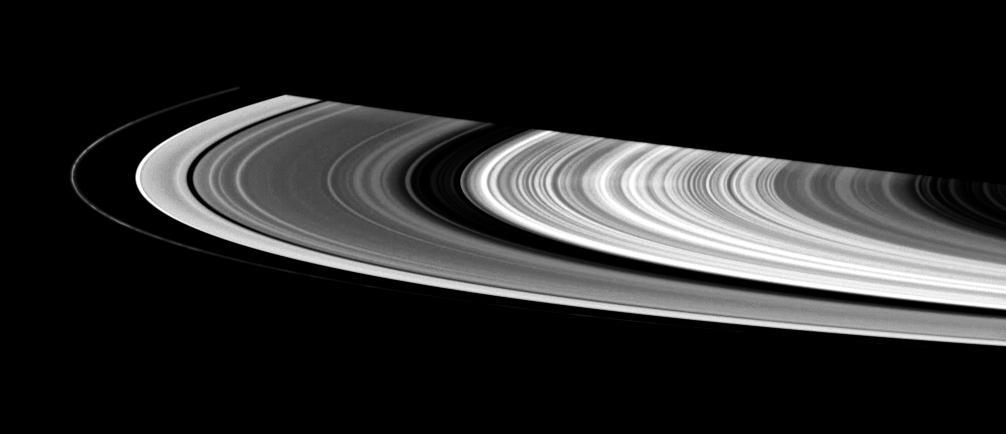
This contrast-enhanced view shows a faint spoke in Saturn B ring. These ghostly radial structures were imaged by the Voyager spacecraft in the 1980s

The dark B ring of Saturn is highlighted here by numerous faint spokes. The two most prominent spokes are seen below and to the right of center
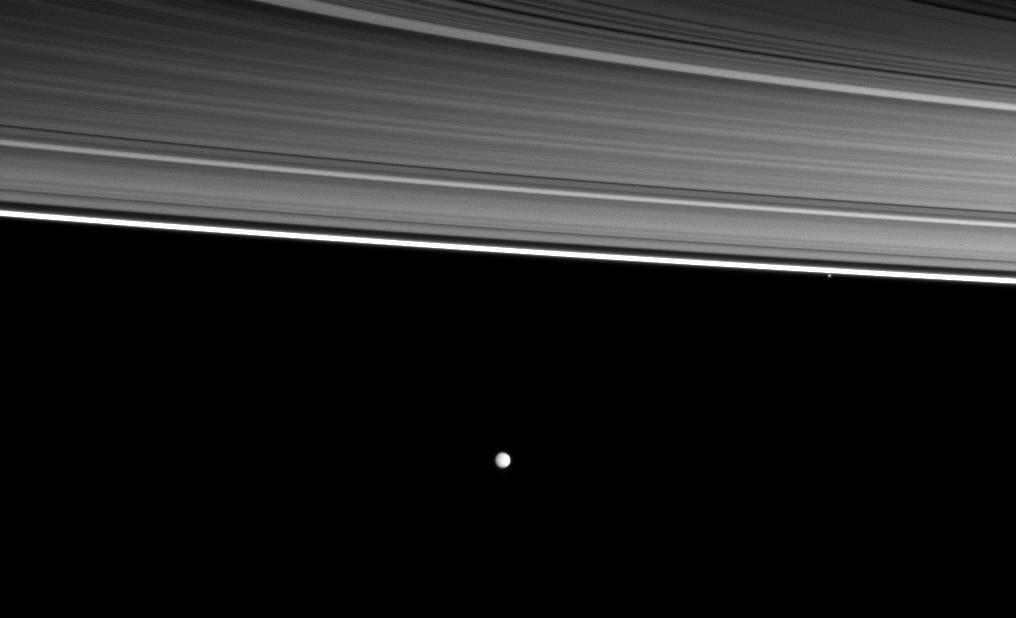
Two of Saturn moons orbit beyond four of the planet rings in this image from NASA Cassini spacecraft. From the top right of the picture are the C, B , A, and thin F rings, the small moon Pandora and, near the middle of the image, the moon Enceladus.
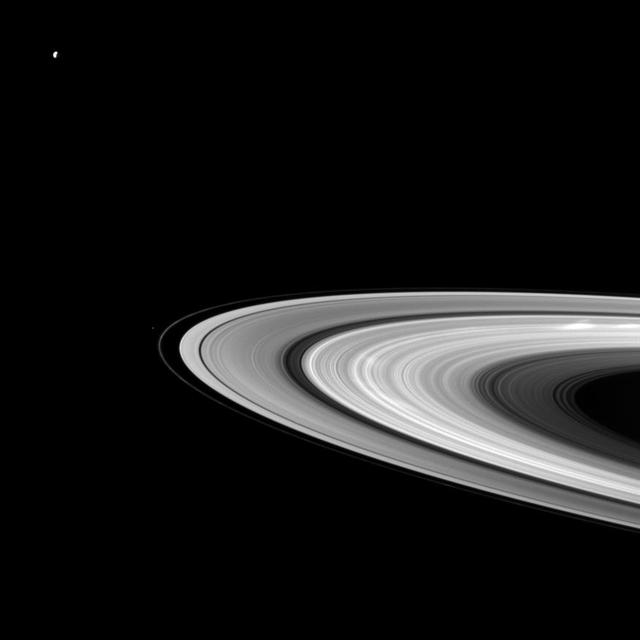
Bright spokes grace Saturn B ring in this Cassini spacecraft snapshot that also features a couple of the planet moons large and small. Dione can be seen in the upper left of the image while Pandora appears as a small speck beyond the thin F ring.
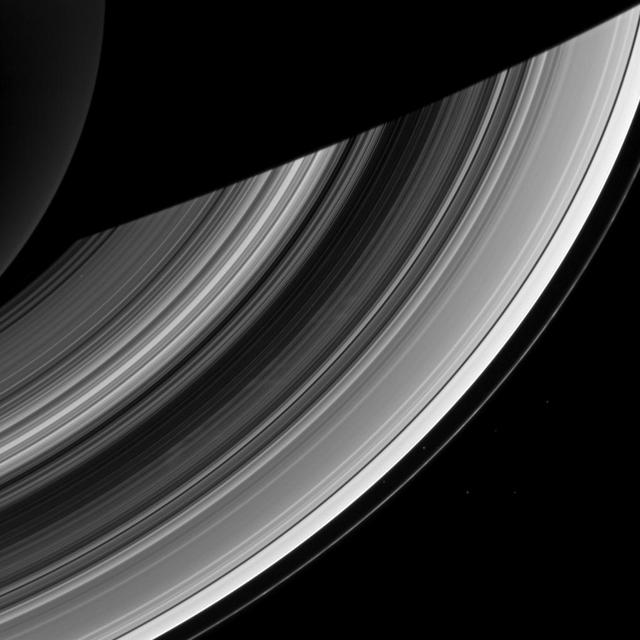
Ghostly spokes in Saturn B ring continue to put on a show for NASA Cassini spacecraft cameras in this recent image. The spokes, believed to be a seasonal phenomenon, are expected to disappear as Saturn nears its northern hemisphere summer.
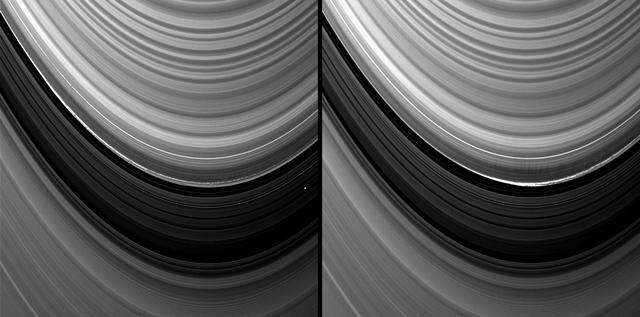
Vertical structures in the variable outer edge of Saturn B ring cast shadows in these two images captured by NASA Cassini spacecraft shortly after the planet August 2009 northern vernal equinox.
A broad and ghostly spoke drifts past under the Cassini spacecraft gaze. The spoke-forming region of the B ring displays faint longitudinal variations in brightness, from left to right
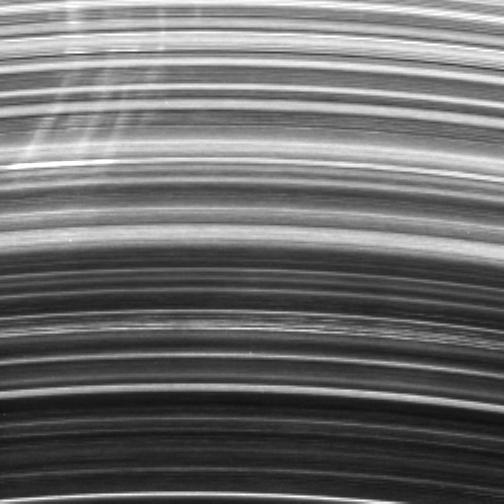
A group of bright spokes tightly cluster together in Saturn B ring. The spokes seen here generally all exhibit the same degree of shearing, or tilting, but some deviations are apparent

Bright spokes grace the B ring in this image which also includes the shadow of the moon Mimas and was taken by NASA Cassini spacecraft about a month after Saturn August 2009 equinox.

NASA Cassini spacecraft captured Saturn B ring showing off bright spokes in the middle of this image taken at high phase in visible light with the narrow-angle camera.
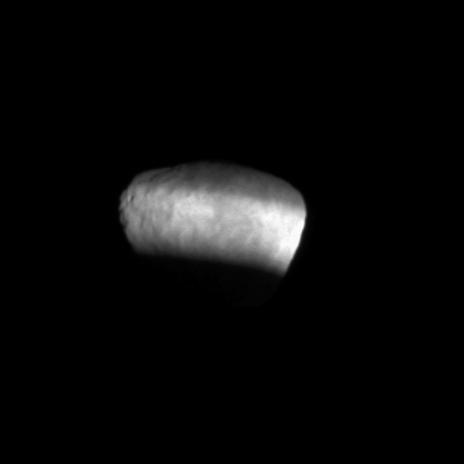
Sunlight passing through the Cassini Division between Saturn A and B rings sweeps across and illuminates the surface of the moon Janus in this image captured by NASA Cassini spacecraft. Go to the Photojournal to view the animation.
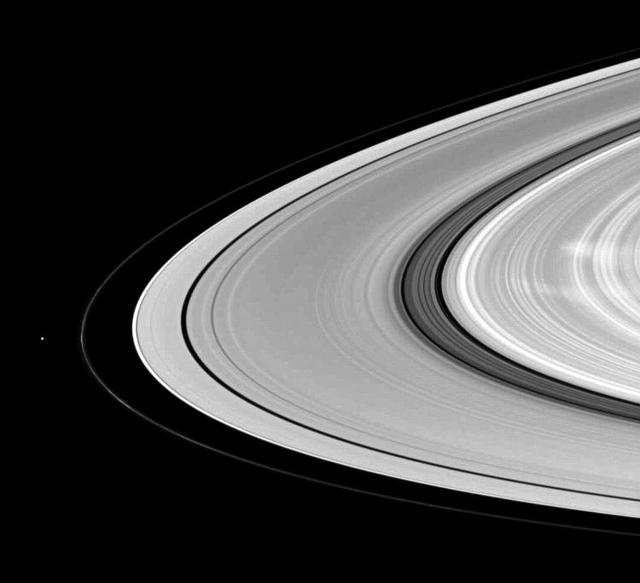
Saturn moon Pandora shares the stage with ghostly B ring spokes in this NASA Cassini spacecraft scene. Pandora is on the left. The spokes are the radial markings visible on the right of the image.
Bright spokes and the shadow of a moon grace Saturn B ring in this NASA Cassini spacecraft image. Spokes are radial markings scientists continue to study, and they can be seen here stretching from the far left to upper right of the image.
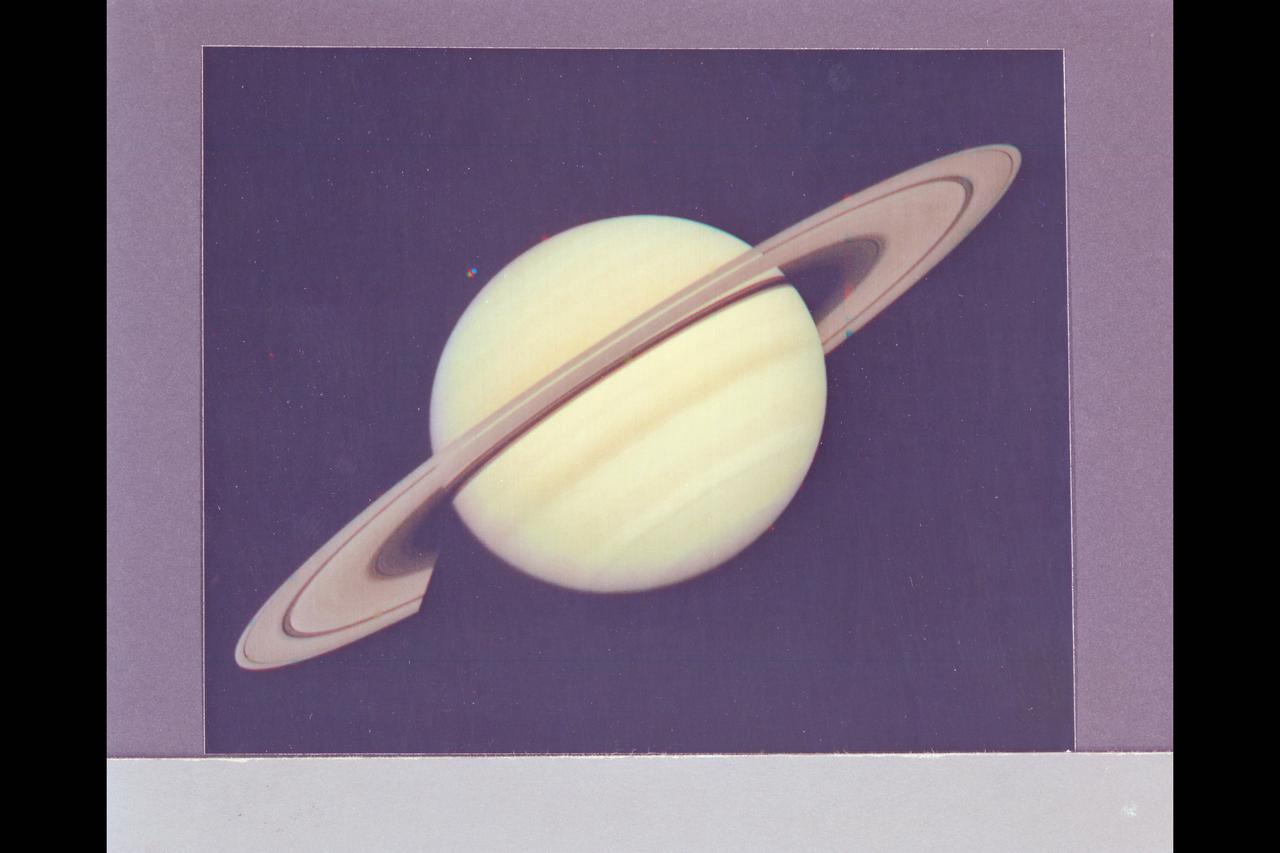
Range : 34 million km. ( 21.1 million miles) P-22993C This Voyager 1 photograph of Saturn was taken on the last day it could be captured within a single narrow angle camera frame as the spacecraft neared the planet for it's closest approach on Nov. 12, 1980. Dione, one of Saturn's innermost satellites, appears as three color spots just below the planet's south pole. An abundance of previously unseen detail is apparent in the rings. For example, a gap in the dark, innermst ring, C-ring or Crepe Ring, is clearly shown. Also, material is seen inside the relatively wide Cassini Division, seperating the middle, B-ring from the outermost ring, the A-ring. The Encke division is shown near the outer edge of A-ring. The detail in the ring's shadows cast on the planet is of particular interest. The broad dark band near the equator is the shadow of B-ring. The thinner, brighter line just to the south is the shadow of the less dense A-ring.

In this rare image taken on 19 July, the wide-angle camera on the international Cassini spacecraft has captured Saturn’s rings and our planet Earth and Moon in the same frame. The dark side of Saturn, its bright limb, the main rings, the F ring, and the G and E rings are clearly seen; the limb of Saturn and the F ring are overexposed. The ‘breaks’ in the brightness of Saturn’s limb are due to the shadows of the rings on the globe of Saturn, preventing sunlight from shining through the atmosphere in those regions. The E and G rings have been brightened for better visibility. Earth, 1.44 billion km away in this image, appears as a blue dot at centre right; the Moon can be seen as a fainter protrusion off its right side. The other bright dots nearby are stars. <b><a href="http://www.nasa.gov/audience/formedia/features/MP_Photo_Guidelines.html" rel="nofollow">NASA image use policy.</a></b> <b><a href="http://www.nasa.gov/centers/goddard/home/index.html" rel="nofollow">NASA Goddard Space Flight Center</a></b> enables NASA’s mission through four scientific endeavors: Earth Science, Heliophysics, Solar System Exploration, and Astrophysics. Goddard plays a leading role in NASA’s accomplishments by contributing compelling scientific knowledge to advance the Agency’s mission. <b>Follow us on <a href="http://twitter.com/NASAGoddardPix" rel="nofollow">Twitter</a></b> <b>Like us on <a href="http://www.facebook.com/pages/Greenbelt-MD/NASA-Goddard/395013845897?ref=tsd" rel="nofollow">Facebook</a></b> <b>Find us on <a href="http://instagrid.me/nasagoddard/?vm=grid" rel="nofollow">Instagram</a></b>
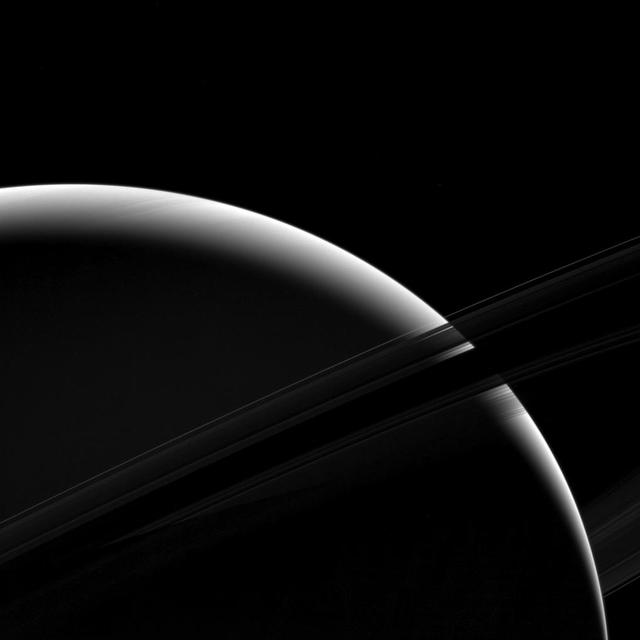
Although only a sliver of Saturn's sunlit face is visible in this view, the mighty gas giant planet still dominates the view. From this vantage point just beneath the ring plane, the dense B ring becomes dark and essentially opaque, letting almost no light pass through. But some light reflected by the planet passes through the less dense A ring, which appears above the B ring in this photo. The C ring, silhouetted just below the B ring, lets almost all of Saturn's reflected light pass right through it, as if it were barely there at all. The F ring appears as a bright arc in this image, which is visible against both the backdrop of Saturn and the dark sky. This view looks toward the unilluminated side of the rings from about 7 degrees below the ring plane. The image was taken in green light with the Cassini spacecraft wide-angle camera on Jan. 18, 2017. The view was acquired at a distance of approximately 630,000 miles (1 million kilometers) from Saturn. Image scale is 38 miles (61 kilometers) per pixel. https://photojournal.jpl.nasa.gov/catalog/PIA20530

Cassini obtained this panoramic view of Saturn's rings on Sept. 9, 2017, just minutes after it passed through the ring plane. The view looks upward at the southern face of the rings from a vantage point above Saturn's southern hemisphere. The entirety of the main rings can be seen here, but due to the low viewing angle, the rings appear extremely foreshortened. The C ring, with its sharp, bright plateaus (see PIA20529), appears at left; the B ring is the darkened region stretching from bottom center toward upper right; the A ring is seen at far right. This view shows the rings' unilluminated face, where sunlight filters through from the other side. The Cassini spacecraft ended its mission on Sept. 15, 2017. https://photojournal.jpl.nasa.gov/catalog/PIA21898
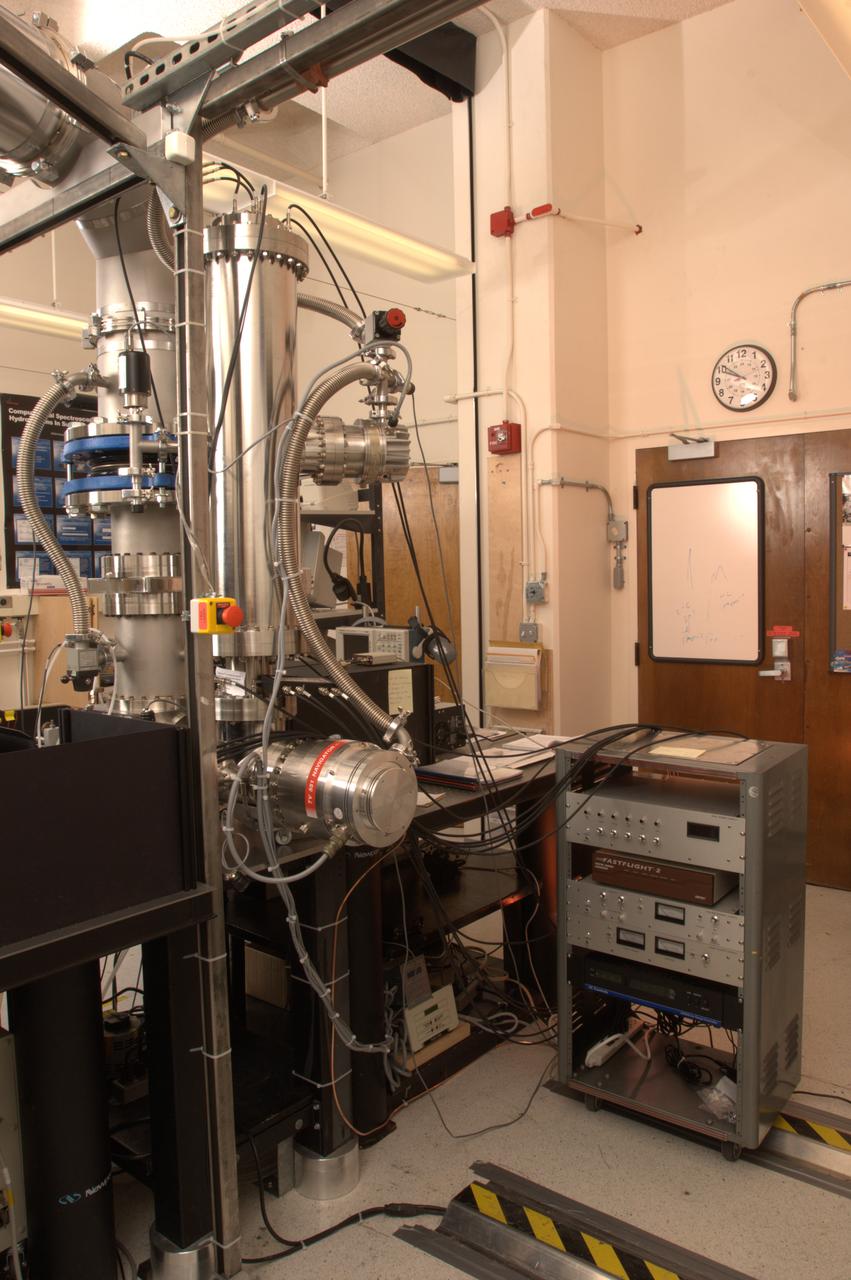
NASA Ames Astrophysics Branch (code-SSA), Pulsed discharge nozzle - Cavity Ring down - Reflection Time of Flight Mass Spectrometer (N-245 rm B-31) (PDN-CRDS-RETOFMS)
From afar, Saturn's rings look like a solid, homogenous disk of material. But upon closer examination from Cassini, we see that there are varied structures in the rings at almost every scale imaginable. Structures in the rings can be caused by many things, but often times Saturn's many moons are the culprits. The dark gaps near the left edge of the A ring (the broad, outermost ring here) are caused by the moons (Pan and Daphnis) embedded in the gaps, while the wider Cassini division (dark area between the B ring and A ring here) is created by a resonance with the medium-sized moon Mimas (which orbits well outside the rings). Prometheus is seen orbiting just outside the A ring in the lower left quadrant of this image; the F ring can be faintly seen to the left of Prometheus. This view looks toward the sunlit side of the rings from about 15 degrees above the ringplane. The image was taken in red light with the Cassini spacecraft wide-angle camera on Jan. 8, 2015. The view was obtained at a distance of approximately 566,000 miles (911,000 kilometers) from Saturn and at a Sun-Saturn-spacecraft, or phase, angle of 37 degrees. Image scale is 34 miles (54 kilometers) per pixel. http://photojournal.jpl.nasa.gov/catalog/pia18308

Image release September 2, 2010 ABOUT THIS IMAGE: This image shows the entire region around supernova 1987A. The most prominent feature in the image is a ring with dozens of bright spots. A shock wave of material unleashed by the stellar blast is slamming into regions along the ring's inner regions, heating them up, and causing them to glow. The ring, about a light-year across, was probably shed by the star about 20,000 years before it exploded. An international team of astronomers using the Hubble Space Telescope reports a significant brightening of the emissions from Supernova 1987A. The results, which appear in this week's Science magazine, are consistent with theoretical predictions about how supernovae interact with their immediate galactic environment. The team observed the supernova remnant in optical, ultraviolet, and near-infrared light. They studied the interaction between the ejecta from the stellar explosion and a glowing 6-trillion-mile-diameter ring of gas encircling the supernova remnant. The gas ring was probably shed some 20,000 years before the supernova exploded. Shock waves resulting from the impact of the ejecta onto the ring have brightened 30 to 40 pearl-like "hot spots" in the ring. These blobs likely will grow and merge together in the coming years to form a continuous, glowing circle. "We are seeing the effect a supernova can have in the surrounding galaxy, including how the energy deposited by these stellar explosions changes the dynamics and chemistry of the environment," said University of Colorado at Boulder Research Associate Kevin France of the Center for Astrophysics and Space Astronomy. "We can use these new data to understand how supernova processes regulate the evolution of galaxies." Discovered in 1987, Supernova 1987A is the closest exploding star to Earth to be detected since 1604 and it resides in the nearby Large Magellanic Cloud, a dwarf galaxy adjacent to our own Milky Way Galaxy. Credit: NASA, ESA, K. France (University of Colorado, Boulder), and P. Challis and R. Kirshner (Harvard-Smithsonian Center for Astrophysics) <b><a href="http://www.nasa.gov/centers/goddard/home/index.html" rel="nofollow">NASA Goddard Space Flight Center</a></b> is home to the nation's largest organization of combined scientists, engineers and technologists that build spacecraft, instruments and new technology to study the Earth, the sun, our solar system, and the universe. <b>Follow us on <a href="http://twitter.com/NASA_GoddardPix" rel="nofollow">Twitter</a></b> <b>Join us on <a href="http://www.facebook.com/pages/Greenbelt-MD/NASA-Goddard/395013845897?ref=tsd" rel="nofollow">Facebook</a></b>
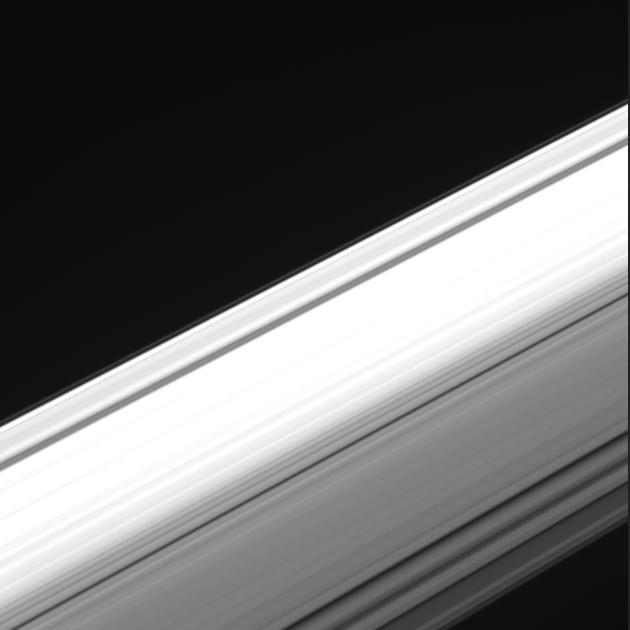
This image from NASA's Cassini spacecraft offers a unique perspective on Saturn's ring system. Cassini captured images from within the gap between the planet and its rings, looking outward as the spacecraft made one of its final dives through the gap as part of the mission's Grand Finale. Using its wide-angle camera, Cassini took the 21 images in the sequence over a span of about four minutes during its dive through the gap on Aug. 20, 2017. The images have an original size of 512 x 512 pixels; the smaller image size allowed for more images to be taken over the short span of time. The entirety of the main rings can be seen here, but due to the low viewing angle, the rings appear extremely foreshortened. The perspective shifts from the sunlit side of the rings to the unlit side, where sunlight filters through. On the sunlit side, the grayish C ring looks larger in the foreground because it is closer; beyond it is the bright B ring and slightly less-bright A ring, with the Cassini Division between them. The F ring is also fairly easy to make out. A movie is available at https://photojournal.jpl.nasa.gov/catalog/PIA21886
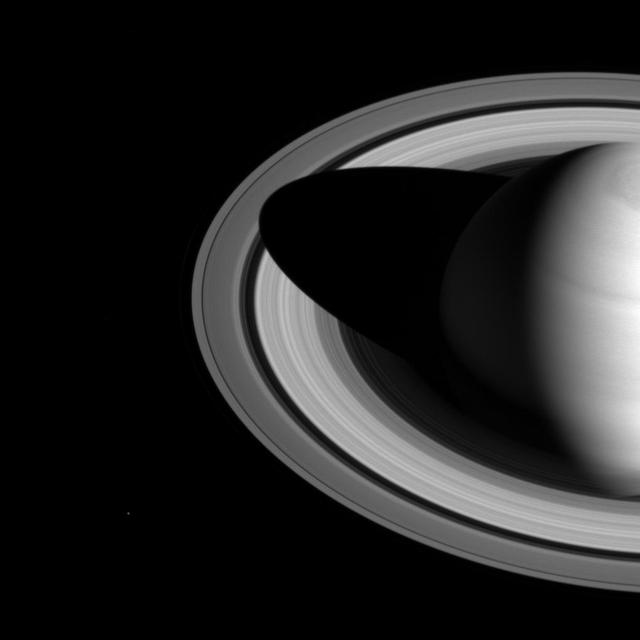
The shadow of Saturn on the rings, which stretched across all of the rings earlier in Cassini's mission (see PIA08362), now barely makes it past the Cassini division. The changing length of the shadow marks the passing of the seasons on Saturn. As the planet nears its northern-hemisphere solstice in May 2017, the shadow will get even shorter. At solstice, the shadow's edge will be about 28,000 miles (45,000 kilometers) from the planet's surface, barely making it past the middle of the B ring. The moon Mimas is a few pixels wide, near the lower left in this image. This view looks toward the sunlit side of the rings from about 35 degrees above the ring plane. The image was taken in visible light with the Cassini spacecraft wide-angle camera on May 21, 2016. The view was obtained at a distance of approximately 2.0 million miles (3.2 million kilometers) from Saturn. Image scale is 120 miles (190 kilometers) per pixel. http://photojournal.jpl.nasa.gov/catalog/PIA20494

This Picture of the Week shows Arp 230, also known as IC 51, observed by the NASA/ESA Hubble Space Telescope. Arp 230 is a galaxy of an uncommon or peculiar shape, and is therefore part of the Atlas of Peculiar Galaxies produced by Halton Arp. Its irregular shape is thought to be the result of a violent collision with another galaxy sometime in the past. The collision could also be held responsible for the formation of the galaxy’s polar ring. The outer ring surrounding the galaxy consists of gas and stars and rotates over the poles of the galaxy. It is thought that the orbit of the smaller of the two galaxies that created Arp 230 was perpendicular to the disk of the second, larger galaxy when they collided. In the process of merging the smaller galaxy would have been ripped apart and may have formed the polar ring structure astronomers can observe today. Arp 230 is quite small for a lenticular galaxy, so the two original galaxies forming it must both have been smaller than the Milky Way. A lenticular galaxy is a galaxy with a prominent central bulge and a disk, but no clear spiral arms. They are classified as intermediate between an elliptical galaxy and a spiral galaxy. Credit: ESA/Hubble & NASA, Acknowledgement: Flickr user Det58 <b><a href="http://www.nasa.gov/audience/formedia/features/MP_Photo_Guidelines.html" rel="nofollow">NASA image use policy.</a></b> <b><a href="http://www.nasa.gov/centers/goddard/home/index.html" rel="nofollow">NASA Goddard Space Flight Center</a></b> enables NASA’s mission through four scientific endeavors: Earth Science, Heliophysics, Solar System Exploration, and Astrophysics. Goddard plays a leading role in NASA’s accomplishments by contributing compelling scientific knowledge to advance the Agency’s mission. <b>Follow us on <a href="http://twitter.com/NASAGoddardPix" rel="nofollow">Twitter</a></b> <b>Like us on <a href="http://www.facebook.com/pages/Greenbelt-MD/NASA-Goddard/395013845897?ref=tsd" rel="nofollow">Facebook</a></b> <b>Find us on <a href="http://instagrid.me/nasagoddard/?vm=grid" rel="nofollow">Instagram</a></b>

This new Hubble image shows a peculiar galaxy known as NGC 660, located around 45 million light-years away from us. NGC 660 is classified as a "polar ring galaxy," meaning that it has a belt of gas and stars around its center that it ripped from a near neighbor during a clash about one billion years ago.The first polar ring galaxy was observed in 1978 and only around a dozen more have been discovered since then, making them something of a cosmic rarity. Unfortunately, NGC 660’s polar ring cannot be seen in this image, but the image has plenty of other features that make it of interest to astronomers – its central bulge is strangely off-kilter and, perhaps more intriguingly, it is thought to harbor exceptionally large amounts of dark matter. In addition, in late 2012 astronomers observed a massive outburst emanating from NGC 660 that was around ten times as bright as a supernova explosion. This burst was thought to be caused by a massive jet shooting out of the supermassive black hole at the center of the galaxy. Credit: Hubble/NASA/European Space Agency <b><a href="http://www.nasa.gov/audience/formedia/features/MP_Photo_Guidelines.html" rel="nofollow">NASA image use policy.</a></b> <b><a href="http://www.nasa.gov/centers/goddard/home/index.html" rel="nofollow">NASA Goddard Space Flight Center</a></b> enables NASA’s mission through four scientific endeavors: Earth Science, Heliophysics, Solar System Exploration, and Astrophysics. Goddard plays a leading role in NASA’s accomplishments by contributing compelling scientific knowledge to advance the Agency’s mission. <b>Follow us on <a href="http://twitter.com/NASA_GoddardPix" rel="nofollow">Twitter</a></b> <b>Like us on <a href="http://www.facebook.com/pages/Greenbelt-MD/NASA-Goddard/395013845897?ref=tsd" rel="nofollow">Facebook</a></b> <b>Find us on <a href="http://instagram.com/nasagoddard?vm=grid" rel="nofollow">Instagram</a></b>
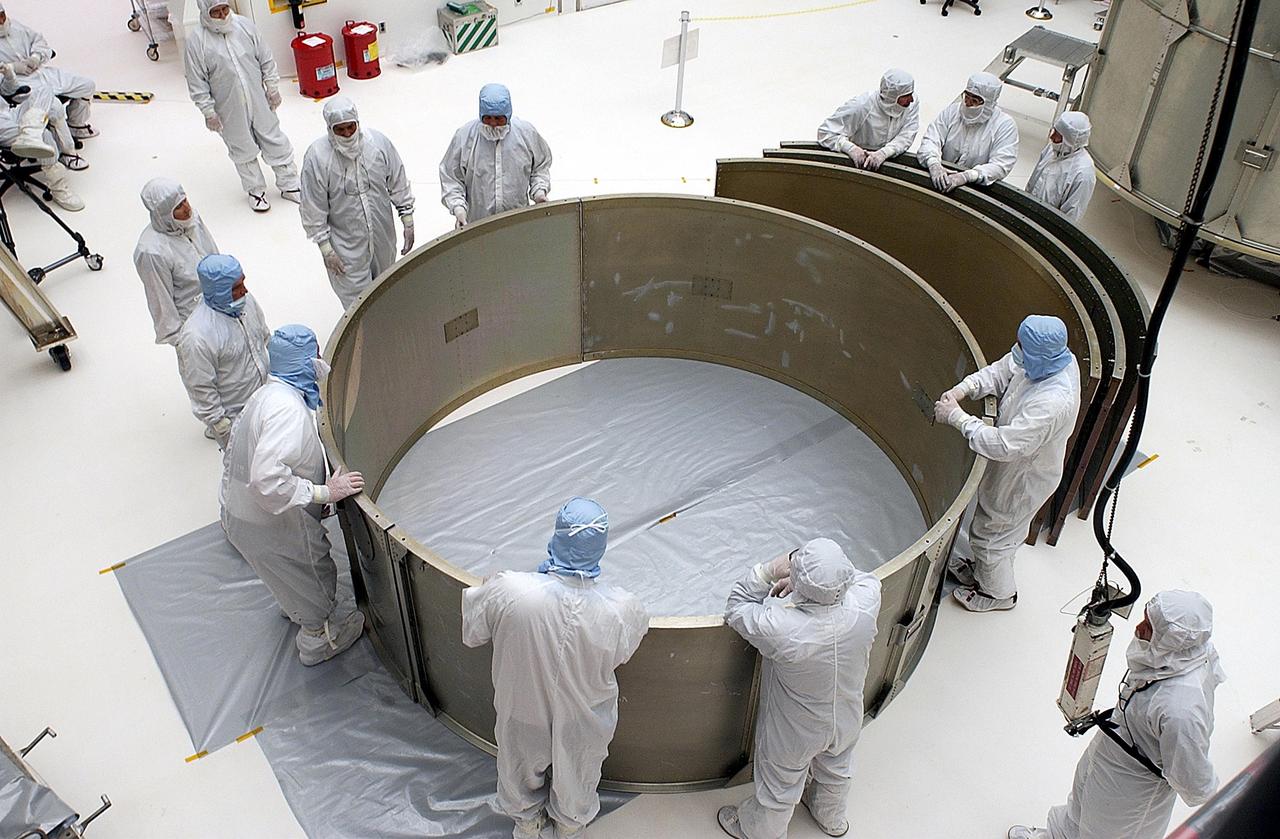
KENNEDY SPACE CENTER, FLA. - Workers assemble on the floor the top ring for the payload canister before attaching it to the third ring and installing them over the Space Infrared Telescope Facility (SIRTF). SIRTF is currently scheduled for transportation to Launch Complex 17-B, Cape Canaveral Air Force Station, and mating with the Delta II on or about April 4.
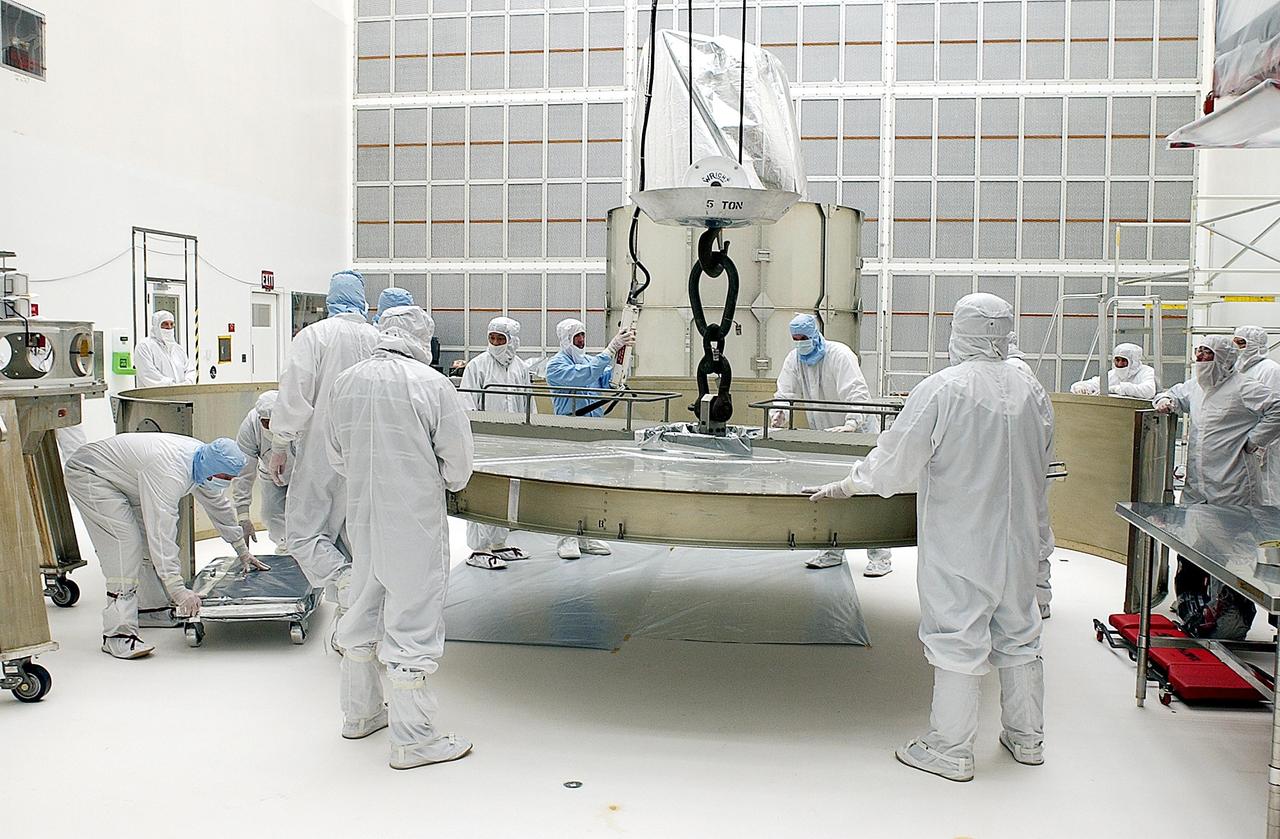
KENNEDY SPACE CENTER, FLA. - Workers attach a crane to the top ring on the payload canister. They will lift the top and attach the third ring before installing them over the Space Infrared Telescope Facility (SIRTF). SIRTF is currently scheduled for transportation to Launch Complex 17-B, Cape Canaveral Air Force Station, and mating with the Delta II on or about April 4.
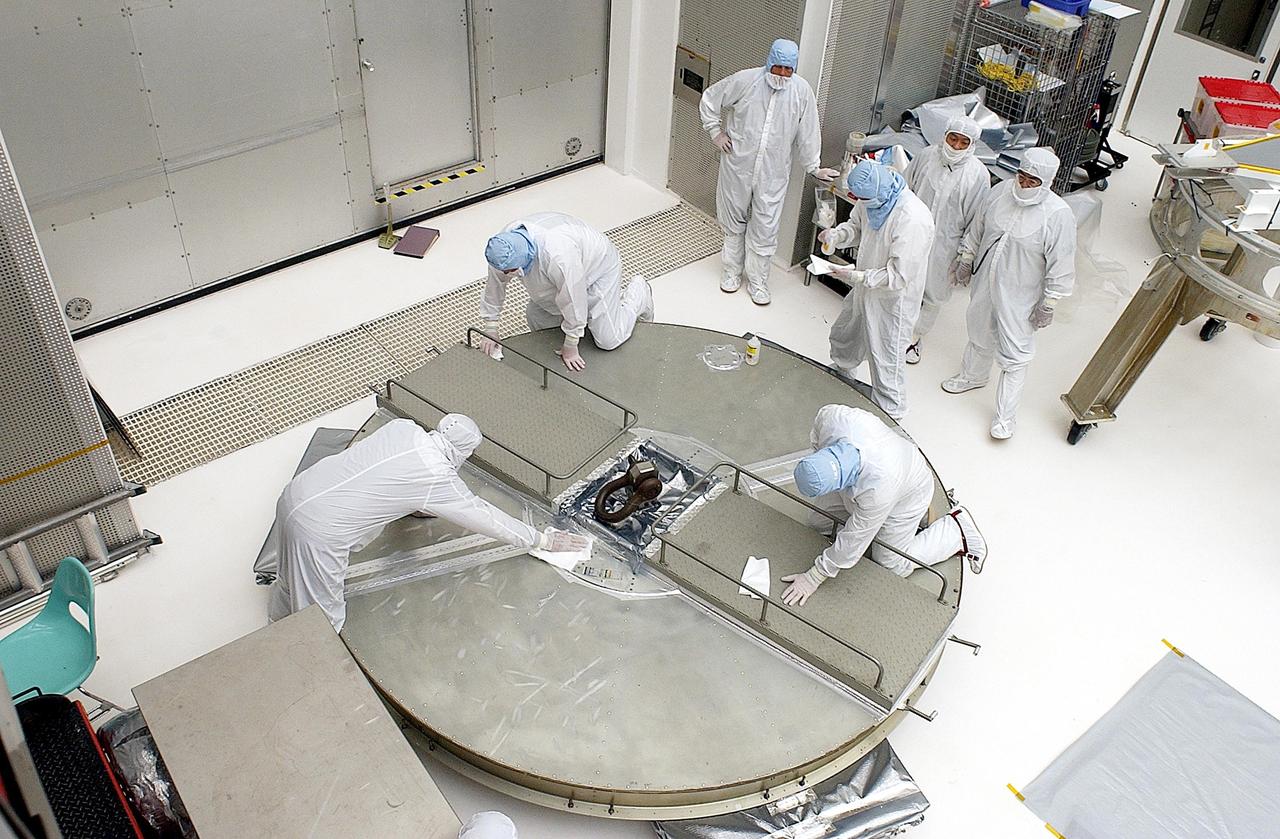
KENNEDY SPACE CENTER, FLA. - Workers complete assembling the top ring for the payload canister before attaching to the third ring and installing them over the Space Infrared Telescope Facility (SIRTF). SIRTF is currently scheduled for transportation to Launch Complex 17-B, Cape Canaveral Air Force Station, and mating with the Delta II on or about April 4.

Images here show the sunlit side of Saturn's rings. A strip along the bottom of each image has been filtered so that the textures are more visible. The filter consists of averaging and then subtracting out the major brightness variations across the scene. The images illustrate how textures in Saturn's rings differ, even in close proximity. Cassini had previously discovered that straw-like clumpy textures are visible in the troughs of the strongest density waves, such as the Janus 6:5 wave in the outer A ring (at top of Figure 1A). Images from Cassini's Ring Grazing Orbits show that similar clumpy textures are also visible in the troughs of medium-size density waves, such as the (left to right) Prometheus 26:25, 27:26 and 28:27 waves, also in the outer A ring (Figure 1B). Strawlike texture is apparent in one band of the inner A ring but not surrounding regions (Figure 1C). Feathery texture is seen in some bands of the outer B ring, but not surrounding regions (Figure 1D). Figure 1E, which is an update of an image previously released as PIA21618, shows Plateau P1, where three textures are visible in close proximity to each other. (See PIA03550 for a labeled diagram of the rings.) The images in this montage were taken in visible light, using the Cassini spacecraft narrow-angle camera. https://photojournal.jpl.nasa.gov/catalog/PIA23168
Sometimes at Saturn you can see things almost as if from every angle at once, the way a Cubist might imagine things. For example, in this image, we're seeing Saturn's A ring in the lower part of the image and the limb of Saturn in the upper. In addition, the rings cast their shadows onto the portion of the planet imaged here, creating alternating patterns of light and dark. This pattern is visible even through the A ring, which, unlike the core of the nearby B ring, is not completely opaque. The ring shadows on Saturn often appear to cross the surface at confusing angles in close-ups like this one. The visual combination of Saturn's oblateness, the varying opacity of its rings and the shadows cast by those rings, sometimes creates elaborate and complicated patterns from Cassini's perspective. This view looks toward the sunlit side of the rings from about 19 degrees above the ringplane. The image was taken in visible light with the Cassini spacecraft narrow-angle camera on Dec. 5, 2014. The view was obtained at a distance of approximately 1.2 million miles (2 million kilometers) from Saturn. Image scale is 7 miles (11 kilometers) per pixel. http://photojournal.jpl.nasa.gov/catalog/PIA18303
Pan may be small as satellites go, but like many of Saturn's ring moons, it has a has a very visible effect on the rings. Pan (17 miles or 28 kilometers across, left of center) holds open the Encke gap and shapes the ever-changing ringlets within the gap (some of which can be seen here). In addition to raising waves in the A and B rings, other moons help shape the F ring, the outer edge of the A ring and open the Keeler gap. This view looks toward the sunlit side of the rings from about 8 degrees above the ring plane. The image was taken in visible light with the Cassini spacecraft narrow-angle camera on July 2, 2016. The view was acquired at a distance of approximately 840,000 miles (1.4 million kilometers) from Saturn and at a sun-Saturn-spacecraft, or phase, angle of 128 degrees. Image scale is 5 miles (8 kilometers) per pixel. Pan has been brightened by a factor of two to enhance its visibility. http://photojournal.jpl.nasa.gov/catalog/PIA20499
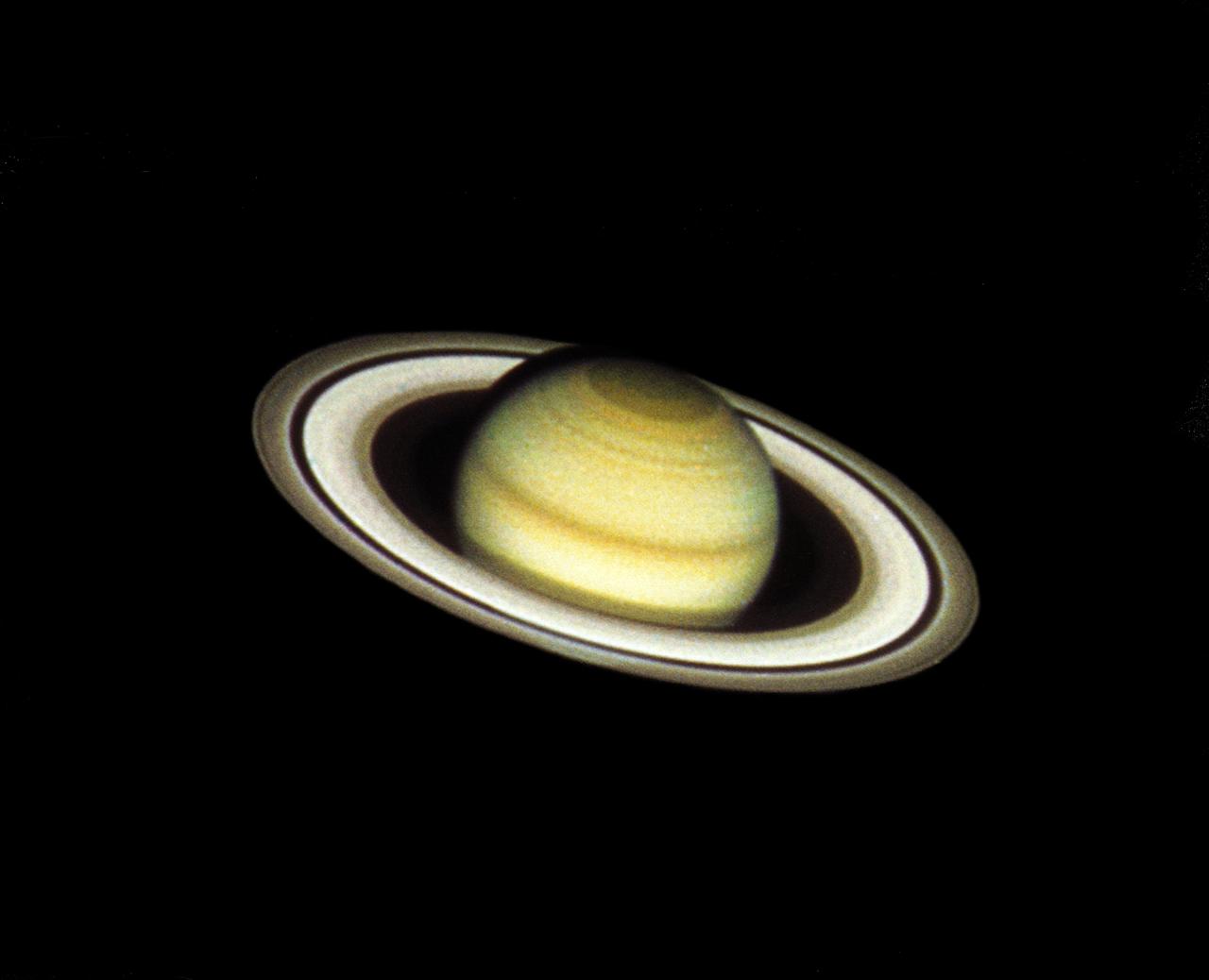
This color image of Saturn was taken with the Hubble Space Telescope's (HST's) Wide Field Camera (WFC) at 3:25 am EDT, August 26, 1990, when the planet was at a distance of 2.39 million km (360 million miles) from Earth. The color in the image is reconstructed by combining three different pictures, taken in blue, green and red light (4390, 5470 and 7180 angstroms). Because Saturn's north pole is currently tilted toward Earth (24 degrees), the HST image reveals unprecedented detail in atmospheric features at the northern polar hood, a region not extensively imaged by the Voyager space probes. The classic features of Saturn's vast ring system are also clearly seen from outer to irner edge; the bright A and B rings, divided by the Cassini division, and the very faint inner C ring. The Enche division, a dark gap near the outer edge of the A ring, has never before been photographed from Earth.
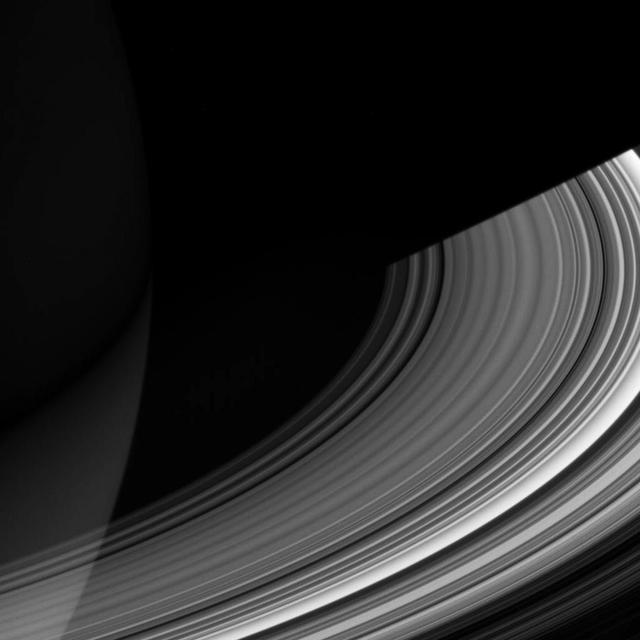
Both luminous and translucent, the C ring sweeps out of the darkness of Saturn's shadow and obscures the planet at lower left. The ring is characterized by broad, isolated bright areas, or "plateaus," surrounded by fainter material. This view looks toward the unlit side of the rings from about 19 degrees above the ringplane. North on Saturn is up. The dark, inner B ring is seen at lower right. The image was taken in visible light with the Cassini spacecraft wide-angle camera on Dec. 15, 2006 at a distance of approximately 632,000 kilometers (393,000 miles) from Saturn and at a Sun-Saturn-spacecraft, or phase, angle of 56 degrees. Image scale is 34 kilometers (21 miles) per pixel. http://photojournal.jpl.nasa.gov/catalog/PIA08855
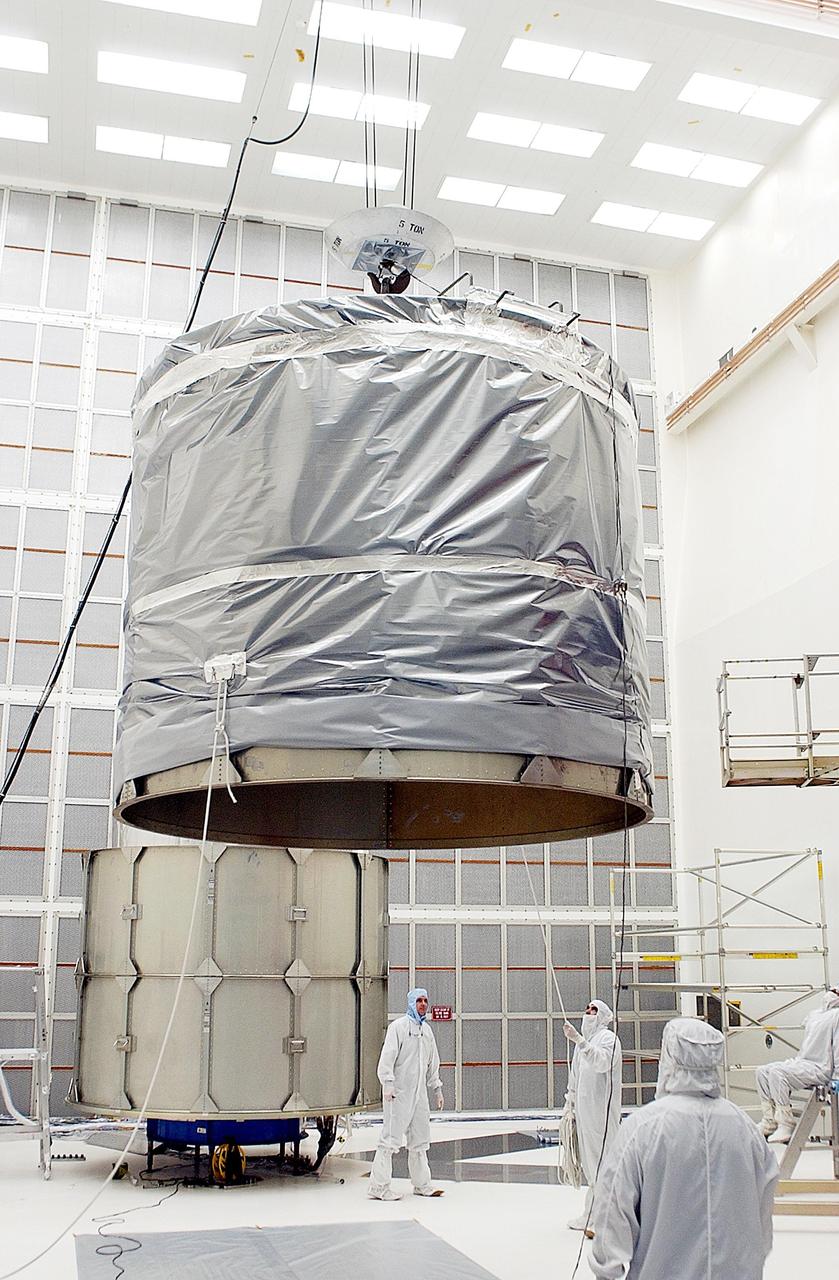
KENNEDY SPACE CENTER, FLA. -- The top rings of the payload canister are lifted by crane to move to the Space Infrared Telescope Facility (SIRTF) behind them. After installation, SIRTF will be transported to Launch Complex 17-B, Cape Canaveral Air Force Station, and mating with the Delta II on or about April 4.
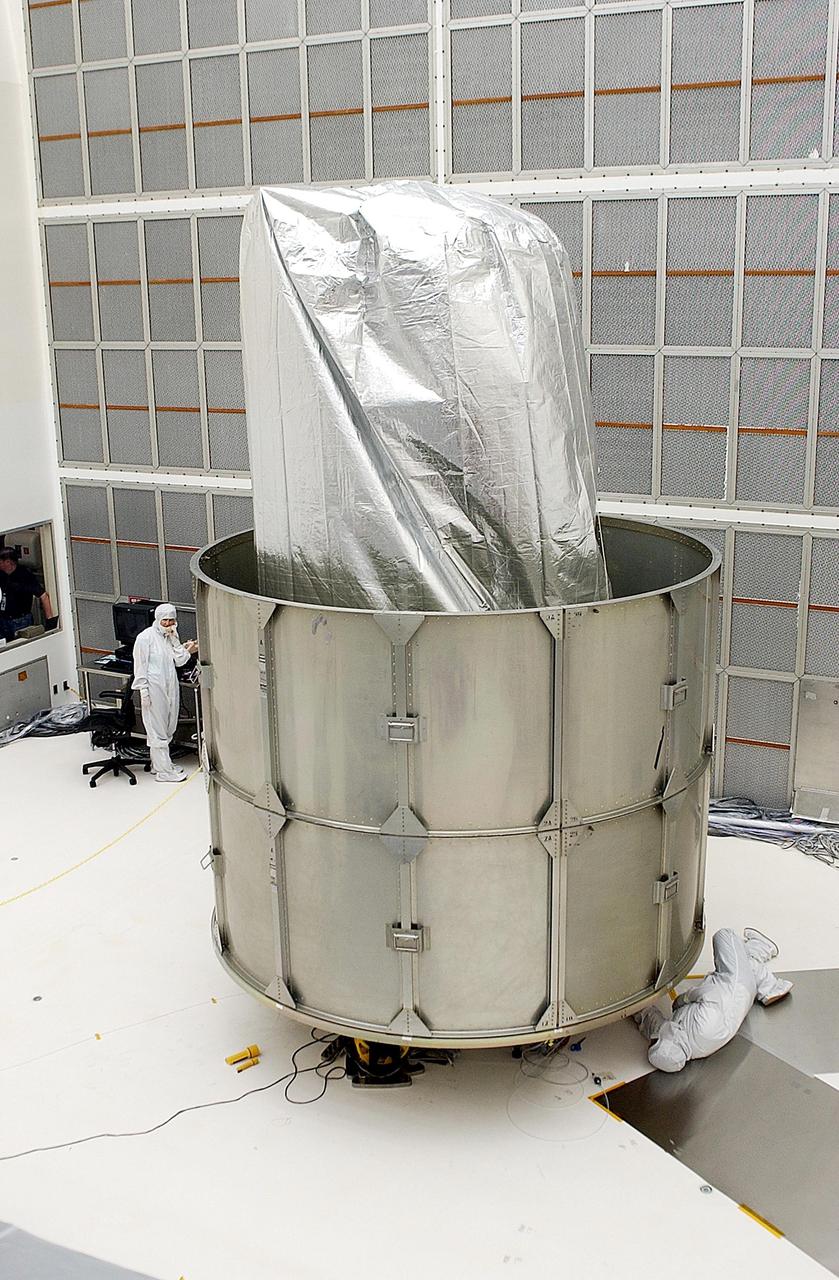
KENNEDY SPACE CENTER, FLA. - The partially enclosed Space Infrared Telescope Facility (SIRTF) waits for installation of the top two rings of the payload canister. SIRTF is currently scheduled for transportation to Launch Complex 17-B, Cape Canaveral Air Force Station, and mating with the Delta II on or about April 4.
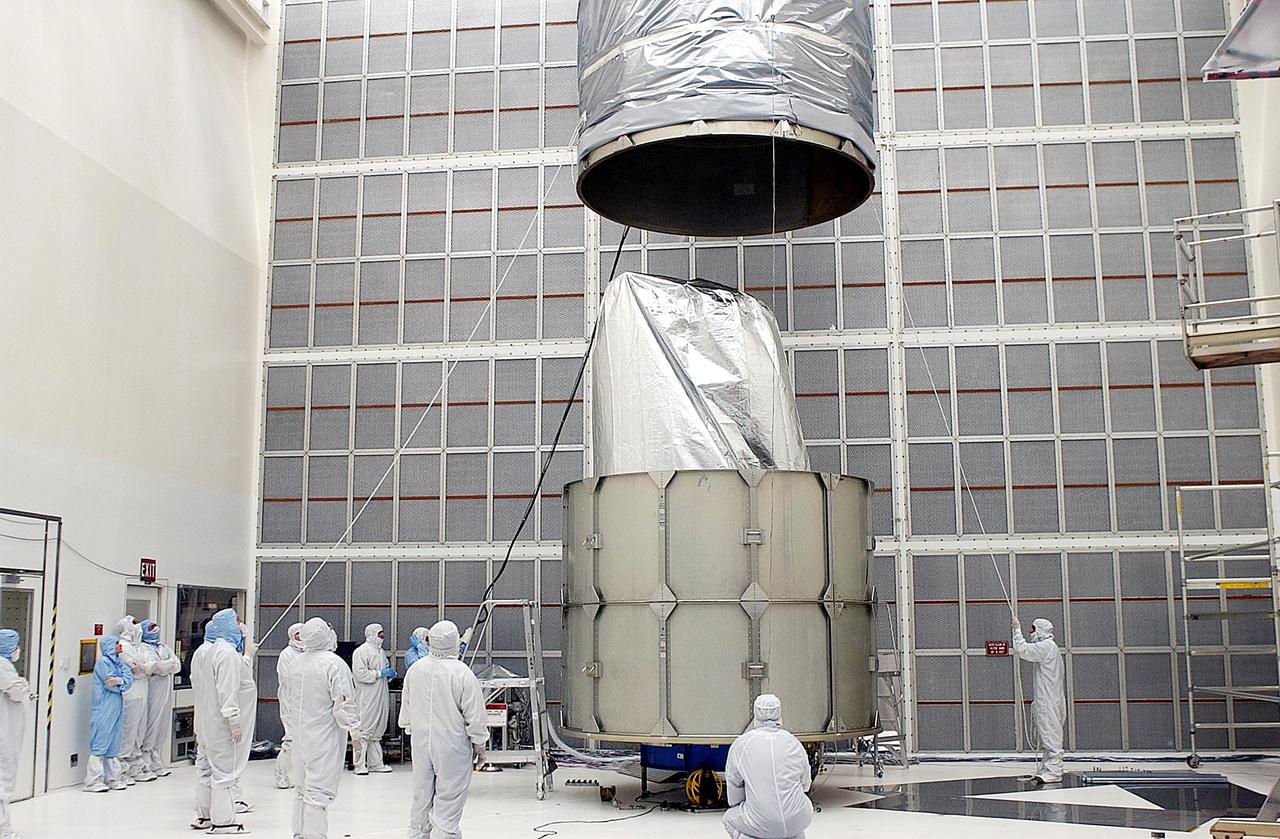
KENNEDY SPACE CENTER, FLA. - Workers guide the movement of the top rings of the payload canister over the Space Infrared Telescope Facility (SIRTF) below. After installation, SIRTF will be transported to Launch Complex 17-B, Cape Canaveral Air Force Station, and mating with the Delta II on or about April 4.
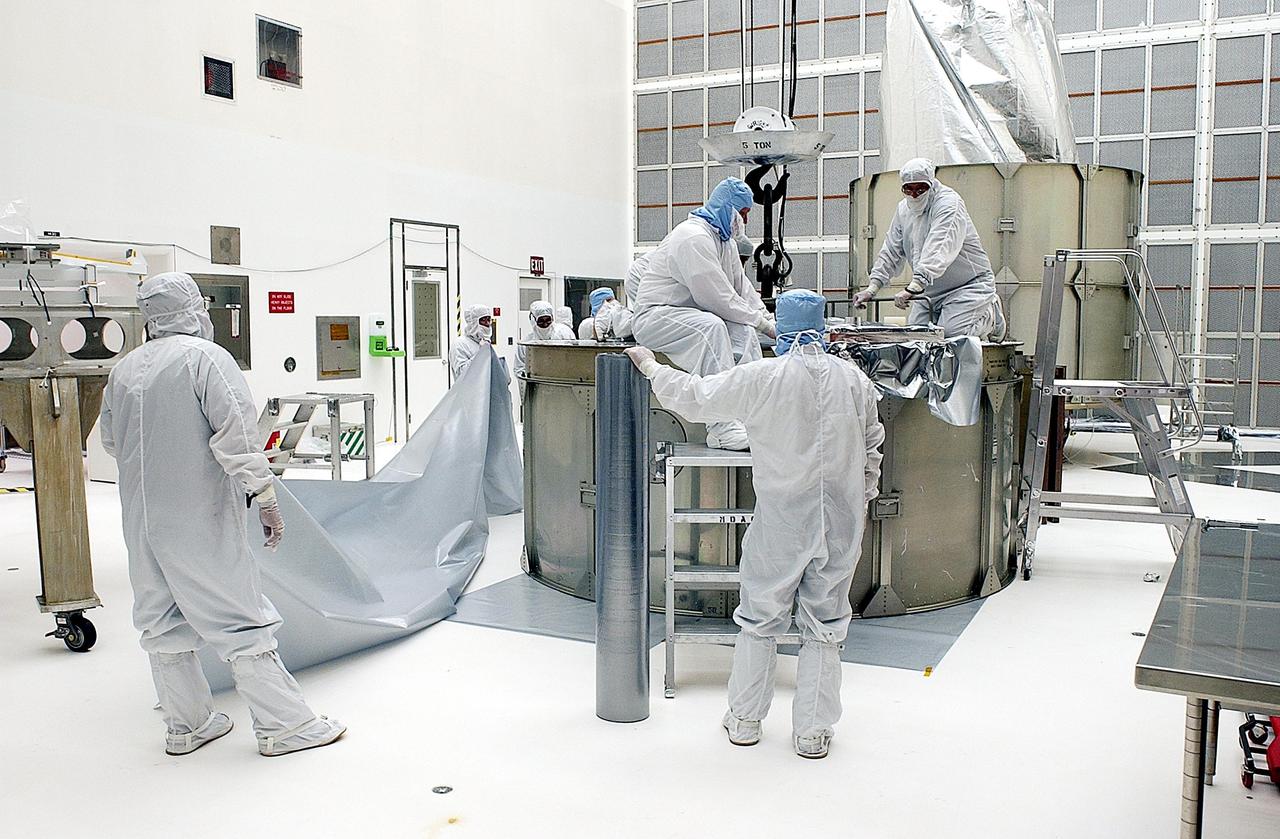
KENNEDY SPACE CENTER, FLA. -- Workers adjust the top ring on the payload canister before installing over the Space Infrared Telescope Facility (SIRTF). SIRTF is currently scheduled for transportation to Launch Complex 17-B, Cape Canaveral Air Force Station, and mating with the Delta II on or about April 4.
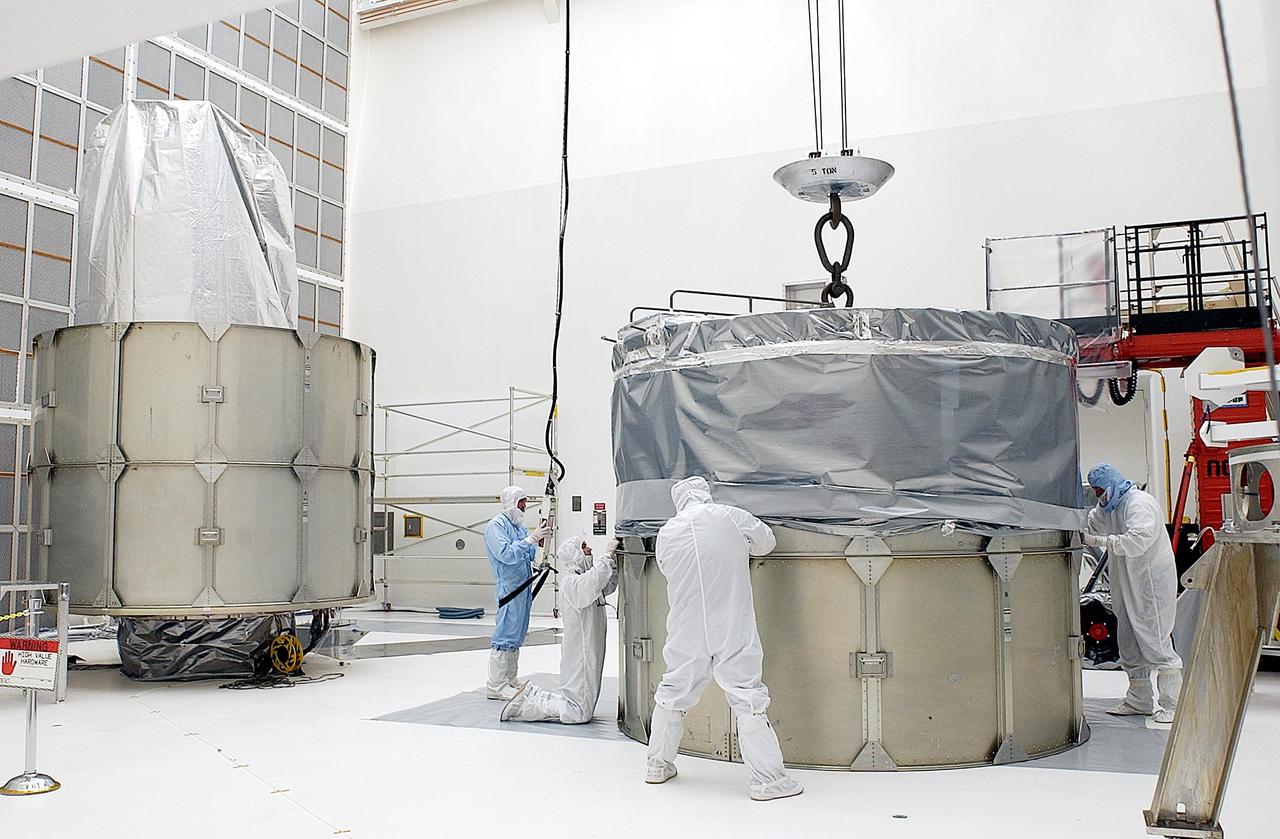
KENNEDY SPACE CENTER, FLA. -- Workers adjust a cover on the top two rings to be installed over the Space Infrared Telescope Facility (SIRTF). SIRTF is currently scheduled for transportation to Launch Complex 17-B, Cape Canaveral Air Force Station, and mating with the Delta II on or about April 4.
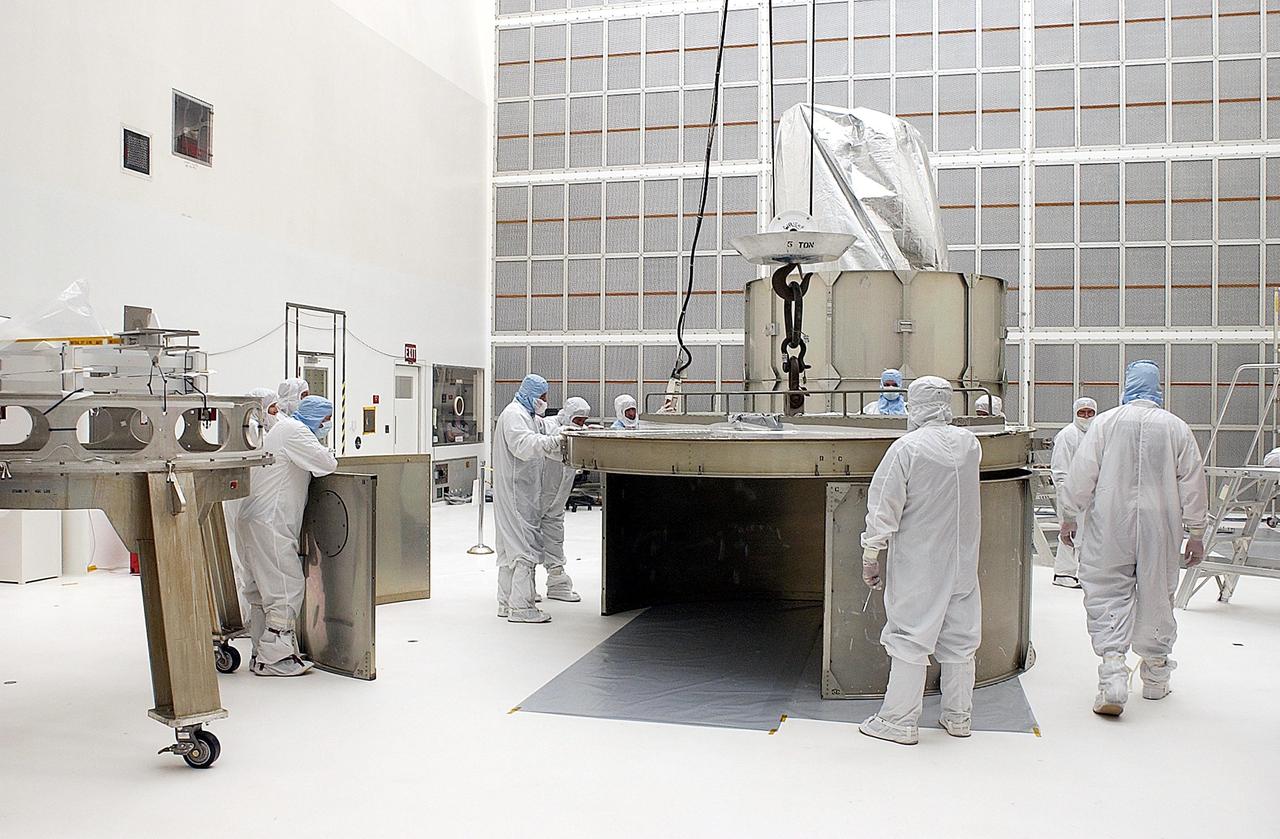
KENNEDY SPACE CENTER, FLA. -- Workers adjust the top ring on the payload canister before installing over the Space Infrared Telescope Facility (SIRTF). SIRTF is currently scheduled for transportation to Launch Complex 17-B, Cape Canaveral Air Force Station, and mating with the Delta II on or about April 4.
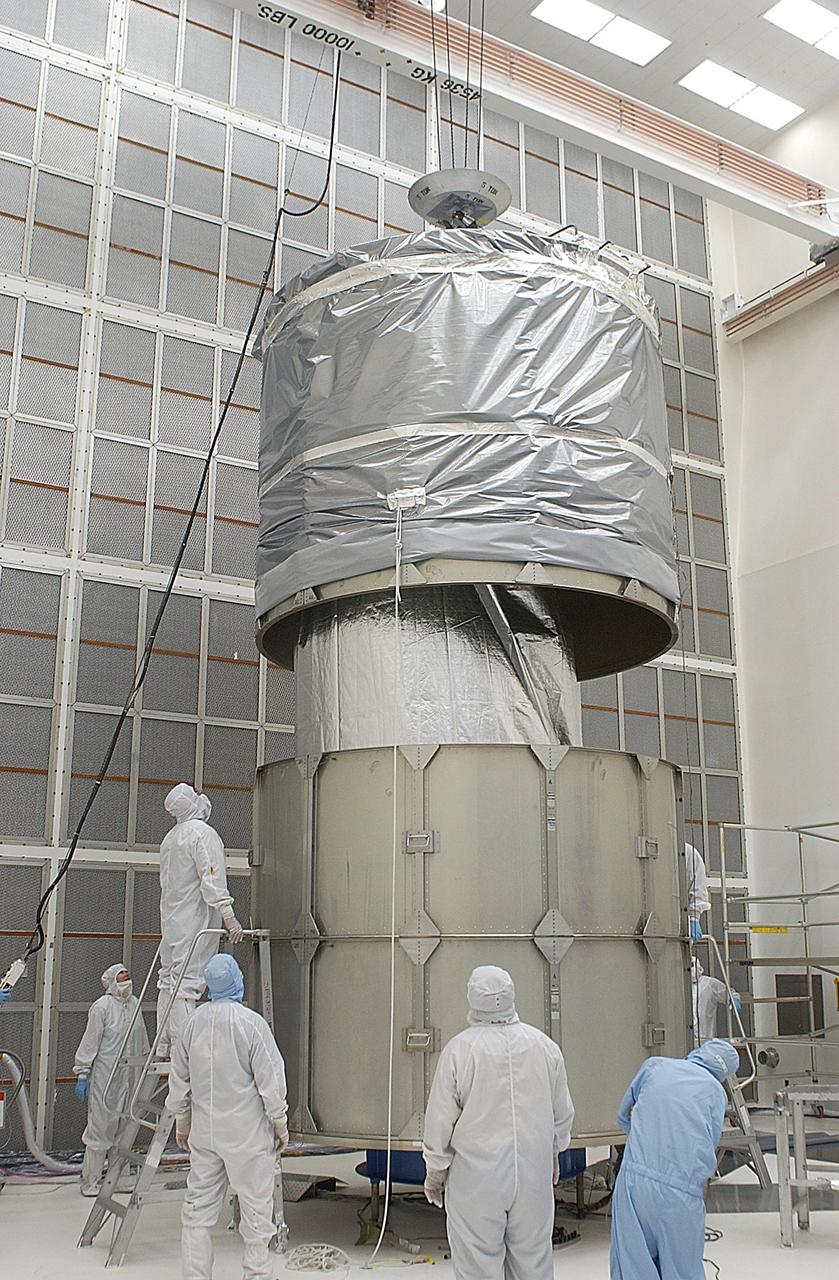
KENNEDY SPACE CENTER, FLA. -- Workers lower the top rings of the payload canister over the Space Infrared Telescope Facility (SIRTF) below. After installation, SIRTF will be transported to Launch Complex 17-B, Cape Canaveral Air Force Station, and mating with the Delta II on or about April 4.
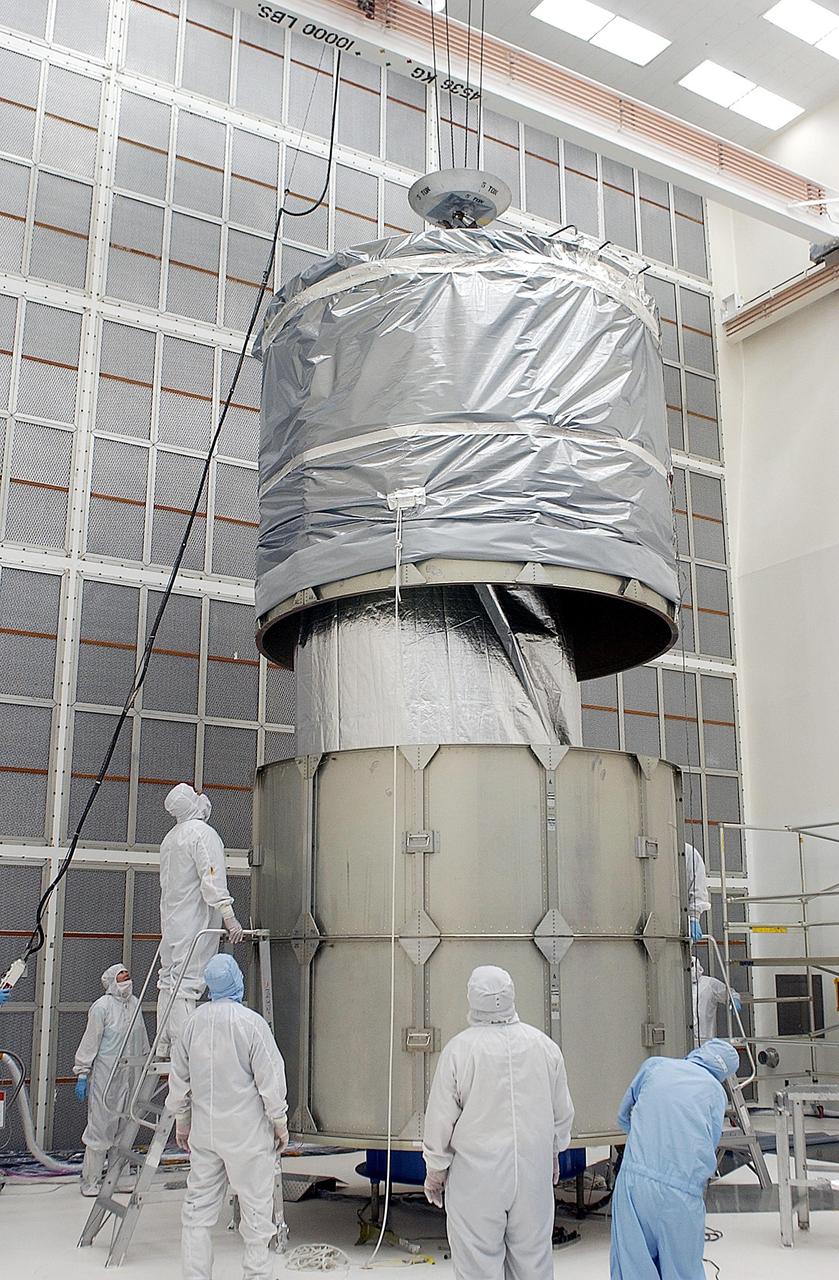
KENNEDY SPACE CENTER, FLA. -- Workers lower the top rings of the payload canister over the Space Infrared Telescope Facility (SIRTF) below. After installation, SIRTF will be transported to Launch Complex 17-B, Cape Canaveral Air Force Station, and mating with the Delta II on or about April 4.
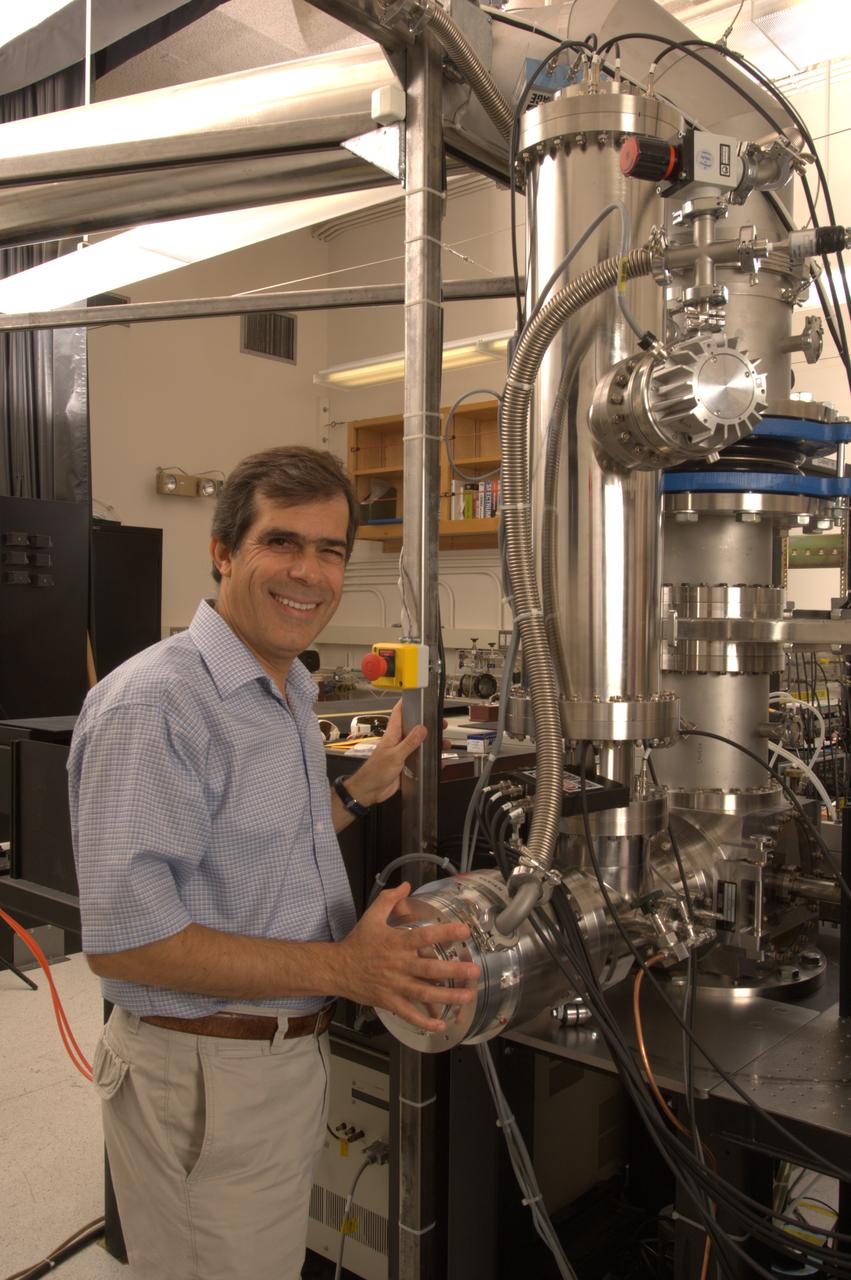
NASA Ames Astrophysics Branch (code-SSA), Pulsed discharge nozzle - Cavity Ring down - Reflection Time of Flight Mass Spectrometer (N-245 rm B-31) (PDN-CRDS-RETOFMS) shown here with Farid Salama
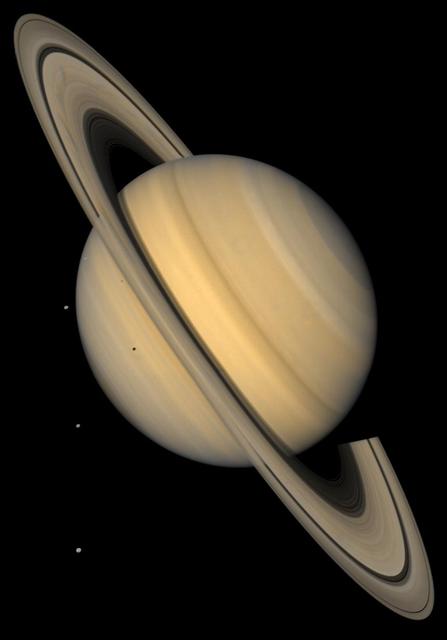
This approximate natural-color image shows Saturn, its rings, and four of its icy satellites. Three satellites (Tethys, Dione, and Rhea) are visible against the darkness of space, and another smaller satellite (Mimas) is visible against Saturn's cloud tops very near the left horizon and just below the rings. The dark shadows of Mimas and Tethys are also visible on Saturn's cloud tops, and the shadow of Saturn is seen across part of the rings. Saturn, second in size only to Jupiter in our Solar System, is 120,660 km (75,000 mi) in diameter at its equator (the ring plane) but, because of its rapid spin, Saturn is 10% smaller measured through its poles. Saturn's rings are composed mostly of ice particles ranging from microscopic dust to boulders in size. These particles orbit Saturn in a vast disk that is a mere 100 meters (330 feet) or so thick. The rings' thinness contrasts with their huge diameter--for instance 272,400 km (169,000 mi) for the outer part of the bright A ring, the outermost ring visible here. The pronounced concentric gap in the rings, the Cassini Division (named after its discoverer), is a 3500-km wide region (2200 mi, almost the width of the United States) that is much less populated with ring particles than the brighter B and A rings to either side of the gap. The rings also show some enigmatic radial structure ('spokes'), particularly at left. This image was synthesized from images taken in Voyager's blue and violet filters and was processed to recreate an approximately natural color and contrast. http://photojournal.jpl.nasa.gov/catalog/PIA00400
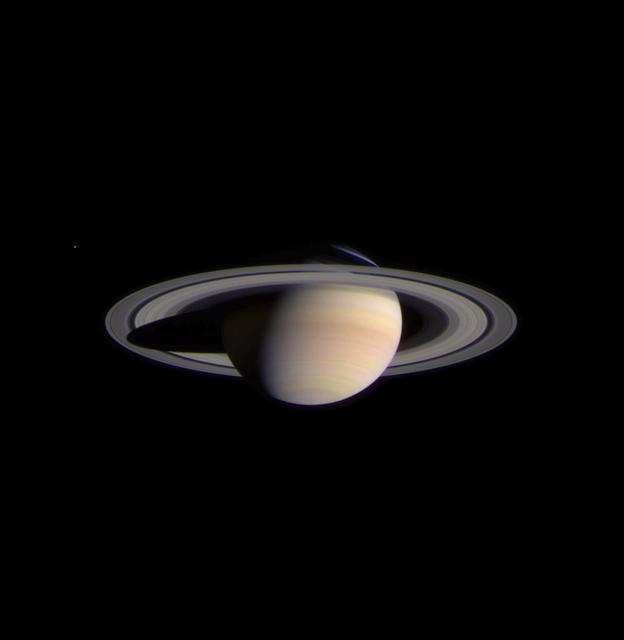
The narrow angle camera onboard NASA's Cassini spacecraft took a series of exposures of Saturn and its rings and moons on February 9, 2004, which were composited to create this stunning, color image. At the time, Cassini was 69.4 million kilometers (43.1 million miles) from Saturn, less than half the distance from Earth to the Sun. The image contrast and colors have been slightly enhanced to aid visibility. The smallest features visible in this image are approximately 540 kilometers across (336 miles). Fine details in the rings and atmosphere are beginning to emerge, and will grow in sharpness and clarity over the coming months. The optical thickness of Saturn's B (middle) ring and the comparative translucence of the A (outer) ring, when seen against the planet, are now apparent. Subtle color differences in the finely banded Saturnian atmosphere, as well as structure within the diaphanous, inner C ring can be easily seen. Noticeably absent are the ghostly spoke-like dark markings in Saturn's B ring, first discovered by NASA's Voyager spacecraft on approach to the planet 23 years ago. The icy moon Enceladus (520 kilometers or 323 miles across) is faintly visible on the left in the image. Its brightness has been increased seven times relative to the planet. Cassini will make several very close approaches to Enceladus, returning images in which features as small as 50 meters (165 feet) or less will be detectable. The composite image signals the start of Cassini's final approach to the ringed planet and the beginning of monitoring and data collection on Saturn and its environment. This phase of the mission will continue until Cassini enters orbit around Saturn on July 1, 2004. http://photojournal.jpl.nasa.gov/catalog/PIA05380
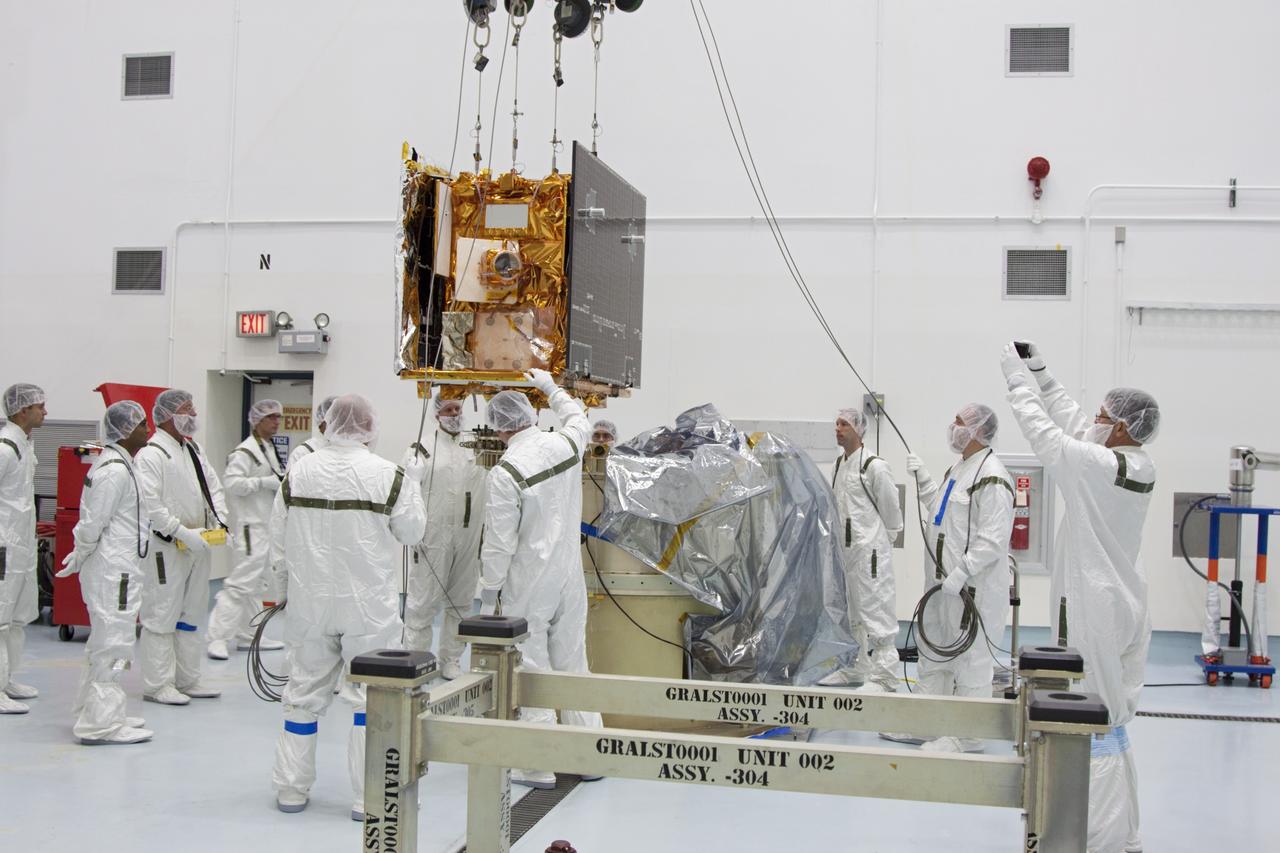
CAPE CANAVERAL, Fla. -- At Astrotech Space Operation's payload processing facility in Titusville, Fla., Lockheed Martin technicians lower NASA's Gravity Recovery and Interior Laboratory-B (GRAIL-B) lunar probe into position on the spacecraft adapter ring. After the twin GRAIL spacecraft are attached to the adapter ring in their side-by-side launch configuration, they will be transported to the launch pad. GRAIL will fly in tandem orbits around the moon for several months to measure its gravity field. GRAIL's primary science objectives are to determine the structure of the lunar interior, from crust to core, and to advance understanding of the thermal evolution of the moon. Launch aboard a United Launch Alliance Delta II rocket from Space Launch Complex 17B on Cape Canaveral Air Force Station is scheduled for Sept. 8. For more information, visit http://www.nasa.gov/grail. Photo credit: NASA/Jim Grossmann