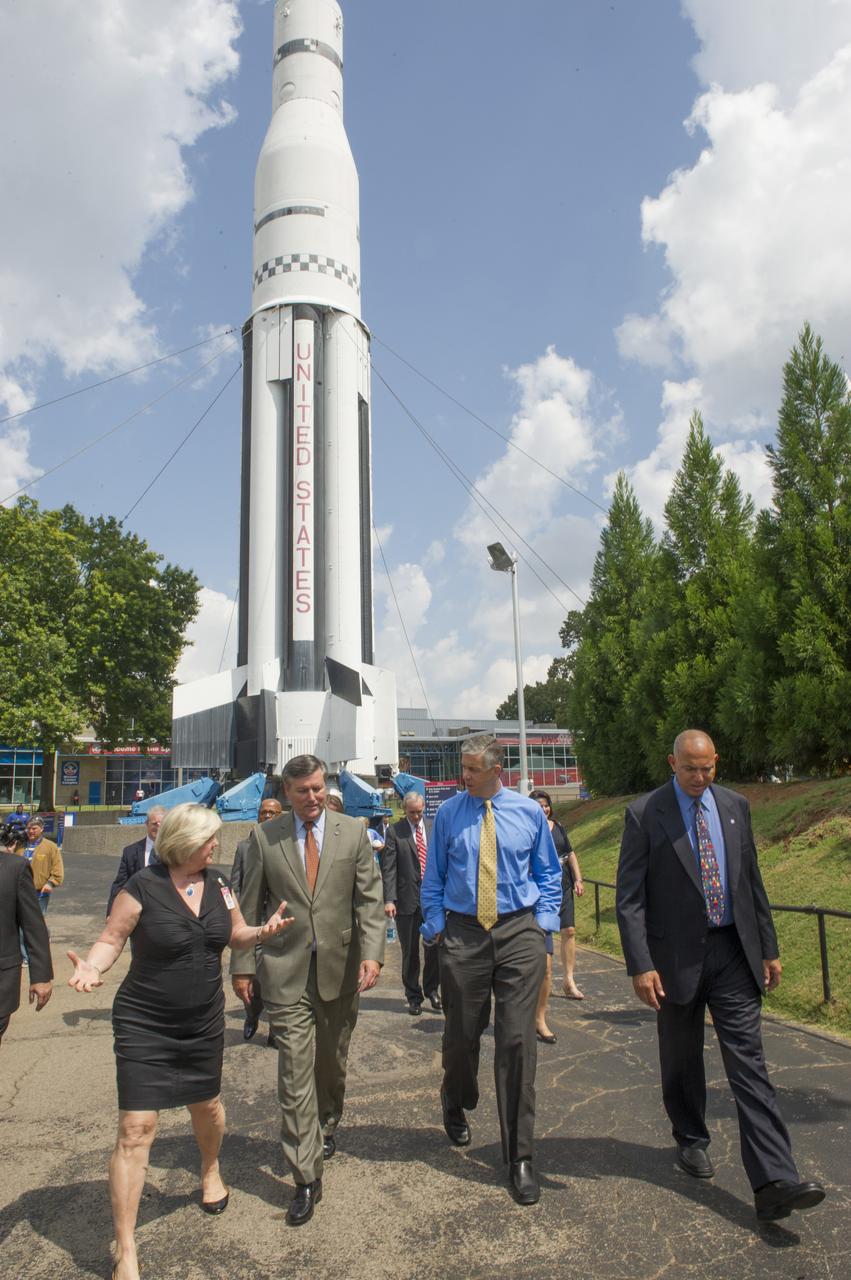
FROM LEFT, U.S. SPACE & ROCKET CENTER CEO DR. DEBORAH BARNHART AND MARSHALL CENTER DIRECTOR PATRICK SCHEUERMANN DISCUSS NASA’S HIGH-QUALITY EDUCATIONAL ACTIVITIES WITH U.S. SECRETARY OF EDUCATION ARNE DUNCAN AND THE NEWLY APPOINTED NASA ASSOCIATE ADMINISTRATOR OF EDUCATION, DONALD JAMES. THE SECRETARY’S VISIT TO THE SPACE & ROCKET CENTER WAS PART OF HIS FIFTH ANNUAL BACK-TO-SCHOOL BUS TOUR AND INCLUDED AN EDUCATIONAL TOWN HALL MEETING WITH LOCAL STUDENTS, TEACHERS AND PARENTS
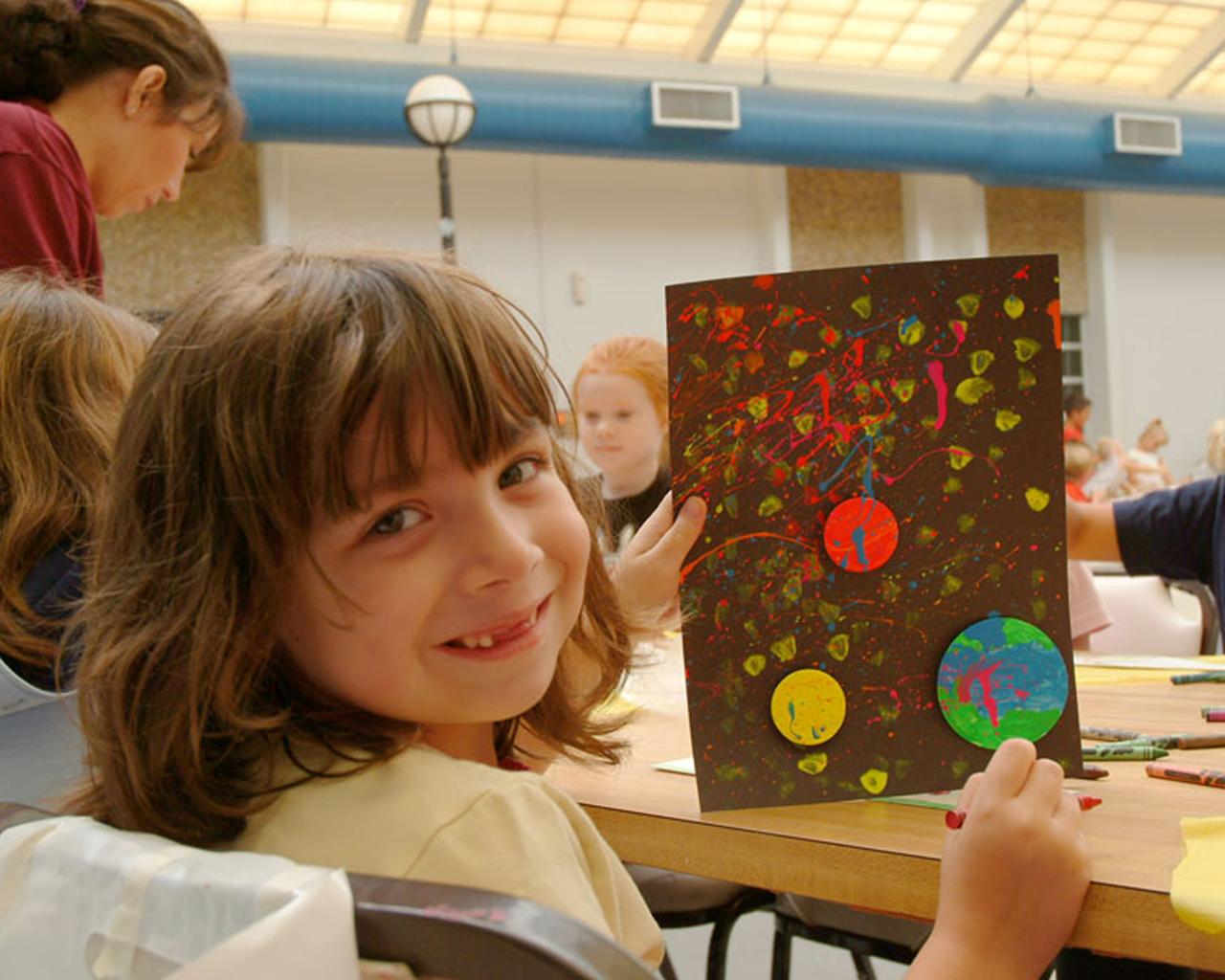
Sara Beth Casey, 5, proudly displays her artwork, 'Planets.' Sara Beth created the art as a student of Stennis Day Camp, a free camp for Stennis Space Center employees' children whose schools have not resumed since Hurricane Katrina hit the region on Aug. 29. The camp has registered nearly 200 children and averages 100 children each day. The camp will continue until all schools are back in session.
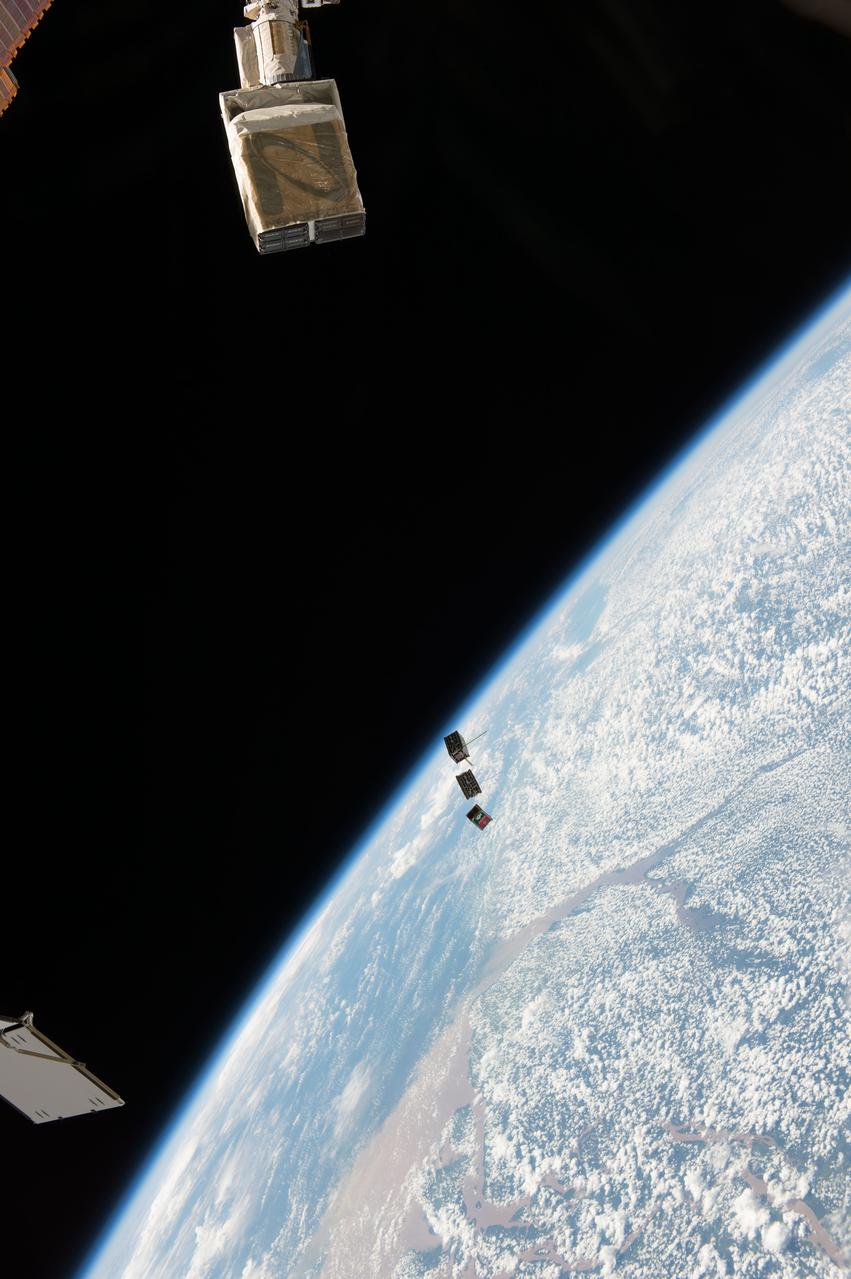
iss047e120450 (5/16/2016) --- Photographic documentation of NanoRacks CubeSat Deployer Number 8 Deployment Operations. The tiny four-inch and about three-pound cube satellite named St. Thomas More School Cathedral Satellite-1 (STMSat-1) is delivered by a resupply rocket to the International Space Station (ISS) where it is deployed by an ISS NanoRacks launcher into its own orbit to capture images and transmit them back to the schools around the world for research and teaching purposes in math and science.
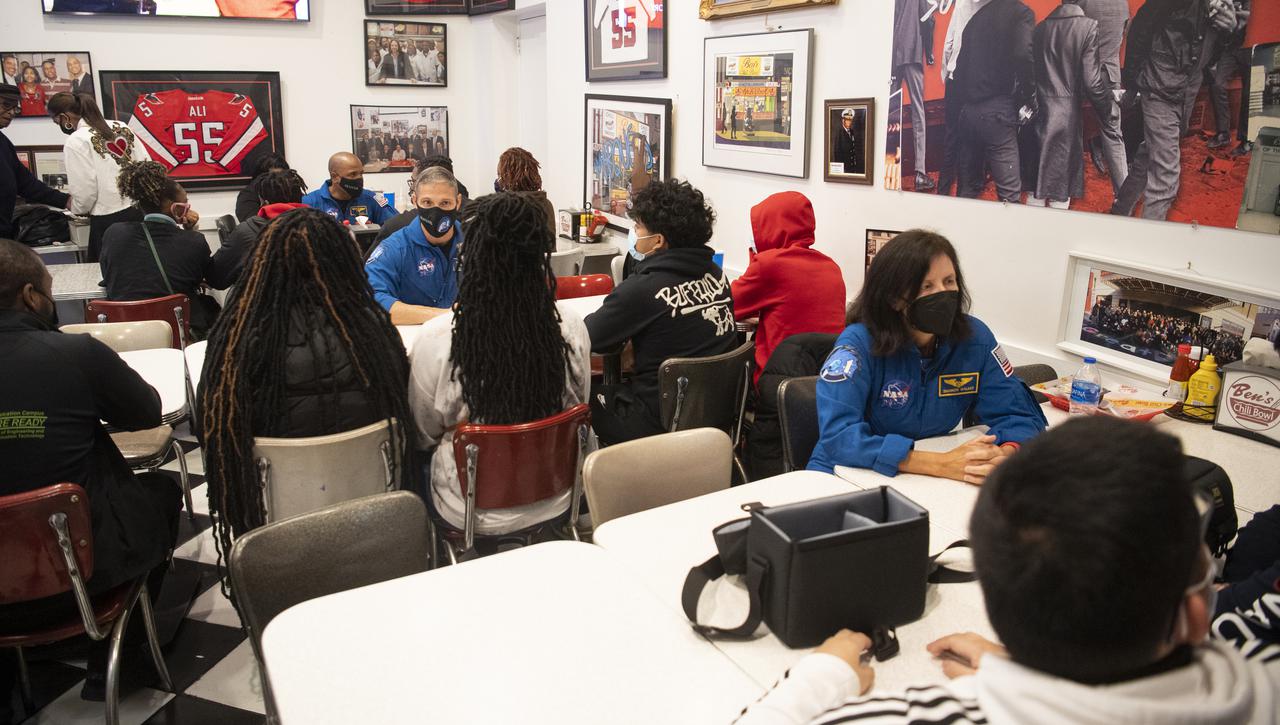
NASA astronauts Victor Glover, back left, Mike Hopkins, middle, and Shannon Walker, front right, speak with students about his time aboard the International Space Station, Thursday, Nov. 18, 2021, at Ben’s Chili Bowl in Washington, DC. Students from Cardozo Educational Campus, Friendship Technology Preparatory High School, McKinley Technical High School, Phelps High School, and Wilson High School heard NASA astronauts Glover, Hopkins, and Walker speak about the Crew-1 mission, the first crew rotation mission to the International Space Station for SpaceX’s Falcon 9 and Crew Dragon spacecraft as part of the agency’s Commercial Crew Program and the 168 days they spent in space across Expeditions 64 and 65. Photo Credit: (NASA/Joel Kowsky)
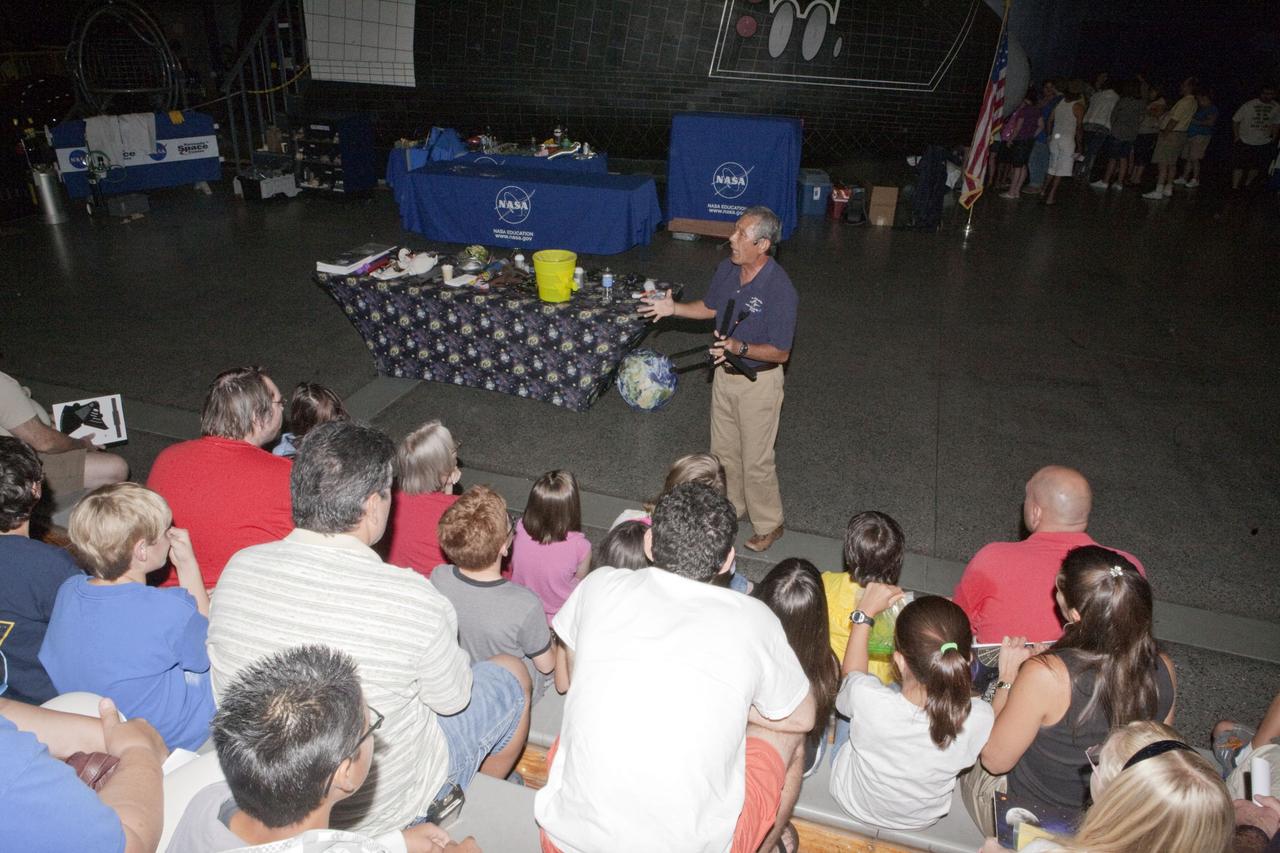
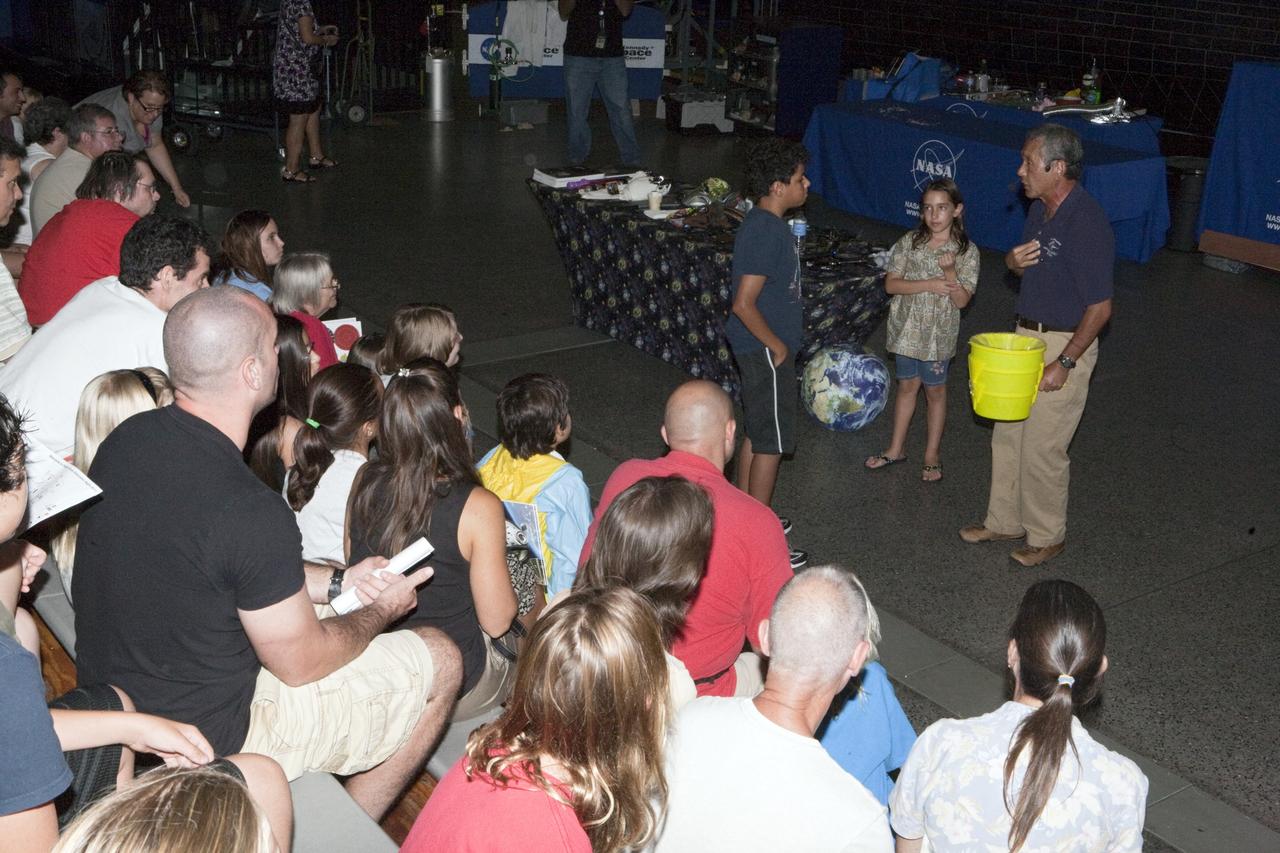
CAPE CANAVERAL, Fla. – An education specialist talks to children and their parents during Kennedy Space Center’s Family Night, Sept. 10, at the U.S. Astronaut Hall of Fame in Florida. NASA and the Kennedy Space Center Visitor Complex hosted the annual NASA family education night. The event, for fifth- through eighth-grade students and their parents, focuses on science, technology, engineering and mathematics (STEM) education activities that included astronaut appearances, a hovercraft, vortex cannon and alternative fuel vehicles. The back-to-school event is part of NASA’s Summer of Innovation initiative to provide interactive learning experiences to middle school students nationwide. Photo credit: NASA/Amanda Diller
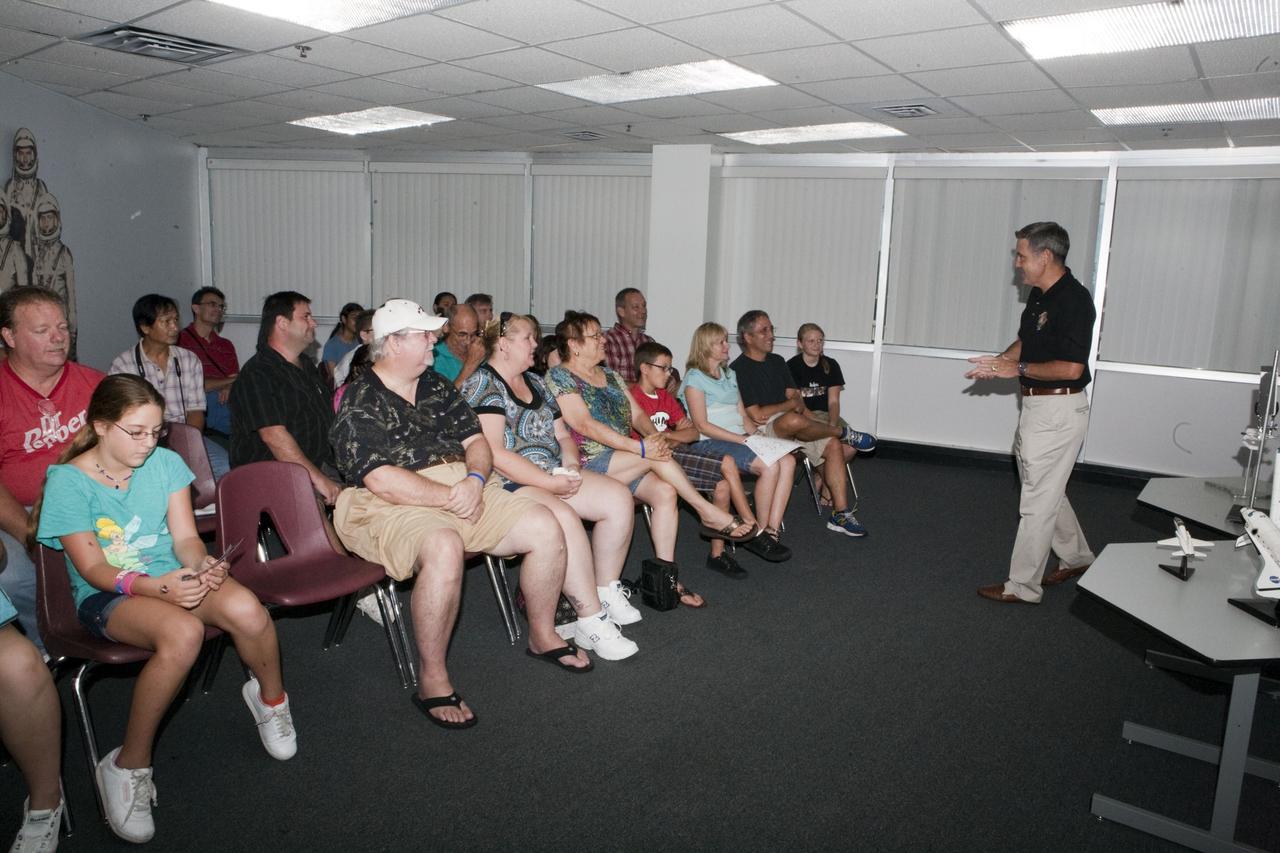
CAPE CANAVERAL, Fla. – Kennedy Space Center Director Bob Cabana speaks to children and their parents during Family Night, Sept. 10, at the U.S. Astronaut Hall of Fame in Florida. NASA and the Kennedy Space Center Visitor Complex hosted the annual NASA family education night. The event, for fifth- through eighth-grade students and their parents, focuses on science, technology, engineering and mathematics (STEM) education activities that included astronaut appearances, a hovercraft, vortex cannon and alternative fuel vehicles. The back-to-school event is part of NASA’s Summer of Innovation initiative to provide interactive learning experiences to middle school students nationwide. Photo credit: NASA/Amanda Diller
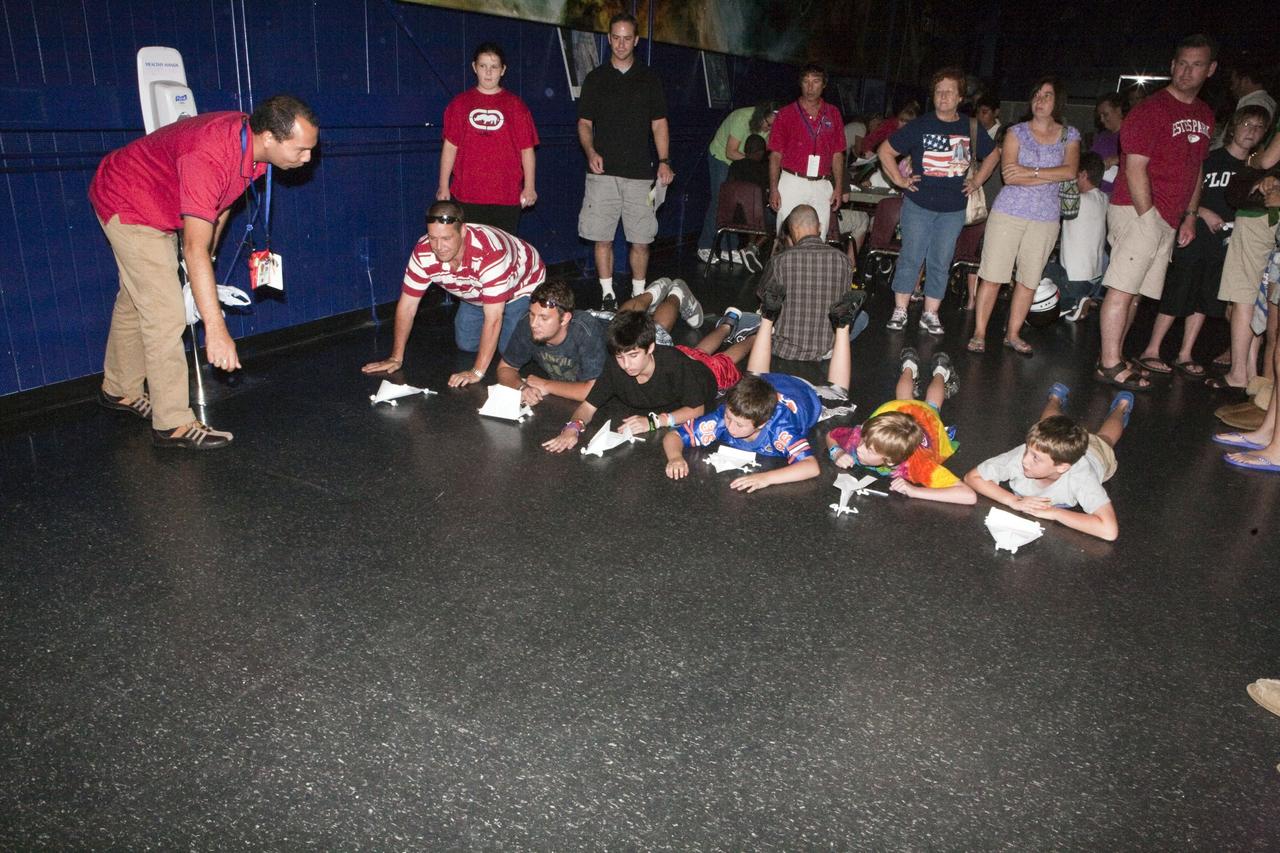
CAPE CANAVERAL, Fla. – Children participate in educational activities during Kennedy Space Center’s Family Night, Sept. 10, at the U.S. Astronaut Hall of Fame in Florida. NASA and the Kennedy Space Center Visitor Complex hosted the annual NASA family education night. The event, for fifth- through eighth-grade students and their parents, focuses on science, technology, engineering and mathematics (STEM) education activities that included astronaut appearances, a hovercraft, vortex cannon and alternative fuel vehicles. The back-to-school event is part of NASA’s Summer of Innovation initiative to provide interactive learning experiences to middle school students nationwide. Photo credit: NASA/Amanda Diller
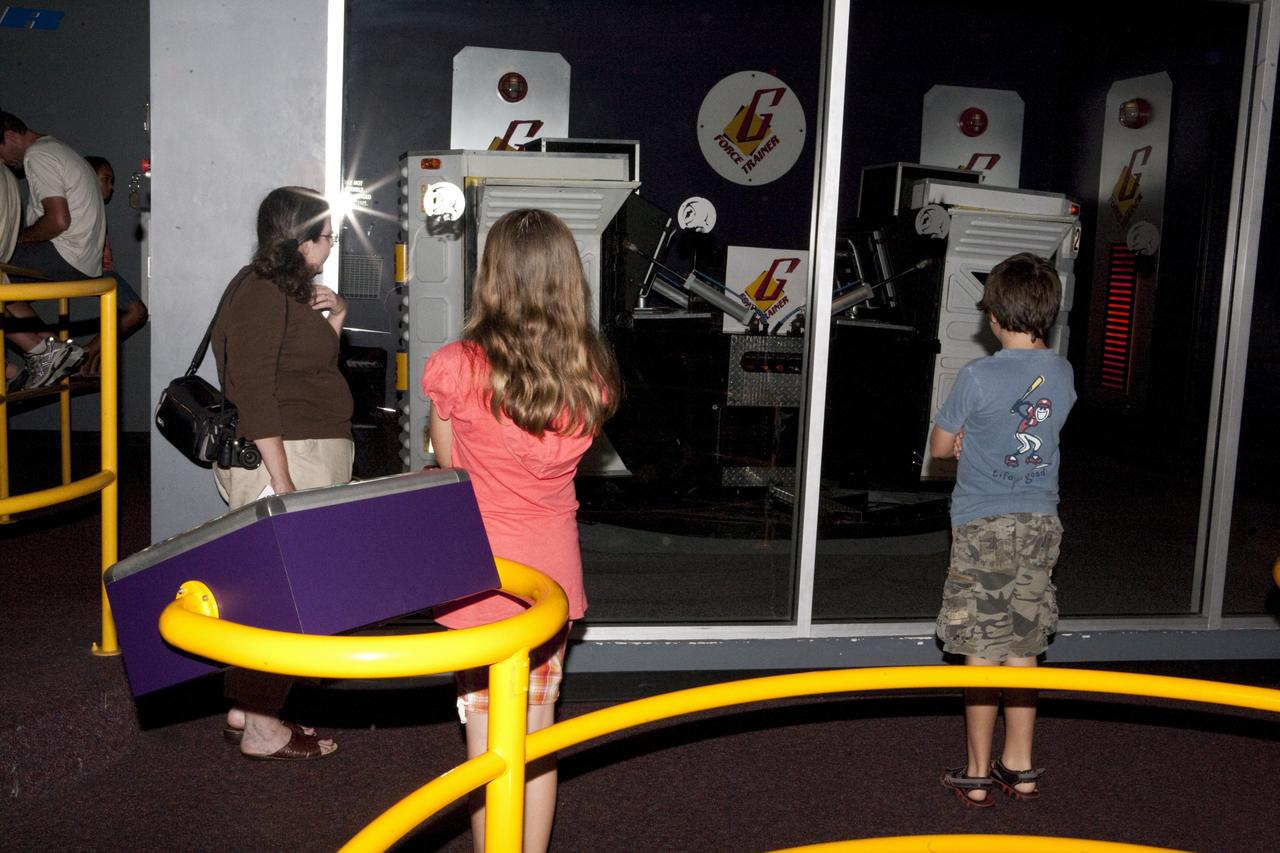
CAPE CANAVERAL, Fla. – Children view educational displays during Kennedy Space Center’s Family Night, Sept. 10, at the U.S. Astronaut Hall of Fame in Florida. NASA and the Kennedy Space Center Visitor Complex hosted the annual NASA family education night. The event, for fifth- through eighth-grade students and their parents, focuses on science, technology, engineering and mathematics (STEM) education activities that included astronaut appearances, a hovercraft, vortex cannon and alternative fuel vehicles. The back-to-school event is part of NASA’s Summer of Innovation initiative to provide interactive learning experiences to middle school students nationwide. Photo credit: NASA/Amanda Diller
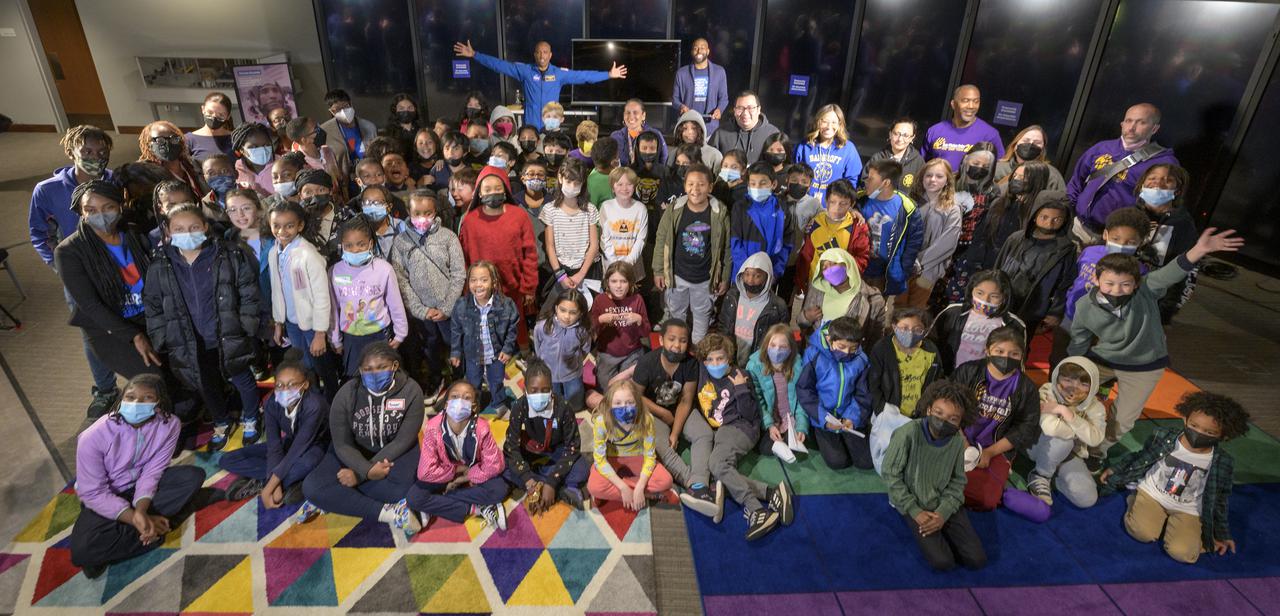
NASA astronaut Victor Glover, back with arms extended, poses for a group photo with school students from Bunker Hill Elementary, Bancroft Elementary, and E.W. Stokes Public Charter School at the conclusion of an educational event, Thursday, April 28, 2022, at the National Museum of African American History and Culture in Washington. Glover most recently served as pilot and second-in-command on the Crew-1 SpaceX Crew Dragon, named Resilience, which landed after a long duration mission aboard the International Space Station, May 2, 2021. Photo Credit: (NASA/Bill Ingalls)
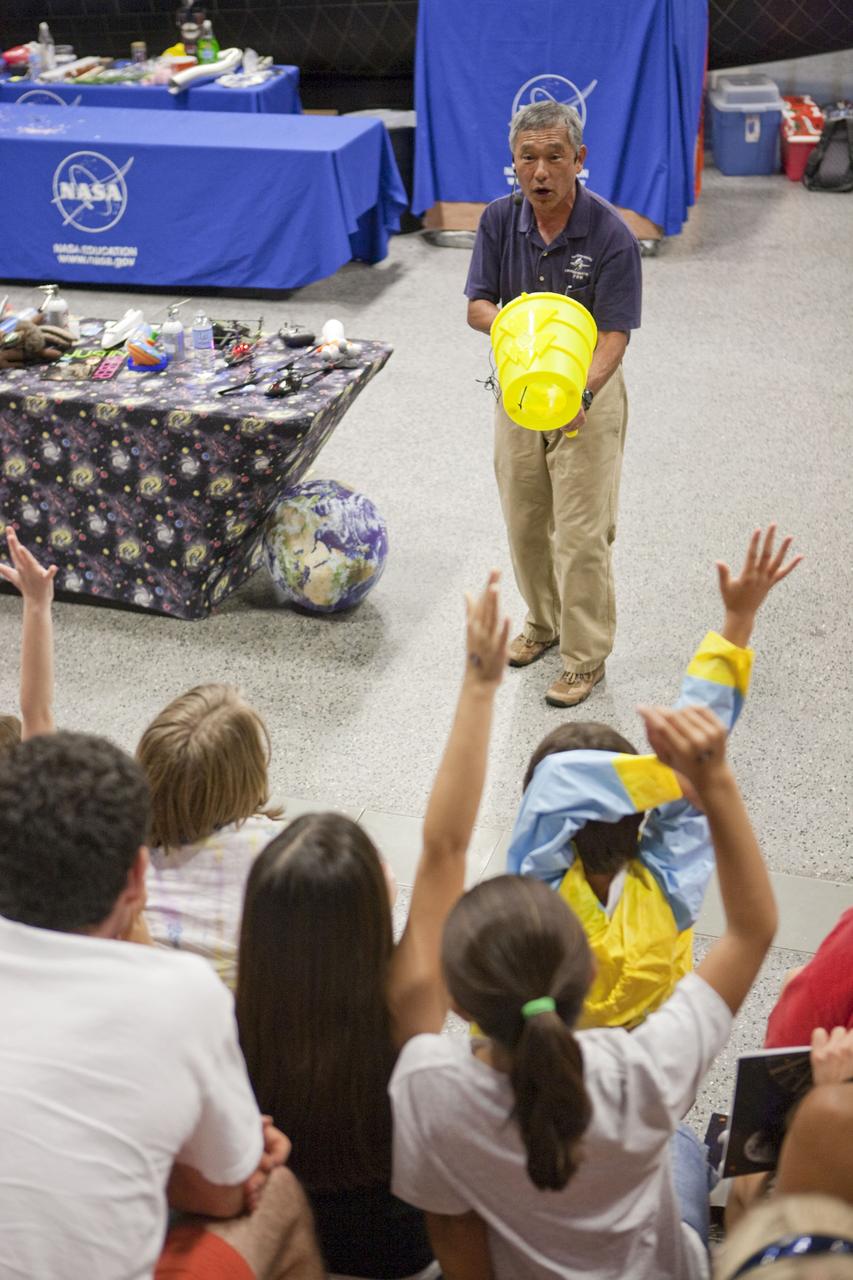
CAPE CANAVERAL, Fla. – An education specialist engages children in an educational activity during Kennedy Space Center’s Family Night, Sept. 10, at the U.S. Astronaut Hall of Fame in Florida. NASA and the Kennedy Space Center Visitor Complex hosted the annual NASA family education night. The event, for fifth- through eighth-grade students and their parents, focuses on science, technology, engineering and mathematics (STEM) education activities that included astronaut appearances, a hovercraft, vortex cannon and alternative fuel vehicles. The back-to-school event is part of NASA’s Summer of Innovation initiative to provide interactive learning experiences to middle school students nationwide. Photo credit: NASA/Amanda Diller
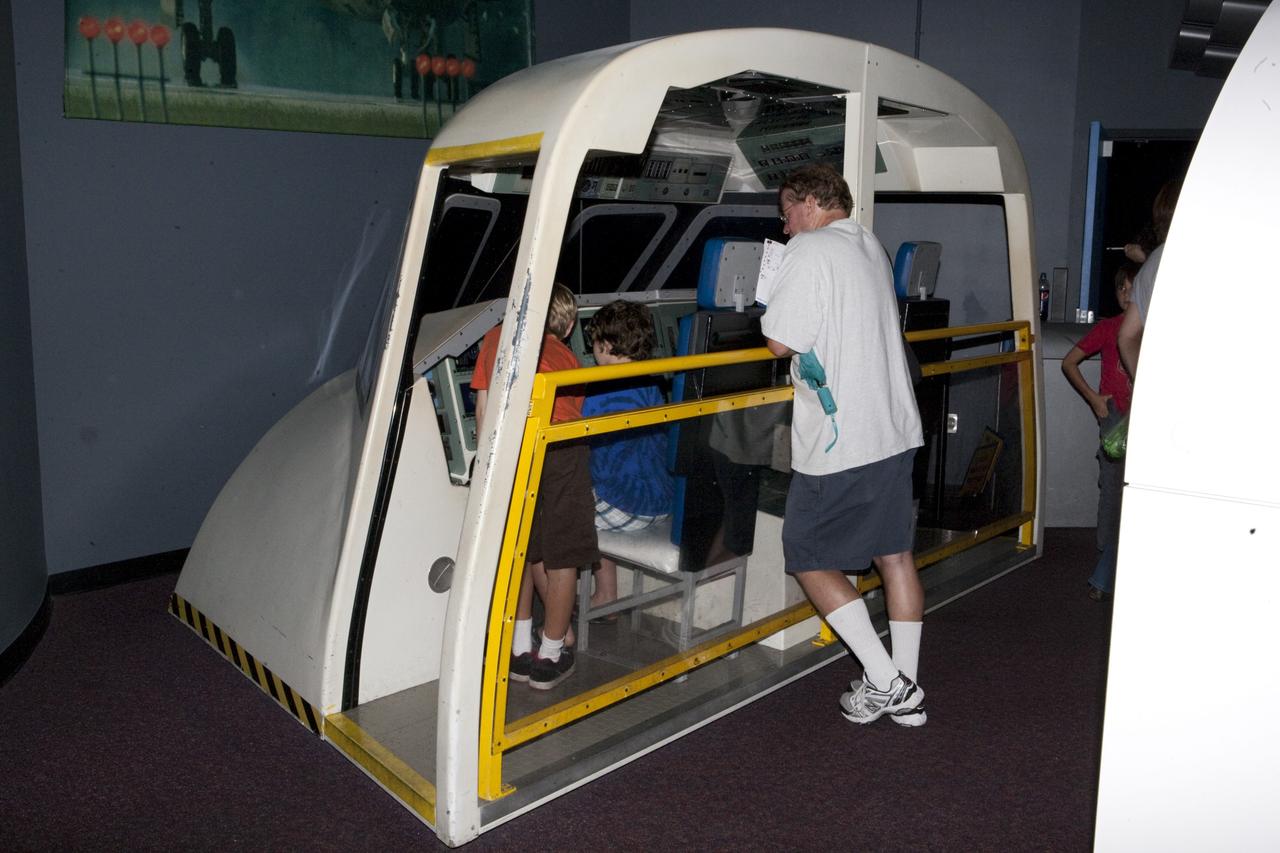
CAPE CANAVERAL, Fla. – Children participate in educational activities during Kennedy Space Center’s Family Night, Sept. 10, at the U.S. Astronaut Hall of Fame in Florida. NASA and the Kennedy Space Center Visitor Complex hosted the annual NASA family education night. The event, for fifth- through eighth-grade students and their parents, focuses on science, technology, engineering and mathematics (STEM) education activities that included astronaut appearances, a hovercraft, vortex cannon and alternative fuel vehicles. The back-to-school event is part of NASA’s Summer of Innovation initiative to provide interactive learning experiences to middle school students nationwide. Photo credit: NASA/Amanda Diller
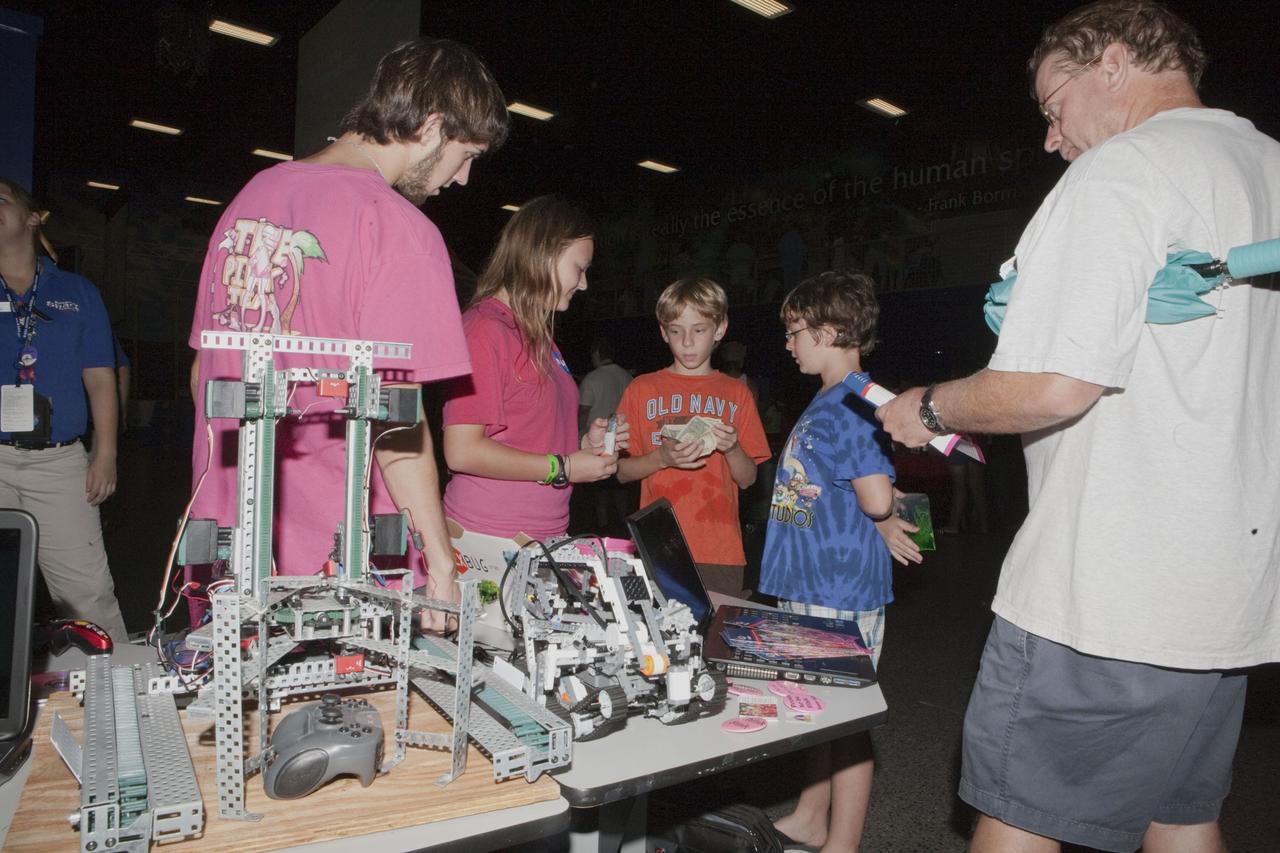
CAPE CANAVERAL, Fla. – Children participate in educational activities during Kennedy Space Center’s Family Night, Sept. 10, at the U.S. Astronaut Hall of Fame in Florida. NASA and the Kennedy Space Center Visitor Complex hosted the annual NASA family education night. The event, for fifth- through eighth-grade students and their parents, focuses on science, technology, engineering and mathematics (STEM) education activities that included astronaut appearances, a hovercraft, vortex cannon and alternative fuel vehicles. The back-to-school event is part of NASA’s Summer of Innovation initiative to provide interactive learning experiences to middle school students nationwide. Photo credit: NASA/Amanda Diller
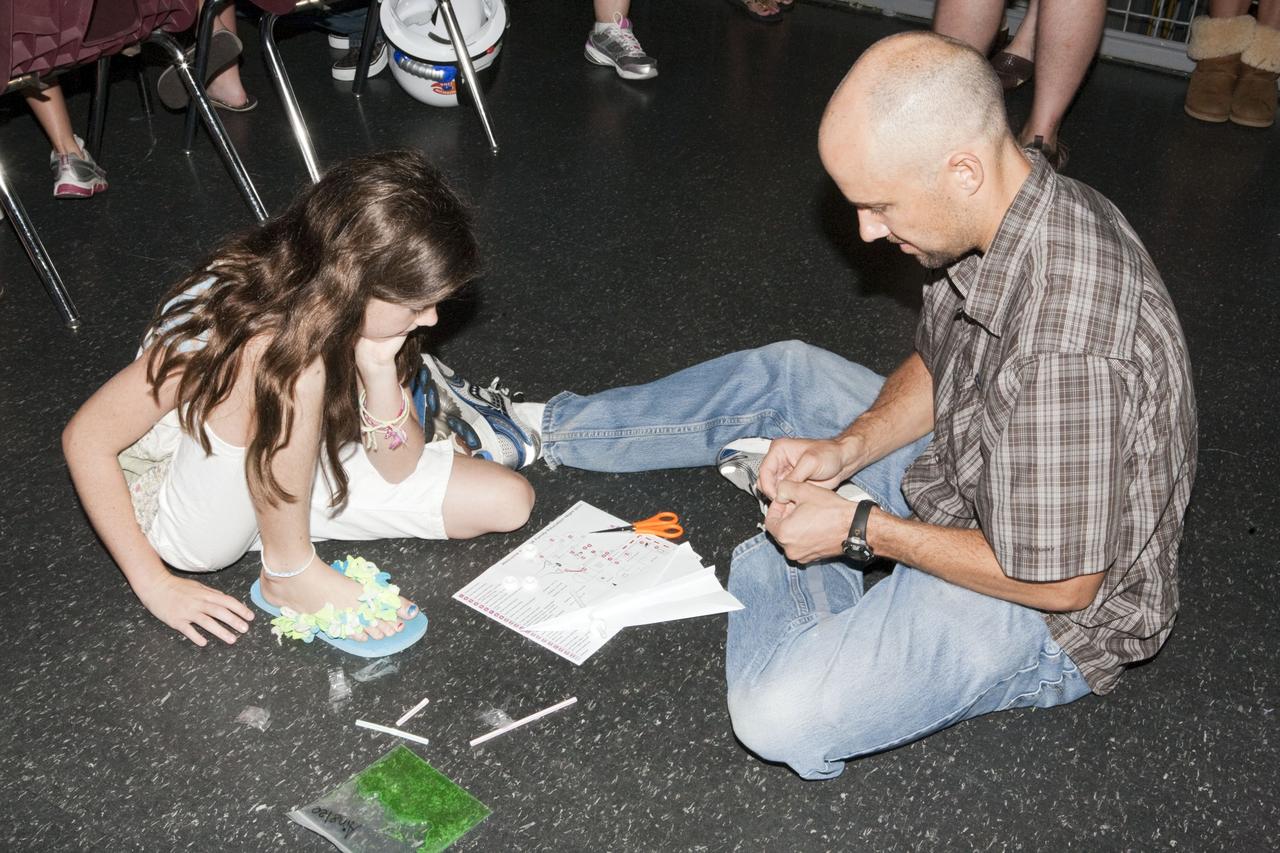
CAPE CANAVERAL, Fla. – A father helps his daughter with an educational activity at Kennedy Space Center’s Family Night, Sept. 10, at the U.S. Astronaut Hall of Fame in Florida. NASA and the Kennedy Space Center Visitor Complex hosted the annual NASA family education night. The event, for fifth- through eighth-grade students and their parents, focuses on science, technology, engineering and mathematics (STEM) education activities that included astronaut appearances, a hovercraft, vortex cannon and alternative fuel vehicles. The back-to-school event is part of NASA’s Summer of Innovation initiative to provide interactive learning experiences to middle school students nationwide. Photo credit: NASA/Amanda Diller
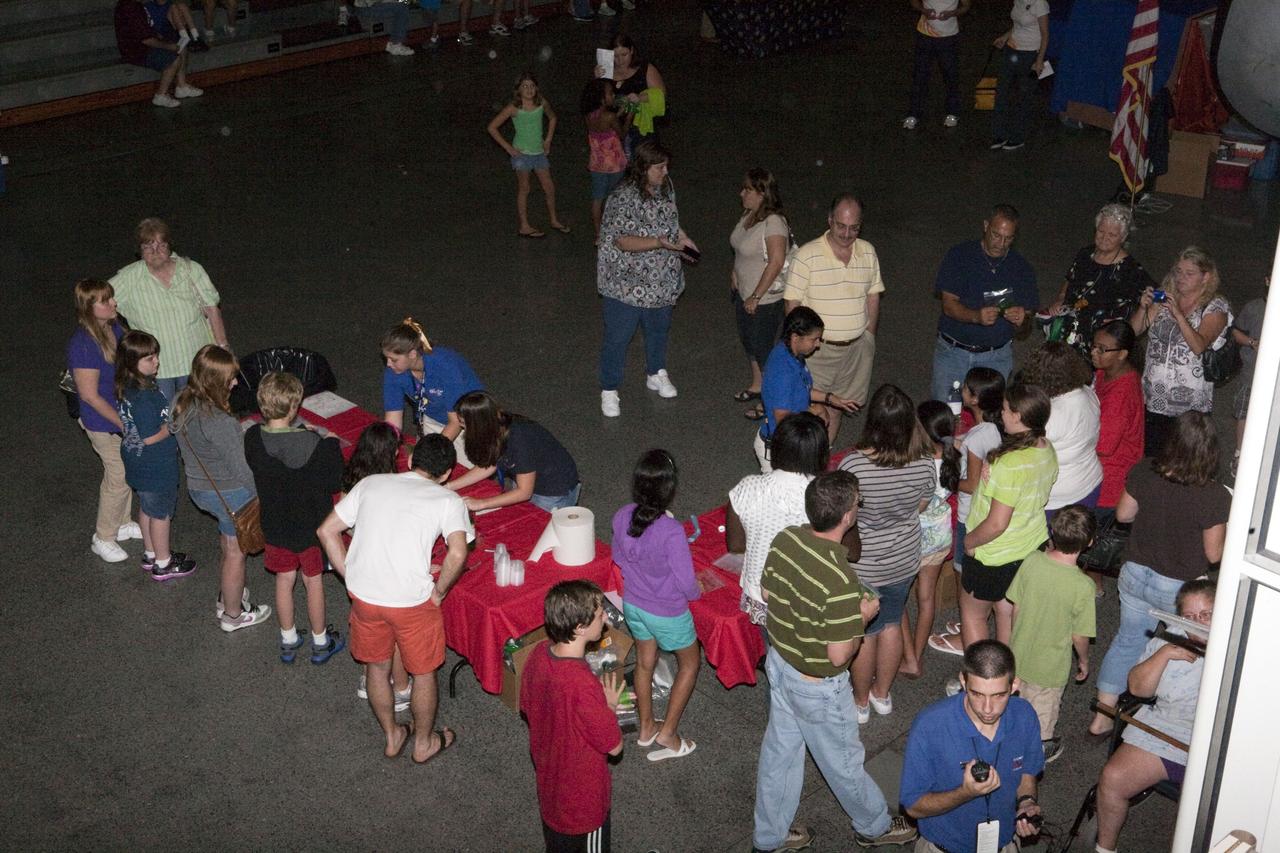
CAPE CANAVERAL, Fla. – Families sign up for activities at Kennedy Space Center’s Family Night, Sept. 10, at the U.S. Astronaut Hall of Fame in Florida. NASA and the Kennedy Space Center Visitor Complex hosted the annual NASA family education night. The event, for fifth- through eighth-grade students and their parents, focuses on science, technology, engineering and mathematics (STEM) education activities that included astronaut appearances, a hovercraft, vortex cannon and alternative fuel vehicles. The back-to-school event is part of NASA’s Summer of Innovation initiative to provide interactive learning experiences to middle school students nationwide. Photo credit: NASA/Amanda Diller
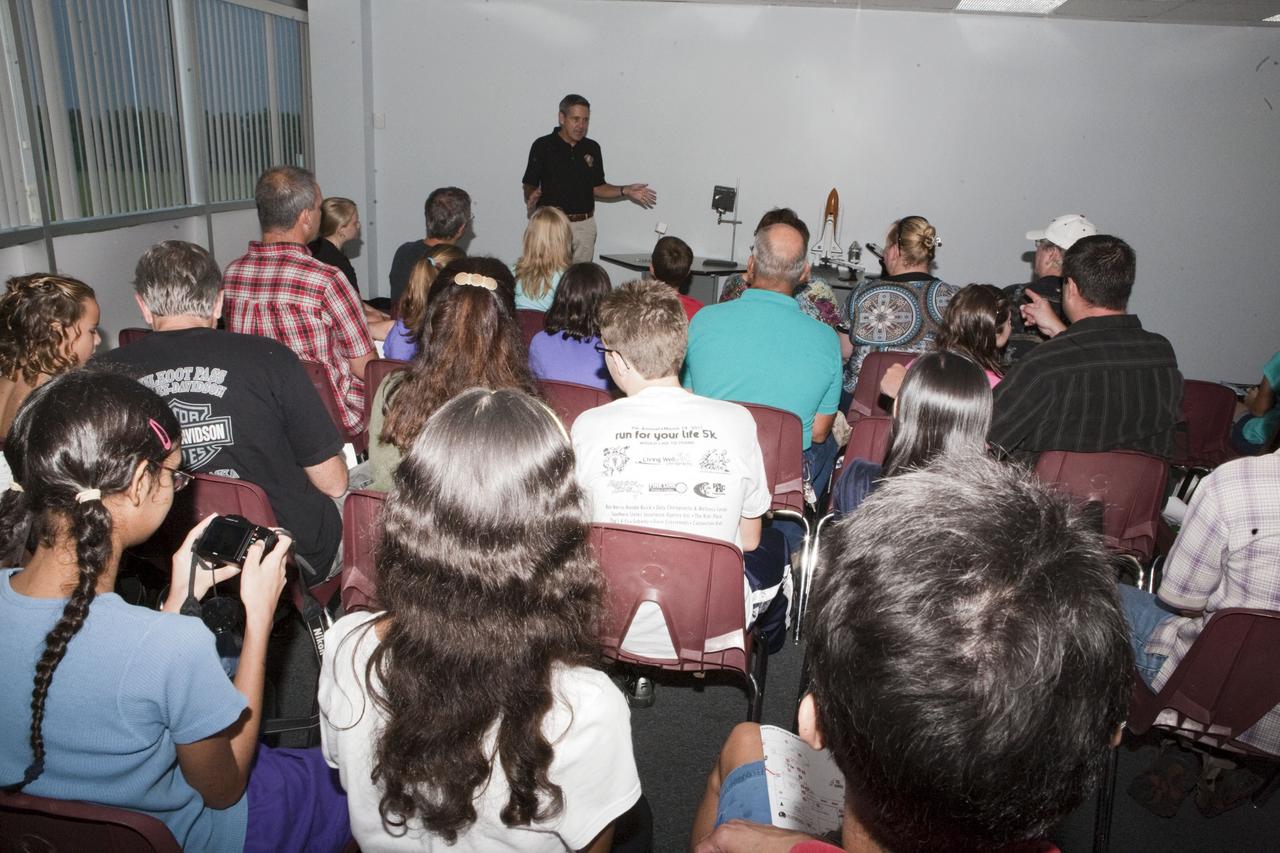
CAPE CANAVERAL, Fla. – Kennedy Space Center Director Bob Cabana speaks to children and their parents during Family Night, Sept. 10, at the U.S. Astronaut Hall of Fame in Florida. NASA and the Kennedy Space Center Visitor Complex hosted the annual NASA family education night. The event, for fifth- through eighth-grade students and their parents, focuses on science, technology, engineering and mathematics (STEM) education activities that included astronaut appearances, a hovercraft, vortex cannon and alternative fuel vehicles. The back-to-school event is part of NASA’s Summer of Innovation initiative to provide interactive learning experiences to middle school students nationwide. Photo credit: NASA/Amanda Diller
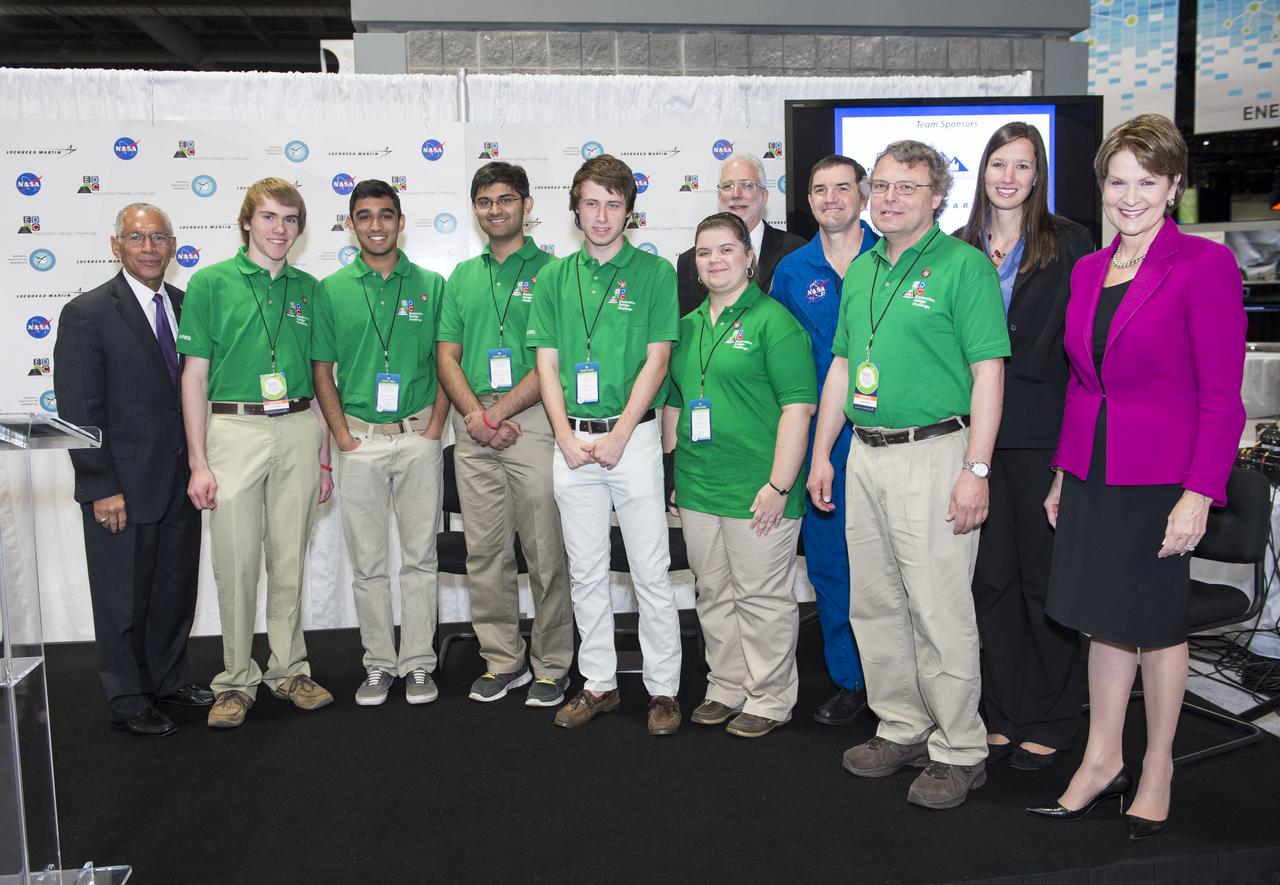
NASA’s Administrator, Charles Bolden (left), President/CEO of Lockheed Martin, Marillyn Hewson (right), and astronaut Rex Walheim (back row) pose for a group photo with the winning high school team in the Exploration Design Challenge. Team ARES from the Governors School for Science and Technology in Hampton, Va. won the challenge with their radiation shield design, which will be built and flown aboard the Orion/EFT-1. The award was announced at the USA Science and Engineering Festival on April 25, 2014 at the Washington Convention Center. Photo Credit: (NASA/Aubrey Gemignani)
CAPE CANAVERAL, Fla. – Children participate in educational activities during Kennedy Space Center’s Family Night, Sept. 10, at the U.S. Astronaut Hall of Fame in Florida. NASA and the Kennedy Space Center Visitor Complex hosted the annual NASA family education night. The event, for fifth- through eighth-grade students and their parents, focuses on science, technology, engineering and mathematics (STEM) education activities that included astronaut appearances, a hovercraft, vortex cannon and alternative fuel vehicles. The back-to-school event is part of NASA’s Summer of Innovation initiative to provide interactive learning experiences to middle school students nationwide. Photo credit: NASA/Amanda Diller
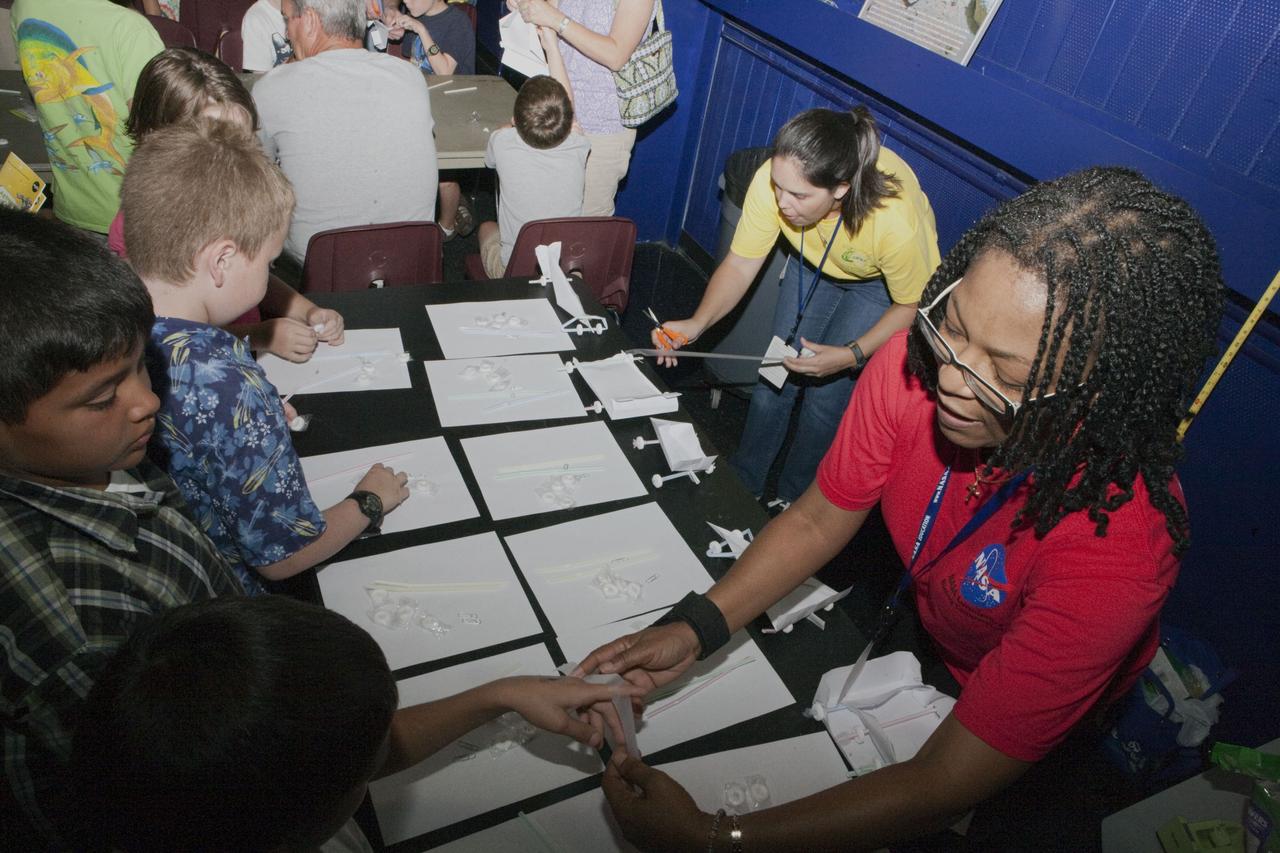
CAPE CANAVERAL, Fla. – Education specialists help children participation in educational activities during Family Night, Sept. 10, at Kennedy Space Center’s U.S. Astronaut Hall of Fame in Florida. NASA and the Kennedy Space Center Visitor Complex hosted the annual NASA family education night. The event, for fifth- through eighth-grade students and their parents, focuses on science, technology, engineering and mathematics (STEM) education activities that included astronaut appearances, a hovercraft, vortex cannon and alternative fuel vehicles. The back-to-school event is part of NASA’s Summer of Innovation initiative to provide interactive learning experiences to middle school students nationwide. Photo credit: NASA/Amanda Diller
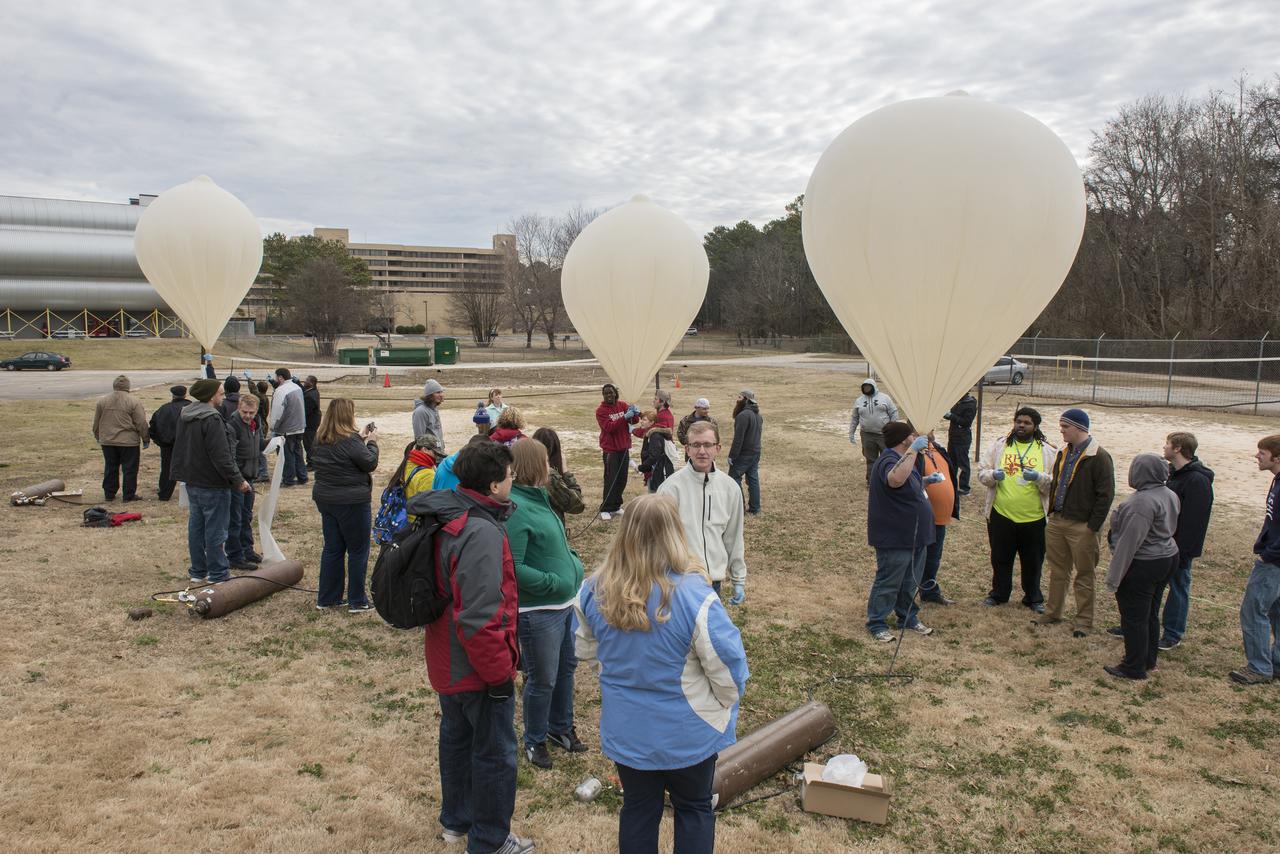
STUDENTS FROM COMMUNITY COLLEGES THROUGHOUT THE SOUTH CAME TOGETHER AT THE U.S. SPACE AND ROCKET CENTER FOR THE BALLOONSAT LAUNCH EVENT. EACH COMMUNITY COLLEGE TEAM ASSEMBLED ITS OWN PAYLOAD, DESIGNED TO DOWNLOAD SCIENTIFIC AND ATMOSPHERIC INFORMATION, AND THEN 2 WEATHER BALLOONS WERE SENT ALOFT TO APPROXIMATELY 100,000 FEET WITH THE PAYLOADS. THE PAYLOADS WERE RECOVERED IN N. GEORGIA AND TAKEN BACK TO THE INDIVIDUAL SCHOOLS FOR DOWNLOADING.
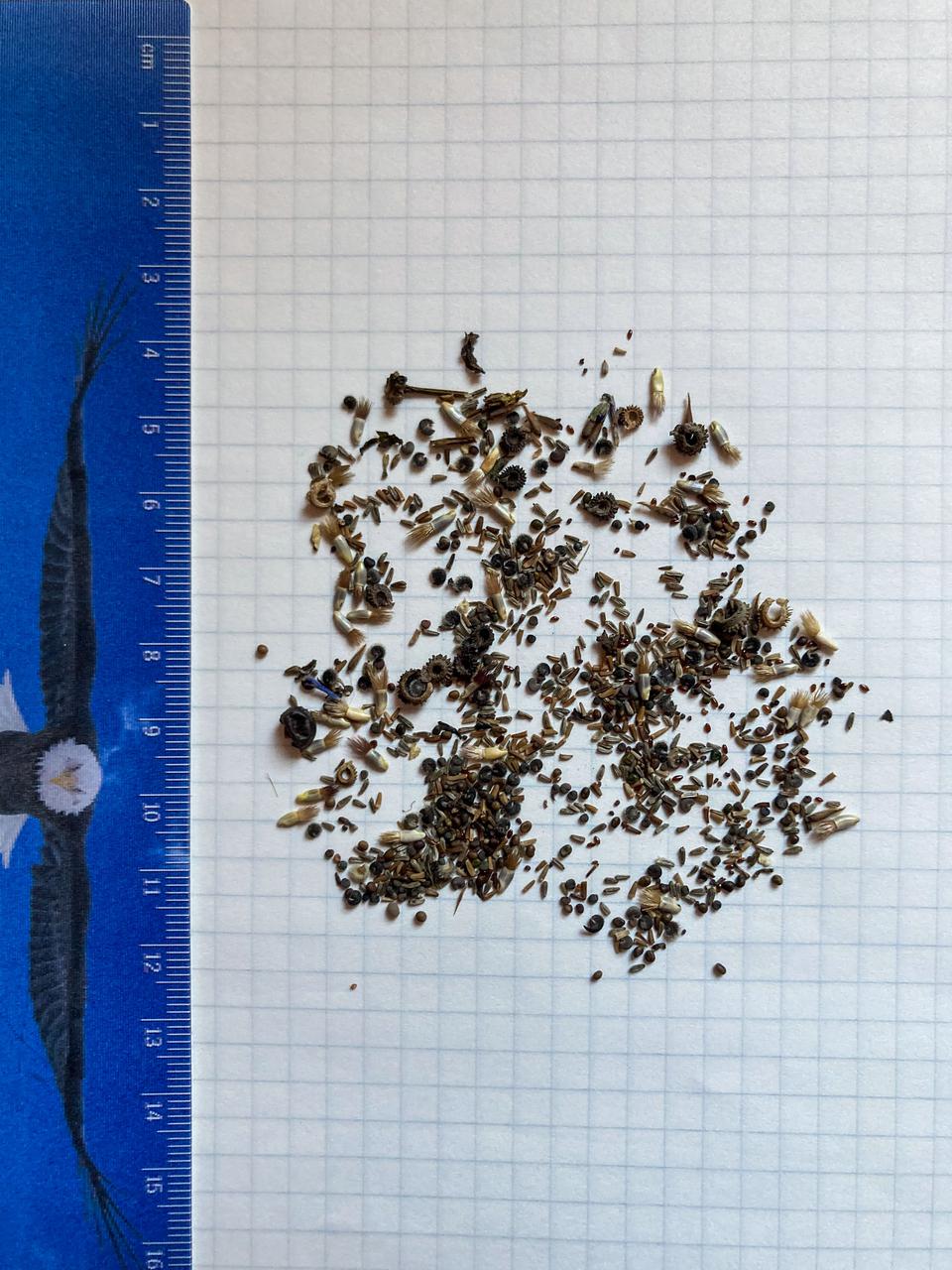
jsc2021e037882 (4/26/2021) --- A preflight photo of the contents of the seed packages of the Seeds and Martian Yeast investigation. Seeds are flown to the International Space Station (ISS) and back to Earth. The main objective of the investigation is to engage a significant number of students in primary and secondary schools in growing samples of space flown and non-space flown seeds. This activity aims to raise awareness about the continuous decline of species, and promote the importance of biodiversity and nature. Image Courtesy DLR.
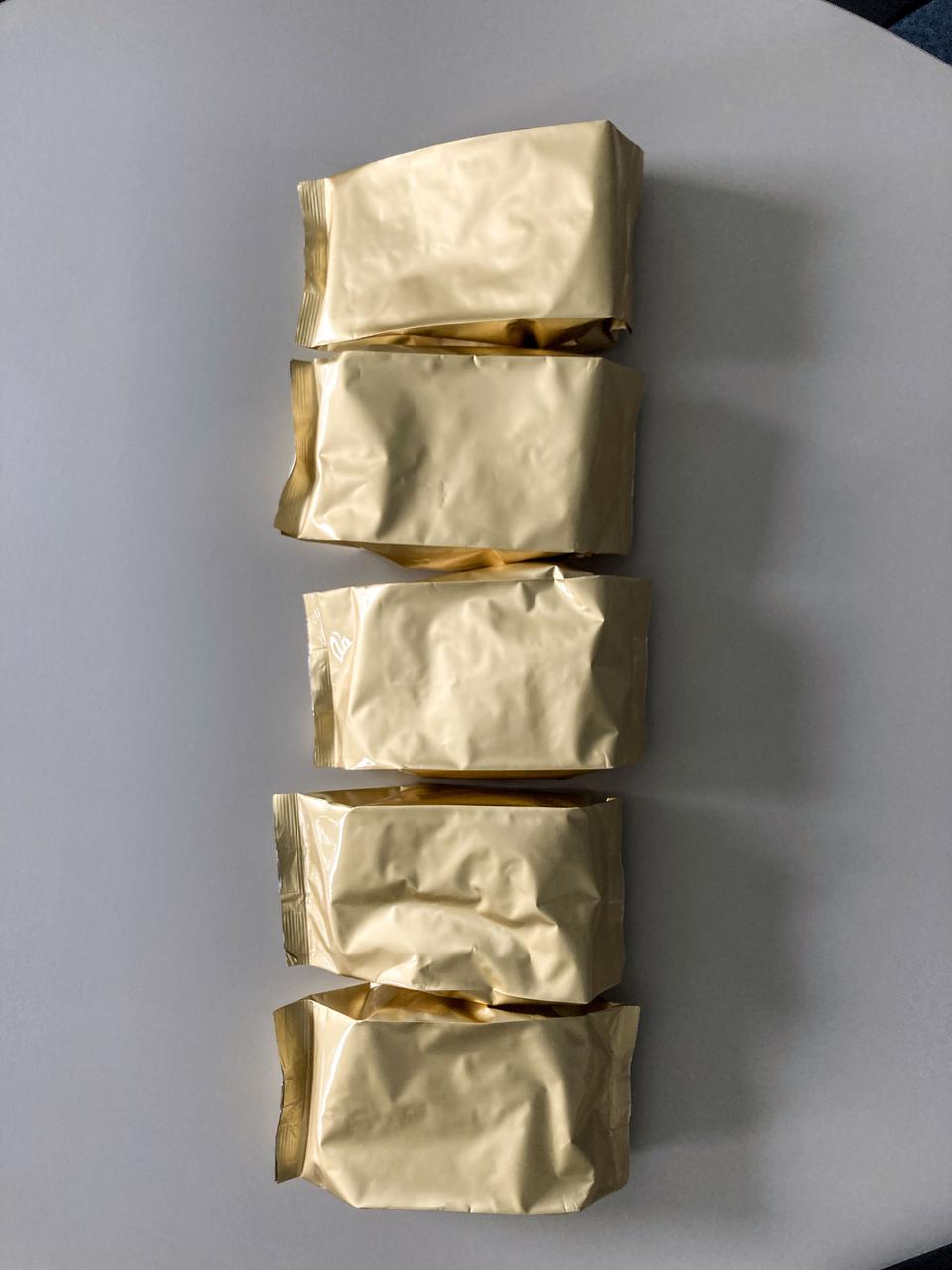
jsc2021e037880 (3/11/2021) --- A preflight photo of the five seed packages of the Seeds and Martian Yeast investigation. Seeds are flown to the International Space Station (ISS) and back to Earth. The main objective of the investigation is to engage a significant number of students in primary and secondary schools in growing samples of space flown and non-space flown seeds. This activity aims to raise awareness about the continuous decline of species, and promote the importance of biodiversity and nature. Image Courtesy DLR.
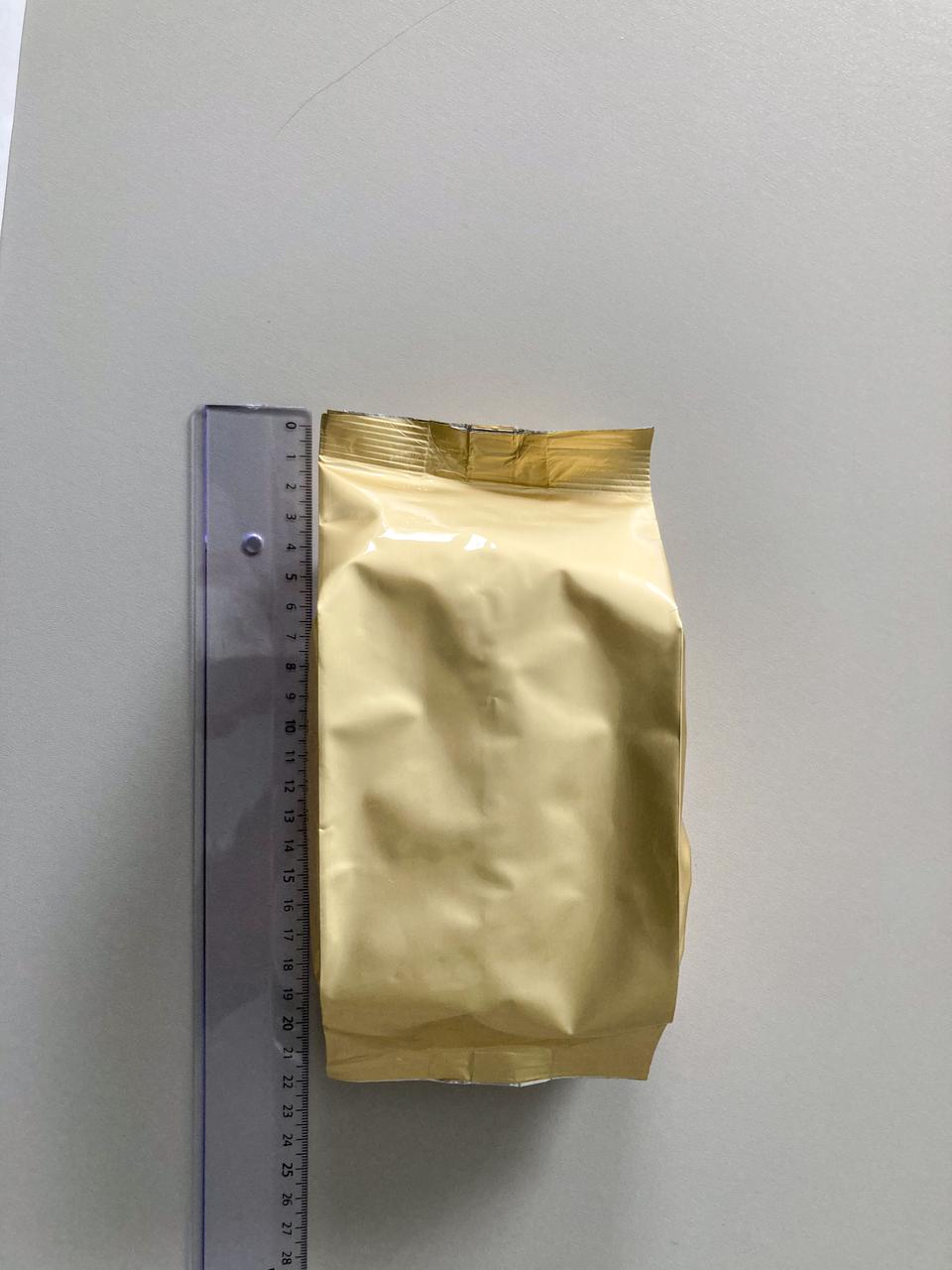
jsc2021e037881 (3/11/2021) --- A preflight photo of one seed package of the Seeds and Martian Yeast investigation. Seeds are flown to the International Space Station (ISS) and back to Earth. The main objective of the investigation is to engage a significant number of students in primary and secondary schools in growing samples of space flown and non-space flown seeds. This activity aims to raise awareness about the continuous decline of species, and promote the importance of biodiversity and nature. Image Courtesy DLR.
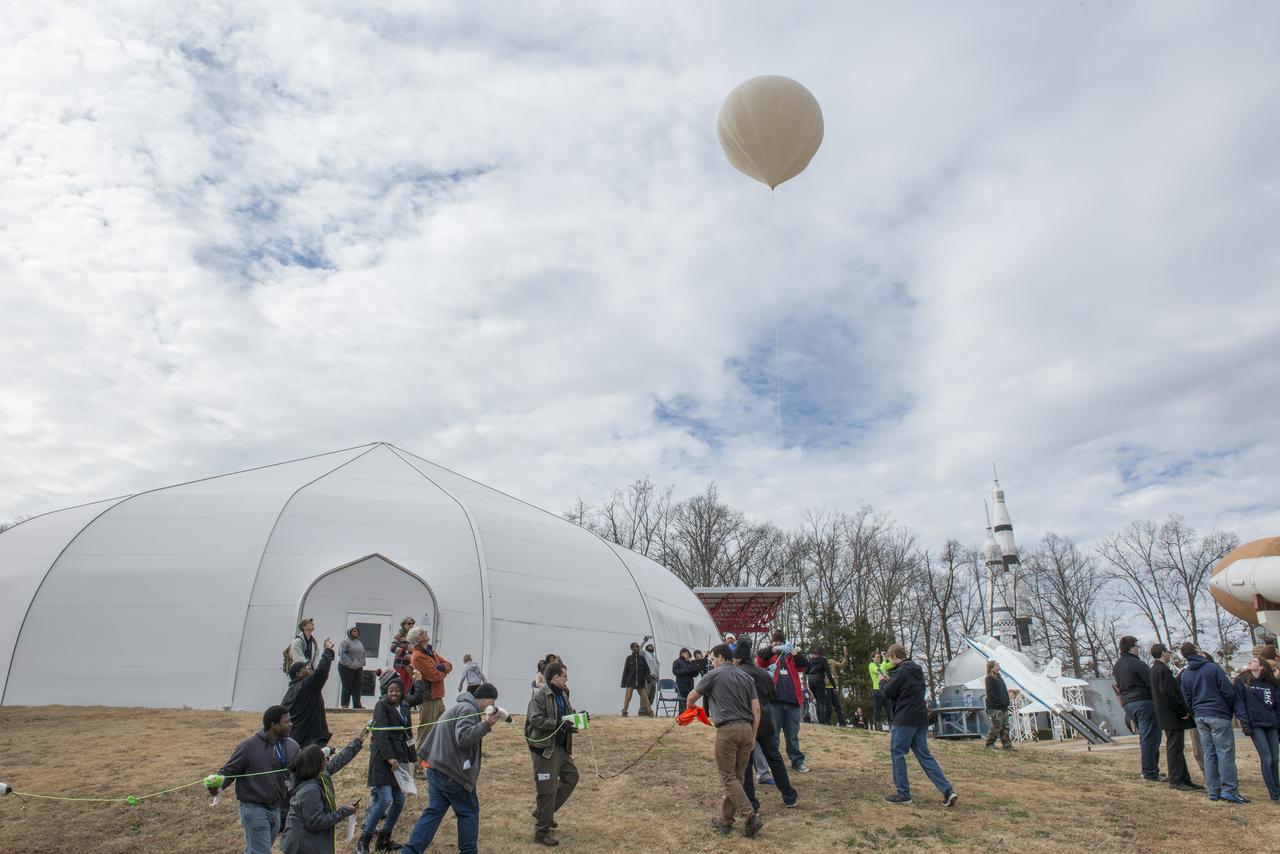
STUDENTS FROM COMMUNITY COLLEGES THROUGHOUT THE SOUTH CAME TOGETHER AT THE U.S. SPACE AND ROCKET CENTER FOR THE BALLOONSAT LAUNCH EVENT. EACH COMMUNITY COLLEGE TEAM ASSEMBLED ITS OWN PAYLOAD, DESIGNED TO DOWNLOAD SCIENTIFIC AND ATMOSPHERIC INFORMATION, AND THEN 2 WEATHER BALLOONS WERE SENT ALOFT TO APPROXIMATELY 100,000 FEET WITH THE PAYLOADS. THE PAYLOADS WERE RECOVERED IN N. GEORGIA AND TAKEN BACK TO THE INDIVIDUAL SCHOOLS FOR DOWNLOADING.
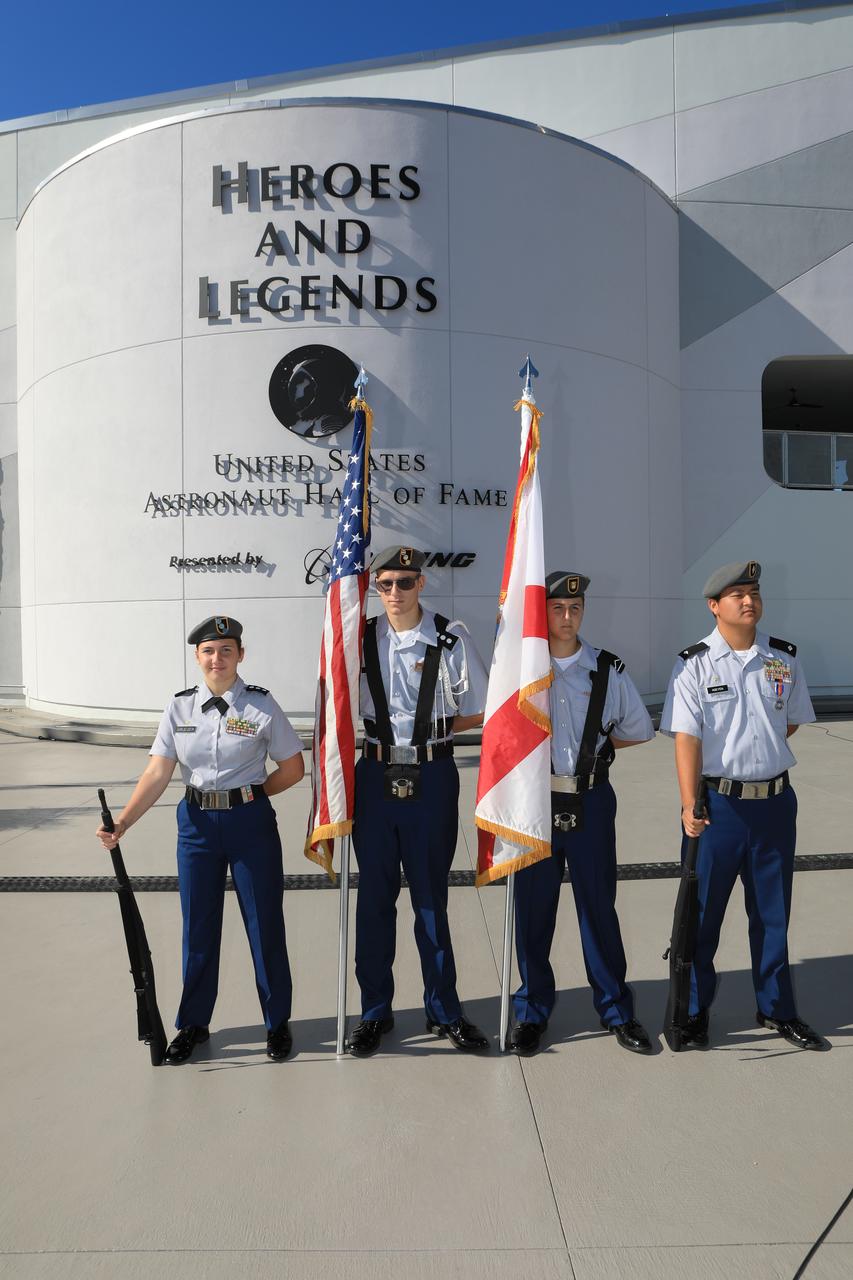
Members of the Merritt Island High School Army Reserve Officers' Training Corps (ROTC) present the colors during the grand opening of the Heroes and Legends attraction at the Kennedy Space Center Visitor Complex. The new facility includes the U.S. Astronaut Hall of Fame and looks back to the pioneering efforts of Mercury, Gemini and Apollo. It sets the stage by providing the background and context for space exploration and the legendary men and women who pioneered the nation's journey into space.
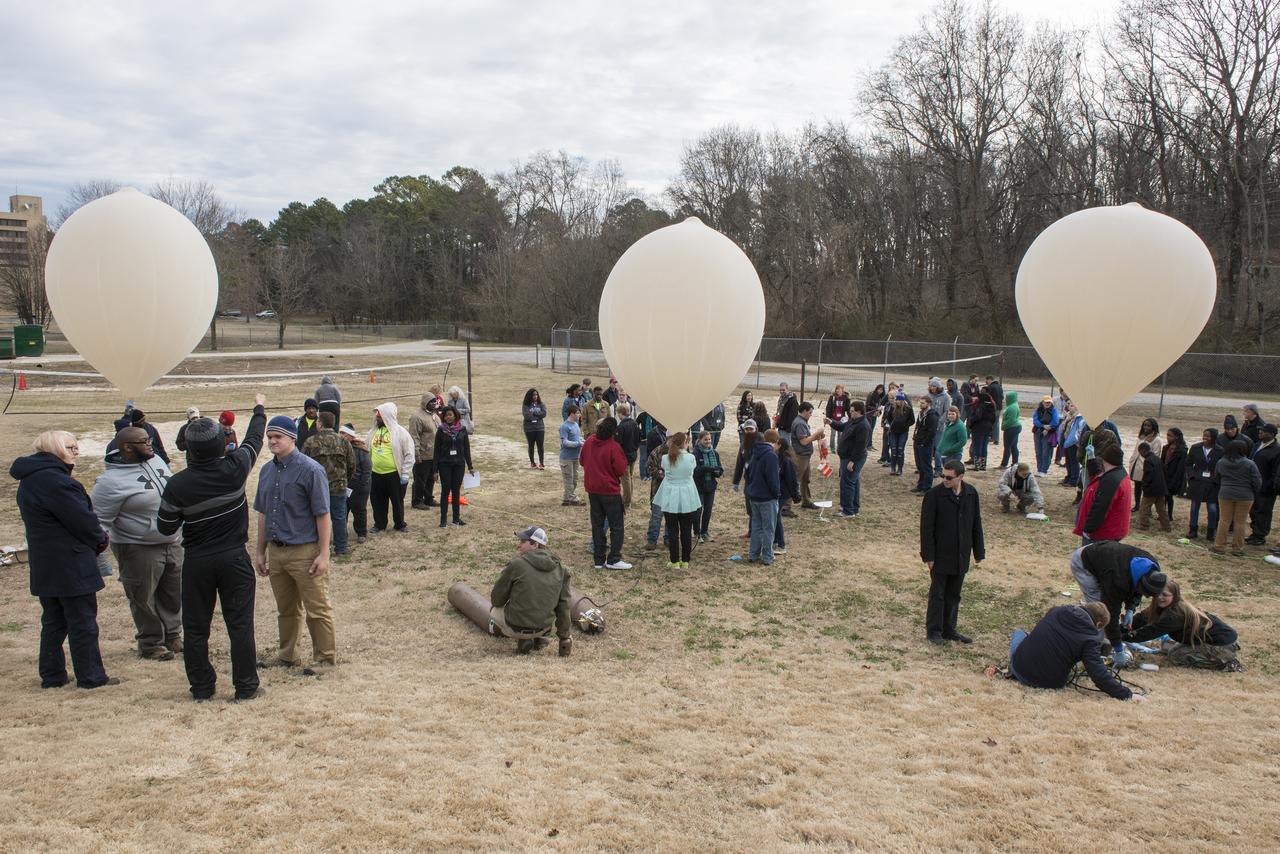
STUDENTS FROM COMMUNITY COLLEGES THROUGHOUT THE SOUTH CAME TOGETHER AT THE U.S. SPACE AND ROCKET CENTER FOR THE BALLOONSAT LAUNCH EVENT. EACH COMMUNITY COLLEGE TEAM ASSEMBLED ITS OWN PAYLOAD, DESIGNED TO DOWNLOAD SCIENTIFIC AND ATMOSPHERIC INFORMATION, AND THEN 2 WEATHER BALLOONS WERE SENT ALOFT TO APPROXIMATELY 100,000 FEET WITH THE PAYLOADS. THE PAYLOADS WERE RECOVERED IN N. GEORGIA AND TAKEN BACK TO THE INDIVIDUAL SCHOOLS FOR DOWNLOADING.

KENNEDY SPACE CENTER, FLA. - Students from one of NASA’s Explorer Schools, Stewart Middle School in Tampa pose for a photo with other guests visiting the Museum of Science and Industry (MOSI) in Tampa. At left, in the back row, are former astronaut Dan Brandenstein, current vice president of Consolidated Space Operations Centers (CSOC), and KSC Deputy Director Dr. Woodrow Whitlow Jr. In the center is Ronte Smith, southeast regional sales manager for General Motors, and Gail Rymer, with Lockheed Martin. On the right are Dr. Adena Williams Loston, chief education officer at NASA Headquarters, and Wit Ostrenko, president of MOSI. The MOSI is featuring the space exhibits Space: A Journey to Our Future, an extraordinary, interactive exhibition designed to entertain, educate and inspire; and SPACE STATION, the first cinematic journey to the International Space Station (ISS), where audiences can experience for themselves life in zero gravity aboard the new station.
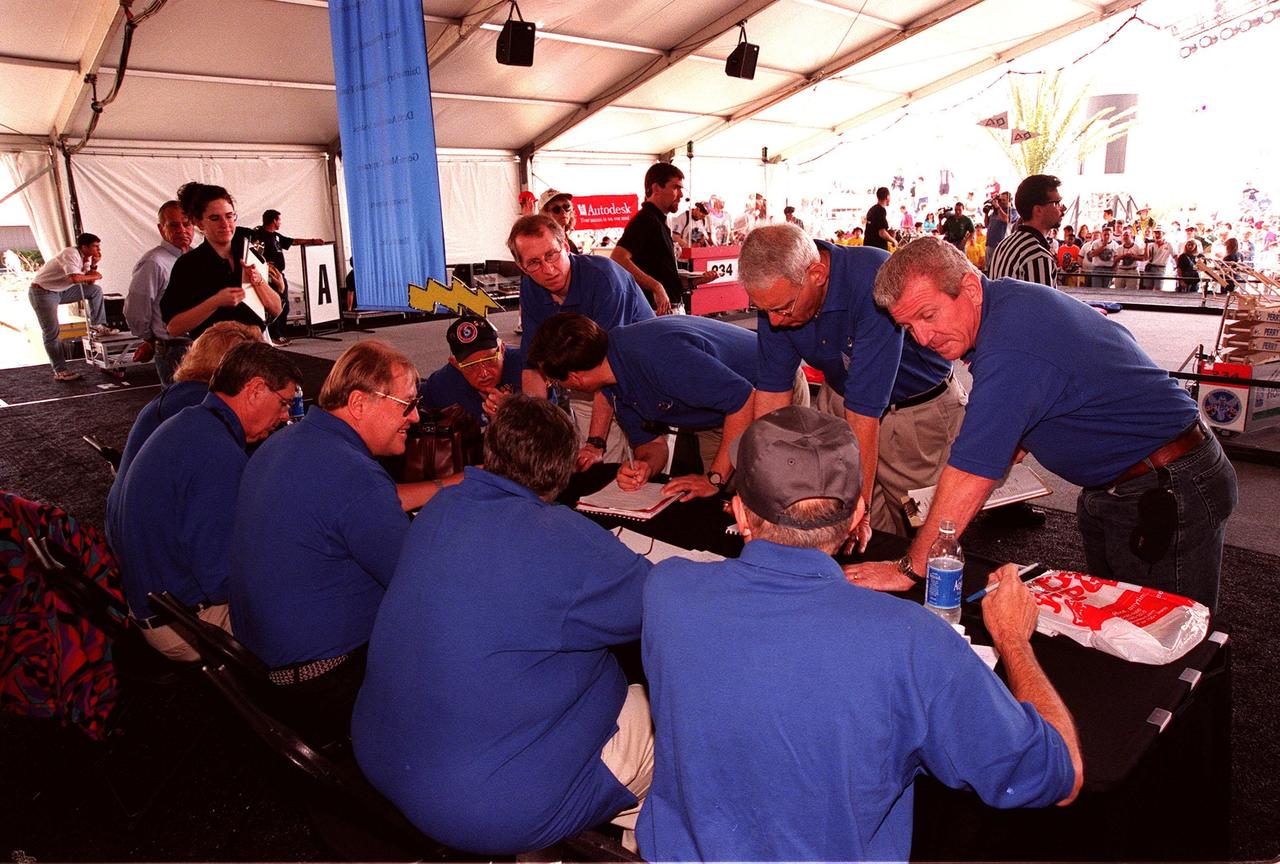
At the 1999 FIRST Southeastern Regional robotic competition held at KSC, judges compare notes about a match. Serving as judges are Deputy Director for Launch and Payload Processing Loren Shriver (above right) and former KSC Director of Shuttle Processing Robert Sieck (below, with back to camera). FIRST is a nonprofit organization, For Inspiration and Recognition of Science and Technology, that sponsors the event pitting gladiator robots against each other in an athletic-style competition. The FIRST robotics competition is designed to provide students with a hands-on, inside look at engineering and other professional careers, pairing high school students with engineer mentors and corporations. The regional event comprised 27 teams. Along with the championship award, which went to high school teams in Miami and San German, Puerto Rico, 15 other awards were presented
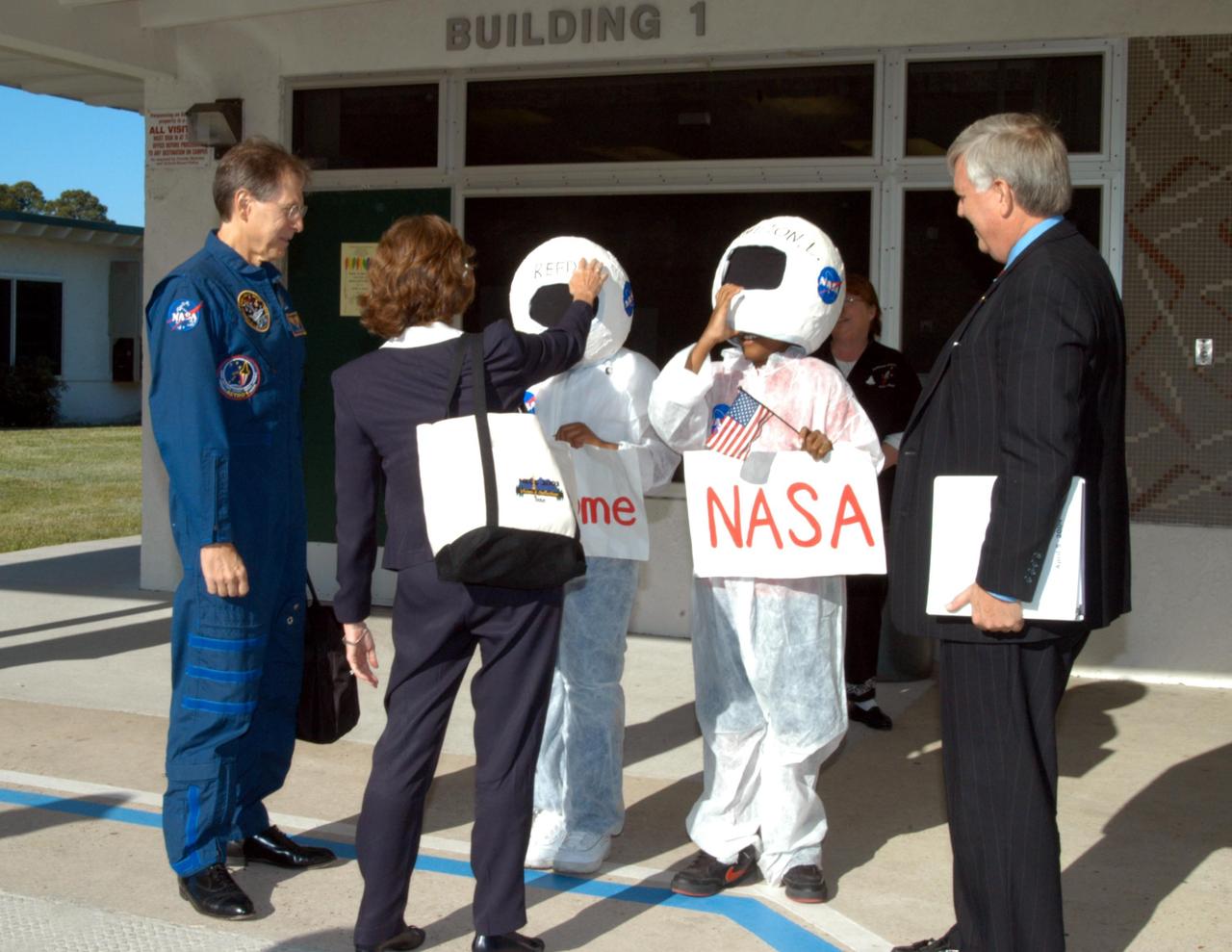
KENNEDY SPACE CENTER, FLA. -- Pam Biegert (back to camera), chief of KSC’s Education Programs and University Research Office, praises the costumes of two students who welcomed NASA representatives to Oscar Patterson Elementary Magnet School in Panama City, Fla. At left is astronaut Sam Durrance, and at right is Center Director Jim Kennedy. NASA-KSC officials are visiting NASA Explorer Schools in Florida and Georgia to share America’s new vision for space exploration with the next generation of explorers. Kennedy is talking with students about our destiny as explorers, NASA’s stepping stone approach to exploring Earth, the Moon, Mars and beyond, how space impacts our lives, and how people and machines rely on each other in space.
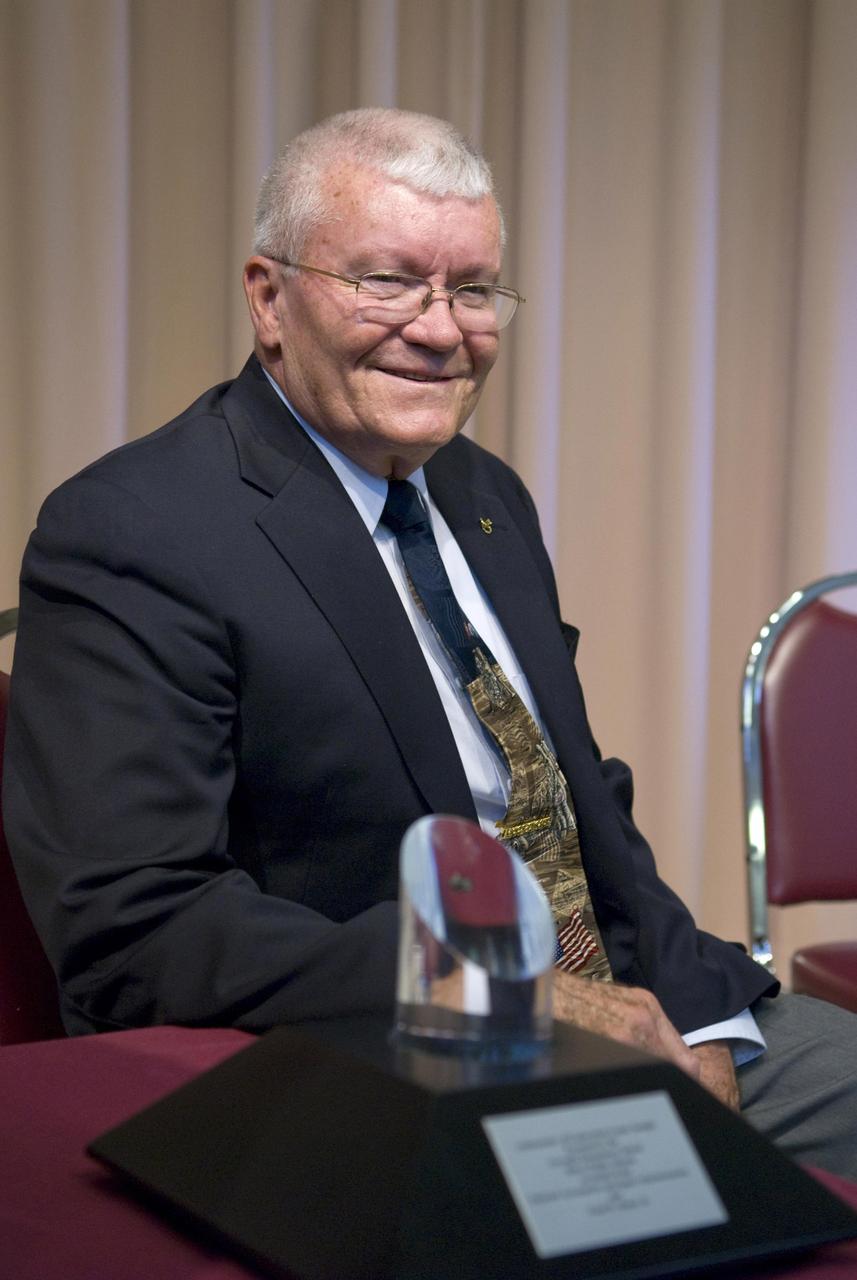
Apollo 13 astronaut and Biloxi native Fred Haise Jr. smiles during a Dec. 2 ceremony at Gorenflo Elementary School in Biloxi honoring his space career. During the ceremony, Haise was presented with NASA's Ambassador of Exploration Award (an encased moon rock). He subsequently presented the moon rock to Gorenflo officials for display at the school. Haise is best known as one of three astronauts who nursed a crippled Apollo 13 spacecraft back to Earth during a perilous 1970 mission. Although he was unable to walk on the moon as planned for that mission, Haise ended his astronaut career having logged 142 hours and 54 minutes in space. During the ceremony, he praised all those who contributed to the space program.
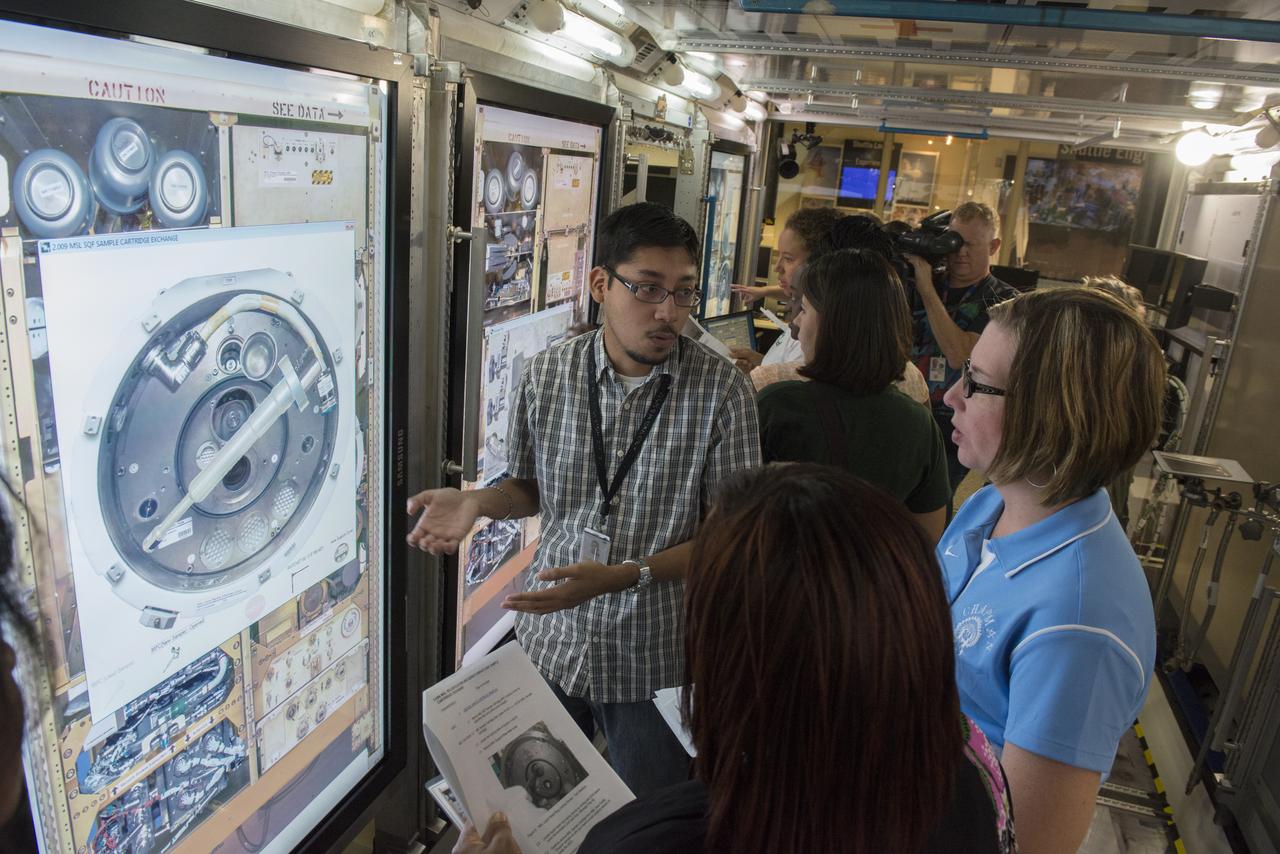
VINCENT VIDAURRI, CENTER, A TECHNICAL SPECIALIST WITH TELEDYNE BROWN ENGINEERING SUPPORTING MISSION OPERATIONS AT THE MARSHALL SPACE FLIGHT CENTER, PROVIDES DETAILS ABOUT A MOCK-UP OF THE INTERNATIONAL SPACE STATION SCIENCE LAB TO A GROUP OF AREA TEACHERS AS PART OF "BACK-2-SCHOOL DAY." TEAM REDSTONE -- WHICH INCLUDES THE MARSHALL SPACE FLIGHT CENTER AND U.S. ARMY ORGANIZATIONS ON REDSTONE ARSENAL -- INVITED 50 TEACHERS TO TOUR REDSTONE ARSENAL AUG. 15, GIVING THEM AN OPPORTUNITY TO LEARN OF AND SEE RESOURCES AVAILABLE TO THEM AND THEIR STUDENTS. THE TOUR FOCUSED ON SITES AVAILABLE FOR FIELD TRIPS FOR STUDENTS STUDYING MATH, SCIENCE, TECHNOLOGY AND ENGINEERING. STOPS INCLUDED MARSHALL'S PAYLOAD OPERATIONS INTEGRATION CENTER AND THE HIGH SCHOOLS UNITED WITH NASA TO CREATE HARDWARE LAB, OR HUNCH, BOTH LOCATED IN BUILDING 4663. THE PROGRAM GIVES HIGH SCHOOL STUDENTS THE CHANCE TO WORK WITH NASA ENGINEERS TO DESIGN AND BUILD HARDWARE FOR USE ON THE INTERNATIONAL SPACE STATION. THE TEACHERS ALSO VISITED THE ARMY AVIATION & MISSILE RESEARCH DEVELOPMENT & ENGINEERING CENTER AND THE REDSTONE TEST CENTER
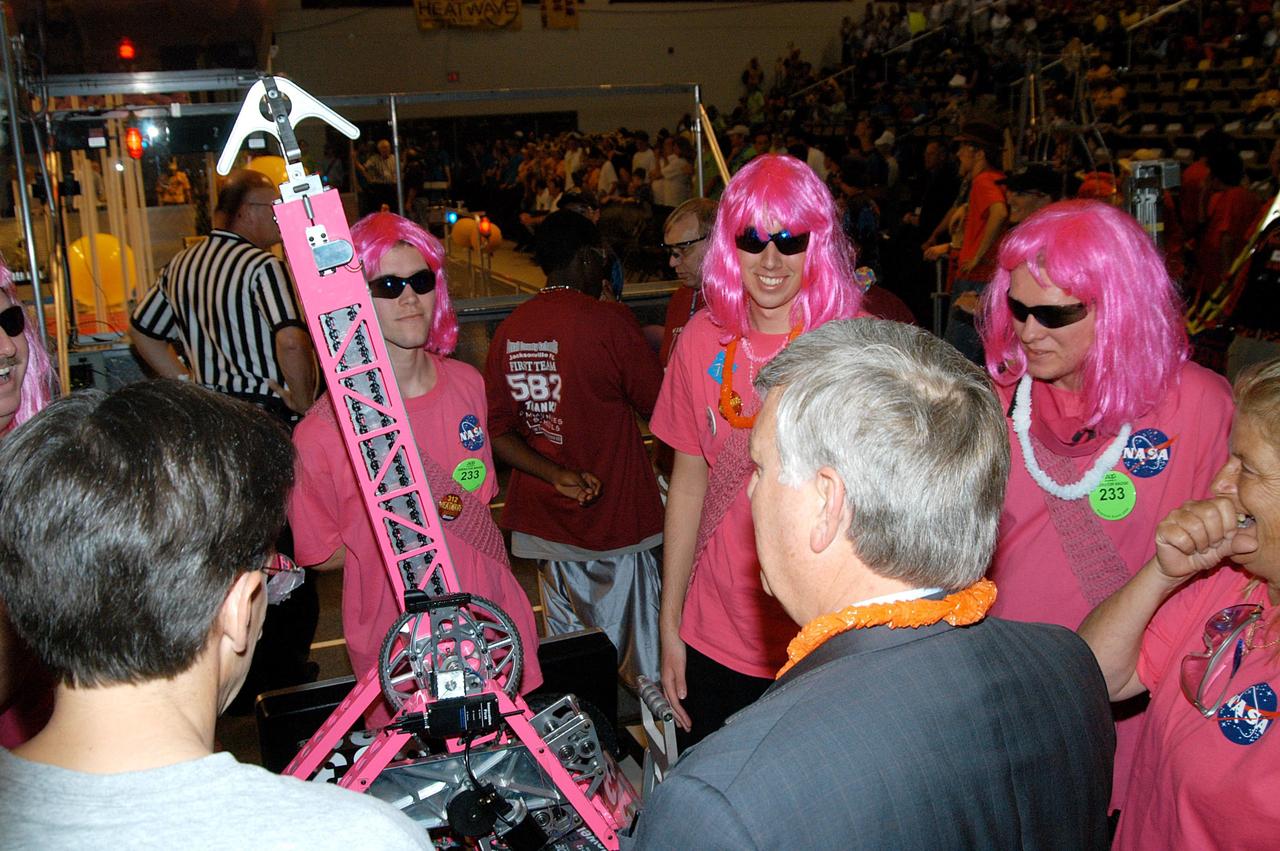
KENNEDY SPACE CENTER, FLA. - Center Director Jim Kennedy (right, back to camera) talks to members of the KSC-sponsored “Pink” team at the 2004 Florida Regional FIRST competition, held at the University of Central Florida. The annual event is hosting 41 teams from Canada, Brazil, Great Britain and the United States. FIRST is a nonprofit organization, For Inspiration and Recognition of Science and Technology, that sponsors the event pitting robots against each other in an athletic-style competition. The FIRST robotics competition is designed to provide students with a hands-on, inside look at engineering and other professional careers, pairing high school students with engineer mentors and corporations.
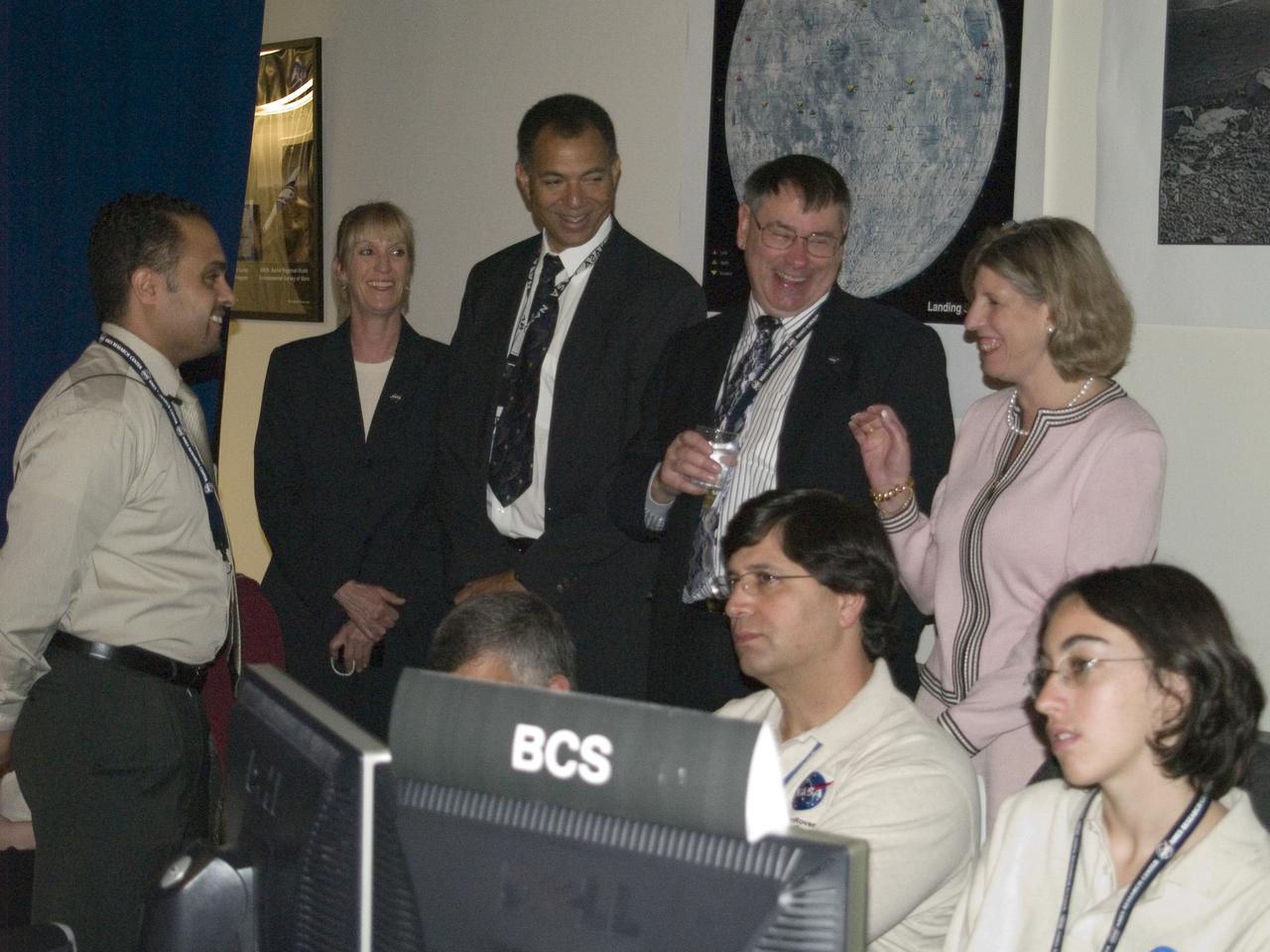
Spaceward Bound Program in Atacama Desert; shown here is a realtime webcast from Yungay, Chile vis satellite involving NASA Scientists and seven NASA Explorer school teachers. On the Ames end we find the Girl Scouts Space cookines robotic team. The robot nicknamed Zoe is looking for life in extreme environments in preparation for what might be encounter on Mars. (back row l-r) Yvonne Clearwater, Ames Education Division, Donald James, Ames Education Division Chief, Pete Worden, Ames Center Director, Angela Diaz, Ames Director of Strategic Communications) see full text on the NASA-Ames News - Research # 04-91AR
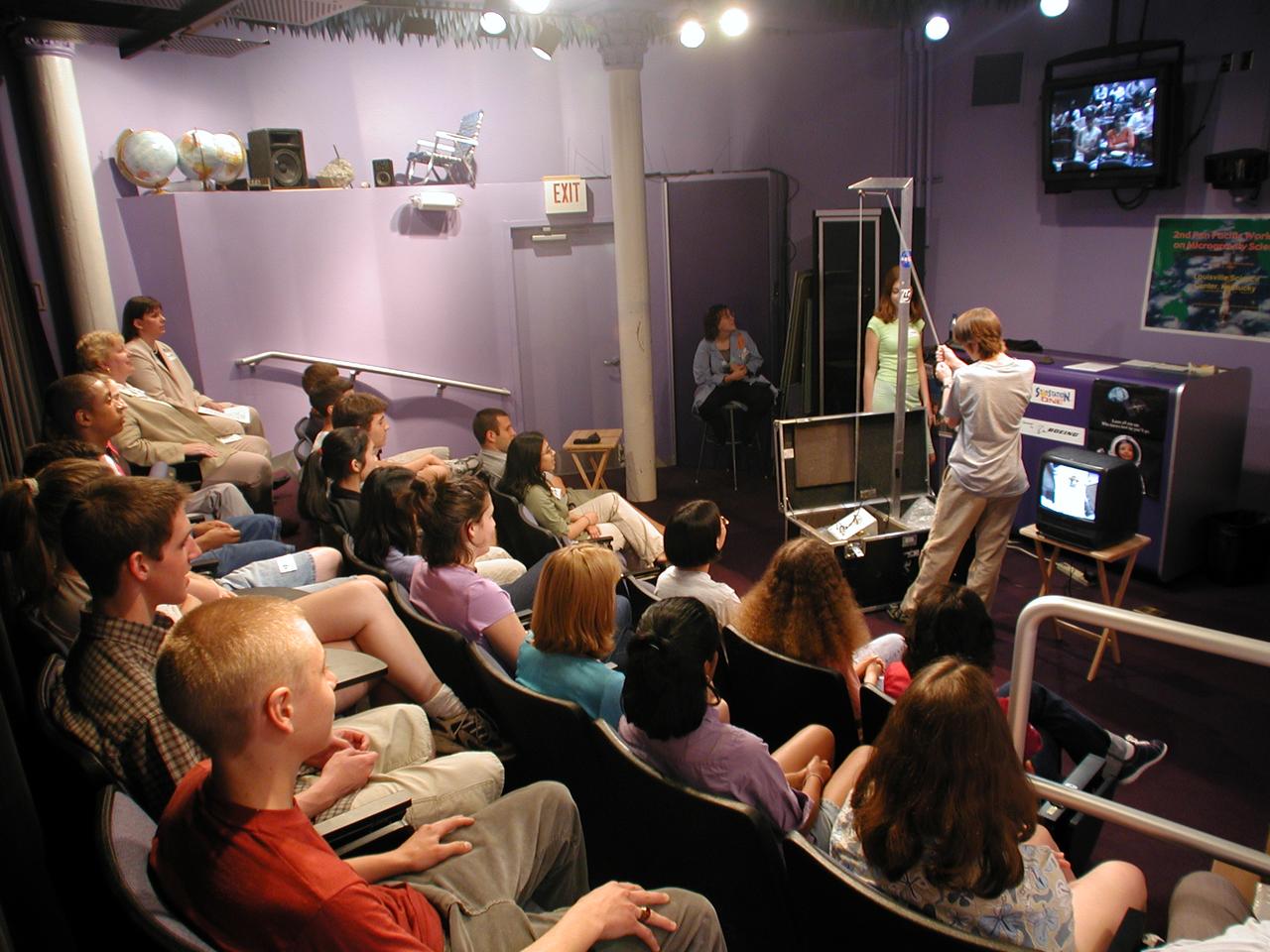
John Henson (grade 12) and Suzi Bryce (grade 10) from DuPont Manual High School in Louisville, Kentucky, conduct a drop with NASA's Microgravity Demonstrator. A camera and a TV/VCR unit let students play back recordings of how different physical devices behave differently during freefall as compared to 1-g. The activity was part of the education outreach segment of the Pan-Pacific Basin Workshop on Microgravity Sciences held in Pasadena, California. The event originated at the California Science Center in Los Angeles. The DuPont Manual students patched in to the event through the distance learning lab at the Louisville Science Center. This image is from a digital still camera; higher resolution is not available.
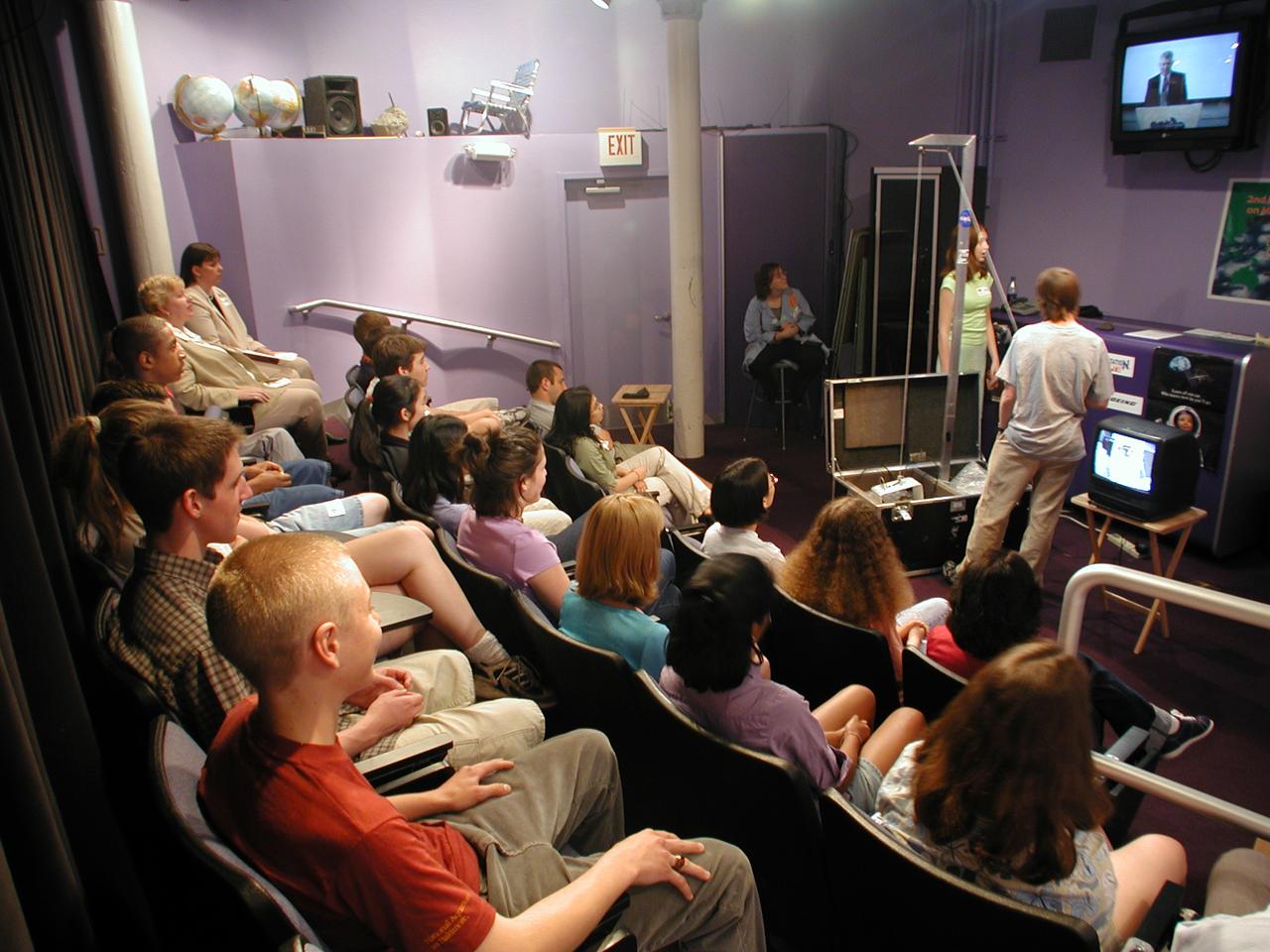
John Henson (grade 12) and Suzi Bryce (grade 10) conducted the drop from DuPont Manual High School in Louisville, Kentucky, conduct a drop with NASA's Microgravity Demonstrator. A camera and a TV/VCR unit let students play back recordings of how different physical devices behave differently during freefall as compared to 1-g. The activity was part of the education outreach segment of the Pan-Pacific Basin Workshop on Microgravity Sciences held in Pasadena, California. The event originated at the California Science Center in Los Angeles. The DuPont Manual students patched in to the event through the distance learning lab at the Louisville Science Center. This image is from a digital still camera; higher resolution is not available.
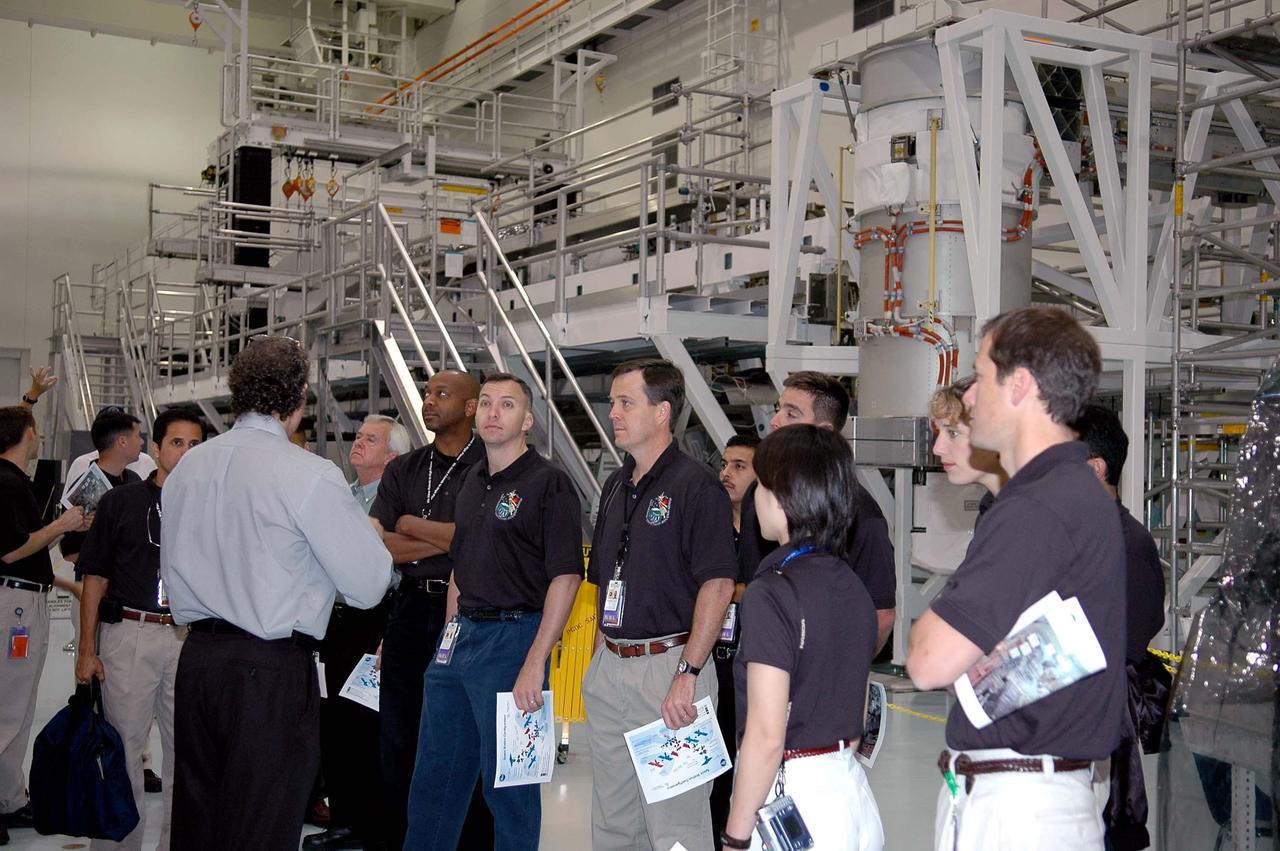
KENNEDY SPACE CENTER, FLA. - At NASA’s Kennedy Space Center, the 2004 class of astronaut candidates tour the Space Station Processing Facility (SSPF). At left (back to camera) is Russell Romanella, deputy director of ISS and Payload Processing, who is talking about the program and the elements in the SSPF. The astronaut candidates are at KSC to participate in firefighting training and familiarization tours. The class of 14 candidates includes three candidates from the Japan Aerospace Exploration Agency as well as three educator astronauts, who were school teachers chosen from thousands of applicants.
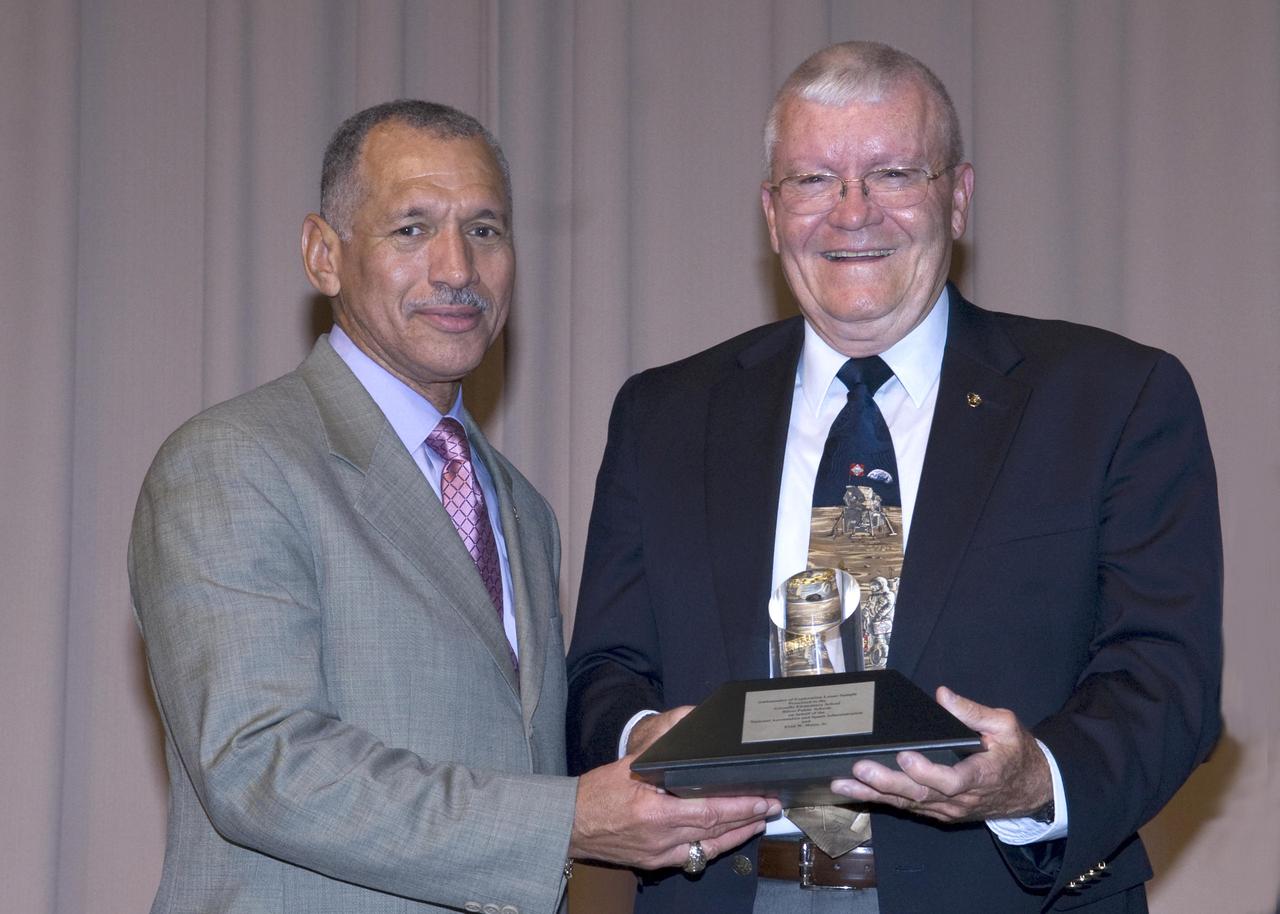
NASA Administrator Charles Bolden (left) presents the Ambassador of Exploration Award (an encased moon rock) to Biloxi native and Apollo 13 astronaut Fred Haise Jr. (right) for his contributions to space exploration. During a Dec. 2 ceremony at Gorenflo elementary School in Biloxi, Miss., Bolden praised Haise for his overall space career and his performance on the Apollo 13 mission that was crippled two days after launch. Haise and fellow crewmembers nursed the spacecraft on a perilous trip back to Earth. 'The historic Apollo 13 mission was as dramatic as any Hollywood production,' Bolden said. 'When an explosion crippled his command module, Fred and his crewmates, Jim Lovell and Jack Swigert, guided their spacecraft around the moon and back to a successful splashdown in the Pacific Ocean - all while the world held its breath. While Fred didn't have the chance to walk on the moon, the cool courage and concentration in the face of crisis is among NASA's most enduring legacies.'
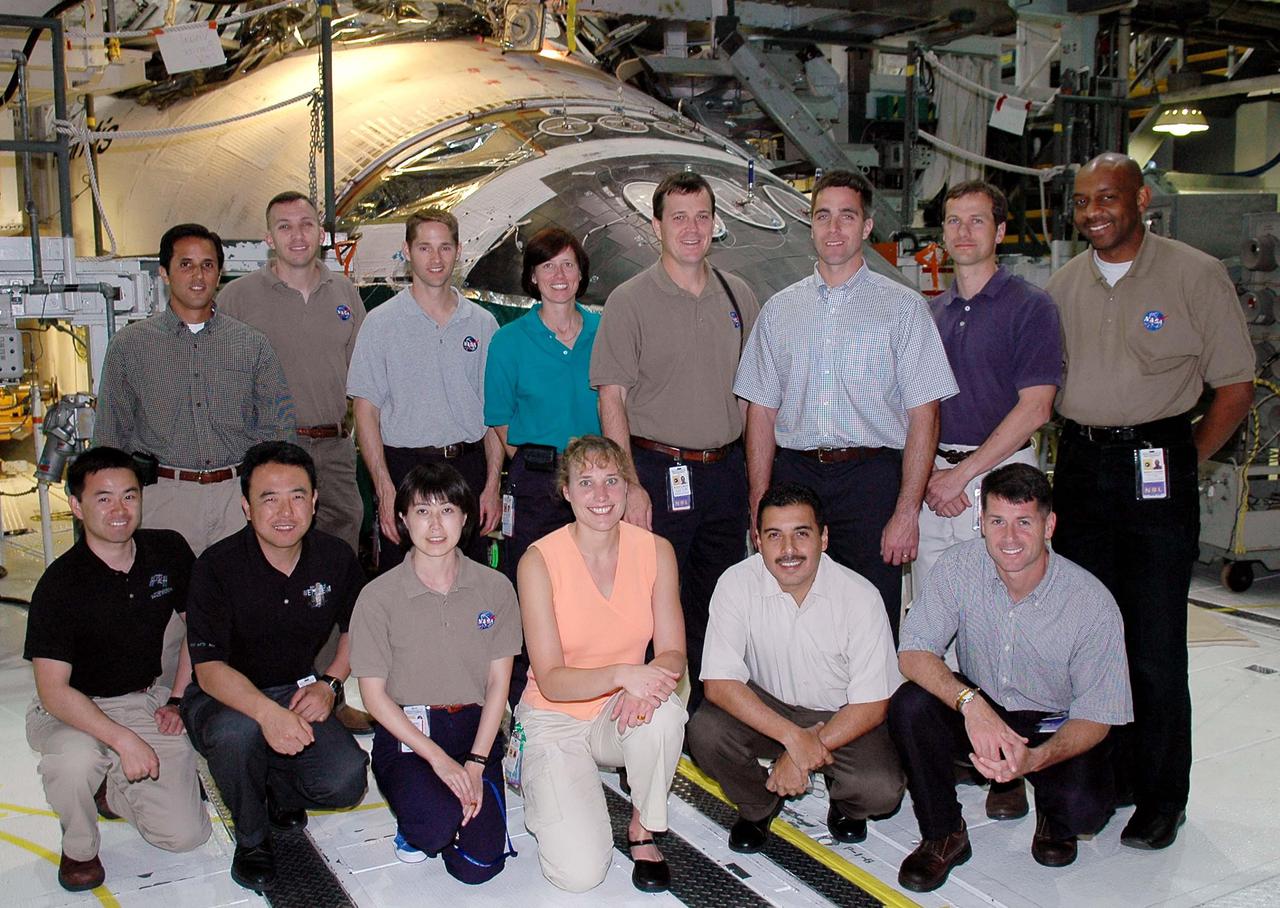
KENNEDY SPACE CENTER, FLA. - At NASA’s Kennedy Space Center, the 2004 class of astronaut candidates gather for a class photo in front of the nose of Atlantis in the Orbiter Processing Facility bay 1. In the back row, from left to right, are Joseph Acaba, Randolph Bresnik, James Dutton, Shannon Walker, Richard Arnold II, Christopher Cassidy, Thomas Marshburn and Robert Satcher. In the front row, left to right, are Akahiko Hoshide, Satoshi Furukawa, Naoko Yamazaki, Dorothy Metcalf-Lindenburger, Jose Hernandez and Robert Kimbrough. Atlantis is being processed for Return to Flight mission STS-121 in July. The astronaut candidates are at KSC to participate in firefighting training and familiarization tours. The class of 14 candidates includes three candidates from the Japan Aerospace Exploration Agency as well as three educator astronauts, who were school teachers chosen from thousands of applicants.
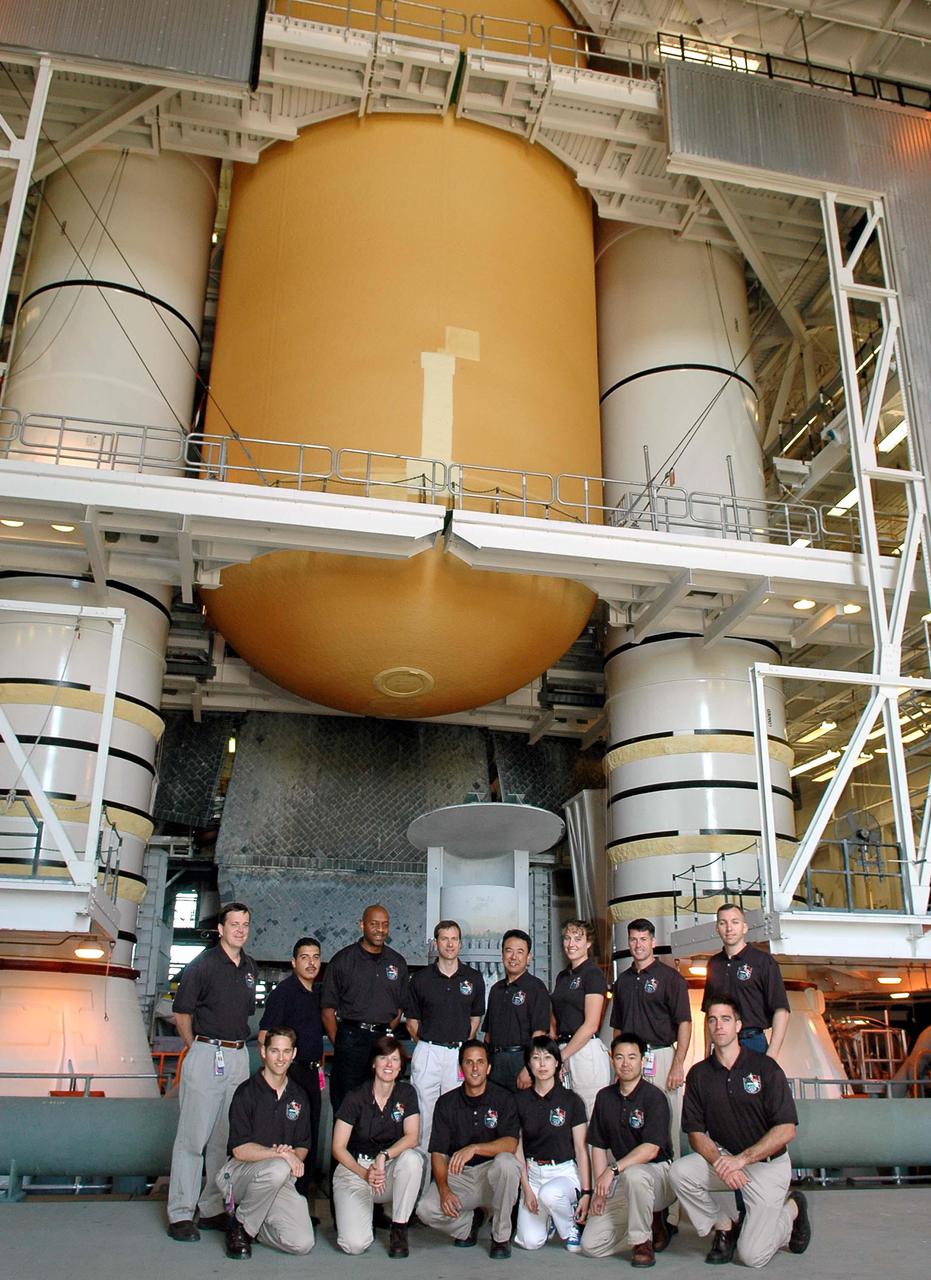
KENNEDY SPACE CENTER, FLA. - At NASA’s Kennedy Space Center, the 2004 class of astronaut candidates gather for a photo in front of Space Shuttle Discovery in the Vehicle Assembly Building. Above them are the External Tank and twin Solid Rocket Boosters. The ascans are, in the back row, left to right, Richard Arnold II, Jose Hernandez, Robert Satcher, Thomas Marshburn, Satoshi Furukawa, Dorothy Metcalf-Lindenburger, Robert Kimbrough and Randolph Bresnik; in the front row, left to right, are James Dutton, Shannon Walker, Joseph Acaba, Naoko Yamazaki, Akahiko Hoshide and Christopher Cassidy. The class of 14 candidates includes three candidates from the Japan Aerospace Exploration Agency as well as three educator astronauts, who were school teachers chosen from thousands of applicants.
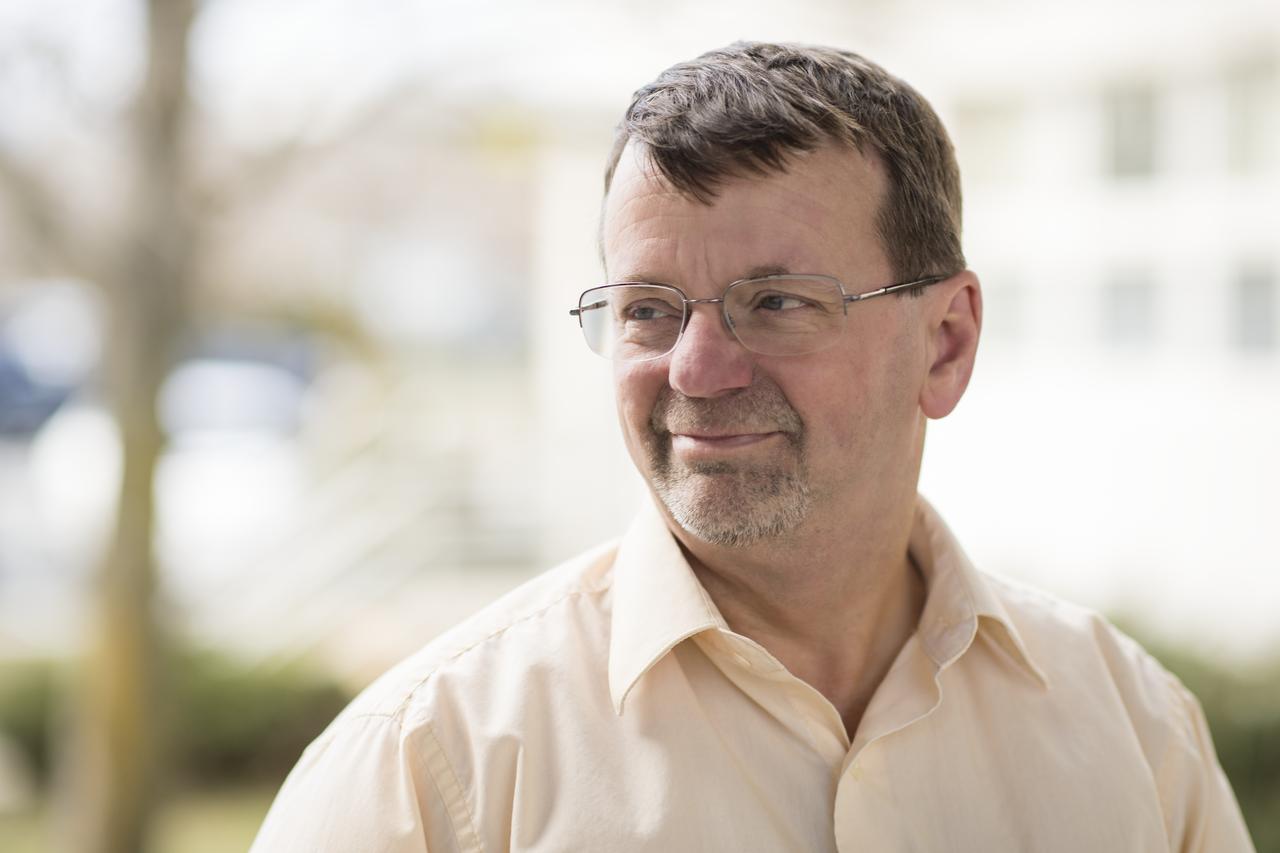
“I’ve always had an interest, even as a little kid, in mechanical things. How things work. I was good at math when I was younger. I liked science. I was actually going to major in chemistry when I went to college. But during my senior year of high school, I found out I was colorblind. Back then, you didn’t have machines you put could something in and it would tell you what it was. You had to do litmus tests and fire tests, and based on the colors, determine what different things were. Well, I came to find out: I couldn’t do that. So, I happened to be working on the school paper in my senior year of high school and I figured I would go into journalism. I ended up covering things like science and construction because those were the things I liked and was interested in. Once I got to NASA, it was a marriage of two things I liked. Everyday I come in to work, I get to learn about a new project. I learn different things about launch vehicles, physics… all sorts of things. So I’m constantly learning something. Which is kind of cool! In my life I’ve learned that things don’t always go your way. You can either dwell on those things and mope and cry… or you can say: “Okay. Now what?” And so that’s what I did. I moved on. And I don’t know if I would have ended up at NASA if I hadn’t.” NASA Wallops Flight Facility News Chief, Keith Koehler, Friday, Feb. 7, 2020 at NASA NASA Wallops Flight Facility in Virginia. Photo Credit: (NASA/Aubrey Gemignani)
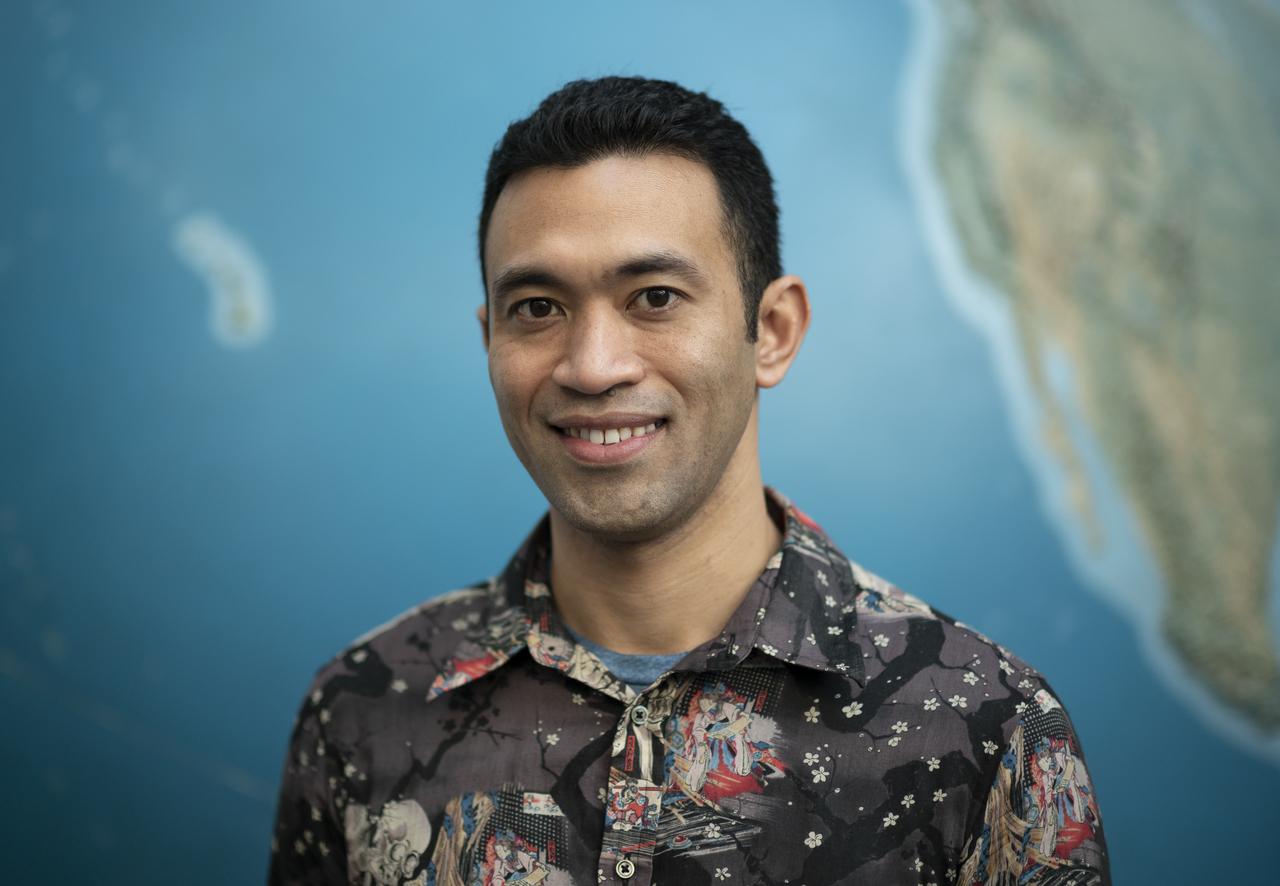
“Back home there’s a place called Mākua beach. It’s where I spent so much of my childhood. My grandfather had a little beachside camp area, and every day after school my dad and I would drive to the camp and visit my grandfather, and we’d go out fishing either on a rubber tube or a small fishing boat. There are so many memories of being with my dad and my grandfather and all of my calabash uncles there. My grandmother and my grandfather were both strongly connected to the beach. They actually both passed away on the beach, so that place has a special place in my heart. It’s a beautiful, beautiful quiet little pocket of sand and water, and every time I go back, I think of them and all of those memories. “The Hawaiians have been there for a thousand-plus years. And I have written documents that show my grandfather’s great-grandfather had an association with the area. It was a letter he wrote to a commission voicing his support for Native Hawaiian land rights in the valley. I love to go back every time I go home. Sometimes when it’s low tide, you can even find petroglyphs engraved on the rocks. There’s always something new to discover. “I know fishing is not as plentiful as it was before because of overfishing and likely other factors. Climate change is impacting a lot of coastal areas not just in Hawaii but also around the world, from erosion to coral bleaching. It’s powerful that we continue to learn how everyone and everything on Earth is interconnected. It’s what Native Hawaiians have long understood through our cosmology and approach to resource management. “That’s what makes communicating Earth science meaningful for me—knowing that indigenous Hawaiian wisdom and NASA research both point to the responsible management of and respect for the environment.” Samson Reiny, editor and senior outreach coordinator at NASA Earth Science News, Friday, Feb. 21, 2020, at NASA's Goddard Space Flight Center in Greenbelt, Md. Photo Credit: (NASA/Joel Kowsky)
!["Where I grew up [on my family farm] 100% shaped who I am. In fact, my son and I were talking about high schools and how big his is. His high school population is double the population of the town I grew up in. I had 20 kids in my graduating class, and three of them were foreign exchange students. He asked me, 'Do you wish you would have gone to a bigger school like us?' And I said, 'Actually, no, I don't.' I loved where I grew up. I absolutely cherish what it instilled in me, and that's something I carry with me all the time. "The earliest lesson was that you are part of something much bigger than yourself. Everybody has an important role in what they're doing, no matter how small. I remember when we were bringing in the corn. Right now, everybody buys it, but I didn't buy corn until maybe college because it was a whole family thing. We went and picked the corn. The little kids would shuck it, pulling off all the silk. The grown-ups would shave it off the cob and then push it off to the side, and then the older kids would bag it up into plastic bags. And then everybody went home. It was always about a team. You can be the youngest person or the lowest-ranking person, but you always bring something important to that table. "Everywhere I've been since I got commissioned [as an Air Force officer], my very first office in 1997, I hang an aerial picture of our farm on my wall because it's [a reminder to] remember where you came from, remember home, and don't get too big for your britches. No matter what, you could be part of something huge, and I look at that picture and say, 'I have always been part of something much bigger than myself.' All the little, tiny moments in life that build upon themselves trace back to that family farm for me." Alana Johnson, Senior Communications Specialist, poses for a portrait, Wednesday, Feb. 7, 2024, at the Mary W. Jackson NASA Headquarters building in Washington. Photo Credit: (NASA/Joel Kowsky)](https://images-assets.nasa.gov/image/NHQ202402070011/NHQ202402070011~medium.jpg)
"Where I grew up [on my family farm] 100% shaped who I am. In fact, my son and I were talking about high schools and how big his is. His high school population is double the population of the town I grew up in. I had 20 kids in my graduating class, and three of them were foreign exchange students. He asked me, 'Do you wish you would have gone to a bigger school like us?' And I said, 'Actually, no, I don't.' I loved where I grew up. I absolutely cherish what it instilled in me, and that's something I carry with me all the time. "The earliest lesson was that you are part of something much bigger than yourself. Everybody has an important role in what they're doing, no matter how small. I remember when we were bringing in the corn. Right now, everybody buys it, but I didn't buy corn until maybe college because it was a whole family thing. We went and picked the corn. The little kids would shuck it, pulling off all the silk. The grown-ups would shave it off the cob and then push it off to the side, and then the older kids would bag it up into plastic bags. And then everybody went home. It was always about a team. You can be the youngest person or the lowest-ranking person, but you always bring something important to that table. "Everywhere I've been since I got commissioned [as an Air Force officer], my very first office in 1997, I hang an aerial picture of our farm on my wall because it's [a reminder to] remember where you came from, remember home, and don't get too big for your britches. No matter what, you could be part of something huge, and I look at that picture and say, 'I have always been part of something much bigger than myself.' All the little, tiny moments in life that build upon themselves trace back to that family farm for me." Alana Johnson, Senior Communications Specialist, poses for a portrait, Wednesday, Feb. 7, 2024, at the Mary W. Jackson NASA Headquarters building in Washington. Photo Credit: (NASA/Joel Kowsky)
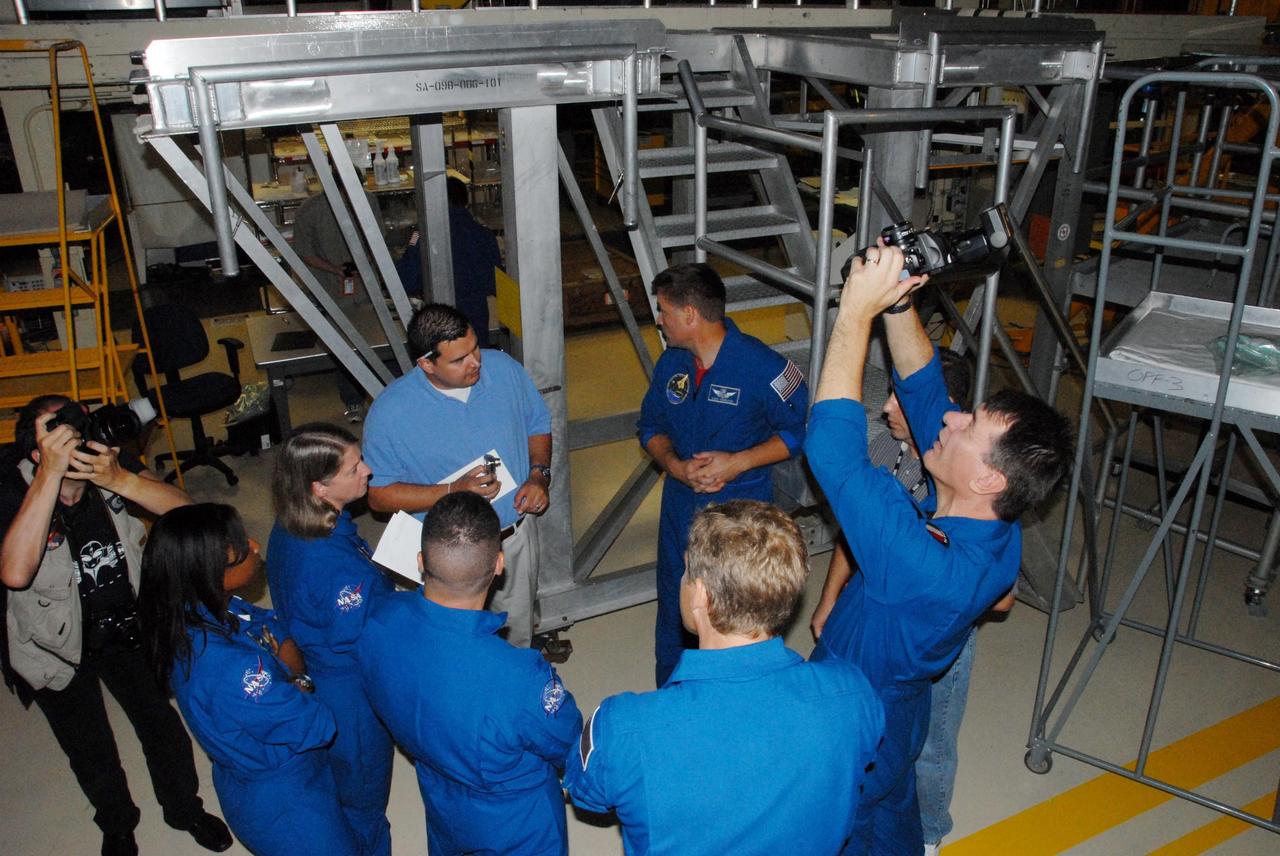
KENNEDY SPACE CENTER, FLA. - The STS-120 crew is at Kennedy for a crew equipment interface test, or CEIT. In Orbiter Processing Facility bay 3, from left in blue flight suits, STS-120 Mission Specialist Stephanie D. Wilson, Commander Pamela A. Melroy, Pilot George D. Zamka, Mission Specialist Scott E. Parazynski (back to camera), Mission Specialist Douglas H. Wheelock and Mission Specialist Paolo A. Nespoli (holding camera), a European Space Agency astronaut from Italy, are given the opportunity to operate the cameras that will fly on their mission. Among the activities standard to a CEIT are harness training, inspection of the thermal protection system and camera operation for planned extravehicular activities, or EVAs. The STS-120 mission will deliver the Harmony module, christened after a school contest, which will provide attachment points for European and Japanese laboratory modules on the International Space Station. Known in technical circles as Node 2, it is similar to the six-sided Unity module that links the U.S. and Russian sections of the station. Built in Italy for the United States, Harmony will be the first new U.S. pressurized component to be added. The STS-120 mission is targeted to launch on Oct. 20. Photo credit: NASA/George Shelton
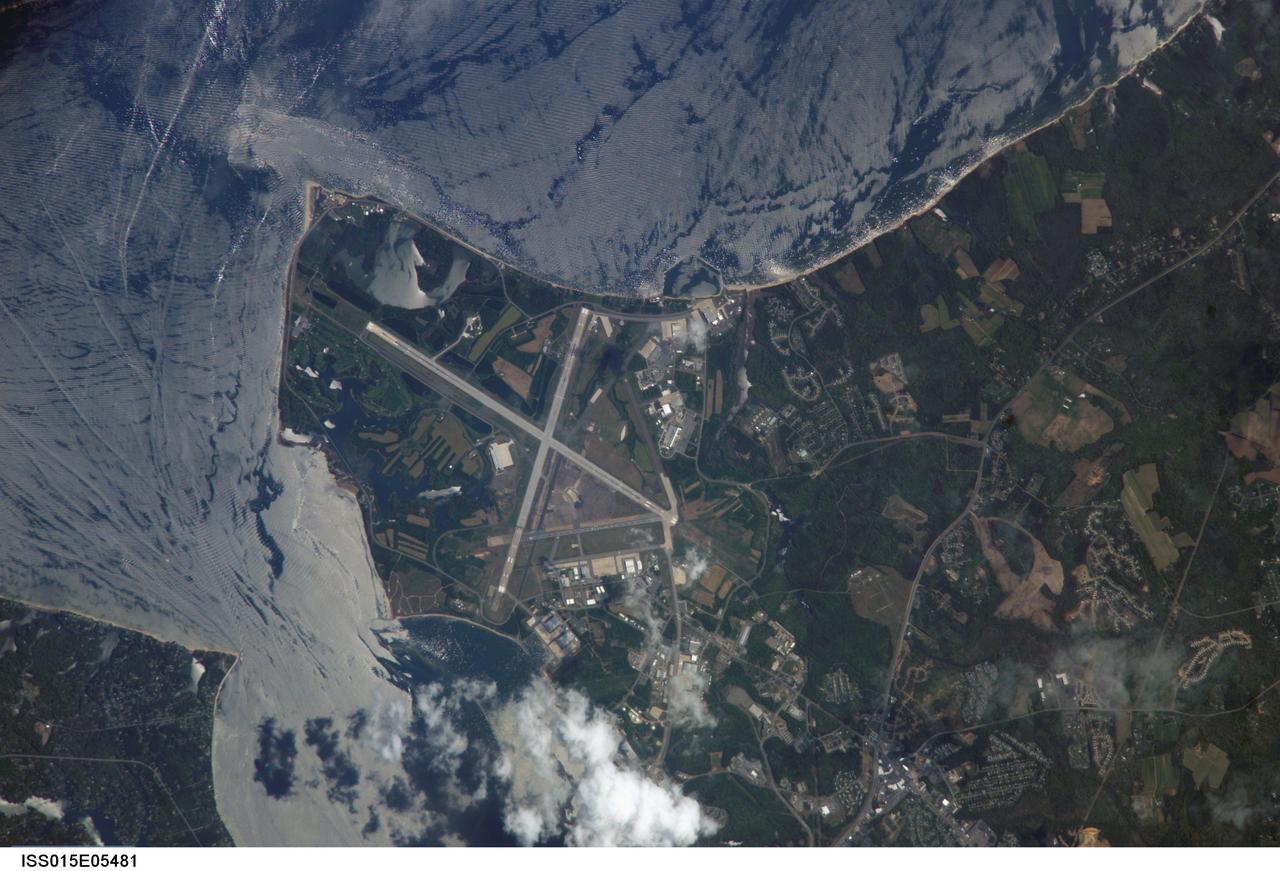
ISS015-E-05481 (28 April 2007) --- Patuxent River Naval Air Station, Maryland is featured in this image photographed by an Expedition 15 crewmember on the International Space Station. The Patuxent River Naval Air Station - or NAS Patuxent River -- is located on a small peninsula, bordered by the Patuxent River to the north-northeast and Chesapeake Bay to the east and southeast. The air station was commissioned in 1943, replacing farmlands that had occupied the peninsula less than a year earlier. The primary purpose of "Pax River" (as the site is known by the US Navy) was to consolidate geographically-dispersed air testing facilities that existed in the US prior to World War II into a central location. The NAS Patuxent River is now the primary center for naval air technology research, development, testing, and support, as well as being the location of the Navy Test Pilot School. The NAS Patuxent River is used frequently as a geographic reference point and training target by station crews. This view illustrates why --the distinctive pattern of the airfield runways and the station's location in Chesapeake Bay make it easy to spot from orbit, and provides sharp land cover boundaries for camera focusing practice. This particular image also captures surface water current patterns around the peninsula. Wind and wave-roughened water surfaces appear silver-gray due to increased reflectance of light back towards the camera (sunglint), whereas dark blue water patches indicate water smoothed by the presence of oils and surfactants. A zone of mixing from converging shoreline currents extends northeast into the bay from Cedar Point.