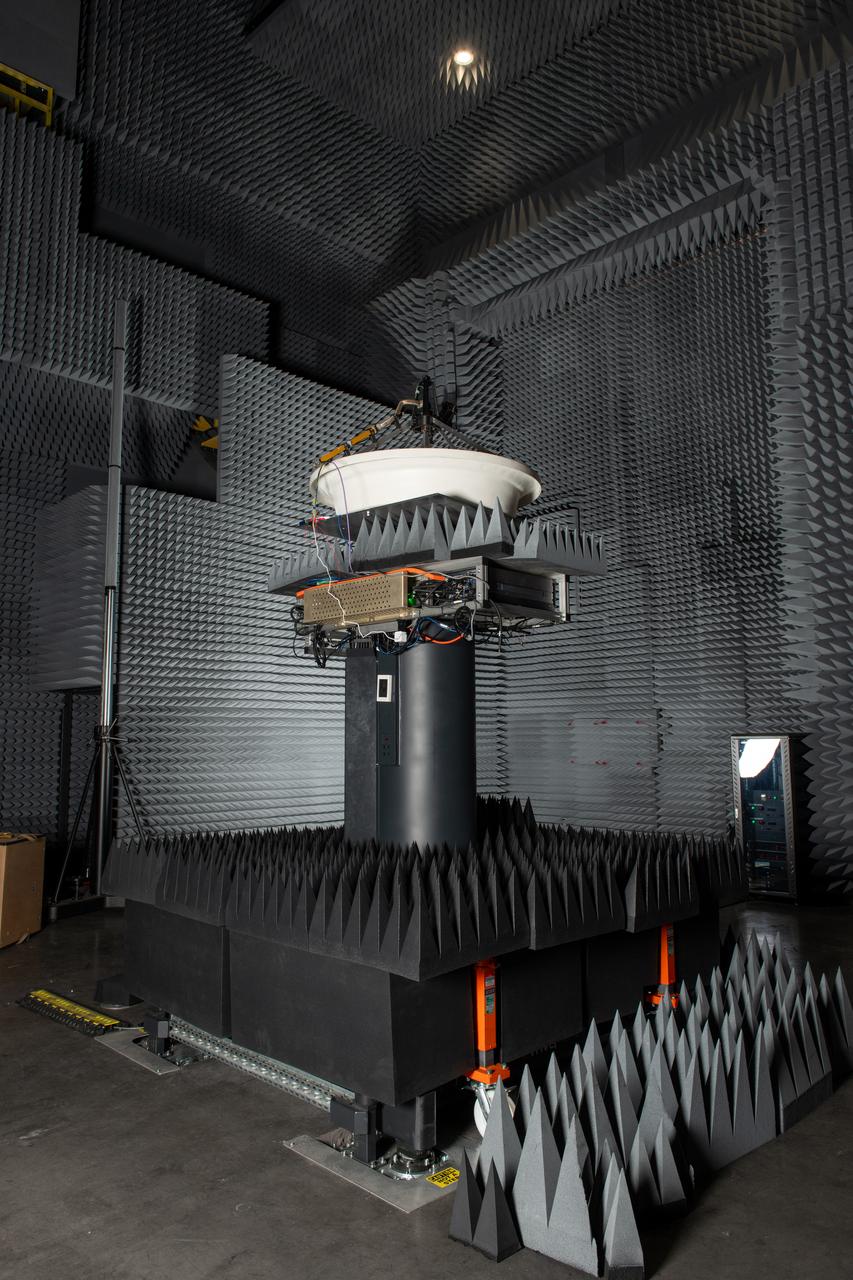
NASA’s Beaming Energy for Air Mobility team successfully completed a first-of-its-kind power beaming test at NASA Glenn on June 4, 2025. Later this year, the tested transmitter will be used in a demonstration to wirelessly transmit power using microwaves to a custom power receiver — a step toward gap-filling technology that could one day deliver power on the surface of the Moon or Mars.
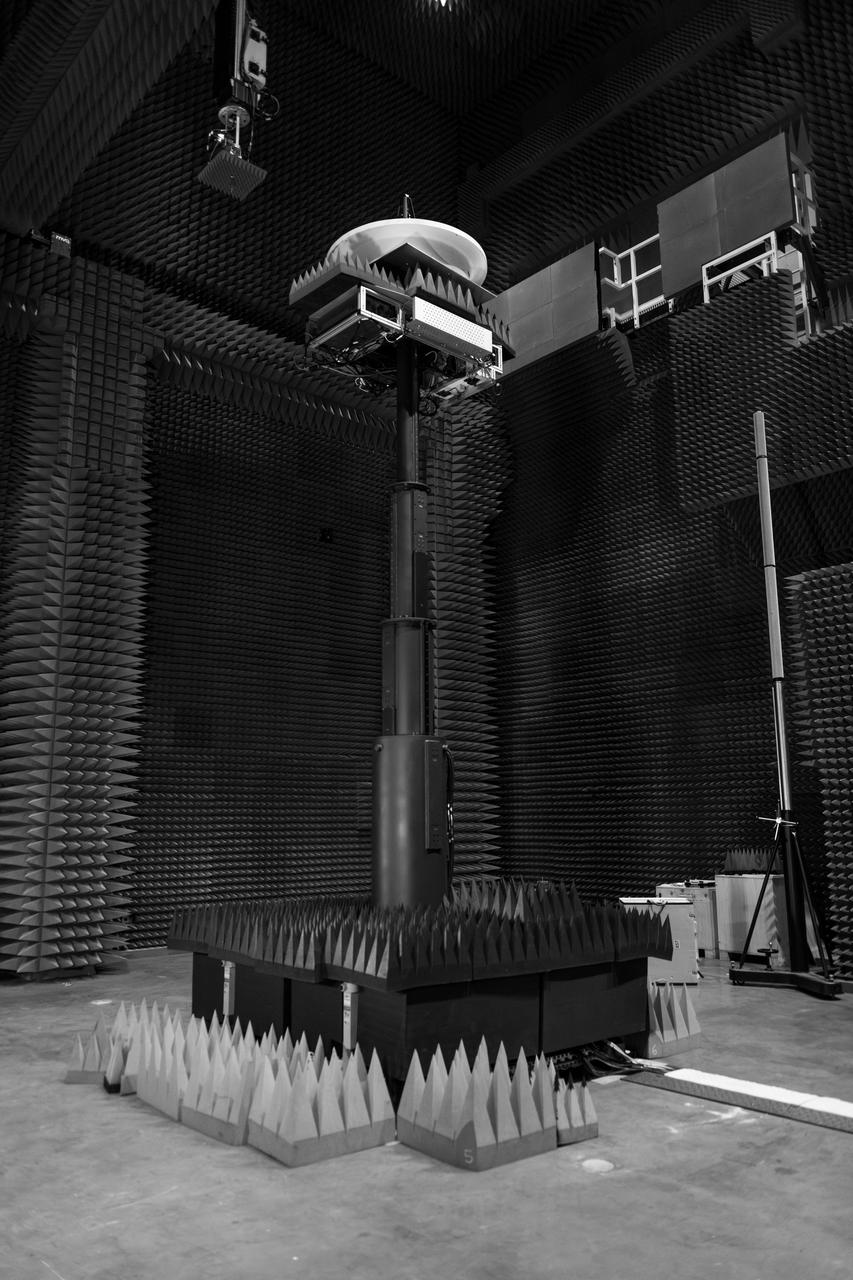
NASA’s Beaming Energy for Air Mobility team successfully completed a first-of-its-kind power beaming test at NASA Glenn on June 4, 2025. Later this year, the tested transmitter will be used in a demonstration to wirelessly transmit power using microwaves to a custom power receiver — a step toward gap-filling technology that could one day deliver power on the surface of the Moon or Mars.
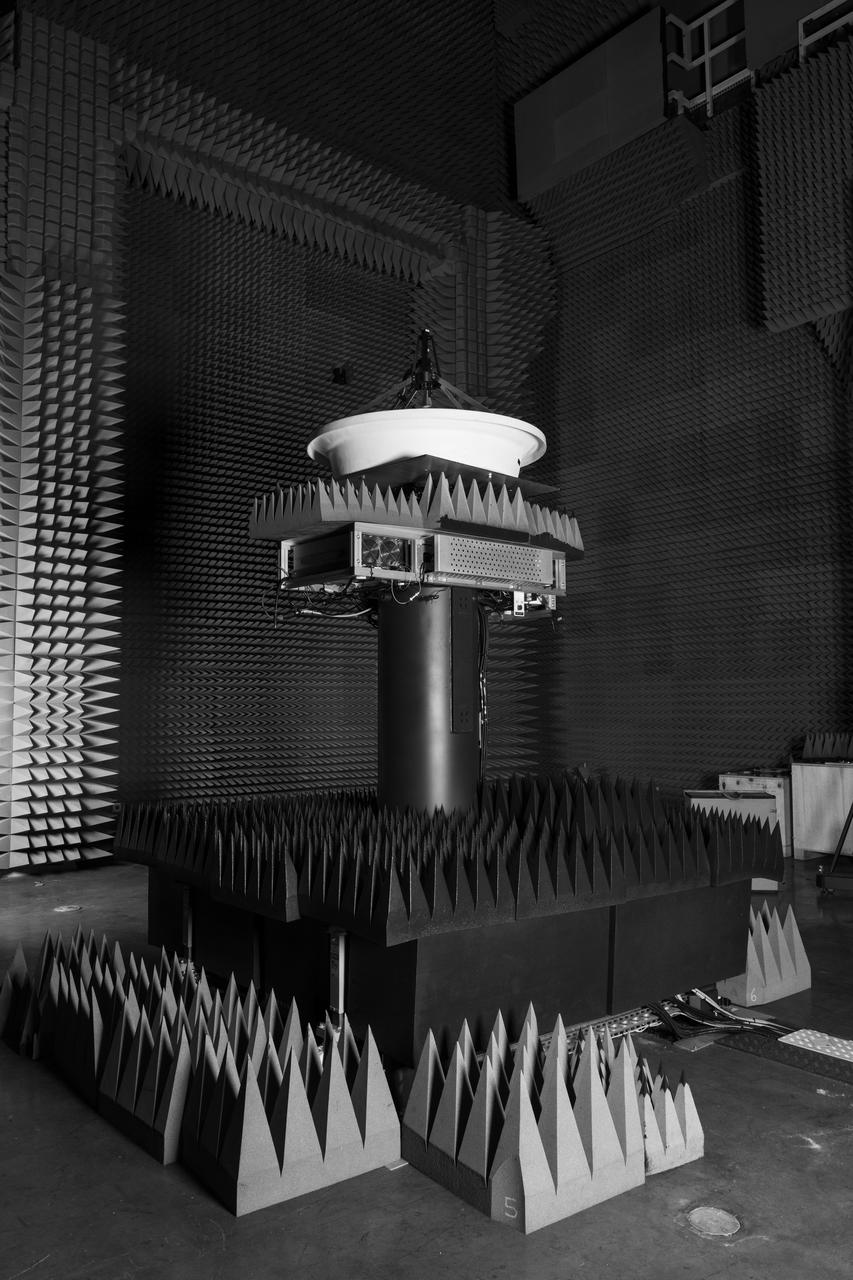
NASA’s Beaming Energy for Air Mobility team successfully completed a first-of-its-kind power beaming test at NASA Glenn on June 4, 2025. Later this year, the tested transmitter will be used in a demonstration to wirelessly transmit power using microwaves to a custom power receiver — a step toward gap-filling technology that could one day deliver power on the surface of the Moon or Mars.

NASA’s Beaming Energy for Air Mobility team successfully completed a first-of-its-kind power beaming test at NASA Glenn on June 4, 2025. Later this year, the tested transmitter will be used in a demonstration to wirelessly transmit power using microwaves to a custom power receiver — a step toward gap-filling technology that could one day deliver power on the surface of the Moon or Mars. Seth Waldstein, Seth Schisler and Bryan Schoenholz are in the control room reviewing the results.
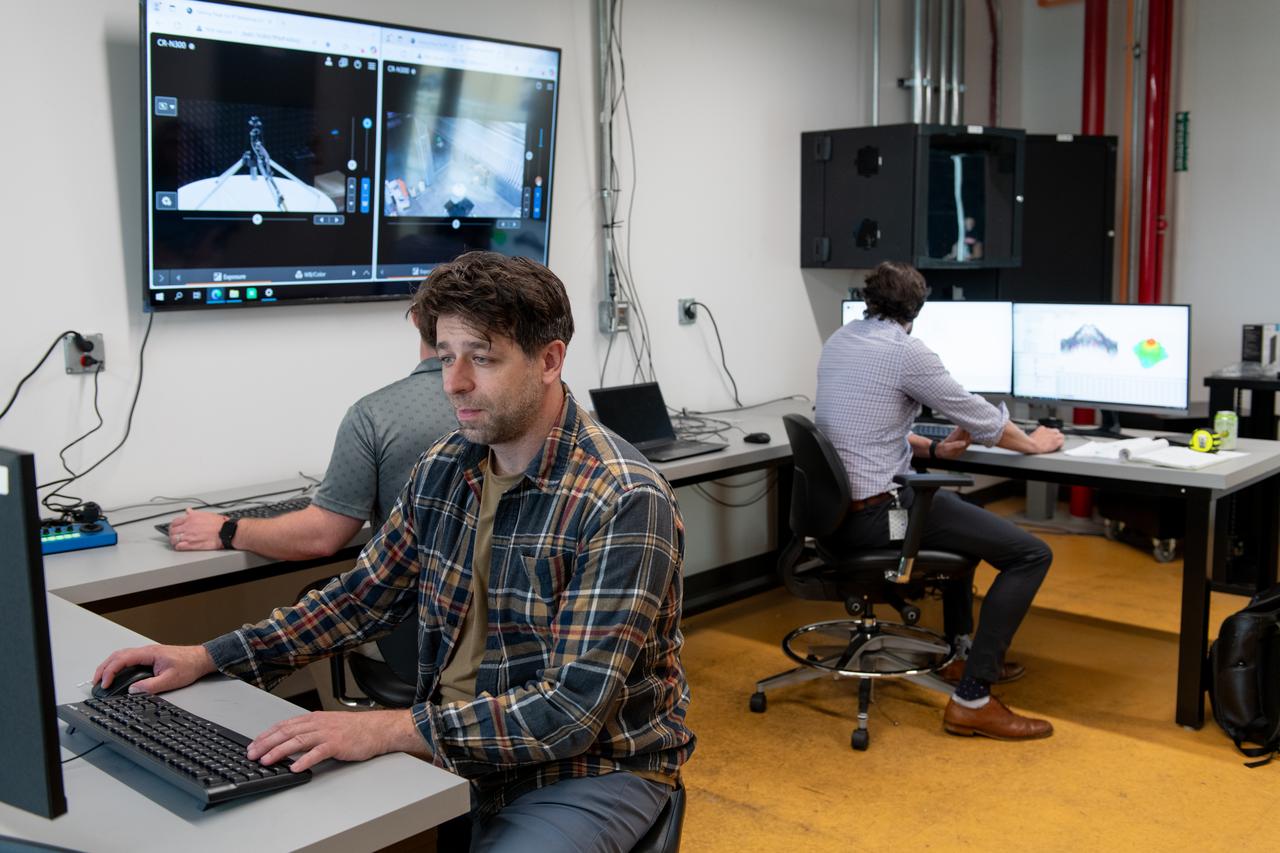
NASA’s Beaming Energy for Air Mobility team successfully completed a first-of-its-kind power beaming test at NASA Glenn. Later this year, the tested transmitter will be used in a demonstration to wirelessly transmit power using microwaves to a custom power receiver — a step toward gap-filling technology that could one day deliver power on the surface of the Moon or Mars. Seth Waldstein, Seth Schisler and Bryan Schoenholz are in the control room reviewing the data.
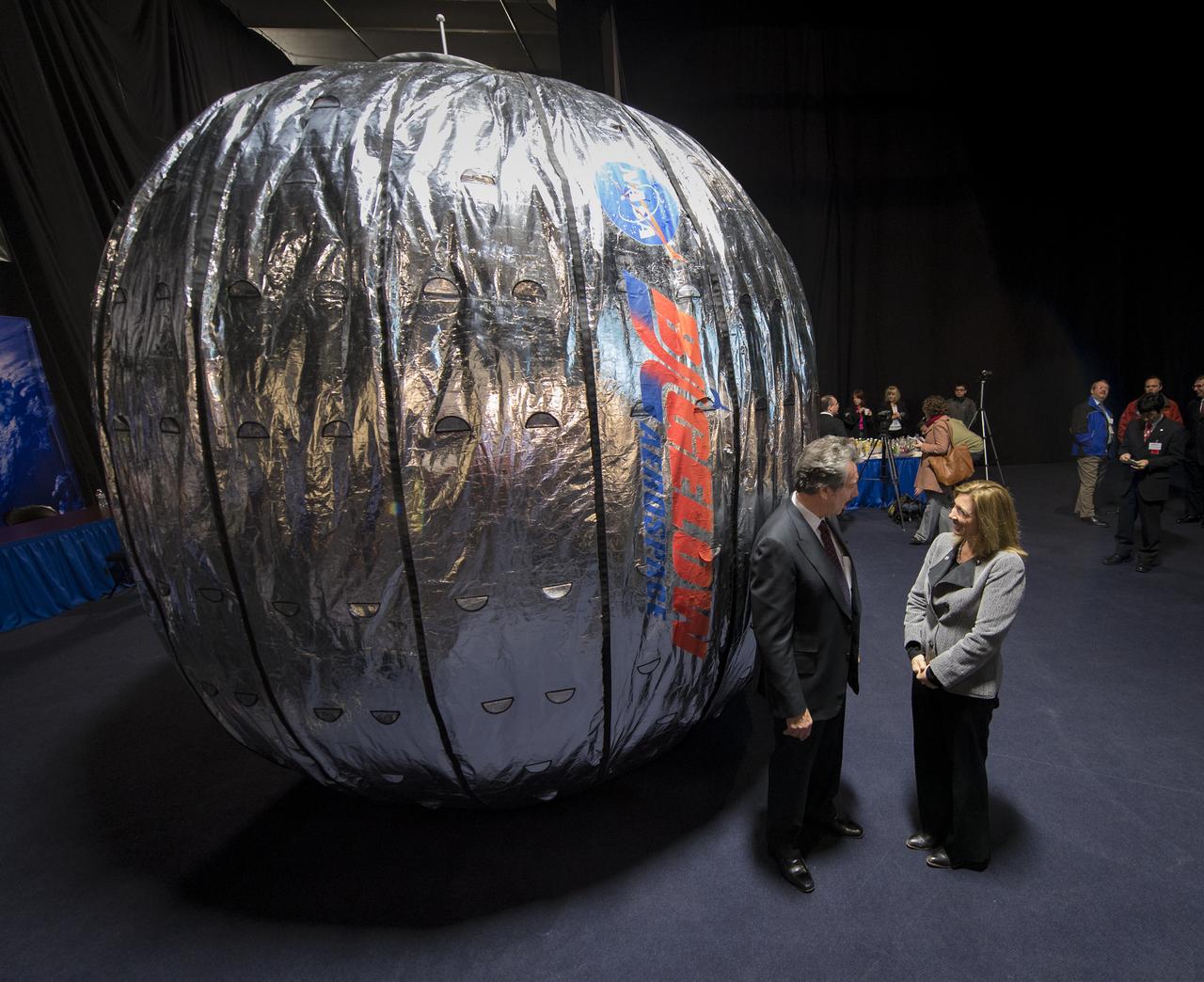
NASA Deputy Administrator Lori Garver and President and founder of Bigelow Aerospace Robert T. Bigelow talk while standing next to the Bigelow Expandable Activity Module (BEAM) during a media briefing where it is was announced that the BEAM expandable space habitat technology will be tested on the International Space Station, Wednesday, Jan. 16, 2013 in Las Vegas. BEAM is scheduled to arrive at the space station in 2015 for a two-year technology demonstration. Photo Credit: (NASA/Bill Ingalls)
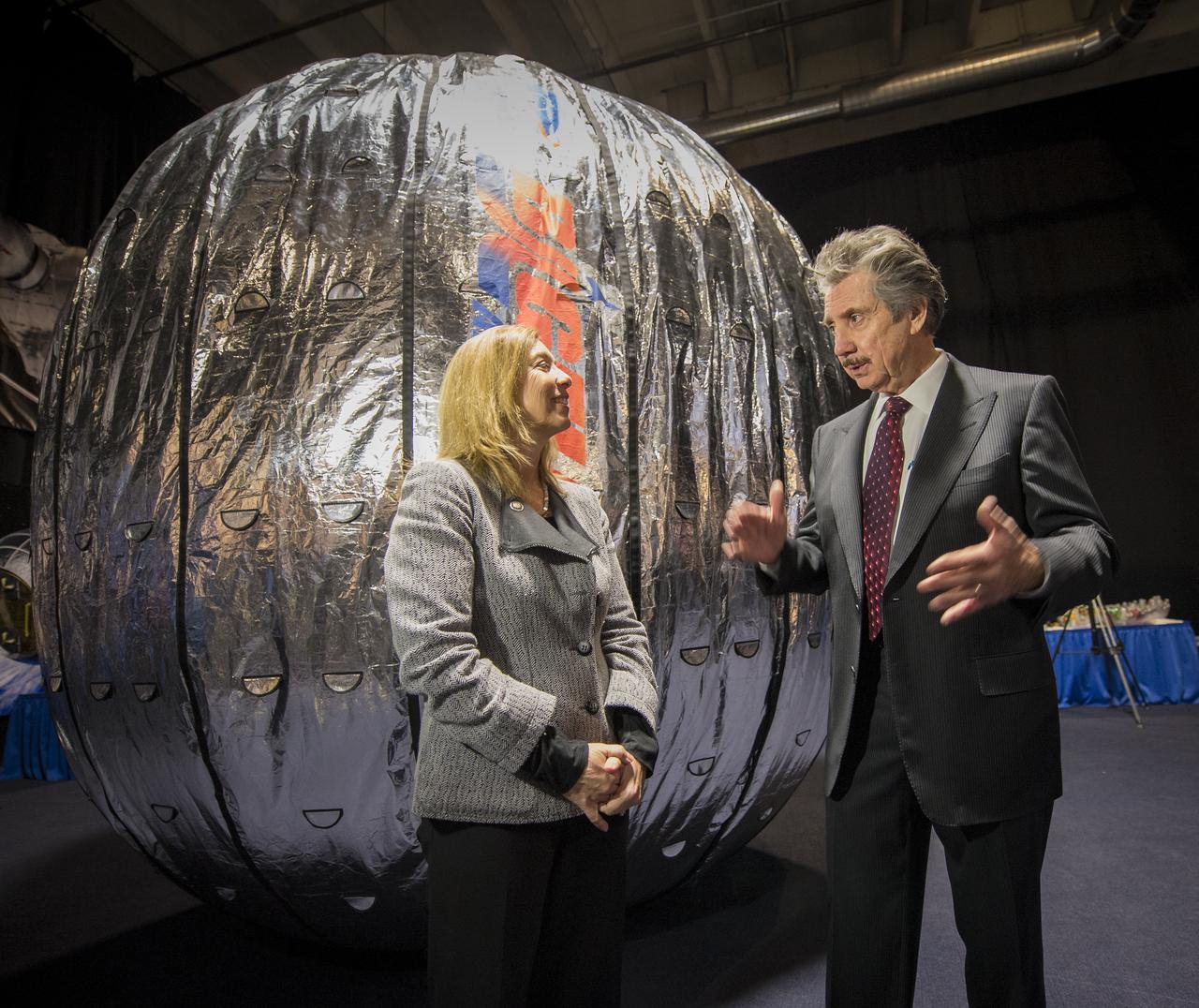
NASA Deputy Administrator Lori Garver and President and founder of Bigelow Aerospace Robert T. Bigelow talk while standing next to the Bigelow Expandable Activity Module (BEAM) during a media briefing where is was announced that the BEAM expandable space habitat technology will be tested on the International Space Station, Wednesday, Jan. 16, 2013 in Las Vegas. BEAM is scheduled to arrive at the space station in 2015 for a two-year technology demonstration. Photo Credit: (NASA/Bill Ingalls)
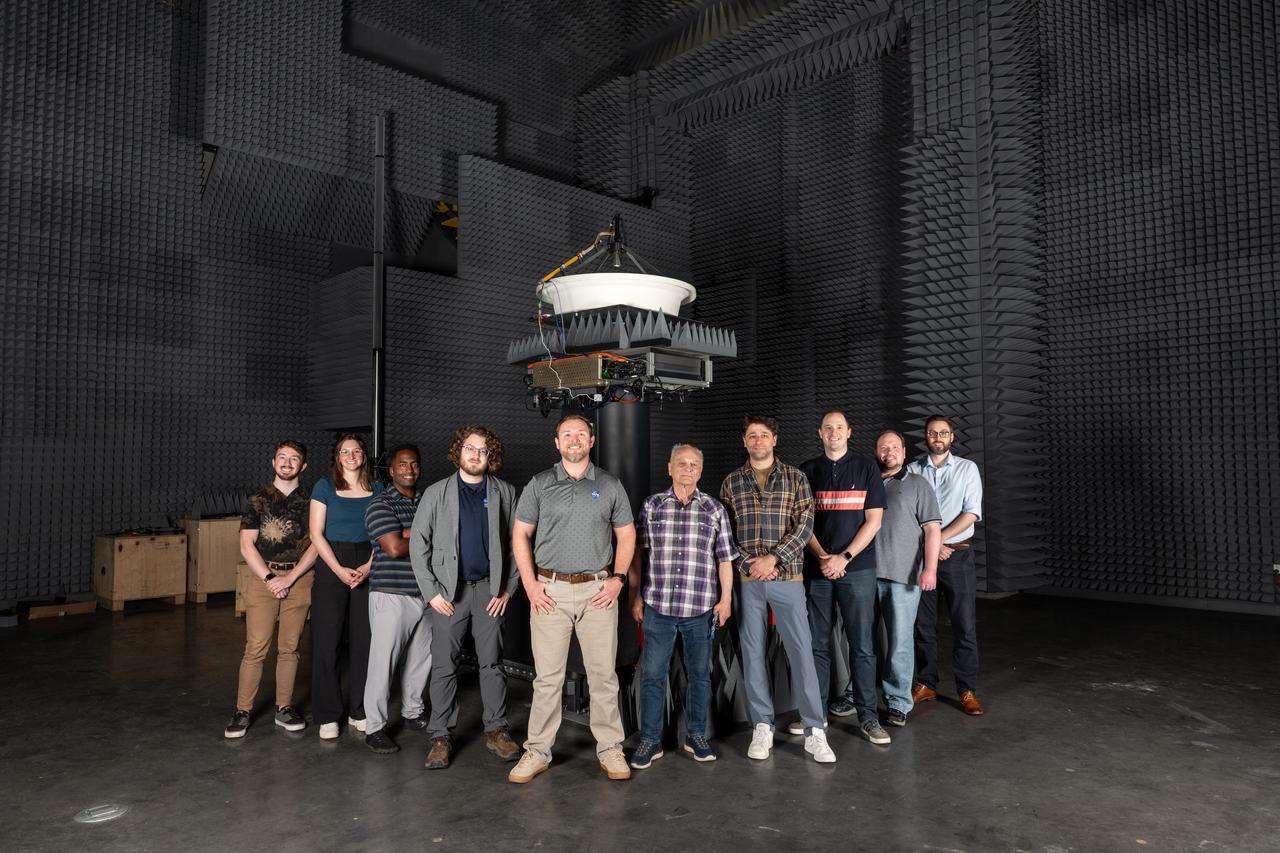
NASA’s Beaming Energy for Air Mobility team successfully completed a first-of-its-kind power beaming test at NASA Glenn on June 4, 2025. Later this year, the tested transmitter will be used in a demonstration to wirelessly transmit power using microwaves to a custom power receiver — a step toward gap-filling technology that could one day deliver power on the surface of the Moon or Mars. Pictured from left to right are Hayden Klopp, Rebecca Buehrle, Kerry Johnson, Avery Brock, Seth Schisler, Vladimir Volman, Seth Waldstein, David Rinehart, Rocco Viggiano, and Donald Dornbusch.
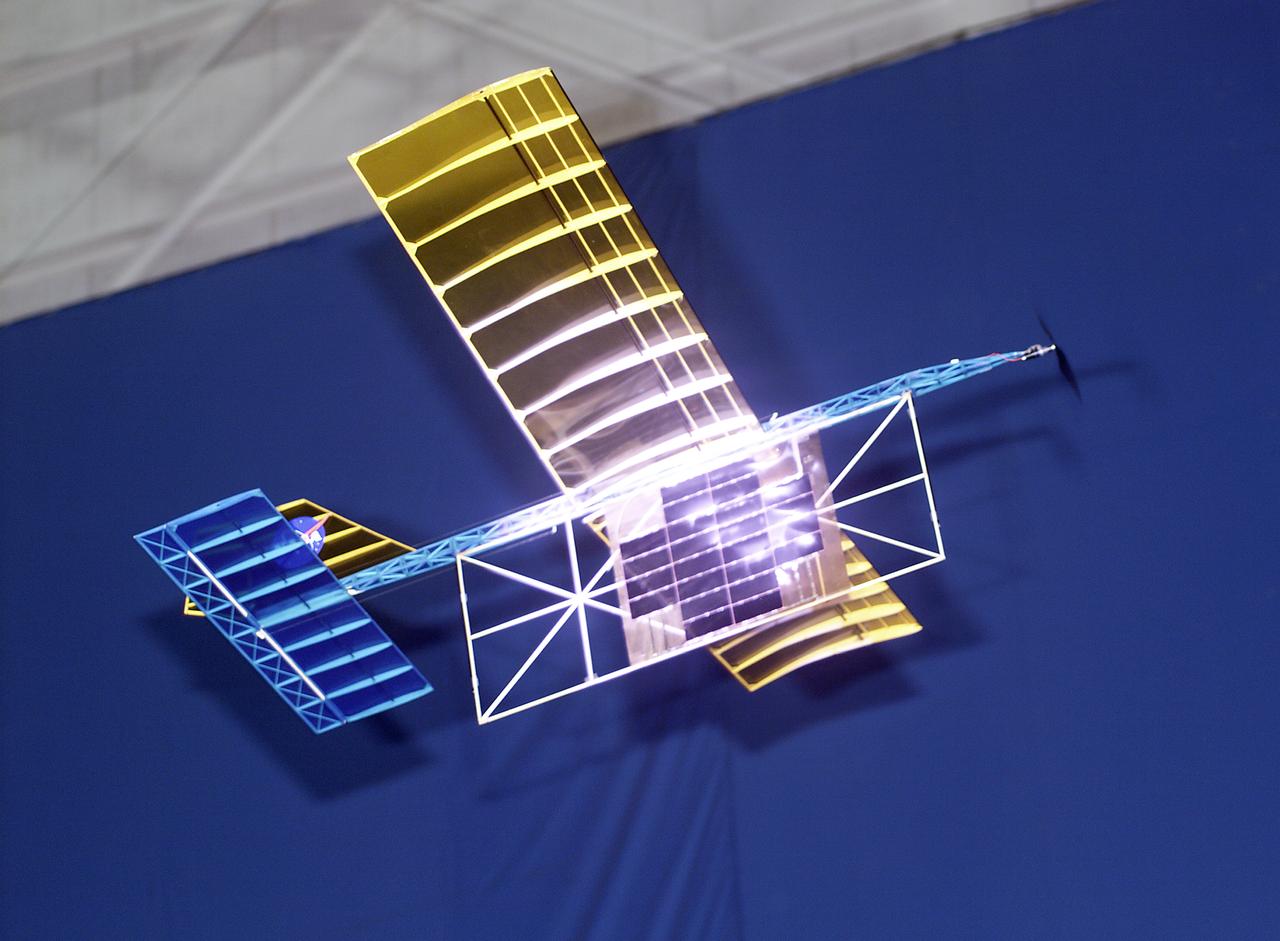
With a laser beam centered on its panel of photovoltaic cells, a lightweight model plane makes the first flight of an aircraft powered by a laser beam inside a building at NASA Marshall Space Flight Center.
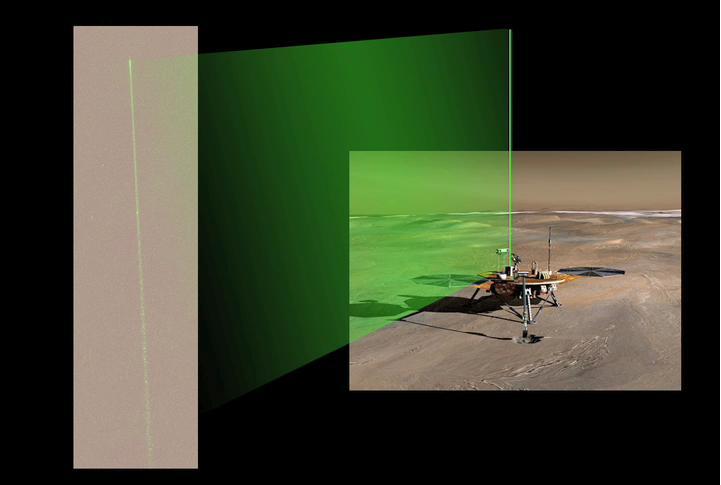
The Surface Stereo Imager camera aboard NASA Phoenix Mars Lander acquired a series of images of the laser beam in the Martian night sky. Bright spots in the beam are reflections from ice crystals in the low level ice-fog.
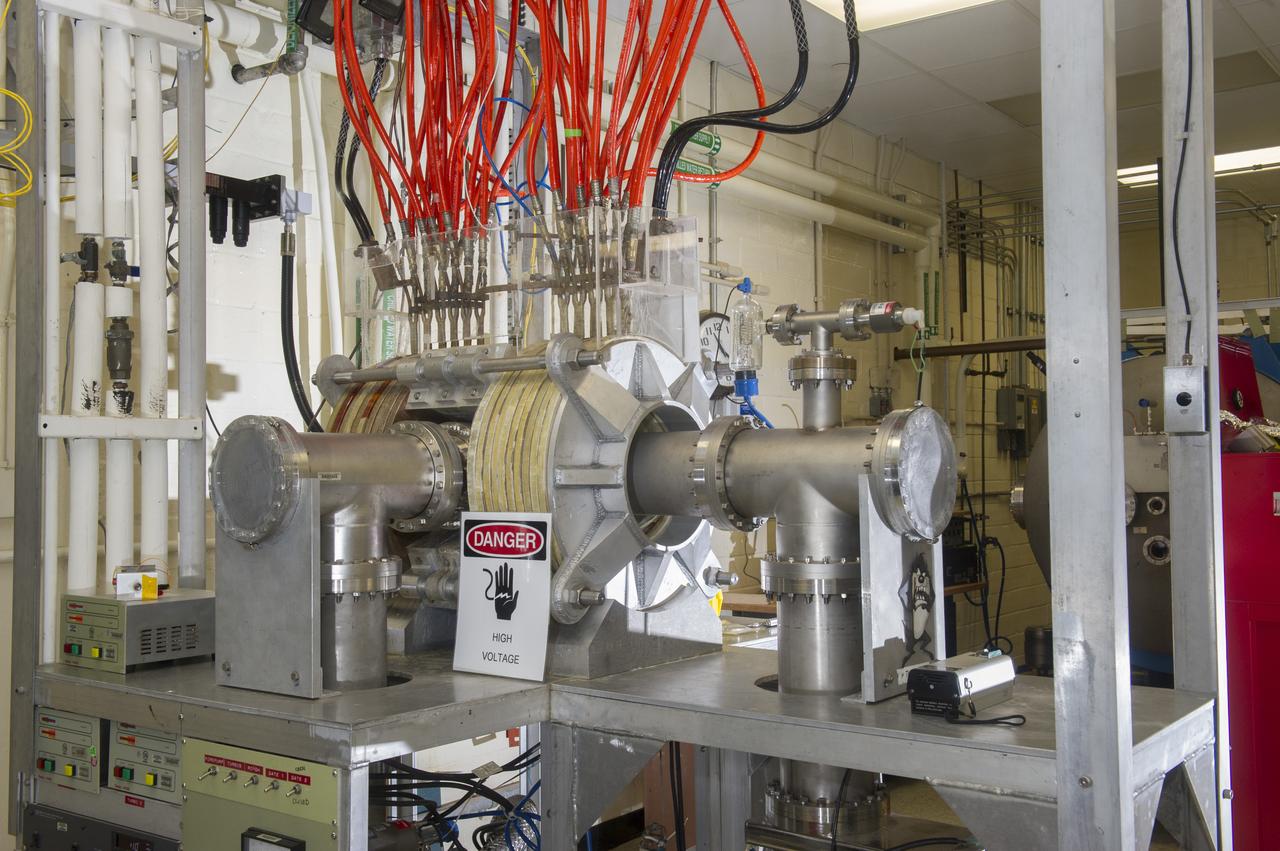
BLDG 4711 ATOMIC OXYGEN BEAM FACILITY
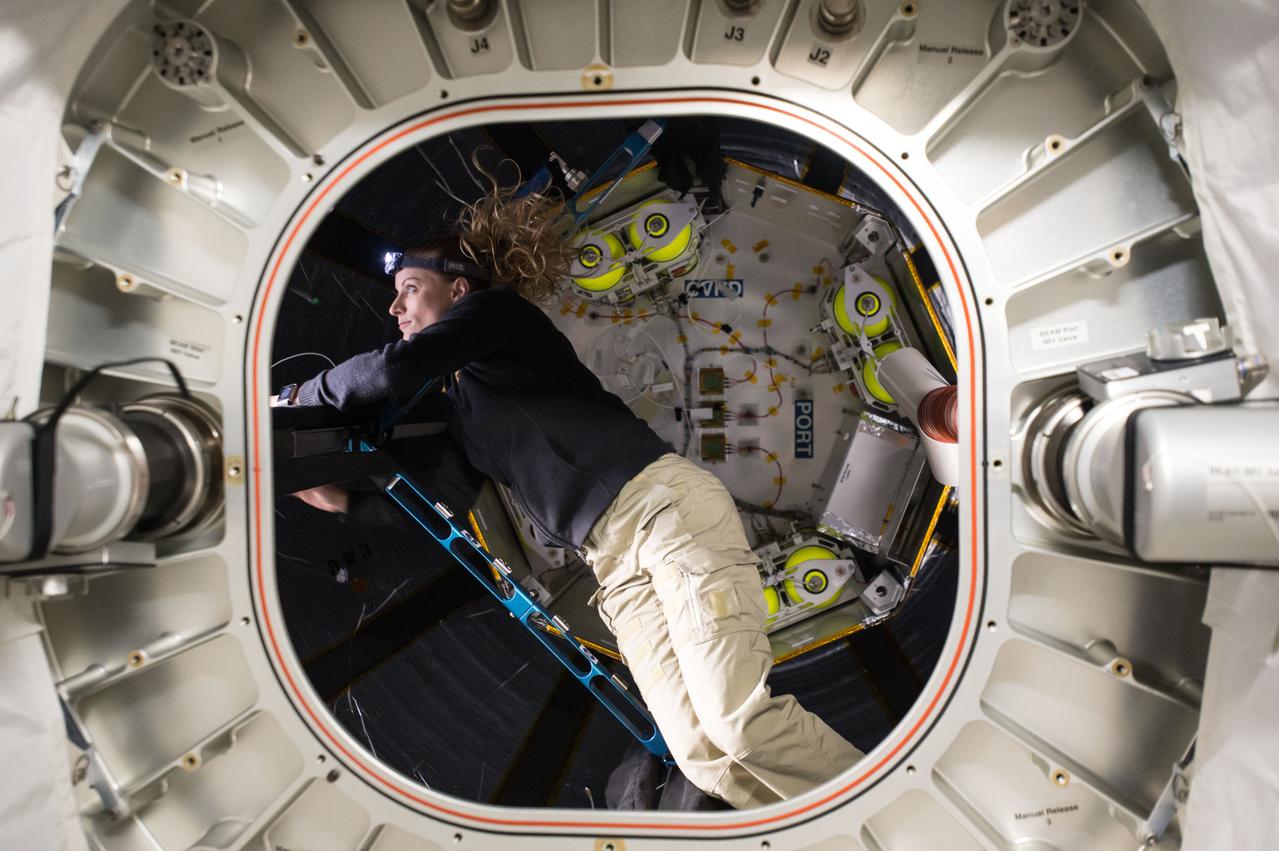
iss048e069952 (9/6/2016) --- NASA astronaut Kate Rubins is photographed inside the Bigelow Expandable Activity Module (BEAM) during BEAM ingress operations (OPS). The Bigelow Expandable Activity Module (BEAM) is an experimental expandable capsule that docks with the International Space Station (ISS). After docking, BEAM inflates to roughly 13 feet long and 10.5 feet in diameter to provide a habitable volume where a crew member can enter.
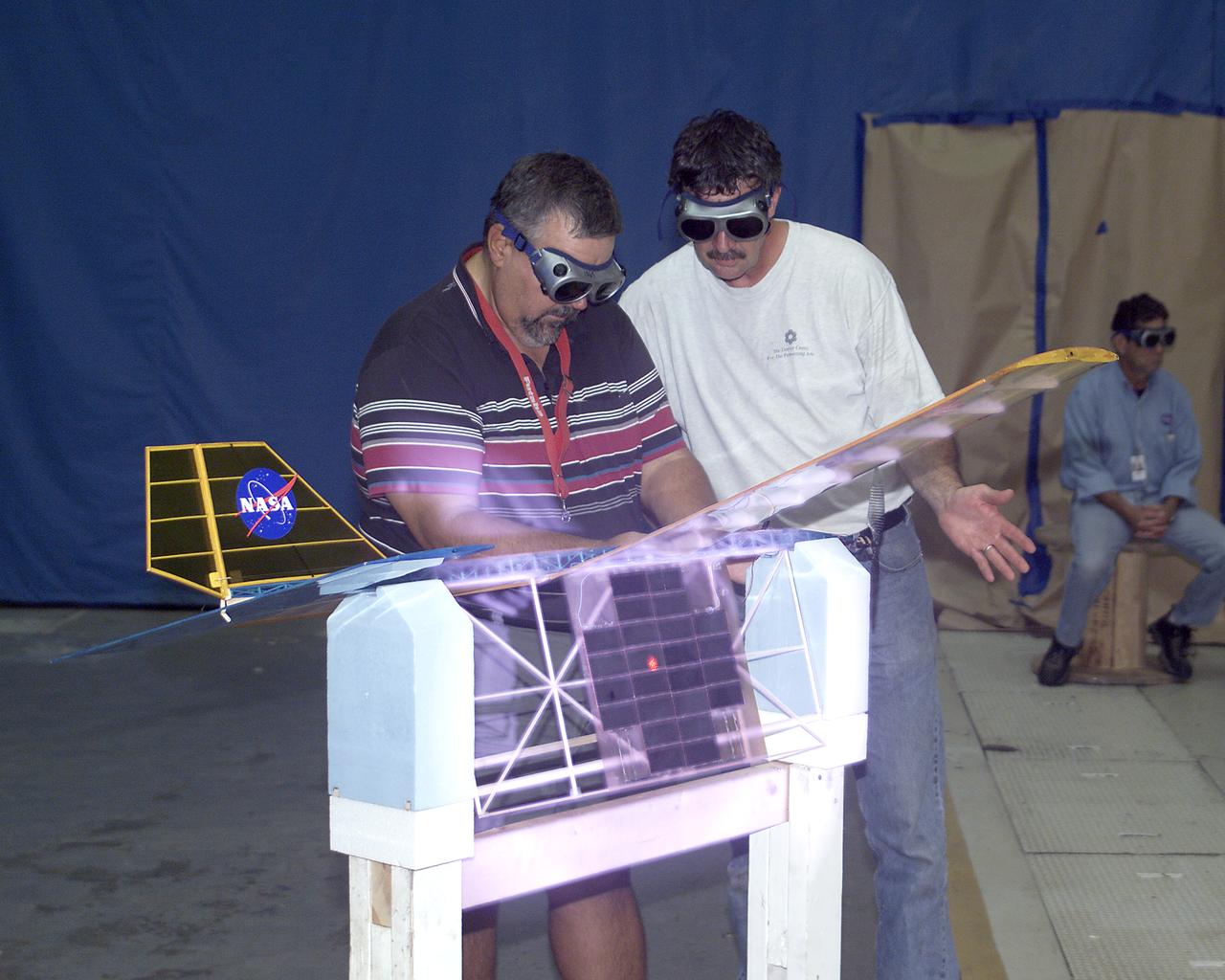
With a laser beam centered on its solar panel, a lightweight model aircraft is checked out by technician Tony Frakowiak and researcher Tim Blackwell before its power-beamed demonstration flight.
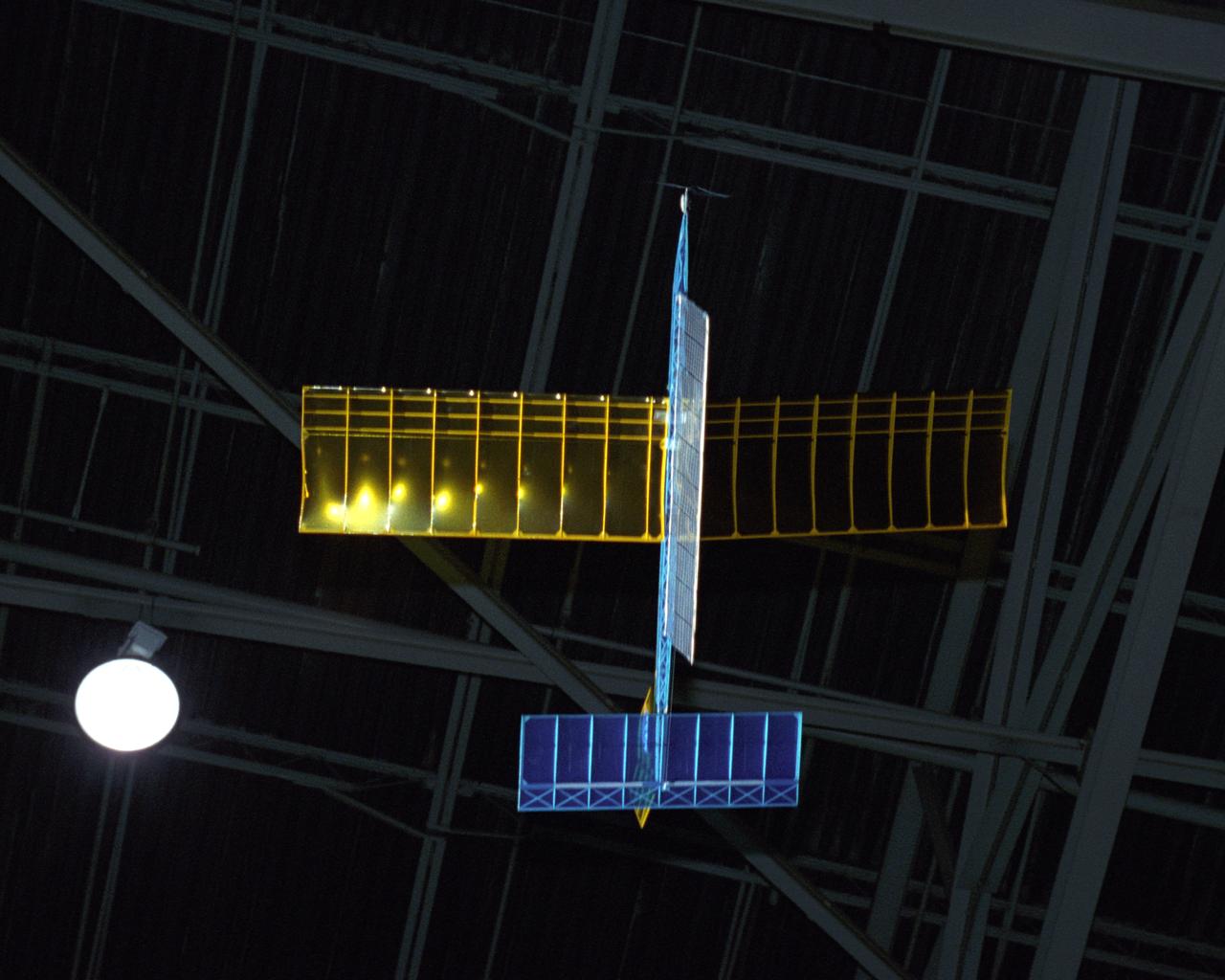
An experimental radio-controlled model aircraft is seen here in flight powered only by light energy beamed to it by a spotlight.
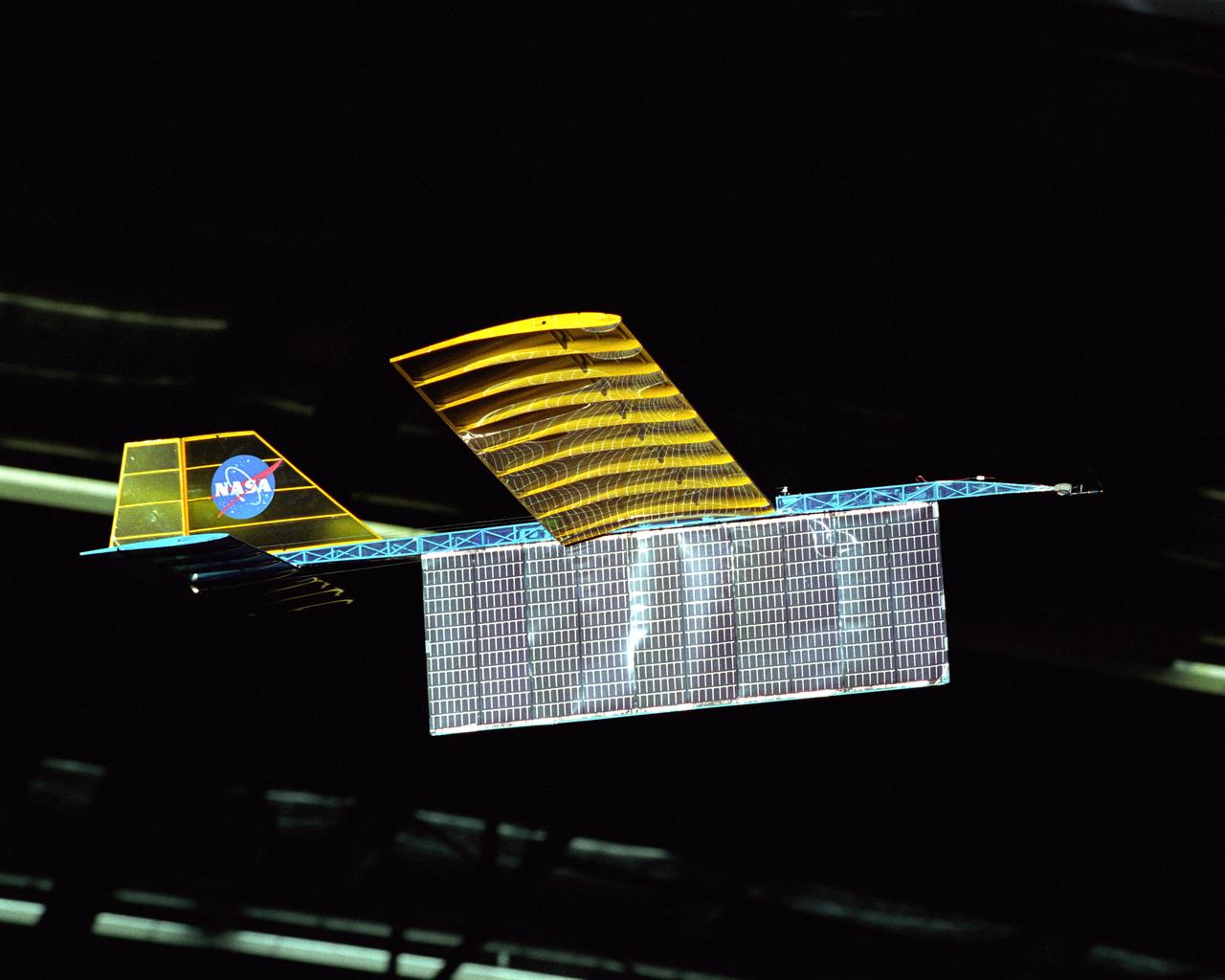
An experimental radio-controlled model aircraft is seen here in flight, powered only by light energy beamed to it by a spotlight.
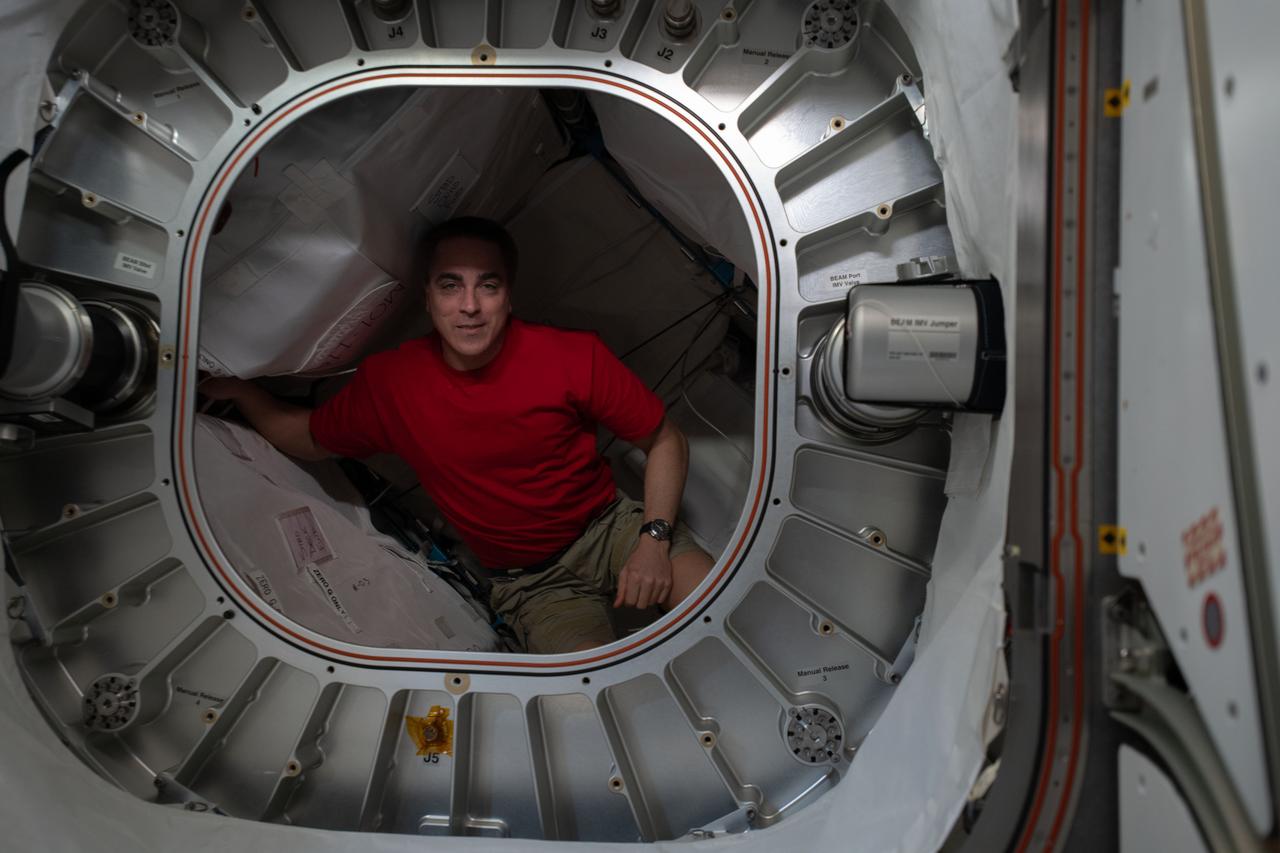
iss063e028479 (July 1, 2020) --- NASA astronaut and Expedition 63 Commander Chris Cassidy is pictured inside the Bigelow Expandable Activity Module (BEAM) during operations to retrieve charcoal filters.
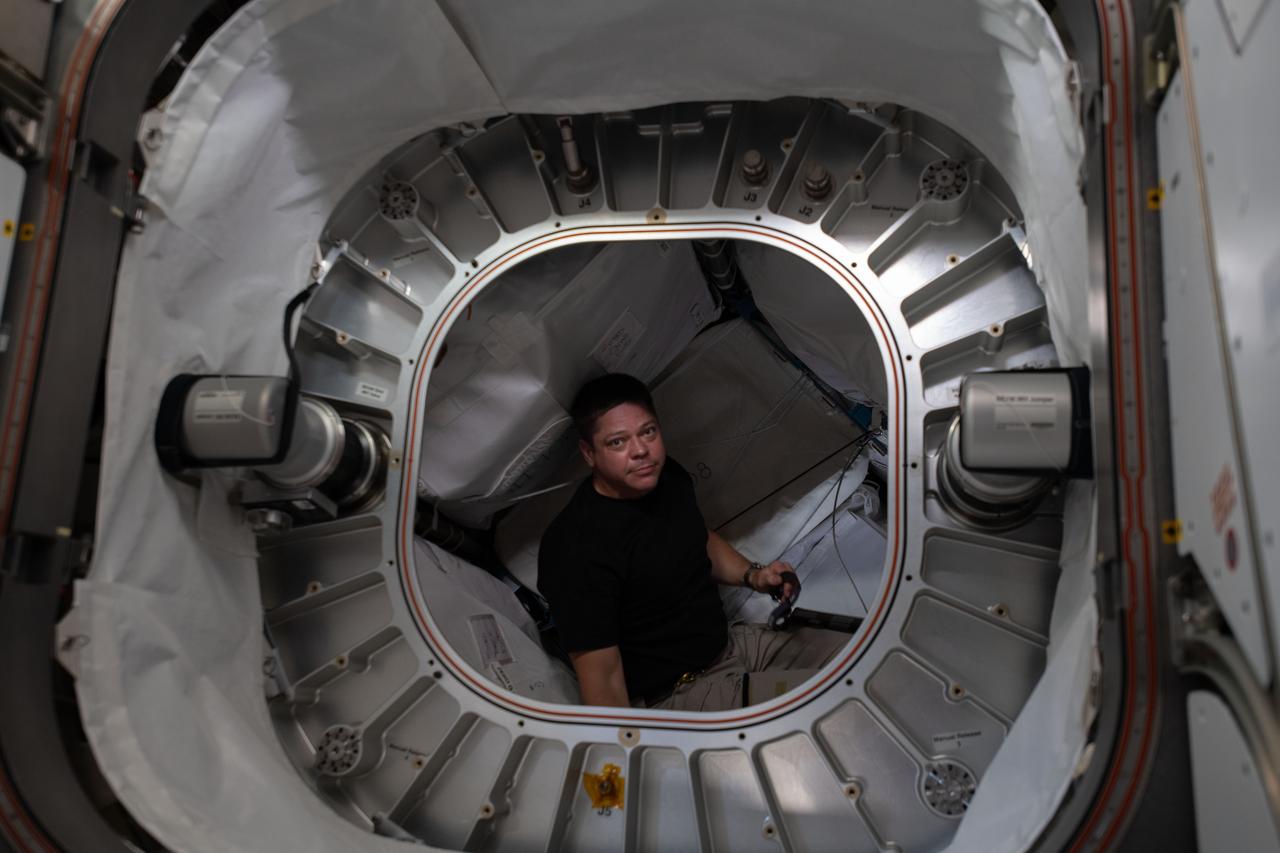
iss063e028476 (July 1, 2020) --- NASA astronaut and Expedition 63 Flight Engineer Bob Behnken is pictured inside the Bigelow Expandable Activity Module (BEAM) during operations to retrieve charcoal filters.

iss047e134134 (5/26/2018) --- NASA astronaut Jeff Williams and European Space Agency (ESA) astronaut Tim Peake during Bigelow Expandable Activity Module (BEAM) deployment. The Bigelow Expandable Activity Module (BEAM) is an experimental expandable capsule that docks with the International Space Station (ISS). After docking, BEAM inflates to roughly 13 feet long and 10.5 feet in diameter to provide a habitable volume where a crew member can enter.
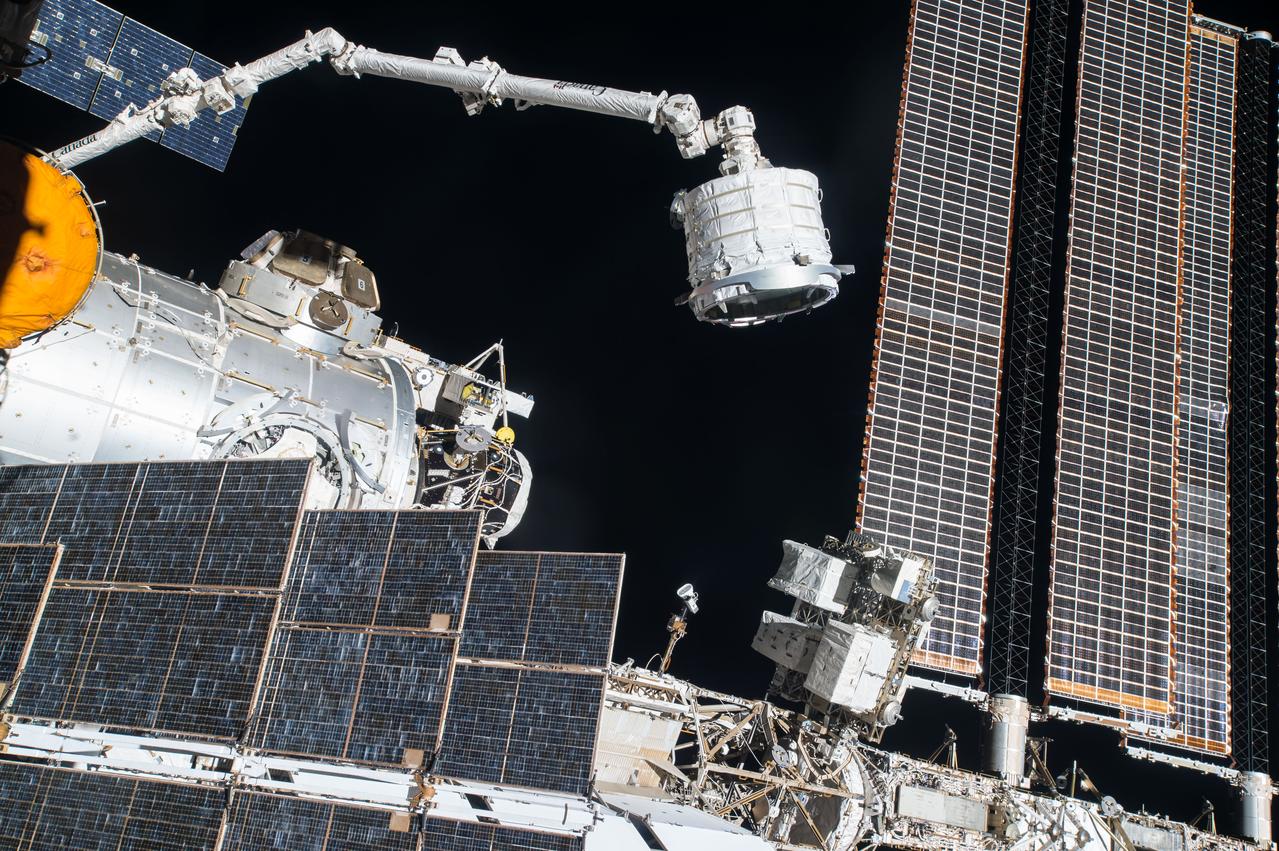
iss047e061107 (4/16/2016) --- View of Bigelow Expandable Activity Module (BEAM) attached to Canadarm2 Robotic Arm. The Bigelow Expandable Activity Module (BEAM) is an experimental expandable capsule that docks with the International Space Station (ISS). After docking, BEAM inflates to roughly 13 feet long and 10.5 feet in diameter to provide a habitable volume where a crew member can enter.
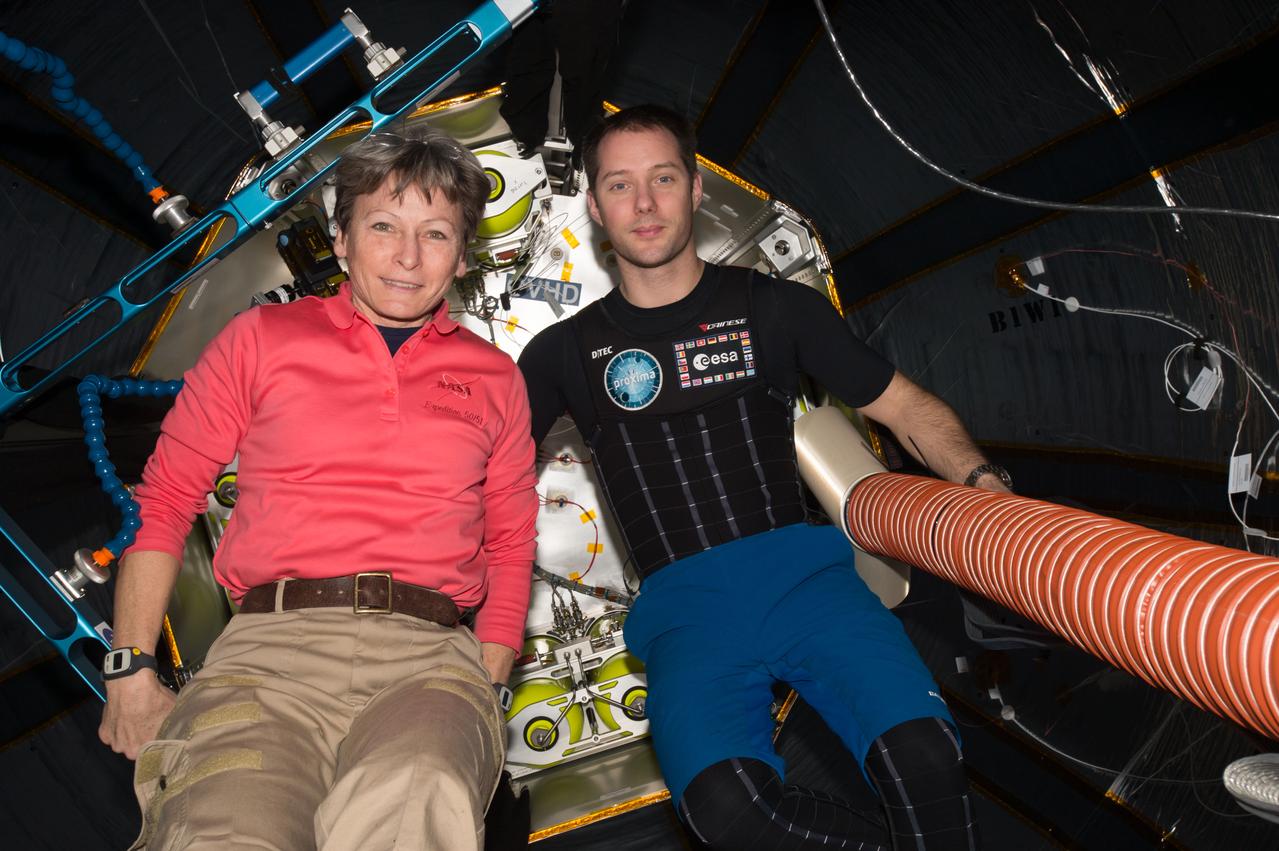
iss050e037908 (2/2/2017) --- NASA astronaut Peggy Whitson and European Space Agency (ESA) Thomas Pesquet in the Bigelow Expandable Aerospace Module (BEAM). The Bigelow Expandable Activity Module (BEAM) is an experimental expandable capsule that docks with the International Space Station (ISS). After docking, BEAM inflates to roughly 13 feet long and 10.5 feet in diameter to provide a habitable volume where a crew member can enter.
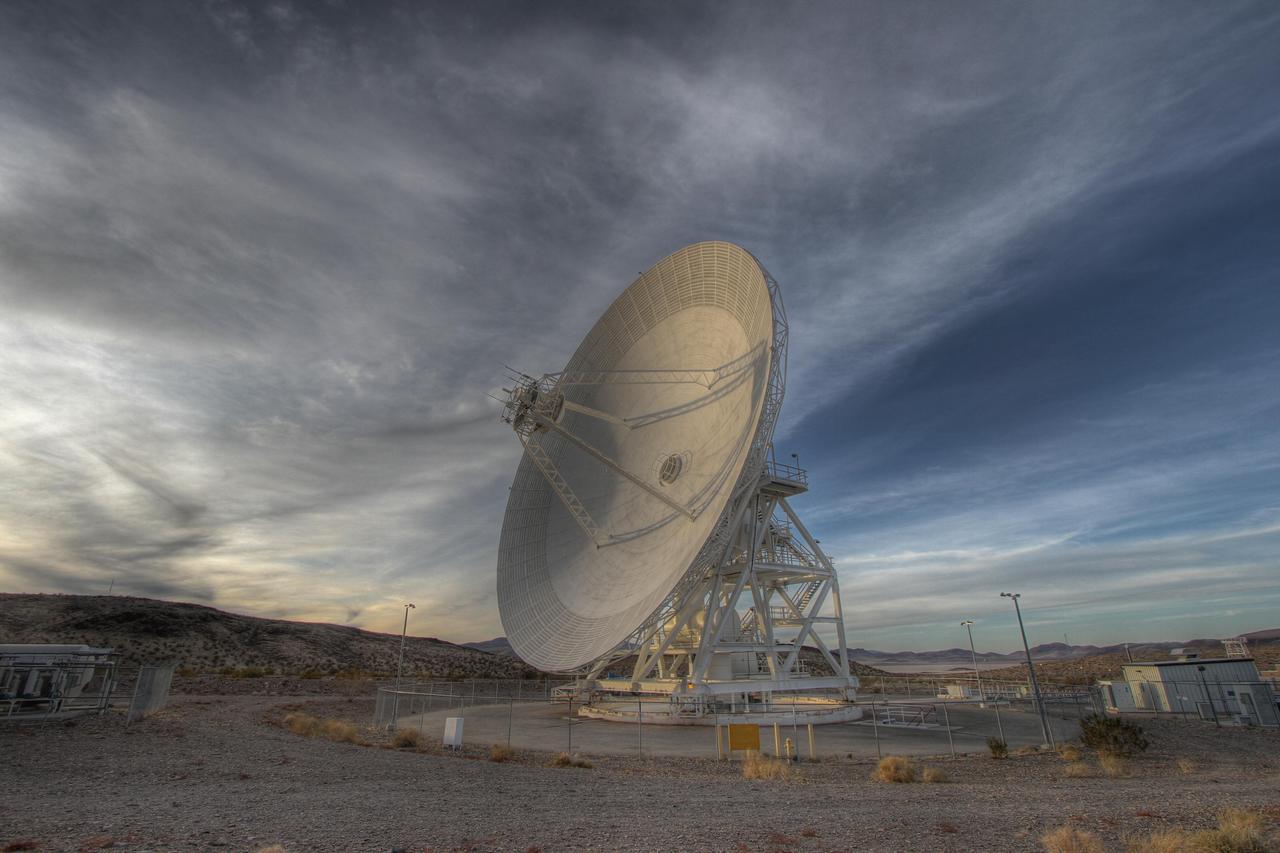
Goldstone 111.5-foot 34-meter Beam Waveguide tracks a spacecraft as it comes into view. The Goldstone Deep Space Communications Complex is located in the Mojave Desert in California, USA.
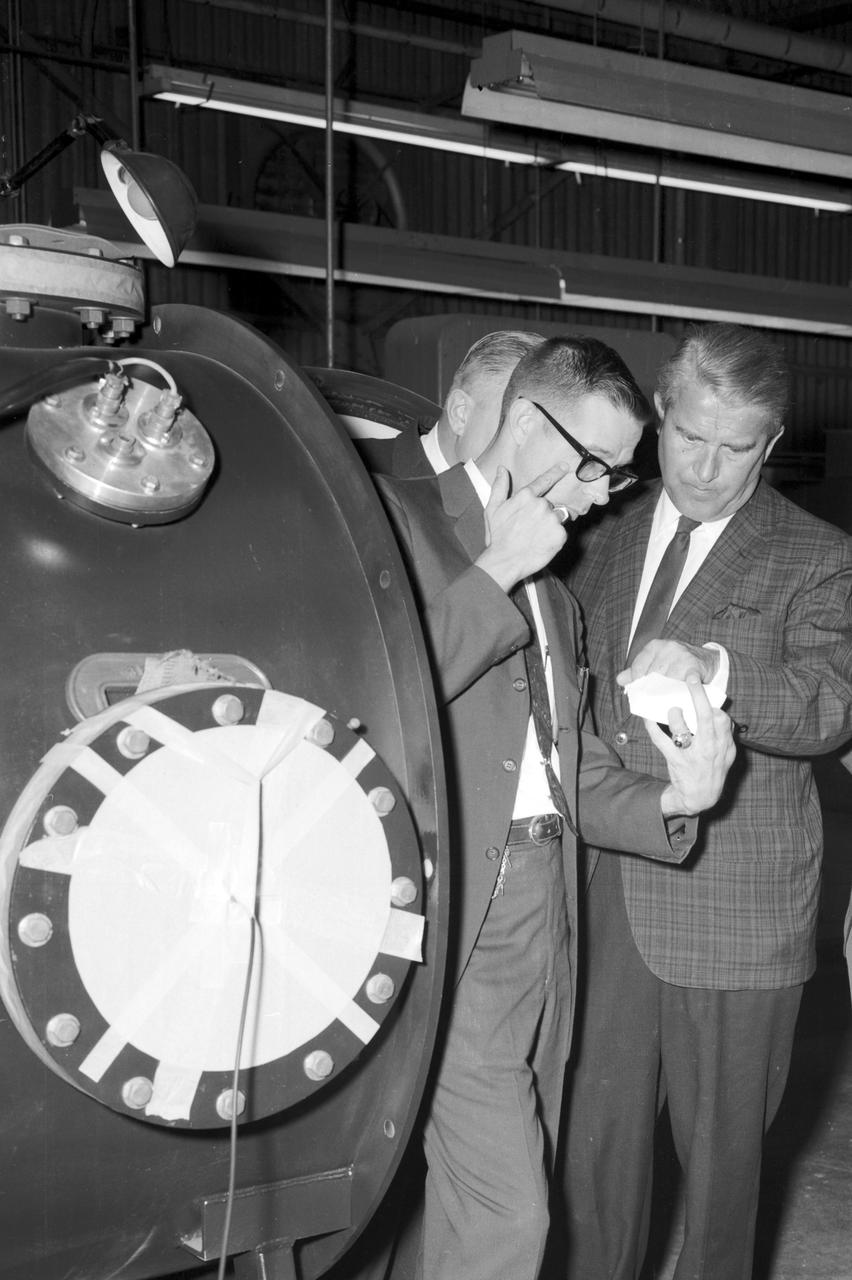
Dr. von Braun and party look at a laser beam component during a visit at the Marshall Space Flight Center Space Science Laboratory on August 28, 1967.

A spider beam for cornecting the Saturn I fuel tanks is being positioned in the fabrication and engineering laboratory of the Marshall Space Flight Center (MSFC).
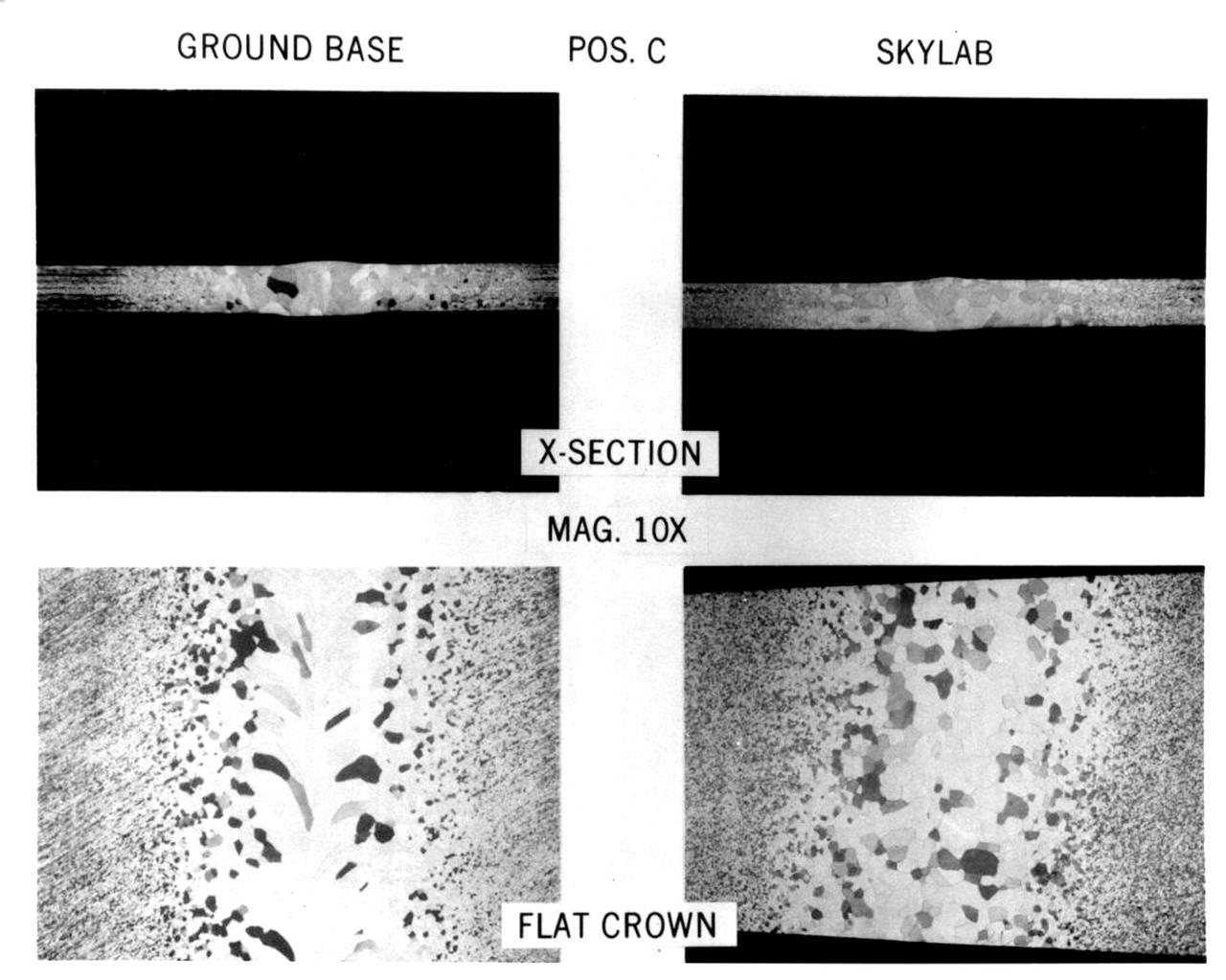
Comparison of ground-based (left) and Skylab (right) electron beam welds in pure tantalum (Ta) (10X magnification). Residual votices left behind in the ground-based sample after the electron beam passed were frozen into the grain structure. These occurred because of the rapid cooling rate at the high temperature. Although the thermal characteristics and electron beam travel speeds were comparable for the skylab sample, the residual vortices were erased in the grain structure. This may have been due to the fact that final grain size of the solidified material was smaller in the Skylab sample compared to the ground-based sample. The Skylab sample was processed in the M512 Materials Processing Facility (MPF) during Skylab SL-2 Mission. Principal Investigator was Richard Poorman.
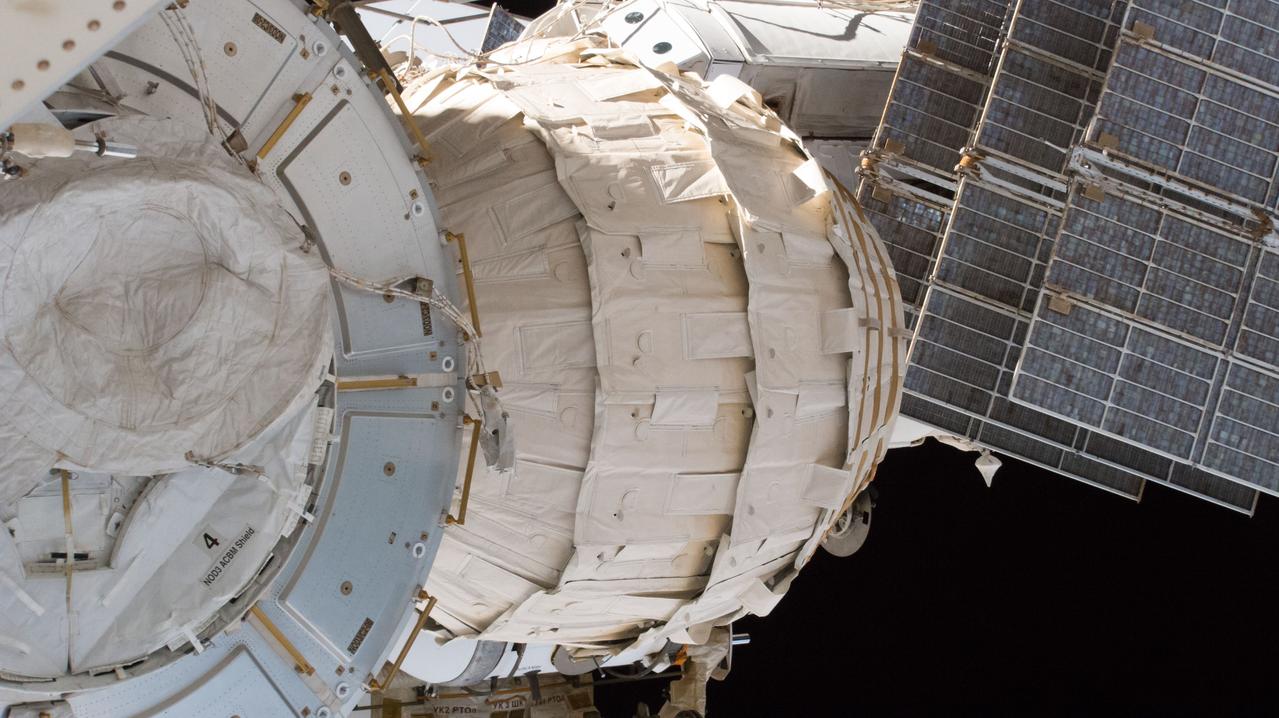
iss051e010468 (April 16, 2017) --- BEAM, the Bigelow Expandable Activity Module, was pictured installed to the Tranquility module with an external high definition camera.

President and founder of Bigelow Aerospace Robert T. Bigelow, talks during a media briefing where he and NASA Deputy Administrator Lori Garver discussed their $17.8 million contract to provide a Bigelow Expandable Activity Module (BEAM) to the International Space Station to test expandable space habitat technology, Wednesday, Jan. 16, 2013 at Bigelow Aerospace in Las Vegas. BEAM is scheduled to arrive at the space station in 2015 for a two-year technology demonstration. Photo Credit: (NASA/Bill Ingalls)

NASA Deputy Administrator Lori Garver talks during a media briefing where she and President and founder of Bigelow Aerospace Robert T. Bigelow, discussed their $17.8 million contract to provide a Bigelow Expandable Activity Module (BEAM) to the International Space Station to test expandable space habitat technology, Wednesday, Jan. 16, 2013 at Bigelow Aerospace in Las Vegas. BEAM is scheduled to arrive at the space station in 2015 for a two-year technology demonstration. Photo Credit: (NASA/Bill Ingalls)
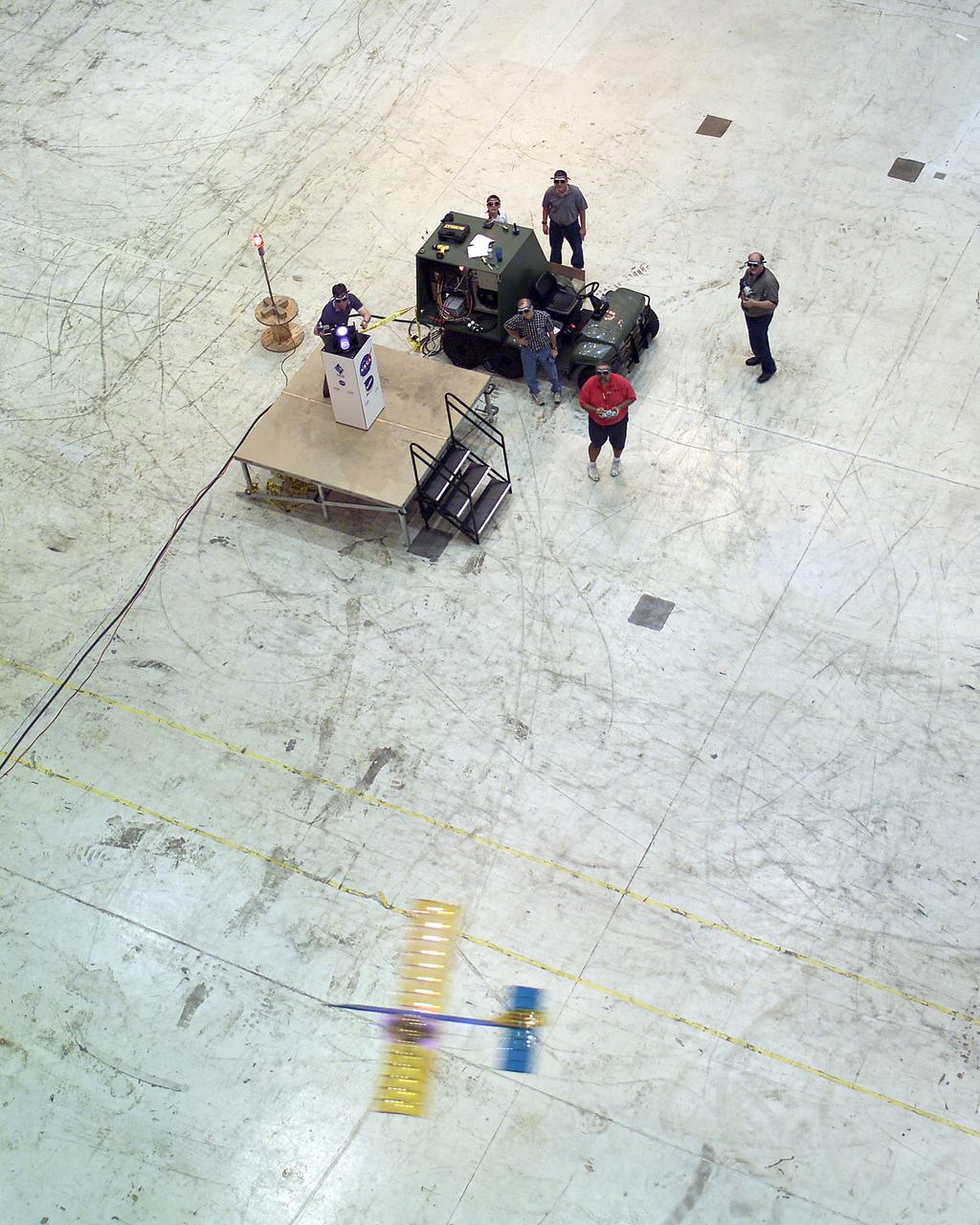
Powered by a laser beam directed at it from a center pedestal, a lightweight model plane makes the first flight of an aircraft powered by laser energy inside a building at NASA's Marshall Space Flight Center.
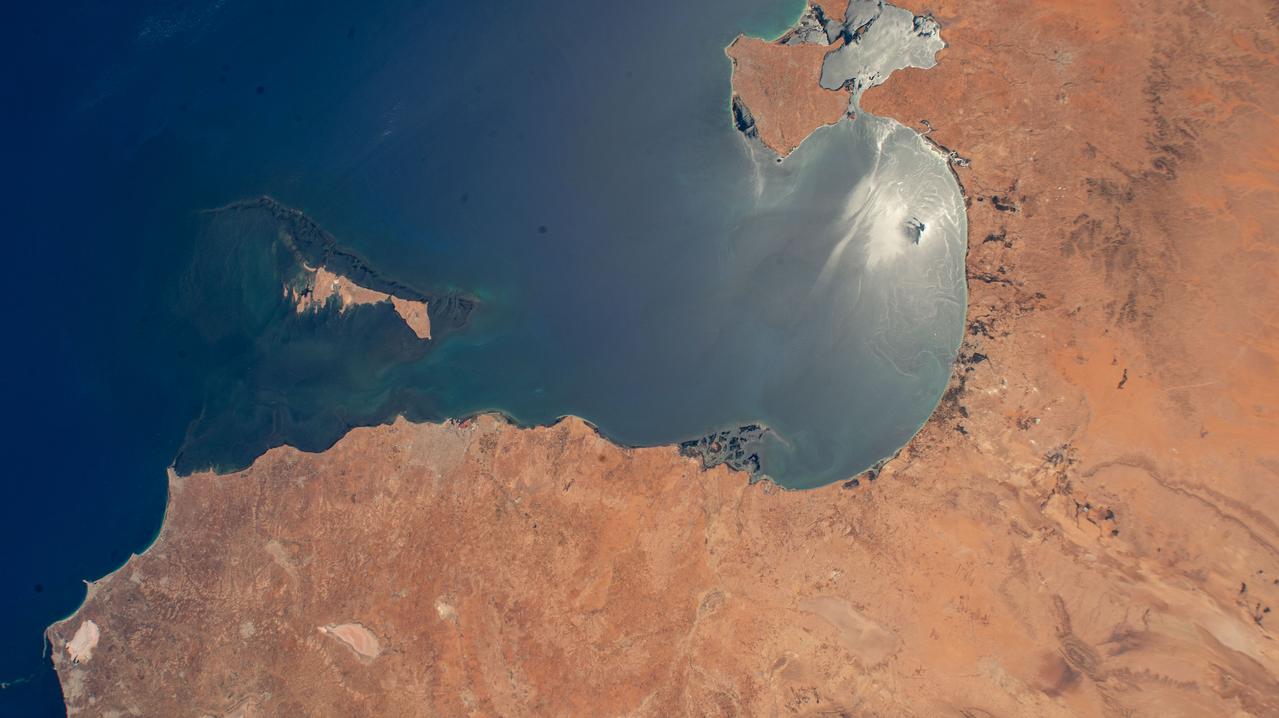
iss071e414023 (Aug. 2, 2024) --- The sun's glint beams off the Gulf of Gabes on the coast of Tunisia with Sharqi Island in the Mediterranean Sea in this photograph taken from the International Space Station as it orbited 262 miles above the African nation.

NASA image release April 27, 2012 The NASA/ESA Hubble Space Telescope has been at the cutting edge of research into what happens to stars like our sun at the ends of their lives. One stage that stars pass through as they run out of nuclear fuel is called the preplanetary or protoplanetary nebula stage. This Hubble image of the Egg Nebula shows one of the best views to date of this brief but dramatic phase in a star’s life. The preplanetary nebula phase is a short period in the cycle of stellar evolution, and has nothing to do with planets. Over a few thousand years, the hot remains of the aging star in the center of the nebula heat it up, excite the gas, and make it glow as a subsequent planetary nebula. The short lifespan of preplanetary nebulae means there are relatively few of them in existence at any one time. Moreover, they are very dim, requiring powerful telescopes to be seen. This combination of rarity and faintness means they were only discovered comparatively recently. The Egg Nebula, the first to be discovered, was first spotted less than 40 years ago, and many aspects of this class of object remain shrouded in mystery. At the center of this image, and hidden in a thick cloud of dust, is the nebula’s central star. While we can’t see the star directly, four searchlight beams of light coming from it shine out through the nebula. It is thought that ring-shaped holes in the thick cocoon of dust, carved by jets coming from the star, let the beams of light emerge through the otherwise opaque cloud. The precise mechanism by which stellar jets produce these holes is not known for certain, but one possible explanation is that a binary star system, rather than a single star, exists at the center of the nebula. The onion-like layered structure of the more diffuse cloud surrounding the central cocoon is caused by periodic bursts of material being ejected from the dying star. The bursts typically occur every few hundred years. The distance to the Egg Nebula is only known very approximately, the best guess placing it at around 3,000 light-years from Earth. This in turn means that astronomers do not have any accurate figures for the size of the nebula (it may be larger and further away, or smaller but nearer). This image is produced from exposures in visible and infrared light from Hubble’s Wide Field Camera 3. Credit: ESA/Hubble, NASA <b><a href="http://www.nasa.gov/audience/formedia/features/MP_Photo_Guidelines.html" rel="nofollow">NASA image use policy.</a></b> <b><a href="http://www.nasa.gov/centers/goddard/home/index.html" rel="nofollow">NASA Goddard Space Flight Center</a></b> enables NASA’s mission through four scientific endeavors: Earth Science, Heliophysics, Solar System Exploration, and Astrophysics. Goddard plays a leading role in NASA’s accomplishments by contributing compelling scientific knowledge to advance the Agency’s mission. <b>Follow us on <a href="http://twitter.com/NASAGoddardPix" rel="nofollow">Twitter</a></b> <b>Like us on <a href="http://www.facebook.com/pages/Greenbelt-MD/NASA-Goddard/395013845897?ref=tsd" rel="nofollow">Facebook</a></b> <b>Find us on <a href="http://instagrid.me/nasagoddard/?vm=grid" rel="nofollow">Instagram</a></b>
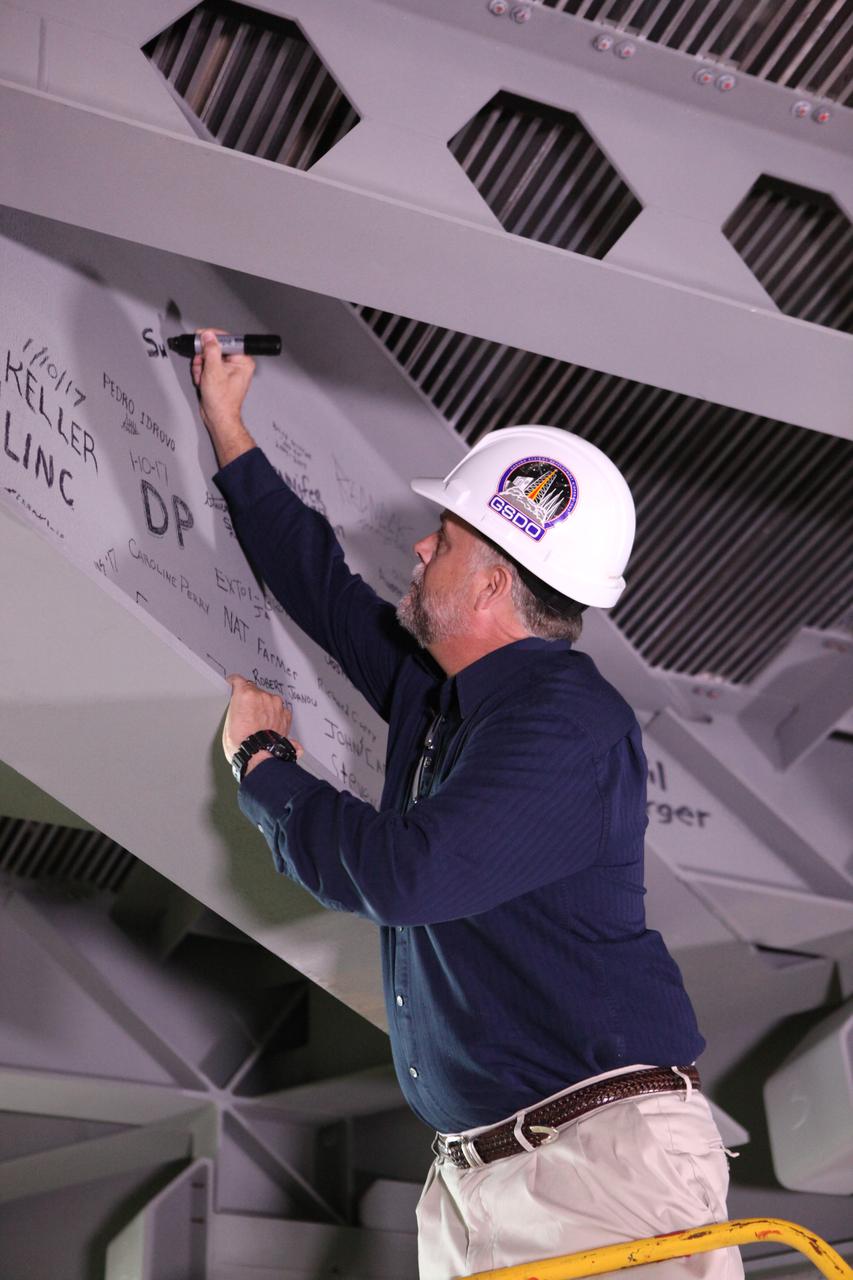
Shawn Quinn, associate program manager for the Ground Systems Development and Operations Program (GSDO), signs the platform A North beam in the transfer aisle of the Vehicle Assembly Building (VAB) at NASA's Kennedy Space Center in Florida. Kennedy's Engineering Directorate coordinated a platform beam signing event to celebrate the culmination of the NASA and contractor team's last several years of study, design, construction and installation of 20 new work platforms in High Bay 3 of the Vehicle Assembly (VAB). The platform will be installed and secured on its rail beam high up on the north wall of High Bay 3. The installation of the final topmost level completes the 10 levels of work platforms, 20 platform halves altogether, that will surround NASA's Space Launch System rocket and the Orion spacecraft and allow access during processing for missions, including the first uncrewed flight test of Orion atop the SLS rocket in 2018. GSDO, with support from the center's Engineering Directorate, is overseeing upgrades and modifications to the VAB, including installation of the new work platforms.

iss071e439834 (Aug. 8, 2024) --- The Yangtze River beams in the Sun's glint as wildfires burn in the surrounding forestland near the city of Wuhan in China's province of Hubei. The International Space Station was orbiting 262 miles above the Asian nation at the time of this photograph.
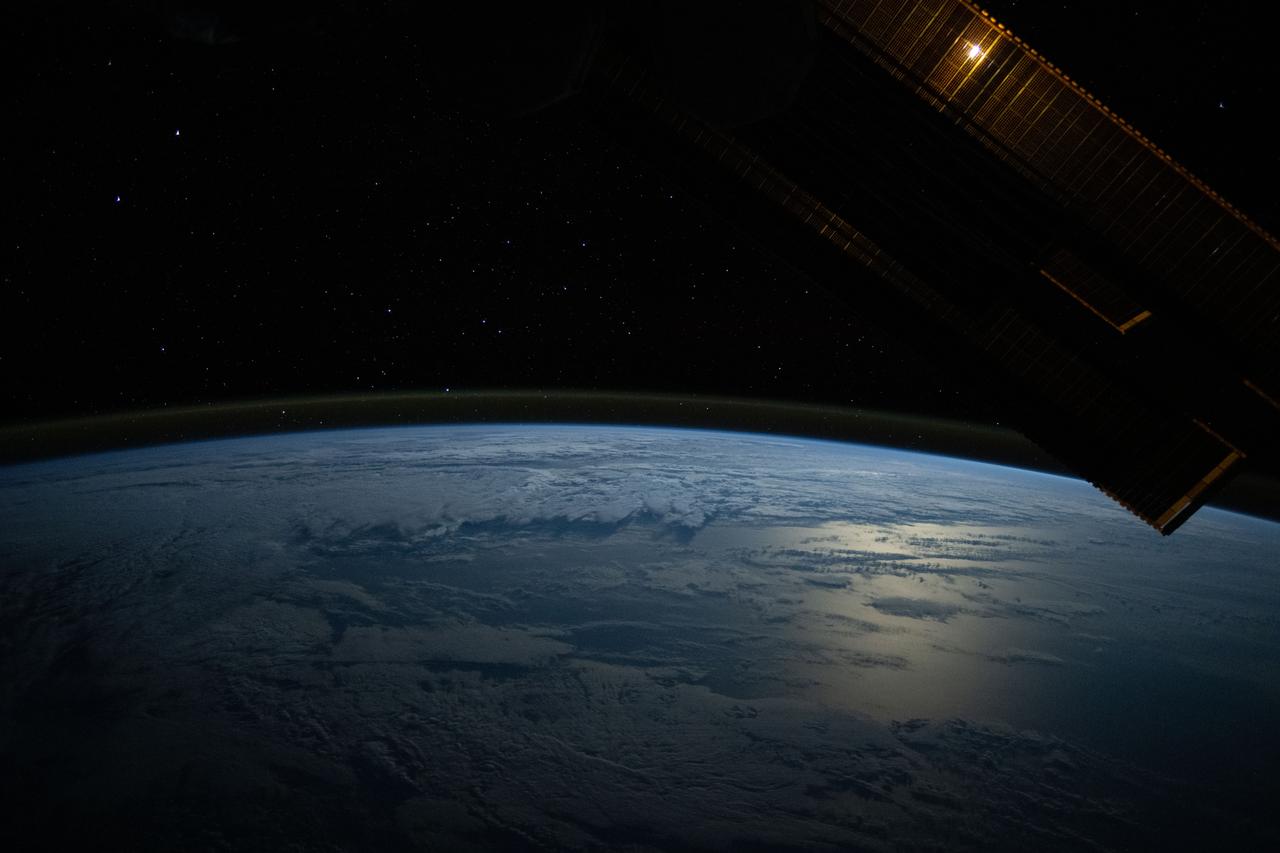
iss071e456772 (July 18, 2024) --- The Moon's glint beams off the Pacific Ocean as stars glitter in the background above the Earth's airglow. The Moon is obscured behind a solar array in this photograph from the International Space Station as it orbited 264 miles above.
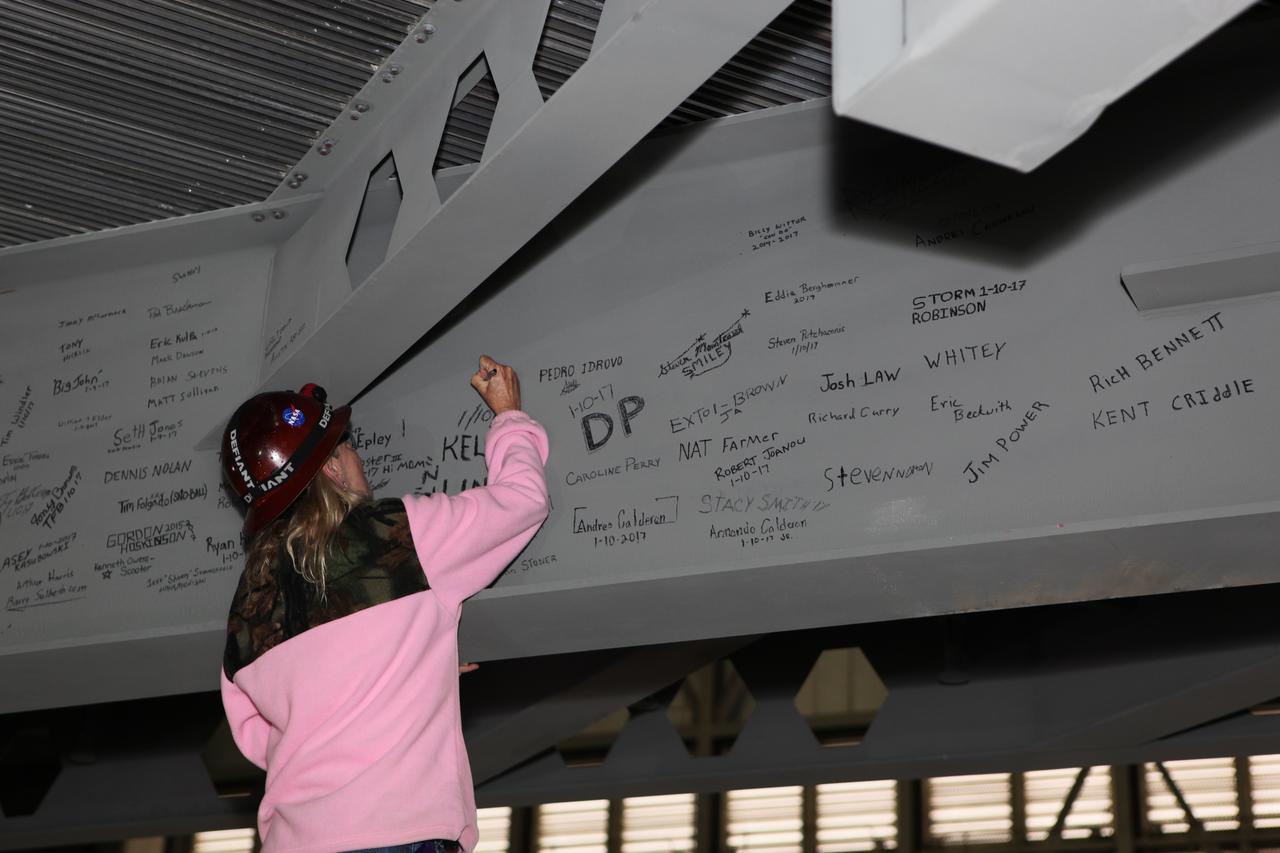
NASA Kennedy Space Center's Engineering Directorate coordinated a platform beam signing event to celebrate the culmination of the NASA and contractor team's last several years of study, design, construction and installation of 20 new work platforms in High Bay 3 of the Vehicle Assembly (VAB). Workers signed the final platform, A North, in the transfer aisle of the VAB. The platform will be lifted, installed and secured on its rail beam high up on the north wall of High Bay 3. The installation of the final topmost level completes the 10 levels of work platforms, 20 platform halves altogether, that will surround NASA's Space Launch System rocket and the Orion spacecraft and allow access during processing for missions, including the first uncrewed flight test of Orion atop the SLS rocket in 2018. The Ground Systems Development and Operations Program, with support from the center's Engineering Directorate, is overseeing upgrades and modifications to the VAB, including installation of the new work platforms.
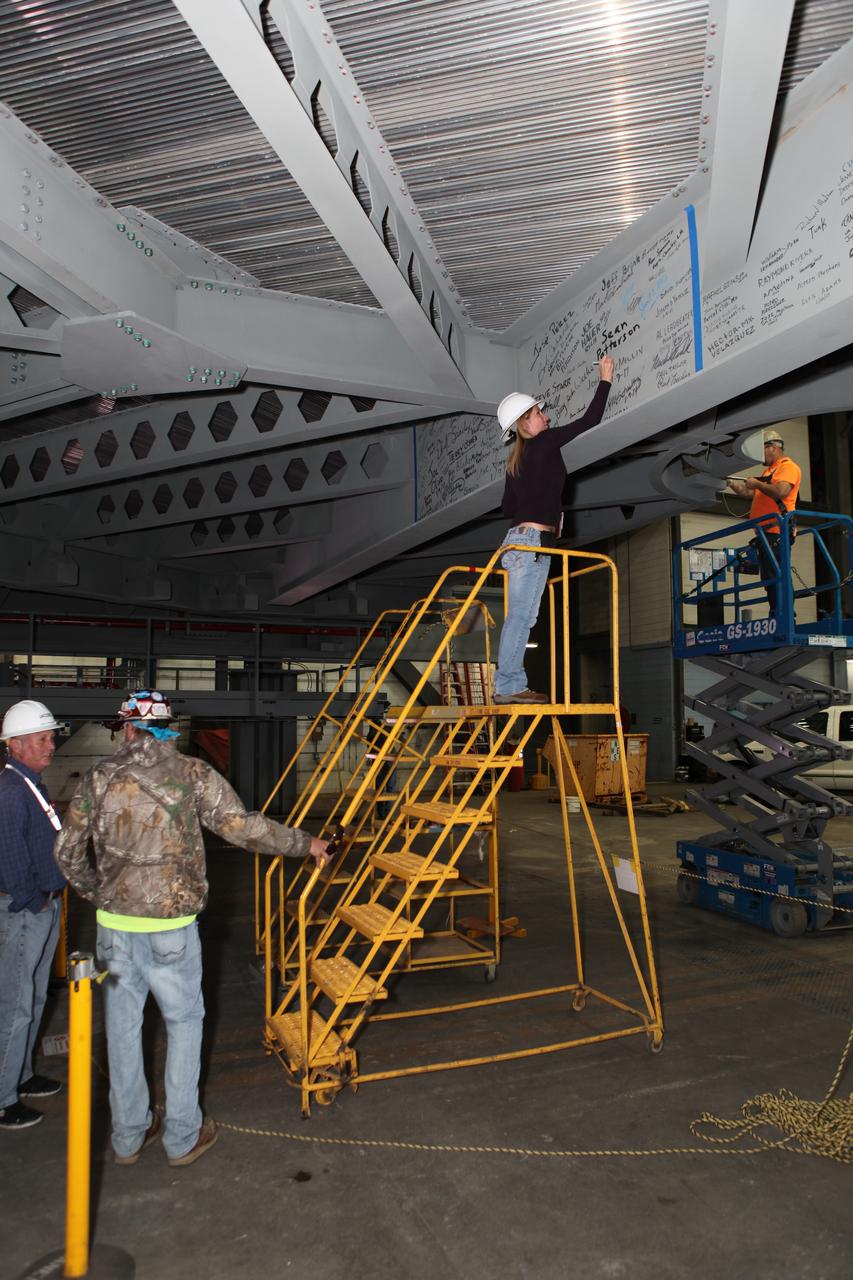
NASA Kennedy Space Center's Engineering Directorate coordinated a platform beam signing event to celebrate the culmination of the NASA and contractor team's last several years of study, design, construction and installation of 20 new work platforms in High Bay 3 of the Vehicle Assembly (VAB). Workers signed the final platform, A North, in the transfer aisle of the VAB. The platform will be lifted, installed and secured on its rail beam high up on the north wall of High Bay 3. The installation of the final topmost level completes the 10 levels of work platforms, 20 platform halves altogether, that will surround NASA's Space Launch System rocket and the Orion spacecraft and allow access during processing for missions, including the first uncrewed flight test of Orion atop the SLS rocket in 2018. The Ground Systems Development and Operations Program, with support from the center's Engineering Directorate, is overseeing upgrades and modifications to the VAB, including installation of the new work platforms.
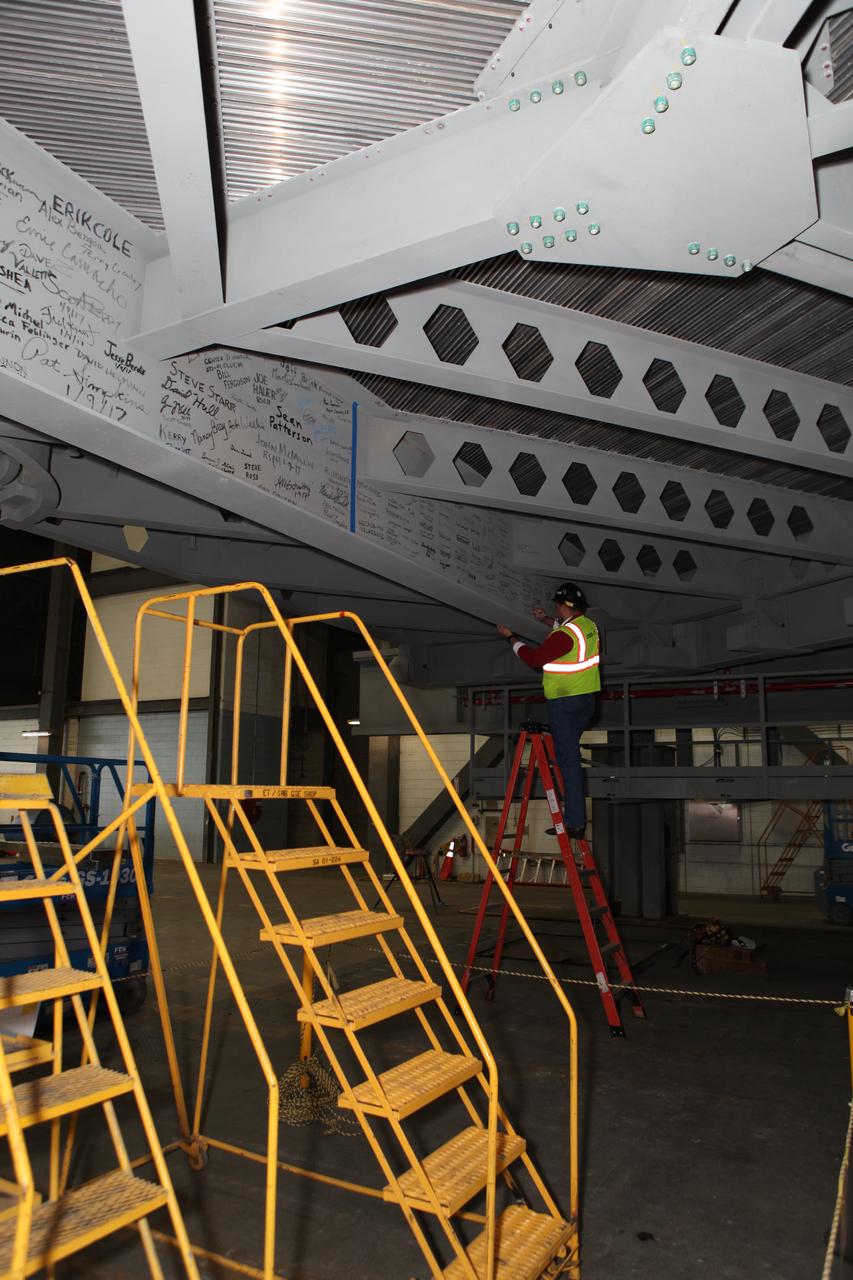
NASA Kennedy Space Center's Engineering Directorate coordinated a platform beam signing event to celebrate the culmination of the NASA and contractor team's last several years of study, design, construction and installation of 20 new work platforms in High Bay 3 of the Vehicle Assembly (VAB). Workers signed the final platform, A North, in the transfer aisle of the VAB. The platform will be lifted, installed and secured on its rail beam high up on the north wall of High Bay 3. The installation of the final topmost level completes the 10 levels of work platforms, 20 platform halves altogether, that will surround NASA's Space Launch System rocket and the Orion spacecraft and allow access during processing for missions, including the first uncrewed flight test of Orion atop the SLS rocket in 2018. The Ground Systems Development and Operations Program, with support from the center's Engineering Directorate, is overseeing upgrades and modifications to the VAB, including installation of the new work platforms.
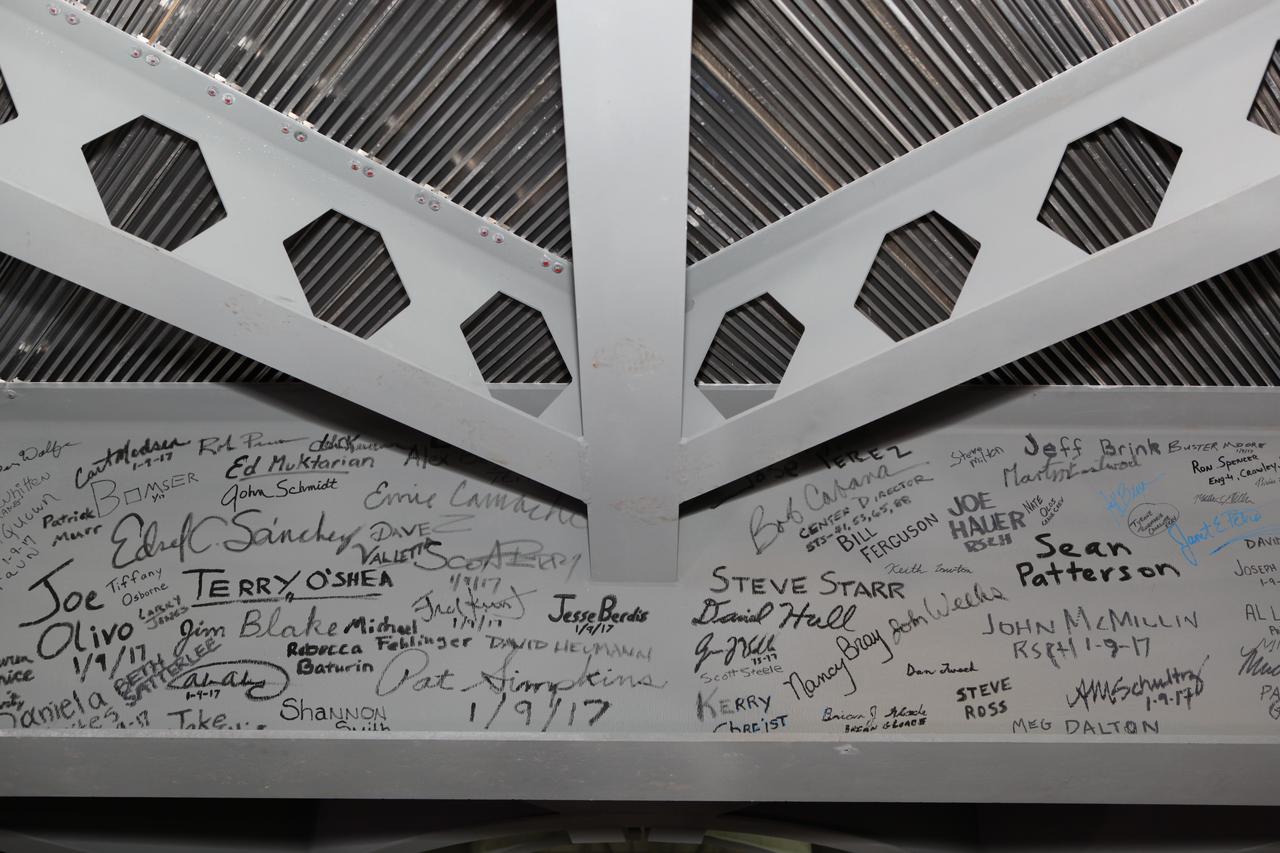
NASA Kennedy Space Center's Engineering Directorate coordinated a platform beam signing event to celebrate the culmination of the NASA and contractor team's last several years of study, design, construction and installation of 20 new work platforms in High Bay 3 of the Vehicle Assembly (VAB). Workers signed the final platform, A North, in the transfer aisle of the VAB. The platform will be lifted, installed and secured on its rail beam high up on the north wall of High Bay 3. The installation of the final topmost level completes the 10 levels of work platforms, 20 platform halves altogether, that will surround NASA's Space Launch System rocket and the Orion spacecraft and allow access during processing for missions, including the first uncrewed flight test of Orion atop the SLS rocket in 2018. The Ground Systems Development and Operations Program, with support from the center's Engineering Directorate, is overseeing upgrades and modifications to the VAB, including installation of the new work platforms.
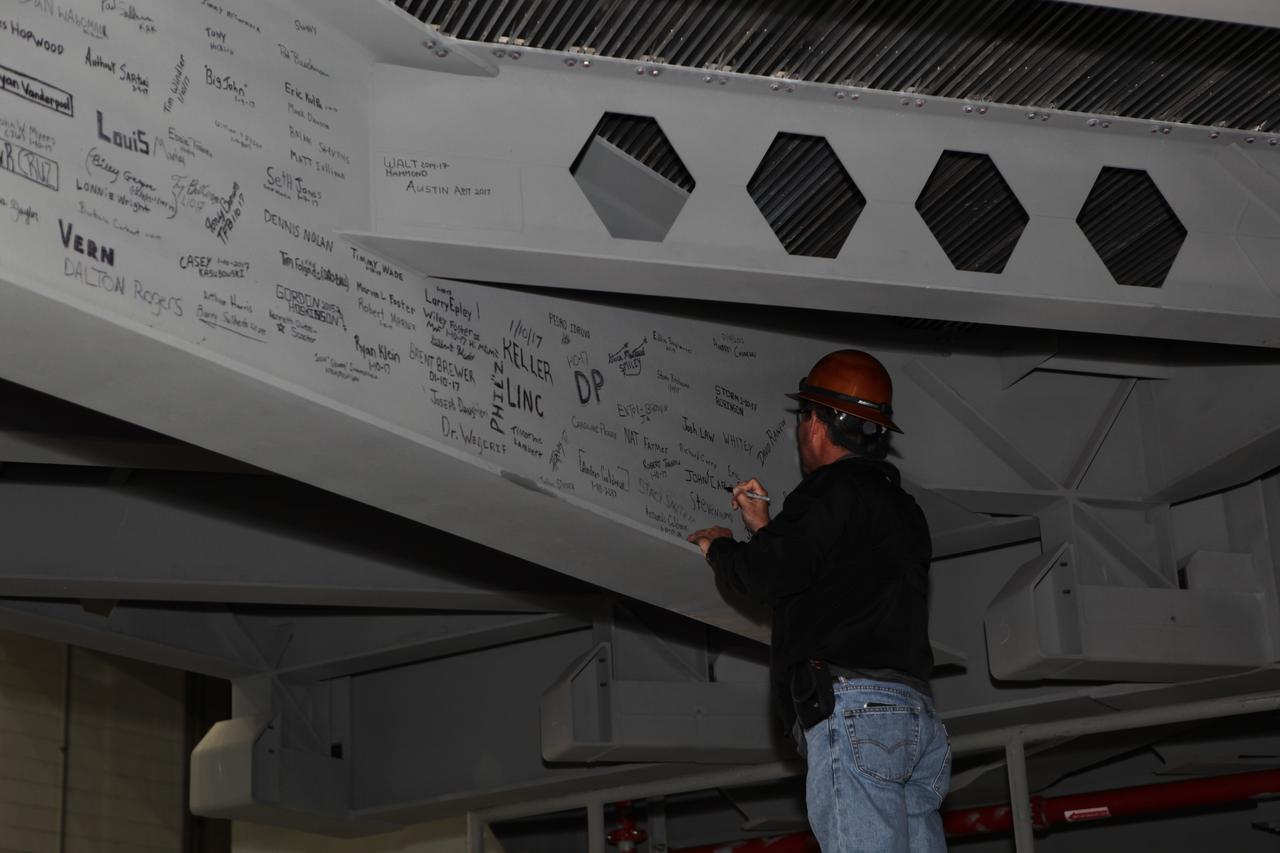
NASA Kennedy Space Center's Engineering Directorate coordinated a platform beam signing event to celebrate the culmination of the NASA and contractor team's last several years of study, design, construction and installation of 20 new work platforms in High Bay 3 of the Vehicle Assembly (VAB). Workers signed the final platform, A North, in the transfer aisle of the VAB. The platform will be lifted, installed and secured on its rail beam high up on the north wall of High Bay 3. The installation of the final topmost level completes the 10 levels of work platforms, 20 platform halves altogether, that will surround NASA's Space Launch System rocket and the Orion spacecraft and allow access during processing for missions, including the first uncrewed flight test of Orion atop the SLS rocket in 2018. The Ground Systems Development and Operations Program, with support from the center's Engineering Directorate, is overseeing upgrades and modifications to the VAB, including installation of the new work platforms.

An experimental radio-controlled model aircraft is seen here in flight powered only by light energy beamed to it by a spotlight.
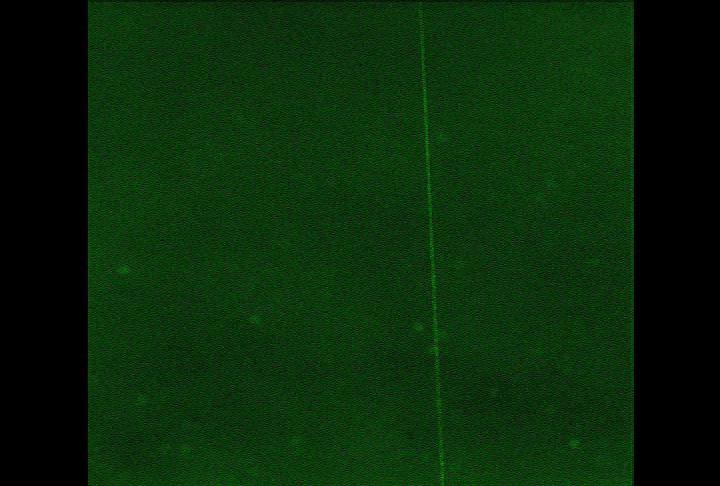
A laser beam from the Canadian-built lidar instrument on NASA Phoenix Mars Lander can be seen in this contrast-enhanced image taken by Phoenix Surface Stereo Imager on July 26, 2008, during early Martian morning hours of the 61st Martian day.

iss065e004417 (April 25, 2021) --- The International Space Station's newest component is the NanoRacks Bishop Airlock (center left) attached to the end of the Tranquility module. Bishop will enable more commercial research, satellite deployments, and cargo operations outside in the vacuum of space. Located on the other side of Bishop on Tranquility is BEAM, or the Bigelow Expandable Activity Module, which is a cargo stowage module outfitted with sensors continuously monitoring its environment.
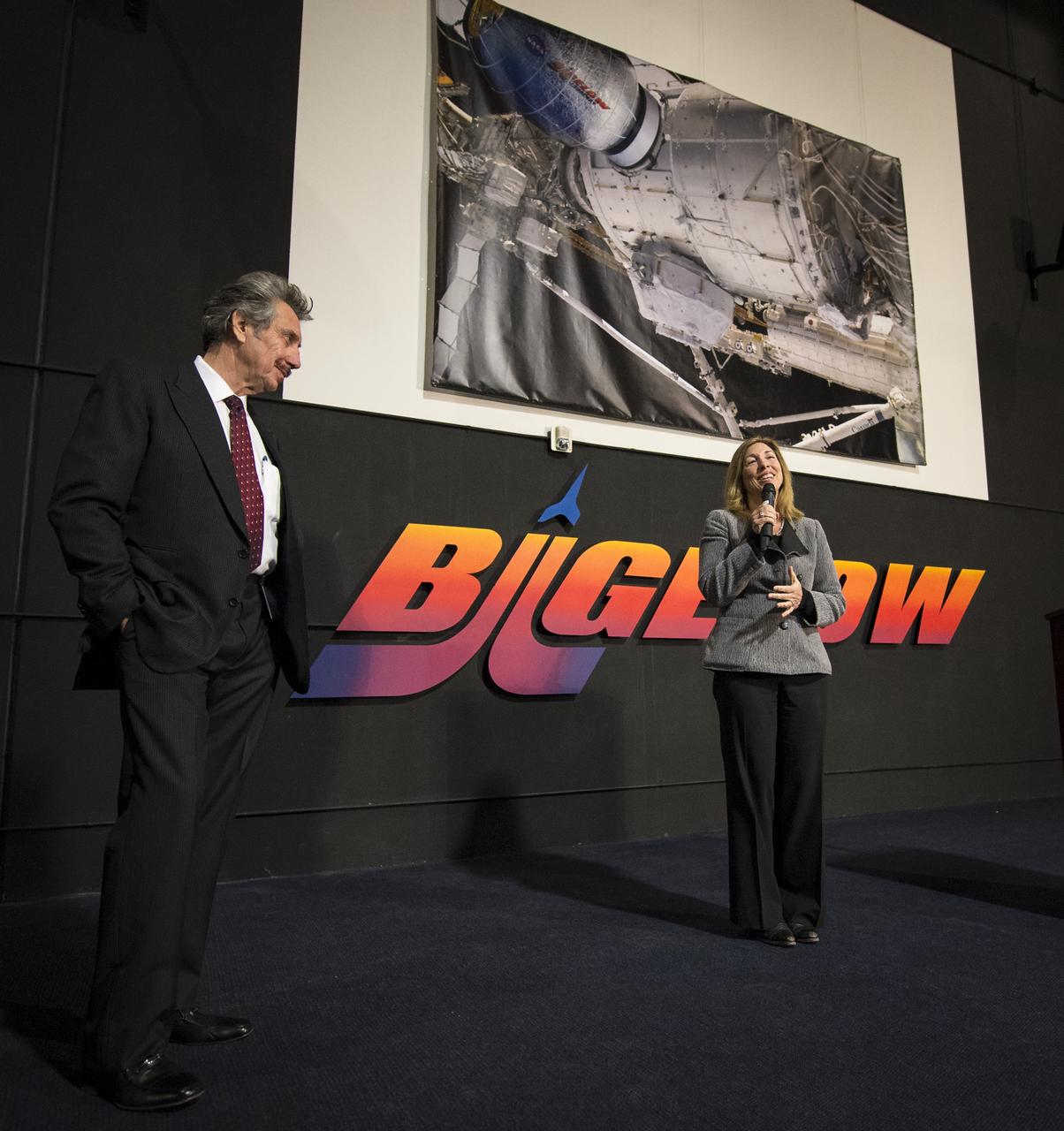
NASA Deputy Administrator Lori Garver and President and founder of Bigelow Aerospace Robert T. Bigelow, announce a planned addition to the International Space Station that will use the orbiting laboratory to test expandable space habitat technology during a press conference held at Bigelow Aerospace on Wednesday, Jan. 16, 2013 in Las Vegas. The $17.8 million contract with Bigelow Aerospace will provide a Bigelow Expandable Activity Module (BEAM), which is scheduled to arrive at the space station in 2015 for a two-year technology demonstration. Photo Credit: (NASA/Bill Ingalls)
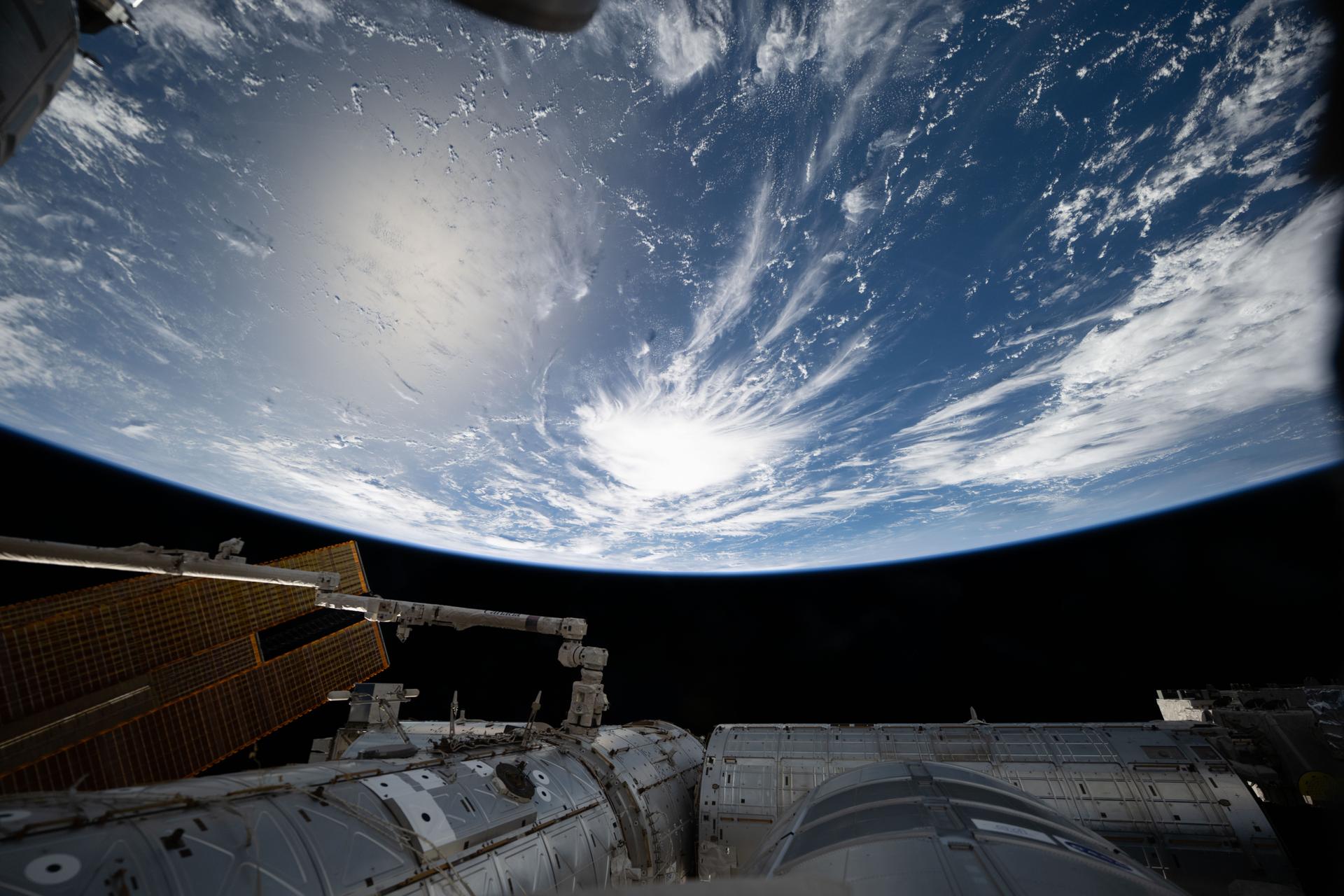
iss075e0159320 (Sept. 30, 2026) --- The sun’s glint beams across the Philippine Sea in this photograph from the International Space Station as it orbited 264 miles above Earth. Credit: ESA/Sophie Adenot
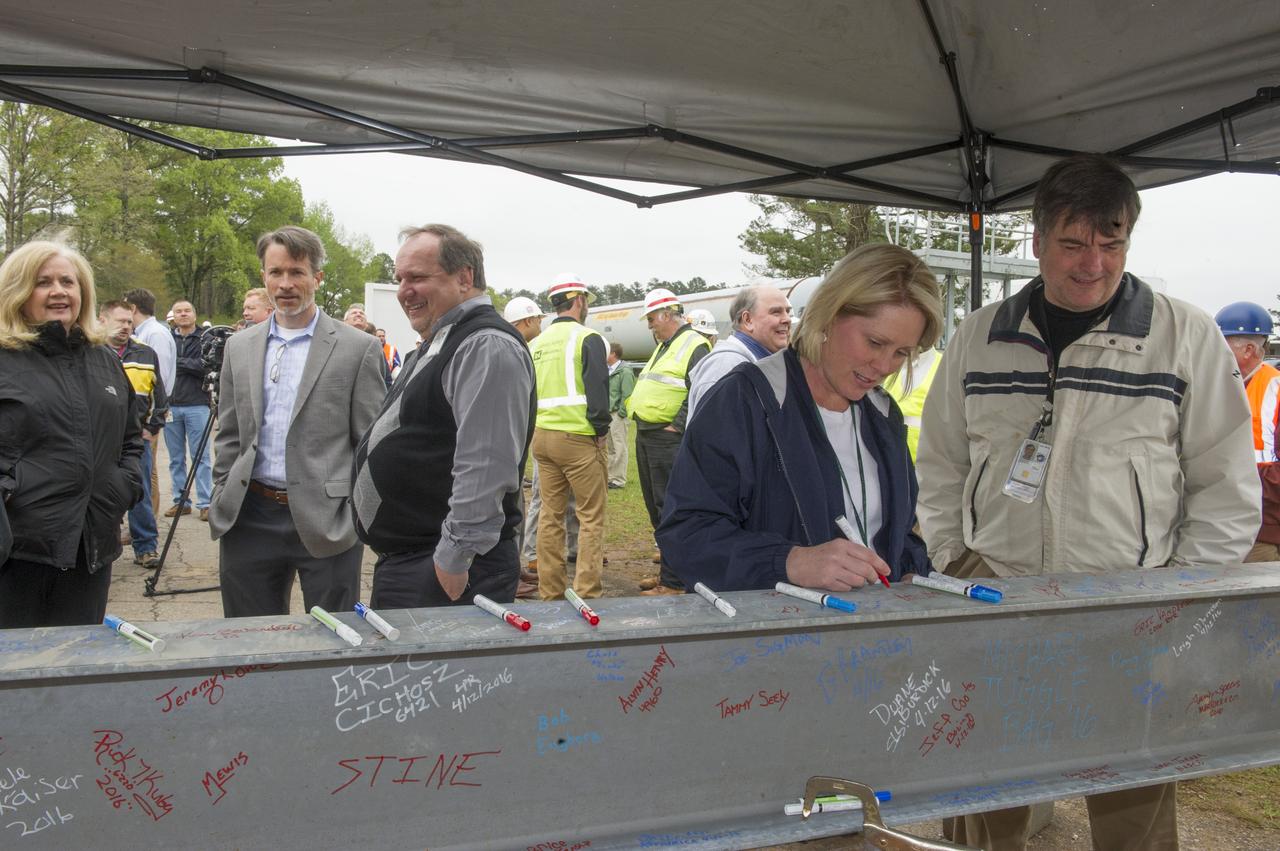
HEATHER HANEY SIGNS FINAL BEAM TO BE PLACED ATOP TEST STAND 4693 DURING THE STRUCTURE'S TOPPING OUT CEREMONY

iss072e311451 (Dec. 3, 2024) --- The Sun's glint beams off one of the many rivers that snake throughout South America's fertile, low grasslands region, also known as the Pampas. The International Space Station was orbiting 261 miles above the border of Paraguay and Argentina at the time of this photograph. Credit: NASA/Don Pettit
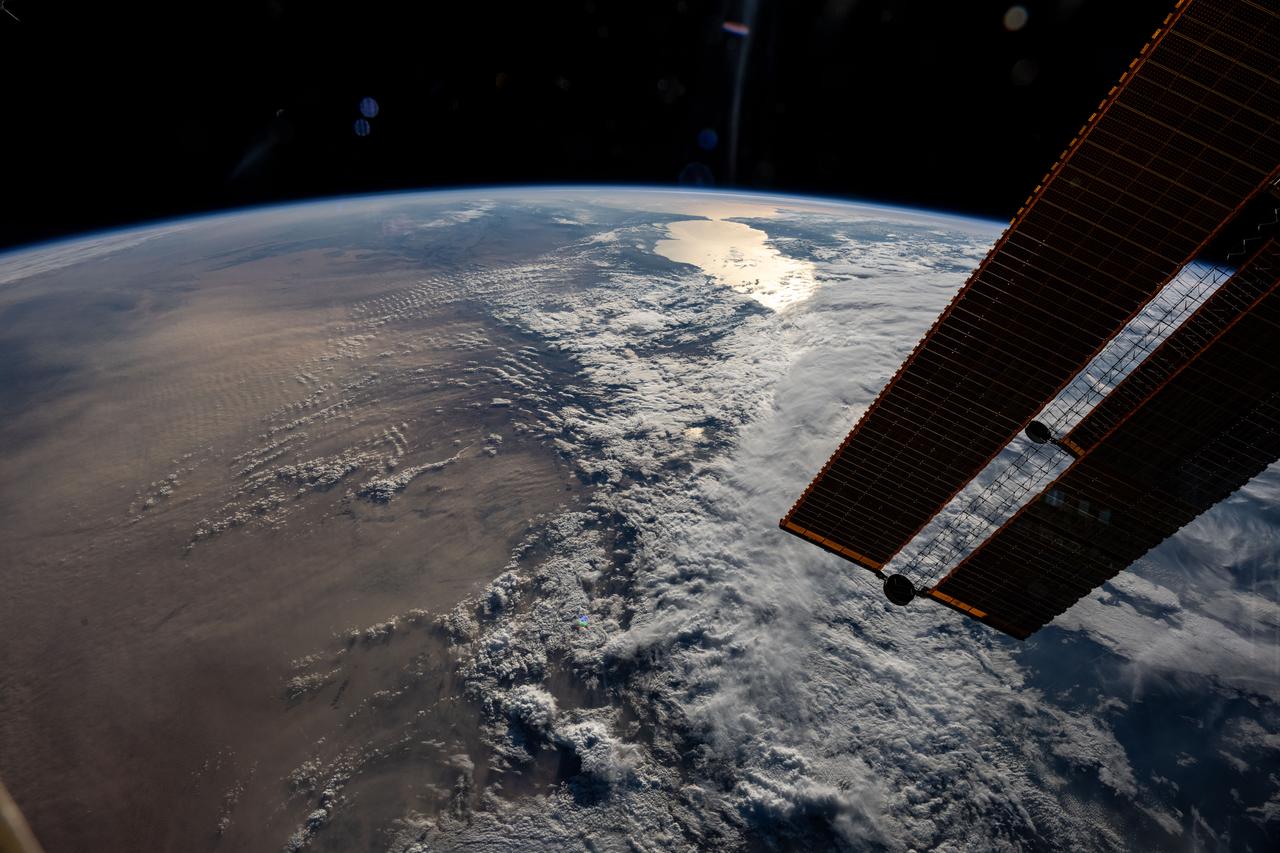
iss073e0032281 (May 15, 2025) --- The sun's glint beams off the Strait of Gibraltar at the top of this photograph as the International Space Station orbited 261 miles above a cloudy Mediterranean Sea. At left, is the Sahara Desert extending across the north African continent. In the right foreground, is a set of of the orbital outpost's main solar arrays.
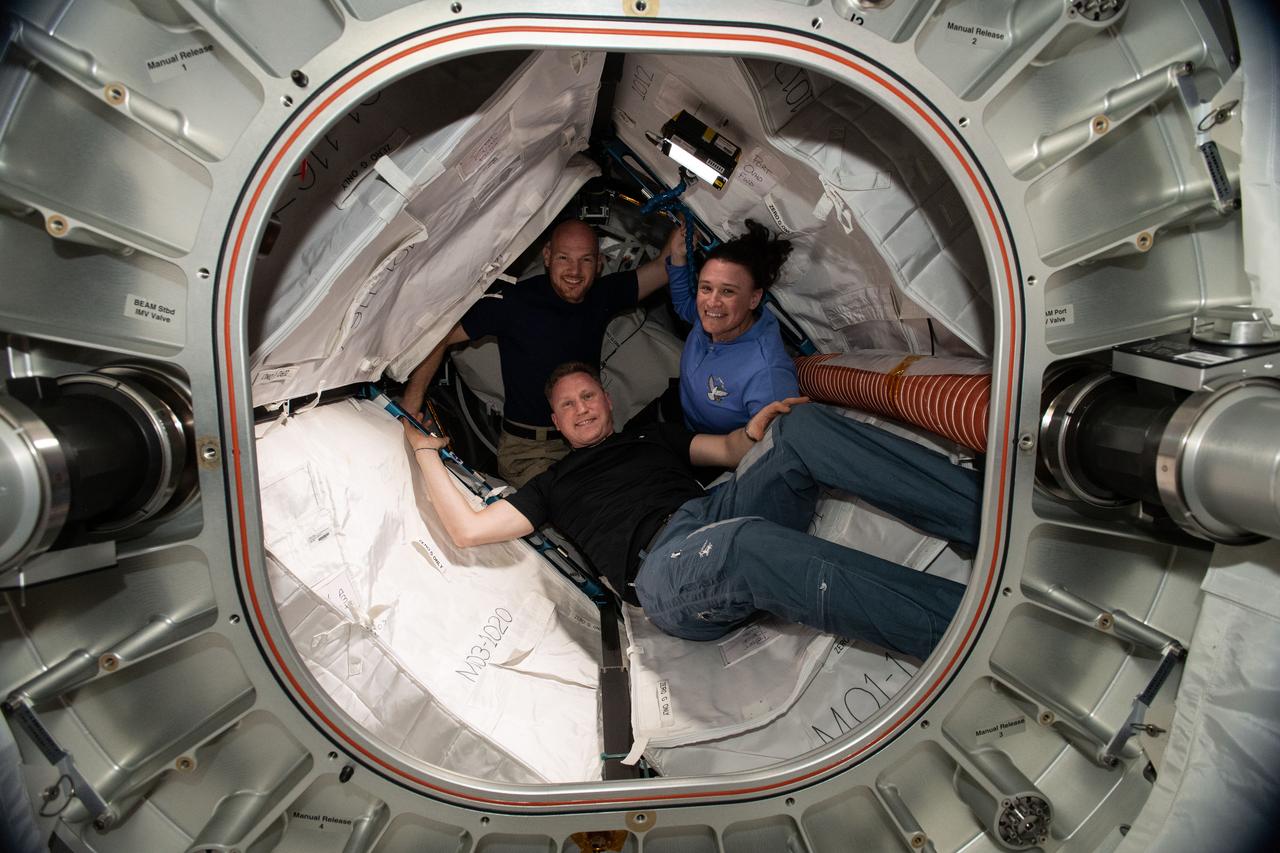
iss056e126552 (Aug. 2, 2018) --- Expedition 56/57 crew members (clockwise from top) Astronaut Alexander Gerst of ESA (European Space Agency), NASA astronaut Serena Auñón-Chancellor and Roscosmos cosmonaut Sergey Prokopyev, pose for a portrait inside the Bigelow Expandable Aerospace Module (BEAM). BEAM was installed on the International Space Station's Tranquility module on April 16, 2016 after being launched aboard the SpaceX Dragon cargo craft on April 8, 2016.
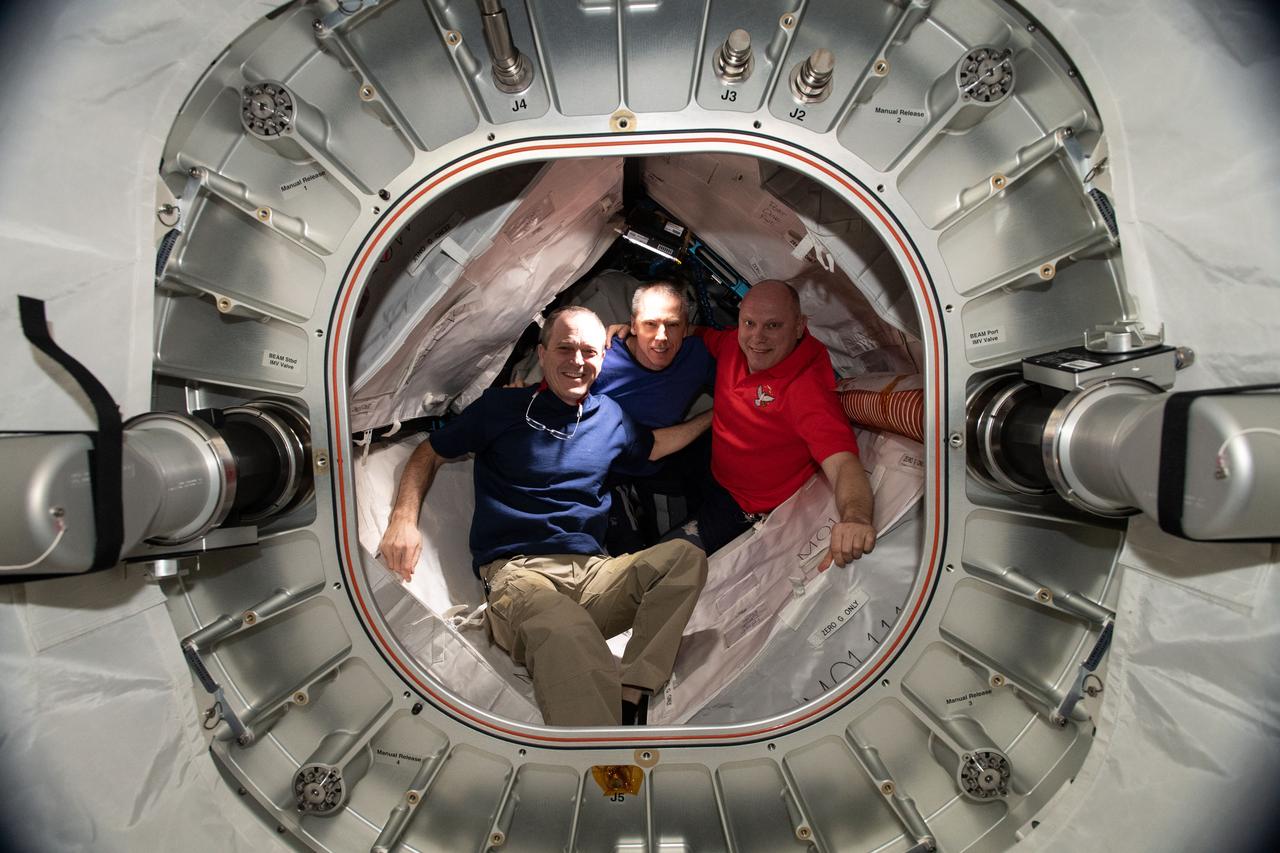
iss056e126552 (Aug. 2, 2018) --- Expedition 55/56 crew members (from left) NASA astronauts Ricky Arnold and Drew Feustel and Roscosmos cosmonaut Oleg Artemyev, pose for a portrait inside the Bigelow Expandable Aerospace Module (BEAM). BEAM was installed on the International Space Station's Tranquility module on April 16, 2016 after being launched aboard the SpaceX Dragon cargo craft on April 8, 2016.
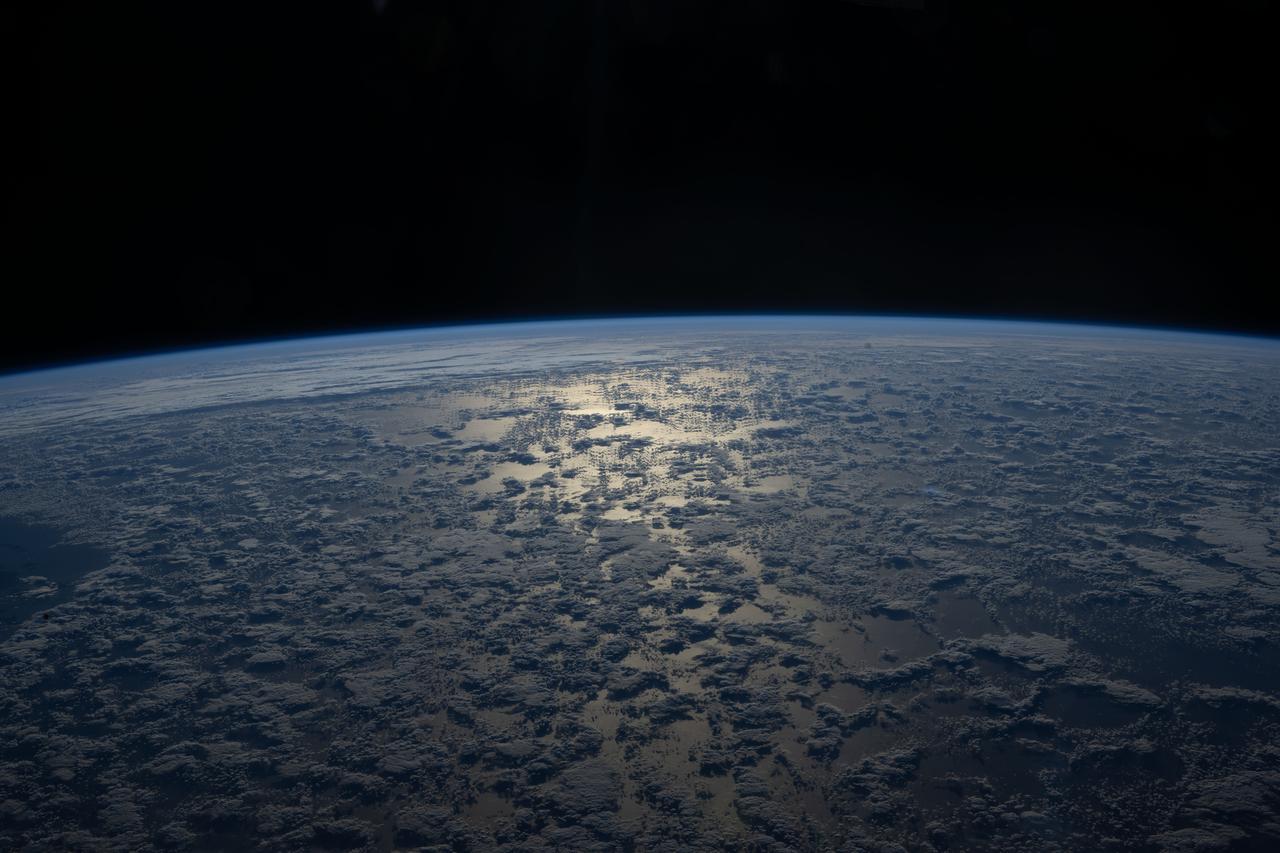
iss073e0107413 (May 17, 2025) --- The Sun's glint beams off a partly cloudy Indian Ocean in this photograph from the International Space Station as it orbited 271 miles above and south of Australia's island state of Tasmania.
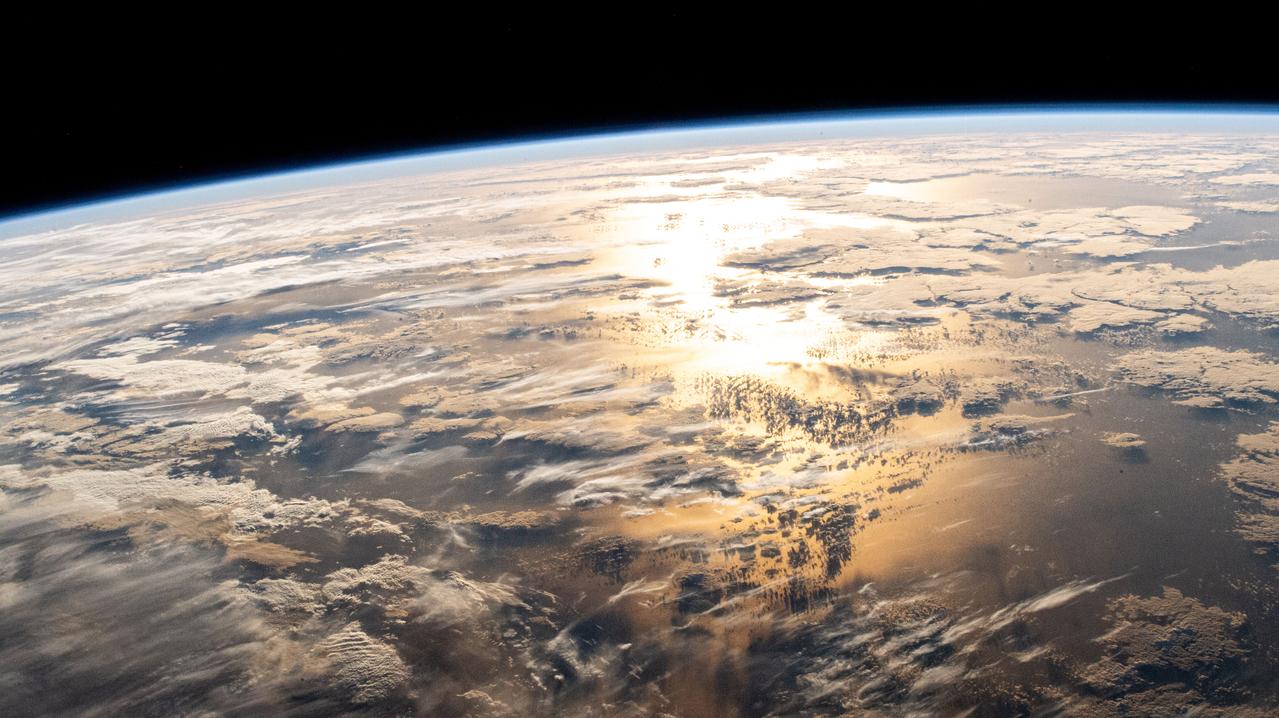
iss072e695136 (March 5, 2025) --- The sun's glint beams off a partly cloudy Atlantic Ocean just after sunrise as the International Space Station orbited 263 miles above.
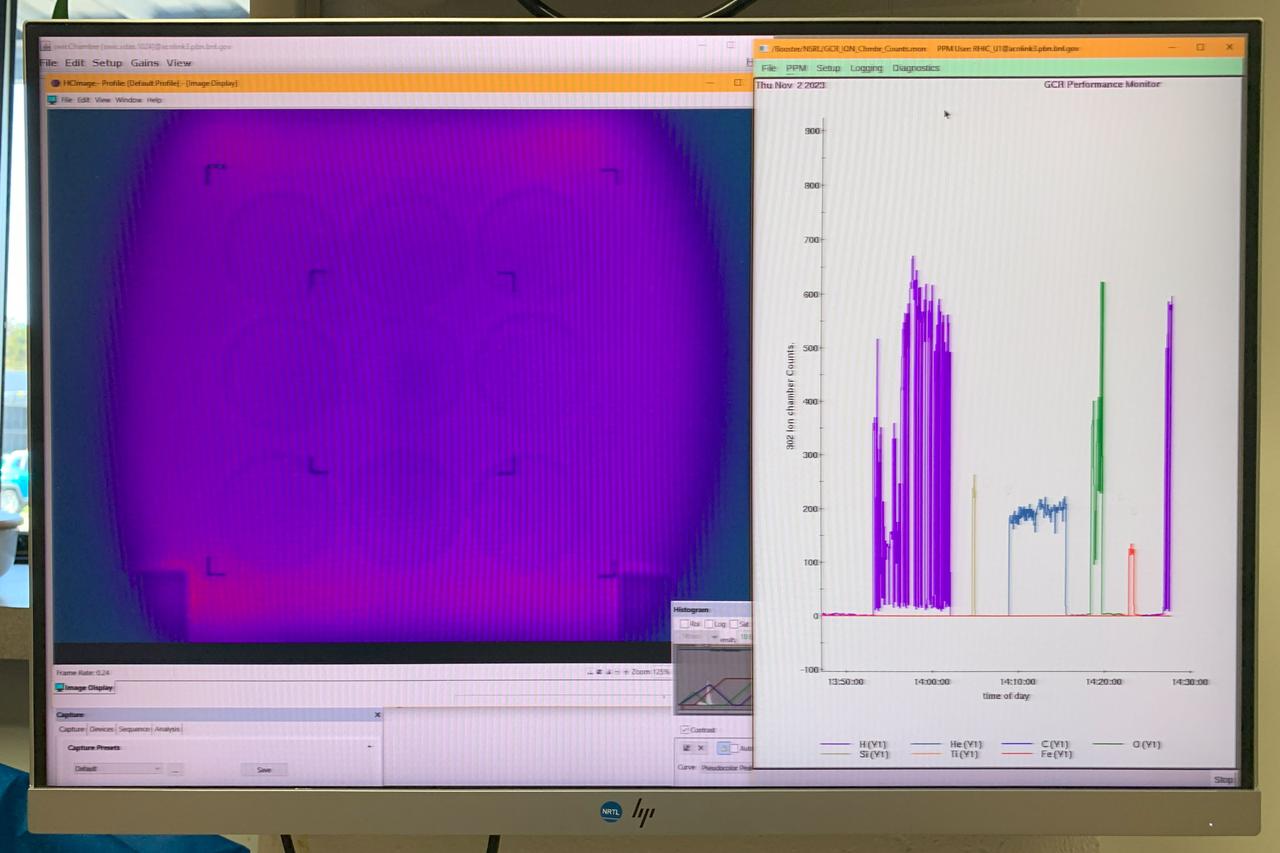
jsc2024e062111 (9/13/2024) --- The monitor displays the ion beam profile of Galactic Cosmic Ray Simulation (GCRSim) used in the ANT1 Radiation Tolerance Experiment with Moss in Orbit on the Space Station (ARTEMOSS) investigation. The ARTEMOSS investigation examines whether and how an Antarctic moss repairs damage caused by cosmic radiation and microgravity. Image courtesy of Agata Zupanska.
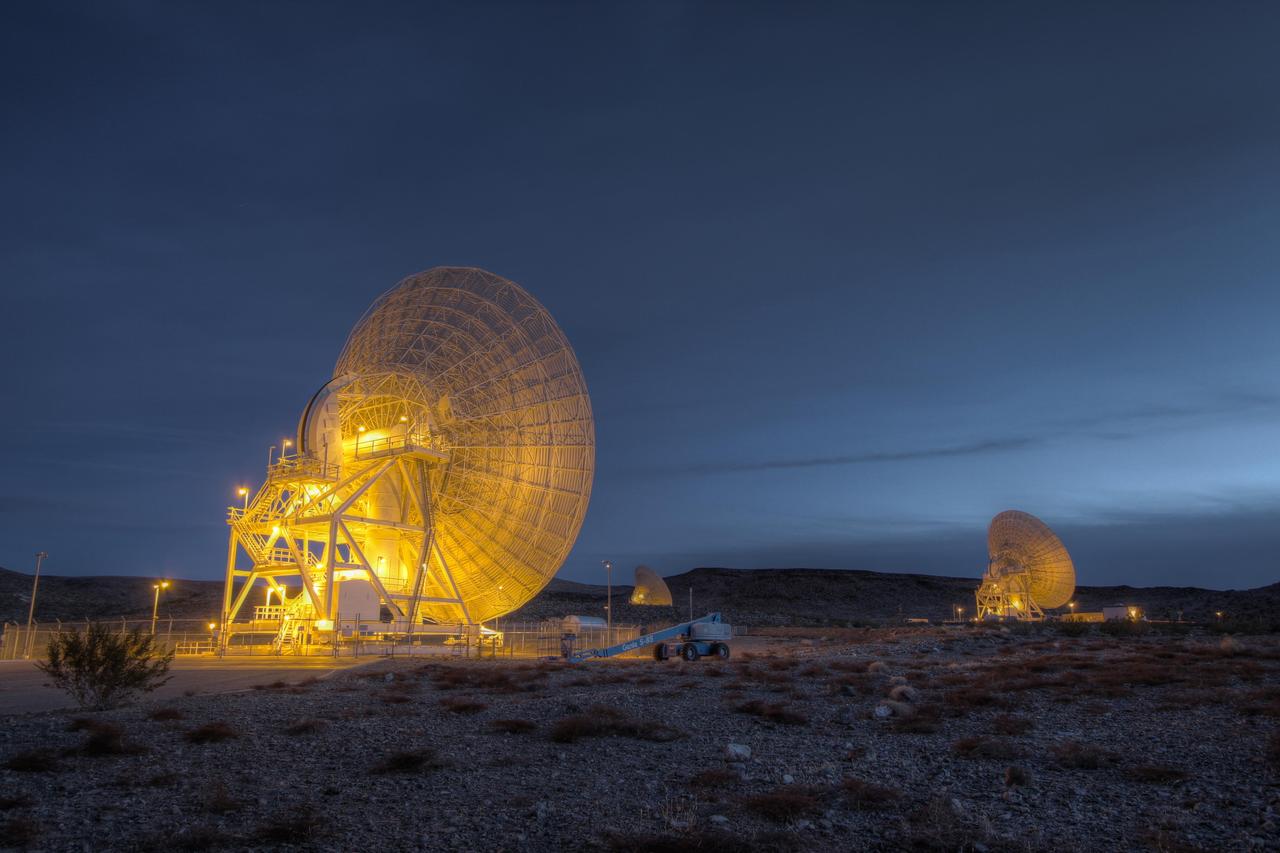
Beam Wave Guide antennas at Goldstone, known as the Beam Waveguide Cluster. They are located in an area at Goldstone called Apollo Valley. The Goldstone Deep Space Communications Complex is located in the Mojave Desert in California, USA.

STS-36 Earth observation shows sun beaming off ocean waters with heavy cloud cover.

iss073e0006003 (April 26, 2025) --- This oblique of view of the sun's glint beaming off Lake Superior was taken at about 8:34 a.m. local time from the International Space Station as it orbited 263 miles above the state of Minnesota, Land of 10,000 Lakes.
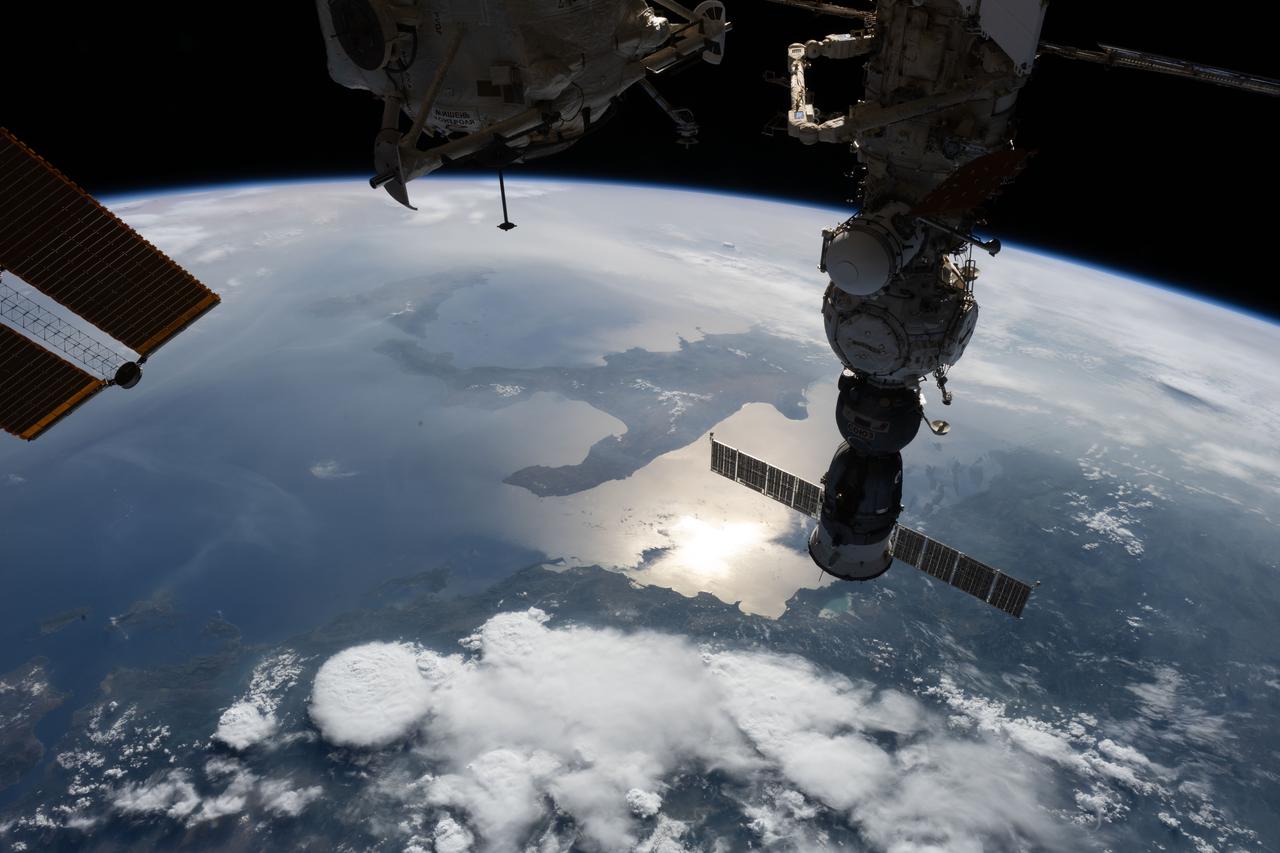
iss073e0254866 (June 5, 2025) --- The sun's glint beams off the Adriatic Sea contrasting with the "boot" of Italy in this photograph from the International Space Station as it orbited 261 miles above Southern Europe. In the right foreground, is the Soyuz MS-27 crew ship docked to the orbital outpost's Prichal module.
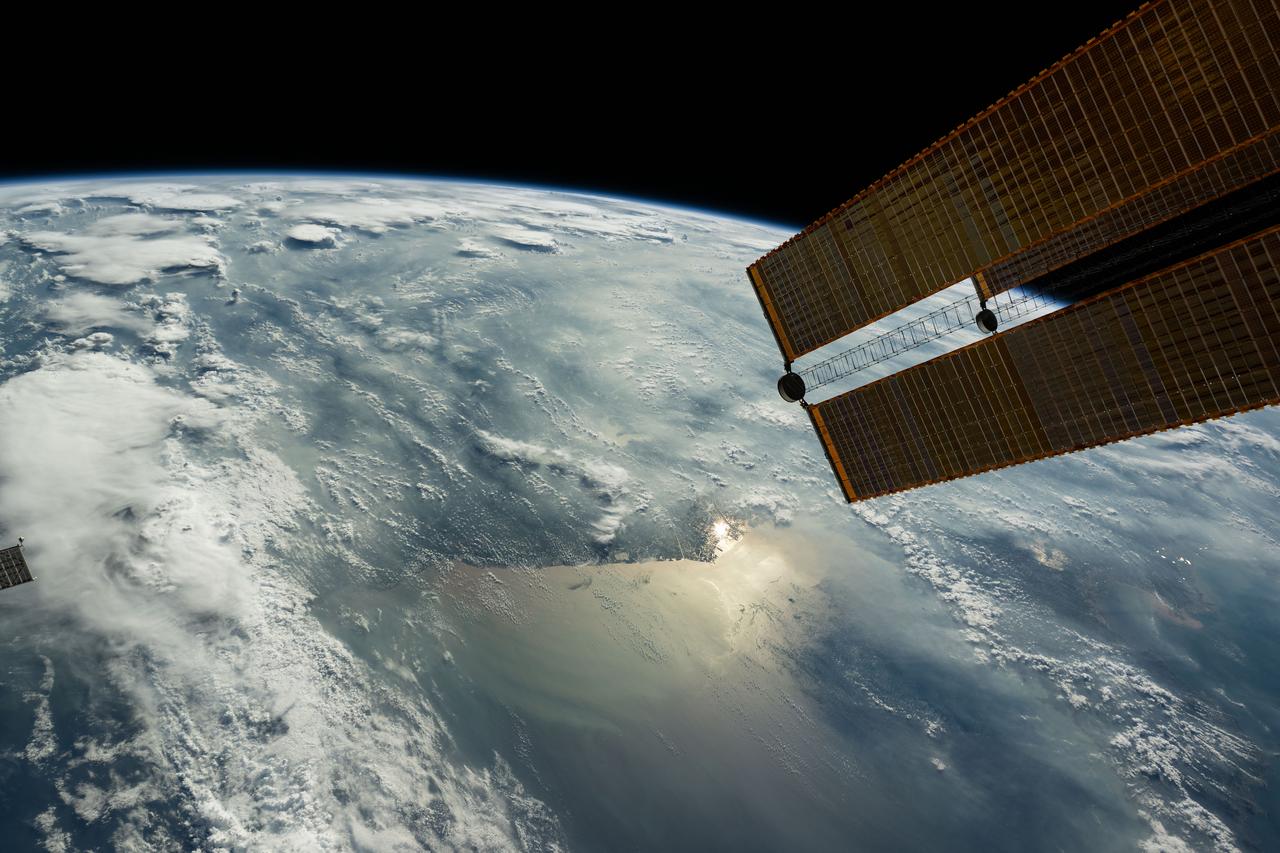
iss073e0384097 (July 18, 2025) --- The sun's glint beams off the Yellow Sea coast of Jiangsu Province, China, in this photograph taken from the International Space Station as it orbited 260 miles above. In the right foreground, a set of the station's main solar arrays extends into the frame.
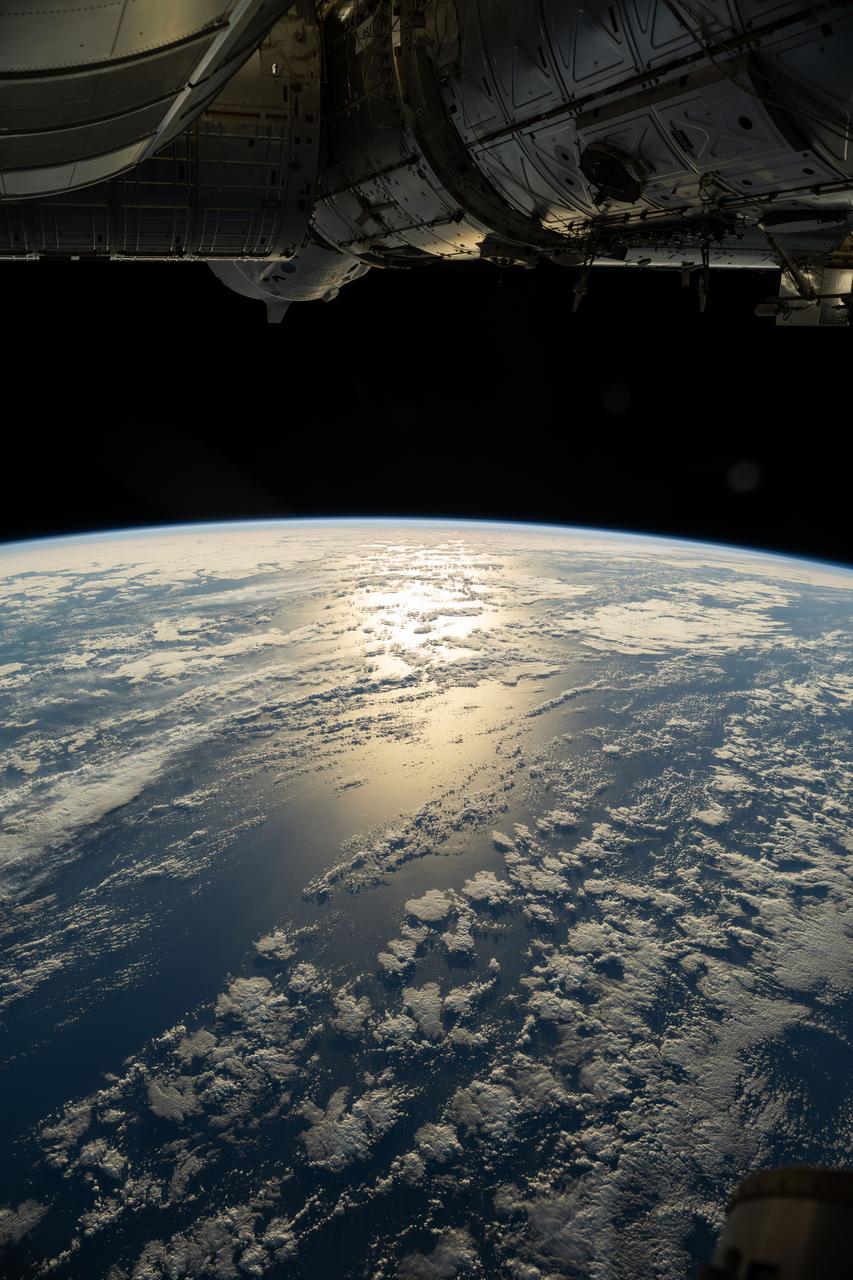
iss073e0177079 (June 2, 2025) --- The sun's glint beams off a partly cloudy southern Pacific Ocean in this photograph from the International Space Station as it orbited 264 miles above. At top, a partially obscured SpaceX Dragon crew spacecraft can be seen docked to the orbital outpost's forward port on the Harmony module.
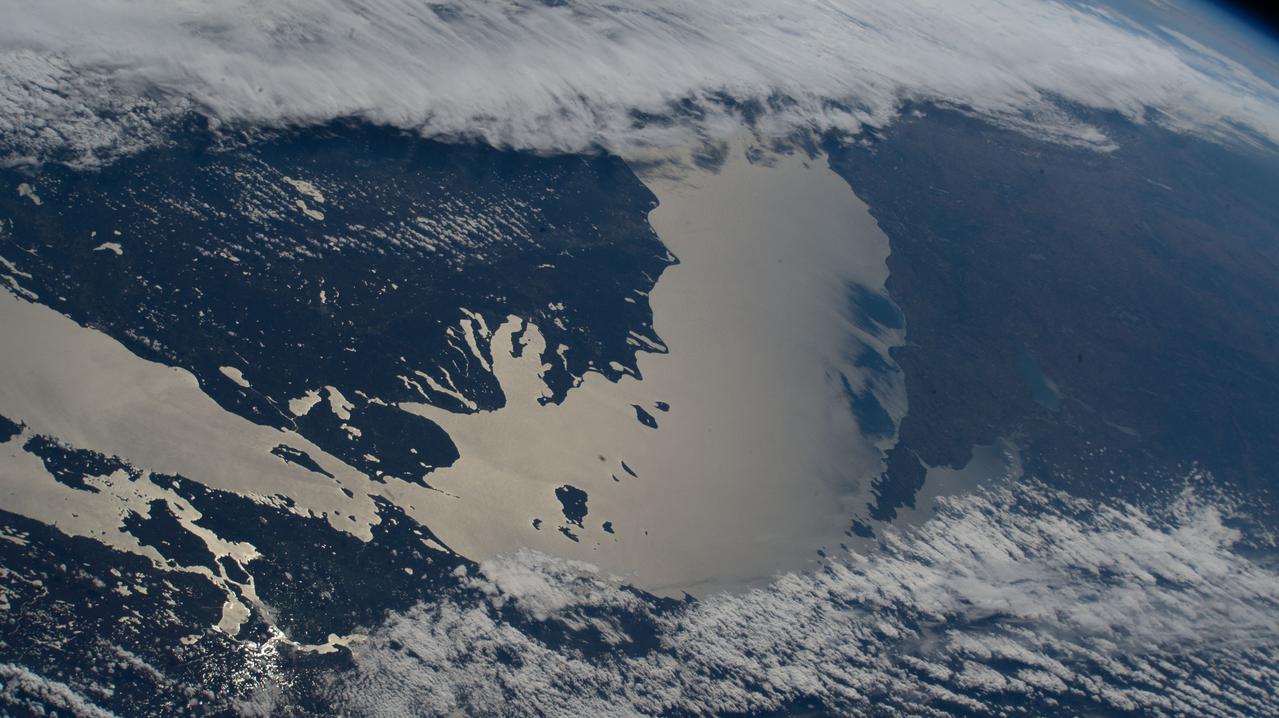
iss073e0865640 (Oct. 7, 2025) --- Lake Michigan beams in the afternoon sunlight as clouds blanket its southern tip—spanning Michigan, Indiana, and Illinois—in this photograph taken from the International Space Station while orbiting 263 miles above Earth. The northern tip of Lake Huron is visible at left.

iss074e0006008 (Dec. 12, 2025) --- The sun’s glint beams off the Atlantic Ocean, contrasting with southern Florida and a portion of the Bahamas (upper left) in this photograph taken from the International Space Station as it orbited 262 miles above the southeastern United States. In the bottom foreground is the Kibo laboratory module’s Exposed Facility, which hosts a variety of experiment payloads and other hardware exposed to the external microgravity environment. Extending from the top right of the frame is the Japanese robotic arm, which can maneuver payloads into and out of Kibo’s airlock for placement on the Exposed Facility.
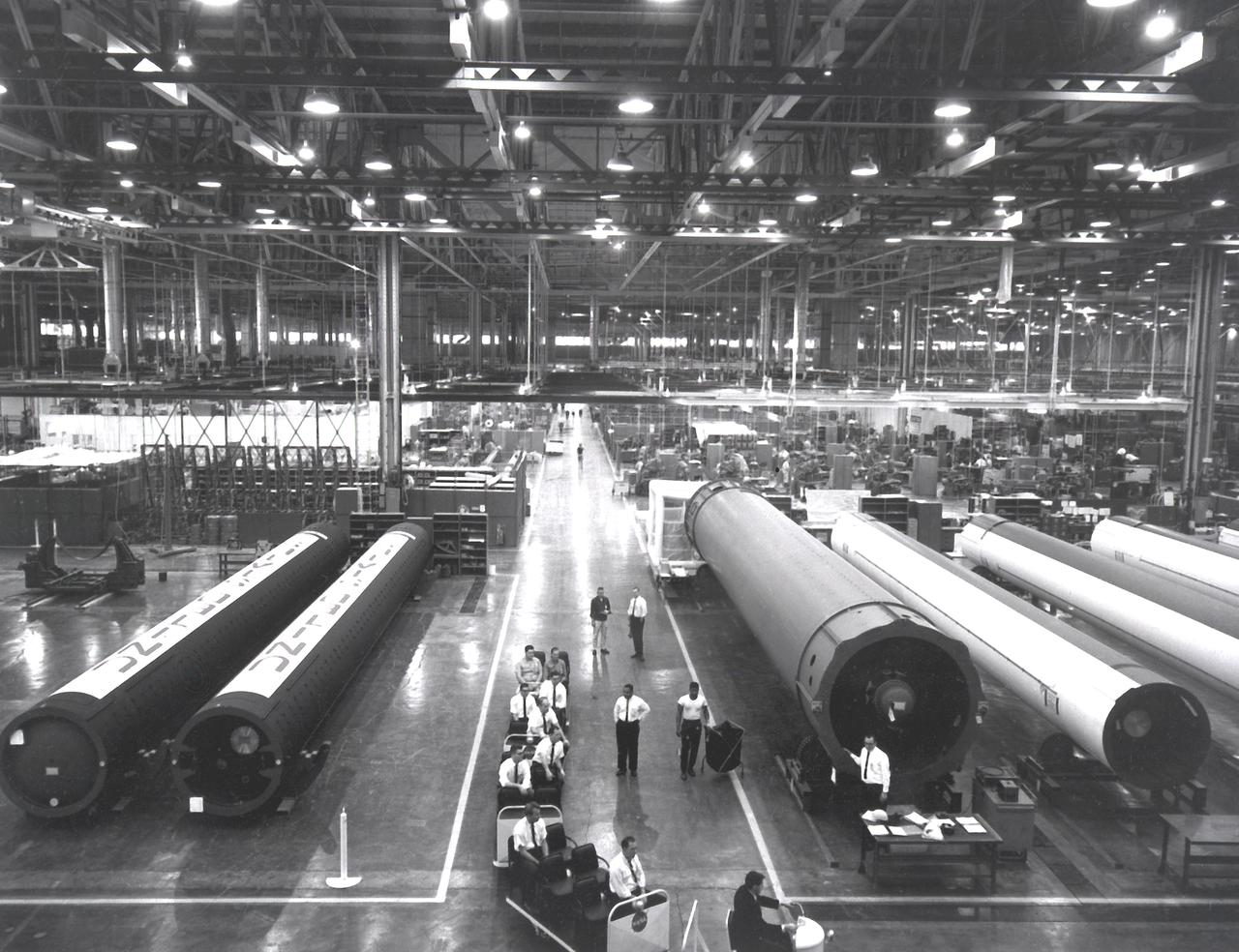
In one of the initial assembly steps for the first stage (S-IB stage) of the Saturn IB launch vehicle, workers at the Michoud Assembly Facility (MAF) near New Orleans, Louisiana, position a "Spider Beam" to the central liquid-oxygen tank of the S-IB stage. Developed by the Marshall Space Flight Center (MSFC) and built by the Chrysler Corporation at MAF, the S-IB stage utilized eight H-1 engines to produce a combined thrust of 1,600,000 pounds.
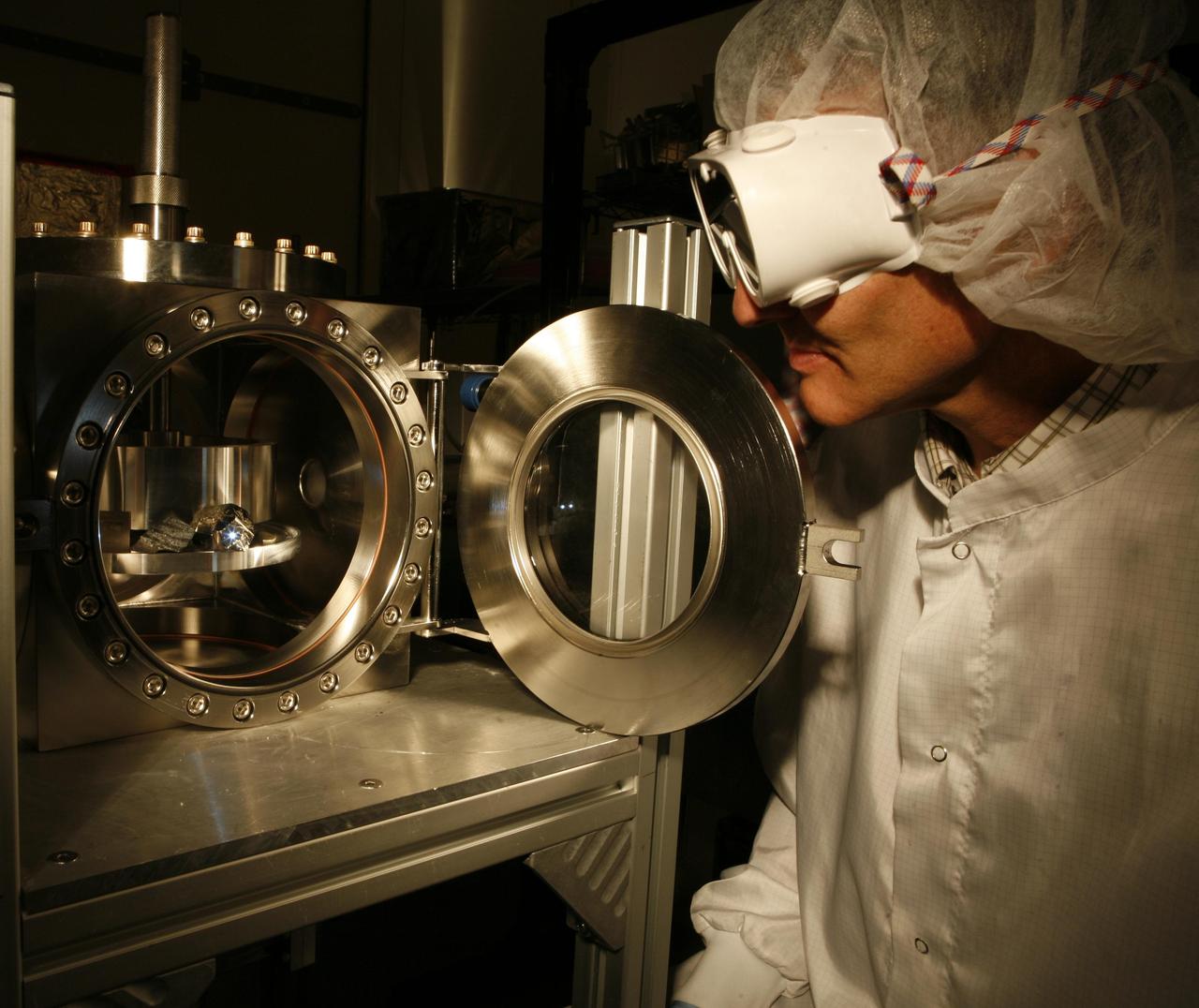
The ChemCam instrument for NASA Mars Science Laboratory mission uses a pulsed laser beam to vaporize a pinhead-size target, producing a flash of light from the ionized material plasma that can be analyzed to identify chemical elements in the target.
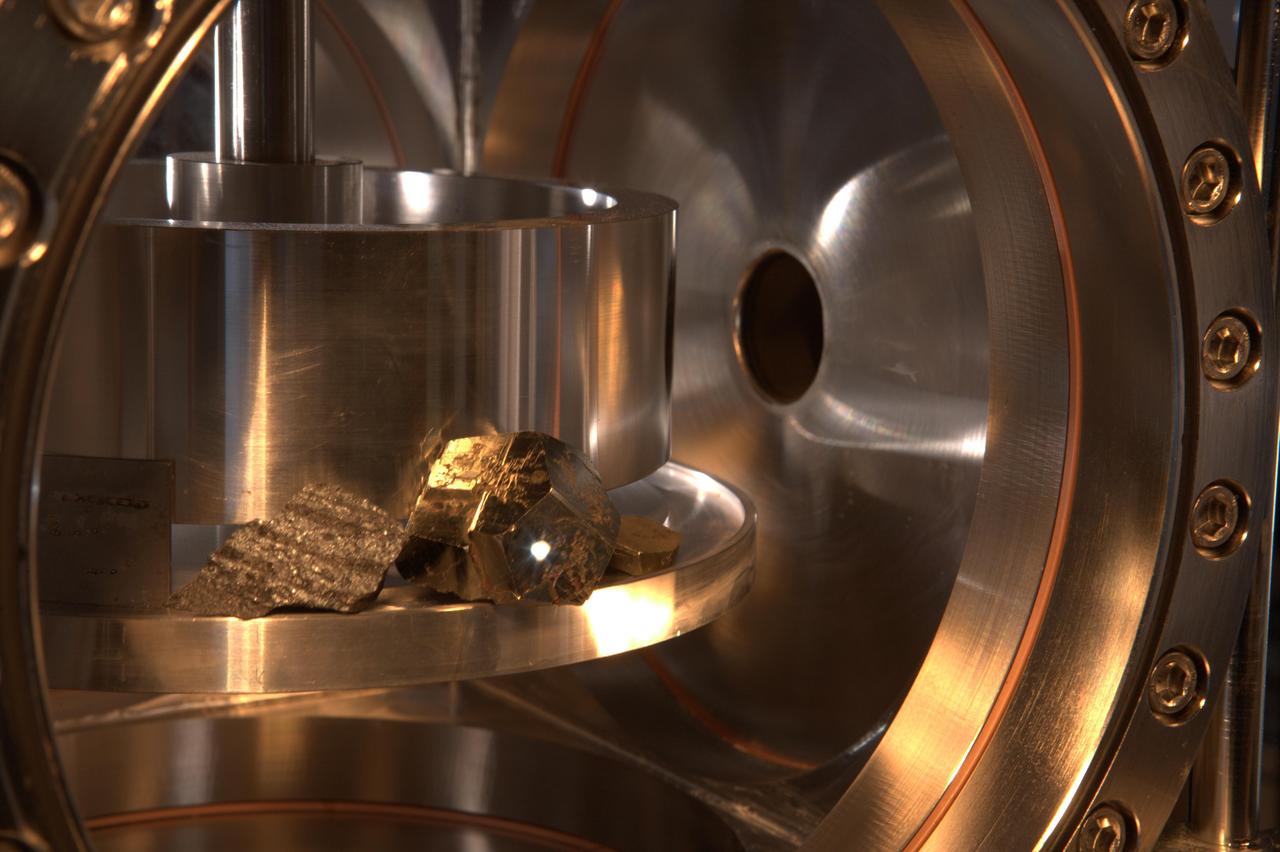
The ChemCam instrument for NASA Mars Science Laboratory mission uses a pulsed laser beam to vaporize a pinhead-size target, producing a flash of light from the ionized material plasma that can be analyzed to identify chemical elements in the target.
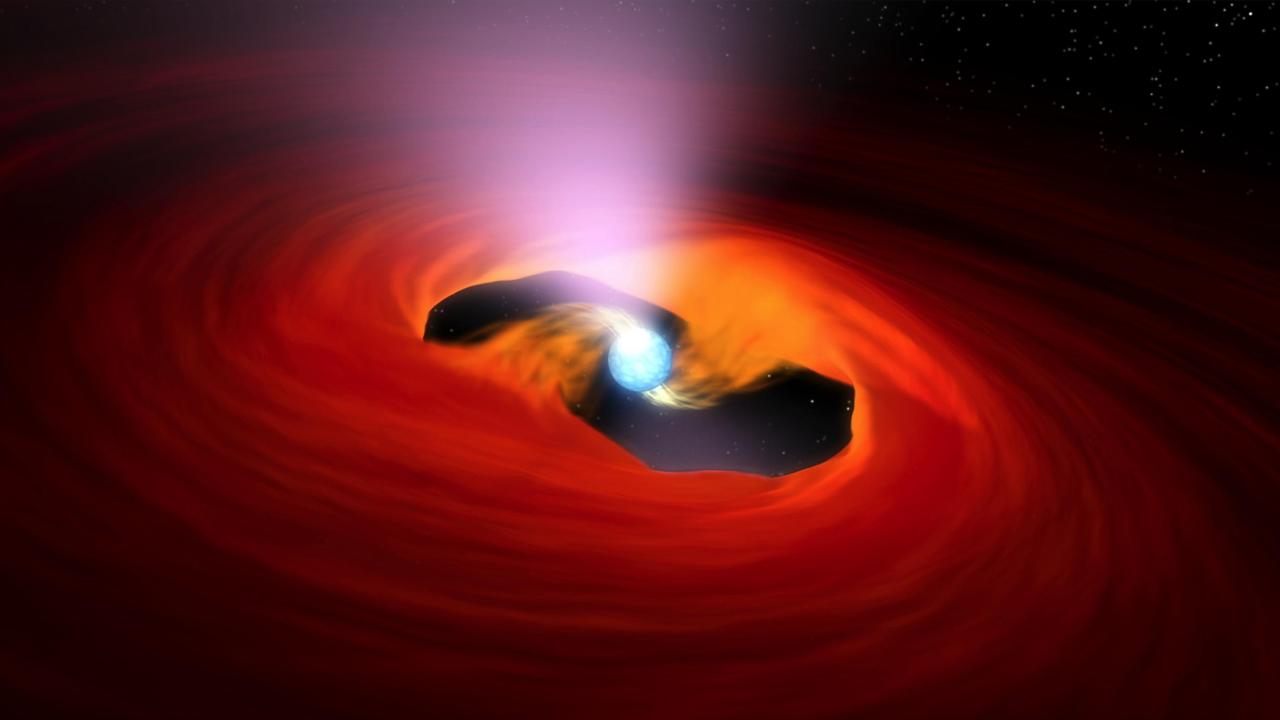
This image shows a neutron star -- the core of a star that exploded in a massive supernova. This particular neutron star is known as a pulsar because it sends out rotating beams of X-rays that sweep past Earth like lighthouse beacons.
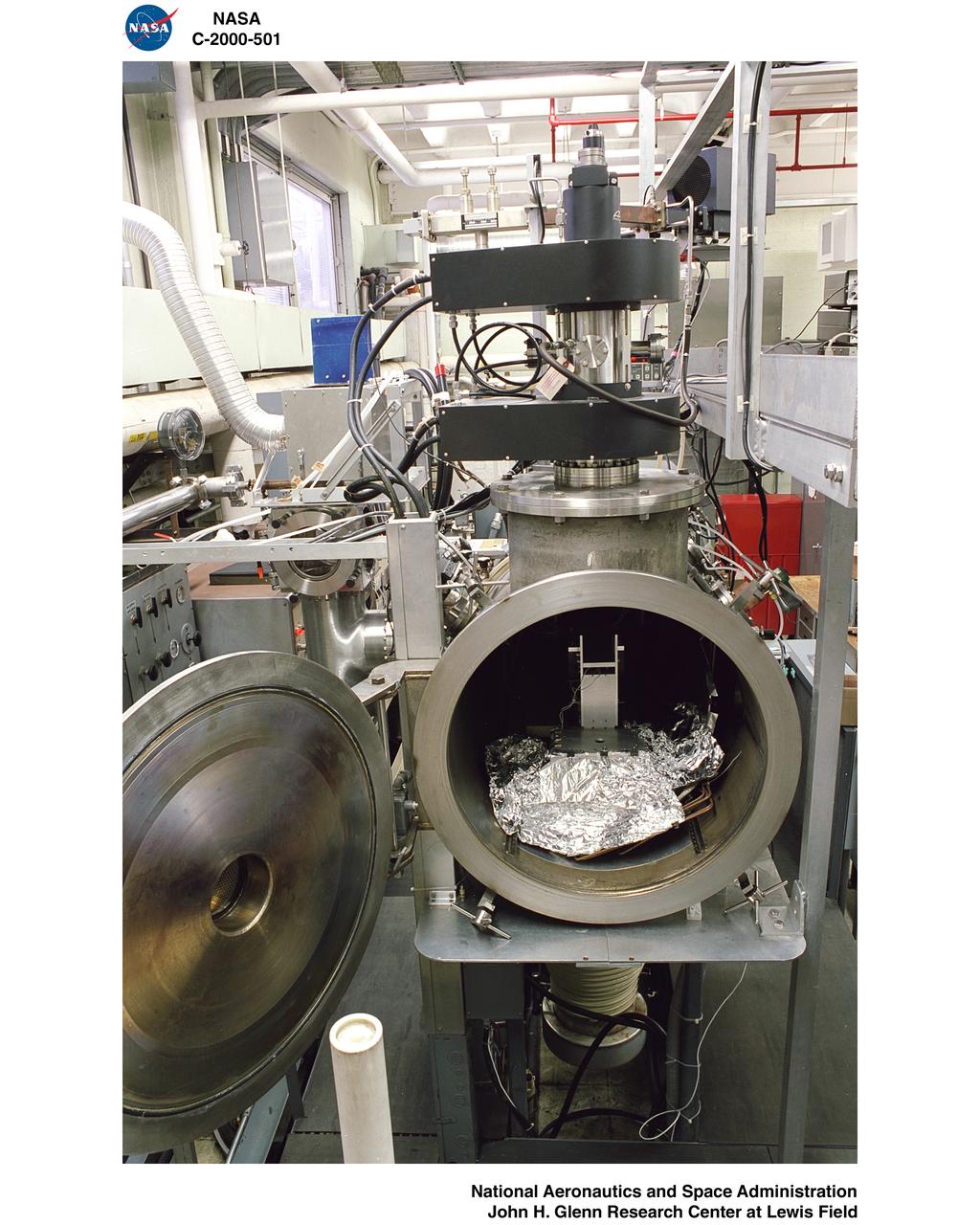
ATOMIC OXYGEN BEAM CONTAMINATION SYSTEM
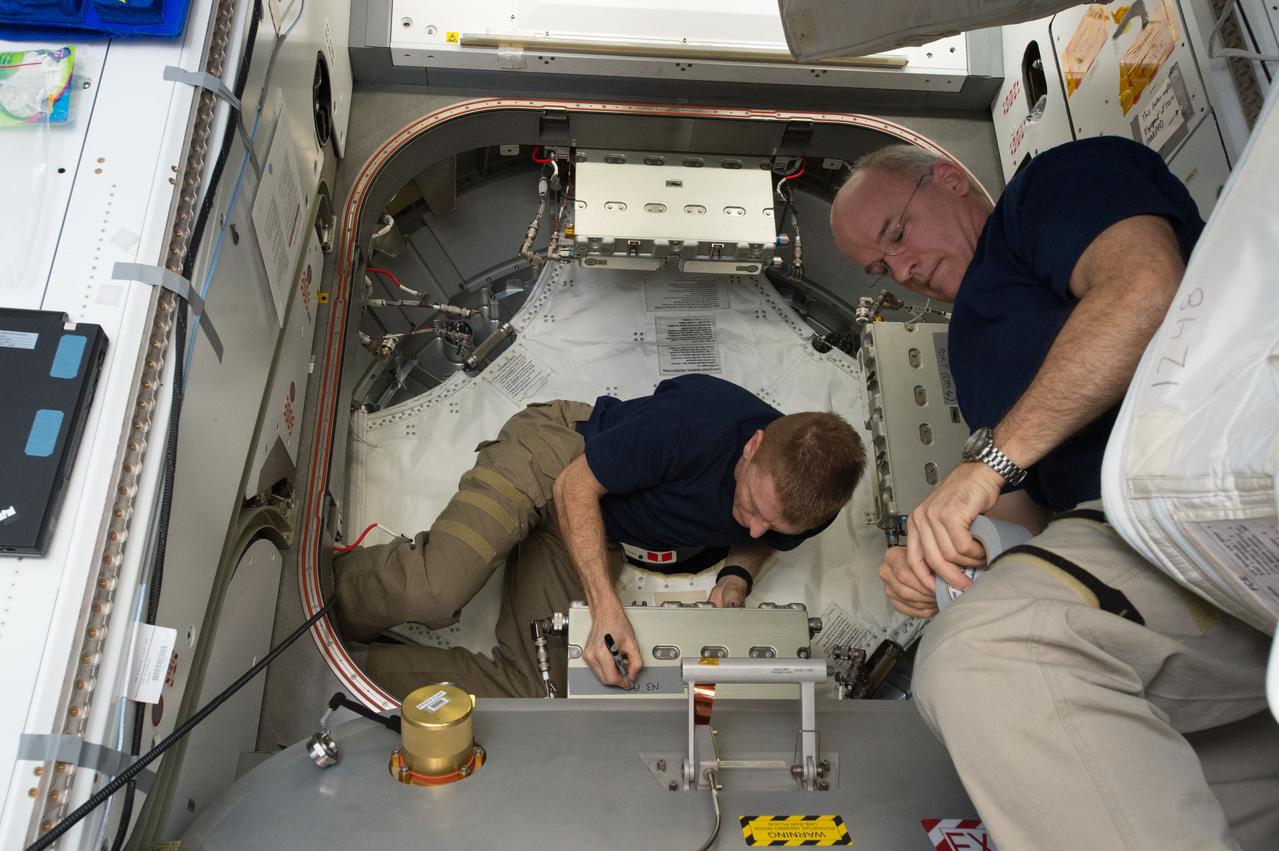
ISS047e133469 (05/25/2016) --- ESA (European Space Agency) astronaut Tim Peak (left) and NASA Astronaut Jeff Williams (right) prepare the Bigelow Expandable Activity Module (BEAM) for expansion. The pair were outfitting the area known as the vestibule, which is the space between the hatch on BEAM and hatch on Tranquility. NASA Astronaut Jeff Williams and the NASA and Bigelow Aerospace teams working at Mission Control Center at NASA’s Johnson Space Center spent more than seven hours on operations to fill the BEAM with air to cause it to expand.
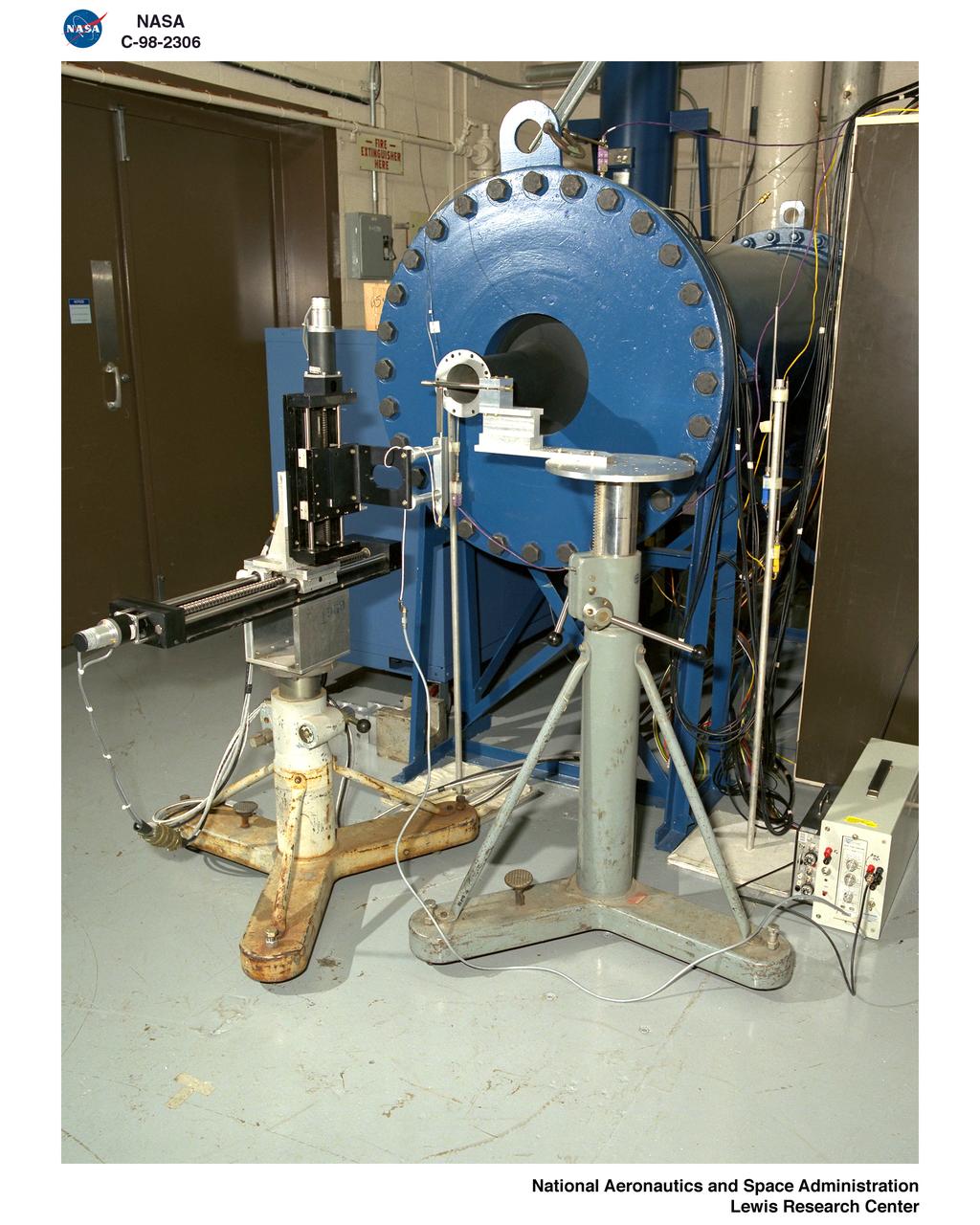
FREE JET BEAM TURBULENCE PROBE CALIBRATION
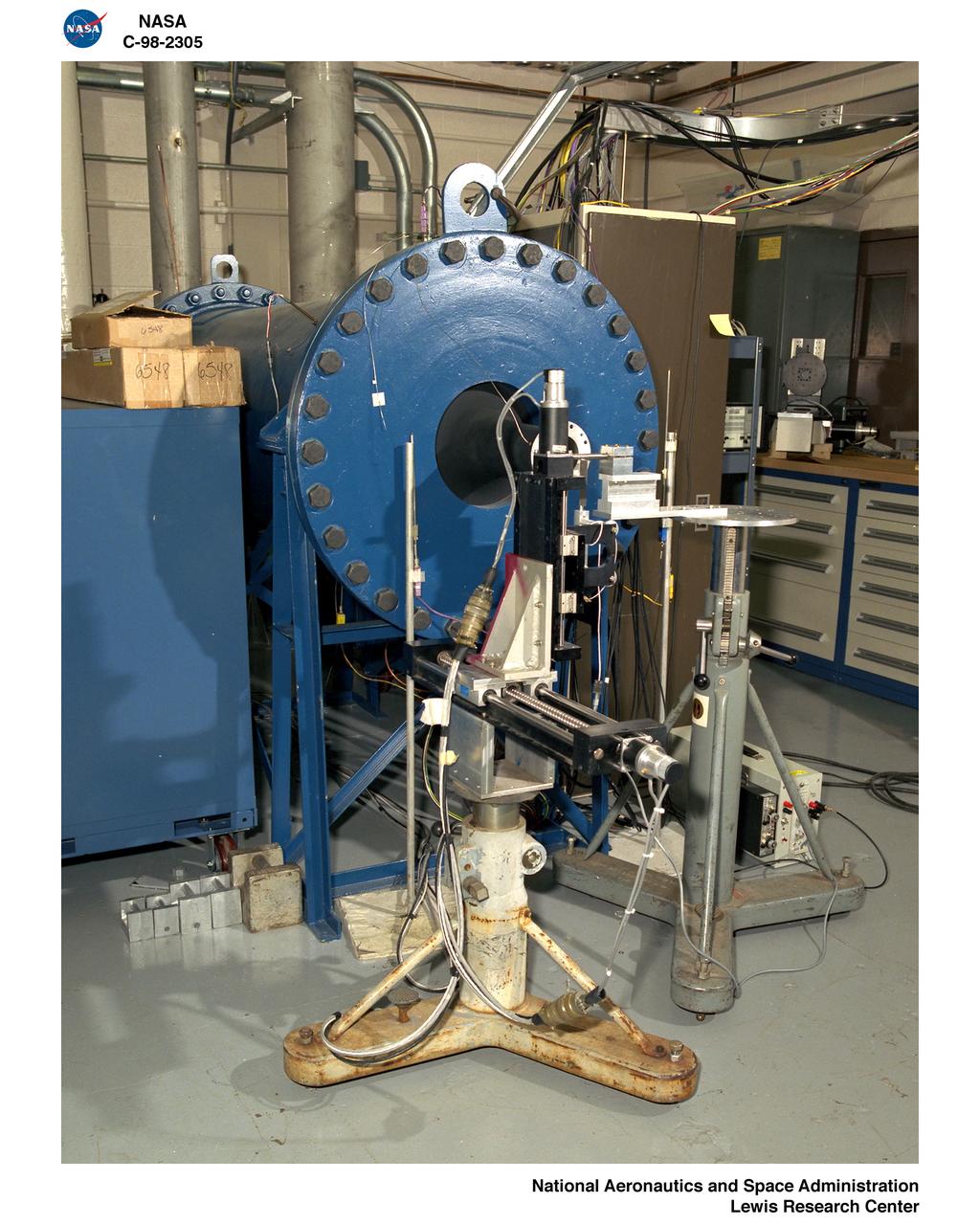
FREE JET BEAM TURBULENCE PROBE CALIBRATION
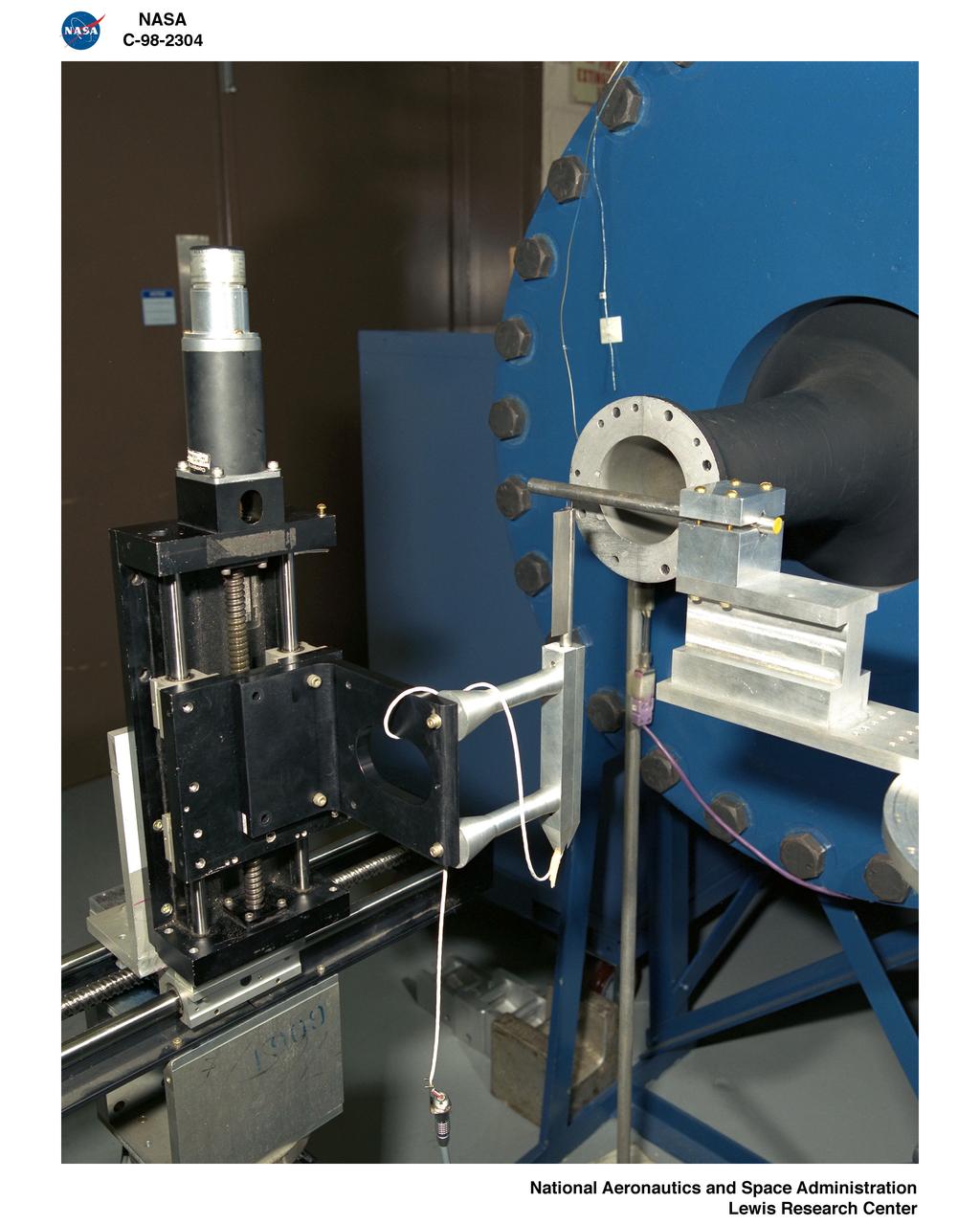
FREE JET BEAM TURBULENCE PROBE CALIBRATION
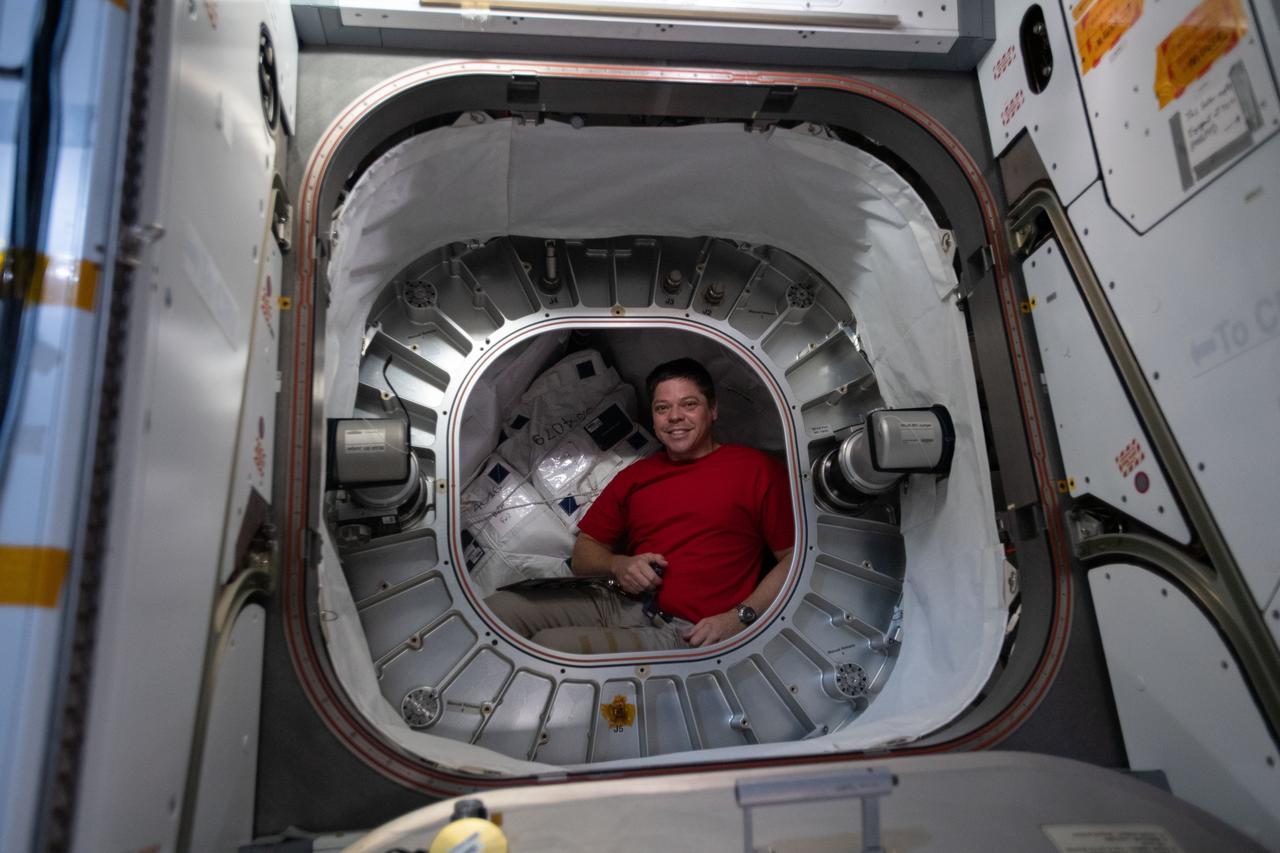
iss063e041081 (July 7, 2020) --- NASA astronaut and Expedition 63 Flight Engineer Bob Behnken is pictured inside the Bigelow Expandable Activity Module (BEAM) during cargo activities. BEAM has been attached to the International Space Station's Tranquility module since April 2016.
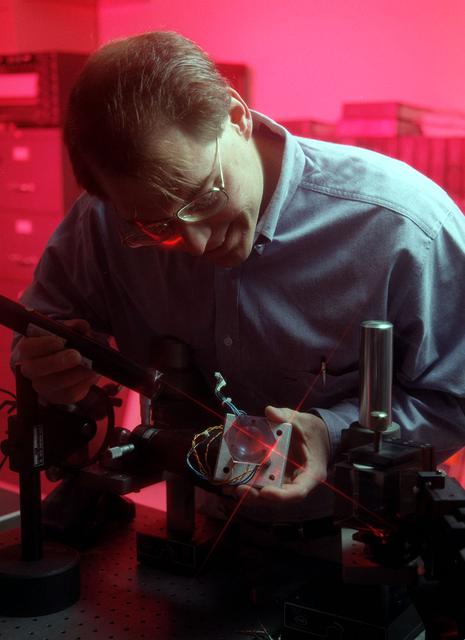
The SELENE Optics project was designed to send powerful laser beams into space to repower satellites and to recharge their batteries, as well as sending laser beams to the moon for the same purpose instead of relying on solar power. This project also was intended to be used for repowering extended space flights.

Twenty students – along with their parents, teachers, and classmates – met virtually with Mars rover team members at JPL, where they received personalized messages beamed from NASA's Perseverance rover as part of the "You've Got Perseverance" campaign. https://photojournal.jpl.nasa.gov/catalog/PIA25271
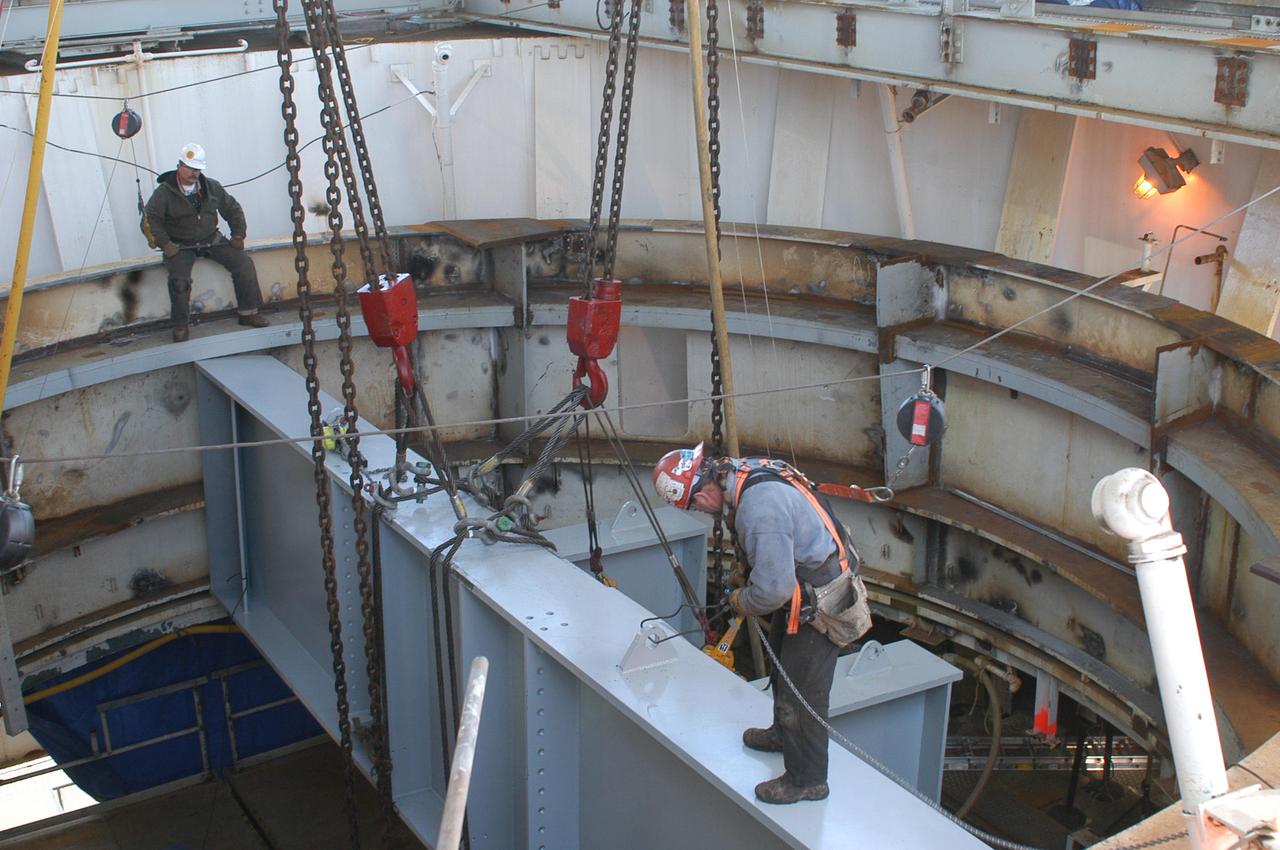
Employees at NASA's John C. Stennis Space Center work to maneuver a structural steam beam into place on the A-1 Test Stand on Jan. 13. The beam was one of several needed to form the thrust takeout structure that will support a new thrust measurement system being installed on the stand for future rocket engine testing. Once lifted onto the stand, the beams had to be hoisted into place through the center of the test stand, with only two inches of clearance on each side. The new thrust measurement system represents a state-of-the-art upgrade from the equipment installed more than 40 years ago when the test stand was first constructed.
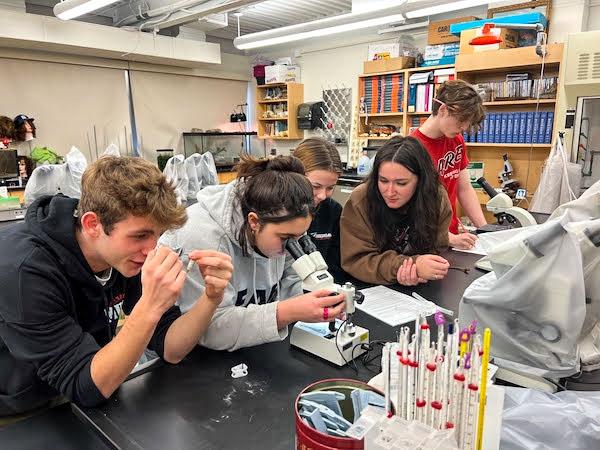
jsc2023e065213 (10/19/2023) --- Student researchers work on their experiment, Examining Artemia salina Hatching in the Presence of Microgravity, which will be included in the Nanoracks-National Center for Earth and Space Science Education-Orbiter-Student Spaceflight Experiments Program Mission 17 to ISS (Nanoracks-NCESSE-Orbiter-SSEP). Pictured from left to right: Raphael Senterfit-Sanjuan, Zola Campisi, Avis Roszco, Jessica Amato and Tucker Sheehan.
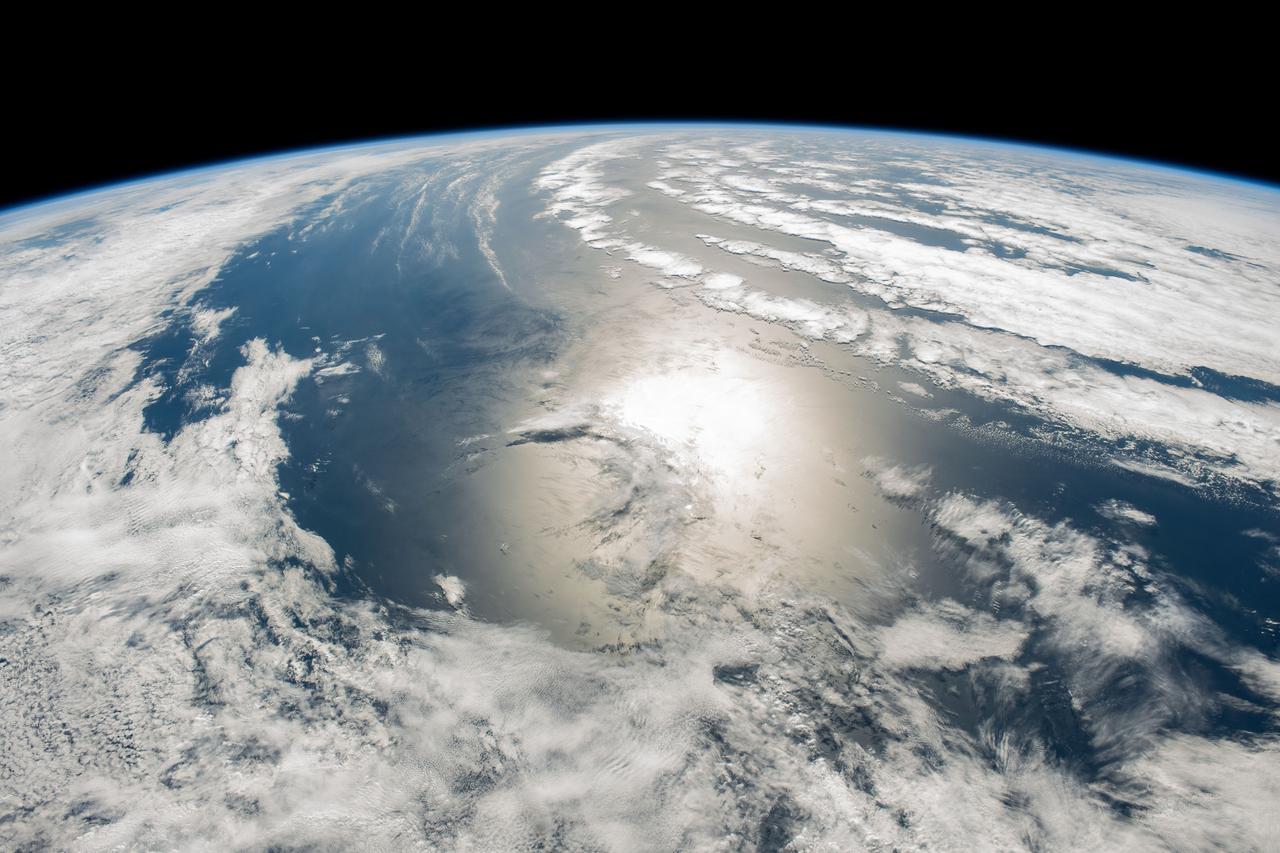
iss070e024002 (Nov. 13, 2023) --- The sun's glint beams in between a cloudy stretch of the south Atlantic Ocean off the coast of Argentina.
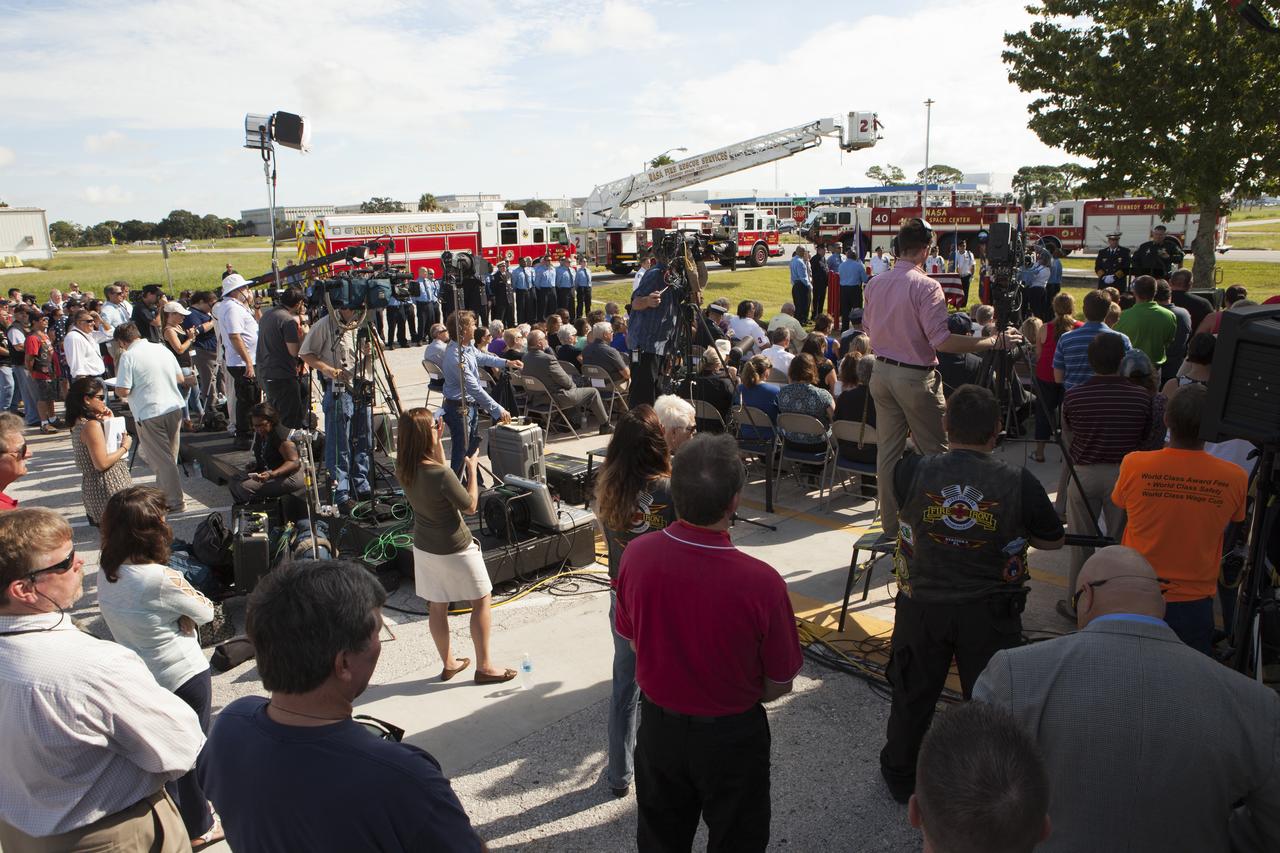
September 11 World Trade Center Beam Dedication Ceremony at Fire Station 1.
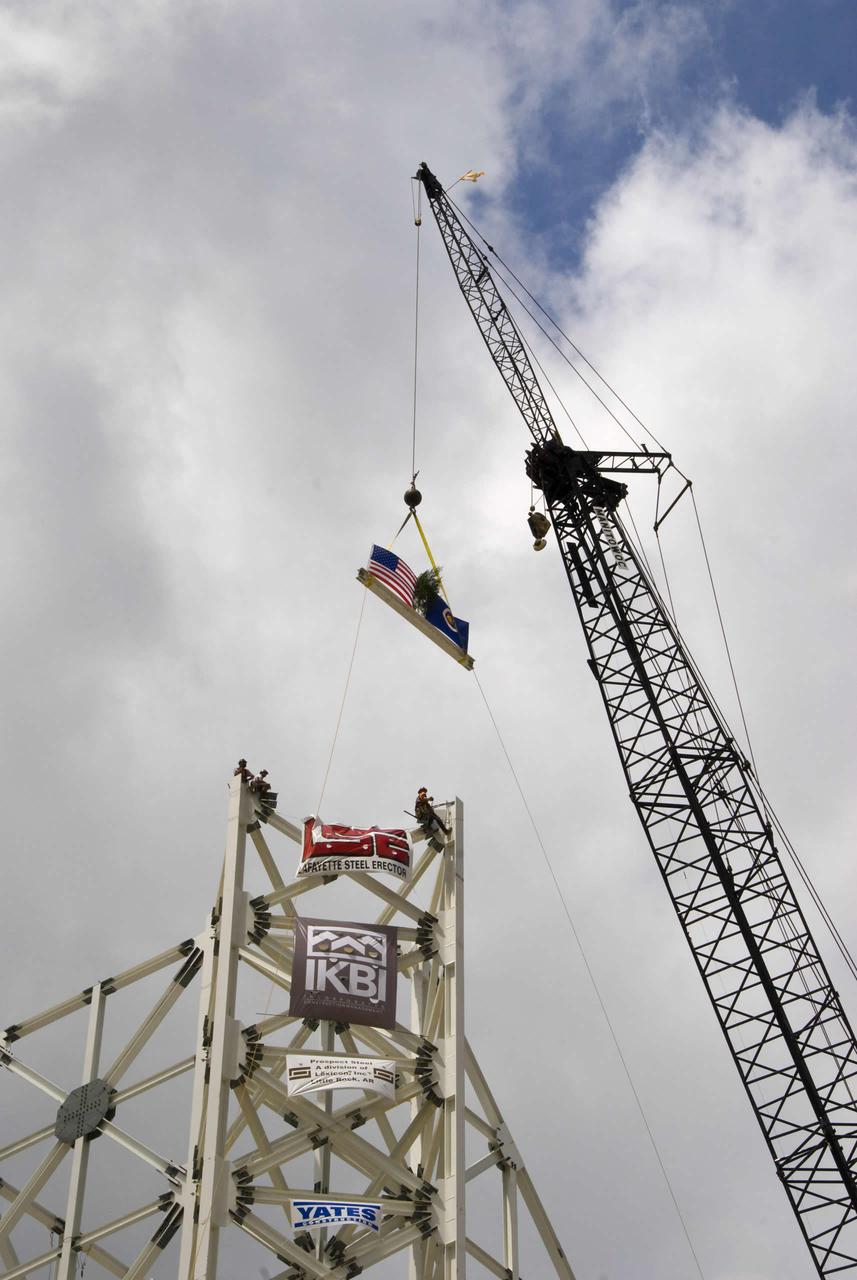
The final structural steel beam, bearing flags and the names of project workers, is hoisted and fastened into place atop the A-3 Test Stand.
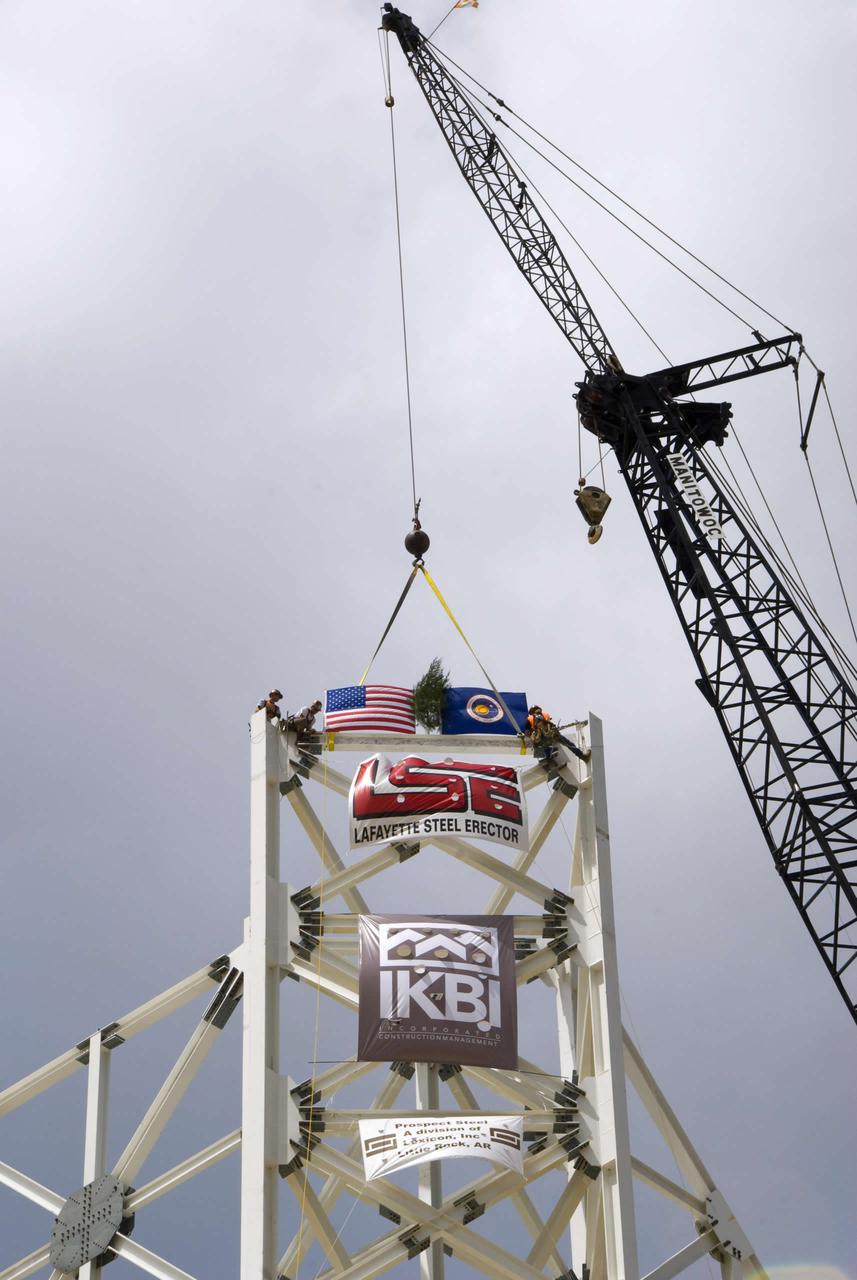
The final structural steel beam, bearing flags and the names of project workers, is hoisted and fastened into place atop the A-3 Test Stand.
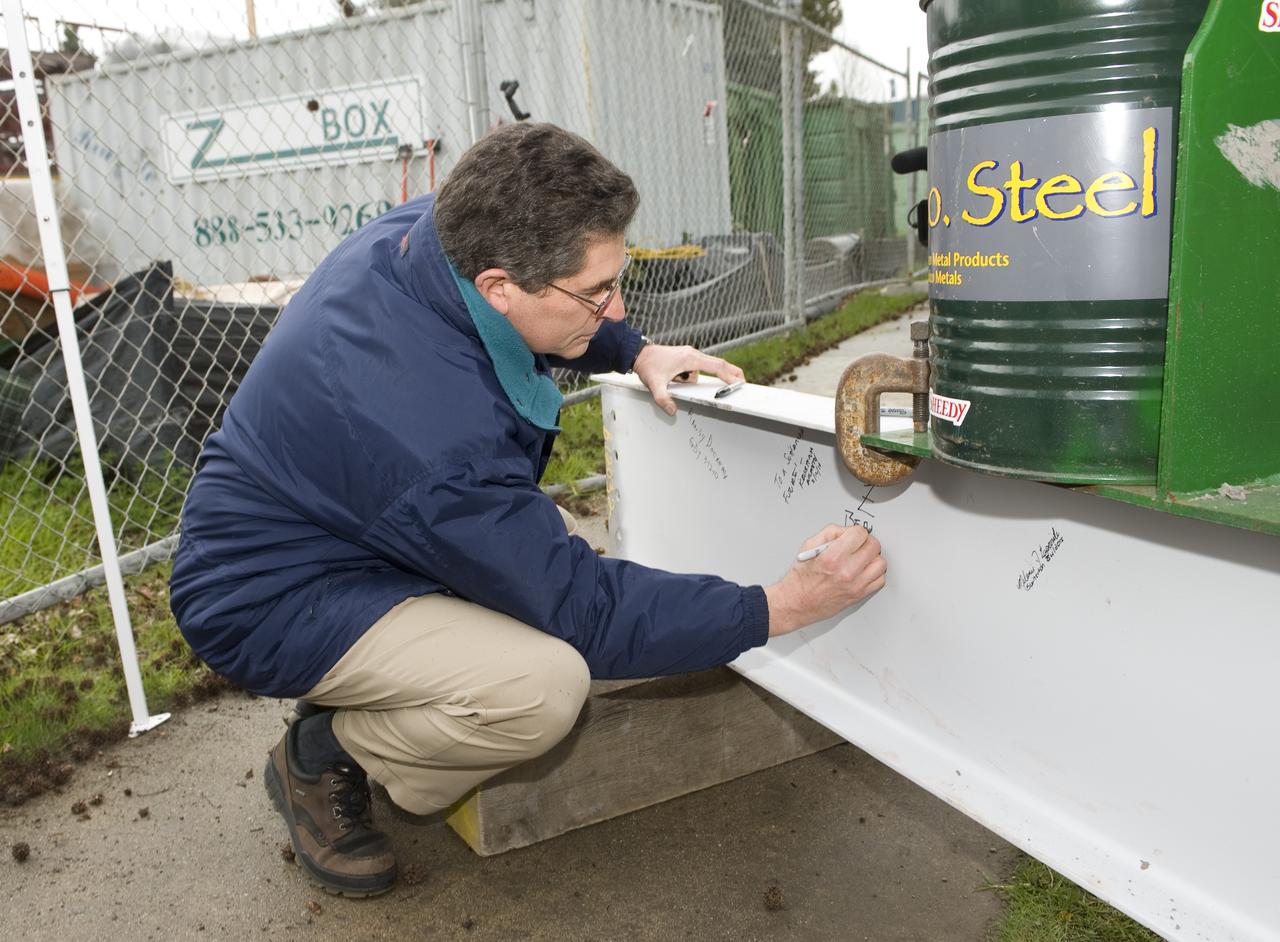
N-232 Sustainability 'Green' Building Topping Ceremony. Steve Zornetzer, Ames Associate Director signing the beam.
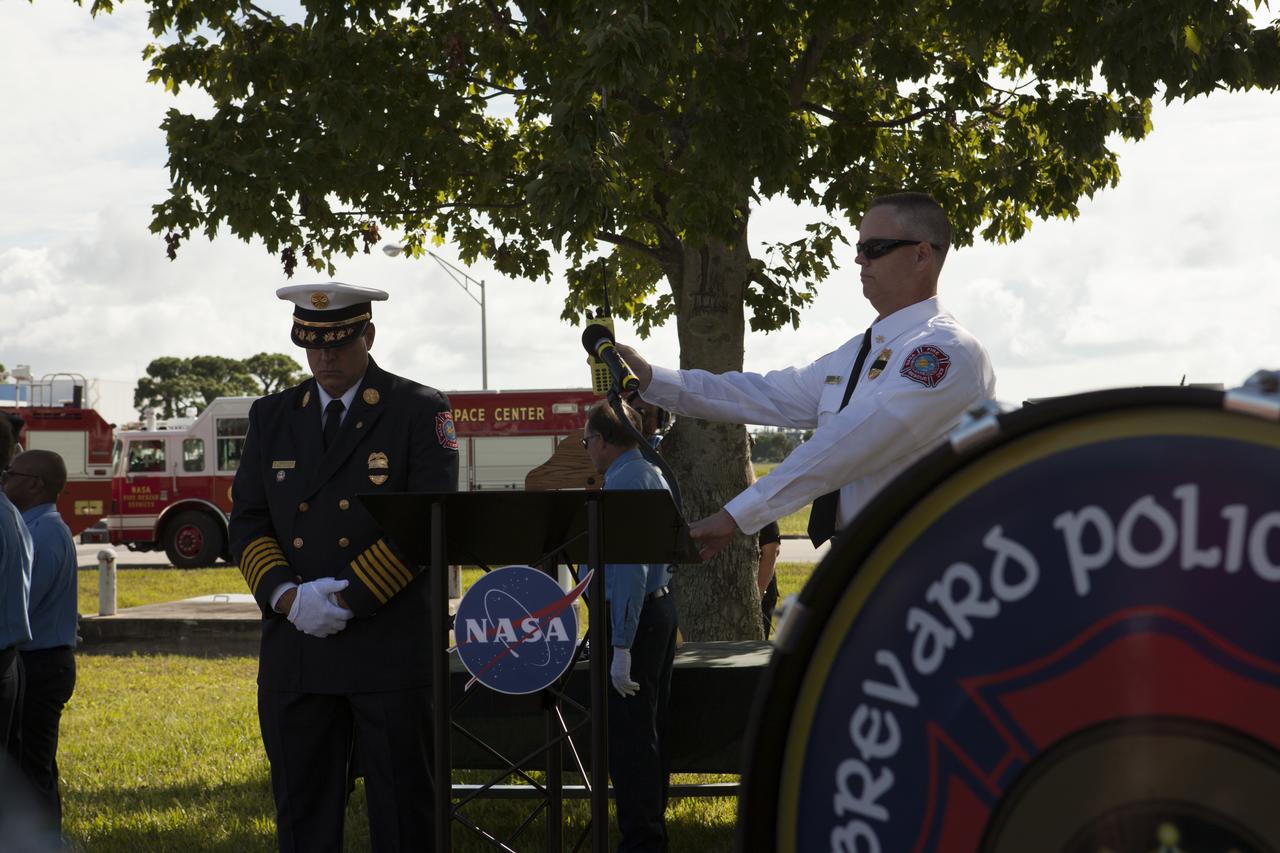
September 11 World Trade Center Beam Dedication Ceremony at Fire Station 1.

September 11 World Trade Center Beam Dedication Ceremony at Fire Station 1.

This animation shows the overlap of the field of view of Juno's Stellar Reference Unit (SRU) star camera (in yellow) and Juno's Microwave Radiometer (MWR) Antenna-1 beam (in red). The animation depicts Juno flying over Jupiter's North pole where the planet's massive northern aurora is located. Juno observes Jupiter's lightning using multiple instruments which detect lightning at different parts of its spectrum. Animation avaiable at https://photojournal.jpl.nasa.gov/catalog/PIA22967
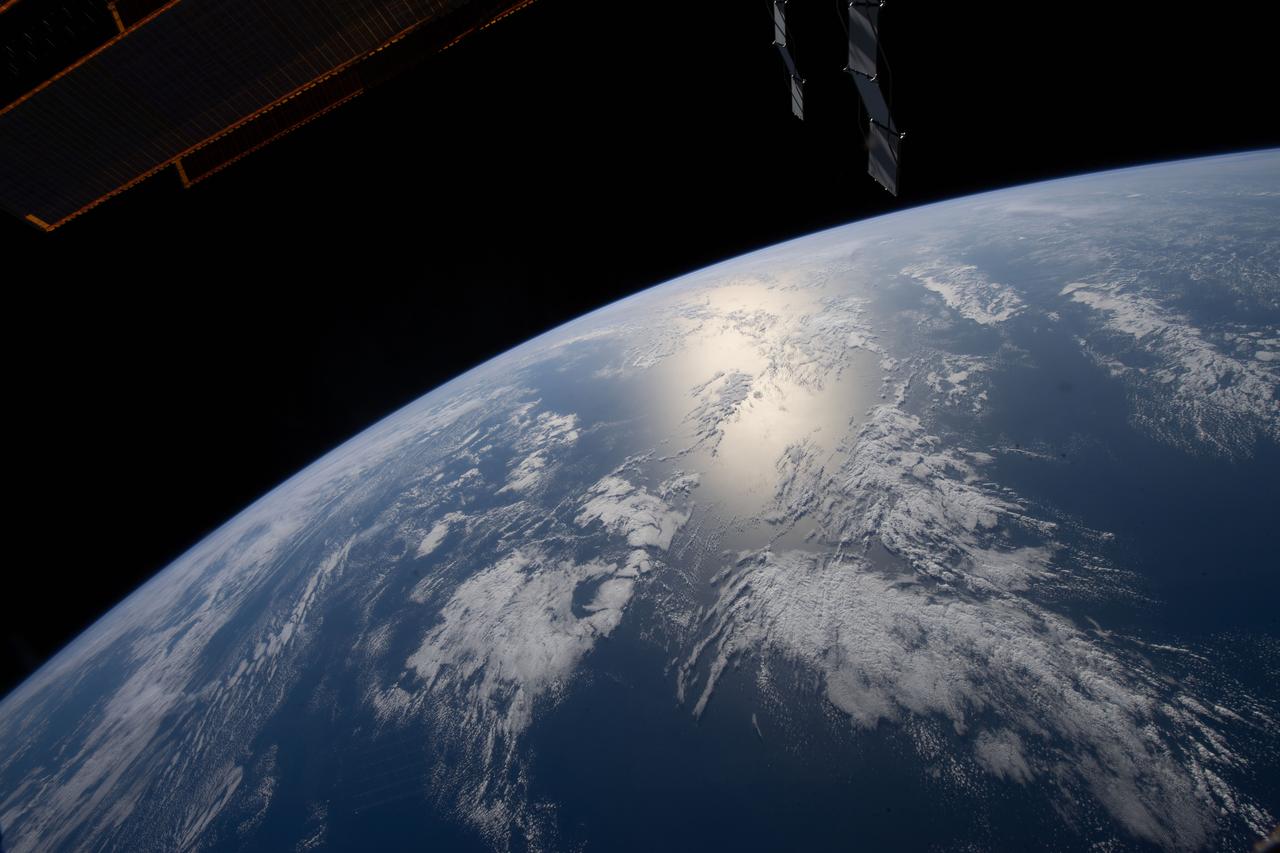
iss067e059659 (May 17, 2022) --- The sun's glint beams off the Atlantic Ocean off the coast of Angola as the International Space Station orbited 264 miles above.
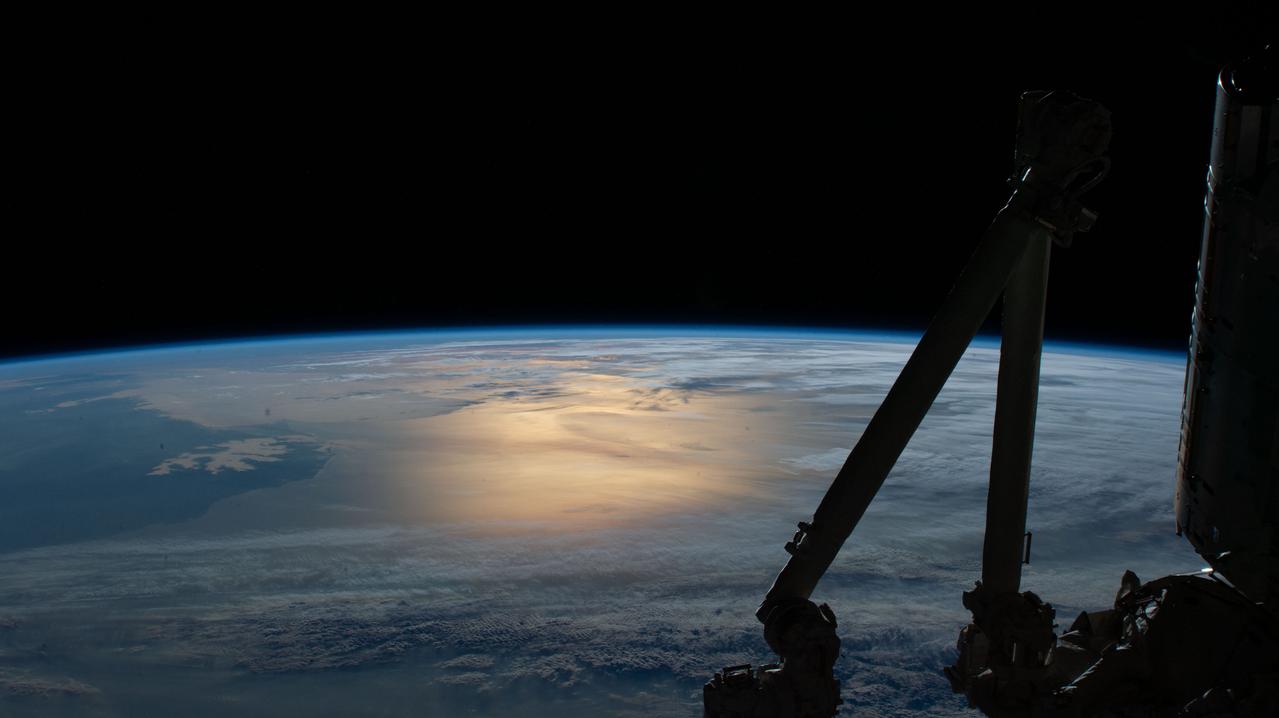
iss063e066312 (Aug. 5, 2020) --- Flying over southern Argentina, this photograph from the International Space Station looks northward with the Sun's glint beaming on the Atlantic Ocean.
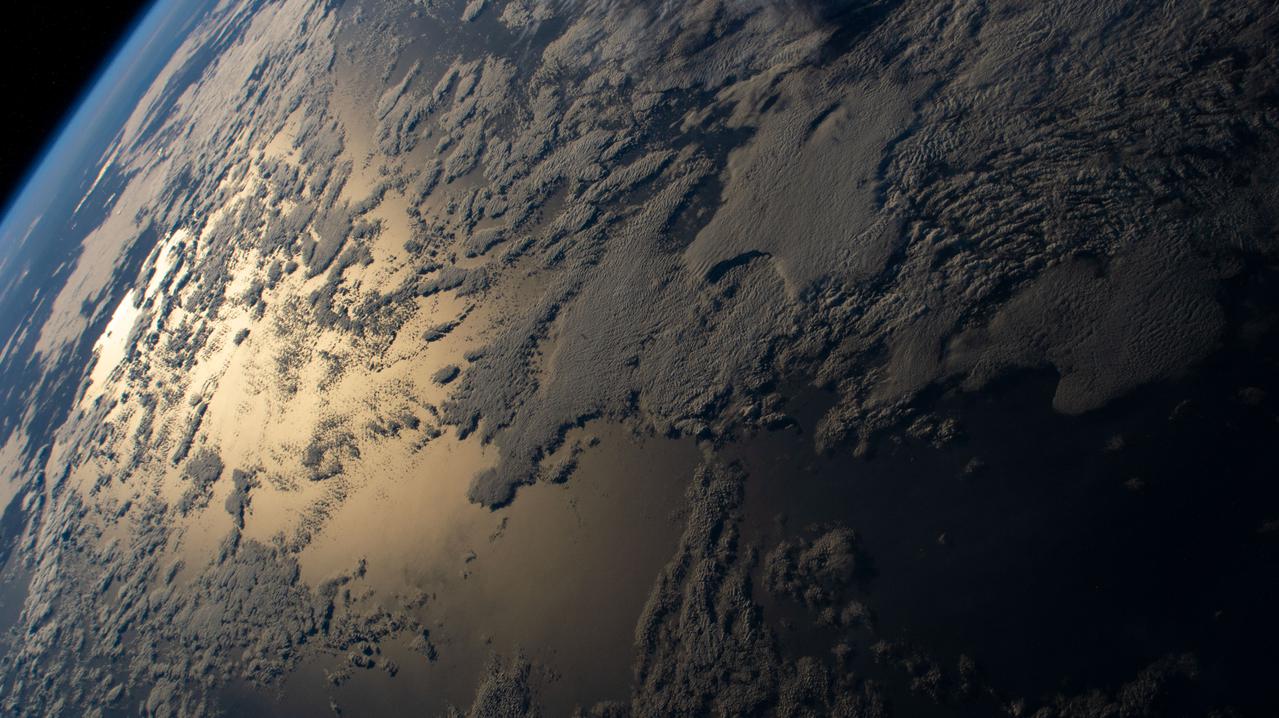
iss065e086377 (June 3, 2021) --- The sun's glint beams off the Indian Ocean as the International Space Station orbited 269 miles above south of Western Australia.
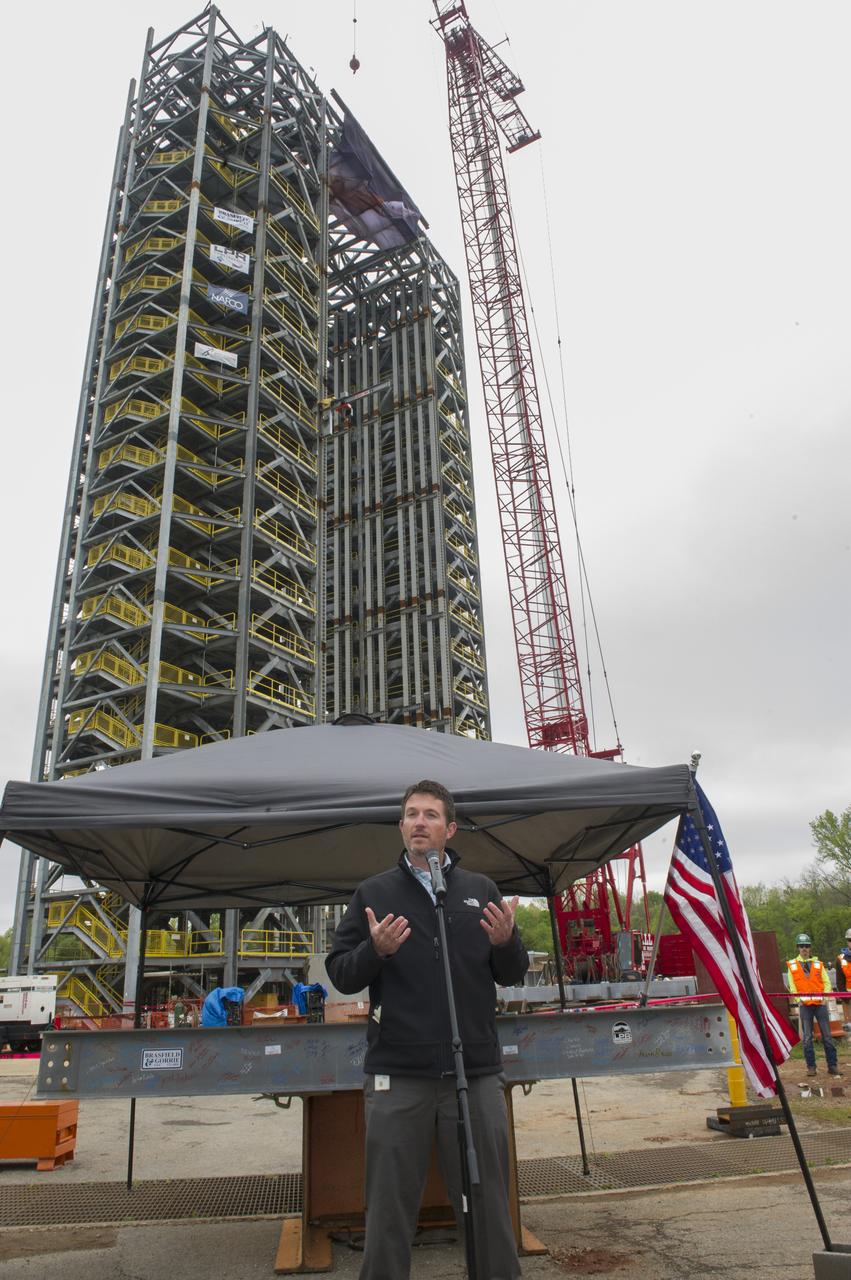
PHIL HENDRIX, SPEAKS TO THE CROWD IN FRONT OF A STEEL BEAM DESTINED FOR TEST STAND 4693 DURING THE STRUCTURE'S TOPPING OUT CEREMONY APRIL 12.
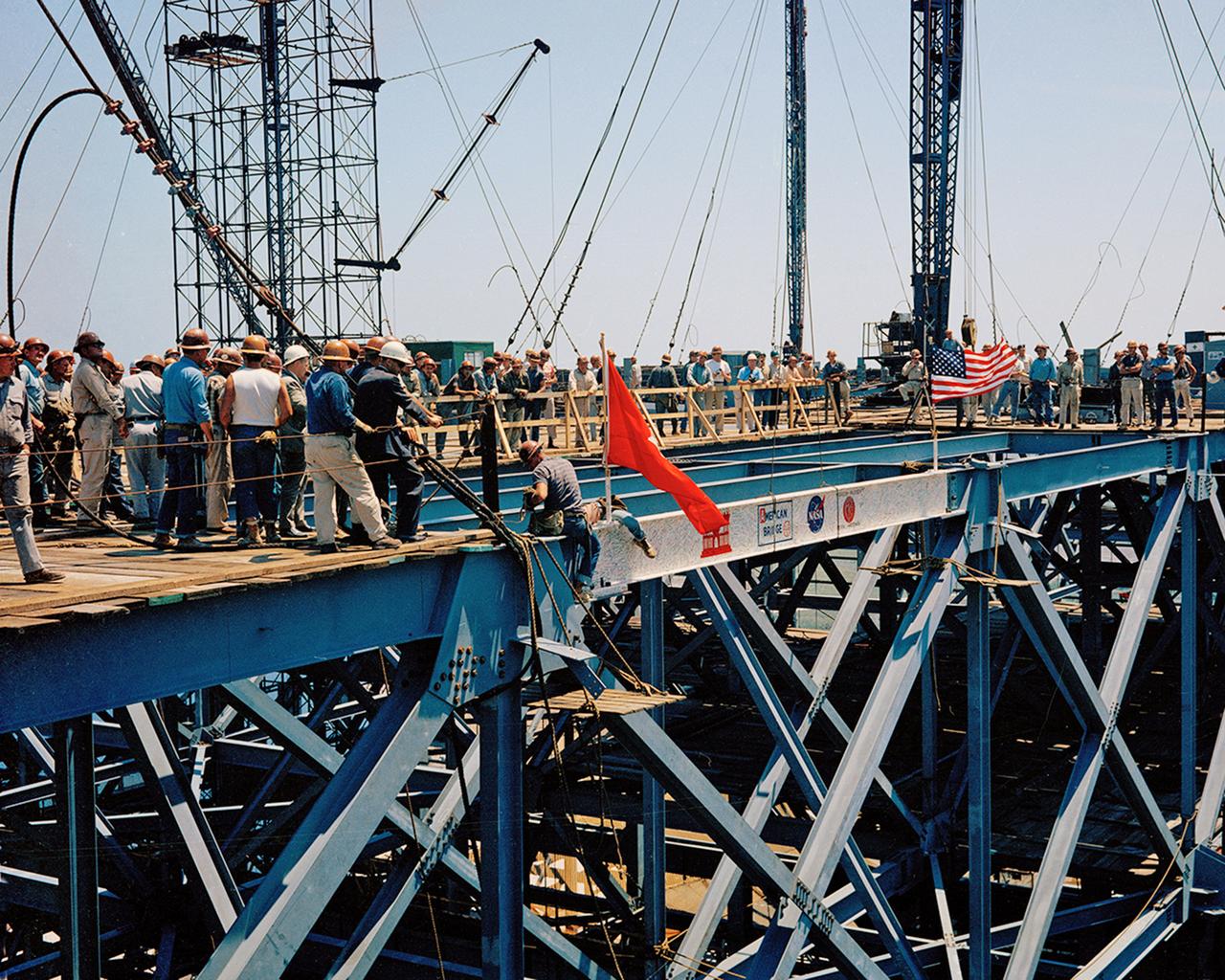
Installation of the Last Major Beam autographed by construction workers, NASA, and Corps of Engineers employees atop the Kennedy Space Center Vertical Assembly Building (VAB), MILA.
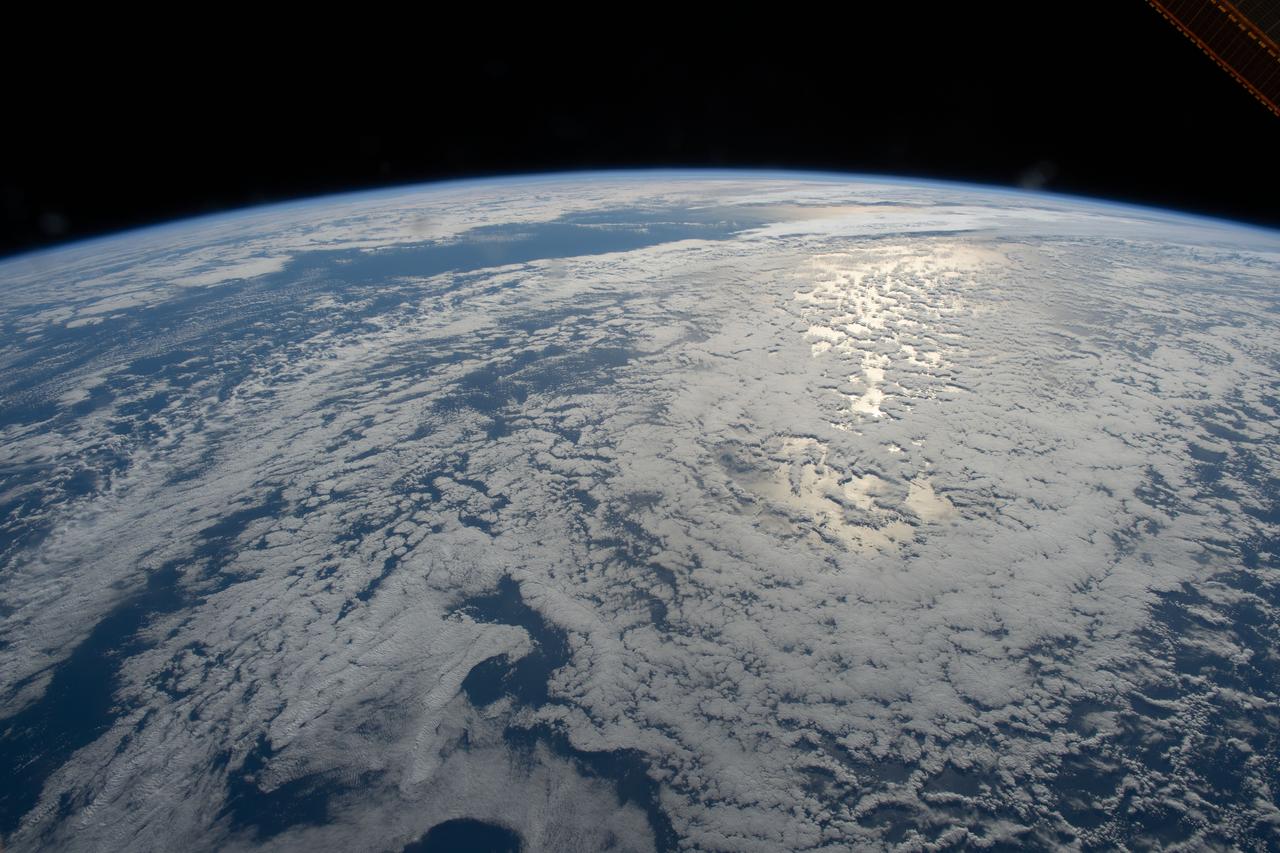
iss063e046732 (July 14, 2020) --- The sun's glint beams on the South Pacific Ocean as the International Space Station orbited just off the coast of Auckland, New Zealand.
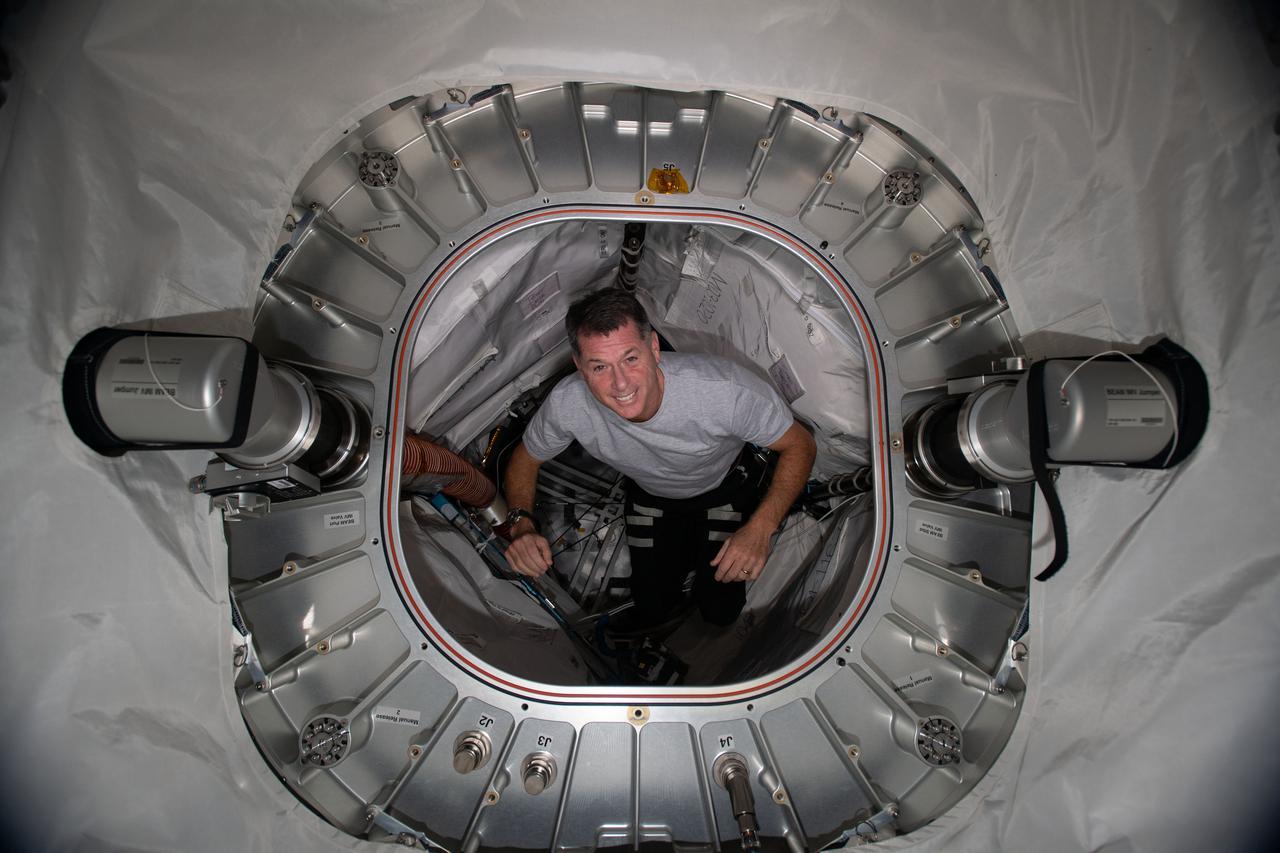
iss065e045899 (May 17, 2021) --- NASA astronaut and Expedition 65 Flight Engineer Shane Kimbrough is pictured inside BEAM, the Bigelow Expandable Activity Module.
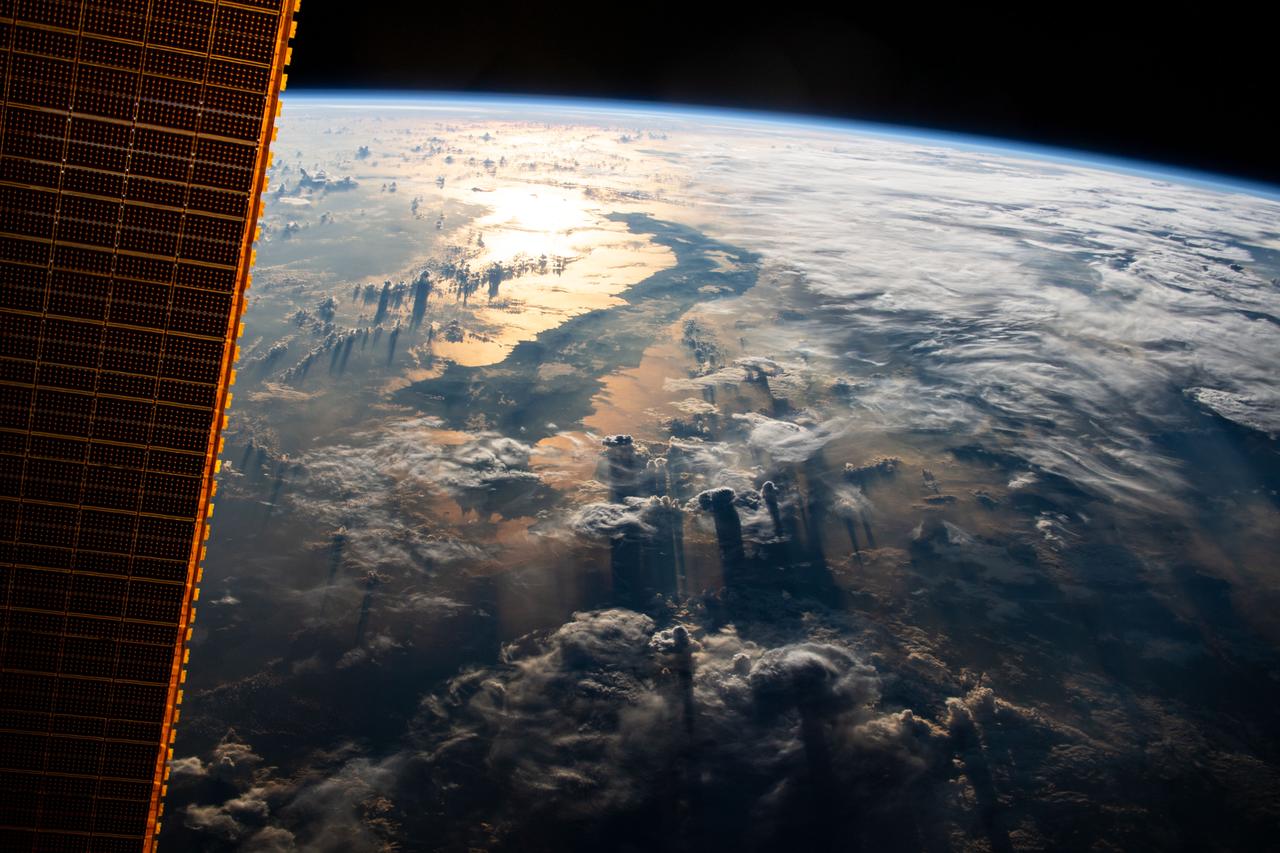
iss059e067877 (May 19, 2019) --- The International Space Station flies 255 miles above Indonesia as the sun's glint beams off the Celebes Sea in southeast Asia.
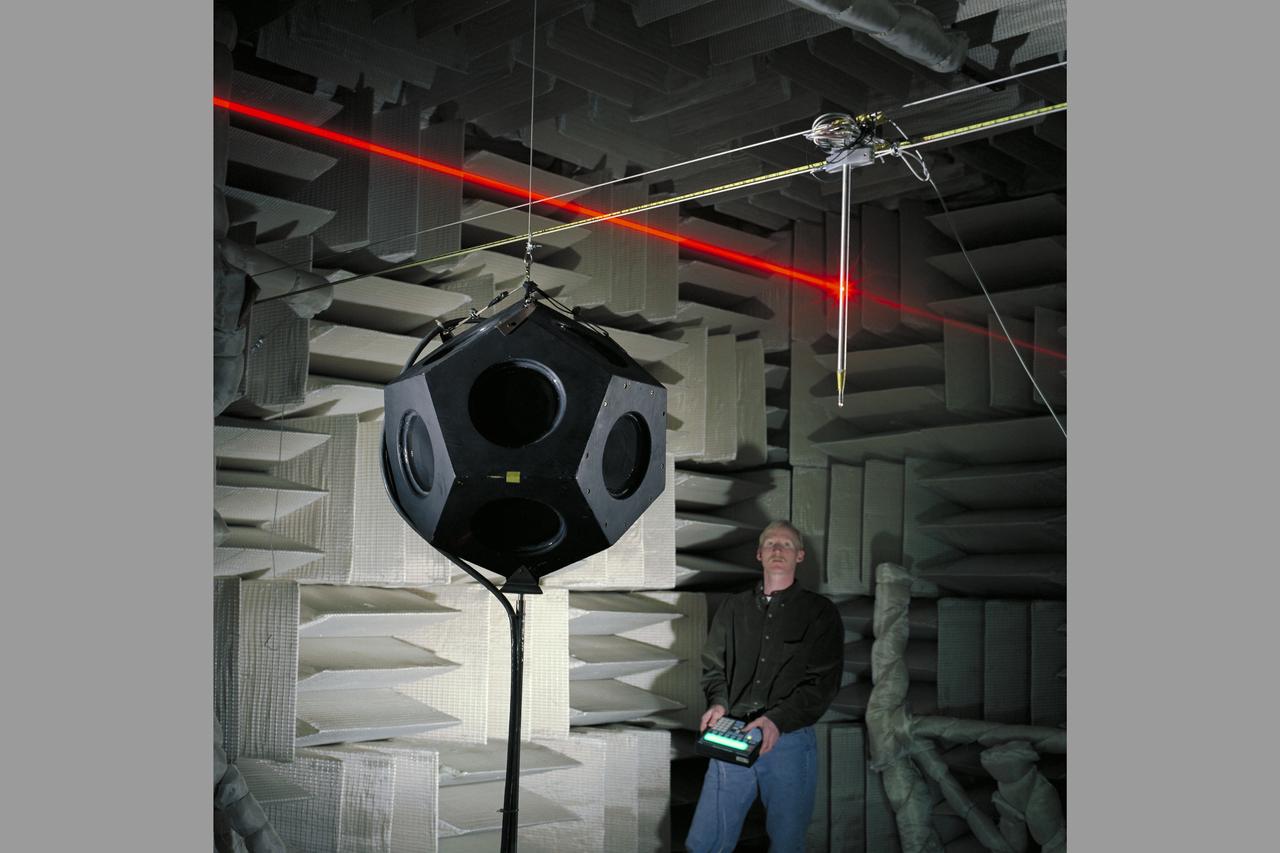
Traversing Microphone & Dodecahedron Loudspeaker (with pen lights - laser beams) in Anechoic Chamber with Chris Allen) Dedechedron meaning 12 sided polyhedron - polygon)
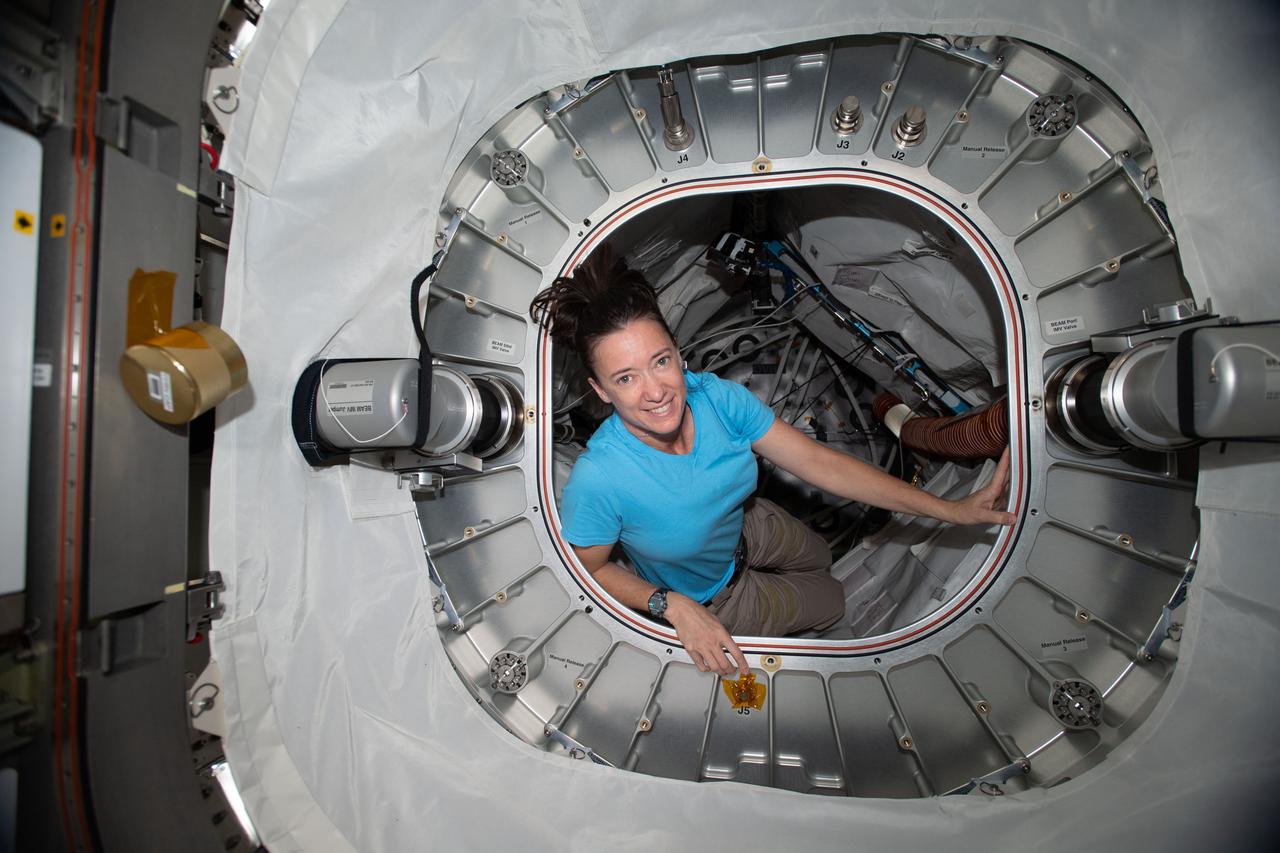
iss065e045904 (May 17, 2021) --- NASA astronaut and Expedition 65 Flight Engineer Megan McArthur is pictured inside BEAM, the Bigelow Expandable Activity Module.
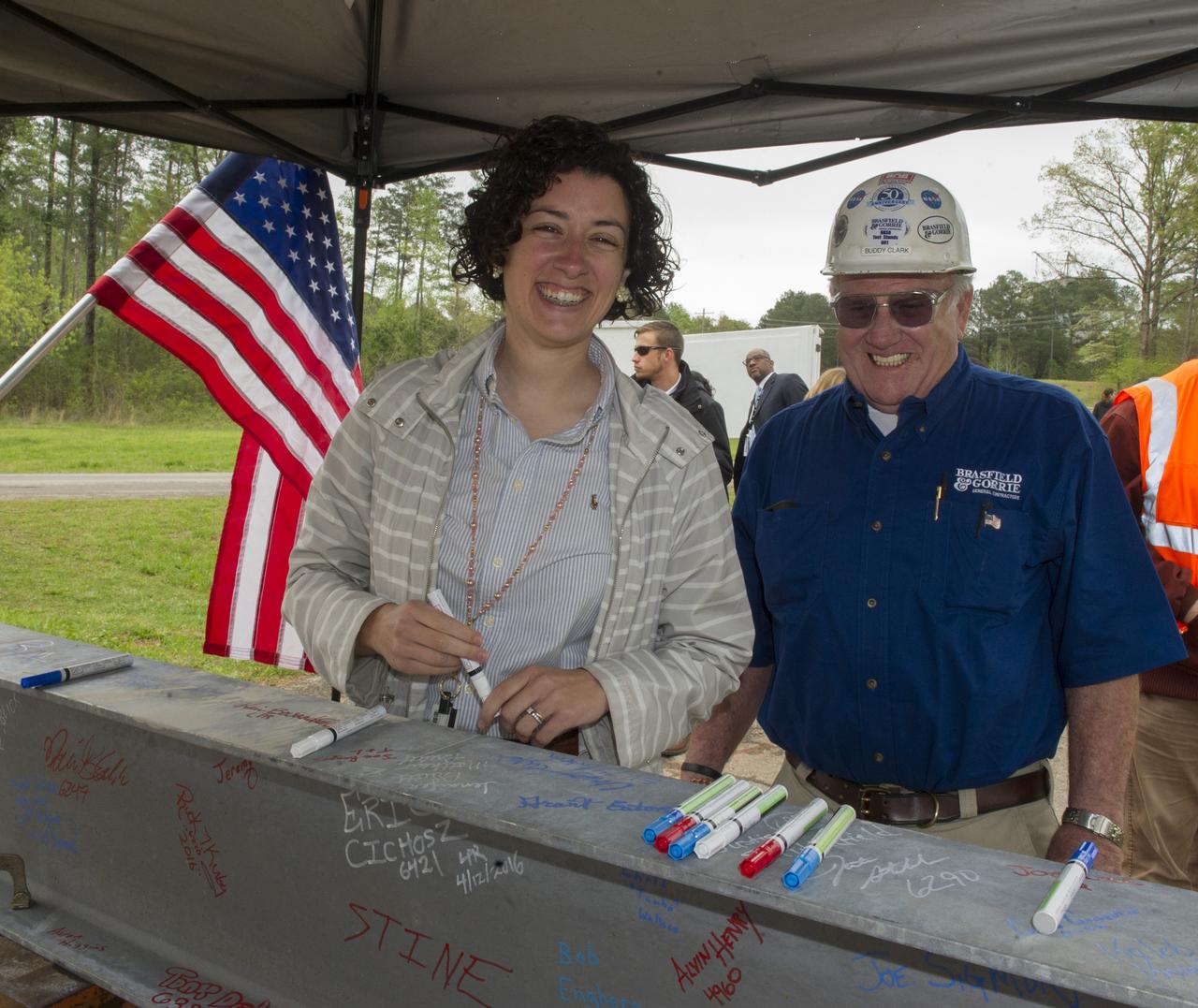
JENNIFER PRUITT AND BUDDY CLARK SMILE FOR THE CAMERA BEFORE SIGNING THE FINAL BEAM TO BE PLACED ATOP TEST STAND 4693 DURING THE STRUCTURE'S TOPPING OUT CEREMONY
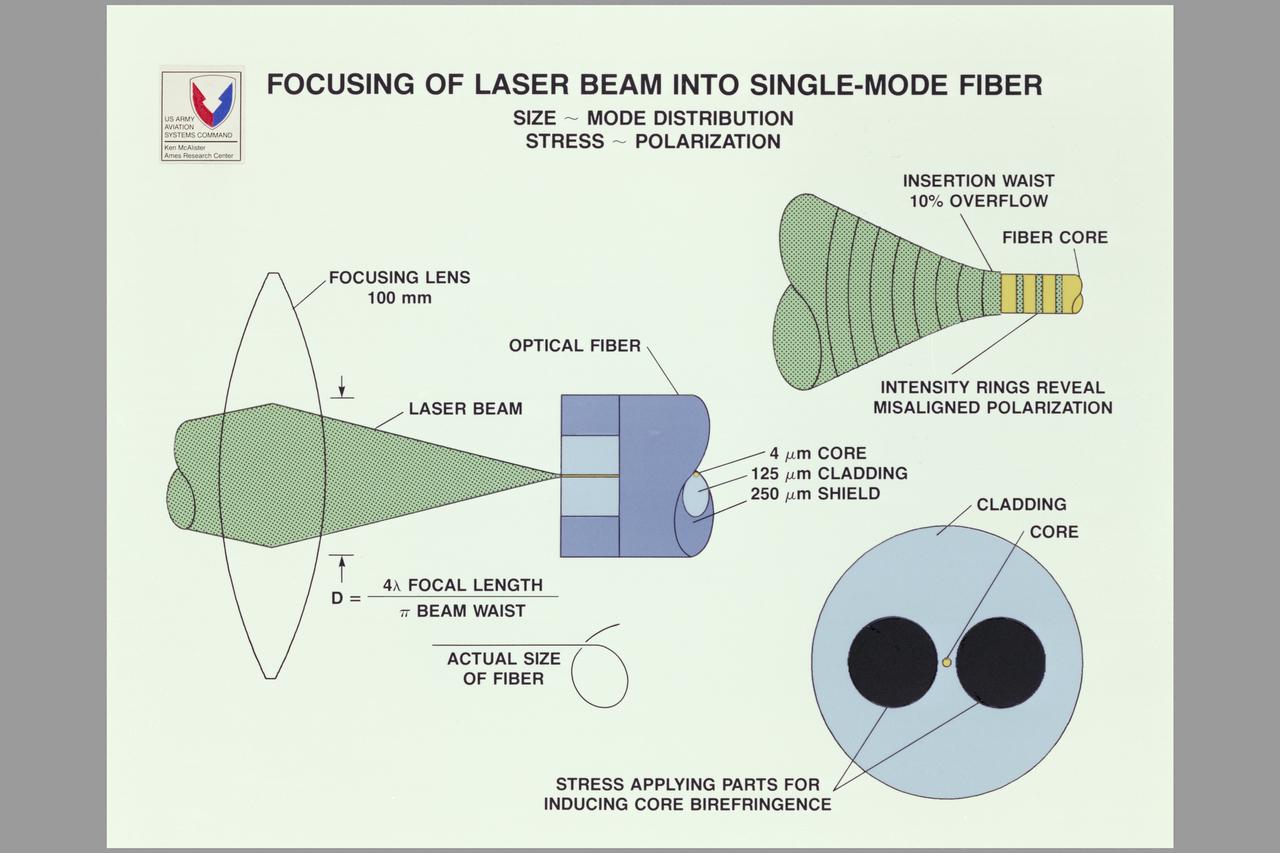
Graphics (McAlister) Army Aeroflightdynamics Directorate 3D Laser Velocimeter for Rotor Flow Studies: Focusing of Laser Beam into Single-Mode Fiber Composite.
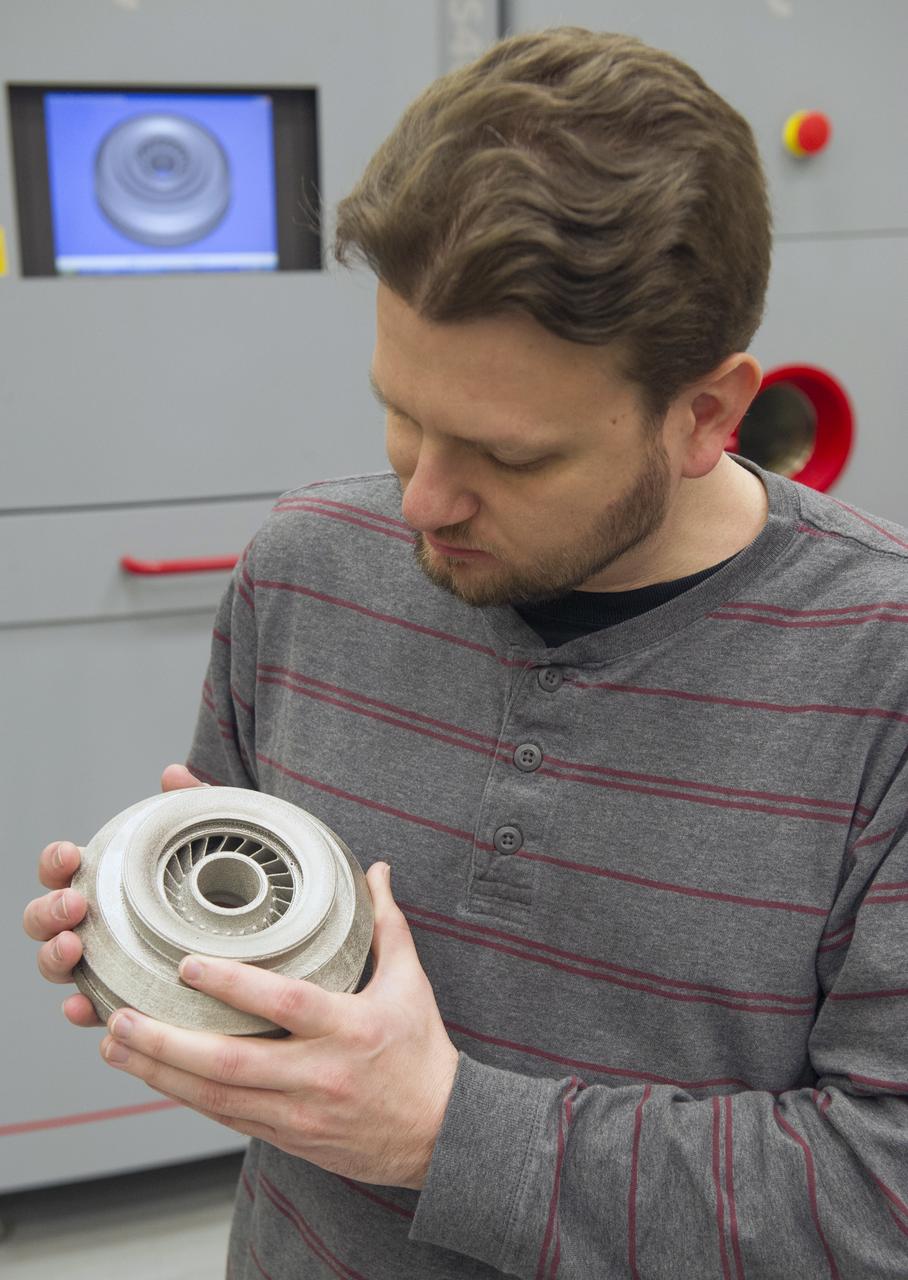
QUINCY BEAN OF MSFC’S ADVANCED MANUFACTURING TEAM, WITH TITANIUM ALLOY TURBOPUMP COMPONENT FABRICATED WITH MSFC’S ELECTRON BEAM MELTING SYSTEM (BACKGROUND).
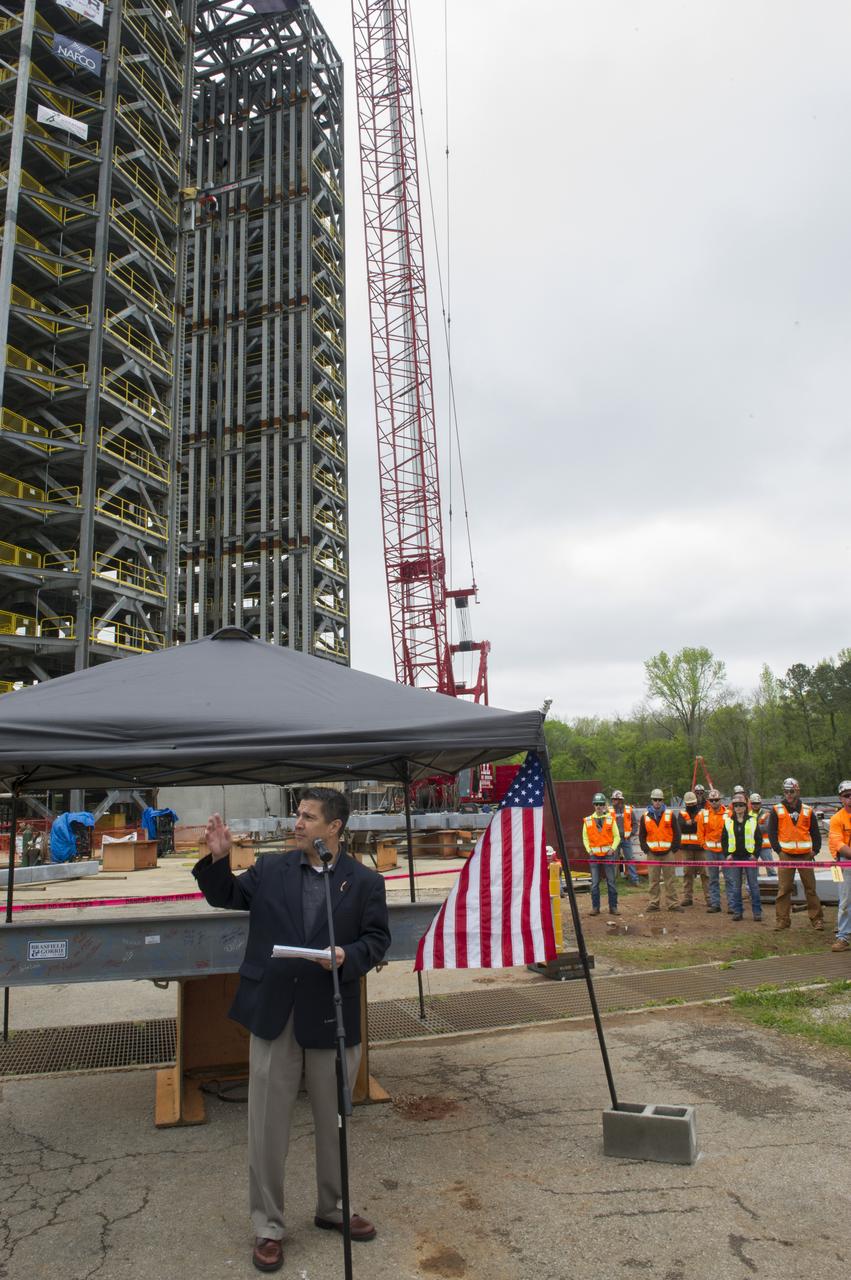
TIM FLORES SPEAKS TO THE CROWD IN FRONT OF A STEEL BEAM DESTINED FOR TEST STAND 4693 DURING THE STRUCTURE'S TOPPING OUT CEREMONY APRIL 12.
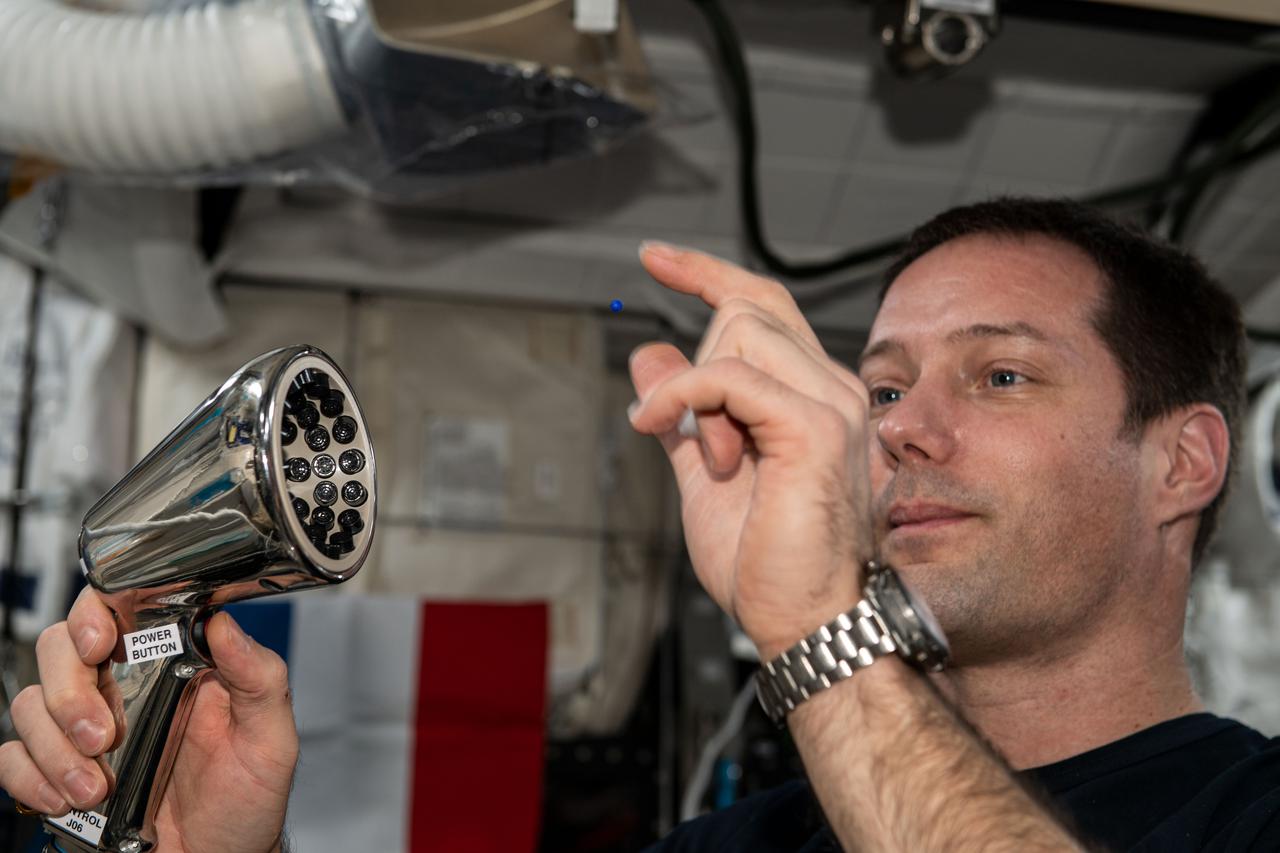
Photo of European Space Agency (ESA) astronaut Thomas Pesquet working with the Ultrasonic Tweezers experiment setup and experiment scenario execution. in the Columbus module. The objective of the Ultrasonic Tweezers project is to develop acoustic tweezers that use sound to allow for remote and contactless manipulation of materials in a microgravity context. An ultrasound beam is shaped so that it produces a trap from which an object cannot easily exit. By moving the beam, the object can be moved to a new position with a very good precision.
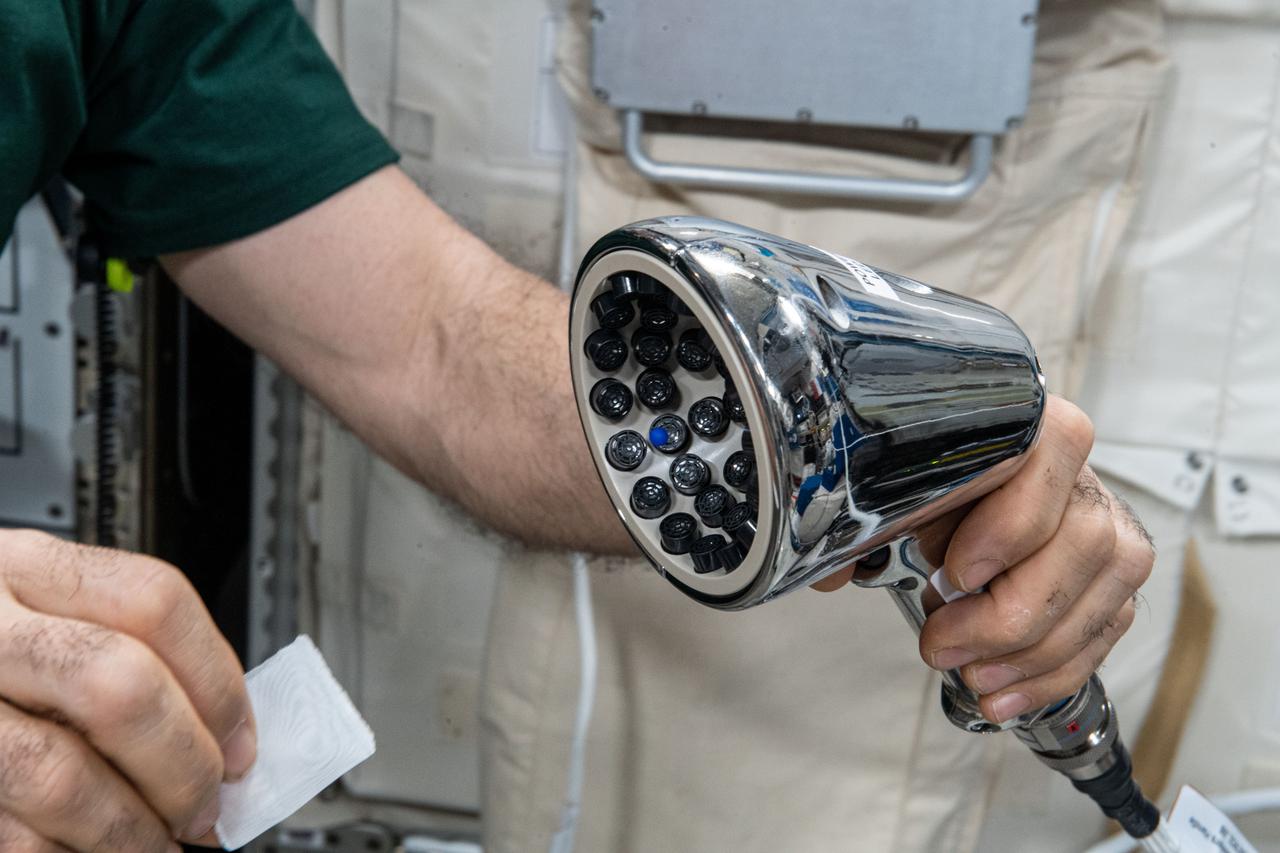
iss065e170116 (7/20/2021) --- Photo taken during the Ultrasonic Tweezers experiment setup and execution in the Columbus module aboard the International Space Station (ISS). The objective of the Ultrasonic Tweezers project is to develop acoustic tweezers that use sound to allow for remote and contactless manipulation of materials in a microgravity context. An ultrasound beam is shaped so that it produces a trap from which an object cannot easily exit. By moving the beam, the object can be moved to a new position with a very good precision.
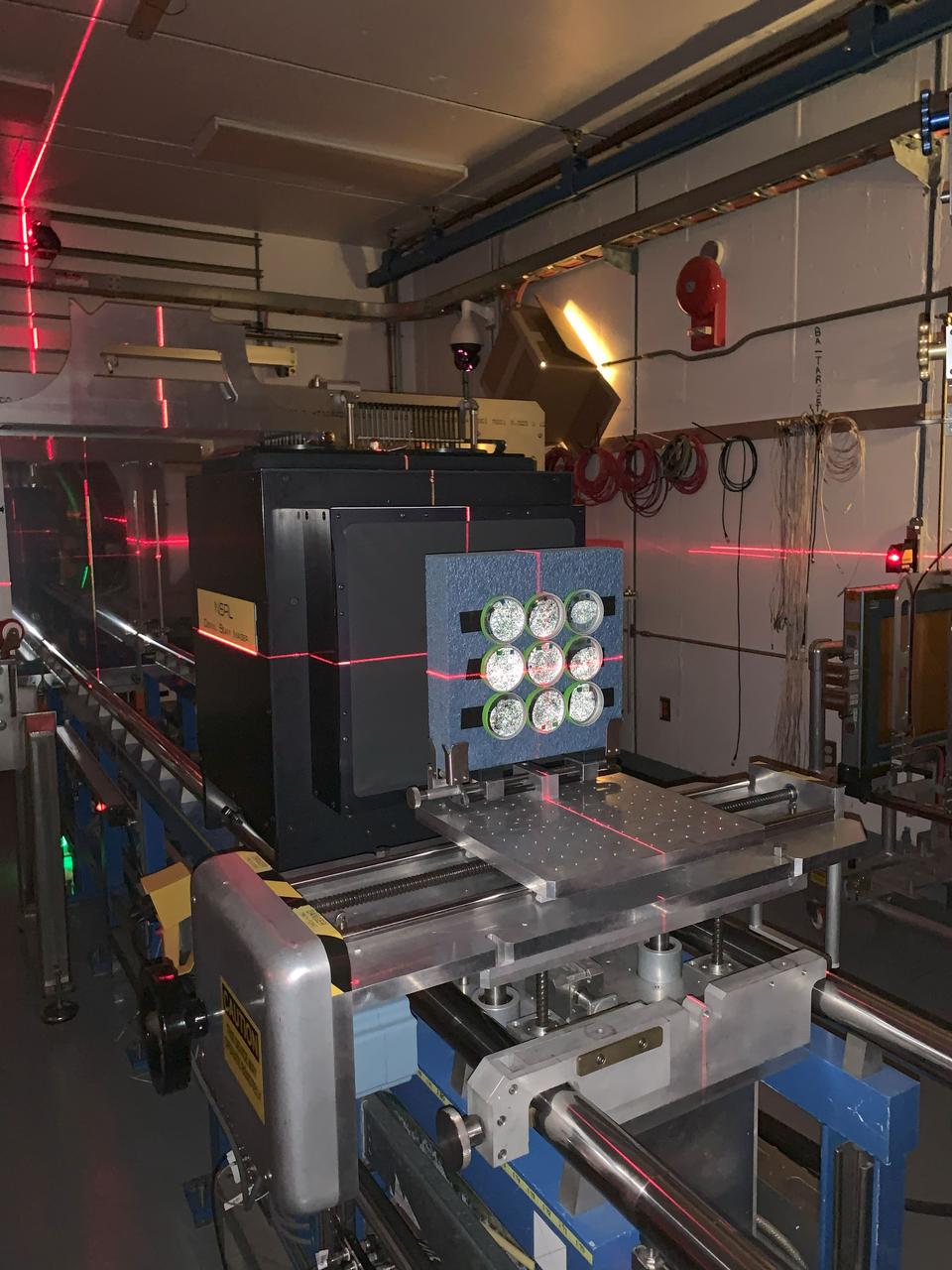
jsc2024e062109 (9/13/2024) ---The ANT1 Radiation Tolerance Experiment with Moss in Orbit on the Space Station (ARTEMOSS) plates are attached to the foam holder prepared for the ion beam run in the target room at the NASA Space Radiation Laboratory (NSRL), at the Brookhaven National Laboratory (BNL), with a visible laser used to center the beam placement. The ARTEMOSS investigation examines whether and how an Antarctic moss repairs damage caused by cosmic radiation and microgravity. Image courtesy of Agata Zupanska.
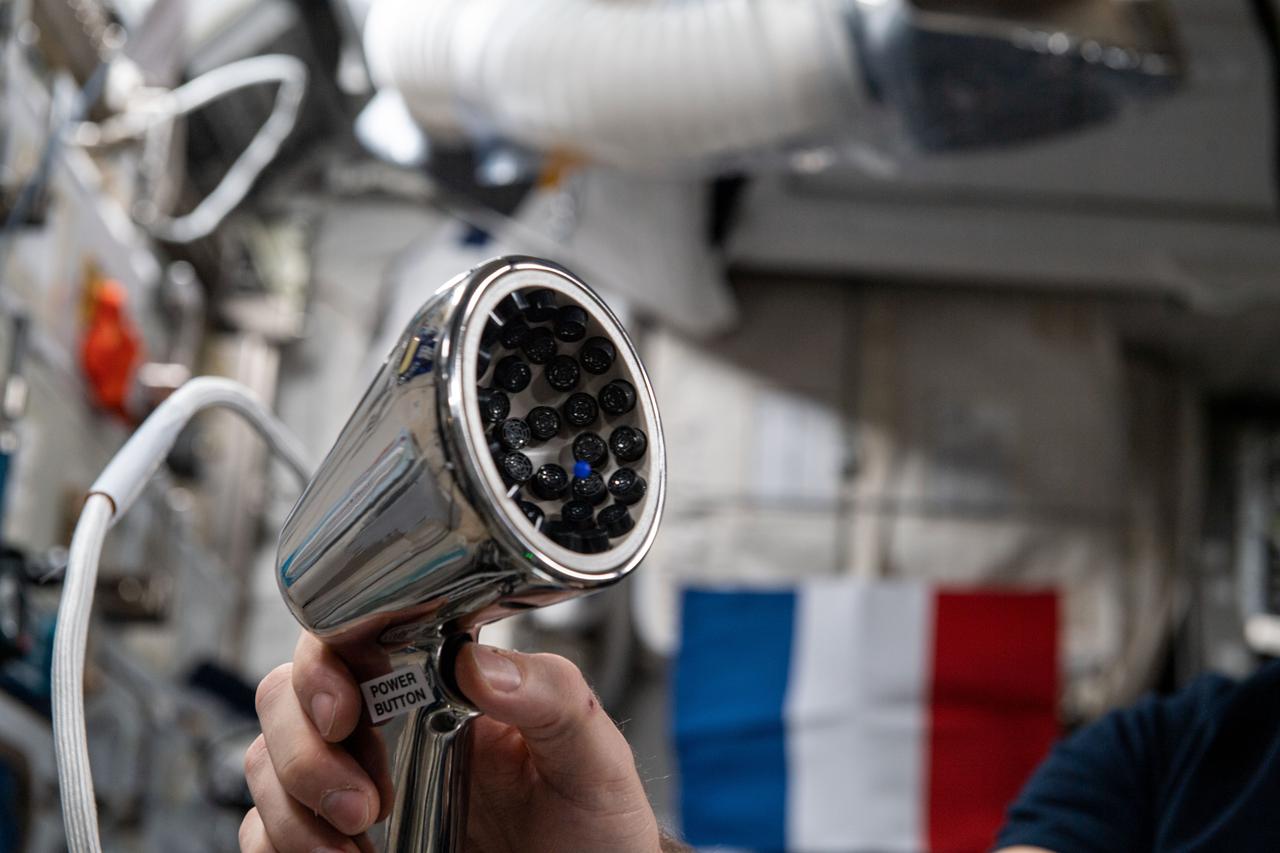
iss065e170080 (7/20/2021) --- Photo taken during the Ultrasonic Tweezers experiment setup and execution in the Columbus module aboard the International Space Station (ISS). The objective of the Ultrasonic Tweezers project is to develop acoustic tweezers that use sound to allow for remote and contactless manipulation of materials in a microgravity context. An ultrasound beam is shaped so that it produces a trap from which an object cannot easily exit. By moving the beam, the object can be moved to a new position with a very good precision.
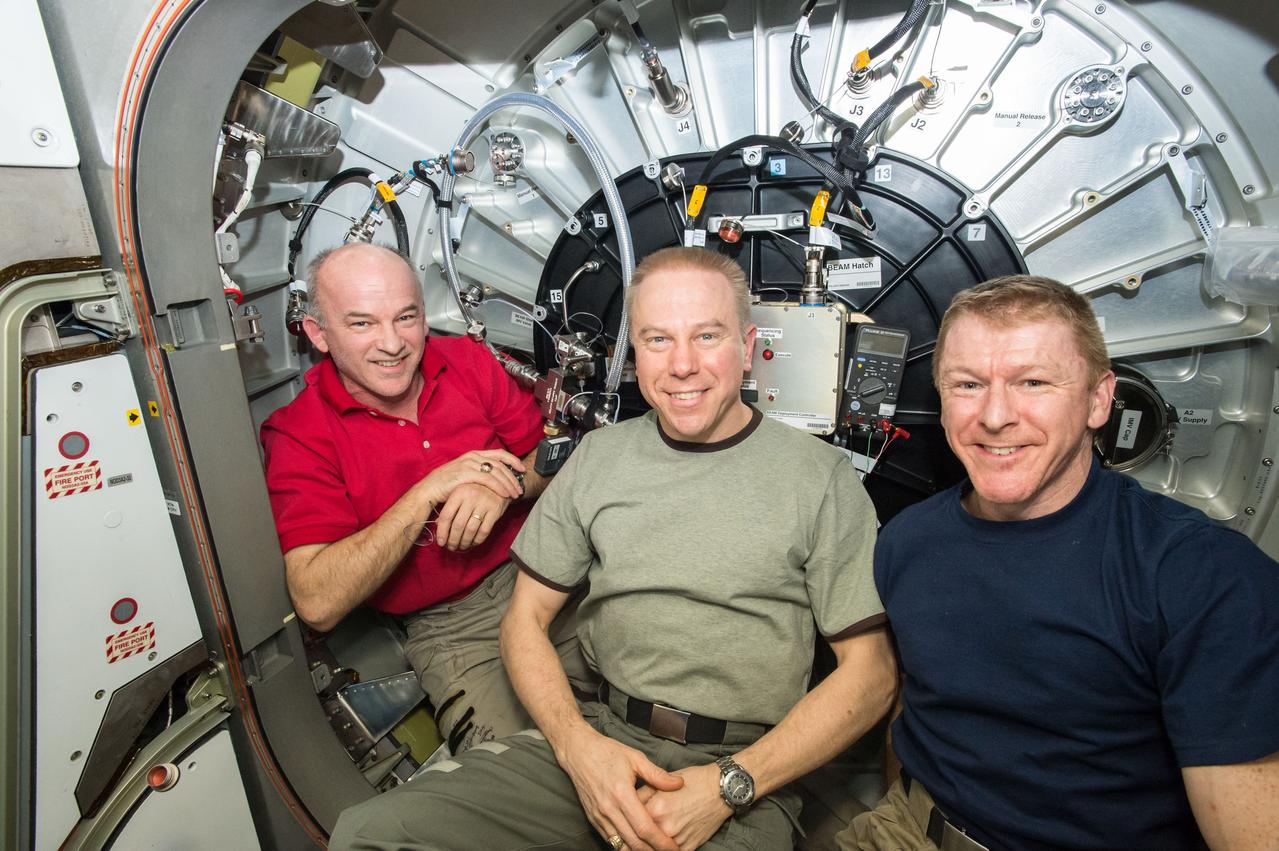
ISS047e135573 (05/28/2016) --- Expedition 47 astronauts Jeff Williams (left) and Timothy Kopra (middle) of NASA, along with ESA (European Space Agency) astronaut Timothy Peake (right) pose in front of the entrance to the Bigelow Expandable Activity Module (BEAM) after successful expansion. NASA Astronaut Jeff Williams and the NASA and Bigelow Aerospace teams working at Mission Control Center at NASA’s Johnson Space Center spent more than seven hours on operations to fill the BEAM with air to cause it to expand.