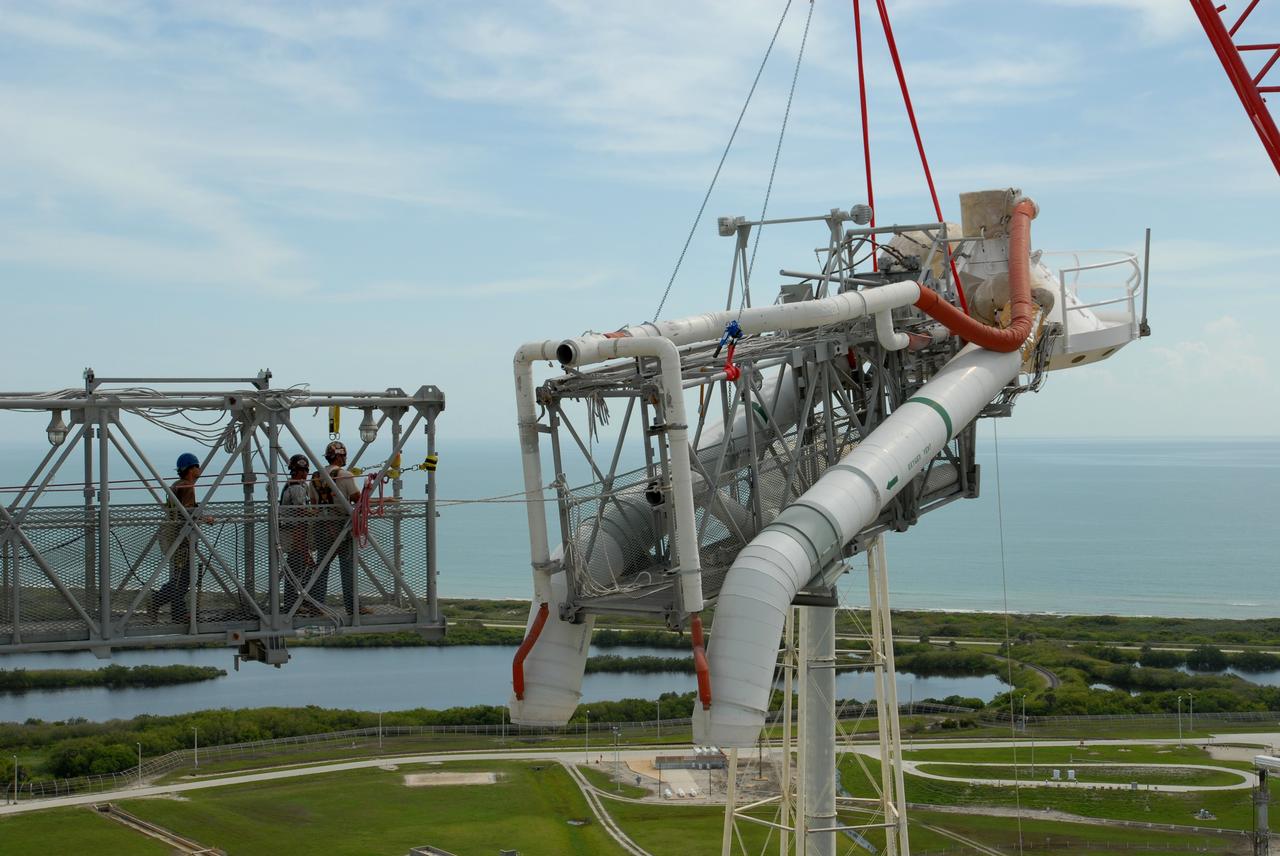
CAPE CANAVERAL, Fla. – On Launch Pad 39B at NASA's Kennedy Space Center in Florida, a crane removes the oxygen vent hood, called the "beanie cap," and the gaseous oxygen vent arm from the fixed service structure. A portion of the service structure is being removed for the pad's conversion as launch site for the Constellation Program's Ares I-X. The launch of the Ares I-X flight test is targeted for August 2009. Photo credit: NASA/Jim Grossmann
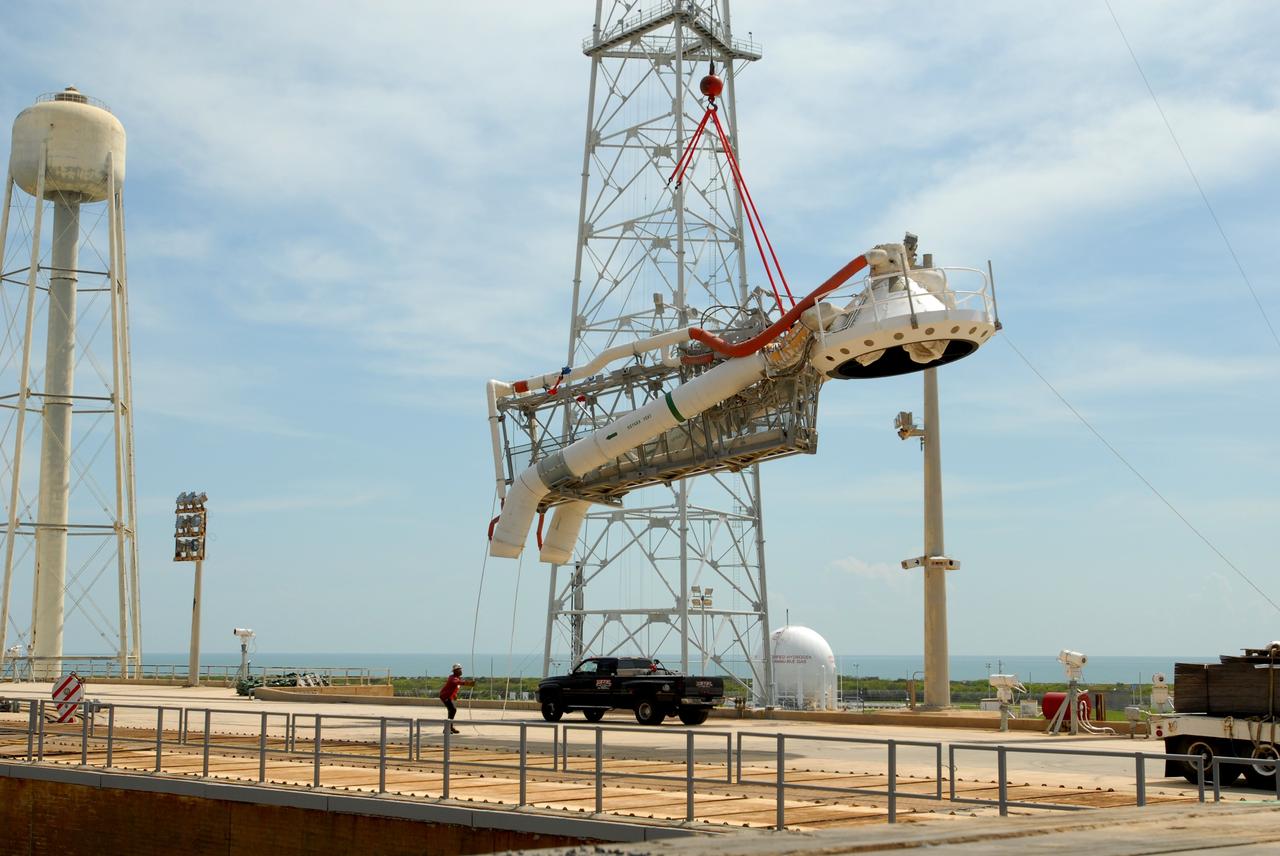
CAPE CANAVERAL, Fla. – On Launch Pad 39B at NASA's Kennedy Space Center in Florida, a crane lowers the oxygen vent hood, called the "beanie cap," and the gaseous oxygen vent arm onto the pad. A portion of the service structure is being removed for the pad's conversion as launch site for the Constellation Program's Ares I-X. The launch of the Ares I-X flight test is targeted for August 2009. Photo credit: NASA/Jim Grossmann
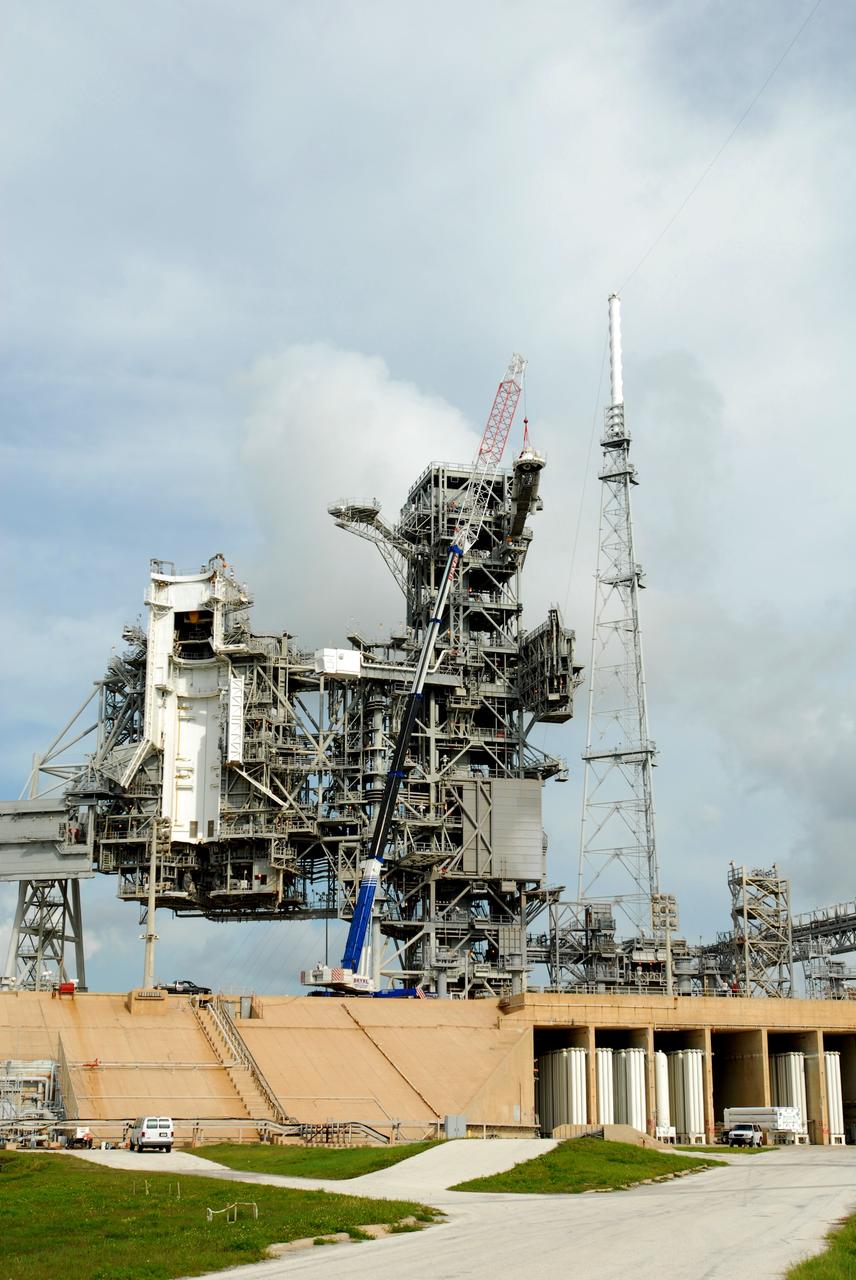
CAPE CANAVERAL, Fla. – On Launch Pad 39B at NASA's Kennedy Space Center in Florida, a portion of the service structure is being removed for the pad's conversion as launch site for the Constellation Program's Ares I-X. Here, a crane is attached to the oxygen vent hood, called the "beanie cap," on the gaseous oxygen vent arm. The launch of the Ares I-X flight test is targeted for August 2009. Photo credit: NASA/Jim Grossmann
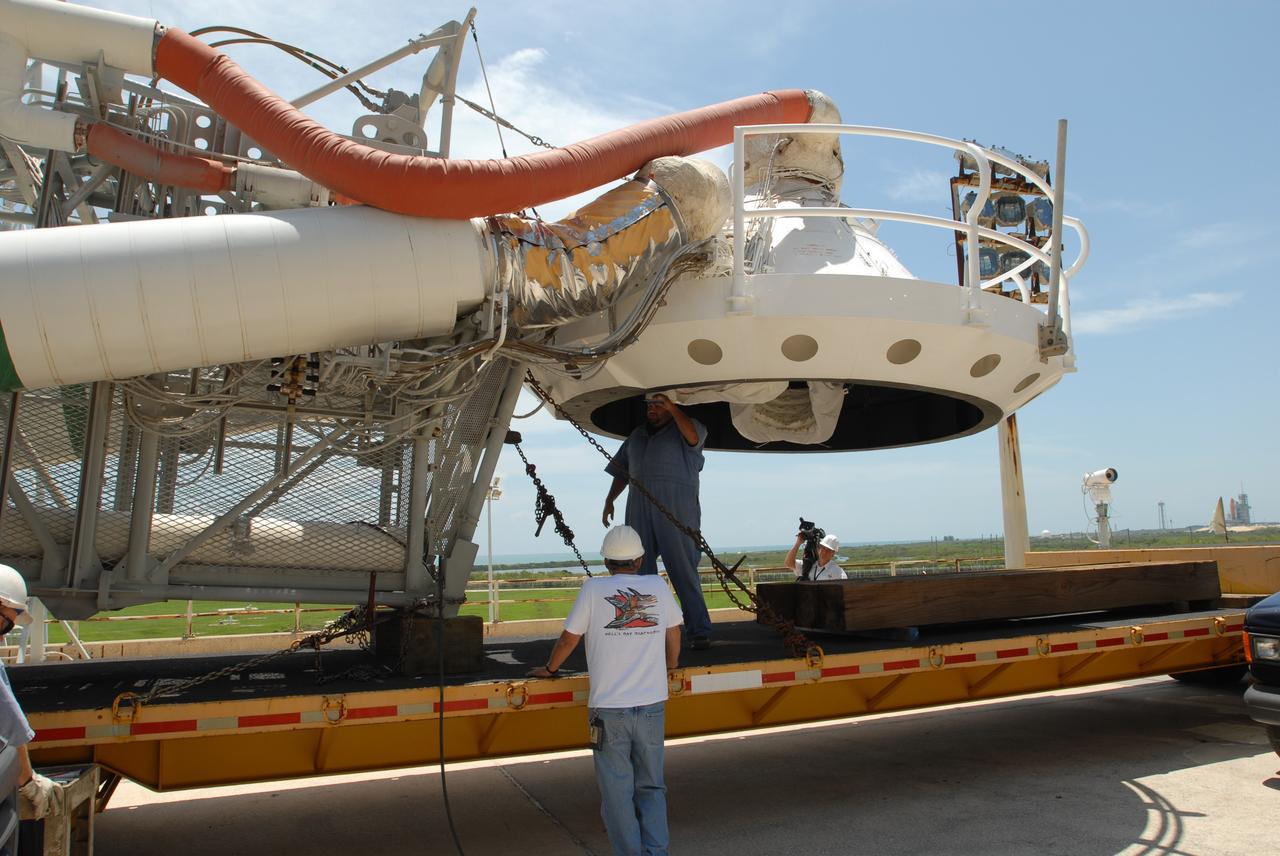
CAPE CANAVERAL, Fla. – At NASA's Kennedy Space Center in Florida, workers check the "beanie cap" and the gaseous oxygen vent arm removed from Launch Pad 39B's fixed service structure. A portion of the service structure is being removed for the pad's conversion as launch site for the Constellation Program's Ares I-X. The launch of the Ares I-X flight test is targeted for August 2009. Photo credit: NASA/Jim Grossmann
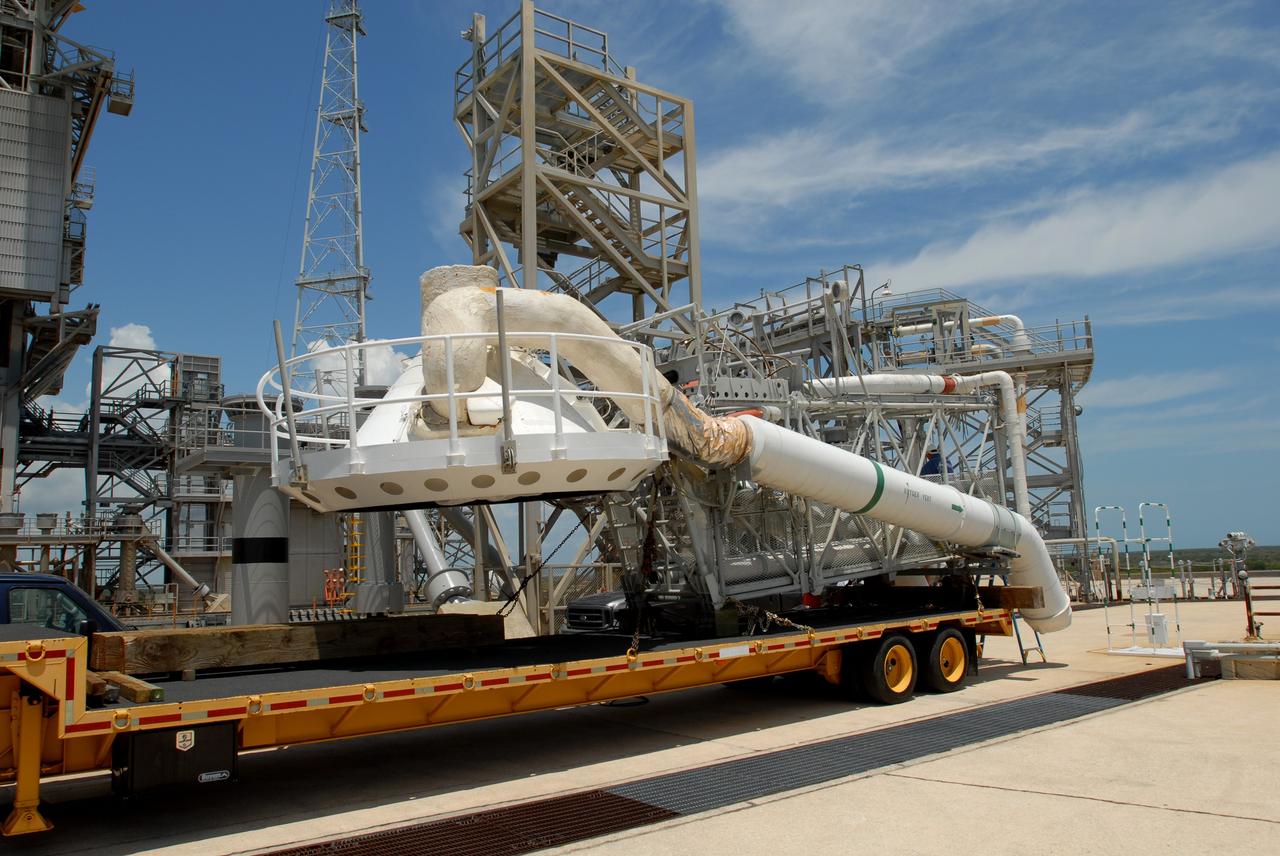
CAPE CANAVERAL, Fla. – At NASA's Kennedy Space Center in Florida, the oxygen vent hood, called the "beanie cap," and the gaseous oxygen vent arm removed from Launch Pad 39B's fixed service structure are lowered onto a transporter. A portion of the service structure is being removed for the pad's conversion as launch site for the Constellation Program's Ares I-X. The launch of the Ares I-X flight test is targeted for August 2009. Photo credit: NASA/Jim Grossmann
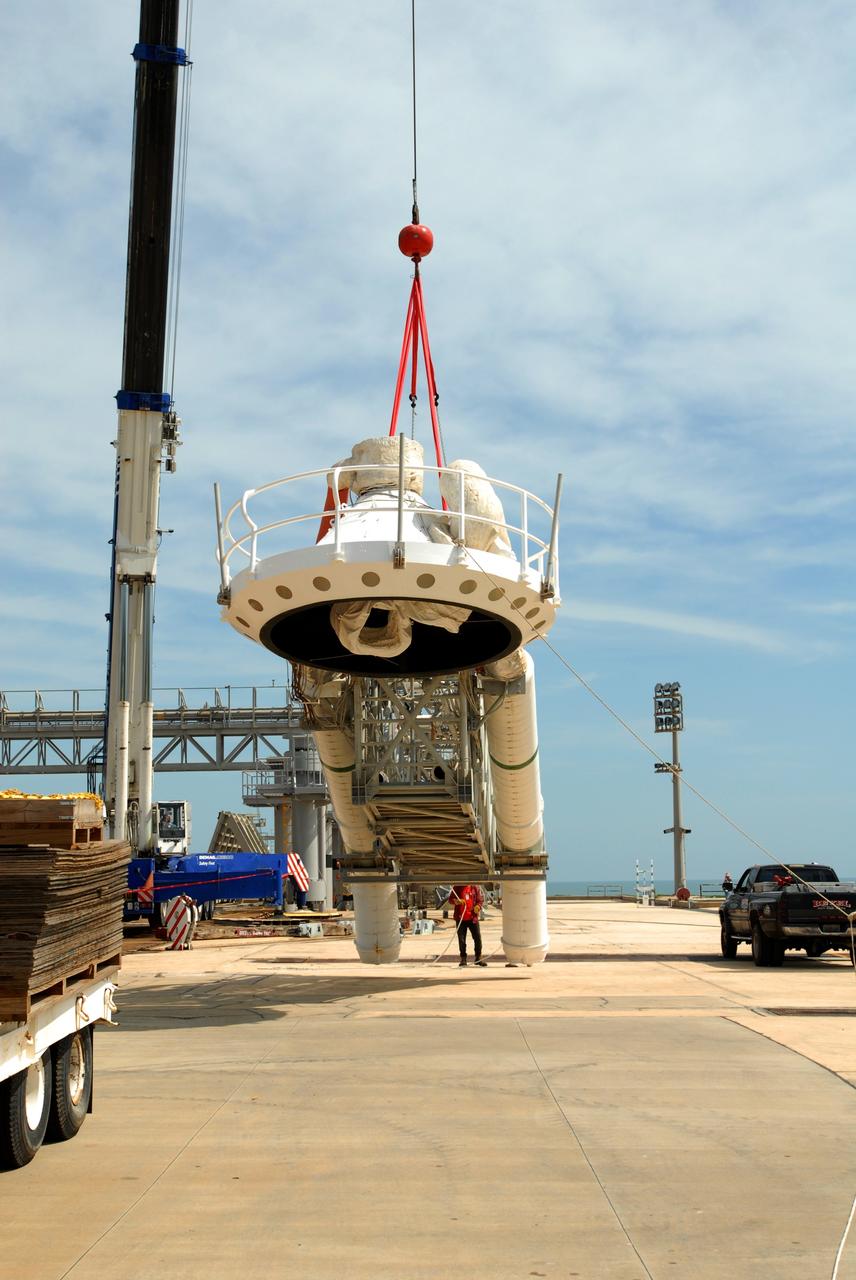
CAPE CANAVERAL, Fla. – On Launch Pad 39B at NASA's Kennedy Space Center in Florida, a crane lowers the oxygen vent hood, called the "beanie cap," and the gaseous oxygen vent arm onto the pad. A portion of the service structure is being removed for the pad's conversion as launch site for the Constellation Program's Ares I-X. The launch of the Ares I-X flight test is targeted for August 2009. Photo credit: NASA/Jim Grossmann
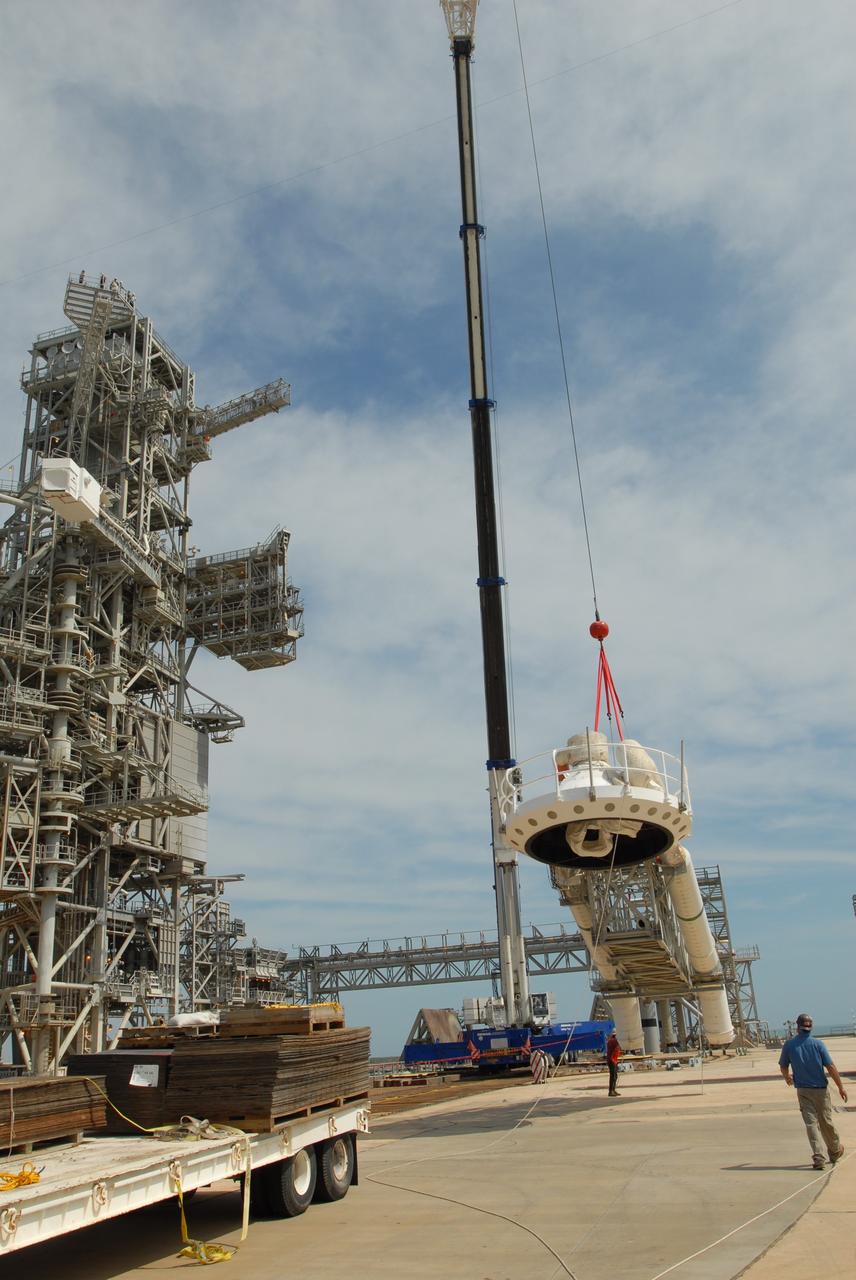
CAPE CANAVERAL, Fla. – On Launch Pad 39B at NASA's Kennedy Space Center in Florida, a crane lowers the oxygen vent hood, called the "beanie cap," and the gaseous oxygen vent arm onto the pad. A portion of the service structure is being removed for the pad's conversion as launch site for the Constellation Program's Ares I-X. The launch of the Ares I-X flight test is targeted for August 2009. Photo credit: NASA/Jim Grossmann
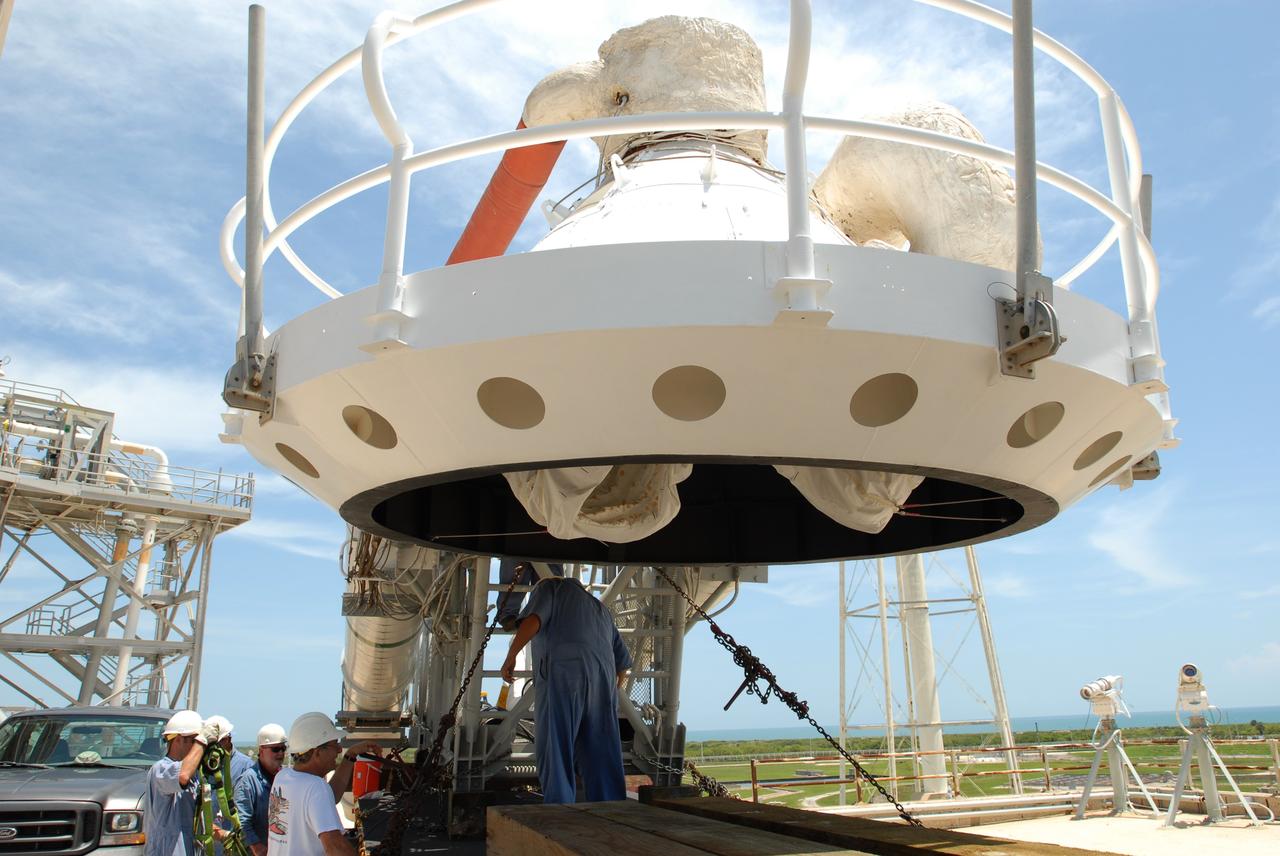
CAPE CANAVERAL, Fla. – At NASA's Kennedy Space Center in Florida, workers check the "beanie cap" and the gaseous oxygen vent arm removed from Launch Pad 39B's fixed service structure before they are taken away on the transporter. A portion of the service structure is being removed for the pad's conversion as launch site for the Constellation Program's Ares I-X. The launch of the Ares I-X flight test is targeted for August 2009. Photo credit: NASA/Jim Grossmann
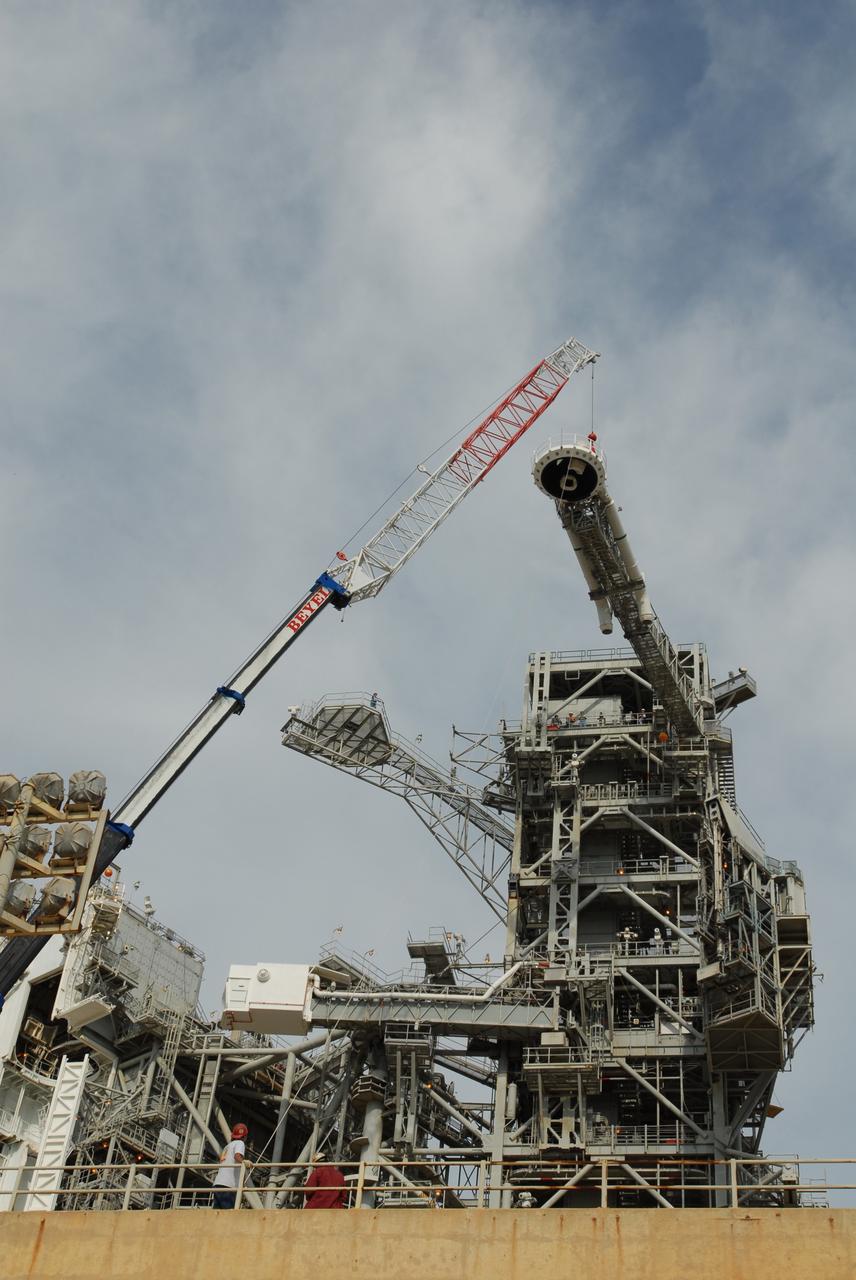
CAPE CANAVERAL, Fla. – On Launch Pad 39B at NASA's Kennedy Space Center in Florida, a crane is attached to the oxygen vent hood, called the "beanie cap," on the gaseous oxygen vent arm, for removal. A portion of the service structure is being removed for the pad's conversion as launch site for the Constellation Program's Ares I-X. The launch of the Ares I-X flight test is targeted for August 2009. Photo credit: NASA/Jim Grossmann
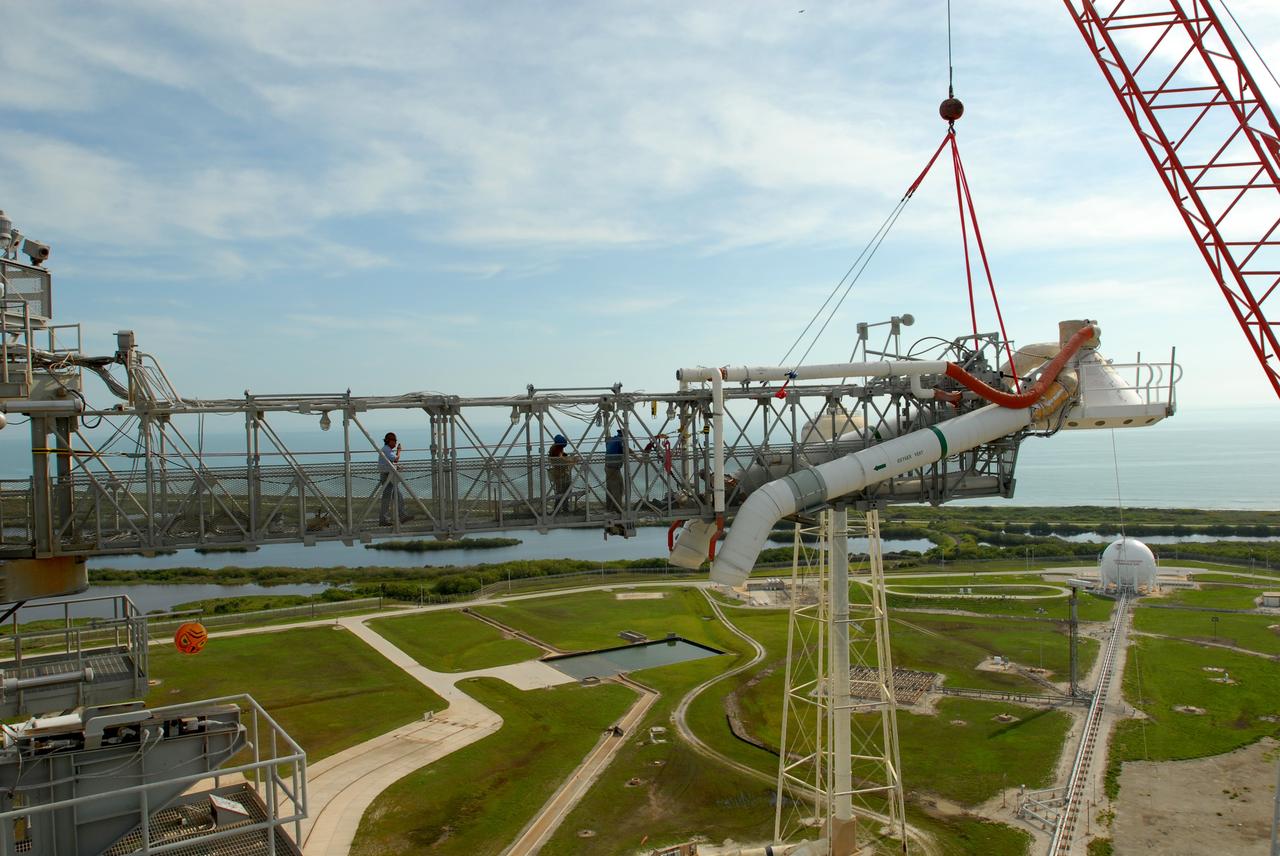
CAPE CANAVERAL, Fla. – On Launch Pad 39B at NASA's Kennedy Space Center in Florida, a crane removes the oxygen vent hood, called the "beanie cap," and the gaseous oxygen vent arm from the fixed service structure. A portion of the service structure is being removed for the pad's conversion as launch site for the Constellation Program's Ares I-X. The launch of the Ares I-X flight test is targeted for August 2009. Photo credit: NASA/Jim Grossmann
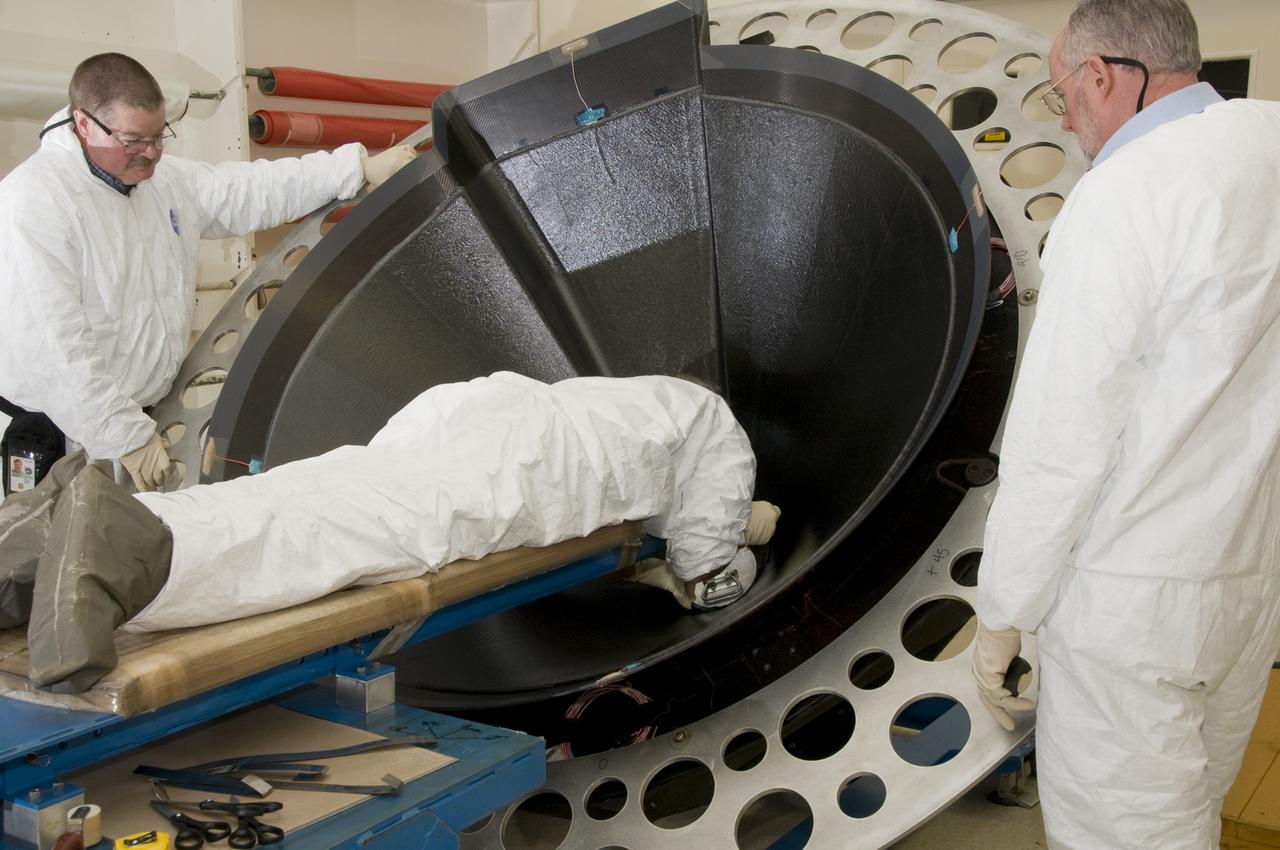
STEVE FRANKLIN, LEFT, AND RICHARD WELCH STAND READY TO ASSIST ED KIRSCH AS HE INSTALLS A ROUND PIECE OF COMPOSITE MATERIAL IN THE "BEANIE CAP" AT THE VERY TOP INSIDE THE COMPOSITE NOSE CONE.
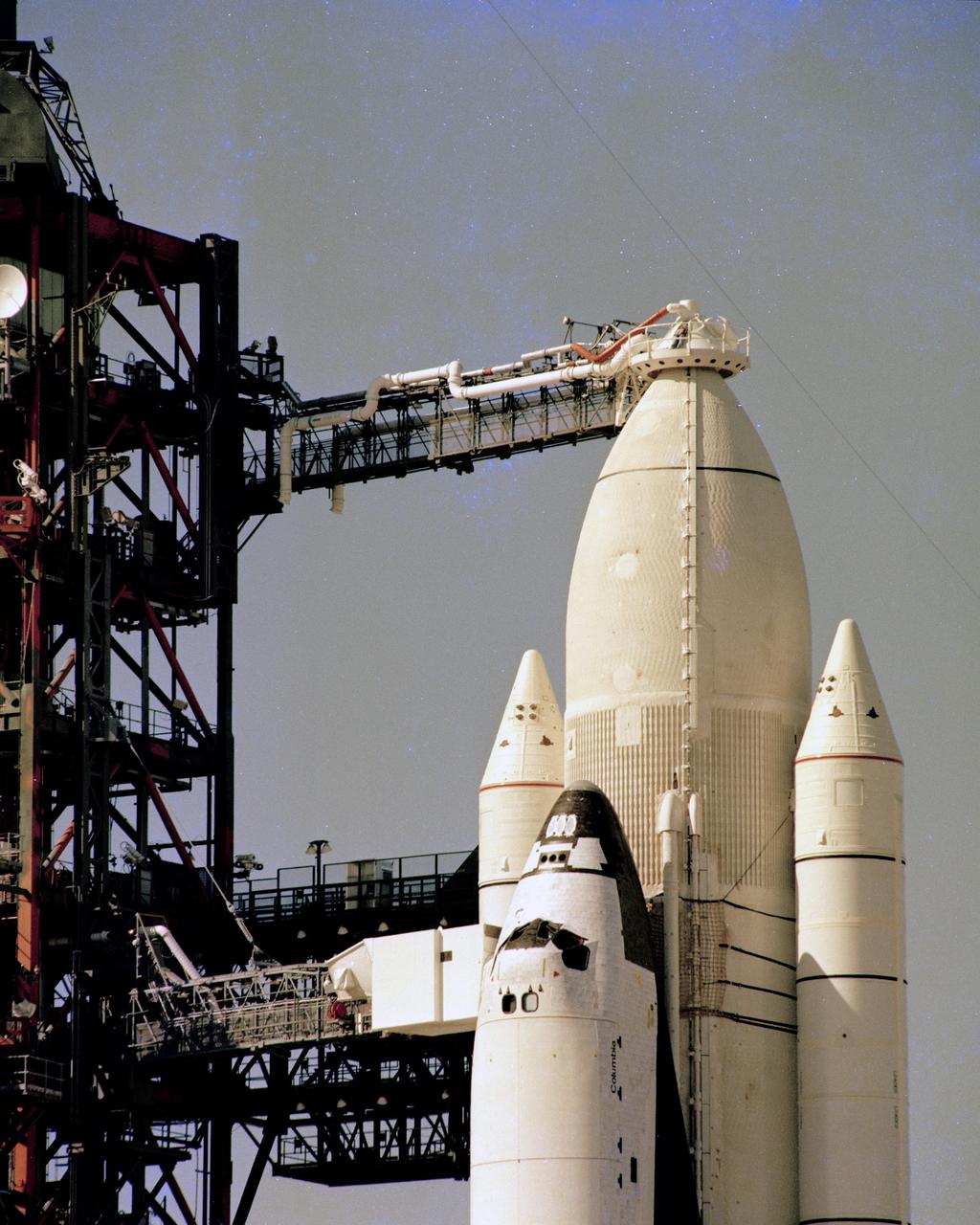
CAPE CANAVERAL, Fla. – The upper part of the space shuttle vehicle showing the "beanie cap" in place. Photo credit: NASA
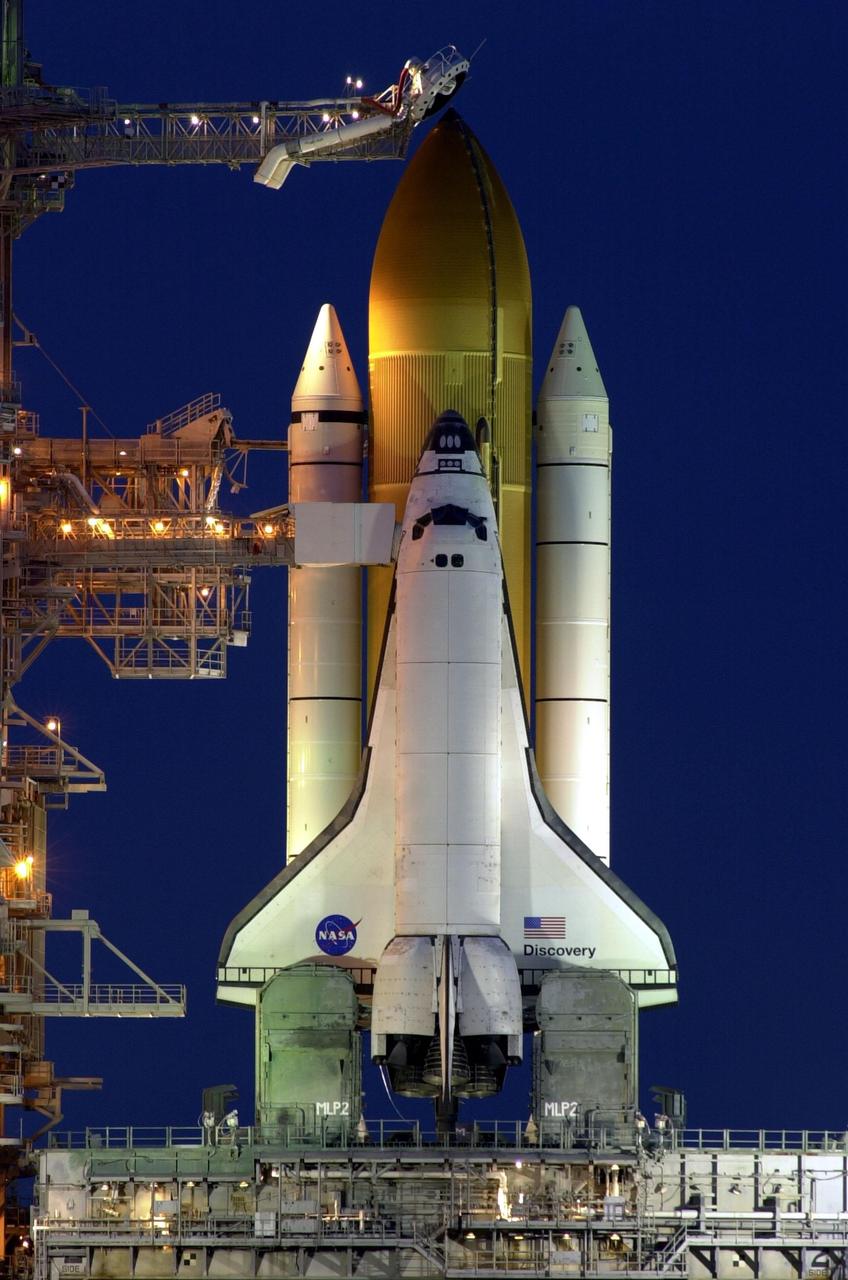
Just after sundown, Space Shuttle Discovery is framed with light from the Fixed Service Structure on Launch Pad 39B as it waits for liftoff on mission STS-103. At the top is seen the external tank gaseous oxygen vent arm system with the vent hood (commonly called the "beanie cap") poised above the external tank. The retractable arm and the beanie cap are designed to vent gaseous oxygen vapors away from the Space Shuttle. The arm truss section is 65 feet long and the diameter of the beanie cap is 13 feet. Extending toward the cabin of the orbiter is the orbiter access arm, with the environmental chamber (called the White Room) at the end. Through this chamber the crew enters the orbiter. The STS-103 mission, to service the Hubble Space Telescope, is scheduled for launch Dec. 17 at 8:47 p.m. EST. Mission objectives include replacing gyroscopes and an old computer, installing another solid state recorder, and replacing damaged insulation in the telescope. The mission is expected to last about 8 days and 21 hours. Discovery is expected to land at KSC Sunday, Dec. 26, at about 6:25 p.m. EST
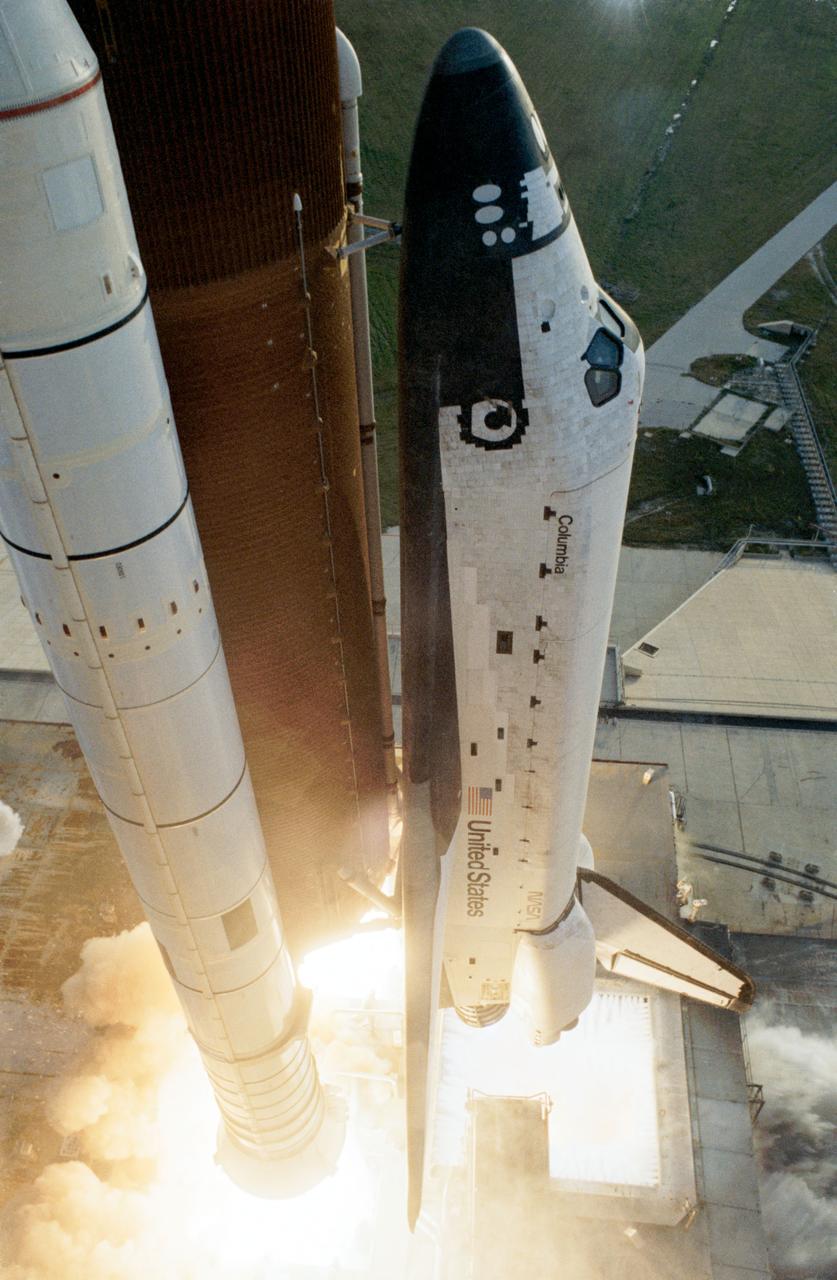
Views of the External Tank (ET) Beanie Cap in place just prior to Final Count, and another looking down from the Service Structure, with engines and rockets firing, just as it left the Pad deck, 11/11/1982. KSC, FL
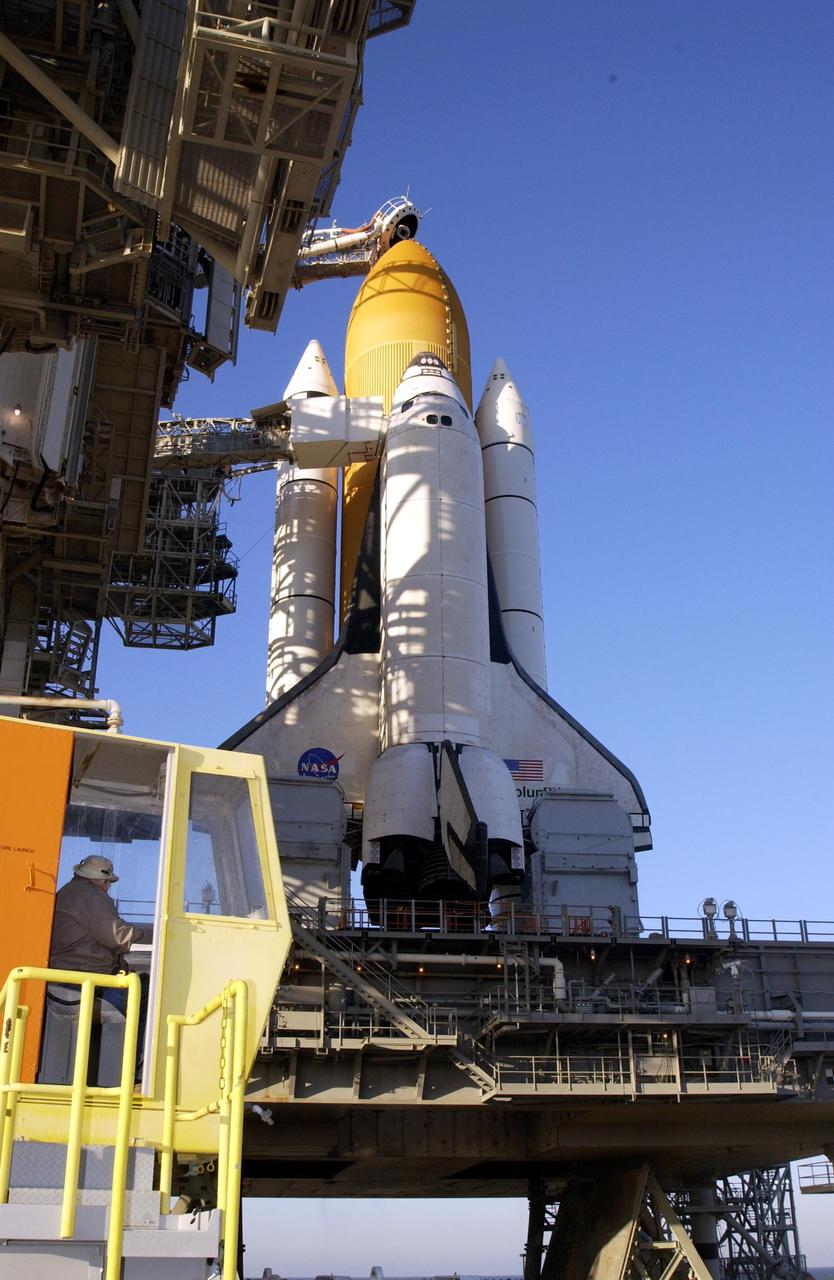
KENNEDY SPACE CENTER, FLA. -- The driver in the foreground controls the rollback of the Rotating Service Structure from around Space Shuttle Columbia, which is bathed in shadows. Visible are the orbiter access arm with the White Room extended to Columbia's cockpit, and at the top, the gaseous oxygen vent arm and cap, called the "beanie cap." Columbia is scheduled for launch Jan. 16 at 10:39 a.m. EST on mission STS-107.
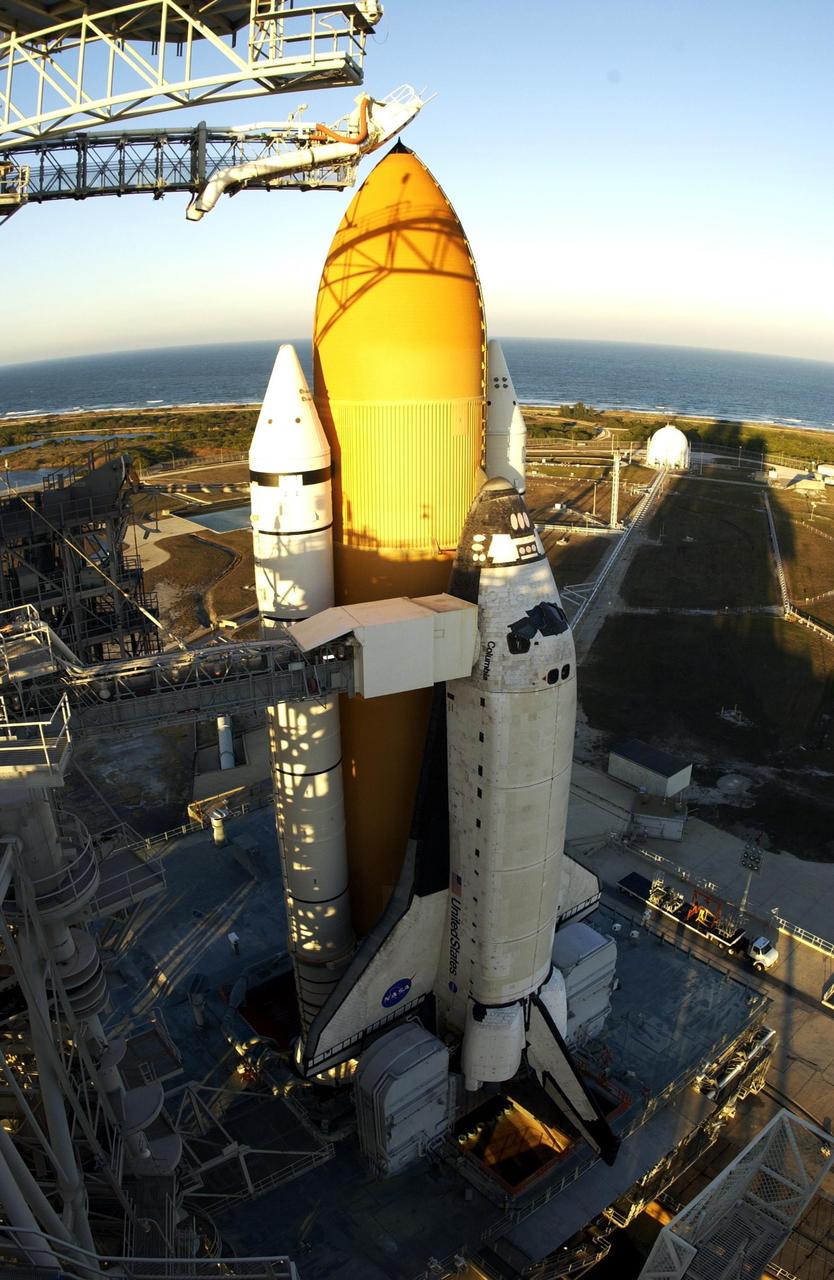
KENNEDY SPACE CENTER, FLA. -- After rollback of the Rotating Service Structure on Launch Pad 39A, the top of Space Shuttle Columbia's external tank and solid rocket booster are bathed in sunlight. Shadows from the Fixed Service Structure stretch across the Shuttle and landscape. Visible are the orbiter access arm with the White Room extended to Columbia's cockpit, and at the top, the gaseous oxygen vent arm and cap, called the "beanie cap." Columbia is scheduled for launch Jan. 16 at 10:39 a.m. EST on mission STS-107, a research mission.
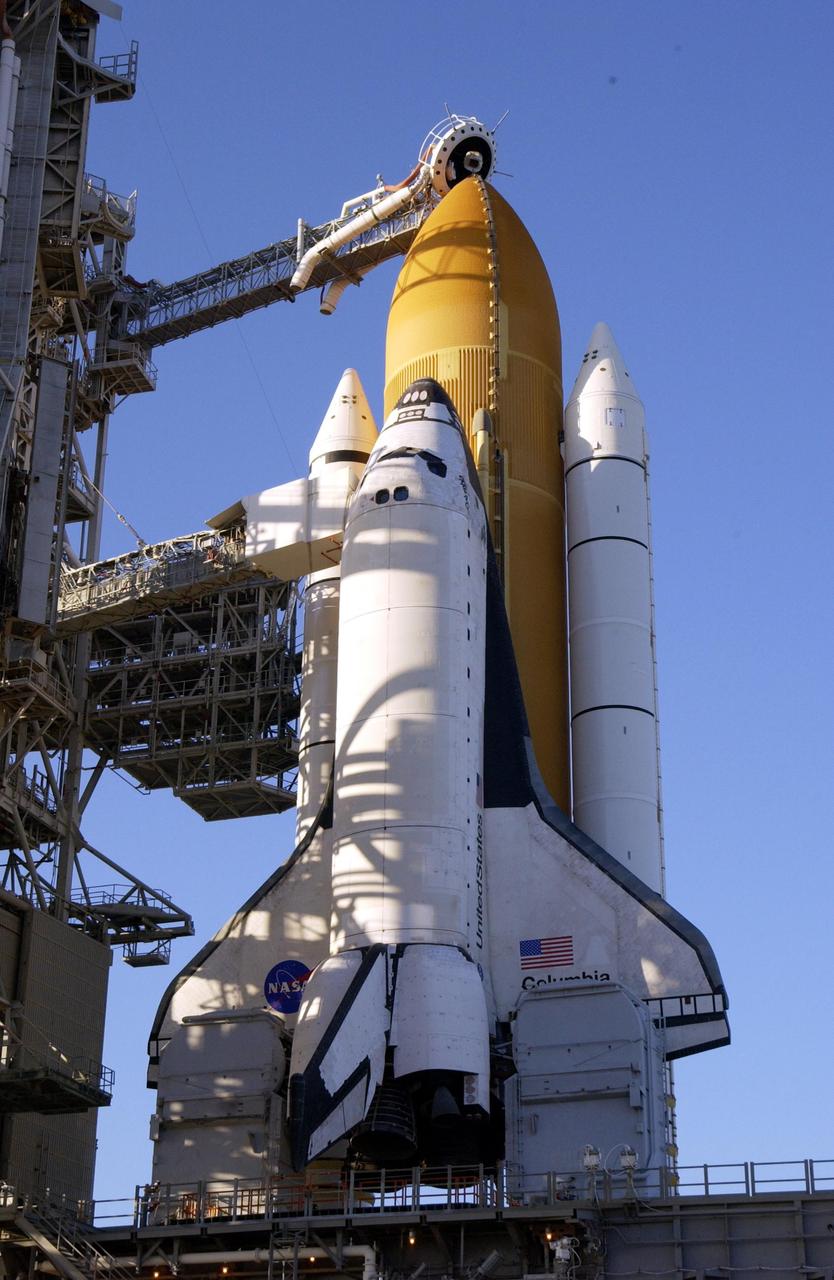
KENNEDY SPACE CENTER, FLA. -- Cast in late afternoon shadows, Space Shuttle Columbia is revealed as the Rotating Service Structure rolls back. The Shuttle sits atop the Mobile Launcher Platform. Near the top is seen the orbiter access arm with the White Room at the end. The White Room provides entry into the Shuttle for the crew. Above the orange external tank is the gaseous oxygen vent arm and cap, called the "beanie cap." Columbia is scheduled for launch Jan. 16 at 10:39 a.m. EST on mission STS-107.
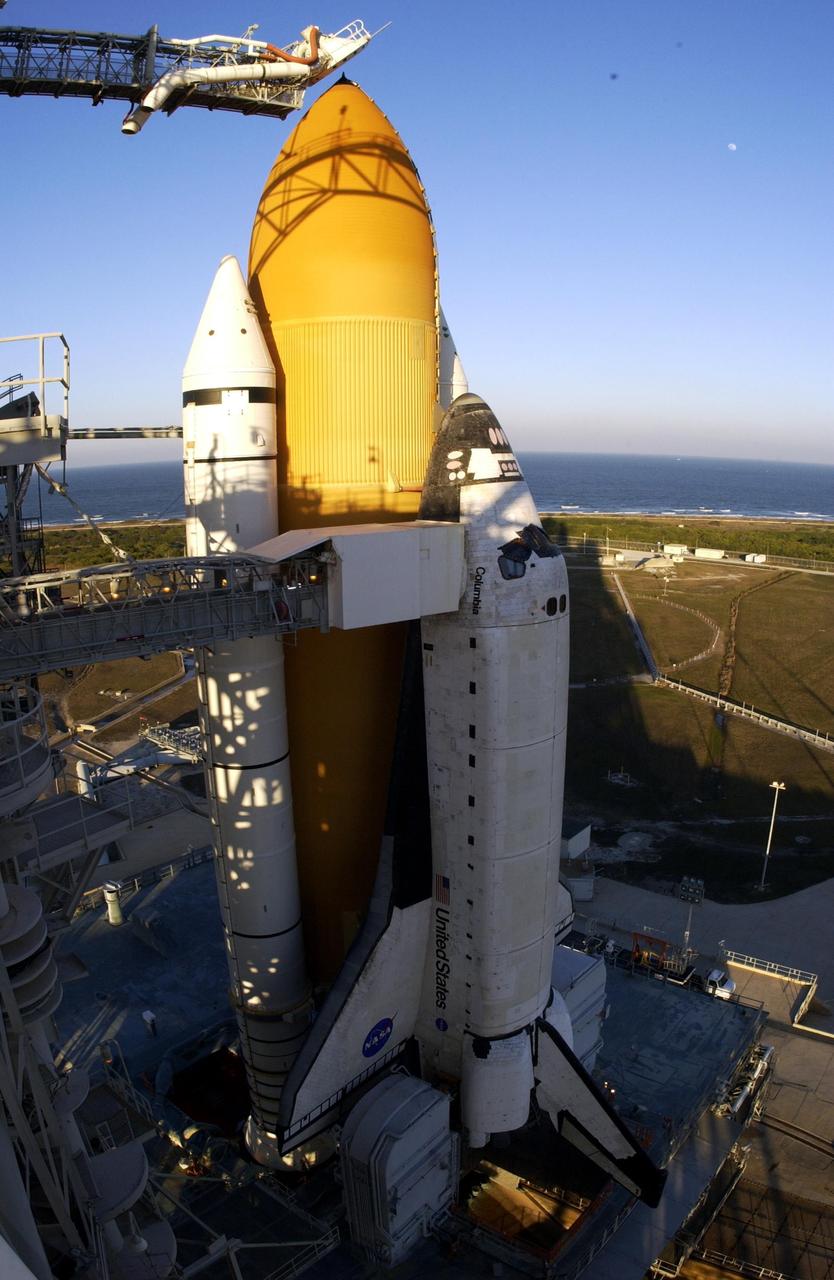
KENNEDY SPACE CENTER, FLA. -- The late afternoon sun highlights the external tank and solid rocket booster on Space Shuttle Columbia after rollback of the Rotating Service Structure on Launch Pad 39A. Visible are the orbiter access arm with the White Room extended to Columbia's cockpit, and at the top, the gaseous oxygen vent arm and cap, called the "beanie cap." Columbia is scheduled for launch Jan. 16 at 10:39 a.m. EST on mission STS-107, a research mission.
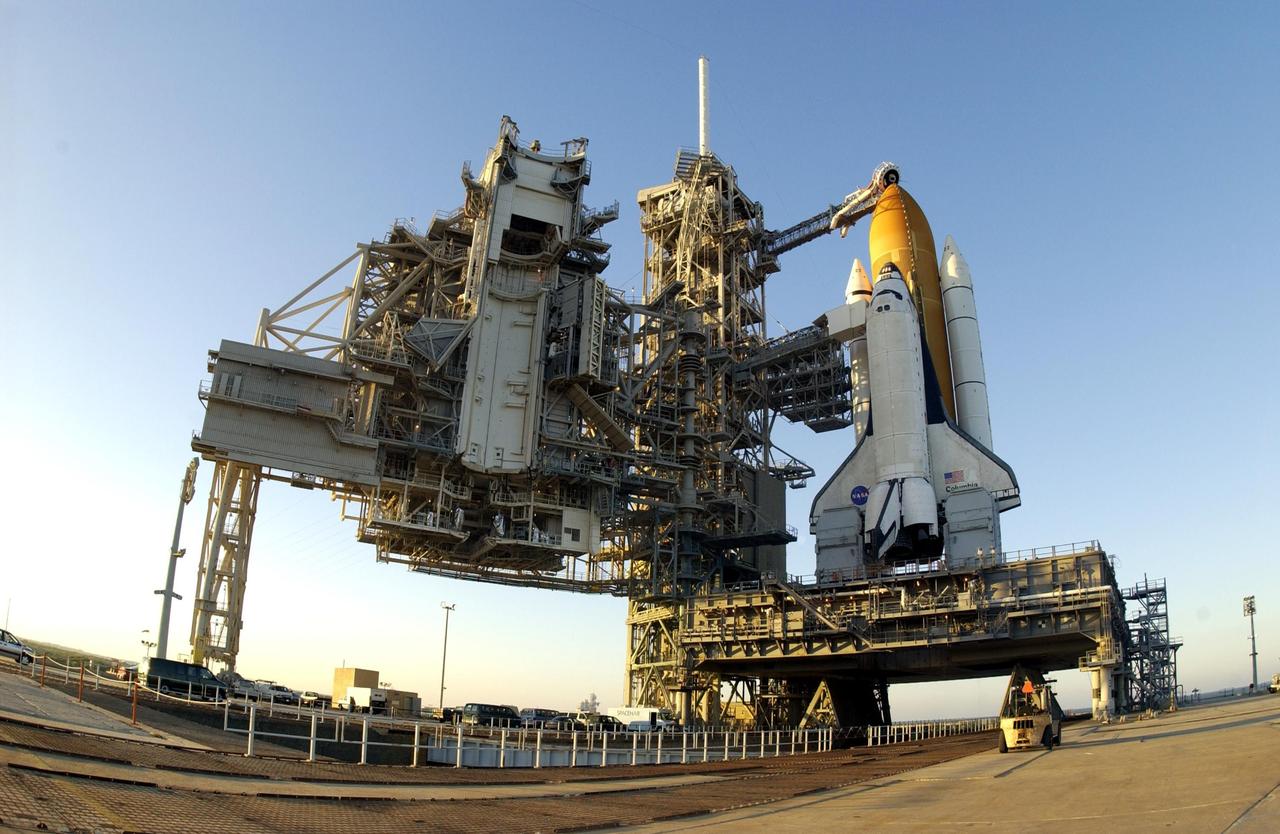
KENNEDY SPACE CENTER, FLA. -- After rollback of the Rotating Service Structure on Launch Pad 39A, Space Shuttle Columbia is revealed atop its Mobile Launch Platform. Visible is the gaseous oxygen vent arm and cap, called the "beanie cap", extended above the orange external tank. Columbia is scheduled for launch Jan. 16 at 10:39 a.m. EST on mission STS-107, a research mission.
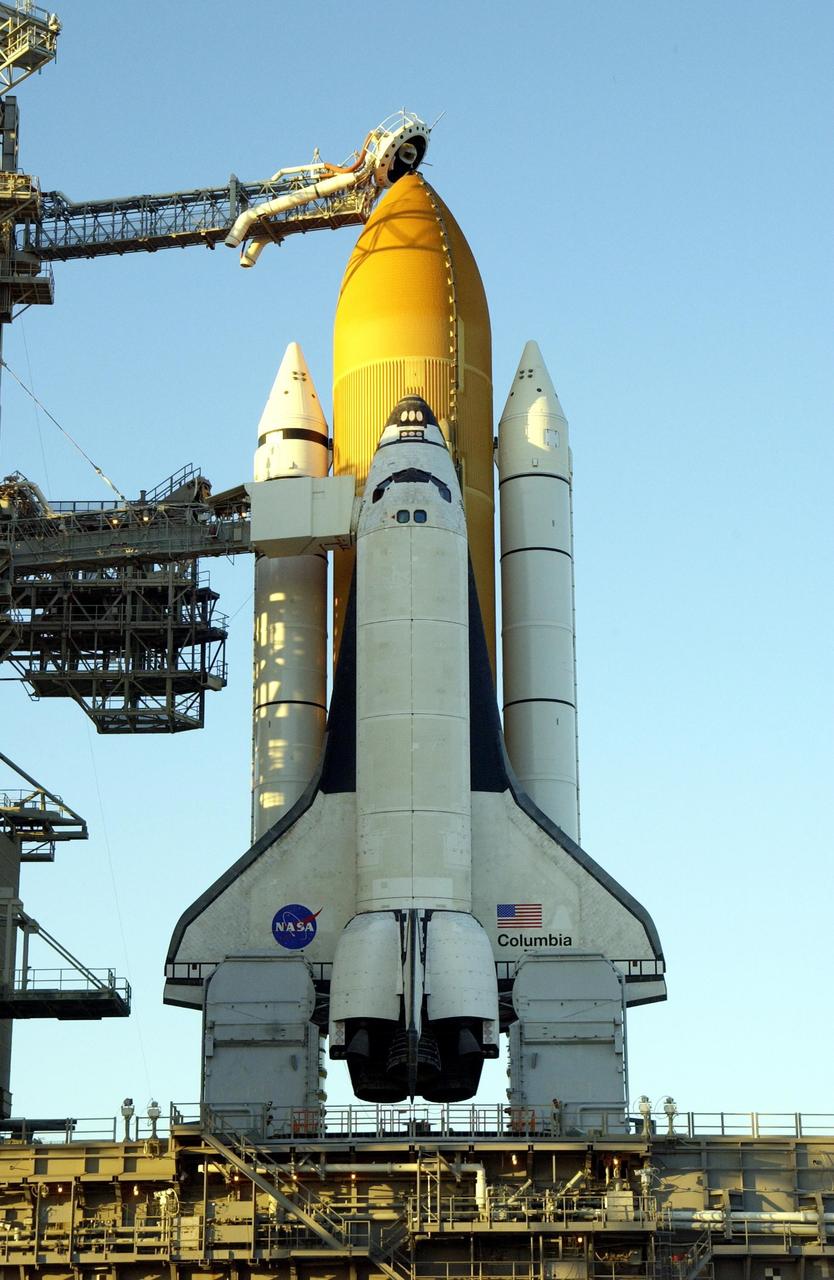
KENNEDY SPACE CENTER, FLA. -- The late afternoon sun highlights the external tank and solid rocket booster on Space Shuttle Columbia after rollback of the Rotating Service Structure on Launch Pad 39A. Visible are the orbiter access arm with the White Room extended to Columbia's cockpit, and at the top, the gaseous oxygen vent arm and cap, called the "beanie cap." Columbia is scheduled for launch Jan. 16 at 10:39 a.m. EST on mission STS-107, a research mission.
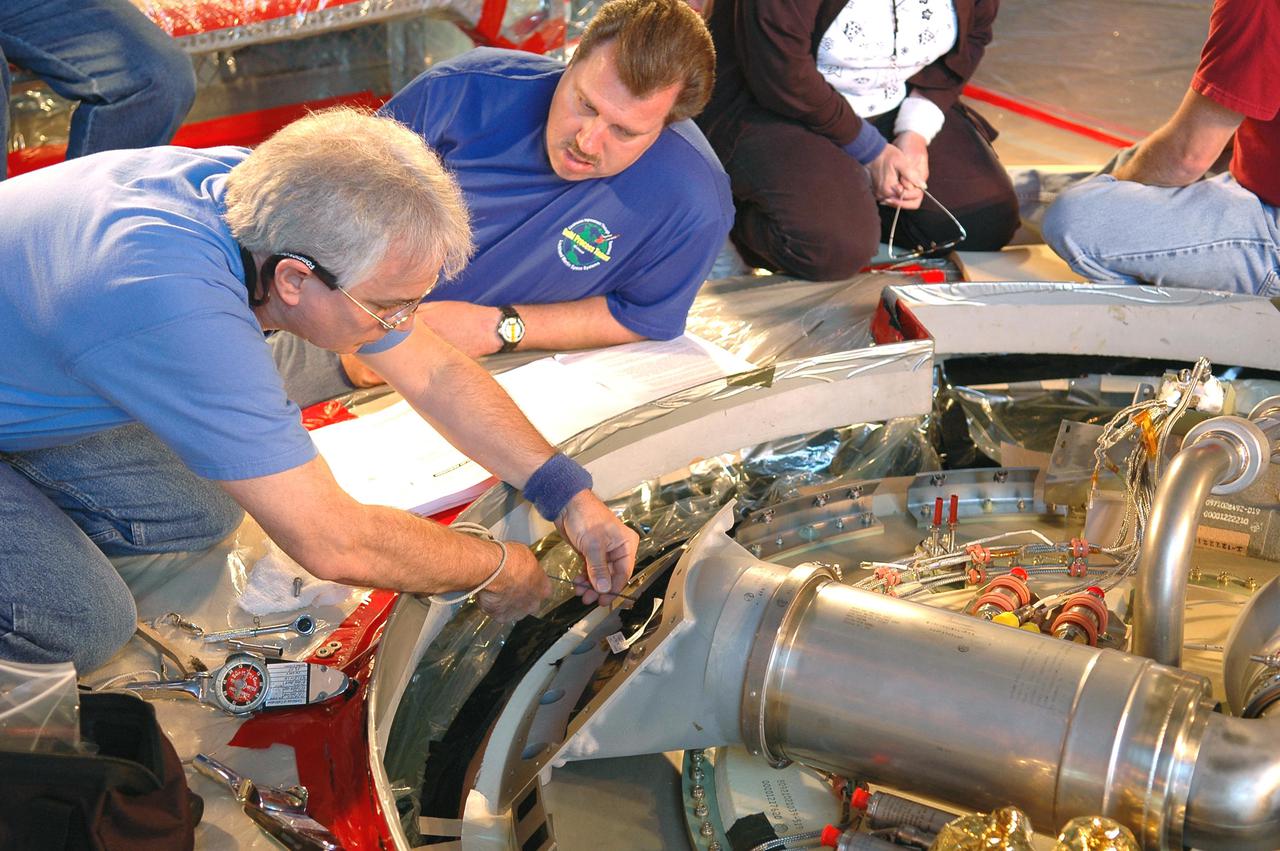
KENNEDY SPACE CENTER, FLA. - In the Vehicle Assembly Building, Michael Cinquigianno (left), who is a system test mechanical technician with Lockheed Martin, checks out the vent valve assembly on External Tank 121. Looking on is Lance Mercier, with Lockheed Martin Quality Control. The assembly sits on top of the tank and, when on the launch pad, is connected to the “beanie cap,” a swing-arm-mounted cap that covers the oxygen tank vent on top of the tank during the countdown. The cap is retracted about two minutes before liftoff. The cap siphons off oxygen vapor that threatens to form large ice on the tank, thus protecting the orbiter’s thermal protection system during launch. The External Tanks are built by Lockheed Martin at the Michoud Assembly Facility near New Orleans. The tank is being prepared to fly with Discovery on mission STS-114, whose launch window extends July 13 to July 31.
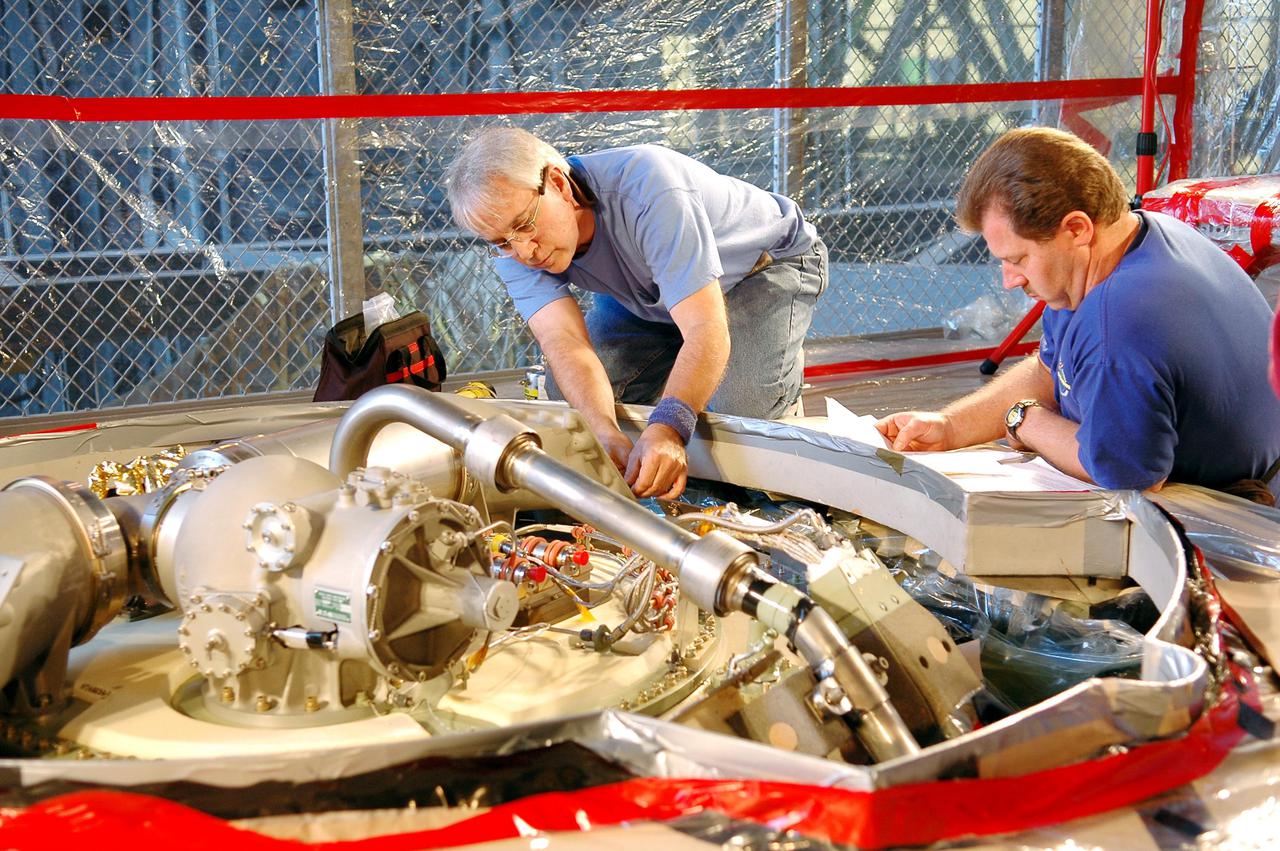
KENNEDY SPACE CENTER, FLA. - In the Vehicle Assembly Building, Michael Cinquigianno (left), who is a system test mechanical technician with Lockheed Martin, checks out the vent valve assembly on External Tank 121. Looking on is Lance Mercier, with Lockheed Martin Quality Control. The assembly sits on top of the tank and, when on the launch pad, is connected to the “beanie cap,” a swing-arm-mounted cap that covers the oxygen tank vent on top of the tank during the countdown. The cap is retracted about two minutes before liftoff. The cap siphons off oxygen vapor that threatens to form large ice on the tank, thus protecting the orbiter’s thermal protection system during launch. The External Tanks are built by Lockheed Martin at the Michoud Assembly Facility near New Orleans. The tank is being prepared to fly with Discovery on mission STS-114, whose launch window extends July 13 to July 31.
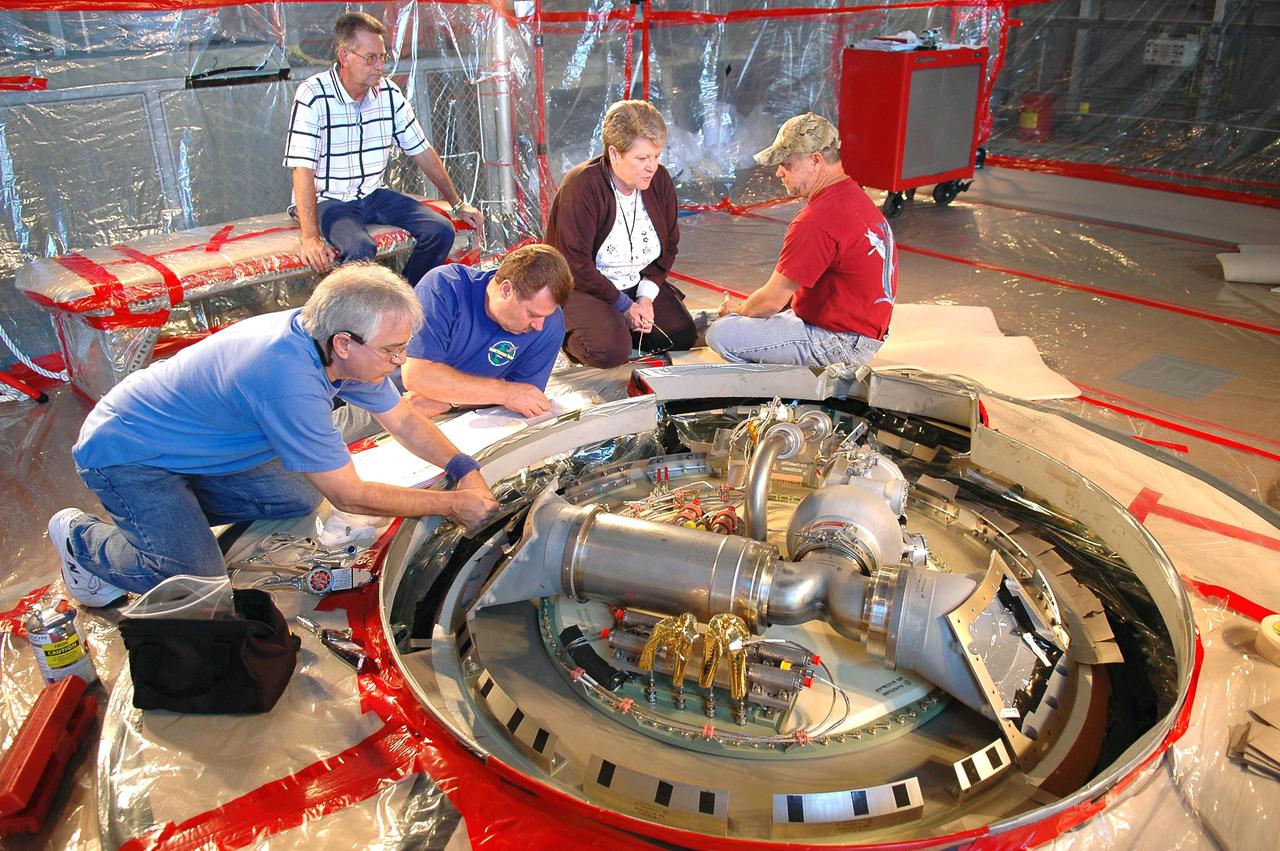
KENNEDY SPACE CENTER, FLA. - In the Vehicle Assembly Building, Michael Cinquigianno (left), who is a system test mechanical technician with Lockheed Martin, checks out the vent valve assembly on External Tank 121. Next to him is Lance Mercier, with Lockheed Martin Quality Control. The assembly sits on top of the tank and, when on the launch pad, is connected to the “beanie cap,” a swing-arm-mounted cap that covers the oxygen tank vent on top of the tank during the countdown. The cap is retracted about two minutes before liftoff. The cap siphons off oxygen vapor that threatens to form large ice on the tank, thus protecting the orbiter’s thermal protection system during launch. The External Tanks are built by Lockheed Martin at the Michoud Assembly Facility near New Orleans. The tank is being prepared to fly with Discovery on mission STS-114, whose launch window extends July 13 to July 31.
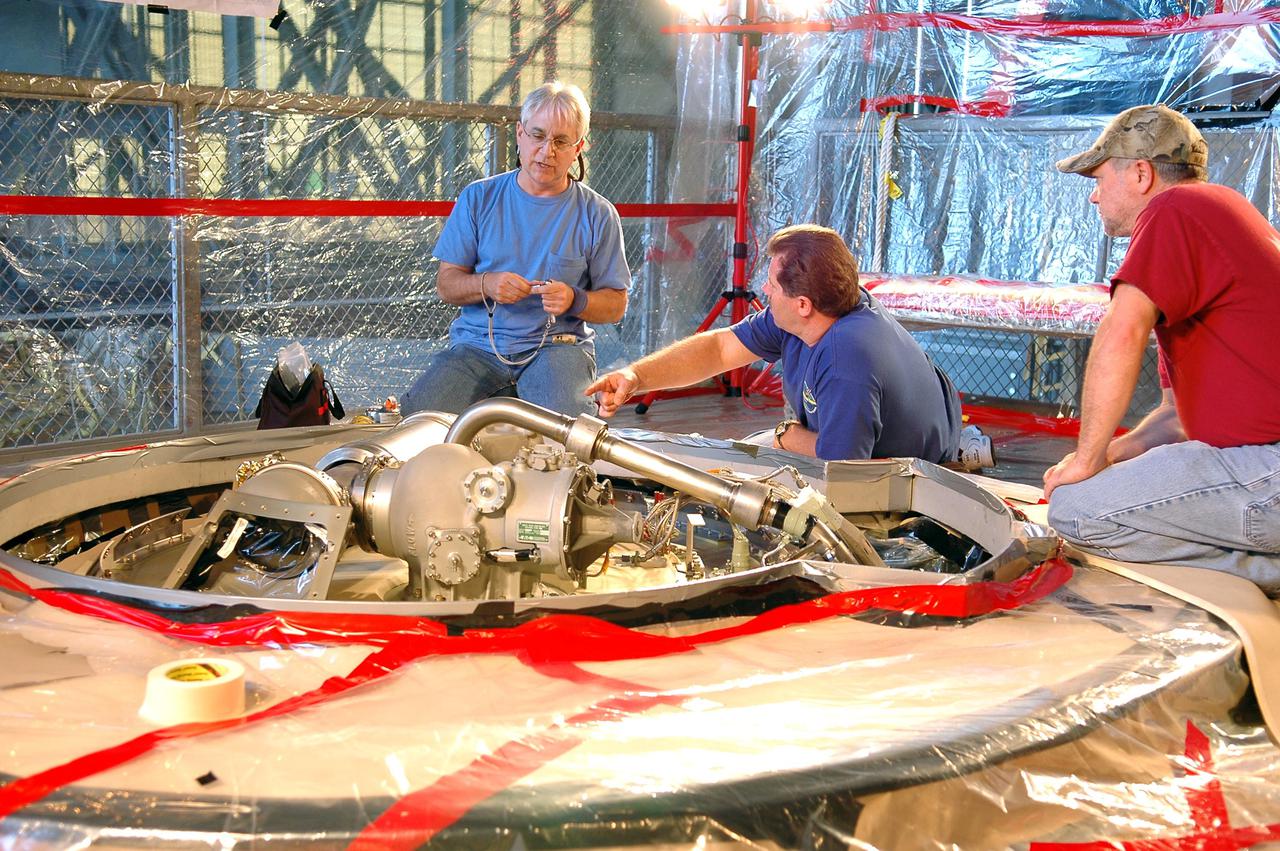
KENNEDY SPACE CENTER, FLA. - In the Vehicle Assembly Building, Michael Cinquigianno (left), who is a system test mechanical technician with Lockheed Martin, checks out the vent valve assembly on External Tank 121. Next to him is Lance Mercier, with Lockheed Martin Quality Control. The assembly sits on top of the tank and, when on the launch pad, is connected to the “beanie cap,” a swing-arm-mounted cap that covers the oxygen tank vent on top of the tank during the countdown. The cap is retracted about two minutes before liftoff. The cap siphons off oxygen vapor that threatens to form large ice on the tank, thus protecting the orbiter’s thermal protection system during launch. The External Tanks are built by Lockheed Martin at the Michoud Assembly Facility near New Orleans. The tank is being prepared to fly with Discovery on mission STS-114, whose launch window extends July 13 to July 31.
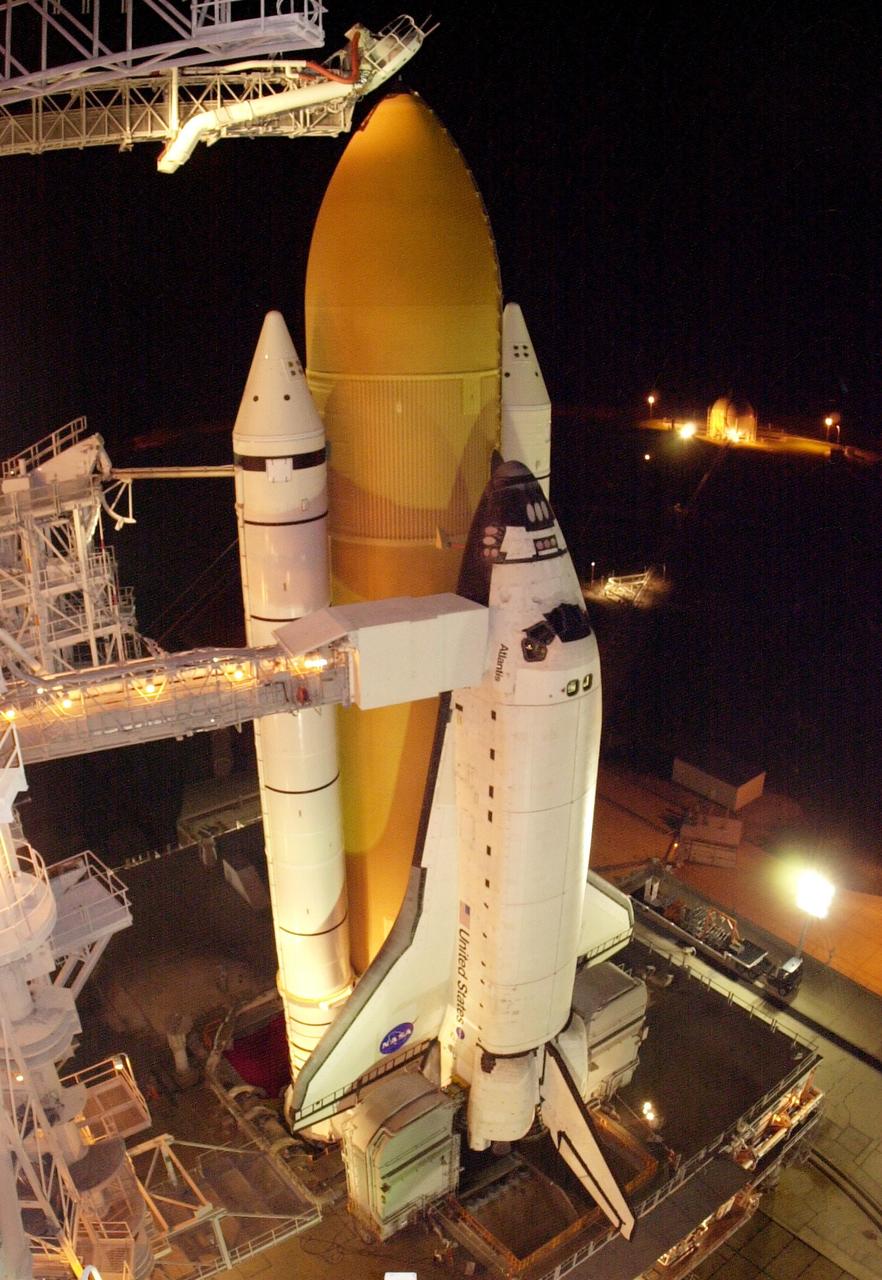
KENNEDY SPACE CENTER, FLA. -- After rollback of the Rotating Service Structure, Space Shuttle Atlantis is revealed on pad 39B prior to launch. The orbiter access arm with the White Room at the end can be seen extending toward the cockpit. The White Room provides entry into the Shuttle for the crew. Above the orange external tank is the vent hood, called the "beanie cap." The Shuttle is scheduled for launch Oct. 7 at 3:46 p.m. EDT on mission STS-112.
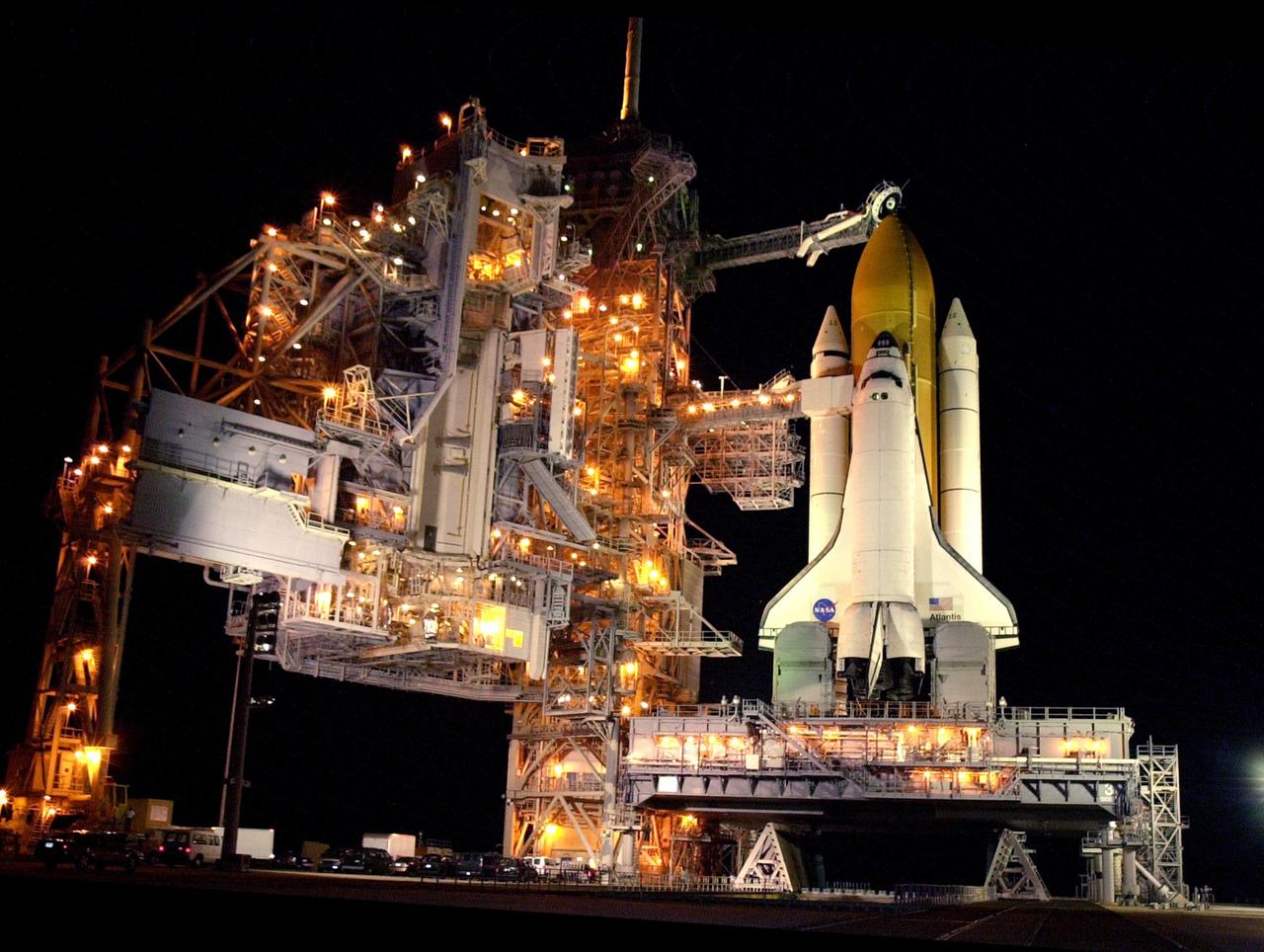
KENNEDY SPACE CENTER, FLA. -- After rollback of the Rotating Service Structure, Space Shuttle Atlantis is revealed on pad 39B prior to launch. The orbiter access arm with the White Room at the end can be seen extending toward the cockpit. The White Room provides entry into the Shuttle for the crew. Above the orange external tank is the vent hood, called the "beanie cap." The Shuttle is scheduled for launch Oct. 7 at 3:46 p.m. EDT on mission STS-112.
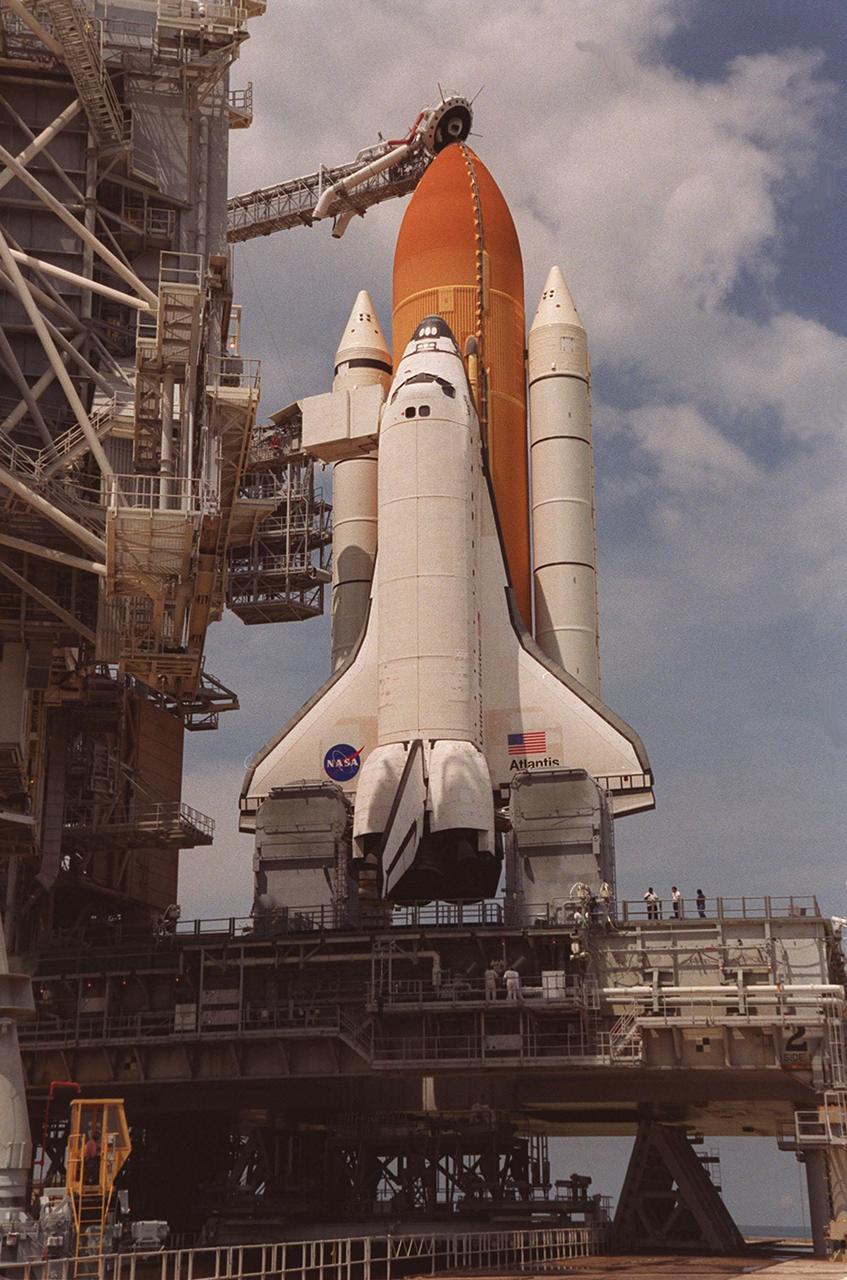
KENNEDY SPACE CENTER, Fla. -- With the Rotating Service Structure rolling back, Space Shuttle Atlantis is revealed on the Mobile Launcher Platform. At the top is the 13-foot-wide “beanie cap,” at the end of the Gaseous Oxygen Vent Arm, designed to vent gaseous oxygen vapors away from the Space Shuttle. Lower is the Orbiter Access Arm with the environmental chamber, known as the “white room,” extended to the orbiter. The chamber provides entry for the crew into the orbiter and also serves as emergency egress up to 7 minutes 24 seconds before launch
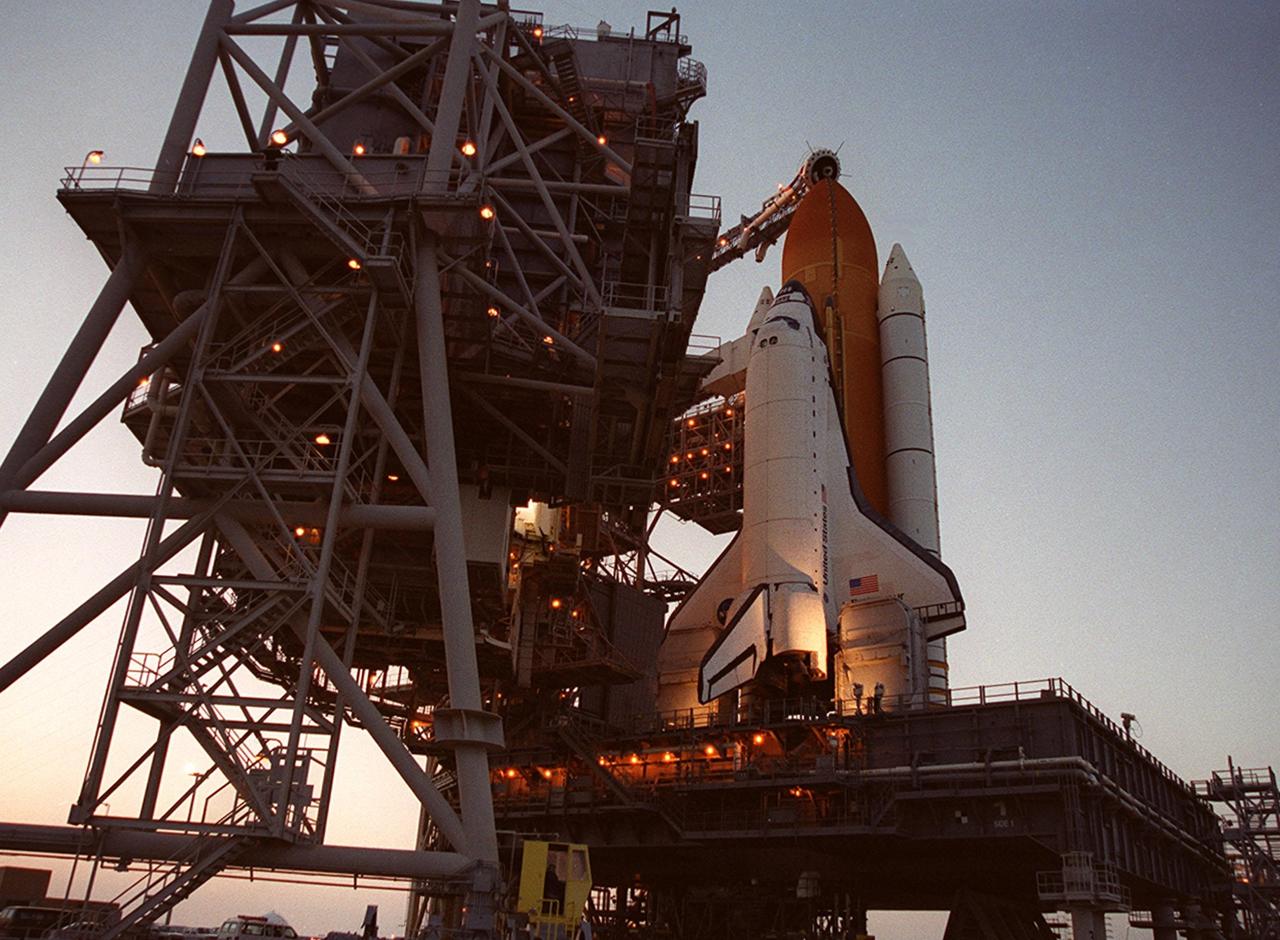
KENNEDY SPACE CENTER, Fla. -- In the glow of a setting sun, Space Shuttle Endeavour is revealed after the rollback of the Rotating Service Structure (left) on Launch Pad 39A. At the top of the external tank can be seen the “beanie cap,” a venting apparatus at the end of the Gaseous Oxygen Vent Arm. Endeavour is expected to lift off on mission STS-100 on April 19, carrying the Multi-Purpose Logistics Module Raffaello and the Canadian robotic arm, SSRMS, with a crew of seven to the International Space Station
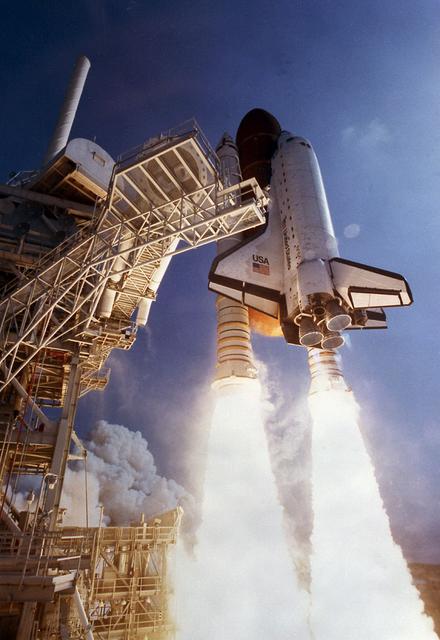
The Space Shuttle Orbiter Atlantis (STS-46) breaks free of all earthly constraints and hurdles past the Fixed Service Structure (FSS) and beanie cap which only moments before had been in place above the external tank. The Shuttle Atlantis carried and deployed the European Retrievable Carrier (Eureca). The NASA/ISA Tethered Satellite System (TSS-1) was also deployed for the first time, allowing for a new capability for probing the space environment.
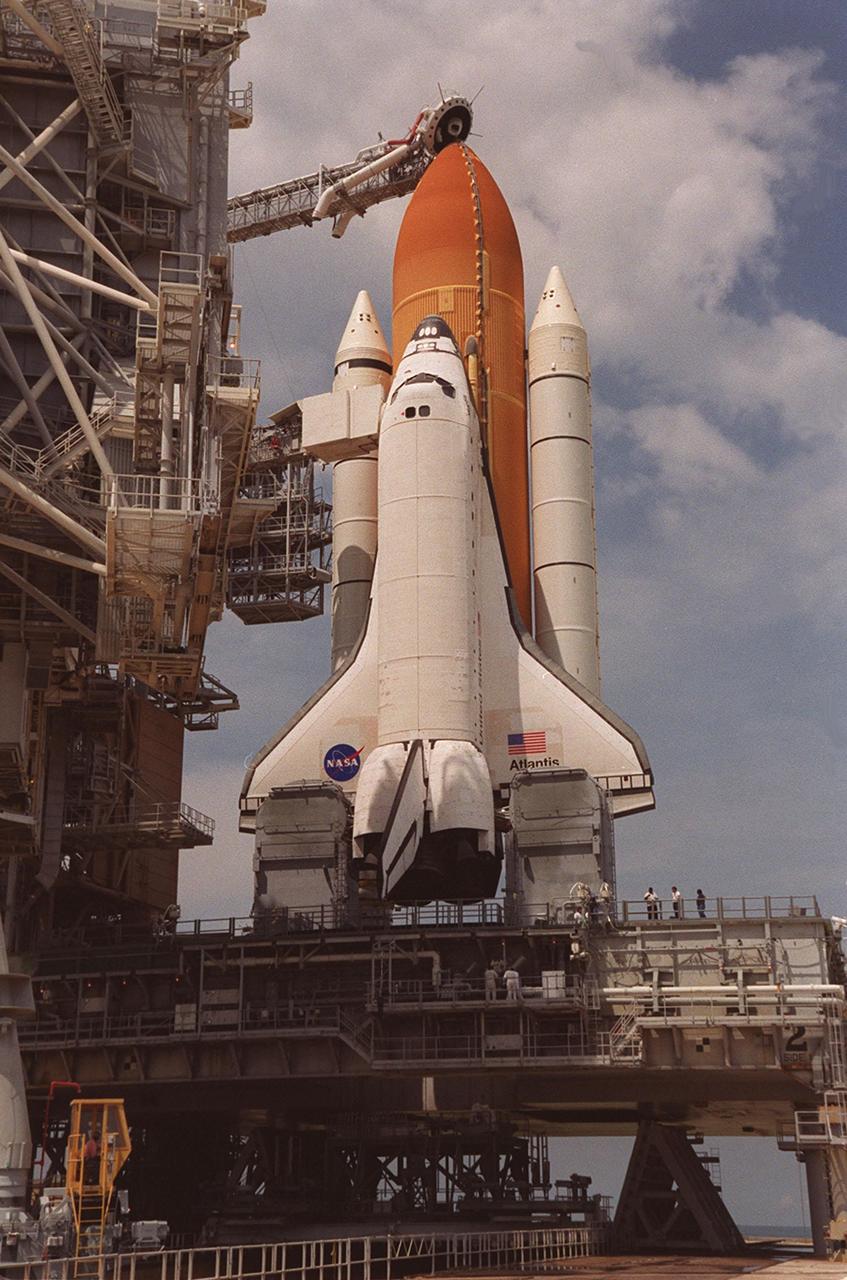
KENNEDY SPACE CENTER, Fla. -- With the Rotating Service Structure rolling back, Space Shuttle Atlantis is revealed on the Mobile Launcher Platform. At the top is the 13-foot-wide “beanie cap,” at the end of the Gaseous Oxygen Vent Arm, designed to vent gaseous oxygen vapors away from the Space Shuttle. Lower is the Orbiter Access Arm with the environmental chamber, known as the “white room,” extended to the orbiter. The chamber provides entry for the crew into the orbiter and also serves as emergency egress up to 7 minutes 24 seconds before launch
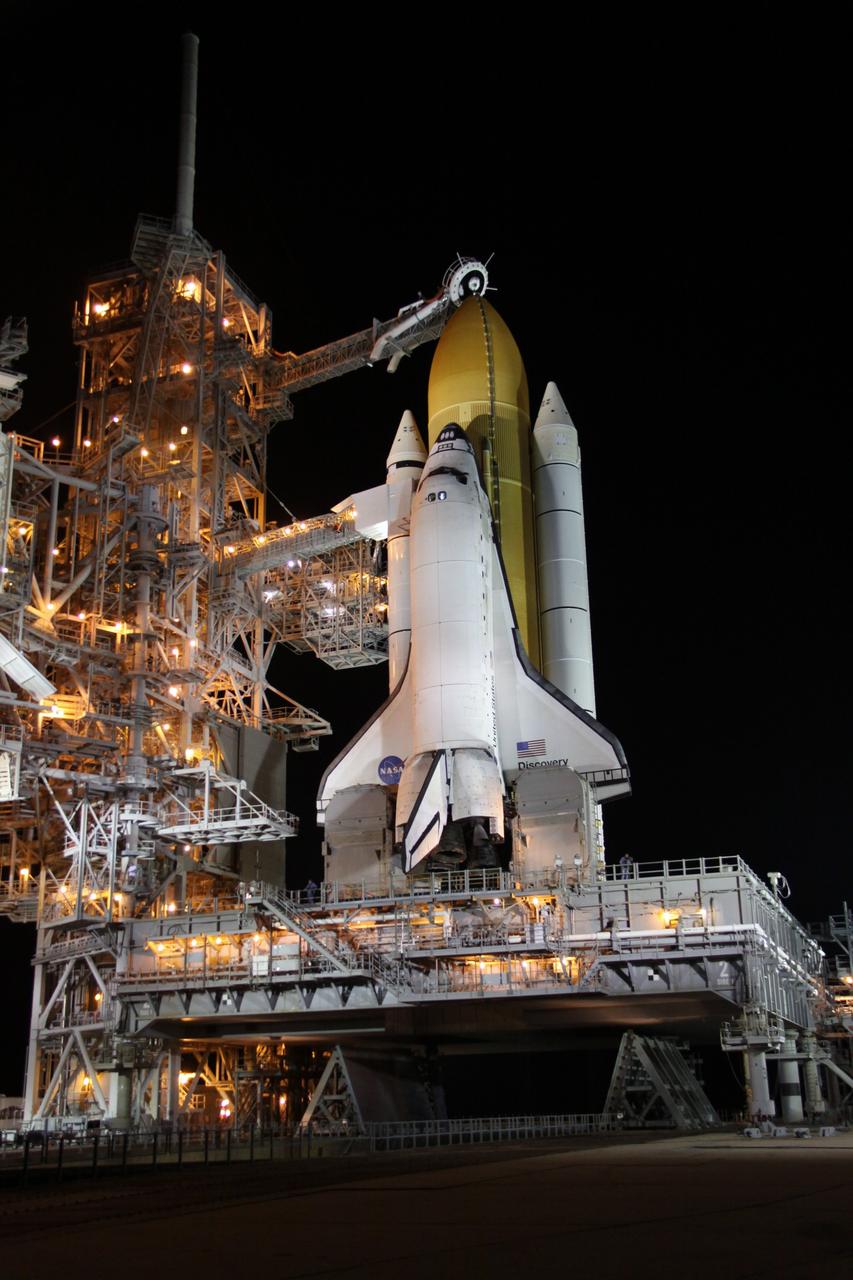
CAPE CANAVERAL, Fla. – On Launch Pad 39A at NASA's Kennedy Space Center in Florida, the oxygen vent hood, called the "beanie cap," is positioned above the external fuel tank of space shuttle Discovery following the rollback of the rotating service structure, or RSS, at left. The beanie cap is designed to vent gaseous oxygen vapors away from the shuttle. The rollback is preparation for Discovery's scheduled 1:36 a.m. EDT liftoff Aug. 25 on the STS-128 mission with a crew of seven. First motion was at 5:06 a.m. EDT and completed at 5:46 a.m. EDT. The service structure provides weather protection and access to the space shuttle at the launch pad. The 13-day mission will deliver a new crew member and 33,000 pounds of equipment to the International Space Station. The equipment includes science and storage racks, a freezer to store research samples, a new sleeping compartment and the COLBERT treadmill. STS-128 will be Discovery's 37th mission and the 30th shuttle flight dedicated to station assembly and maintenance. Photo credit: NASA/Troy Cryder
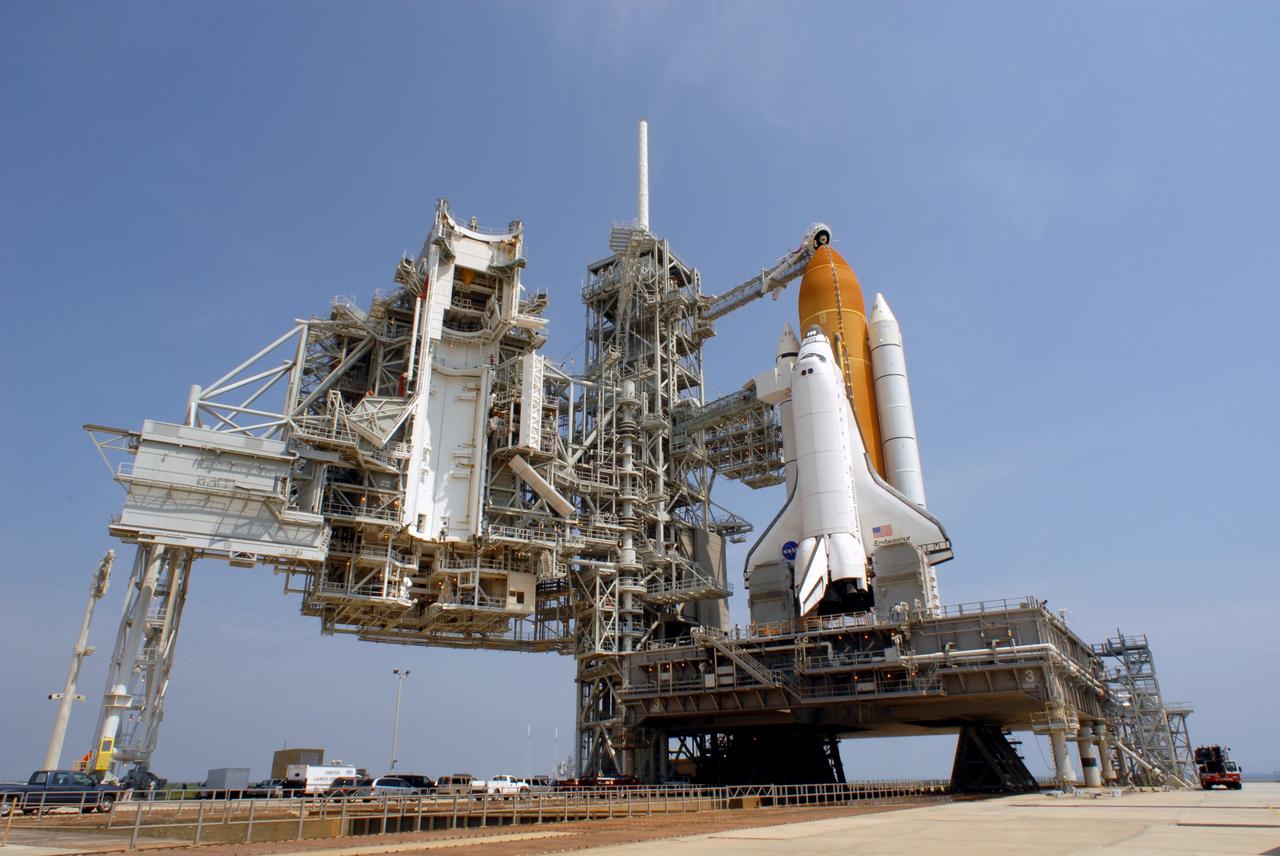
CAPE CANAVERAL, Fla. – On Launch Pad 39A at NASA's Kennedy Space Center in Florida, the oxygen vent hood, called the "beanie cap," is positioned above the external fuel tank of space shuttle Endeavour following the rollback of the rotating service structure, or RSS, at left. The beanie cap is designed to vent gaseous oxygen vapors away from the shuttle. The rollback is preparation for Endeavour's liftoff June 13 on the STS-127 mission with a crew of seven. First motion was at 10:39 a.m. EDT and completed at 11:18 a.m. The rotating structure provides protected access to the shuttle for changeout and servicing of payloads at the pad. It is supported by a rotating bridge that pivots on a vertical axis on the west side of the pad's flame trench. After the RSS is rolled back, the orbiter is ready for fuel cell activation and external tank cryogenic propellant loading operations. The launch will be Endeavour's 23rd flight. The shuttle will carry the Japanese Experiment Module's Exposed Facility, or JEM-EF, and the Experiment Logistics Module-Exposed Section, or ELM-ES, on STS-127. The mission is the final of three flights dedicated to the assembly of the Japan Aerospace Exploration Agency's Kibo laboratory complex on the space station. Endeavour's launch is scheduled for June 13 at 7:17 a.m. EDT. Photo credit: NASA/Jim Grossmann
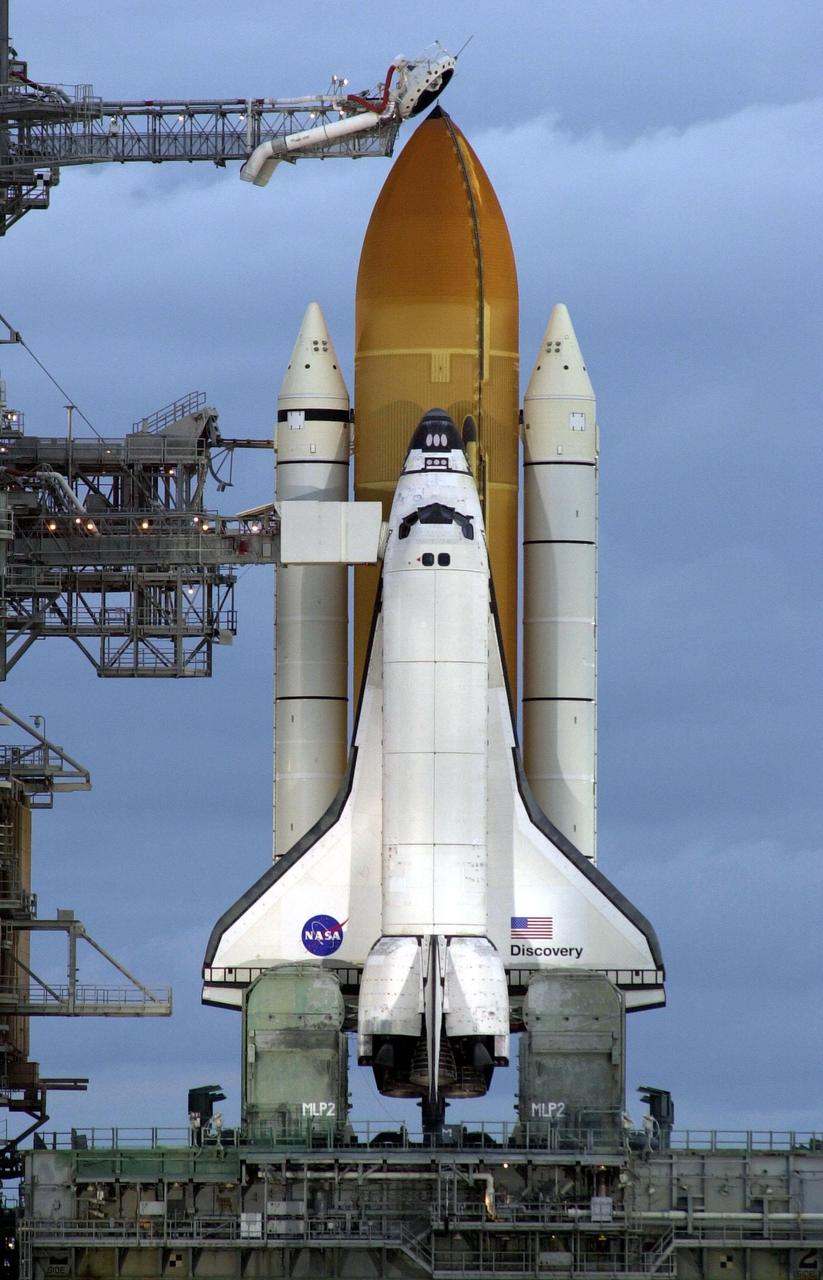
After sunup, which is obscured by a cloud-filled sky, Space Shuttle Discovery waits atop the mobile launcher platform for launch of mission STS-103. At the top is seen the external tank gaseous oxygen vent arm system with the vent hood (commonly called the "beanie cap") poised above the external tank. The retractable arm and the beanie cap are designed to vent gaseous oxygen vapors away from the Space Shuttle. The arm truss section is 65 feet long and the diameter of the vent hood is 13 feet. Extending toward the cabin of the orbiter below is the orbiter access arm, with the environmental chamber (called the White Room) at the end. Through this chamber the crew enters the orbiter. The STS-103 mission, to service the Hubble Space Telescope, is scheduled for launch Dec. 17 at 8:47 p.m. EST. Mission objectives include replacing gyroscopes and an old computer, installing another solid state recorder, and replacing damaged insulation in the telescope. The mission is expected to last about 8 days and 21 hours. Discovery is expected to land at KSC Sunday, Dec. 26, at about 6:25 p.m. EST
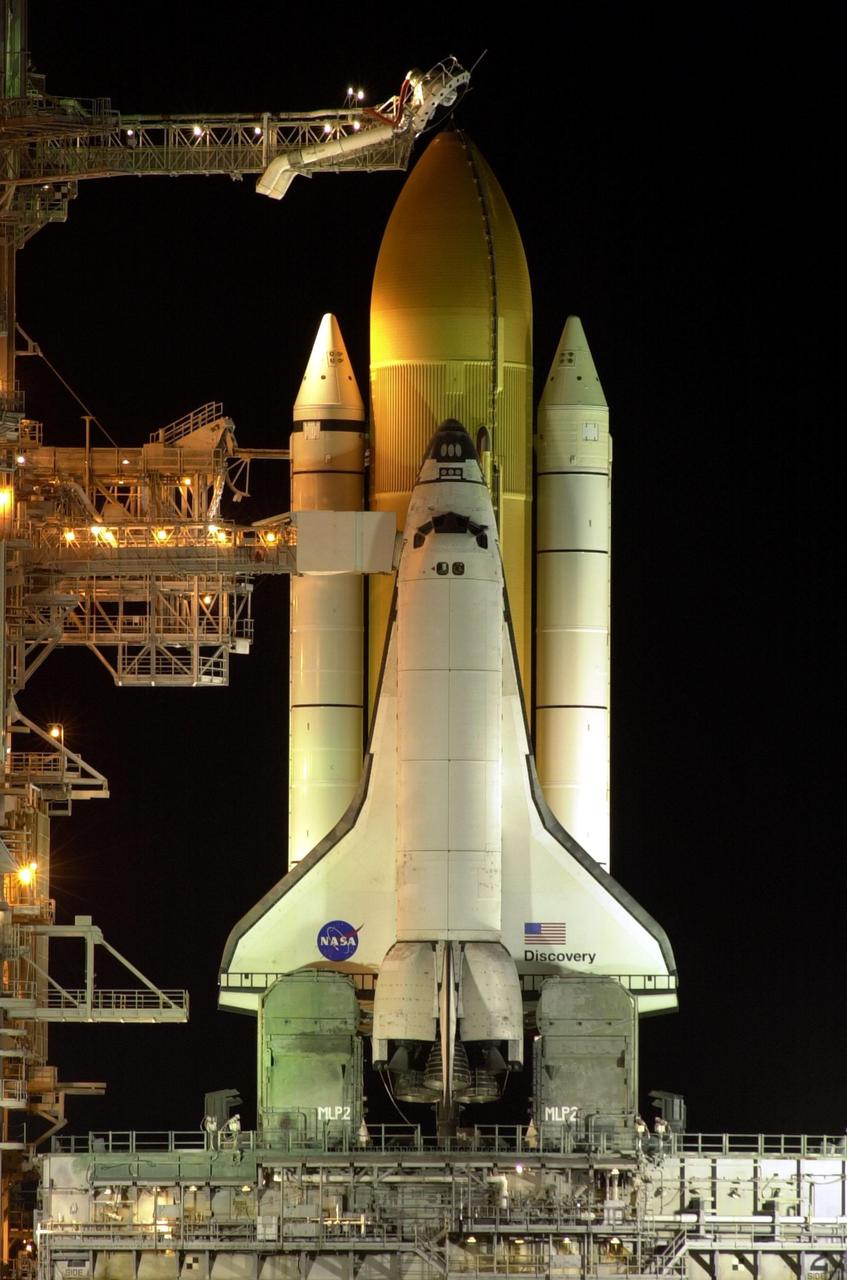
In the early morning hours, Space Shuttle Discovery is framed with light from the Fixed Service Structure on Launch Pad 39B as it waits for flight and mission STS-103. At the top is seen the external tank gaseous oxygen vent arm system with the vent hood (commonly called the "beanie cap") poised above the external tank. The retractable arm and the beanie cap are designed to vent gaseous oxygen vapors away from the Space Shuttle. The arm truss section is 65 feet long and the diameter of the vent hood is 13 feet. Extending toward the cabin of the orbiter below is the orbiter access arm, with the environmental chamber (called the White Room) at the end. Through this chamber the crew enters the orbiter. The STS-103 mission, to service the Hubble Space Telescope, is scheduled for launch Dec. 17 at 8:47 p.m. EST. Mission objectives include replacing gyroscopes and an old computer, installing another solid state recorder, and replacing damaged insulation in the telescope. The mission is expected to last about 8 days and 21 hours. Discovery is expected to land at KSC Sunday, Dec. 26, at about 6:25 p.m. EST
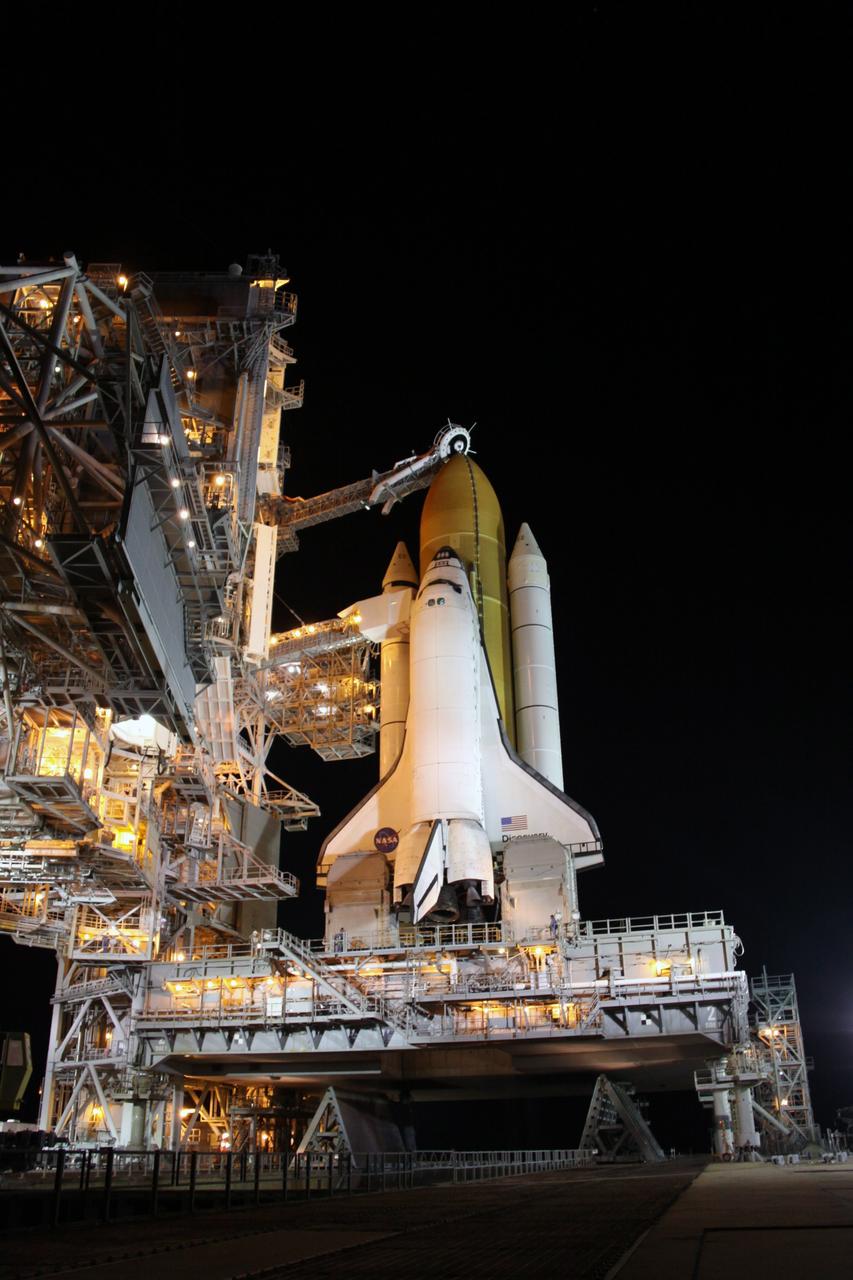
CAPE CANAVERAL, Fla. – On Launch Pad 39A at NASA's Kennedy Space Center in Florida, the oxygen vent hood, called the "beanie cap," is positioned above the external fuel tank of space shuttle Discovery following the rollback of the rotating service structure, or RSS, at left. The beanie cap is designed to vent gaseous oxygen vapors away from the shuttle. The rollback is preparation for Discovery's scheduled 1:36 a.m. EDT liftoff Aug. 25 on the STS-128 mission with a crew of seven. First motion was at 5:06 a.m. EDT and completed at 5:46 a.m. EDT. The service structure provides weather protection and access to the space shuttle at the launch pad. The 13-day mission will deliver a new crew member and 33,000 pounds of equipment to the International Space Station. The equipment includes science and storage racks, a freezer to store research samples, a new sleeping compartment and the COLBERT treadmill. STS-128 will be Discovery's 37th mission and the 30th shuttle flight dedicated to station assembly and maintenance. Photo credit: NASA/Troy Cryder
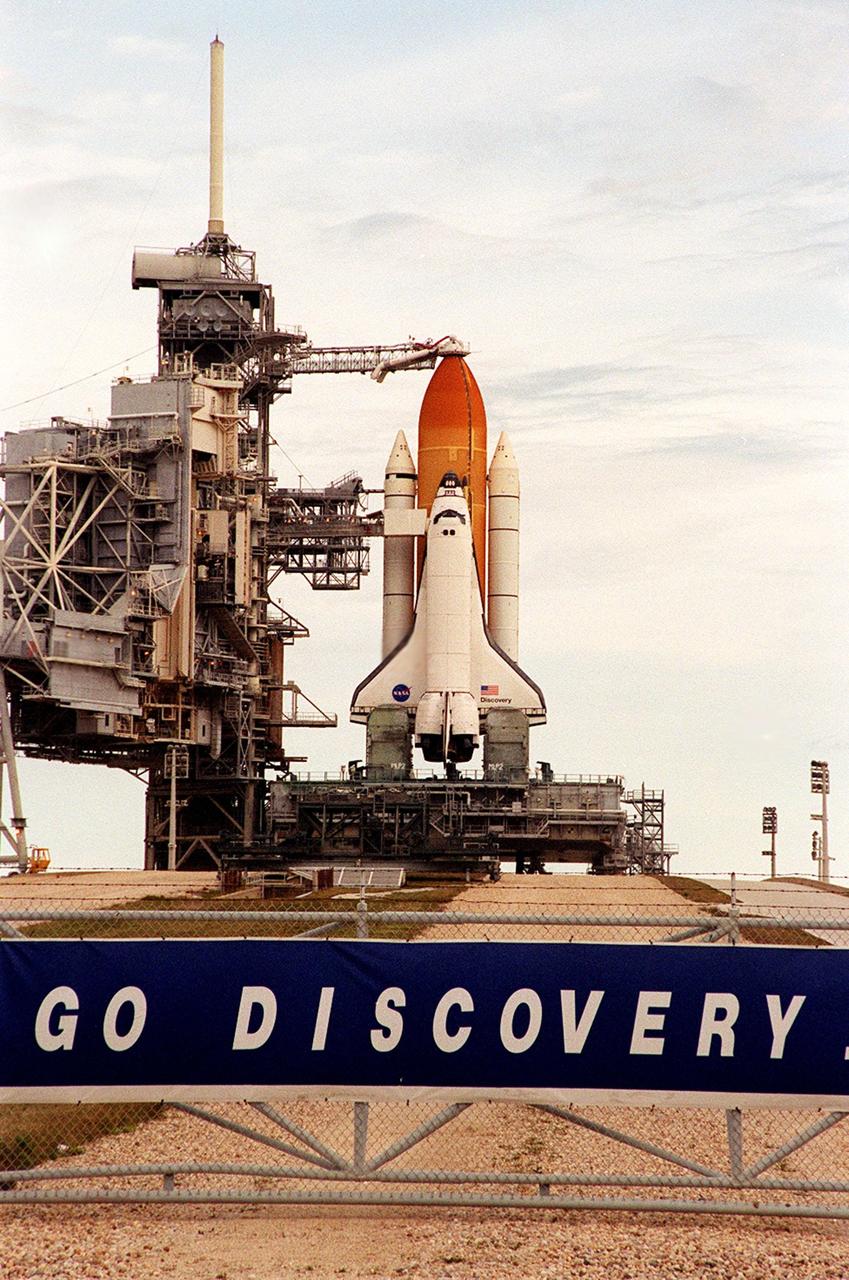
A cloud-streaked sky provides backdrop for Space Shuttle Discovery as it waits for liftoff on mission STS-103 from Launch Pad 39B. The tower at its left is the Fixed Service Structure, topped by the 80-foot-tall fiberglass mast that helps provide protection from lightning strikes. Below it, extending outward, is the external tank gaseous oxygen vent arm system with the vent hood (commonly called the "beanie cap") poised above the external tank. The retractable arm and the beanie cap are designed to vent gaseous oxygen vapors away from the Space Shuttle. The arm truss section is 65 feet long and the diameter of the vent hood is 13 feet. Extending toward the cabin of the orbiter below is the orbiter access arm, with the environmental chamber (called the White Room) at the end. Through this chamber the crew enters the orbiter. The STS-103 mission, to service the Hubble Space Telescope, is scheduled for launch Dec. 17 at 8:47 p.m. EST. Mission objectives include replacing gyroscopes and an old computer, installing another solid state recorder, and replacing damaged insulation in the telescope. The mission is expected to last about 8 days and 21 hours. Discovery is expected to land at KSC Sunday, Dec. 26, at about 6:25 p.m. EST
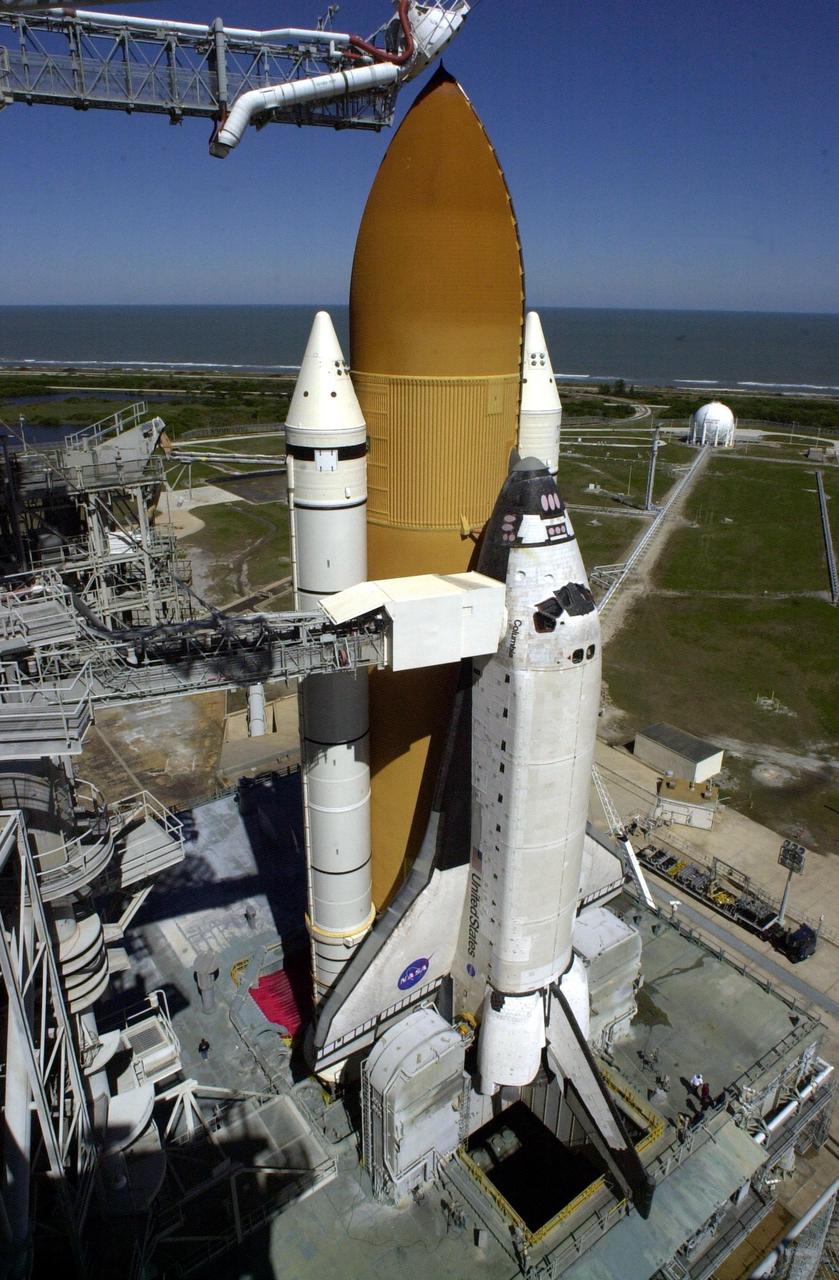
KENNEDY SPACE CENTER, FLA. - After rollback of the Rotating Service Structure, Space Shuttle Columbia is revealed waiting for launch Feb. 28, 2002, at 6:48 a.m. EST (11:48 GMT) on mission STS-109. In the photo is seen the Orbiter Access Arm stretched to Columbia's cockpit, plus the "beanie cap" above the external tank. The cap is a vent hood allowing release of gaseous oxygen. A Hubble Servicing Mission, the goal is to replace Solar Array 2 with Solar Array 3, replace the Power Control Unit, remove the Faint Object Camera and install the ACS, install the Near Infrared Camera and Multi-Object Spectrometer (NICMOS) Cooling System, and install New Outer Blanket Layer insulation.
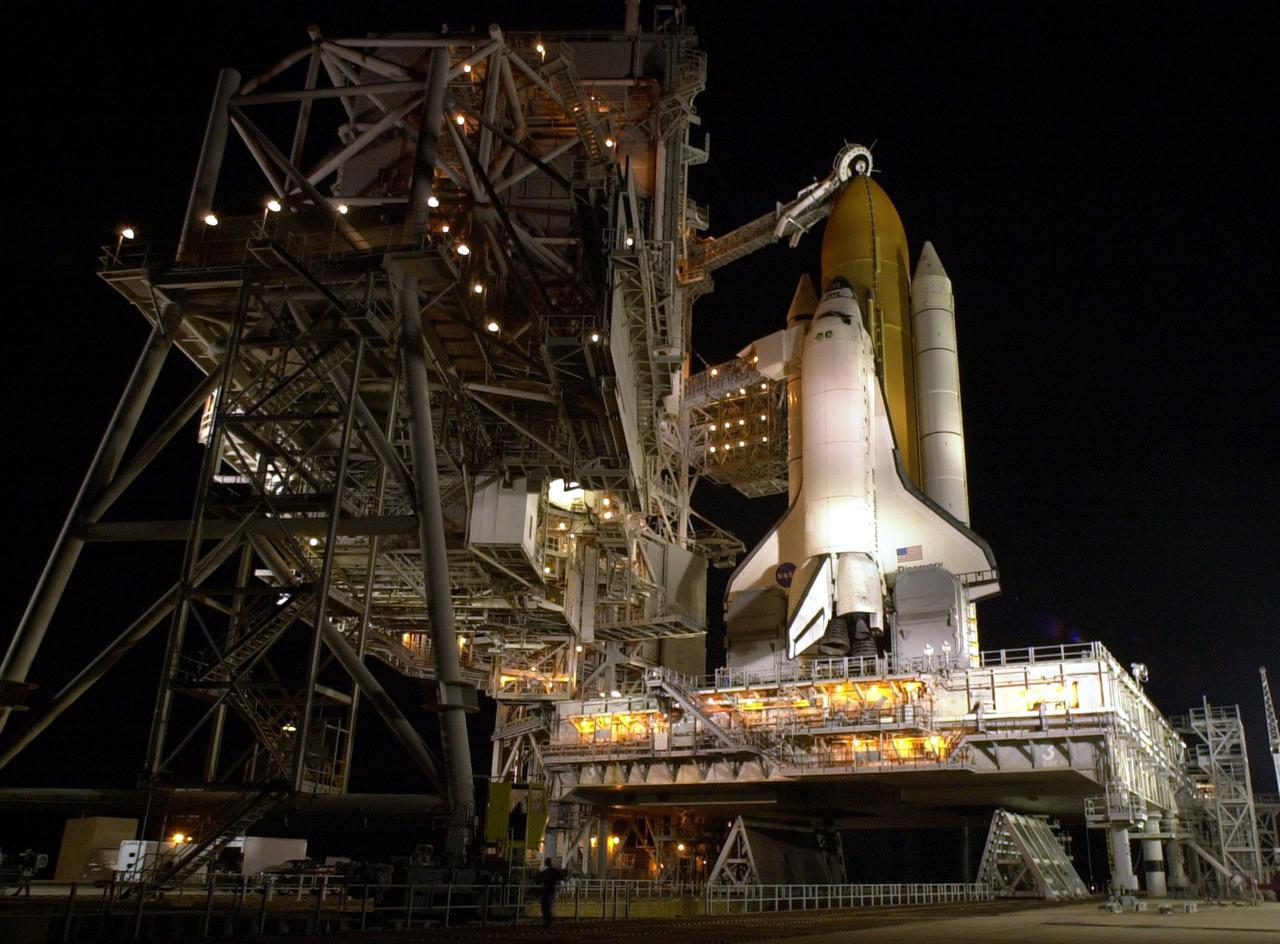
KENNEDY SPACE CENTER, Fla. -- Floodlights reveal the Space Shuttle Discovery after rollback of the Rotating Service Structure in preparation for launch on mission STS-105. Above the external tank, the “beanie cap” is poised, waiting for loading of the propellants. The cap, or vent hood, is on the end of the gaseous oxygen vent arm that allows gaseous oxygen vapors to vent away from the Space Shuttle. On the mission, Discovery will be transporting the Expedition Three crew and several payloads and scientific experiments to the ISS, including the Early Ammonia Servicer (EAS) tank. The EAS, which will support the thermal control subsystems until a permanent system is activated, will be attached to the Station during two spacewalks. The three-member Expedition Two crew will be returning to Earth aboard Discovery after a five-month stay on the Station. Launch is scheduled for 5:38 p.m. EDT Aug. 9
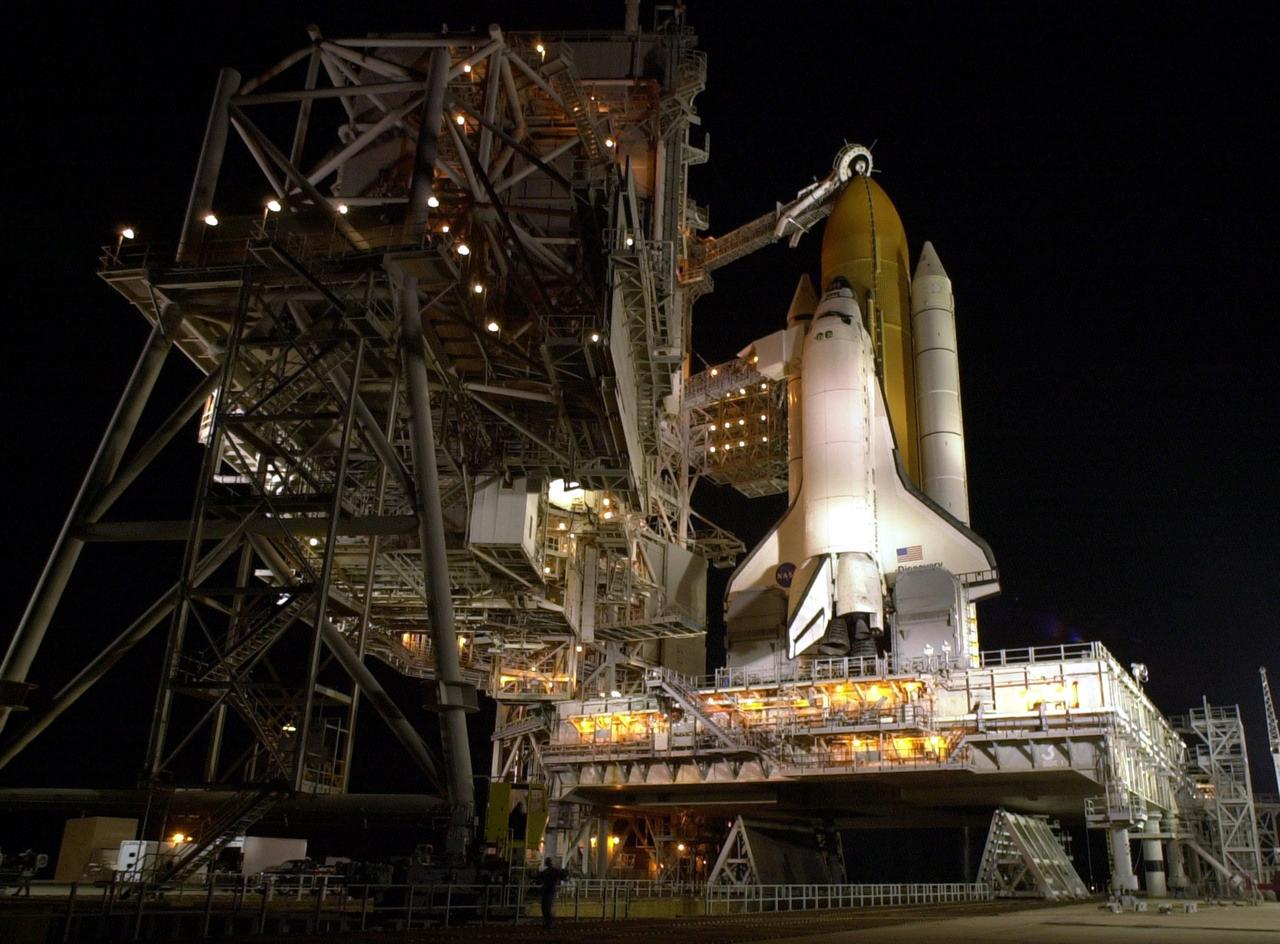
KENNEDY SPACE CENTER, Fla. -- Floodlights reveal the Space Shuttle Discovery after rollback of the Rotating Service Structure in preparation for launch on mission STS-105. Above the external tank, the “beanie cap” is poised, waiting for loading of the propellants. The cap, or vent hood, is on the end of the gaseous oxygen vent arm that allows gaseous oxygen vapors to vent away from the Space Shuttle. On the mission, Discovery will be transporting the Expedition Three crew and several payloads and scientific experiments to the ISS, including the Early Ammonia Servicer (EAS) tank. The EAS, which will support the thermal control subsystems until a permanent system is activated, will be attached to the Station during two spacewalks. The three-member Expedition Two crew will be returning to Earth aboard Discovery after a five-month stay on the Station. Launch is scheduled for 5:38 p.m. EDT Aug. 9

KENNEDY SPACE CENTER, Fla. -- After rollback of the Rotating Service Structure in the early morning hours, Space Shuttle Discovery stands ready for launch of mission STS-92. Above the external tank can be seen the Gaseous Oxygen Vent Arm with its vent hood, commonly referred to as the “beanie cap.” The system is designed to vent gaseous oxygen vapors away from the Shuttle after cryogenic loading. The scheduled launch is the second attempt after an earlier scrub. STS-92 is making the fifth flight for construction of the International Space Station. The mission is also the 100th in the history of the Shuttle program

KENNEDY SPACE CENTER, Fla. -- In the early morning hours, the Rotating Service Structure (left) begins rolling back to free Space Shuttle Discovery for launch of mission STS-92 at 8:05 p.m. Oct. 9. Above the external tank can be seen the Gaseous Oxygen Vent Arm with its vent hood, commonly referred to as the “beanie cap.” The system is designed to vent gaseous oxygen vapors away from the Shuttle after cryogenic loading. The scheduled launch is the second attempt after an earlier scrub. STS-92 is making the fifth flight for construction of the International Space Station. The mission is also the 100th in the history of the Shuttle program
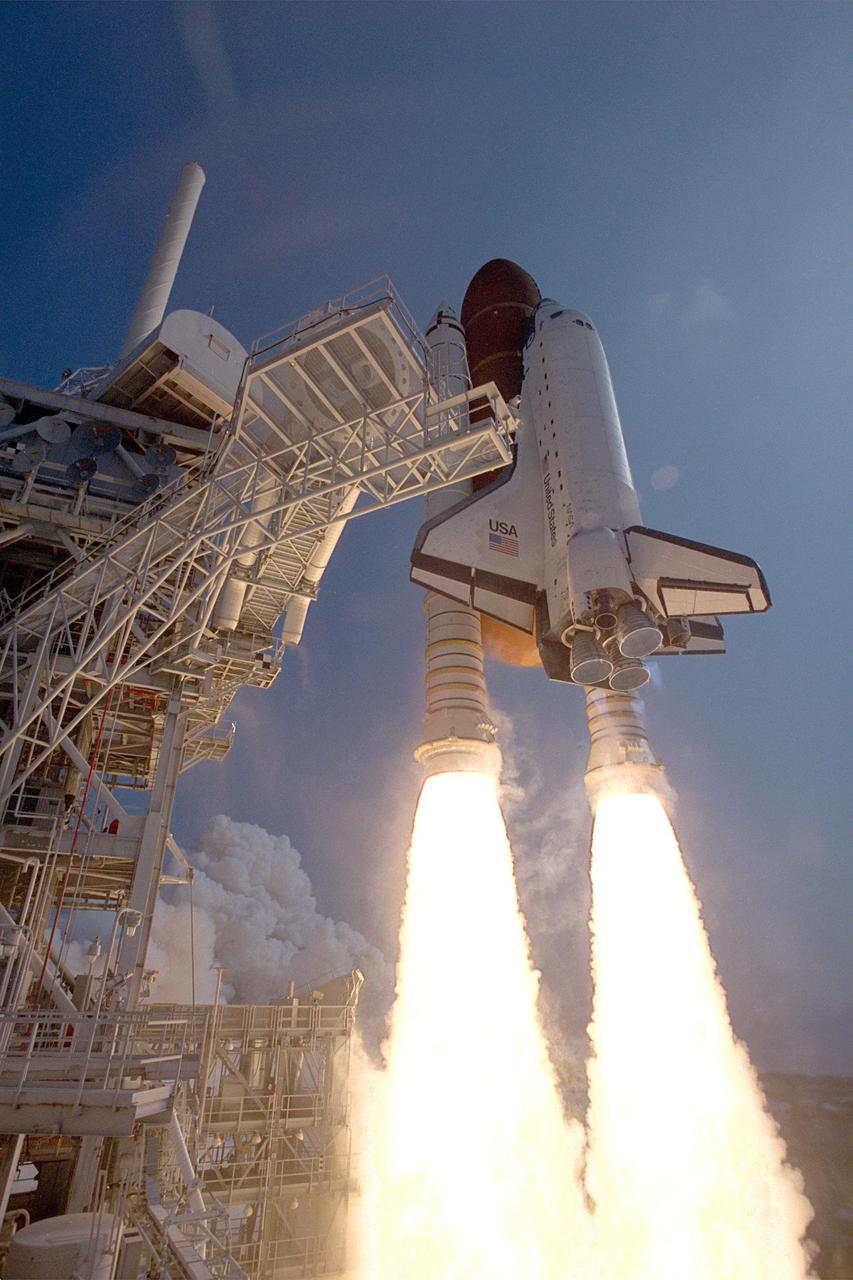
KENNEDY SPACE CENTER, FLA. -- The Space Shuttle Atlantis breaks free of all earthly constraints and hurtles past the Fixed Service Structure and 'beanie cap,' which only moments before had been in place above the external tank. STS-46 lifted off at 9:56:48 a.m. EDT, July 31. The Shuttle Atlantis carries Eureca, the European Retrievable Carrier, which is to be put into orbit during this mission. The NASA_Italian Space Agency Tethered Satellite System (TSS-1) will also be deployed for the first time during the STS-46 flight allowing a new capability for probing the space environment.
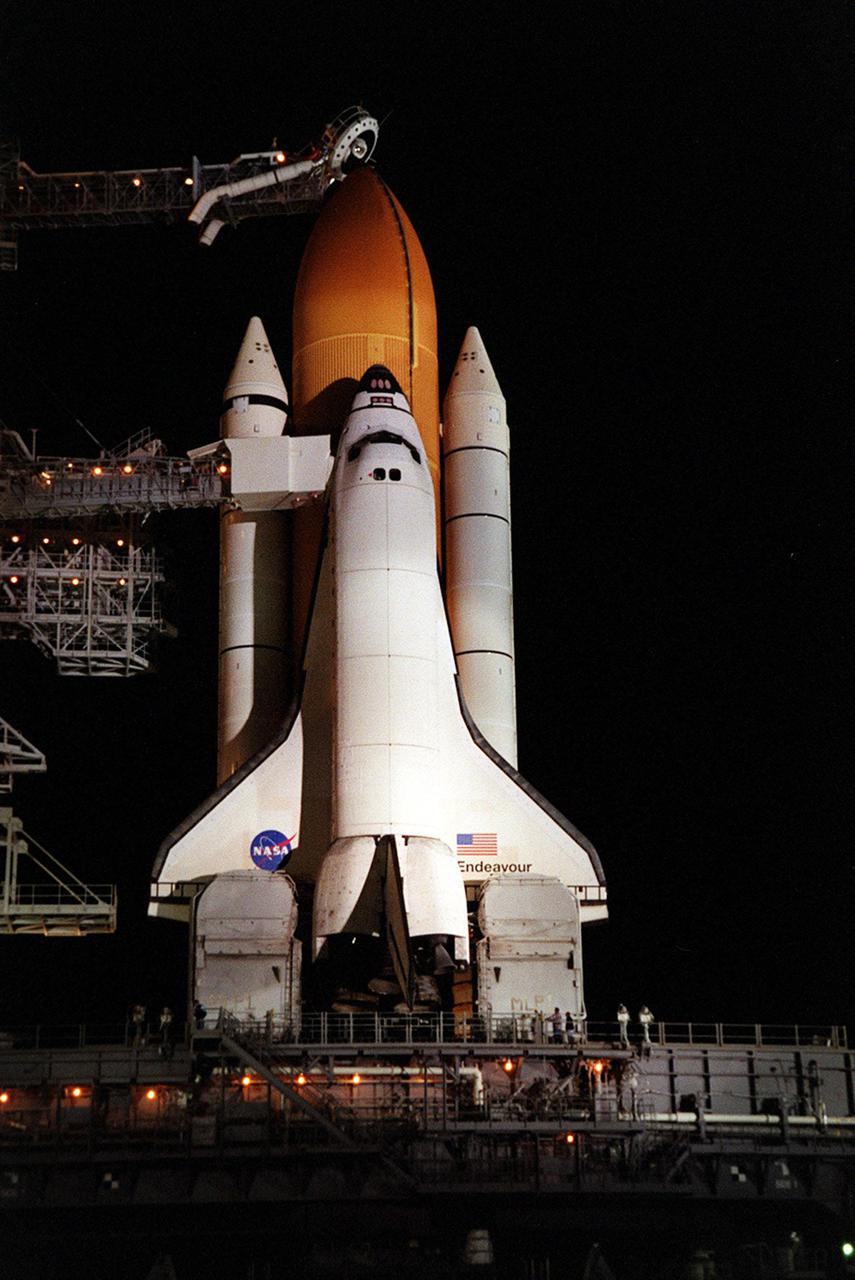
KENNEDY SPACE CENTER, Fla. -- Space Shuttle Endeavour is bathed in light as it waits on Launch Pad 39A. At the top of the external tank can be seen the “beanie cap,” a venting apparatus at the end of the Gaseous Oxygen Vent Arm. Stretching past the solid rocket booster to the orbiter is the Orbiter Access Arm with the White Room at the end. The White Room provides a controlled environment for entry into the orbiter. Endeavour is expected to lift off on mission STS-100 on April 19, carrying the Multi-Purpose Logistics Module Raffaello and the Canadian robotic arm, SSRMS, with a crew of seven to the International Space Station
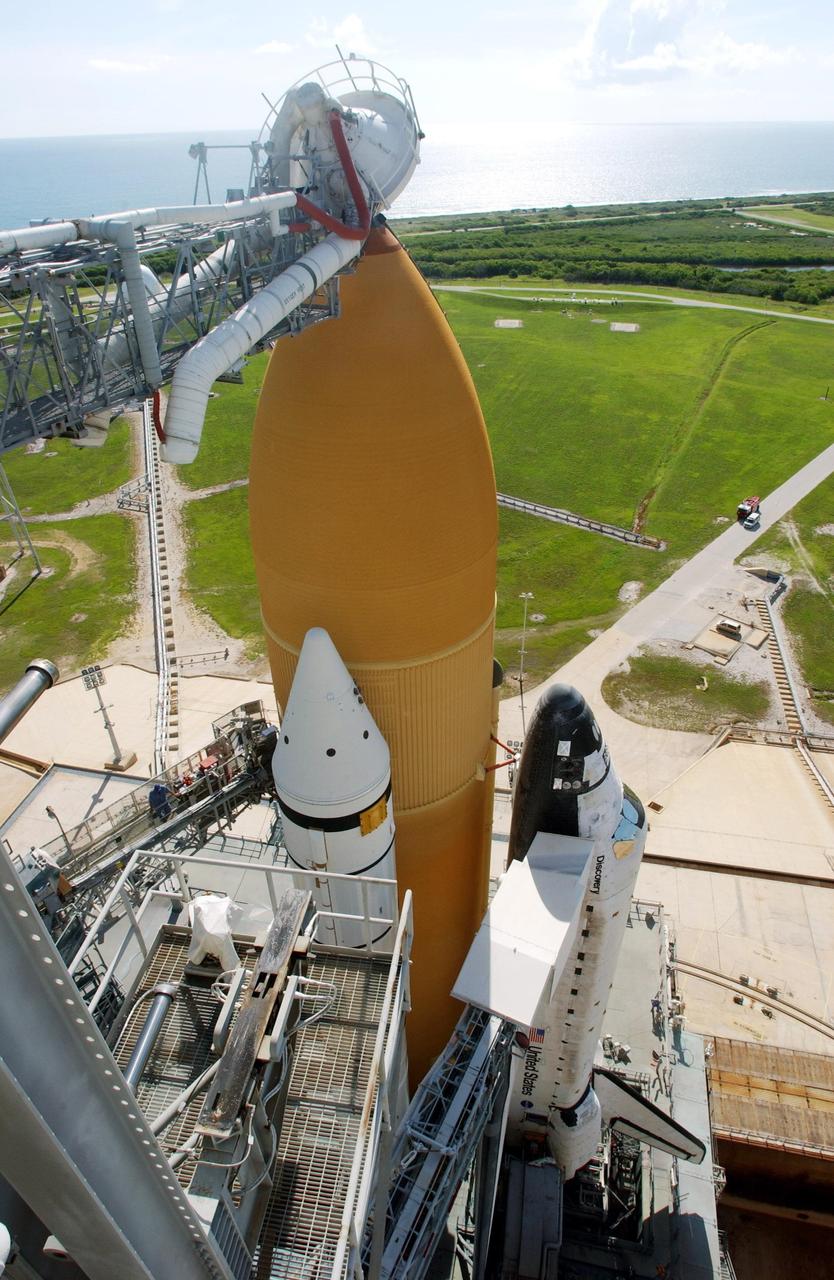
KENNEDY SPACE CENTER, Fla. -- From this high-level view, Space Shuttle Discovery is seen after its rollout to Launch Pad 39A. Extending toward Discovery on the right is the orbiter access arm with the White Room at the end. The White Room provides entry into the orbiter. Above the orange external tank is the gaseous oxygen vent arm with the “beanie cap” hood at the end. Beyond the pad can be seen the Atlantic Ocean. Discovery is scheduled to launch in early August on mission STS-105. Photo by Scott Andrews using a Nikon D1X camera
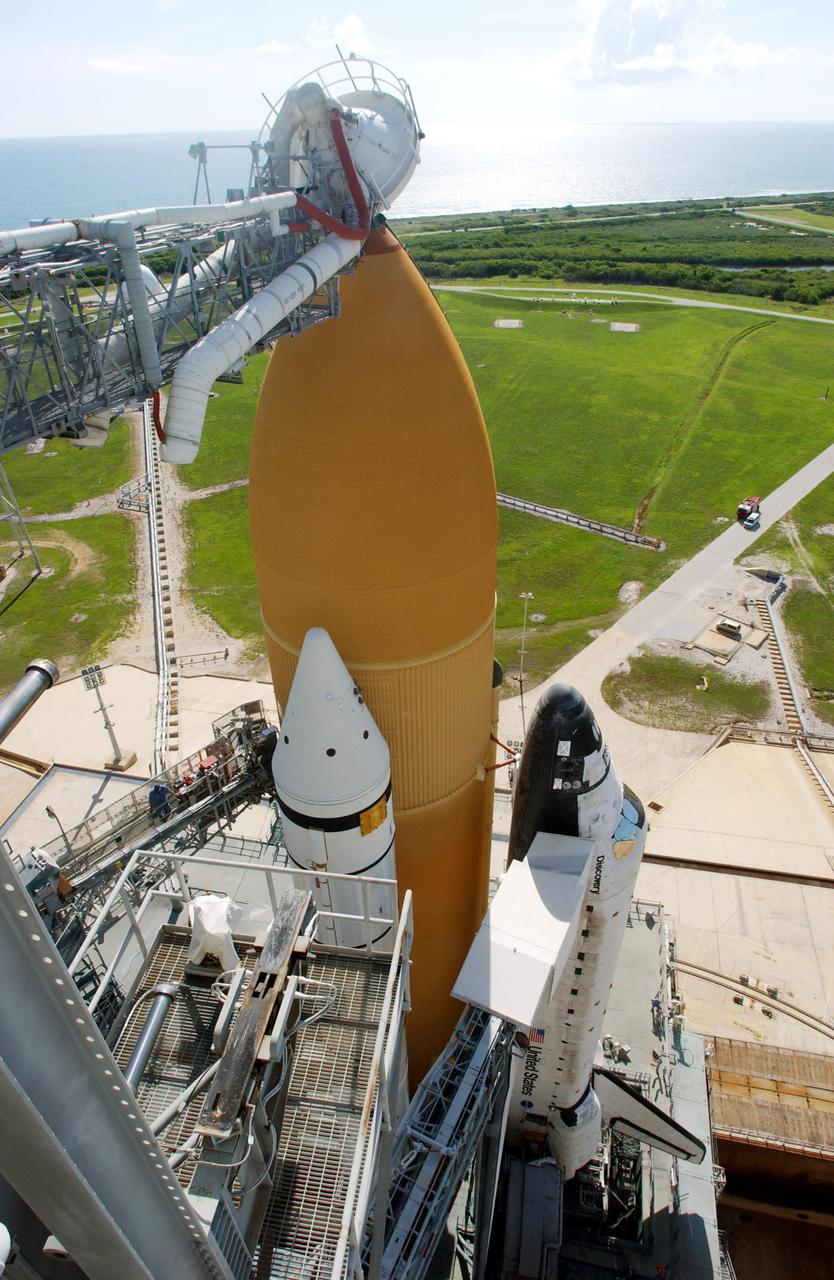
KENNEDY SPACE CENTER, Fla. -- From this high-level view, Space Shuttle Discovery is seen after its rollout to Launch Pad 39A. Extending toward Discovery on the right is the orbiter access arm with the White Room at the end. The White Room provides entry into the orbiter. Above the orange external tank is the gaseous oxygen vent arm with the “beanie cap” hood at the end. Beyond the pad can be seen the Atlantic Ocean. Discovery is scheduled to launch in early August on mission STS-105. Photo by Scott Andrews using a Nikon D1X camera
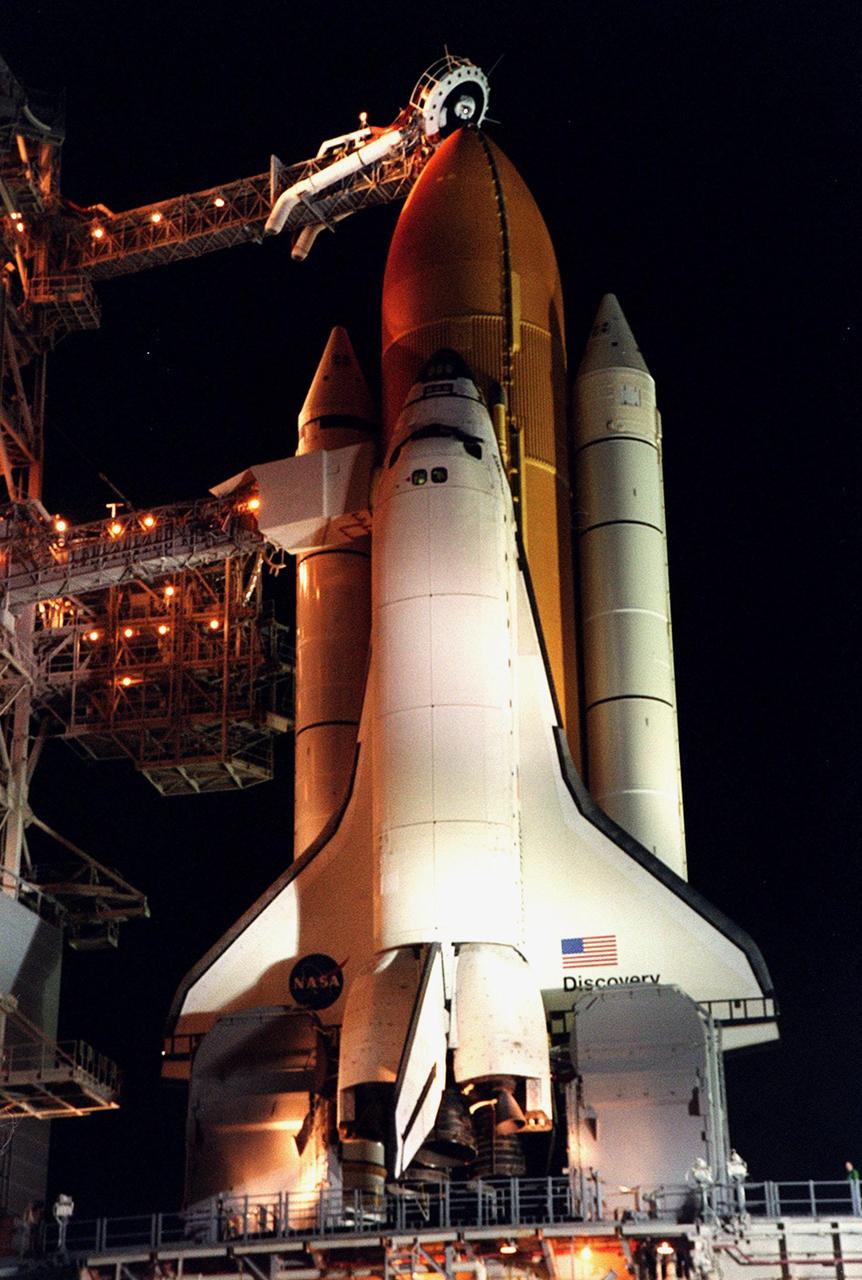
KENNEDY SPACE CENTER, Fla. -- After rollback of the Rotating Service Structure in the early morning hours, Space Shuttle Discovery stands ready for launch of mission STS-92. Above the external tank can be seen the Gaseous Oxygen Vent Arm with its vent hood, commonly referred to as the “beanie cap.” The system is designed to vent gaseous oxygen vapors away from the Shuttle after cryogenic loading. The scheduled launch is the second attempt after an earlier scrub. STS-92 is making the fifth flight for construction of the International Space Station. The mission is also the 100th in the history of the Shuttle program
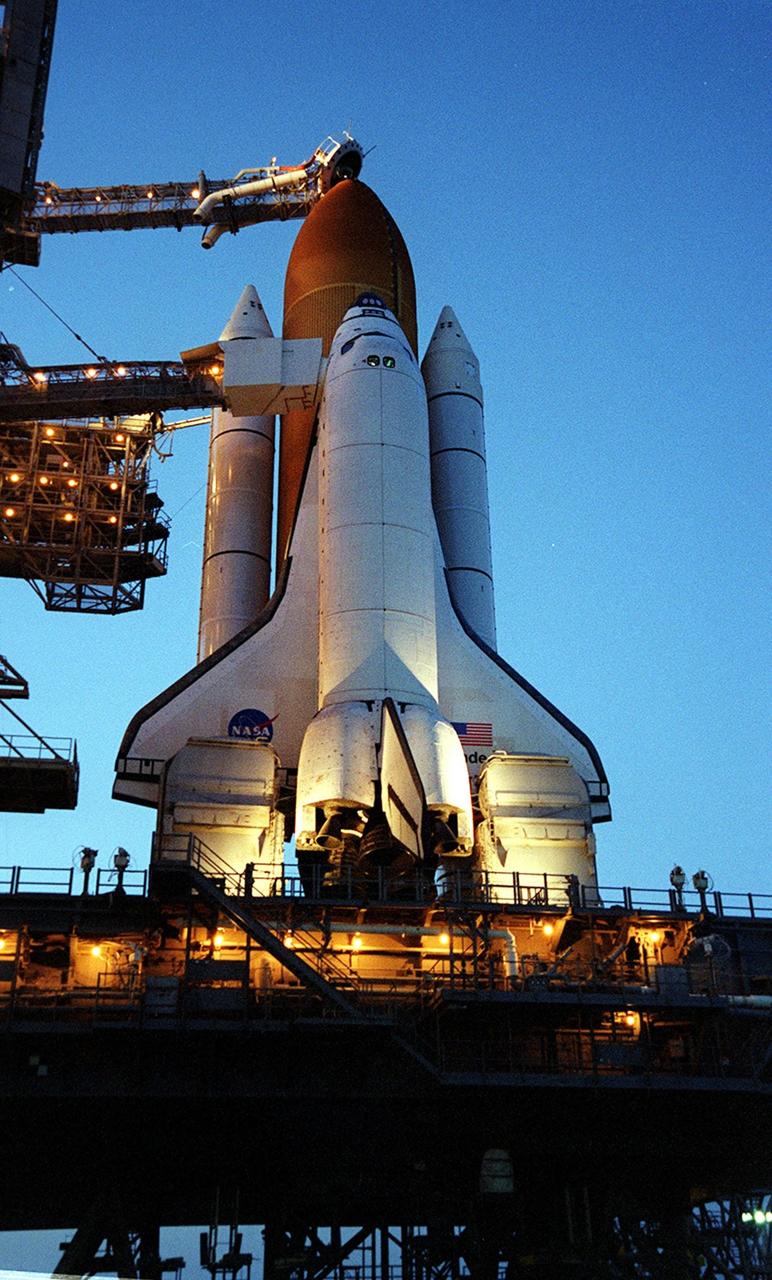
KENNEDY SPACE CENTER, Fla. -- After the rollback of the Rotating Service Structure, Space Shuttle Endeavour catches the glow of a setting sun and the lights surrounding it on Launch Pad 39A. At the top of the external tank can be seen the “beanie cap,” a venting apparatus at the end of the Gaseous Oxygen Vent Arm. Below it stretches the Orbiter Access Arm with the White Room extended to the orbiter. The White Room provides a controlled environment for entry into the orbiter. Endeavour is expected to lift off on mission STS-100 on April 19, carrying the Multi-Purpose Logistics Module Raffaello and the Canadian robotic arm, SSRMS, with a crew of seven to the International Space Station
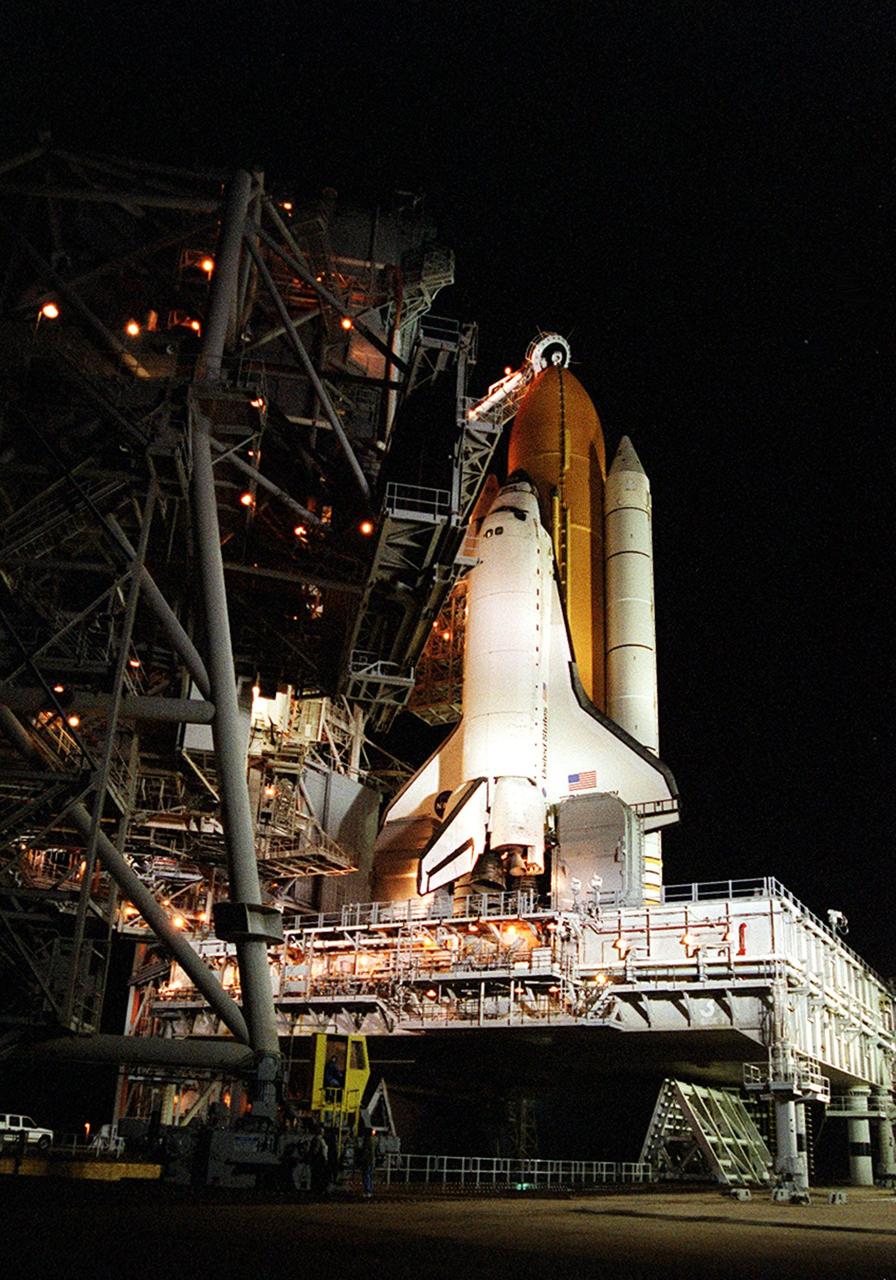
KENNEDY SPACE CENTER, Fla. -- In the early morning hours, the Rotating Service Structure (left) begins rolling back to free Space Shuttle Discovery for launch of mission STS-92 at 8:05 p.m. Oct. 9. Above the external tank can be seen the Gaseous Oxygen Vent Arm with its vent hood, commonly referred to as the “beanie cap.” The system is designed to vent gaseous oxygen vapors away from the Shuttle after cryogenic loading. The scheduled launch is the second attempt after an earlier scrub. STS-92 is making the fifth flight for construction of the International Space Station. The mission is also the 100th in the history of the Shuttle program
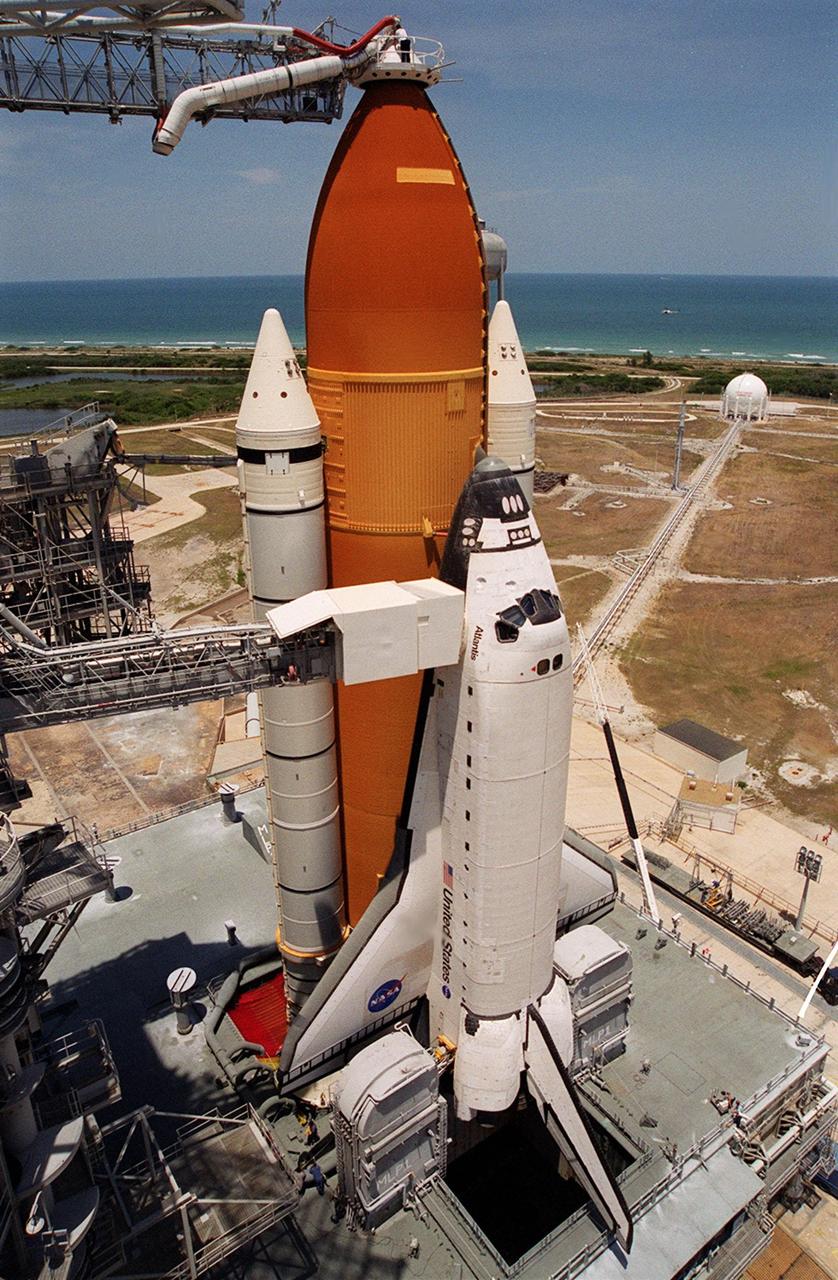
KENNEDY SPACE CENTER, Fla. -- After rollback of the Rotating Service Structure, Space Shuttle Atlantis is poised and ready on Launch Pad 39A for a fourth launch attempt on mission STS-101. At the top of the photo can be seen the Gaseous Oxygen Vent Hood, often called the "beanie cap." The hood helps vent gaseous oxygen vapors away from the Space Shuttle. The hood will be raised and retracted two and a half minutes before launch. Abutting the side of Atlantis is the orbiter access arm with the environmental chamber known as the White Room at the end. The White Room provides access to the crew compartment. In the background of the photo is the Atlantic Ocean. This will be the third assembly flight to the International Space Station. Liftoff of Space Shuttle Atlantis for the 10-day mission is scheduled for about 6:12 a.m. EDT from Launch Pad 39A. Landing is targeted for May 29 at 2:19 a.m. EDT. This is the 98th Shuttle flight and the 21st flight for Shuttle Atlantis
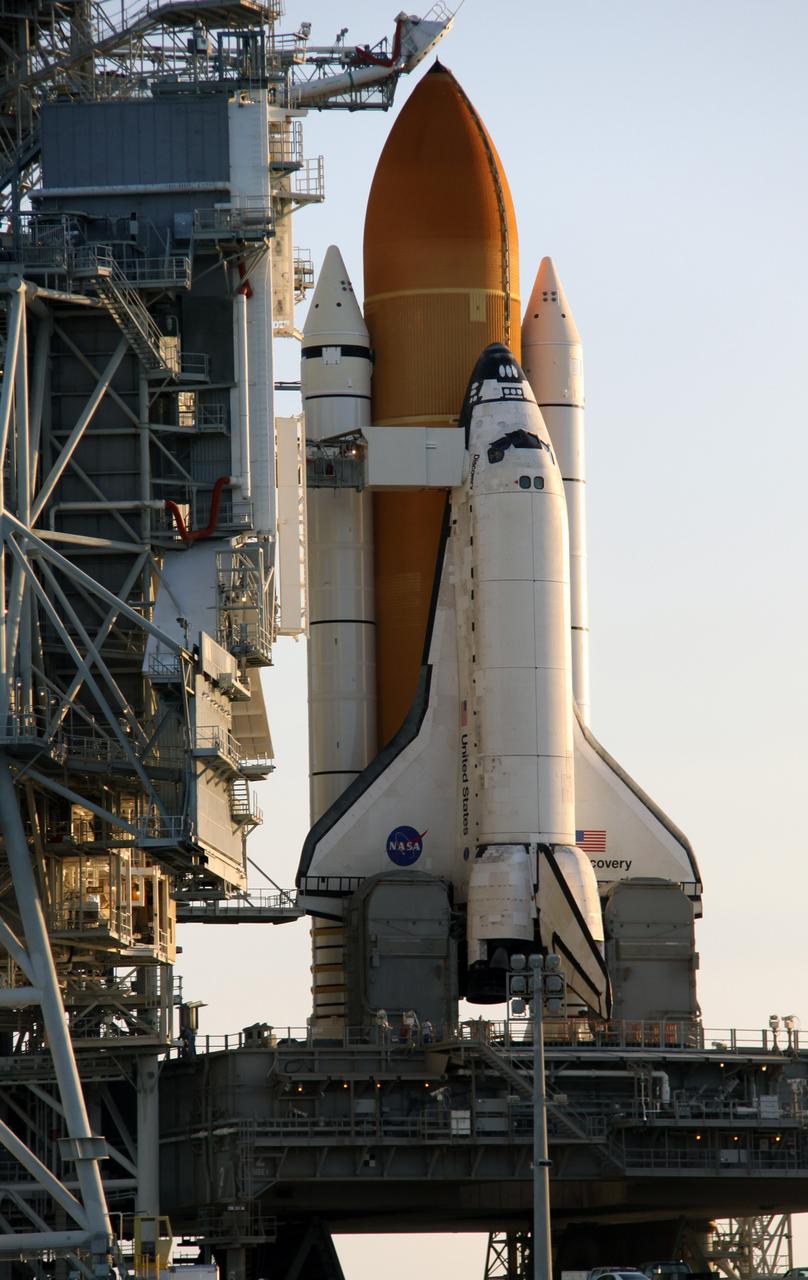
CAPE CANAVERAL, Fla. – On Launch Pad 39A at NASA's Kennedy Space Center in Florida, space shuttle Discovery is revealed during sunrise after the rollback of the rotating service structure, or RSS. On top of the external fuel tank is the oxygen vent hood, called the "beanie cap," which is designed to vent gaseous oxygen vapors away from the shuttle. The rollback is preparation for Discovery's scheduled 1:36 a.m. EDT liftoff Aug. 25 with a crew of seven on the STS-128 mission. The service structure provides weather protection and access to the space shuttle at the launch pad. The 13-day mission will deliver a new crew member and 33,000 pounds of equipment to the International Space Station. The equipment includes science and storage racks, a freezer to store research samples, a new sleeping compartment and the COLBERT treadmill. STS-128 will be Discovery's 37th mission and the 30th shuttle flight dedicated to station assembly and maintenance. Photo credit: NASA/Troy Cryder
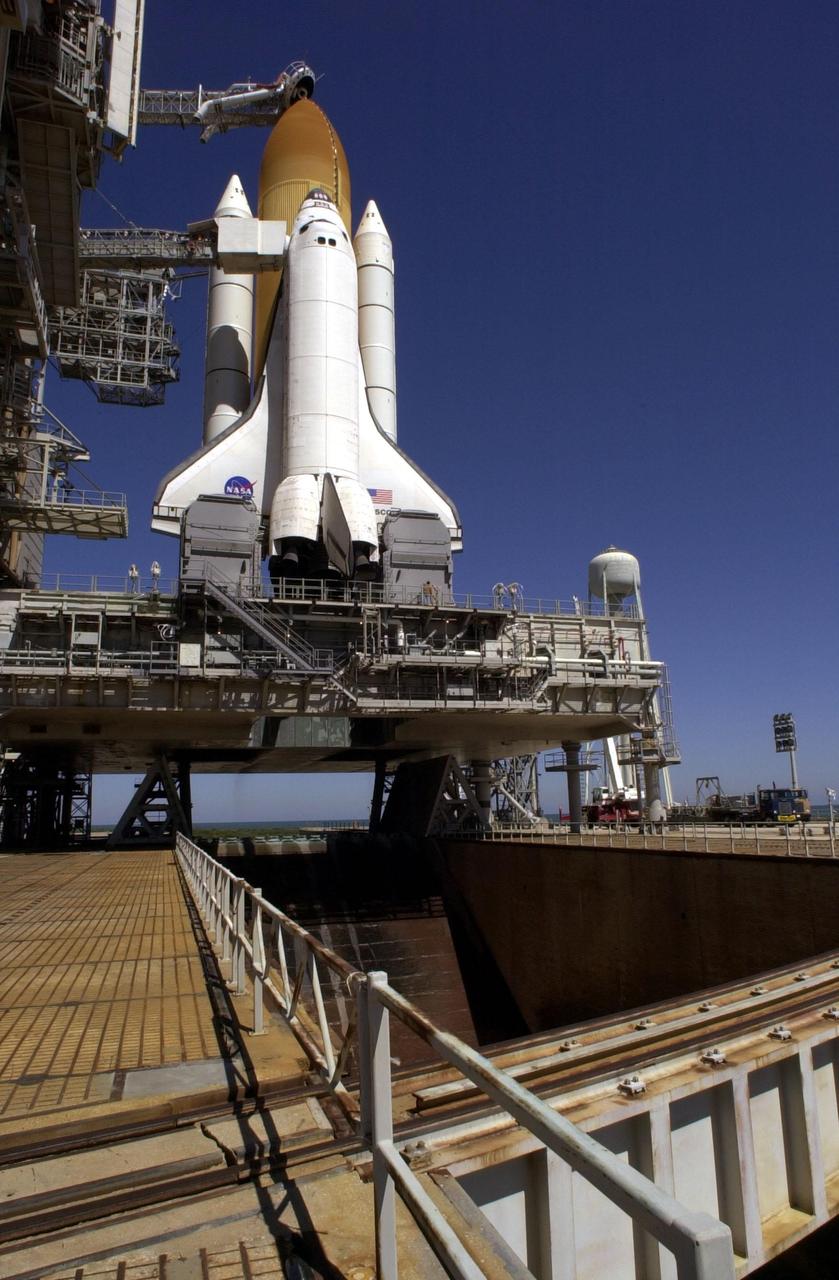
KENNEDY SPACE CENTER, Fla. -- With the Rotating Service Structure rolled back, Space Shuttle Discovery is revealed, poised for launch on mission STS-102 at 6:42 a.m. EST March 8. It sits on the Mobile Launcher Platform, which straddles the flame trench below that helps deflect the intense heat of launch. Made of concrete and refractory brick, the trench is 490 feet long, 58 feet wide and 40 feet high. Situated above the external tank is the Gaseous Oxygen Vent Arm with the “beanie cap,” a vent hood. On this eighth construction flight to the International Space Station, Discovery carries the Multi-Purpose Logistics Module Leonardo, the primary delivery system used to resupply and return Station cargo requiring a pressurized environment. Leonardo will deliver up to 10 tons of laboratory racks filled with equipment, experiments and supplies for outfitting the newly installed U.S. Laboratory Destiny
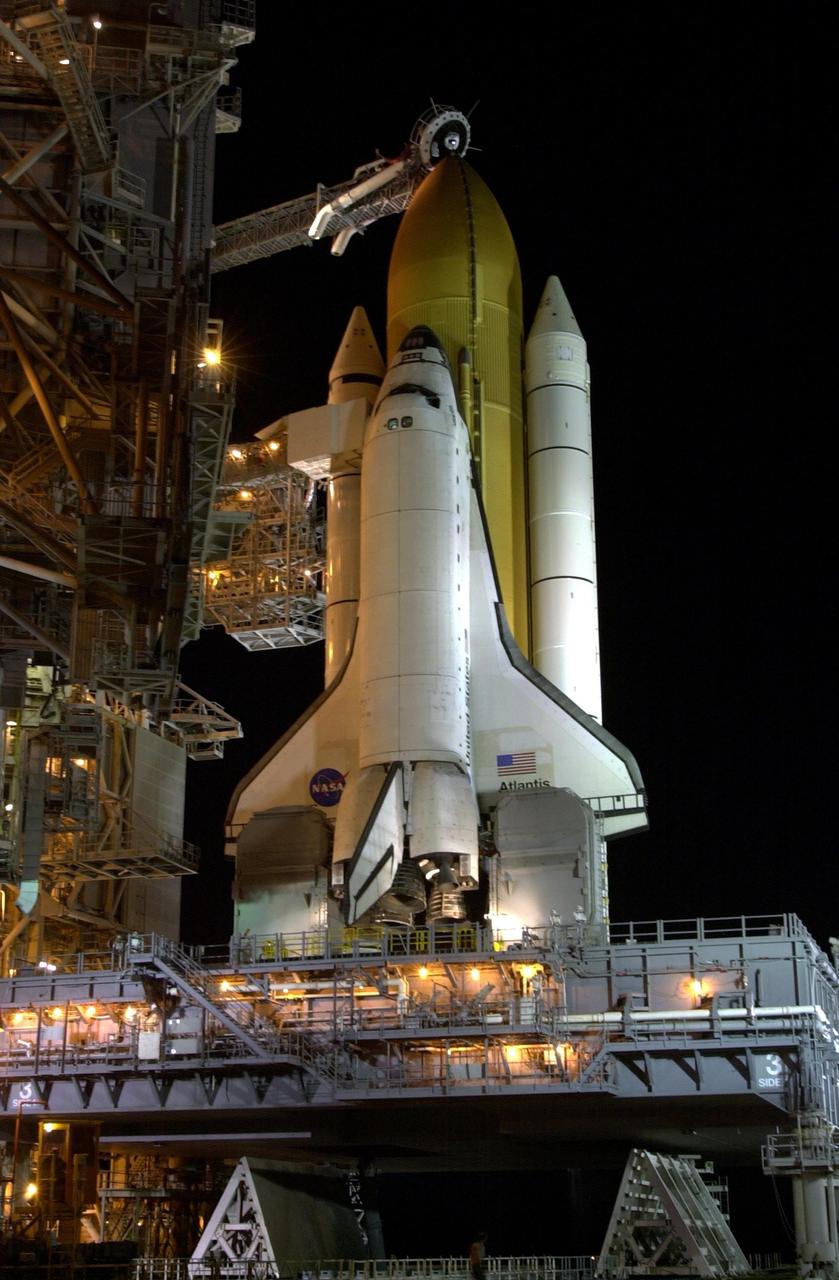
KENNEDY SPACE CENTER, FLA. -- Space Shuttle Atlantis is revealed as the Rotating Service Structure rolls back into launch position. The RSS provides protected access to the orbiter for changeout and servicing of payloads at the pad. The structure has access platforms at five levels to provide access to the payload bay. The Shuttle rests on the Mobile Launcher Platform (MLP), which straddles the flame trench below. The flame trench is part of the Flame Deflector System that insulates pad structures from the intense heat of the launch. Above the golden external tank is the vent hood (known as the "beanie cap") at the end of the gaseous oxygen vent arm. Vapors are created as the liquid oxygen in the external tank boil off. The hood vents the gaseous oxygen vapors away from the Space Shuttle vehicle. Mission STS-110 is scheduled to launch April 4 on its 11-day mission to the International Space Station
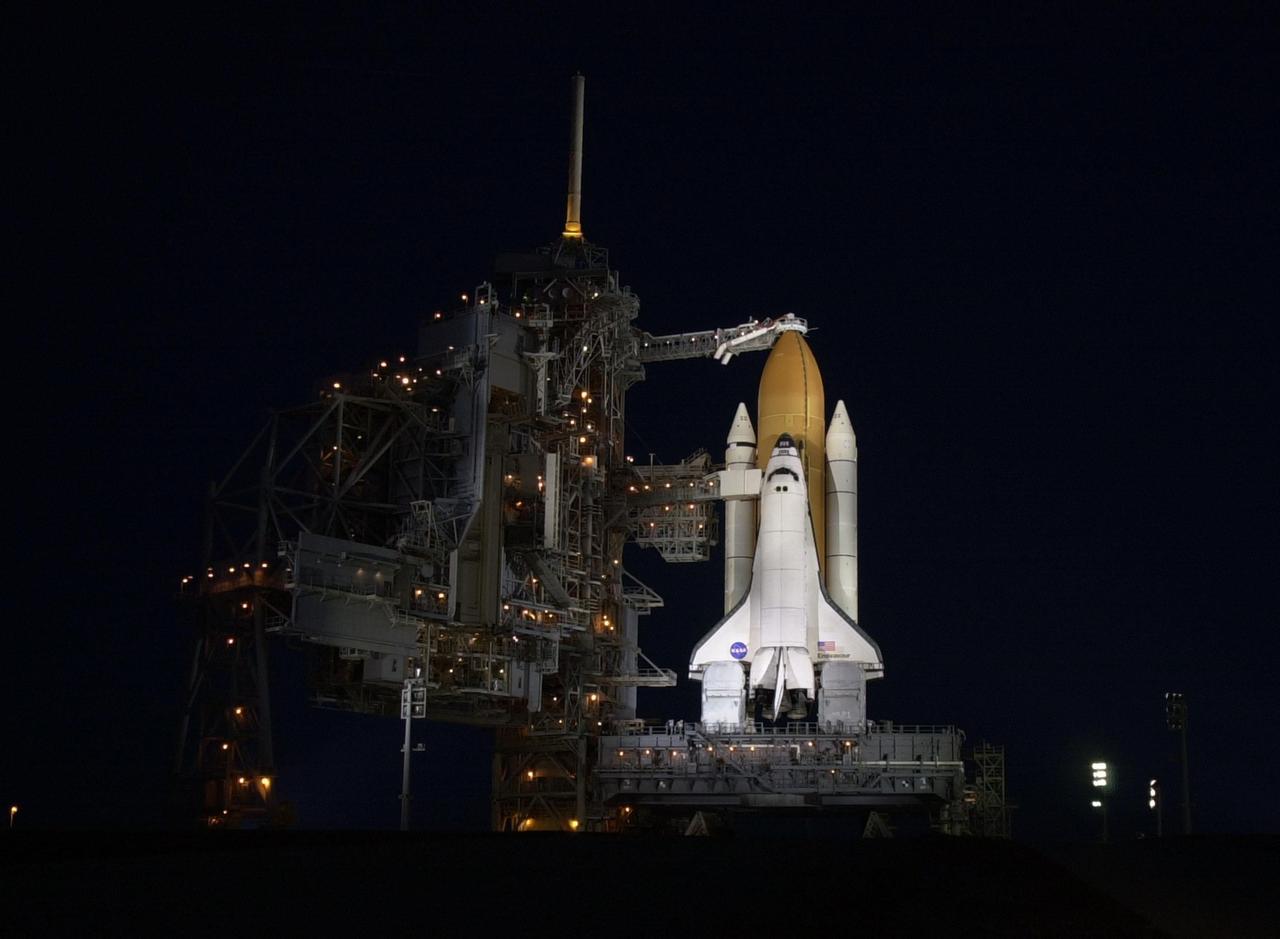
After rollback of the Rotating Service Structure, Space Shuttle Endeavour is spotlighted against the still-black sky of pre-dawn. At the top of the external tank is the Gaseous Oxygen Vent Arm and its vent hood, known as the “beanie cap.” The hood is raised to clear the external tank 2.5 minutes before launch. Endeavour is targeted for launch Nov. 30 at about 10:06 p.m. EST on mission STS-97. In the background, the sky prepares for dawn. The mission to the International Space Station carries the P6 Integrated Truss Segment containing solar arrays and batteries that will be temporarily installed to the Unity connecting module by the Z1 truss, recently delivered to and installed on the Station on mission STS-92. The two solar arrays are each more than 100 feet long. They will capture energy from the sun and convert it to power for the Station. Two spacewalks will be required to install the solar array connections
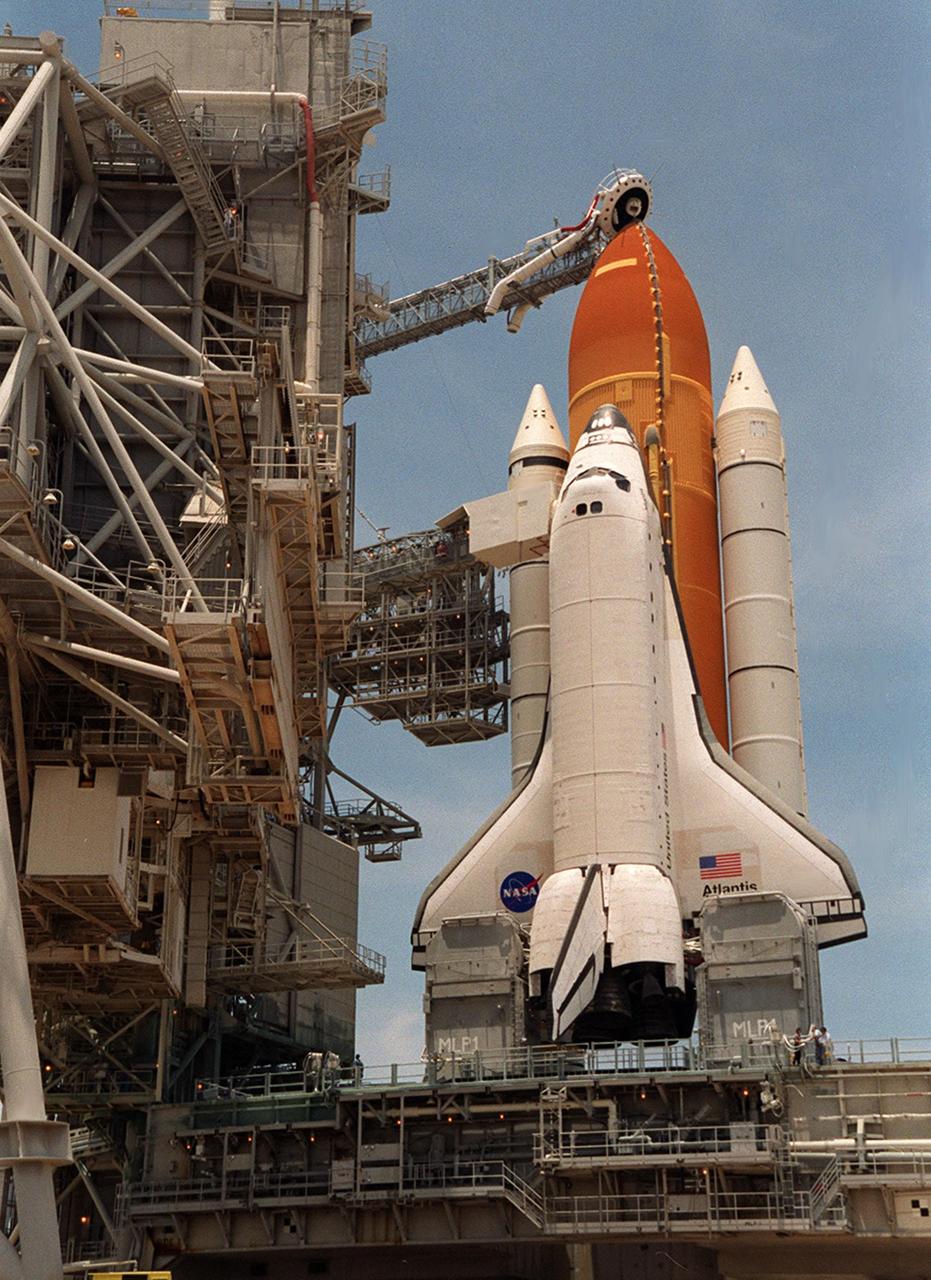
KENNEDY SPACE CENTER, Fla. -- After rollback of the Rotating Service Structure at Launch Pad 39A, Space Shuttle Atlantis awaits a fourth launch attempt on mission STS-101. At the top of the orange external tank can be seen the Gaseous Oxygen Vent Hood, often called the "beanie cap." The hood helps vent gaseous oxygen vapors away from the Space Shuttle. The hood will be raised and retracted two and a half minutes before launch. Abutting the side of Atlantis is the orbiter access arm with the environmental chamber known as the White Room at the end. The White Room provides access to the crew compartment. This will be the third assembly flight to the International Space Station. Liftoff of Space Shuttle Atlantis for the 10-day mission is scheduled for about 6:12 a.m. EDT from Launch Pad 39A. Landing is targeted for May 29 at 2:19 a.m. EDT. This is the 98th Shuttle flight and the 21st flight for Shuttle Atlantis
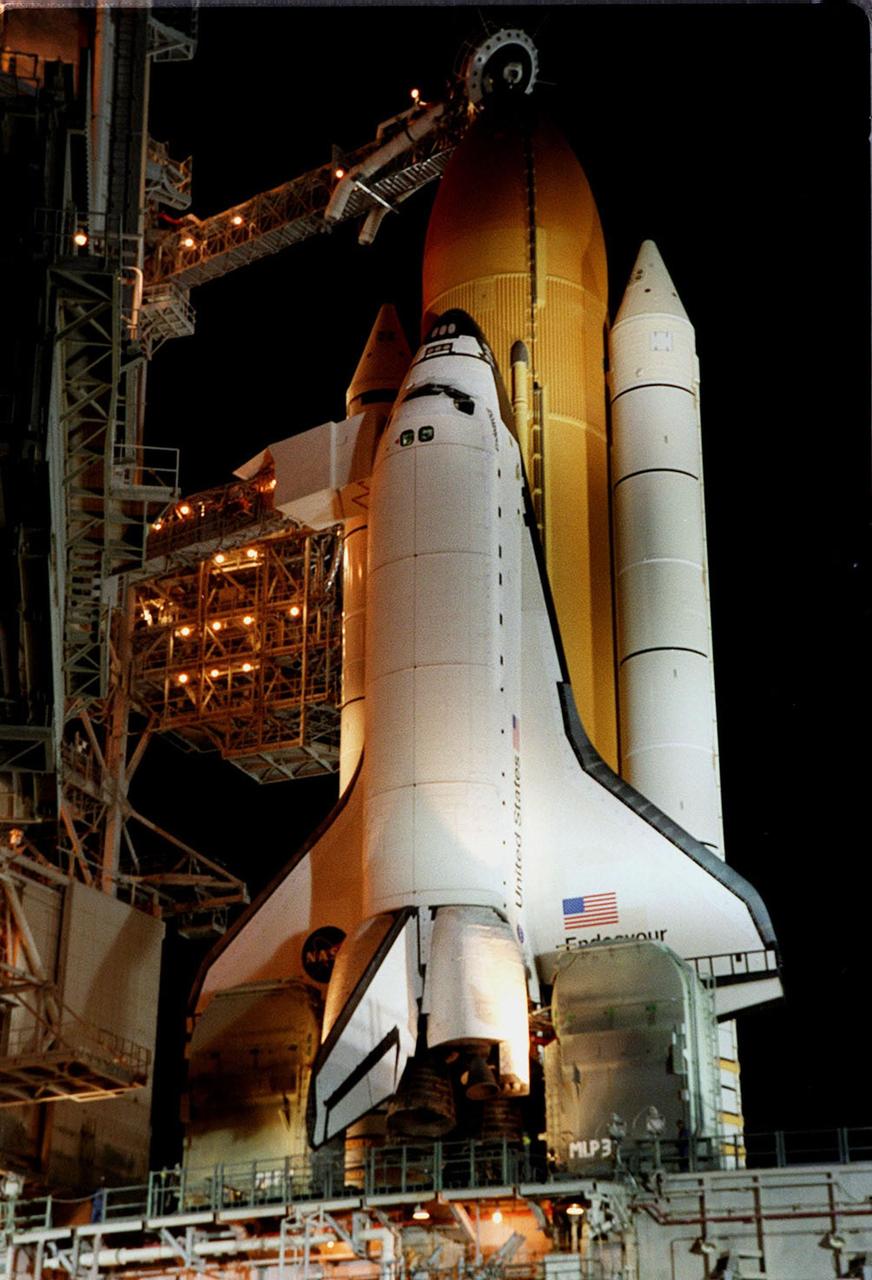
KENNEDY SPACE CENTER, Fla. -- After the rollback of the Rotating Service Structure on Launch Pad 39A, Space Shuttle Endeavour is marked with shadows from the lights on the Fixed Service Structure. Above the orange external tank is the Gaseous Oxygen Vent Hood, often called the "beanie cap," waiting to be lowered. The hood helps vent gaseous oxygen vapors away from the Space Shuttle until launch, when it is raised and retracted two and a half minutes before liftoff. Endeavour waits for mission STS-99, known as the Shuttle Radar Topography Mission (SRTM), which will chart a new course to produce unrivaled 3-D images of the Earth's surface. The result of the SRTM could be close to 1 trillion measurements of the Earth's topography. The mission is expected to last 11days, with Endeavour landing at KSC Tuesday, Feb. 22, at 4:36 p.m. EST. This is the 97th Shuttle flight and 14th for Shuttle Endeavour
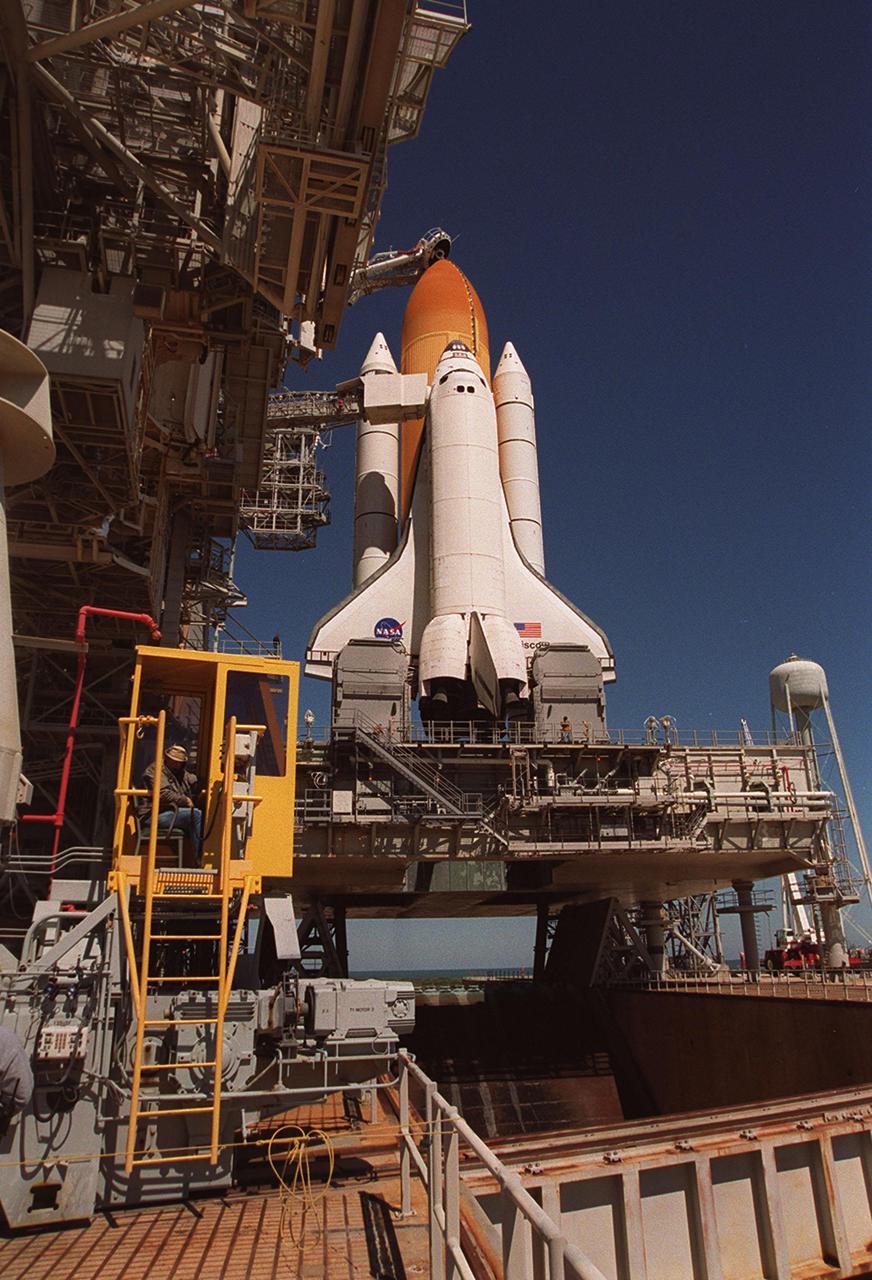
KENNEDY SPACE CENTER, Fla. -- With the Rotating Service Structure rolled back, Space Shuttle Discovery is revealed, poised for launch on mission STS-102 at 6:42 a.m. EST March 8. It sits on the Mobile Launcher Platform, which straddles the flame trench below that helps deflect the intense heat of launch. Made of concrete and refractory brick, the trench is 490 feet long, 58 feet wide and 40 feet high. Situated above the external tank is the Gaseous Oxygen Vent Arm with the “beanie cap,” a vent hood. On this eighth construction flight to the International Space Station, Discovery carries the Multi-Purpose Logistics Module Leonardo, the primary delivery system used to resupply and return Station cargo requiring a pressurized environment. Leonardo will deliver up to 10 tons of laboratory racks filled with equipment, experiments and supplies for outfitting the newly installed U.S. Laboratory Destiny
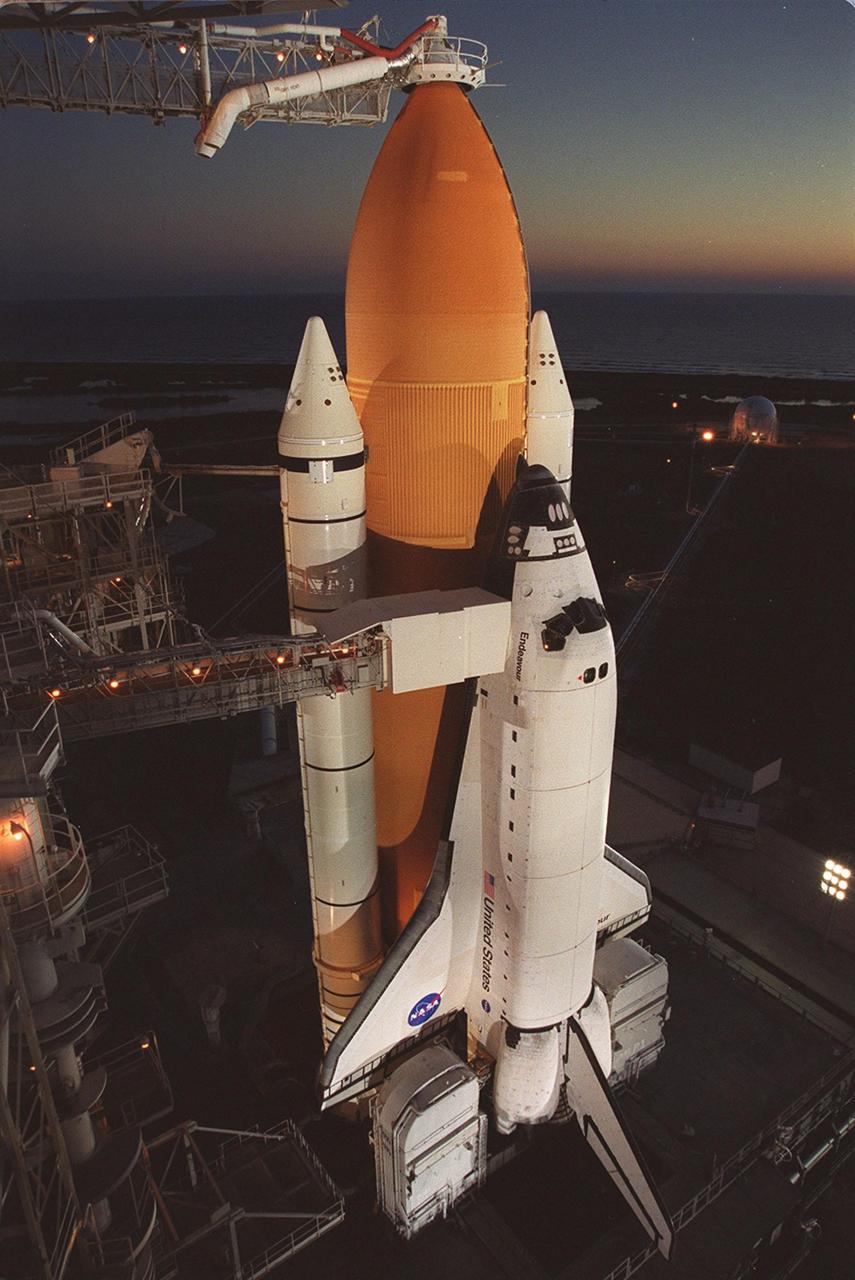
As dawn breaks on the horizon, Space Shuttle Endeavour is seen standing ready for launch, targeted for 10:06 p.m. EST tonight on mission STS-97 to the International Space Station. The Rotating Service Structure was rolled back just before dawn. On top of the orange external tank is the Gaseous Oxygen Vent Arm and its vent hood, known as the “beanie cap.” The hood is raised to clear the external tank 2.5 minutes before launch. The orbiter carries the P6 Integrated Truss Segment containing solar arrays that will be temporarily installed to the Unity connecting module by the Z1 truss, recently delivered to and installed on the Station on mission STS-92. The two solar arrays are each more than 100 feet long. They will capture energy from the sun and convert it to power for the Station. Two spacewalks will be required to install the solar array connections
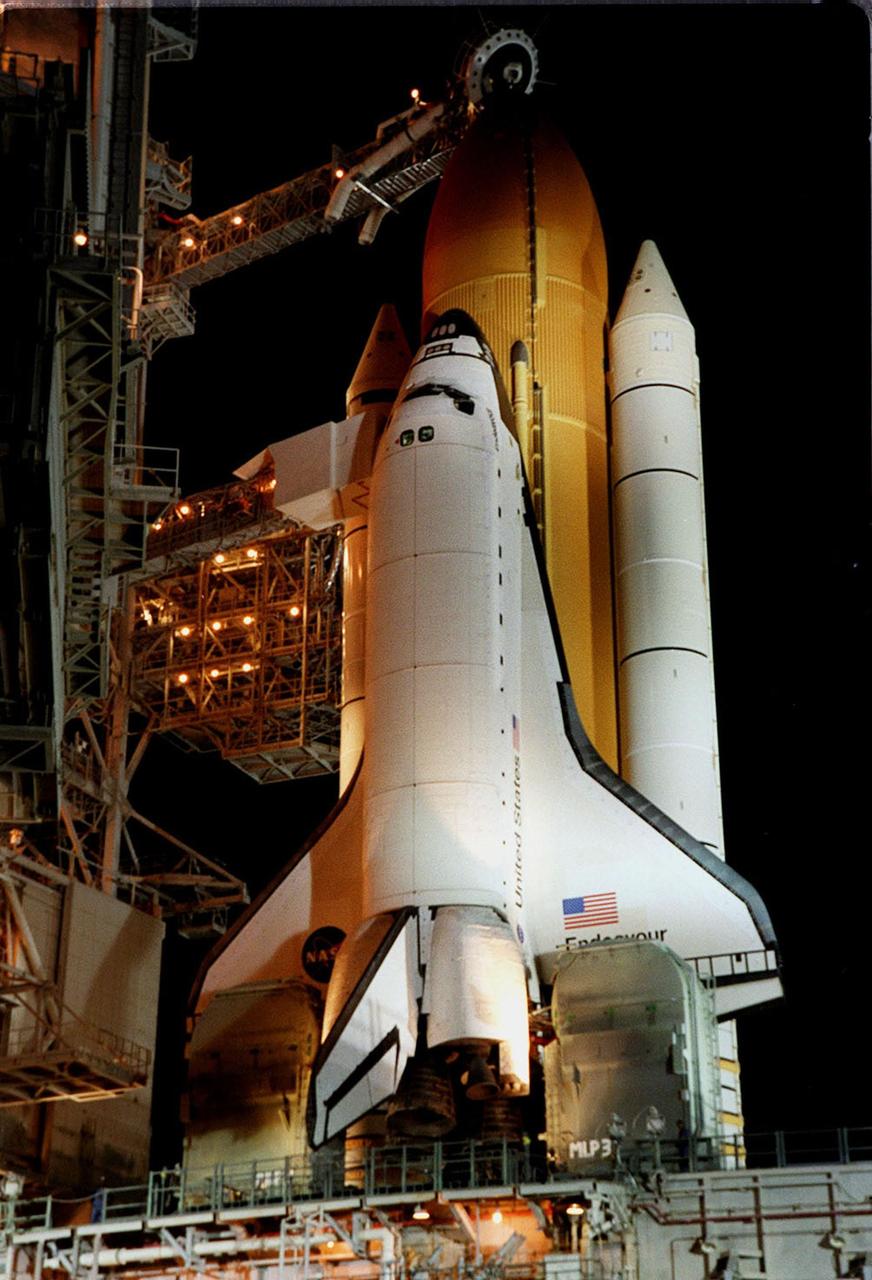
KENNEDY SPACE CENTER, Fla. -- After the rollback of the Rotating Service Structure on Launch Pad 39A, Space Shuttle Endeavour is marked with shadows from the lights on the Fixed Service Structure. Above the orange external tank is the Gaseous Oxygen Vent Hood, often called the "beanie cap," waiting to be lowered. The hood helps vent gaseous oxygen vapors away from the Space Shuttle until launch, when it is raised and retracted two and a half minutes before liftoff. Endeavour waits for mission STS-99, known as the Shuttle Radar Topography Mission (SRTM), which will chart a new course to produce unrivaled 3-D images of the Earth's surface. The result of the SRTM could be close to 1 trillion measurements of the Earth's topography. The mission is expected to last 11days, with Endeavour landing at KSC Tuesday, Feb. 22, at 4:36 p.m. EST. This is the 97th Shuttle flight and 14th for Shuttle Endeavour
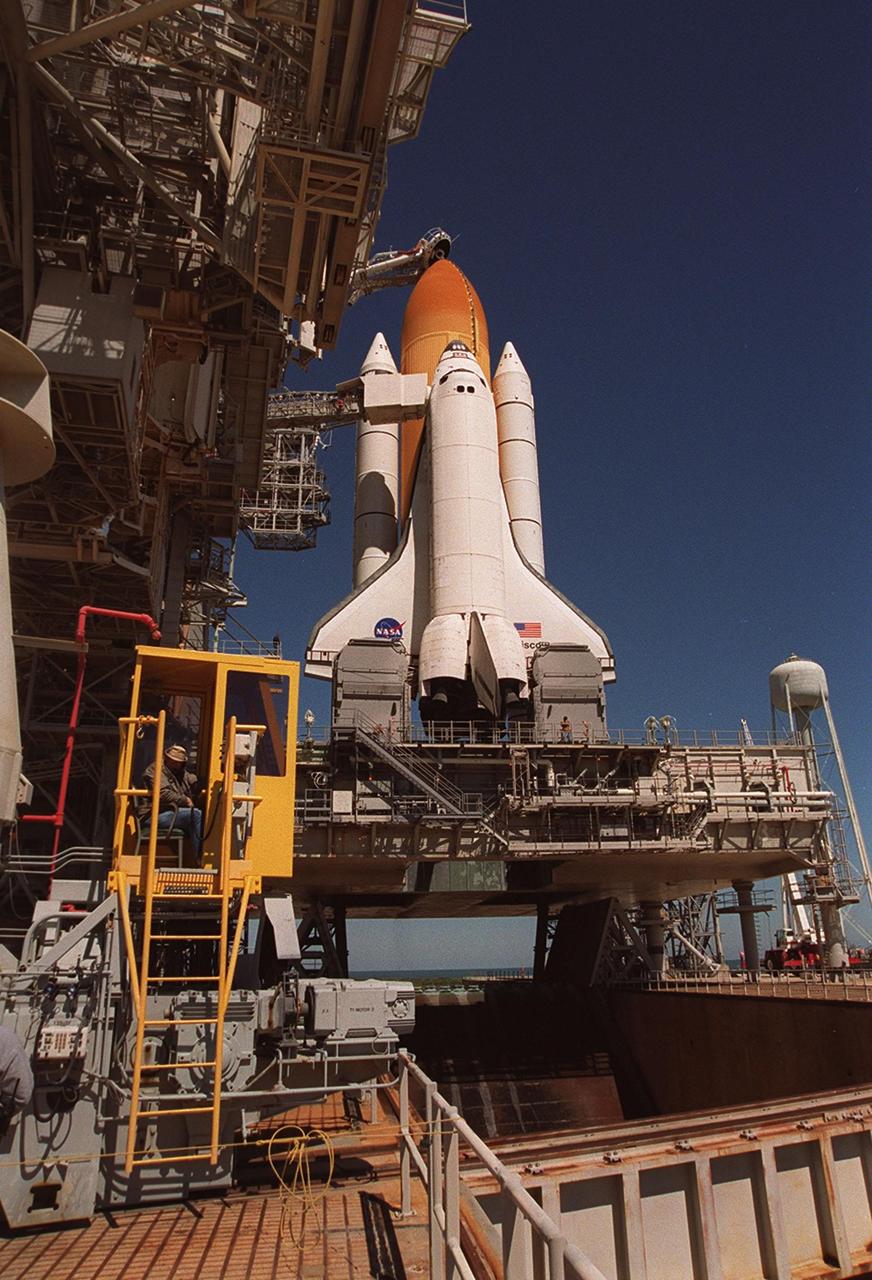
KENNEDY SPACE CENTER, Fla. -- With the Rotating Service Structure rolled back, Space Shuttle Discovery is revealed, poised for launch on mission STS-102 at 6:42 a.m. EST March 8. It sits on the Mobile Launcher Platform, which straddles the flame trench below that helps deflect the intense heat of launch. Made of concrete and refractory brick, the trench is 490 feet long, 58 feet wide and 40 feet high. Situated above the external tank is the Gaseous Oxygen Vent Arm with the “beanie cap,” a vent hood. On this eighth construction flight to the International Space Station, Discovery carries the Multi-Purpose Logistics Module Leonardo, the primary delivery system used to resupply and return Station cargo requiring a pressurized environment. Leonardo will deliver up to 10 tons of laboratory racks filled with equipment, experiments and supplies for outfitting the newly installed U.S. Laboratory Destiny
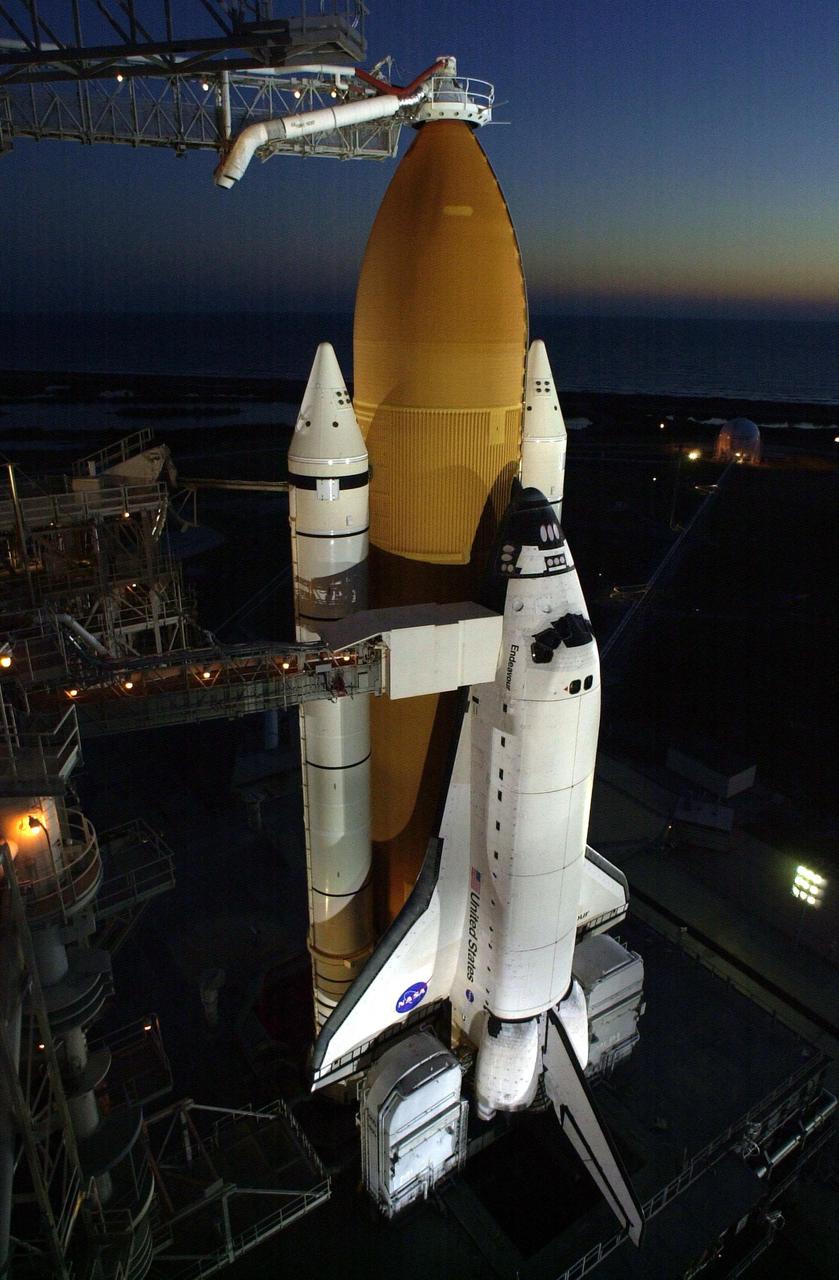
After rollback of the Rotating Service Structure, Space Shuttle Endeavour shines under spotlights. At the top of the external tank is the Gaseous Oxygen Vent Arm and its vent hood, known as the “beanie cap.” The hood is raised to clear the external tank 2.5 minutes before launch. Endeavour is targeted for launch Nov. 30 at about 10:06 p.m. EST on mission STS-97. In the background, the sky prepares for dawn. The mission to the International Space Station carries the P6 Integrated Truss Segment containing solar arrays and batteries that will be temporarily installed to the Unity connecting module by the Z1 truss, recently delivered to and installed on the Station on mission STS-92. The two solar arrays are each more than 100 feet long. They will capture energy from the sun and convert it to power for the Station. Two spacewalks will be required to install the solar array connections
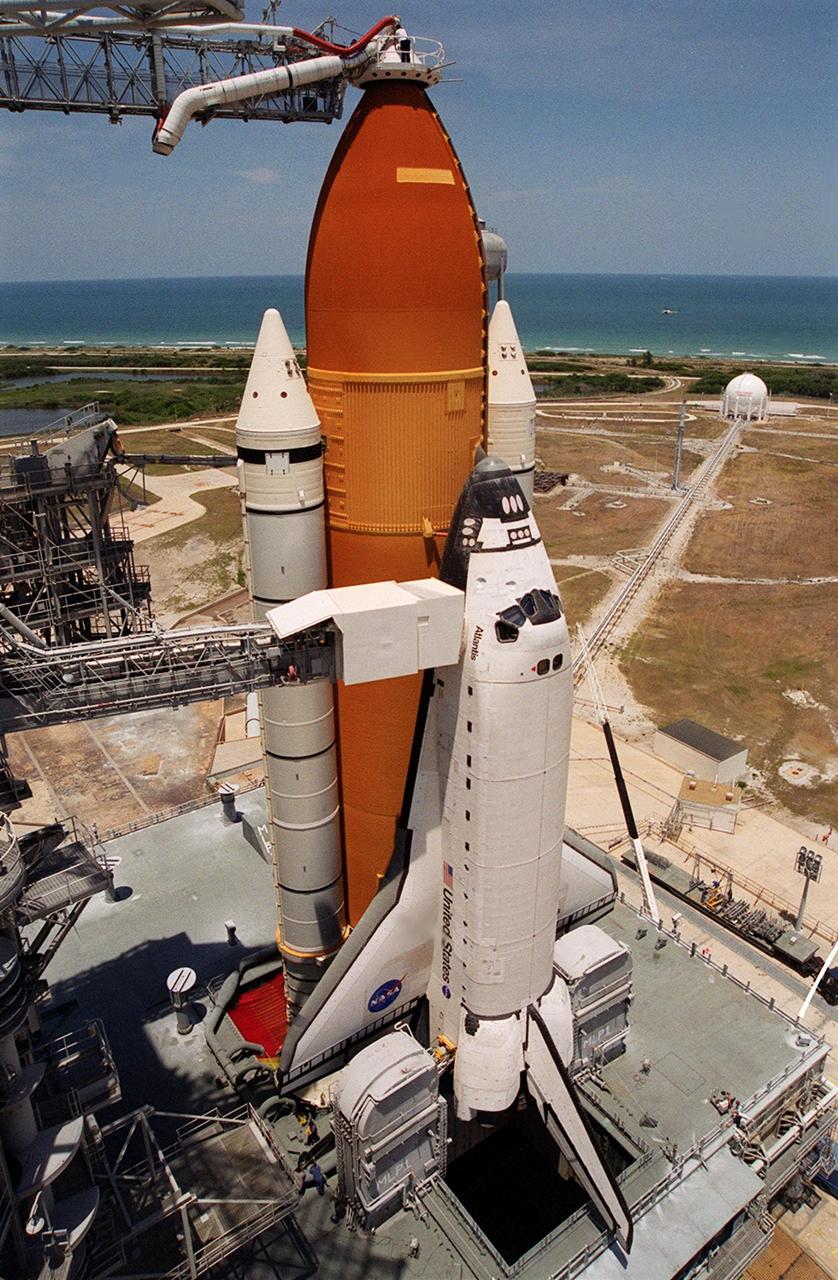
KENNEDY SPACE CENTER, Fla. -- After rollback of the Rotating Service Structure, Space Shuttle Atlantis is poised and ready on Launch Pad 39A for a fourth launch attempt on mission STS-101. At the top of the photo can be seen the Gaseous Oxygen Vent Hood, often called the "beanie cap." The hood helps vent gaseous oxygen vapors away from the Space Shuttle. The hood will be raised and retracted two and a half minutes before launch. Abutting the side of Atlantis is the orbiter access arm with the environmental chamber known as the White Room at the end. The White Room provides access to the crew compartment. In the background of the photo is the Atlantic Ocean. This will be the third assembly flight to the International Space Station. Liftoff of Space Shuttle Atlantis for the 10-day mission is scheduled for about 6:12 a.m. EDT from Launch Pad 39A. Landing is targeted for May 29 at 2:19 a.m. EDT. This is the 98th Shuttle flight and the 21st flight for Shuttle Atlantis
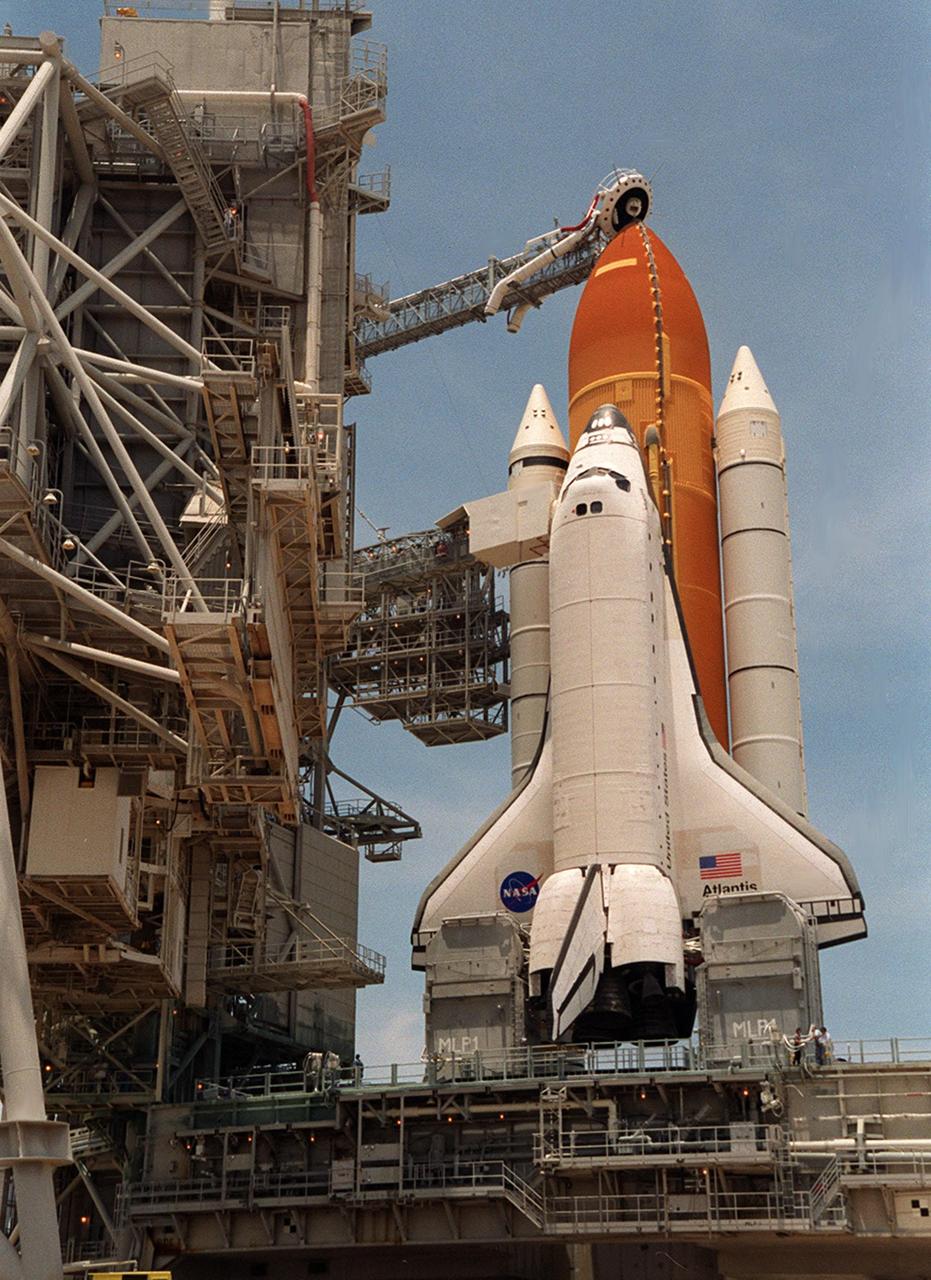
KENNEDY SPACE CENTER, Fla. -- After rollback of the Rotating Service Structure at Launch Pad 39A, Space Shuttle Atlantis awaits a fourth launch attempt on mission STS-101. At the top of the orange external tank can be seen the Gaseous Oxygen Vent Hood, often called the "beanie cap." The hood helps vent gaseous oxygen vapors away from the Space Shuttle. The hood will be raised and retracted two and a half minutes before launch. Abutting the side of Atlantis is the orbiter access arm with the environmental chamber known as the White Room at the end. The White Room provides access to the crew compartment. This will be the third assembly flight to the International Space Station. Liftoff of Space Shuttle Atlantis for the 10-day mission is scheduled for about 6:12 a.m. EDT from Launch Pad 39A. Landing is targeted for May 29 at 2:19 a.m. EDT. This is the 98th Shuttle flight and the 21st flight for Shuttle Atlantis
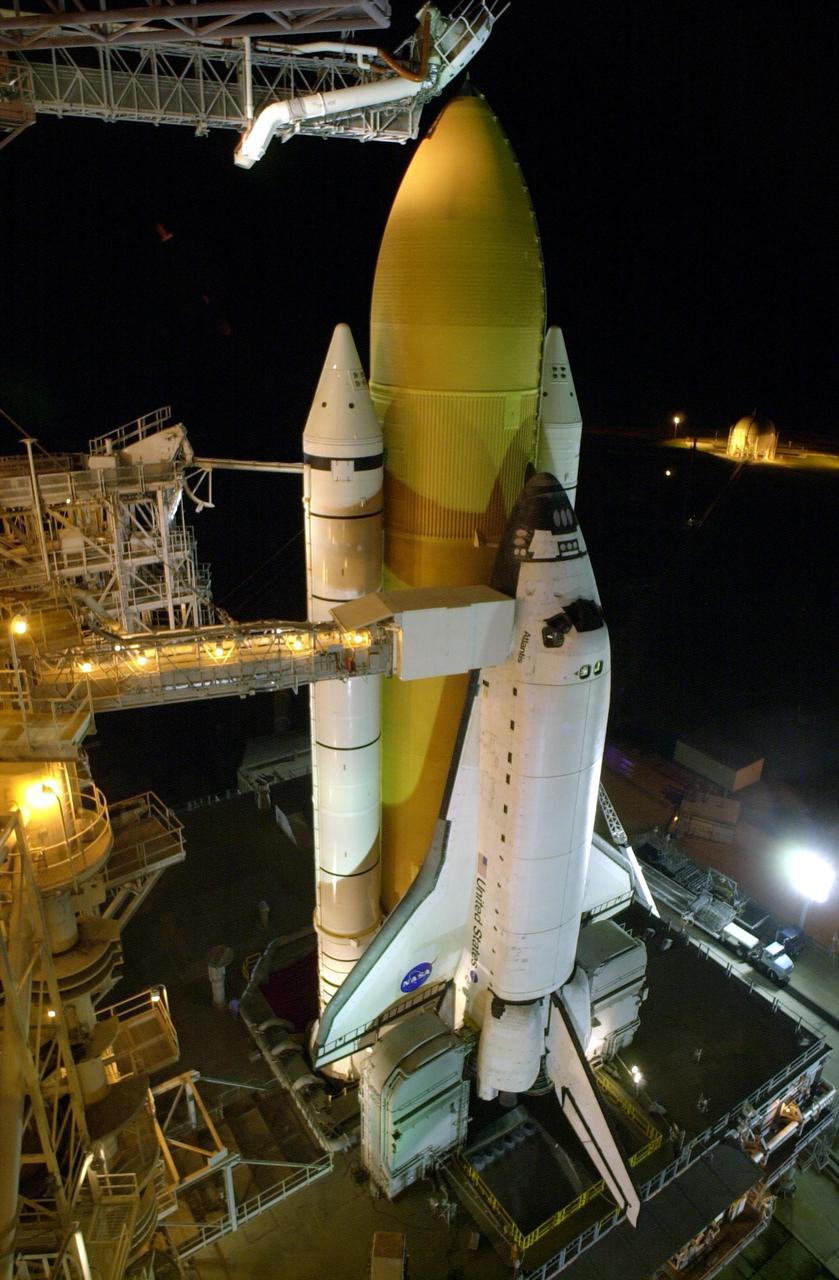
KENNEDY SPACE CENTER, FLA. -- With the Rotating Service Structure rolled back, Space Shuttle Atlantis stands ready for launch on mission STS-110. The Orbiter Access Arm extends from the Fixed Service Structure (FSS) to the crew compartment hatch, through which the STS-110 crew will enter Atlantis. Above the golden external tank is the vent hood (known as the "beanie cap") at the end of the gaseous oxygen vent arm. Vapors are created as the liquid oxygen in the external tank boil off. The hood vents the gaseous oxygen vapors away from the Space Shuttle vehicle. The RSS provides protected access to the orbiter for changeout and servicing of payloads at the pad. The structure has access platforms at five levels to provide access to the payload bay. The FSS provides access to the orbiter and the RSS. Mission STS-110 is scheduled to launch April 4 on its 11-day mission to the International Space Station
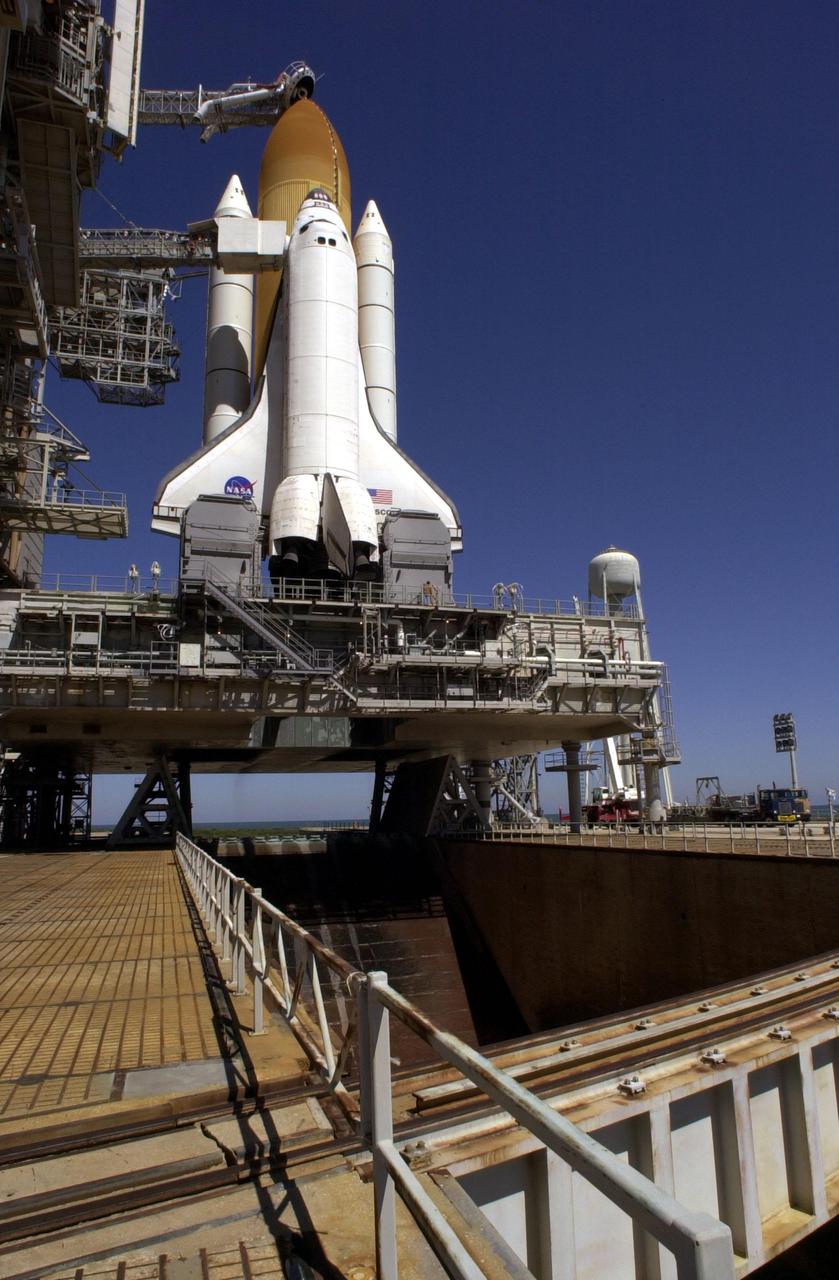
KENNEDY SPACE CENTER, Fla. -- With the Rotating Service Structure rolled back, Space Shuttle Discovery is revealed, poised for launch on mission STS-102 at 6:42 a.m. EST March 8. It sits on the Mobile Launcher Platform, which straddles the flame trench below that helps deflect the intense heat of launch. Made of concrete and refractory brick, the trench is 490 feet long, 58 feet wide and 40 feet high. Situated above the external tank is the Gaseous Oxygen Vent Arm with the “beanie cap,” a vent hood. On this eighth construction flight to the International Space Station, Discovery carries the Multi-Purpose Logistics Module Leonardo, the primary delivery system used to resupply and return Station cargo requiring a pressurized environment. Leonardo will deliver up to 10 tons of laboratory racks filled with equipment, experiments and supplies for outfitting the newly installed U.S. Laboratory Destiny
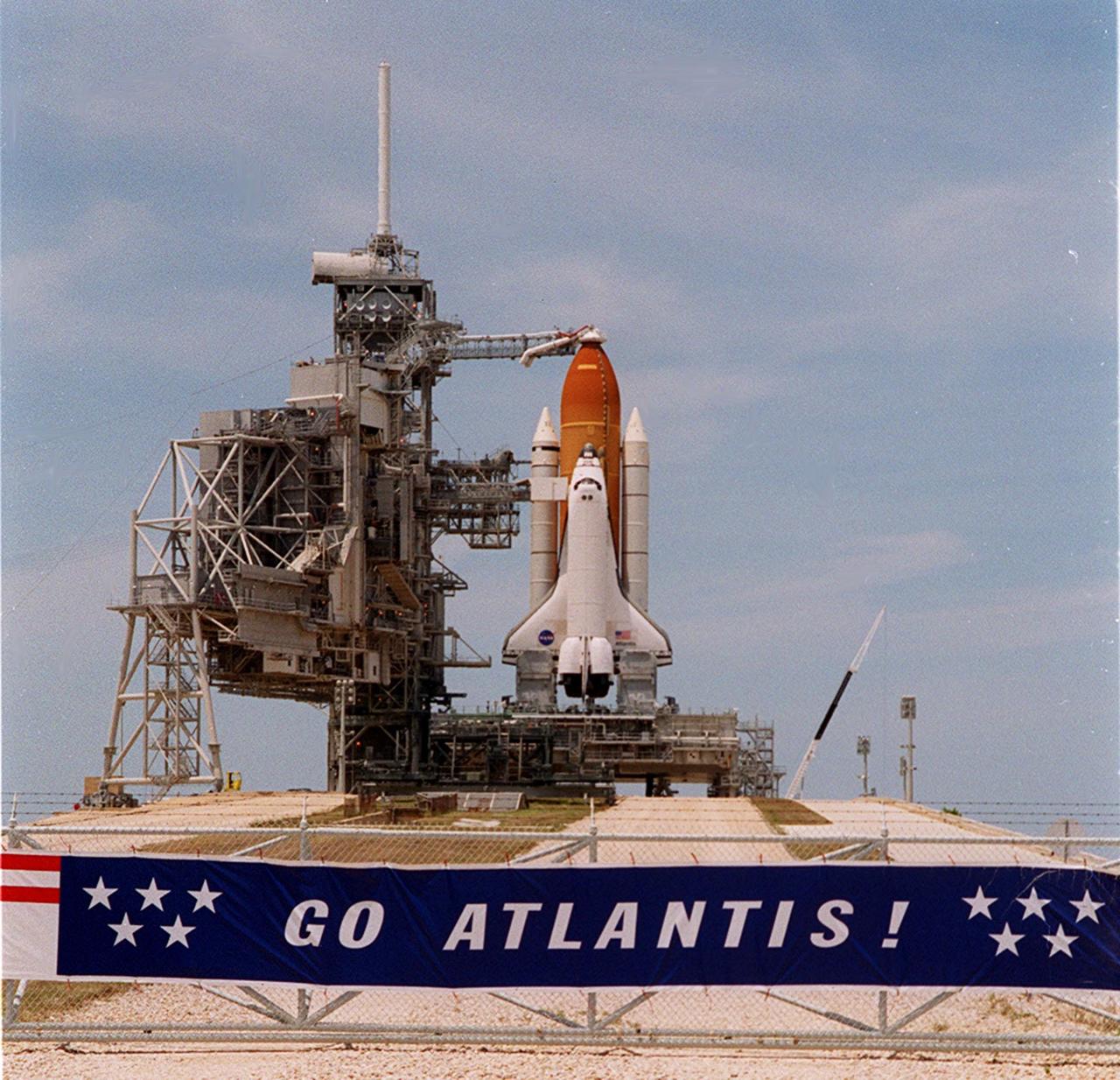
KENNEDY SPACE CENTER, Fla. -- After rollback of the Rotating Service Structure at Launch Pad 39A, Space Shuttle Atlantis awaits a fourth launch attempt on mission STS-101. At the top of the orange external tank can be seen the Gaseous Oxygen Vent Hood, often called the “beanie cap.” The hood helps vent gaseous oxygen vapors away from the Space Shuttle. The hood will be raised and retracted two and a half minutes before launch. Abutting the side of Atlantis is the orbiter access arm with the environmental chamber known as the White Room at the end. The White Room provides access to the crew compartment. This will be the third assembly flight to the International Space Station. Liftoff of Space Shuttle Atlantis for the 10-day mission is scheduled for about 6:12 a.m. EDT from Launch Pad 39A. Landing is targeted for May 29 at 2:19 a.m. EDT. This is the 98th Shuttle flight and the 21st flight for Shuttle Atlantis
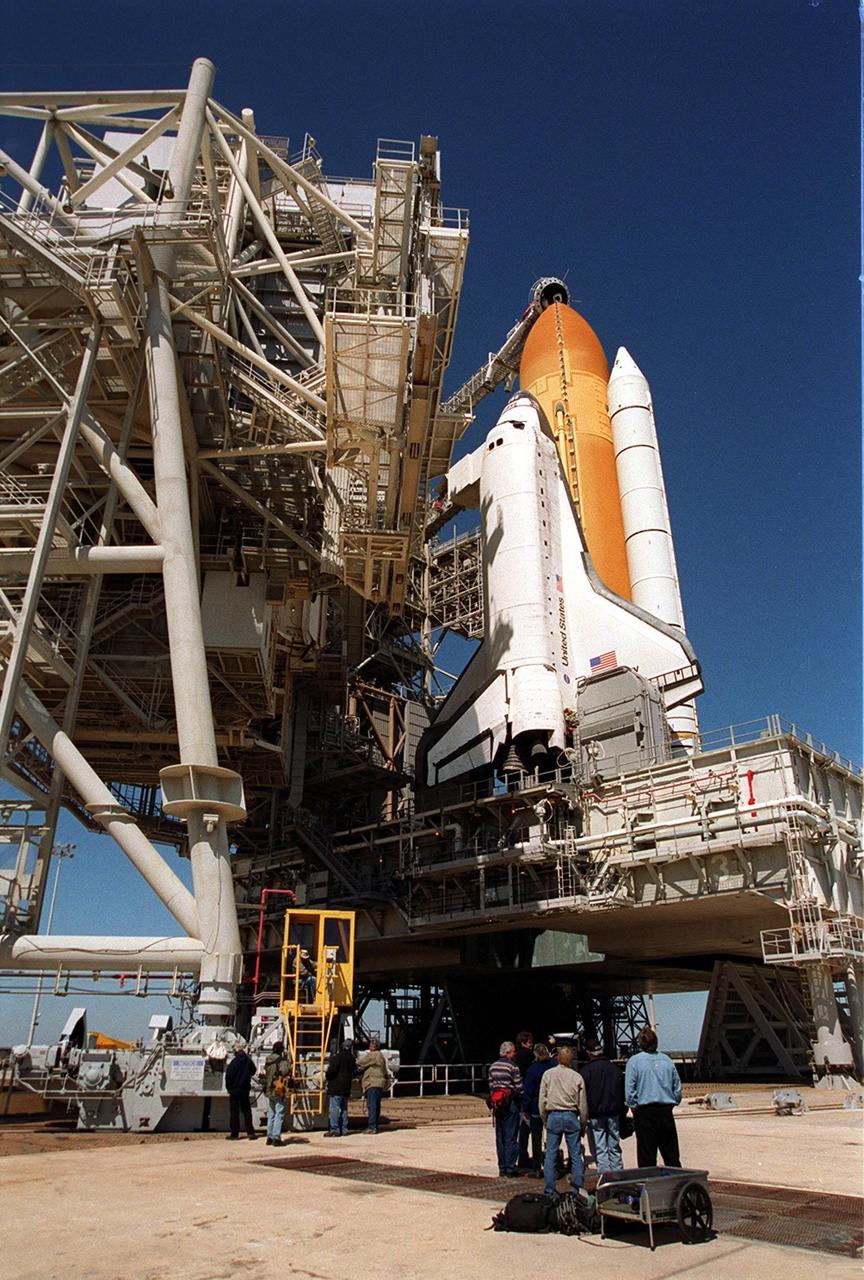
KENNEDY SPACE CENTER, Fla. -- Workers watch the rollback of the Rotating Service Structure (left) from around Space Shuttle Discovery on Launch Pad 39B. Poised above the orange external tank is the Gaseous Oxygen Vent Arm with the “beanie cap,” a vent hood. The RSS provides protected access to the orbiter for changeout and servicing of payloads. It is supported by a rotating bridge that pivots about a vertical axis on the west side of the pad’s flame trench. Space Shuttle Discovery is scheduled to launch March 8 at 6:42 a.m. EST on the eighth construction flight to the International Space Station. It carries the Multi-Purpose Logistics Module Leonardo, the primary delivery system used to resupply and return Station cargo requiring a pressurized environment. Leonardo will deliver up to 10 tons of laboratory racks filled with equipment, experiments and supplies for outfitting the newly installed U.S. Laboratory Destiny
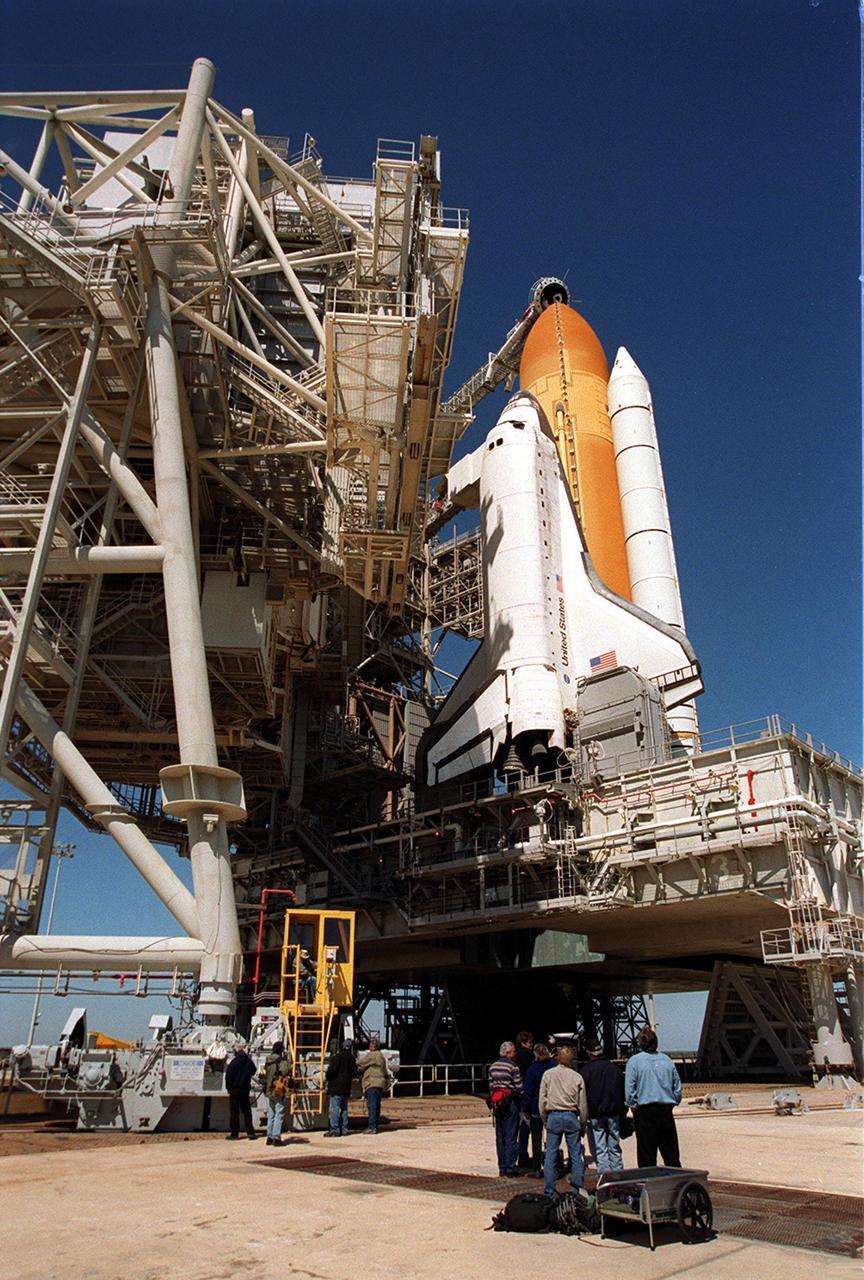
KENNEDY SPACE CENTER, Fla. -- Workers watch the rollback of the Rotating Service Structure (left) from around Space Shuttle Discovery on Launch Pad 39B. Poised above the orange external tank is the Gaseous Oxygen Vent Arm with the “beanie cap,” a vent hood. The RSS provides protected access to the orbiter for changeout and servicing of payloads. It is supported by a rotating bridge that pivots about a vertical axis on the west side of the pad’s flame trench. Space Shuttle Discovery is scheduled to launch March 8 at 6:42 a.m. EST on the eighth construction flight to the International Space Station. It carries the Multi-Purpose Logistics Module Leonardo, the primary delivery system used to resupply and return Station cargo requiring a pressurized environment. Leonardo will deliver up to 10 tons of laboratory racks filled with equipment, experiments and supplies for outfitting the newly installed U.S. Laboratory Destiny
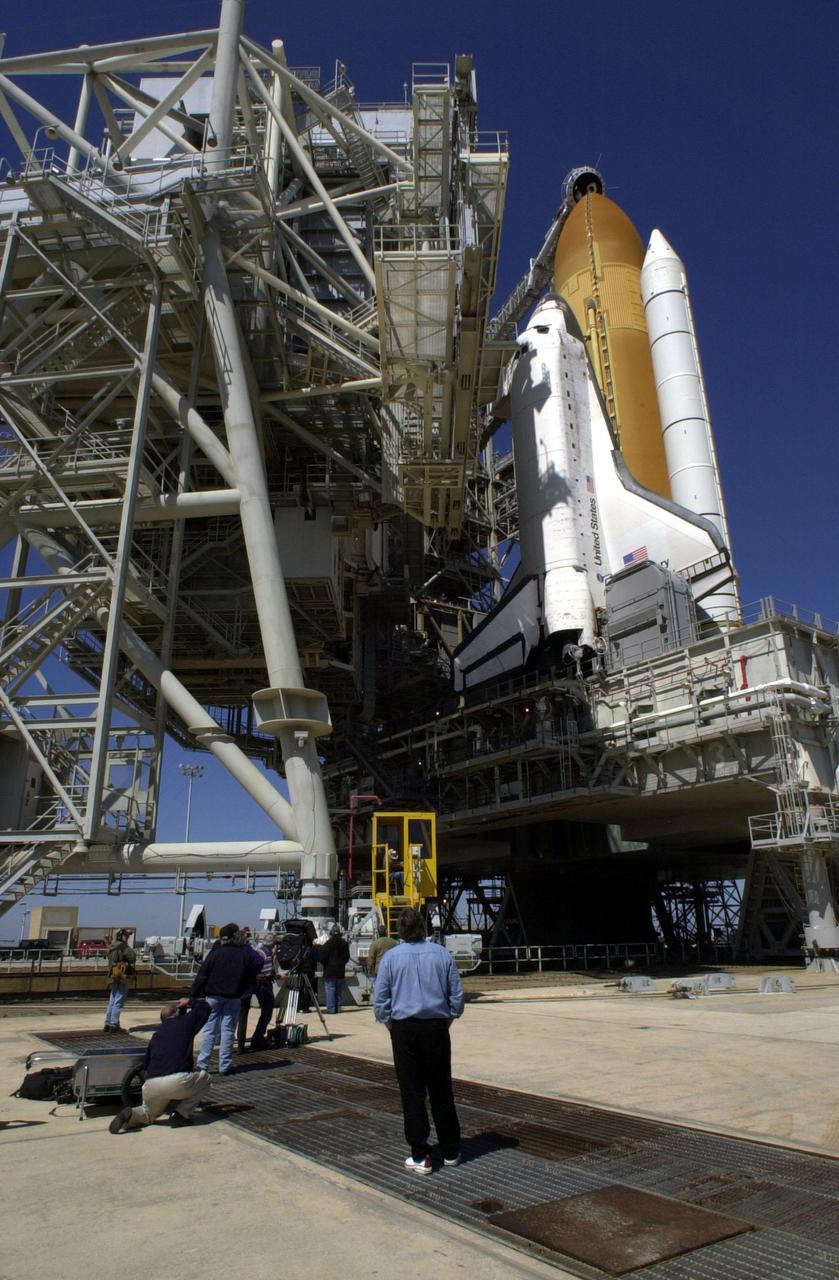
KENNEDY SPACE CENTER, Fla. -- Less than 24 hours before launch of STS-102, photographers capture the rollback of the Rotating Service Structure from around Space Shuttle Discovery on Launch Pad 39B. Poised above the external tank is the Gaseous Oxygen Vent Arm with the “beanie cap,” a vent hood. The RSS provides protected access to the orbiter for changeout and servicing of payloads. It is supported by a rotating bridge that pivots about a vertical axis on the west side of the pad’s flame trench. Space Shuttle Discovery is scheduled to launch March 8 at 6:42 a.m. EST on the eighth construction flight to the International Space Station. It carries the Multi-Purpose Logistics Module Leonardo, the primary delivery system used to resupply and return Station cargo requiring a pressurized environment. Leonardo will deliver up to 10 tons of laboratory racks filled with equipment, experiments and supplies for outfitting the newly installed U.S. Laboratory Destiny
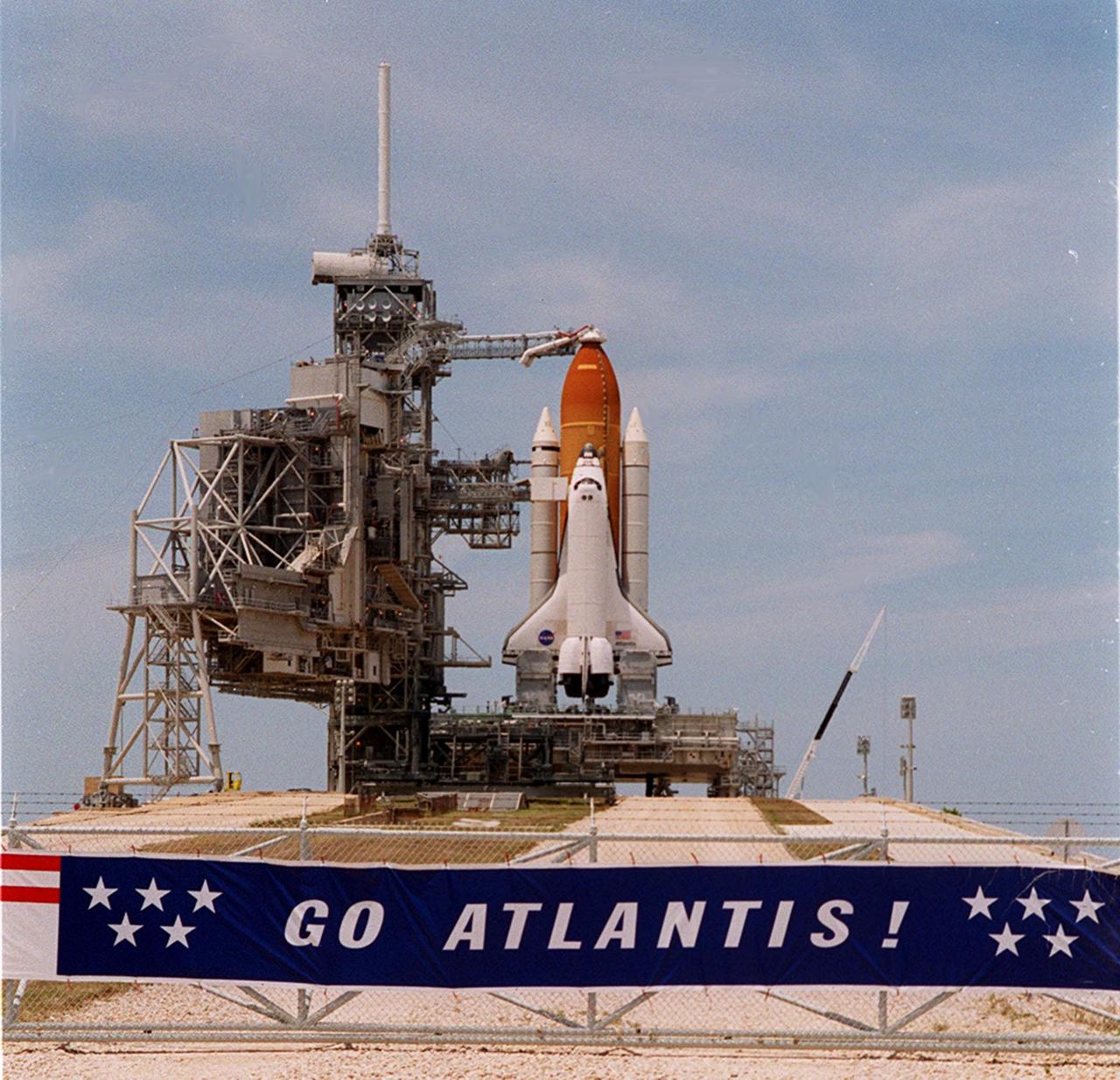
KENNEDY SPACE CENTER, Fla. -- After rollback of the Rotating Service Structure at Launch Pad 39A, Space Shuttle Atlantis awaits a fourth launch attempt on mission STS-101. At the top of the orange external tank can be seen the Gaseous Oxygen Vent Hood, often called the “beanie cap.” The hood helps vent gaseous oxygen vapors away from the Space Shuttle. The hood will be raised and retracted two and a half minutes before launch. Abutting the side of Atlantis is the orbiter access arm with the environmental chamber known as the White Room at the end. The White Room provides access to the crew compartment. This will be the third assembly flight to the International Space Station. Liftoff of Space Shuttle Atlantis for the 10-day mission is scheduled for about 6:12 a.m. EDT from Launch Pad 39A. Landing is targeted for May 29 at 2:19 a.m. EDT. This is the 98th Shuttle flight and the 21st flight for Shuttle Atlantis
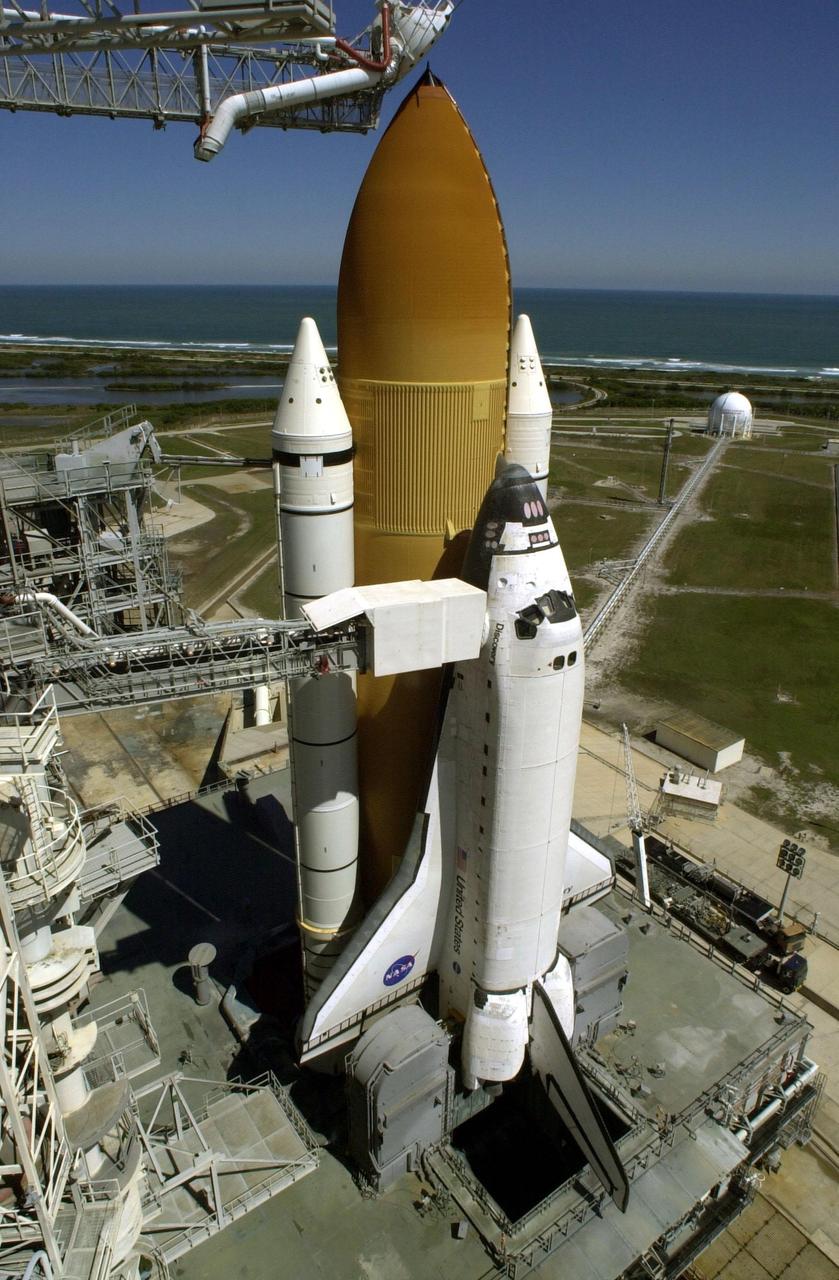
Space Shuttle Discovery sits poised on Launch Pad 39B, ready for launch at 6:42 a.m. EST March 8 on mission STS-102. Situated above the external tank is the Gaseous Oxygen Vent Arm with the “beanie cap,” a vent hood. The orbiter access arm is extended from the Fixed Service Structure (left) to the orbiter. An environmentally controlled chamber, known as the White Room, is at the end of the arm, providing entrance for the astronaut crew into the orbiter. In the distance, behind the Space Shuttle, can be seen the Atlantic Ocean. On this eighth construction flight to the International Space Station, Discovery carries the Multi-Purpose Logistics Module Leonardo, the primary delivery system used to resupply and return Station cargo requiring a pressurized environment. Leonardo will deliver up to 10 tons of laboratory racks filled with equipment, experiments and supplies for outfitting the newly installed U.S. Laboratory Destiny
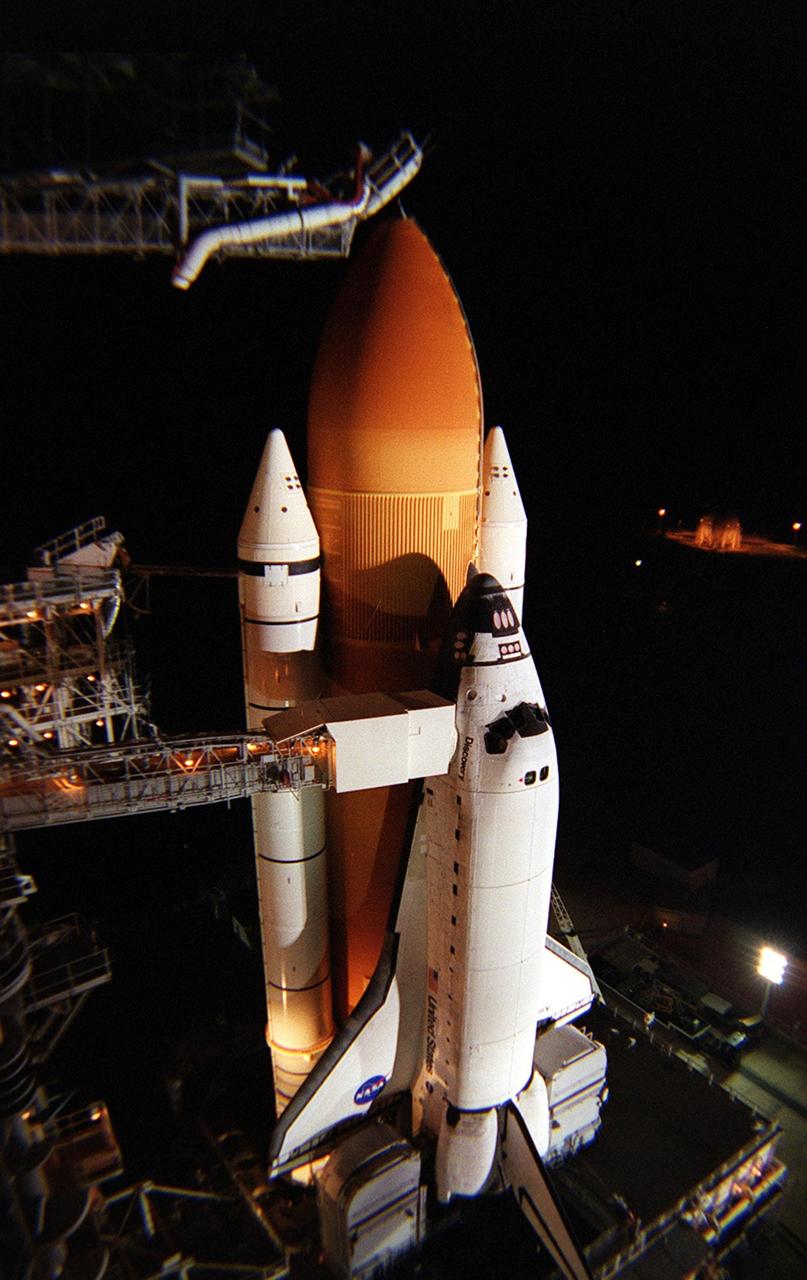
KENNEDY SPACE CENTER, Fla. -- Lights surrounding Launch Pad 39A create shadows from Space Shuttle Discovery after rollback of the Rotating Service Structure. Seen extending to the orbiter is the orbiter access arm, ending at the White Room, an environmental chamber that mates with the orbiter and allows personnel to enter the crew compartment. Above the external tank, the “beanie cap” is poised, waiting for loading of the propellants. The cap, or vent hood, is on the end of the gaseous oxygen vent arm that allows gaseous oxygen vapors to vent away from the Space Shuttle. On mission STS-105, Discovery will be transporting the Expedition Three crew and several scientific experiments and payloads to the International Space Station, including the Early Ammonia Servicer (EAS) tank. The EAS, which will support the thermal control subsystems until a permanent system is activated, will be attached to the Station during two spacewalks. The three-member Expedition Two crew will be returning to Earth aboard Discovery after a five-month stay on the Station. Launch is scheduled for 5:38 p.m. EDT Aug. 9
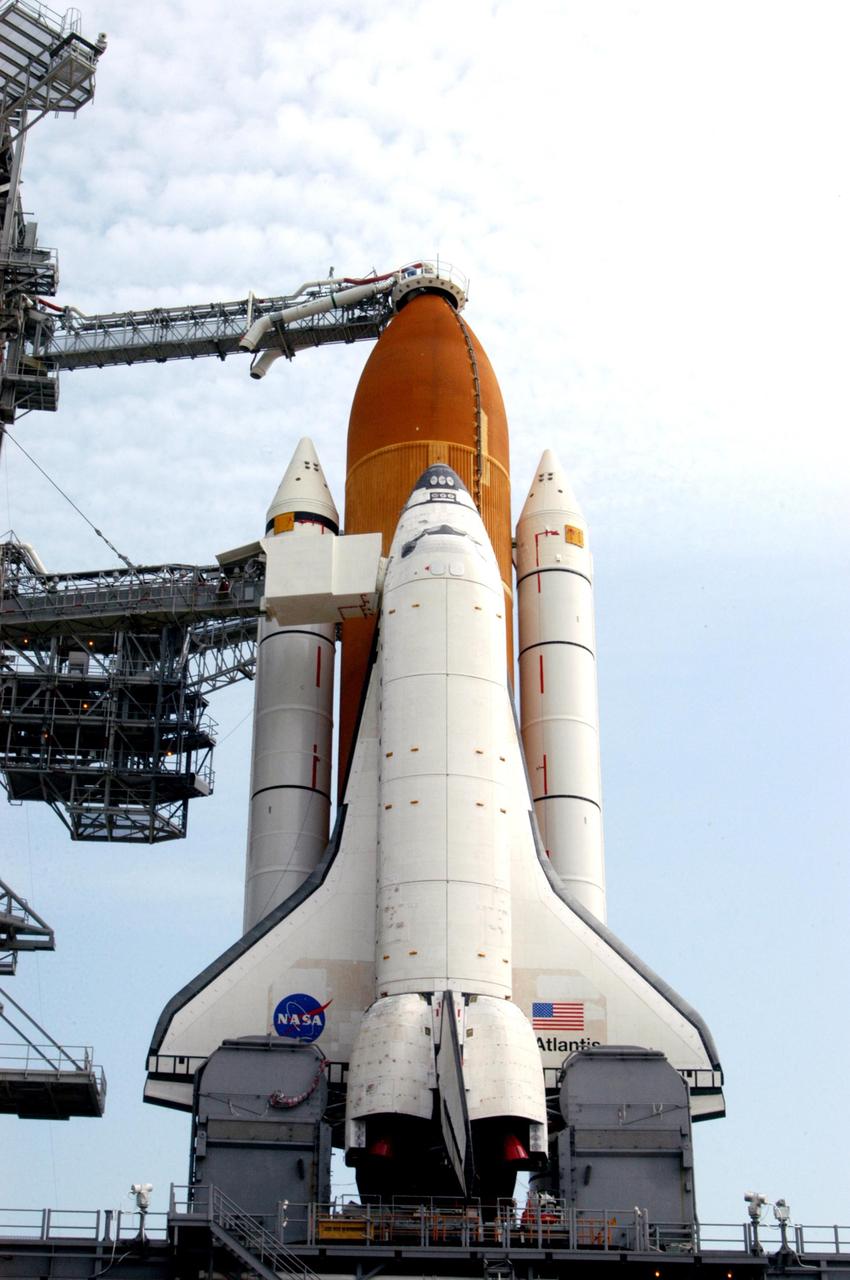
KENNEDY SPACE CENTER, FLA. - This closeup of Space Shuttle Atlantis on the hardstand of Launch Pad 39B shows the surrounding area, including the Atlantic Ocean in the background. Above the orange external tank is the "beanie cap" at the end of the external tank gaseous oxygen vent arm. The cap is a vent hood that vacuums away the very cold liquid oxygen vapors as they boil off from the top of the external tank before launch. Lower down is the orbiter access arm, with the White Room on the outer end, extended toward Atlantis' crew access hatch. The slow speed of the crawler results in a 6- to 8-hour trek to the pad approximately 4 miles away. Atlantis' launch window begins Aug. 27 for an 11-day mission to the International Space Station. The STS-115 crew of six astronauts will continue construction of the station and install their cargo, the Port 3/4 truss segment with its two large solar arrays. Photo credit: NASA/Troy Cryder & George Shelton
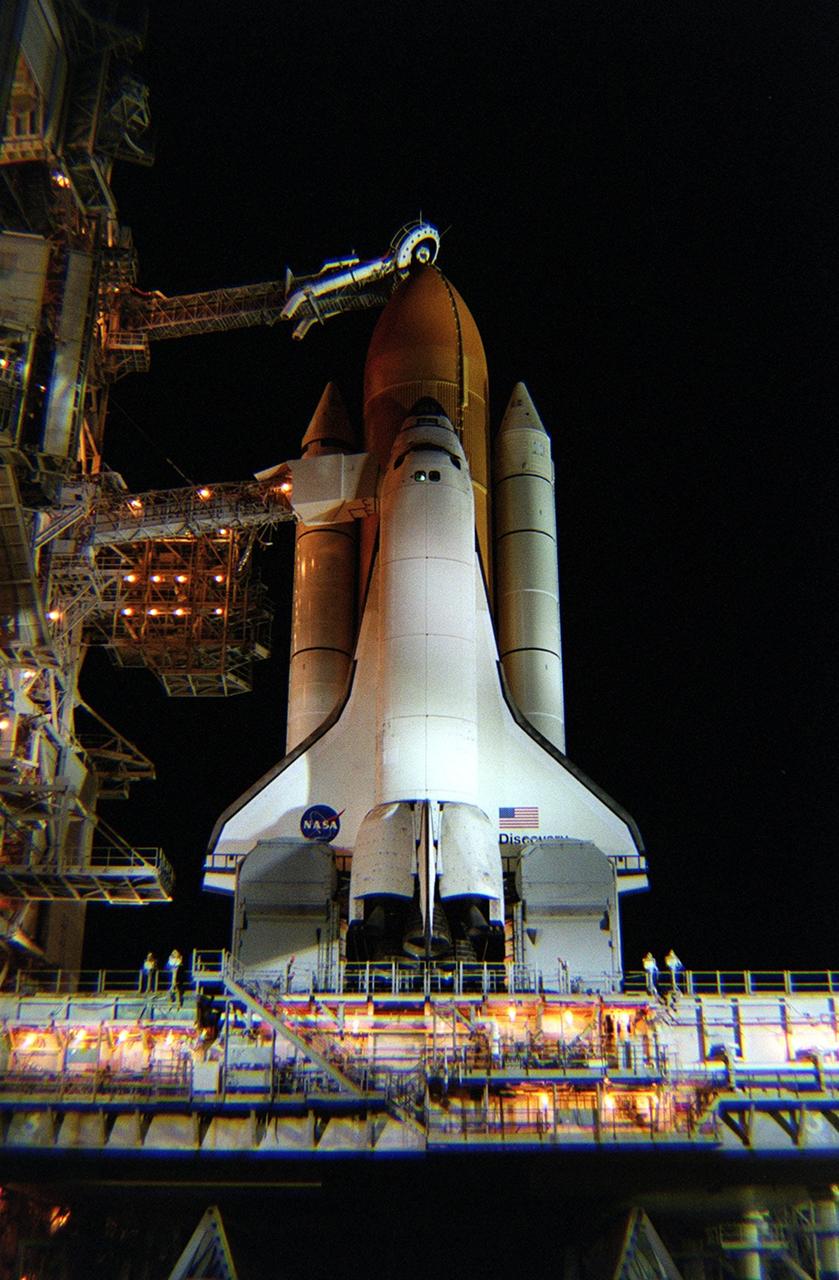
KENNEDY SPACE CENTER, Fla. -- Floodlights reveal the Space Shuttle Discovery after rollback of the Rotating Service Structure in preparation for launch on mission STS-105. Above the external tank, the “beanie cap” is poised, waiting for loading of the propellants. The cap, or vent hood, is on the end of the gaseous oxygen vent arm that allows gaseous oxygen vapors to vent away from the Space Shuttle. Below, on either side of the orbiter’s tail are the tail service masts that support the fluid, gas and electrical requirements of the orbiter’s liquid oxygen and liquid hydrogen aft T-0 umbilicals. On the mission, Discovery will be transporting the Expedition Three crew and several scientific experiments and payloads to the International Space Station, including the Early Ammonia Servicer (EAS) tank. The EAS, which will support the thermal control subsystems until a permanent system is activated, will be attached to the Station during two spacewalks. The three-member Expedition Two crew will be returning to Earth aboard Discovery after a five-month stay on the Station. Launch is scheduled for 5:38 p.m. EDT Aug. 9
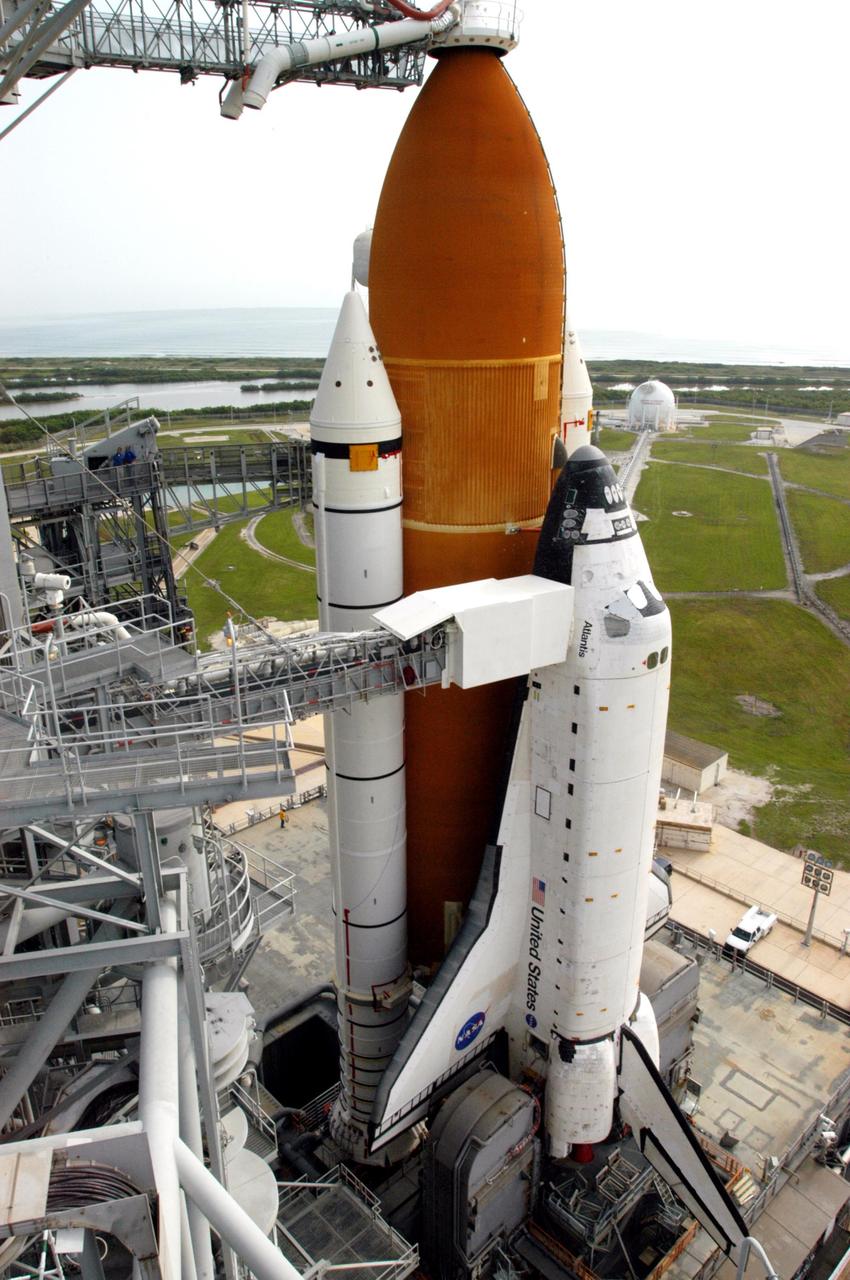
KENNEDY SPACE CENTER, FLA. - Space Shuttle Atlantis sits on the hardstand of Launch Pad 39B after its nearly 8-hour rollout from the Vehicle Assembly Building. The "beanie cap," at the end of the external tank gaseous oxygen vent arm, is extended over the top of the external tank. The cap is a vent hood that vacuums away the very cold liquid oxygen vapors as they boil off from the top of the external tank before launch. Lower down on the left is the orbiter access arm, with the White Room on the outer end, extended toward Atlantis' crew access hatch. Below the orbiter, on each side of the main engine nozzles, are the tail service masts that provide several umbilical connections to the orbiter, including a liquid-oxygen line through one and a liquid-hydrogen line through another. The slow speed of the crawler results in a 6- to 8-hour trek to the pad approximately 4 miles away. Atlantis' launch window begins Aug. 27 for an 11-day mission to the International Space Station. The STS-115 crew of six astronauts will continue construction of the station and install their cargo, the Port 3/4 truss segment with its two large solar arrays. Photo credit: NASA/Troy Cryder & George Shelton
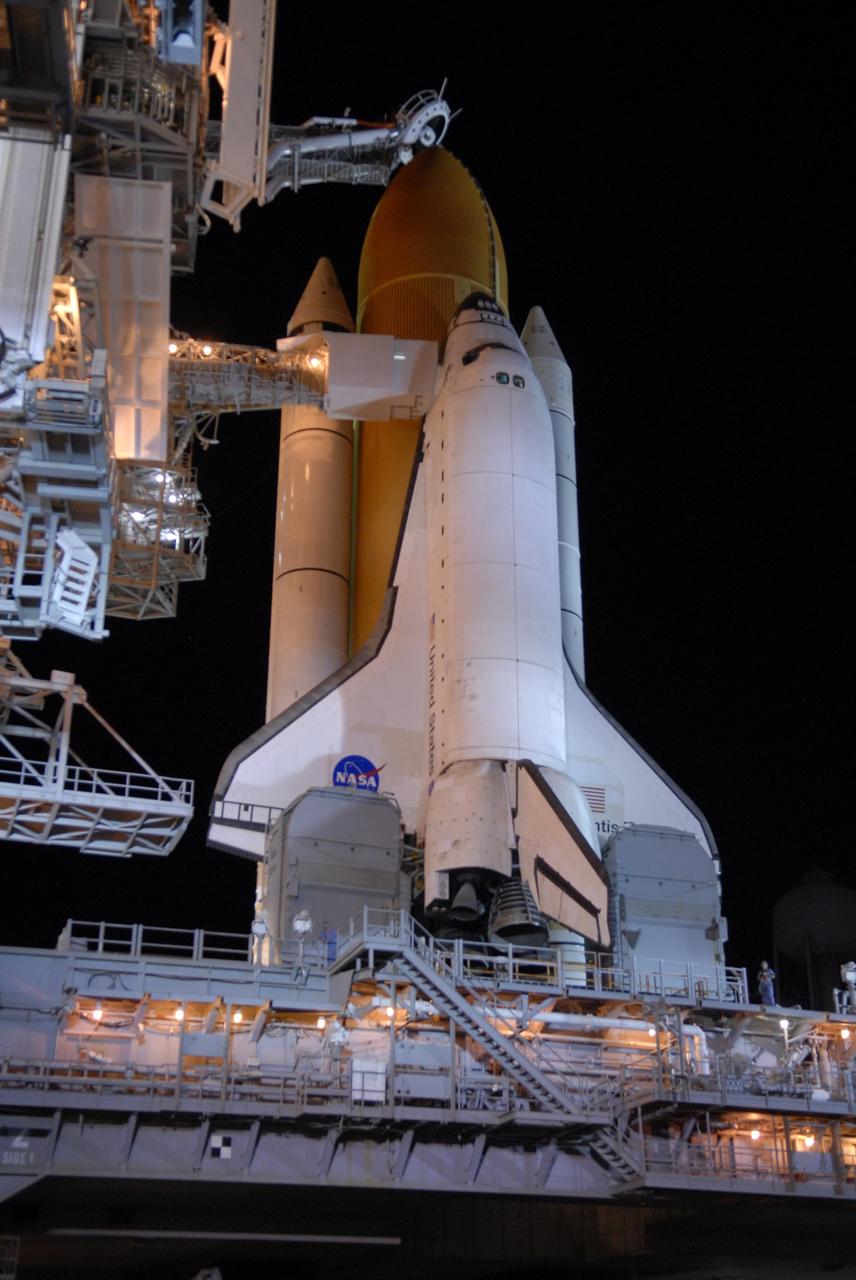
KENNEDY SPACE CENTER, FLA. -- Following rollback of the rotating service structure, or RSS, on Launch Pad 39A, Space Shuttle Atlantis stands bathed in lights atop a mobile launch platform. Rollback is one of the milestones in preparation for the launch of mission STS-117 on June 8. Rollback started at 10:56 p.m. and was complete at 11:34 p.m EDT. The RSS provides protected access to the orbiter for changeout and servicing of payloads at the pad. Connecting the RSS to the cockpit of the shuttle is the orbiter access arm with the White Room extended. The White Room provides access into the orbiter for the astronauts. Above the external tank is the vent hood (known as the "beanie cap") at the end of the gaseous oxygen vent arm. Vapors are created as the liquid oxygen in the external tank boil off. The hood vents the gaseous oxygen vapors away from the space shuttle vehicle. This mission is the 118th shuttle flight and the 21st U.S. flight to the International Space Station and will deliver and install the S3/S4 truss segment, deploy a set of solar arrays and prepare them for operation. Photo credit: NASA/Kim Shiflett
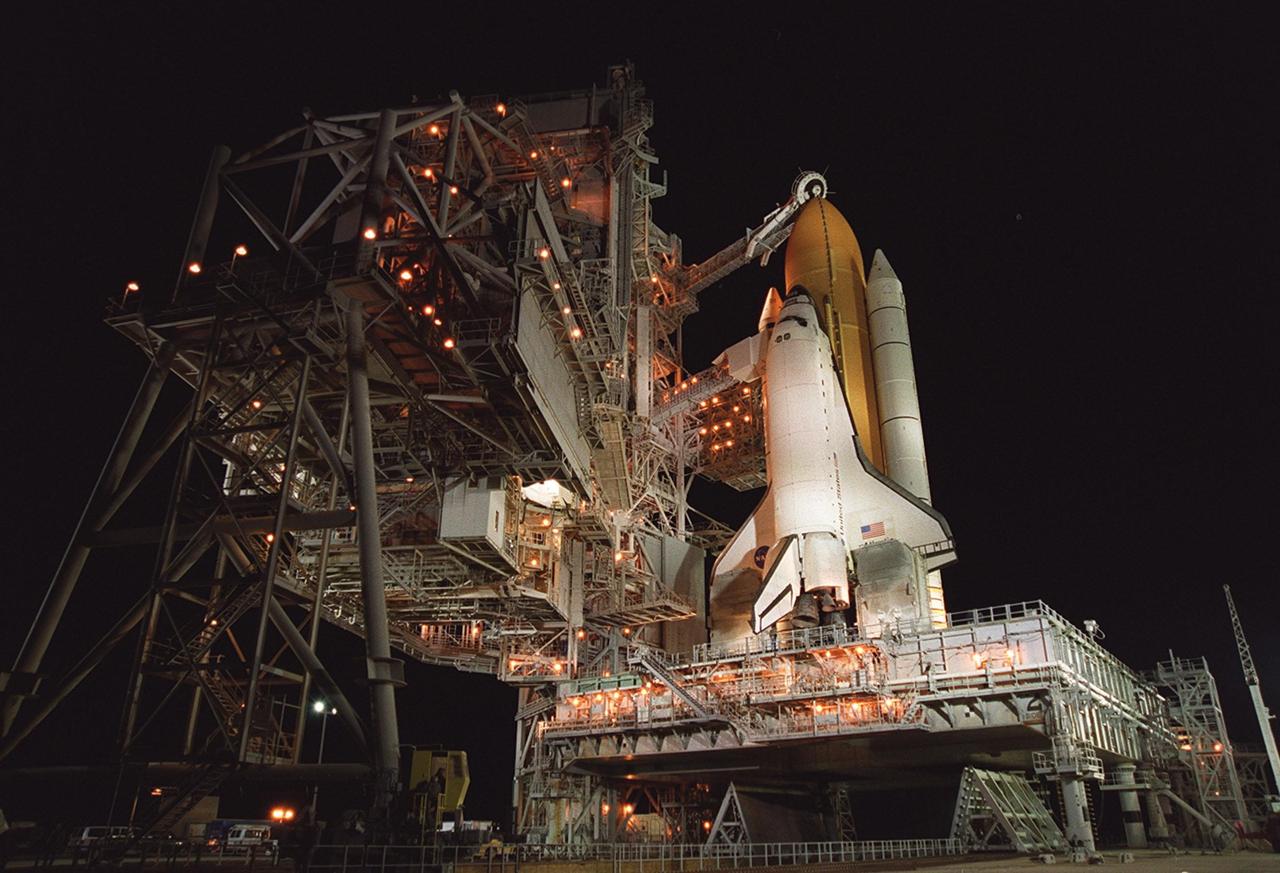
Space Shuttle Atlantis is revealed after rollback of the Rotating Service Structure. Extended to the side of Atlantis is the orbiter access arm, with the White Room at its end. The White Room is an environmentally controlled area that provides entry for the crew into Atlantis’s cockpit. Above the yellow-orange external tank is the Gaseous Oxygen Vent Arm, with the “beanie cap” vent hood raised. Before cryogenic loading, the hood will be lowered into position over the external tank vent louvers to vent gaseous oxygen vapors away from the Shuttle. Atlantis is carrying the U.S. Laboratory Destiny, a key module in the growth of the International Space Station. Destiny will be attached to the Unity node on the Space Station using the Shuttle’s robotic arm. Three spacewalks are required to complete the planned construction work during the 11-day mission. Launch is targeted for 6:11 p.m. EST and the planned landing at KSC Feb. 18 about 1:39 p.m. This mission marks the seventh Shuttle flight to the Space Station, the 23rd flight of Atlantis and the 102nd flight overall in NASA’s Space Shuttle program
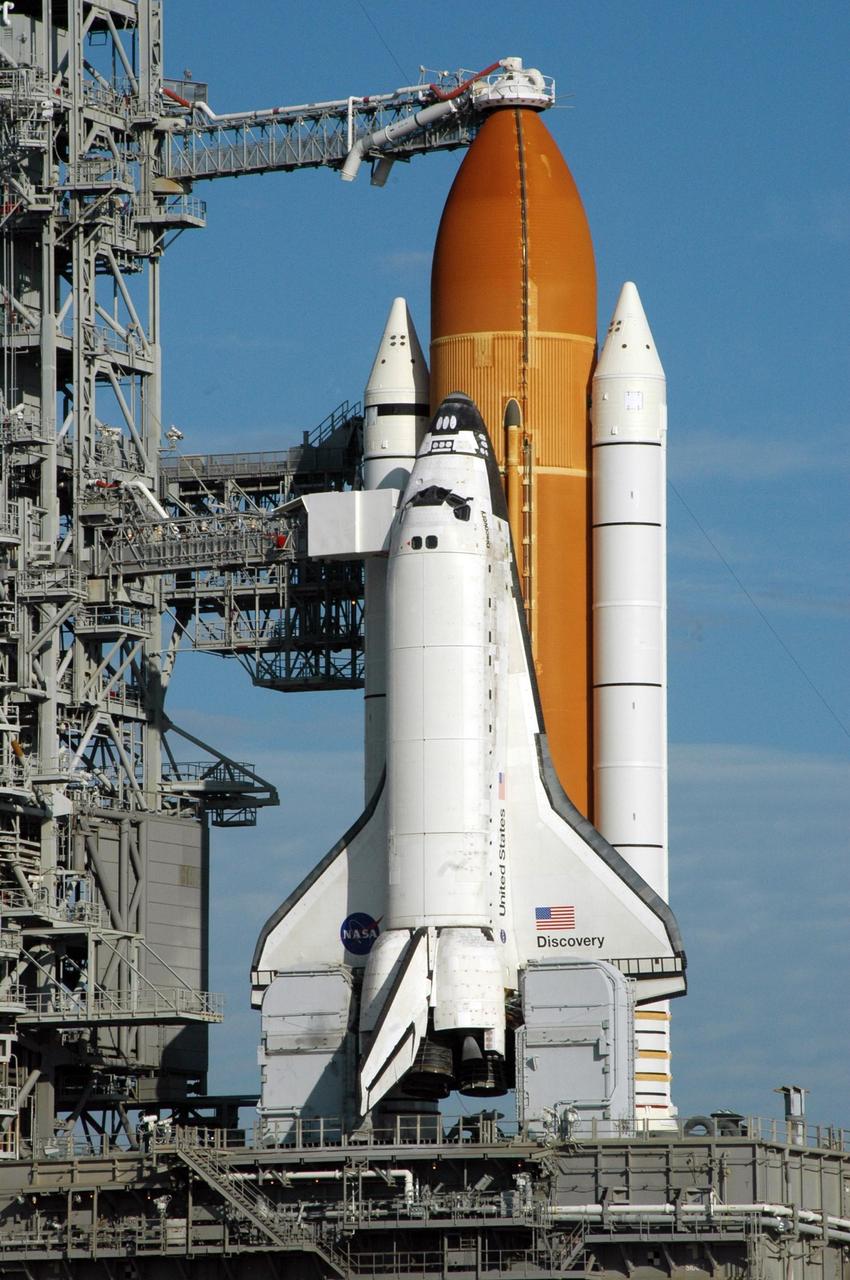
KENNEDY SPACE CENTER, FLA. -- Under a blue sky, Space Shuttle Discovery is ready for launch of mission STS-116 from Launch Pad 39B. Beneath Discovery's wings are the tail masts, which provide several umbilical connections to the orbiter, including a liquid-oxygen line through one and a liquid-hydrogen line through another. Seen above the golden external tank is the vent hood (known as the "beanie cap") at the end of the gaseous oxygen vent arm, extending from the FSS. Vapors are created as the liquid oxygen in the external tank boil off. The hood vents the gaseous oxygen vapors away from the space shuttle vehicle. Below it, also extending toward Discovery from the FSS, is the orbiter access arm with the White Room at the end. The crew gains access into the orbiter through the White Room. Discovery is scheduled to launch on mission STS-116 at 9:35 p.m. today. On the mission, the crew will deliver truss segment, P5, to the International Space Station and begin the intricate process of reconfiguring and redistributing the power generated by two pairs of U.S. solar arrays. The P5 will be mated to the P4 truss that was delivered and attached during the STS-115 mission in September. Photo credit: NASA/Ken Thornsley
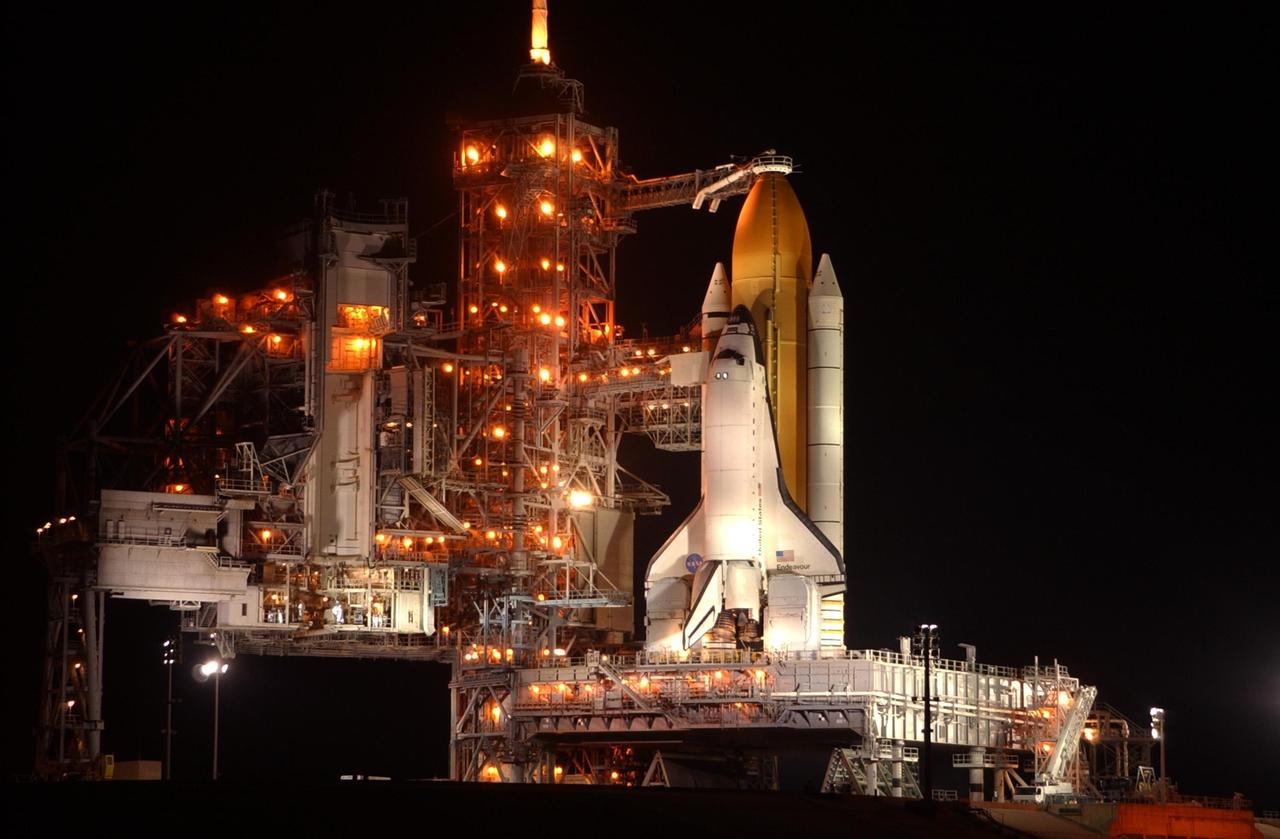
KENNEDY SPACE CENTER, FLA. -- Lights define the Fixed Service Structure on Launch Pad 39A where Space Shuttle Endeavour, also bathed in light, sits ready for launch atop the Mobile Launcher Platform. Seen above the orange external tank behind Endeavour is the "beanie cap," or vent hood assembly at the end of the gaseous oxygen vent arm. STS-111 is the second Utilization Flight to the International Space Station, carrying the Multi-Purpose Logistics Module Leonardo, the Mobile Base System (MBS), and a replacement wrist/roll joint for the Canadarm 2. Also onboard Space Shuttle Endeavour is the Expedition 5 crew who will replace Expedition 4 on board the Station. The MBS will be installed on the Mobile Transporter to complete the Canadian Mobile Servicing System, or MSS. The mechanical arm will then have the capability to "inchworm" from the U.S. Lab Destiny to the MSS and travel along the truss to work sites. Expedition 4 crew members will return to Earth with the STS-111 crew on Endeavour. Launch is scheduled for 7:44 p.m. EDT, May 30, 2002
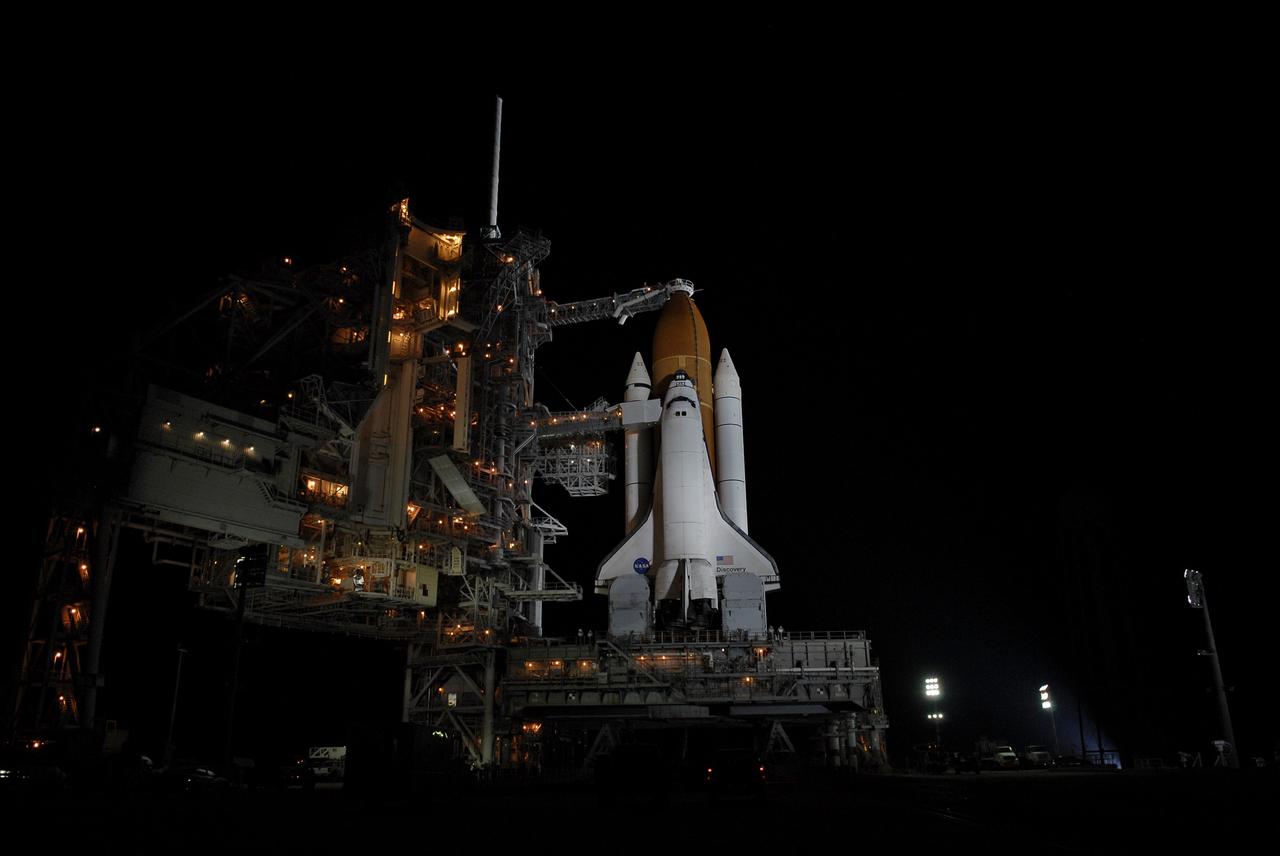
CAPE CANAVERAL, Fla. – Lights bathe space shuttle Discovery on Launch Pad 39A at NASA's Kennedy Space Center in Florida after rollback of the rotating service structure. The orbiter access arm and White Room are extended toward Discovery. The White Room provides crew access into the shuttle. Above the external tank is the oxygen vent hood, called the "beanie cap." The rollback is in preparation for Discovery's liftoff on the STS-119 mission with a crew of seven. The rotating structure provides protected access to the shuttle for changeout and servicing of payloads at the pad. After the RSS is rolled back, the orbiter is ready for fuel cell activation and external tank cryogenic propellant loading operations. The mission is the 28th to the International Space Station and the 125th space shuttle flight. Discovery will deliver the final pair of power-generating solar array wings and the S6 truss segment. Installation of S6 will signal the station's readiness to house a six-member crew for conducting increased science. Liftoff of Discovery is scheduled for 9:20 p.m. EDT on March 11. Photo credit: NASA/Kim Shiflett
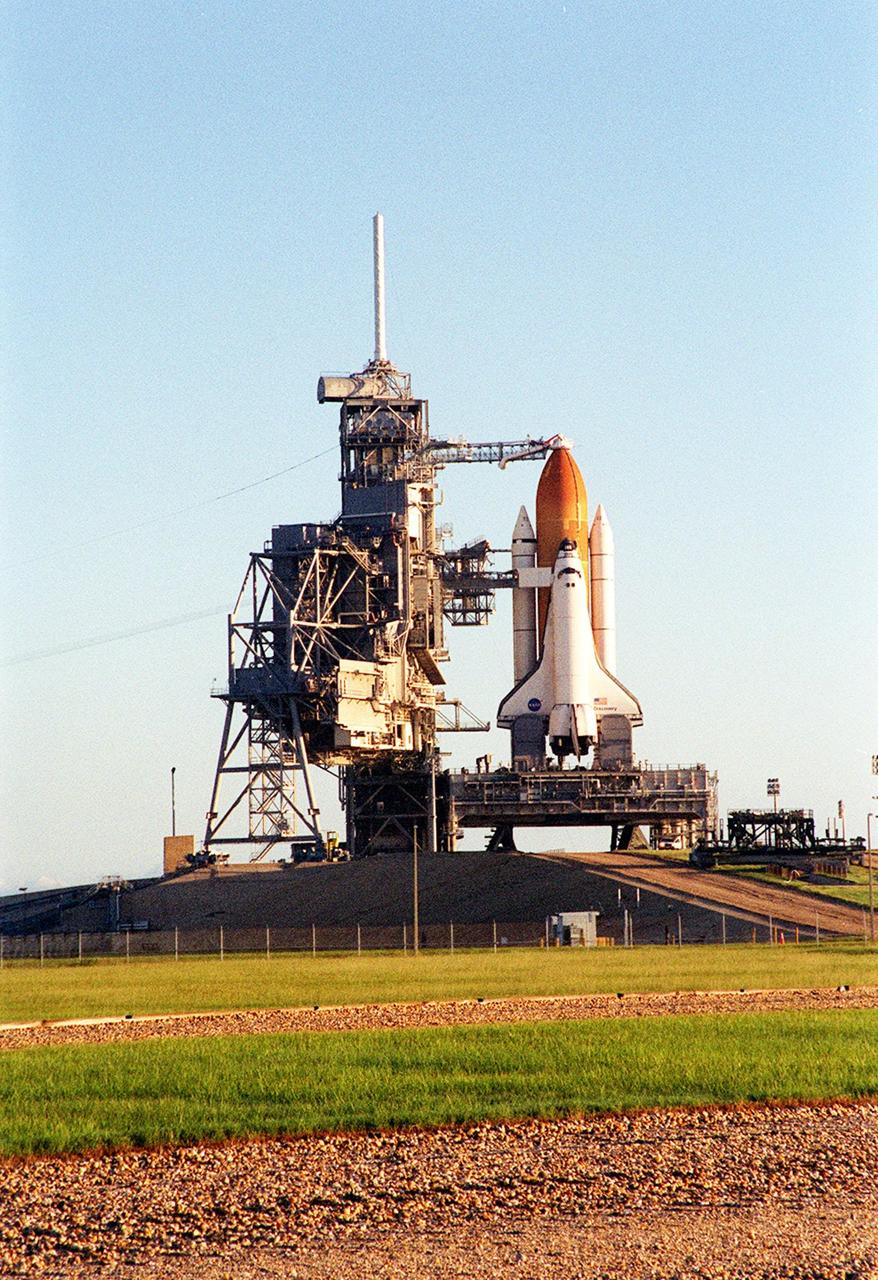
KENNEDY SPACE CENTER, Fla. -- An early morning shot of the Space Shuttle Discovery on the Mobile Launcher Platform and Launch Pad 39A. Discovery is being readied for the STS-92 mission launch to the International Space Station (ISS). At the top is the 13-foot-wide “beanie cap,” at the end of the Gaseous Oxygen Vent Arm, designed to vent gaseous oxygen vapors away from the Space Shuttle. Lower is the Orbiter Access Arm with the environmental chamber, known as the “white room,” extended to the orbiter. The chamber provides entry for the crew into the orbiter and also serves as emergency egress up to 7 minutes 24 seconds before launch. The STS-92 mission payload includes Integrated Truss Structure Z-1, an early exterior framework to allow the first U.S. solar arrays on a future flight to be temporarily installed on Unity for early power; Ku-band communication to support early science capability and U.S. television; and the third Pressurized Mating Adapter to provide a Shuttle docking port for solar array installation on the sixth ISS flight and Lab installation on the seventh ISS flight. The 11-day mission will include four spacewalks. Liftoff is scheduled for Oct. 6 at 9:16 p.m. EDT
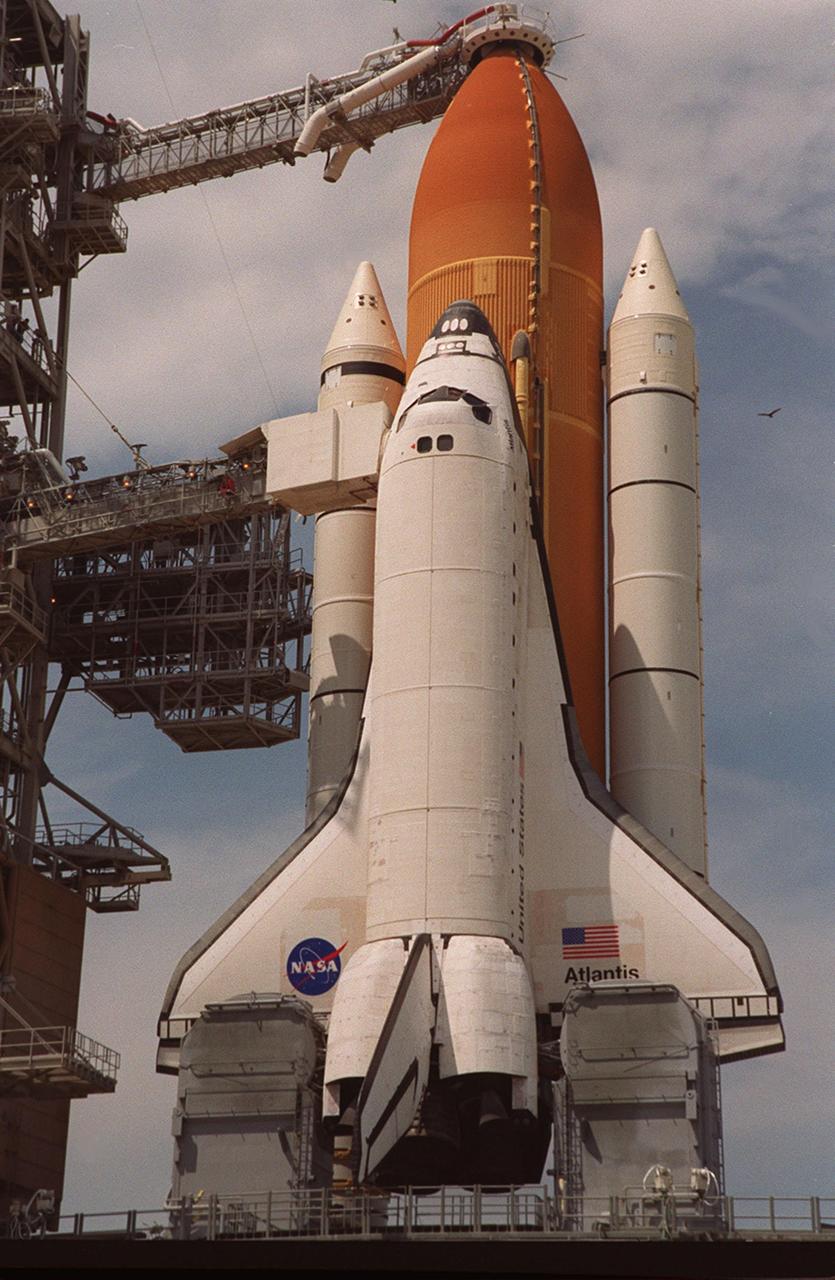
KENNEDY SPACE CENTER, Fla. -- Clouds hover overhead the Space Shuttle Atlantis after rollback of the Rotating Service Structure. On top of the external tank is the 13-foot-wide “beanie cap,” at the end of the Gaseous Oxygen Vent Arm, designed to vent gaseous oxygen vapors away from the Space Shuttle. Lower is the Orbiter Access Arm with the environmental chamber, known as the “white room,” extended to the orbiter. The chamber provides entry for the crew into the orbiter and also serves as emergency egress up to 7 minutes 24 seconds before launch. Ready for launch of mission STS-106 at 8:45 a.m. EDT on Sept. 8, Atlantis carries supplies to prepare the Russian Zvezda living quarters on the International Space Station for the first long-duration crew. The crew will also be transferring supplies from the Russian Progress resupply ship already docked to the aft of Zvezda. The fourth U.S. launch for the Space Station, the mission is expected to last 10 days, 19 hours and 9 minutes, landing at KSC 4:59 a.m. EDT on Sept. 19
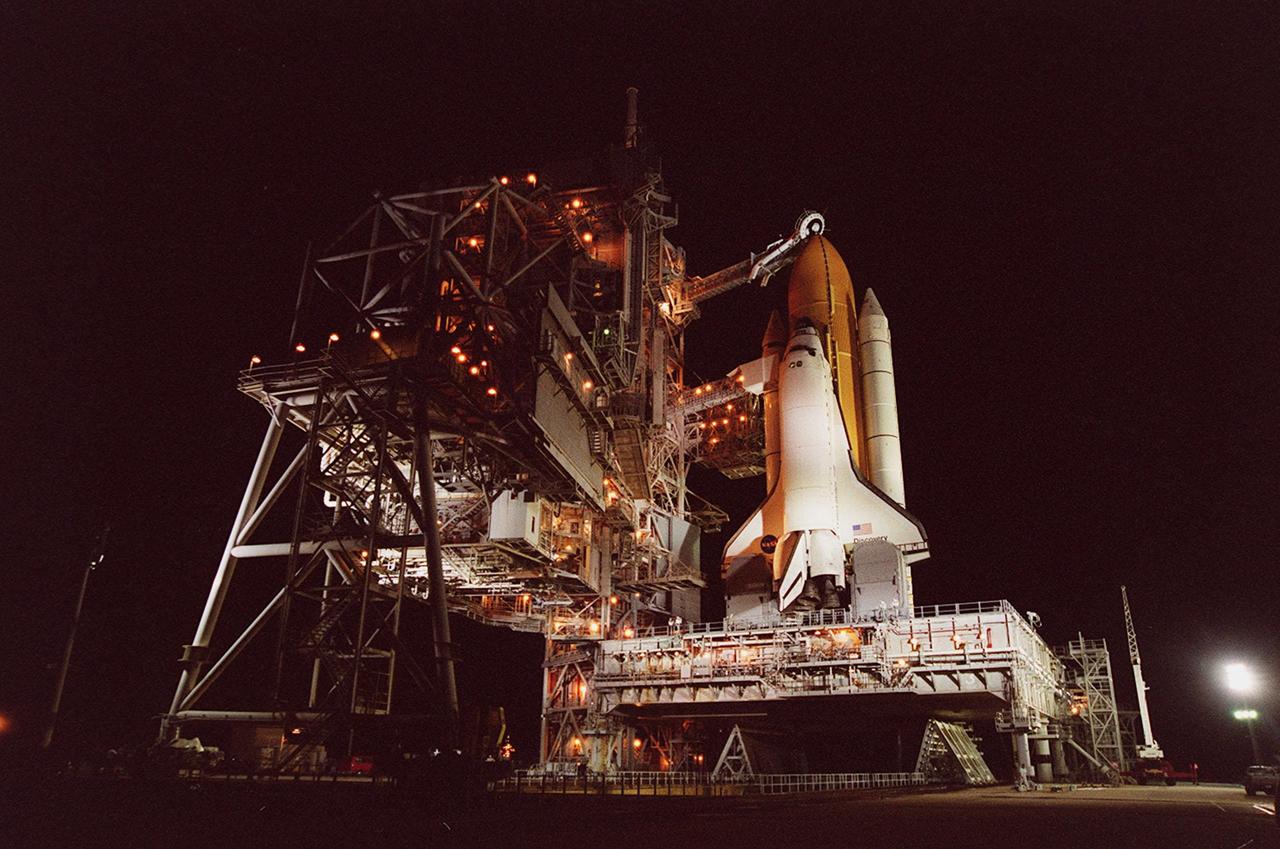
KENNEDY SPACE CENTER, Fla. -- With the Rotating Service Structure rolled back, Space Shuttle Discovery is revealed on the Mobile Launcher Platform at Launch Pad 39A. Discovery is being readied for the STS-92 mission launch to the International Space Station (ISS). At the top is the 13-foot-wide “beanie cap,” at the end of the Gaseous Oxygen Vent Arm, designed to vent gaseous oxygen vapors away from the Space Shuttle. Lower is the Orbiter Access Arm with the environmental chamber, known as the “white room,” extended to the orbiter. The chamber provides entry for the crew into the orbiter and also serves as emergency egress up to 7 minutes 24 seconds before launch. The STS-92 mission payload includes Integrated Truss Structure Z-1, an early exterior framework to allow the first U.S. solar arrays on a future flight to be temporarily installed on Unity for early power; Ku-band communication to support early science capability and U.S. television; and the third Pressurized Mating Adapter to provide a Shuttle docking port for solar array installation on the sixth ISS flight and Lab installation on the seventh ISS flight. The 11-day mission will include four spacewalks. Liftoff is scheduled for Oct. 6 at 9:16 p.m. EDT

KENNEDY SPACE CENTER, Fla. -- Clouds hover overhead the Space Shuttle Atlantis after rollback of the Rotating Service Structure. On top of the external tank is the 13-foot-wide “beanie cap,” at the end of the Gaseous Oxygen Vent Arm, designed to vent gaseous oxygen vapors away from the Space Shuttle. Lower is the Orbiter Access Arm with the environmental chamber, known as the “white room,” extended to the orbiter. The chamber provides entry for the crew into the orbiter and also serves as emergency egress up to 7 minutes 24 seconds before launch. Ready for launch of mission STS-106 at 8:45 a.m. EDT on Sept. 8, Atlantis carries supplies to prepare the Russian Zvezda living quarters on the International Space Station for the first long-duration crew. The crew will also be transferring supplies from the Russian Progress resupply ship already docked to the aft of Zvezda. The fourth U.S. launch for the Space Station, the mission is expected to last 10 days, 19 hours and 9 minutes, landing at KSC 4:59 a.m. EDT on Sept. 19
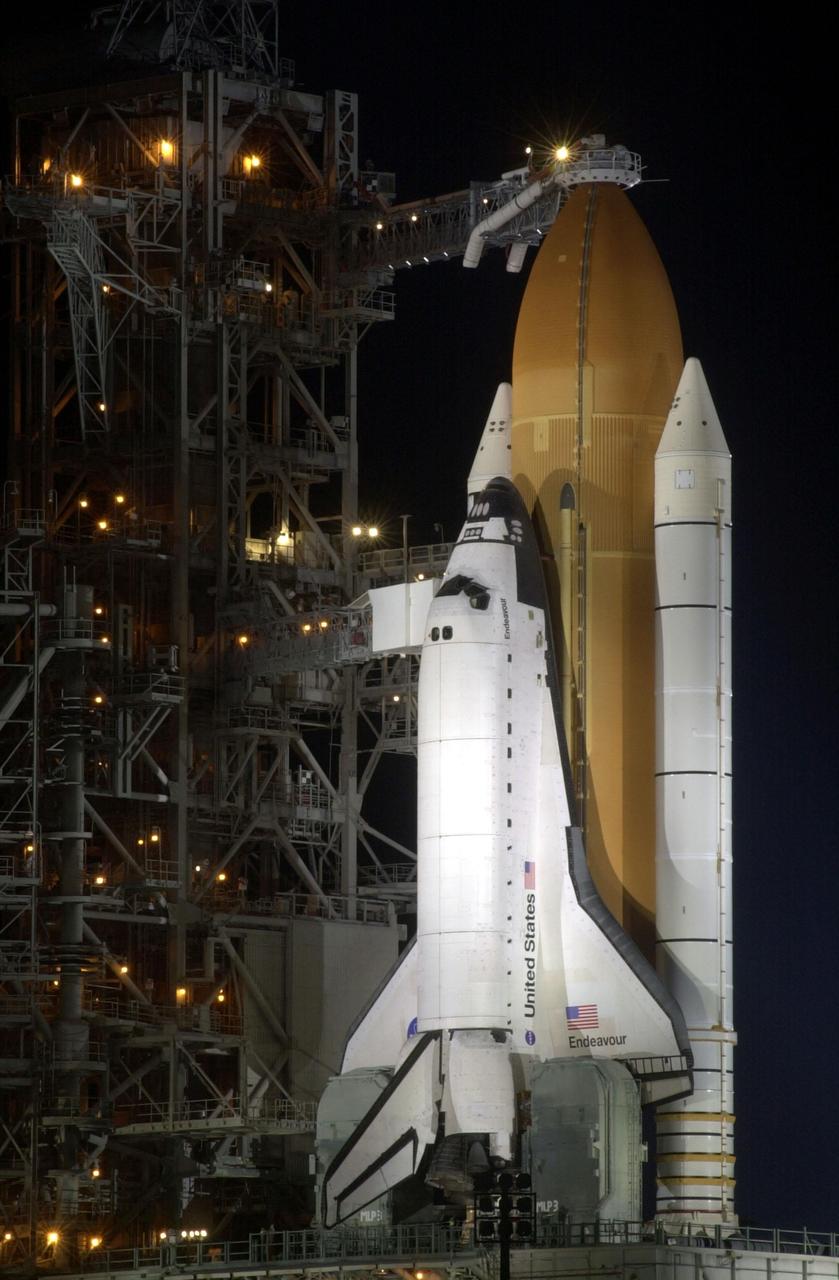
KENNEDY SPACE CENTER, Fla. -- After rollback of the Rotating Service Structure at Launch Pad 39A, Space Shuttle Endeavour, mated with its solid rocket boosters (left and right) and external tank (center), is bathed in light, ready for launch on mission STS-99. On top of the external tank, a light gleams like a star on the 13-foot-wide Gaseous Oxygen Vent Hood, often called the "beanie cap." The hood helps vent gaseous oxygen vapors away from the Space Shuttle. The hood will be raised and retracted two and a half minutes before launch. STS-99, known as the Shuttle Radar Topography Mission (SRTM), is scheduled for liftoff at 12:30 p.m. EST from Launch Pad 39A. The SRTM will chart a new course to produce unrivaled 3-D images of the Earth's surface. The result of the mission could be close to 1 trillion measurements of the Earth's topography. The mission is expected to last about 11days, with Endeavour landing at KSC Tuesday, Feb. 22, at 4:36 p.m. EST. This is the 97th Shuttle flight and 14th for Shuttle Endeavour
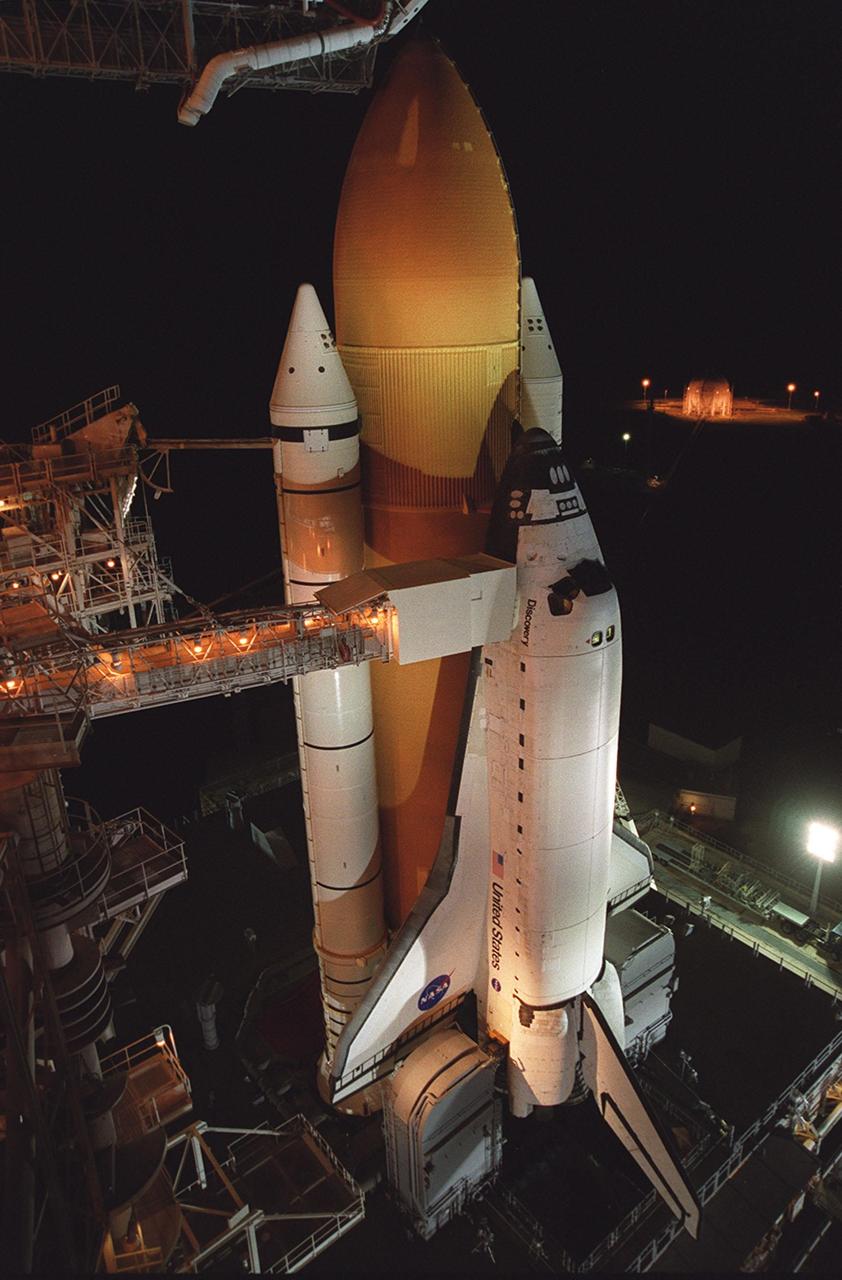
KENNEDY SPACE CENTER, Fla. -- With the Rotating Service Structure rolled back, Space Shuttle Discovery is revealed on the Mobile Launcher Platform at Launch Pad 39A. Discovery is being readied for the STS-92 mission launch to the International Space Station (ISS). At the top is the 13-foot-wide “beanie cap,” at the end of the Gaseous Oxygen Vent Arm, designed to vent gaseous oxygen vapors away from the Space Shuttle. Lower is the Orbiter Access Arm with the environmental chamber, known as the “white room,” extended to the orbiter. The chamber provides entry for the crew into the orbiter and also serves as emergency egress up to 7 minutes 24 seconds before launch. The STS-92 mission payload includes Integrated Truss Structure Z-1, an early exterior framework to allow the first U.S. solar arrays on a future flight to be temporarily installed on Unity for early power; Ku-band communication to support early science capability and U.S. television; and the third Pressurized Mating Adapter to provide a Shuttle docking port for solar array installation on the sixth ISS flight and Lab installation on the seventh ISS flight. The 11-day mission will include four spacewalks. Liftoff is scheduled for Oct. 6 at 9:16 p.m. EDT
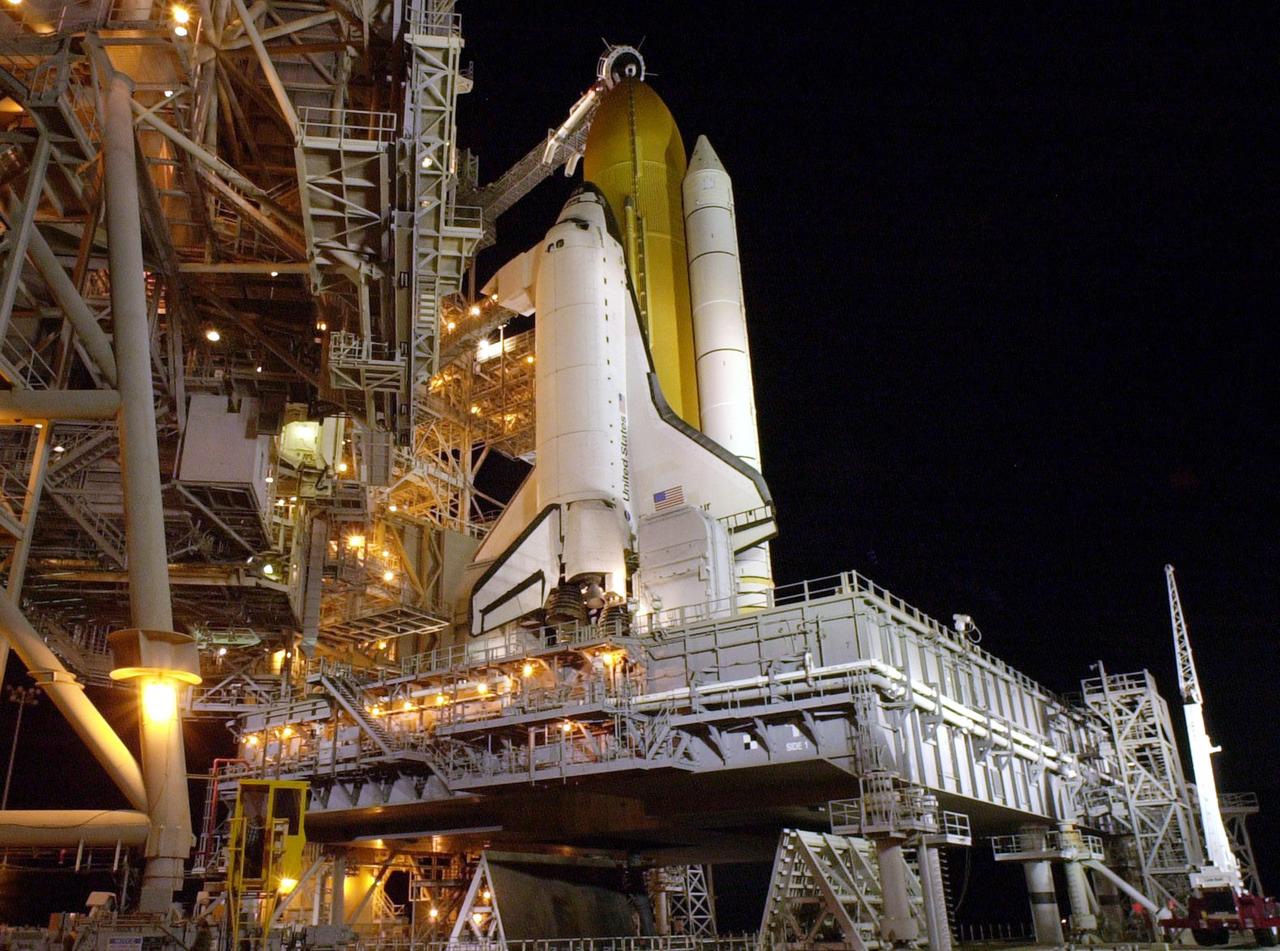
KENNEDY SPACE CENTER, Fla. -- Space Shuttle Endeavour is revealed after rollback of the Rotating Service Structure on Launch Pad 39B. Seen is one of the twin solid rocket boosters that flank the orange external tank. Above the external tank is the Gaseous Oxygen Vent Arm that vents gaseous oxygen vapors away from the Shuttle. The vent hood assembly at the end is often referred to as the "beanie cap." Stretching to the crew hatch on the side is the Orbiter Access Arm with its environmentally controlled White Room at the end. The Shuttle sits on the Mobile Launcher Platform with the two service tail masts on either side of the main engines. The tail masts support the fluid, gas and electrical requirements of the orbiter's liquid oxygen and liquid hydrogen aft T-0 umbilicals. Each tail mast is 31 feet (9.4 meters) high, 15 feet (4.6 meters) long and 9 feet (3.1 meters) wide. Endeavour is scheduled to launch on mission STS-108 Nov. 29 at 7:41 p.m. On this 12th flight to the International Space Station, known as a Utilization Flight, Endeavour will carry a crew of four plus the Expedition 4 crew, who will replace Expedition 3 aboard the ISS. The payload includes the Multi-Purpose Logistics Module Raffaello, filled with supplies, equipment and experiments
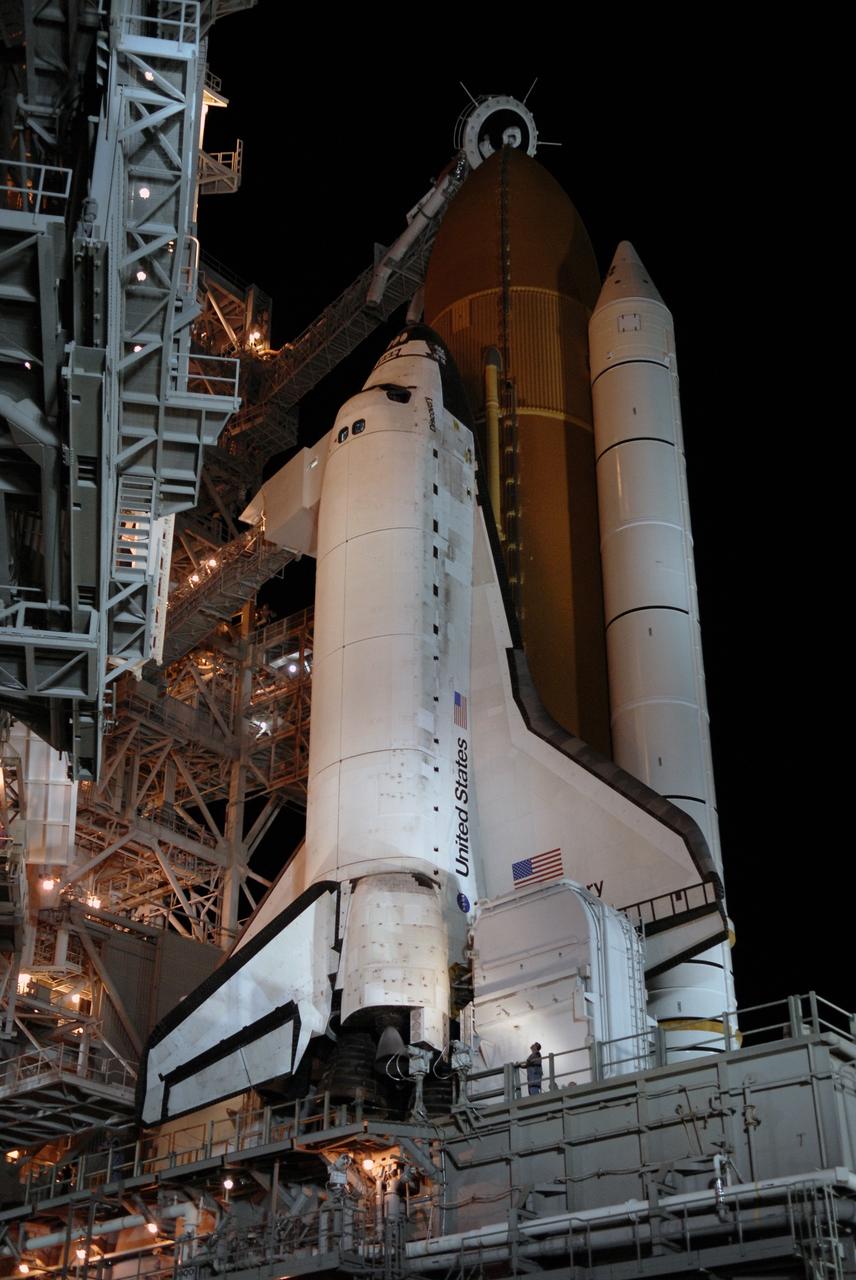
CAPE CANAVERAL, Fla. – On Launch Pad 39A at NASA's Kennedy Space Center in Florida, the orbiter access arm and White Room are extended toward space shuttle Discovery after rollback of the rotating service structure. Above the external tank is the oxygen vent hood, called the "beanie cap." The rollback is in preparation for Discovery's liftoff on the STS-119 mission with a crew of seven. The rotating structure provides protected access to the shuttle for changeout and servicing of payloads at the pad. After the RSS is rolled back, the orbiter is ready for fuel cell activation and external tank cryogenic propellant loading operations. The mission is the 28th to the International Space Station and the 125th space shuttle flight. Discovery will deliver the final pair of power-generating solar array wings and the S6 truss segment. Installation of S6 will signal the station's readiness to house a six-member crew for conducting increased science. Liftoff of Discovery is scheduled for 9:20 p.m. EDT on March 11. Photo credit: NASA/Kim Shiflett
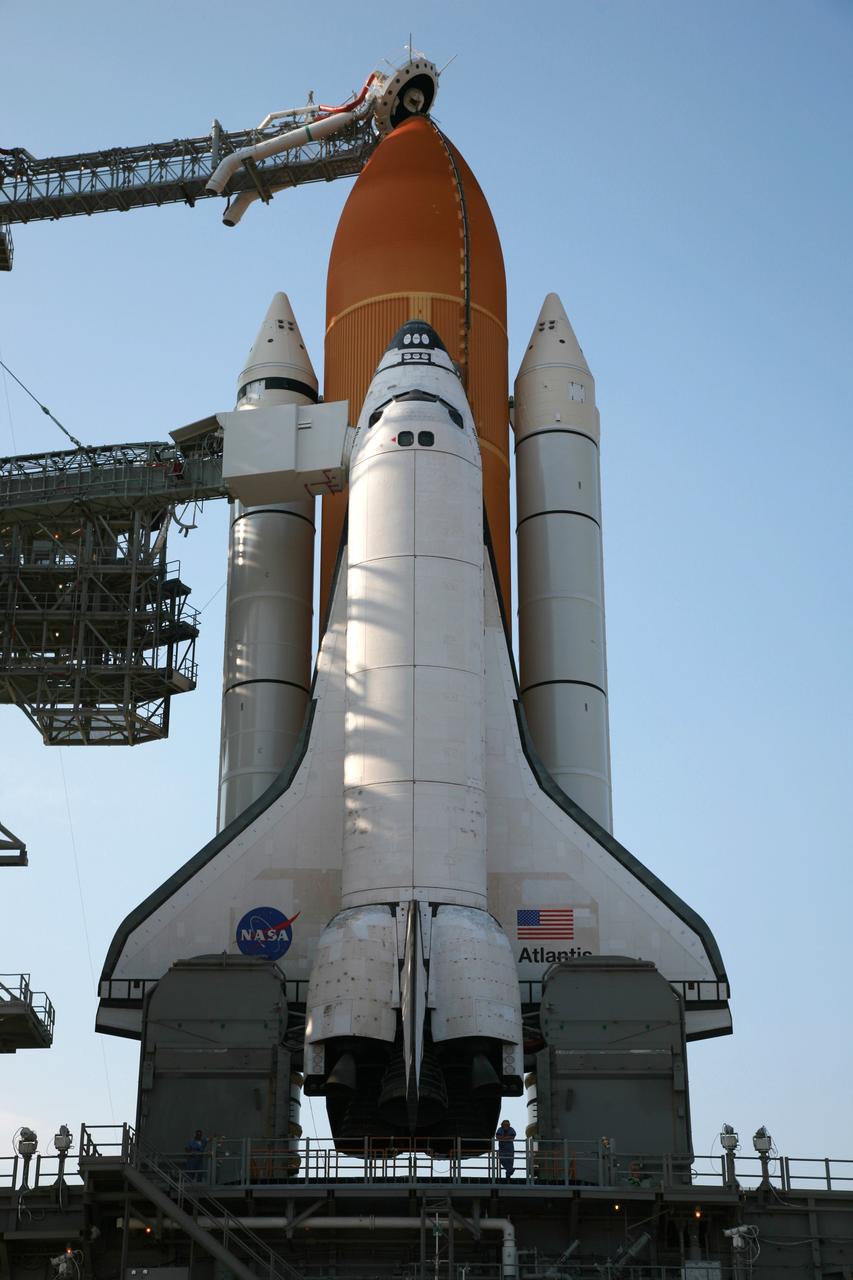
CAPE CANAVERAL, Fla. – On Launch Pad 39A at NASA's Kennedy Space Center in Florida, the oxygen vent hood, called the "beanie cap," is positioned above the external tank of space shuttle Atlantis following the rollback of the rotating service structure, or RSS. The RSS is retracted in preparation for Atlantis’ liftoff on the STS-125 mission to service NASA's Hubble Space Telescope. The rotating structure provides protected access to the shuttle for changeout and servicing of payloads at the pad. After the RSS is rolled back, the orbiter is ready for fuel cell activation and external tank cryogenic propellant loading operations. Atlantis' crew will service NASA's Hubble Space Telescope for the fifth and final time. The flight will include five spacewalks during which astronauts will refurbish and upgrade the telescope with state-of-the-art science instruments. As a result, Hubble's capabilities will be expanded and its operational lifespan extended through at least 2014. Launch is scheduled for 2:01 p.m. EDT on May 11. Photo credit: NASA/Dimitri Gerondidakis
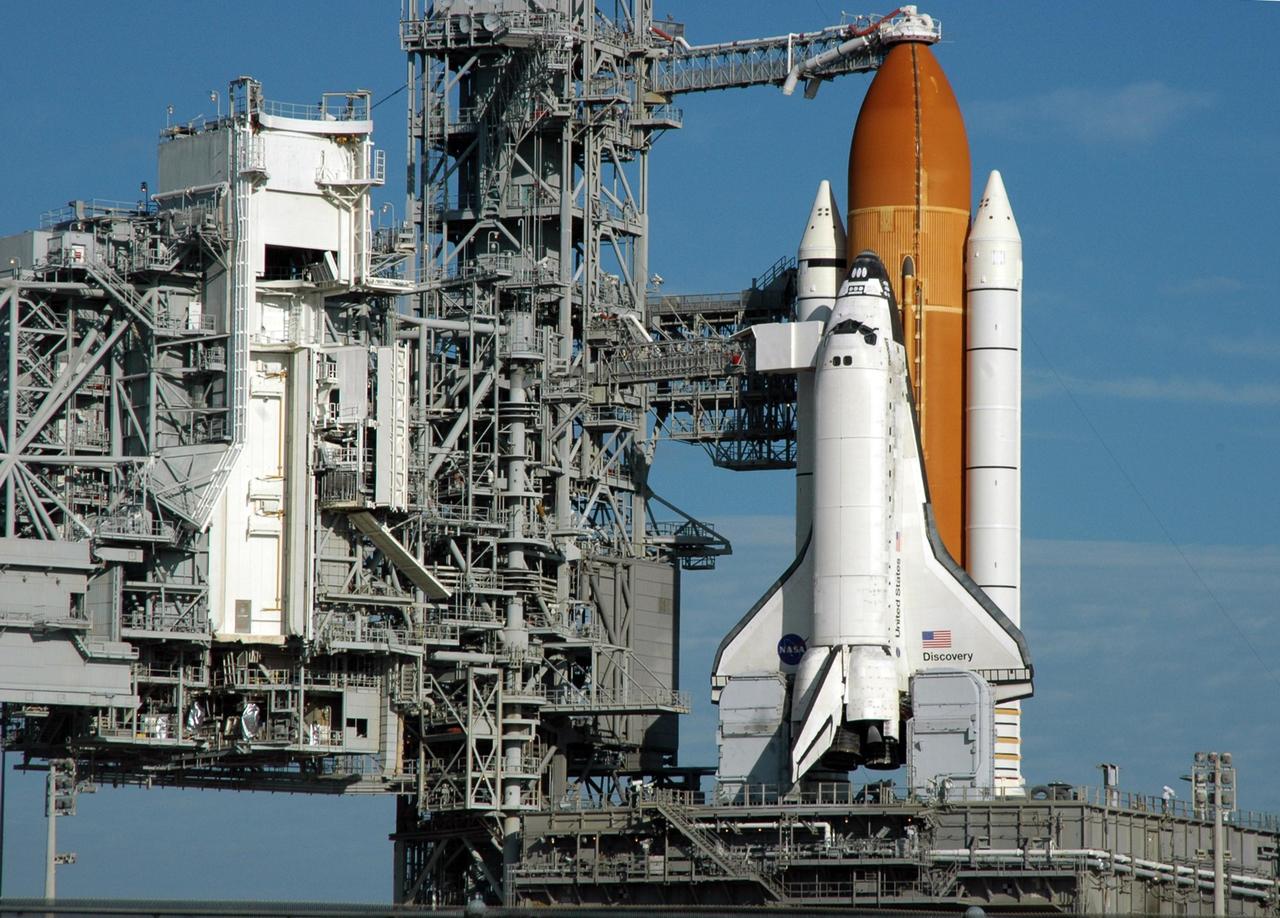
KENNEDY SPACE CENTER, FLA. -- Under a clear blue sky, Space Shuttle Discovery is ready for launch of mission STS-116 from Launch Pad 39B. At far left is the rotating service structure, rolled back to enable launch. Beneath Discovery's wings are the tail masts, which provide several umbilical connections to the orbiter, including a liquid-oxygen line through one and a liquid-hydrogen line through another. Seen above the golden external tank is the vent hood (known as the "beanie cap") at the end of the gaseous oxygen vent arm, extending from the FSS. Vapors are created as the liquid oxygen in the external tank boil off. The hood vents the gaseous oxygen vapors away from the space shuttle vehicle. Below it, also extending toward Discovery from the FSS, is the orbiter access arm with the White Room at the end. The crew gains access into the orbiter through the White Room. Discovery is scheduled to launch on mission STS-116 at 9:35 p.m. today. On the mission, the crew will deliver truss segment, P5, to the International Space Station and begin the intricate process of reconfiguring and redistributing the power generated by two pairs of U.S. solar arrays. The P5 will be mated to the P4 truss that was delivered and attached during the STS-115 mission in September. Photo credit: NASA/Ken Thornsley
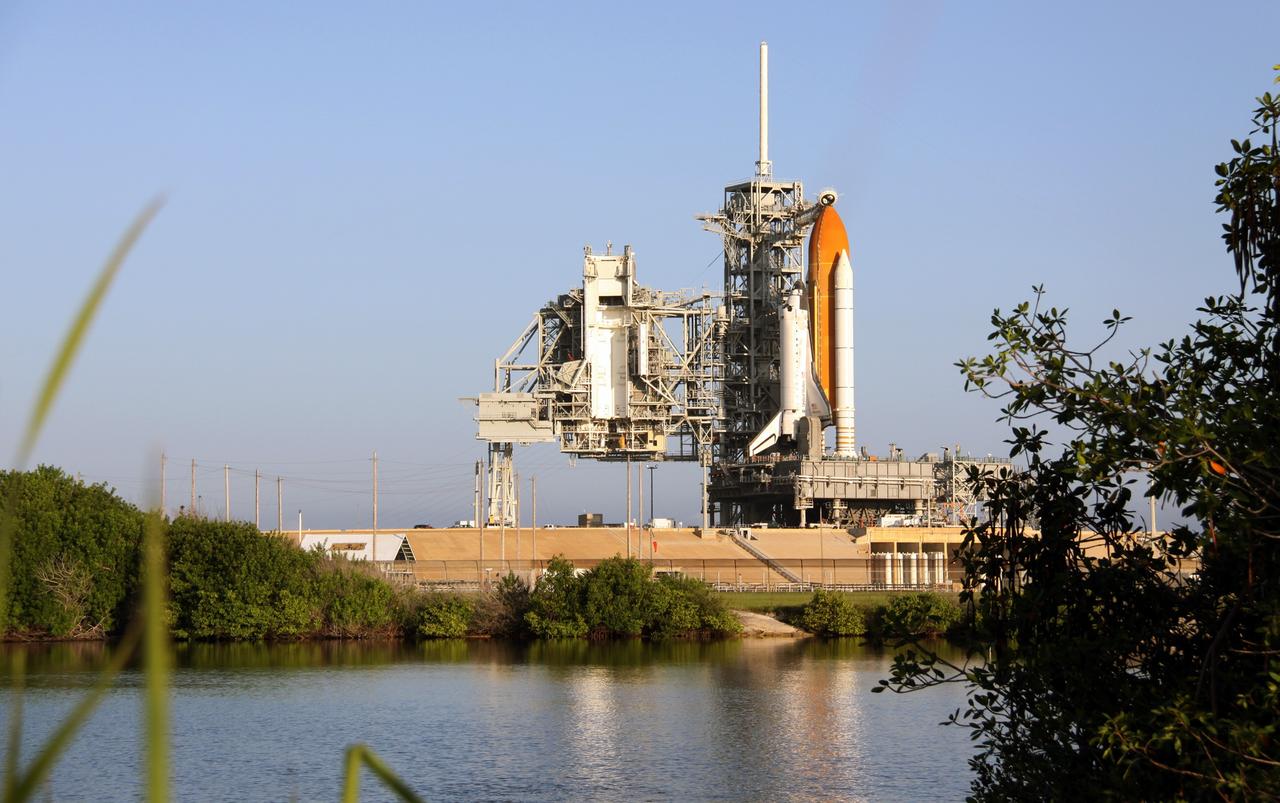
CAPE CANAVERAL, Fla. – Space Shuttle Discovery sits on Launch Pad 39A at NASA’s Kennedy Space Center in Florida, after rollback of the rotating service structure, or RSS. The oxygen vent hood, called the “beanie cap,” is positioned above the external fuel tank. It is designed to vent gaseous oxygen vapors away from the shuttle. The rollback is preparation for Discovery’s scheduled 1:36 a.m. EDT liftoff Aug. 25 on the STS-128 mission with a crew of seven. First motion was at 5:06 a.m. EDT and completed at 5:46 a.m. EDT. The service structure provides weather protection and access to the space shuttle at the launch pad. The 13-day mission will deliver a new crew member and 33,000 pounds of equipment to the International Space Station. The equipment includes science and storage racks, a freezer to store research samples, a new sleeping compartment and the COLBERT treadmill. STS-128 will be Discovery's 37th mission and the 30th shuttle flight dedicated to station assembly and maintenance. Photo credit: NASA/Troy Cryder
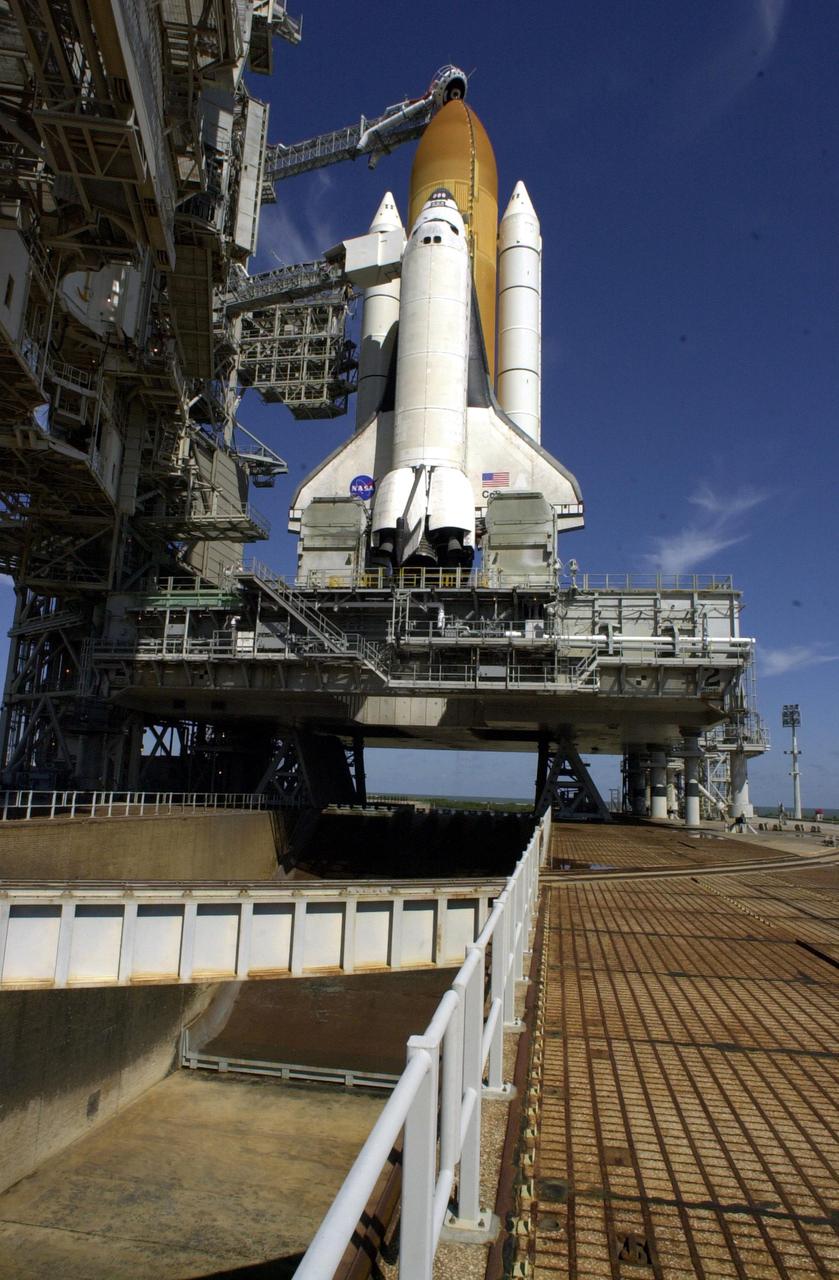
KENNEDY SPACE CENTER, Fla. - The Rotating Service Structure has rolled back to launch position for the second time in two days after a scrub of mission STS-109 the day before. NASA managers had determined the unseasonably cold weather predicted at launch time was at the margin of acceptable limits. This view shows Space Shuttle Columbia atop the Mobile Launcher Platform (MLP) on Launch Pad 39A. Twin solid rocket boosters flank the orange-colored external tank. Above the tank is the 'beanie cap,' the gaseous oxygen vent hood. Below the MLP is the flame trench that helps deflect the intense heat and flames away from the vehicle as it lifts off. Columbia is rescheduled for launch on mission STS-109 March 1 at 6:22 a.m. EST (11:22 GMT). The 11-day mission will provide maintenance and upgrade to the Hubble Space Telescope, replacing Solar Array 2 with Solar Array 3, replacing the Power Control Unit, installing the ACS (after removing the Faint Object Camera ), the Near Infrared Camera, the Multi-Object Spectrometer (NICMOS) Cooling System, and the New Outer Blanket Layer insulation.
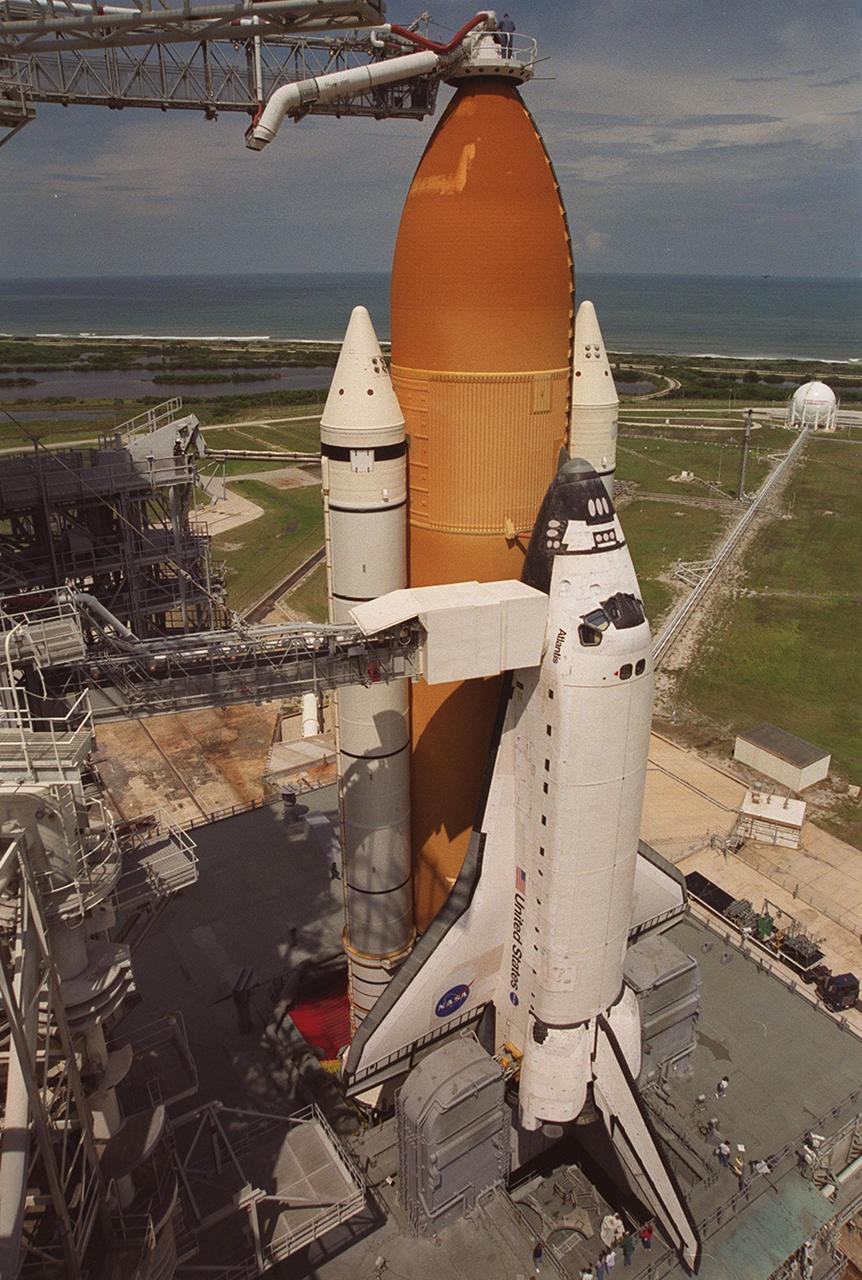
KENNEDY SPACE CENTER, Fla. -- Against a backdrop of the cloudy sky and blue-gray Atlantic Ocean, Space Shuttle Atlantis is revealed after rollback of the Rotating Service Structure. On top of the external tank is the 13-foot-wide “beanie cap,” at the end of the Gaseous Oxygen Vent Arm, designed to vent gaseous oxygen vapors away from the Space Shuttle. Lower is the Orbiter Access Arm with the environmental chamber, known as the “white room,” extended to the orbiter. The chamber provides entry for the crew into the orbiter and also serves as emergency egress up to 7 minutes 24 seconds before launch. Ready for launch of mission STS-106 at 8:45 a.m. EDT on Sept. 8, Atlantis carries supplies to prepare the Russian Zvezda living quarters on the International Space Station for the first long-duration crew. The crew will also be transferring supplies from the Russian Progress resupply ship already docked to the aft of Zvezda. The fourth U.S. launch for the Space Station, the mission is expected to last 10 days, 19 hours and 9 minutes, landing at KSC 4:59 a.m. EDT on Sept. 19
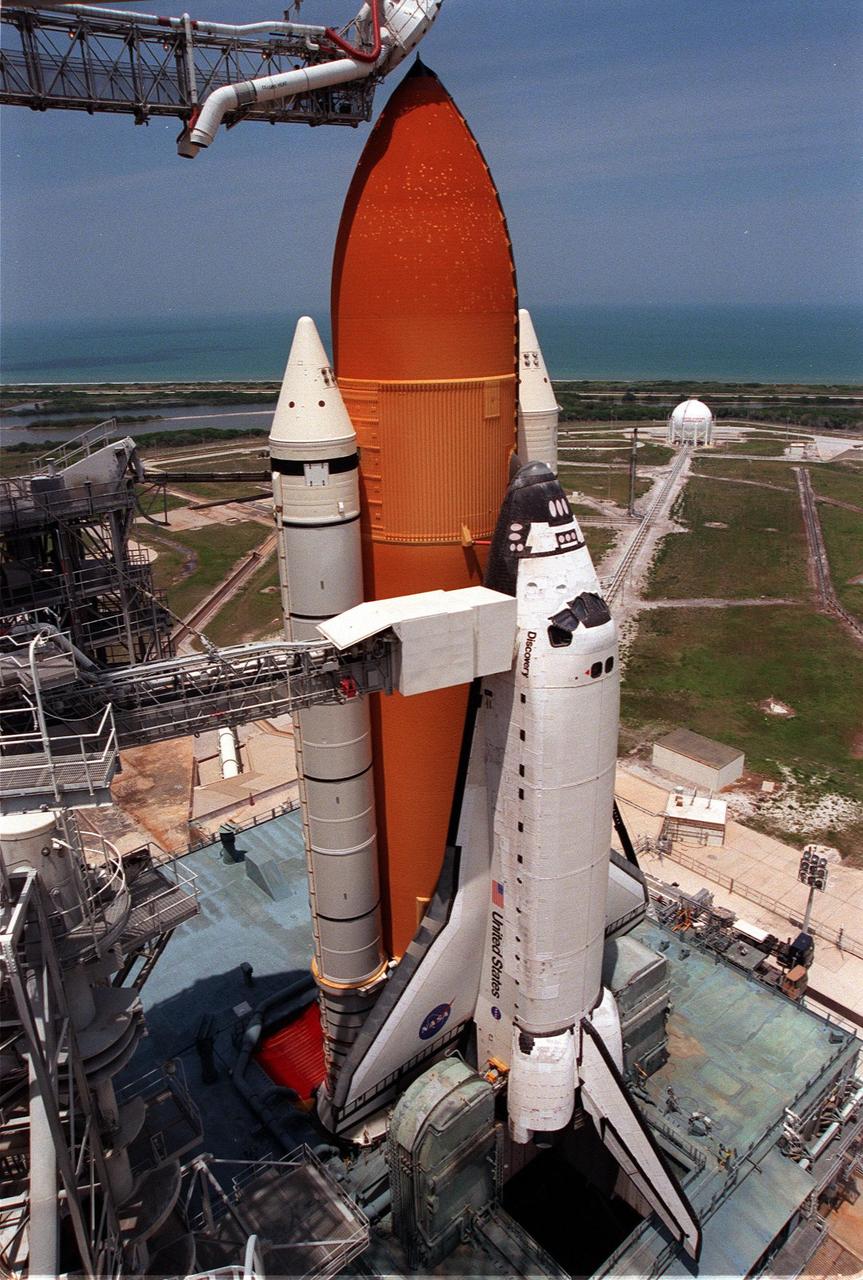
KENNEDY SPACE CENTER, FLA. -- Rollback of the Rotating Service Structure on Launch Pad 39B reveals the Space Shuttle Discovery, scheduled to launch on mission STS-96 at 6:49 a.m. EDT on May 27. Above the top of the external tank is the external tank gaseous oxygen vent arm, with a vent hood, known as the "beanie cap," at the outer end. Below it up against Discovery is the orbiter access arm, which allows entry into the orbiter crew compartment. through an environmental chamber or "white room" at the outer end. STS-96 is a 10-day logistics and resupply mission for the International Space Station, carrying about 4,000 pounds of supplies to be stored aboard the station, for use by future crews, including laptop computers, cameras, tools, spare parts, and clothing. The mission also includes such payloads as a Russian crane, the Strela; a U.S.-built crane; the Spacehab Oceaneering Space System Box (SHOSS), a logistics items carrier; and STARSHINE, a student-involved experiment. The mission will include a space walk to attach the cranes to the outside of the ISS for use in future construction. Space Shuttle Discovery is due to launch on May 27 at 6:49 a.m. EDT. Landing is expected at the SLF on June 6 about 1:58 a.m. EDT
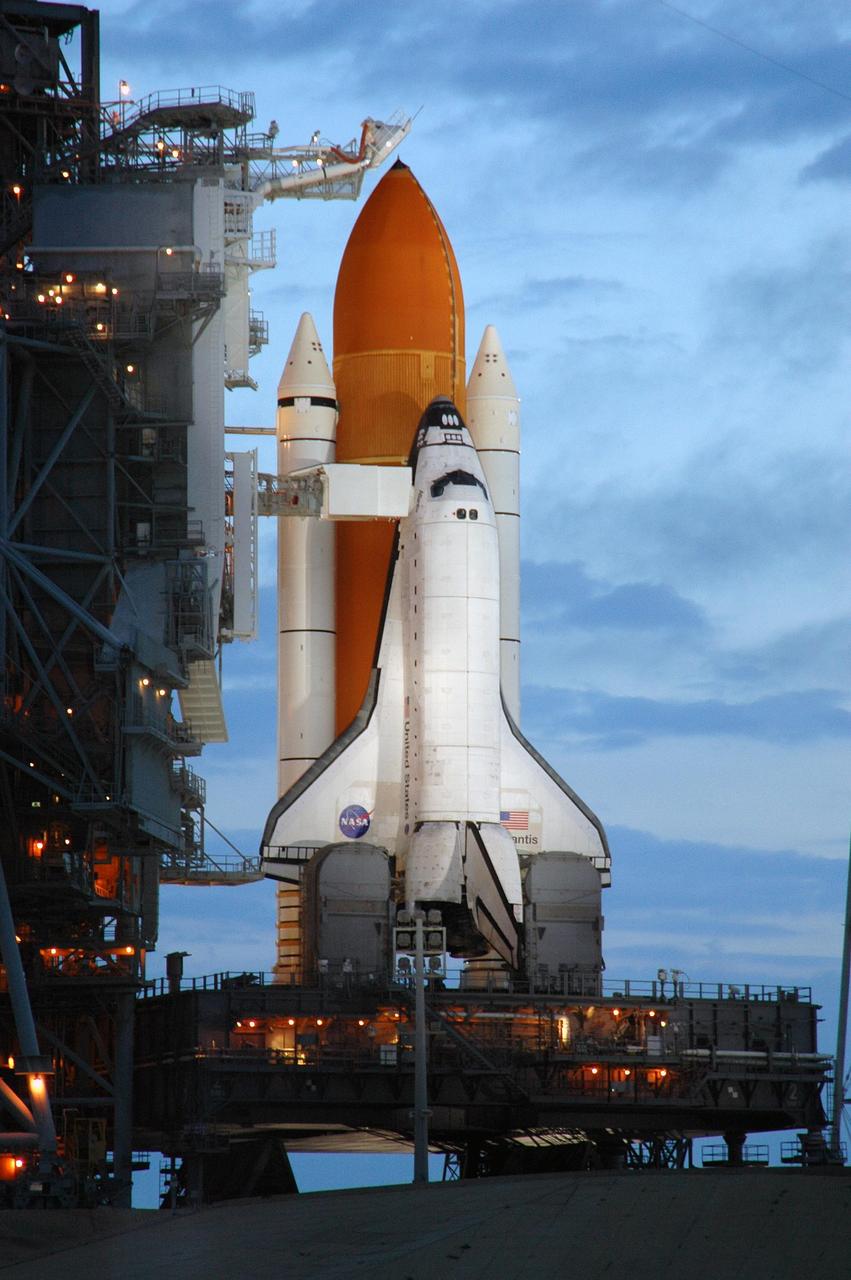
KENNEDY SPACE CENTER, FLA. - The morning sky lightens behind Space Shuttle Atlantis while lights on the fixed service structure (FSS) still illuminate the orbiter on Launch Pad 39B. Atlantis was originally scheduled to launch at 12:29 p.m. EDT on this date, but a 24-hour scrub was called by mission managers due to a concern with Fuel Cell 1. Seen poised above the orange external tank is the vent hood (known as the "beanie cap") at the end of the gaseous oxygen vent arm. Vapors are created as the liquid oxygen in the external tank boil off. The hood vents the gaseous oxygen vapors away from the space shuttle vehicle. Extending from the FSS to Atlantis is the orbiter access arm with the White Room at the end. The White Room provides entry into the orbiter through the hatch. During the STS-115 mission, Atlantis' astronauts will deliver and install the 17.5-ton, bus-sized P3/P4 integrated truss segment on the station. The girder-like truss includes a set of giant solar arrays, batteries and associated electronics and will provide one-fourth of the total power-generation capability for the completed station. This mission is the 116th space shuttle flight, the 27th flight for orbiter Atlantis, and the 19th U.S. flight to the International Space Station. STS-115 is scheduled to last 11 days with a planned landing at KSC. Photo credit: NASA/Troy Cryder
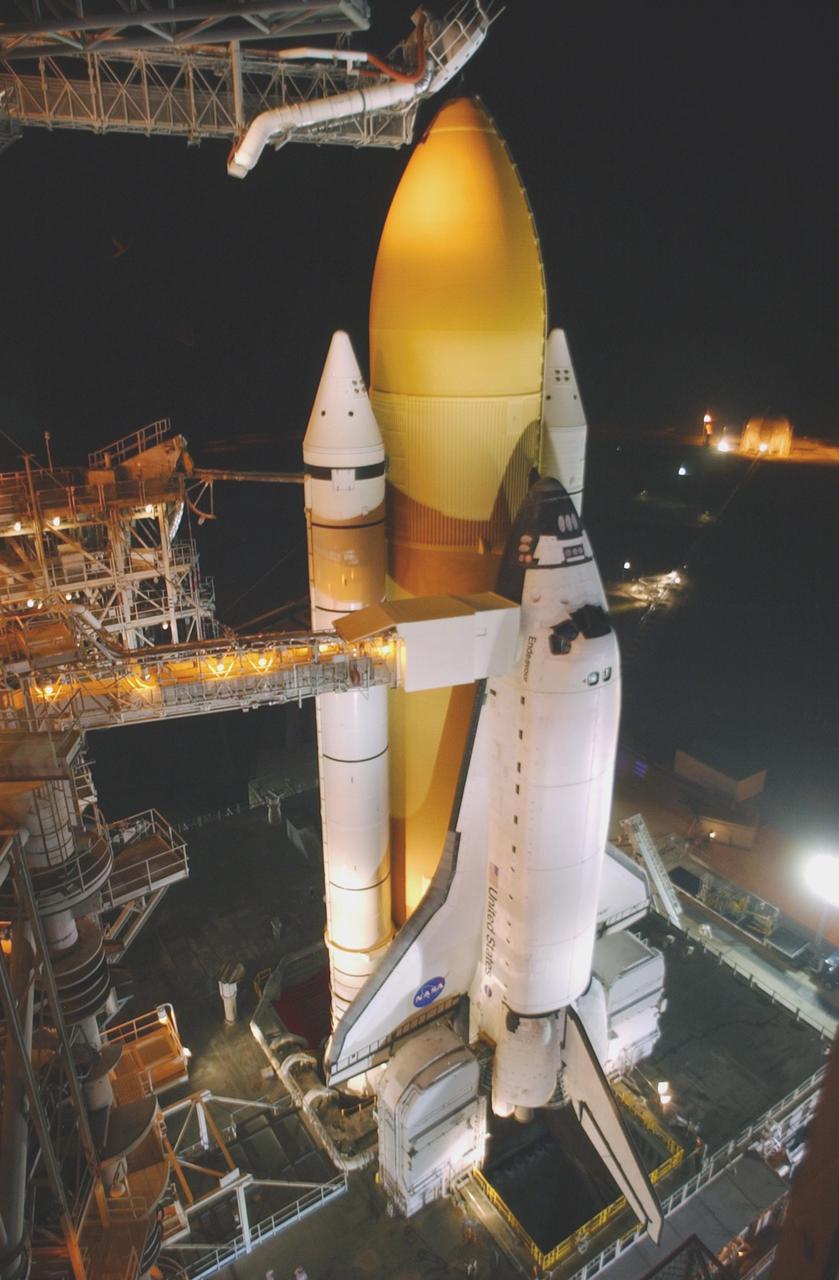
KENNEDY SPACE CENTER, FLA. - After rollback of the Rotating Service Structure, Space Shuttle Endeavour is bathed in light. Seen above the orange external tank behind Endeavour is the "beanie cap," or vent hood assembly at the end of the gaseous oxygen vent arm. The orbiter access arm extends to the cockpit area of Endeavour. At the end of the arm is the White Room, , an environmental chamber that provides crew access into the orbiter. STS-111 is the second Utilization Flight to the International Space Station, carrying the Multi-Purpose Logistics Module Leonardo, the Mobile Base System (MBS), and a replacement wrist/roll joint for the Canadarm 2. Also onboard Space Shuttle Endeavour is the Expedition 5 crew who will replace Expedition 4 on board the Station. The MBS will be installed on the Mobile Transporter to complete the Canadian Mobile Servicing System, or MSS. The mechanical arm will then have the capability to "inchworm" from the U.S. Lab Destiny to the MSS and travel along the truss to work sites. Expedition 4 crew members will return to Earth with the STS-111 crew on Endeavour. Launch is scheduled at 7:44 p.m. EDT, May 30, 2002
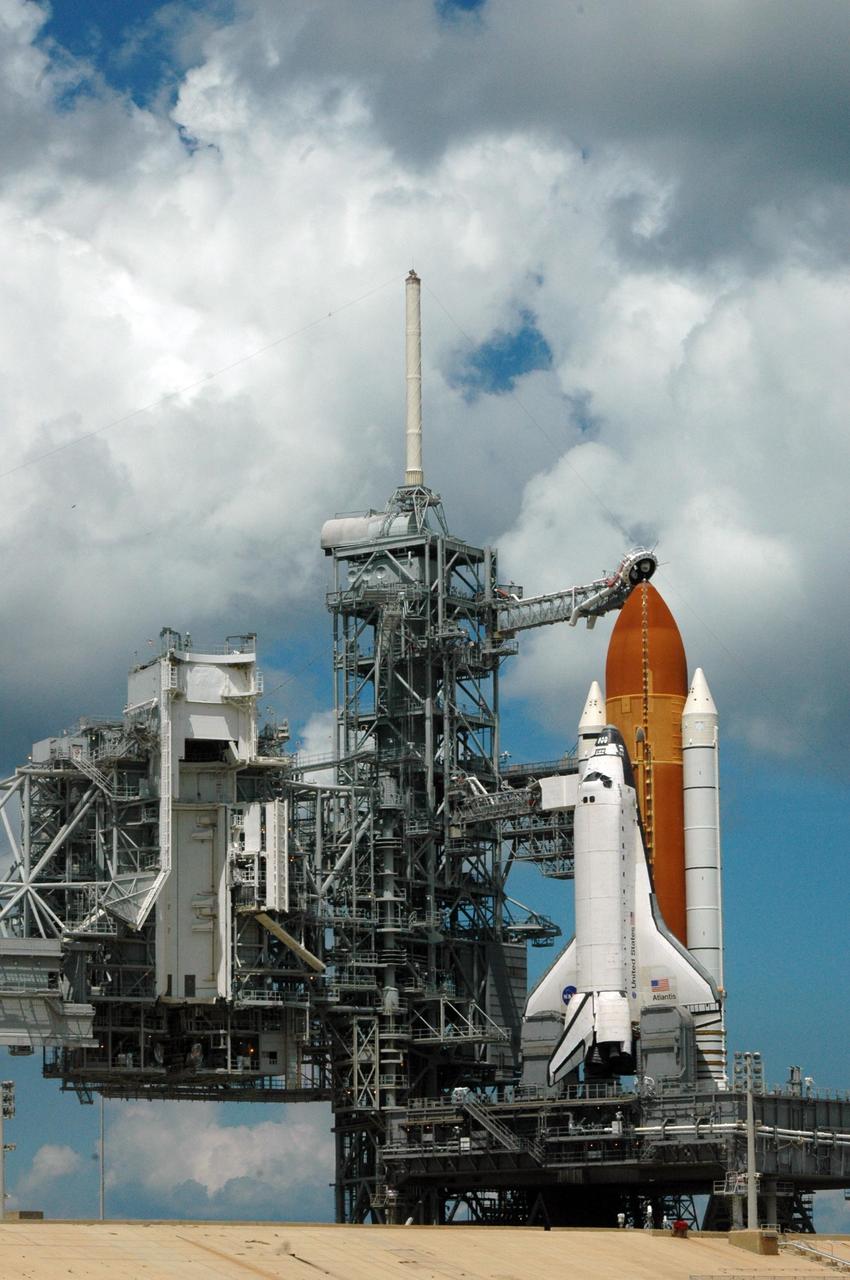
KENNEDY SPACE CENTER, FLA. - Huge clouds roll over Launch Pad 39B where Space Shuttle Atlantis still sits after the scrub of its launch on mission STS-115. Atlantis was originally scheduled to launch at 12:29 p.m. EDT on this date, but a 24-hour scrub was called by mission managers due to a concern with fuel cell 1. Towering above the shuttle is the 80-foot lightning mast. At left is the rolled-back rotating service structure with the payload changeout room open. Just above the orange external tank is the vent hood (known as the "beanie cap") at the end of the gaseous oxygen vent arm. Vapors are created as the liquid oxygen in the external tank boil off. The hood vents the gaseous oxygen vapors away from the space shuttle vehicle. During the STS-115 mission, Atlantis' astronauts will deliver and install the 17.5-ton, bus-sized P3/P4 integrated truss segment on the station. The girder-like truss includes a set of giant solar arrays, batteries and associated electronics and will provide one-fourth of the total power-generation capability for the completed station. This mission is the 116th space shuttle flight, the 27th flight for orbiter Atlantis, and the 19th U.S. flight to the International Space Station. STS-115 is scheduled to last 11 days with a planned landing at KSC. Photo credit: NASA/Ken Thornsley
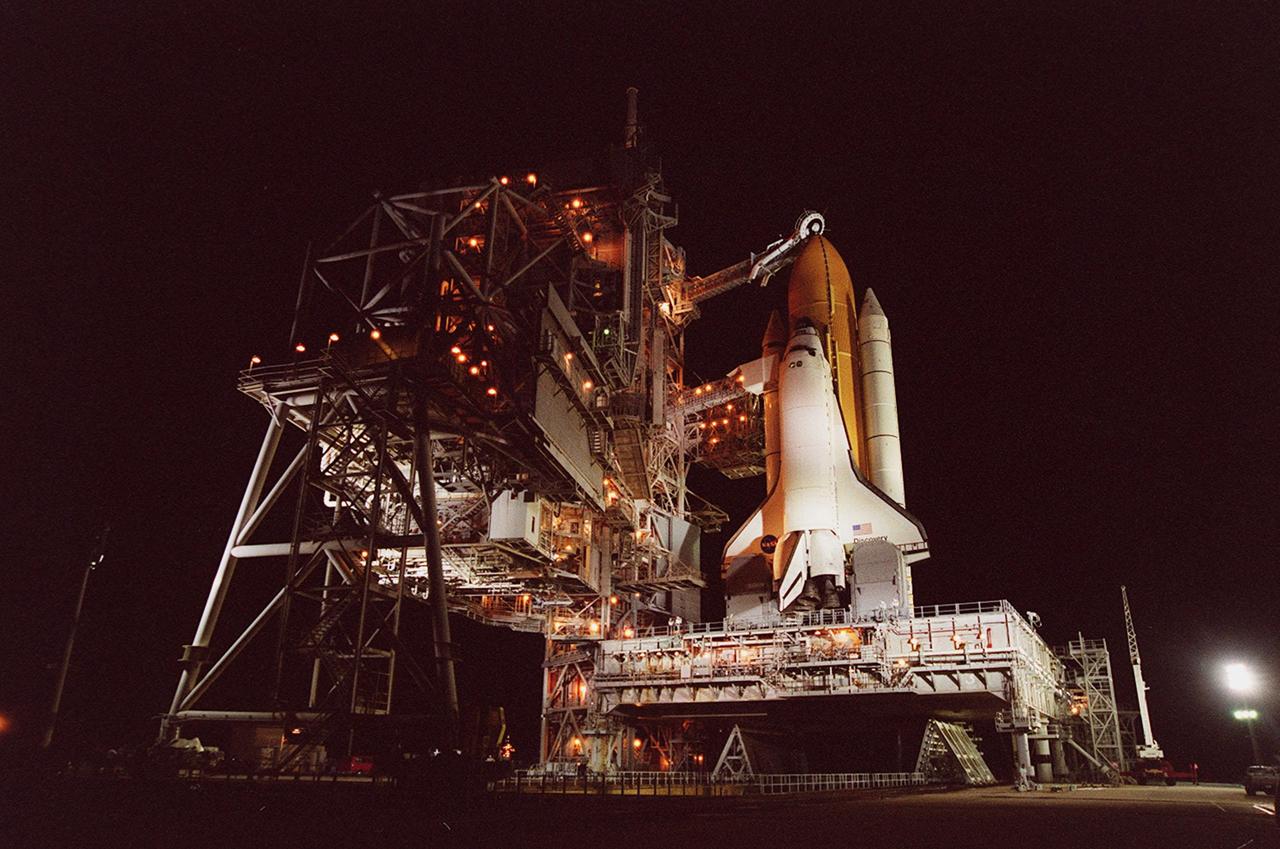
KENNEDY SPACE CENTER, Fla. -- With the Rotating Service Structure rolled back, Space Shuttle Discovery is revealed on the Mobile Launcher Platform at Launch Pad 39A. Discovery is being readied for the STS-92 mission launch to the International Space Station (ISS). At the top is the 13-foot-wide “beanie cap,” at the end of the Gaseous Oxygen Vent Arm, designed to vent gaseous oxygen vapors away from the Space Shuttle. Lower is the Orbiter Access Arm with the environmental chamber, known as the “white room,” extended to the orbiter. The chamber provides entry for the crew into the orbiter and also serves as emergency egress up to 7 minutes 24 seconds before launch. The STS-92 mission payload includes Integrated Truss Structure Z-1, an early exterior framework to allow the first U.S. solar arrays on a future flight to be temporarily installed on Unity for early power; Ku-band communication to support early science capability and U.S. television; and the third Pressurized Mating Adapter to provide a Shuttle docking port for solar array installation on the sixth ISS flight and Lab installation on the seventh ISS flight. The 11-day mission will include four spacewalks. Liftoff is scheduled for Oct. 6 at 9:16 p.m. EDT
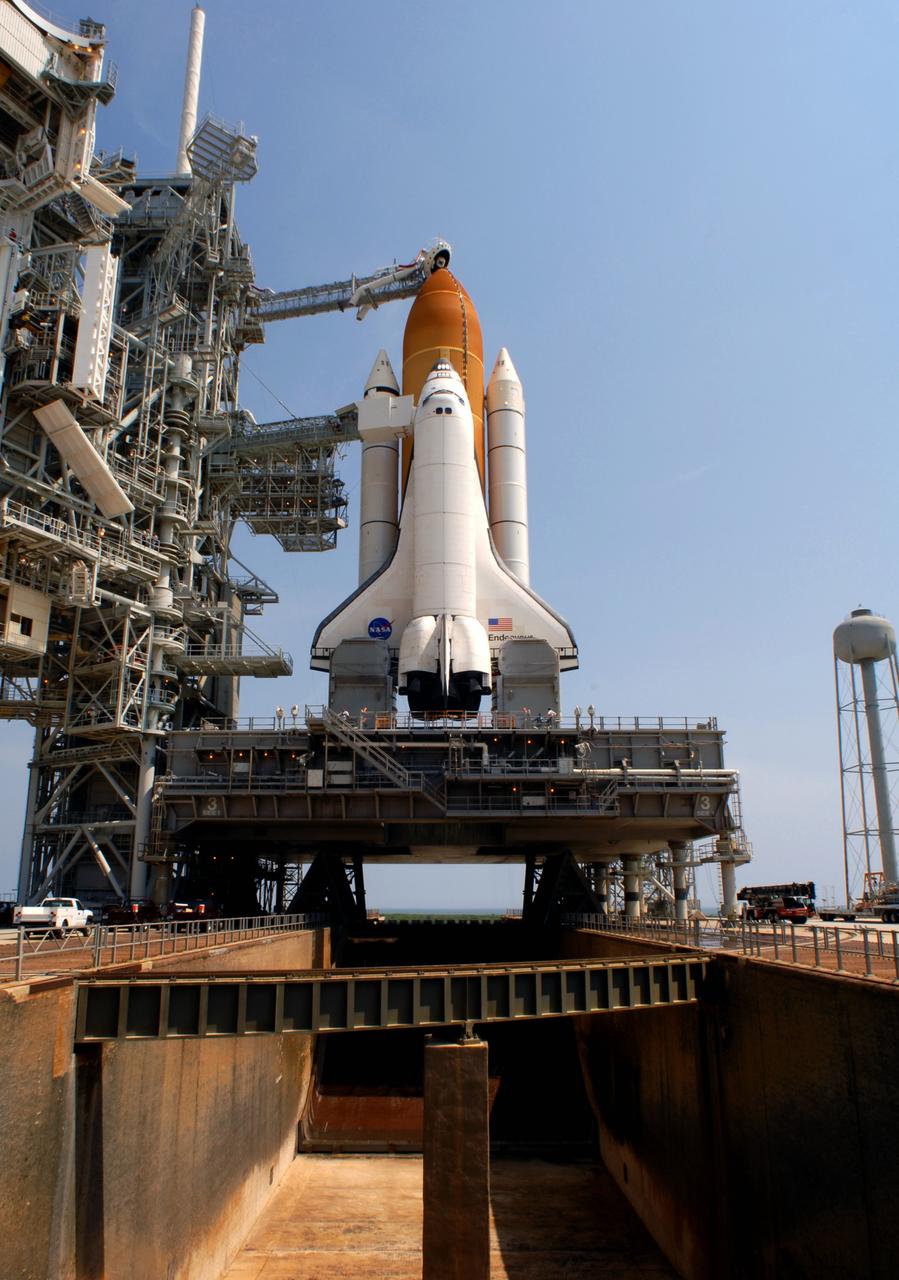
CAPE CANAVERAL, Fla. – On Launch Pad 39A at NASA's Kennedy Space Center in Florida, space shuttle Endeavour is revealed after the rollback of the rotating service structure, or RSS. In the foreground is the flame trench, which the mobile launcher platform straddles. On top of the external fuel tank is the oxygen vent hood, called the "beanie cap," which is designed to vent gaseous oxygen vapors away from the shuttle. The rollback is preparation for Endeavour's liftoff June 13 on the STS-127 mission with a crew of seven. First motion was at 10:39 a.m. EDT and completed at 11:18 a.m. The rotating structure provides protected access to the shuttle for changeout and servicing of payloads at the pad. It is supported by a rotating bridge that pivots on a vertical axis on the west side of the pad's flame trench. After the RSS is rolled back, the orbiter is ready for fuel cell activation and external tank cryogenic propellant loading operations. The launch will be Endeavour's 23rd flight. The shuttle will carry the Japanese Experiment Module's Exposed Facility, or JEM-EF, and the Experiment Logistics Module-Exposed Section, or ELM-ES, on STS-127. The mission is the final of three flights dedicated to the assembly of the Japan Aerospace Exploration Agency's Kibo laboratory complex on the space station. Endeavour's launch is scheduled for June 13 at 7:17 a.m. EDT. Photo credit: NASA/Jim Grossmann
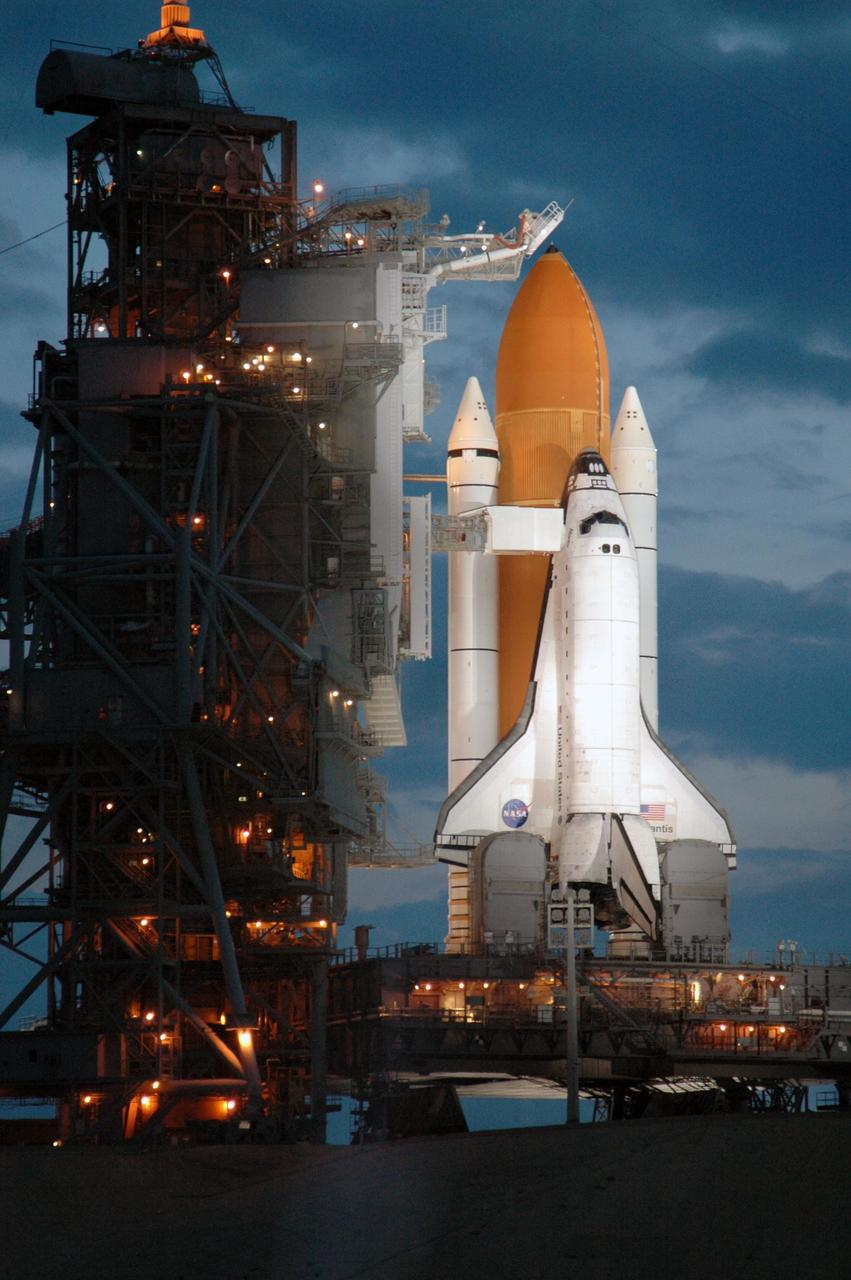
KENNEDY SPACE CENTER, FLA. - The morning sky lightens behind Space Shuttle Atlantis while lights on the fixed service structure (FSS) still illuminate the orbiter on Launch Pad 39B. Atlantis was originally scheduled to launch at 12:29 p.m. EDT on this date, but a 24-hour scrub was called by mission managers due to a concern with Fuel Cell 1. Seen poised above the orange external tank is the vent hood (known as the "beanie cap") at the end of the gaseous oxygen vent arm. Vapors are created as the liquid oxygen in the external tank boil off. The hood vents the gaseous oxygen vapors away from the space shuttle vehicle. Extending from the FSS to Atlantis is the orbiter access arm with the White Room at the end. The White Room provides entry into the orbiter through the hatch. During the STS-115 mission, Atlantis' astronauts will deliver and install the 17.5-ton, bus-sized P3/P4 integrated truss segment on the station. The girder-like truss includes a set of giant solar arrays, batteries and associated electronics and will provide one-fourth of the total power-generation capability for the completed station. This mission is the 116th space shuttle flight, the 27th flight for orbiter Atlantis, and the 19th U.S. flight to the International Space Station. STS-115 is scheduled to last 11 days with a planned landing at KSC. Photo credit: NASA/Troy Cryder
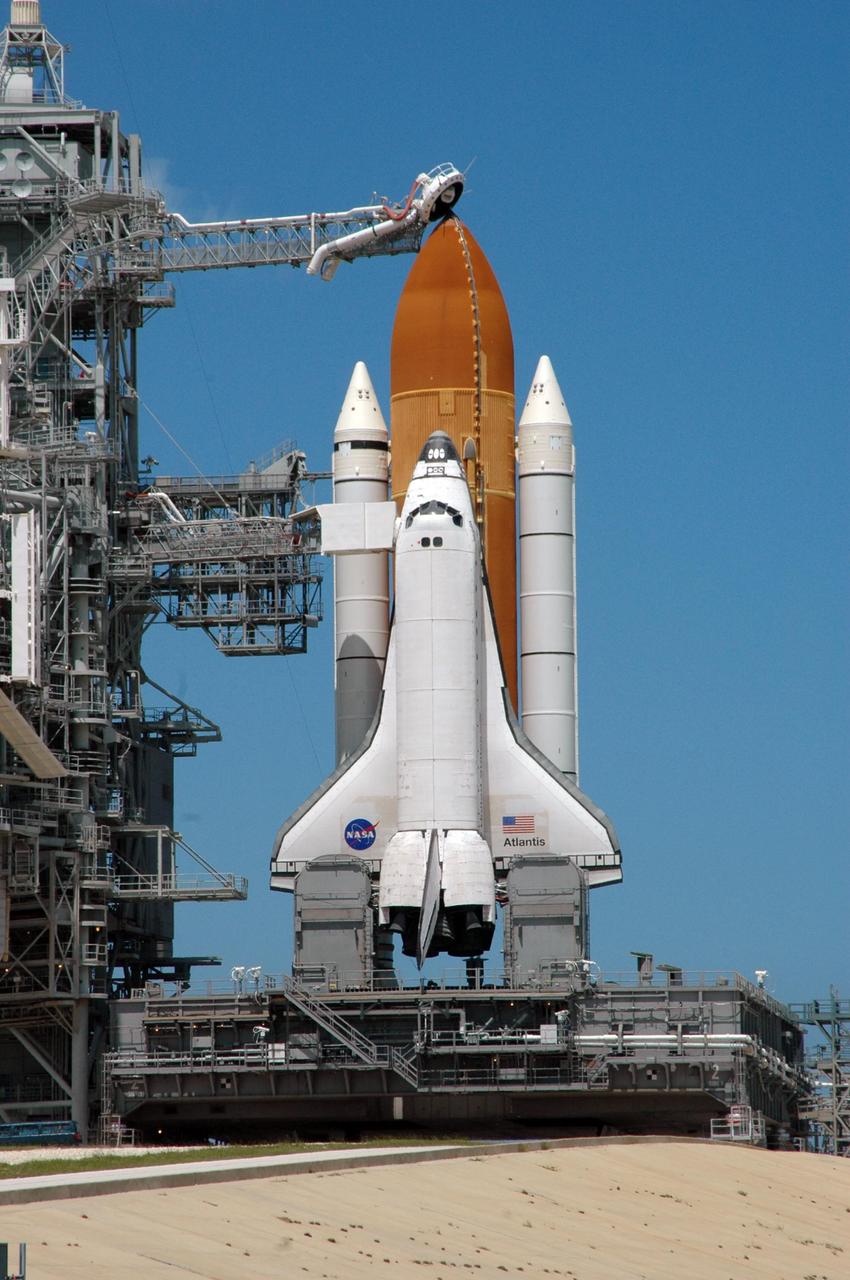
KENNEDY SPACE CENTER, FLA. - The sky is finally clear behind Launch Pad 39B where Space Shuttle Atlantis still sits after the scrub of its launch on mission STS-115. Atlantis was originally scheduled to launch at 12:29 p.m. EDT on this date, but a 24-hour scrub was called by mission managers due to a concern with fuel cell 1. Just above the orange external tank is the vent hood (known as the "beanie cap") at the end of the gaseous oxygen vent arm. Vapors are created as the liquid oxygen in the external tank boil off. The hood vents the gaseous oxygen vapors away from the space shuttle vehicle. Below, the orbiter access arm extends toward the cockpit of Atlantis with the White Room at the end. The White Room provides access into the cockpit of the vehicle. During the STS-115 mission, Atlantis' astronauts will deliver and install the 17.5-ton, bus-sized P3/P4 integrated truss segment on the station. The girder-like truss includes a set of giant solar arrays, batteries and associated electronics and will provide one-fourth of the total power-generation capability for the completed station. This mission is the 116th space shuttle flight, the 27th flight for orbiter Atlantis, and the 19th U.S. flight to the International Space Station. STS-115 is scheduled to last 11 days with a planned landing at KSC. Photo credit: NASA/Ken Thornsley