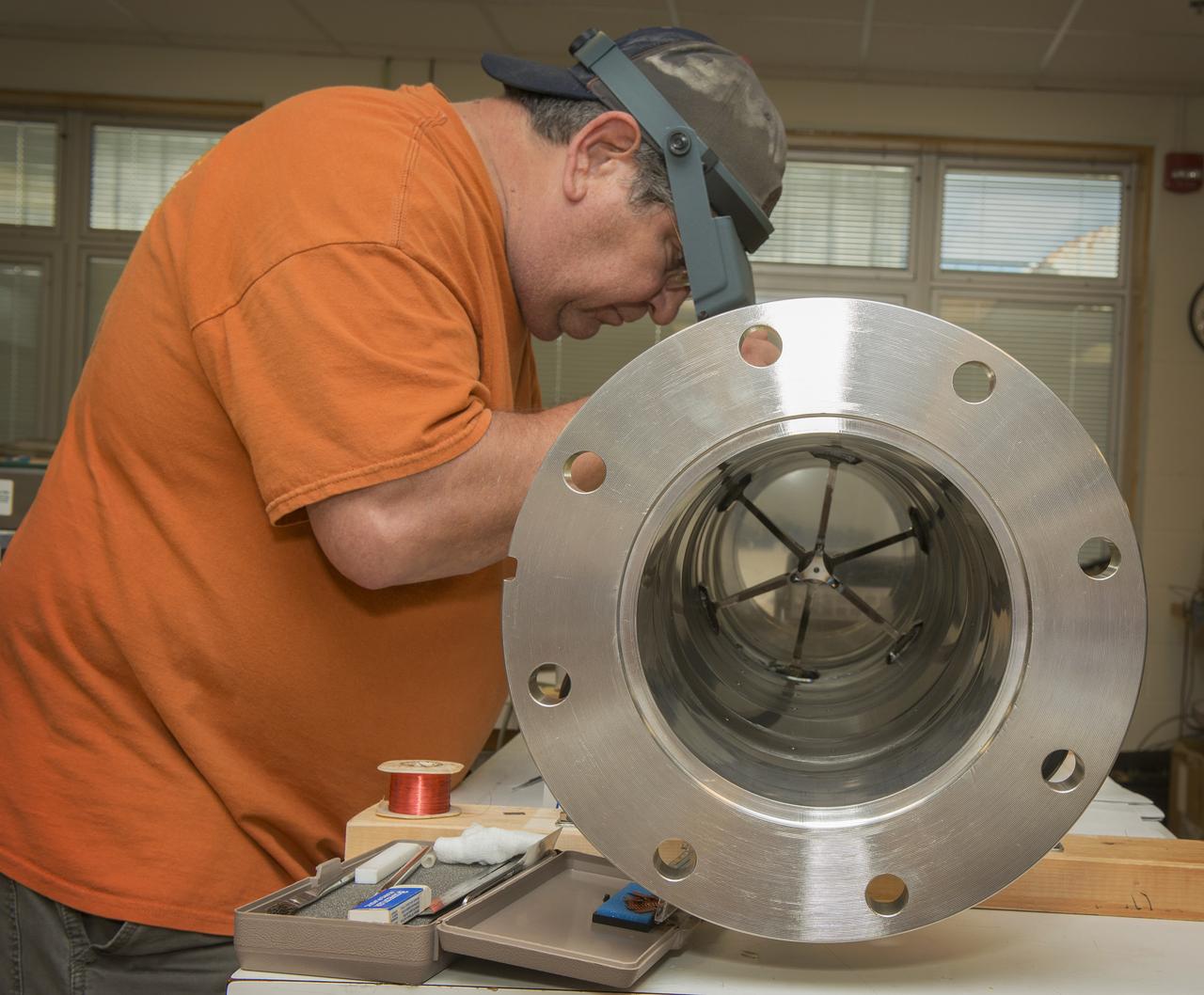
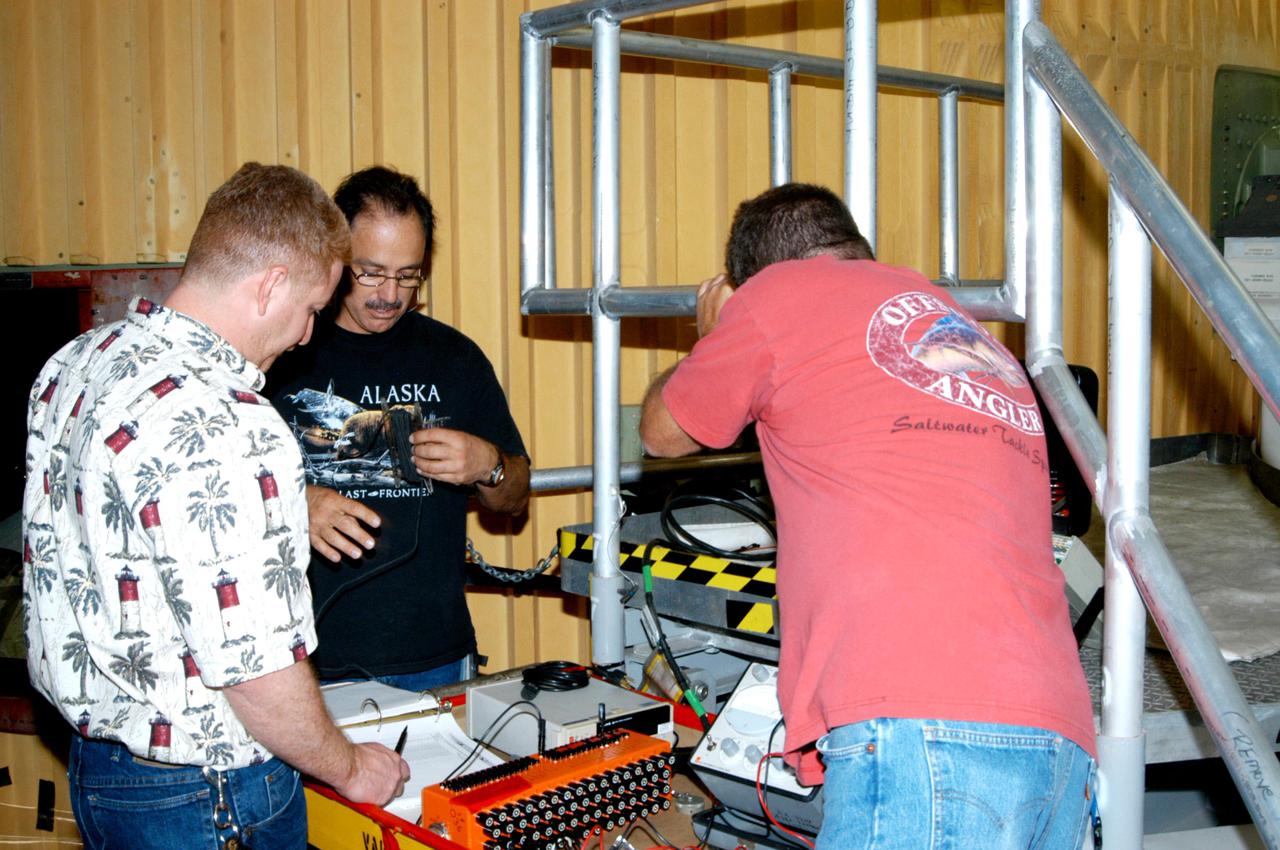
JOE MIRANDY, ET20, PREPARES SENSORS ON THE POGO Z- BAFFLE AND BELLOWS PRIOR TO FLOW TESTING. THE SENSORS WILL MEASURE VIBRATION AS FUEL FLOWS THROUGH THE TUBE AND BAFFLE.
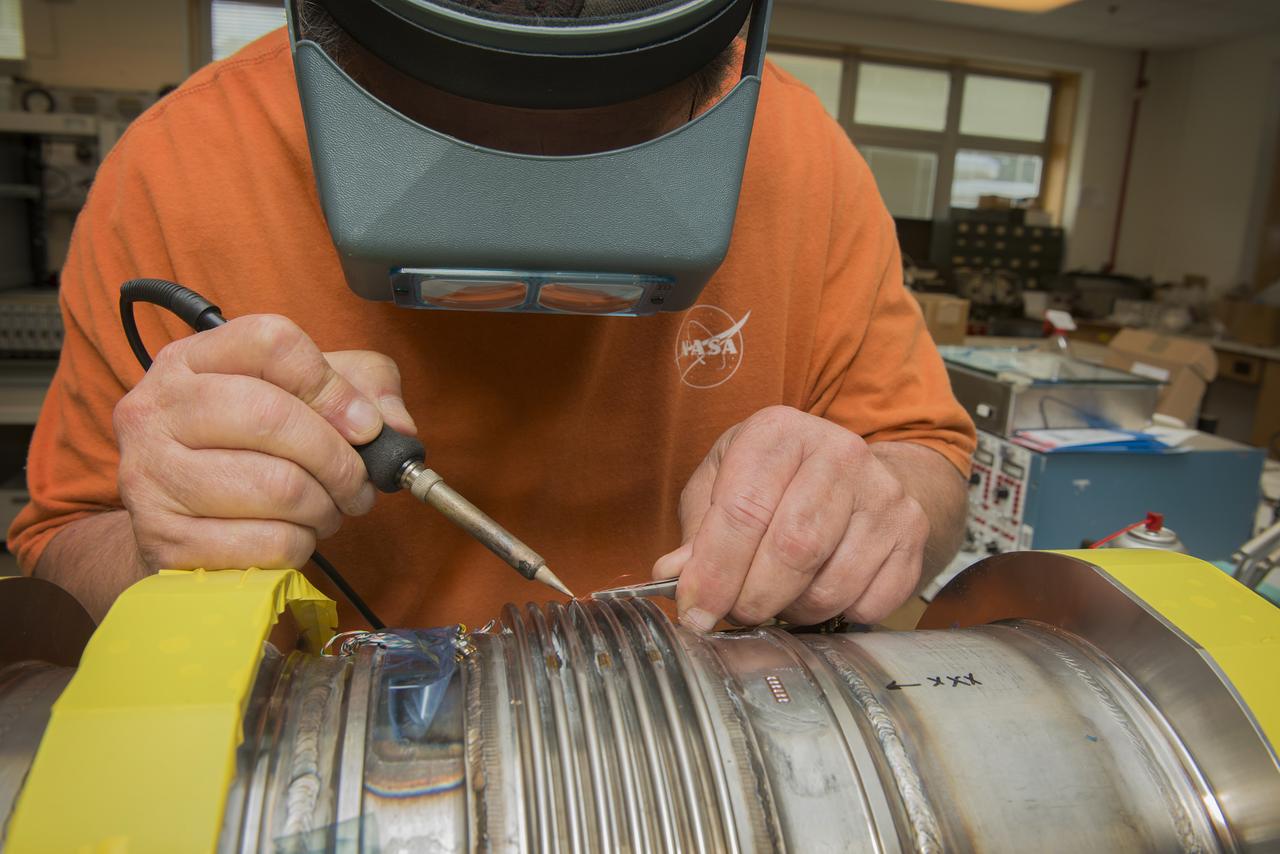
JOE MIRANDY, ET20, PREPARES SENSORS ON THE POGO Z- BAFFLE AND BELLOWS PRIOR TO FLOW TESTING. THE SENSORS WILL MEASURE VIBRATION AS FUEL FLOWS THROUGH THE TUBE AND BAFFLE.
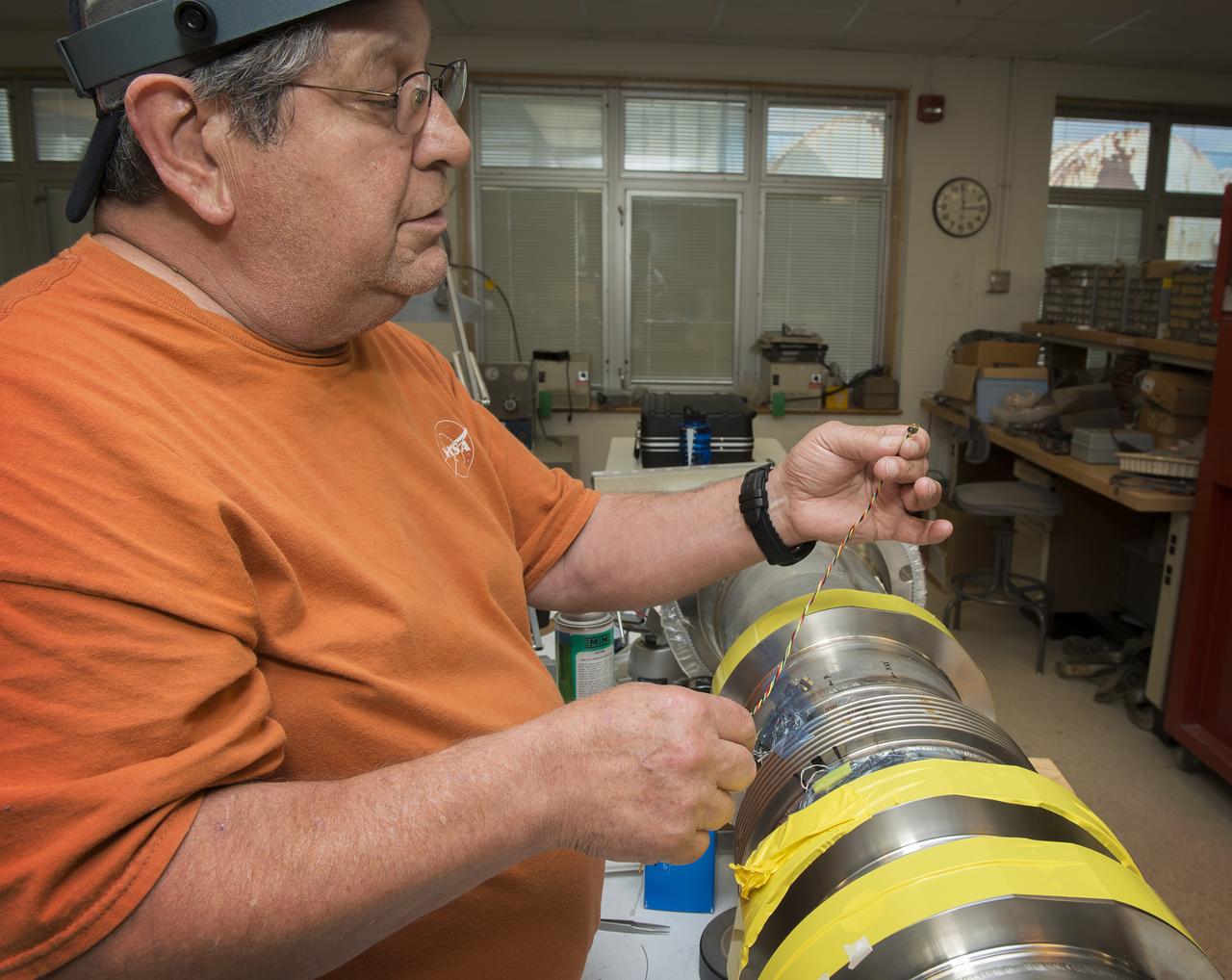
JOE MIRANDY, ET20, PREPARES SENSORS ON THE POGO Z- BAFFLE AND BELLOWS PRIOR TO FLOW TESTING. THE SENSORS WILL MEASURE VIBRATION AS FUEL FLOWS THROUGH THE TUBE AND BAFFLE.
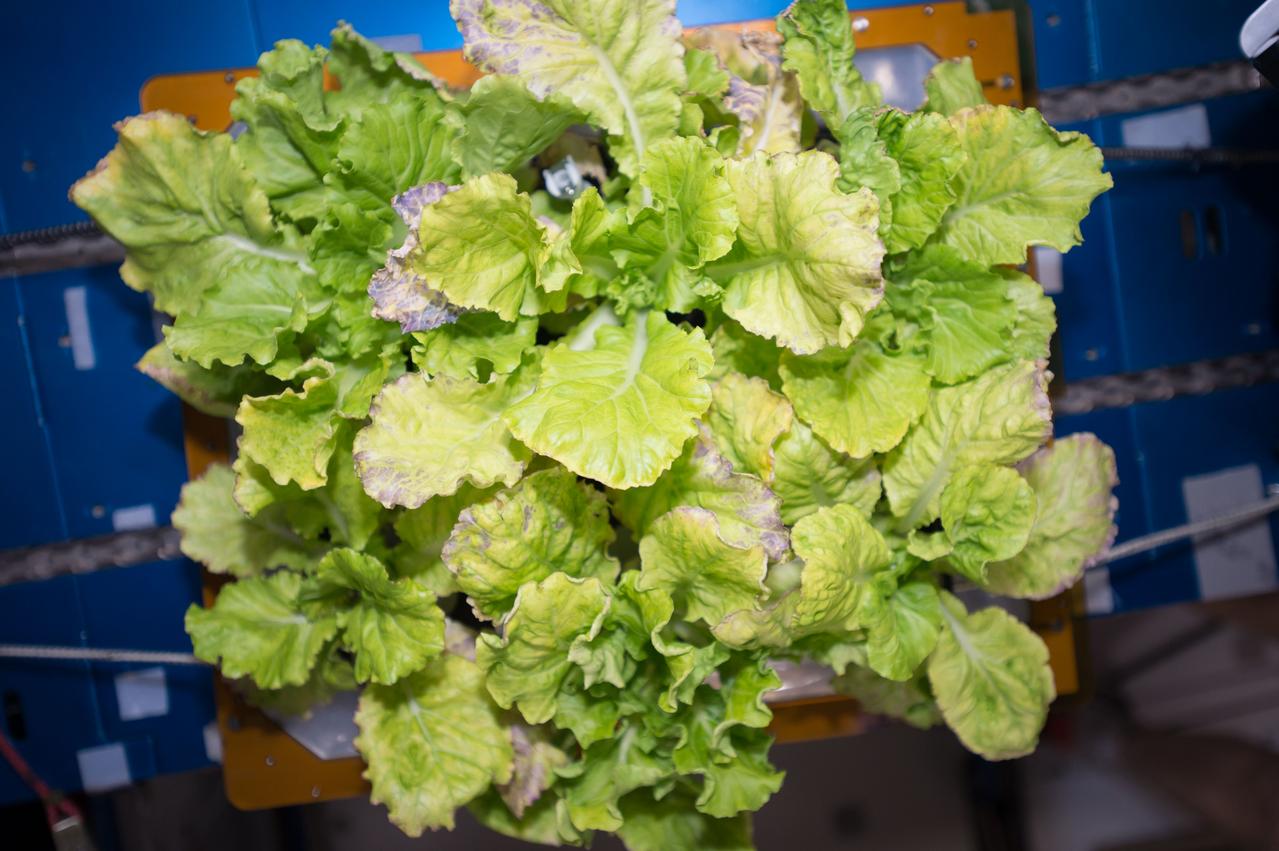
View of cabbage plants in the Vegetable Production System (Veggie) bellows, with the bellows secured to the Maintenance Work Area (MWA) in the Harmony Node 2. Image was taken during final harvesting operations (OPS) for the Veg-03 experiment.

KENNEDY SPACE CENTER, FLA. - In the Vehicle Assembly Building at NASA’s Kennedy Space Center, Troy Smith, with Lockheed Martin Astronautics, pulls off tabs from the heating element to test the bonding to the bellows. The element was recently attached to the liquid hydrogen feedline bellows on External Tank 121. Seen behind Smith is the External Tank. The tank will be used on the orbiter Discovery for Return to Flight mission STS-114, which has a launch window extending from July 13 to July 31.
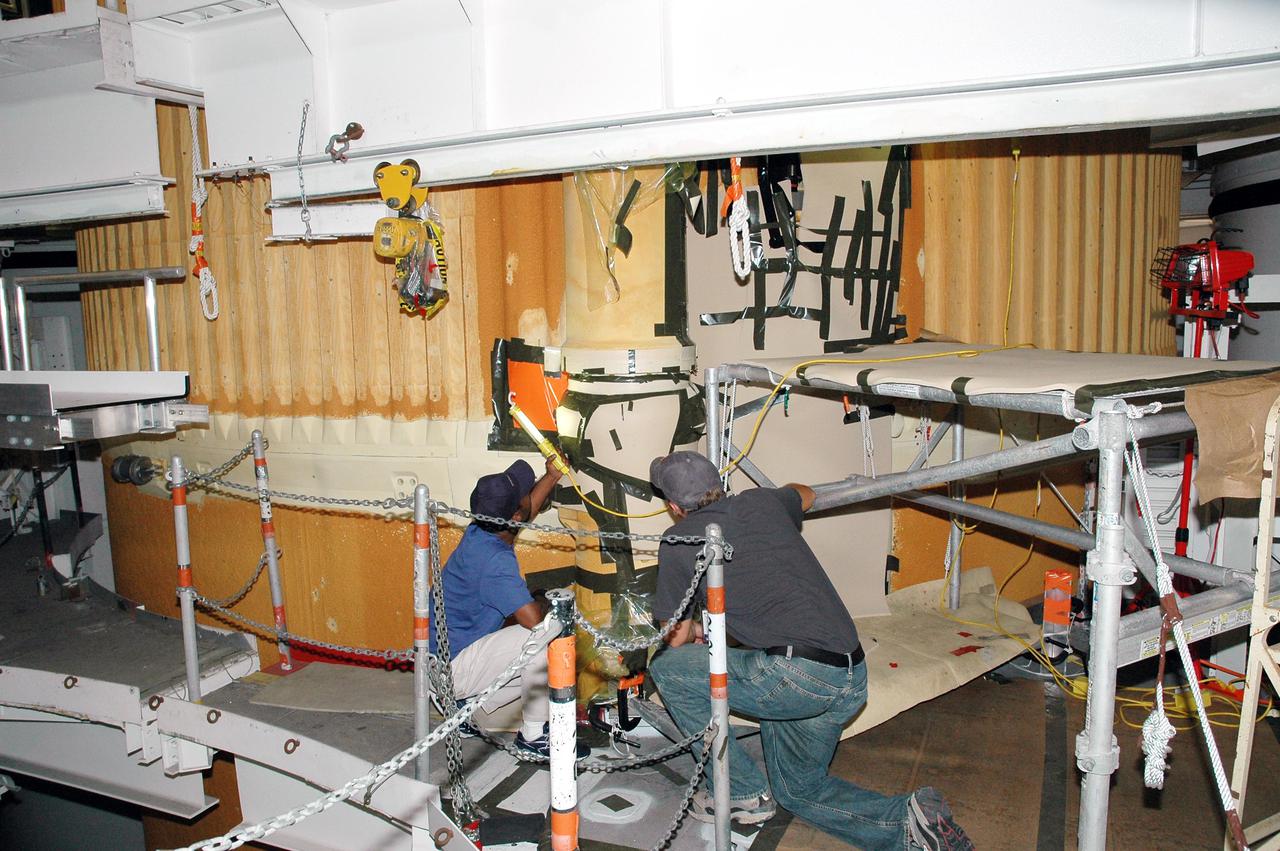
KENNEDY SPACE CENTER, FLA. - In the Vehicle Assembly Building at NASA’s Kennedy Space Center, workers inspect the newly installed liquid hydrogen bellows heater on External Tank 121. The new heater has been added to the feedline bellows to minimize the potential for ice and frost buildup. The tank has been designated to fly on Discovery for Return to Flight mission STS-114, which has a launch window extending from July 13 to July 31.
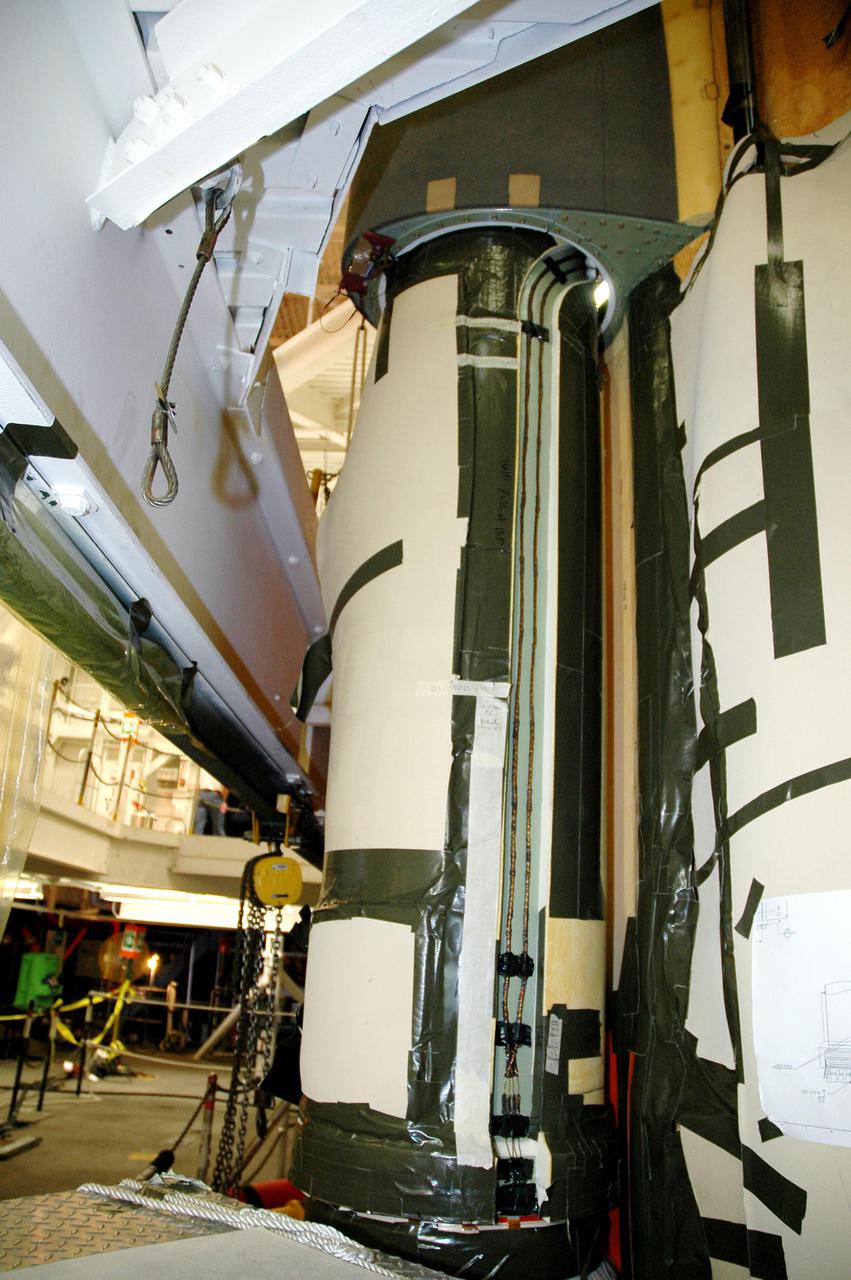
KENNEDY SPACE CENTER, FLA. - In the Vehicle Assembly Building at NASA’s Kennedy Space Center, the newly installed liquid oxygen bellows heater is seen on External Tank 120, recently removed from the orbiter Discovery. The new heater has been added to the feedline bellows to minimize the potential for ice and frost buildup. ET-120 will fly with Atlantis on the second Return to Flight mission STS-121. The launch window for STS-121 extends from Sept. 9 - 24.
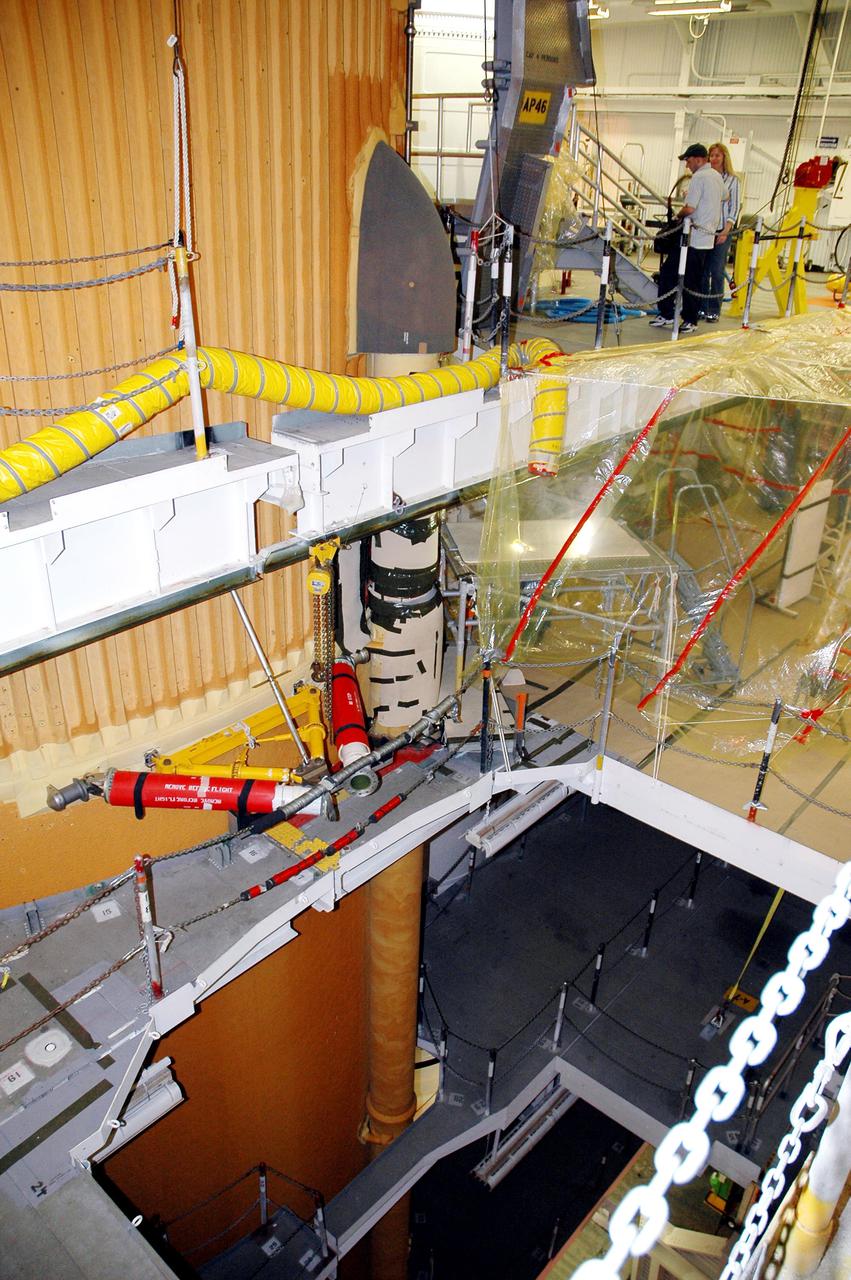
KENNEDY SPACE CENTER, FLA. -In the Vehicle Assembly Building at NASA’s Kennedy Space Center, the newly installed liquid oxygen bellows heater is seen on External Tank 120 (at left, behind it), recently removed from the orbiter Discovery. The new heater has been added to the feedline bellows to minimize the potential for ice and frost buildup. ET-120 will fly with Atlantis on the second Return to Flight mission STS-121. The launch window for STS-121 extends from Sept. 9 - 24.
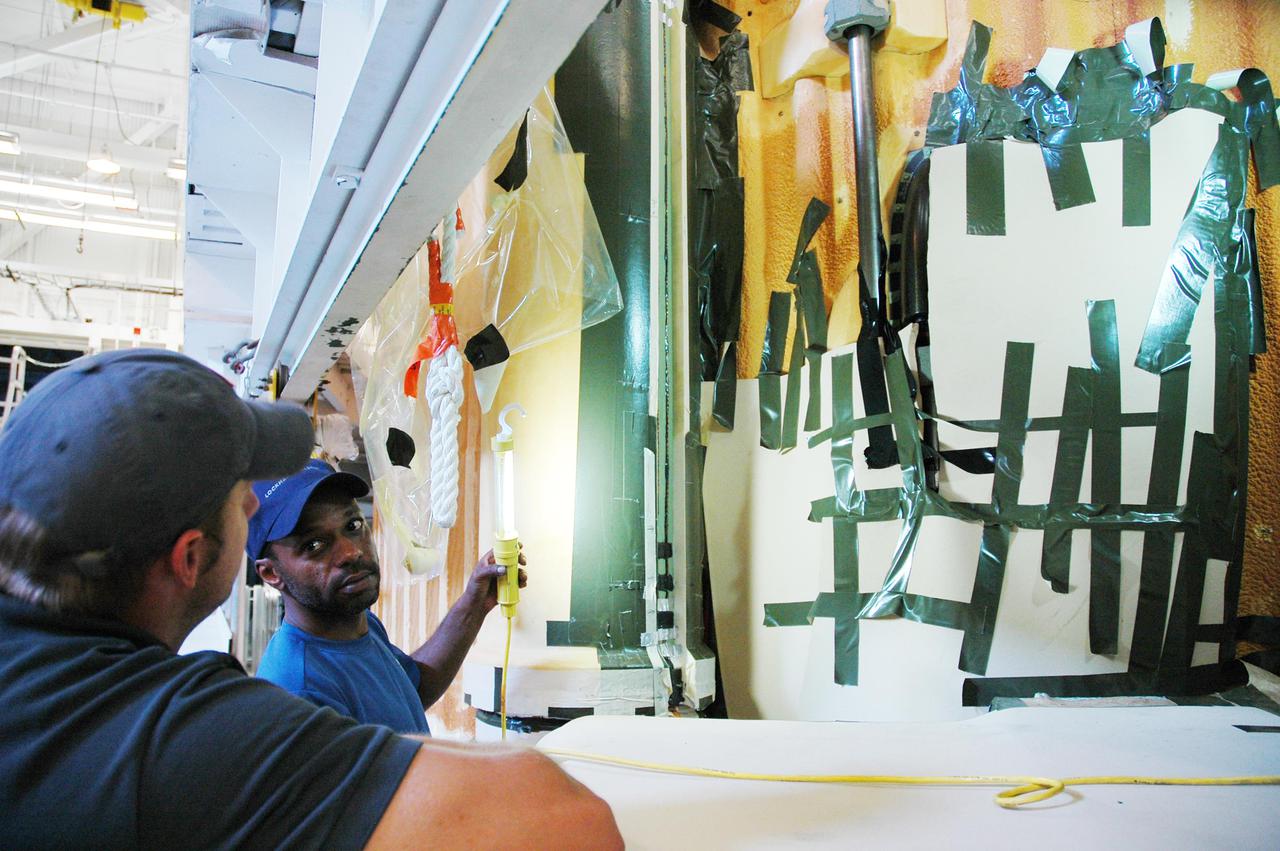
KENNEDY SPACE CENTER, FLA. - In the Vehicle Assembly Building at NASA’s Kennedy Space Center, workers take a close look at the newly installed liquid hydrogen bellows heater on External Tank 121. The new heater has been added to the feedline bellows to minimize the potential for ice and frost buildup. The tank has been designated to fly on Discovery for Return to Flight mission STS-114, which has a launch window extending from July 13 to July 31.
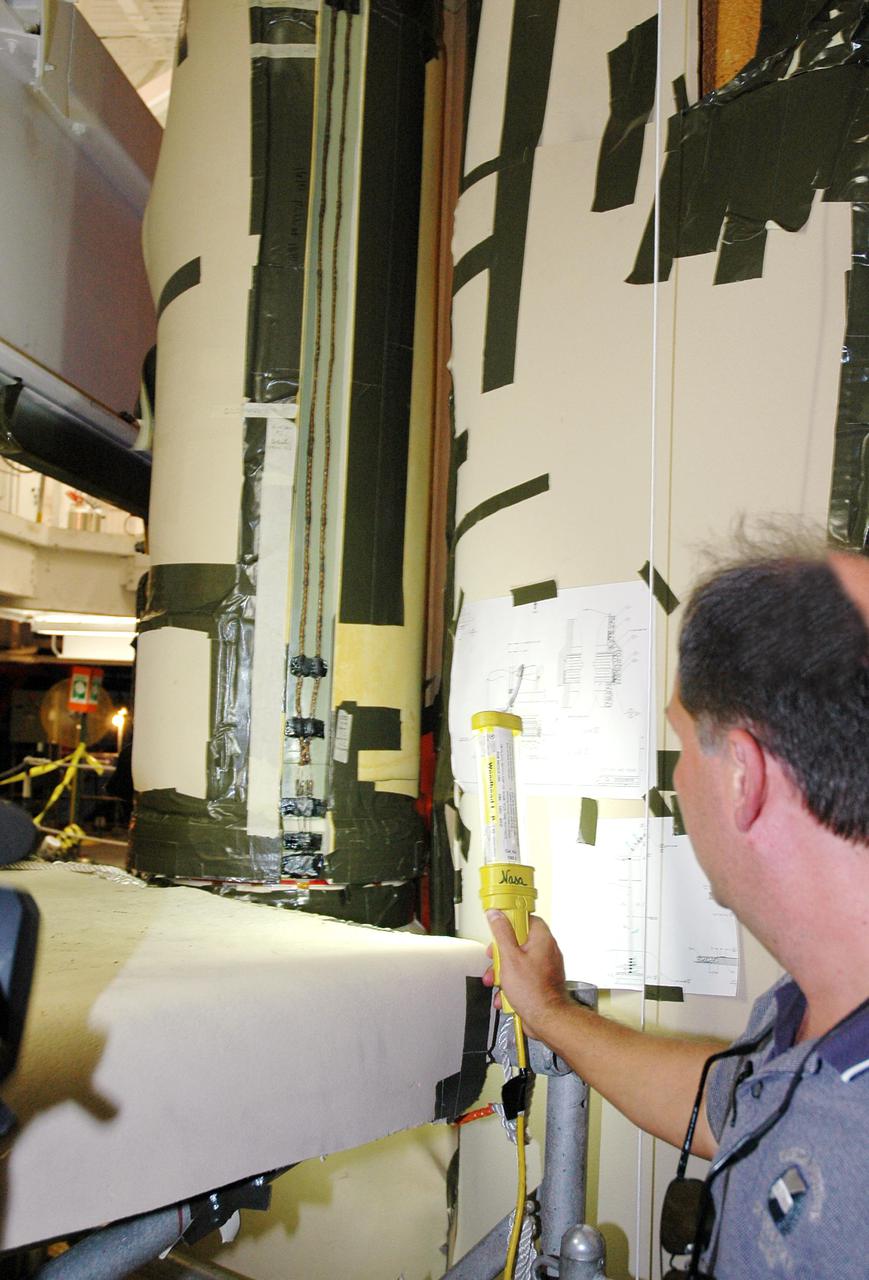
KENNEDY SPACE CENTER, FLA. - In the Vehicle Assembly Building at NASA’s Kennedy Space Center, Ken Revay, the ET_SRB processing manager with United Space Alliance, inspects the newly installed liquid oxygen bellows heater on External Tank 120, recently removed from the orbiter Discovery. The new heater has been added to the feedline bellows to minimize the potential for ice and frost buildup. ET-120 will fly with Atlantis on the second Return to Flight mission STS-121. The launch window for STS-121 extends from Sept. 9 - 24.
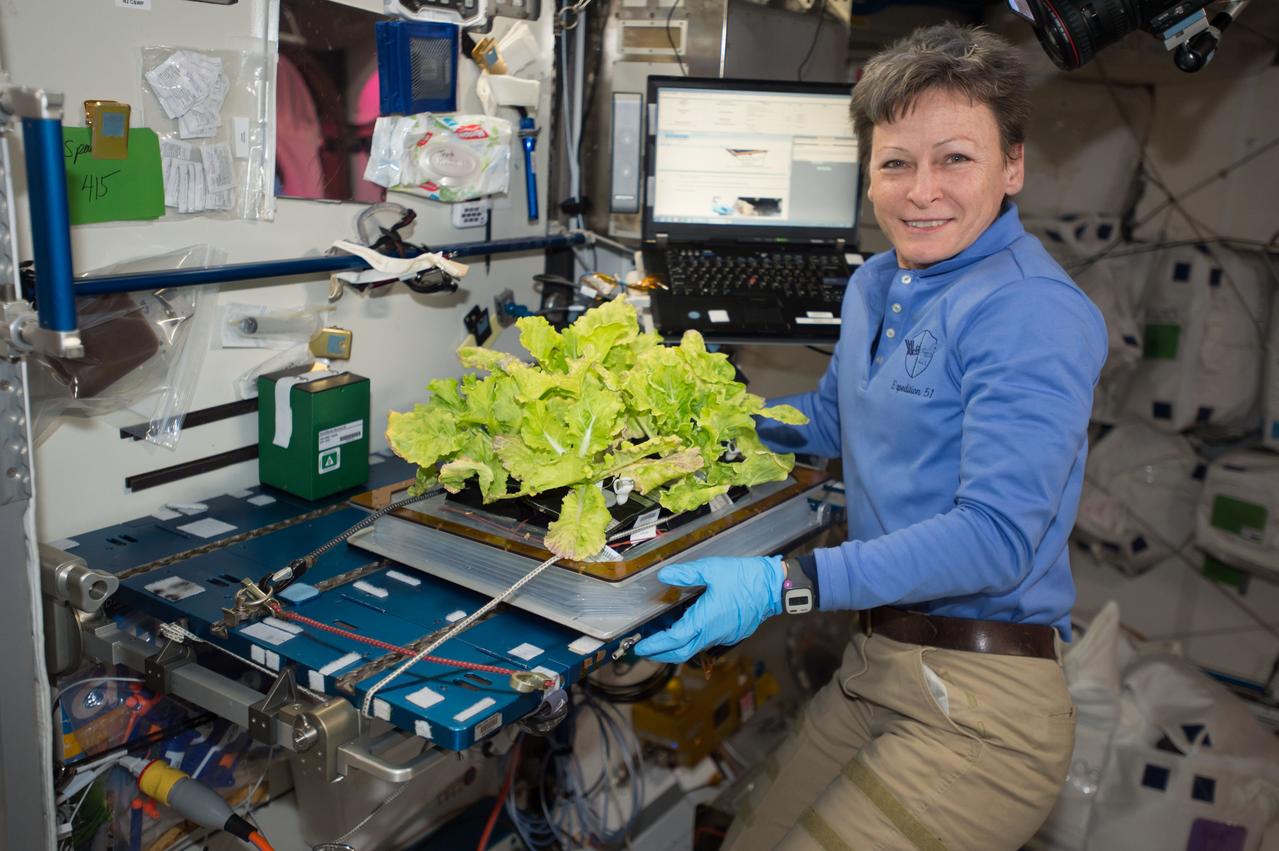
iss051e051923 (5/03/2017) --- NASA astronaut Peggy Whitson poses with cabbage plants in the Vegetable Production System (Veggie) bellows in the Harmony Node 2. Image was taken during final harvesting operations (OPS) for the Veg-03 experiment.
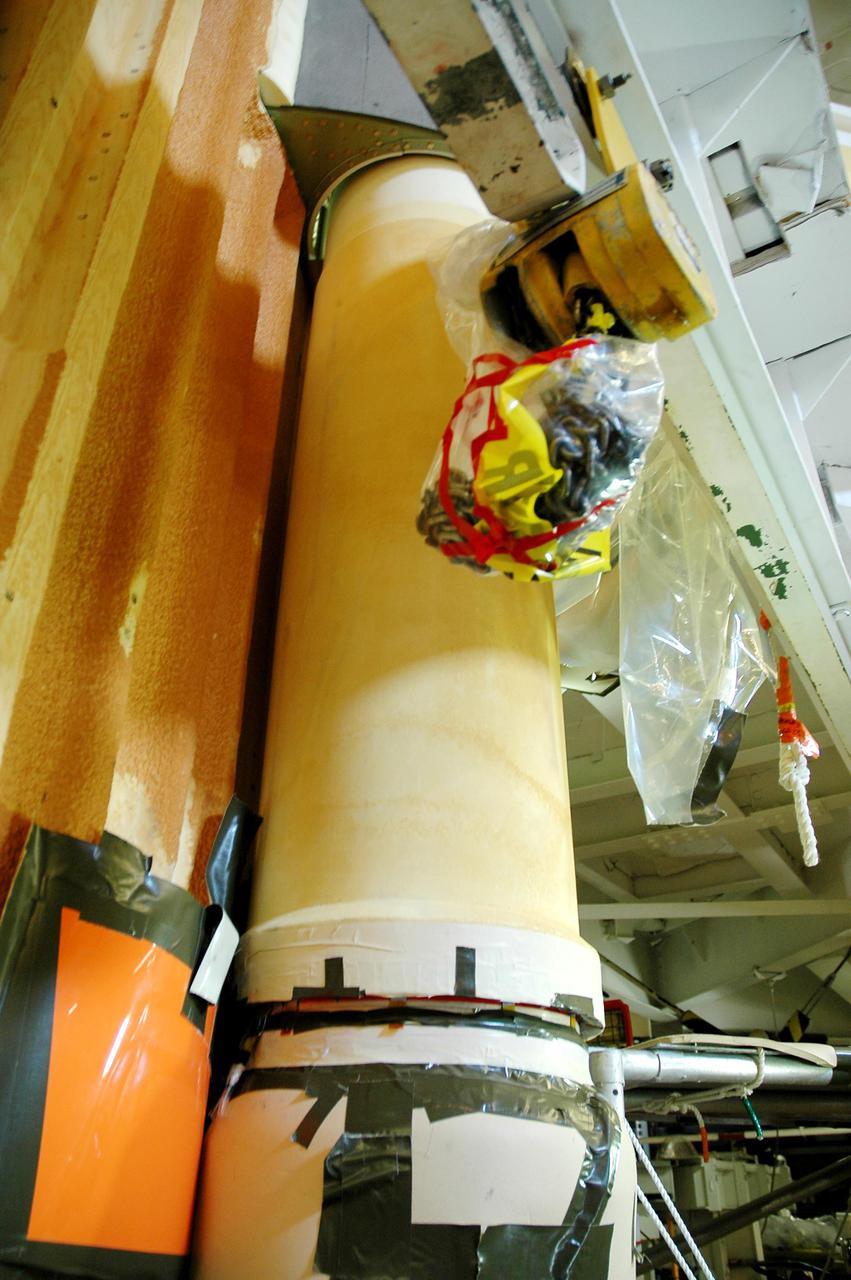
KENNEDY SPACE CENTER, FLA. - In the Vehicle Assembly Building at NASA’s Kennedy Space Center, a new heater has been added to the feedline bellows to minimize the potential for ice and frost buildup. The tank has been designated to fly on Discovery for Return to Flight mission STS-114, which has a launch window extending from July 13 to July 31.
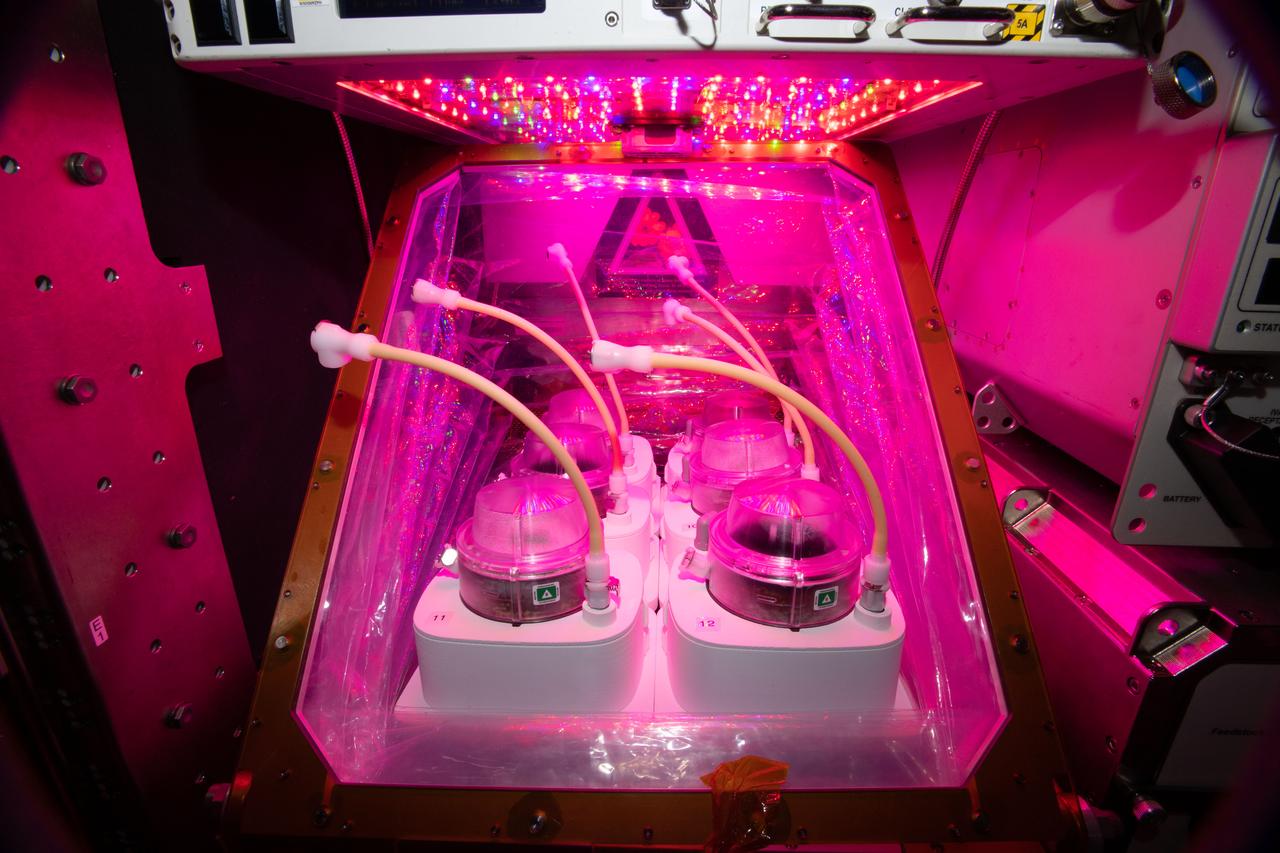
iss062e112685 (3/25/2020) --- Documentation of the Veggie Ponds Modules while module is in Veggie Bellows. Veggie PONDS uses a newly developed passive nutrient delivery system and the Veggie plant growth facility aboard the International Space Station (ISS) to cultivate lettuce and mizuna greens which are to be harvested on-orbit, and consumed, with samples returned to Earth for analysis.
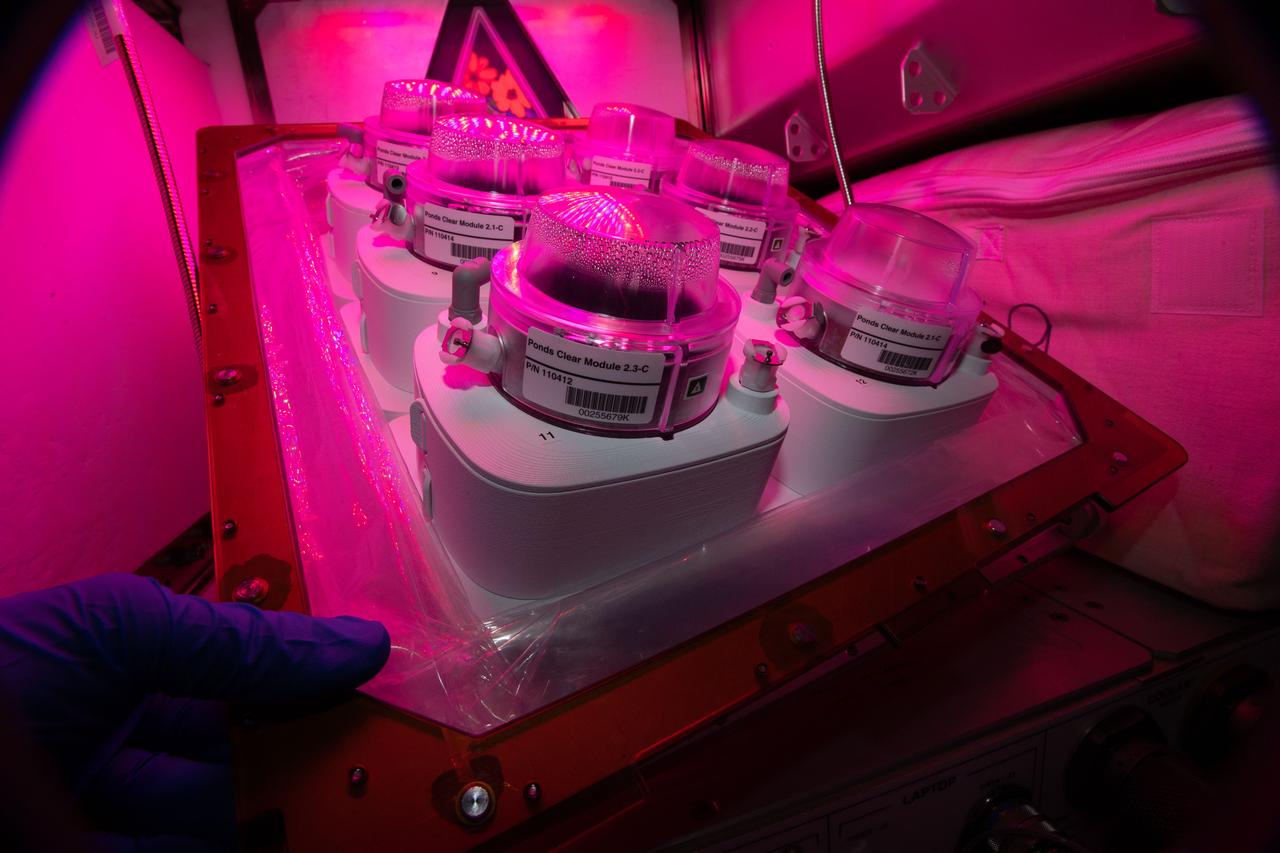
iss059e035838 (4/28/2019) --- Documentation taken during removal of Germination Cap from each Veggie Ponds Module while module is in Veggie Bellows. Veggie PONDS uses a newly developed passive nutrient delivery system and the Veggie plant growth facility aboard the International Space Station (ISS) to cultivate lettuce and mizuna greens which are to be harvested on-orbit, and consumed, with samples returned to Earth for analysis.
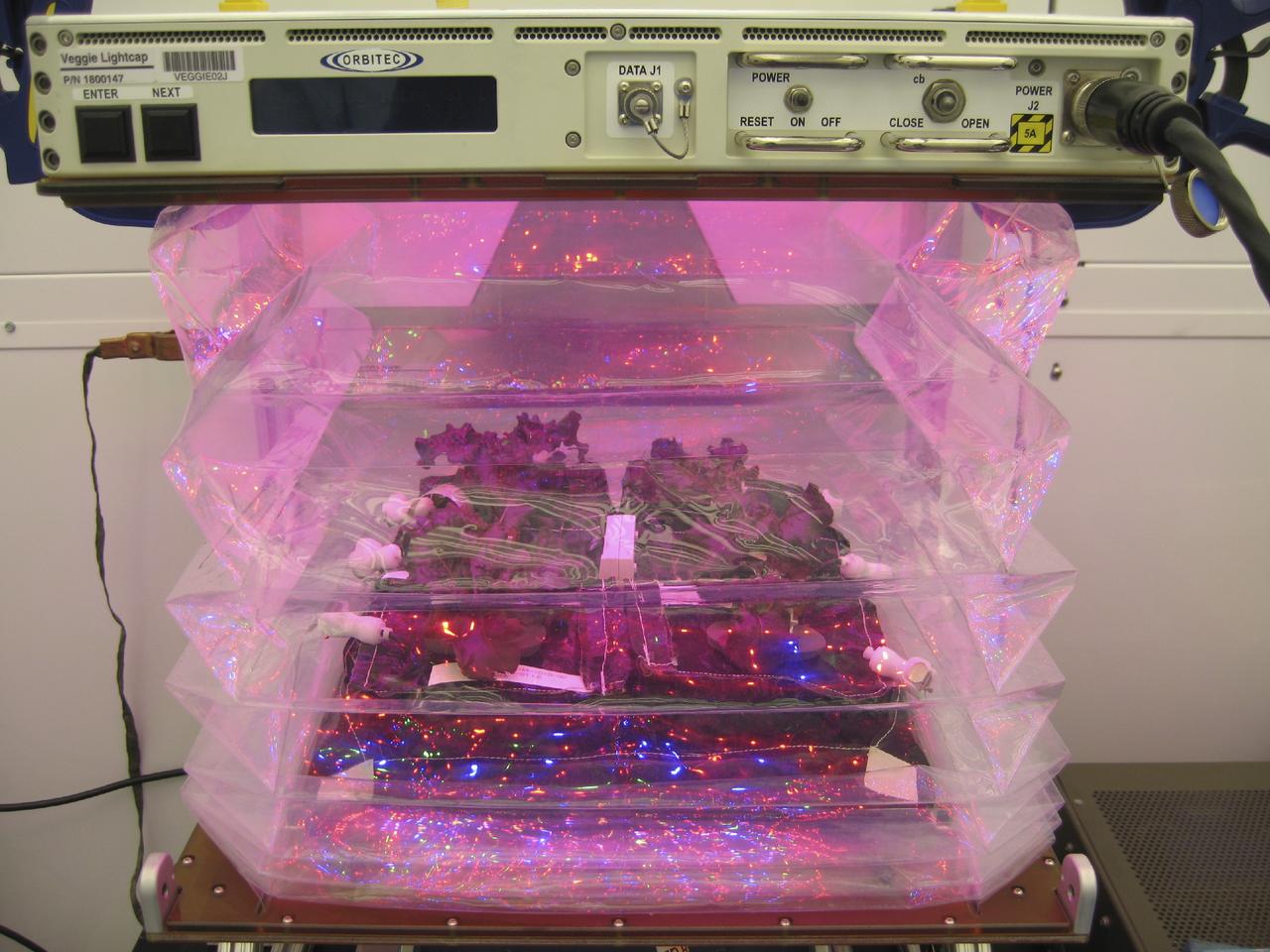
CAPE CANAVERAL, Fla. – Outredgeous red romaine lettuce plants grow inside the bellows of a prototype VEGGIE flight pillow. U.S. astronauts living and working aboard the International Space Station are going to receive a newly developed Vegetable Production System VEGGIE. VEGGIE is set to launch aboard SpaceX's Dragon capsule on NASA's third Commercial Resupply Services mission targeted to launch Dec. 9 from Space Launch Complex 40 at Cape Canaveral Air Force Station in Florida. Photo credit: NASA/Bryan Onate
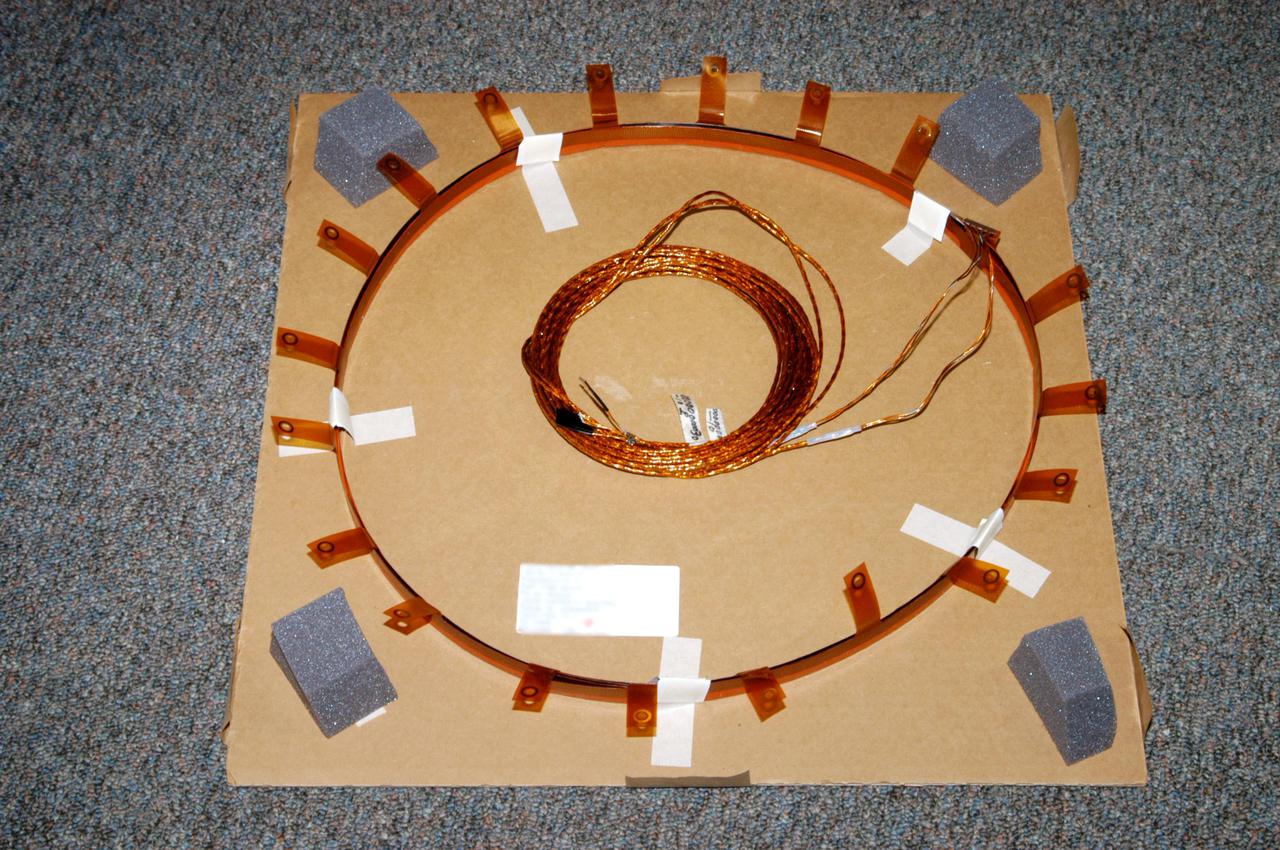
KENNEDY SPACE CENTER, FLA. - Displayed in the Vehicle Assembly Building at NASA’s Kennedy Space Center is a similar heating element to one recently attached to the liquid hydrogen feedline bellows on External Tank 121. The tank will be used on the orbiter Discovery for Return to Flight mission STS-114, which has a launch window extending from July 13 to July 31.
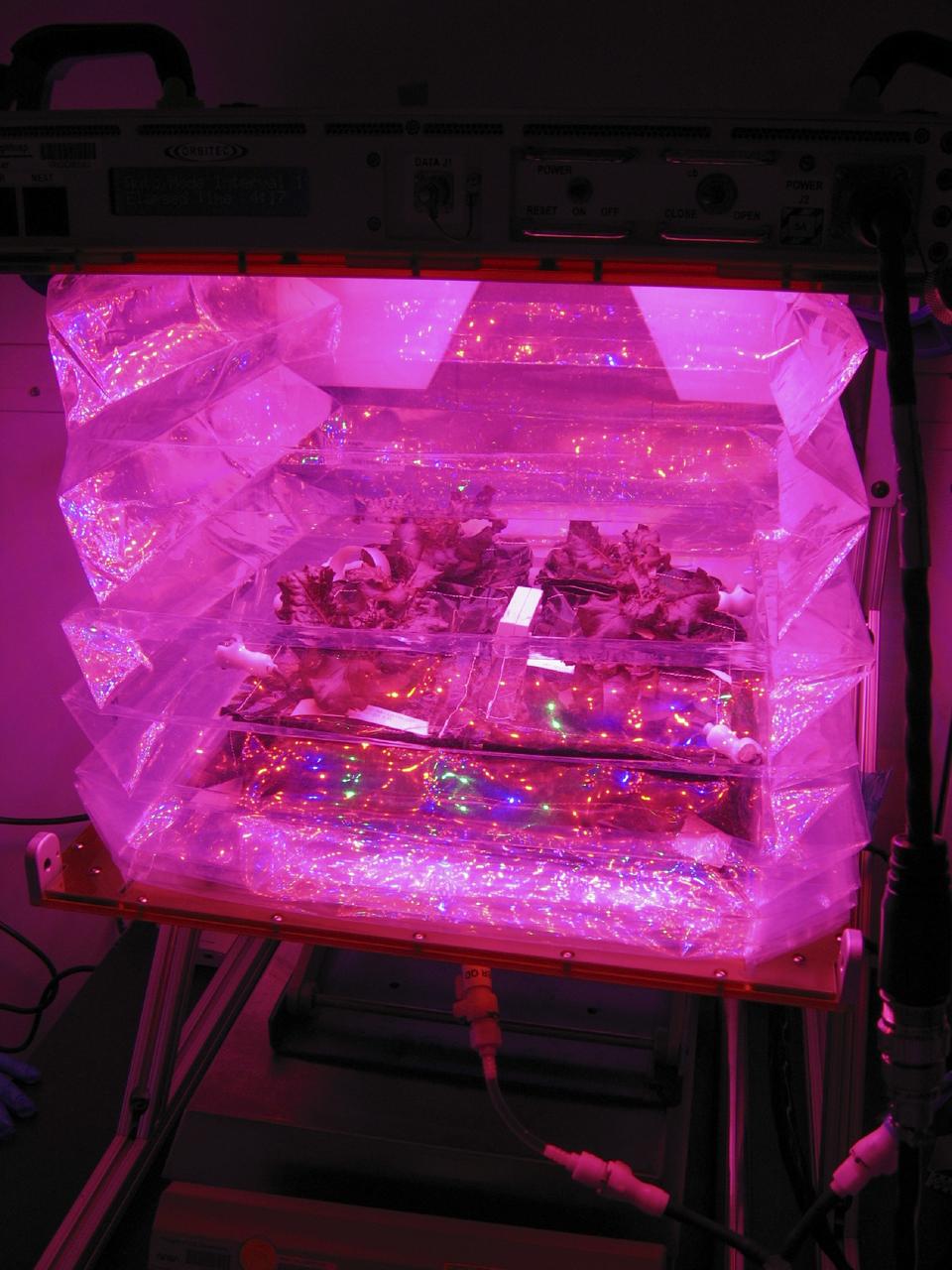
CAPE CANAVERAL, Fla. –Outredgeous red romaine lettuce plants grow inside the bellows of a prototype VEGGIE flight pillow. U.S. astronauts living and working aboard the International Space Station are going to receive a newly developed Vegetable Production System VEGGIE. VEGGIE is set to launch aboard SpaceX's Dragon capsule on NASA's third Commercial Resupply Services mission targeted to launch Dec. 9 from Space Launch Complex 40 at Cape Canaveral Air Force Station in Florida. Photo credit: NASA/Gioia Massa
KENNEDY SPACE CENTER, FLA. - In the Vehicle Assembly Building at NASA’s Kennedy Space Center, Lockheed Martin workers are validating electrical tests on the heating element recently attached to the liquid hydrogen feedline bellows on External Tank 121. Seen behind them is the External Tank. The tank will be used on the orbiter Discovery for Return to Flight mission STS-114, which has a launch window extending from July 13 to July 31.
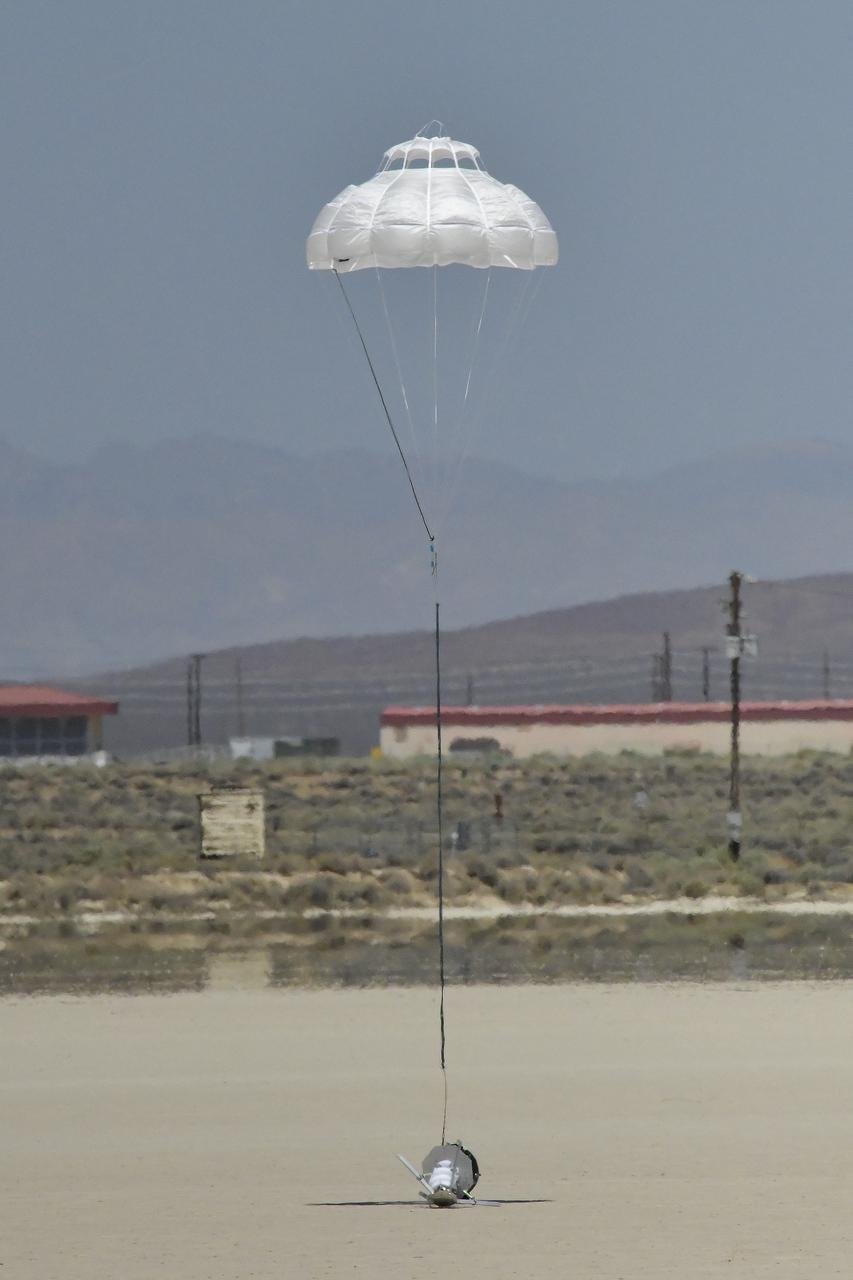
The Enhancing Parachutes by Instrumenting the Canopy test experiment lands following an air launch from an Alta X drone on June 4, 2025, at NASA’s Armstong Flight Research Center in Edwards, California. NASA researchers are developing technology to make supersonic parachutes safer and more reliable for delivering science instruments and payloads to Mars.
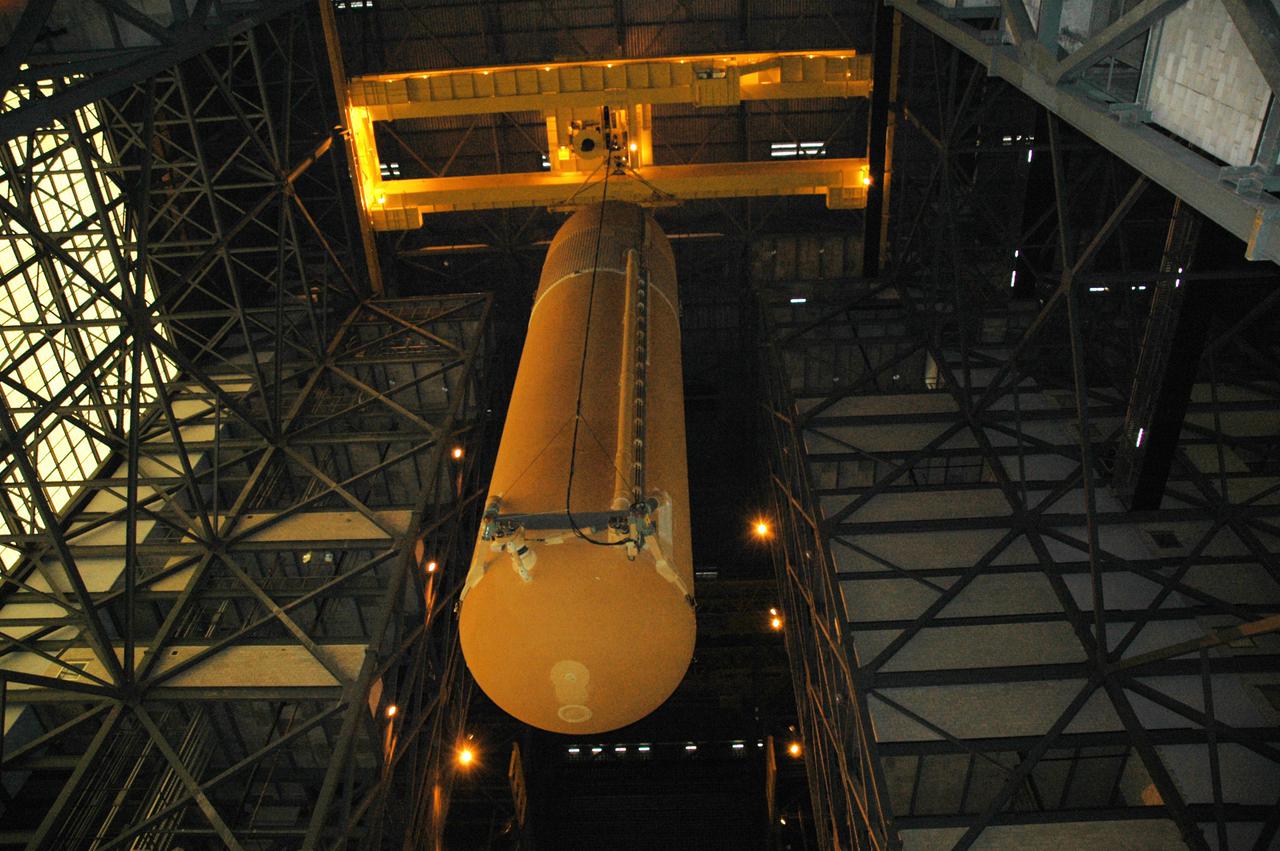
KENNEDY SPACE CENTER, FLA. - An overhead crane lowers the External Tank that will be used to return the Space Shuttle program to flight into high bay 3 in the Vehicle Assembly Building. The tank, ET-121, and the Solid Rocket Boosters were originally scheduled to fly with orbiter Atlantis on mission STS-121 but will now be used to launch Discovery on mission STS-114. Once secure in the high bay, a new heater will be added to the feedline bellows to minimize the potential for ice and frost buildup. STS-114 is the first Return to Flight mission to the International Space Station. The launch window extends from July 13 through July 31.
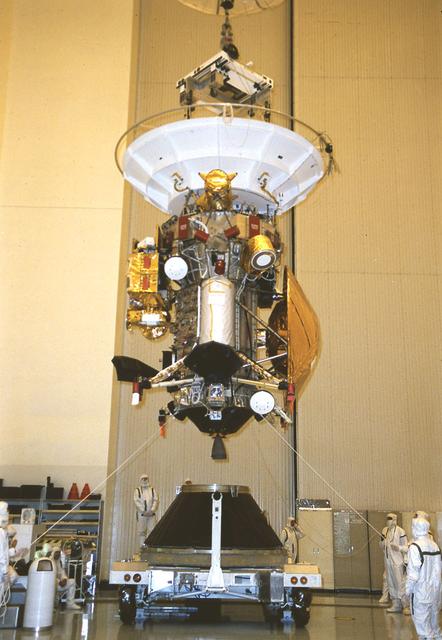
Jet Propulsion Research Lab (JPL) workers use a borescope to verify the pressure relief device bellow's integrity on a radioisotope thermoelectric generator (RTG) that has been installed on the Cassini spacecraft in the Payload Hazardous Servicing Facility. The activity is part of the mechanical and electrical verification testing of RTGs during prelaunch processing. RTGs use heat from the natural decay of plutonium to generate electrical power. The three RTGs on Cassini will enable the spacecraft to operate far from the Sun where solar power systems are not feasible. They will provide electrical power to Cassini on it seven year trip to the Saturnian system and during its four year mission at Saturn.
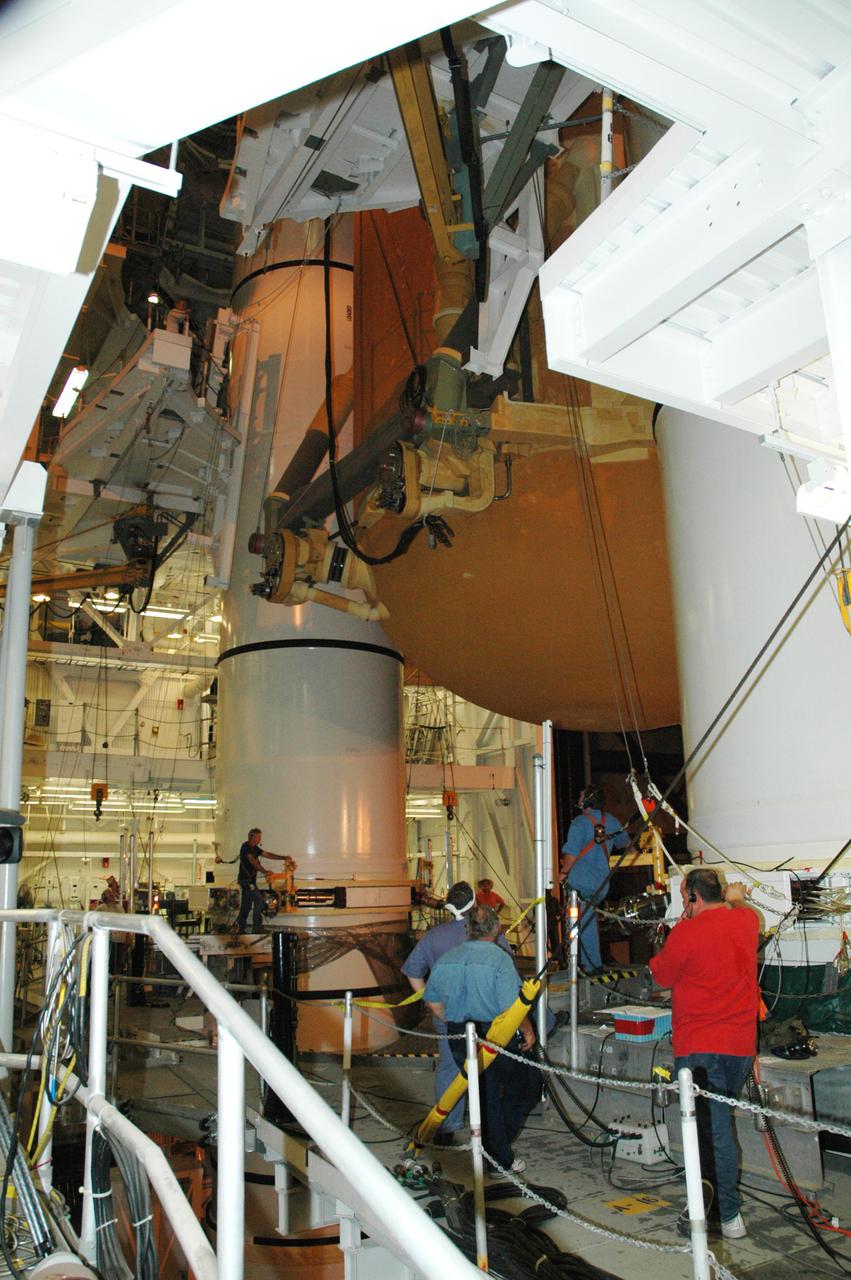
KENNEDY SPACE CENTER, FLA. - Technicians attach the External Tank that will be used to return the Space Shuttle program to flight to a pair of Solid Rocket Boosters in high bay 3 in the Vehicle Assembly Building. The tank, ET-121, and the Solid Rocket Boosters were originally scheduled to fly with orbiter Atlantis on mission STS-121 but will now be used to launch Discovery on mission STS-114. Once secure in the high bay, a new heater will be added to the feedline bellows to minimize the potential for ice and frost buildup. STS-114 is the first Return to Flight mission to the International Space Station. The launch window extends from July 13 through July 31.
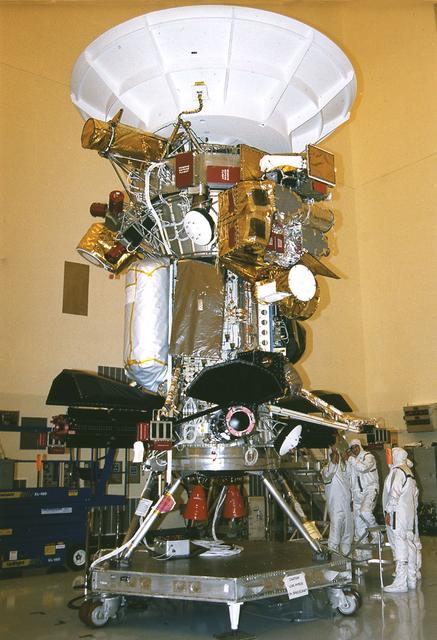
Jet Propulsion Research Lab (JPL) workers use a borescope to verify the pressure relief device bellow's integrity on a radioisotope thermoelectric generator (RTG) that has been installed on the Cassini spacecraft in the Payload Hazardous Servicing Facility. The activity is part of the mechanical and electrical verification testing of RTGs during prelaunch processing. RTGs use heat from the natural decay of plutonium to generate electrical power. The three RTGs on Cassini will enable the spacecraft to operate far from the Sun where solar power systems are not feasible. They will provide electrical power to Cassini on it seven year trip to the Saturnian system and during its four year mission at Saturn.
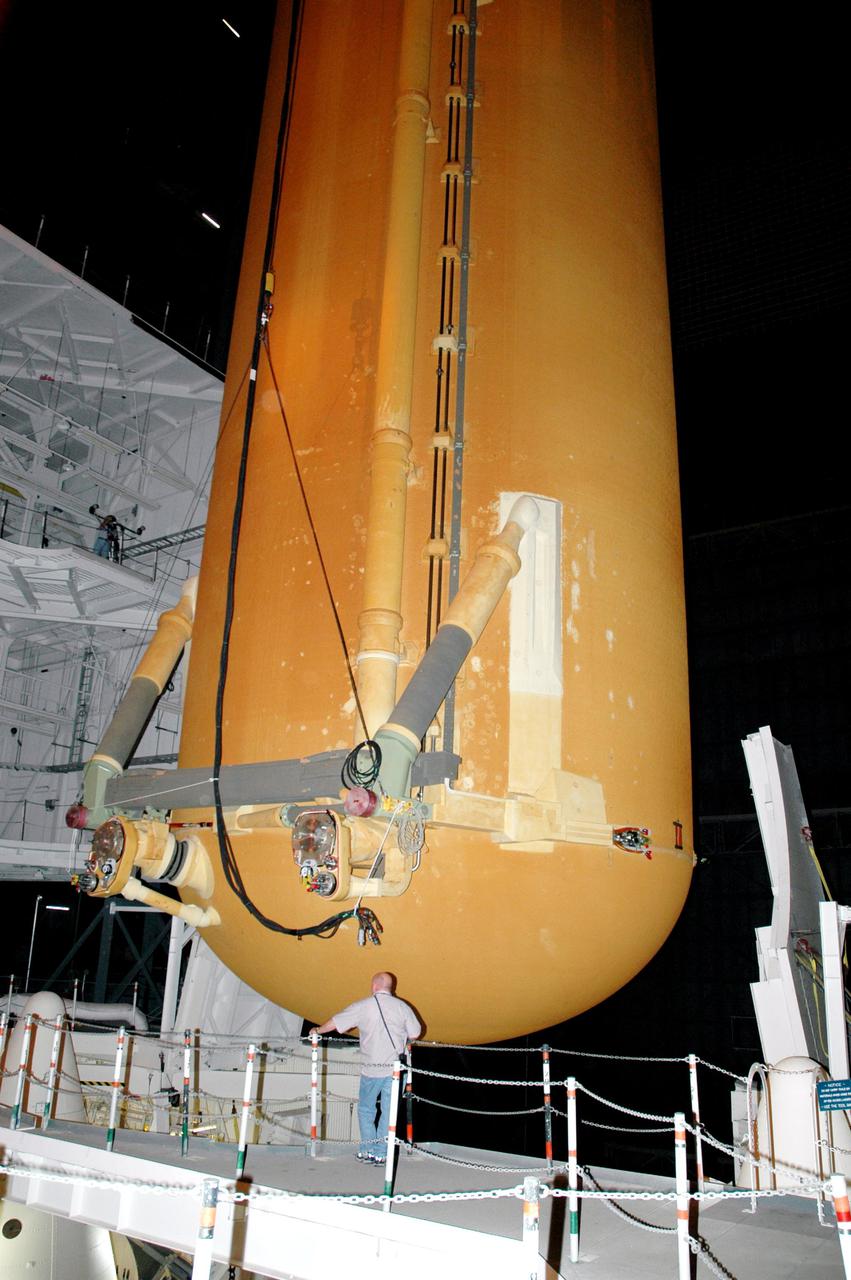
KENNEDY SPACE CENTER, FLA. - A technician monitors the External Tank that will be used to return the Space Shuttle program to flight as it is positioned into high bay 3 in the Vehicle Assembly Building. The tank, ET-121, and the Solid Rocket Boosters were originally scheduled to fly with orbiter Atlantis on mission STS-121 but will now be used to launch Discovery on mission STS-114. Once secure in the high bay, a new heater will be added to the feedline bellows to minimize the potential for ice and frost buildup. STS-114 is the first Return to Flight mission to the International Space Station. The launch window extends from July 13 through July 31.
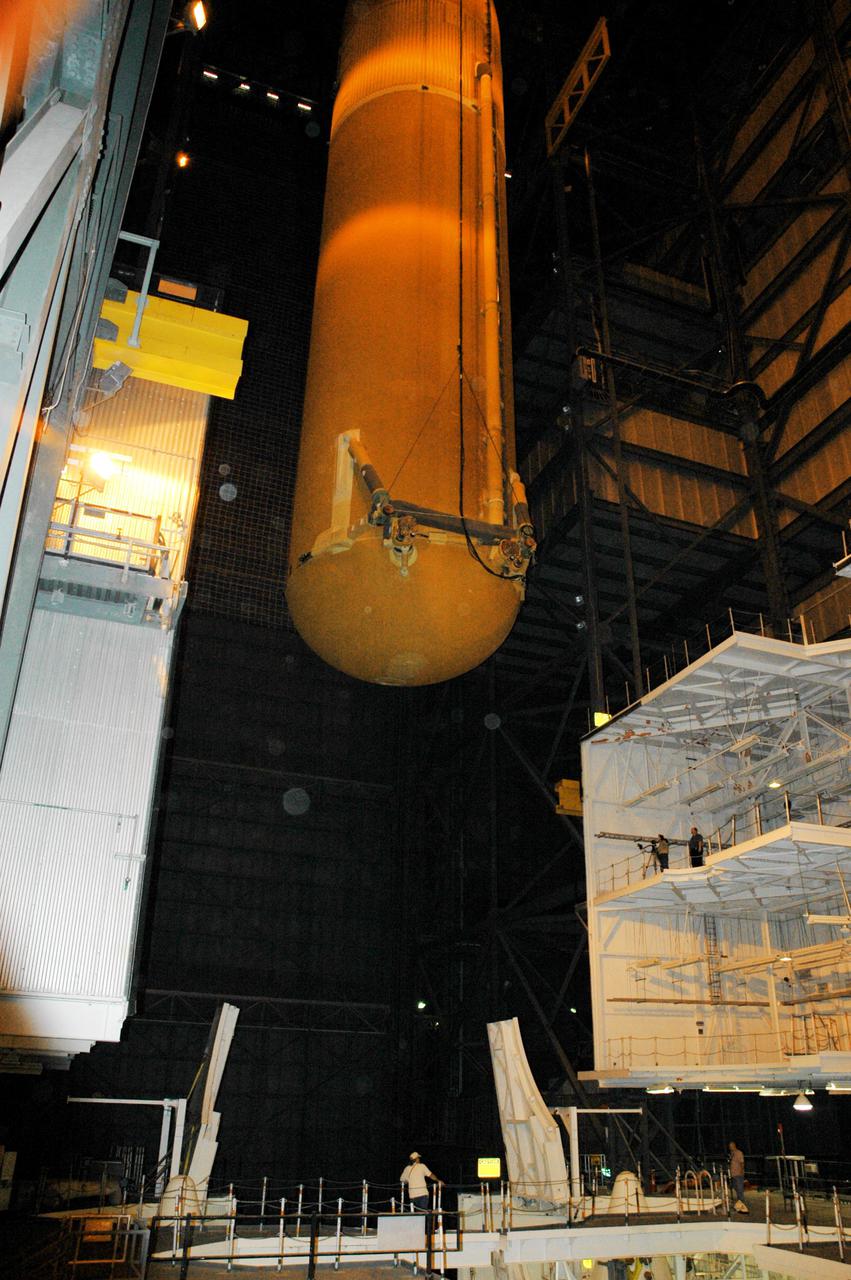
KENNEDY SPACE CENTER, FLA. - The External Tank that will be used to return the Space Shuttle program to flight is lowered into high bay 3 in the Vehicle Assembly Building. The tank, ET-121, and the Solid Rocket Boosters were originally scheduled to fly with orbiter Atlantis on mission STS-121 but will now be used to launch Discovery on mission STS-114. Once secure in the high bay, a new heater will be added to the feedline bellows to minimize the potential for ice and frost buildup. STS-114 is the first Return to Flight mission to the International Space Station. The launch window extends from July 13 through July 31.
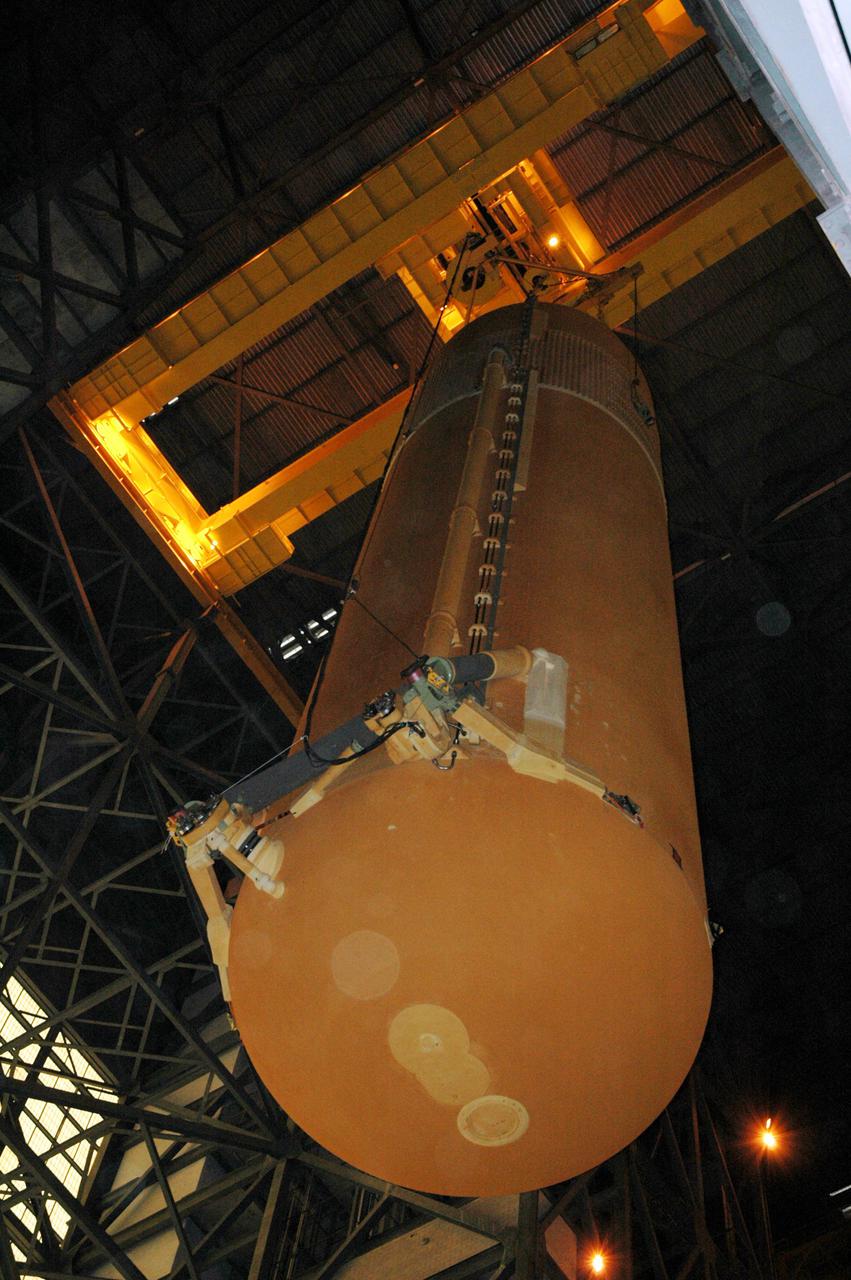
KENNEDY SPACE CENTER, FLA. - The External Tank that will be used to return the Space Shuttle program to flight is lifted into high bay 3 in the Vehicle Assembly Building. The tank, ET-121, and the Solid Rocket Boosters were originally scheduled to fly with orbiter Atlantis on mission STS-121 but will now be used to launch Discovery on mission STS-114. Once secure in the high bay, a new heater will be added to the feedline bellows to minimize the potential for ice and frost buildup. STS-114 is the first Return to Flight mission to the International Space Station. The launch window extends from July 13 through July 31.
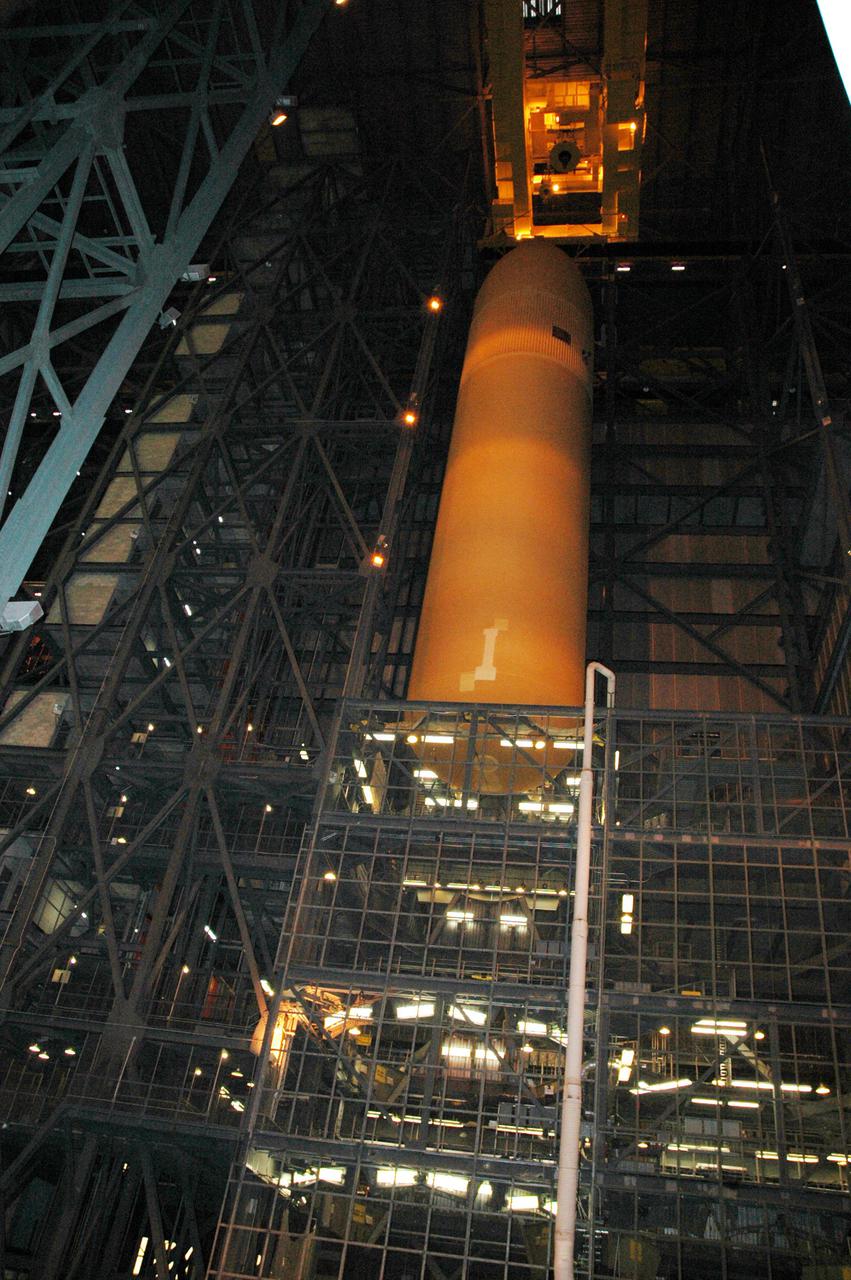
KENNEDY SPACE CENTER, FLA. - The External Tank that will be used to return the Space Shuttle program to flight is lifted into high bay 3 in the Vehicle Assembly Building. The tank, ET-121, and the Solid Rocket Boosters were originally scheduled to fly with orbiter Atlantis on mission STS-121 but will now be used to launch Discovery on mission STS-114. Once secure in the high bay, a new heater will be added to the feedline bellows to minimize the potential for ice and frost buildup. STS-114 is the first Return to Flight mission to the International Space Station. The launch window extends from July 13 through July 31.
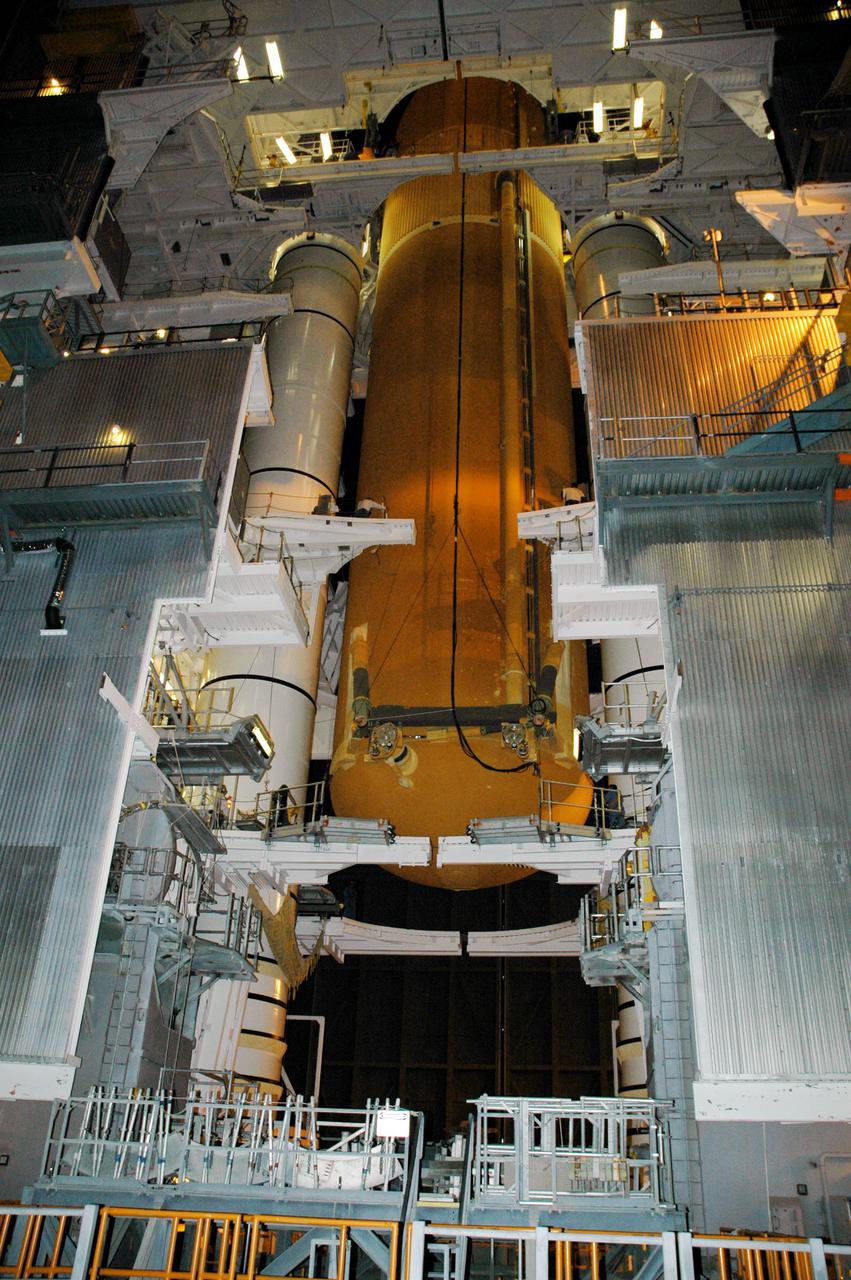
KENNEDY SPACE CENTER, FLA. - The External Tank that will be used to return the Space Shuttle program to flight is attached to a pair of Solid Rocket Boosters in high bay 3 in the Vehicle Assembly Building. The tank, ET-121, and the Solid Rocket Boosters were originally scheduled to fly with orbiter Atlantis on mission STS-121 but will now be used to launch Discovery on mission STS-114. Once secure in the high bay, a new heater will be added to the feedline bellows to minimize the potential for ice and frost buildup. STS-114 is the first Return to Flight mission to the International Space Station. The launch window extends from July 13 through July 31.
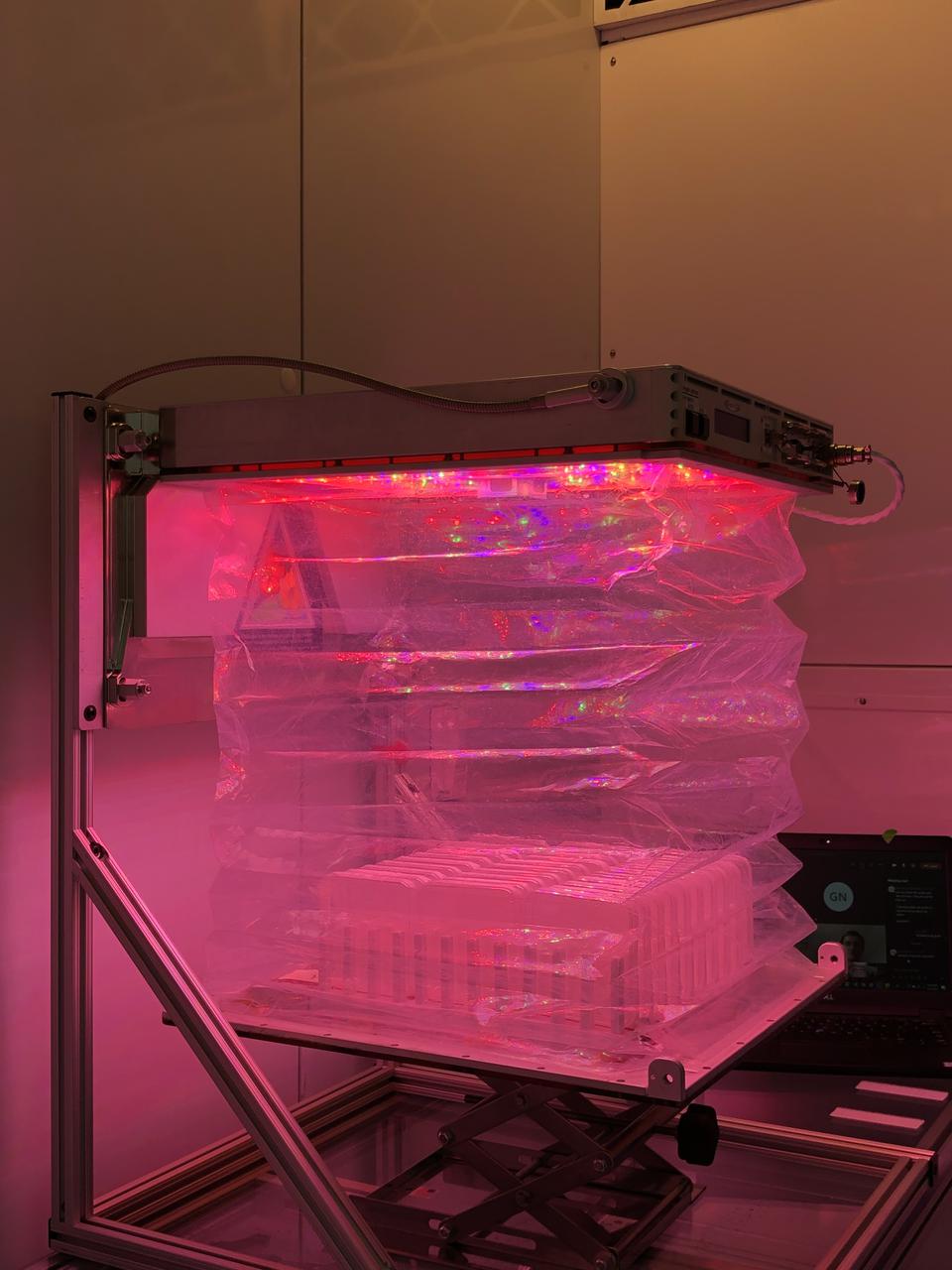
The Science Verification Test for NASA’s Advanced Plant Experiment-08 (APEX-08) testing Arabidopsis thaliana, a plant scientists routinely use for research, takes place inside the Veggie growth chamber at NASA’s Kennedy Space Center in Florida on Nov. 6, 2020. The test is part of the process for demonstrating readiness for space research ahead of its flight on SpaceX’s 23rd Commercial Resupply Services mission to the International Space Station. The APEX-08 study includes making genetic alterations that elicit a response in a group of organic compounds that modulate plant responses to environmental stress.
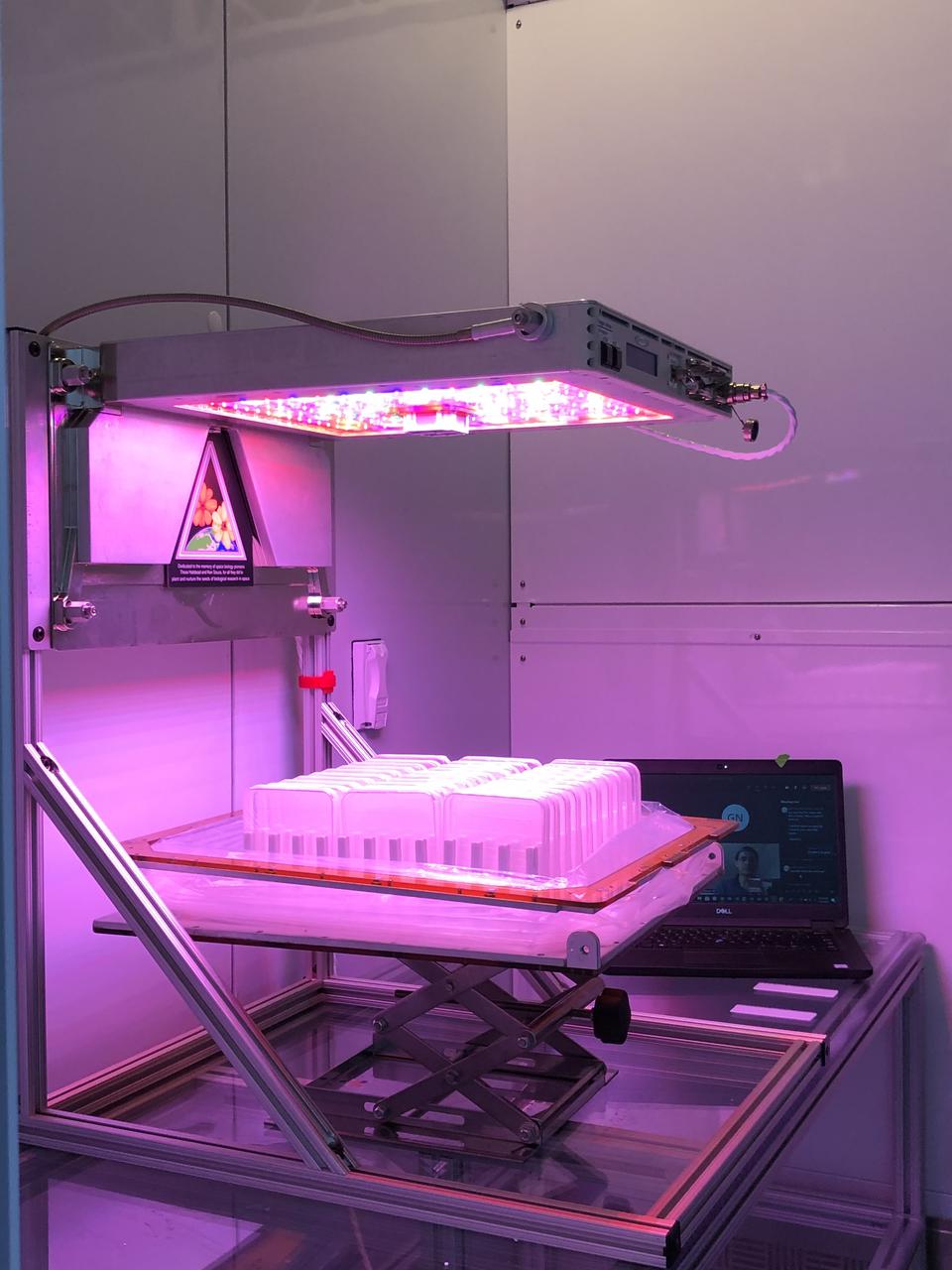
The Science Verification Test for NASA’s Advanced Plant Experiment-08 (APEX-08) testing Arabidopsis thaliana, a plant scientists routinely use for research, takes place inside the Veggie growth chamber at NASA’s Kennedy Space Center in Florida on Nov. 6, 2020. The test is part of the process for demonstrating readiness for space research ahead of its flight on SpaceX’s 23rd Commercial Resupply Services mission to the International Space Station. The APEX-08 study includes making genetic alterations that elicit a response in a group of organic compounds that modulate plant responses to environmental stress.
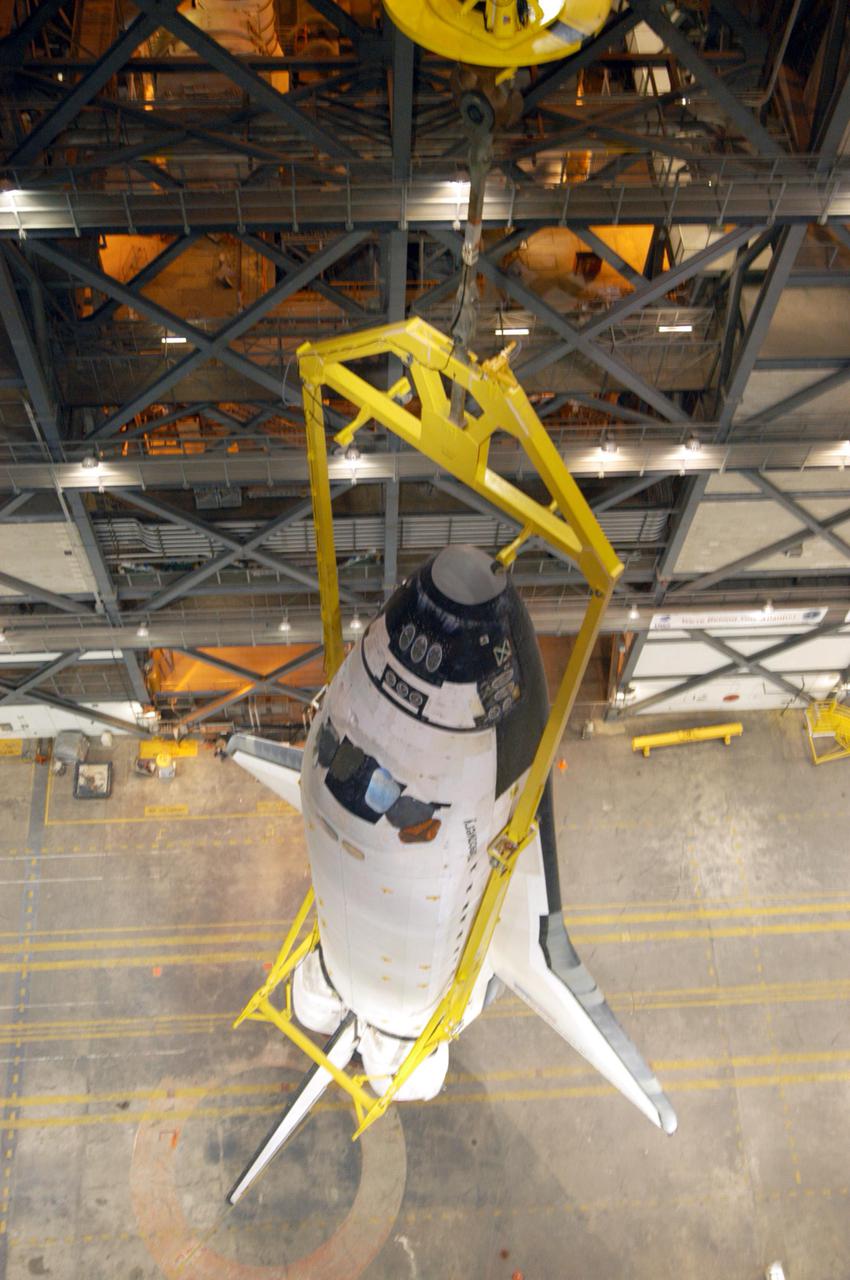
KENNEDY SPACE CENTER, FLA. - The orbiter Discovery hangs suspended above the floor of the transfer aisle in the Vehicle Assembly Building. It will be lifted over a cross-beam into high bay 3 and remated with the new External Tank, ET-121, and Solid Rocket Boosters in the bay. That tank was originally scheduled to fly with Atlantis on the second Return to Flight mission, STS-121. A new heater was added to the tank's feedline bellows, part of the pipeline that carries the liquid oxygen to the orbiter’s main engines, to minimize the potential for ice and frost buildup. After the remate, technicians will work final closeouts on the fully assembled Space Shuttle stack, and perform liquid oxygen and liquid hydrogen electrical mates and an interface verification test. Discovery is currently scheduled to return to Launch Pad 39B on June 13.

CAPE CANAVERAL, Fla. -- At the Kennedy Space Center Visitor Complex in Florida, CNN correspondent John Zarrella counted down for the ceremonial opening of the new "Space Shuttle Atlantis" facility. Smoke bellows near a full-scale set of space shuttle twin solid rocket boosters and external fuel tank at the entrance to the exhibit building. Guests may walk beneath the 184-foot-tall boosters and tank as they enter the facility. The new $100 million facility includes interactive exhibits that tell the story of the 30-year Space Shuttle Program and highlight the future of space exploration. The "Space Shuttle Atlantis" exhibit formally opened to the public on June 29, 2013.Photo credit: NASA/Jim Grossmann
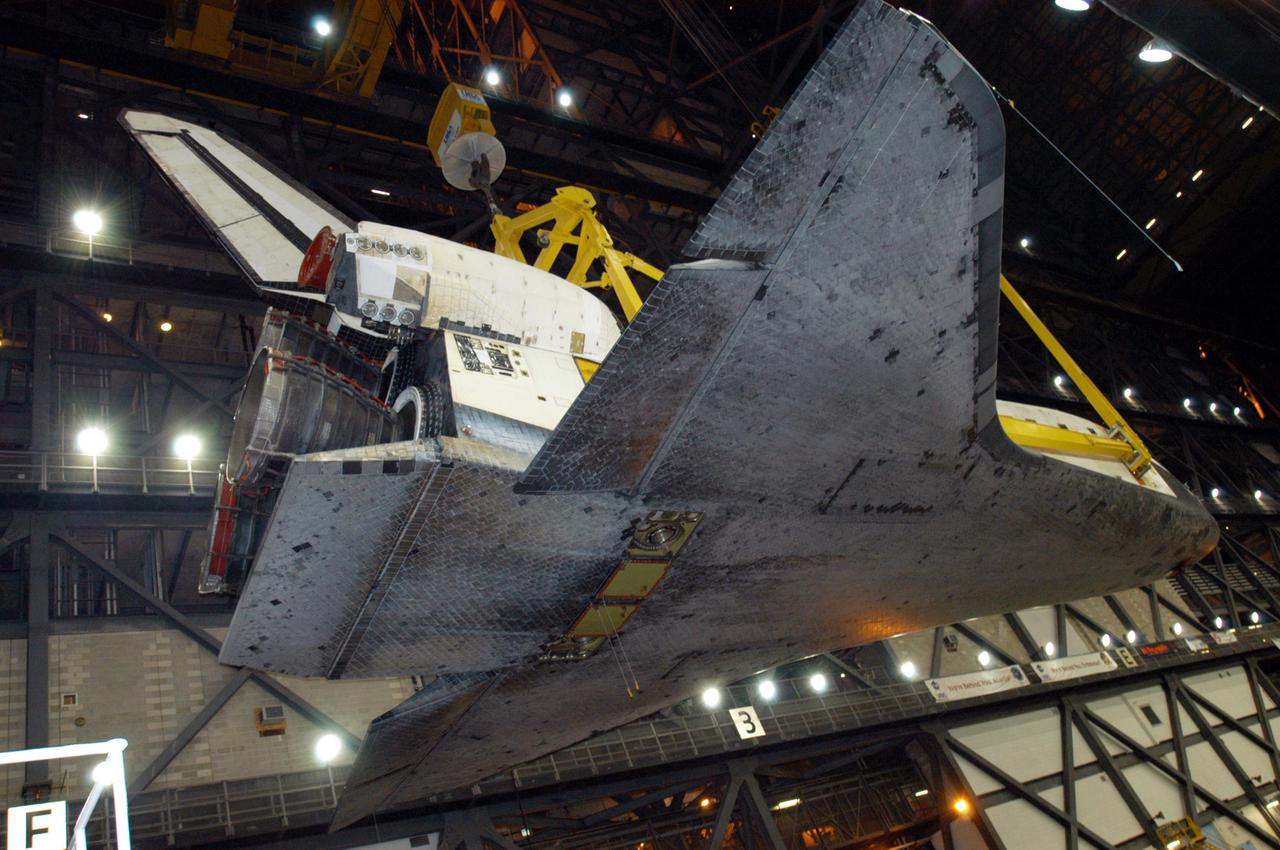
KENNEDY SPACE CENTER, FLA. - In the transfer aisle of the Vehicle Assembly Building, orbiter Discovery is lifted into the air by a 175-ton bridge crane. Discovery is being lifted to vertical for the remate with the new External Tank, ET-121, and Solid Rocket Boosters in high bay 3. That tank was originally scheduled to fly with Atlantis on the second Return to Flight mission, STS-121. A new heater was added to the tank's feedline bellows, part of the pipeline that carries the liquid oxygen to the orbiter’s main engines, to minimize the potential for ice and frost buildup. After the remate, technicians will work final closeouts on the fully assembled Space Shuttle stack, and perform liquid oxygen and liquid hydrogen electrical mates and an interface verification test. Discovery is currently scheduled to return to Launch Pad 39B on June 13.
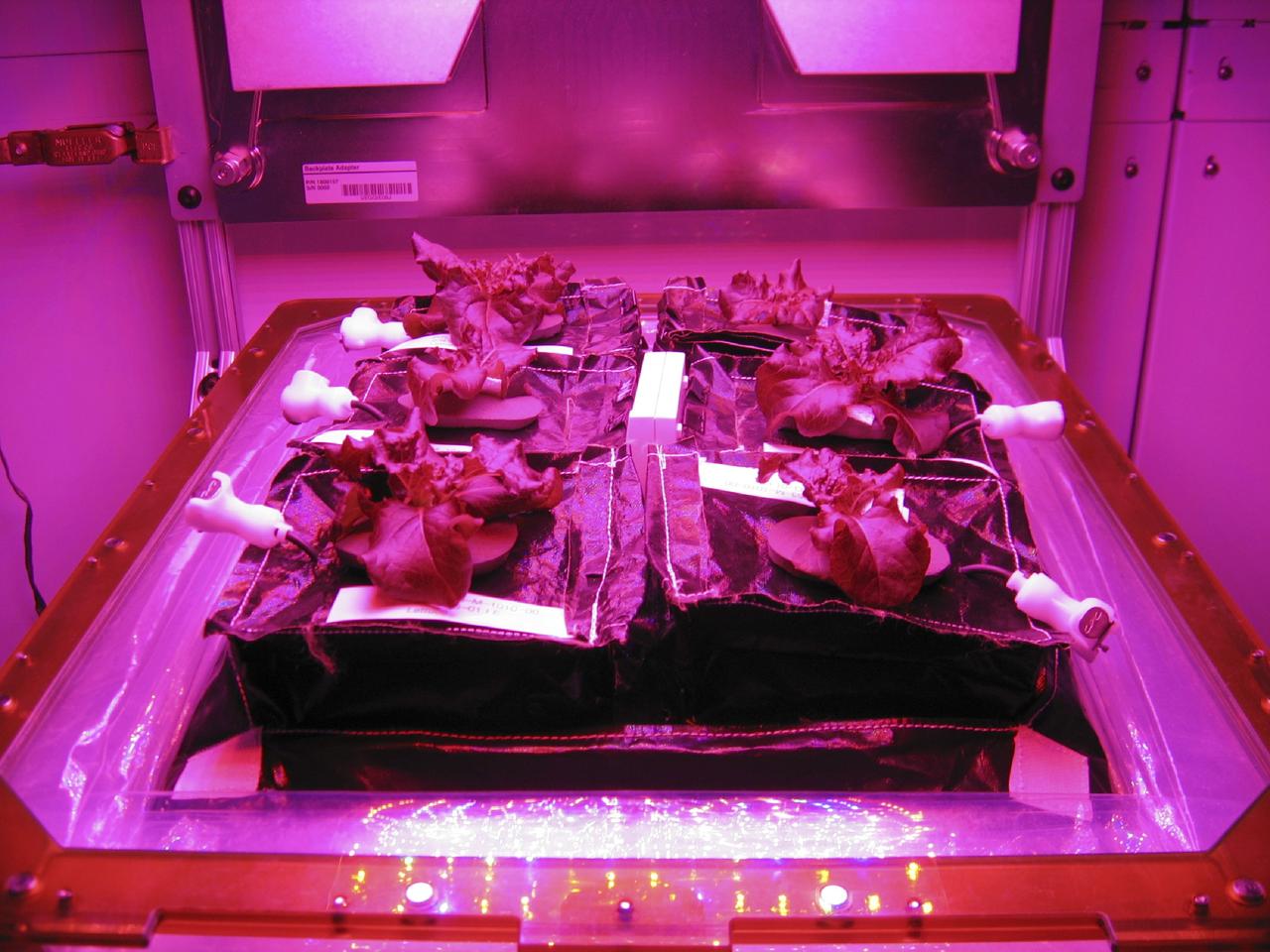
CAPE CANAVERAL, Fla. –Outredgeous red romaine lettuce plants grow inside in a prototype VEGGIE flight pillow. The bellows of the hardware have been lowered to better observe the plants. A small temperature and relative humidity data logger is placed between the pillows small white box, central. U.S. astronauts living and working aboard the International Space Station are going to receive a newly developed Vegetable Production System VEGGIE. VEGGIE is set to launch aboard SpaceX's Dragon capsule on NASA's third Commercial Resupply Services mission targeted to launch Dec. 9 from Space Launch Complex 40 at Cape Canaveral Air Force Station in Florida. Photo credit: NASA/Gioia Massa
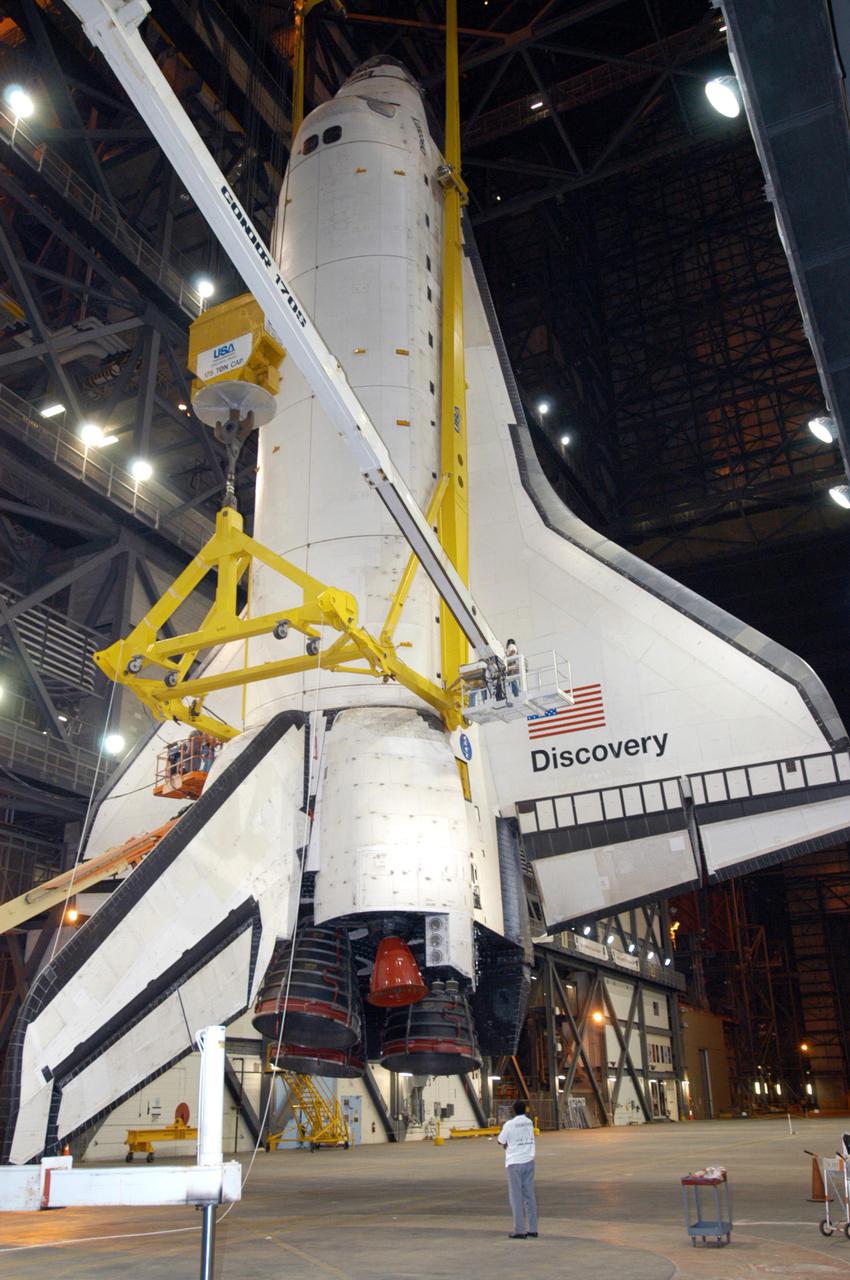
KENNEDY SPACE CENTER, FLA. - In the transfer aisle of the Vehicle Assembly Building, orbiter Discovery hangs suspended in a vertical position. It will be lifted over a cross-beam into high bay 3 and remated with the new External Tank, ET-121, and Solid Rocket Boosters in the bay. That tank was originally scheduled to fly with Atlantis on the second Return to Flight mission, STS-121. A new heater was added to the tank's feedline bellows, part of the pipeline that carries the liquid oxygen to the orbiter’s main engines, to minimize the potential for ice and frost buildup. After the remate, technicians will work final closeouts on the fully assembled Space Shuttle stack, and perform liquid oxygen and liquid hydrogen electrical mates and an interface verification test. Discovery is currently scheduled to return to Launch Pad 39B on June 13.
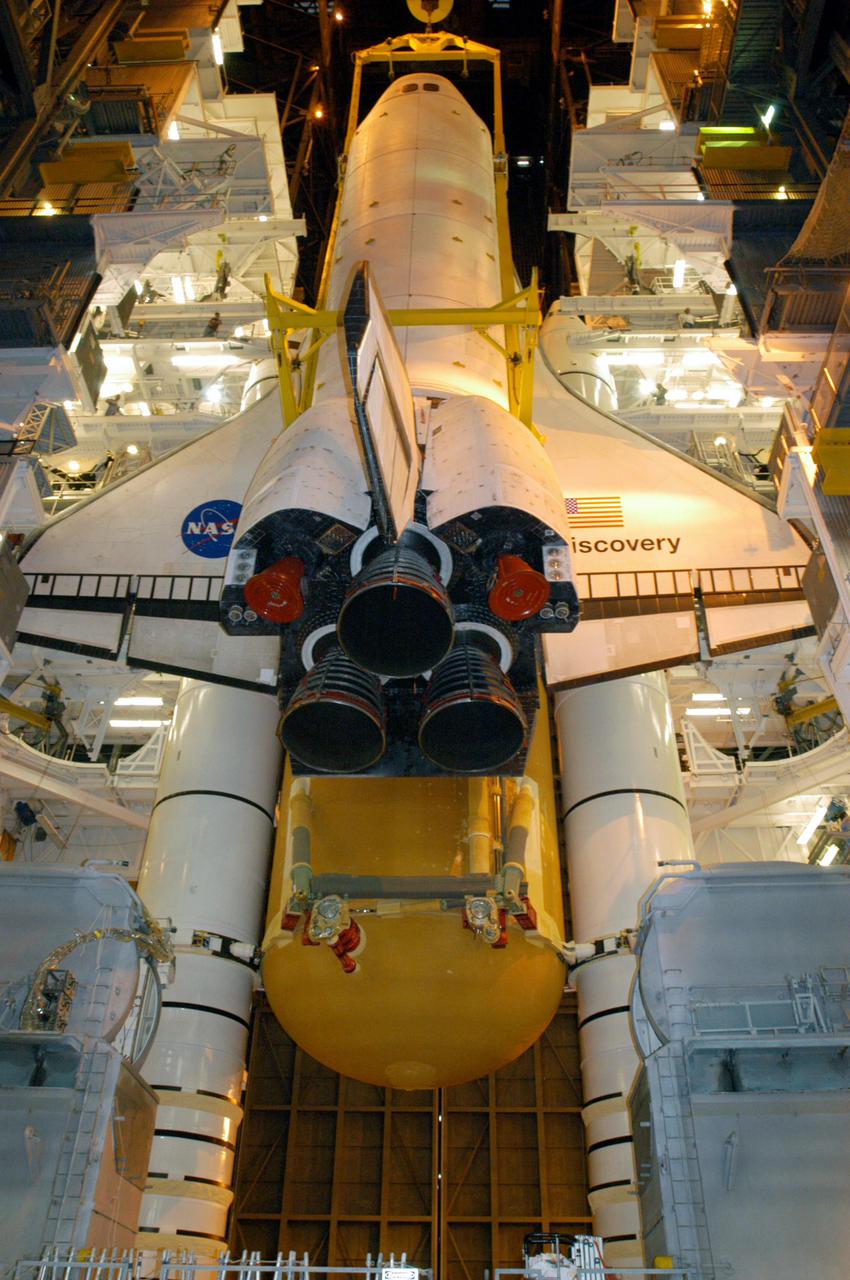
KENNEDY SPACE CENTER, FLA. - Suspended by a 175-ton bridge crane, the orbiter Discovery is lowered next to the new External Tank, ET-121, and Solid Rocket Boosters in high bay 3 for mating. That tank was originally scheduled to fly with Atlantis on the second Return to Flight mission, STS-121. A new heater was added to the tank's feedline bellows, part of the pipeline that carries the liquid oxygen to the orbiter’s main engines, to minimize the potential for ice and frost buildup. After the remate, technicians will work final closeouts on the fully assembled Space Shuttle stack, and perform liquid oxygen and liquid hydrogen electrical mates and an interface verification test. Discovery is currently scheduled to return to Launch Pad 39B on June 13.
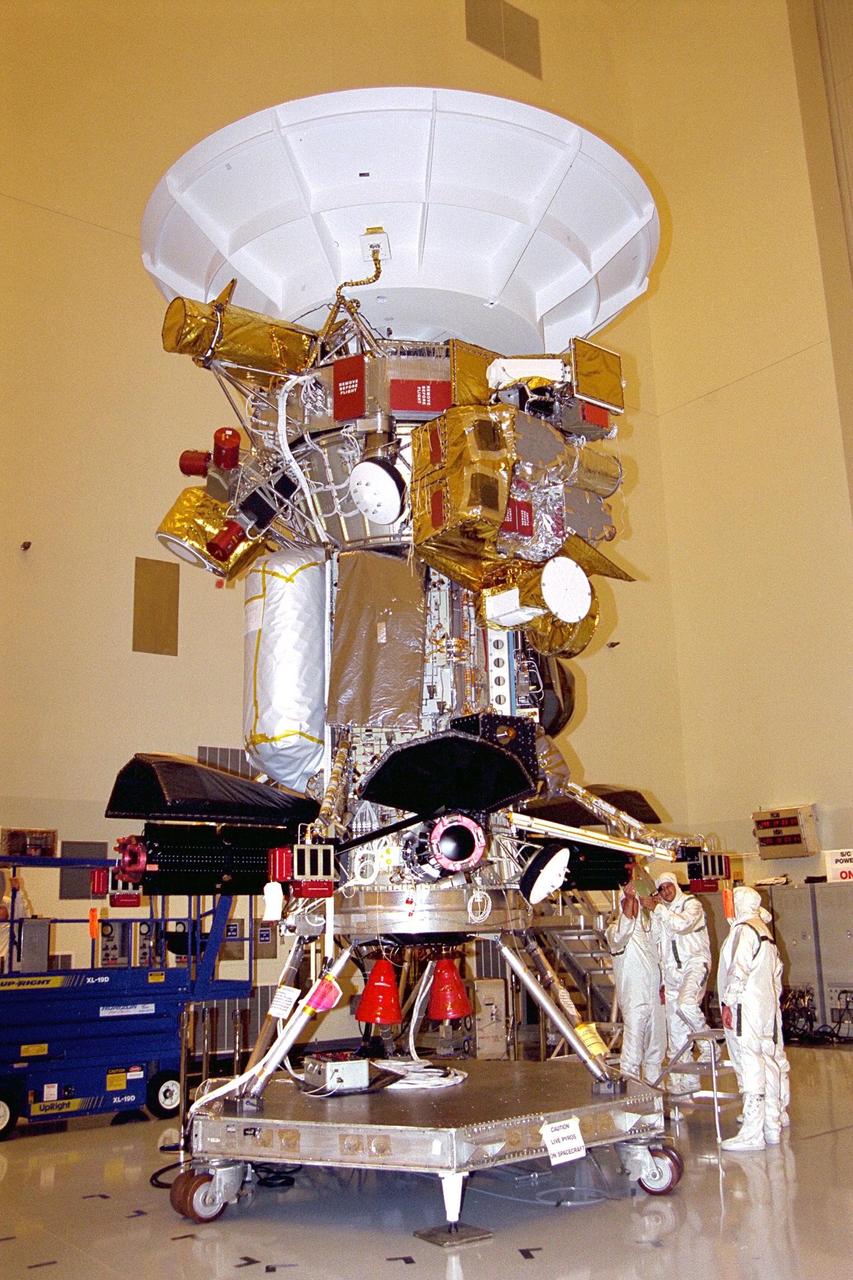
Jet Propulsion Laboratory (JPL) workers use a borescope to verify pressure relief device bellows integrity on a radioisotope thermoelectric generator (RTG) which has been installed on the Cassini spacecraft in the Payload Hazardous Servicing Facility. The activity is part of the mechanical and electrical verification testing of RTGs during prelaunch processing. RTGs use heat from the natural decay of plutonium to generate electric power. The three RTGs on Cassini will enable the spacecraft to operate far from the Sun where solar power systems are not feasible. They will provide electrical power to Cassini on its 6.7-year trip to the Saturnian system and during its four-year mission at Saturn. The Cassini mission is scheduled for an Oct. 6 launch aboard a Titan IVB/Centaur expendable launch vehicle. Cassini is built and managed for NASA by JPL
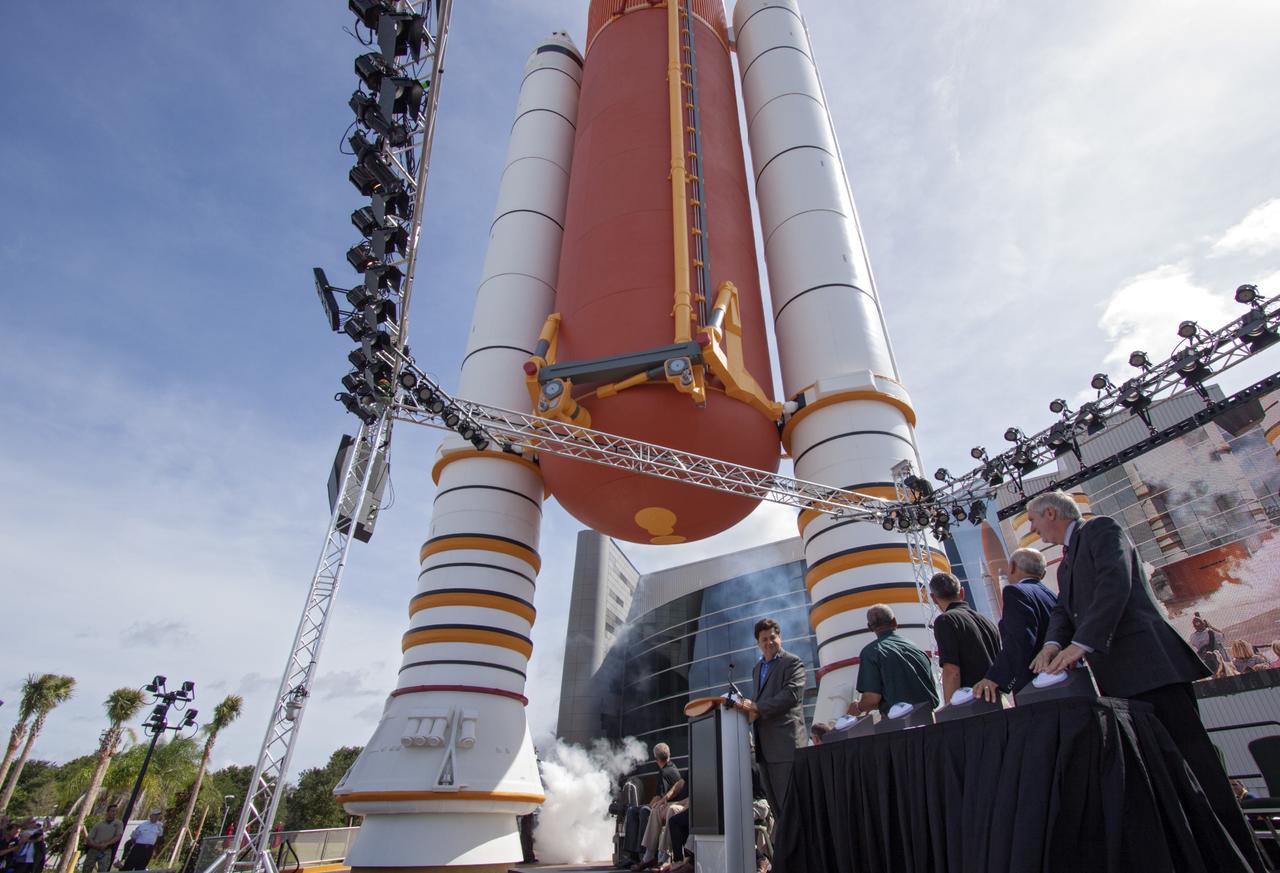
CAPE CANAVERAL, Fla. -- At the Kennedy Space Center Visitor Complex in Florida, CNN correspondent John Zarrella counted down for the ceremonial opening of the new "Space Shuttle Atlantis" facility. Smoke bellows near a full-scale set of space shuttle twin solid rocket boosters and external fuel tank at the entrance to the exhibit building. Looking on after pressing buttons to mark the opening the new exhibit, are, from the left, Charlie Bolden, NASA administrator, Bob Cabana, Kennedy director, Rick Abramson, Delaware North Parks and Resorts president, and Bill Moore, Delaware North Parks and Resorts chief operating officer. The new $100 million facility includes interactive exhibits that tell the story of the 30-year Space Shuttle Program and highlight the future of space exploration. The "Space Shuttle Atlantis" exhibit formally opened to the public on June 29, 2013.Photo credit: NASA/Jim Grossmann
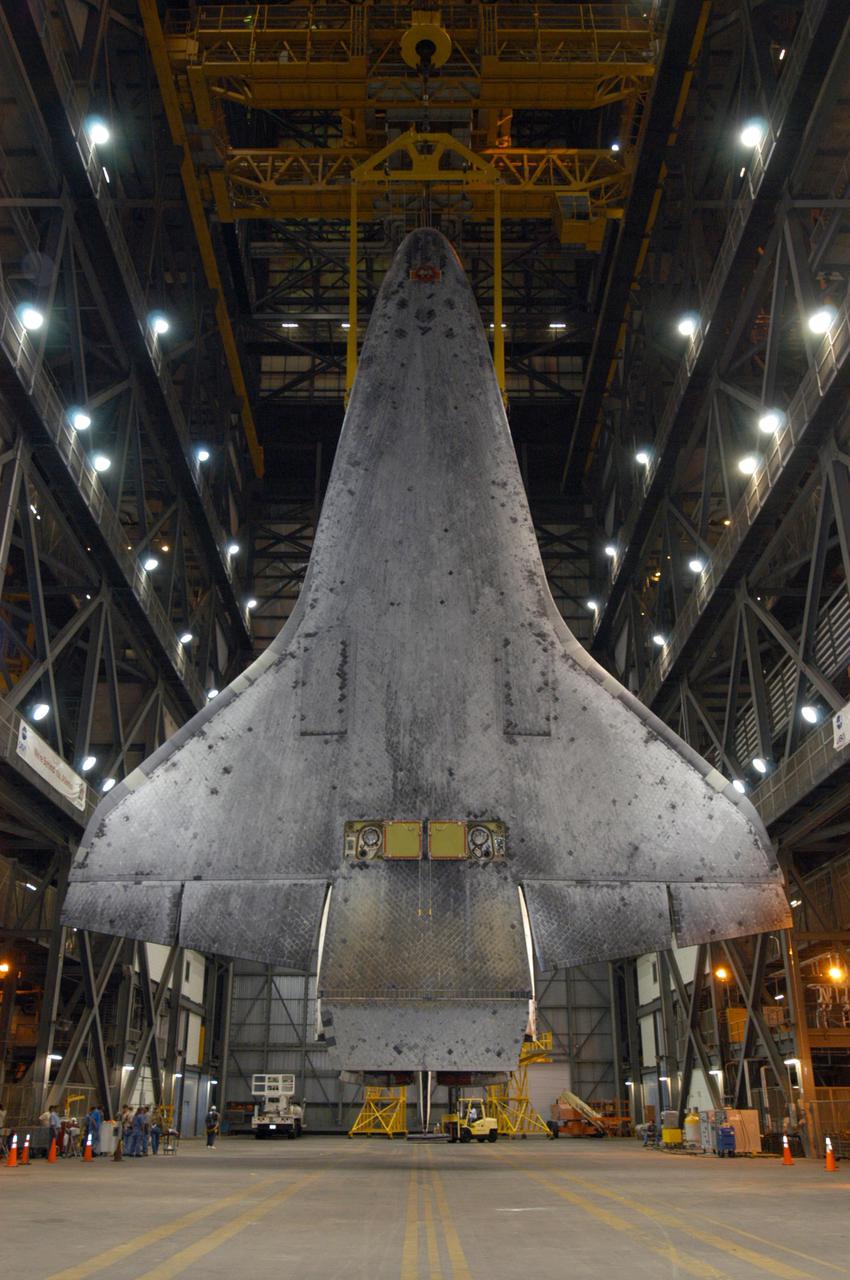
KENNEDY SPACE CENTER, FLA. - In the transfer aisle of the Vehicle Assembly Building, orbiter Discovery is raised to a vertical position. It will be lifted over a cross-beam into high bay 3 and remated with the new External Tank, ET-121, and Solid Rocket Boosters in the bay. That tank was originally scheduled to fly with Atlantis on the second Return to Flight mission, STS-121. A new heater was added to the tank's feedline bellows, part of the pipeline that carries the liquid oxygen to the orbiter’s main engines, to minimize the potential for ice and frost buildup. After the remate, technicians will work final closeouts on the fully assembled Space Shuttle stack, and perform liquid oxygen and liquid hydrogen electrical mates and an interface verification test. Discovery is currently scheduled to return to Launch Pad 39B on June 13.
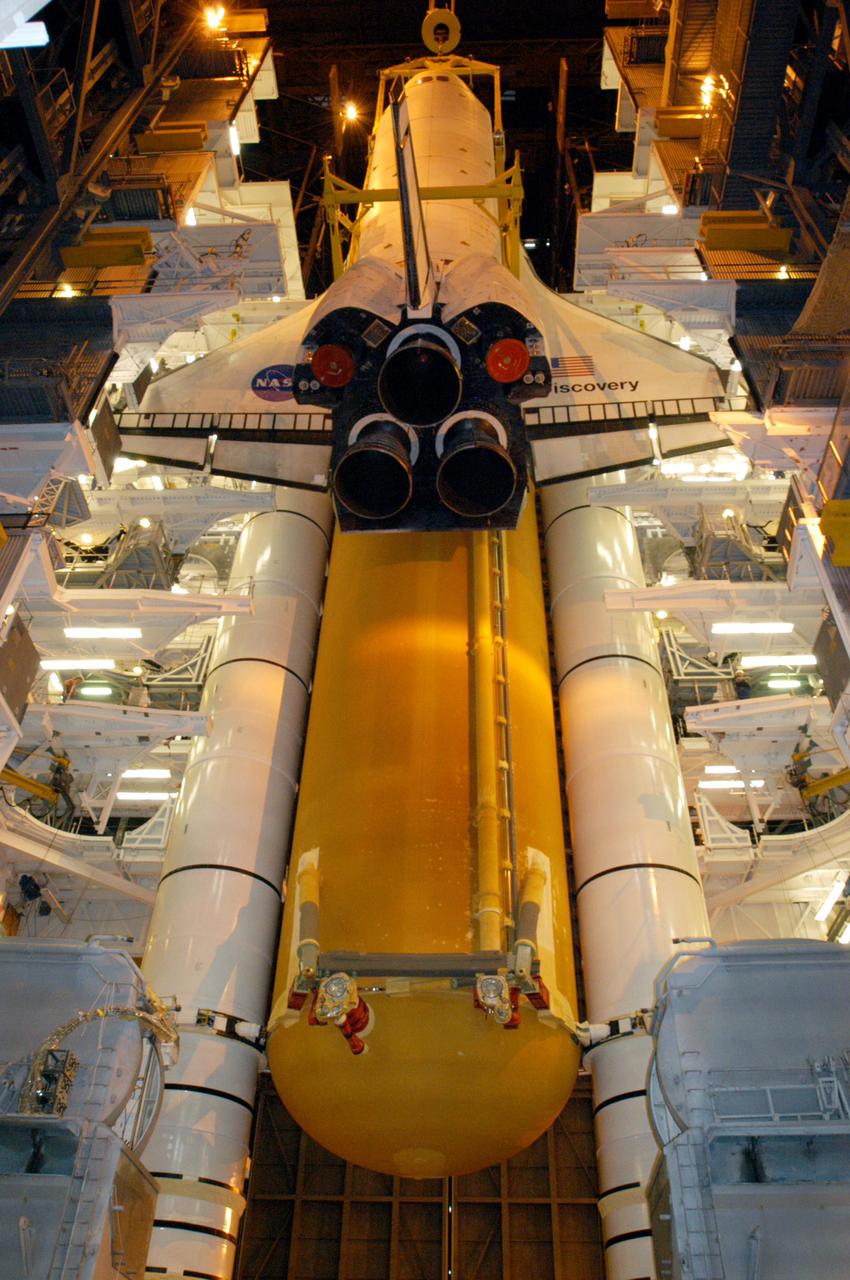
KENNEDY SPACE CENTER, FLA. - Suspended by a 175-ton bridge crane, the orbiter Discovery has cleared the cross-beam into high bay 3 and is lowered next to the new External Tank, ET-121, and Solid Rocket Boosters in the bay for mating. That tank was originally scheduled to fly with Atlantis on the second Return to Flight mission, STS-121. A new heater was added to the tank's feedline bellows, part of the pipeline that carries the liquid oxygen to the orbiter’s main engines, to minimize the potential for ice and frost buildup. After the remate, technicians will work final closeouts on the fully assembled Space Shuttle stack, and perform liquid oxygen and liquid hydrogen electrical mates and an interface verification test. Discovery is currently scheduled to return to Launch Pad 39B on June 13.
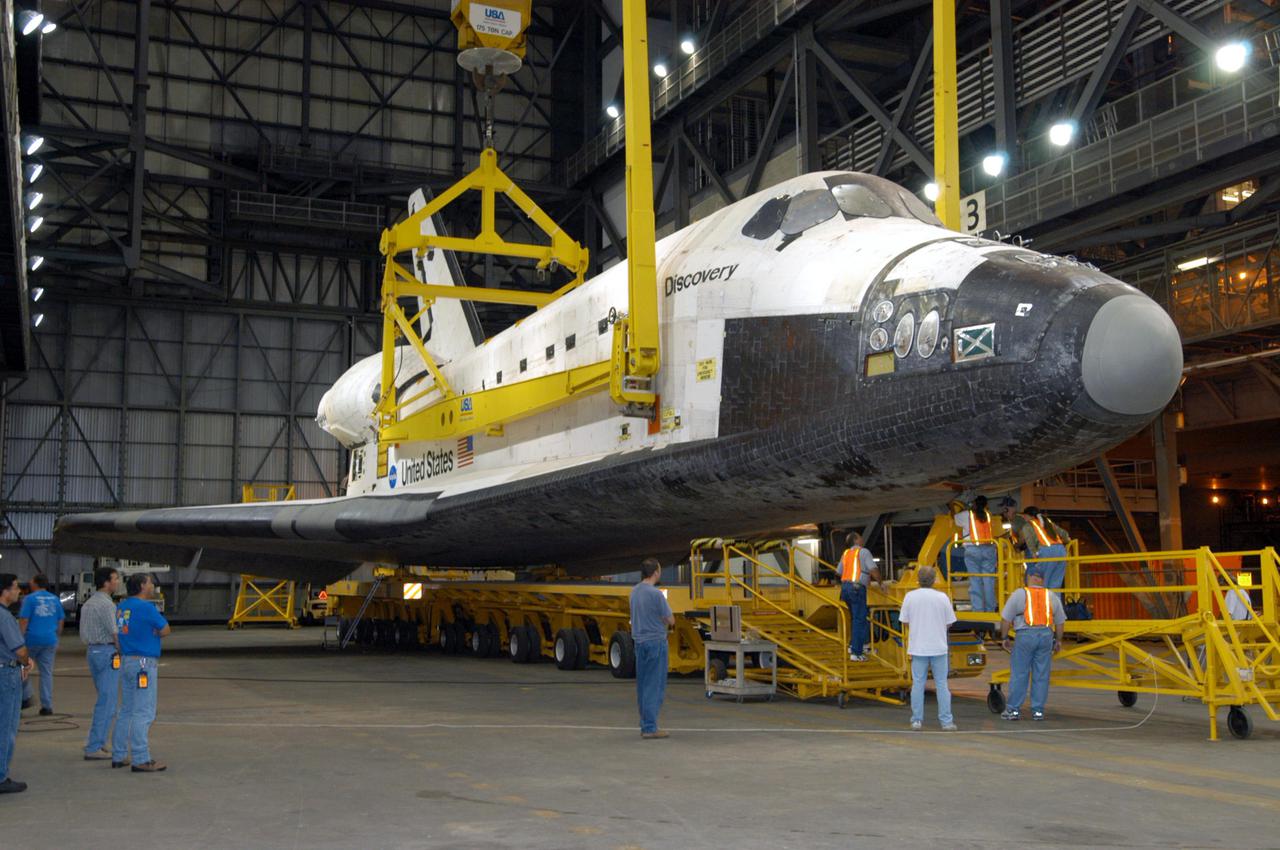
KENNEDY SPACE CENTER, FLA. - In the transfer aisle of the Vehicle Assembly Building, workers check under the nose of the orbiter Discovery as the 175-ton bridge crane slowly lifts Discovery off the orbiter transporter. Discovery is being lifted to vertical for the remate with the new External Tank, ET-121, and Solid Rocket Boosters in high bay 3. That tank was originally scheduled to fly with Atlantis on the second Return to Flight mission, STS-121. A new heater was added to the tank's feedline bellows, part of the pipeline that carries the liquid oxygen to the orbiter’s main engines, to minimize the potential for ice and frost buildup. After the remate, technicians will work final closeouts on the fully assembled Space Shuttle stack, and perform liquid oxygen and liquid hydrogen electrical mates and an interface verification test. Discovery is currently scheduled to return to Launch Pad 39B on June 13.
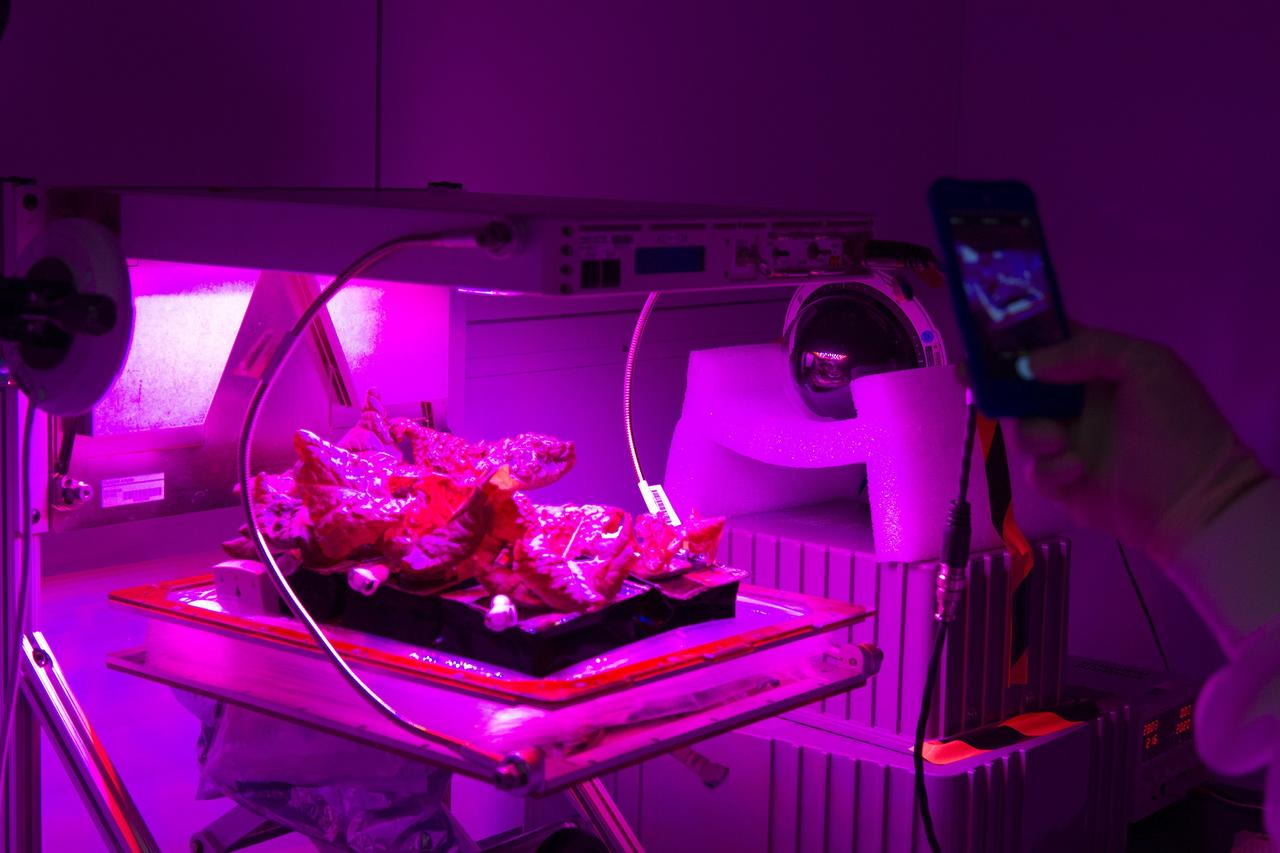
CAPE CANAVERAL, Fla. – Inside the International Space Station Environmental Simulator chamber at the Space Station Processing Facility at NASA's Kennedy Space Center in Florida, the bellows has been removed from around the Veggie plant growth system so that the plant pillows containing the outredgeous red lettuce leaves can be removed. The growth chamber was used as a control unit and procedures were followed identical to those being performed on Veggie and the Veg-01 experiment on the International Space Station. The chamber mimicked the temperature, relative humidity and carbon dioxide concentration of those in the Veggie unit on the space station. Veggie and Veg-01 were delivered to the space station aboard the SpaceX-3 mission. Veggie is the first fresh food production system delivered to the station. Six plant pillows, each containing outredgeous red romaine lettuce seeds and a root mat were inserted into Veggie. The plant chamber's red, blue and green LED lights were activated. The plant growth was monitored for 33 days. On June 10, at the end of the cycle, the plants were carefully harvested, frozen and stored for return to Earth by Expedition 39 flight engineer and NASA astronaut Steve Swanson. Photo credit: NASA/Frankie Martin

CAPE CANAVERAL, Fla. – Inside the International Space Station Environmental Simulator chamber at the Space Station Processing Facility at NASA's Kennedy Space Center in Florida, Jim Smodell, a technician with SGT, prepares to remove the bellows from the Veggie plant growth system containing the outredgeous red lettuce leaves. The growth chamber was used as a control unit and procedures were followed identical to those being performed on Veggie and the Veg-01 experiment on the International Space Station. The chamber mimicked the temperature, relative humidity and carbon dioxide concentration of those in the Veggie unit on the space station. Veggie and Veg-01 were delivered to the space station aboard the SpaceX-3 mission. Veggie is the first fresh food production system delivered to the station. Six plant pillows, each containing outredgeous red romaine lettuce seeds and a root mat were inserted into Veggie. The plant chamber's red, blue and green LED lights were activated. The plant growth was monitored for 33 days. On June 10, at the end of the cycle, the plants were carefully harvested, frozen and stored for return to Earth by Expedition 39 flight engineer and NASA astronaut Steve Swanson. Photo credit: NASA/Frankie Martin
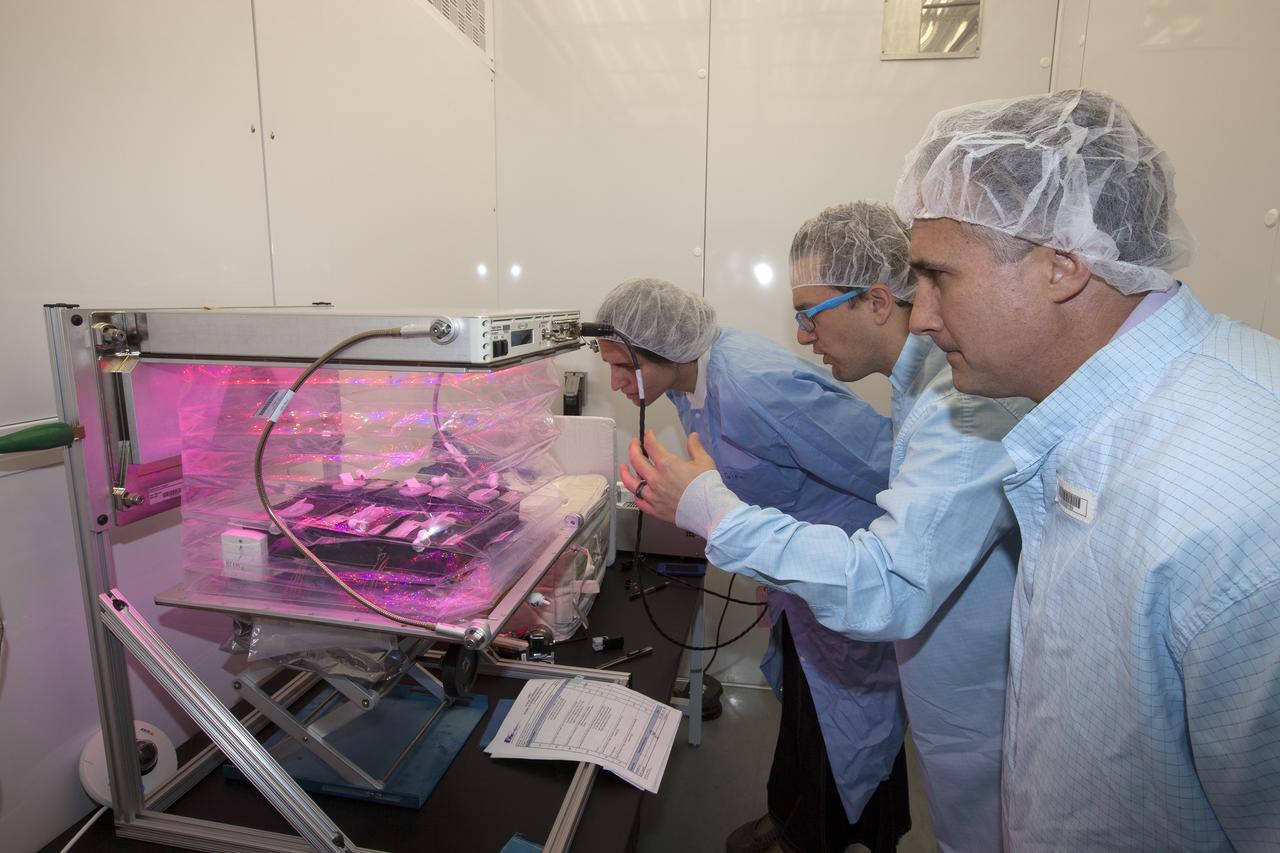
CAPE CANAVERAL, Fla. – The Veggie plant growth system has been activated inside a control chamber at the Space Station Processing Facility at NASA's Kennedy Space Center in Florida. The red, blue and green LED lights have been turned on and the root mat and plant pillows containing outredgeous red romaine lettuce seeds have been inserted into the chamber. The clear bellows have been expanded and secured. Checking the system are, from left, Gioia Massa, NASA payload scientist for Veggie, Gerard Newsham, Veggie payload support specialist with Jacobs Technology, and Trent Smith, NASA project manager. The growth chamber will be used as a control unit and procedures will be followed identical to those being performed on Veggie and the Veg-01 experiment on the International Space Station by Expedition 39 flight engineer and NASA astronaut Steve Swanson. Veggie and Veg-01 were delivered to the space station aboard the SpaceX-3 mission. Veggie is the first fresh food production system delivered to the station. Six plant pillows, each containing outredgeous red romaine lettuce seeds and a root mat were inserted into Veggie. The plant chamber's red, blue and green LED lights were activated. The plant growth will be monitored for 28 days. At the end of the cycle, the plants will be carefully harvested, frozen and stored for return to Earth. Photo credit: NASA/Dimitri Gerondidakis
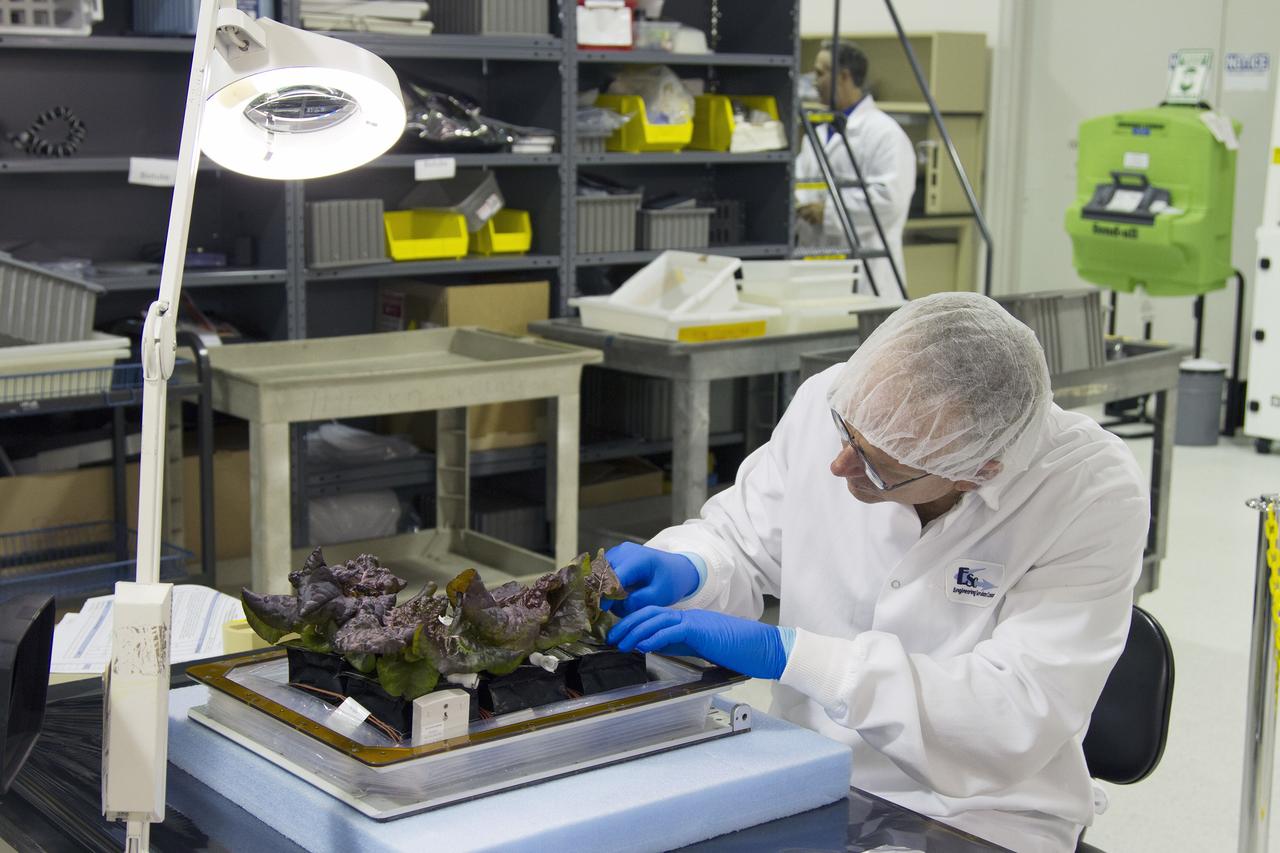
CAPE CANAVERAL, Fla. – Jim Smodell, a technician with SGT, removes an outredgeous red lettuce leaf from a plant pillow inside the Payload Development Laboratory at the Space Station Processing Facility, or SSPF, at NASA's Kennedy Space Center in Florida. The plant pillows were removed from the Veggie plant growth system inside a control chamber at the SSPF. The growth chamber was used as a control unit for Veggie and procedures were followed identical to those being performed on Veggie and the Veg-01 experiment on the International Space Station. The lettuce leaves will be wrapped and placed in a minus eighty-degree freezer, along with the plant pillows and samples swabbed from the plants, plant pillows and Veggie bellows. The chamber mimicked the temperature, relative humidity and carbon dioxide concentration of those in the Veggie unit on the space station. Veggie and Veg-01 were delivered to the space station aboard the SpaceX-3 mission. Veggie is the first fresh food production system delivered to the station. Six plant pillows, each containing outredgeous red romaine lettuce seeds and a root mat were inserted into Veggie. The plant chamber's red, blue and green LED lights were activated. The plant growth was monitored for 33 days. On June 10, at the end of the cycle, the plants were carefully harvested, frozen and stored for return to Earth by Expedition 39 flight engineer and NASA astronaut Steve Swanson. Photo credit: NASA/Frankie Martin