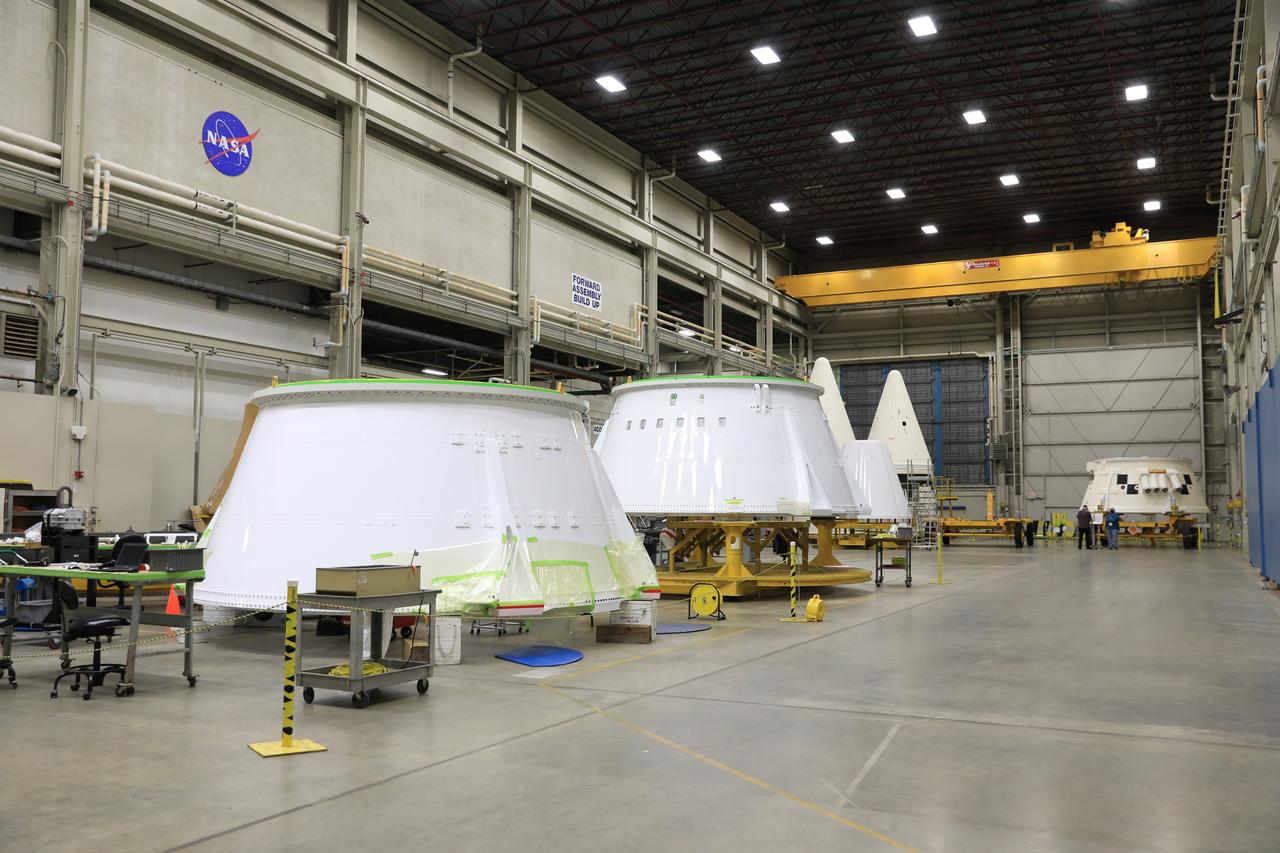
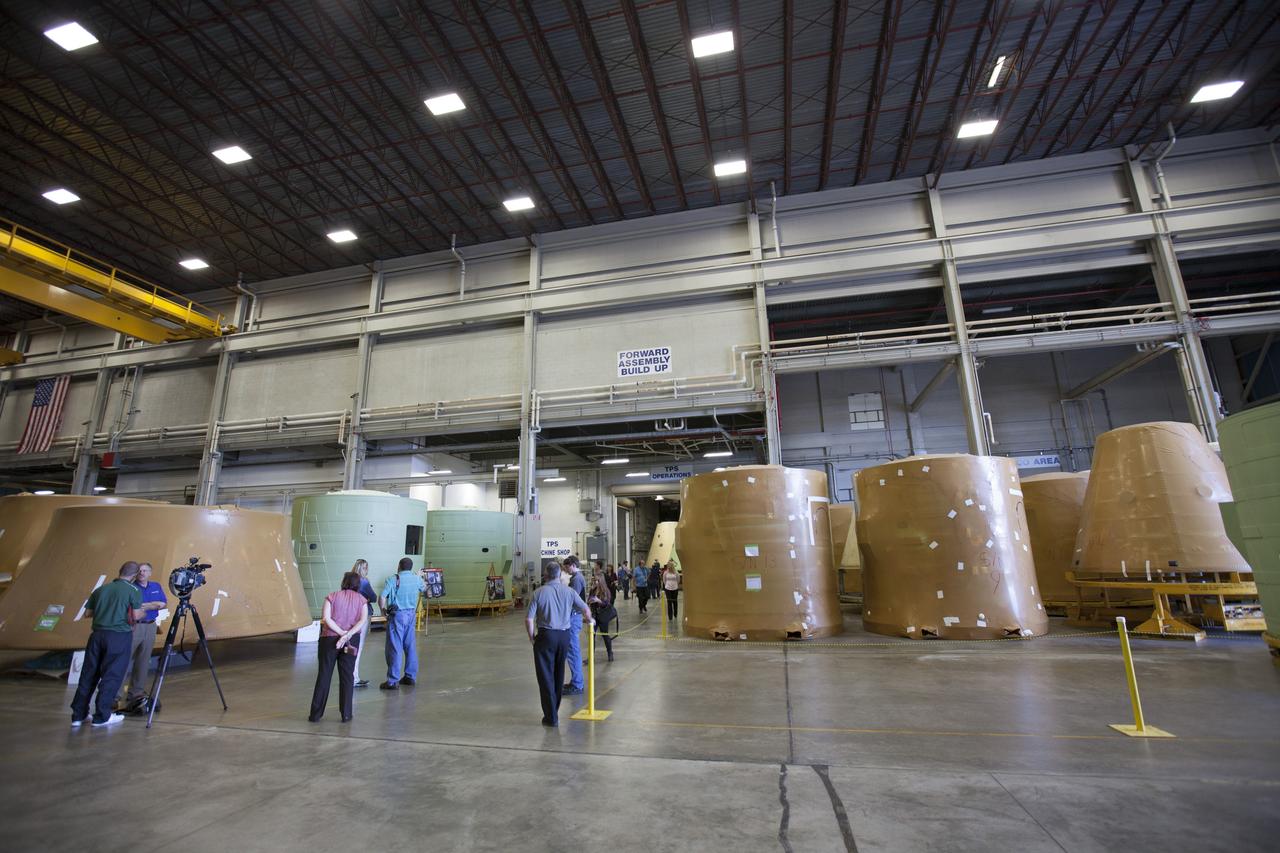
Inside the Booster Fabrication Facility (BFF) at NASA's Kennedy Space Center in Florida, the Artemis II aft skirt structures for the agency's Space Launch System (SLS) rocket’s twin solid rocket boosters are in view at left. Behind them are the two Artemis I forward assemblies. At far right, in the distance, is the right aft skirt assembly. In the BFF, the two aft skirt assemblies are being readied for their move to the Rotation, Processing and Surge Facility (RPSF) on June 9, 2020. The aft skirts were refurbished by Northrop Grumman. They house the thrust vector control system, which controls 70 percent of the steering during initial ascent of the SLS rocket. The segments will remain in the RPSF until ready for stacking with the forward and aft parts of the boosters on the mobile launcher in High Bay 3 of the Vehicle Assembly Building. Through the Artemis Program, NASA is working to land the first woman and next man on the Moon by 2024.
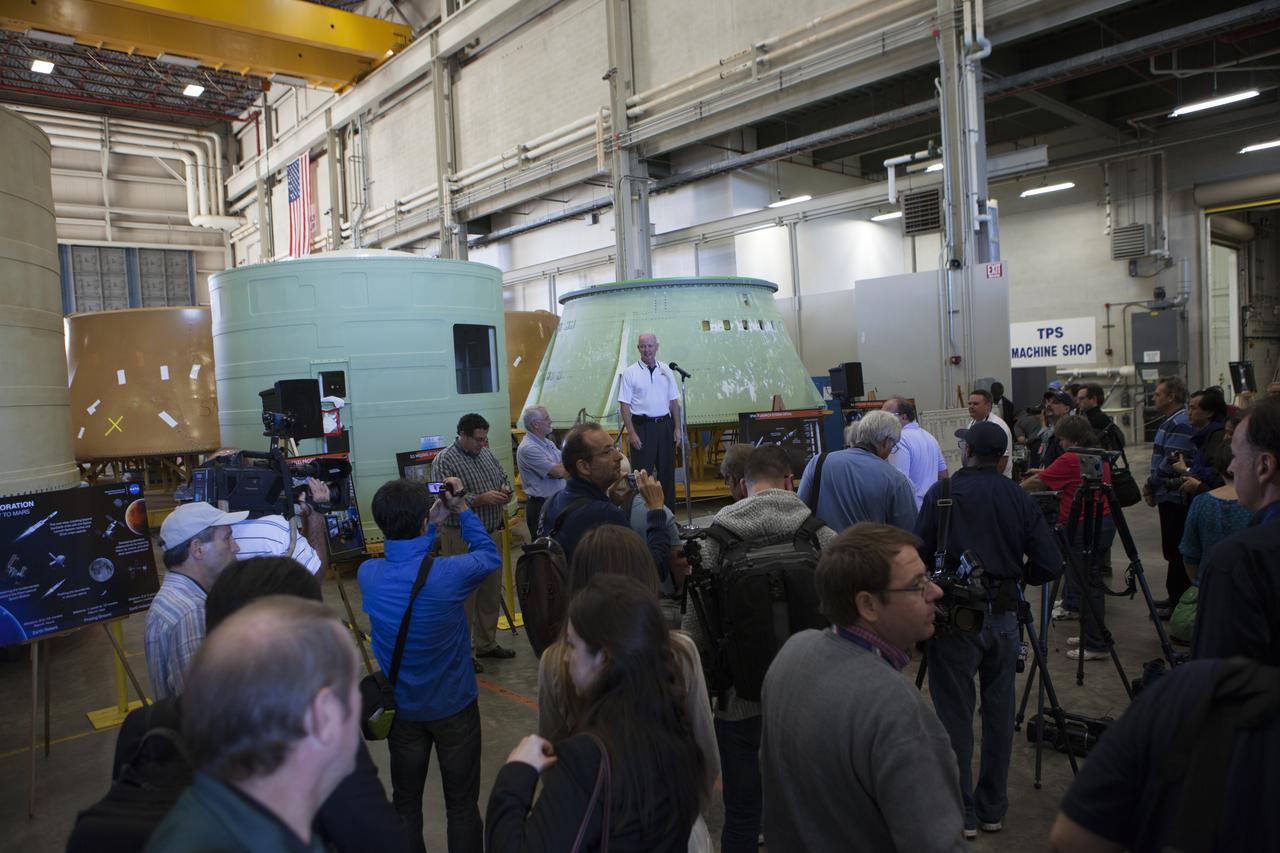
At NASA's Kennedy Space Center in Florida, members of the news media are briefed on the agency's Space Launch System SLS Program by former astronaut Brian Duffy who is now vice president and program manager of Exploration Systems at Alliant Techsystems Inc. ATK. The briefing took place in the spaceport's Booster Fabrication Facility BFF. During the Space Shuttle Program, the facility was used for processing forward segments and aft skirts for the solid rocket boosters. The BFF will serve a similar role for the SLS. Orion is the exploration spacecraft designed to carry astronauts to destinations not yet explored by humans, including an asteroid and Mars. It will have emergency abort capability, sustain the crew during space travel and provide safe re-entry from deep space return velocities. The first unpiloted flight test of Orion is scheduled to launch Dec. 4, 2014 atop a United Launch Alliance Delta IV Heavy rocket, and in 2018 on NASA’s Space Launch System rocket.
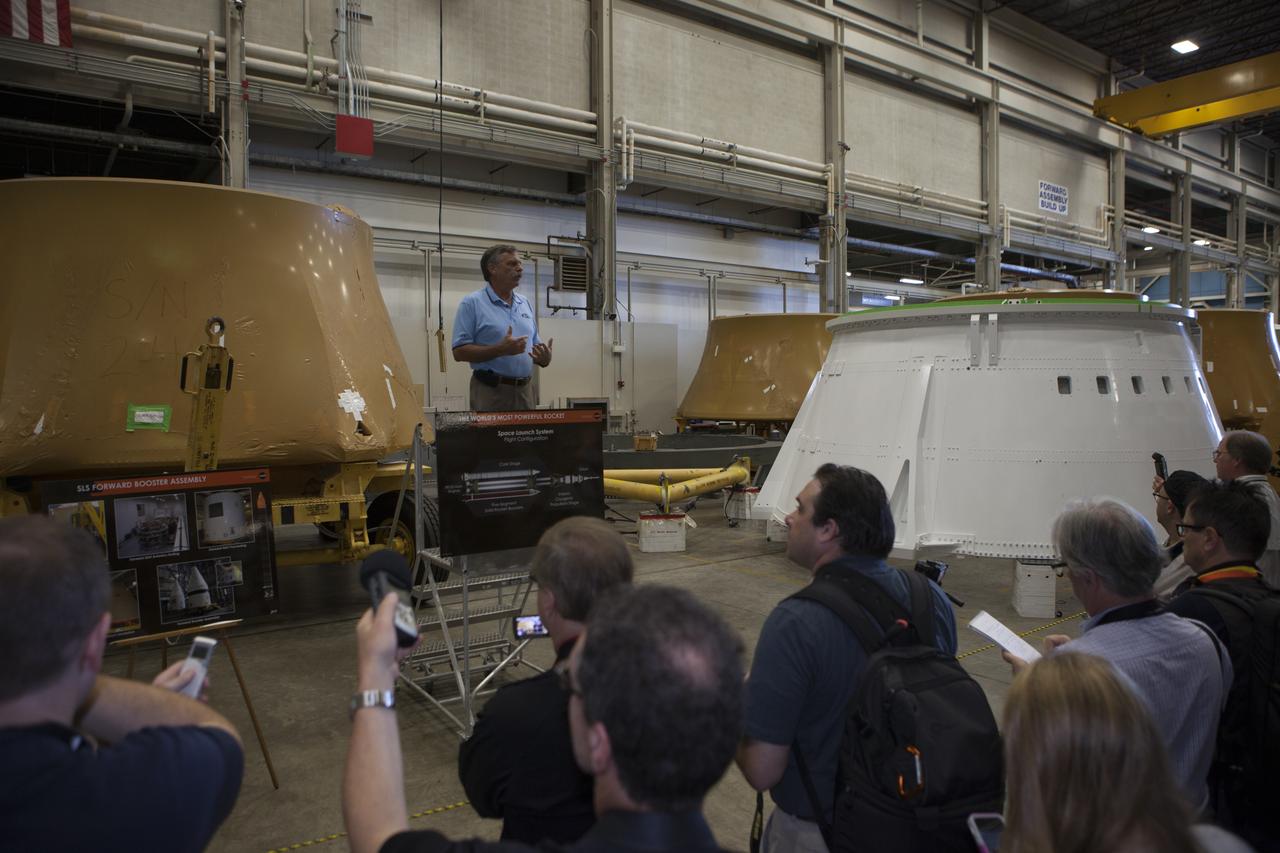
At NASA's Kennedy Space Center in Florida, members of the news media are briefed on the agency's Space Launch System SLS Program by Larry Clark, engineering manager for Alliant Techsystems Inc. ATK. The briefing took place in the spaceport's Booster Fabrication Facility BFF. During the Space Shuttle Program, the facility was used for processing forward segments and aft skirts for the solid rocket boosters. The BFF will serve a similar role for the SLS. Orion is the exploration spacecraft designed to carry astronauts to destinations not yet explored by humans, including an asteroid and Mars. It will have emergency abort capability, sustain the crew during space travel and provide safe re-entry from deep space return velocities. The first unpiloted flight test of Orion is scheduled to launch Dec. 4, 2014 atop a United Launch Alliance Delta IV Heavy rocket, and in 2018 on NASA’s Space Launch System rocket.
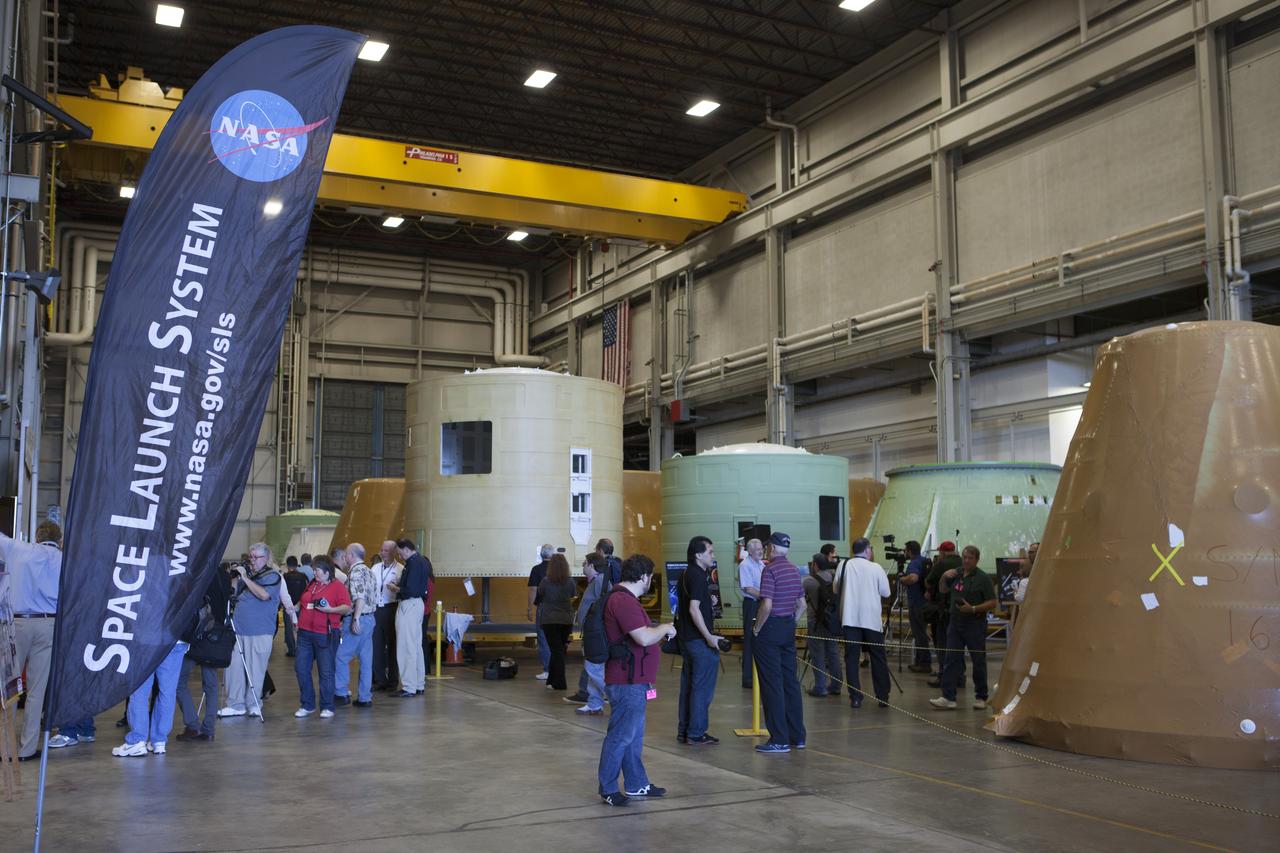
At NASA's Kennedy Space Center in Florida, members of the news media tour the spaceport's Booster Fabrication Facility BFF. During the Space Shuttle Program, the facility was used for processing forward segments and aft skirts for the solid rocket boosters. The BFF will serve a similar role for the SLS. Orion is the exploration spacecraft designed to carry astronauts to destinations not yet explored by humans, including an asteroid and Mars. It will have emergency abort capability, sustain the crew during space travel and provide safe re-entry from deep space return velocities. The first unpiloted flight test of Orion is scheduled to launch Dec. 4, 2014 atop a United Launch Alliance Delta IV Heavy rocket, and in 2018 on NASA’s Space Launch System rocket.
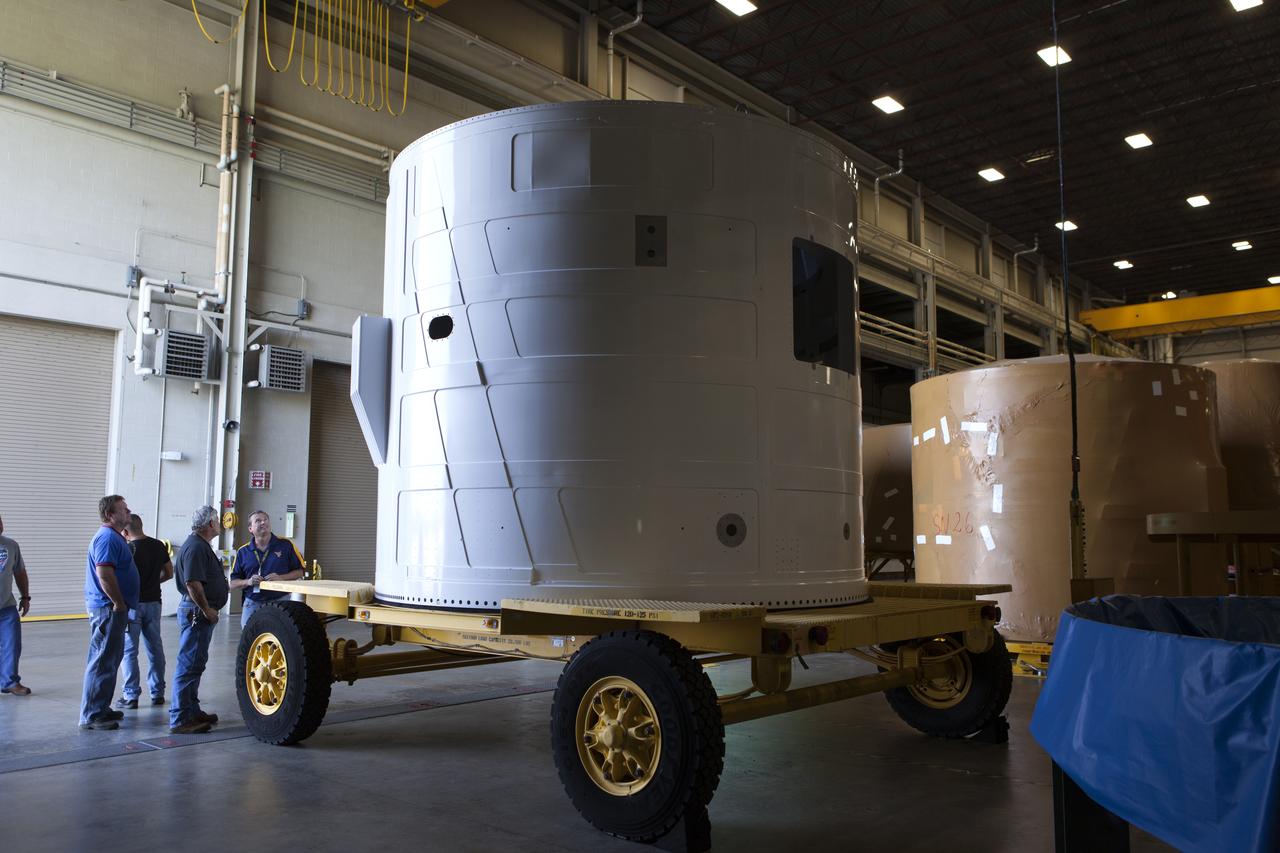
The Exploration Mission-1 (EM-1) left-hand forward skirt for NASA's Space Launch System (SLS) solid rocket boosters arrives inside the high bay at the Booster Fabrication Facility (BFF) at NASA's Kennedy Space Center in Florida. In the BFF, the forward skirt will be inspected and prepared for use on the left-hand solid rocket booster for EM-1. NASA's Orion spacecraft will fly atop the SLS rocket on its first uncrewed flight test.
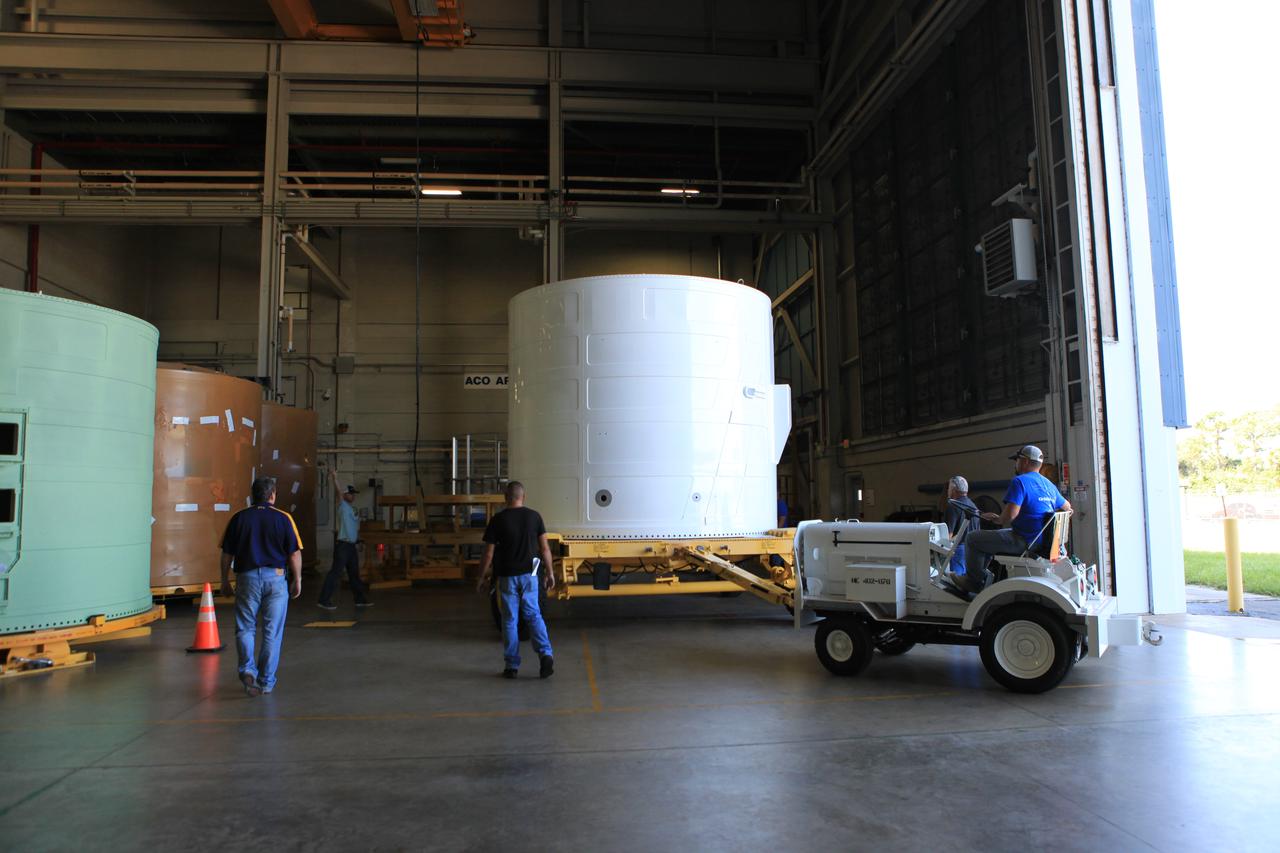
The Exploration Mission-1 (EM-1) left-hand forward skirt for NASA's Space Launch System (SLS) solid rocket boosters arrives inside the high bay at the Booster Fabrication Facility (BFF) at NASA's Kennedy Space Center in Florida. In the BFF, the forward skirt will be inspected and prepared for use on the left-hand solid rocket booster for EM-1. NASA's Orion spacecraft will fly atop the SLS rocket on its first uncrewed flight test.
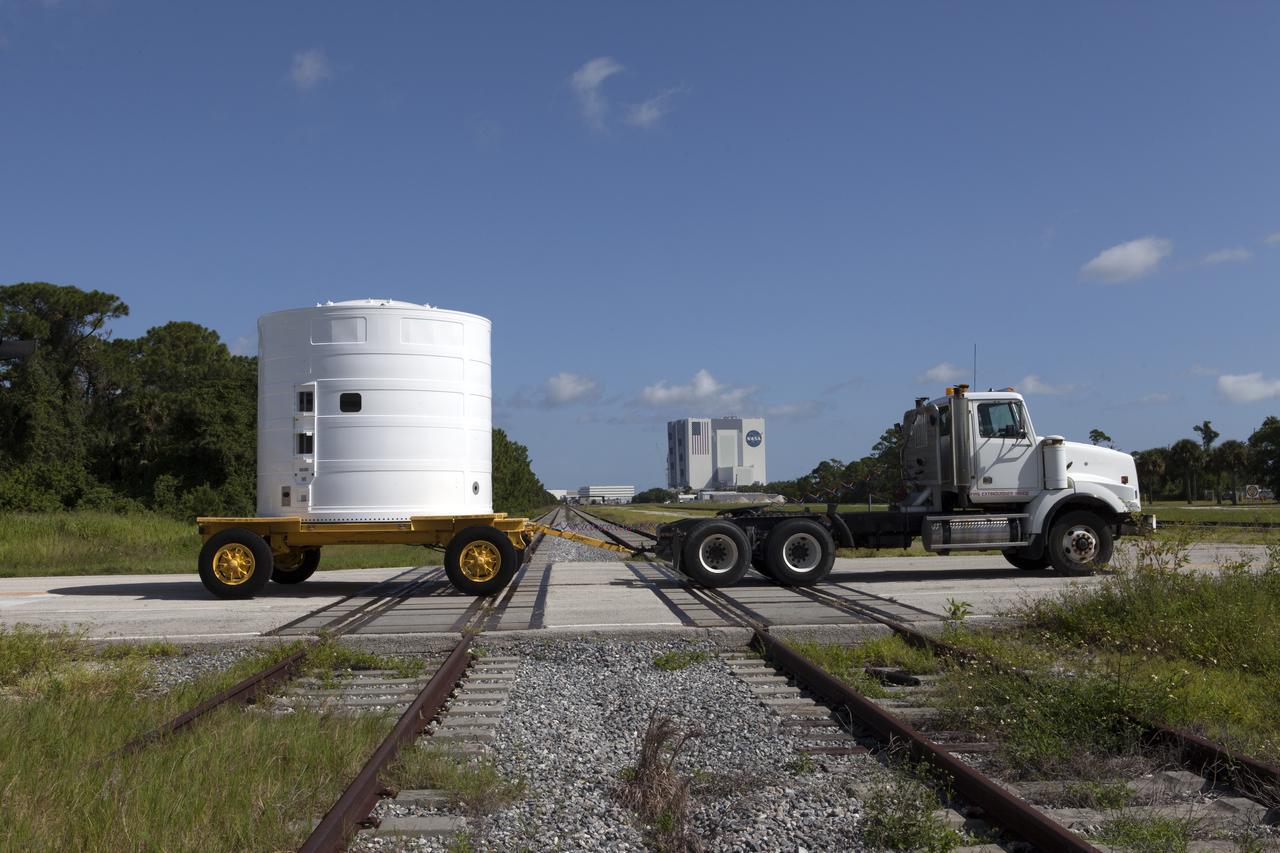
The Exploration Mission-1 (EM-1) left-hand forward skirt for NASA's Space Launch System (SLS) solid rocket boosters is transported by truck to the Booster Fabrication Facility (BFF) at NASA's Kennedy Space Center in Florida from Hangar AE at Cape Canaveral Air Force Station. In the BFF, the forward skirt will be inspected and prepared for use on the left-hand solid rocket booster for EM-1. NASA's Orion spacecraft will fly atop the SLS rocket on its first uncrewed flight test.
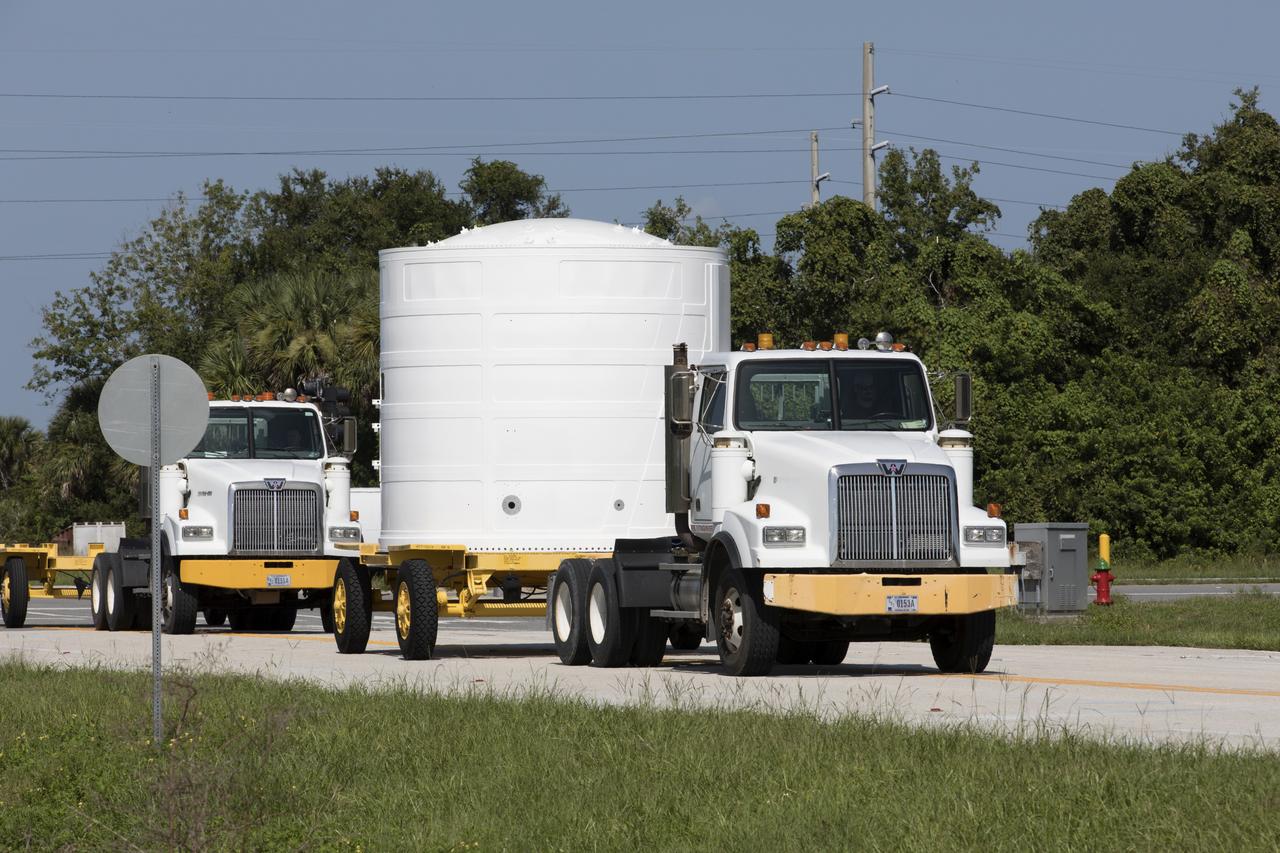
The Exploration Mission-1 (EM-1) left-hand forward skirt for NASA's Space Launch System (SLS) solid rocket boosters is transported by truck to the Booster Fabrication Facility (BFF) at NASA's Kennedy Space Center in Florida from Hangar AE at Cape Canaveral Air Force Station. In the BFF, the forward skirt will be inspected and prepared for use on the left-hand solid rocket booster for EM-1. NASA's Orion spacecraft will fly atop the SLS rocket on its first uncrewed flight test.
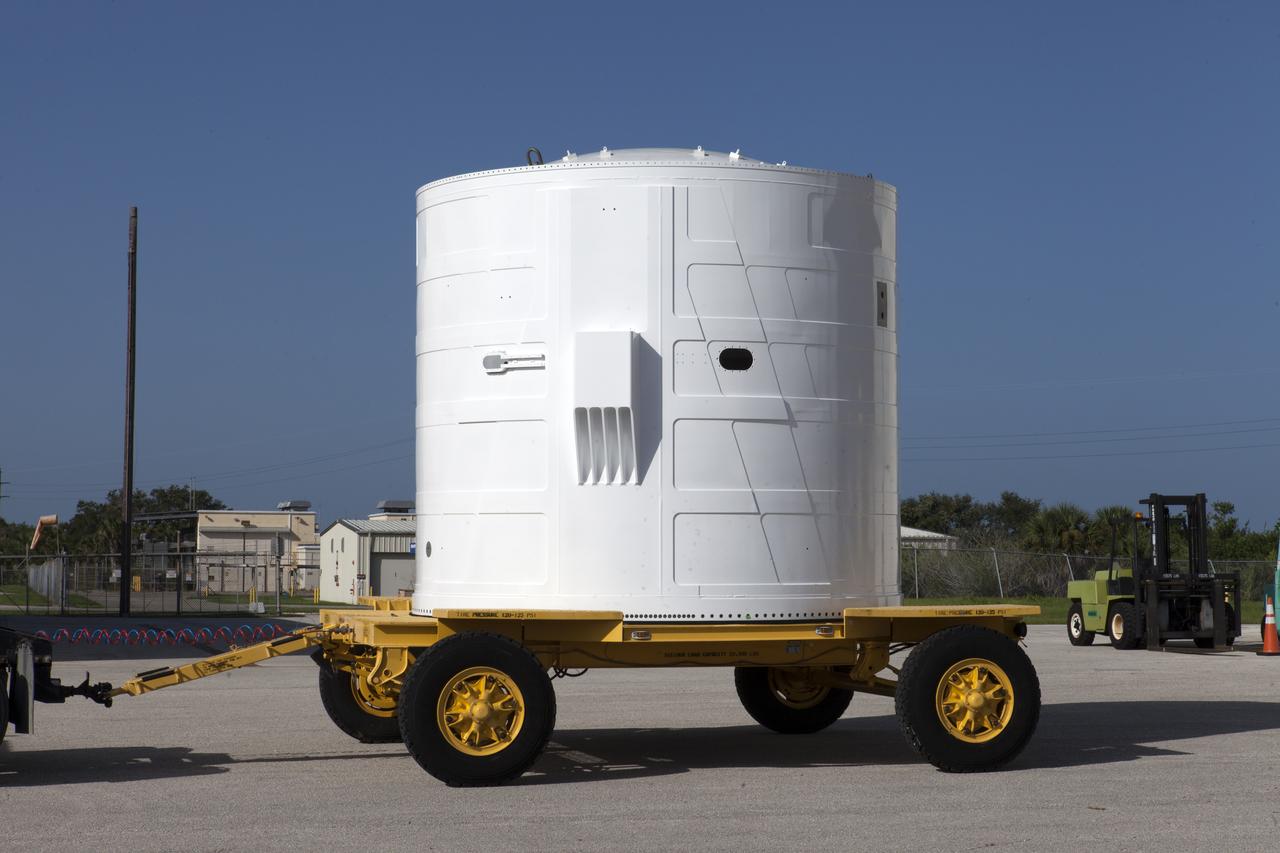
The Exploration Mission-1 (EM-1) left-hand forward skirt for NASA's Space Launch System (SLS) solid rocket boosters is prepared for its move from Hangar AE at Cape Canaveral Air Force Station in Florida, to the Booster Fabrication Facility (BFF) at Kennedy Space Center. In the BFF, the forward skirt will be inspected and prepared for use on the left-hand solid rocket booster for EM-1. NASA's Orion spacecraft will fly atop the SLS rocket on its first uncrewed flight test.
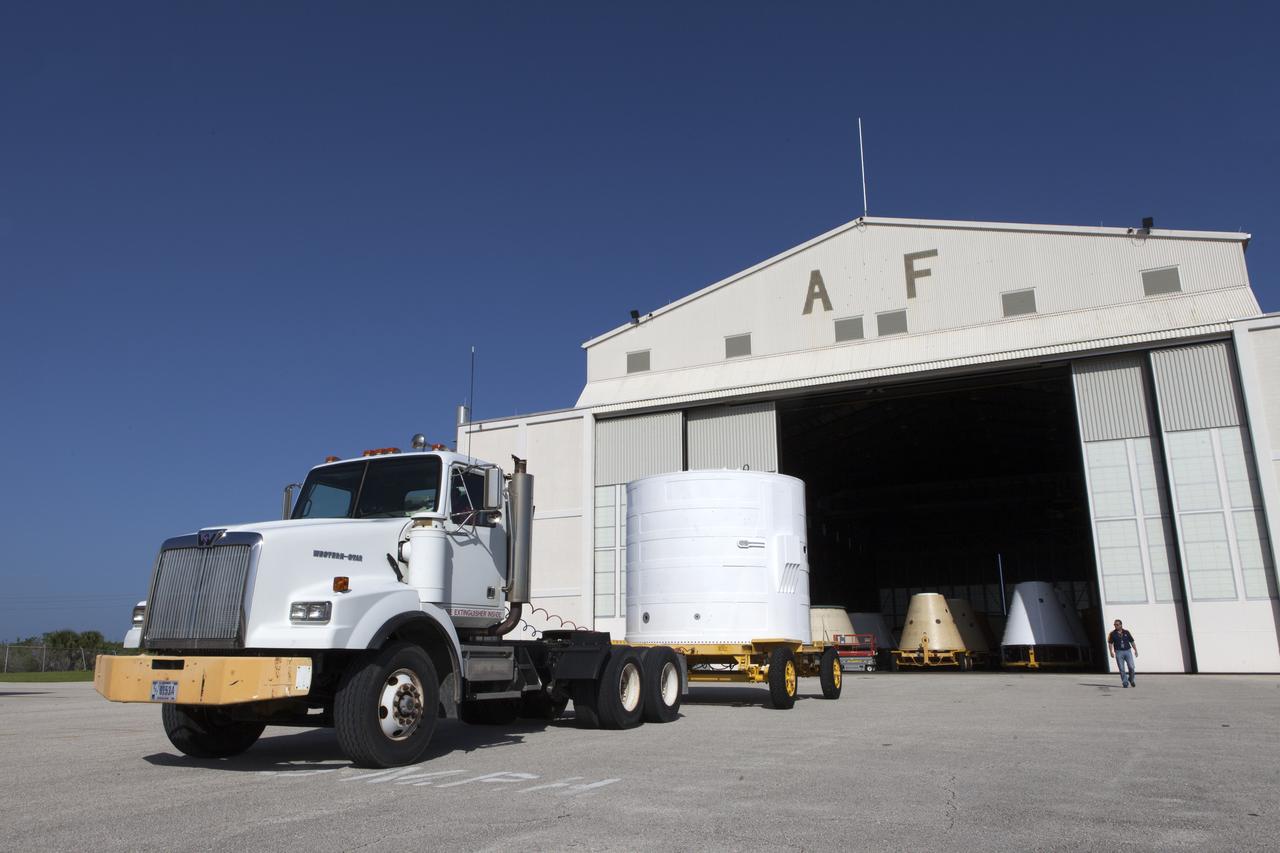
The Exploration Mission-1 (EM-1) left-hand forward skirt for NASA's Space Launch System (SLS) solid rocket boosters is moved out of Hangar AE at Cape Canaveral Air Force Station in Florida, for transport to the Booster Fabrication Facility (BFF) at Kennedy Space Center. In the BFF, the forward skirt will be inspected and prepared for use on the left-hand solid rocket booster for EM-1. NASA's Orion spacecraft will fly atop the SLS rocket on its first uncrewed flight test.
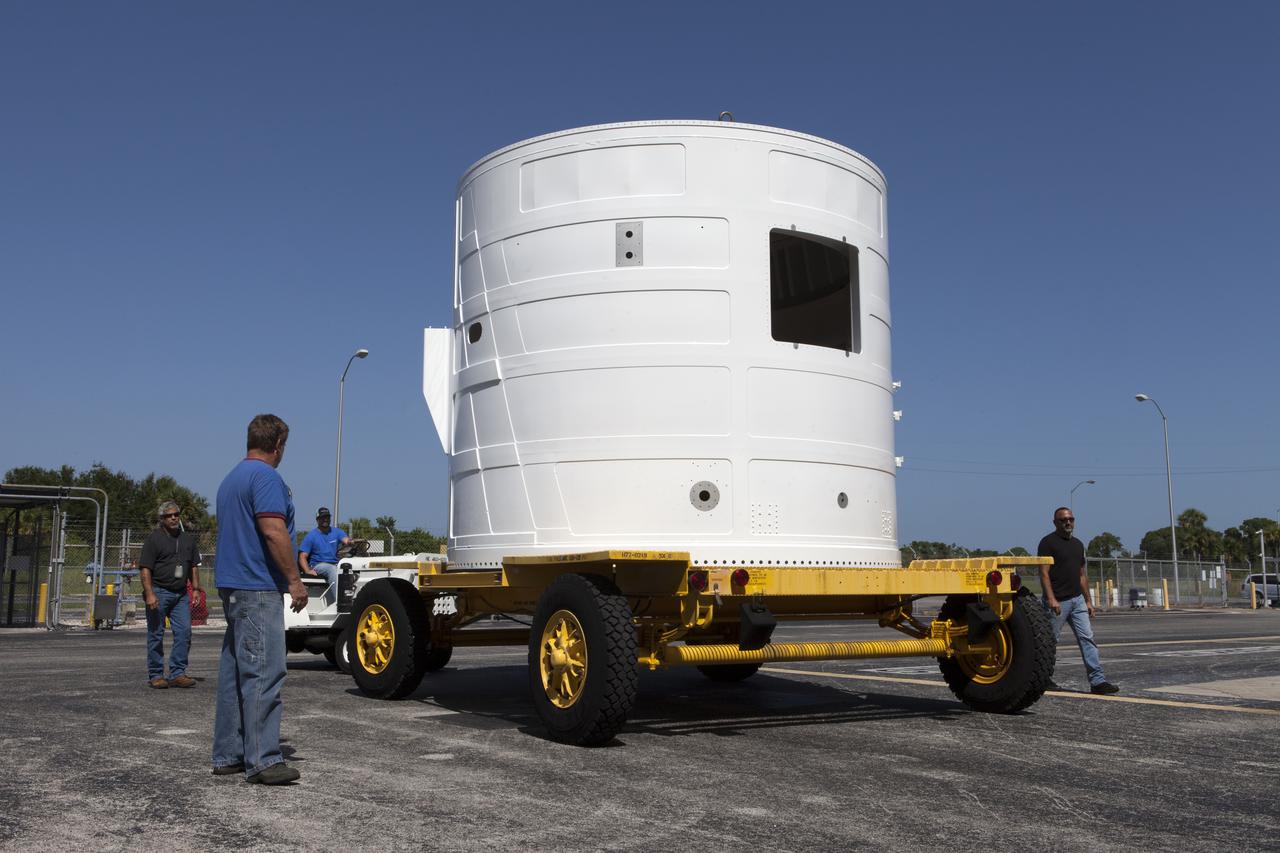
The Exploration Mission-1 (EM-1) left-hand forward skirt for NASA's Space Launch System (SLS) solid rocket boosters arrives at the Booster Fabrication Facility (BFF) at NASA's Kennedy Space Center in Florida from Hangar AE at Cape Canaveral Air Force Station. In the BFF, the forward skirt will be inspected and prepared for use on the left-hand solid rocket booster for EM-1. NASA's Orion spacecraft will fly atop the SLS rocket on its first uncrewed flight test.
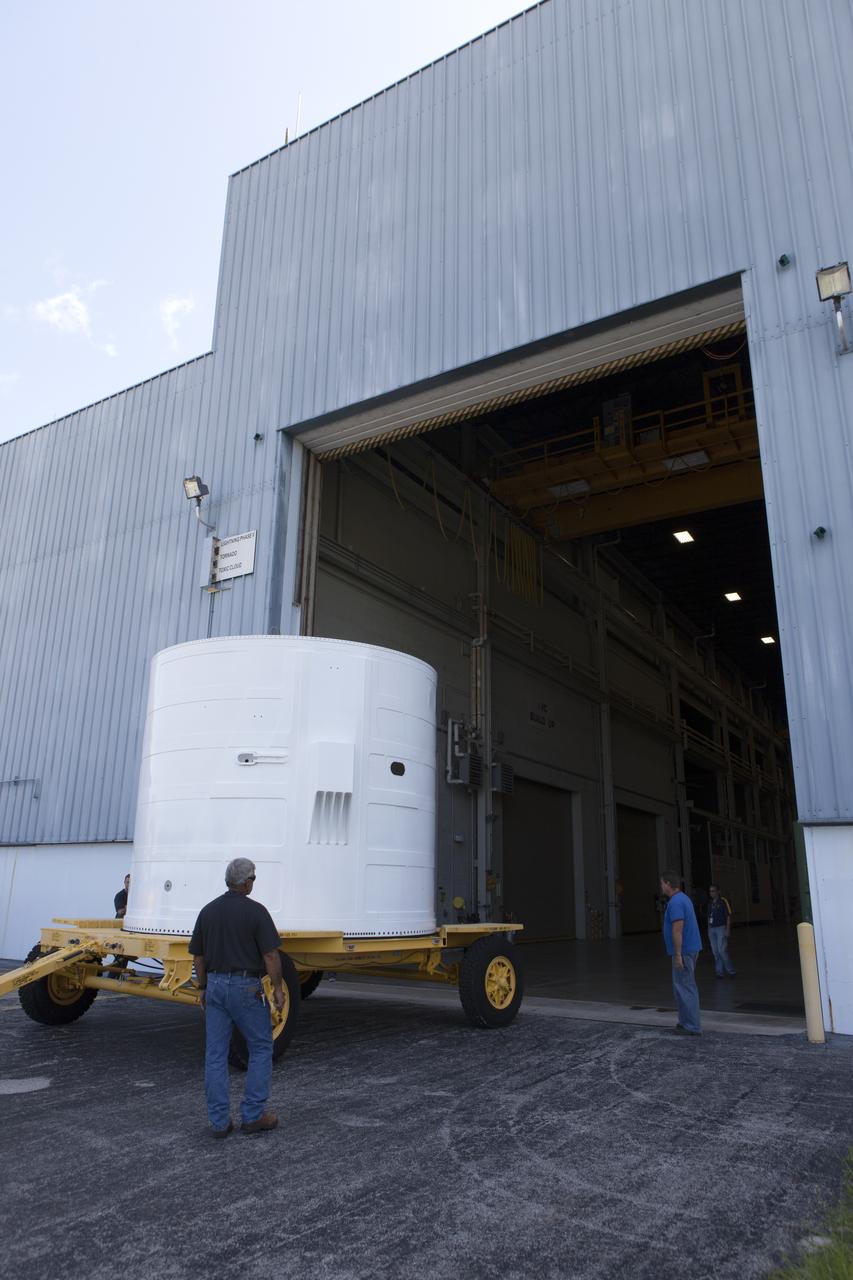
The Exploration Mission-1 (EM-1) left-hand forward skirt for NASA's Space Launch System (SLS) solid rocket boosters arrives at the entrance to the high bay at the Booster Fabrication Facility (BFF) at NASA's Kennedy Space Center in Florida. In the BFF, the forward skirt will be inspected and prepared for use on the left-hand solid rocket booster for EM-1. NASA's Orion spacecraft will fly atop the SLS rocket on its first uncrewed flight test.
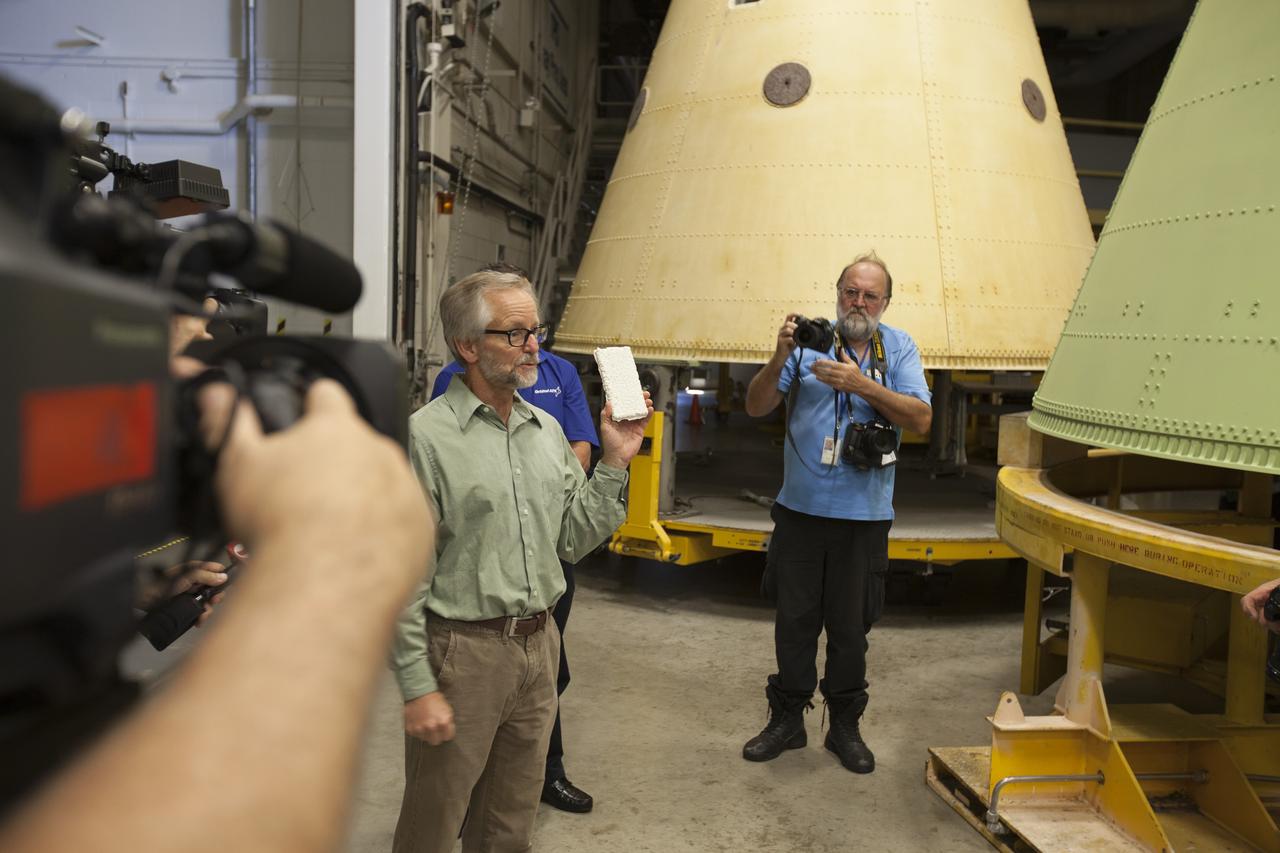
Inside the Booster Fabrication Facility (BFF) at NASA’s Kennedy Space Center in Florida, Jeff Cook, a thermal protection system specialist with Orbital ATK, displays a sample of the painted thermal protection system that is being applied to booster segments. Members of the news media toured the BFF. Orbital ATK is a contractor for NASA’s Marshall Space Flight Center in Alabama, and operates the BFF to prepare aft booster segments and hardware for the SLS rocket boosters. The SLS rocket and Orion spacecraft will launch on Exploration Mission-1 in 2018. The Ground Systems Development and Operations Program is preparing the infrastructure to process and launch spacecraft for deep-space missions and the journey to Mars.

The left hand aft skirt for NASA’s Space Launch System (SLS) rocket is transported across the Roy D. Bridges Bridge from the Hangar AF facility at Cape Canaveral Air Force Station in Florida, on its way to the Booster Fabrication Facility at the agency’s Kennedy Space Center. The space shuttle-era aft skirt, was inspected, resurfaced, primed and painted for use on the left hand booster of the SLS rocket for Exploration Mission 1 (EM-1). NASA is preparing for EM-1, deep-space missions, and the journey to Mars.
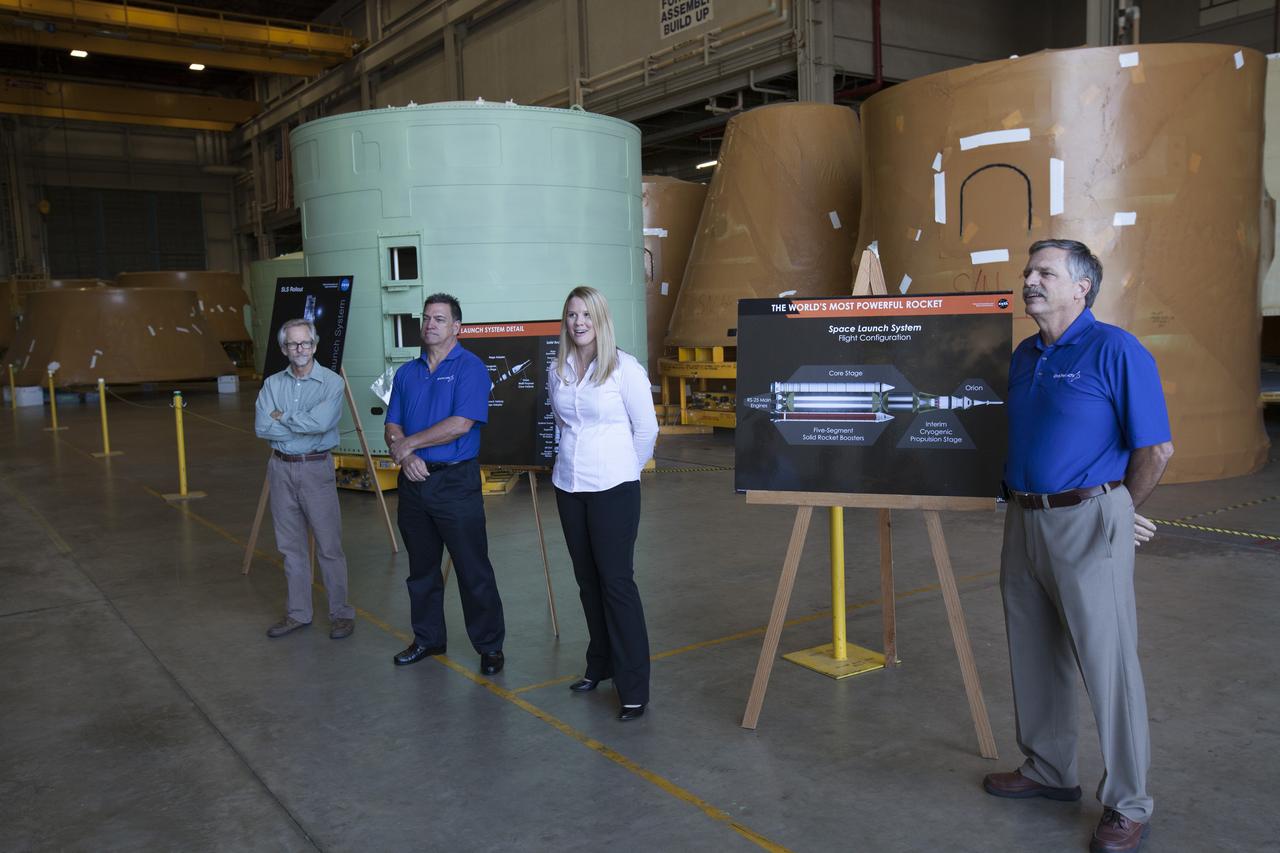
Bethany March, an element integration engineer at NASA’s Marshall Space Flight Center (MSFC) in Alabama, speaks to members of the news media during a tour of the Booster Fabrication Facility (BFF) at NASA’s Kennedy Space Center in Florida. Orbital ATK is a contractor for MSFC, and operates the BFF to prepare aft booster segments and hardware for the agency’s Space Launch System (SLS) solid rocket boosters. To her right is Rick Serfozo, Orbital ATK Florida site director. The SLS rocket and Orion spacecraft will launch on Exploration Mission-1 in 2018. The Ground Systems Development and Operations Program is preparing the infrastructure to process and launch spacecraft for deep-space missions and the journey to Mars.
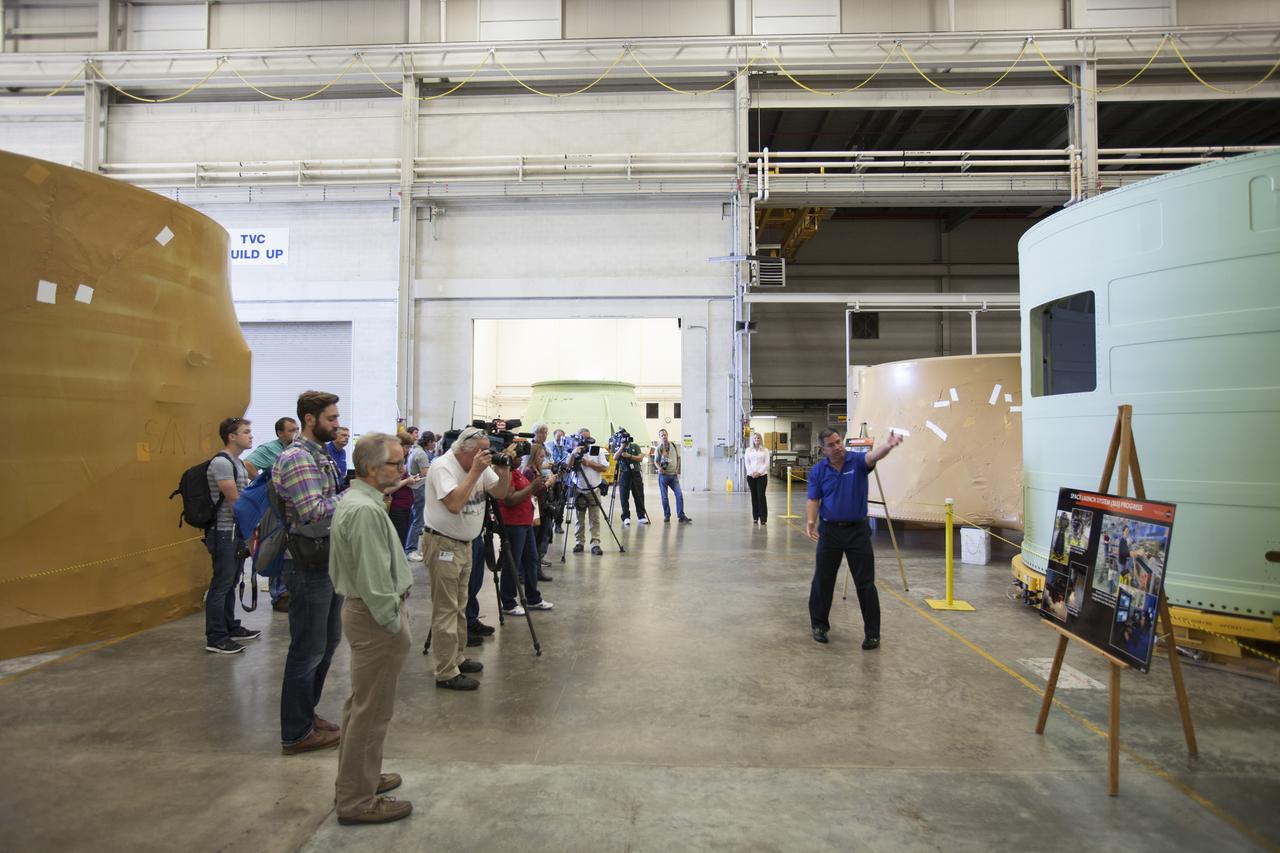
Inside the Booster Fabrication Facility (BFF) at NASA’s Kennedy Space Center in Florida, members of the news media view a forward skirt that will be used on a solid rocket booster for NASA’s Space Launch System (SLS) rocket. Orbital ATK is a contractor for NASA’s Marshall Space Flight Center in Alabama, and operates the BFF to prepare aft booster segments and hardware for the SLS solid rocket boosters. Rick Serfozo, Orbital ATK Florida site director, talks to the media. The SLS rocket and Orion spacecraft will launch on Exploration Mission-1 in 2018. The Ground Systems Development and Operations Program is preparing the infrastructure to process and launch spacecraft for deep-space missions and the journey to Mars.
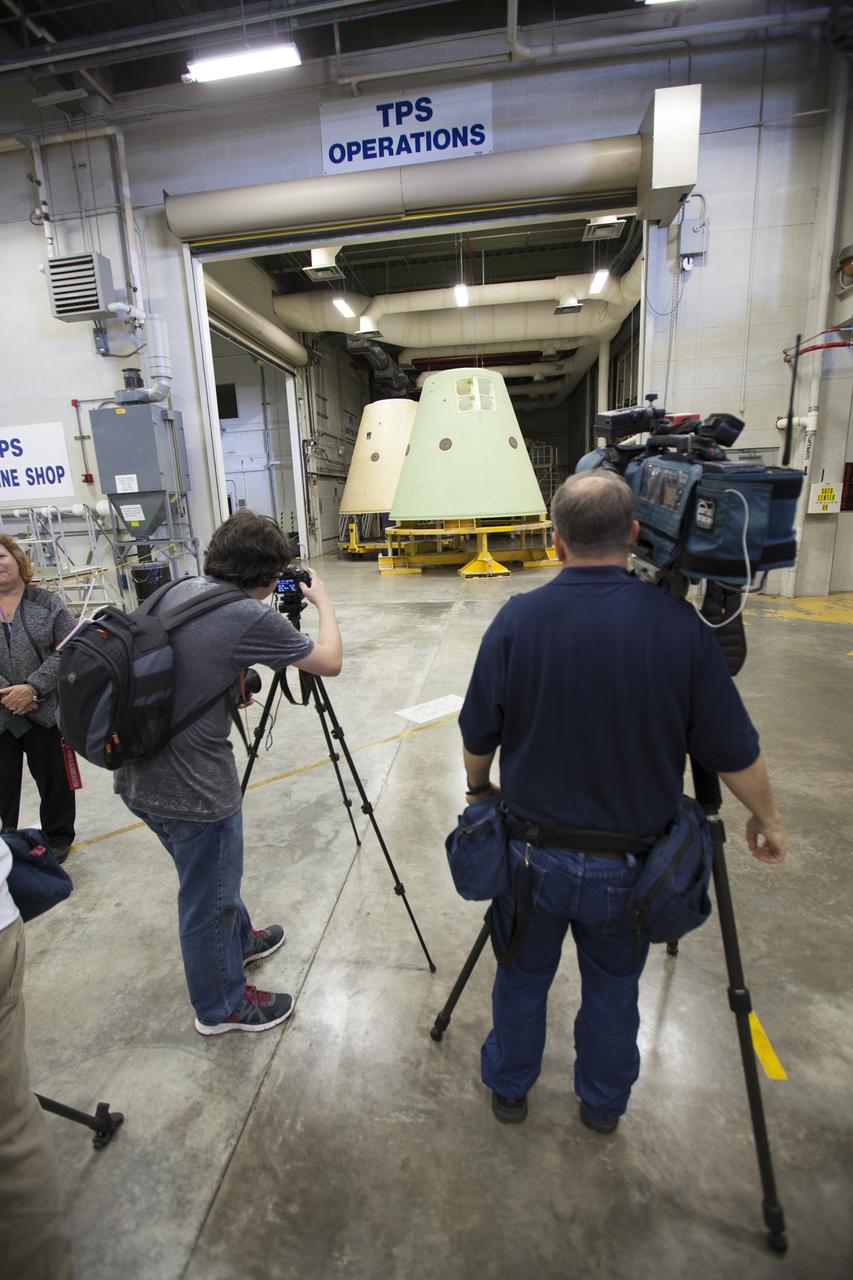
Inside the Booster Fabrication Facility (BFF) at NASA’s Kennedy Space Center in Florida, members of the news media photograph a frustrum that will be stacked atop a forward skirt for one of NASA’s Space Launch System (SLS) solid rocket boosters. Orbital ATK is a contractor for NASA’s Marshall Space Flight Center in Alabama, and operates the BFF to prepare aft booster segments and hardware for the SLS solid rocket boosters. The SLS rocket and Orion spacecraft will launch on Exploration Mission-1 in 2018. The Ground Systems Development and Operations Program is preparing the infrastructure to process and launch spacecraft on deep-space missions and the journey to Mars.
Members of the news media view forward booster segments (painted green) for NASA’s Space Launch System rocket boosters inside the Booster Fabrication Facility (BFF) at NASA’s Kennedy Space Center in Florida. Orbital ATK is a contractor for NASA’s Marshall Space Flight Center in Alabama, and operates the BFF to prepare aft booster segments and hardware for the SLS rocket boosters. The SLS rocket and Orion spacecraft will launch on Exploration Mission-1 in 2018. The Ground Systems Development and Operations Program is preparing the infrastructure to process and launch spacecraft for deep-space missions and the journey to Mars.
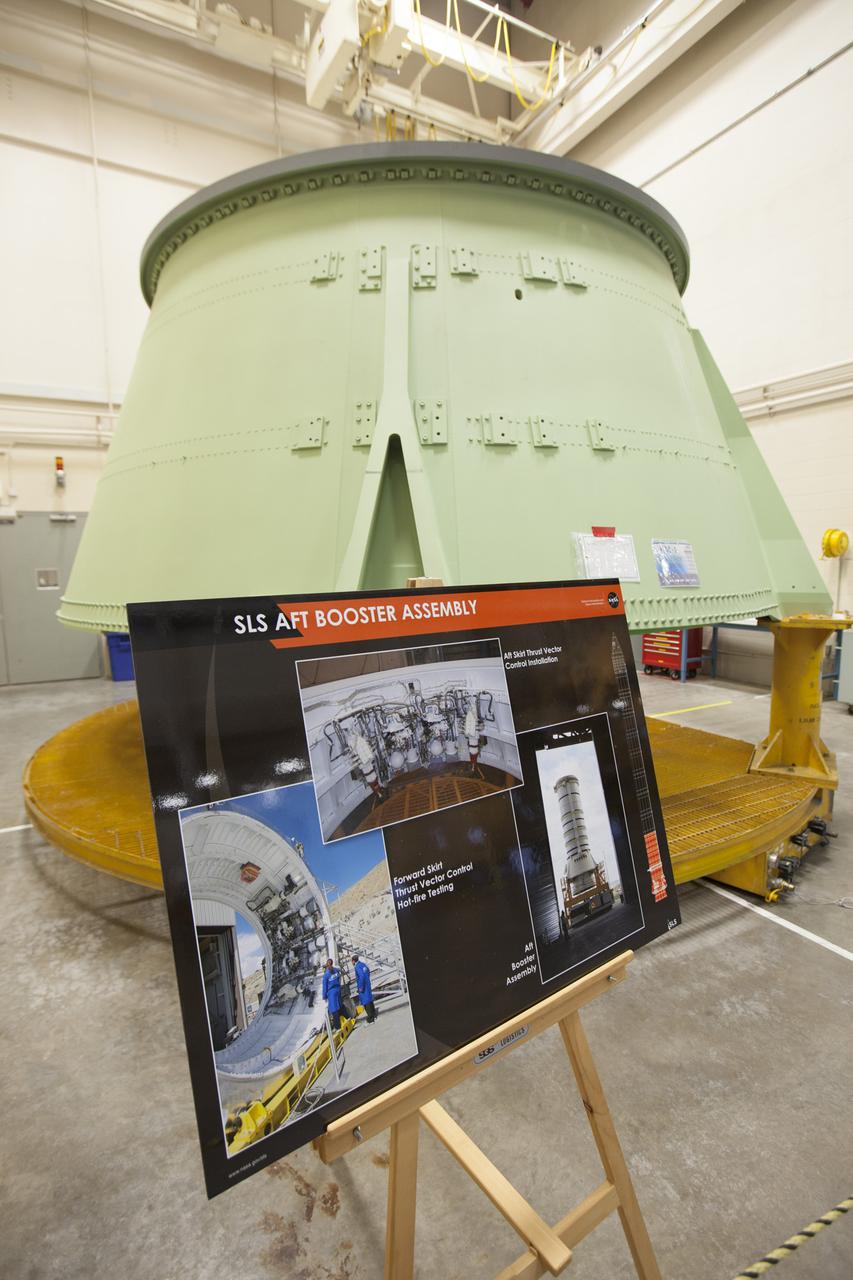
The right-hand aft skirt, one part of the aft booster assembly for NASA’s Space Launch System solid rocket boosters, is in view in a processing cell inside the Booster Fabrication Facility (BFF) at NASA’s Kennedy Space Center in Florida. Orbital ATK is a contractor for NASA’s Marshall Space Flight Center in Alabama, and operates the BFF to prepare aft booster segments and hardware for the SLS rocket boosters. The SLS rocket and Orion spacecraft will launch on Exploration Mission-1 in 2018. The Ground Systems Development and Operations Program is preparing the infrastructure to process and launch spacecraft for deep-space missions and the journey to Mars.
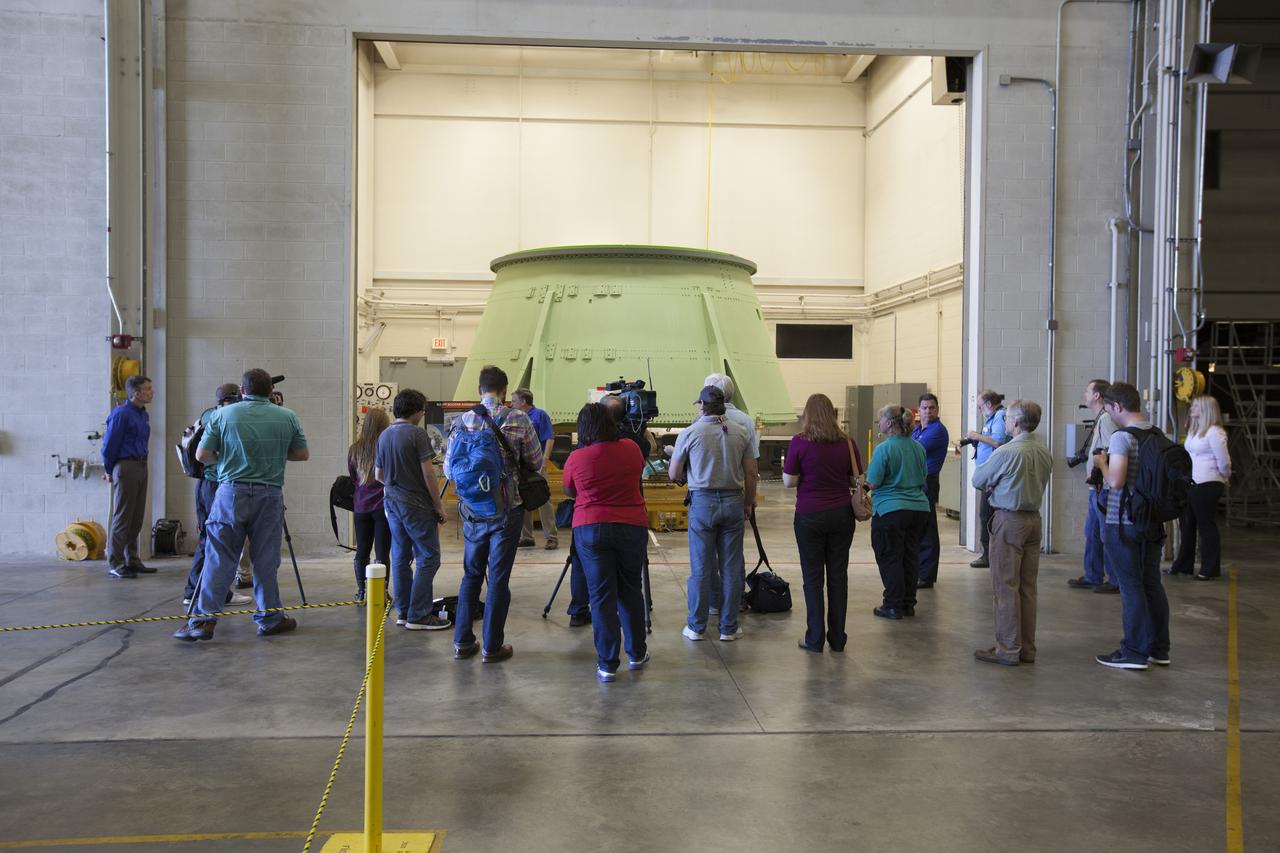
Inside the Booster Fabrication Facility (BFF) at NASA’s Kennedy Space Center in Florida, members of the news media view the right-hand aft skirt that will be used on a solid rocket booster for NASA’s Space Launch System (SLS) rocket. Orbital ATK is contractor for NASA’s Marshall Space Flight Center in Alabama, and operates the BFF to prepare aft booster segments and hardware for the SLS solid rocket boosters. At far right, in the royal blue shirt, Rick Serfozo, Orbital ATK Florida site director, talks to the media. The SLS rocket and Orion spacecraft will launch on Exploration Mission-1 in 2018. The Ground Systems Development and Operations Program is preparing the infrastructure to process and launch spacecraft for deep-space missions and the journey to Mars.
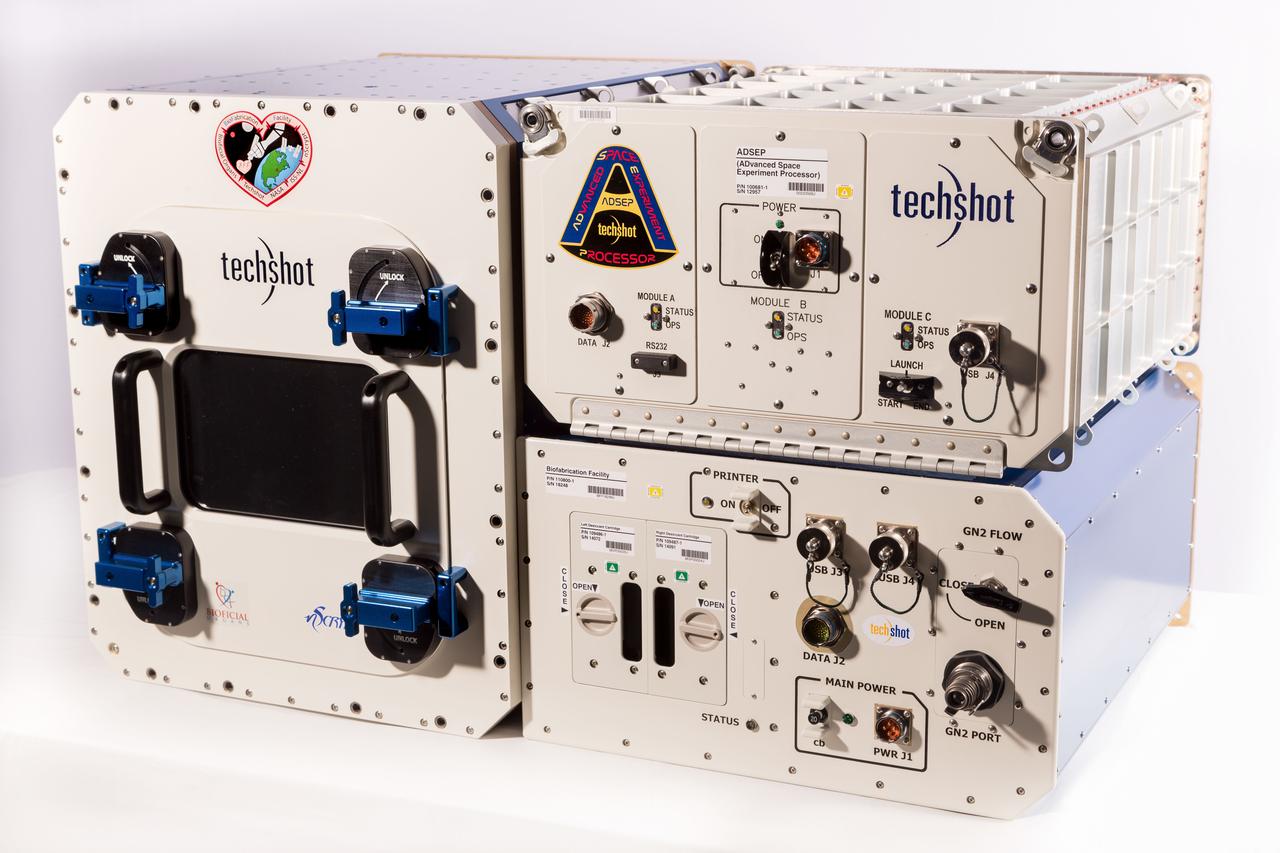
jsc2019e037579 (4/24/2019) --- Preflight image of the commercially developed and operated BioFabrication Facility (BFF) and the Advanced Space Experiment Processor (ADSEP). Together they comprise a 3D tissue bioprinting system for the International Space Station (ISS). Photo courtesy of Techshot Inc.
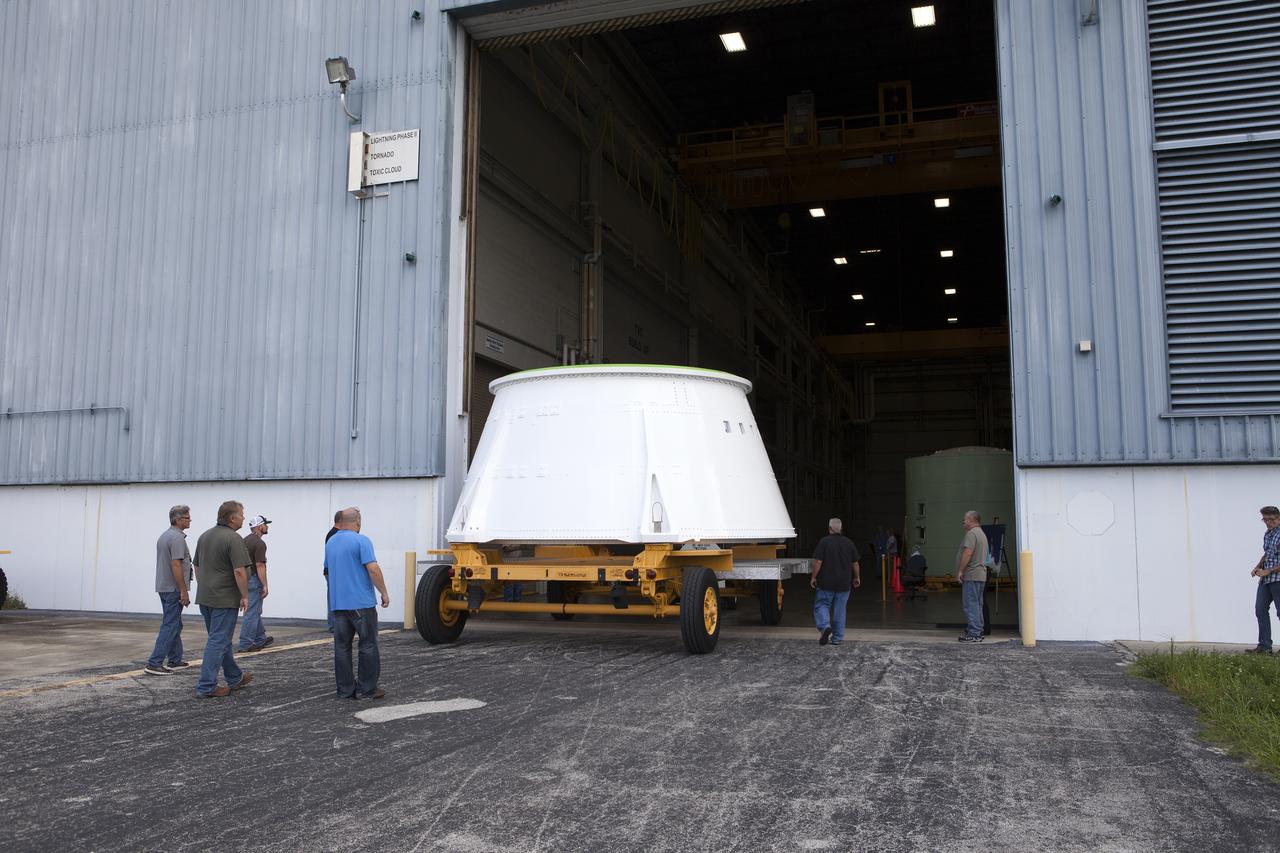
The left hand aft skirt for NASA’s Space Launch System (SLS) rocket is moved inside the Booster Fabrication Facility at the agency’s Kennedy Space Center in Florida. The aft skirt arrived from the Hangar AF facility at Cape Canaveral Air Force Station. The space shuttle-era aft skirt, was inspected, resurfaced, primed and painted for use on the left hand booster of the SLS rocket for Exploration Mission 1 (EM-1). NASA is preparing for EM-1, deep-space missions, and the journey to Mars.
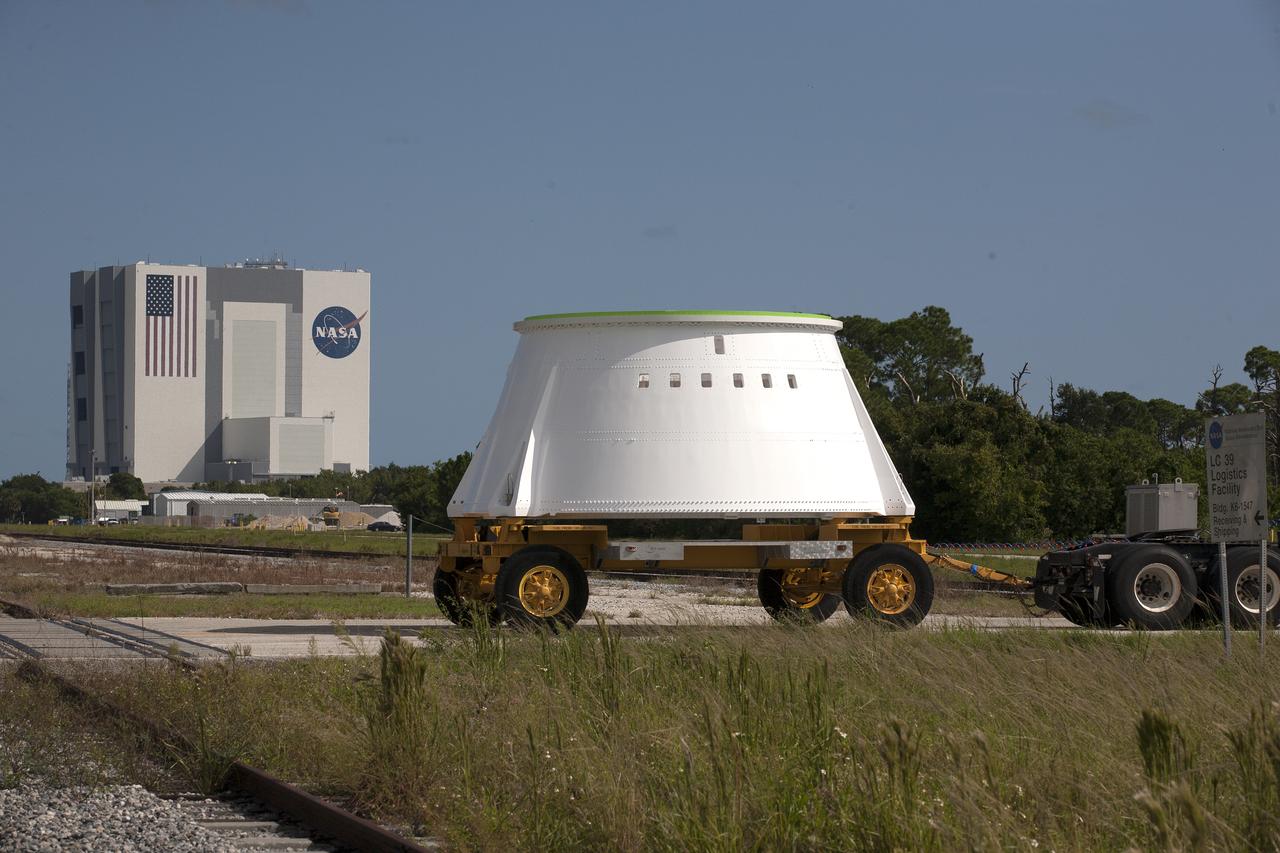
The left hand aft skirt for NASA’s Space Launch System (SLS) rocket arrives at the agency’s Kennedy Space Center in Florida, from the Hangar AF facility at Cape Canaveral Air Force Station. The aft skirt will be transported to the Booster Fabrication Facility. The space shuttle-era aft skirt, was inspected, resurfaced, primed and painted for use on the left hand booster of the SLS rocket for Exploration Mission 1 (EM-1). NASA is preparing for EM-1, deep-space missions, and the journey to Mars.

The left hand aft skirt for NASA’s Space Launch System (SLS) rocket arrives at the Booster Fabrication Facility at the agency’s Kennedy Space Center in Florida, from the Hangar AF facility at Cape Canaveral Air Force Station. The space shuttle-era aft skirt, was inspected, resurfaced, primed and painted for use on the left hand booster of the SLS rocket for Exploration Mission 1 (EM-1). NASA is preparing for EM-1, deep-space missions, and the journey to Mars.
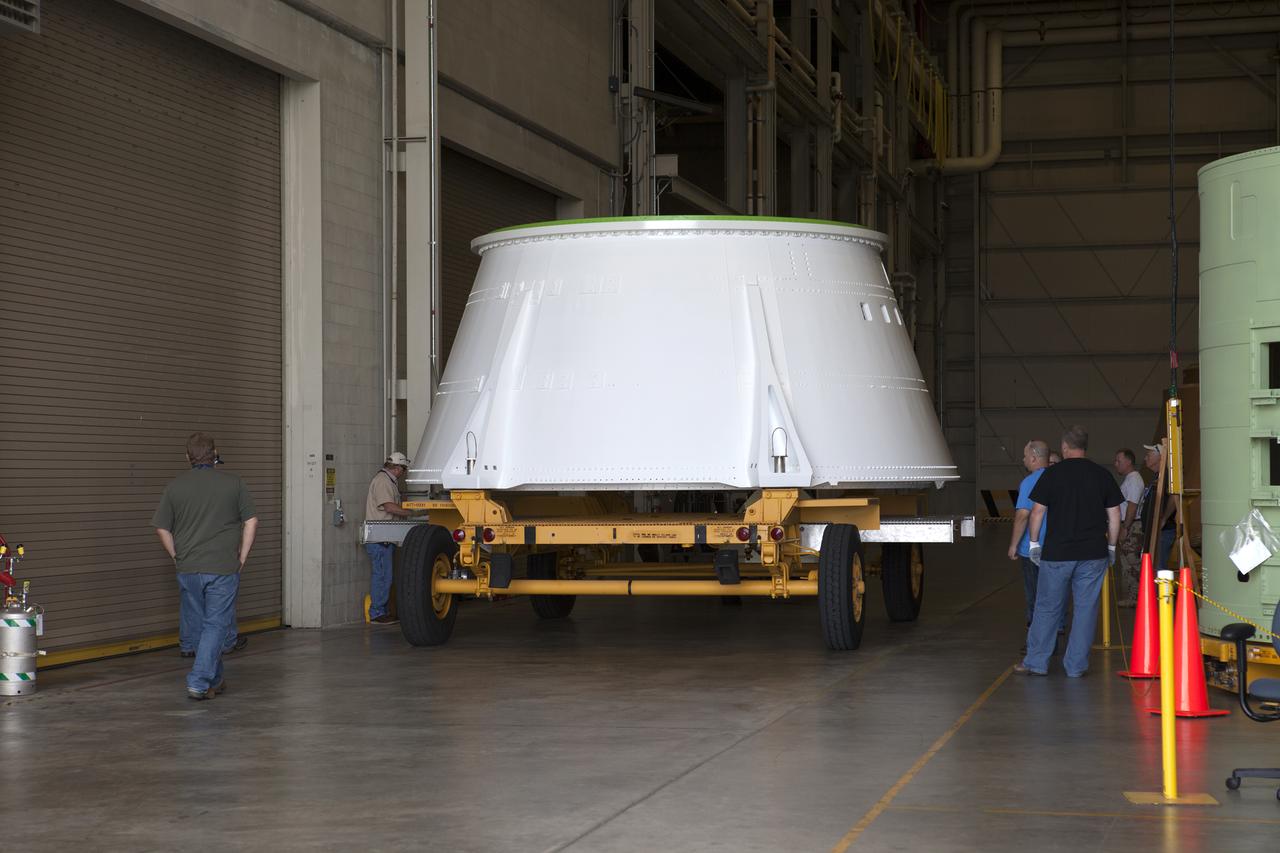
The left hand aft skirt for NASA’s Space Launch System (SLS) rocket is moved inside the Booster Fabrication Facility at the agency’s Kennedy Space Center in Florida. The aft skirt arrived from the Hangar AF facility at Cape Canaveral Air Force Station. The space shuttle-era aft skirt, was inspected, resurfaced, primed and painted for use on the left hand booster of the SLS rocket for Exploration Mission 1 (EM-1). NASA is preparing for EM-1, deep-space missions, and the journey to Mars.
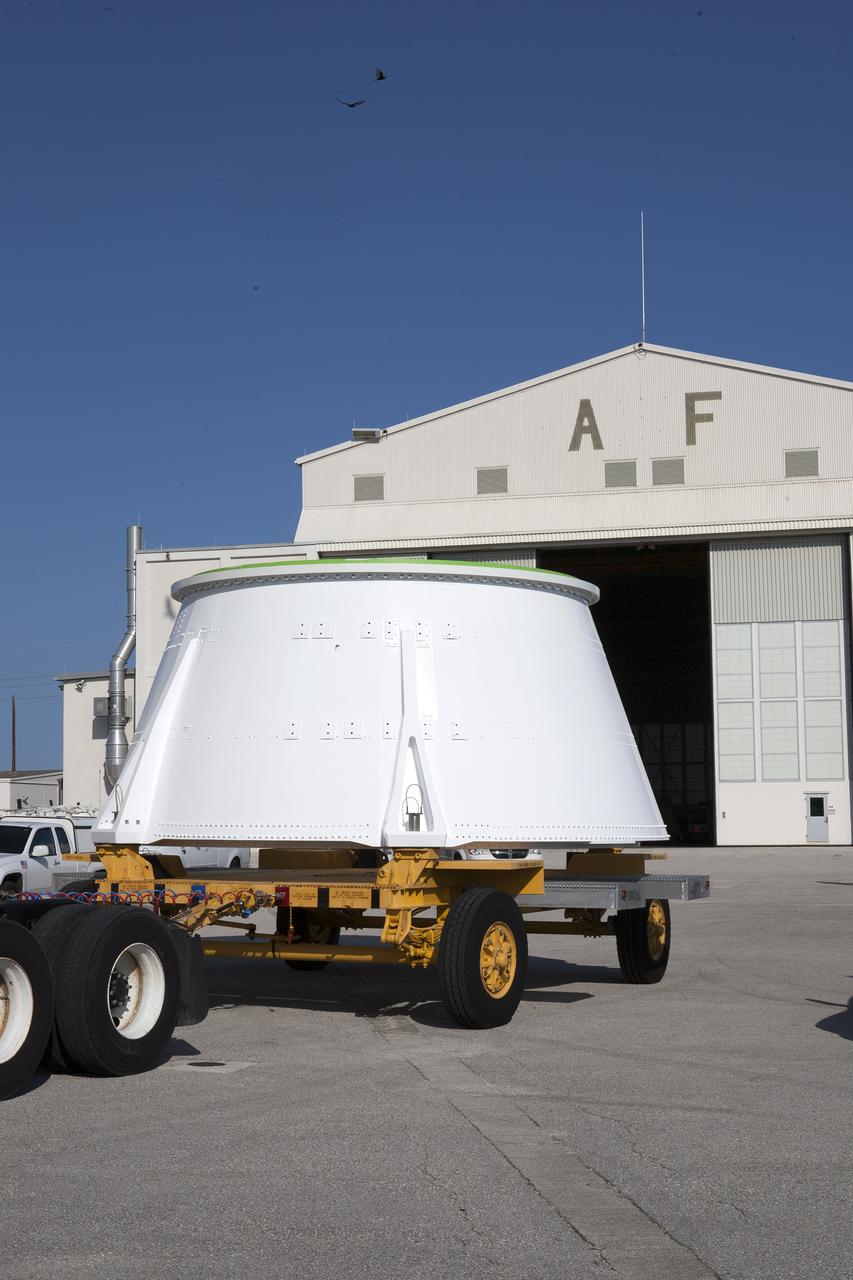
The left hand aft skirt for NASA’s Space Launch System (SLS) rocket is prepared for the move from the Hangar AF facility at Cape Canaveral Air Force Station in Florida, to the Booster Fabrication Facility at the agency’s Kennedy Space Center. The space shuttle-era aft skirt, was inspected, resurfaced, primed and painted for use on the left hand booster of the SLS rocket for Exploration Mission 1 (EM-1). NASA is preparing for EM-1, deep-space missions, and the journey to Mars
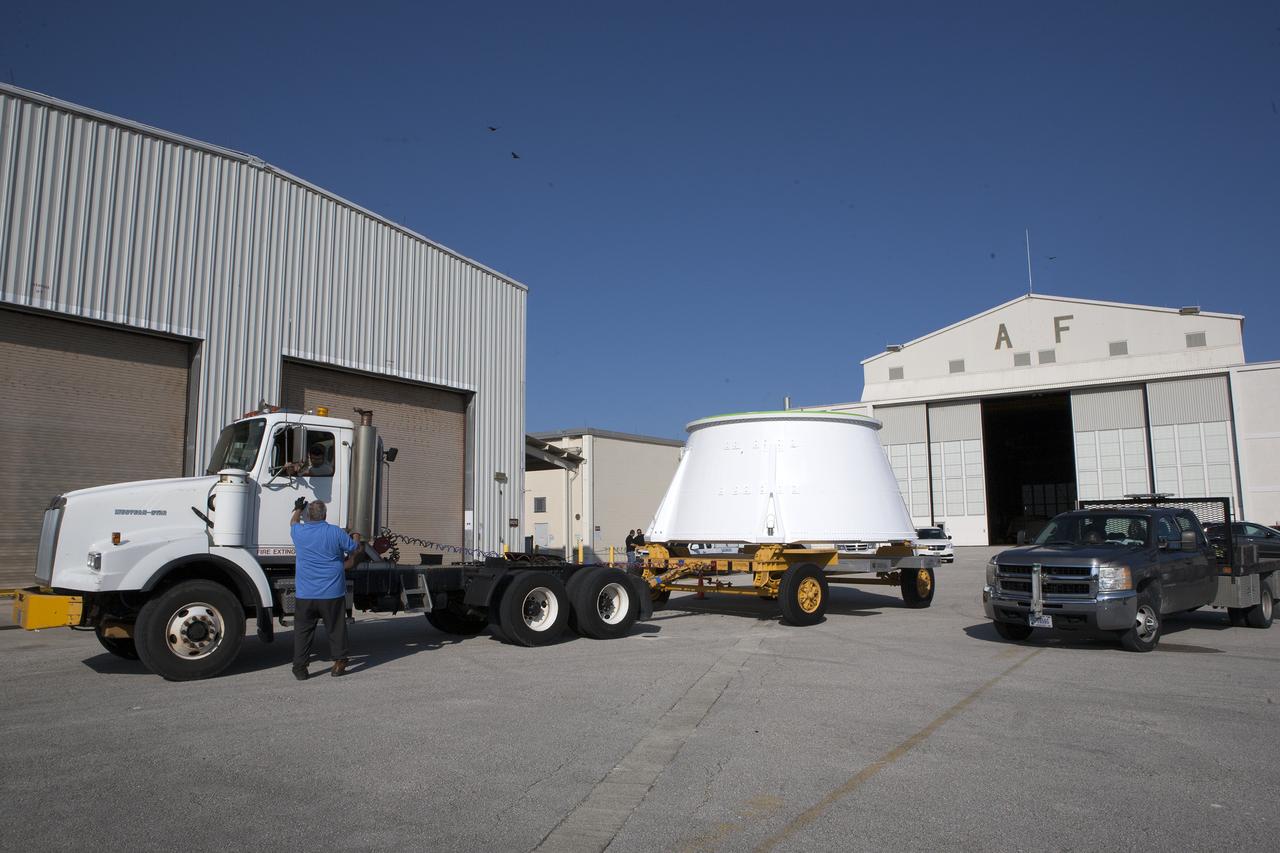
The left hand aft skirt for NASA’s Space Launch System (SLS) rocket is prepared for the move from the Hangar AF facility at Cape Canaveral Air Force Station in Florida, to the Booster Fabrication Facility at the agency’s Kennedy Space Center. The space shuttle-era aft skirt, was inspected, resurfaced, primed and painted for use on the left hand booster of the SLS rocket for Exploration Mission 1 (EM-1). NASA is preparing for EM-1, deep-space missions, and the journey to Mars.

jsc2023e052853 (9/6/2023) --- Dr. Aaron Rodgers unboxes the BFF-Meniscus-2 investigation after its return from the International Space Station. The first human knee meniscus has been successfully 3D bioprinted in orbit using the BioFabrication Facility. This is a significant step towards developing solutions to promote recovery from musculoskeletal injuries. Image courtesy of Redwire.
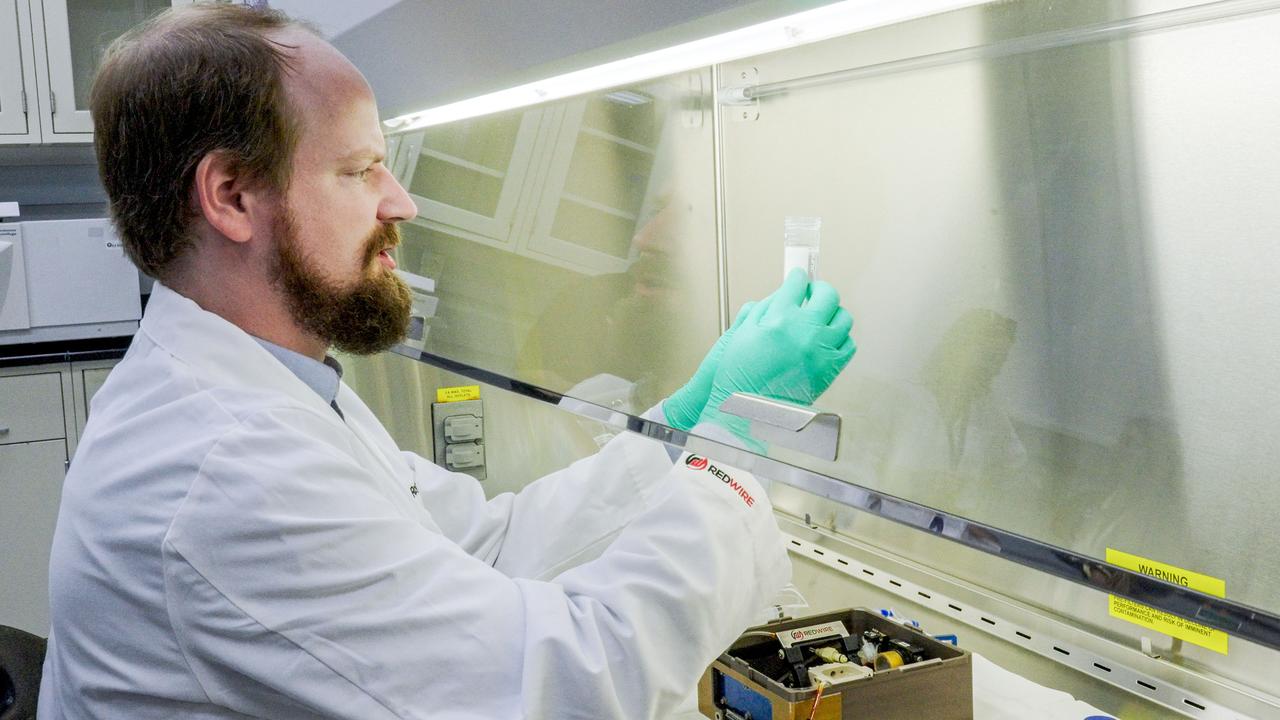
jsc2023e052854 (9/6/2023) --- Dr. Aaron Rodgers unboxes the BFF-Meniscus-2 investigation after its return from the International Space Station. The first human knee meniscus has been successfully 3D bioprinted in orbit using the BioFabrication Facility. This is a significant step towards developing solutions to promote recovery from musculoskeletal injuries. Image courtesy of Redwire.
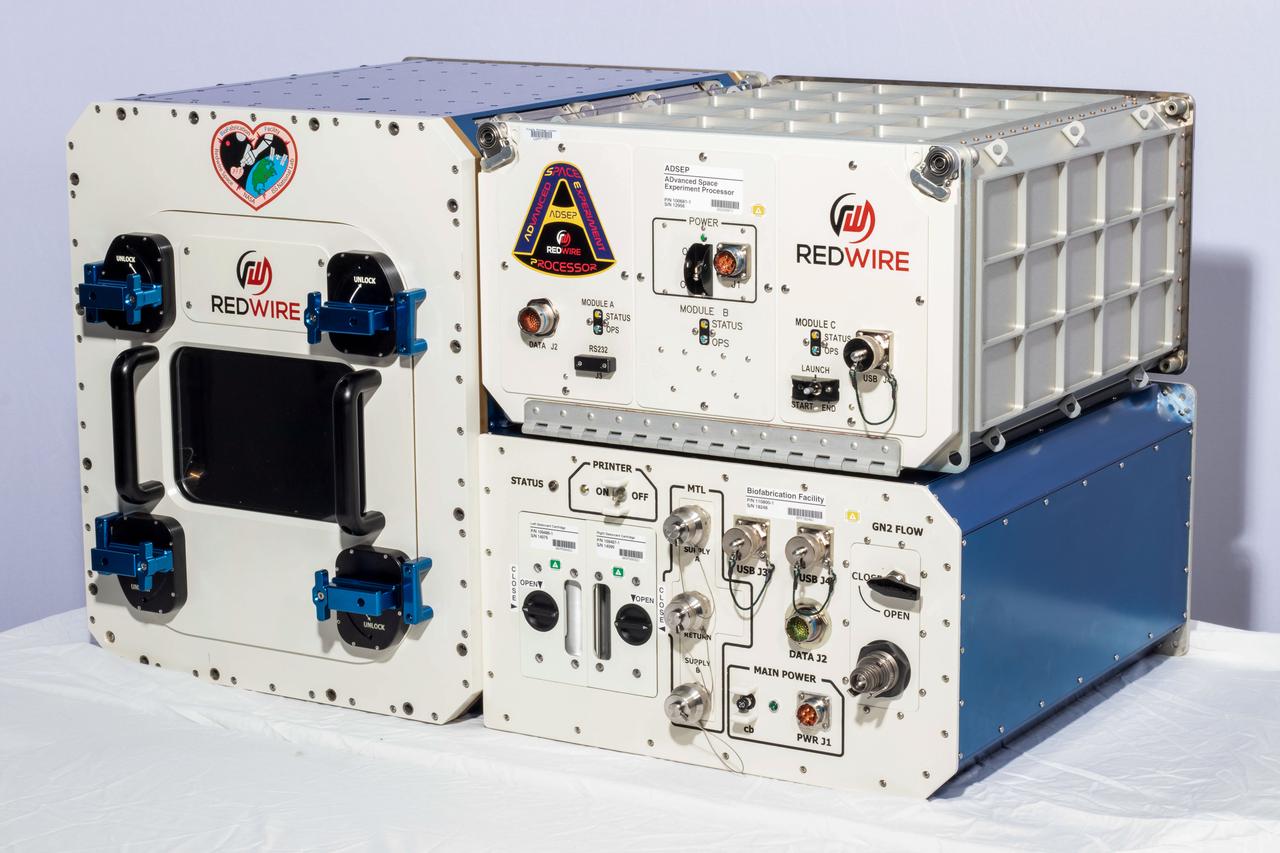
jsc2022e072969 (8/12/2022) --- The BioFabrication Facility (BFF) and the ADvanced Space Experiment Processor (ADSEP) together comprise a system capable of manufacturing human tissue in the microgravity environment of space. BFF is returning to the International Space Station after coming back to Earth for upgrades in 2020. The first investigation to be conducted in the upgraded facility is BioFabrication Facility Assembled Next-gen Development of Collagenous Allograft Meniscal Prosthetics aboard the International Space Station (BFF-Meniscus-2). The study attempts to 3D print a meniscus, also known as knee cartilage tissue, using only bioinks and cells. Image courtesy of Redwire.
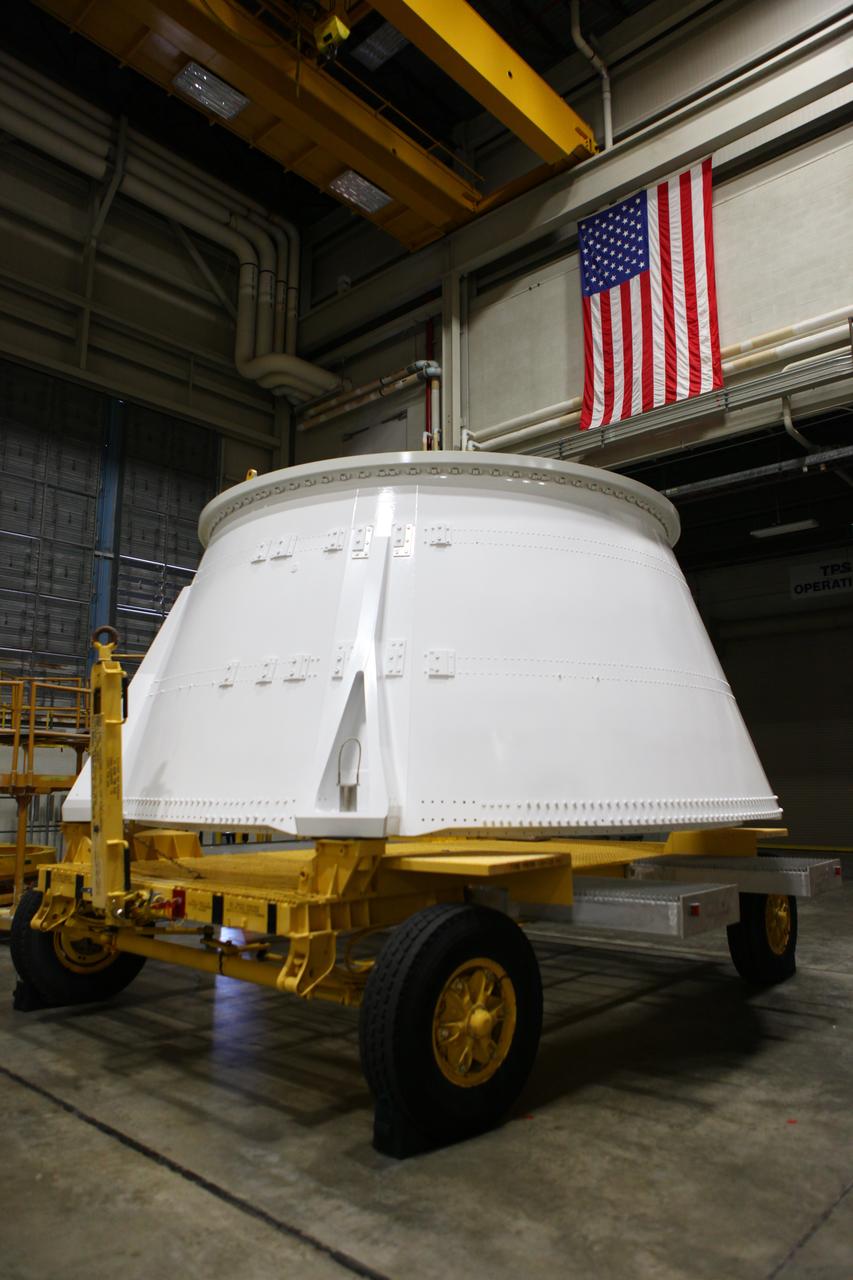
The right hand aft skirt for NASA's Space Launch System (SLS) rocket has been refurbished and painted and is ready for the assembly process in the Booster Fabrication Facility at the agency's Kennedy Space Center in Florida. The aft skirt was refurbished and painted in support facilities at the Hangar AF facility at Cape Canaveral Air Force Station in Florida. The space shuttle-era aft skirt will be used on the right hand booster of the SLS for Exploration Mission 1 (EM-1). NASA is preparing for EM-1, deep space missions, and the Journey to Mars.
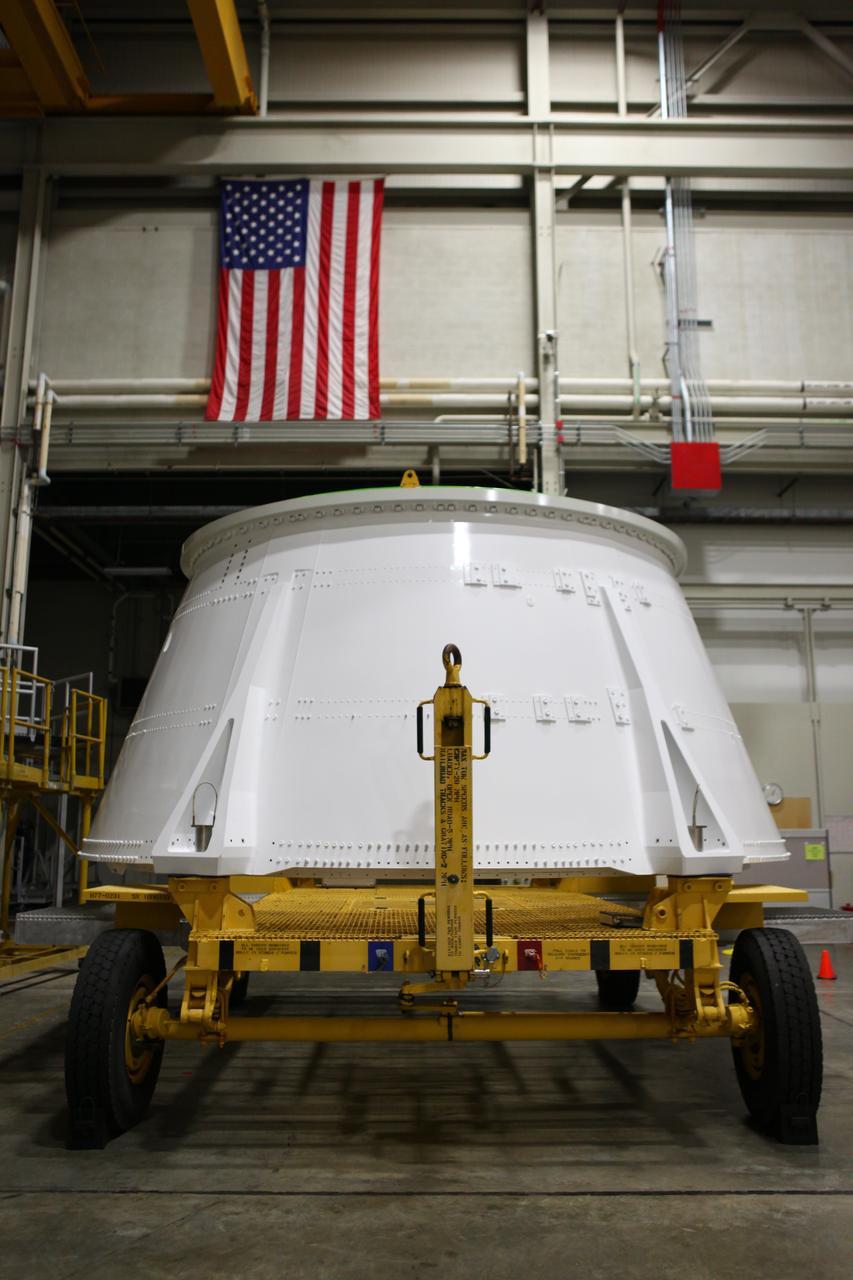
The right hand aft skirt for NASA's Space Launch System (SLS) rocket has been refurbished and painted and is ready for the assembly process in the Booster Fabrication Facility at the agency's Kennedy Space Center in Florida. The aft skirt was refurbished and painted in support facilities at the Hangar AF facility at Cape Canaveral Air Force Station in Florida. The space shuttle-era aft skirt will be used on the right hand booster of the SLS for Exploration Mission 1 (EM-1). NASA is preparing for EM-1, deep space missions, and the Journey to Mars.
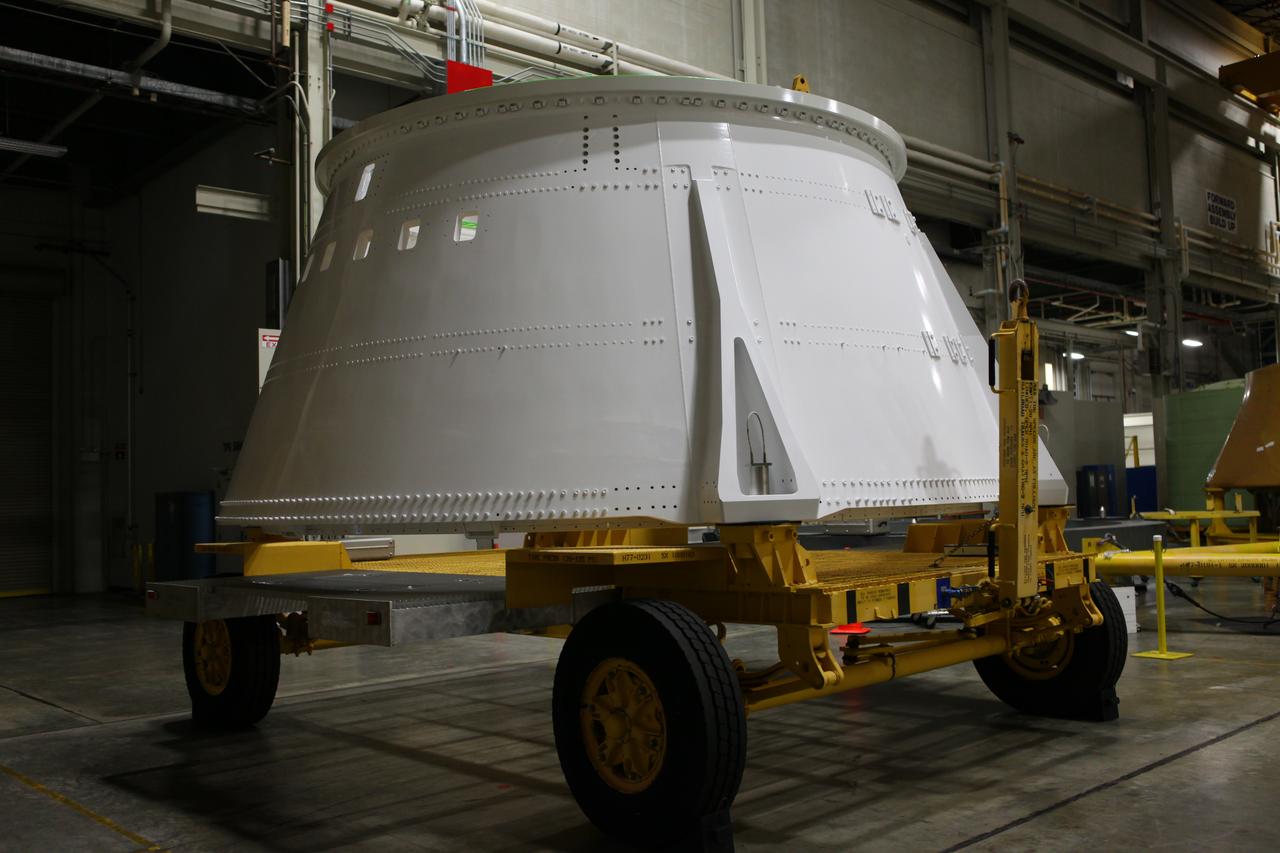
The right hand aft skirt for NASA's Space Launch System (SLS) rocket has been refurbished and painted and is ready for the assembly process in the Booster Fabrication Facility at the agency's Kennedy Space Center in Florida. The aft skirt was refurbished and painted in support facilities at the Hangar AF facility at Cape Canaveral Air Force Station in Florida. The space shuttle-era aft skirt will be used on the right hand booster of the SLS for Exploration Mission 1 (EM-1). NASA is preparing for EM-1, deep space missions, and the Journey to Mars.
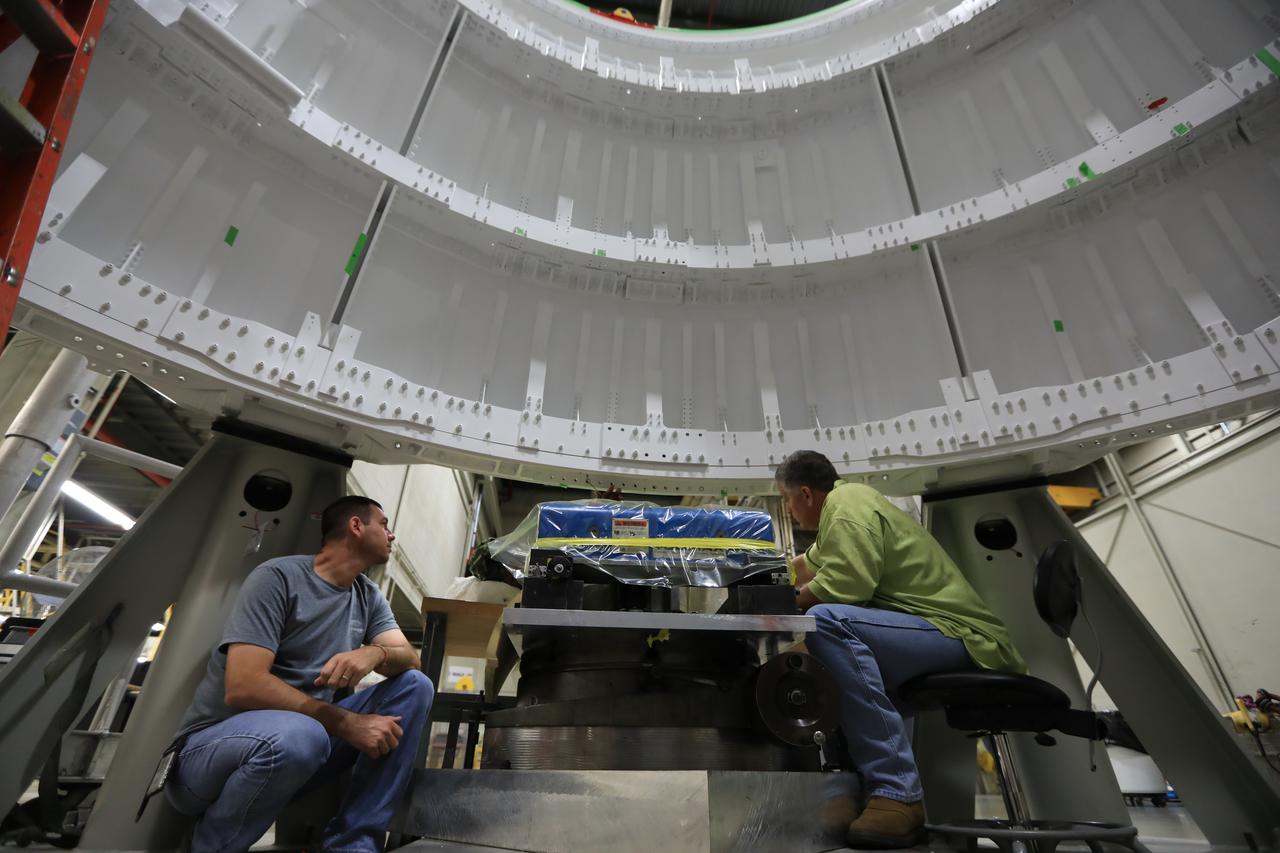
Inside the Booster Fabrication Facility at NASA's Kennedy Space Center in Florida, the left hand aft skirt for the agency's Space Launch System (SLS) rocket is ready for the assembly process. From left, are Chad Goetz, quality technician with Orbital ATK, and Robbie Blaue, quality assurance specialist with the Defense Contract Management Agency. The aft skirt was refurbished and painted in support facilities at the Hangar AF facility at Cape Canaveral Air Force Station in Florida. The space shuttle-era aft skirt will be used on the left hand booster of the SLS for Exploration Mission 1 (EM-1). NASA is preparing for EM-1, deep space missions, and the Journey to Mars.
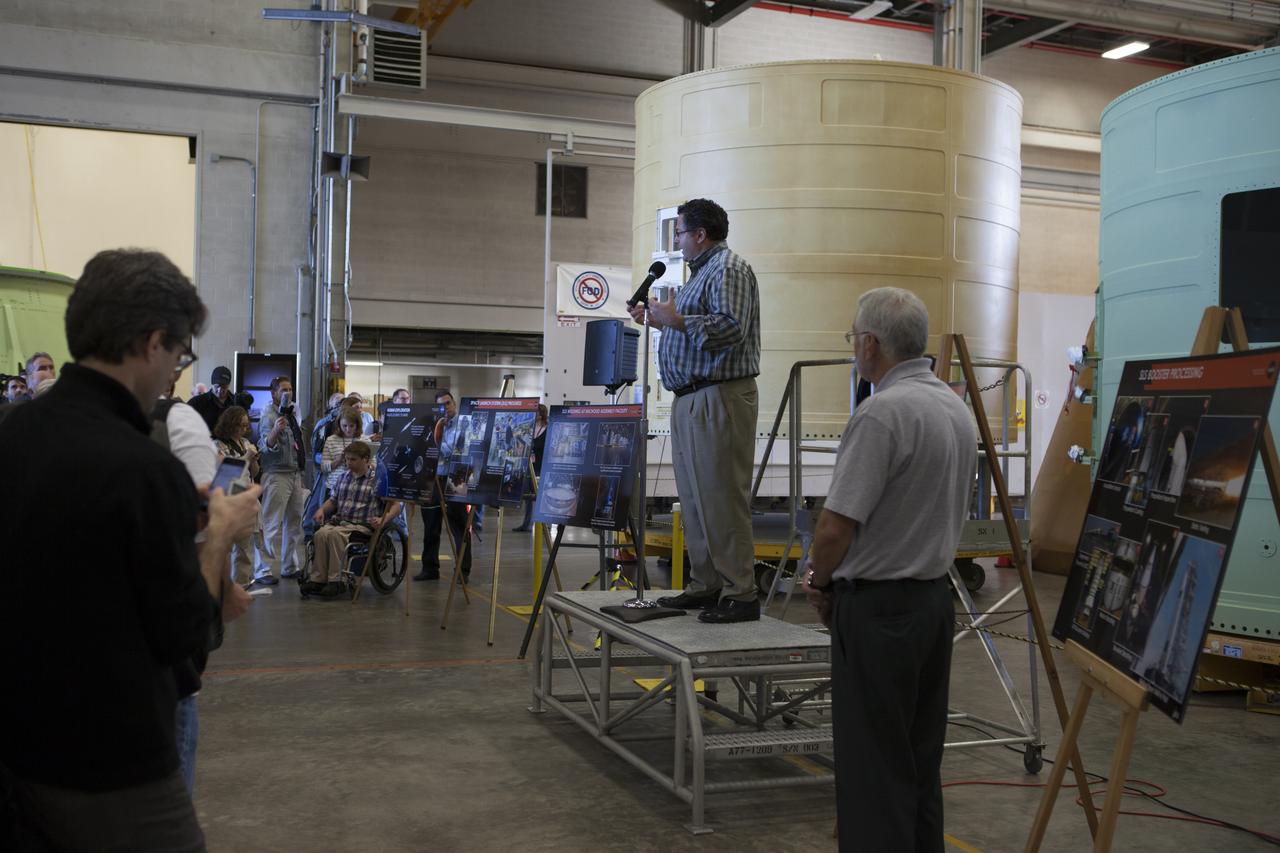
At NASA's Kennedy Space Center in Florida, members of the news media are briefed on the agency's Space Launch System SLS Program by Todd May, program manager for Space Launch Systems SLS at NASA's Marshall Space Flight Center in Huntsville, Alabama. The briefing took place in the spaceport's Booster Fabrication Facility BFF. During the Space Shuttle Program, the facility was used for processing forward segments and aft skirts for the solid rocket boosters. The BFF will serve a similar role for the SLS. Orion is the exploration spacecraft designed to carry astronauts to destinations not yet explored by humans, including an asteroid and Mars. It will have emergency abort capability, sustain the crew during space travel and provide safe re-entry from deep space return velocities. The first unpiloted flight test of Orion is scheduled to launch Dec. 4, 2014 atop a United Launch Alliance Delta IV Heavy rocket, and in 2018 on NASA’s Space Launch System rocket.
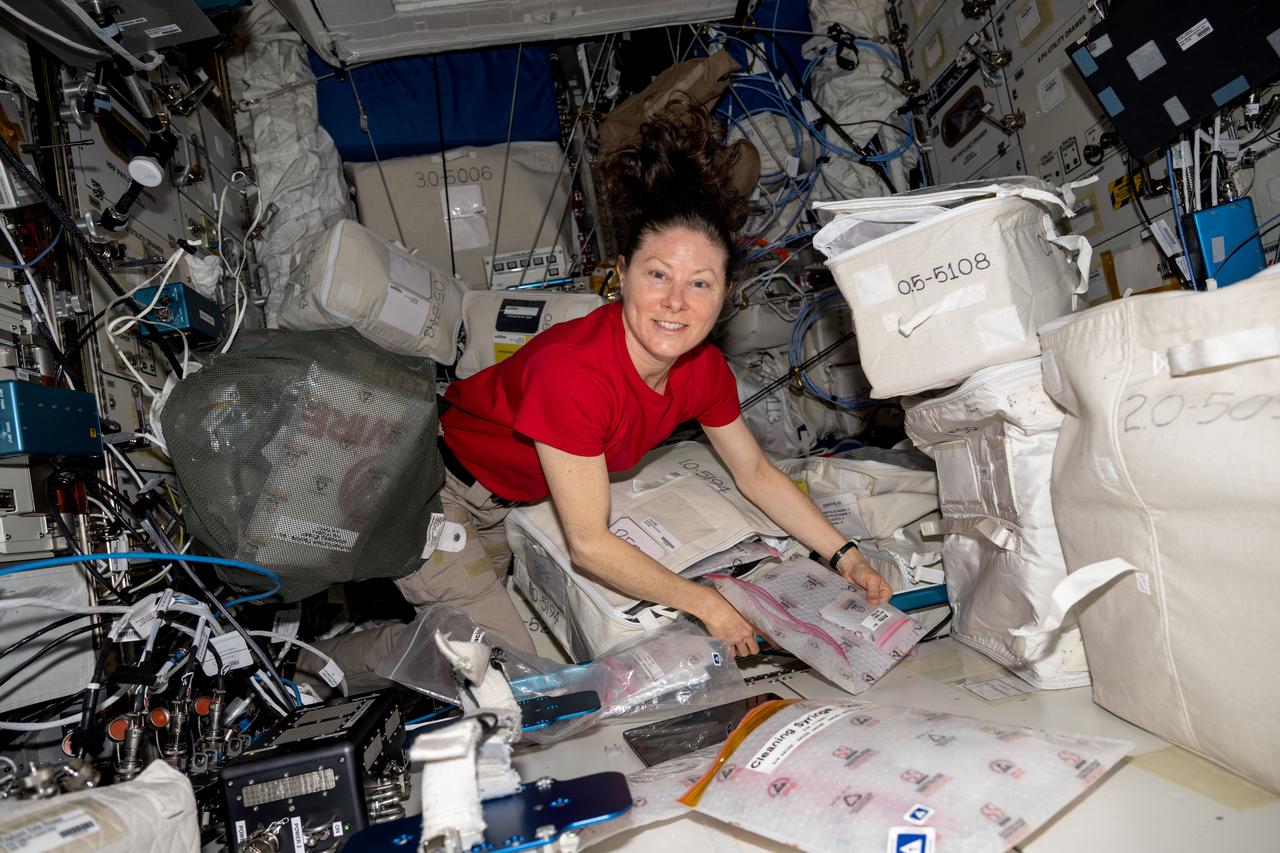
iss071e403579 (July 23, 2024) --- NASA astronaut and Expedition 71 Flight Engineer Tracy C. Dyson unpacks and examines research gear that is part of the BioFabrication Facility (BFF) located inside the International Space Station's Columbus laboratory module. The BFF is a research device being tested for its ability to print organ-like tissues in microgravity.

Inside the Booster Fabrication Facility at NASA's Kennedy Space Center in Florida, the Artemis I aft skirts for the agency's Space Launch System (SLS) rocket’s twin solid rocket boosters are being readied for their move to the Rotation, Processing and Surge Facility (RPSF) on June 9, 2020. In view at left is the left aft skirt assembly. Behind it to the right is the right aft skirt assembly. Also in view at far right, are the Artemis I forward assemblies, with the left assembly in front and the right assembly behind it. The aft skirts were refurbished by Northrop Grumman. They house the thrust vector control system, which controls 70 percent of the steering during initial ascent of the SLS rocket. The segments will remain in the RPSF until ready for stacking with the forward and aft parts of the boosters on the mobile launcher in High Bay 3 of the Vehicle Assembly Building. Through the Artemis Program, NASA is working to land the first woman and next man on the Moon by 2024.
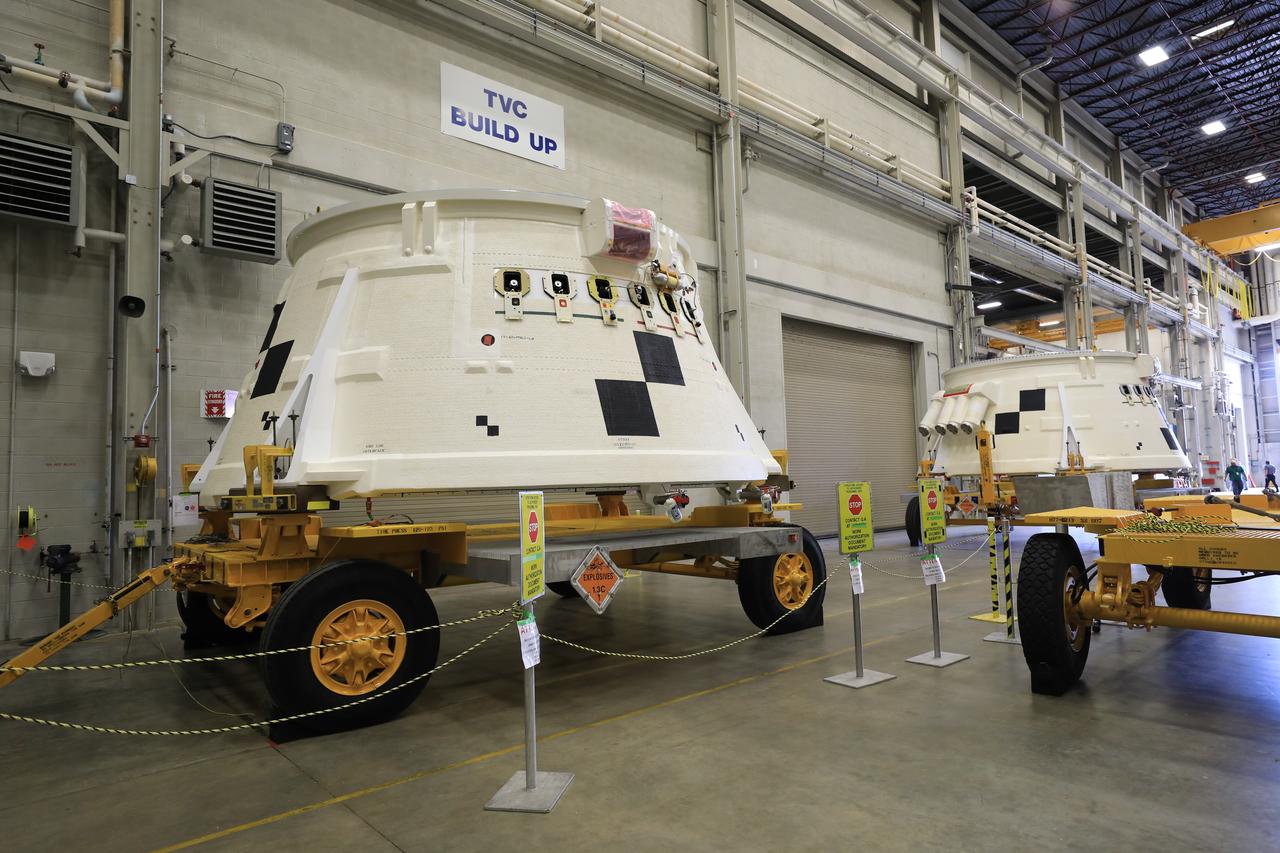
Inside the Booster Fabrication Facility at NASA's Kennedy Space Center in Florida, the Artemis I aft skirts for the agency's Space Launch System (SLS) rocket’s twin solid rocket boosters are being readied for their move to the Rotation, Processing and Surge Facility (RPSF) on June 9, 2020. In view at left is the left aft skirt assembly, and at far right is the right aft skirt assembly. The aft skirts were refurbished by Northrop Grumman. They house the thrust vector control system, which controls 70 percent of the steering during initial ascent of the SLS rocket. The segments will remain in the RPSF until ready for stacking with the forward and aft parts of the boosters on the mobile launcher in High Bay 3 of the Vehicle Assembly Building. Through the Artemis Program, NASA is working to land the first woman and next man on the Moon by 2024.
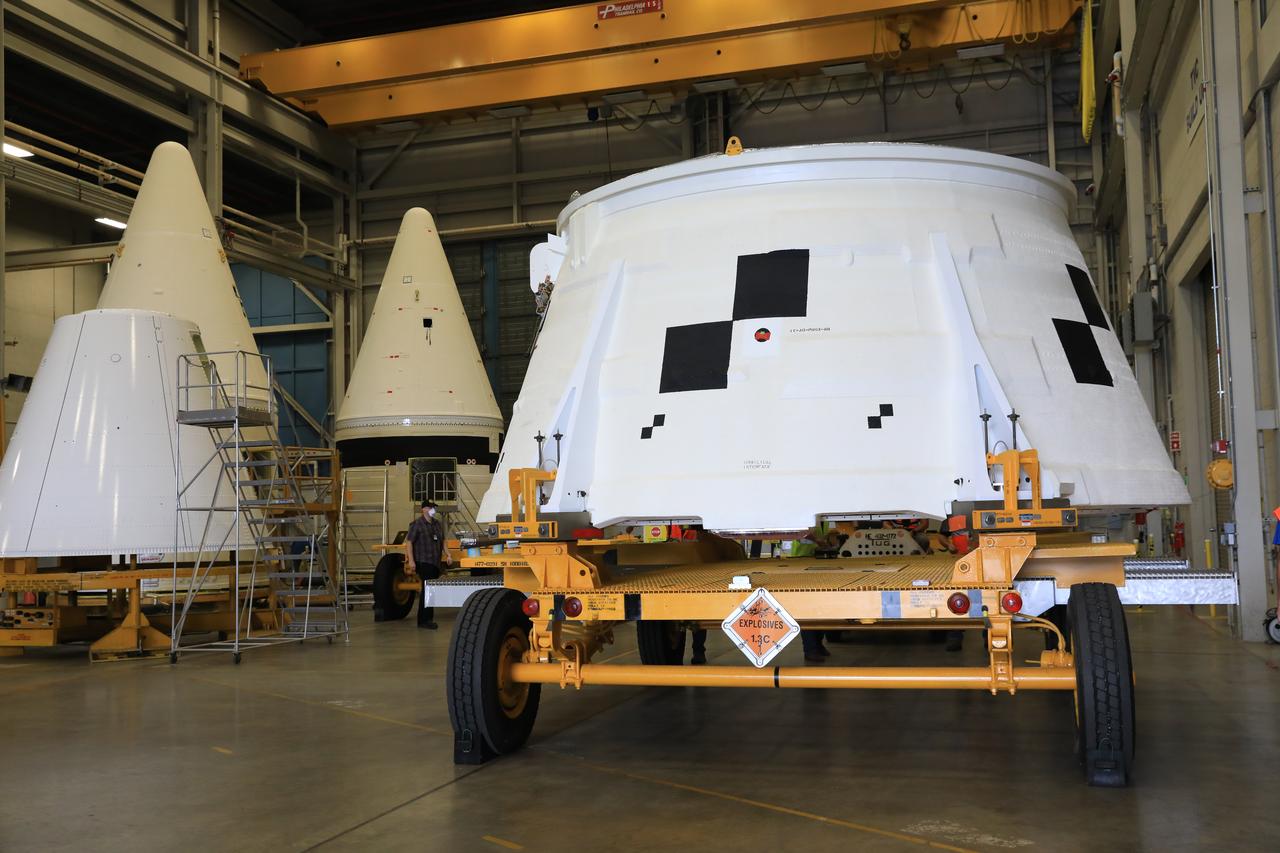
Inside the Booster Fabrication Facility at NASA's Kennedy Space Center in Florida, the Artemis I aft skirts for the agency's Space Launch System (SLS) rocket’s twin solid rocket boosters are moved out of their test cells and are being readied for their move to the Rotation, Processing and Surge Facility (RPSF) on June 9, 2020. In view at right is the right aft skirt. In view at left are the two Artemis I forward assemblies. The aft skirts were refurbished by Northrop Grumman. They house the thrust vector control system, which controls 70 percent of the steering during initial ascent of the SLS rocket. The segments will remain in the RPSF until ready for stacking with the forward and aft parts of the boosters on the mobile launcher in High Bay 3 of the Vehicle Assembly Building. Through the Artemis Program, NASA is working to land the first woman and next man on the Moon by 2024.
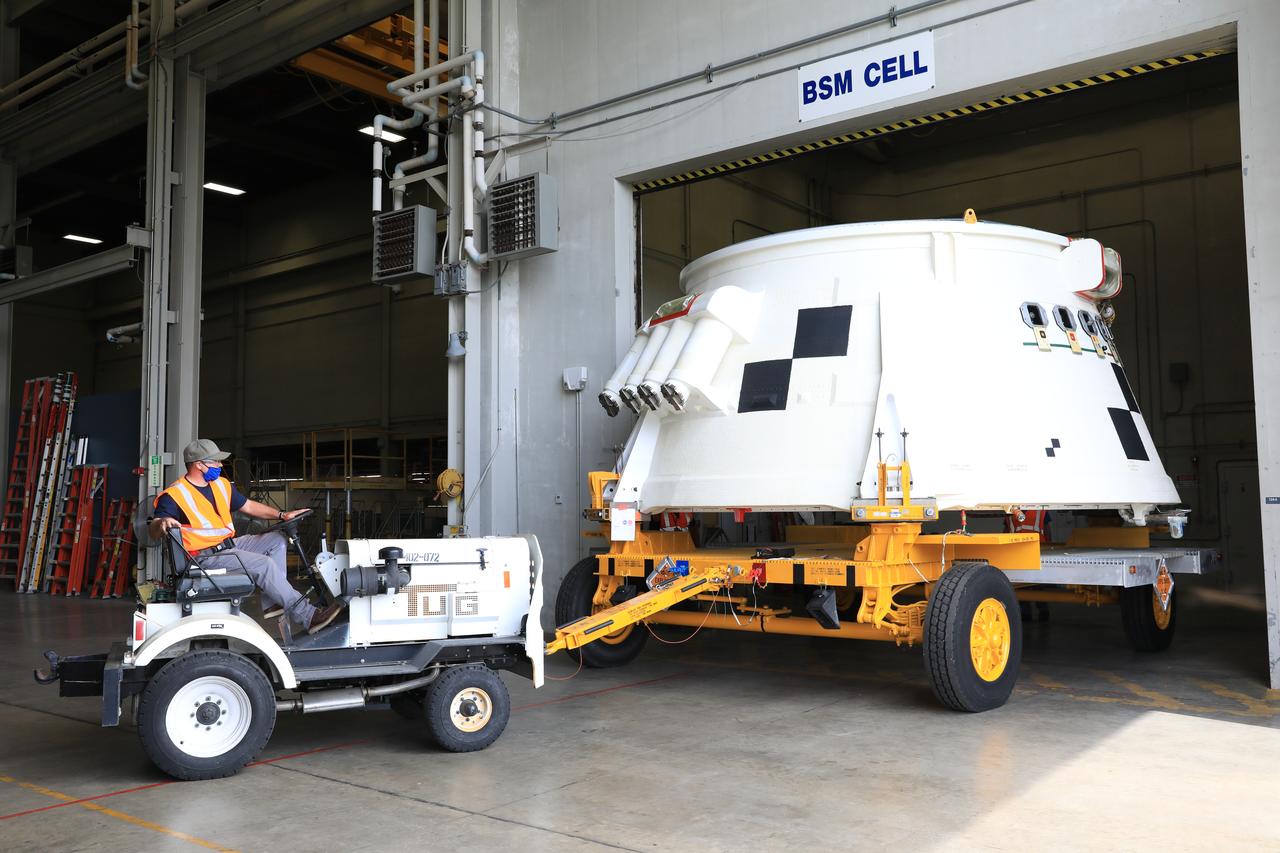
Inside the Booster Fabrication Facility at NASA's Kennedy Space Center in Florida, the Artemis I aft skirts for the agency's Space Launch System (SLS) rocket’s twin solid rocket boosters are being readied for their move to the Rotation, Processing and Surge Facility (RPSF) on June 9, 2020. In view, the left aft skirt assembly is attached to a move vehicle and moved out of a test cell. The aft skirts were refurbished by Northrop Grumman. They house the thrust vector control system, which controls 70 percent of the steering during initial ascent of the SLS rocket. The segments will remain in the RPSF until ready for stacking with the forward and aft parts of the boosters on the mobile launcher in High Bay 3 of the Vehicle Assembly Building. Through the Artemis Program, NASA is working to land the first woman and next man on the Moon by 2024.
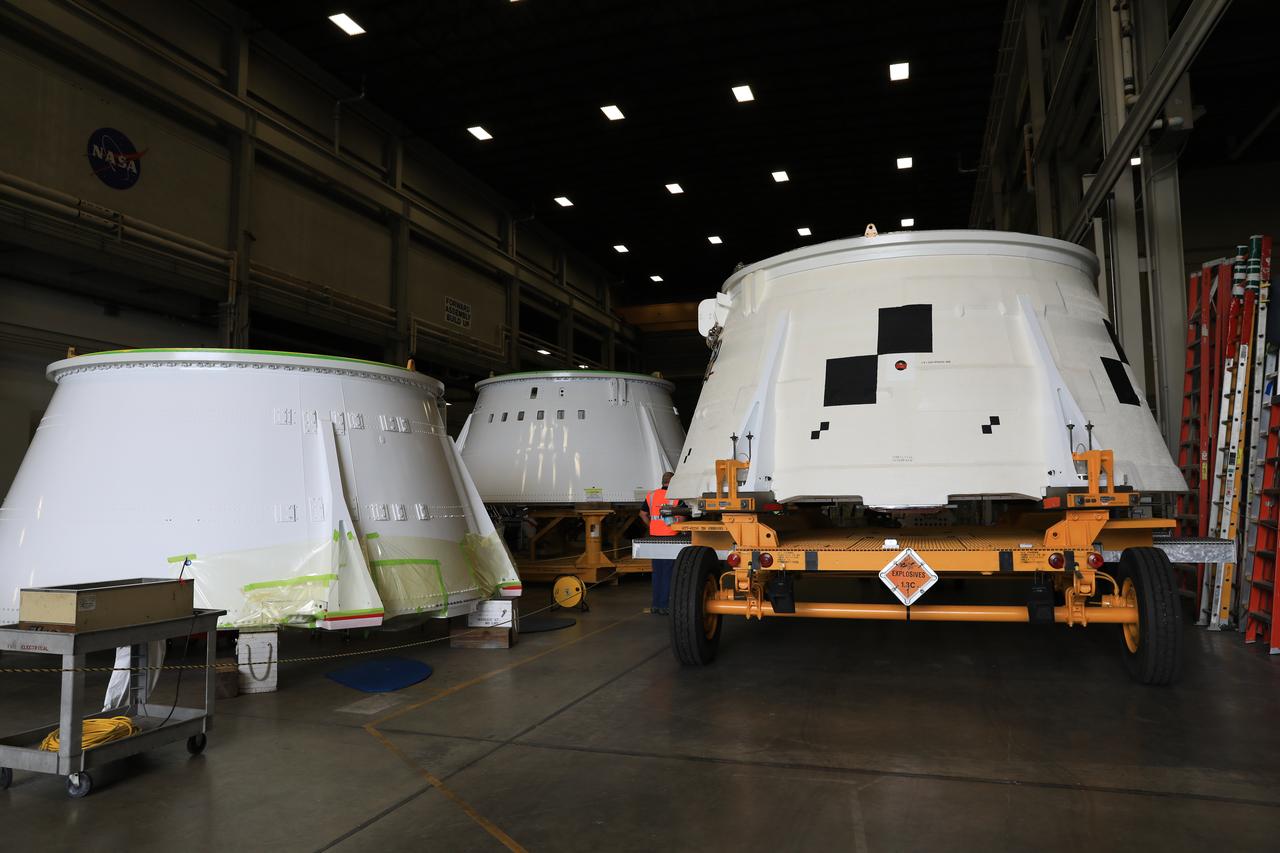
Inside the Booster Fabrication Facility at NASA's Kennedy Space Center in Florida, the Artemis I aft skirts for the agency's Space Launch System (SLS) rocket’s twin solid rocket boosters are being readied for their move to the Rotation, Processing and Surge Facility (RPSF) on June 9, 2020. In view, the left aft skirt assembly is attached to a move vehicle and moved out of a test cell. The Artemis II aft skirt structures are in view at left. The aft skirts were refurbished by Northrop Grumman. They house the thrust vector control system, which controls 70 percent of the steering during initial ascent of the SLS rocket. The segments will remain in the RPSF until ready for stacking with the forward and aft parts of the boosters on the mobile launcher in High Bay 3 of the Vehicle Assembly Building. Through the Artemis Program, NASA is working to land the first woman and next man on the Moon by 2024.
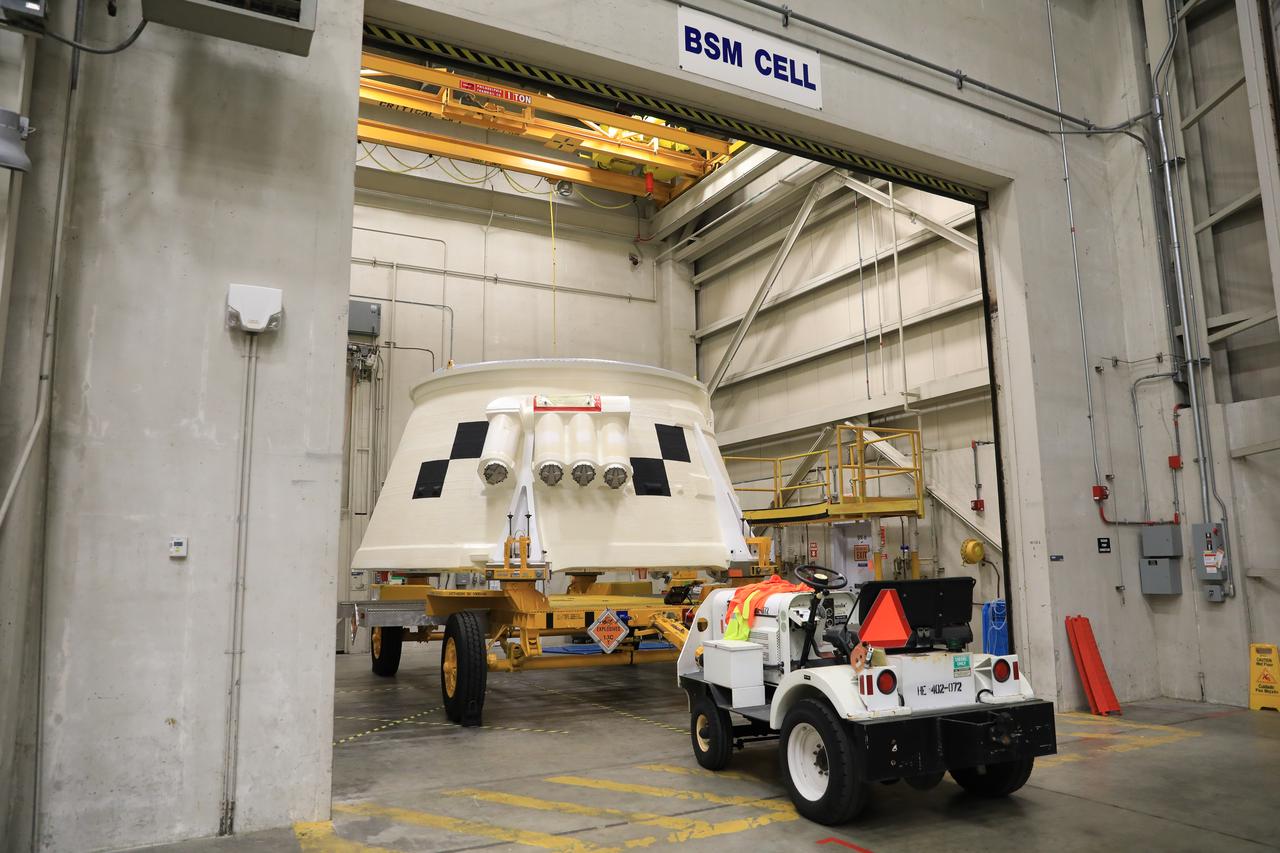
Inside the Booster Fabrication Facility at NASA's Kennedy Space Center in Florida, the Artemis I aft skirts for the agency's Space Launch System (SLS) rocket’s twin solid rocket boosters are being readied for their move to the Rotation, Processing and Surge Facility (RPSF) on June 9, 2020. In view, the left aft skirt assembly is attached to a move vehicle in a test cell. The aft skirts were refurbished by Northrop Grumman. They house the thrust vector control system, which controls 70 percent of the steering during initial ascent of the SLS rocket. The segments will remain in the RPSF until ready for stacking with the forward and aft parts of the boosters on the mobile launcher in High Bay 3 of the Vehicle Assembly Building. Through the Artemis Program, NASA is working to land the first woman and next man on the Moon by 2024.
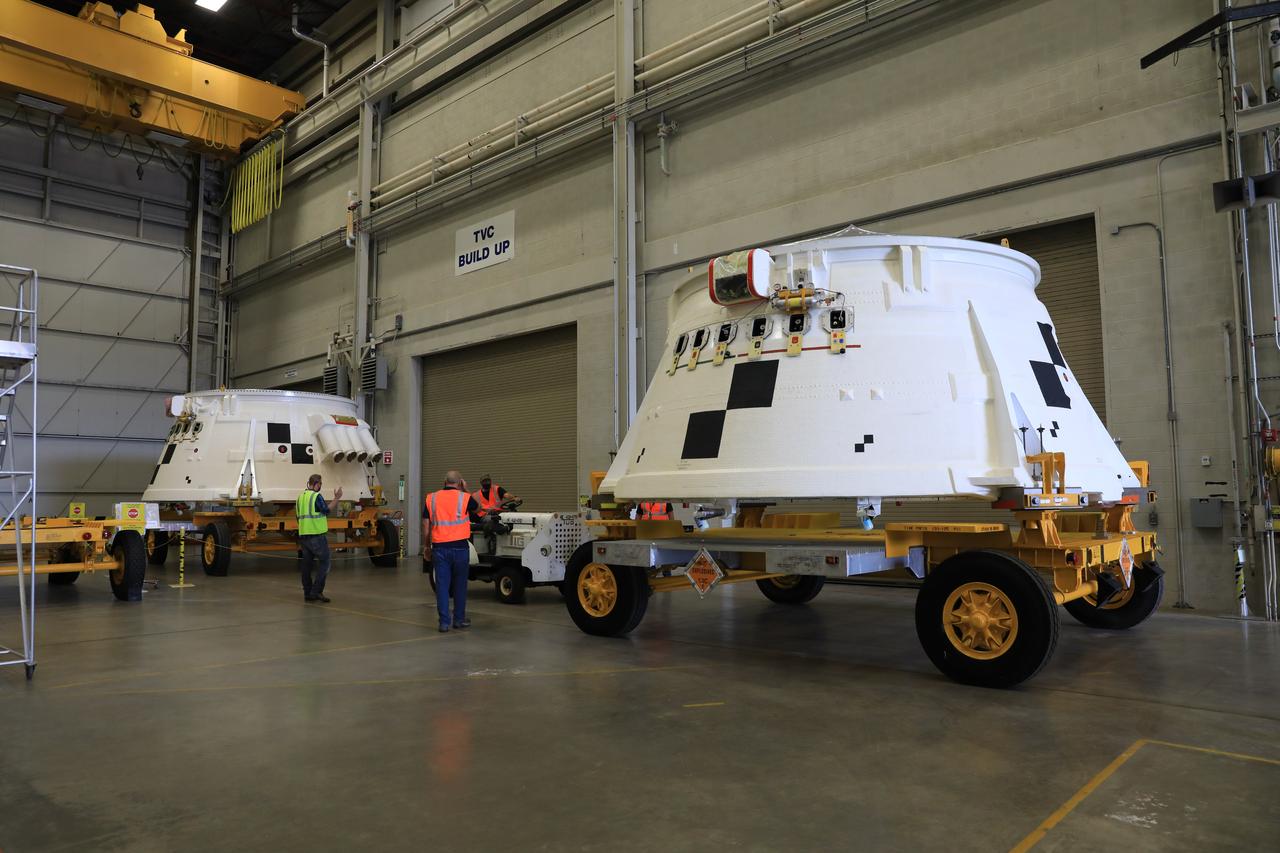
Inside the Booster Fabrication Facility at NASA's Kennedy Space Center in Florida, the Artemis I aft skirts for the agency's Space Launch System (SLS) rocket’s twin solid rocket boosters are moved out of their test cells and are being readied for their move to the Rotation, Processing and Surge Facility (RPSF) on June 9, 2020. The aft skirts were refurbished by Northrop Grumman. They house the thrust vector control system, which controls 70 percent of the steering during initial ascent of the SLS rocket. The segments will remain in the RPSF until ready for stacking with the forward and aft parts of the boosters on the mobile launcher in High Bay 3 of the Vehicle Assembly Building. Through the Artemis Program, NASA is working to land the first woman and next man on the Moon by 2024.
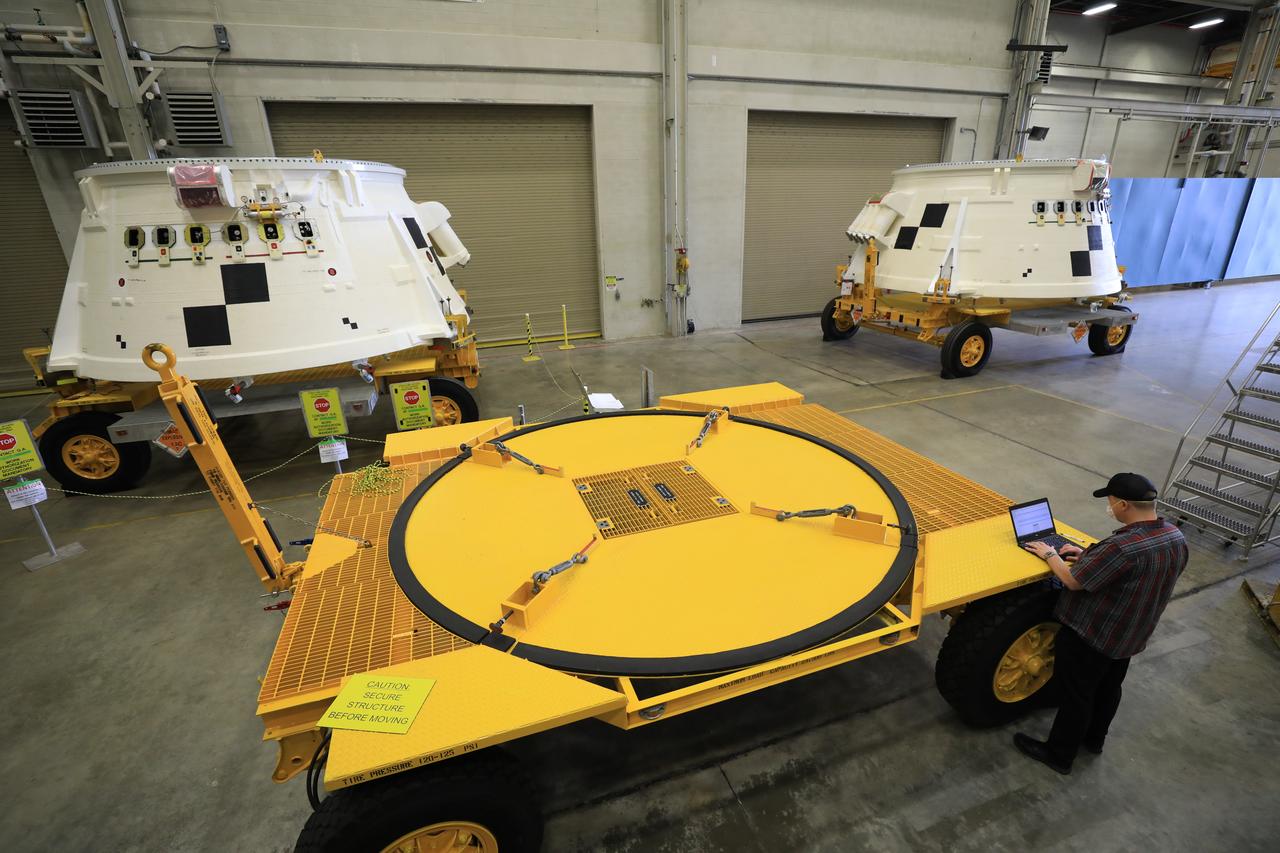
Inside the Booster Fabrication Facility at NASA's Kennedy Space Center in Florida, the Artemis I aft skirts for the agency's Space Launch System (SLS) rocket’s twin solid rocket boosters are being readied for their move to the Rotation, Processing and Surge Facility (RPSF) on June 9, 2020. In view at left is the left aft skirt assembly, and at right is the right aft skirt assembly. The aft skirts were refurbished by Northrop Grumman. They house the thrust vector control system, which controls 70 percent of the steering during initial ascent of the SLS rocket. The segments will remain in the RPSF until ready for stacking with the forward and aft parts of the boosters on the mobile launcher in High Bay 3 of the Vehicle Assembly Building. Through the Artemis Program, NASA is working to land the first woman and next man on the Moon by 2024.
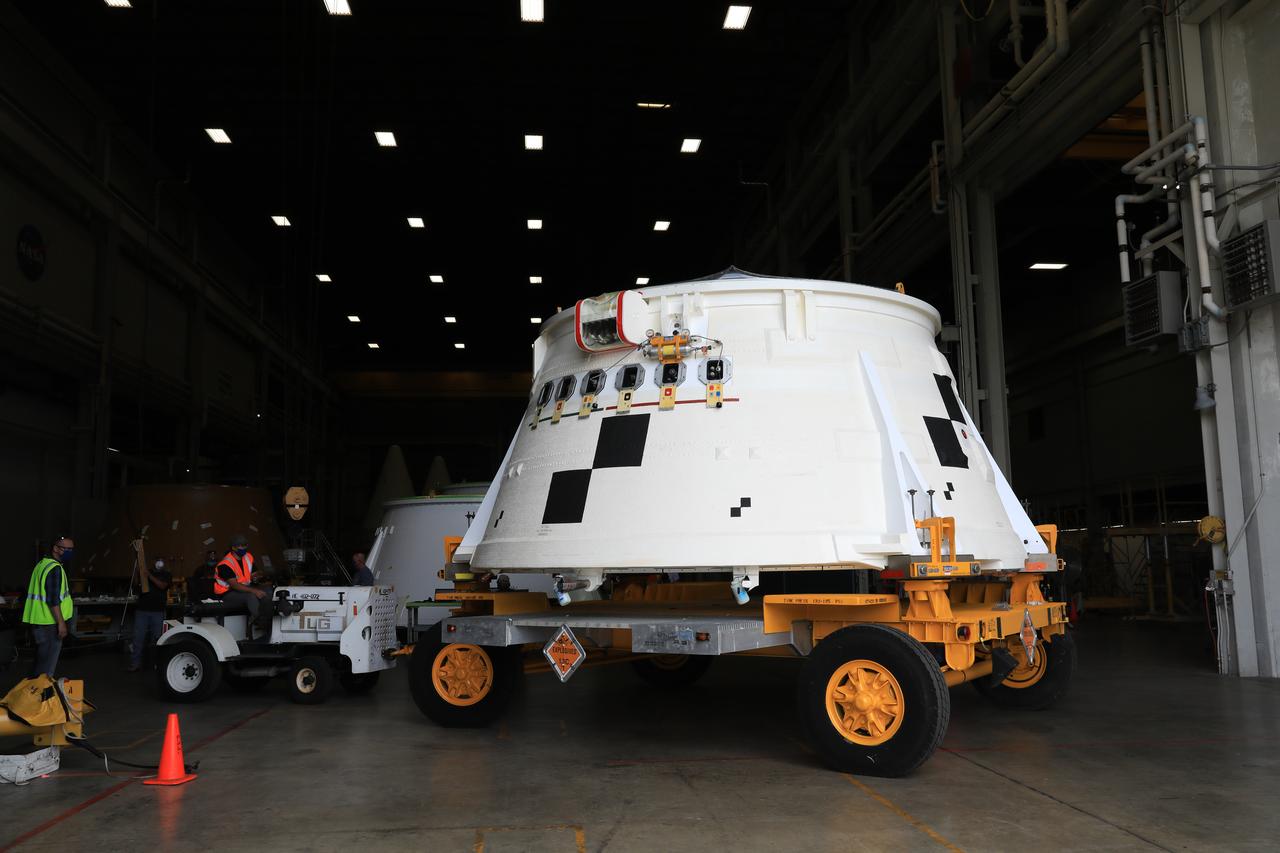
Inside the Booster Fabrication Facility at NASA's Kennedy Space Center in Florida, the Artemis I aft skirts for the agency's Space Launch System (SLS) rocket’s twin solid rocket boosters are being readied for their move to the Rotation, Processing and Surge Facility (RPSF) on June 9, 2020. In view, the left aft skirt assembly is attached to a move vehicle and moved out of a test cell. The aft skirts were refurbished by Northrop Grumman. They house the thrust vector control system, which controls 70 percent of the steering during initial ascent of the SLS rocket. The segments will remain in the RPSF until ready for stacking with the forward and aft parts of the boosters on the mobile launcher in High Bay 3 of the Vehicle Assembly Building. Through the Artemis Program, NASA is working to land the first woman and next man on the Moon by 2024.
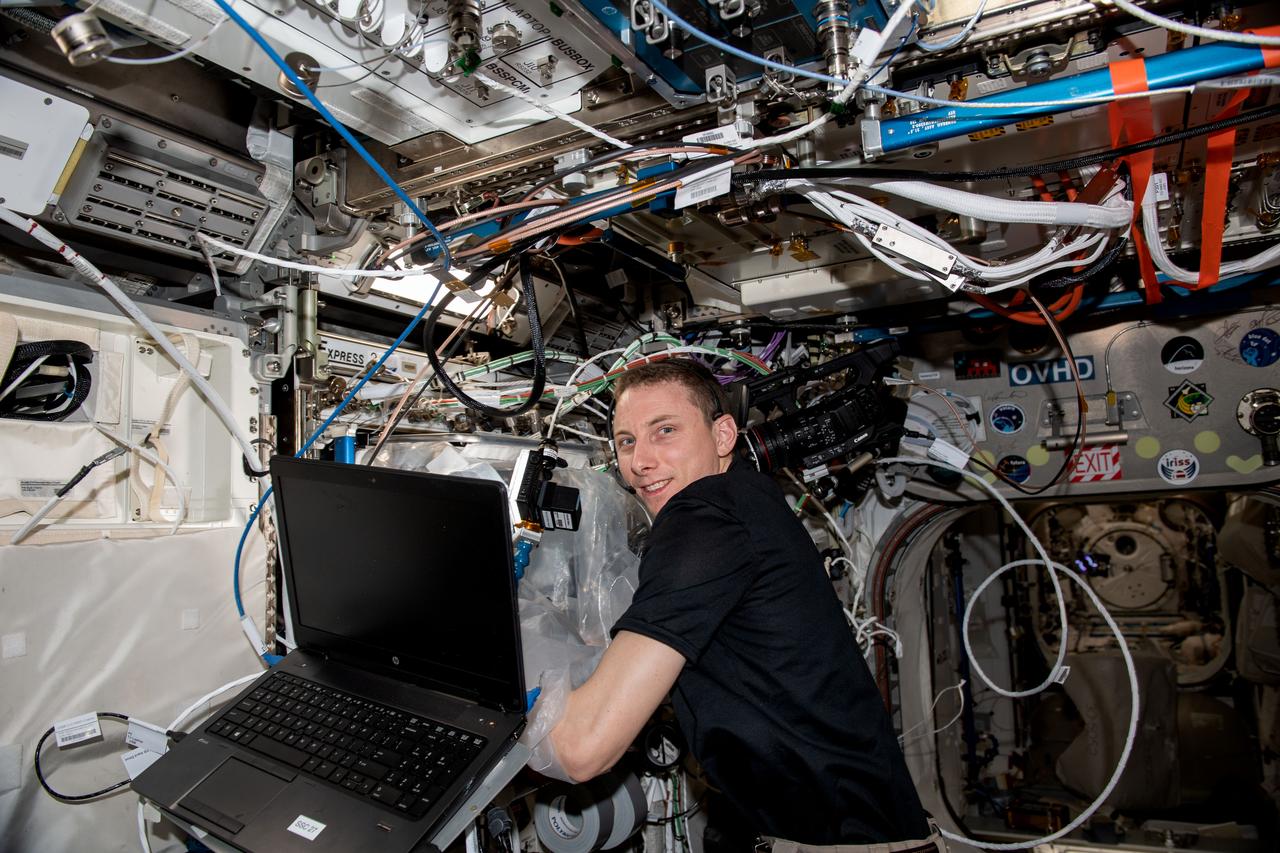
iss069e035797 (July 21, 2023) --- NASA astronaut and Expedition 69 Flight Engineer Woody Hoburg performs research activities using the Columbus laboratory module's BioFabrication Facility (BFF). The BFF is a research platform to print organ-like tissues and begin proving the viability of fabricating human organs in space.
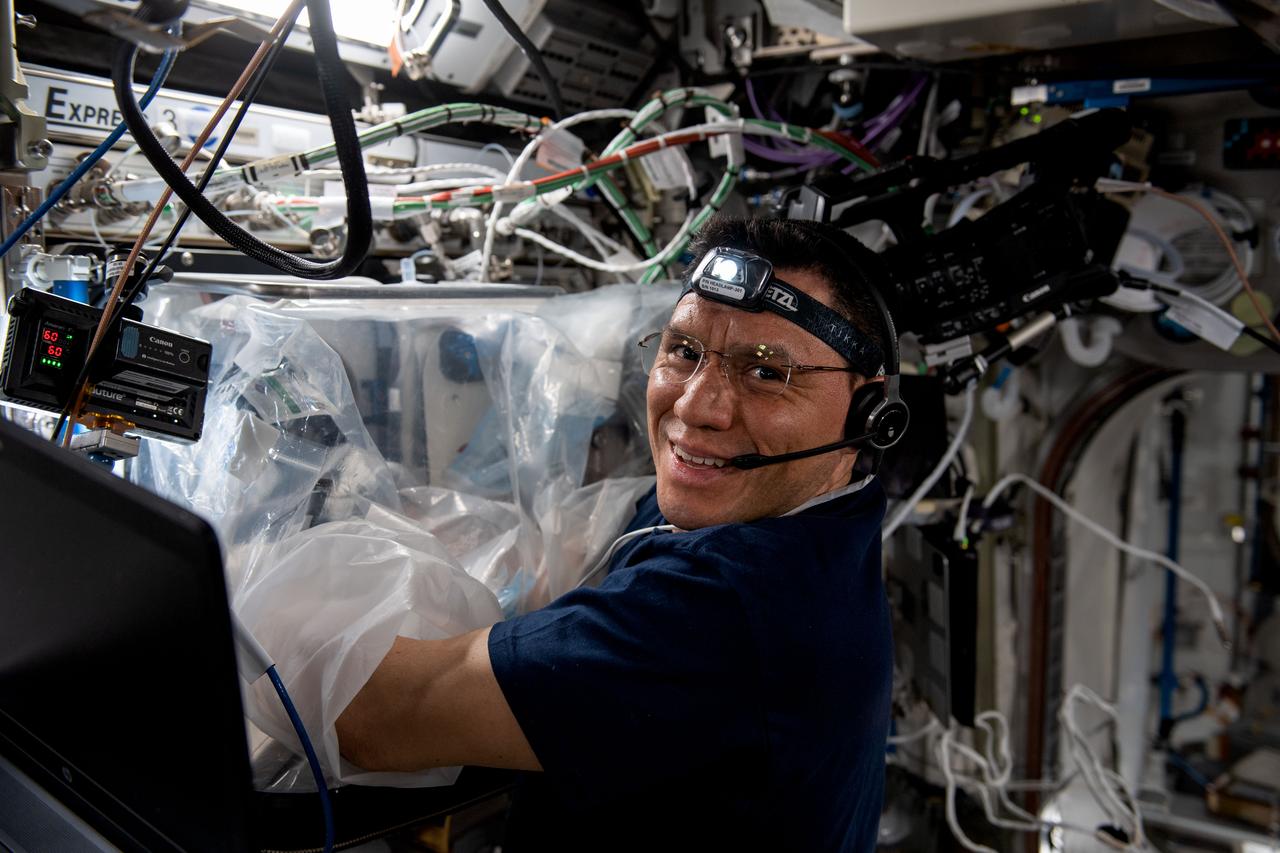
iss069e035619 (July 21, 2023) --- NASA astronaut and Expedition 69 Flight Engineer Frank Rubio uses a glovebag to perform research activities inside the Columbus laboratory module's BioFabrication Facility (BFF). The BFF is a research platform to print organ-like tissues and begin proving the viability of fabricating human organs in space.
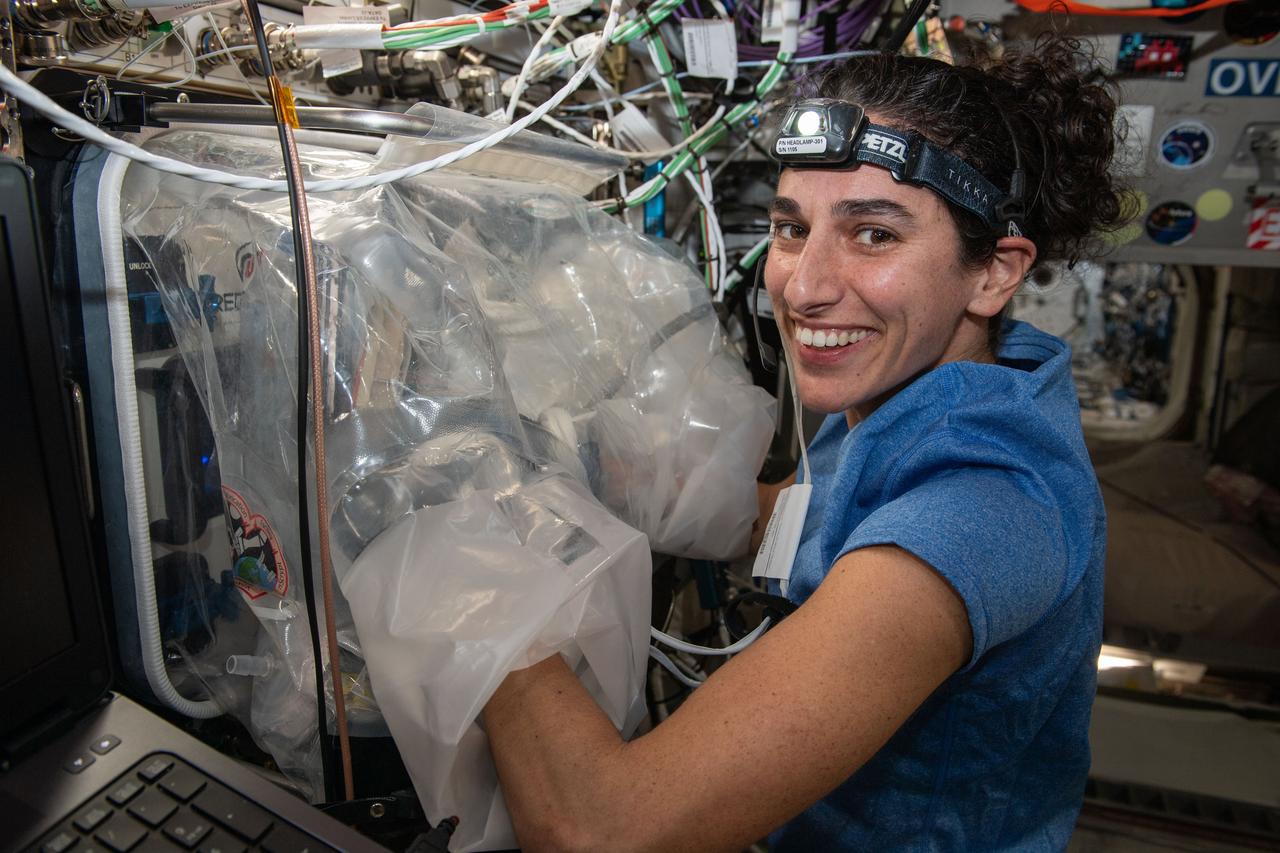
iss070e030135 (Nov. 24, 2023) --- NASA astronaut and Expedition 70 Flight Engineer Jasmin Moghbeli uses a portable glovebag to swap components inside the BioFabrication Facility (BFF) located in the International Space Station's Columbus laboratory module. The BFF is a biological printer that is testing the printing of organ-like tissues in microgravity.
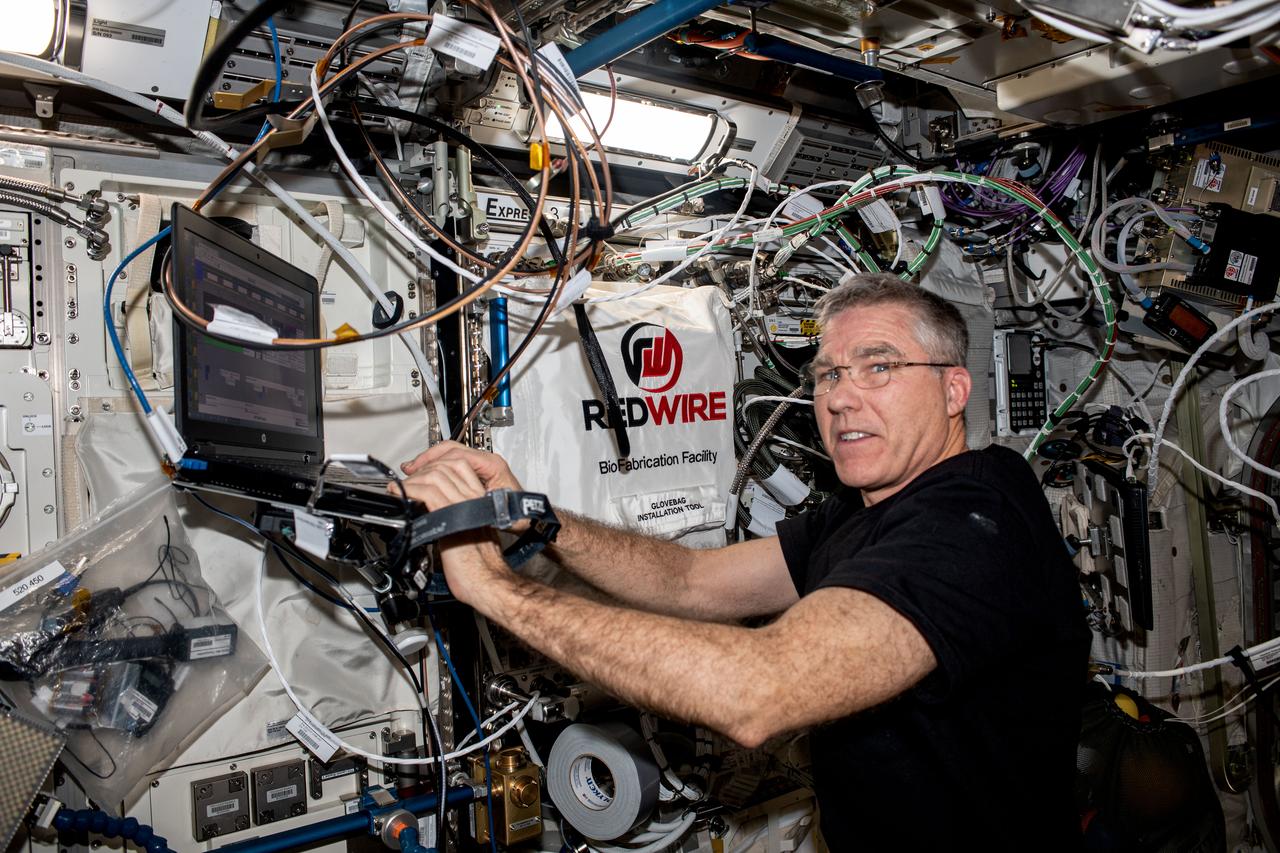
iss069e038976 (July 28, 2023) --- NASA astronaut and Expedition 69 Flight Engineer Stephen Bowen performs research activities using the Columbus laboratory module's BioFabrication Facility (BFF). The BFF is a research platform to print organ-like tissues and begin proving the viability of fabricating human organs in space.
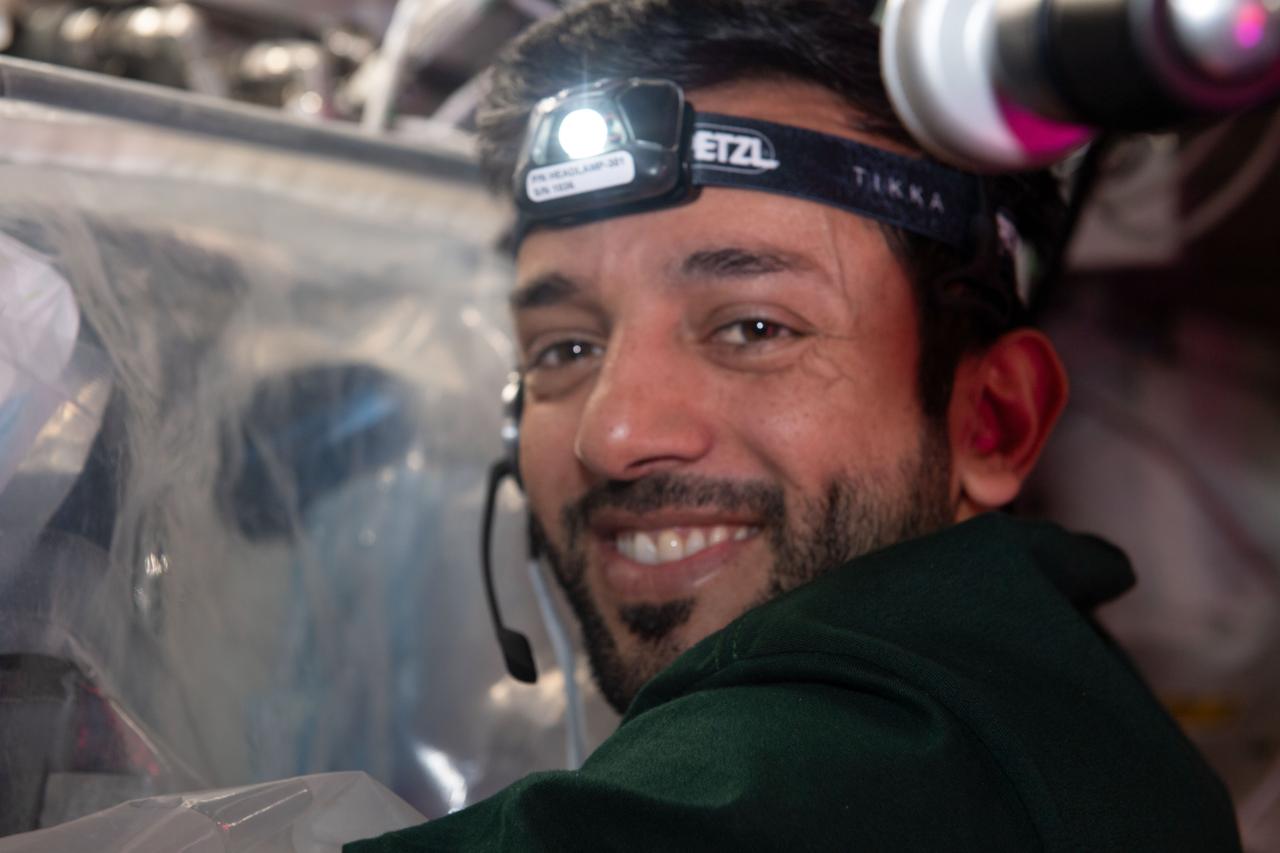
iss069e000087 (March 29, 2023) --- UAE (United Arab Emirates) astronaut and Expedition 69 Flight Engineer Sultan Alneyadi services tissue sample cassettes inside the Columbus laboratory Module's BioFabrication Facility (BFF). The BFF-Meniscus study investigates bioprinting tissues to heal musculoskeletal injuries both in space and on Earth,
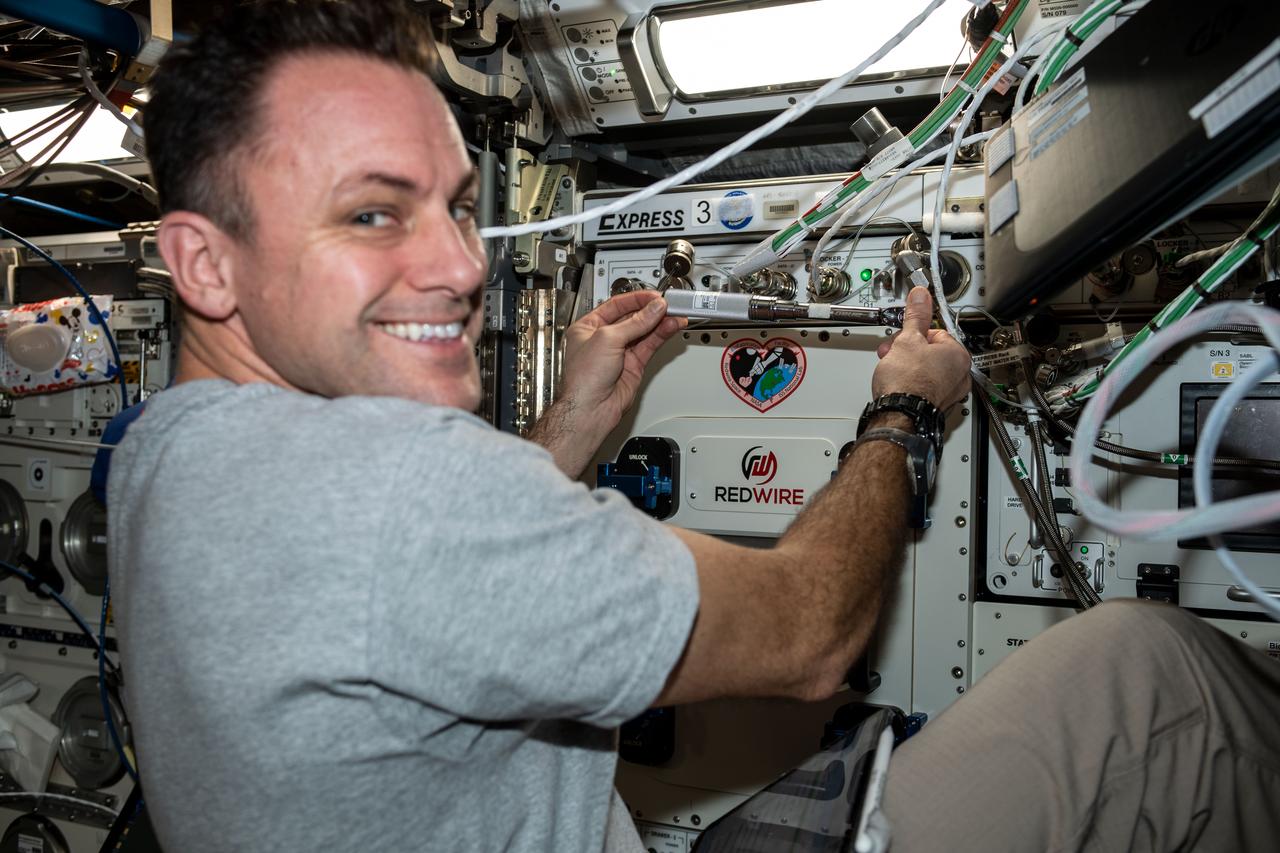
iss068e043943 (Jan. 31, 2023) --- NASA astronaut and Expedition 68 Flight Engineer Josh Cassada is pictured installing the BioFabrication Facility (BFF), a research device that will be used to investigate the 3-D printing of human organs in microgravity. The BFF is located inside the Columbus laboratory module's EXPRESS Rack 3 aboard the International Space Station.
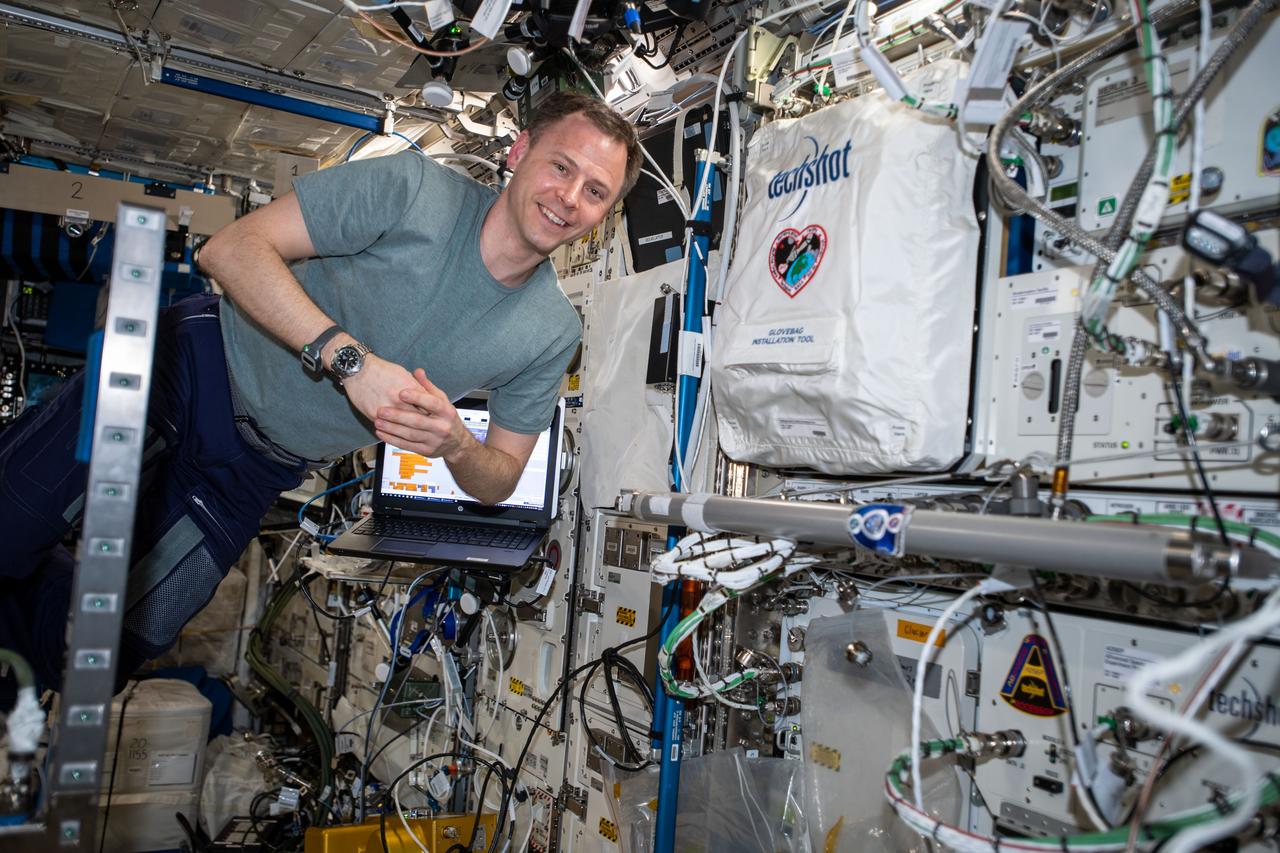
iss060e019633 (7/29/2019) --- NASA Astronaut Nick Hague with the BioFabrication Facility (BFF) aboard the International space Station (ISS).
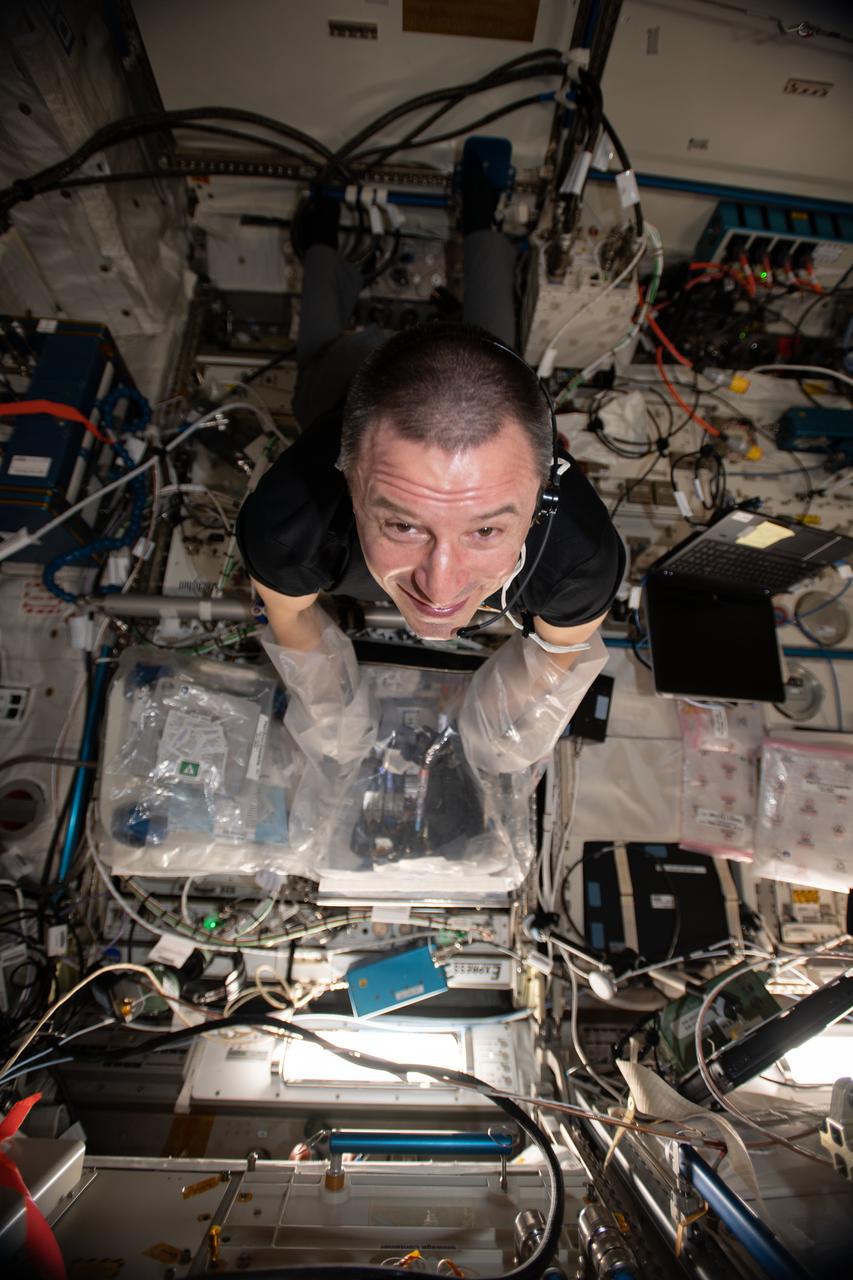
iss062e115402 (March 26, 2020) --- NASA astronaut and Expedition 62 Flight Engineer Andrew Morgan services the Bio-Fabrication Facility (BFF), a 3D bioprinter that seeks to demonstrate manufacturing human organs in space to help patients on Earth. The BFF may even lead to future crews printing their own food and medicines on missions farther away from Earth.
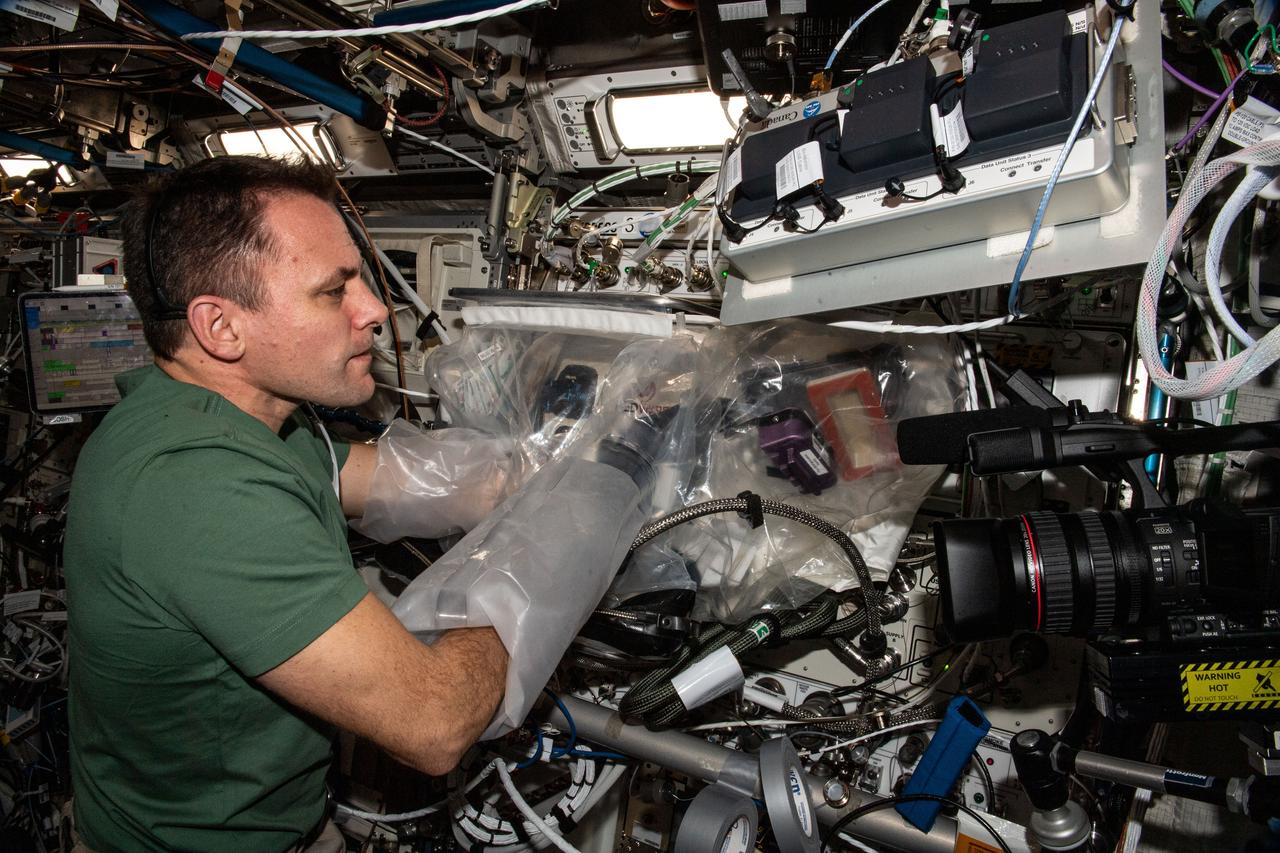
iss068e053964 (Feb. 14, 2023) --- NASA astronaut and Expedition 68 Flight Engineer Josh Cassada uses a plastic glovebox attached to the BioFabrication Facility (BFF) and tests the research device's performance. The BFF is located in the International Space Station's Columbus laboratory module and seeks to take advantage of the microgravity environment and demonstrate the printing of organ-like tissues in space which may lead to the future manufacturing of human organs.
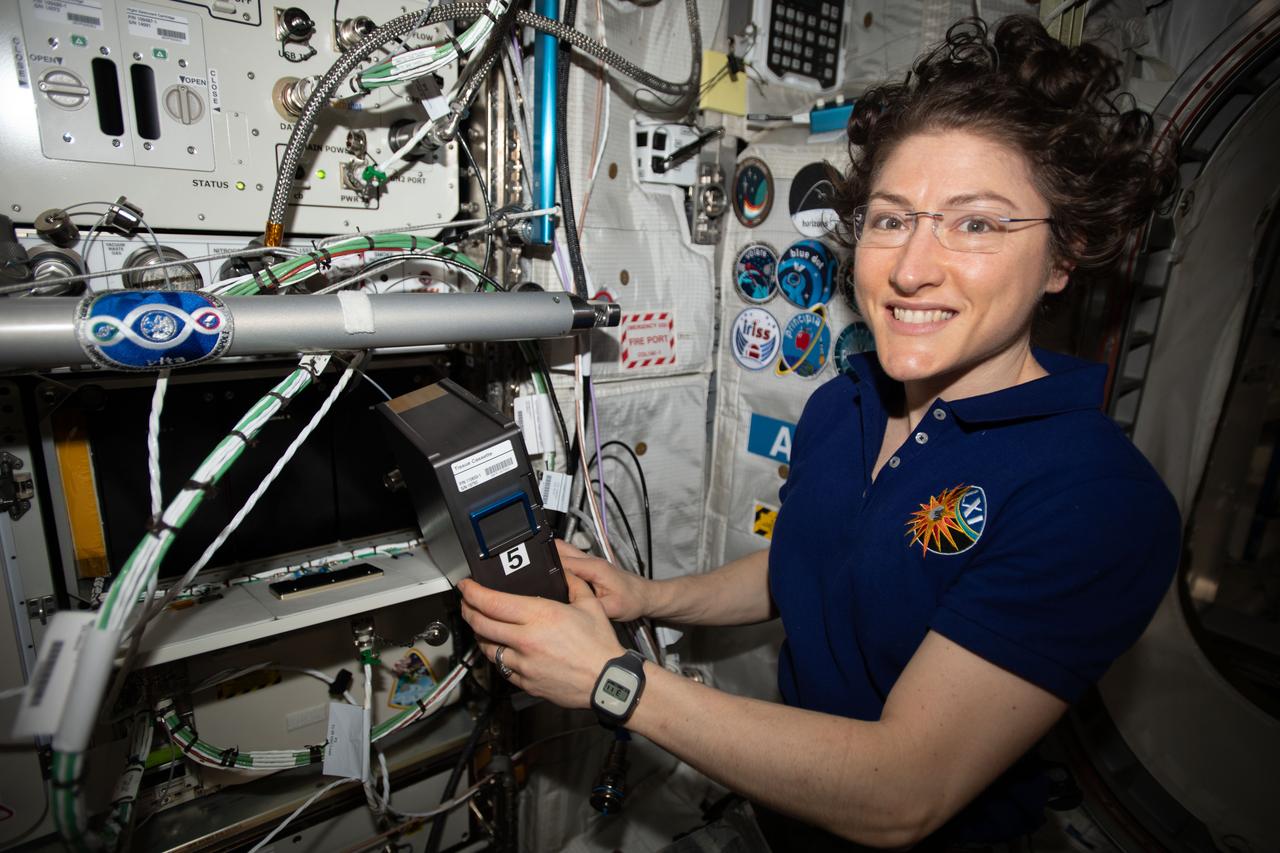
iss061e093837 (Dec. 22, 2019) --- Expedition 61 Flight Engineer and NASA astronaut Christina Koch services the BioFabrication Facility (BFF). The BFF is a 3-D biological printer that manufactures organ-like tissues in microgravity and could become a part of a larger system capable of manufacturing whole, fully-functioning human organs from existing patient cells.
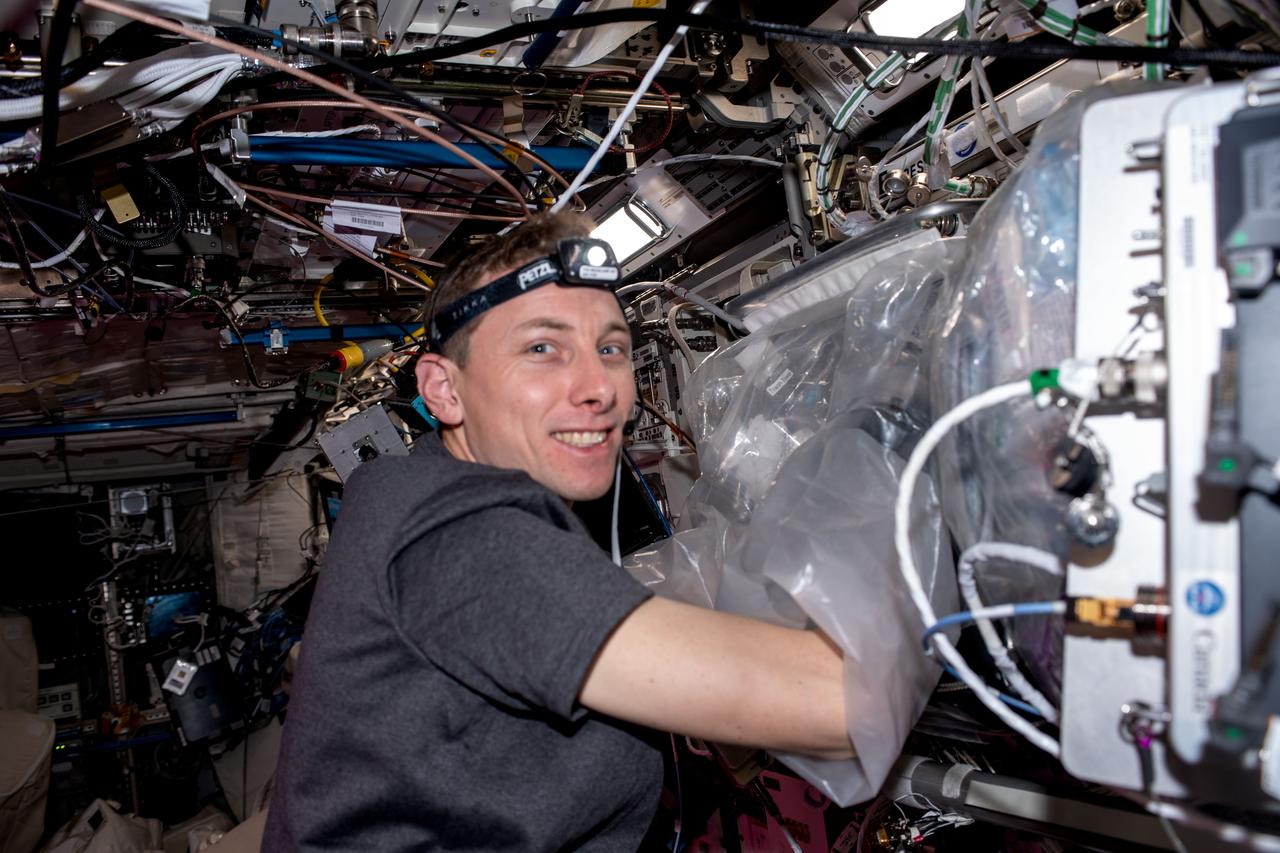
iss068e076275 (March 24, 2021) --- NASA astronaut and Expedition 68 Flight Engineer Woody Hoburg works in a glove bag attached to the BioFabrication Facility (BFF). Hoburg installed a tissue cassette in the BFF to evaluate using bio-inks and cells for a study exploring printing knee cartilage tissue to treat injuries in space and in remote environments on Earth.
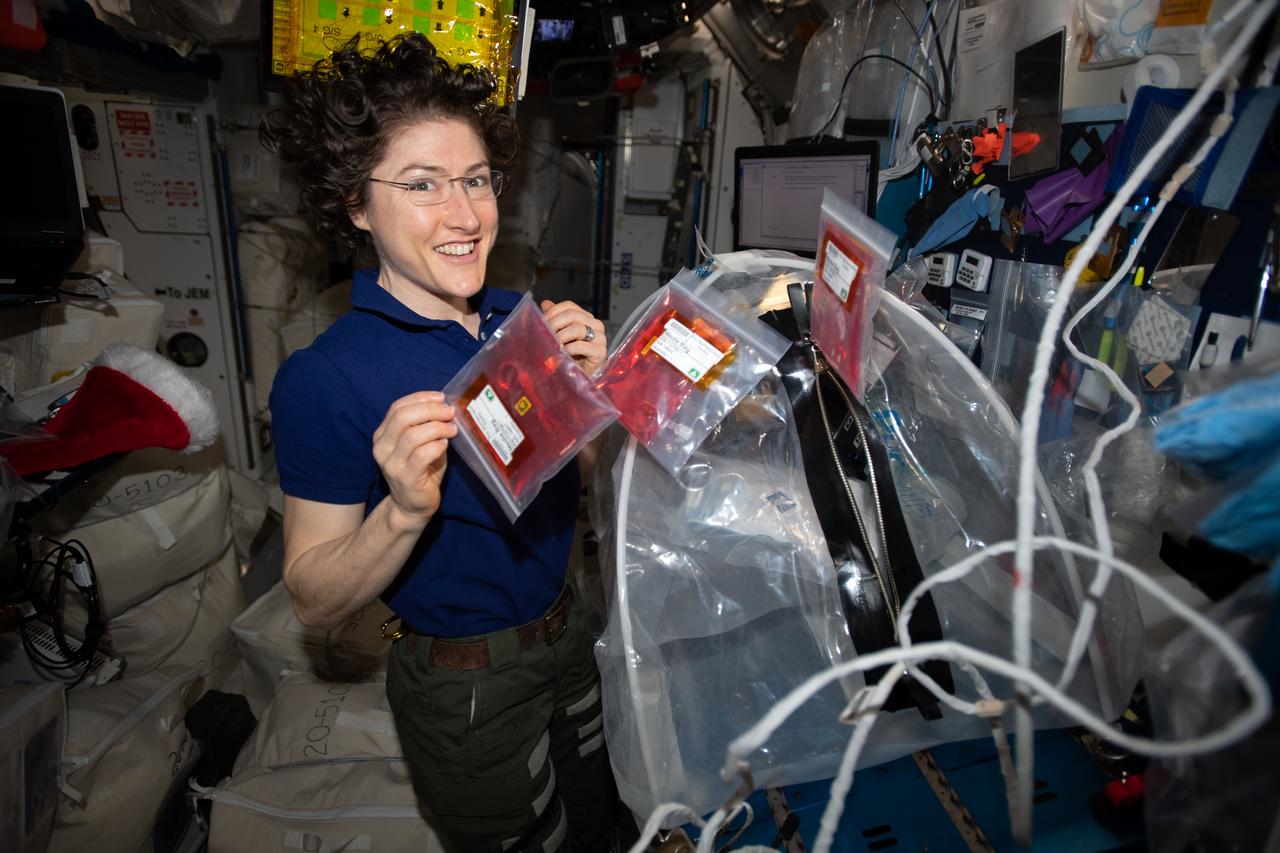
iss061e093848 (Dec. 22, 2019) --- Expedition 61 Flight Engineer and NASA astronaut Christina Koch handles media bags that enable the manufacturing of organ-like tissues using the the BioFabrication Facility (BFF), a 3-D biological printer. The BFF could become a part of a larger system capable of manufacturing whole, fully-functioning human organs from existing patient cells in microgravity.
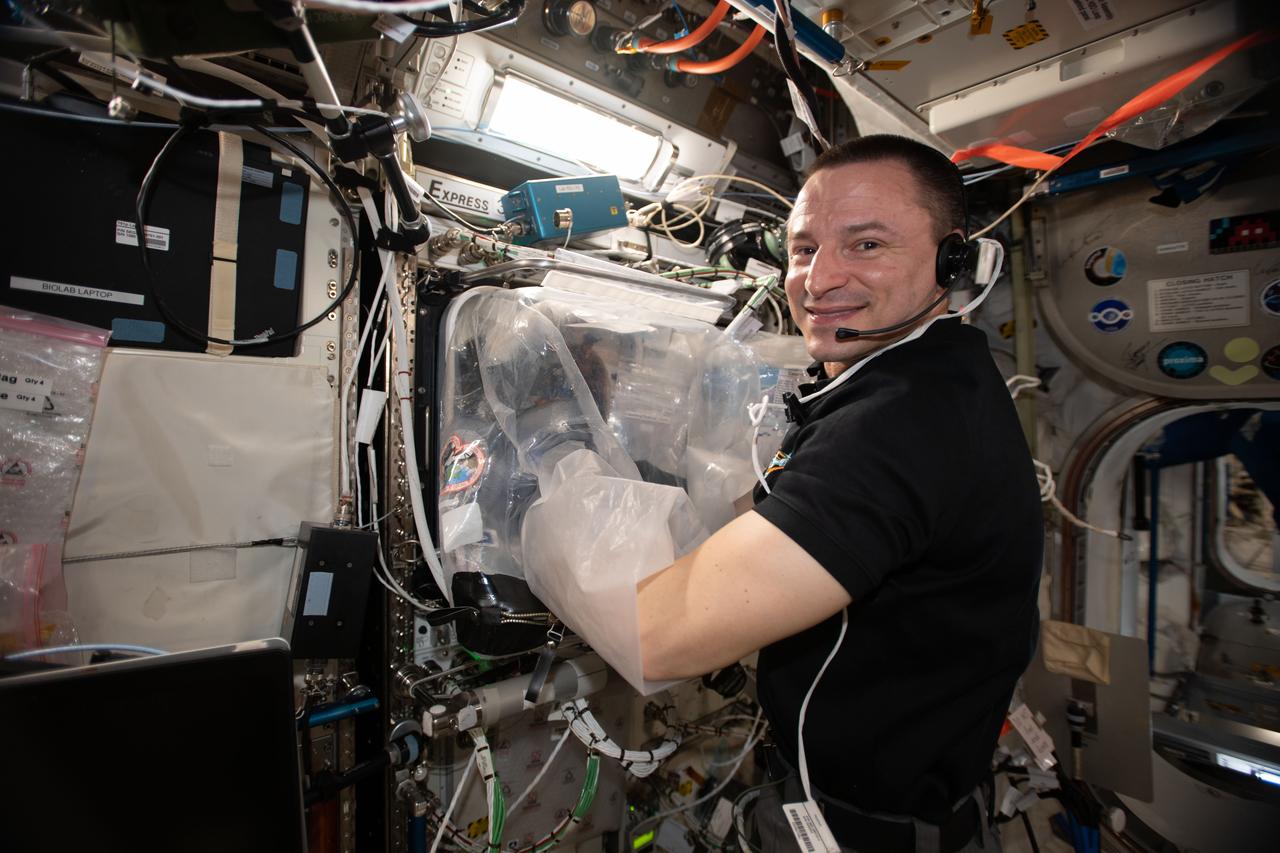
iss062e115396 (March 26, 2020) --- NASA astronaut and Expedition 62 Flight Engineer Andrew Morgan services the Bio-Fabrication Facility (BFF), a 3D bioprinter that seeks to demonstrate manufacturing human organs in space to help patients on Earth. The BFF may even lead to future crews printing their own food and medicines on missions farther away from Earth.
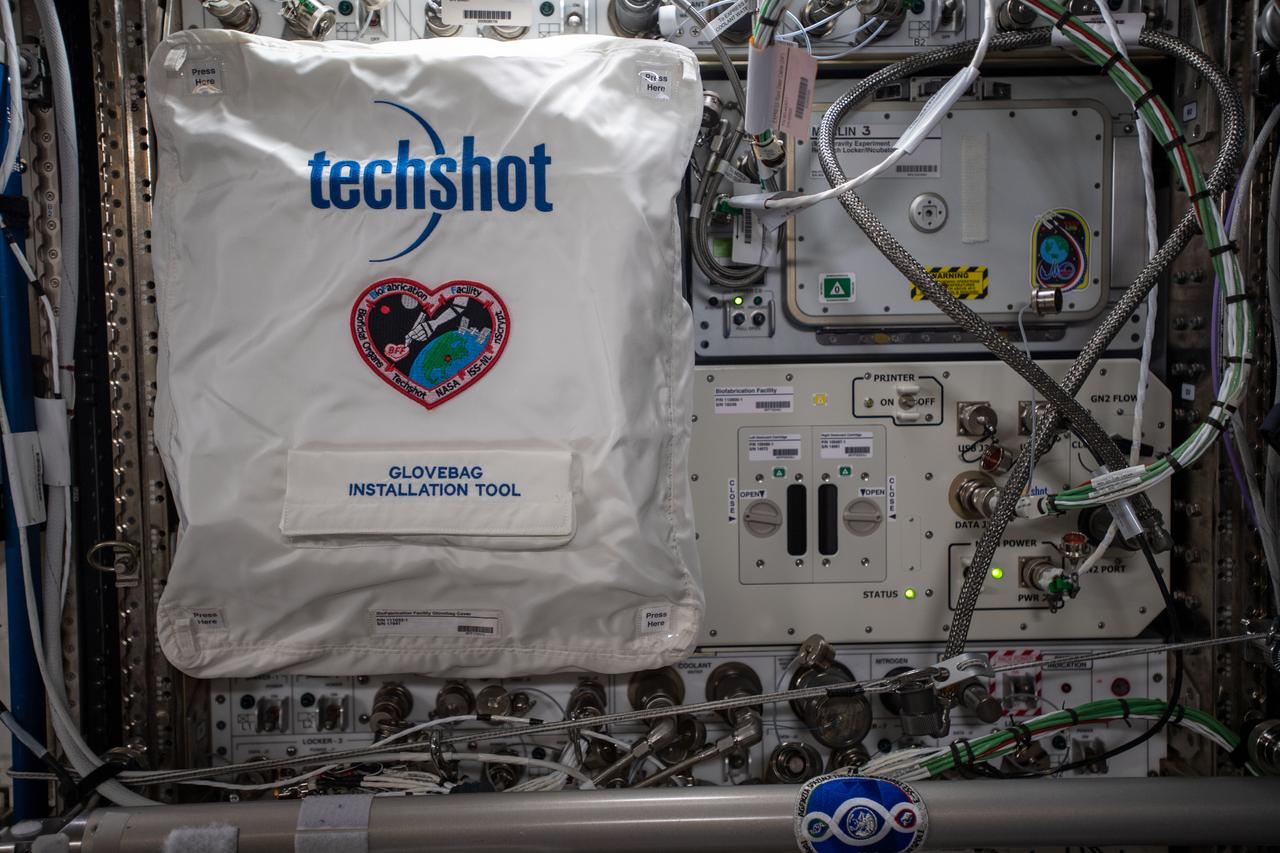
iss060e019631 (7/29/2019) --- Photo documentation of the commercially developed and operated BioFabrication Facility (BFF) and the Advanced Space Experiment Processor (ADSEP). Together they comprise a 3D tissue bioprinting system aboard the International Space Station (ISS).
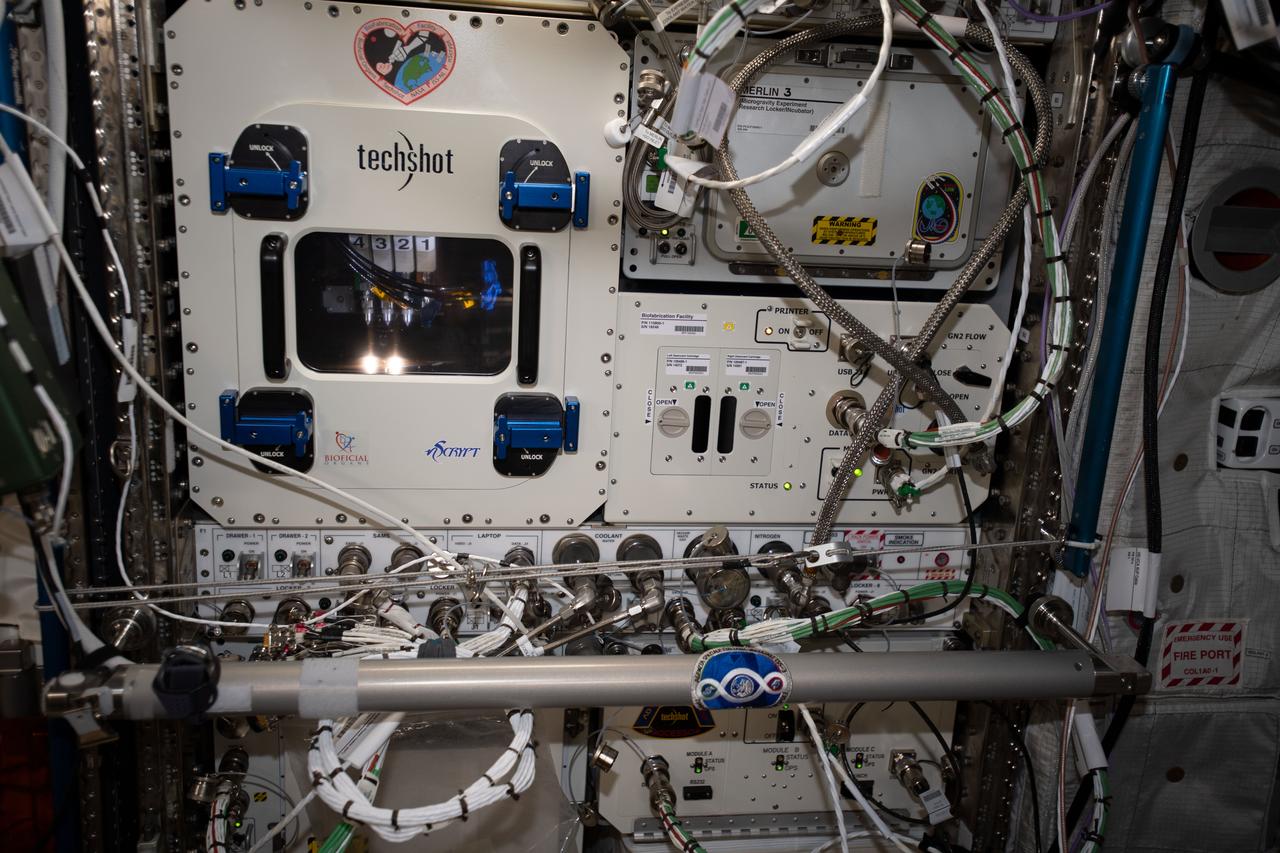
iss060e015333 (7/28/2019) --- --- Photo documentation of the commercially developed and operated BioFabrication Facility (BFF) and the Advanced Space Experiment Processor (ADSEP). Together they comprise a 3D tissue bioprinting system aboard the International Space Station (ISS).
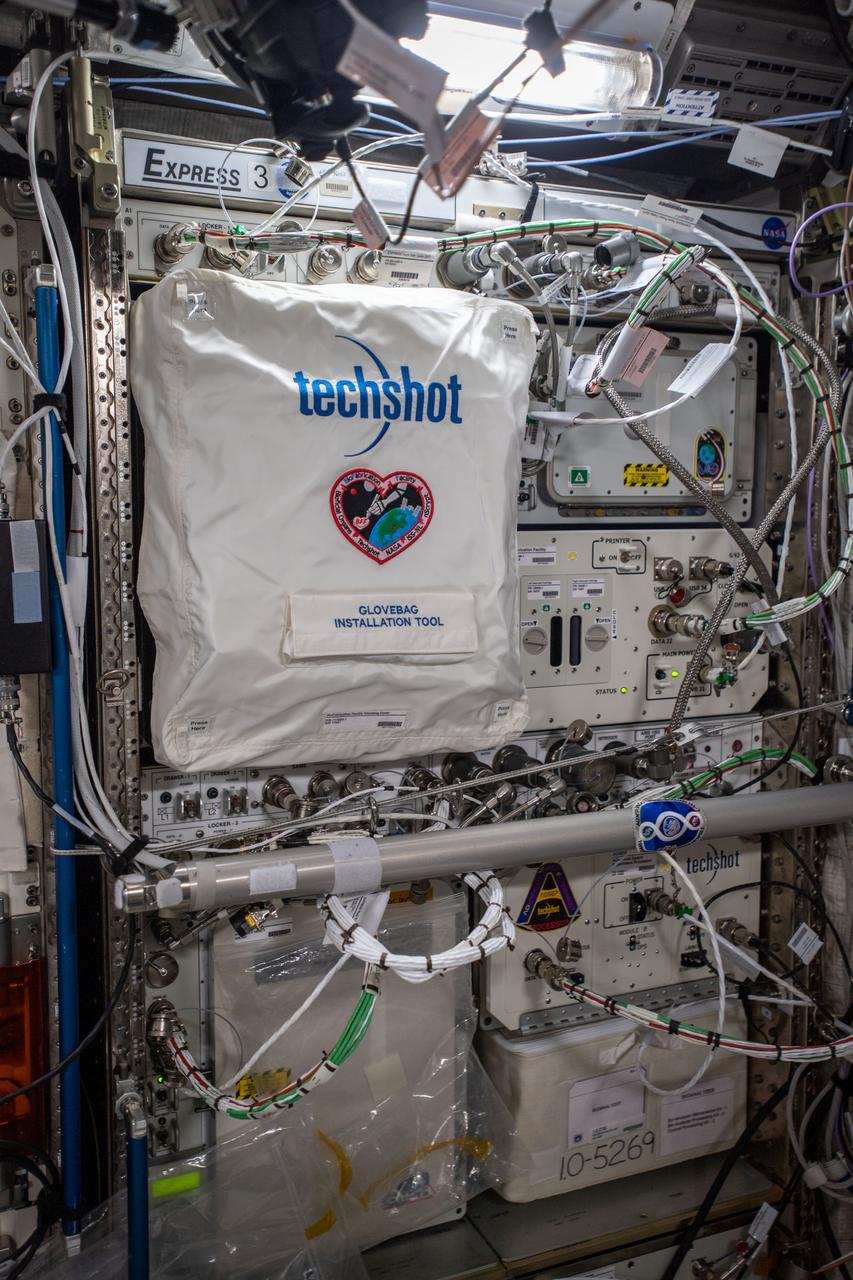
iss060e019630 (7/29/2019) --- Photo documentation of the commercially developed and operated BioFabrication Facility (BFF) and the Advanced Space Experiment Processor (ADSEP). Together they comprise a 3D tissue bioprinting system aboard the International Space Station (ISS).
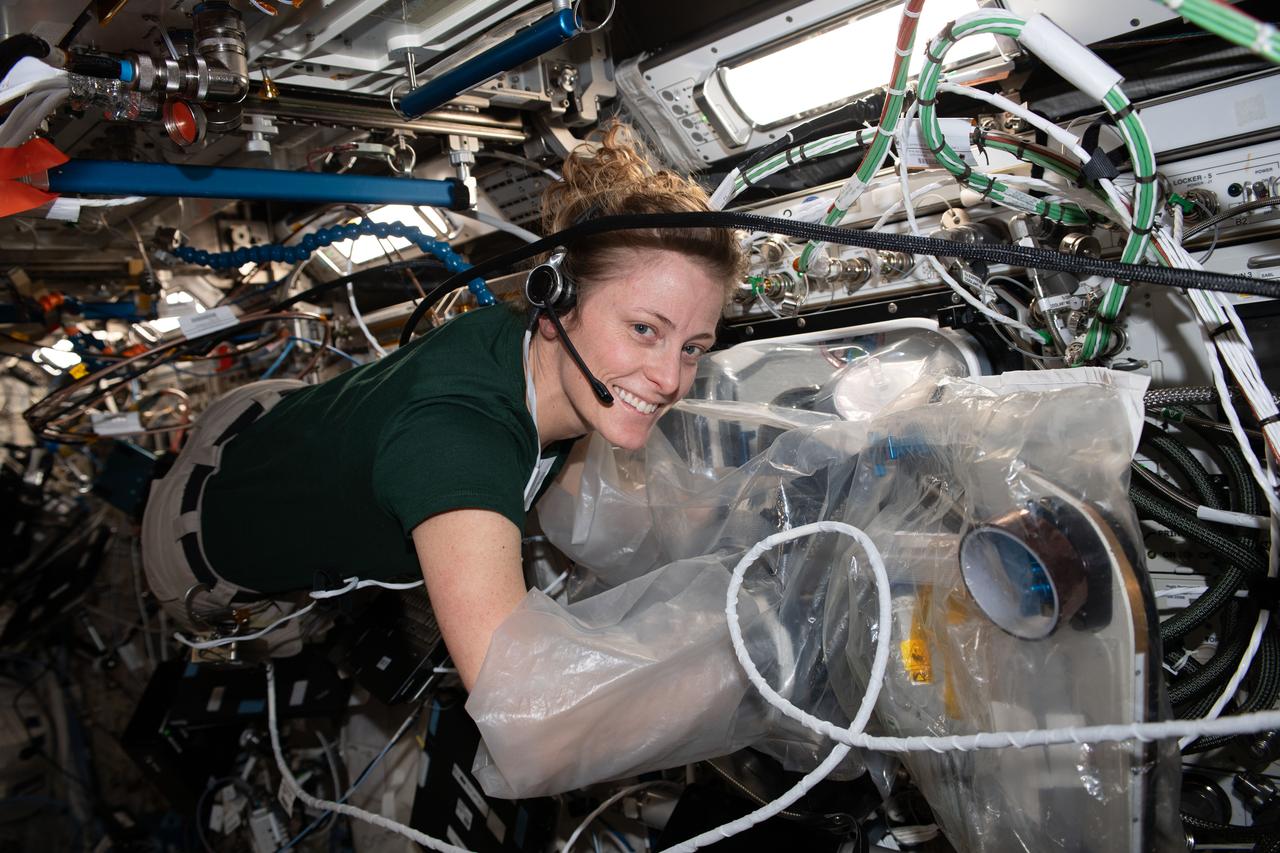
iss070e023971 (Nov. 13, 2023) --- NASA astronaut and Expedition 70 Flight Engineer Loral O'Hara uses a portable glovebag to replace components on a biological printer, the BioFabrication Facility (BFF), that is testing the printing of organ-like tissues in microgravity.
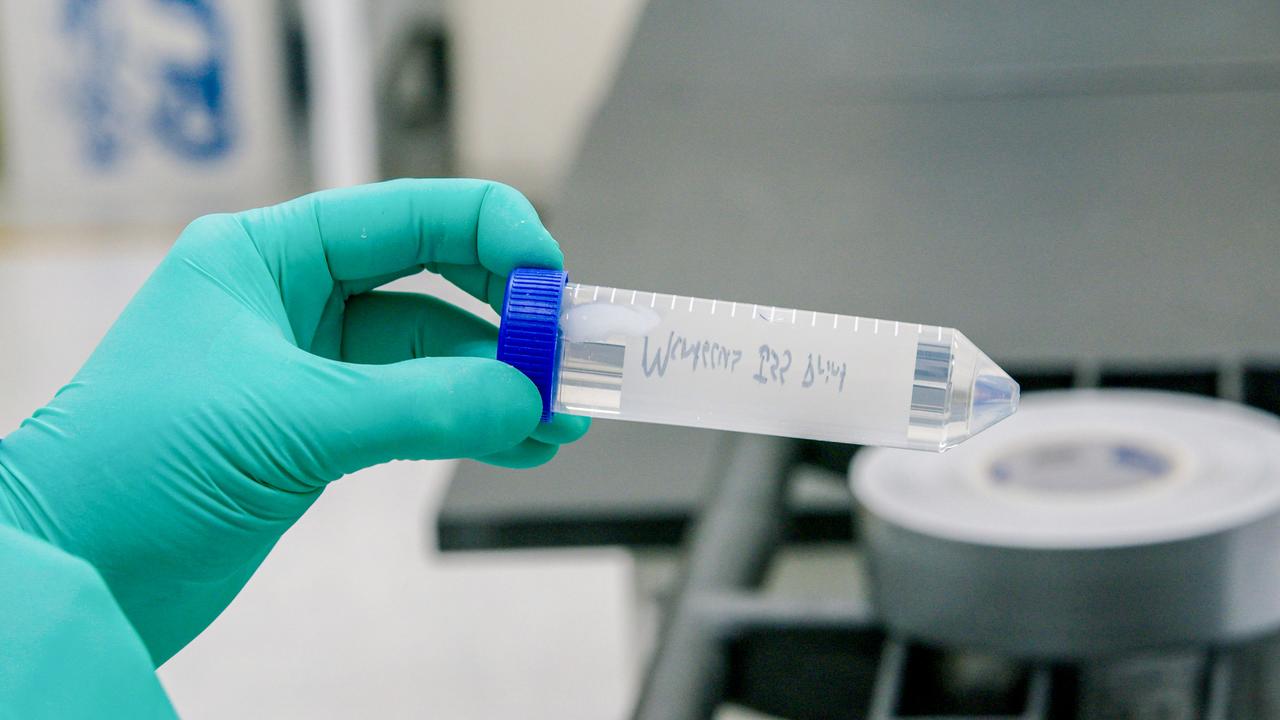
jsc2023e052856 (9/6/2023) --- The first human knee meniscus has been successfully 3D bioprinted in orbit using the International Space Station’s BioFabrication Facility. This is a significant step towards developing solutions to promote recovery from musculoskeletal injuries. Image courtesy of Redwire.

The Artemis I aft skirts for NASA's Space Launch System (SLS) rocket’s twin solid rocket boosters are transported to the Rotation Processing and Surge Facility (RPSF) at the agency’s Kennedy Space Center in Florida on June 10, 2020. The aft skirts were refurbished by Northrop Grumman. They house the thrust vector control system, which controls 70 percent of the steering during initial ascent of the SLS rocket. The segments will remain in the RPSF until ready for stacking with the forward and aft parts of the boosters on the mobile launcher in High Bay 3 of the Vehicle Assembly Building. Through the Artemis Program, NASA is working to land the first woman and next man on the Moon by 2024.
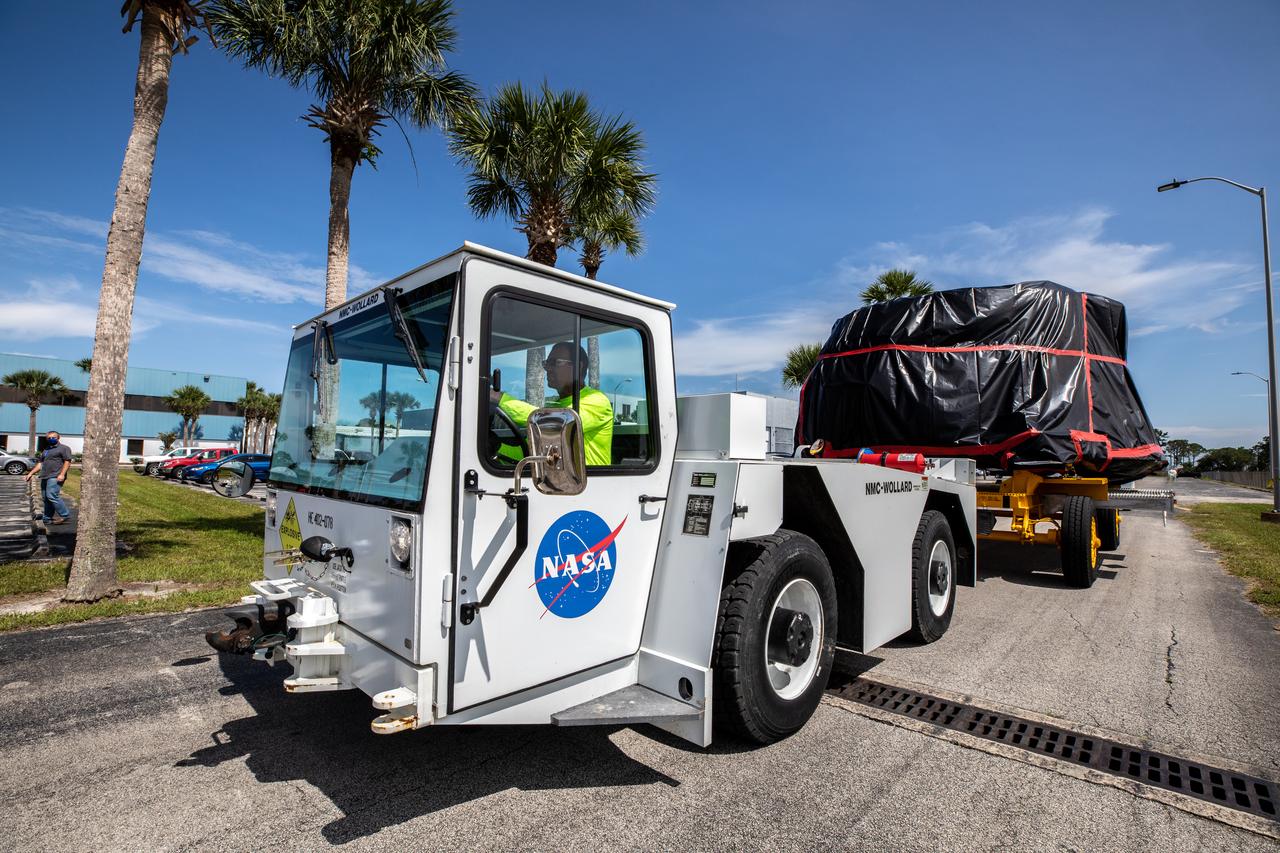
The Artemis I aft skirts for NASA's Space Launch System (SLS) rocket’s twin solid rocket boosters are transported to the Rotation Processing and Surge Facility (RPSF) at the agency’s Kennedy Space Center in Florida on June 10, 2020. The aft skirts were refurbished by Northrop Grumman. They house the thrust vector control system, which controls 70 percent of the steering during initial ascent of the SLS rocket. The segments will remain in the RPSF until ready for stacking with the forward and aft parts of the boosters on the mobile launcher in High Bay 3 of the Vehicle Assembly Building. Through the Artemis Program, NASA is working to land the first woman and next man on the Moon by 2024.
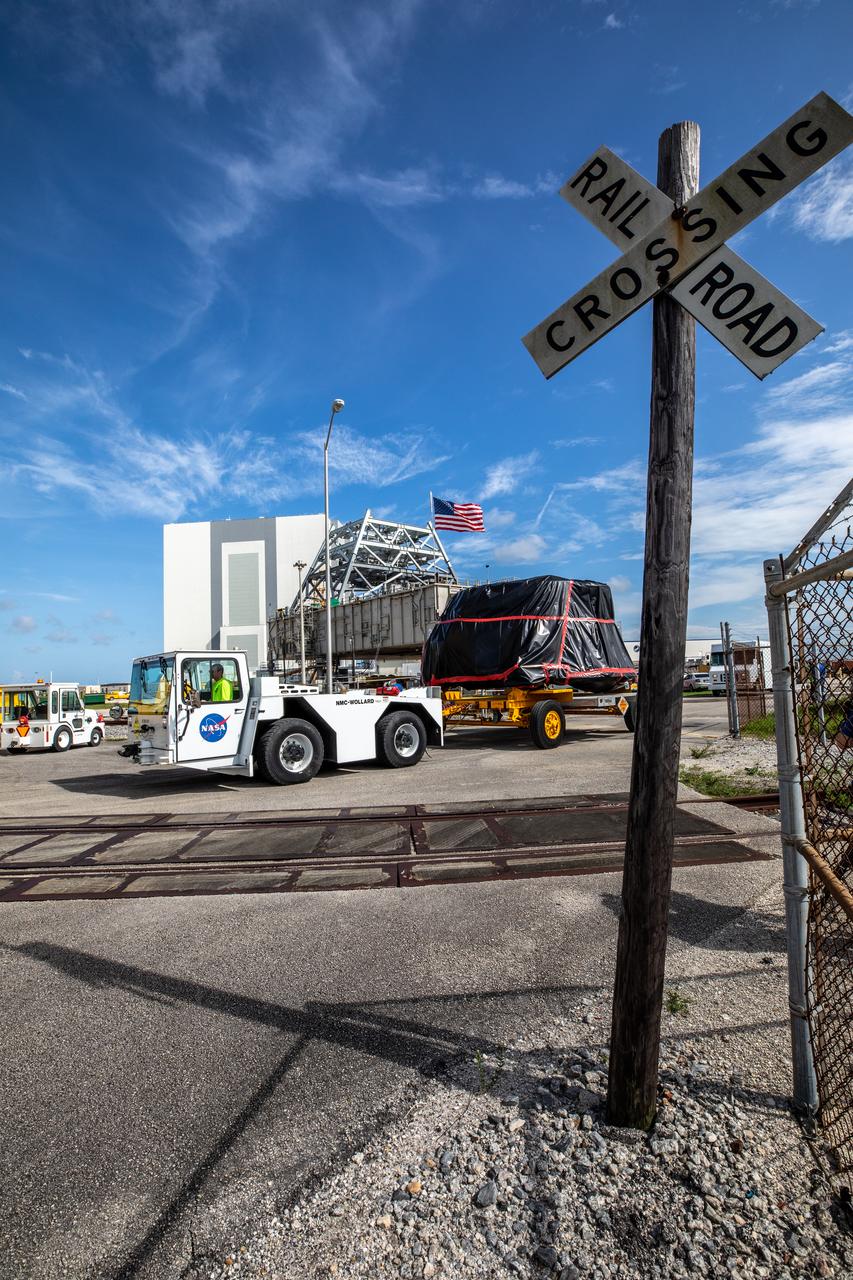
One of two Artemis I aft skirts for NASA’s Space Launch System (SLS) rocket’s twin solid rocket boosters crosses a railroad track on its way to the Rotation, Processing and Surge Facility (RPSF) at the agency’s Kennedy Space Center in Florida on June 10, 2020. They were transported from the Booster Fabrication Facility. The aft skirts were refurbished by Northrop Grumman. They house the thrust vector control system, which controls 70 percent of the steering during initial ascent of the SLS rocket. The segments will remain in the RPSF until ready for stacking with the forward and aft parts of the boosters on the mobile launcher in High Bay 3 of the Vehicle Assembly Building. Through the Artemis Program, NASA is working to land the first woman and next man on the Moon by 2024.
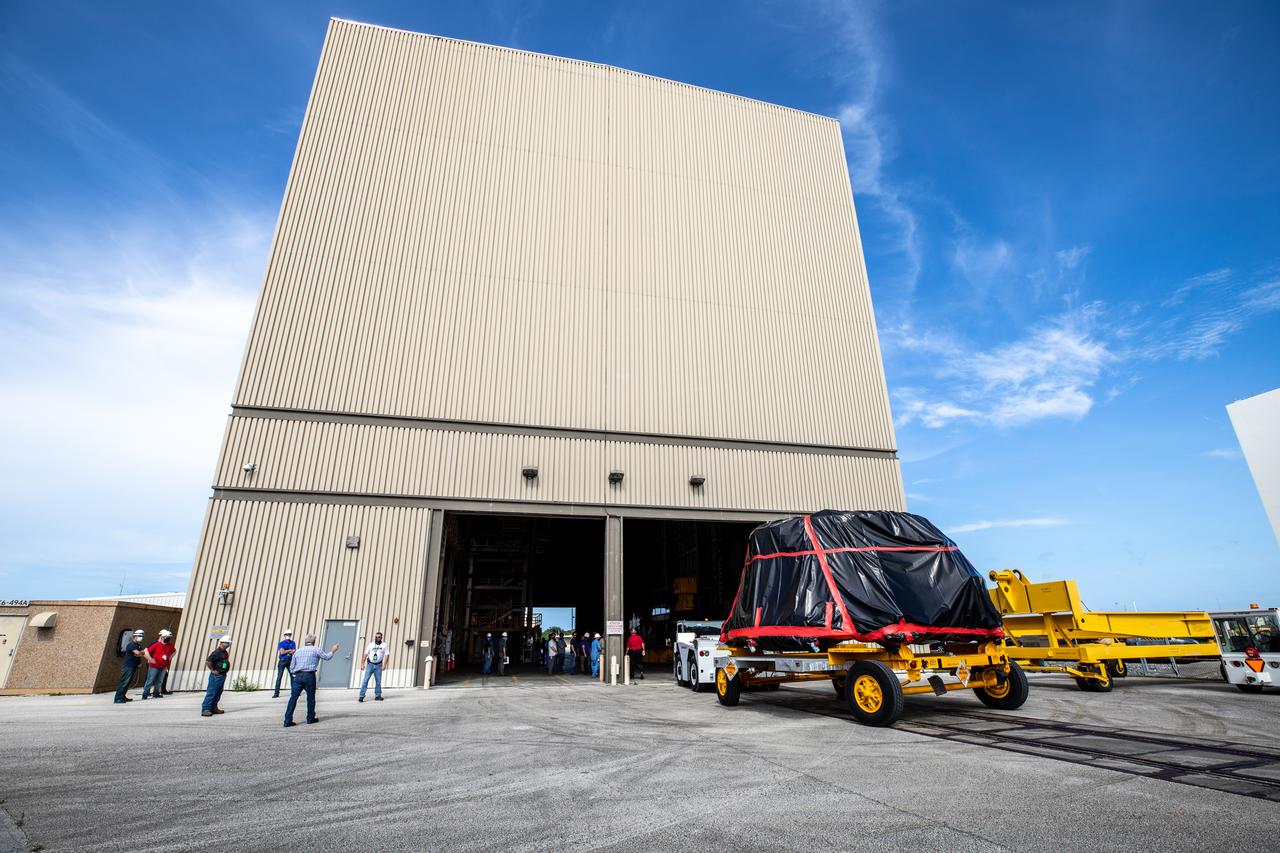
The first of two Artemis I aft skirts for NASA’s Space Launch System (SLS) rocket’s twin solid rocket boosters arrives at the Rotation, Processing and Surge Facility (RPSF) at the agency’s Kennedy Space Center in Florida on June 10, 2020. They were transported from the Booster Fabrication Facility. The aft skirts were refurbished by Northrop Grumman. They house the thrust vector control system, which controls 70 percent of the steering during initial ascent of the SLS rocket. The segments will remain in the RPSF until ready for stacking with the forward and aft parts of the boosters on the mobile launcher in High Bay 3 of the Vehicle Assembly Building. Through the Artemis Program, NASA is working to land the first woman and next man on the Moon by 2024.
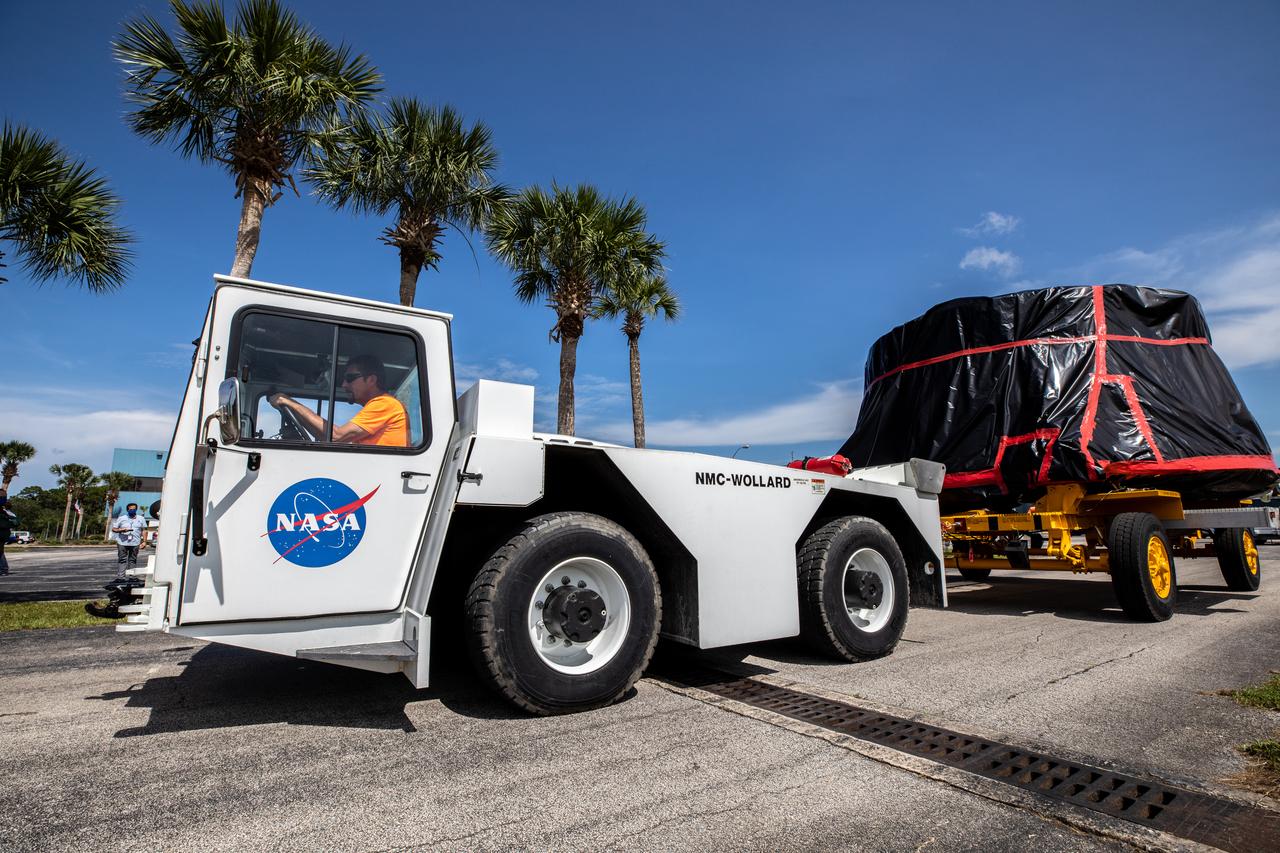
The Artemis I aft skirts for NASA's Space Launch System (SLS) rocket’s twin solid rocket boosters are transported to the Rotation Processing and Surge Facility (RPSF) at the agency’s Kennedy Space Center in Florida on June 10, 2020. The aft skirts were refurbished by Northrop Grumman. They house the thrust vector control system, which controls 70 percent of the steering during initial ascent of the SLS rocket. The segments will remain in the RPSF until ready for stacking with the forward and aft parts of the boosters on the mobile launcher in High Bay 3 of the Vehicle Assembly Building. Through the Artemis Program, NASA is working to land the first woman and next man on the Moon by 2024.
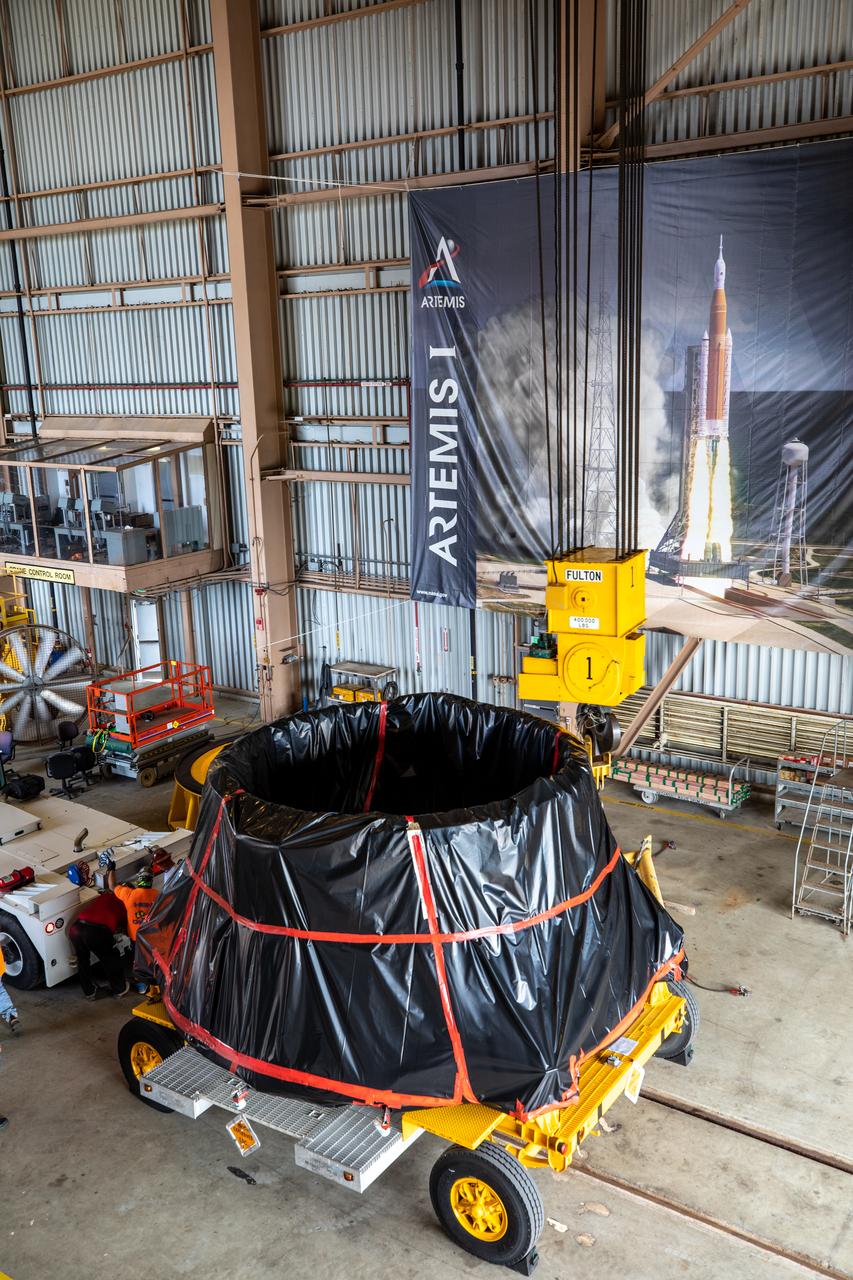
The first of two Artemis I aft skirts for NASA's Space Launch System (SLS) rocket’s twin solid rocket boosters is moved into the Rotation Processing and Surge Facility (RPSF) at the agency’s Kennedy Space Center in Florida on June 10, 2020. The aft skirts were refurbished by Northrop Grumman. They house the thrust vector control system, which controls 70 percent of the steering during initial ascent of the SLS rocket. The segments will remain in the RPSF until ready for stacking with the forward and aft parts of the boosters on the mobile launcher in High Bay 3 of the Vehicle Assembly Building. Through the Artemis Program, NASA is working to land the first woman and next man on the Moon by 2024.
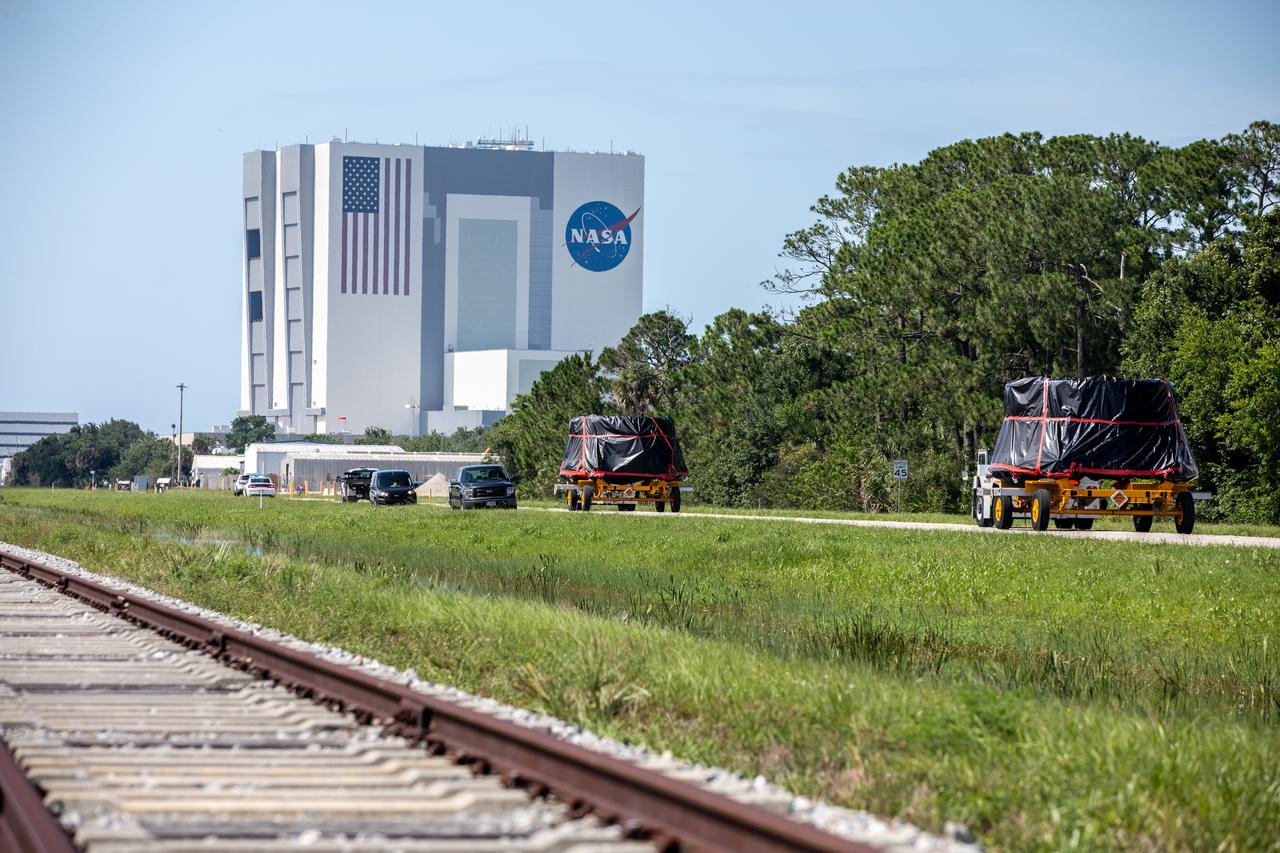
The Artemis I aft skirts for NASA’s Space Launch System (SLS) rocket’s twin solid rocket boosters are moved along the road to the Rotation, Processing and Surge Facility (RPSF) at the agency’s Kennedy Space Center in Florida on June 10, 2020. The aft skirts were refurbished by Northrop Grumman. They house the thrust vector control system, which controls 70 percent of the steering during initial ascent of the SLS rocket. The aft skirts will remain in the RPSF until ready for stacking with the forward and aft parts of the boosters on the mobile launcher in High Bay 3 of the Vehicle Assembly Building. Through the Artemis Program, NASA is working to land the first woman and next man on the Moon by 2024.
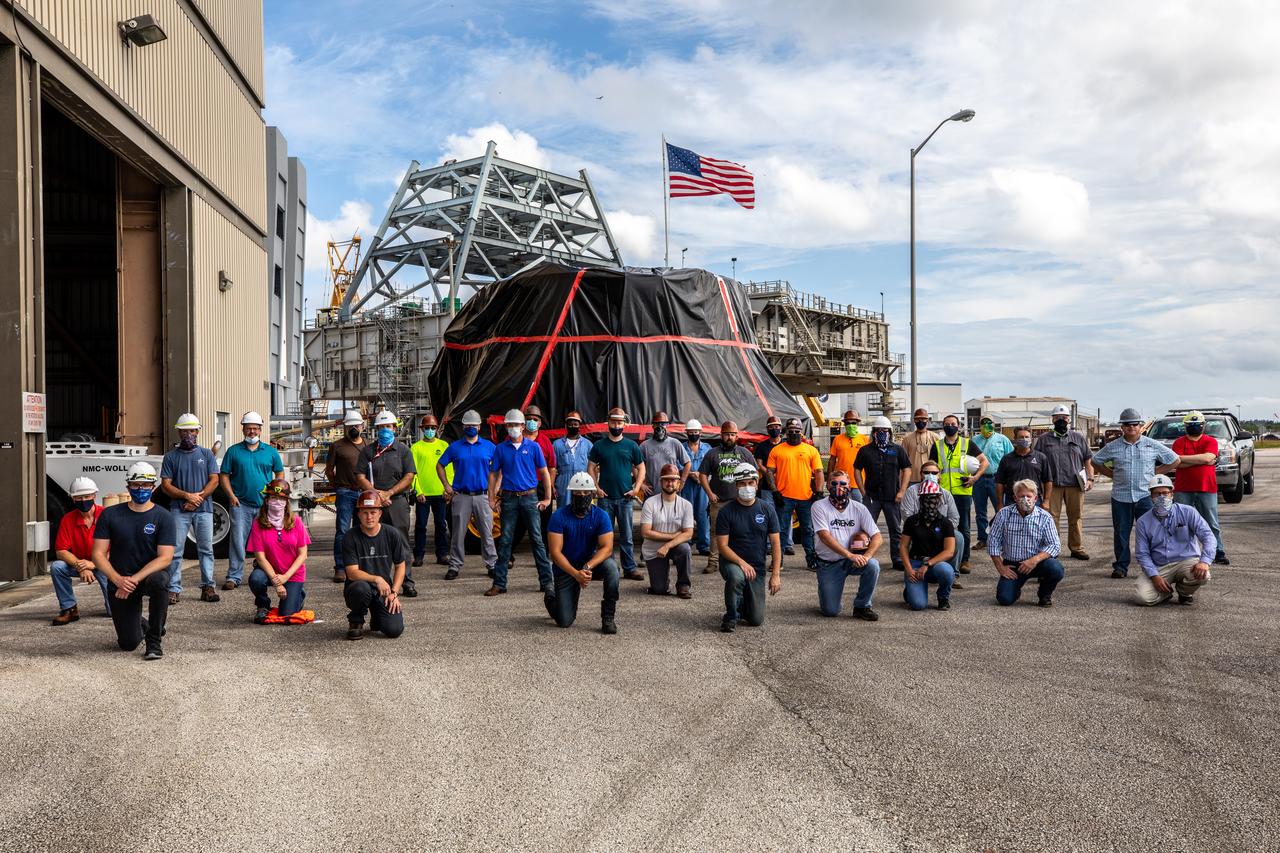
Exploration Ground Systems workers gather in front of the Rotation, Processing and Surge Facility (RPSF) at NASA’s Kennedy Space Center in Florida on June 10, 2020, to mark the arrival of the Artemis I aft skirts for the agency's Space Launch System (SLS) rocket’s twin solid rocket boosters. The aft skirts were moved from the Booster Fabrication Facility. The aft skirts were refurbished by Northrop Grumman. They house the thrust vector control system, which controls 70 percent of the steering during initial ascent of the SLS rocket. The segments will remain in the RPSF until ready for stacking with the forward and aft parts of the boosters on the mobile launcher in High Bay 3 of the Vehicle Assembly Building. Through the Artemis Program, NASA is working to land the first woman and next man on the Moon by 2024.

The Artemis I aft skirts for the NASA’s Space Launch System (SLS) rocket’s twin solid rocket boosters are moved along the road to the Rotation, Processing and Surge Facility (RPSF) at NASA’s Kennedy Space Center in Florida on June 10, 2020. In the background is the iconic Vehicle Assembly Building (VAB). The aft skirts were refurbished by Northrop Grumman. They house the thrust vector control system, which controls 70 percent of the steering during initial ascent of the SLS rocket. The aft skirts will remain in the RPSF until ready for stacking with the forward and aft parts of the boosters on the mobile launcher in High Bay 3 of the VAB. Through the Artemis Program, NASA is working to land the first woman and next man on the Moon by 2024.
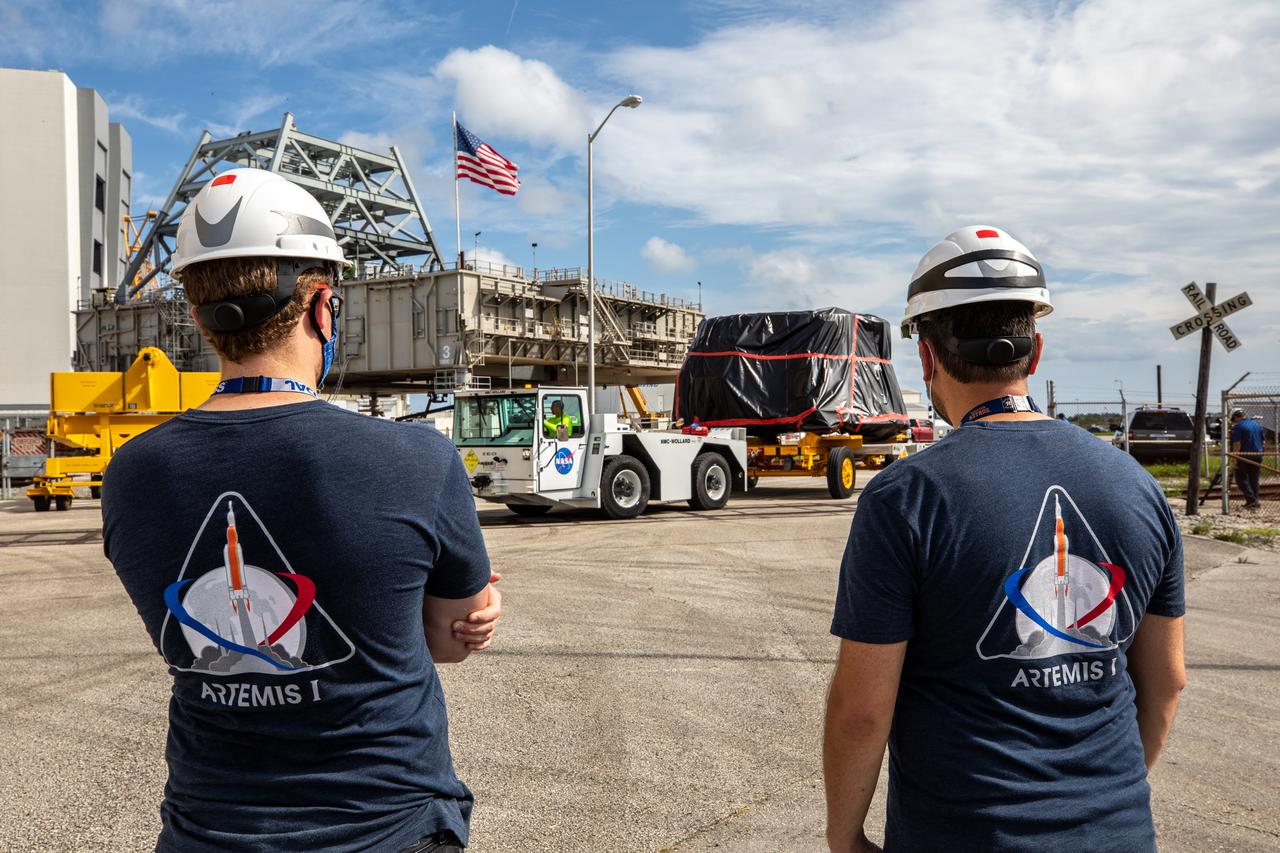
Exploration Ground Systems workers watch as the first of two Artemis I aft skirts for NASA’s Space Launch System (SLS) rocket’s twin solid rocket boosters crosses a railroad track on its way to the Rotation, Processing and Surge Facility (RPSF) at the agency’s Kennedy Space Center in Florida on June 10, 2020. They were transported from the Booster Fabrication Facility. The aft skirts were refurbished by Northrop Grumman. They house the thrust vector control system, which controls 70 percent of the steering during initial ascent of the SLS rocket. The segments will remain in the RPSF until ready for stacking with the forward and aft parts of the boosters on the mobile launcher in High Bay 3 of the Vehicle Assembly Building. Through the Artemis Program, NASA is working to land the first woman and next man on the Moon by 2024.
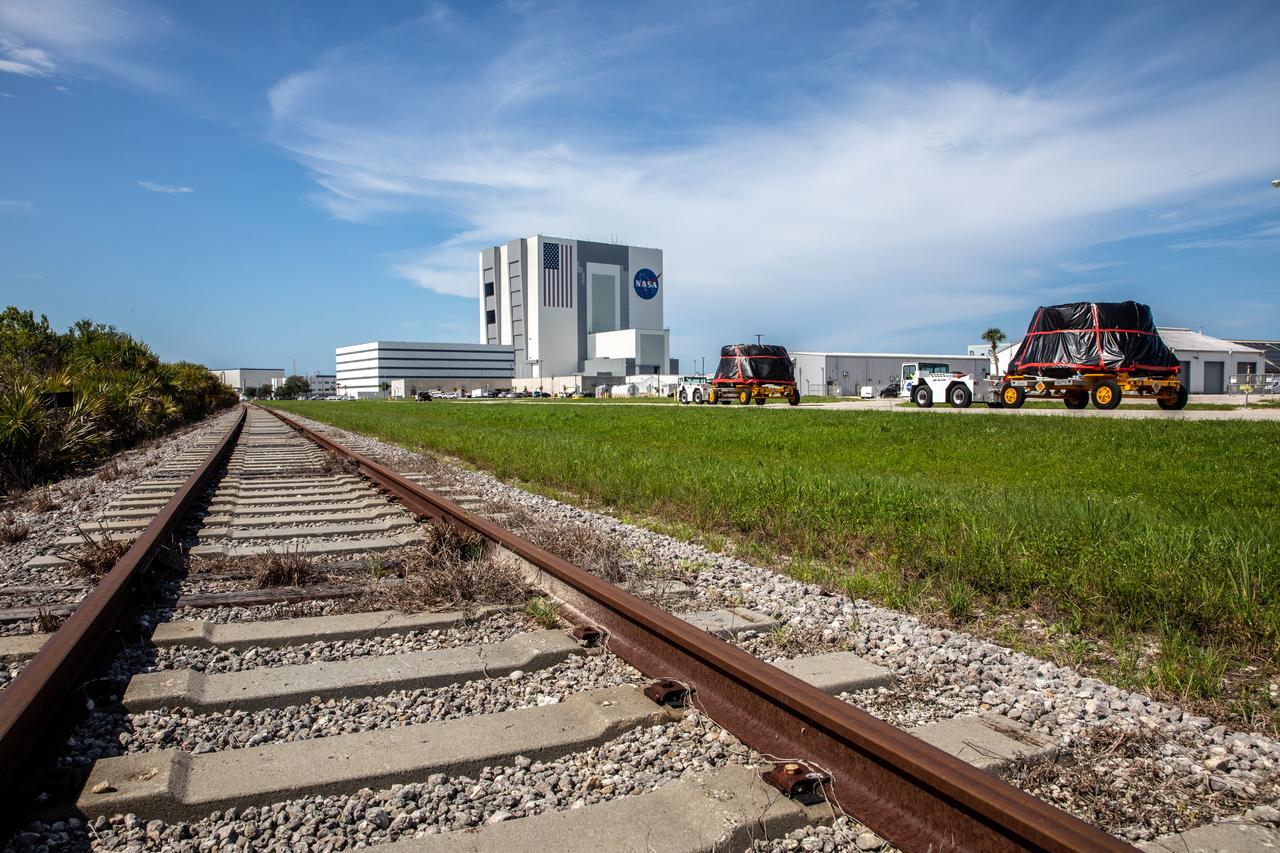
The Artemis I aft skirts for NASA’s Space Launch System (SLS) rocket’s twin solid rocket boosters are moved along the road to the Rotation, Processing and Surge Facility (RPSF) at the agency’s Kennedy Space Center in Florida on June 10, 2020. The aft skirts were refurbished by Northrop Grumman. They house the thrust vector control system, which controls 70 percent of the steering during initial ascent of the SLS rocket. The aft skirts will remain in the RPSF until ready for stacking with the forward and aft parts of the boosters on the mobile launcher in High Bay 3 of the Vehicle Assembly Building. Through the Artemis Program, NASA is working to land the first woman and next man on the Moon by 2024.
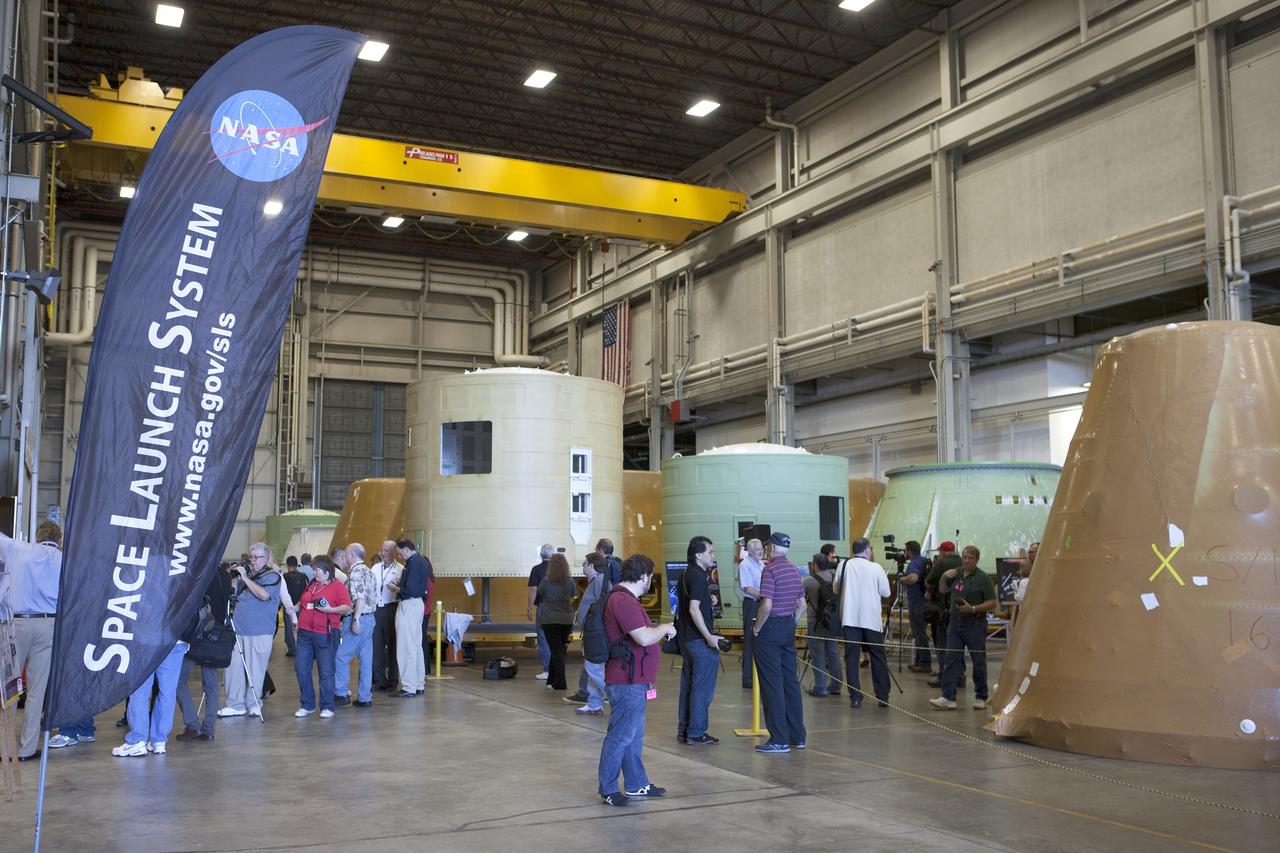
CAPE CANAVERAL, Fla. – At NASA's Kennedy Space Center in Florida, members of the news media tour the spaceport's Booster Fabrication Facility BFF. During the Space Shuttle Program, the facility was used for processing forward segments and aft skirts for the solid rocket boosters. The BFF will serve a similar role for the SLS. Orion is the exploration spacecraft designed to carry astronauts to destinations not yet explored by humans, including an asteroid and Mars. It will have emergency abort capability, sustain the crew during space travel and provide safe re-entry from deep space return velocities. The first unpiloted flight test of Orion is scheduled to launch Dec. 4, 2014 atop a United Launch Alliance Delta IV Heavy rocket, and in 2018 on NASA’s Space Launch System rocket. For more information, visit www.nasa.gov/orion Photo credit: NASA/Kim Shiflett
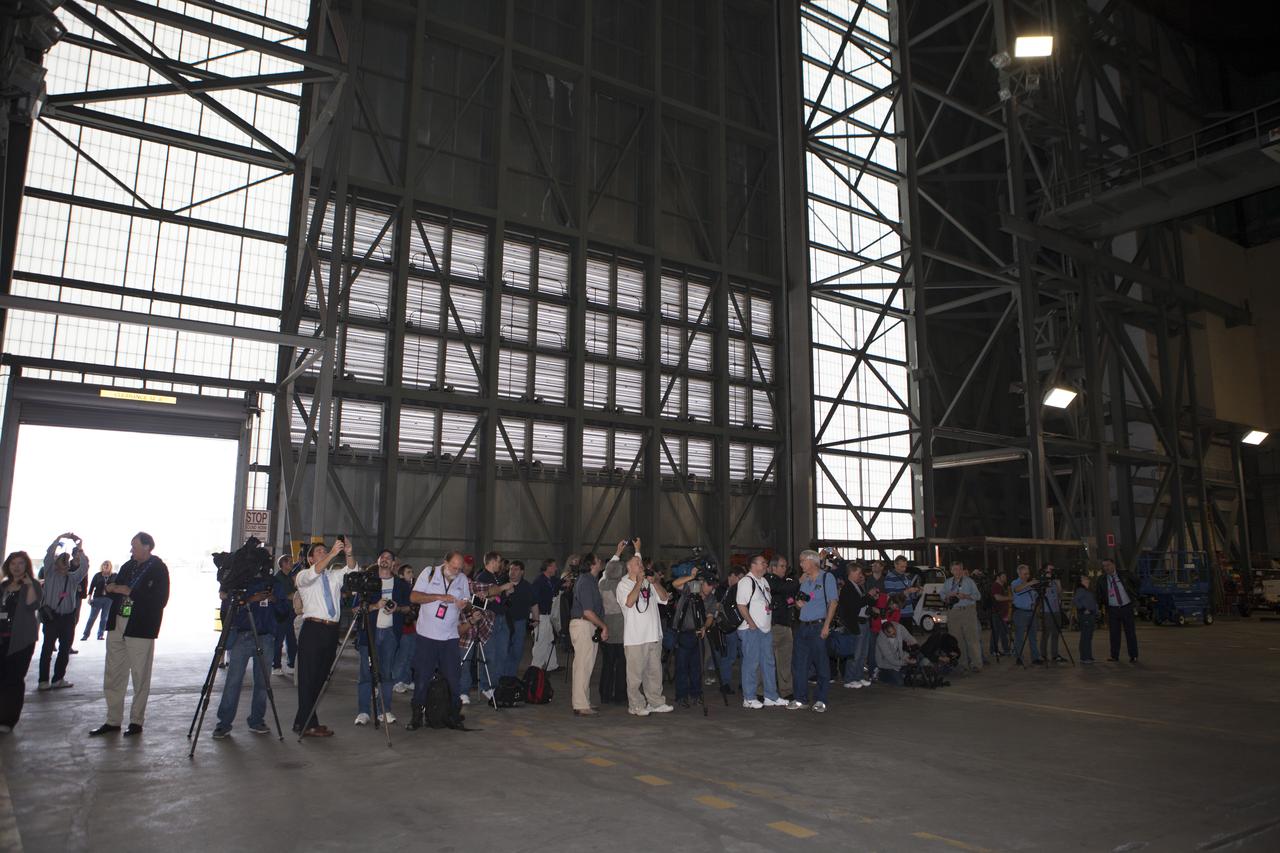
At NASA's Kennedy Space Center in Florida, members of the news media tour the spaceport's Vehicle Assembly Building VAB. Like the Apollo Saturn V and space shuttles of the past, the Space Launch System rocket will be stacked and checked out in the VAB prion to being rolled to the launch pad. Orion is the exploration spacecraft designed to carry astronauts to destinations not yet explored by humans, including an asteroid and Mars. It will have emergency abort capability, sustain the crew during space travel and provide safe re-entry from deep space return velocities. The first unpiloted flight test of Orion is scheduled to launch Dec. 4, 2014 atop a United Launch Alliance Delta IV Heavy rocket, and in 2018 on NASA’s Space Launch System rocket.
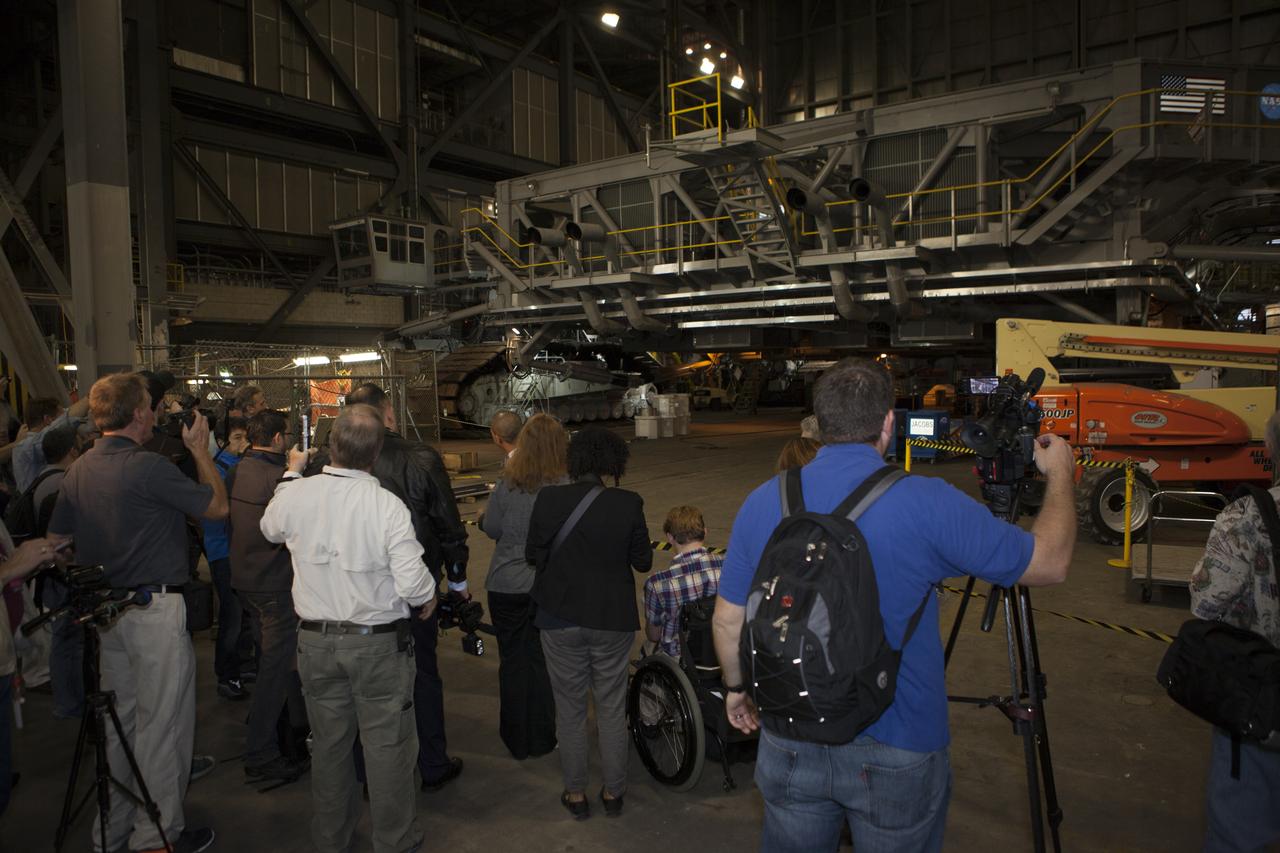
At NASA's Kennedy Space Center in Florida, members of the news media tour the spaceport's Vehicle Assembly Building. They were briefed on progress to upgrade and modify crawler-transporter CT 2 to support the Space Launch System. Orion is the exploration spacecraft designed to carry astronauts to destinations not yet explored by humans, including an asteroid and Mars. It will have emergency abort capability, sustain the crew during space travel and provide safe re-entry from deep space return velocities. The first unpiloted flight test of Orion is scheduled to launch Dec. 4, 2014 atop a United Launch Alliance Delta IV Heavy rocket, and in 2018 on NASA’s Space Launch System rocket.
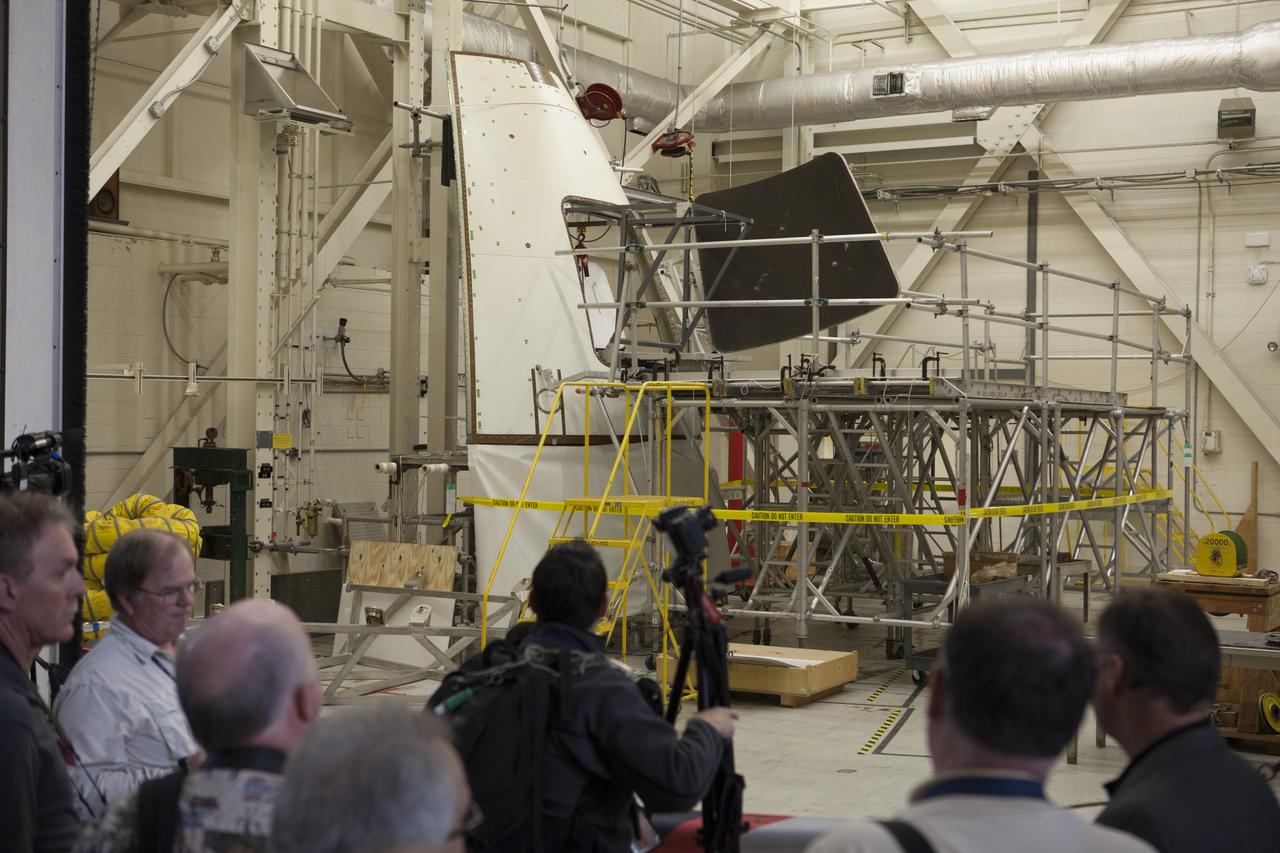
At NASA's Kennedy Space Center in Florida, members of the news media tour the spaceport's Vehicle Assembly Building. They were shown an ogive panel which, together with others, cover the Orion spacecraft during launch. Orion is the exploration spacecraft designed to carry astronauts to destinations not yet explored by humans, including an asteroid and Mars. It will have emergency abort capability, sustain the crew during space travel and provide safe re-entry from deep space return velocities. The first unpiloted flight test of Orion is scheduled to launch Dec. 4, 2014 atop a United Launch Alliance Delta IV Heavy rocket, and in 2018 on NASA’s Space Launch System rocket.
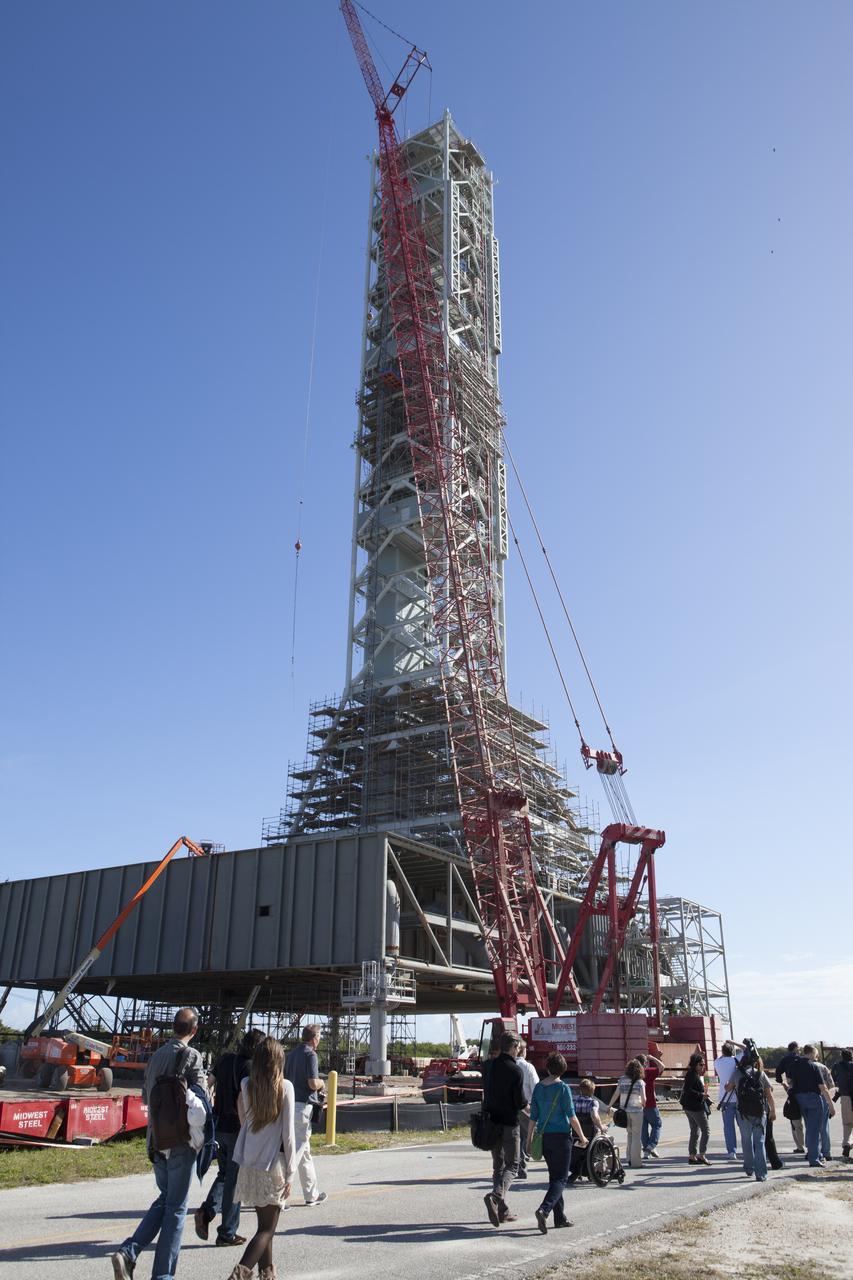
At NASA's Kennedy Space Center in Florida, members of the news media get an up-close look at the new mobile launcher. The Space Launch System rocket will be stacked on the launcher inside the Vehicle Assembly Building prior to rollout to Launch Pad 39B atop crawler-transporter 2. Orion is the exploration spacecraft designed to carry astronauts to destinations not yet explored by humans, including an asteroid and Mars. It will have emergency abort capability, sustain the crew during space travel and provide safe re-entry from deep space return velocities. The first unpiloted flight test of Orion is scheduled to launch Dec. 4, 2014 atop a United Launch Alliance Delta IV Heavy rocket, and in 2018 on NASA’s Space Launch System rocket.
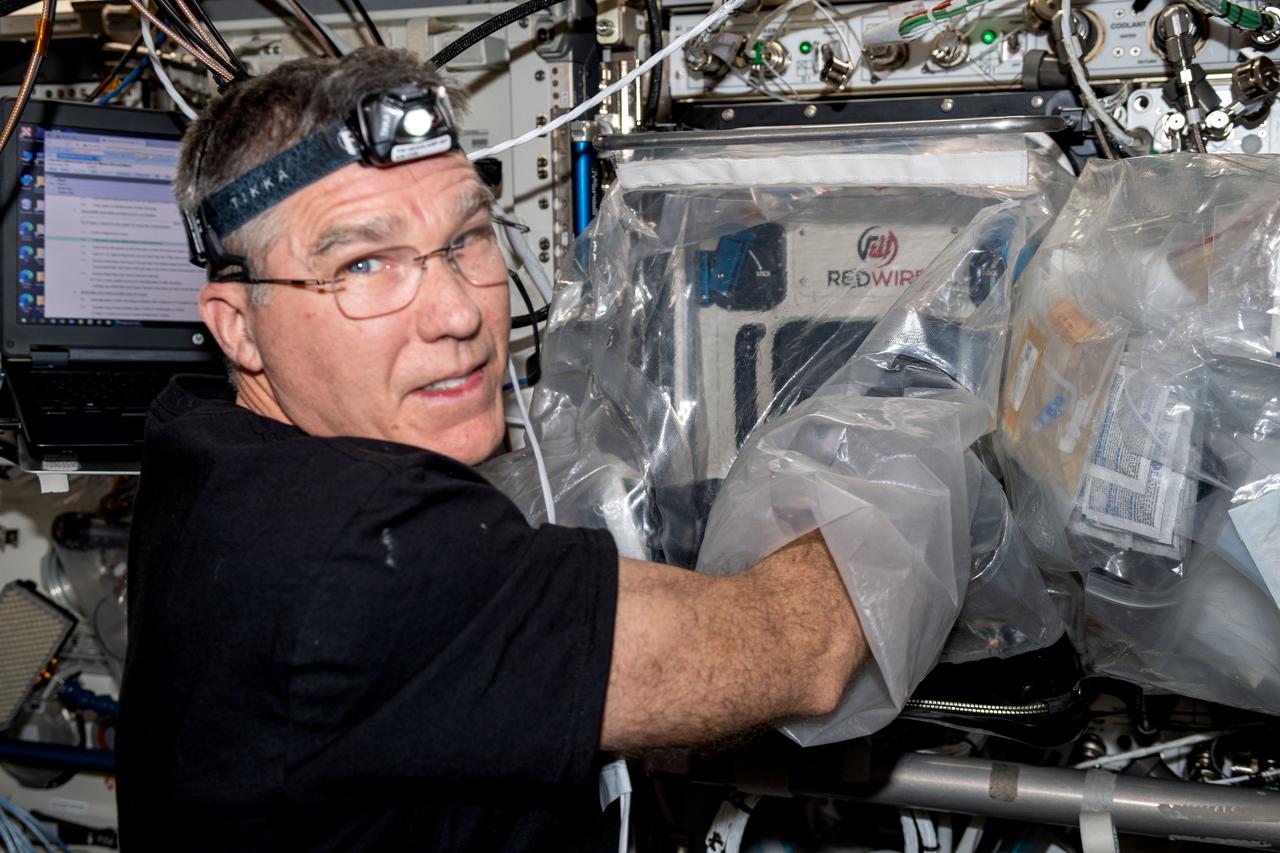
iss069e038872 (July 28, 2023) -- NASA astronaut Stephen Bowen works with the BioFabrication Facility which uses 3D printers to investigate the feasibility of printing organ-like tissues in microgravity.
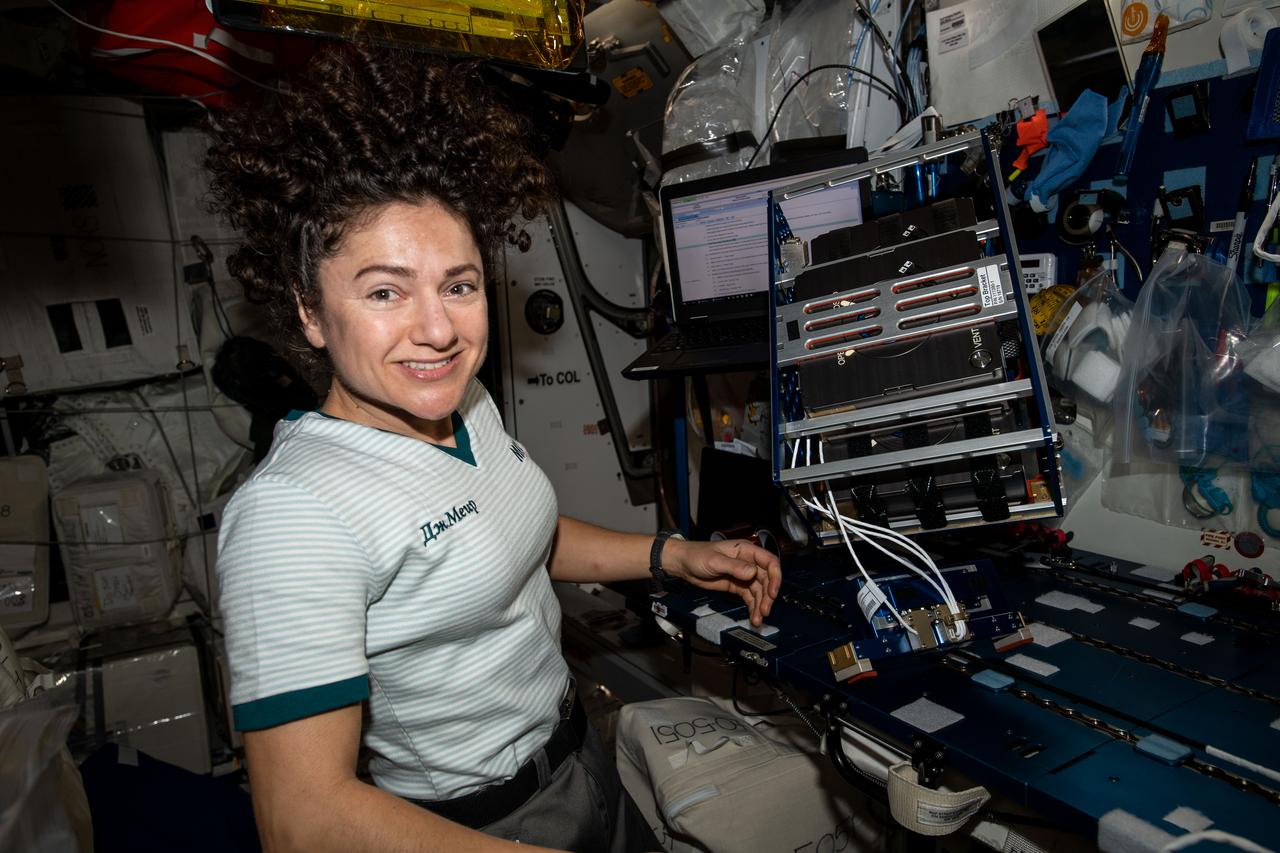
iss061e113336 (Jan. 2, 2020) --- NASA astronaut and Expedition 61 Flight Engineer Jessica Meir inserts Techshot Tissue Cassettes into racks that allow them to be installed in a Microgravity Experiment Research Locker/Incubator (MERLIN) for sample return to Earth. These particular tissue cassettes were used in the 3D printing of tissue-like constructs as part of the initiation of Techshot’s BioFabrication Facility (BFF) aboard the International Space Station.
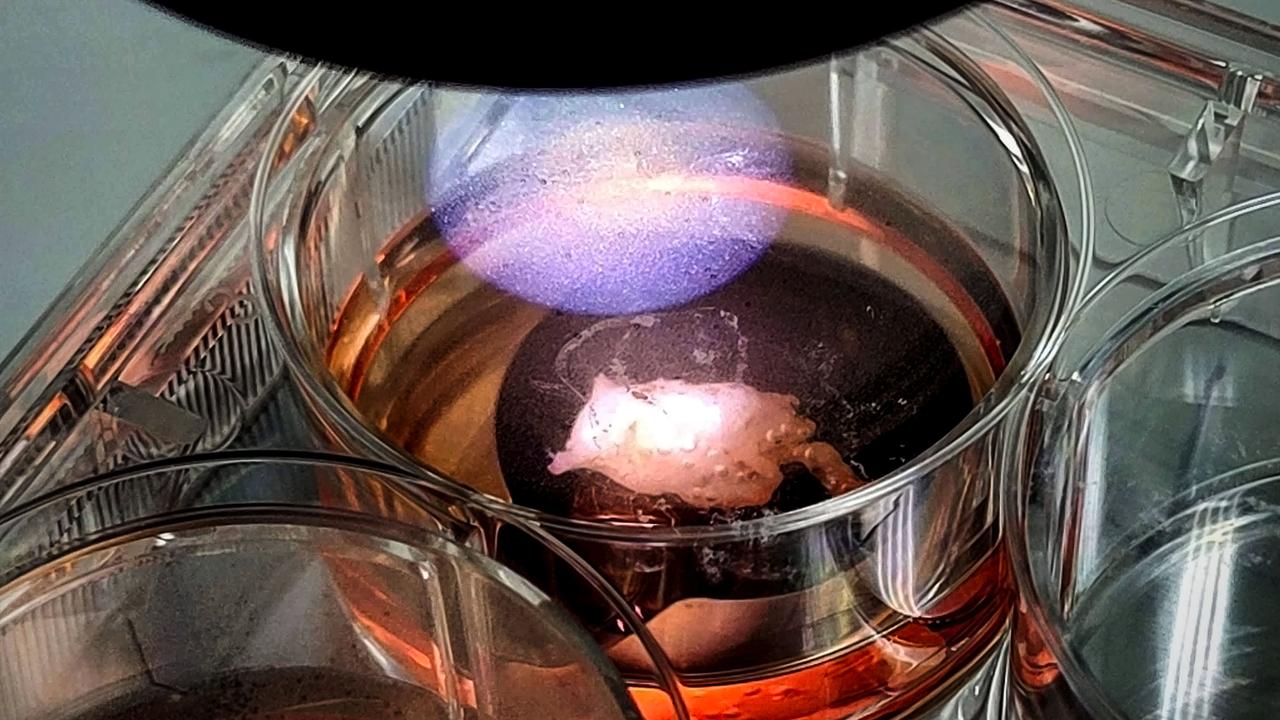
jsc2024e038395 (6/5/2024) --- Live human heart tissue bioprinted with Redwire's BioFabrication Facility aboard the International Space Station. The tissue was successfully returned to Earth in April 2024. Results of the Redwire Cardiac Bioprinting Investigation (BFF-Cardiac) could advance technologies for producing organs and tissues in lieu of donated organs for transplant. The investigation also improves 3D printing, with the goal of giving the crew the ability to print material like foods and medicines on demand for future long-duration space missions. Image courtesy of Redwire.
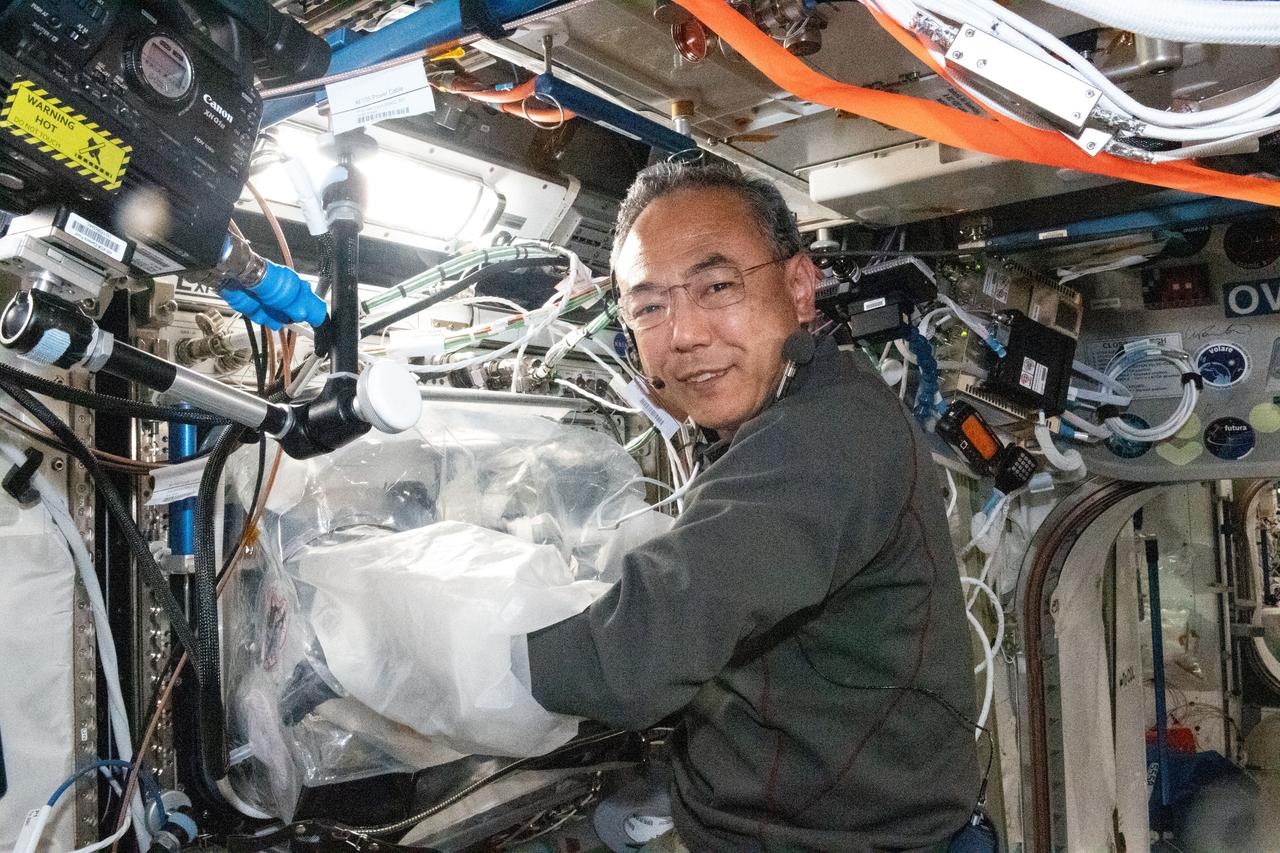
iss069e086005 (Sept. 6, 2023) --- JAXA (Japan Aerospace Exploration Agency) astronaut and Expedition 69 Flight Engineer Satoshi Furukawa replaces components on the BioFabrication Facility (BFF). The 3D biological printer, located in the International Space Station's Columbus laboratory module, is testing printing organ-like tissues in microgravity with an eye to manufacturing whole human organs in space in the future.
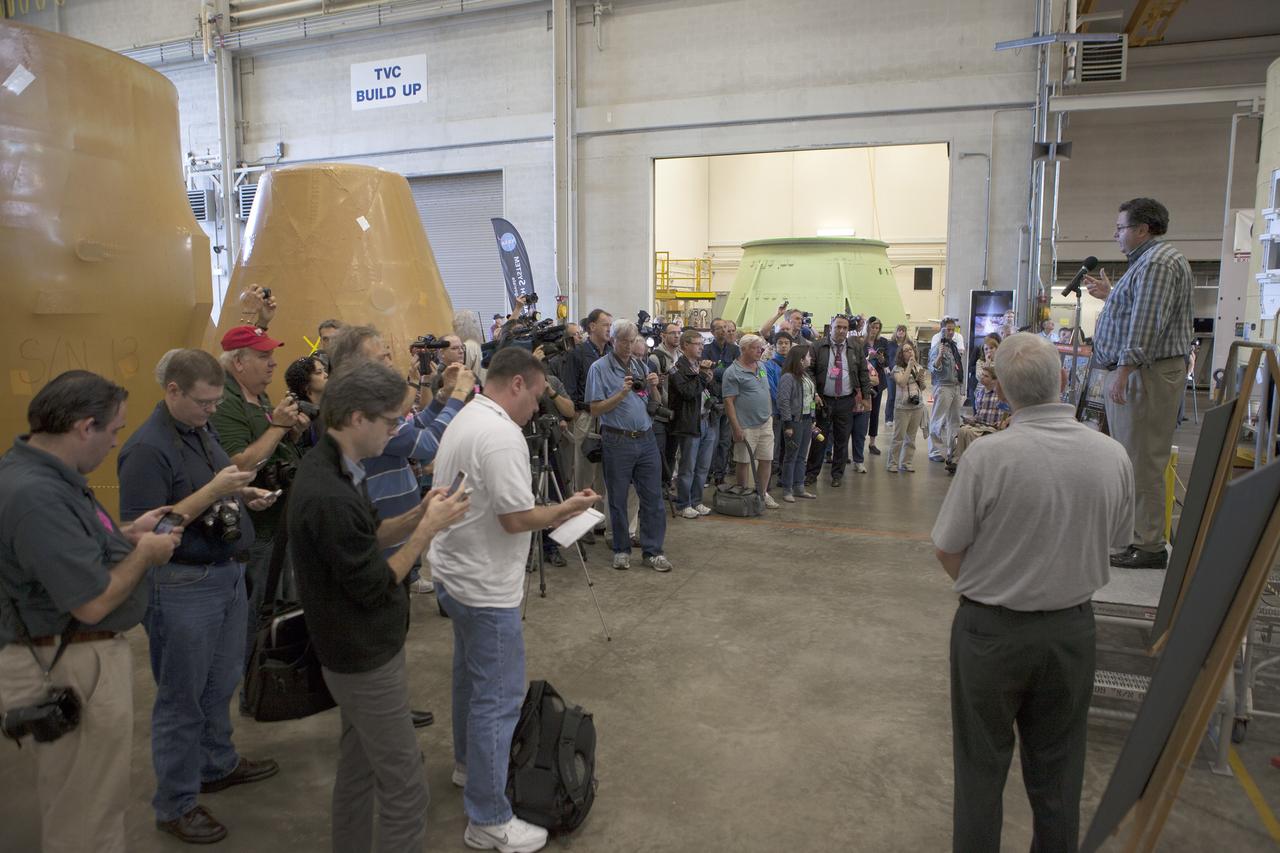
CAPE CANAVERAL, Fla. – At NASA's Kennedy Space Center in Florida, members of the news media are briefed on the agency's Space Launch System SLS Program Todd May, program manager for Space Launch Systems SLS at NASA's Marshall Space Flight Center in Huntsville, Alabama. The briefing took place in the spaceport's Booster Fabrication Facility BFF. During the Space Shuttle Program, the facility was used for processing forward segments and aft skirts for the solid rocket boosters. The BFF will serve a similar role for the SLS. Orion is the exploration spacecraft designed to carry astronauts to destinations not yet explored by humans, including an asteroid and Mars. It will have emergency abort capability, sustain the crew during space travel and provide safe re-entry from deep space return velocities. The first unpiloted flight test of Orion is scheduled to launch Dec. 4, 2014 atop a United Launch Alliance Delta IV Heavy rocket, and in 2018 on NASA’s Space Launch System rocket. For more information, visit www.nasa.gov/orion Photo credit: NASA/Kim Shiflett
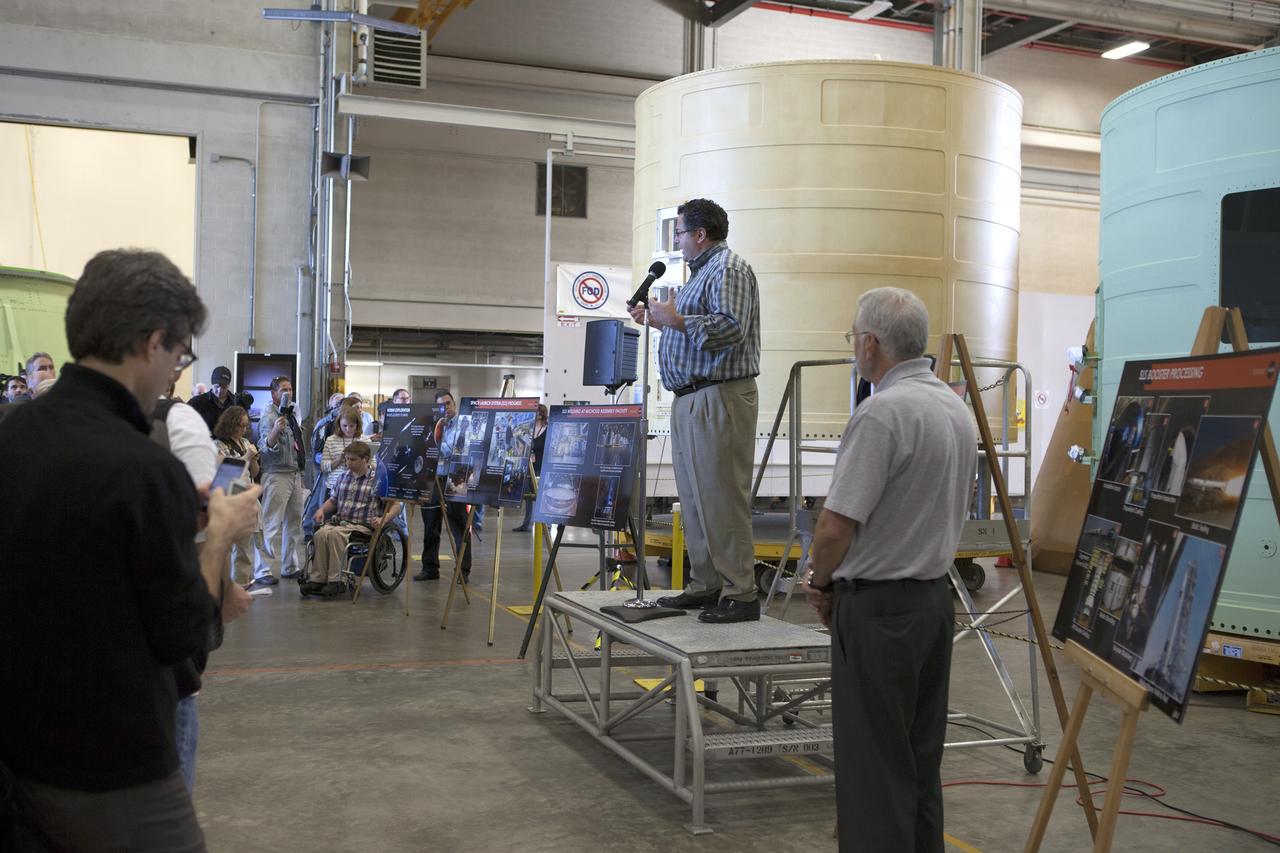
CAPE CANAVERAL, Fla. – At NASA's Kennedy Space Center in Florida, members of the news media are briefed on the agency's Space Launch System SLS Program Todd May, program manager for Space Launch Systems SLS at NASA's Marshall Space Flight Center in Huntsville, Alabama. The briefing took place in the spaceport's Booster Fabrication Facility BFF. During the Space Shuttle Program, the facility was used for processing forward segments and aft skirts for the solid rocket boosters. The BFF will serve a similar role for the SLS. Orion is the exploration spacecraft designed to carry astronauts to destinations not yet explored by humans, including an asteroid and Mars. It will have emergency abort capability, sustain the crew during space travel and provide safe re-entry from deep space return velocities. The first unpiloted flight test of Orion is scheduled to launch Dec. 4, 2014 atop a United Launch Alliance Delta IV Heavy rocket, and in 2018 on NASA’s Space Launch System rocket. For more information, visit www.nasa.gov/orion Photo credit: NASA/Kim Shiflett
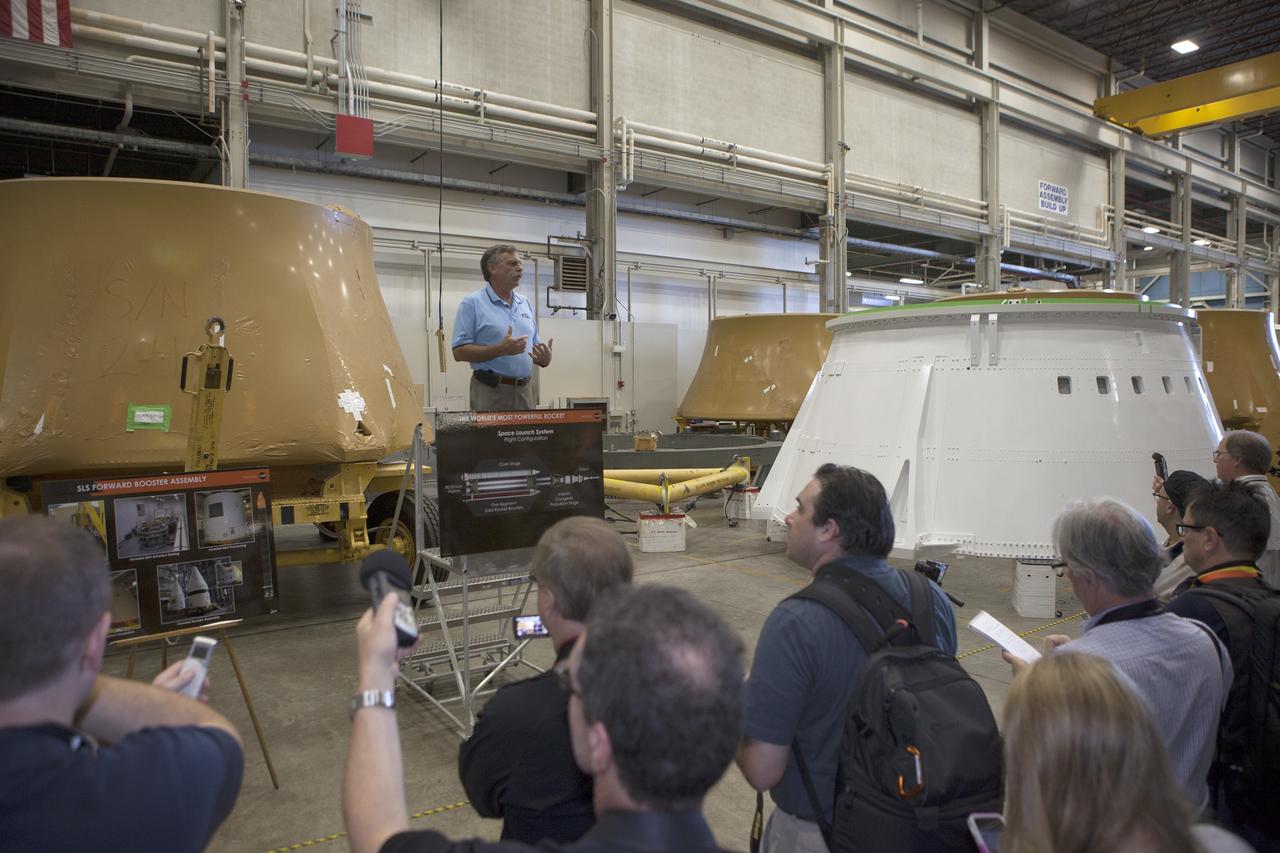
CAPE CANAVERAL, Fla. – At NASA's Kennedy Space Center in Florida, members of the news media are briefed on the agency's Space Launch System SLS Program by Larry Clark, engineering manager for Alliant Techsystems Inc. ATK. The briefing took place in the spaceport's Booster Fabrication Facility BFF. During the Space Shuttle Program, the facility was used for processing forward segments and aft skirts for the solid rocket boosters. The BFF will serve a similar role for the SLS. Orion is the exploration spacecraft designed to carry astronauts to destinations not yet explored by humans, including an asteroid and Mars. It will have emergency abort capability, sustain the crew during space travel and provide safe re-entry from deep space return velocities. The first unpiloted flight test of Orion is scheduled to launch Dec. 4, 2014 atop a United Launch Alliance Delta IV Heavy rocket, and in 2018 on NASA’s Space Launch System rocket. For more information, visit www.nasa.gov/orion Photo credit: NASA/Kim Shiflett
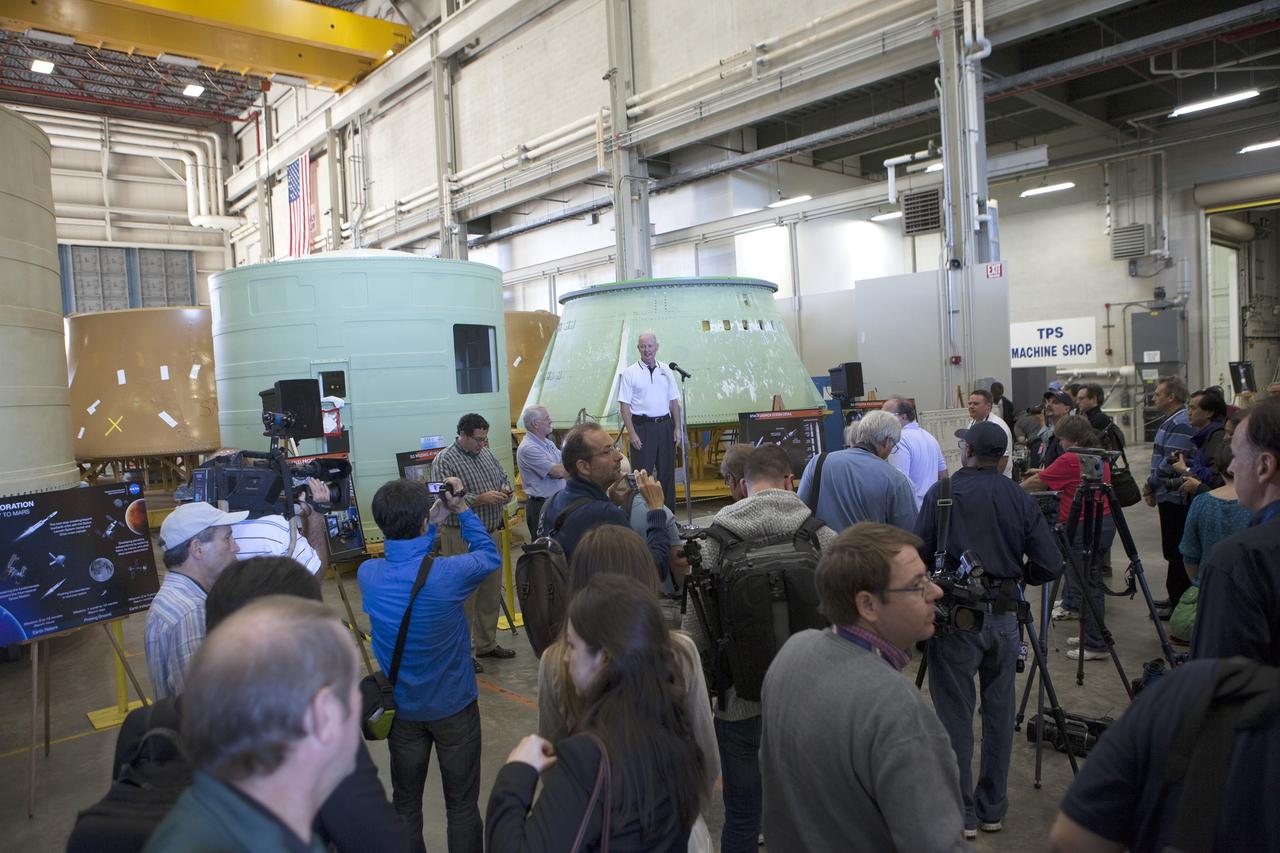
CAPE CANAVERAL, Fla. – At NASA's Kennedy Space Center in Florida, members of the news media are briefed on the agency's Space Launch System SLS Program by former astronaut Brian Duffy who is now vice president and program manager of Exploration Systems at Alliant Techsystems Inc. ATK. The briefing took place in the spaceport's Booster Fabrication Facility BFF. During the Space Shuttle Program, the facility was used for processing forward segments and aft skirts for the solid rocket boosters. The BFF will serve a similar role for the SLS. Orion is the exploration spacecraft designed to carry astronauts to destinations not yet explored by humans, including an asteroid and Mars. It will have emergency abort capability, sustain the crew during space travel and provide safe re-entry from deep space return velocities. The first unpiloted flight test of Orion is scheduled to launch Dec. 4, 2014 atop a United Launch Alliance Delta IV Heavy rocket, and in 2018 on NASA’s Space Launch System rocket. For more information, visit www.nasa.gov/orion Photo credit: NASA/Kim Shiflett
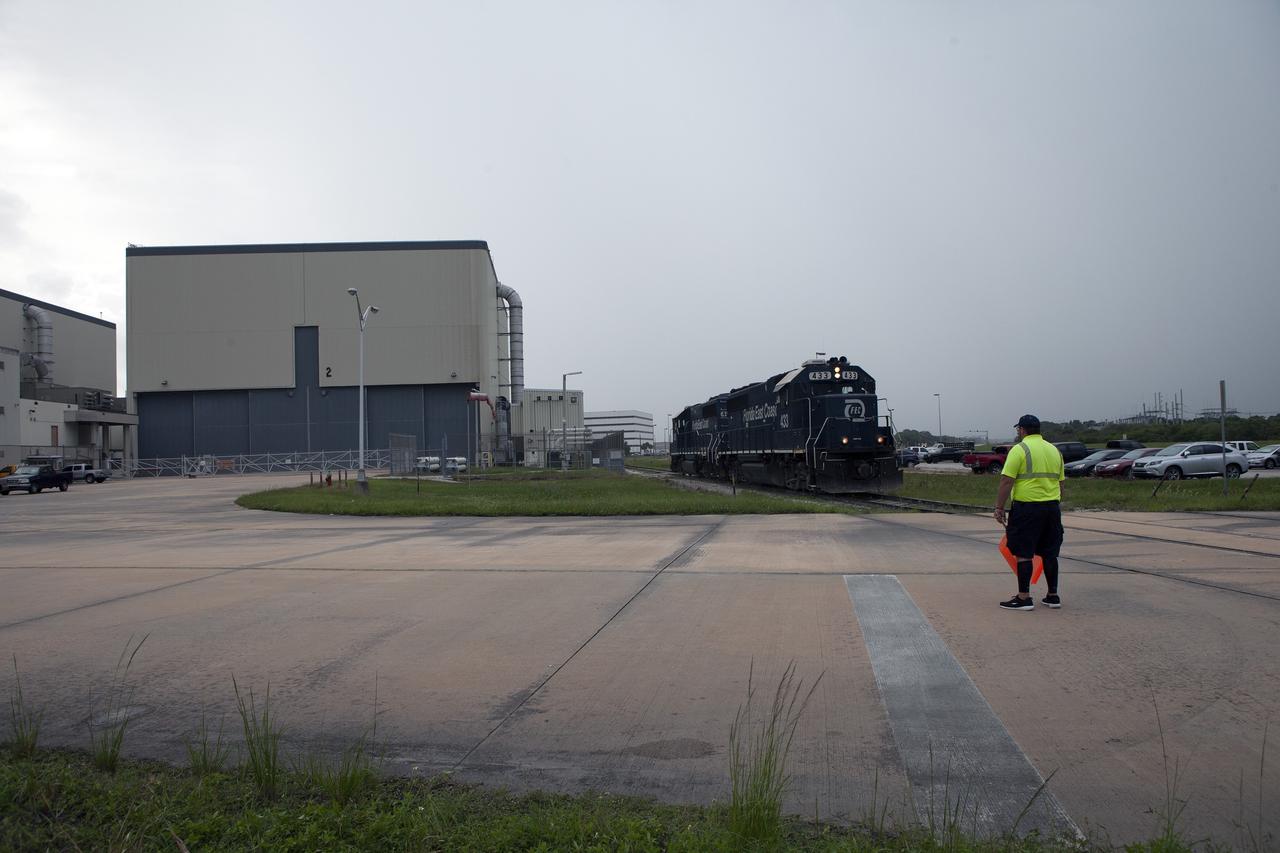
CAPE CANAVERAL, Fla. – Coupled Florida East Coast Railway, or FEC, locomotives No. 433 and No. 428 make the first run past the Orbiter Processing Facility and Thermal Protection System Facility in Launch Complex 39 at NASA’s Kennedy Space Center in Florida during the Rail Vibration Test for the Canaveral Port Authority. Seismic monitors are collecting data as the train passes by. The purpose of the test is to collect amplitude, frequency and vibration test data utilizing two Florida East Coast locomotives operating on KSC tracks to ensure that future railroad operations will not affect launch vehicle processing at the center. Buildings instrumented for the test include the Rotation Processing Surge Facility, Thermal Protection Systems Facility, Vehicle Assembly Building, Orbiter Processing Facility and Booster Fabrication Facility. Photo credit: NASA/Daniel Casper
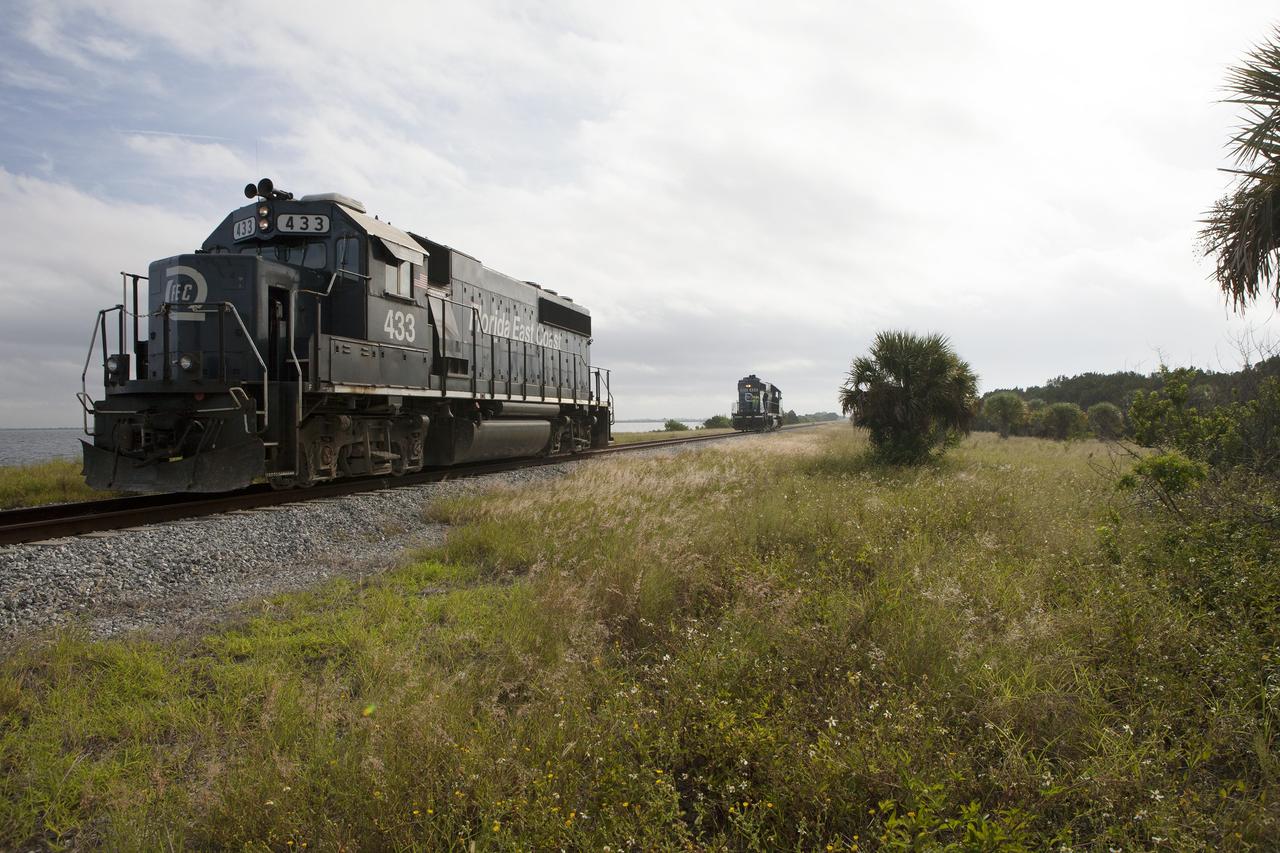
CAPE CANAVERAL, Fla. – Operations are underway to couple Florida East Coast Railway, or FEC, locomotives No. 433 and No. 428 on the track alongside the Indian River, north of Launch Complex 39 at NASA’s Kennedy Space Center in Florida. Kennedy's Center Planning and Development Directorate has enlisted the locomotives to support a Rail Vibration Test for the Canaveral Port Authority. The purpose of the test is to collect amplitude, frequency and vibration test data utilizing two Florida East Coast locomotives operating on KSC tracks to ensure that future railroad operations will not affect launch vehicle processing at the center. Buildings instrumented for the test include the Rotation Processing Surge Facility, Thermal Protection Systems Facility, Vehicle Assembly Building, Orbiter Processing Facility and Booster Fabrication Facility. Photo credit: NASA/Daniel Casper
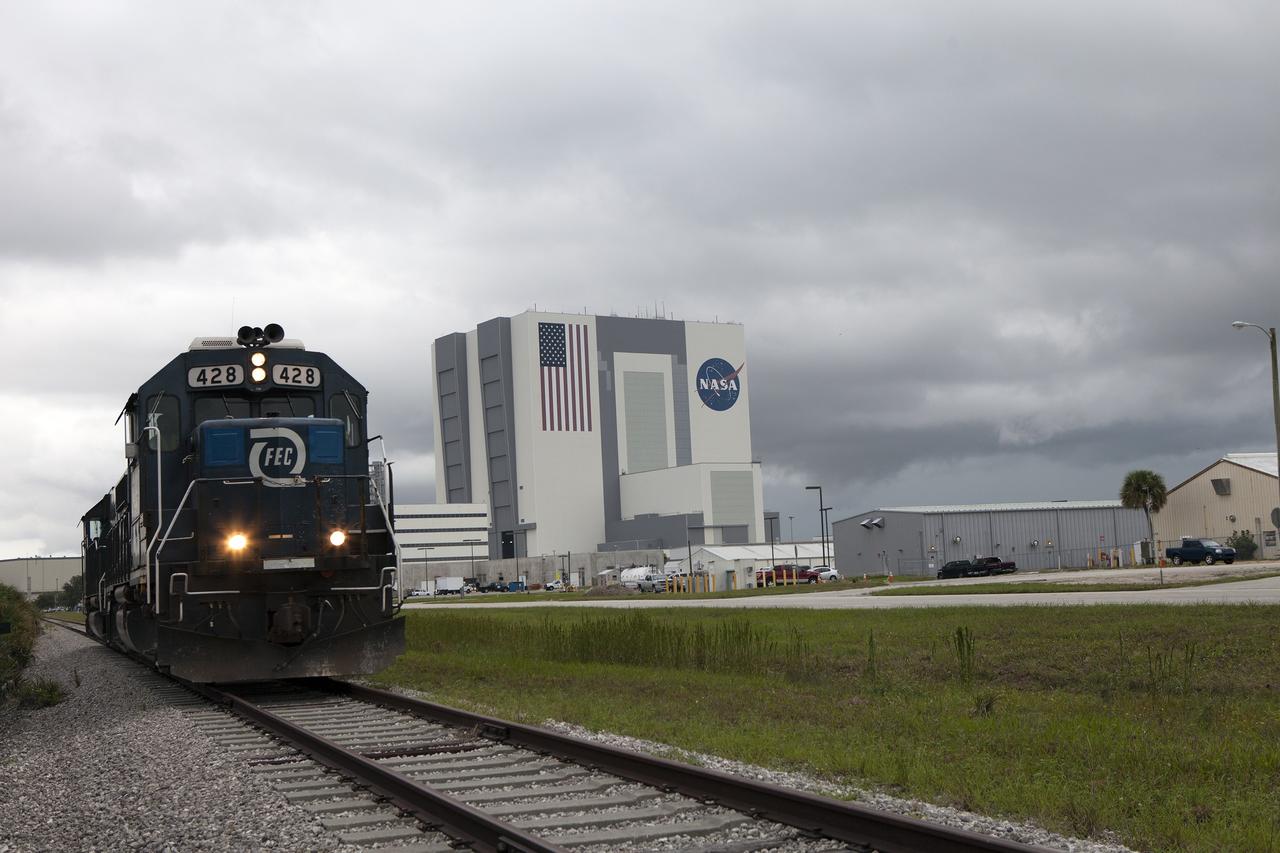
CAPE CANAVERAL, Fla. – Coupled Florida East Coast Railway, or FEC, locomotives No. 433 and No. 428 pass the Vehicle Assembly Building in Launch Complex 39 at NASA’s Kennedy Space Center in Florida on their way to NASA's Locomotive Maintenance Facility. Kennedy's Center Planning and Development Directorate has enlisted the locomotives to support a Rail Vibration Test for the Canaveral Port Authority. The purpose of the test is to collect amplitude, frequency and vibration test data utilizing two Florida East Coast locomotives operating on KSC tracks to ensure that future railroad operations will not affect launch vehicle processing at the center. Buildings instrumented for the test include the Rotation Processing Surge Facility, Thermal Protection Systems Facility, Vehicle Assembly Building, Orbiter Processing Facility and Booster Fabrication Facility. Photo credit: NASA/Daniel Casper

One of two Artemis II aft skirts for NASA’s Space Launch System (SLS) rocket’s twin solid rocket boosters crosses railroad tracks on its way from the Booster Fabrication Facility to the Rotation Processing and Surge Facility (RPSF) at the agency’s Kennedy Space Center in Florida on Monday, Sept. 25, 2023. The aft skirts were refurbished by Northrop Grumman and house the thrust vector control system, which controls 70 percent of the steering during initial ascent of the SLS rocket. The segments will remain in the RPSF until ready for stacking with the forward and aft parts of the boosters on the mobile launcher in High Bay 3 of the Vehicle Assembly Building. Artemis II astronauts Reid Wiseman, Victor Glover, Christina Koch, and Jeremy Hansen will launch from Kennedy, traveling around the Moon on the first crewed mission under Artemis that will test all of the Orion spacecraft’s systems.
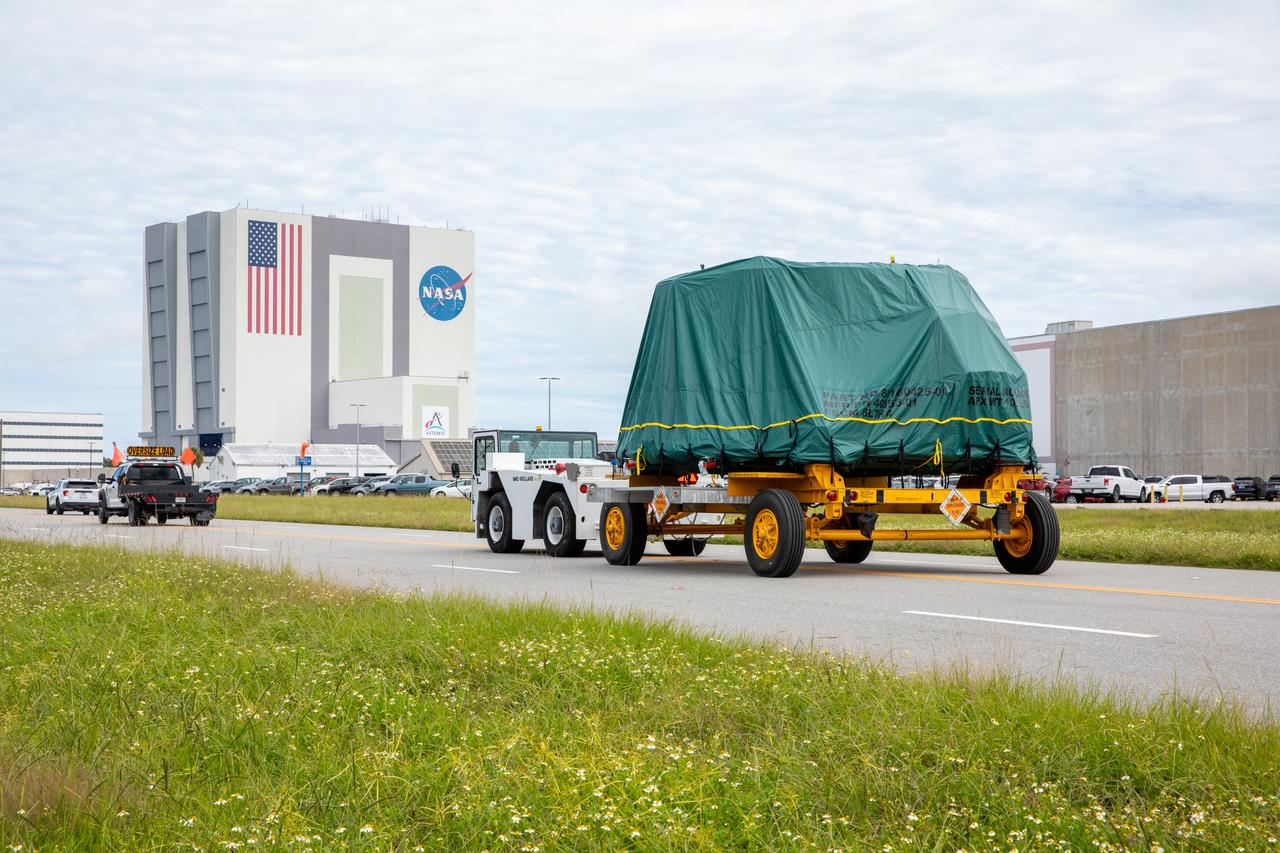
One of two Artemis II aft skirts for NASA's Space Launch System (SLS) rocket’s twin solid rocket boosters is transported from the Booster Fabrication Facility to the Rotation Processing and Surge Facility (RPSF) at the agency’s Kennedy Space Center in Florida on Monday, Sept. 25, 2023. The aft skirts were refurbished by Northrop Grumman and house the thrust vector control system, which controls 70 percent of the steering during initial ascent of the SLS rocket. The segments will remain in the RPSF until ready for stacking with the forward and aft parts of the boosters on the mobile launcher in High Bay 3 of the Vehicle Assembly Building. Artemis II astronauts Reid Wiseman, Victor Glover, Christina Koch, and Jeremy Hansen will launch from Kennedy, traveling around the Moon on the first crewed mission under Artemis that will test all of the Orion spacecraft’s systems.
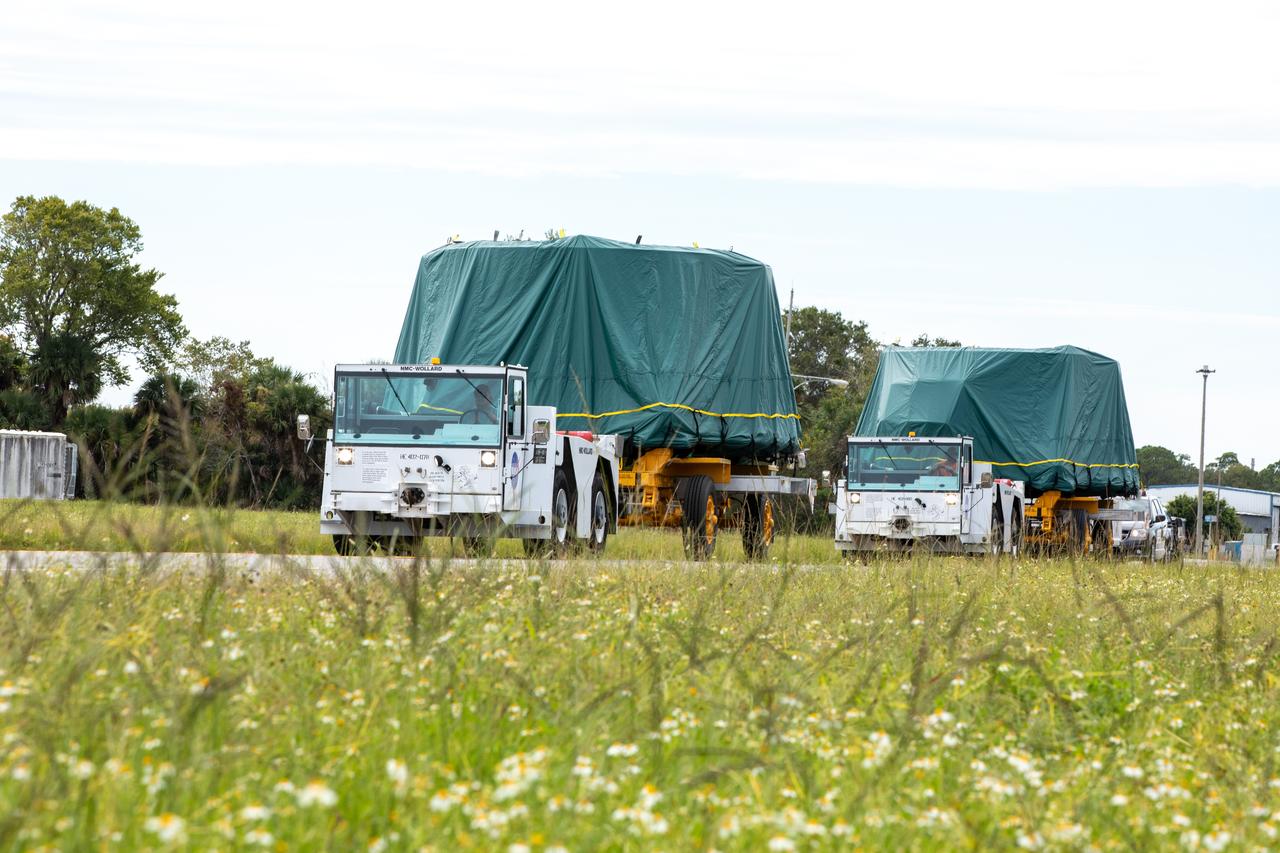
The Artemis II aft skirts for NASA's Space Launch System (SLS) rocket’s twin solid rocket boosters are transported from the Booster Fabrication Facility to the Rotation Processing and Surge Facility (RPSF) at the agency’s Kennedy Space Center in Florida on Monday, Sept. 25, 2023. The aft skirts were refurbished by Northrop Grumman and house the thrust vector control system, which controls 70 percent of the steering during initial ascent of the SLS rocket. The segments will remain in the RPSF until ready for stacking with the forward and aft parts of the boosters on the mobile launcher in High Bay 3 of the Vehicle Assembly Building. Artemis II astronauts Reid Wiseman, Victor Glover, Christina Koch, and Jeremy Hansen will launch from Kennedy, traveling around the Moon on the first crewed mission under Artemis that will test all of the Orion spacecraft’s systems.
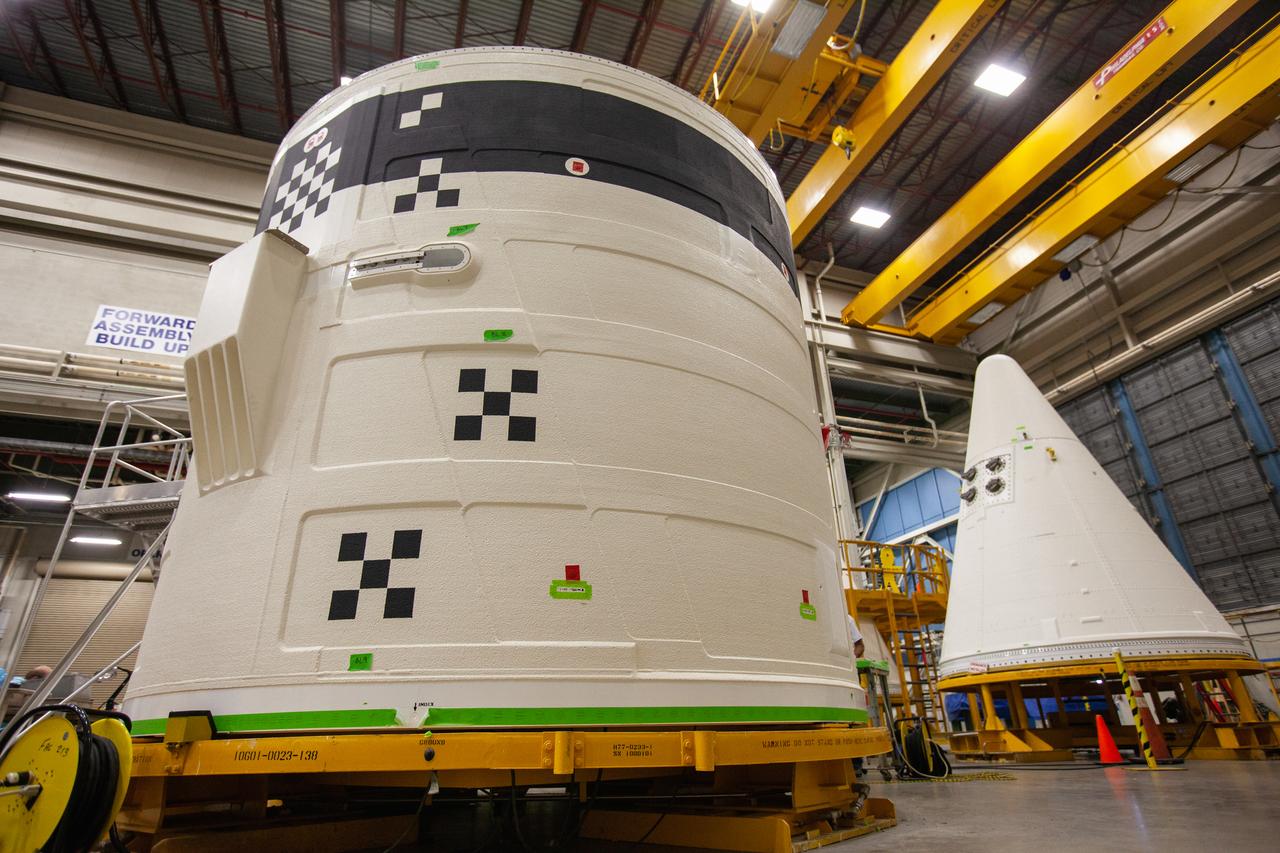
The forward skirt for one of the Space Launch System’s (SLS) two solid boosters is inside the Booster Fabrication Facility at NASA’s Kennedy Space Center in Florida on Oct. 16, 2019. Segments of the boosters are being inspected and prepared for Artemis I, the agency’s first uncrewed flight of Orion atop the SLS. The forward skirt houses booster avionics that communicate with the SLS avionics to monitor booster conditions and steer the booster exhaust nozzle.
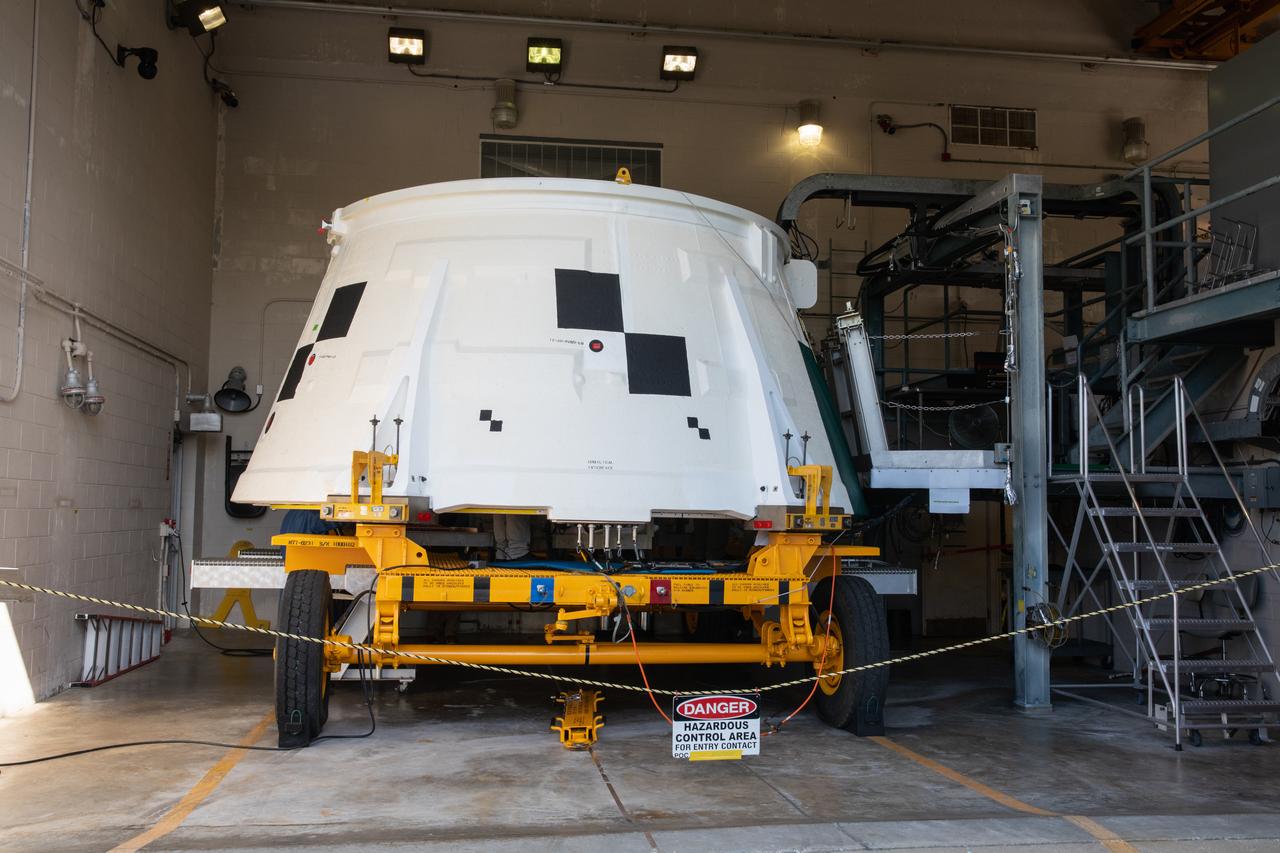
The aft skirt for one of the Space Launch System’s (SLS) two solid rocket boosters is inside the Booster Fabrication Facility at NASA’s Kennedy Space Center in Florida on Oct. 16, 2019. Segments of the boosters are being inspected and prepared for Artemis I, the agency’s first uncrewed flight of Orion atop the SLS. The aft skirts contain the thrust vector control system that steers the booster’s nozzles based on commands from the booster avionics during launch.
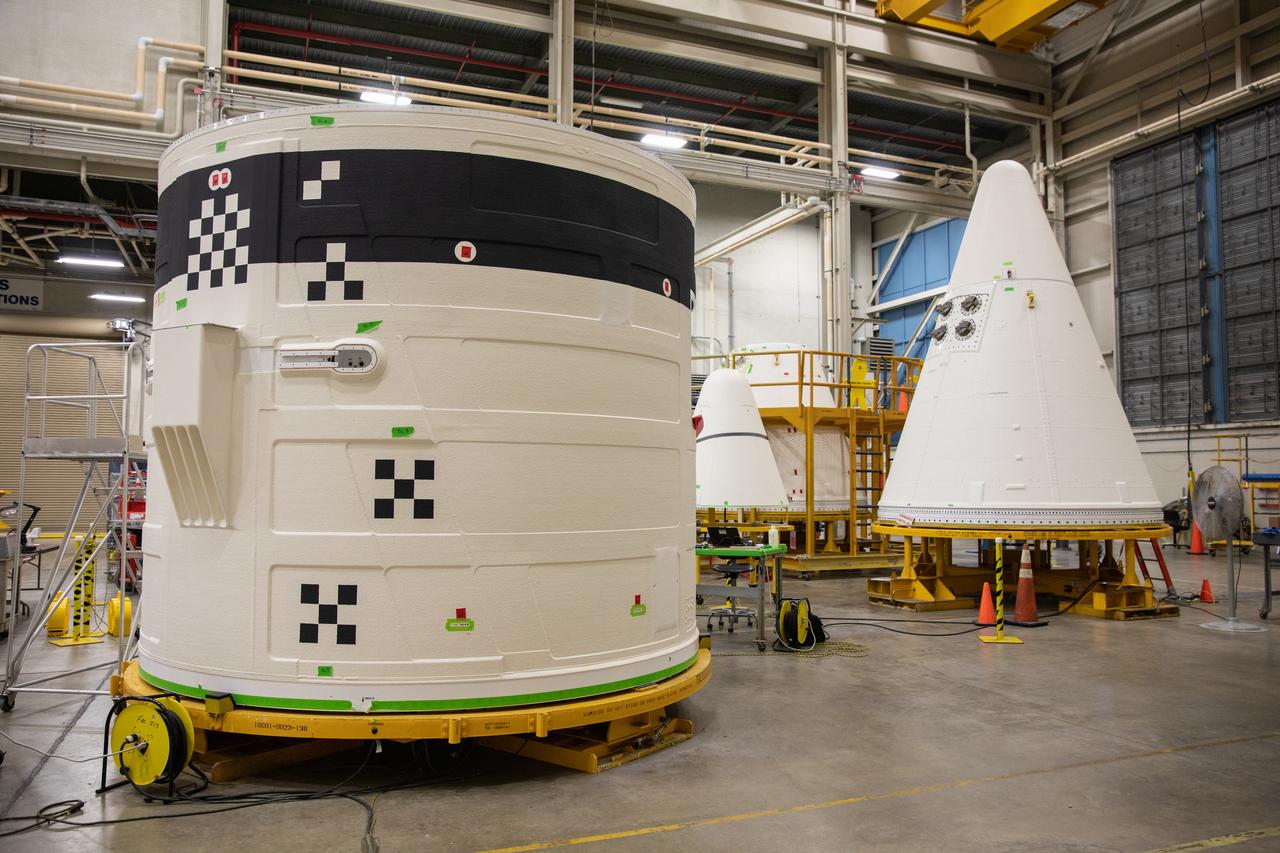
A forward skirt and two nose cones for the Space Launch System’s (SLS) two solid boosters are in view inside the Booster Fabrication Facility at NASA’s Kennedy Space Center in Florida on Oct. 16, 2019. Segments of the boosters are being inspected and prepared for Artemis I, the agency’s first uncrewed flight of Orion atop the SLS. The forward skirt houses booster avionics that communicate with the SLS avionics to monitor booster conditions and steer the booster exhaust nozzle. The nose cone, along with a frustrum, will serve as the aerodynamic fairing for the boosters during launch.
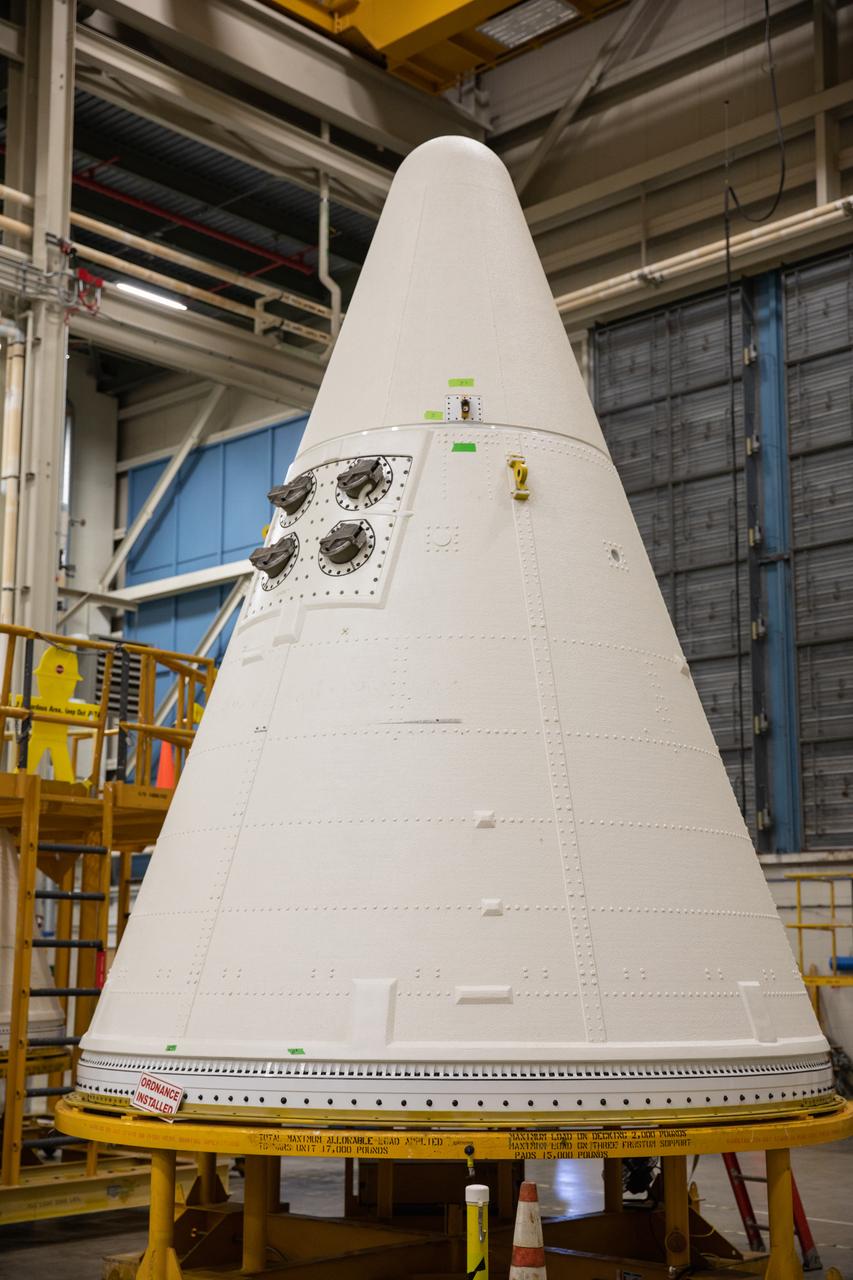
A nose cone for one of the Space Launch System’s (SLS) two solid rocket boosters is inside the Booster Fabrication Facility at NASA’s Kennedy Space Center in Florida on Oct. 16, 2019. Segments of the boosters are being inspected and prepared for Artemis I, the agency’s first uncrewed flight of Orion atop the SLS. The nose cone, along with a frustrum, will serve as the aerodynamic fairing for the boosters during launch.
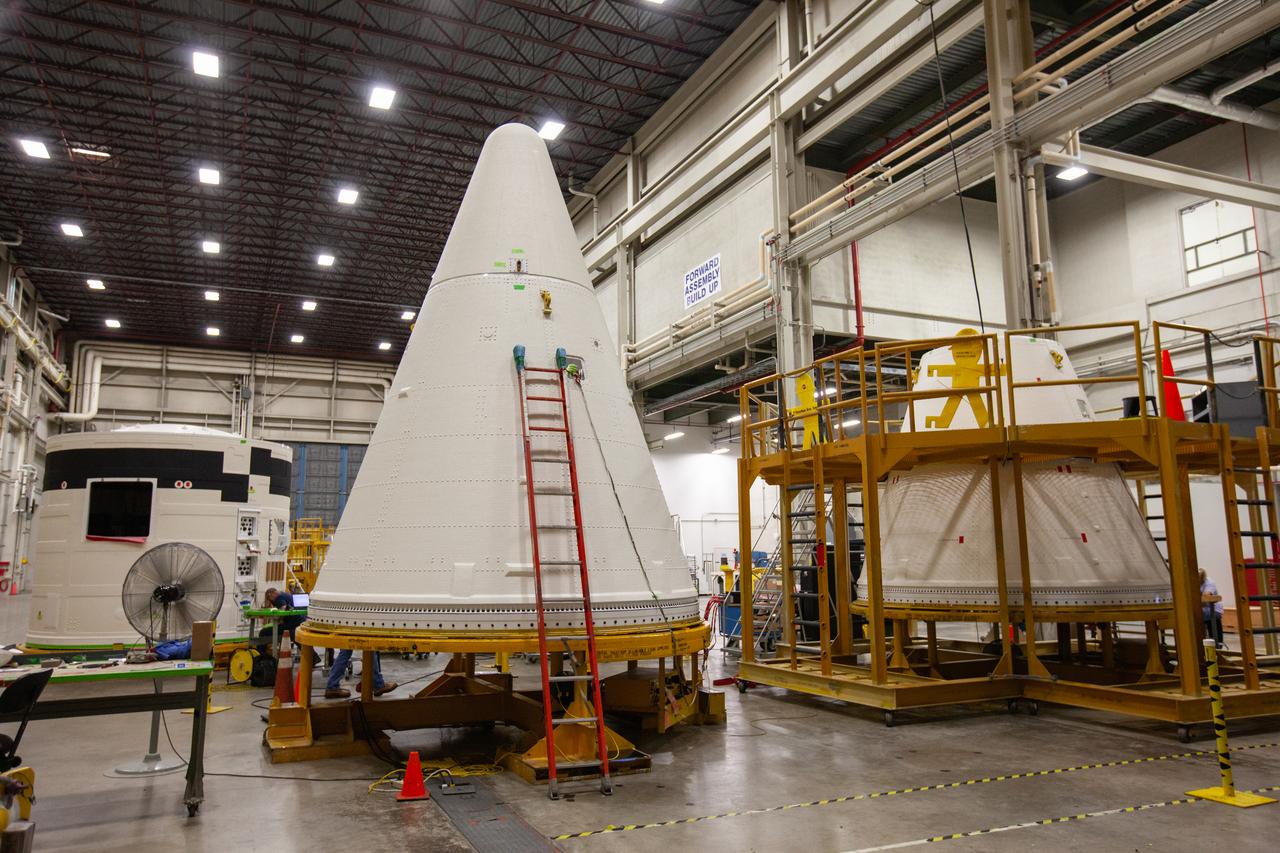
A nose cone for one of the Space Launch System’s (SLS) two solid rocket boosters is inside the Booster Fabrication Facility at NASA’s Kennedy Space Center in Florida on Oct. 16, 2019. Segments of the boosters are being inspected and prepared for Artemis I, the agency’s first uncrewed flight of Orion atop the SLS. The nose cone, along with a frustrum, will serve as the aerodynamic fairing for the boosters during launch.
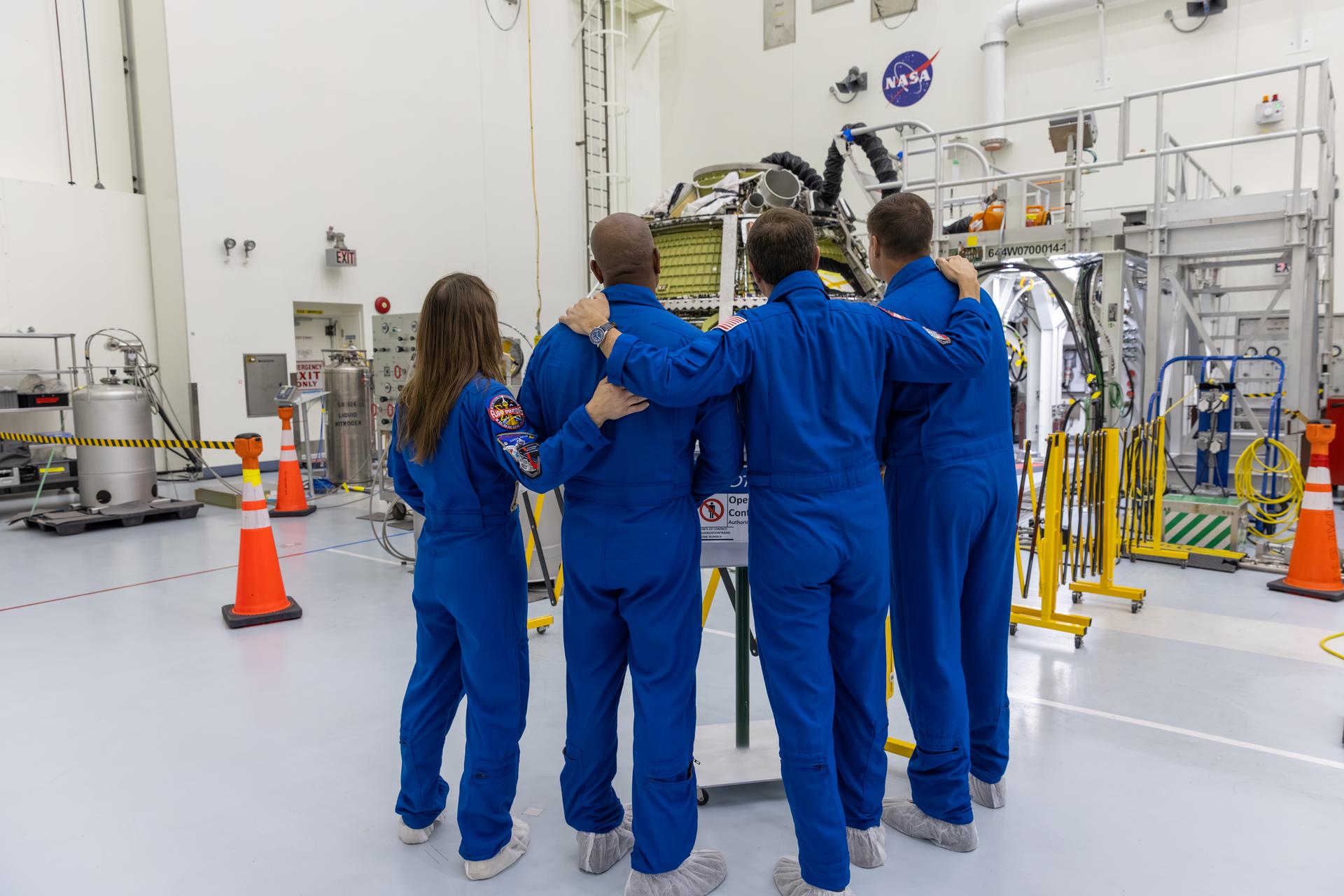
From left, Artemis II NASA astronauts Christina Koch, Victor Glover, and Reid Wiseman, along with CSA (Canadian Space Agency) astronaut Jeremy Hansen view the Artemis II Orion spacecraft inside the Multi-Payload Processing Facility at NASA’s Kennedy Space Center in Florida on Wednesday, July 8, 2026. The crew returned to NASA Kennedy for their first official visit since launch of Artemis II on Wednesday, April 1, 2026, to visit with the center’s workforce and tour facilities to view progress on Artemis III prelaunch processing.