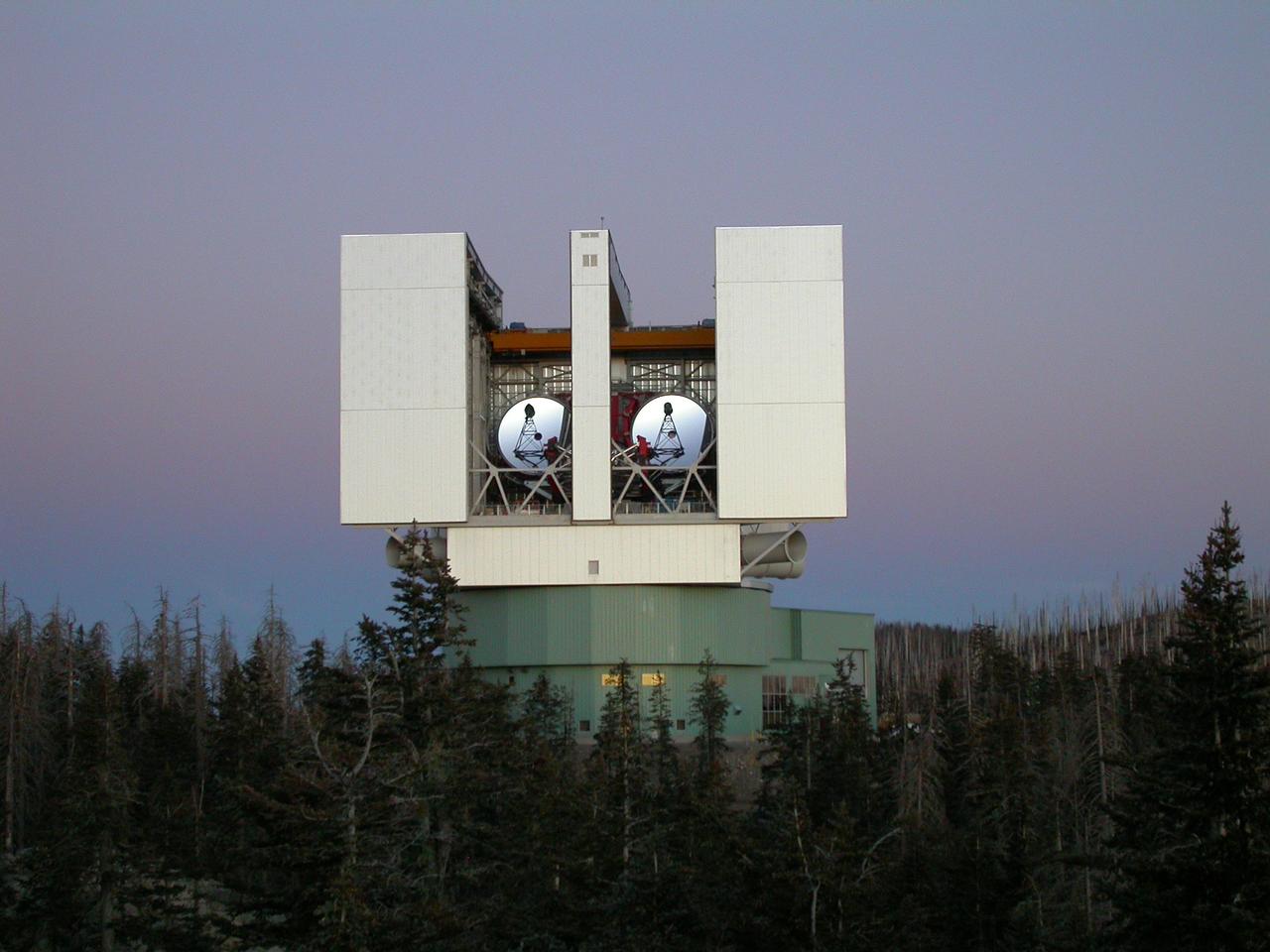
The Large Binocular Telescope Interferometer, or LBTI, is a ground-based instrument connecting two 8-meter class telescopes on Mount Graham in Arizona to form the largest single-mount telescope in the world. The interferometer is designed to detect and study stars and planets outside our solar system. https://photojournal.jpl.nasa.gov/catalog/PIA22354
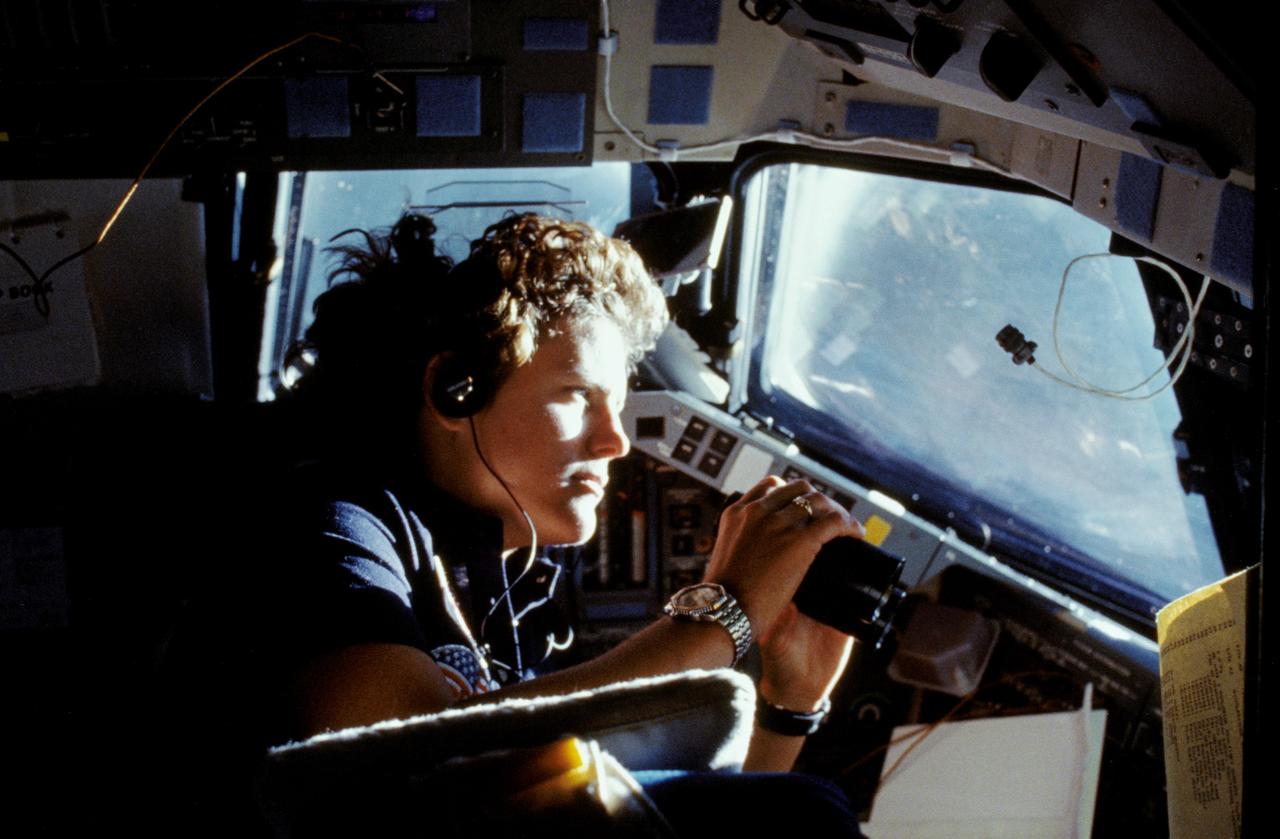
41G-11-027 (14 Oct. 1984) --- Kathryn D. Sullivan, 41-G mission specialist, uses a pair of binoculars to do some magnified viewing through the forward cabin windows of the Earth-orbiting space shuttle Challenger. The 35mm frame was part of the first photographic release from the eight-day 41-G mission on Oct. 14, 1984. Photo credit: NASA
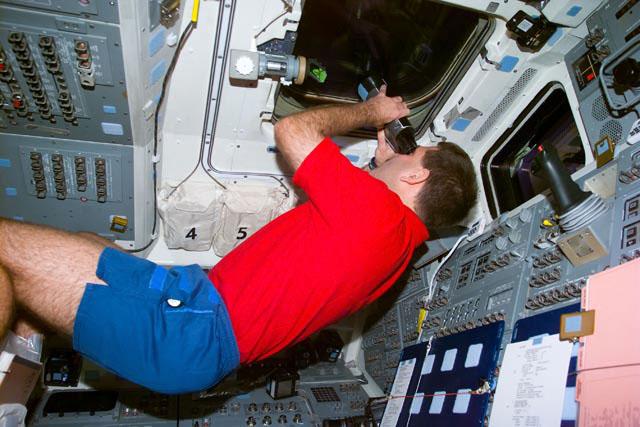
S103-E-5201 (21 Dec. 1999) --- Astronaut John M. Grunsfeld, uses a pair of binoculars to view the distant Hubble Space Telescope (HST) several hours prior to its capture by the Space Shuttle Discovery. The photo was taken with an electronic still camera (ESC) at 12:45.19 GMT, Dec. 21, 1999.
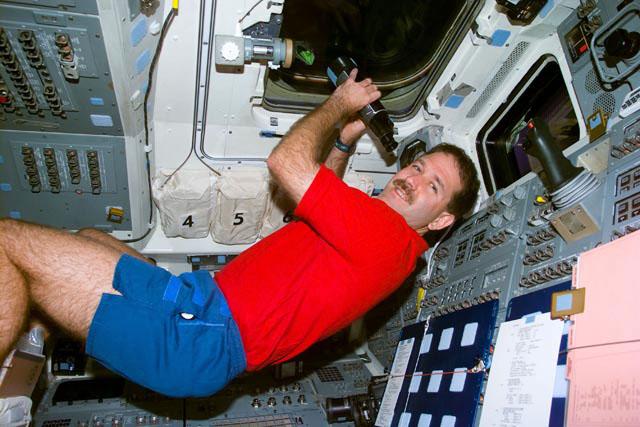
S103-E-5202 (21 Dec. 1999) --- Astronaut John M. Grunsfeld, uses a pair of binoculars to view the distant Hubble Space Telescope (HST) several hours prior to its capture by the Space Shuttle Discovery. The photo was taken with an electronic still camera (ESC) at 12:45.30 GMT, Dec. 21, 1999.
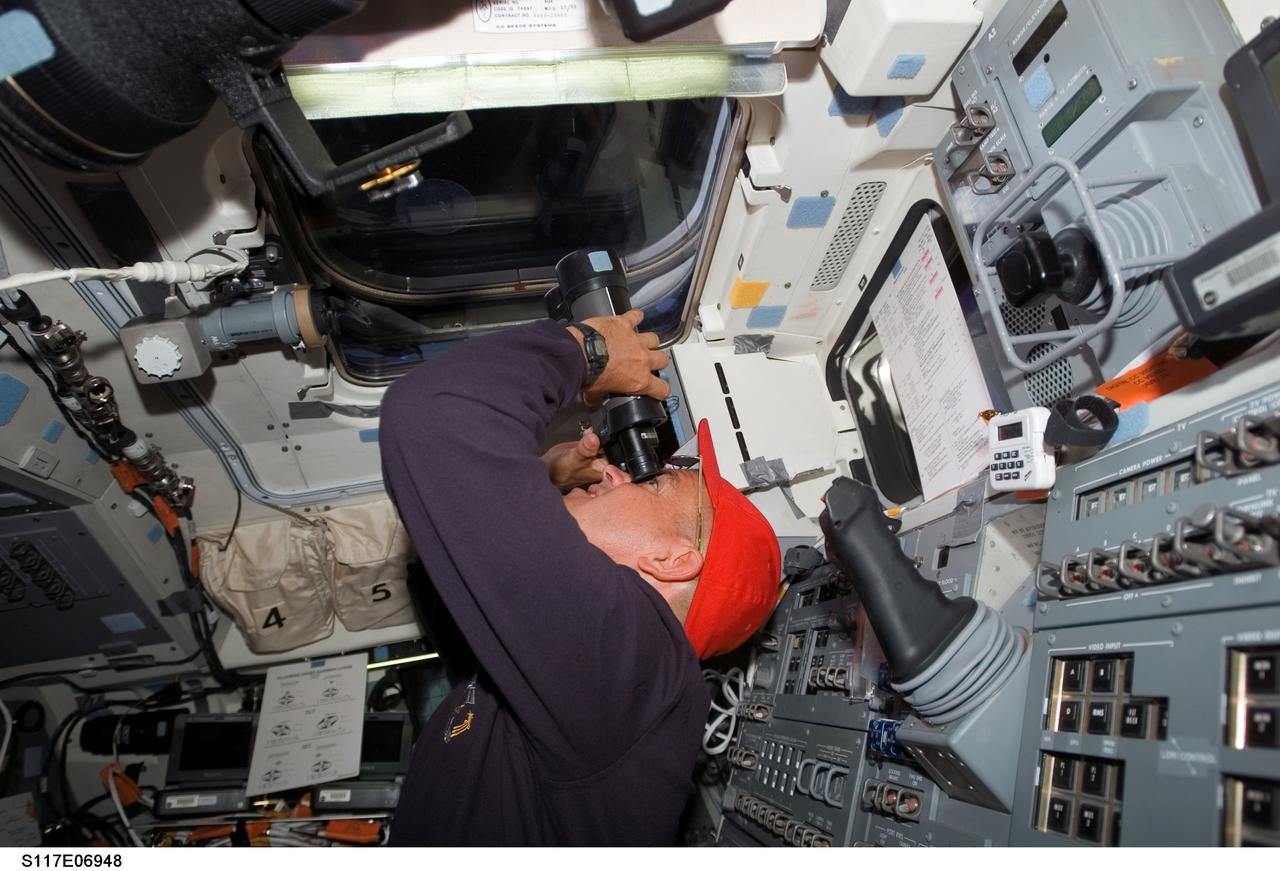
S117-E-06948 (10 June 2007) --- Astronaut Rick Sturckow, STS-117 commander, aims binoculars through one of the overhead windows on the aft flight deck of the Space Shuttle Atlantis as it approaches the International Space Station.
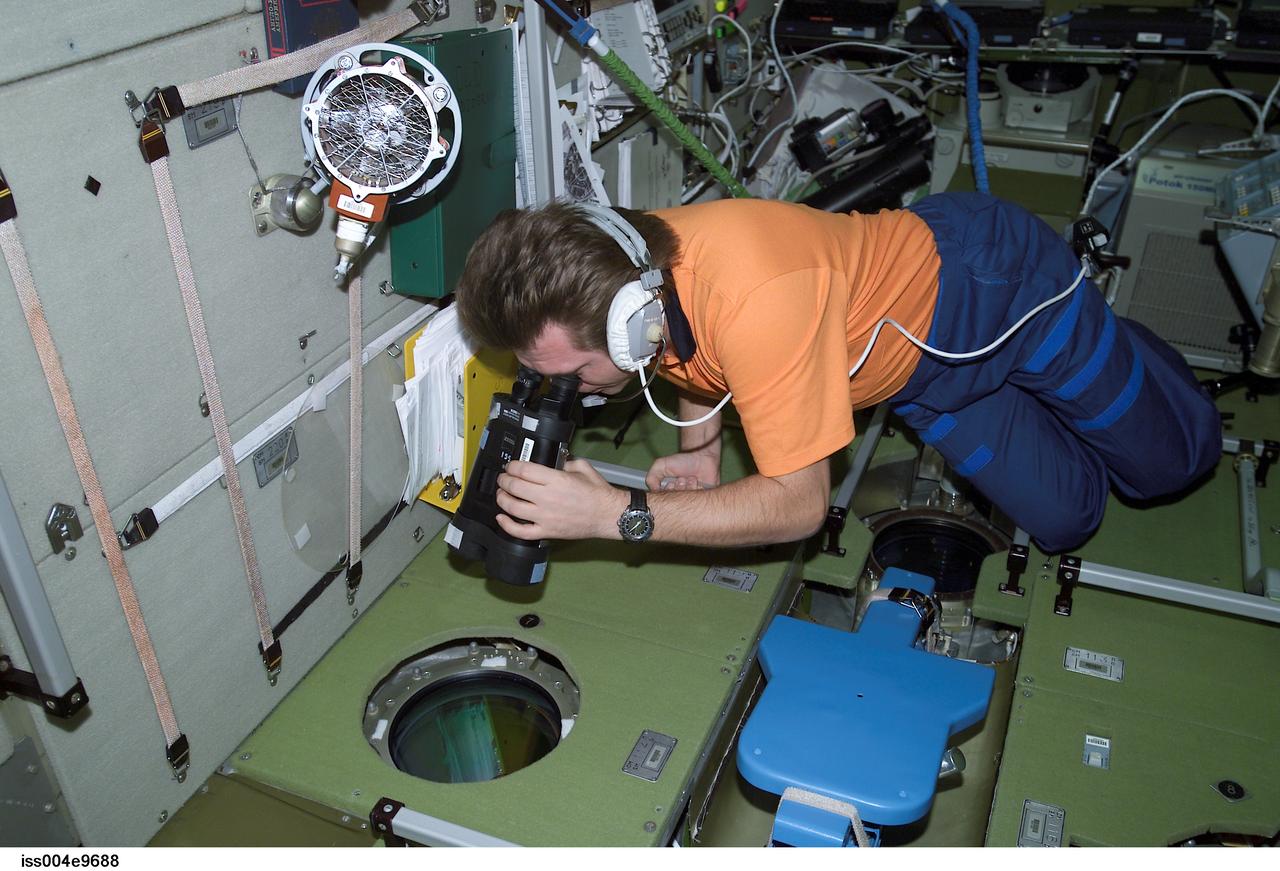
ISS004-E-9688 (24 March 2002) --- Cosmonaut Yury I. Onufrienko, Expedition Four mission commander, uses binoculars to look out a window in the Zvezda Service Module on the International Space Station (ISS). The crew anticipated the approach of a Progress supply vehicle about the time this image was taken.
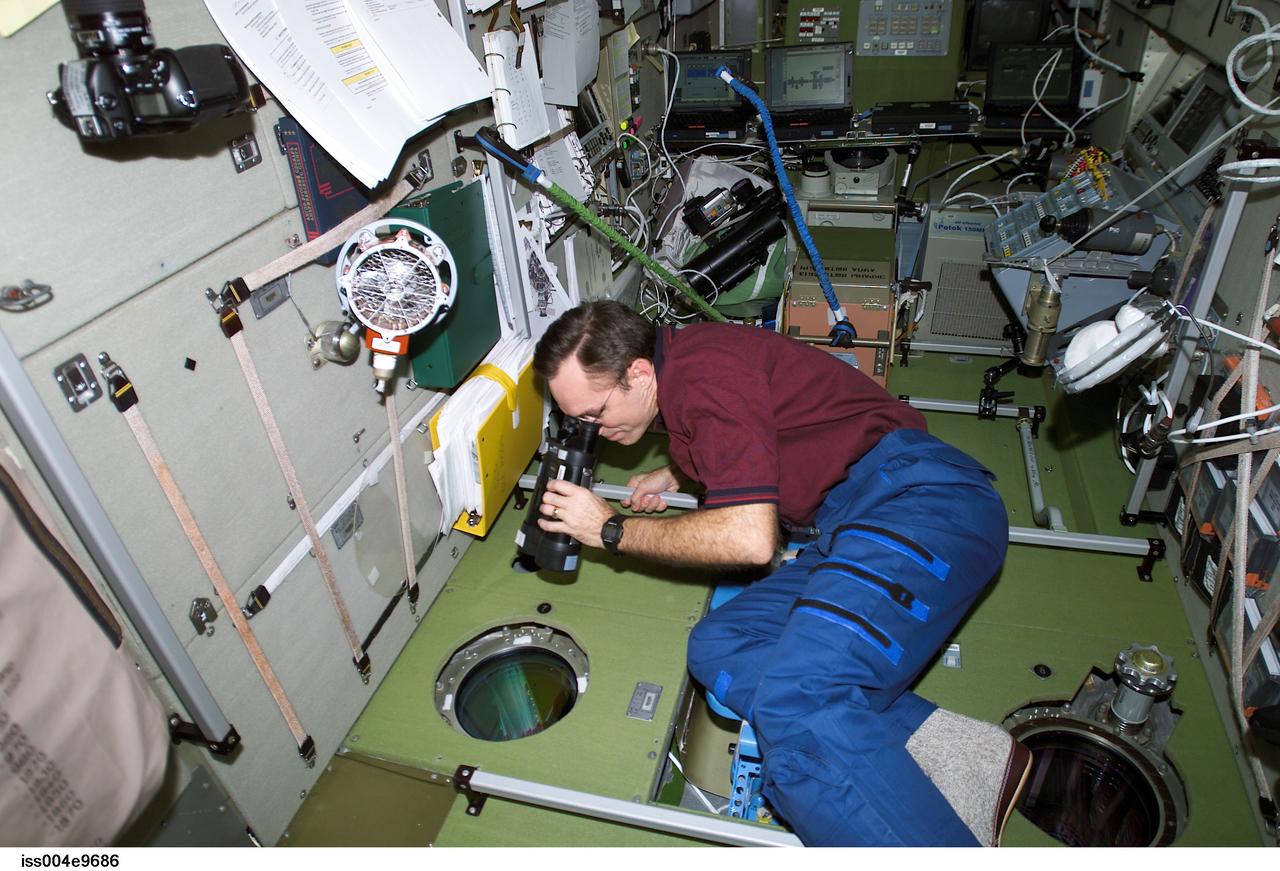
ISS004-E-9686 (24 March 2002) --- Astronaut Carl E. Walz, Expedition Four flight engineer, uses binoculars to look out a window in the Zvezda Service Module on the International Space Station (ISS). The crew anticipated the approach of a Progress supply vehicle about the time this image was taken.
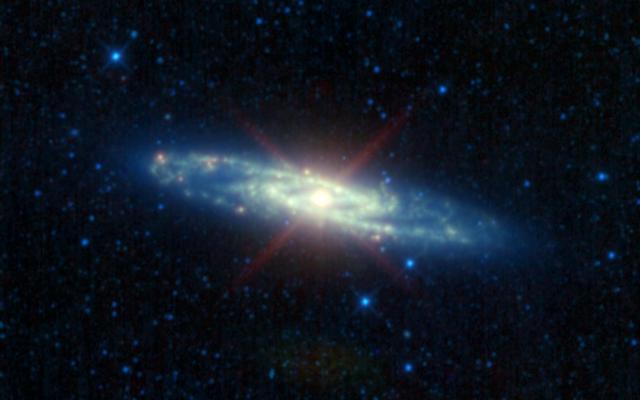
The Sculptor galaxy, or NGC 253, is seen in a rainbow of infrared colors in this mosaic by NASA Wide-field Infrared Survey Explorer. The Sculptor galaxy can be seen by observers in the southern hemisphere with a pair of good binoculars.
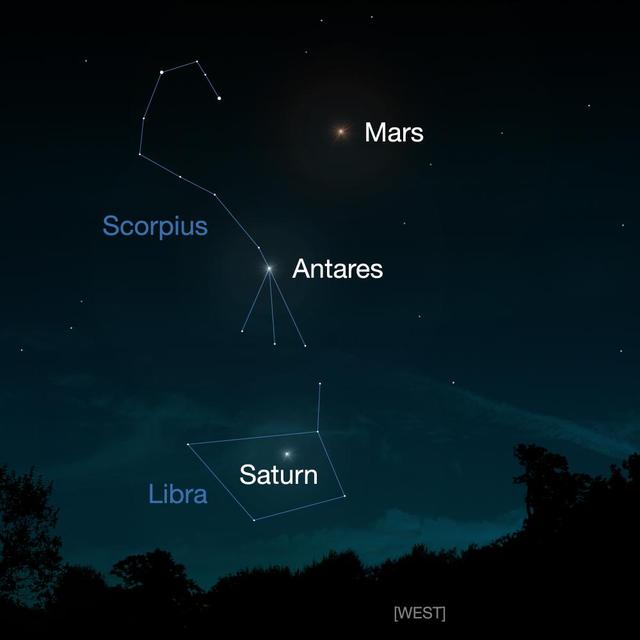
Comet Siding Spring will have a close approach to Mars on Oct. 19, 2014. This artist concept shows people in the Southern Hemisphere where to look for Mars in the night sky. Mars and the comet may be visible with binoculars.
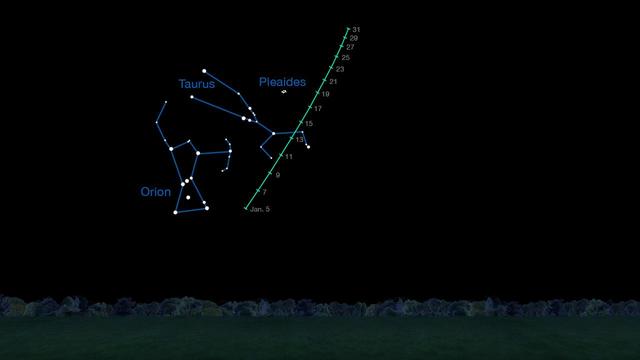
On clear nights in January 2015, comet C/2014 Q2 Lovejoy is visible in the Taurus region of the sky to observers using binoculars. This chart indicates where to look for it on different dates during the month.
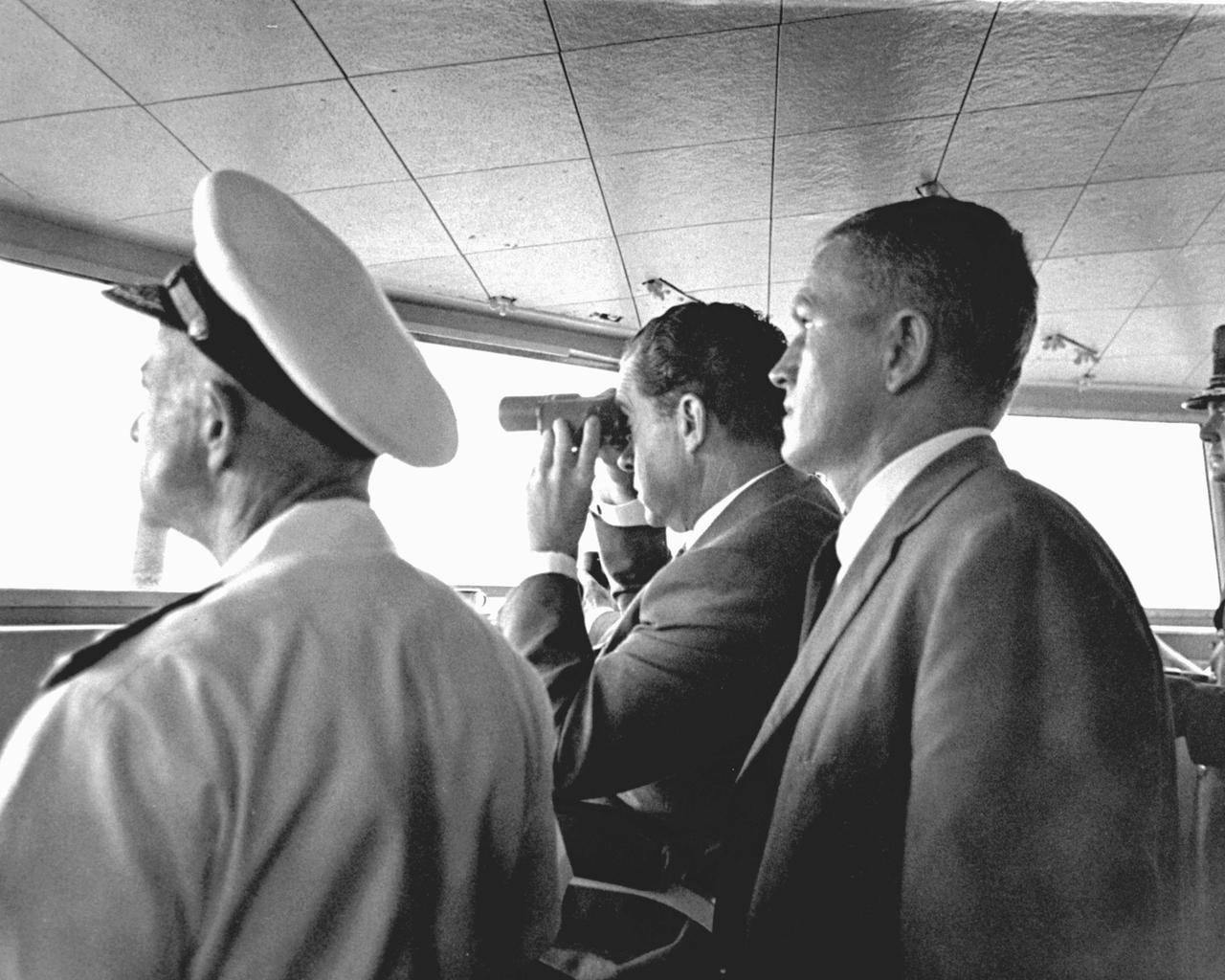
U.S. President Richard Milhous Nixon (center), aboard the U.S.S. Hornet aircraft carrier, used binoculars to watch the Apollo 11 Lunar Mission Recovery. Standing next to the President is astronaut Frank Borman, Apollo 8 Commander. The recovery operation took place in the Pacific Ocean where Navy para-rescue men recovered the capsule housing the 3-man Apollo 11 crew. The crew was airlifted to safety aboard the U.S.S. Hornet where they were quartered in a Mobile Quarantine Facility (MQF) for 21 days post mission. The Apollo 11 mission, the first manned lunar mission, launched from the Kennedy Space Center, Florida via the Saturn V launch vehicle on July 16, 1969 and safely returned to Earth on July 24, 1969. The Saturn V vehicle was developed by the Marshall Space Flight Center (MSFC) under the direction of Dr. Wernher von Braun. Aboard were Neil A. Armstrong, commander; Michael Collins, Command Module (CM) pilot; and Edwin E. Aldrin Jr., Lunar Module (LM) pilot. The CM, piloted by Michael Collins remained in a parking orbit around the Moon while the LM, named “Eagle’’, carrying astronauts Neil Armstrong and Edwin Aldrin, landed on the Moon. Armstrong was the first human to ever stand on the lunar surface, followed by Edwin (Buzz) Aldrin. During 2½ hours of surface exploration, the crew collected 47 pounds of lunar surface material for analysis back on Earth. With the success of Apollo 11, the national objective to land men on the Moon and return them safely to Earth had been accomplished.
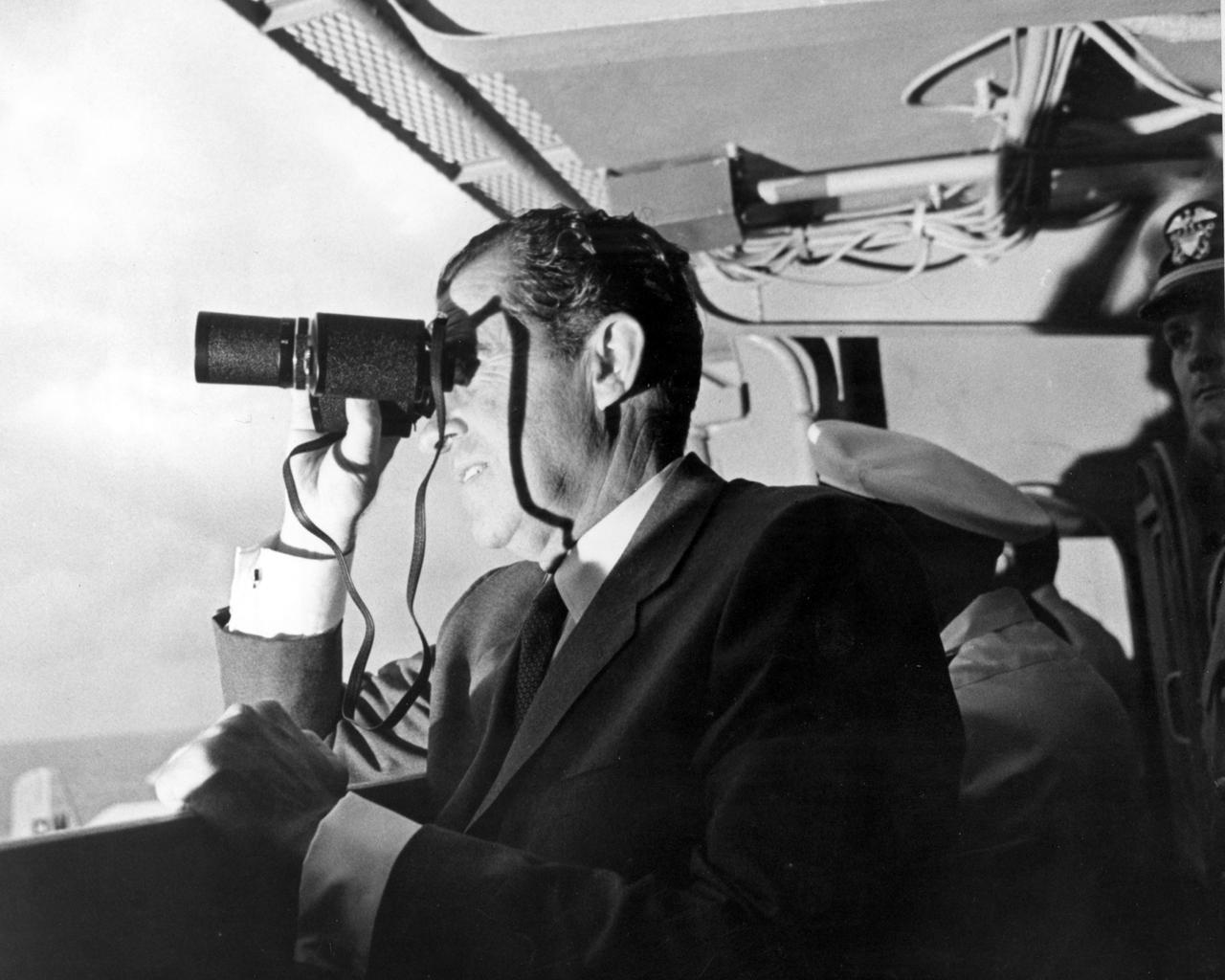
U.S. President Richard Milhous Nixon, aboard the U.S.S. Hornet aircraft carrier, used binoculars to watch the Apollo 11 Lunar Mission recovery. The recovery operation took place in the Pacific Ocean where Navy para-rescue men recovered the capsule housing the 3-man Apollo 11 crew. The crew was airlifted to safety aboard the U.S.S. Hornet, where they were quartered in a Mobile Quarantine Facility (MQF) for 21 days post mission. The Apollo 11 mission, the first manned lunar mission, launched from the Kennedy Space Center, Florida via the Saturn V launch vehicle on July 16, 1969 and safely returned to Earth on July 24, 1969. The Saturn V vehicle was developed by the Marshall Space Flight Center (MSFC) under the direction of Dr. Wernher von Braun. Aboard were Neil A. Armstrong, commander; Michael Collins, Command Module (CM) pilot; and Edwin E. Aldrin Jr., Lunar Module (LM) pilot. The CM, piloted by Michael Collins remained in a parking orbit around the Moon while the LM, named “Eagle’’, carrying astronauts Neil Armstrong and Edwin Aldrin, landed on the Moon. Armstrong was the first human to ever stand on the lunar surface, followed by Edwin (Buzz) Aldrin. During 2½ hours of surface exploration, the crew collected 47 pounds of lunar surface material for analysis back on Earth. With the success of Apollo 11, the national objective to land men on the Moon and return them safely to Earth had been accomplished.
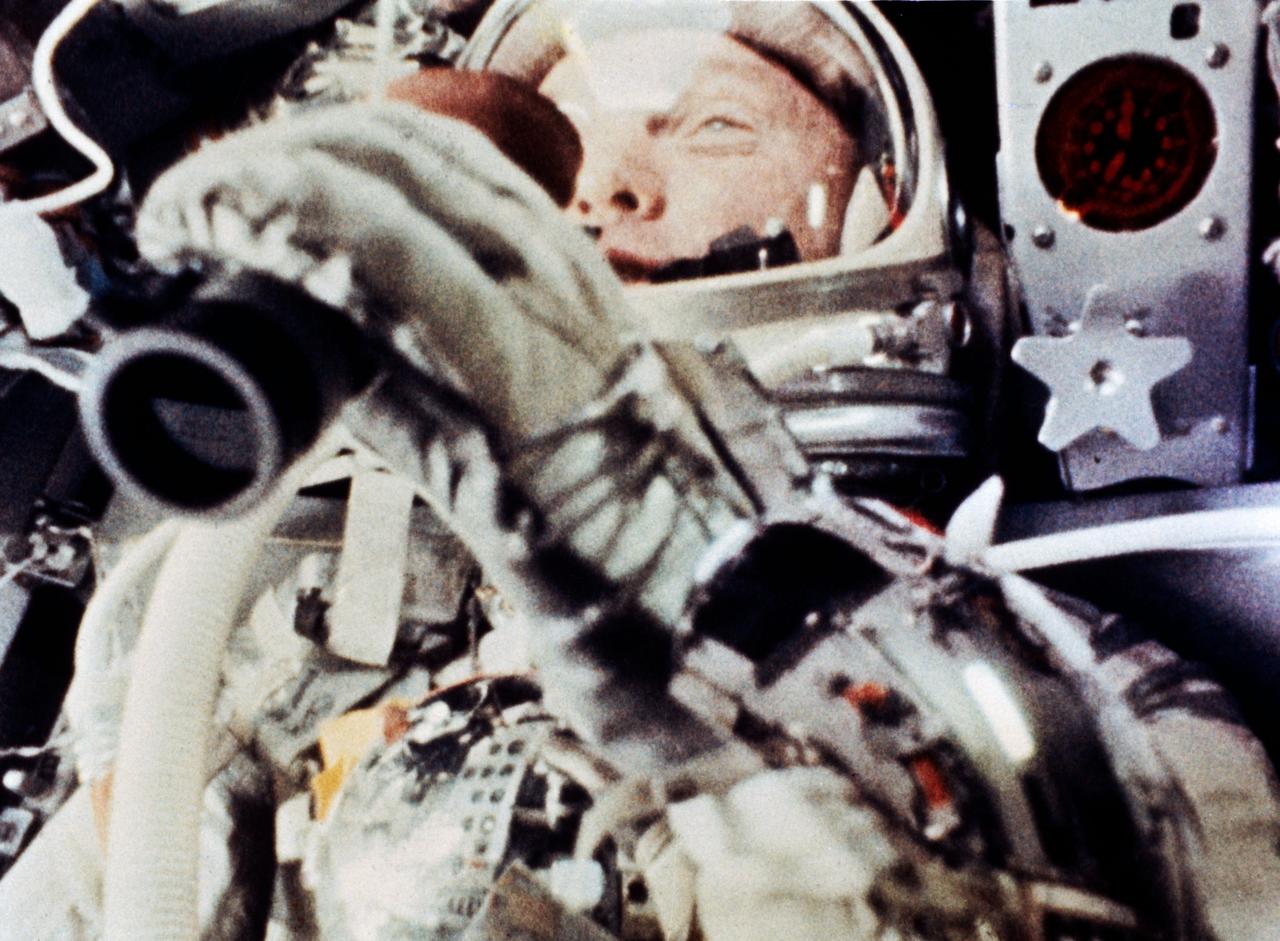
Astronaut John H. Glenn Jr. uses binoculars to view the Earth through the window of the Mercury-Atlas (MA-6) Friendship 7 capsule during the U.S.'s initial orbital flight.
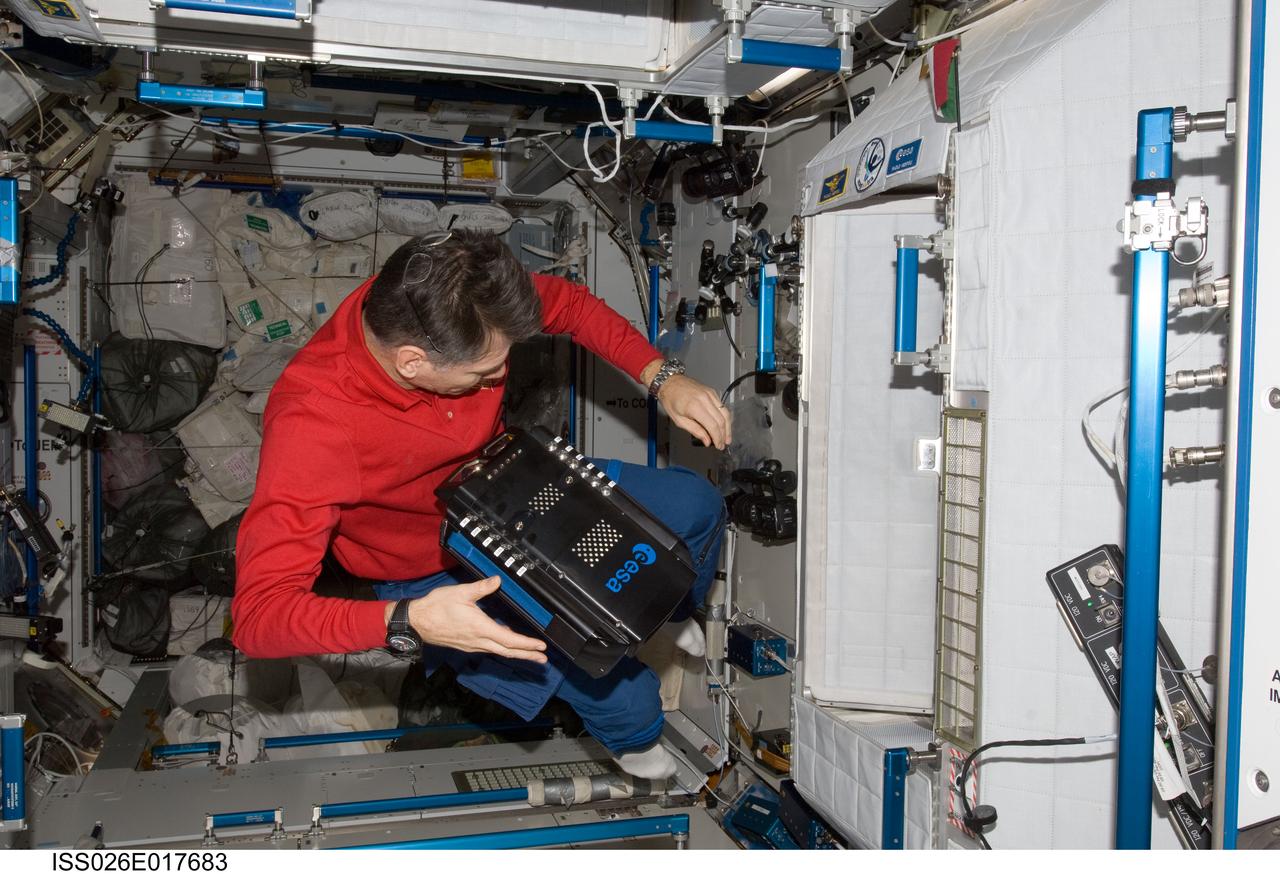
ISS026-E-017683 (8 Jan. 2011) --- European Space Agency astronaut Paolo Nespoli, Expedition 26 flight engineer, works with European Recording Binocular (ERB2) hardware in the Harmony node of the International Space Station.
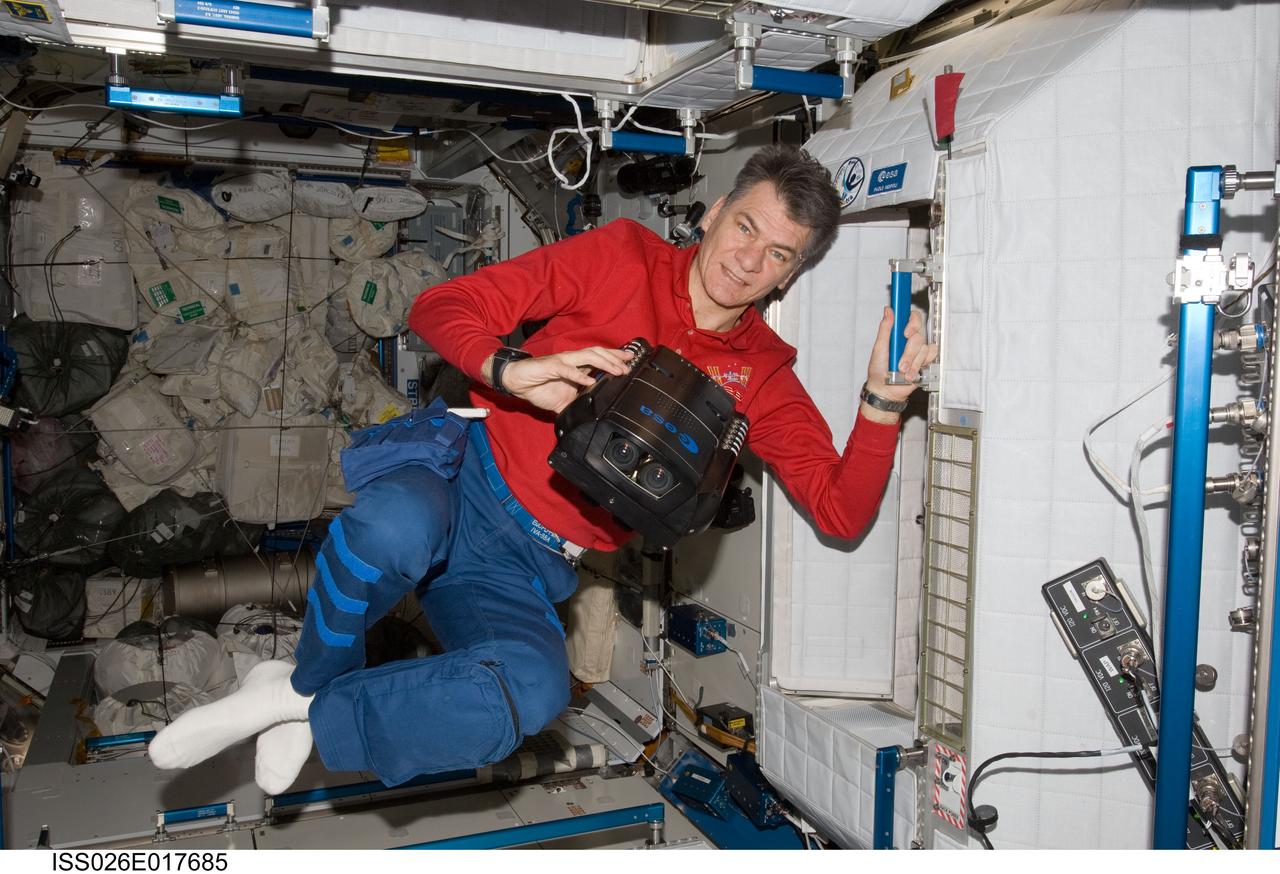
ISS026-E-017685 (8 Jan. 2011) --- European Space Agency astronaut Paolo Nespoli, Expedition 26 flight engineer, works with European Recording Binocular (ERB2) hardware in the Harmony node of the International Space Station.
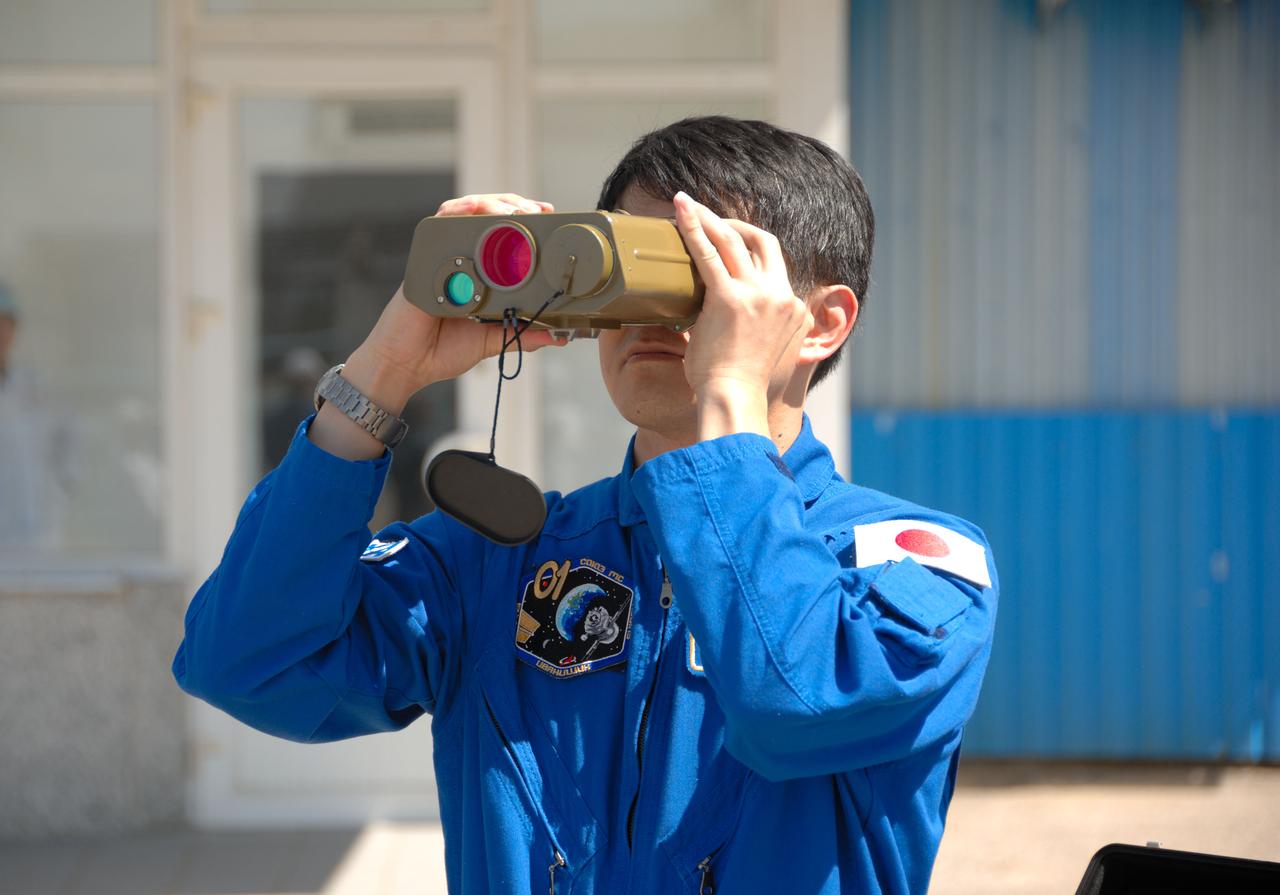
Outside the Integration Facility at the Baikonur Cosmodrome in Kazakhstan, Expedition 48-49 crewmember Takuya Onishi of the Japan Aerospace Exploration Agency tries out a pair of binoculars June 25 as he prepares for launch July 7, Baikonur time, on the Soyuz MS-01 spacecraft with Kate Rubins of NASA and Anatoly Ivanishin of Roscosmos for a planned four-month mission on the International Space Station. NASA/Alexander Vysotsky
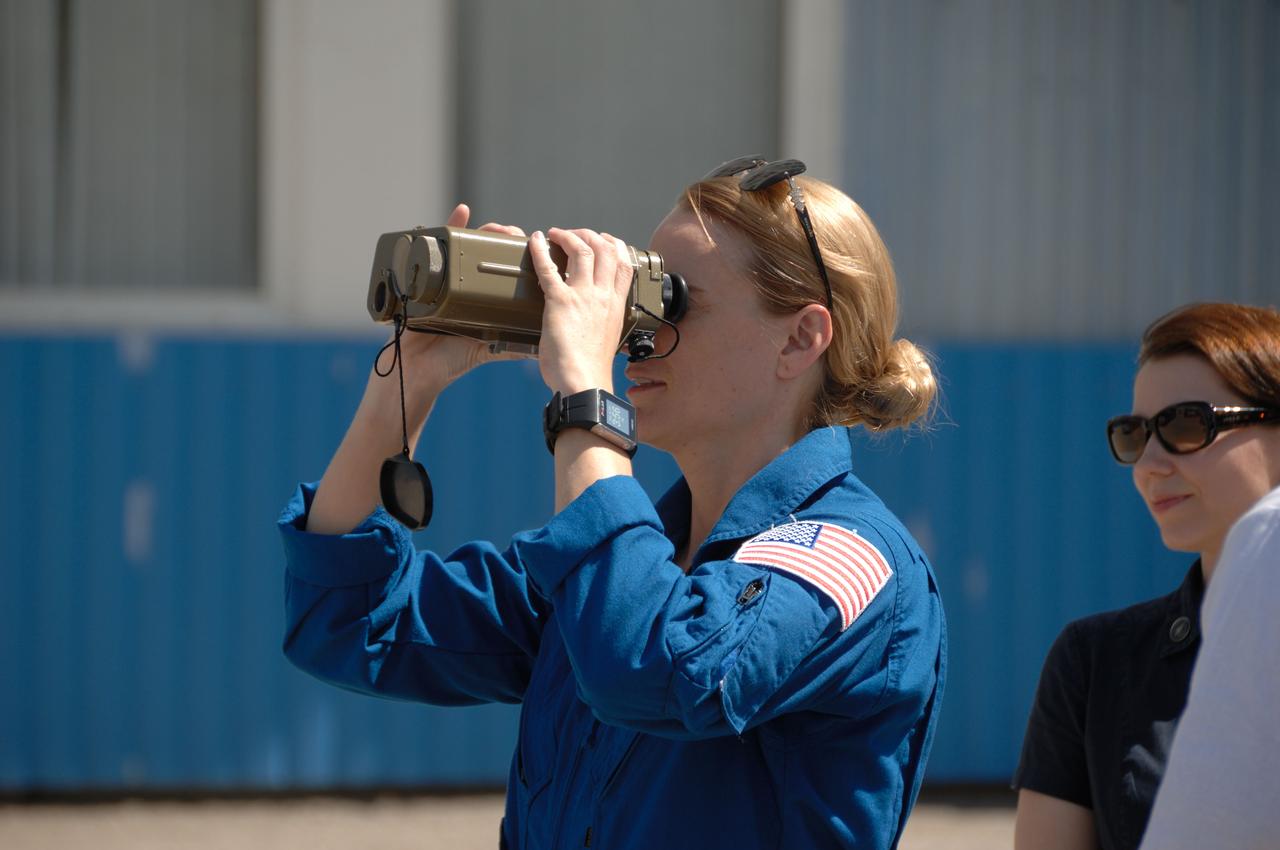
Outside the Integration Facility at the Baikonur Cosmodrome in Kazakhstan, Expedition 48-49 crewmember Kate Rubins of NASA tries out a pair of binoculars June 25 as she prepares for launch July 7, Baikonur time, on the Soyuz MS-01 spacecraft with Takuya Onishi of the Japan Aerospace Exploration Agency and Anatoly Ivanishin of Roscosmos for a planned four-month mission on the International Space Station. NASA/Alexander Vysotsky
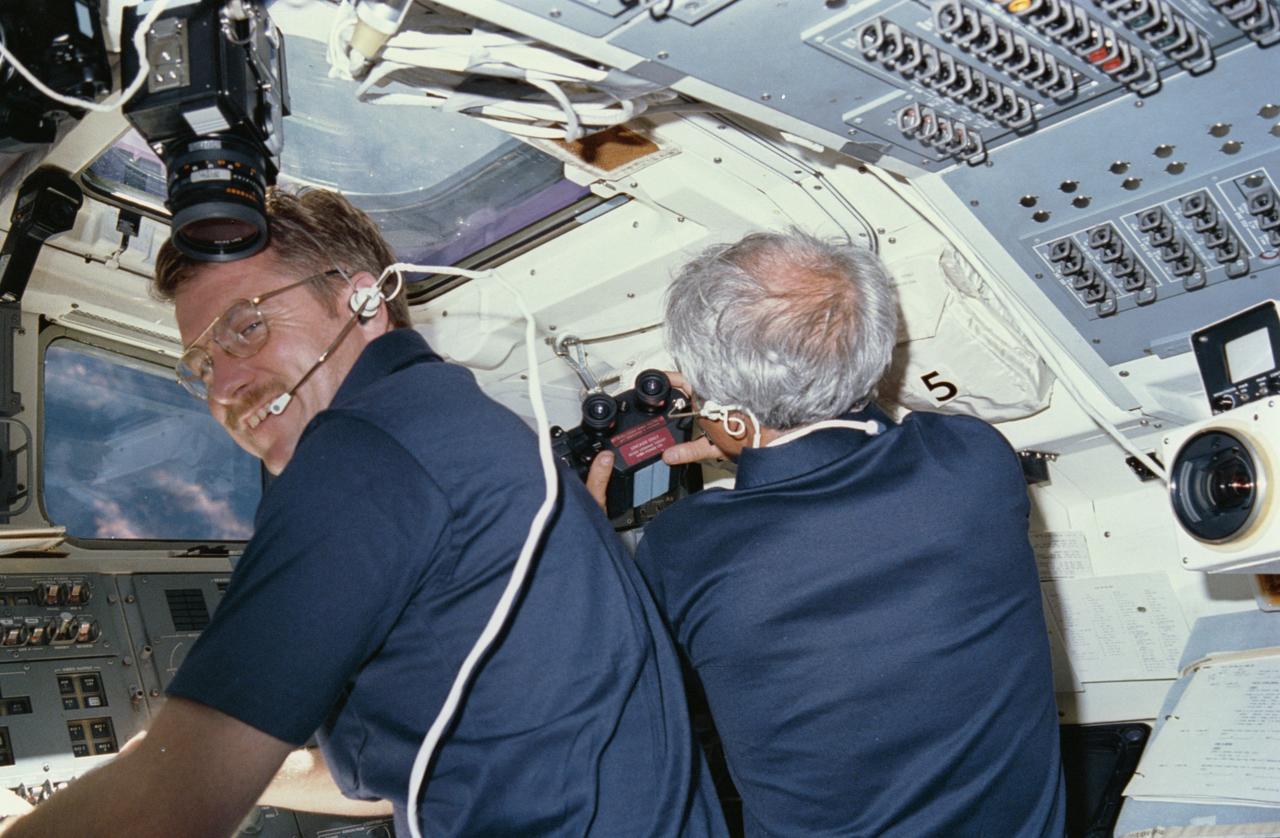
51F-05-003 (29 July-6 Aug 1985) --- Astronaut Anthony W. England, 51-F mission specialist, talks to ground controllers in Houston from the flight deck of the Earth-orbiting Challenger while Payload Specialist John-David Bartoe prepares to use binoculars through aft flight deck windows.
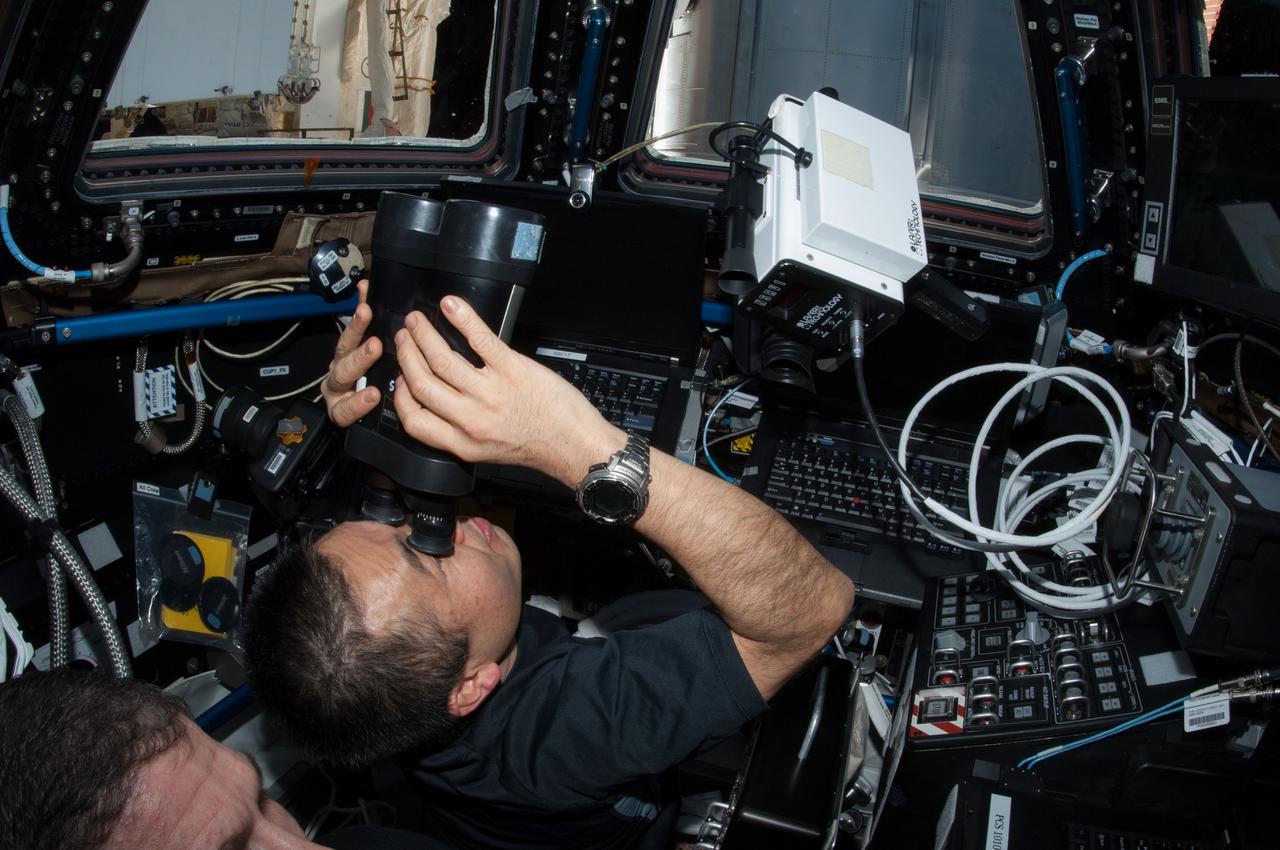
ISS038-E-027307 (11 Jan. 2014) --- Japan Aerospace Exploration Agency astronaut Koichi Wakata, Expedition 38 flight engineer, uses binoculars at the windows in the Cupola of the International Space Station while watching the approach of the Orbital Sciences Corp. Cygnus commercial cargo craft.
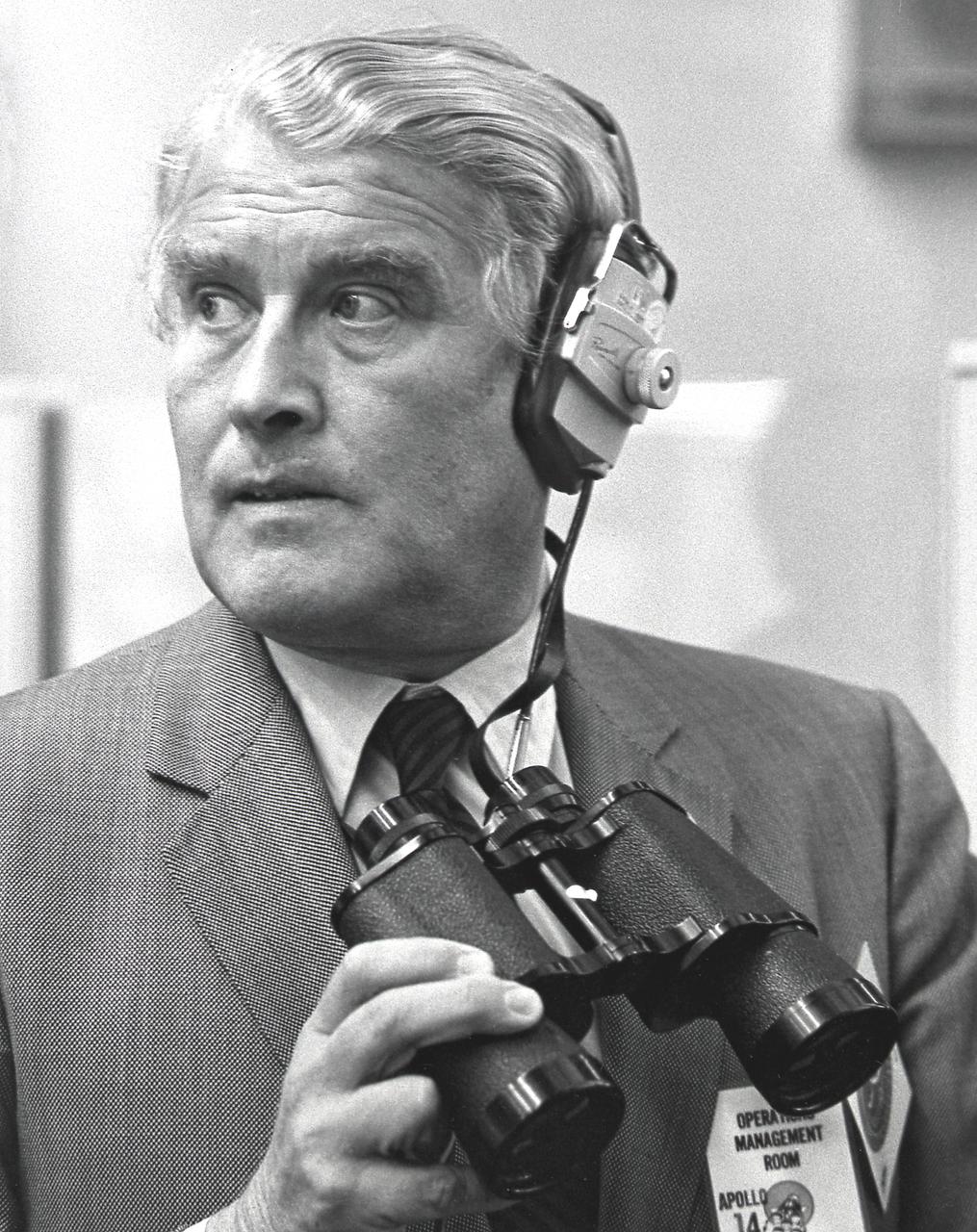
Dr. Wernher von Braun, NASA Deputy Associate Administrator for Future Programs, uses binoculars to monitor data on the closed-circuit TV screen in the Firing Room of the Launch Control Center at Kennedy Space Center (KSC) during the final preparation for the Apollo 14 launch.
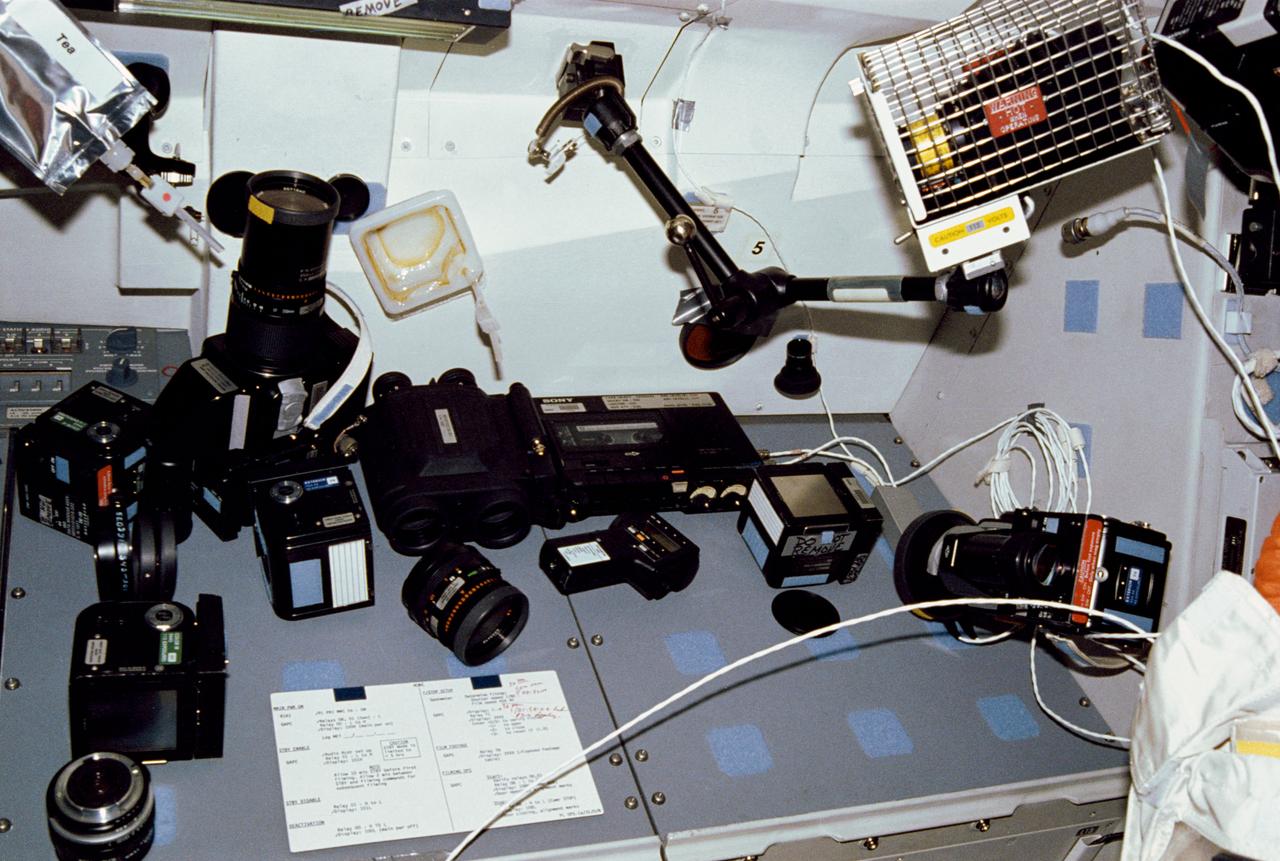
This array of photographic equipment, displayed on the aft flight deck payload station, represents just a part of the imaging and recording hardware which was carried aboard Discovery, Orbiter Vehicle (OV) 103, for STS-31's five day mission. Lenses, film magazines, cassettes, recorders, camera chassis, a pair of binoculars, spot meter, tape recorder, and a bracket-mounted light fixture are included among the array.
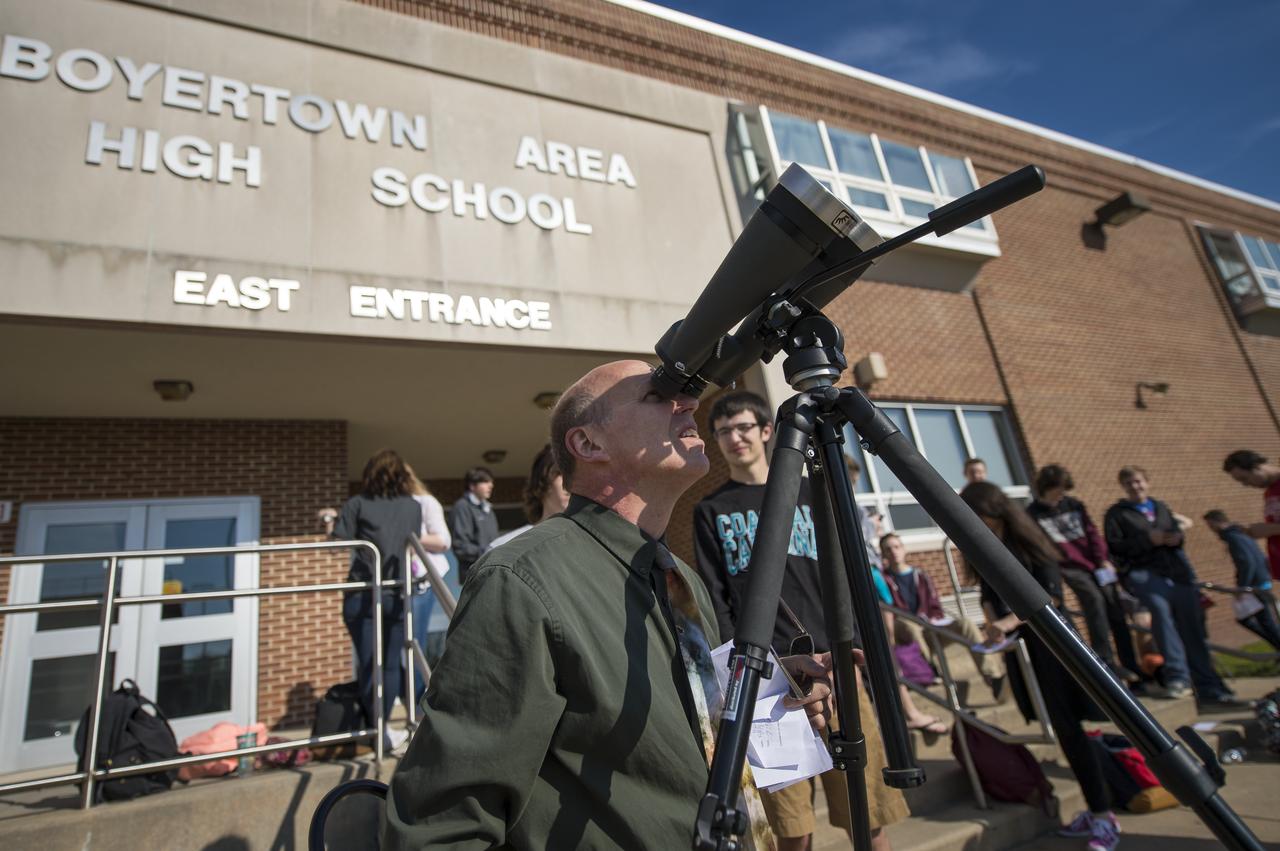
Boyertown Area High School astronomy teacher Peter Detterline prepares high powered binoculars with a solar filter so that his students may view the planet Mercury as it transits across the face of the sun , Monday, May 9, 2016, Boyertown Area High School, Boyertown, Pennsylvania. Mercury passes between Earth and the sun only about 13 times a century, with the previous transit taking place in 2006. Photo Credit: (NASA/Bill Ingalls)
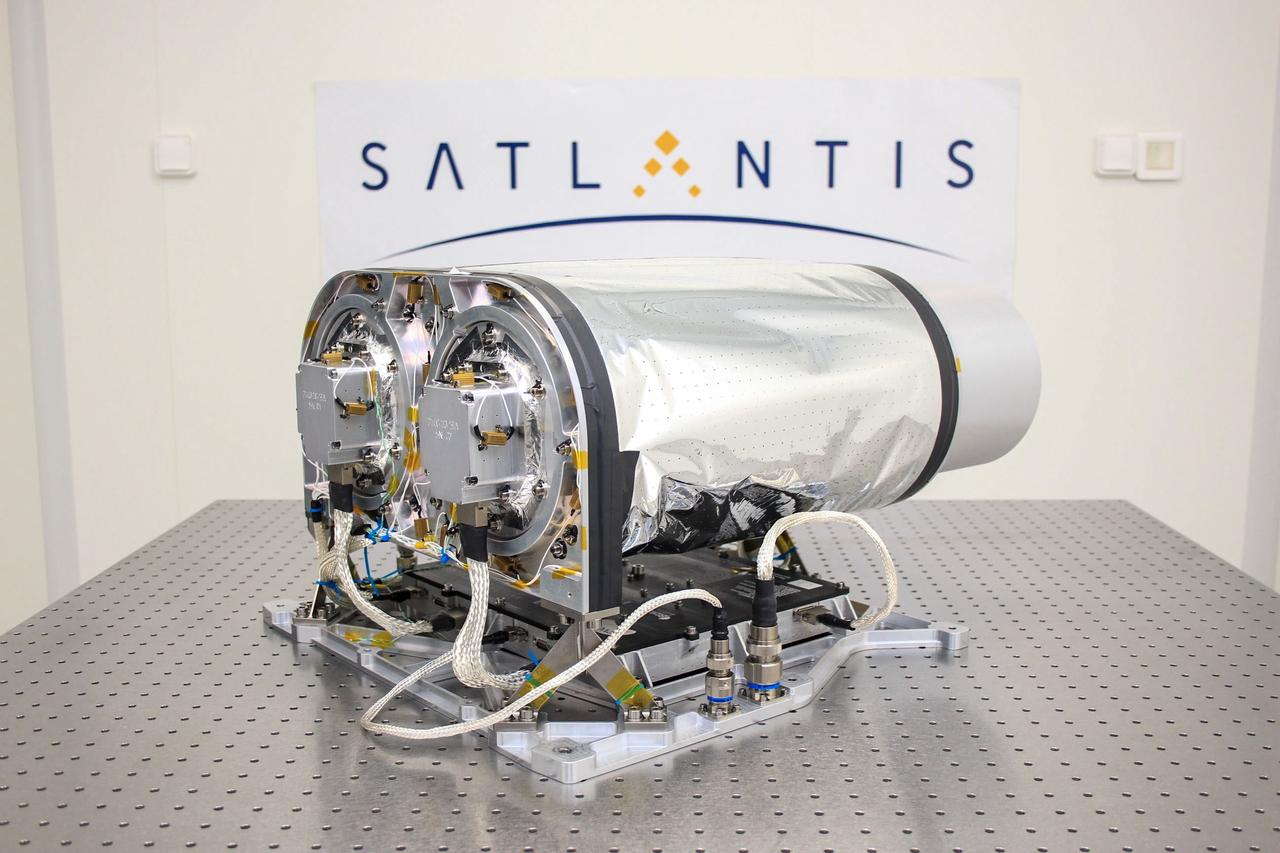
jsc2019e062141 910/16/2019) --- Preflight back view of the iSIM IOD flight unit. The iSIM, integrated Standard Imager for Microsatellites developed by SATLANTIS is a new generation High-Resolution optical payload binocular telescope for Earth observation, the design combines class leading performance, via the utilization of cutting-edge technologies, significantly reduced build times and a new level of affordability. This combination approach will provide industries and governments with the ability to acquire and access unparalleled high-resolution data. Image courtesy of: SATLANTIS
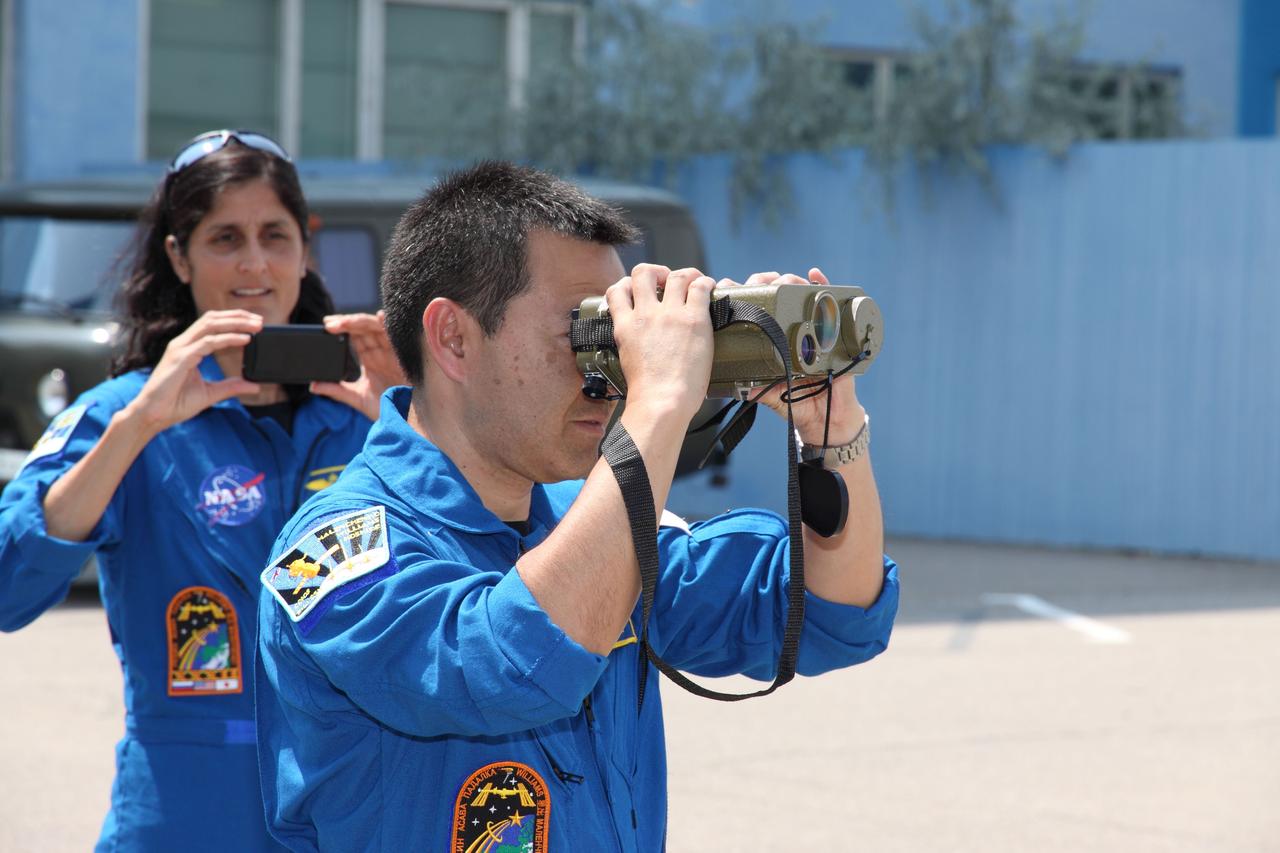
With Expedition 32/33 Flight Engineer Sunita Williams playing the role of photographer, her crewmate, Flight Engineer Aki Hoshide of the Japan Aerospace Exploration Agency checks out binoculars as part of their training at the Baikonur Cosmodrome in Kazakhstan July 3, 2012 that will lead to their launch July 15 with Soyuz Commander Yuri Malenchenko to the International Space Station. NASA/Victor Zelentsov
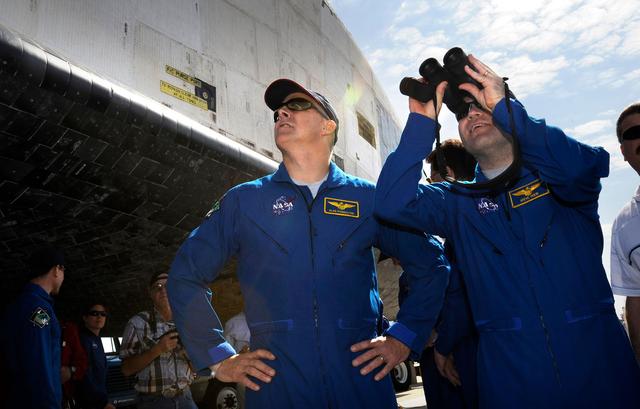
STS-122 Mission Commander Steve Frick, right, and Pilot Alan Poindexter use a pair of binoculars to inspect the outside of the space shuttle Atlantis. Atlantis landed at the Shuttle Landing Facility, 9:07a.m., Wednesday, Feb. 20, 2008 at Kennedy Space Center, Fla. completing delivery of the European Space Agency’s (ESA) Columbus laboratory to the International Space Station. Photo Credit: (NASA/Bill Ingalls)
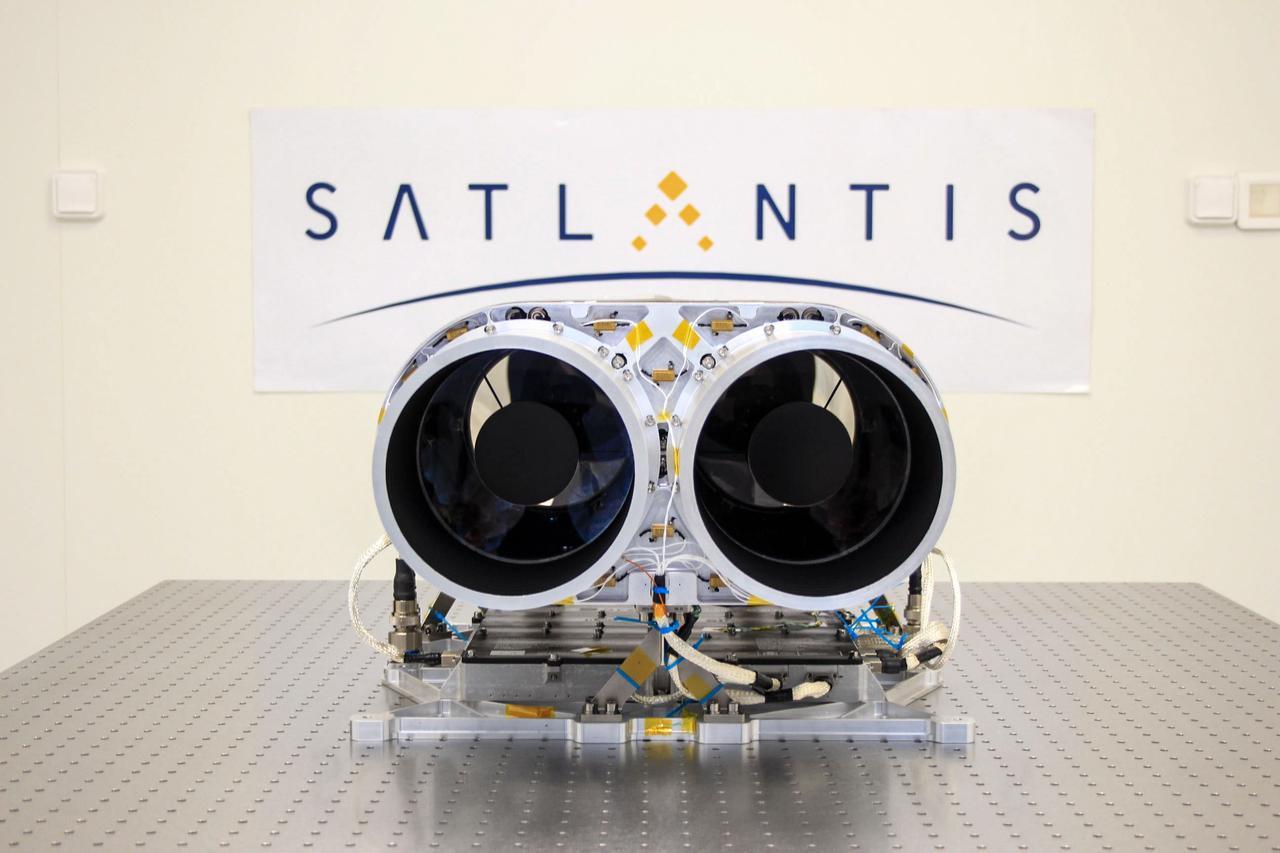
jsc2019e062139 910/16/2019) --- Preflight view of the iSIM IOD flight unit. The iSIM, integrated Standard Imager for Microsatellites developed by SATLANTIS is a new generation High-Resolution optical payload binocular telescope for Earth observation, the design combines class leading performance, via the utilization of cutting-edge technologies, significantly reduced build times and a new level of affordability. This combination approach will provide industries and governments with the ability to acquire and access unparalleled high-resolution data. Image courtesy of: SATLANTIS
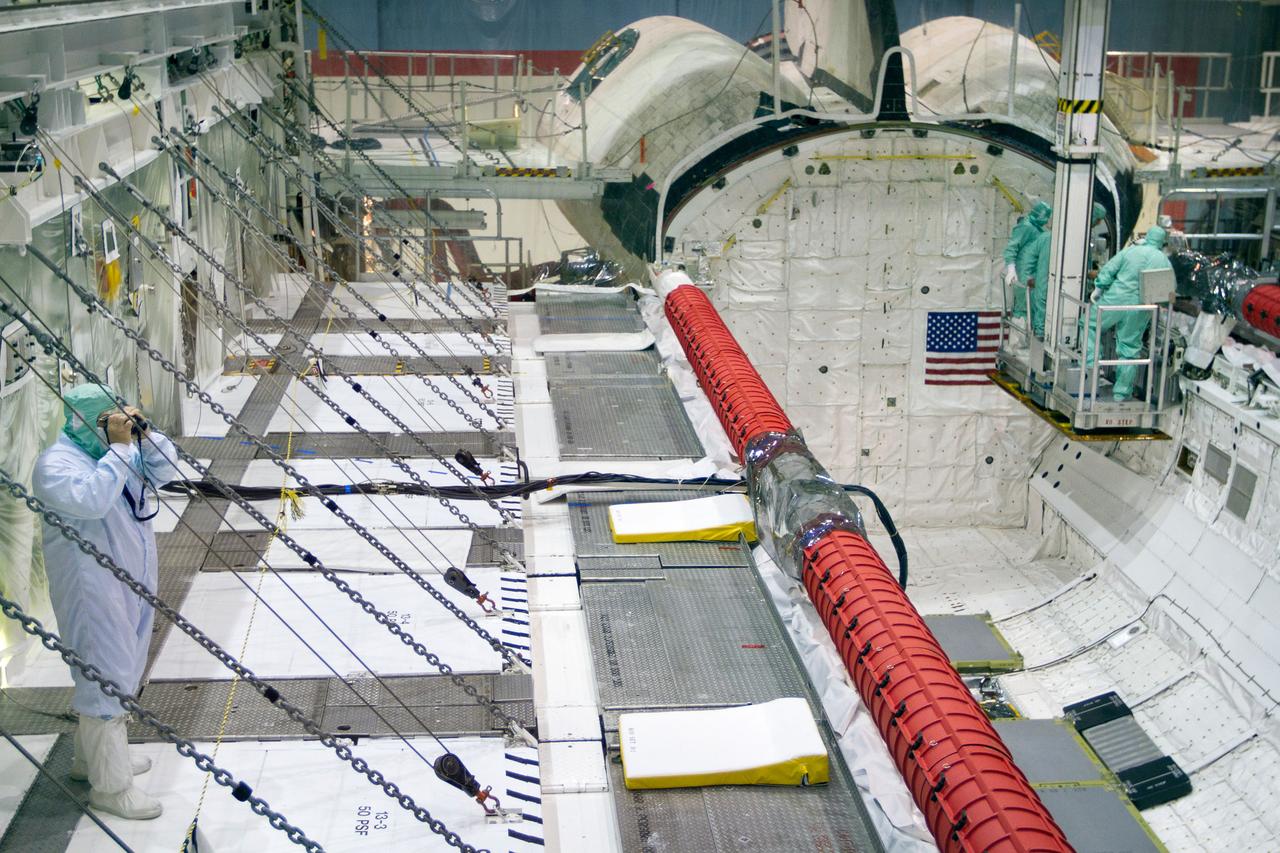
JSC2011-E-040348 (7 April 2011) --- A technician uses binoculars to look over the space shuttle Atlantis as the crew of STS-135 uses a basket/carrier to inspect Atlantis' payload bay during the STS-135 Crew Equipment Interface Test (CEIT) at NASA?s Kennedy Space Center, Florida on April 7, 2011. Photo credit: NASA Photo/Houston Chronicle, Smiley N. Pool
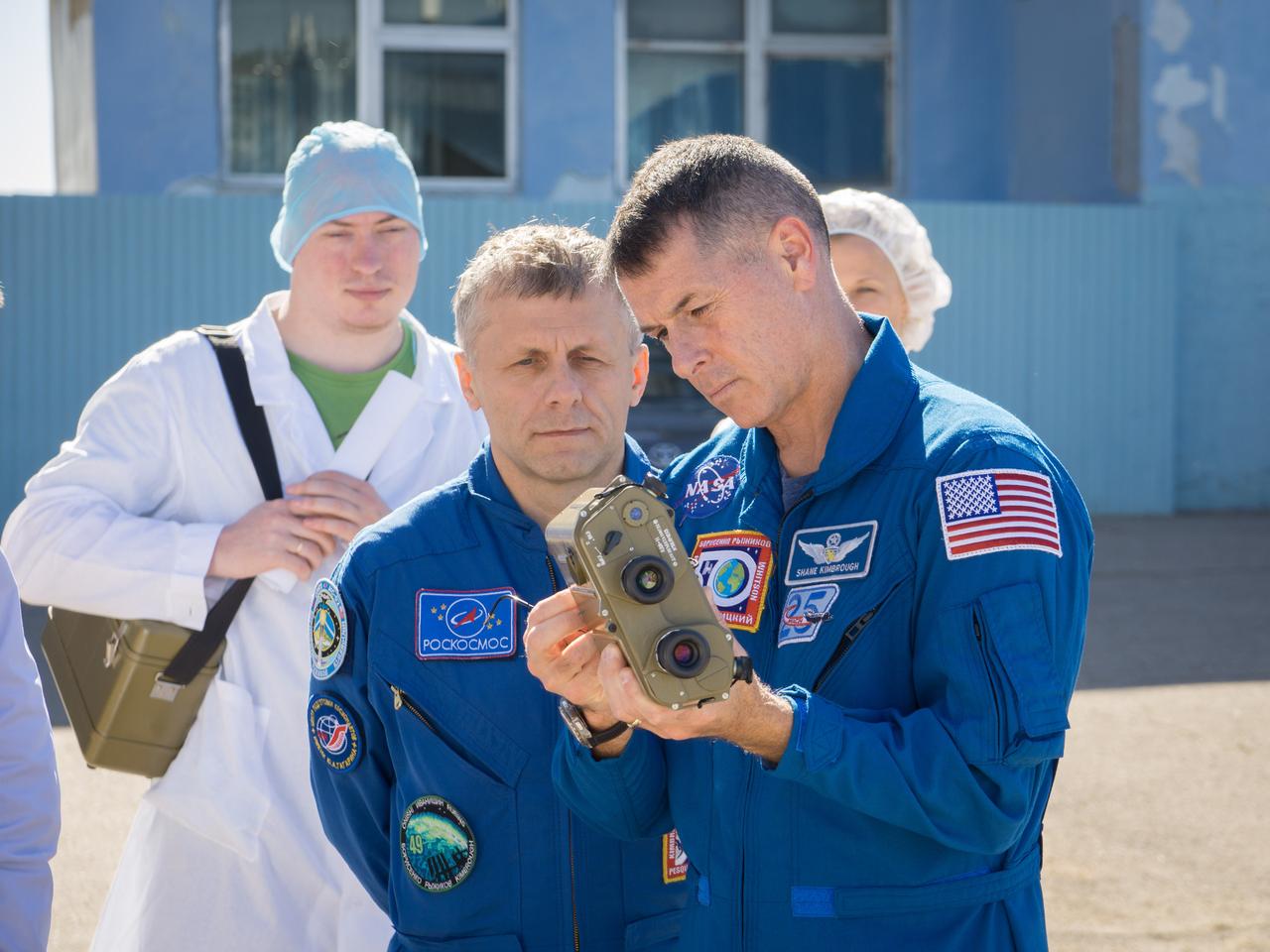
At the Integration Facility at the Baikonur Cosmodrome in Kazakhstan, Expedition 49 crewmember Shane Kimbrough of NASA (right) tests a pair of binoculars Sept. 9 as part of pre-launch training. Looking on is crewmate Andrey Borisenko of Roscosmos. Kimbrough, Borisenko and Sergey Ryzhikov of Roscosmos will launch Sept. 24, Kazakh time on the Soyuz MS-02 vehicle for a five-month mission on the International Space Station. NASA/Victor Zelentsov
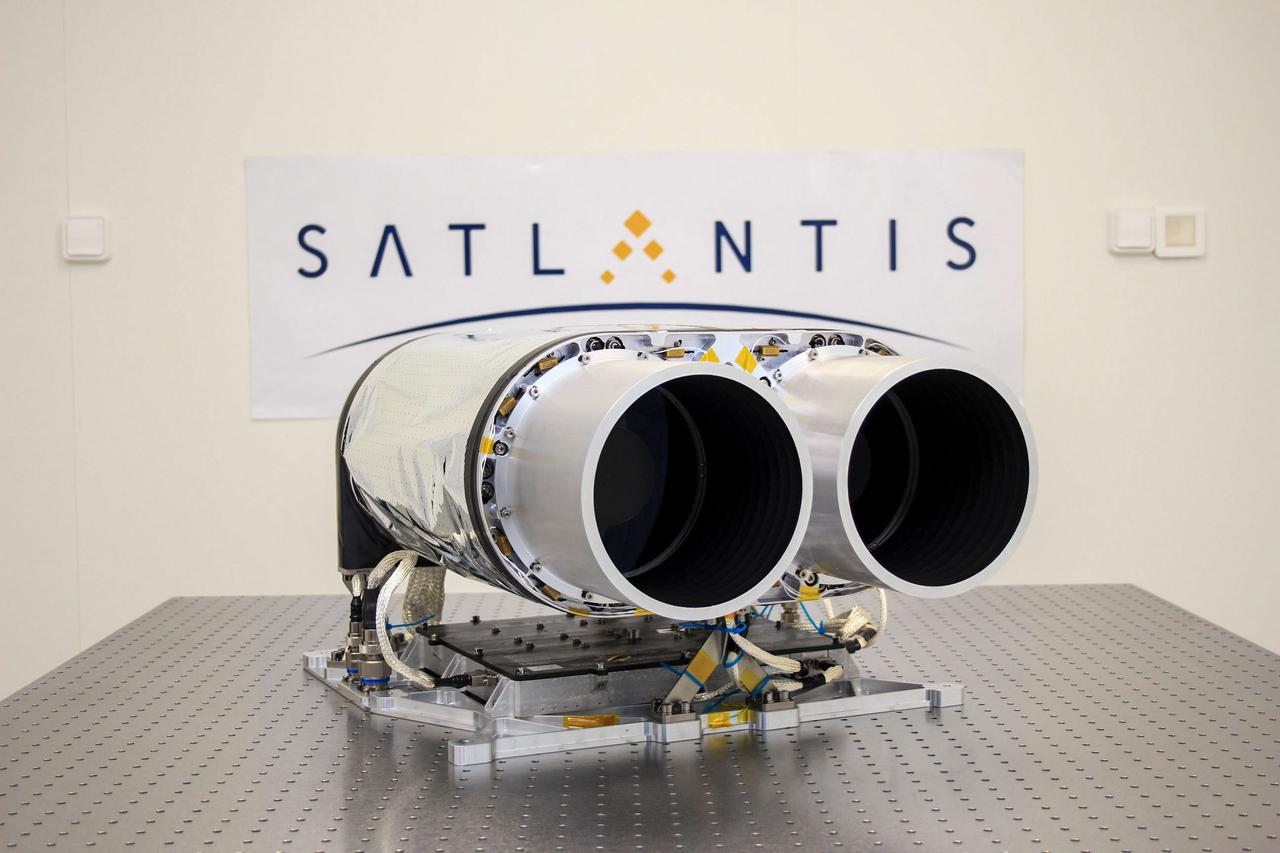
jsc2019e062140 (10/16/2019) --- Preflight Side view of the iSIM-IOD flight unit. The iSIM, integrated Standard Imager for Microsatellites developed by SATLANTIS is a new generation High-Resolution optical payload binocular telescope for Earth observation, the design combines class leading performance, via the utilization of cutting-edge technologies, significantly reduced build times and a new level of affordability. This combination approach will provide industries and governments with the ability to acquire and access unparalleled high-resolution data. Image courtesy of: SATLANTIS
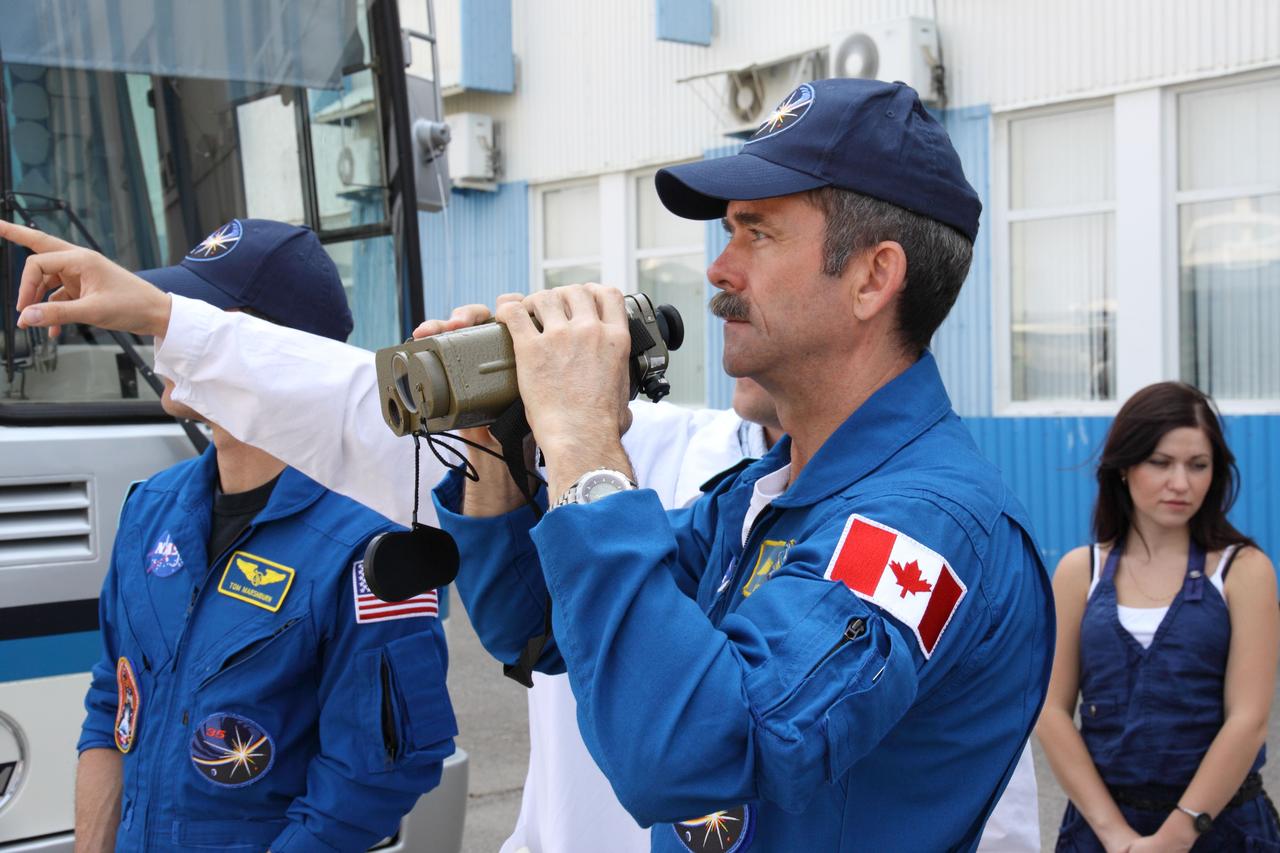
At the Baikonur Cosmodrome in Kazakhstan, Canadian Space Agency Flight Engineer Chris Hadfield, one of the members of the Expedition 32/33 backup crew, tests out binoculars July 3, 2012 as part of the pre-launch training that will lead to the launch of the prime crew, Yuri Malenchenko, Sunita Williams of NASA and Aki Hoshide of the Japan Aerospace Exploration Agency on July 15 to the International Space Station on the Soyuz TMA-05M spacecraft. NASA/Victor Zelentsov
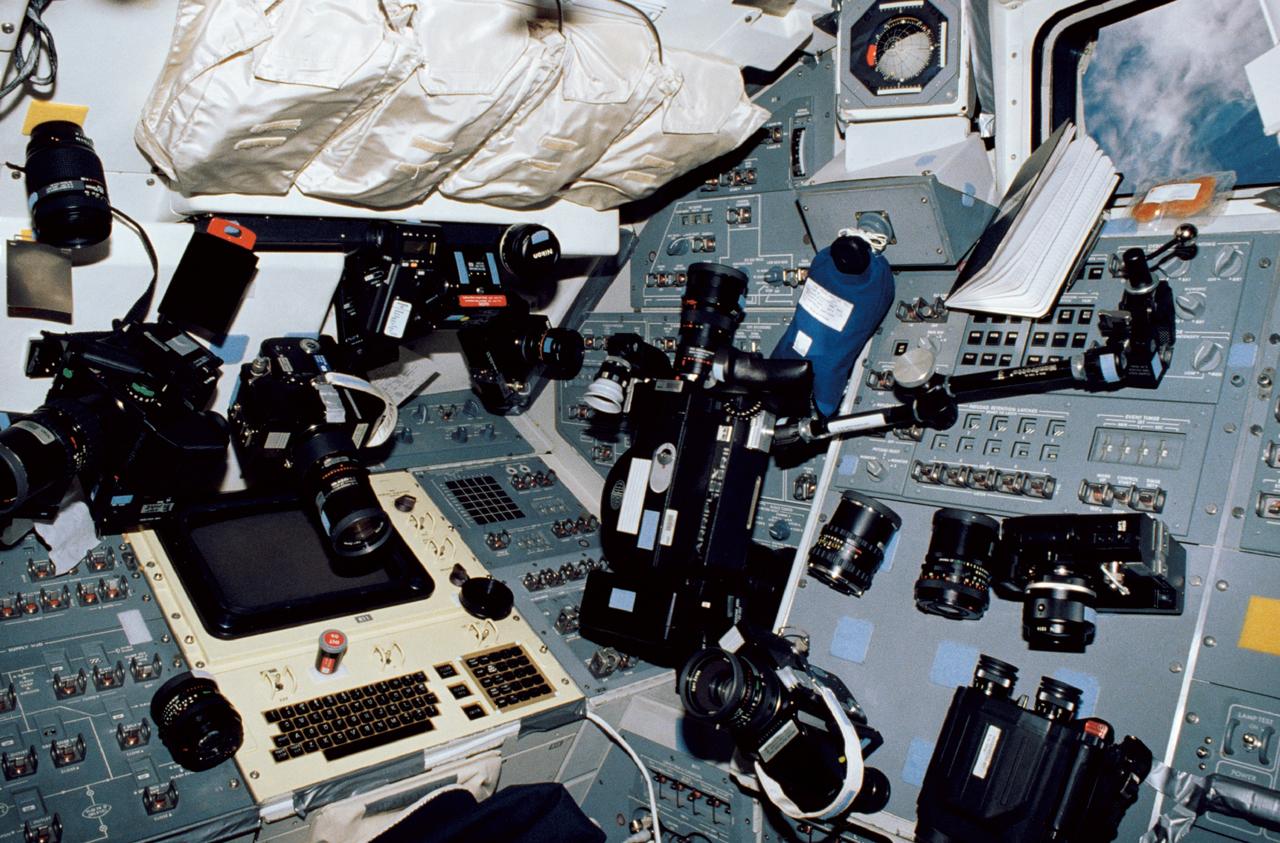
STS035-10-015 (2-10 Dec 1990) --- This busy scene shows cameras and supportive photographic gear temporarily stowed on Space Shuttle Columbia's aft flight deck. It was photographed with a 35mm camera by astronaut Jeffrey A. Hoffman, mission specialist, who called the cluster a "camera forest." The seven STS-35 crewmembers trained to record a wide variety of imagery with an equally broad range of equipment. In addition to cameras, a spot meter, film, a pair of binoculars, a bracket, lenses, lens cleaner and other photographic equipment are in the scene. Clouds over ocean waters are framed by an aft flight deck window at upper right.
![2014-03-14-16-31-24-2[1] Outside the Integration Facility at the Baikonur Cosmodrome in Kazakhstan, Expedition 39/40 Flight Engineer Steve Swanson of NASA (left) and Flight Engineer Oleg Artemyev of the Russian Federal Space Agency (Roscosmos; right) discuss the use of binoculars and GPS equipment March 14 during a “fit check” dress rehearsal that is part of the crew’s final training. Swanson, Artemyev and Soyuz Commander Alexander Skvortsov Roscosmos are scheduled to launch to the International Space Station March 26 (Kazakh time) for the start of a six-month mission. NASA/Victor Zelentsov](https://images-assets.nasa.gov/image/jsc2014e026286/jsc2014e026286~medium.jpg)
2014-03-14-16-31-24-2[1] Outside the Integration Facility at the Baikonur Cosmodrome in Kazakhstan, Expedition 39/40 Flight Engineer Steve Swanson of NASA (left) and Flight Engineer Oleg Artemyev of the Russian Federal Space Agency (Roscosmos; right) discuss the use of binoculars and GPS equipment March 14 during a “fit check” dress rehearsal that is part of the crew’s final training. Swanson, Artemyev and Soyuz Commander Alexander Skvortsov Roscosmos are scheduled to launch to the International Space Station March 26 (Kazakh time) for the start of a six-month mission. NASA/Victor Zelentsov
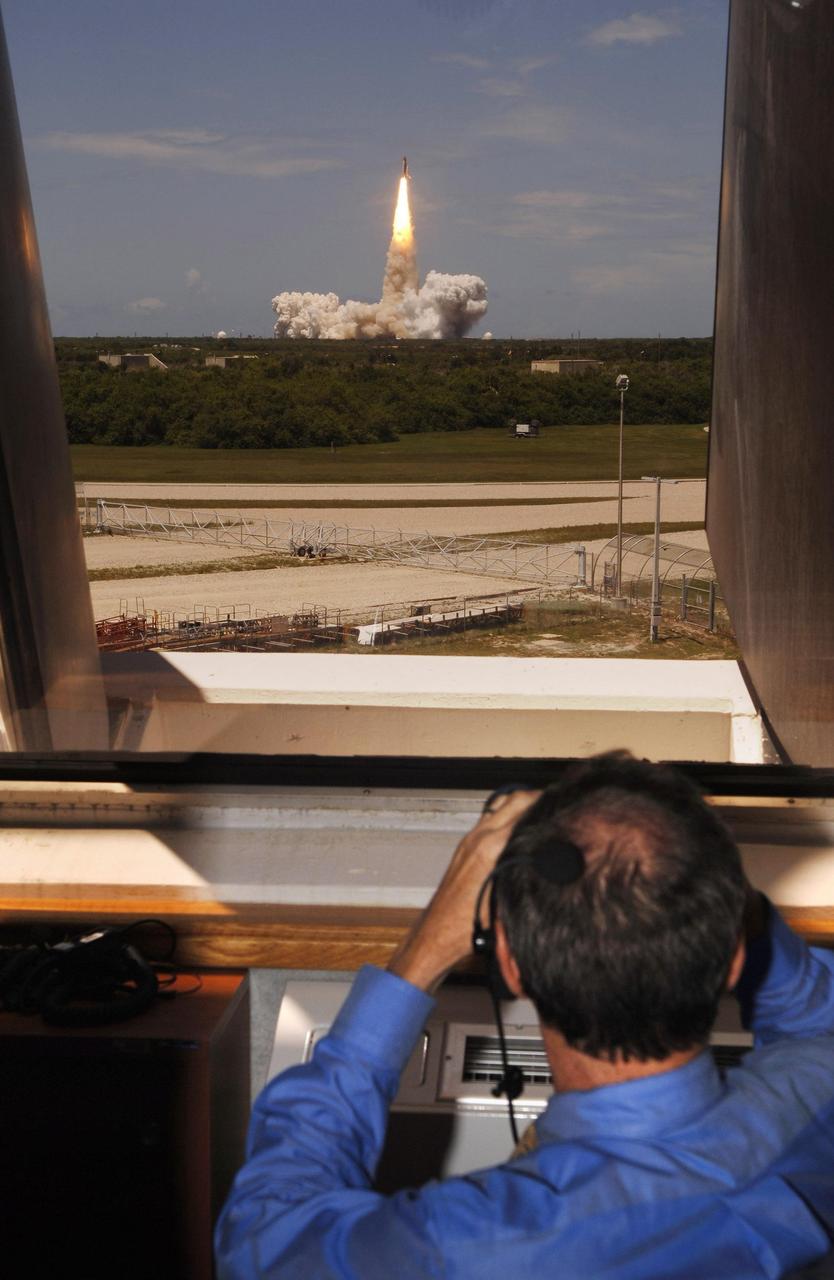
KENNEDY SPACE CENTER, FLA. - From Firing Room 4 of the Launch Control Center, NASA Administrator Mike Griffin uses binoculars to view of the launch of Space Shuttle Discovery (in the background) on mission STS-121. The launch made history as the first to occur on Independence Day. Liftoff was on-time at 2:38 p.m. EDT. During the 12-day mission, the STS-121 crew of seven will test new equipment and procedures to improve shuttle safety, as well as deliver supplies and make repairs to the International Space Station. Landing is scheduled for July 16 or 17 at Kennedy's Shuttle Landing Facility. Photo credit: NASA/Bill Ingalls
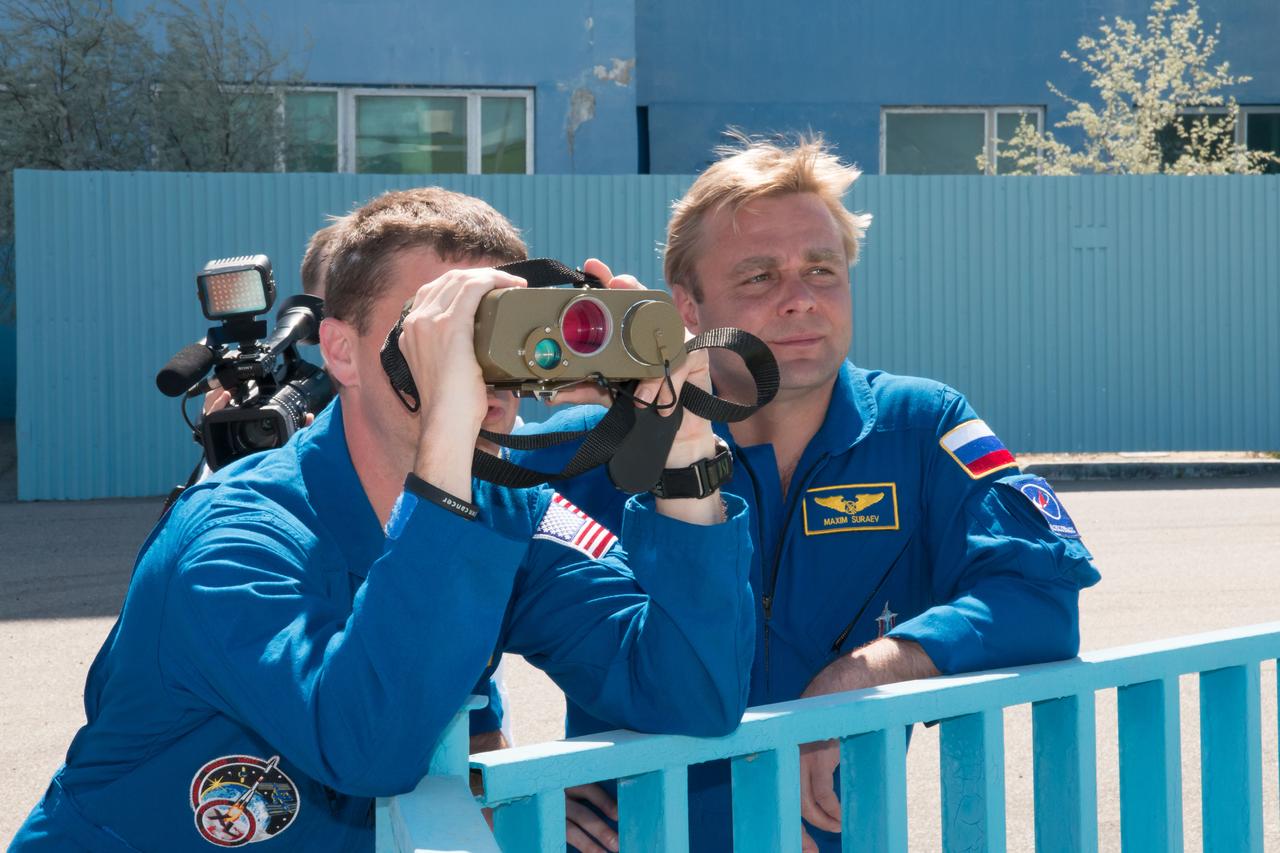
15-49-09: At the Baikonur Cosmodrome in Kazakhstan, Expedition 40/41 Flight Engineer Reid Wiseman of NASA (left) peers through high-powered binoculars during a training session May 16 as Soyuz Commander Max Suraev of the Russian Federal Space Agency (Roscosmos, right) looks on. Wiseman, Suraev and Flight Engineer Alexander Gerst of the European Space Agency will launch from Baikonur on May 29, Kazakh time, on the Soyuz TMA-13M spacecraft for a 5 ½ month mission on the International Space Station. NASA/Victor Zelentsov
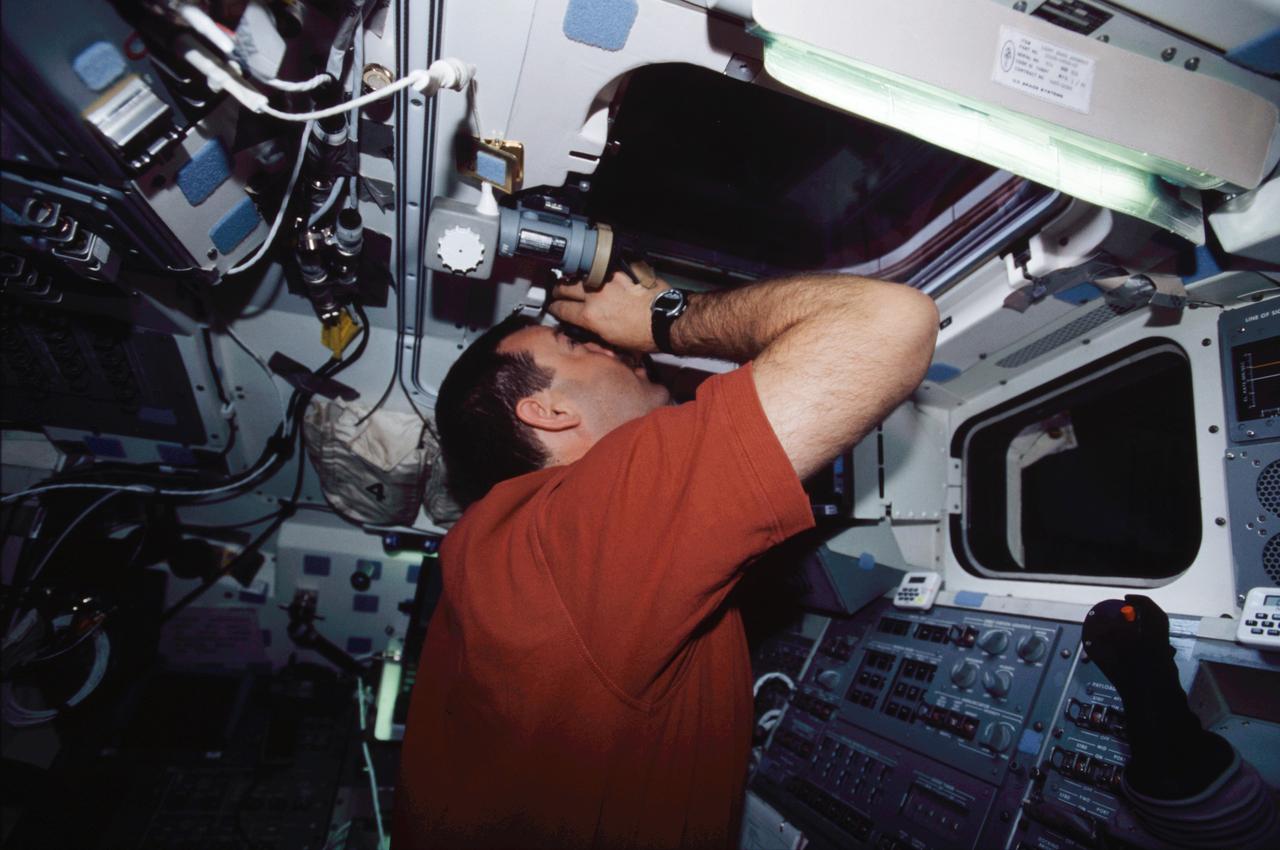
STS109-346-002 (1-12 March 2002) --- Astronaut Scott D. Altman, STS-109 mission commander, looks out an overhead window on the aft flight deck of the Space Shuttle Columbia.
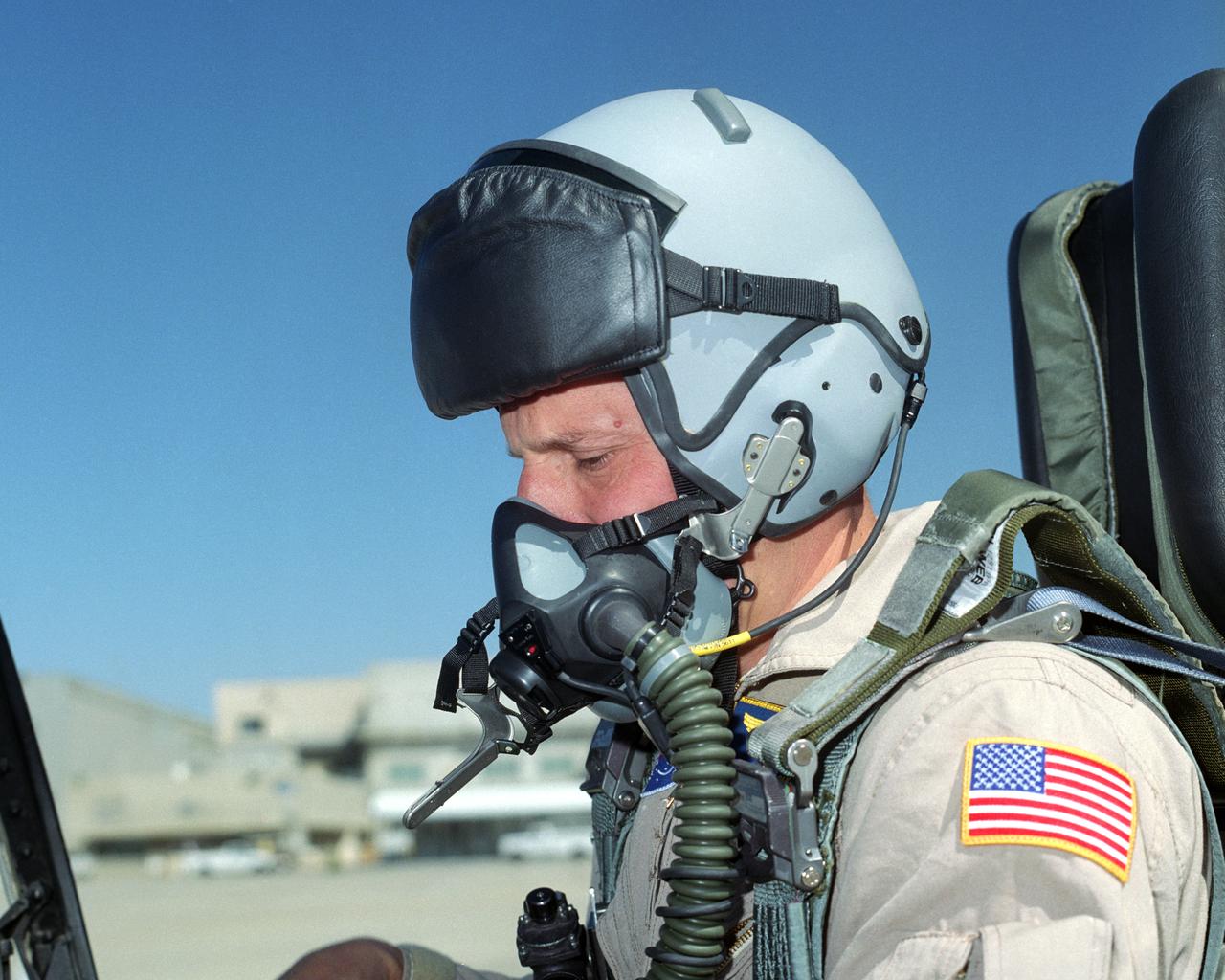
Research pilots from the NASA Dryden Flight Research Center, Edwards, Calif., tested a prototype two-part helmet. Built by Gentex Corp., Carbondale, Pa., the helmet was evaluated by five NASA pilots during the summer and fall of 2002. The objective was to obtain data on helmet fit, comfort and functionality. The inner helmet of the modular system is fitted to the individual crewmember. The outer helmet features a fully integrated spectral mounted helmet display and a binocular helmet mounted display. The helmet will be adaptable to all flying platforms. The Dryden evaluation was overseen by the Center's Life Support office. Assessments have taken place during normal proficiency flights and some air-to-air combat maneuvering. Evaluation platforms included the F-18, B-52 and C-12. The prototype helmet is being developed by the Naval Air Science and Technology Office and the Aircrew Systems Program Office, Patuxent River, Md.

Jeff Greulich, DynCorp life support technician, adjusts a prototype helmet on pilot Craig Bomben at NASA Dryden Flight Research Center, Edwards, Calif. Built by Gentex Corp., Carbondale, Pa., the helmet was evaluated by five NASA pilots during the summer and fall of 2002. The objective was to obtain data on helmet fit, comfort and functionality. The inner helmet of the modular system is fitted to the individual crewmember. The outer helmet features a fully integrated spectral mounted helmet display and a binocular helmet mounted display. The helmet will be adaptable to all flying platforms. The Dryden evaluation was overseen by the Center's Life Support office. Assessments have taken place during normal proficiency flights and some air-to-air combat maneuvering. Evaluation platforms included the F-18, B-52 and C-12. The prototype helmet is being developed by the Naval Air Science and Technology Office and the Aircrew Systems Program Office, Patuxent River, Md.

Every second a star somewhere out in the universe explodes as a supernova. But some extremely massive stars go out with a whimper instead of a bang. When they do, they can collapse under the crushing tug of gravity and vanish out of sight, only to leave behind a black hole. The doomed star N6946-BH1 was 25 times as massive as our sun. It began to brighten weakly in 2009. But, by 2015, it appeared to have winked out of existence. By a careful process of elimination, based on observations by the Large Binocular Telescope and NASA's Hubble and Spitzer space telescopes, researchers eventually concluded that the star must have become a black hole. This may be the fate for extremely massive stars in the universe. This illustration shows the final stages in the life of a supermassive star that fails to explode as a supernova, but instead implodes to form a black hole. https://photojournal.jpl.nasa.gov/catalog/PIA21466

During the Apollo 15 launch activities in the launch control center's firing room 1 at Kennedy Space Center, Dr. Wernher von Braun, NASA's Deputy Associate Administrator for planning, takes a closer look at the launch pad through binoculars. The fifth manned lunar landing mission, Apollo 15 (SA-510), carrying a crew of three astronauts: Mission commander David R. Scott, Lunar Module pilot James B. Irwin, and Command Module pilot Alfred M. Worden Jr., lifted off on July 26, 1971. Astronauts Scott and Irwin were the first to use a wheeled surface vehicle, the Lunar Roving Vehicle, or the Rover, which was designed and developed by the Marshall Space Flight Center, and built by the Boeing Company. Astronauts spent 13 days, nearly 67 hours, on the Moon's surface to inspect a wide variety of its geological features.

Caption: In this composite image, visible-light observations by NASA’s Hubble Space Telescope are combined with infrared data from the ground-based Large Binocular Telescope in Arizona to assemble a dramatic view of the well-known Ring Nebula. Credit: NASA, ESA, C.R. Robert O’Dell (Vanderbilt University), G.J. Ferland (University of Kentucky), W.J. Henney and M. Peimbert (National Autonomous University of Mexico) Credit for Large Binocular Telescope data: David Thompson (University of Arizona) ---- The Ring Nebula's distinctive shape makes it a popular illustration for astronomy books. But new observations by NASA's Hubble Space Telescope of the glowing gas shroud around an old, dying, sun-like star reveal a new twist. "The nebula is not like a bagel, but rather, it's like a jelly doughnut, because it's filled with material in the middle," said C. Robert O'Dell of Vanderbilt University in Nashville, Tenn. He leads a research team that used Hubble and several ground-based telescopes to obtain the best view yet of the iconic nebula. The images show a more complex structure than astronomers once thought and have allowed them to construct the most precise 3-D model of the nebula. "With Hubble's detail, we see a completely different shape than what's been thought about historically for this classic nebula," O'Dell said. "The new Hubble observations show the nebula in much clearer detail, and we see things are not as simple as we previously thought." The Ring Nebula is about 2,000 light-years from Earth and measures roughly 1 light-year across. Located in the constellation Lyra, the nebula is a popular target for amateur astronomers. Read more: <a href="http://1.usa.gov/14VAOMk" rel="nofollow">1.usa.gov/14VAOMk</a> <b><a href="http://www.nasa.gov/audience/formedia/features/MP_Photo_Guidelines.html" rel="nofollow">NASA image use policy.</a></b> <b><a href="http://www.nasa.gov/centers/goddard/home/index.html" rel="nofollow">NASA Goddard Space Flight Center</a></b> enables NASA’s mission through four scientific endeavors: Earth Science, Heliophysics, Solar System Exploration, and Astrophysics. Goddard plays a leading role in NASA’s accomplishments by contributing compelling scientific knowledge to advance the Agency’s mission. <b>Follow us on <a href="http://twitter.com/NASA_GoddardPix" rel="nofollow">Twitter</a></b> <b>Like us on <a href="http://www.facebook.com/pages/Greenbelt-MD/NASA-Goddard/395013845897?ref=tsd" rel="nofollow">Facebook</a></b> <b>Find us on <a href="http://instagram.com/nasagoddard?vm=grid" rel="nofollow">Instagram</a></b>
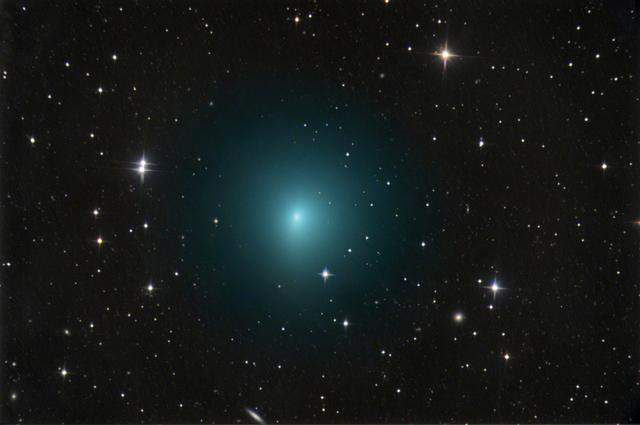
On April 1, 2017, comet 41P will pass closer than it normally does to Earth, giving observers with binoculars or a telescope a special viewing opportunity. Comet hunters in the Northern Hemisphere should look for it near the constellations Draco and Ursa Major, which the Big Dipper is part of. Whether a comet will put on a good show for observers is notoriously difficult to predict, but 41P has a history of outbursts, and put on quite a display in 1973. If the comet experiences similar outbursts this time, there’s a chance it could become bright enough to see with the naked eye. The comet is expected to reach perihelion, or its closest approach to the sun, on April 12. A member of the Jupiter family of comets, 41P makes a trip around the sun every 5.4 years, coming relatively close to Earth on some of those trips. On this approach, the comet will pass our planet at a distance of about 13 million miles (0.14 astronomical units), or about 55 times the distance from Earth to the moon. This is the comet’s closest approach to Earth in more than 50 years and perhaps more than a century. Read more: <a href="https://go.nasa.gov/2nLNzes" rel="nofollow">go.nasa.gov/2nLNzes</a> Photo caption: In this image taken March 24, 2017, comet 41P/Tuttle-Giacobini-Kresák is shown moving through a field of faint galaxies in the bowl of the Big Dipper. On April 1, the comet will pass by Earth at a distance of about 13 million miles (0.14 astronomical units), or 55 times the distance from Earth to the moon; that is a much closer approach than usual for this Jupiter-family comet. Photo credit: Image copyright Chris Schur©, used with permission <b><a href="http://www.nasa.gov/audience/formedia/features/MP_Photo_Guidelines.html" rel="nofollow">NASA image use policy.</a></b> <b><a href="http://www.nasa.gov/centers/goddard/home/index.html" rel="nofollow">NASA Goddard Space Flight Center</a></b> enables NASA’s mission through four scientific endeavors: Earth Science, Heliophysics, Solar System Exploration, and Astrophysics. Goddard plays a leading role in NASA’s accomplishments by contributing compelling scientific knowledge to advance the Agency’s mission. <b>Follow us on <a href="http://twitter.com/NASAGoddardPix" rel="nofollow">Twitter</a></b> <b>Like us on <a href="http://www.facebook.com/pages/Greenbelt-MD/NASA-Goddard/395013845897?ref=tsd" rel="nofollow">Facebook</a></b> <b>Find us on <a href="http://instagrid.me/nasagoddard/?vm=grid" rel="nofollow">Instagram</a></b>
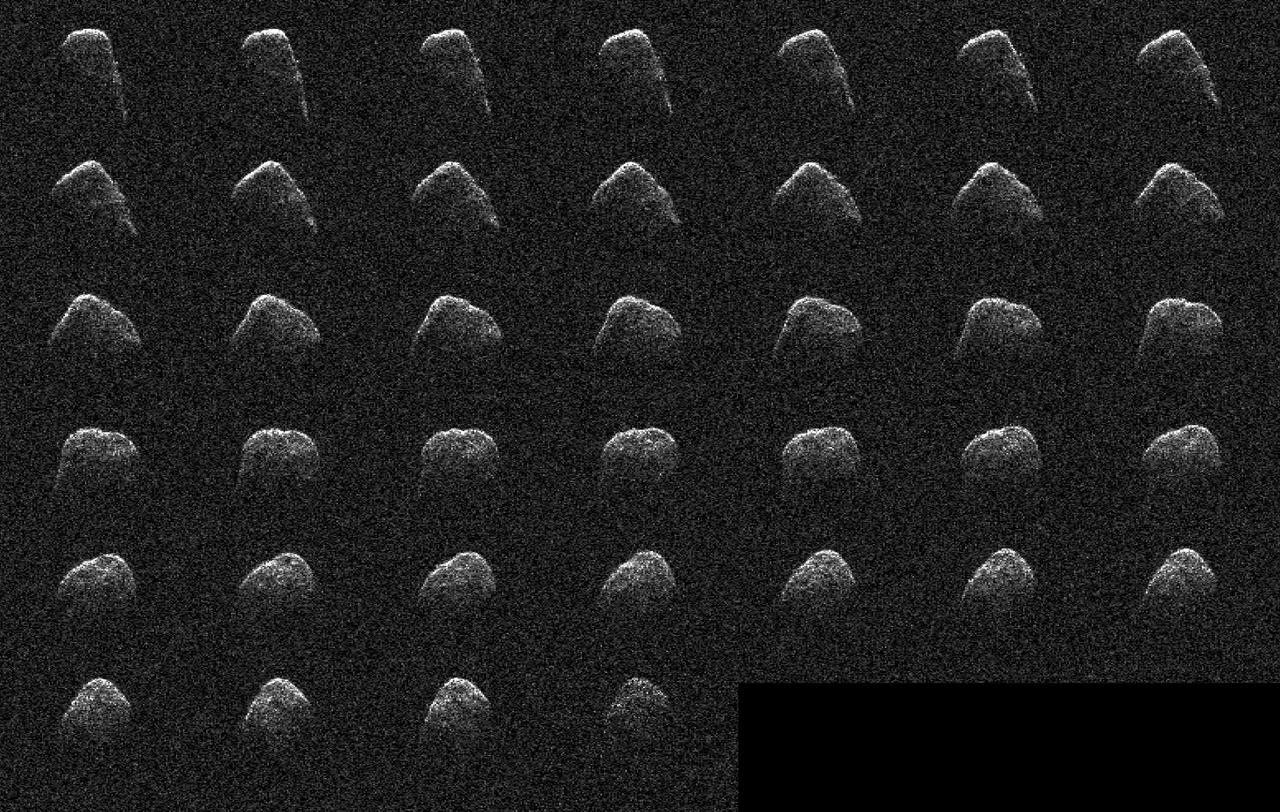
These images and animation represent NASA radar observations of 4660 Nereus on Dec. 10, 2021, before the asteroid's close approach on Dec. 11, when it came within 2.5 million miles (4 million kilometers) of Earth. Using the 70-meter radio antenna at the Deep Space Network's Goldstone Deep Space Communications Complex near Barstow, California, scientists from NASA's Jet Propulsion Laboratory acquired the most detailed radar images of the nearly 1,100-foot-wide (330-meter-wide) near-Earth asteroid since its discovery almost four decades earlier. Nereus' orbit is very well known and the asteroid does not pose a threat to Earth. During the asteroid's close approach, an image resolution of about 12.3 feet (3.75 meters) per pixel was possible, revealing surface features such as potential boulders and craters, plus ridges and other topography. Asteroid Nereus' previous approach in 2002 was near enough to Earth to reveal the asteroid's size and overall shape, but too distant to show surface features. The new observations will also help scientists better understand the asteroid's shape and rotation while providing them new data to further refine its orbital path around the Sun. Nereus belongs to the relatively rare E-type asteroid family that exhibits very unusual radar scattering properties. It's thought that this may be caused by asteroids of this type having particularly rough terrain. Also, E-type asteroids are optically bright, sometimes reflecting as much as 50% of the sunlight that hits their surface. Typical S-type asteroids reflect about 15%, whereas dark C-type asteroids reflect only a few percent. It's thought that E-class asteroids may be the source of very rare Aubrite meteorites and are composed of comparatively bright material. The 2021 close approach was the best opportunity for radar imaging of Nereus until 2060, when the asteroid will approach within 750,000 miles (1.2 million kilometers) of Earth, only three times the Earth-Moon distance. At that time, Nereus will be an easy target for small telescopes and possibly even powerful binoculars. Nereus – named after a sea god from Greek mythology – was discovered in 1982 by Eleanor "Glo" Helin as part of the JPL Palomar Planet-Crossing Asteroid Survey. Movie available at https://photojournal.jpl.nasa.gov/catalog/PIA24566

This composite picture is a seamless blend of ultra-sharp NASA Hubble Space Telescope (HST) images combined with the wide view of the Mosaic Camera on the National Science Foundation's 0.9-meter telescope at Kitt Peak National Observatory, part of the National Optical Astronomy Observatory, near Tucson, Ariz. Astronomers at the Space Telescope Science Institute assembled these images into a mosaic. The mosaic was then blended with a wider photograph taken by the Mosaic Camera. The image shows a fine web of filamentary "bicycle-spoke" features embedded in the colorful red and blue gas ring, which is one of the nearest planetary nebulae to Earth. Because the nebula is nearby, it appears as nearly one-half the diameter of the full Moon. This required HST astronomers to take several exposures with the Advanced Camera for Surveys to capture most of the Helix. HST views were then blended with a wider photo taken by the Mosaic Camera. The portrait offers a dizzying look down what is actually a trillion-mile-long tunnel of glowing gases. The fluorescing tube is pointed nearly directly at Earth, so it looks more like a bubble than a cylinder. A forest of thousands of comet-like filaments, embedded along the inner rim of the nebula, points back toward the central star, which is a small, super-hot white dwarf. The tentacles formed when a hot "stellar wind" of gas plowed into colder shells of dust and gas ejected previously by the doomed star. Ground-based telescopes have seen these comet-like filaments for decades, but never before in such detail. The filaments may actually lie in a disk encircling the hot star, like a collar. The radiant tie-die colors correspond to glowing oxygen (blue) and hydrogen and nitrogen (red). Valuable Hubble observing time became available during the November 2002 Leonid meteor storm. To protect the spacecraft, including HST's precise mirror, controllers turned the aft end into the direction of the meteor stream for about half a day. Fortunately, the Helix Nebula was almost exactly in the opposite direction of the meteor stream, so Hubble used nine orbits to photograph the nebula while it waited out the storm. To capture the sprawling nebula, Hubble had to take nine separate snapshots. Planetary nebulae like the Helix are sculpted late in a Sun-like star's life by a torrential gush of gases escaping from the dying star. They have nothing to do with planet formation, but got their name because they look like planetary disks when viewed through a small telescope. With higher magnification, the classic "donut-hole" in the middle of a planetary nebula can be resolved. Based on the nebula's distance of 650 light-years, its angular size corresponds to a huge ring with a diameter of nearly 3 light-years. That's approximately three-quarters of the distance between our Sun and the nearest star. The Helix Nebula is a popular target of amateur astronomers and can be seen with binoculars as a ghostly, greenish cloud in the constellation Aquarius. Larger amateur telescopes can resolve the ring-shaped nebula, but only the largest ground-based telescopes can resolve the radial streaks. After careful analysis, astronomers concluded the nebula really isn't a bubble, but is a cylinder that happens to be pointed toward Earth. http://photojournal.jpl.nasa.gov/catalog/PIA18164

Supernova Supernovae can occur one of two ways. The first occurs when a white dwarf—the vestigial ember of a dead star—passes so close to a living star that its matter leaks into the white dwarf. This causes a catastrophic explosion. However most people understand supernovae as the death of a massive star. When the star runs out of fuel toward the end of its life, the gravity at its heart sucks the surrounding mass into its center. At temperatures rocketing above 100 billion degrees Fahrenheit, all the layers of the star abruptly explode outward. The explosions produced by supernovae are so brilliant that astronomers use their luminosity to measure the distance between galaxies, the scale of the universe and the effects of dark energy. For a short period of time, one dying star can appear to shine as brightly as an entire galaxy. Supernovae are relatively common events, one occurring in our own galaxy once every 100 years. In 2014, a person could see the supernova M82 with a pair of binoculars. The cosmologist Tycho Brahe’s observation of a supernova in 1572 allowed him to disprove Aristotle’s theory that the heavens never changed. After a supernova, material expelled in the explosion can form a nebula—an interstellar pile of gas and dust. Over millions of years, gravity pulls the nebula’s materials into a dense orb called a protostar, which will become a new star. Within a few million years, this new star could go supernova as well. ------------------------------ Original Caption: NASA image release Feb. 24, 2012 At the turn of the 19th century, the binary star system Eta Carinae was faint and undistinguished. In the first decades of the century, it became brighter and brighter, until, by April 1843, it was the second brightest star in the sky, outshone only by Sirius (which is almost a thousand times closer to Earth). In the years that followed, it gradually dimmed again and by the 20th century was totally invisible to the naked eye. The star has continued to vary in brightness ever since, and while it is once again visible to the naked eye on a dark night, it has never again come close to its peak of 1843. NASA's Hubble Telescope captured an image of Eta Carinae. This image consists of ultraviolet and visible light images from the High Resolution Channel of Hubble's Advanced Camera for Surveys. The field of view is approximately 30 arcseconds across. The larger of the two stars in the Eta Carinae system is a huge and unstable star that is nearing the end of its life, and the event that the 19th century astronomers observed was a stellar near-death experience. Scientists call these outbursts supernova impostor events, because they appear similar to supernovae but stop just short of destroying their star. Although 19th century astronomers did not have telescopes powerful enough to see the 1843 outburst in detail, its effects can be studied today. The huge clouds of matter thrown out a century and a half ago, known as the Homunculus Nebula, have been a regular target for Hubble since its launch in 1990. This image, taken with the Advanced Camera for Surveys High Resolution Channel, is the most detailed yet, and shows how the material from the star was not thrown out in a uniform manner, but forms a huge dumbbell shape. Eta Carinae is not only interesting because of its past, but also because of its future. It is one of the closest stars to Earth that is likely to explode in a supernova in the relatively near future (though in astronomical timescales the "near future" could still be a million years away). When it does, expect an impressive view from Earth, far brighter still than its last outburst: SN 2006gy, the brightest supernova ever observed, came from a star of the same type, though from a galaxy over 200 million light-years away. Credit: ESA/NASA More information: <a href="http://www.spacetelescope.org/images/potw1208a/" rel="nofollow">www.spacetelescope.org/images/potw1208a/</a> <b><a href="http://www.nasa.gov/audience/formedia/features/MP_Photo_Guidelines.html" rel="nofollow">NASA image use policy.</a></b> <b><a href="http://www.nasa.gov/centers/goddard/home/index.html" rel="nofollow">NASA Goddard Space Flight Center</a></b> enables NASA’s mission through four scientific endeavors: Earth Science, Heliophysics, Solar System Exploration, and Astrophysics. Goddard plays a leading role in NASA’s accomplishments by contributing compelling scientific knowledge to advance the Agency’s mission. <b>Follow us on <a href="http://twitter.com/NASAGoddardPix" rel="nofollow">Twitter</a></b> <b>Like us on <a href="http://www.facebook.com/pages/Greenbelt-MD/NASA-Goddard/395013845897?ref=tsd" rel="nofollow">Facebook</a></b> <b>Find us on <a href="http://instagrid.me/nasagoddard/?vm=grid" rel="nofollow">Instagram</a></b>