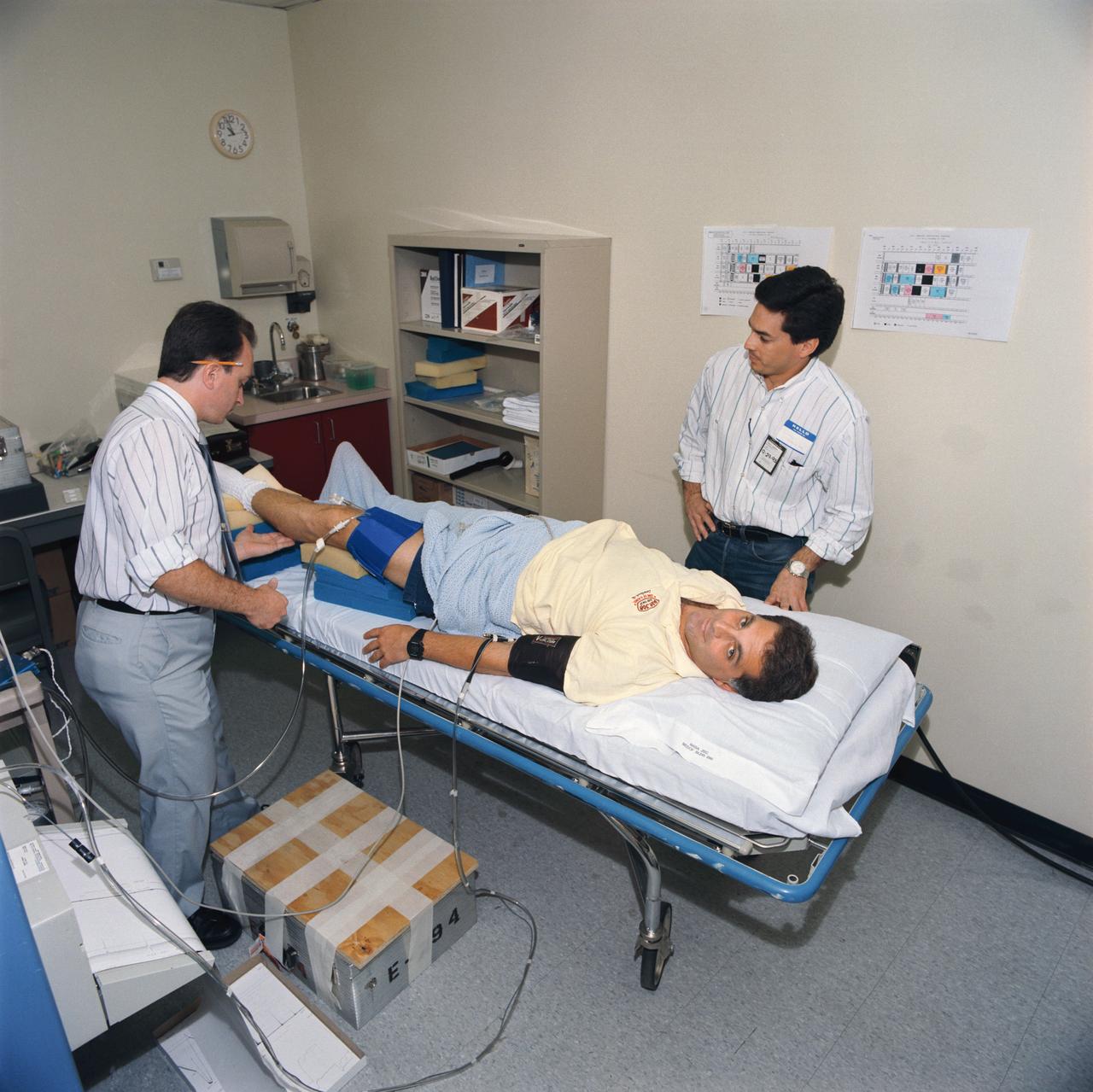
S93-45375 (29 Sept 1993) --- Astronaut David A. Wolf, STS-58 mission specialist, has blood drawn from his leg for volume measuring. The blood draw was part of the cardiovascular function data collection in preparation for the Spacelab Life Sciences (SLS-2) mission. The seven Spacelab Life Sciences crewmembers devoted a full day to miscellaneous biomedical data collection in preparation for next month's two week mission aboard Columbia.
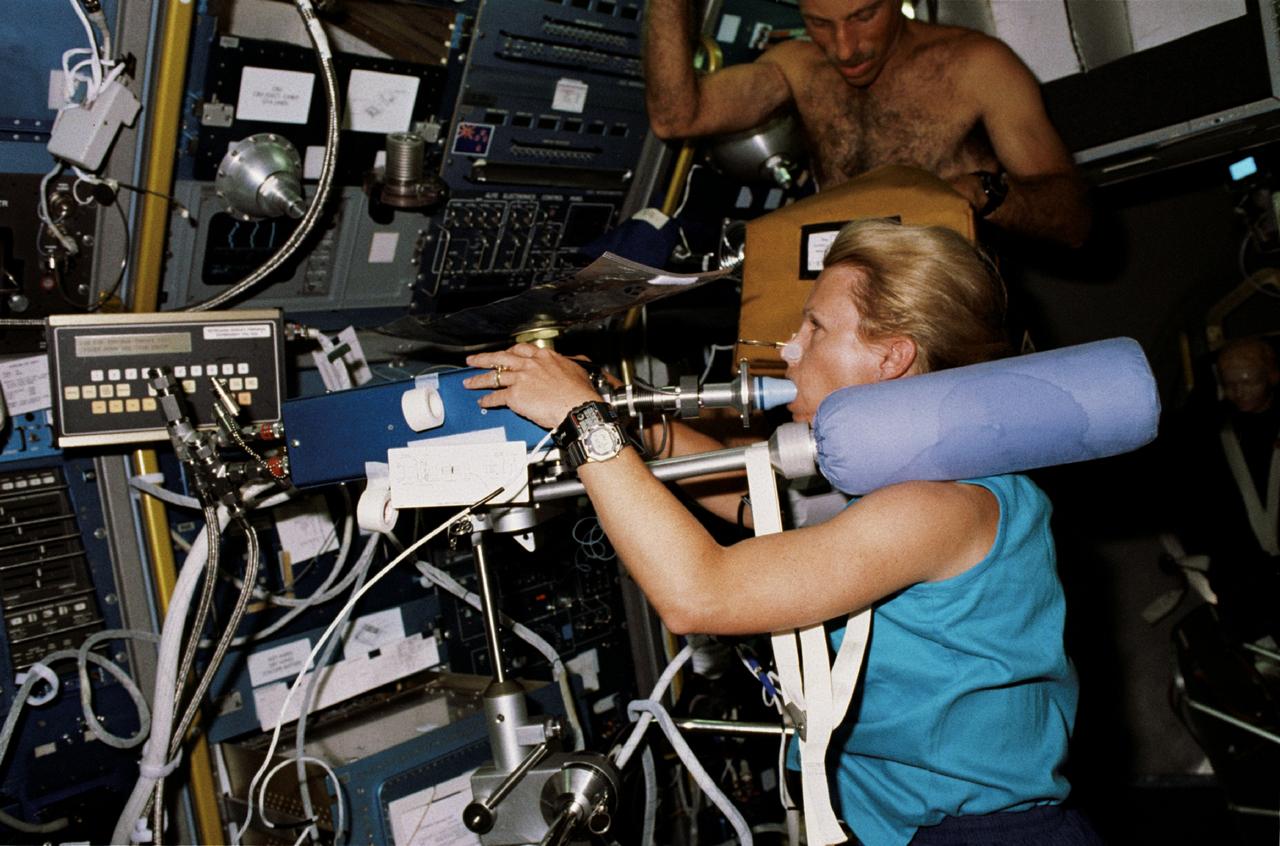
STS040-211-019 (5-14 June 1991) --- Astride the bicycle ergometer, astronaut Rhea Seddon, mission specialist, breathes into the cardiovascular re-breathing unit during the exercise phase of an experiment. The investigation, In-flight Study of Cardiovascular Deconditioning (Experiment 066), was developed by Dr. Leon E. Farhi of the State University of New York in Buffalo. It focuses on the deconditioning of the heart and lungs and changes in cardiopulmonary function that occur upon return to Earth. By using non-invasive techniques of prolonged expiration and re-breathing, investigators can determine the amount of blood pumped out of the heart (cardiac output), the ease with which blood flows through all the vessels (total peripheral resistance), oxygen used and carbon dioxide released by the body, and lung function and volume changes. Measurements are made both while crew members are resting and while they pedal the exercise bicycle, as Dr. Seddon is doing here. This scene was photographed with a 35mm camera.
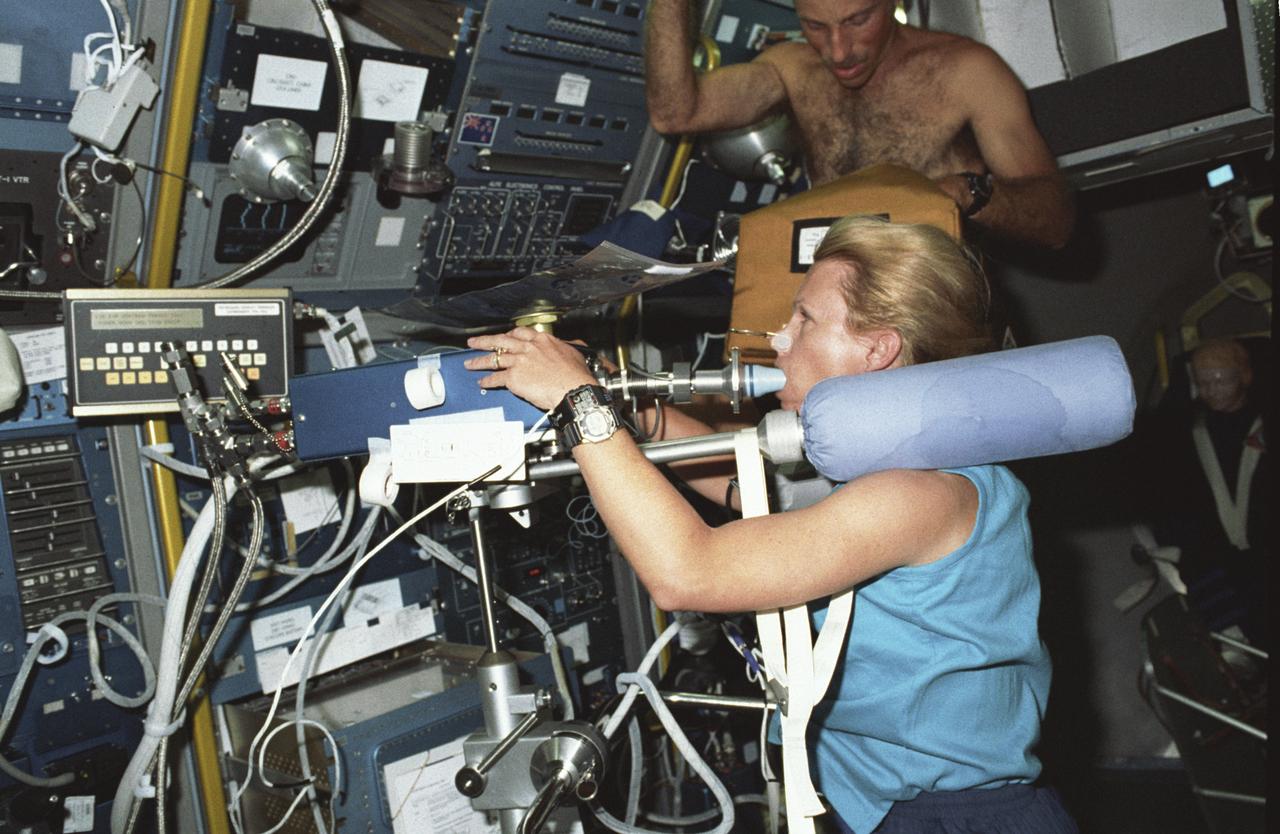
Spacelab Life Science -1 (SLS-1) was the first Spacelab mission dedicated solely to life sciences. The main purpose of the SLS-1 mission was to study the mechanisms, magnitudes, and time courses of certain physiological changes that occur during space flight, to investigate the consequences of the body's adaptation to microgravity and readjustment to Earth's gravity, and bring the benefits back home to Earth. The mission was designed to explore the responses of the heart, lungs, blood vessels, kidneys, and hormone-secreting glands to microgravity and related body fluid shifts; examine the causes of space motion sickness; and study changes in the muscles, bones, and cells. This photograph shows astronaut Rhea Seddon conducting an inflight study of the Cardiovascular Deconditioning experiment by breathing into the cardiovascular rebreathing unit. This experiment focused on the deconditioning of the heart and lungs and changes in cardiopulmonary function that occur upon return to Earth. By using noninvasive techniques of prolonged expiration and rebreathing, investigators can determine the amount of blood pumped out of the heart (cardiac output), the ease with which blood flows through all the vessels (total peripheral resistance), oxygen used and carbon dioxide released by the body, and lung function and volume changes. SLS-1 was launched aboard the Space Shuttle Orbiter Columbia (STS-40) on June 5, 1995.
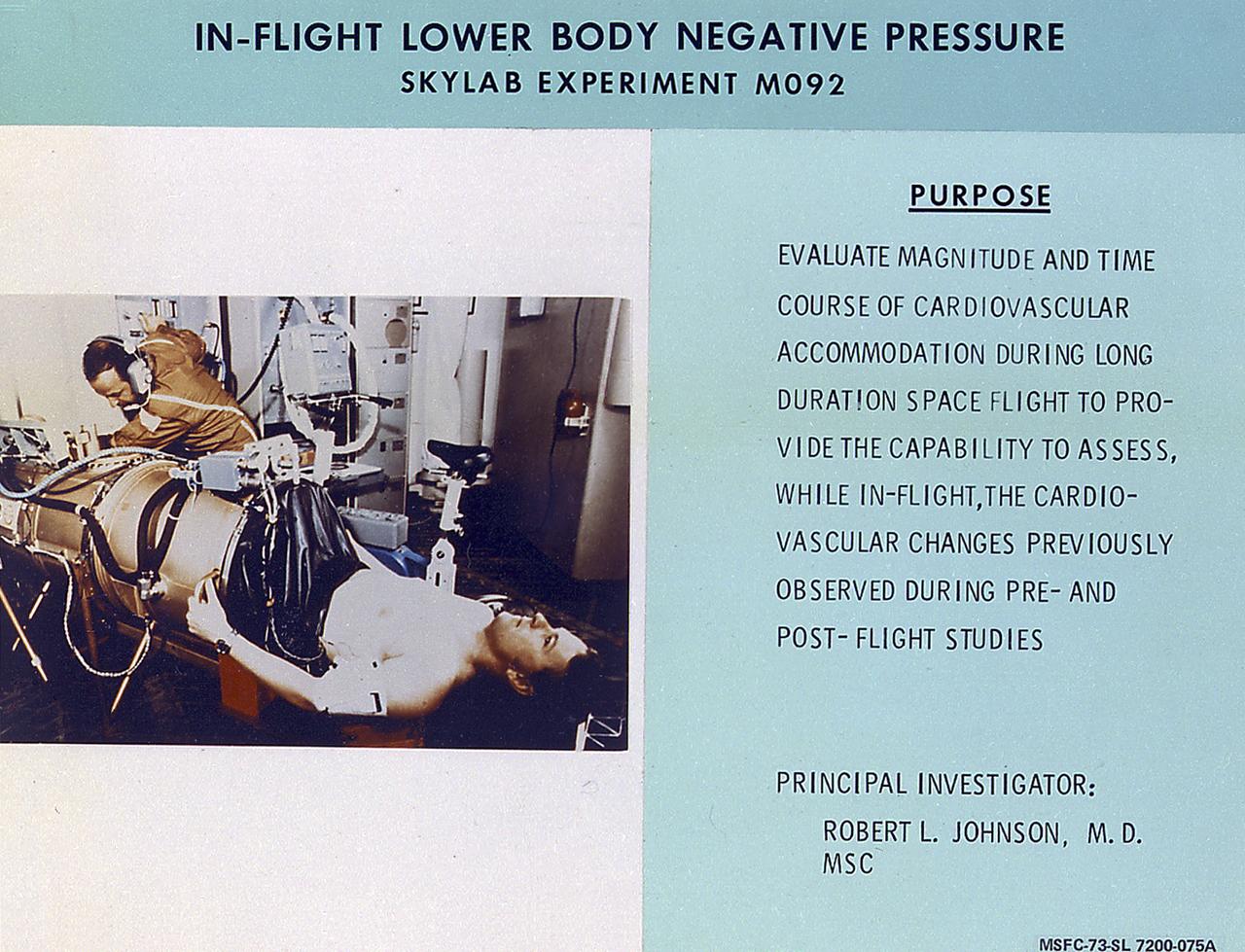
This chart details Skylab's In-Flight Lower Body Negative Pressure experiment facility, a medical evaluation designed to monitor changes in astronauts' cardiovascular systems during long-duration space missions. This experiment collected in-flight data for predicting the impairment of physical capacity and the degree of orthostatic intolerance to be expected upon return to Earth. Data to be collected were blood pressure, heart rate, body temperature, vectorcardiogram, lower body negative pressure, leg volume changes, and body mass. The Marshall Space Flight Center had program management responsibility for the development of Skylab hardware and experiments.
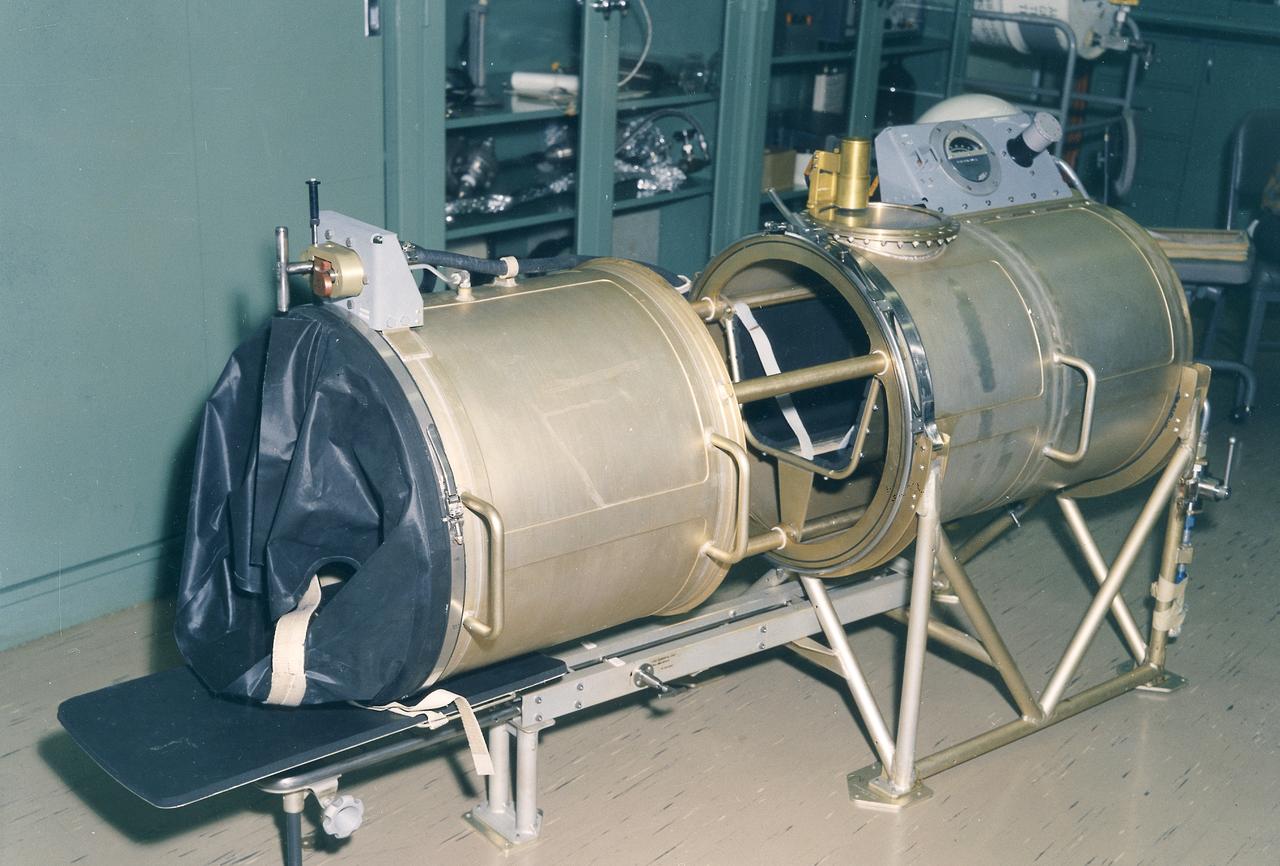
This 1970 photograph shows Skylab's In-Flight Lower Body Negative Pressure experiment facility, a medical evaluation designed to monitor changes in astronauts' cardiovascular systems during long-duration space missions. This experiment collected in-flight data for predicting the impairment of physical capacity and the degree of orthostatic intolerance to be expected upon return to Earth. Data to be collected were blood pressure, heart rate, body temperature, vectorcardiogram, lower body negative pressure, leg volume changes, and body mass. The Marshall Space Flight Center had program management responsibility for the development of Skylab hardware and experiments.
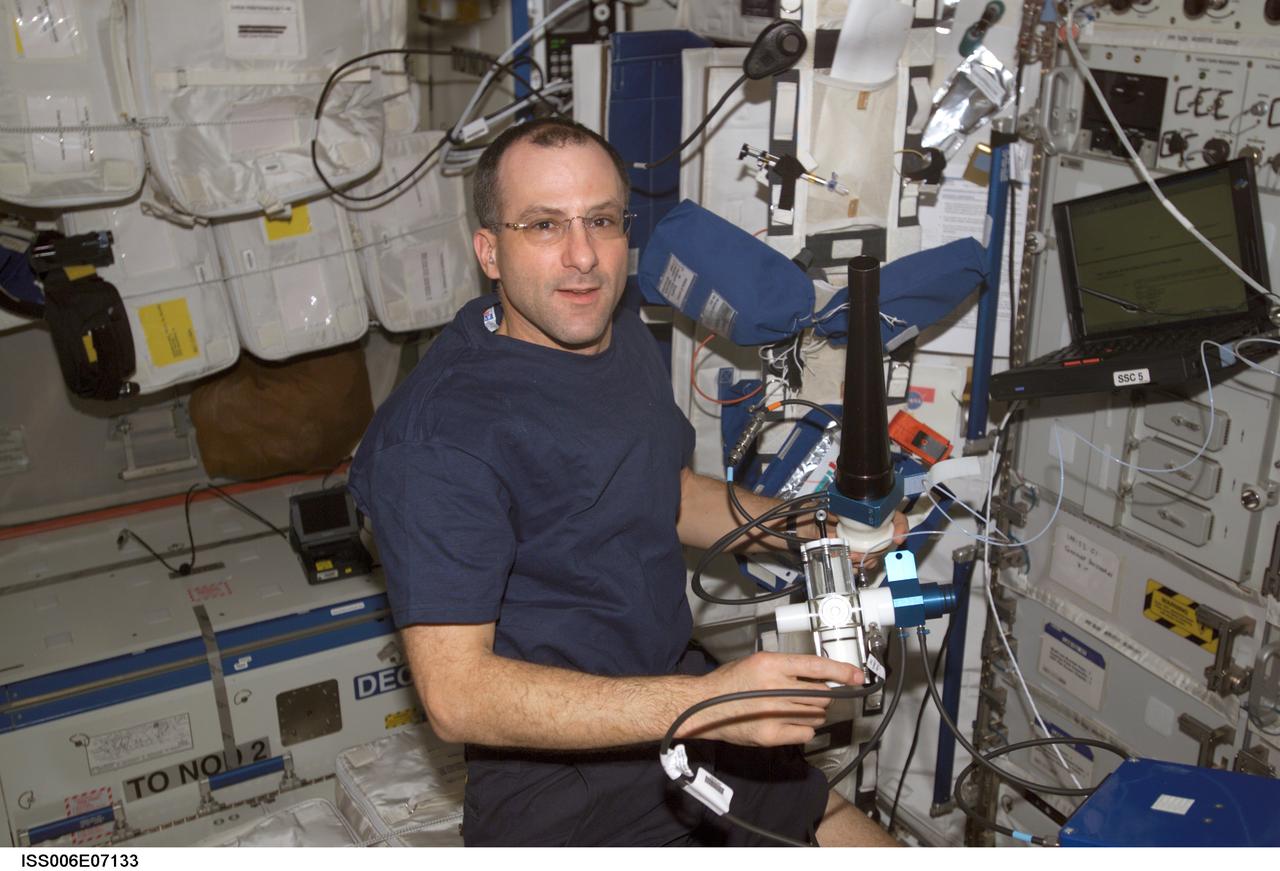
In this International Space Station (ISS) onboard photo, Expedition Six Science Officer Donald R. Pettit works to set up the Pulmonary Function in Flight (PuFF) experiment hardware in the Destiny Laboratory. Expedition Six is the fourth and final crew to perform the PuFF experiment. The PuFF experiment was developed to better understand what effects long term exposure to microgravity may have on the lungs. The focus is on measuring changes in the everness of gas exchange in the lungs, and on detecting changes in respiratory muscle strength. It allows astronauts to measure blood flow through the lungs, the ability of the lung to take up oxygen, and lung volumes. Each PuFF session includes five lung function tests, which involve breathing only cabin air. For each planned extravehicular (EVA) activity, a crew member performs a PuFF test within one week prior to the EVA. Following the EVA, those crew members perform another test to document the effect of exposure of the lungs to the low-pressure environment of the space suits. This experiment utilizes the Gas Analyzer System for Metabolic Analysis Physiology, or GASMAP, located in the Human Research Facility (HRF), along with a variety of other Puff equipment including a manual breathing valve, flow meter, pressure-flow module, pressure and volume calibration syringes, and disposable mouth pieces.
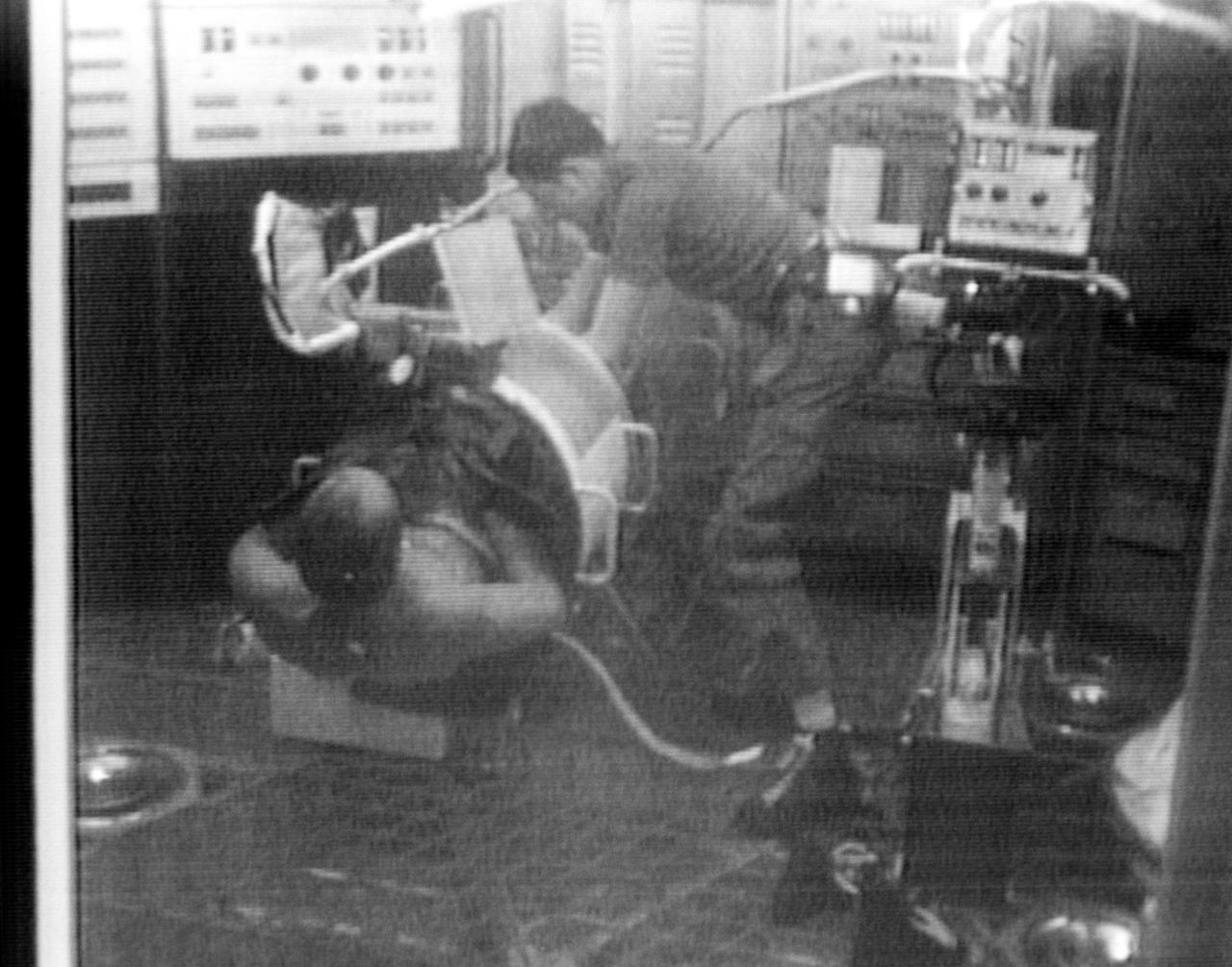
S73-27707 (9 June 1973) --- Astronaut Charles Conrad Jr., Skylab 2 commander, serves as test subject for the Lower Body Negative Pressure (MO92) Experiment, as seen in this reproduction taken from a color television transmission made by a TV camera aboard the Skylab 1/2 space station cluster in Earth orbit. Scientist-astronaut Joseph P. Kerwin, Skylab 2 science pilot, assists Conrad into the LBNP device. Kerwin served as monitor for the experiment. The purpose of the MO92 experiment is to provide information concerning the time course of cardiovascular adaptation during flight, and to provide inflight data for predicting the degree of orthostatic intolerance and impairment of physical capacity to be expected upon return to Earth environment. The data collected in support of MO92 blood pressure, heart rate, body temperature, vectorcardiogram, LBNPD pressure, leg volume changes, and body weight. Photo credit: NASA
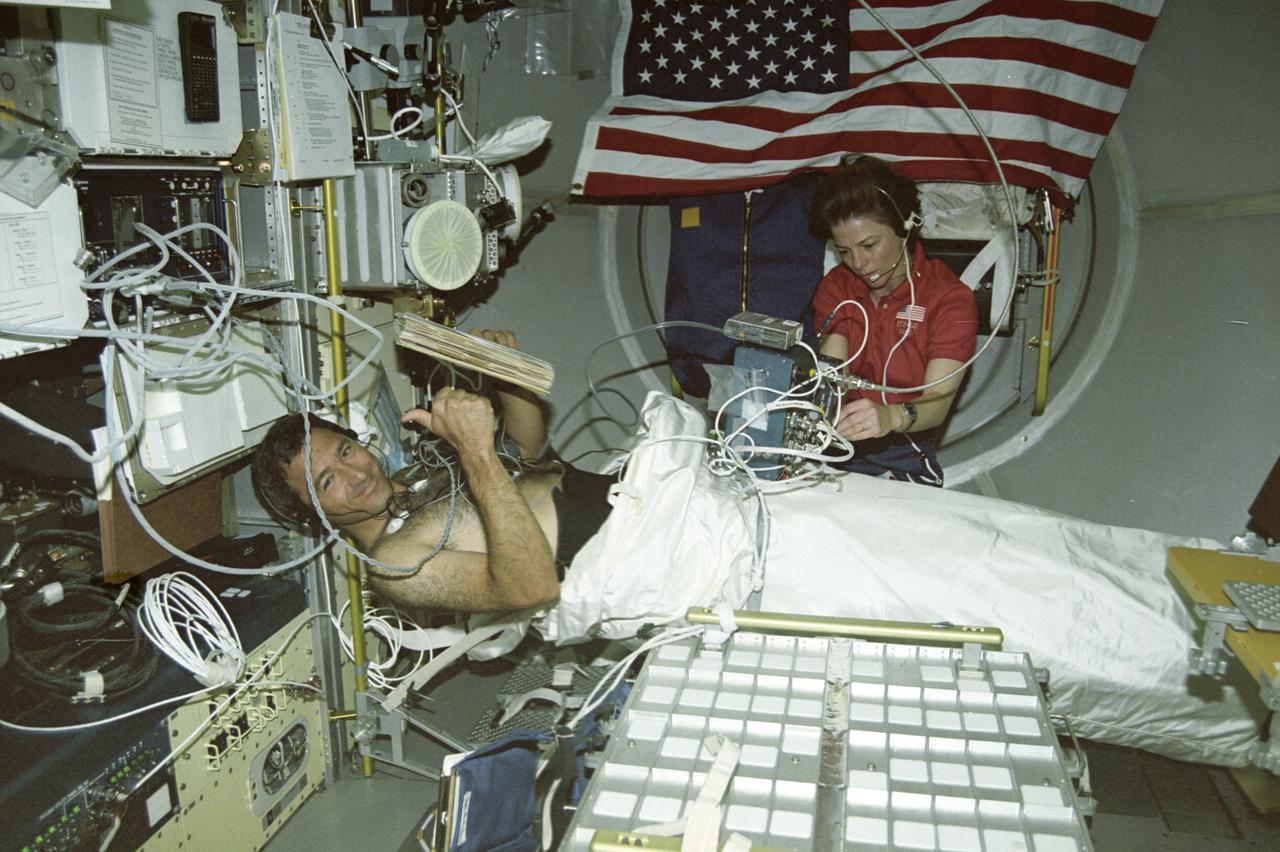
The first United States Microgravity Laboratory (USML-1) flew in orbit inside the Spacelab science module for extended periods, providing scientists and researchers greater opportunities for research in materials science, fluid dynamics, biotechnology (crystal growth), and combustion science. In this photograph, Astronaut Bornie Dunbar and Astronaut Larry DeLucas are conducting the Lower Body Negative Pressure (LBNP) experiment, which is to protect the health and safety of the crew and to shorten the time required to readapt to gravity when they return to Earth. When humans go into space, the lack of gravity causes many changes in the body. One change is that fluids normally kept in the lower body by gravity, shift upward to the head and chest. This is why astronauts' faces appear chubby or puffy. The change in fluid volume also affects the heart. The reduced fluid volume means that there is less blood to circulate through the body. Crewmembers may experience reduced blood flow to the brain when returning to Earth. This leads to fainting or near-fainting episodes. With the use of LBNP to simulate the pull of gravity in conjunction with fluids, salt tablets can recondition the cardiovascular system. This treatment, called "soak," is effective up to 24 hours. The LBNP uses a three-layer collapsible cylinder that seals around the crewmember's waist which simulates the effects of gravity and helps pull fluids into the lower body. The data collected will be analyzed to determine physiological changes in the crewmembers and effectiveness of the treatment. The USML-1 was launched aboard the Space Shuttle Orbiter Columbia (STS-50) on June 25, 1992.
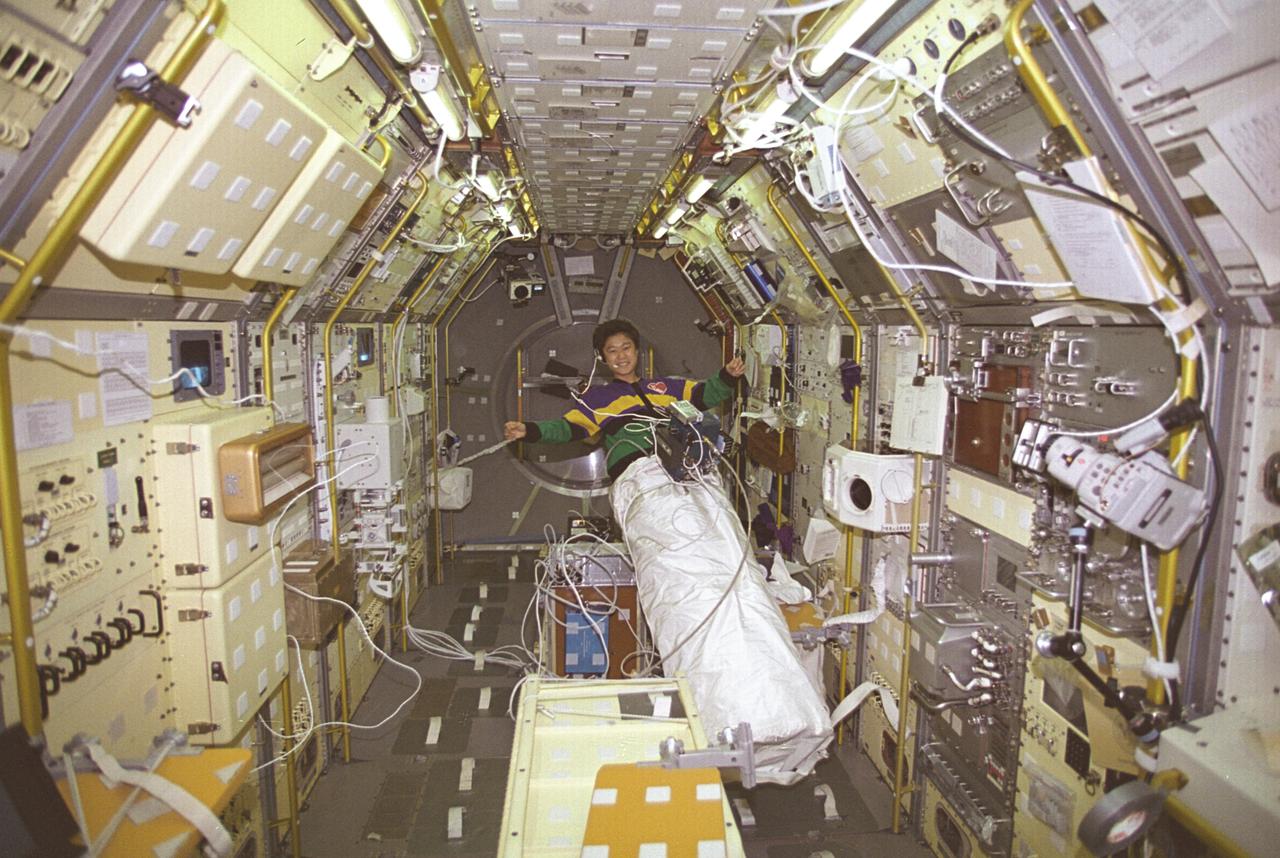
Astronaut Chiaki Mukai conducts the Lower Body Negative Pressure (LBNP) experiment inside the International Microgravity Laboratory-2 (IML-2) mission science module. Dr. Chiaki Mukai is one of the National Space Development Agency of Japan (NASDA) astronauts chosen by NASA as a payload specialist (PS). She was the second NASDA PS who flew aboard the Space Shuttle, and was the first female astronaut in Asia. When humans go into space, the lack of gravity causes many changes in the body. One change is that fluids normally kept in the lower body by gravity shift upward to the head and chest. This is why astronauts' faces appear chubby or puffy. The change in fluid volume also affects the heart. The reduced fluid volume means that there is less blood to circulate through the body. Crewmembers may experience reduced blood flow to the brain when returning to Earth. This leads to fainting or near-fainting episodes. With the use of the LBNP to simulate the pull of gravity in conjunction with fluids, salt tablets can recondition the cardiovascular system. This treatment, called "soak," is effective up to 24 hours. The LBNP uses a three-layer collapsible cylinder that seals around the crewmember's waist which simulates the effects of gravity and helps pull fluids into the lower body. The data collected will be analyzed to determine physiological changes in the crewmembers and effectiveness of the treatment. The IML-2 was the second in a series of Spacelab flights designed by the international science community to conduct research in a microgravity environment Managed by the Marshall Space Flight Center, the IML-2 was launched on July 8, 1994 aboard the STS-65 Space Shuttle Orbiter Columbia mission.
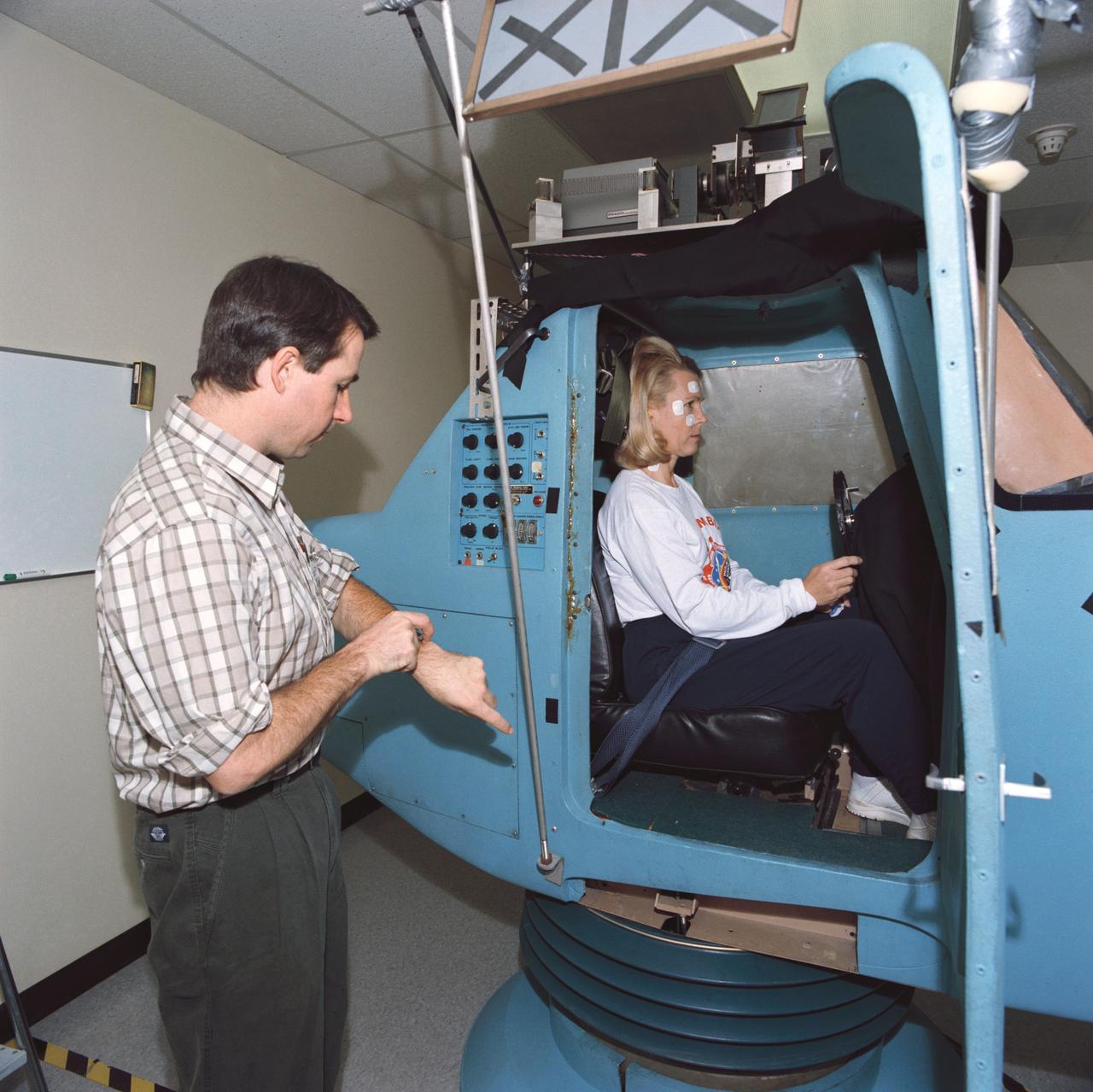
S93-45373 (29 Sept 1993) --- Astronaut Rhea Seddon, STS-58 payload commander, is in a piloting simulator as part of a pre-flight data collection project for neurovestibular functions. The seven Spacelab Life Sciences (SLS-2) crew members devoted a full day to miscellaneous biomedical data collection in preparation for next month's two week mission aboard Columbia.