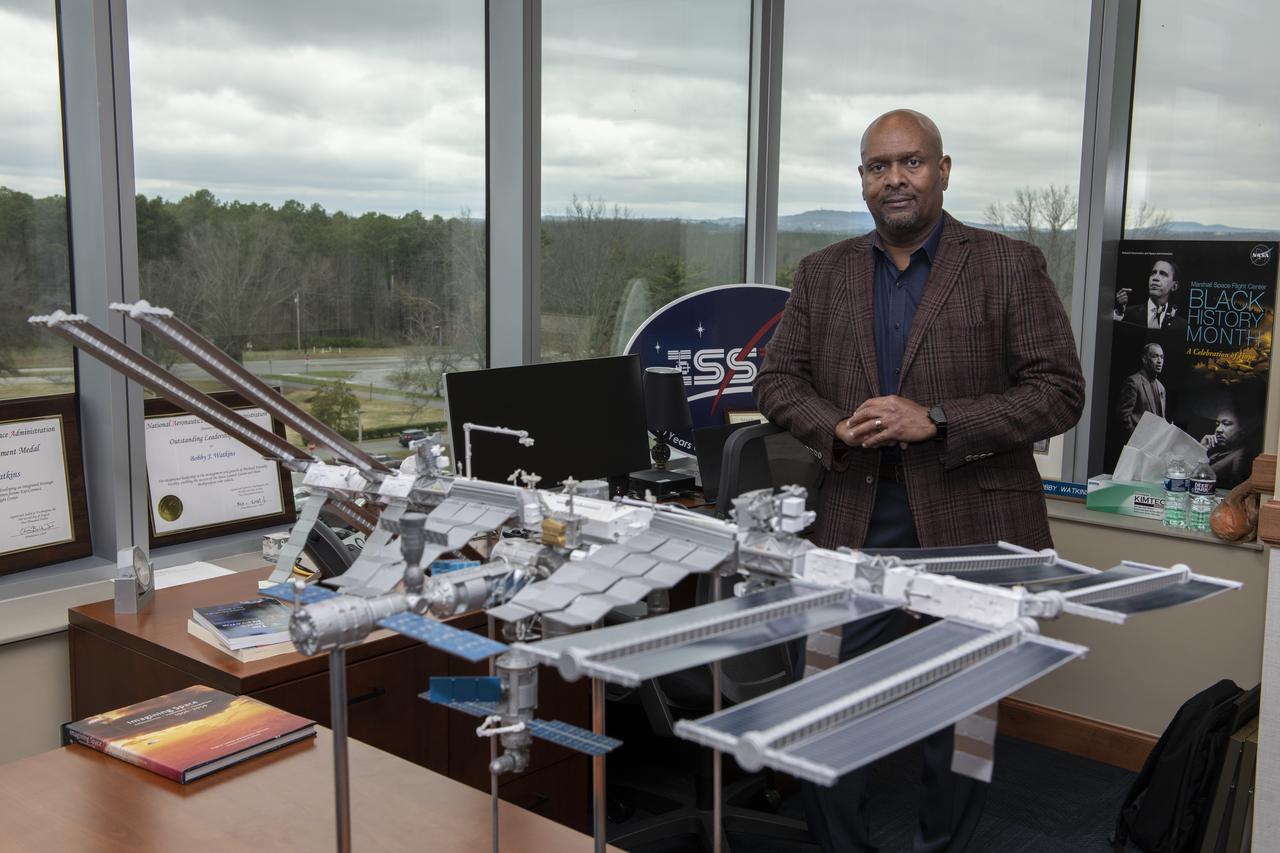
Bobby Watkins, manager of the Human Exploration Development & Operations Office at Marshall Space Flight Center.
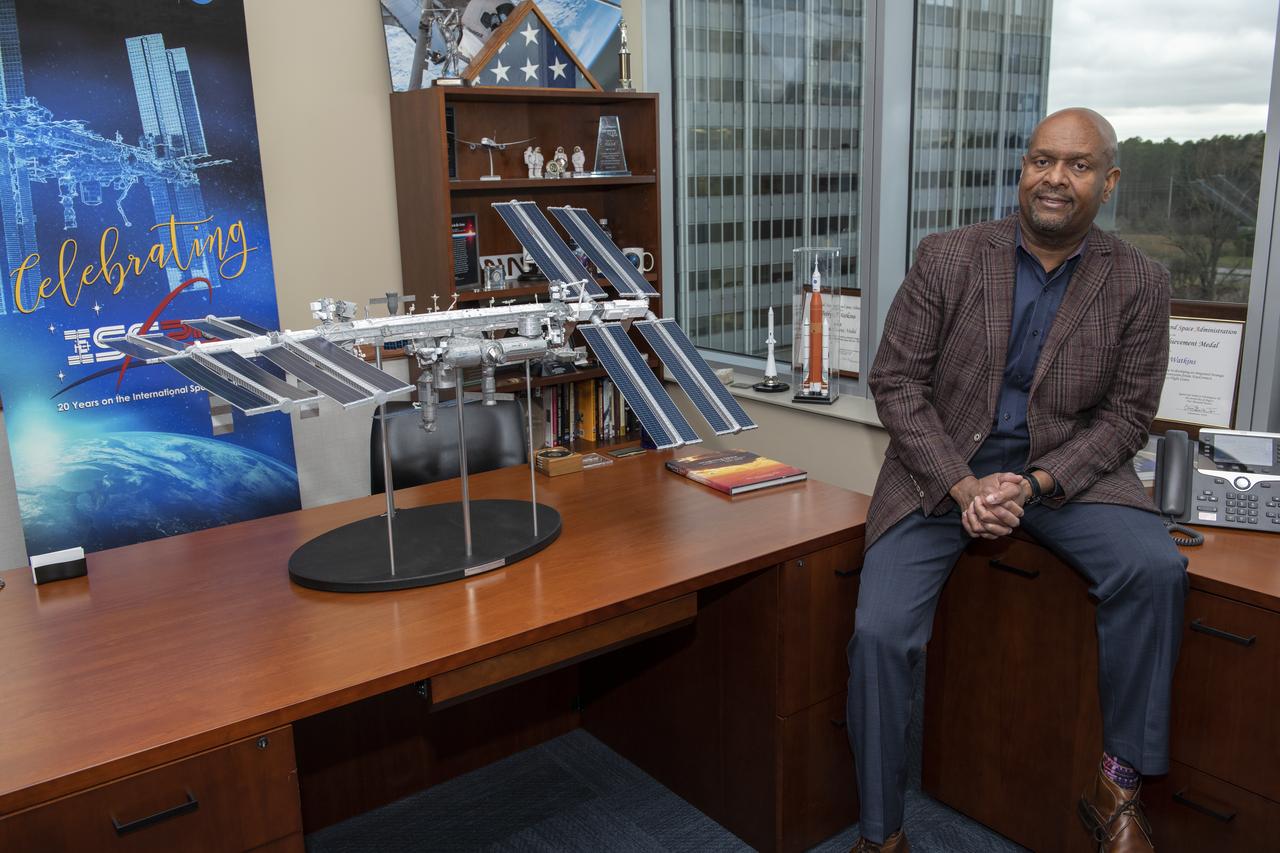
Bobby Watkins, manager of the Human Exploration Development & Operations Office at Marshall Space Flight Center.
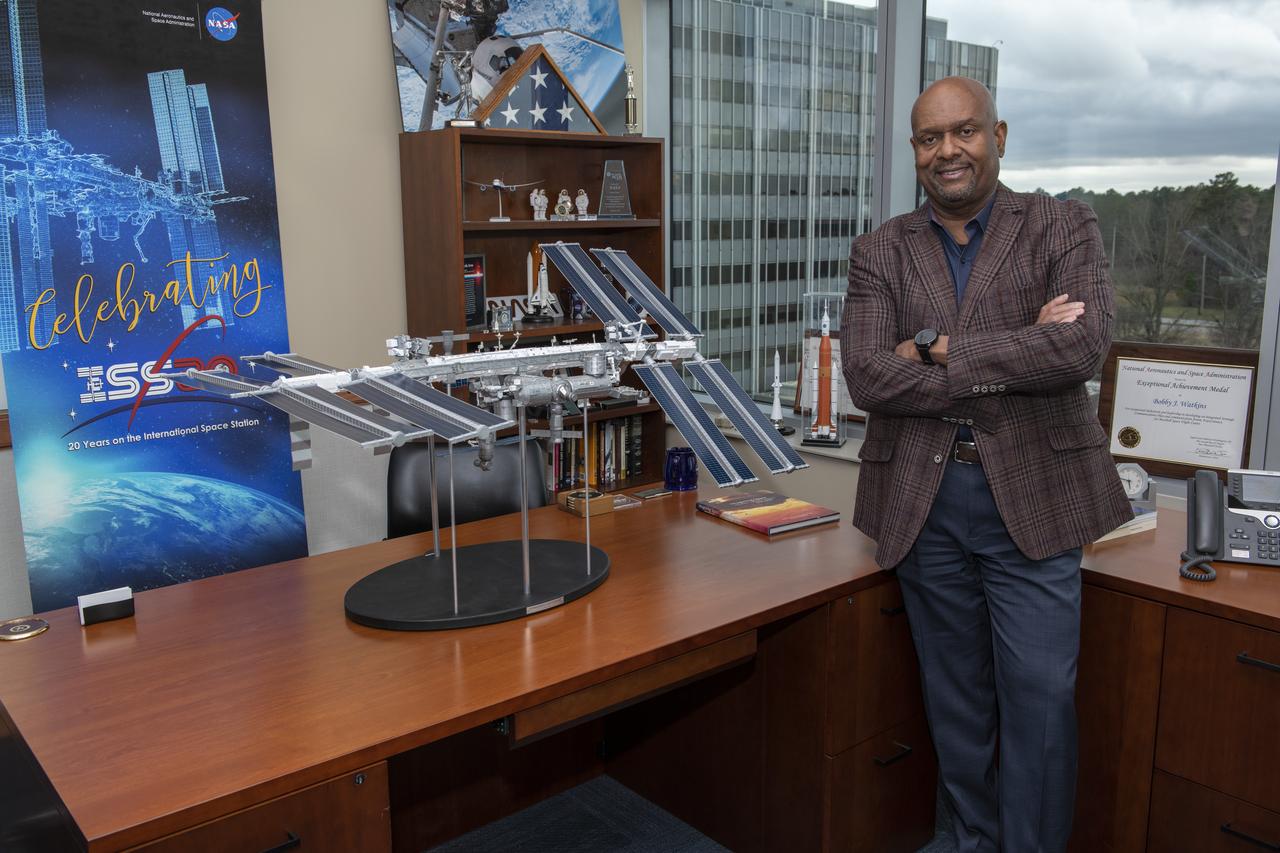
Bobby Watkins, manager of the Human Exploration Development & Operations Office at Marshall Space Flight Center.

Portrait, Bobby Braun, Chief Technologist, National Aeronautics and Space Administration (NASA). Washington, DC, May 19, 2010. Photo Credit: (NASA/Bill Ingalls)
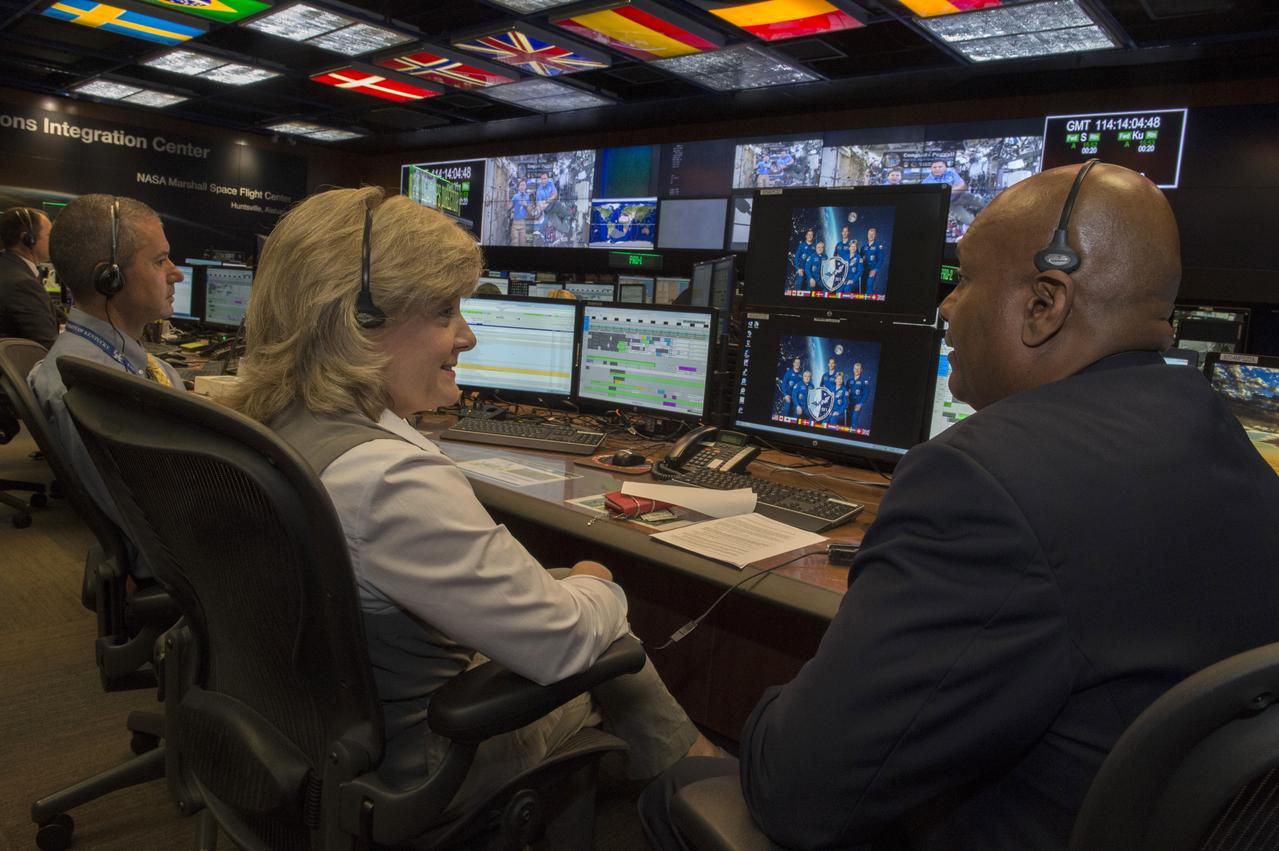
Jody Singer, left, Marshall deputy director, and Bobby Watkins, director of Marshall's Human Exploration and Development Operations Office visit the POIC April 24 as new procedures increasing the efficiency of the facility were introduced in anticipation of doubling the science performed in orbit.
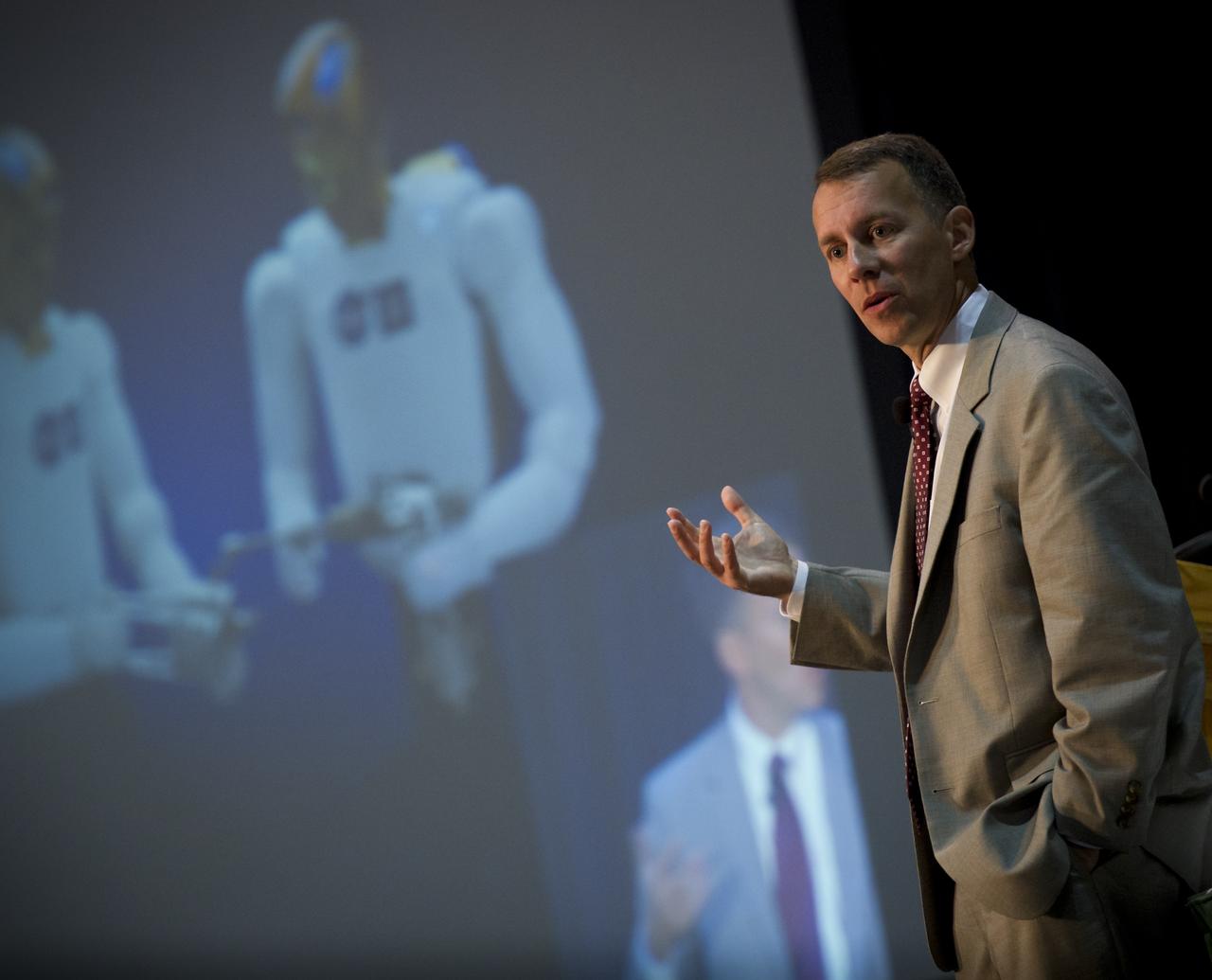
NASA Chief Technologist Bobby Braun talks about technology and innovation to attendees at the AARP "Orlando @50+" Conference in Orlando, Fl., Oct. 1, 2010. Photo Credit: (NASA/Bill Ingalls)
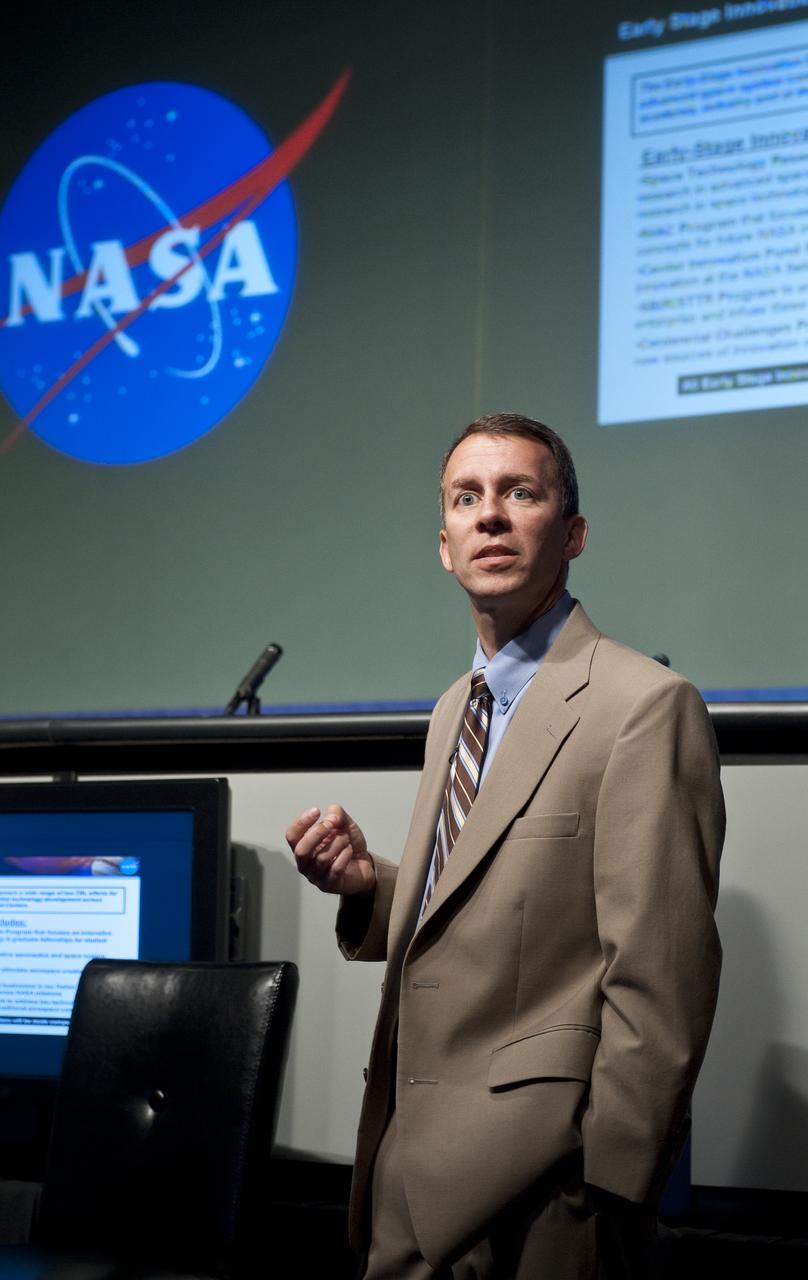
NASA's Chief Technologists, Bobby Braun, hosts a Town Hall meeting to discuss agency-wide technology policy and programs at NASA Headquarters on Tuesday, May 25, 2010, in Washington. Photo Credit: (NASA/Carla Cioffi)
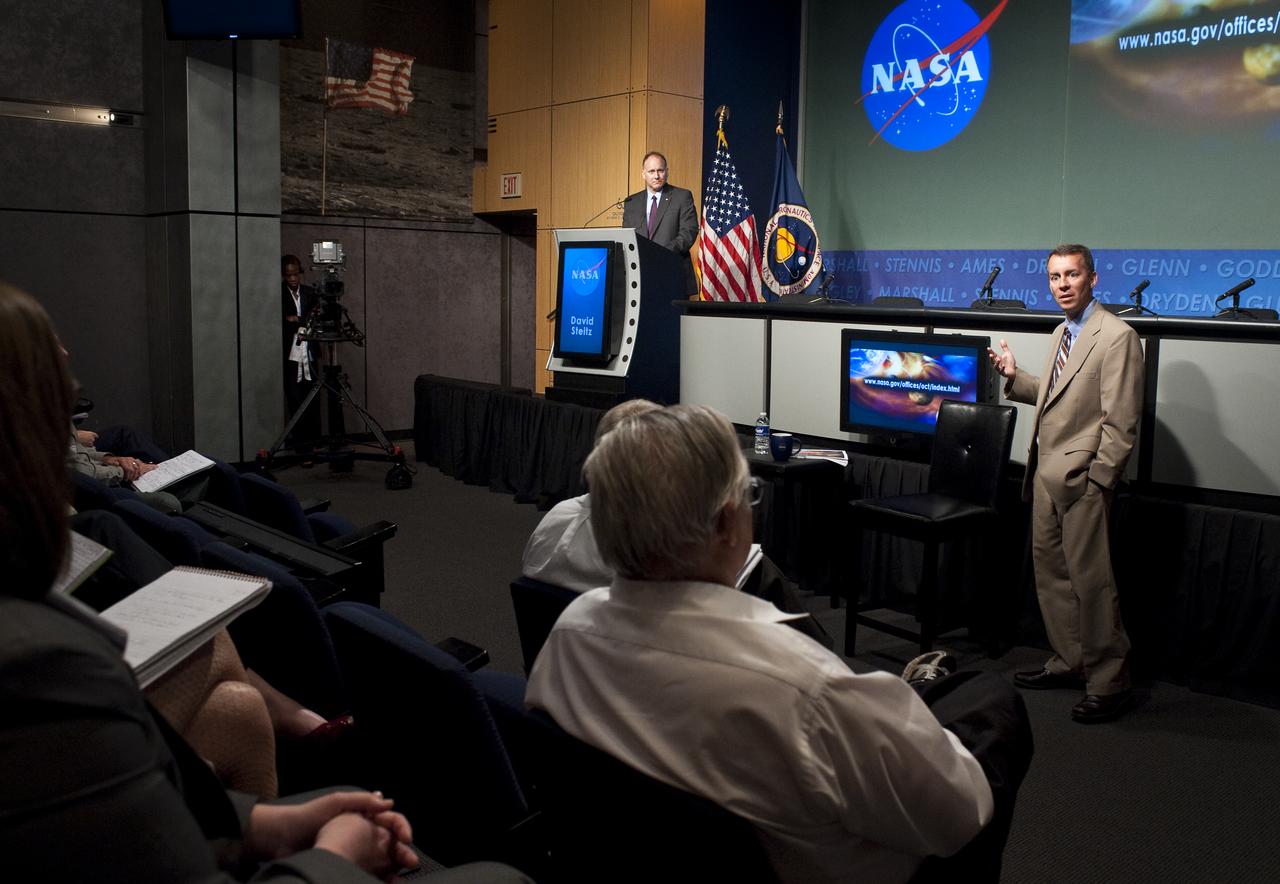
Bobby Braun, right, NASA's Chief Technologist, answers questions during a Town Hall meeting to discuss agency-wide technology policy and programs at NASA Headquarters on Tuesday, May 25, 2010, in Washington. Photo Credit: (NASA/Carla Cioffi)
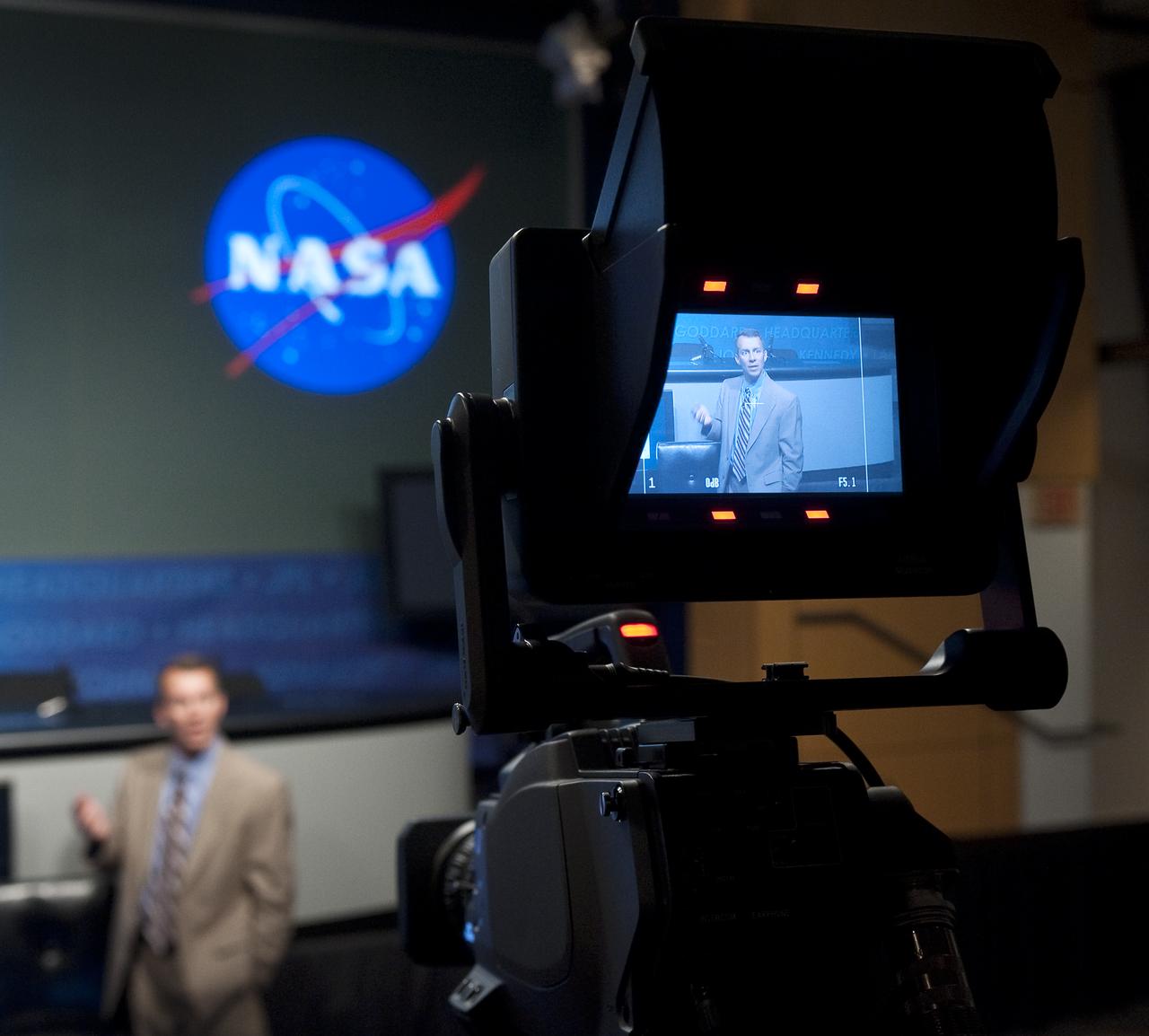
Bobby Braun, NASA's Chief Technologist, is seen on a video monitor during a Town Hall meeting to discuss agency-wide technology policy and programs at NASA Headquarters on Tuesday, May 25, 2010, in Washington. Photo Credit: (NASA/Carla Cioffi)
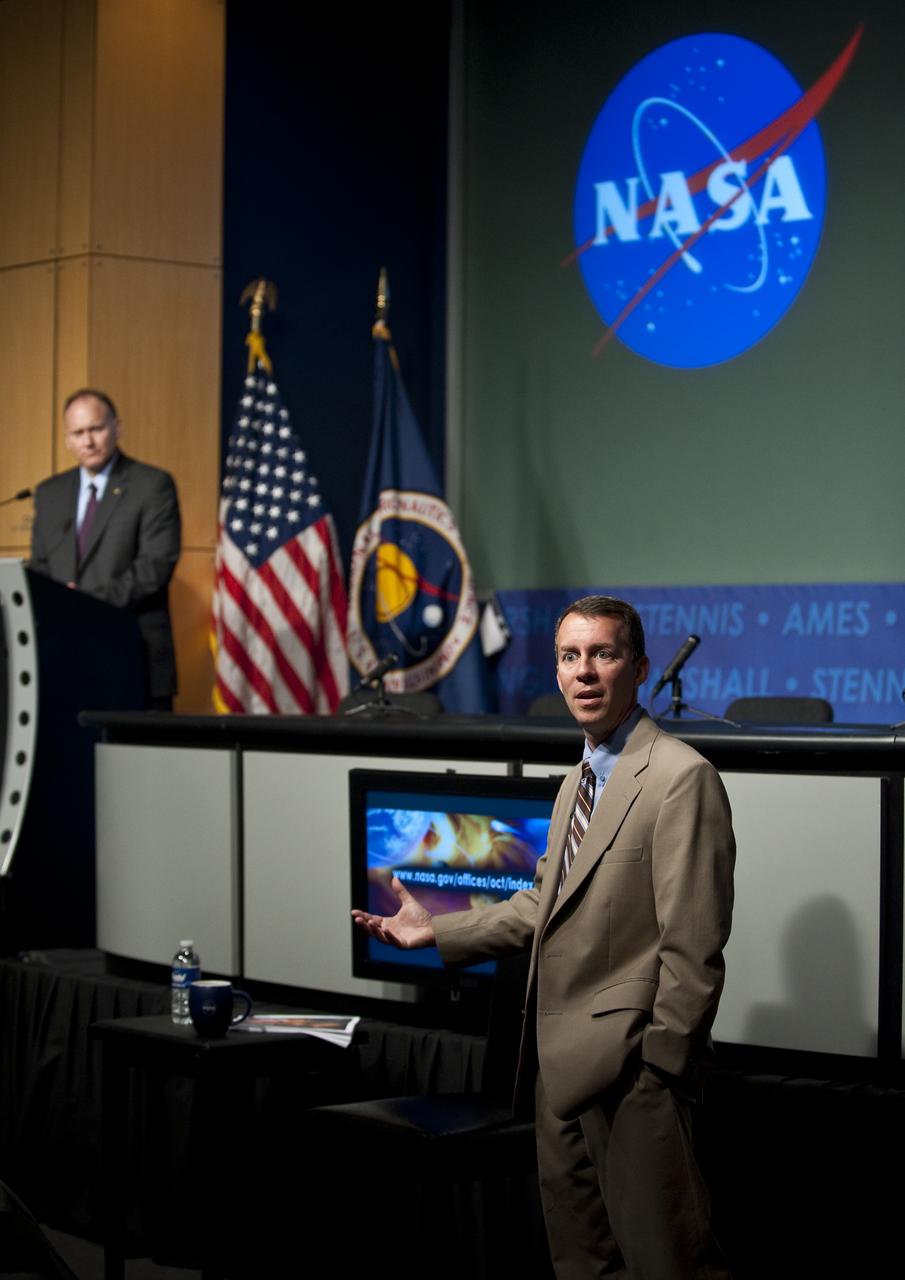
Bobby Braun, NASA's Chief Technologist, answers questions during a Town Hall meeting to discuss agency-wide technology policy and programs at NASA Headquarters on Tuesday, May 25, 2010, in Washington. Photo Credit: (NASA/Carla Cioffi)
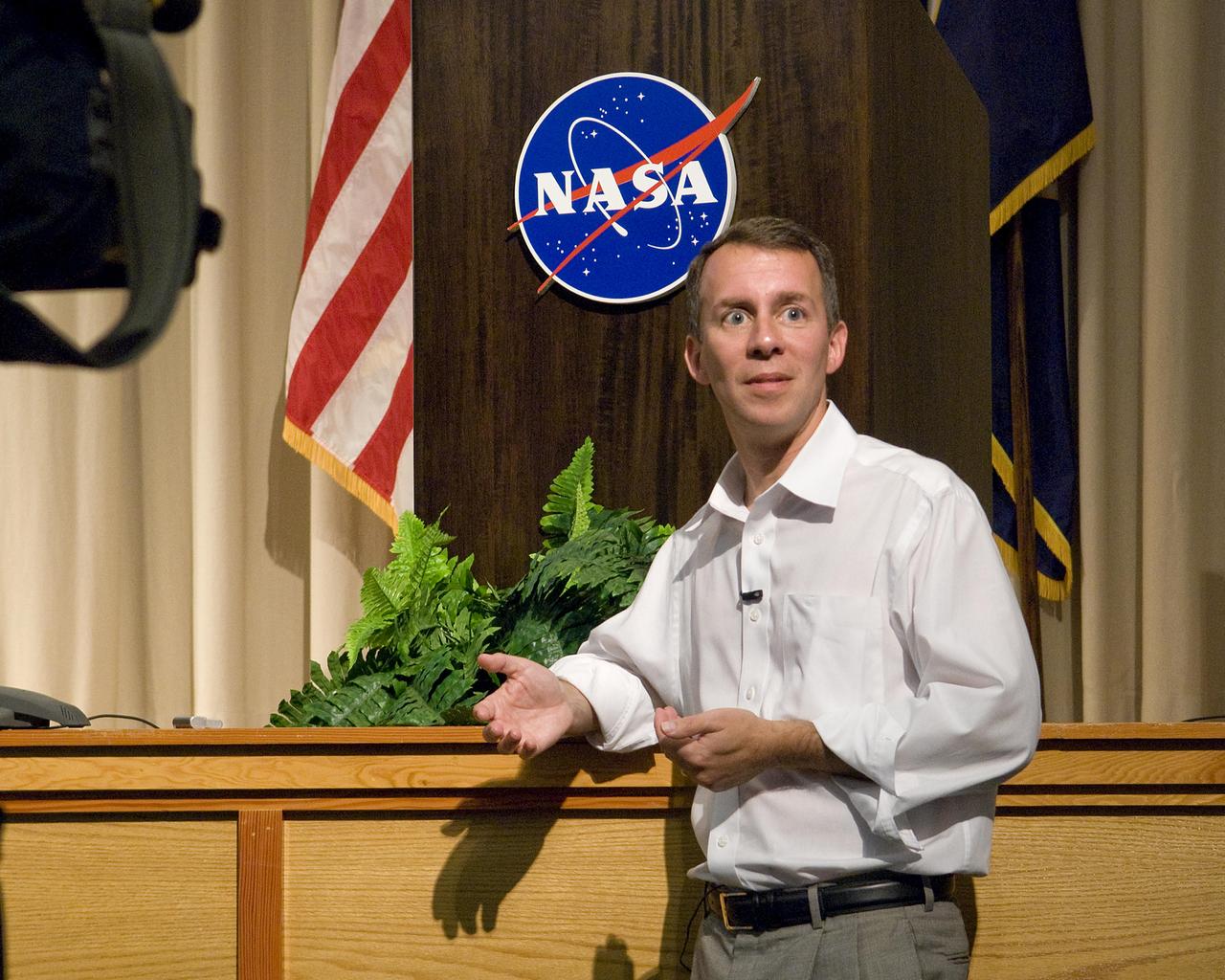
NASA Chief Technologist Bobby Braun visited John C. Stennis Space Center on Aug. 26. While at Stennis, he spoke to employees and the media about innovation and technology in NASA's future and the important role Stennis will play in space exploration programs. Braun also toured facilities and received briefings on work under way at the nation's premier rocket engine test facility.
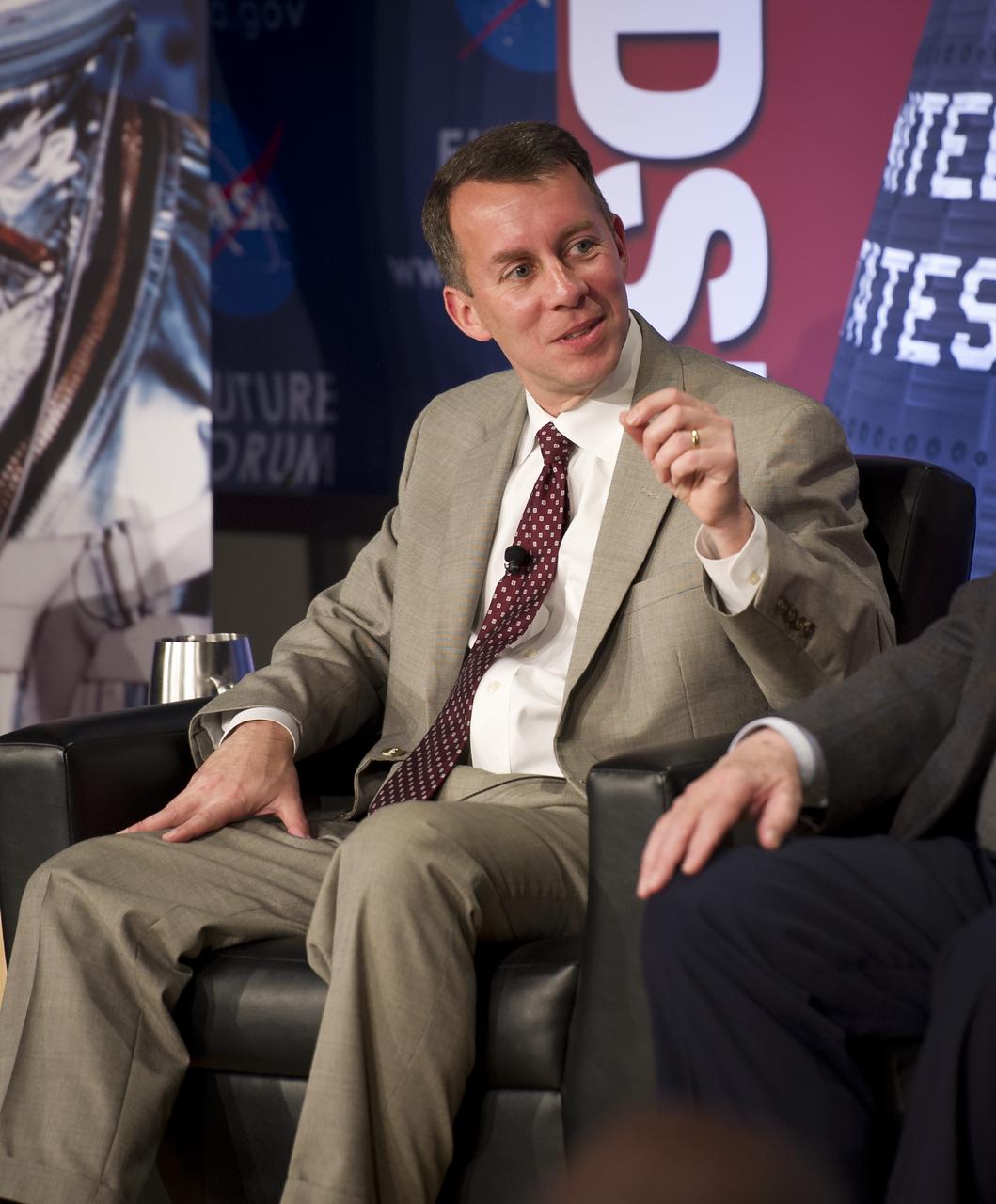
Bobby Braun, professor, Georgia Institute of Technology, talks during the NASA Future Forum panel titled "Shifting Roles for Public, Private, and International Players in Space" at The Ohio State University on Tuesday, Feb. 21, 2012 in Columbus, Ohio. The NASA Future Forum features panel discussions on the importance of education to our nation's future in space, the benefit of commercialized space technology to our economy and lives here on Earth, and the shifting roles for the public, commercial and international communities in space. Photo Credit: (NASA/Bill Ingalls)
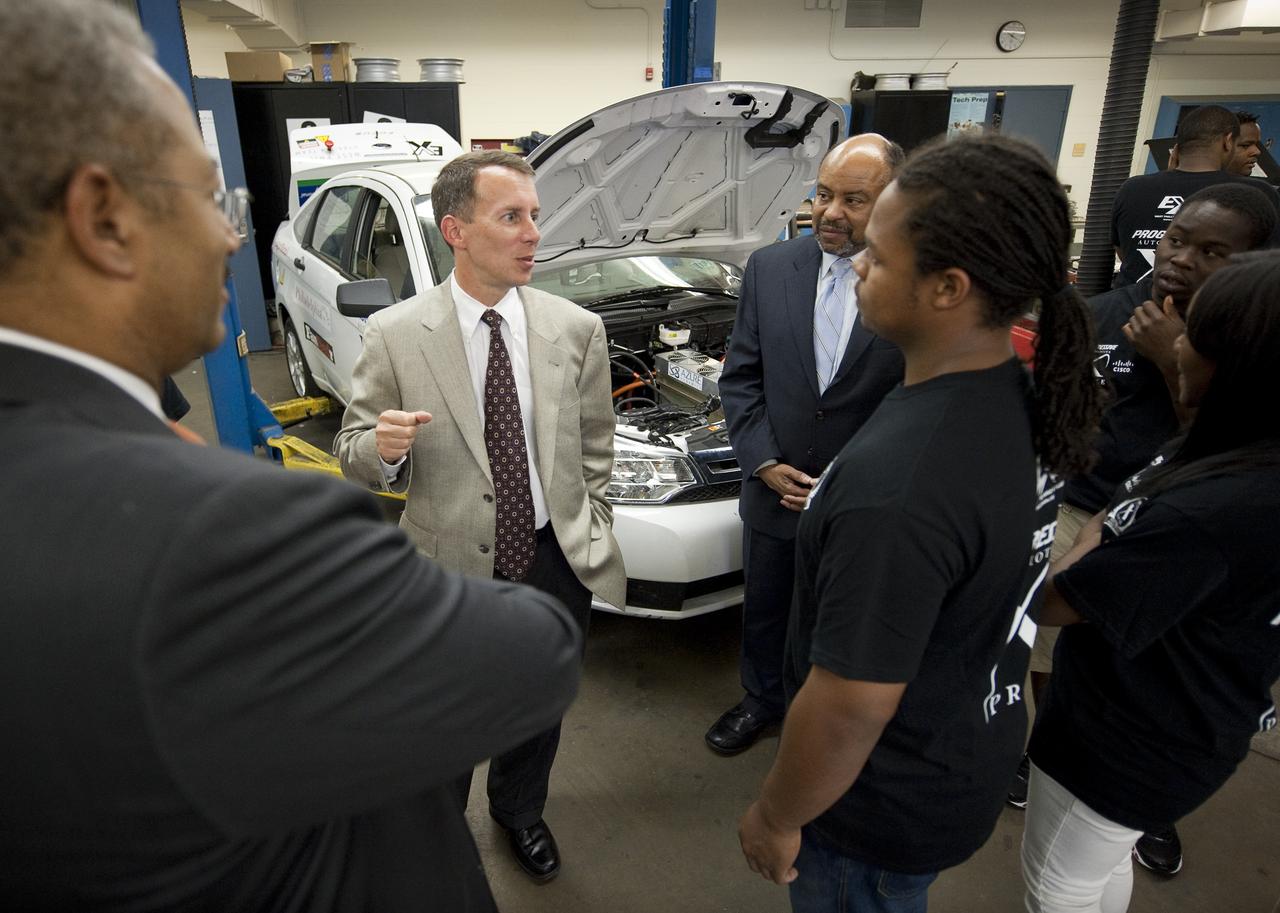
NASA Chief Technologist Bobby Braun, left, and Pennsylvania State Representative Jim Roebuck talk with students of the West Philly Hybrid X Team at West Philadelphia High School in Philadelphia, Monday, June 7, 2010. The prize-winning West Philly Hybrid X Team has drawn international recognition as the only high school among 22 finalists in the Progressive Insurance Automotive X Prize (PIAXP) competition to develop cars that achieve over 100 MPG. Photo Credit: (NASA/Bill Ingalls)
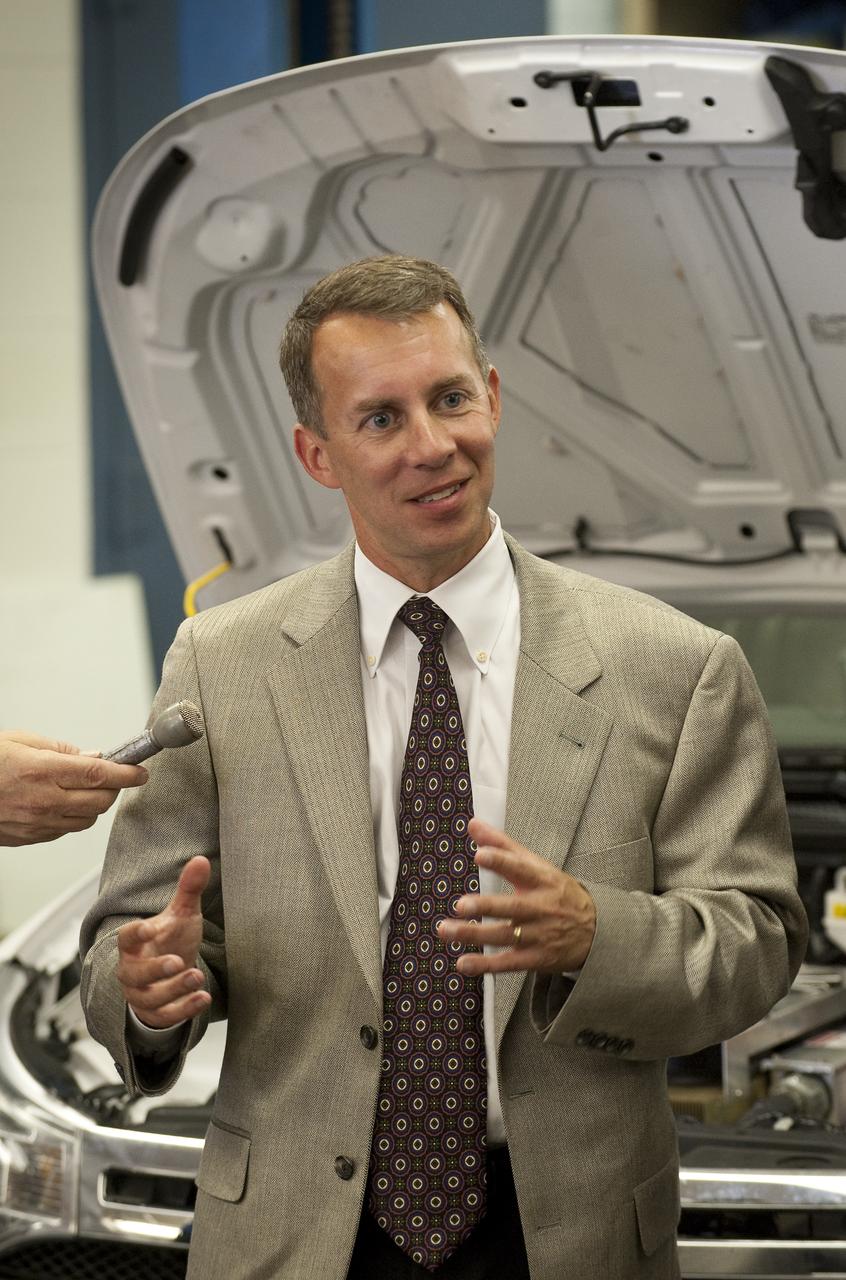
NASA Chief Technologist Bobby Braun talks with student members of the West Philly Hybrid X Team at West Philadelphia High School in Philadelphia, Monday, June 7, 2010. The prize-winning West Philly Hybrid X Team has drawn international recognition as the only high school among 22 finalists in the Progressive Insurance Automotive X Prize (PIAXP) competition to develop cars that achieve over 100 MPG. Photo Credit: (NASA/Bill Ingalls)
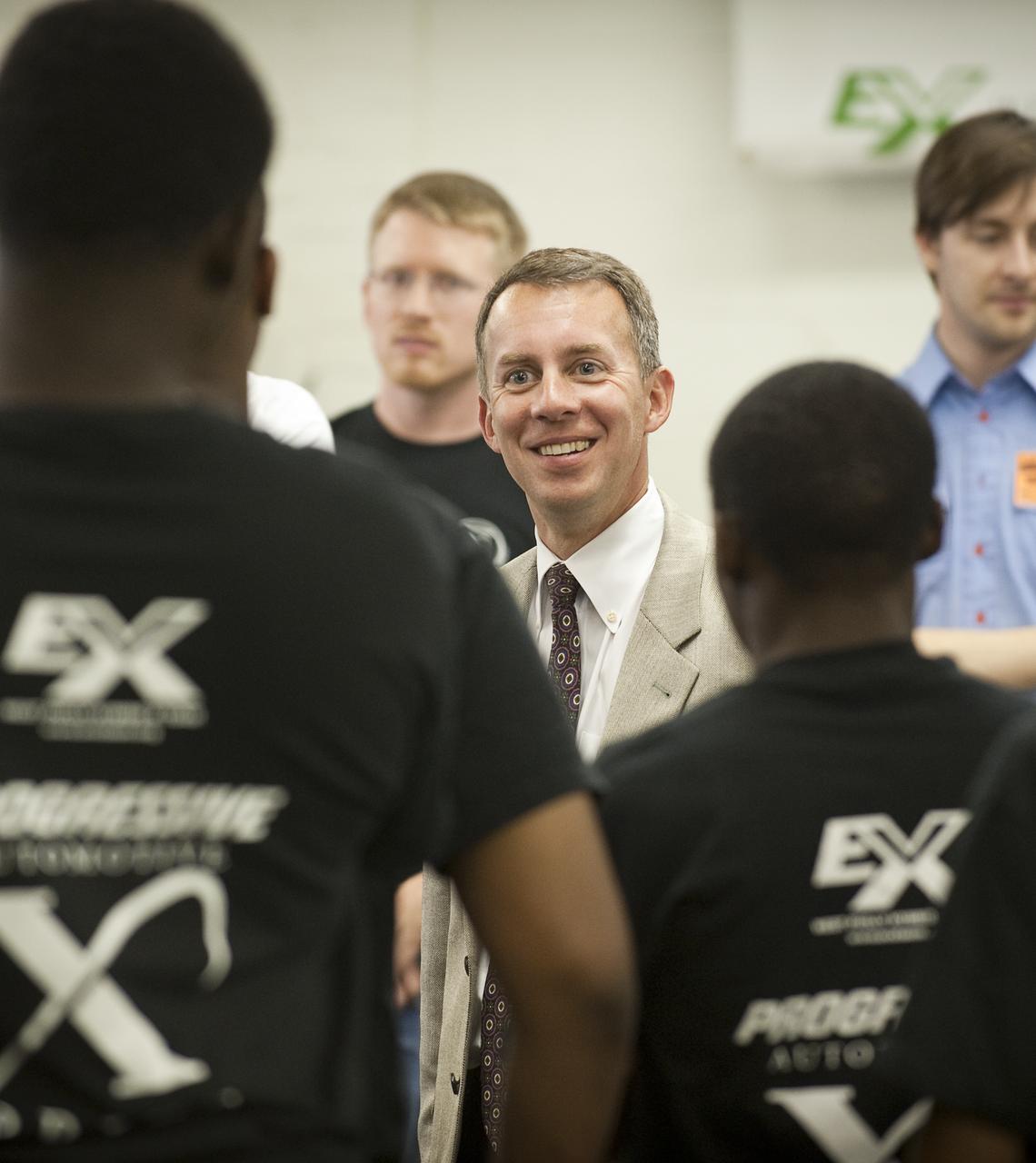
NASA Chief Technologist Bobby Braun talks with student members of the West Philly Hybrid X Team at West Philadelphia High School in Philadelphia, Monday, June 7, 2010. The prize-winning West Philly Hybrid X Team has drawn international recognition as the only high school among 22 finalists in the Progressive Insurance Automotive X Prize (PIAXP) competition to develop cars that achieve over 100 MPG. Photo Credit: (NASA/Bill Ingalls)
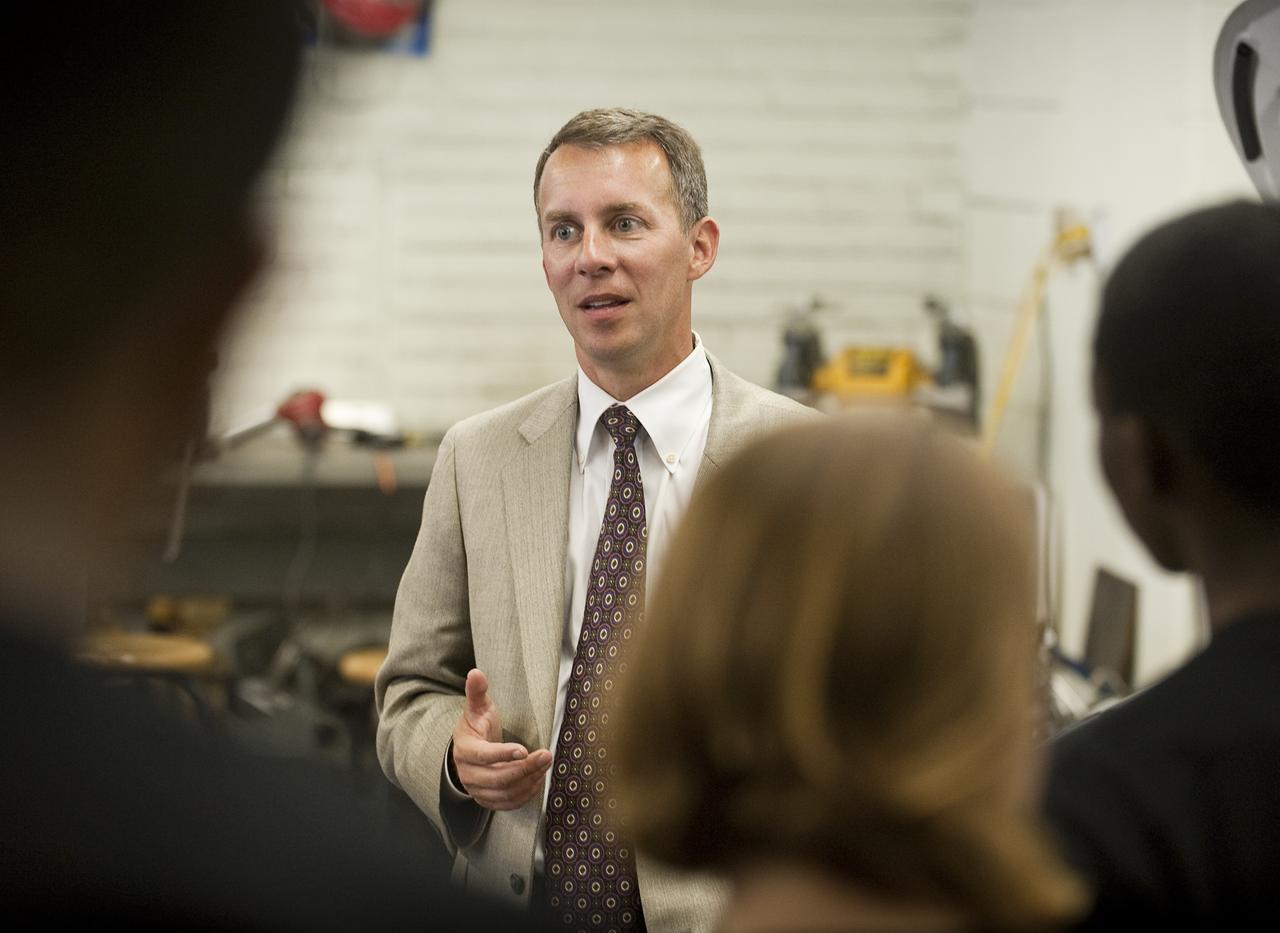
NASA Chief Technologist Bobby Braun talks with student members of the West Philly Hybrid X Team at West Philadelphia High School in Philadelphia, Monday, June 7, 2010. The prize-winning West Philly Hybrid X Team has drawn international recognition as the only high school among 22 finalists in the Progressive Insurance Automotive X Prize (PIAXP) competition to develop cars that achieve over 100 MPG. Photo Credit: (NASA/Bill Ingalls)

NASA Chief Technologist Bobby Braun sits in the West Philly X Prize hybrid sports car as Sowande Gay, a student member of the West Philly Hybrid Team at West Philadelphia High School, explains the modifications made to the car, in Philadelphia, Monday, June 7, 2010. The prize-winning West Philly Hybrid X Team has drawn international recognition as the only high school among 22 finalists in the Progressive Insurance Automotive X Prize (PIAXP) competition to develop cars that achieve over 100 MPG. Photo Credit: (NASA/Bill Ingalls)
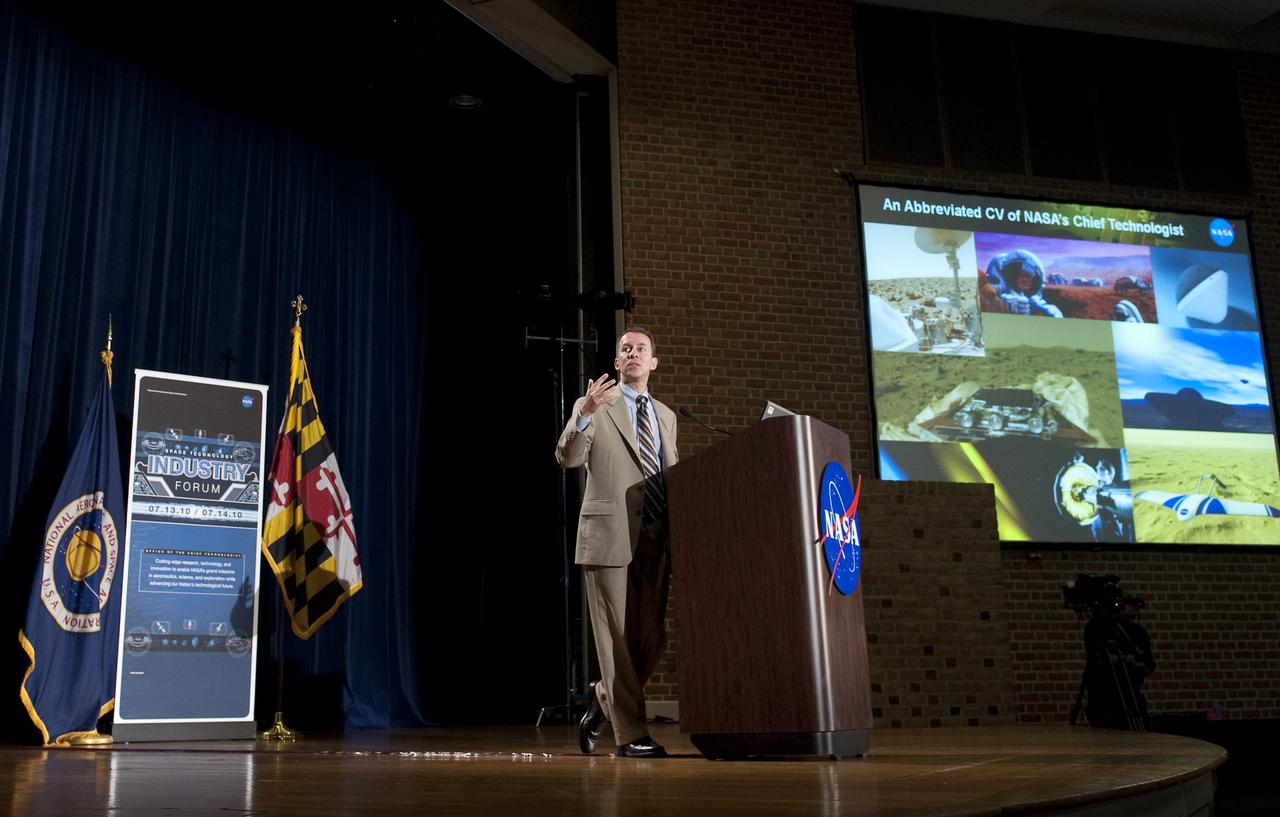
NASA Chief Technologist Bobby Braun speaks during the NASA New Space Technology Industry Forum being held at the University of Maryland in College Park on Tuesday, July 13, 2010. During the two-day event, speakers are focusing on the president's fiscal year 2011 budget request for NASA's new Space Technology Program. Representatives from industry, academia and the federal government are in attendance to discuss strategy, development and implementation of NASA's proposed new technology-enabled exploration. Photo Credit: (NASA/Bill Ingalls)
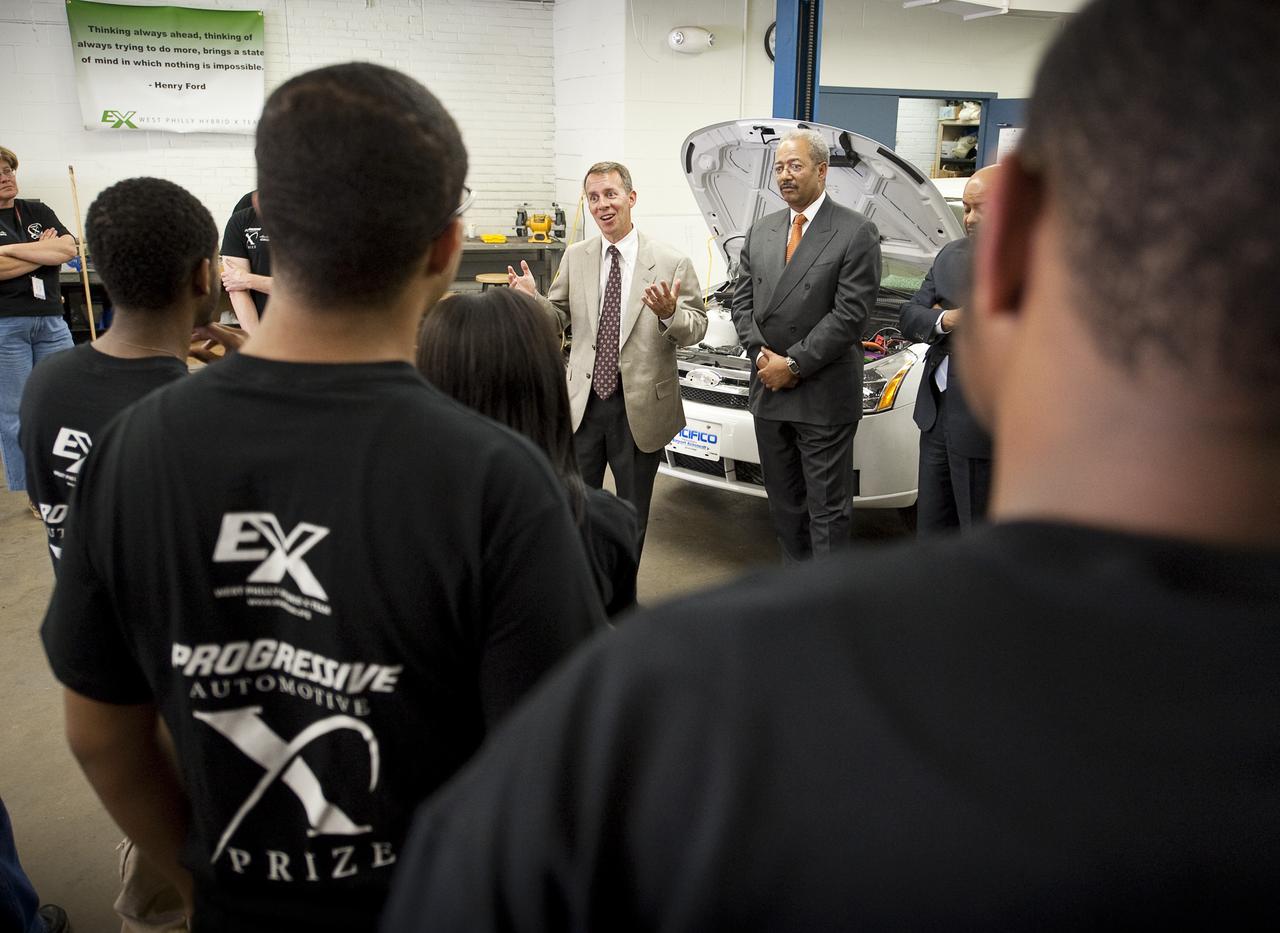
NASA Chief Technologist Bobby Braun, left, and Congressman Chaka Fattah (D-PA), right, talk to student members of the West Philly Hybrid X Team at West Philadelphia High School in Philadelphia, Monday, June 7, 2010. The prize-winning West Philly Hybrid X Team has drawn international recognition as the only high school among 22 finalists in the Progressive Insurance Automotive X Prize (PIAXP) competition to develop cars that achieve over 100 MPG. Photo Credit: (NASA/Bill Ingalls)
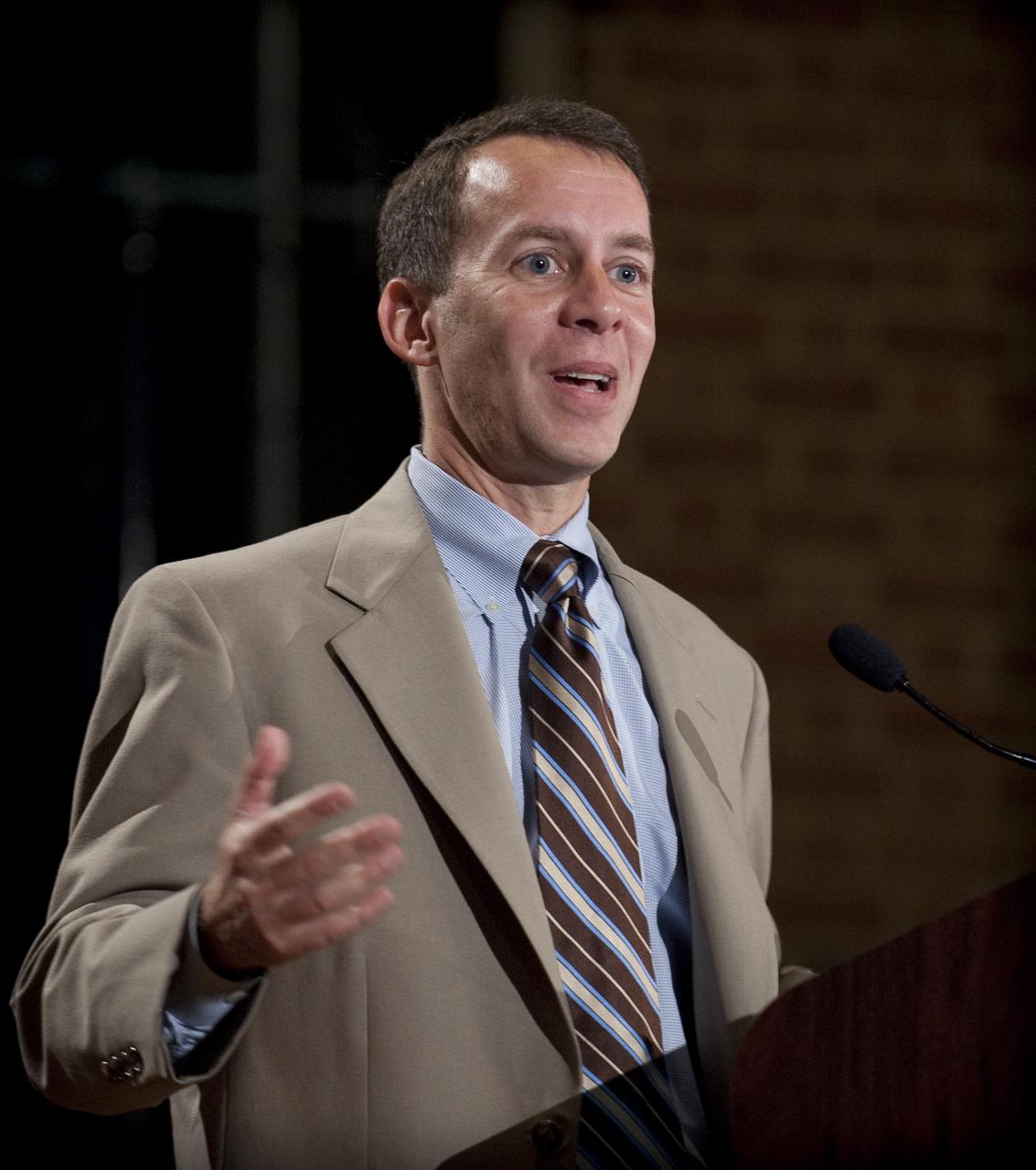
NASA Chief Technologist Bobby Braun speaks during the NASA New Space Technology Industry Forum being held at the University of Maryland in College Park on Tuesday, July 13, 2010. During the two-day event, speakers are focusing on the president's fiscal year 2011 budget request for NASA's new Space Technology Program. Representatives from industry, academia and the federal government are in attendance to discuss strategy, development and implementation of NASA's proposed new technology-enabled exploration. Photo Credit: (NASA/Bill Ingalls)
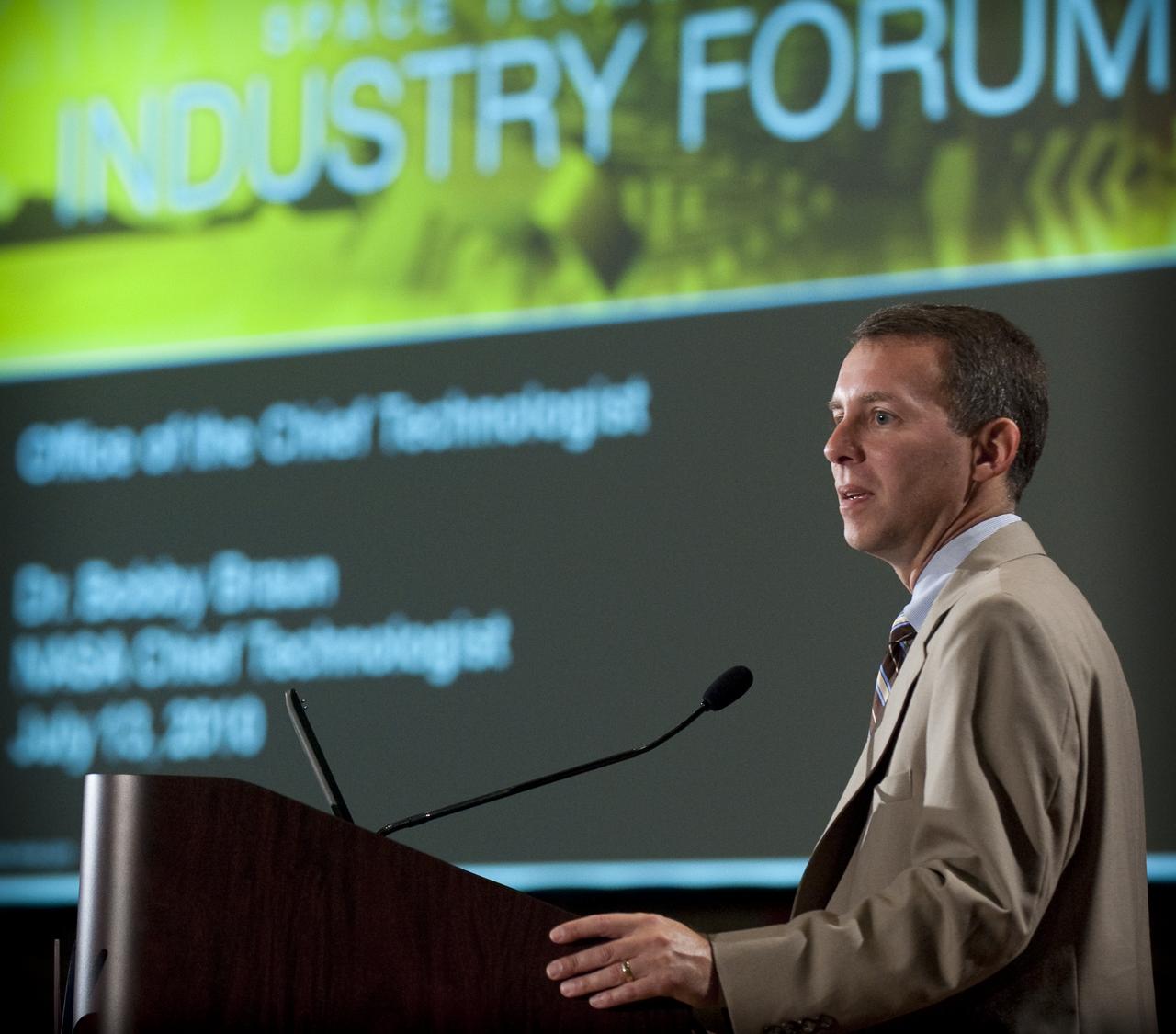
NASA Chief Technologist Bobby Braun speaks during the NASA New Space Technology Industry Forum being held at the University of Maryland in College Park on Tuesday, July 13, 2010. During the two-day event, speakers are focusing on the president's fiscal year 2011 budget request for NASA's new Space Technology Program. Representatives from industry, academia and the federal government are in attendance to discuss strategy, development and implementation of NASA's proposed new technology-enabled exploration. Photo Credit: (NASA/Bill Ingalls)
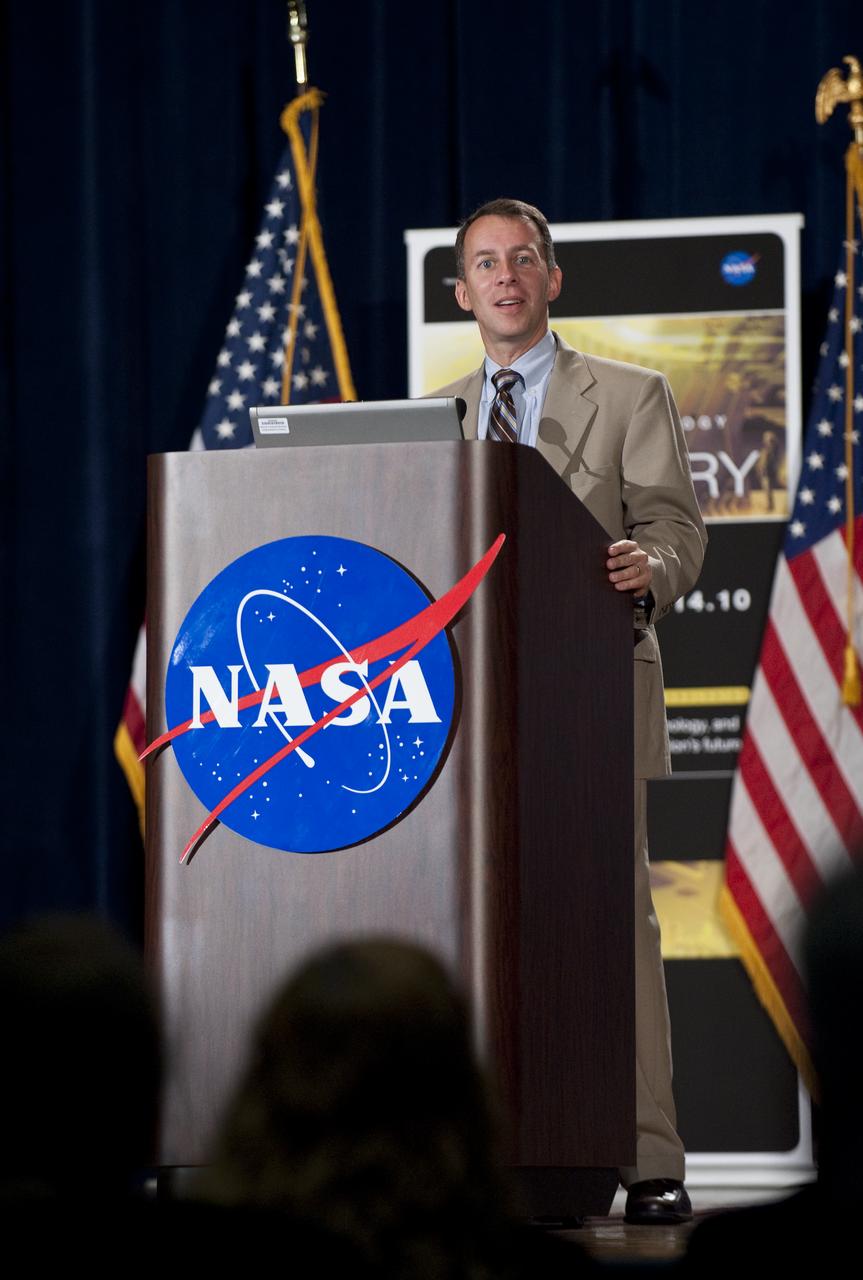
NASA Chief Technologist Bobby Braun speaks during the NASA New Space Technology Industry Forum being held at the University of Maryland in College Park on Tuesday, July 13, 2010. During the two-day event, speakers are focusing on the president's fiscal year 2011 budget request for NASA's new Space Technology Program. Representatives from industry, academia and the federal government are in attendance to discuss strategy, development and implementation of NASA's proposed new technology-enabled exploration. Photo Credit: (NASA/Bill Ingalls)
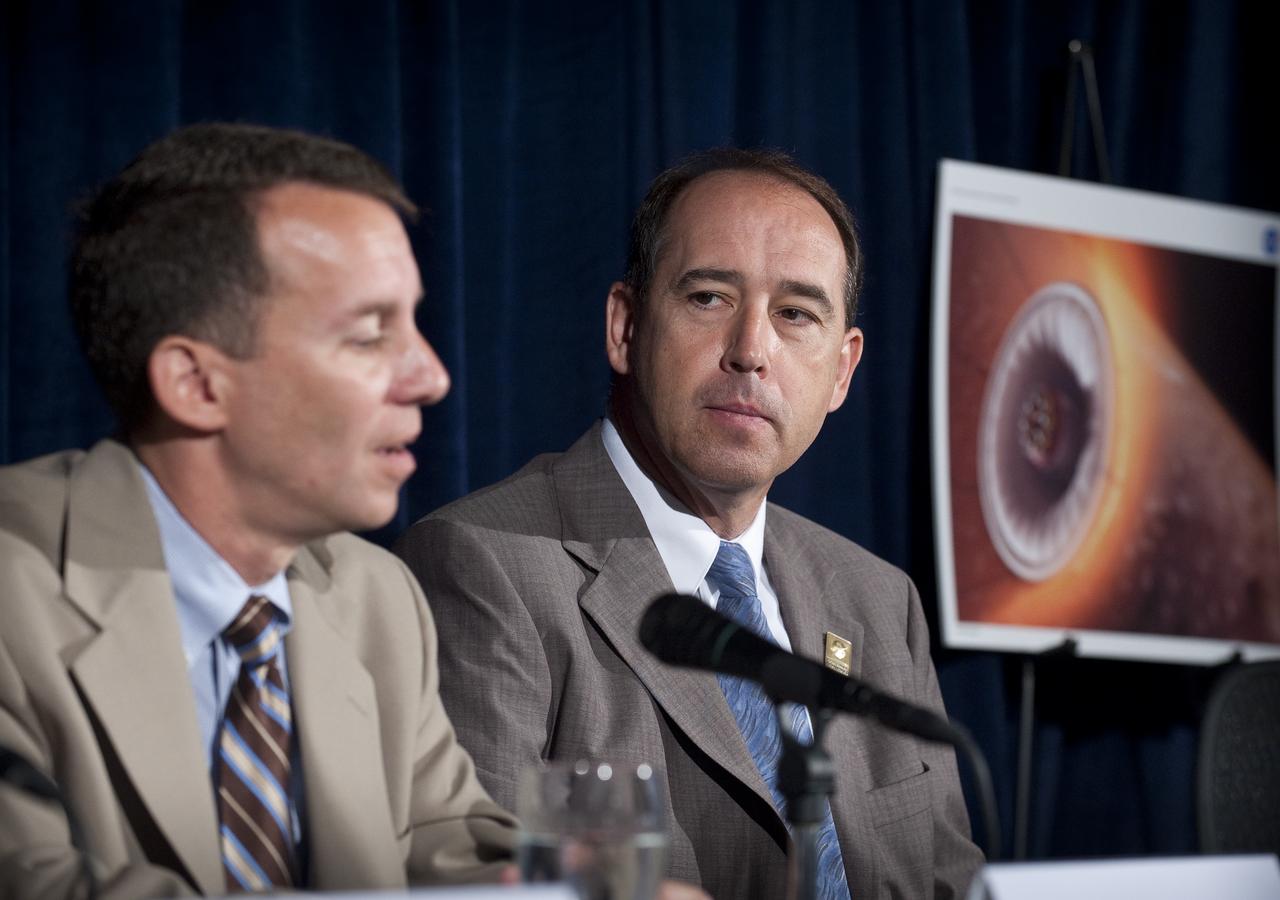
NASA's Manager of Centennial Challenges Andy Petro, right, listens as NASA Chief Technologist Bobby Braun answers a reporter's question during a press conference held at the NASA New Space Technology Industry Forum being held at the University of Maryland in College Park on Tuesday, July 13, 2010. During the two-day event, speakers are focusing on the president's fiscal year 2011 budget request for NASA's new Space Technology Program. Representatives from industry, academia and the federal government are in attendance to discuss strategy, development and implementation of NASA's proposed new technology-enabled exploration. Photo Credit: (NASA/Bill Ingalls)
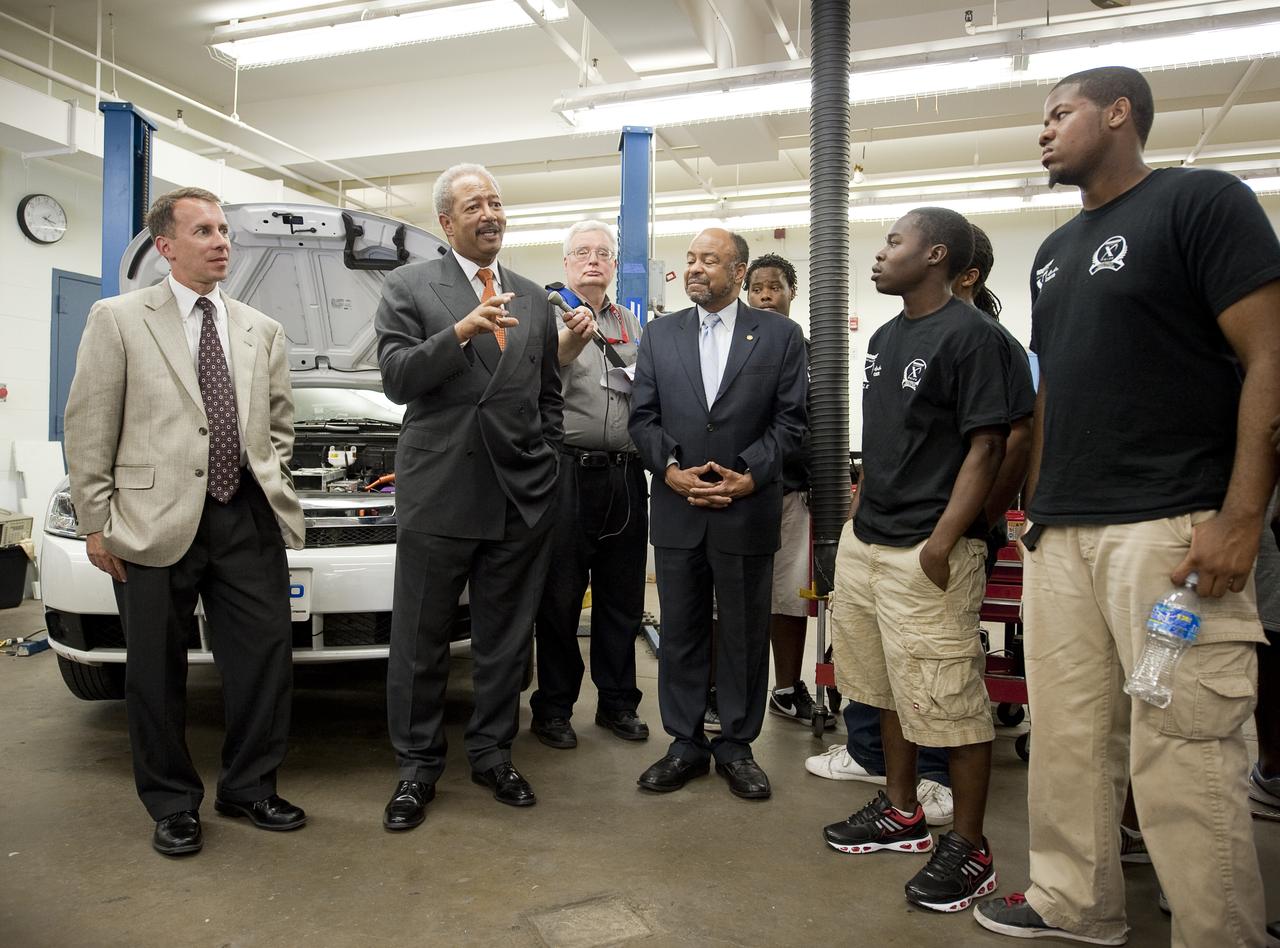
NASA Chief Technologist Bobby Braun, left, and Congressman Chaka Fattah (D-PA), center, and Pennsylvania State Representative Jim Roebuck talk with students of the West Philly Hybrid X Team at West Philadelphia High School in Philadelphia, Monday, June 7, 2010. The prize-winning West Philly Hybrid X Team has drawn international recognition as the only high school among 22 finalists in the Progressive Insurance Automotive X Prize (PIAXP) competition to develop cars that achieve over 100 MPG. Photo Credit: (NASA/Bill Ingalls)
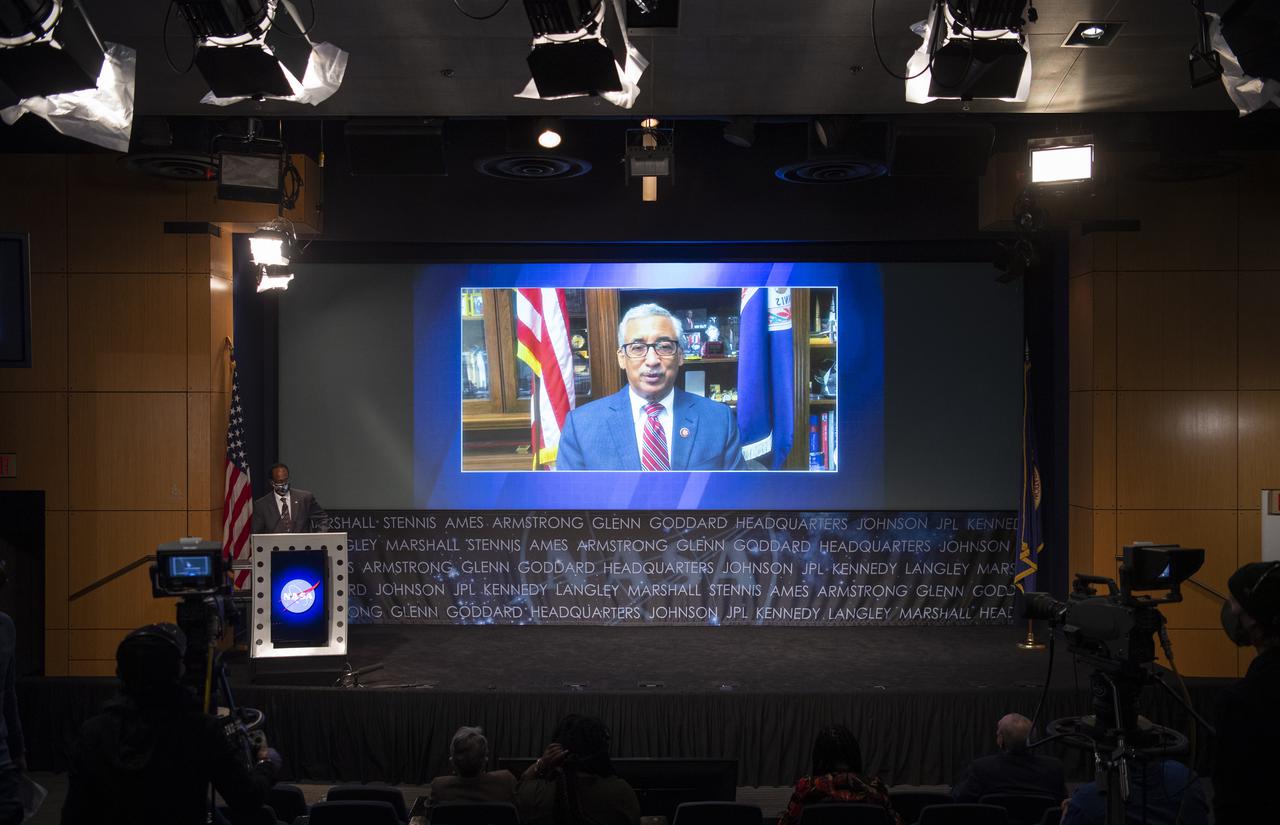
Rep. Bobby Scott (D-Va.), is seen onscreen in a pre-recorded message during a ceremony officially naming the NASA Headquarters building in honor of Mary W. Jackson, Friday, Feb. 26, 2021, at NASA Headquarters in Washington, DC. Mary W. Jackson, the first African American female engineer at NASA, began her career with the agency in the segregated West Area Computing Unit of NASA’s Langley Research Center in Hampton, Virginia. The mathematician and aerospace engineer went on to lead programs influencing the hiring and promotion of women in NASA's science, technology, engineering, and mathematics careers. In 2019, she posthumously received the Congressional Gold Medal. Photo Credit: (NASA/Joel Kowsky)
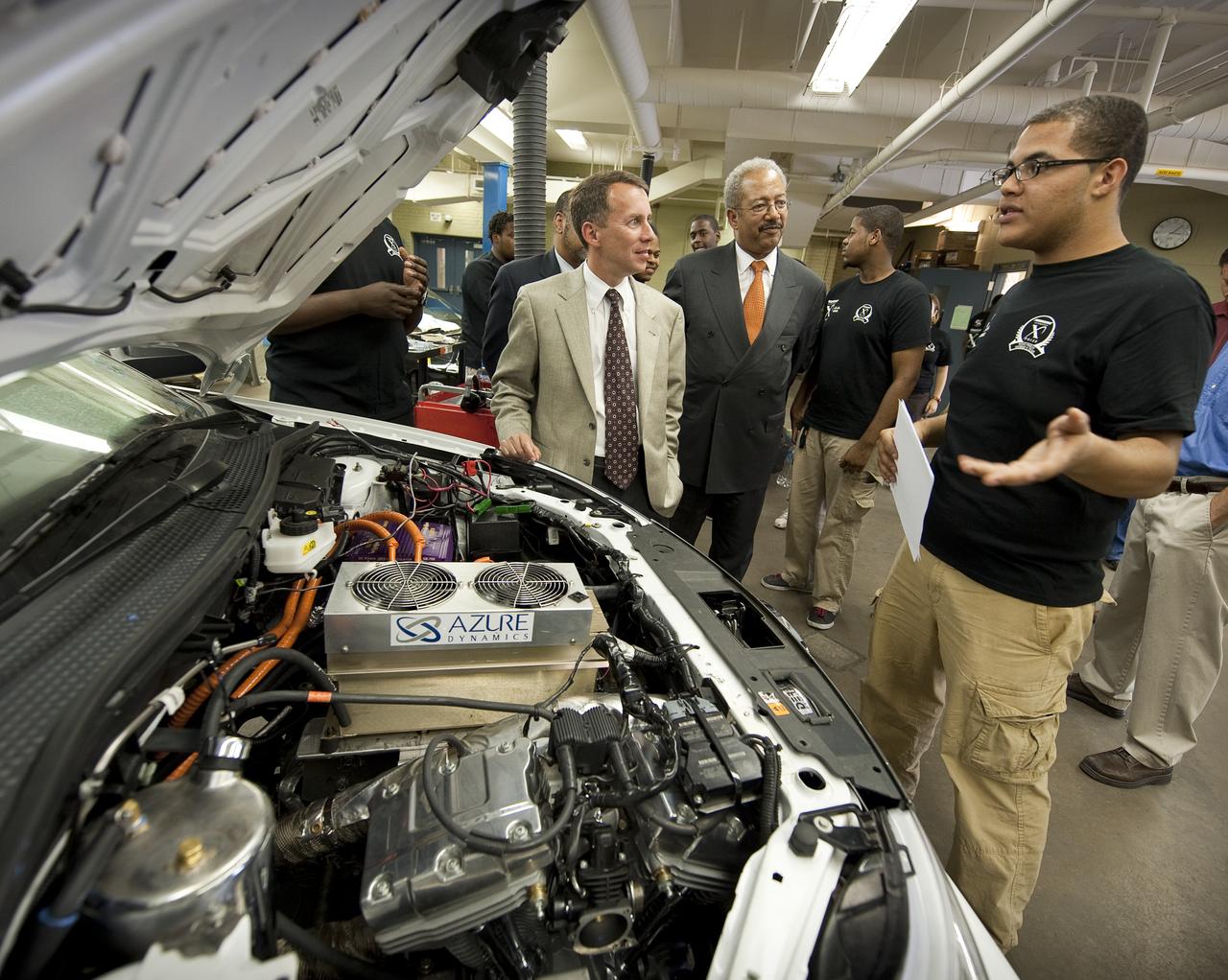
NASA Chief Technologist Bobby Braun, left, and Congressman Chaka Fattah (D-PA), center, listen to Azeem Hill, a member of the West Philly Hybrid X Team at West Philadelphia High School in Philadelphia, Monday, June 7, 2010. The prize-winning West Philly Hybrid X Team has drawn international recognition as the only high school among 22 finalists in the Progressive Insurance Automotive X Prize (PIAXP) competition to develop cars that achieve over 100 MPG. Photo Credit: (NASA/Bill Ingalls)
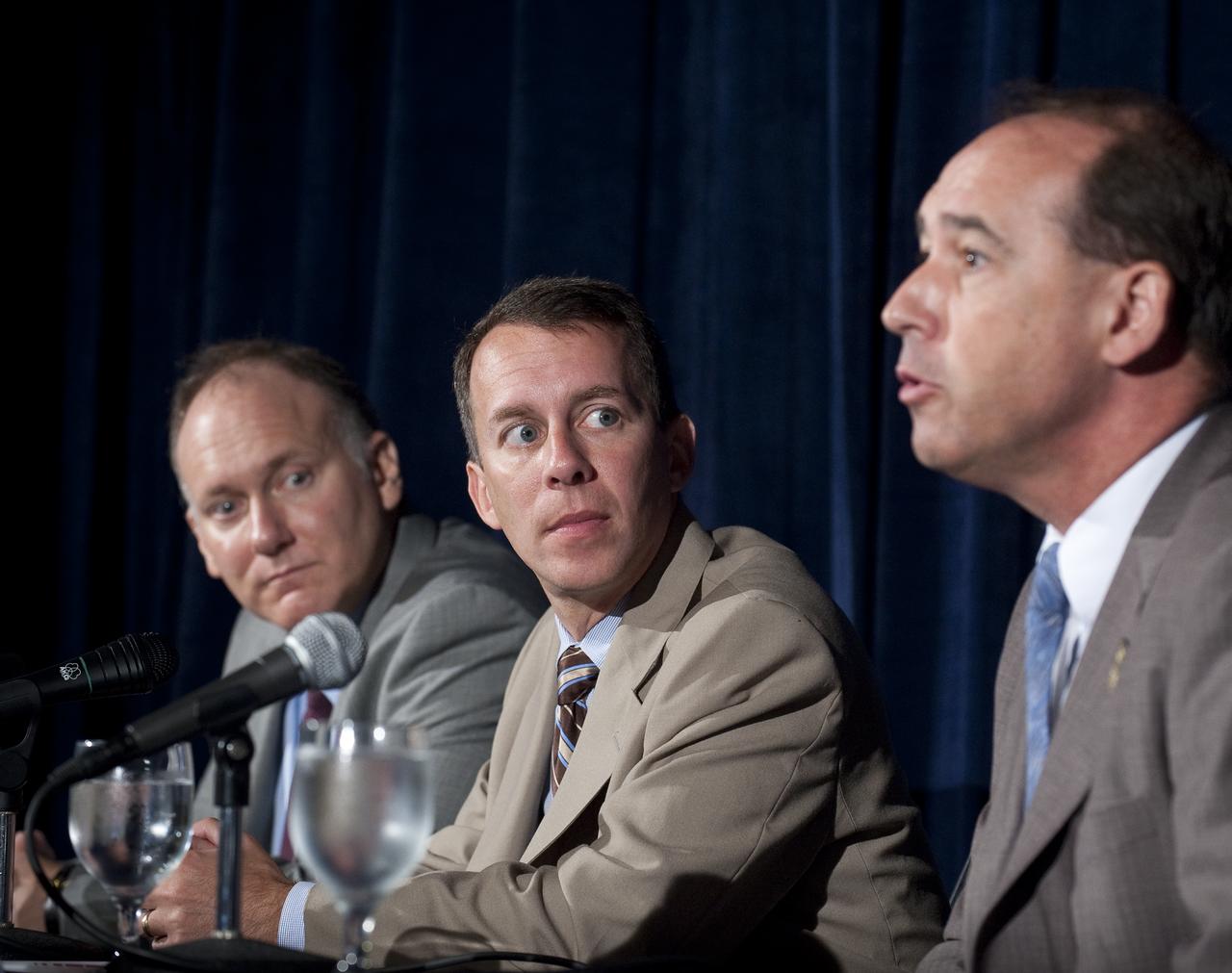
NASA Chief Technologist Bobby Braun, center, listens as NASA's Manager of Centennial Challenges Andy Petro, right, answers a reporter's question during a press conference held at the NASA New Space Technology Industry Forum being held at the University of Maryland in College Park on Tuesday, July 13, 2010. During the two-day event, speakers are focusing on the president's fiscal year 2011 budget request for NASA's new Space Technology Program. Representatives from industry, academia and the federal government are in attendance to discuss strategy, development and implementation of NASA's proposed new technology-enabled exploration. Photo Credit: (NASA/Bill Ingalls)
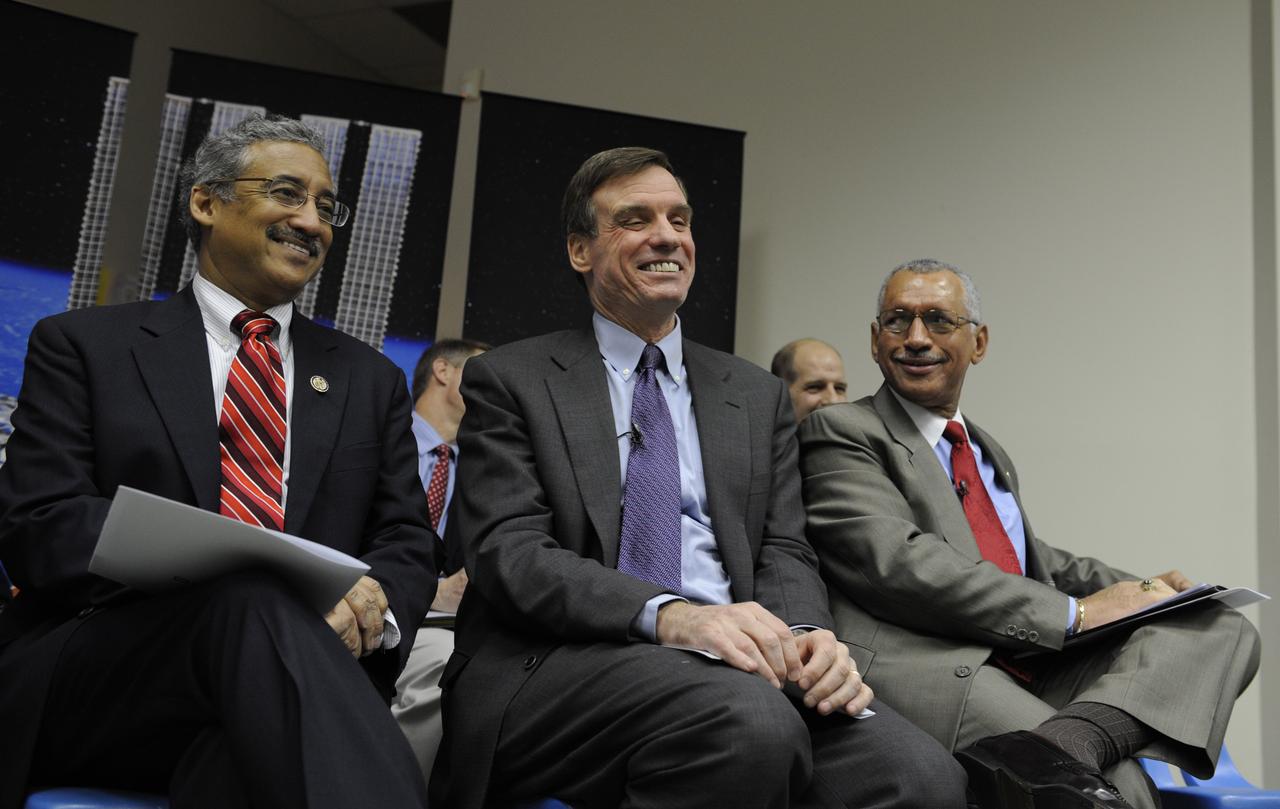
NASA Administrator Charles Bolden, right, shares a laugh with U.S. Sen. Mark Warner, D-Va., center and U.S. Rep. Bobby Scott, D-Va., prior to an event at the MathScience Innovation Center, Friday, Jan. 28, 2011, in Richmond, Va. Bolden later spoke to students from Albert Hill Middle School highlighting the importance of science, technology, engineering and math, or STEM, as he shared his life experiences with the students. (Photo Credit:NASA/Paul E. Alers)
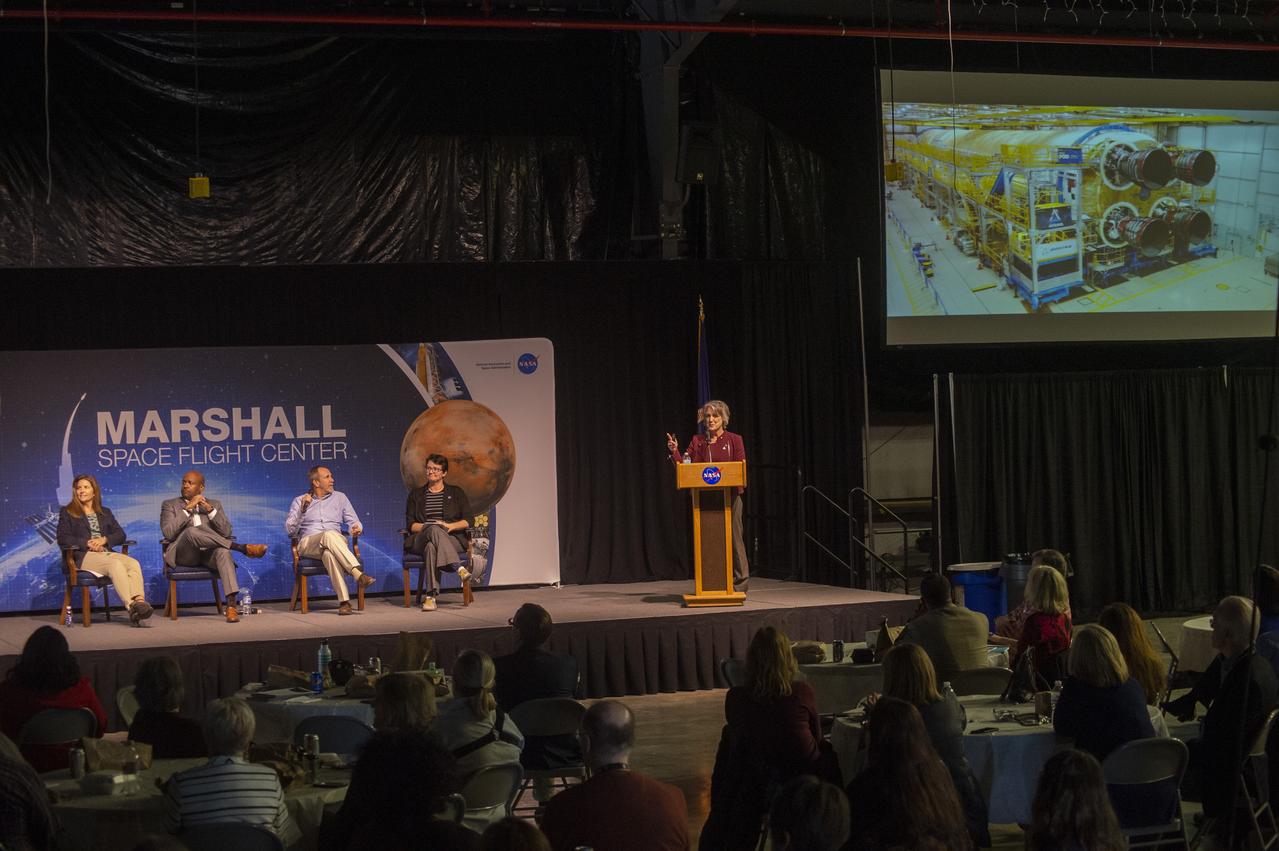
MARCIA LINDSTROM, AT PODIUM, FACILITATES ARTEMIS PROGRAM PANEL DISCUSSION AT NOVEMBER MARSHALL ASSOCIATION LUNCHEON. (L TO R), LISA WATSON-MORGAN, PROGRAM MANAGER, HUMAN LANDING SYSTEM; BOBBY WATKINS, DIRECTOR HUMAN EXPLORATION DEVELOPMENT & OPERATIONS OFFICE; DAVID BEAMAN, MANAGER, SYSTEMS ENGINEERING & INTEGRATION OFFICE, RENEE WEBER, ACTING CENTER CHIEF SCIENTIST
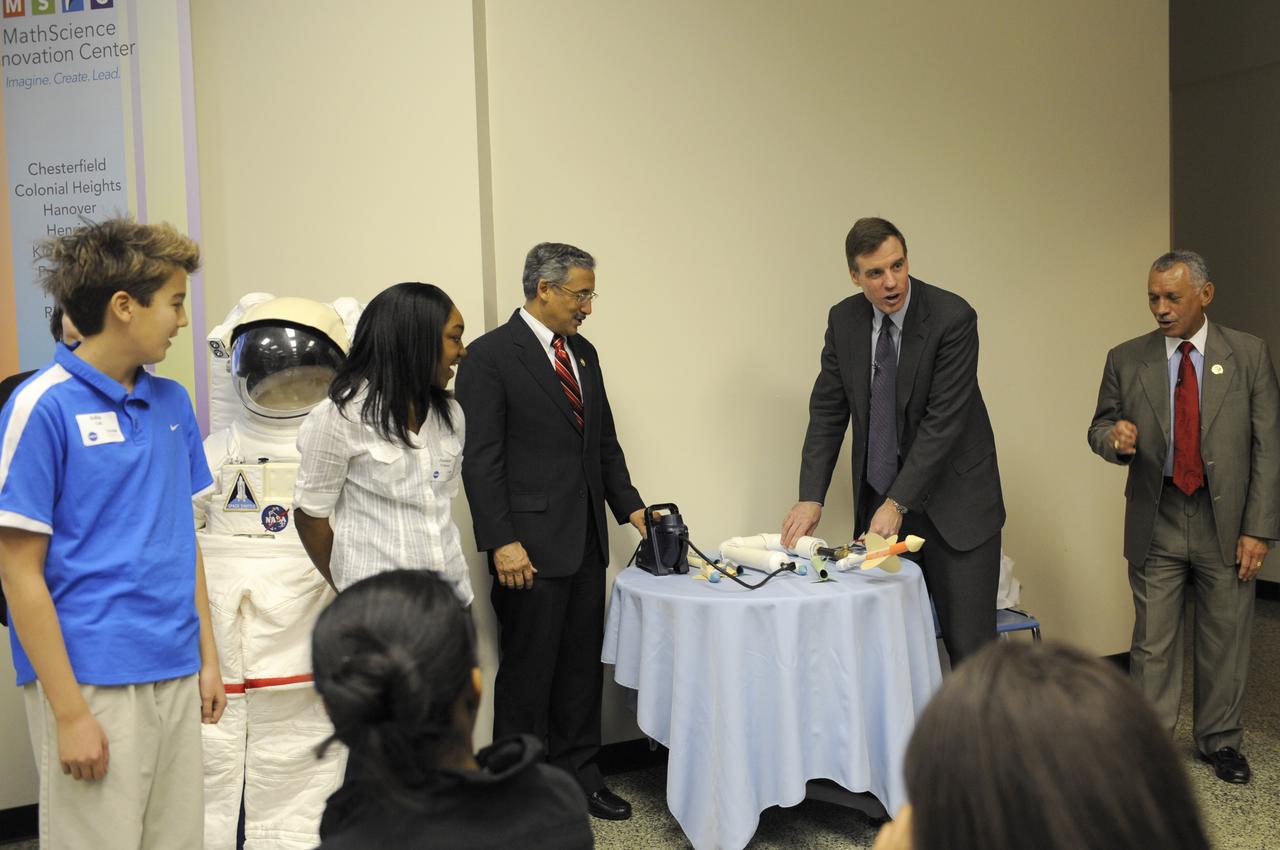
NASA Administrator Charles Bolden, right, counts down along with others as U.S. Sen. Mark Warner, D-Va., readies to launch a paper rocket as U.S. Rep. Bobby Scott, D-Va., third right, looks on, Friday, Jan. 28, 2011, at the MathScience Innovation Center in Richmond, Va. Earlier, Bolden, spoke to students from Albert Hill Middle School where he highlighted the importance of science, technology, engineering and math, or STEM, as he shared his life experiences with the students. (Photo Credit:NASA/Paul E. Alers)
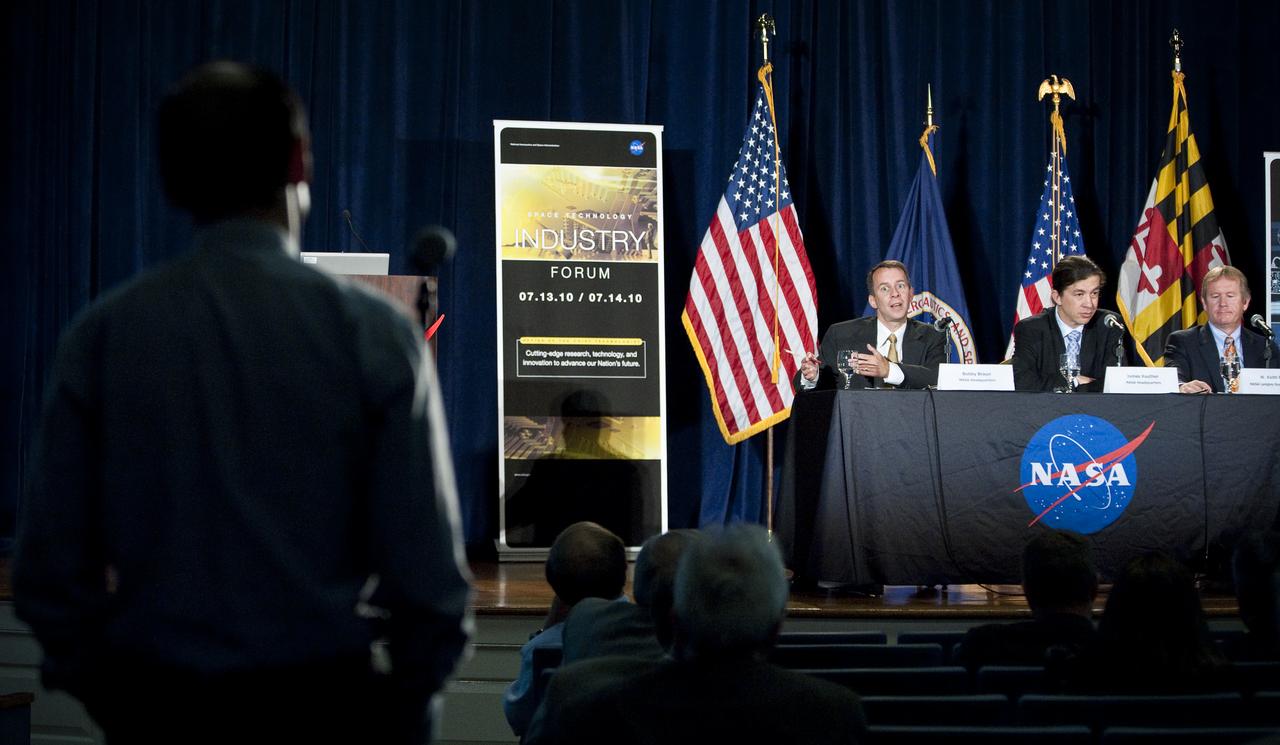
Bobby Braun, third from right, NASA Chief Technologist, answers a question during the NASA New Space Technology Industry Forum being held at the University of Maryland in College Park on Wednesday, July 14, 2010. During the two-day event, speakers are focusing on the president's fiscal year 2011 budget request for NASA's new Space Technology Program. Representatives from industry, academia and the federal government are in attendance to discuss strategy, development and implementation of NASA's proposed new technology-enabled exploration. Photo Credit: (NASA/Carla Cioffi)
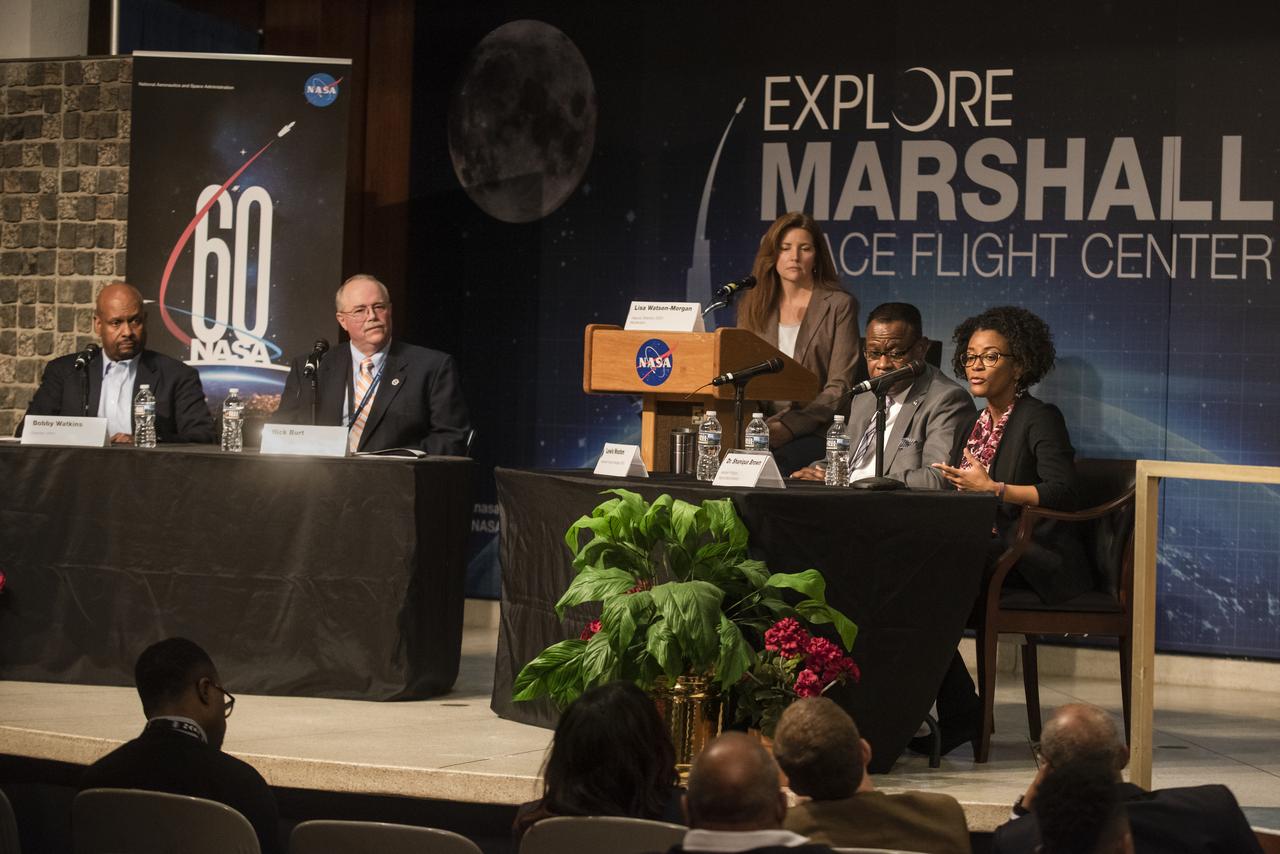
Wayne State University professor Shanique Brown, far right, takes part in a panel discussion on diversity and building strong, inclusive teams. She was joined by, from right, Lewis Wooten, associate program manager for the Space Launch System Program Office at Marshall; moderator Lisa Watson-Morgan, deputy director of Marshall's Engineering Directorate; Rick Burt, director of Marshall's Safety & Mission Assurance Directorate; and Bobby Watkins, director of the Human Exploration Development and Operations Office.
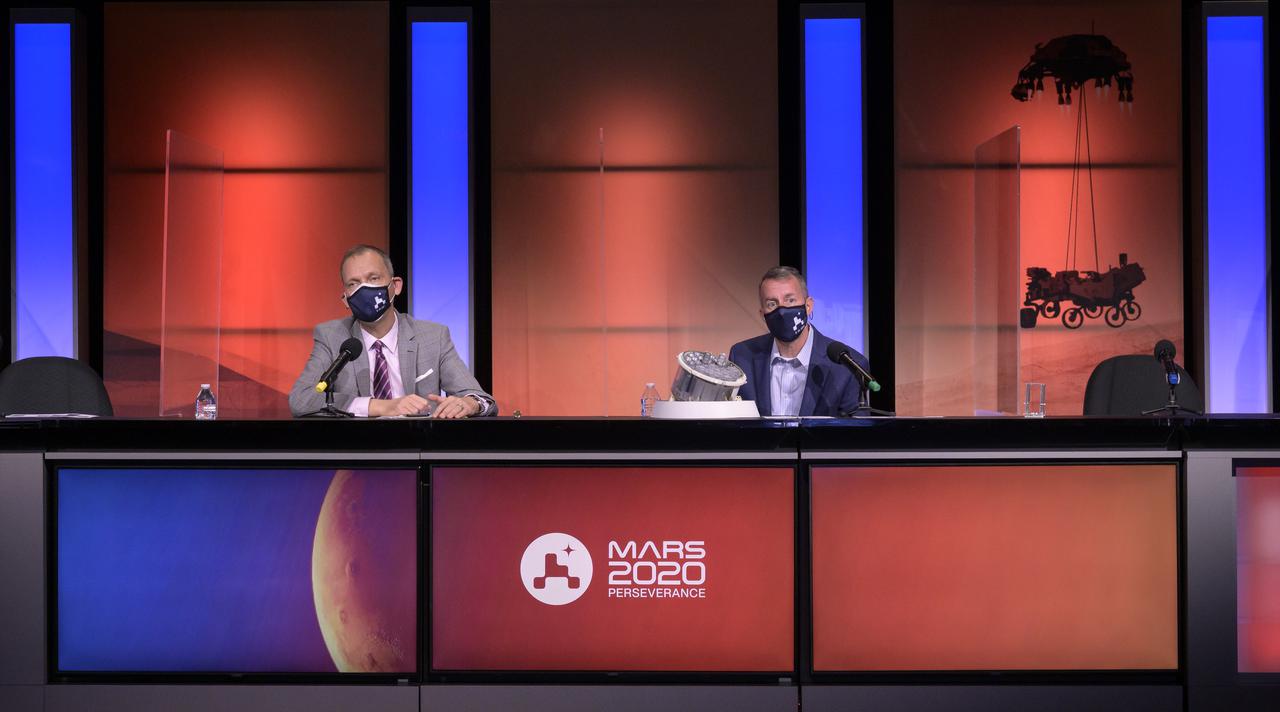
Associate Administrator of NASA's Science Mission Directorate, Thomas Zurbuchen, left, and Mars Sample Return program manager, JPL, Bobby Braun, give remarks during a NASA Perseverance rover press briefing about the search for ancient life at Mars and about samples to be brought back to Earth on a future mission, Wednesday, Feb. 17, 2021, at NASA's Jet Propulsion Laboratory in Pasadena, California. The Perseverance Mars rover is due to land on Mars Thursday, Feb. 18, 2021. A key objective for Perseverance’s mission on Mars is astrobiology, including the search for signs of ancient microbial life. The rover will characterize the planet’s geology and past climate, pave the way for human exploration of the Red Planet, and be the first mission to collect and cache Martian rock and regolith. Photo Credit: (NASA/Bill Ingalls)

Mars Sample Return program manager, JPL, Bobby Braun, left, gives remarks during a NASA Perseverance rover press briefing about the search for ancient life at Mars and about samples to be brought back to Earth on a future mission, Wednesday, Feb. 17, 2021, at NASA's Jet Propulsion Laboratory in Pasadena, California. The Perseverance Mars rover is due to land on Mars Thursday, Feb. 18, 2021. A key objective for Perseverance’s mission on Mars is astrobiology, including the search for signs of ancient microbial life. The rover will characterize the planet’s geology and past climate, pave the way for human exploration of the Red Planet, and be the first mission to collect and cache Martian rock and regolith. Photo Credit: (NASA/Bill Ingalls)
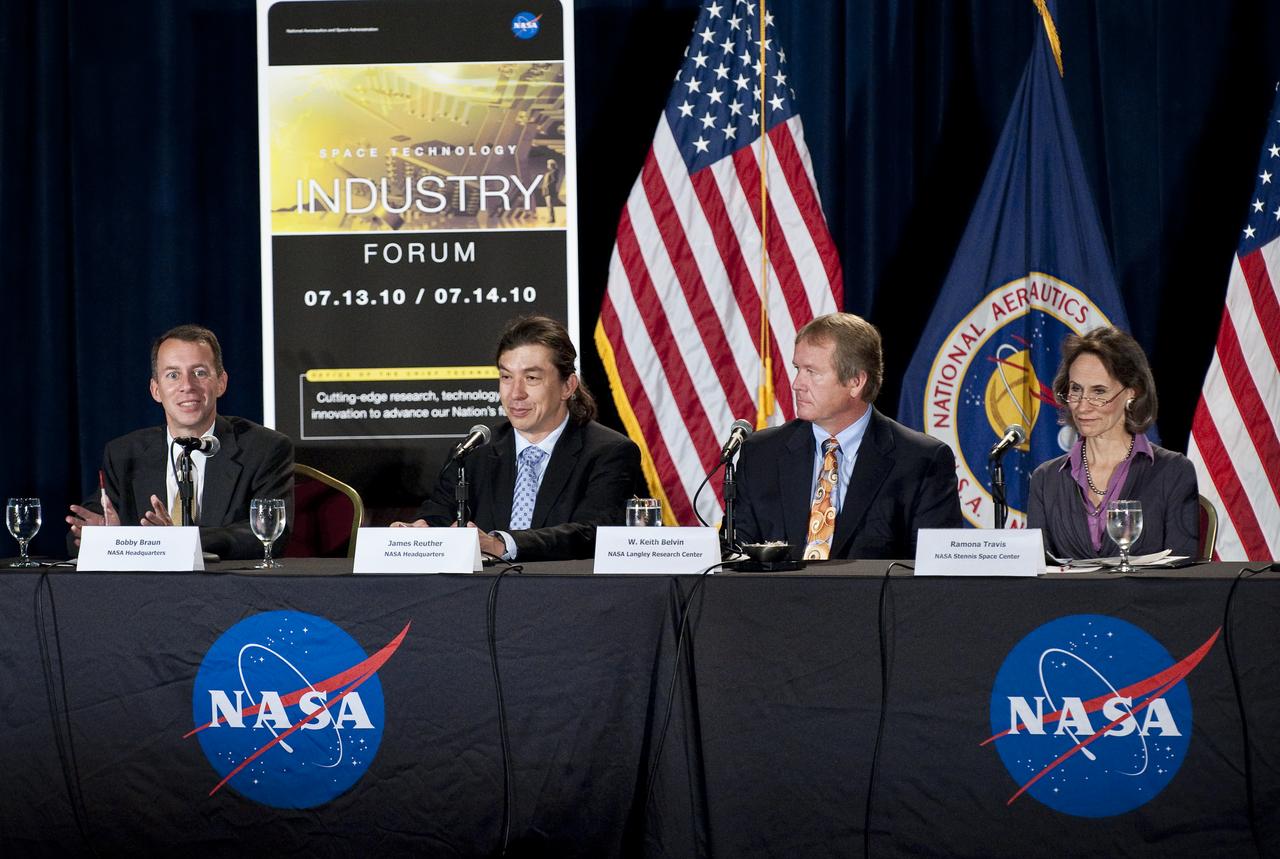
Bobby Braun, far left, NASA Chief Technologist, speaks during the NASA New Space Technology Industry Forum being held at the University of Maryland in College Park on Wednesday, July 14, 2010. Mr. Braun is joined on the panel by James Reuther, Director of Strategic Integration at NASA Headquarters, second from left; Keith Belvin, NASA Systems Engineer at NASA Langley Research Center and Ramona Travis, NASA Stennis Space Center Chief Technologist, far right. During the two-day event, speakers are focusing on the president's fiscal year 2011 budget request for NASA's new Space Technology Program. Representatives from industry, academia and the federal government are in attendance to discuss strategy, development and implementation of NASA's proposed new technology-enabled exploration. Photo Credit: (NASA/Carla Cioffi)
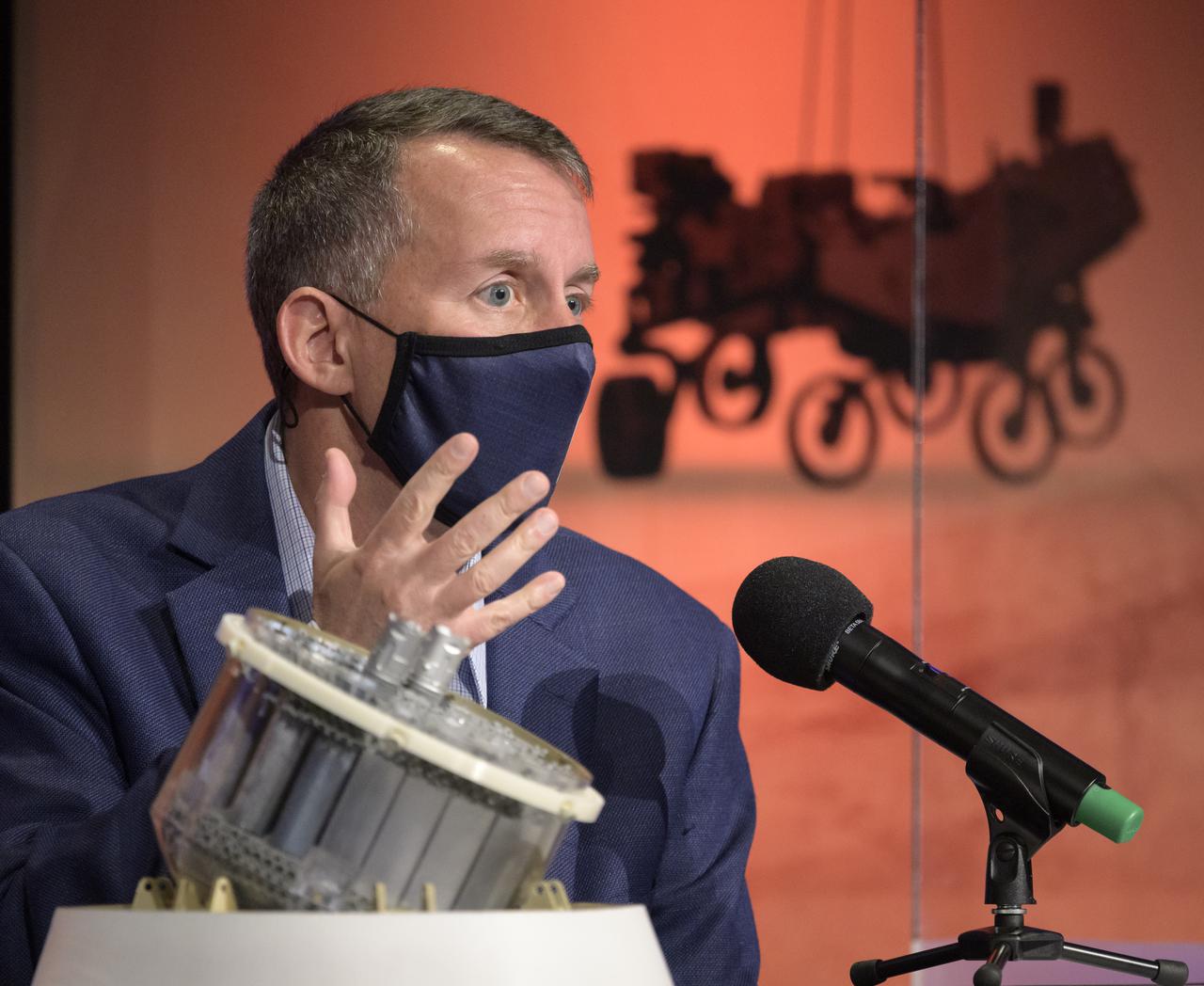
Mars Sample Return program manager, JPL, Bobby Braun, gives remarks during a NASA Perseverance rover press briefing about the search for ancient life at Mars and about samples to be brought back to Earth on a future mission, Wednesday, Feb. 17, 2021, at NASA's Jet Propulsion Laboratory in Pasadena, California. The Perseverance Mars rover is due to land on Mars Thursday, Feb. 18, 2021. A key objective for Perseverance’s mission on Mars is astrobiology, including the search for signs of ancient microbial life. The rover will characterize the planet’s geology and past climate, pave the way for human exploration of the Red Planet, and be the first mission to collect and cache Martian rock and regolith. Photo Credit: (NASA/Bill Ingalls)
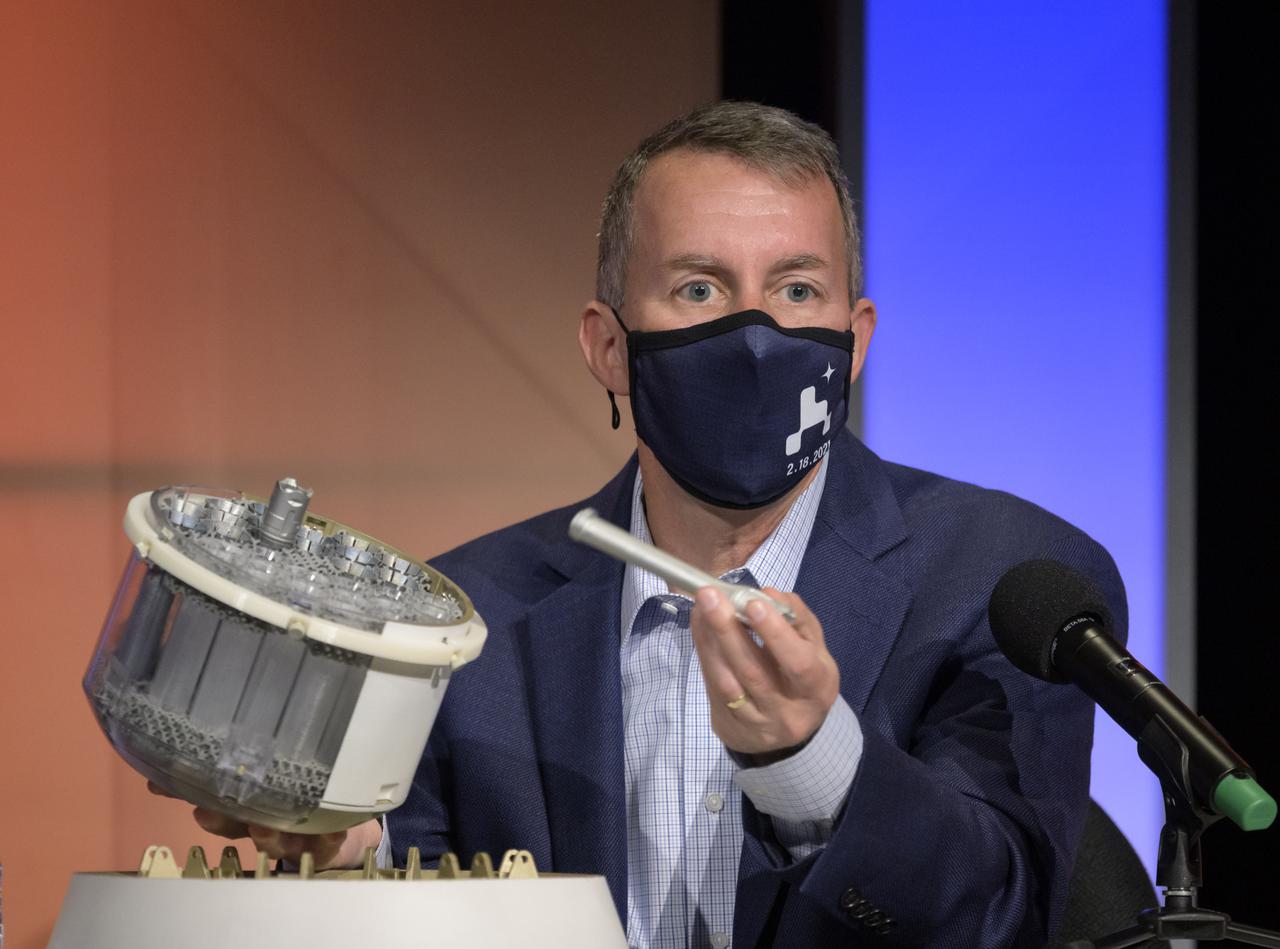
Mars Sample Return program manager, JPL, Bobby Braun, shows a concept model of NASA's orbiting sample container, which will hold tubes of Martian rock and soil samples that will be returned to Earth through a Mars sample return campaign during a NASA Perseverance rover press briefing about the search for ancient life at Mars and about samples to be brought back to Earth on a future mission, Wednesday, Feb. 17, 2021, at NASA's Jet Propulsion Laboratory in Pasadena, California. The Perseverance Mars rover is due to land on Mars Thursday, Feb. 18, 2021. A key objective for Perseverance’s mission on Mars is astrobiology, including the search for signs of ancient microbial life. The rover will characterize the planet’s geology and past climate, pave the way for human exploration of the Red Planet, and be the first mission to collect and cache Martian rock and regolith. Photo Credit: (NASA/Bill Ingalls)

Mars Sample Return program manager, JPL, Bobby Braun, shows a concept model of NASA's orbiting sample container, which will hold tubes of Martian rock and soil samples that will be returned to Earth through a Mars sample return campaign during a NASA Perseverance rover press briefing about the search for ancient life at Mars and about samples to be brought back to Earth on a future mission, Wednesday, Feb. 17, 2021, at NASA's Jet Propulsion Laboratory in Pasadena, California. The Perseverance Mars rover is due to land on Mars Thursday, Feb. 18, 2021. A key objective for Perseverance’s mission on Mars is astrobiology, including the search for signs of ancient microbial life. The rover will characterize the planet’s geology and past climate, pave the way for human exploration of the Red Planet, and be the first mission to collect and cache Martian rock and regolith. Photo Credit: (NASA/Bill Ingalls)
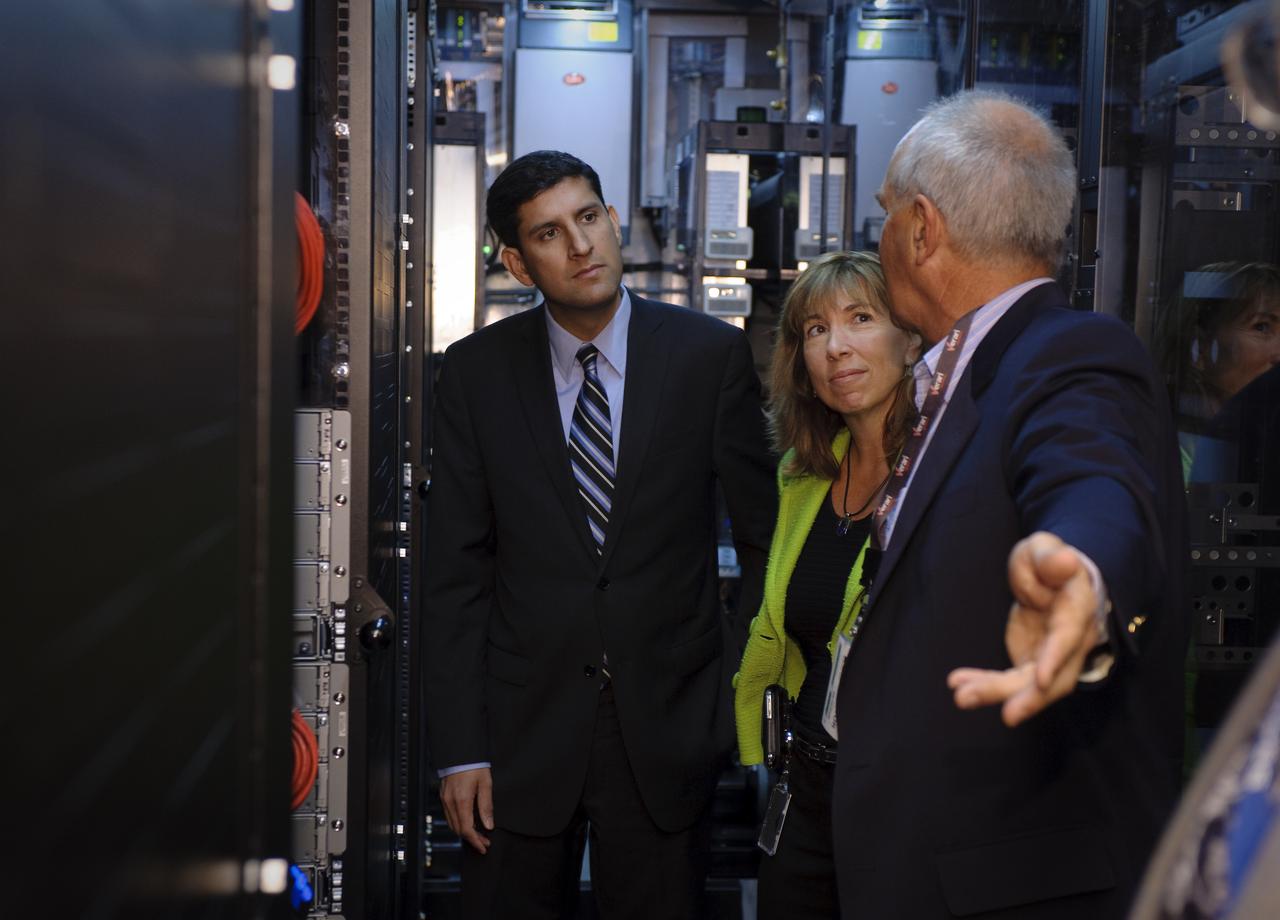
Obama Administration launches Cloud Computing Initiative at Ames Research Center. Vivek Kundra, White House Chief Federal Information Officer (left) and Lori Garver, NASA Deputy Administrator (ctr) get a tour of the NASA Nebula Infrastructure with Bobby Cates (right).
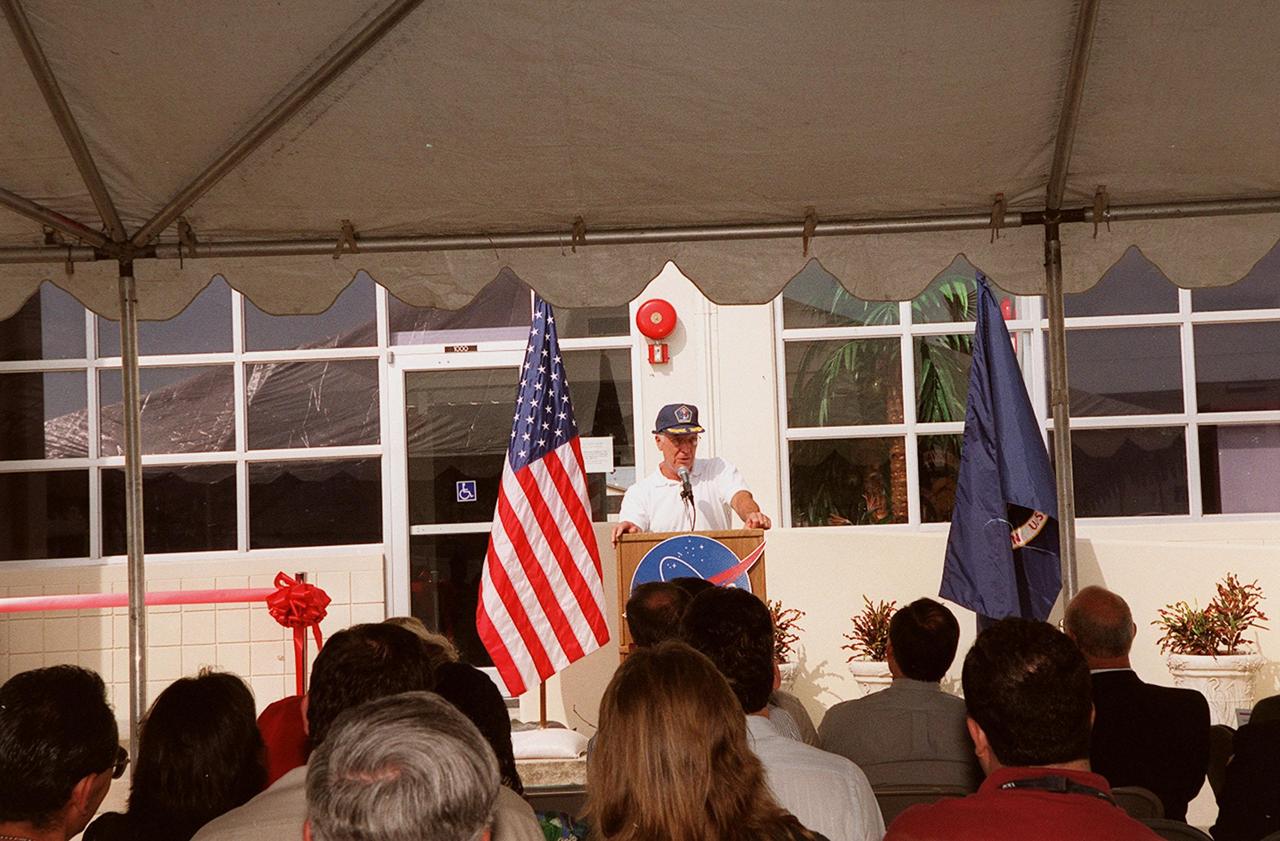
Bobby Bruckner, manager, ELV and Payload Carrier Programs, speaks at the ribbon-cutting ceremony of the E&O Building at KSC. Home for NASA’s unmanned missions since 1964, the building has been renovated to house the Expendable Launch Vehicle Program
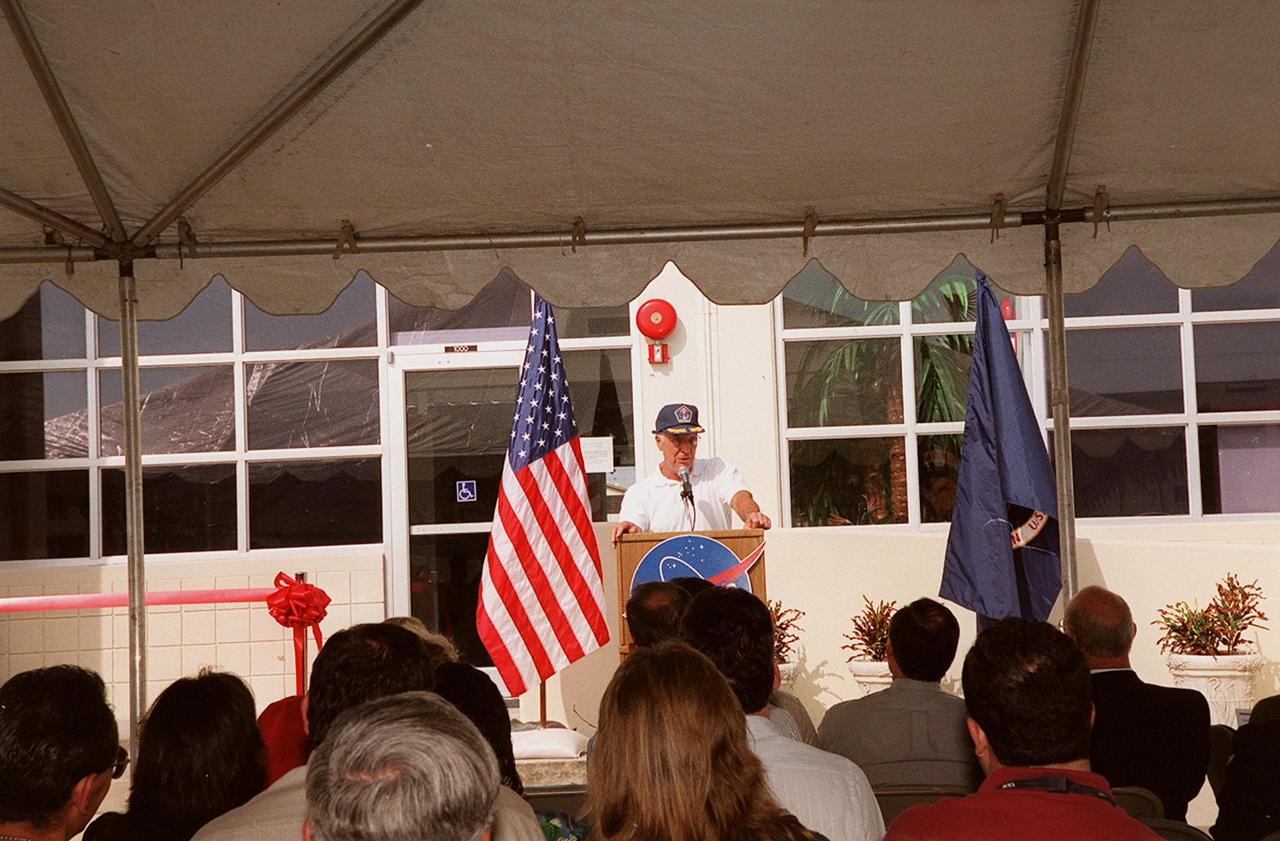
Bobby Bruckner, manager, ELV and Payload Carrier Programs, speaks at the ribbon-cutting ceremony of the E&O Building at KSC. Home for NASA’s unmanned missions since 1964, the building has been renovated to house the Expendable Launch Vehicle Program

Obama Administration launches Cloud Computing Initiative at Ames Research Center. Vivek Kundra, White House Chief Federal Information Officer (ctr) and Lori Garver, NASA Deputy Administrator (right) get a tour of the NASA Nebula Infrastructure with Bobby Cates (on left).
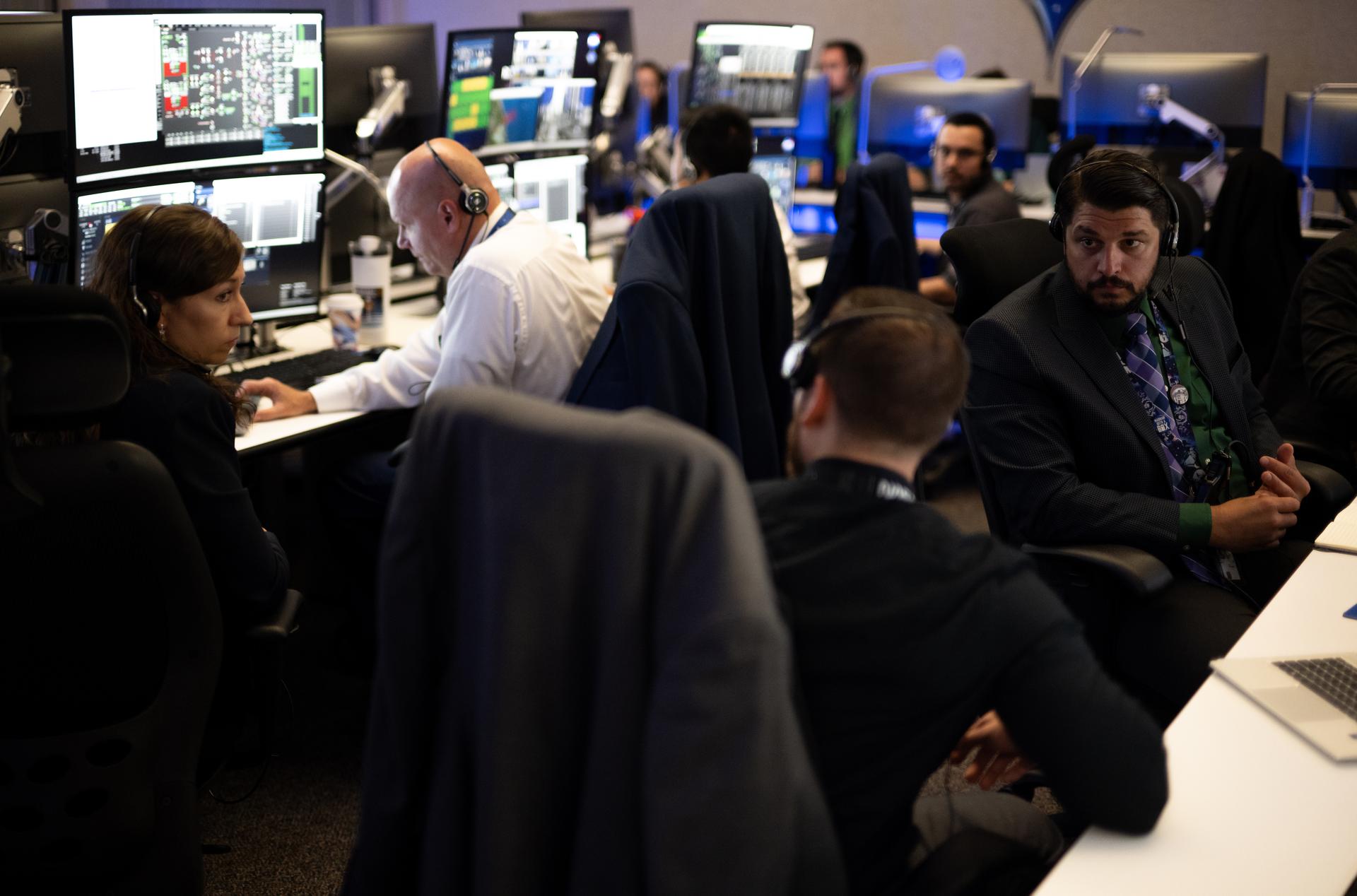
Theresa Trzupek, a mission assurance engineer at NASA’s Kennedy Space Center, left, confers with Bobby Hughes, a safety and mission assurance engineer and NASA’s Kennedy Space Center, center, and Casey Quinn, a safety and mission assurance engineer at NASA’s Kennedy Space Center, right, as they monitor the countdown inside Hangar AE at Cape Canaveral Space Force Station for the launch of a SpaceX Falcon Heavy rocket with NASA’S Nancy Grace Roman Space Telescope from Launch Complex 39A at NASA’s Kennedy Space Center, Sunday, Aug. 30, 2026, in Florida. Roman will investigate dark energy and dark matter, conduct a statistical census of planetary systems, and enable a broad range of additional astrophysics research. Launch occurred at 7:26 a.m. EDT. Photo Credit (NASA/Joel Kowsky)
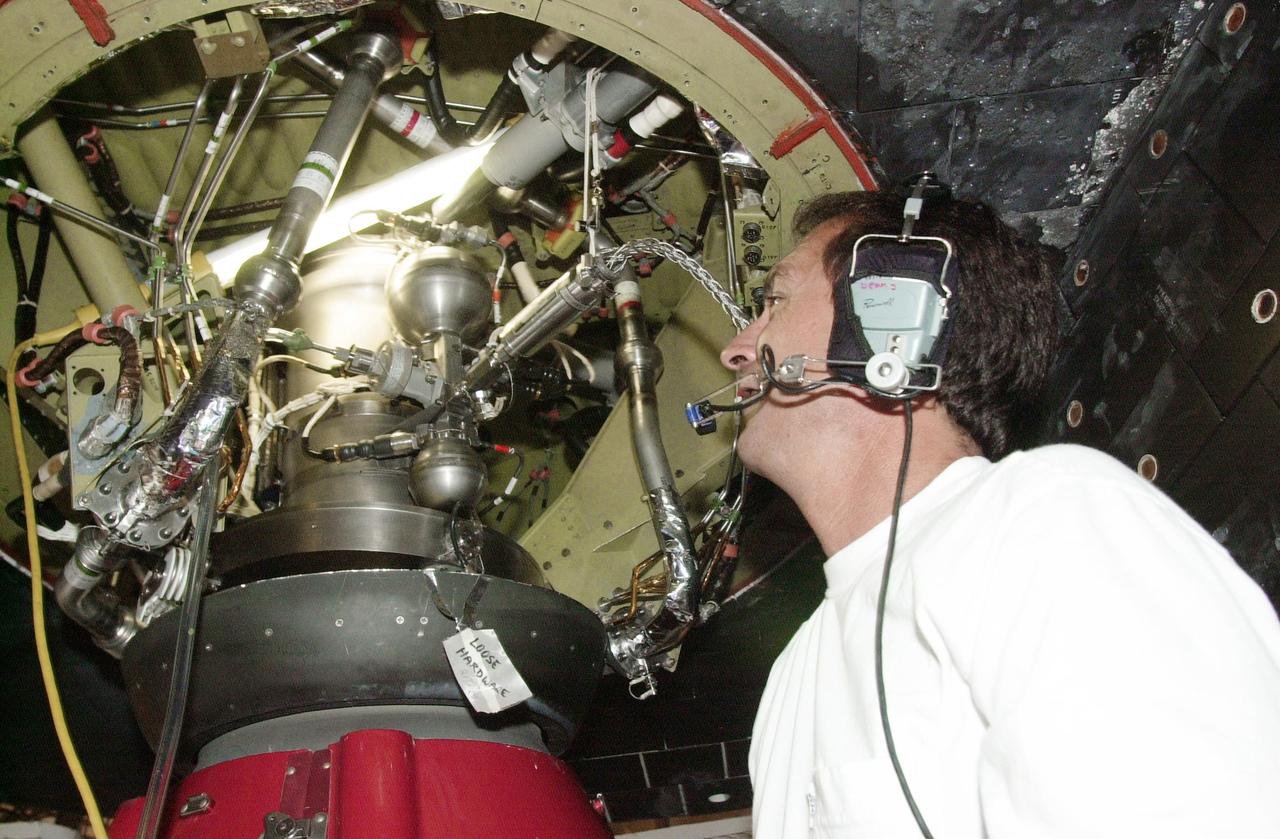
KENNEDY SPACE CENTER, FLA. -- United Space Alliance Aft Technician Bobby Wright looks at the gaseous nitrogen pressure regulator in the left Orbital Maneuvering System pod on Space Shuttle Endeavour. The component showed pressure differentials during the launch count May 30, 2002, and mission managers elected to replace it after the launch was scrubbed due to weather concerns. The launch of Endeavour on Mission STS-111, Utilization Flight 2 to the International Space Station, has been rescheduled for June 5, 2002
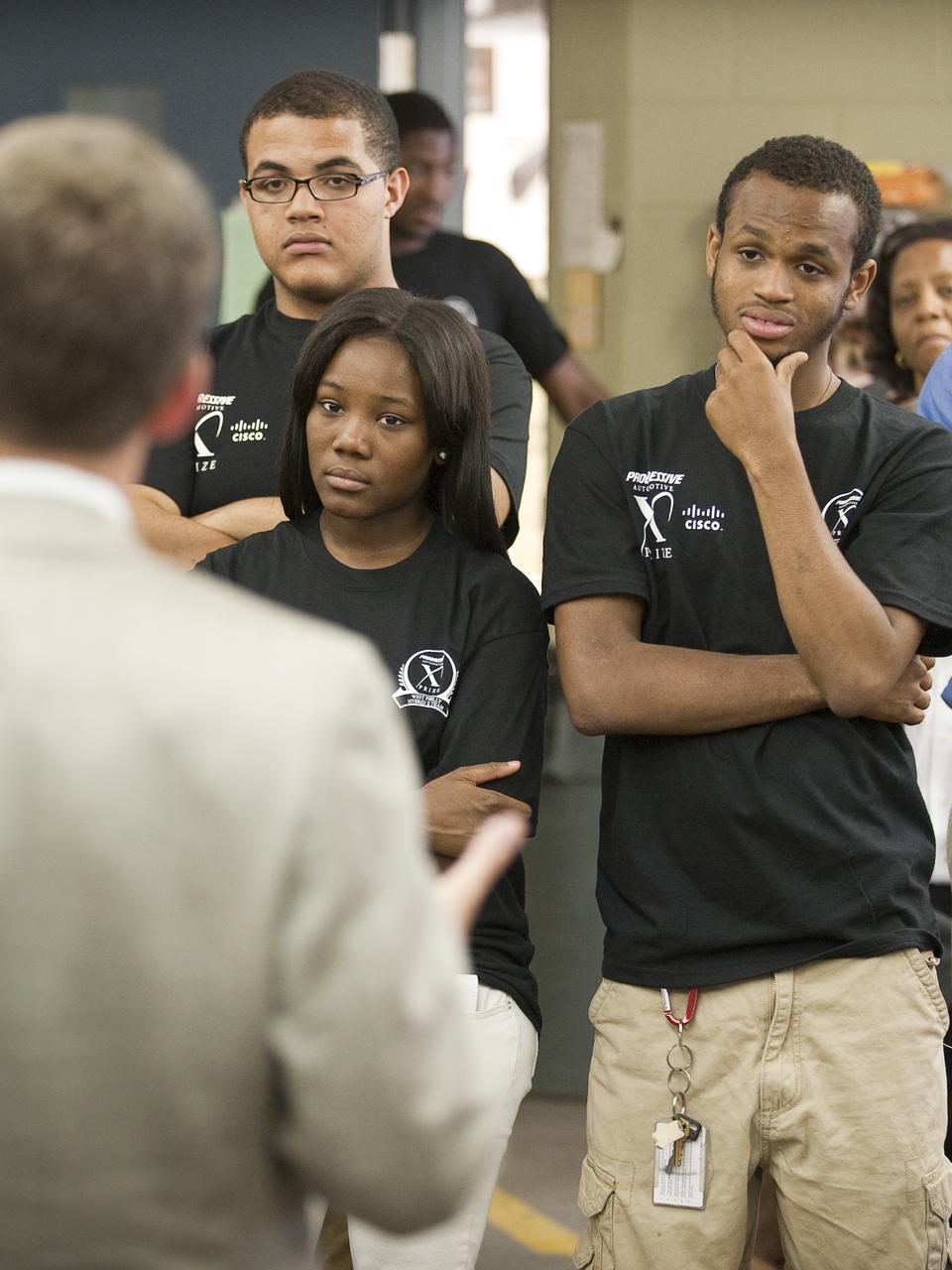
NASA Chief Technologist Bobby Braun talks with student members of the West Philly Hybrid X Team at West Philadelphia High School in Philadelphia, Monday, June 7, 2010. The prize-winning West Philly Hybrid X Team has drawn international recognition as the only high school among 22 finalists in the Progressive Insurance Automotive X Prize (PIAXP) competition to develop cars that achieve over 100 MPG. Photo Credit: (NASA/Bill Ingalls)
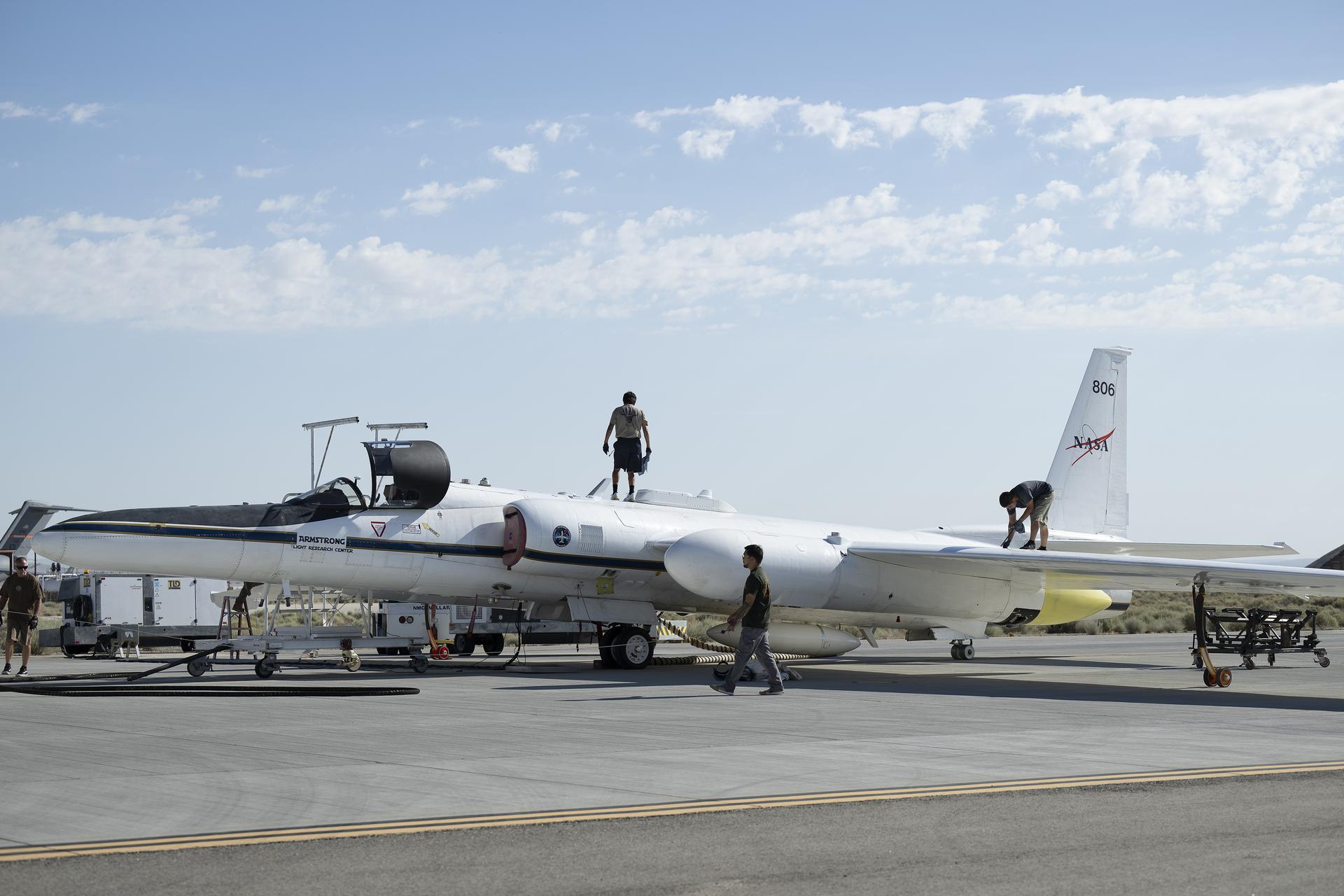
Ground crew members, from left, Bobby Henderson, Francisco Rodriguez, Geo Sablan, and Vincent Moreno prepare an ER‑2 aircraft for the INjected Smoke and PYRocumulonimbus Experiment (INSPYRE) at NASA’s Armstrong Flight Research Center in Edwards, California, on Wednesday, July 15, 2026. This Earth science campaign studies wildfire‑generated thunderstorms, and researchers are seeking to better understand how these storms form, how high the storms send smoke, where this smoke travels, and the effects after the smoke reaches upper layers of the atmosphere.

KENNEDY SPACE CENTER, FLA. -- During filming at KSC by a crew from India, KSC videographer Glen “Mic” Miracle (left) and Bobbie Faye Ferguson talk to actor Rahul Vohra (right). The film crew spent several days at KSC filming at various sites for the movie “Swades,” a story about India’s brain-drain. Vohra is one of the actors in the film that stars Shahrukh Khan and Gayatri Joshi. The writer-director is Ashutosh Gowariker. Sunita Gowariker is executive producer. Ferguson is manager of Multimedia, for NASA Public Affairs.
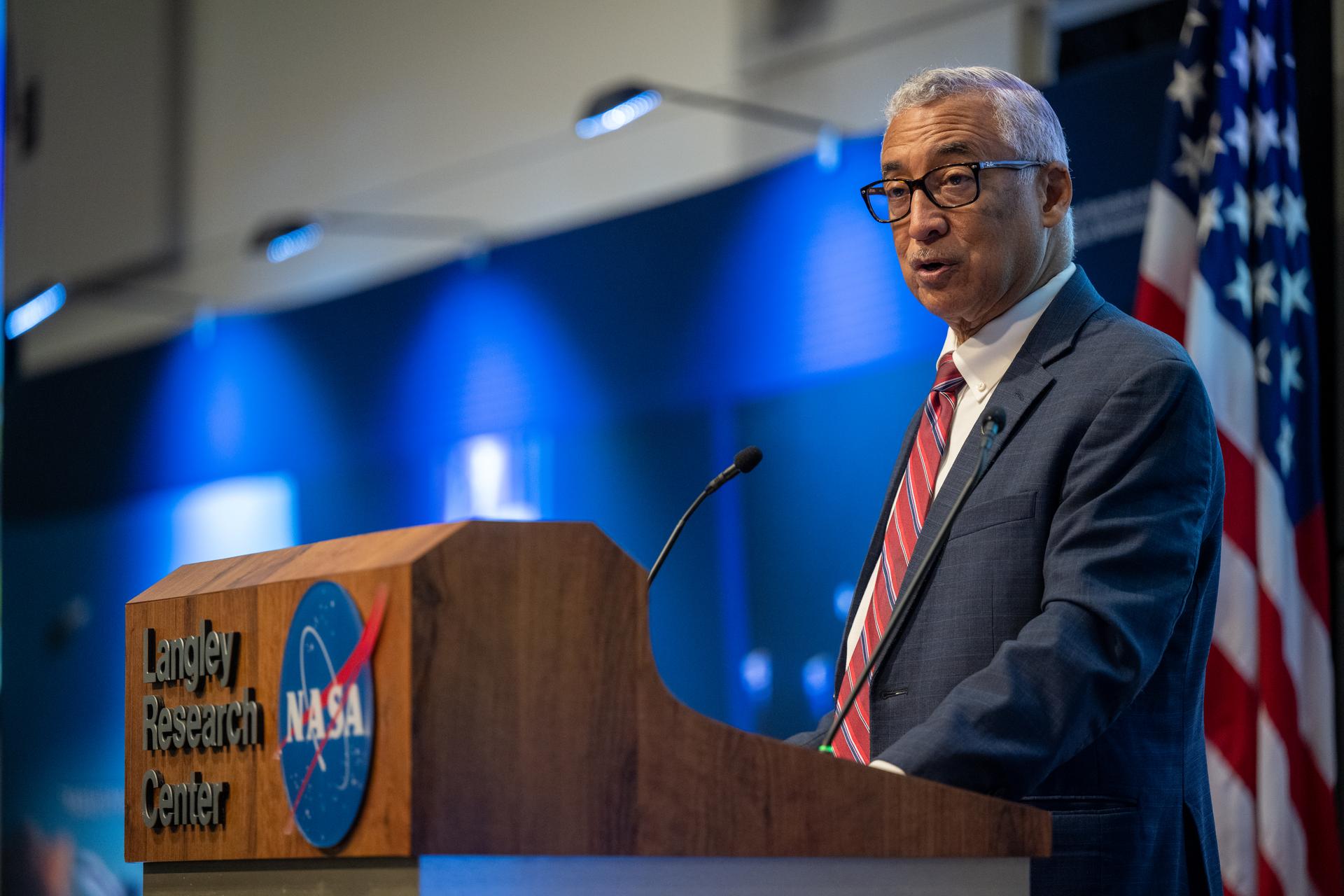
Congressman Robert “Bobby” Scott (D-Va.) delivers remarks during a ribbon cutting ceremony for the Flight Dynamics Research Facility, NASA's newest wind tunnel, Friday, July 31, 2026, at NASA’s Langley Research Center in Hampton, Virginia. The state-of-the-art facility will support research and technology development that will advance the agency’s aeronautics, exploration, and science goals, including establishing a sustained human presence on the lunar surface through the Artemis program and the development of a Moon Base. Photo Credit: (NASA/Keegan Barber)
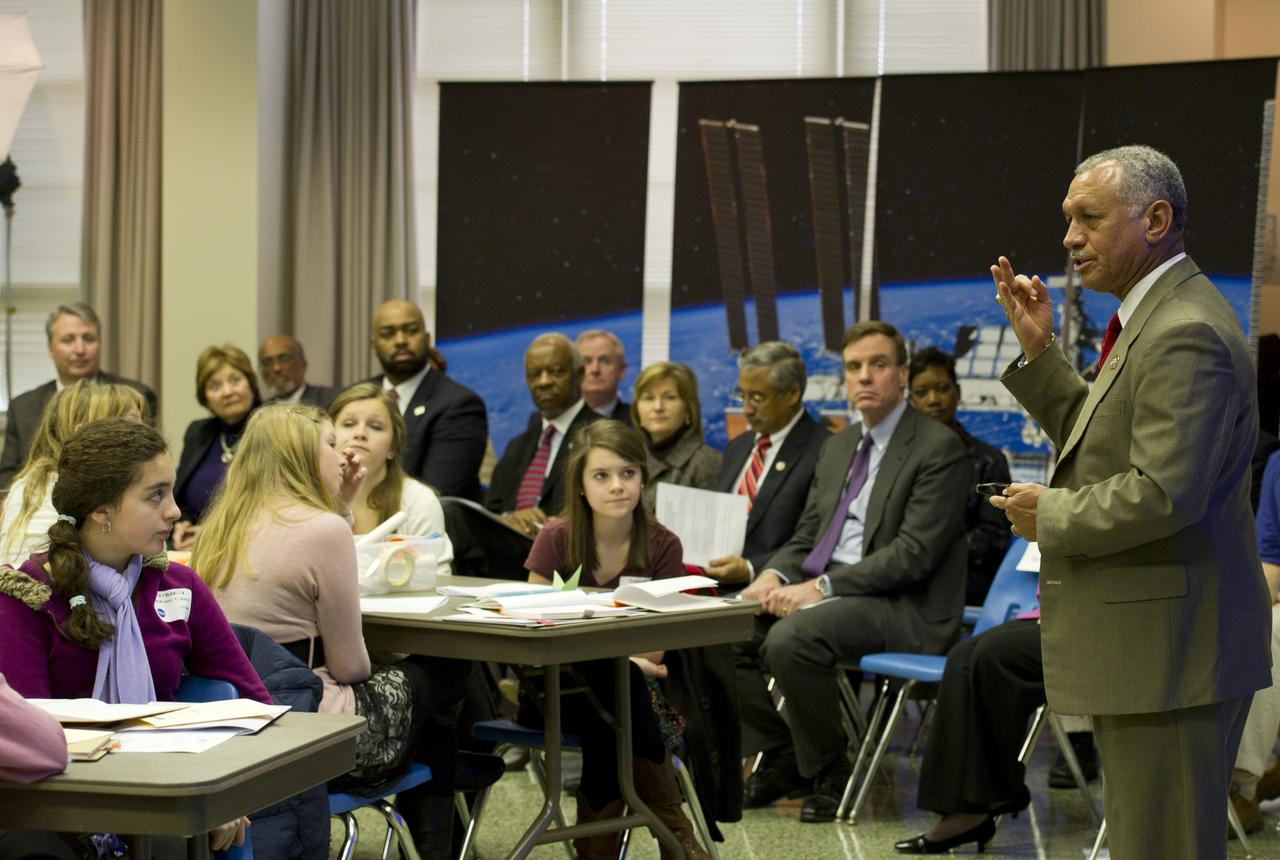
NASA Administrator Charles Bolden speaks to students from Albert Hill Middle School during a visit to the MathScience Innovation Center, Friday, Jan. 28, 2011, in Richmond, Va., as U.S. Sen. Mark Warner, D-Va., U.S. Rep. Bobby Scott, D-Va., seated, look on. During his talk, Administrator Bolden highlighted the importance of science, technology, engineering and math, or STEM, as he shared his life experiences with the students. (Photo Credit:NASA/Paul E. Alers)
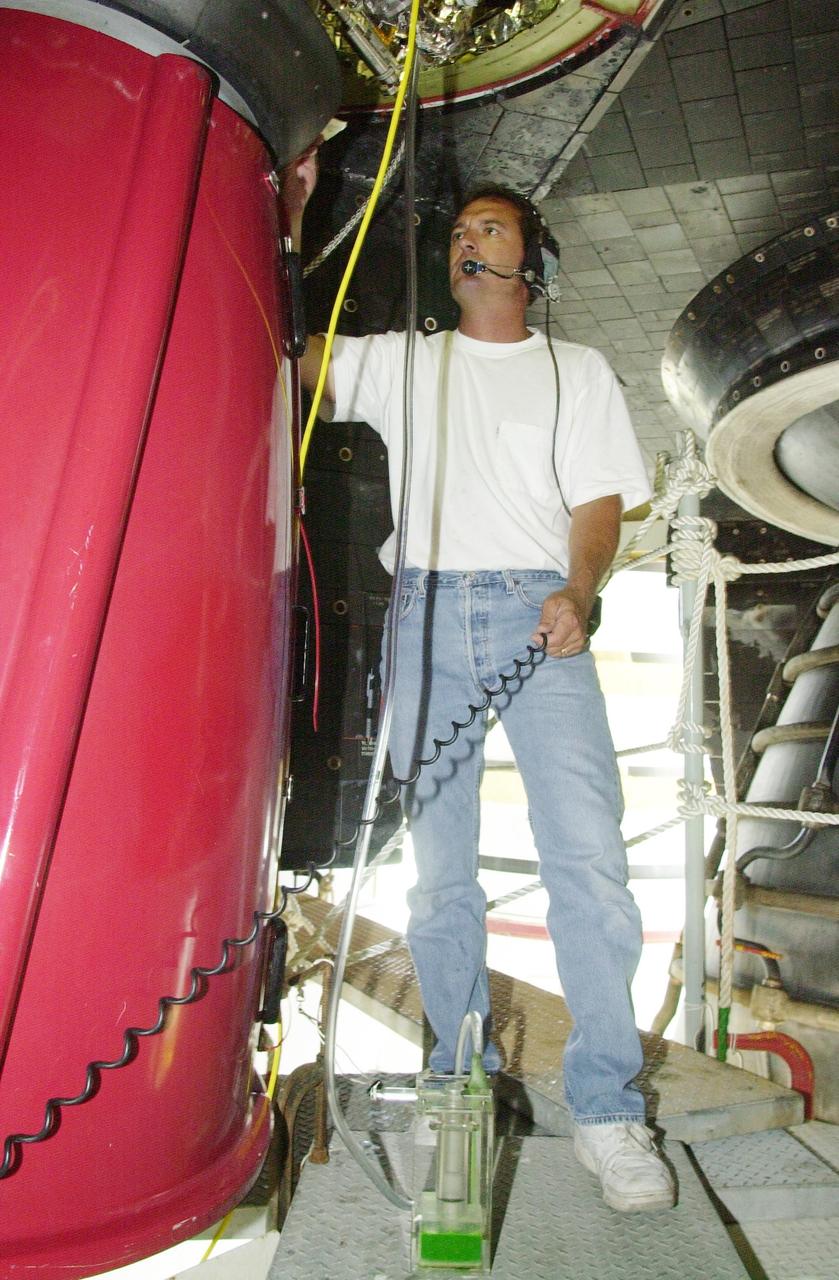
KENNEDY SPACE CENTER, FLA. -- United Space Alliance Aft Technician Bobby Wright checks is the gaseous nitrogen pressure regulator in the left Orbital Maneuvering System pod on Space Shuttle Endeavour. The component showed pressure differentials during the launch count May 30, 2002, and mission managers elected to replace it after the launch was scrubbed due to weather concerns. The launch of Endeavour on Mission STS-111, Utilization Flight 2 to the International Space Station, has been rescheduled for June 5, 2002
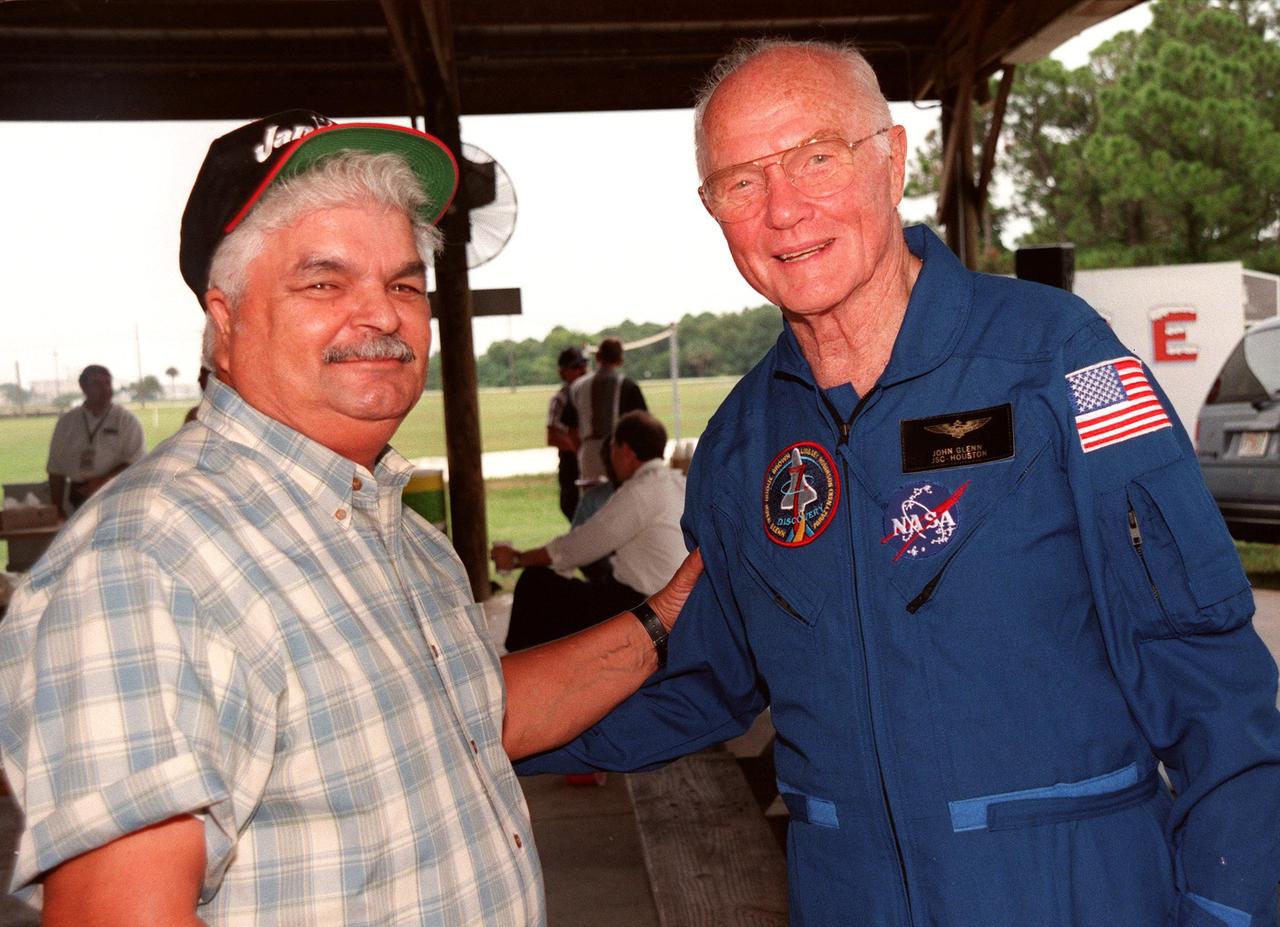
During a break in the Crew Equipment Interface Test (CEIT), Payload Specialist John H. Glenn Jr., a senator from Ohio, greets Bobby Miranda. Miranda was a NASA photographer for Glenn's first flight on Friendship 7, February 1962. The CEIT gives astronauts an opportunity for a hands-on look at the payloads and equipment with which they will be working on orbit. The launch of the STS-95 mission is scheduled for Oct. 29, 1998, on the Space Shuttle Discovery. The mission includes research payloads such as the Spartan solar-observing deployable spacecraft, the Hubble Space Telescope Orbital Systems Test Platform, the International Extreme Ultraviolet Hitchhiker, as well as the SPACEHAB single module with experiments on space flight and the aging process

Annual Metrology and Calibration Working Group Face to Face meeting held at Langley Research Center; Front Row (L to R): Stacy Sigmon – LaRC, Brent Watling – JSC, Ralph Hickman – WFF, Kirk Foster – MSFC, Don Wilson – SSC, Greg Boyd – JSC, Perry King – KSC, Bobby Price – GSFC, Felicia Donnell – GSFC, Perry LaRosa – GRC. Second Row (L to R): Ken Mathews – KSC, Darrell Shoup – WSTF, Gary Kennedy – MSFC, Terry Fleet – GRC, Damon Flansburg – ARC, Salvatore Tomaselli - WFF, Bruce Farner - SSC, David Scott – JPL, Jim Wachter – KSC, Shawn Britton – LaRC.
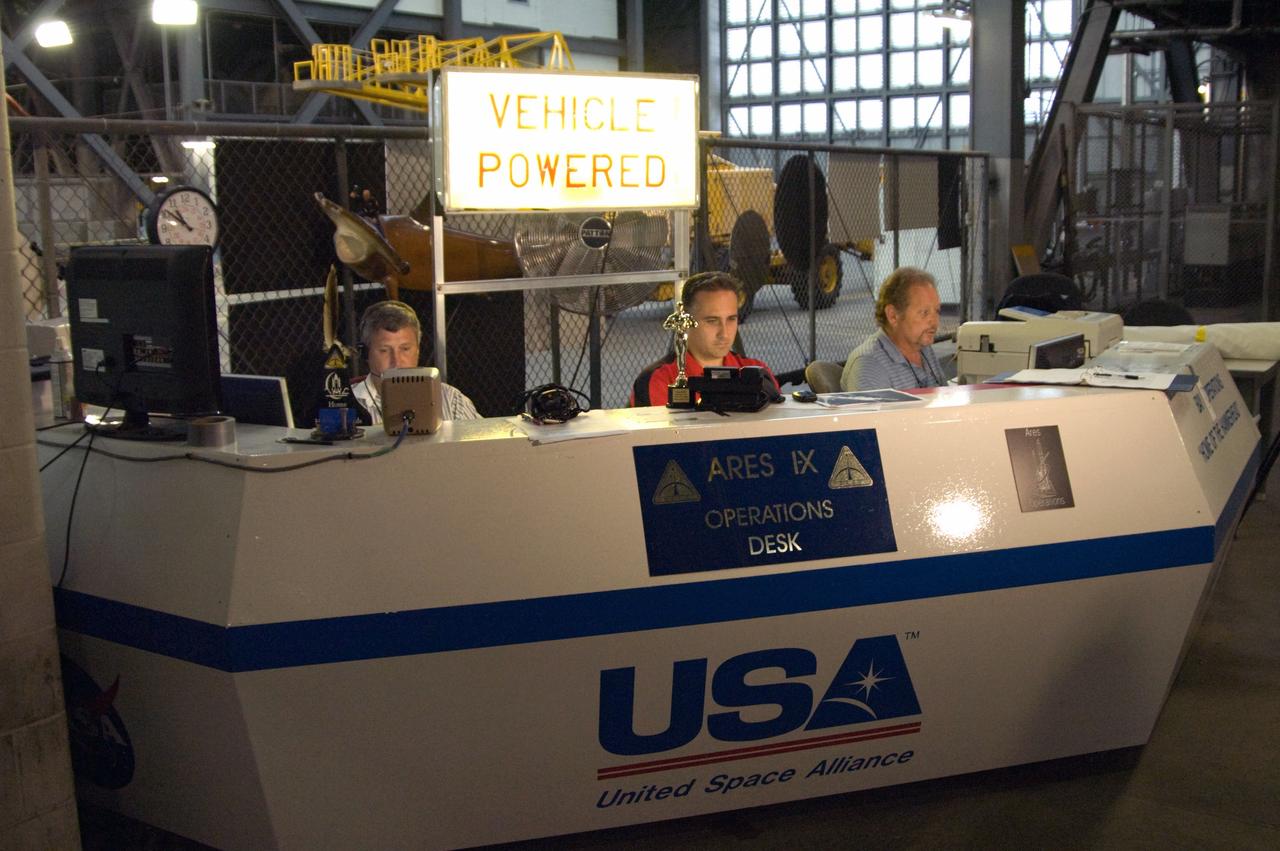
CAPE CANAVERAL, Fla. – In NASA Kennedy Space Center's Vehicle Assembly Building High Bay 3, NASA's Ares I-X mission team members Bobby Williams, Trent Smith and Karl Kendall monitor the rocket's first power-up. Part of the Constellation Program, the Ares I-X is the test vehicle for the Ares I, which is the essential core of a space transportation system that eventually will carry crewed missions back to the moon, on to Mars and out into the solar system. The Ares I-X flight test is targeted for Oct. 31. Photo credit: NASA/Cory Huston
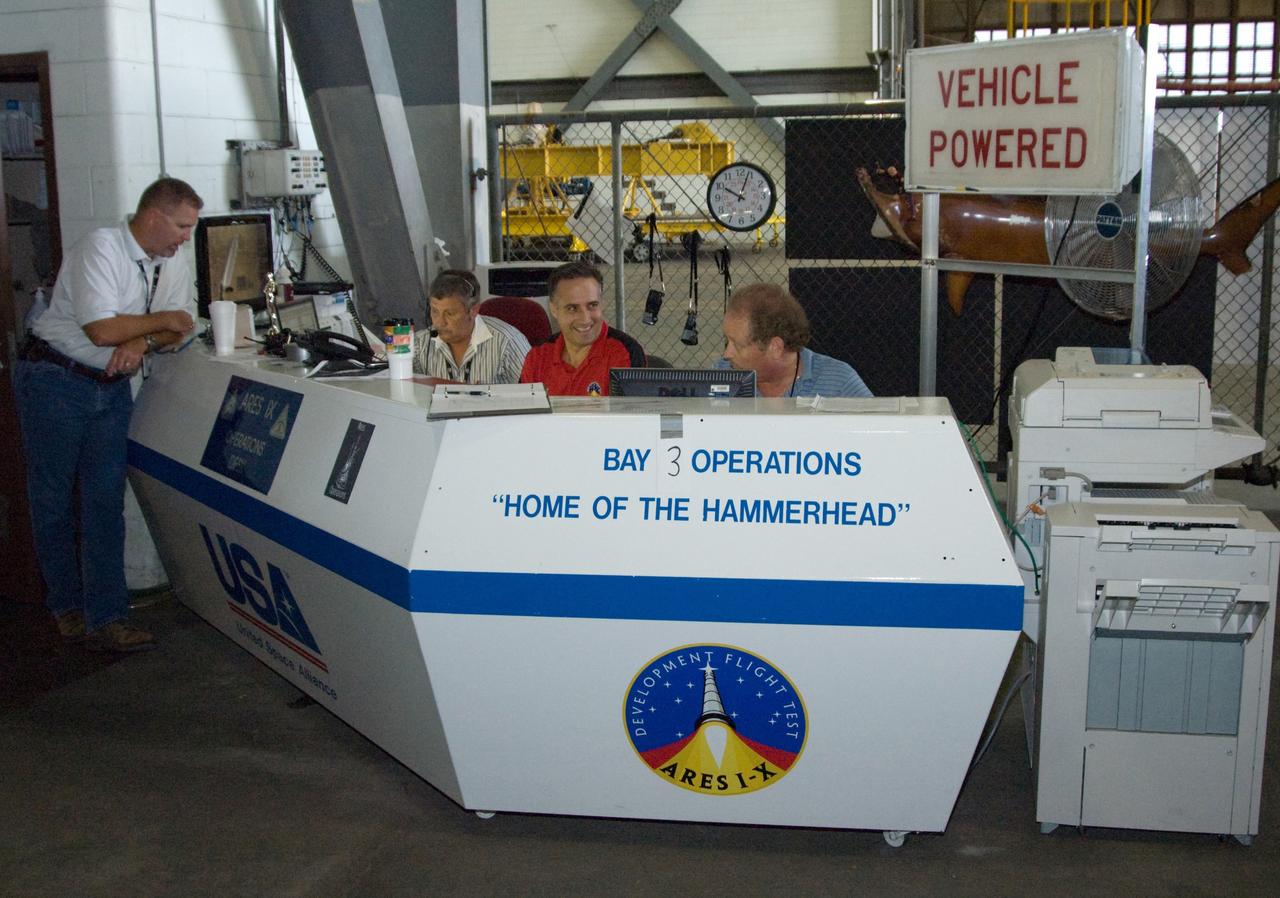
CAPE CANAVERAL, Fla. – In NASA Kennedy Space Center's Vehicle Assembly Building High Bay 3, NASA's Ares I-X mission team members Bobby Williams, Trent Smith and Karl Kendall get ready for the rocket's first power-up. Part of the Constellation Program, the Ares I-X is the test vehicle for the Ares I, which is the essential core of a space transportation system that eventually will carry crewed missions back to the moon, on to Mars and out into the solar system. The Ares I-X flight test is targeted for Oct. 31. Photo credit: NASA/Cory Huston
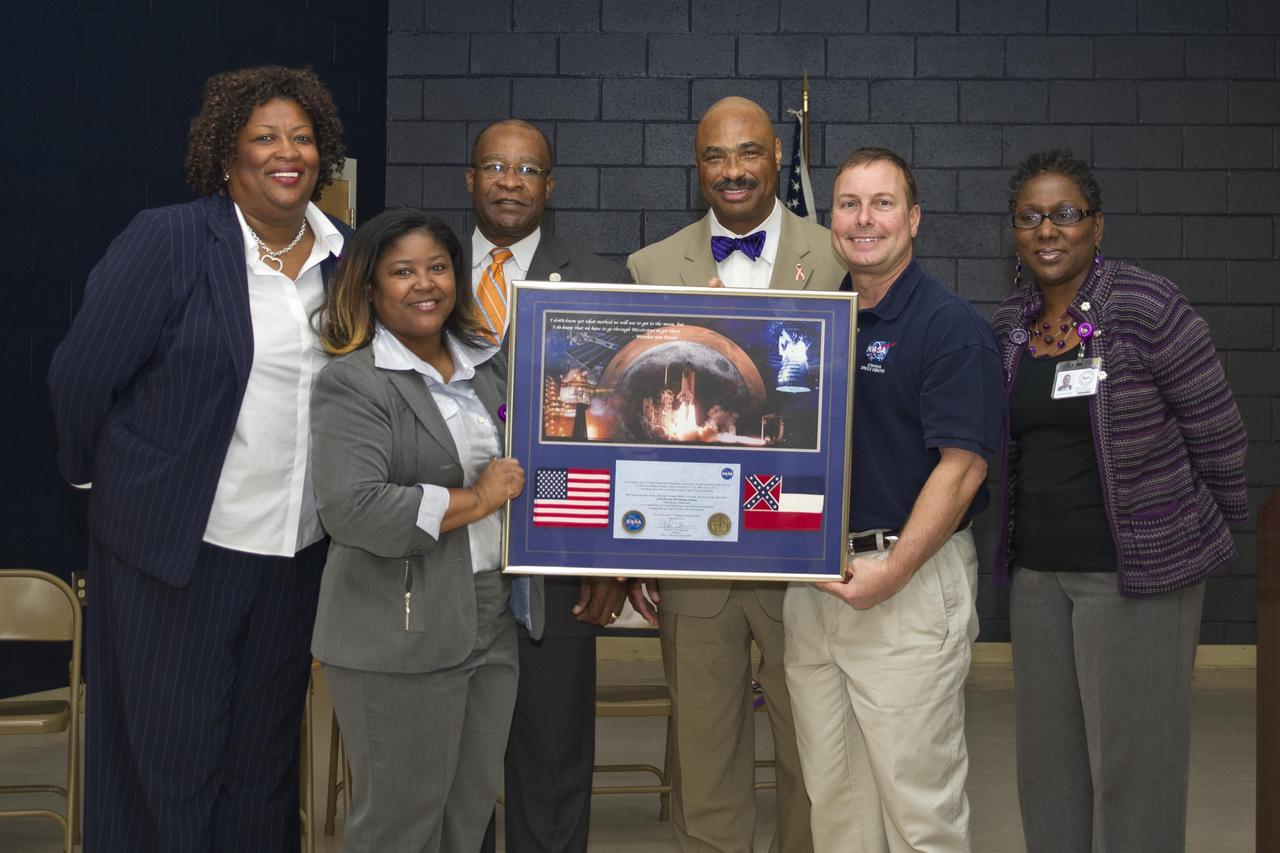
Stennis Deputy Director Rick Gilbrech (second from right) presents a commemorative plaque to Lillie Burney Elementary School officials, including (l to r): Lillie Burney Principal Deborah Smith; Assistant Principal Dr. Bobbie Trussell; Hattiesburg Mayor Johnny DuPree; Hattiesburg Public School District Superintendent James Bacchus; Gilbrech; and District Assistant Superintendent Dr. Edna Thomas. NASA senior staff members from Stennis visited the Hattiesburg, Miss., school Jan. 27, 2012, for a morning of activities and outreach to students and school officials.
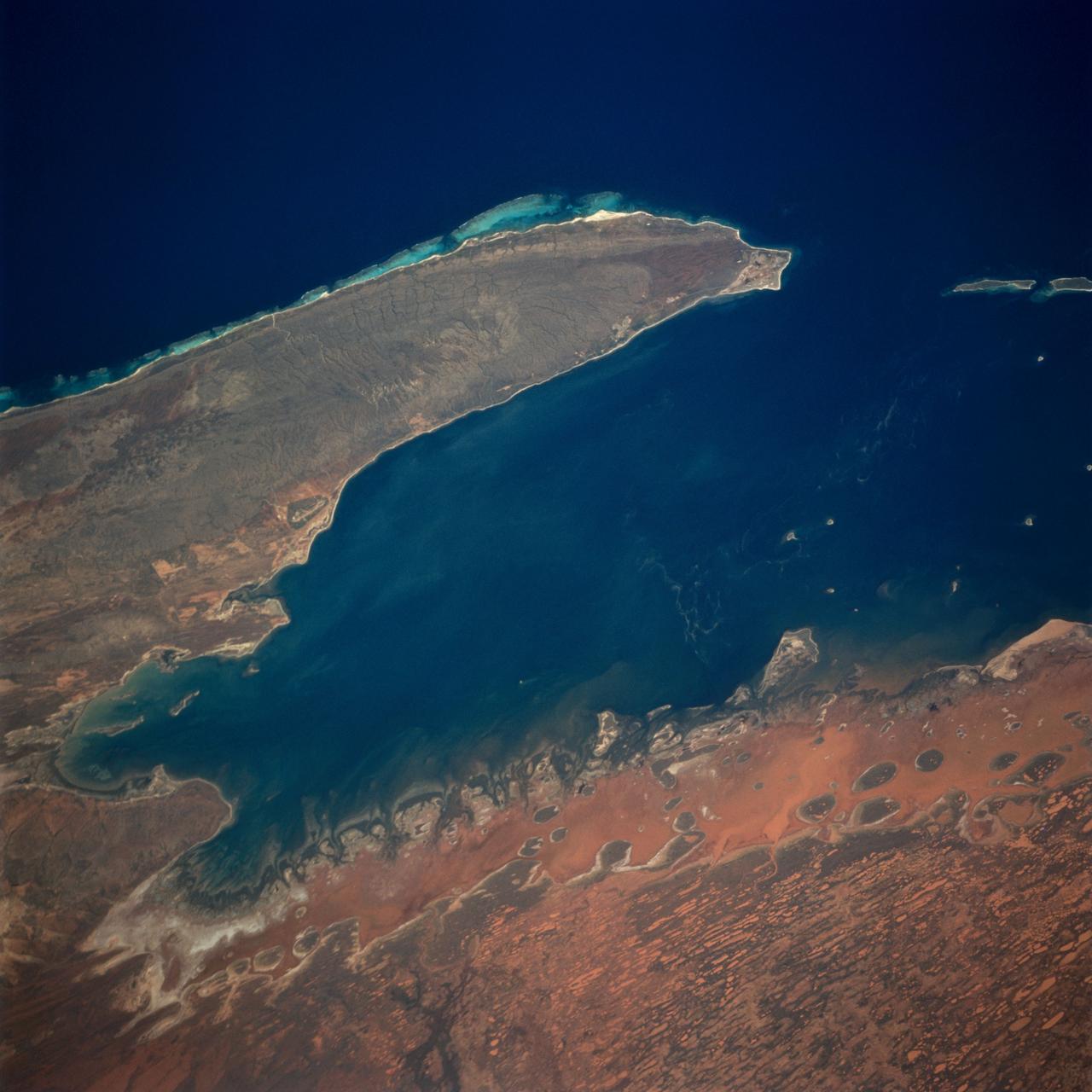
The Exmouth Gulf, western Australia, is bounded on the west by the Cape Ranges; near the base of the peninsula the Learmonth Airfield, site of a solar observatory, can be seen. Spit-accretion ridges formed on ancient beaches extend along the western edge of the peninsula, which today is lined by the Ningaloo Reef. Red mud carried by floodwaters, the result of Hurricane Bobby the previous week, cover flat coastal land along the eastern side of the gulf. The mud is mixing slowly with marine water as it filters through passes between mangrove-covered islands. A filamentous pattern in the gulf probably indicates a plankton bloom. Island paleodunes stretching from south to north cover the landscape.
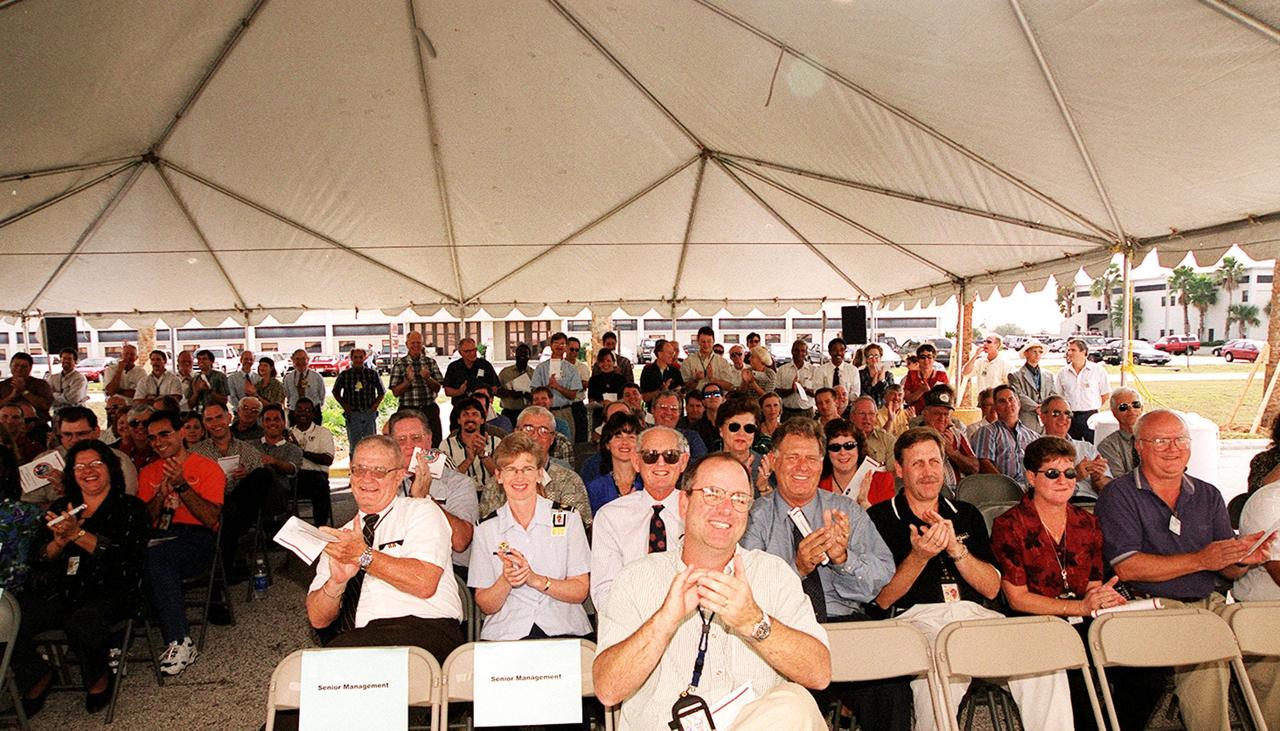
The audience applauds and enjoys the official opening of the E&O Building as the new site of the Expendable Launch Vehicle Program. Home for NASA’s unmanned missions since 1964, the building has been renovated to house the ELV Program.; Cutting the ribbon for the event were Deputy Manager of the ELV and Payload Carrier Programs, Steve Francois; Director of ELV Launch Services, Michael Benik; Center Director Roy Bridges; Manager of the ELV and Payload Carrier Programs, Bobby Bruckner; and Senior Manager of the Boeing ELV Program Support office, Jim Schofield
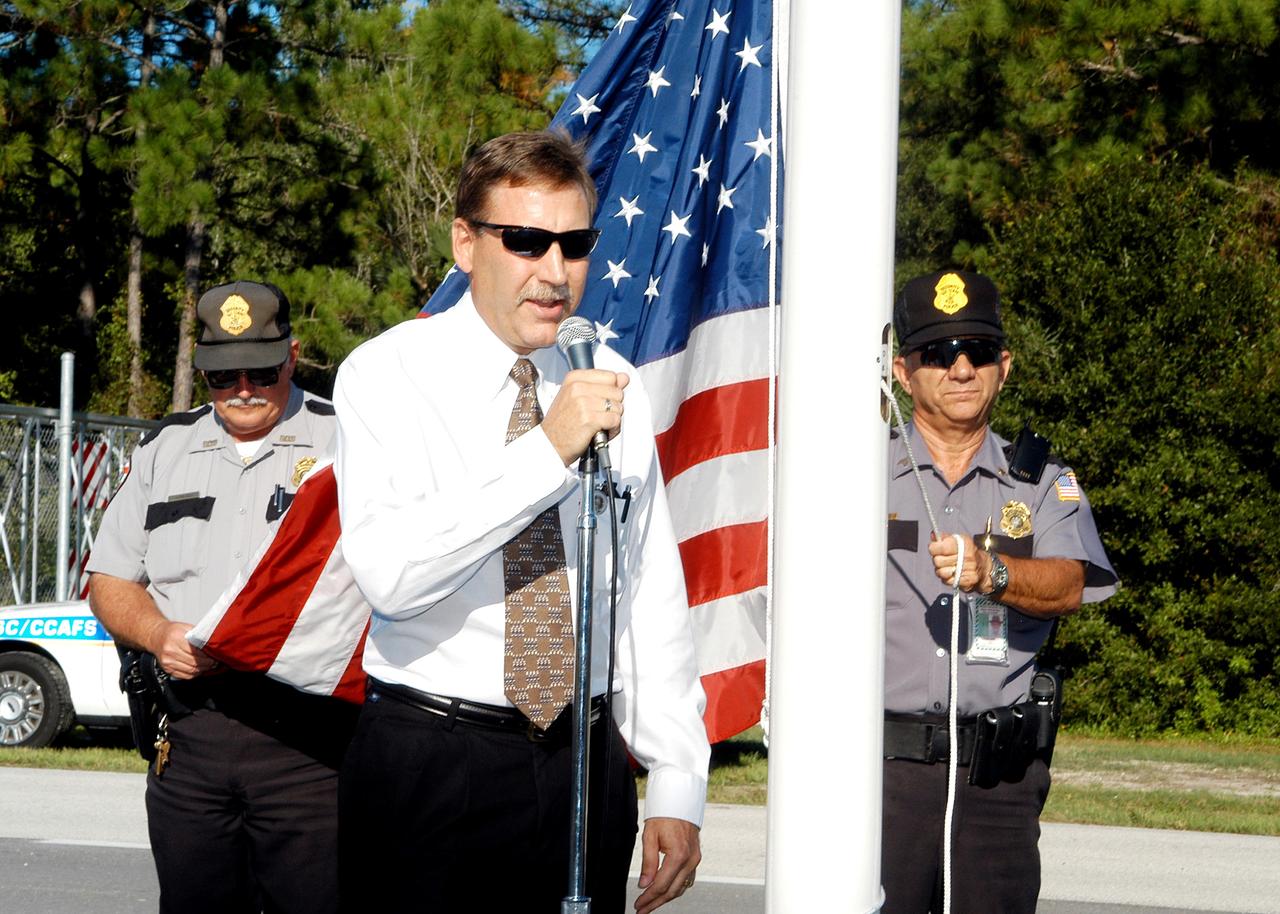
KENNEDY SPACE CENTER, FLA. - Daniel L. Tweed, with the Facilities Division, NASA Spaceport Services, addresses attendees at the ribbon cutting for the KSC Security gates. Tweed was project manager. The two new Security gates on Kennedy Parkway (Gate 2) and NASA Parkway (Gate 3) were activated Aug. 1, allowing the general public to have access to the new Space Commerce Way, which will provide access to the Research Park and KSC Visitor Complex, and providing an alternate route for the general public between Titusville and Merritt Island that is accessible 24 hours a day. The gates are staffed 24 hours daily. Others taking part in the ribbon cutting were Center Director Jim Kennedy; Chief, Protective & Safe Guards Office, Calvin L. Burch; SGS Deputy Program Manager William A. Sample; and Bobby Porter, with Oneida Construction.
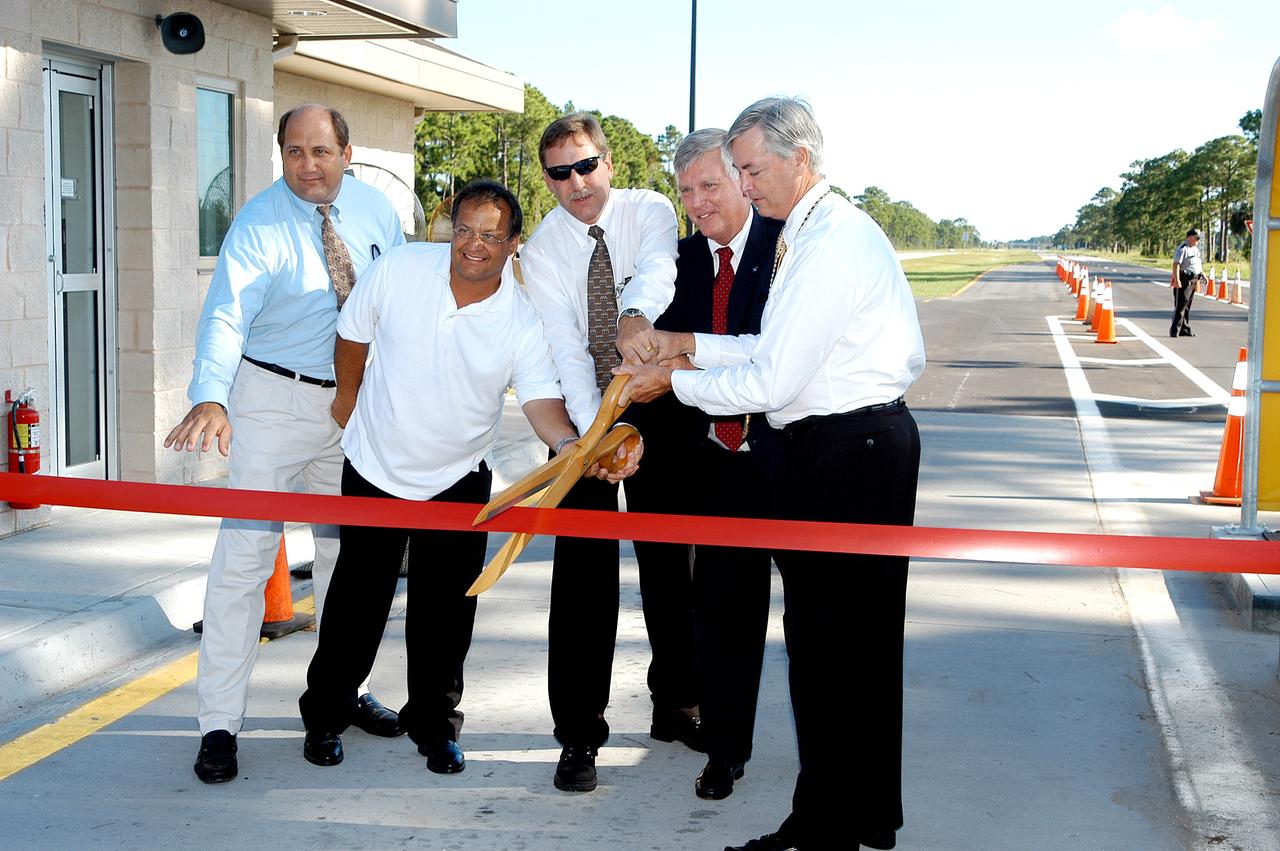
KENNEDY SPACE CENTER, FLA. - Key officials are poised to cut the ribbon officially dedicating the new Security gates on Kennedy Parkway (Gate 2) and NASA Parkway (Gate 3). From left are Wally Schroeder, with Jones, Edmunds & Associates; Bobby Porter, with Oneida Construction; Daniel Tweed, NASA project manager; Jim Kennedy, Center director; and William Sample, SGS deputy program manager. The new gates were activated Aug. 1, allowing the general public to have access to the new Space Commerce Way, which will provide access to the Research Park and KSC Visitor Complex, and providing an alternate route for the general public between Titusville and Merritt Island that is accessible 24 hours a day. The gates are staffed 24 hours daily.
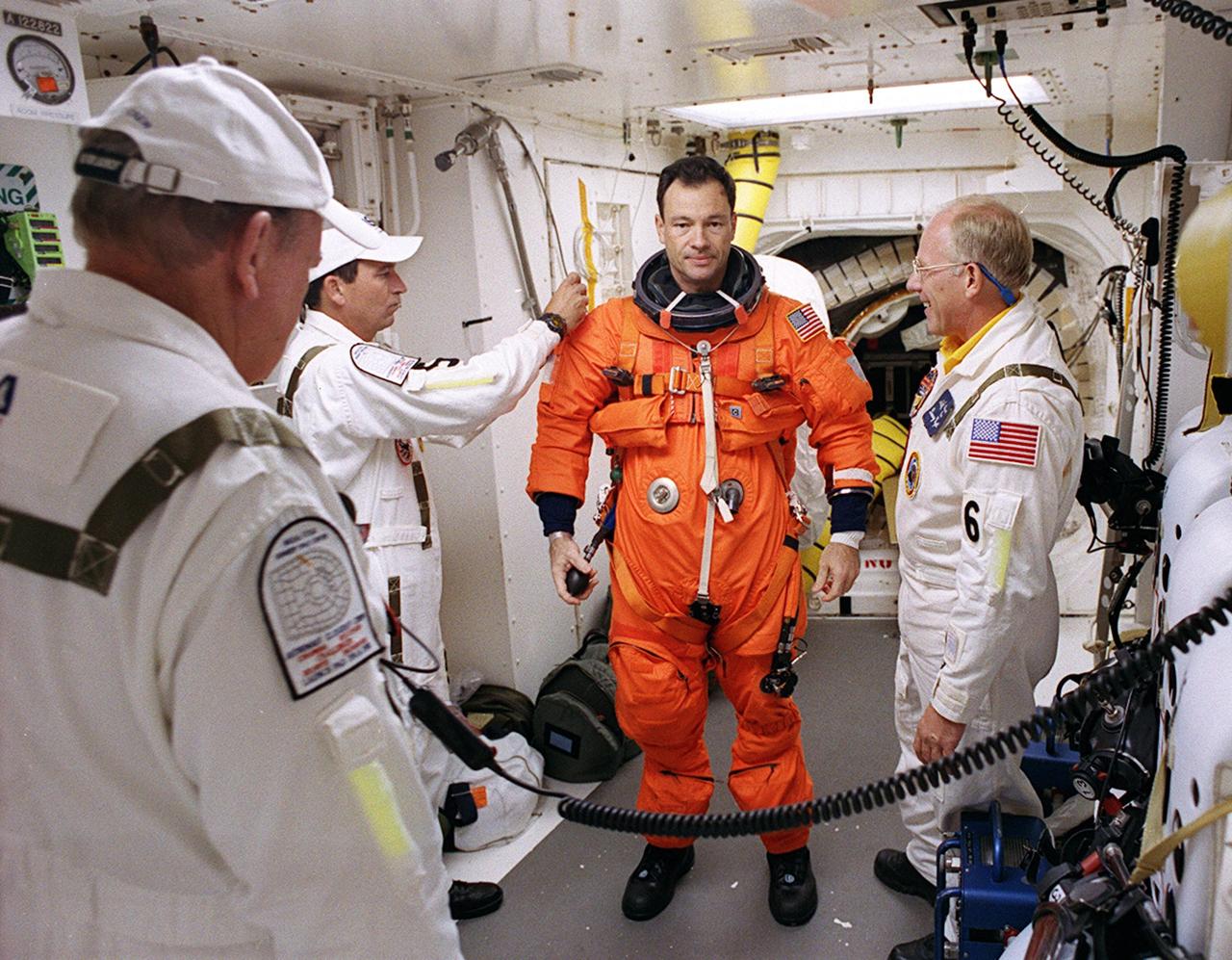
KENNEDY SPACE CENTER, FLA. -- In the White Room on Launch Pad 39A, STS-113 Mission Specialist Michael Lopez-Alegria is helped with his launch and entry suit before entering Space Shuttle Endeavour. Closeout Crew members helping are (from left) Rick Welty, United Space Alliance Vehicle Closeout chief, Bobby Wright, USA mechanical technician, and Danny Wyatt, NASA Quality Assurance specialist. The launch will carry the Expedition 6 crew to the Station and return the Expedition 5 crew to Earth. The major objective of the mission is delivery of the Port 1 (P1) Integrated Truss Assembly, which will be attached to the port side of the S0 truss. Three spacewalks are planned to install and activate the truss and its associated equipment. Launch of Space Shuttle Endeavour on mission STS-113 is scheduled for Nov. 23 at 7:50 p.m. EST.
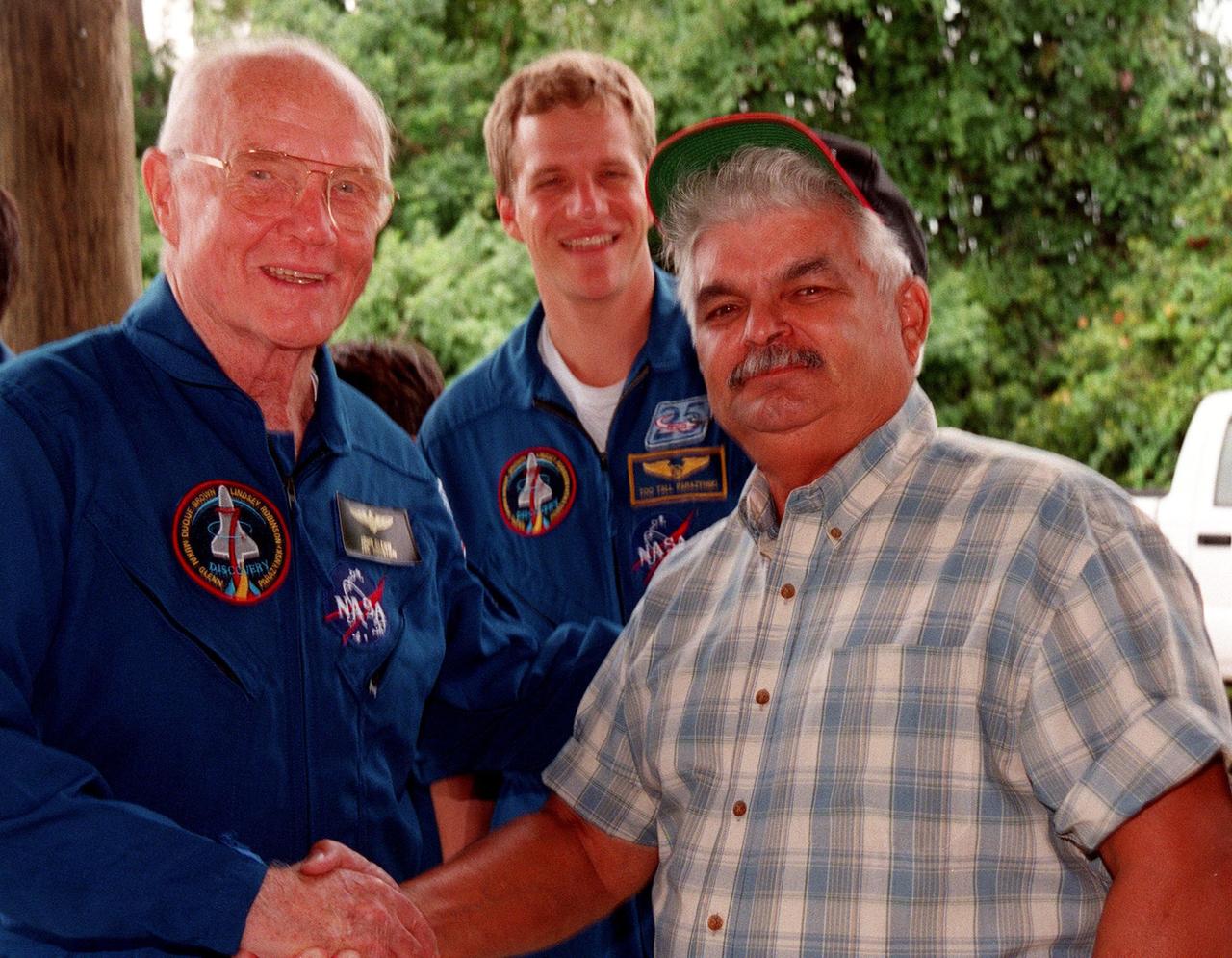
During a break in the Crew Equipment Interface Test (CEIT), Payload Specialist John H. Glenn Jr.(left), a senator from Ohio, greets Bobby Miranda. Miranda was a NASA photographer for Glenn's first flight on Friendship 7, February 1962. In the background is Mission Specialist Scott E. Parazynski. The CEIT gives astronauts an opportunity for a hands-on look at the payloads and equipment with which they will be working on orbit. The launch of the STS-95 mission is scheduled for Oct. 29, 1998, on the Space Shuttle Discovery. The mission includes research payloads such as the Spartan solar-observing deployable spacecraft, the Hubble Space Telescope Orbital Systems Test Platform, the International Extreme Ultraviolet Hitchhiker, as well as the SPACEHAB single module with experiments on space flight and the aging process
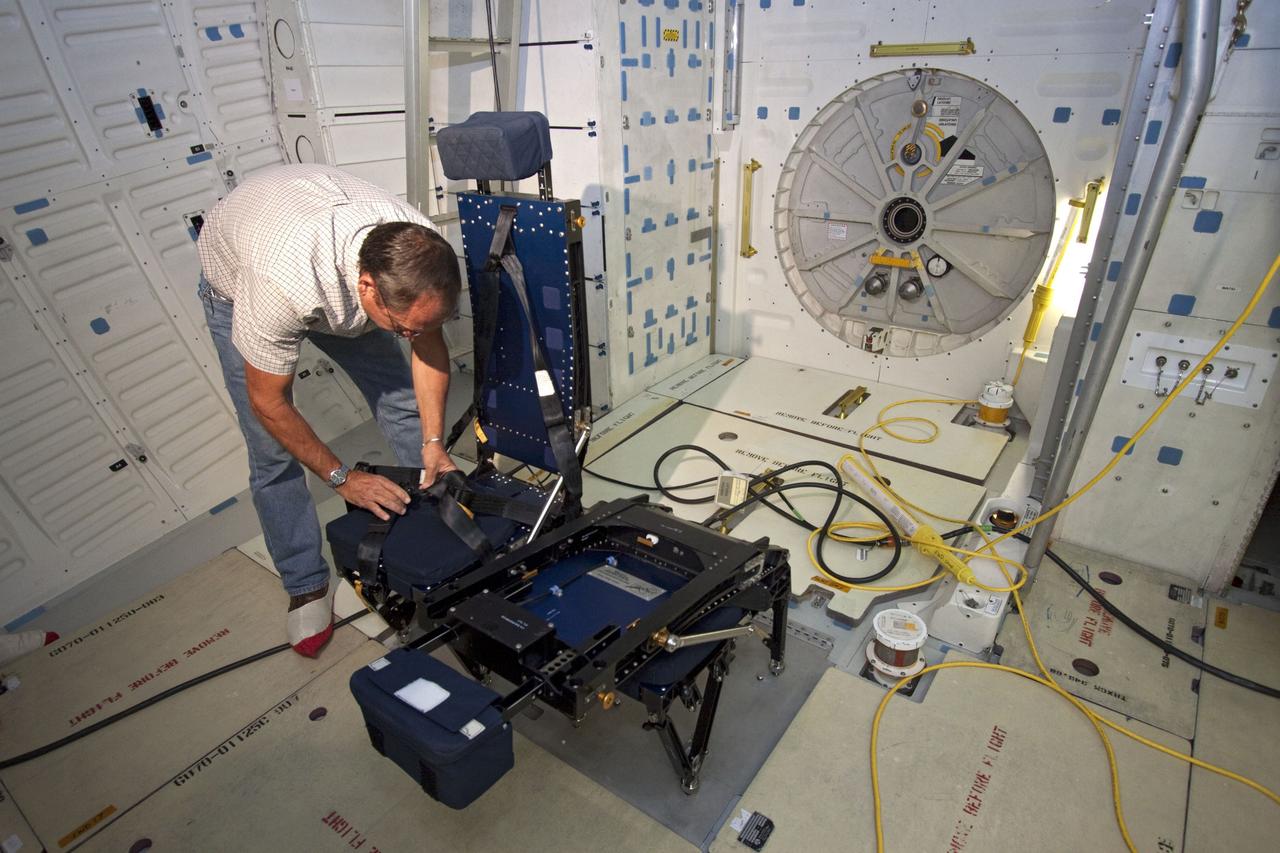
CAPE CANAVERAL, Fla. – In Orbiter Processing Facility Bay 2 at NASA’s Kennedy Space Center in Florida, United Space Alliance senior aerospace technician Bobby Wright prepares two launch and entry seats to be moved from the space shuttle Endeavour's mid-deck to the flight deck. The orbiter is undergoing final preparations for its cross-country ferry flight to California. The work is part of Transition and Retirement of the remaining space shuttles, Endeavour and Atlantis. Endeavour is being prepared for public display at the California Science Center in Los Angeles. Its ferry flight to California is targeted for mid-September. Endeavour was the last space shuttle added to NASA’s orbiter fleet. Over the course of its 19-year career, Endeavour spent 299 days in space during 25 missions. For more information, visit http://www.nasa.gov/transition Photo credit: NASA/ Jim Grossmann
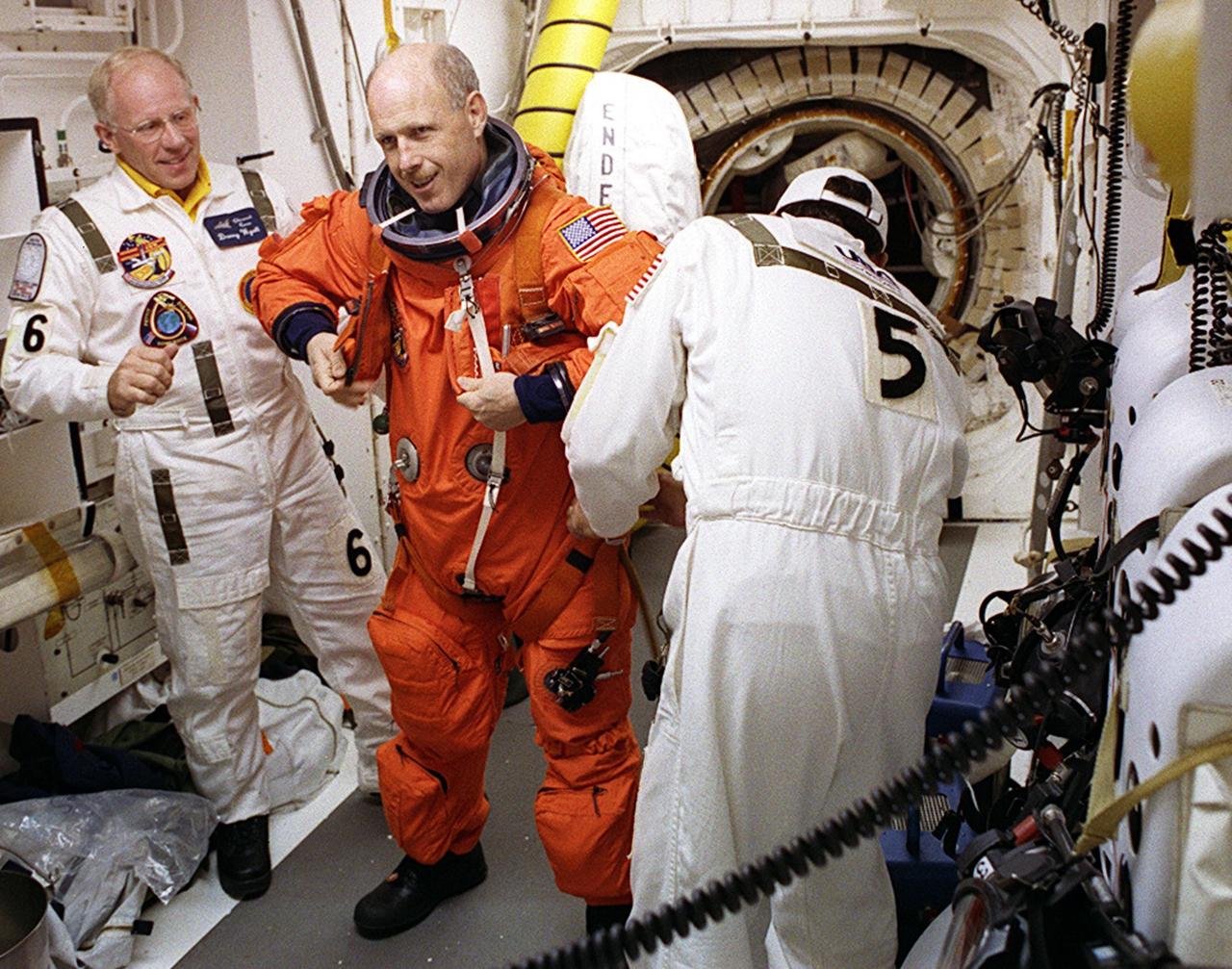
KENNEDY SPACE CENTER, FLA. - In the White Room on Launch Pad 39A, Expedition 6 Commander Ken Bowersox is helped ) with his launch and entry suit before entering Space Shuttle Endeavour. Members of the Closeout Crew helping are (left) Danny Wyatt, NASA Quality Assurance specialist, and (right) Bobby Wright, United Space Alliance mechanical technician. The launch will carry the Expedition 6 crew to the Station and return the Expedition 5 crew to Earth. The major objective of the mission is delivery of the Port 1 (P1) Integrated Truss Assembly, which will be attached to the port side of the S0 truss. Three spacewalks are planned to install and activate the truss and its associated equipment. Launch of Space Shuttle Endeavour on mission STS-113 is scheduled for Nov. 23 at 7:50 p.m. EST.
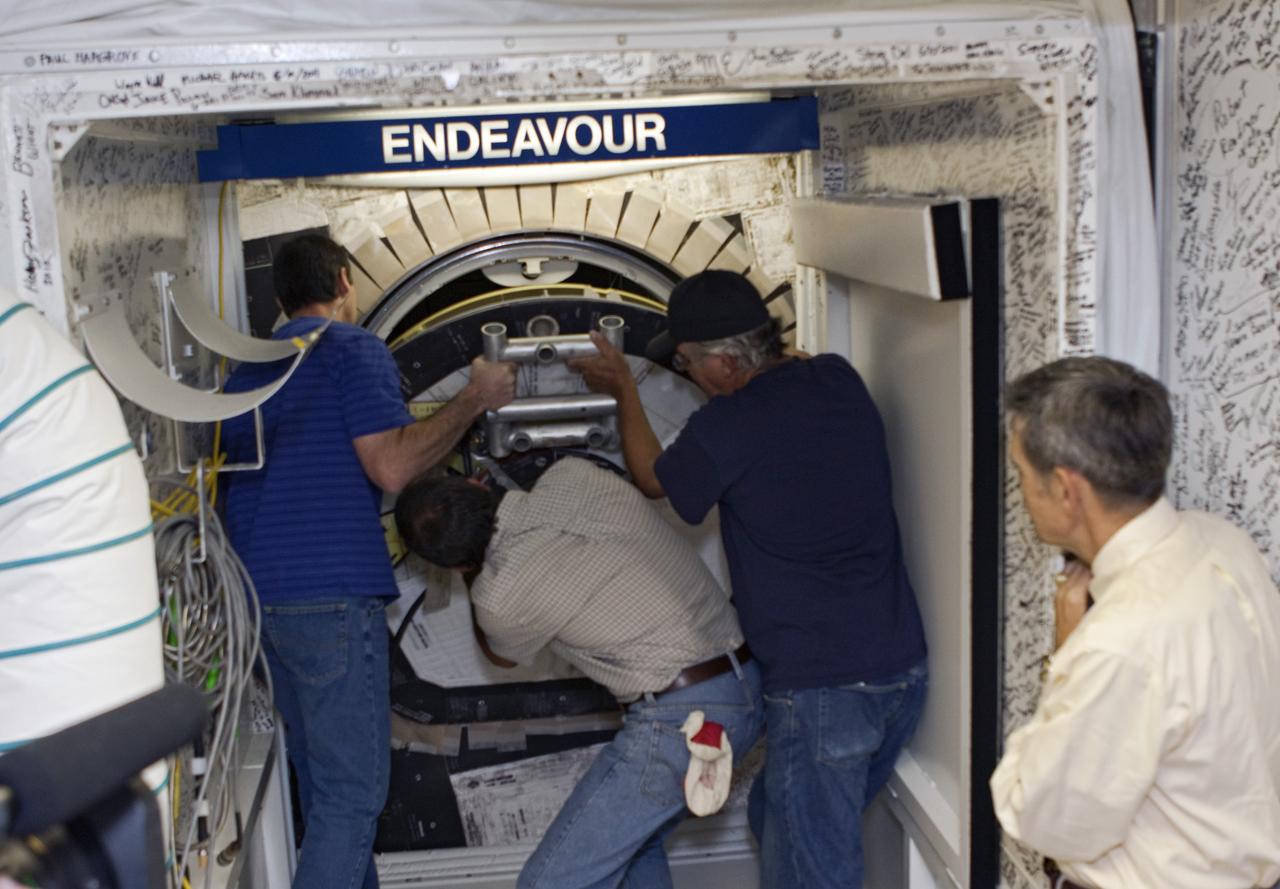
CAPE CANAVERAL, Fla. – In Orbiter Processing Facility Bay 2 at NASA’s Kennedy Space Center in Florida, Kennedy Space Center Director Bob Cabana, far right, watches as, left to right, United Space Alliance technicians Gary Hamilton, Bobby Wright and Joe Walsh begin closing the space shuttle Endeavour's hatch. The orbiter is undergoing final preparations for its cross-country ferry flight to California. The work is part of Transition and Retirement of the remaining space shuttles, Endeavour and Atlantis. Endeavour is being prepared for public display at the California Science Center in Los Angeles. Its ferry flight to California is targeted for mid-September. Endeavour was the last space shuttle added to NASA’s orbiter fleet. Over the course of its 19-year career, Endeavour spent 299 days in space during 25 missions. For more information, visit http://www.nasa.gov/transition Photo credit: NASA/ Jim Grossmann
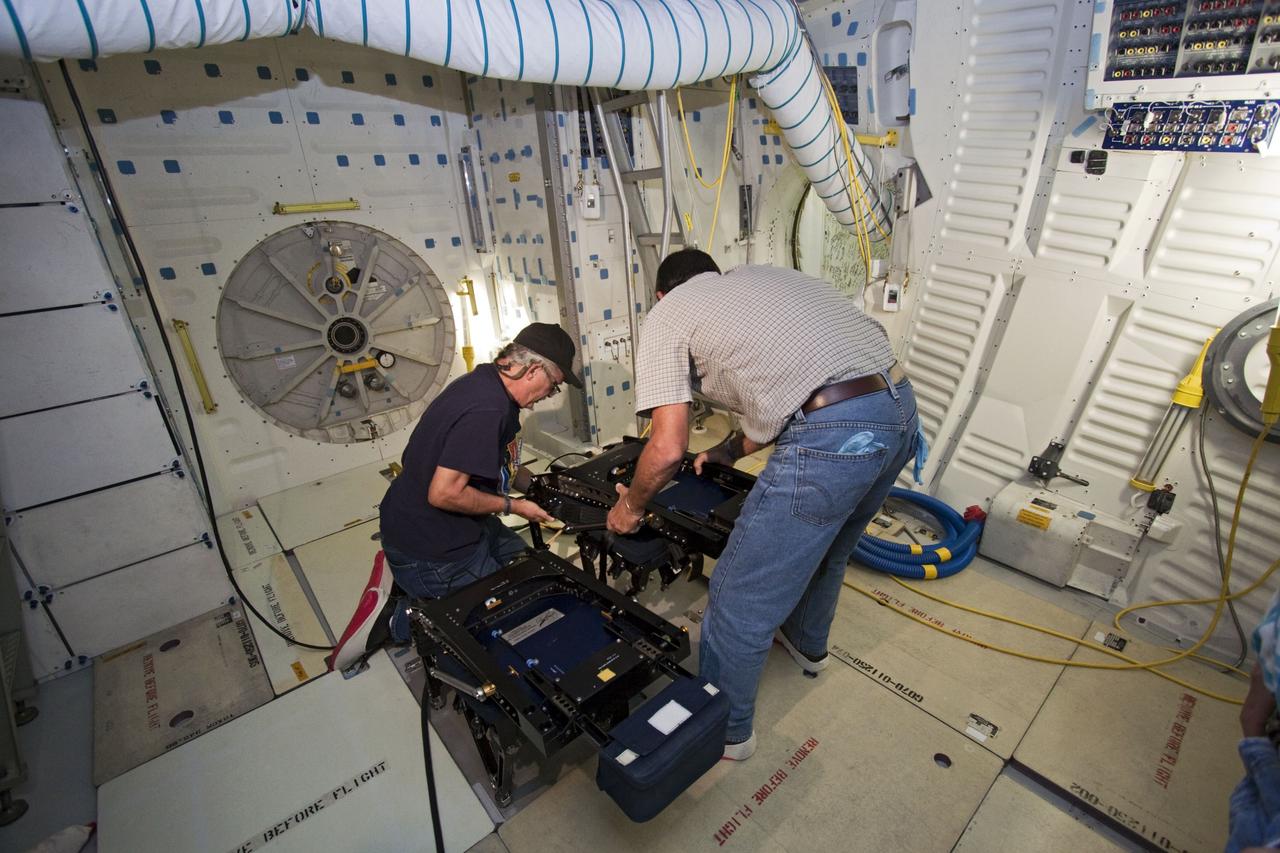
CAPE CANAVERAL, Fla. – In Orbiter Processing Facility Bay 2 at NASA’s Kennedy Space Center in Florida, United Space Alliance technician Joe Walsh, left, and senior aerospace technician Bobby Wright prepare two launch and entry seats to be moved from the space shuttle Endeavour's mid-deck to the flight deck. The orbiter is undergoing final preparations for its cross-country ferry flight to California. The work is part of Transition and Retirement of the remaining space shuttles, Endeavour and Atlantis. Endeavour is being prepared for public display at the California Science Center in Los Angeles. Its ferry flight to California is targeted for mid-September. Endeavour was the last space shuttle added to NASA’s orbiter fleet. Over the course of its 19-year career, Endeavour spent 299 days in space during 25 missions. For more information, visit http://www.nasa.gov/transition Photo credit: NASA/ Jim Grossmann
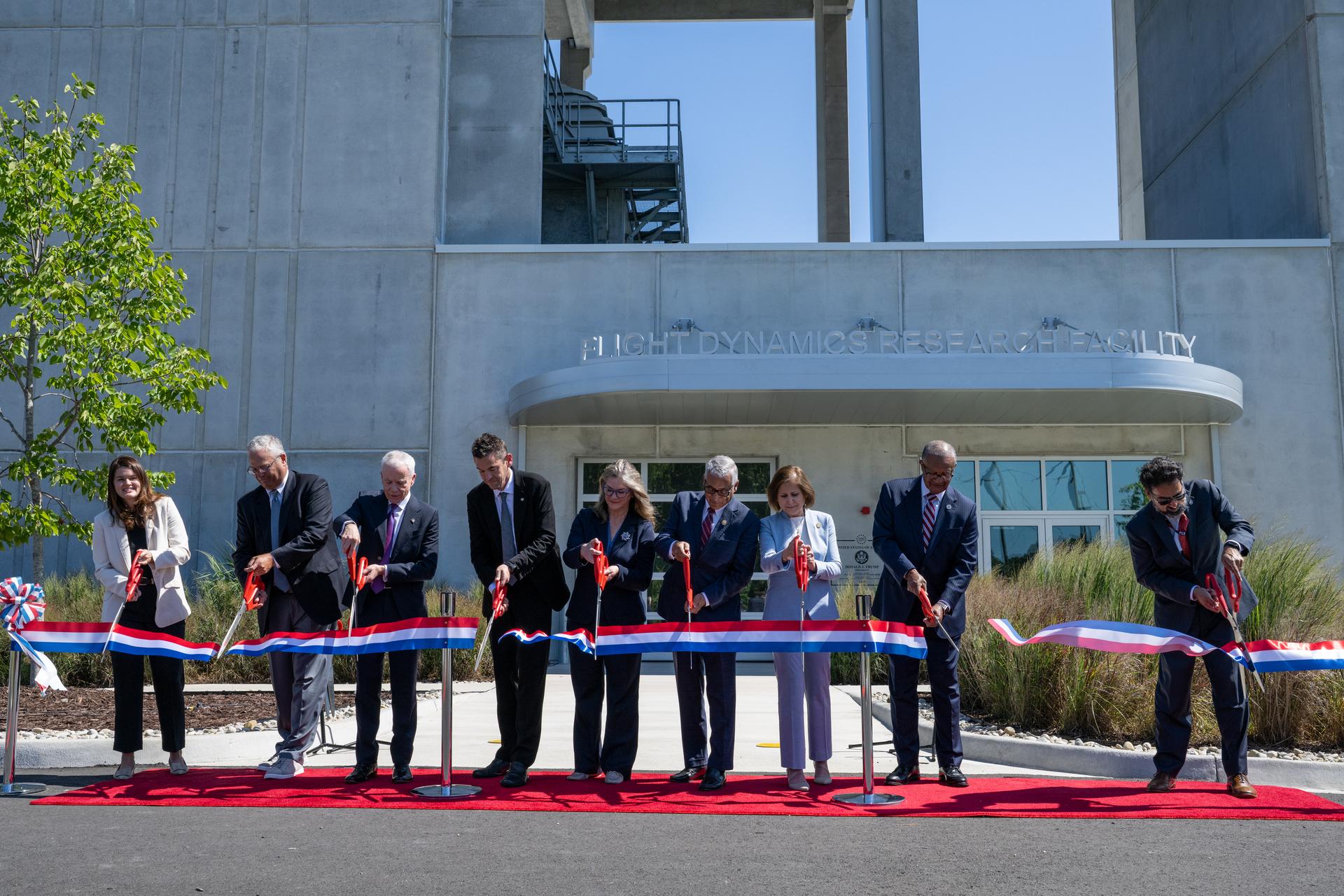
From left to right, Casey Swails, NASA Deputy Associate Administrator, Mike Waller, Vice President of BL Harbert International Federal Division, Edward C. Forst, Administrator of the General Services Administration, NASA Administrator Jared Isaacman, Dr. Trina Dyal, director of NASA's Langley Research Center, Congressman Robert “Bobby” Scott (D-Va.), Virginia Lt. Governor Ghazala F. Hashmi, City of Hampton Mayor Jimmy Gray, and Amit Kshatriya, NASA Associate Administrator cut the ribbon to open the Flight Dynamics Research Facility, NASA's newest wind tunnel, Friday, July 31, 2026, at NASA’s Langley Research Center in Hampton, Virginia. The state-of-the-art facility will support research and technology development that will advance the agency’s aeronautics, exploration, and science goals, including establishing a sustained human presence on the lunar surface through the Artemis program and the development of a Moon Base. Photo Credit: (NASA/Keegan Barber)
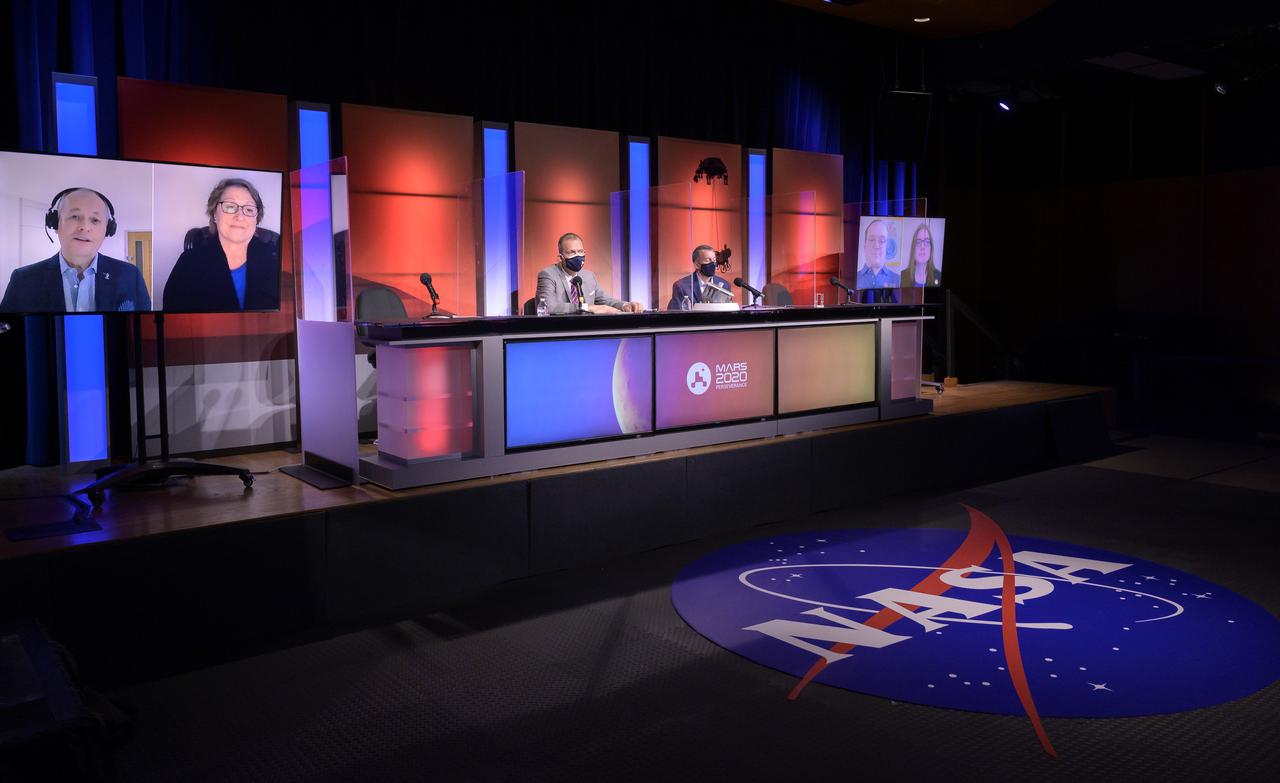
Perseverance Mars rover mission managers and scientist give remarks during a NASA Perseverance rover press briefing about the search for ancient life at Mars and about samples to be brought back to Earth on a future mission, Wednesday, Feb. 17, 2021, at NASA's Jet Propulsion Laboratory in Pasadena, California. The Perseverance Mars rover is due to land on Mars Thursday, Feb. 18, 2021. A key objective for Perseverance’s mission on Mars is astrobiology, including the search for signs of ancient microbial life. The rover will characterize the planet’s geology and past climate, pave the way for human exploration of the Red Planet, and be the first mission to collect and cache Martian rock and regolith. Photo Credit: (NASA/Bill Ingalls)
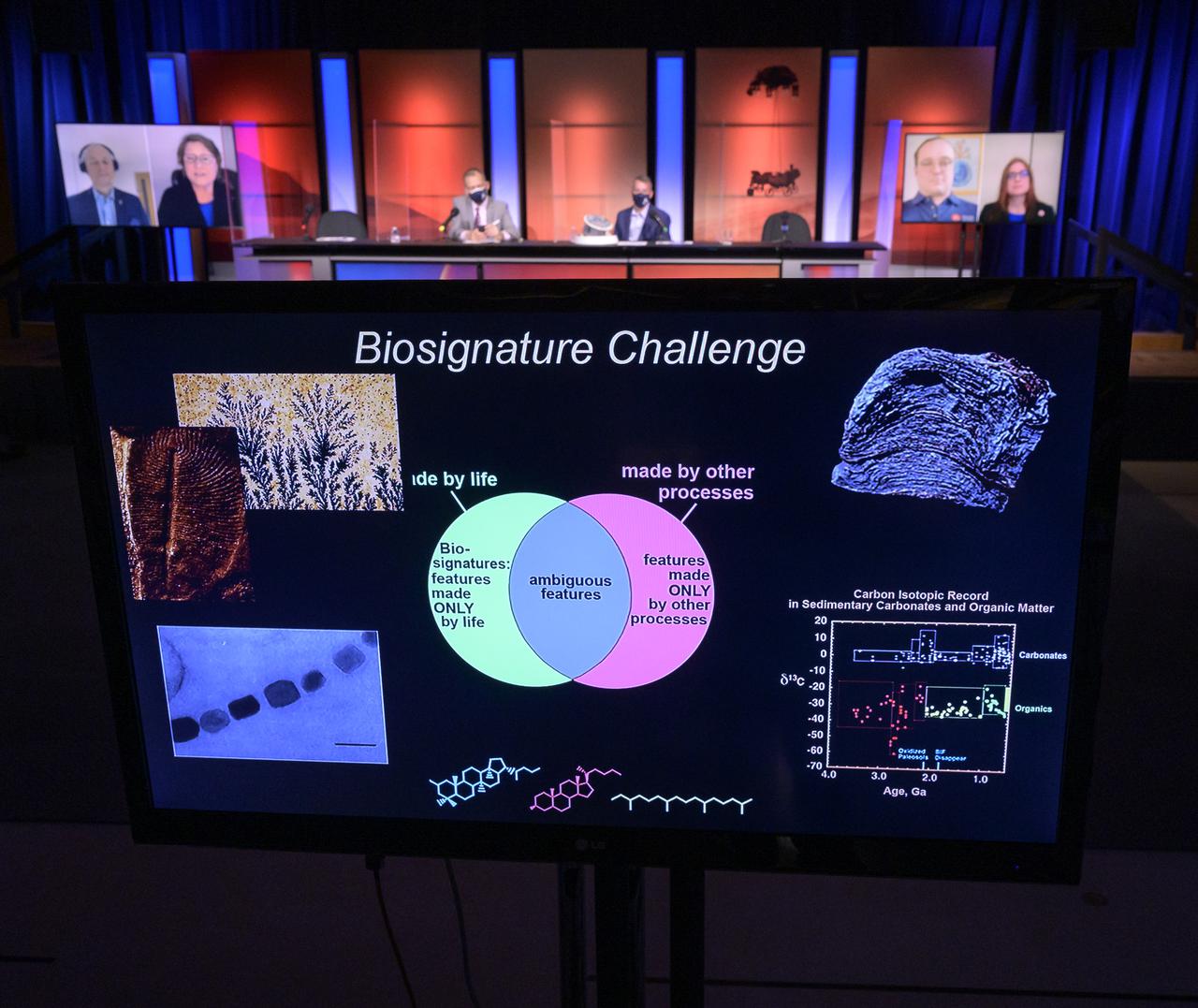
Perseverance Mars rover mission managers and scientist give remarks during a NASA Perseverance rover press briefing about the search for ancient life at Mars and about samples to be brought back to Earth on a future mission, Wednesday, Feb. 17, 2021, at NASA's Jet Propulsion Laboratory in Pasadena, California. The Perseverance Mars rover is due to land on Mars Thursday, Feb. 18, 2021. A key objective for Perseverance’s mission on Mars is astrobiology, including the search for signs of ancient microbial life. The rover will characterize the planet’s geology and past climate, pave the way for human exploration of the Red Planet, and be the first mission to collect and cache Martian rock and regolith. Photo Credit: (NASA/Bill Ingalls)
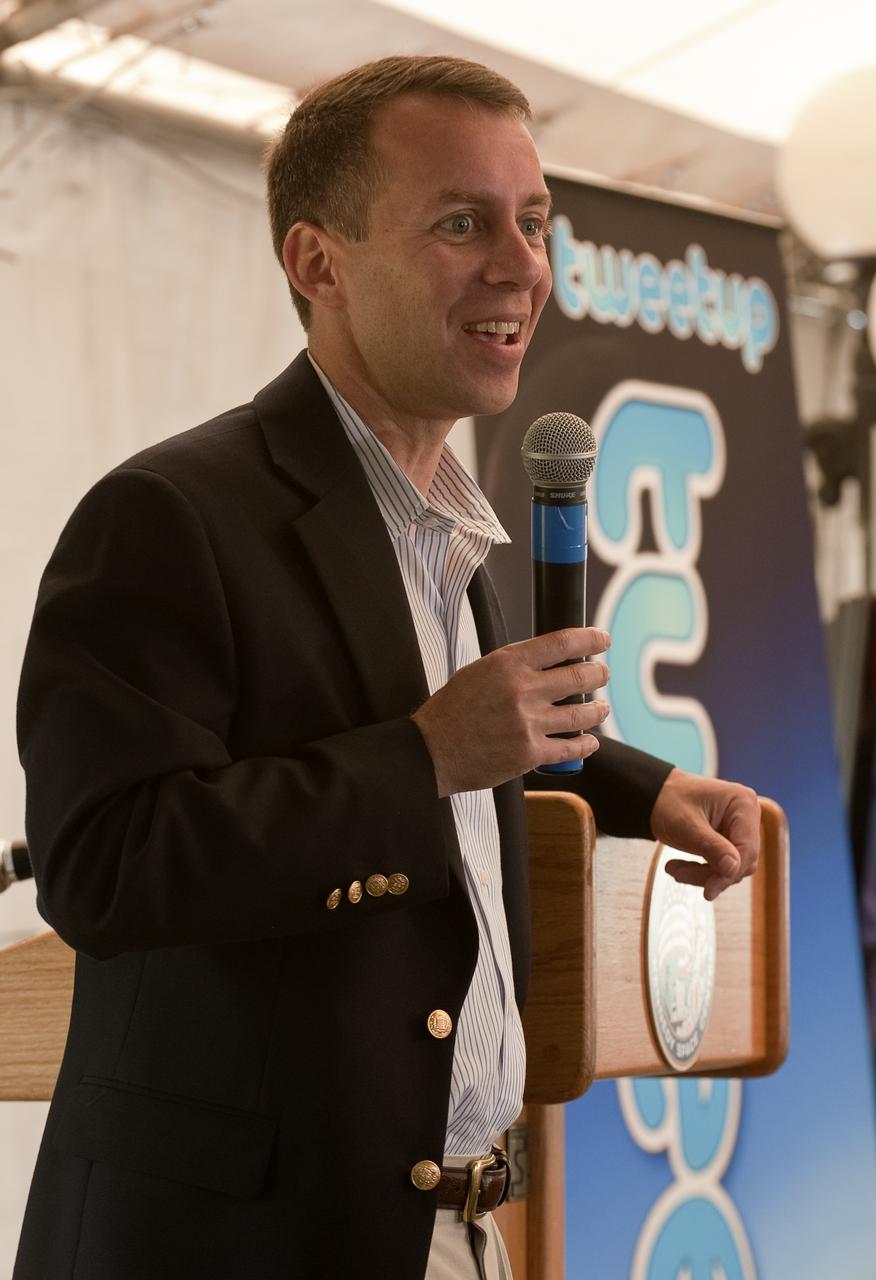
Robert D. Braun, NASA Chief Technologist at NASA Headquarters, speaks to participants at the two-day STS-132 Launch Tweetup at Kennedy Space Center, Thursday, May 13, 2010, in Cape Canaveral, Fla. NASA Twitter followers in attendance will have the opportunity to take a tour of NASA's Kennedy Space Center, view the space shuttle launch and speak with shuttle technicians, engineers, astronauts and managers. Photo Credit: (NASA/Paul E. Alers)
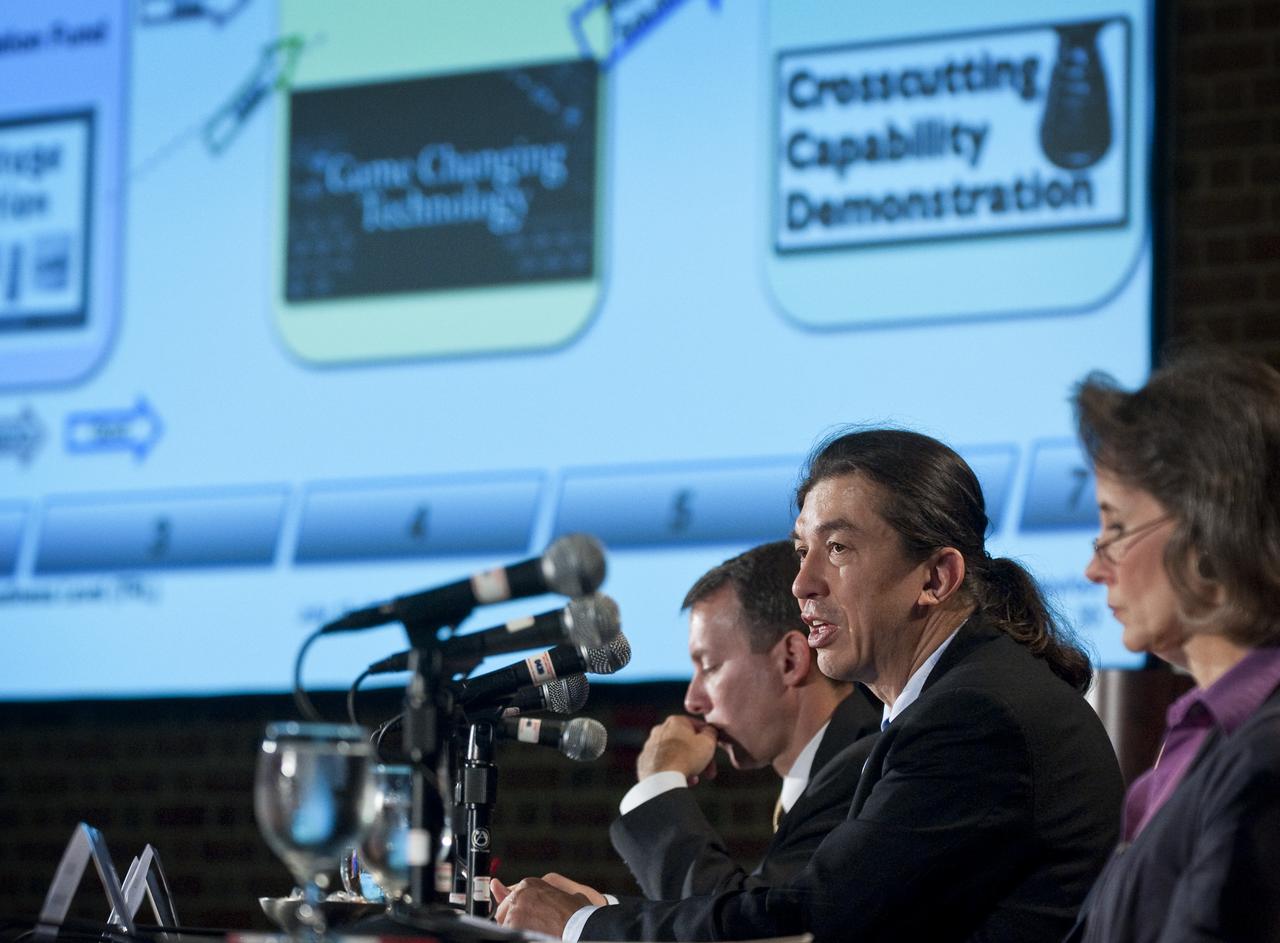
James Reuther, second from right, Director of Strategic Integration at NASA Headquarters, speaks during the NASA New Space Technology Industry Forum being held at the University of Maryland in College Park on Wednesday, July 14, 2010. During the two-day event, speakers are focusing on the president's fiscal year 2011 budget request for NASA's new Space Technology Program. Representatives from industry, academia and the federal government are in attendance to discuss strategy, development and implementation of NASA's proposed new technology-enabled exploration. Photo Credit: (NASA/Carla Cioffi)
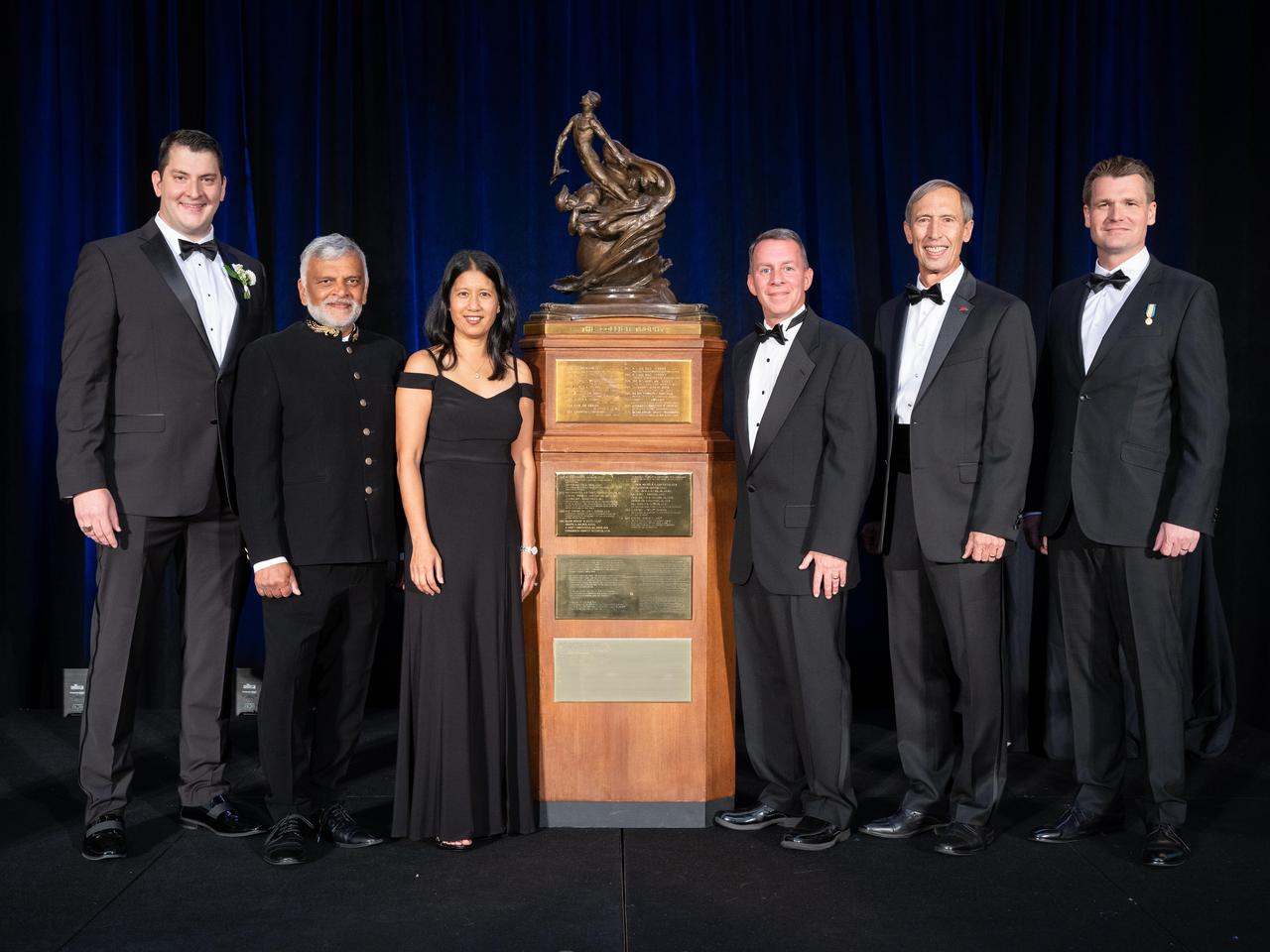
Members of NASA's Ingenuity Mars Helicopter team stand next to the Collier Trophy during the Robert J. Collier Dinner in Washington on June 9, 2022. The team was awarded the 2021 Collier Trophy "for the first powered, controlled flight of an aircraft on another planet, thereby opening the skies of Mars and other worlds for future scientific discovery and exploration," the award citation states. From left to right: Teddy Tzanetos, Ingenuity team lead at NASA's Jet Propulsion Laboratory; Bob Balaram, Ingenuity emeritus chief engineer at JPL; MiMi Aung, former Ingenuity project manager at JPL; Bobby Braun, former director for Planetary Science at JPL; Larry James, deputy director at JPL; Håvard Grip, Ingenuity chief pilot at JPL. This historic trophy – which is on permanent display at the Smithsonian Air and Space Museum in Washington – is awarded annually by the National Aeronautic Association "for the greatest achievement in aeronautics or astronautics in America, with respect to improving the performance, efficiency, and safety of air or space vehicles, the value of which has been thoroughly demonstrated by actual use during the preceding year." https://photojournal.jpl.nasa.gov/catalog/PIA25323
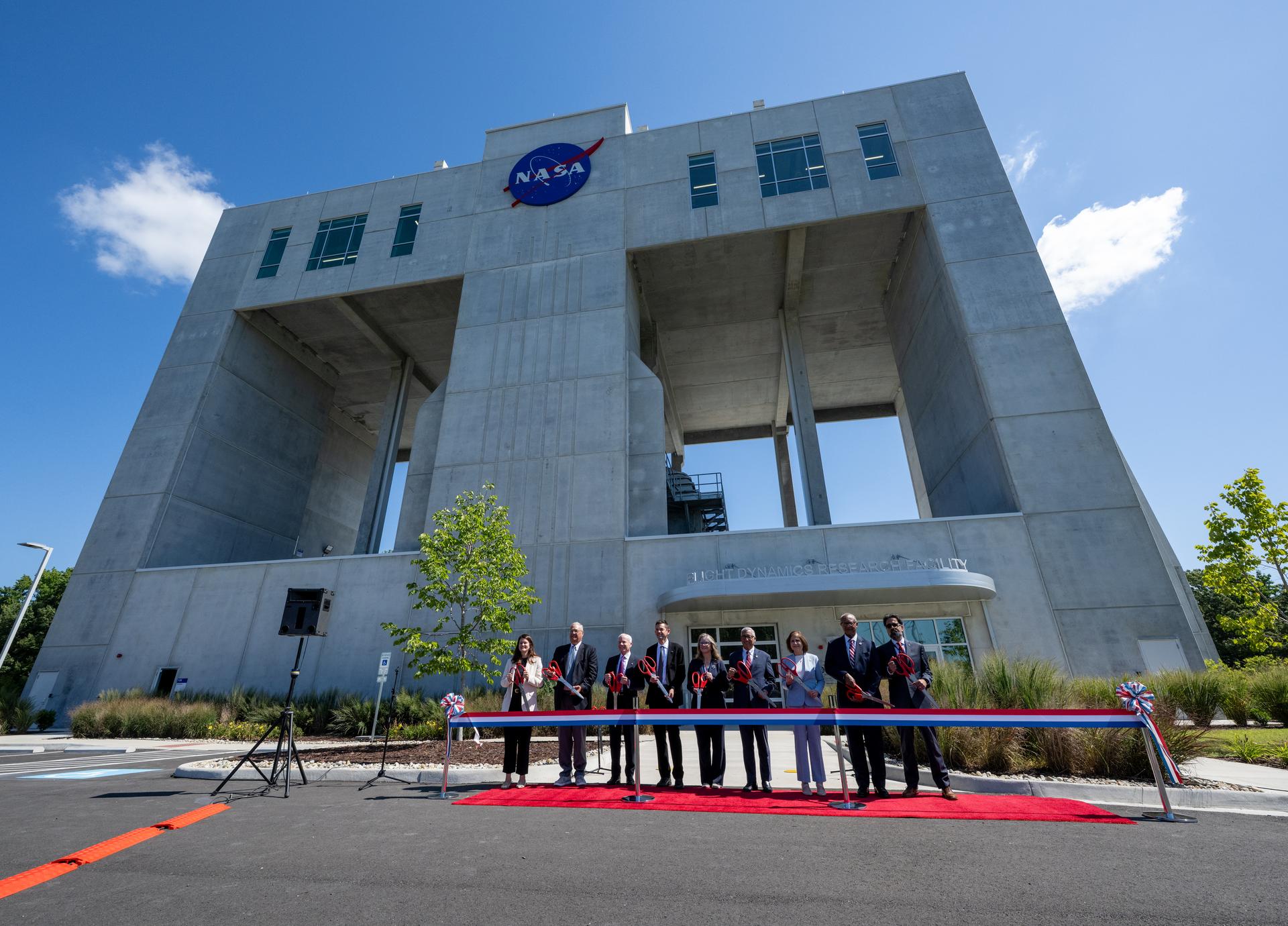
From left to right, Casey Swails, NASA Deputy Associate Administrator, Mike Waller, Vice President of BL Harbert International Federal Division, Edward C. Forst, Administrator of the General Services Administration, NASA Administrator Jared Isaacman, Dr. Trina Dyal, director of NASA's Langley Research Center, Congressman Robert “Bobby” Scott (D-Va.), Virginia Lt. Governor Ghazala F. Hashmi, City of Hampton Mayor Jimmy Gray, and Amit Kshatriya, NASA Associate Administrator pose for a photo before cutting the ribbon to open the Flight Dynamics Research Facility, NASA's newest wind tunnel, Friday, July 31, 2026, at NASA’s Langley Research Center in Hampton, Virginia. The state-of-the-art facility will support research and technology development that will advance the agency’s aeronautics, exploration, and science goals, including establishing a sustained human presence on the lunar surface through the Artemis program and the development of a Moon Base. Photo Credit: (NASA/Keegan Barber)
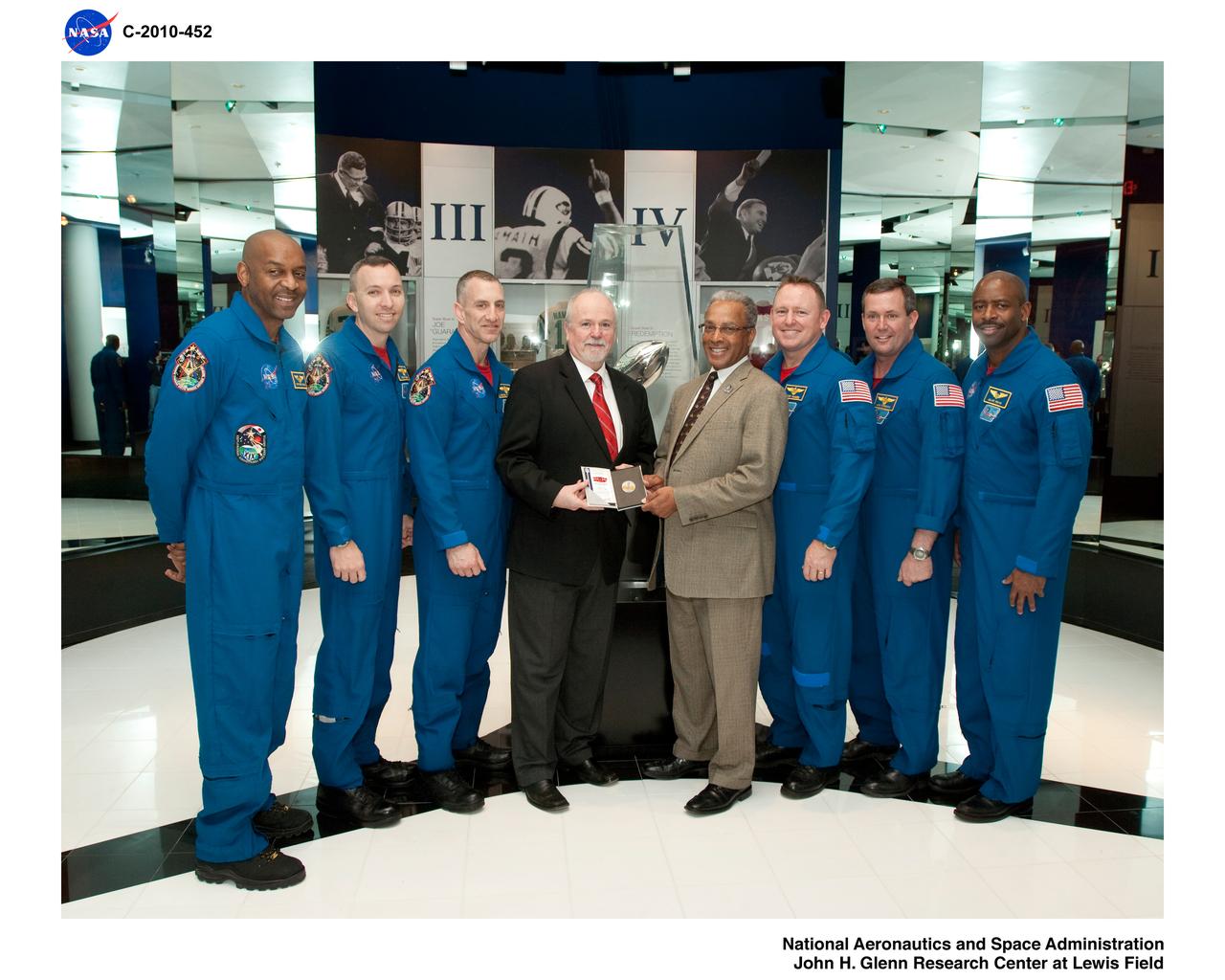
From Space to the Super Bowl Members of the STS-129 shuttle mission present a specially minted silver medallion to National Football League officials on Wednesday, Jan. 27, 2010, at the Pro Football Hall of Fame in Canton, Ohio. The coin, which was flown in space during the November flight of Atlantis, will be used for the official coin toss prior to the kickoff of Super Bowl XLIV on Sunday, Feb. 7, 2010. One member of Atlantis' crew, Leland Melvin, was drafted by the NFL's Detroit Lions in 1986. The crew also flew other NFL-related memorabilia, including jerseys and a football inscribed with the name of every member of the Hall of Fame. From left: Astronauts Bobby Satcher, Randy Bresnik, and Charlie Hobaugh; Joe Horrigan, Vice President of Communications/Exhibits for the Pro Football Hall of Fame, Steve Perry, President/Executive Director of the Pro Football Hall of Fame; astronauts Berry Wilmore, Michael Foreman and Leland Melvin. Photo Credit: NASA/Marv Smith
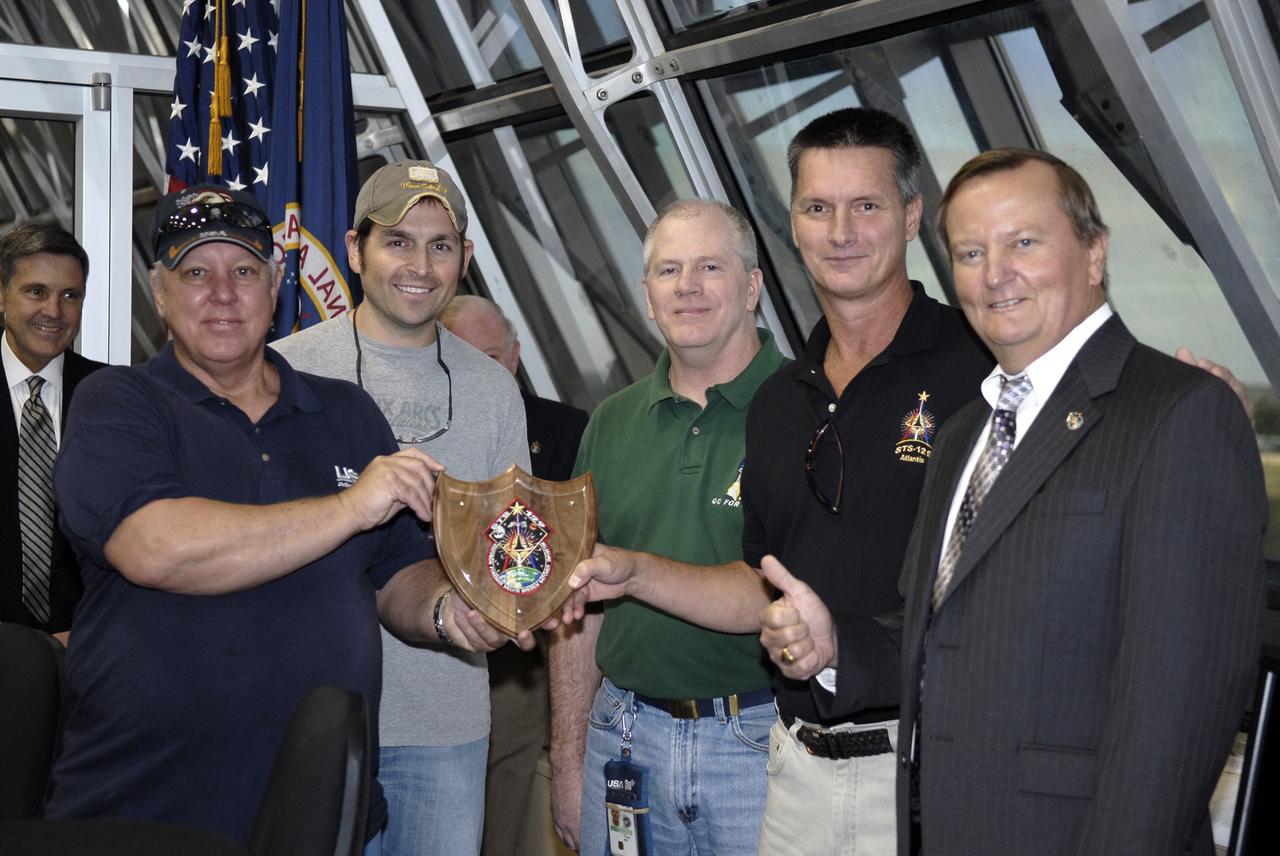
CAPE CANAVERAL, Fla. - In Firing Room 4 of NASA Kennedy Space Center's Launch Control Center, NASA's space shuttle launch director Michael Leinbach presents members of the United Space Alliance Midbody Team for space shuttle Atlantis with the Launch Director's Flow Award, a plaque emblazoned with the logo for Atlantis' STS-129 mission. The award recognizes the team's superior work in reconfiguring the shuttle's payload bay between STS-125, the last Hubble Space Telescope servicing mission, and the current STS-129 mission to the International Space Station. From left are midbody lead Jim Reed, midbody thermal control system technician Chris Oliver, midbody planner and payload operations representative for STS-129 Steve Durnin, Orbiter Processing Facility-1 midbody supervisor Bobby Pracek, and Leinbach. Liftoff of Atlantis from Launch Pad 39A on its STS-129 mission to the International Space Station came at 2:28 p.m. EST Nov. 16. For information on the STS-129 mission and crew, visit http://www.nasa.gov/mission_pages/shuttle/shuttlemissions/sts129/index.html. Photo credit: NASA/Kim Shiflett

Researcher Bobby Sanders examines a 0.10-scale model of the Mariner-C shroud and Agena rocket in the 8- by 6-Foot Supersonic Wind Tunnel at the National Aeronautics and Space Administration (NASA) Lewis Research Center. Mariner-C and Mariner-D were identical spacecraft designed by the Jet Propulsion Laboratory to flyby Mars and photograph the Martian surface. The two Mariner spacecraft were launched by Atlas-Agena-D rockets. Lewis had taken over management of the Agena Program in October 1962. Lewis researchers investigated two different types of shrouds for the Mariner missions—an over-the-nose design and a backup pyrotechnic design. The new shroud was wider in diameter than the Agena rocket, so there was concern that this disparity might create air flow instability that could damage the shroud or destroy the vehicle. The tests in the 8- by 6 tunnel simulated launch speeds from Mach 0.56 to 1.96. Afterwards the Agena-Mariner-C model was studied in the 10- by 10-Foot Supersonic Wind Tunnel at speeds of Mach 2.0 to 3.5. Mariner-C was launched on November 4, 1964, but the payload shroud did not jettison properly and the spacecraft’s battery power did not function. The mission ended unsuccessfully two days later. Mariner-D was launched on November 28, 1964 and became the first successful mission to Mars. It was the first time a planet was photographed from space. Mariner-D’s 21 photographs revealed an inhospitable and barren landscape.

Matthew Mullin and Bobby Meazell, Orbital ATK/Columbia Scientific Balloon Facility technicians, conduct compatibility testing on NASA Langley Research Center’s Radiation Dosimetry Experiment payload Wednesday, Sept. 9, at Fort Sumner, N.M. The successful compatibility test was a key milestone in ensuring the flight readiness of RaD-X, which is scheduled to launch on an 11-million-cubic-foot NASA scientific balloon no earlier than Friday, Sept. 11, from the agency’s balloon launching facility in Fort Sumner. RaD-X will measure cosmic ray energy at two separate altitude regions in the stratosphere—above 110,000 feet and between 69,000 to 88,500 feet. The data is key to confirming Langley’s Nowcast of Atmospheric Ionizing Radiation for Aviation Safety (NAIRAS) model, which is a physics-based model that determines solar radiation and galactic cosmic ray exposure globally in real-time. The NAIRAS modeling tool will be used to help enhance aircraft safety as well as safety procedures for the International Space Station. In addition to the primary payload, 100 small student experiments will fly on the RaD-X mission as part of the Cubes in Space program. The program provides 11- to 18-year-old middle and high school students a no-cost opportunity to design and compete to launch an experiment into space or into the near-space environment. The cubes measure just 4 centimeters by 4 centimeters. NASA’s scientific balloons offer low-cost, near-space access for scientific payloads weighing up to 8,000 pounds for conducting scientific investigations in fields such as astrophysics, heliophysics and atmospheric research. NASA’s Wallops Flight Facility in Virginia manages the agency’s scientific balloon program with 10 to 15 flights each year from launch sites worldwide. Orbital ATK provides program management, mission planning, engineering services and field operations for NASA’s scientific balloon program. The program is executed from the Columbia Scientific Balloon Facility in Palestine, Texas. The Columbia team has launched more than 1,700 scientific balloons in over 35 years of operation. Anyone may track the progress of the Fort Sumner flights, which includes a map showing the balloon’s real-time location, at: <a href="http://towerfts.csbf.nasa.gov/" rel="nofollow">towerfts.csbf.nasa.gov/</a> For more information on the balloon program, see: <a href="http://www.nasa.gov/scientificballoons" rel="nofollow">www.nasa.gov/scientificballoons</a> <b><a href="http://www.nasa.gov/audience/formedia/features/MP_Photo_Guidelines.html" rel="nofollow">NASA image use policy.</a></b> <b><a href="http://www.nasa.gov/centers/goddard/home/index.html" rel="nofollow">NASA Goddard Space Flight Center</a></b> enables NASA’s mission through four scientific endeavors: Earth Science, Heliophysics, Solar System Exploration, and Astrophysics. Goddard plays a leading role in NASA’s accomplishments by contributing compelling scientific knowledge to advance the Agency’s mission. <b>Follow us on <a href="http://twitter.com/NASAGoddardPix" rel="nofollow">Twitter</a></b> <b>Like us on <a href="http://www.facebook.com/pages/Greenbelt-MD/NASA-Goddard/395013845897?ref=tsd" rel="nofollow">Facebook</a></b> <b>Find us on <a href="http://instagrid.me/nasagoddard/?vm=grid" rel="nofollow">Instagram</a></b>