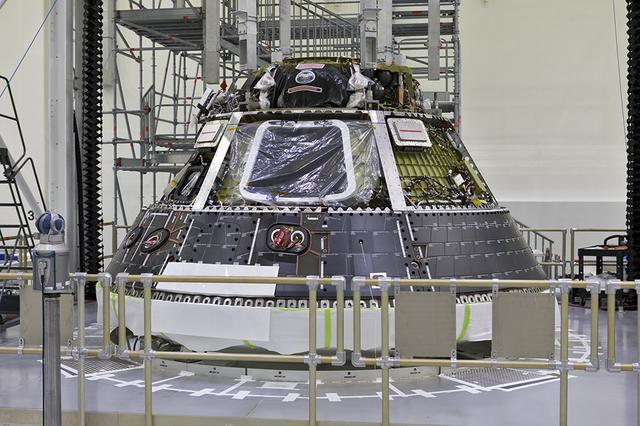
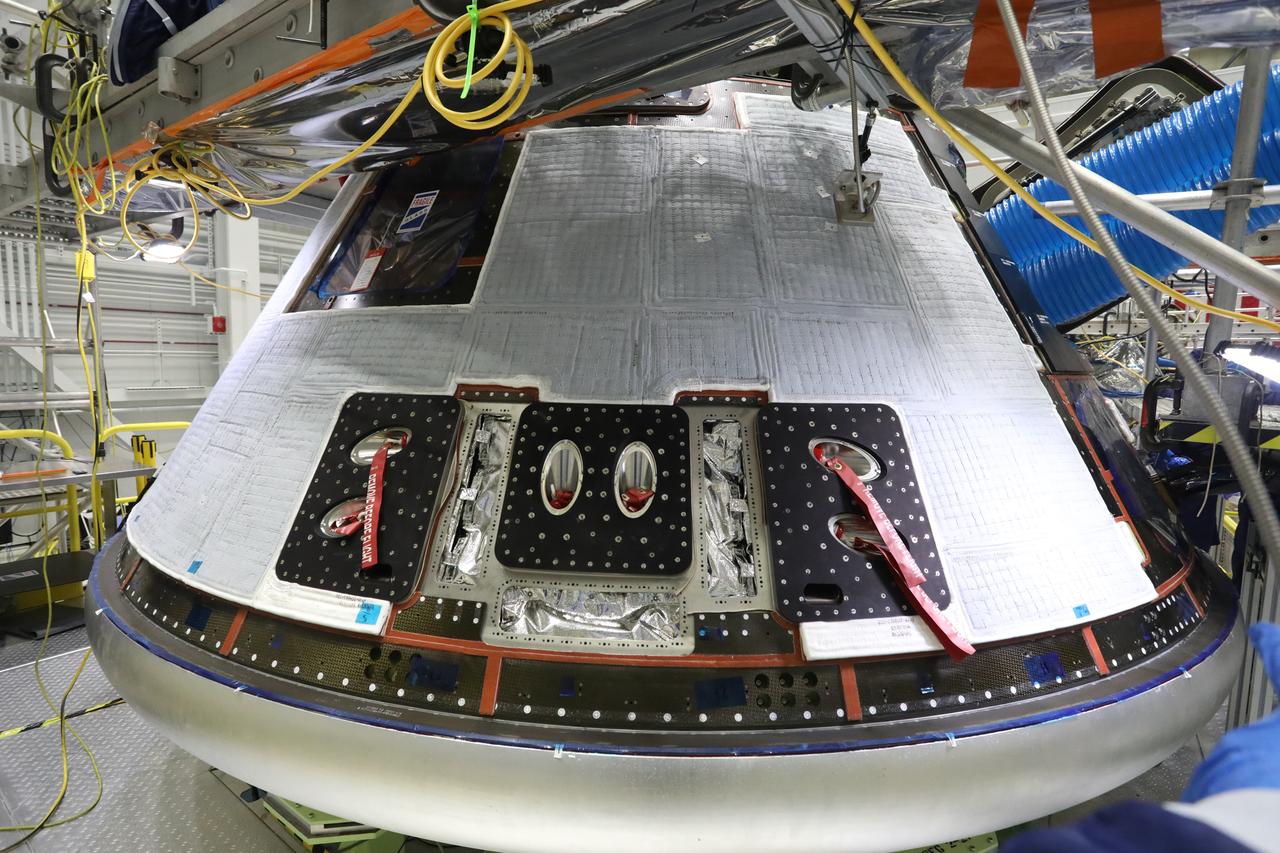
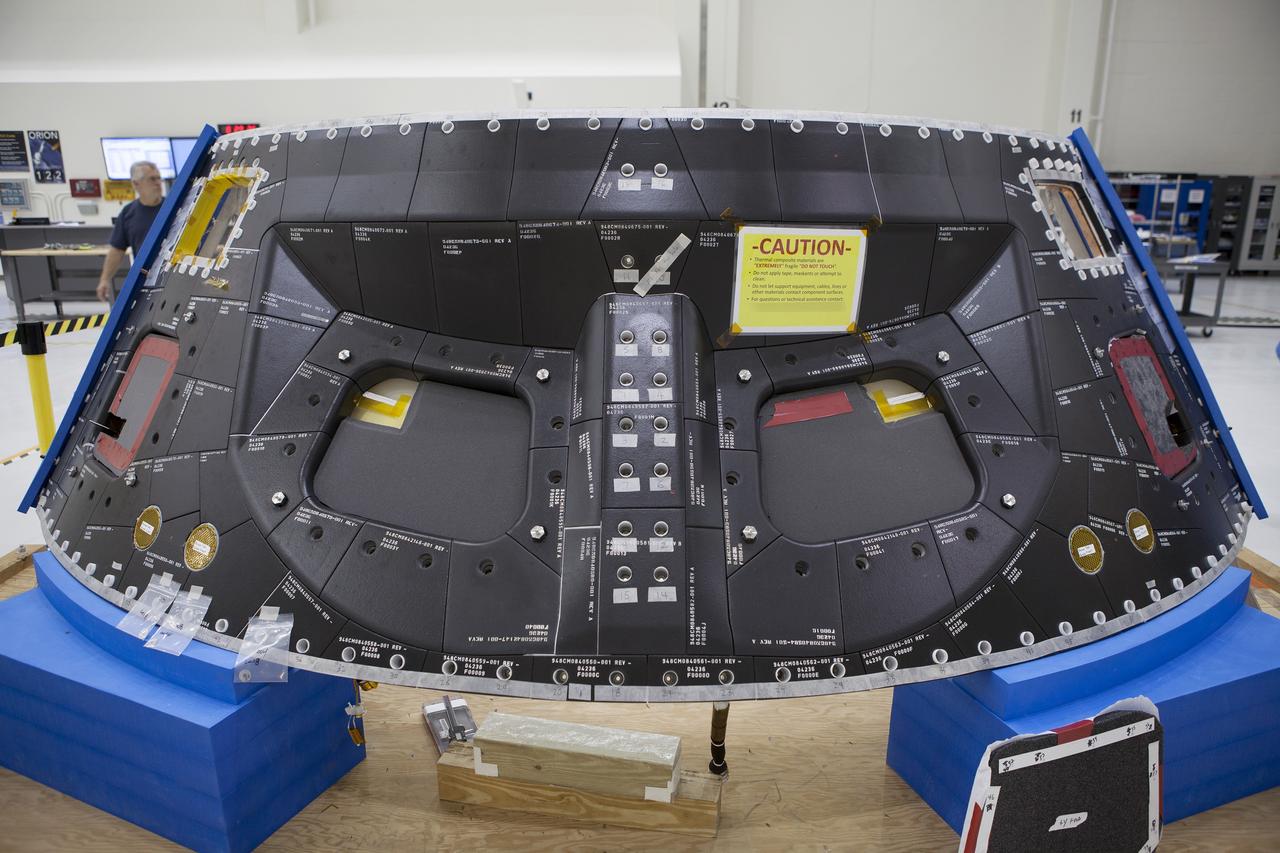
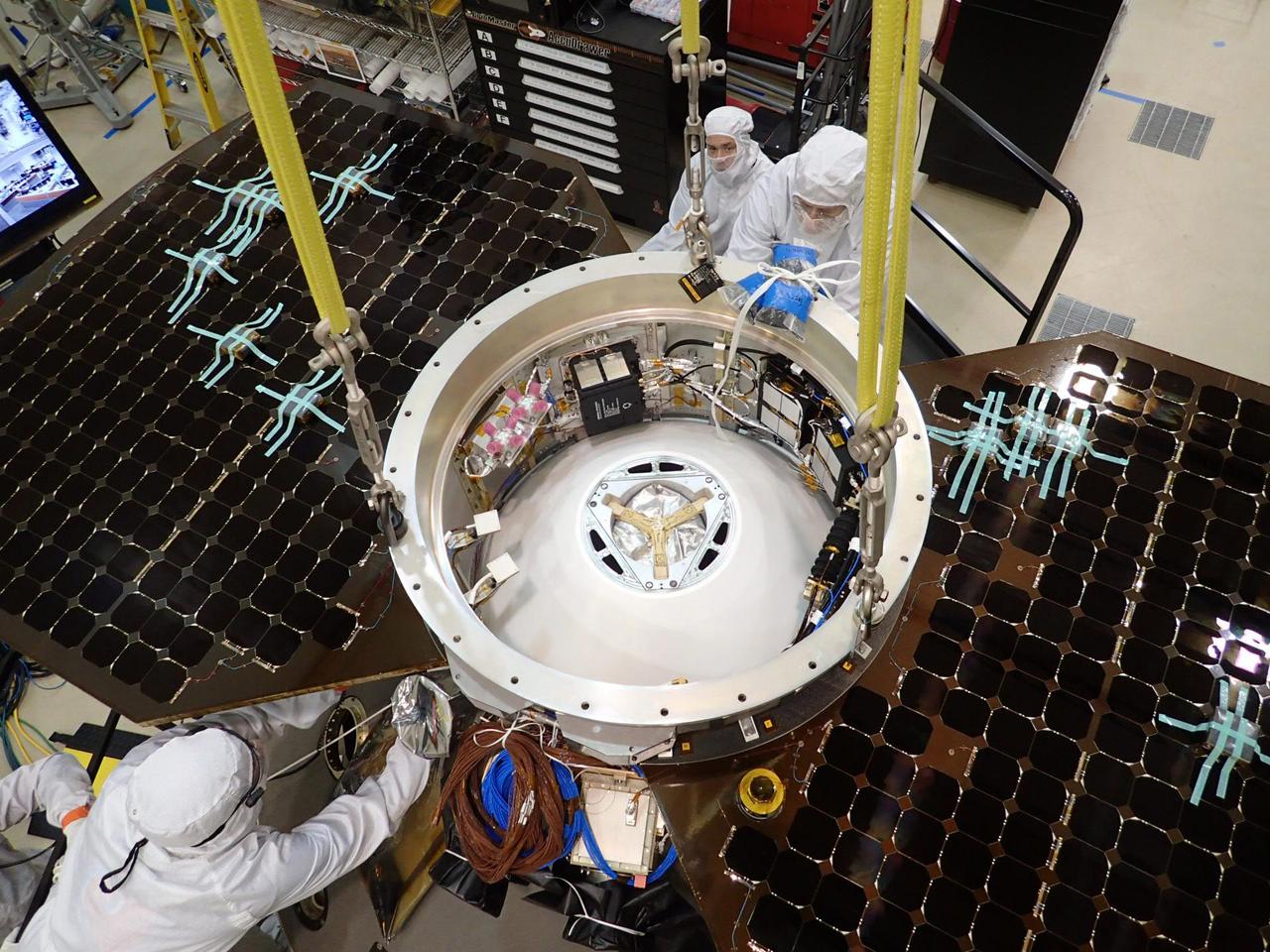
Heat shield back shell panels are prefitted on the Orion spacecraft inside the Neil Armstrong Operations and Checkout Building high bay at NASA's Kennedy Space Center in Florida. The back shell panels serve as the outer layer of the spacecraft and will protect it against the extreme temperatures of re-entry from deep space. Orion is being prepared for its first integrated uncrewed flight atop NASA's Space Launch System rocket on Exploration Mission-1 from Launch Pad 39B at Kennedy Space Center.

Heat shield back shell panels are prefitted on the Orion spacecraft inside the Neil Armstrong Operations and Checkout Building high bay at NASA's Kennedy Space Center in Florida. The back shell panels serve as the outer layer of the spacecraft and will protect it against the extreme temperatures of re-entry from deep space. Orion is being prepared for its first integrated uncrewed flight atop NASA's Space Launch System rocket on Exploration Mission-1 from Launch Pad 39B at Kennedy Space Center.
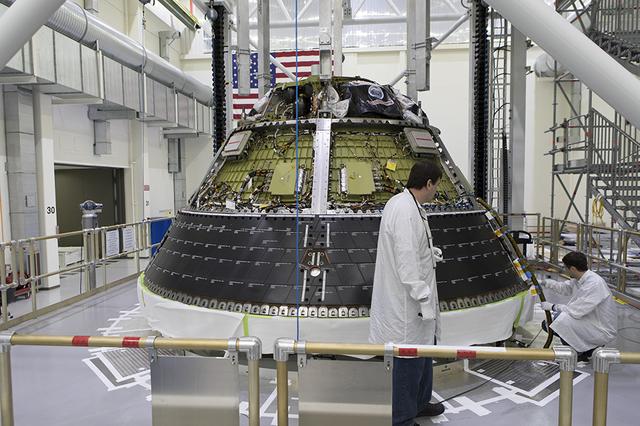
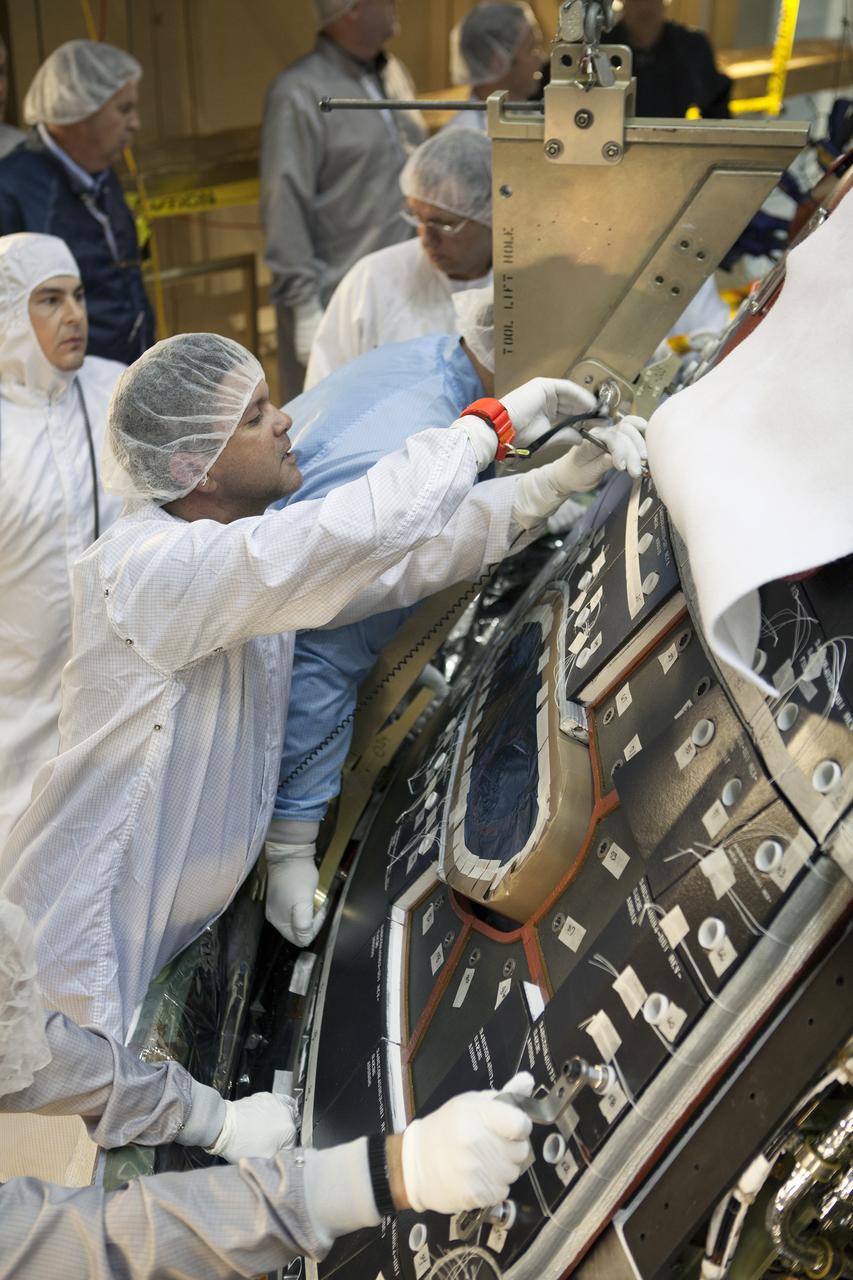
Lockheed Martin technicians test the fitting of the Orion spacecraft's heat shield back shell panels inside the Neil Armstrong Operations and Checkout Building high bay at NASA's Kennedy Space Center in Florida. The back shell panels serve as the outer layer of the spacecraft and will protect it against the extreme temperatures of re-entry from deep space. Orion is being prepared for its first integrated uncrewed flight atop NASA's Space Launch System rocket on Exploration Mission-1 from Launch Pad 39B at Kennedy Space Center.
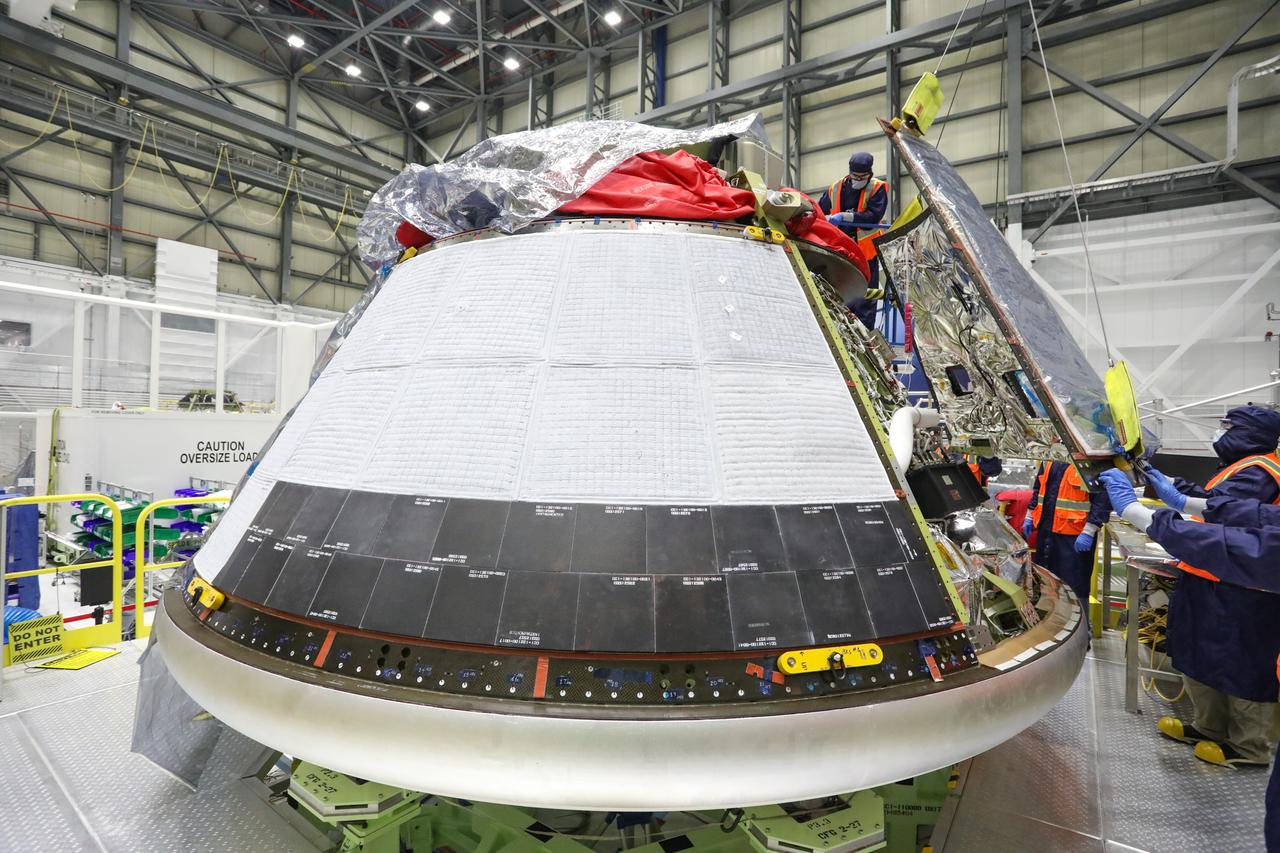
Boeing technicians install back shells on the Orbital Flight Test-2 (OFT-2) Starliner crew module inside the company’s Commercial Crew and Cargo Processing Facility at NASA’s Kennedy Space Center in Florida on December 2, 2020. During the OFT-2 mission, the uncrewed Starliner spacecraft will fly to the International Space Station for NASA’s Commercial Crew Program.
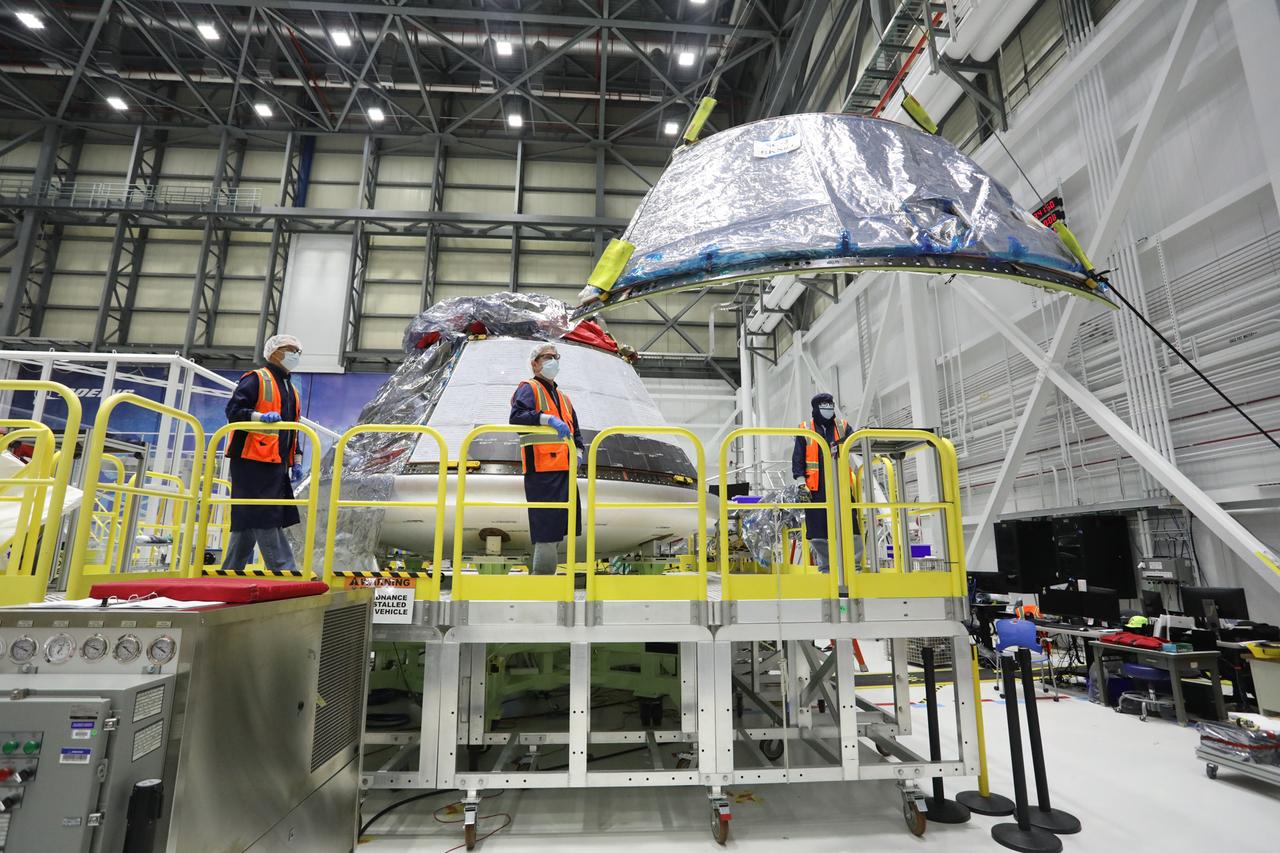
Boeing technicians install back shells on the Orbital Flight Test-2 (OFT-2) Starliner crew module inside the company’s Commercial Crew and Cargo Processing Facility at NASA’s Kennedy Space Center in Florida on December 2, 2020. During the OFT-2 mission, the uncrewed Starliner spacecraft will fly to the International Space Station for NASA’s Commercial Crew Program.
Boeing’s Starliner crew module, with back shells installed, is inside the company’s Commercial Crew and Cargo Processing Facility at Kennedy Space Center on December 8, 2020, in preparation for the Orbital Flight Test-2 (OFT-2). During the OFT-2 mission, the uncrewed Starliner spacecraft will fly to the International Space Station for NASA’s Commercial Crew Program.
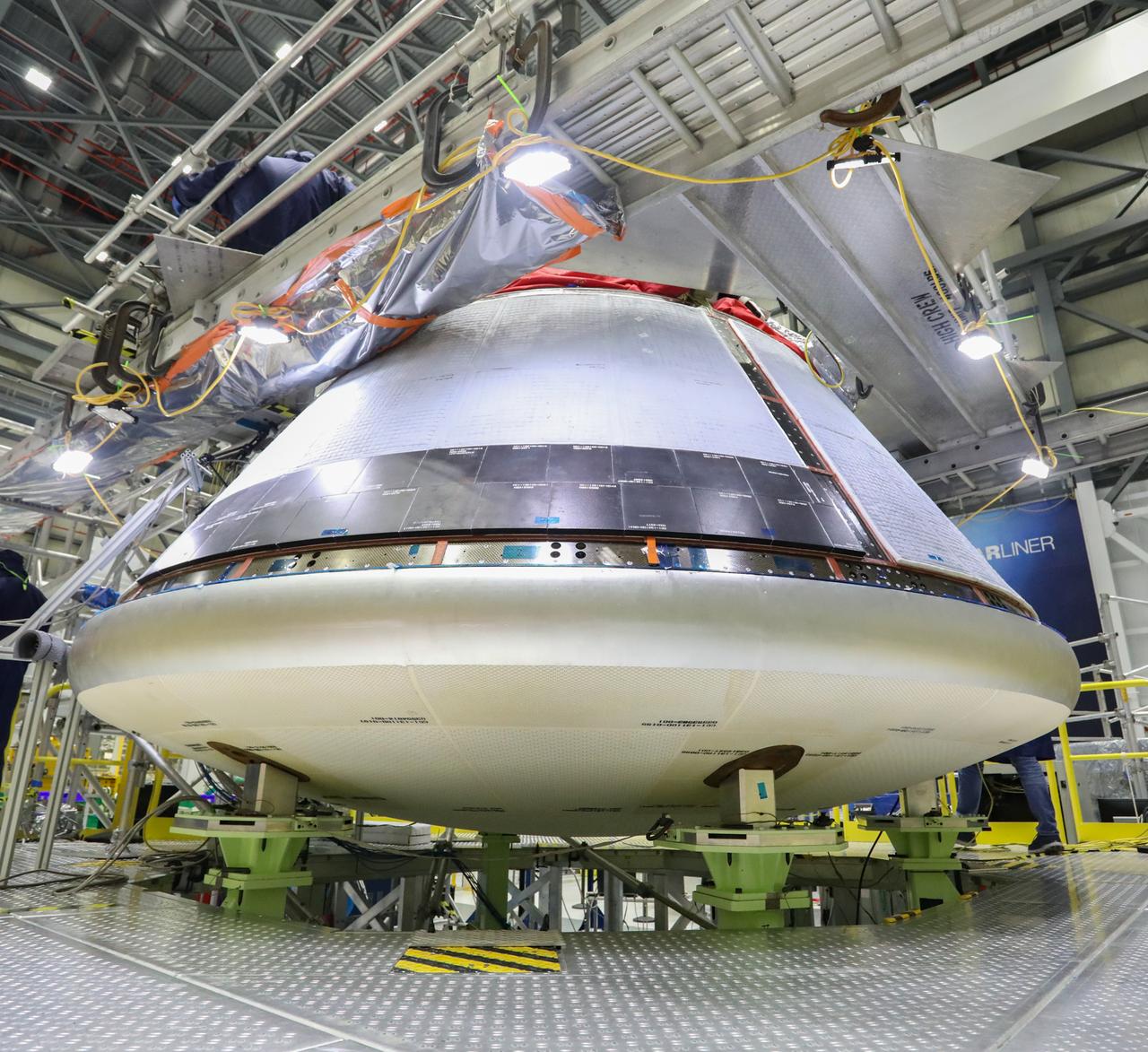
Boeing’s Starliner crew module, with back shells installed, is inside the company’s Commercial Crew and Cargo Processing Facility at Kennedy Space Center on December 8, 2020, in preparation for the Orbital Flight Test-2 (OFT-2). During the OFT-2 mission, the uncrewed Starliner spacecraft will fly to the International Space Station for NASA’s Commercial Crew Program.
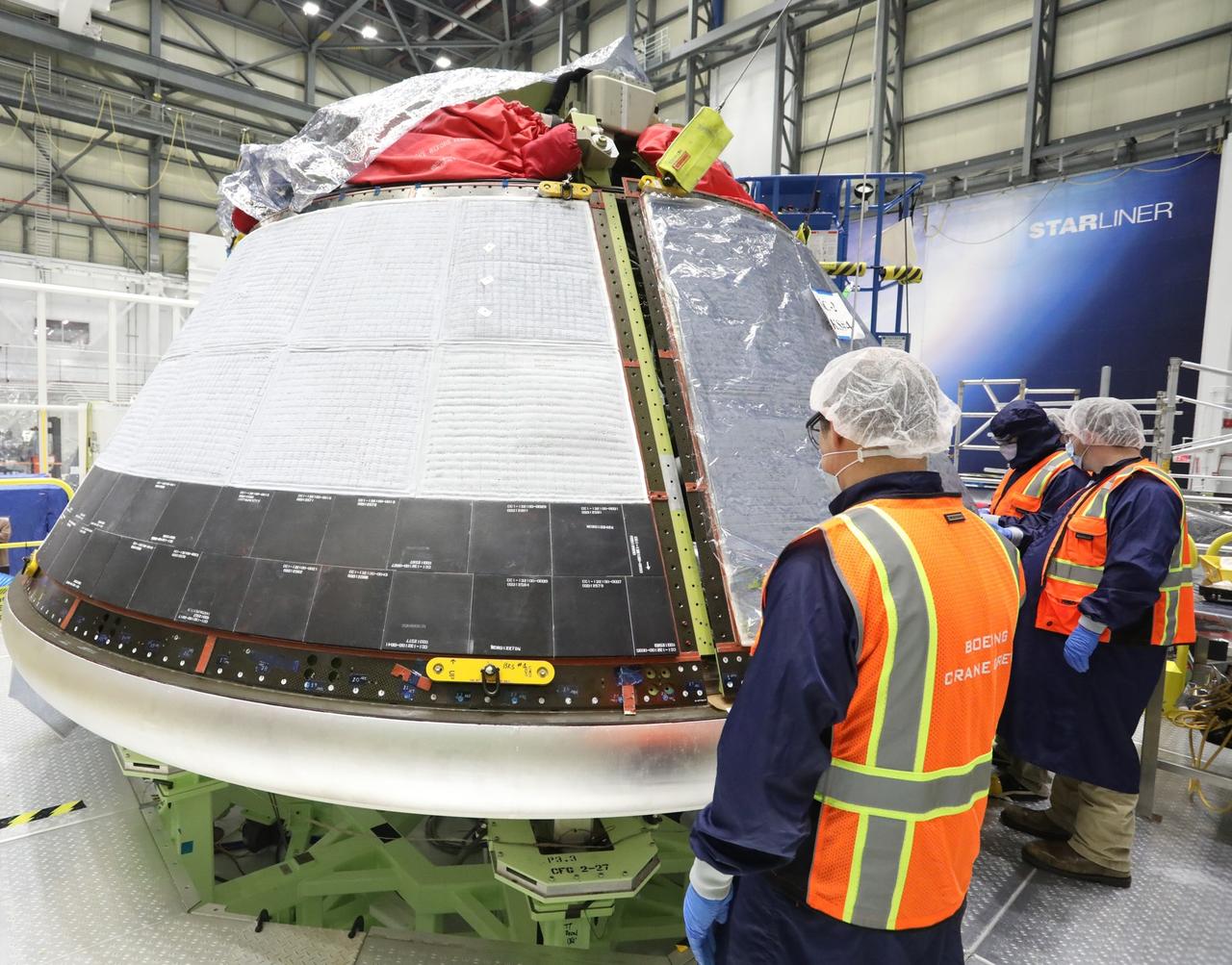
Boeing technicians install back shells on the Orbital Flight Test-2 (OFT-2) Starliner crew module inside the company’s Commercial Crew and Cargo Processing Facility at NASA’s Kennedy Space Center in Florida on December 2, 2020. During the OFT-2 mission, the uncrewed Starliner spacecraft will fly to the International Space Station for NASA’s Commercial Crew Program.

This stereo anaglyph shows the parachute and back shell that helped guide NASA Curiosity to the surface of Mars. You need 3-D glasses to view this image.
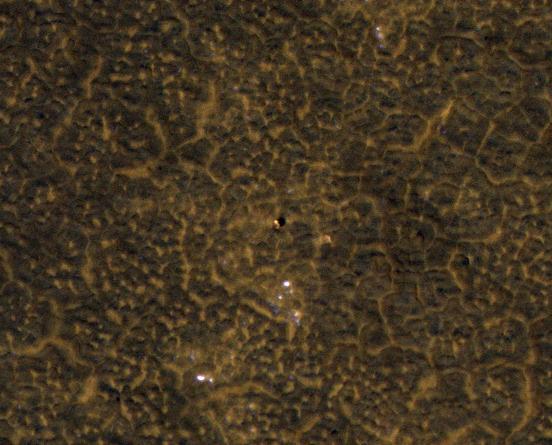
This image, taken Jan. 26, 2012, shows the back shell of NASA Phoenix Mars Lander spacecraft after its second Martian arctic winter.
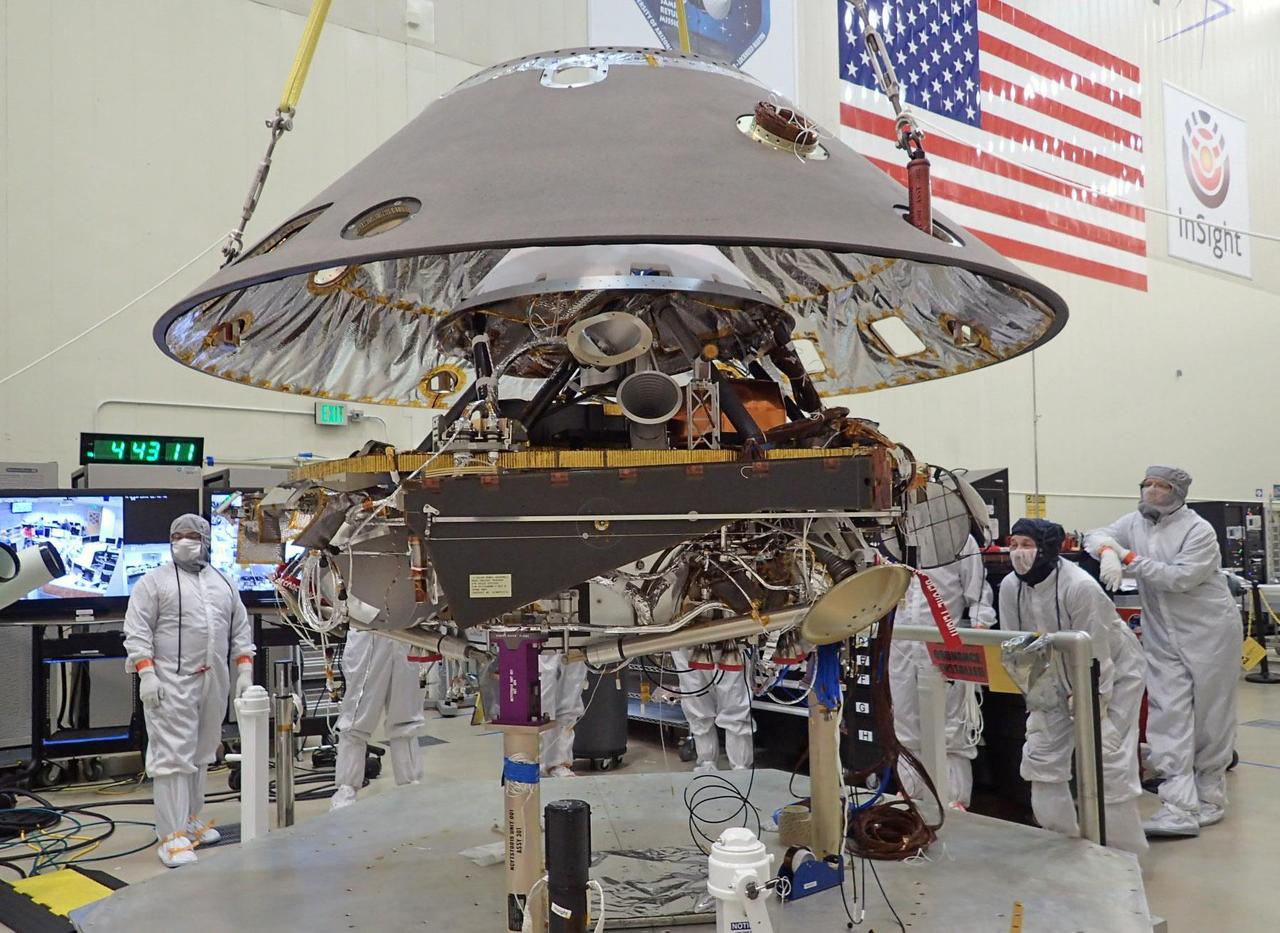
In this photo, the back shell of NASA's InSight spacecraft is being lowered onto the mission's lander, which is folded into its stowed configuration. The back shell and a heat shield form the aeroshell, which will protect the lander as the spacecraft plunges into the upper atmosphere of Mars. The photo was taken on April 29, 2015, in a spacecraft assembly clean room at Lockheed Martin Space Systems, Denver. InSight, for Interior Exploration Using Seismic Investigations, Geodesy and Heat Transport, is scheduled for launch in March 2016 and landing in September 2016. It will study the deep interior of Mars to advance understanding of the early history of all rocky planets, including Earth. Note: After thorough examination, NASA managers have decided to suspend the planned March 2016 launch of the Interior Exploration using Seismic Investigations Geodesy and Heat Transport (InSight) mission. The decision follows unsuccessful attempts to repair a leak in a section of the prime instrument in the science payload. http://photojournal.jpl.nasa.gov/catalog/PIA19666
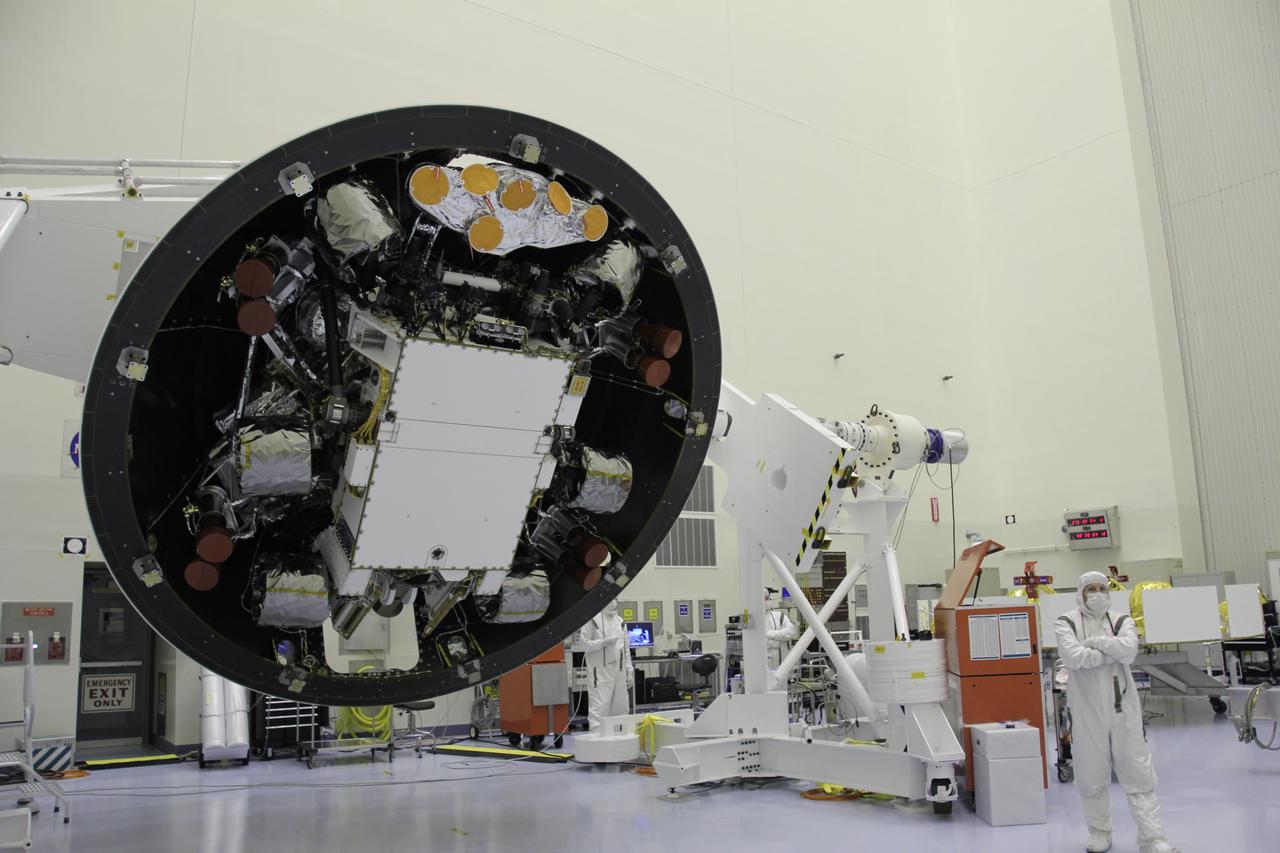
At the Payload Hazardous Servicing Facility at NASA Kennedy Space Center in Florida, the back shell powered descent vehicle configuration of NASA Mars Science Laboratory is being rotated for final closeout actions.
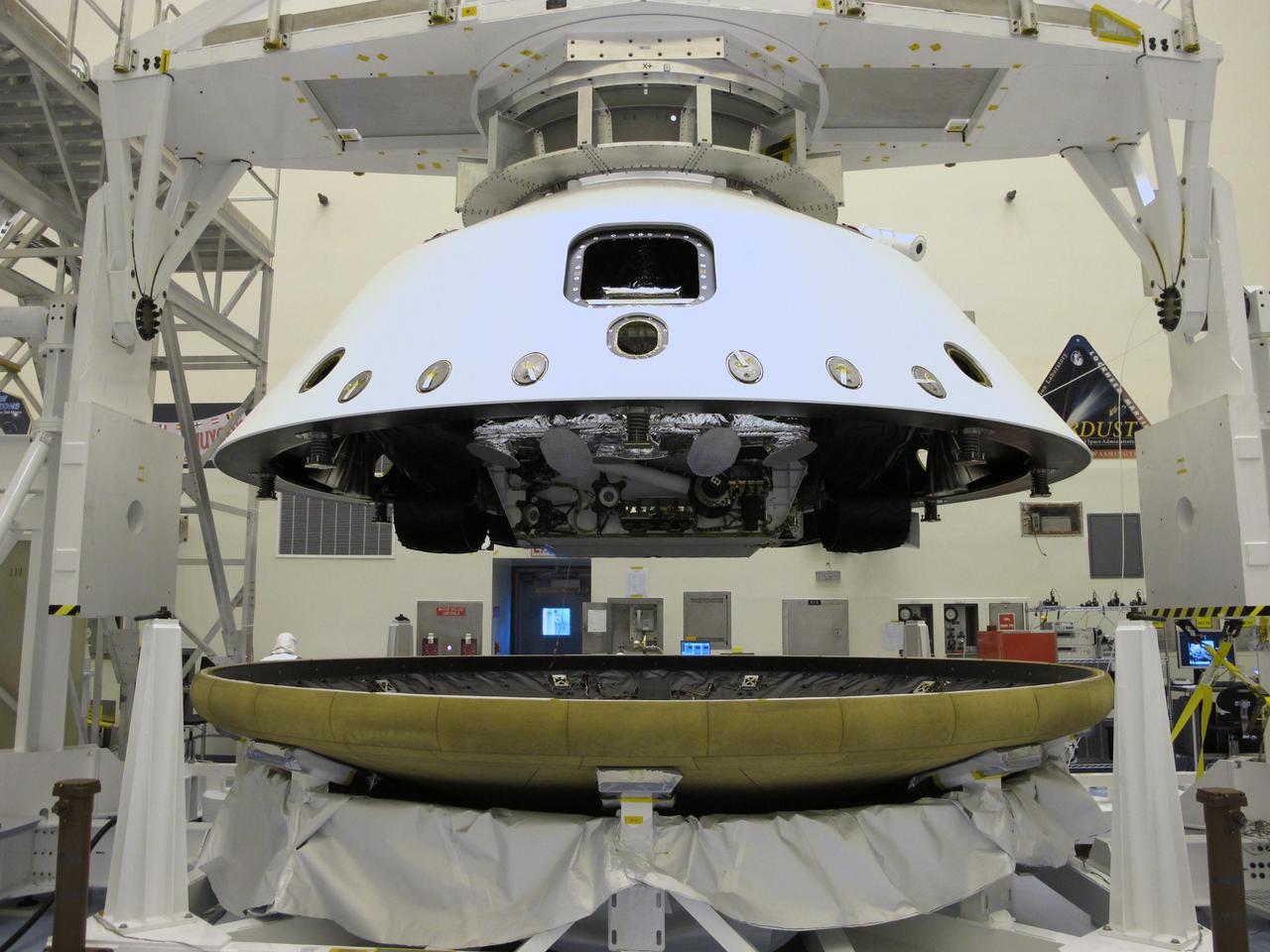
At the Payload Hazardous Servicing Facility at NASA Kennedy Space Center in Florida, the back shell powered descent vehicle configuration, containing NASA Mars Science Laboratory rover, Curiosity, is being placed on the spacecraft heat shield.
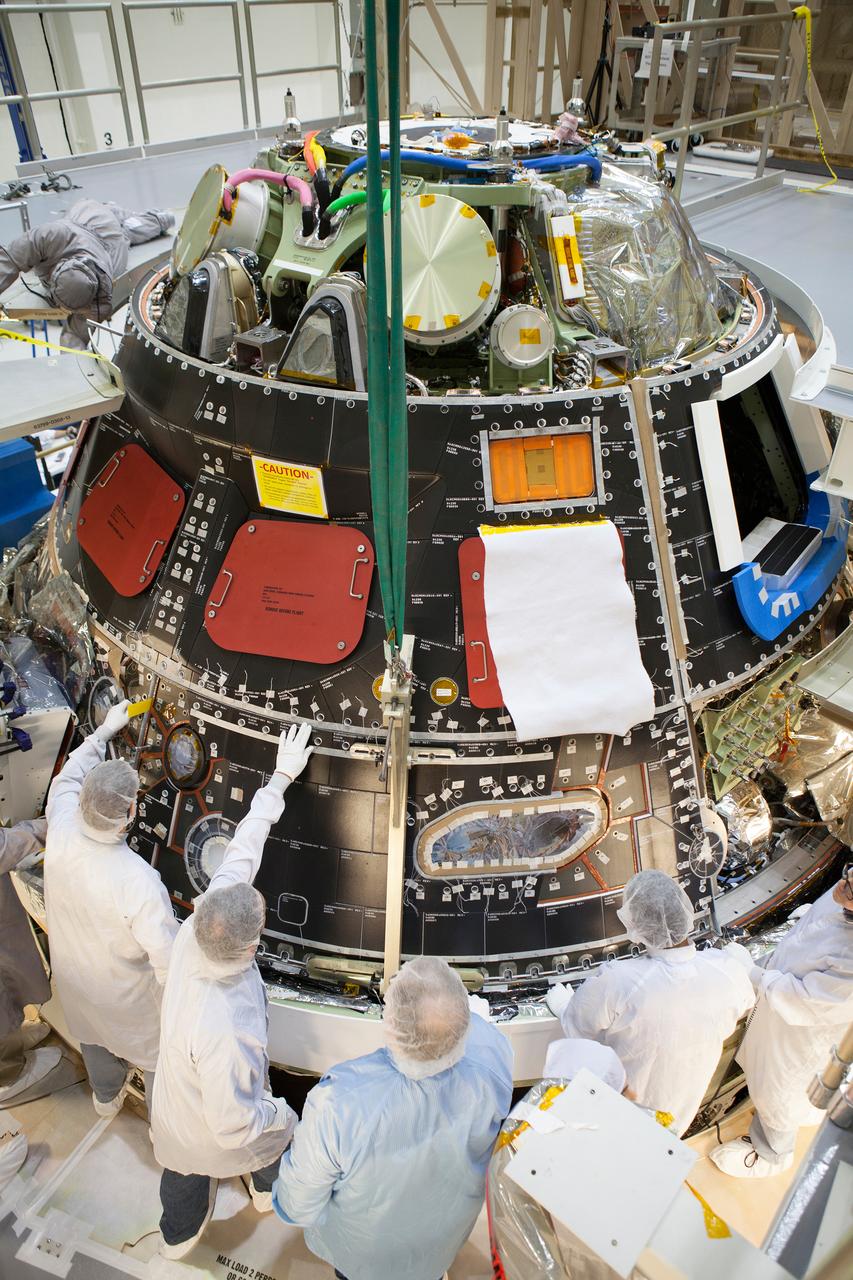
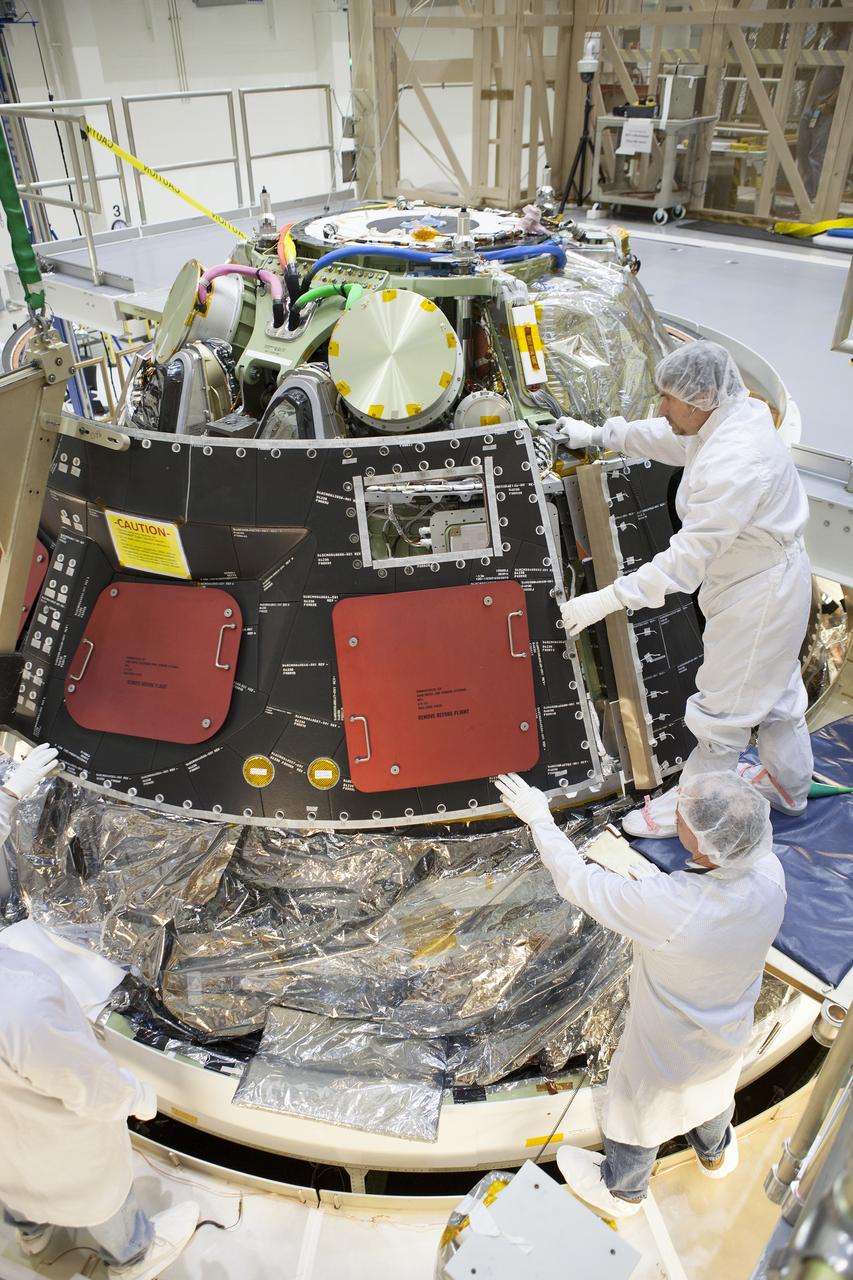
Inside the Operations and Checkout (O&C) Building high bay at NASA's Kennedy Space Center in Florida, technicians dressed in clean-room suits have installed a back shell tile panel onto the Orion Exploration Flight Test-1 (EFT-1) crew module and check the fit next to the middle back shell tile panel on Aug. 7, 2014. Part of Batch image transfer from Flickr.
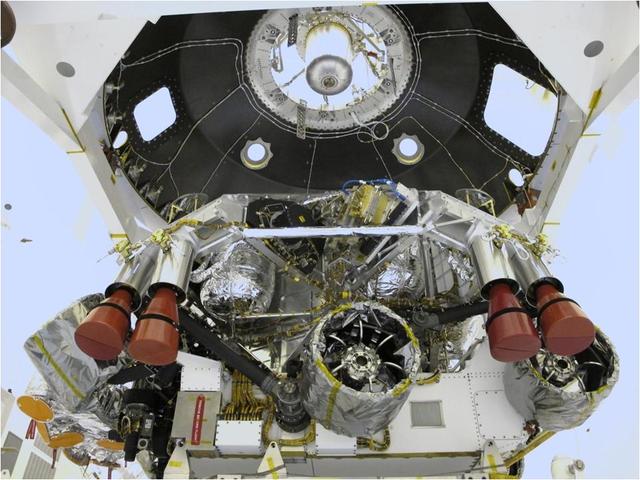
The powered descent vehicle of NASA Mars Science Laboratory spacecraft is being prepared for final integration into the spacecraft back shell in this photograph from inside the Payload Hazardous Servicing Facility at NASA Kennedy Space Center, Fla.
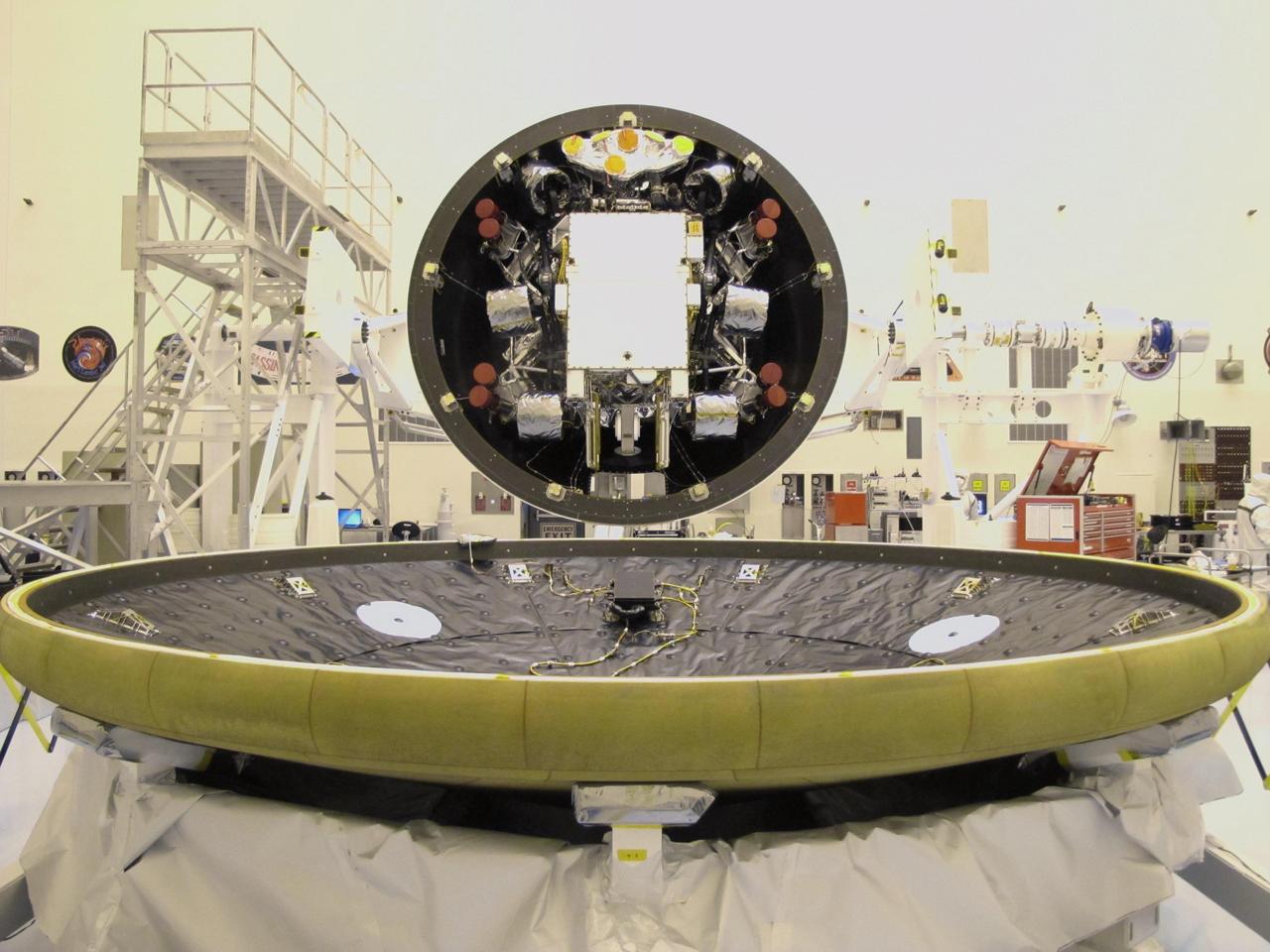
At the Payload Hazardous Servicing Facility at NASA Kennedy Space Center in Florida, the back shell powered descent vehicle configuration of NASA Mars Science Laboratory is being rotated for final closeout actions.
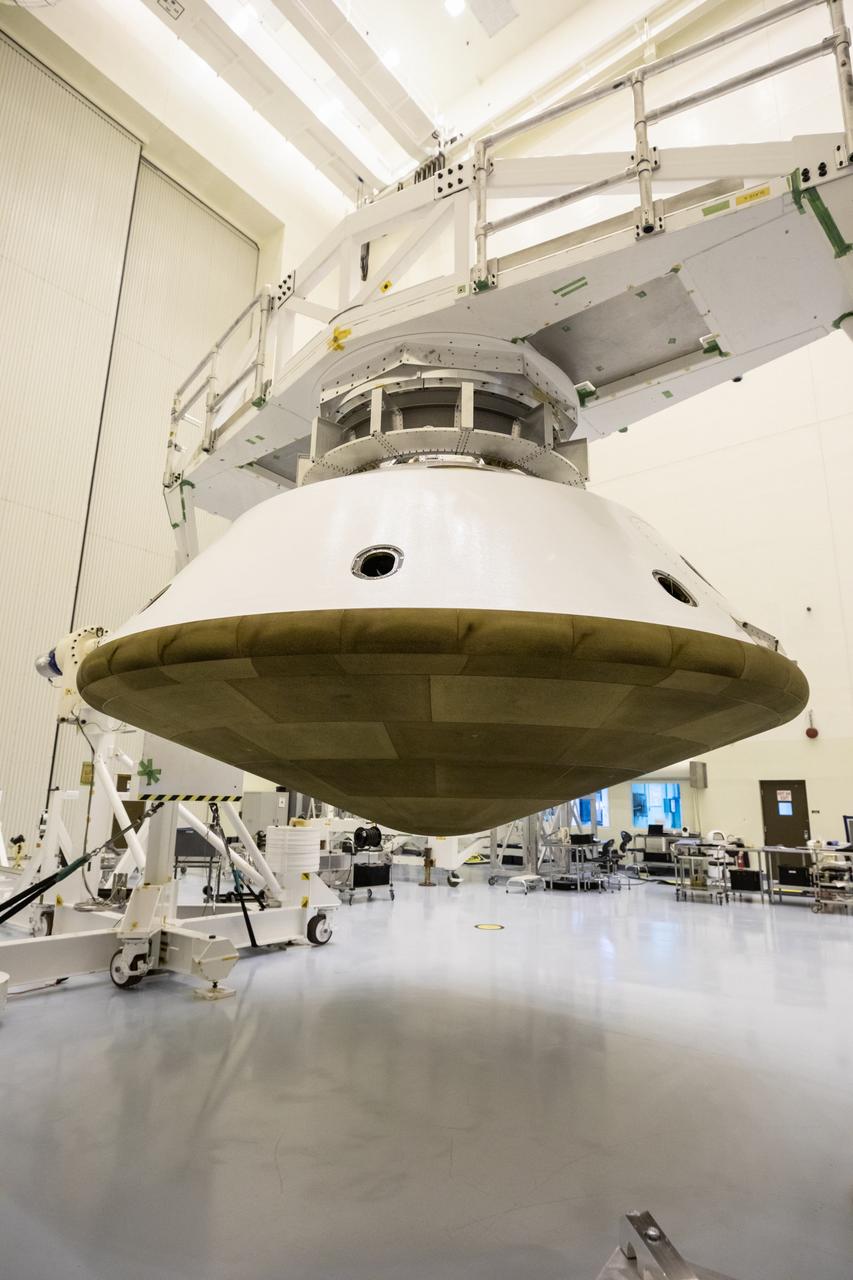
The Mars 2020 rover heat shield is mated to the back shell in the Payload Hazardous Servicing Facility at Kennedy Space Center in Florida on Jan. 10, 2020. Built by Lockheed Martin Space, the heat shield and back shell will protect the rover during its passage to Mars. The Mars 2020 rover is being manufactured at NASA’s Jet Propulsion Laboratory (JPL) in California and, once complete, will be delivered to Kennedy next month. The mission is scheduled to launch from Cape Canaveral Air Force Station in Florida in the summer of 2020.
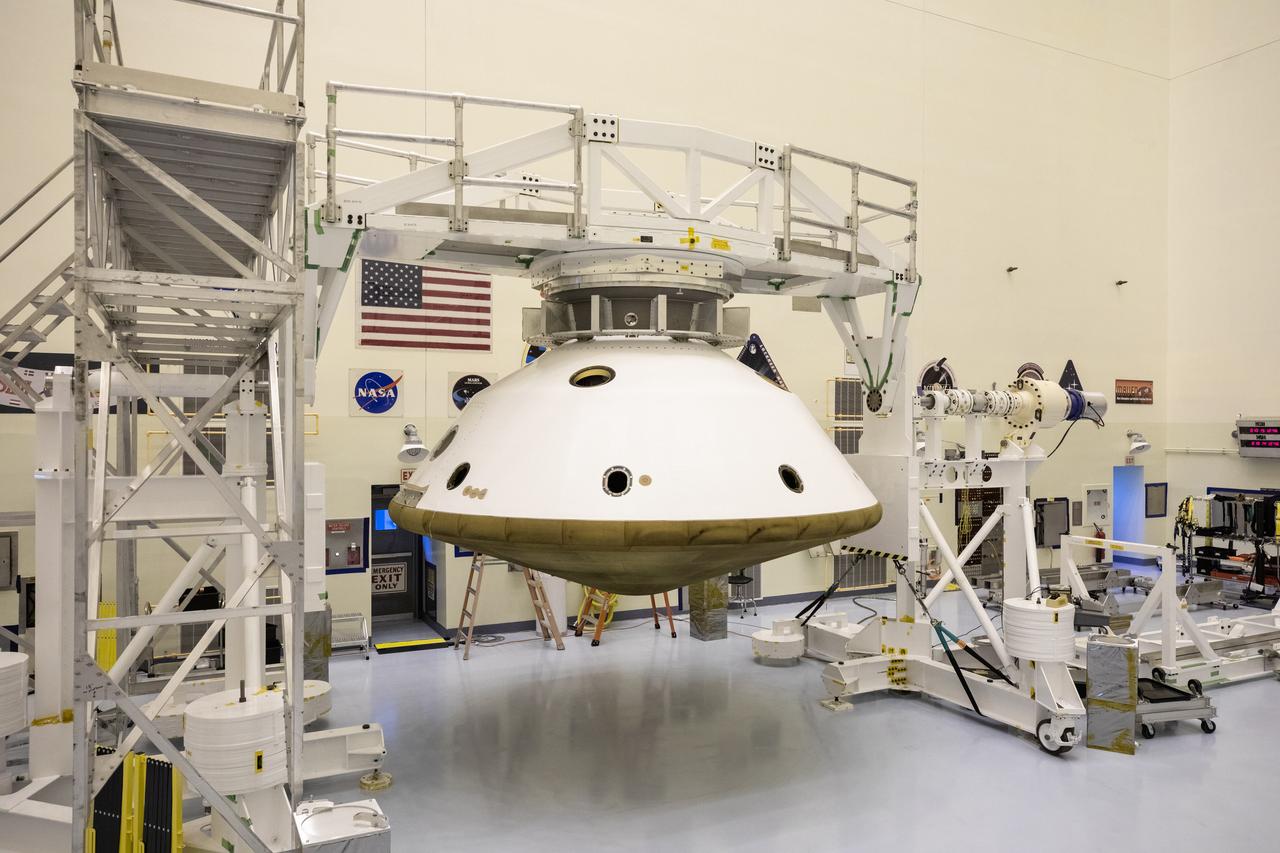
The Mars 2020 rover heat shield is mated to the back shell in the Payload Hazardous Servicing Facility at Kennedy Space Center in Florida on Jan. 10, 2020. Built by Lockheed Martin Space, the heat shield and back shell will protect the rover during its passage to Mars. The Mars 2020 rover is being manufactured at NASA’s Jet Propulsion Laboratory (JPL) in California and, once complete, will be delivered to Kennedy next month. The mission is scheduled to launch from Cape Canaveral Air Force Station in Florida in the summer of 2020.
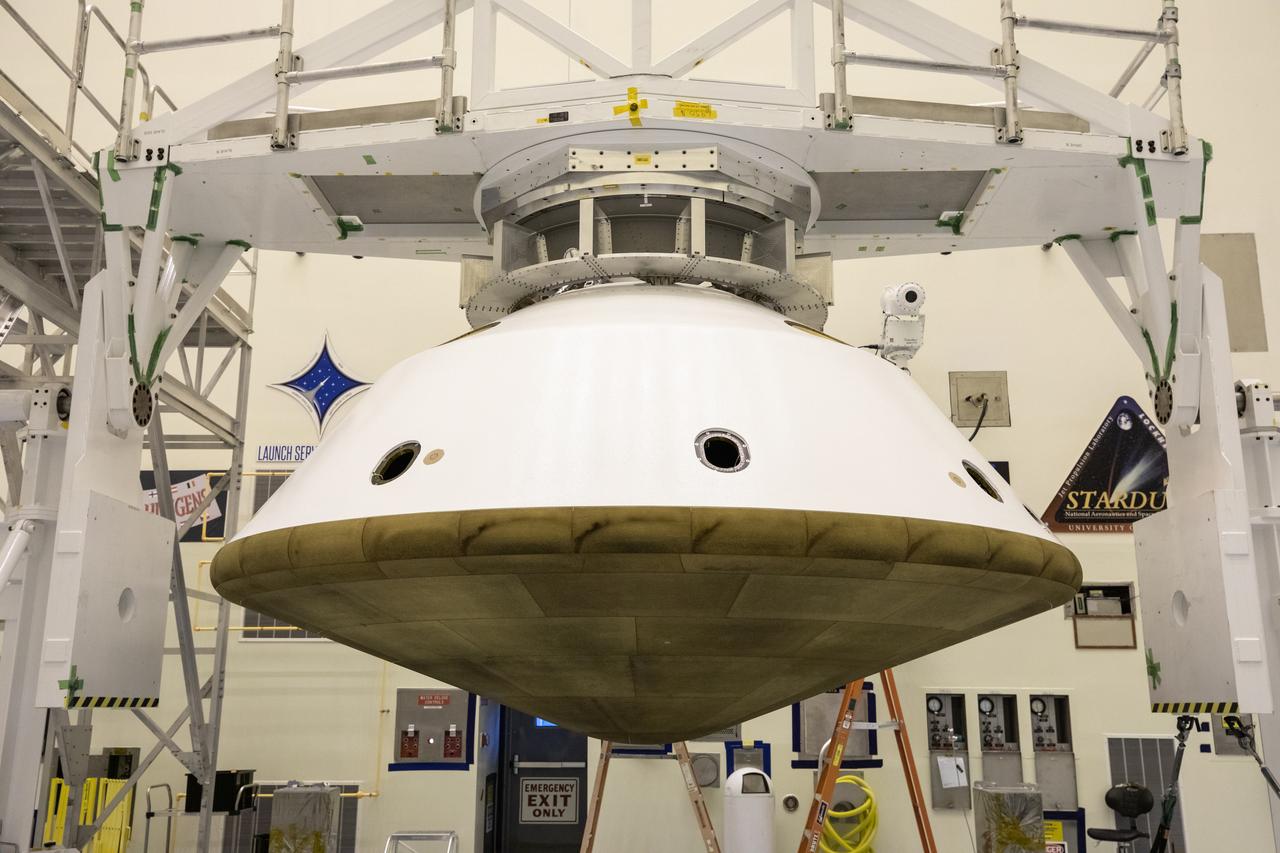
The Mars 2020 rover heat shield is mated to the back shell in the Payload Hazardous Servicing Facility at Kennedy Space Center in Florida on Jan. 10, 2020. Built by Lockheed Martin Space, the heat shield and back shell will protect the rover during its passage to Mars. The Mars 2020 rover is being manufactured at NASA’s Jet Propulsion Laboratory (JPL) in California and, once complete, will be delivered to Kennedy next month. The mission is scheduled to launch from Cape Canaveral Air Force Station in Florida in the summer of 2020.
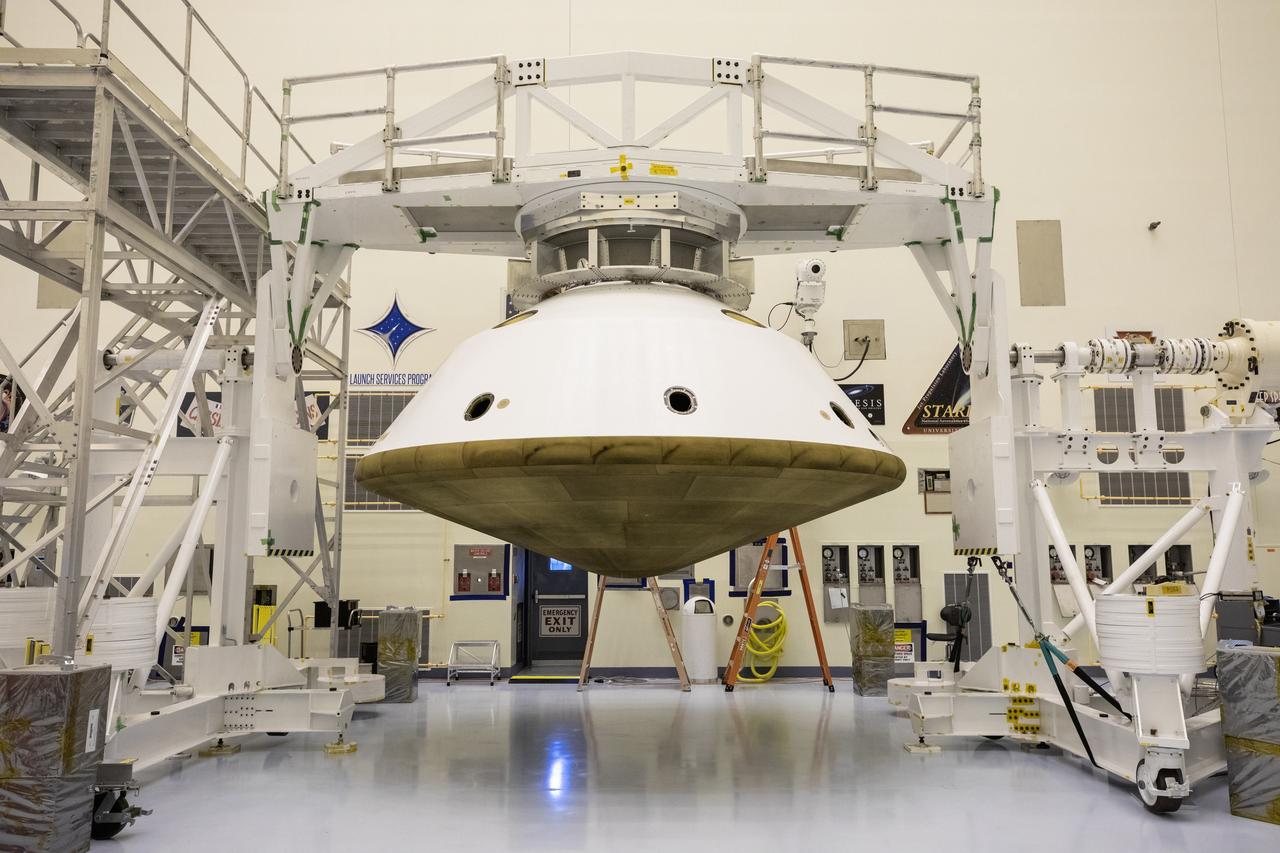
The Mars 2020 rover heat shield is mated to the back shell in the Payload Hazardous Servicing Facility at Kennedy Space Center in Florida on Jan. 10, 2020. Built by Lockheed Martin Space, the heat shield and back shell will protect the rover during its passage to Mars. The Mars 2020 rover is being manufactured at NASA’s Jet Propulsion Laboratory (JPL) in California and, once complete, will be delivered to Kennedy next month. The mission is scheduled to launch from Cape Canaveral Air Force Station in Florida in the summer of 2020.
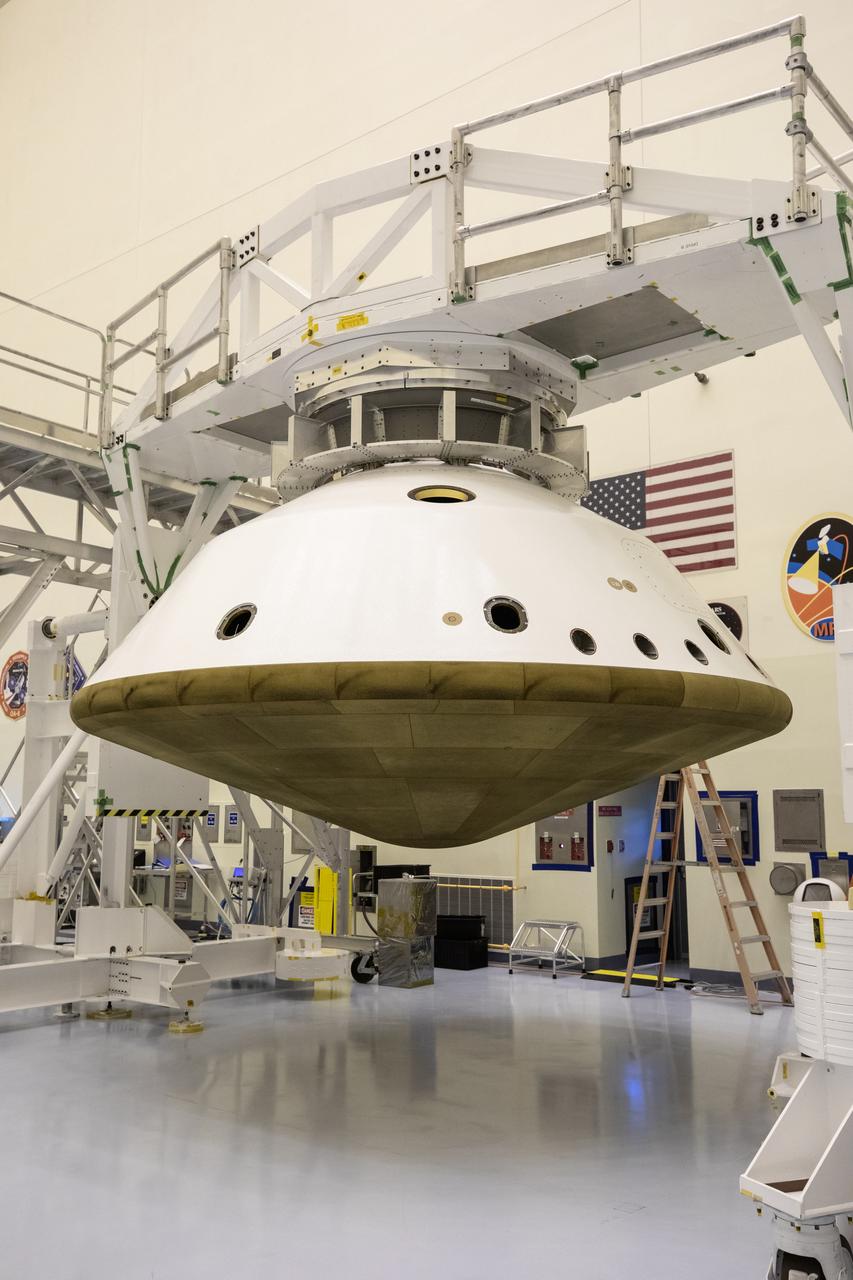
The Mars 2020 rover heat shield is mated to the back shell in the Payload Hazardous Servicing Facility at Kennedy Space Center in Florida on Jan. 10, 2020. Built by Lockheed Martin Space, the heat shield and back shell will protect the rover during its passage to Mars. The Mars 2020 rover is being manufactured at NASA’s Jet Propulsion Laboratory (JPL) in California and, once complete, will be delivered to Kennedy next month. The mission is scheduled to launch from Cape Canaveral Air Force Station in Florida in the summer of 2020.
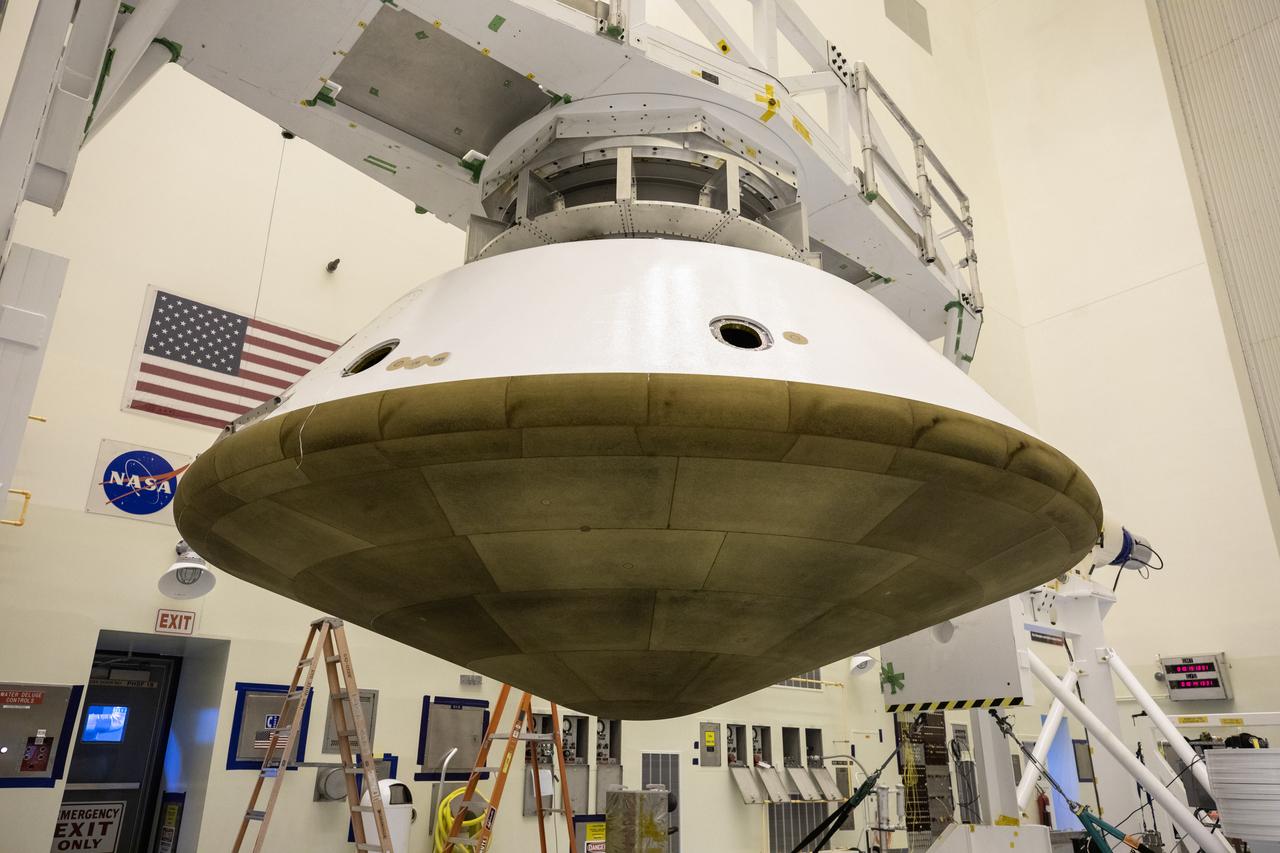
The Mars 2020 rover heat shield is mated to the back shell in the Payload Hazardous Servicing Facility at Kennedy Space Center in Florida on Jan. 10, 2020. Built by Lockheed Martin Space, the heat shield and back shell will protect the rover during its passage to Mars. The Mars 2020 rover is being manufactured at NASA’s Jet Propulsion Laboratory (JPL) in California and, once complete, will be delivered to Kennedy next month. The mission is scheduled to launch from Cape Canaveral Air Force Station in Florida in the summer of 2020.
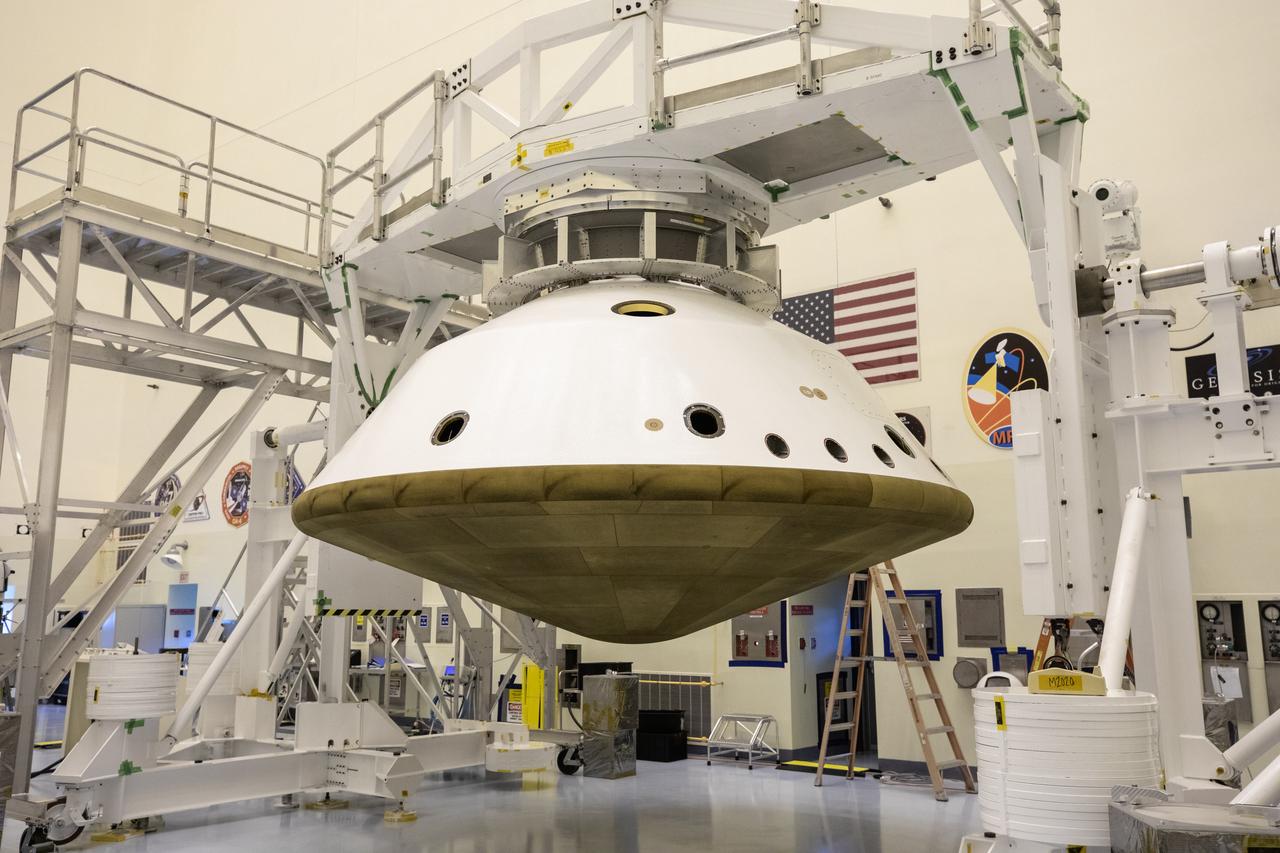
The Mars 2020 rover heat shield is mated to the back shell in the Payload Hazardous Servicing Facility at Kennedy Space Center in Florida on Jan. 10, 2020. Built by Lockheed Martin Space, the heat shield and back shell will protect the rover during its passage to Mars. The Mars 2020 rover is being manufactured at NASA’s Jet Propulsion Laboratory (JPL) in California and, once complete, will be delivered to Kennedy next month. The mission is scheduled to launch from Cape Canaveral Air Force Station in Florida in the summer of 2020.
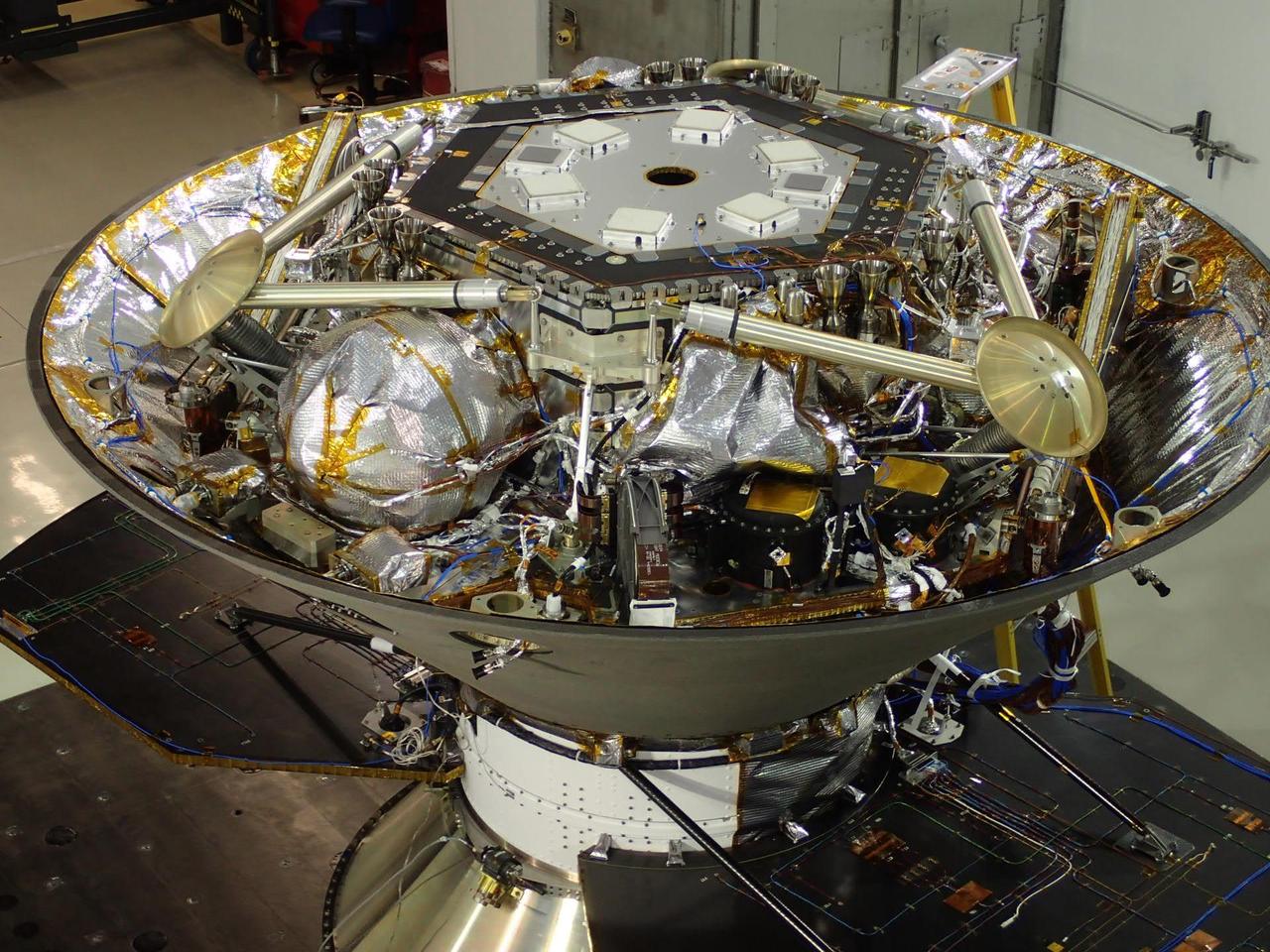
In this photo, NASA's InSight Mars lander is stowed inside the inverted back shell of the spacecraft's protective aeroshell. It was taken on July 13, 2015, in a clean room of spacecraft assembly and test facilities at Lockheed Martin Space Systems, Denver, during preparation for vibration testing of the spacecraft. InSight, for Interior Exploration Using Seismic Investigations, Geodesy and Heat Transport, is scheduled for launch in March 2016 and landing in September 2016. It will study the deep interior of Mars to advance understanding of the early history of all rocky planets, including Earth. Note: After thorough examination, NASA managers have decided to suspend the planned March 2016 launch of the Interior Exploration using Seismic Investigations Geodesy and Heat Transport (InSight) mission. The decision follows unsuccessful attempts to repair a leak in a section of the prime instrument in the science payload. http://photojournal.jpl.nasa.gov/catalog/PIA19813
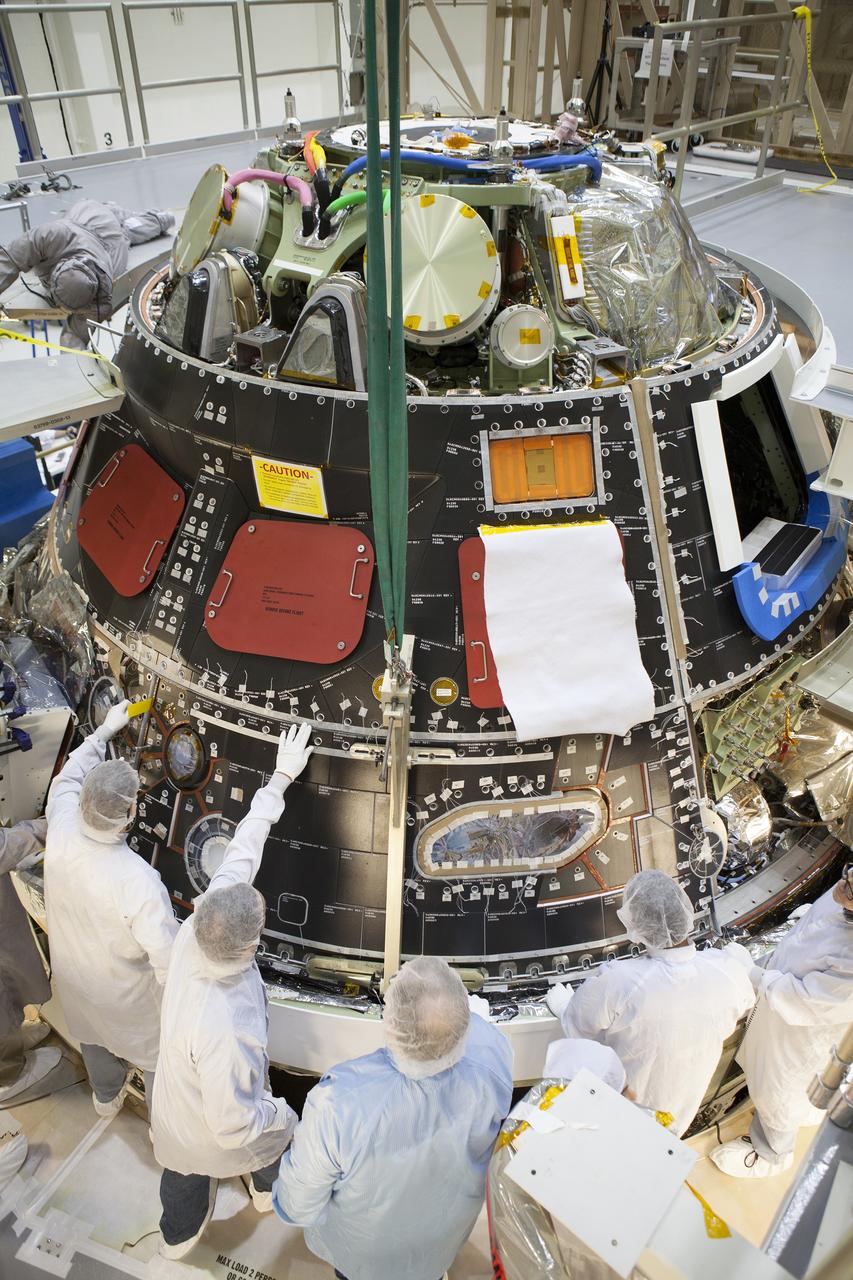
CAPE CANAVERAL, Fla. – Inside the Operations and Checkout Building high bay at NASA's Kennedy Space Center in Florida, technicians dressed in clean-room suits have installed a back shell tile panel onto the Orion crew module and are checking the fit next to the middle back shell tile panel. Preparations are underway for Exploration Flight Test-1, or EFT-1. Orion is the exploration spacecraft designed to carry astronauts to destinations not yet explored by humans, including an asteroid and Mars. It will have emergency abort capability, sustain the crew during space travel and provide safe re-entry from deep space return velocities. The first unpiloted test flight of the Orion is scheduled to launch later this year atop a Delta IV rocket from Cape Canaveral Air Force Station in Florida to an altitude of 3,600 miles above the Earth's surface. The two-orbit, four-hour flight test will help engineers evaluate the systems critical to crew safety including the heat shield, parachute system and launch abort system. For more information, visit http://www.nasa.gov/orion. Photo credit: NASA/Dimitri Gerondidakis
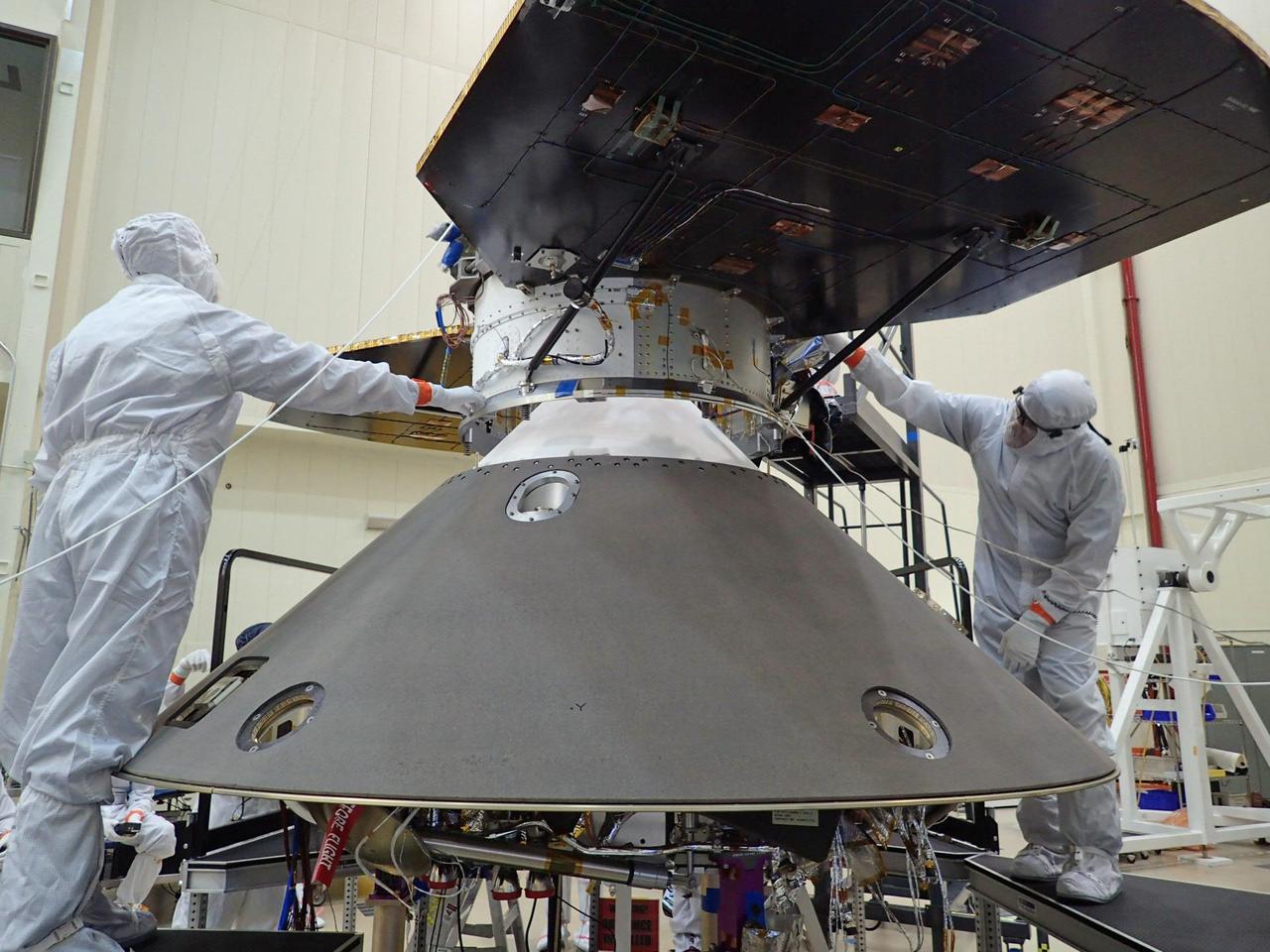
Spacecraft specialists at Lockheed Martin Space Systems, Denver, are preparing to attach the cruise stage of NASA's InSight spacecraft to the top of the spacecraft's back shell in this April 29, 2015, photo. The cruise stage will serve multiple functions during the flight from Earth to Mars. It has its own solar arrays, thrusters and radio antennas. It will be jettisoned shortly before the spacecraft enters the Martian atmosphere. InSight, for Interior Exploration Using Seismic Investigations, Geodesy and Heat Transport, is scheduled for launch in March 2016 and landing in September 2016. It will study the deep interior of Mars to advance understanding of the early history of all rocky planets, including Earth. Note: After thorough examination, NASA managers have decided to suspend the planned March 2016 launch of the Interior Exploration using Seismic Investigations Geodesy and Heat Transport (InSight) mission. The decision follows unsuccessful attempts to repair a leak in a section of the prime instrument in the science payload. http://photojournal.jpl.nasa.gov/catalog/PIA19667
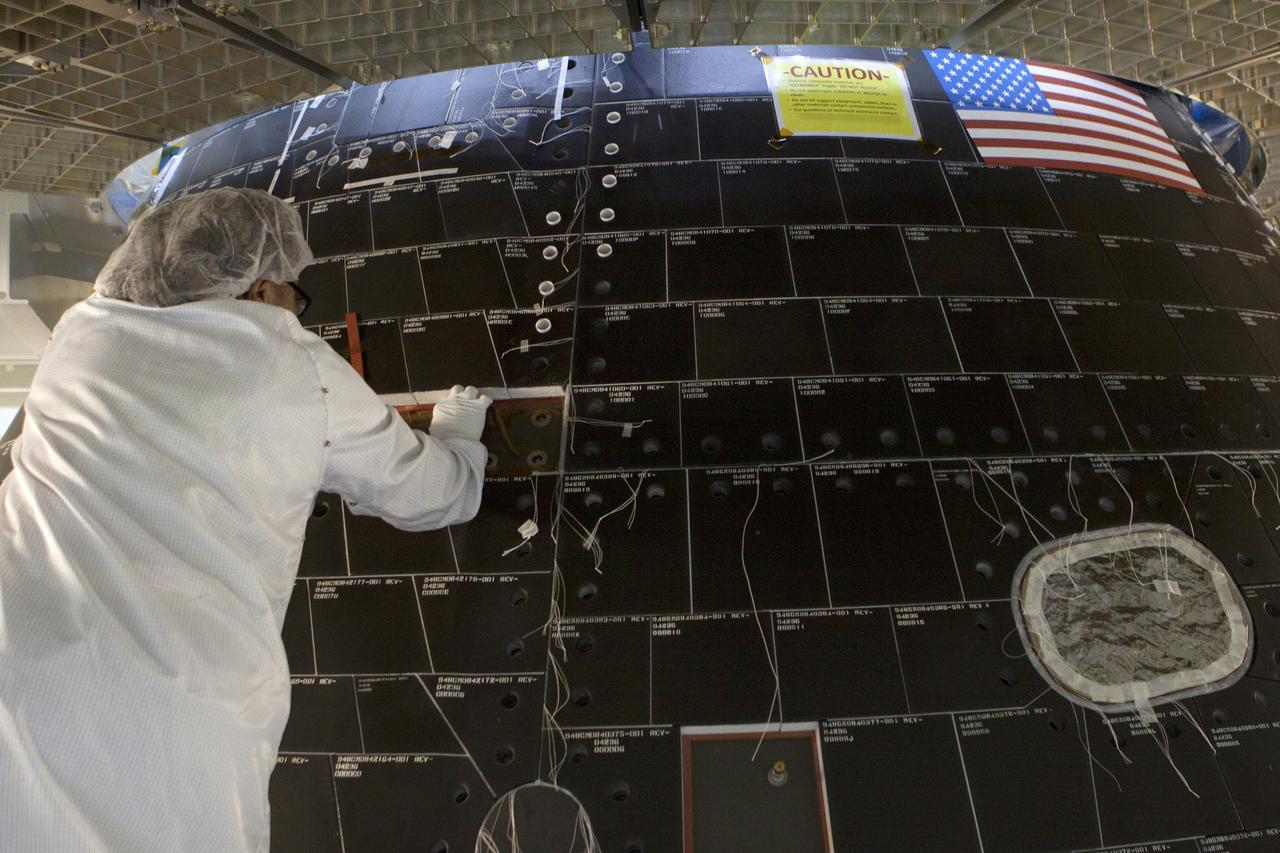
CAPE CANAVERAL, Fla. – Inside the Neil Armstrong Operations and Checkout Building high bay at NASA's Kennedy Space Center in Florida, a Lockheed Martin technician dressed in a clean room suit works on the back shell tile panels on the Orion crew module. Preparations are underway for Orion's first flight test. Orion is the exploration spacecraft designed to carry astronauts to destinations not yet explored by humans, including an asteroid and Mars. It will have emergency abort capability, sustain the crew during space travel and provide safe re-entry from deep space return velocities. Orion's first flight test is scheduled to launch in December atop a United Launch Alliance Delta IV Heavy rocket from Cape Canaveral Air Force Station in Florida to an altitude of 3,600 miles above the Earth's surface. The two-orbit, four-hour flight test will help engineers evaluate the systems critical to crew safety including the heat shield, parachute system and launch abort system. For more information, visit http://www.nasa.gov/orion. Photo credit: NASA/Gianni Woods
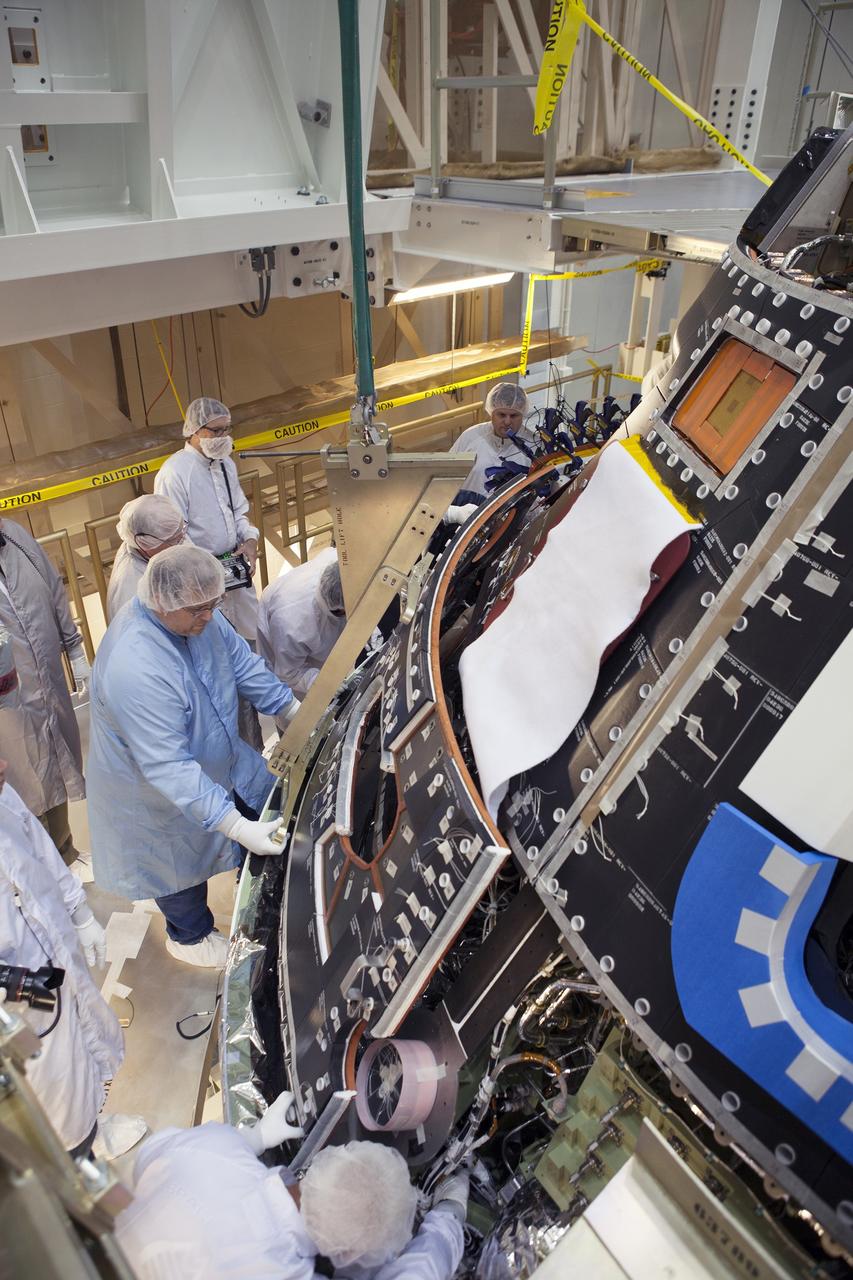
CAPE CANAVERAL, Fla. – Inside the Operations and Checkout Building high bay at NASA's Kennedy Space Center in Florida, technicians dressed in clean-room suits install a back shell tile panel onto the Orion crew module. Preparations are underway for Exploration Flight Test-1, or EFT-1. Orion is the exploration spacecraft designed to carry astronauts to destinations not yet explored by humans, including an asteroid and Mars. It will have emergency abort capability, sustain the crew during space travel and provide safe re-entry from deep space return velocities. The first unpiloted test flight of the Orion is scheduled to launch later this year atop a Delta IV rocket from Cape Canaveral Air Force Station in Florida to an altitude of 3,600 miles above the Earth's surface. The two-orbit, four-hour flight test will help engineers evaluate the systems critical to crew safety including the heat shield, parachute system and launch abort system. For more information, visit http://www.nasa.gov/orion. Photo credit: NASA/Dimitri Gerondidakis
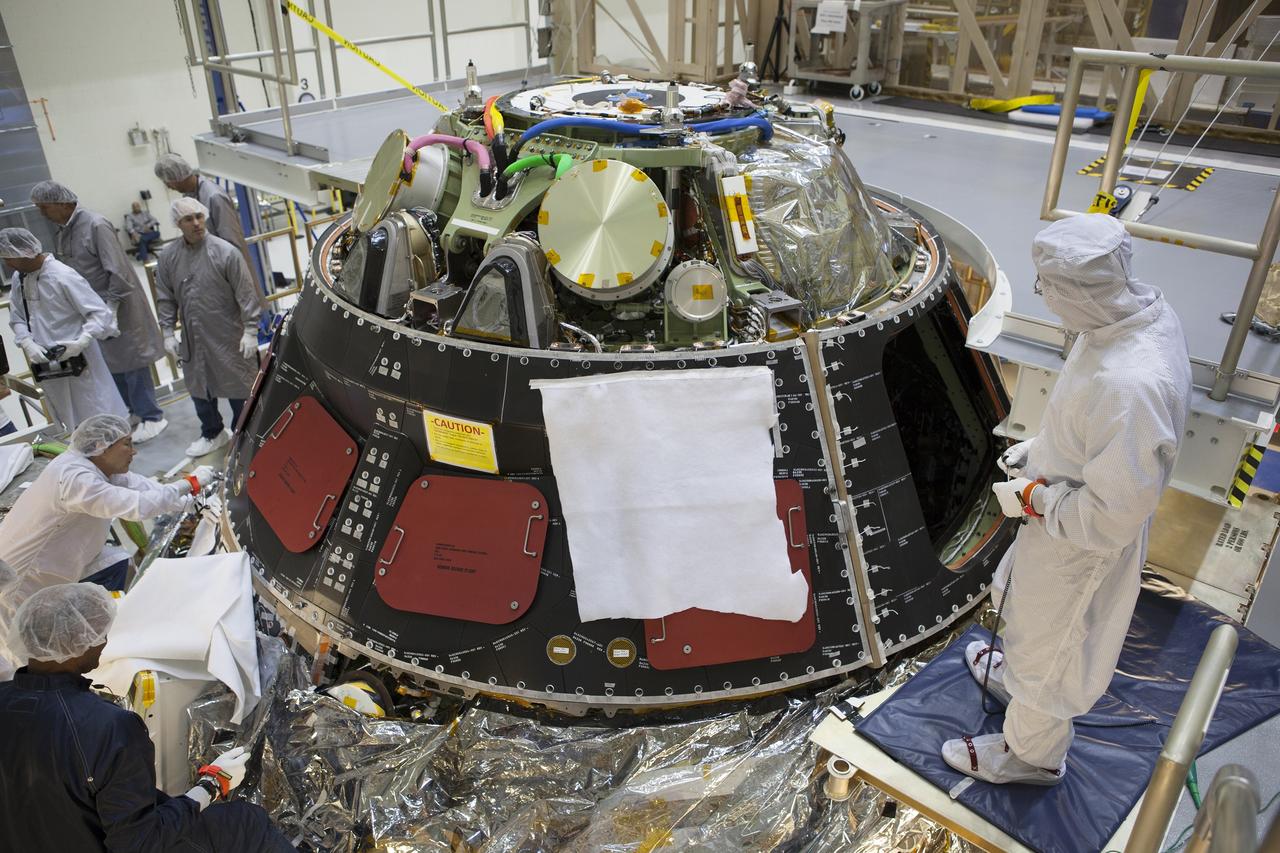
CAPE CANAVERAL, Fla. – Inside the Operations and Checkout Building high bay at NASA's Kennedy Space Center in Florida, technicians dressed in clean-room suits attach the middle back shell tile panel onto the Orion crew module. Preparations are underway for Exploration Flight Test-1, or EFT-1. Orion is the exploration spacecraft designed to carry astronauts to destinations not yet explored by humans, including an asteroid and Mars. It will have emergency abort capability, sustain the crew during space travel and provide safe re-entry from deep space return velocities. The first unpiloted test flight of the Orion is scheduled to launch later this year atop a Delta IV rocket from Cape Canaveral Air Force Station in Florida to an altitude of 3,600 miles above the Earth's surface. The two-orbit, four-hour flight test will help engineers evaluate the systems critical to crew safety including the heat shield, parachute system and launch abort system. For more information, visit http://www.nasa.gov/orion. Photo credit: NASA/Dimitri Gerondidakis
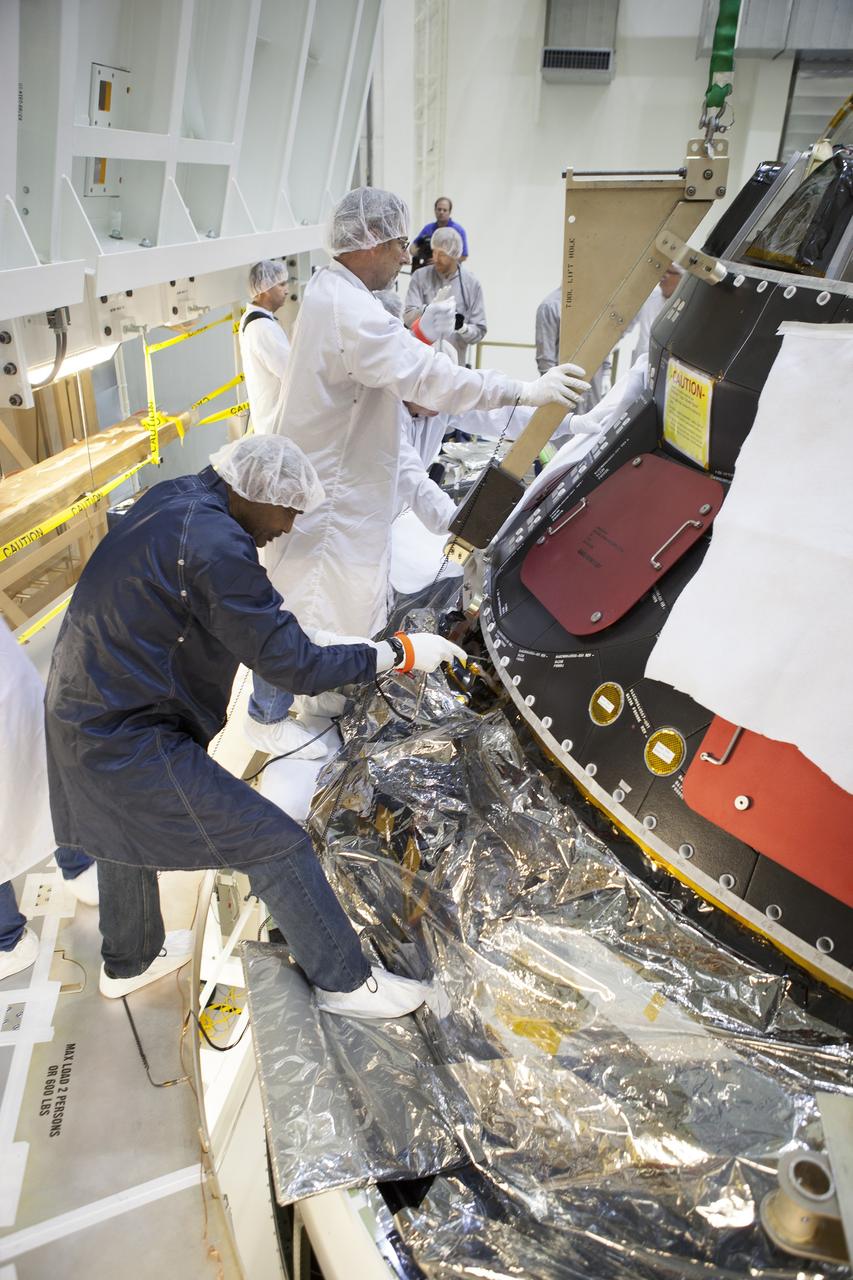
CAPE CANAVERAL, Fla. – Inside the Operations and Checkout Building high bay at NASA's Kennedy Space Center in Florida, technicians dressed in clean-room suits attach the middle back shell tile panel onto the Orion crew module. Preparations are underway for Exploration Flight Test-1, or EFT-1. Orion is the exploration spacecraft designed to carry astronauts to destinations not yet explored by humans, including an asteroid and Mars. It will have emergency abort capability, sustain the crew during space travel and provide safe re-entry from deep space return velocities. The first unpiloted test flight of the Orion is scheduled to launch later this year atop a Delta IV rocket from Cape Canaveral Air Force Station in Florida to an altitude of 3,600 miles above the Earth's surface. The two-orbit, four-hour flight test will help engineers evaluate the systems critical to crew safety including the heat shield, parachute system and launch abort system. For more information, visit http://www.nasa.gov/orion. Photo credit: NASA/Dimitri Gerondidakis
CAPE CANAVERAL, Fla. – Inside the Operations and Checkout Building high bay at NASA's Kennedy Space Center in Florida, technicians prepare the middle back shell tile panel for installation on the Orion crew module. Preparations are underway for Exploration Flight Test-1, or EFT-1. Orion is the exploration spacecraft designed to carry astronauts to destinations not yet explored by humans, including an asteroid and Mars. It will have emergency abort capability, sustain the crew during space travel and provide safe re-entry from deep space return velocities. The first unpiloted test flight of the Orion is scheduled to launch later this year atop a Delta IV rocket from Cape Canaveral Air Force Station in Florida to an altitude of 3,600 miles above the Earth's surface. The two-orbit, four-hour flight test will help engineers evaluate the systems critical to crew safety including the heat shield, parachute system and launch abort system. For more information, visit http://www.nasa.gov/orion. Photo credit: NASA/Dimitri Gerondidakis
CAPE CANAVERAL, Fla. – Inside the Operations and Checkout Building high bay at NASA's Kennedy Space Center in Florida, technicians dressed in clean-room suits install a back shell tile panel onto the Orion crew module. Preparations are underway for Exploration Flight Test-1, or EFT-1. Orion is the exploration spacecraft designed to carry astronauts to destinations not yet explored by humans, including an asteroid and Mars. It will have emergency abort capability, sustain the crew during space travel and provide safe re-entry from deep space return velocities. The first unpiloted test flight of the Orion is scheduled to launch later this year atop a Delta IV rocket from Cape Canaveral Air Force Station in Florida to an altitude of 3,600 miles above the Earth's surface. The two-orbit, four-hour flight test will help engineers evaluate the systems critical to crew safety including the heat shield, parachute system and launch abort system. For more information, visit http://www.nasa.gov/orion. Photo credit: NASA/Dimitri Gerondidakis
CAPE CANAVERAL, Fla. – Inside the Operations and Checkout Building high bay at NASA's Kennedy Space Center in Florida, technicians dressed in clean-room suits line up the middle back shell tile panel for installation on the Orion crew module. Preparations are underway for Exploration Flight Test-1, or EFT-1. Orion is the exploration spacecraft designed to carry astronauts to destinations not yet explored by humans, including an asteroid and Mars. It will have emergency abort capability, sustain the crew during space travel and provide safe re-entry from deep space return velocities. The first unpiloted test flight of the Orion is scheduled to launch later this year atop a Delta IV rocket from Cape Canaveral Air Force Station in Florida to an altitude of 3,600 miles above the Earth's surface. The two-orbit, four-hour flight test will help engineers evaluate the systems critical to crew safety including the heat shield, parachute system and launch abort system. For more information, visit http://www.nasa.gov/orion. Photo credit: NASA/Dimitri Gerondidakis
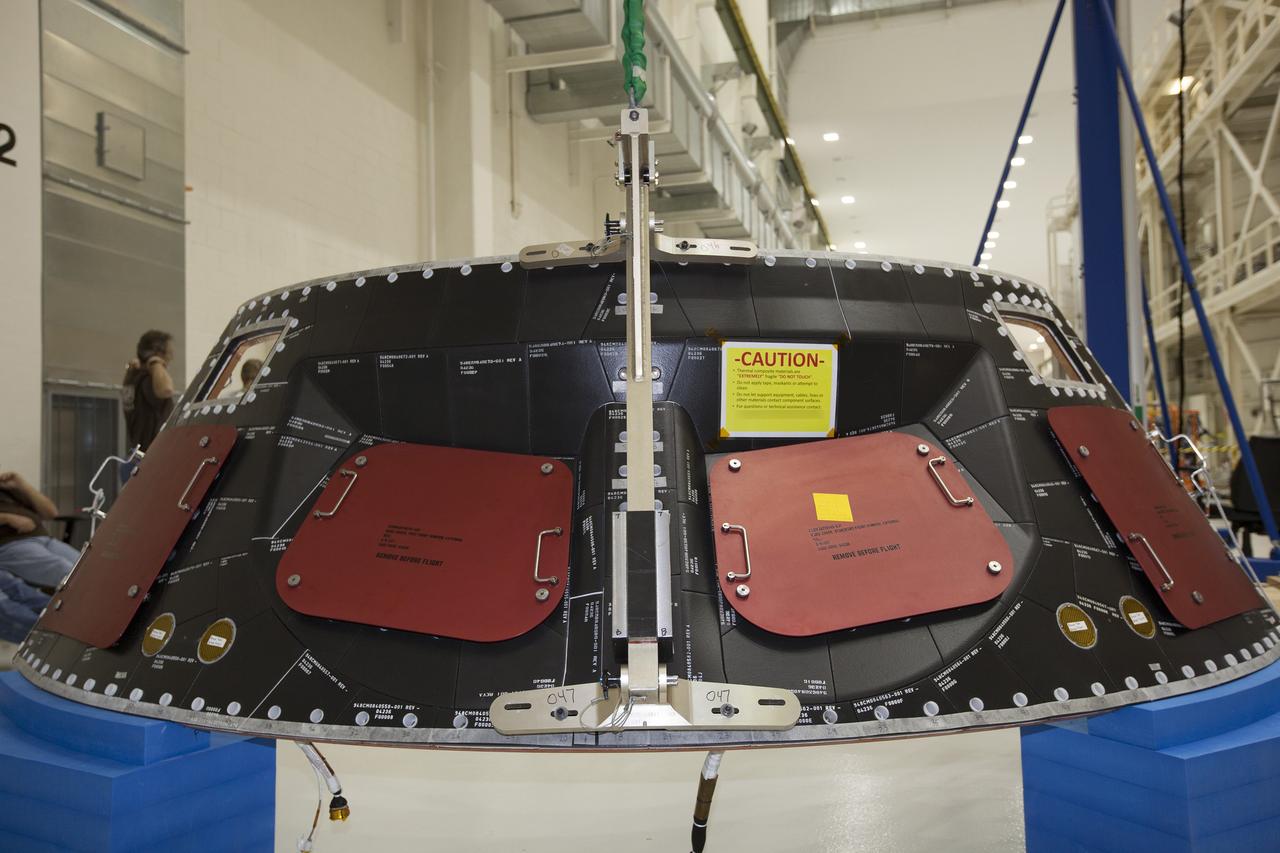
CAPE CANAVERAL, Fla. – Inside the Operations and Checkout Building high bay at NASA's Kennedy Space Center in Florida, a crane is attached to the middle back shell tile panel in order to lift it for installation on the Orion crew module. Preparations are underway for Exploration Flight Test-1, or EFT-1. Orion is the exploration spacecraft designed to carry astronauts to destinations not yet explored by humans, including an asteroid and Mars. It will have emergency abort capability, sustain the crew during space travel and provide safe re-entry from deep space return velocities. The first unpiloted test flight of the Orion is scheduled to launch later this year atop a Delta IV rocket from Cape Canaveral Air Force Station in Florida to an altitude of 3,600 miles above the Earth's surface. The two-orbit, four-hour flight test will help engineers evaluate the systems critical to crew safety including the heat shield, parachute system and launch abort system. For more information, visit http://www.nasa.gov/orion. Photo credit: NASA/Dimitri Gerondidakis
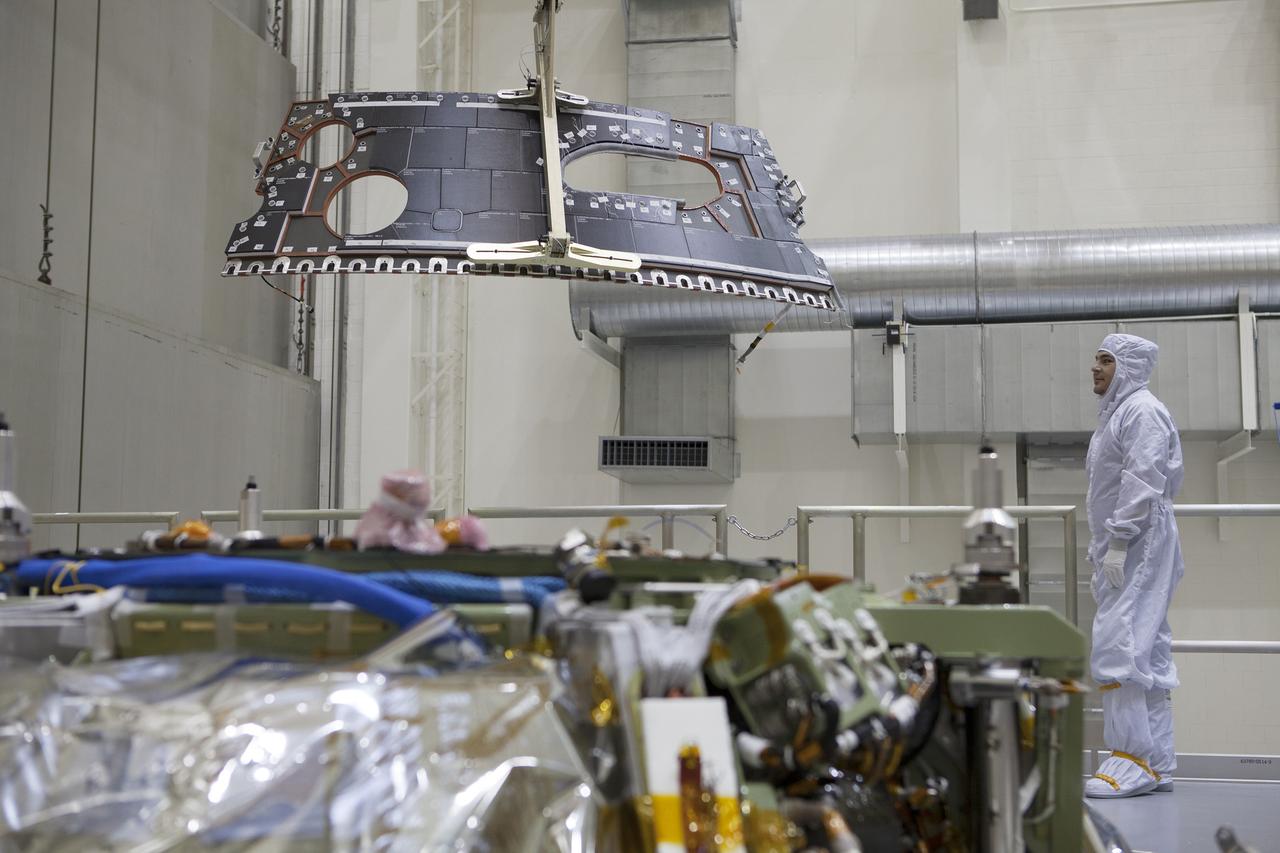
CAPE CANAVERAL, Fla. – Inside the Operations and Checkout Building high bay at NASA's Kennedy Space Center in Florida, a technician dressed in a clean-room suit monitors the progress as a crane is used to lower a back shell tile panel for installation on the Orion crew module. Preparations are underway for Exploration Flight Test-1, or EFT-1. Orion is the exploration spacecraft designed to carry astronauts to destinations not yet explored by humans, including an asteroid and Mars. It will have emergency abort capability, sustain the crew during space travel and provide safe re-entry from deep space return velocities. The first unpiloted test flight of the Orion is scheduled to launch later this year atop a Delta IV rocket from Cape Canaveral Air Force Station in Florida to an altitude of 3,600 miles above the Earth's surface. The two-orbit, four-hour flight test will help engineers evaluate the systems critical to crew safety including the heat shield, parachute system and launch abort system. For more information, visit http://www.nasa.gov/orion. Photo credit: NASA/Dimitri Gerondidakis
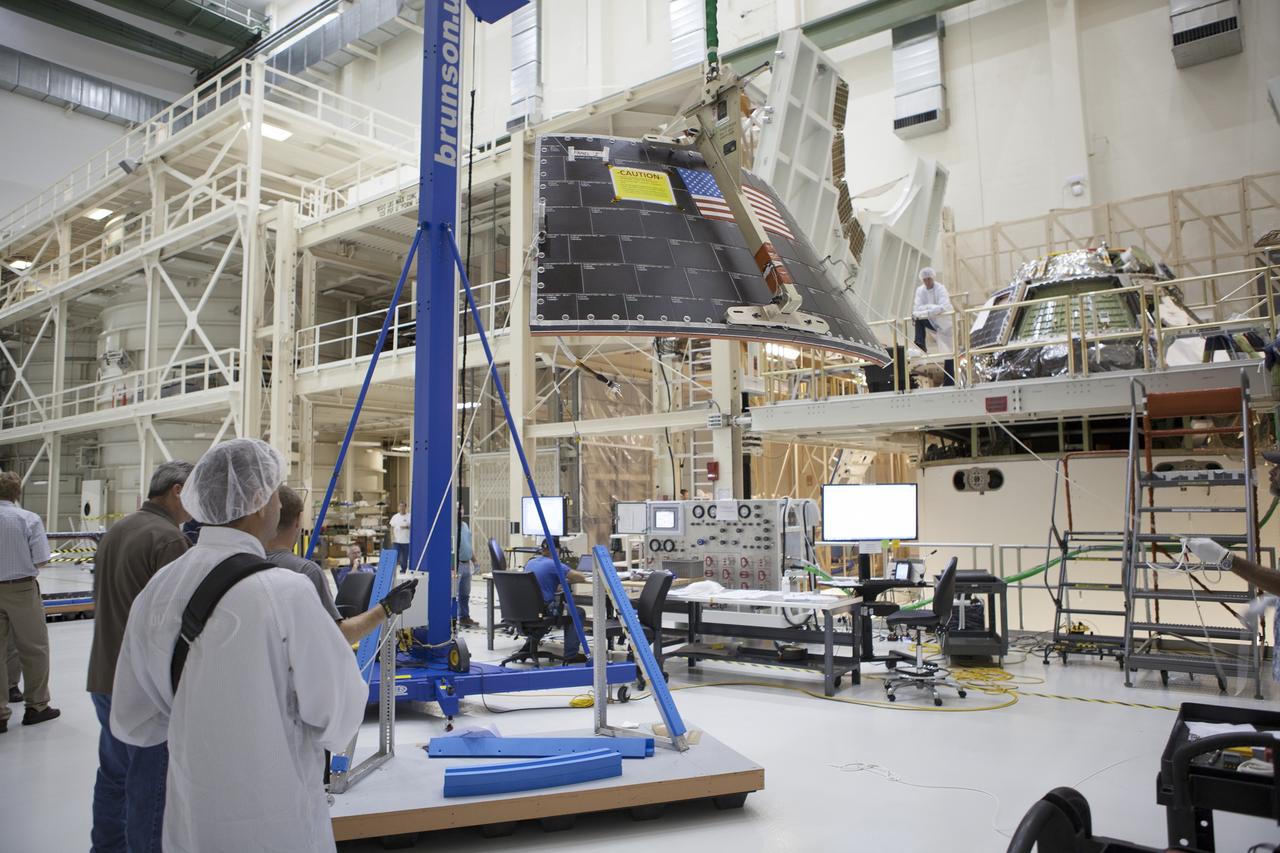
CAPE CANAVERAL, Fla. – Inside the Operations and Checkout Building high bay at NASA's Kennedy Space Center in Florida, technicians and engineers monitor the progress as a crane is used to lift the middle back shell tile panel for installation on the Orion crew module. Preparations are underway for Exploration Flight Test-1, or EFT-1. Orion is the exploration spacecraft designed to carry astronauts to destinations not yet explored by humans, including an asteroid and Mars. It will have emergency abort capability, sustain the crew during space travel and provide safe re-entry from deep space return velocities. The first unpiloted test flight of the Orion is scheduled to launch later this year atop a Delta IV rocket from Cape Canaveral Air Force Station in Florida to an altitude of 3,600 miles above the Earth's surface. The two-orbit, four-hour flight test will help engineers evaluate the systems critical to crew safety including the heat shield, parachute system and launch abort system. For more information, visit http://www.nasa.gov/orion. Photo credit: NASA/Dimitri Gerondidakis
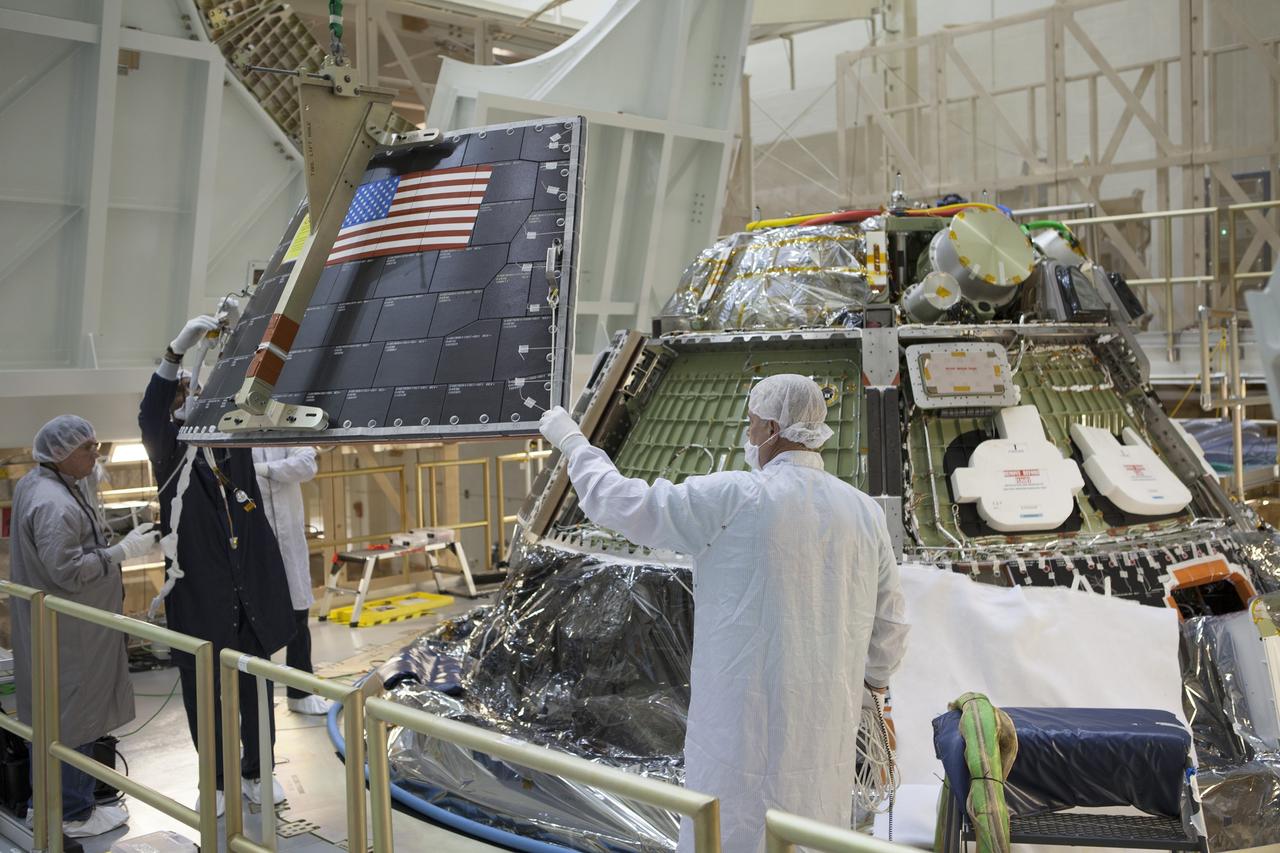
CAPE CANAVERAL, Fla. – Inside the Operations and Checkout Building high bay at NASA's Kennedy Space Center in Florida, technicians and engineers on a work platform monitor the progress as a crane is used to lower the middle back shell tile panel for installation on the Orion crew module. Preparations are underway for Exploration Flight Test-1, or EFT-1. Orion is the exploration spacecraft designed to carry astronauts to destinations not yet explored by humans, including an asteroid and Mars. It will have emergency abort capability, sustain the crew during space travel and provide safe re-entry from deep space return velocities. The first unpiloted test flight of the Orion is scheduled to launch later this year atop a Delta IV rocket from Cape Canaveral Air Force Station in Florida to an altitude of 3,600 miles above the Earth's surface. The two-orbit, four-hour flight test will help engineers evaluate the systems critical to crew safety including the heat shield, parachute system and launch abort system. For more information, visit http://www.nasa.gov/orion. Photo credit: NASA/Dimitri Gerondidakis
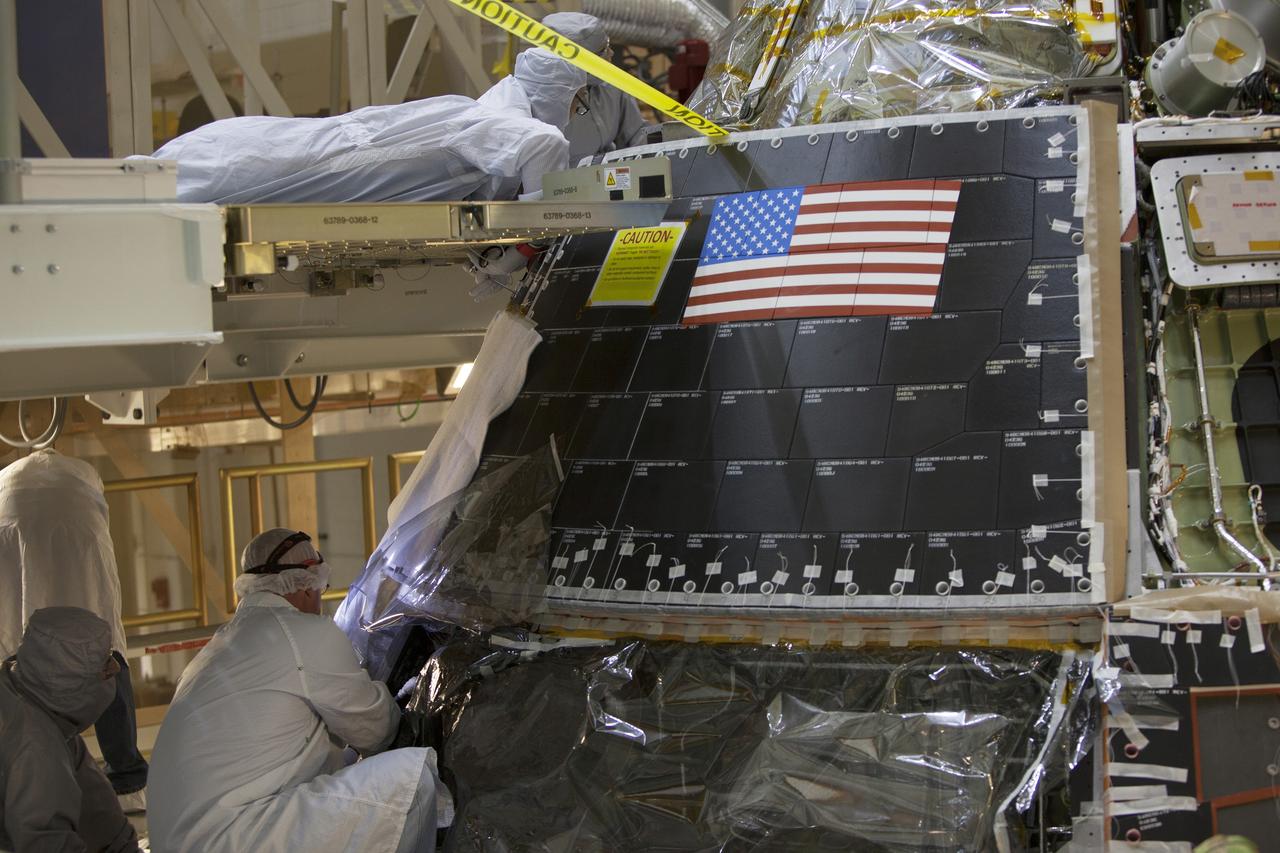
CAPE CANAVERAL, Fla. – Inside the Operations and Checkout Building high bay at NASA's Kennedy Space Center in Florida, technicians dressed in clean-room suits attach the middle back shell tile panel to the Orion crew module. Preparations are underway for Exploration Flight Test-1, or EFT-1. Orion is the exploration spacecraft designed to carry astronauts to destinations not yet explored by humans, including an asteroid and Mars. It will have emergency abort capability, sustain the crew during space travel and provide safe re-entry from deep space return velocities. The first unpiloted test flight of the Orion is scheduled to launch later this year atop a Delta IV rocket from Cape Canaveral Air Force Station in Florida to an altitude of 3,600 miles above the Earth's surface. The two-orbit, four-hour flight test will help engineers evaluate the systems critical to crew safety including the heat shield, parachute system and launch abort system. For more information, visit http://www.nasa.gov/orion. Photo credit: NASA/Dimitri Gerondidakis
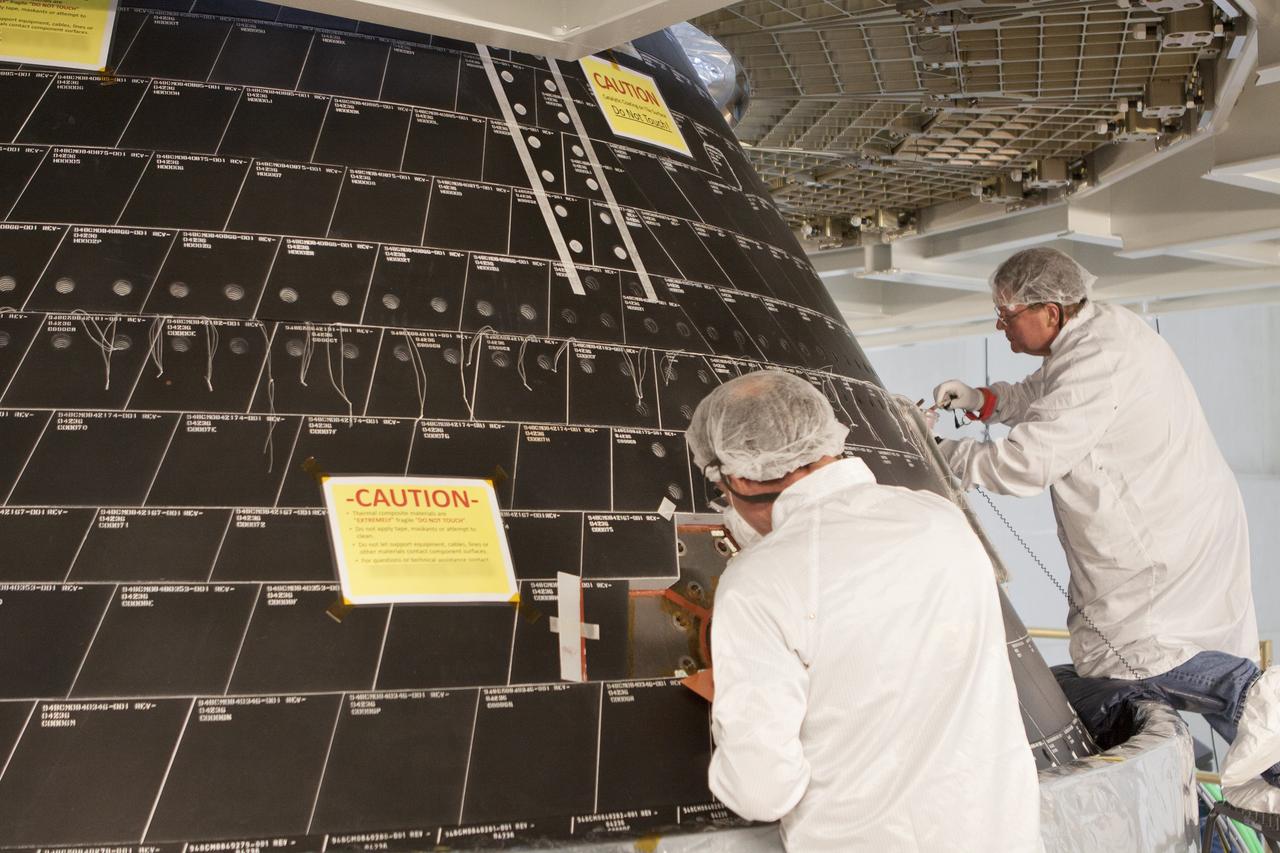
CAPE CANAVERAL, Fla. – Inside the Neil Armstrong Operations and Checkout Building high bay at NASA's Kennedy Space Center in Florida, Lockheed Martin technicians dressed in clean-room suits work on the back shell tile panels on the Orion crew module. Preparations are underway for Orion's first flight test. Orion is the exploration spacecraft designed to carry astronauts to destinations not yet explored by humans, including an asteroid and Mars. It will have emergency abort capability, sustain the crew during space travel and provide safe re-entry from deep space return velocities. Orion's first flight test is scheduled to launch in December atop a United Launch Alliance Delta IV Heavy rocket from Cape Canaveral Air Force Station in Florida to an altitude of 3,600 miles above the Earth's surface. The two-orbit, four-hour flight test will help engineers evaluate the systems critical to crew safety including the heat shield, parachute system and launch abort system. For more information, visit http://www.nasa.gov/orion. Photo credit: NASA/Gianni Woods
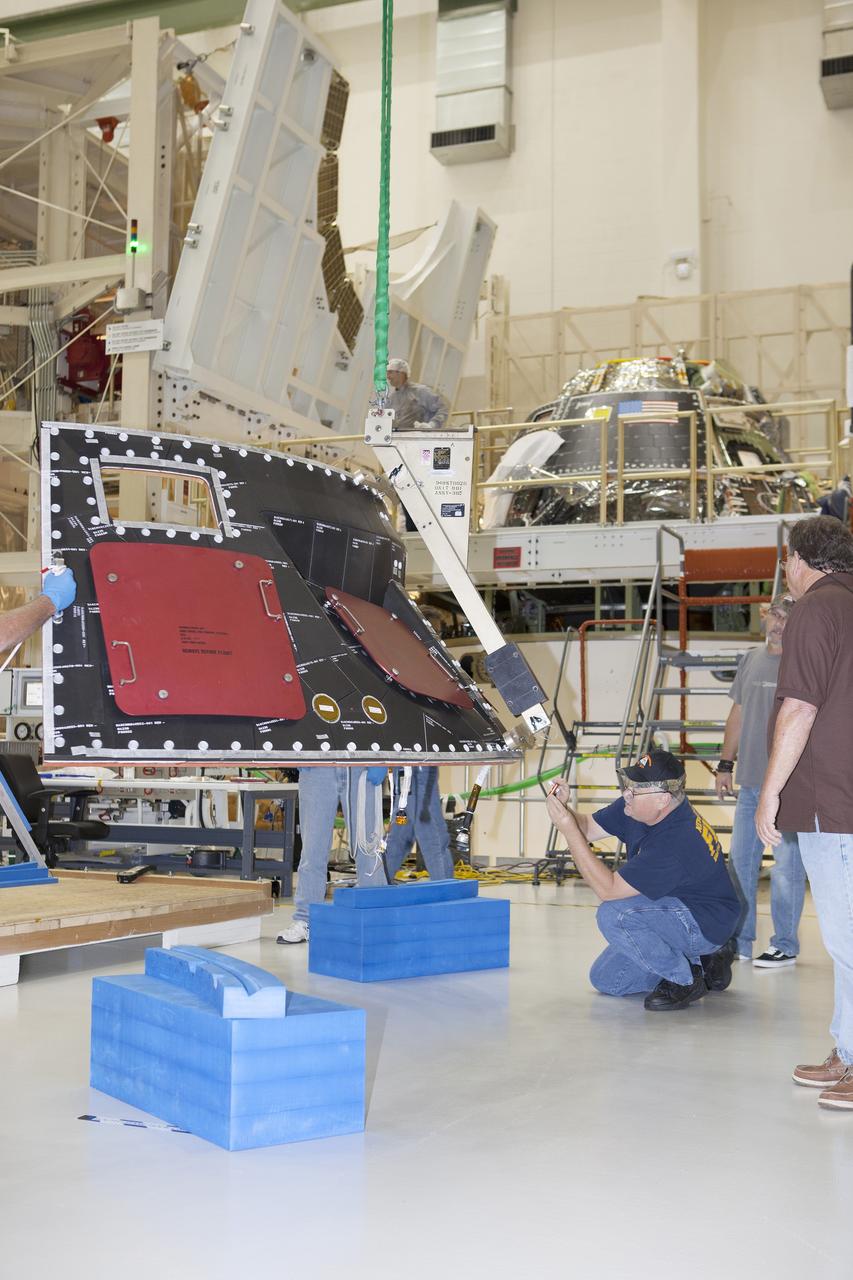
CAPE CANAVERAL, Fla. – Inside the Operations and Checkout Building high bay at NASA's Kennedy Space Center in Florida, technicians and engineers monitor the progress as a crane is used to lift the middle back shell tile panel for installation on the Orion crew module. Preparations are underway for Exploration Flight Test-1, or EFT-1. Orion is the exploration spacecraft designed to carry astronauts to destinations not yet explored by humans, including an asteroid and Mars. It will have emergency abort capability, sustain the crew during space travel and provide safe re-entry from deep space return velocities. The first unpiloted test flight of the Orion is scheduled to launch later this year atop a Delta IV rocket from Cape Canaveral Air Force Station in Florida to an altitude of 3,600 miles above the Earth's surface. The two-orbit, four-hour flight test will help engineers evaluate the systems critical to crew safety including the heat shield, parachute system and launch abort system. For more information, visit http://www.nasa.gov/orion. Photo credit: NASA/Dimitri Gerondidakis
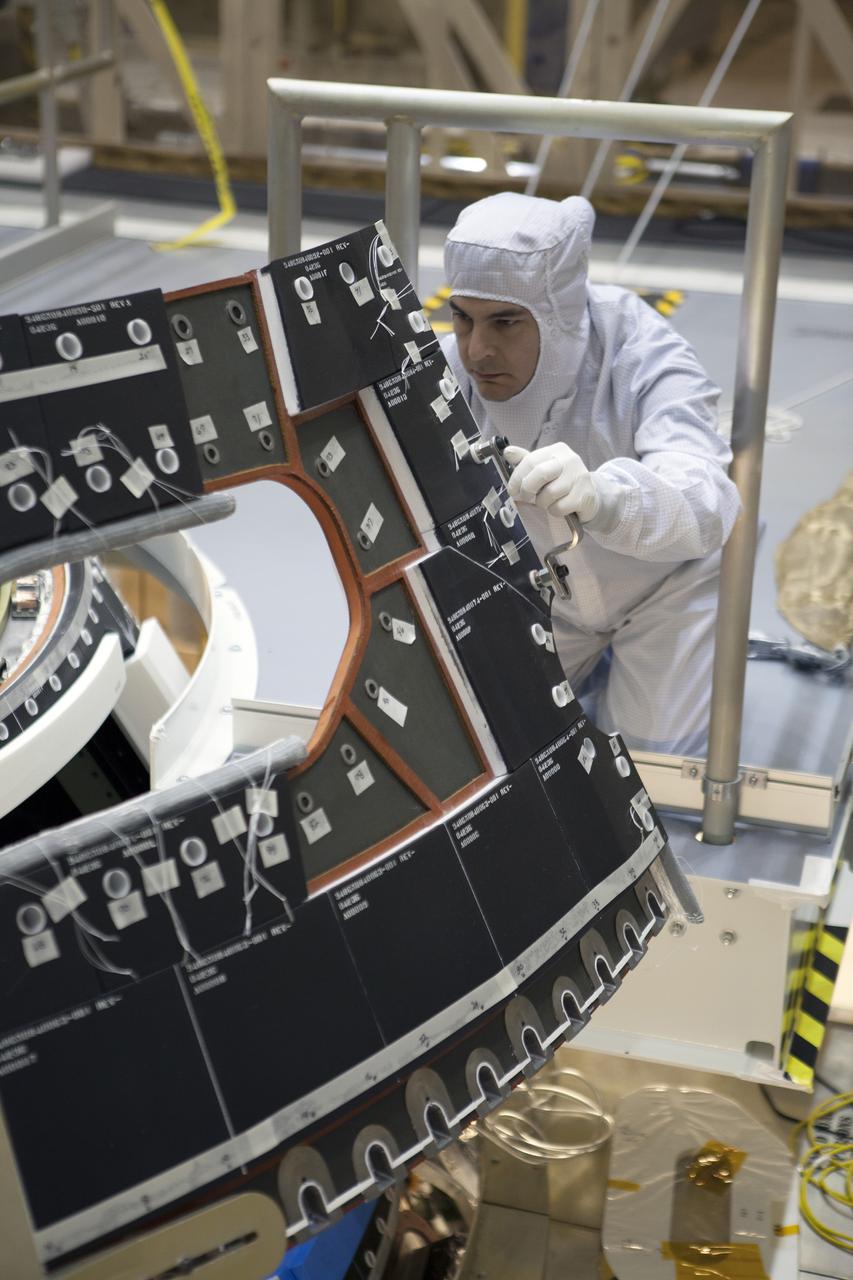
CAPE CANAVERAL, Fla. – Inside the Operations and Checkout Building high bay at NASA's Kennedy Space Center in Florida, a technician dressed in a clean-room suit prepares to install a back shell tile panel onto the Orion crew module. Preparations are underway for Exploration Flight Test-1, or EFT-1. Orion is the exploration spacecraft designed to carry astronauts to destinations not yet explored by humans, including an asteroid and Mars. It will have emergency abort capability, sustain the crew during space travel and provide safe re-entry from deep space return velocities. The first unpiloted test flight of the Orion is scheduled to launch later this year atop a Delta IV rocket from Cape Canaveral Air Force Station in Florida to an altitude of 3,600 miles above the Earth's surface. The two-orbit, four-hour flight test will help engineers evaluate the systems critical to crew safety including the heat shield, parachute system and launch abort system. For more information, visit http://www.nasa.gov/orion. Photo credit: NASA/Dimitri Gerondidakis
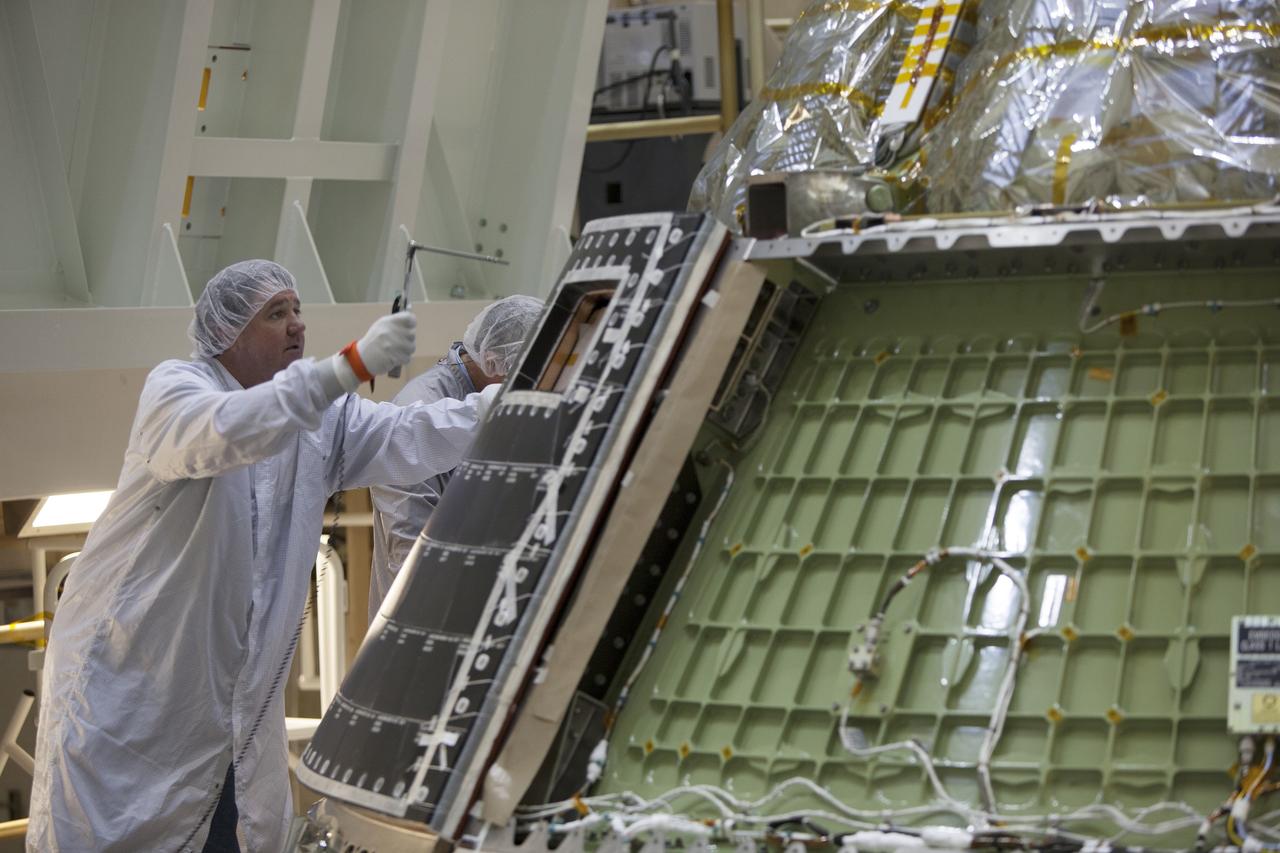
CAPE CANAVERAL, Fla. – Inside the Operations and Checkout Building high bay at NASA's Kennedy Space Center in Florida, a technicians attaches the middle back shell tile panel onto the Orion crew module. Preparations are underway for Exploration Flight Test-1, or EFT-1. Orion is the exploration spacecraft designed to carry astronauts to destinations not yet explored by humans, including an asteroid and Mars. It will have emergency abort capability, sustain the crew during space travel and provide safe re-entry from deep space return velocities. The first unpiloted test flight of the Orion is scheduled to launch later this year atop a Delta IV rocket from Cape Canaveral Air Force Station in Florida to an altitude of 3,600 miles above the Earth's surface. The two-orbit, four-hour flight test will help engineers evaluate the systems critical to crew safety including the heat shield, parachute system and launch abort system. For more information, visit http://www.nasa.gov/orion. Photo credit: NASA/Dimitri Gerondidakis
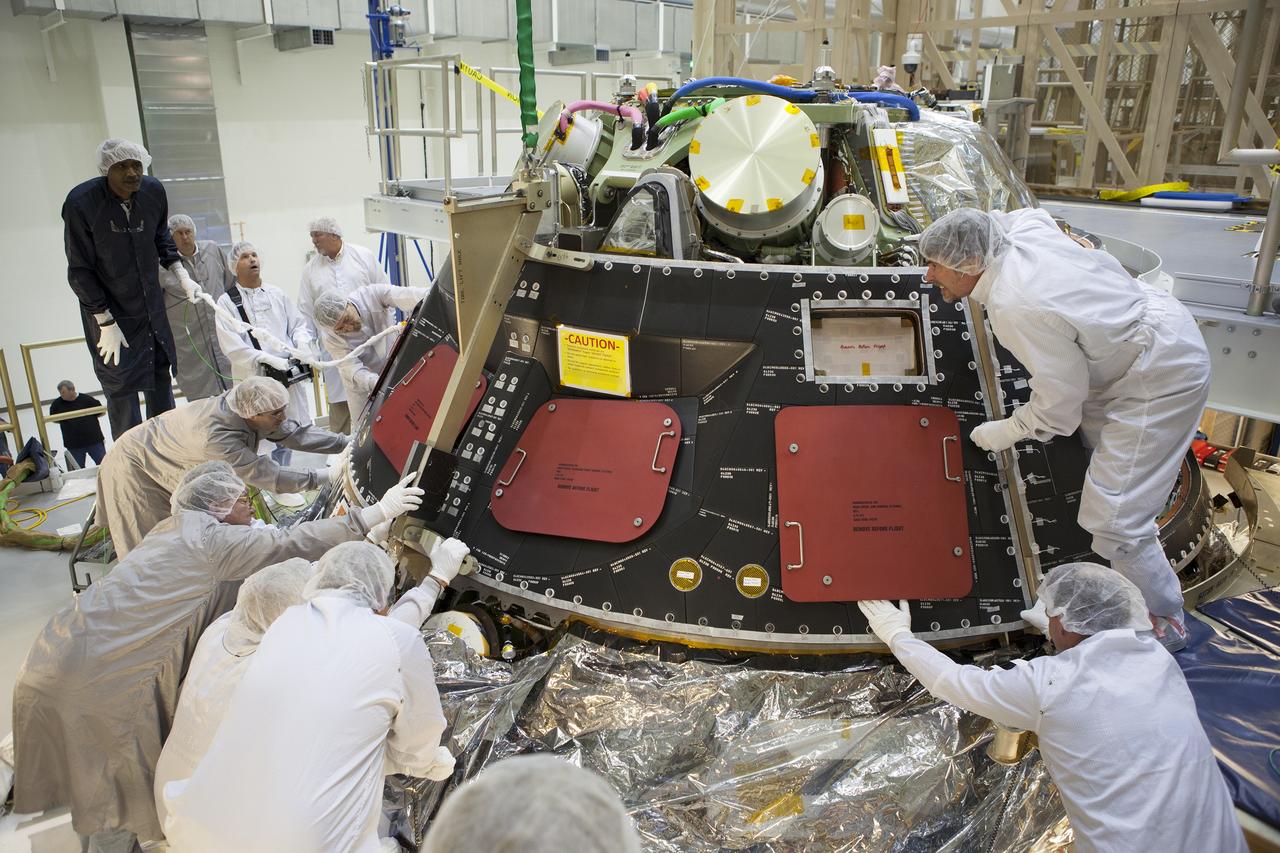
CAPE CANAVERAL, Fla. – Inside the Operations and Checkout Building high bay at NASA's Kennedy Space Center in Florida, technicians dressed in clean-room suits line up the middle back shell tile panel for installation on the Orion crew module. Preparations are underway for Exploration Flight Test-1, or EFT-1. Orion is the exploration spacecraft designed to carry astronauts to destinations not yet explored by humans, including an asteroid and Mars. It will have emergency abort capability, sustain the crew during space travel and provide safe re-entry from deep space return velocities. The first unpiloted test flight of the Orion is scheduled to launch later this year atop a Delta IV rocket from Cape Canaveral Air Force Station in Florida to an altitude of 3,600 miles above the Earth's surface. The two-orbit, four-hour flight test will help engineers evaluate the systems critical to crew safety including the heat shield, parachute system and launch abort system. For more information, visit http://www.nasa.gov/orion. Photo credit: NASA/Dimitri Gerondidakis
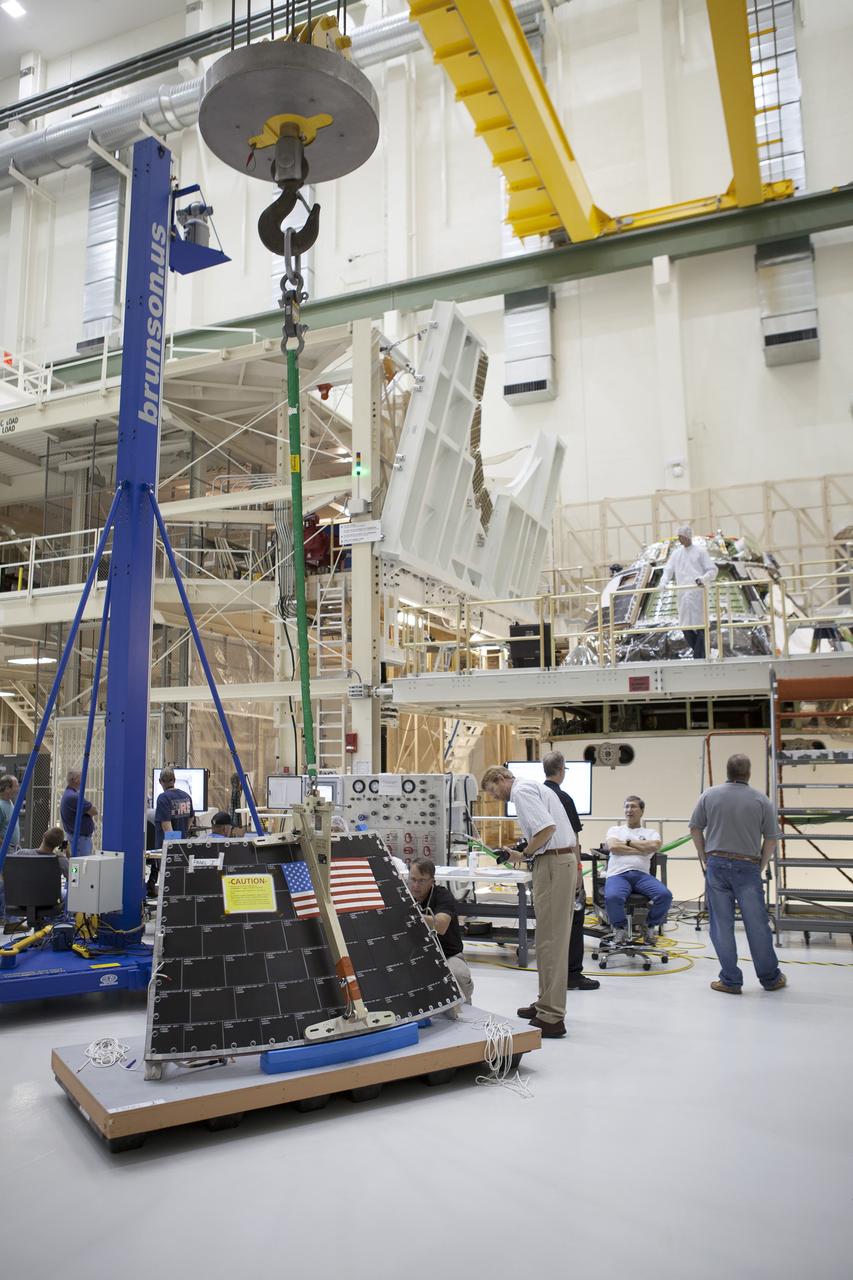
CAPE CANAVERAL, Fla. – Inside the Operations and Checkout Building high bay at NASA's Kennedy Space Center in Florida, a crane is attached to the middle back shell tile panel in order to lift it for installation on the Orion crew module. Preparations are underway for Exploration Flight Test-1, or EFT-1. Orion is the exploration spacecraft designed to carry astronauts to destinations not yet explored by humans, including an asteroid and Mars. It will have emergency abort capability, sustain the crew during space travel and provide safe re-entry from deep space return velocities. The first unpiloted test flight of the Orion is scheduled to launch later this year atop a Delta IV rocket from Cape Canaveral Air Force Station in Florida to an altitude of 3,600 miles above the Earth's surface. The two-orbit, four-hour flight test will help engineers evaluate the systems critical to crew safety including the heat shield, parachute system and launch abort system. For more information, visit http://www.nasa.gov/orion. Photo credit: NASA/Dimitri Gerondidakis
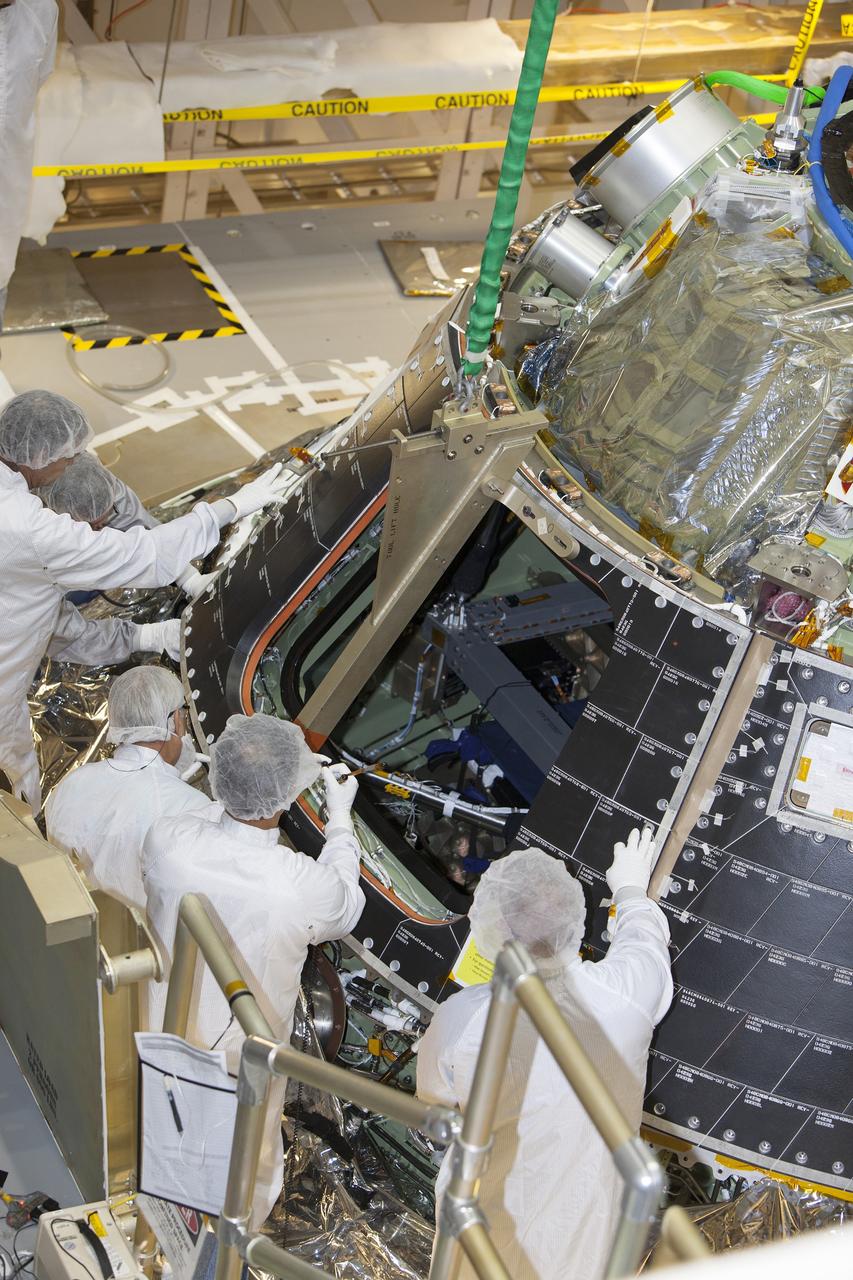
CAPE CANAVERAL, Fla. – Inside the Operations and Checkout Building high bay at NASA's Kennedy Space Center in Florida, technicians line up the middle back shell tile panel for installation on the Orion crew module. Preparations are underway for Exploration Flight Test-1, or EFT-1. Orion is the exploration spacecraft designed to carry astronauts to destinations not yet explored by humans, including an asteroid and Mars. It will have emergency abort capability, sustain the crew during space travel and provide safe re-entry from deep space return velocities. The first unpiloted test flight of the Orion is scheduled to launch later this year atop a Delta IV rocket from Cape Canaveral Air Force Station in Florida to an altitude of 3,600 miles above the Earth's surface. The two-orbit, four-hour flight test will help engineers evaluate the systems critical to crew safety including the heat shield, parachute system and launch abort system. For more information, visit http://www.nasa.gov/orion. Photo credit: NASA/Dimitri Gerondidakis
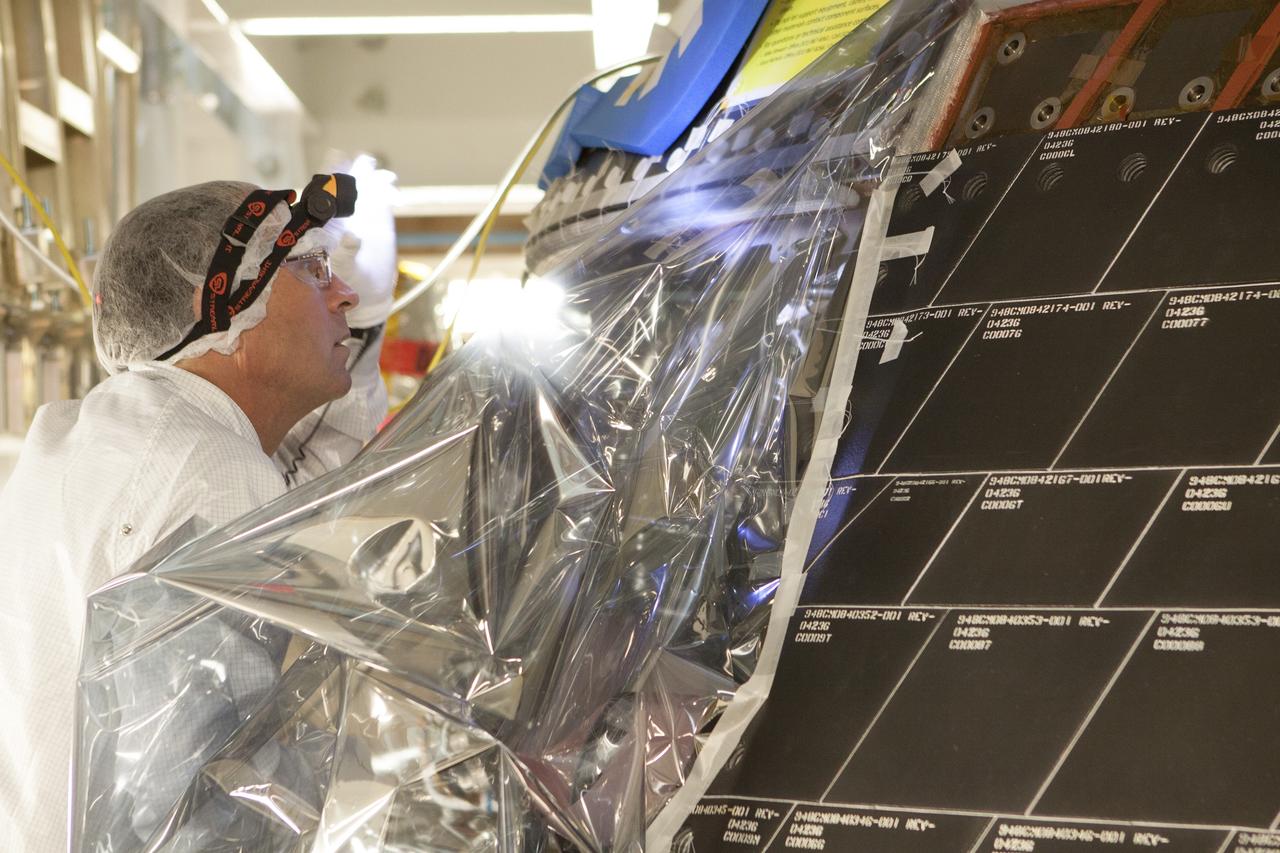
CAPE CANAVERAL, Fla. – Inside the Neil Armstrong Operations and Checkout Building high bay at NASA's Kennedy Space Center in Florida, a Lockheed Martin technician dressed in a clean room suit inspects the back shell tiles on the Orion crew module. Preparations are underway for Orion's first flight test. Orion is the exploration spacecraft designed to carry astronauts to destinations not yet explored by humans, including an asteroid and Mars. It will have emergency abort capability, sustain the crew during space travel and provide safe re-entry from deep space return velocities. Orion's first flight test is scheduled to launch in December atop a United Launch Alliance Delta IV Heavy rocket from Cape Canaveral Air Force Station in Florida to an altitude of 3,600 miles above the Earth's surface. The two-orbit, four-hour flight test will help engineers evaluate the systems critical to crew safety including the heat shield, parachute system and launch abort system. For more information, visit http://www.nasa.gov/orion. Photo credit: NASA/Gianni Woods
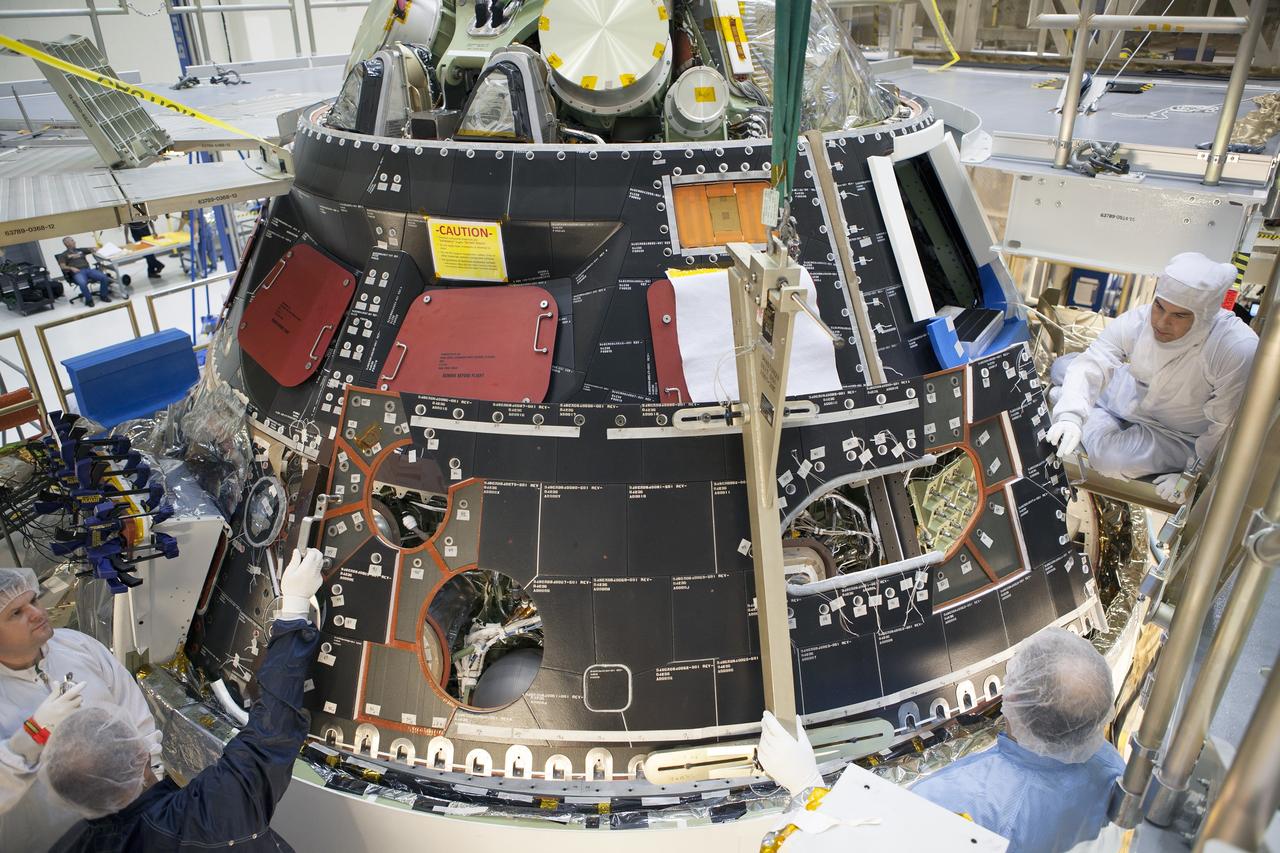
CAPE CANAVERAL, Fla. – Inside the Operations and Checkout Building high bay at NASA's Kennedy Space Center in Florida, technicians dressed in clean-room suits install a back shell tile panel onto the Orion crew module. Preparations are underway for Exploration Flight Test-1, or EFT-1. Orion is the exploration spacecraft designed to carry astronauts to destinations not yet explored by humans, including an asteroid and Mars. It will have emergency abort capability, sustain the crew during space travel and provide safe re-entry from deep space return velocities. The first unpiloted test flight of the Orion is scheduled to launch later this year atop a Delta IV rocket from Cape Canaveral Air Force Station in Florida to an altitude of 3,600 miles above the Earth's surface. The two-orbit, four-hour flight test will help engineers evaluate the systems critical to crew safety including the heat shield, parachute system and launch abort system. For more information, visit http://www.nasa.gov/orion. Photo credit: NASA/Dimitri Gerondidakis
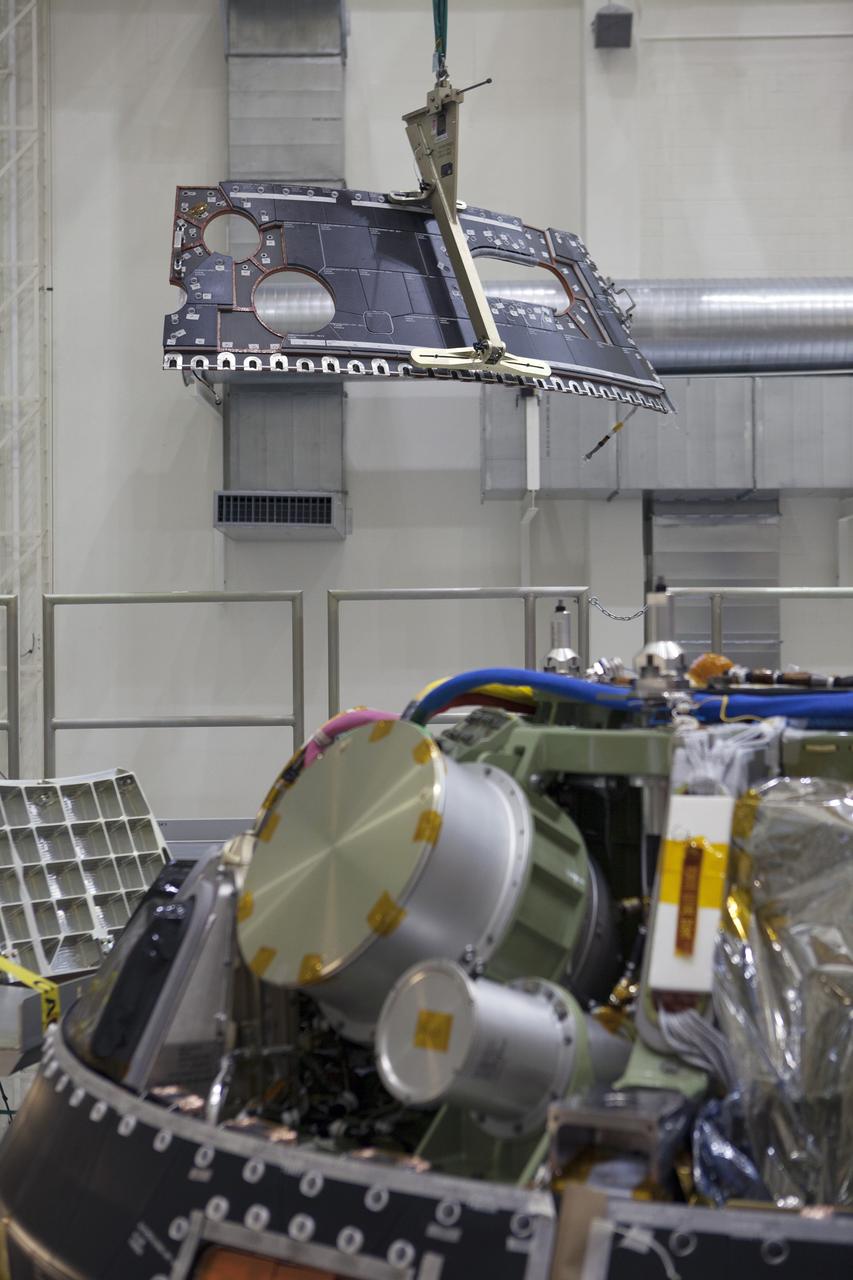
CAPE CANAVERAL, Fla. – Inside the Operations and Checkout Building high bay at NASA's Kennedy Space Center in Florida, a crane is used to carry a back shell tile panel for installation on the Orion crew module. Preparations are underway for Exploration Flight Test-1, or EFT-1. Orion is the exploration spacecraft designed to carry astronauts to destinations not yet explored by humans, including an asteroid and Mars. It will have emergency abort capability, sustain the crew during space travel and provide safe re-entry from deep space return velocities. The first unpiloted test flight of the Orion is scheduled to launch later this year atop a Delta IV rocket from Cape Canaveral Air Force Station in Florida to an altitude of 3,600 miles above the Earth's surface. The two-orbit, four-hour flight test will help engineers evaluate the systems critical to crew safety including the heat shield, parachute system and launch abort system. For more information, visit http://www.nasa.gov/orion. Photo credit: NASA/Dimitri Gerondidakis
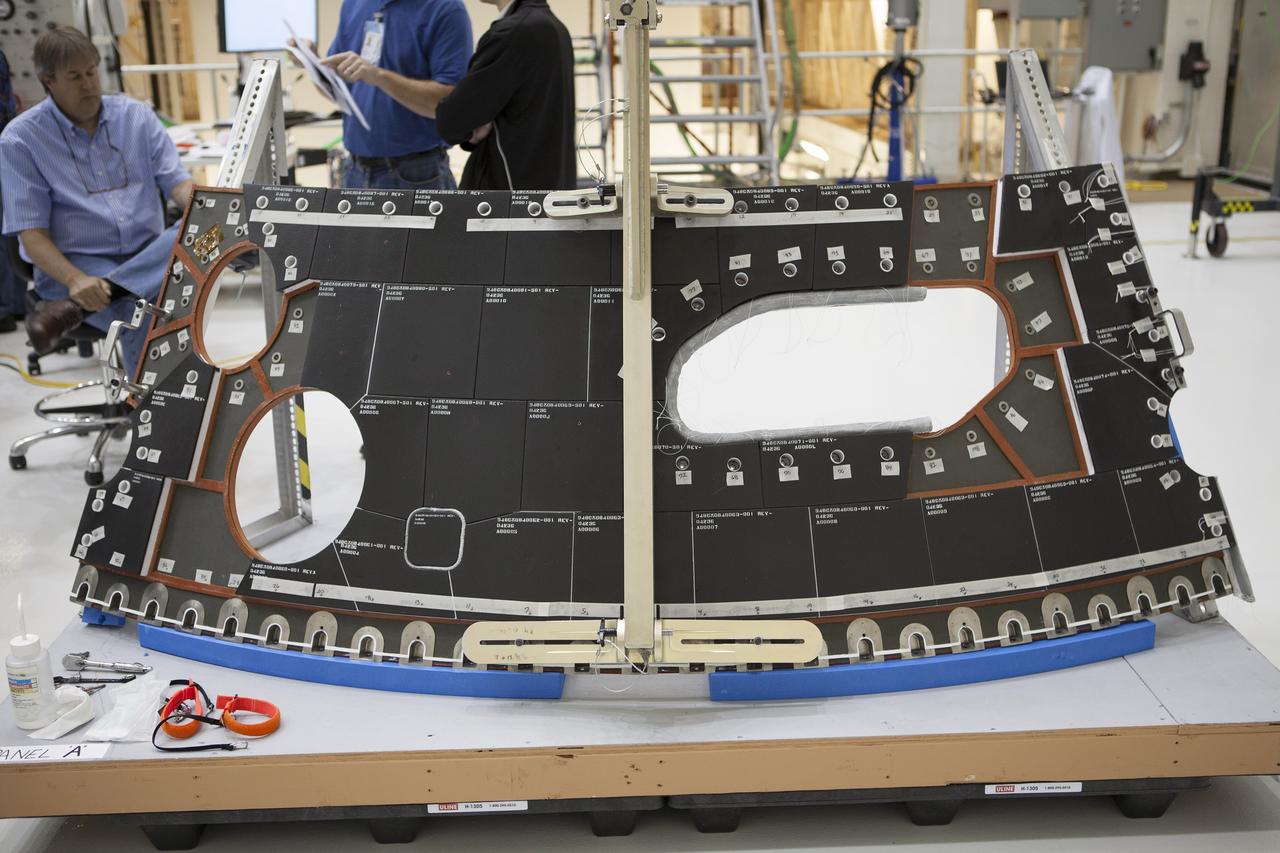
CAPE CANAVERAL, Fla. – Inside the Operations and Checkout Building high bay at NASA's Kennedy Space Center in Florida, technicians prepare a back shell tile panel for installation on the Orion crew module. Preparations are underway for Exploration Flight Test-1, or EFT-1. Orion is the exploration spacecraft designed to carry astronauts to destinations not yet explored by humans, including an asteroid and Mars. It will have emergency abort capability, sustain the crew during space travel and provide safe re-entry from deep space return velocities. The first unpiloted test flight of the Orion is scheduled to launch later this year atop a Delta IV rocket from Cape Canaveral Air Force Station in Florida to an altitude of 3,600 miles above the Earth's surface. The two-orbit, four-hour flight test will help engineers evaluate the systems critical to crew safety including the heat shield, parachute system and launch abort system. For more information, visit http://www.nasa.gov/orion. Photo credit: NASA/Dimitri Gerondidakis
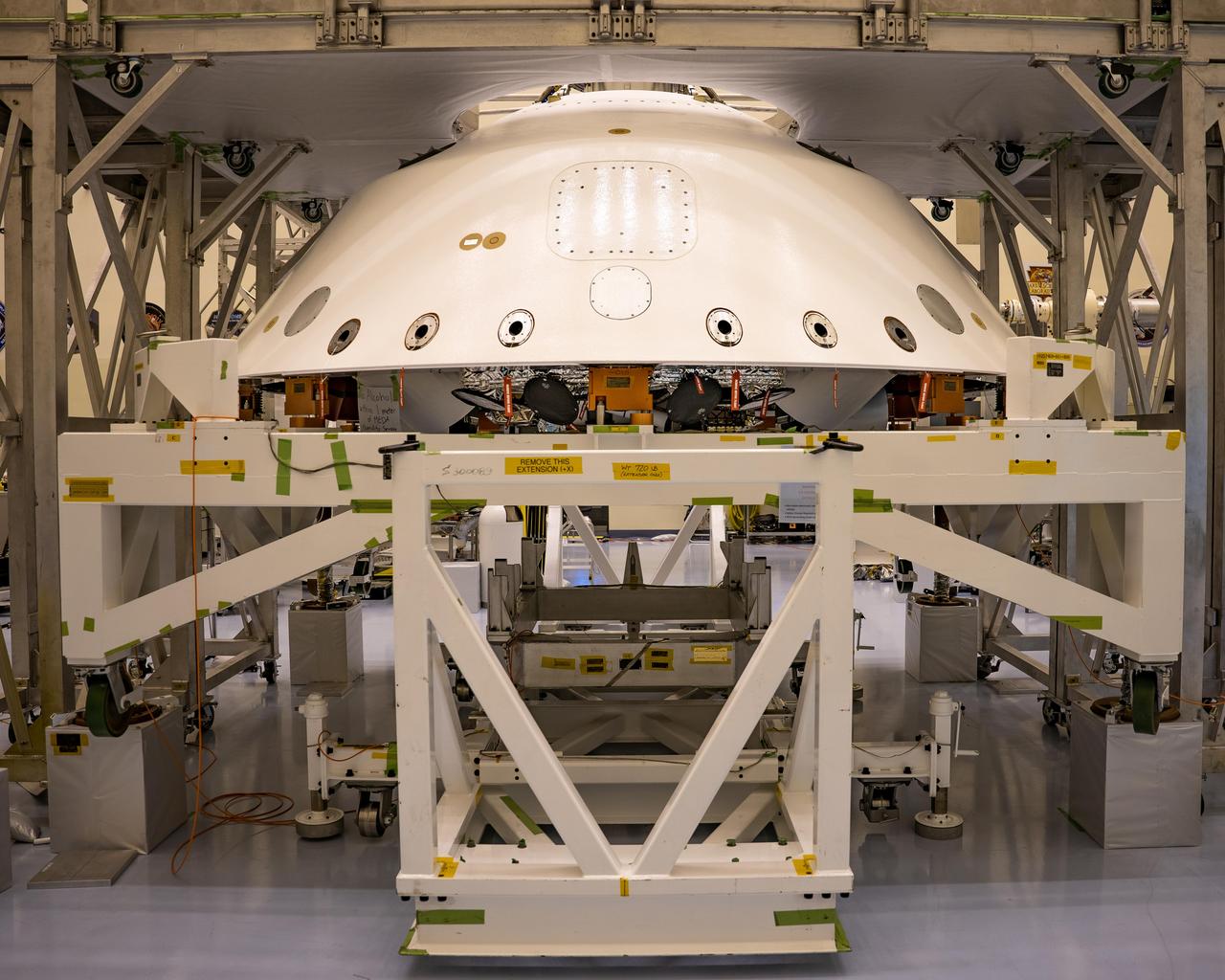
The cone-shaped back shell for NASA's Perseverance rover mission sits on a support structure in this April 29, 2020, image from Kennedy Space Center in Florida. Along with the heat shield, the back shell provides protection for the rover and descent stage during Martian atmospheric entry. Portions of the descent stage and rover, stacked one on top of the other, can be seen in the open area directly below the lower edge of back shell. https://photojournal.jpl.nasa.gov/catalog/PIA23885
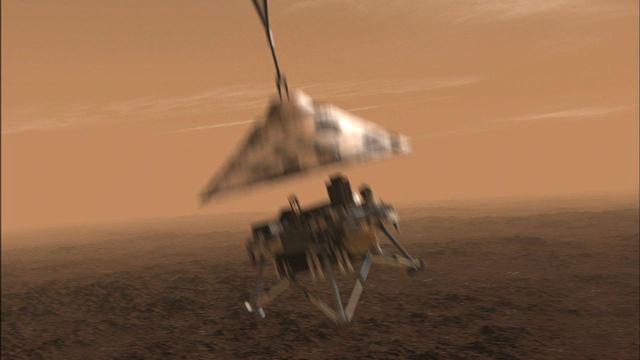
NASA Phoenix Mars Lander will be in free fall after it separates from its back shell and parachute, but not for long.
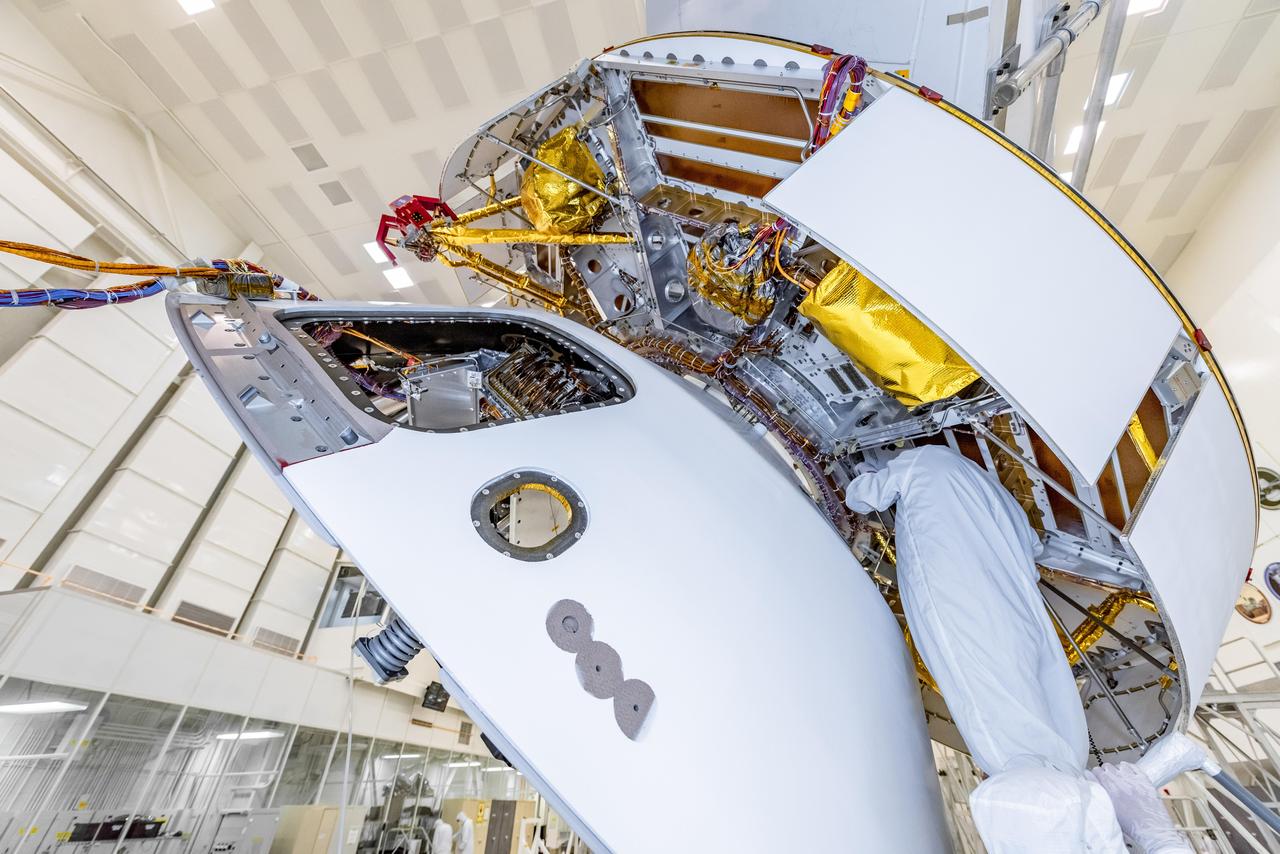
A member of NASA's Mars 2020 project checks connections between the spacecraft's back shell and cruise stage. The image was taken on March 26, 2019, in the Spacecraft Assembly Facility's High Bay 1 clean room at NASA's Jet Propulsion Laboratory, in Pasadena, California. During the mission's voyage to Mars, the cruise stage houses the hardware that steers and provides power to the spacecraft. The back shell, along with the heatshield (not pictured), protects the 2020 rover and the sky crane landing system during Mars atmospheric entry. https://photojournal.jpl.nasa.gov/catalog/PIA23163
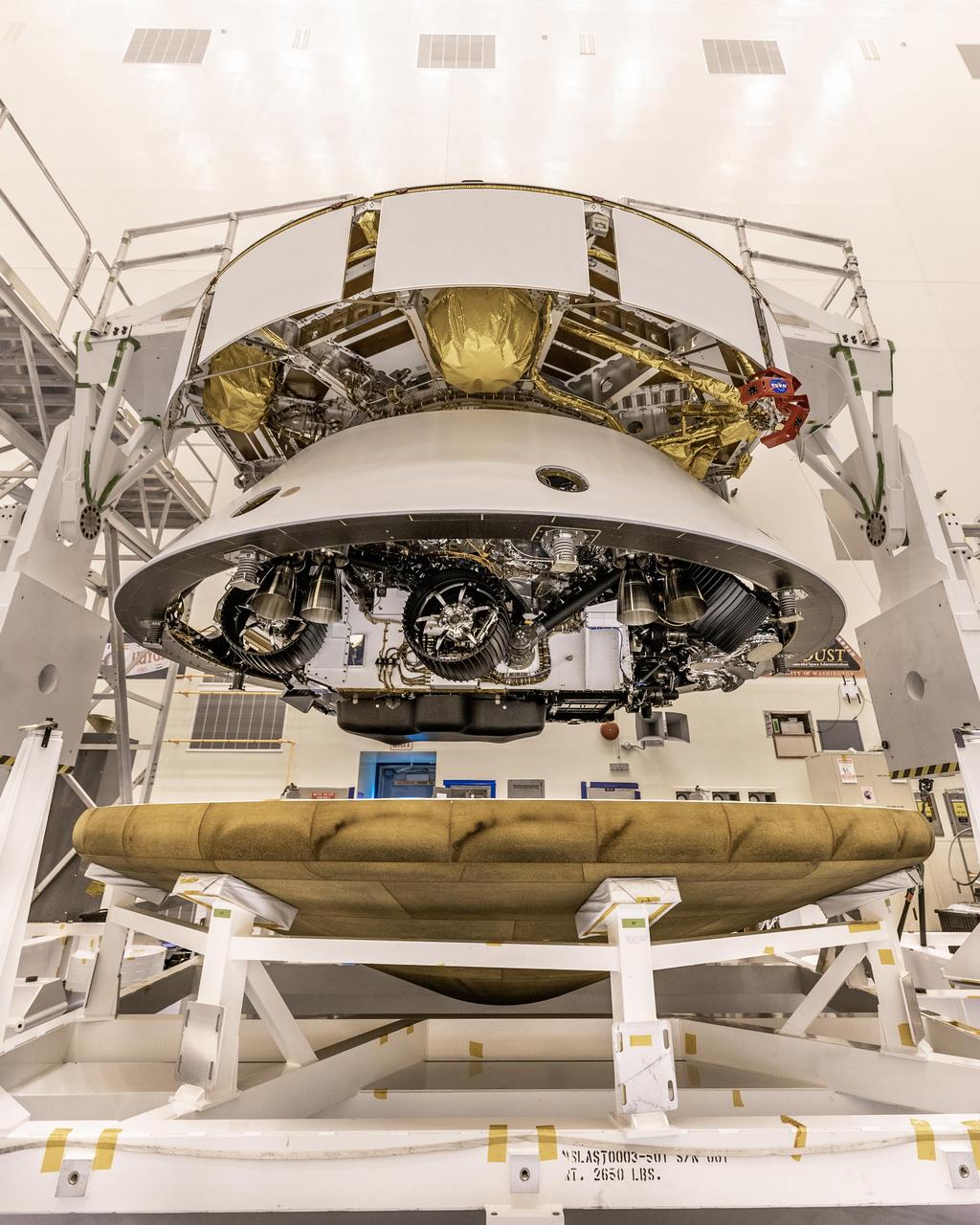
The Mars 2020 Perseverance rover mission's disk-shaped cruise stage sits atop the bell-shaped back shell, which contains the powered descent stage and Perseverance rover. Below is the brass-colored heat shield that is about to be attached to the back shell. The image was taken on May 28, 2020, at Kennedy Space Center in Florida. The next time the back shell and cruise stage will separate will be about 6 miles (9 kilometers) above Mars' Jezero Crater on Feb. 18, 2021. https://photojournal.jpl.nasa.gov/catalog/PIA23925
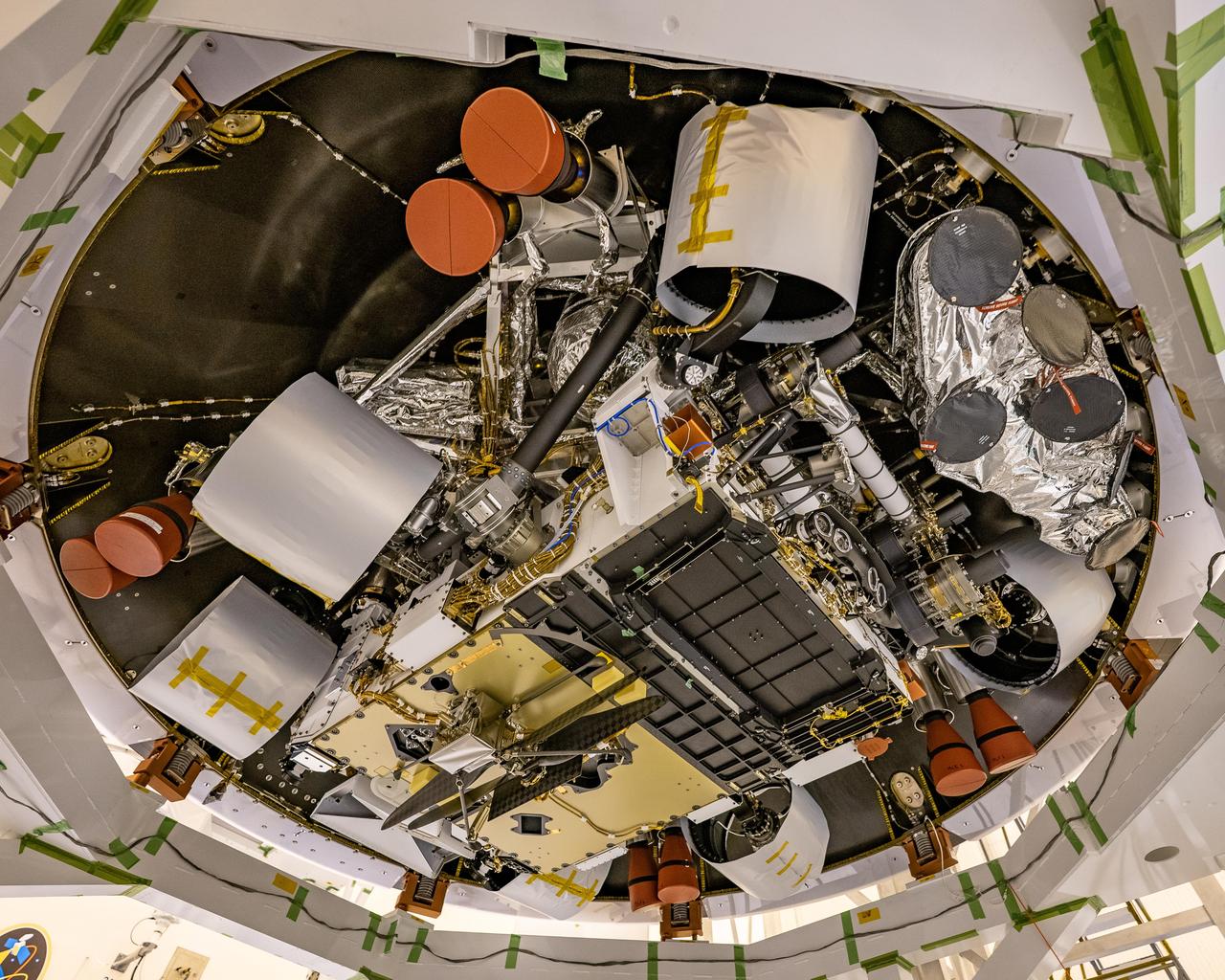
NASA's Mars Perseverance rover's descent stage was recently stacked atop the rover at Kennedy Space Center, and the two were placed in the back shell that will help protect them on their journey to Mars. In this image, taken on April 29, 2020, the underside of the rover is visible, along with the Ingenuity helicopter attached (lower center of the image). The outer ring is the base of the back shell, while the bell-shaped objects covered in red material are covers for engine nozzles on the descent stage. The wheels are covered in a protective material that will be removed before launch. https://photojournal.jpl.nasa.gov/catalog/PIA23884
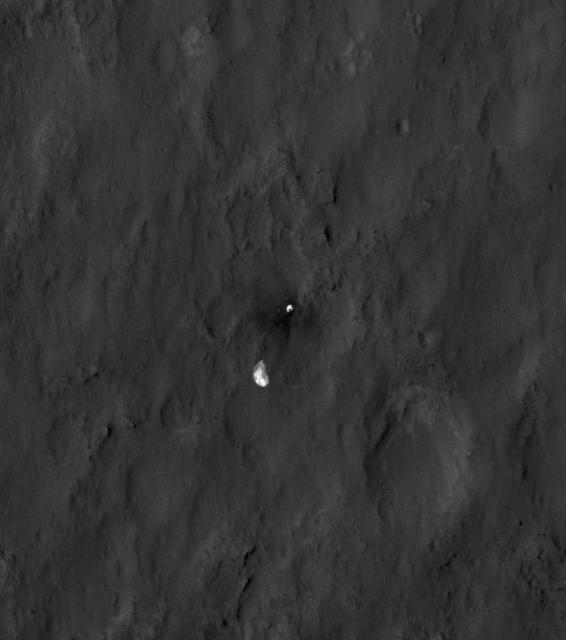
This close-up view shows the rover Curiosity parachute and back shell strewn across the surface of Mars. The image was captured by NASA Mars Reconnaissance Orbiter about 24 hours after the parachute helped guide the rover to the surface.
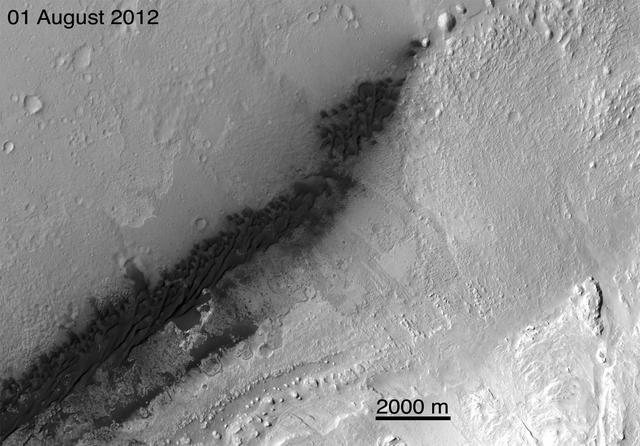
This image from an animation is from NASA Mars Reconnaissance Orbiter MRO showing the landing effects of the descent stage, the rover lander, the back shell and parachute, and the heat shield, all found on the left side of the image.
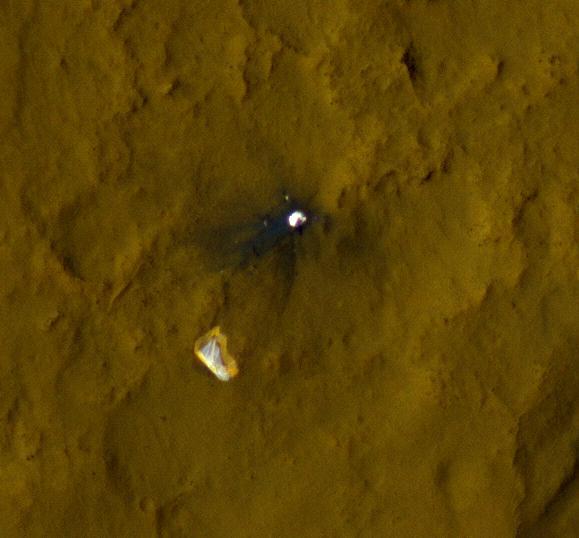
This color view of the parachute and back shell that helped deliver NASA Curiosity rover to the surface of the Red Planet was taken by the High-HiRISE camera on NASA Mars Reconnaissance Orbiter.
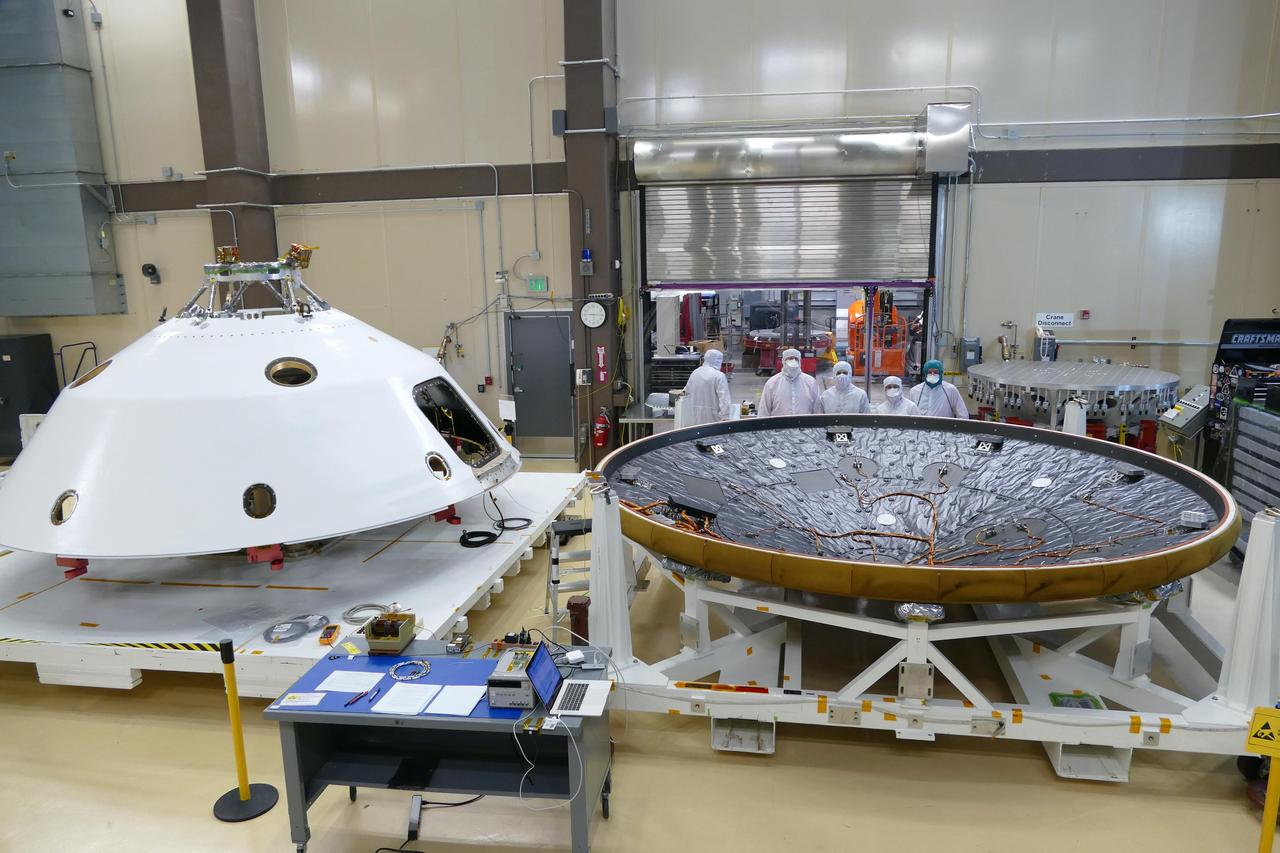
MEDLI2 sensors are installed on the Mars 2020 heat shield and back shell prior to launch. The sensors will measure the environment surrounding the spacecraft and the performance of thermal protection system material during the atmospheric entry phase of NASA's Mars 2020 Perseverance rover mission. https://photojournal.jpl.nasa.gov/catalog/PIA23989
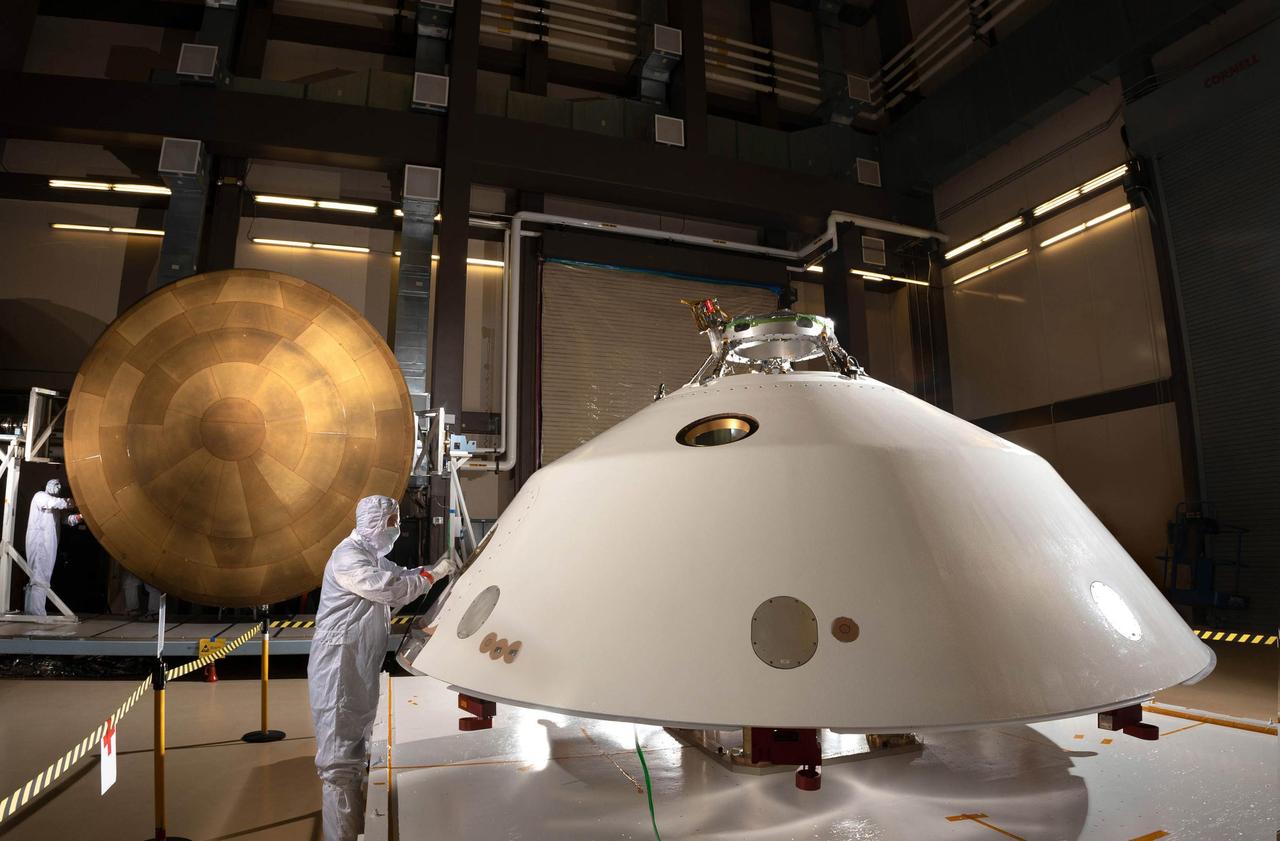
The heat shield (left) and back shell (right) that comprise the aeroshell for NASA's Mars 2020 mission are depicted in this image. Both components are nearly 15 feet (4.5 meters) in diameter. The aeroshell will encapsulate and protect the Mars 2020 rover and its descent stage both during their deep space cruise to Mars and during descent through the Martian atmosphere, which generates intense heat. The image was taken at Lockheed Martin Space in Denver, Colorado, which manufactured the aeroshell. https://photojournal.jpl.nasa.gov/catalog/PIA23590
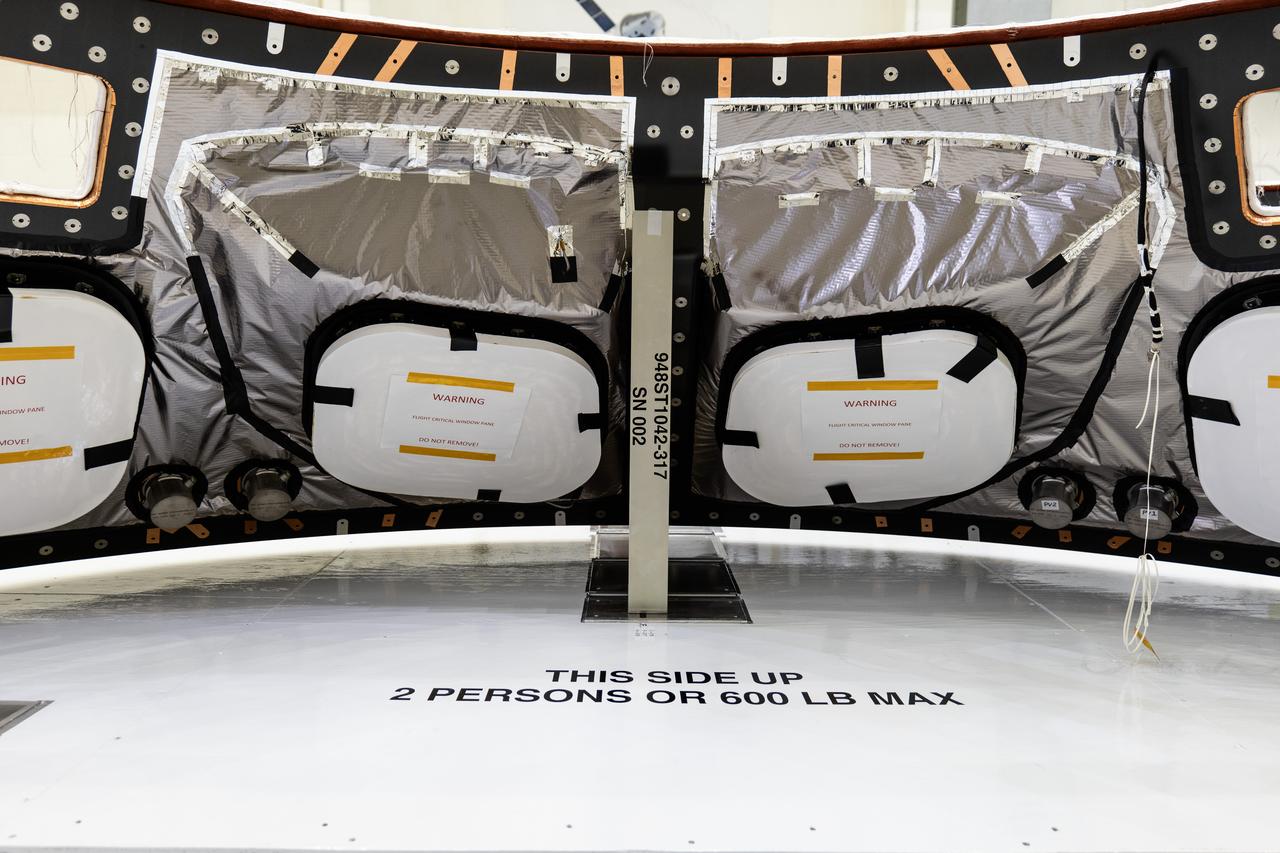
Back shell panels are visible on the Orion spacecraft for the Artemis II mission inside the Neil A. Armstrong Operations and Checkout Building high bay at NASA's Kennedy Space Center in Florida on Monday, Dec. 15, 2024. The back shell panels serve as the outer layer of the spacecraft and will protect it against the extreme temperatures of re-entry from deep space.
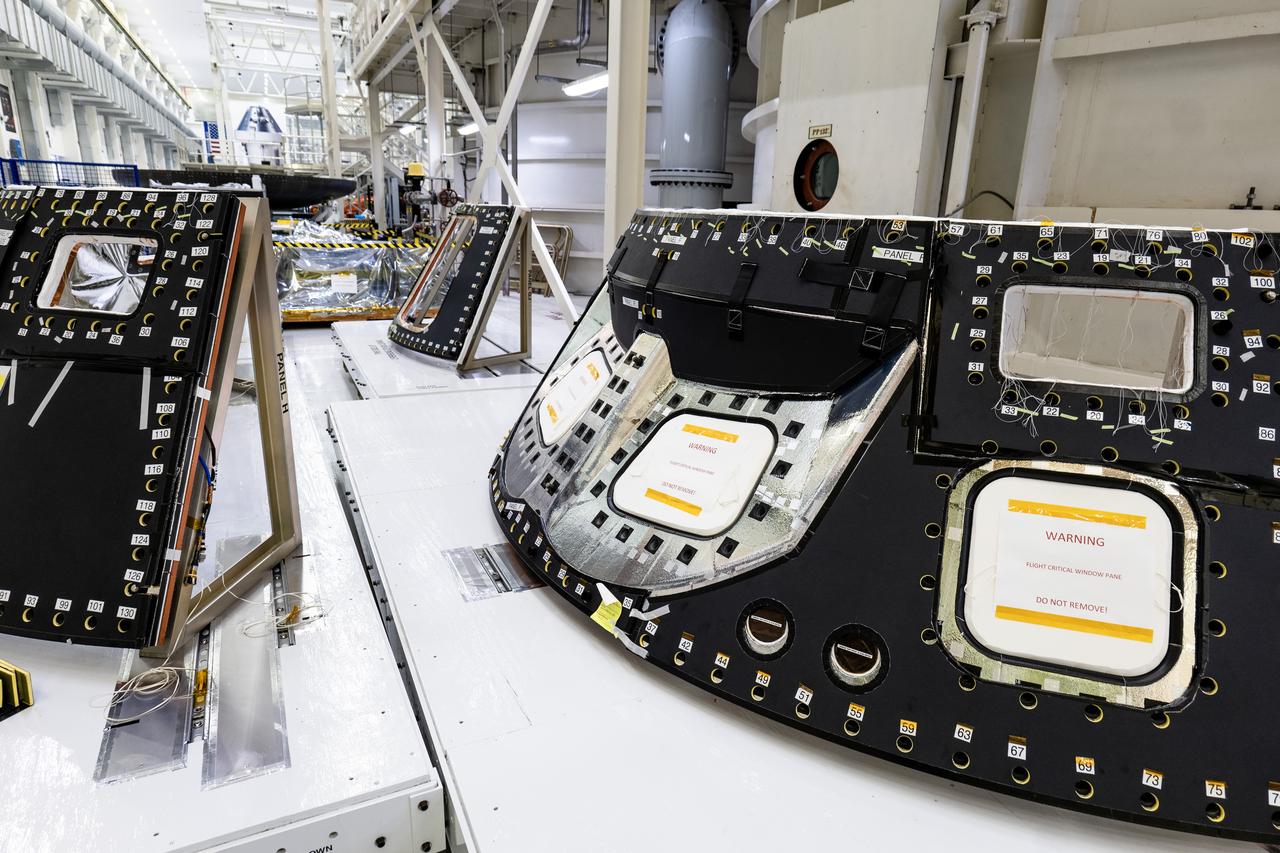
Visible in the foreground are back shell panels on the Orion spacecraft for the Artemis II mission inside the Neil A. Armstrong Operations and Checkout Building high bay at NASA's Kennedy Space Center in Florida on Monday, Dec. 15, 2024. The back shell panels serve as the outer layer of the spacecraft and will protect it against the extreme temperatures of re-entry from deep space. In the background are the heat shield for Orion’s Artemis IV mission secured on a work stand, as well as the Orion spacecraft for NASA’s Artemis II mission.
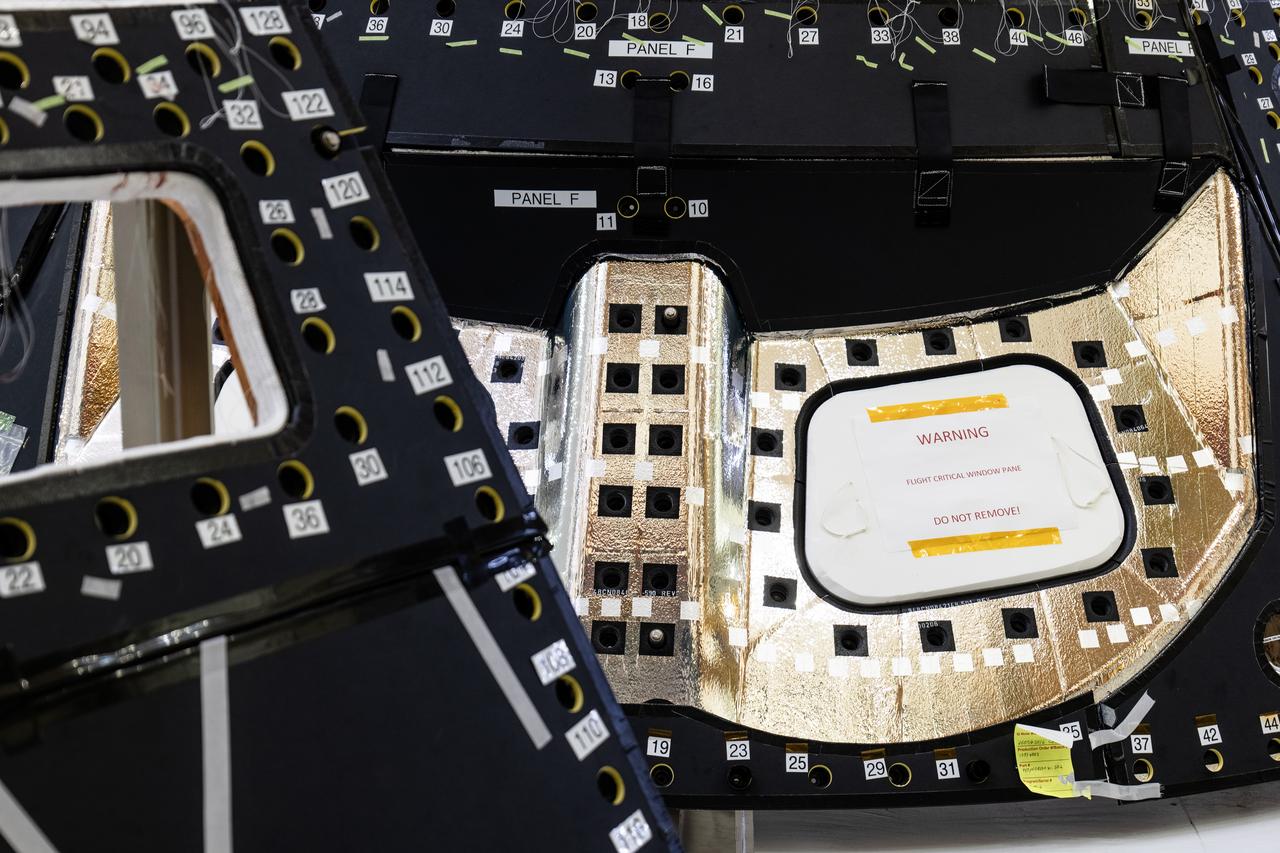
Back shell panels are visible on the Orion spacecraft for the Artemis IV mission inside the Neil A. Armstrong Operations and Checkout Building high bay at NASA's Kennedy Space Center in Florida on Monday, Dec. 15, 2024. The back shell panels serve as the outer layer of the spacecraft and will protect it against the extreme temperatures of re-entry from deep space.
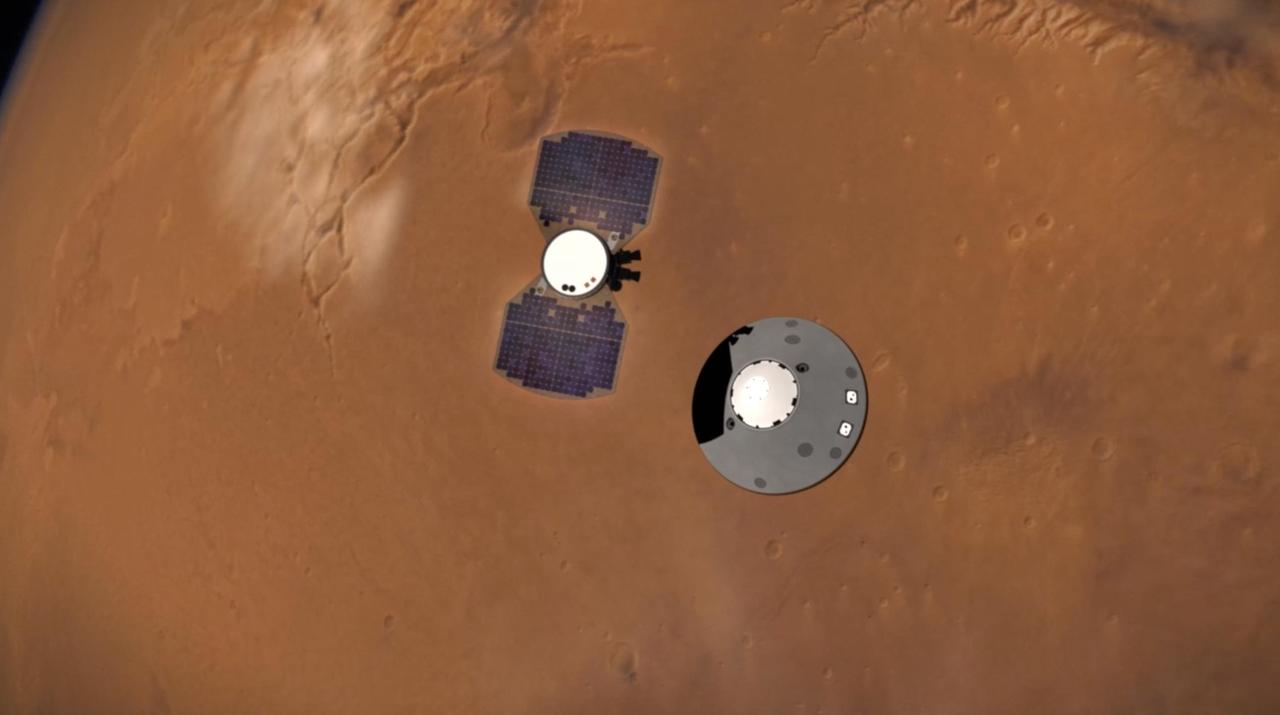
This illustration shows NASA's InSight lander separating from its cruise stage as it prepares to enter Mars' atmosphere. The InSight lander is on the right, tucked inside a protective heat shield and back shell. The cruise stage with solar panels is on the left. https://photojournal.jpl.nasa.gov/catalog/PIA22828
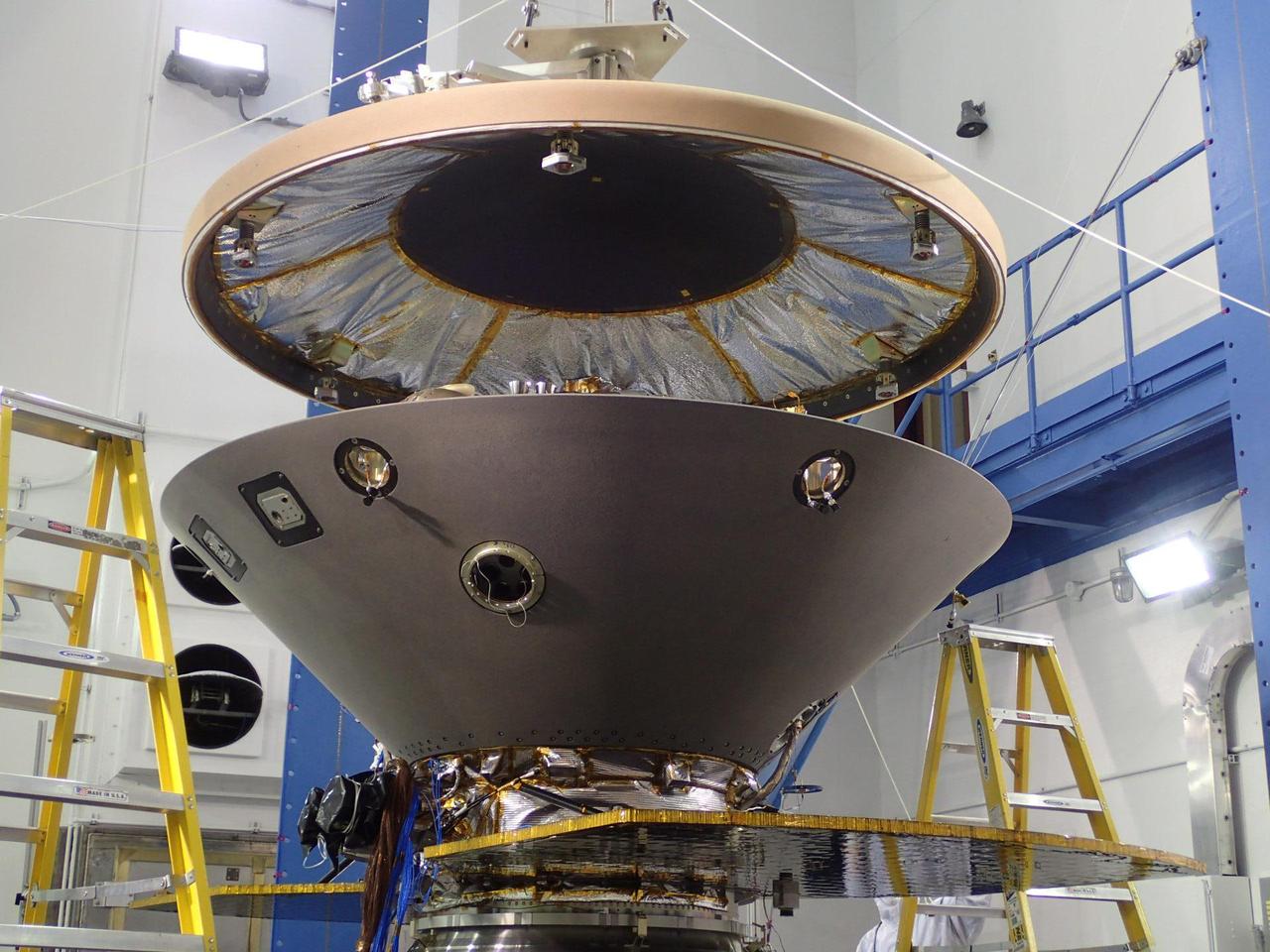
The heat shield is suspended above the rest of the InSight spacecraft in this image taken July 13, 2015, in a spacecraft assembly clean room at Lockheed Martin Space Systems, Denver. The gray cone is the back shell, which together with the heat shield forms a protective aeroshell around the stowed InSight lander. The photo was taken during preparation for vibration testing of the spacecraft. InSight, for Interior Exploration Using Seismic Investigations, Geodesy and Heat Transport, is scheduled for launch in March 2016 and landing in September 2016. It will study the deep interior of Mars to advance understanding of the early history of all rocky planets, including Earth. Note: After thorough examination, NASA managers have decided to suspend the planned March 2016 launch of the Interior Exploration using Seismic Investigations Geodesy and Heat Transport (InSight) mission. The decision follows unsuccessful attempts to repair a leak in a section of the prime instrument in the science payload. http://photojournal.jpl.nasa.gov/catalog/PIA19814
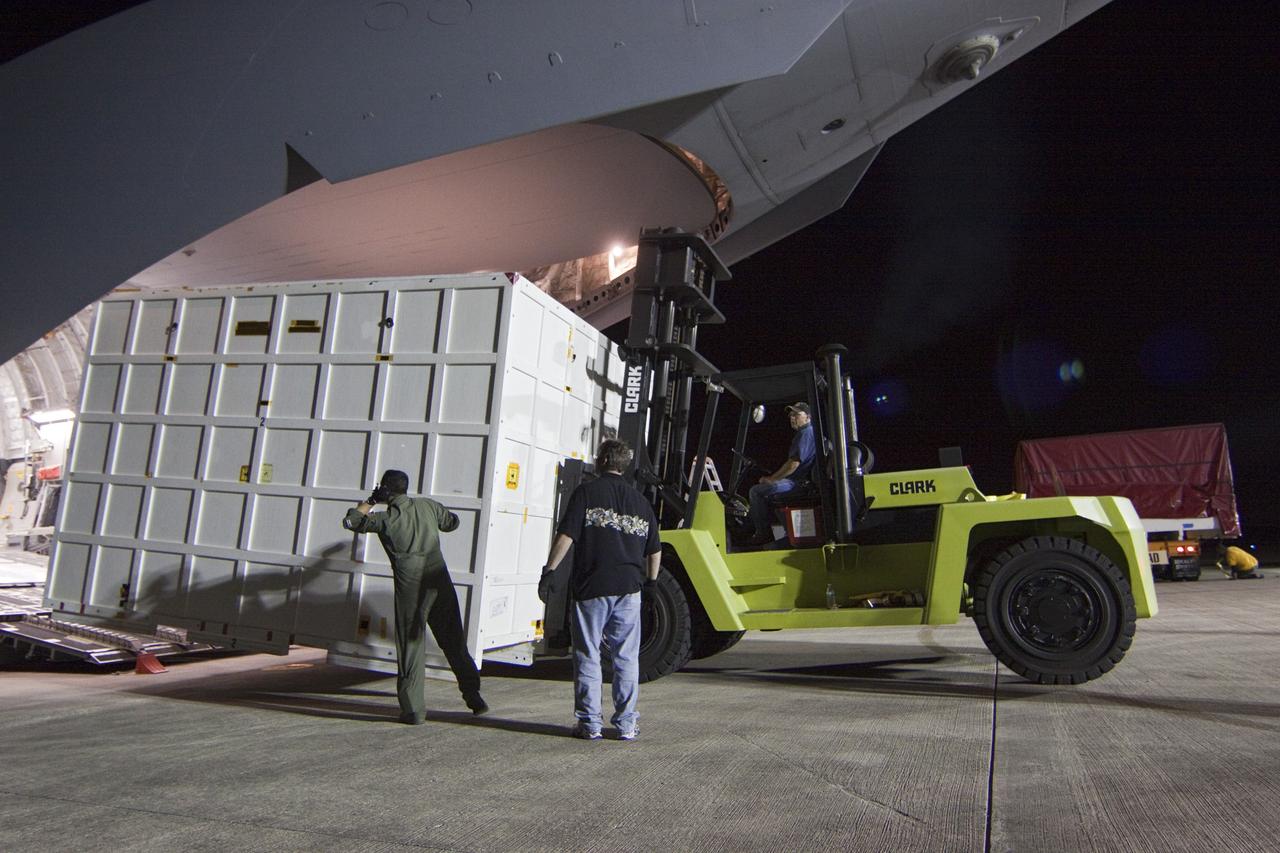
CAPE CANAVERAL, Fla. -- Workers unload a container holding the back shell, one of the first three elements for NASA's Mars Science Laboratory (MSL) that arrived at NASA Kennedy Space Center's Shuttle Landing Facility aboard an Air Force C-17 cargo plane. The cruise stage, back shell and heat shield, the first flight elements to arrive for the MSL mission, were taken to the Payload Hazardous Servicing Facility (PHSF) located in the KSC Industrial Area to begin processing. The Curiosity rover will arrive next month. A United Launch Alliance Atlas V-541 configuration will be used to loft MSL into space. Curiosity’s 10 science instruments are designed to search for evidence on whether Mars has had environments favorable to microbial life, including chemical ingredients for life. The unique rover will use a laser to look inside rocks and release its gasses so that the rover’s spectrometer can analyze and send the data back to Earth. MSL is scheduled to launch from Cape Canaveral Air Force Station in Florida Nov. 25 with a window extending to Dec. 18 and arrival at Mars Aug. 2012. For more information, visit http://www.nasa.gov/msl. Photo credit: NASA/Troy Cryder
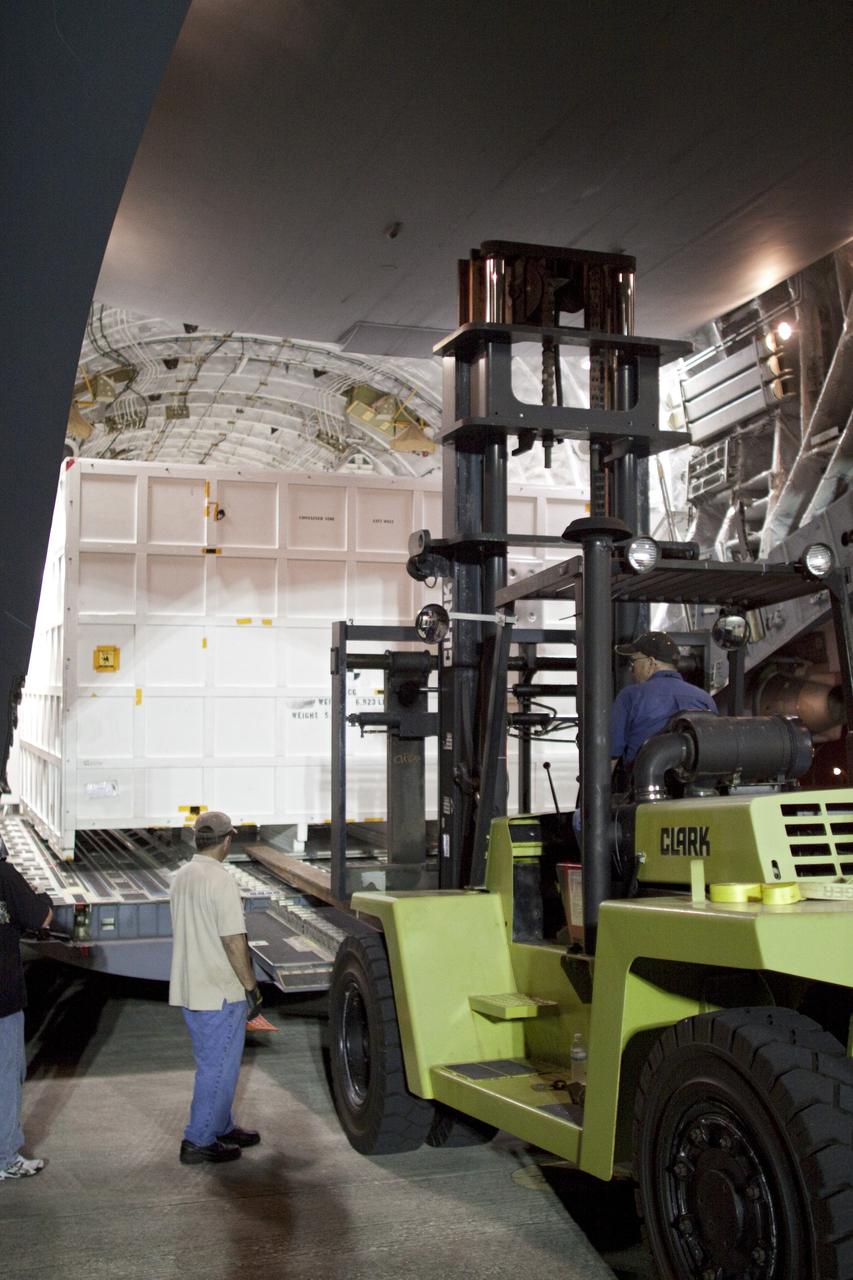
CAPE CANAVERAL, Fla. -- Workers unload a container holding the back shell, one of the first three elements for NASA's Mars Science Laboratory (MSL) that arrived at NASA Kennedy Space Center's Shuttle Landing Facility aboard an Air Force C-17 cargo plane. The cruise stage, back shell and heat shield, the first flight elements to arrive for the MSL mission, were taken to the Payload Hazardous Servicing Facility (PHSF) located in the KSC Industrial Area to begin processing. The Curiosity rover will arrive next month. A United Launch Alliance Atlas V-541 configuration will be used to loft MSL into space. Curiosity’s 10 science instruments are designed to search for evidence on whether Mars has had environments favorable to microbial life, including chemical ingredients for life. The unique rover will use a laser to look inside rocks and release its gasses so that the rover’s spectrometer can analyze and send the data back to Earth. MSL is scheduled to launch from Cape Canaveral Air Force Station in Florida Nov. 25 with a window extending to Dec. 18 and arrival at Mars Aug. 2012. For more information, visit http://www.nasa.gov/msl. Photo credit: NASA/Troy Cryder
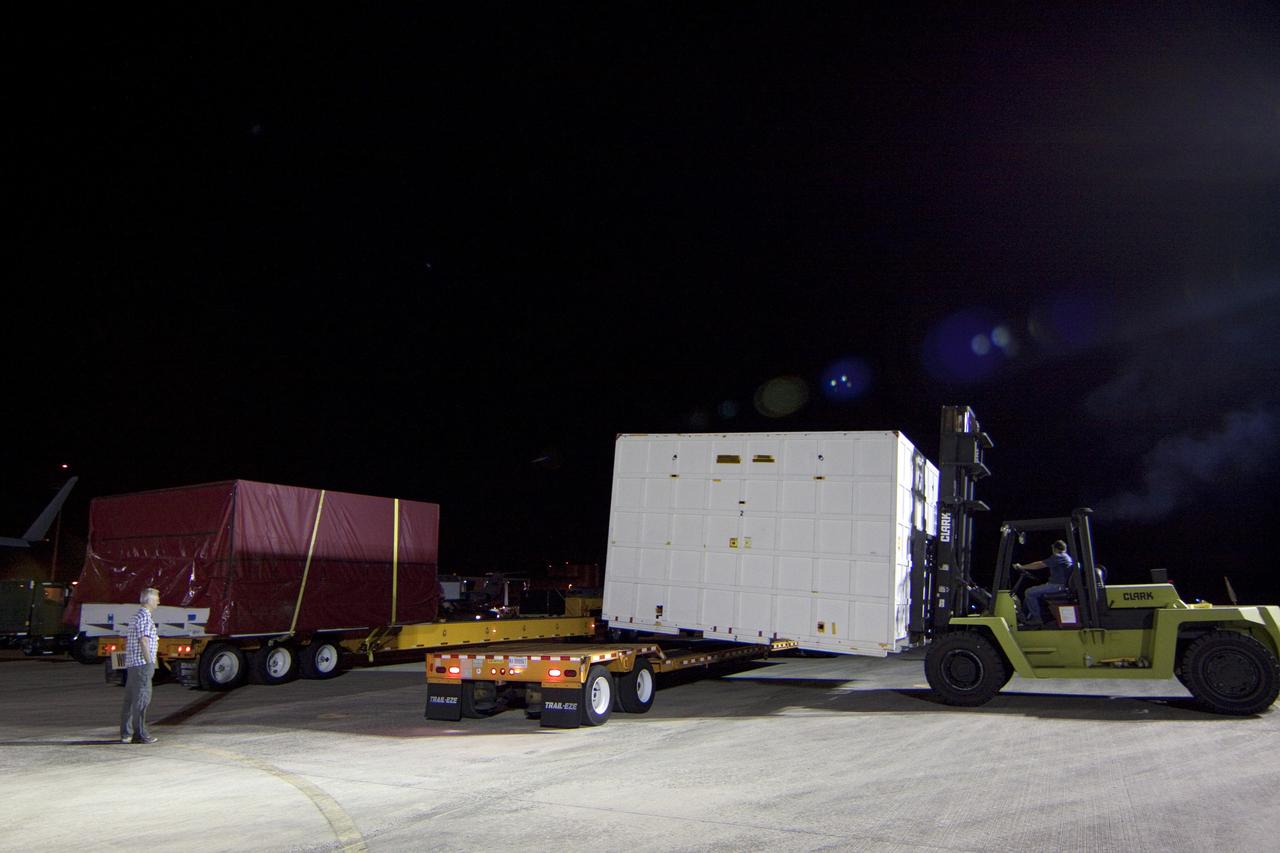
CAPE CANAVERAL, Fla. -- Workers load onto a transporter a container holding the back shell, one of the first three elements for NASA's Mars Science Laboratory (MSL), that arrived at NASA Kennedy Space Center's Shuttle Landing Facility. The cruise stage, back shell and heat shield, the first flight elements to arrive for the MSL mission, were taken to the Payload Hazardous Servicing Facility (PHSF) located in the KSC Industrial Area to begin processing. The Curiosity rover will arrive next month. A United Launch Alliance Atlas V-541 configuration will be used to loft MSL into space. Curiosity’s 10 science instruments are designed to search for evidence on whether Mars has had environments favorable to microbial life, including chemical ingredients for life. The unique rover will use a laser to look inside rocks and release its gasses so that the rover’s spectrometer can analyze and send the data back to Earth. MSL is scheduled to launch from Cape Canaveral Air Force Station in Florida Nov. 25 with a window extending to Dec. 18 and arrival at Mars Aug. 2012. For more information, visit http://www.nasa.gov/msl. Photo credit: NASA/Troy Cryder
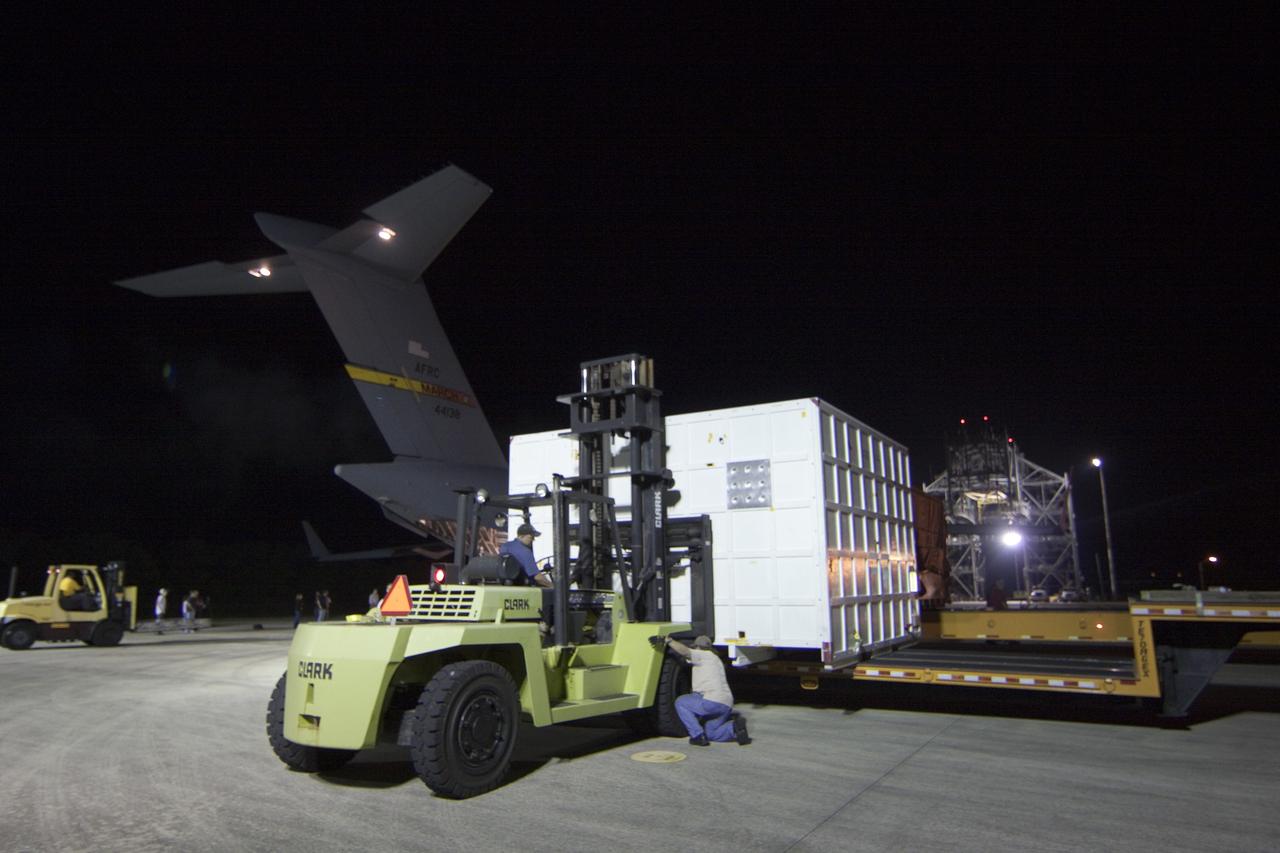
CAPE CANAVERAL, Fla. -- Workers load onto a transporter a container holding the back shell, one of the first three elements for NASA's Mars Science Laboratory (MSL), that arrived at NASA Kennedy Space Center's Shuttle Landing Facility. The cruise stage, back shell and heat shield, the first flight elements to arrive for the MSL mission, were taken to the Payload Hazardous Servicing Facility (PHSF) located in the KSC Industrial Area to begin processing. The Curiosity rover will arrive next month. A United Launch Alliance Atlas V-541 configuration will be used to loft MSL into space. Curiosity’s 10 science instruments are designed to search for evidence on whether Mars has had environments favorable to microbial life, including chemical ingredients for life. The unique rover will use a laser to look inside rocks and release its gasses so that the rover’s spectrometer can analyze and send the data back to Earth. MSL is scheduled to launch from Cape Canaveral Air Force Station in Florida Nov. 25 with a window extending to Dec. 18 and arrival at Mars Aug. 2012. For more information, visit http://www.nasa.gov/msl. Photo credit: NASA/Troy Cryder
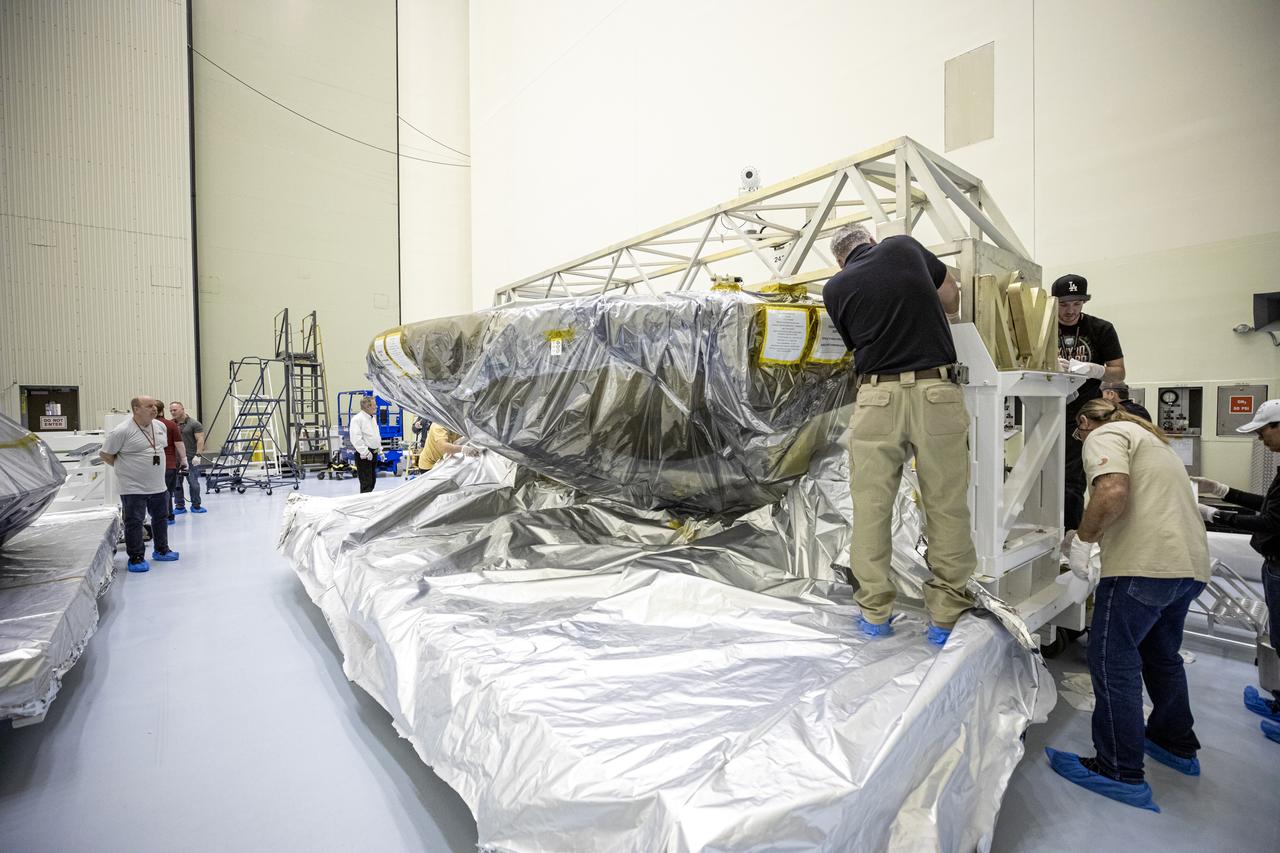
The heat shield and back shell for the Mars 2020 rover are unboxed inside the Payload Hazardous Servicing Facility at NASA’s Kennedy Space Center on Dec. 13, 2019. The two integral pieces of equipment, which were flown to the Florida spaceport from Lockheed Martin Space in Denver, Colorado, will protect the rover during its passage to Mars. The Mars 2020 rover is being manufactured at NASA’s Jet Propulsion Laboratory in California. When completed, the rover will be delivered to Kennedy in mid-February, 2020, with the mission scheduled to launch in the summer of 2020.
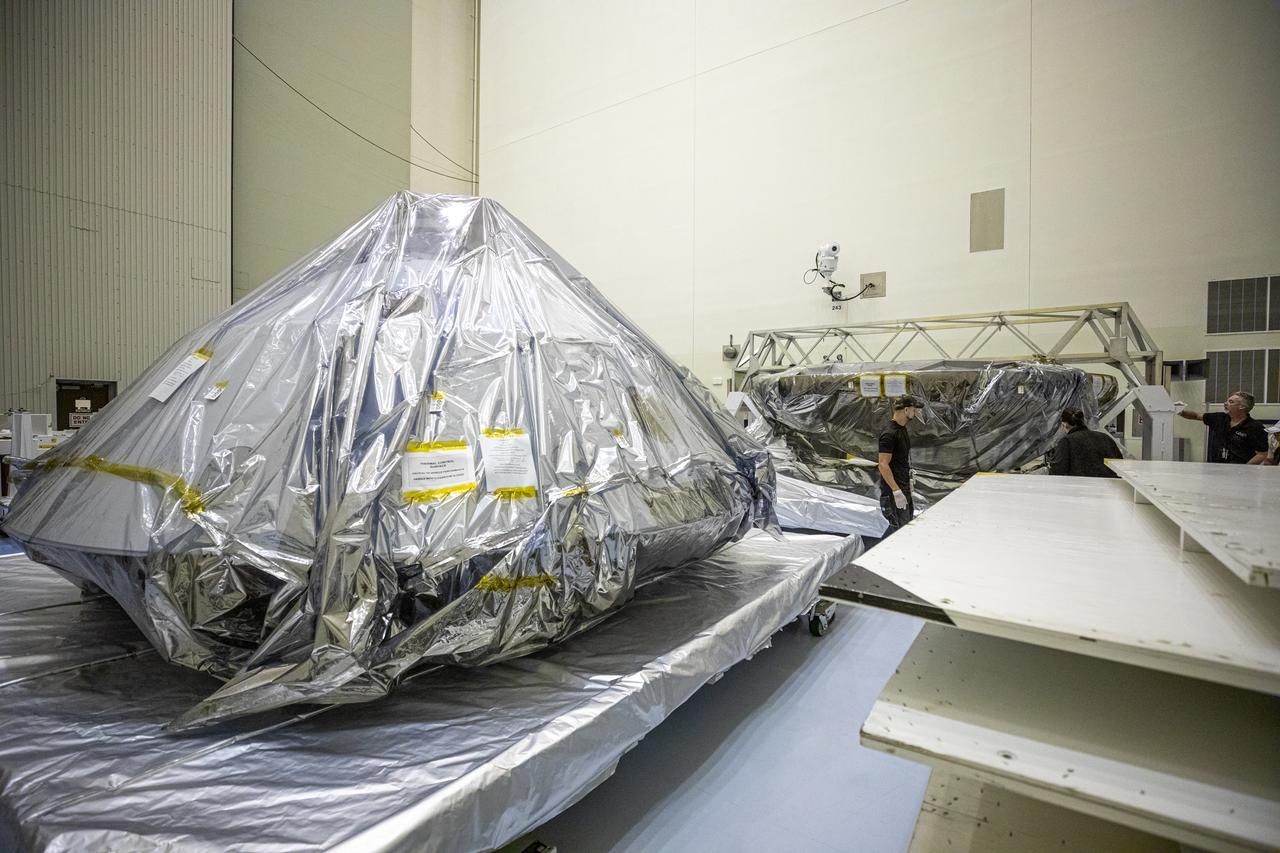
The heat shield and back shell for the Mars 2020 rover are unboxed inside the Payload Hazardous Servicing Facility at NASA’s Kennedy Space Center on Dec. 13, 2019. The two integral pieces of equipment, which were flown to the Florida spaceport from Lockheed Martin Space in Denver, Colorado, will protect the rover during its passage to Mars. The Mars 2020 rover is being manufactured at NASA’s Jet Propulsion Laboratory in California. When completed, the rover will be delivered to Kennedy in mid-February, 2020, with the mission scheduled to launch in the summer of 2020.
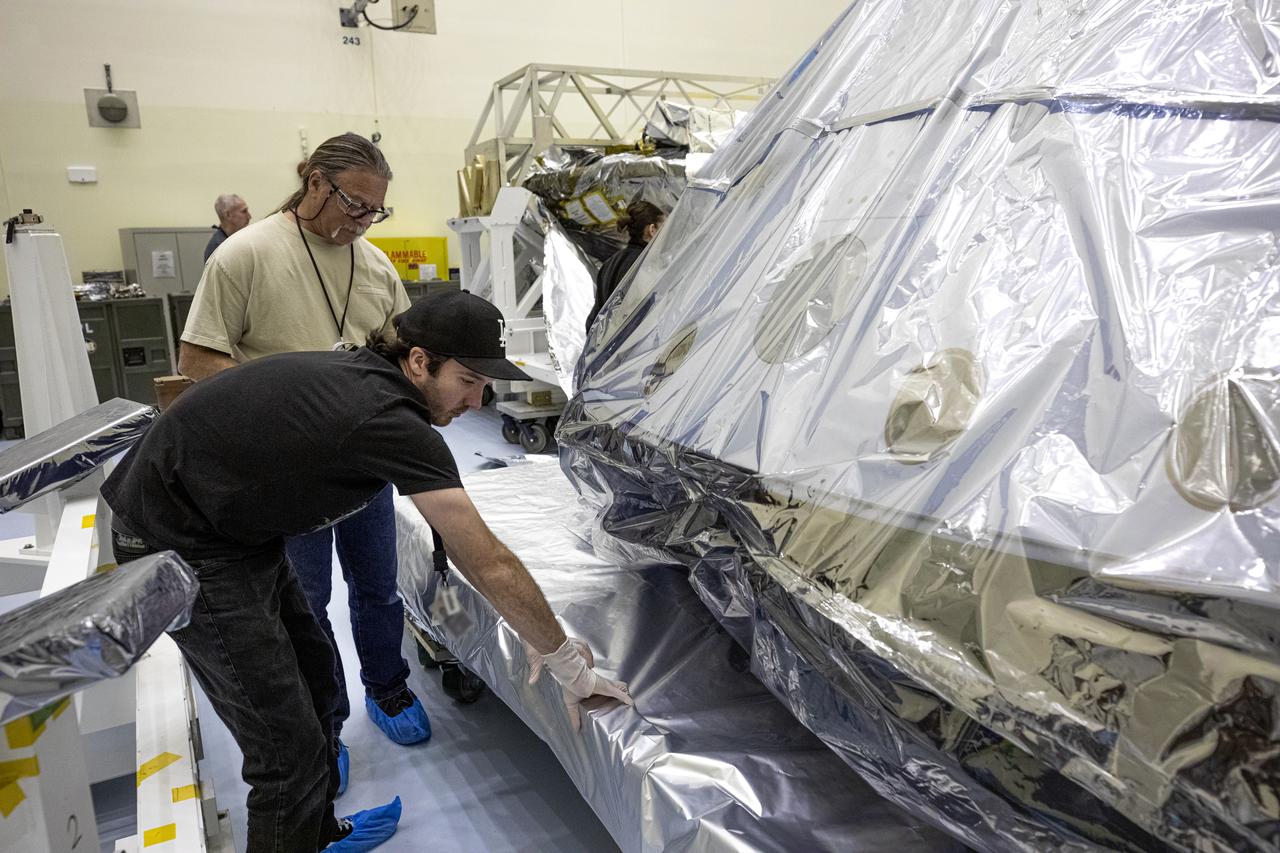
The heat shield and back shell for the Mars 2020 rover are unboxed inside the Payload Hazardous Servicing Facility at NASA’s Kennedy Space Center on Dec. 13, 2019. The two integral pieces of equipment, which were flown to the Florida spaceport from Lockheed Martin Space in Denver, Colorado, will protect the rover during its passage to Mars. The Mars 2020 rover is being manufactured at NASA’s Jet Propulsion Laboratory in California. When completed, the rover will be delivered to Kennedy in mid-February, 2020, with the mission scheduled to launch in the summer of 2020.

On March 15, the base heat shield for Boeing’s CST-100 Starliner was freshly installed on the bottom of Spacecraft 1 in the High Bay of the Commercial Crew and Cargo Processing Facility at Kennedy Space Center. This is the spacecraft that will fly during the Pad Abort Test. The next step involves installation of the back shells and forward heat shield, and then the crew module will be mated to the service module for a fit check. Finally, the vehicle will head out to White Sands Missile Range in New Mexico for testing.
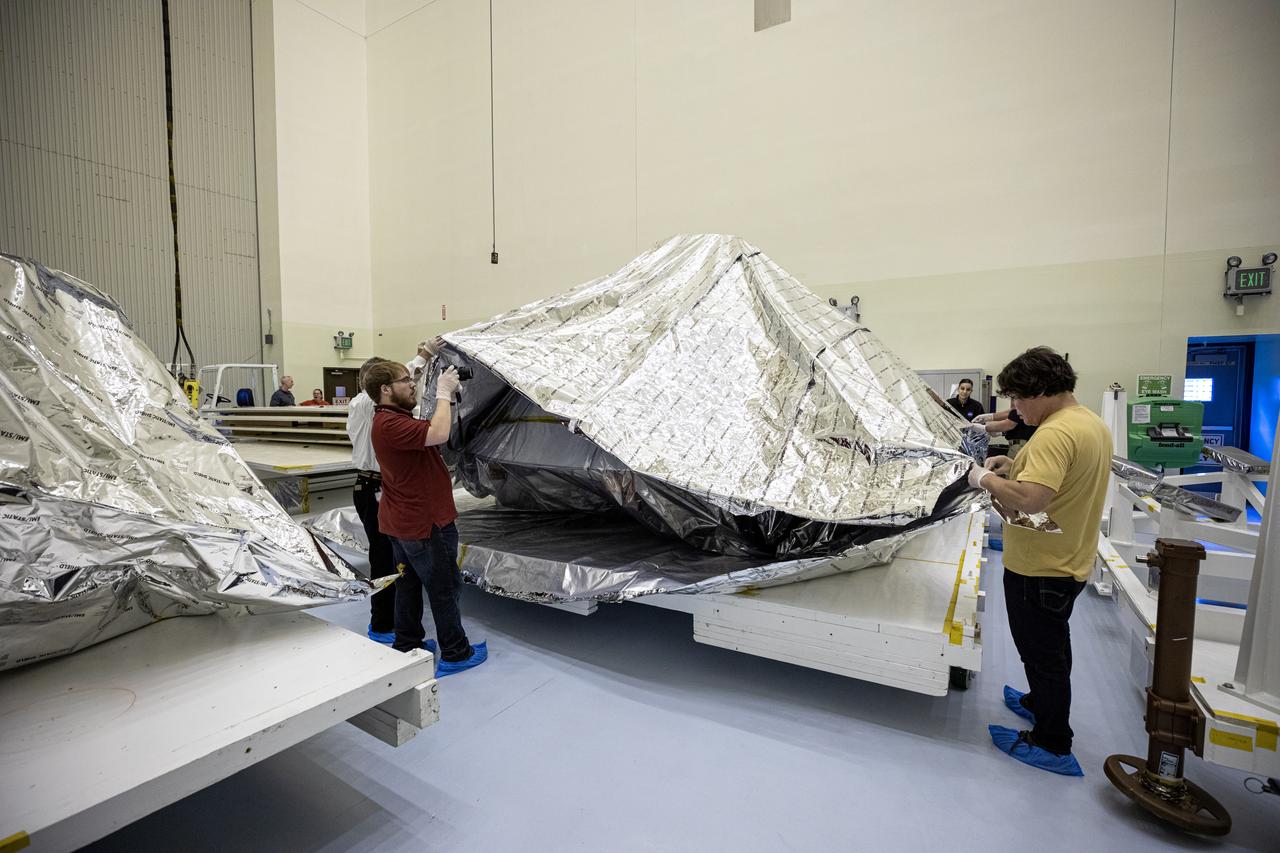
The heat shield and back shell for the Mars 2020 rover are unboxed inside the Payload Hazardous Servicing Facility at NASA’s Kennedy Space Center on Dec. 13, 2019. The two integral pieces of equipment, which were flown to the Florida spaceport from Lockheed Martin Space in Denver, Colorado, will protect the rover during its passage to Mars. The Mars 2020 rover is being manufactured at NASA’s Jet Propulsion Laboratory in California. When completed, the rover will be delivered to Kennedy in mid-February, 2020, with the mission scheduled to launch in the summer of 2020.
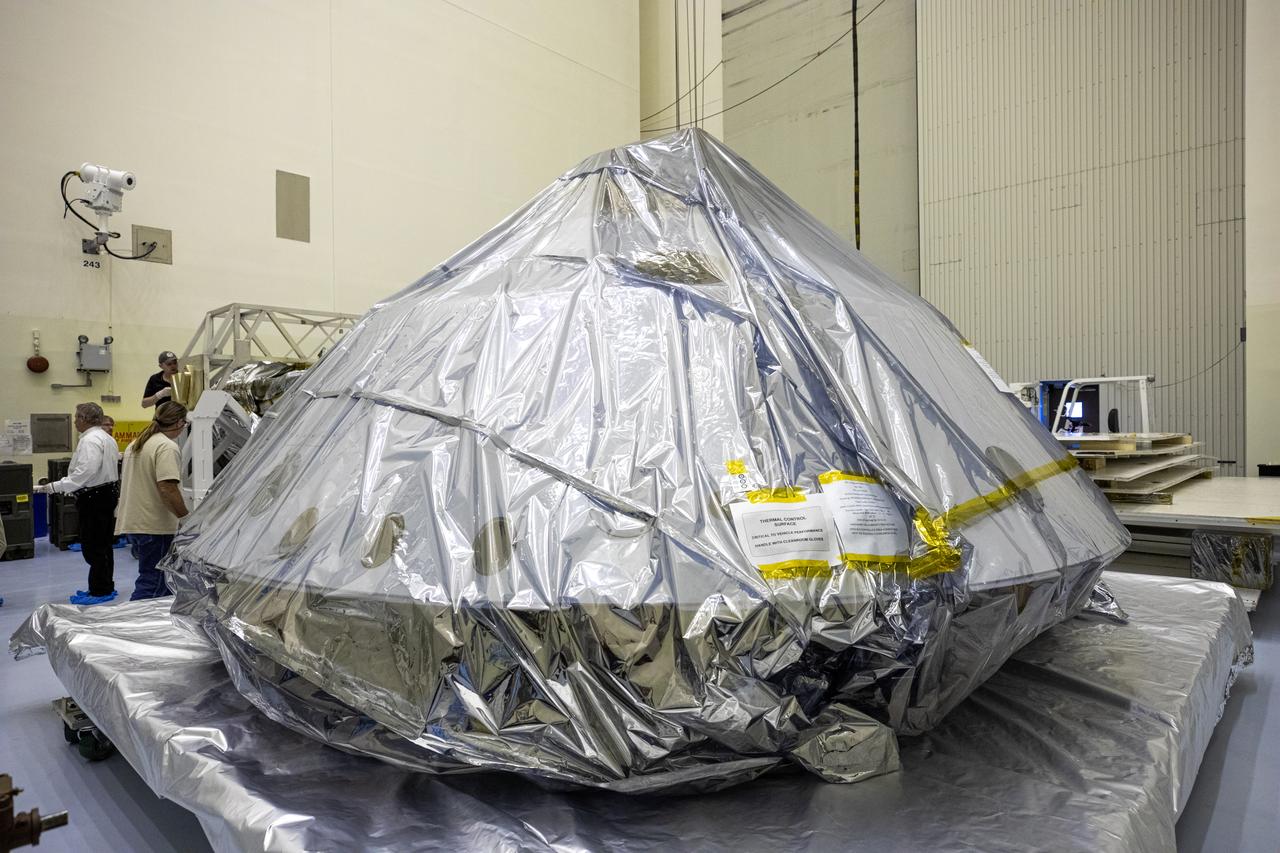
The heat shield and back shell for the Mars 2020 rover are unboxed inside the Payload Hazardous Servicing Facility at NASA’s Kennedy Space Center on Dec. 13, 2019. The two integral pieces of equipment, which were flown to the Florida spaceport from Lockheed Martin Space in Denver, Colorado, will protect the rover during its passage to Mars. The Mars 2020 rover is being manufactured at NASA’s Jet Propulsion Laboratory in California. When completed, the rover will be delivered to Kennedy in mid-February, 2020, with the mission scheduled to launch in the summer of 2020.
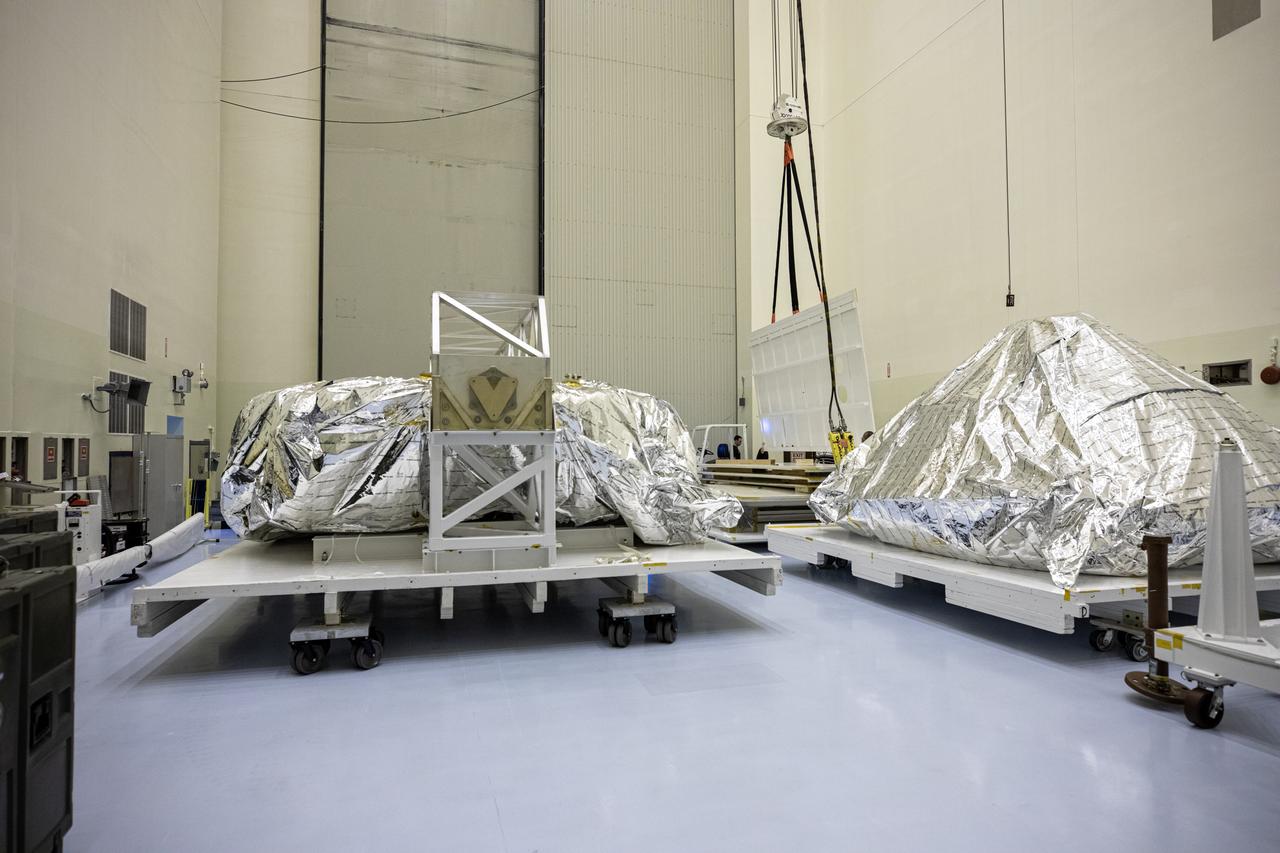
The heat shield and back shell for the Mars 2020 rover are unboxed inside the Payload Hazardous Servicing Facility at NASA’s Kennedy Space Center on Dec. 13, 2019. The two integral pieces of equipment, which were flown to the Florida spaceport from Lockheed Martin Space in Denver, Colorado, will protect the rover during its passage to Mars. The Mars 2020 rover is being manufactured at NASA’s Jet Propulsion Laboratory in California. When completed, the rover will be delivered to Kennedy in mid-February, 2020, with the mission scheduled to launch in the summer of 2020.
This photo shows the upper side of the cruise stage of NASA's InSight spacecraft as specialists at Lockheed Martin Space Systems, Denver, attach it to the spacecraft's back shell. The photo was taken on April 29, 2015. The cruise stage will serve multiple functions during the flight from Earth to Mars. It has its own solar arrays, thrusters and radio antennas. It will be jettisoned shortly before the spacecraft enters the Martian atmosphere. InSight, for Interior Exploration Using Seismic Investigations, Geodesy and Heat Transport, is scheduled for launch in March 2016 and landing in September 2016. It will study the deep interior of Mars to advance understanding of the early history of all rocky planets, including Earth. Note: After thorough examination, NASA managers have decided to suspend the planned March 2016 launch of the Interior Exploration using Seismic Investigations Geodesy and Heat Transport (InSight) mission. The decision follows unsuccessful attempts to repair a leak in a section of the prime instrument in the science payload. http://photojournal.jpl.nasa.gov/catalog/PIA19668
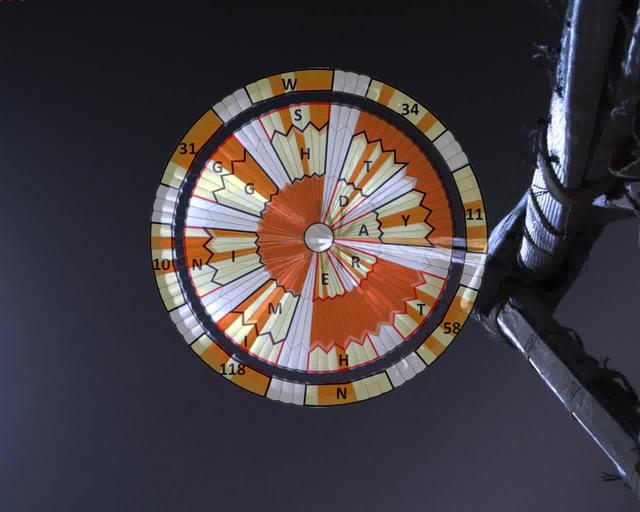
This annotated image was taken by a parachute-up-look camera aboard the protective back shell of NASA's Perseverance rover during its descent toward Mars' Jezero Crater on February 18, 2021. Using binary code, two messages have been encoded in the neutral white and international-orange parachute gores (the sections that make up the canopy's hemispherical shape). The inner portion spells out "DARE MIGHTY THINGS," with each word located on its own ring of gores. The outer band of the canopy provides GPS coordinates for NASA's Jet Propulsion Laboratory in Southern California, where the rover was built and the project is managed. Mars 2020 Perseverance Systems Engineer Ian Clark designed the binary code pattern. The saying is JPL's motto and is an abridgement of a quote from Teddy Roosevelt's "Strenuous Life" speech: "Far better is it to dare mighty things, to win glorious triumphs, even though checkered by failure ... than to rank with those poor spirits who neither enjoy nor suffer much, because they live in a gray twilight that knows not victory nor defeat." https://photojournal.jpl.nasa.gov/catalog/PIA24431
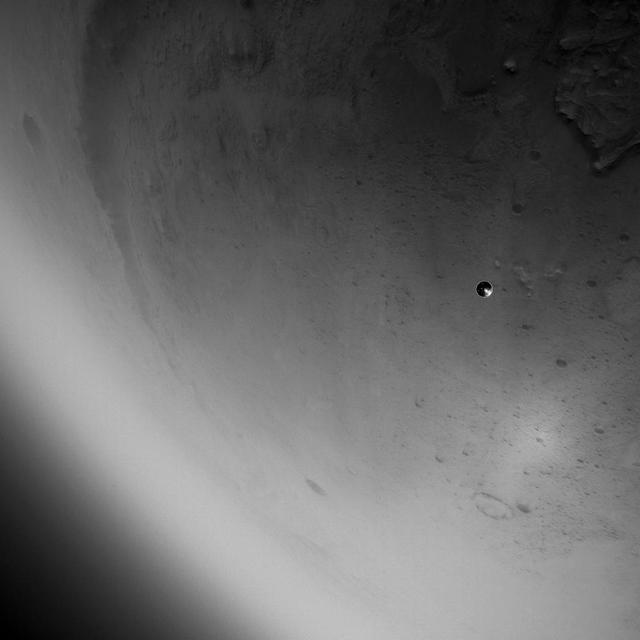
The heat shield drops away toward Mars after being released from the Mars 2020 back shell during the spacecraft's descent through the Martian atmosphere on Feb. 18, 2021. The heat shield and back shell encapsulated NASA's Perseverance rover on its journey to the Red Planet. This image was taken by the rover's Lander Vision System Camera (LCAM), serving as part of the Terrain-Relative Navigation system. This was the first use at Mars of the system, which compared images from below the spacecraft to an onboard map, helping to guide the spacecraft to a safe landing spot in Jezero Crater. Past missions had deemed Jezero Crater too hazardous to be a landing site because of its cliffs, dunes, and boulders. The LCAM generates 1024x1024 pixel grayscale images across a 90x90-degree field of view. The exposure time for each image is just under 150 microseconds, which enables crisp images during descent. LCAM was provided by Malin Space Science Systems in San Diego; the Perseverance rover was built and is operated by NASA's Jet Propulsion Laboratory in Southern California. JPL is a division of Caltech in Pasadena. https://photojournal.jpl.nasa.gov/catalog/PIA24447
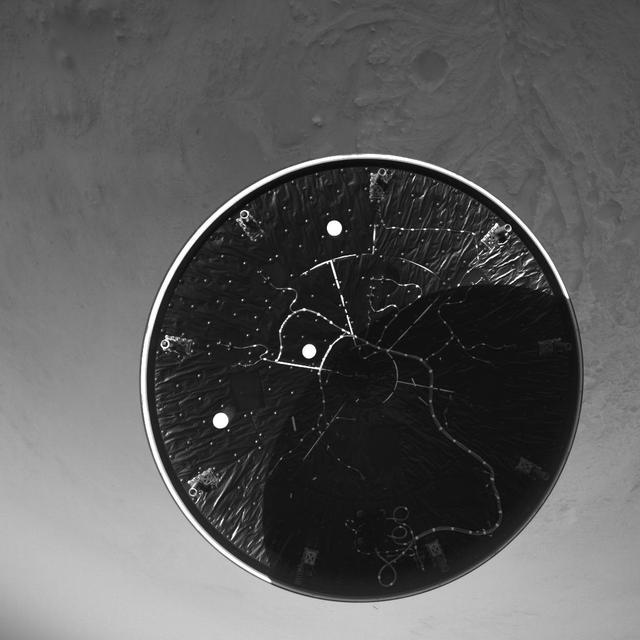
The heat shield drops away toward Mars after being released from the Mars 2020 back shell during the spacecraft's descent through the Martian atmosphere on Feb. 18, 2021. The heat shield and back shell encapsulated NASA's Perseverance rover on its journey to the Red Planet. This image was taken by the rover's Lander Vision System Camera (LCAM), serving as part of the Terrain-Relative Navigation system. This was the first use at Mars of the system, which compared images from below the spacecraft to an onboard map, helping to guide the spacecraft to a safe landing spot in Jezero Crater. Past missions had deemed Jezero Crater too hazardous to be a landing site because of its cliffs, dunes, and boulders. The LCAM generates 1024x1024 pixel grayscale images across a 90x90-degree field of view. The exposure time for each image is just under 150 microseconds, which enables crisp images during descent. LCAM was provided by Malin Space Science Systems in San Diego; the Perseverance rover was built and is operated by NASA's Jet Propulsion Laboratory in Southern California. JPL is a division of Caltech in Pasadena. https://photojournal.jpl.nasa.gov/catalog/PIA24446
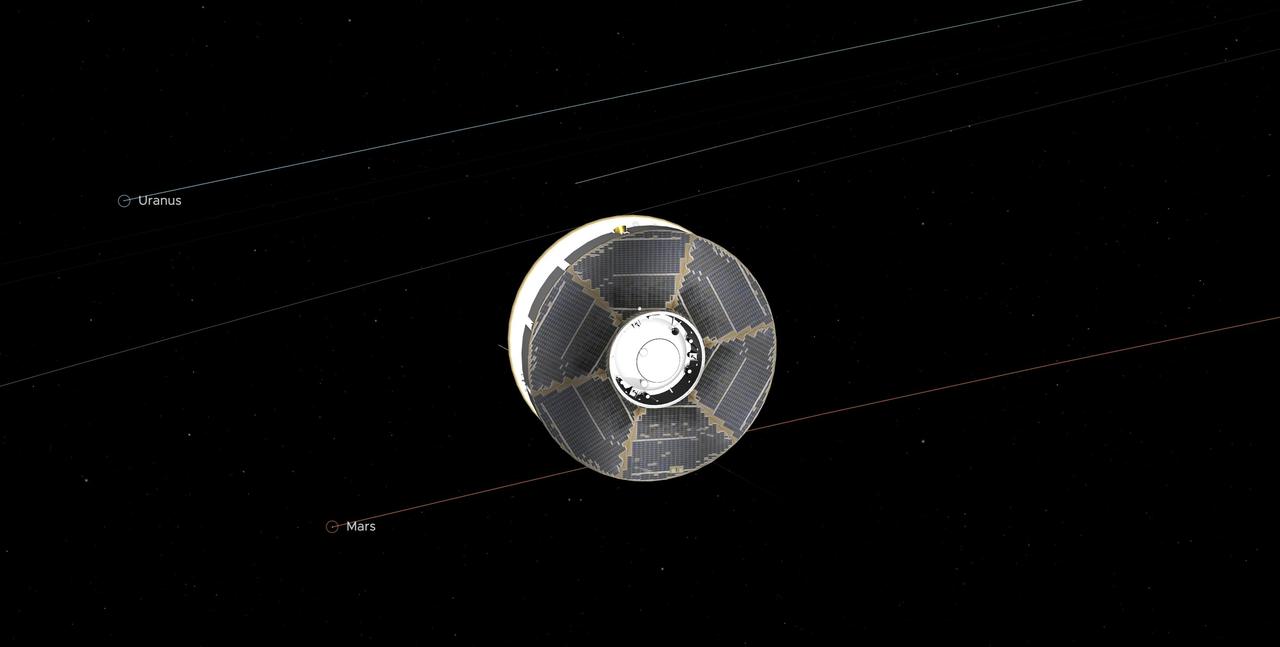
This illustration of the Mars 2020 spacecraft (the solar-panel-covered cruise stage most visible here along with a portion of the white back shell) in interplanetary space was generated using imagery from NASA's Eyes on the Solar System. The image is from the mission's midway point between Earth and Mars — 146.3 million miles (235.4 million kilometers) away from each. In straight-line distance, Earth is 26.6 million miles (42.7 million kilometers) behind Perseverance, and Mars is 17.9 million miles (28.8 million kilometers) in front. Visible in the graphic are the solar panels on the cruise stage surrounding the top of the aeroshell. https://photojournal.jpl.nasa.gov/catalog/PIA24231
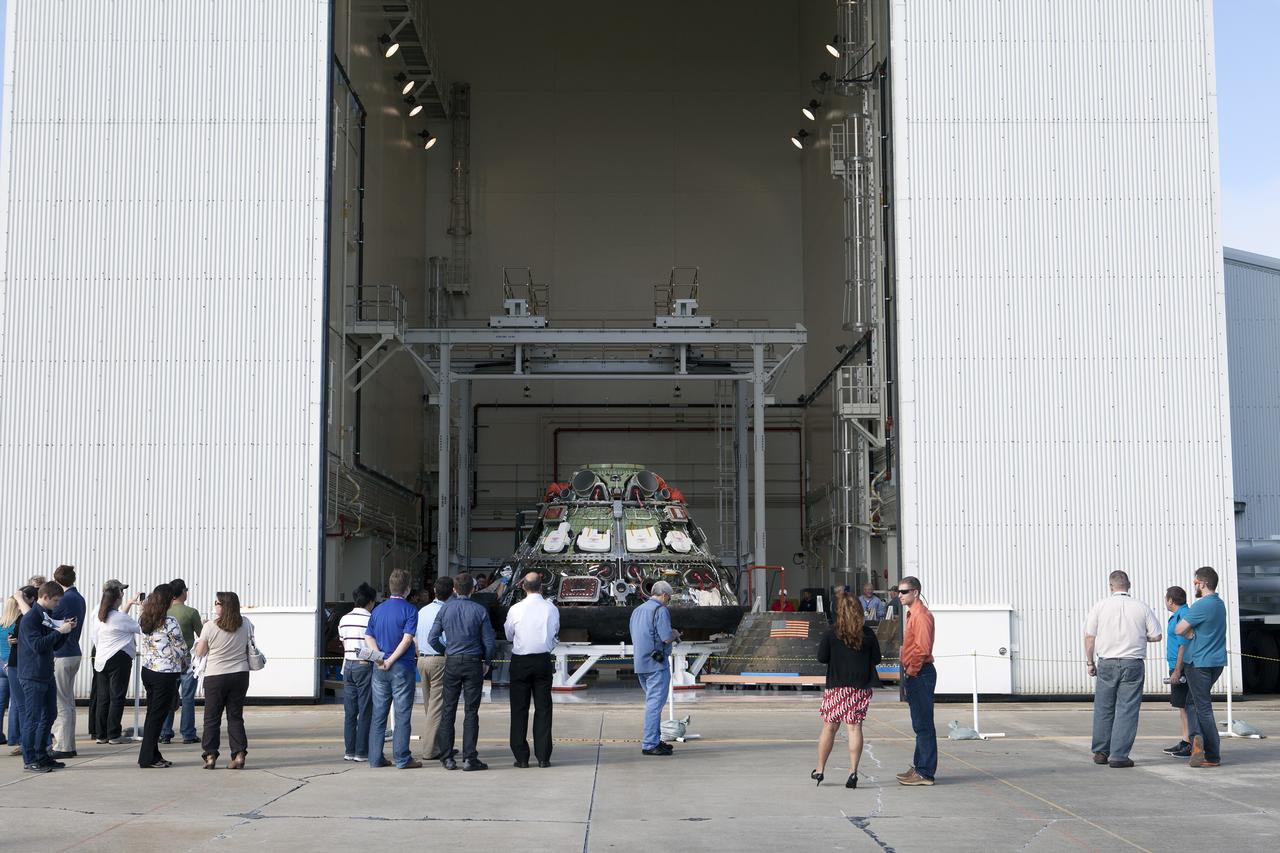
CAPE CANAVERAL, Fla. -- Workers take photographs of NASA's Orion spacecraft during a viewing at the Launch Abort System Facility at NASA's Kennedy Space Center in Florida. Orion's back shell panels have been removed. The spacecraft completed the first flight test in December, was retrieved from the Pacific Ocean, and transported 2,700 miles overland to Kennedy from Naval Base San Diego in California. Analysis of data obtained during its two-orbit, four-and-a-half hour mission Dec. 5 will provide engineers detailed information on how the spacecraft fared. Orion will be transported to the Payload Hazardous Servicing Facility for deservicing. For more information, visit www.nasa.gov/orion. Photo credit: NASA/Kim Shiflett
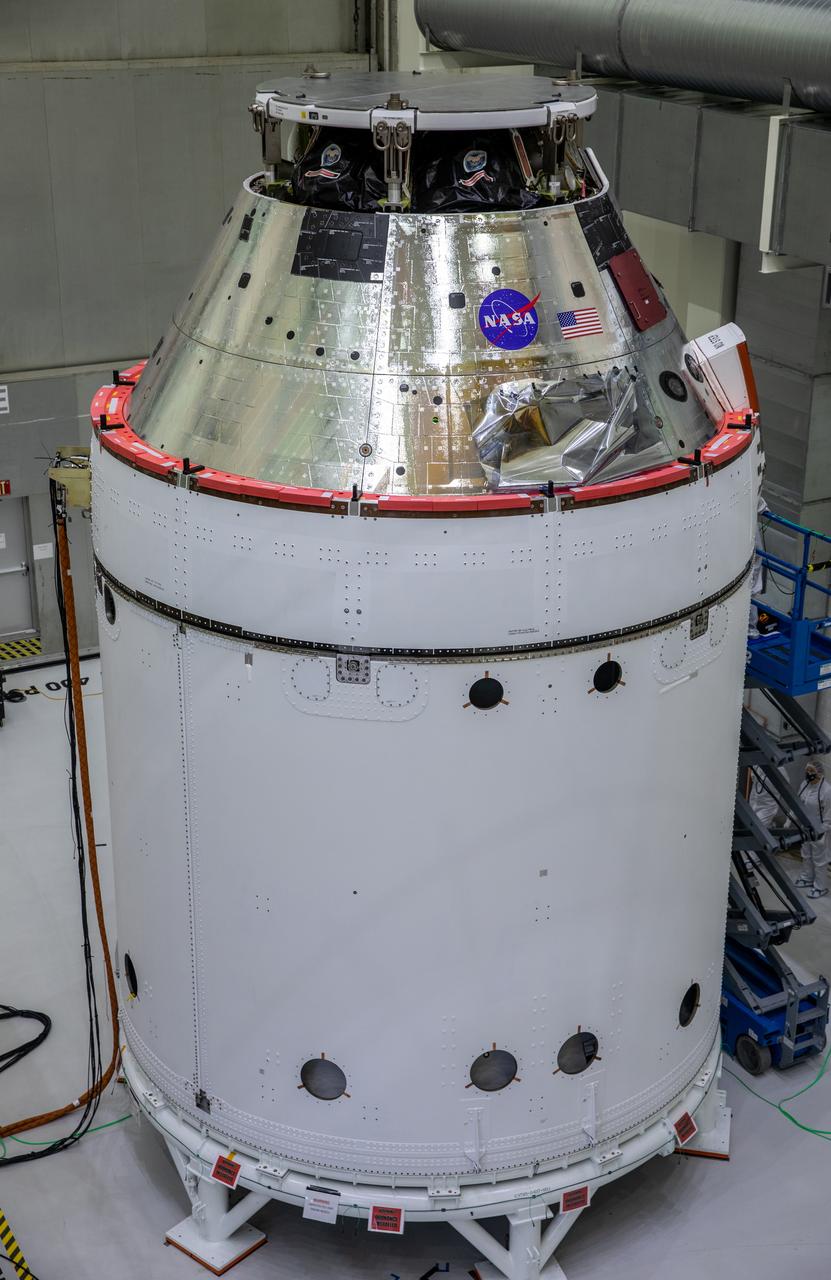
The NASA insignia, also called the “meatball,” and the American Flag are applied to the Orion crew module back shell for the Artemis I mission on Oct. 28, 2020, inside the Neil Armstrong Operations and Checkout Building at NASA’s Kennedy Space Center in Florida. Attached below Orion are the crew module adapter and the European Service Module (ESM) with spacecraft adapter jettison fairings installed. Recently, teams from across the globe installed the four solar array wings, which are housed inside the protective covering of the fairings. The fairing panels will encapsulate the ESM to protect it from harsh environments such as heat, wind, and acoustics as the spacecraft is propelled out of Earth’s atmosphere atop the Space Launch System rocket during NASA’s Artemis I mission.
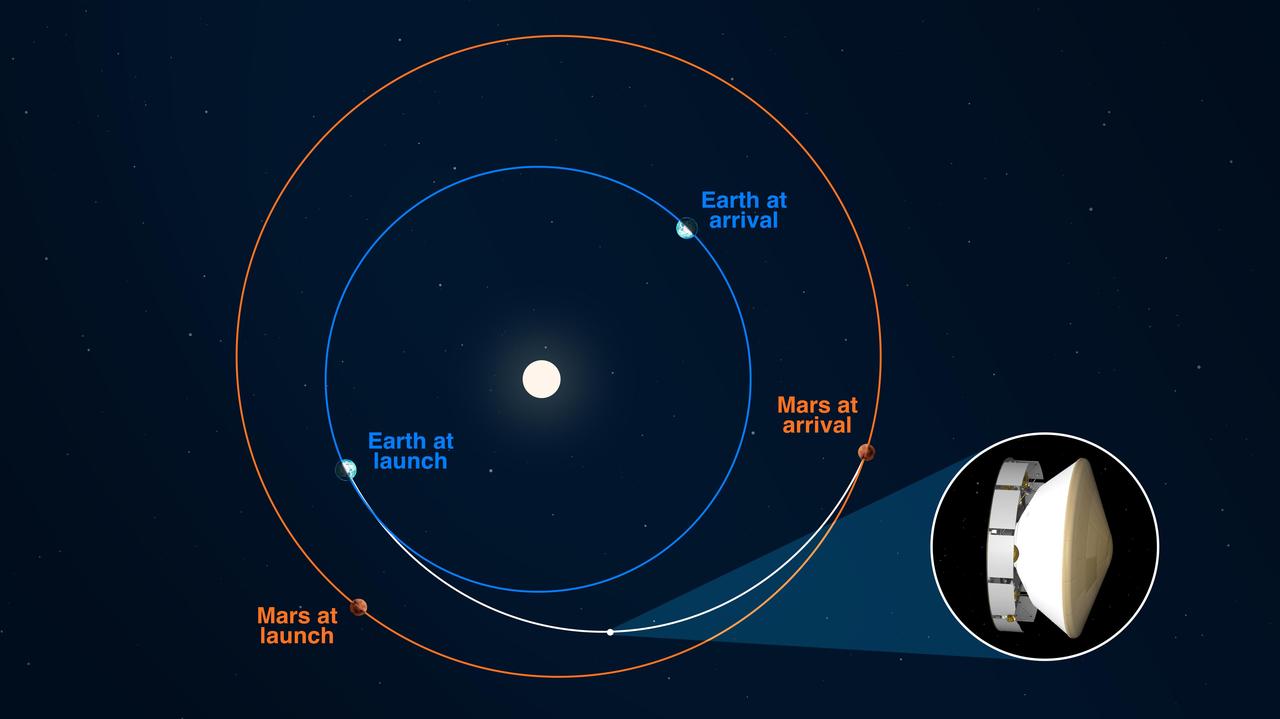
NASA's Mars 2020 Perseverance rover reached its halfway point to Jezero Crater on Oct. 27, 2020 at 1:40 p.m. PDT (4:40 EDT), having completed as many miles — 146.3 million miles (235.4 million kilometers) — as it has yet to travel on its journey to Mars. In straight-line distance, Earth is 26.6 million miles (42.7 million kilometers) behind Perseverance, and Mars is 17.9 million miles (28.8 million kilometers) in front. This illustration depicts the curved trajectory of the spacecraft (seen in inset: cruise stage, descent stage, back shell, and heat shield, plus the rover and Mars Helicopter), noting the positions of Earth and Mars relative to each other both at the time of launch and the time of landing. The trajectory's curvature is a result of the Sun's gravitational influence on the spacecraft. https://photojournal.jpl.nasa.gov/catalog/PIA24232
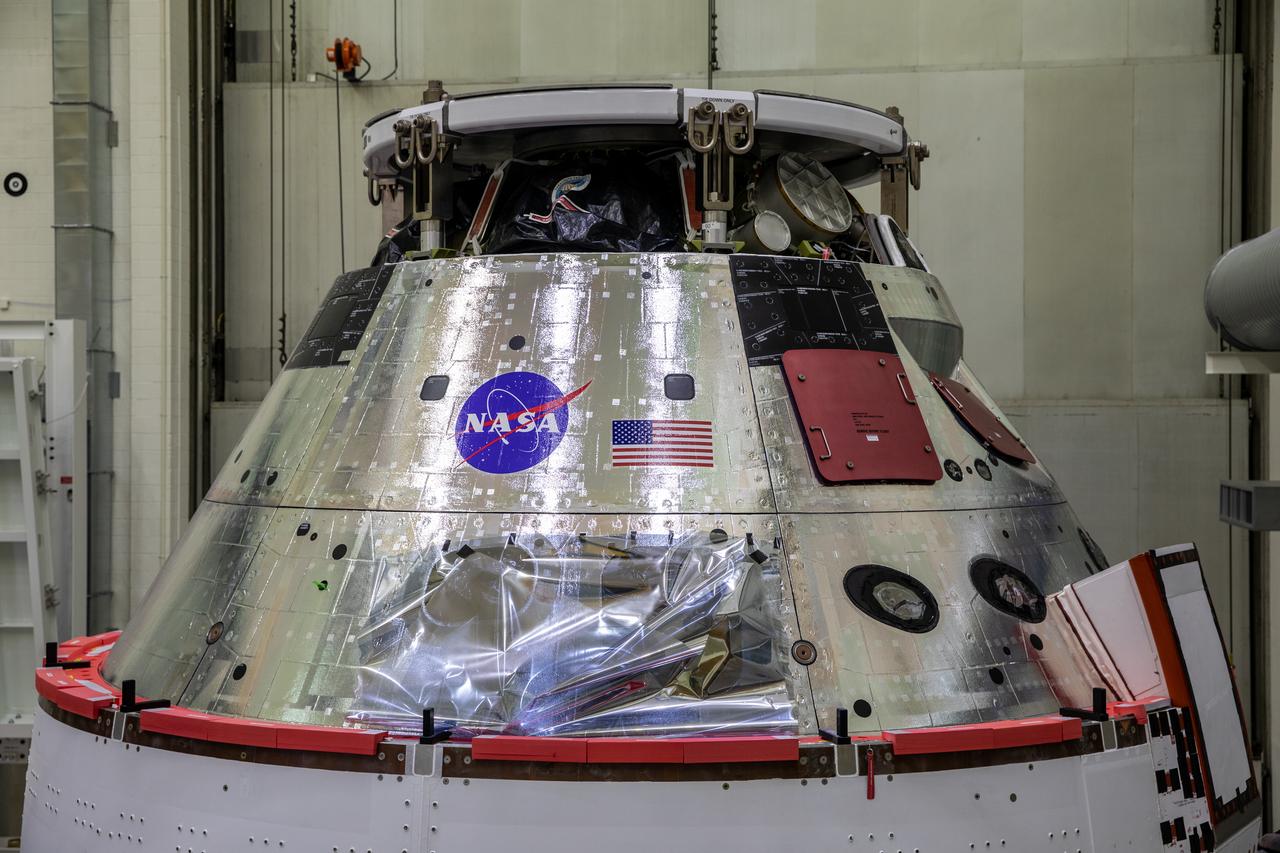
The NASA insignia, also called the “meatball,” and the American Flag are applied to the Orion crew module back shell for the Artemis I mission on Oct. 28, 2020, inside the Neil Armstrong Operations and Checkout Building at NASA’s Kennedy Space Center in Florida. Attached below Orion are the crew module adapter and the European Service Module (ESM) with spacecraft adapter jettison fairings installed. Recently, teams from across the globe installed the four solar array wings, which are housed inside the protective covering of the fairings. The fairing panels will encapsulate the ESM to protect it from harsh environments such as heat, wind, and acoustics as the spacecraft is propelled out of Earth’s atmosphere atop the Space Launch System rocket during NASA’s Artemis I mission.

NASA's Europa Clipper is tasked with up-close study of Jupiter's enigmatic moon Europa, which orbits the gas giant within a band of powerful radiation generated by the planet's strong magnetic field. The relative intensity of Jupiter's radiation bands is illustrated in this diagram, along with the orbits of Jupiter's three other largest moons: Io, Ganymede, and Callisto. To limit the damaging effects of radiation on the spacecraft, Europa Clipper will orbit Jupiter elliptically, dipping in for dozens of close flybys of Europa. Between each pass, the spacecraft will retreat to a safer distance from which it can safely transmit the science data it collects back to Earth. Europa Clipper's three main science objectives are to determine the thickness of the moon's icy shell and its interactions with the ocean below, to investigate its composition, and to characterize its geology. The mission's detailed exploration of Europa will help scientists better understand the astrobiological potential for habitable worlds beyond our planet. https://photojournal.jpl.nasa.gov/catalog/PIA26436
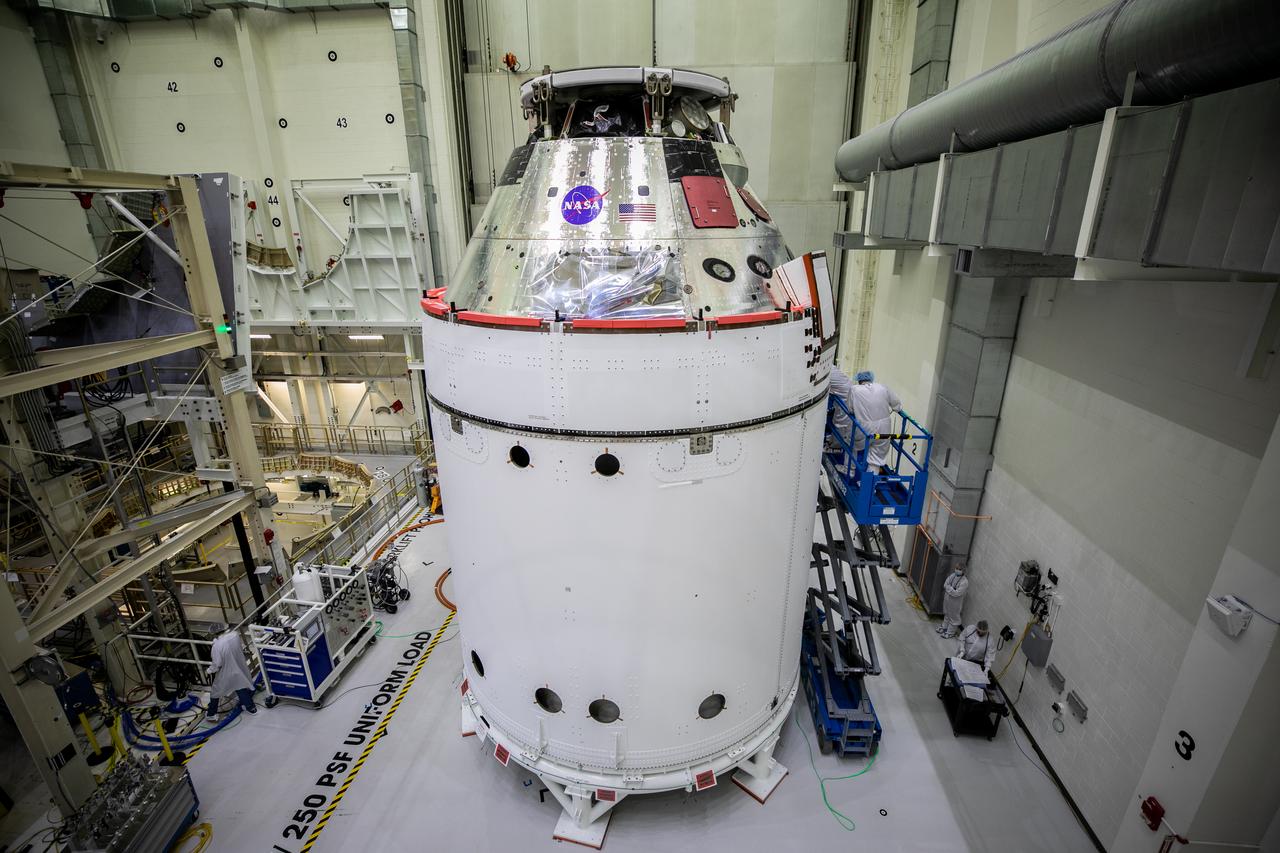
The Orion spacecraft for NASA’s Artemis I mission is in view inside the Neil Armstrong Operations and Checkout Building high bay on Oct. 28, 2020, at NASA’s Kennedy Space Center in Florida. The NASA insignia, also called the “meatball,” and the American Flag have been applied to the Orion crew module back shell. Attached below Orion are the crew module adapter and the European Service Module (ESM) with spacecraft adapter jettison fairings installed. Recently, teams from across the globe installed the four solar array wings, which are housed inside the protective covering of the fairings. The fairing panels will encapsulate the ESM to protect it from harsh environments such as heat, wind, and acoustics as the spacecraft is propelled out of Earth’s atmosphere atop the Space Launch System rocket during NASA’s Artemis I mission.
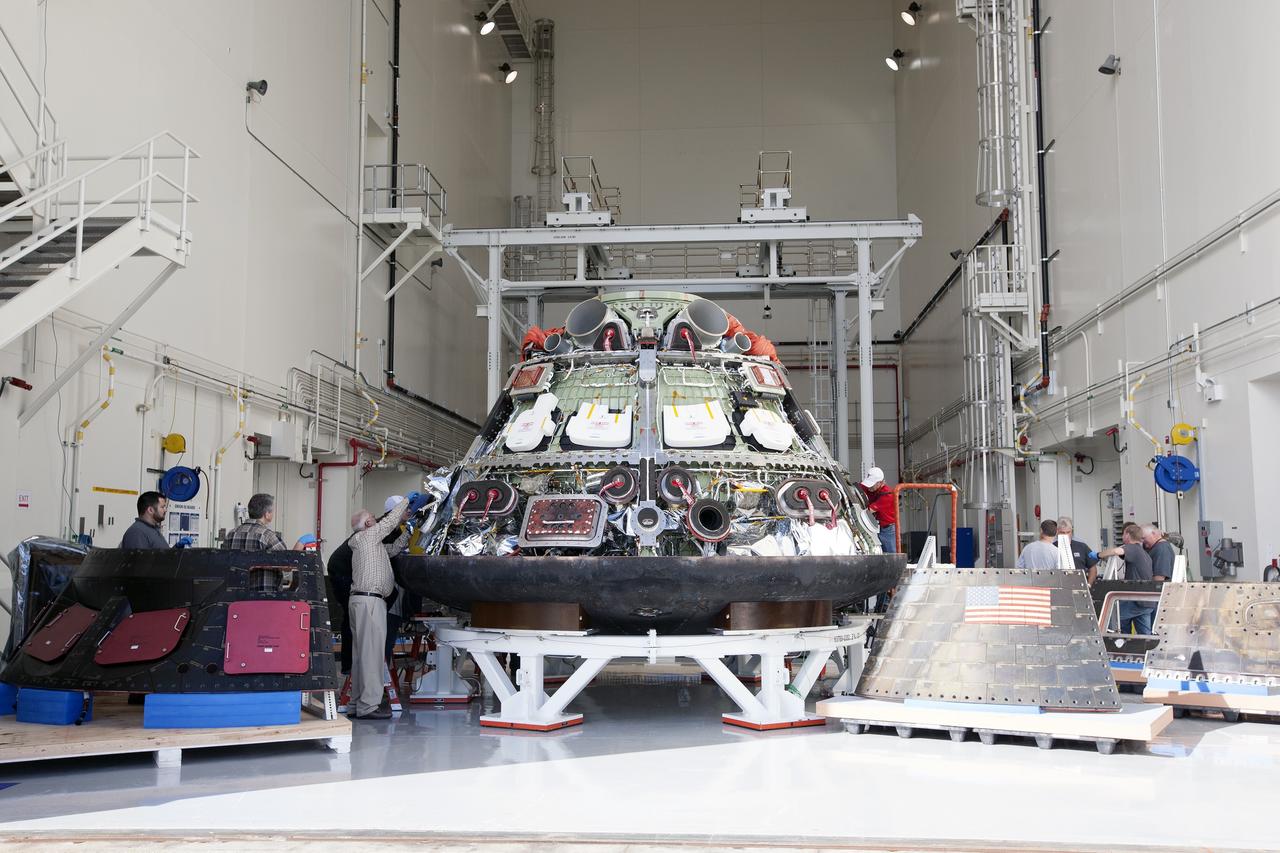
CAPE CANAVERAL, Fla. -- NASA's Orion spacecraft is positioned inside the Launch Abort System Facility at NASA's Kennedy Space Center in Florida in preparation for a viewing by Kennedy workers. Orion's back shell panels have been removed. The spacecraft completed the first flight test in December, was retrieved from the Pacific Ocean, and transported 2,700 miles overland to Kennedy from Naval Base San Diego in California. Analysis of data obtained during its two-orbit, four-and-a-half hour mission Dec. 5 will provide engineers detailed information on how the spacecraft fared. Orion will be transported to the Payload Hazardous Servicing Facility for deservicing. For more information, visit www.nasa.gov/orion. Photo credit: NASA/Kim Shiflett
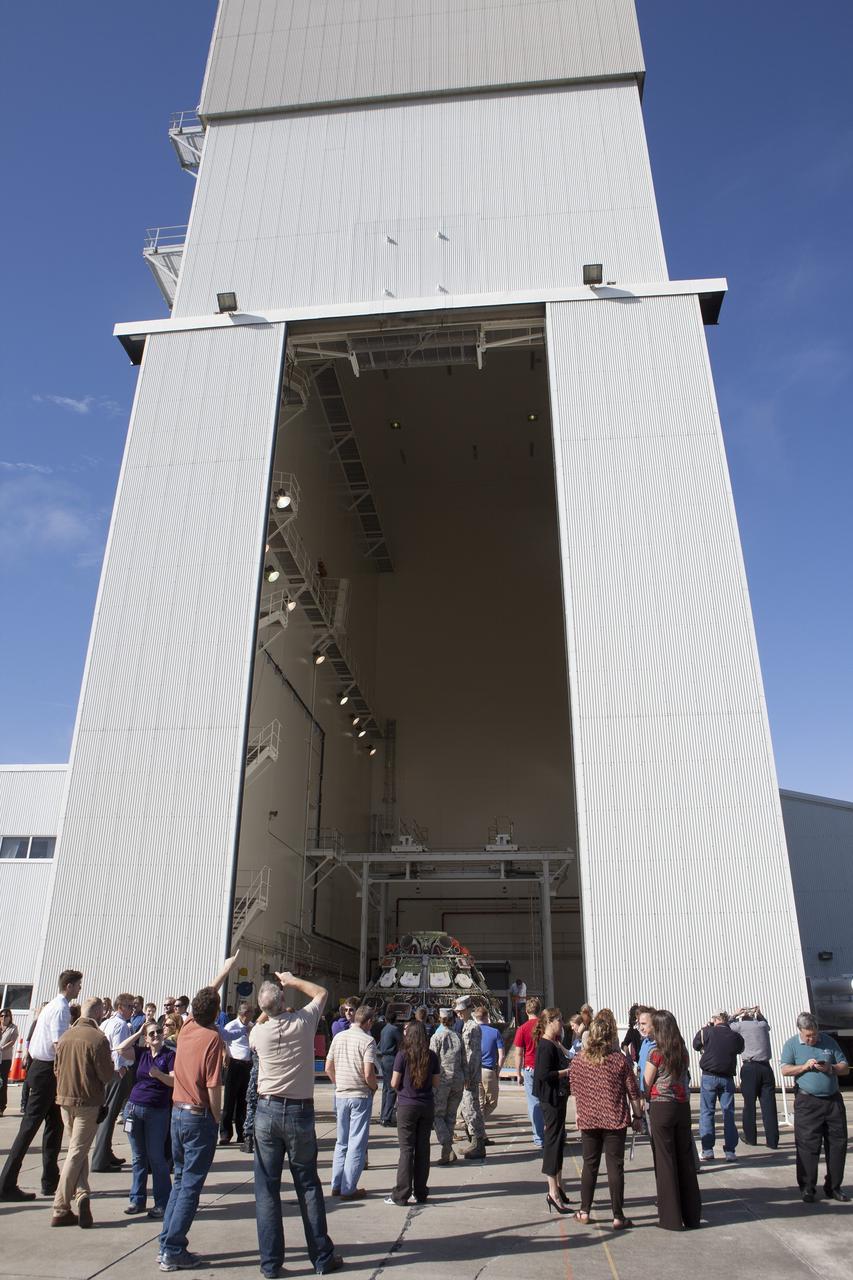
CAPE CANAVERAL, Fla. -- Workers take photographs of NASA's Orion spacecraft during a viewing at the Launch Abort System Facility at NASA's Kennedy Space Center in Florida. Orion's back shell panels have been removed. The spacecraft completed the first flight test in December, was retrieved from the Pacific Ocean, and transported 2,700 miles overland to Kennedy from Naval Base San Diego in California. Analysis of data obtained during its two-orbit, four-and-a-half hour mission Dec. 5 will provide engineers detailed information on how the spacecraft fared. Orion will be transported to the Payload Hazardous Servicing Facility for deservicing. For more information, visit www.nasa.gov/orion. Photo credit: NASA/Kim Shiflett
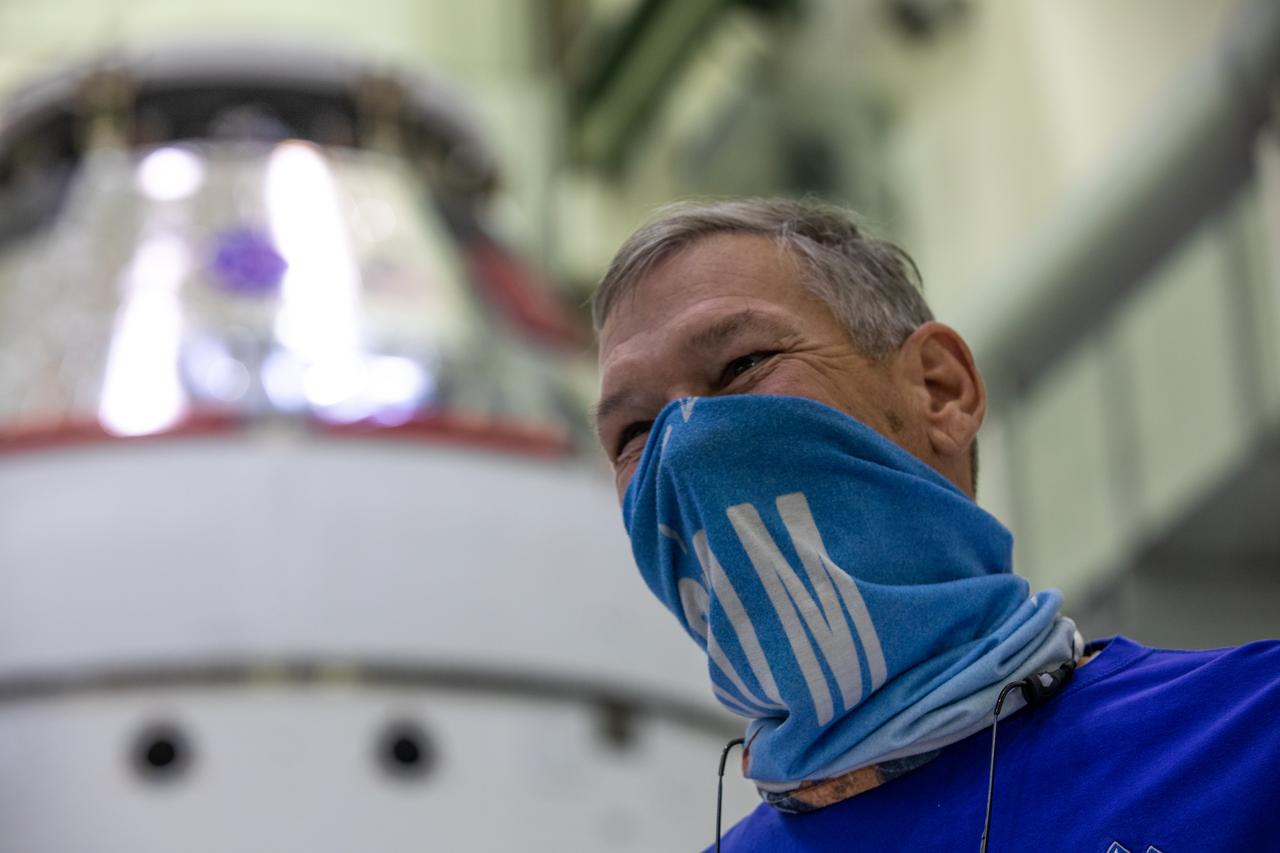
Todd Biddle, ASRC technician, is shown in the foreground with the Orion spacecraft for the Artemis I mission behind him inside the Neil Armstrong Operations and Checkout Building at NASA’s Kennedy Space Center in Florida on Oct. 28, 2020. The NASA insignia, also called the “meatball,” and American Fag have been applied to the Orion crew module back shell. Attached below Orion are the crew module adapter and the European Service Module (ESM) with spacecraft adapter jettison fairings installed. Recently, teams from across the globe installed the four solar array wings, which are housed inside the protective covering of the fairings. The fairing panels will encapsulate the ESM to protect it from harsh environments such as heat, wind, and acoustics as the spacecraft is propelled out of Earth’s atmosphere atop the Space Launch System rocket during NASA’s Artemis I mission.
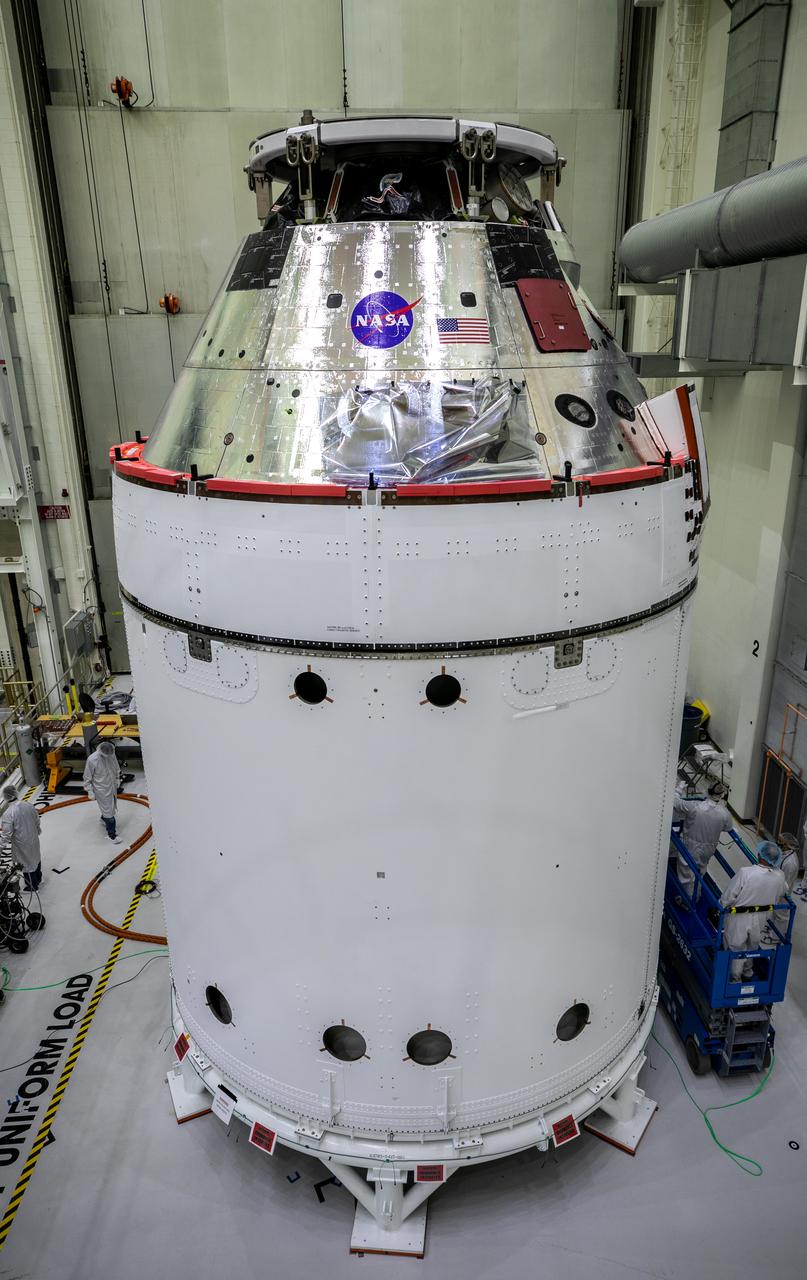
The NASA insignia, also called the “meatball,” and the American Flag are applied to the Orion crew module back shell for the Artemis I mission on Oct. 28, 2020, inside the Neil Armstrong Operations and Checkout Building at NASA’s Kennedy Space Center in Florida. Attached below Orion are the crew module adapter and the European Service Module (ESM) with spacecraft adapter jettison fairings installed. Recently, teams from across the globe installed the four solar array wings, which are housed inside the protective covering of the fairings. The fairing panels will encapsulate the ESM to protect it from harsh environments such as heat, wind, and acoustics as the spacecraft is propelled out of Earth’s atmosphere atop the Space Launch System rocket during NASA’s Artemis I mission.
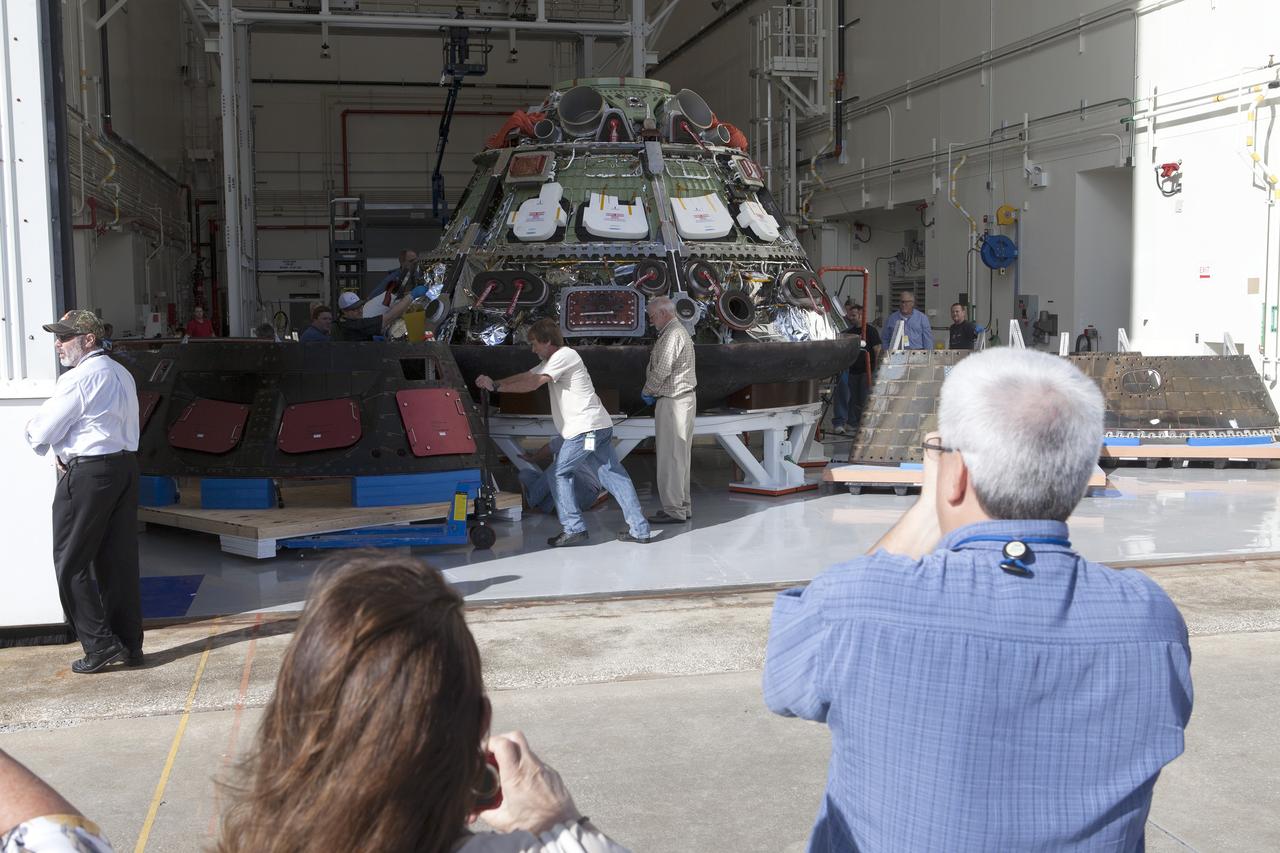
CAPE CANAVERAL, Fla. -- Workers take photographs of NASA's Orion spacecraft during a viewing at the Launch Abort System Facility at NASA's Kennedy Space Center in Florida. Orion's back shell panels have been removed. The spacecraft completed the first flight test in December, was retrieved from the Pacific Ocean, and transported 2,700 miles overland to Kennedy from Naval Base San Diego in California. Analysis of data obtained during its two-orbit, four-and-a-half hour mission Dec. 5 will provide engineers detailed information on how the spacecraft fared. Orion will be transported to the Payload Hazardous Servicing Facility for deservicing. For more information, visit www.nasa.gov/orion. Photo credit: NASA/Kim Shiflett

The NASA insignia, also called the “meatball,” and the American Flag are applied to the Orion crew module back shell for the Artemis I mission on Oct. 28, 2020, inside the Neil Armstrong Operations and Checkout Building at NASA’s Kennedy Space Center in Florida. Attached below Orion are the crew module adapter and the European Service Module (ESM) with spacecraft adapter jettison fairings installed. Recently, teams from across the globe installed the four solar array wings, which are housed inside the protective covering of the fairings. The fairing panels will encapsulate the ESM to protect it from harsh environments such as heat, wind, and acoustics as the spacecraft is propelled out of Earth’s atmosphere atop the Space Launch System rocket during NASA’s Artemis I mission.
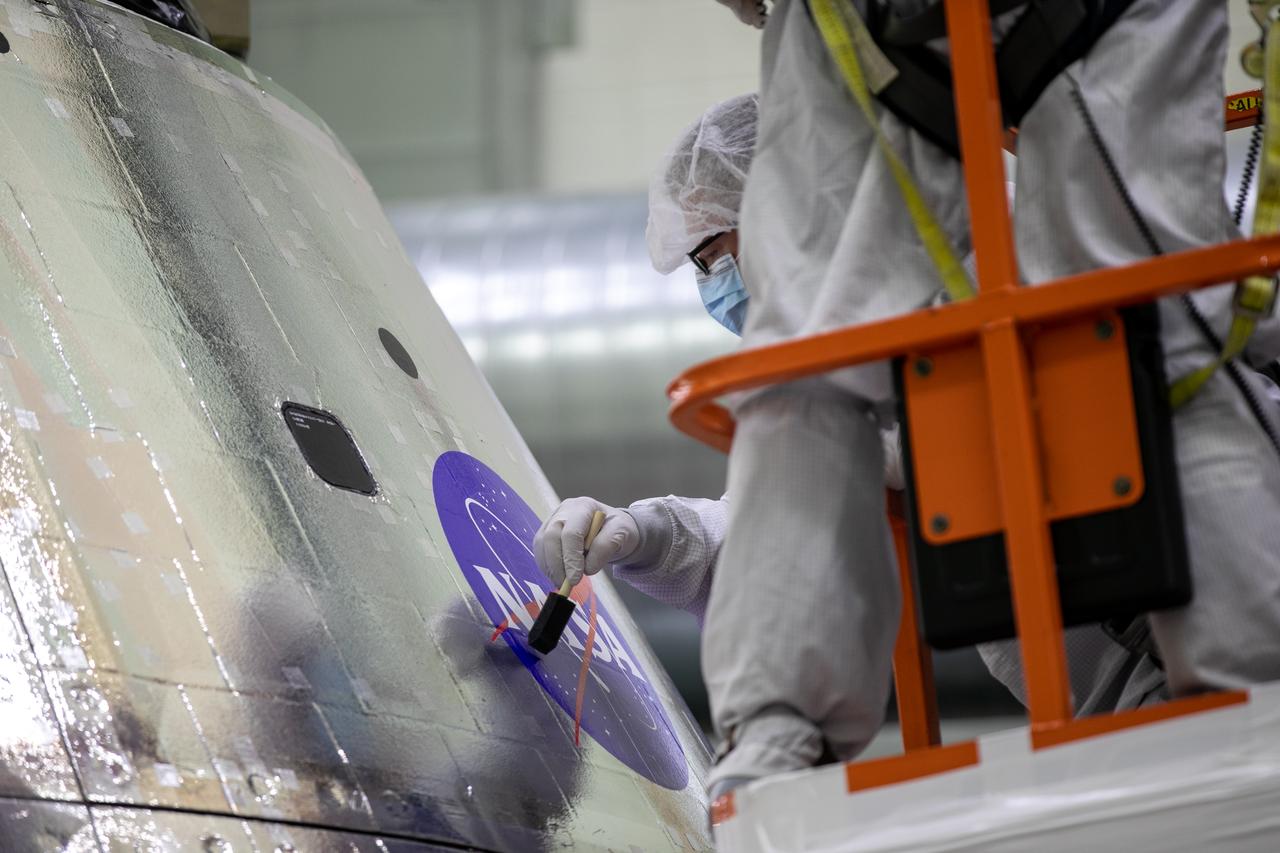
Frank Pelkey, ASRC technician, paints a clear adhesive over the NASA insignia, also called the “meatball,” on the Orion crew module back shell for the Artemis I mission on Oct. 28, 2020, inside the Neil Armstrong Operations and Checkout Building (O&C) at NASA’s Kennedy Space Center in Florida. The American Flag also has been added. Attached below Orion (not in view) are the crew module adapter and the European Service Module (ESM) with spacecraft adapter jettison fairings installed. Recently, teams from across the globe installed the four solar array wings, which are housed inside the protective covering of the fairings. The fairing panels will encapsulate the ESM to protect it from harsh environments such as heat, wind, and acoustics as the spacecraft is propelled out of Earth’s atmosphere atop the Space Launch System rocket during NASA’s Artemis I mission.
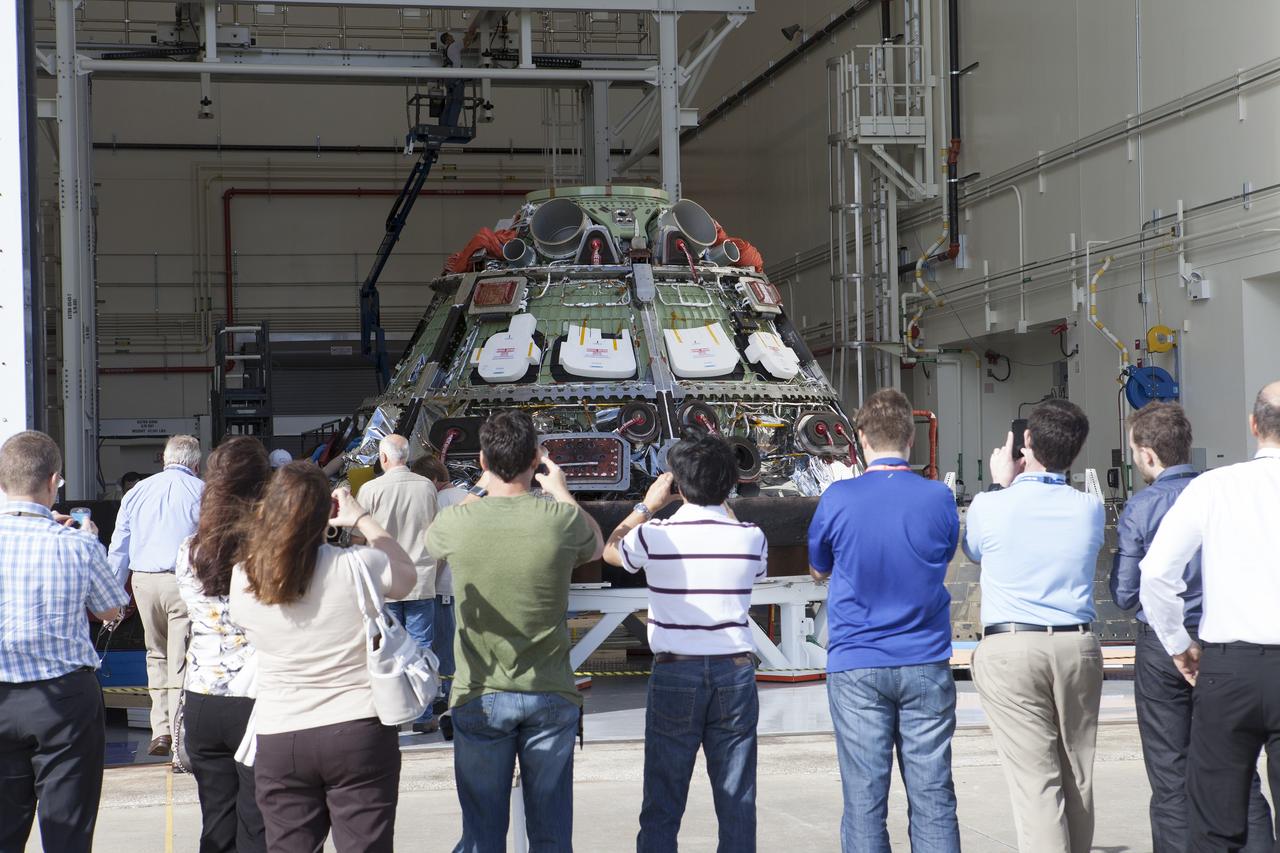
CAPE CANAVERAL, Fla. -- Workers take photographs of NASA's Orion spacecraft during a viewing at the Launch Abort System Facility at NASA's Kennedy Space Center in Florida. Orion's back shell panels have been removed. The spacecraft completed the first flight test in December, was retrieved from the Pacific Ocean, and transported 2,700 miles overland to Kennedy from Naval Base San Diego in California. Analysis of data obtained during its two-orbit, four-and-a-half hour mission Dec. 5 will provide engineers detailed information on how the spacecraft fared. Orion will be transported to the Payload Hazardous Servicing Facility for deservicing. For more information, visit www.nasa.gov/orion. Photo credit: NASA/Kim Shiflett

Shawn Corwin, at left, ASRC technician, Shawn Corwin, at left, points to the Orion spacecraft for the Artemis I mission inside the Neil Armstrong Operations and Checkout Building at NASA’s Kennedy Space Center in Florida on Oct. 28, 2020. At right is Eric Nolan, ASRC technician. The NASA insignia, also called the “meatball,” and American Flag have been applied to the Orion crew module back shell. Attached below Orion are the crew module adapter and the European Service Module (ESM) with spacecraft adapter jettison fairings installed. Recently, teams from across the globe installed the four solar array wings, which are housed inside the protective covering of the fairings. The fairing panels will encapsulate the ESM to protect it from harsh environments such as heat, wind, and acoustics as the spacecraft is propelled out of Earth’s atmosphere atop the Space Launch System rocket during NASA’s Artemis I mission.
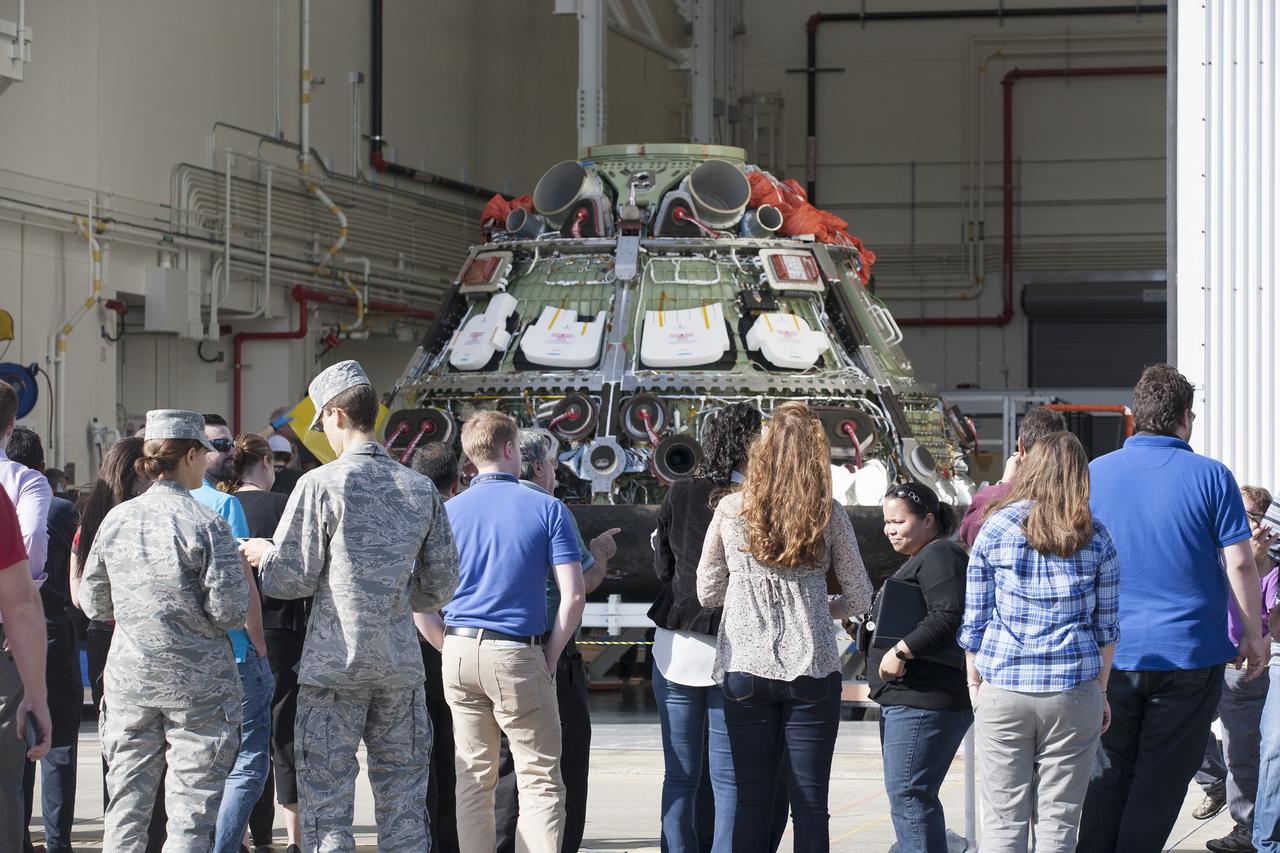
CAPE CANAVERAL, Fla. -- Workers take photographs of NASA's Orion spacecraft during a viewing at the Launch Abort System Facility at NASA's Kennedy Space Center in Florida. Orion's back shell panels have been removed. The spacecraft completed the first flight test in December, was retrieved from the Pacific Ocean, and transported 2,700 miles overland to Kennedy from Naval Base San Diego in California. Analysis of data obtained during its two-orbit, four-and-a-half hour mission Dec. 5 will provide engineers detailed information on how the spacecraft fared. Orion will be transported to the Payload Hazardous Servicing Facility for deservicing. For more information, visit www.nasa.gov/orion. Photo credit: NASA/Kim Shiflett
![This is one of three views of locations where hardware from the European Space Agency's Schiaparelli test lander reached the surface of Mars on Oct. 19, 2016, combine two orbital views from different angles as a stereo pair. The view was created to appear three-dimensional when seen through red-blue glasses with the red lens on the left, though the scene is too flat to show much relief. The stereo preparation uses images taken on Oct. 25, 2016, [PIA21131] and Nov. 1, 2016, [PIA21132] by the High Resolution Imaging Science Experiment (HiRISE) camera on NASA's Mars Reconnaissance Orbiter. The left-eye (red-tinted) component of the stereo is from the earlier observation, which was taken from farther west than the second observation. These views shows three sites where parts of the Schiaparelli spacecraft hit the ground: the lander module itself in the upper portion, the parachute and back shell at lower left, and the heat shield at lower right. The parachute's shape on the ground changed between the two observation dates, cancelling the three-dimensional effect of having views from different angles. The scale bar of 20 meters (65.6 feet) applies to all three portions. Schiaparelli was one component of the European Space Agency's ExoMars 2016 project, which placed the Trace Gas Orbiter into orbit around Mars on the same arrival date. The ExoMars project received data from Schiaparelli during its descent through the atmosphere. ESA has reported that the heat shield separated as planned, the parachute deployed as planned but was released (with back shell) prematurely, and the lander hit the ground at a velocity of more than 180 miles per hour (more than 300 kilometers per hour). More views are available at http://photojournal.jpl.nasa.gov/catalog/PIA21135](https://images-assets.nasa.gov/image/PIA21135/PIA21135~thumb.jpg)
This is one of three views of locations where hardware from the European Space Agency's Schiaparelli test lander reached the surface of Mars on Oct. 19, 2016, combine two orbital views from different angles as a stereo pair. The view was created to appear three-dimensional when seen through red-blue glasses with the red lens on the left, though the scene is too flat to show much relief. The stereo preparation uses images taken on Oct. 25, 2016, [PIA21131] and Nov. 1, 2016, [PIA21132] by the High Resolution Imaging Science Experiment (HiRISE) camera on NASA's Mars Reconnaissance Orbiter. The left-eye (red-tinted) component of the stereo is from the earlier observation, which was taken from farther west than the second observation. These views shows three sites where parts of the Schiaparelli spacecraft hit the ground: the lander module itself in the upper portion, the parachute and back shell at lower left, and the heat shield at lower right. The parachute's shape on the ground changed between the two observation dates, cancelling the three-dimensional effect of having views from different angles. The scale bar of 20 meters (65.6 feet) applies to all three portions. Schiaparelli was one component of the European Space Agency's ExoMars 2016 project, which placed the Trace Gas Orbiter into orbit around Mars on the same arrival date. The ExoMars project received data from Schiaparelli during its descent through the atmosphere. ESA has reported that the heat shield separated as planned, the parachute deployed as planned but was released (with back shell) prematurely, and the lander hit the ground at a velocity of more than 180 miles per hour (more than 300 kilometers per hour). More views are available at http://photojournal.jpl.nasa.gov/catalog/PIA21135
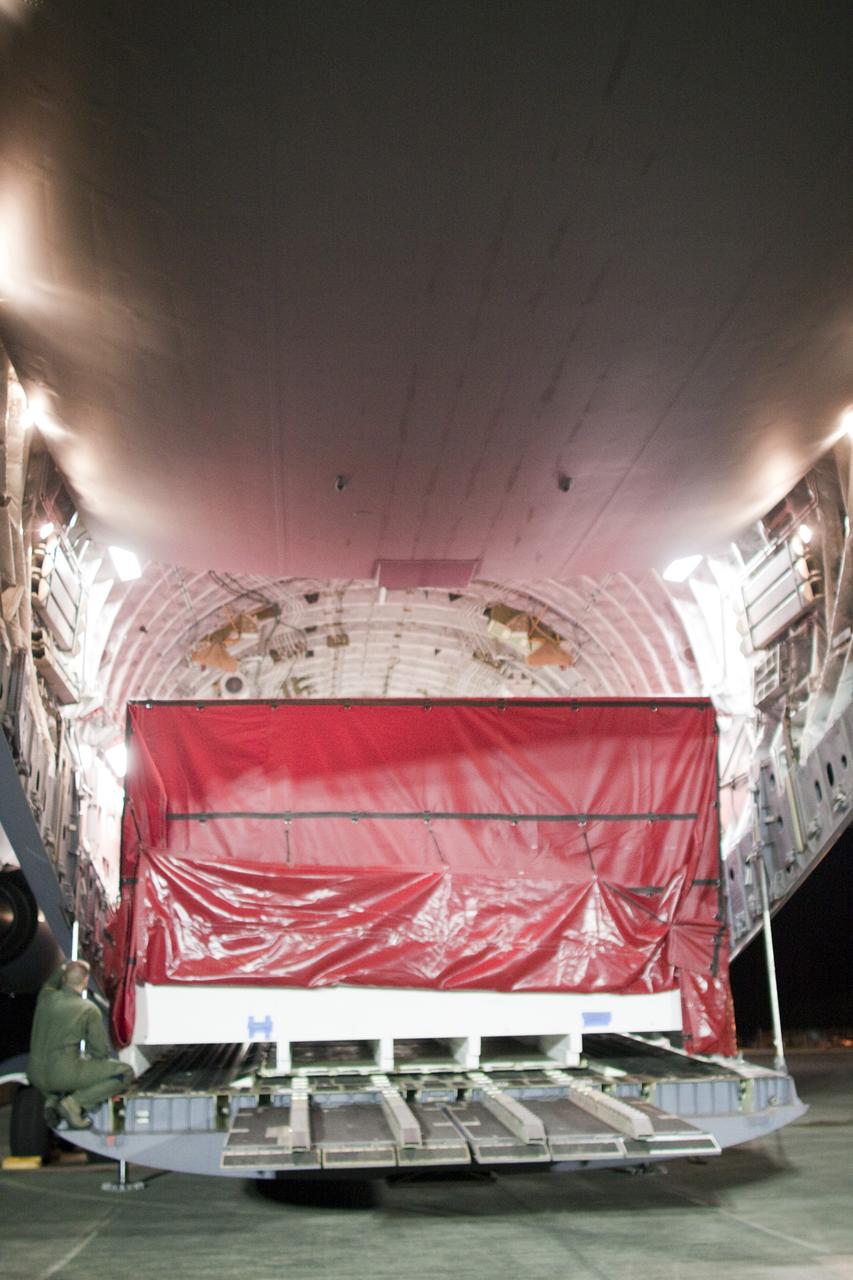
CAPE CANAVERAL, Fla. -- Workers begin to unload a container holding the heat shield, one of the first three elements for NASA's Mars Science Laboratory (MSL) that arrived at NASA Kennedy Space Center's Shuttle Landing Facility aboard an Air Force C-17 cargo plane. The cruise stage, back shell and heat shield, the first flight elements to arrive for the MSL mission, were taken to the Payload Hazardous Servicing Facility (PHSF) located in the KSC Industrial Area to begin processing. The Curiosity rover will arrive next month. A United Launch Alliance Atlas V-541 configuration will be used to loft MSL into space. Curiosity’s 10 science instruments are designed to search for evidence on whether Mars has had environments favorable to microbial life, including chemical ingredients for life. The unique rover will use a laser to look inside rocks and release its gasses so that the rover’s spectrometer can analyze and send the data back to Earth. MSL is scheduled to launch from Cape Canaveral Air Force Station in Florida Nov. 25 with a window extending to Dec. 18 and arrival at Mars Aug. 2012. For more information, visit http://www.nasa.gov/msl. Photo credit: NASA/Troy Cryder
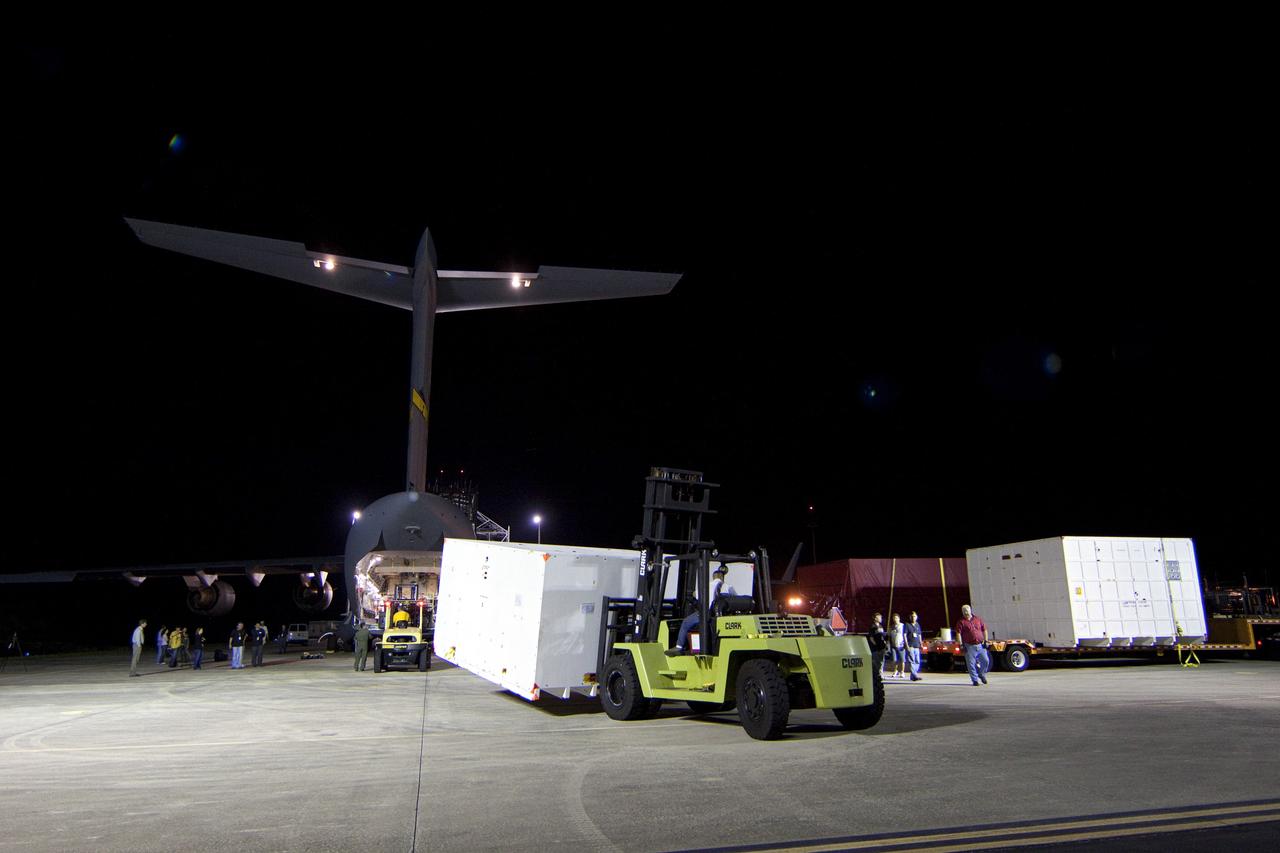
CAPE CANAVERAL, Fla. -- Workers unload a container holding the cruise stage, one of the first three elements for NASA's Mars Science Laboratory (MSL) that arrived at NASA Kennedy Space Center's Shuttle Landing Facility aboard an Air Force C-17 cargo plane. The cruise stage, back shell and heat shield, the first flight elements to arrive for the MSL mission, were taken to the Payload Hazardous Servicing Facility (PHSF) located in the KSC Industrial Area to begin processing. The Curiosity rover will arrive next month. A United Launch Alliance Atlas V-541 configuration will be used to loft MSL into space. Curiosity’s 10 science instruments are designed to search for evidence on whether Mars has had environments favorable to microbial life, including chemical ingredients for life. The unique rover will use a laser to look inside rocks and release its gasses so that the rover’s spectrometer can analyze and send the data back to Earth. MSL is scheduled to launch from Cape Canaveral Air Force Station in Florida Nov. 25 with a window extending to Dec. 18 and arrival at Mars Aug. 2012. For more information, visit http://www.nasa.gov/msl. Photo credit: NASA/Troy Cryder

CAPE CANAVERAL, Fla. -- Workers unload a container holding the heat shield, one of the first three elements for NASA's Mars Science Laboratory (MSL) that arrived at NASA Kennedy Space Center's Shuttle Landing Facility aboard an Air Force C-17 cargo plane. The cruise stage, back shell and heat shield, the first flight elements to arrive for the MSL mission, were taken to the Payload Hazardous Servicing Facility (PHSF) located in the KSC Industrial Area to begin processing. The Curiosity rover will arrive next month. A United Launch Alliance Atlas V-541 configuration will be used to loft MSL into space. Curiosity’s 10 science instruments are designed to search for evidence on whether Mars has had environments favorable to microbial life, including chemical ingredients for life. The unique rover will use a laser to look inside rocks and release its gasses so that the rover’s spectrometer can analyze and send the data back to Earth. MSL is scheduled to launch from Cape Canaveral Air Force Station in Florida Nov. 25 with a window extending to Dec. 18 and arrival at Mars Aug. 2012. For more information, visit http://www.nasa.gov/msl. Photo credit: NASA/Troy Cryder