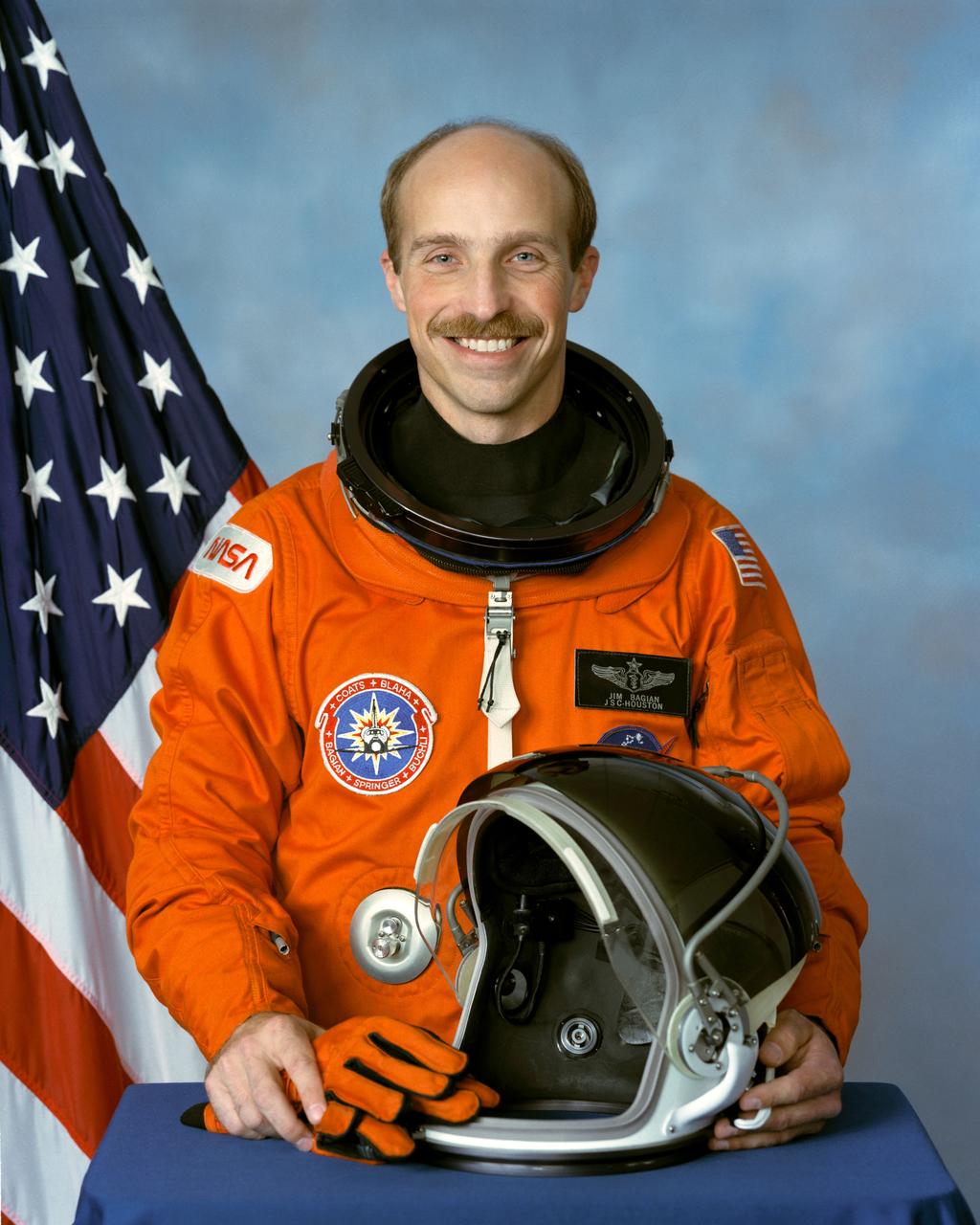
S89-25243 (6 Jan. 1989) --- Astronaut James P. Bagian, mission specialist.
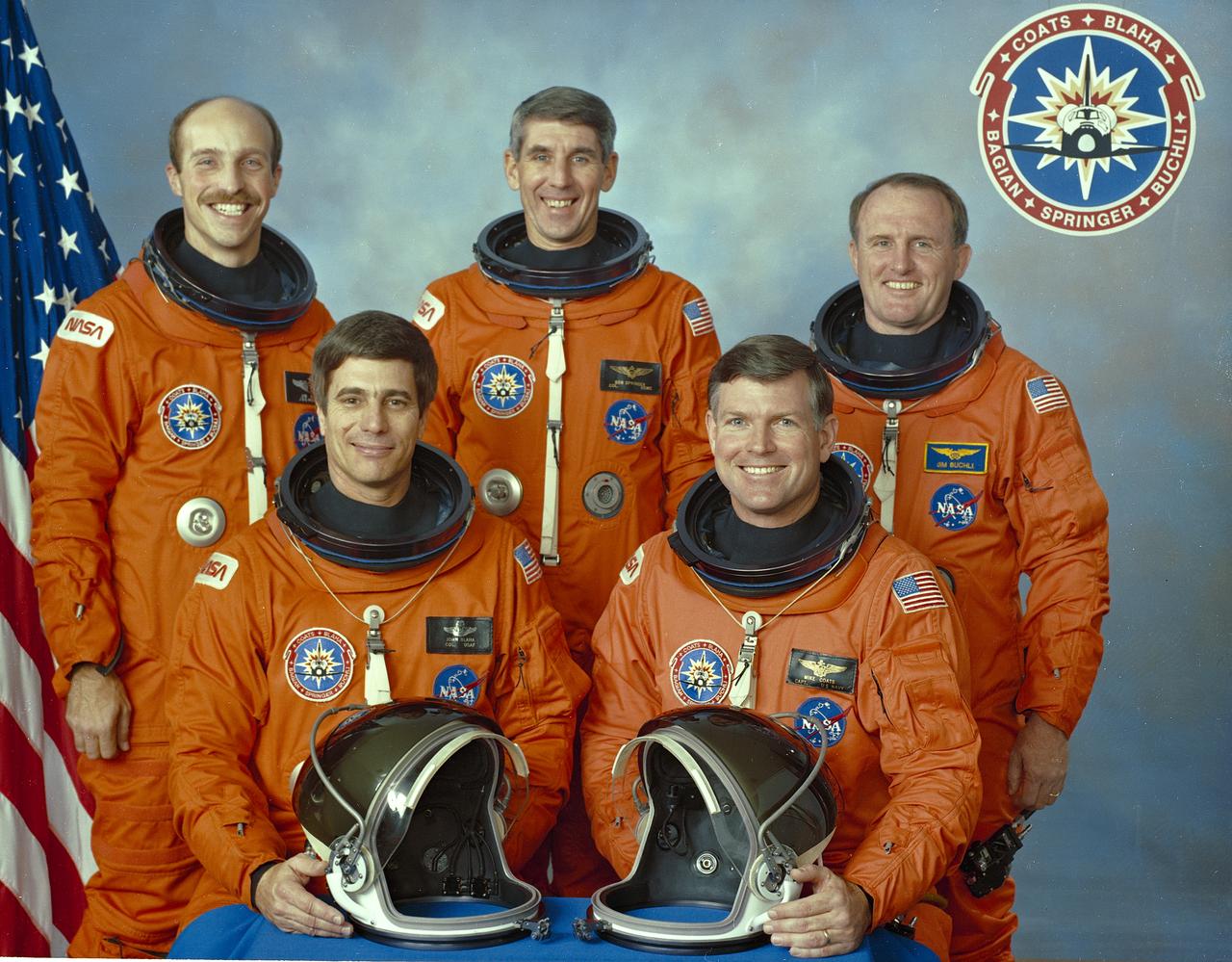
Five astronauts composed the STS-29 crew. Standing (left ot right) are James P. Bagian, mission specialist 1; Robert C. Springer, mission specialist 3; and James F. (Jim) Buchli, mission specialist 2. Seated (left to right) are John E. Blaha, pilot, and Michael L. Coats, commander. STS-29 launched aboard the Space Shuttle Discovery on March 13, 1989 at 9:57 am (EST). The primary payload was the Tracking and Data Relay Satellite- 4 (TDRS-4).
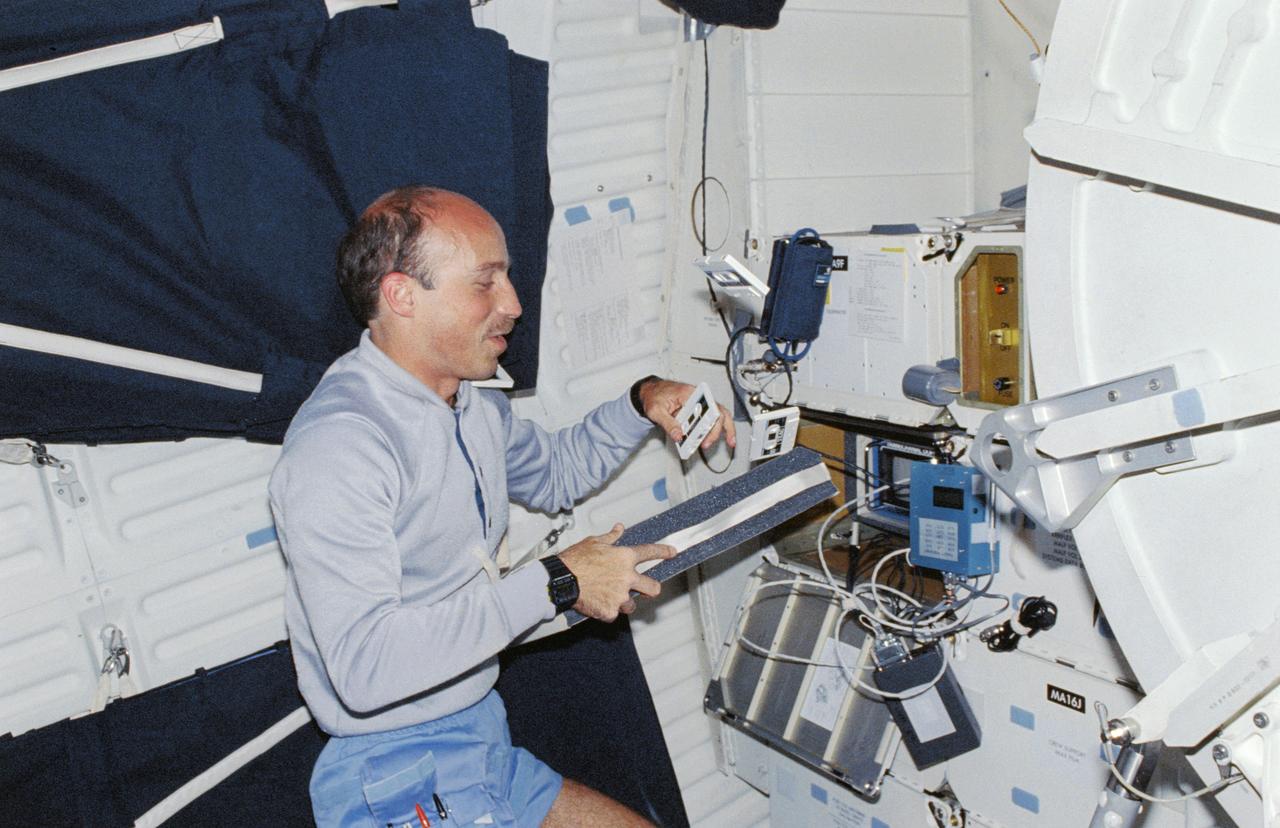
STS29-02-033 (3-18 March 1989) --- In what appears to be a juggling act in the microgravity of space, James P. Bagian, a physician, is actually attempting to organize audio cassettes. Other frames taken during the flight document Bagian's medical testing of his fellow crewmembers. This photographic frame was among NASA's third STS-29 photo release. Monday, March 20, 1989. Crewmembers were Astronauts Michael L. Coats, John E. Blaha, James F. Buchli, Robert C. Springer and James P. Bagian.
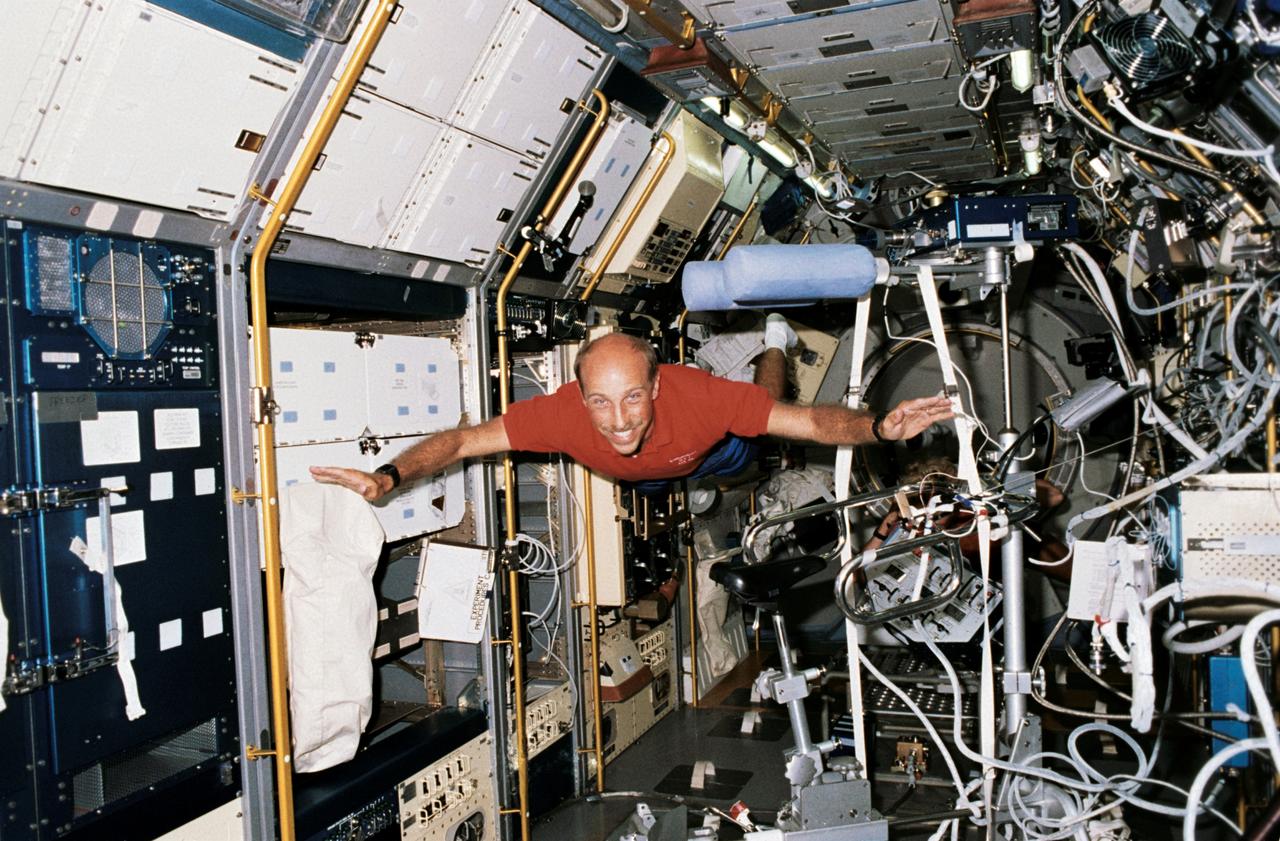
STS040-212-004 (5-14 June 1991) --- Astronaut James P. Bagian, STS-40 mission specialist, floats through the Spacelab Life Sciences (SLS-1) module aboard the Earth-orbiting Space Shuttle Columbia. Bagian and six other crew members spent over nine-days in space conducting life sciences research.
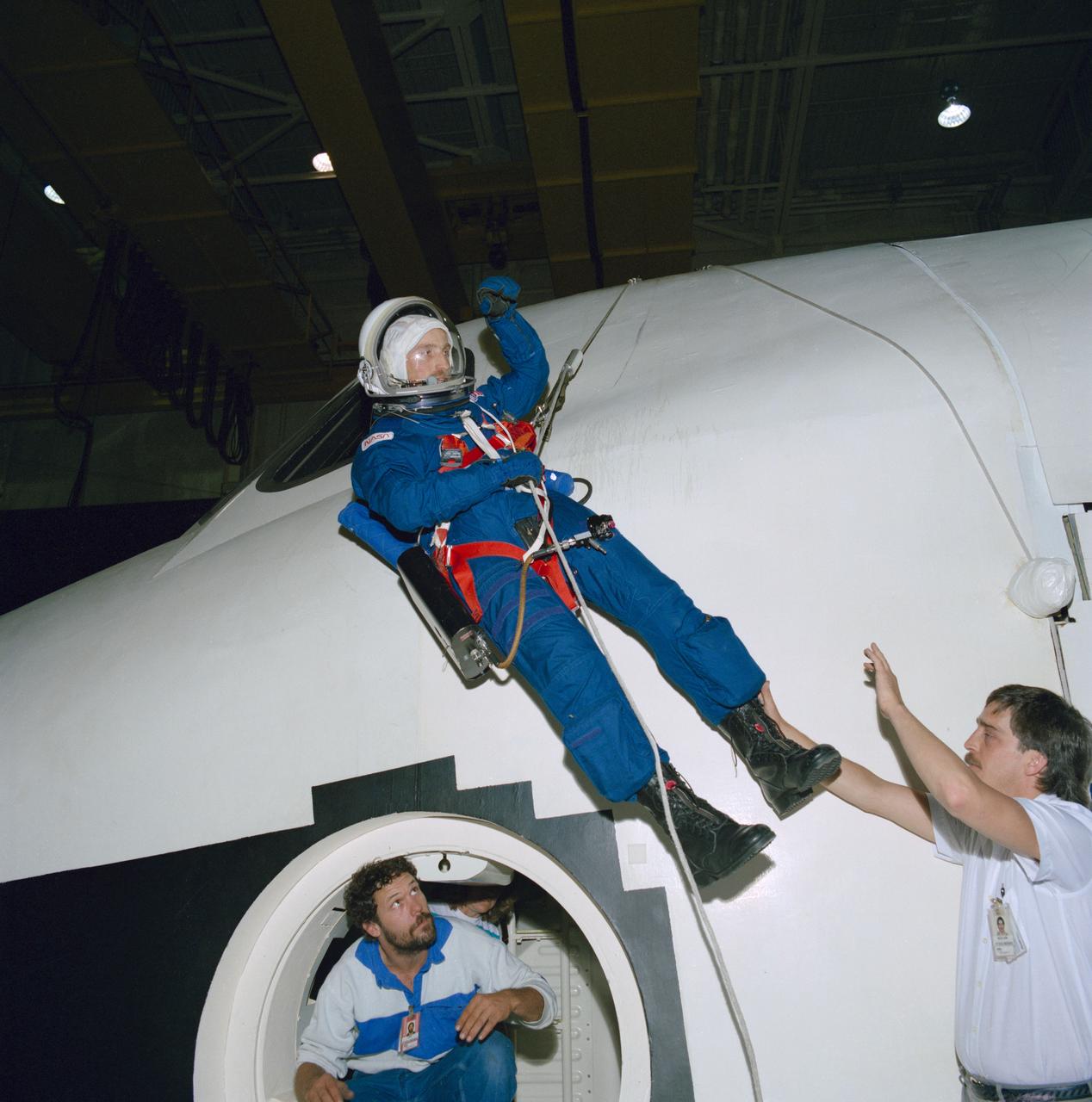
S88-38355 (27 May 1988) --- Astronaut James P. Bagian lowers himself from the top of one of the full-fuselage trainer in JSC's Shuttle mockup and integration laboratory during a post-landing, over-the-top emergency egress test. Bagian, a M.D., and one of three mission specialists assigned to NASA STS-29 flight of the Discovery, is working with engineers evaluating egress using the new crew escape equipment that includes a parachute harness.
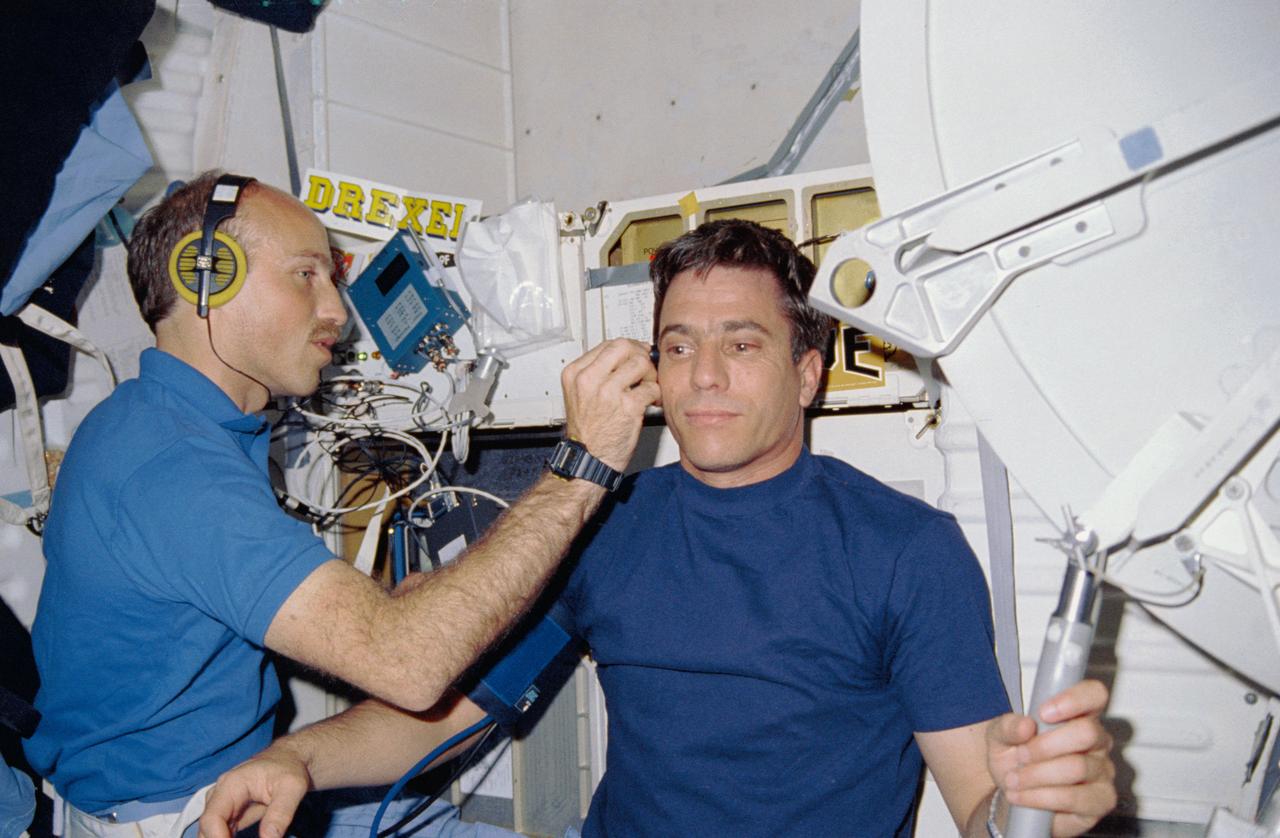
STS29-05-024 (16 March 1989) --- Astronaut John E. Blaha, STS-29 pilot, has his blood flow checked by astronaut James P. Bagian, mission specialist and a physician. The two are on the mid deck of the Earth-orbiting Space Shuttle Discovery.
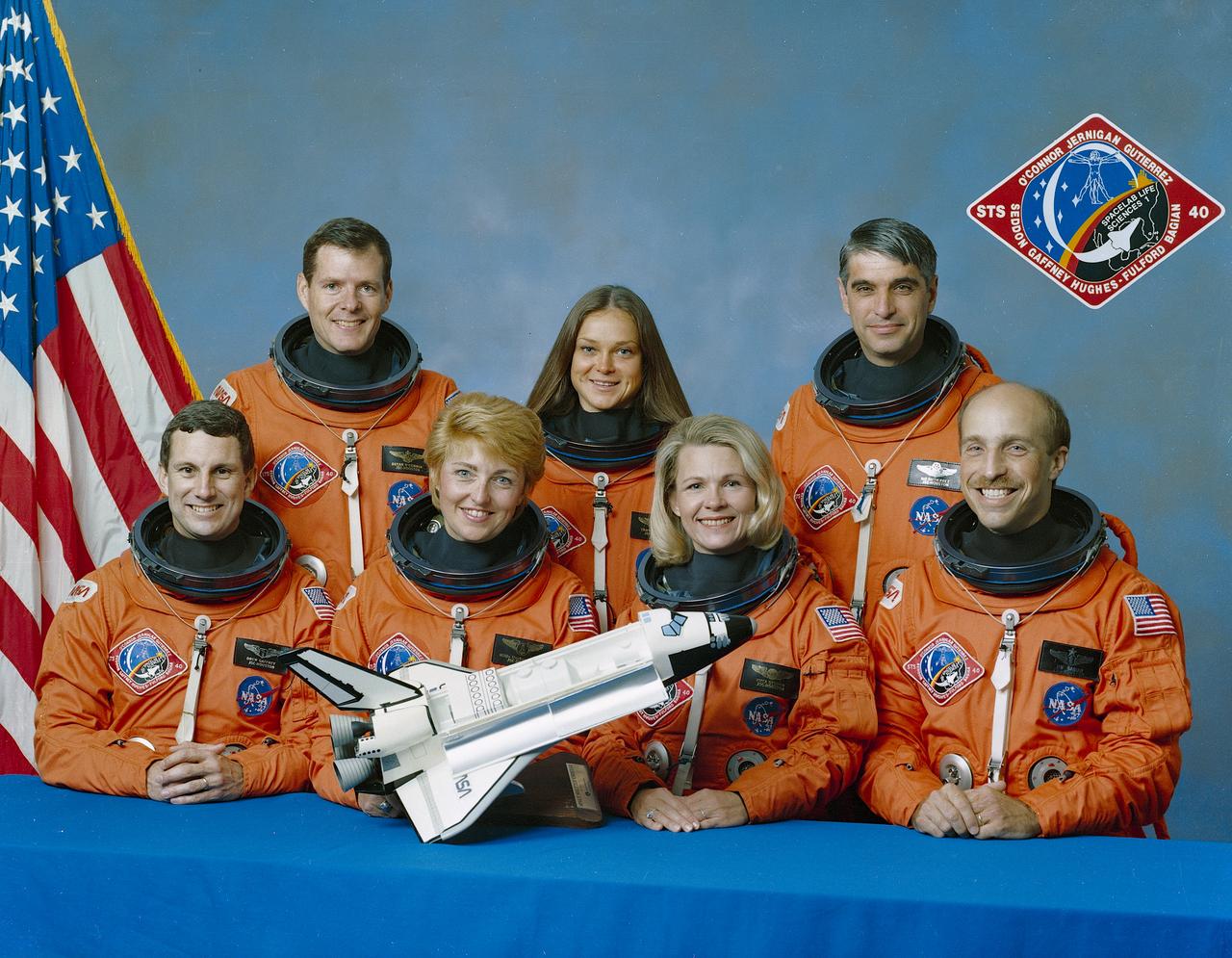
The STS-40 crew portrait includes 7 astronauts. Pictured on the front row from left to right are F. Drew Gaffney, payload specialist 1; Milli-Hughes Fulford, payload specialist 2; M. Rhea Seddon, mission specialist 3; and James P. Bagian, mission specialist 1. Standing in the rear, left to right, are Bryan D. O’Connor, commander; Tamara E. Jernigan, mission specialist 2; and Sidney M. Gutierrez, pilot. Launched aboard the Space Shuttle Columbia on June 5, 1991 at 9:24; am (EDT), the STS-40 mission was the fifth dedicated Spacelab Mission, Spacelab Life Sciences-1 (SLS-1), and the first mission dedicated solely to life sciences.
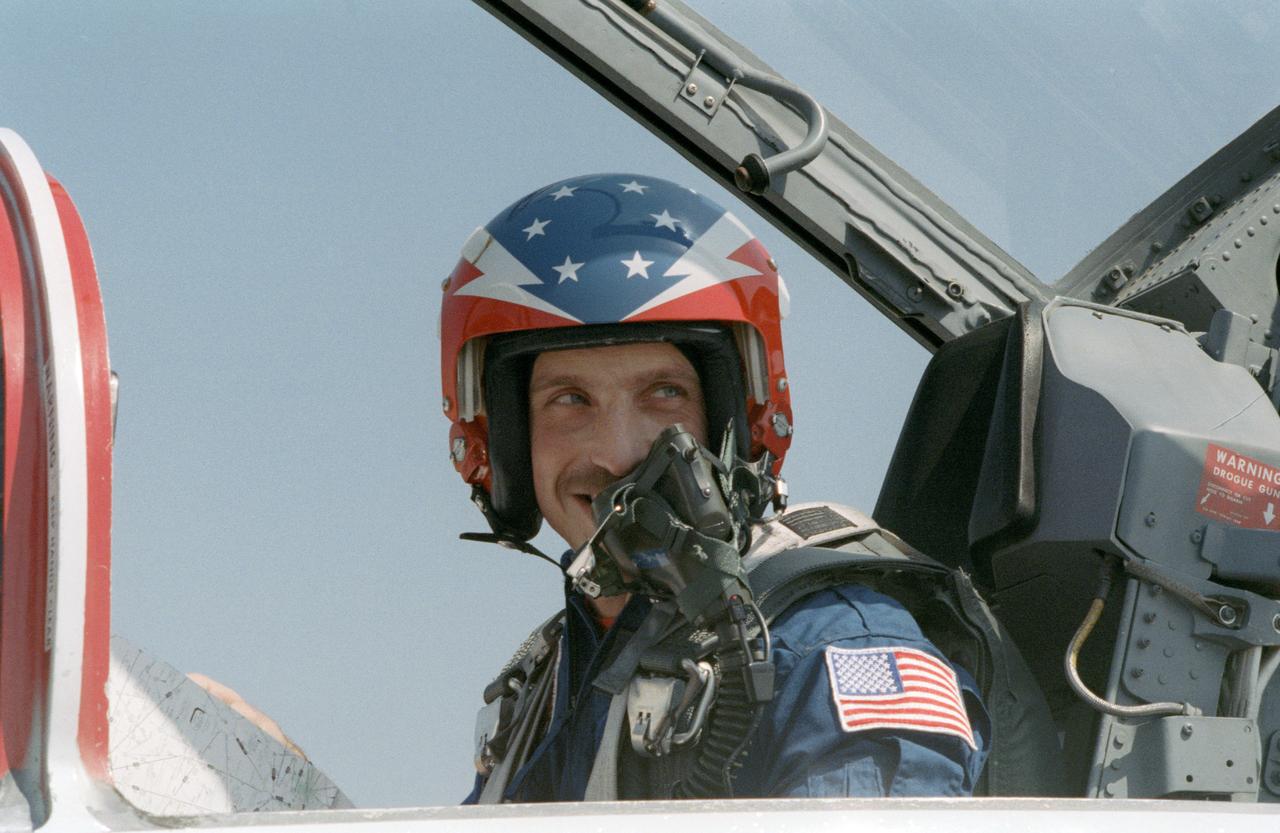
STS029-S-003 (10 March 1989) --- Astronaut James P. Bagian, STS-29 mission specialist, prepares to take a rear-seat ride in a NASA T-38 jet aircraft from Houston's Johnson Space Center to Florida's Kennedy Space Center. In three days, he and four fellow STS-29 crewmembers are scheduled to lift off aboard the Space Shuttle Discovery from Launch Pad 39B.
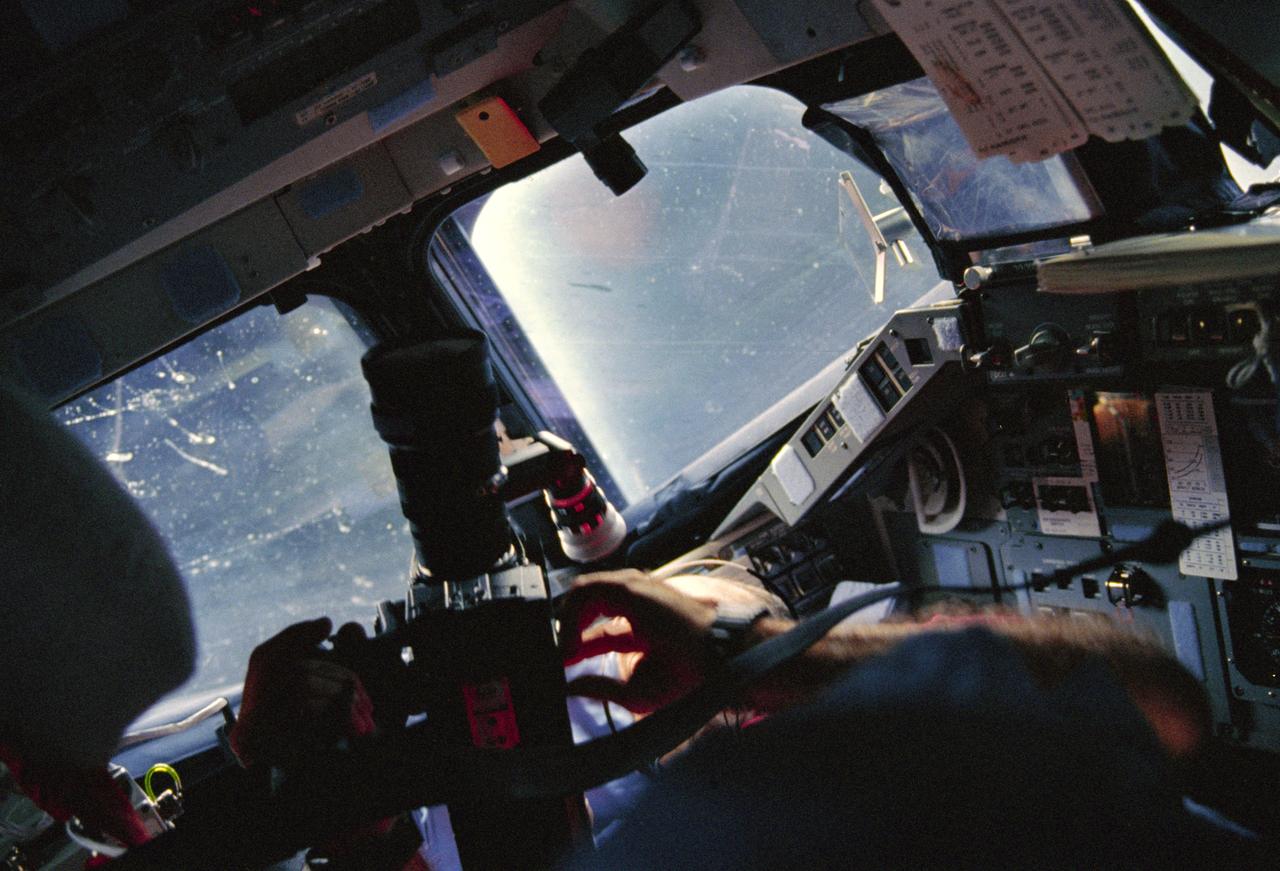
STS029-06-015 (13-18 March 1989) --- This scene of an astronaut with a camera was a common one during the five-day flight of STS-29. Astronaut James P. Bagian, STS-29 mission specialist, aims the Arriflex motion picture camera at Earth through one of Discovery's overhead windows. The scene was recorded with a 35mm camera.
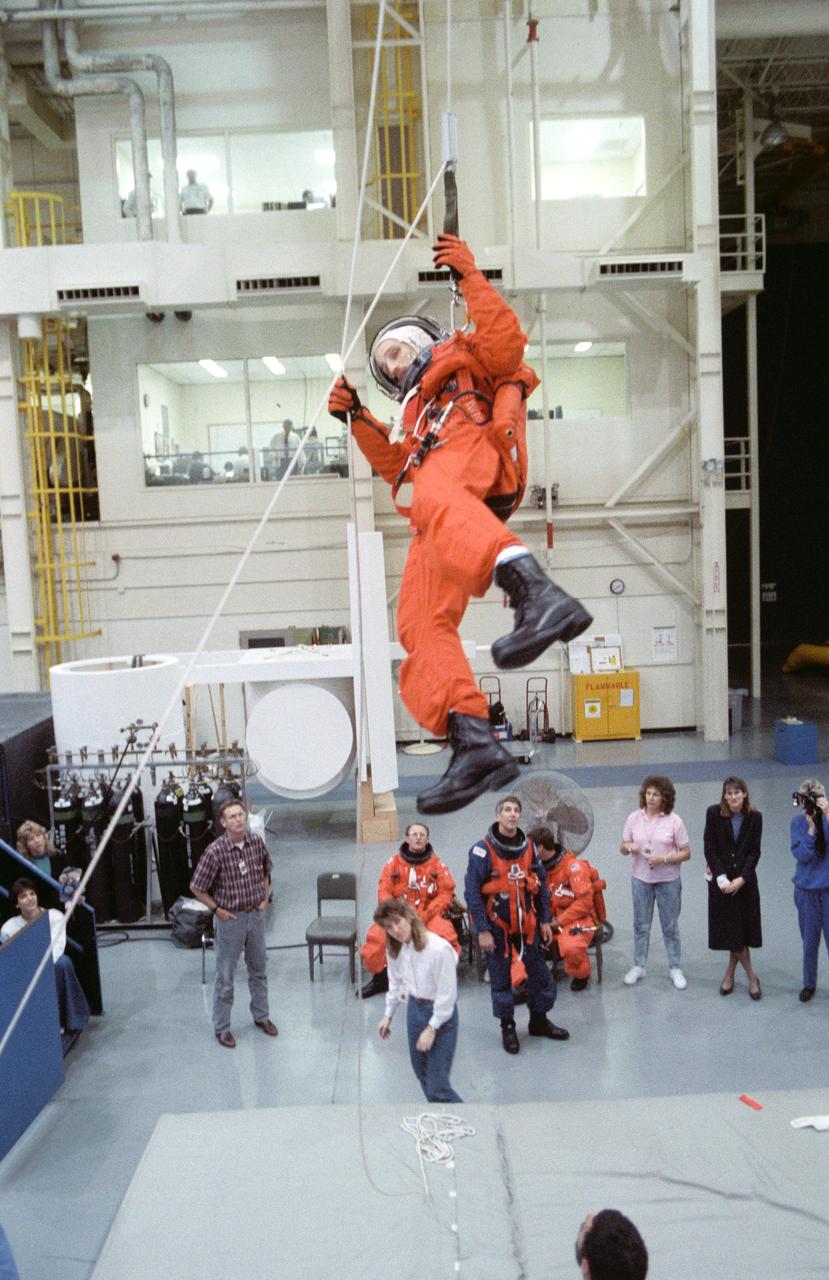
S89-25704 (Feb 1989) --- Astronaut James P. Bagian, STS-29 mission specialist, works his way down to "safety" using a Sky-genie device during emergency egress training for his five-member crew. Three other crewmembers watch in the background and await their turns with the rehearsal. The training took place in the Johnson Space Center's Shuttle mockup and integration laboratory.
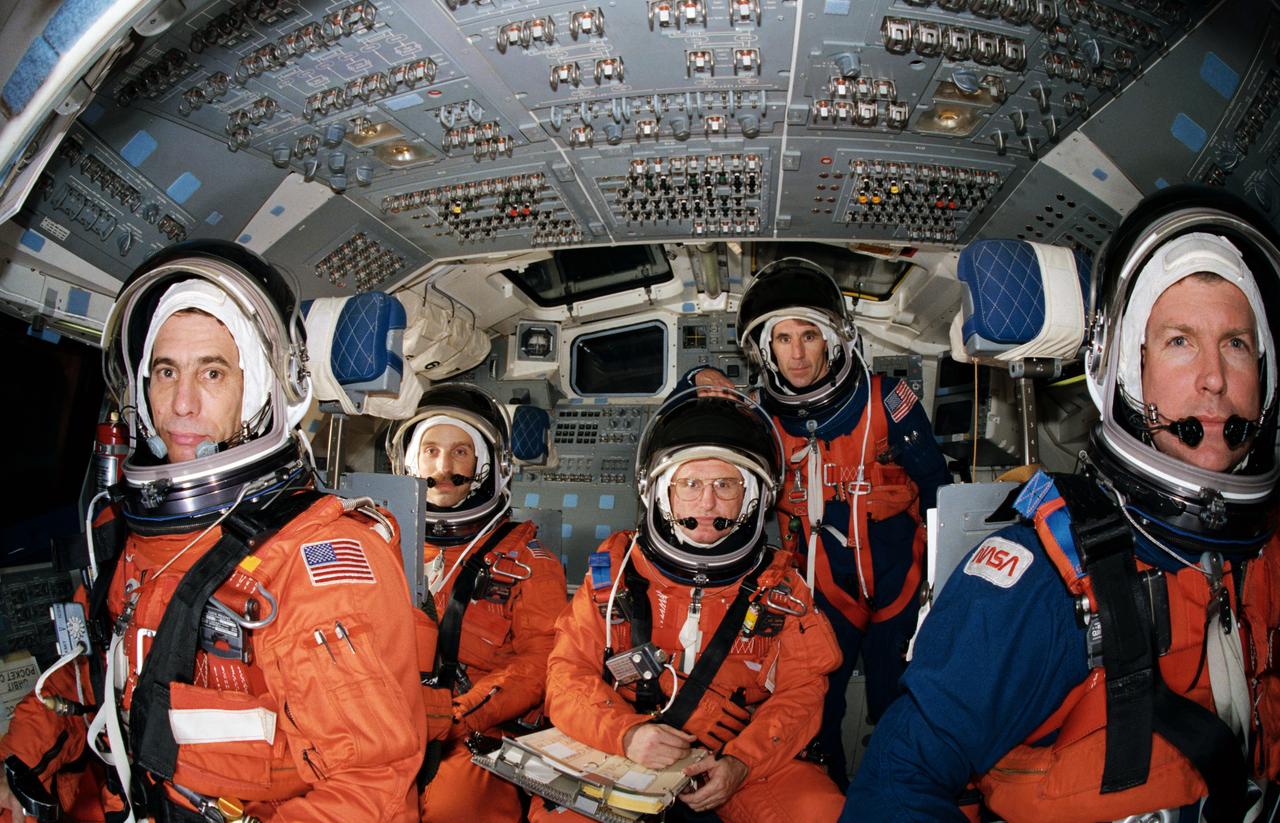
S89-26390 (January 1989) --- The five crew members for STS-29 pause during launch and entry phase rehearsals in the crew compartment trainer at the Johnson Space Center. Four members are in their entry positions and the fifth has been "borrowed" for a moment from the middeck. In front are John E. Blaha (left), pilot, and Michael L. Coats, mission commander. Behind them are James P. Bagian (left), and James F. Buchli, both mission specialists. Robert C. Springer, the third mission specialist, stands here at aft station. He will occupy Discovery's middeck for entry phase, while Bagian will occupy that post for launch. Photo credit: NASA
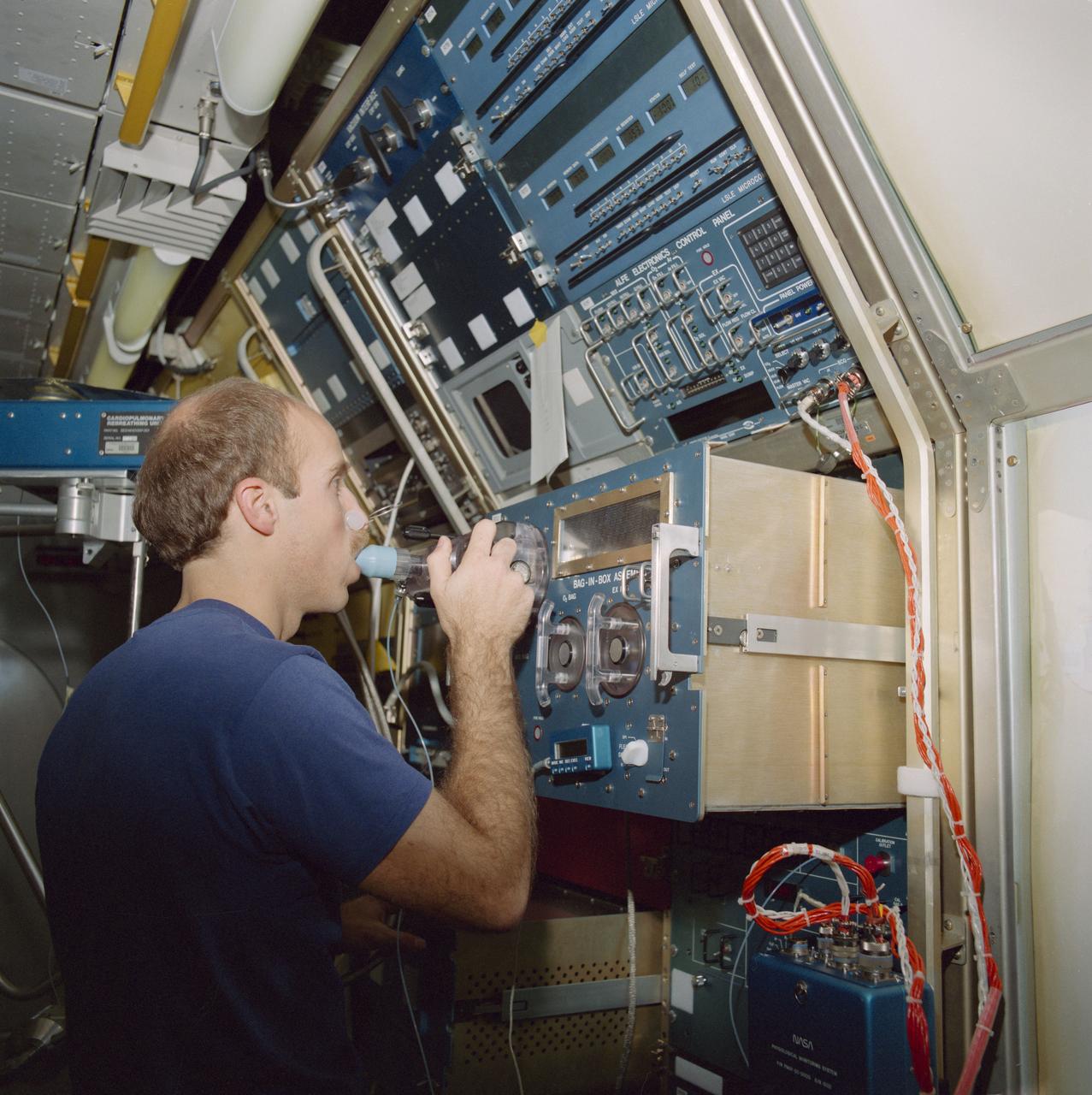
S85-26582 (Feb 1985) --- Training on the rebreathing assembly, astronaut James P. Bagian, STS-40 mission specialist, inhales a predetermined gas composition. A gas analyzer mass spectrometer determines the composition of the gases he exhales. The rebreathing assembly and gas analyzer system are part of an investigation that explores how lung function is altered. Dr. Bagian will be joined by two other mission specialists, the mission commander, the pilot and two payload specialists for the scheduled 10-day Spacelab Life Sciences-1 (SLS-1) mission. The flight is totally dedicated to biological and medical experimentation.
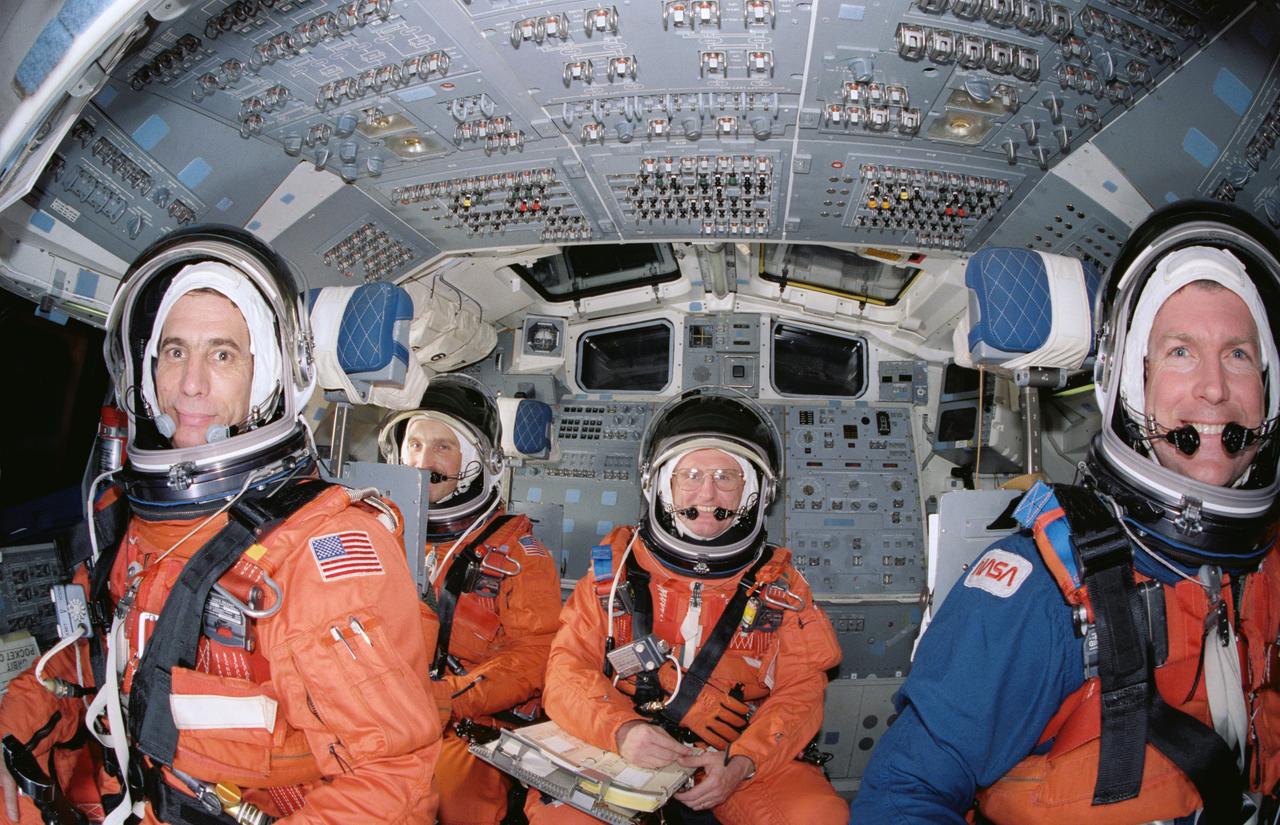
S89-26389 (Jan 1989) --- Four of five crewmembers for STS-29 pause during launch and entry phase rehearsals in the crew compartment trainer at the Johnson Space Center. The astronauts are in their entry positions, while the fifth (out of frame) remains strapped into a chair on the mid deck. In front are John E. Blaha (left), pilot, and Michael L. Coats, mission commander. Behind them are James P. Bagian (left), and James F. Buchli, both mission specialists. Robert C. Springer, the third mission specialist, is on the mid deck. He will occupy Discovery's middeck for entry phase, while Bagian will occupy that post for launch. Photo was made by Bill Bowers of the Johnson Space Center.
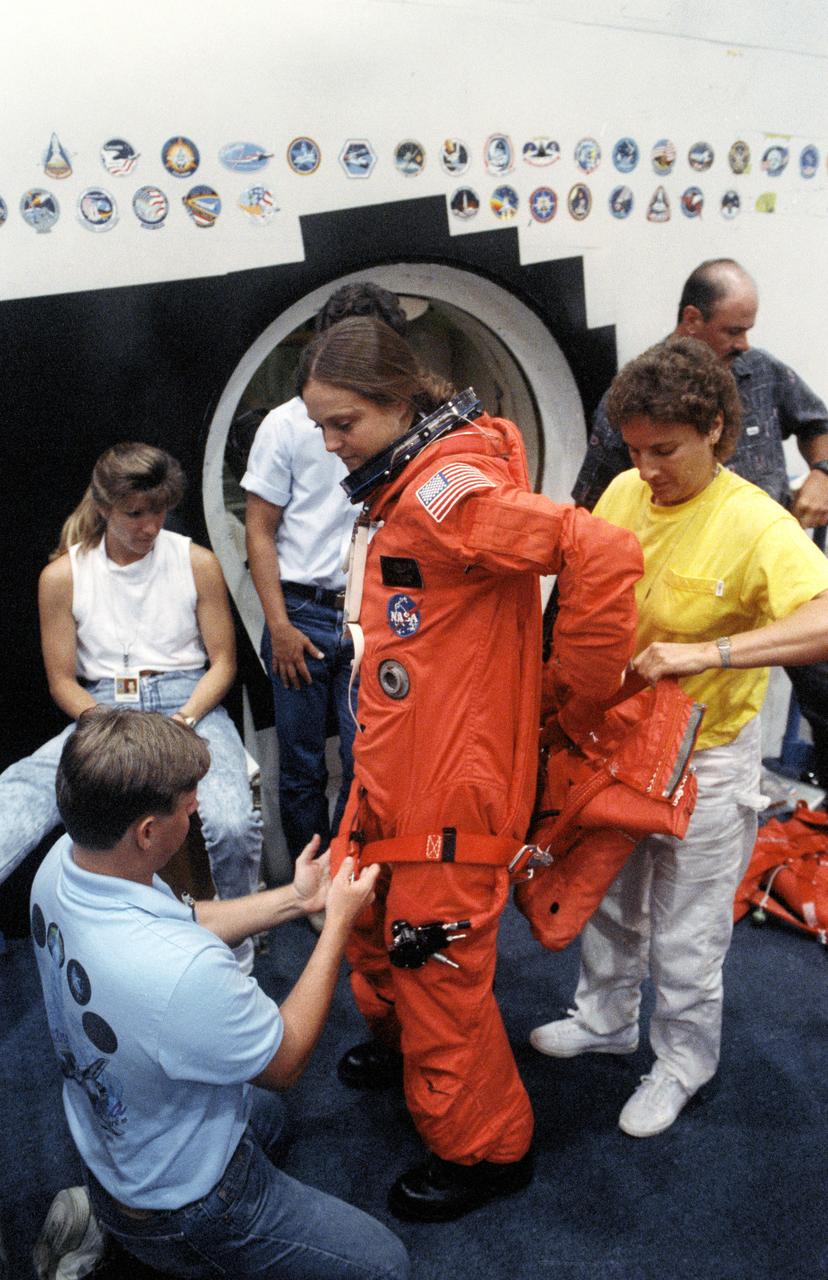
S90-41359 (11 June 1990) --- Astronaut James P. Bagian, STS-40 mission specialist, is seen in his partial pressure ascent/entry suit during a training exercise in the Johnson Space Center's Shuttle mockup and integration laboratory. Dr. Bagian will be joined on the Spacelab Life Sciences (SLS-1) mission, scheduled for launch in less than a year, by astronauts Bryan D. O'Connor, Sidney M. Gutierrez, Rhea Seddon and Tamara E. Jernigan, along with payload specialists F. Drew Gaffney and Millie Hughes-Fulford.
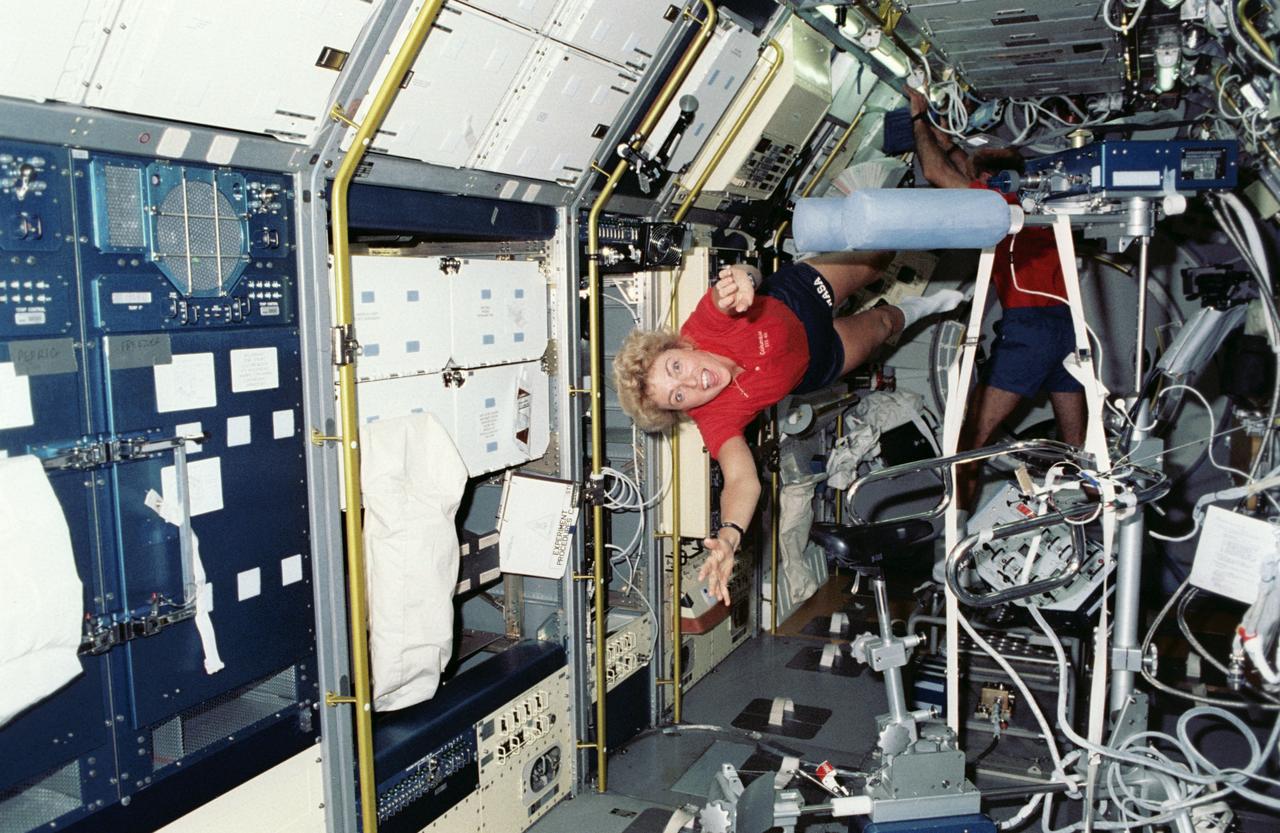
STS040-212-006 (5-14 June 1991) --- Payload specialist Millie Hughes-Fulford floats through the Spacelab Life Sciences (SLS-1) module aboard the Earth-orbiting Columbia. Astronaut James P. Bagian, mission specialist, is at the blood draw station in the background. The scene was photographed with a 35mm camera.
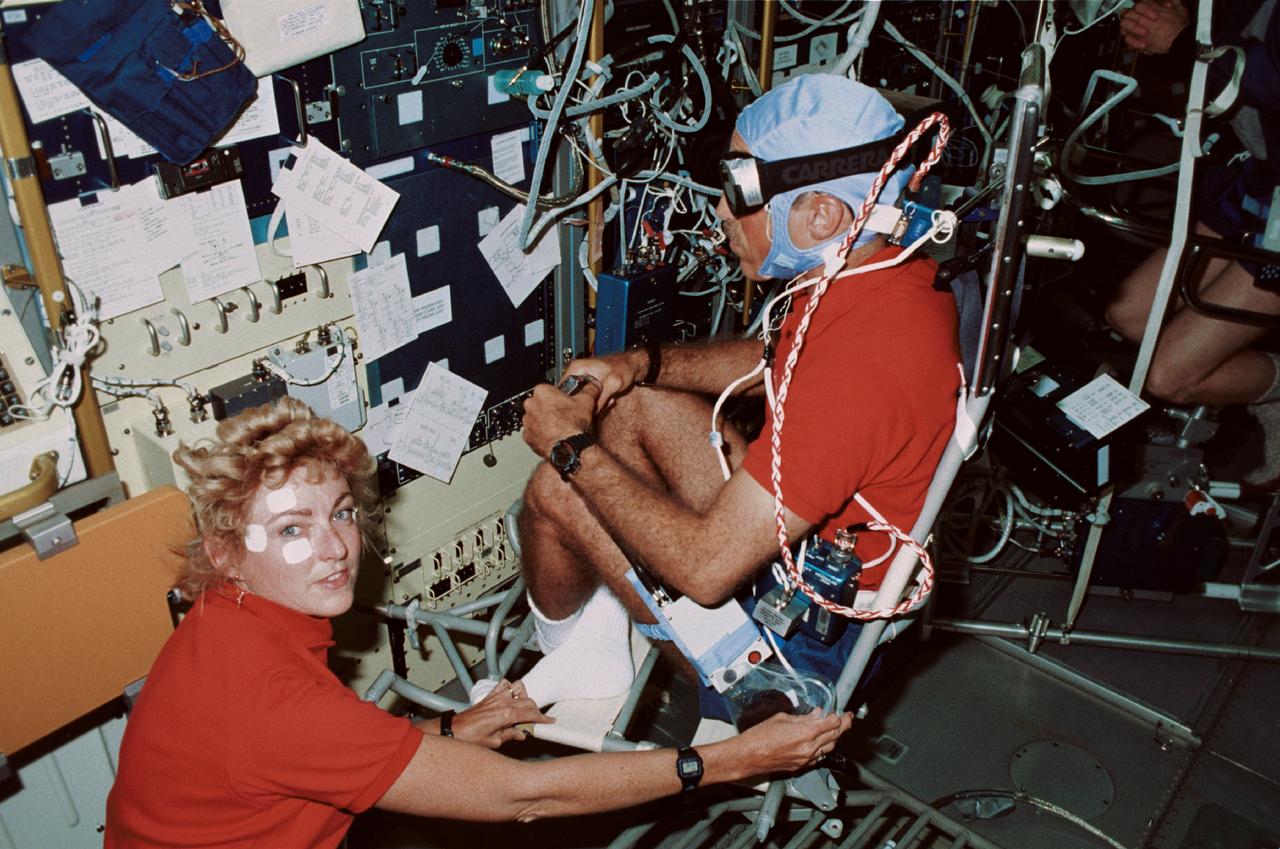
STS040-211-020 (5-14 June 1991) --- Vestibular experiment activities were captured onboard Columbia's Spacelab Life Sciences (SLS-1) module in this 35mm scene. Astronaut James P. Bagian, STS-40 mission specialist, is in a rotating chair while wearing an accelometer and electrodes to record head motion and horizontal and vertical eye movements during the rotations. Payload specialist Millie Hughes-Fulford, lower left, assists with the test.
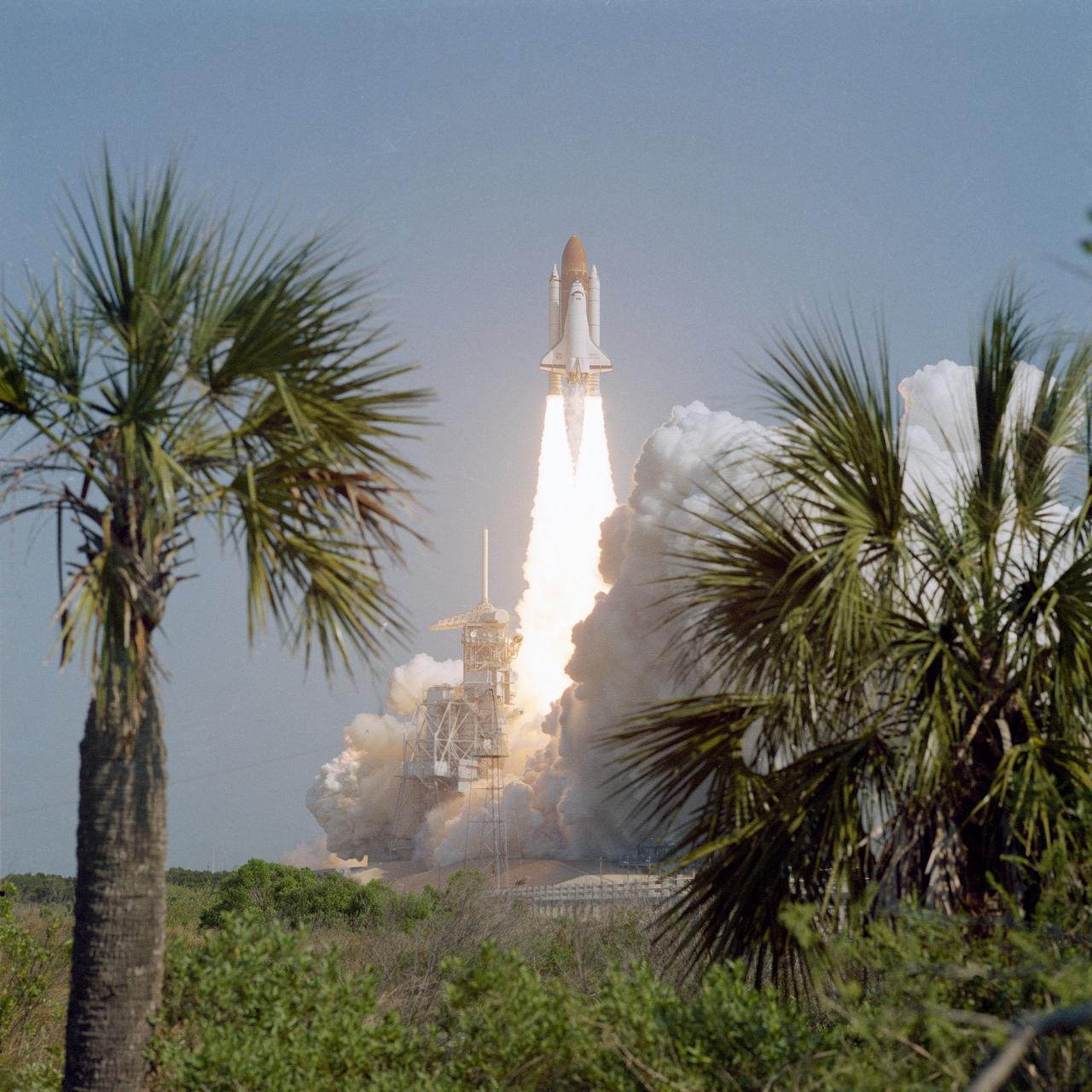
STS029-S-027 (13 March 1989) --- From Launch Pad 39D, the Space Shuttle Discovery is launched on mission STS-29. Discovery lifted off at 9:57 a.m. (EST), March 13, 1989, carrying the tracking and data relay satellite (TDRS-1) into orbit. Florida vegetation frames the launch scene. Onboard the spacecraft were astronauts Michael L. Coats, commander; John E. Blaha, pilot; and James F. Buchli, James P. Bagian and Robert C. Springer, all mission specialists.

S88-54948 (6 Dec 1988) --- The STS-29 crewmembers are trained in procedures to follow in the event of a fire with their spacecraft. Here, the crew is briefed on correct handling of the fire extinguisher by Robert Fife (far left) of NASA's fire and security staff. Pictured, left to right, are Astronauts John E. Blaha, pilot; Michael L. Coats, mission commander; Robert C. Springer, James F. Buchli and James P. Bagian, mission specialists. The training exercise took place on the northern end of the 1625-acre JSC facility.
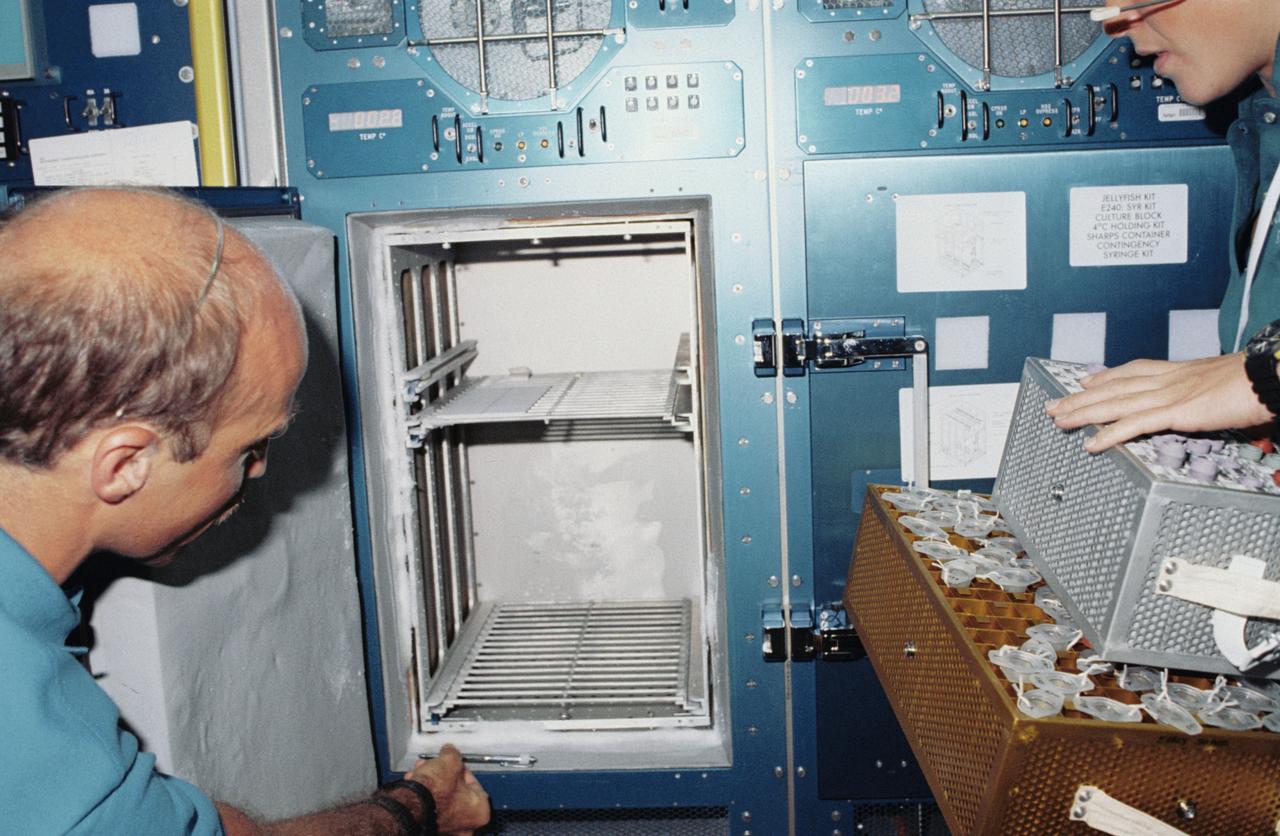
STS040-202-033 (5-14 June 1991) --- A medium closeup scene shows astronaut James P. Bagian (left) and an unidentified crewmember (partially out of frame) looking at a vacant refrigerator in the Spacelab Life Sciences (SLS-1) module aboard the Earth-orbiting Space Shuttle Columbia. Following the detection of problems with the refrigerator, its contents were temporarily removed. This scene was photographed with a 35mm camera.

S89-25082 (January 1989) --- Space shuttle Discovery will be manned by these five astronauts when it makes it second flight within a five-month period next month. The STS-29 crew members are (front row), Michael L. Coats (right), commander; and John E. Blaha, pilot; (left to right back row) James P. Bagian, Robert C. Springer and James F. Buchli, mission specialists. Photo credit: NASA
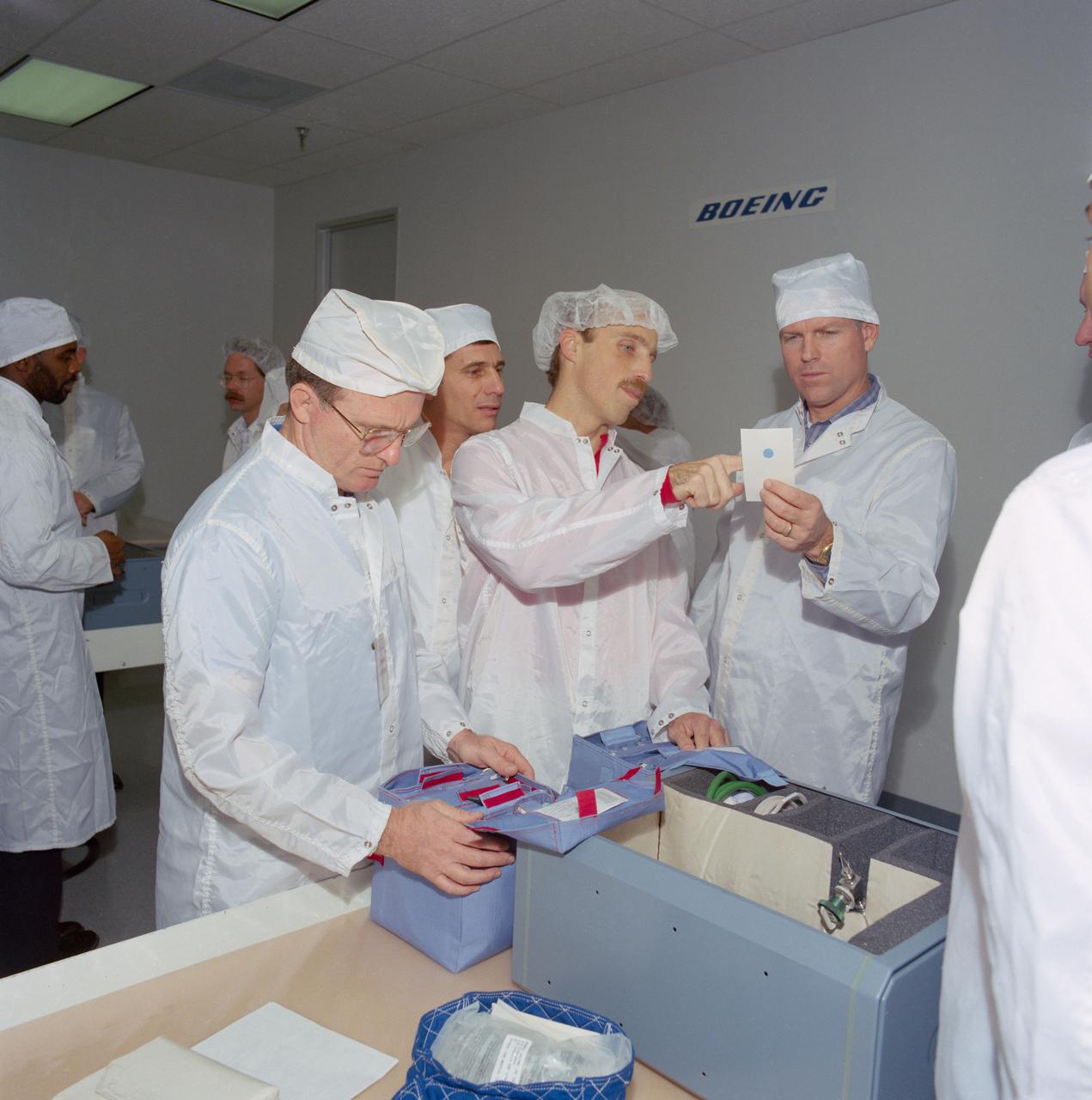
S89-26240 (20 Jan 1989) --- Four of the five STS-29 crewmembers inspect the content of their emergency medical and medication kits during the recent bench review of middeck locker equipment avaialable for their scheduled March 1989 flight. From left to right are Astronauts James H. Buchli, John E. Blaha, James P. Bagian and Michael L. Coats. Not pictured is Robert C. Springer.
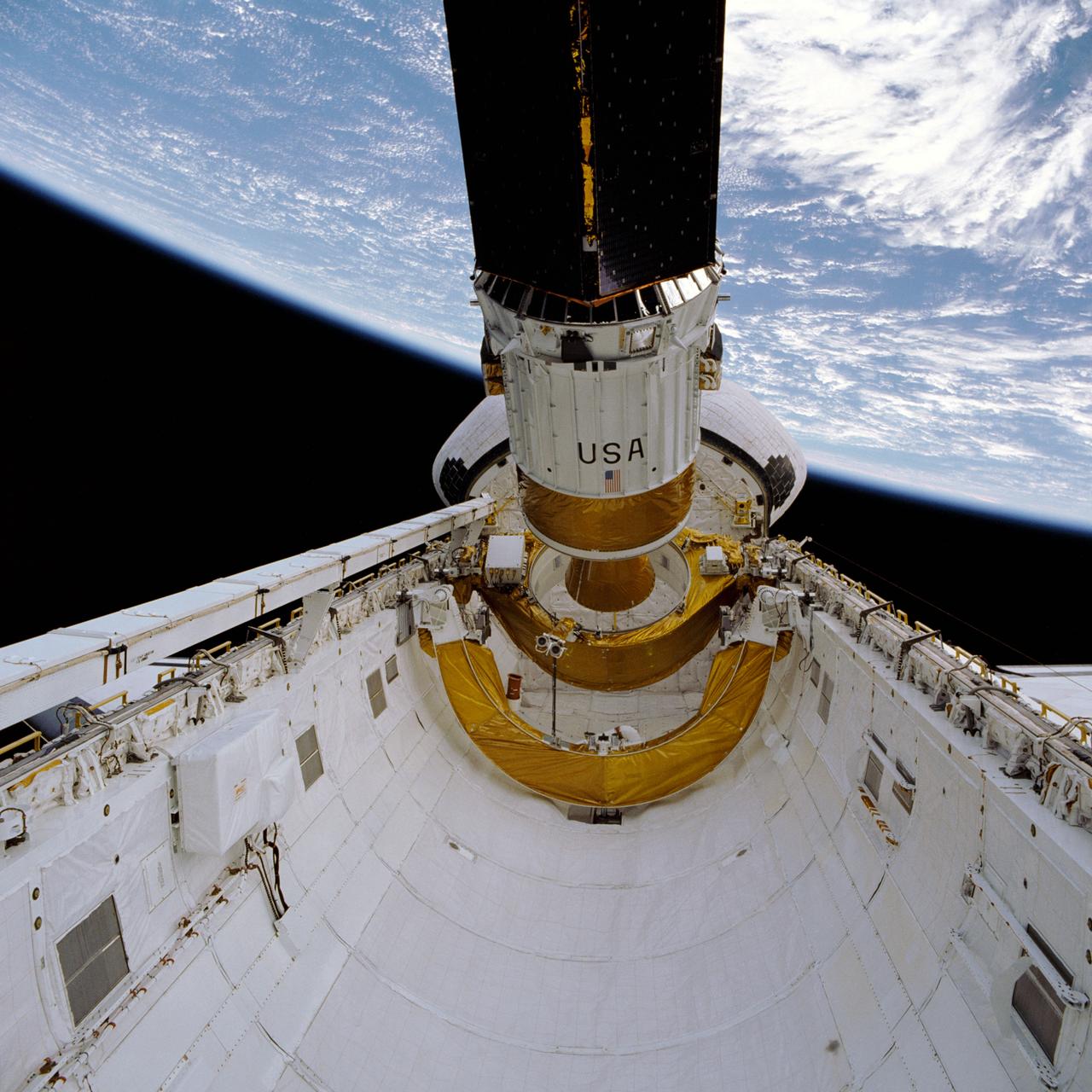
STS029-71-026 (13 March 1989) --- The Tracking and Data Relay Satellite (TDRS-D) is tilted in the cargo bay prior to its release via a remote system on Discovery's flight deck. This photographic frame was among NASA's third STS-29 photo release. Monday, March 20, 1989. Crewmembers were Astronauts Michael L. Coats, John E. Blaha, James F. Buchli, Robert C. Springer and James P. Bagian.
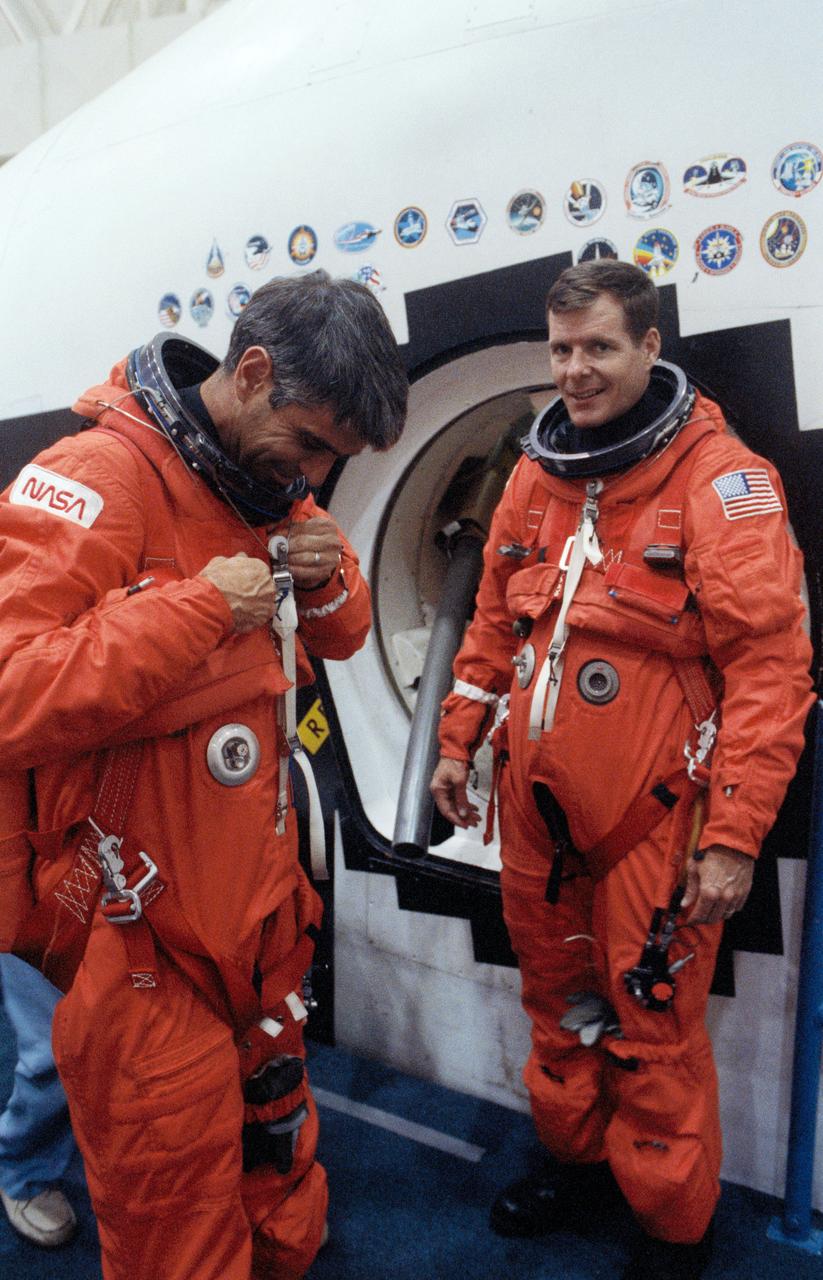
S90-41360 (11 June 1990) --- Two crewmembers assigned to NASA's Spacelab Life Sciences (SLS-1)/STS-40 mission are pictured during emergency egress training in the Shuttle mockup and integration laboratory at the Johnson Space Center (JSC). Seen are astronauts Sidney M. Gutierrez (left) pilot, and Bryan D. O'Connor, mission commander. Out of frame are astronauts Rhea Seddon, James P. Bagian, Tamara E. Jernigan, all mission specialists; and payload specialists Millie Hughes-Fulford and F. Drew Gaffney.

S89-25326 (11 Jan 1989) --- Five astronauts field questions from the news media, as they interrupt a busy training schedule in preparation for NASA's STS-29 mission in mid-March. Left to right on the dais are Astronauts James P. Bagian, James F. Buchli, Robert C. Springer, John E. Blaha and Michael L. Coats. Coats is mission commander. Jeffrey E. Carr of the Media Services Branch of JSC's Public Affairs Office, is at far right.
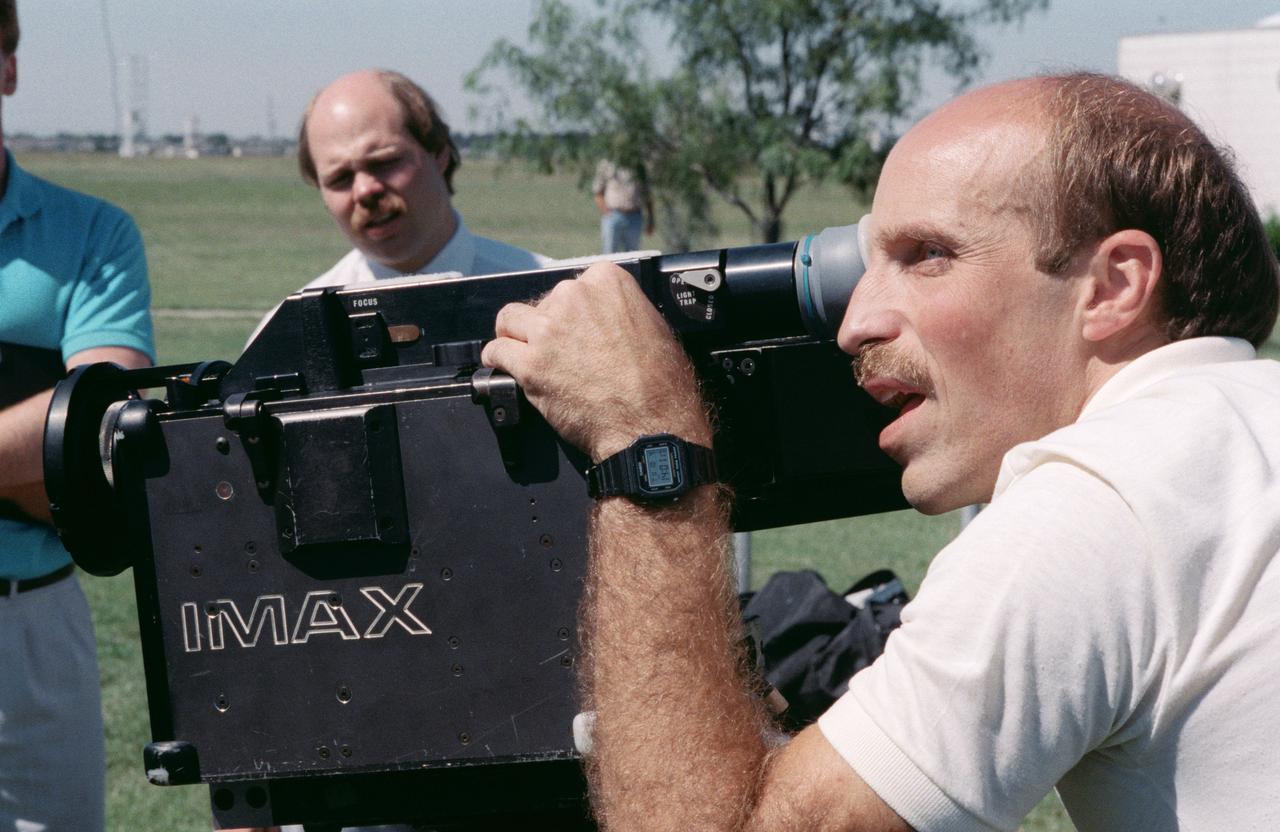
S88-52466 (8 Nov 1988) --- James P. Bagian, STS-29 mission specialist, gets in some training on the operation of one of the payloads for his upcoming spaceflight aboard Discovery. The crew met with Imax personnel, some of whom are pictured here, on the JSC grounds to practice using the motion- picture camera, making its first post-Challenger trip into space. The payload flew on a number of earlier STS flights.

STS029-S-065 (18 March 1989) --- The five-man crew who flew aboard NASA's Space Shuttle Discovery (background) pose near it following a successful five-day mission in space. Left to right are Astronauts John E. Blaha, pilot, and James P. Bagian, mission specialist; Michael L. Coats, commander; and James F. Buchli and Robert C. Springer, mission specialists.
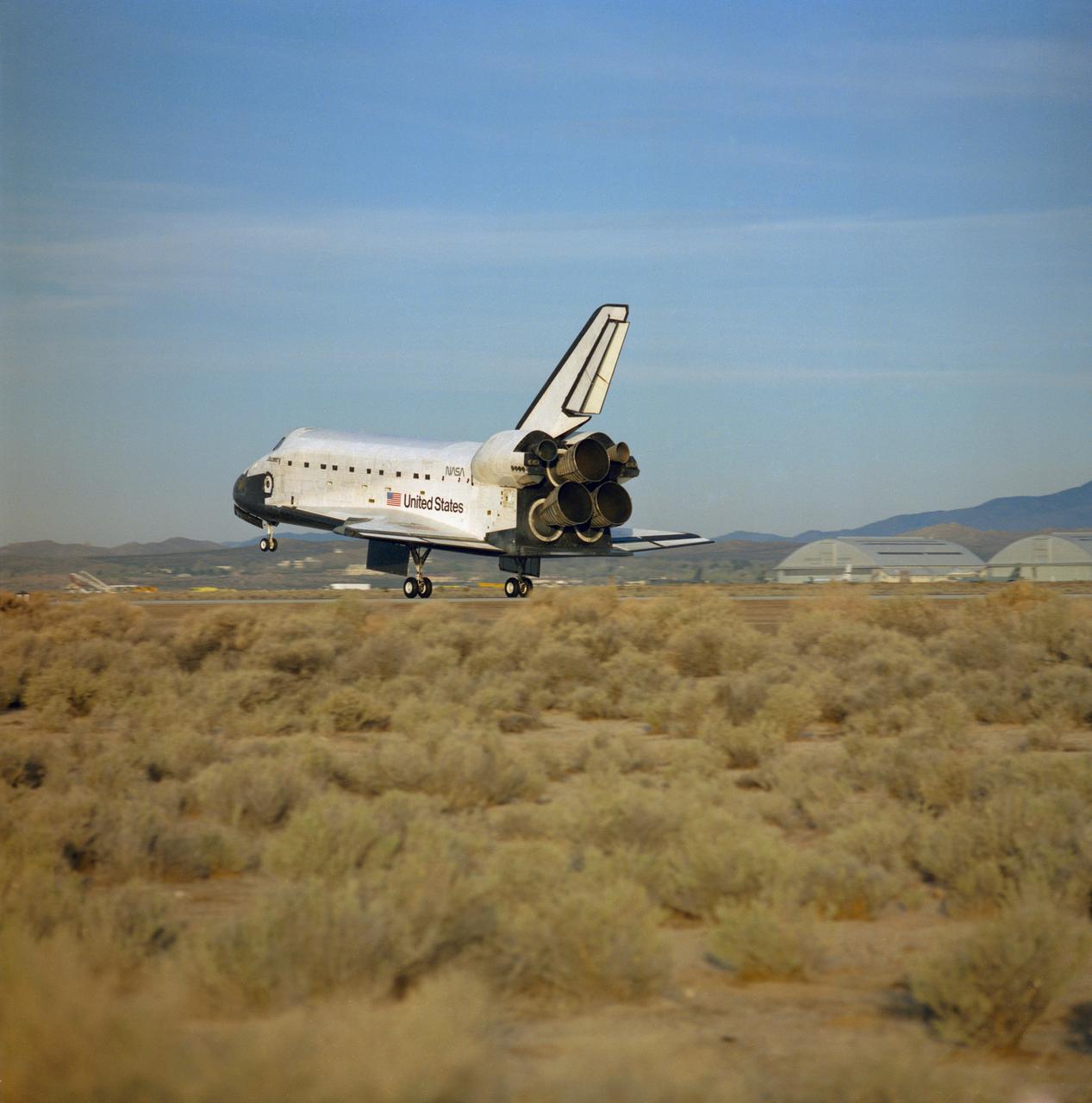
STS029-S-064 (18 Mar 1989) --- A rear view photographed from the ground just after Discovery's main landing gear touches down on Runway 22 at Edwards Air Force Base in California following a successful five-day mission in Earth orbit. Onboard the spacecraft were Astronauts Michael L. Coats, John E. Blaha, James F. Buchli, Robert C. Springer and James P. Bagian. Wheels came to a stop at 6:36:40 a.m. (PST), March 18, 1989.
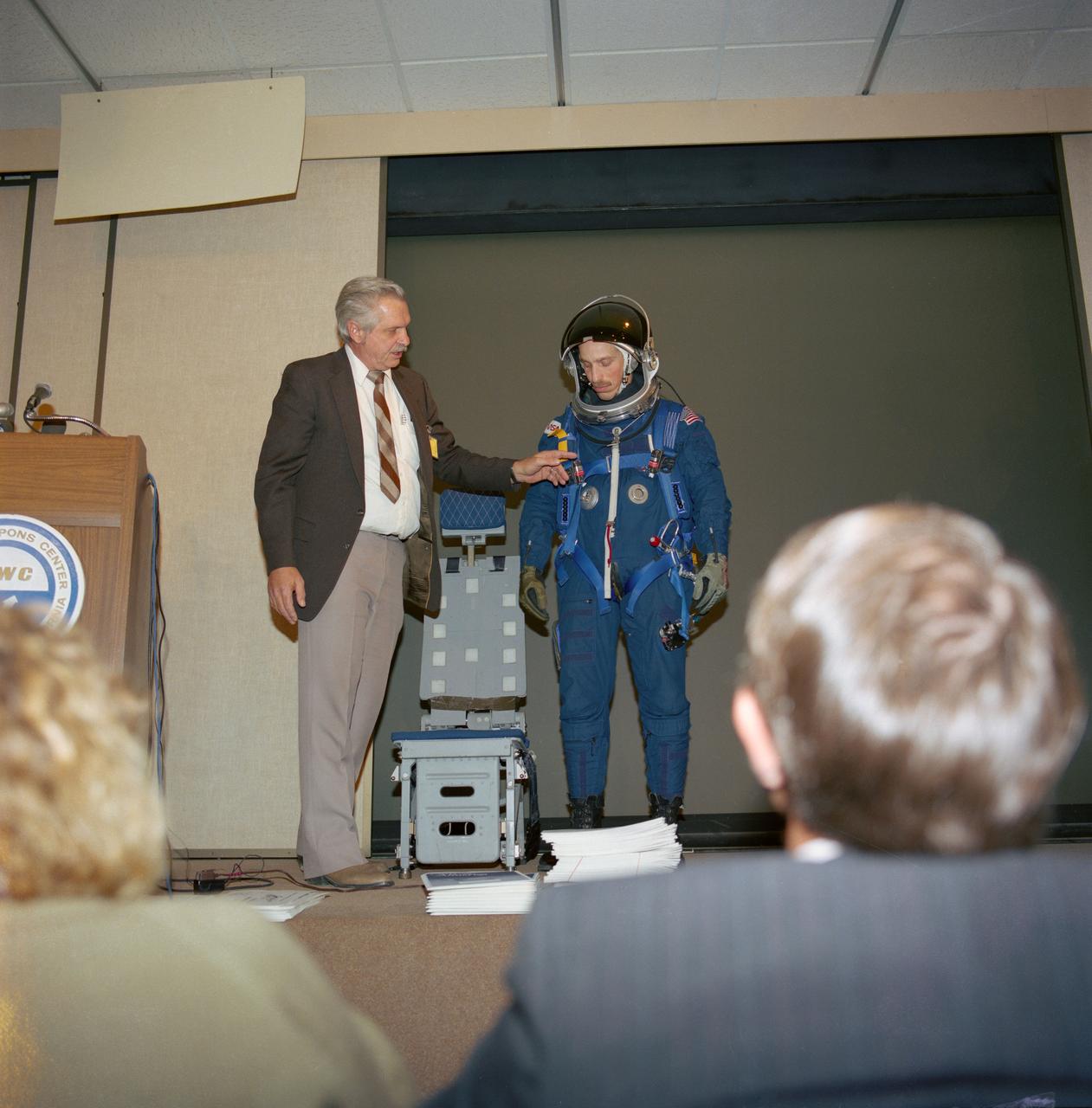
S88-25408 (8 Dec 1987) --- James O. Schlosser (left), JSC crew systems branch employee responsible for crew equipment development, gives a briefing on the crew equipment baselined for STs-26 as astronaut James P. Bagian models the new gear. Included in the package are a partial pressure suit, harness, parachute, life raft and survival gear. The deomonstration took place at the Naval Weapons Center in China Lake, CA.
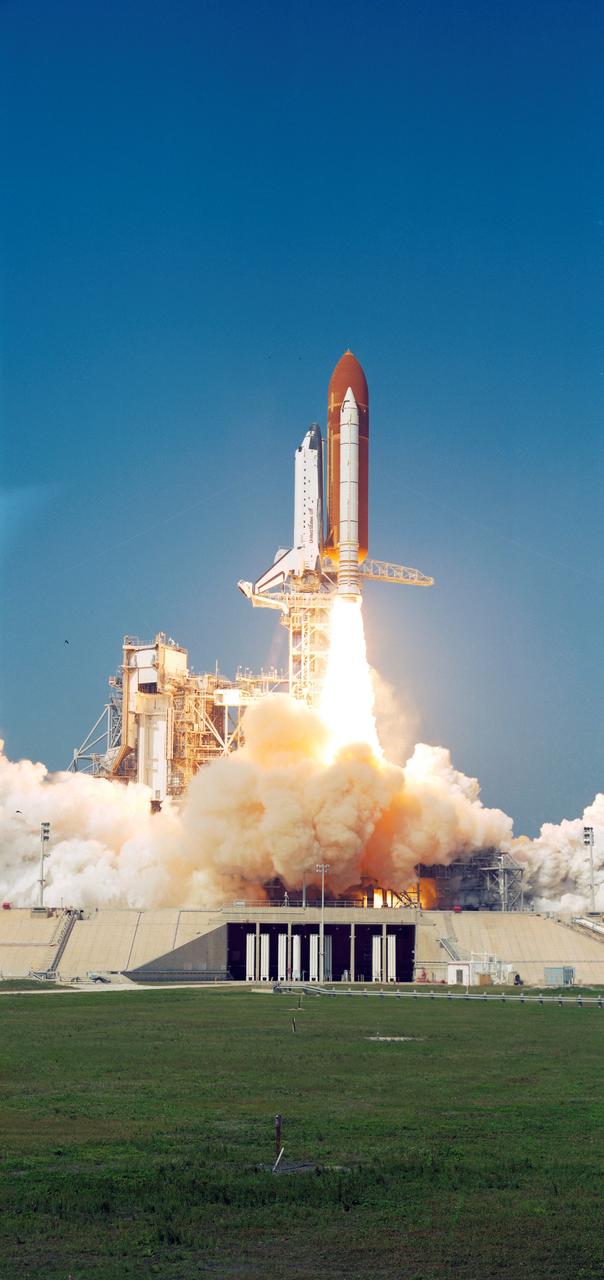
STS029-S-028 (13 March 1989) --- From Launch Pad 39B, the Space Shuttle Discovery is launched on Mission STS-29. Discovery lifted off at 9:57 a.m. (EST), March 13, 1989, carrying the tracking and data relay satellite (TDRS-1) into orbit. Onboard the spacecraft were astronauts Michael L. Coats, commander; John E. Blaha, pilot; and James F. Buchli, James P. Bagian and Robert C. Springer, all mission specialists.

Five astronauts launched aboard the Space Shuttle Discovery on March 13, 1989 at 9:57 am (EST) for the STS-29 mission. Included were James P. Bagian, mission specialist 1; Robert C. Springer, mission specialist 3; James F. (Jim) Buchli, mission specialist 2; John E. Blaha, pilot; and Michael L. Coats, commander. The mission’s primary payload was the Tracking and Data Relay Satellite-4 (TDRS-4).

STS029-S-063 (18 March 1989) --- Discovery's main landing gear touches down on Runway 22 at Edwards Air Force Base in California following a successful five-day mission in Earth orbit. Onboard the spacecraft were Astronauts Michael L. Coats, John E. Blaha, James F. Buchli, Robert C. Springer and James P. Bagian. Wheels came to a stop at 6:36:40 a.m. (PST), March 18, 1989.
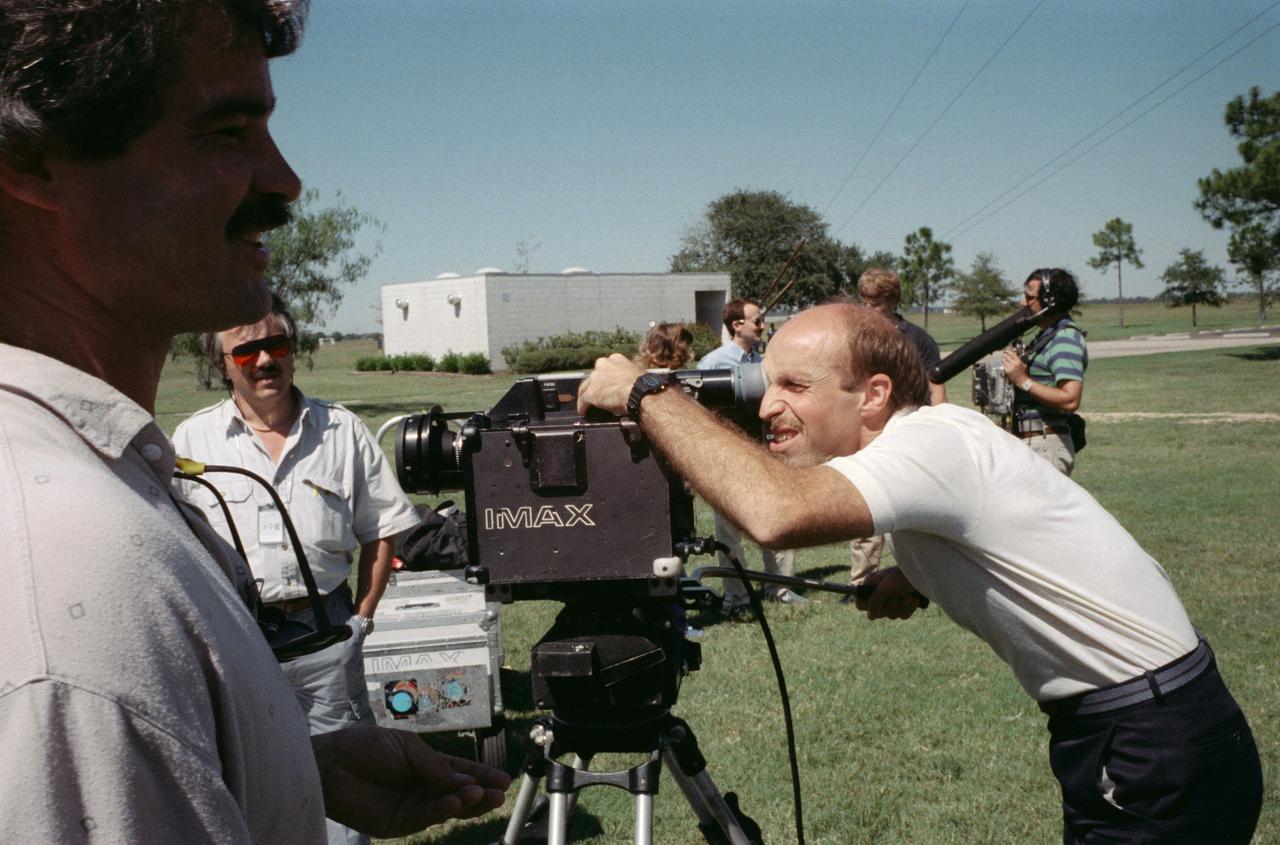
S88-52470 (8 Nov 1988) --- James P. Bagian, STS-29 mission specialist, gets in some training on the operation of one of the payloads for his upcoming spaceflight aboard Discovery. The crew met with Imax personnel, some of whom are pictured here, on the JSC grounds to practice using the motion- picture camera, making its first post-Challenger trip into space. The payload flew on a number of earlier STS flights.
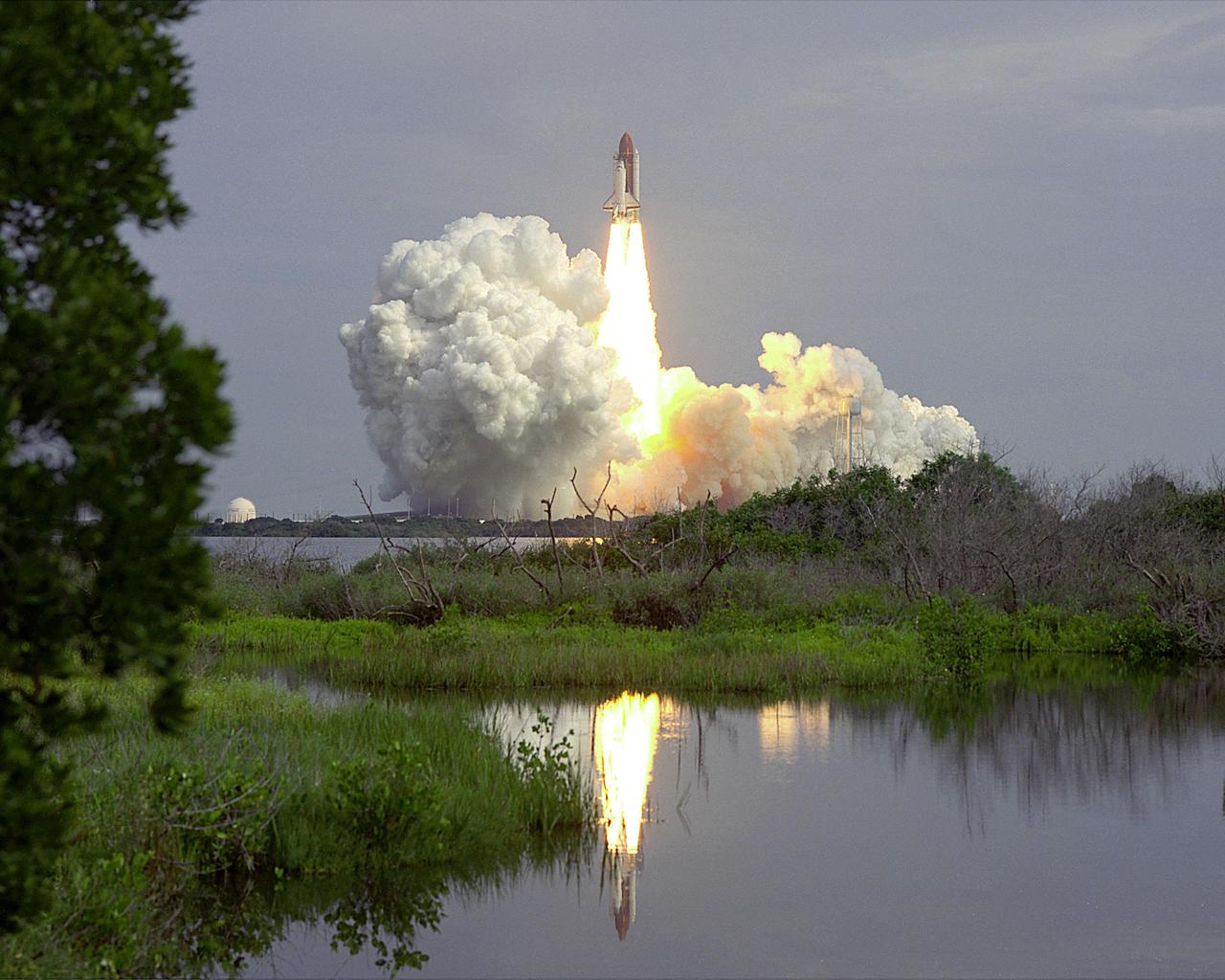
KENNEDY SPACE CENTER, FLA. -- Columbia launches on mission STS-40. Carrying Spacelab Life Sciences-1, it is the first dedicated solely to life sciences, using the habitable module. The crew of seven comprises Commander Bryan D. O'Connor, Pilot Sidney M. Gutierrez, Mission Specialists James P. Bagian, Tamara E. Jernigan and M. Rhea Seddon, and Payload Specialists F. Drew Gaffney and Millie Hughes-Fulford.
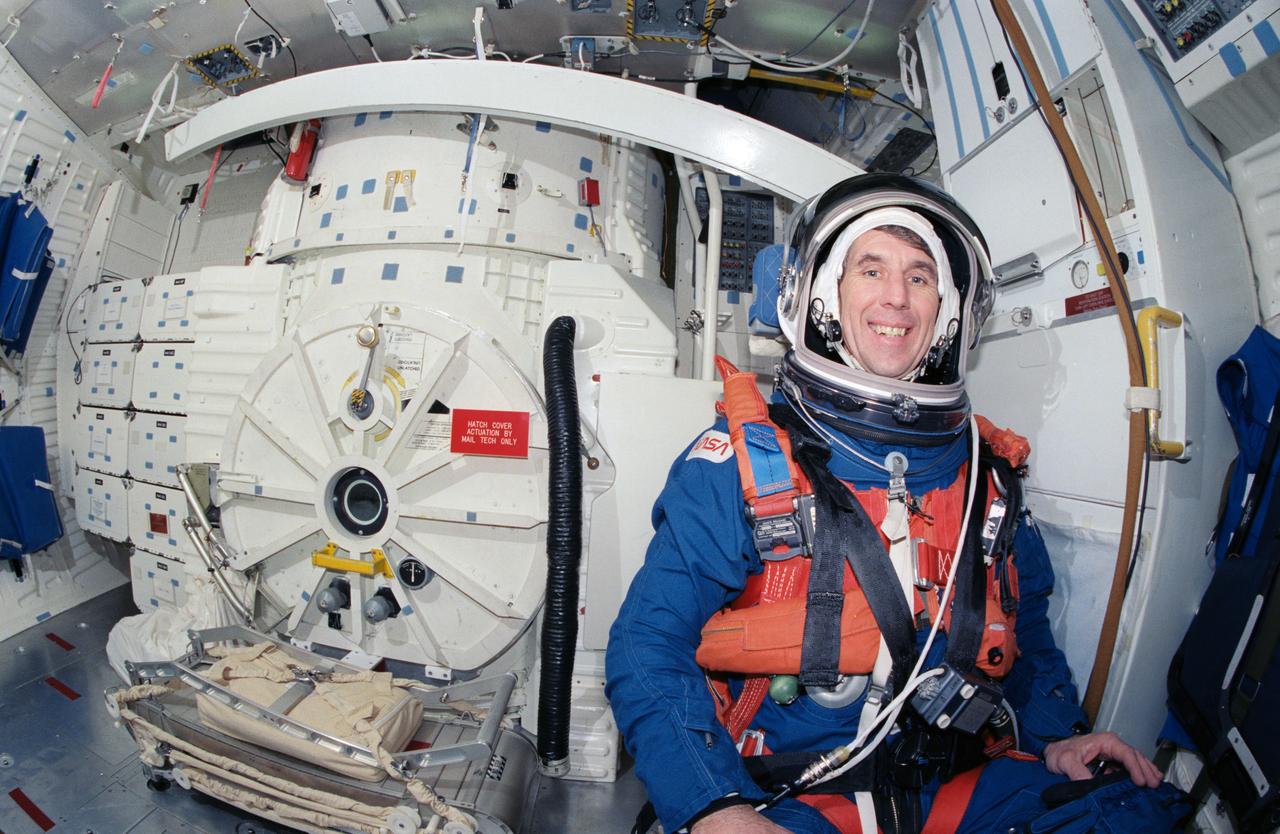
S89-26392 (Jan 1989) --- Astronaut Robert C. Springer, strapped into a chair, participates in entry phase rehearsals for his upcoming STS-29 flight. The mission specialist will join three crewmembers on the flight deck for launch, but will move to the mid deck for entry, swapping positions with fellow crewmember, Astronaut James P. Bagian, also a mission specialist. The rehearsals took place in the crew compartment trainer in JSC's Shuttle mockup and integration laboratory. Photo was made by Bill Bowers of the Johnson Space Center.
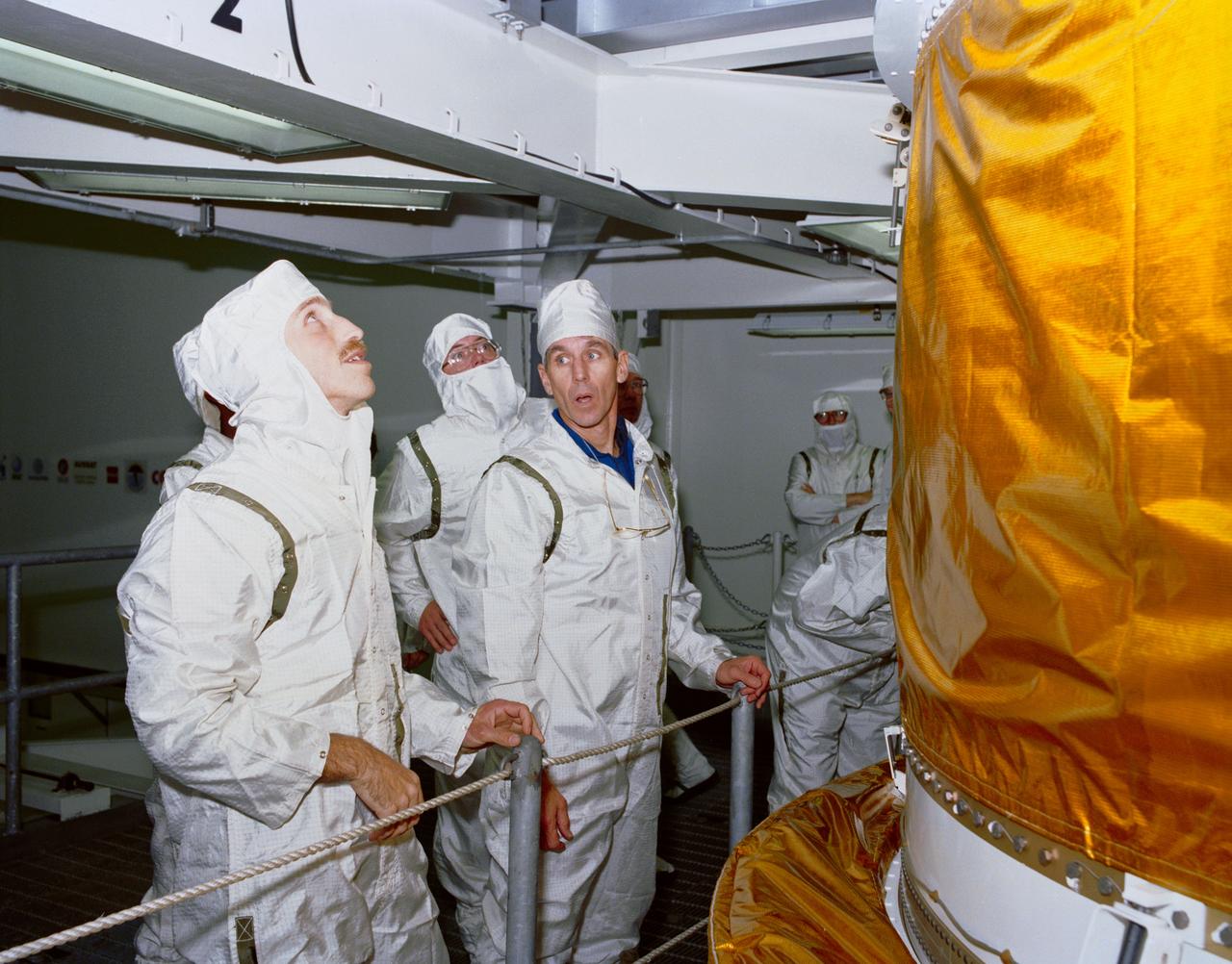
S89-27384 (5 Jan 1989) --- Astronauts James P. Bagian, left, and Robert C. Springer inspect a portion of the first stage of the Inertial Upper Stage (IUS-9) in a test cell of the KSC vertical processing facility. The two, along with three other NASA astronauts, will fly aboard Discovery and are responsible for the deployment of the tracking and data relay satellite (TDRS).
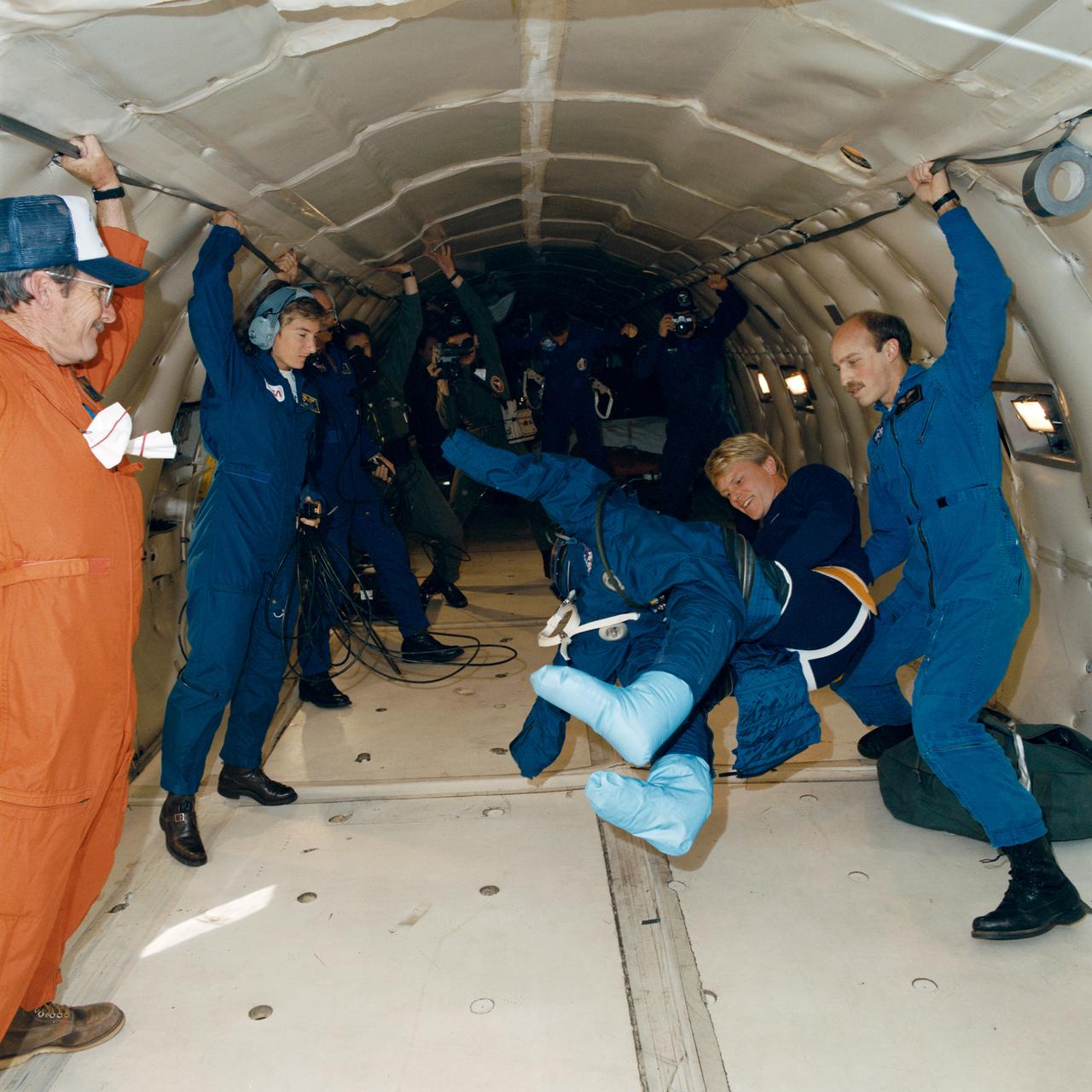
STS-26 Discovery, Orbiter Vehicle (OV) 103, Mission Specialist (MS) George D. Nelson practices donning and doffing new (navy blue) partial pressure suit (launch and entry suit (LES)) aboard KC-135 NASA 930 during zero gravity testing. Nelson is assisted by astronaut James P. Bagian as KC-135 flight crew (including Stephanie A. Wells) looks on and photographers document activities.

S89-28089 (24 Jan 1989) --- The Space Shuttle Discovery is lowered for mating to the external tank and two solid rockert boosters in the vehicle assembly building (VAB) at the Kennedy Space Center. Onboard the spacecraft in mid-March for a five-day mission, on which will be deployed a third tracking and data relay satellite (TDRS-D), will be Astronauts Michael L. Coats, John E. Blaha, James F. Buchli, James P. Bagian and Robert C. Springer.

Five astronauts launched aboard the Space Shuttle Discovery on March 13, 1989 at 9:57 am (EST) for the STS-29 mission. Included were James P. Bagian, mission specialist 1; Robert C. Springer, mission specialist 3; James F. (Jim) Buchli, mission specialist 2; John E. Blaha, pilot; and Michael L. Coats, commander. The mission’s primary payload was the Tracking and Data Relay Satellite-4 (TDRS-4).
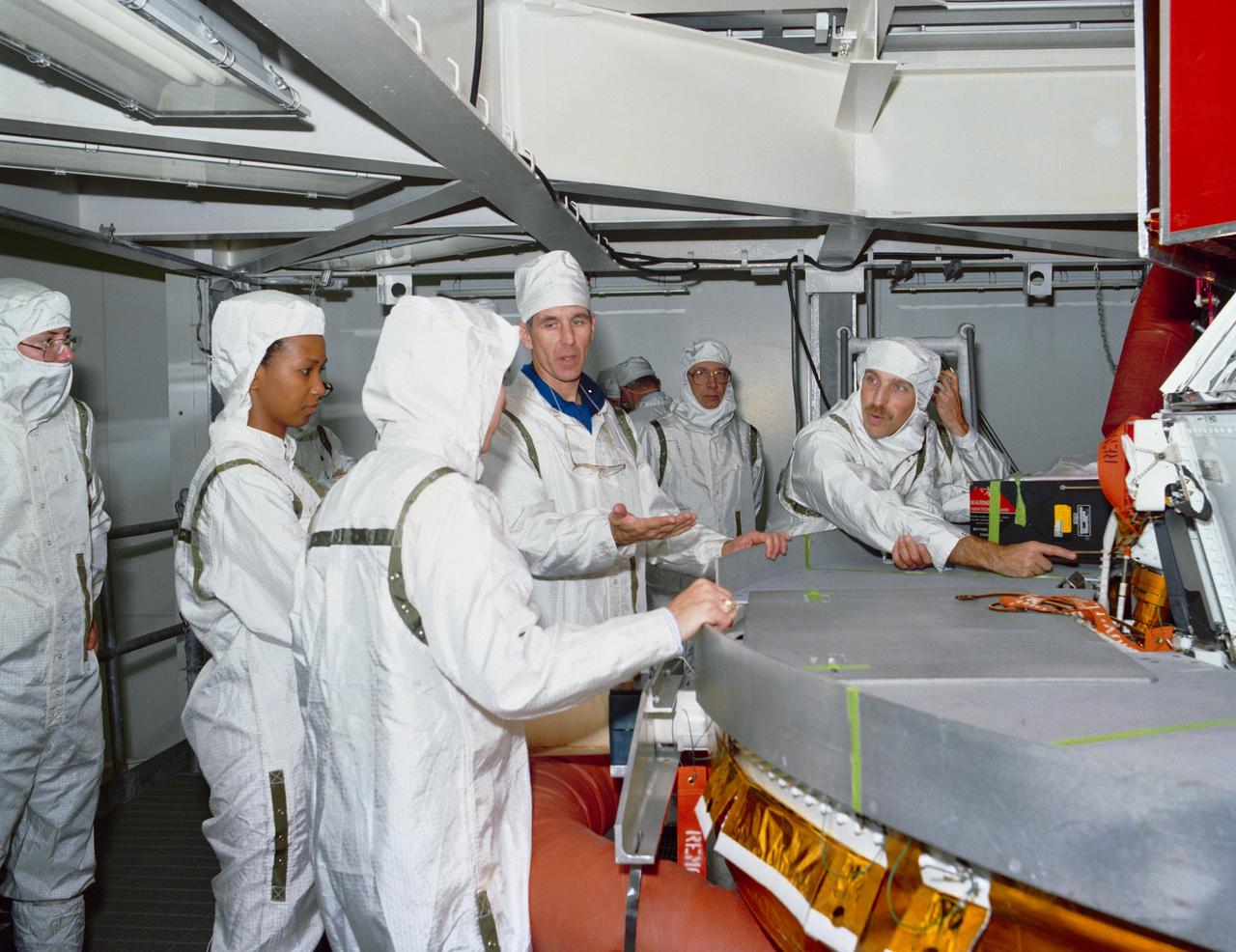
S89-28108 --- Astronaut Mae C. Jemison and STS-29 Mission Specialist James P. Bagian and Robert C. Springer inspect the interface between the tracking and data relay satellite D (TDRS-D) and inertial upper stage (IUS-9) in a test cell located in the Kennedy Space Center (KSC) Vertical Processing Facility (VPF). The clean-suited astronauts, engineers, and technicians discuss the payload. Photo credit: NASA
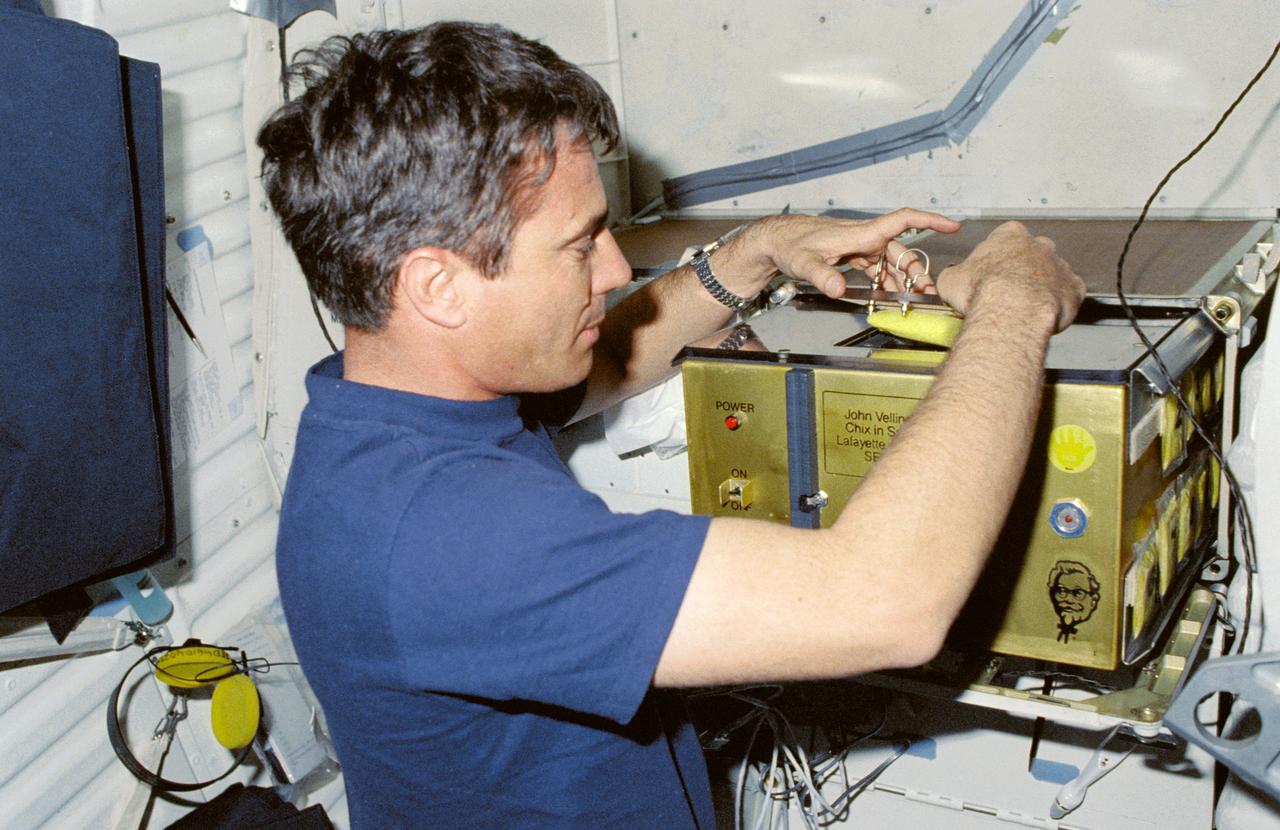
STS029-01-001 (16 Marach 1989) --- Astronaut John E. Blaha, STS-29 pilot, checks an incubator on the mid deck of Earth-orbiting Discovery during Flight Day 4 activity. The incubator is part of a student involvement program experiment titled, "Chicken Embryo Development in Space." The student experimenter is John C. Vellinger. The experiment's sponsor is Kentucky Fried Chicken. This photographic frame was among NASA's third STS-29 photo release. Monday, March 20, 1989. Crewmembers were Astronauts Michael L. Coats, John E. Blaha, James F. Buchli, Robert C. Springer and James P. Bagian.
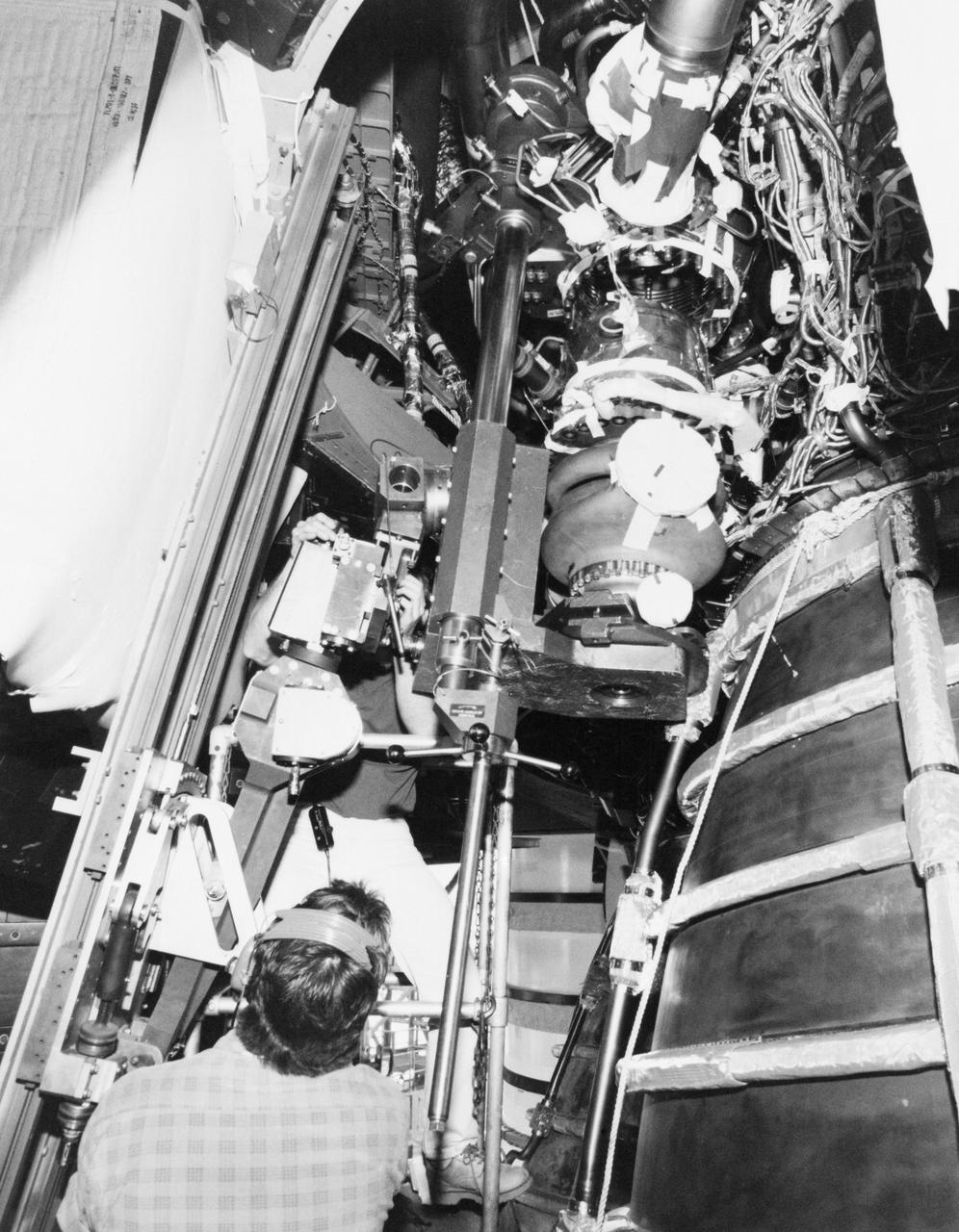
S89-28092 (7 Feb 1989) --- Kennedy Space Center technicians inspect an area near the three main engines of the Space Shuttle Discovery prior to the removal of one of three oxidozer turbo pumps. New pumps are scheduled to be installed soon. Now at Launch Pad 39-B, Discovery is set for launch in mid-March for Mission STS-29. Primary payload will be TDRS-D. Crewmembers are Astronauts Michael L. Coats, mission commander, John E. Blaha, pilot; along with James F. Buchli, Robert C. Springer and James P. Bagian, all mission specialists.
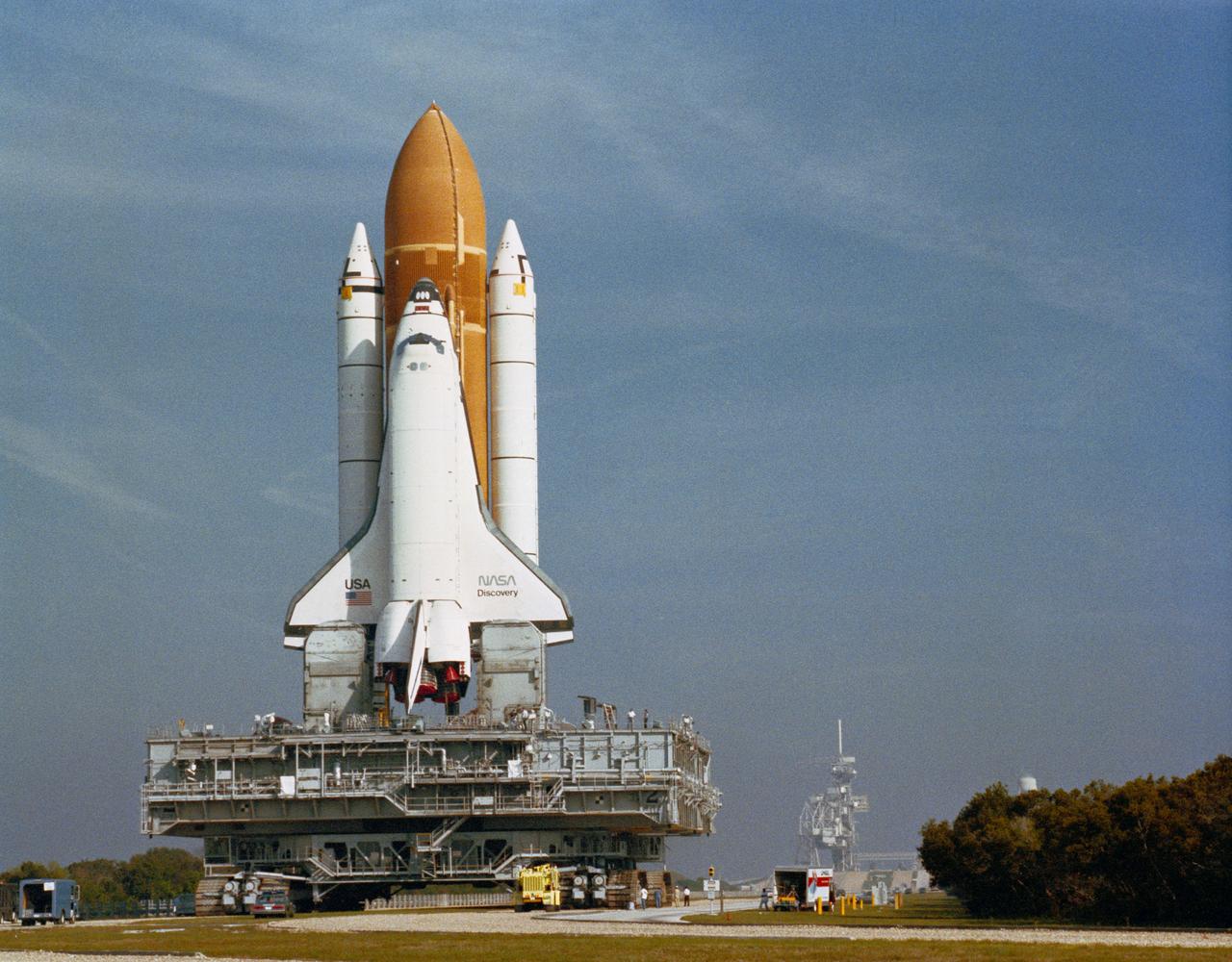
S89-28110 (3 Feb 1989) ---The Space Shuttle Discovery, atop a mobile launch platform, is rolled toward Kennedy Space Center's Launch Pad 39-B on Feb. 3, l989. It rolled through the doors of the huge vehicle assembly building (VAB) at 6 a.m.,several hours ago. The Launch Complex is in view here. The trip to the pad takes approximately 5 and 1/2 hours. Onboard the spacecraft in mid-March for a five-day mission, on which will be deployed a third tracking and data relay satellite (TDRS-D), will be Astronauts Michael L. Coats, John E. Blaha, James F. Buchli, James P. Bagian and Robert C. Springer.
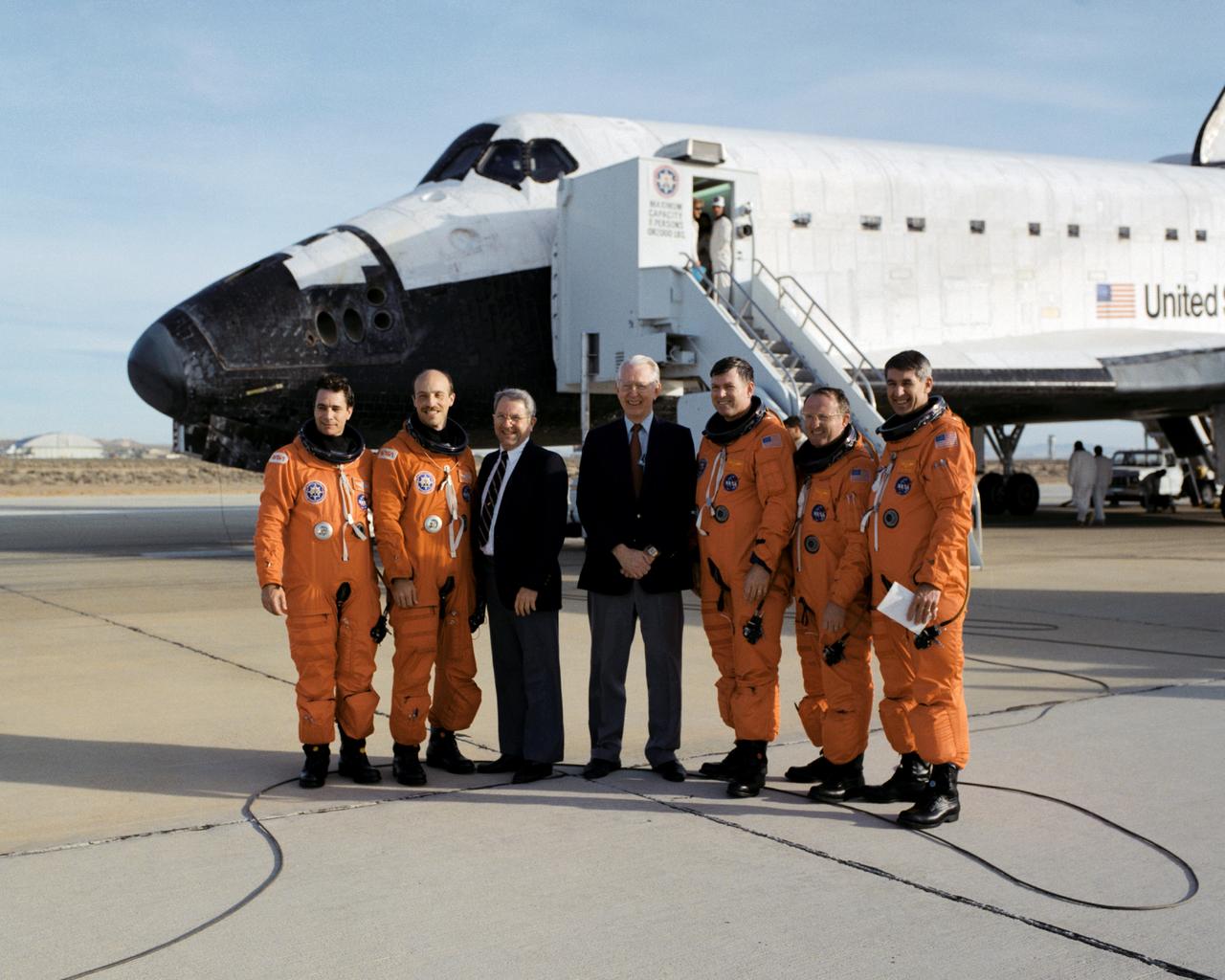
STS029-S-066 (18 March 1989) --- The five-man crew who flew aboard NASA's Space Shuttle Discovery (background) pose near it with NASA officials following a successful five-day mission in space. Left to right are astronauts John E. Blaha, pilot; and James P. Bagian, mission specialist; Rear Admiral Richard H. Truly, NASA Associate Administrator for Space Flight; Dr. James C. Fletcher, NASA Administrator; astronauts Michael L. Coats, commander; and James F. Buchli and Robert C. Springer, mission specialists.
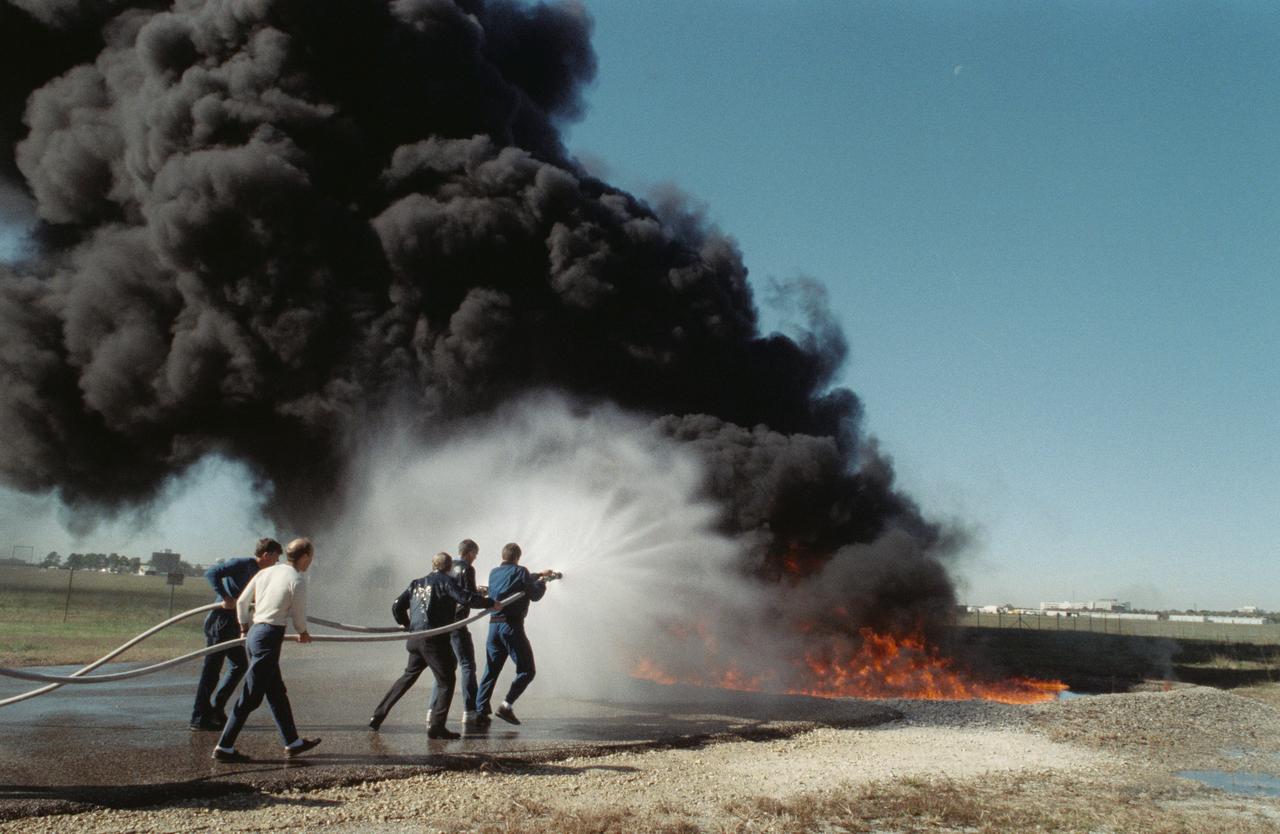
S88-54947 (6 Dec 1988) --- The STS-29 crewmembers are trained in procedures to follow in the event of a fire with their spacecraft. Here, Astronauts Michael L. Coats (far left), mission commander, and James P. Bagian, mission specialist, follow the lead of two fellow crewmembers as they extinguish a fire. The astronauts in front of the action are Robert C. Springer, mission specialist, and John E. Blaha, pilot. Not pictured is James F. Buchli, mission specialist. Their instructor, center, is Robert Fife of NASA's security staff. The training took place on the northern end of the 1625-acre JSC facility.
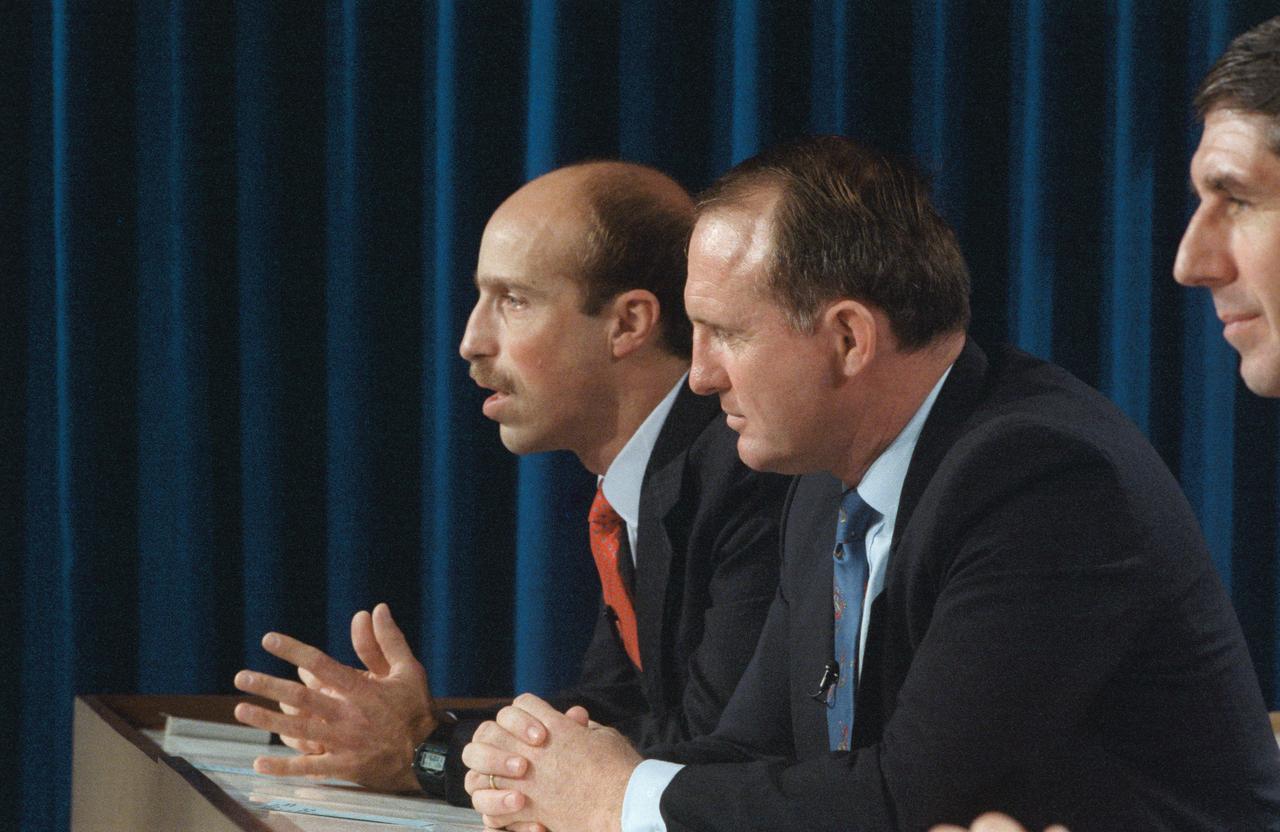
S89-25327 (11 Jan 1989) --- Two crewmembers for NASA's STS-29 mission ponder a question from a news reporter during a press conference concerning their scheduled mid-March flight. James P. Bagian, at left, begins to answer the query, as James F. Buchli listens. Out of the frame are other members of the crew--Astronauts Michael L. Coats, mission commander; and John E. Blaha and Robert C. Springer. The five will deploy a tracking and data relay satellite from Discovery's cargo bay as well as perform other important chores on their scheduled five-day flight.
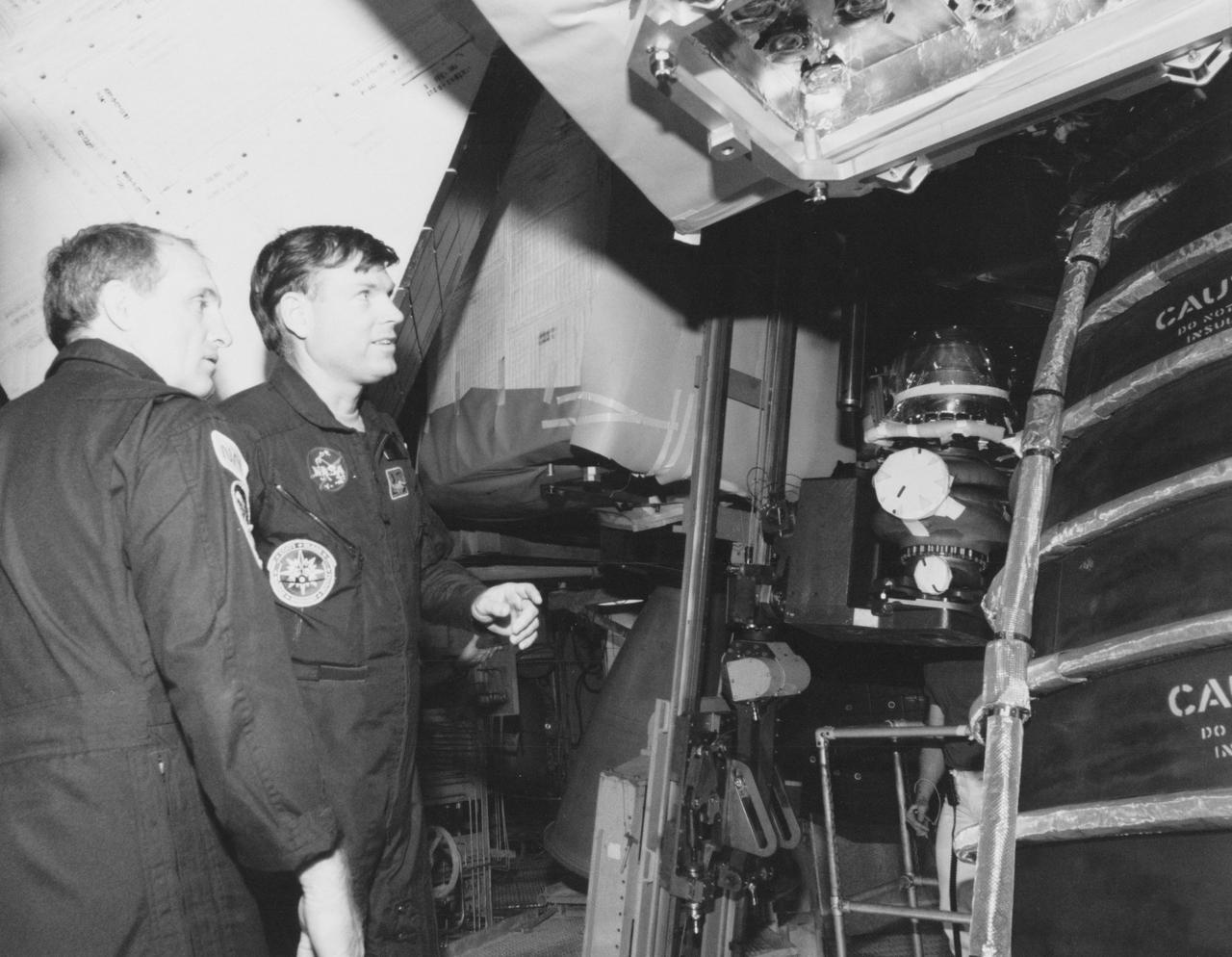
S89-28091 (7 Feb 1989) --- STS-29 astronauts inspect an area near the three main engines of the Space Shuttle Discovery prior to the removal of one of three oxidozer turbo pumps. Left to right are Astronauts James F. Buchli, mission specialist, and Michael L. Coats, mission commander. New pumps are scheduled to be installed soon. Now at Launch Pad 39-B, Discovery is set for launch in mid-March for Mission STS-29. Primary payload will be TDRS-D. Crewmembers not seen here are John E. Blaha, the pilot; and Robert C. Springer and James P. Bagian, both mission specialists.
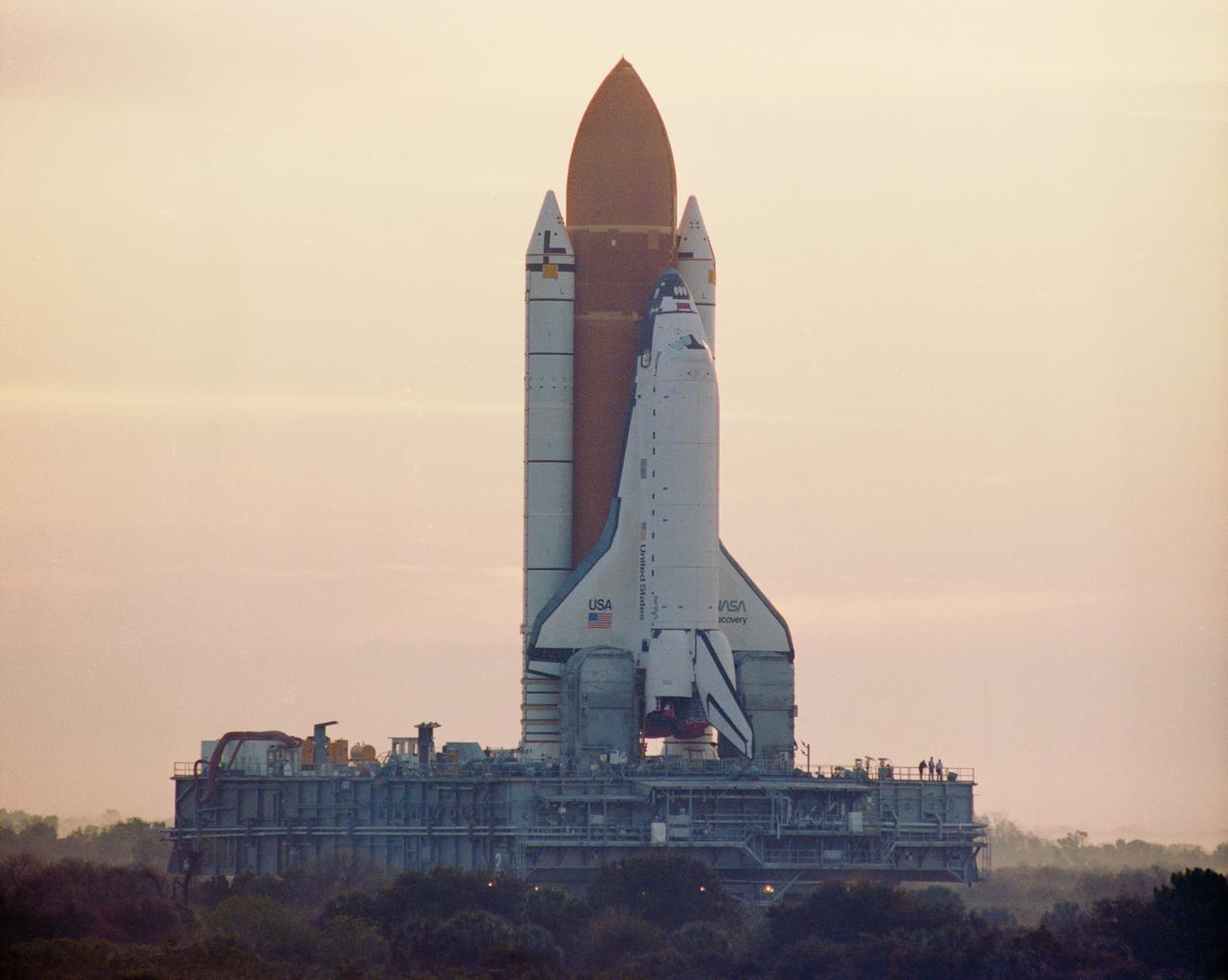
S89-28112 (3 Feb 1989) --- The Space Shuttle Discovery, atop a mobile launch platform, is rolled toward Kennedy Space Center's Launch Pad 39-B in the early morning hours of Feb. 3, l989. It rolled through the doors of the huge vehicle assembly building (VAB) at 6 a.m. The trip to the pad takes approximately 5 and 1/2 hours. Onboard the spacecraft in mid-March for a five-day mission, on which will be deployed a third tracking and data relay satellite (TDRS-D), will be Astronauts Michael L. Coats, John E. Blaha, James F. Buchli, James P. Bagian and Robert C. Springer.
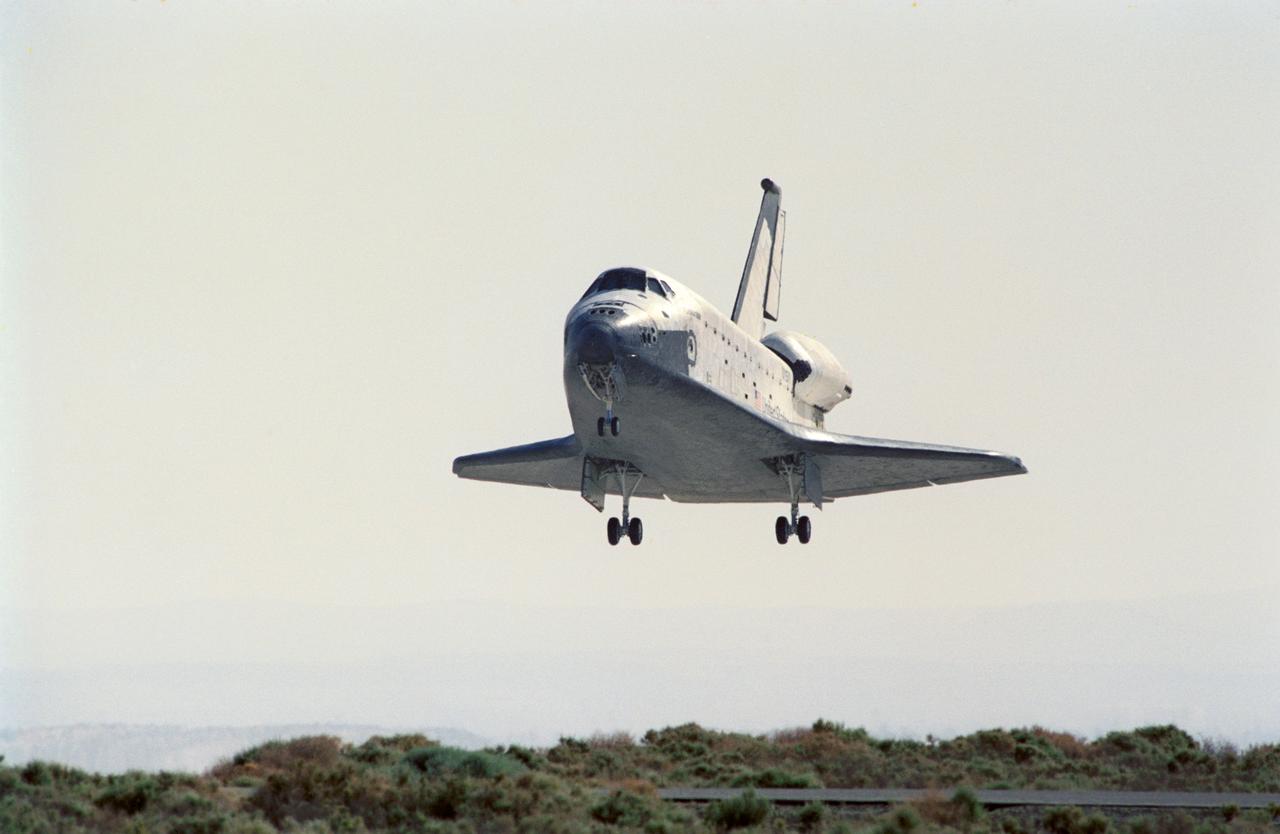
STS040-S-174 (14 June 1991) --- The Space Shuttle Columbia is only moments away from touchdown on Runway 22 at Edwards Air Force Base in California. The landing completes a successful nine-day Spacelab Life Sciences (SLS-1) mission, the first ever devoted exclusively to life sciences research. Onboard the spacecraft were astronauts Bryan D. O'Connor, Sidney M. Gutierrez, Rhea Seddon, James P. Bagian and Tamara E. Jernigan; and payload specialists F. Drew Gaffney and Millie Hughes-Fulford. Landing occurred at 8:39:11 a.m. (PDT), June 14, 1991.
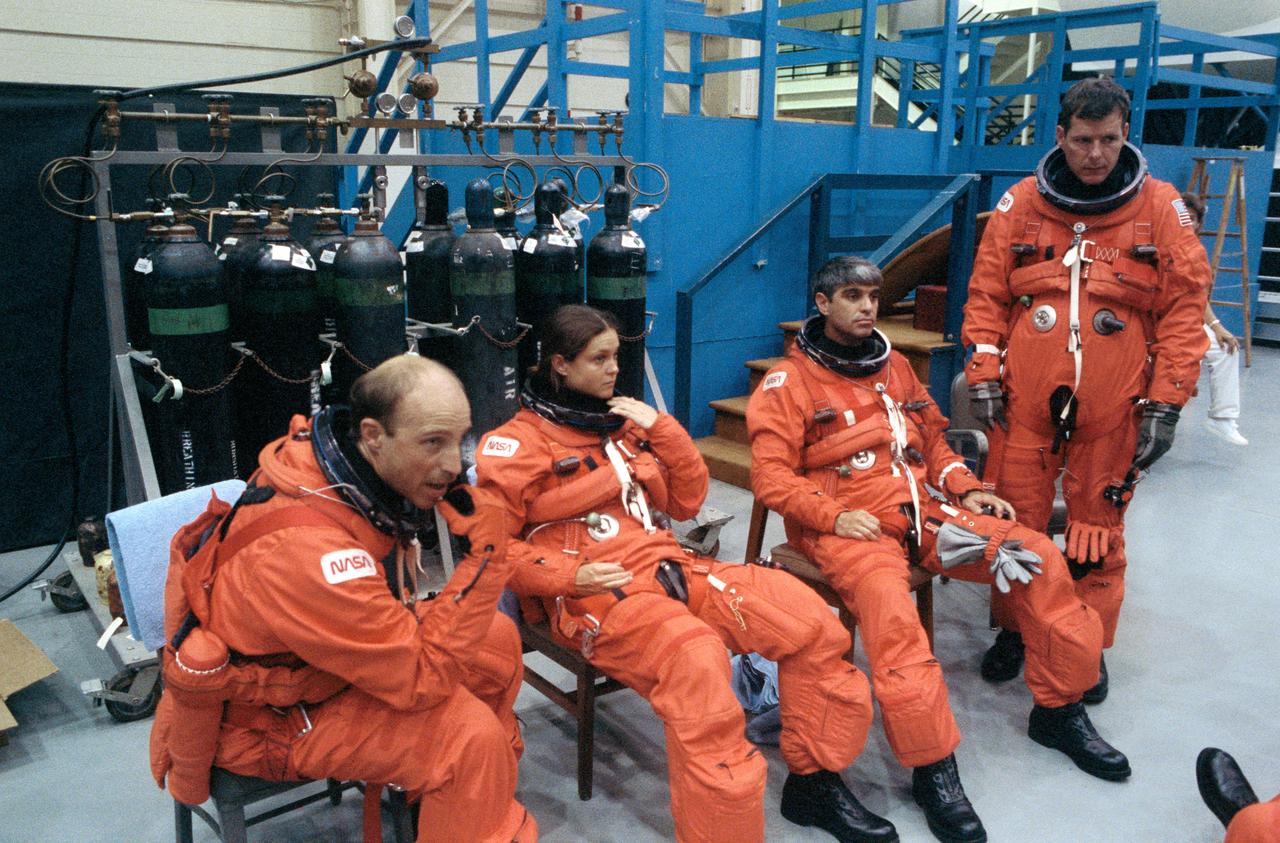
S90-41372 (11 June 1990) --- Crewmembers assigned to NASA's STS 40 Spacelab Life Sciences (SLS-1) mission take a brief break during emergency egress training in the Shuttle mockup and integration laboratory at the Johnson Space Center (JSC). Left to right are astronauts James P. Bagian, Tamara E. Jernigan, both mission specialists; and Sidney M. Gutierrez, pilot; and Bryan D. O'Connor, mission commander. Out of frame are astronaut Rhea Seddon, mission specialist, and payload specialists Millie Hughes-Fulford and Drew Gaffney.
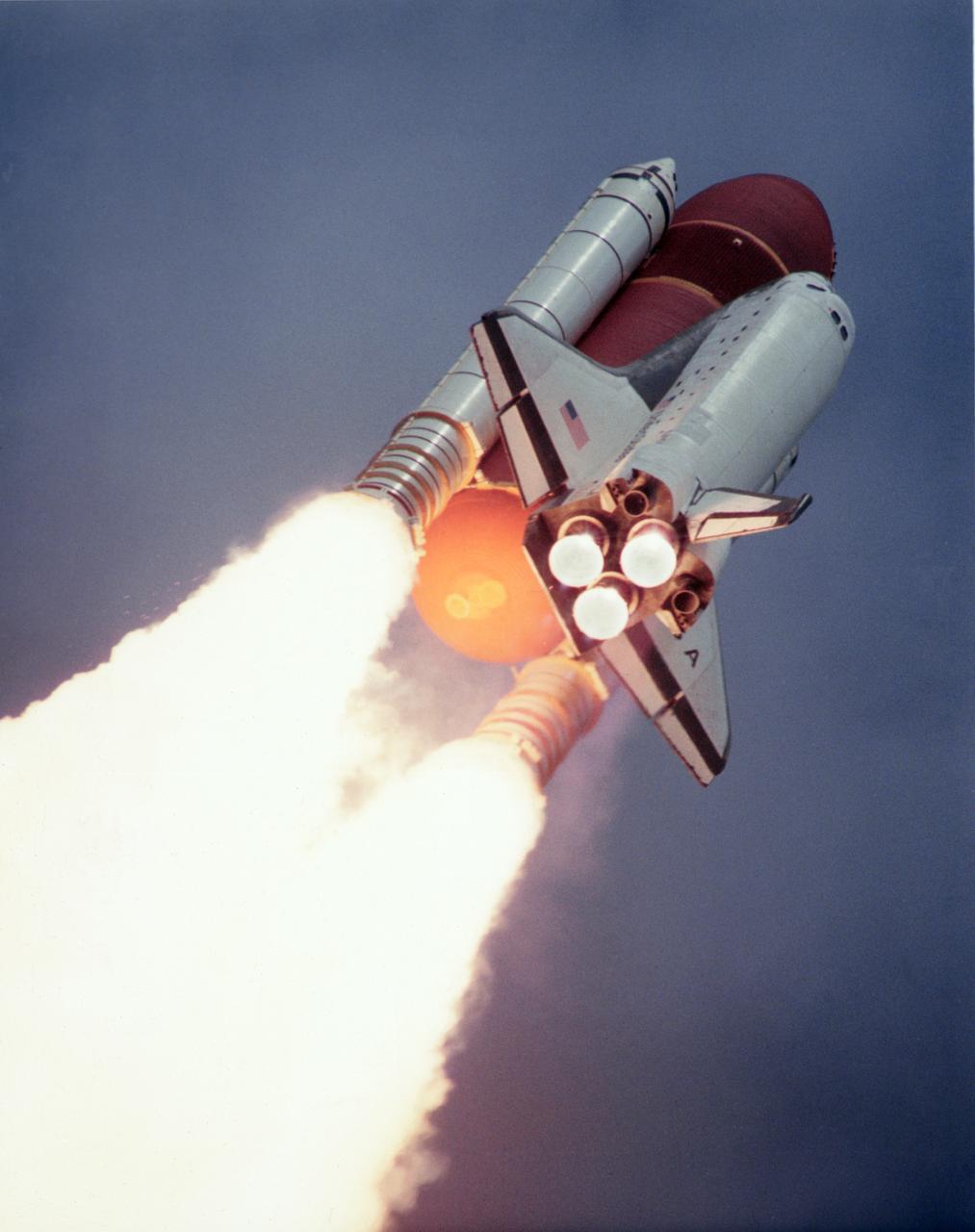
Launched aboard the Space Shuttle Columbia on June 5, 1991 at 9:24; am (EDT), the STS-40 mission was the fifth dedicated Spacelab Mission, Spacelab Life Sciences-1 (SLS-1), and the first mission dedicated solely to life sciences. The STS-40 crew included 7 astronauts: Bryan D. O’Connor, commander; Sidney M. Gutierrez, pilot; F. Drew Gaffney, payload specialist 1; Milli-Hughes Fulford, payload specialist 2; James P. Bagian, mission specialist 1; Tamara E. Jernigan, mission specialist 2; and M. Rhea Seddon, mission specialist 3.
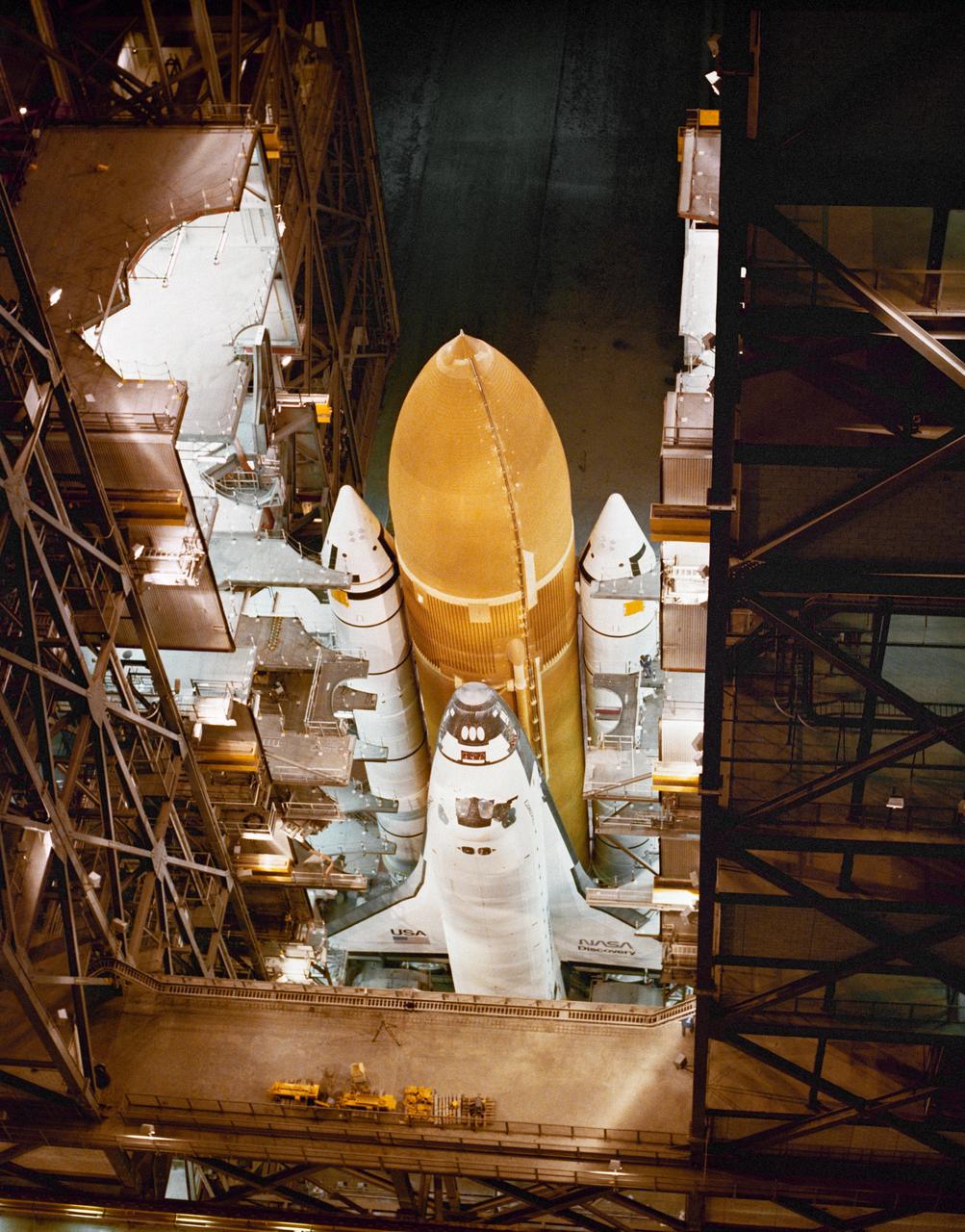
S89-28111 (3 Feb 1989) --- The Space Shuttle Discovery, atop a mobile launch platform, is rolled through the doors of the huge vehicle assembly building (VAB) at 6 a.m., Feb. 3, 1989 on its way to Launch Complex 39. The trip to the pad takes approximately 5 and 1/2 hours. Onboard the spacecraft in mid-March for a five-day mission, on which will be deployed a third tracking and data relay satellite (TDRS-D), will be Astronauts Michael L. Coats, John E. Blaha, James F. Buchli, James P. Bagian and Robert C. Springer.

STS029-04-029 (13-18 March 1989) --- Astronaut Michael L. Coats appears to like the status of the STS-29 flight as he offers a big smile from the commander's station on the flight deck. He takes a momentary break from updating the crew activity plan (CAP) to pose for the photo. This photographic frame was among NASA's third STS-29 photo release. Monday, March 20, 1989. Crew members were astronauts Michael L. Coats, John E. Blaha, James F. Buchli, Robert C. Springer and James P. Bagian. Photo credit: NASA
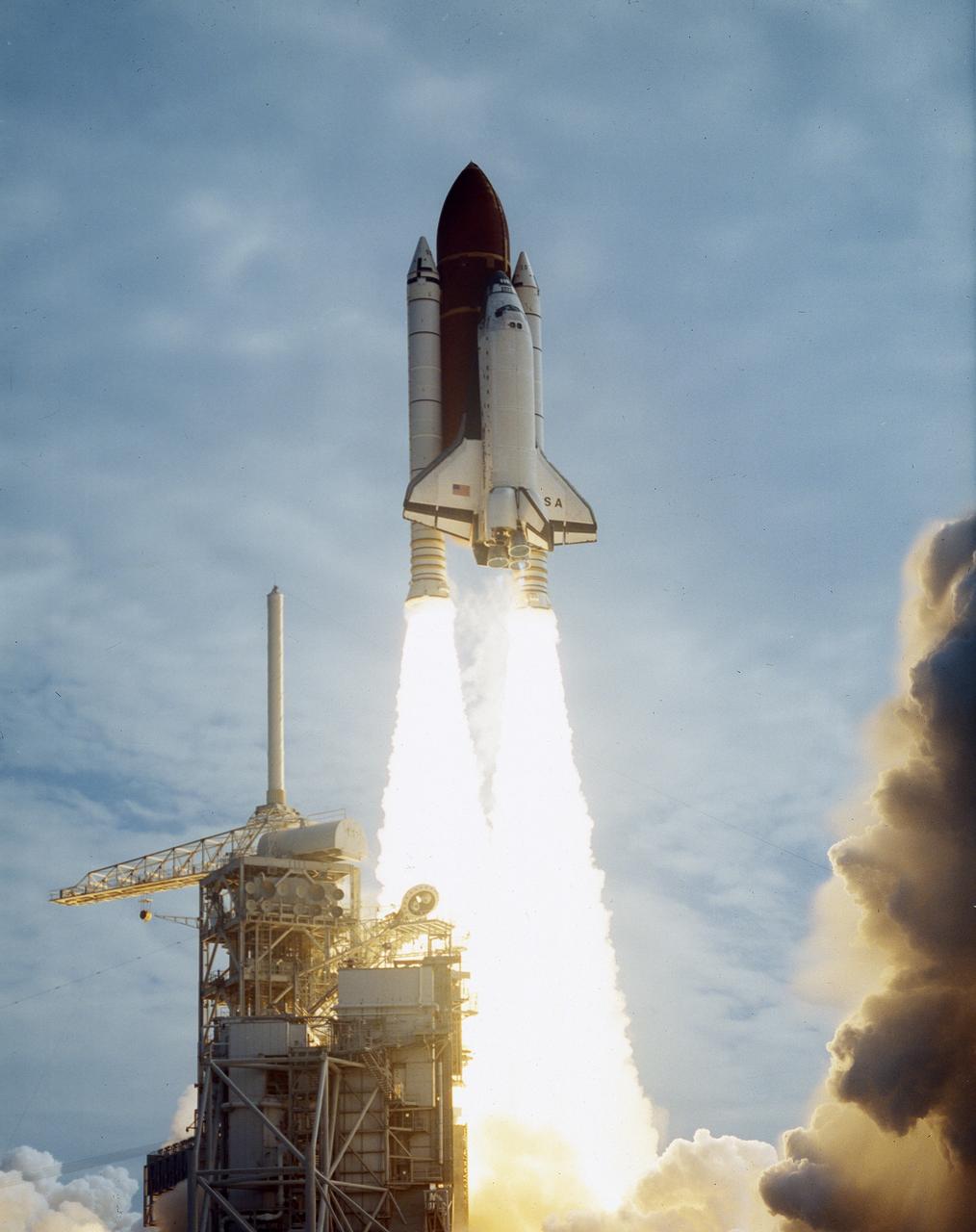
Launched aboard the Space Shuttle Columbia on June 5, 1991 at 9:24; am (EDT), the STS-40 mission was the fifth dedicated Spacelab Mission, Spacelab Life Sciences-1 (SLS-1), and the first mission dedicated solely to life sciences. The STS-40 crew included 7 astronauts: Bryan D. O’Connor, commander; Sidney M. Gutierrez, pilot; F. Drew Gaffney, payload specialist 1; Milli-Hughes Fulford, payload specialist 2; James P. Bagian, mission specialist 1; Tamara E. Jernigan, mission specialist 2; and M. Rhea Seddon, mission specialist 3.
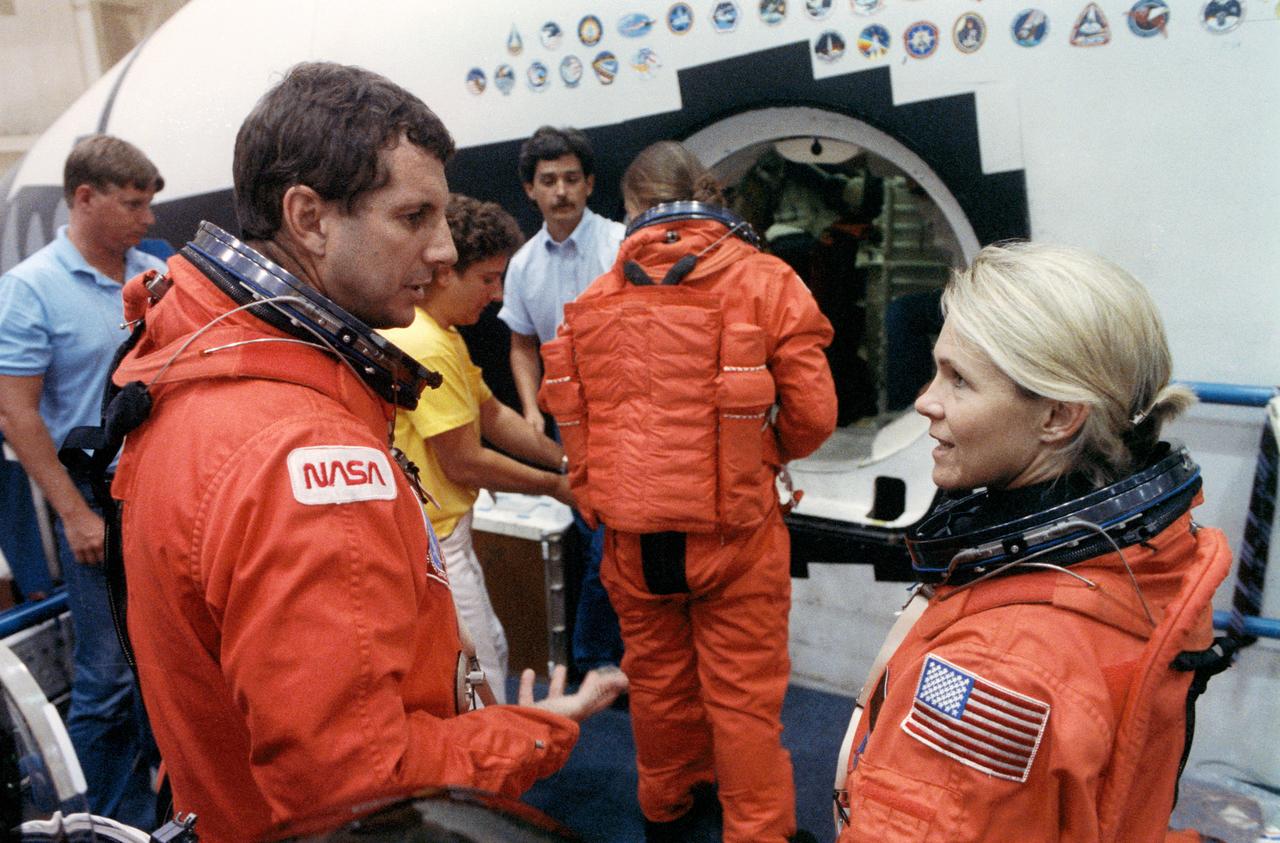
S90-41365 (11 June 1990) --- Crewmembers assigned to NASA's STS-40/Spacelab Life Sciences (SLS-1) mission take a brief break during emergency egress training in the Shuttle mockup and integration laboratory at the Johnson Space Center (JSC). In the foreground are astronauts Rhea Seddon and payload specialist F. Drew Gaffney. In the background, also wearing an orange partial pressure, ascent/entry suit is astronaut Tamara E. Jernigan, mission specialist. Not in the frame are astronauts Bryan D. O'Connor, mission commander; Sidney M. Gutierrez, pilot; James P. Bagian, mission specialist, and payload specialist Millie Fulford-Hughes.
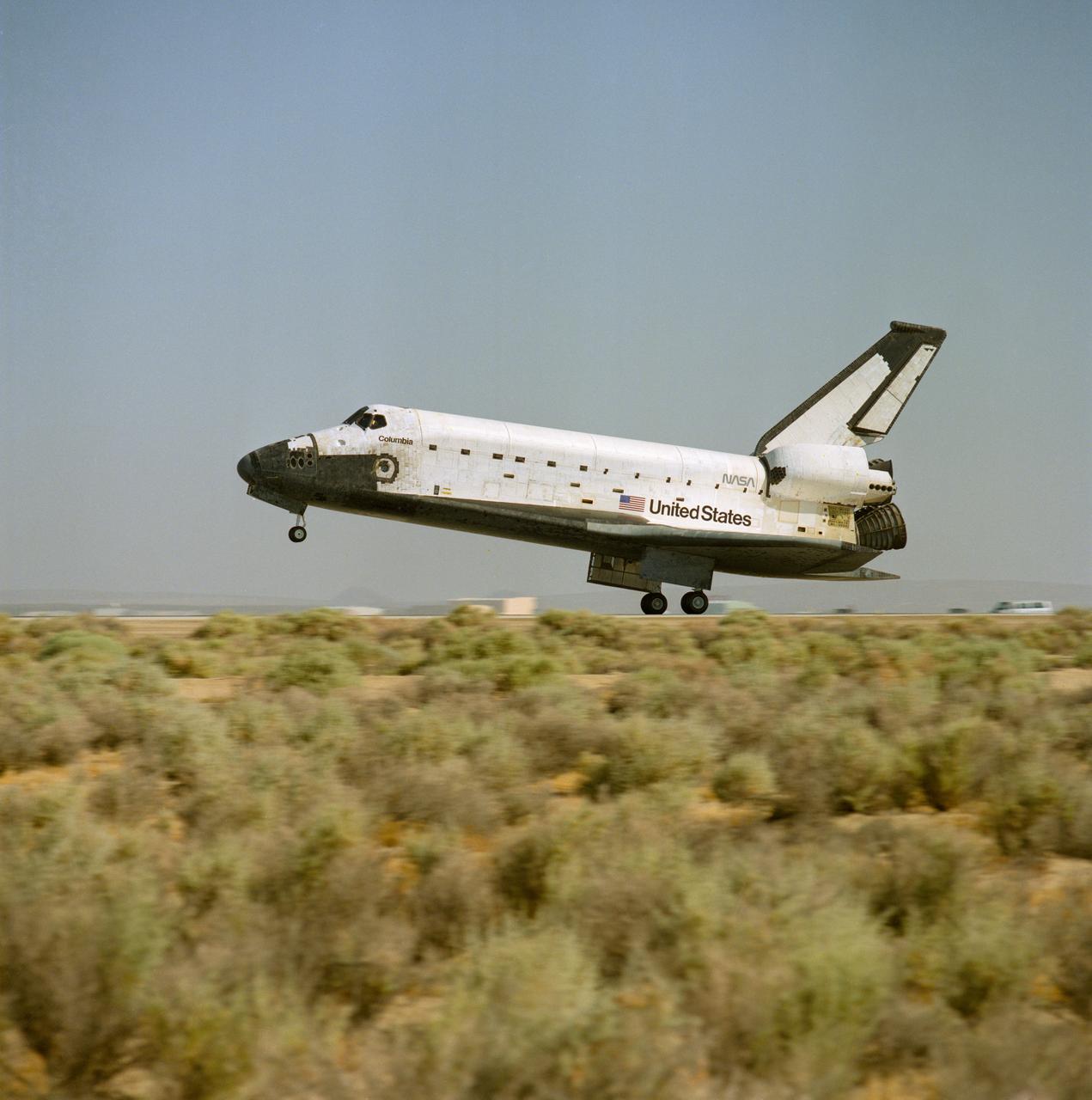
STS040-S-175 (14 June 1991) --- The main landing gear of the Space Shuttle Columbia touches down, on Runway 22 at Edwards Air Force Base in California, to complete a successful nine-day mission. The Spacelab Life Sciences (SLS-1) mission was the first ever devoted exclusively to life sciences research. Onboard the spacecraft were astronauts Bryan D. O'Connor, Sidney M. Gutierrez, Rhea Seddon, James P. Bagian and Tamara E. Jernigan; and payload specialists F. Drew Gaffney and Millie Hughes-Fulford. Landing occurred at 8:39:11 a.m. (PDT), June 14, 1991.
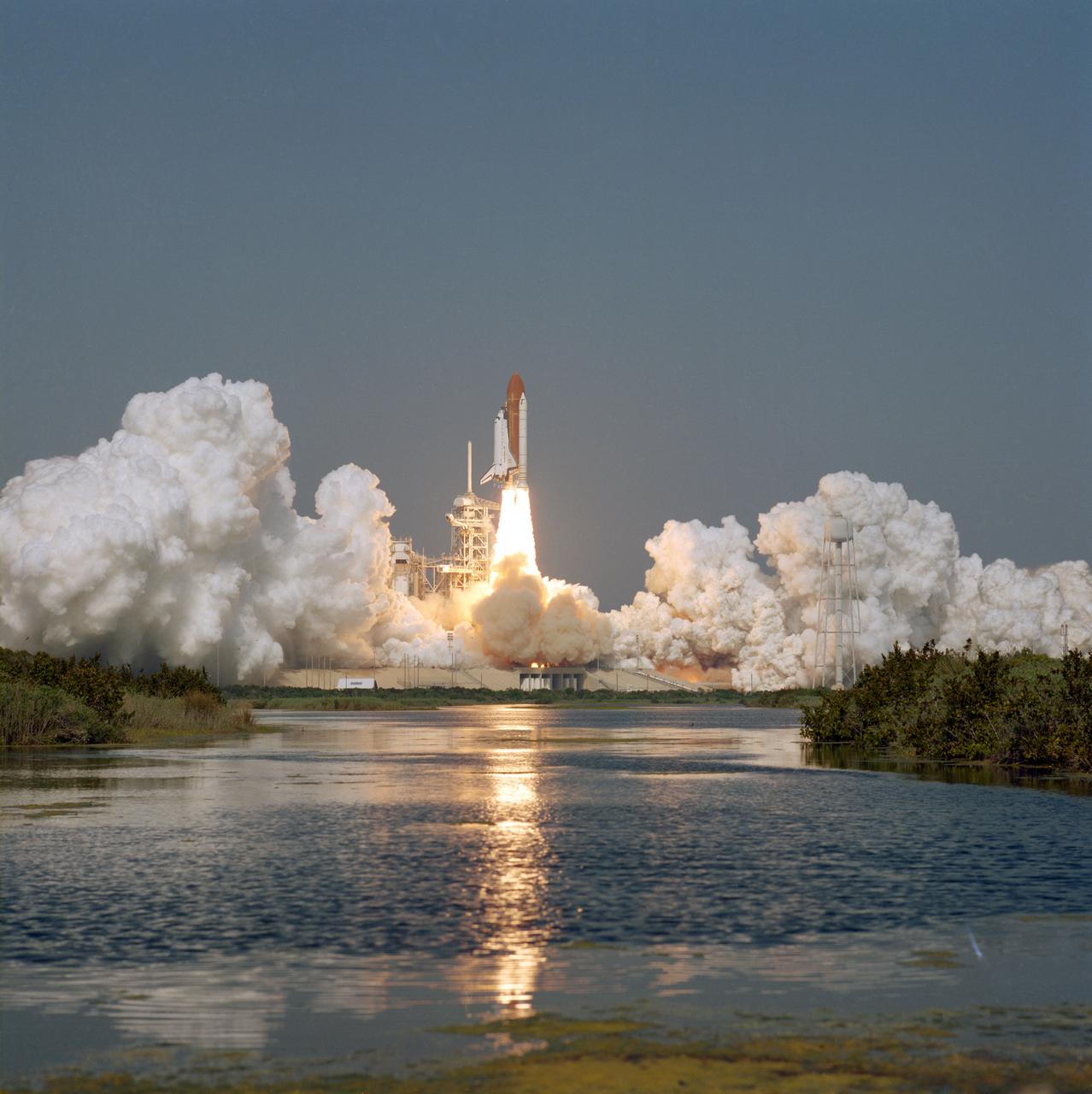
STS029-S-026 (13 Mar 1989) --- A wide shot of the Space Shuttle Discovery lifting off from Launch Pad 39B on mission STS-29. Discovery lifted off at 9:57 a.m. (EST), March 13, 1989, carrying the Tracking And Data Relay Satellite (TDRS-1) into orbit. The brilliant flames associated with the launch are reflected in the marsh waters. Onboard the spacecraft were astronauts Michael L. Coats, commander; John E. Blaha, pilot; and James F. Buchli, James P. Bagian and Robert C. Springer, all mission specialists.
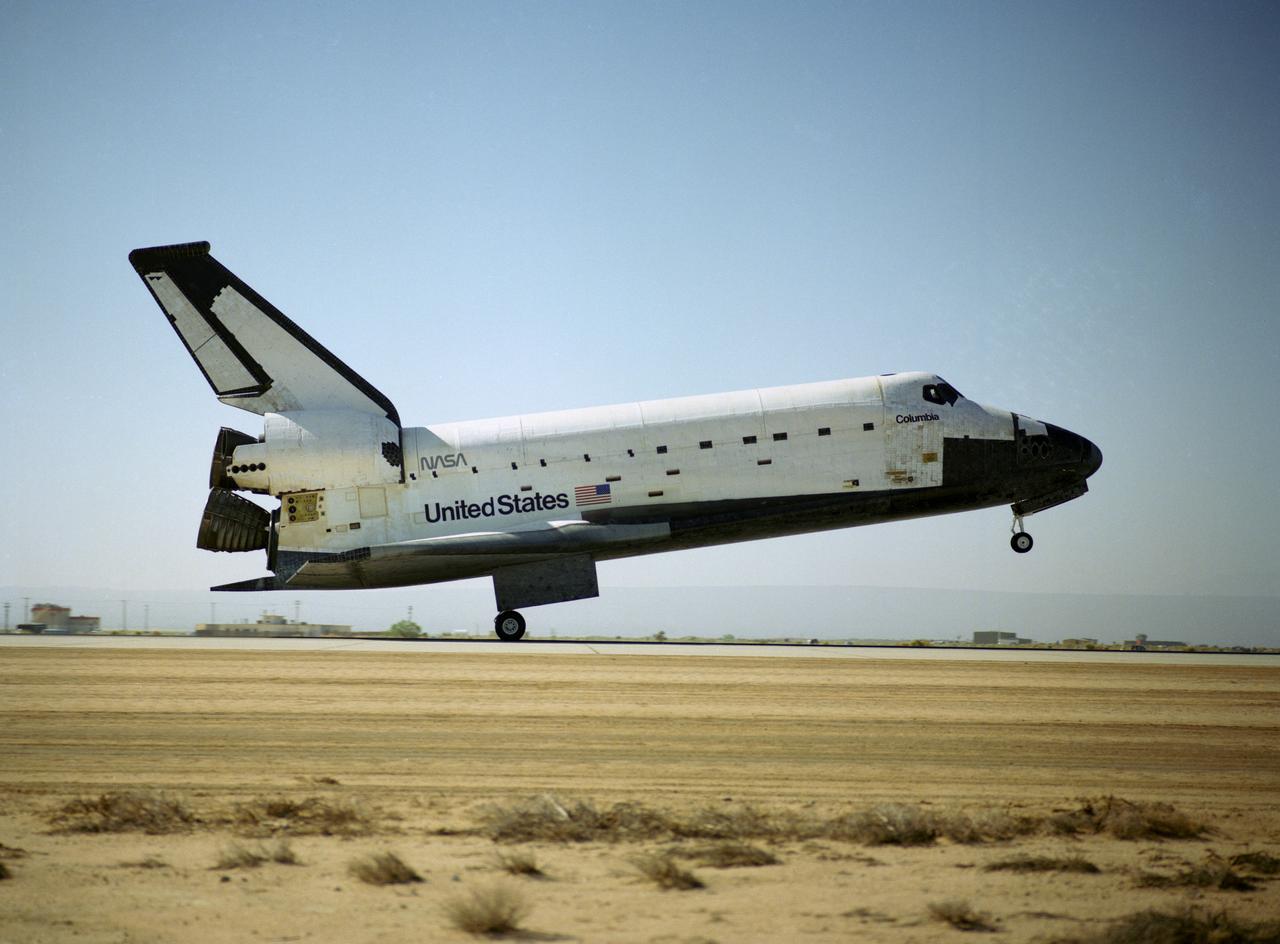
STS040-S-176 (14 June 1991) --- The main landing gear of the Space Shuttle Columbia touches down, on Runway 22 at Edwards Air Force Base in California, to complete a successful nine-day mission. The Spacelab Life Sciences (SLS-1) mission was the first ever devoted exclusively to life sciences research. Onboard the spacecraft were astronauts Bryan D. O'Connor, Sidney M. Gutierrez, Rhea Seddon, James P. Bagian and Tamara E. Jernigan; and payload specialists F. Drew Gaffney and Millie Hughes-Fulford. Landing occurred at 8:39:11 a.m. (PDT), June 14, 1991.
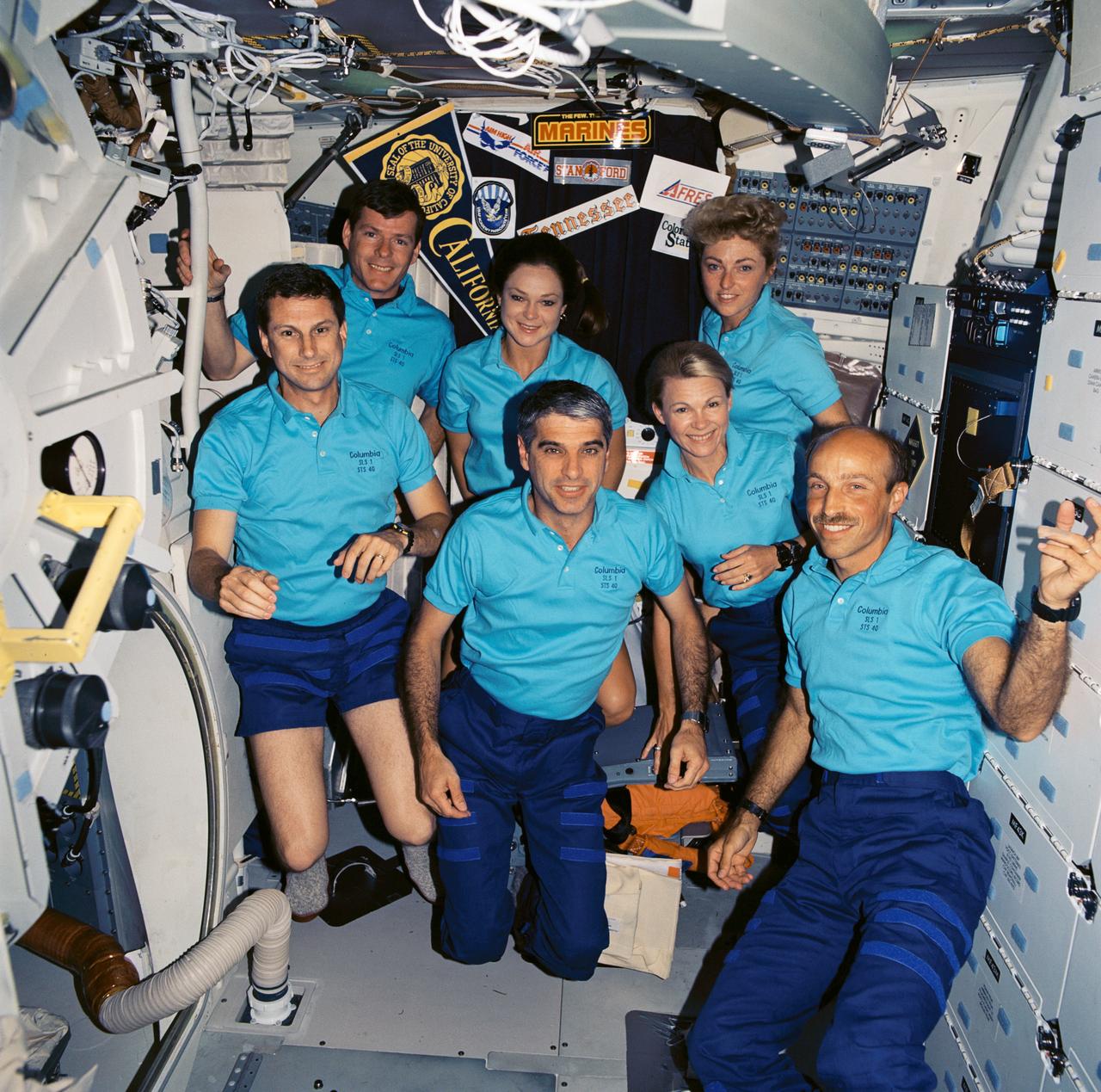
STS040-605-009 (5-14 June 1991) --- The seven crew members for STS-40 pose for an in-space portrait on the Space Shuttle Columbia's mid-deck. Left to right, in front are F. Andrew Gaffney, Sidney M. Gutierrez, Rhea Seddon and James P. Bagian; in back, Bryan D. O'Connor, Tamara E. Jernigan and Millie Hughes-Fulford. The five astronauts and two payload specialists are spending nine days in space in support of the Spacelab Life Sciences (SLS-1) mission. The image was one of 25 visuals used by the STS-40 crew at its Post Flight Press Conference (PFPC) on June 28, 1991.
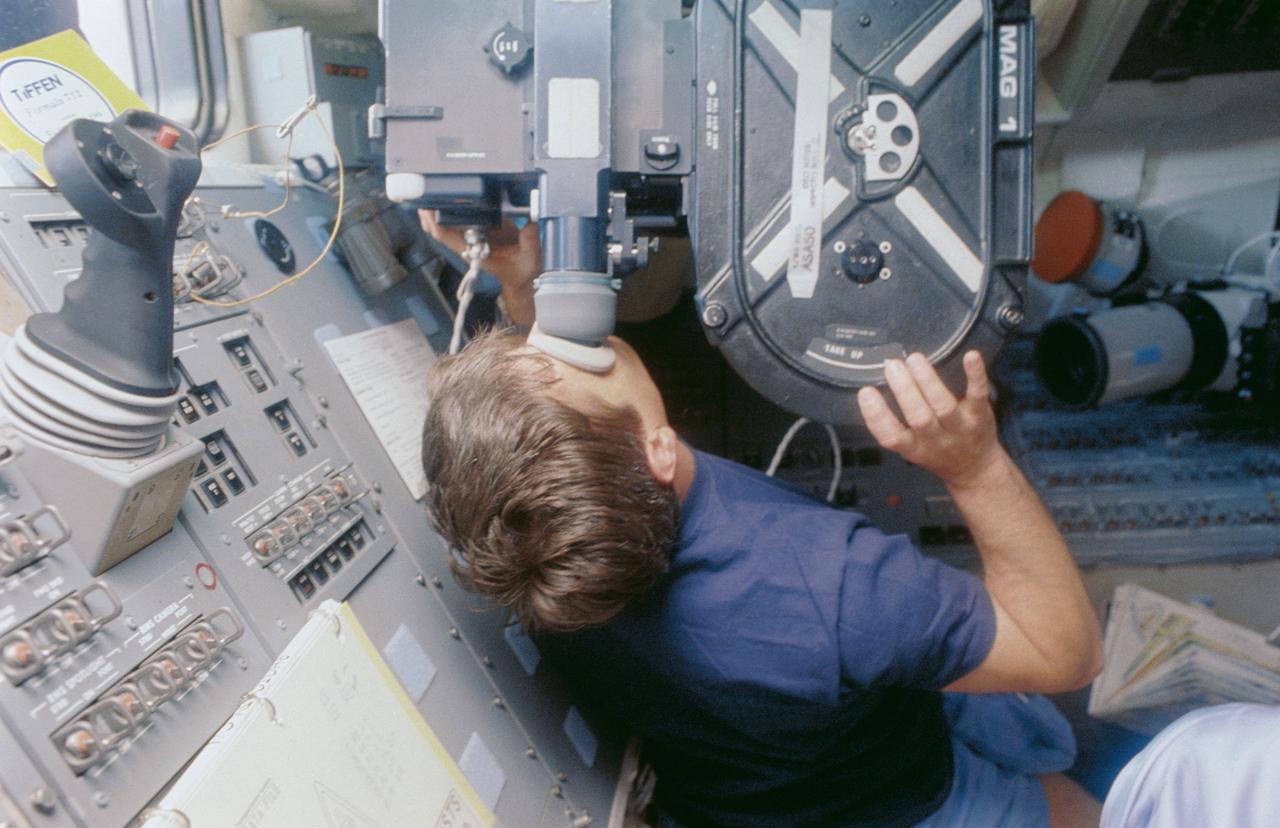
STS029-04-028 (March 1989) --- One of a series of photographs released in conjunction with the STS-29 post-flight press conference on March 28, 1989 at the Johnson Space Center (JSC), Houston, Texas. Onboard Discovery for the five-day mission were Astronauts Michael L. Coats, John E. Blaha, James F. Buchli, James P. Bagian and Robert C. Springer. STS029-04-028 --- A 35mm frame of Blaha using the overhead window on Discovery's aft flight deck to capture Earth scenes with the IMAX motion picture camera.
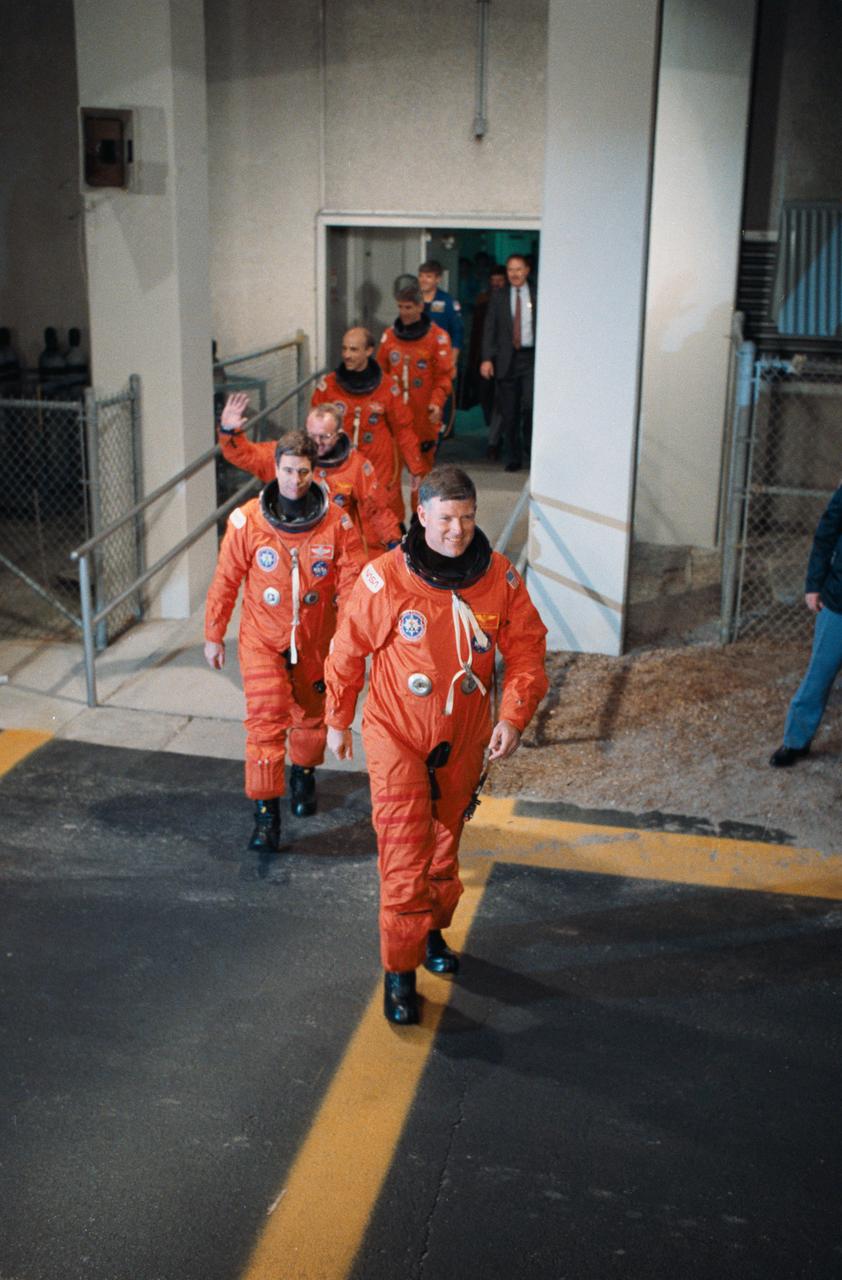
STS029-S-024 (13 March 1989) --- The flight crew for NASA's STS-29 mission leave the operations and checkout building en route to the van that will transport them to Launch Pad 39B, where Discovery awaits the astronauts for its second post-Challenge flight. Leading the way is astronaut Michael L. Coats, mission commander. He is followed by astronauts John E. Blaha, pilot; and James F. Buchli, James P. Bagian and Robert C. Springer, all mission specialists. In the background are astronaut Daniel C. Brandenstein, chief of the astronaut office, and Donald R. Puddy, director of flight crew operations.
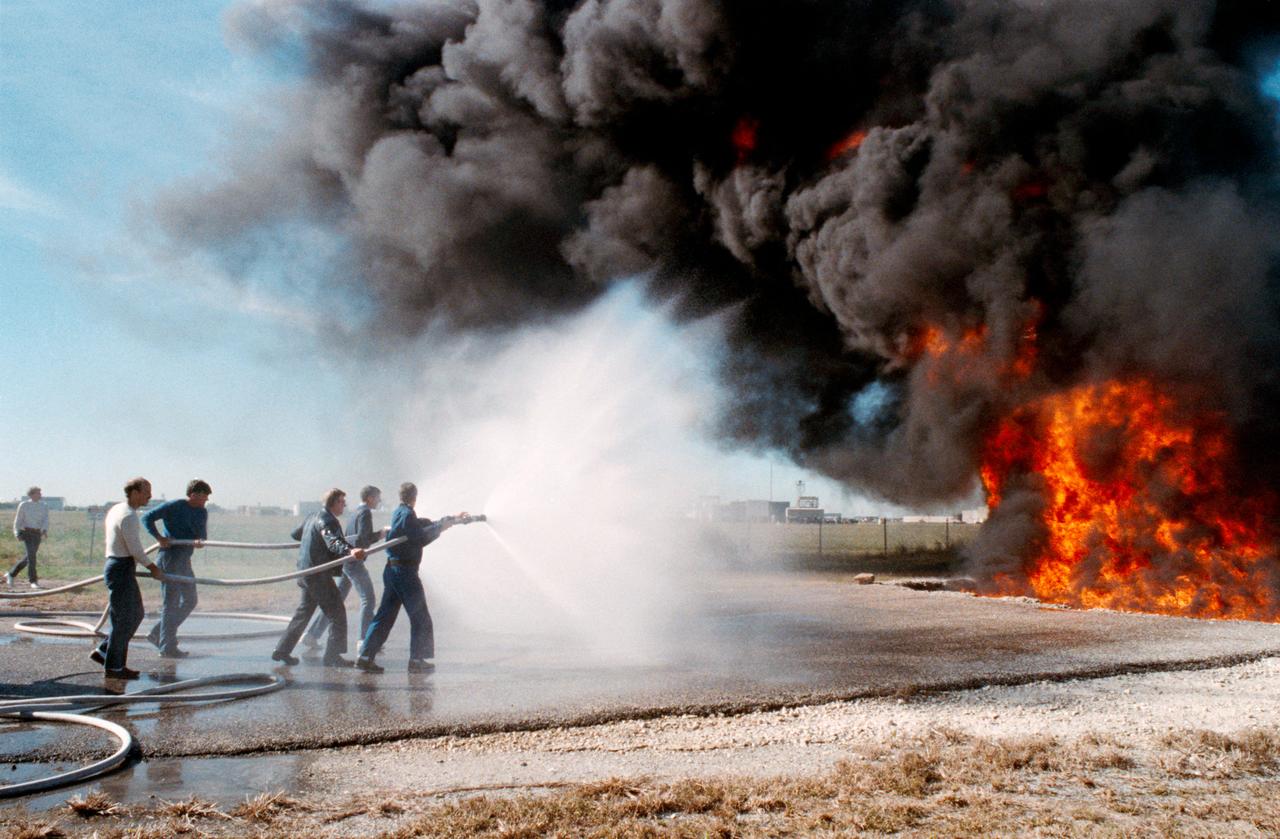
S88-54945 (6 Dec 1988) --- The STS-29 crewmembers are trained in procedures to follow in the event of a fire with their spacecraft. Here, Astronauts Michael L. Coats (far left), mission commander, and James P. Bagian, mission specialist, follow the lead of two fellow crewmembers as they extinguish a fire. The astronauts in front of the action are Robert C. Springer, mission specialist, and John E. Blaha, pilot. Not pictured is James F. Buchli, mission specialist. Their instructor, center, is Robert Fife of NASA's security staff. The training took place on the northern end of the 1625-acre JSC facility.
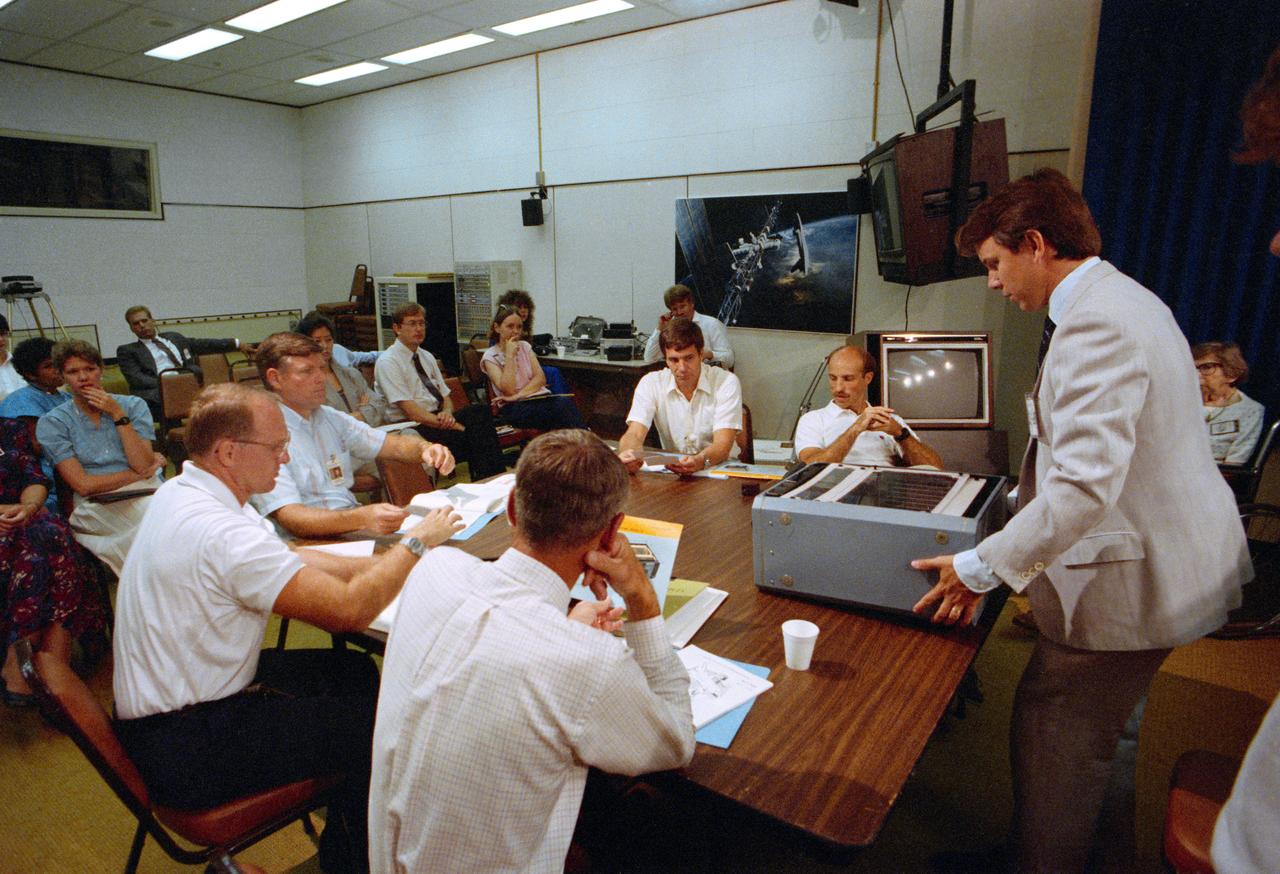
S88-44661 (13 Aug 1988) --- Tom Kestler, with Orthopaedic Hospital, USC, one of the sponsor representatives for student experimenter Andrew Fras explains components of Fras' experiment. It will be carried onboard theDiscovery for NASA's STS-29 mission next year. His primary audience is made up of members of the STS-29 crew who will monitor in-space operation of the experiment, titled "Effects of Weightlessness on Bone Healing." Crewmembers, clockwise around the table from the left, are Astronauts Robert C. Springer, James F. Buchli, Michael L. Coats, John E. Blaha and James P. Bagian. Seated in far right background is Dr. June Marshall of the University of Southern California School of Medicine, the student's sponsoring organization.
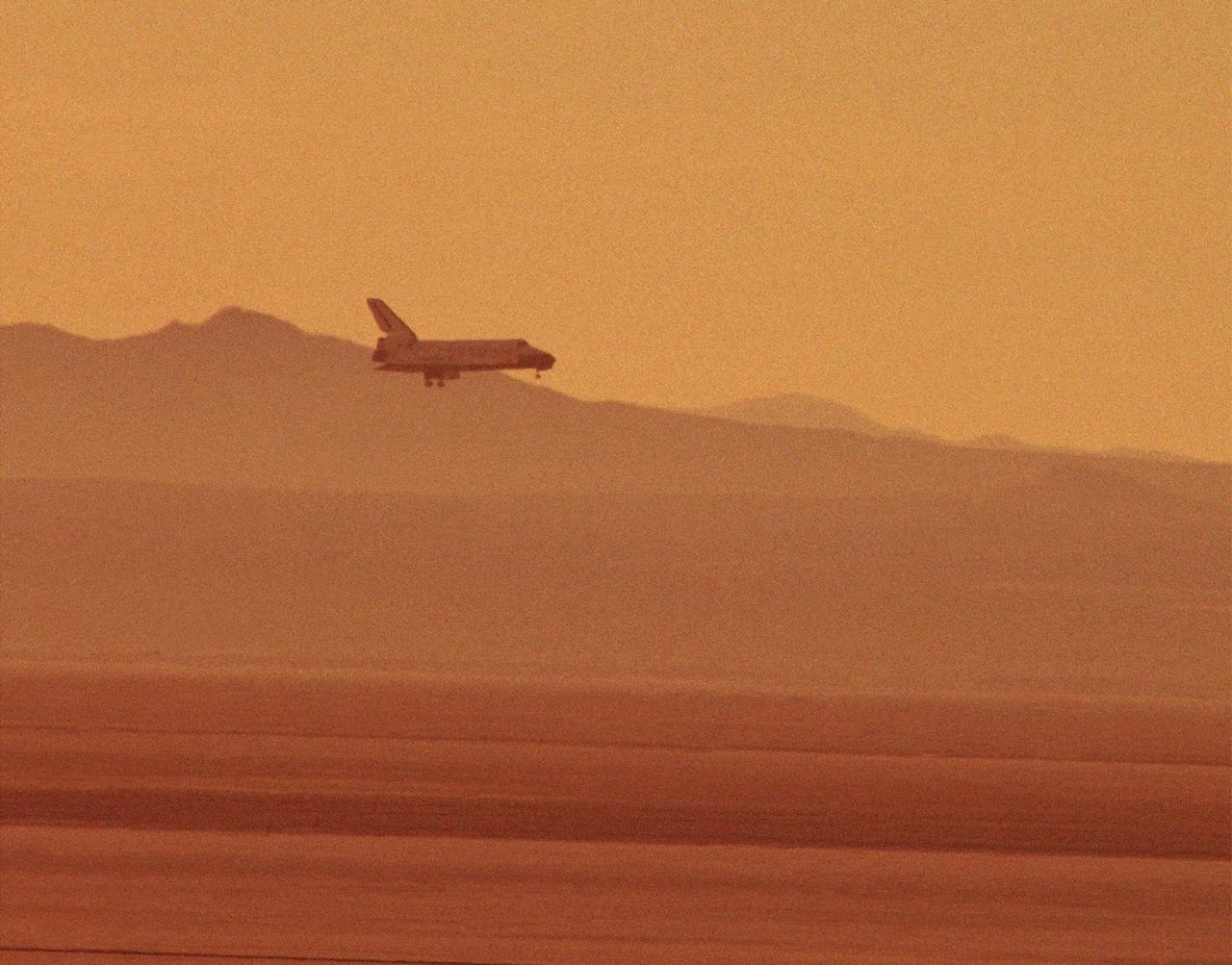
The STS-29 Space Shuttle Discovery mission approaches for a landing at NASA's then Ames-Dryden Flight Research Facility, Edwards AFB, California, early Saturday morning, 18 March 1989. Touchdown was at 6:35:49 a.m. PST and wheel stop was at 6:36:40 a.m. on runway 22. Controllers chose the concrete runway for the landing in order to make tests of braking and nosewheel steering. The STS-29 mission was very successful, completing the launch a Tracking and Data Relay communications satellite, as well as a range of scientific experiments. Discovery's five man crew was led by Commander Michael L. Coats, and included pilot John E. Blaha and mission specialists James P. Bagian, Robert C. Springer, and James F. Buchli.
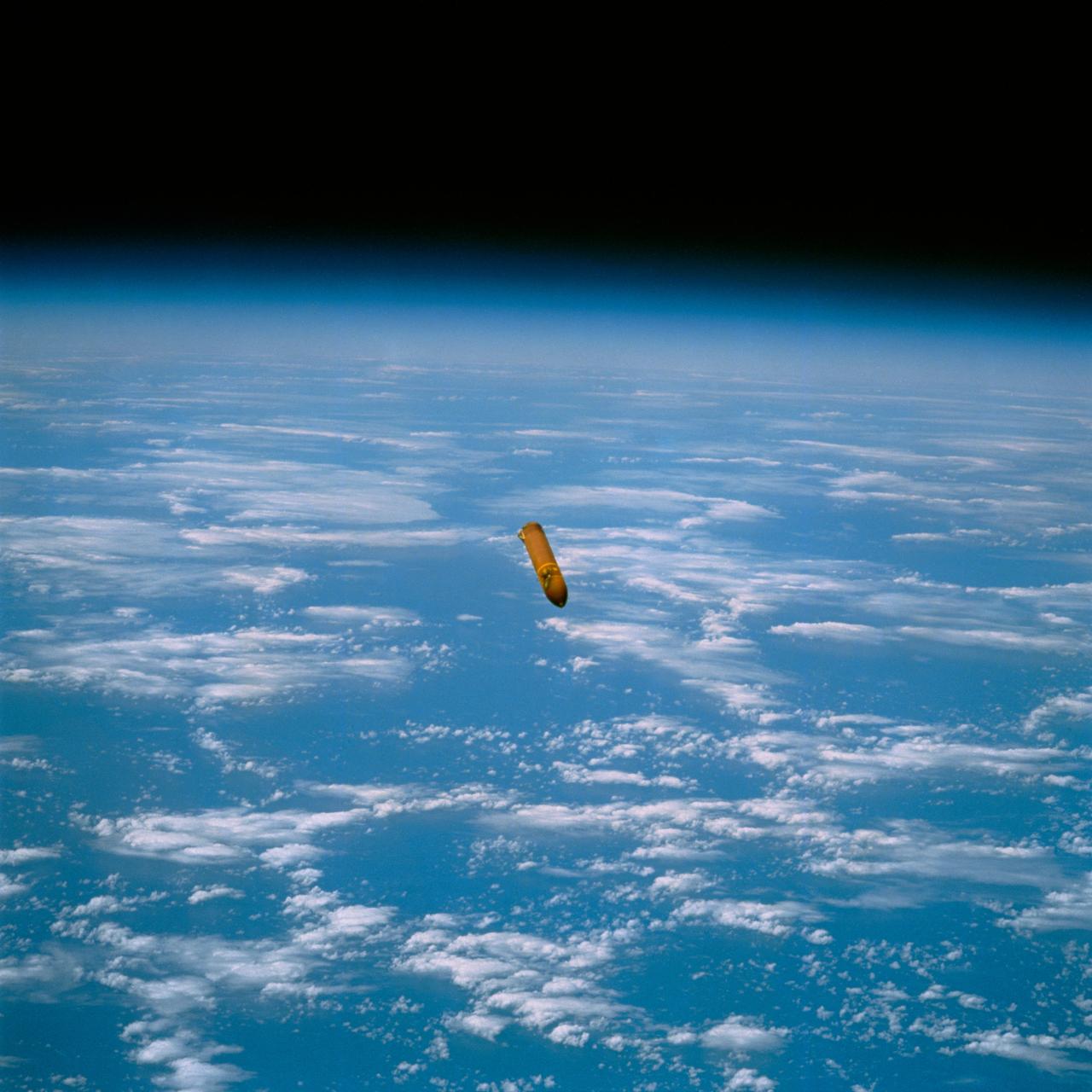
STS029-72-059 (13 March 1989) --- This 70mm photograph, taken by Astronaut James P. Bagian 16 minutes and 7 seconds after liftoff of Discovery, shows the external fuel tank (ET) against the background of Earth. The tank is falling away from the orbiter following ET separation. The left side shows the burn scar above the solid rocket booster (SRB) forward attach point. The burn is caused by the forward SRB separation motors firing during SRB separation. Post 51-L analysis of the thermal and pressure effects of the separation motor exhaust plume indicate that the scarring is not a safety hazard. However, photographs such as this one were requested for additional missions in order to document the phenomenon and corroborate this conclusion. The photo was made at 15:13:07 GMT, March 13, 1989. It was among the visuals used by the crew at its Mar. 28, 1989 post-flight press conference.
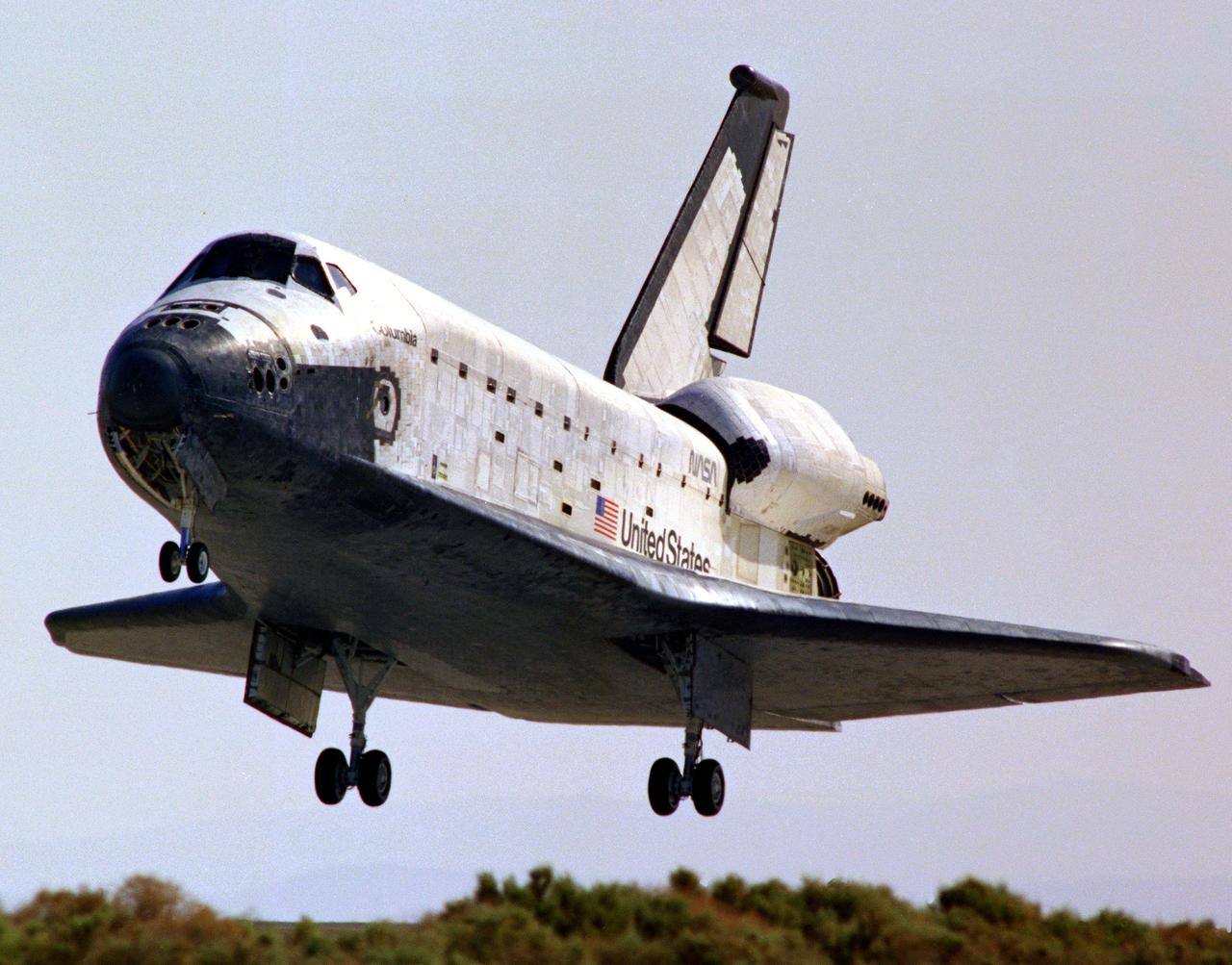
Space Shuttle Columbia nears its touchdown on Runway 22 at Edwards, California, at 8:39 a.m., 14 June 1991, as the STS-40 life sciences mission comes to an end at NASA's Ames-Dryden Flight Research Facility (later redesignated Dryden Flight Research Center) after nine days of orbital flight. Aboard Columbia during the extended mission were Bryan D. O'Connor, mission commander; Sidney M. Gutierrez, pilot; mission specialists James P. Bagian, Tamara E. Jernigan, and Margaret Rhea Seddon; and payload specialists Francis Andrew Gaffney and Millie Hughes-Fulford. STS-40 was the first space shuttle mission dedicated to life sciences research to explore how the body reacts to a weightless environment and how it readjusts to gravity on return to earth. Columbia was launched on the STS-40 mission 5 June 1991, from Kennedy Space Center in Florida.
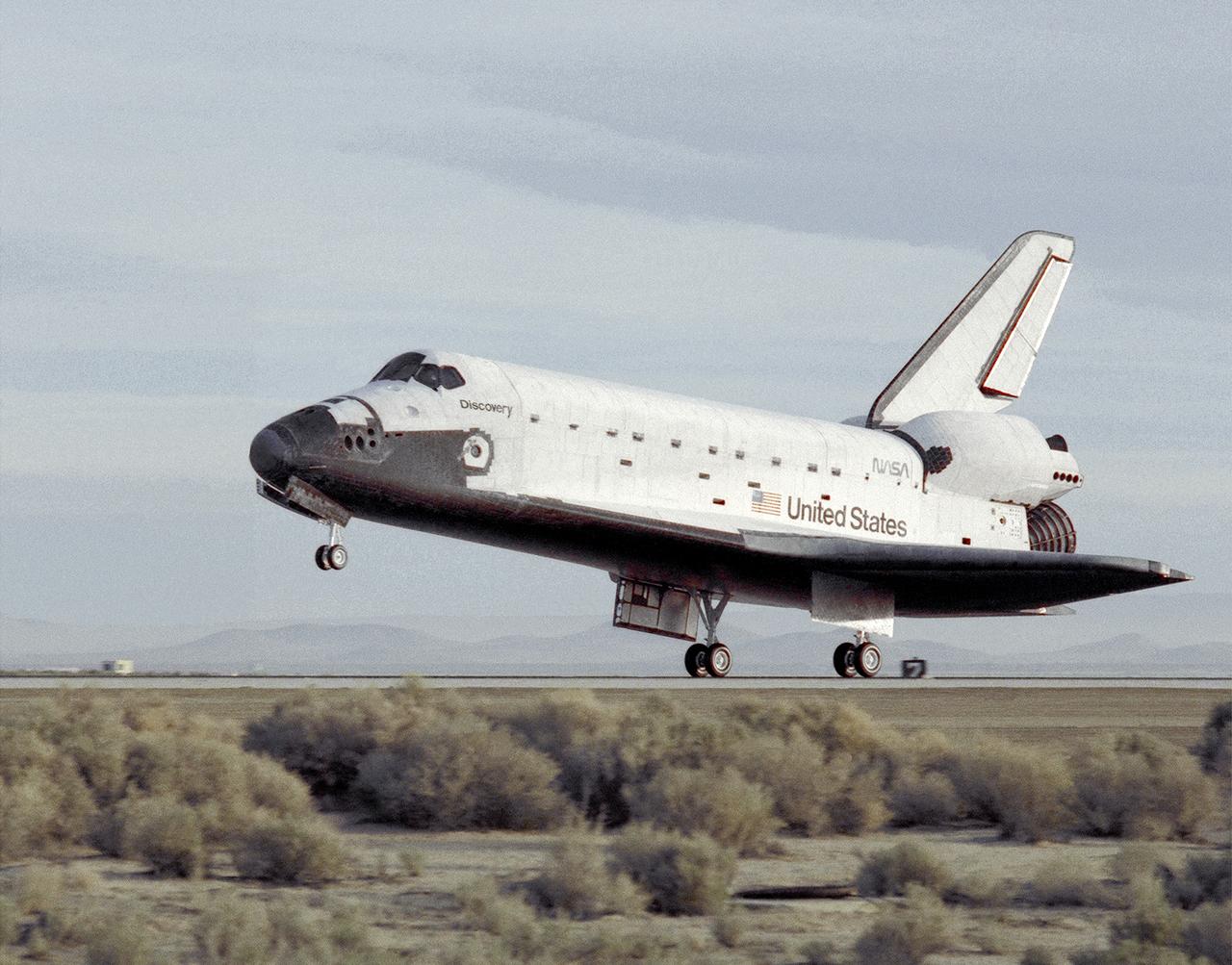
The STS-29 Space Shuttle Discovery mission lands at NASA's then Ames-Dryden Flight Research Facility, Edwards AFB, California, early Saturday morning, 18 March 1989. Touchdown was at 6:35:49 a.m. PST and wheel stop was at 6:36:40 a.m. on runway 22. Controllers chose the concrete runway for the landing in order to make tests of braking and nosewheel steering. The STS-29 mission was very successful, completing the launch of a Tracking and Data Relay communications satellite, as well as a range of scientific experiments. Discovery's five-man crew was led by Commander Michael L. Coats, and included pilot John E. Blaha and mission specialists James P. Bagian, Robert C. Springer, and James F. Buchli.
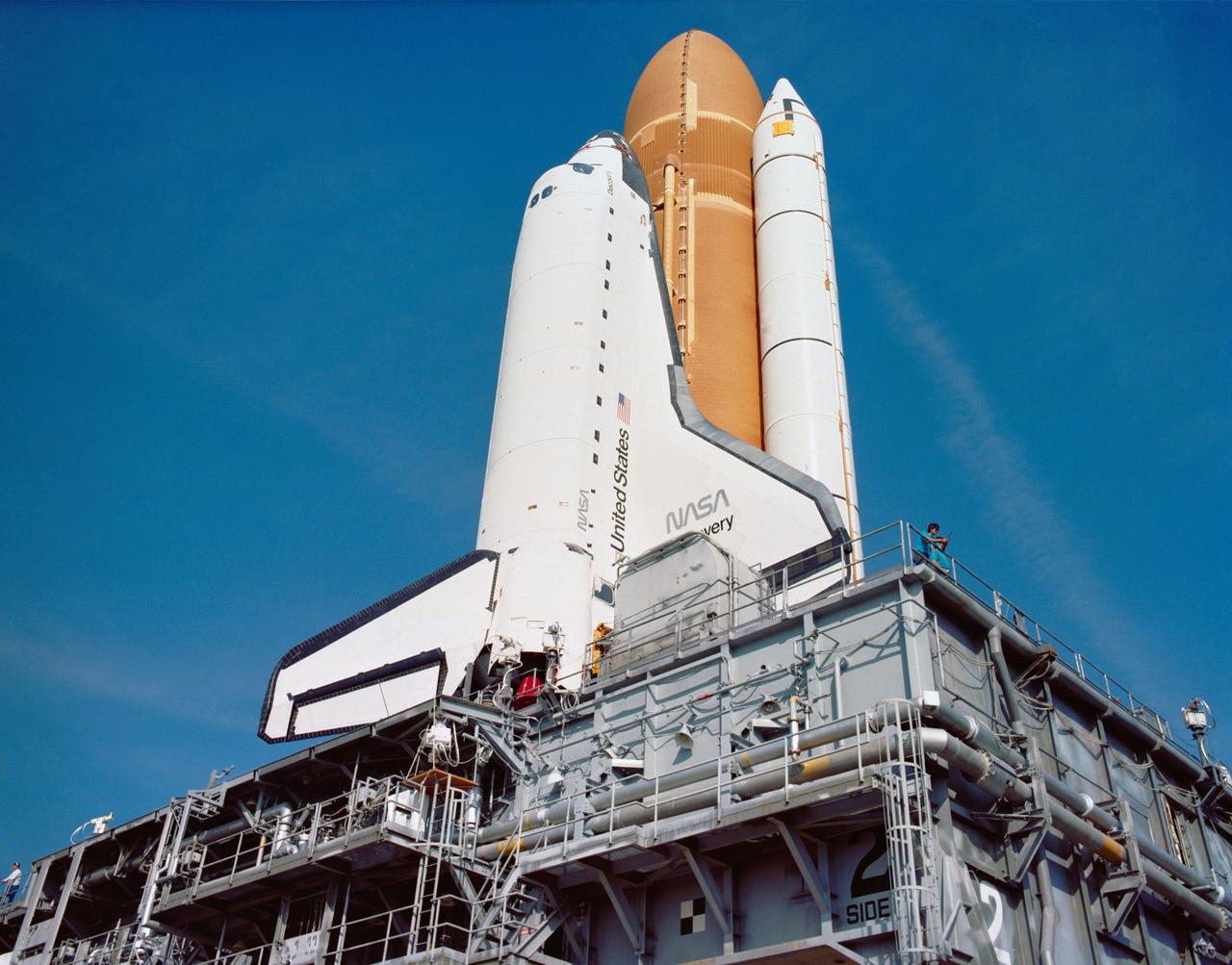
S89-28107 (3 Feb 1989) --- A low angle view of the Space Shuttle Discovery, atop a mobile launch platform, during its slow move to Kennedy Space Center's Launch Pad 39-B on Feb. 3, l989. It rolled through the doors of the huge vehicle assembly building (VAB) at 6 a.m., hours ago as the blue sky testifies. The trip to the pad takes approximately 5 and 1/2 hours. Onboard the spacecraft in mid-March for a five-day mission, on which will be deployed a third tracking and data relay satellite (TDRS-D), will be Astronauts Michael L. Coats, John E. Blaha, James F. Buchli, James P. Bagian and Robert C. Springer.