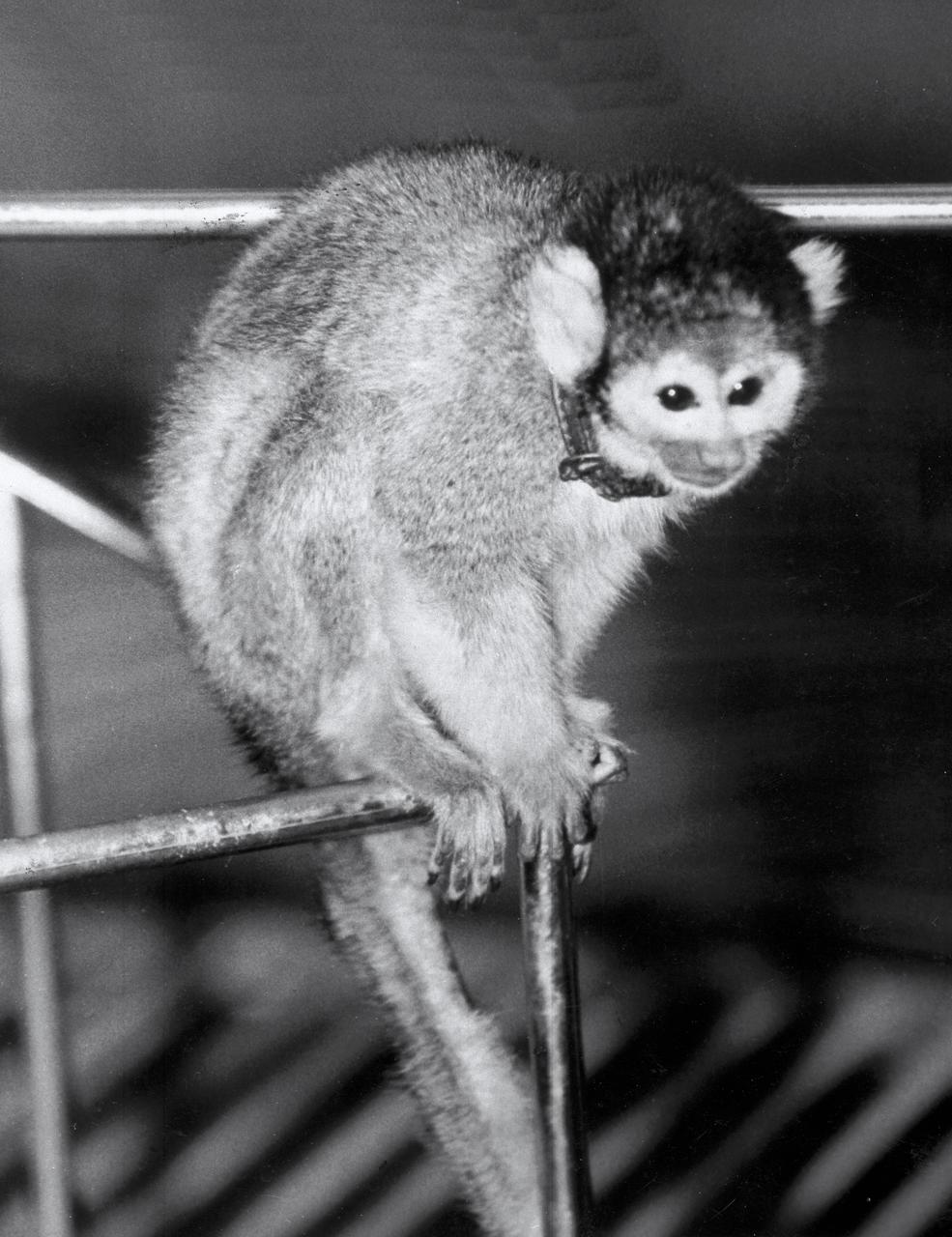
On May 28, 1958, Jupiter Intermediate Range Ballistic Missile provided by U.S. Army team in Huntsville, Alabama, launched a nose cone carrying Baker, a South American squirrel monkey and Able, an American-born rhesus monkey. Baker, pictured here and commonly known as "Miss Baker", was later given a home at the U.S. Space and Rocket Center until her death on November 29, 1984. Able died in 1958. (Photo - Courtesy of Huntsville/Madison County Public Library)
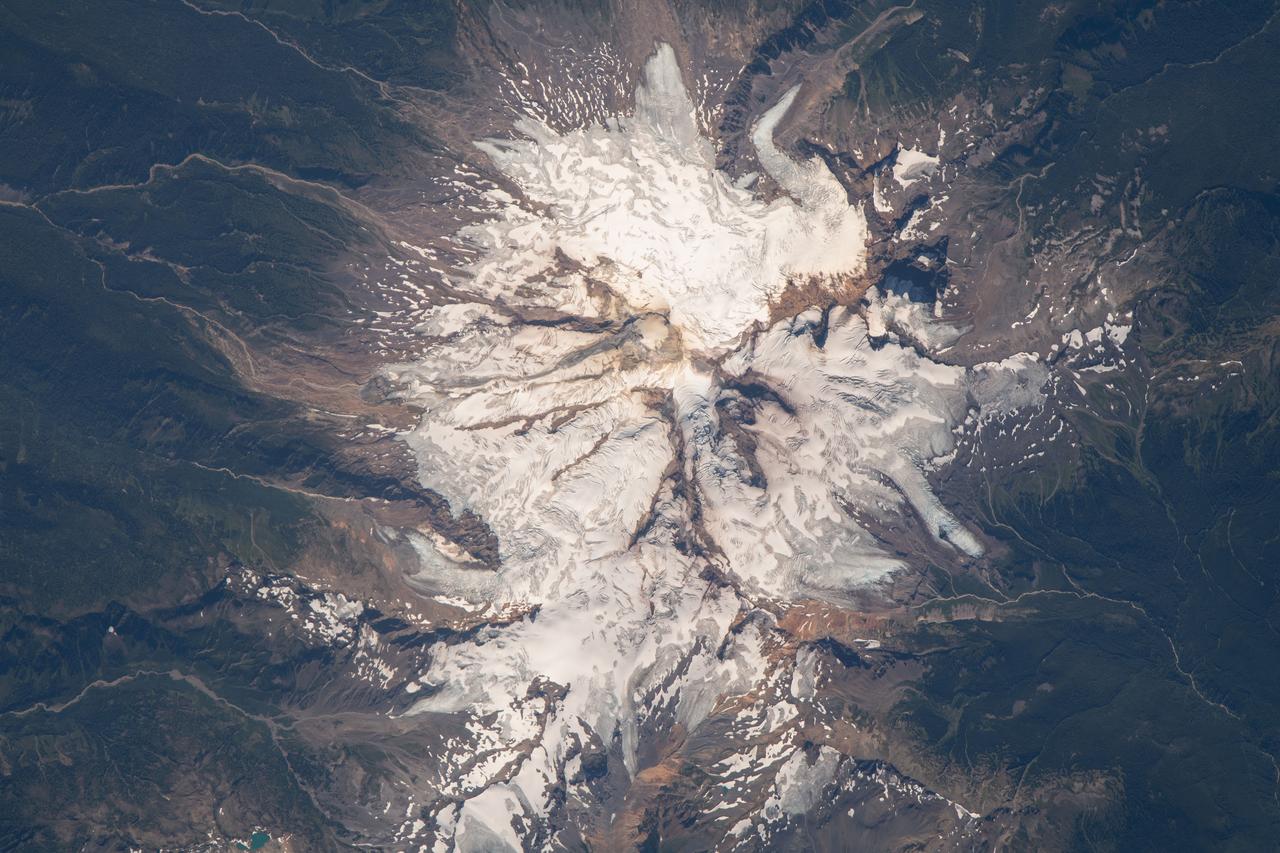
iss069e060816 (August 15, 2023) -- Mount Baker reaches over 10,700 feet of elevation in the state of Washington. The active glacier-covered stratovolcano was seen from the International Space Station as it orbited 265 miles above.
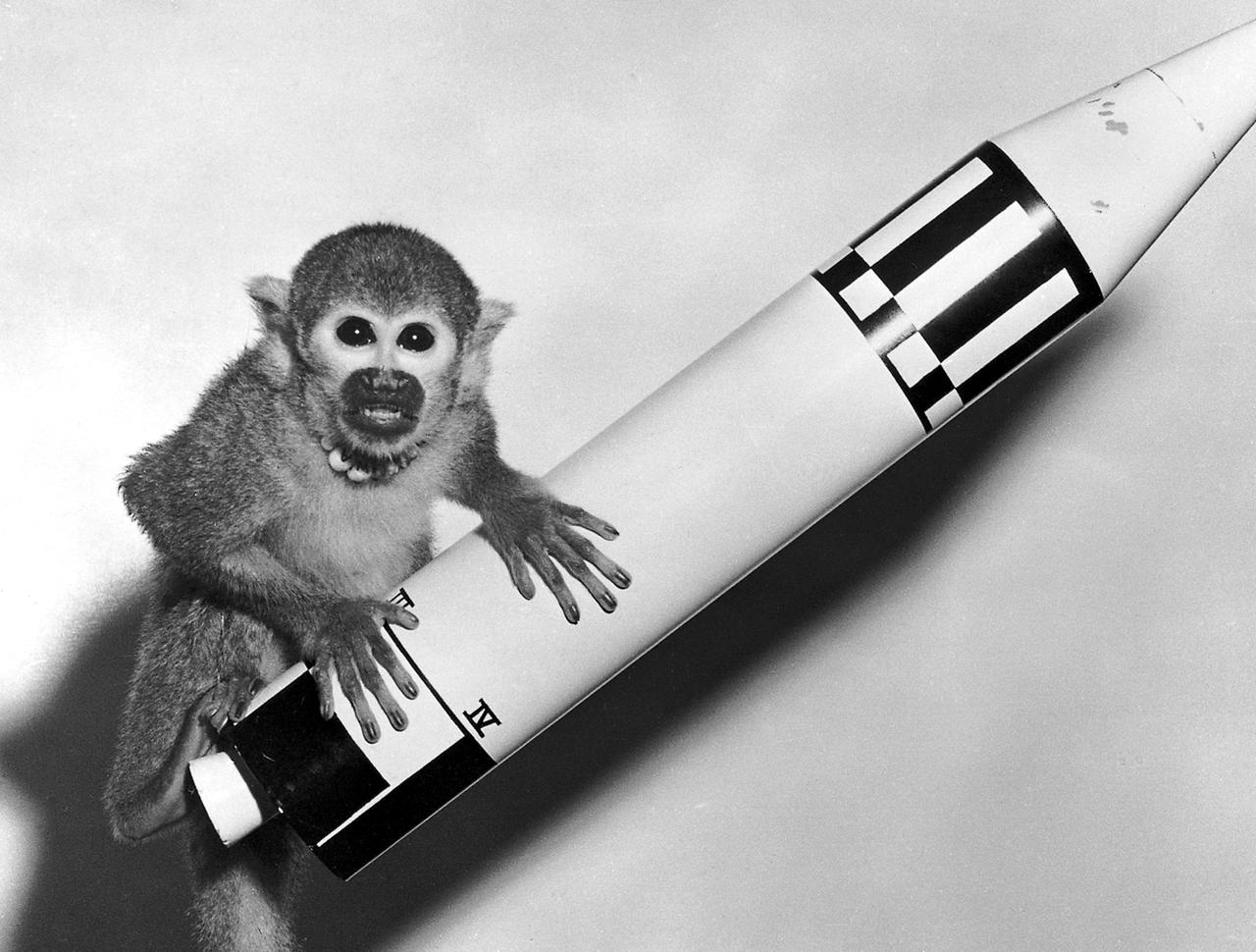
Monkey Baker, payload of Jupiter (AM-18), poses on a model of the Jupiter vehicle, May 29, 1959
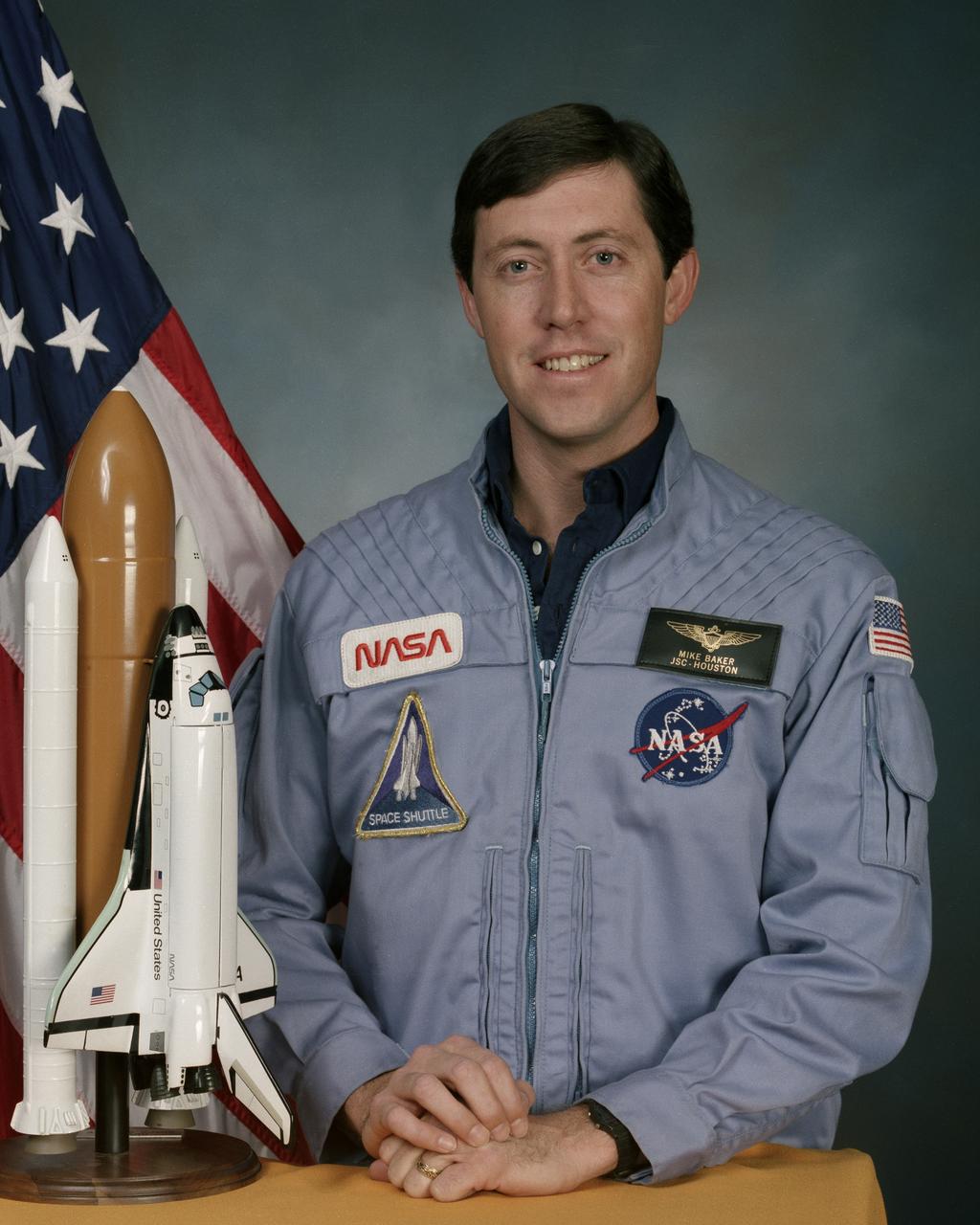
S85-41895 (October 1985) --- Astronaut Michael A. Baker, mission commander
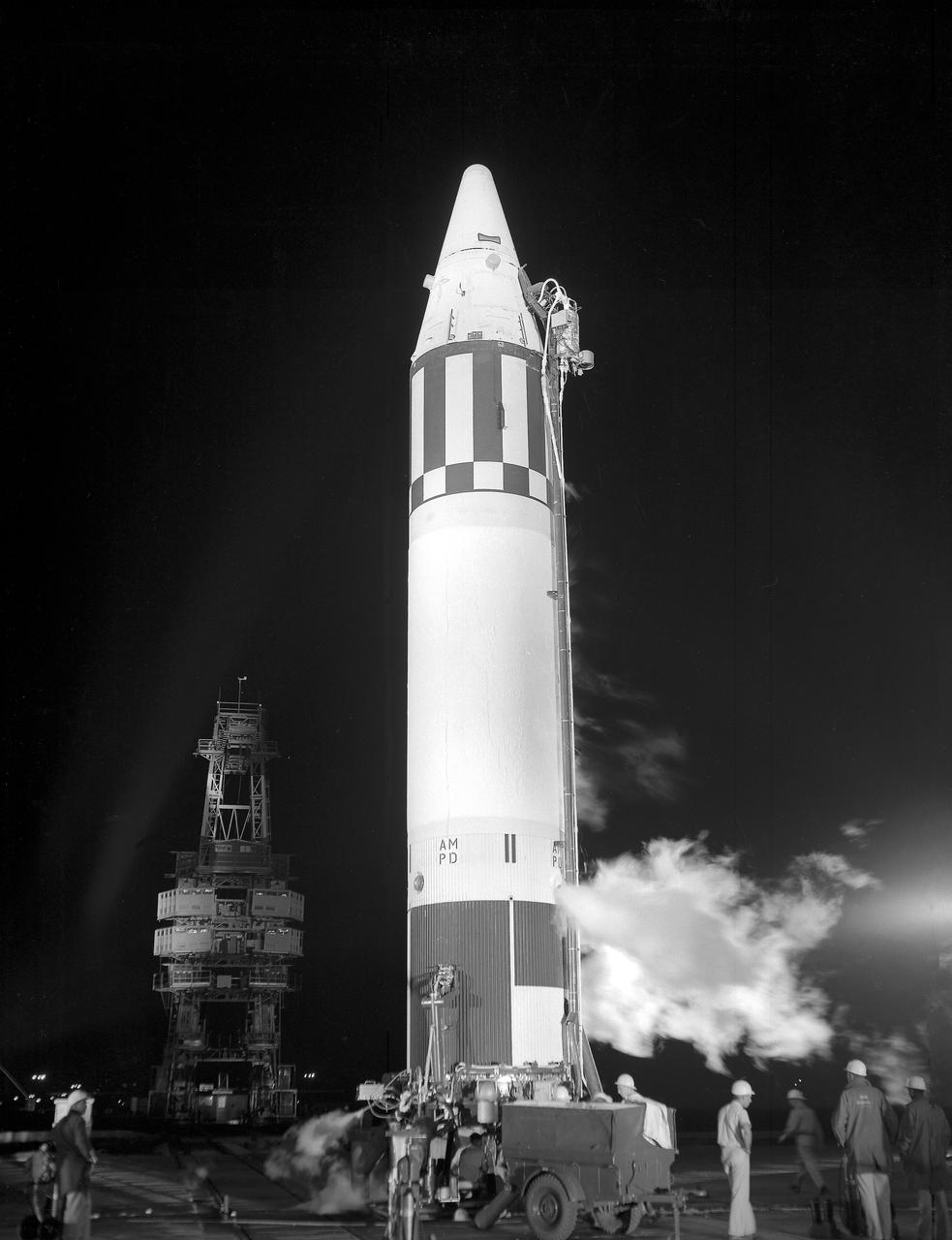
Jupiter (AM-18), suborbital primate flight with Able and Baker as its payload, being ready for launch, May 28, 1959
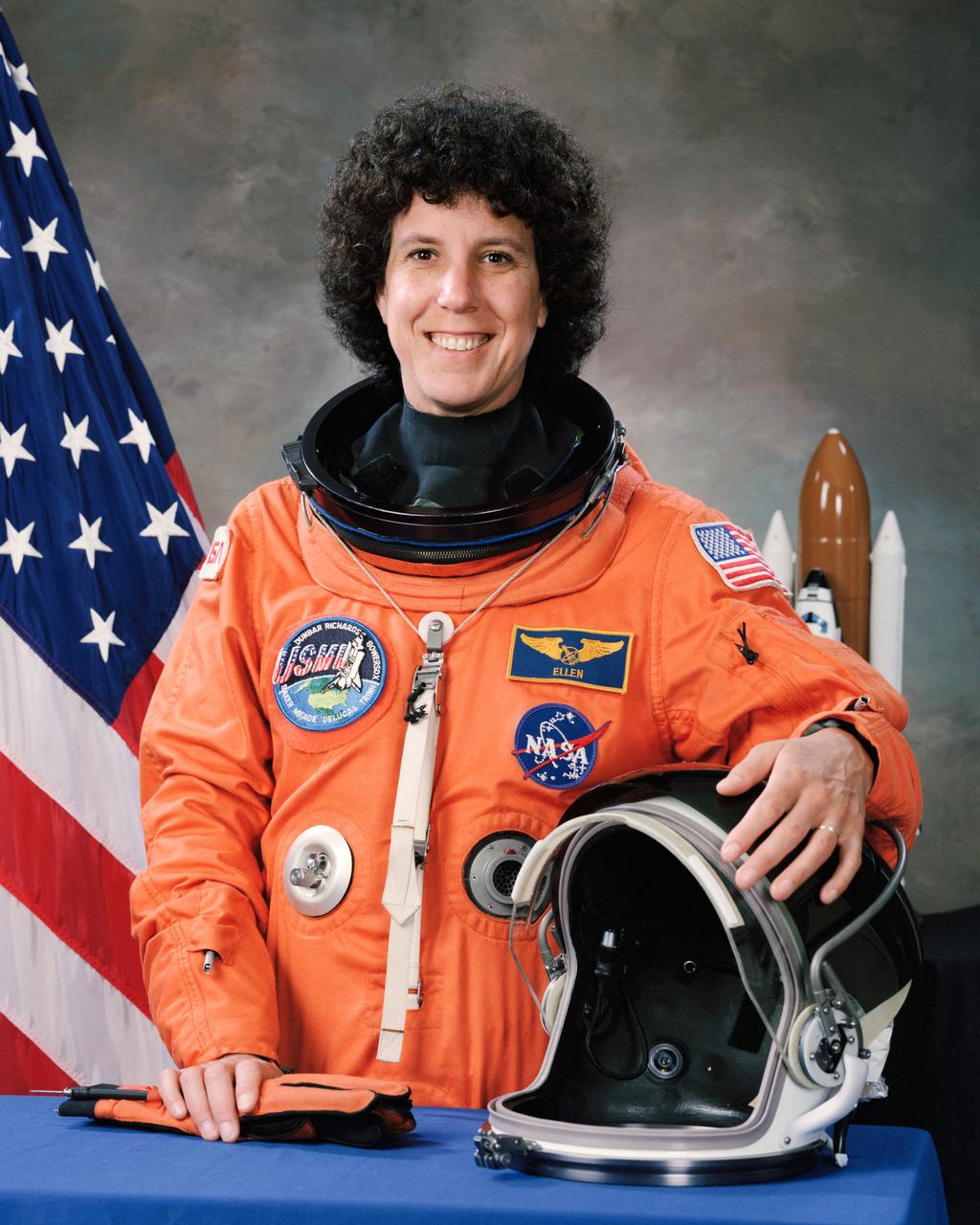
S92-45740 (August 1992) --- Astronaut Ellen S. Baker. Photo credit: NASA
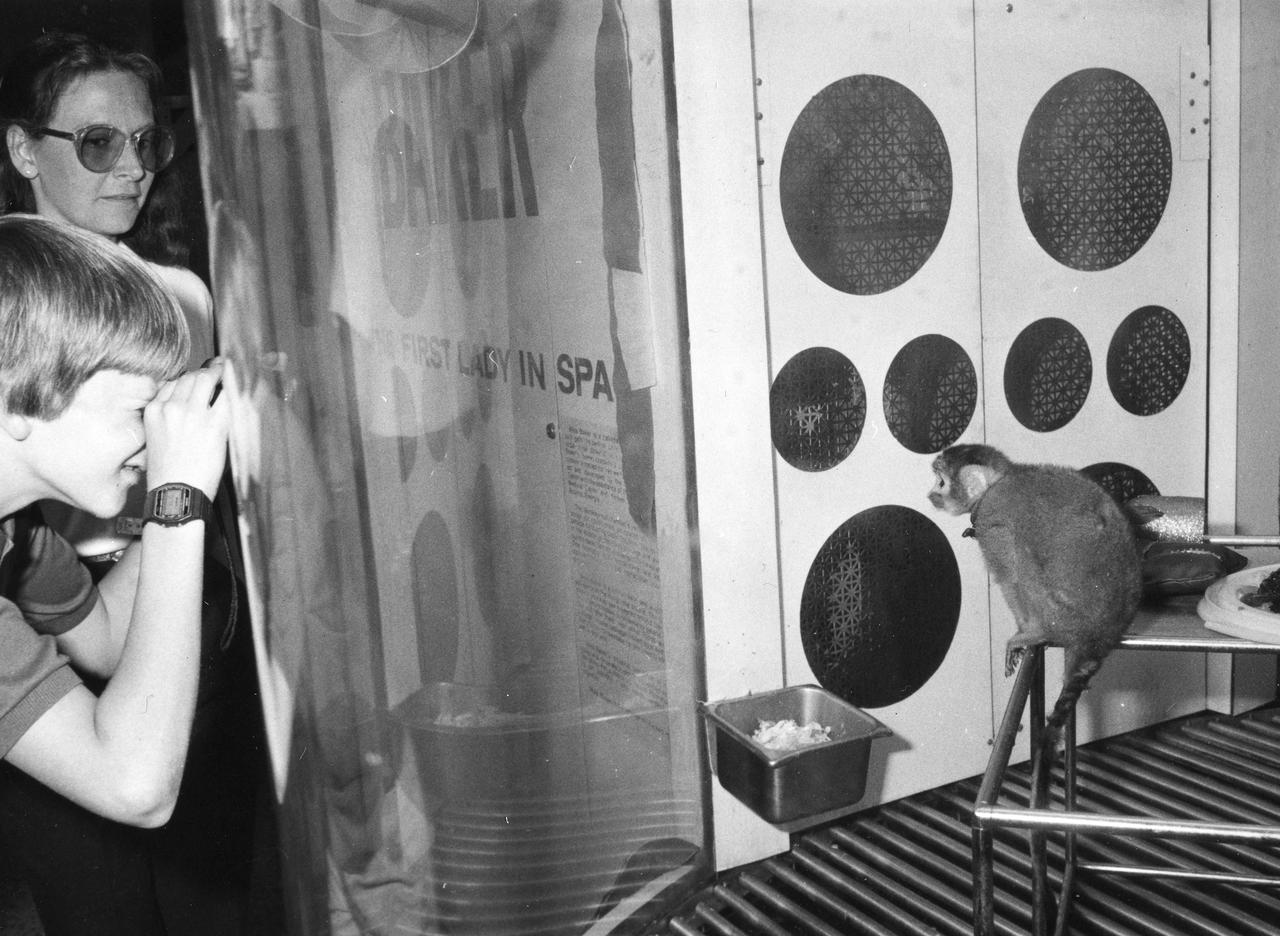
Miss Baker, a squirrel monkey who made a historical flight aboard the Jupiter (AM-18) in May 1959, is seen here in her viewing area where she resided at the U.S. Space and Rocket Center.

STS081-E-05126 (13 Jan. 1997) --- Astronaut Michael A. Baker, mission commander, uses a 35mm camera to photograph a target of opportunity on Earth from the Space Shuttle Atlantis' aft flight deck. Baker and five crew mates will dock with Russia's Mir Space Station around the middle of the week. This image was recorded with an Electronic Still Camera (ESC) and was later downlinked to flight controllers in Houston, Texas. A second ESC, devoted to an educational, geographic project called Kidsat, is mounted in the viewing port above Baker's head.
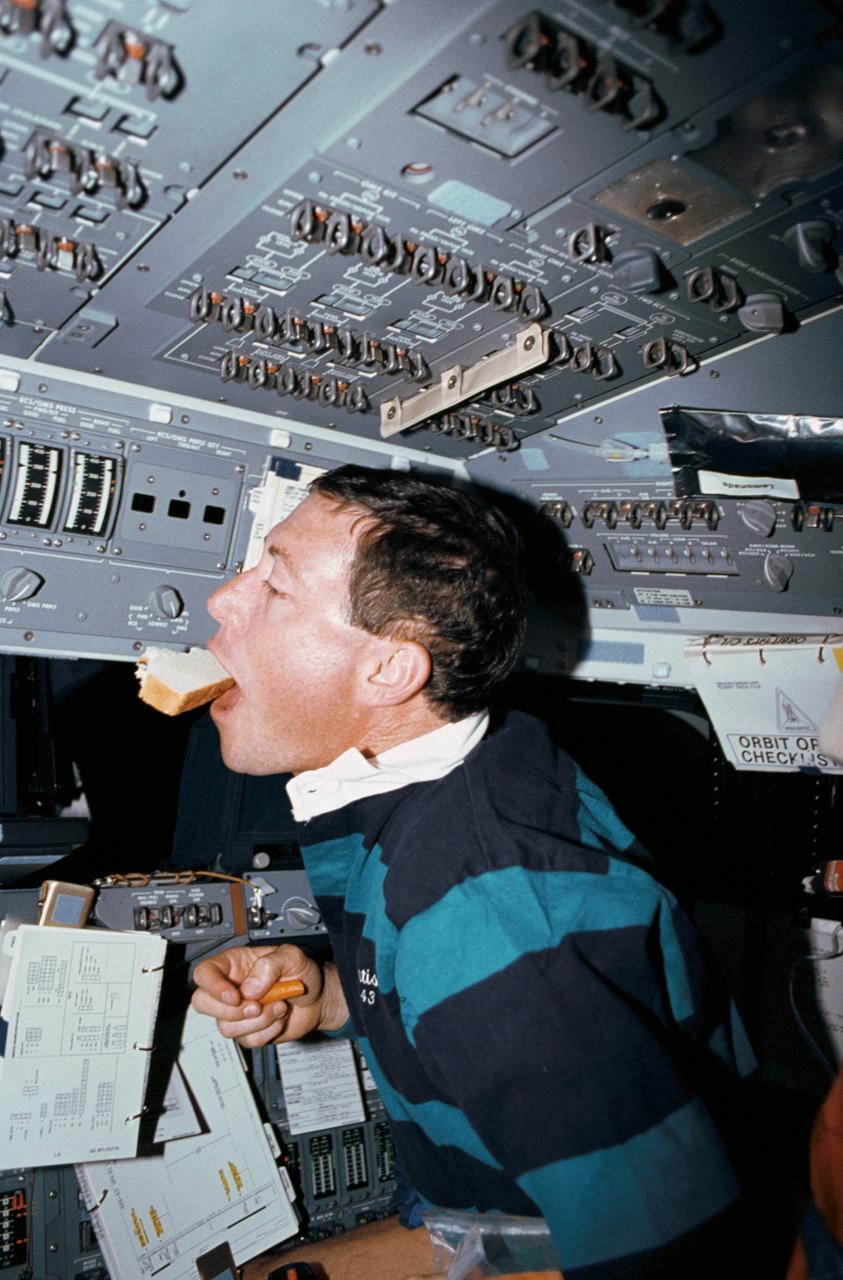
STS043-02-020 (2-11 Aug. 1991) --- Astronaut Michael A. Baker, STS-43 pilot, seated at the forward flight deck pilot station controls of the Space Shuttle Atlantis, eats a free-floating peanut butter and jelly sandwich while holding a carrot. Surrounding Baker are procedural checklists, control panels, and windows. A lemonade drink bag is velcroed to overhead panel.
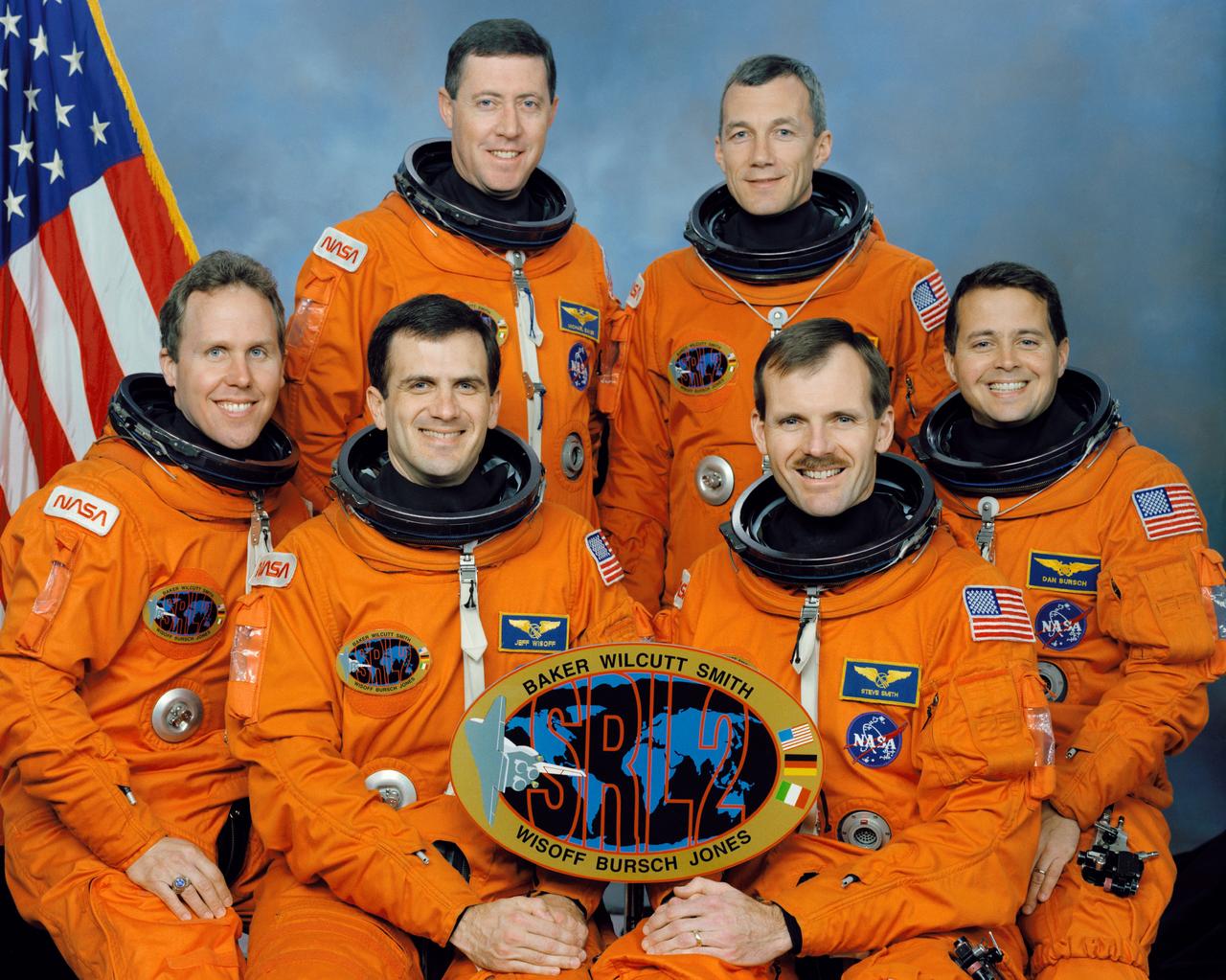
These six NASA astronauts composed the crew of the STS-68 mission that launched aboard the Space Shuttle Endeavour on September 30, 1994. Standing are, left to right, Michael A. Baker, mission commander; and Terrence W. Wilcutt, pilot. On the front row are, left to right, Thomas D. Jones, payload commander; and Peter J. K. (Jeff) Wisoff, Steven L. Smith, and Daniel W. Bursch, all mission specialists. STS-68 marked the second flight of the Space Radar Laboratory, part of NASA’s mission to planet Earth.
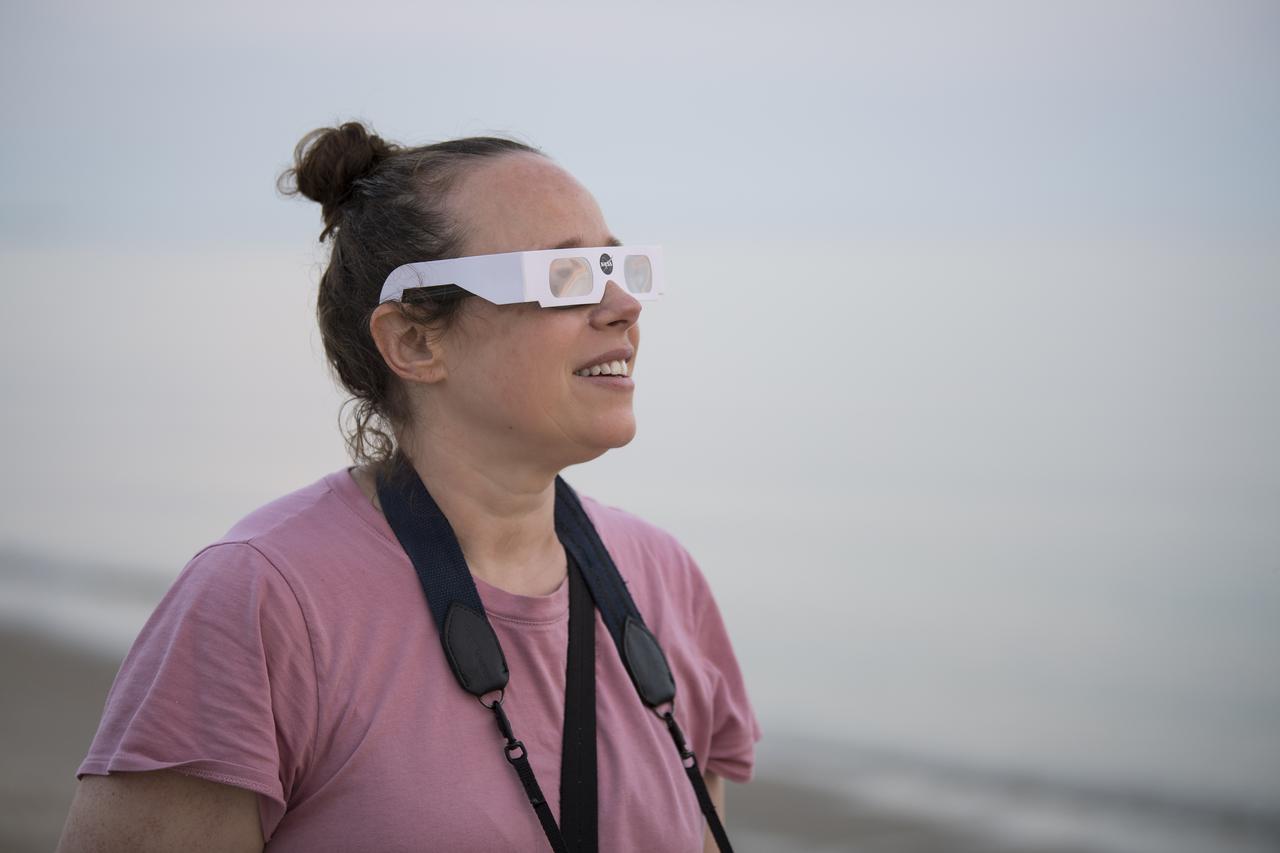
Sarah Baker views the partial solar eclipse as the sun rises, Thursday, June 10, 2021, at Lewes Beach in Delaware. The annular or “ring of fire” solar eclipse is only visible to some parts of Greenland, Northern Russia, and Canada. Photo Credit: (NASA/Aubrey Gemignani)
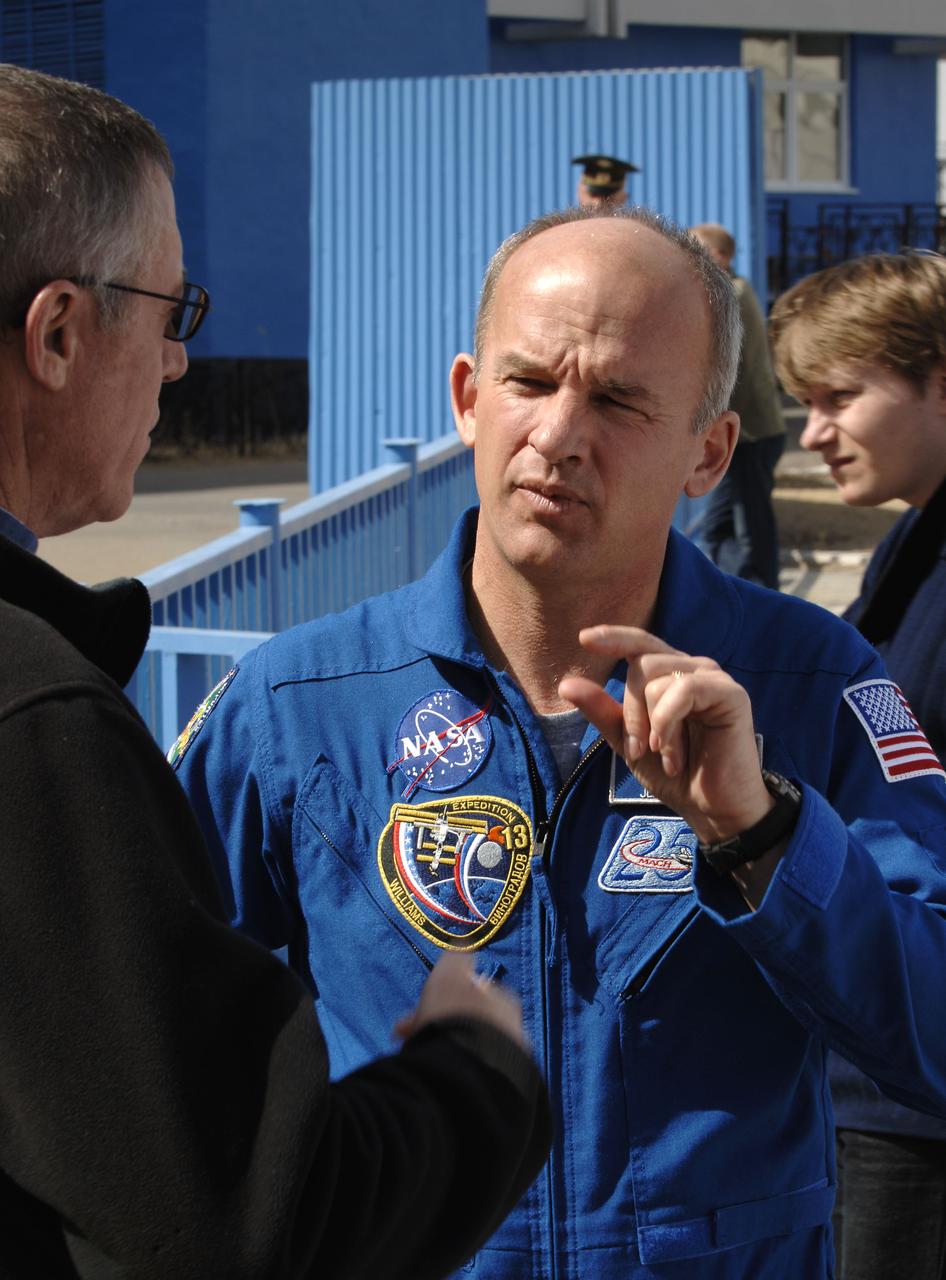
Jeffrey N. Williams, Expedition 13 Science Officer and Flight Engineer, talking with Michael Baker of NASA after the crew's final check of the Soyuz at building 254 of the Baikonur Cosmodrome in Baikonur, Kazakhstan. Sunday, March 26, 2006. Photo Credit: (NASA/Bill Ingalls)
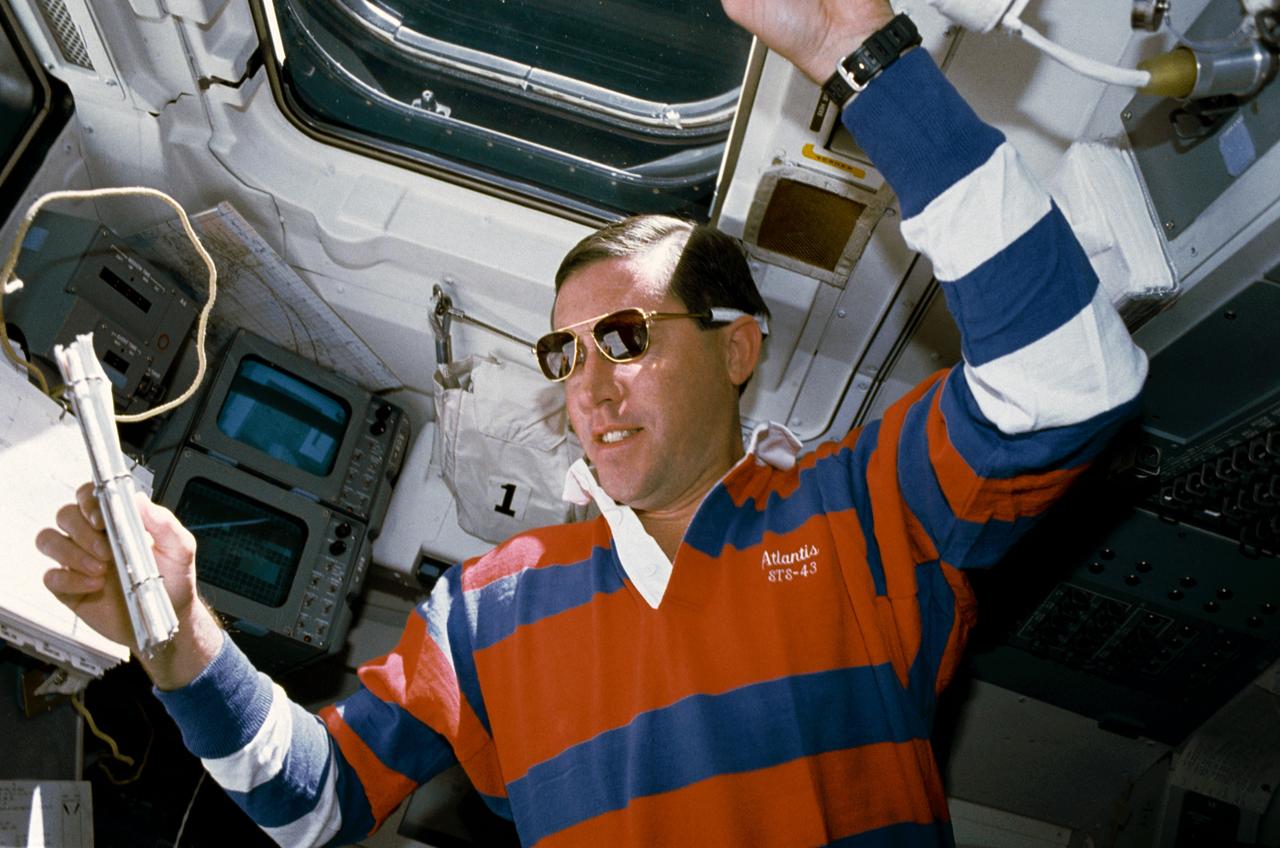
STS043-04-032 (11 Aug 1991) --- STS-43 Pilot Michael A. Baker, wearing sunglasses, reviews a checklist on the aft flight deck of Atlantis, Orbiter Vehicle (OV) 104. He is monitoring data associated with the Space Station Heat Pipe Advanced Radiator Element II (SHARE-II) located in OV-104's payload bay (PLB) from his position in front of the aft flight deck viewing windows. Behind Baker are the closed circuit television (CCTV) monitors and above his head is overhead window W8.
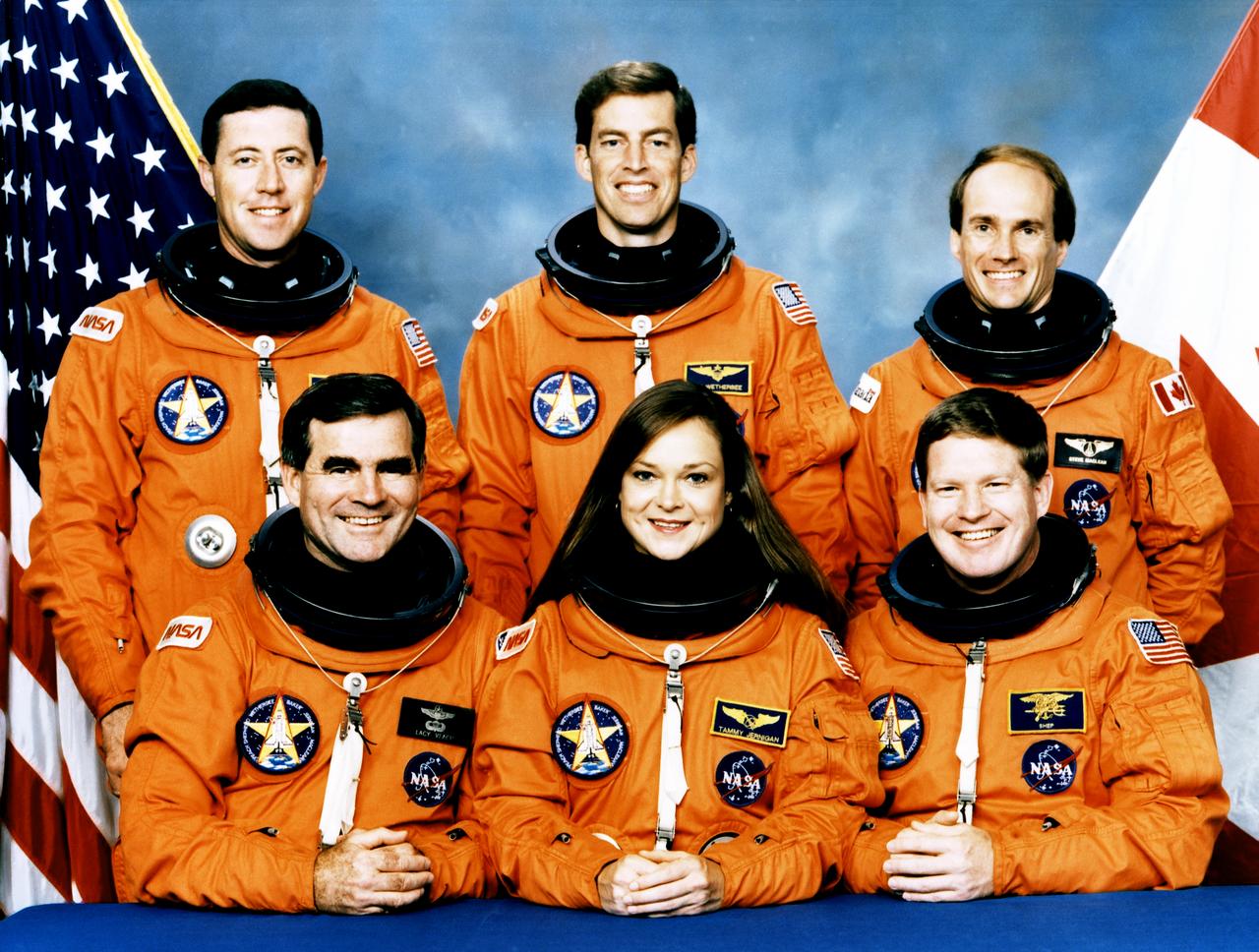
Five NASA astronauts and one Canadian payload specialist composed the STS-52 crew. Pictured on the back row, left to right, are Michael A. Baker, pilot; James B. Wetherbee, commander; and Steven G. Maclean, payload specialist. On the front row, left to right, are mission specialists Charles (Lacy) Veach, Tamara Jernigan, and William Shepherd. Launched aboard the Space Shuttle Columbia on October 22, 1992 at 1:09:39 p.m. (EDT), the crew’s primary objectives were the deployment of the Laser Geodynamic Satellite (LAGEOS II) and operation of the U.S. Microgravity Payload-1 (USMP-1).
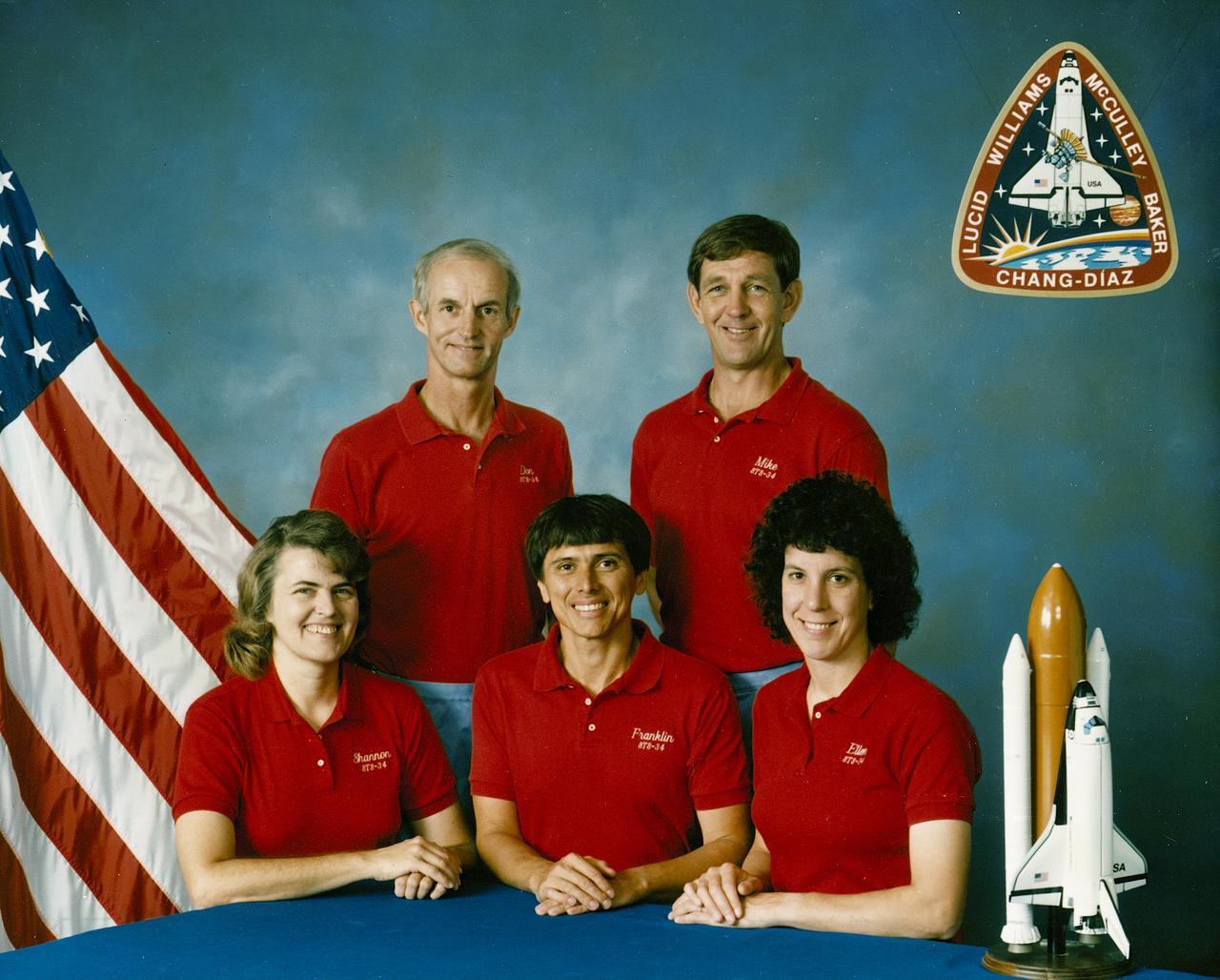
The STS-34 crew portrait includes 5 astronauts. Pictured left to right are Shannon W. Lucid, mission specialist; Donald E. Williams, commander; Franklin R. Chang-Diaz, mission specialist; Michael J. McCulley, pilot; and Ellen S. Baker, mission secialist. The crew of 5 launched aboard the Space Shuttle Orbiter Atlantis on October 18, 1989 at 12:53:40pm (EDT). The primary payload was the Galileo Jupiter Spacecraft and attached inertial upper stage (IUS). Deployed 6 hours and 30 minutes into the flight, the IUS stages fired, boosting Galileo on trajectory for a 6 year trip to Jupiter.
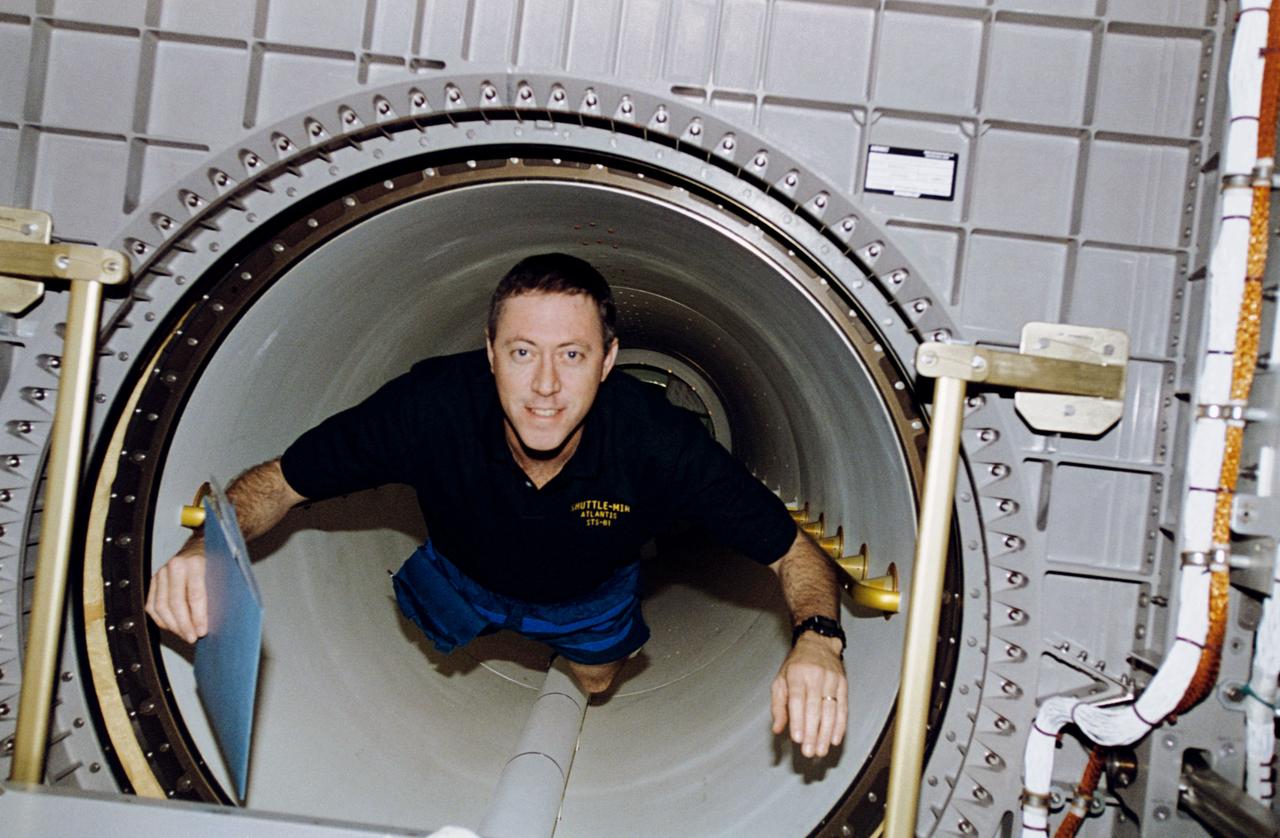
STS081-314-019 (12-22 Jan 1997) --- Astronaut Michael A. Baker, mission commander, floats through the tunnel leading from the Space Shuttle Atlantis mid-deck into Spacehab Double Module (DM). For a period of five days, seven astronauts and two Russian cosmonauts are sharing a variety of chores in space as the spacecraft from their respective nations are docked in Earth-orbit.
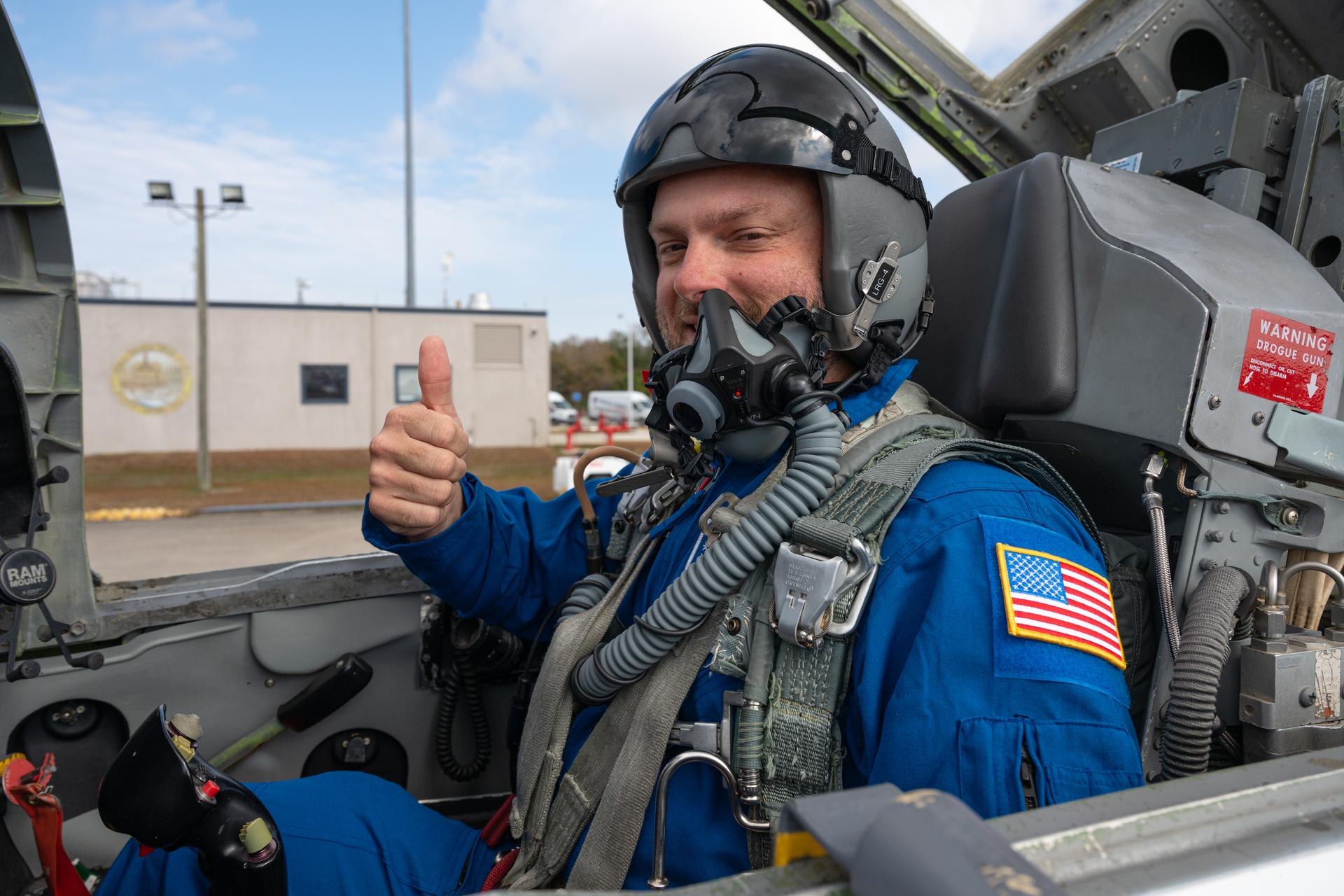
NASA employee Jonathan Baker, chief of the spaceport development division at NASA’s Kennedy Space Center, is seen before an employee incentive flying event with NASA Administrator Jared Isaacman and his personal F-5 aircraft, Thursday, Feb. 12, 2026, at NASA’s Kennedy Space Center in Florida. Photo Credit: (NASA/John Kraus)
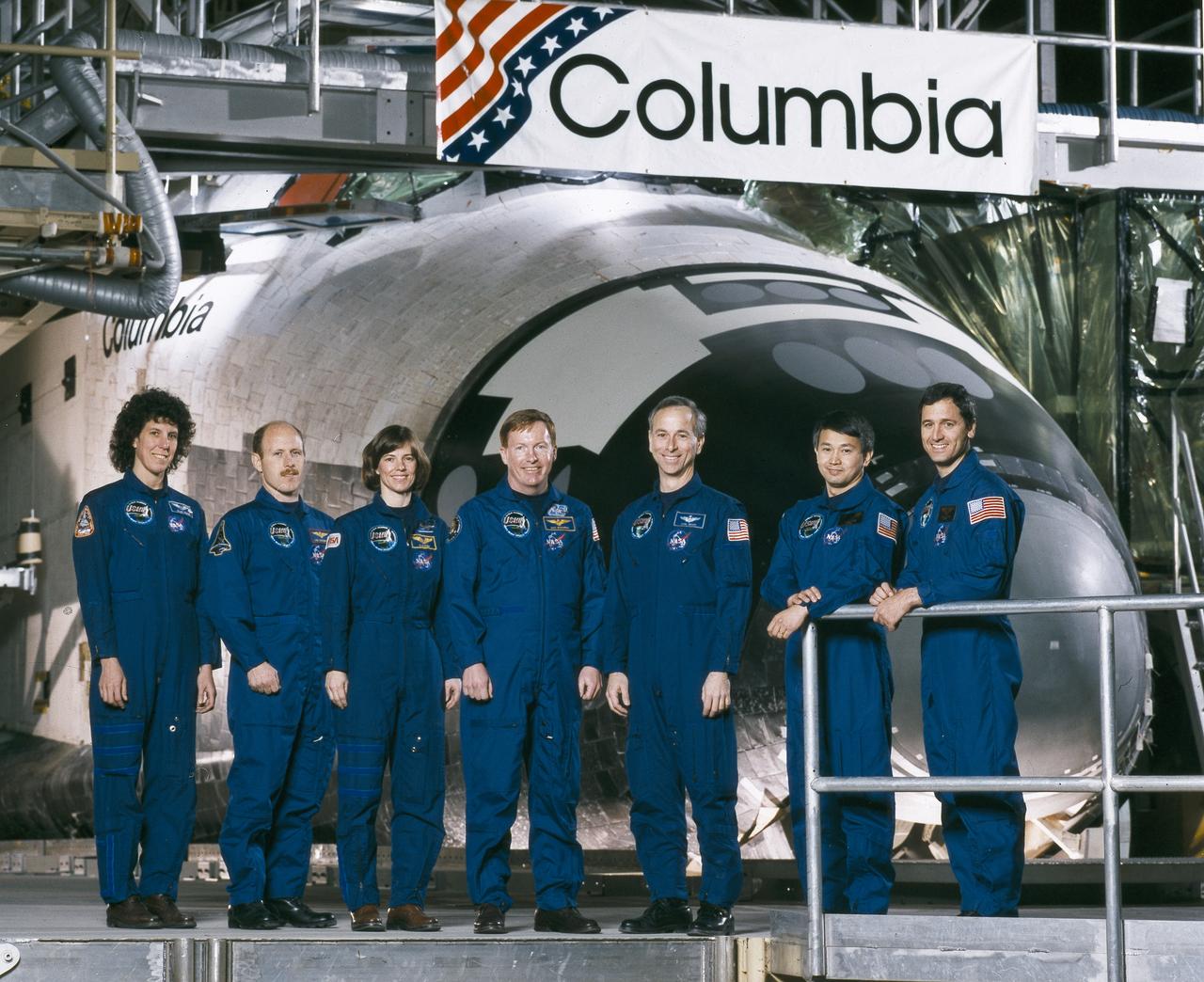
The STS-50 crew portrait includes (from left to right): Ellen S. Baker, mission specialist; Kenneth D. Bowersox, pilot; Bonnie J. Dunbar, payload commander; Richard N. Richards, commander; Carl J. Meade, mission specialist; Eugene H. Trinh, payload specialist; and Lawrence J. DeLucas, payload specialist. Launched aboard the Space Shuttle Columbia on June 25, 1992 at 12:12:23 pm (EDT), the primary payload for the mission was the U.S. Microgravity Laboratory-1 (USML-1) featuring a pressurized Spacelab module.
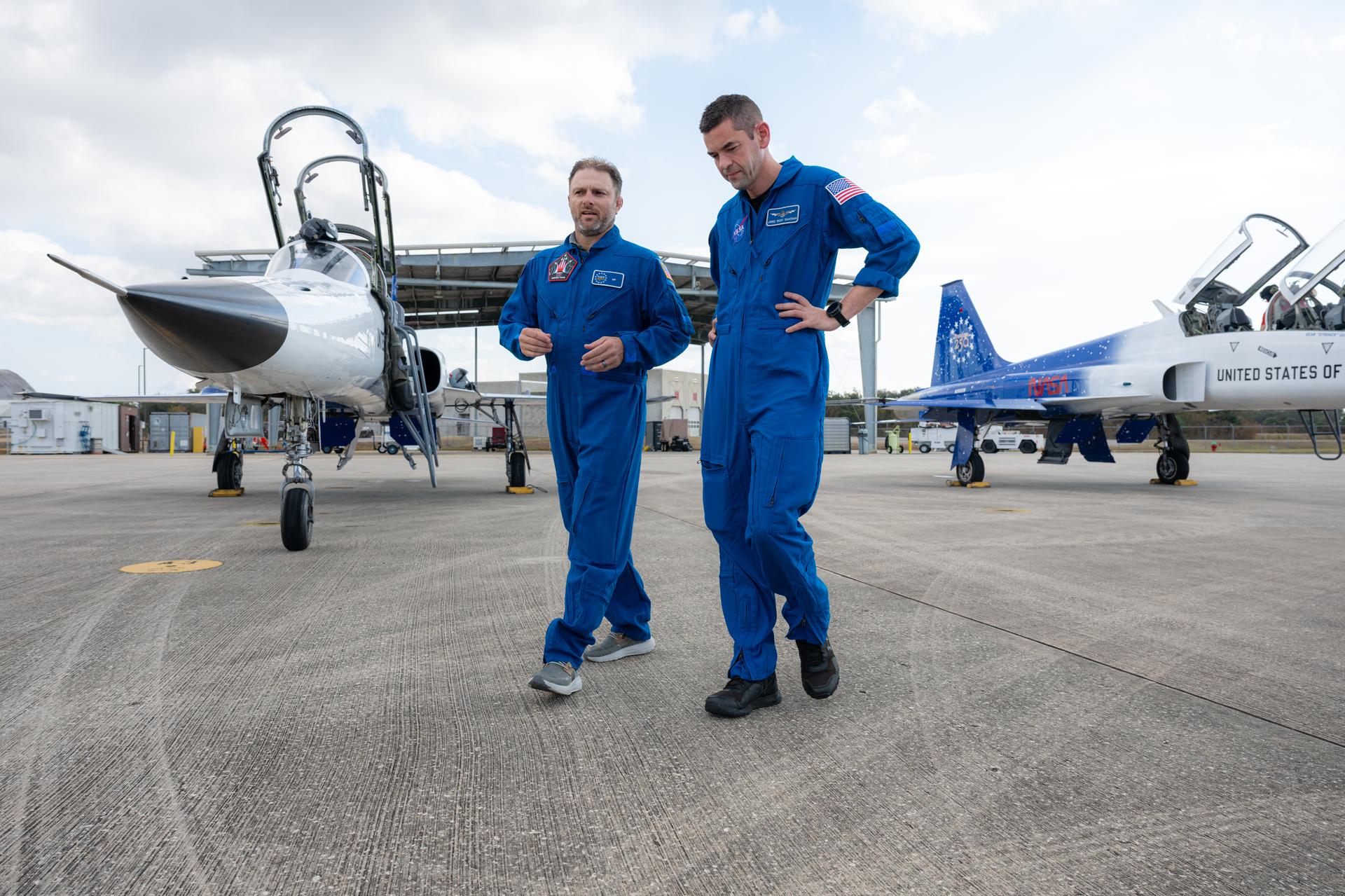
NASA employee Jonathan Baker, chief of the spaceport development division at NASA’s Kennedy Space Center, left, speaks with NASA Administrator Jared Isaacman, right, following an employee incentive flying event using Isaacman's personal F-5 aircraft, Thursday, Feb. 12, 2026, at NASA’s Kennedy Space Center in Florida. Photo Credit: (NASA/John Kraus)
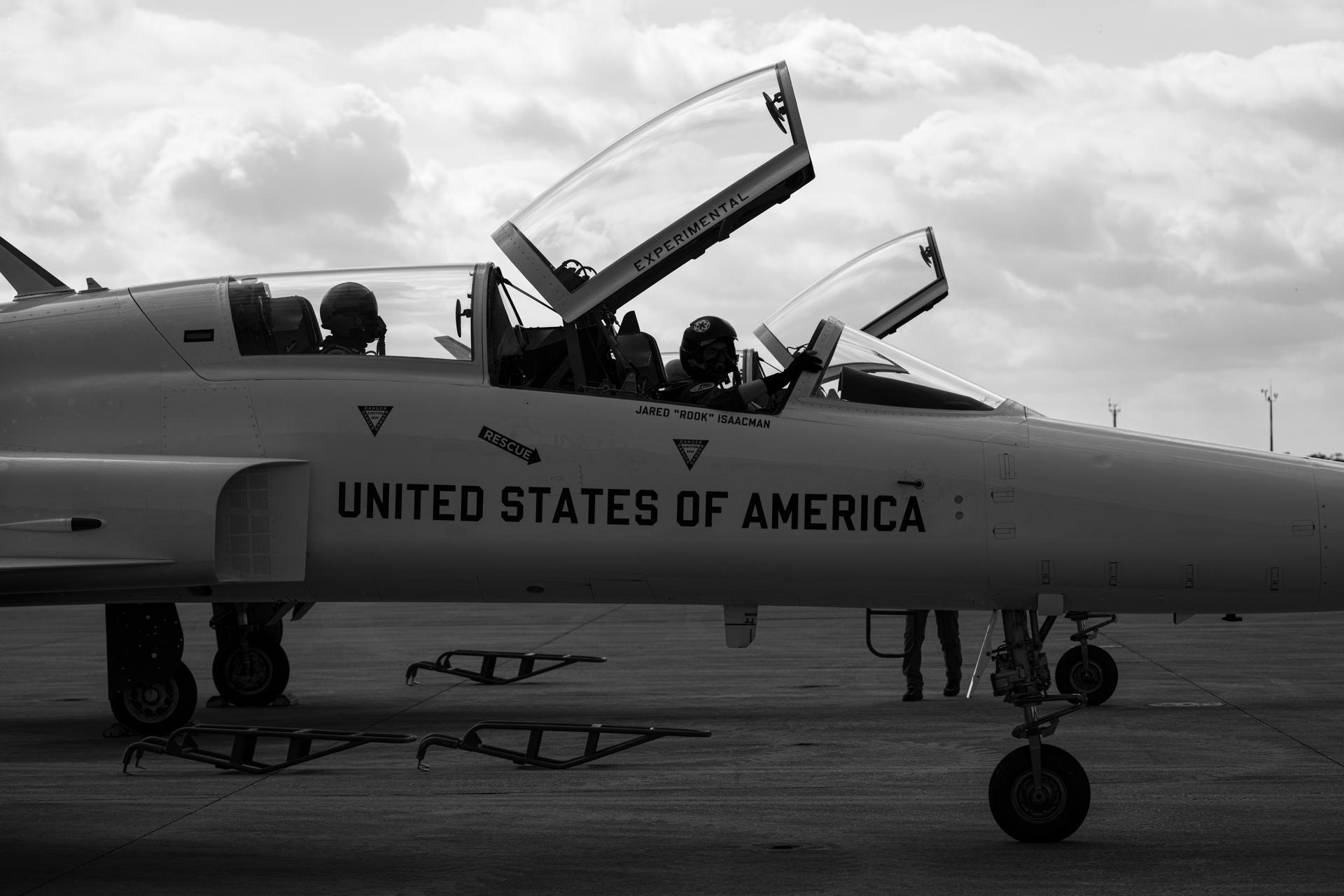
NASA employee Jonathan Baker, chief of the spaceport development division at NASA’s Kennedy Space Center, left, participates in an employee incentive flying event with NASA Administrator Jared Isaacman, center, and his personal F-5 aircraft, Thursday, Feb. 12, 2026, at NASA’s Kennedy Space Center in Florida. Photo Credit: (NASA/John Kraus)
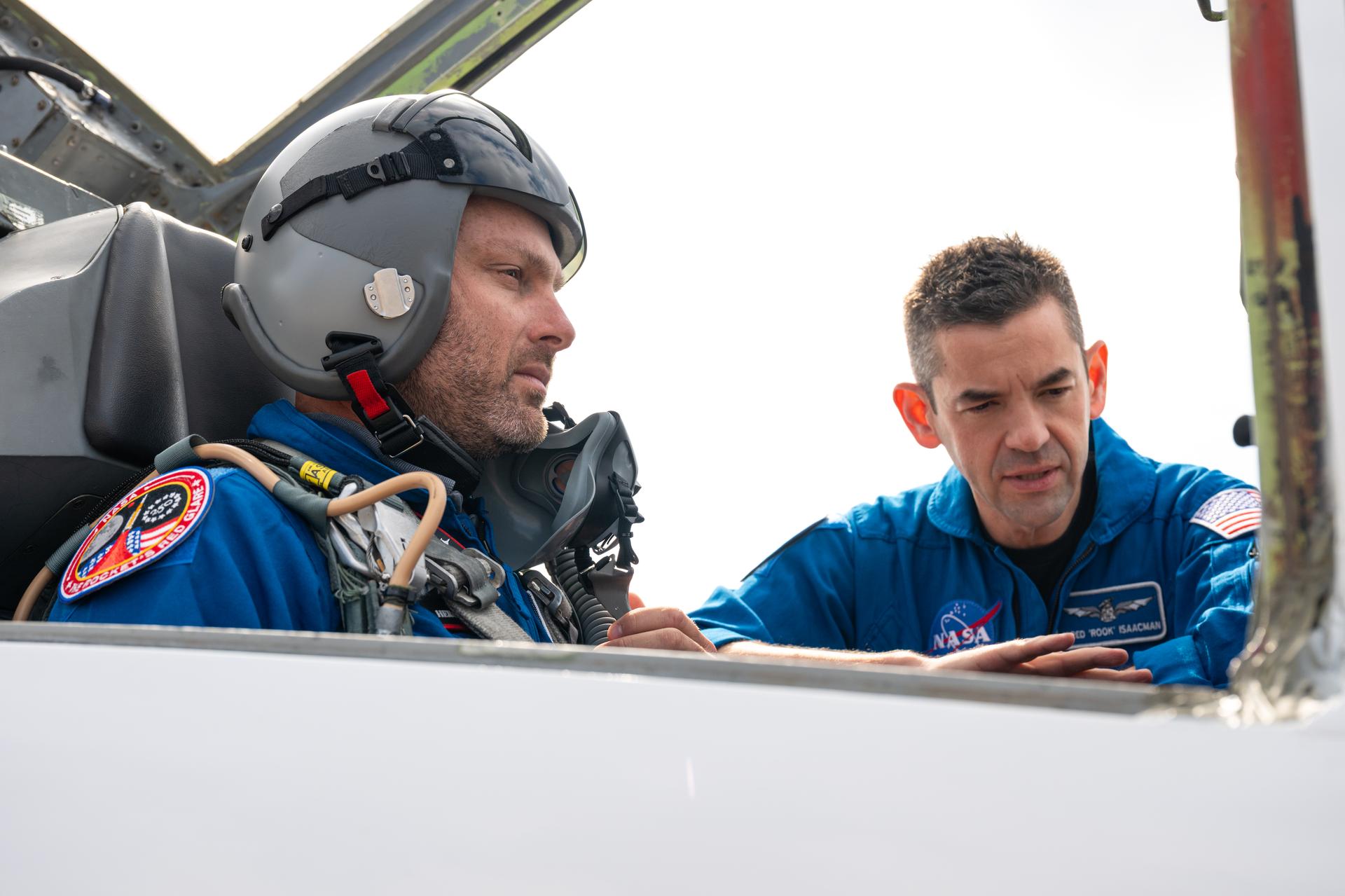
NASA employee Jonathan Baker, chief of the spaceport development division at NASA’s Kennedy Space Center, left, is seen before an employee incentive flying event with NASA Administrator Jared Isaacman, right, and his personal F-5 aircraft, Thursday, Feb. 12, 2026, at NASA’s Kennedy Space Center in Florida. Photo Credit: (NASA/John Kraus)
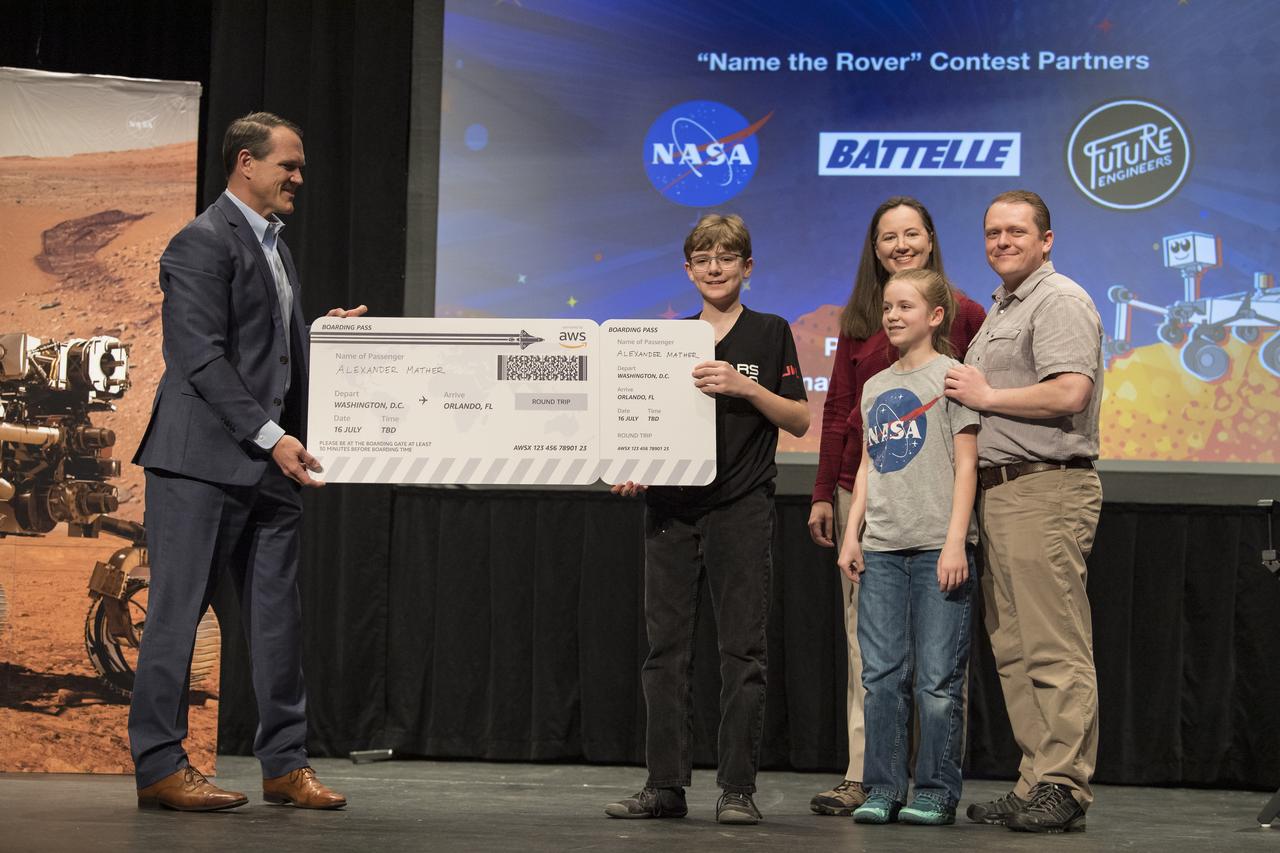
Amazon Senior Sales Manager, Jamie Baker, left, awards a large boarding pass to Alex Mather, the student whose submission, Perseverance, was chosen as the official name of the Mars 2020 rover, to get him and his family to NASA’s Kennedy Space Center to watch the launch of the rover, Thursday, March 5, 2020, at Lake Braddock Secondary School in Burke, Va. The final selection of the new name was made by Associate Administrator of NASA's Science Mission Directorate, Thomas Zurbuchen, following a nationwide naming contest conducted in 2019 that drew more than 28,000 essays by K-12 students from every U.S. state and territory. The rover is currently at NASA's Kennedy Space Center in Florida being prepared for launch this summer. Photo Credit: (NASA/Aubrey Gemignani)
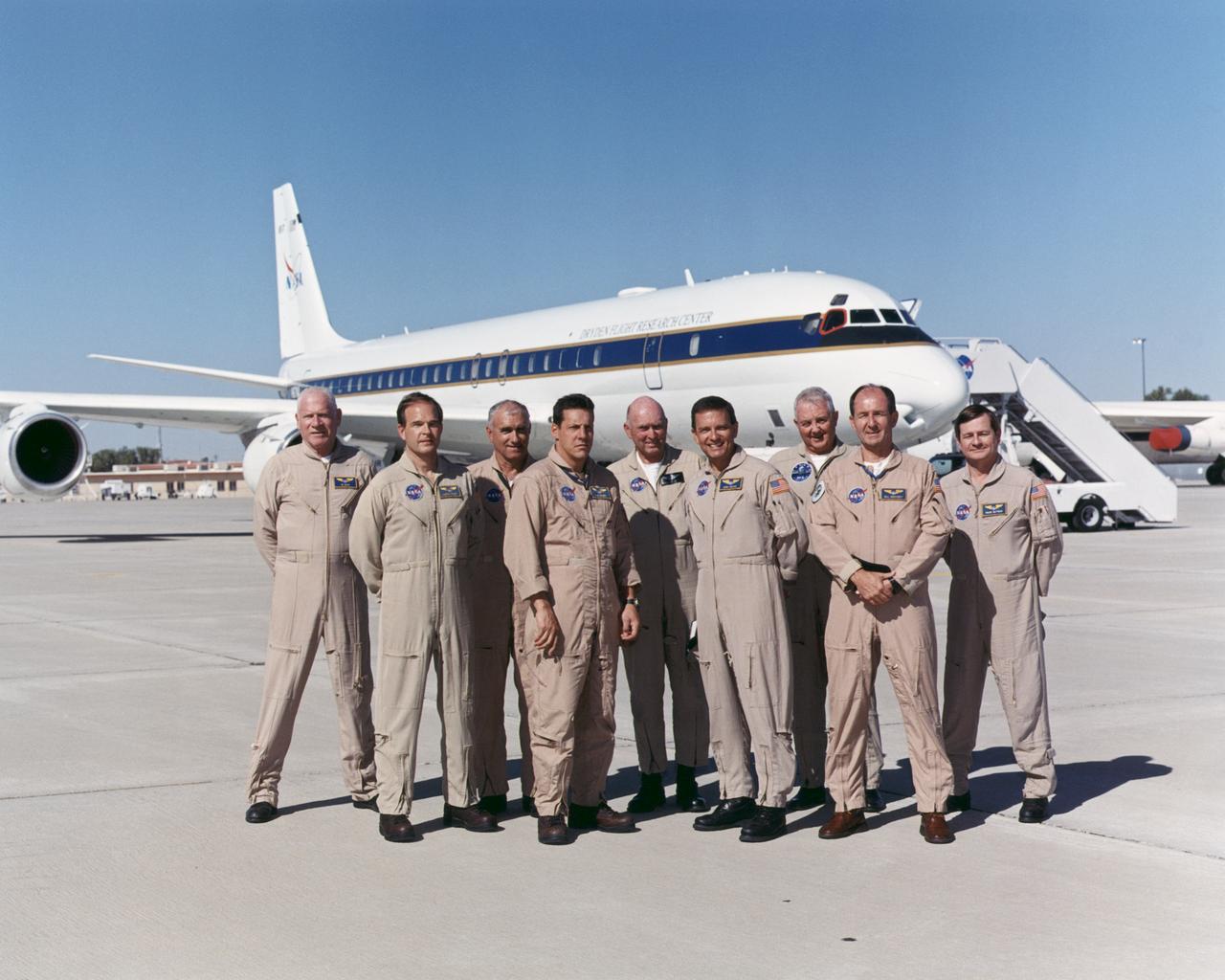
2004 NASA Dryden DC-8 flight crew. Left to Right: Edwin W. Lewis, Jr., Martin J. Trout, Richard G. Ewers, Craig R. Bomben, C. Gordon Fullerton (Chief Pilot), Mark Pestana, Douglas H. Baker, William Frederick Brockett, and Frank Batteas.
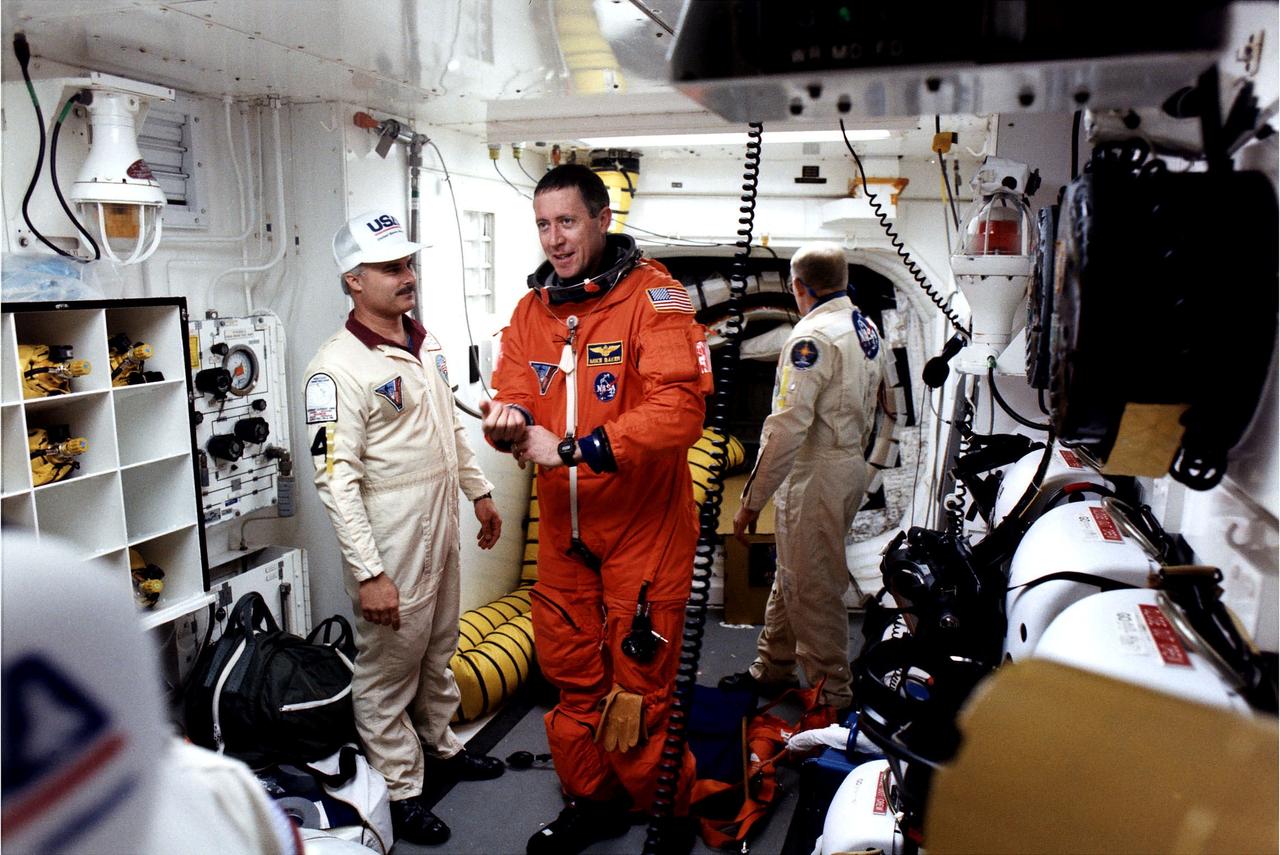
KENNEDY SPACE CENTER, FLA. - STS-81 Mission Commander Michael Baker prepares to enter the Space Shuttle Atlantis at Launch Pad 39B with help from White Room closeout crew members Chris Meinert (left) and Danny Wyatt.
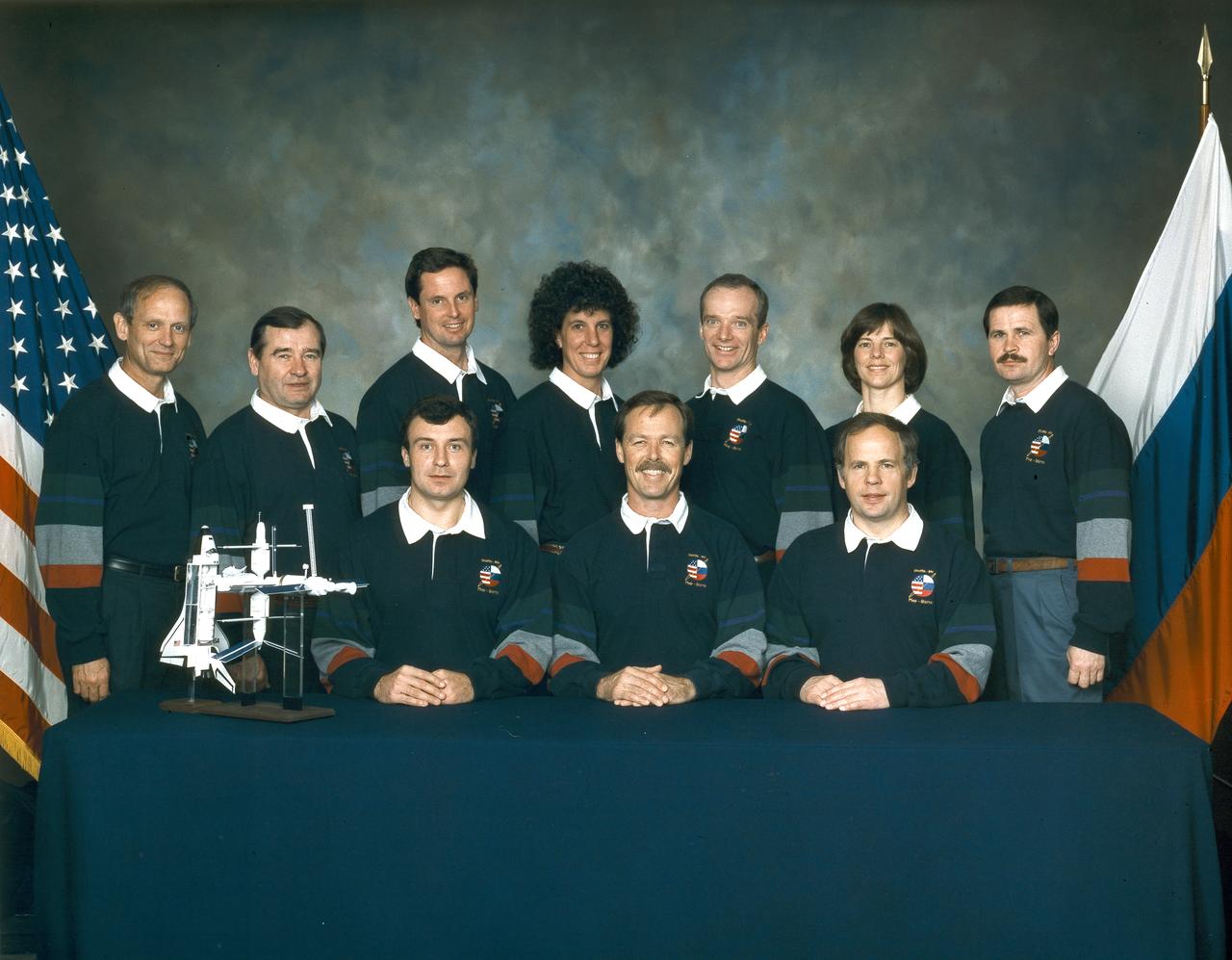
The crew assigned to the STS-71 mission included (front left to right) Vladimir N. Dezhurov, Mir 18 crew download; Robert L. Gibson, commander; and Anatoly Y. Solovyev, Mir 19 crew upload. On the back row, left to right, are Norman E. Thagard, Mir 18 crew download; Gennadiy Strelalov, Mir 18 crew download; Gregory J. Harbaugh, mission specialist; Ellen S. Baker, mission specialist; Charles J. Precourt, pilot; Bonnie J. Dunbar, mission specialist; and Nikolai Budarin, Mir 19 crew upload. Launched aboard the Space Shuttle Atlantis on June 27, 1995 at 3:32:19.044 pm (EDT), the STS-71 mission marked many firsts in human space flight history. It was the first U.S. Space Shuttle-Russian Space Station Mir docking and joint on-orbit operations, and the first on-orbit change out of a shuttle crew. In addition, it was the largest spacecraft ever in orbit and was the 100th U.S. human space launch conducted from the Cape.
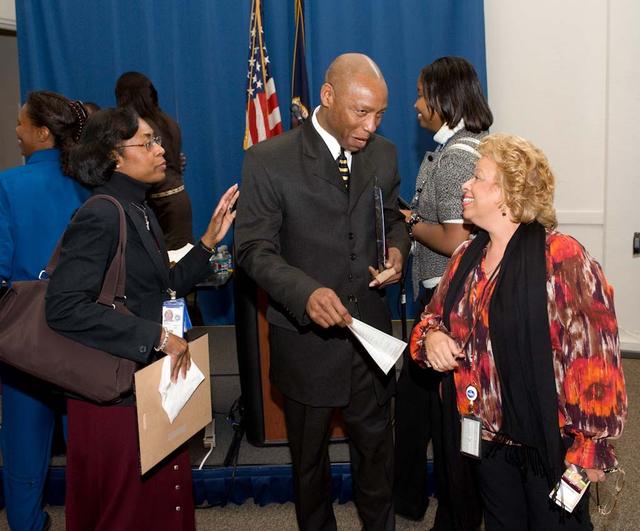
African American Advisory Group'a history month celebration; 'An Abundance of Excellence' Chronicling the Journey of the Black Astronauts. Rhonda Baker, Ernest Jennings, Nonnie Braxton
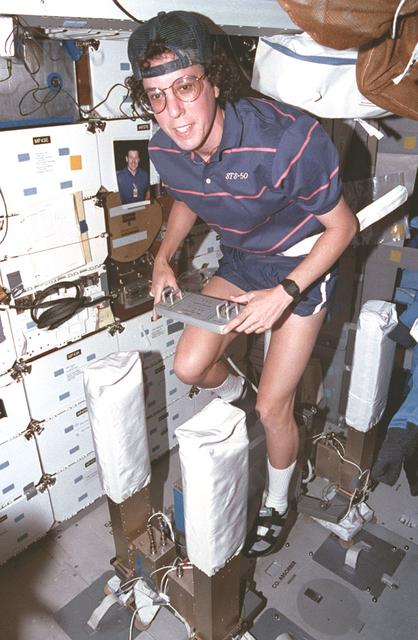
Onboard Space Shuttle Columbia (STS-50) in the United States Microgravity Laboratory (USML-1) mission specialist Ellen S. Baker is hard at work.
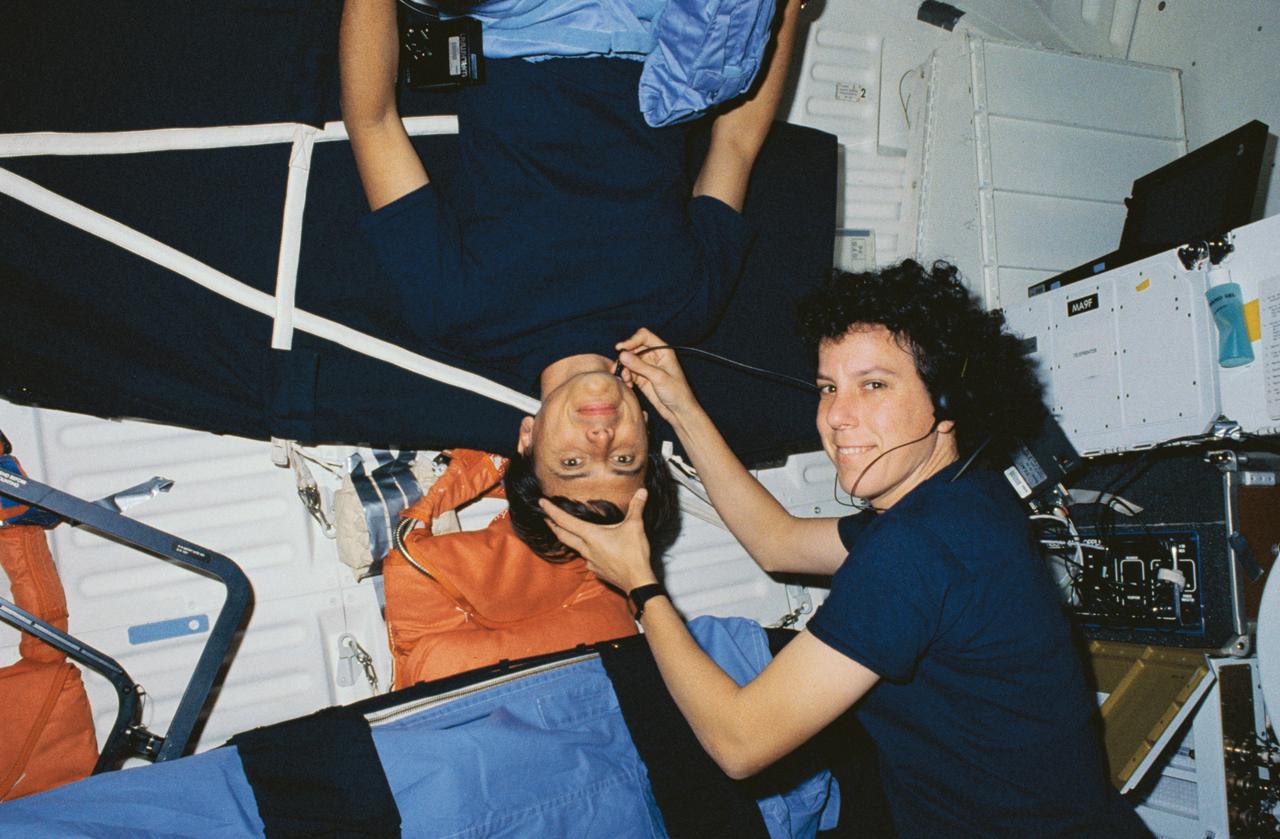
STS034-08-007 (18-23 Oct. 1989) --- Astronaut Ellen S. Baker, an STS-34 mission specialist and medical doctor, conducts a medical examination on astronaut Franklin R. Chang-Diaz, mission specialist, on the middeck of the Earth-orbiting space shuttle Atlantis. Dr. Baker was monitoring Chang-Diaz's blood flow. The scene was recorded on film with a 35mm camera.Photo credit: NASA or National Aeronautics and Space Administration
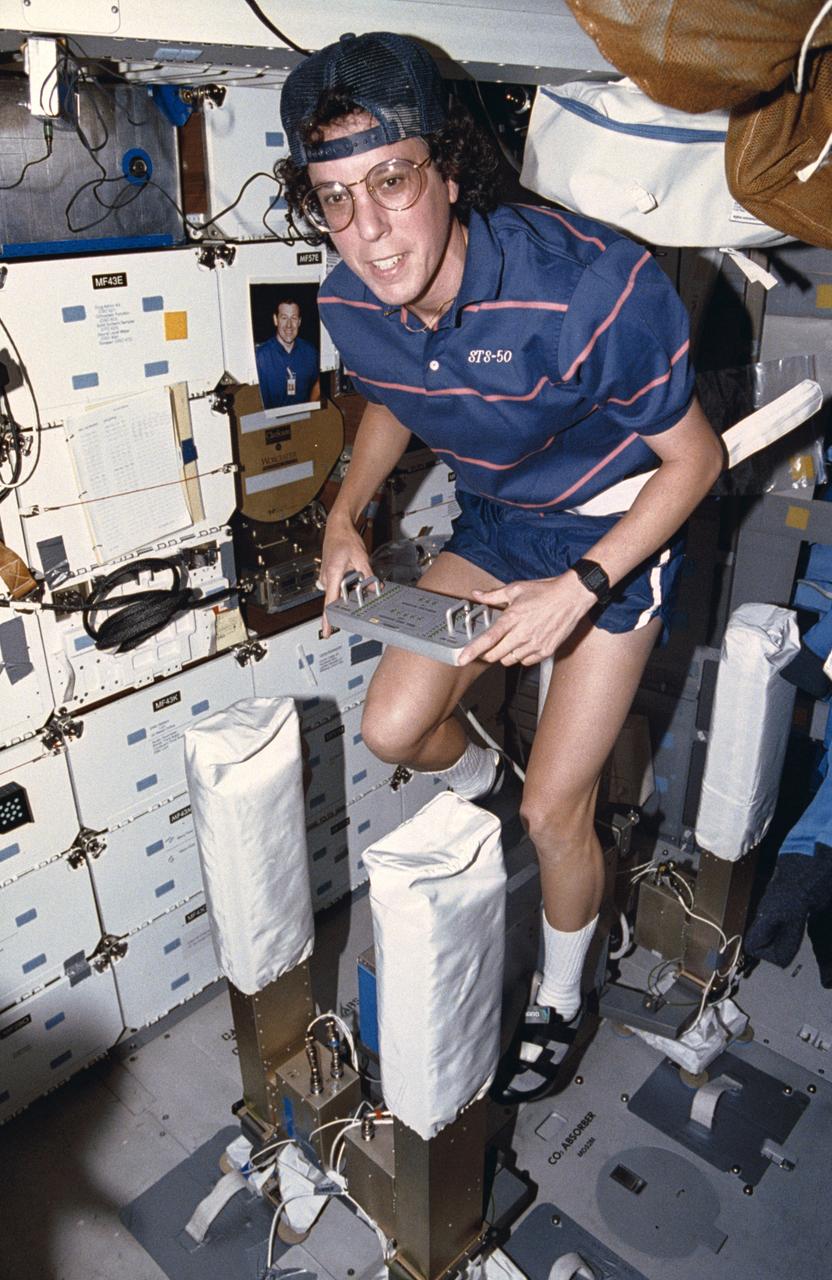
STS050-21-035 (25 June- 9 July 1992) --- Astronaut Ellen S. Baker, mission specialist, works out on the bicycle ergometer on the mid-deck of the Earth-orbiting Space Shuttle Columbia. Baker was joined by four other astronauts and two scientists from the private sector for the record-setting 14-day United States Microgravity Laboratory 1 (USML-1) mission.
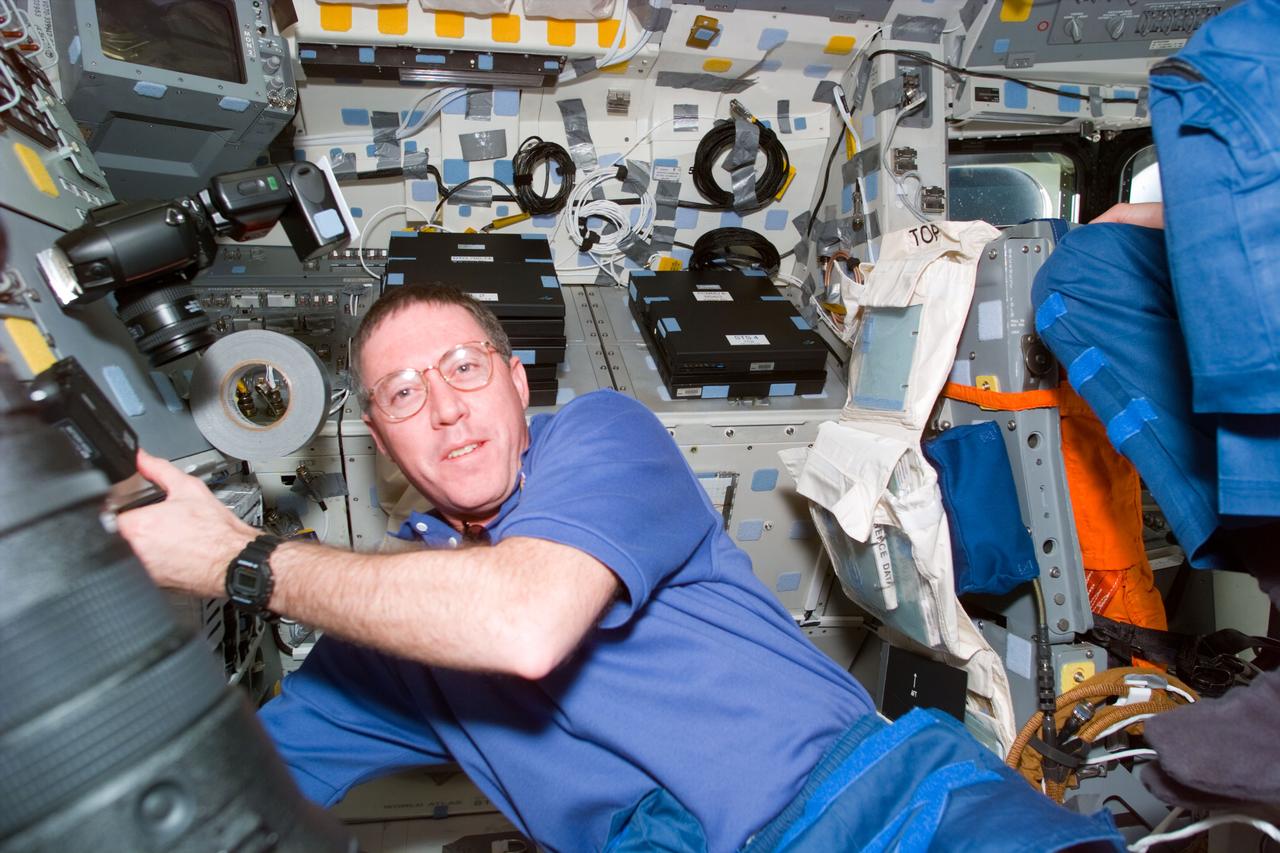
STS081-E-05091 (12 Jan. 1997) --- Astronaut Michael A. Baker, mission commander, prepares to retrieve a temporarily stowed camera from the Space Shuttle Atlantis' aft flight deck during early phases of the scheduled ten-day mission. Baker and five crew mates will dock with Russia's Mir Space Station around the middle of the week. This image was recorded with an Electronic Still Camera (ESC) and was later downlinked to flight controllers in Houston, Texas.
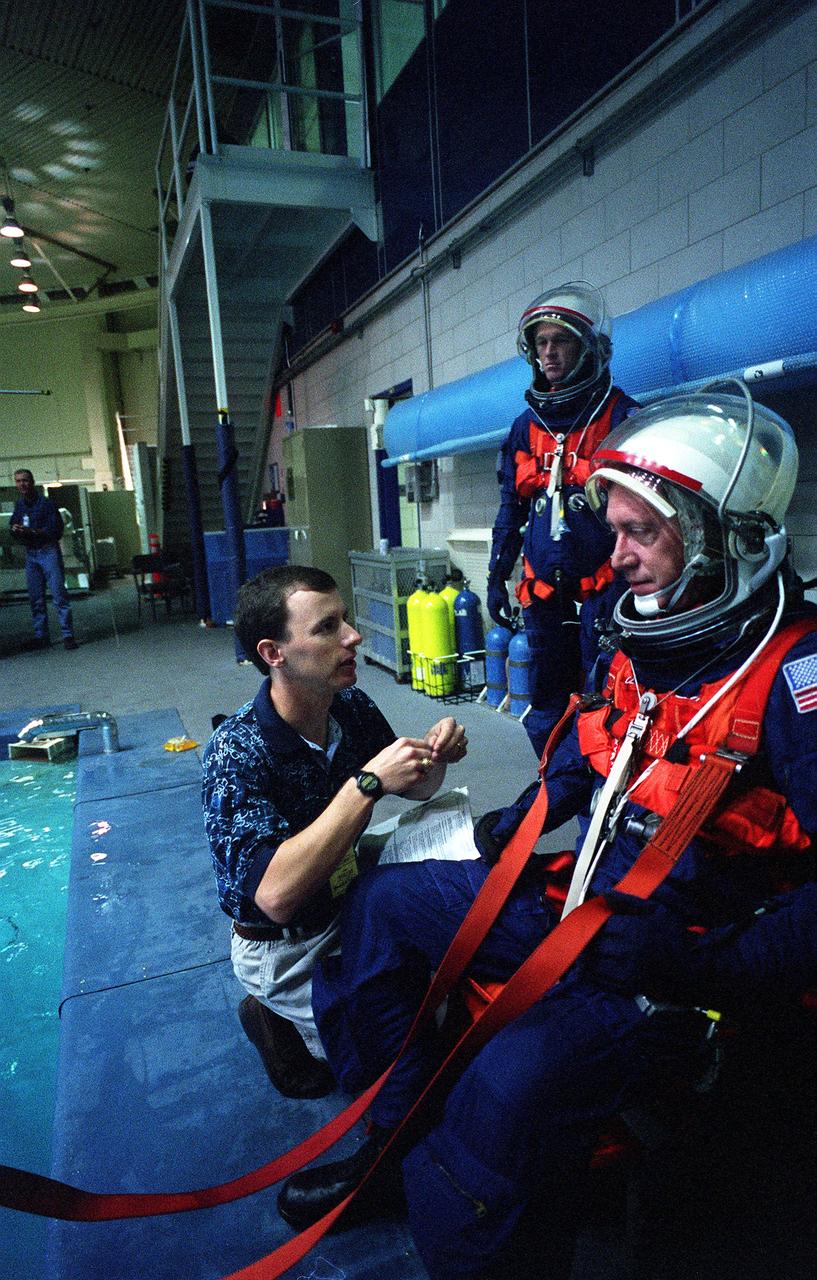
S96-15388 (26 Sept. 1996) --- In the Johnson Space Center's weightless environment training facility, astronaut Michael Baker, STS-81 mission commander, prepares to simulate a parachute drop into water. David Pogue helps with the final touches on Baker's training version of the launch and entry suit, as Brent W. Jett (background), pilot, looks on.

ISS008-E-15493 (12 February 2004) --- A regional picture of Mount Baker, Washington, showing its proximity to Seattle and Vancouver, is featured in this image photographed by an Expedition 8 crewmember on the International Space Station (ISS). The Cascade Range is an arc of volcanoes that extends from southwestern British Columbia to northern California. One of the six major composite volcanoes is Mount Baker in northern Washington close to the Canadian border, about 85 miles north-northeast of Seattle and 65 miles southeast of Vancouver, British Columbia.
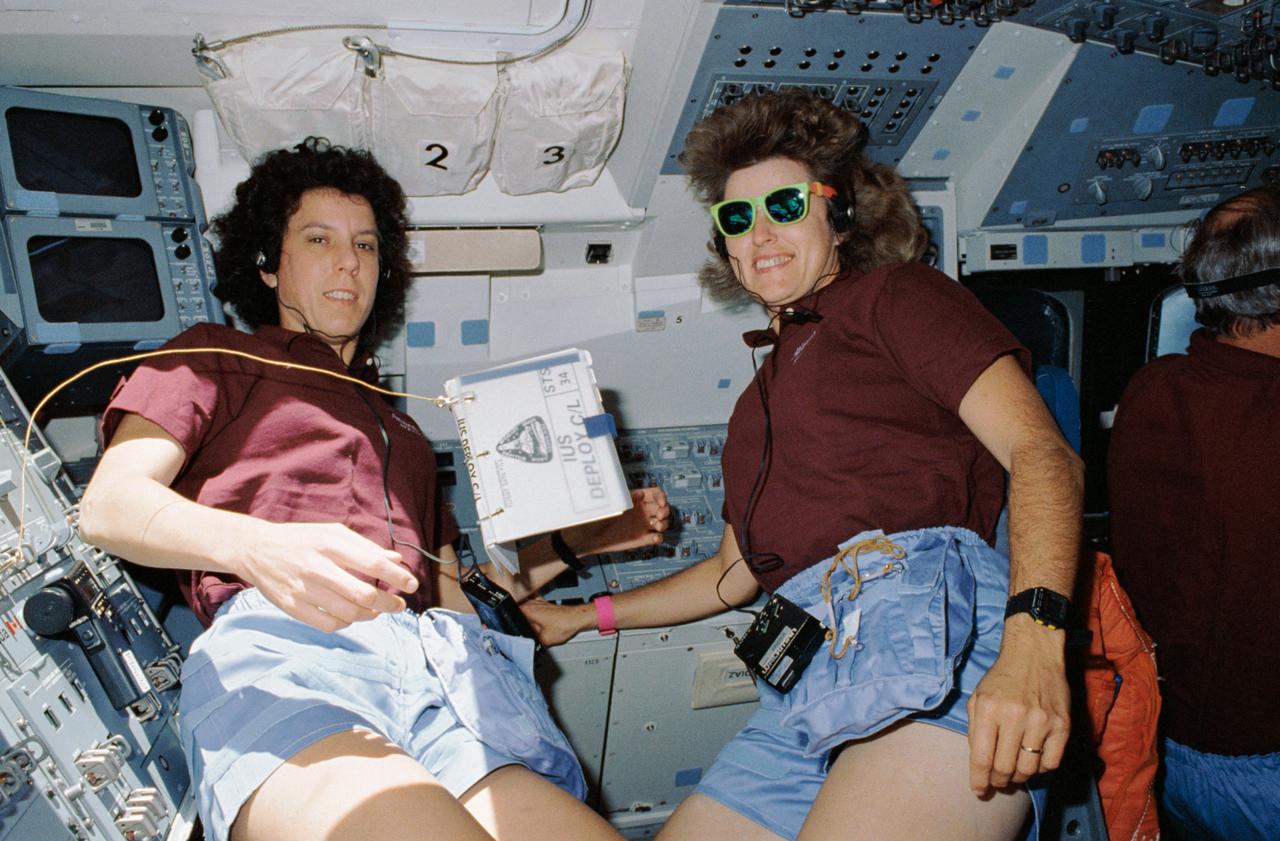
STS034-09-007 (23 Oct. 1989) --- Having been in space only a few hours, three of the STS-34 astronaut crew prepare for pre-deployment exercises involving one of the most prominent "passengers" of the flight -- the Galileo payload which was lying in Atlantis', Orbiter Vehicle (OV) 104's, payload bay (PLB). Pictured, left to right, are astronauts Ellen S. Baker and Shannon W. Lucid, both mission specialists; along with Donald E. Williams, commander, who guided OV-104's course during the exercise. Baker and Lucid communicated with ground controllers while juggling other Galileo-related chores. Both Baker and Lucid are equipped with SONY Walkmans and are wearing headsets. Lucid wears a pair of sunglasses with brightly colored frames. A tethered inertial upper stage (IUS) deploy checklist (C/L) floats between the two and a spotmeter is Velcroed to an on orbit station control panel.
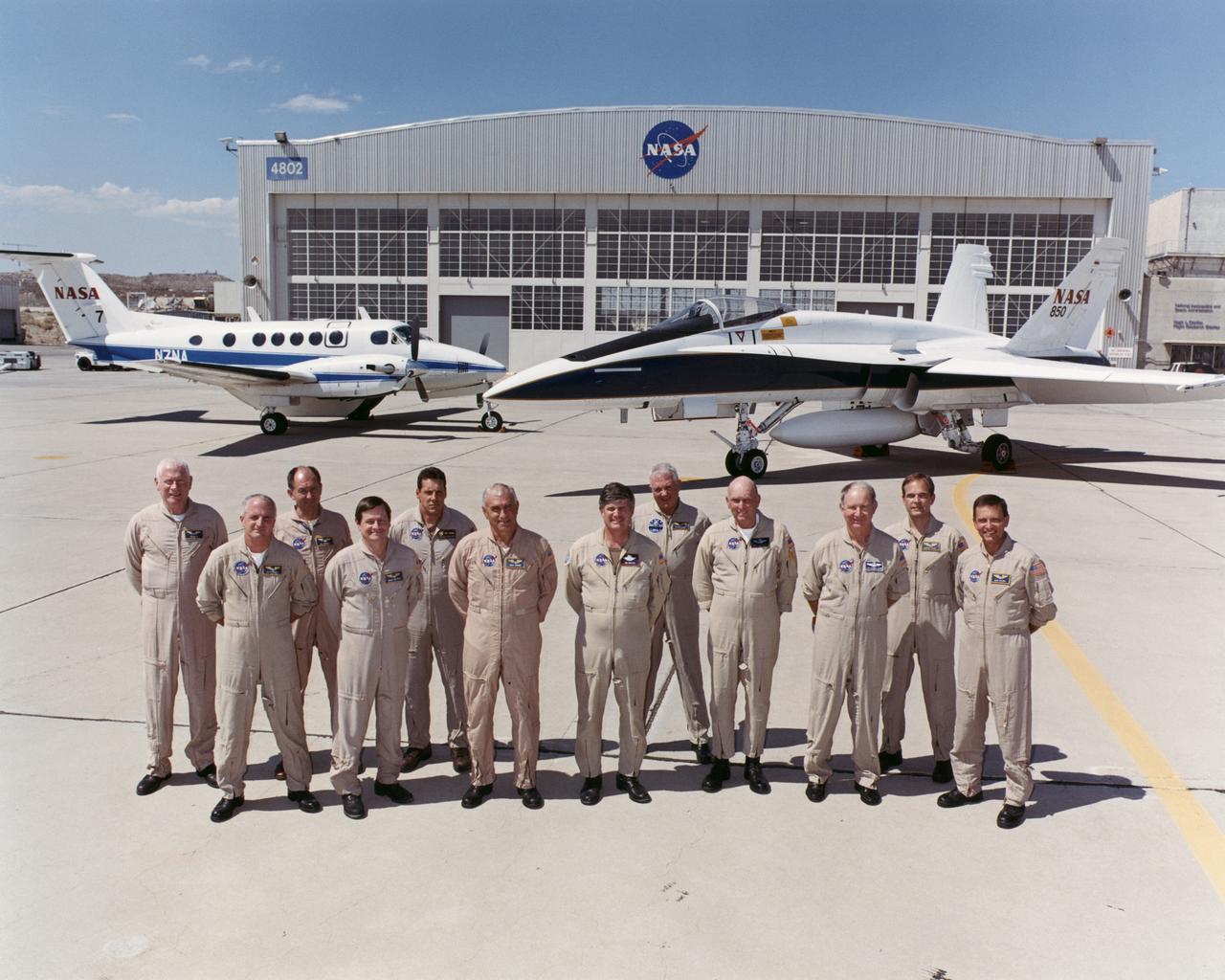
2004 NASA Dryden Research Pilots. Left to Right: Edwin W. Lewis, Jr., David A. Wright (Director of Flight Operations), William Frederick Brockett, Frank Batteas, Craig R. Bomben, Richard G. Ewers, James W. Smolka, Douglas H. Baker, C. Gordon Fullerton (Chief Pilot), James Barrilleaux, Martin J. Trout, and Mark Pestana. (not pictured: Dana Purifoy)

STS081-338-037 (12-22 Jan. 1997) --- Astronaut Michael A. Baker, STS-81 commander, mans the commander's station on the Space Shuttle Atlantis' flight deck.
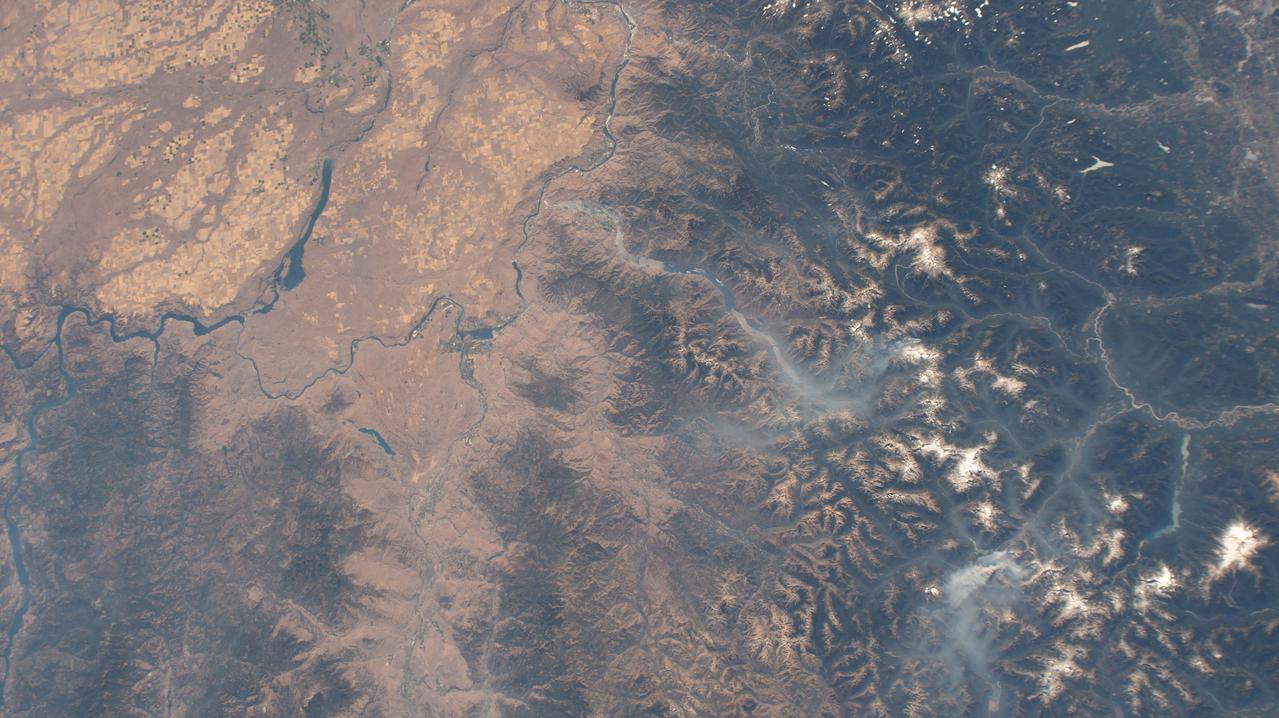
iss069e060945 (Aug. 15, 2023) --- Wildfires near Glacier Peak and Mount Baker in Washington state are pictured from the International Space Station as it orbited 265 miles above North America.
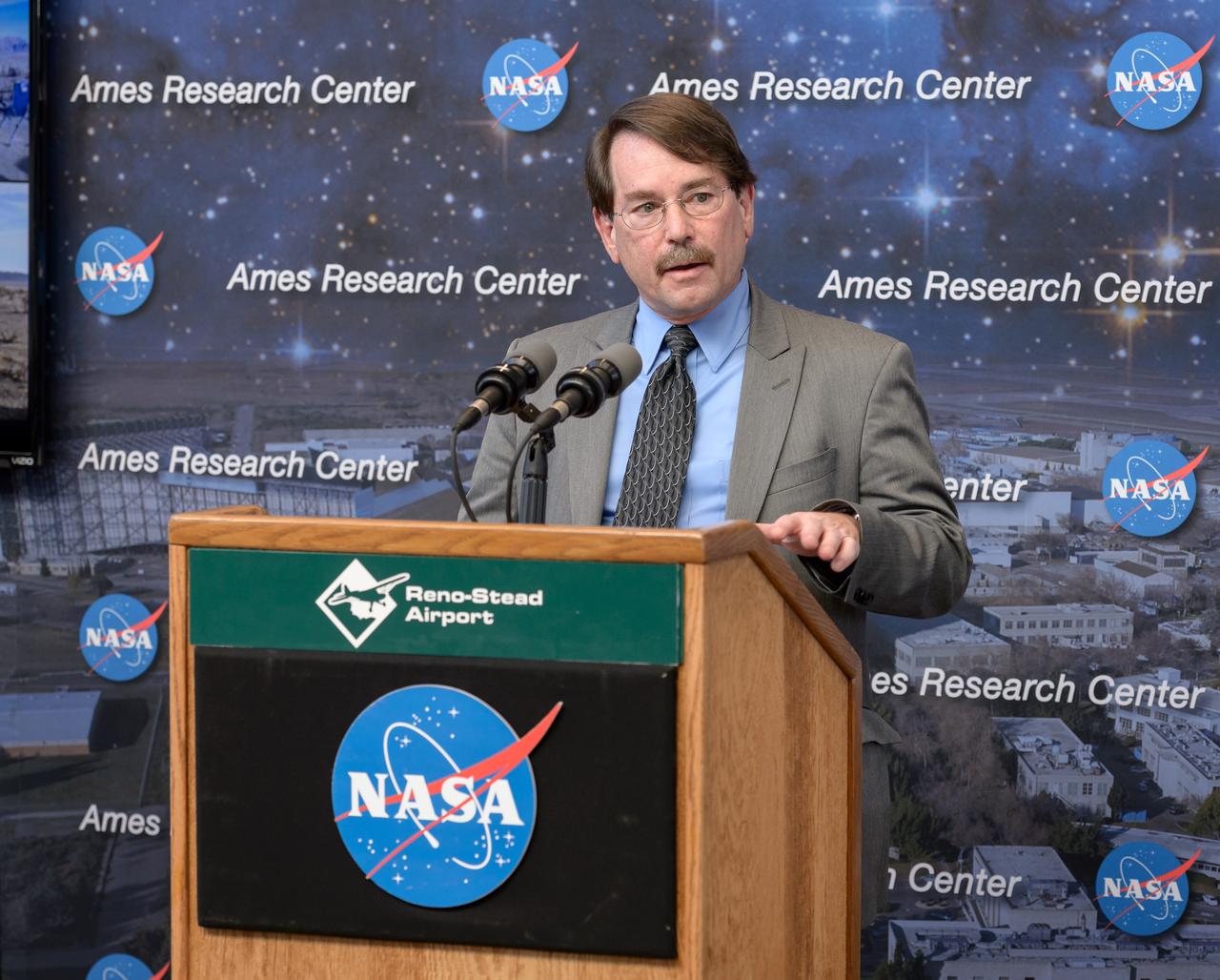
News Conference following the test of Unmanned Aircraft Systems Traffic Management (UTM) technical capability Level 2 (TCL2) at Reno-Stead Airport, Nevada. Mark Baker, Director of Business Development, Nevada Institute of Autonomous Systems.
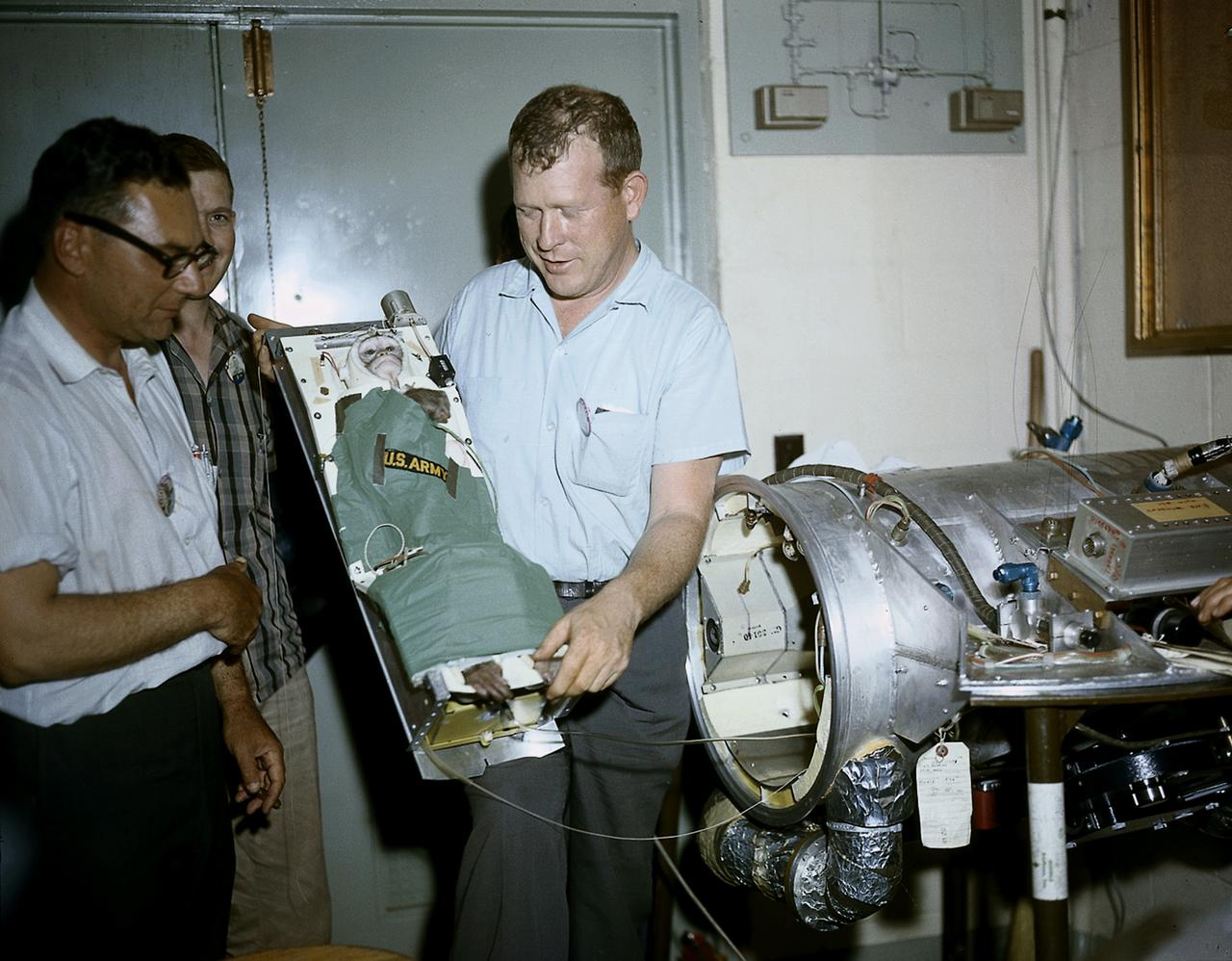
A squirrel monkey, Able, is being ready for placement into a capsule for a preflight test of Jupiter, AM-18 mission. AM-18 was launched on May 28, 1959 and also carried a rhesus monkey, Baker, into suborbit.
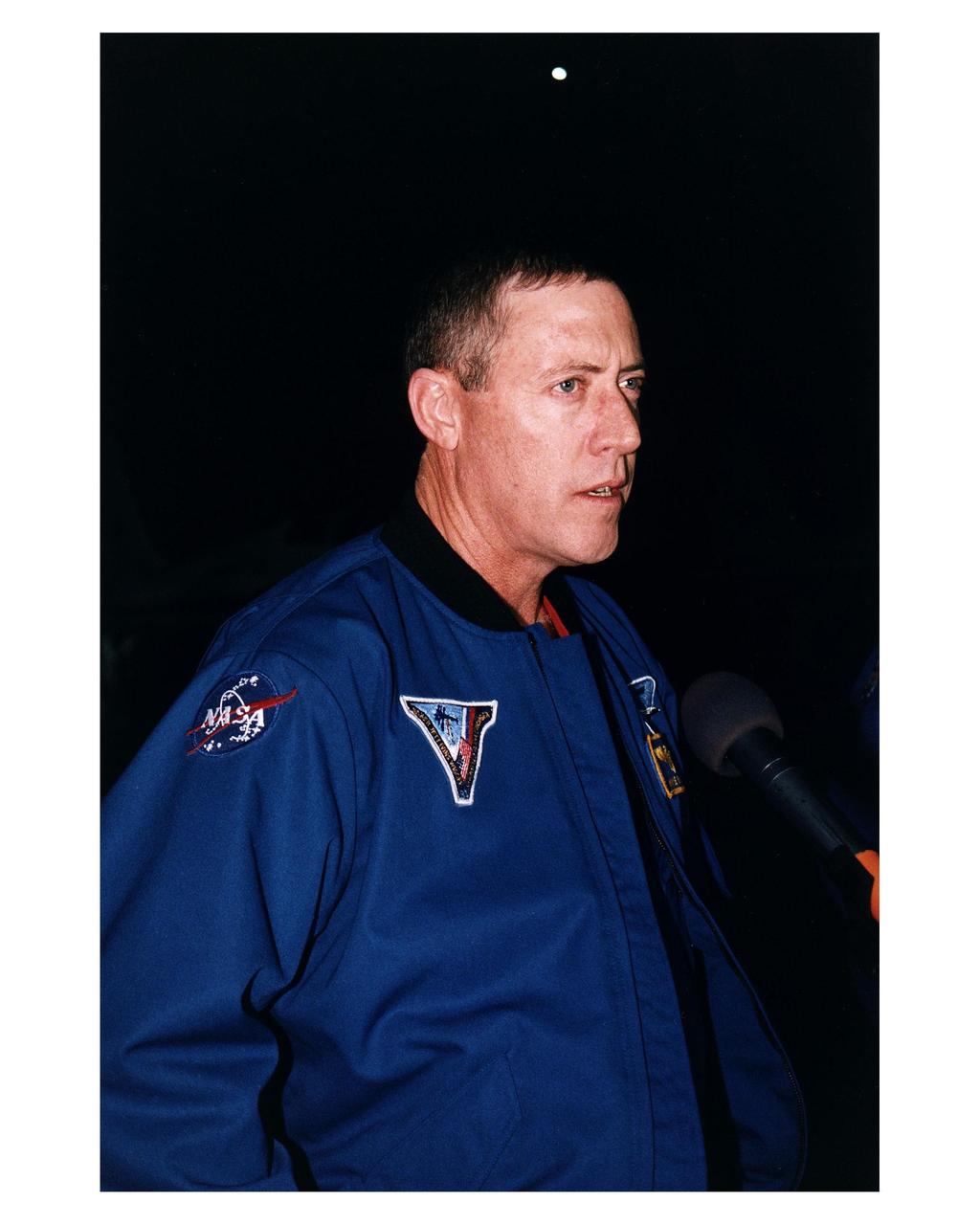
STS-81 Mission Commander Michael A. Baker talks to the press at the KSC Shuttle Landing Facility after he and his crew arrived at the space center for the final countdown preparations for the fifth Shuttle-Mir docking mission
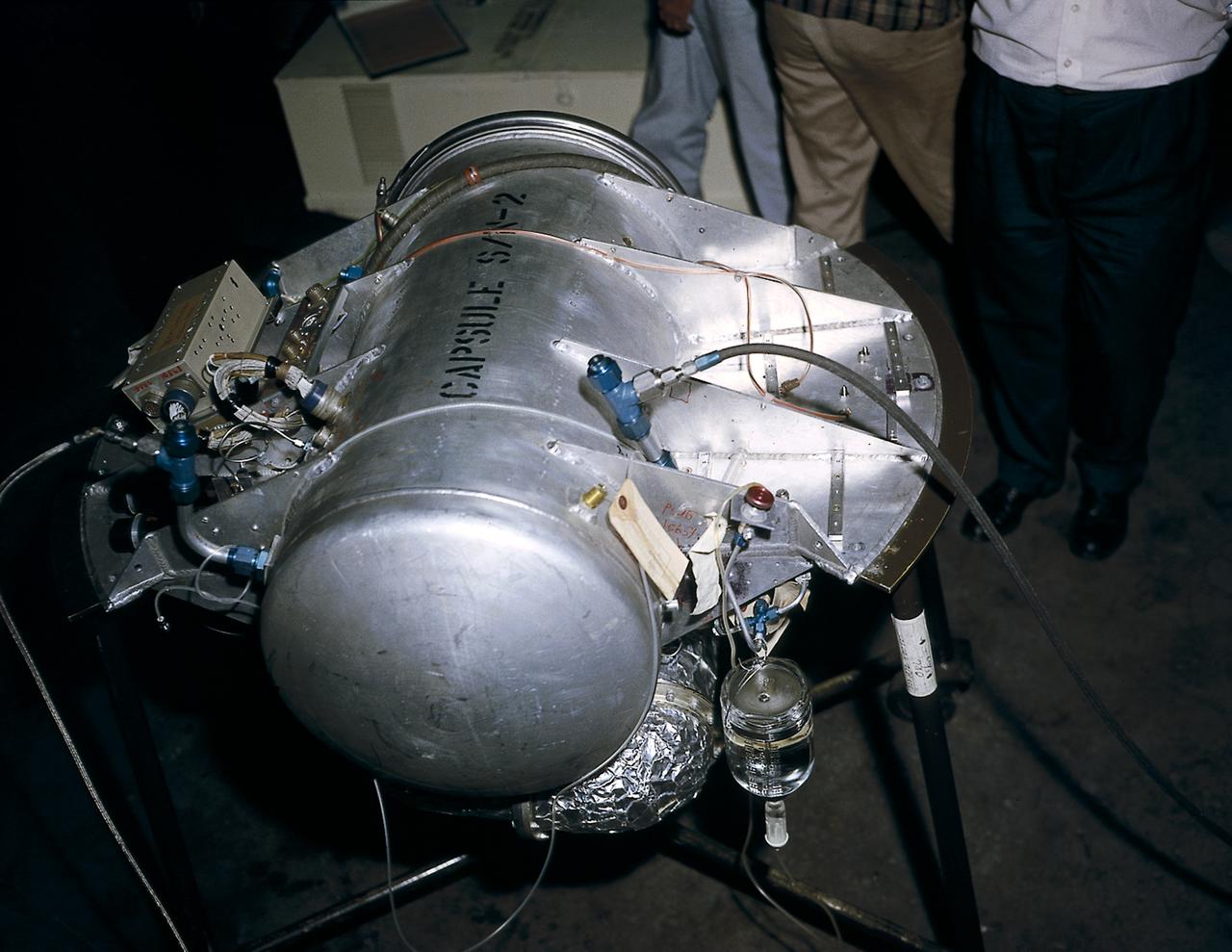
The capsule ready to be installed in the nose cone of Jupiter, AM-18, for pre-flight test, May 18, 1959. The capsule carried monkeys, Baker and Able, as the payload of AM-18 mission
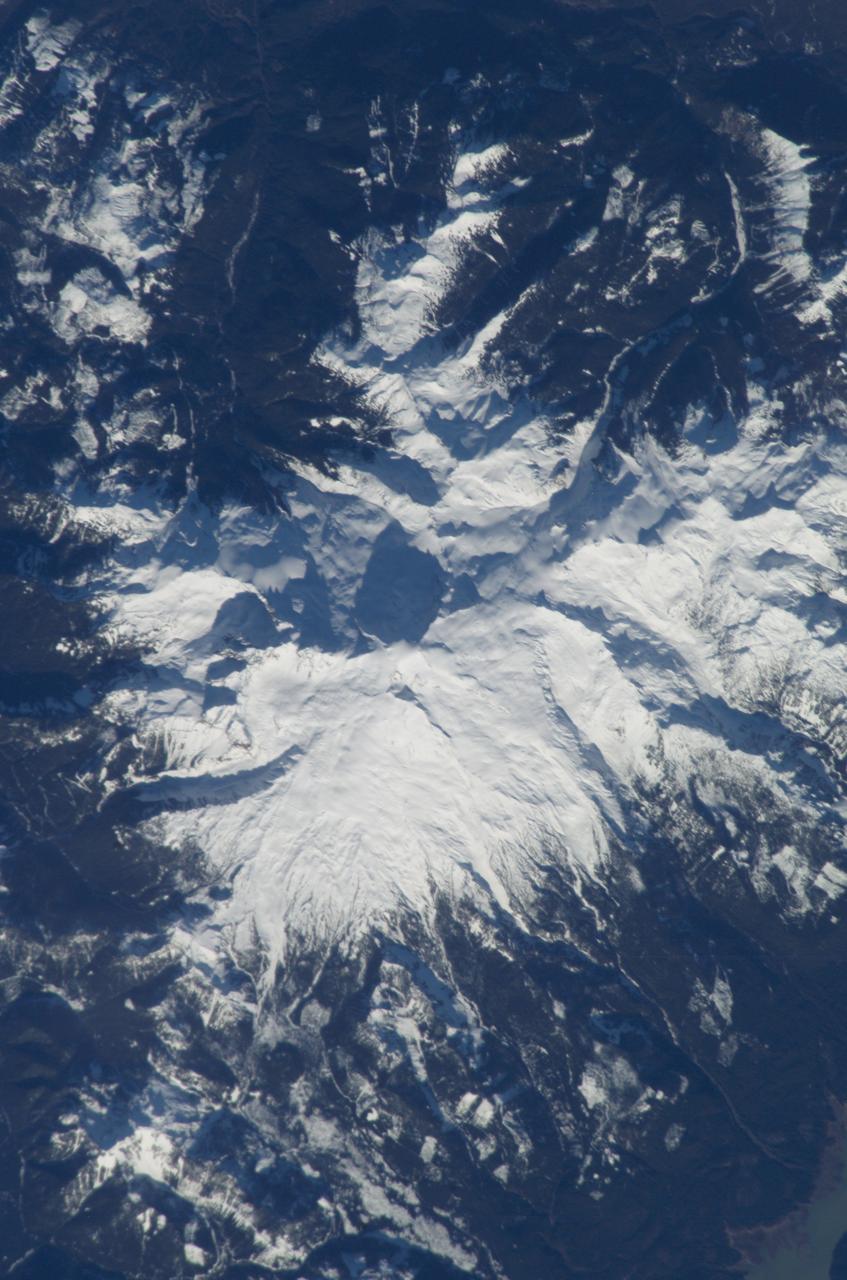
ISS008-E-15491 (12 February 2004) --- This scene featuring Mount Baker, Washington, was photographed by an Expedition 8 crewmember on the International Space Station (ISS). The high-resolution image provides details of the rough terrain near the summit and on the upper flanks. The Cascade Range is an arc of volcanoes that extends from southwestern British Columbia to northern California. One of the six major composite volcanoes is Mount Baker in northern Washington close to the Canadian border, about 85 miles north-northeast of Seattle and 65 miles southeast of Vancouver, British Columbia.
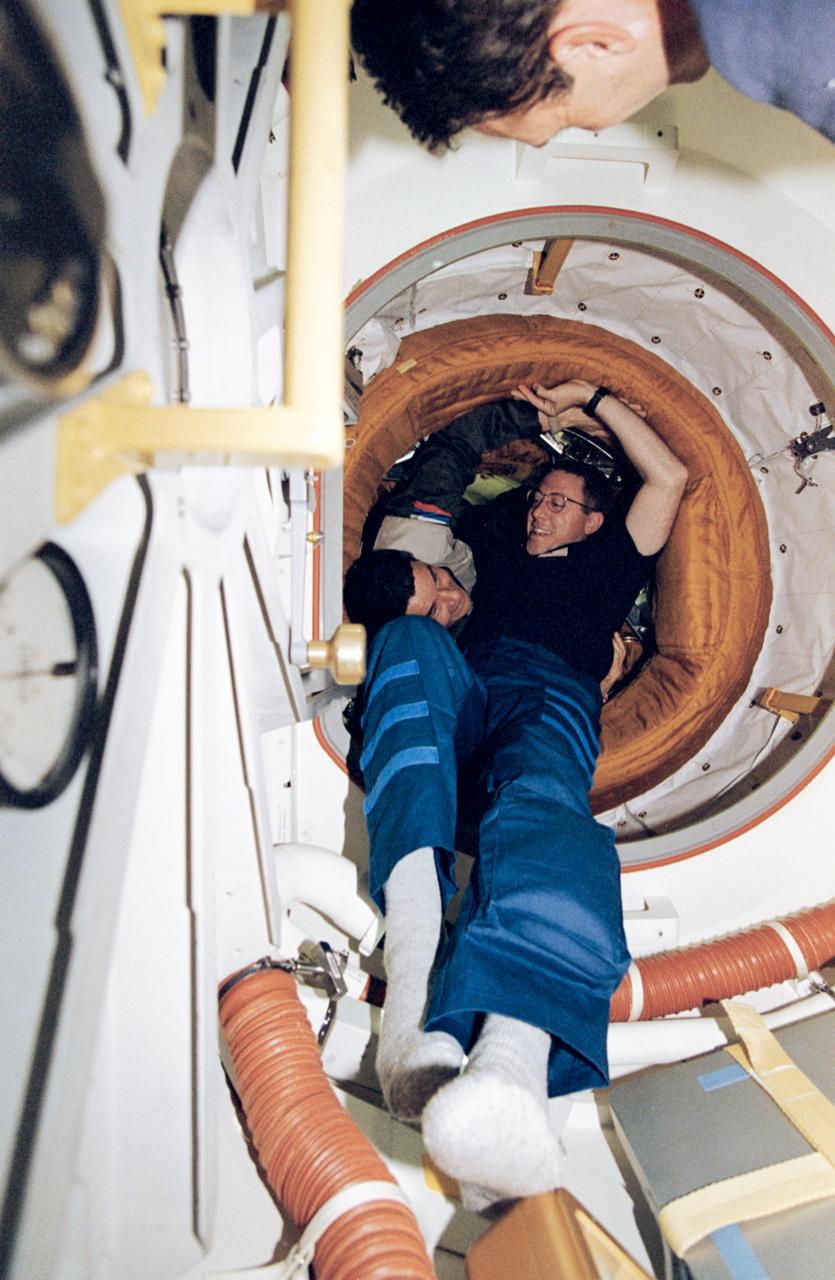
STS081-373-025 (14 Jan 1997) --- Greeting between commanders - astronaut Michael A. Baker (foreground) and cosmonaut Valeri G. Korzun - just after hatch opening following the January 14, 1997, docking. Out of frame on the Space Shuttle Atlantis is astronaut Jerry M. Linenger, soon to be trading places with John E. Blaha, the current cosmonaut guest researcher, onboard Russia?s Mir Space Station since mid September 1996. Along with Baker and Linenger, other crew members now aboard Atlantis are astronauts Brent W. Jett, Jr., pilot; and mission specialists John M. Grunsfeld, Marsha S. Ivins and Peter J. K. (Jeff) Wisoff.
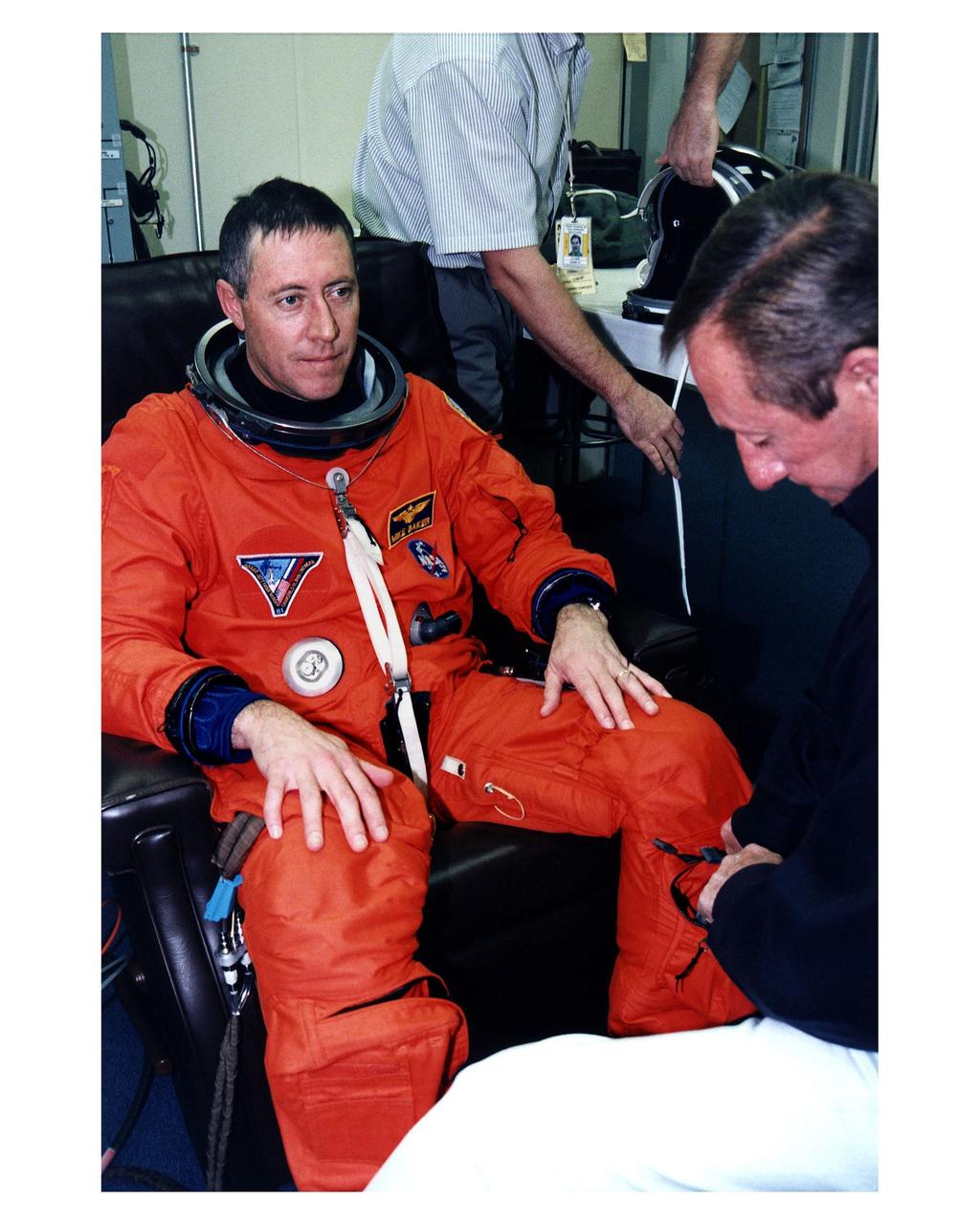
STS-81 Mission Commander Michael A. Baker is assisted into his launch/entry suit in the Operations and Checkout (O&C) Building. Baker is on his fourth space flight and will have responsibility for the 10-day mission, including the intricate docking and undocking maneuvers with the Russian Mir space station. He will also be in charge of two in-flight Risk Mitigation experiments and be the subject of a Human Life Sciences experiment. He and five crew members will shortly depart the O&C and head for Launch Pad 39B, where the Space Shuttle Atlantis will lift off during a 7-minute window that opens at 4:27 a.m. EST, January 12
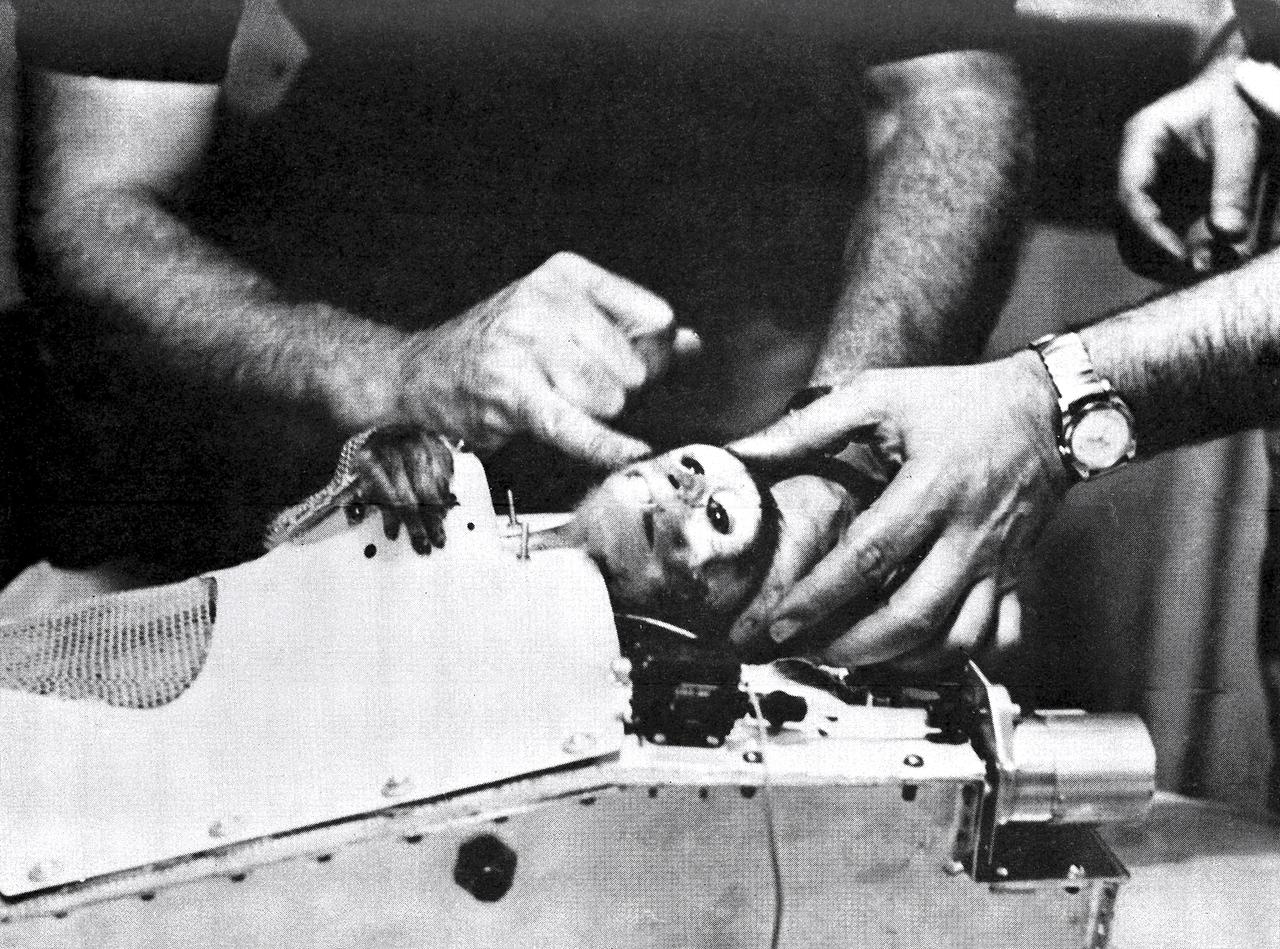
On May 28, 1959, a Jupiter Intermediate Range Ballistic Missile provided by a U.S. Army team in Redstone Arsenal, Alabama, launched a nose cone carrying Baker, A South American squirrel monkey and Able, An American-born rhesus monkey. This photograph shows Able after recovery of the nose cone of the Jupiter rocket by U.S.S. Kiowa.
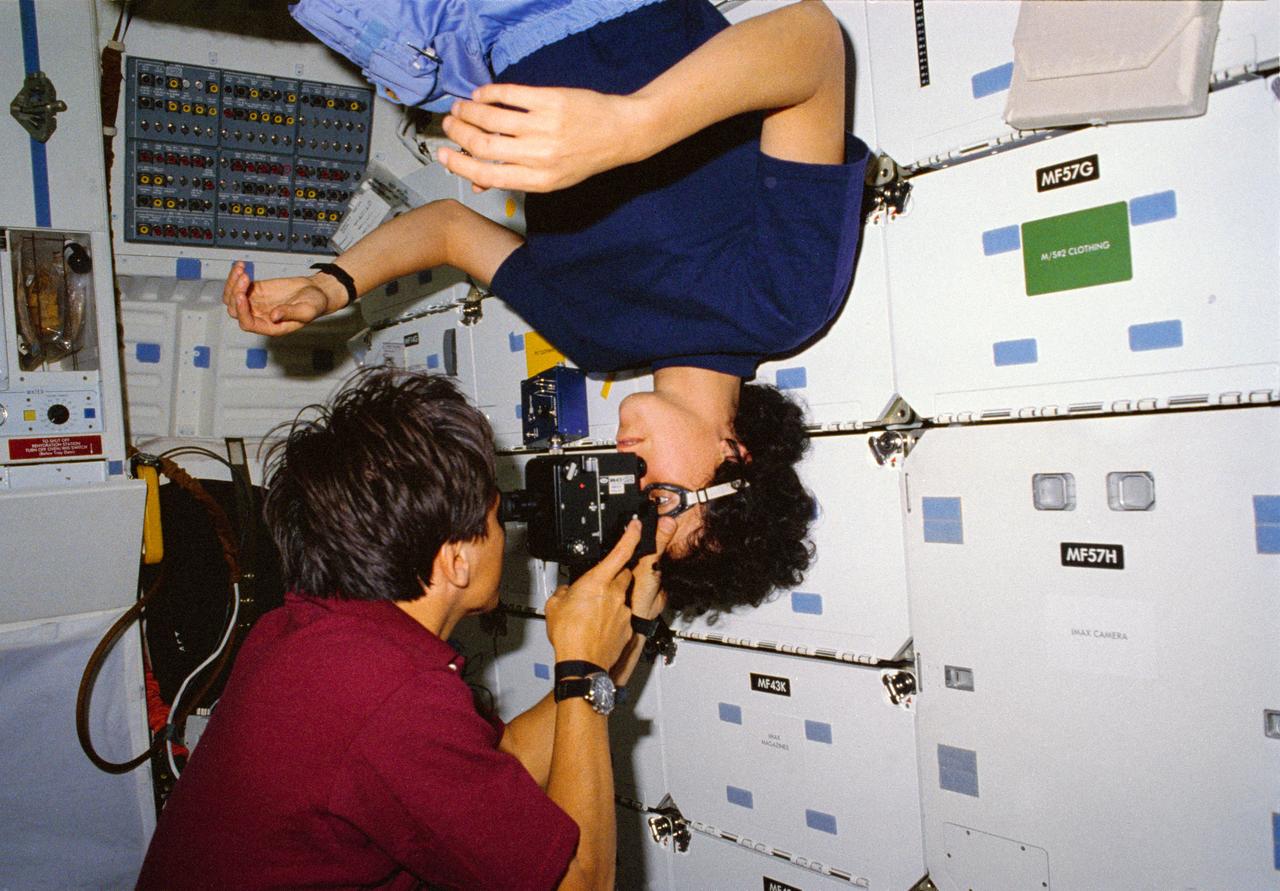
STS034-10-015 (18-23 Oct. 1989) --- Astronaut Franklin R. Chang-Diaz performs an eye examination on astronaut Ellen S. Baker, both STS-34 mission specialists, on the middeck of the Earth-orbiting space shuttle Atlantis.
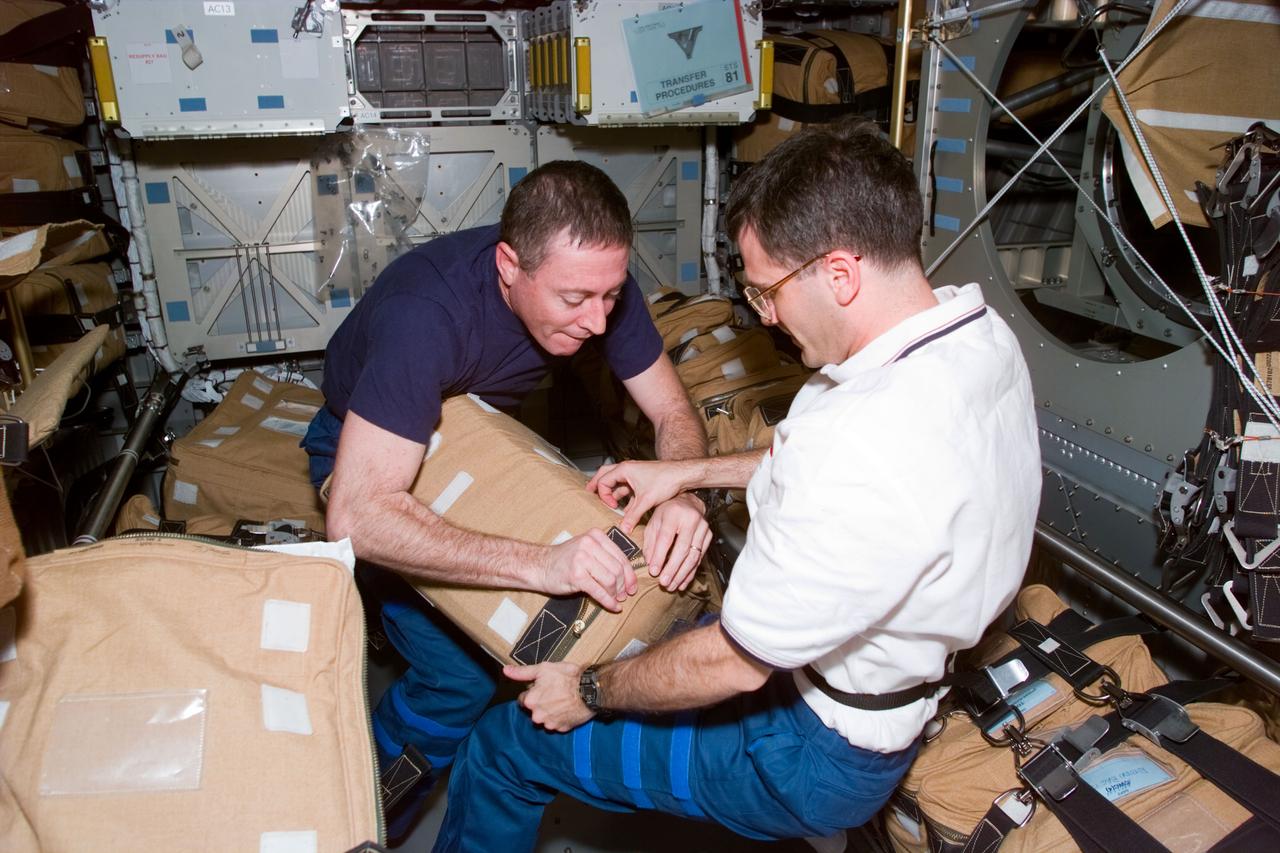
STS081-E-05515 (16 Jan. 1997) --- Astronauts Michael A. Baker, commander, and Peter J. K. (Jeff) Wisoff, mission specialist, secure a bag filled with a drawer of supplies in the Spacehab Double Module (DM). The scene was recorded with an Electronic Still Camera (ESC) and later downlinked to flight controllers in Houston, Texas.
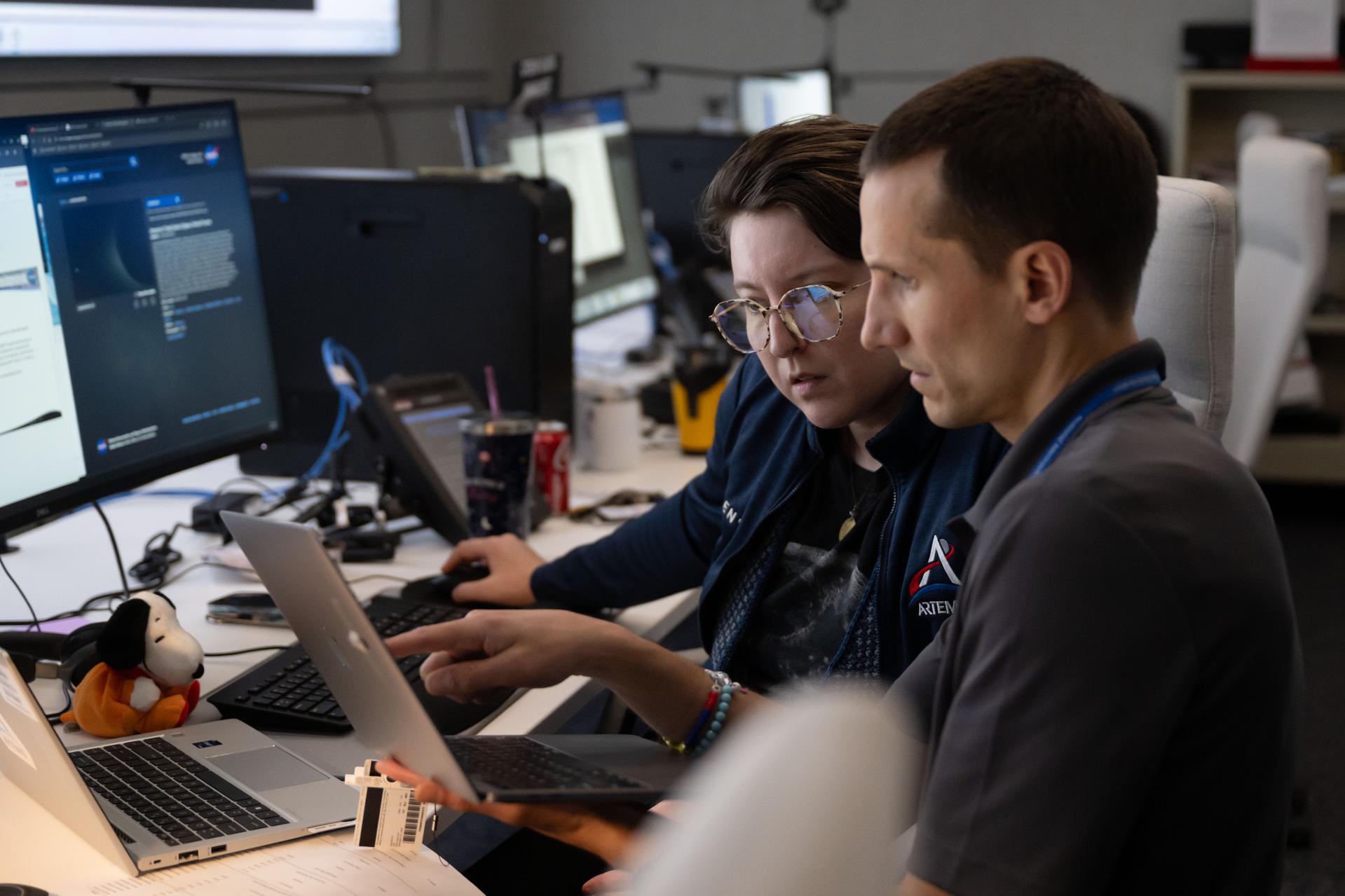
Artemis lunar science team members, from left, Alexandra Constantinou, and David Hollibaugh-Baker, work in the Science Mission Operations Room at NASA’s Johnson Space Center in Houston. They are analyzing imagery and audio recordings of lunar observations captured by the Artemis II astronauts during their lunar flyby on April 6, 2026.
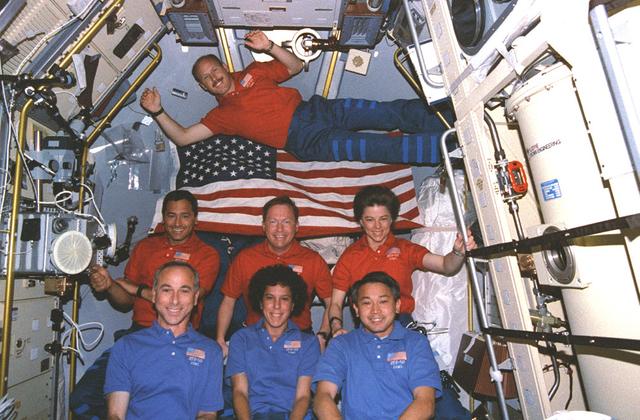
Onboard Space Shuttle Columbia (STS-50) crewmembers rally around the American flag in the United States Microgravity Laboratory-1 (USML-1). Pictured are (from top, left to right) pilot Kerneth D. Bowersox; payload specialist Lawrence J. Delucas; commander Richard N. Richards; payload commander Bonnie J. Dunbar; mission specialists Carl J. Meade and Ellen S. Baker; and payload specialist Eugene H. Trinh.
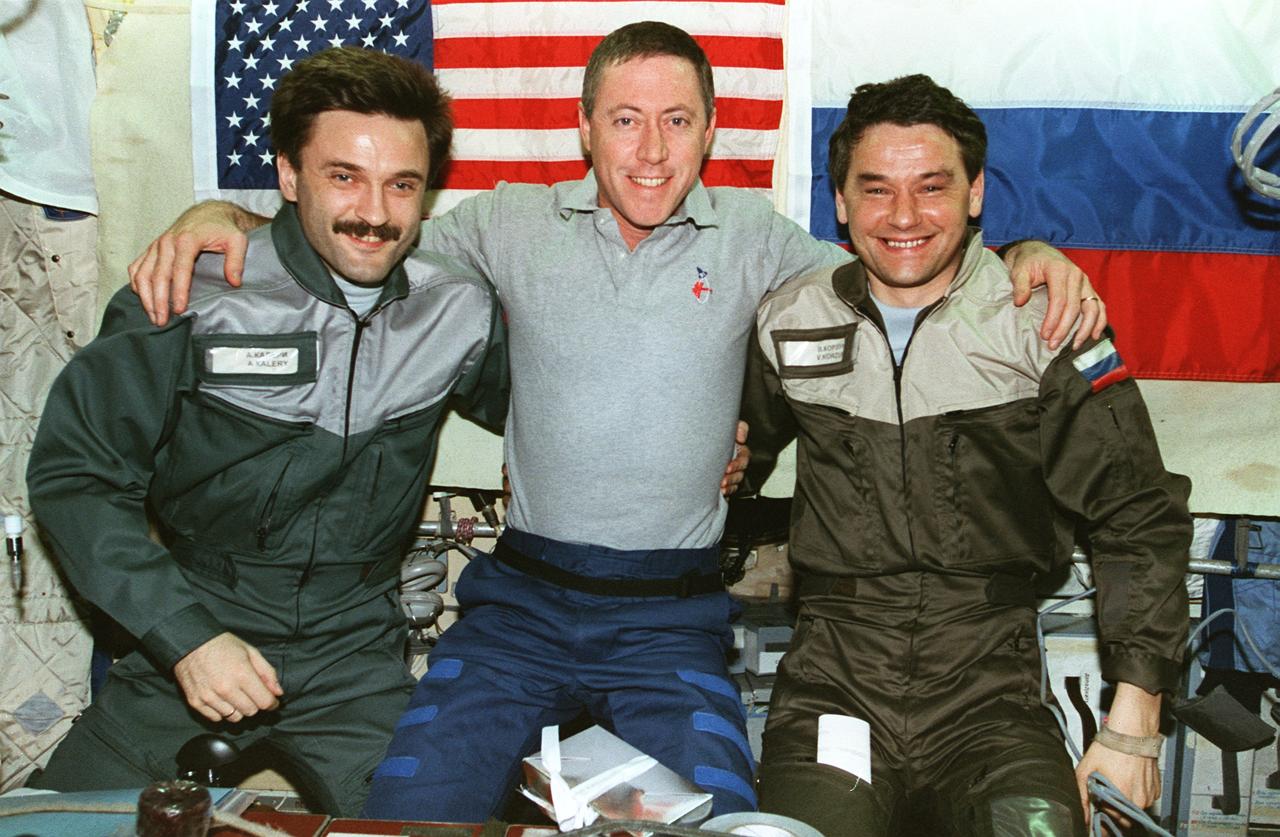
STS081-369-028 (12-22 Jan. 1997) --- On the eve of undocking of the Space Shuttle Atlantis and Russia's Mir Space Station, astronaut Michael A. Baker (center), STS-81 mission commander, bids farewell to cosmonauts Aleksandr Y. Kaleri (left), Mir-22 flight engineer, and Valeri G. Korzun, Mir-22 mission commander. The three are in the Base Block Module of the Mir complex.
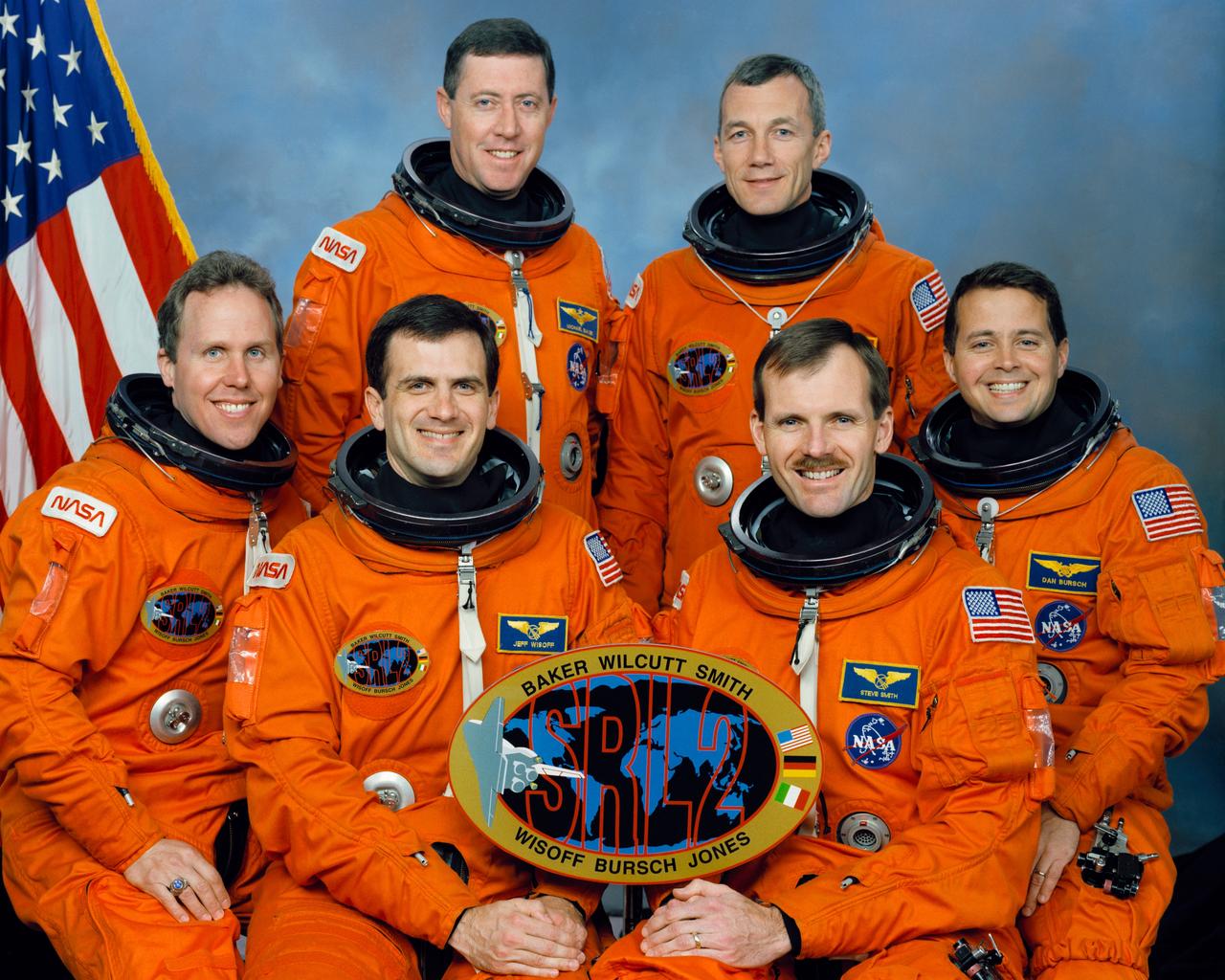
STS068-S-002 (March 1994) --- These six NASA astronauts are in training for the mission, scheduled for launch later this year. Standing are, left to right, Michael A. Baker, mission commander; and Terrence W. Wilcutt, pilot. On the front row are, left to right, Thomas D. Jones, payload commander; and Peter J. K. (Jeff) Wisoff, Steven L. Smith and Daniel W. Bursch, all mission specialists.
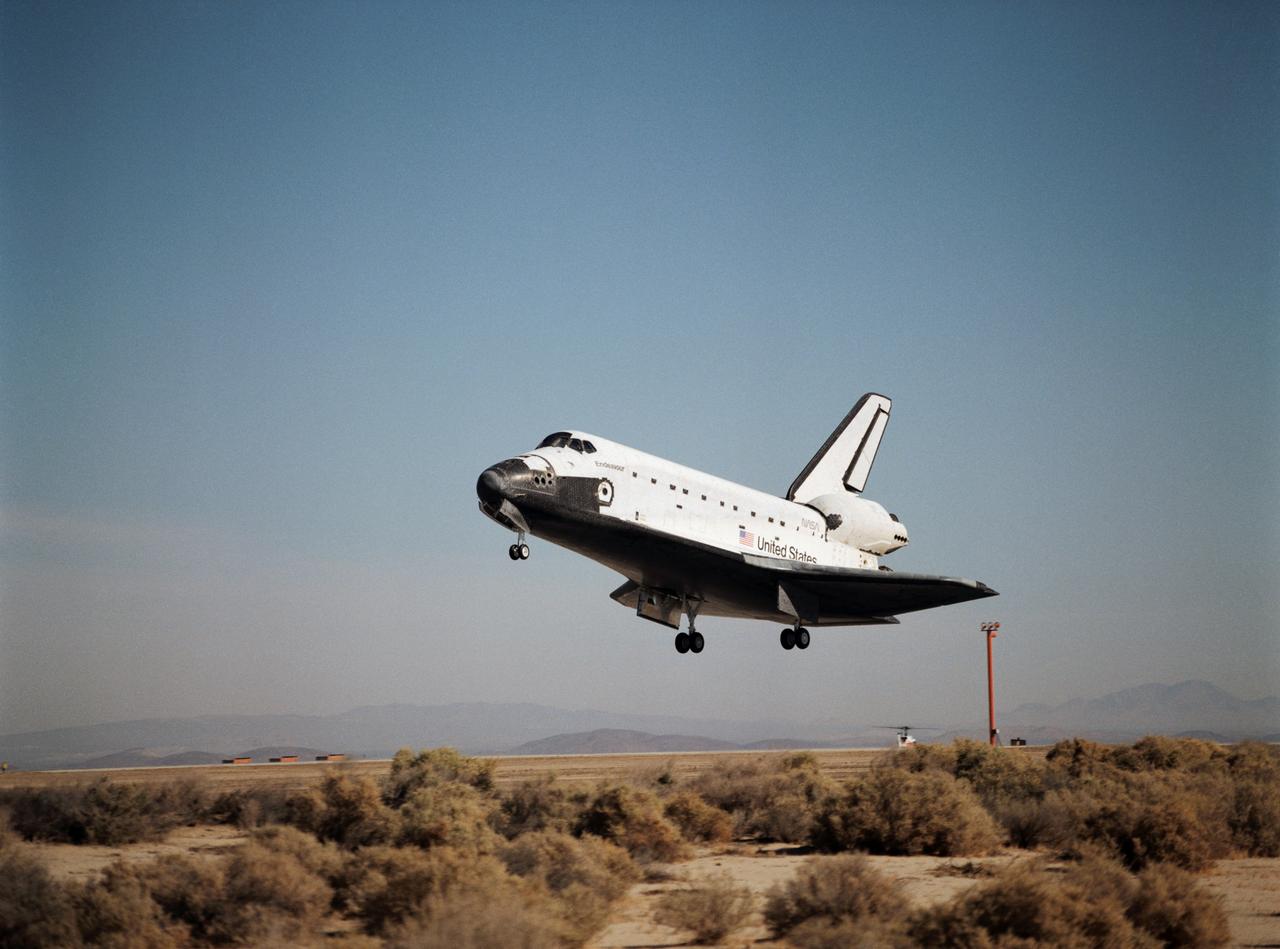
STS068-S-060 (11 October 1994) --- With its main landing gear not quite on the runway, the Space Shuttle Endeavour wraps up an eleven-day mission at Edwards Air Force Base, California. Landing occurred at 10:02 a.m. (PDT), October 11, 1994. Onboard were astronauts Michael A. Baker, mission commander; Terrence W. Wilcutt, pilot; Thomas D. Jones, payload commander; and Daniel W. Bursch, Peter J. K. (Jeff) Wisoff and Steven L. Smith, all mission specialists.
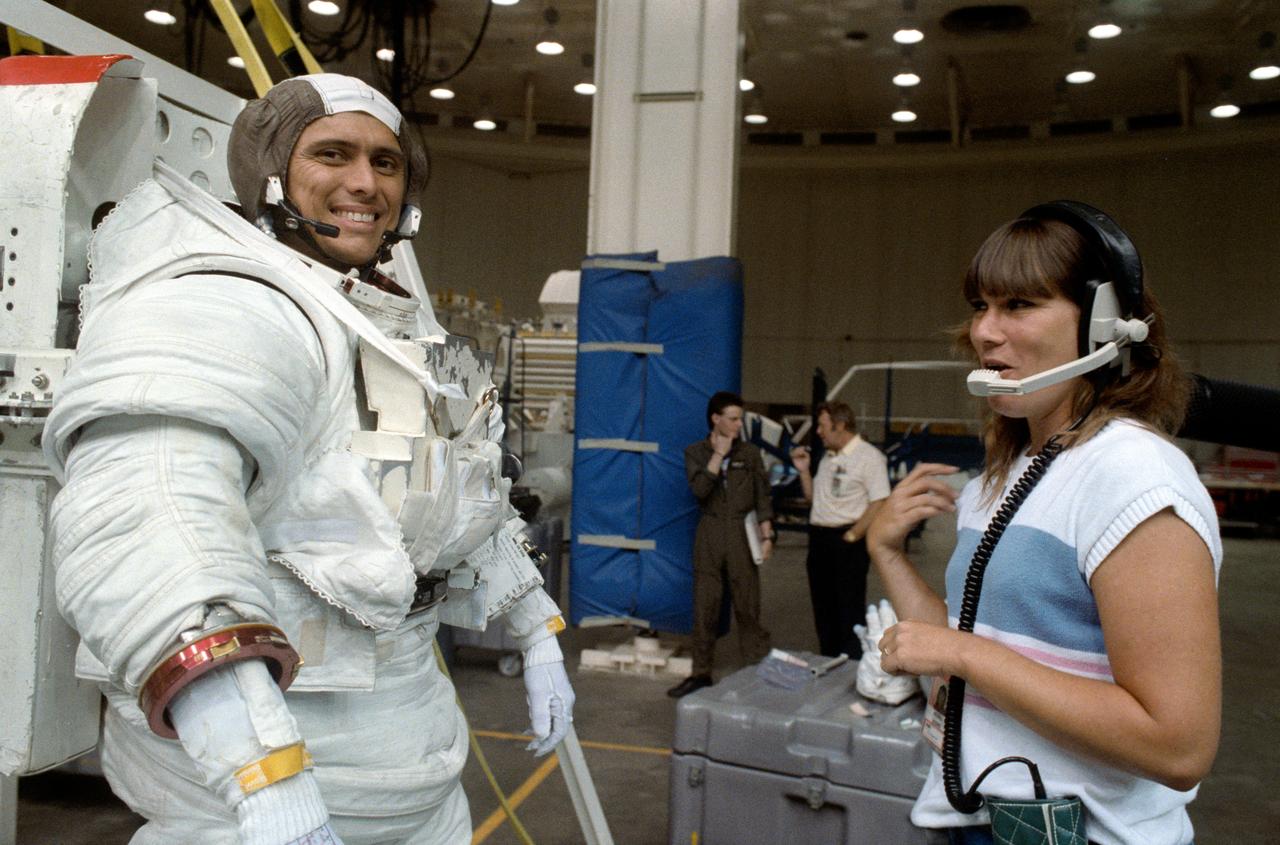
S89-42667 (24 Aug 1989) --- Astronaut Franklin R. Chang-Diaz tests his communications gear with Pam S. Peters of RSO, prior to participating in an underwater simulation of a contingency extravehicular activity (EVA) for his mission specialist assignment on NASA's STS-34 mission. He stands on a platform that will lower him into a 25-ft. deep pool, part of JSC's weightless environmental test facility (WET-F). Also participating in the contingency EVA rehearsal was astronaut Ellen S. Baker (out of frame).
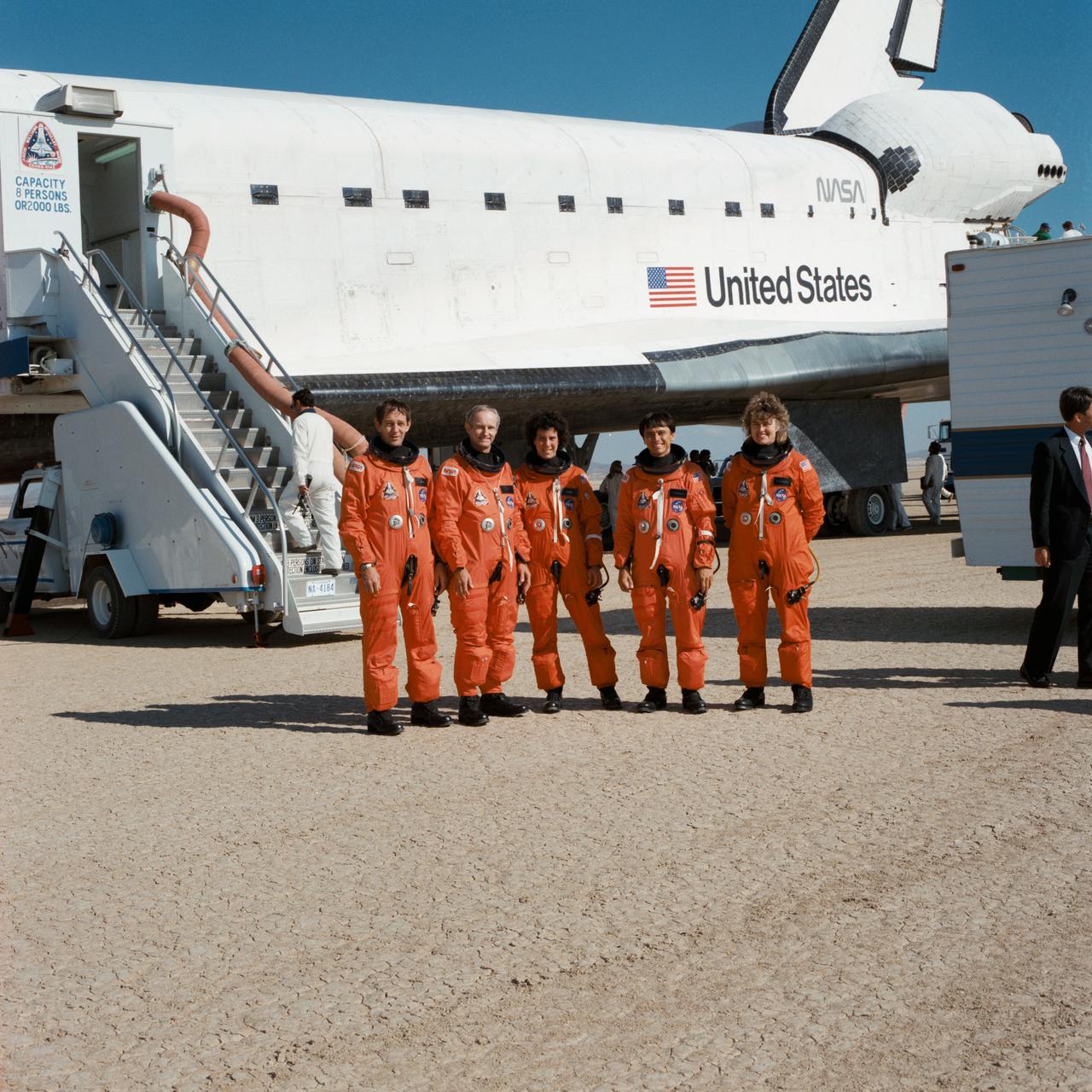
STS-34 crewmembers, wearing launch and entry suits (LESs), stand in front of Atlantis, Orbiter Vehicle (OV) 104, on Runway 23 dry lake bed at Edwards Air Force Base (EAFB), California. Left to right are Pilot Michael J. McCulley, Commander Donald E. Williams, Mission Specialist (MS) Ellen S. Baker, MS Franklin R. Chang-Diaz, and MS Shannon W. Lucid. Ground crews service OV-104 in the background.
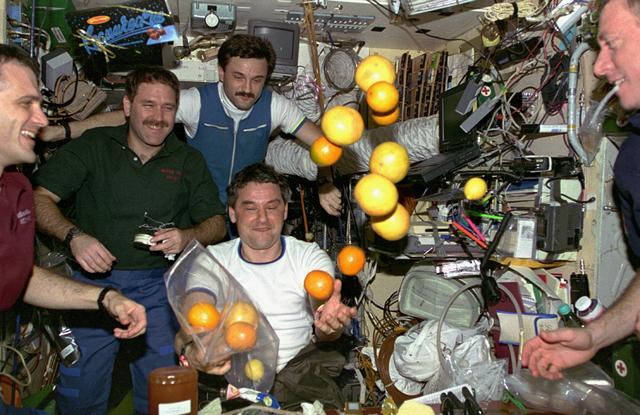
STS081-343-014 (12-22 Jan. 1997) --- Oranges and grapefruit brought up from Earth get a popular reception by the Mir-22 crewmembers. Left to right astronauts Peter J. K. (Jeff) Wisoff and John M. Grunsfeld, along with cosmonauts Aleksandr Y. Kaleri and Valeri G. Korzun, Mir-22 flight engineer and commander respectively, view the microgravity behavior of the seasonal gifts. Astronaut Michael A. Baker, mission commander, looks on at frame's right edge.

Jonathan Baker, Chief Financial Officer’s office, speaks to participants during an internal knowledge sharing program hosted by Launching Leaders at the Kennedy Learning Institute on May 3, 2023. Launching leaders is an employee resource group that works to identify opportunities to engage emerging professionals at Kennedy Space Center to stimulate the growth of leadership skills, increase overall employee satisfaction, and enhance retention.
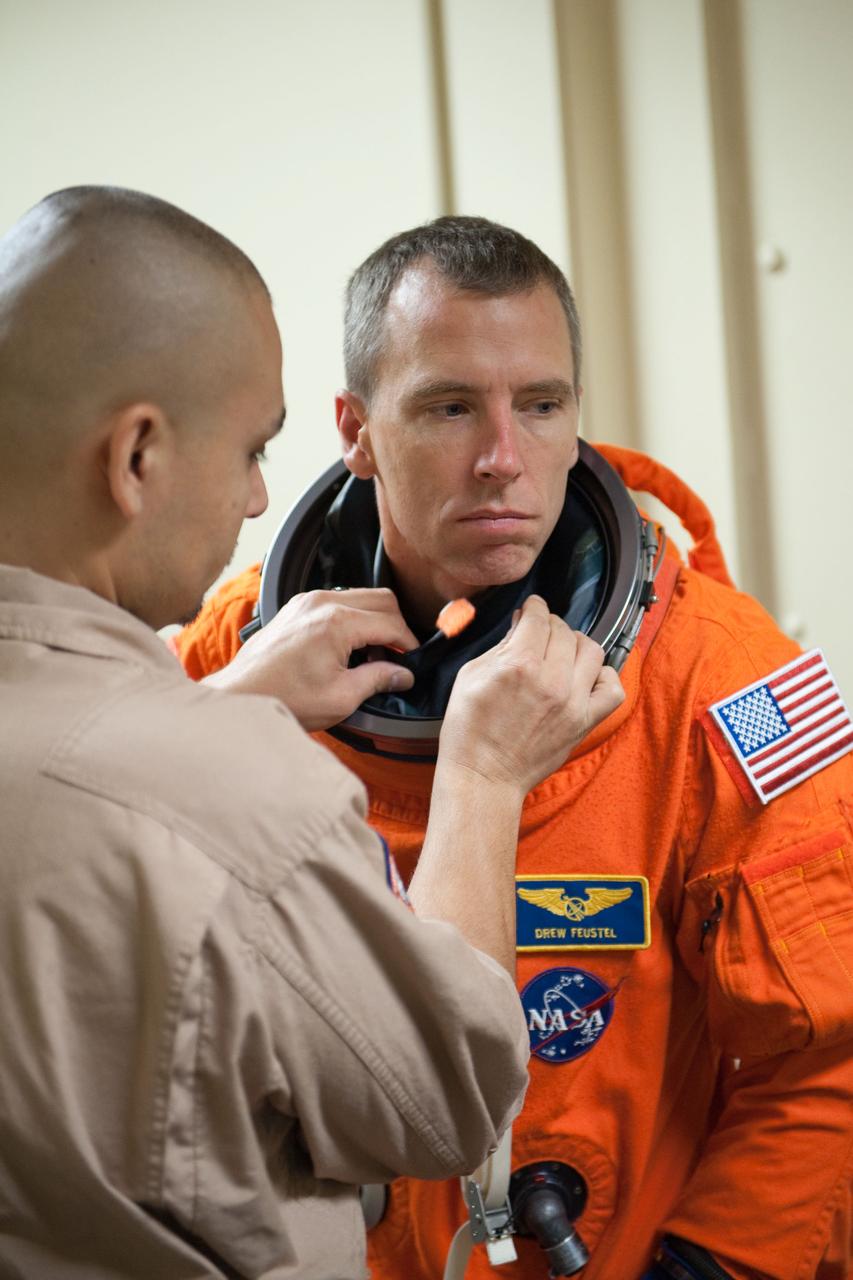
JSC2010-E-124260 (8 Sept. 2010) --- NASA astronaut Andrew Feustel, STS-134 mission specialist, dons a training version of his shuttle launch and entry suit in preparation for a training session in the fixed-base shuttle mission simulator (SMS) in the Jake Garn Simulation and Training Facility at NASA?s Johnson Space Center. United Space Alliance suit technician Russ Baker assisted Feustel. Photo credit: NASA or National Aeronautics and Space Administration
Launched aboard the Space Shuttle Atlantis on August 2, 1991, the STS-43 mission’s primary payload was the Tracking and Data Relay Satellite 5 (TDRS-5) attached to an Inertial Upper Stage (IUS), which became the 4th member of an orbiting TDRS cluster. The flight crew consisted of five astronauts: John E. Blaha, commander; Michael A. Baker, pilot; Shannon W. Lucid, mission specialist 1; James C. Adamson, mission specialist 2; and G. David Low, mission specialist 3.
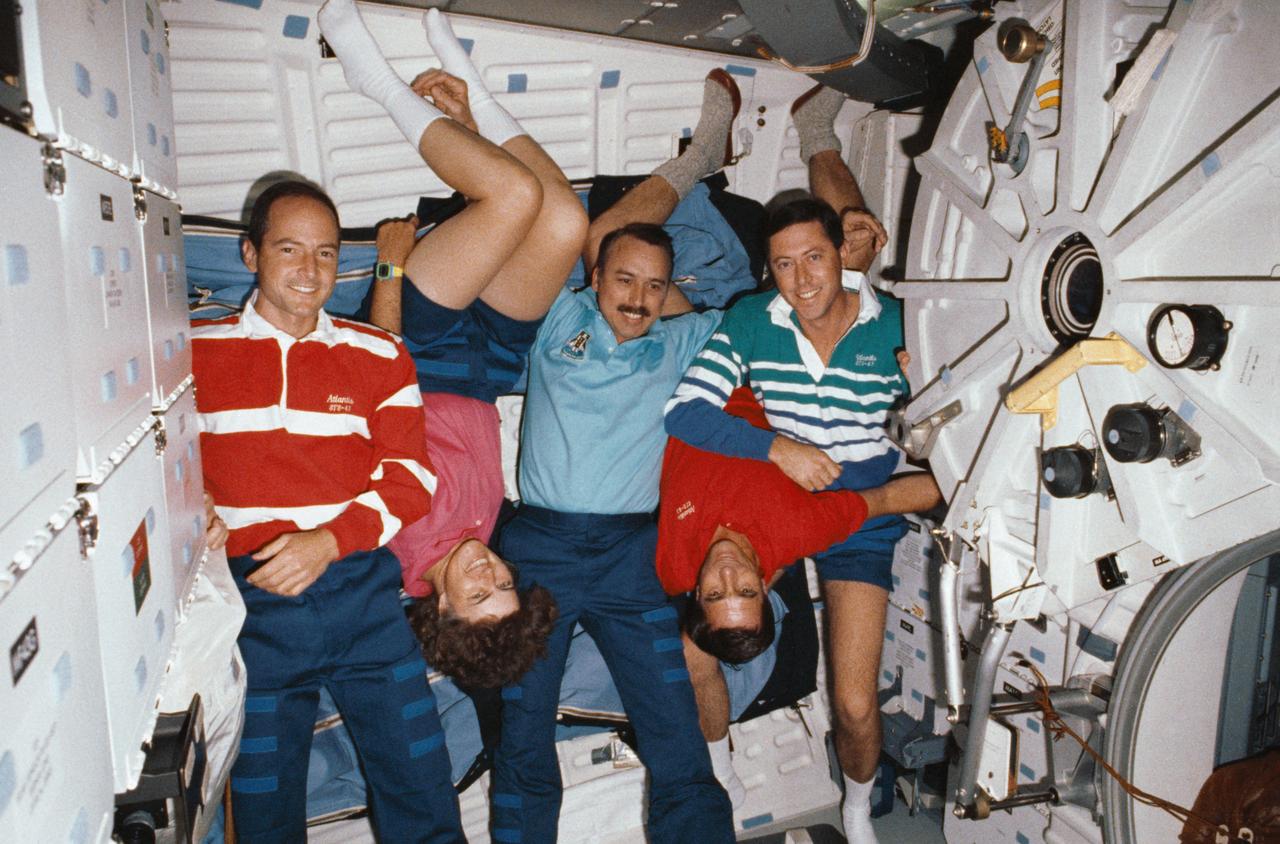
STS043-40-029 (2-11 Aug 1991) --- The five crewmembers on NASA's STS-43 mission pose for the traditional in-flight crew portrait. The photo should be oriented with Atlantis' middeck hatch on the right. Left to right are astronauts G. David Low, Shannon W. Lucid and James C. Adamson, all mission specialists; John E. Blaha, mission commander; and Michael A. Baker, pilot.
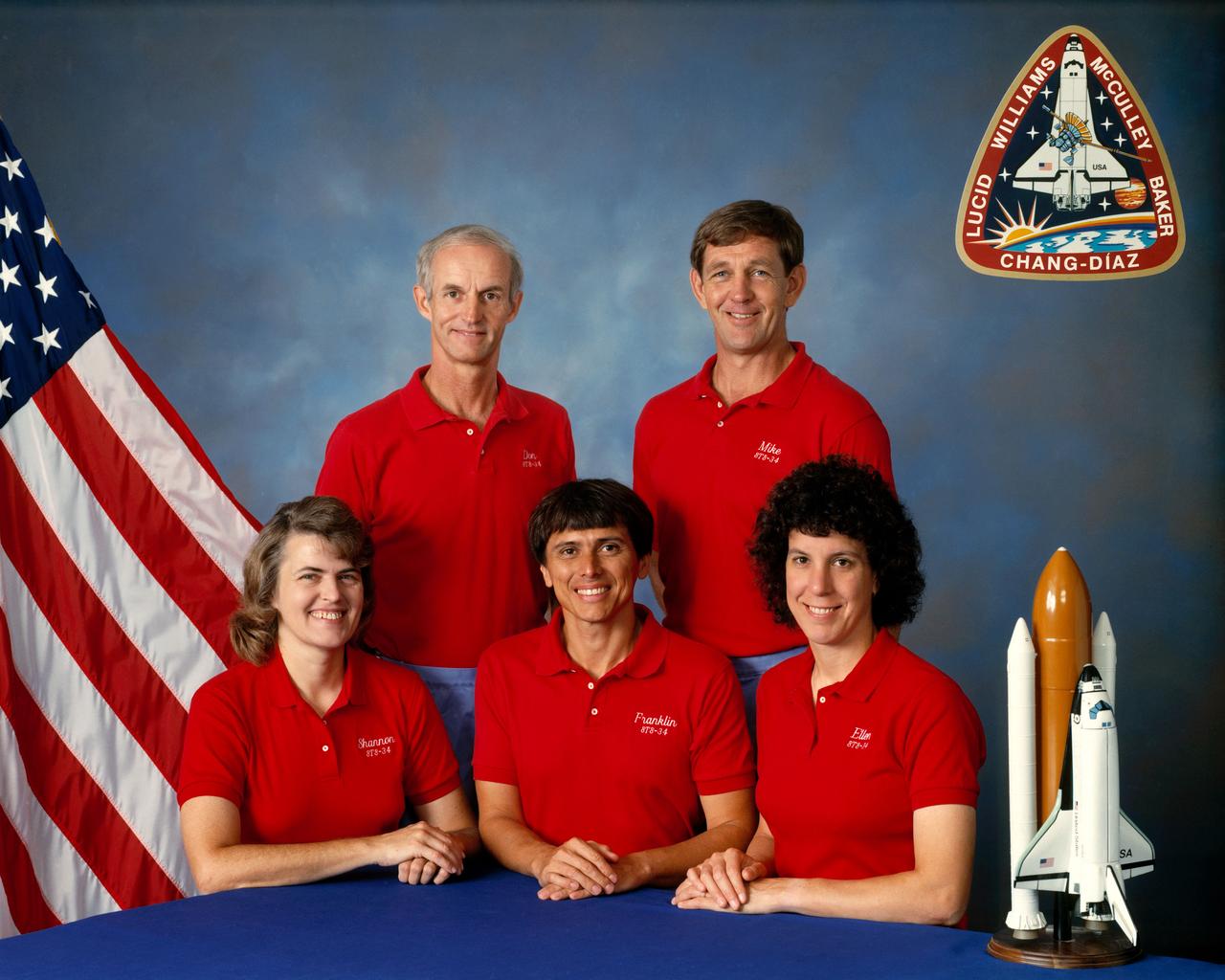
S89-39803 (July 1989) --- These five astronauts have been assigned to fly the Space Shuttle Atlantis for the mission on which the Jupiter probe, Galileo will be deployed. The mission is scheduled for October of this year. Seated, left to right, are mission specialists Shannon W. Lucid, Ph.D.; Franklin Chang-Diaz, Ph.D.; and Ellen S. Baker, M.D. Standing behind the mission specialists are left, Donald E. Williams, commander; and Michael J. McCulley, pilot.
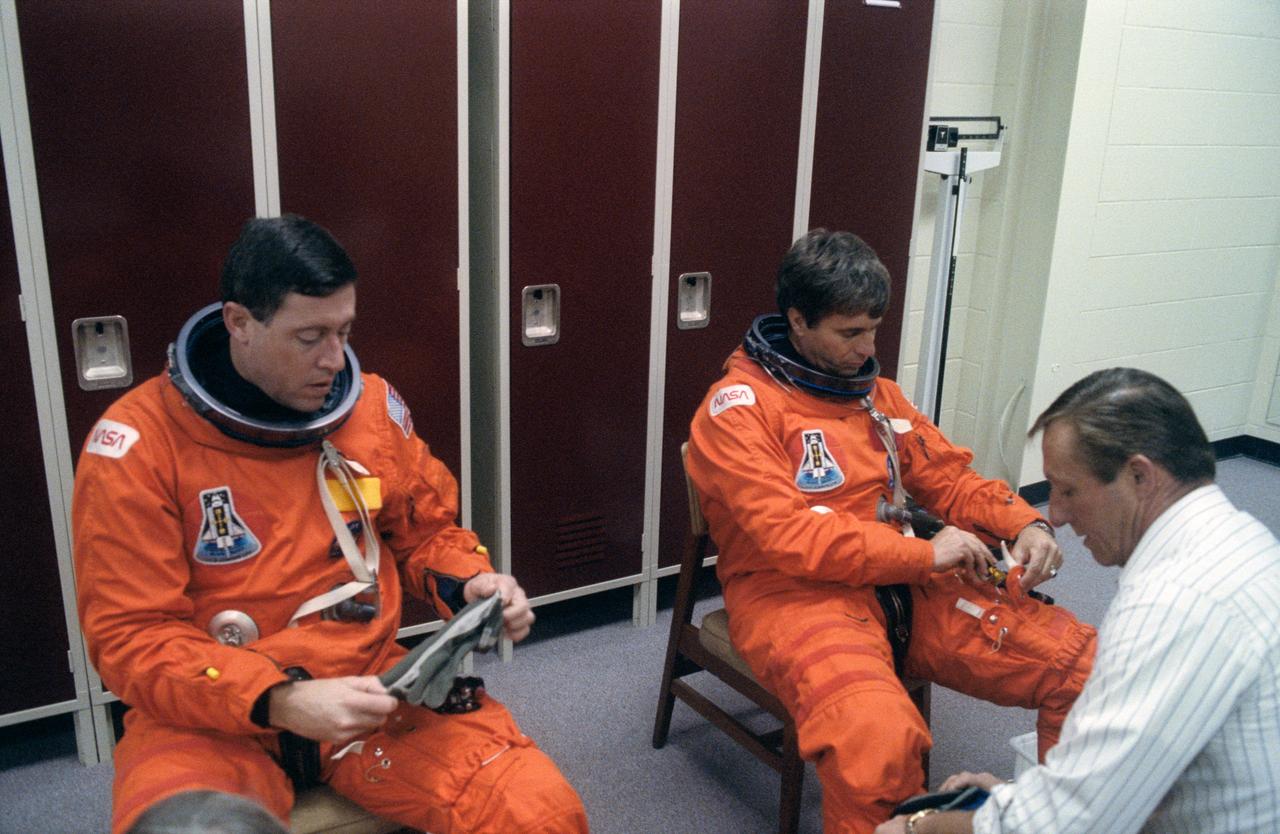
S91-37294 (May 1991) --- Astronauts Michael A. Baker, left, and John E. Blaha, STS-43 pilot and mission commander, respectively, suit up for a session of emergency egress training at the Johnson Space Center's Shuttle Mockup and Integration Laboratory. Bill Todd, a crew escape equipment suit technician for Boeing, assits them. The two astronauts are wearing the orange partial pressure suits which are used by Shuttle crewmembers during launch and entry phases of their flights.
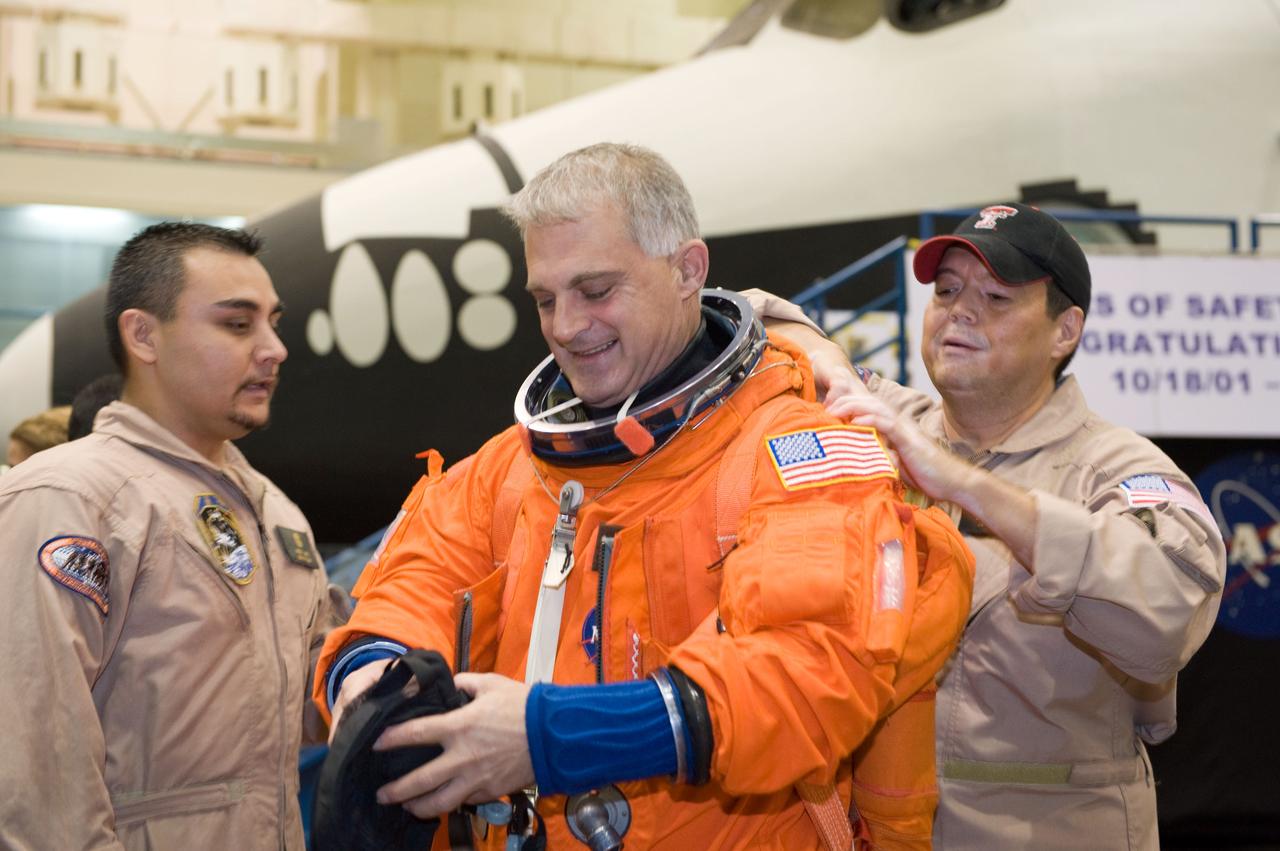
JSC2008-E-139786 (12 Nov. 2008) --- Astronaut Dave Wolf, STS-127 mission specialist, dons a training version of his shuttle launch and entry suit in preparation for a training session in the Space Vehicle Mock-up Facility at NASA's Johnson Space Center. United Space Alliance (USA) suit technicians Steve Cortinas (right) and Russ Baker assisted Wolf.
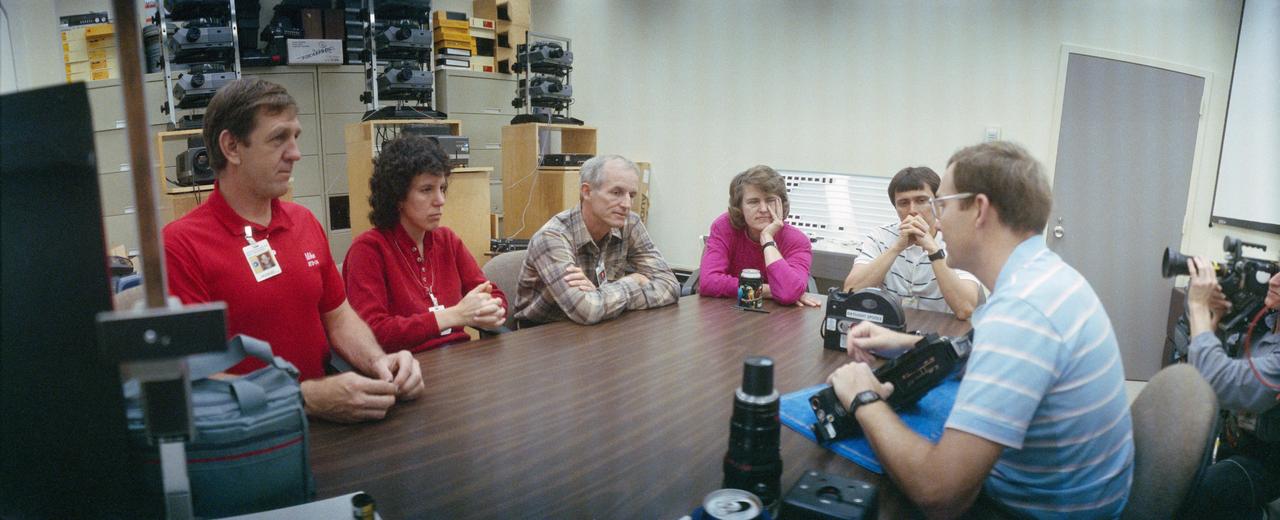
STS-34 Atlantis, Orbiter Vehicle (OV) 104, crewmembers listen to trainer Bill Bowers explain ARRIFLEX camera equipment during briefing at JSC. Across the table from Bowers are (left to right) Pilot Michael J. McCulley, Mission Specialist (MS) Ellen S. Baker, Commander Donald E. Williams, MS Shannon W. Lucid, and MS Franklin R. Chang-Diaz.
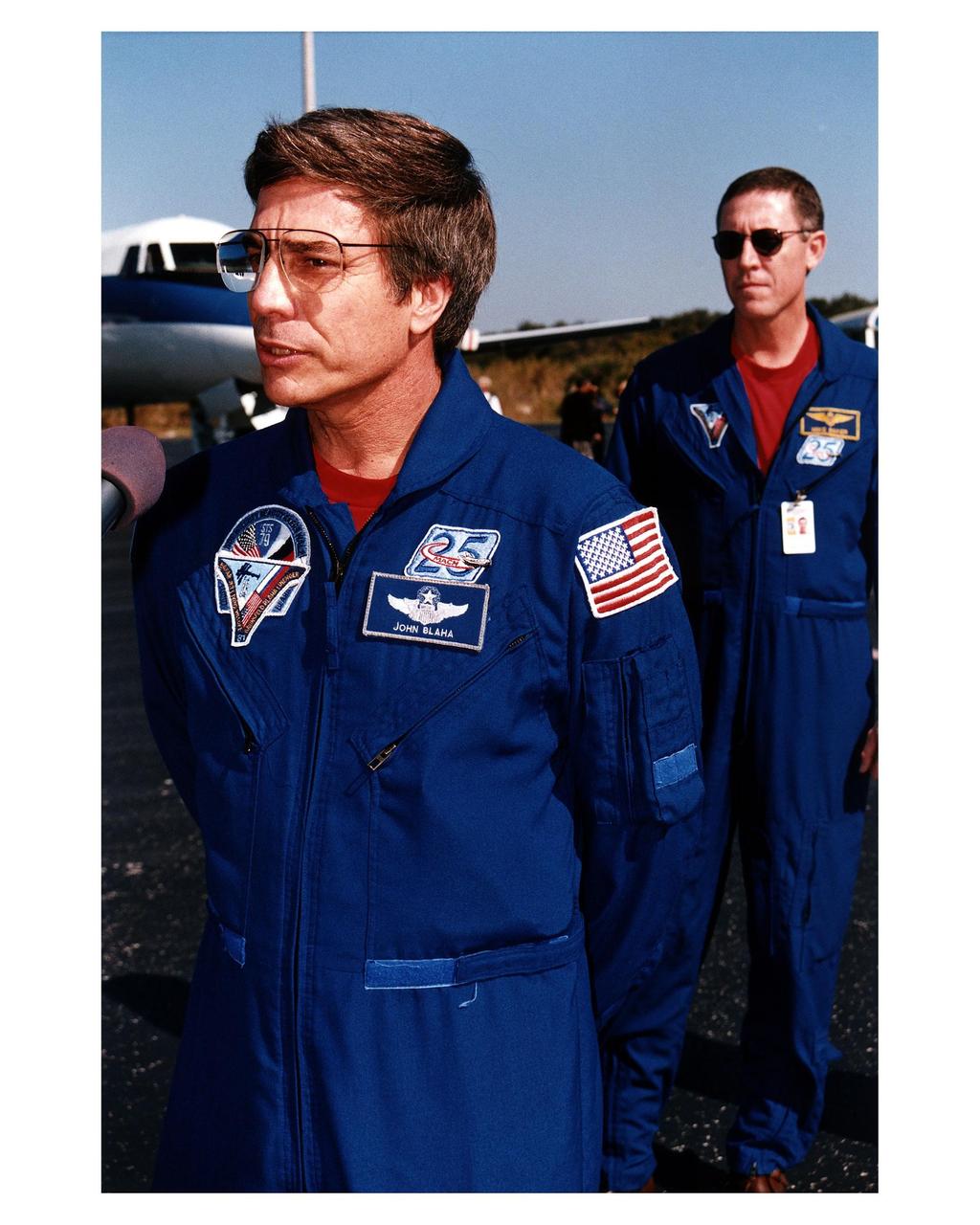
Returning NASA astronaut and former Mir 22 crew member John E. Blaha (left), addresses the news media at the Skid Strip at Cape Canaveral Air Station as he and fellow STS-81 crew members prepare to depart for Johnson Space Center Jan. 23. The crew arrived at KSC aboard the Space Shuttle Atlantis Jan. 22 to conclude the fifth Shuttle-Mir docking mission and return Blaha to Earth after four months in space. Behind Blaha is Mission Commander Michael A. Baker
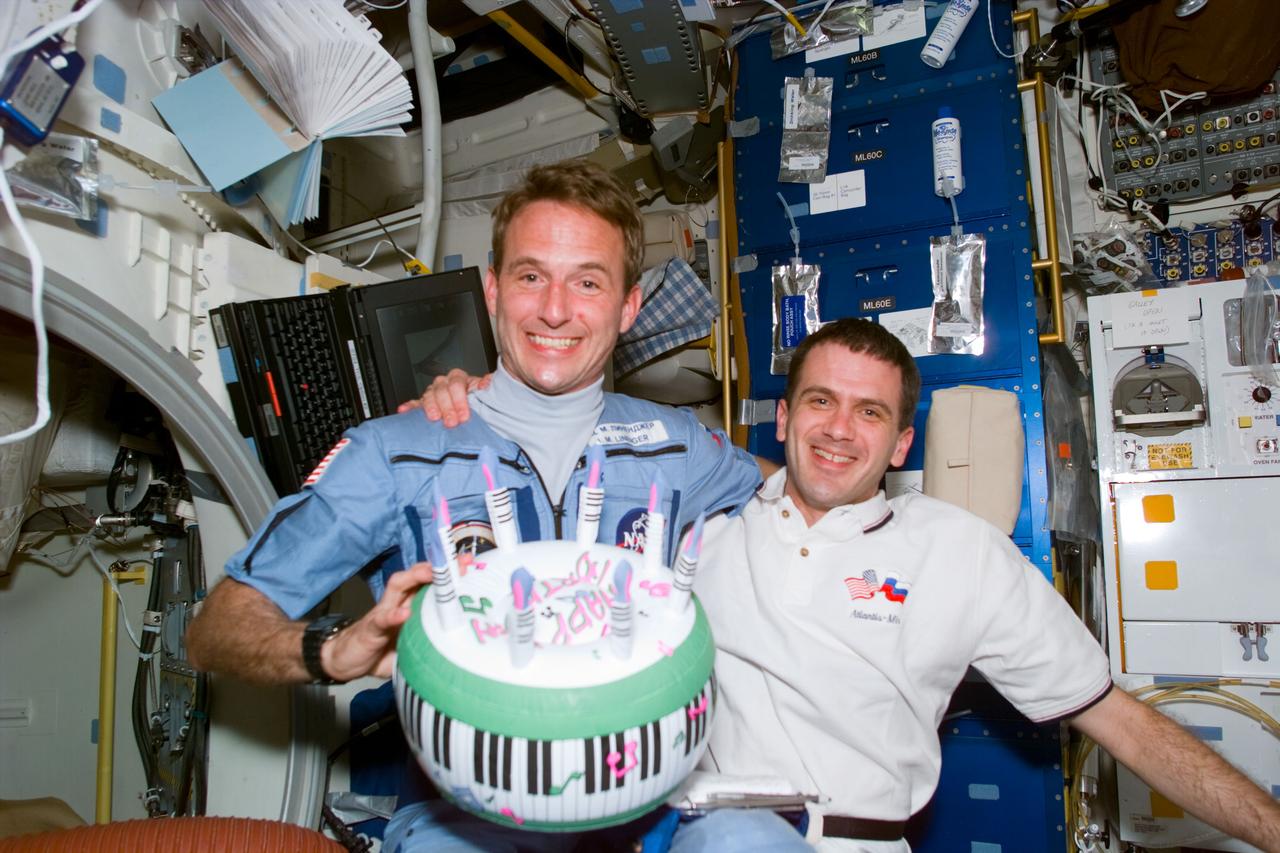
STS081-E-05498 (16 Jan. 1997) --- Supplies and equipment transfer are the topic of the day, as the Space Shuttle Atlantis and Russia's Mir Space Station respective commanders have a discussion aboard the Orbiter. Left to right are cosmonauts Valeri G. Korzun and Aleksandr Y. Kaleri, Mir-22 commander and flight engineer respectively; along with astronaut Michael A. Baker, mission commander. The photograph was recorded with an Electronic Still Camera (ESC) and later was downlinked to flight controllers in Houston, Texas.
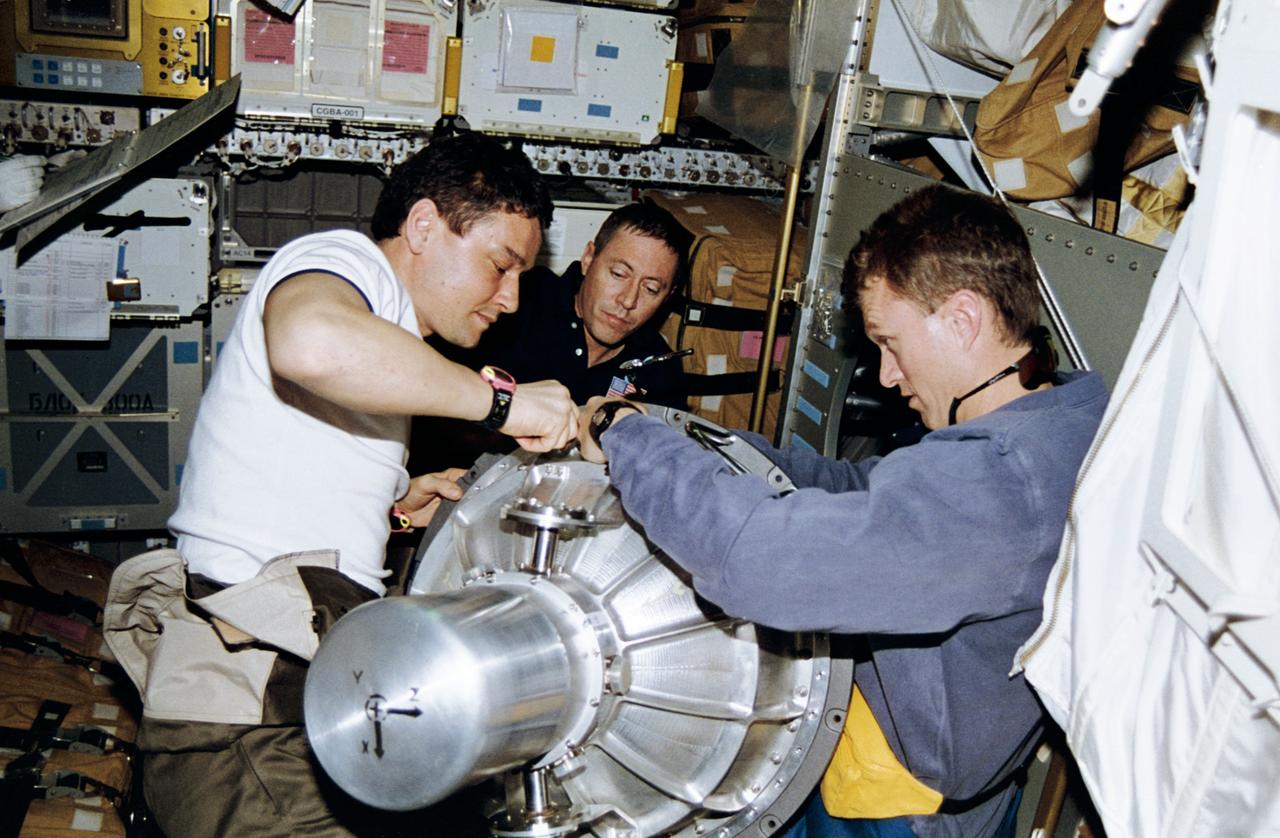
STS081-301-031 (12-22 Jan 1997) --- Shortly after docking of the Space Shuttle Atlantis and Russia's Mir Space Station, crew members from the respective spacecraft begin to transfer hardware from the Spacehab Double Module (DM) onto the Mir complex. Here, cosmonaut Valeri G. Korzun, Mir-22 commander, along with astronauts Michael A. Baker, commander, and Brent W. Jett, Jr., pilot, unstow a gyrodyne, device for attitude control, transfer to Mir.
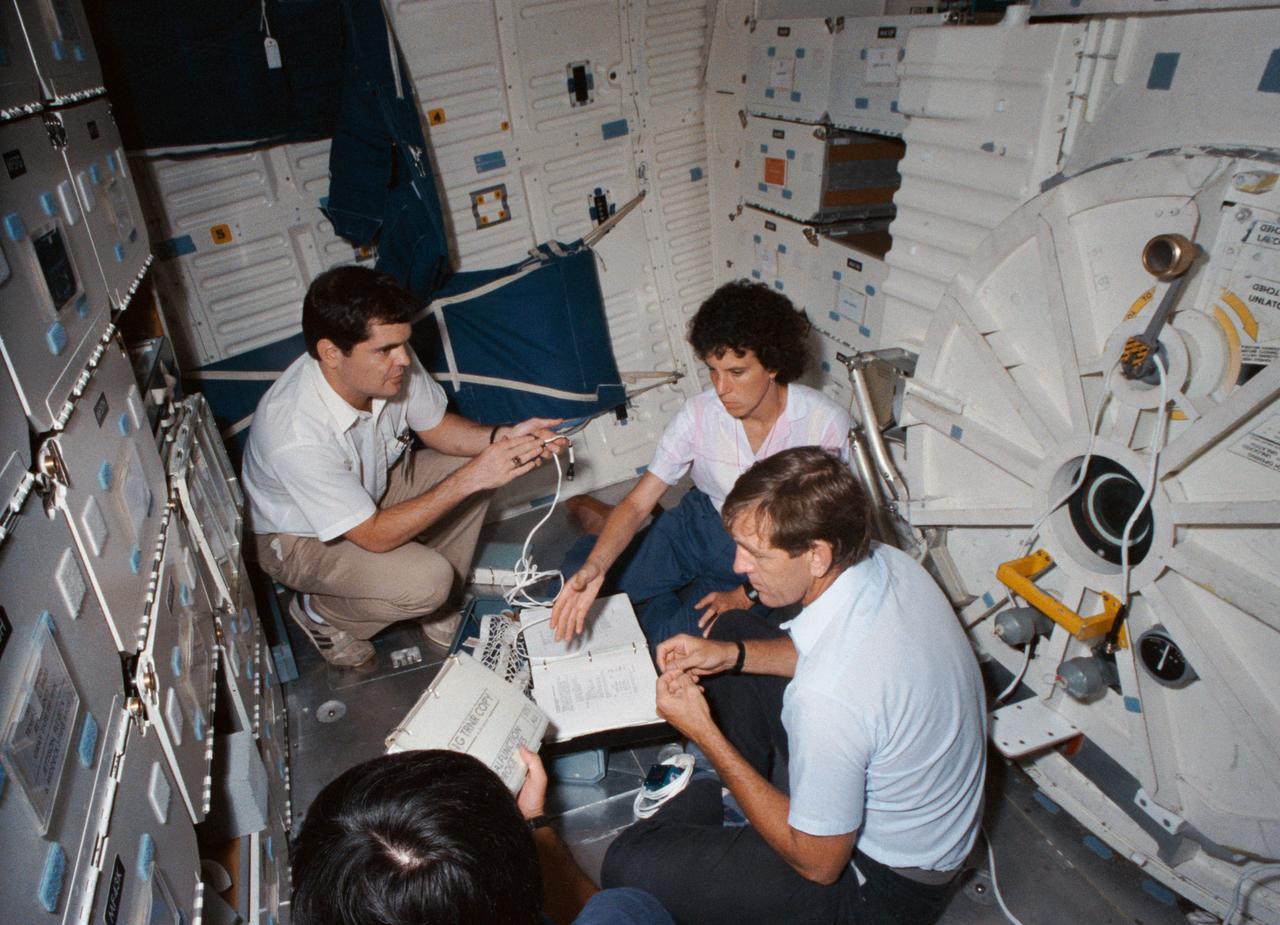
S89-39537 (July 1989) --- Two astronaut-crewmembers for NASA's STS-34 mission are briefed on inflight maintenance procedures on the mid-deck of the Space Shuttle crew compartment trainer in JSC's Shuttle mockup and integration laboratory. They are Ellen S. Baker and Michael J. McCulley, mission specialist and pilot, respectively for the scheduled Oct. 1989 mission aboard the Atlantis.
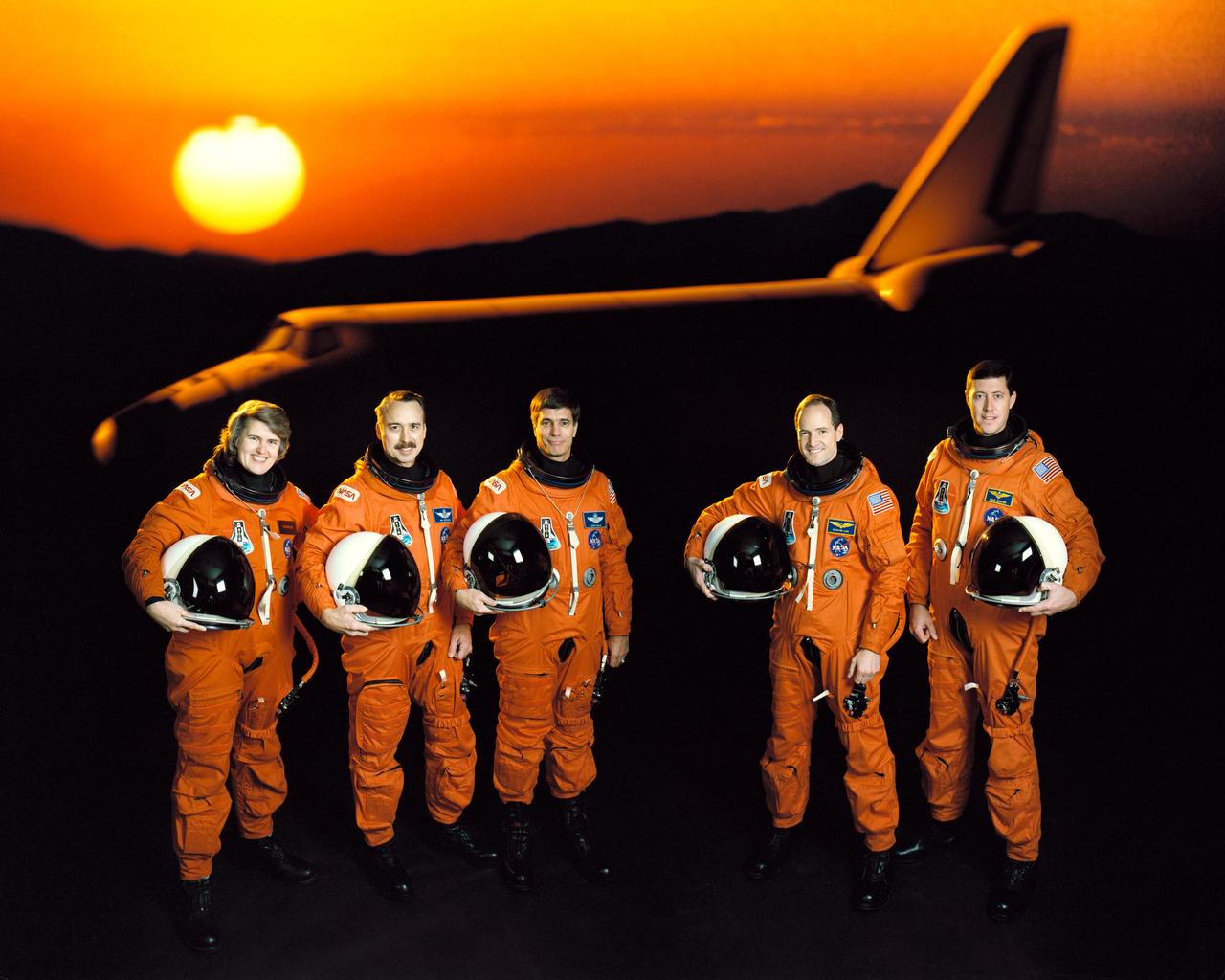
STS043-S-002 (May 1991) --- These five astronauts have been assigned to fly aboard the Space Shuttle Atlantis for NASA's STS-43 mission. Astronaut John E. Blaha (center) is mission commander. Other crew members are, left to right, astronauts Shannon W. Lucid, James C. Adamson and G. David Low, all mission specialists; and Michael A. Baker, pilot.
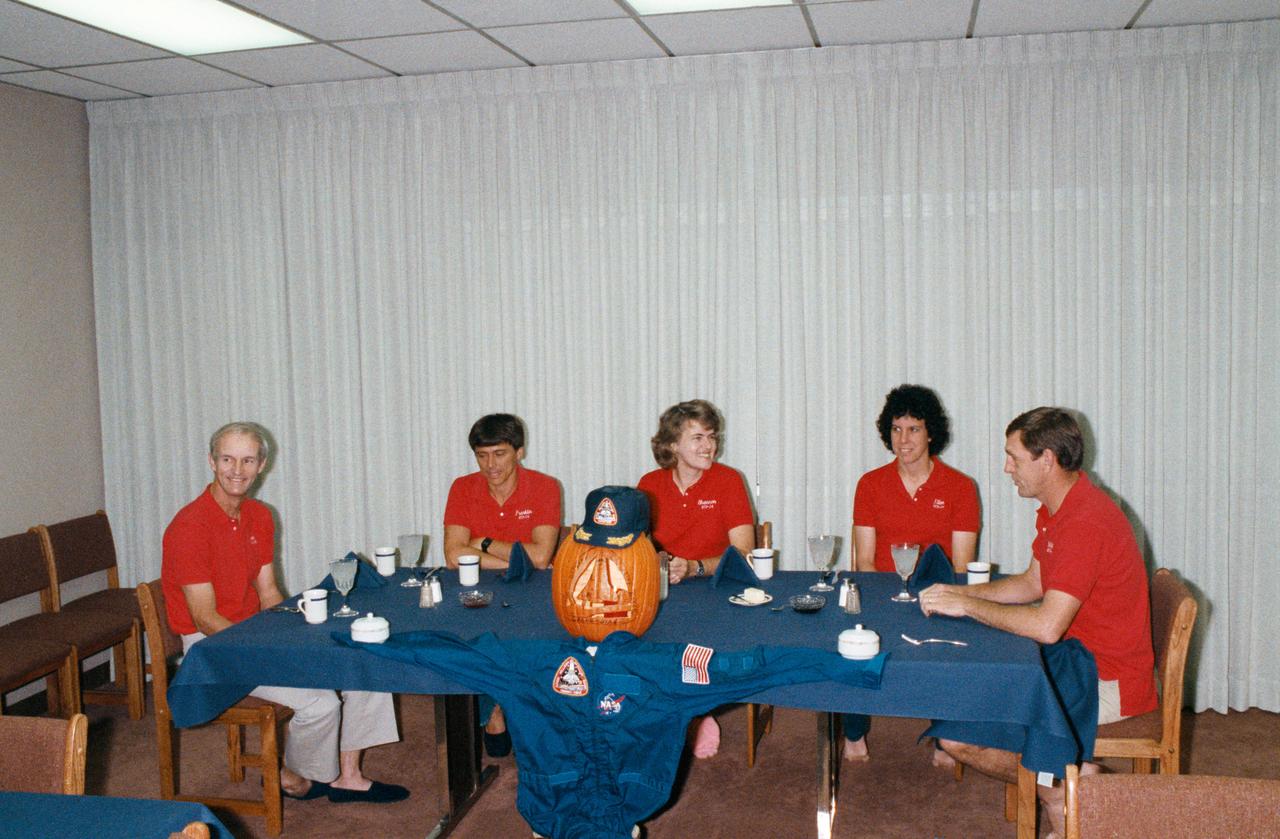
STS034-S-021 (18 Oct 1989) --- The traditional light pre-launch breakfast greets the five astronaut crew-members for NASA's STS-34 mission in the Operations and Checkout Facility at Kennedy Space Center (KSC). From the left are Astronauts Donald E. Williams, mission commander; Franklin R. Chang-Diaz, Shannon W. Lucid and Ellen S. Baker, all mission specialists; and Michael J. McCulley, pilot. A pumpkin converted into a Jack-o-lantern adds a seasonal touch to the table.
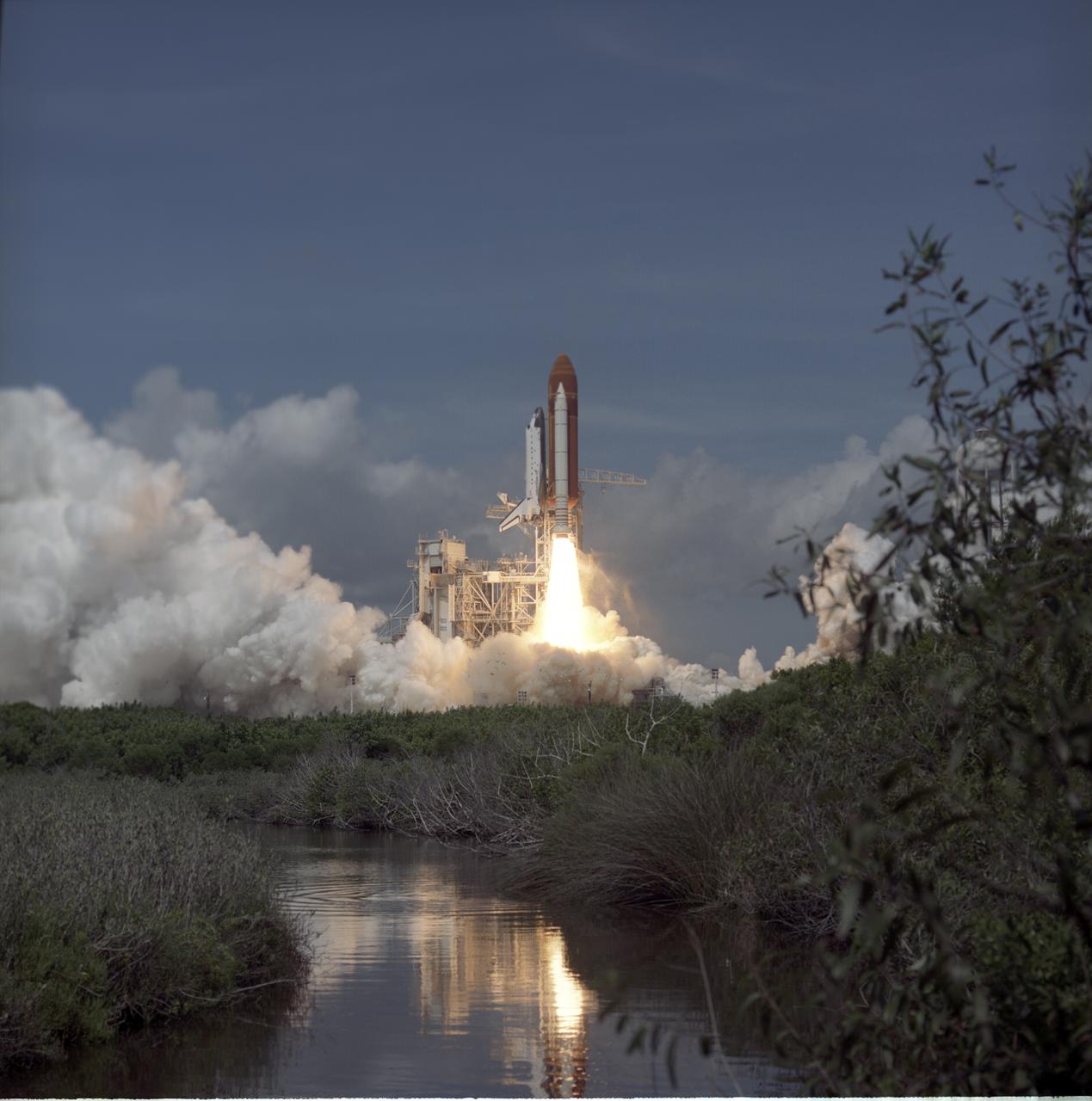
Launched aboard the Space Shuttle Atlantis on August 2, 1991, the STS-43 mission’s primary payload was the Tracking and Data Relay Satellite 5 (TDRS-5) attached to an Inertial Upper Stage (IUS), which became the 4th member of an orbiting TDRS cluster. The flight crew consisted of 5 astronauts: John E. Blaha, commander; Michael A. Baker, pilot; Shannon W. Lucid, mission specialist 1; James C. Adamson, mission specialist 2; and G. David Low, mission specialist 3.
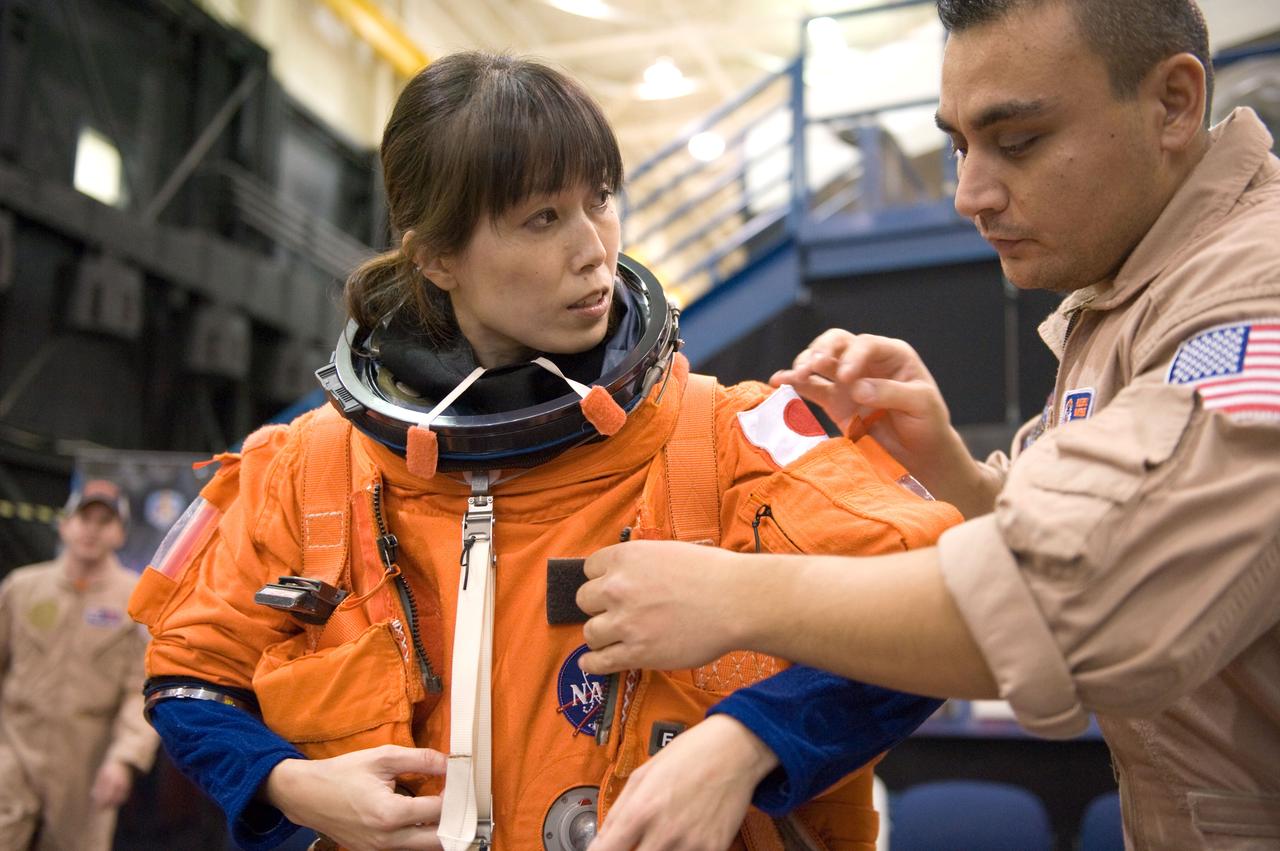
JSC2009-E-208020 (14 Sept. 2009) --- Japan Aerospace Exploration Agency (JAXA) astronaut Naoko Yamazaki, STS-131 mission specialist, dons a training version of her shuttle launch and entry suit in preparation for a training session in the Space Vehicle Mock-up Facility at NASA's Johnson Space Center. United Space Alliance suit technician Russ Baker assisted Yamazaki.
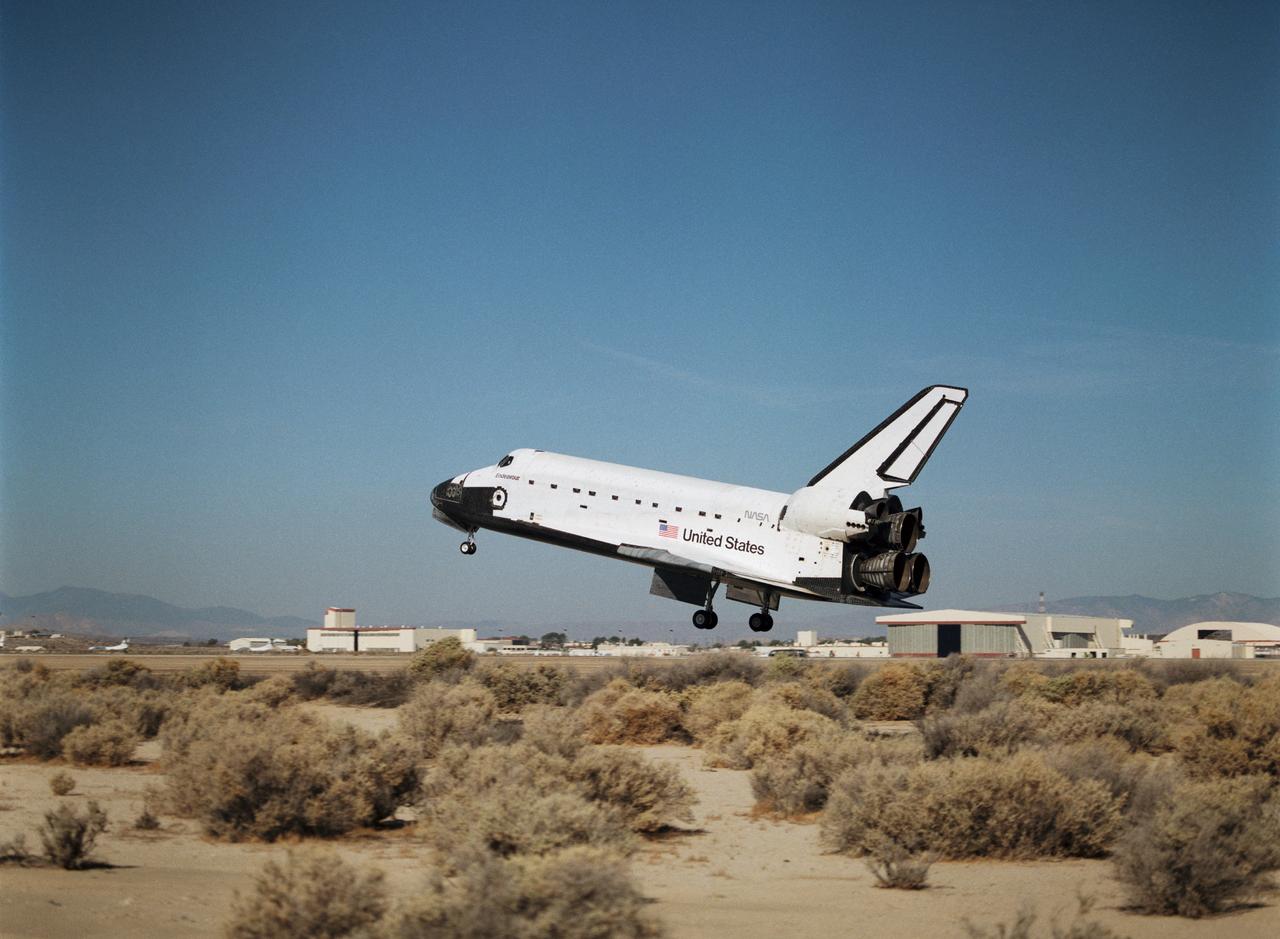
STS068-S-059 (11 October 1994) --- With its main landing gear not quite on the runway, the Space Shuttle Endeavour wraps up an eleven-day mission at Edwards Air Force Base, California. Landing occurred at 10:02 a.m. (PDT), October 11, 1994. Onboard were astronauts Michael A. Baker, mission commander; Terrence W. Wilcutt, pilot; Thomas D. Jones, payload commander; and Daniel W. Bursch, Peter J. K. (Jeff) Wisoff and Steven L. Smith, all mission specialists.
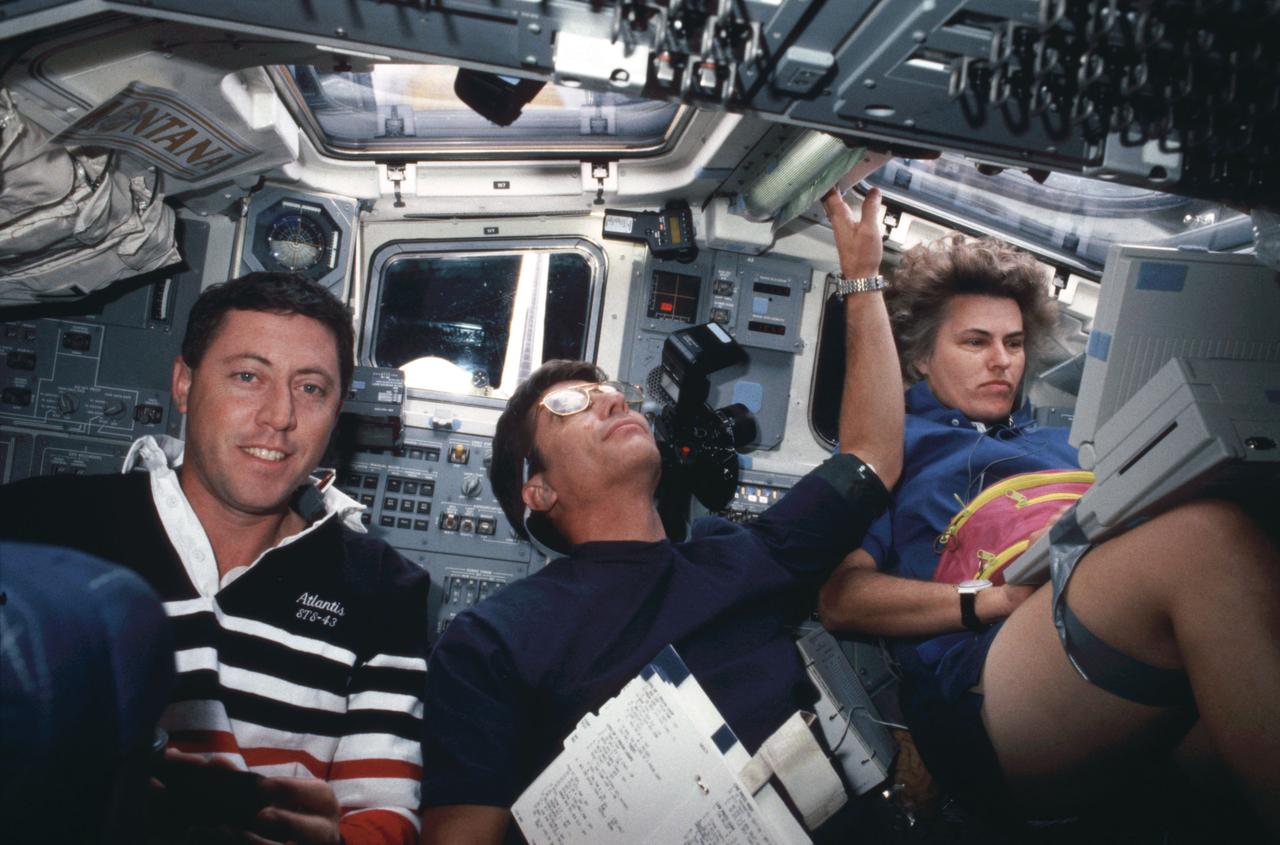
STS043-37-012 (2-11 Aug 1991) --- Three STS-43 astronauts are busy at work onboard the earth-orbiting space shuttle Atlantis. Astronaut Shannon W. Lucid is pictured performing one of several tests on Computer hardware with space station applications in mind. Sharing the aft flight deck with Lucid are Michael A. Baker (left), pilot and John E. Blaha, mission commander.
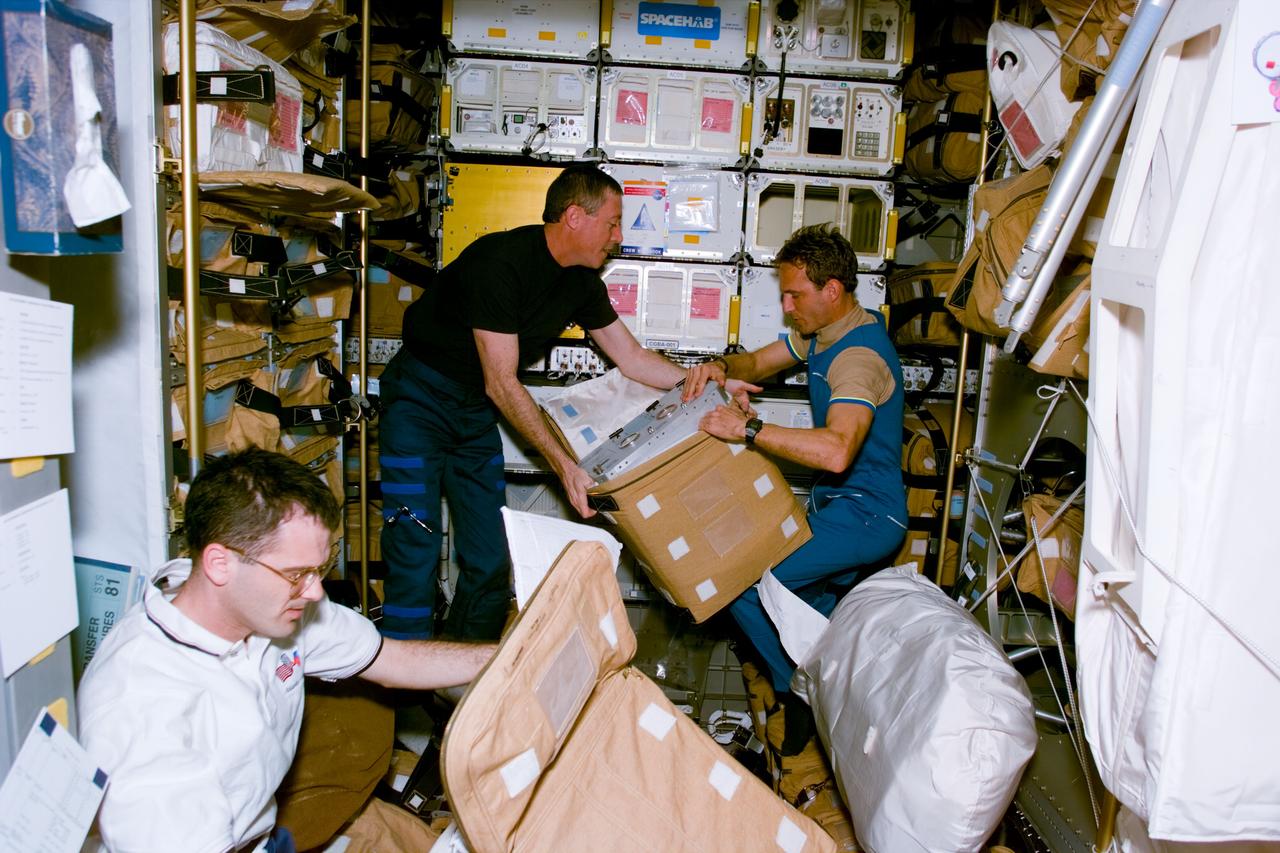
STS081-E-05514 (16 Jan. 1997) --- The transfer of equipment and supplies continues aboard the Spacehab Double Module (DM) aboard the Space Shuttle Atlantis. Here, left to right, astronauts Peter J. K. Wisoff and Michael A. Baker along with newly initiated "cosmonaut" Jerry M. Linenger, Mir-22 cosmonaut guest researcher, load and move supplies. The photograph was recorded with an Electronic Still Camera (ESC) and later was downlinked to flight controllers in Houston, Texas.
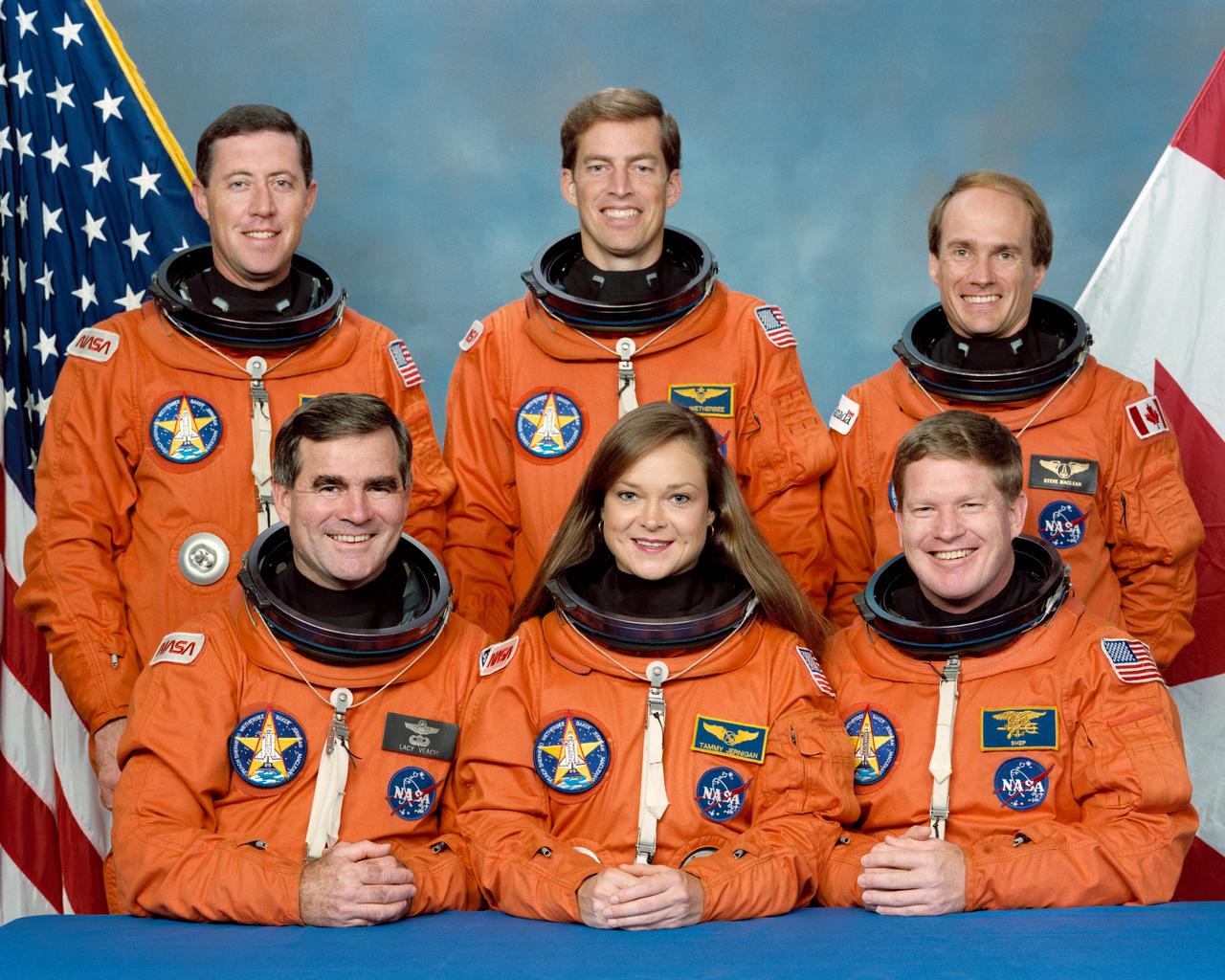
STS052-S-002 (August 1992) --- These five NASA astronauts and a Canadian payload specialist are assigned to the flight, scheduled for later this year. Pictured on the back row are, left to right, astronauts Michael A. Baker, pilot; James D. Wetherbee, mission commander; and Steven G. MacLean, payload specialist representing the Canadian Space Agency (CSA). In front are, left to right, astronauts Charles L. (Lacy) Veach, Tamara E. Jernigan and William M. Shepherd, all mission specialists.
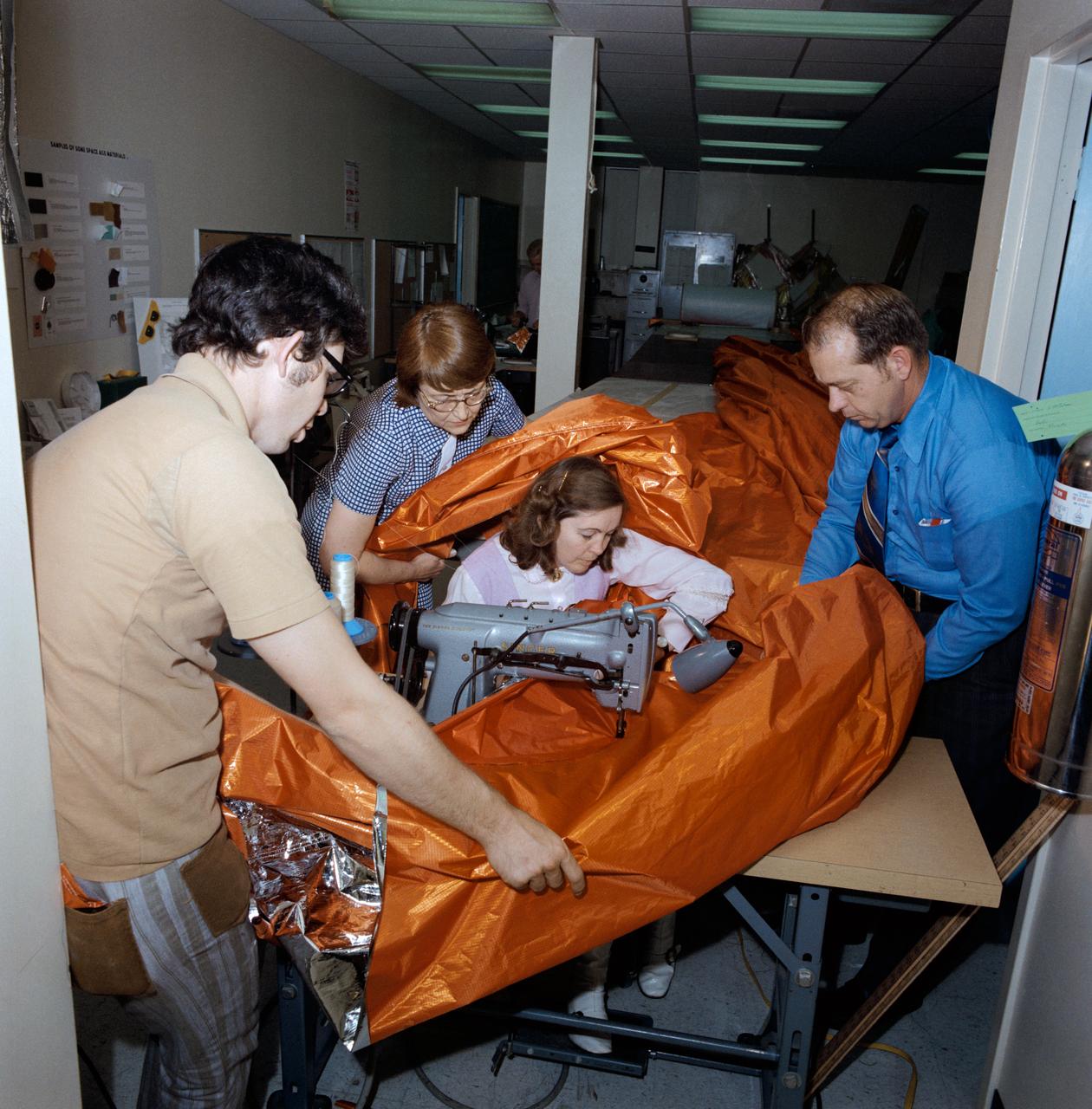
S73-26047 (18 May 1973) --- A sail-like sunshade for possible use as a sunscreen for the Skylab orbital workshop (OWS) is shown being fabricated in the GE Building across the street from the Johnson Space Center. Three persons assist the seamstress feed the material through the sewing machine. The three-layered shade will be composed of a top layer of aluminum Mylar, a middle layer of laminated nylon rip stop, and a bottom layer of thin nylon. Working on the sunshade, from left to right, are Dale Gentry, Elizabeth Gauldin, Alyene Baker and James H. Barnett Jr. Mrs. Baker, a GE employee, operates the double-needle sewing machine. Barnett is head of the Crew Equipment Development Section of JSC's Crew Systems Division. Mrs. Gauldin is also with the Crew Systems Division. Gentry works for GE. The work shown here is part of the crash program underway to prepare a protection device for Skylab to replace the original shield which was lost when the unmanned Skylab 1 launch took place on May 14, 1973. The improvised solar shield selected to be used will be carried to Earth orbit by the Skylab 2 crew, who will deploy it to shade part of the OWS from the hot rays of the sun. Loss of the original shield, as expected, has caused an overheating problem on the OWS. Photo credit: NASA
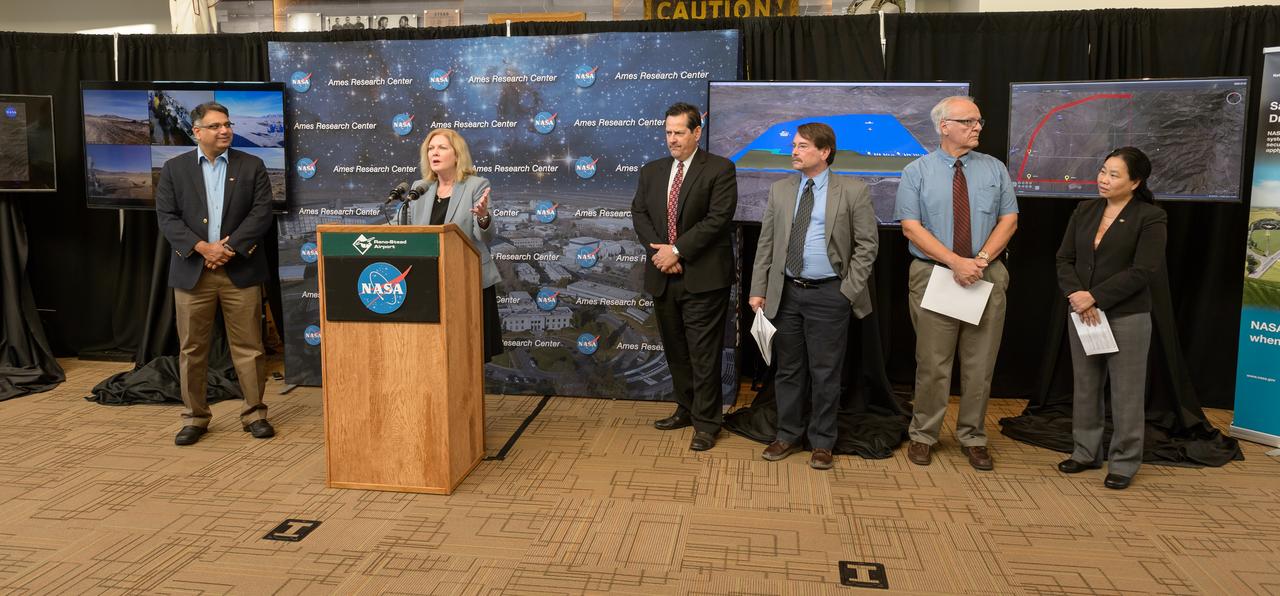
News Conference following the test of Unmanned Aircraft Systems Traffic Management (UTM) technical capability Level 2 (TCL2) at Reno-Stead Airport, Nevada. The UTM Reno Press Conference on Oct. 19, 2016. (Left to Right) Parimal Kopardekar, NASA Ames Senior Engineer for Air Transportation Systems gave an overview of UTM; Maril Mora, President / CEO of the Reno -Tahoe Airport Authority welcomes NASA and Partners; Tom Wilczek, Aerospace and Defence industry representative and Nevada Governor's Office of Economic Development; Mark Baker, Director of Business Development, Nevada Institute of Autonomous Systems; Manos Maragakis, Dean of the College of Engineering, University of Nevada, Reno.
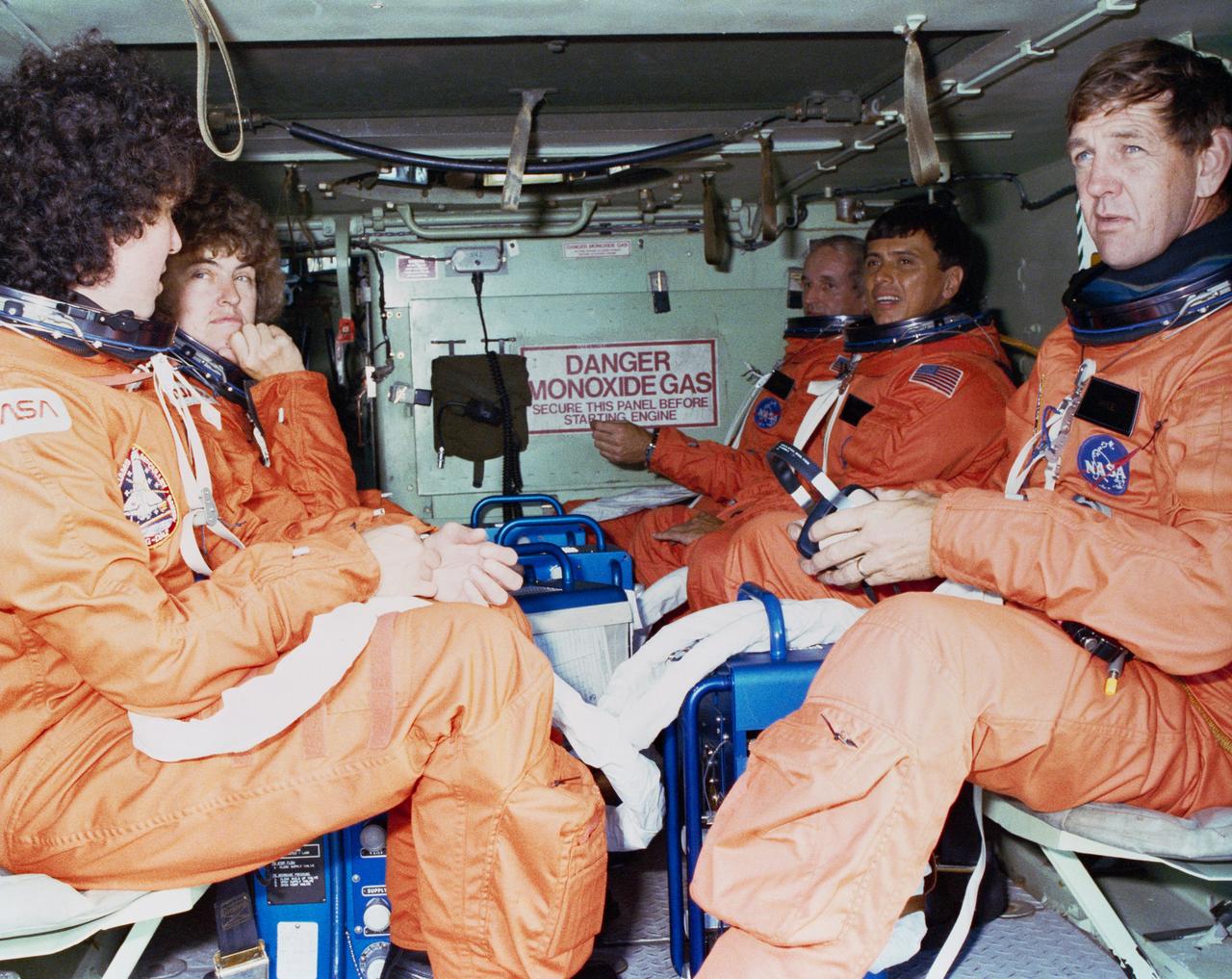
STS-34 crewmembers sit in M1-13 Armored Personnel Carrier (APC) during emergency egress training at KSC's shuttle landing facility (SLF) prior to terminal countdown demonstration test (TCDT) activities. Wearing launch and entry suits (LESs), are (from left) Mission Specialist (MS) Ellen S. Baker, MS Shannon W. Lucid, Commander Donald E. Williams (right side, in back), MS Franklin R. Chang-Diaz, and Pilot Michael J. McCulley (holding headset). View provided by KSC with alternate number KSC-89PC-871.
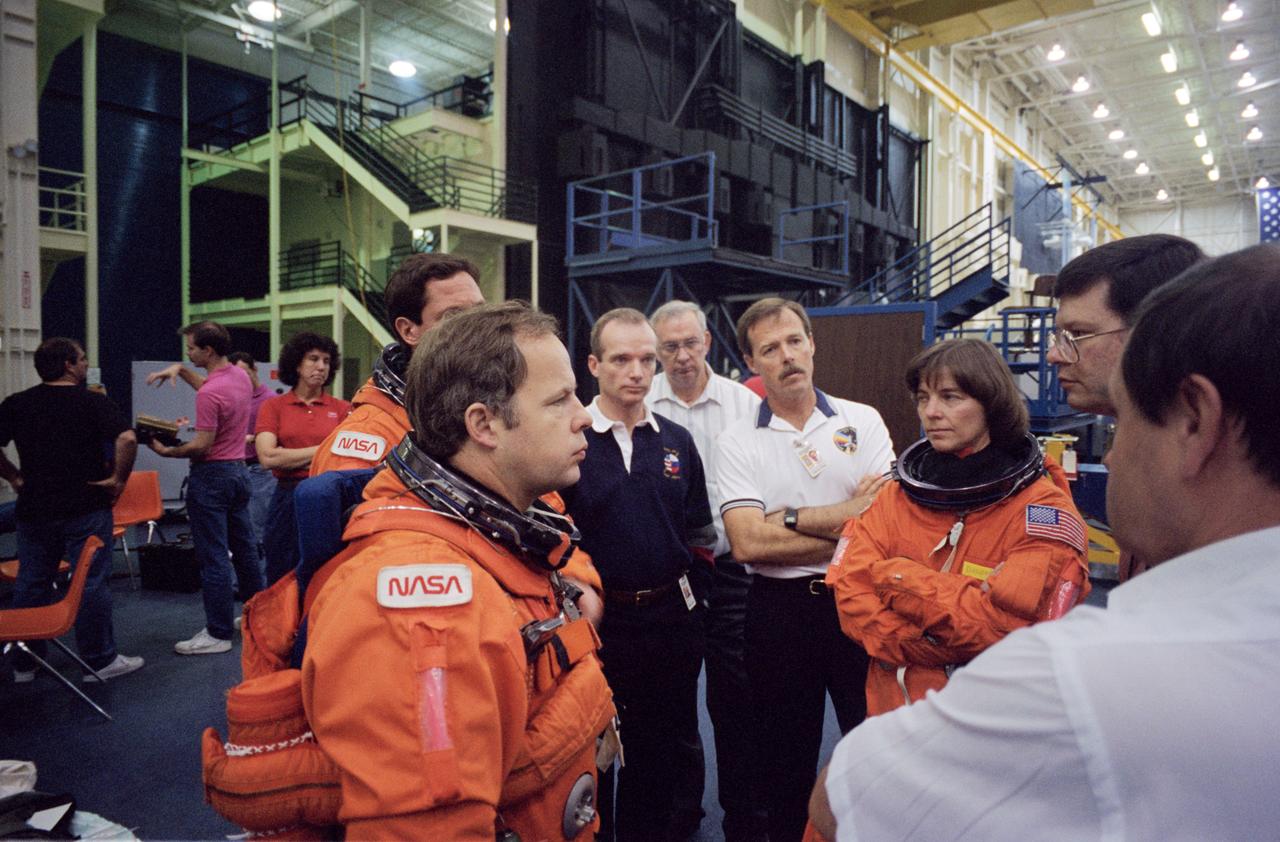
S94-47079 (18 Oct 1994) --- Astronaut Robert L. Gibson, (arms folded, near center) STS-71 mission commander, joins several crew mates during a briefing preceding emergency egress training in the Systems Integration Facility at the Johnson Space Center (JSC). Astronauts Bonnie J. Dunbar and Gregory J. Harbaugh (partially obscured), along with cosmonaut Anatoliy Y. Solovyev, all mission specialists, are attired in training versions of the partial pressure launch and entry space suits. Astronaut Charles J. Precourt, pilot, is in center foreground, and Ellen S. Baker, mission specialist, is in left background.
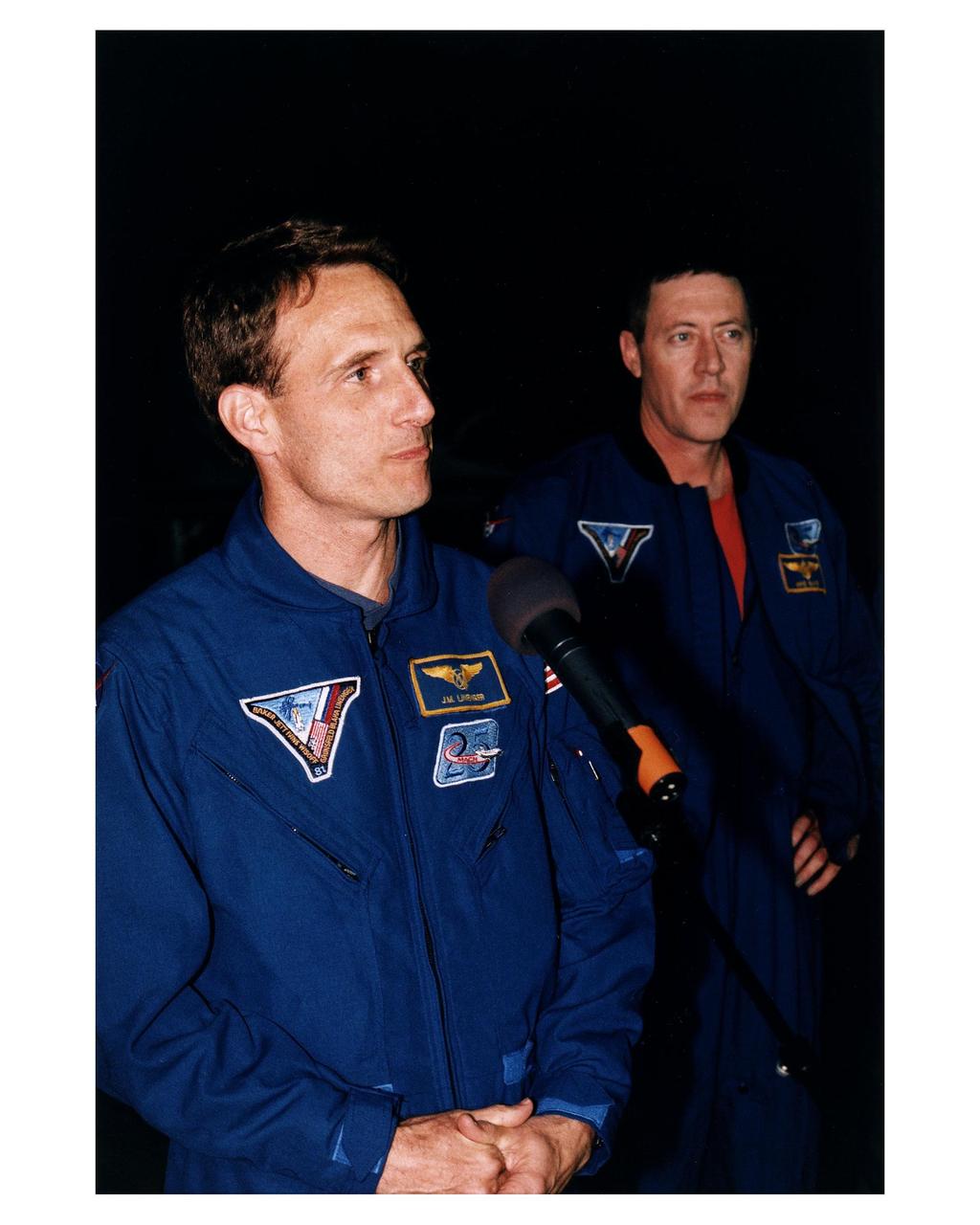
STS-81 Mission Specialist J.M. "Jerry" Linenger talks to the press at the KSC Shuttle Landing Facility after the flight crew arrived at the space center for the final countdown preparations for the fifth Shuttle-Mir docking mission. The 10-day mission will feature the transfer of Linenger to Mir to replace astronaut John Blaha, who has been on the orbital laboratory since Sept. 19, 1996. Linenger will be the fourth U.S. astronaut to stay onboard the Russian space station and serve as a Mir crew member. Mission Commander Michael A. Baker is to his left
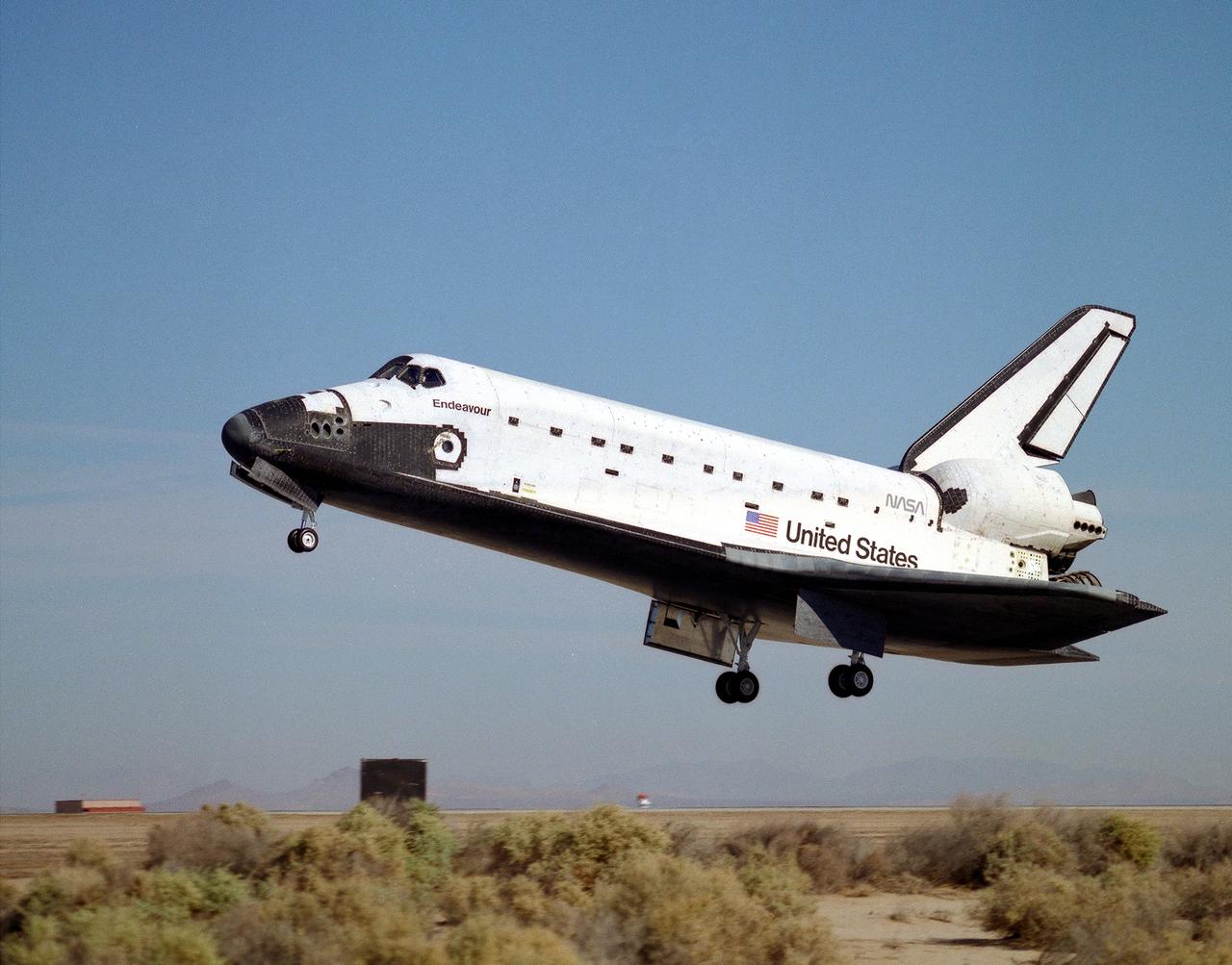
The space shuttle Endeavour glides to a landing on runway 22 at Edwards, California, to complete the highly successful STS-68 mission dedicated to radar imaging of the earth's surface as part of NASA's Mission To Planet Earth program. The landing was at 10:02 a.m. (PDT) 11 October 1994, after waiving off from the Kennedy Space Center, Florida, earlier that morning due to adverse weather at Kennedy. The Endeavour crew was originally scheduled to land at Kennedy the morning of October 10, but mission planners decided early in the flight to extend the mission by one day. Mission commander was Michael A. Baker, making his third flight, and the pilot was Terrence W. Wilcutt, on his first mission.

Greeted by cheers from wellwishers at KSC and eager for their venture into space on the fifth Shuttle-Mir docking mission, the STS-81 astronauts depart the Operations and Checkout Building and board the Astrovan for their 25-minute trip to Launch Pad 39B. Leading the six-member crew is Mission Commander Michael A. Baker, followed by Pilot Brent W. Jett, Jr. Behind them are Mission Specialists John M. Grunsfeld, Jerry Linenger, Peter J. K. "Jeff" Wisoff, and Marsha S. Ivins. Once at the pad, they will take their positions in the crew cabin of the Space Shuttle Atlantis to await a liftoff during a seven-minute window that will open at 4:27 a.m. EST, January 12
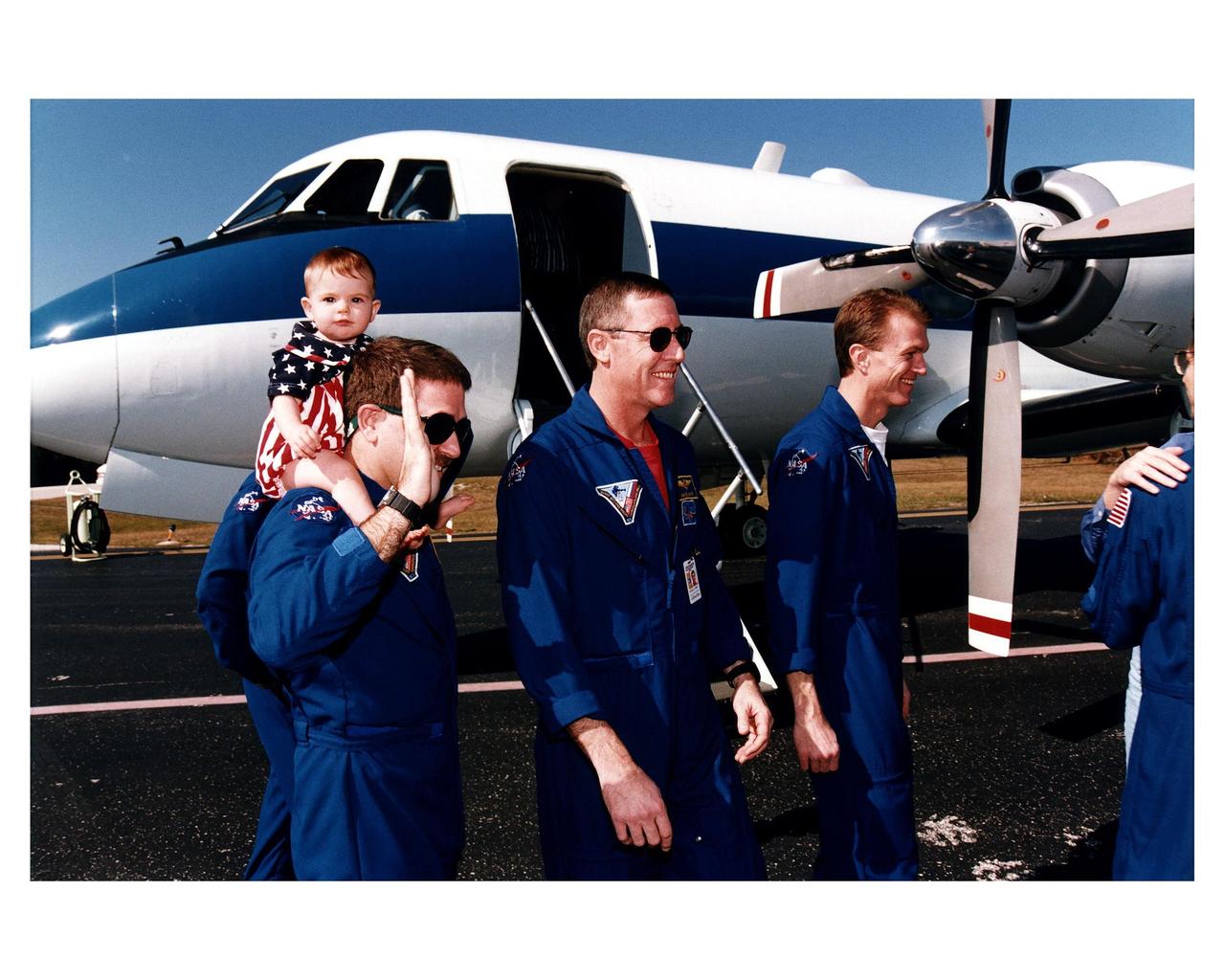
Members of the STS-81 crew prepare to depart for Johnson Space Center Jan. 23 from the Skid Strip at Cape Canaveral Air Station. The crew arrived at KSC aboard the Space Shuttle Atlantis Jan. 22 to conclude the fifth Shuttle-Mir docking mission and return U. S. astronaut John E. Blaha to Earth after four months in space as member of the Mir 22 crew. On the left is Mission Specialist John M. Grunsfeld, with his daughter, Sarah, on his back. Also pictured are Mission Commander Michael A. Baker (center); Pilot Brent W. Jett (second from right); and Blaha

KENNEDY SPACE CENTER, FLA. -- Eric Baker, a United Space Alliance project engineer at Kennedy Space Center, (right) works at the Lufkin Command Center to track hazardous tank finds. KSC workers are participating in the Columbia Recovery efforts at the Lufkin (Texas) Command Center, four field sites in East Texas, and the Barksdale, La., hangar site. KSC is working with representatives from other NASA Centers and with those from a number of federal, state and local agencies in the recovery effort. KSC provides vehicle technical expertise in the field to identify, collect and return Shuttle hardware to KSC.
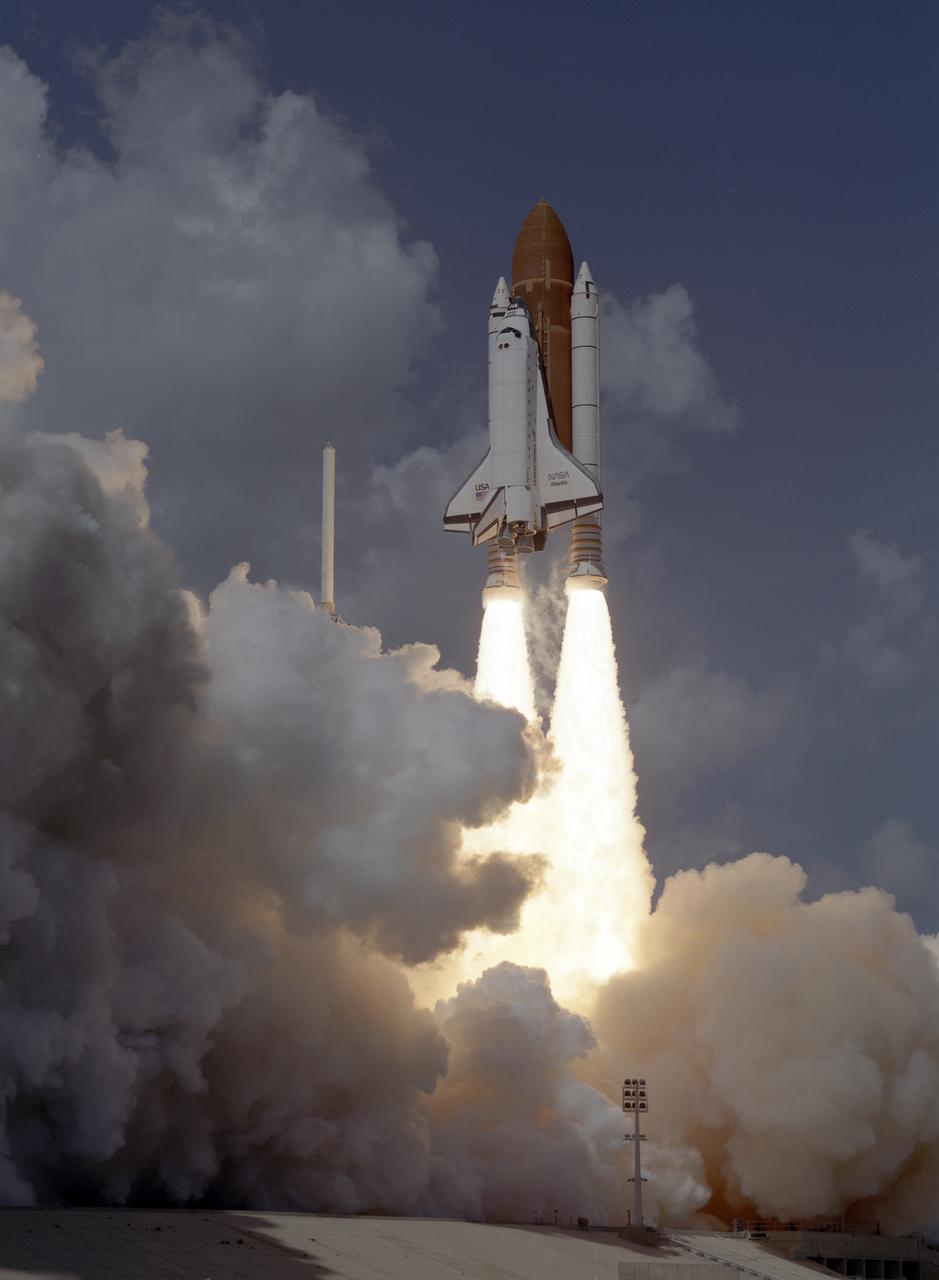
The STS-34 crew of five launched aboard the Space Shuttle Orbiter Atlantis on October 18, 1989 at 12:53:40pm (EDT). Crew members included commander Donald E. Williams, pilot Michael J. McCulley; and mission Specialists Shannon W. Lucid, Franklin R. Chang-Diaz, and Ellen S. Baker. The primary payload was the Galileo Jupiter Spacecraft and attached Inertial Upper Stage (IUS). Deployed 6 hours and 30 minutes into the flight, the IUS stages fired boosting Galileo on trajectory for a 6 year trip to Jupiter.
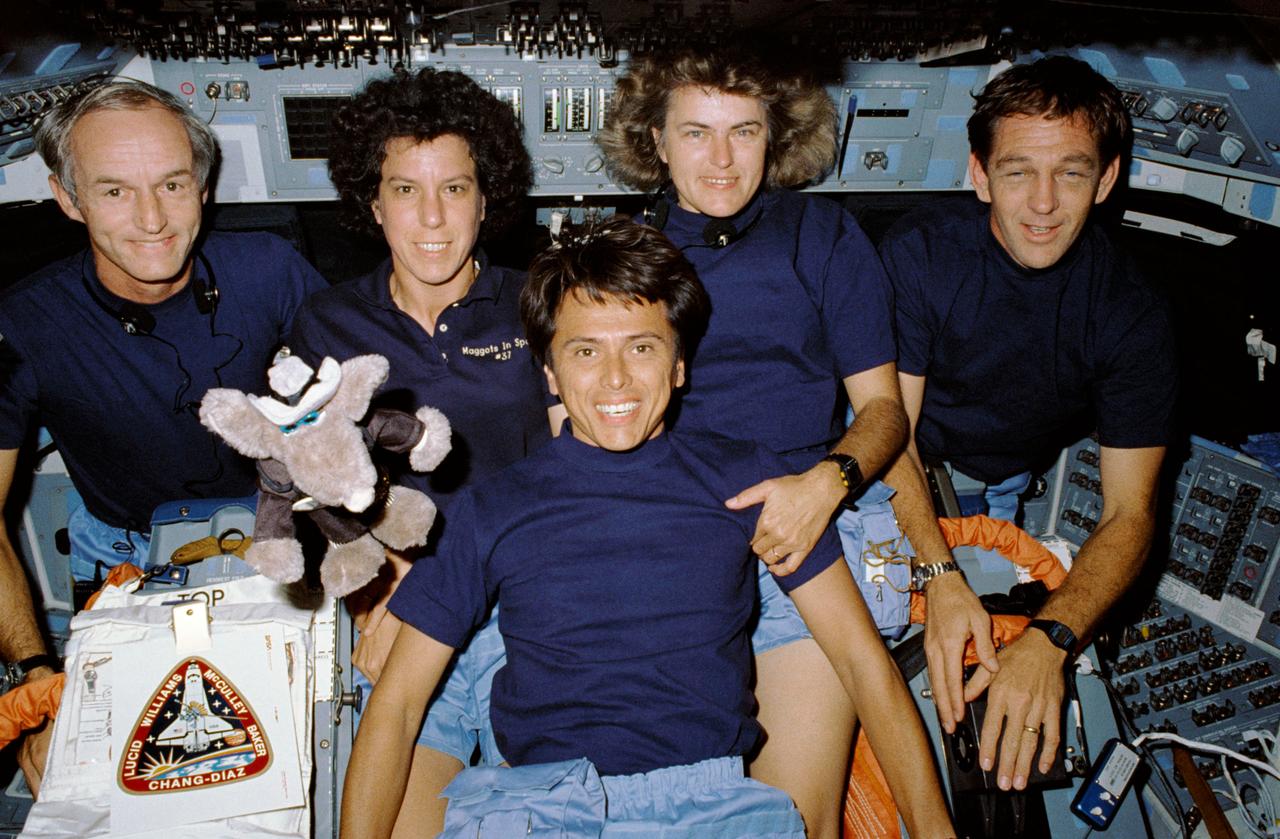
STS034-06-019 (18-23 Oct. 1989) --- The five astronaut crew members for NASA's STS-34 mission pose for an in-space crew "portrait," using a pre-set 35mm camera. Coincidentally, astronauts Donald E. Williams (left), commander, and Michael J. McCulley (right), pilot, are positioned at their respective stations of operation (except that they are turned 180 degrees) aboard the Earth-orbiting space shuttle Atlantis. They form "bookends" for the crew's three mission specialists -- Ellen S. Baker (second left), Shannon W. Lucid and Franklin R. Chang-Diaz.
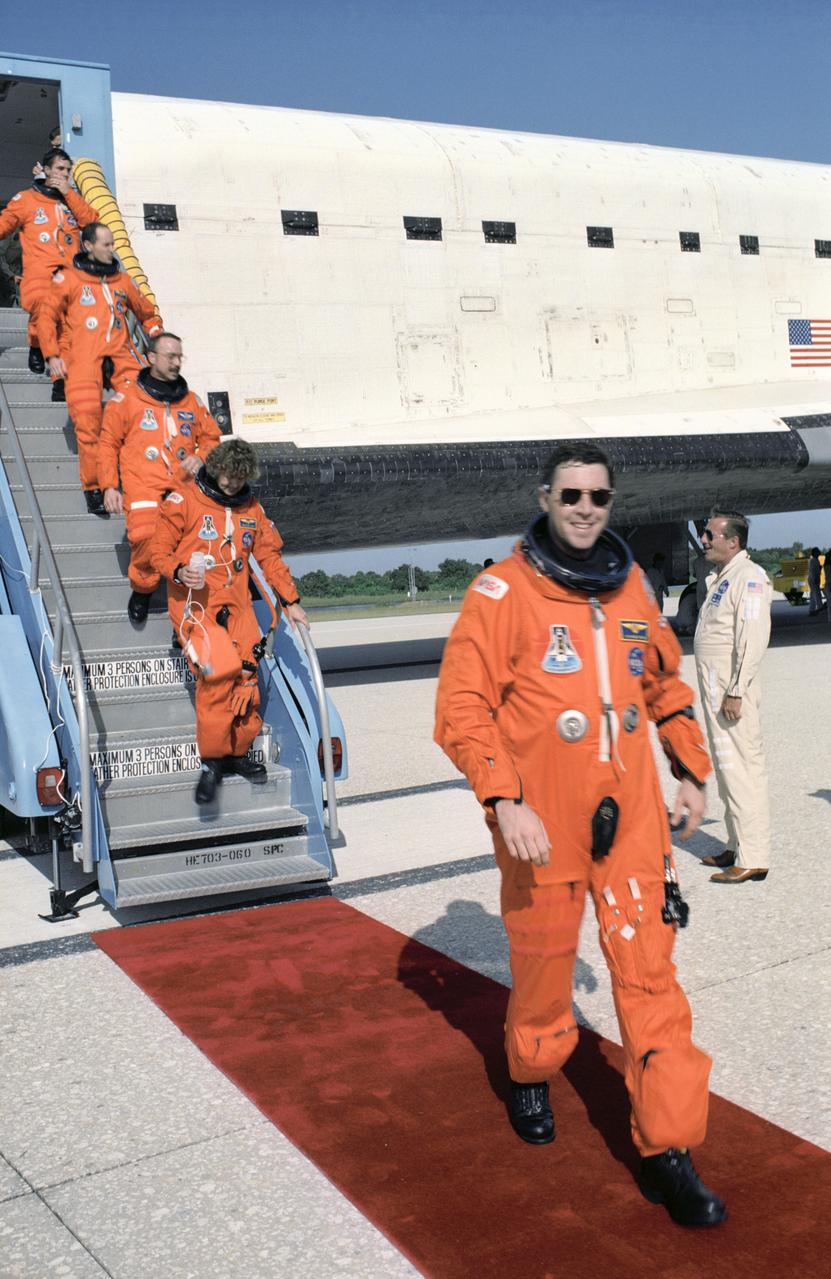
STS043-S-145 (11 Aug 1991) --- STS-43 crewmembers, wearing launch and entry suits (LESs), egress Atlantis, Orbiter Vehicle (OV) 104, via mobile stairway after landing on runway 15 at the Kennedy Space Center (KSC) Shuttle Landing Facility (SLF). Leading the crew and the first to step onto the red carpet is Pilot Michael A. Baker. He is followed by Mission Specialist (MS) Shannon W. Lucid, MS James C. Adamson, MS G. David Low, and Commander John E. Blaha. OV-104's fuselage is visible in the background.
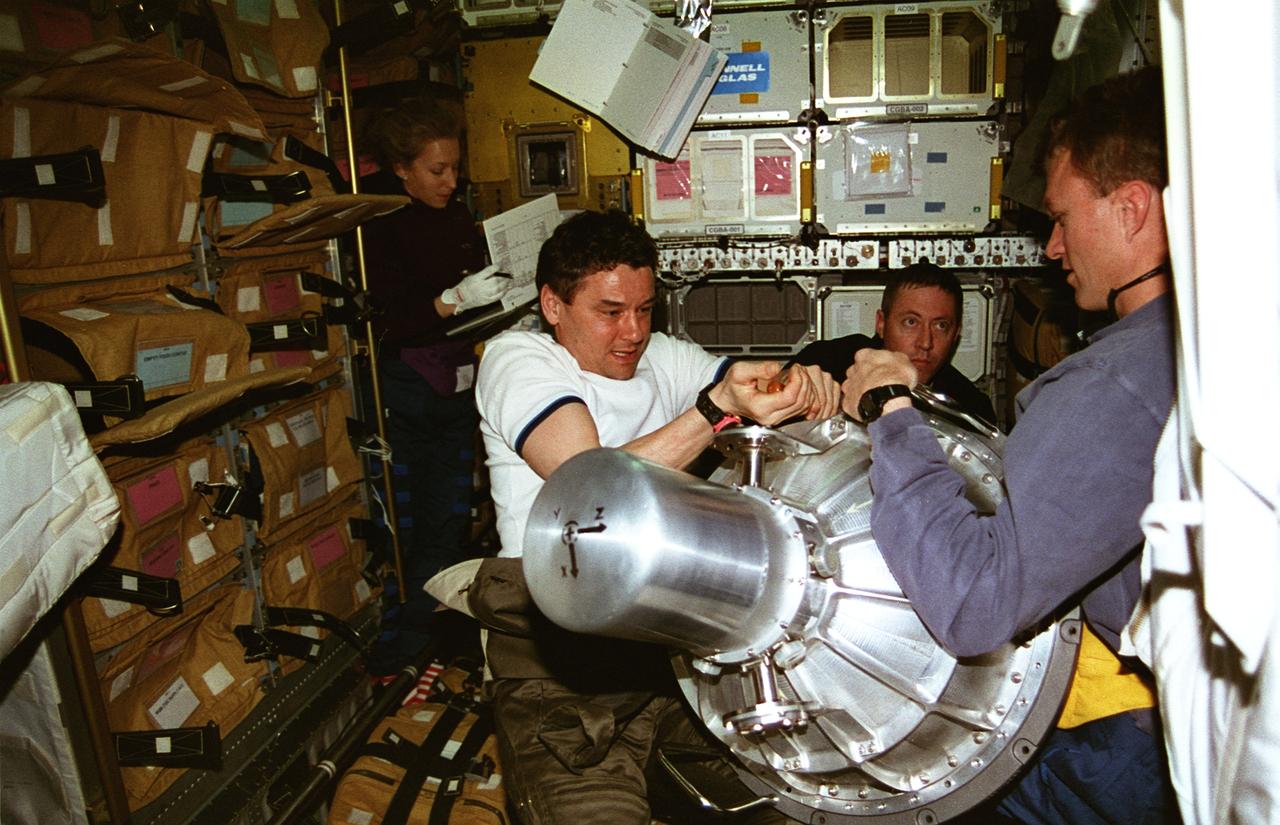
STS081-301-032 (12-22 Jan. 1997) --- Shortly after the docking of the Space Shuttle Atlantis and Russia's Mir Space Station, crewmembers from the respective spacecraft begin to transfer hardware from the Spacehab Double Module (DM) onto the Mir complex. In this scene, cosmonaut Valeri G. Korzun (second left) Mir-22 commander, along with astronauts Michael A. Baker (second right) commander, and Brent W. Jett, Jr., pilot, unstow a gyrodyne, a device used for attitude control, for transfer to Mir. Astronaut Marsha S. Ivins looks over a lengthy inventory of supplies to be transferred.
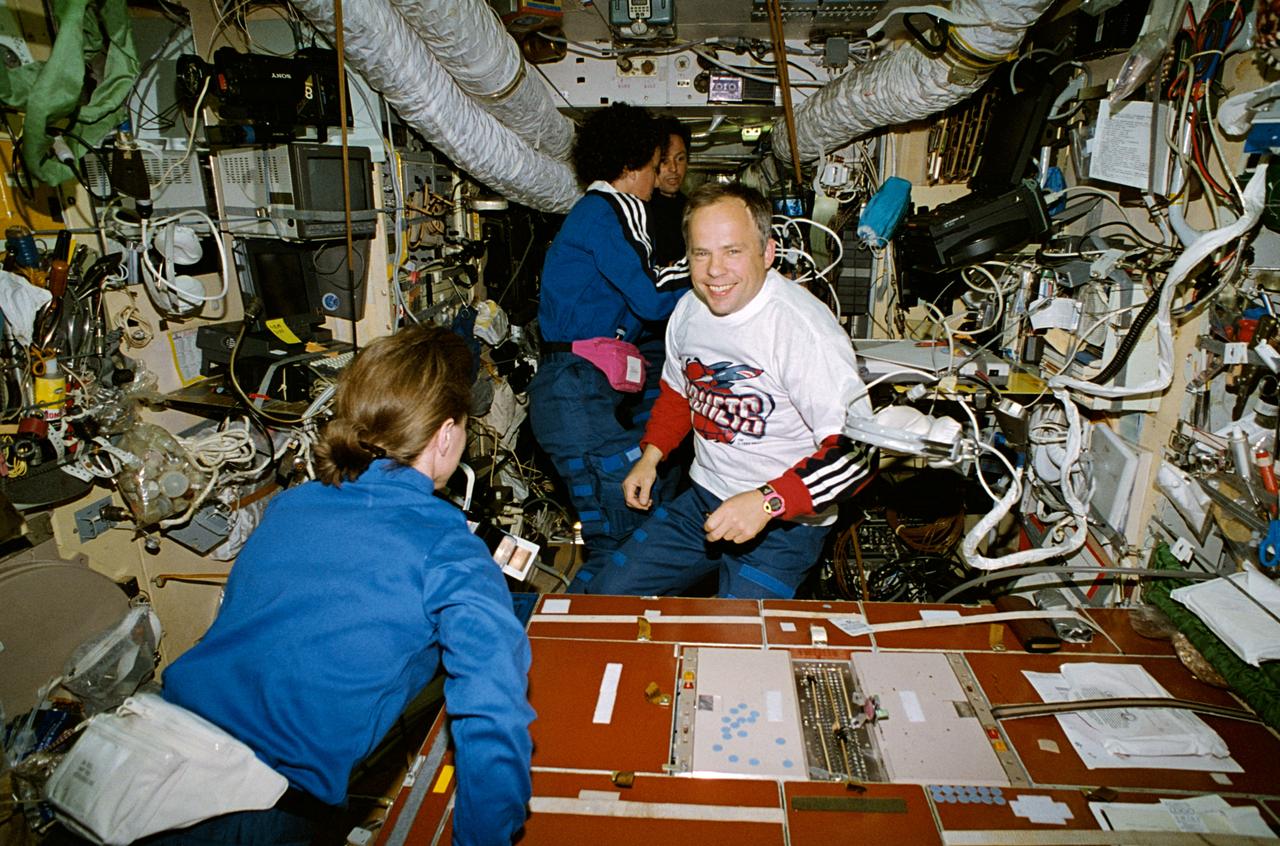
STS071-122-021 (27 June-7 July 1995) --- Three astronauts and a cosmonaut who went into space aboard the space shuttle Atlantis check out the core module living quarters on Russia's Mir Space Station. Sporting a new Houston Rockets T-shirt near frame center is cosmonaut Anatoly Y. Solovyev, Mir-19 mission commander. Astronaut Bonnie J. Dunbar, STS-71 mission specialist, floats into the frame at lower left. Beyond Solovyev are astronauts Ellen S. Baker and Gregory J. Harbaugh, mission specialists.
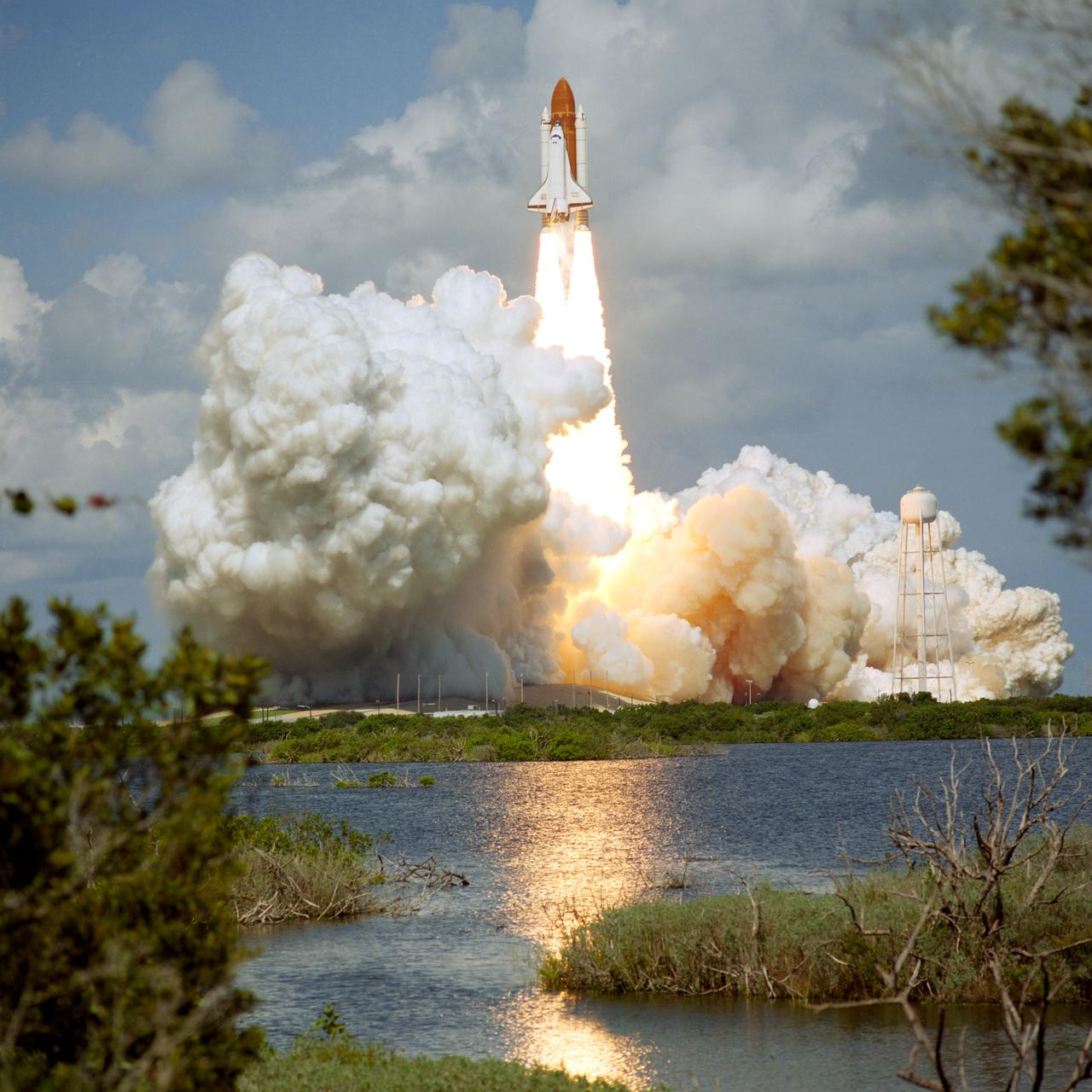
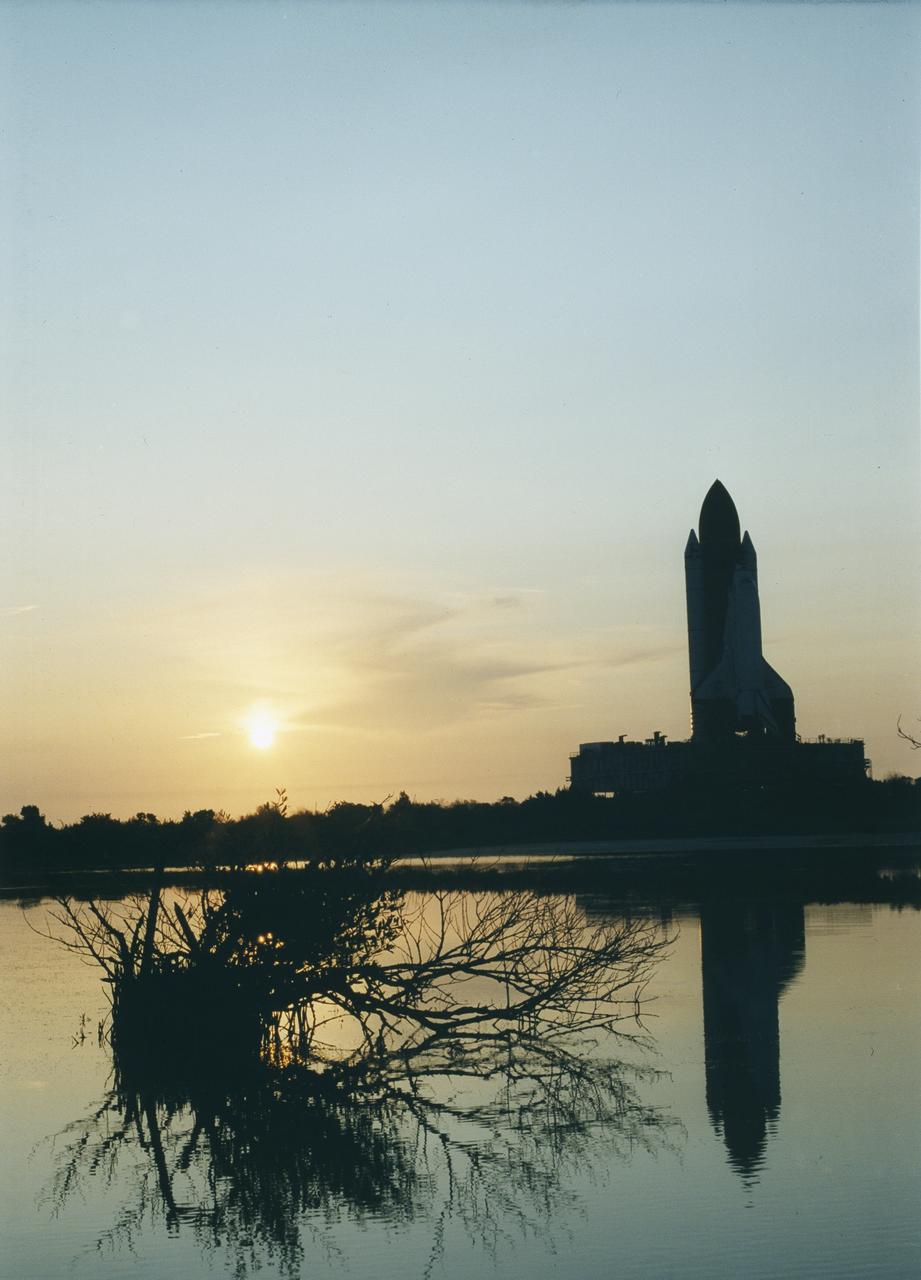
STS034-S-025 (18 Oct 1989) --- The STS-34 Space Shuttle Atlantis lifts off from Launch Pad 39-B at 2:53:39:983 p.m. (EDT), marking the beginning of a five-day mission in space. Atlantis carries a crew of five and the spacecraft Galileo, along with a number of other scientific experiments. The Jupiter-bound probe will be deployed from Atlantis some six hours after launch. The journey to the giant planet is expected to take over six years. Crewmembers for the mission are astronauts Donald E. Williams, Michael J. McCulley, Shannon W. Lucid, Franklin R. Chang-Diaz and Ellen S. Baker. The scene was recorded with a 70mm camera.
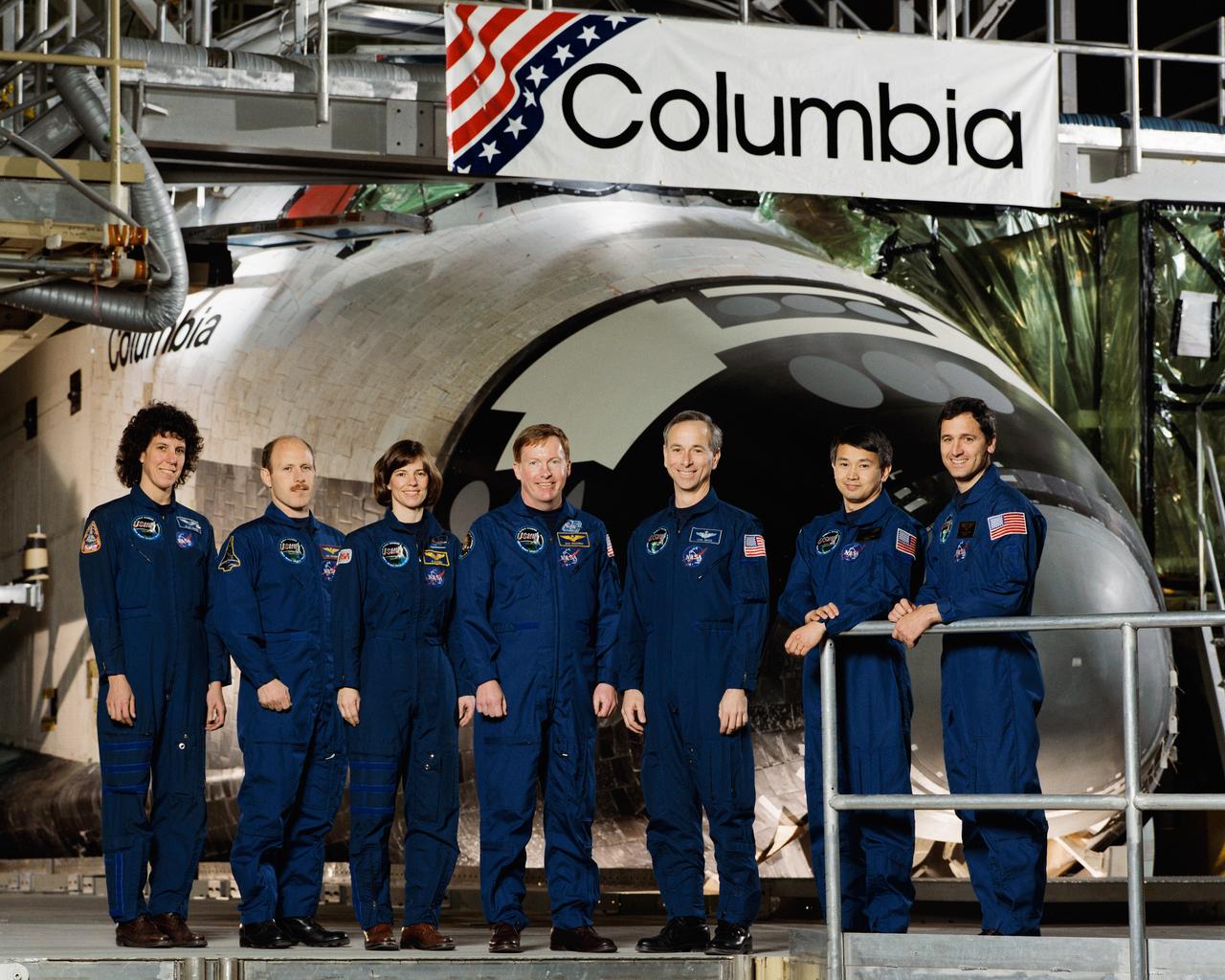
STS050-S-002 (24 Jan. 1992) --- The seven crew members assigned to NASA's mission pose for the traditional crew portrait. The crew was in Palmdale, California for the Space Shuttle Columbia's Extended-Duration Orbiter (EDO) modifications roll-out. Astronaut Richard N. Richards, mission commander, is center. Astronaut Kenneth D. Bowersox, pilot, is second from left. Others, left to right, are astronauts Ellen S. Baker, mission specialist; Bonnie J. Dunbar, payload commander; and Carl J. Meade, mission specialist; Eugene H. Trinh and Lawrence J. DeLucas, payload specialists.
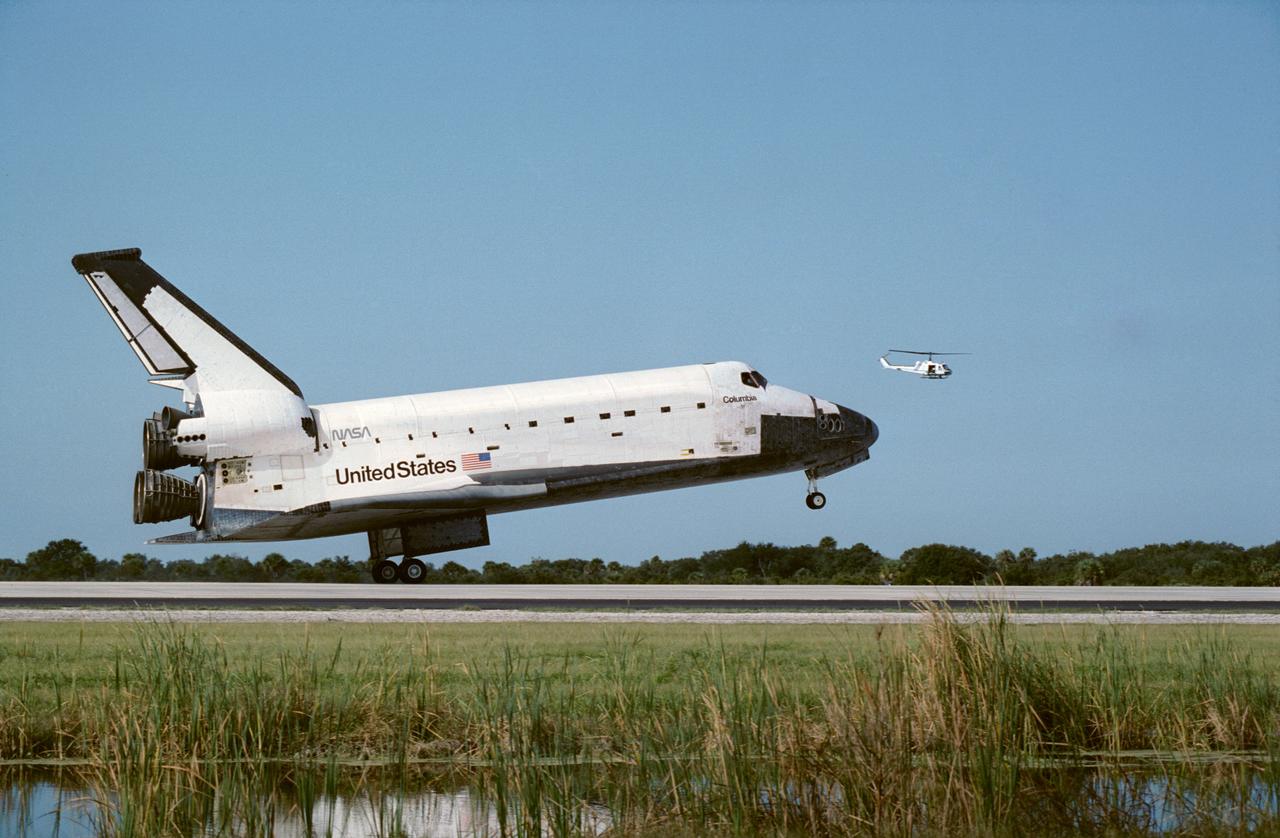
STS052-S-098 (1 Nov 1992) --- This ground-level side view shows the Space Shuttle Columbia just prior to main landing gear touchdown at KSC's Shuttle Landing Facility to successfully complete a ten-day Earth-orbital mission. Onboard were a crew of five NASA astronauts and a Canadian payload specialist. Landing occurred at 9:05:53 a.m. (EST), November 1, 1992. Crewmembers are astronauts James D. Wetherbee, Michael A. Baker, Tamara E. Jernigan, Charles L. (Lacy) Veach and William M. Shepherd along with payload specialist Steven G. MacLean. The view was recorded with a 35mm camera.
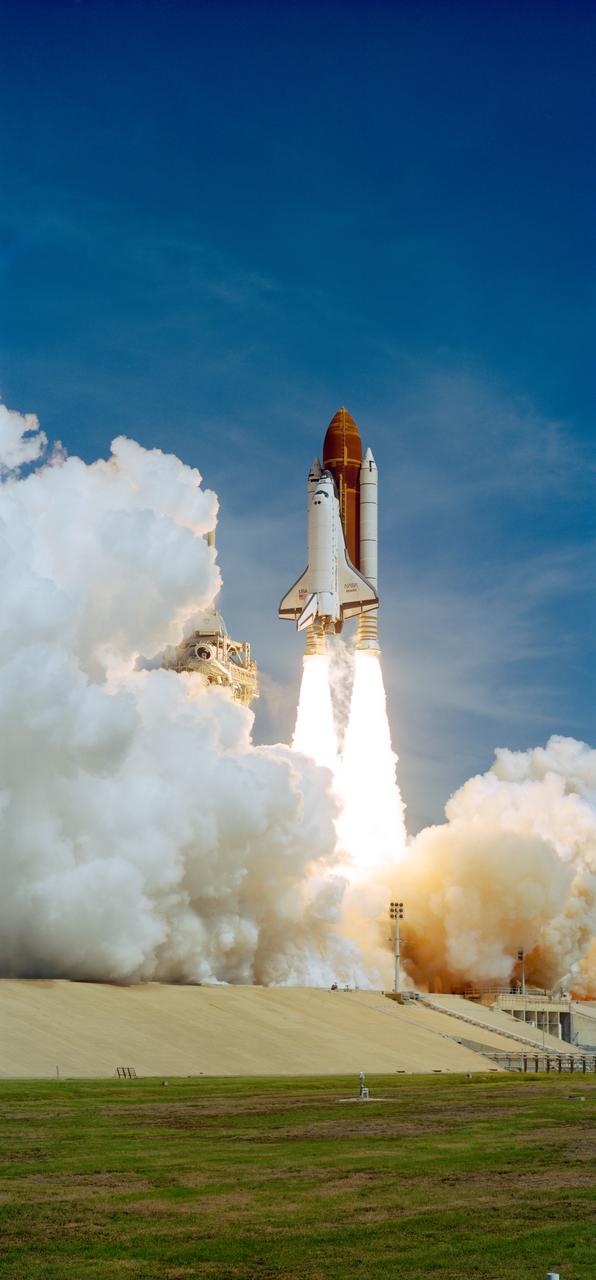
STS043-S-090 (2 Aug 1991) --- The Space Shuttle Atlantis soars toward space to begin a scheduled nine-day mission. The 11:02:00 a.m. (EDT) liftoff from Launch Pad 39A came at the beginning of the launch window. Onboard the spacecraft were astronauts John E. Blaha, mission commander; Michael A. Baker, pilot; and Shannon W. Lucid, James C. Adamson and G. David Low, all mission specialists. Six hours after this picture was taken, the astronauts deployed the Tracking and Data Relay Satellite (TDRS-E).
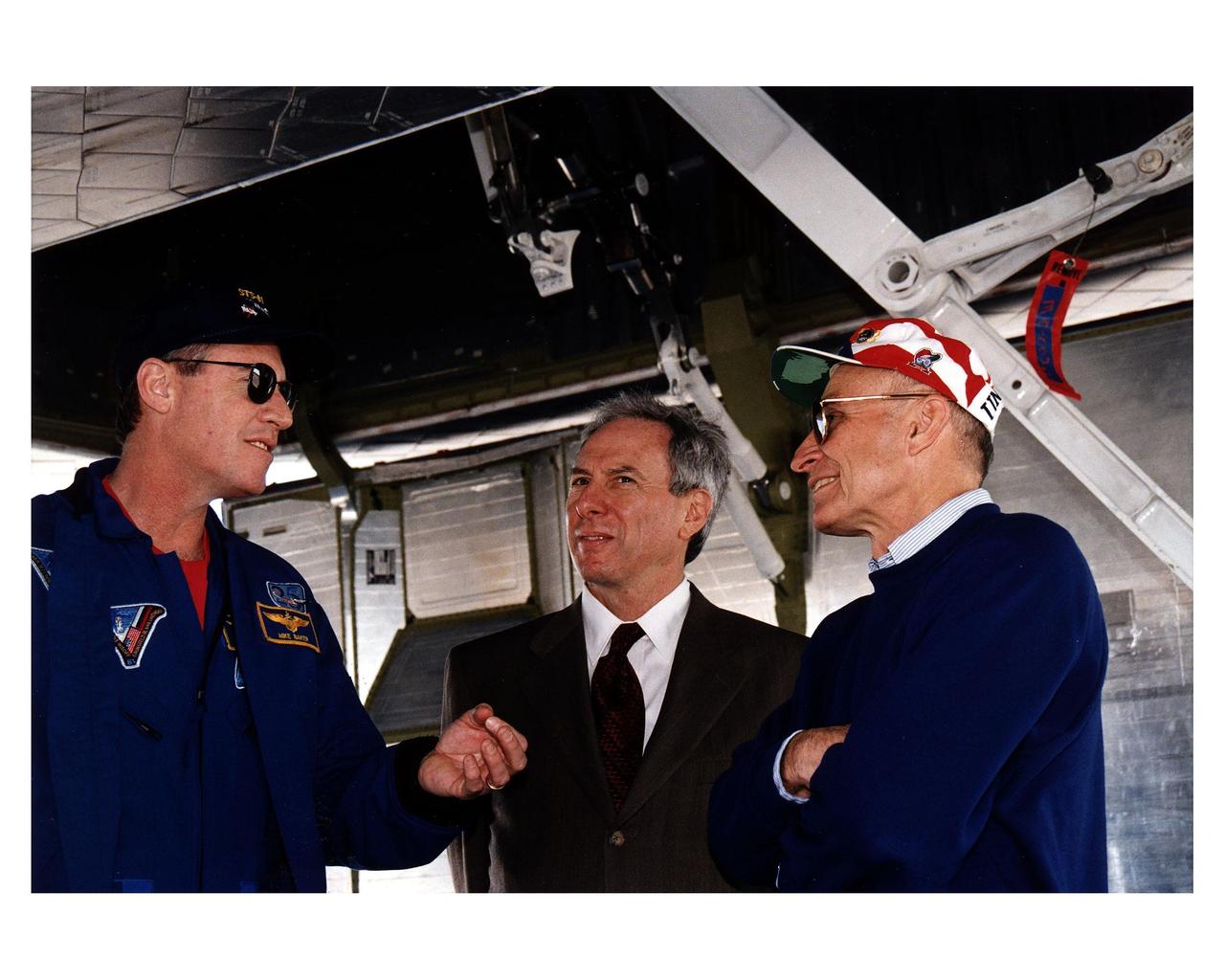
KENNEDY SPACE CENTER, FLA. -- NASA Administrator Daniel S. Goldin (center) and KSC Director of Shuttle Operations Robert B. Sieck (right) discuss the successful conclusion of the STS-81 mission with Mission Commander Michael A. Baker (left). They are underneath the Space Shuttle orbiter Atlantis after the space plane landed on Runway 33 at the KSC Shuttle Landing Facility at 9:22:44 a.m. EST Jan. 22 to conclude the fifth Shuttle-Mir docking mission. At main gear touchdown, the STS-81 mission duration was 10 days, 4 hours, 55 minutes. This was the 34th KSC landing in Shuttle history
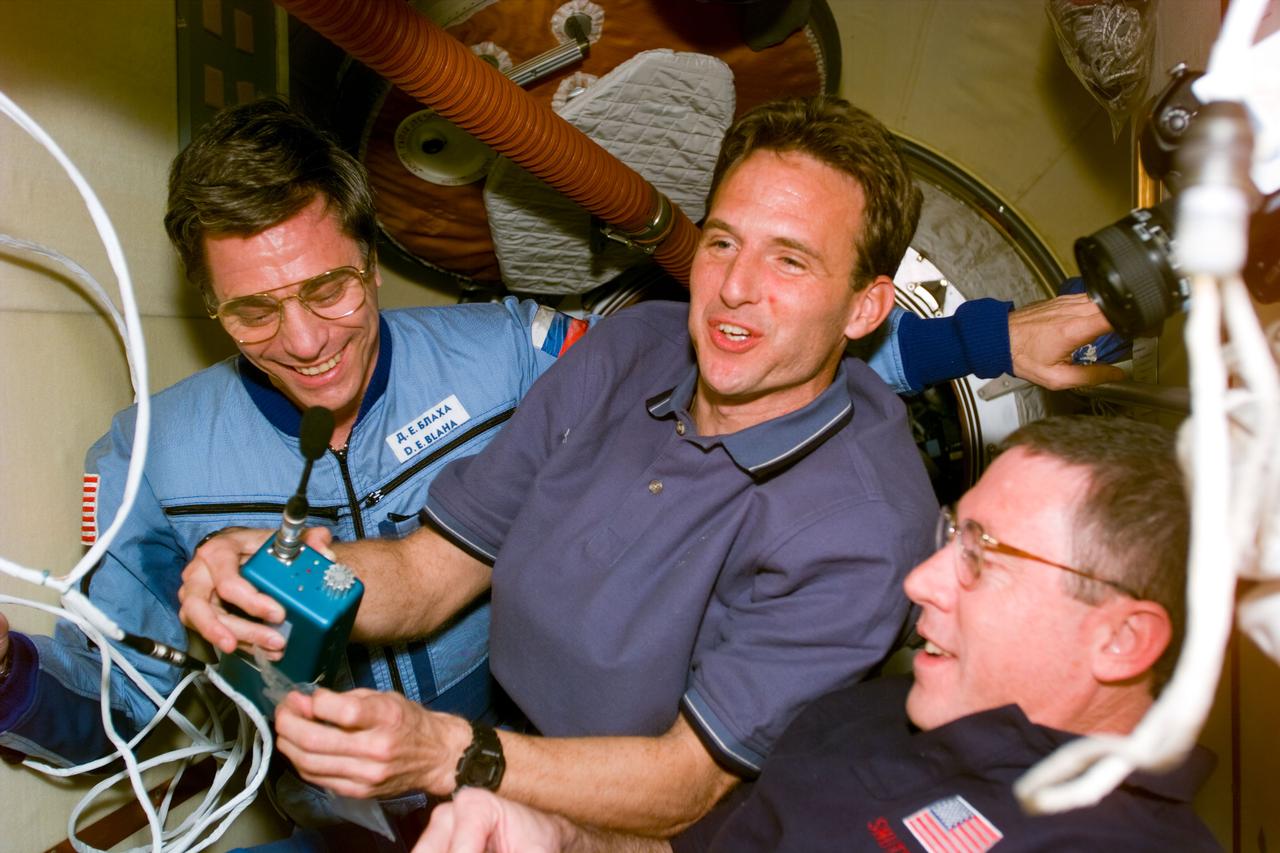
STS081-E-05432 (15 Jan. 1997) --- Left to right, astronaut John E. Blaha, his cosmonaut guest researcher replacement Jerry M. Linenger and Michael A. Baker, mission commander, shortly after docking and hatch opening. Blaha had just joined the NASA crew, having served as a cosmonaut guest researcher aboard Russia's Mir Space Station since mid September 1996. The photograph was taken with an Electronic Still Camera (ESC), which was used throughout the 10-day mission to downlink current photographs of the crews' joint activities.
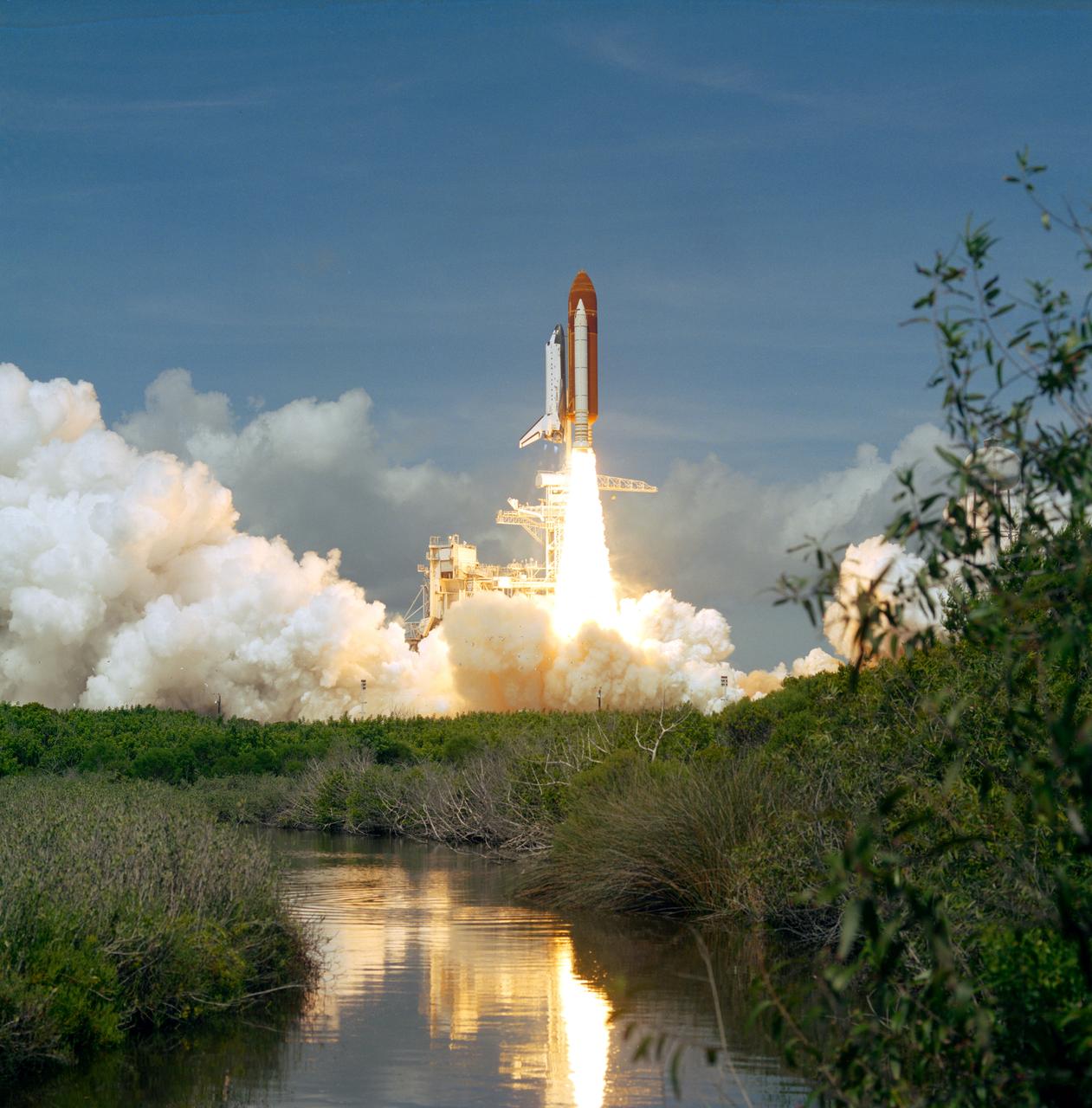
STS043-S-087 (2 Aug 1991) --- The Space Shuttle Atlantis soars toward space to begin a scheduled nine-day mission. The 11:02:00 a.m. (EDT) liftoff from Launch Pad 39A came at the beginning of the launch window. Onboard the spacecraft were astronauts John E. Blaha, mission commander; Michael A. Baker, pilot; and Shannon W. Lucid, James C. Adamson and G. David Low, all mission specialists. Six hours after this picture was taken, the astronauts deployed the Tracking and Data Relay Satellite (TDRS-E).
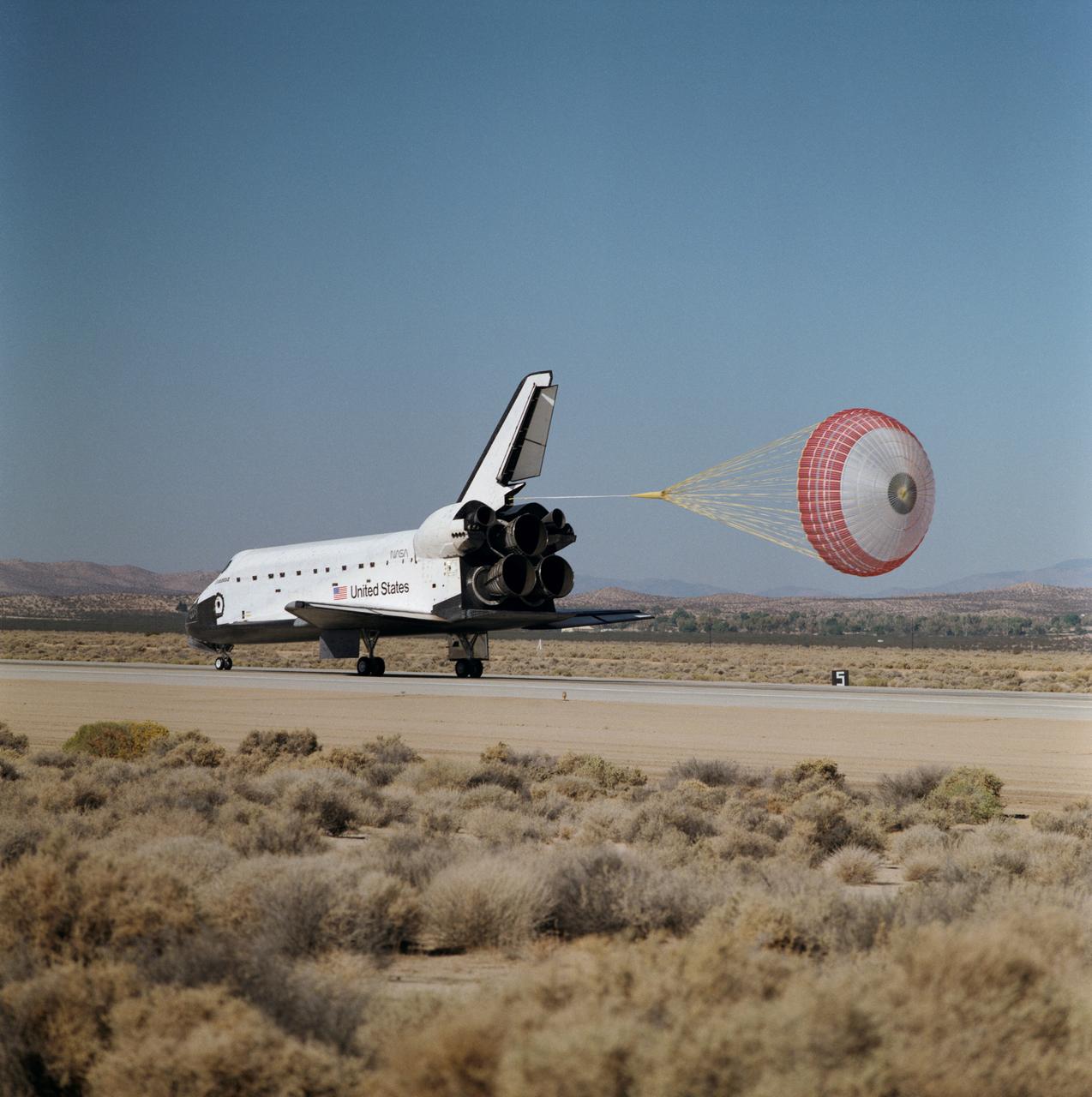
STS068-S-061 (11 October 1994) --- The drag chute system, one of 13 Detailed Test Objectives (DTO) for STS-68, is deployed as the Space Shuttle Endeavour completes an eleven-day mission at Edwards Air Force Base, California. Landing occurred at 10:02 a.m. (PDT), October 11, 1994. Onboard were astronauts Michael A. Baker, mission commander; Terrence W. Wilcutt, pilot; Thomas D. Jones, payload commander; and Daniel W. Bursch, Peter J. K. (Jeff) Wisoff and Steven L. Smith, all mission specialists.
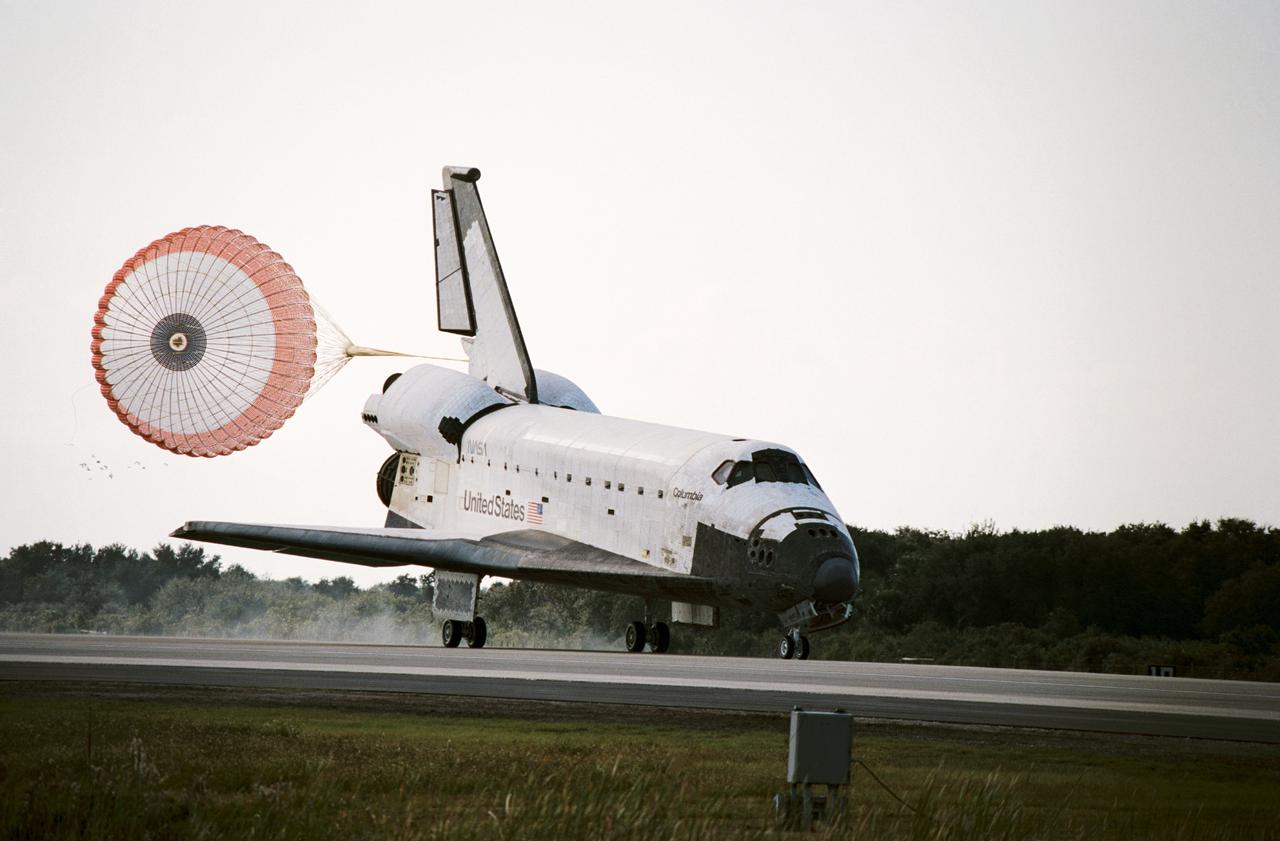
STS052-S-099 (1 Nov. 1992) --- This three-quarter front view shows the Space Shuttle Columbia just after deployment of the drag chute during landing at KSC's Shuttle Landing Facility. Onboard were a crew of five NASA astronauts and a Canadian payload specialist. Landing occurred at 9:05:53 a.m. (EST), November 1, 1992. Crewmembers are astronauts James D. Wetherbee, Michael A. Baker, Tamara E. Jernigan, Charles L. (Lacy) Veach and William M. Shepherd along with payload specialist Steven G. MacLean. The photo was taken with a 35mm camera.
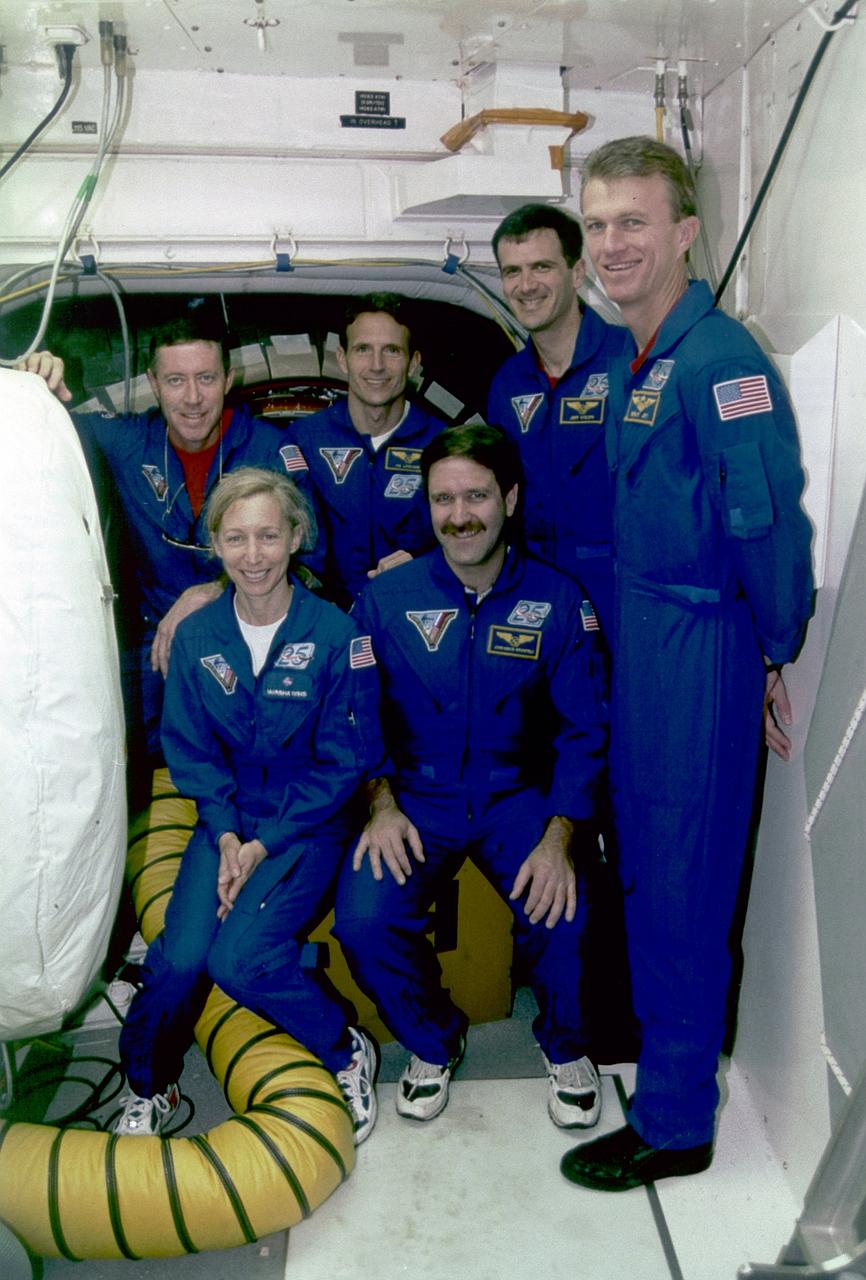
S97-00247 (15 Dec. 1996) --- The STS-81 mission flight crew poses outside the hatch of the space shuttle Atlantis at Launch Pad 39B during a Terminal Countdown Demonstration Test (TCDT). The TCDT represents a simulated final countdown rehearsal that ends just before main engine ignition. The actual launch is now scheduled for Jan. 12, 1997. Pictured (from the left) are astronauts Michael A. Baker, Marsha S. Ivins, Jerry M. Linenger, John M. Grunsfeld, Peter J.K. (Jeff) Wisoff, and Brent W. Jett Jr.
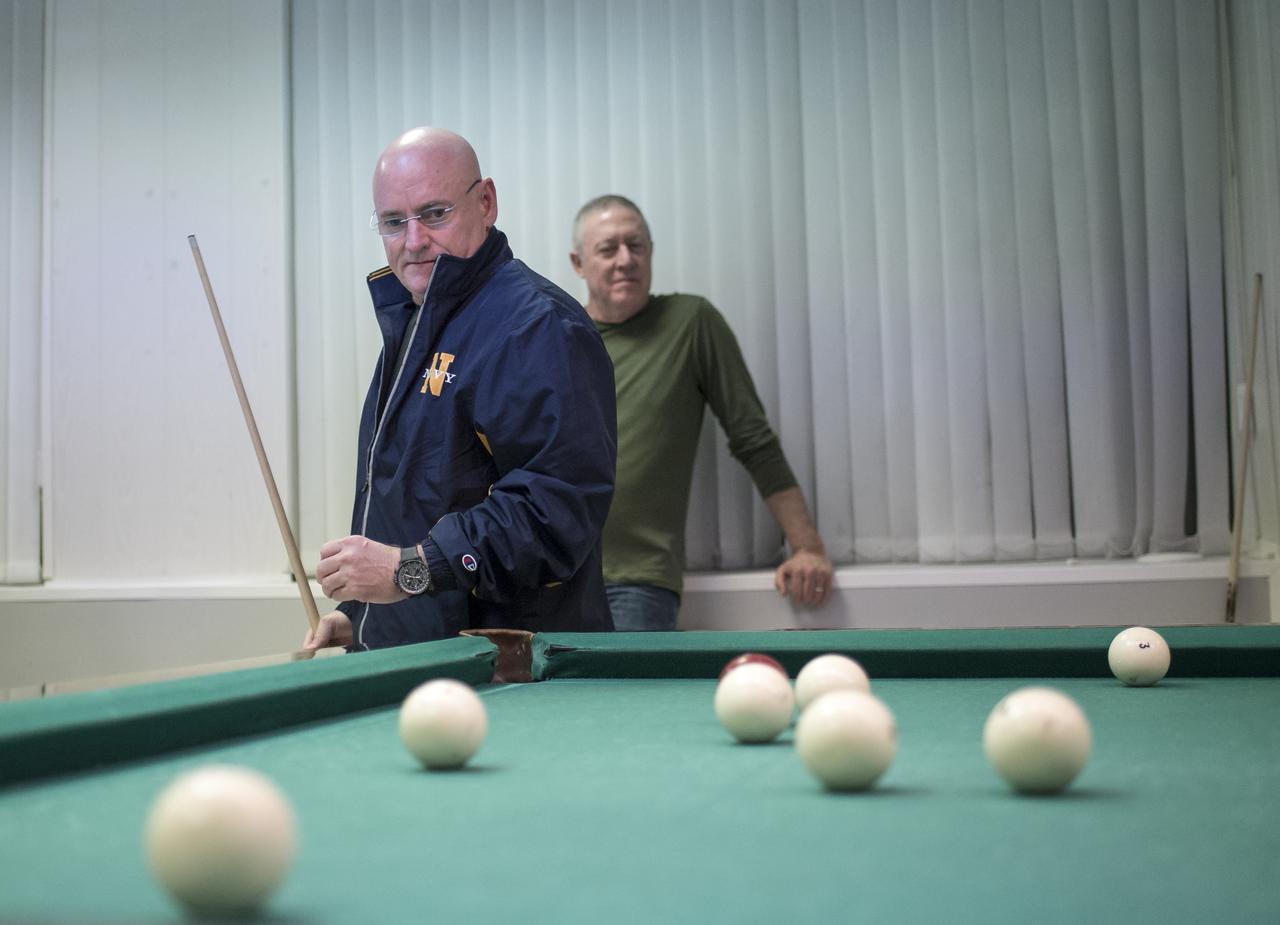
Expedition 43 NASA Astronaut Scott Kelly, left, plays pool with Russian Cosmonaut Mikhail Kornienko of the Russian Federal Space Agency (Roscosmos), as NASA International Space Station Program Manager for International and Crew Operations Michael Baker looks on at the Cosmonaut Hotel, Thursday, March 19, 2015 in Baikonur, Kazakhstan. Kelly, Kornienko, and Russian Cosmonaut Gennady Padalka are preparing for launch to the International Space Station in their Soyuz TMA-16M spacecraft from the Baikonur Cosmodrome in Kazakhstan March 28, Kazakh time. As the one-year crew, Kelly and Kornienko will return to Earth on Soyuz TMA-18M in March 2016. Photo Credit: (NASA/Bill Ingalls)
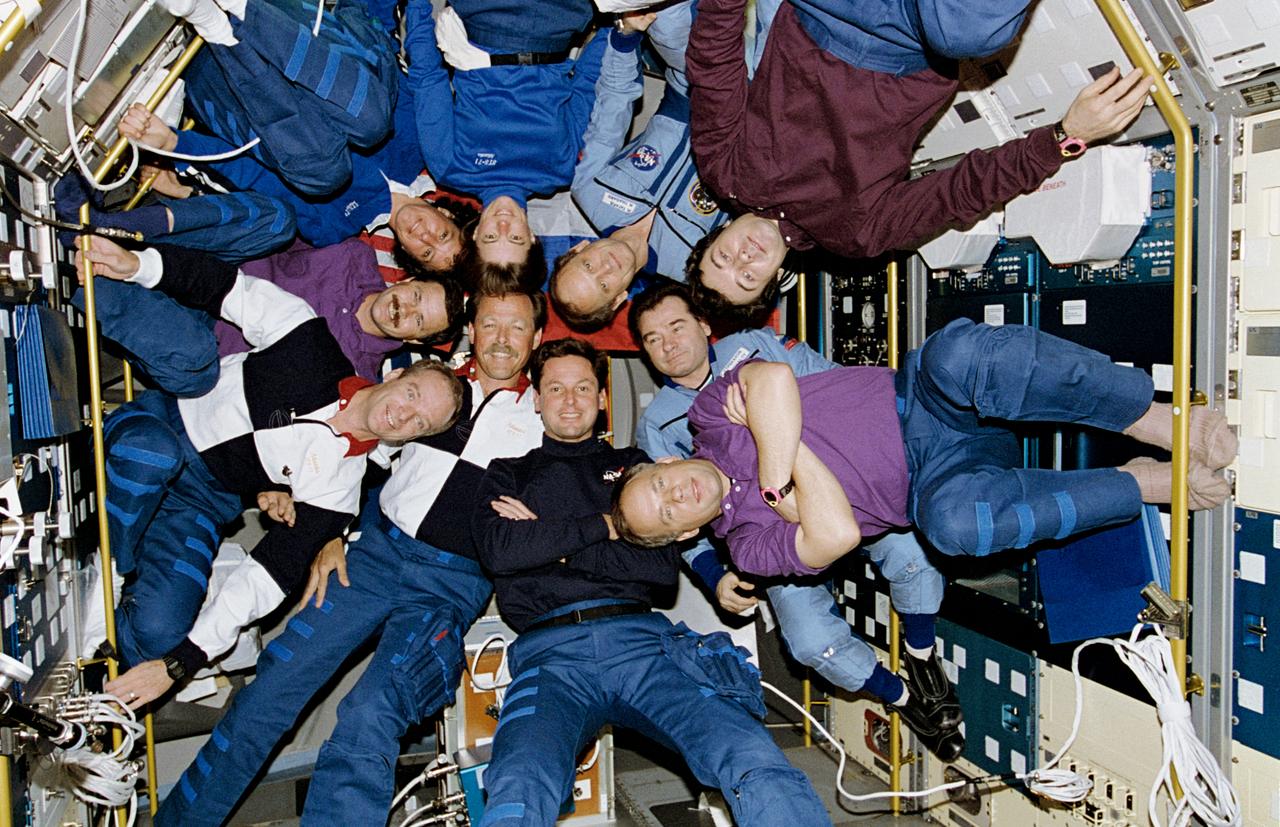
STS071-122-013 (27 June-7 July 1995) --- Inside the space shuttle Atlantis' Spacelab Science Module, the crewmembers of STS-71, Mir-18 and Mir-19 pose for the traditional inflight portrait. For individual identification, hold picture vertically with socked feet of Anatoly Y. Solovyev at bottom center. Clockwise from Solovyev are astronauts Gregory J. Harbaugh, Robert L. Gibson, Charles J. Precourt, Nikolai M. Budarin, Ellen S. Baker, Bonnie J. Dunbar, Norman E. Thagard, and cosmonauts Gennadiy M. Strekalov (at angle) and Vladimir N. Dezhurov.