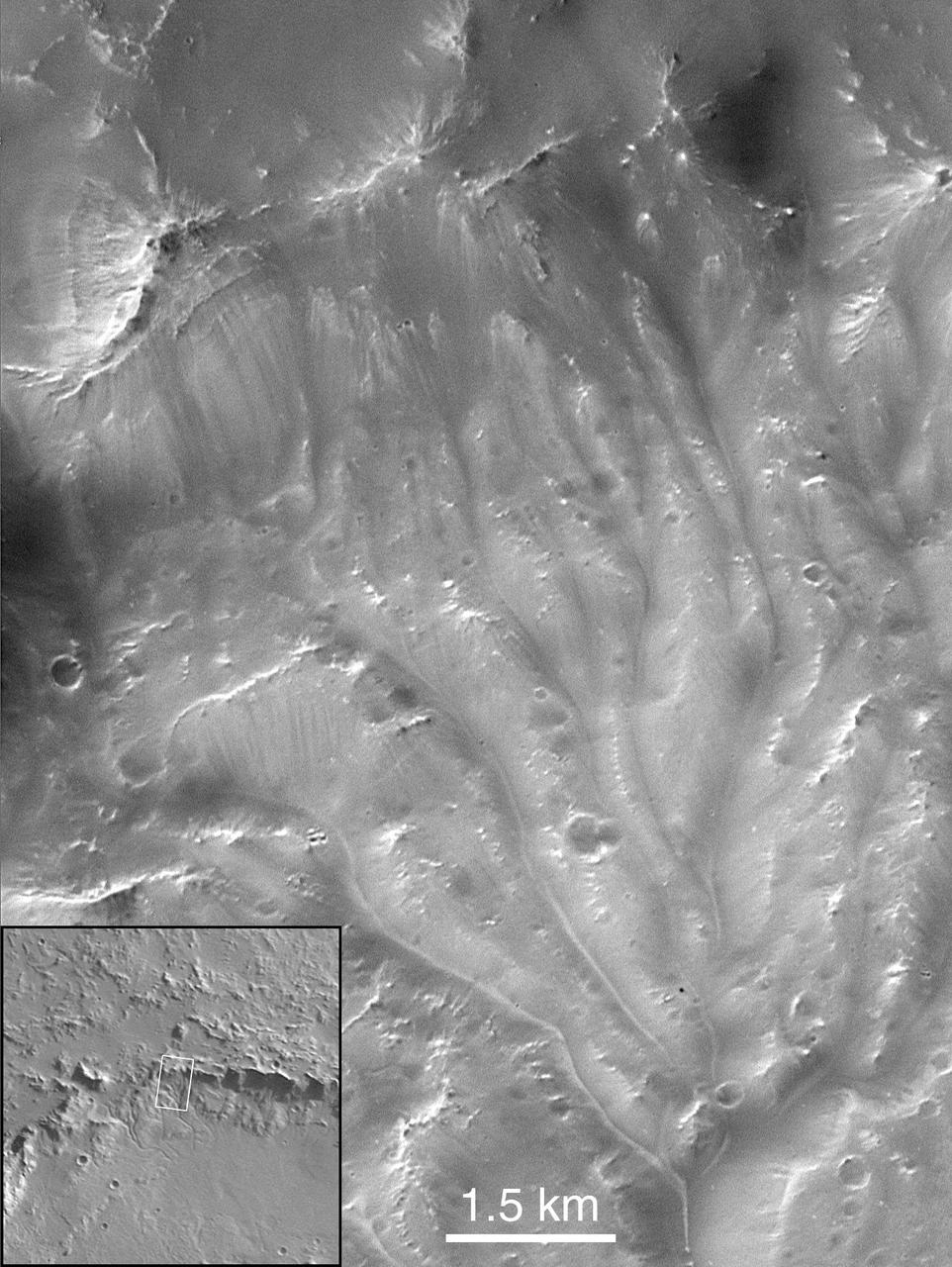
Channels on Bakhuysen Crater Wall
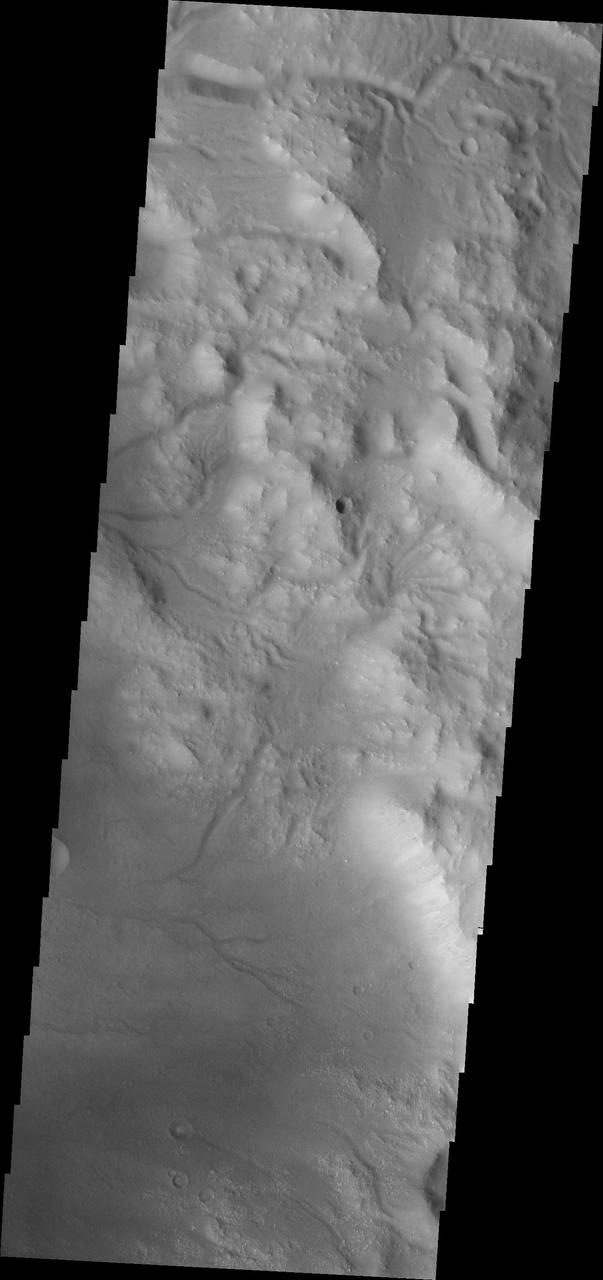
Numerous channels dissect the rim on Bakhuysen Crater from NASA 2001 Mars Odyssey spacecraft.
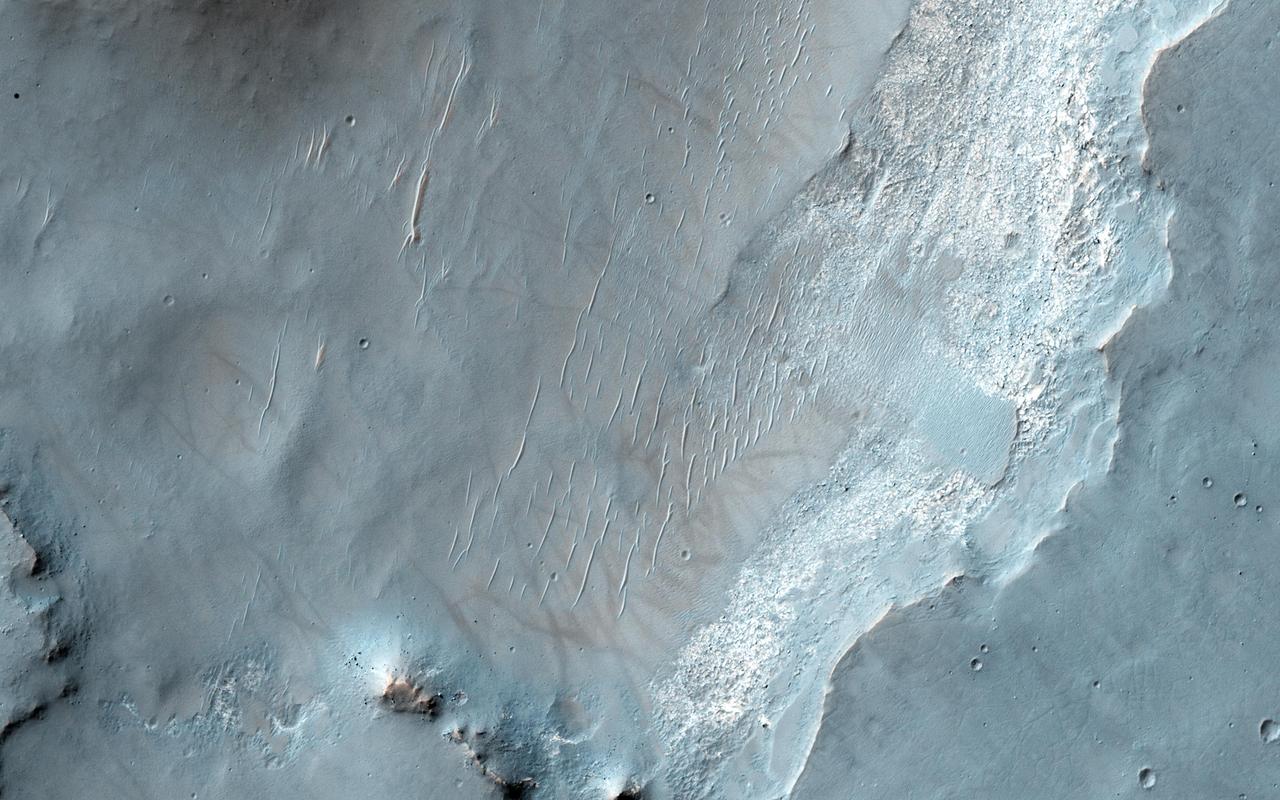
This image from NASA Mars Reconnaissance Orbiter spacecraft shows an exposure of bedrock on the floor of Bakhuysen Crater, an impact crater in Noachis Terra. The bedrock is highly fragmented and fractured.
![The broader scene for this image is the fluidized ejecta from Bakhuysen Crater to the southwest, but there's something very interesting going on here on a much smaller scale. A small impact crater, about 25 meters in diameter, with a gouged-out trench extends to the south. The ejecta (rocky material ejected from the crater) mostly extends to the east and west of the crater. This "butterfly" ejecta is very common for craters formed at low impact angles. Taken together, these observations suggest that the crater-forming impactor came in at a low angle from the north, hit the ground and ejected material to the sides. The top of the impactor may have sheared off ("decapitating" the impactor) and continued downrange, forming the trench. We can't prove that's what happened, but this explanation is consistent with the observations. Regardless of how it formed, it's quite an interesting-looking "dragonfly" crater. The map is projected here at a scale of 50 centimeters (19.69 inches) per pixel. [The original image scale is 55.7 centimeters (21.92 inches) per pixel (with 2 x 2 binning); objects on the order of 167 centimeters (65.7 inches) across are resolved.] North is up. http://photojournal.jpl.nasa.gov/catalog/PIA21454](https://images-assets.nasa.gov/image/PIA21454/PIA21454~medium.jpg)
The broader scene for this image is the fluidized ejecta from Bakhuysen Crater to the southwest, but there's something very interesting going on here on a much smaller scale. A small impact crater, about 25 meters in diameter, with a gouged-out trench extends to the south. The ejecta (rocky material ejected from the crater) mostly extends to the east and west of the crater. This "butterfly" ejecta is very common for craters formed at low impact angles. Taken together, these observations suggest that the crater-forming impactor came in at a low angle from the north, hit the ground and ejected material to the sides. The top of the impactor may have sheared off ("decapitating" the impactor) and continued downrange, forming the trench. We can't prove that's what happened, but this explanation is consistent with the observations. Regardless of how it formed, it's quite an interesting-looking "dragonfly" crater. The map is projected here at a scale of 50 centimeters (19.69 inches) per pixel. [The original image scale is 55.7 centimeters (21.92 inches) per pixel (with 2 x 2 binning); objects on the order of 167 centimeters (65.7 inches) across are resolved.] North is up. http://photojournal.jpl.nasa.gov/catalog/PIA21454
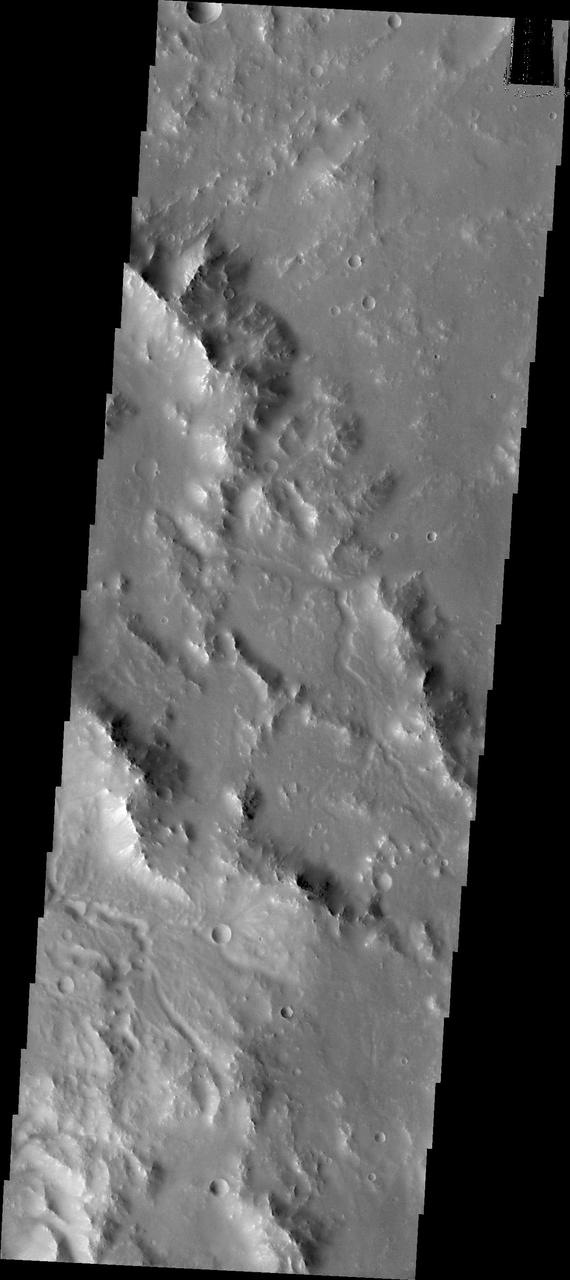
Small channels dissect the rim of Bakhuysen Crater in Noachis Terra as seen by NASA 2001 Mars Odyssey.
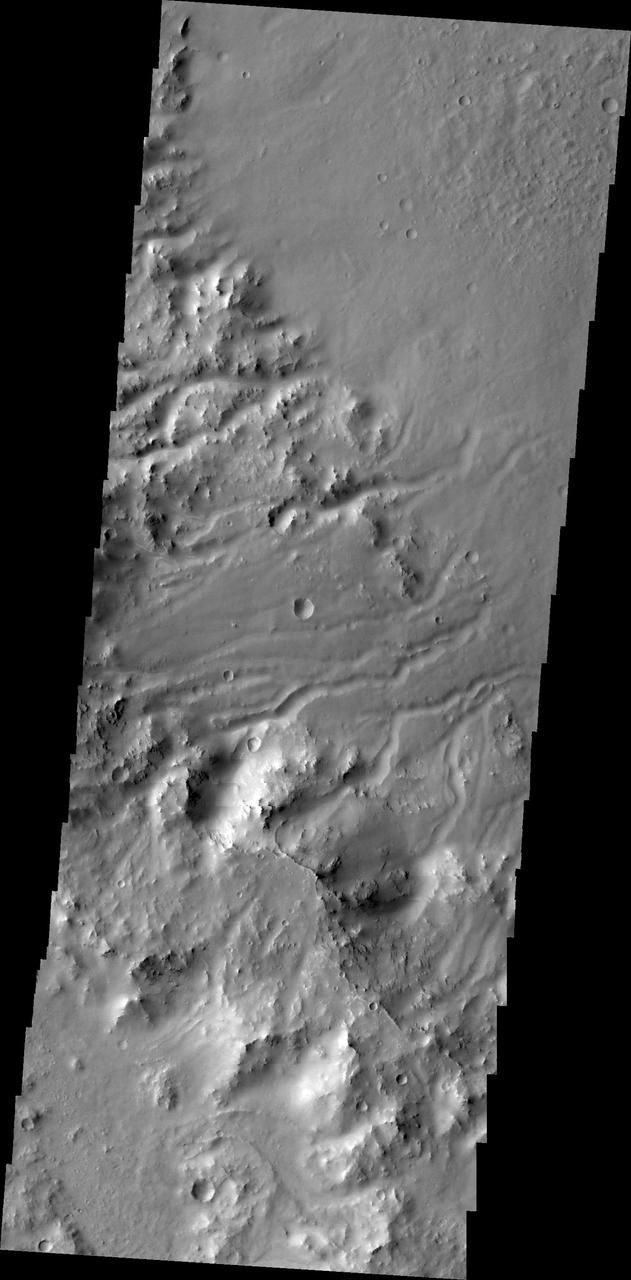
Multiple channels dissect the rim of Bakhuysen Crater in Noachis Terra in this image captured by NASA 2001 Mars Odyssey spacecraft.
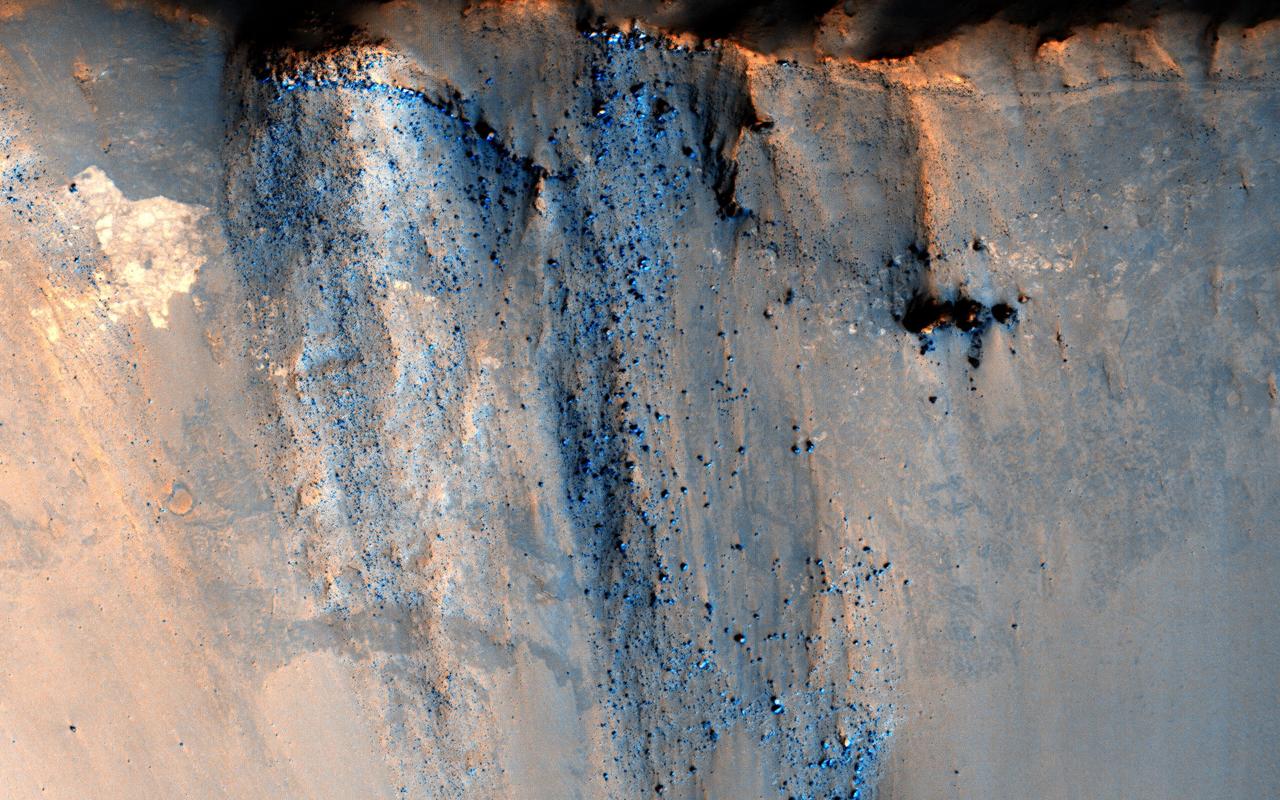
This image captured by NASA Mars Reconnaissance Orbiter spacecraft targets a 3-kilometer diameter crater that occurs within the ejecta blanket of the much older Bakhuysen Crater, a 150-kilometer diameter impact crater in Noachis Terra. Impact craters are interesting because they provide a mechanism to uplift and expose underlying bedrock, allowing for the study of the subsurface and the geologic past. An enhanced color image shows the wall of the crater, which exposes layering as well as blocks of rock. There is a distinctive large block in the upper left of the crater wall, generally referred to as a "mega-block."Â It is an angular, light-toned, highly fragmented block, about 100 meters across. Several smaller light-toned blocks are also in the crater wall, possibly of the same rock type as the "mega-block." Ejecta blocks are thrown outward during the initial excavation of a crater, or are deposited as part of the ground-hugging flows of which the majority of the ejecta blanket is comprised. Through images like these, we are able to study the deeper subsurface of Mars that is not otherwise exposed. http://photojournal.jpl.nasa.gov/catalog/PIA20728