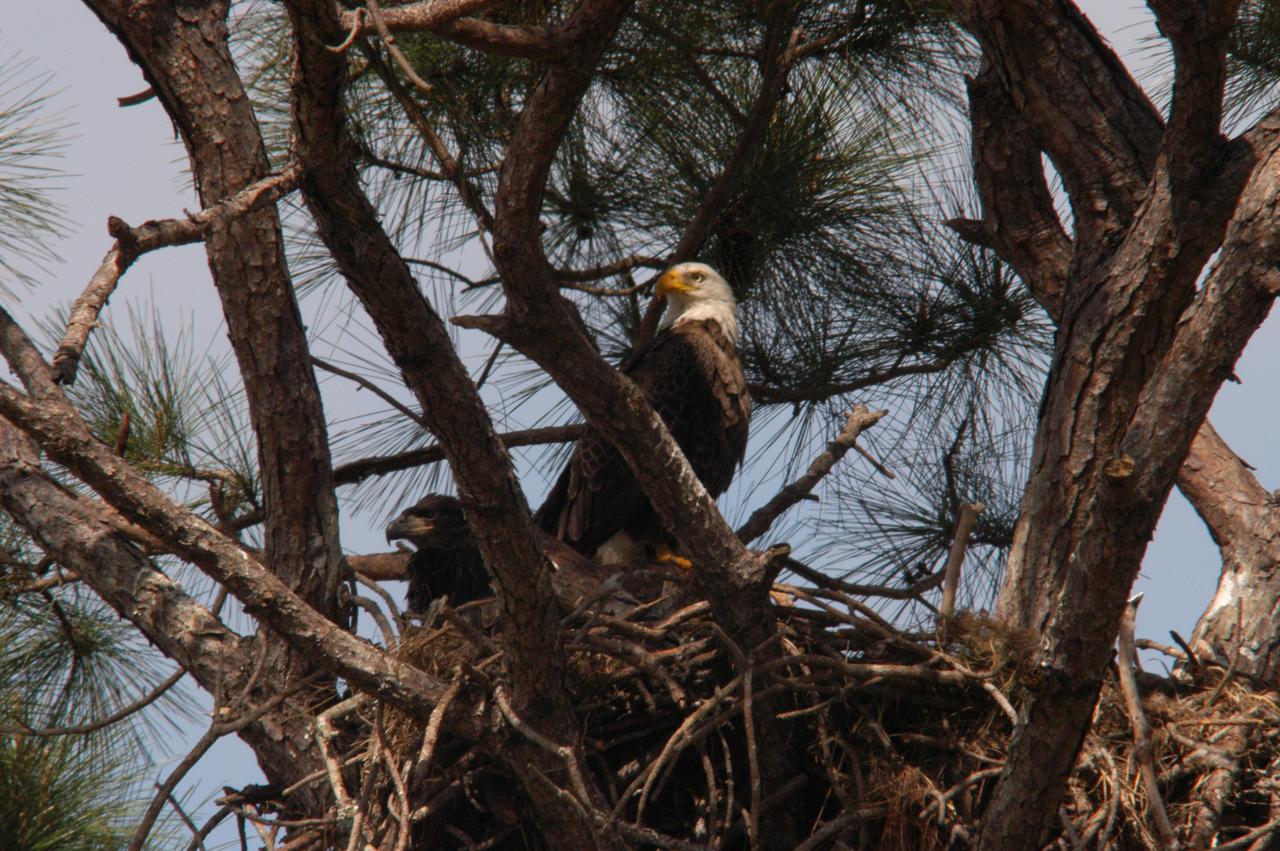
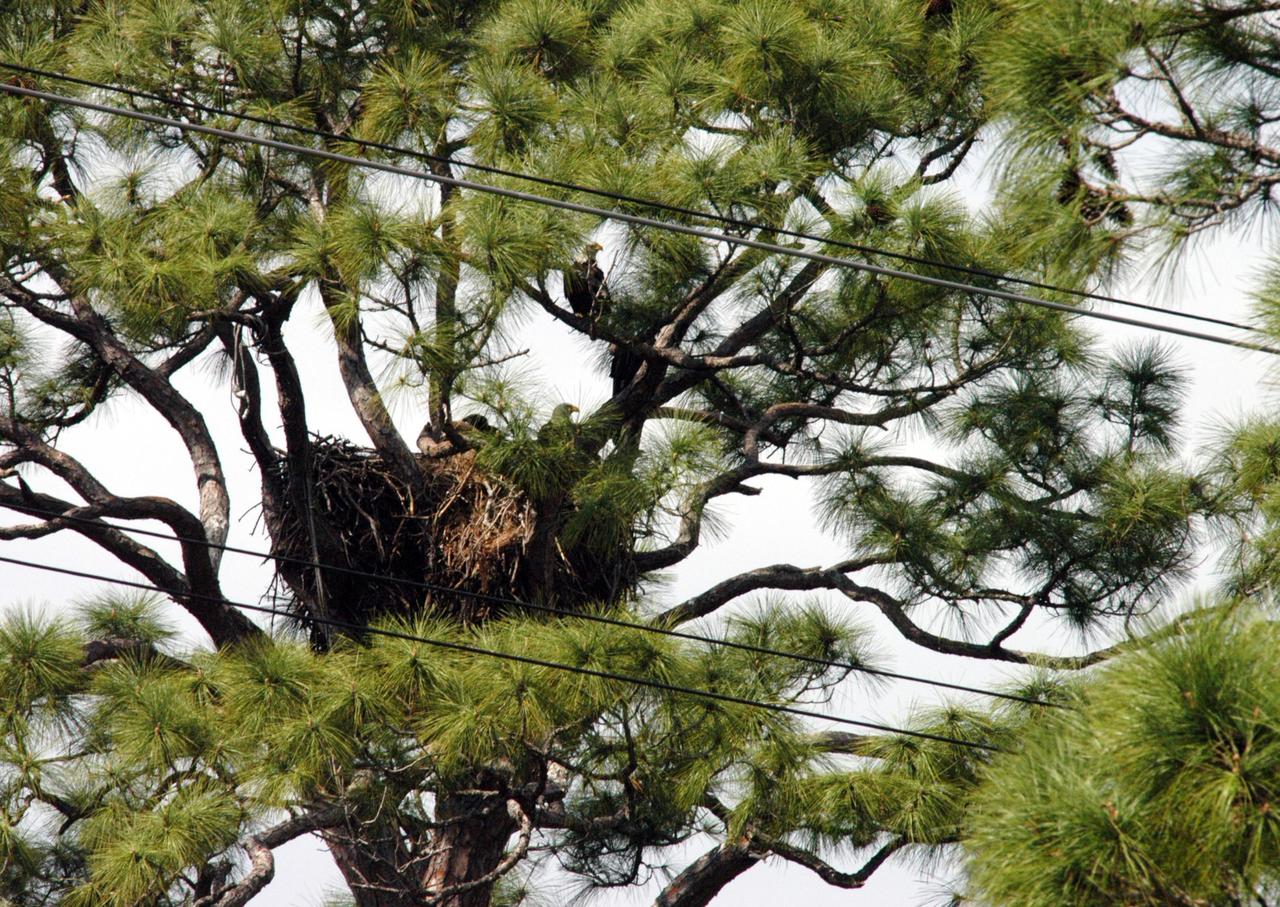
High in a pine tree at NASA's Kennedy Space Center, an adult bald eagle (right) and a fledgling keep watch from their nest. There are approximately a dozen active bald eagle nests both in KSC and in the Merritt Island National Wildlife Refuge, which surrounds KSC. The refuge includes several wading bird rookeries, many osprey nests, up to 400 manatees during the spring, and approximately 2,500 Florida scrub jays. It also is a major wintering area for migratory birds. More than 500 species of wildlife inhabit the refuge, with 15 considered federally threatened or endangered.
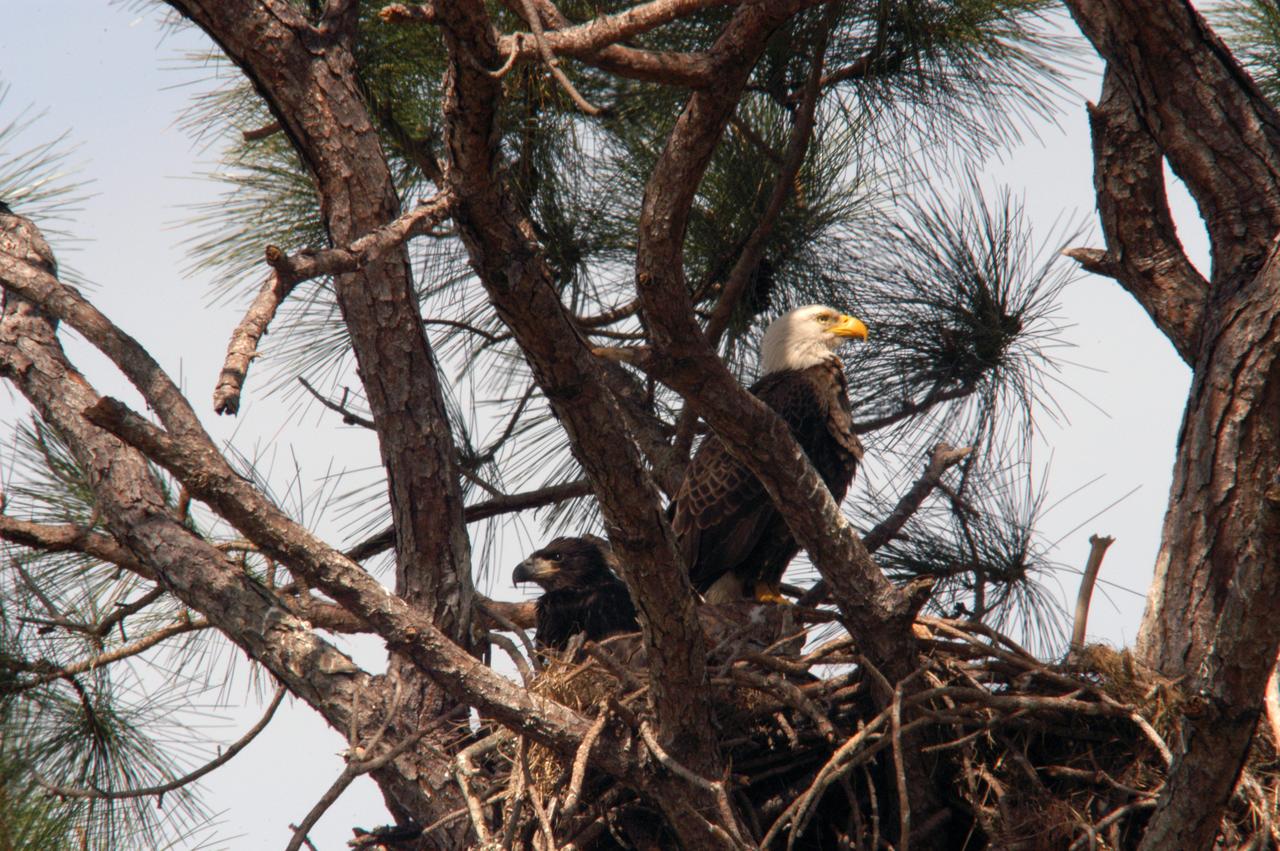
High in a pine tree at NASA's Kennedy Space Center, an adult bald eagle (right) and a fledgling keep watch from their nest. There are approximately a dozen active bald eagle nests both in KSC and in the Merritt Island National Wildlife Refuge, which surrounds KSC. The refuge includes several wading bird rookeries, many osprey nests, up to 400 manatees during the spring, and approximately 2,500 Florida scrub jays. It also is a major wintering area for migratory birds. More than 500 species of wildlife inhabit the refuge, with 15 considered federally threatened or endangered.
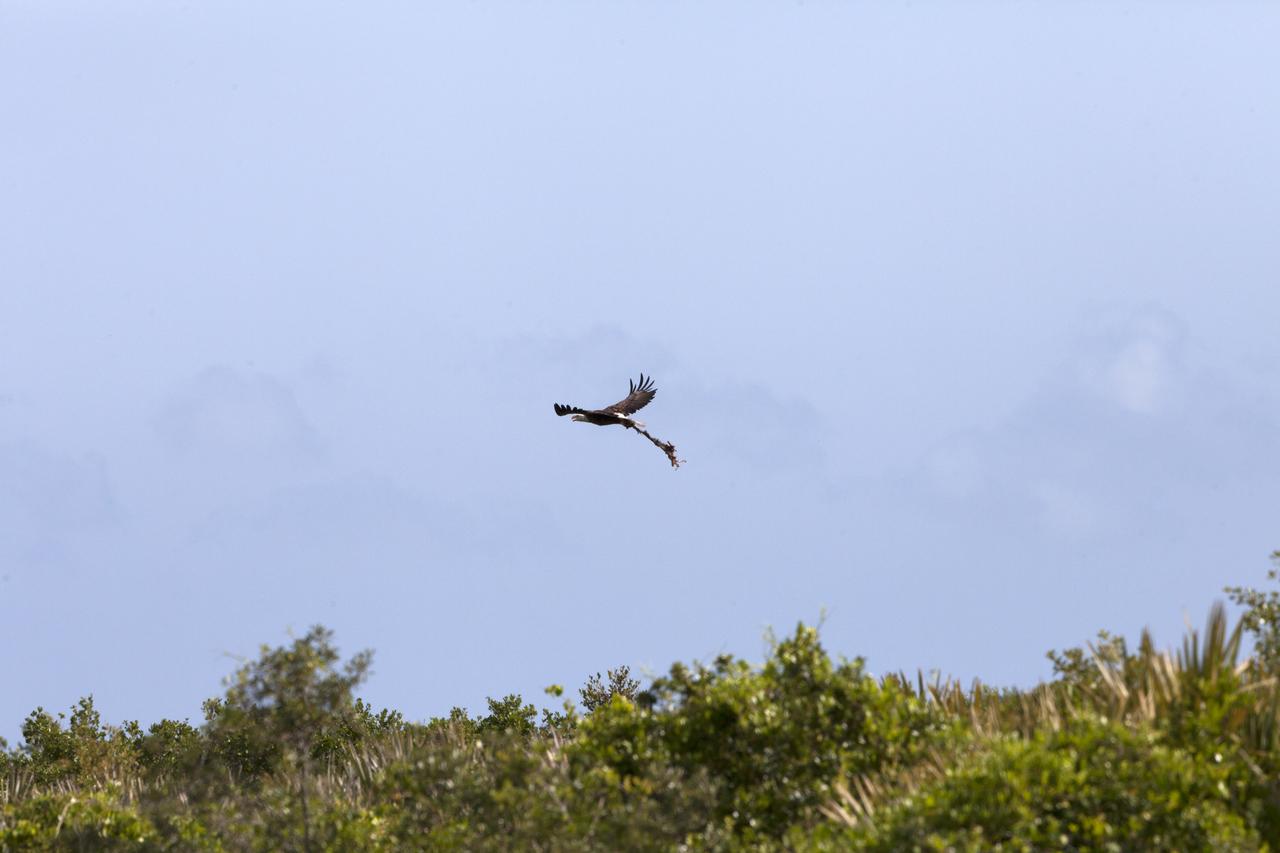
An American bald eagle soars through the air with its prey at NASA's Kennedy Space Center in Florida. The center shares a border with the Merritt Island National Wildlife Refuge. More than 330 native and migratory bird species, 25 mammals, 117 fishes and 65 amphibians and reptiles call Kennedy and the wildlife refuge home.
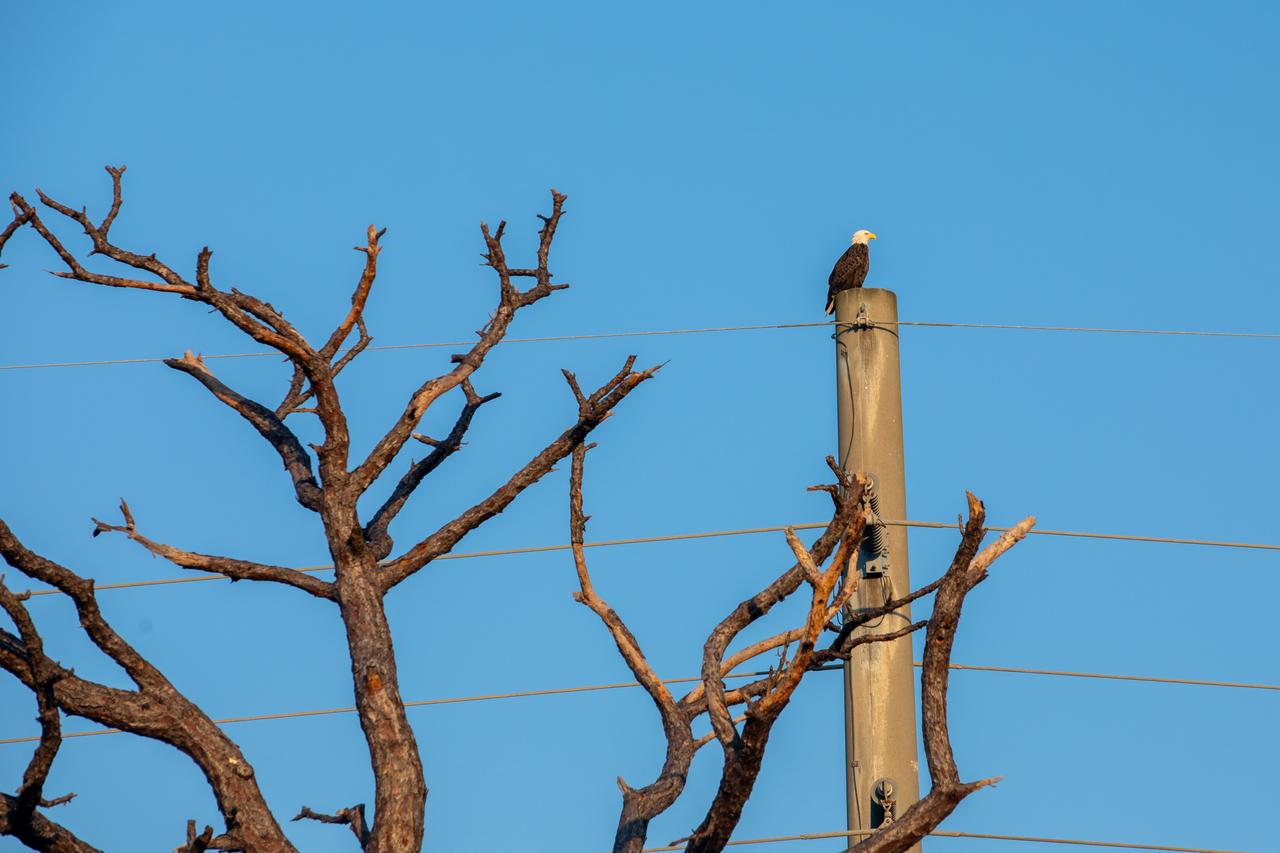
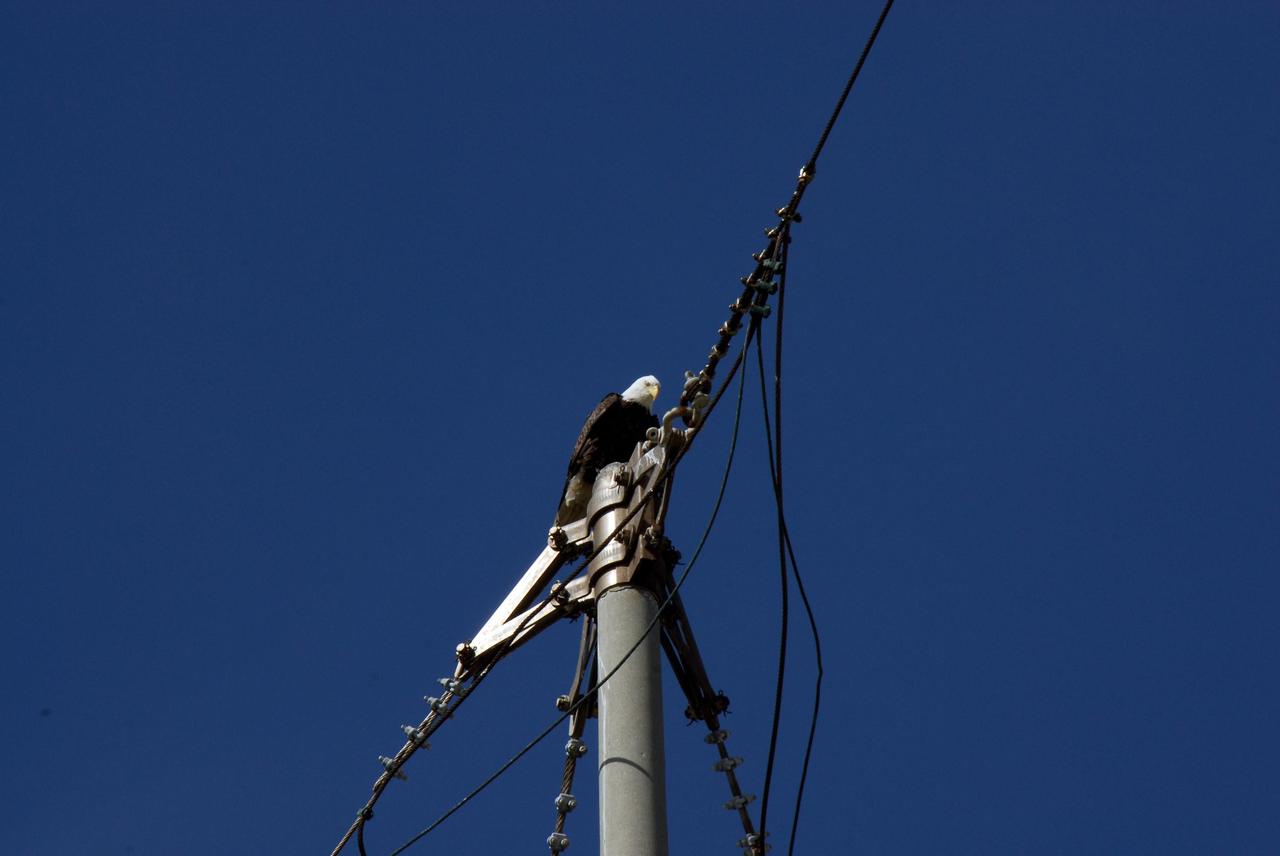
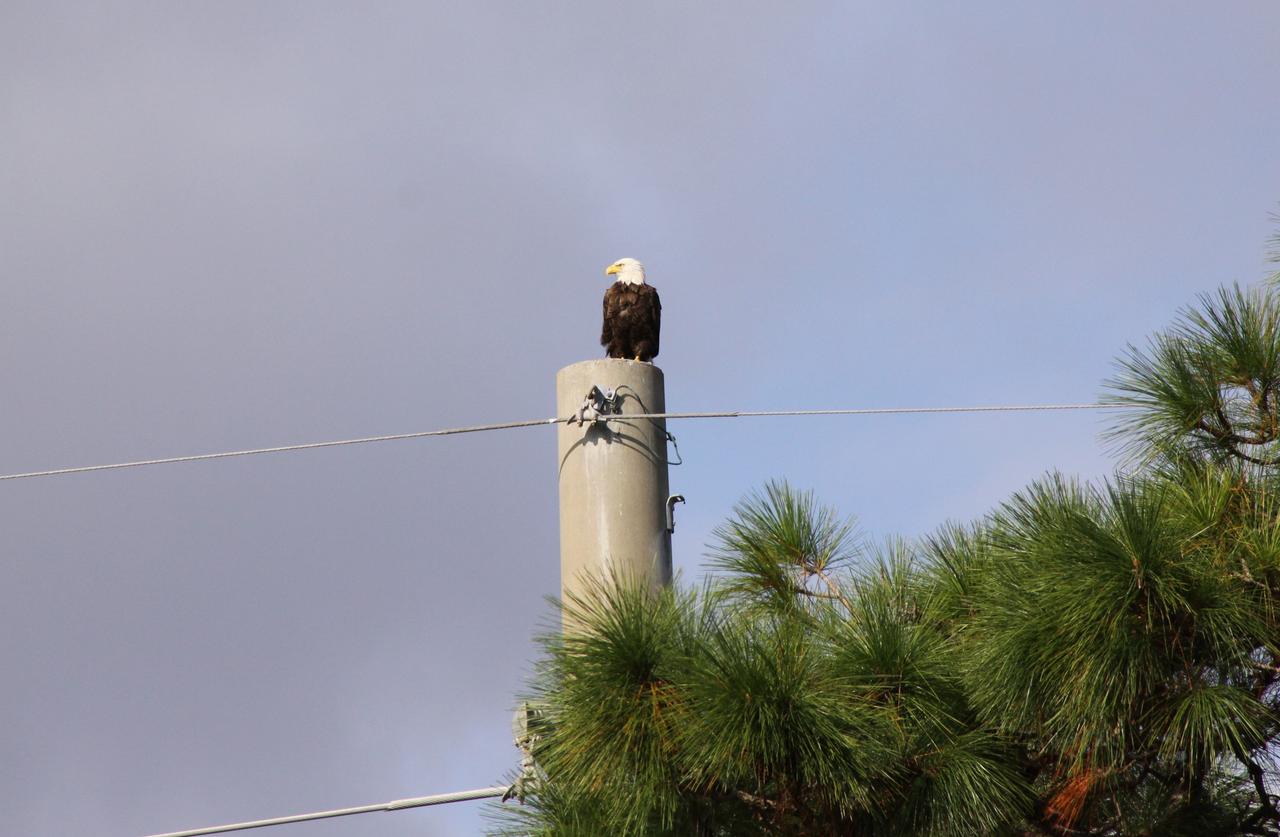
An American bald eagle is perched atop a pole on Wednesday, Sept. 18, 2024, near Kennedy Parkway North, about two miles from the Vehicle Assembly Building at NASA’s Kennedy Space Center in Florida. As of 2023, NASA’s Kennedy is home to 39 eagle territories with 33 of them active or potentially active between the months of September to March. NASA shares a boundary with the Merritt Island National Wildlife Refuge, home to more than 1,500 species of plants and animals, and 15 federally listed species.
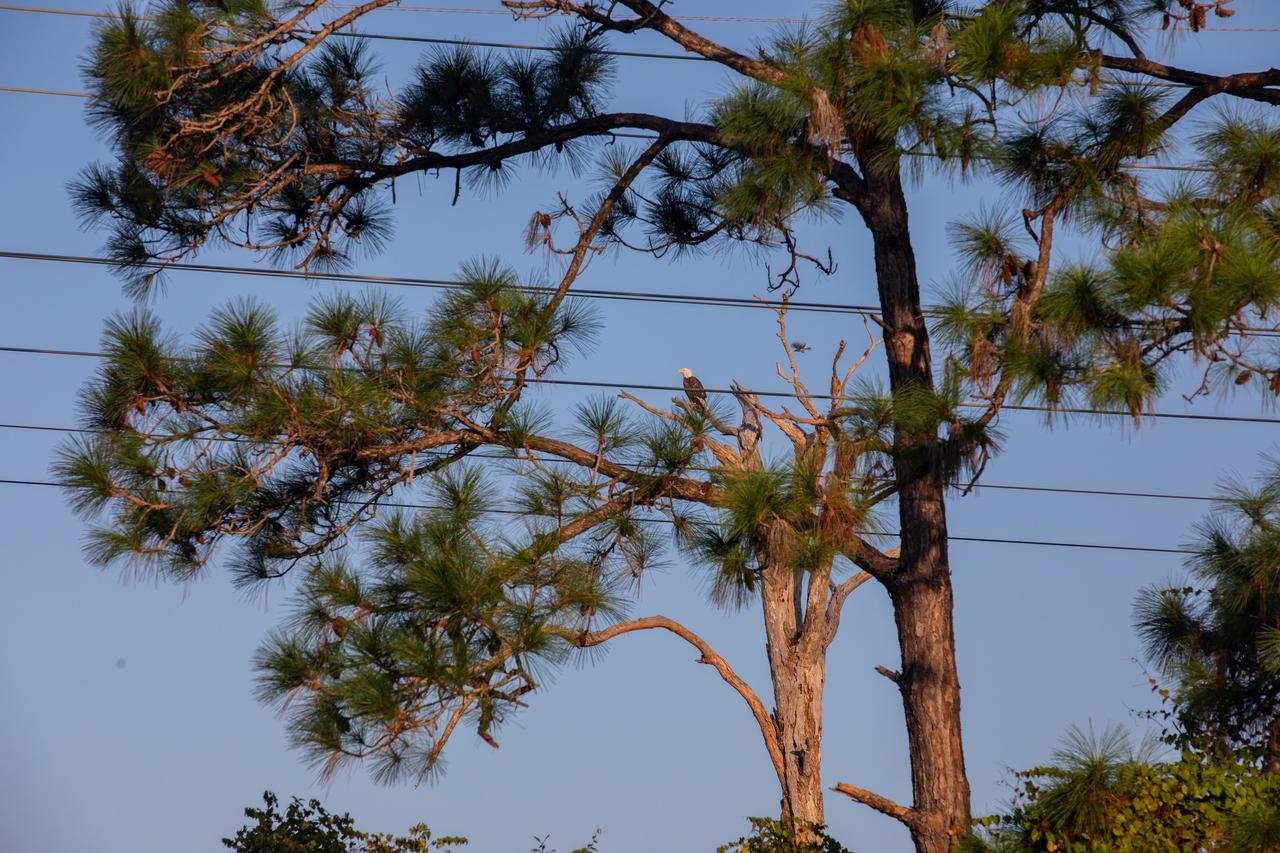
An American bald eagle is perched atop a pole on Wednesday, Sept. 18, 2024, near Kennedy Parkway North, about two miles from the Vehicle Assembly Building at NASA’s Kennedy Space Center in Florida. As of 2023, NASA’s Kennedy is home to 39 eagle territories with 33 of them active or potentially active between the months of September to March. NASA shares a boundary with the Merritt Island National Wildlife Refuge, home to more than 1,500 species of plants and animals, and 15 federally listed species.
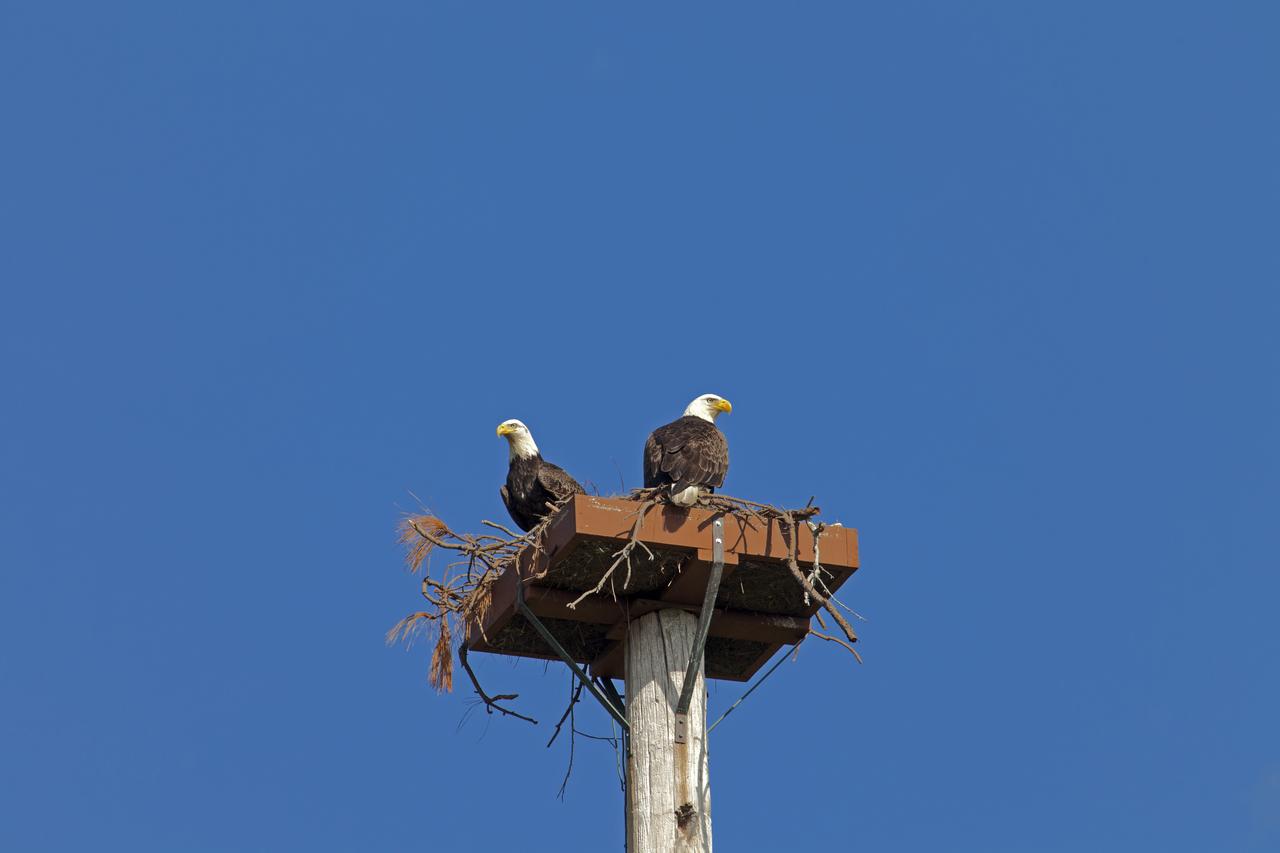
Two American bald eagles are perched in a nest atop a pole at NASA's Kennedy Space Center in Florida. The center shares a border with the Merritt Island National Wildlife Refuge. More than 330 native and migratory bird species, 25 mammals, 117 fishes and 65 amphibians and reptiles call Kennedy and the wildlife refuge home.
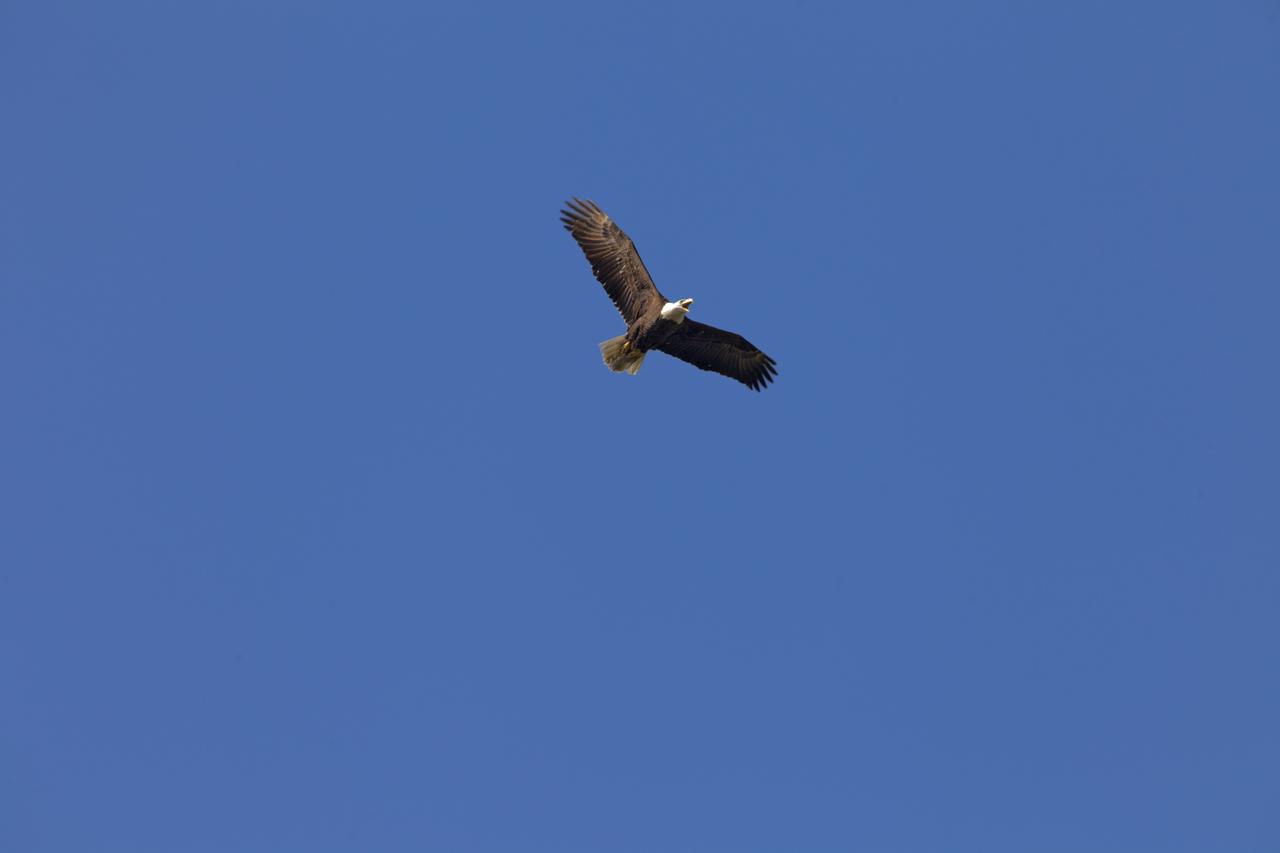
An American bald eagle soars through the air above NASA's Kennedy Space Center in Florida. The center shares a border with the Merritt Island National Wildlife Refuge. More than 330 native and migratory bird species, 25 mammals, 117 fishes and 65 amphibians and reptiles call Kennedy and the wildlife refuge home.
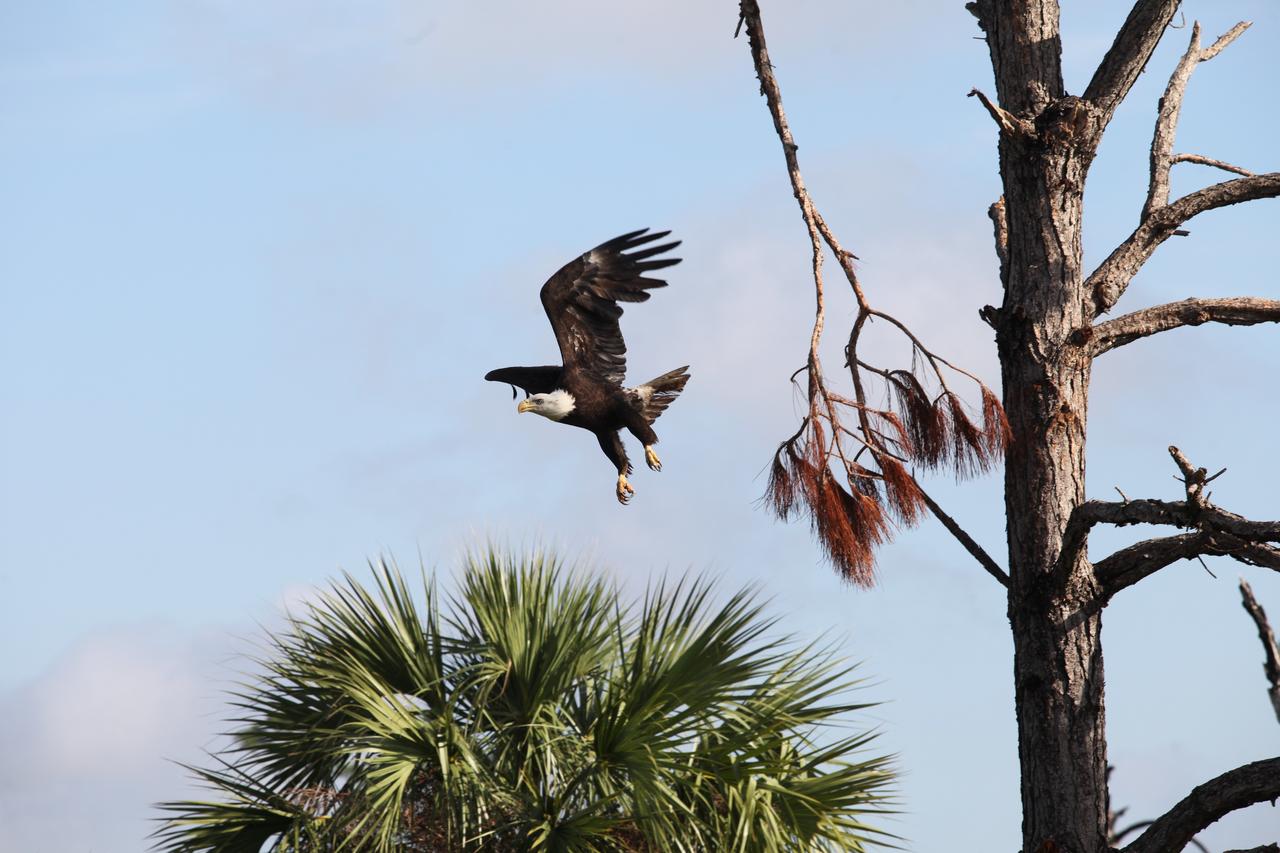
An American bald eagle soars from its perch in a tree at NASA's Kennedy Space Center in Florida. Several eagles call the center home. The center shares a boundary with the Merritt Island National Wildlife Refuge. The refuge is home to more than 65 amphibian and reptile species, along with 330 native and migratory bird species, 25 mammal and 117 fish species.
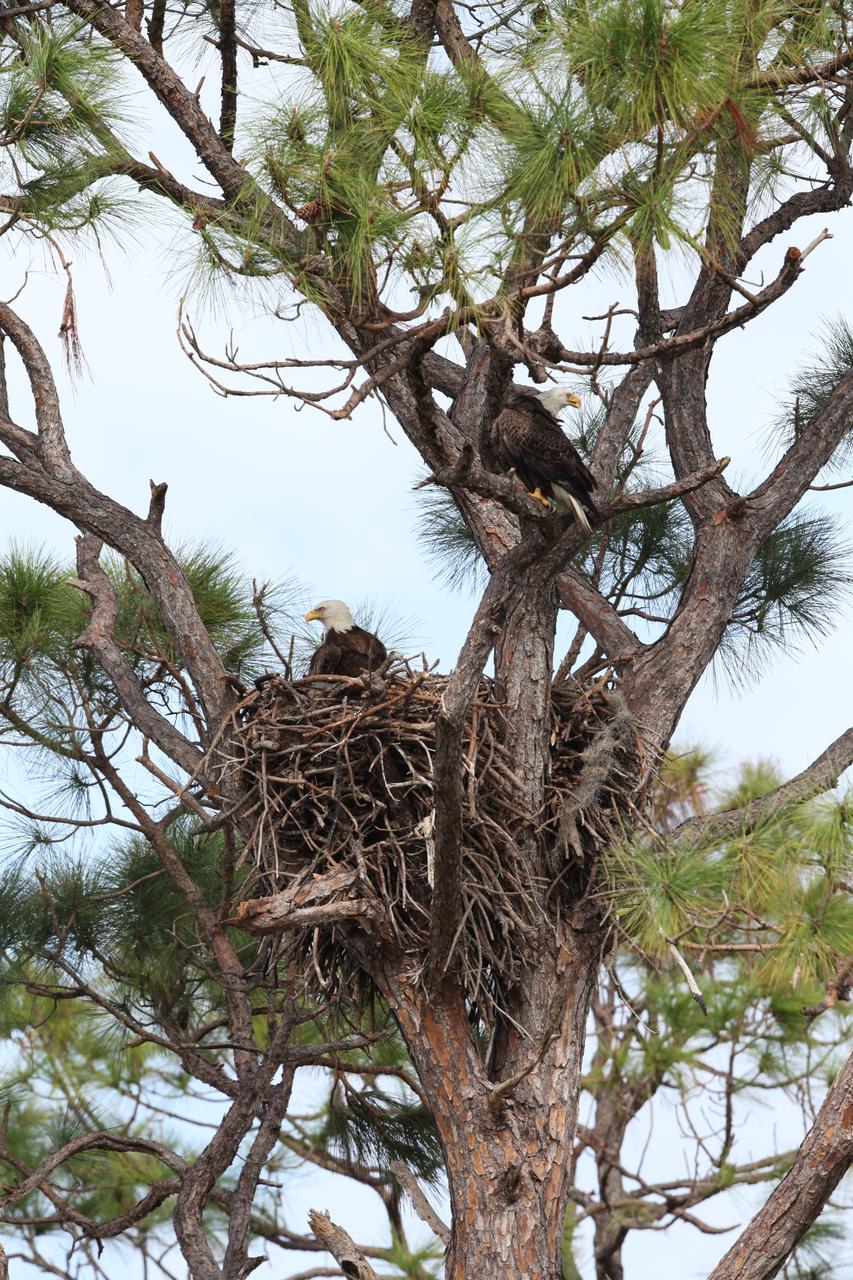
One American bald eagle sits in its nest, while another eagle perches on a branch in tree at NASA's Kennedy Space Center in Florida. The center shares a border with the Merritt Island National Wildlife Refuge. More than 330 native and migratory bird species, 25 mammals, 117 fishes and 65 amphibians and reptiles call Kennedy and the wildlife refuge home.
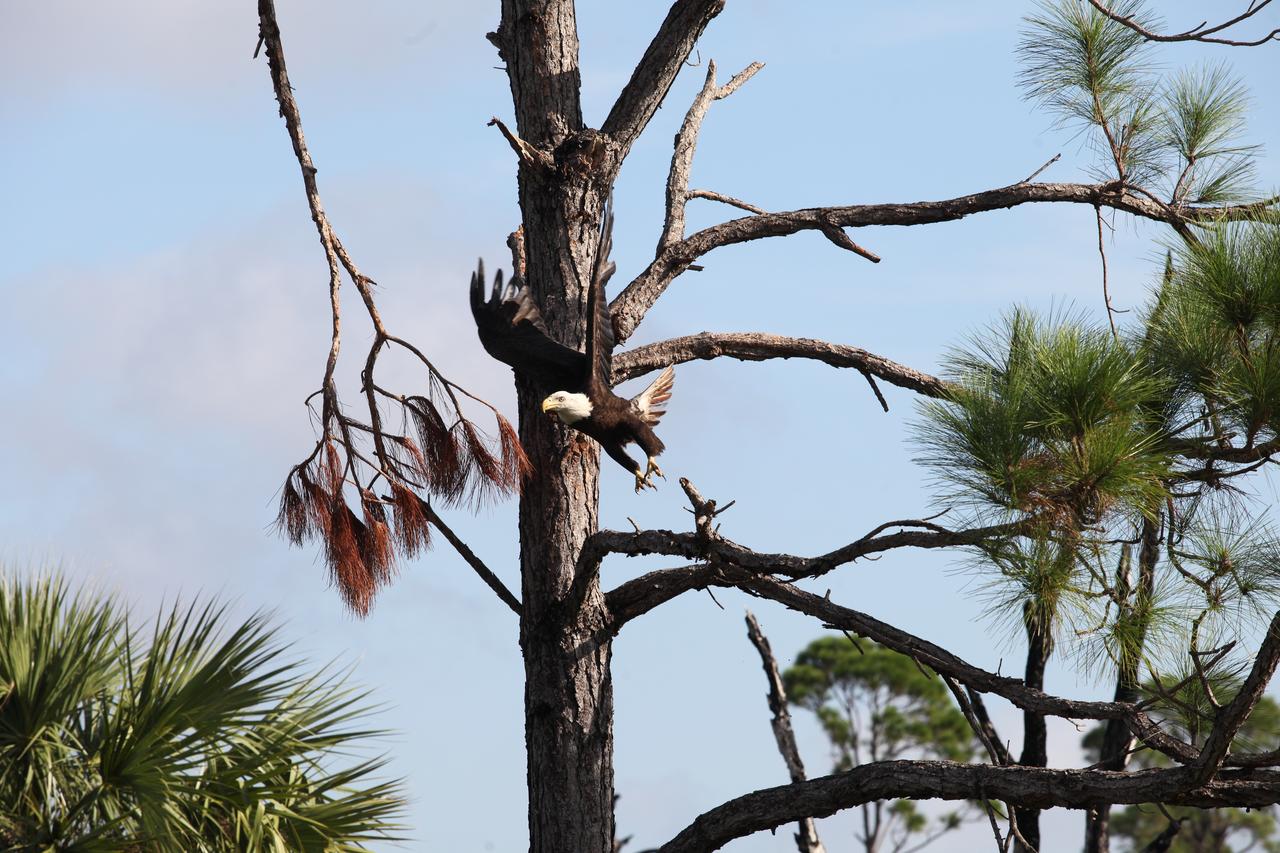
An American bald eagle soars from its perch in a tree at NASA's Kennedy Space Center in Florida. Several eagles call the center home. The center shares a boundary with the Merritt Island National Wildlife Refuge. The refuge is home to more than 65 amphibian and reptile species, along with 330 native and migratory bird species, 25 mammal and 117 fish species.
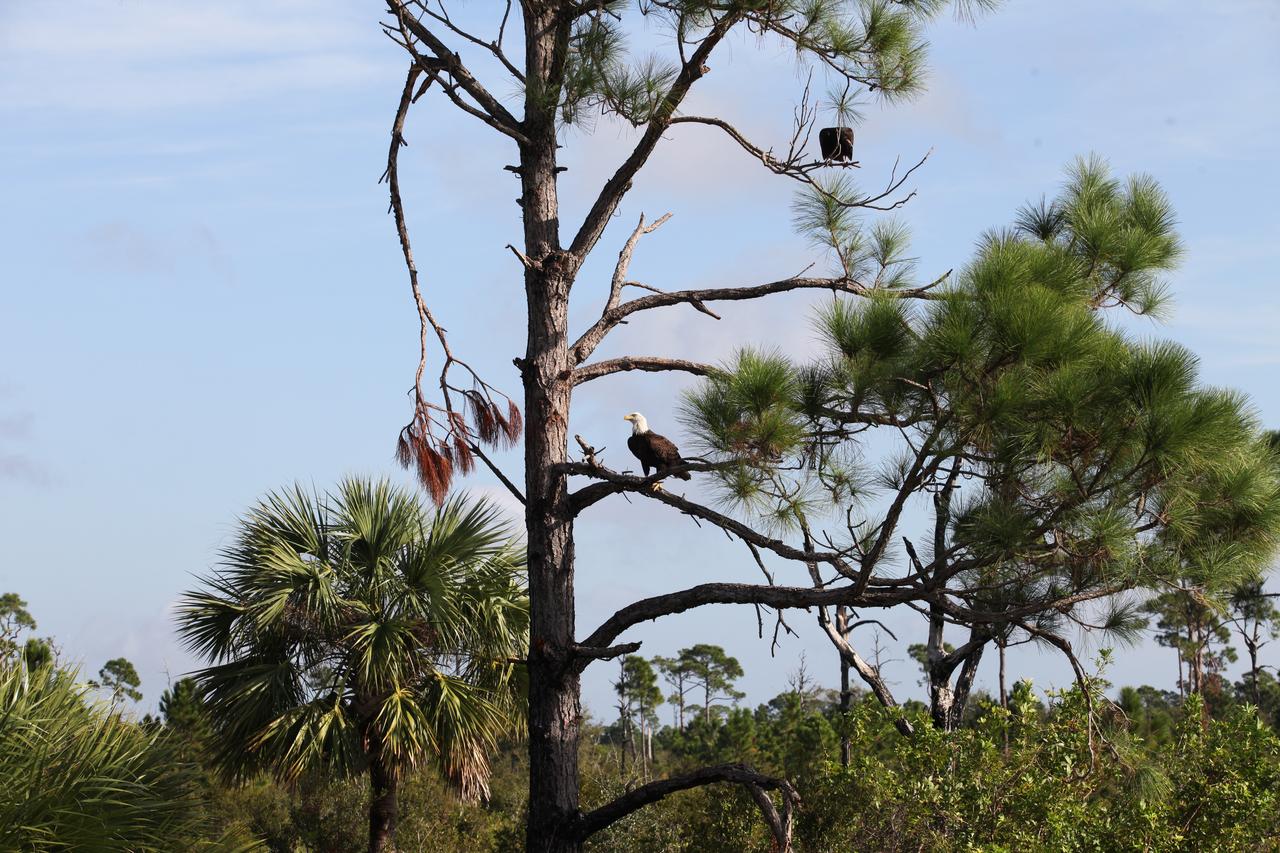
An American bald eagle perches in a tree at NASA's Kennedy Space Center in Florida. Several eagles call the center home. The center shares a boundary with the Merritt Island National Wildlife Refuge. The refuge is home to more than 65 amphibian and reptile species, along with 330 native and migratory bird species, 25 mammal and 117 fish species.
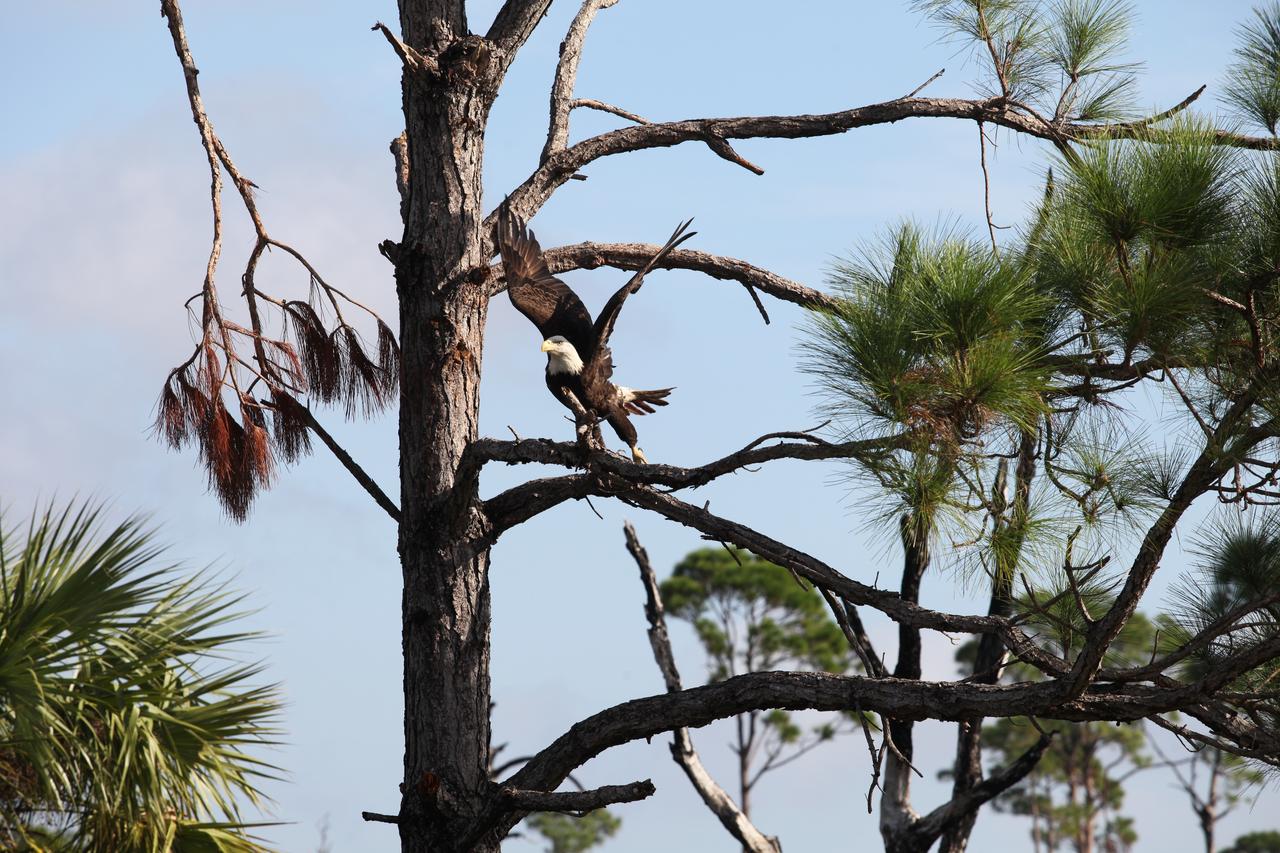
An American bald eagle begins to soar from its perch in a tree at NASA's Kennedy Space Center in Florida. Several eagles call the center home. The center shares a boundary with the Merritt Island National Wildlife Refuge. The refuge is home to more than 65 amphibian and reptile species, along with 330 native and migratory bird species, 25 mammal and 117 fish species.
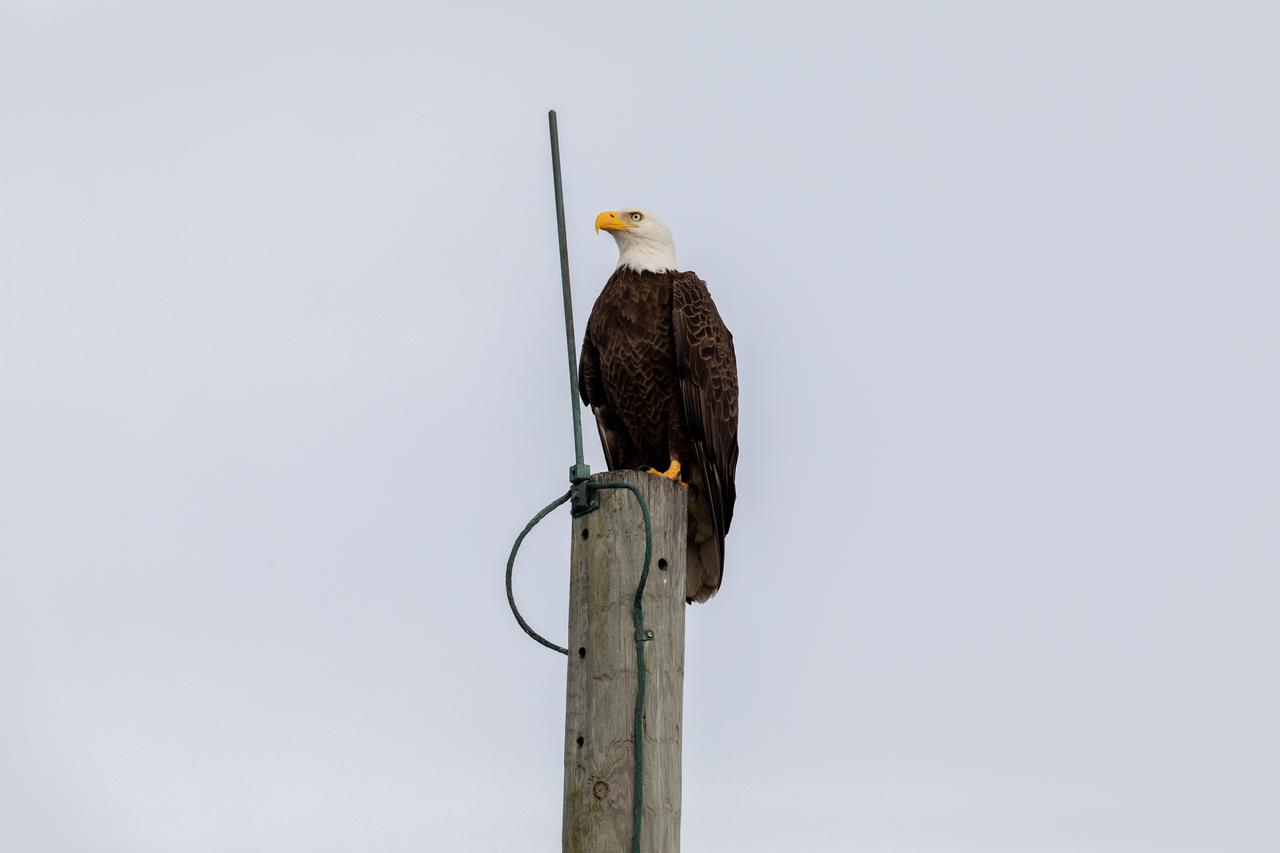
An American bald eagle perches on top of a telephone pole at NASA’s Kennedy Space Center in Florida. Kennedy shares a border with the Merritt Island National Wildlife Refuge, consisting of 140,000 acres of land, water, and marshes. Within the refuge, many species of birds, reptiles, fish, amphibians, and mammals can be found.
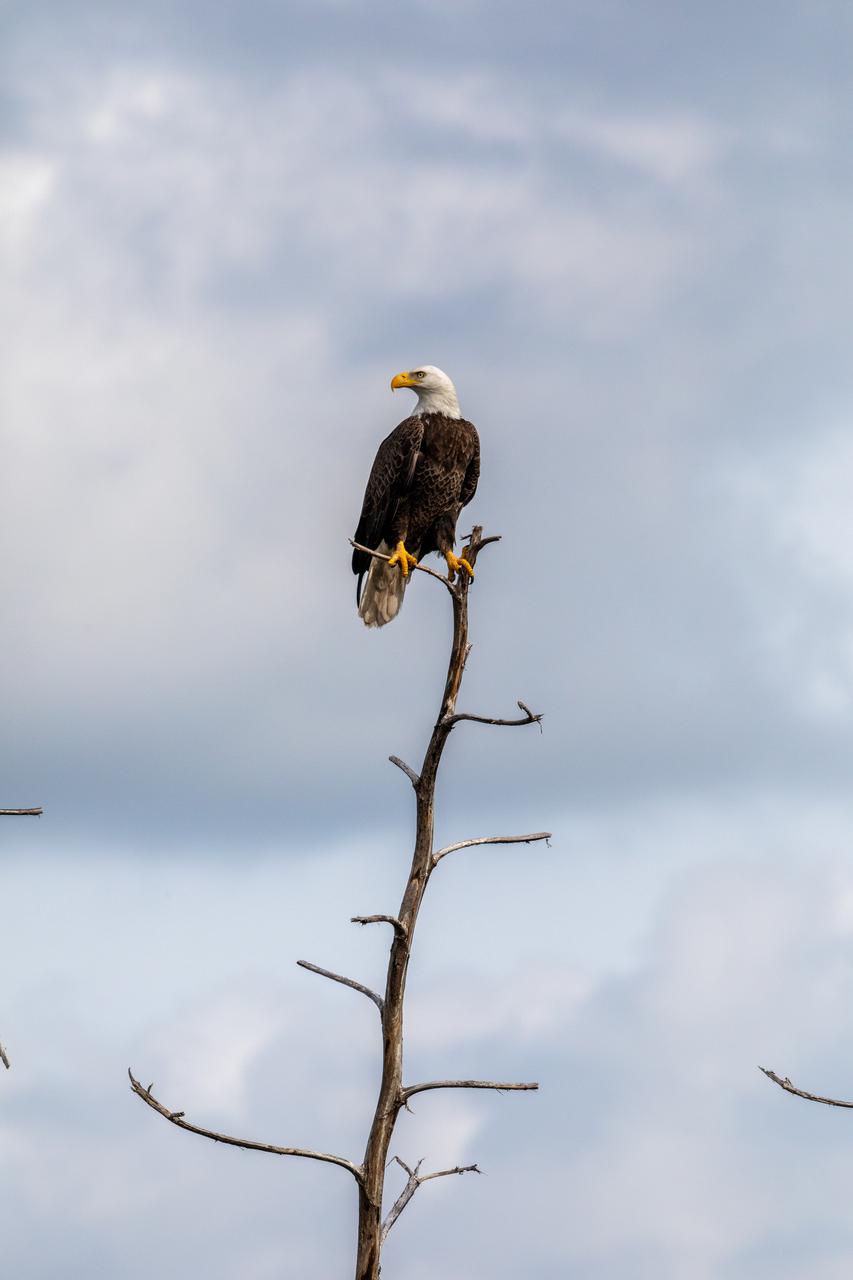
An American bald eagle perches on a tree branch at NASA’s Kennedy Space Center in Florida. Kennedy shares a border with the Merritt Island National Wildlife Refuge, consisting of 140,000 acres of land, water, and marshes. Within the refuge, many species of birds, reptiles, fish, amphibians, and mammals can be found.
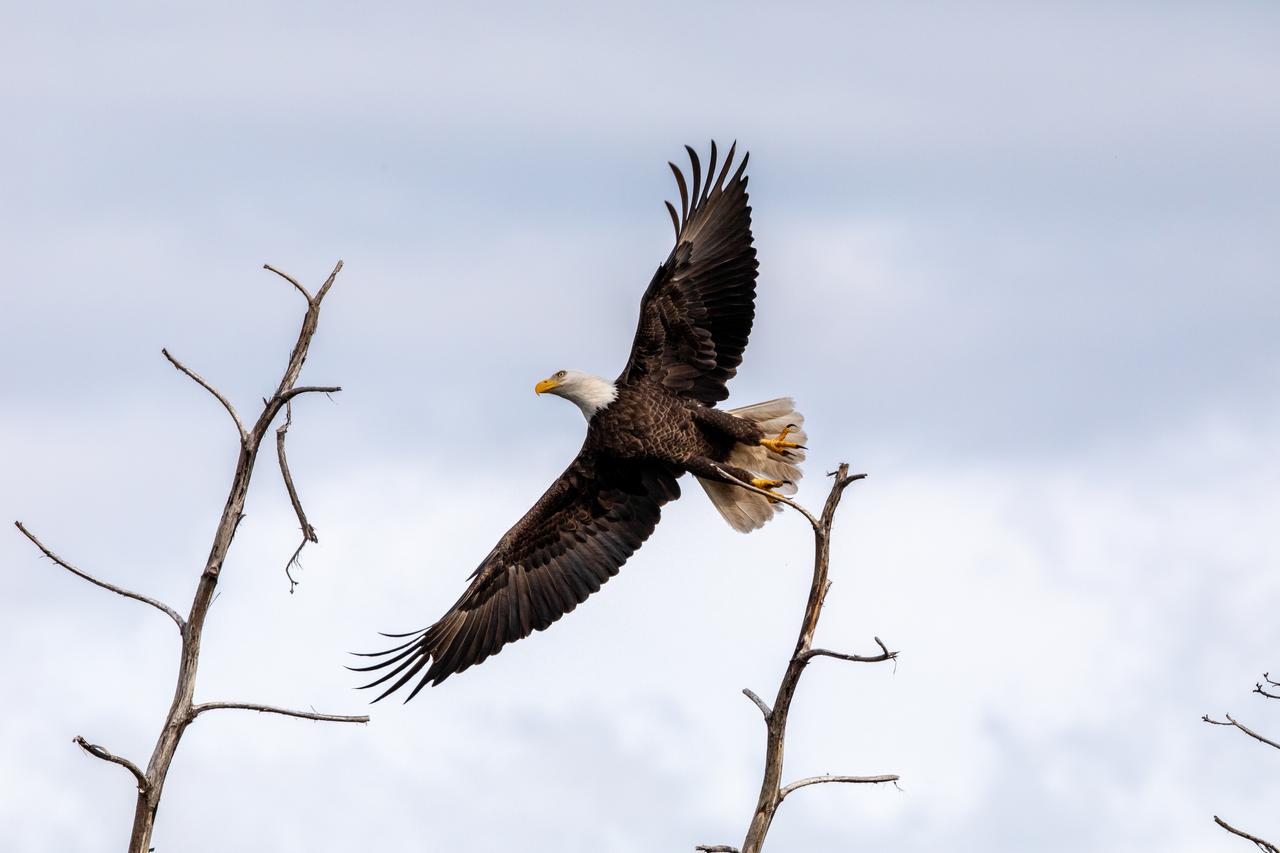
An American bald eagle takes flight after resting on a tree branch at NASA’s Kennedy Space Center in Florida. Kennedy shares a border with the Merritt Island National Wildlife Refuge, consisting of 140,000 acres of land, water, and marshes. Within the refuge, many species of birds, reptiles, fish, amphibians, and mammals can be found.
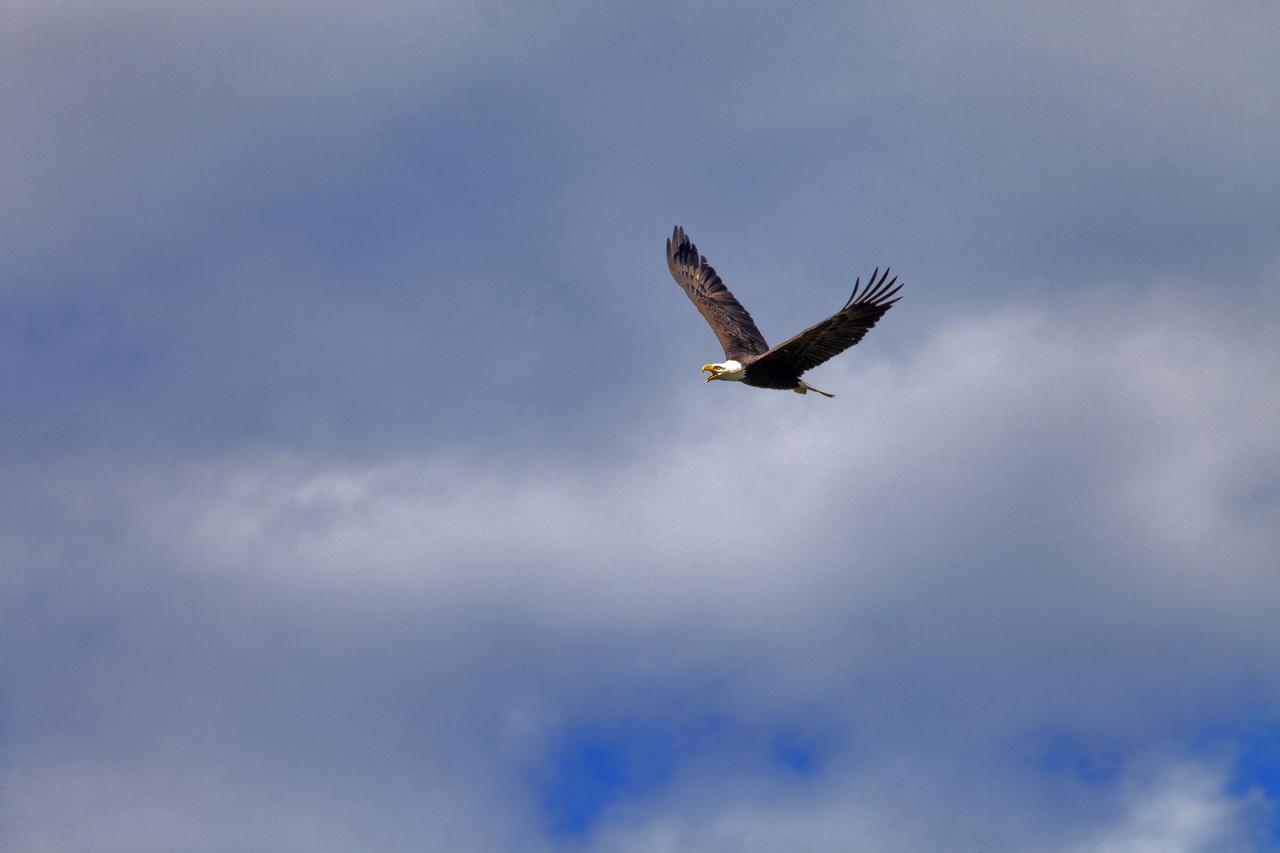
An American bald eagle soars through the air above NASA's Kennedy Space Center in Florida. The center shares a border with the Merritt Island National Wildlife Refuge. The bird is one of more than 330 native and migratory bird species, 25 mammals, 117 fishes and 65 amphibians and reptiles that call Kennedy and the wildlife refuge home.
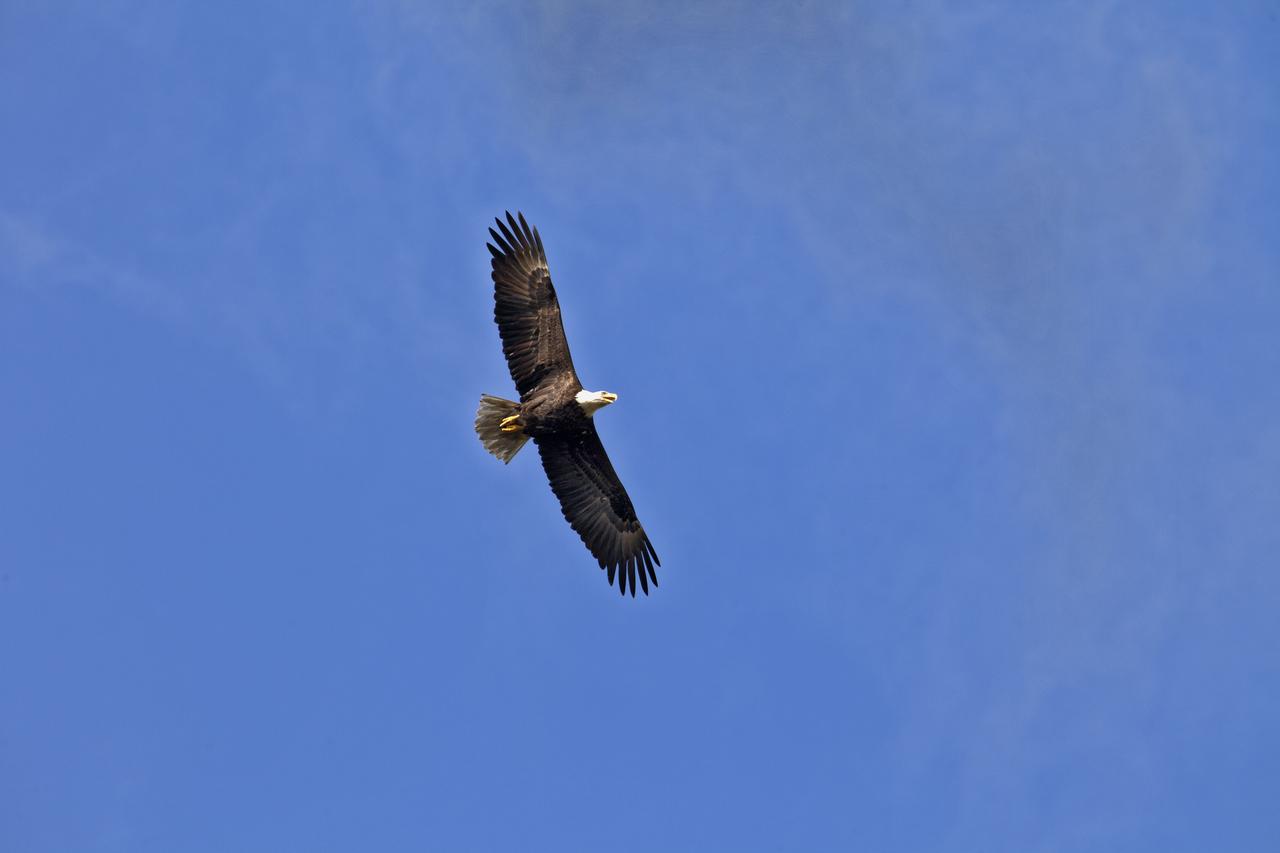
With wings outstretched, an American bald eagle soars through the air above NASA's Kennedy Space Center in Florida. The center shares a border with the Merritt Island National Wildlife Refuge. The bird is one of more than 330 native and migratory bird species, 25 mammals, 117 fishes and 65 amphibians and reptiles that call Kennedy and the wildlife refuge home.
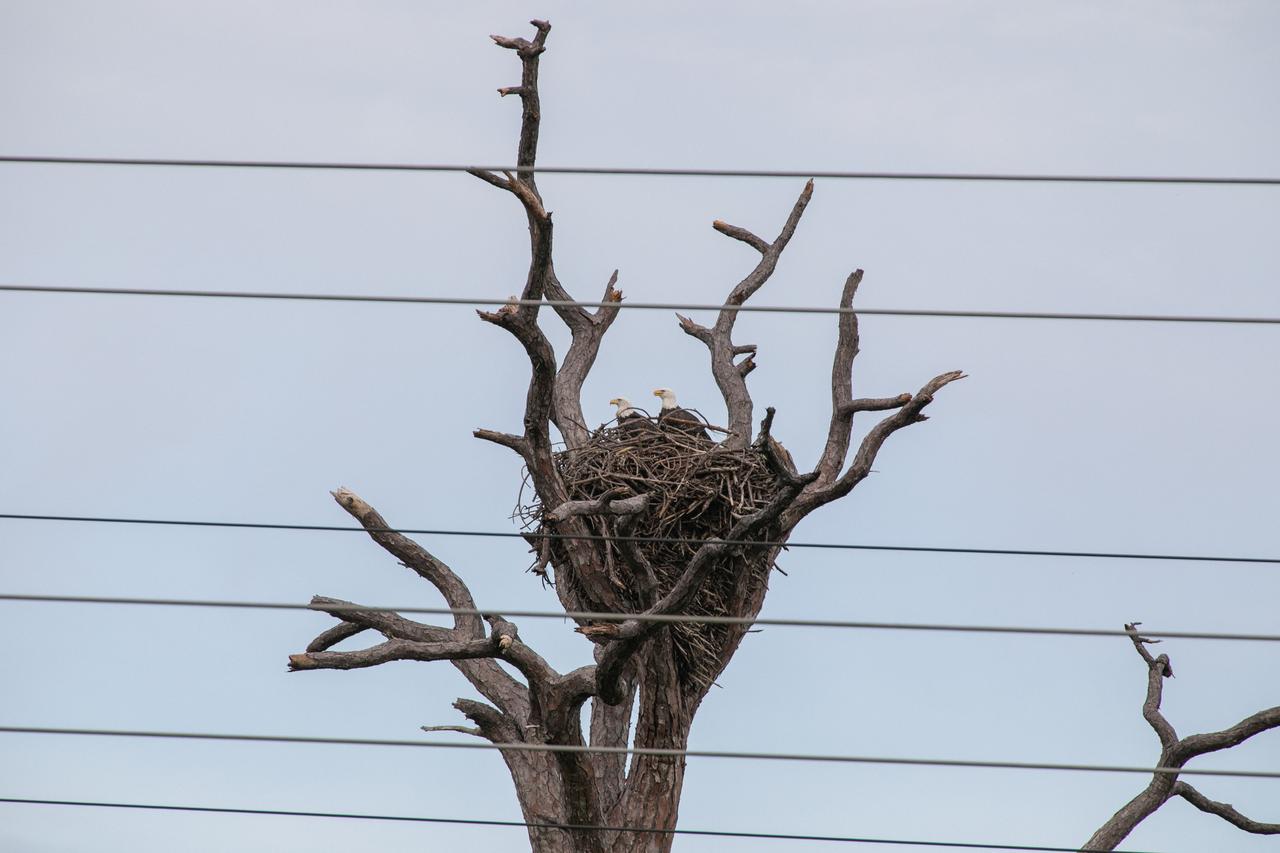
A pair of American bald eagles occupy a large nest on Kennedy Space Center property in Florida on Sept. 14, 2020. Eagles reuse the same nests each season for several years; once a nest is unusable, the majestic birds will select another tree. The nest shown has been used for approximately 30 years. Kennedy shares boundaries with the Merritt Island National Wildlife Refuge, which covers approximately 144,000 acres and is home to more than 315 native and migratory bird species, 25 mammal species, and 65 amphibian and reptile species.
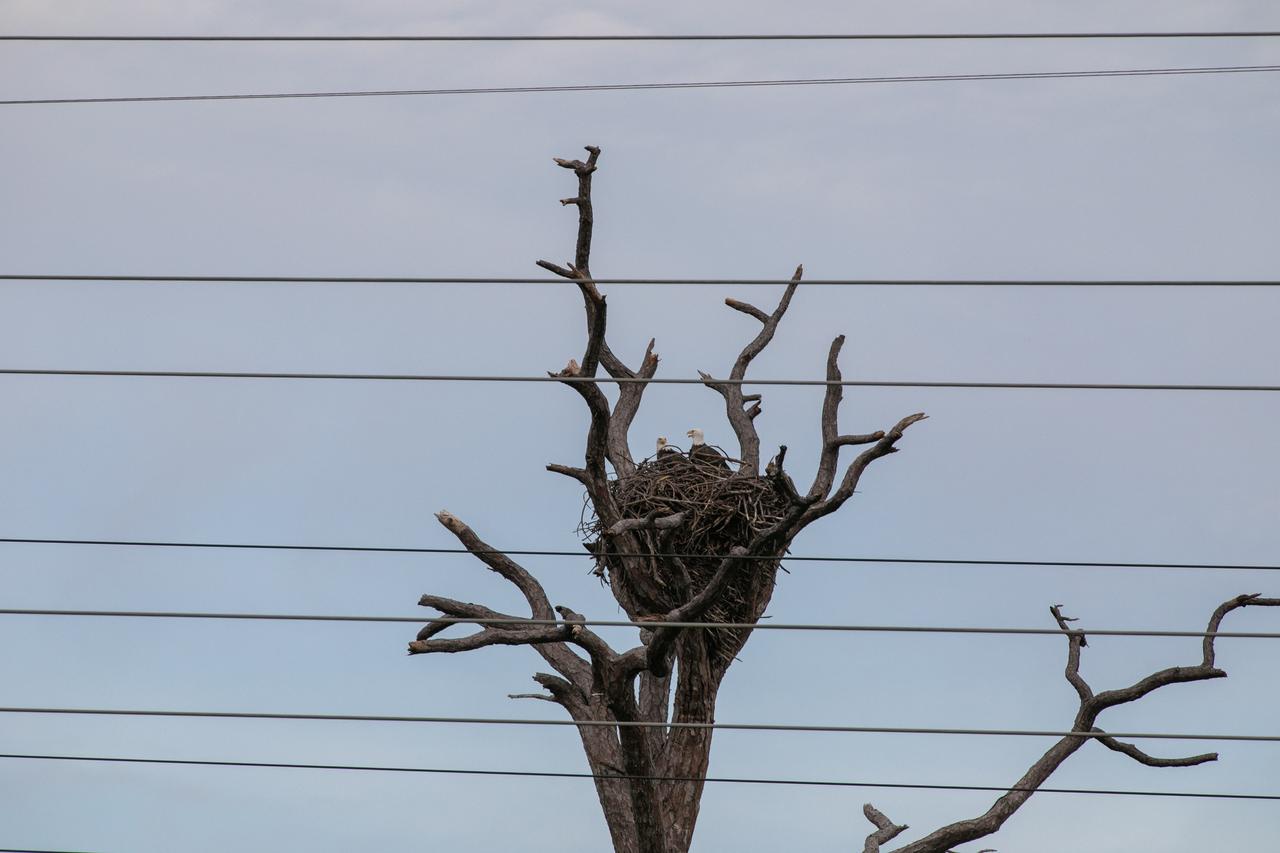
A pair of American bald eagles occupy a large nest on Kennedy Space Center property in Florida on Sept. 14, 2020. Eagles reuse the same nests each season for several years; once a nest is unusable, the majestic birds will select another tree. The nest shown has been used for approximately 30 years. Kennedy shares boundaries with the Merritt Island National Wildlife Refuge, which covers approximately 144,000 acres and is home to more than 315 native and migratory bird species, 25 mammal species, and 65 amphibian and reptile species.

From top left, an American bald eagle sits perched on a tree branch, another eaglet sits on a tree branch (bottom left), while an eaglet and a bald eagle sit in their nest at NASA’s Kennedy Space Center in Florida on Friday, March 13, 2026. Bald eagle nesting surveys across NASA Kennedy, Merritt Island National Wildlife Refuge, and Canaveral National Seashore are conducted annually to document the number of bald eagle active and inactive nests in support of wildlife management and regulatory compliance. Each year, eagles take up winter residence at the Florida spaceport, breeding and raising a new generation.

Two American bald eagles sit perched on a tree branch while two eaglets sit in their nest at NASA’s Kennedy Space Center in Florida on Friday, March 13, 2026. Bald eagle nesting surveys across NASA Kennedy, Merritt Island National Wildlife Refuge, and Canaveral National Seashore are conducted annually to document the number of bald eagle active and inactive nests in support of wildlife management and regulatory compliance. Each year, eagles take up winter residence at the Florida spaceport, breeding and raising a new generation.

An American bald eagles flies away from their nest and tree at NASA’s Kennedy Space Center in Florida on Friday, March 13, 2026. Bald eagle nesting surveys across NASA Kennedy, Merritt Island National Wildlife Refuge, and Canaveral National Seashore are conducted annually to document the number of bald eagle active and inactive nests in support of wildlife management and regulatory compliance. Each year, eagles take up winter residence at the Florida spaceport, breeding and raising a new generation.

An American bald eagle prepares to feed two eaglets in their nest at NASA’s Kennedy Space Center in Florida on Friday, March 13, 2026. Bald eagle nesting surveys across NASA Kennedy, Merritt Island National Wildlife Refuge, and Canaveral National Seashore are conducted annually to document the number of bald eagle active and inactive nests in support of wildlife management and regulatory compliance. Each year, eagles take up winter residence at the Florida spaceport, breeding and raising a new generation.

Two American bald eagles sit perched on a tree branch while two eaglets sit in their nest at NASA’s Kennedy Space Center in Florida on Friday, March 13, 2026. Bald eagle nesting surveys across NASA Kennedy, Merritt Island National Wildlife Refuge, and Canaveral National Seashore are conducted annually to document the number of bald eagle active and inactive nests in support of wildlife management and regulatory compliance. Each year, eagles take up winter residence at the Florida spaceport, breeding and raising a new generation.
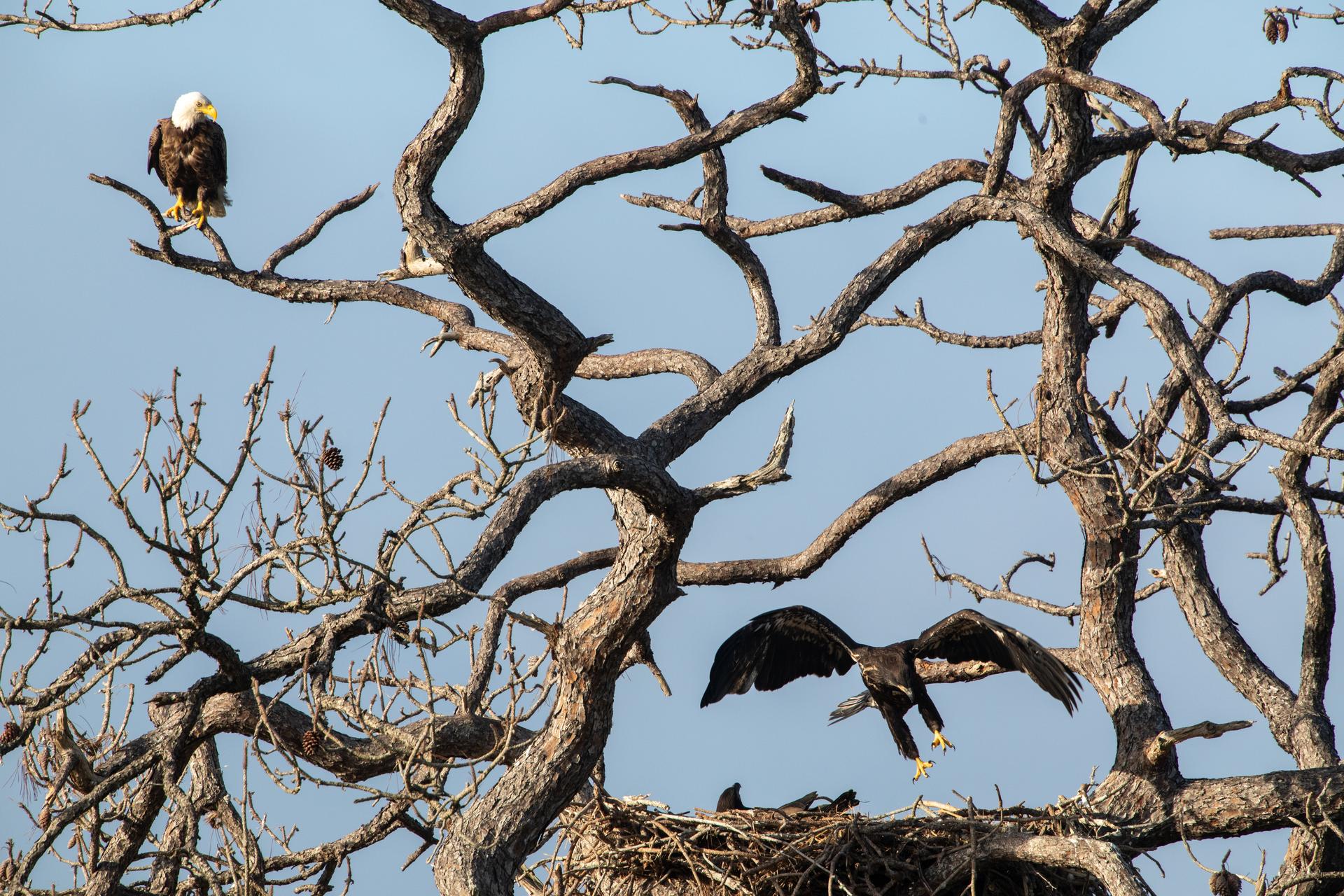
An American bald eagle sits perched on a tree branch as an eaglet flies from their nest at NASA’s Kennedy Space Center in Florida on Friday, March 13, 2026. Bald eagle nesting surveys across NASA Kennedy, Merritt Island National Wildlife Refuge, and Canaveral National Seashore are conducted annually to document the number of bald eagle active and inactive nests in support of wildlife management and regulatory compliance. Each year, eagles take up winter residence at the Florida spaceport, breeding and raising a new generation.

An American bald eagles flies away from their nest and tree at NASA’s Kennedy Space Center in Florida on Friday, March 13, 2026. Bald eagle nesting surveys across NASA Kennedy, Merritt Island National Wildlife Refuge, and Canaveral National Seashore are conducted annually to document the number of bald eagle active and inactive nests in support of wildlife management and regulatory compliance. Each year, eagles take up winter residence at the Florida spaceport, breeding and raising a new generation.

Two American bald eagles sit perched on a tree branch near their nest at NASA’s Kennedy Space Center in Florida on Friday, March 13, 2026. Bald eagle nesting surveys across NASA Kennedy, Merritt Island National Wildlife Refuge, and Canaveral National Seashore are conducted annually to document the number of bald eagle active and inactive nests in support of wildlife management and regulatory compliance. Each year, eagles take up winter residence at the Florida spaceport, breeding and raising a new generation.

Two American bald eagles sit perched on a tree branch while two eaglets sit in their nest at NASA’s Kennedy Space Center in Florida on Friday, March 13, 2026. Bald eagle nesting surveys across NASA Kennedy, Merritt Island National Wildlife Refuge, and Canaveral National Seashore are conducted annually to document the number of bald eagle active and inactive nests in support of wildlife management and regulatory compliance. Each year, eagles take up winter residence at the Florida spaceport, breeding and raising a new generation.

An American bald eagles flies away from their nest and tree at NASA’s Kennedy Space Center in Florida on Friday, March 13, 2026. Bald eagle nesting surveys across NASA Kennedy, Merritt Island National Wildlife Refuge, and Canaveral National Seashore are conducted annually to document the number of bald eagle active and inactive nests in support of wildlife management and regulatory compliance. Each year, eagles take up winter residence at the Florida spaceport, breeding and raising a new generation.
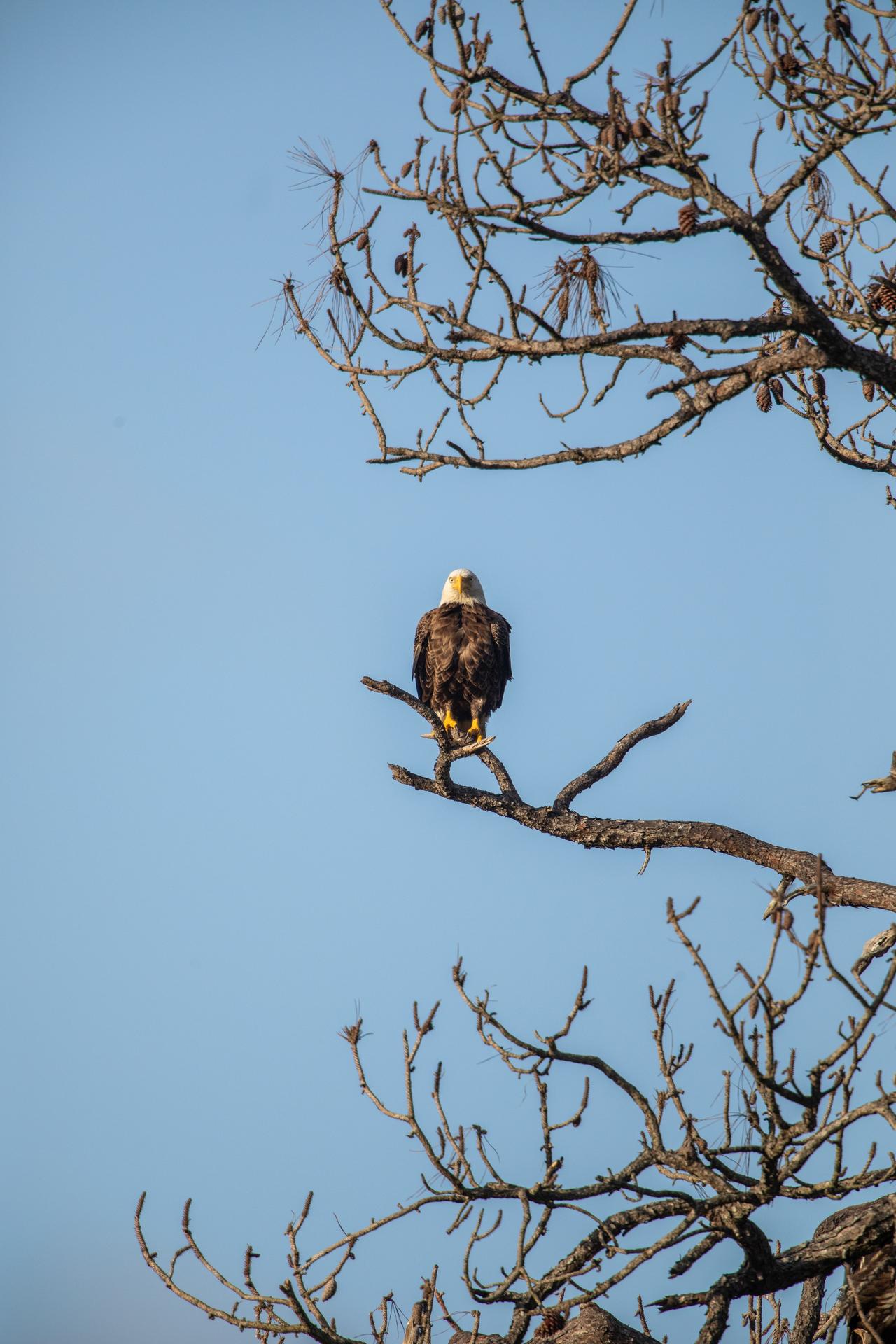
An American bald eagle sits perched on a tree limb near its nest at NASA’s Kennedy Space Center in Florida on Friday, March 13, 2026. Bald eagle nesting surveys across NASA Kennedy, Merritt Island National Wildlife Refuge, and Canaveral National Seashore are conducted annually to document the number of bald eagle active and inactive nests in support of wildlife management and regulatory compliance. Each year, eagles take up winter residence at the Florida spaceport, breeding and raising a new generation.
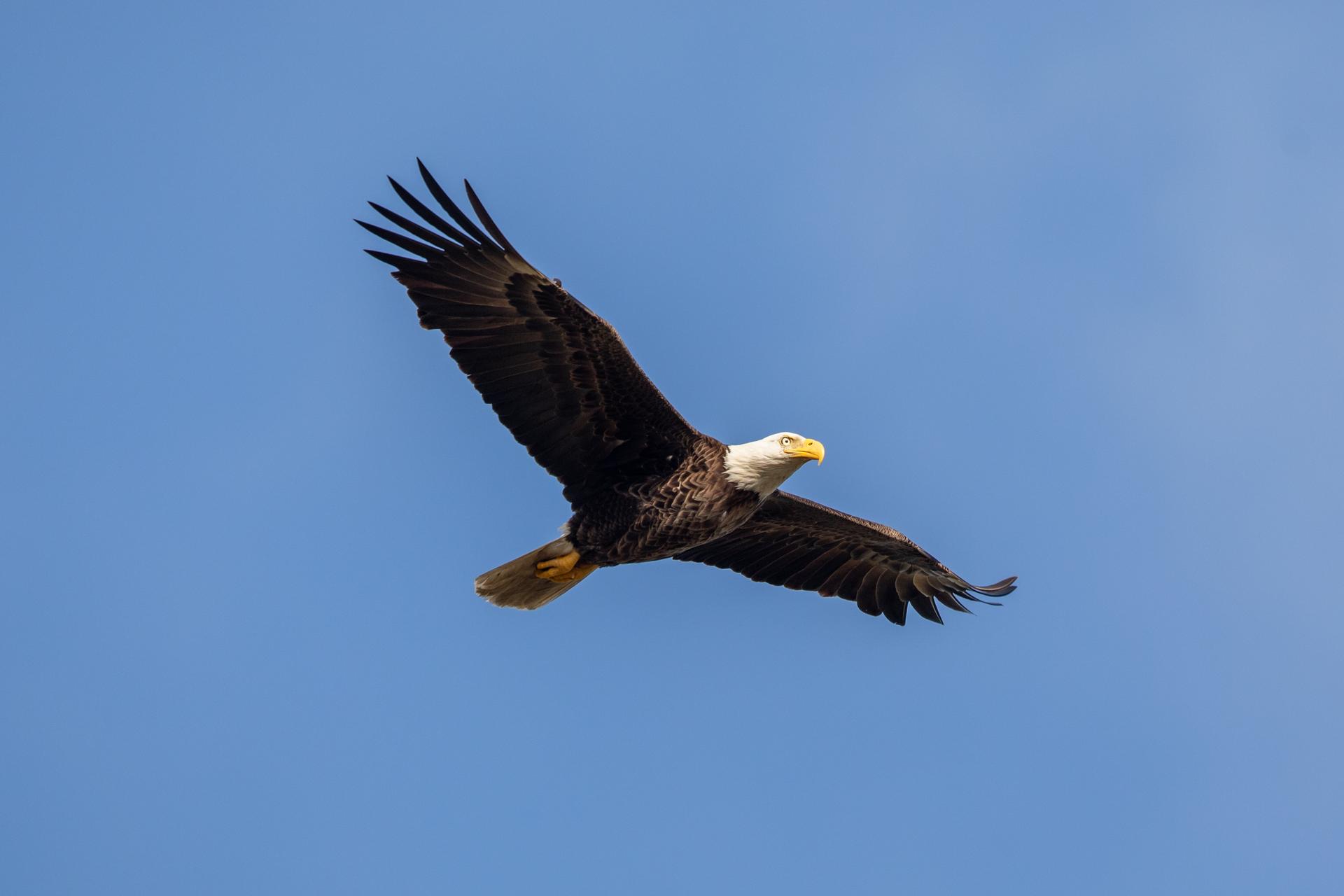
An American bald eagles flies away from their nest and tree at NASA’s Kennedy Space Center in Florida on Friday, March 13, 2026. Bald eagle nesting surveys across NASA Kennedy, Merritt Island National Wildlife Refuge, and Canaveral National Seashore are conducted annually to document the number of bald eagle active and inactive nests in support of wildlife management and regulatory compliance. Each year, eagles take up winter residence at the Florida spaceport, breeding and raising a new generation.

An American bald eagle sits perched on a tree branch (top left), while another American eagle and two eaglets sit in their nest at NASA’s Kennedy Space Center in Florida on Friday, March 13, 2026. Bald eagle nesting surveys across NASA Kennedy, Merritt Island National Wildlife Refuge, and Canaveral National Seashore are conducted annually to document the number of bald eagle active and inactive nests in support of wildlife management and regulatory compliance. Each year, eagles take up winter residence at the Florida spaceport, breeding and raising a new generation.
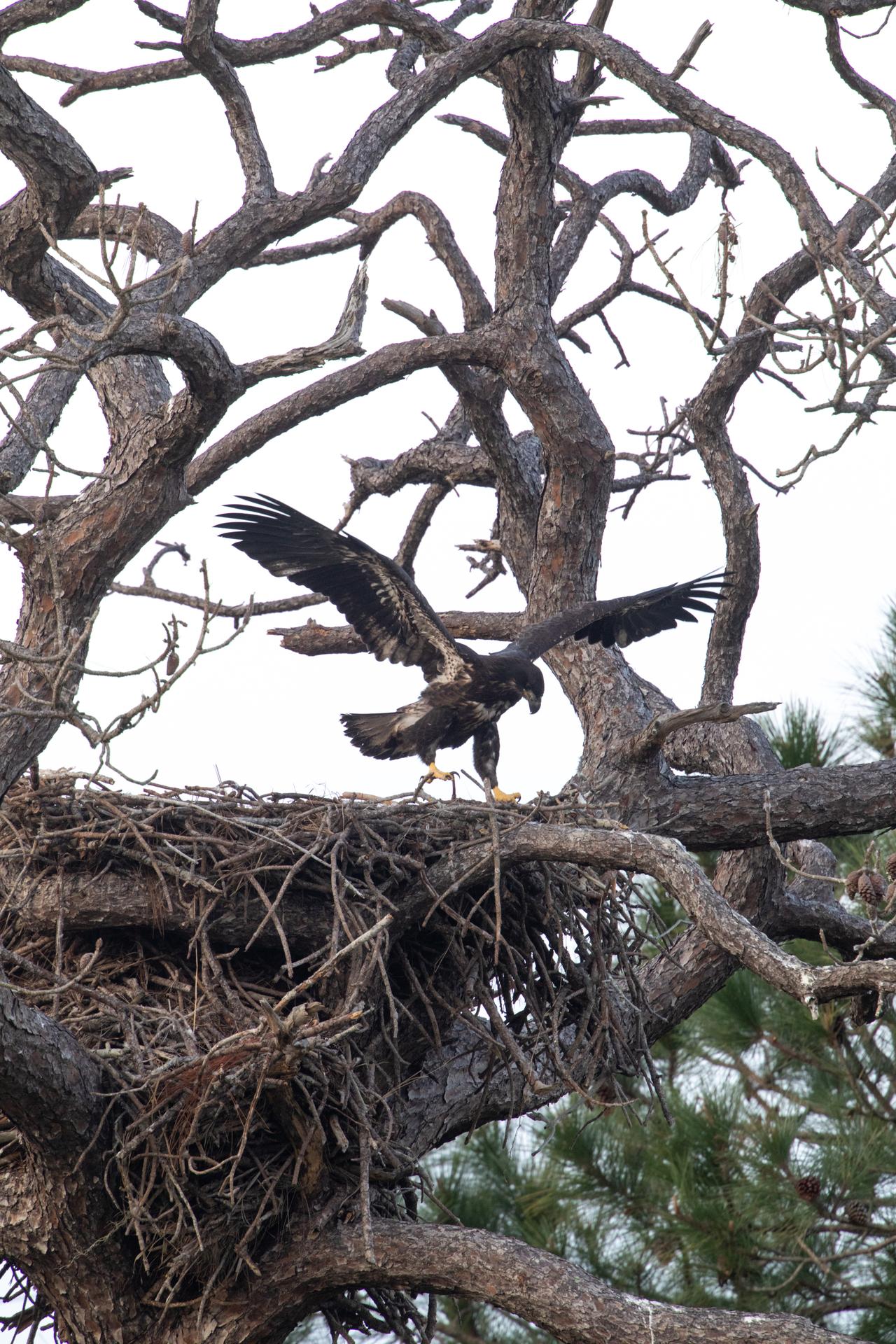
An American bald eaglet prepares to fly from its nest at NASA’s Kennedy Space Center in Florida on Friday, March 13, 2026. Bald eagle nesting surveys across NASA Kennedy, Merritt Island National Wildlife Refuge, and Canaveral National Seashore are conducted annually to document the number of bald eagle active and inactive nests in support of wildlife management and regulatory compliance. Each year, eagles take up winter residence at the Florida spaceport, breeding and raising a new generation.

An American bald eaglet sits perched in a nest while another eaglet sits on a nearby branch at NASA’s Kennedy Space Center in Florida on Friday, March 13, 2026. Bald eagle nesting surveys across NASA Kennedy, Merritt Island National Wildlife Refuge, and Canaveral National Seashore are conducted annually to document the number of bald eagle active and inactive nests in support of wildlife management and regulatory compliance. Each year, eagles take up winter residence at the Florida spaceport, breeding and raising a new generation.
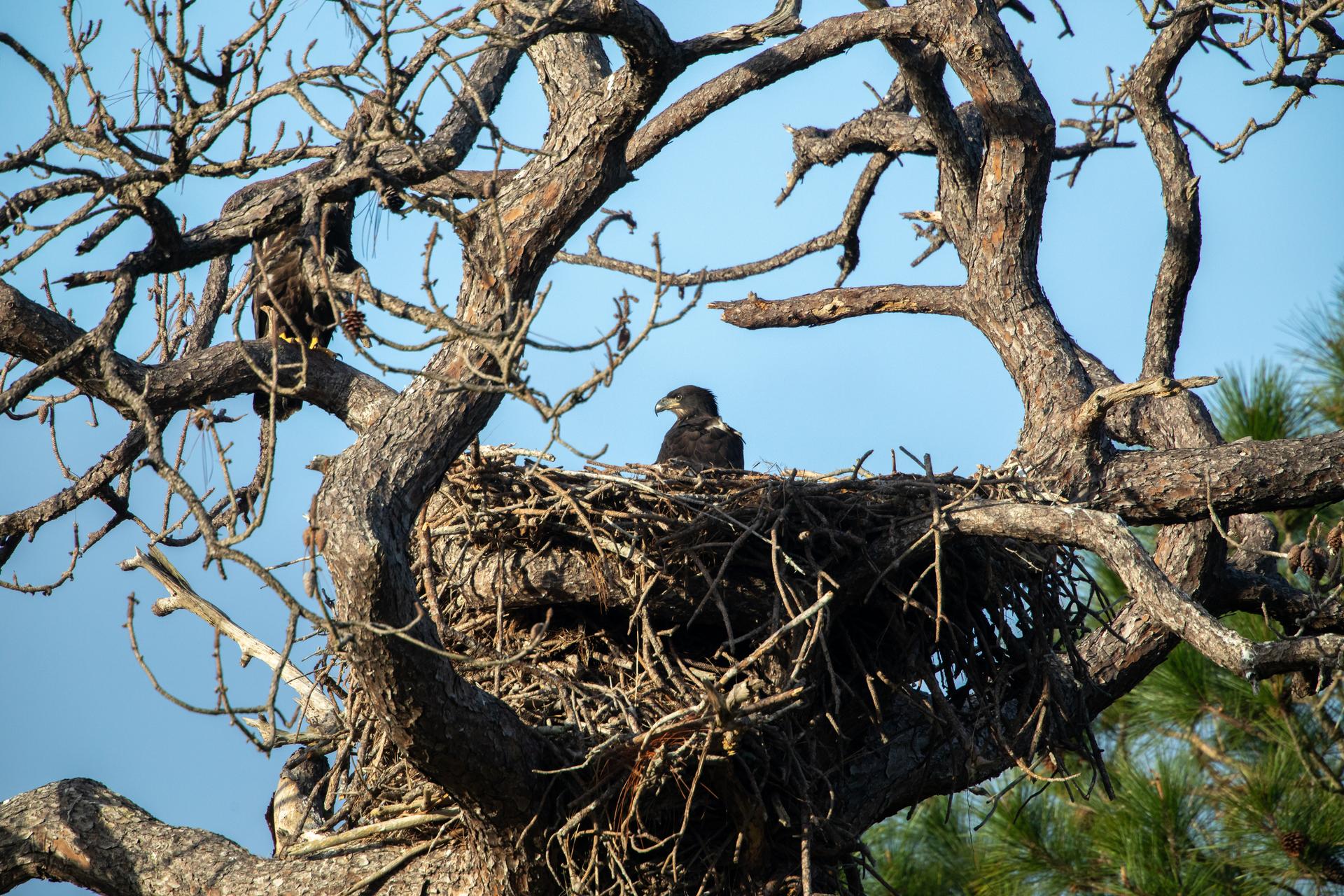
An American bald eaglet sits in its nest on a tree at NASA’s Kennedy Space Center in Florida on Friday, March 13, 2026. Bald eagle nesting surveys across NASA Kennedy, Merritt Island National Wildlife Refuge, and Canaveral National Seashore are conducted annually to document the number of bald eagle active and inactive nests in support of wildlife management and regulatory compliance. Each year, eagles take up winter residence at the Florida spaceport, breeding and raising a new generation.
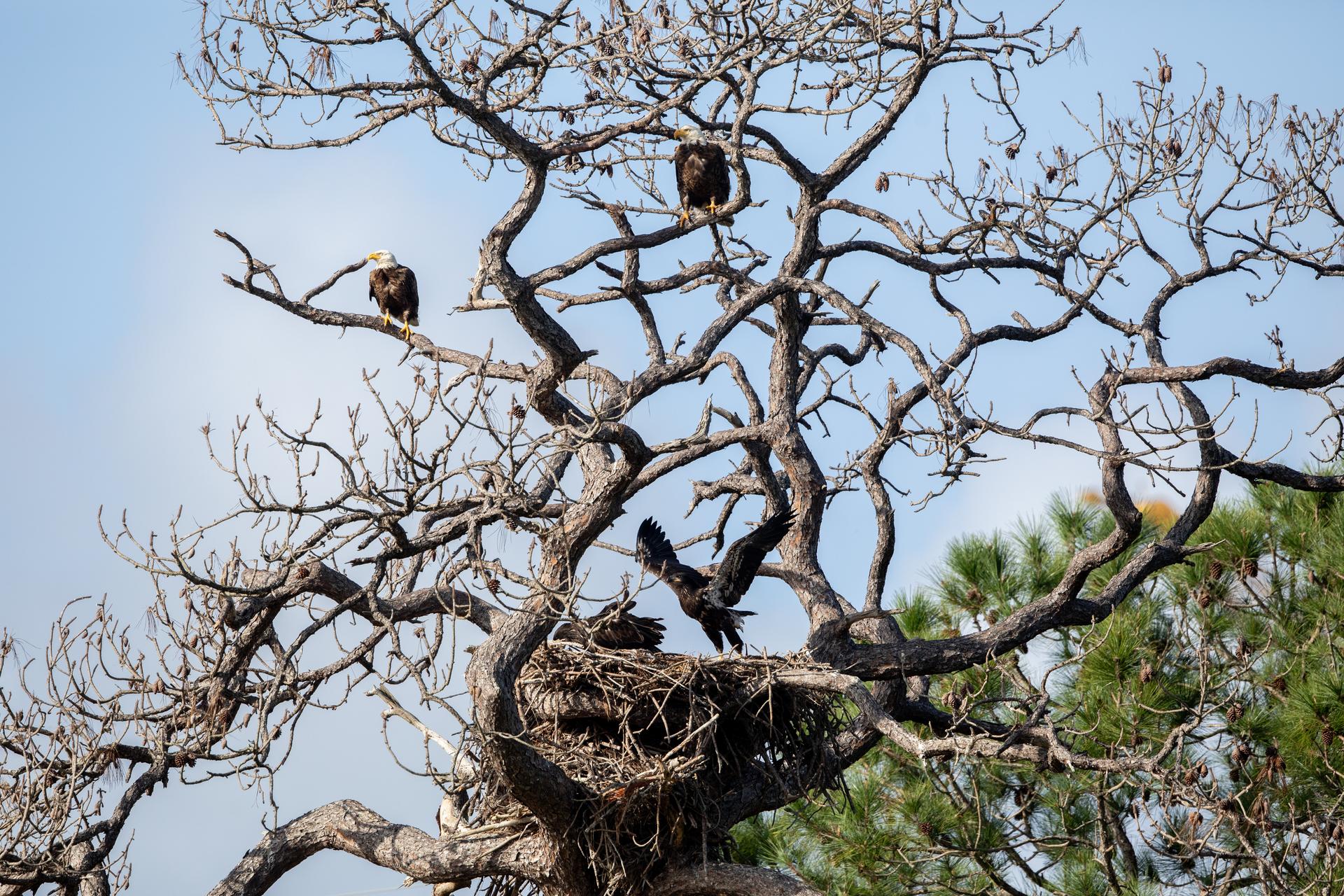
Two American bald eagles sit perched on a tree branch while two eaglets prepare to fly out of their nest at NASA’s Kennedy Space Center in Florida on Friday, March 13, 2026. Bald eagle nesting surveys across NASA Kennedy, Merritt Island National Wildlife Refuge, and Canaveral National Seashore are conducted annually to document the number of bald eagle active and inactive nests in support of wildlife management and regulatory compliance. Each year, eagles take up winter residence at the Florida spaceport, breeding and raising a new generation.
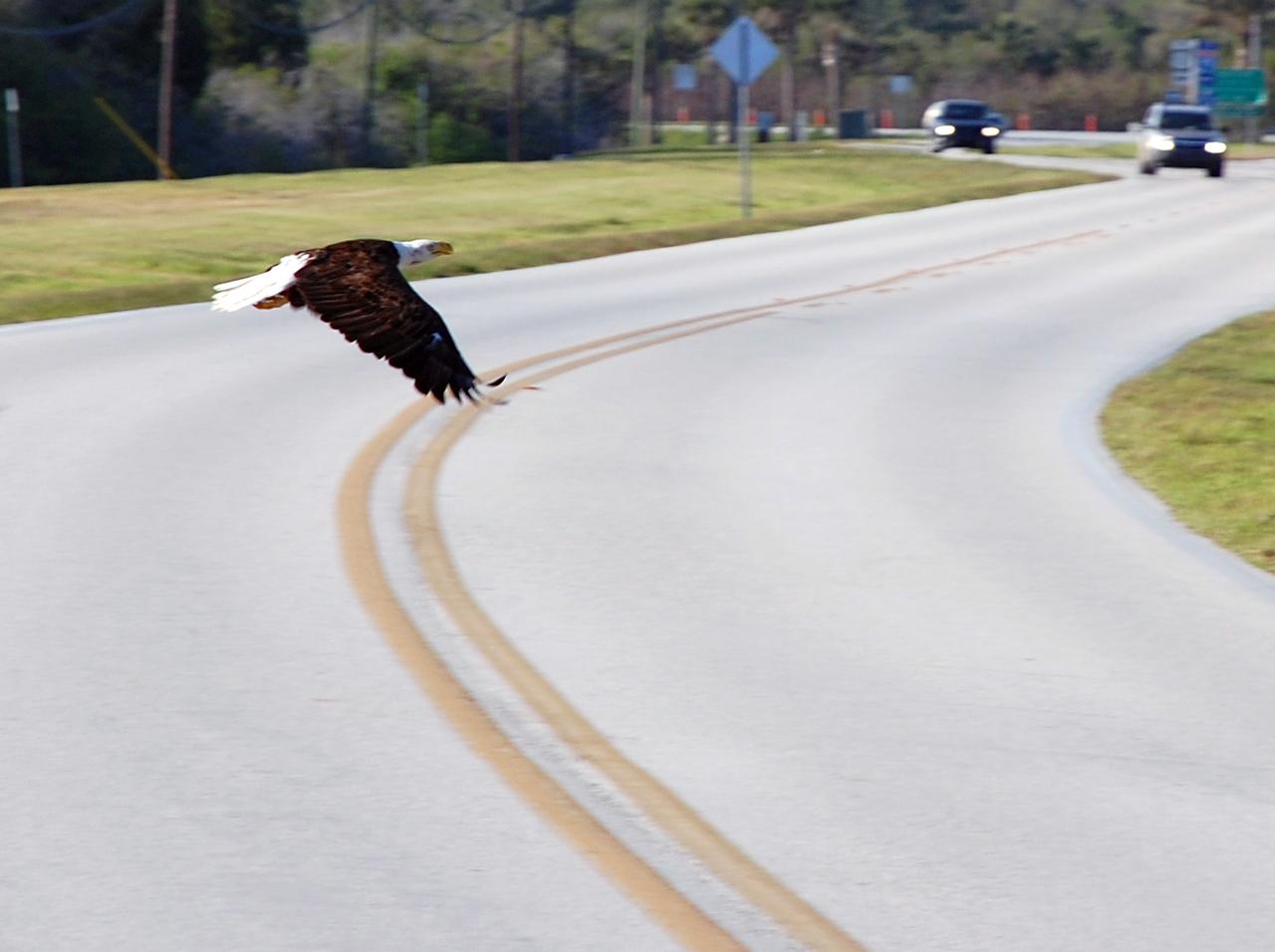
CAPE CANAVERAL, Fla. – At NASA's Kennedy Space Center in Florida, a bald eagle flies across the road in front of vehicles on the road. There are a dozen eagle nests within Kennedy and in the surrounding Merritt Island National Wildlife Refuge, some of them close to roads through the center. Bald eagles use a specific territory for nesting (they mate for life), winter feeding or a year-round residence. Eagles' natural domain is from Alaska to Baja, California, and from Maine to Florida. The Merritt Island refuge also includes several wading bird rookeries, many osprey nests, up to 400 manatees during the spring, and approximately 2,500 Florida scrub jays. It also is a major wintering area for migratory birds. More than 500 species of wildlife inhabit the refuge, with 15 considered federally threatened or endangered. Photo credit: NASA/Ben Smegelsky
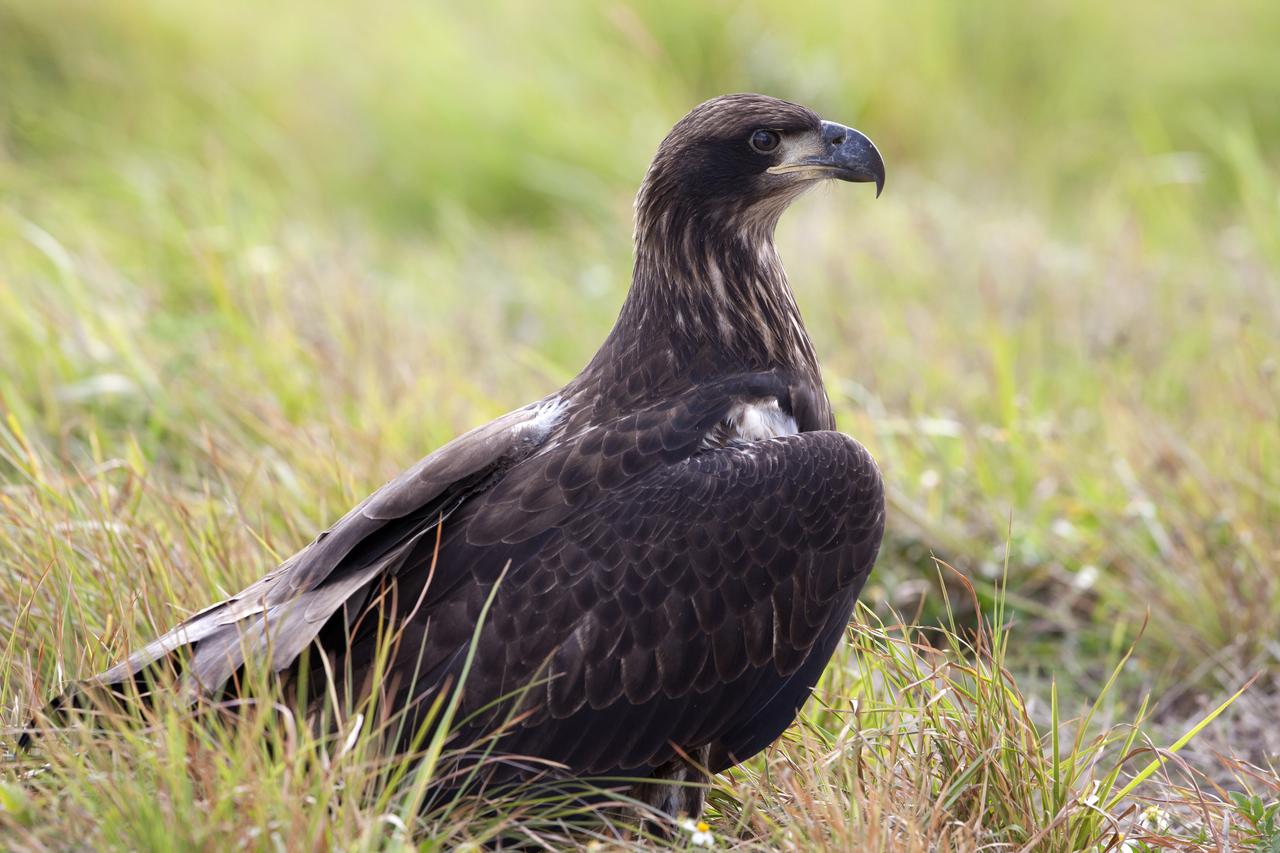
A juvenile bald eagle watches for prey in the grass at NASA's Kennedy Space Center in Florida. The center shares a border with the Merritt Island National Wildlife Refuge. More than 330 native and migratory bird species, 25 mammals, 117 fishes and 65 amphibians and reptiles call Kennedy and the wildlife refuge home.
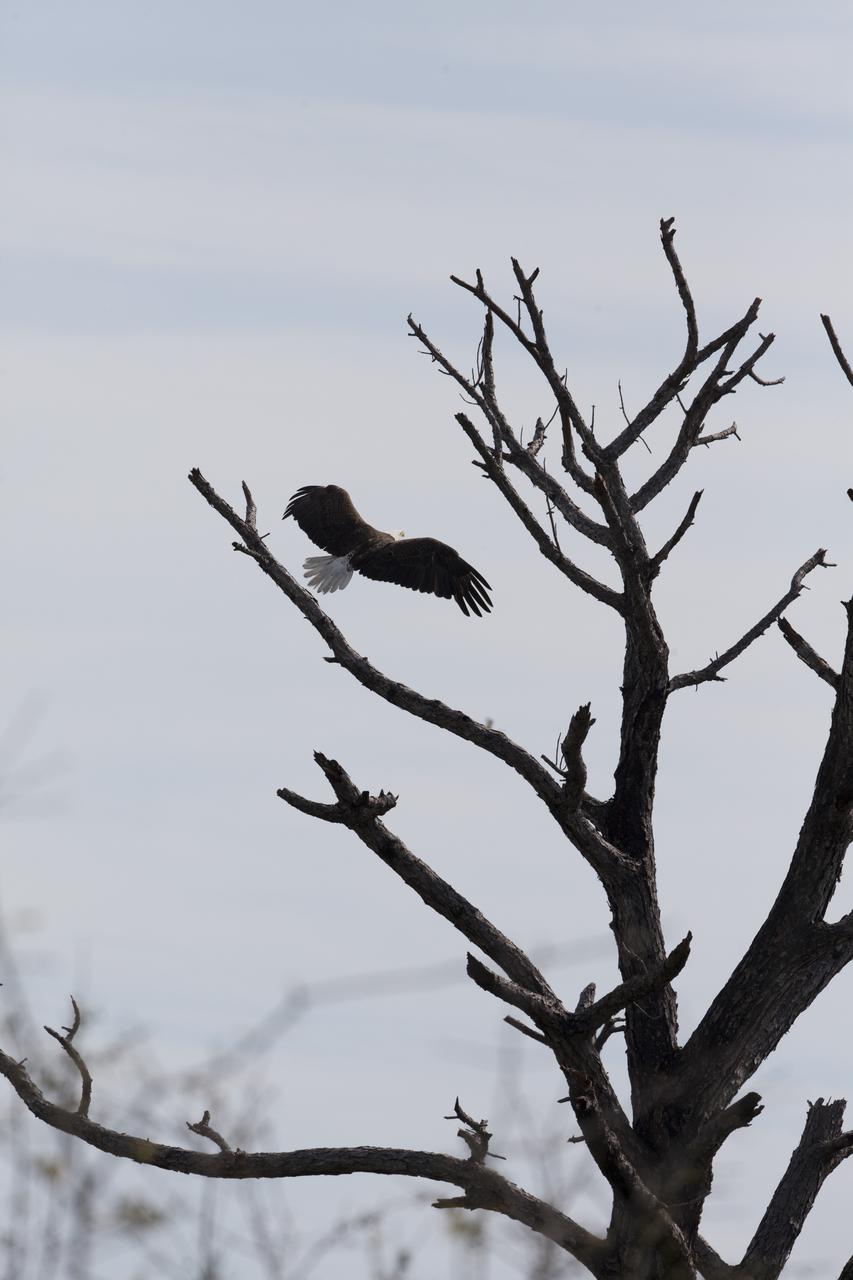
A bald eagle soars away from a pine tree at NASA’s Kennedy Space Center in Florida. The spaceport shares borders with the Merritt Island National Wildlife Refuge, which is home to more than 330 native and migratory bird species, along with 25 mammal, 117 fish, and 65 amphibian and reptile species.
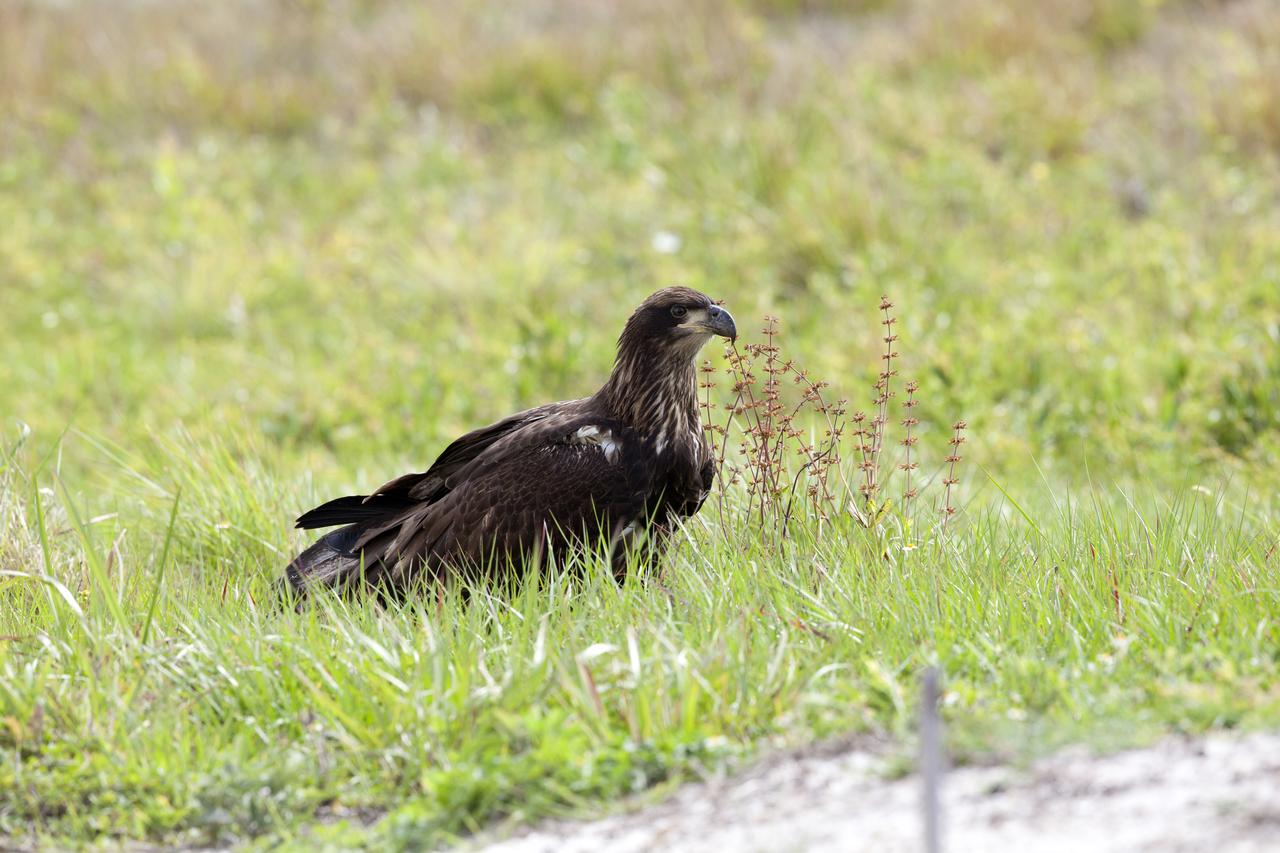
A juvenile bald eagle sits in the grass at NASA's Kennedy Space Center in Florida. The center shares a border with the Merritt Island National Wildlife Refuge. More than 330 native and migratory bird species, 25 mammals, 117 fishes and 65 amphibians and reptiles call Kennedy and the wildlife refuge home.
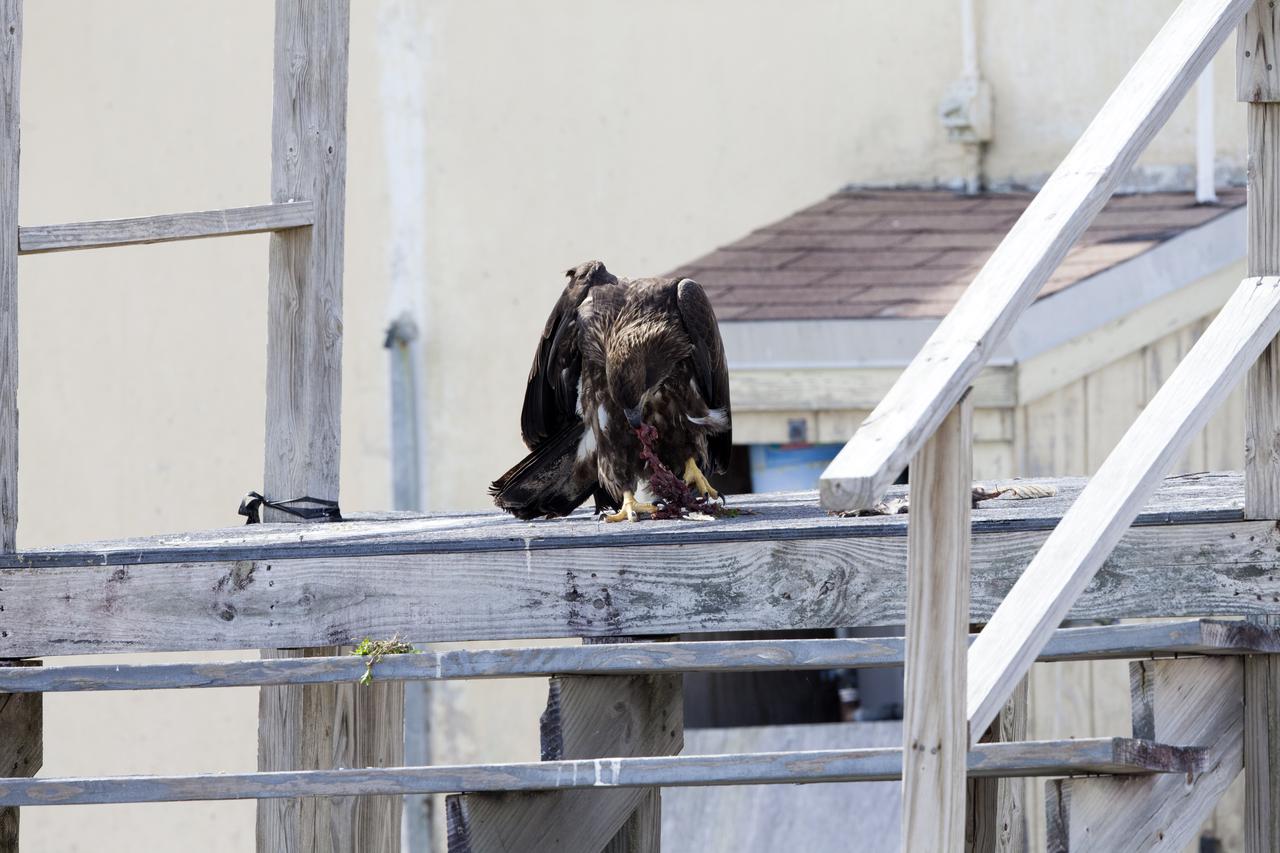
An American bald eagle eats its prey on a wooden dock at NASA's Kennedy Space Center in Florida. The center shares a border with the Merritt Island National Wildlife Refuge. More than 330 native and migratory bird species, 25 mammals, 117 fishes and 65 amphibians and reptiles call Kennedy and the wildlife refuge home.
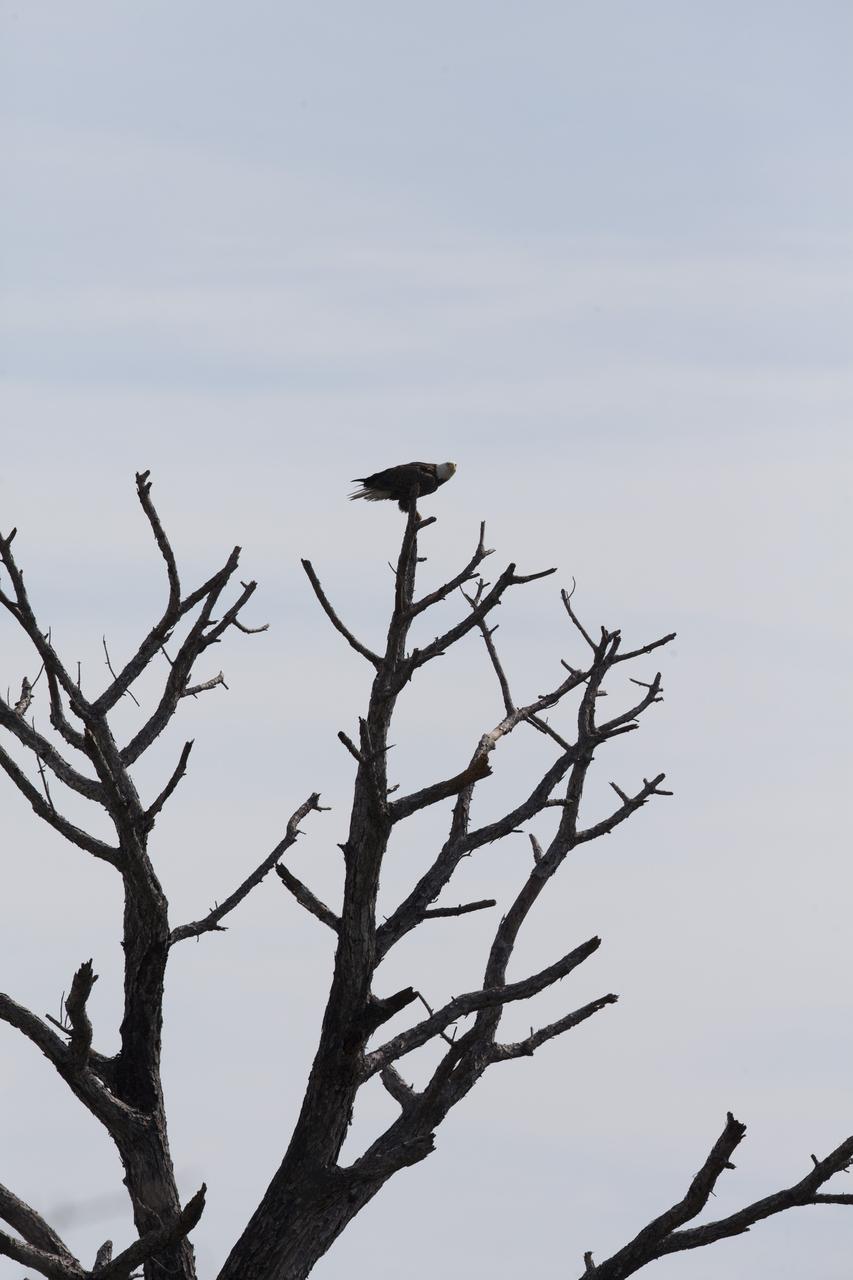
A bald eagle surveys its surroundings from a high treetop at NASA’s Kennedy Space Center in Florida. The spaceport shares borders with the Merritt Island National Wildlife Refuge, which is home to more than 330 native and migratory bird species, along with 25 mammal, 117 fish, and 65 amphibian and reptile species.
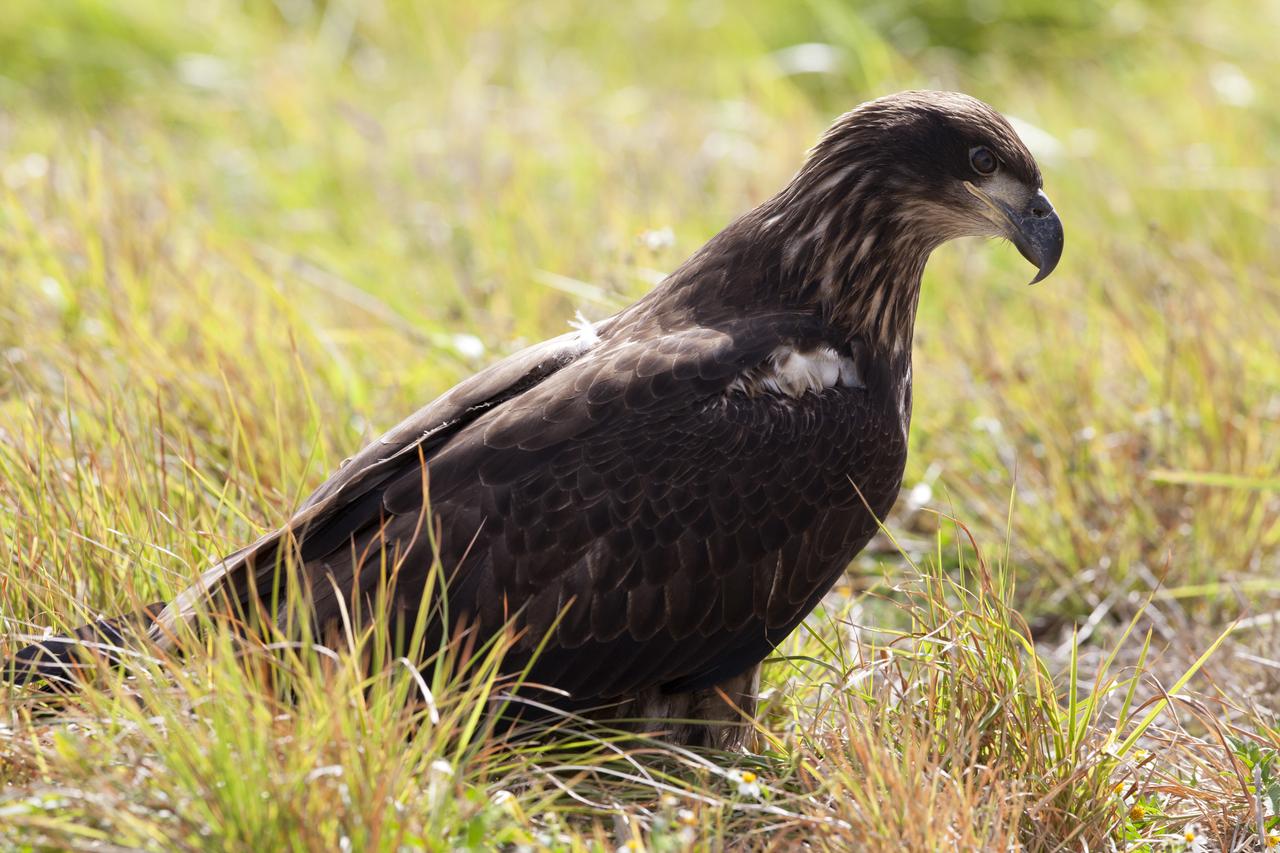
A juvenile bald eagle watches for prey in the grass at NASA's Kennedy Space Center in Florida. The center shares a border with the Merritt Island National Wildlife Refuge. More than 330 native and migratory bird species, 25 mammals, 117 fishes and 65 amphibians and reptiles call Kennedy and the wildlife refuge home.
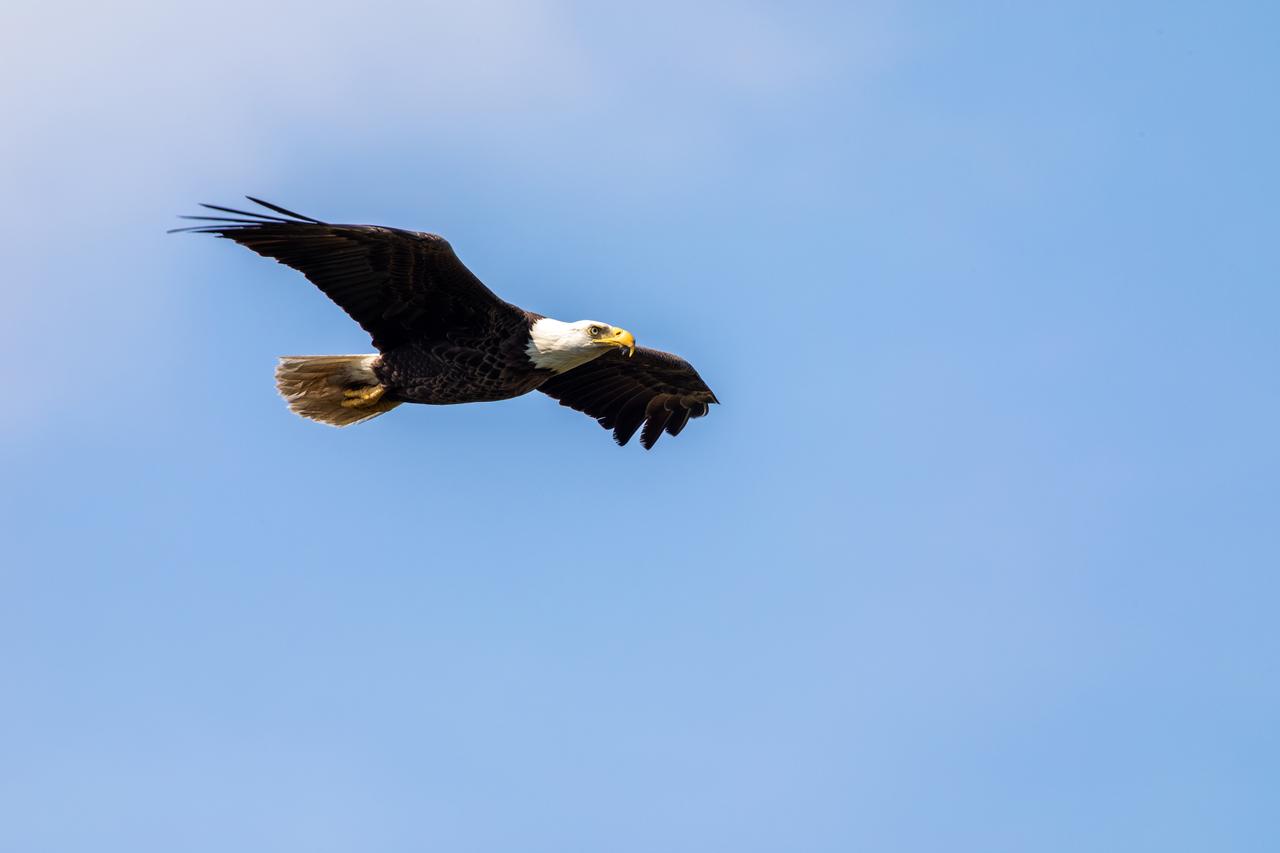
An American bald eagle soars through the sky at NASA’s Kennedy Space Center on March 8, 2023. The eagle is part of a mating pair that takes up residence at the Florida spaceport during nesting season. Recently, a baby eagle was spotted in their nest, located off of Kennedy Parkway, about two miles from the Vehicle Assembly Building. There are 39 eagle territories at Kennedy, 33 of which are active or potentially active.
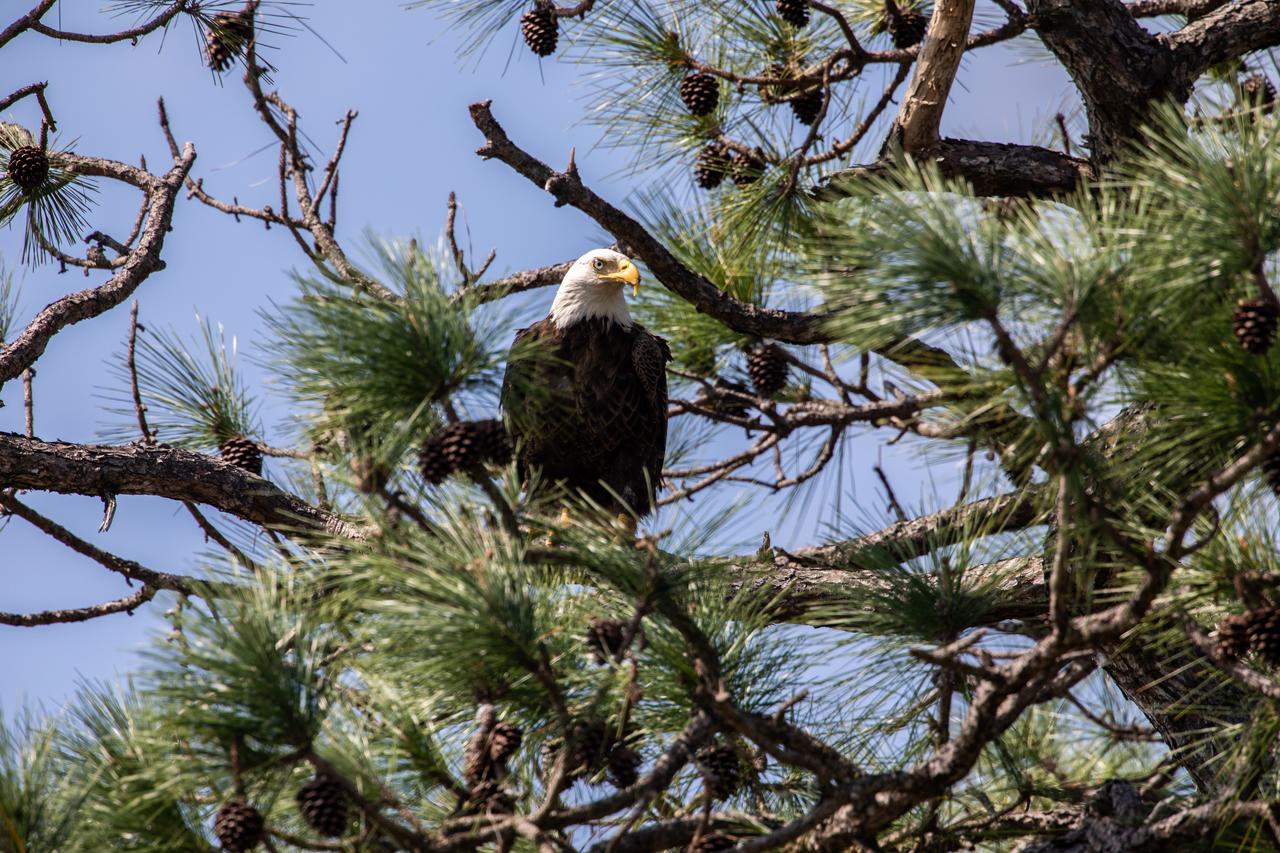
An American bald eagle is perched in a tree near its nest at NASA’s Kennedy Space Center on March 8, 2023. The eagle is part of a mating pair that takes up residence at the Florida spaceport during nesting season. Recently, a baby eagle was spotted in their nest, located off of Kennedy Parkway, about two miles from the Vehicle Assembly Building. There are 39 eagle territories at Kennedy, 33 of which are active or potentially active.
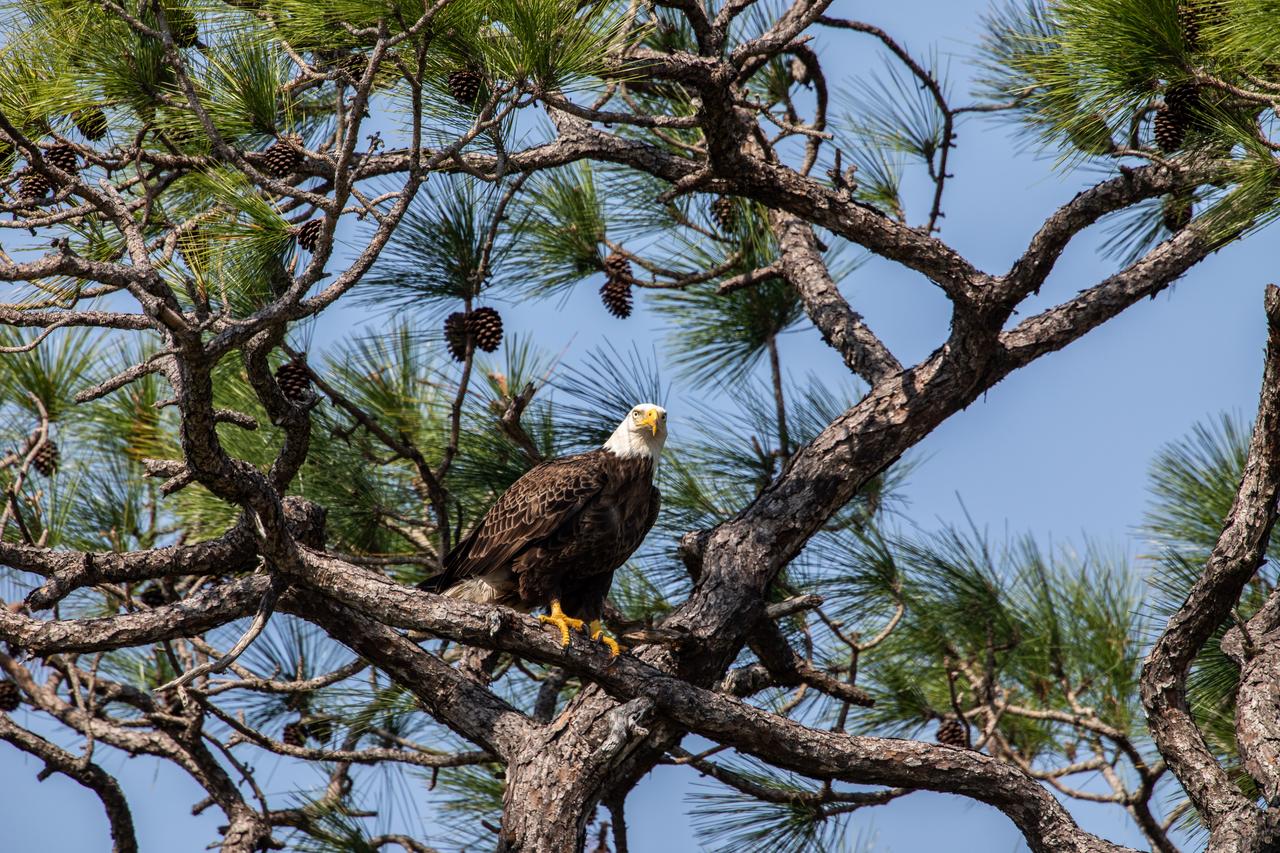
An American bald eagle is perched in a tree near its nest at NASA’s Kennedy Space Center on March 8, 2023. The eagle is part of a mating pair that takes up residence at the Florida spaceport during nesting season. Recently, a baby eagle was spotted in their nest, located off of Kennedy Parkway, about two miles from the Vehicle Assembly Building. There are 39 eagle territories at Kennedy, 33 of which are active or potentially active.
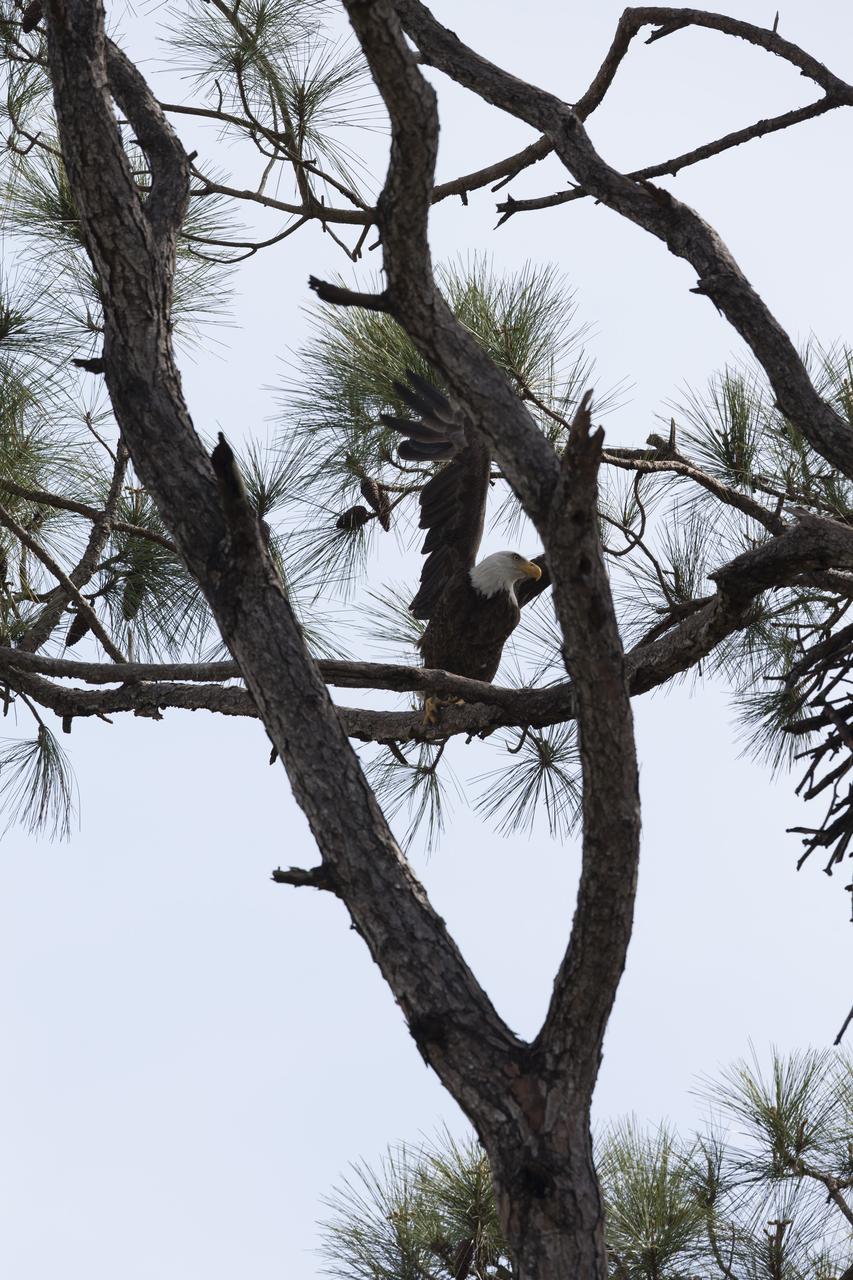
A bald eagle raises its wings in preparation for takeoff from its high perch in a pine tree at NASA’s Kennedy Space Center in Florida. The spaceport shares borders with the Merritt Island National Wildlife Refuge, which is home to more than 330 native and migratory bird species, along with 25 mammal, 117 fish, and 65 amphibian and reptile species.
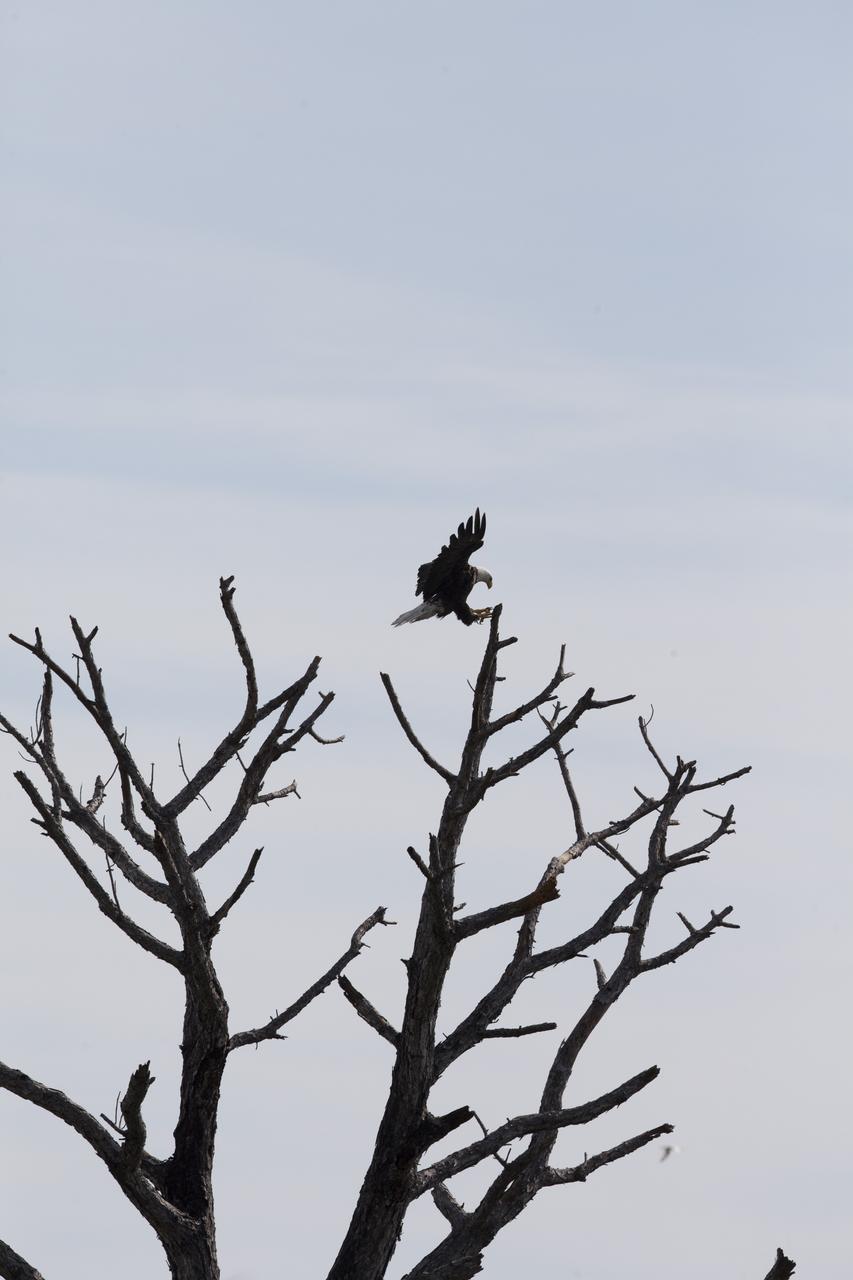
With its wings raised and talons extended, a bald eagle touches down on a high treetop at NASA’s Kennedy Space Center in Florida. The spaceport shares borders with the Merritt Island National Wildlife Refuge, which is home to more than 330 native and migratory bird species, along with 25 mammal, 117 fish, and 65 amphibian and reptile species.
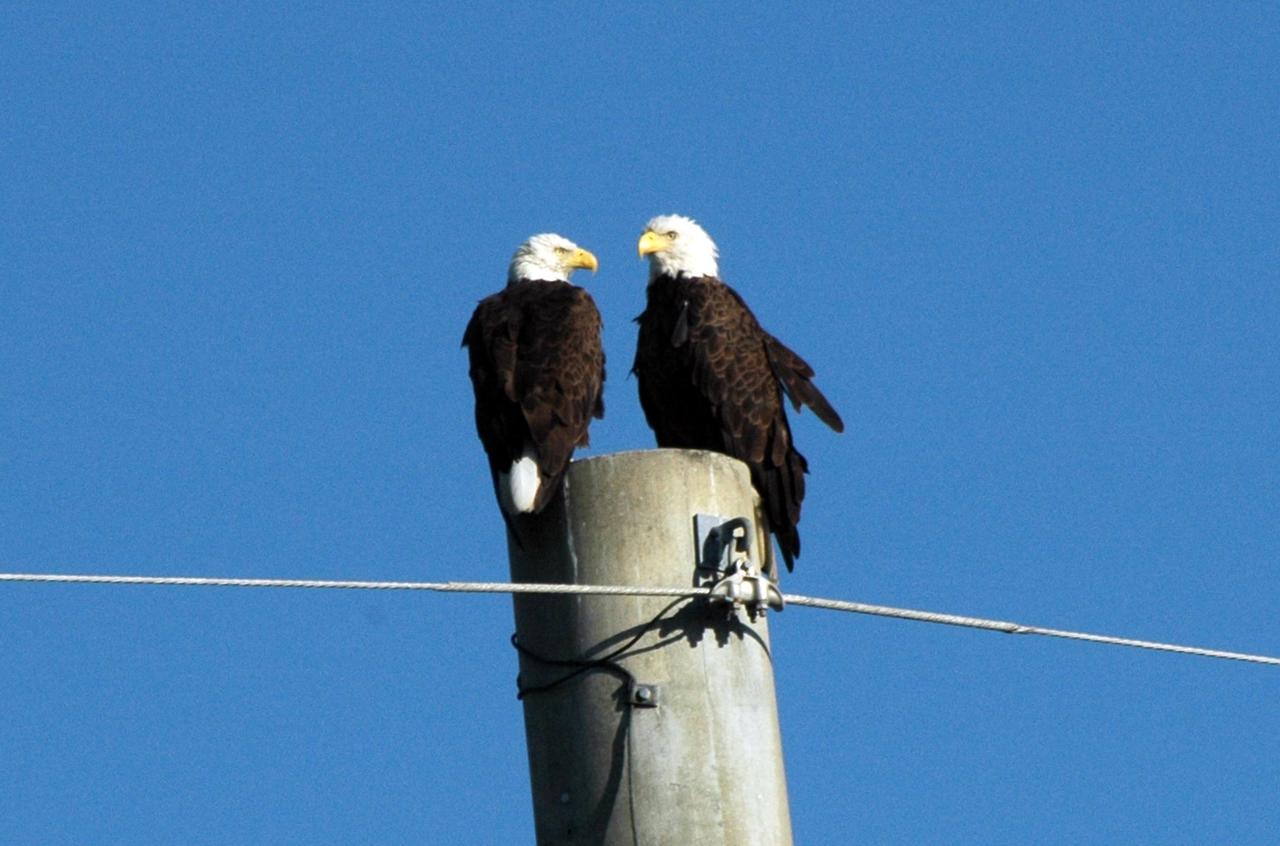
KENNEDY SPACE CENTER, FLA. - These bald eagles scan the landscape of Kennedy Space Center from the top of a utility pole on S.R. 3. There are a dozen active nests of bald eagles throughout the Merritt Island National Wildlife Refuge, which shares a boundary with the Center. Eagles' habitats are near lakes, rivers, marshes and seacoasts. Nests are masses of sticks, usually in the top of a tall tree. Even though they are fish eaters, bald eagles will take whatever prey is available and easiest to obtain. Bald eagles that live along the coast and on major lakes and rivers feed mainly on fish.
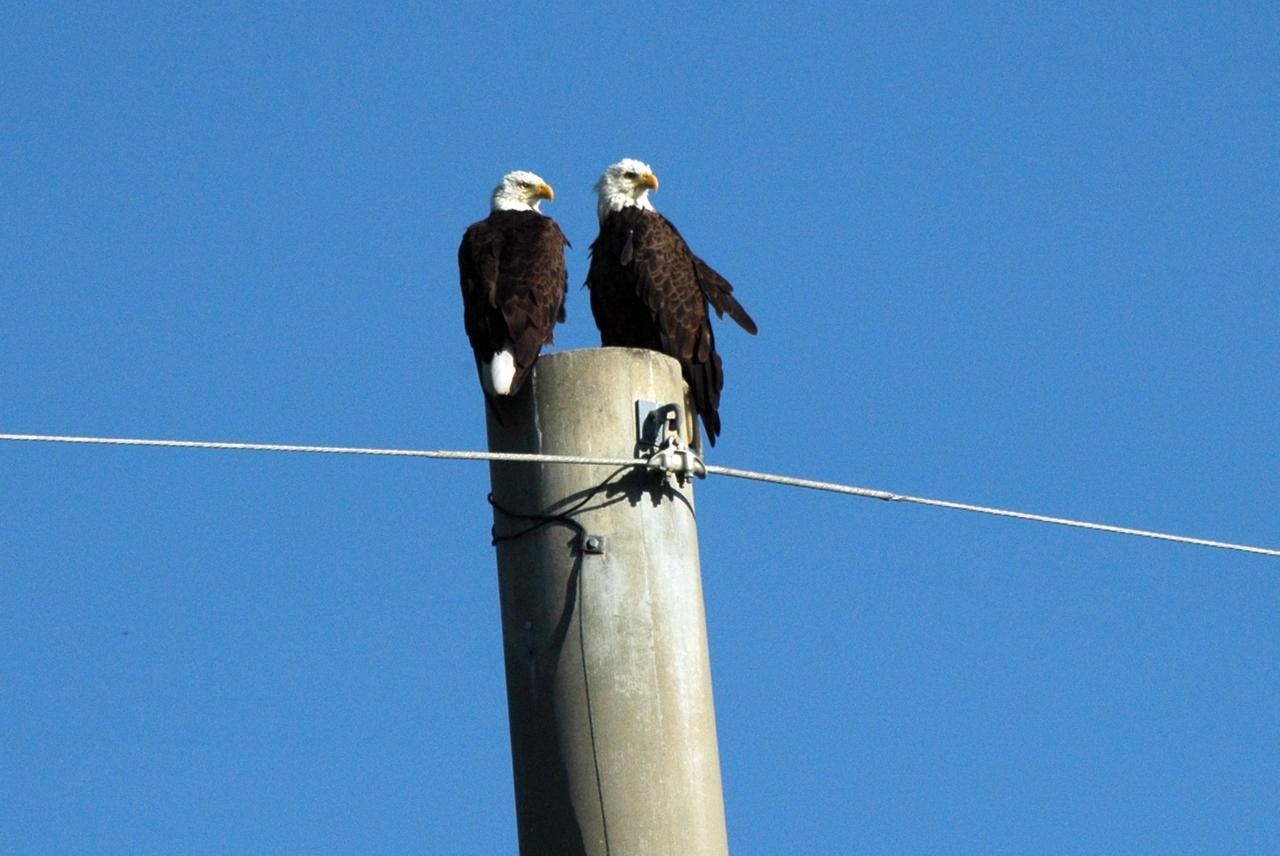
KENNEDY SPACE CENTER, FLA. - These bald eagles scan the landscape of Kennedy Space Center from the top of a utility pole on S.R. 3. There are a dozen active nests of bald eagles throughout the Merritt Island National Wildlife Refuge, which shares a boundary with the Center. Eagles' habitats are near lakes, rivers, marshes and seacoasts. Nests are masses of sticks, usually in the top of a tall tree. Even though they are fish eaters, bald eagles will take whatever prey is available and easiest to obtain. Bald eagles that live along the coast and on major lakes and rivers feed mainly on fish.
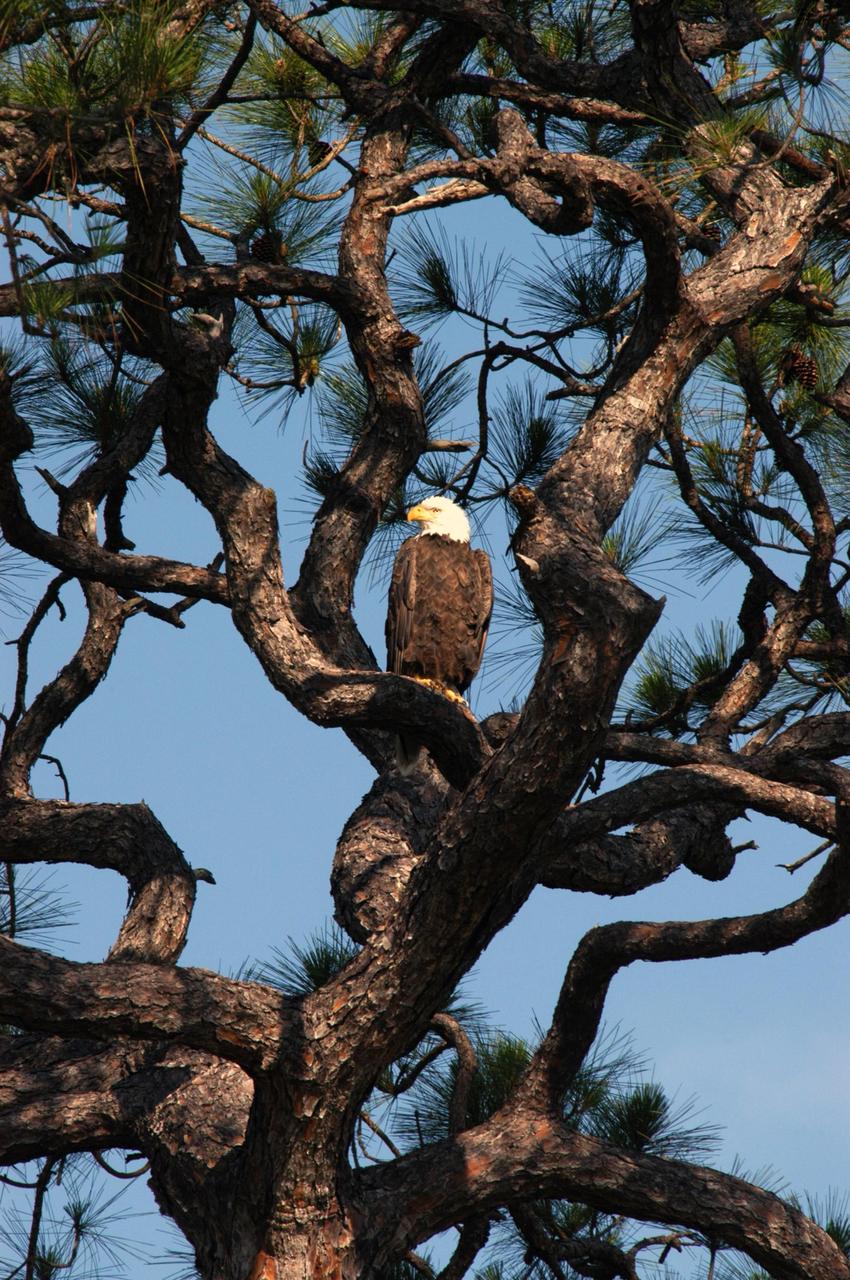
KENNEDY SPACE CENTER, FLA. -- From a branch in a tall pine tree near S.R. 3 on Kennedy Space Center , a female bald eagle strikes a familiar pose as she surveys her surroundings. There are a dozen active nests of bald eagles throughout the Merritt Island National Wildlife Refuge, which shares a boundary with the Center. Eagles' habitats are near lakes, rivers, marshes and seacoasts. Nests are masses of sticks, usually in the top of a tall tree. Even though they are fish eaters, bald eagles will take whatever prey is available and easiest to obtain. Bald eagles that live along the coast and on major lakes and rivers feed mainly on fish. Photo credit: NASA/George Shelton
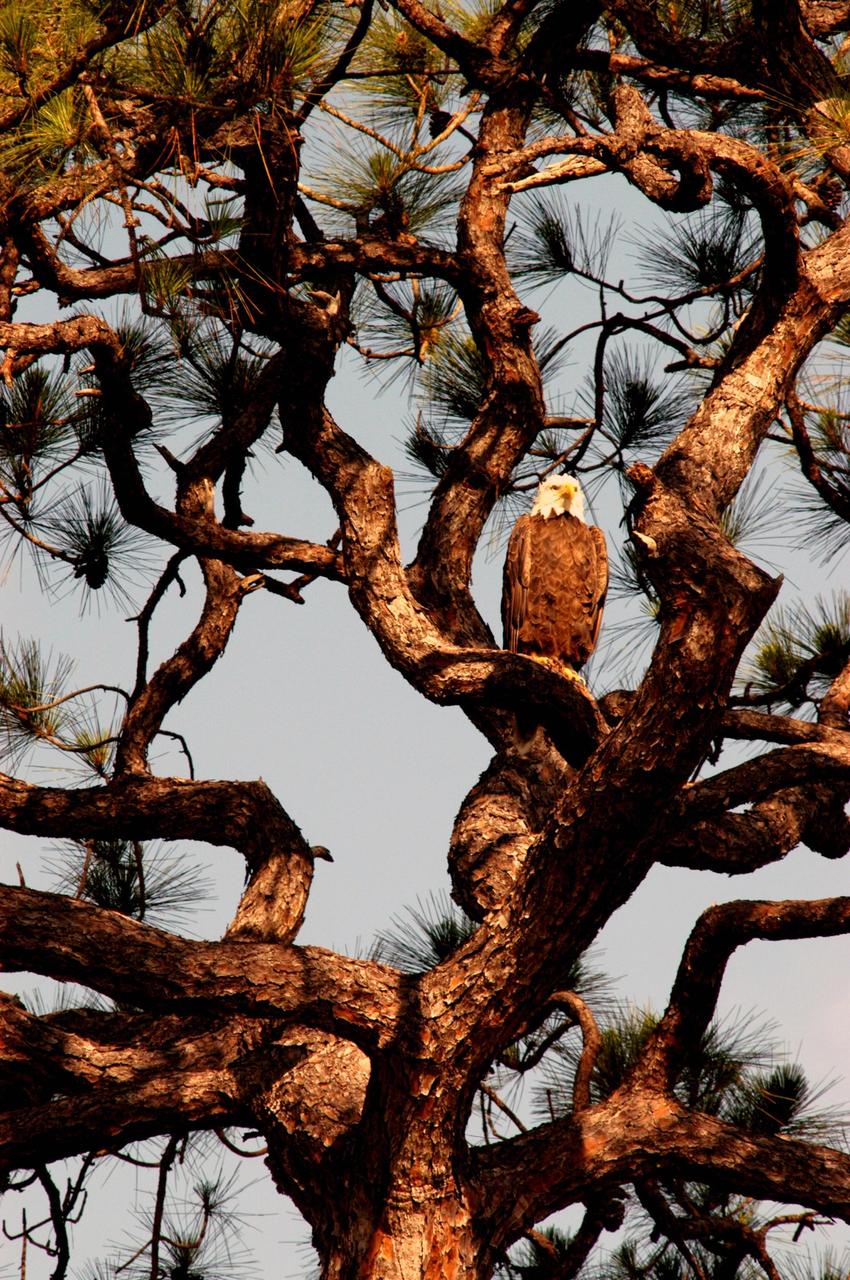
KENNEDY SPACE CENTER, FLA. -- A female bald eagle looks over her surroundings from the perspective of a tall pine tree near S.R. 3 on Kennedy Space Center. There are a dozen active nests of bald eagles throughout the Merritt Island National Wildlife Refuge, which shares a boundary with the Center. Eagles' habitats are near lakes, rivers, marshes and seacoasts. Nests are masses of sticks, usually in the top of a tall tree. Even though they are fish eaters, bald eagles will take whatever prey is available and easiest to obtain. Bald eagles that live along the coast and on major lakes and rivers feed mainly on fish. Photo credit: NASA/George Shelton
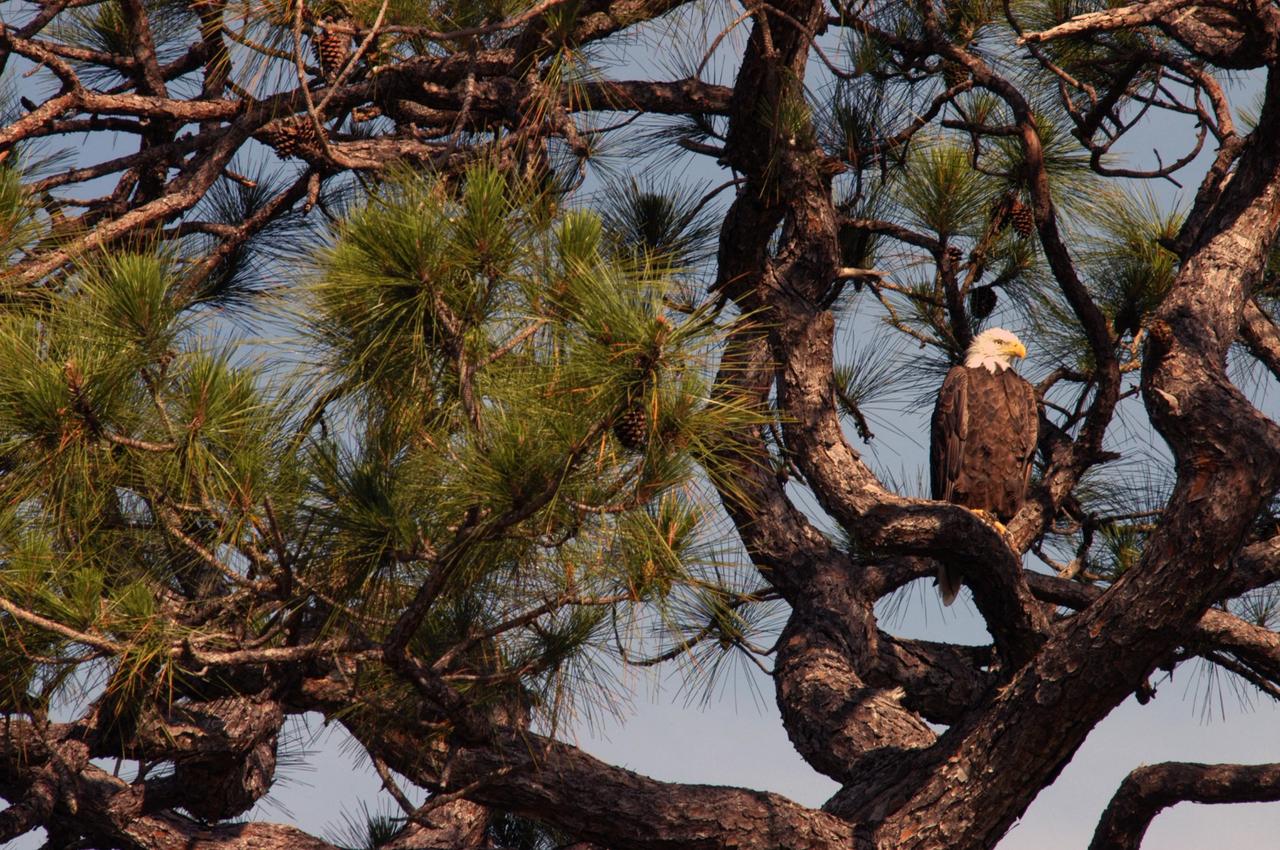
KENNEDY SPACE CENTER, FLA. -- From a branch in a tall pine tree near S.R. 3 on Kennedy Space Center, a female bald eagle gives a wary look toward the photographer. There are a dozen active nests of bald eagles throughout the Merritt Island National Wildlife Refuge, which shares a boundary with the Center. Eagles' habitats are near lakes, rivers, marshes and seacoasts. Nests are masses of sticks, usually in the top of a tall tree. Even though they are fish eaters, bald eagles will take whatever prey is available and easiest to obtain. Bald eagles that live along the coast and on major lakes and rivers feed mainly on fish. Photo credit: NASA/George Shelton
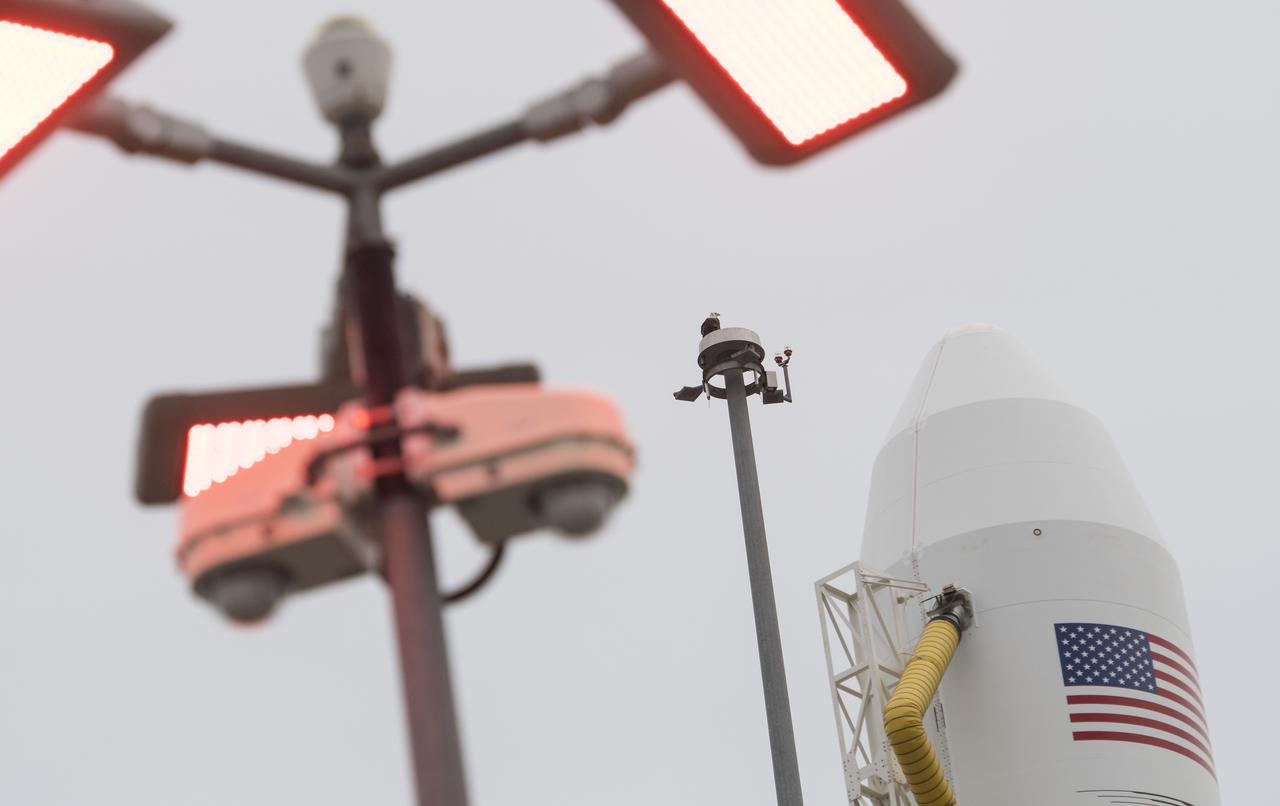
A bald eagle is seen atop a lightning tower next to the Northrop Grumman Antares rocket with, Cygnus spacecraft onboard, at Pad-0A, Wednesday, Nov. 14, 2018 at NASA's Wallops Flight Facility in Virginia. Northrop Grumman's 10th contracted cargo resupply mission for NASA to the International Space Station will deliver about 7,400 pounds of science and research, crew supplies and vehicle hardware to the orbital laboratory and its crew. Launch is currently scheduled for Nov. 16 at 4:23 a.m. EST. Photo Credit: (NASA/Joel Kowsky)

A bald eagle is seen atop a lightning tower next to the Northrop Grumman Antares rocket with, Cygnus spacecraft onboard, at Pad-0A, Wednesday, Nov. 14, 2018 at NASA's Wallops Flight Facility in Virginia. Northrop Grumman's 10th contracted cargo resupply mission for NASA to the International Space Station will deliver about 7,400 pounds of science and research, crew supplies and vehicle hardware to the orbital laboratory and its crew. Launch is currently scheduled for Nov. 16 at 4:23 a.m. EST. Photo Credit: (NASA/Joel Kowsky)
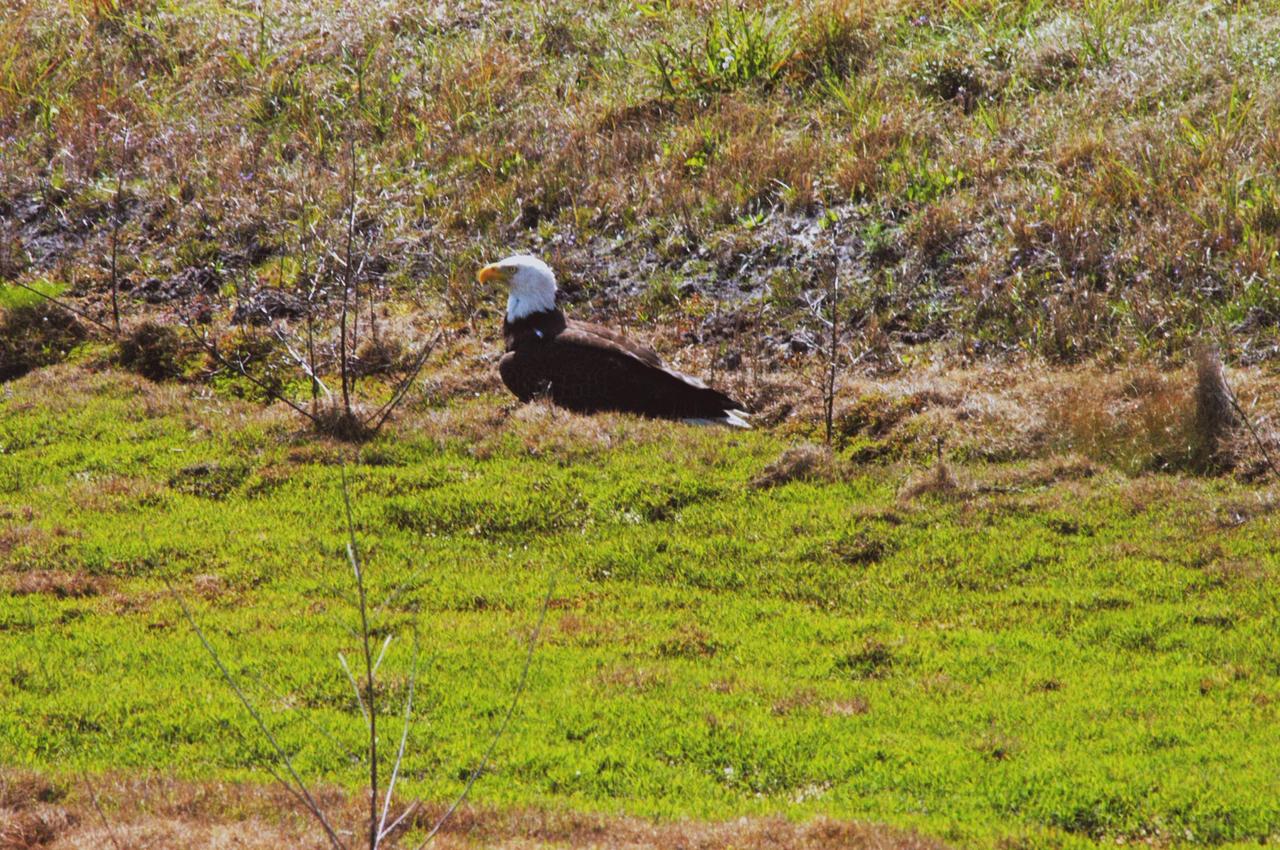
KENNEDY SPACE CENTER, FLA. - A bald eagle on the ground may be protecting its food or resting after a hunt for food. This one was spotted near S.R. 3 on Kennedy Space Center, close to its nest. The nest is one of a dozen active nests throughout the Merritt Island National Wildlife Refuge, which shares a boundary with the Center. Eagles' habitats are near lakes, rivers, marshes and seacoasts. Nests are masses of sticks, usually in the top of a tall tree. Even though they are fish eaters, bald eagles will take whatever prey is available and easiest to obtain. Bald eagles which live along the coast and on major lakes and rivers feed mainly on fish. Bald eagles fish in both fresh and salt water. Because of the energy expended during hunting, an eagle has to spend a lot of time resting quietly. It's estimated that only one out of eighteen attacks are successful. Photo credit: NASA/Jim Grossmann
KENNEDY SPACE CENTER, FLA. - A pair of mating bald eagles are spotted in their pine-tree nest near S.R. 3 on Kennedy Space Center. The nest, decades old, measures about 12 feet deep. The nest is one of a dozen active nests throughout the Merritt Island National Wildlife Refuge, which shares a boundary with the Center. Eagles' habitats are near lakes, rivers, marshes and seacoasts. Nests are masses of sticks, usually in the top of a tall tree. Even though they are fish eaters, bald eagles will take whatever prey is available and easiest to obtain. Bald eagles which live along the coast and on major lakes and rivers feed mainly on fish. Bald eagles fish in both fresh and salt water. Because of the energy expended during hunting, an eagle has to spend a lot of time resting quietly. It's estimated that only one out of eighteen attacks are successful. Photo credit: NASA/Jim Grossmann
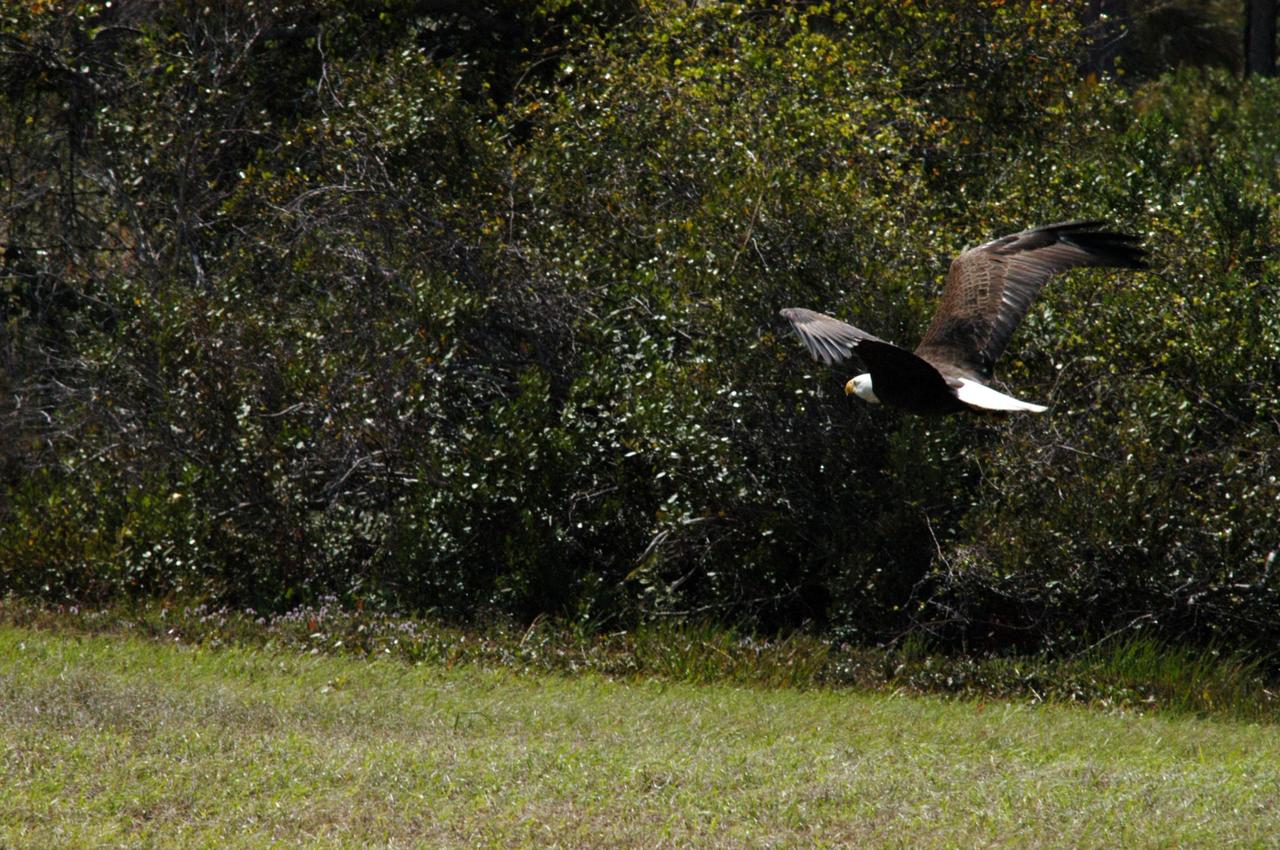
KENNEDY SPACE CENTER, FLA. - A bald eagle, spotted near S.R. 3 on Kennedy Space Center, begins its flight, perhaps scouting for food or heading for its nearby nest. There are a dozen active nests throughout the Merritt Island National Wildlife Refuge, which shares a boundary with the Center. Eagles' habitats are near lakes, rivers, marshes and seacoasts. Nests are masses of sticks, usually in the top of a tall tree. Even though they are fish eaters, bald eagles will take whatever prey is available and easiest to obtain. Bald eagles which live along the coast and on major lakes and rivers feed mainly on fish. Bald eagles fish in both fresh and salt water. Because of the energy expended during hunting, an eagle has to spend a lot of time resting quietly. It's estimated that only one out of eighteen attacks are successful. Photo credit: NASA/Jim Grossmann
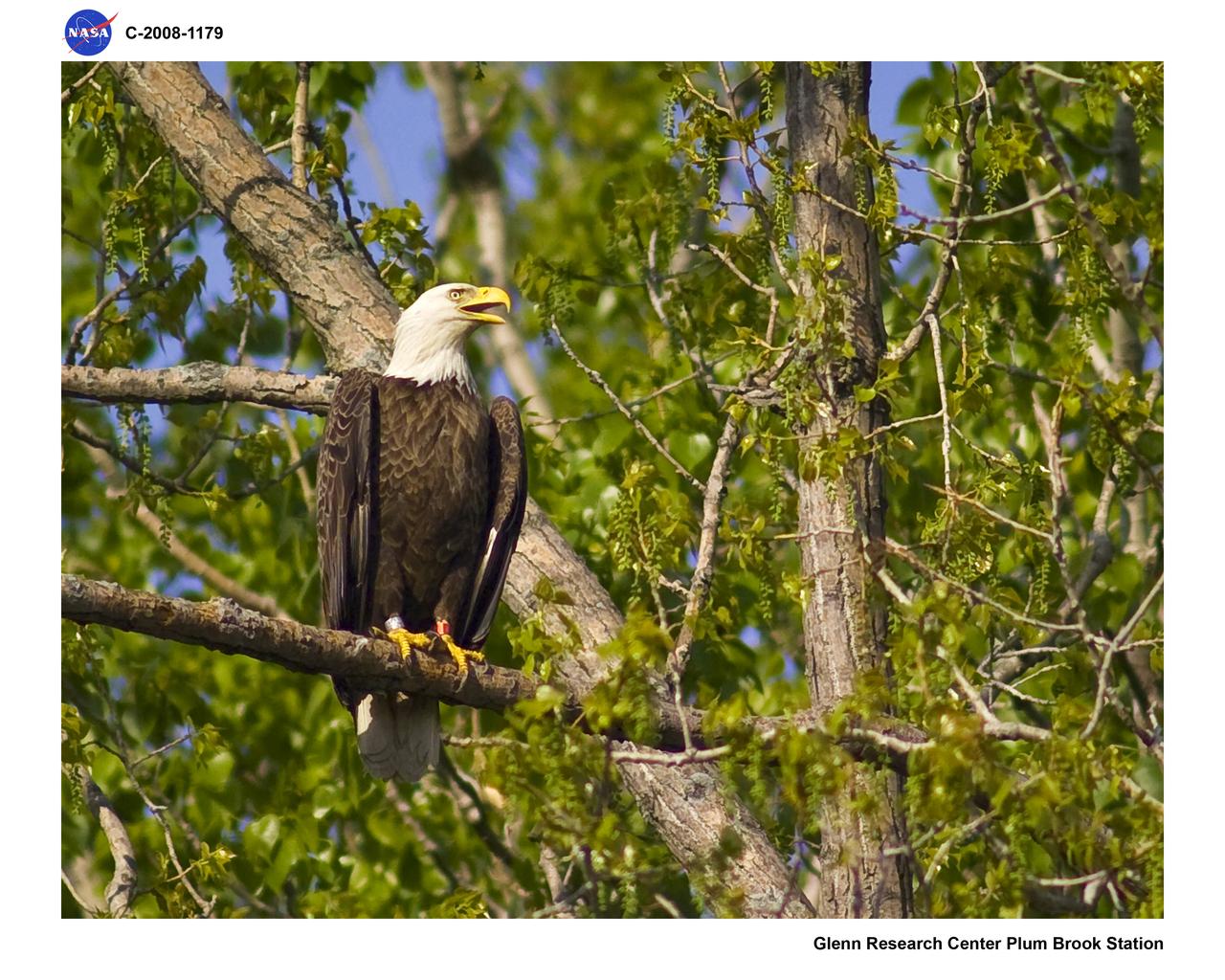
Bald Eagle at the NASA Plum Brook Station
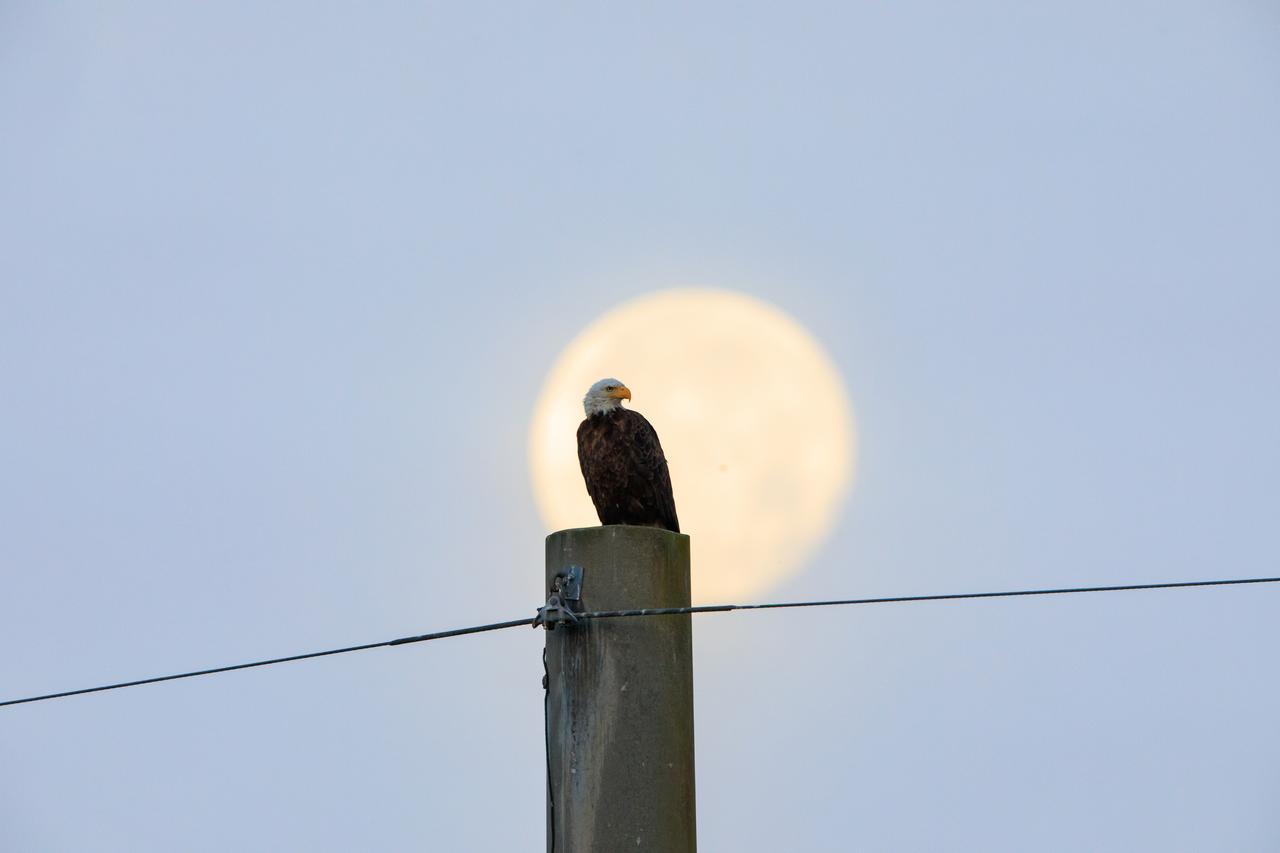
With the Moon in the background, an American bald eagle perches on a pole near its nest at NASA’s Kennedy Space Center on April 10, 2023. The eagle is part of a mated pair that takes up residence at the Florida spaceport during nesting season. This year, the pair is raising a lone baby eagle in the nest, located off of Kennedy Parkway, about two miles from the Vehicle Assembly Building. Kennedy currently is home to approximately 20 nesting pairs of bald eagles.
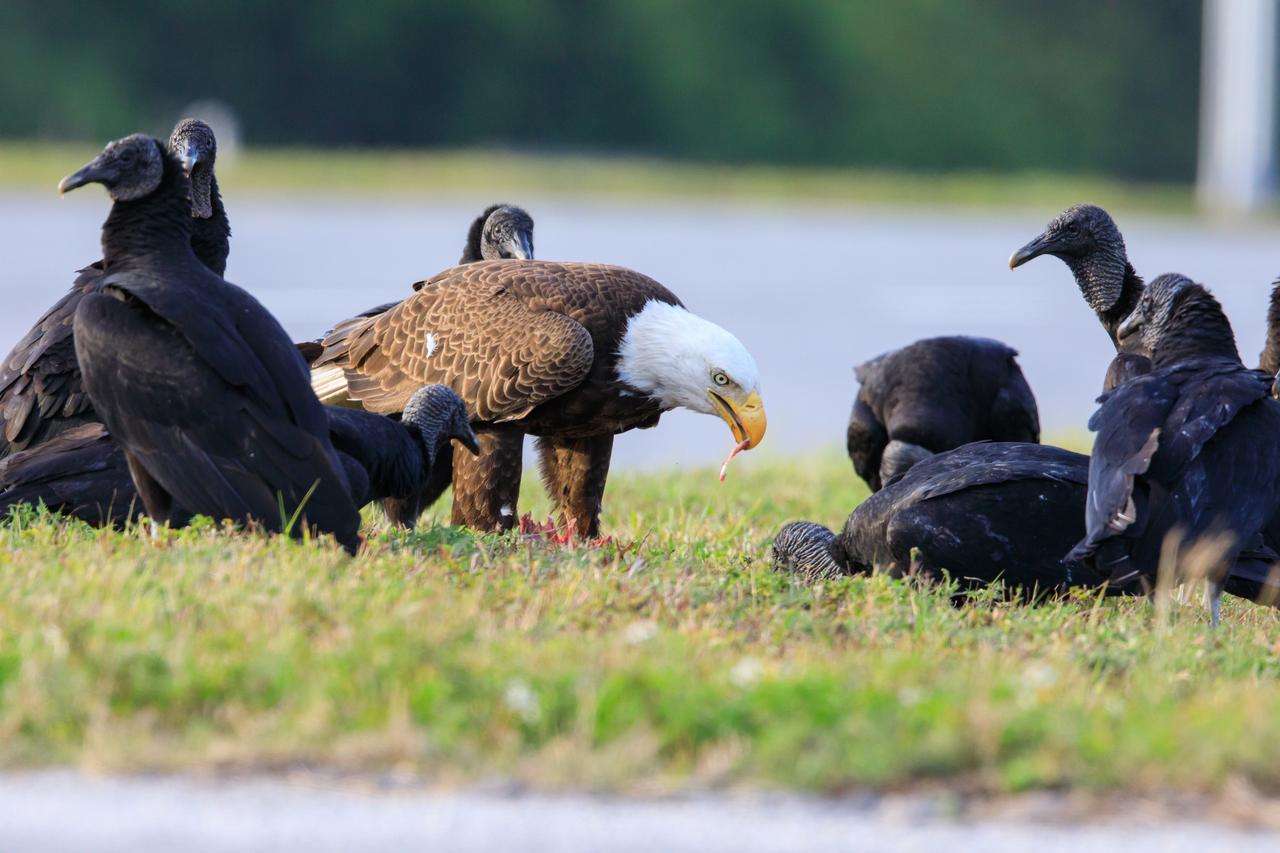
An American bald eagle feeds alongside some vultures at NASA’s Kennedy Space Center on April 10, 2023. The eagle is part of a mated pair that takes up residence at the Florida spaceport during nesting season. The pair is raising a baby eagle in their nest located off of Kennedy Parkway, about two miles from the Vehicle Assembly Building. Kennedy currently is home to approximately 20 nesting pairs of bald eagles.
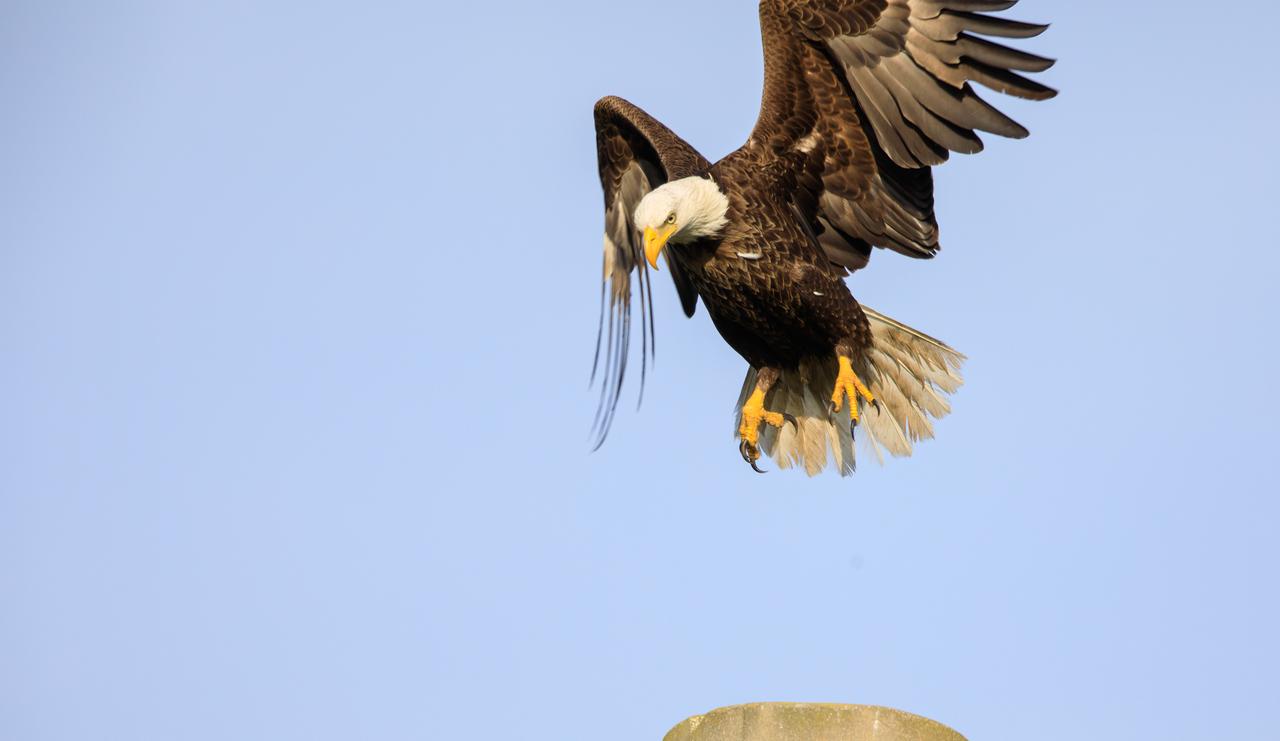
An American bald eagle swoops down to land on a pole at NASA’s Kennedy Space Center on April 10, 2023. The eagle is part of a mated pair that takes up residence at the Florida spaceport during nesting season. This year, the pair is raising a lone baby eagle in the nest, located in a tree near Kennedy Parkway, about two miles from the Vehicle Assembly Building. Kennedy currently is home to approximately 20 nesting pairs of bald eagles.
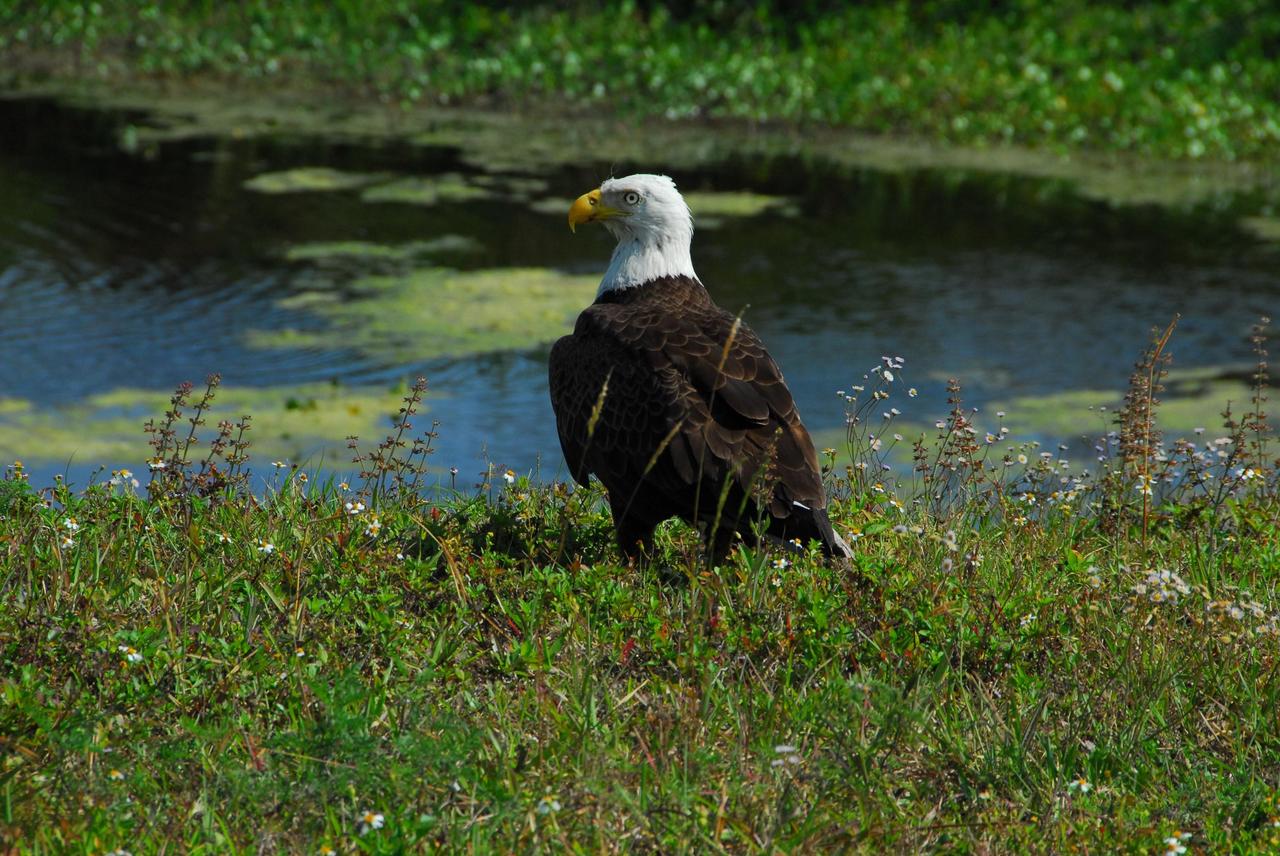
KENNEDY SPACE CENTER, FLA. -- This adult bald eagle rests on the ground near a pond close to S.R. 3 in NASA's Kennedy Space Center. Bald eagles live near large bodies of open water such as lakes, marshes, seacoasts and rivers, where there are plenty of fish to eat and tall trees for nesting and roosting. Bald eagles feed primarily on fish, but also eat small animals (ducks, coots, muskrats, turtles, rabbits, snakes, etc.) and occasional carrion (dead animals). They are sometimes seen among a gathering of vultures at the site of a fresh meal. Bald eagles have a presence in every U. S. state except Hawaii. Bald eagles use a specific territory for nesting (they mate for life), winter feeding or a year-round residence. Its natural domain is from Alaska to Baja, California, and from Maine to Florida. There are a dozen eagle nests both in KSC and in the Merritt Island National Wildlife Refuge, which surrounds KSC. The refuge includes several wading bird rookeries, many osprey nests, up to 400 manatees during the spring, and approximately 2,500 Florida scrub jays. It also is a major wintering area for migratory birds. More than 500 species of wildlife inhabit the refuge, with 15 considered federally threatened or endangered. Photo credit: NASA/George Shelton
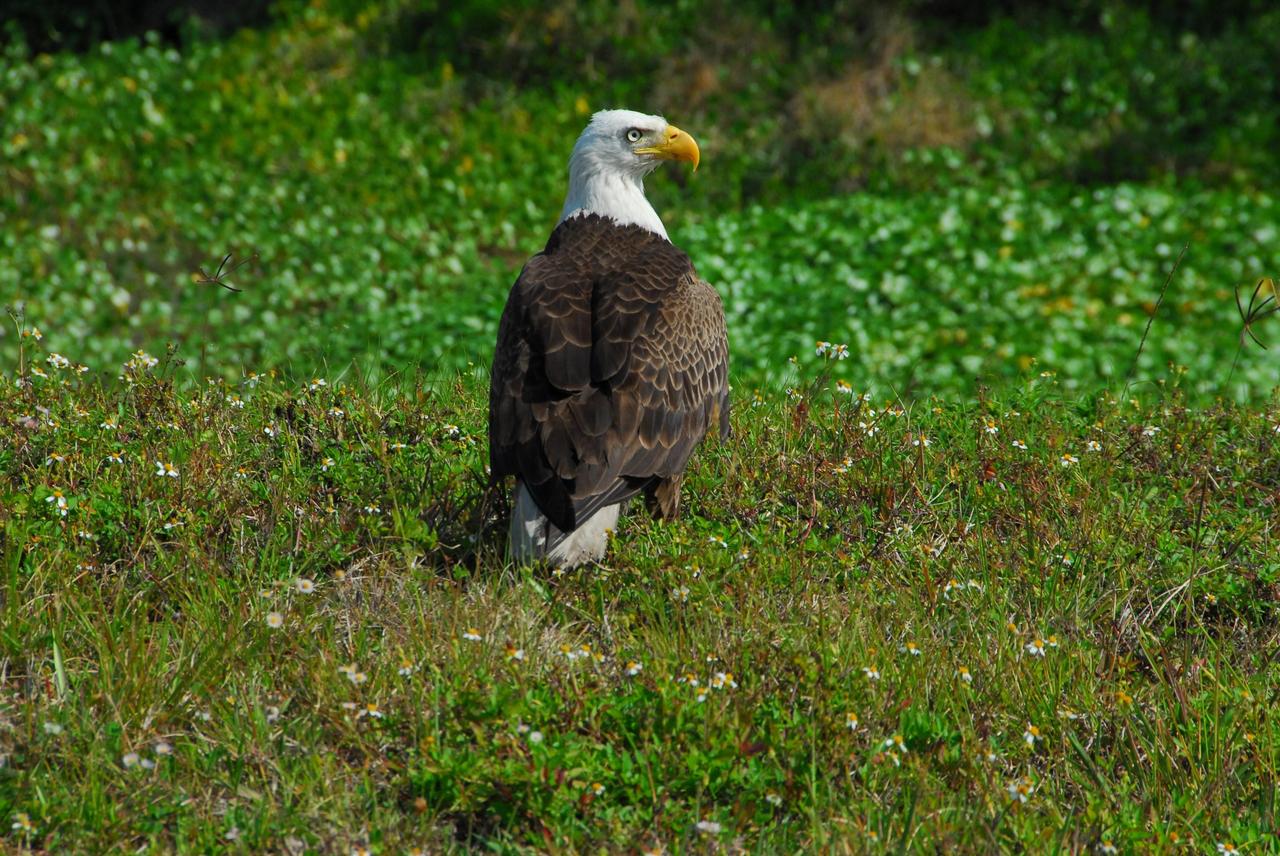
KENNEDY SPACE CENTER, FLA. -- This adult bald eagle rests on the ground near a pond close to S.R. 3 in NASA's Kennedy Space Center. Bald eagles live near large bodies of open water such as lakes, marshes, seacoasts and rivers, where there are plenty of fish to eat and tall trees for nesting and roosting. Bald eagles feed primarily on fish, but also eat small animals (ducks, coots, muskrats, turtles, rabbits, snakes, etc.) and occasional carrion (dead animals). They are sometimes seen among a gathering of vultures at the site of a fresh meal. Bald eagles have a presence in every U. S. state except Hawaii. Bald eagles use a specific territory for nesting (they mate for life), winter feeding or a year-round residence. Its natural domain is from Alaska to Baja, California, and from Maine to Florida. There are a dozen eagle nests both in KSC and in the Merritt Island National Wildlife Refuge, which surrounds KSC. The refuge includes several wading bird rookeries, many osprey nests, up to 400 manatees during the spring, and approximately 2,500 Florida scrub jays. It also is a major wintering area for migratory birds. More than 500 species of wildlife inhabit the refuge, with 15 considered federally threatened or endangered. Photo credit: NASA/George Shelton
KENNEDY SPACE CENTER, FLA. -- A bald eagle perches on a pole on Launch Pad 39A, seemingly monitoring the instruction of the space shuttle Atlantis STS-122 crew on slidewire basket operation, part of the emergency exit system on the fixed service structure of the pad. Bald eagles use a specific territory for nesting (they mate for life), winter feeding or a year-round residence. Its natural domain is from Alaska to Baja, California, and from Maine to Florida. Bald eagles have a presence in every U. S. state except Hawaii. There are a dozen eagle nests in both Kennedy Space Center and the Merritt Island National Wildlife Refuge, which surrounds Kennedy. Bald eagles live near large bodies of open water such as lakes, marshes, seacoasts and rivers, where there are plenty of fish to eat and tall trees for nesting and roosting. Bald eagles feed primarily on fish, but also eat small animals (ducks, coots, muskrats, turtles, rabbits, snakes, etc.). Photo credit: NASA/Kim Shiflett
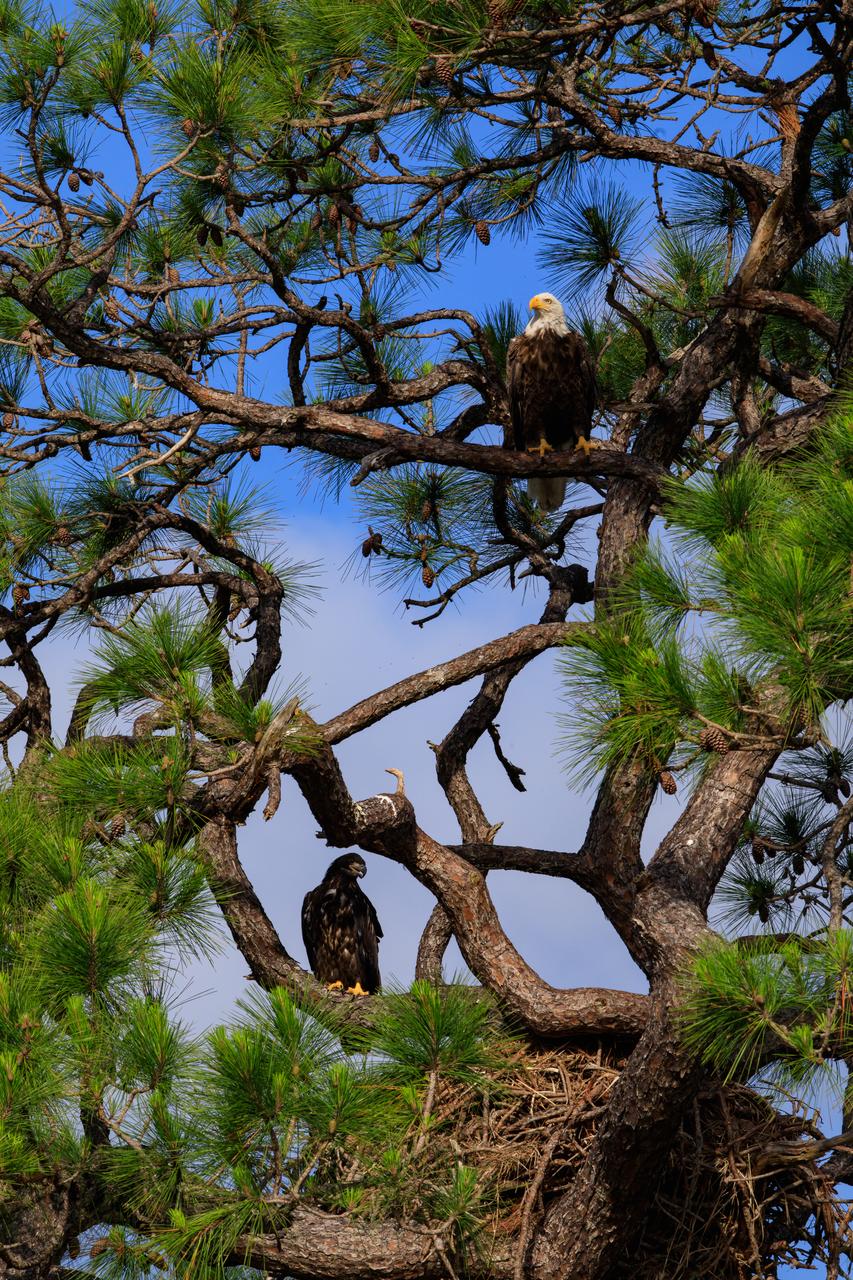
An American bald eagle is perched high in a tree above its nest at NASA’s Kennedy Space Center in Florida on April 10, 2023. Below is its baby eagle, looking up from the nest located off of Kennedy Parkway, about two miles from the Vehicle Assembly Building. The adult eagle is part of a mated pair that recently built a new home in this tree after storms badly damaged their original nest located about 50 yards away. That nest was built in 1973 and had been used by eagles almost every year since 1975. Kennedy currently is home to approximately 20 nesting pairs of bald eagles.
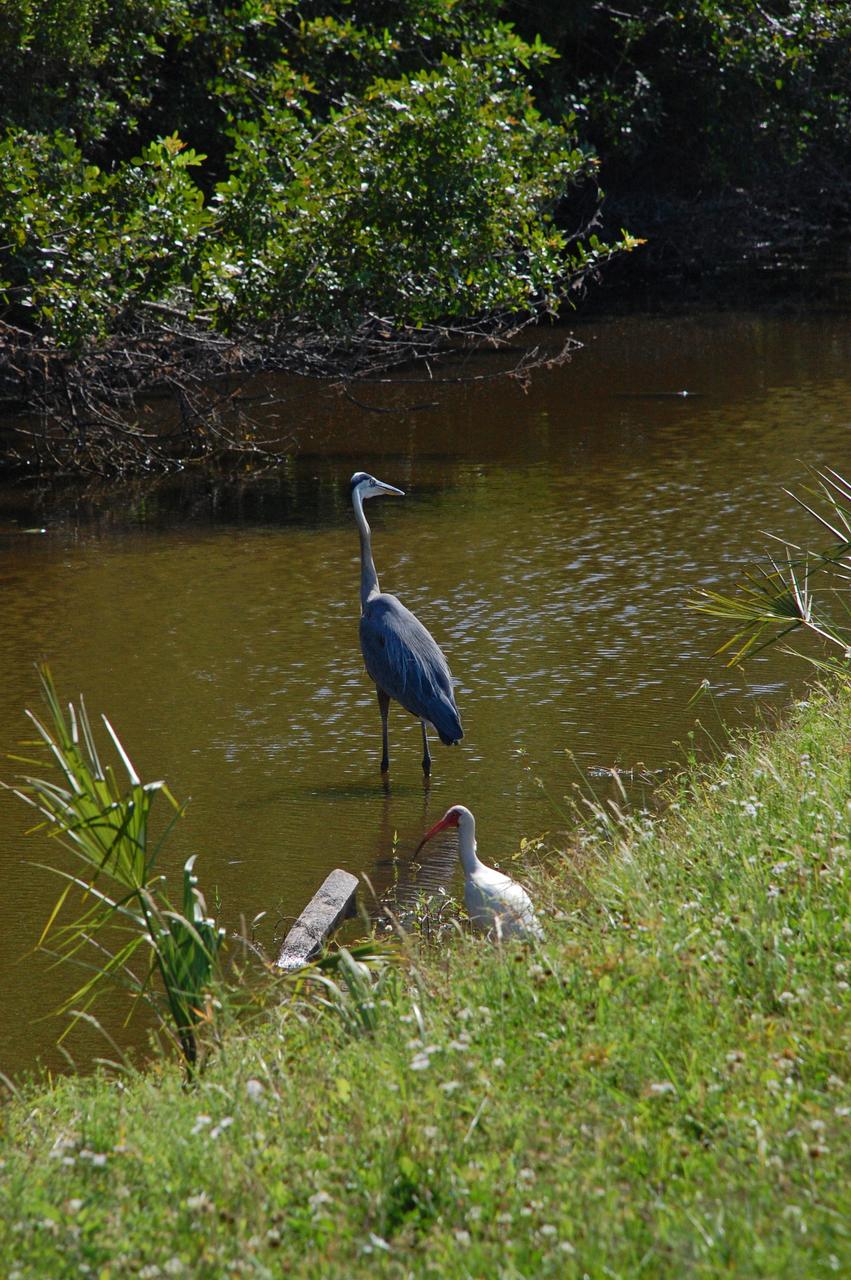
CAPE CANAVERAL, Fla. – A great blue heron stands tall in the water, perhaps looking for food, on grounds of NASA's Kennedy Space Center in Florida. More gray than blue, with a yellowish bill and black legs, it has a brownish-buff colored neck with a black border and white in front of its neck with a vertical black streak. The bird's head is white with a black stripe above its eye. They range throughout the U.S., inhabiting lakes, ponds, rivers and marshes. Their principal food is fish or frogs but may feed on small mammals, reptiles and occasionally birds. Kennedy shares a boundary with the Merritt Island National Wildlife Refuge, which is a habitat for more than 310 species of birds, 25 mammals, 117 fishes and 65 amphibians and reptiles. Photo credit: NASA/Ben Smegelsky
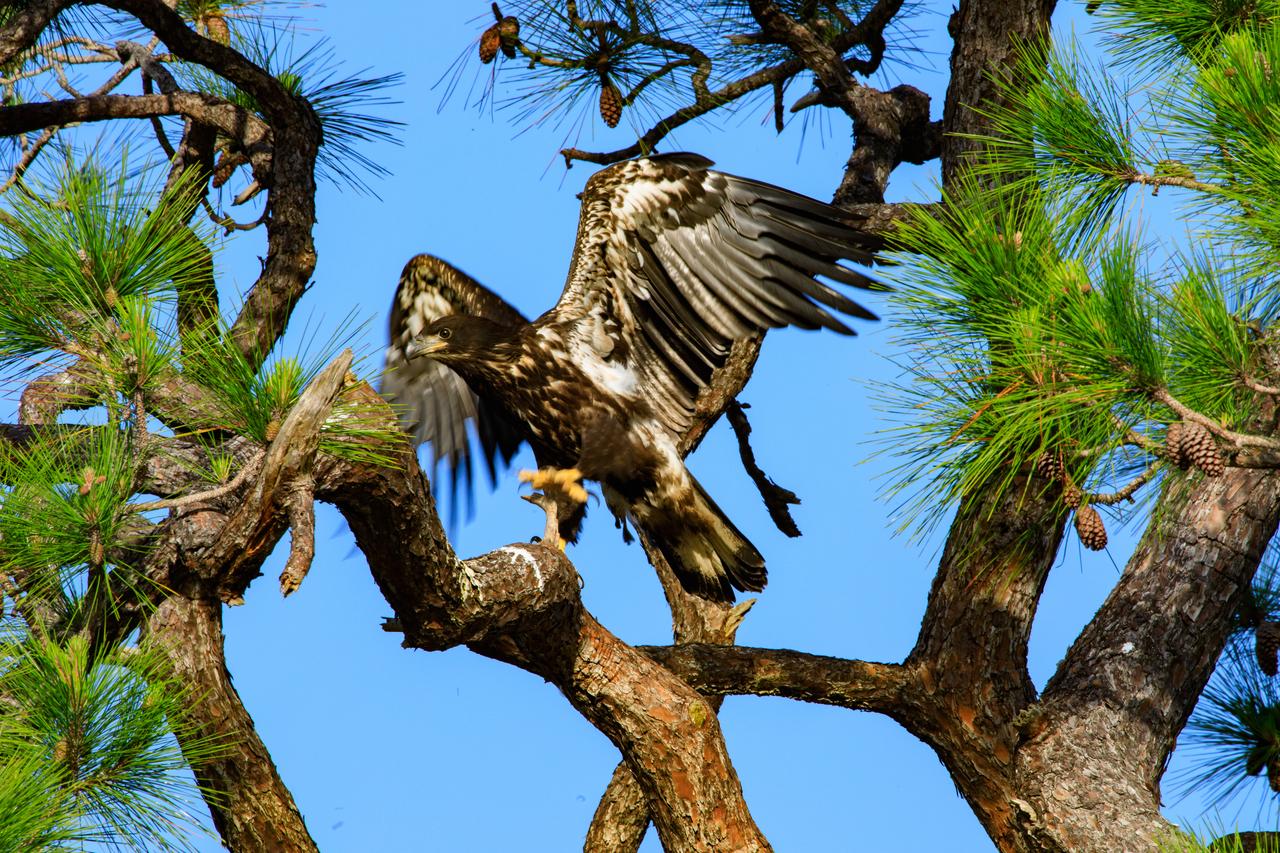
A baby American bald eagle spreads its wings to fly high above a tree that contains its nest at NASA’s Kennedy Space Center in Florida on April 26, 2023. The nest is located off Kennedy Parkway, about two miles from the Vehicle Assembly Building. The eagle is from a mated pair that recently built a new home in this tree after storms badly damaged their original nest located about 50 yards away. That nest was built in 1973 and had been used by eagles almost every year since 1975. Kennedy currently is home to approximately 20 nesting pairs of bald eagles.
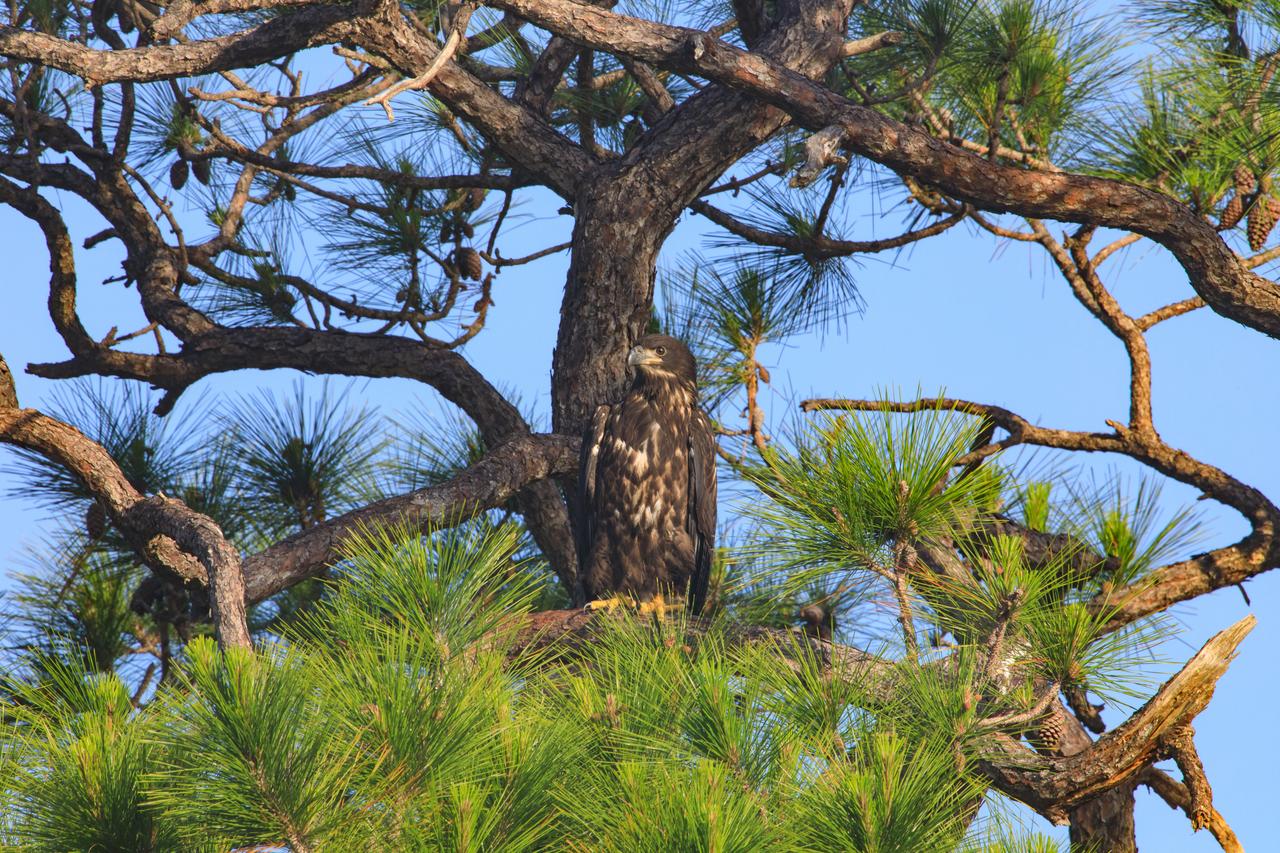
A baby American bald eagle is perched high in a tree above its nest at NASA’s Kennedy Space Center in Florida on April 26, 2023. The nest is located off Kennedy Parkway, about two miles from the Vehicle Assembly Building. The eagle is from a mated pair that recently built a new home in this tree after storms badly damaged their original nest located about 50 yards away. That nest was built in 1973 and had been used by eagles almost every year since 1975. Kennedy currently is home to approximately 20 nesting pairs of bald eagles.
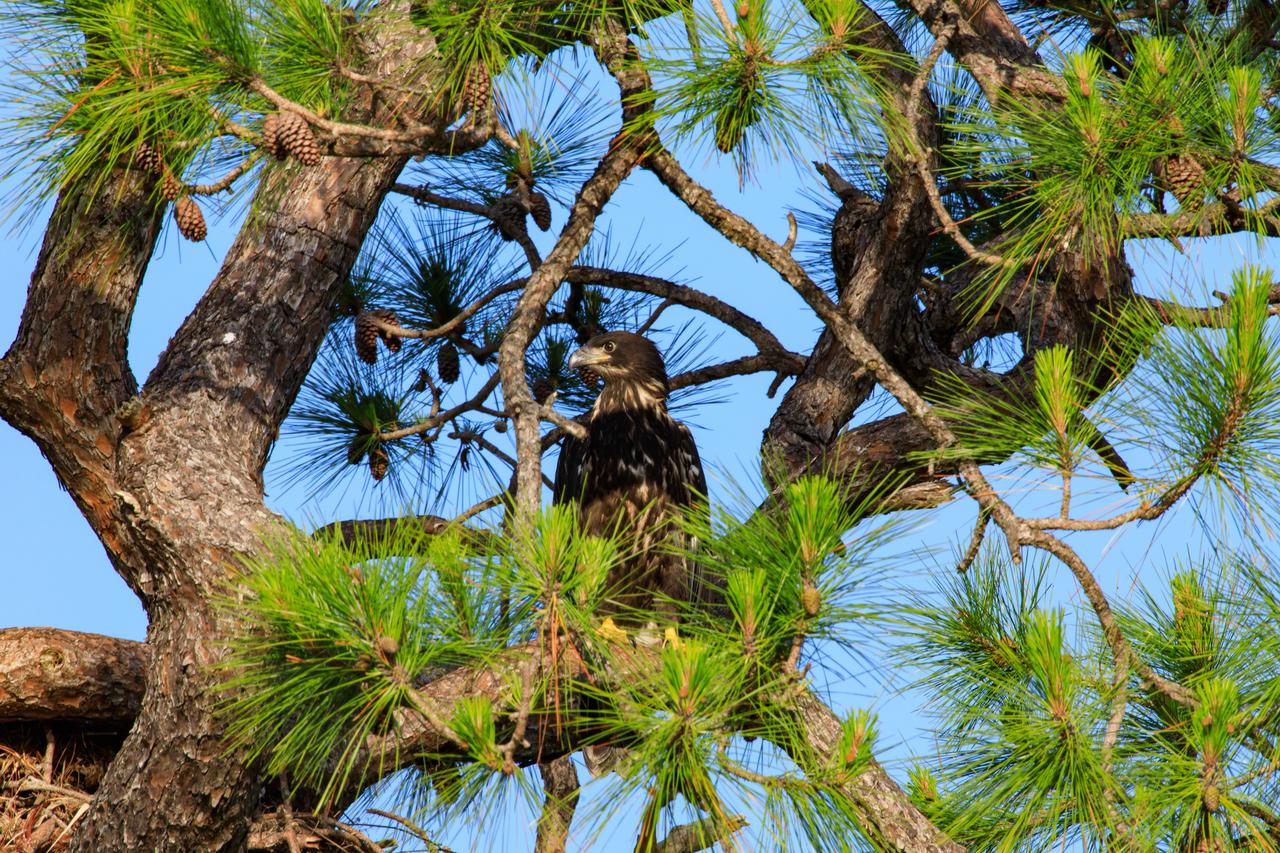
A baby American bald eagle is perched high in a tree above its nest at NASA’s Kennedy Space Center in Florida on April 26, 2023. The nest is located off Kennedy Parkway, about two miles from the Vehicle Assembly Building. The eagle is from a mated pair that recently built a new home in this tree after storms badly damaged their original nest located about 50 yards away. That nest was built in 1973 and had been used by eagles almost every year since 1975. Kennedy currently is home to approximately 20 nesting pairs of bald eagles.
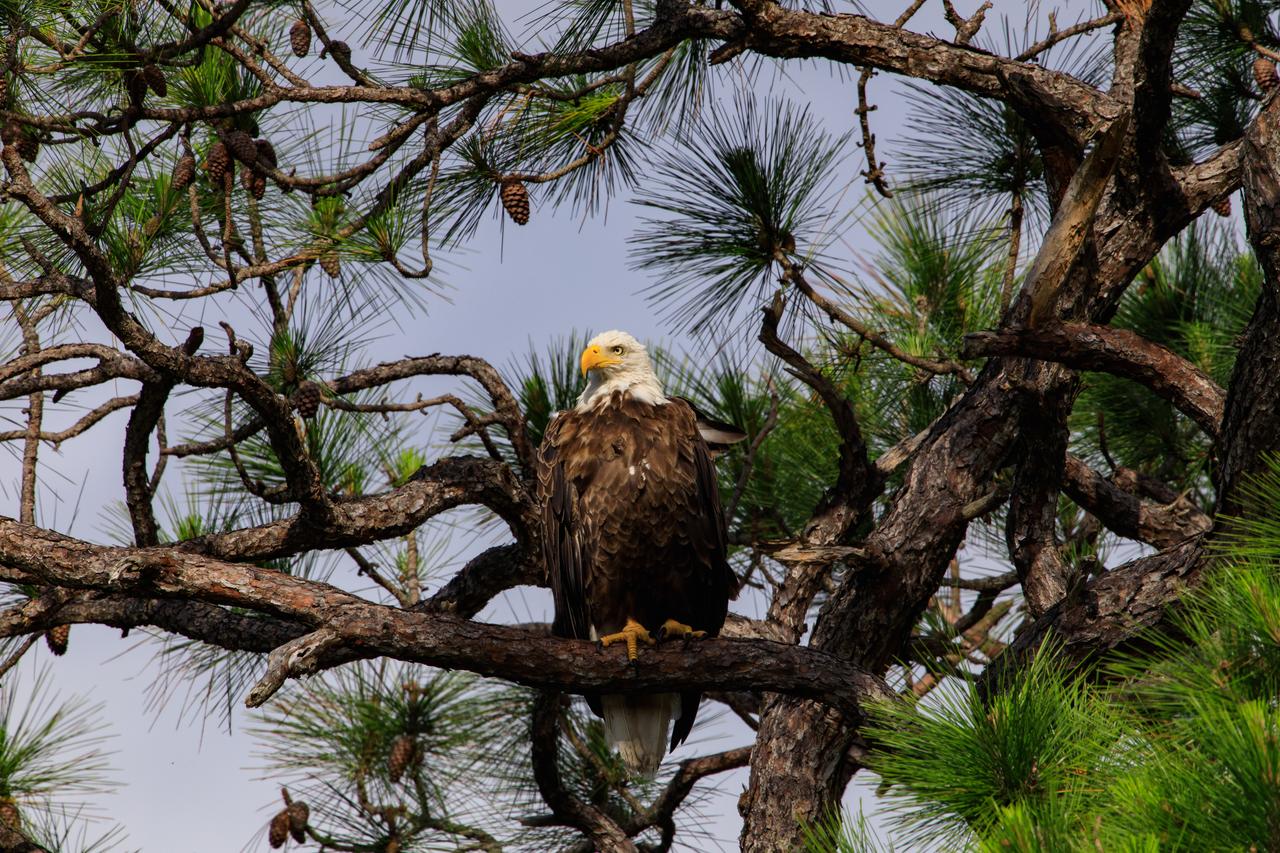
An American bald eagle is perched high in a tree above its nest at NASA’s Kennedy Space Center in Florida on April 10, 2023. The nest is located off of Kennedy Parkway, about two miles from the Vehicle Assembly Building. The adult eagle is part of a mated pair that recently built a new home in this tree after storms badly damaged their original nest located about 50 yards away. That nest was built in 1973 and had been used by eagles almost every year since 1975. Kennedy currently is home to approximately 20 nesting pairs of bald eagles.
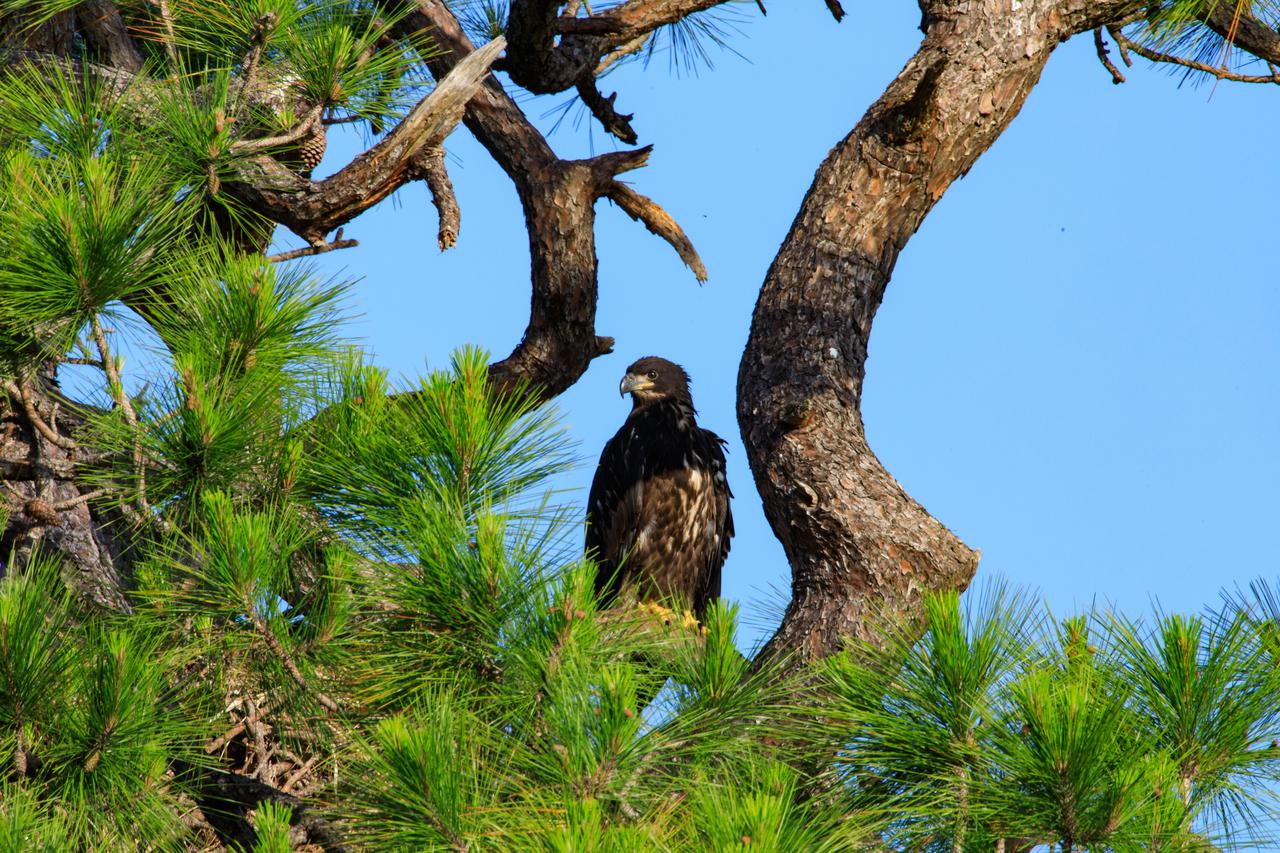
A baby American bald eagle is perched high in a tree above its nest at NASA’s Kennedy Space Center in Florida on April 26, 2023. The nest is located off Kennedy Parkway, about two miles from the Vehicle Assembly Building. The eagle is from a mated pair that recently built a new home in this tree after storms badly damaged their original nest located about 50 yards away. That nest was built in 1973 and had been used by eagles almost every year since 1975. Kennedy currently is home to approximately 20 nesting pairs of bald eagles.
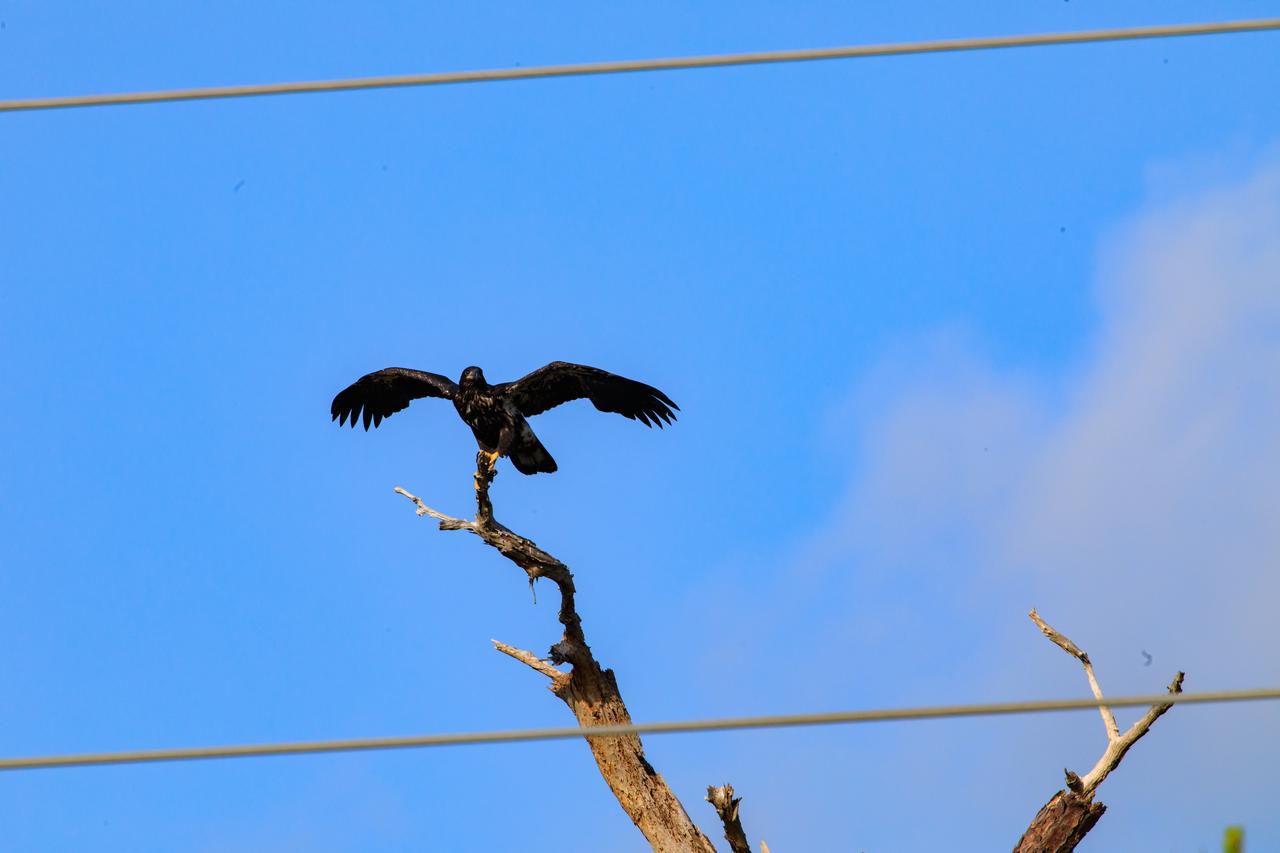
A baby American bald eagle spreads its wings to fly above a tree that contains its nest at NASA’s Kennedy Space Center in Florida on April 26, 2023. The nest is located off Kennedy Parkway, about two miles from the Vehicle Assembly Building. The eagle is from a mated pair that recently built a new home in this tree after storms badly damaged their original nest located about 50 yards away. That nest was built in 1973 and had been used by eagles almost every year since 1975. Kennedy currently is home to approximately 20 nesting pairs of bald eagles.
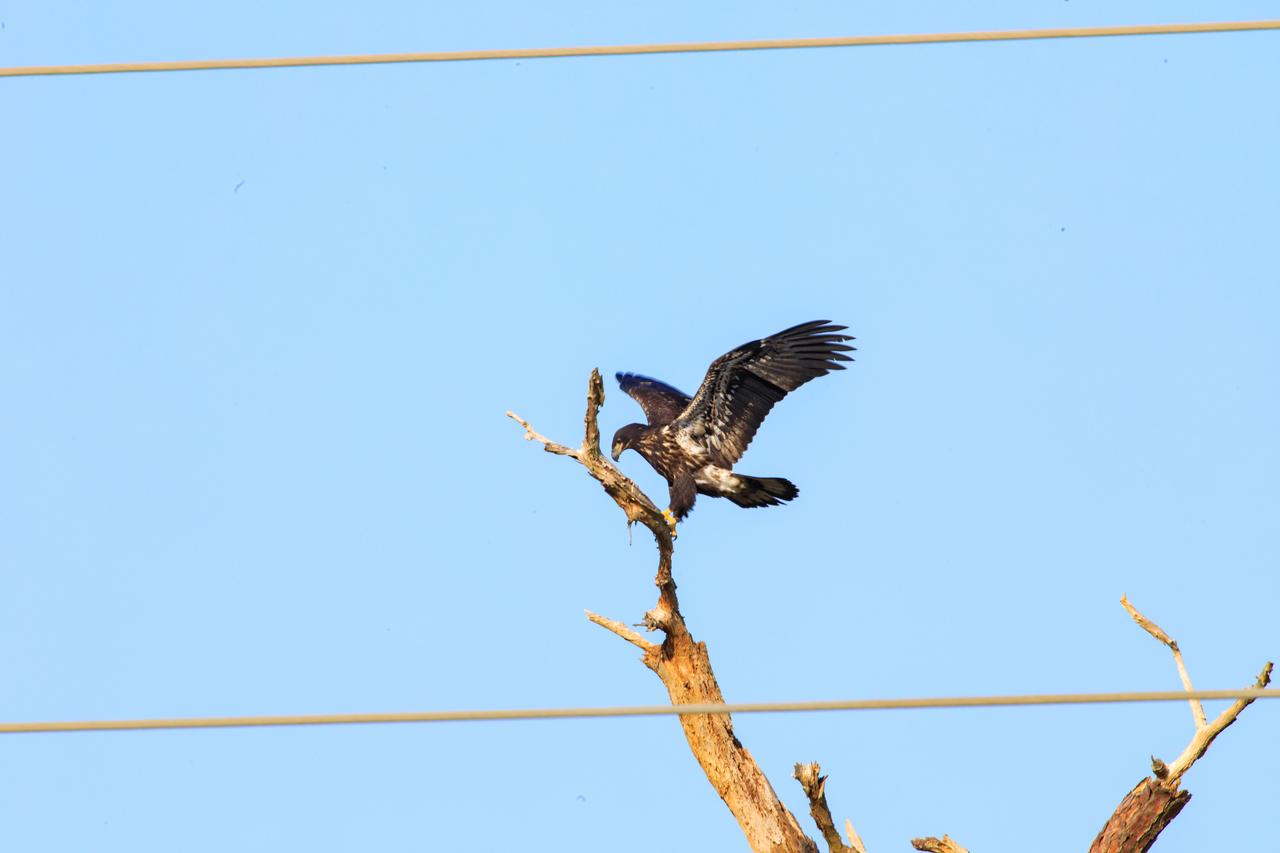
A baby American bald eagle spreads its wings to fly above a tree that contains its nest at NASA’s Kennedy Space Center in Florida on April 26, 2023. The nest is located off Kennedy Parkway, about two miles from the Vehicle Assembly Building. The eagle is from a mated pair that recently built a new home in this tree after storms badly damaged their original nest located about 50 yards away. That nest was built in 1973 and had been used by eagles almost every year since 1975. Kennedy currently is home to approximately 20 nesting pairs of bald eagles.
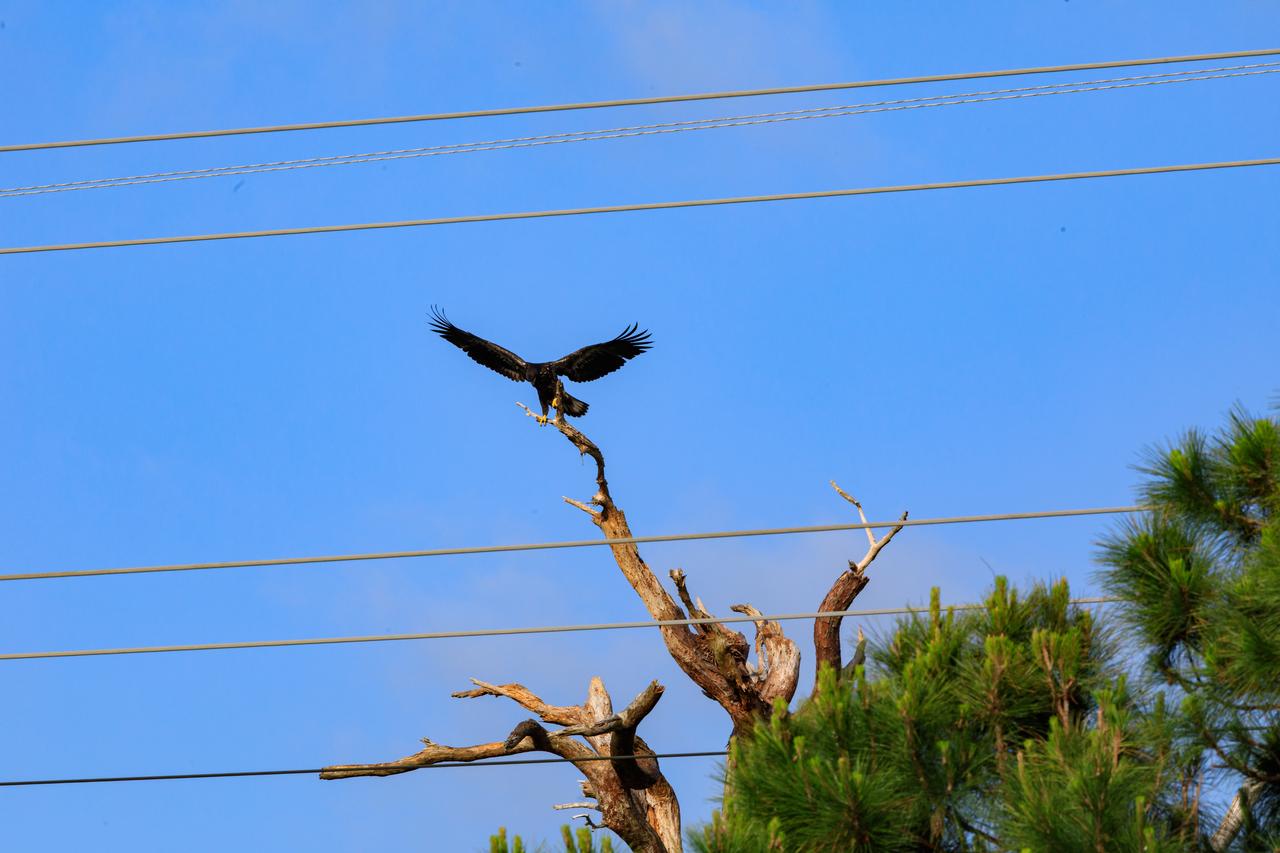
A baby American bald eagle spreads its wings to fly above a tree that contains its nest at NASA’s Kennedy Space Center in Florida on April 26, 2023. The nest is located off Kennedy Parkway, about two miles from the Vehicle Assembly Building. The eagle is from a mated pair that recently built a new home in this tree after storms badly damaged their original nest located about 50 yards away. That nest was built in 1973 and had been used by eagles almost every year since 1975. Kennedy currently is home to approximately 20 nesting pairs of bald eagles.
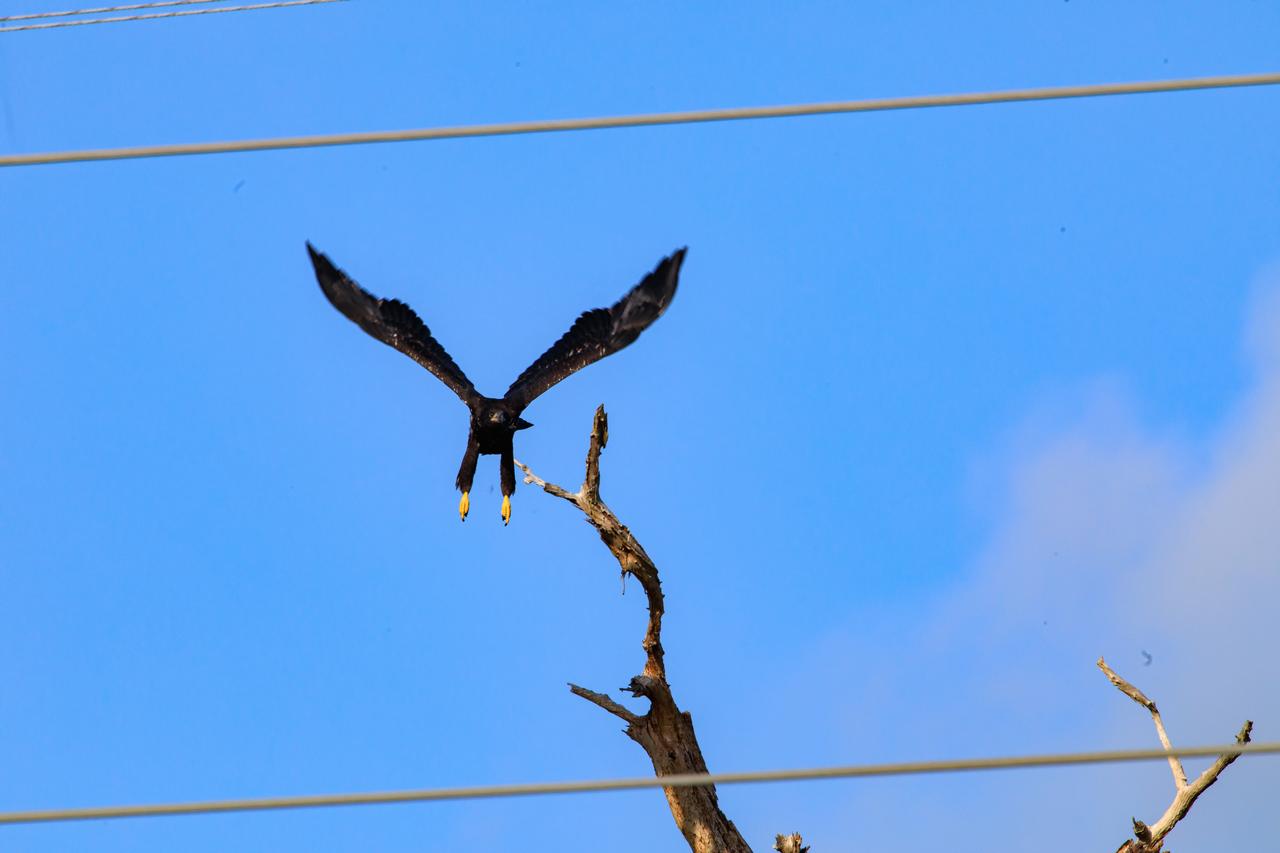
A baby American bald eagle takes flight from a tree that contains its nest at NASA’s Kennedy Space Center in Florida on April 26, 2023. The nest is located off Kennedy Parkway, about two miles from the Vehicle Assembly Building. The eagle is from a mated pair that recently built a new home in this tree after storms badly damaged their original nest located about 50 yards away. That nest was built in 1973 and had been used by eagles almost every year since 1975. Kennedy currently is home to approximately 20 nesting pairs of bald eagles.
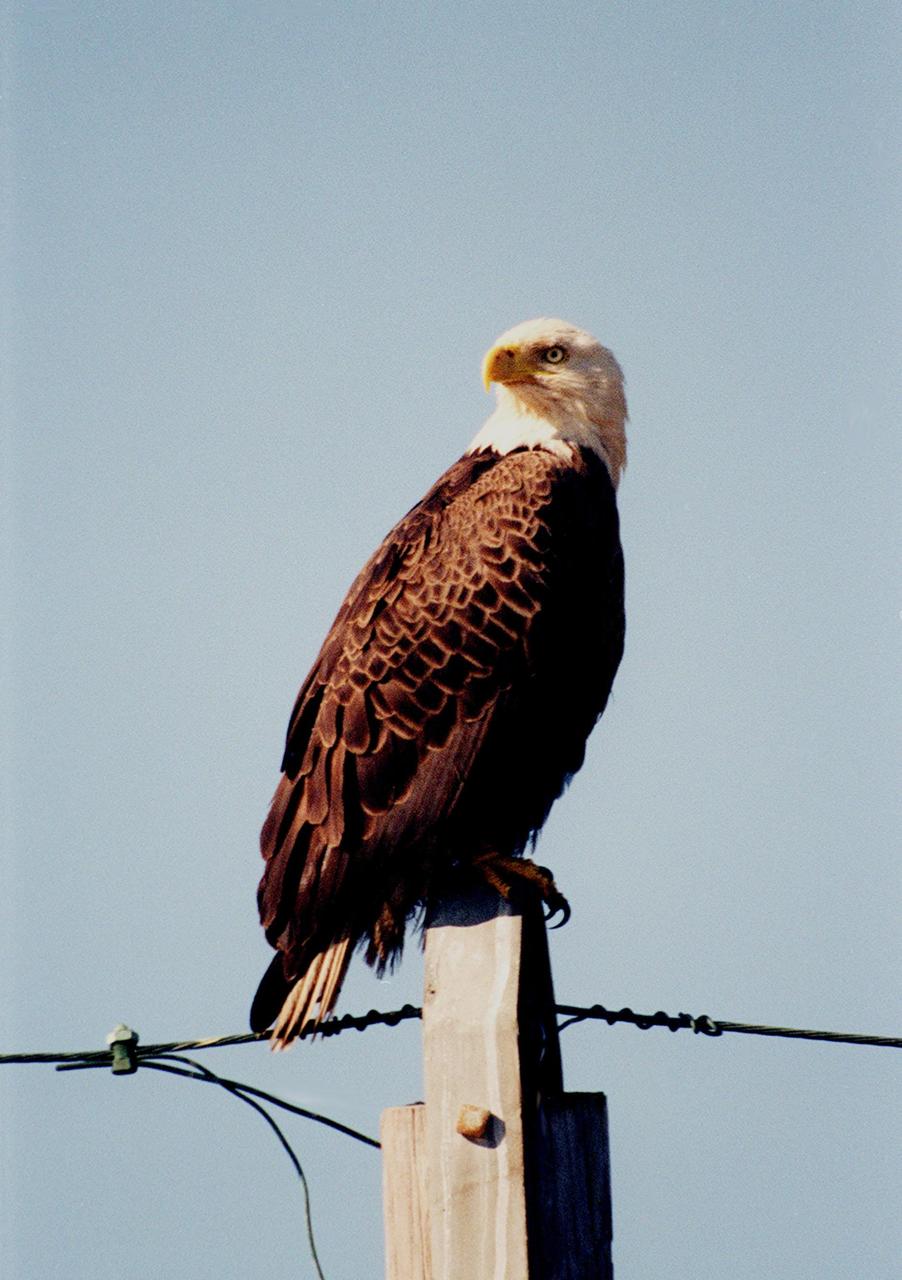
KENNEDY SPACE CENTER, FLA. -- A Southern Bald Eagle perches on top of a utility pole at Kennedy Space Center. About a dozen bald eagles live in the Merritt Island National Wildlife Refuge, which shares a boundary with Kennedy Space Center. The Southern Bald Eagle ranges throughout Florida and along the coasts of California, Texas, Louisiana, and the south Atlantic states. Bald Eagles are listed as endangered in the U.S., except in five states where they are listed as threatened. The number of nesting pairs of the southern race once numbered several thousand; recent estimates are only 350-375. Most of the southern race nest in Florida. Eagles arrive at KSC during late summer and leave for the north in late spring. They move to nest sites in October and November and lay one to three eggs. The young fledge from February to April. The Refuge encompasses 92,000 acres that are a habitat for more than 331 species of birds, 31 mammals, 117 fishes, and 65 amphibians and reptiles. The marshes and open water of the refuge provide wintering areas for 23 species of migratory waterfowl, as well as a year-round home for great blue herons, great egrets, wood storks, cormorants, brown pelicans and other species of marsh and shore birds, as well as a variety of insect
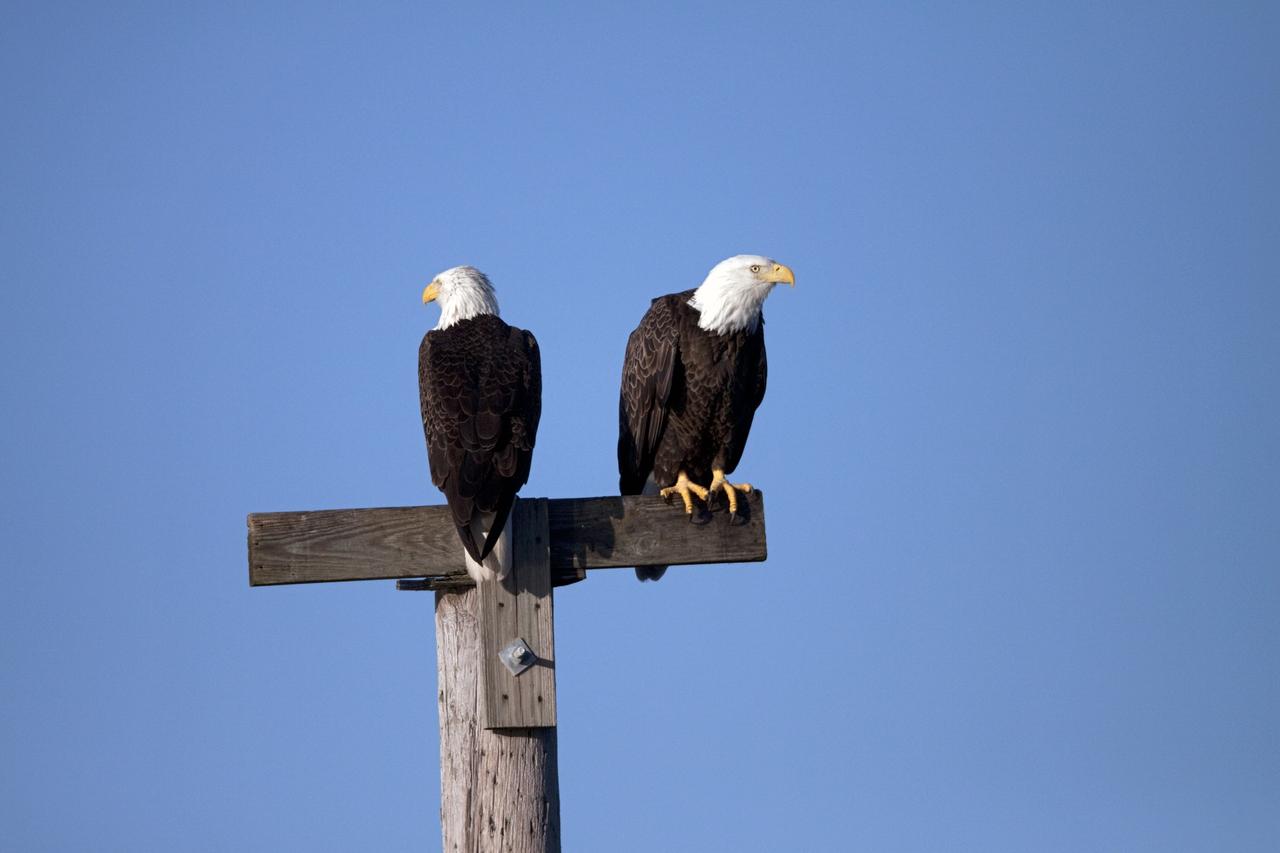
CAPE CANAVERAL, Fla. – On State Road 3 near the Shuttle Landing Facility at NASA's Kennedy Space Center in Florida, two bald eagles scout the terrain from their vantage point atop a pole. There are 18 active eagle nests within Kennedy's boundaries, including several in the vicinity of the landing strip. Bald eagles mate for life, choosing the tops of large trees to build nests, which they typically use and enlarge each year. Nests may reach 10 feet across and weigh half a ton. The birds travel great distances, but usually return to breeding grounds within 100 miles of the place where they were raised. Bald eagles may live 15 to 25 years in the wild. The Merritt Island National Wildlife Refuge coexists with Kennedy Space Center and provides a habitat for 330 species of birds including the bald eagle. A variety of other wildlife - 117 kinds of fish, 65 types of amphibians and reptiles, 31 different mammals, and 1,045 species of plants - also inhabit the refuge. For information on the refuge, visit http://www.fws.gov/merrittisland/Index.html. For information on Kennedy Space Center, visit http://www.nasa.gov/kennedy. Photo credit: NASA/Ken Thornsley
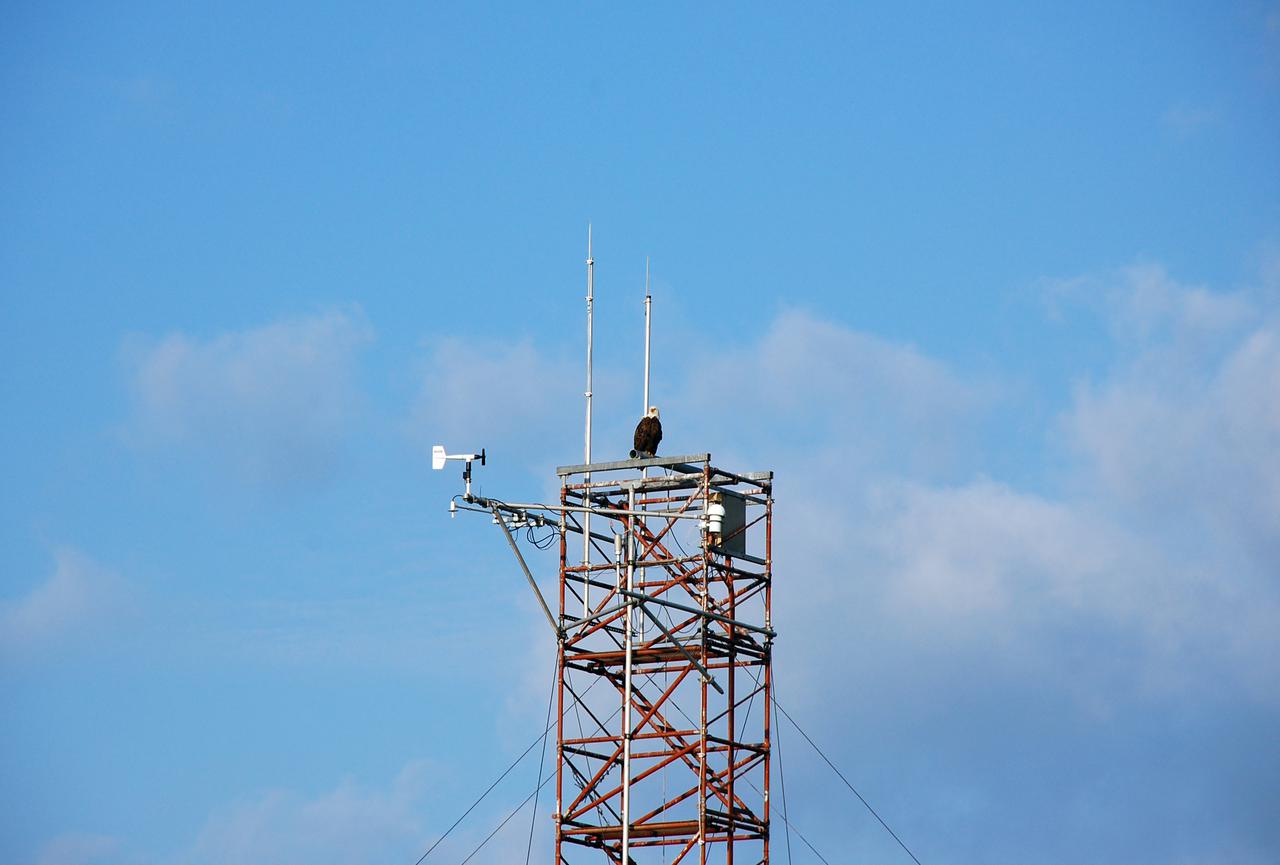
CAPE CANAVERAL, Fla. - At NASA's Kennedy Space Center in Florida, a bald eagle is in prime position at the top of a tower at the Shuttle Landing Facility to watch the landing of space shuttle Discovery. Bald eagles mate for life, choosing the tops of large trees to build nests, which they typically use and enlarge each year. Nests may reach 10 feet across and weigh half a ton. The birds travel great distances but usually return to breeding grounds within 100 miles of the place where they were raised. Bald eagles may live 15 to 25 years in the wild. There are 18 active eagle nests within Kennedy's boundaries, including several in the vicinity of the landing strip. The Merritt Island National Wildlife Refuge coexists with Kennedy Space Center and provides a habitat for 330 species of birds including the bald eagle. A variety of other wildlife - 117 kinds of fish, 65 types of amphibians and reptiles, 31 different mammals, and 1,045 species of plants - also inhabit the refuge. For information on the refuge, visit http:__www.fws.gov_merrittisland_Index.html. For information on Kennedy Space Center, visit http:__www.nasa.gov_kennedy. Photo credit: NASA_Ben Smegelsky
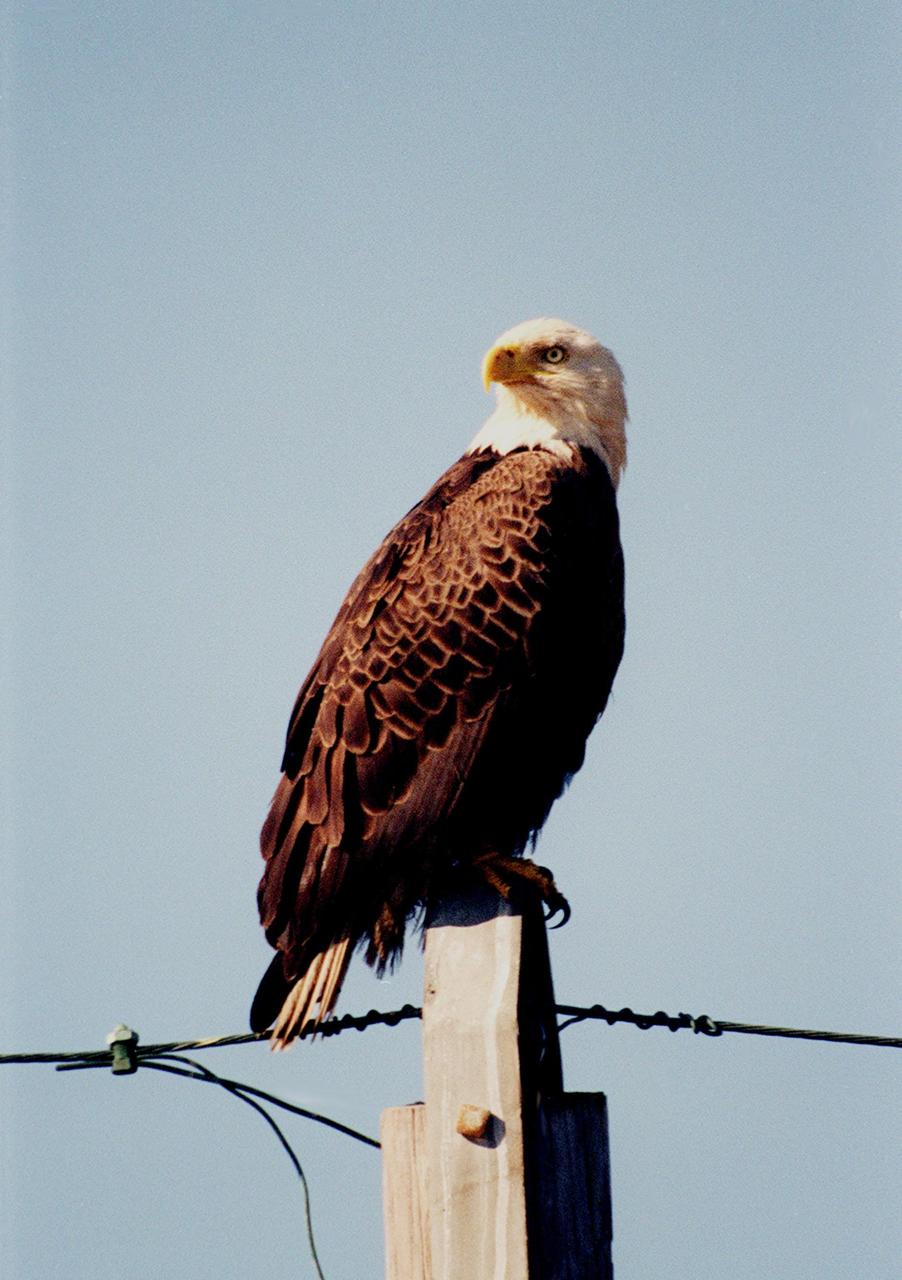
KENNEDY SPACE CENTER, FLA. -- A Southern Bald Eagle perches on top of a utility pole at Kennedy Space Center. About a dozen bald eagles live in the Merritt Island National Wildlife Refuge, which shares a boundary with Kennedy Space Center. The Southern Bald Eagle ranges throughout Florida and along the coasts of California, Texas, Louisiana, and the south Atlantic states. Bald Eagles are listed as endangered in the U.S., except in five states where they are listed as threatened. The number of nesting pairs of the southern race once numbered several thousand; recent estimates are only 350-375. Most of the southern race nest in Florida. Eagles arrive at KSC during late summer and leave for the north in late spring. They move to nest sites in October and November and lay one to three eggs. The young fledge from February to April. The Refuge encompasses 92,000 acres that are a habitat for more than 331 species of birds, 31 mammals, 117 fishes, and 65 amphibians and reptiles. The marshes and open water of the refuge provide wintering areas for 23 species of migratory waterfowl, as well as a year-round home for great blue herons, great egrets, wood storks, cormorants, brown pelicans and other species of marsh and shore birds, as well as a variety of insect
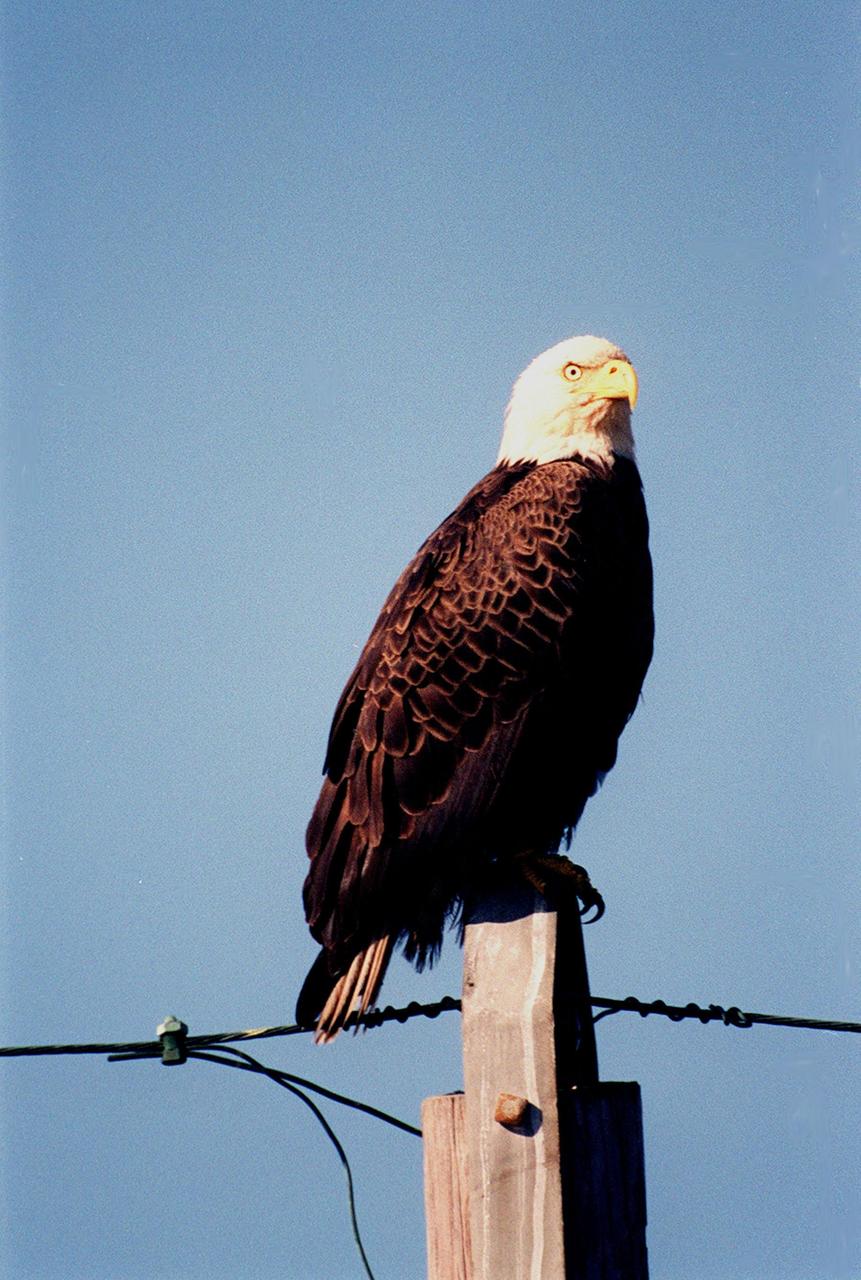
KENNEDY SPACE CENTER, FLA. -- A Southern Bald Eagle perched on top of a utility pole searches the area. About a dozen bald eagles live in the Merritt Island National Wildlife Refuge, which shares a boundary with Kennedy Space Center. The Southern Bald Eagle ranges throughout Florida and along the coasts of California, Texas, Louisiana, and the south Atlantic states. Bald Eagles are listed as endangered in the U.S., except in five states where they are listed as threatened. The number of nesting pairs of the southern race once numbered several thousand; recent estimates are only 350-375. Most of the southern race nest in Florida. Eagles arrive at KSC during late summer and leave for the north in late spring. They move to nest sites in October and November and lay one to three eggs. The young fledge from February to April. The Refuge encompasses 92,000 acres that are a habitat for more than 331 species of birds, 31 mammals, 117 fishes, and 65 amphibians and reptiles. The marshes and open water of the refuge provide wintering areas for 23 species of migratory waterfowl, as well as a year-round home for great blue herons, great egrets, wood storks, cormorants, brown pelicans and other species of marsh and shore birds, as well as a variety of insects
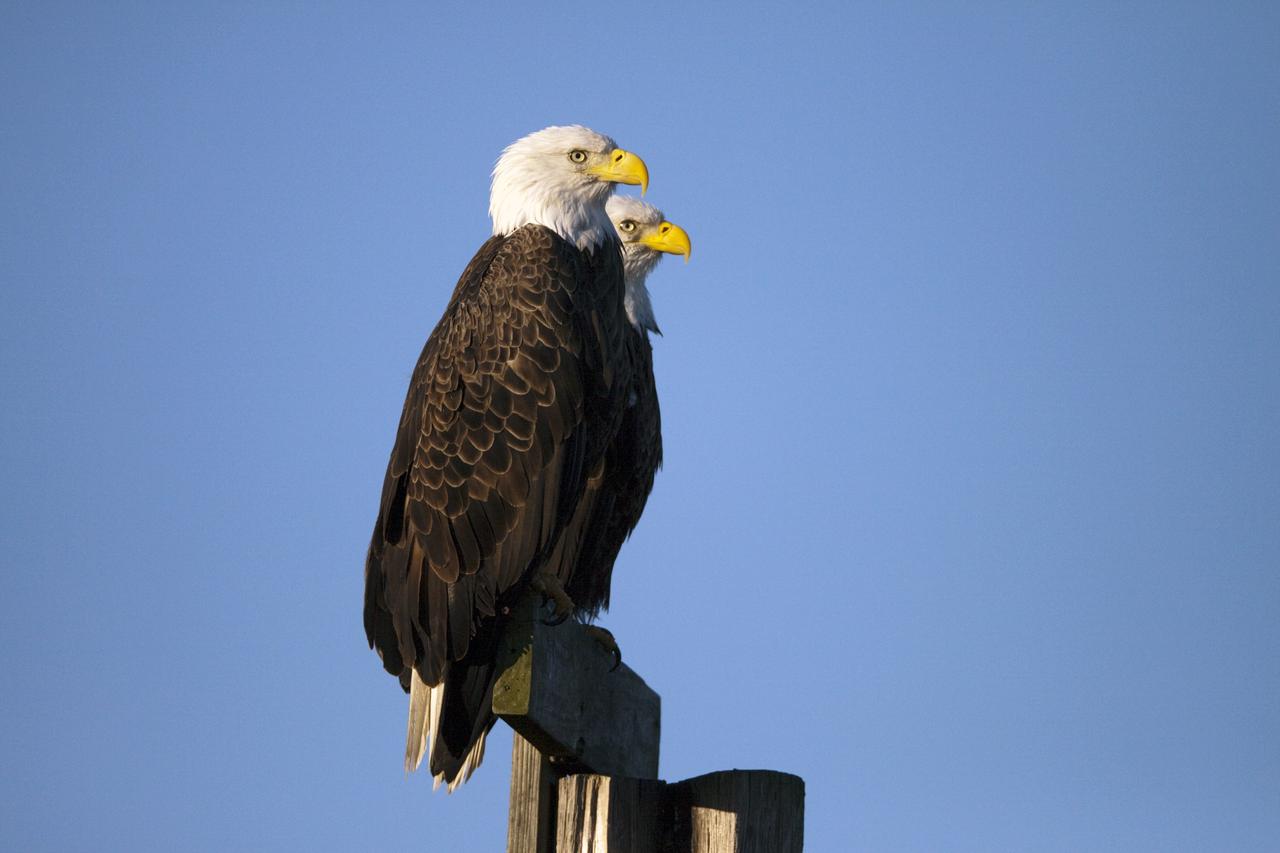
CAPE CANAVERAL, Fla. – On State Road 3 near the Shuttle Landing Facility at NASA's Kennedy Space Center in Florida, two bald eagles scout the terrain from their vantage point atop a pole. There are 18 active eagle nests within Kennedy's boundaries, including several in the vicinity of the landing strip. Bald eagles mate for life, choosing the tops of large trees to build nests, which they typically use and enlarge each year. Nests may reach 10 feet across and weigh half a ton. The birds travel great distances, but usually return to breeding grounds within 100 miles of the place where they were raised. Bald eagles may live 15 to 25 years in the wild. The Merritt Island National Wildlife Refuge coexists with Kennedy Space Center and provides a habitat for 330 species of birds including the bald eagle. A variety of other wildlife - 117 kinds of fish, 65 types of amphibians and reptiles, 31 different mammals, and 1,045 species of plants - also inhabit the refuge. For information on the refuge, visit http://www.fws.gov/merrittisland/Index.html. For information on Kennedy Space Center, visit http://www.nasa.gov/kennedy. Photo credit: NASA/Ken Thornsley
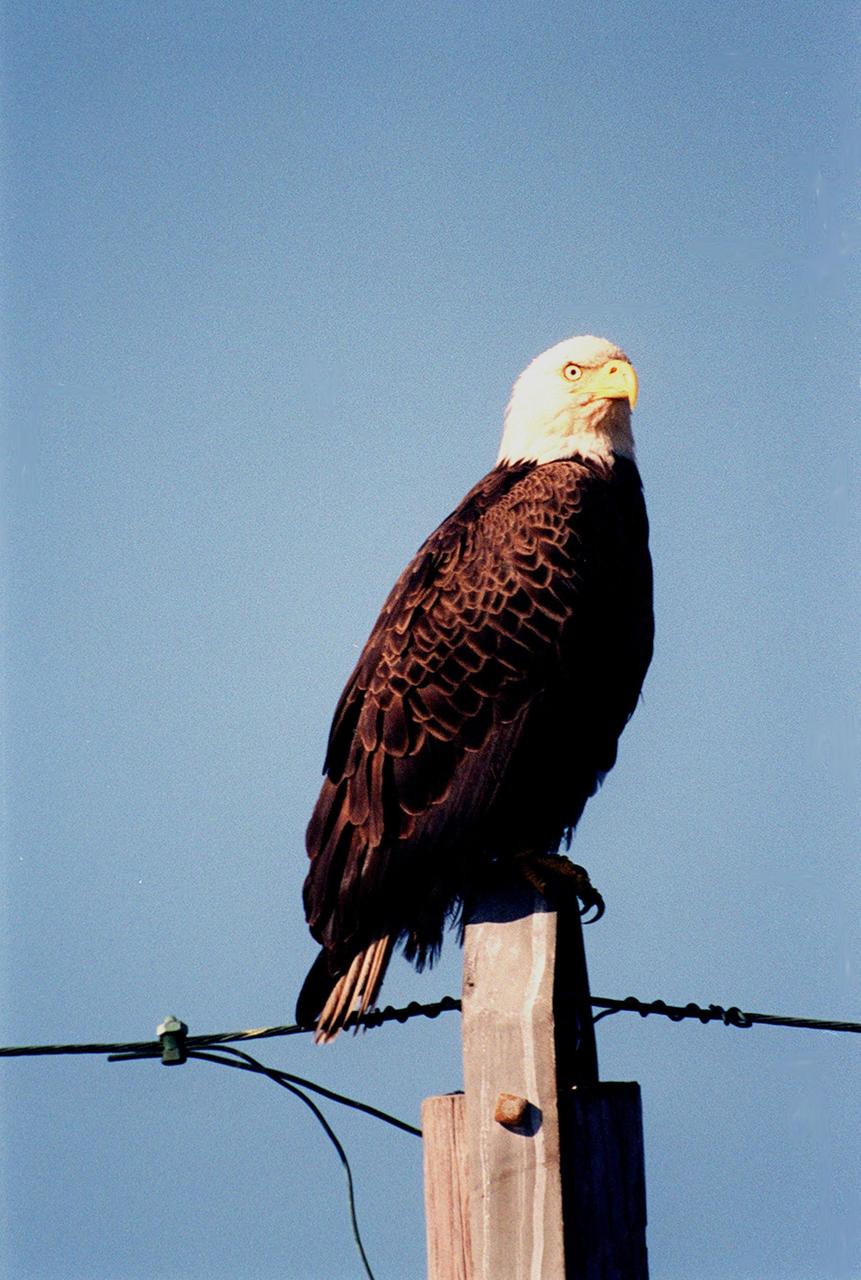
KENNEDY SPACE CENTER, FLA. -- A Southern Bald Eagle perched on top of a utility pole searches the area. About a dozen bald eagles live in the Merritt Island National Wildlife Refuge, which shares a boundary with Kennedy Space Center. The Southern Bald Eagle ranges throughout Florida and along the coasts of California, Texas, Louisiana, and the south Atlantic states. Bald Eagles are listed as endangered in the U.S., except in five states where they are listed as threatened. The number of nesting pairs of the southern race once numbered several thousand; recent estimates are only 350-375. Most of the southern race nest in Florida. Eagles arrive at KSC during late summer and leave for the north in late spring. They move to nest sites in October and November and lay one to three eggs. The young fledge from February to April. The Refuge encompasses 92,000 acres that are a habitat for more than 331 species of birds, 31 mammals, 117 fishes, and 65 amphibians and reptiles. The marshes and open water of the refuge provide wintering areas for 23 species of migratory waterfowl, as well as a year-round home for great blue herons, great egrets, wood storks, cormorants, brown pelicans and other species of marsh and shore birds, as well as a variety of insects
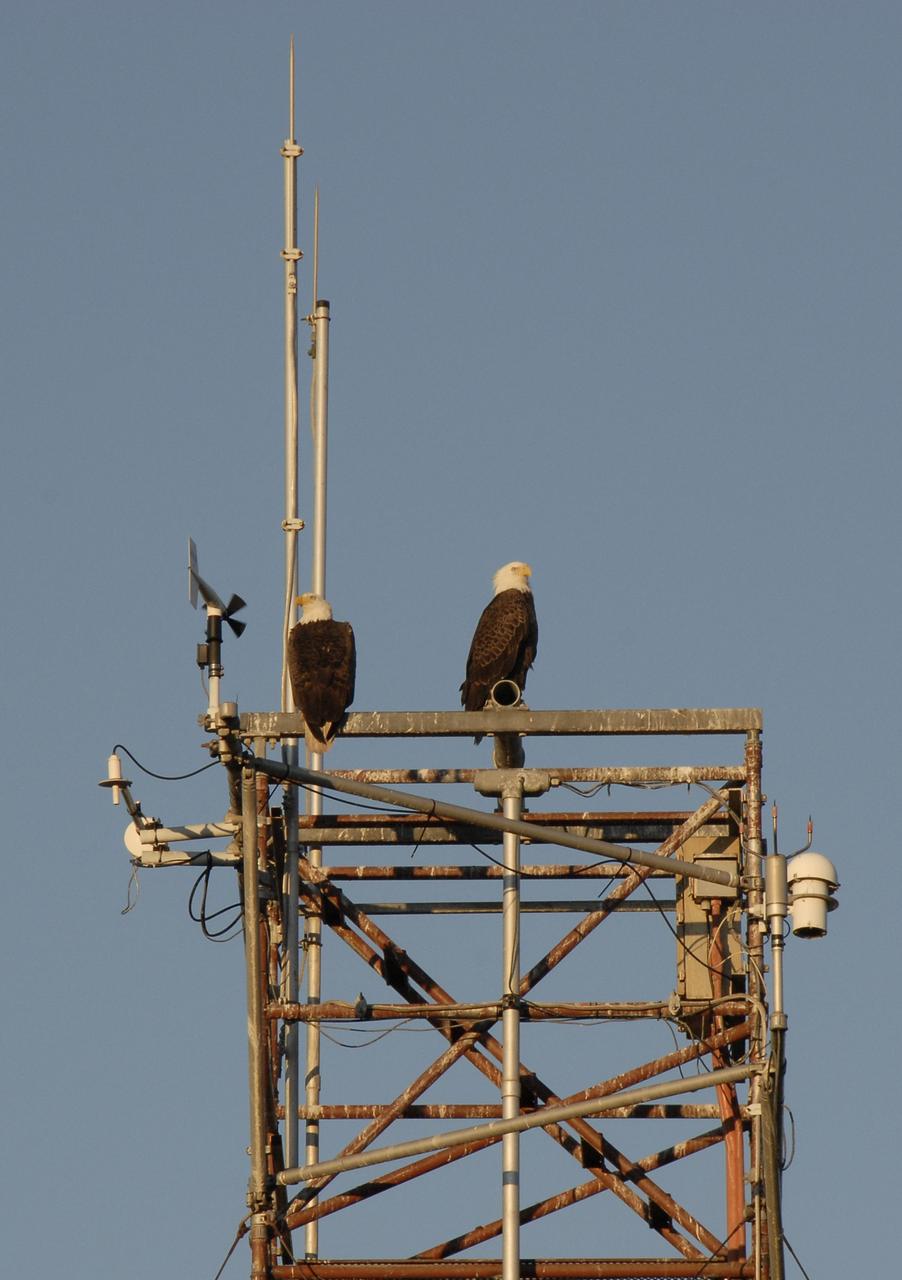
CAPE CANAVERAL, Fla. - At the Shuttle Landing Facility at NASA's Kennedy Space Center in Florida, two bald eagles stand sentinel as STS-129 Commander Charles O. Hobaugh and Pilot Barry E. Wilmore practice landings in a Shuttle Training Aircraft in preparation for space shuttle Atlantis' STS-129 mission. The Merritt Island National Wildlife Refuge coexists with Kennedy Space Center and provides a habitat for 330 species of birds including bald eagles. Bald eagles, which mate for life, use a specific territory for nesting, winter feeding or a year-round residence. Its natural domain is from Alaska to Baja, Calif., and from Maine to Florida. For information on the refuge, visit http://www.fws.gov/merrittisland/Index.html. Photo credit: NASA/Kim Shiflett
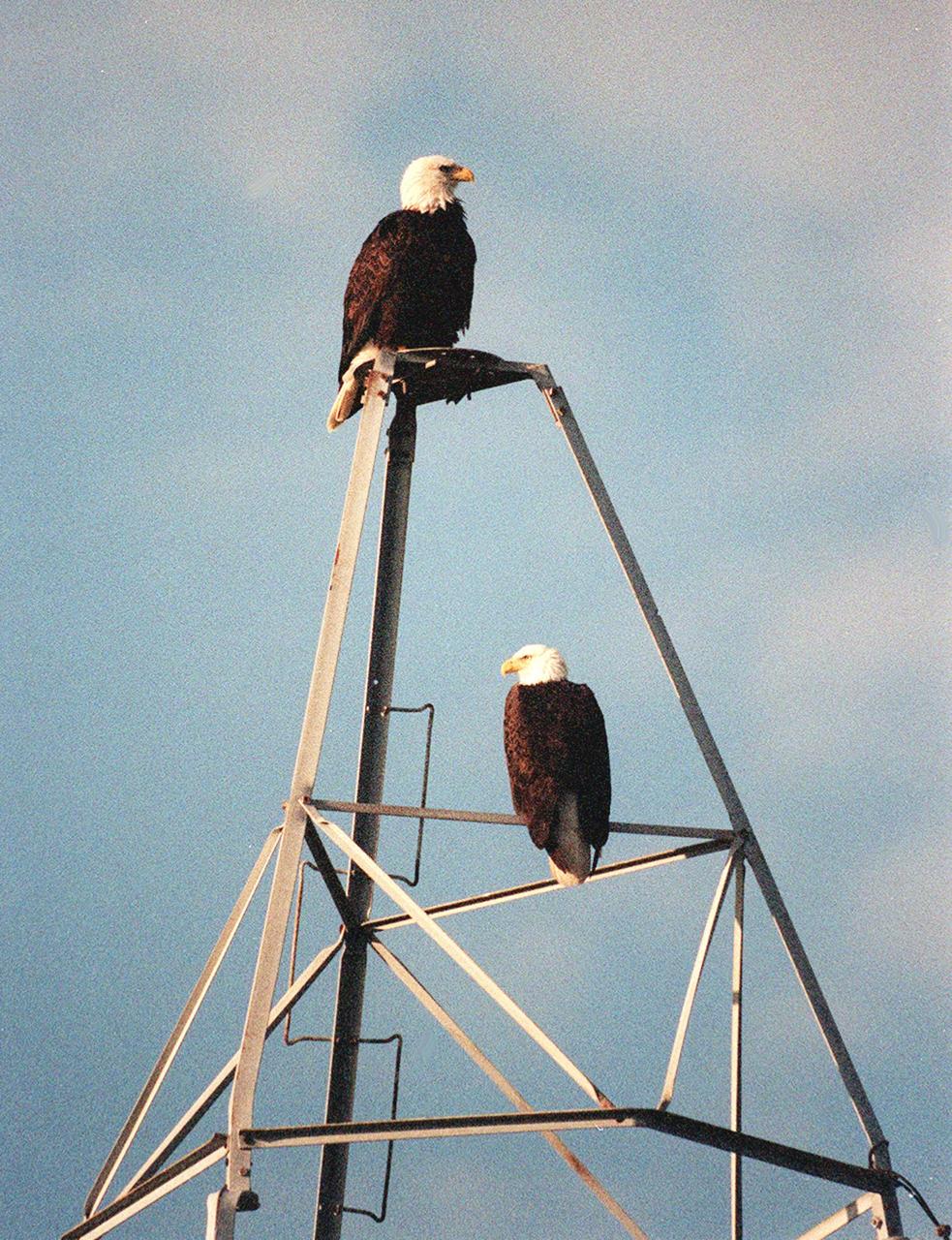
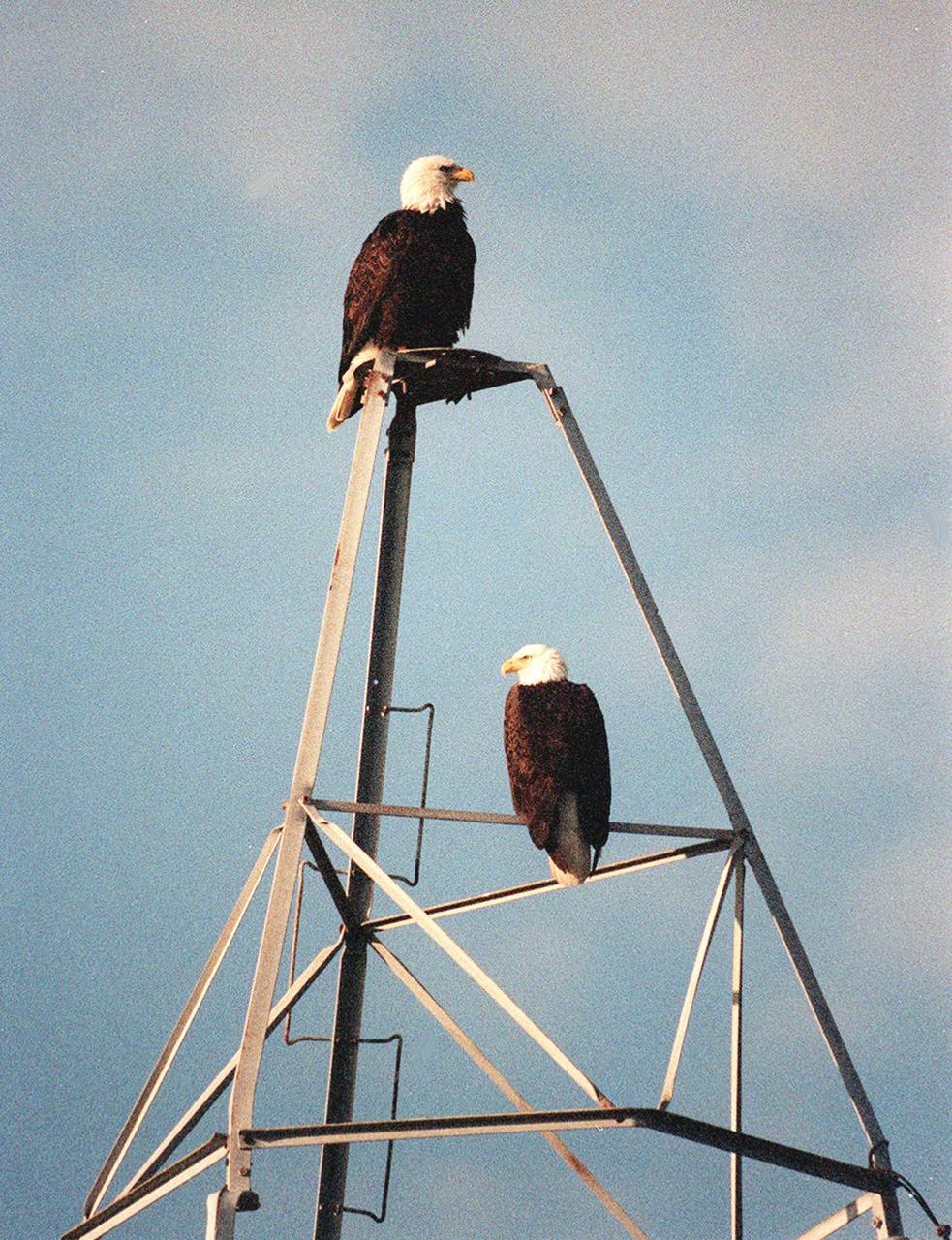
A pair of Florida bald eagles take advantage of a tower to rest and view the landscape near the intersection of the NASA Causeway and Kennedy Parkway North at Kennedy Space Center. This pair of eagles nests near Kennedy Parkway and is seen frequently by KSC commuters and visitors. The Southern Bald Eagle ranges throughout Florida and along the coasts of California, Texas, Louisiana and the south Atlantic states. Bald Eagles are listed as endangered in the U.S., except in five states where they are listed as threatened. The number of nesting pairs of the southern race once numbered several thousand; recent estimates are only 350-375. Most southern Florida eagles nesting at KSC arrive during late summer and leave for the north in late spring. They move to nest sites in October and November and lay one to three eggs. The young fledge from February to April. . Kennedy Space Center shares a boundary with the Merritt Island National Wildlife Refuge, which encompasses 92,000 acres that are a habitat for more than 331 species of birds, 31 mammals, 117 fishes, and 65 amphibians and reptiles. The marshes and open water of the refuge provide wintering areas for 23 species of migratory waterfowl, as well as a year-round home for great blue herons, great egrets, wood storks, cormorants, brown pelicans and other species of marsh and shore birds, as well as a variety of insects
A pair of Florida bald eagles take advantage of a tower to rest and view the landscape near the intersection of the NASA Causeway and Kennedy Parkway North at Kennedy Space Center. This pair of eagles nests near Kennedy Parkway and is seen frequently by KSC commuters and visitors. The Southern Bald Eagle ranges throughout Florida and along the coasts of California, Texas, Louisiana and the south Atlantic states. Bald Eagles are listed as endangered in the U.S., except in five states where they are listed as threatened. The number of nesting pairs of the southern race once numbered several thousand; recent estimates are only 350-375. Most southern Florida eagles nesting at KSC arrive during late summer and leave for the north in late spring. They move to nest sites in October and November and lay one to three eggs. The young fledge from February to April. . Kennedy Space Center shares a boundary with the Merritt Island National Wildlife Refuge, which encompasses 92,000 acres that are a habitat for more than 331 species of birds, 31 mammals, 117 fishes, and 65 amphibians and reptiles. The marshes and open water of the refuge provide wintering areas for 23 species of migratory waterfowl, as well as a year-round home for great blue herons, great egrets, wood storks, cormorants, brown pelicans and other species of marsh and shore birds, as well as a variety of insects
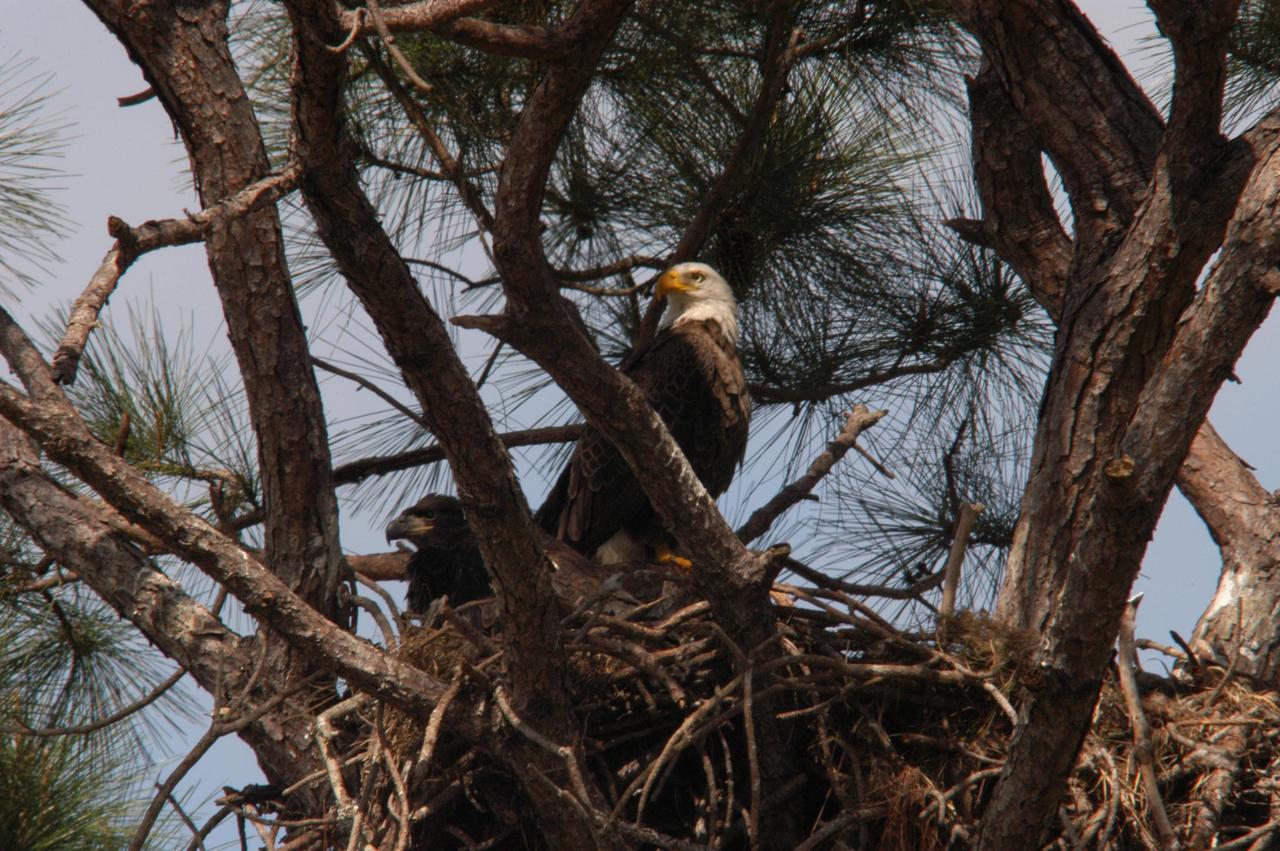
KENNEDY SPACE CENTER, FLA. -- High in a pine tree at NASA's Kennedy Space Center, an adult bald eagle (right) and a fledgling keep watch from their nest. There are approximately a dozen active bald eagle nests both in KSC and in the Merritt Island National Wildlife Refuge, which surrounds KSC. The refuge includes several wading bird rookeries, many osprey nests, up to 400 manatees during the spring, and approximately 2,500 Florida scrub jays. It also is a major wintering area for migratory birds. More than 500 species of wildlife inhabit the refuge, with 15 considered federally threatened or endangered. Photo credit: NASA/George Shelton
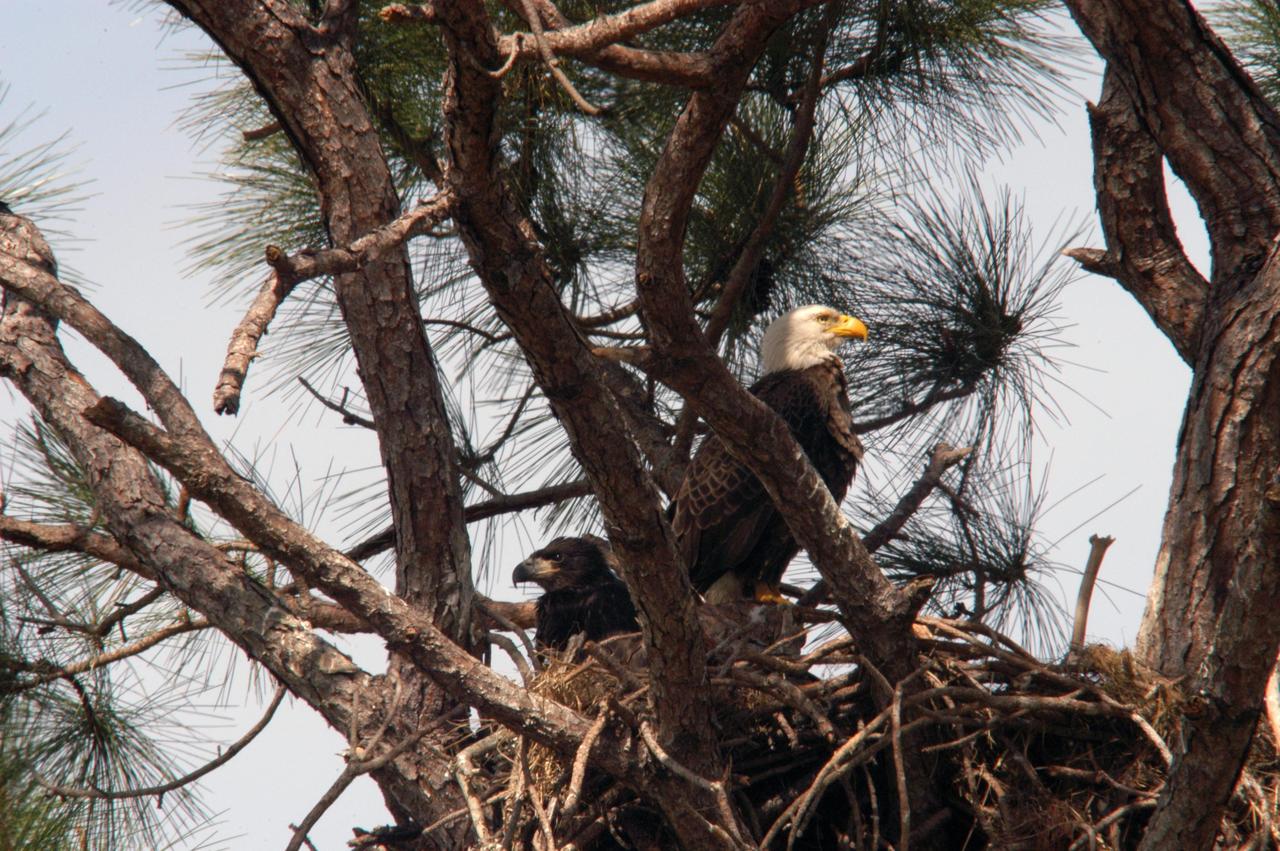
KENNEDY SPACE CENTER, FLA. -- High in a pine tree at NASA's Kennedy Space Center, an adult bald eagle (right) and a fledgling keep watch from their nest. There are approximately a dozen active bald eagle nests both in KSC and in the Merritt Island National Wildlife Refuge, which surrounds KSC. The refuge includes several wading bird rookeries, many osprey nests, up to 400 manatees during the spring, and approximately 2,500 Florida scrub jays. It also is a major wintering area for migratory birds. More than 500 species of wildlife inhabit the refuge, with 15 considered federally threatened or endangered. Photo credit: NASA/George Shelton

KENNEDY SPACE CENTER, FLA. -- Not far from the roadside in NASA's Kennedy Space Center, a female bald eagle rests near her new nest, constructed in a tall pine tree. There are approximately a dozen active bald eagle nests both in KSC and in the Merritt Island National Wildlife Refuge, which surrounds KSC. The refuge is a habitat for more than 310 species of birds, 25 mammals, 117 fishes and 65 amphibians and reptiles. In addition, the refuge supports 19 endangered or threatened wildlife species on Federal or State lists, more than any other single refuge in the U.S. Photo credit: NASA/Ken Thornsley
CAPE CANAVERAL, Fla. - A bald eagle scouts the terrain from his vantage point in the treetops at NASA's Kennedy Space Center in Florida. The Merritt Island National Wildlife Refuge coexists with Kennedy Space Center and provides a habitat for 330 species of birds including bald eagles. A variety of other wildlife - 117 kinds of fish, 65 types of amphibians and reptiles, 31 different mammals, and 1,045 species of plants - also inhabit the refuge. For information on the refuge, visit http://www.fws.gov/merrittisland/Index.html. For information on Kennedy Space Center, visit http://www.nasa.gov/kennedy. Photo credit: NASA/Jack Pfaller
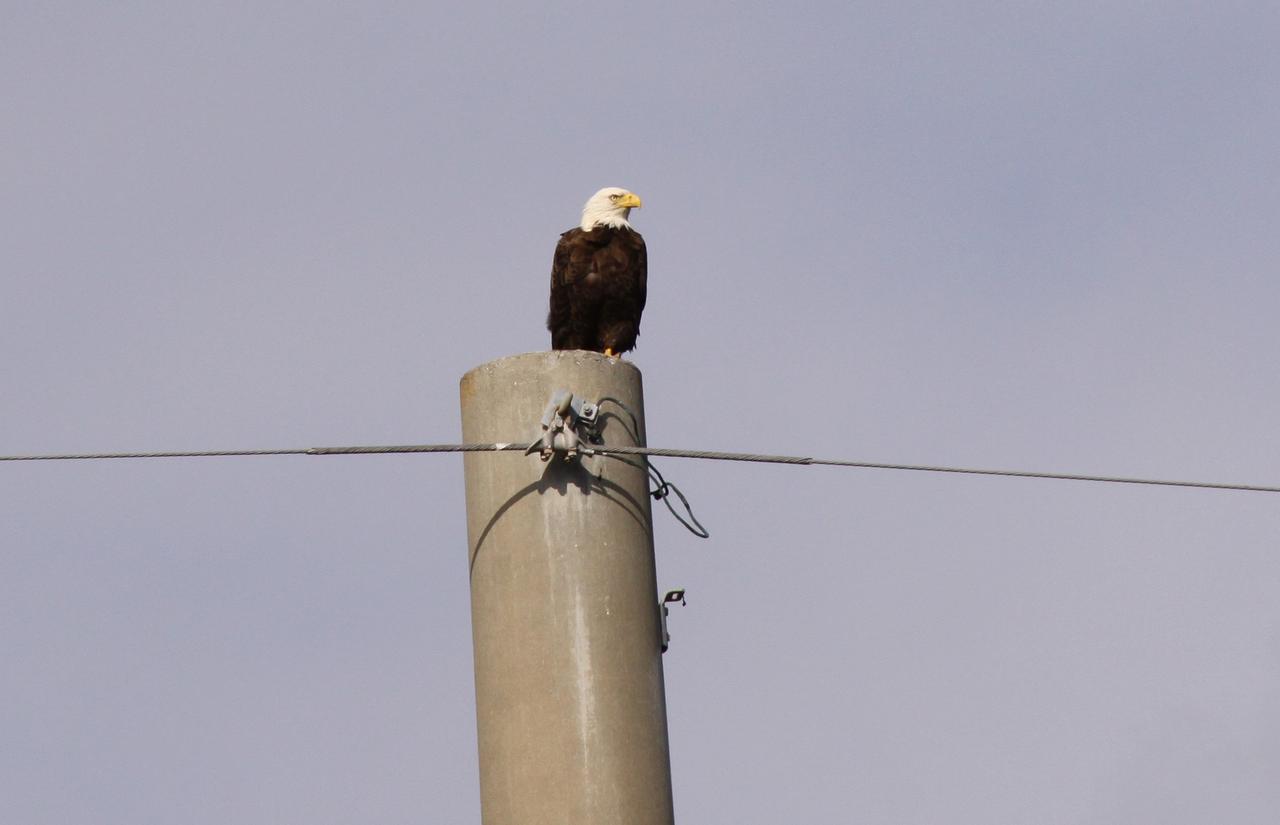
CAPE CANAVERAL, Fla. - A bald eagle is king of all he surveys at NASA's Kennedy Space Center in Florida. The Merritt Island National Wildlife Refuge coexists with Kennedy Space Center and provides a habitat for 330 species of birds including bald eagles. A variety of other wildlife - 117 kinds of fish, 65 types of amphibians and reptiles, 31 different mammals, and 1,045 species of plants - also inhabit the refuge. For information on the refuge, visit http://www.fws.gov/merrittisland/Index.html. For information on Kennedy Space Center, visit http://www.nasa.gov/kennedy. Photo credit: NASA/Jack Pfaller
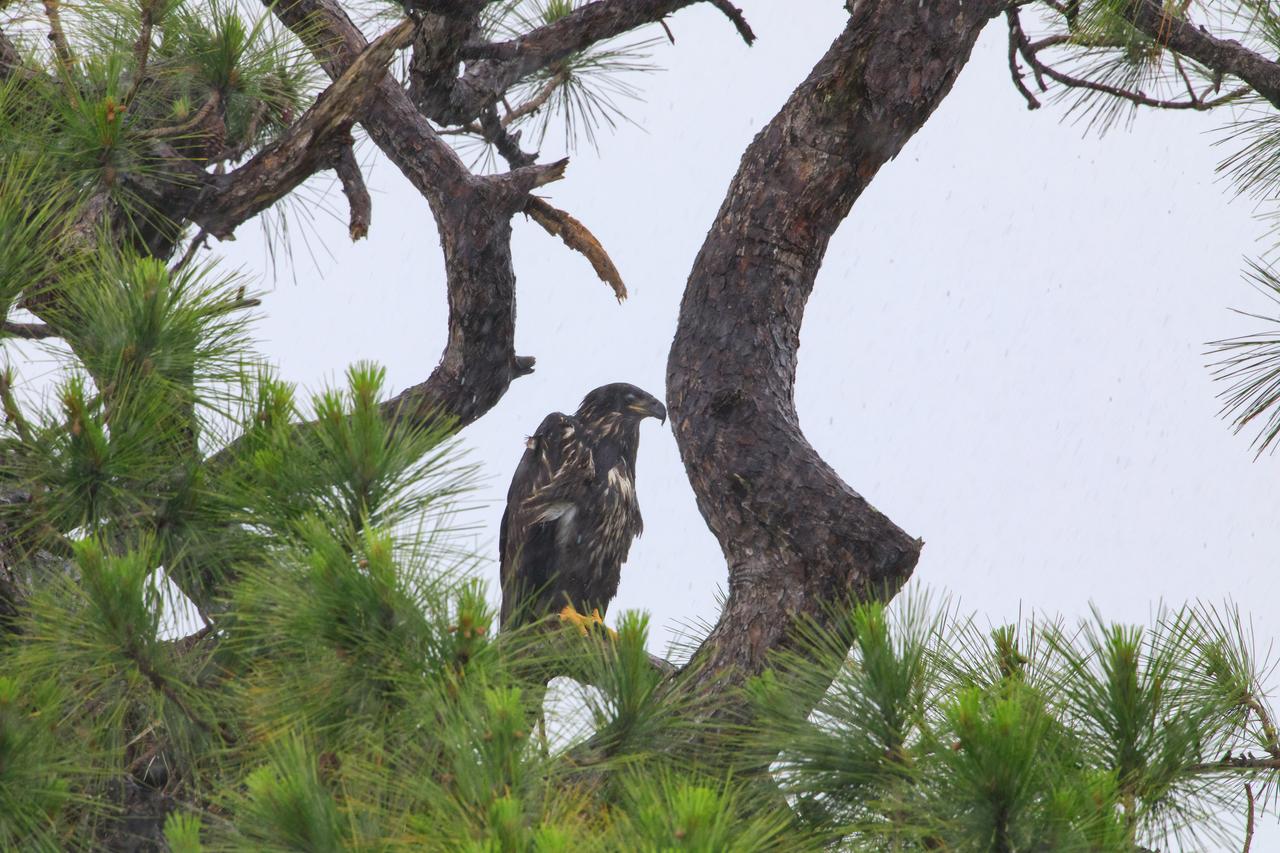
A baby American bald eagle looks out from just above its nest, located in a tree at NASA’s Kennedy Space Center in Florida on April 25, 2023. The eaglet is the lone offspring of a mated pair of eagles that recently built the new home after storms badly damaged their original nest located about 50 yards away. That nest was built in 1973 and had been used by eagles almost every year since 1975.
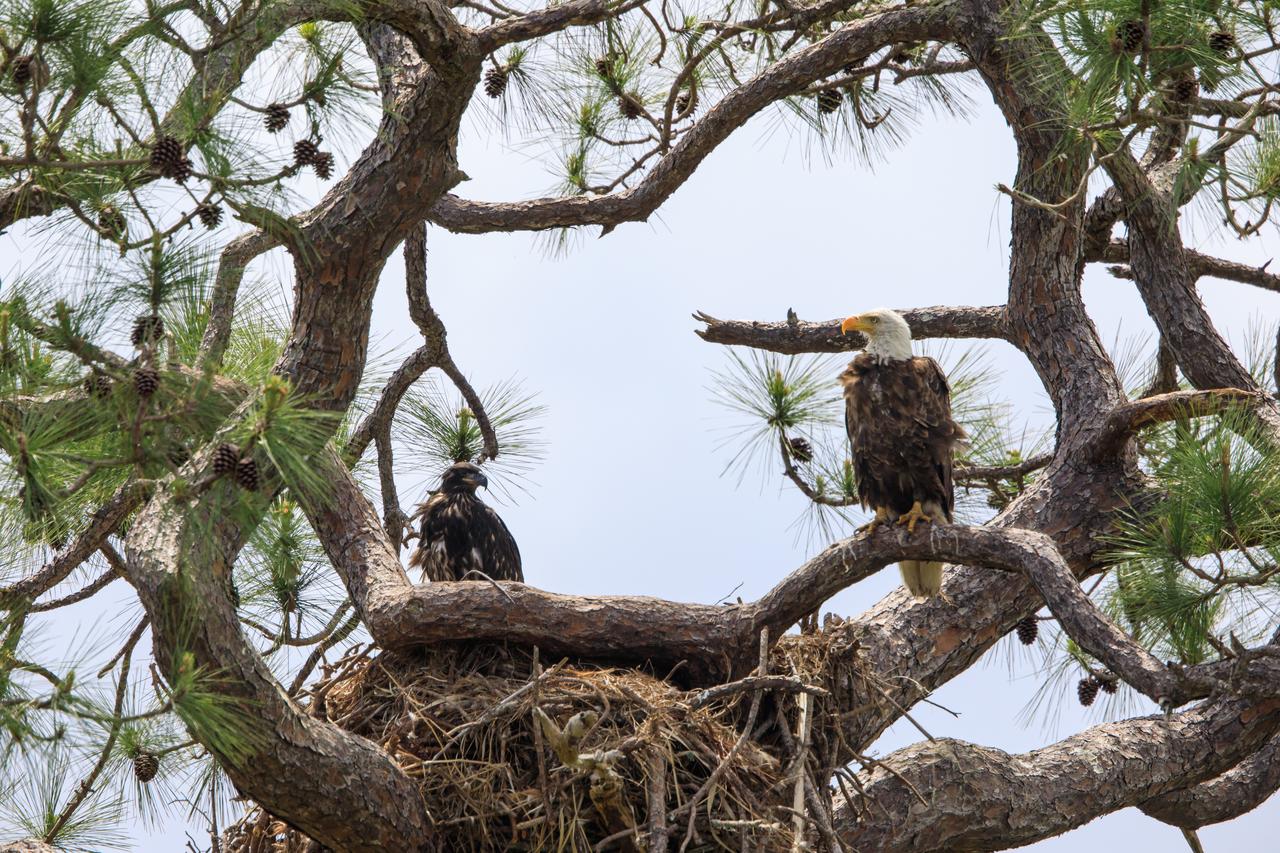
A baby American bald eagle looks out from its nest, accompanied by one of its parents, in a tree located near Kennedy Parkway North at NASA’s Kennedy Space Center in Florida on April 10, 2023. A mated pair of eagles recently built a new home in this tree after storms badly damaged their original nest located about 50 yards away. That nest was built in 1973 and had been used by eagles almost every year since 1975.
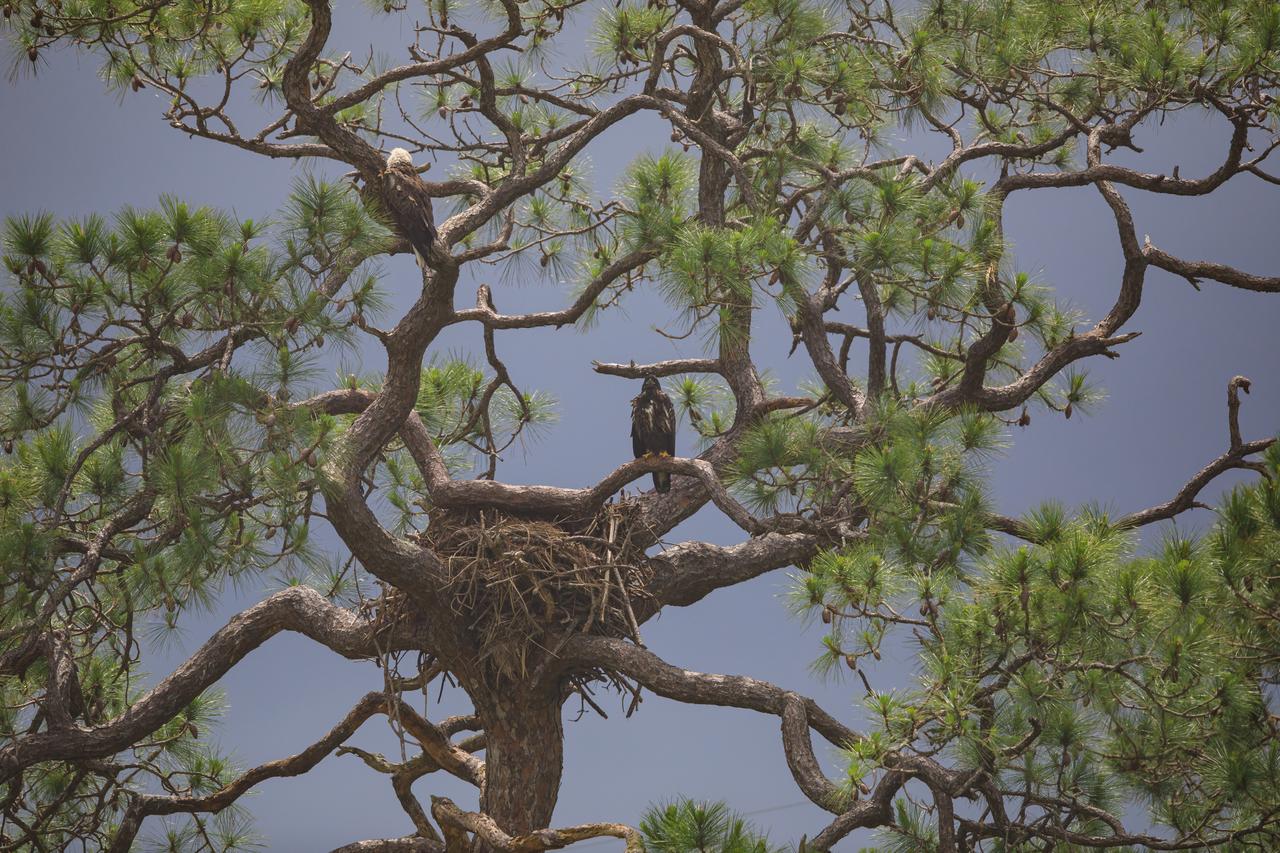
An American bald eagle, upper left, and its baby are perched in a tree near their nest at NASA’s Kennedy Space Center in Florida as a rainstorm approaches on April 25, 2023. The eaglet is the lone offspring of a mated pair of eagles that recently built the new home after storms badly damaged their original nest located about 50 yards away. That nest was built in 1973 and had been used by eagles almost every year since 1975.

An American bald eagle, upper left, and its baby are perched in a tree near their nest at NASA’s Kennedy Space Center in Florida as a rainstorm approaches on April 25, 2023. The eaglet is the lone offspring of a mated pair of eagles that recently built the new home after storms badly damaged their original nest located about 50 yards away. That nest was built in 1973 and had been used by eagles almost every year since 1975.
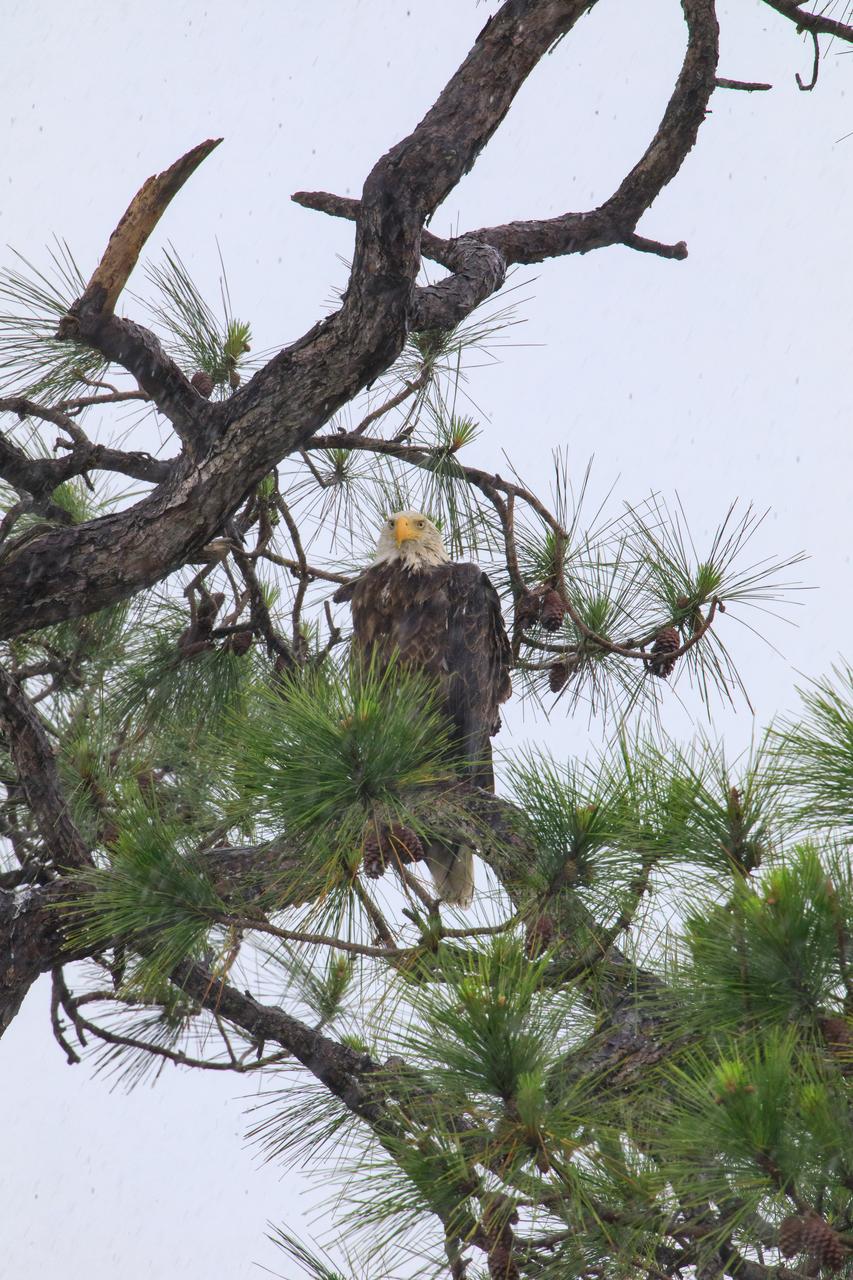
An American bald eagle is perched high in a tree above its nest at NASA’s Kennedy Space Center in Florida on April 25, 2023. The adult eagle is part of a mated pair that recently built a new home in this tree after storms badly damaged their original nest located about 50 yards away. That nest was built in 1973 and had been used by eagles almost every year since 1975. This season, the pair produced one eaglet.
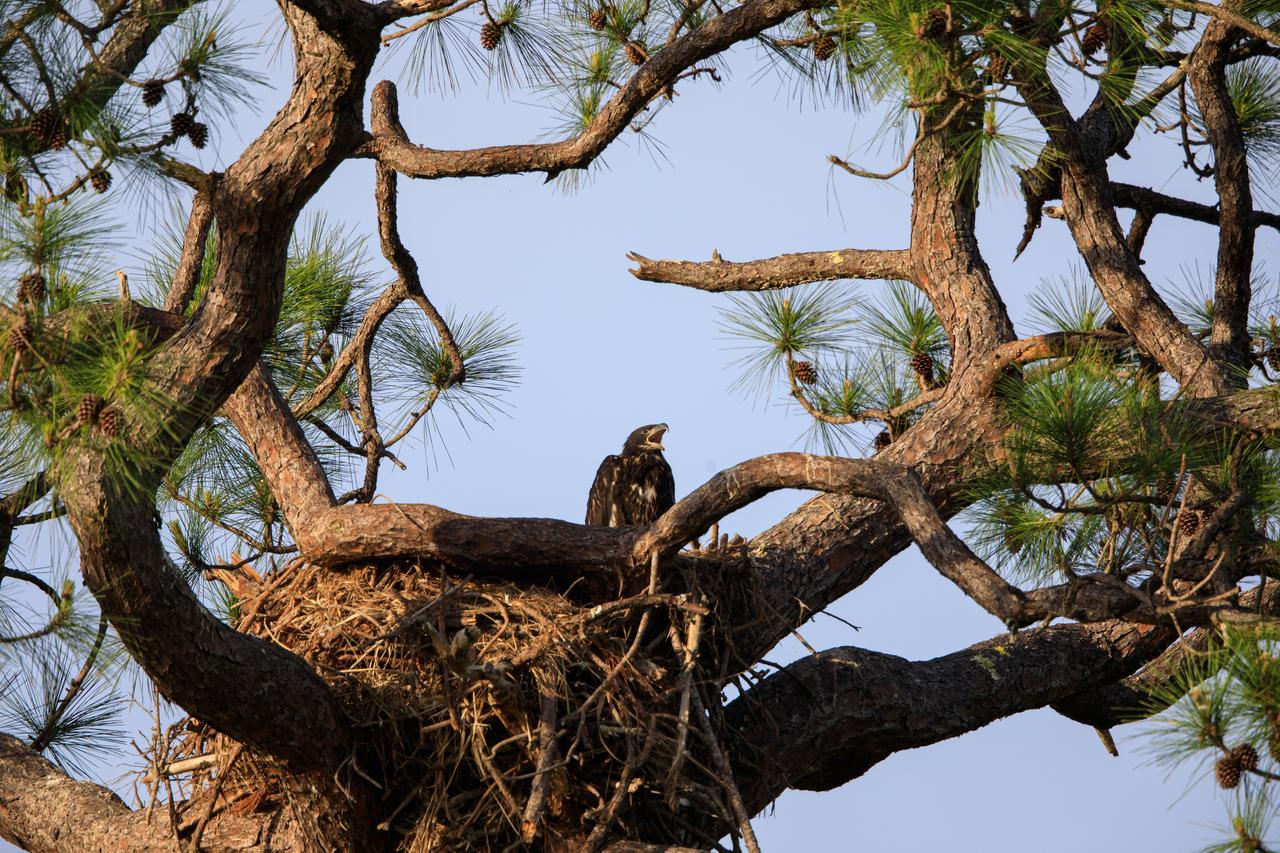
A baby American bald eagle calls out from a nest located near Kennedy Parkway North at NASA’s Kennedy Space Center in Florida on April 10, 2023. The eaglet is the lone offspring of a mated pair of eagles that recently built the new home after storms badly damaged their original nest located about 50 yards away. That nest was built in 1973 and had been used by eagles almost every year since 1975.
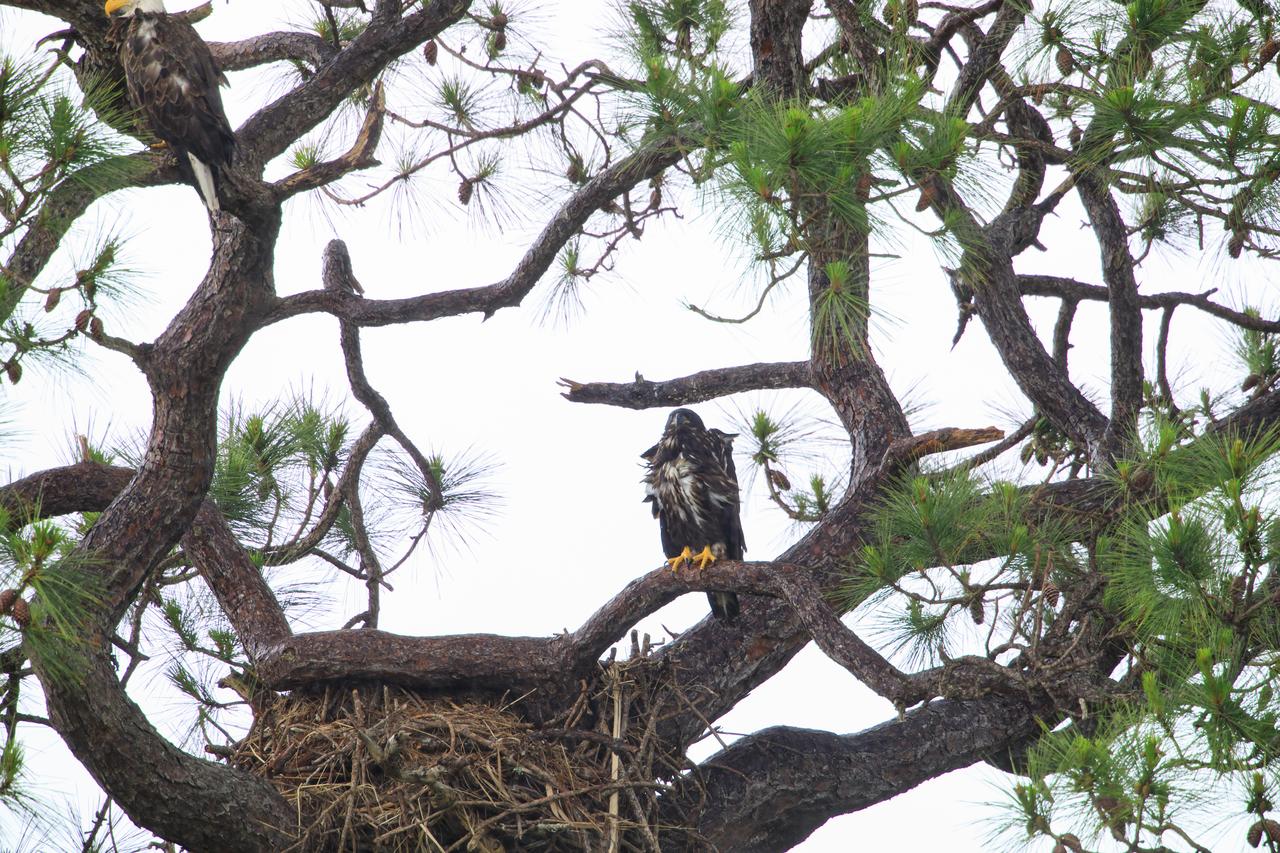
An American bald eagle, upper left, and its baby are perched in a tree near their nest at NASA’s Kennedy Space Center in Florida on April 25, 2023. The eaglet is the lone offspring of a mated pair of eagles that recently built the new home after storms badly damaged their original nest located about 50 yards away. That nest was built in 1973 and had been used by eagles almost every year since 1975.
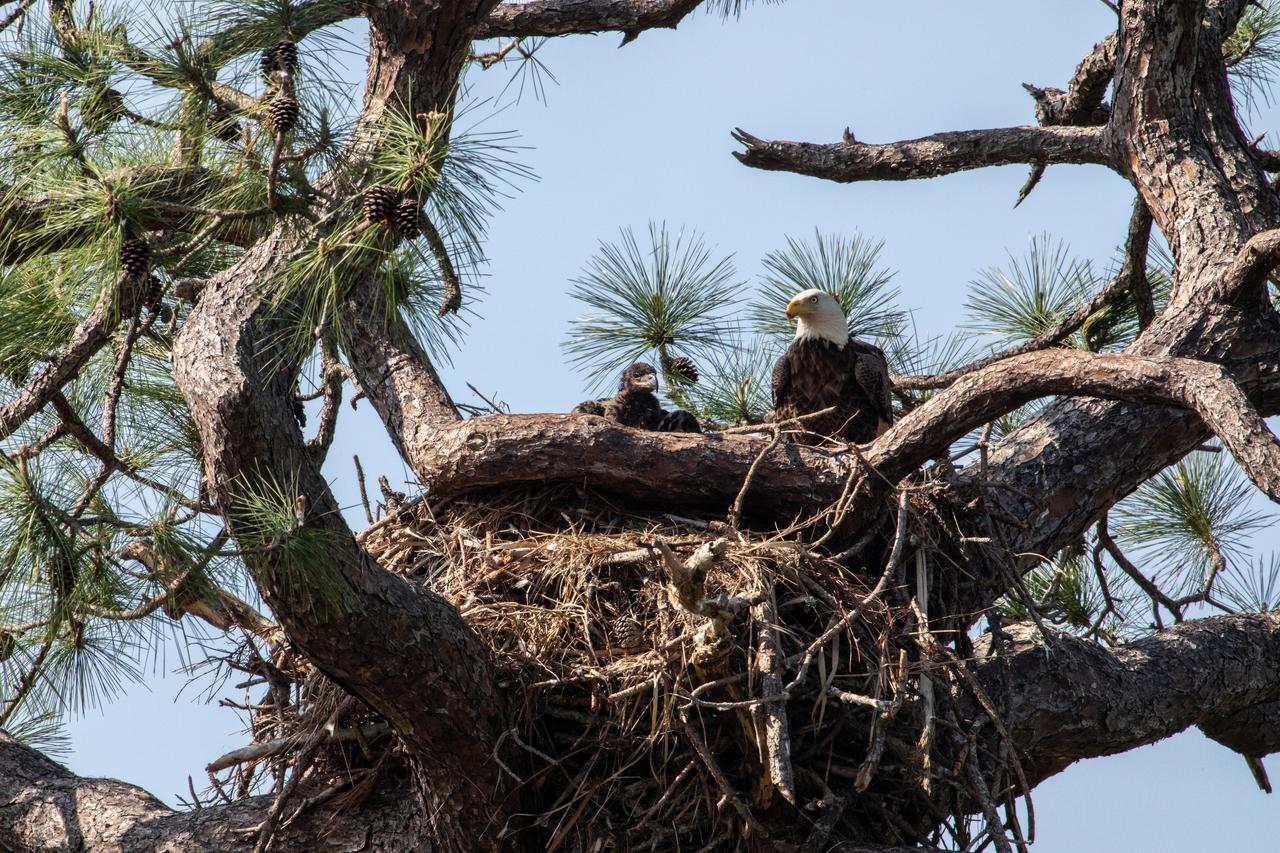
A baby American bald eagle spends time with one of its parents in a nest located near Kennedy Parkway North at NASA’s Kennedy Space Center in Florida on March 8, 2023. A mating pair of eagles recently built a new home in this tree after a combination of storms badly damaged their original nest located less than 100 yards away. That nest was built in 1973 and had been used by eagles almost every year since 1975.
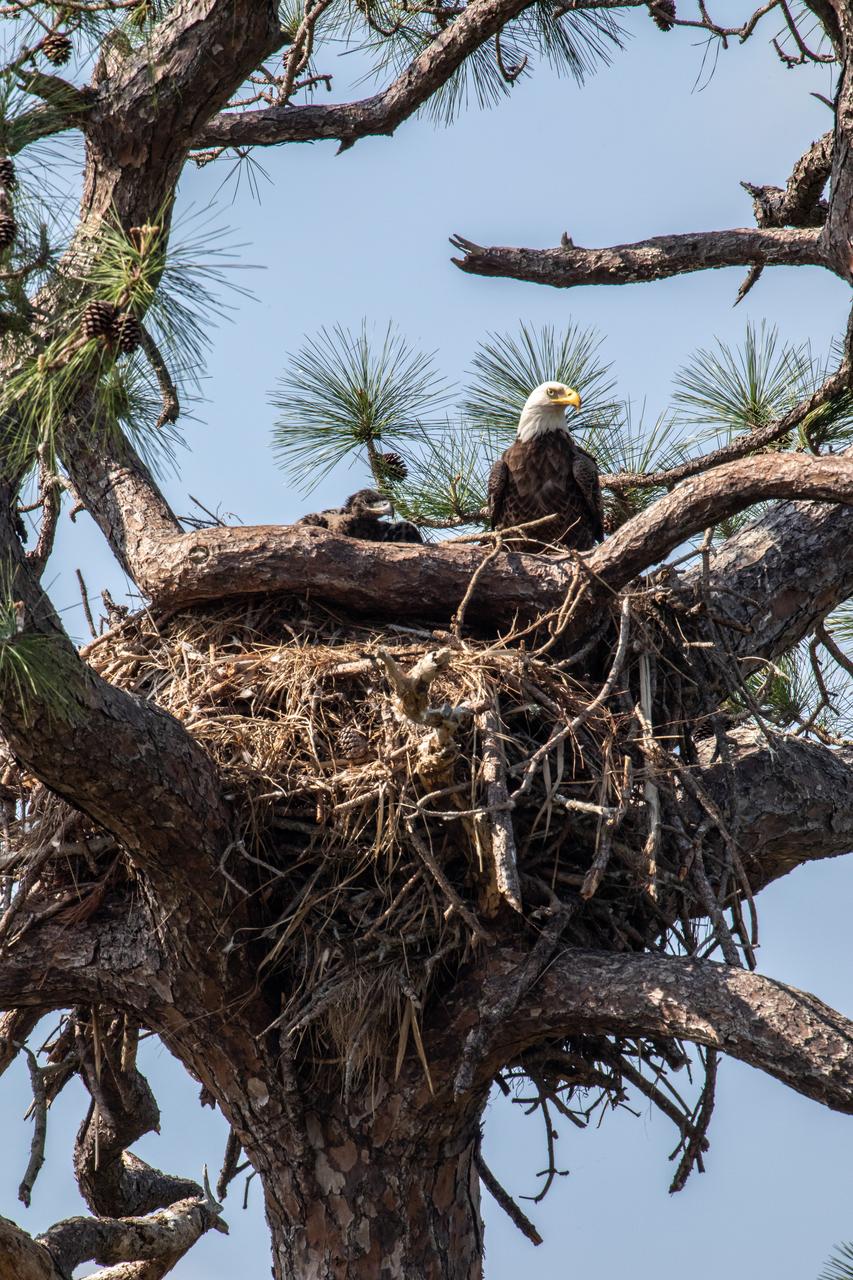
A baby American bald eagle looks out from its nest, along with one of its parents, from their temporary home located near Kennedy Parkway North at NASA’s Kennedy Space Center in Florida on March 8, 2023. A mating pair of eagles recently built a new nest in this tree after a combination of storms badly damaged their original nest located less than 100 yards away. That nest was built in 1973 and had been used by eagles almost every year since 1975.