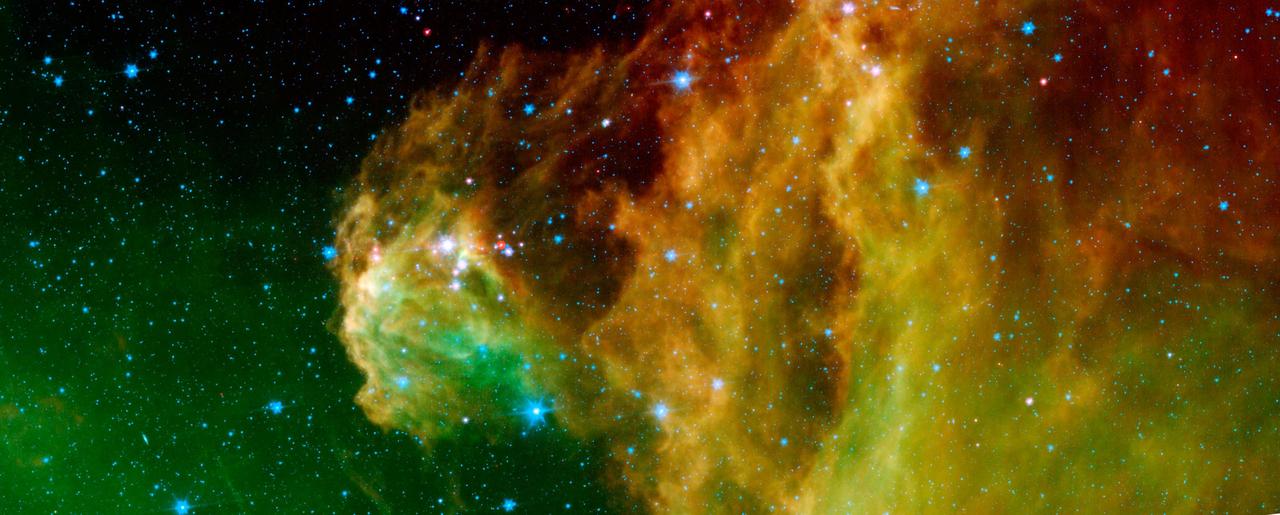
This image from NASA's Spitzer Space Telescope shows infant stars "hatching" in the head of the hunter constellation, Orion. Astronomers suspect that shockwaves from a supernova explosion in Orion's head, nearly three million years ago, may have initiated this newfound birth. The region featured in this Spitzer image is called Barnard 30. It is located approximately 1,300 light-years away and sits on the right side of Orion's "head," just north of the massive star Lambda Orionis. Wisps of green in the cloud are organic molecules called polycyclic aromatic hydrocarbons. These molecules are formed anytime carbon-based materials are burned incompletely. On Earth, they can be found in the sooty exhaust from automobile and airplane engines. They also coat the grills where charcoal-broiled meats are cooked. Tints of orange-red in the cloud are dust particles warmed by the newly forming stars. The reddish-pink dots at the top of the cloud are very young stars embedded in a cocoon of cosmic gas and dust. Blue spots throughout the image are background Milky Way along this line of sight. This composite includes data from Spitzer's infrared array camera instrument, and multiband imaging photometer instrument. Light at 4.5 microns is shown as blue, 8.0 microns is green, and 24 microns is red. http://photojournal.jpl.nasa.gov/catalog/PIA09411
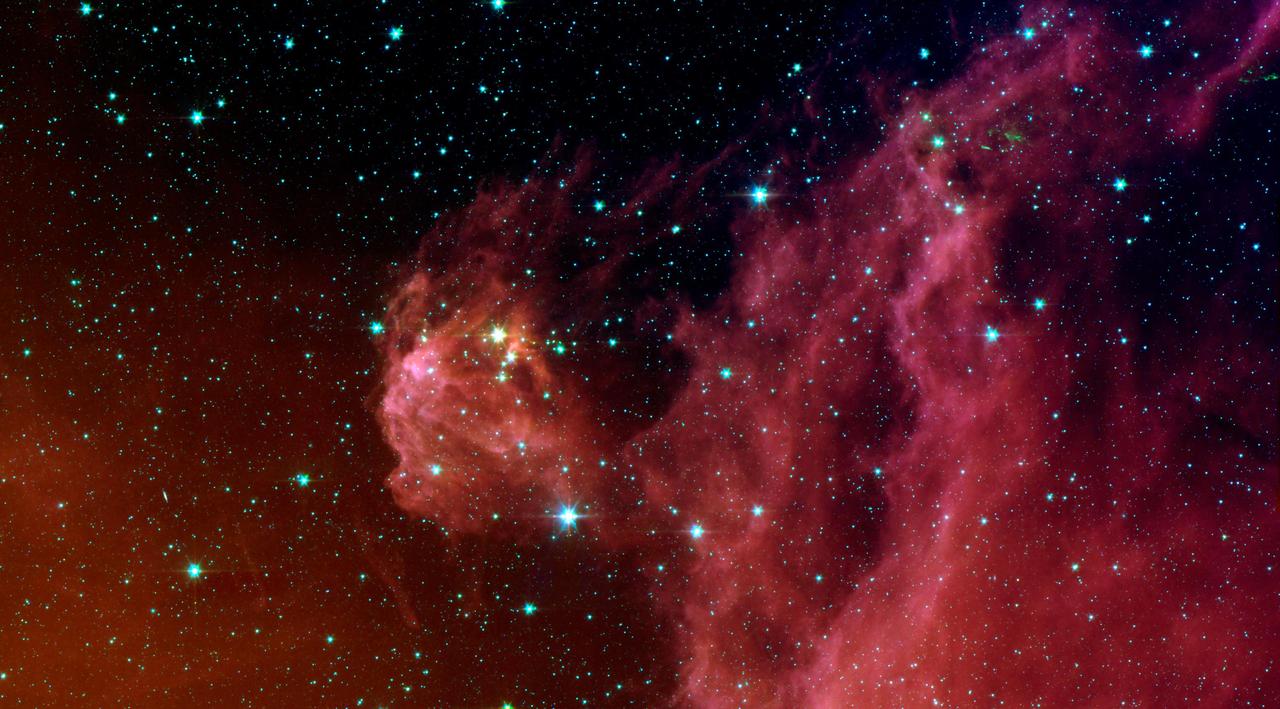
This image from NASA's Spitzer Space Telescope shows infant stars "hatching" in the head of the hunter constellation, Orion. Astronomers suspect that shockwaves from a supernova explosion in Orion's head, nearly three million years ago, may have initiated this newfound birth . The region featured in this Spitzer image is called Barnard 30. It is located approximately 1,300 light-years away and sits on the right side of Orion's "head," just north of the massive star Lambda Orionis. Wisps of red in the cloud are organic molecules called polycyclic aromatic hydrocarbons. These molecules are formed anytime carbon-based materials are burned incompletely. On Earth, they can be found in the sooty exhaust from automobile and airplane engines. They also coat the grills where charcoal-broiled meats are cooked. This image shows infrared light captured by Spitzer's infrared array camera. Light with wavelengths of 8 and 5.8 microns (red and orange) comes mainly from dust that has been heated by starlight. Light of 4.5 microns (green) shows hot gas and dust; and light of 3.6 microns (blue) is from starlight. http://photojournal.jpl.nasa.gov/catalog/PIA09412