
Barred Spiral Galaxy NGC 1300 Credit: NASA, ESA, and The Hubble Heritage Team (STScI/AURA) Acknowledgment: P. Knezek (WIYN) The Hubble Space Telescope is a project of international cooperation between NASA and the European Space Agency. NASA's Goddard Space Flight Center manages the telescope. The Space Telescope Science Institute conducts Hubble science operations. Goddard is responsible for HST project management, including mission and science operations, servicing missions, and all associated development activities. To learn more about the Hubble Space Telescope go here: <a href="http://www.nasa.gov/mission_pages/hubble/main/index.html" rel="nofollow">www.nasa.gov/mission_pages/hubble/main/index.html</a>
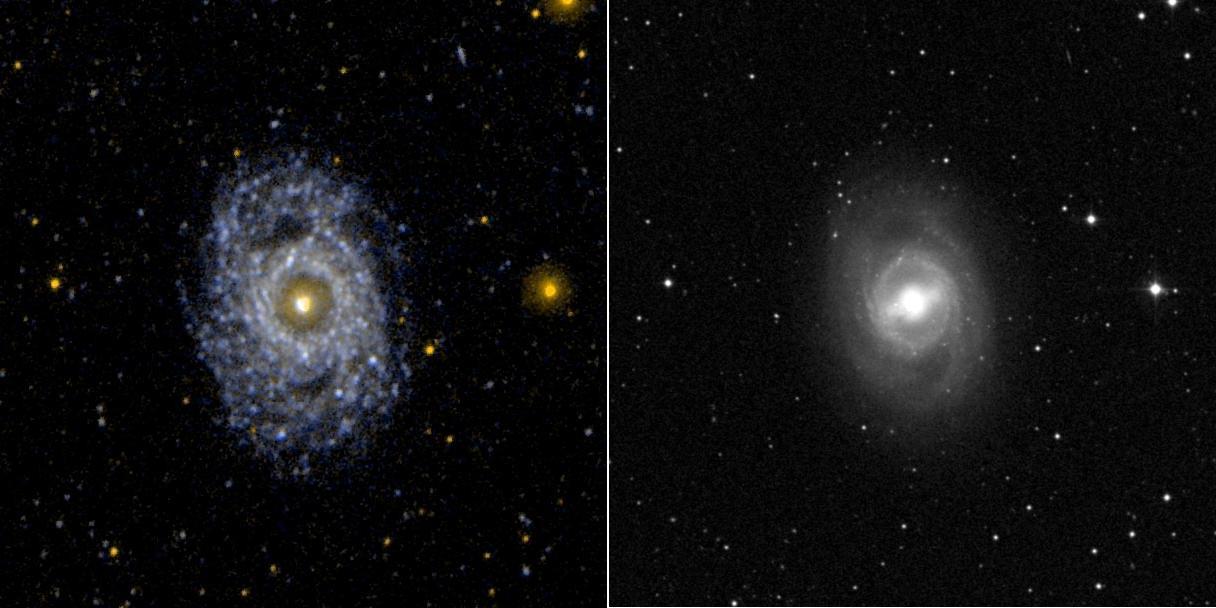
This ultraviolet image from NASA Galaxy Evolution Explorer left and visual image right of the face on barred and ringed spiral galaxy NGC 3351 M95.
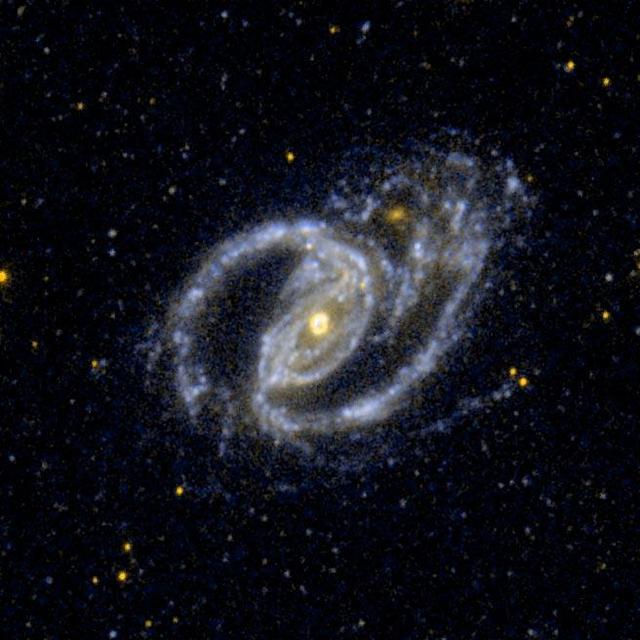
This ultraviolet image from NASA Galaxy Evolution Explorer shows the interacting pair NGC 1097, a barred spiral galaxy, and the small elliptical companion galaxy NGC 1097A.
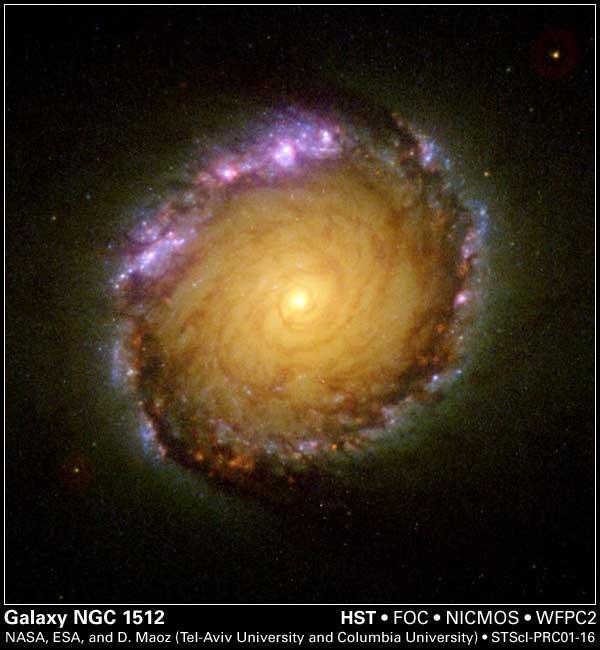
A rainbow of colors is captured in the center of a magnificent barred spiral galaxy, as witnessed by the three cameras of NASA Hubble Space Telescope.

This composite of the giant barred spiral galaxy NGC 6872 is 522,000 light-years across, making it about five times the size of the Milky Way.

This is an ultraviolet color image of the galaxy NGC5398 taken by NASA Galaxy Evolution Explorer on June 7, 2003. NGC5398 is a barred spiral galaxy located 60 million light-years from Earth. The star formation is concentrated in the two bright regions of the image. http://photojournal.jpl.nasa.gov/catalog/PIA04633
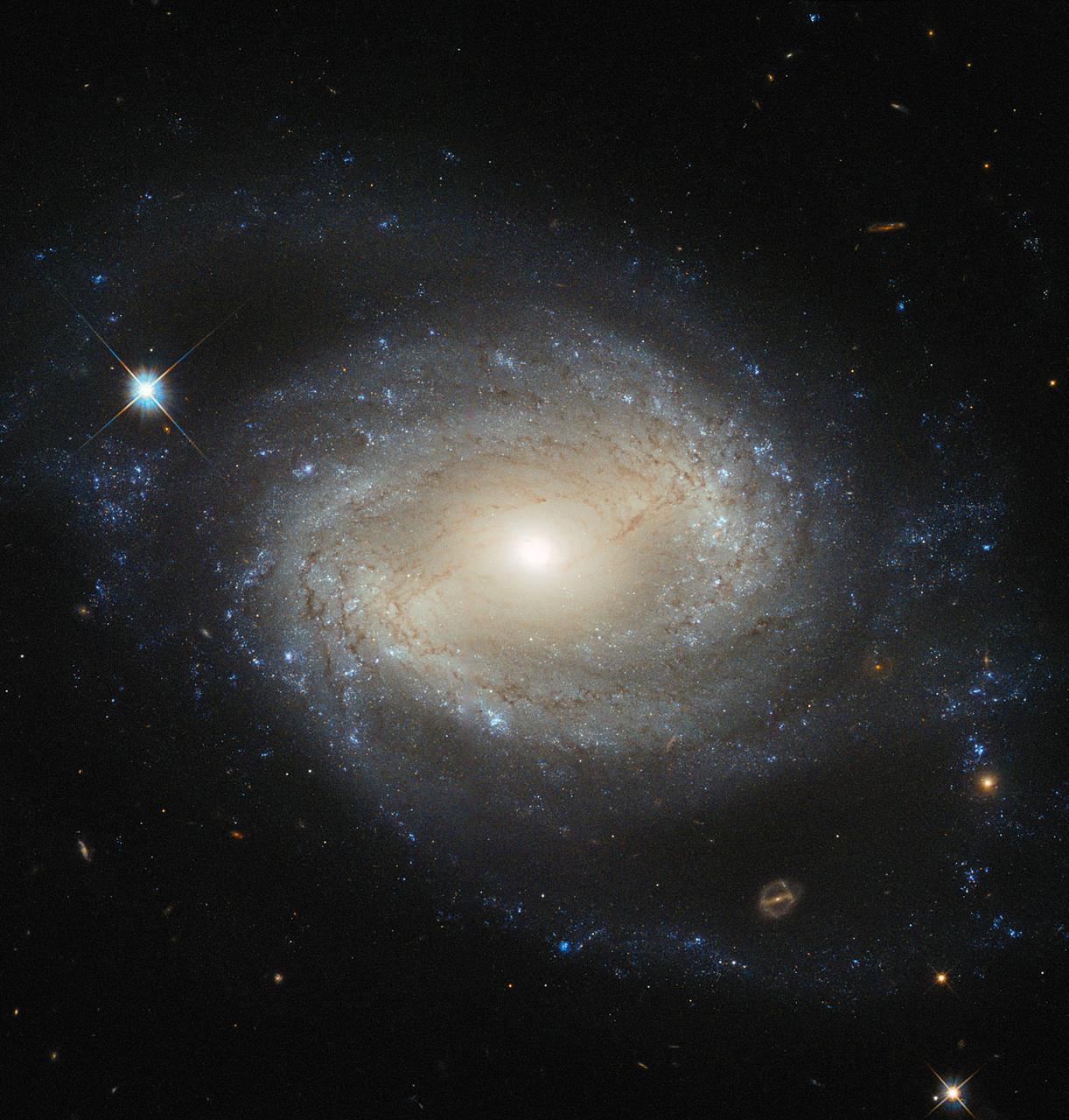
NGC 4639 is a beautiful example of a type of galaxy known as a barred spiral. It lies over 70 million light-years away in the constellation of Virgo and is one of about 1500 galaxies that make up the Virgo Cluster. In this image, taken by the NASA/ESA Hubble Space Telescope, one can clearly see the bar running through the bright, round core of the galaxy. Bars are found in around two thirds of spiral galaxies, and are thought to be a natural phase in their evolution. The galaxy’s spiral arms are sprinkled with bright regions of active star formation. Each of these tiny jewels is actually several hundred light-years across and contains hundreds or thousands of newly formed stars. But NGC 4639 also conceals a dark secret in its core — a massive black hole that is consuming the surrounding gas. This is known as an active galactic nucleus (AGN), and is revealed by characteristic features in the spectrum of light from the galaxy and by X-rays produced close to the black hole as the hot gas plunges towards it. Most galaxies are thought to contain a black hole at the centre. NGC 4639 is in fact a very weak example of an AGN, demonstrating that AGNs exist over a large range of activity, from galaxies like NGC 4639 to distant quasars, where the parent galaxy is almost completely dominated by the emissions from the AGN.
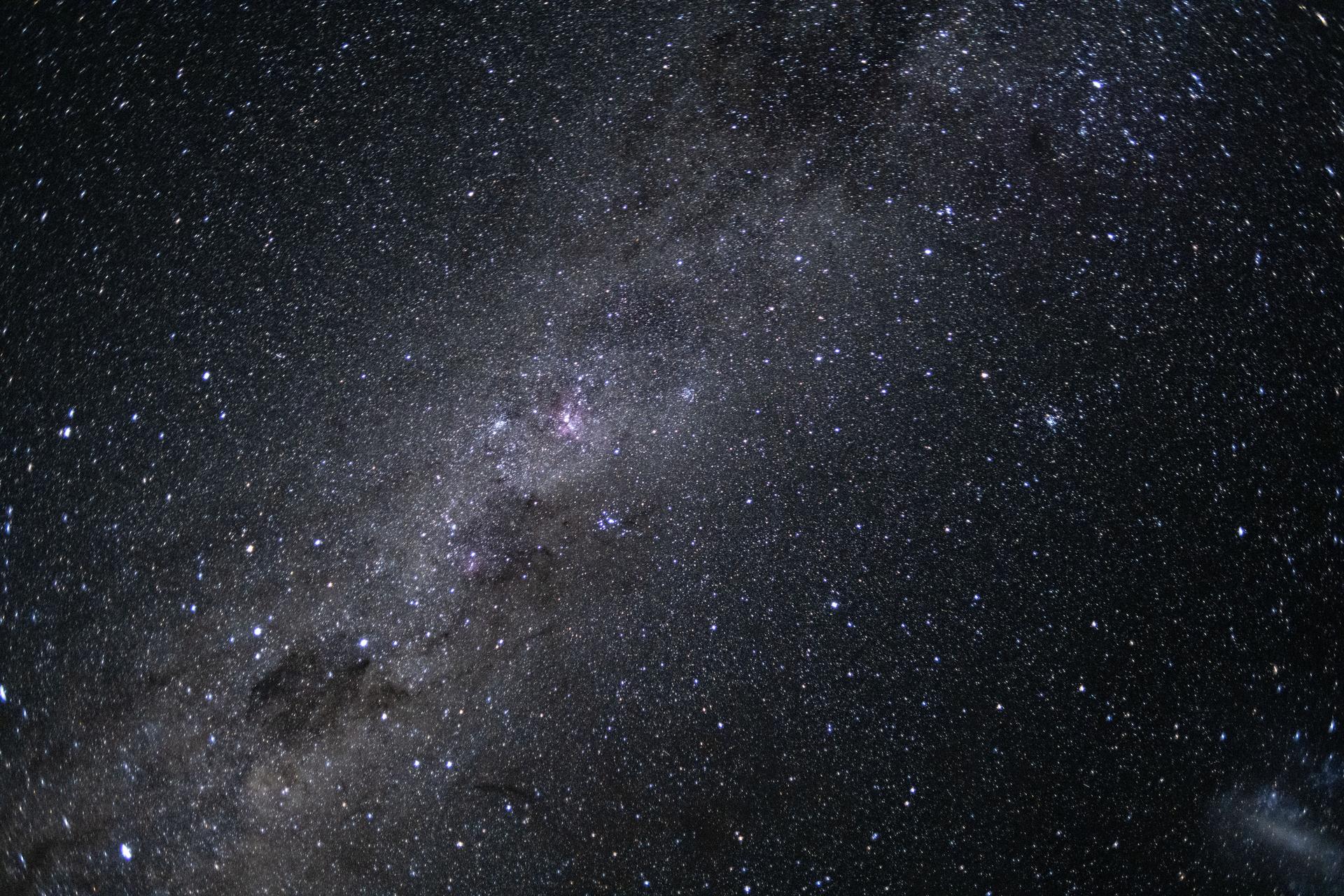
art002e012588 (April 7, 2026) - A stunning snapshot in time. The Artemis II crew captured this breathtaking photo of our galaxy, the Milky Way. The Milky Way’s elegant spiral structure is dominated by just two arms wrapping off the ends of a central bar of stars. Spanning more than 100,000 light-years, Earth is located along one of the galaxy’s spiral arms, about halfway from the center. Credit: NASA
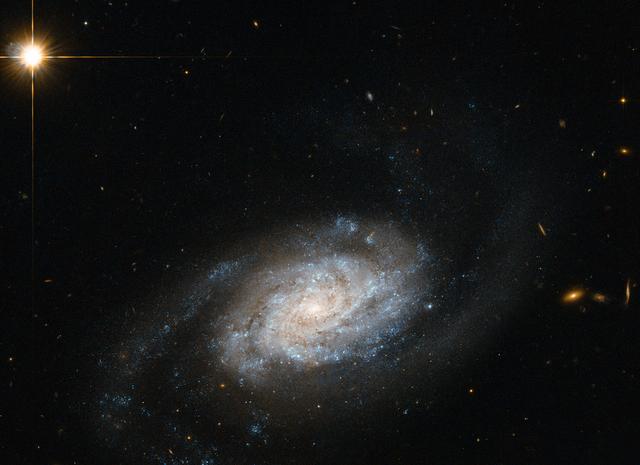
Shown here is a spiral galaxy known as NGC 3455, which lies some 65 million light-years away from us in the constellation of Leo (the Lion). Galaxies are classified into different types according to their structure and appearance. This classification system is known as the Hubble Sequence, named after its creator Edwin Hubble. In this image released 14, April, 2014, NGC 3455 is known as a type SB galaxy — a barred spiral. Barred spiral galaxies account for approximately two thirds of all spirals. Galaxies of this type appear to have a bar of stars slicing through the bulge of stars at their center. The SB classification is further sub-divided by the appearance of a galaxy's pinwheeling spiral arms; SBa types have more tightly wound arms, whereas SBc types have looser ones. SBb types, such as NGC 3455, lie in between. NGC 3455 is part of a pair of galaxies — its partner, NGC 3454, lies out of frame. This cosmic duo belong to a group known as the NGC 3370 group, which is in turn one of the Leo II groups, a large collection of galaxies scattered some 30 million light-years to the right of the Virgo cluster. This image is from Hubble's Advanced Camera for Surveys. Credit: ESA/Hubble & NASA, Acknowledgement: Nick Rose <b><a href="http://www.nasa.gov/audience/formedia/features/MP_Photo_Guidelines.html" rel="nofollow">NASA image use policy.</a></b> <b><a href="http://www.nasa.gov/centers/goddard/home/index.html" rel="nofollow">NASA Goddard Space Flight Center</a></b> enables NASA’s mission through four scientific endeavors: Earth Science, Heliophysics, Solar System Exploration, and Astrophysics. Goddard plays a leading role in NASA’s accomplishments by contributing compelling scientific knowledge to advance the Agency’s mission. <b>Follow us on <a href="http://twitter.com/NASAGoddardPix" rel="nofollow">Twitter</a></b> <b>Like us on <a href="http://www.facebook.com/pages/Greenbelt-MD/NASA-Goddard/395013845897?ref=tsd" rel="nofollow">Facebook</a></b> <b>Find us on <a href="http://instagram.com/nasagoddard?vm=grid" rel="nofollow">Instagram</a></b>
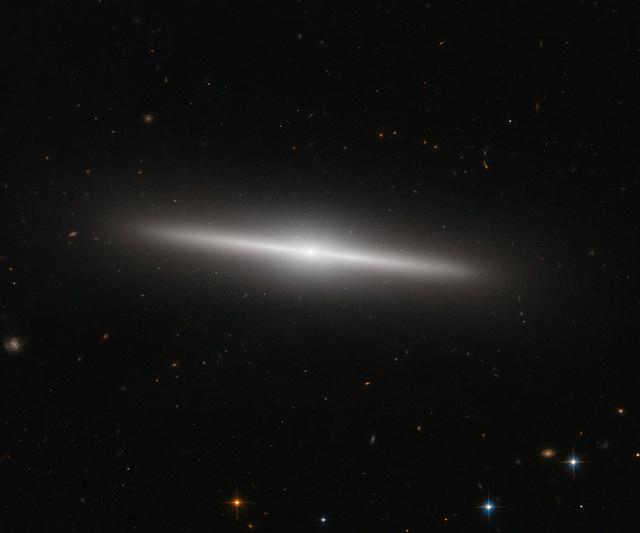
Hubble sees a galaxy 60 million light-years away This new NASA/ESA Hubble Space Telescope image shows the galaxy IC 335 in front of a backdrop of distant galaxies. IC 335 is part of a galaxy group containing three other galaxies, and located in the Fornax Galaxy Cluster 60 million light-years away. As seen in this image, the disk of IC 335 appears edge-on from the vantage point of Earth. This makes it harder for astronomers to classify it, as most of the characteristics of a galaxy’s morphology — the arms of a spiral or the bar across the center — are only visible on its face. Still, the 45 000 light-year-long galaxy could be classified as an S0 type. These lenticular galaxies are an intermediate state in galaxy morphological classification schemes between true spiral and elliptical galaxies. They have a thin stellar disk and a bulge, like spiral galaxies, but in contrast to typical spiral galaxies they have used up most of the interstellar medium. Only a few new stars can be created out of the material that is left and the star formation rate is very low. Hence, the population of stars in S0 galaxies consists mainly of aging stars, very similar to the star population in elliptical galaxies. As S0 galaxies have only ill-defined spiral arms they are easily mistaken for elliptical galaxies if they are seen inclined face-on or edge-on as IC 335 here. And indeed, despite the morphological differences between S0 and elliptical class galaxies, they share some common characteristics, like typical sizes and spectral features. Both classes are also deemed "early-type" galaxies, because they are evolving passively. However, while elliptical galaxies may be passively evolving when we observe them, they have usually had violent interactions with other galaxies in their past. In contrast, S0 galaxies are either aging and fading spiral galaxies, which never had any interactions with other galaxies, or they are the aging result of a single merger between two spiral galaxies in the past. The exact nature of these galaxies is still a matter of debate. Credit: ESA/Hubble and NASA
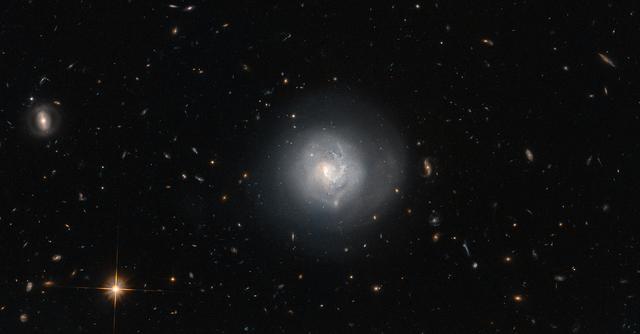
This galaxy is known as Mrk 820 and is classified as a lenticular galaxy — type S0 on the Hubble Tuning Fork. The Hubble Tuning Fork is used to classify galaxies according to their morphology. Elliptical galaxies look like smooth blobs in the sky and lie on the handle of the fork. They are arranged along the handle based on how elliptical they are, with the more spherical galaxies furthest from the tines of the fork, and the more egg-shaped ones closest to the end of the handle where it divides. The two prongs of the tuning fork represent types of unbarred and barred spiral galaxies. Lenticular galaxies like Mrk 820 are in the transition zone between ellipticals and spirals and lie right where the fork divides. A closer look at the appearance of Mrk 820 reveals hints of a spiral structure embedded in a circular halo of stars. Surrounding Mrk 820 in this image is good sampling of other galaxy types, covering almost every type found on the Hubble Tuning Fork, both elliptical and spiral. Most of the smears and specks are distant galaxies, but the prominent bright object at the bottom is a foreground star called TYC 4386-787-1. A version of this image was entered into the Hubble's Hidden Treasures image processing competition by contestant Judy Schmidt.

Astronomers using data from NASA's Wide-field Infrared Survey Explorer, or WISE, are helping to trace the shape of our Milky Way galaxy's spiral arms. This illustration shows where WISE data revealed clusters of young stars shrouded in dust, called embedded clusters, which are known to reside in spiral arms. The bars represent uncertainties in the data. The nearly 100 clusters shown here were found in the arms called Perseus, Sagittarius-Carina, and Outer -- three of the galaxy's four proposed primary arms. Our sun resides in a spur to an arm, or a minor arm, called Orion Cygnus. http://photojournal.jpl.nasa.gov/catalog/PIA19341

Discovered by British astronomer William Herschel over 200 years ago, NGC 2500 lies about 30 million light-years away in the northern constellation of Lynx. As this NASA/ESA Hubble Space Telescope image shows, NGC 2500 is a particular kind of spiral galaxy known as a barred spiral, its wispy arms swirling out from a bright, elongated core. Barred spirals are actually more common than was once thought. Around two-thirds of all spiral galaxies — including the Milky Way — exhibit these straight bars cutting through their centers. These cosmic structures act as glowing nurseries for newborn stars, and funnel material towards the active core of a galaxy. NGC 2500 is still actively forming new stars, although this process appears to be occurring very unevenly. The upper half of the galaxy — where the spiral arms are slightly better defined — hosts many more star-forming regions than the lower half, as indicated by the bright, dotted islands of light. There is another similarity between NGC 2500 and our home galaxy. Together with Andromeda, Triangulum and many smaller natural satellites, the Milky Way is part of the Local Group of galaxies, a gathering of over 50 galaxies all loosely held together by gravity. NGC 2500 forms a similar group with some of its nearby neighbors, including NGC 2541, NGC 2552, NGC 2537 and the bright, Andromeda-like spiral NGC 2481 (known collectively as the NGC 2841 group). Image Credit: ESA/Hubble/NASA <b><a href="http://www.nasa.gov/audience/formedia/features/MP_Photo_Guidelines.html" rel="nofollow">NASA image use policy.</a></b> <b><a href="http://www.nasa.gov/centers/goddard/home/index.html" rel="nofollow">NASA Goddard Space Flight Center</a></b> enables NASA’s mission through four scientific endeavors: Earth Science, Heliophysics, Solar System Exploration, and Astrophysics. Goddard plays a leading role in NASA’s accomplishments by contributing compelling scientific knowledge to advance the Agency’s mission. <b>Follow us on <a href="http://twitter.com/NASAGoddardPix" rel="nofollow">Twitter</a></b> <b>Like us on <a href="http://www.facebook.com/pages/Greenbelt-MD/NASA-Goddard/395013845897?ref=tsd" rel="nofollow">Facebook</a></b> <b>Find us on <a href="http://instagrid.me/nasagoddard/?vm=grid" rel="nofollow">Instagram</a></b>
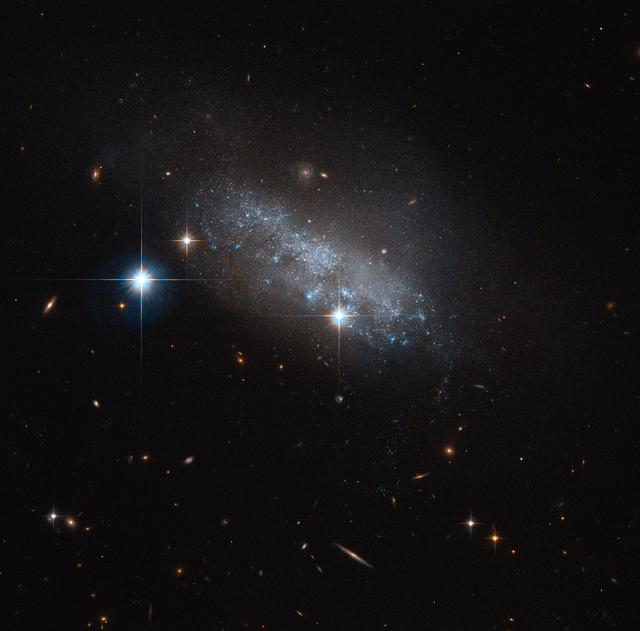
This delicate blue group of stars — actually an irregular galaxy named IC 3583 — sits some 30 million light-years away in the constellation of Virgo (The Virgin). It may seem to have no discernable structure, but IC 3583 has been found to have a bar of stars running through its center. These structures are common throughout the Universe, and are found within the majority of spiral, many irregular, and some lenticular galaxies. Two of our closest cosmic neighbors, the Large and Small Magellanic Clouds, are barred, indicating that they may have once been barred spiral galaxies that were disrupted or torn apart by the gravitational pull of the Milky Way. Researchers at the University of Leicester, England note there are two types of irregular galaxy. Type I's are usually single galaxies of peculiar appearance. They contain a large fraction of young stars, and show the luminous nebulae that are also visible in spiral galaxies. Type II irregulars include the group known as interacting or disrupting galaxies, in which the strange appearance is due to two or more galaxies colliding, merging or otherwise interacting gravitationally. Something similar might be happening with IC 3583. This small galaxy is thought to be gravitationally interacting with one of its neighbors, the spiral Messier 90. Together, the duo form a pairing known as Arp 76. It’s still unclear whether these flirtations are the cause of IC 3583’s irregular appearance — but whatever the cause, the galaxy makes for a strikingly delicate sight in this NASA/ESA Hubble Space Telescope image, glimmering in the blackness of space. Image Credit: ESA/Hubble & NASA <b><a href="http://www.nasa.gov/audience/formedia/features/MP_Photo_Guidelines.html" rel="nofollow">NASA image use policy.</a></b> <b><a href="http://www.nasa.gov/centers/goddard/home/index.html" rel="nofollow">NASA Goddard Space Flight Center</a></b> enables NASA’s mission through four scientific endeavors: Earth Science, Heliophysics, Solar System Exploration, and Astrophysics. Goddard plays a leading role in NASA’s accomplishments by contributing compelling scientific knowledge to advance the Agency’s mission. <b>Follow us on <a href="http://twitter.com/NASAGoddardPix" rel="nofollow">Twitter</a></b> <b>Like us on <a href="http://www.facebook.com/pages/Greenbelt-MD/NASA-Goddard/395013845897?ref=tsd" rel="nofollow">Facebook</a></b> <b>Find us on <a href="http://instagrid.me/nasagoddard/?vm=grid" rel="nofollow">Instagram</a></b>
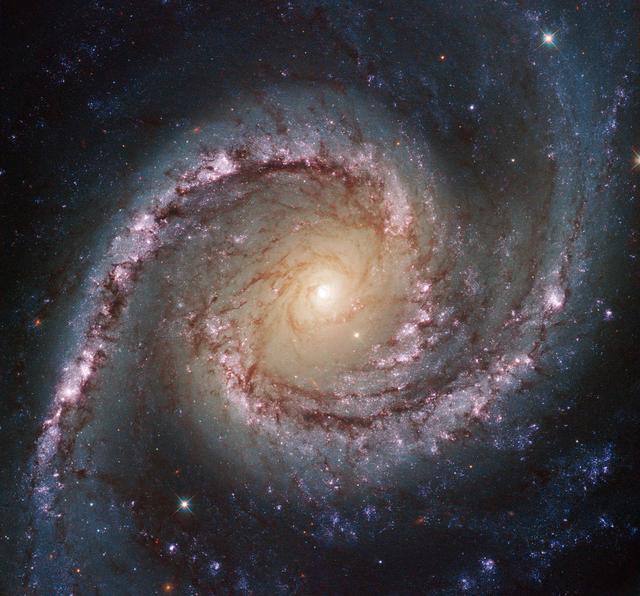
This new Hubble image shows NGC 1566, a beautiful galaxy located approximately 40 million light-years away in the constellation of Dorado (The Dolphinfish). NGC 1566 is an intermediate spiral galaxy, meaning that while it does not have a well-defined bar-shaped region of stars at its center — like barred spirals — it is not quite an unbarred spiral either. The small but extremely bright nucleus of NGC 1566 is clearly visible in this image, a telltale sign of its membership of the Seyfert class of galaxies. The centers of such galaxies are very active and luminous, emitting strong bursts of radiation and potentially harboring supermassive black holes that are many millions of times the mass of the sun. NGC 1566 is not just any Seyfert galaxy; it is the second brightest Seyfert galaxy known. It is also the brightest and most dominant member of the Dorado Group, a loose concentration of galaxies that together comprise one of the richest galaxy groups of the southern hemisphere. This image highlights the beauty and awe-inspiring nature of this unique galaxy group, with NGC 1566 glittering and glowing, its bright nucleus framed by swirling and symmetrical lavender arms. This image was taken by Hubble’s Wide Field Camera 3 (WFC3) in the near-infrared part of the spectrum. European Space Agency Credit: ESA/Hubble & NASA, Acknowledgement: Flickr user Det58 <b><a href="http://www.nasa.gov/audience/formedia/features/MP_Photo_Guidelines.html" rel="nofollow">NASA image use policy.</a></b> <b><a href="http://www.nasa.gov/centers/goddard/home/index.html" rel="nofollow">NASA Goddard Space Flight Center</a></b> enables NASA’s mission through four scientific endeavors: Earth Science, Heliophysics, Solar System Exploration, and Astrophysics. Goddard plays a leading role in NASA’s accomplishments by contributing compelling scientific knowledge to advance the Agency’s mission. <b>Follow us on <a href="http://twitter.com/NASAGoddardPix" rel="nofollow">Twitter</a></b> <b>Like us on <a href="http://www.facebook.com/pages/Greenbelt-MD/NASA-Goddard/395013845897?ref=tsd" rel="nofollow">Facebook</a></b> <b>Find us on <a href="http://instagram.com/nasagoddard?vm=grid" rel="nofollow">Instagram</a></b>

Lying more than 110 million light-years away from Earth in the constellation of Antlia (The Air Pump) is the spiral galaxy IC 2560, shown here in an image from NASA/ESA Hubble Space Telescope. At this distance it is a relatively nearby spiral galaxy, and is part of the Antlia cluster — a group of over 200 galaxies held together by gravity. This cluster is unusual; unlike most other galaxy clusters, it appears to have no dominant galaxy within it. In this image, it is easy to spot IC 2560's spiral arms and barred structure. This spiral is what astronomers call a Seyfert-2 galaxy, a kind of spiral galaxy characterized by an extremely bright nucleus and very strong emission lines from certain elements — hydrogen, helium, nitrogen, and oxygen. The bright center of the galaxy is thought to be caused by the ejection of huge amounts of super-hot gas from the region around a central black hole. There is a story behind the naming of this quirky constellation — Antlia was originally named antlia pneumatica by French astronomer Abbé Nicolas Louis de Lacaille, in honor of the invention of the air pump in the 17th century. Credit: Hubble/European Space Agency and NASA <b><a href="http://www.nasa.gov/audience/formedia/features/MP_Photo_Guidelines.html" rel="nofollow">NASA image use policy.</a></b> <b><a href="http://www.nasa.gov/centers/goddard/home/index.html" rel="nofollow">NASA Goddard Space Flight Center</a></b> enables NASA’s mission through four scientific endeavors: Earth Science, Heliophysics, Solar System Exploration, and Astrophysics. Goddard plays a leading role in NASA’s accomplishments by contributing compelling scientific knowledge to advance the Agency’s mission. <b>Follow us on <a href="http://twitter.com/NASA_GoddardPix" rel="nofollow">Twitter</a></b> <b>Like us on <a href="http://www.facebook.com/pages/Greenbelt-MD/NASA-Goddard/395013845897?ref=tsd" rel="nofollow">Facebook</a></b> <b>Find us on <a href="http://instagram.com/nasagoddard?vm=grid" rel="nofollow">Instagram</a></b>
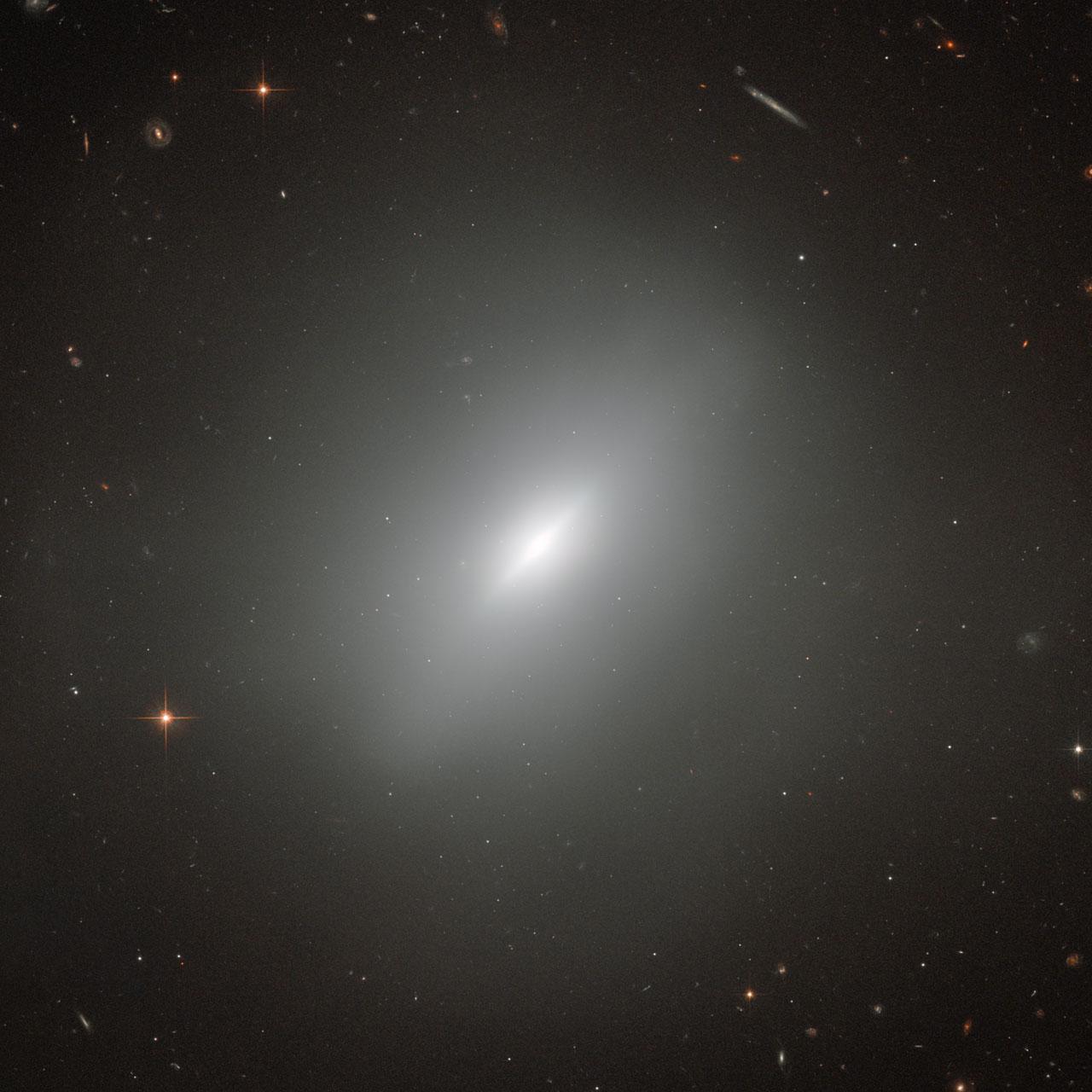
At the centre of this amazing image is the elliptical galaxy NGC 3610. Surrounding the galaxy are a wealth of other galaxies of all shapes. There are spiral galaxies, galaxies with a bar in their central regions, distorted galaxies and elliptical galaxies, all visible in the background. In fact, almost every bright dot in this image is a galaxy — the few foreground stars are clearly distinguishable due to the diffraction spikes that overlay their images. NGC 3610 is of course the most prominent object in this image — and a very interesting one at that! Discovered in 1793 by William Herschel, it was later found that this elliptical galaxy contains a disc. This is very unusual, as discs are one of the main distinguishing features of a spiral galaxy. And NGC 3610 even hosts a memarkable bright disc. The reason for the peculiar shape of NGC 3610 stems from its formation history. When galaxies form, they usually resemble our galaxy, the Milky Way, with flat discs and spiral arms where star formation rates are high and which are therefore very bright. An elliptical galaxy is a much more disordered object which results from the merging of two or more disc galaxies. During these violent mergers most of the internal structure of the original galaxies is destroyed. The fact that NGC 3610 still shows some structure in the form of a bright disc implies that it formed only a short time ago. The galaxy’s age has been put at around four billion years and it is an important object for studying the early stages of evolution in elliptical galaxies.
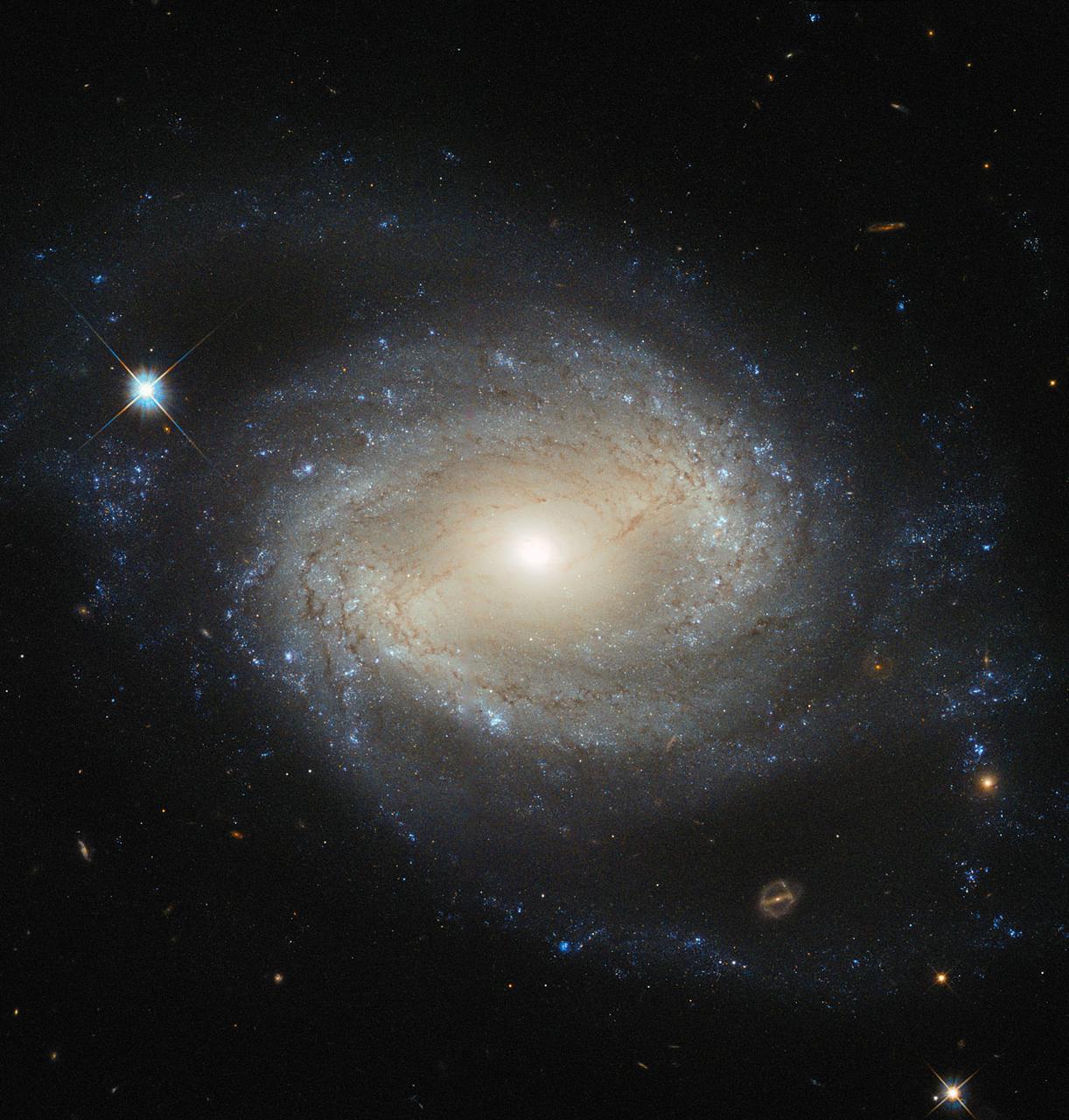
NGC 4639 is a beautiful example of a type of galaxy known as a barred spiral. It lies over 70 million light-years away in the constellation of Virgo and is one of about 1,500 galaxies that make up the Virgo Cluster. In this image, taken by the NASA/ESA Hubble Space Telescope, one can clearly see the bar running through the bright, round core of the galaxy. Bars are found in around two-thirds of spiral galaxies, and are thought to be a natural phase in their evolution. The galaxy’s spiral arms are sprinkled with bright regions of active star formation. Each of these tiny jewels is actually several hundred light-years across and contains hundreds or thousands of newly formed stars. But NGC 4639 also conceals a dark secret in its core — a massive black hole that is consuming the surrounding gas. This is known as an active galactic nucleus (AGN), and is revealed by characteristic features in the spectrum of light from the galaxy and by X-rays produced close to the black hole as the hot gas plunges towards it. Most galaxies are thought to contain a black hole at the center. NGC 4639 is in fact a very weak example of an AGN, demonstrating that AGNs exist over a large range of activity, from galaxies like NGC 4639 to distant quasars, where the parent galaxy is almost completely dominated by the emissions from the AGN. Image credit: ESA/Hubble & NASA <b><a href="http://www.nasa.gov/audience/formedia/features/MP_Photo_Guidelines.html" rel="nofollow">NASA image use policy.</a></b> <b><a href="http://www.nasa.gov/centers/goddard/home/index.html" rel="nofollow">NASA Goddard Space Flight Center</a></b> enables NASA’s mission through four scientific endeavors: Earth Science, Heliophysics, Solar System Exploration, and Astrophysics. Goddard plays a leading role in NASA’s accomplishments by contributing compelling scientific knowledge to advance the Agency’s mission. <b>Follow us on <a href="http://twitter.com/NASAGoddardPix" rel="nofollow">Twitter</a></b> <b>Like us on <a href="http://www.facebook.com/pages/Greenbelt-MD/NASA-Goddard/395013845897?ref=tsd" rel="nofollow">Facebook</a></b> <b>Find us on <a href="http://instagrid.me/nasagoddard/?vm=grid" rel="nofollow">Instagram</a></b>
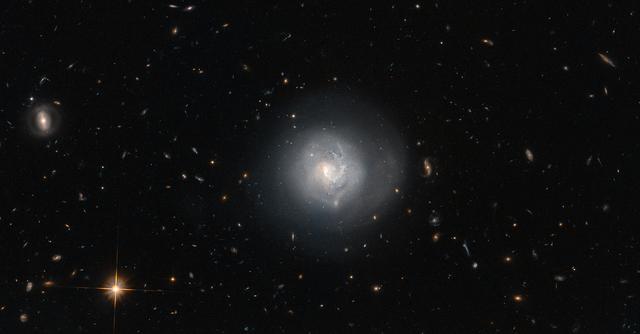
This galaxy is known as Mrk 820 and is classified as a lenticular galaxy — type S0 on the Hubble Tuning Fork. The Hubble Tuning Fork is used to classify galaxies according to their morphology. Elliptical galaxies look like smooth blobs in the sky and lie on the handle of the fork. They are arranged along the handle based on how elliptical they are, with the more spherical galaxies furthest from the tines of the fork, and the more egg-shaped ones closest to the end of the handle where it divides. The two prongs of the tuning fork represent types of unbarred and barred spiral galaxies. Lenticular galaxies like Mrk 820 are in the transition zone between ellipticals and spirals and lie right where the fork divides. A closer look at the appearance of Mrk 820 reveals hints of a spiral structure embedded in a circular halo of stars. Surrounding Mrk 820 in this image is a good sampling of other galaxy types, covering almost every type found on the Hubble Tuning Fork, both elliptical and spiral. Most of the smears and specks are distant galaxies, but the prominent bright object at the bottom is a foreground star called TYC 4386-787-1. Credit: ESA/Hubble & NASA and N. Gorin (STScI), Acknowledgement: Judy Schmidt <b><a href="http://www.nasa.gov/audience/formedia/features/MP_Photo_Guidelines.html" rel="nofollow">NASA image use policy.</a></b> <b><a href="http://www.nasa.gov/centers/goddard/home/index.html" rel="nofollow">NASA Goddard Space Flight Center</a></b> enables NASA’s mission through four scientific endeavors: Earth Science, Heliophysics, Solar System Exploration, and Astrophysics. Goddard plays a leading role in NASA’s accomplishments by contributing compelling scientific knowledge to advance the Agency’s mission. <b>Follow us on <a href="http://twitter.com/NASAGoddardPix" rel="nofollow">Twitter</a></b> <b>Like us on <a href="http://www.facebook.com/pages/Greenbelt-MD/NASA-Goddard/395013845897?ref=tsd" rel="nofollow">Facebook</a></b> <b>Find us on <a href="http://instagrid.me/nasagoddard/?vm=grid" rel="nofollow">Instagram</a></b>

The Hubble Space Telescope has spotted a UFO — well, the UFO Galaxy, to be precise. NGC 2683 is a spiral galaxy seen almost edge-on, giving it the shape of a classic science fiction spaceship. This is why the astronomers at the Astronaut Memorial Planetarium and Observatory gave it this attention-grabbing nickname. While a bird’s eye view lets us see the detailed structure of a galaxy (such as this Hubble image of a barred spiral), a side-on view has its own perks. In particular, it gives astronomers a great opportunity to see the delicate dusty lanes of the spiral arms silhouetted against the golden haze of the galaxy’s core. In addition, brilliant clusters of young blue stars shine scattered throughout the disc, mapping the galaxy’s star-forming regions. Perhaps surprisingly, side-on views of galaxies like this one do not prevent astronomers from deducing their structures. Studies of the properties of the light coming from NGC 2683 suggest that this is a barred spiral galaxy, even though the angle we see it at does not let us see this directly. NGC 2683, discovered on 5 February 1788 by the famous astronomer William Herschel, lies in the Northern constellation of Lynx. A constellation named not because of its resemblance to the feline animal, but because it is fairly faint, requiring the “sensitive eyes of a cat” to discern it. And when you manage to get a look at it, you’ll find treasures like this, making it well worth the effort. This image is produced from two adjacent fields observed in visible and infrared light by Hubble’s Advanced Camera for Surveys. A narrow strip which appears slightly blurred and crosses most the image horizontally is a result of a gap between Hubble’s detectors. This strip has been patched using images from observations of the galaxy made by ground-based telescopes, which show significantly less detail. The field of view is approximately 6.5 by 3.3 arcminutes. Credit: ESA/Hubble & NASA <b><a href="http://www.nasa.gov/audience/formedia/features/MP_Photo_Guidelines.html" rel="nofollow">NASA image use policy.</a></b> <b><a href="http://www.nasa.gov/centers/goddard/home/index.html" rel="nofollow">NASA Goddard Space Flight Center</a></b> enables NASA’s mission through four scientific endeavors: Earth Science, Heliophysics, Solar System Exploration, and Astrophysics. Goddard plays a leading role in NASA’s accomplishments by contributing compelling scientific knowledge to advance the Agency’s mission. <b>Follow us on <a href="http://twitter.com/NASA_GoddardPix" rel="nofollow">Twitter</a></b> <b>Like us on <a href="http://www.facebook.com/pages/Greenbelt-MD/NASA-Goddard/395013845897?ref=tsd" rel="nofollow">Facebook</a></b> <b>Find us on <a href="http://instagrid.me/nasagoddard/?vm=grid" rel="nofollow">Instagram</a></b>
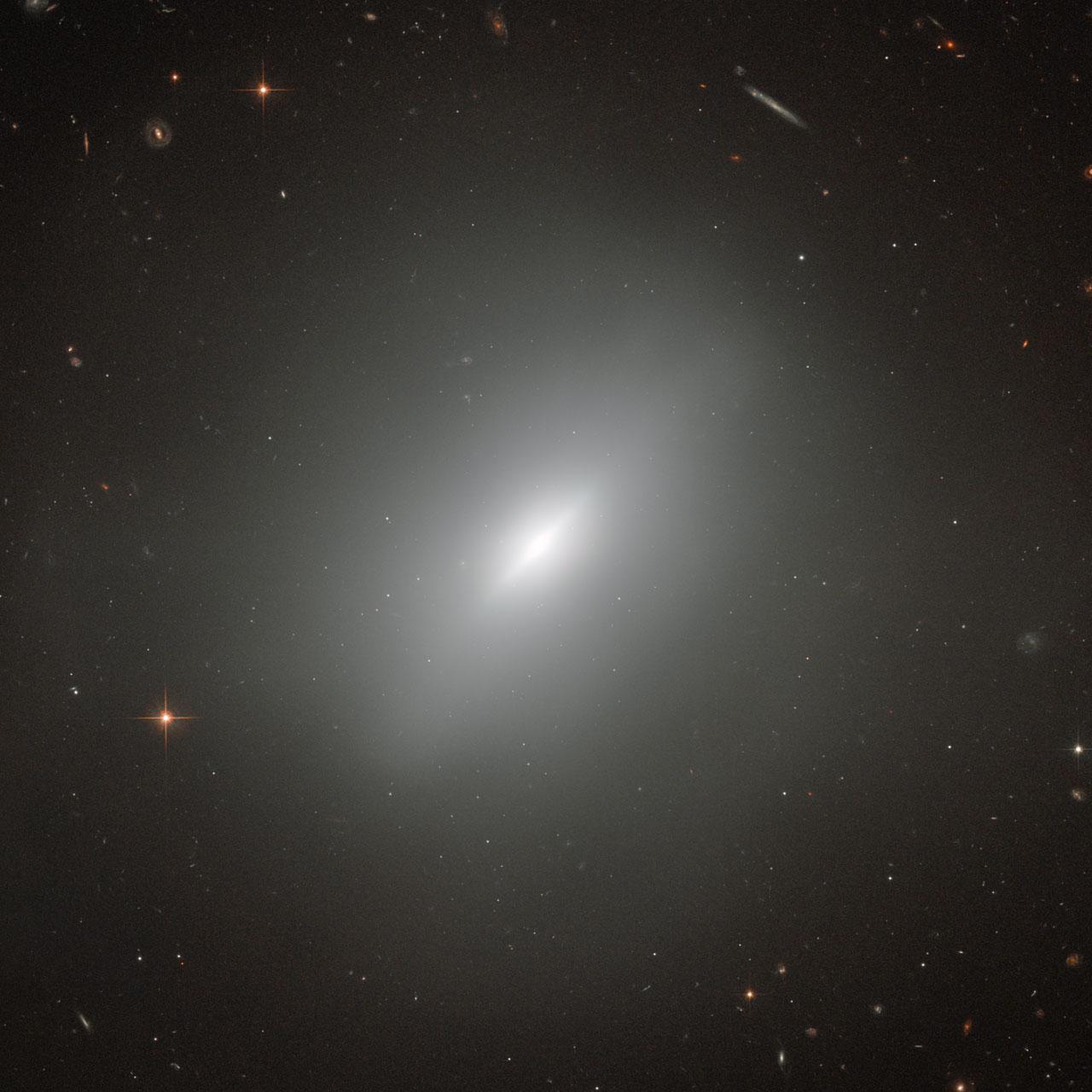
At the center of this amazing Hubble image is the elliptical galaxy NGC 3610. Surrounding the galaxy are a wealth of other galaxies of all shapes. There are spiral galaxies, galaxies with a bar in their central regions, distorted galaxies and elliptical galaxies, all visible in the background. In fact, almost every bright dot in this image is a galaxy — the few foreground stars are clearly distinguishable due to the diffraction spikes (lines radiating from bright light sources in reflecting telescope images) that overlay their images. NGC 3610 is of course the most prominent object in this image — and a very interesting one at that! Discovered in 1793 by William Herschel, it was later found that this elliptical galaxy contains a disk. This is very unusual, as disks are one of the main distinguishing features of a spiral galaxy. And the disk in NGC 3610 is remarkably bright. The reason for the peculiar shape of NGC 3610 stems from its formation history. When galaxies form, they usually resemble our galaxy, the Milky Way, with flat disks and spiral arms where star formation rates are high and which are therefore very bright. An elliptical galaxy is a much more disordered object which results from the merging of two or more disk galaxies. During these violent mergers most of the internal structure of the original galaxies is destroyed. The fact that NGC 3610 still shows some structure in the form of a bright disk implies that it formed only a short time ago. The galaxy’s age has been put at around four billion years and it is an important object for studying the early stages of evolution in elliptical galaxies. Image credit: ESA/Hubble & NASA, Acknowledgement: Judy Schmidt <b><a href="http://www.nasa.gov/audience/formedia/features/MP_Photo_Guidelines.html" rel="nofollow">NASA image use policy.</a></b> <b><a href="http://www.nasa.gov/centers/goddard/home/index.html" rel="nofollow">NASA Goddard Space Flight Center</a></b> enables NASA’s mission through four scientific endeavors: Earth Science, Heliophysics, Solar System Exploration, and Astrophysics. Goddard plays a leading role in NASA’s accomplishments by contributing compelling scientific knowledge to advance the Agency’s mission. <b>Follow us on <a href="http://twitter.com/NASAGoddardPix" rel="nofollow">Twitter</a></b> <b>Like us on <a href="http://www.facebook.com/pages/Greenbelt-MD/NASA-Goddard/395013845897?ref=tsd" rel="nofollow">Facebook</a></b> <b>Find us on <a href="http://instagrid.me/nasagoddard/?vm=grid" rel="nofollow">Instagram</a></b>
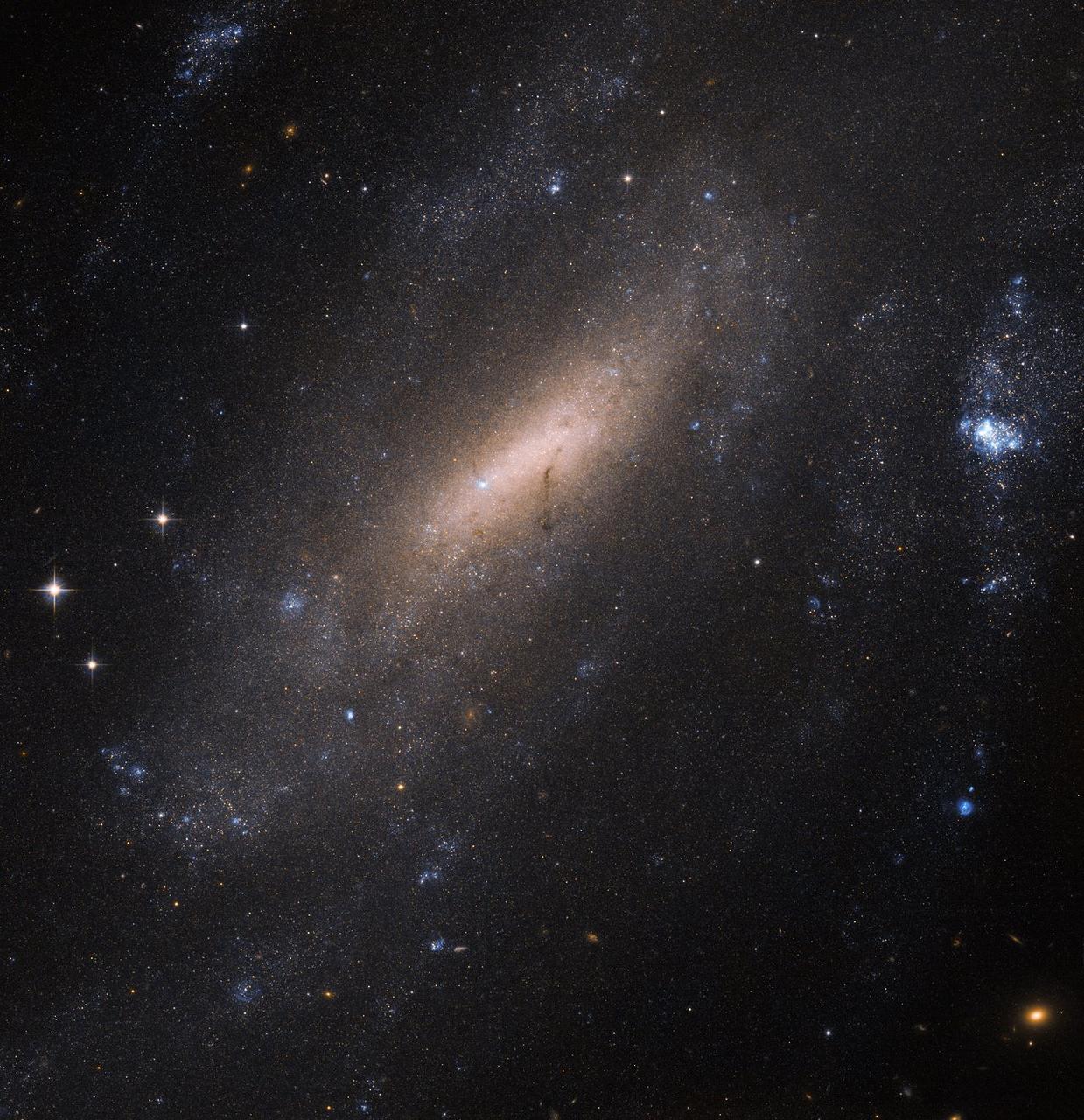
In 1900, astronomer Joseph Lunt made a discovery: Peering through a telescope at Cape Town Observatory, the British–South African scientist spotted this beautiful sight in the southern constellation of Grus (The Crane): a barred spiral galaxy now named IC 5201. Over a century later, the galaxy is still of interest to astronomers. For this image, the NASA/ESA Hubble Space Telescope used its Advanced Camera for Surveys (ACS) to produce a beautiful and intricate image of the galaxy. Hubble’s ACS can resolve individual stars within other galaxies, making it an invaluable tool to explore how various populations of stars sprang to life, evolved, and died throughout the cosmos. IC 5201 sits over 40 million light-years away from us. As with two thirds of all the spirals we see in the Universe — including the Milky Way — the galaxy has a bar of stars slicing through its center. Credit: ESA/Hubble & NASA <b><a href="http://www.nasa.gov/audience/formedia/features/MP_Photo_Guidelines.html" rel="nofollow">NASA image use policy.</a></b> <b><a href="http://www.nasa.gov/centers/goddard/home/index.html" rel="nofollow">NASA Goddard Space Flight Center</a></b> enables NASA’s mission through four scientific endeavors: Earth Science, Heliophysics, Solar System Exploration, and Astrophysics. Goddard plays a leading role in NASA’s accomplishments by contributing compelling scientific knowledge to advance the Agency’s mission. <b>Follow us on <a href="http://twitter.com/NASAGoddardPix" rel="nofollow">Twitter</a></b> <b>Like us on <a href="http://www.facebook.com/pages/Greenbelt-MD/NASA-Goddard/395013845897?ref=tsd" rel="nofollow">Facebook</a></b> <b>Find us on <a href="http://instagrid.me/nasagoddard/?vm=grid" rel="nofollow">Instagram</a></b>
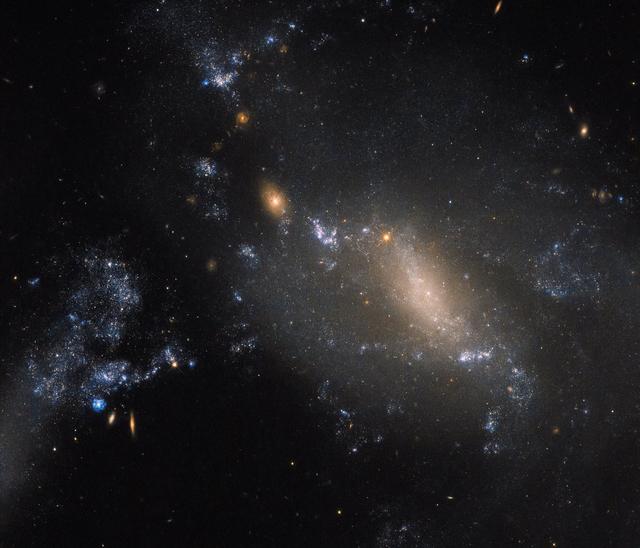
Two galaxies in a cosmic dance defy conventions. 60 million light-years away in the constellation of Leo, the more diffuse and patchy blue glow covering the right side of the frame is known as NGC 3447B, while the smaller clump to the upper left is NGC 3447A. Known together as NGC 3447, we’re unsure what each looked like before they began to tear one another apart. So close that they are strongly influenced and distorted by the gravitational forces between them, the galaxies to twist themselves into the unusual and unique shapes seen here. NGC 3447A appears to display the remnants of a central bar structure and some disrupted spiral arms, both properties characteristic of certain spiral galaxies. Some identify NGC 3447B as a former spiral galaxy, while others categorize it as being an irregular galaxy. Credit: NASA/Hubble <b><a href="http://www.nasa.gov/audience/formedia/features/MP_Photo_Guidelines.html" rel="nofollow">NASA image use policy.</a></b> <b><a href="http://www.nasa.gov/centers/goddard/home/index.html" rel="nofollow">NASA Goddard Space Flight Center</a></b> enables NASA’s mission through four scientific endeavors: Earth Science, Heliophysics, Solar System Exploration, and Astrophysics. Goddard plays a leading role in NASA’s accomplishments by contributing compelling scientific knowledge to advance the Agency’s mission. <b>Follow us on <a href="http://twitter.com/NASAGoddardPix" rel="nofollow">Twitter</a></b> <b>Like us on <a href="http://www.facebook.com/pages/Greenbelt-MD/NASA-Goddard/395013845897?ref=tsd" rel="nofollow">Facebook</a></b> <b>Find us on <a href="http://instagrid.me/nasagoddard/?vm=grid" rel="nofollow">Instagram</a></b>
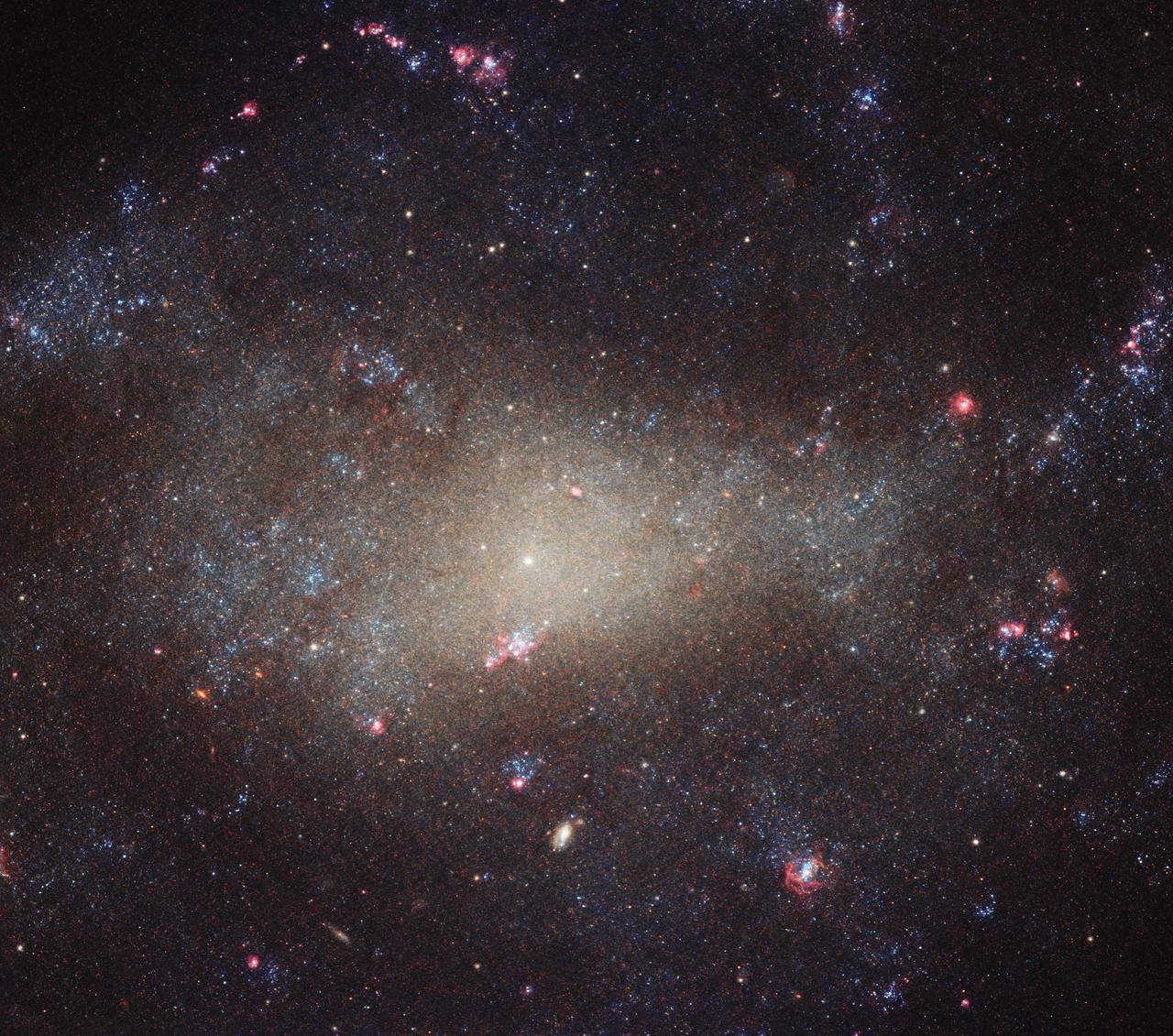
Tucked away in the small northern constellation of Canes Venatici (The Hunting Dogs) is the galaxy NGC 4242, shown here as seen by the NASA/ESA Hubble Space Telescope. The galaxy lies some 30 million light-years from us. At this distance from Earth, actually not all that far on a cosmic scale, NGC 4242 is visible to anyone armed with even a basic telescope, as British astronomer William Herschel found when he discovered the galaxy in 1788. This image shows the galaxy’s bright center and the surrounding dimmer and more diffuse “fuzz.” Despite appearing to be relatively bright in this image, studies have found that NGC 4242 is actually relatively dim (it has a moderate-to-low surface brightness and low luminosity) and also supports a low rate of star formation. The galaxy also seems to have a weak bar of stars cutting through its asymmetric center, and a very faint and poorly-defined spiral structure throughout its disk. But if NGC 4242 is not all that remarkable, as with much of the Universe, it is still a beautiful and ethereal sight. Credit: ESA/Hubble & NASA
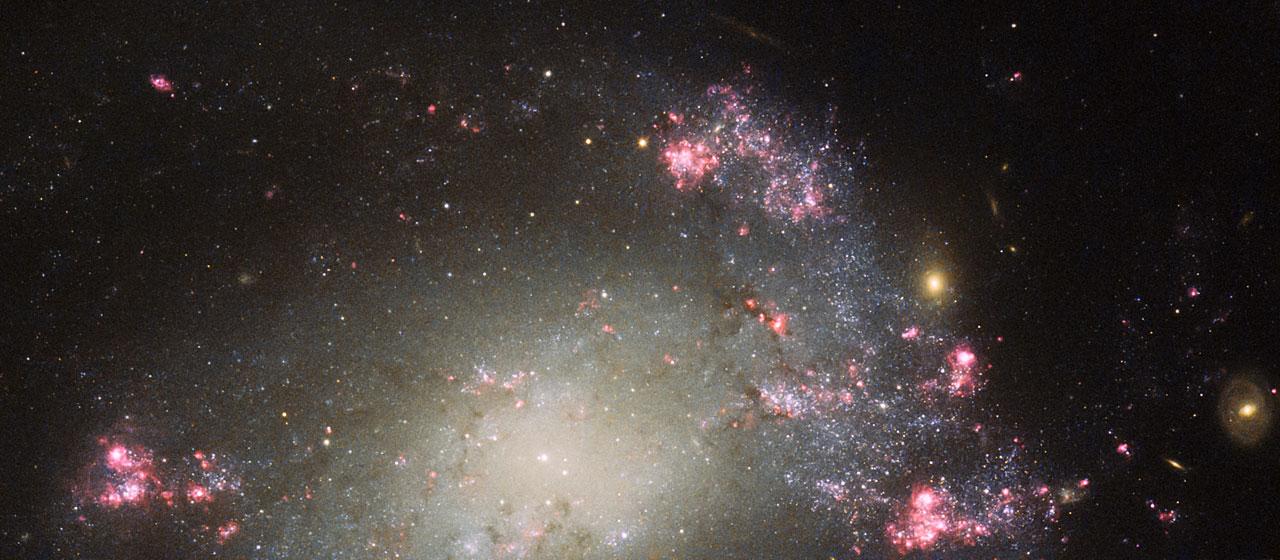
Bursts of pink and red, dark lanes of mottled cosmic dust, and a bright scattering of stars — this NASA/ESA Hubble Space Telescope image shows part of a messy barred spiral galaxy known as NGC 428. It lies approximately 48 million light-years away from Earth in the constellation of Cetus (The Sea Monster). Although a spiral shape is still just about visible in this close-up shot, overall NGC 428’s spiral structure appears to be quite distorted and warped, thought to be a result of a collision between two galaxies. There also appears to be a substantial amount of star formation occurring within NGC 428 — another telltale sign of a merger. When galaxies collide their clouds of gas can merge, creating intense shocks and hot pockets of gas and often triggering new waves of star formation. NGC 428 was discovered by William Herschel in December 1786. More recently a type Ia supernova designated SN2013ct was discovered within the galaxy by Stuart Parker of the BOSS (Backyard Observatory Supernova Search) project in Australia and New Zealand, although it is unfortunately not visible in this image. This image was captured by Hubble’s Advanced Camera for Surveys (ACS) and Wide Field and Planetary Camera 2 (WFPC2). A version of this image was entered into the Hubble’s Hidden Treasures Image Processing competition by contestants Nick Rose and the Flickr user penninecloud. Links: Nick Rose’s image on Flickr Penninecloud’s image on Flickr
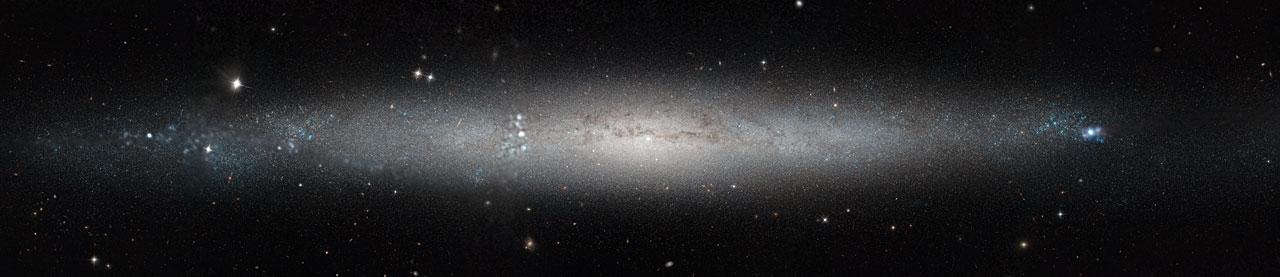
This stunning new image from the NASA/ESA Hubble Space Telescope shows part of the sky in the constellation of Canes Venatici (The Hunting Dogs). Although this region of the sky is not home to any stellar heavyweights, being mostly filled with stars of average brightness, it does contain five Messier objects and numerous intriguing galaxies — including NGC 5195, a small barred spiral galaxy considered to be one of the most beautiful galaxies visible, and its nearby interacting partner the Whirlpool Galaxy (heic0506a). The quirky Sunflower Galaxy is another notable galaxy in this constellation, and is one of the largest and brightest edge-on galaxies in our skies. Joining this host of characters is spiral galaxy NGC 4244, nicknamed the Silver Needle Galaxy, shown in this new image from Hubble. This galaxy spans some 65,000 light-years and lies around 13.5 million light-years away. It appears as a wafer-thin streak across the sky, with loosely wound spiral arms hidden from view as we observe the galaxy from the side. It is part of a group of galaxies known as the M94 Group. Numerous bright clumps of gas can be seen scattered across its length, along with dark dust lanes surrounding the galaxy’s core. NGC 4244 also has a bright star cluster at its center. Although we can make out the galaxy’s bright central region and star-spattered arms, we cannot see any more intricate structure due to the galaxy’s position; from Earth, we see it stretched out as a flattened streak across the sky. A number of different observations were pieced together to form this mosaic, and gaps in Hubble’s coverage have been filled in using ground-based data. The Hubble observations were taken as part of the Galaxy Halos, Outer disks, Substructure, Thick disks and Star clusters (GHOSTS) survey, which is scanning nearby galaxies to explore how they and their stars formed to get a more complete view of the history of the Universe. European Space Agency Credit: NASA & ESA, Acknowledgement: Roelof de Jong <b><a href="http://www.nasa.gov/audience/formedia/features/MP_Photo_Guidelines.html" rel="nofollow">NASA image use policy.</a></b> <b><a href="http://www.nasa.gov/centers/goddard/home/index.html" rel="nofollow">NASA Goddard Space Flight Center</a></b> enables NASA’s mission through four scientific endeavors: Earth Science, Heliophysics, Solar System Exploration, and Astrophysics. Goddard plays a leading role in NASA’s accomplishments by contributing compelling scientific knowledge to advance the Agency’s mission. <b>Follow us on <a href="http://twitter.com/NASAGoddardPix" rel="nofollow">Twitter</a></b> <b>Like us on <a href="http://www.facebook.com/pages/Greenbelt-MD/NASA-Goddard/395013845897?ref=tsd" rel="nofollow">Facebook</a></b> <b>Find us on <a href="http://instagram.com/nasagoddard?vm=grid" rel="nofollow">Instagram</a></b>

JANUARY 9, 2014: The vibrant magentas and blues in this Hubble image of the barred spiral galaxy M83 reveal that the galaxy is ablaze with star formation. The galactic panorama unveils a tapestry of the drama of stellar birth and death. The galaxy, also known as the Southern Pinwheel, lies 15 million light-years away in the constellation Hydra. Credit: NASA, ESA, and the Hubble Heritage Team (STScI/AURA) Acknowledgement: W. Blair (STScI/Johns Hopkins University) and R. O'Connell (University of Virginia) <b><a href="http://www.nasa.gov/audience/formedia/features/MP_Photo_Guidelines.html" rel="nofollow">NASA image use policy.</a></b> <b><a href="http://www.nasa.gov/centers/goddard/home/index.html" rel="nofollow">NASA Goddard Space Flight Center</a></b> enables NASA’s mission through four scientific endeavors: Earth Science, Heliophysics, Solar System Exploration, and Astrophysics. Goddard plays a leading role in NASA’s accomplishments by contributing compelling scientific knowledge to advance the Agency’s mission. <b>Follow us on <a href="http://twitter.com/NASA_GoddardPix" rel="nofollow">Twitter</a></b> <b>Like us on <a href="http://www.facebook.com/pages/Greenbelt-MD/NASA-Goddard/395013845897?ref=tsd" rel="nofollow">Facebook</a></b> <b>Find us on <a href="http://instagram.com/nasagoddard?vm=grid" rel="nofollow">Instagram</a></b>
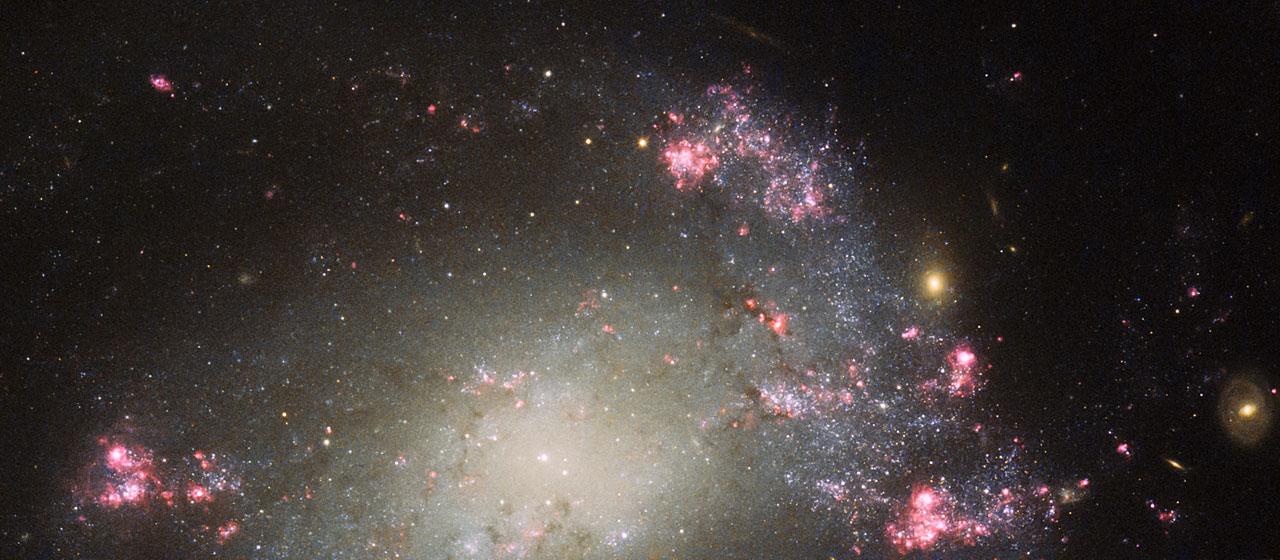
Bursts of pink and red, dark lanes of mottled cosmic dust, and a bright scattering of stars — this NASA/ESA Hubble Space Telescope image shows part of a messy barred spiral galaxy known as NGC 428. It lies approximately 48 million light-years away from Earth in the constellation of Cetus (The Sea Monster). Although a spiral shape is still just about visible in this close-up shot, overall NGC 428’s spiral structure appears to be quite distorted and warped, thought to be a result of a collision between two galaxies. There also appears to be a substantial amount of star formation occurring within NGC 428 — another telltale sign of a merger. When galaxies collide their clouds of gas can merge, creating intense shocks and hot pockets of gas, and often triggering new waves of star formation. NGC 428 was discovered by William Herschel in December 1786. More recently a type of supernova designated SN2013ct was discovered within the galaxy by Stuart Parker of the BOSS (Backyard Observatory Supernova Search) project in Australia and New Zealand, although it is unfortunately not visible in this image. This image was captured by Hubble’s Advanced Camera for Surveys (ACS) and Wide Field and Planetary Camera 2 (WFPC2). Image credit: ESA/Hubble and NASA and S. Smartt (Queen's University Belfast), Acknowledgements: Nick Rose and Flickr user pennine cloud <b><a href="http://www.nasa.gov/audience/formedia/features/MP_Photo_Guidelines.html" rel="nofollow">NASA image use policy.</a></b> <b><a href="http://www.nasa.gov/centers/goddard/home/index.html" rel="nofollow">NASA Goddard Space Flight Center</a></b> enables NASA’s mission through four scientific endeavors: Earth Science, Heliophysics, Solar System Exploration, and Astrophysics. Goddard plays a leading role in NASA’s accomplishments by contributing compelling scientific knowledge to advance the Agency’s mission. <b>Follow us on <a href="http://twitter.com/NASAGoddardPix" rel="nofollow">Twitter</a></b> <b>Like us on <a href="http://www.facebook.com/pages/Greenbelt-MD/NASA-Goddard/395013845897?ref=tsd" rel="nofollow">Facebook</a></b> <b>Find us on <a href="http://instagrid.me/nasagoddard/?vm=grid" rel="nofollow">Instagram</a></b>
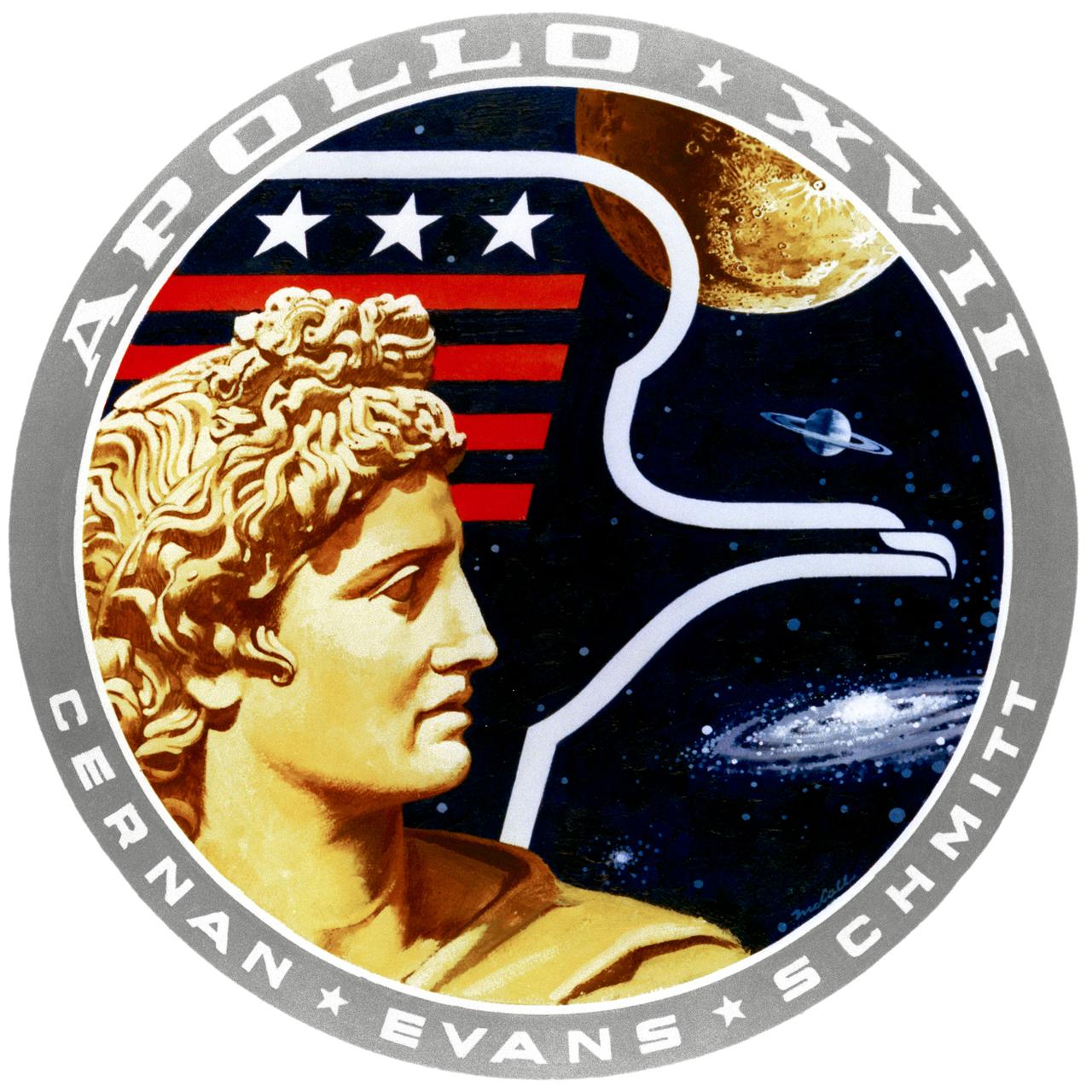
S72-49079 (8 Sept. 1972) --- This is the official emblem of the Apollo 17 lunar landing mission which will be flown by astronauts Eugene A. Cernan, Ronald E. Evans and Harrison H. Schmitt. The insignia is dominated by the image of Apollo, the Greek sun god. Suspended in space behind the head of Apollo is an American eagle of contemporary design, the red bars of the eagle's wing represent the bars in the United States flag; the three white stars symbolize the three astronaut crewmen. The background is deep blue space and within it are the moon, the planet Saturn and a spiral galaxy or nebula. The moon is partially overlaid by the eagle's wing suggesting that this is a celestial body that man has visited and in that sense conquered. The thrust of the eagle and the gaze of Apollo to the right and toward Saturn and the galaxy is meant to imply that man's goals in space will someday include the planets and perhaps the stars. The colors of the emblem are red, white and blue, the colors of our flag; with the addition of gold, to symbolize the golden age of space flight that will begin with this Apollo 17 lunar landing. The Apollo image used in this emblem was the famous Apollo of Belvedere sculpture now in the Vatican Gallery in Rome. This emblem was designed by artist Robert T. McCall in collaboration with the astronauts. This is the official Apollo 17 emblem, a property of the government of the United States. It has been authorized only for use by the astronauts. Its reproduction in any form other than in news, information and education media is not authorized without approval. Unauthorized use is subject to the provisions of Title 18, U.S. Code, Section 701.
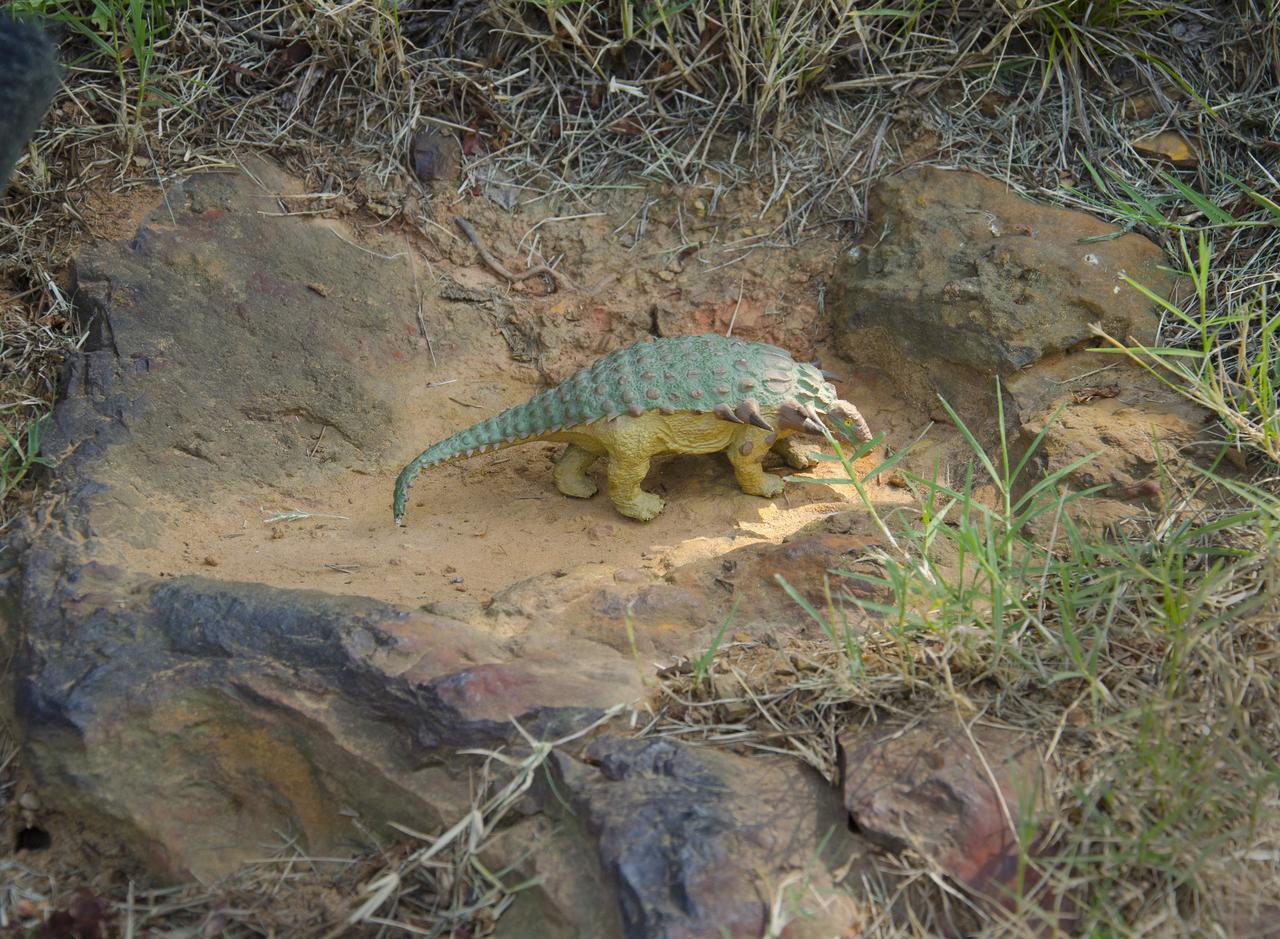
About 110 million light years away, the bright, barred spiral galaxy NGC3259 was just forming stars in dark bands of dust and gas. On Earth, a plant-eating dinosaur left footprints in the Cretaceous mud of what would later become the grounds of NASA’s Goddard Space Flight Center in Greenbelt, Md. A model of a Nodosaur dinosaur sits inside what is believed to be the fossil of a Nodosaur footprint. The footprint was found by Ray Stanford a local dinosaur hunter. <b>To read more go to: <a href="http://www.nasa.gov/centers/goddard/news/features/2012/nodosaur.html" rel="nofollow">www.nasa.gov/centers/goddard/news/features/2012/nodosaur....</a></b> Credit: NASA/Goddard/Rebecca Roth <b><a href="http://www.nasa.gov/audience/formedia/features/MP_Photo_Guidelines.html" rel="nofollow">NASA image use policy.</a></b> <b><a href="http://www.nasa.gov/centers/goddard/home/index.html" rel="nofollow">NASA Goddard Space Flight Center</a></b> enables NASA’s mission through four scientific endeavors: Earth Science, Heliophysics, Solar System Exploration, and Astrophysics. Goddard plays a leading role in NASA’s accomplishments by contributing compelling scientific knowledge to advance the Agency’s mission. <b>Follow us on <a href="http://twitter.com/NASA_GoddardPix" rel="nofollow">Twitter</a></b> <b>Like us on <a href="http://www.facebook.com/pages/Greenbelt-MD/NASA-Goddard/395013845897?ref=tsd" rel="nofollow">Facebook</a></b> <b>Find us on <a href="http://instagrid.me/nasagoddard/?vm=grid" rel="nofollow">Instagram</a></b>

About 110 million light years away, the bright, barred spiral galaxy NGC3259 was just forming stars in dark bands of dust and gas. On Earth, a plant-eating dinosaur left footprints in the Cretaceous mud of what would later become the grounds of NASA’s Goddard Space Flight Center in Greenbelt, Md. Local dinosaur hunter Ray Stanford reviews a fossil found at the site. <b>To read more go to: <a href="http://www.nasa.gov/centers/goddard/news/features/2012/nodosaur.html" rel="nofollow">www.nasa.gov/centers/goddard/news/features/2012/nodosaur....</a></b> Credit: NASA/Goddard/Rebecca Roth <b><a href="http://www.nasa.gov/audience/formedia/features/MP_Photo_Guidelines.html" rel="nofollow">NASA image use policy.</a></b> <b><a href="http://www.nasa.gov/centers/goddard/home/index.html" rel="nofollow">NASA Goddard Space Flight Center</a></b> enables NASA’s mission through four scientific endeavors: Earth Science, Heliophysics, Solar System Exploration, and Astrophysics. Goddard plays a leading role in NASA’s accomplishments by contributing compelling scientific knowledge to advance the Agency’s mission. <b>Follow us on <a href="http://twitter.com/NASA_GoddardPix" rel="nofollow">Twitter</a></b> <b>Like us on <a href="http://www.facebook.com/pages/Greenbelt-MD/NASA-Goddard/395013845897?ref=tsd" rel="nofollow">Facebook</a></b> <b>Find us on <a href="http://instagrid.me/nasagoddard/?vm=grid" rel="nofollow">Instagram</a></b>
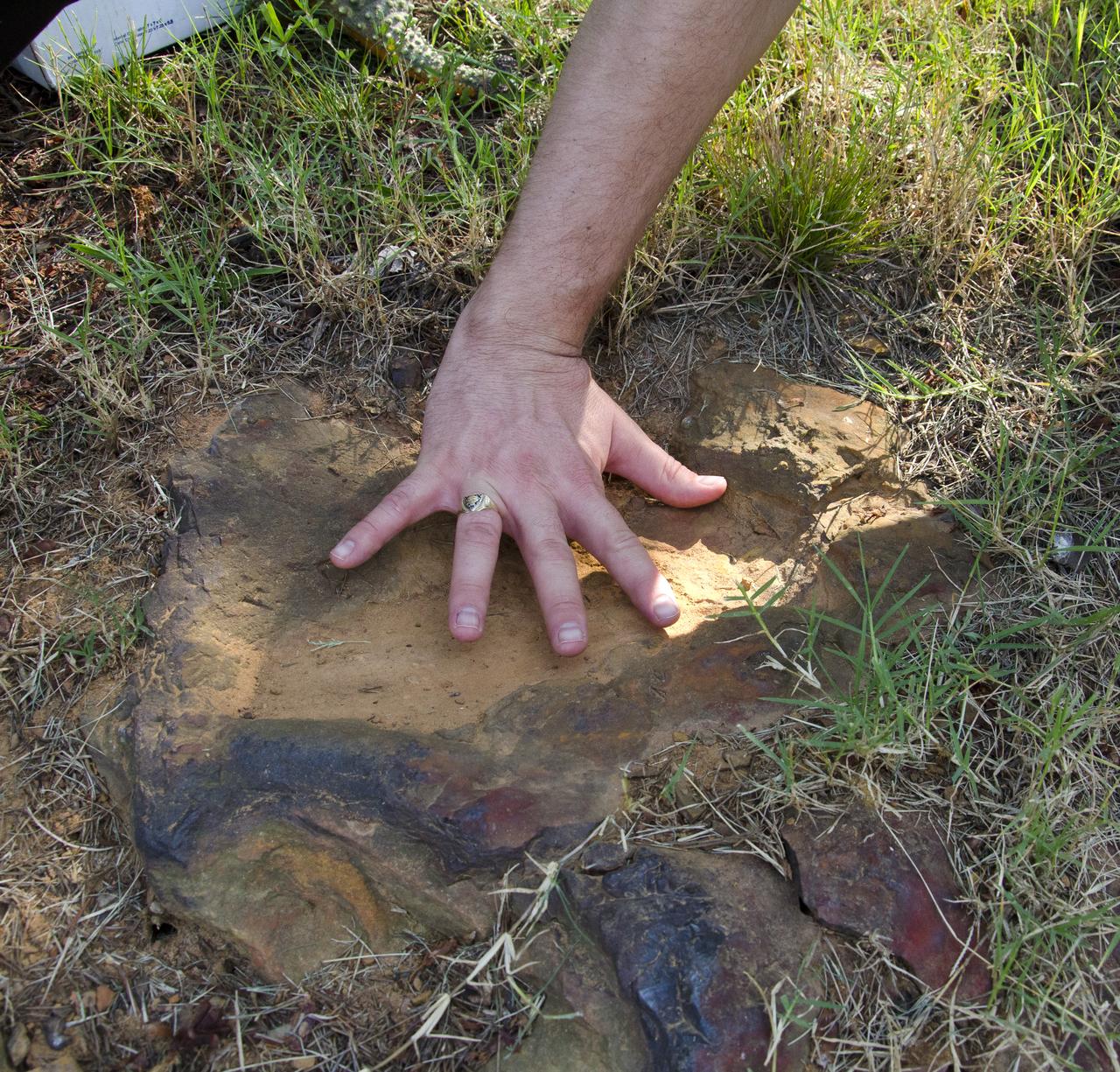
About 110 million light years away, the bright, barred spiral galaxy NGC3259 was just forming stars in dark bands of dust and gas. On Earth, a plant-eating dinosaur left footprints in the Cretaceous mud of what would later become the grounds of NASA’s Goddard Space Flight Center in Greenbelt, Md. Local dinosaur hunter Ray Stanford points out the impression to Goddard officials and members of local media. <b>To read more go to: <a href="http://www.nasa.gov/centers/goddard/news/features/2012/nodosaur.html" rel="nofollow">www.nasa.gov/centers/goddard/news/features/2012/nodosaur....</a></b> Credit: NASA/Goddard/Rebecca Roth <b><a href="http://www.nasa.gov/audience/formedia/features/MP_Photo_Guidelines.html" rel="nofollow">NASA image use policy.</a></b> <b><a href="http://www.nasa.gov/centers/goddard/home/index.html" rel="nofollow">NASA Goddard Space Flight Center</a></b> enables NASA’s mission through four scientific endeavors: Earth Science, Heliophysics, Solar System Exploration, and Astrophysics. Goddard plays a leading role in NASA’s accomplishments by contributing compelling scientific knowledge to advance the Agency’s mission. <b>Follow us on <a href="http://twitter.com/NASA_GoddardPix" rel="nofollow">Twitter</a></b> <b>Like us on <a href="http://www.facebook.com/pages/Greenbelt-MD/NASA-Goddard/395013845897?ref=tsd" rel="nofollow">Facebook</a></b> <b>Find us on <a href="http://instagrid.me/nasagoddard/?vm=grid" rel="nofollow">Instagram</a></b>

About 110 million light years away, the bright, barred spiral galaxy NGC3259 was just forming stars in dark bands of dust and gas. On Earth, a plant-eating dinosaur left footprints in the Cretaceous mud of what would later become the grounds of NASA’s Goddard Space Flight Center in Greenbelt, Md. <b>To read more go to: <a href="http://www.nasa.gov/centers/goddard/news/features/2012/nodosaur.html" rel="nofollow">www.nasa.gov/centers/goddard/news/features/2012/nodosaur....</a></b> Credit: NASA/Goddard/Rebecca Roth <b><a href="http://www.nasa.gov/audience/formedia/features/MP_Photo_Guidelines.html" rel="nofollow">NASA image use policy.</a></b> <b><a href="http://www.nasa.gov/centers/goddard/home/index.html" rel="nofollow">NASA Goddard Space Flight Center</a></b> enables NASA’s mission through four scientific endeavors: Earth Science, Heliophysics, Solar System Exploration, and Astrophysics. Goddard plays a leading role in NASA’s accomplishments by contributing compelling scientific knowledge to advance the Agency’s mission. <b>Follow us on <a href="http://twitter.com/NASA_GoddardPix" rel="nofollow">Twitter</a></b> <b>Like us on <a href="http://www.facebook.com/pages/Greenbelt-MD/NASA-Goddard/395013845897?ref=tsd" rel="nofollow">Facebook</a></b> <b>Find us on <a href="http://instagrid.me/nasagoddard/?vm=grid" rel="nofollow">Instagram</a></b>

About 110 million light years away, the bright, barred spiral galaxy NGC3259 was just forming stars in dark bands of dust and gas. On Earth, a plant-eating dinosaur left footprints in the Cretaceous mud of what would later become the grounds of NASA’s Goddard Space Flight Center in Greenbelt, Md. Local dinosaur hunter Ray Stanford speaks to local press and Goddard officials about this discovery. <b>To read more go to: <a href="http://www.nasa.gov/centers/goddard/news/features/2012/nodosaur.html" rel="nofollow">www.nasa.gov/centers/goddard/news/features/2012/nodosaur....</a></b> Credit: NASA/Goddard/Rebecca Roth <b><a href="http://www.nasa.gov/audience/formedia/features/MP_Photo_Guidelines.html" rel="nofollow">NASA image use policy.</a></b> <b><a href="http://www.nasa.gov/centers/goddard/home/index.html" rel="nofollow">NASA Goddard Space Flight Center</a></b> enables NASA’s mission through four scientific endeavors: Earth Science, Heliophysics, Solar System Exploration, and Astrophysics. Goddard plays a leading role in NASA’s accomplishments by contributing compelling scientific knowledge to advance the Agency’s mission. <b>Follow us on <a href="http://twitter.com/NASA_GoddardPix" rel="nofollow">Twitter</a></b> <b>Like us on <a href="http://www.facebook.com/pages/Greenbelt-MD/NASA-Goddard/395013845897?ref=tsd" rel="nofollow">Facebook</a></b> <b>Find us on <a href="http://instagrid.me/nasagoddard/?vm=grid" rel="nofollow">Instagram</a></b>

About 110 million light years away, the bright, barred spiral galaxy NGC3259 was just forming stars in dark bands of dust and gas. On Earth, a plant-eating dinosaur left footprints in the Cretaceous mud of what would later become the grounds of NASA’s Goddard Space Flight Center in Greenbelt, Md. Local dinosaur hunter Ray Stanford points out the impression to Goddard officials and members of local media. <b>To read more go to: <a href="http://www.nasa.gov/centers/goddard/news/features/2012/nodosaur.html" rel="nofollow">www.nasa.gov/centers/goddard/news/features/2012/nodosaur....</a></b> Credit: NASA/Goddard/Rebecca Roth <b><a href="http://www.nasa.gov/audience/formedia/features/MP_Photo_Guidelines.html" rel="nofollow">NASA image use policy.</a></b> <b><a href="http://www.nasa.gov/centers/goddard/home/index.html" rel="nofollow">NASA Goddard Space Flight Center</a></b> enables NASA’s mission through four scientific endeavors: Earth Science, Heliophysics, Solar System Exploration, and Astrophysics. Goddard plays a leading role in NASA’s accomplishments by contributing compelling scientific knowledge to advance the Agency’s mission. <b>Follow us on <a href="http://twitter.com/NASA_GoddardPix" rel="nofollow">Twitter</a></b> <b>Like us on <a href="http://www.facebook.com/pages/Greenbelt-MD/NASA-Goddard/395013845897?ref=tsd" rel="nofollow">Facebook</a></b> <b>Find us on <a href="http://instagrid.me/nasagoddard/?vm=grid" rel="nofollow">Instagram</a></b>
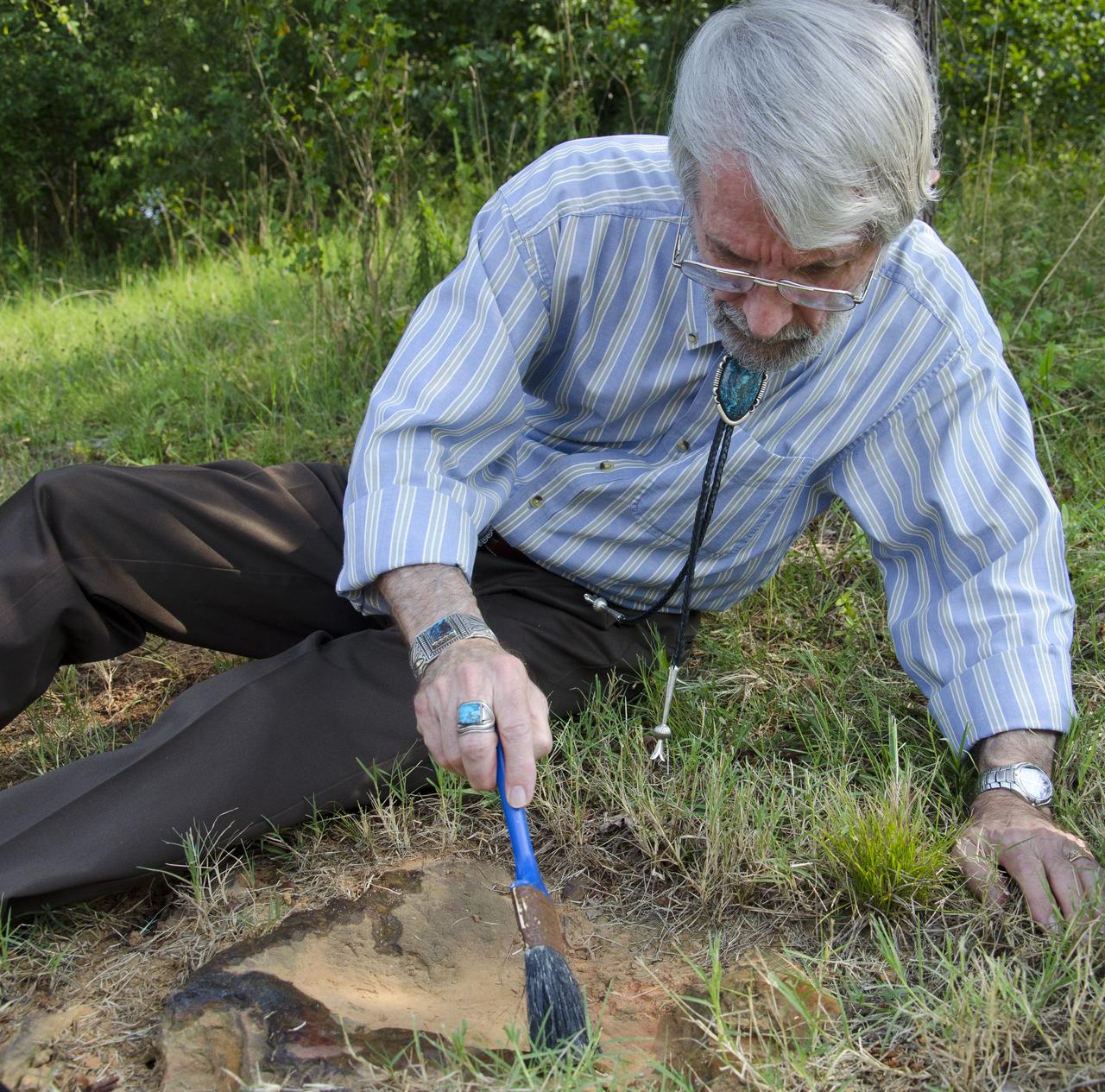
About 110 million light years away, the bright, barred spiral galaxy NGC3259 was just forming stars in dark bands of dust and gas. On Earth, a plant-eating dinosaur left footprints in the Cretaceous mud of what would later become the grounds of NASA’s Goddard Space Flight Center in Greenbelt, Md. Local dinosaur hunter Ray Stanford points out the impression to Goddard officials and members of local media. <b>To read more go to: <a href="http://www.nasa.gov/centers/goddard/news/features/2012/nodosaur.html" rel="nofollow">www.nasa.gov/centers/goddard/news/features/2012/nodosaur....</a></b> Credit: NASA/Goddard/Rebecca Roth <b><a href="http://www.nasa.gov/audience/formedia/features/MP_Photo_Guidelines.html" rel="nofollow">NASA image use policy.</a></b> <b><a href="http://www.nasa.gov/centers/goddard/home/index.html" rel="nofollow">NASA Goddard Space Flight Center</a></b> enables NASA’s mission through four scientific endeavors: Earth Science, Heliophysics, Solar System Exploration, and Astrophysics. Goddard plays a leading role in NASA’s accomplishments by contributing compelling scientific knowledge to advance the Agency’s mission. <b>Follow us on <a href="http://twitter.com/NASA_GoddardPix" rel="nofollow">Twitter</a></b> <b>Like us on <a href="http://www.facebook.com/pages/Greenbelt-MD/NASA-Goddard/395013845897?ref=tsd" rel="nofollow">Facebook</a></b> <b>Find us on <a href="http://instagrid.me/nasagoddard/?vm=grid" rel="nofollow">Instagram</a></b>