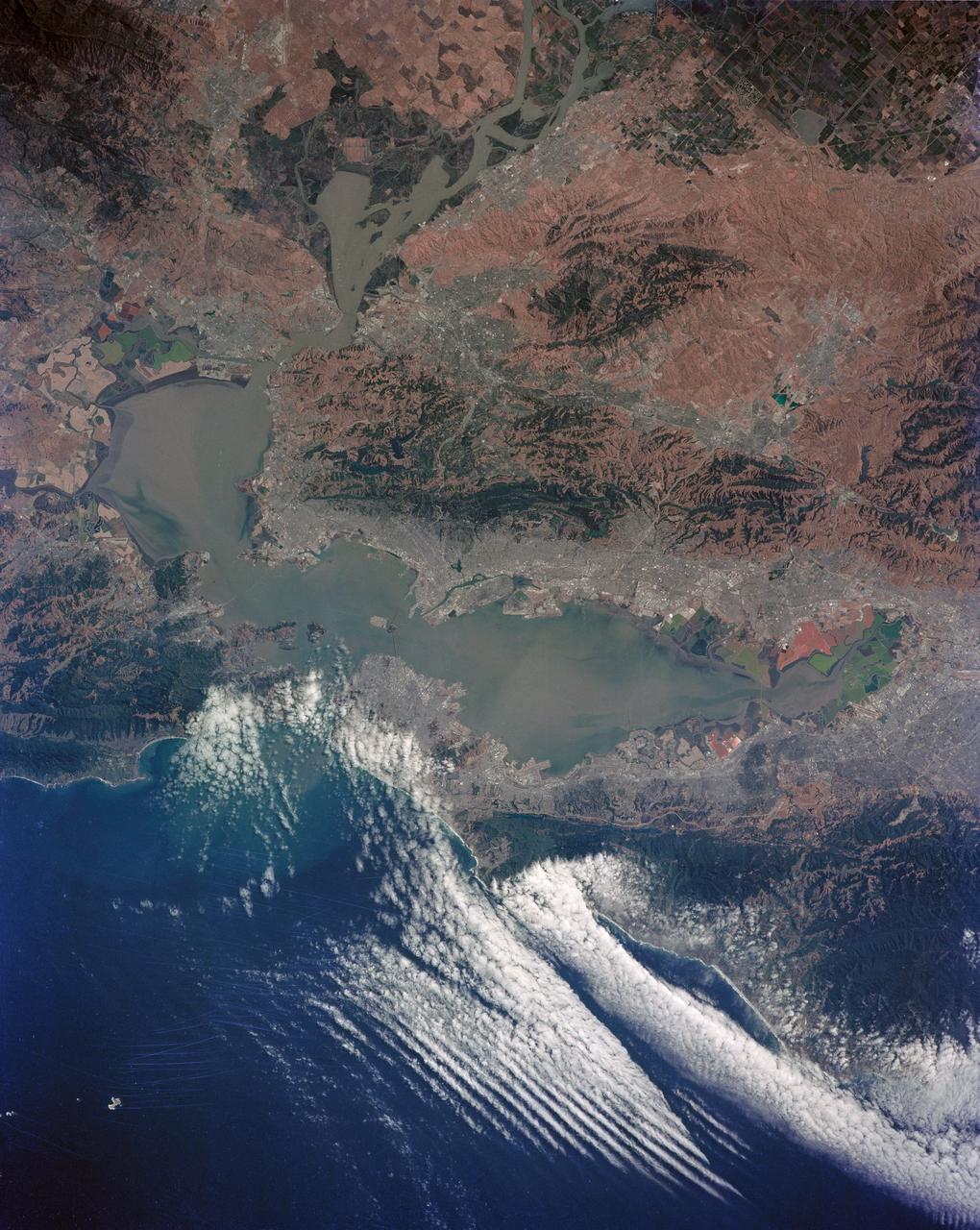
STS040-152-100 (5-14 June 1991) --- Although clouds obscure part of the city of San Francisco and the mouth of San Francisco Bay, development and physiographic features in the immediate vicinity of the bay are well displayed. The photograph clearly shows the eastern part of the city, including the Embarcadero, the Bay Bridge, which was damaged in the 1989 earthquake, and Candlestick Park, San Mateo, and Dumbarton Bridges, cross the southern portion of the bay. Vari-colored salt ponds also rim the southern Bay near Moffett Field. Highway 280 runs along the San Andreas fault south of the city. On the eastern margin of the bay are Berkeley the Sacramento River and the Haywood and Calaveras faults.
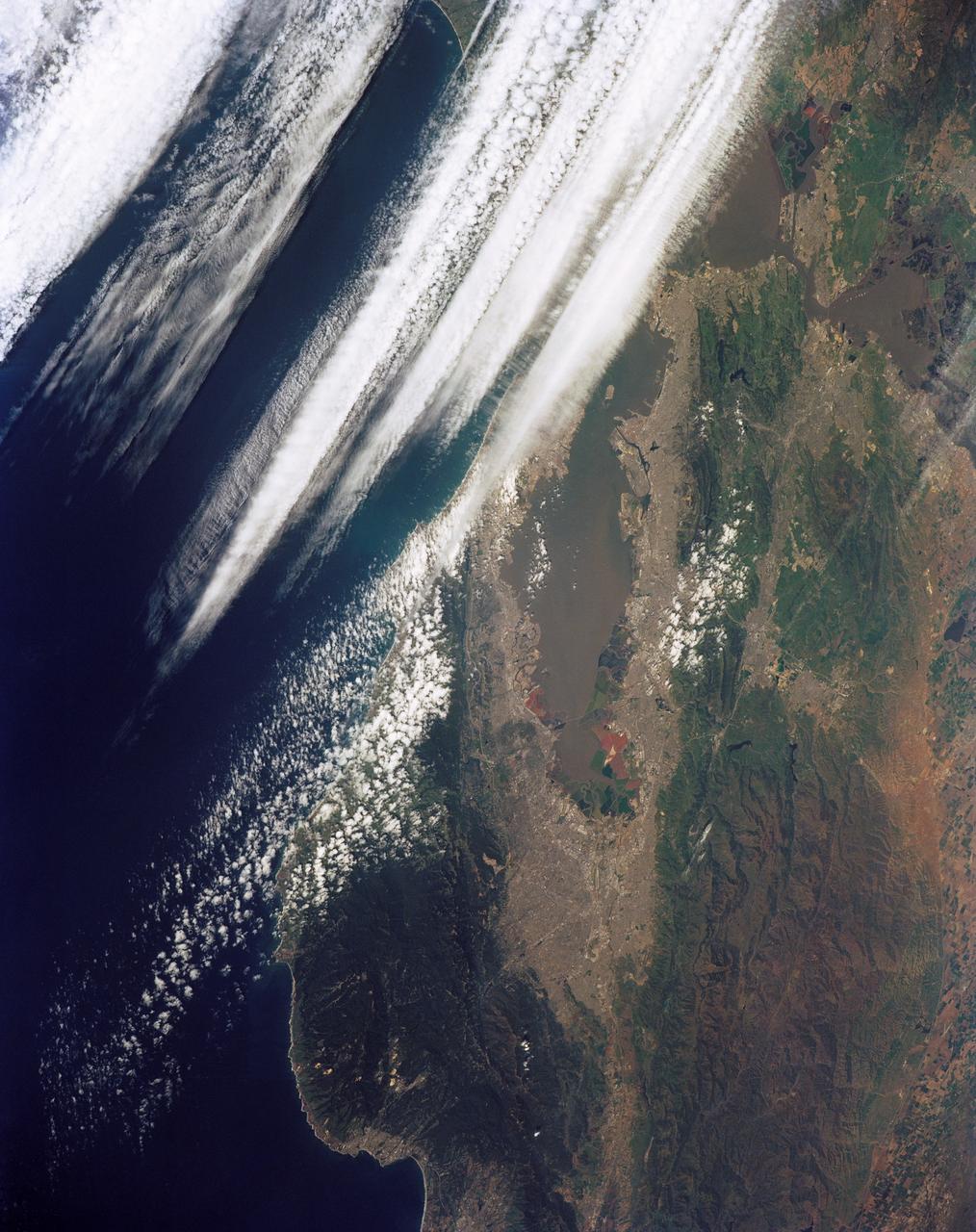
STS039-151-181A (28 April-6 May 1991) --- Large format (five-inch) frame of the San Francisco/Oakland Bay Area of northern California. Stratus clouds at 35,000 feet and cumulus clouds at about 15,000 feet are seen over the Pacific Coast, obscuring the Golden Gate Bridge.
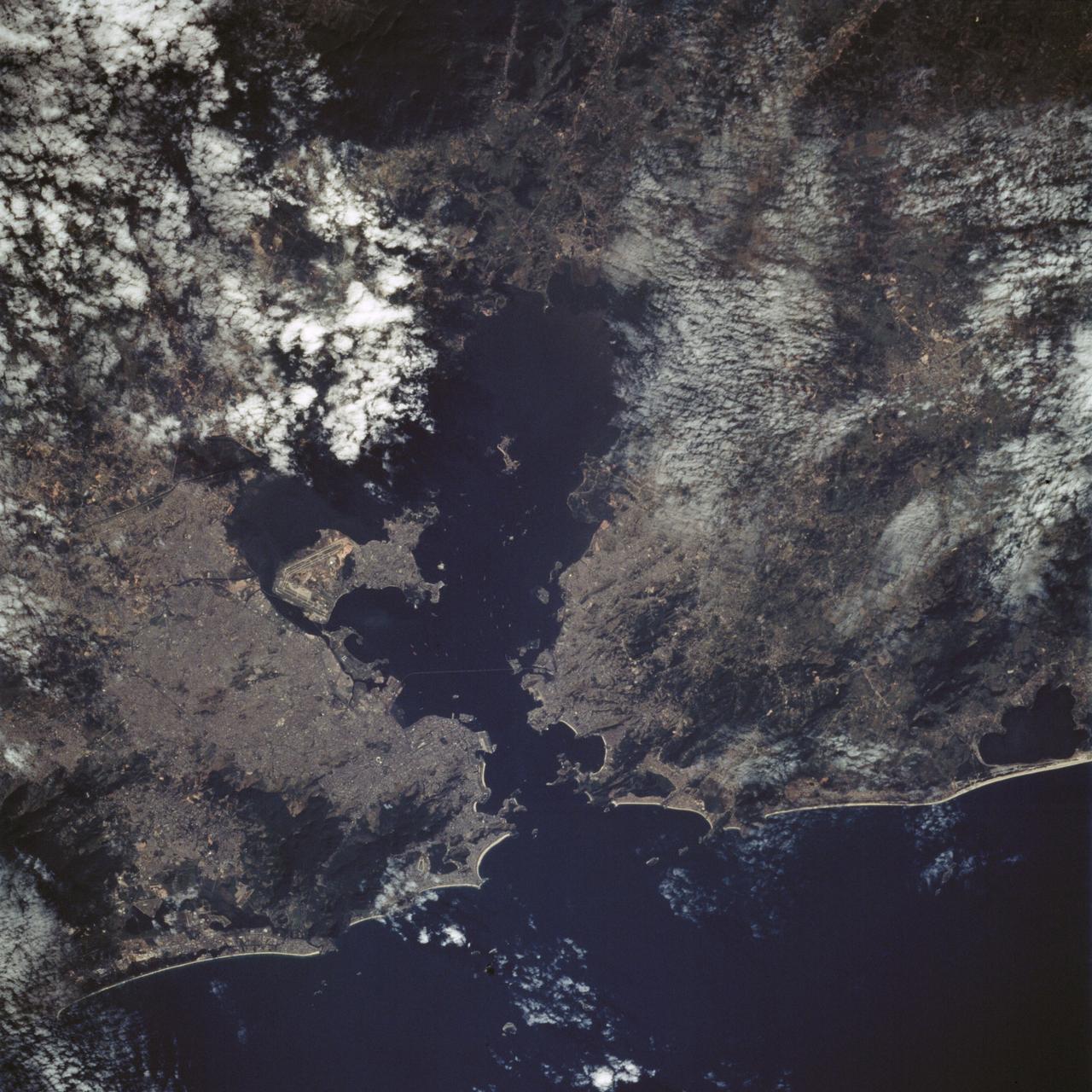
STS065-88-001 (8-23 July 1994) --- Rio de Janeiro, a port city in Brazil with a population of 11.6 million people, can be seen to the left of Governador Island in the Bay of Guanabara. Aeroporto Galeao is visible on the left, or western half of Governador Island. Below Governador Island is the Ponte Rio Niteroi bridge which connects the cities of Rio de Janeiro and Niteroi. Several ships can be seen in the Bay of Guanabara.
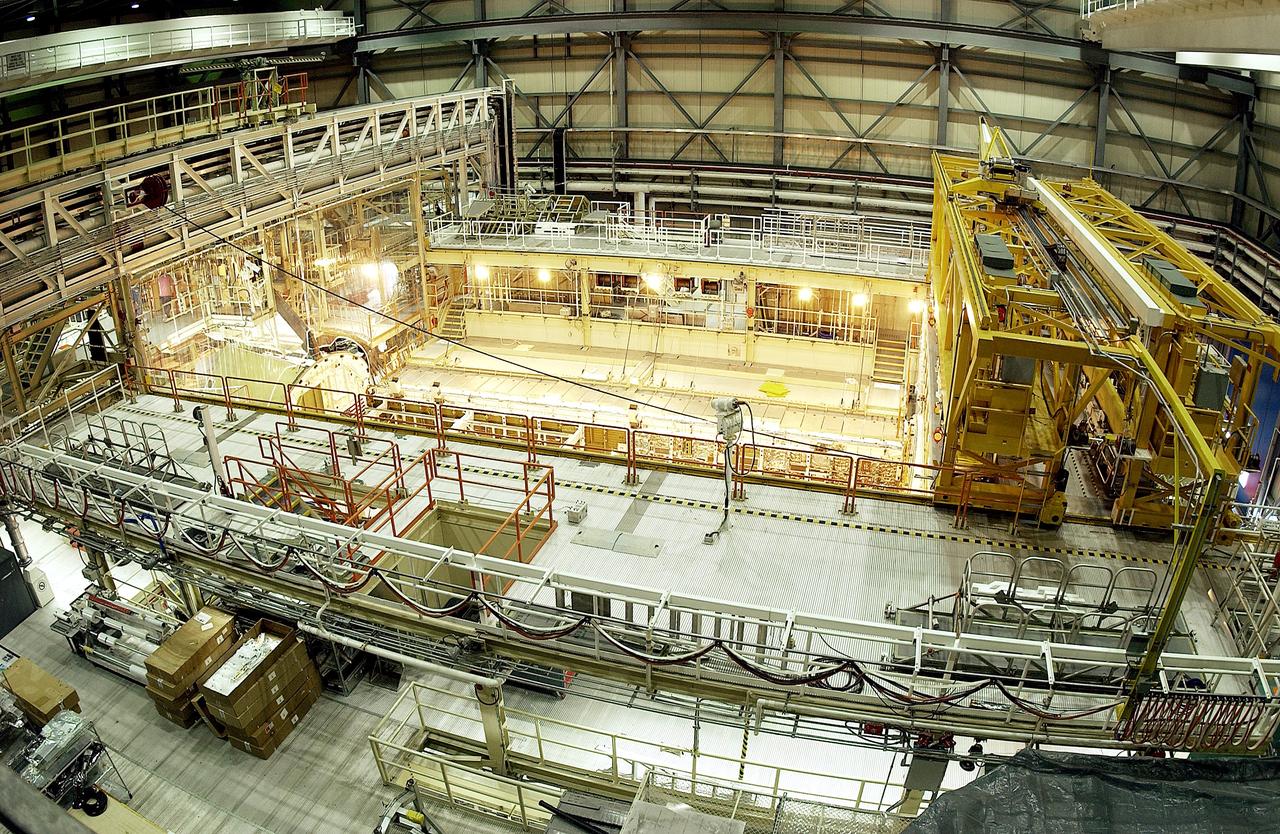
KENNEDY SPACE CENTER, FLA. - This bird's-eye view of a high bay in the Orbiter Processing Facility (OPF) shows the open payload bay of Space Shuttle Discovery surrounded by the standard platforms and equipment required to process a Space Shuttle orbiter. The high bay is 197 feet (60 meters) long, 150 feet (46 meters) wide, 95 feet (29 meters) high, and encompasses a 29,000-square-foot (2,694-meter) area. The 30-ton (27-metric-ton) bridge crane (yellow device, right) has a hook height of approximately 66 feet (20 meters). Platforms, a main access bridge, and two rolling bridges with trucks provide access to various parts of the orbiter. In addition to routine servicing and checkout, the inspections and modifications made to enhance Discovery's performance and upgrade its systems were performed in the OPF during its recently completed Orbiter Major Modification (OMM) period.
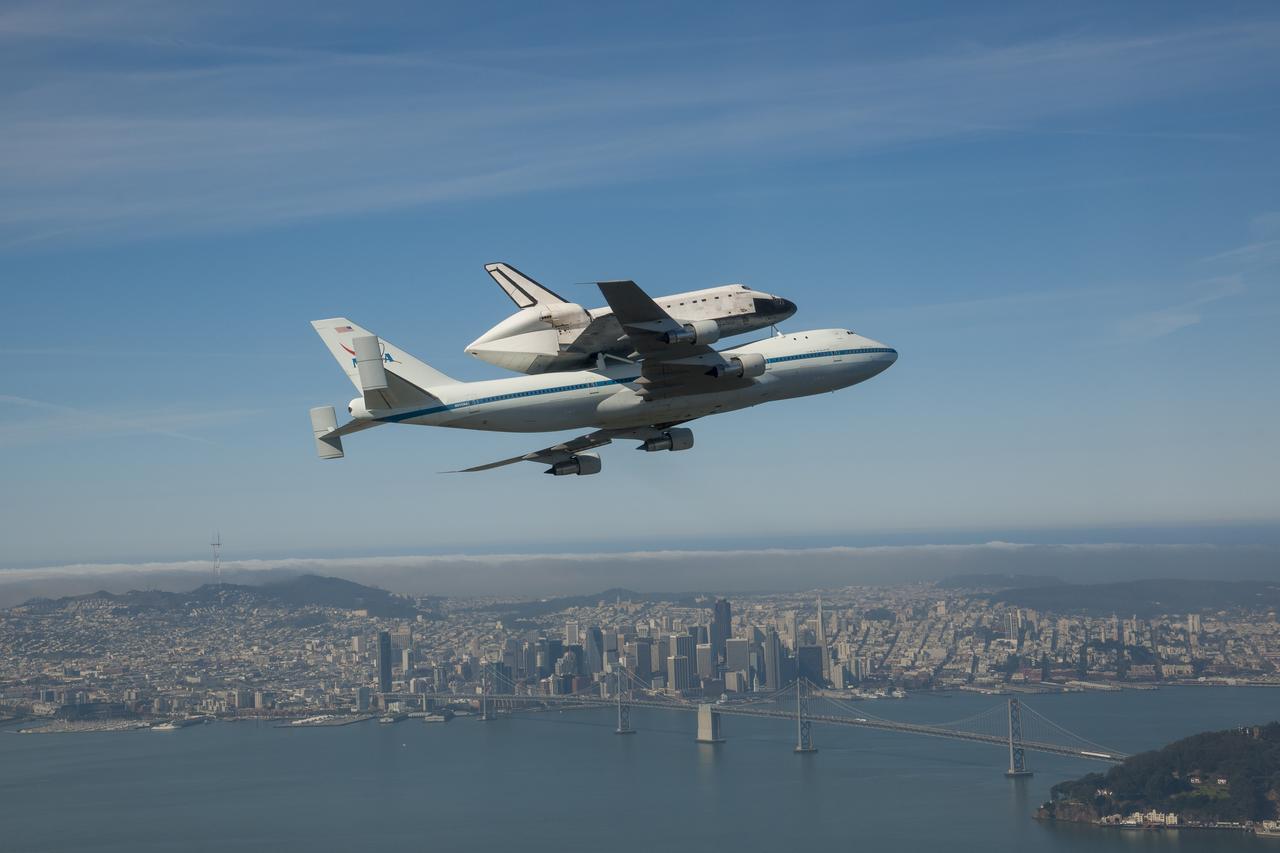
Space shuttle Endeavour and its host NASA 747 Shuttle Carrier Aircraft fly by the Bay Bridge in 2012 on its way to the Los Angeles International Airport and an overland journey to the California Science Center. The final leg of Endeavour’s flight from NASA’s Kennedy Space Center, Florida, offered many people an opportunity to witness the historic flight.
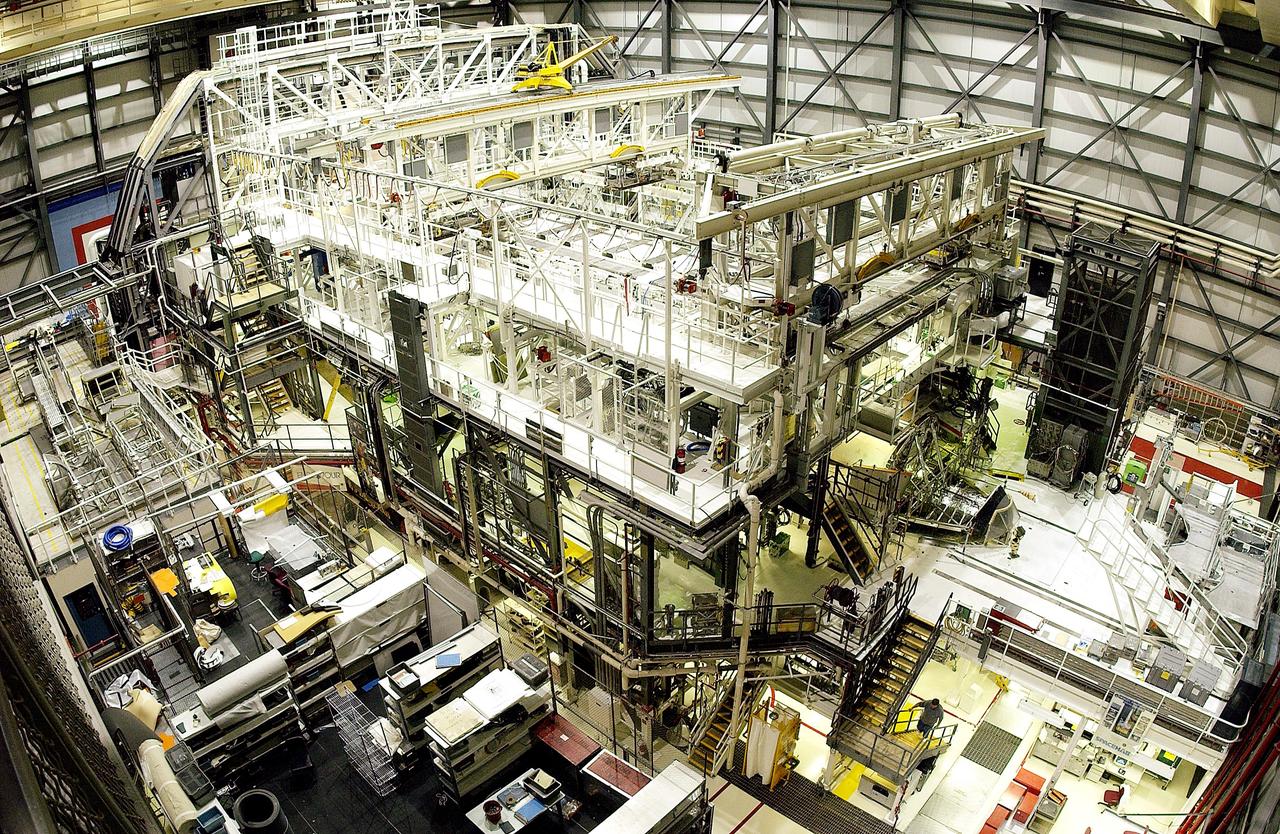
KENNEDY SPACE CENTER, FLA. - This bird's-eye view of a high bay in the Orbiter Processing Facility (OPF) shows Space Shuttle Atlantis surrounded by the standard platforms and equipment required to process a Space Shuttle orbiter for flight. The high bay is 197 feet (60 meters) long, 150 feet (46 meters) wide, 95 feet (29 meters) high, and encompasses a 29,000-square-foot (2,694-meter) area. Platforms, a main access bridge, and two rolling bridges with trucks provide access to various parts of the orbiter. The next mission scheduled for Atlantis is STS-114, a utilization and logistics flight to the International Space Station.
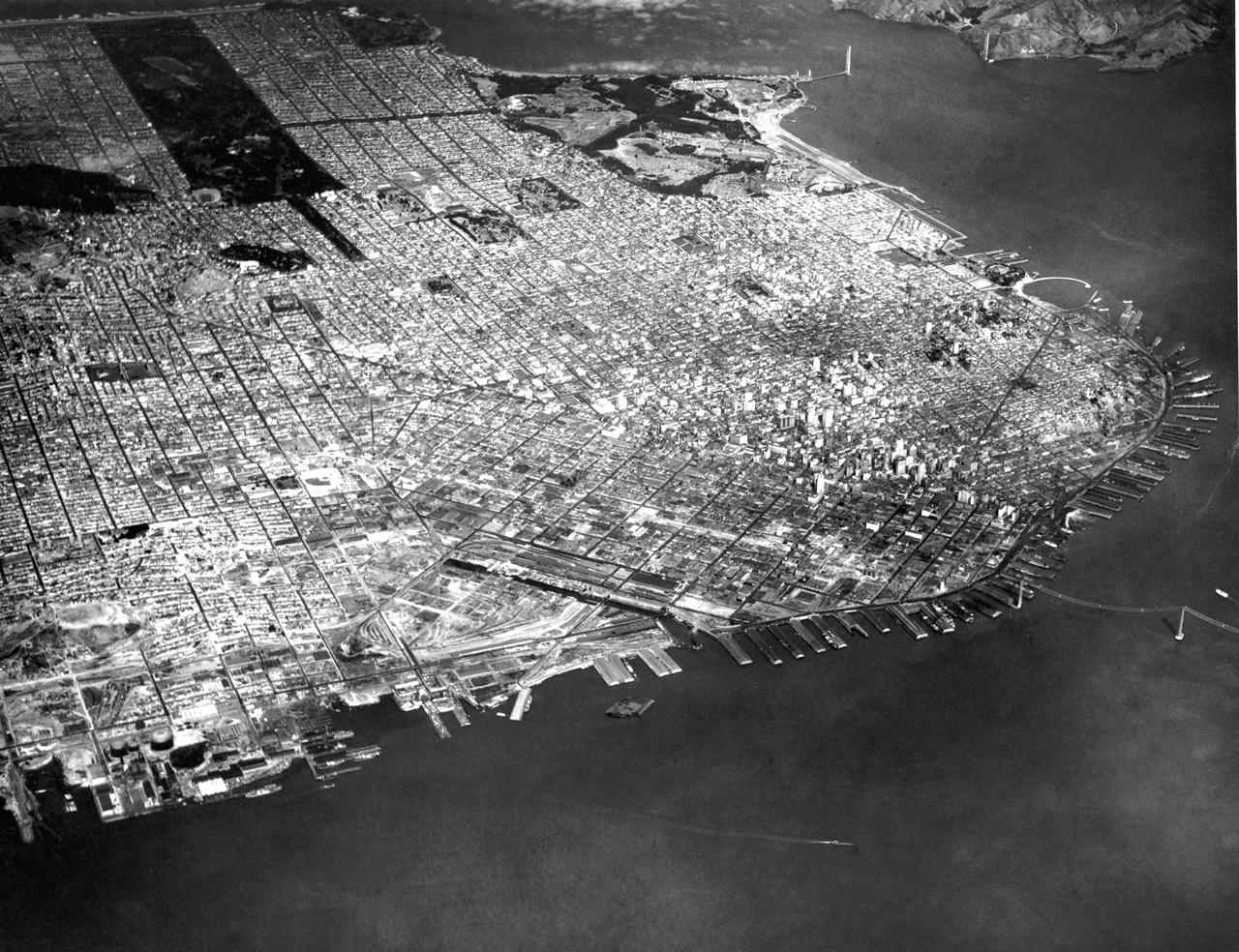
Navy Aerial of San Francisco, California (waterfront - China Basin) Note the beginings of the Golden Gate Bridge in the upper right and the Bay Bridge construction in the middle right of the image.
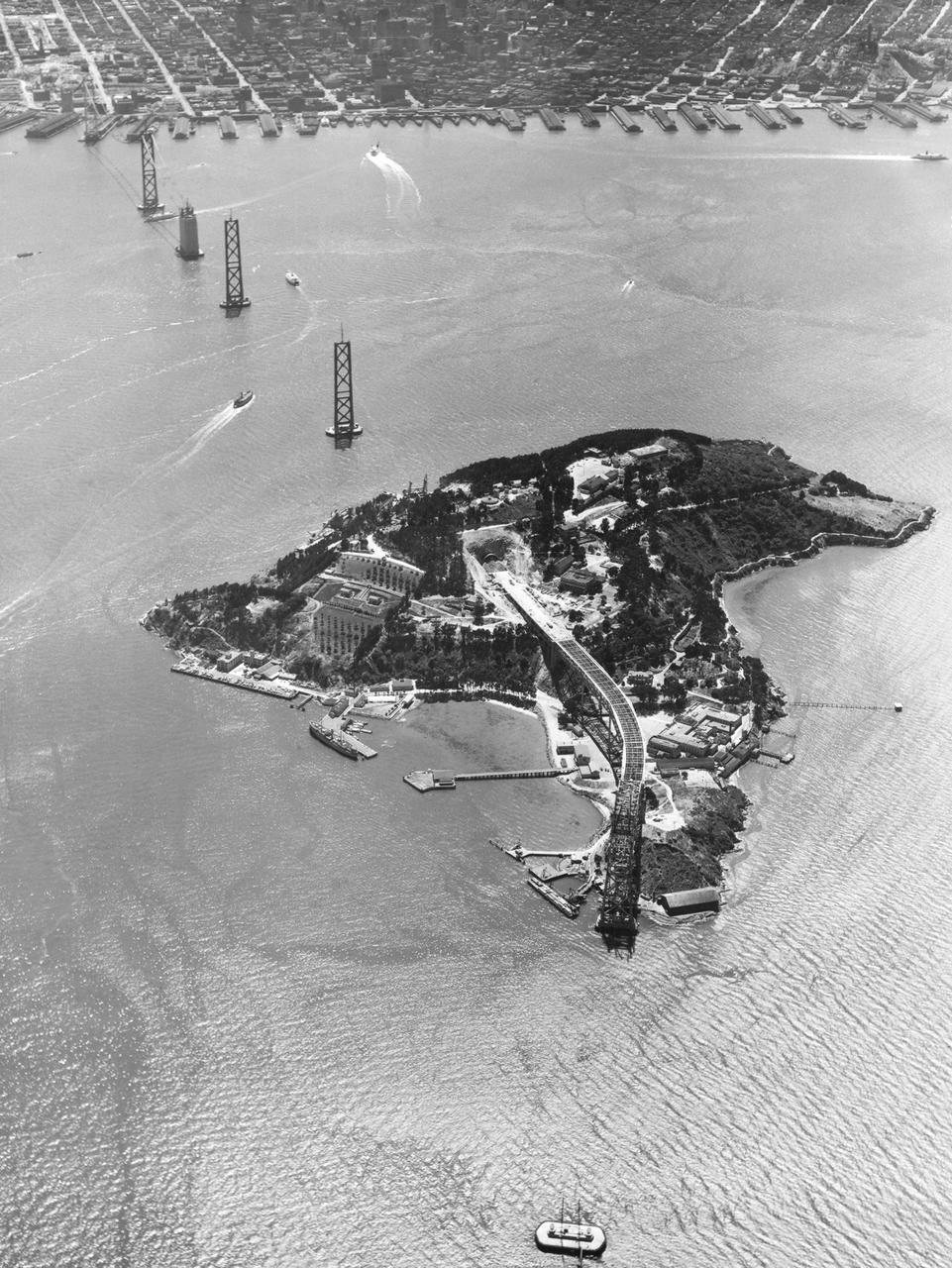
Navy Aerial of San Francisco Bay, California; Yerba Buena Island (Treasure Island) showing construction of San Francisco Bay Bridge
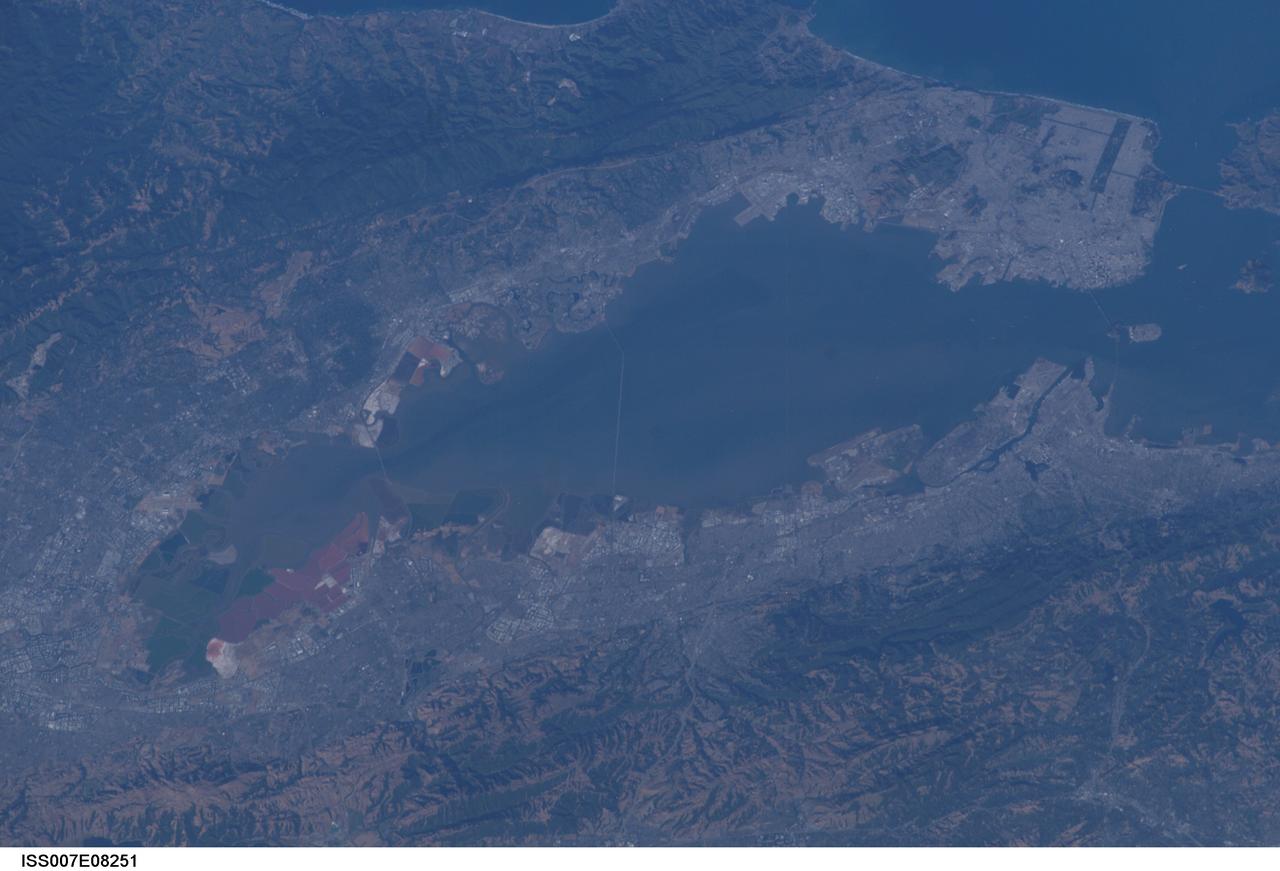
ISS007-E-08251 (25 June 2003) --- This photo featuring the San Francisco Bay area in California was photographed from the International Space Station (ISS) by astronaut Edward T. Lu, Expedition 7 NASA ISS science officer and flight engineer. The San Francisco Bay Bridge, Alcatraz Island, Golden Gate Bridge, and Golden Gate Park are visible at upper right. Stanford University and red salt ponds on the bay near Fremont at lower left.
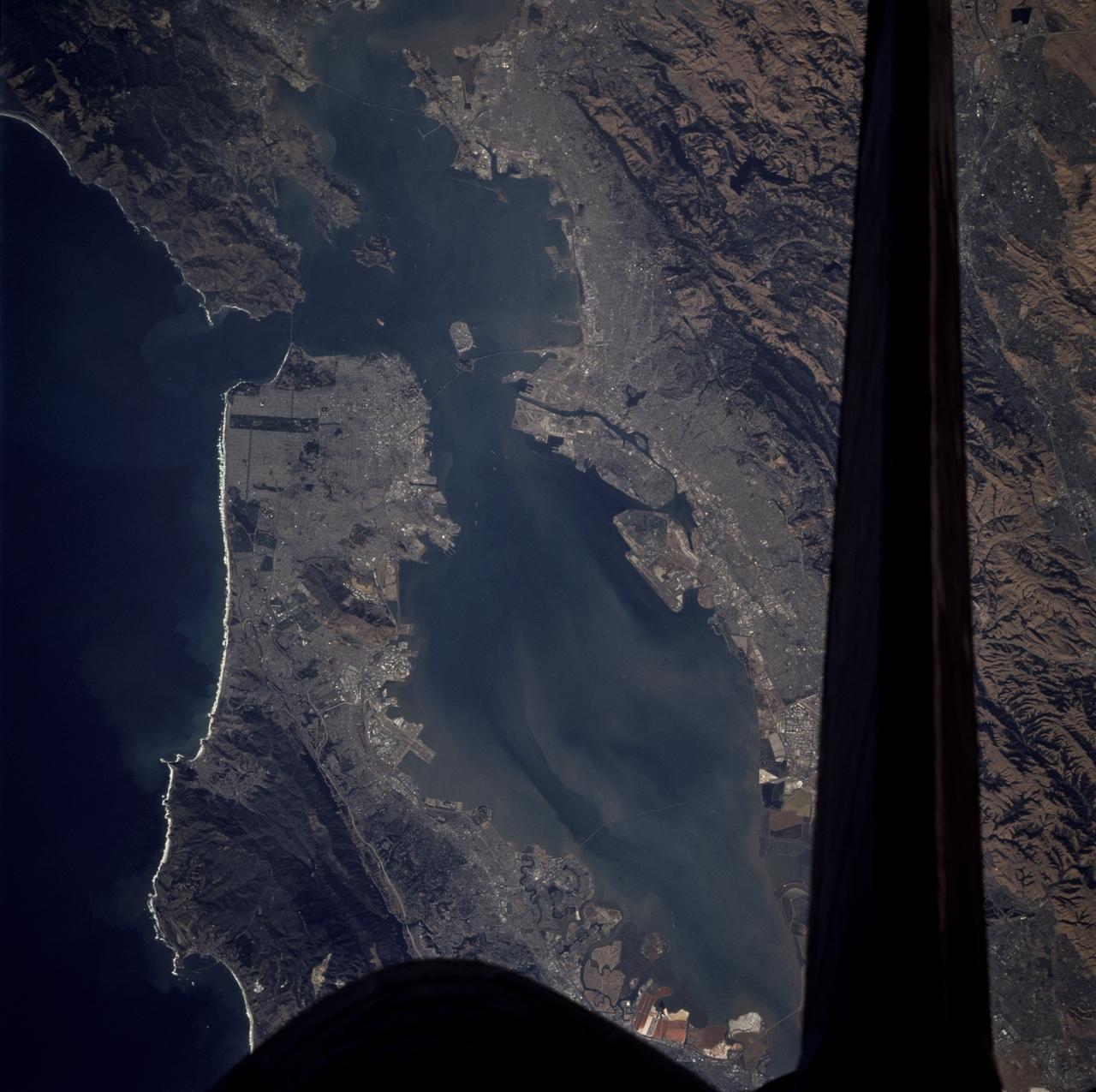
STS073-706-012 (22 October 1995) --- Each of the great bridges spanning San Francisco Bay are captured in this near-nadir photo of the San Francisco and Oakland, California, areas. Starting from the south (left in this photo), Dumbarton, San Mateo, Bay, Golden Gate, and San Rafael bridges are seen. Ribbons of run-off induced sediments color the bay, and multi-colored salt-production pens line the southernmost shore.
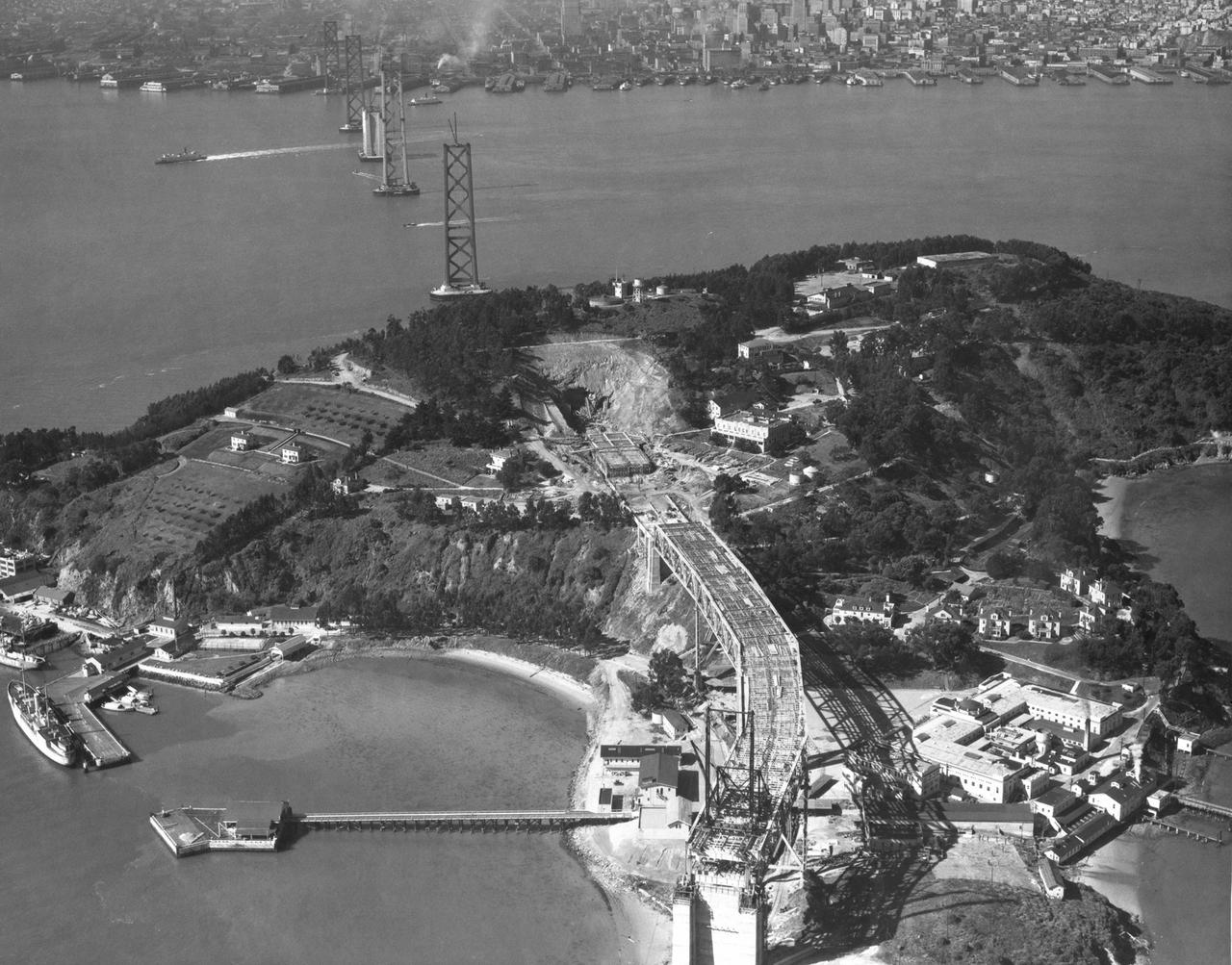
Navy San Franciso Bay Bridge Construction (looking west) toward San Francisco Yerba Buena Island in foreground
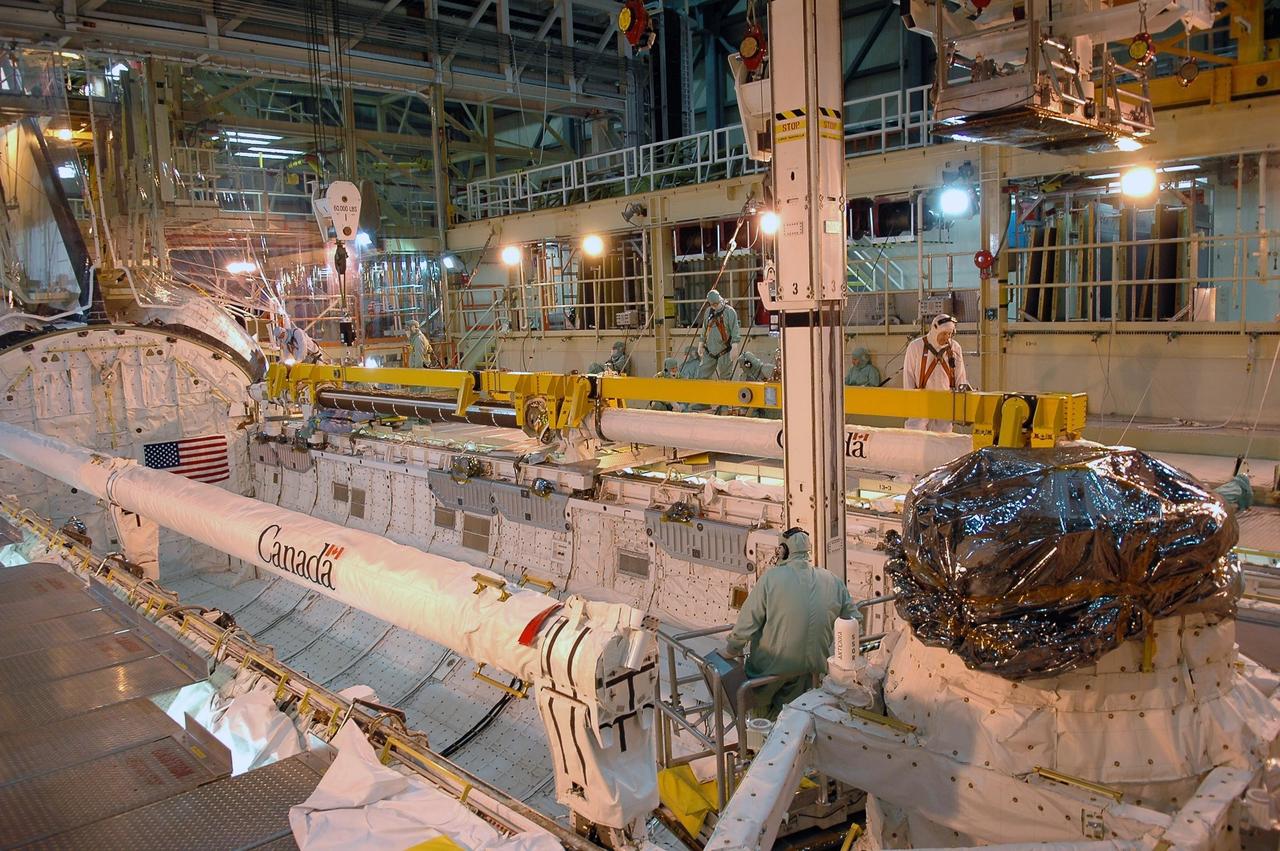
KENNEDY SPACE CENTER, FLA. - Inside the Orbiter Processing Facility bay 3 at NASA's Kennedy Space Center, workers attach an overhead crane to Discovery's robotic arm in the payload bay. The arm is being removed due to damage found on the arm after it was accidentally bumped by a bridge bucket in the payload bay. Ultrasound inspections revealed a small crack, measuring 1.25 inches by 0.015 inch deep. The arm will be sent back to the vendor for repair. The bucket was being used by technicians cleaning the area and was in the process of being stowed. A bridge bucket is a personnel transport device that is suspended from an overhead bridge that moves back and forth above the shuttle's mid-body. It allows workers to access the payload bay area without walking or standing on the payload bay floor or on the fixed platforms. Space Shuttle Discovery is scheduled for launch on mission STS-121 during a launch planning window of July 1-19. Photo credit: NASA/Kim Shiflett
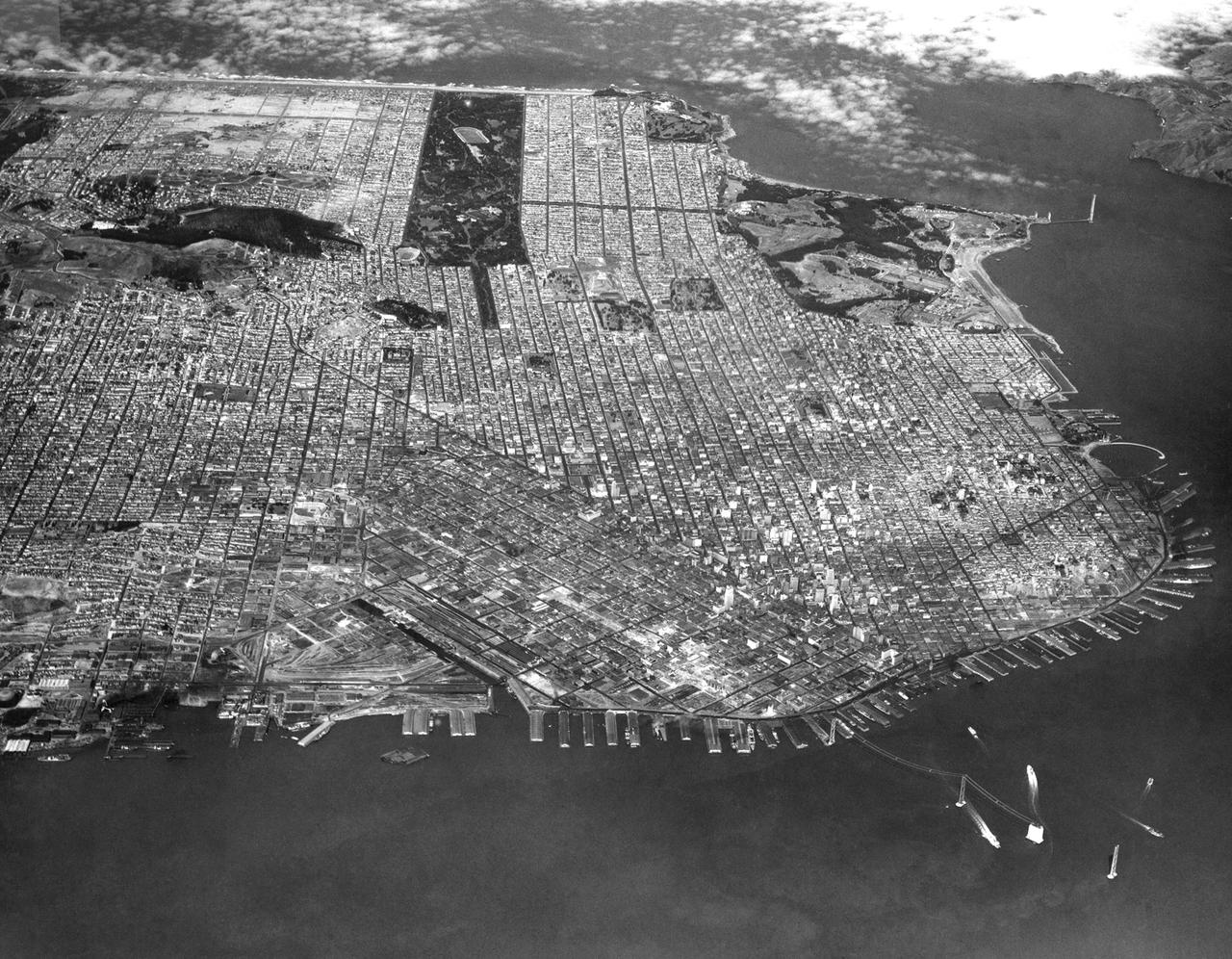
Navy Aerial of San Francisco, California; looking west across South Beach - China Basin to Golden Gate Park, includes Richmond District, Sea Cliff, Presidio, Marina, Fisherman's Wharf, and Telegraph Hill. - Note the beginings of the Golden Gate Bridge in the upper right and the Bay Bridge construction in the lower right of the image.
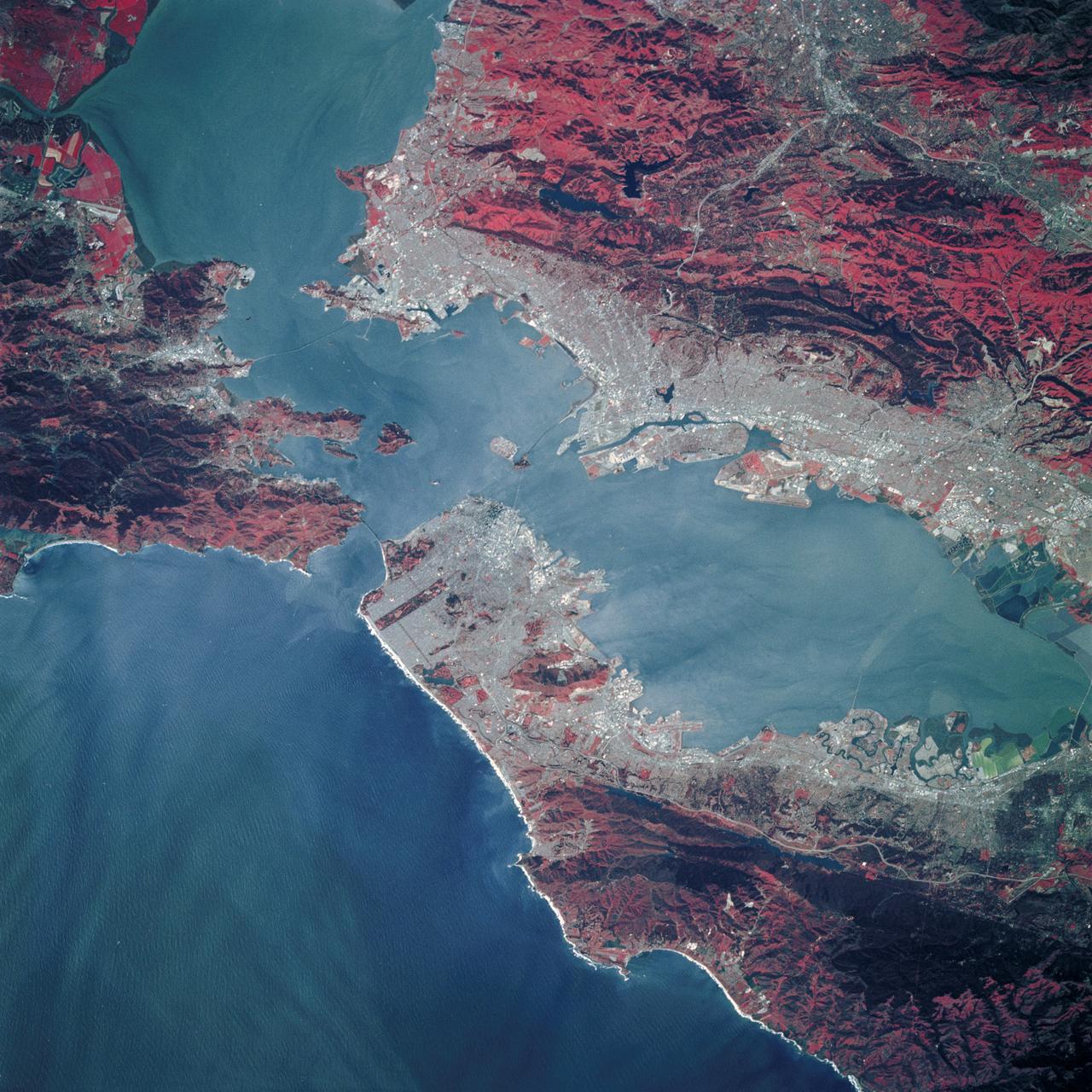
STS039-89-053 (28 April-6 May 1991) --- A 70mm, infrared frame of the city of San Francisco, taken on a clear day. The gray areas represent urban regions, and the red areas are vegetated. Within the city of San Francisco, parks like Golden Gate park and the Presidio at the base of the Golden Gate Bridge easily stand out from the well-developed parts of the city. Major thoroughfares and bridges (Golden Gate and Bay Bridges) are seen as are other landmarks such as Candlestick Park and Alcatraz. The trace of the San Andreas faults show as a straight valley running northerly along the San Francisco peninsula. Good detail is visible in the turbid waters of San Francisco Bay.
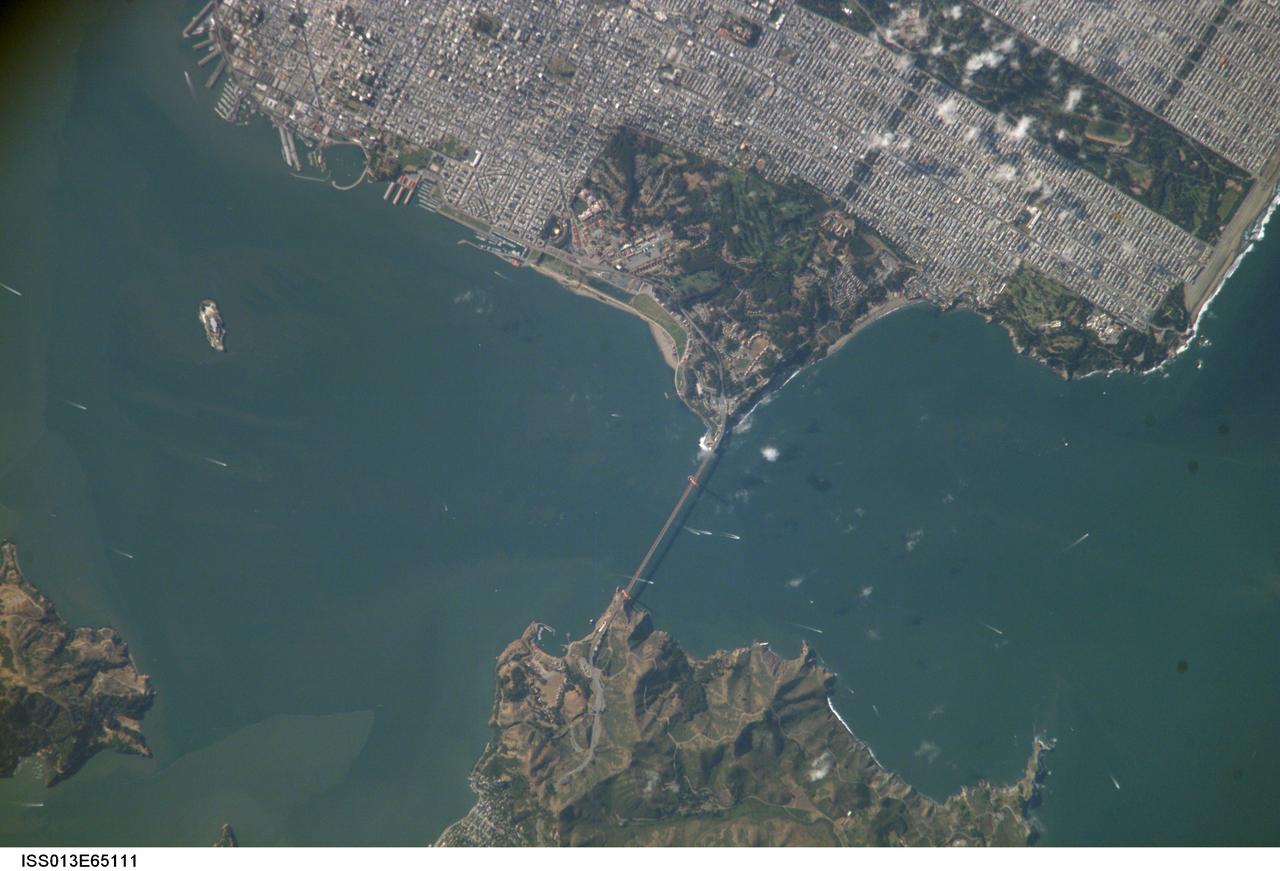
ISS013-E-65111 (6 Aug. 2006) --- Golden Gate, San Francisco, CA is featured in this image photographed by an Expedition 13 crewmember on the International Space Station. The Golden Gate of San Francisco Bay is one of the most recognizable straits in the world due to the Golden Gate Bridge that spans it. This image is a nearly cloud-free view of the northern San Francisco metropolitan area. The gridded pattern of streets, residential neighborhoods, and high-rise commercial blocks is clearly evident in the top half of the image. The twin support towers of the Golden Gate Bridge and its distinctive orange paint scheme can also be distinguished. The vegetated landscape of a portion of the Golden Gate National Recreation Area (green rectangular region at image center) connects the Bridge with steep, less vegetated hill slopes south of the city of Sausalito across the strait. Other features in this view include the former prison of Alcatraz, located on the island of the same name. Numerous boat wakes of commercial and pleasure craft are visible beneath and to the west of the Bridge. The shadow of the roadbed of the Bridge can be seen directly to the west of the Bridge itself. Regions of greenish-brown water visible in San Francisco Bay mark water masses with differing amounts of suspended sediment that are streamlined by the strong tidal currents that flow through the strait.
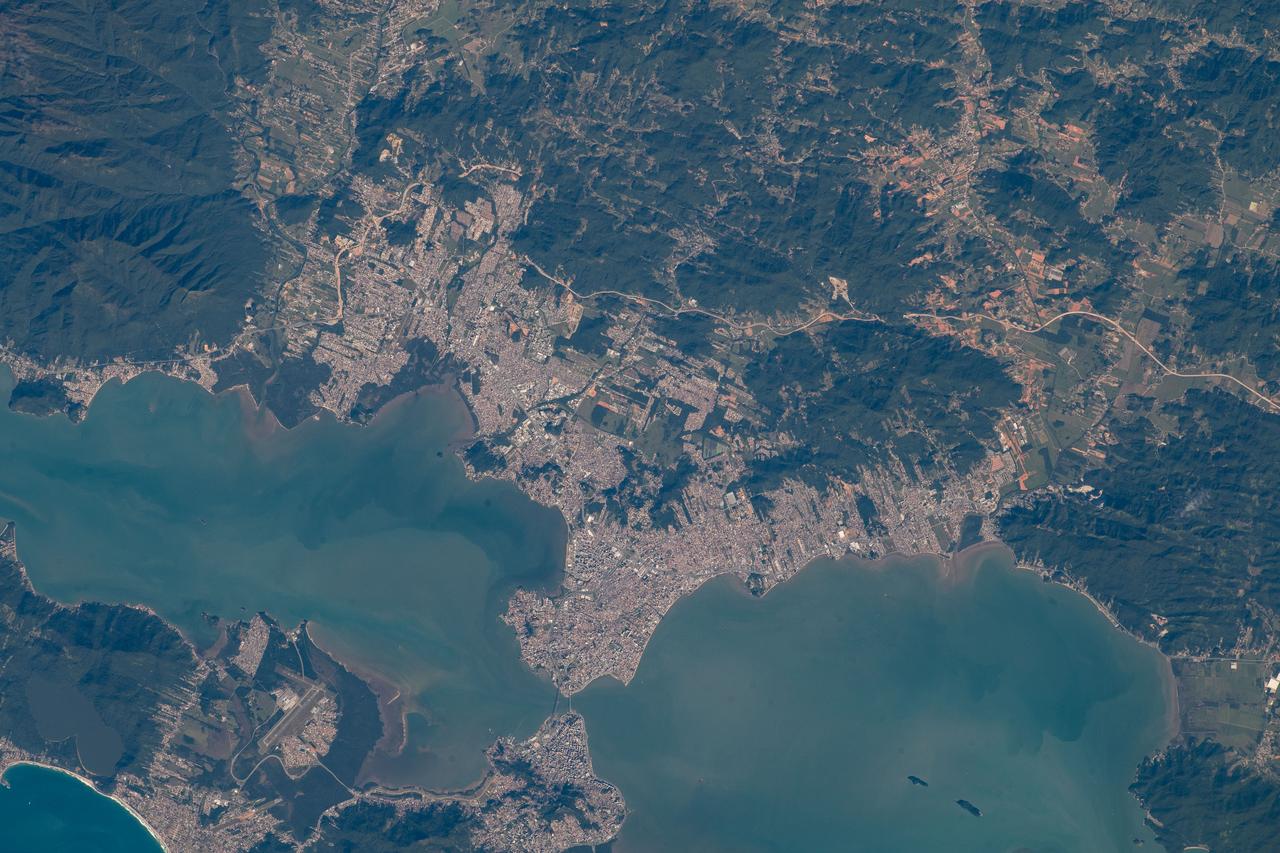
iss067e213656 (July 31, 2022) --- The cities of San Jose (top) and Floriana (bottom) in Brazil are bridged together in between the North and South Bays in this photograph from the International Space Station as it orbited 264 miles above.
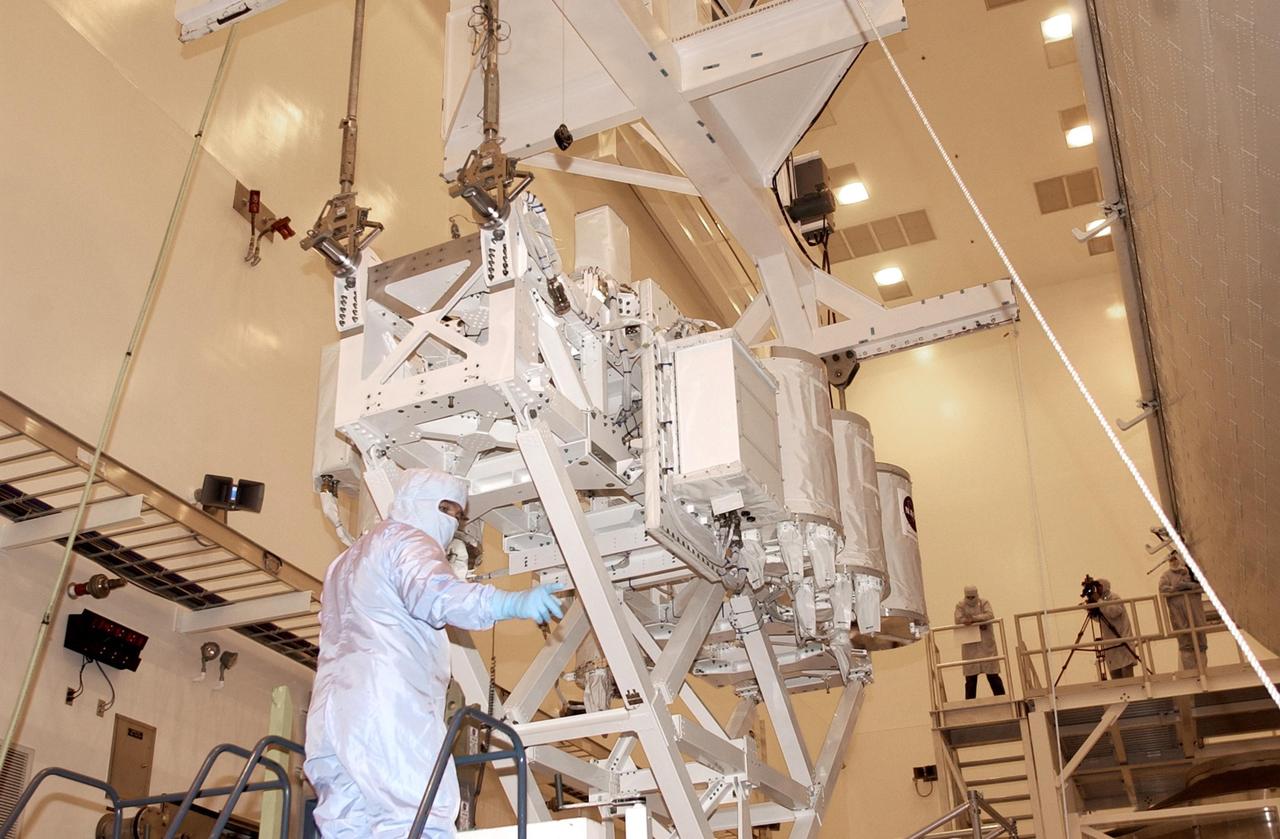
KENNEDY SPACE CENTER, FLA. -- In the Multi-Payload Processing Facility, an overhead crane is attached to the Hitchhiker Bridge with GetAway Special canisters (GAS cans). The bridge, a carrier for the Fast Reaction Experiments Enabling Science, Technology, Applications and Research (FREESTAR) that incorporates eight high priority secondary attached shuttle experiments, is being transferred to the payload canister. The bridge will be installed in Columbia's payload bay as part of mission STS-107. A research mission, STS-107 will also carry the SHI Research Double Module (SHI/RDM), known as SPACEHAB. Experiments on the module range from material sciences to life sciences (many rats). STS-107 is scheduled to launch July 19, 2002

KENNEDY SPACE CENTER, FLA. - An overhead crane lowers the Hitchhiker Bridge with GetAway Special canisters (GAS cans) into the payload canister below. The bridge, a carrier for the Fast Reaction Experiments Enabling Science, Technology, Applications and Research (FREESTAR) that incorporates eight high priority secondary attached shuttle experiments, is being transferred to the payload canister below it. The bridge will be installed in Columbia's payload bay as part of mission STS-107. A research mission, STS-107 will also carry the SHI Research Double Module (SHI_RDM), known as SPACEHAB. Experiments on the module range from material sciences to life sciences (many rats). STS-107 is scheduled to launch July 19, 2002
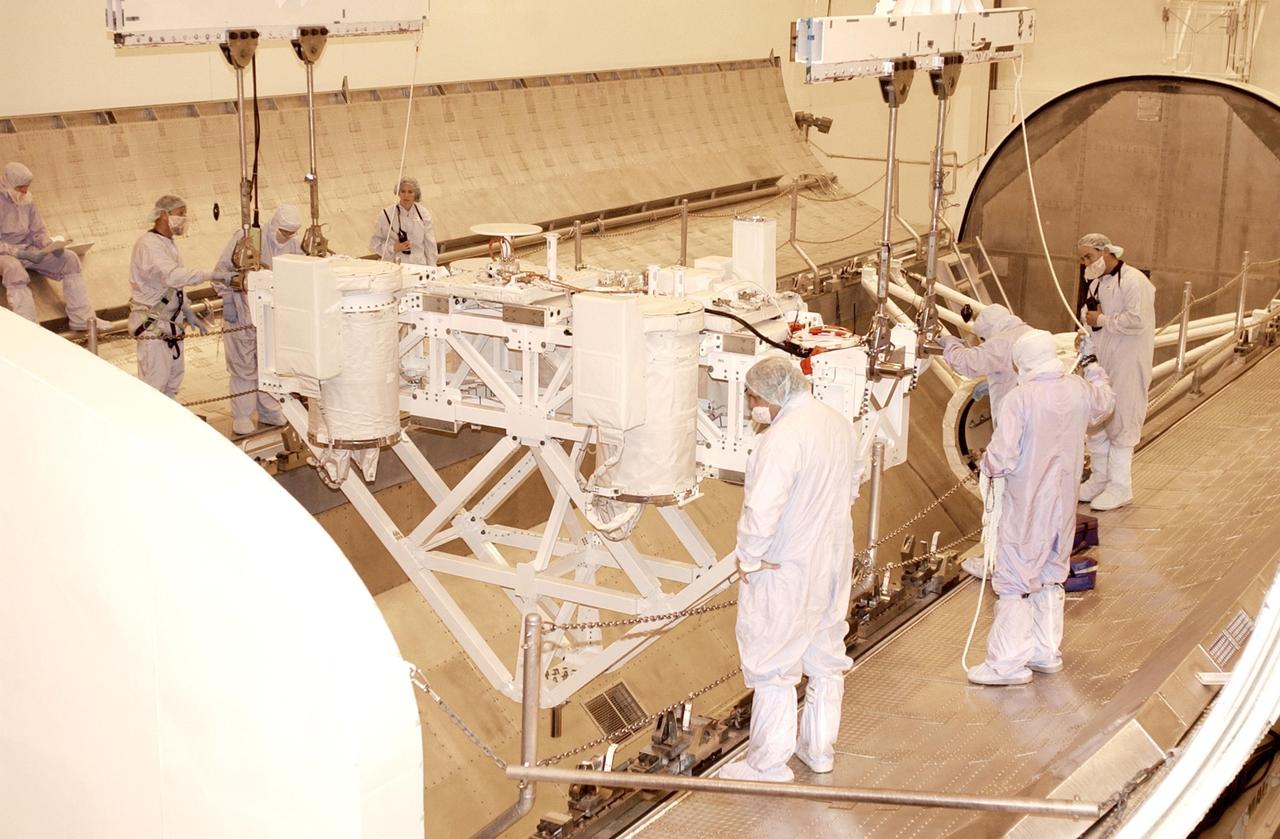
KENNEDY SPACE CENTER, FLA. -- The Hitchhiker Bridge with GetAway Special canisters (GAS cans) is placed into the payload canister. The bridge, a carrier for the Fast Reaction Experiments Enabling Science, Technology, Applications and Research (FREESTAR) that incorporates eight high priority secondary attached shuttle experiments, is being transferred to the payload canister below it. The bridge will be installed in Columbia's payload bay as part of mission STS-107. A research mission, STS-107 will also carry the SHI Research Double Module (SHI/RDM), known as SPACEHAB. Experiments on the module range from material sciences to life sciences (many rats). STS-107 is scheduled to launch July 19, 2002
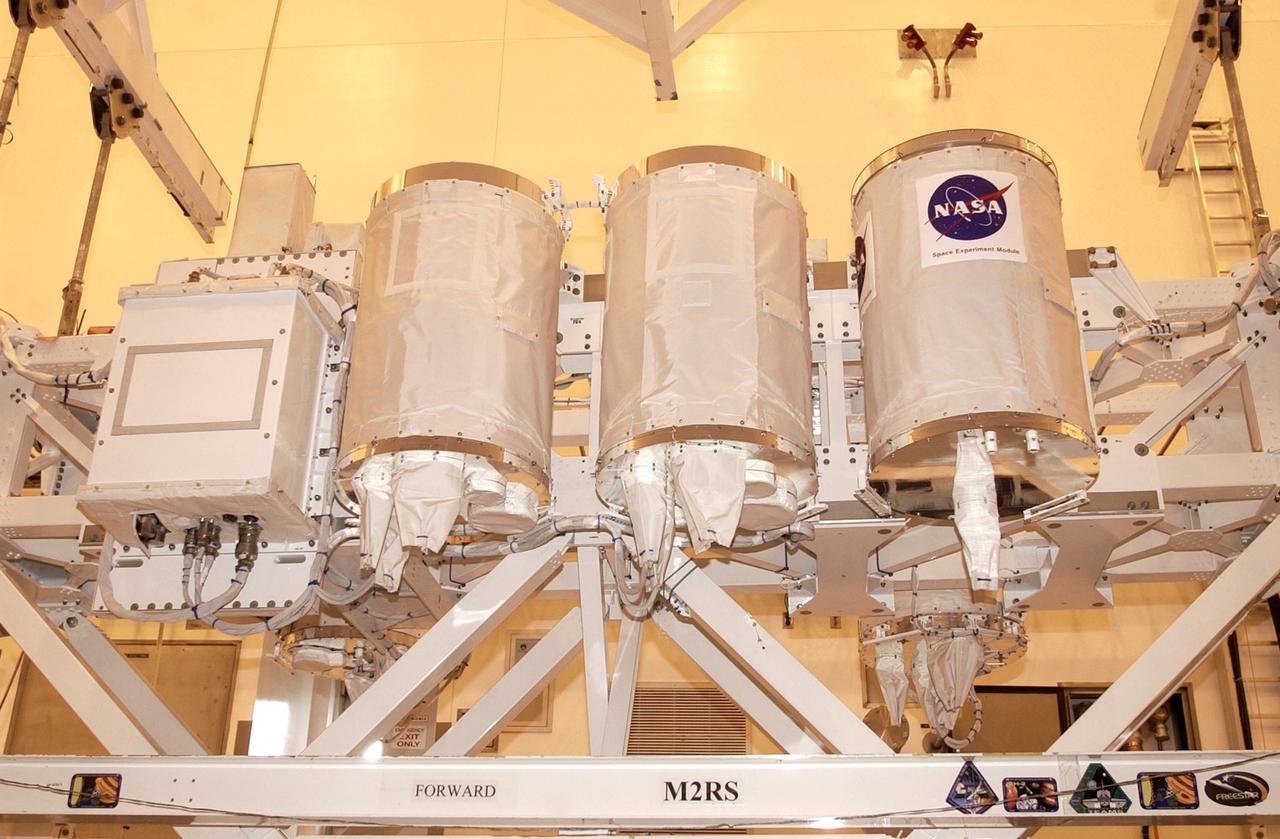
KENNEDY SPACE CENTER, FLA. - In the Multi-Payload Processing Facility, the Hitchhiker Bridge with GetAway Special canisters (GAS cans) are ready for transfer to the payload canister. The bridge is a carrier for the Fast Reaction Experiments Enabling Science, Technology, Applications and Research (FREESTAR) that incorporates eight high priority secondary attached shuttle experiments on mission STS-107. The bridge will be installed in Columbia's payload bay. A research mission, STS-107 will also carry the SHI Research Double Module (SHI/RDM), known as SPACEHAB. Experiments on the module range from material sciences to life sciences (many rats). STS-107 is scheduled to launch July 19, 2002
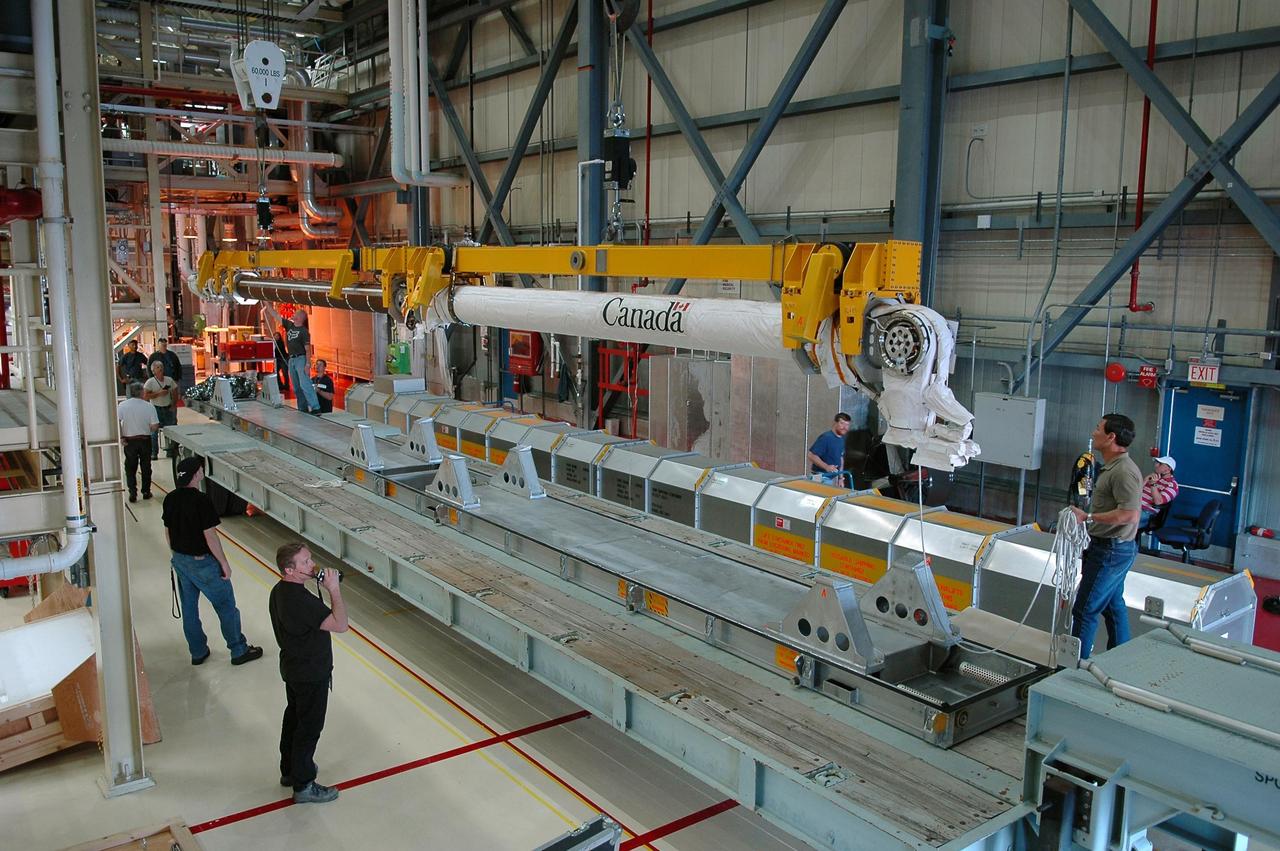
KENNEDY SPACE CENTER, FLA. - Inside the Orbiter Processing Facility bay 3 at NASA's Kennedy Space Center, workers lower Discovery's robotic arm onto a flat bed in a work area. The arm was removed from Discovery's payload bay. The arm was removed due to damage found on the arm after it was accidentally bumped by a bridge bucket in the payload bay. Ultrasound inspections revealed a small crack, measuring 1.25 inches by 0.015 inch deep. The arm will be sent back to the vendor for repair. The bucket was being used by technicians cleaning the area and was in the process of being stowed. A bridge bucket is a personnel transport device that is suspended from an overhead bridge that moves back and forth above the shuttle's mid-body. It allows workers to access the payload bay area without walking or standing on the payload bay floor or on the fixed platforms. Space Shuttle Discovery is scheduled for launch on mission STS-121 during a launch planning window of July 1-19. Photo credit: NASA/Kim Shiflett
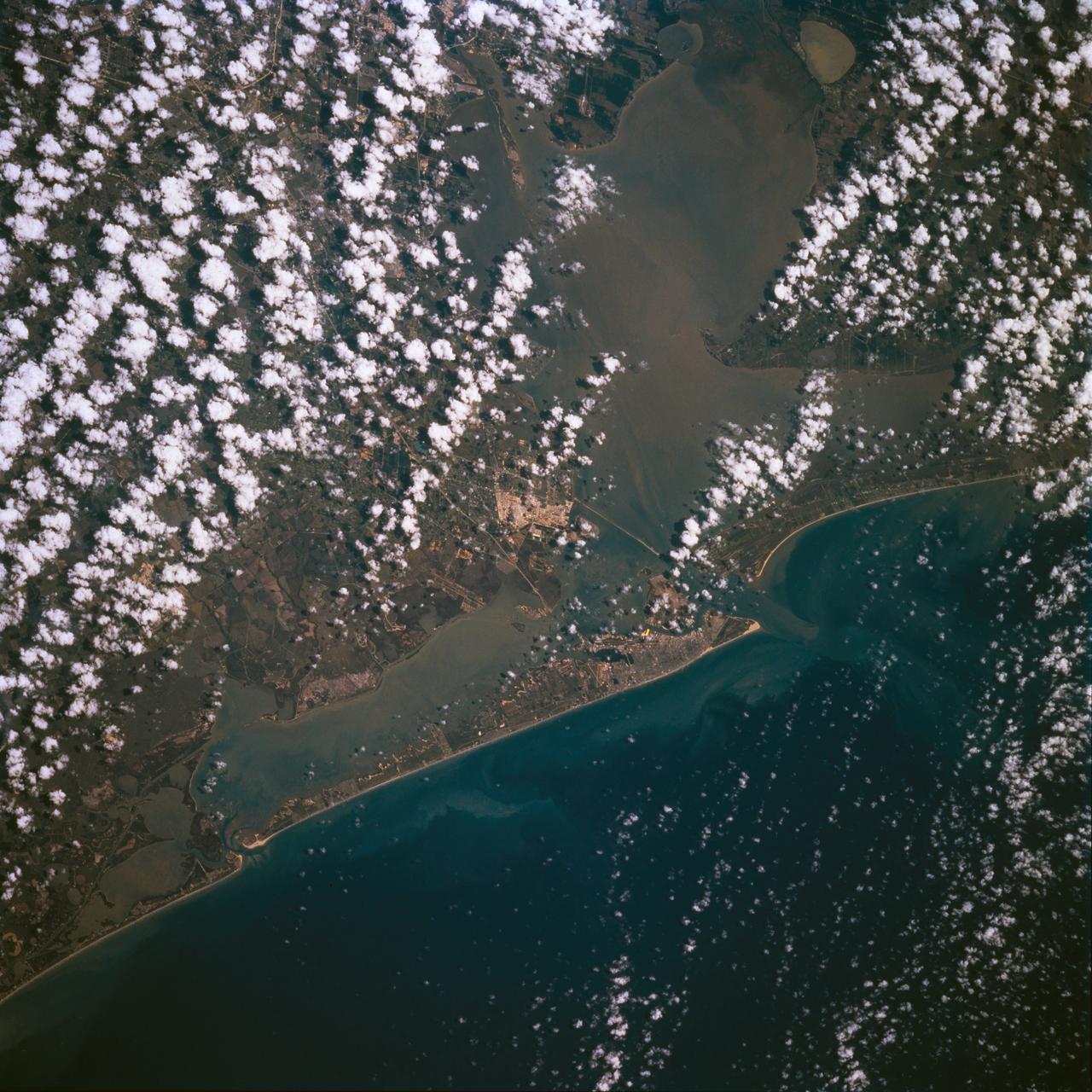
STS077-704-001 (19-29 May 1996) --- Clouds cover most of Houston, Texas, but all of Galveston Island, Galveston Bay and mainland Galveston County are visible in this 70mm image from the Space Shuttle Endeavour. Part of Interstate 10 shows up in the lower left corner. Such clarity exists in the photo that Galveston?s two jetties, the Texas City Dike, the I-45 causeway, the new Baytown Bridge and the San Luis Pass Bridge can be delineated.
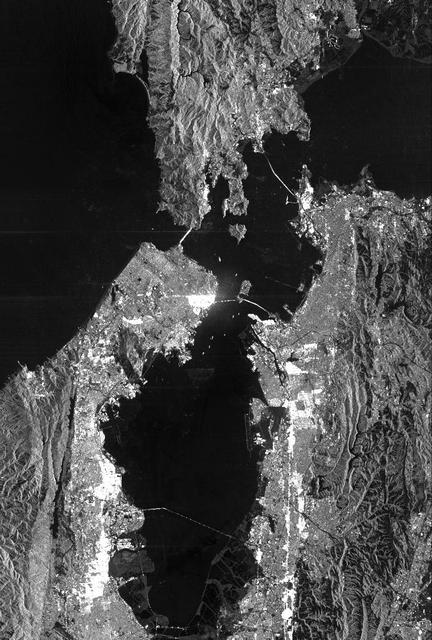
This is a radar image of San Francisco, California, taken on October 3,1994. The image is about 40 kilometers by 55 kilometers (25 miles by 34 miles) with north toward the upper right. Downtown San Francisco is visible in the center of the image with the city of Oakland east (to the right) across San Francisco Bay. Also visible in the image is the Golden Gate Bridge (left center) and the Bay Bridge connecting San Francisco and Oakland. North of the Bay Bridge is Treasure Island. Alcatraz Island appears as a small dot northwest of Treasure Island. This image was acquired by the Spaceborne Imaging Radar-C and X-band Synthetic Aperture Radar (SIR-C/X-SAR) aboard the space shuttle Endeavour on orbit 56. The image is centered at 37 degrees north latitude, 122degrees west longitude. This single-frequency SIR-C image was obtained by the L-band (24 cm) radar channel, horizontally transmitted and received. Portions of the Pacific Ocean visible in this image appear very dark as do other smooth surfaces such as airport runways. Suburban areas, with the low-density housing and tree-lined streets that are typical of San Francisco, appear as lighter gray. Areas with high-rise buildings, such as those seen in the downtown areas, appear in very bright white, showing a higher density of housing and streets which run parallel to the radar flight track. http://photojournal.jpl.nasa.gov/catalog/PIA01751
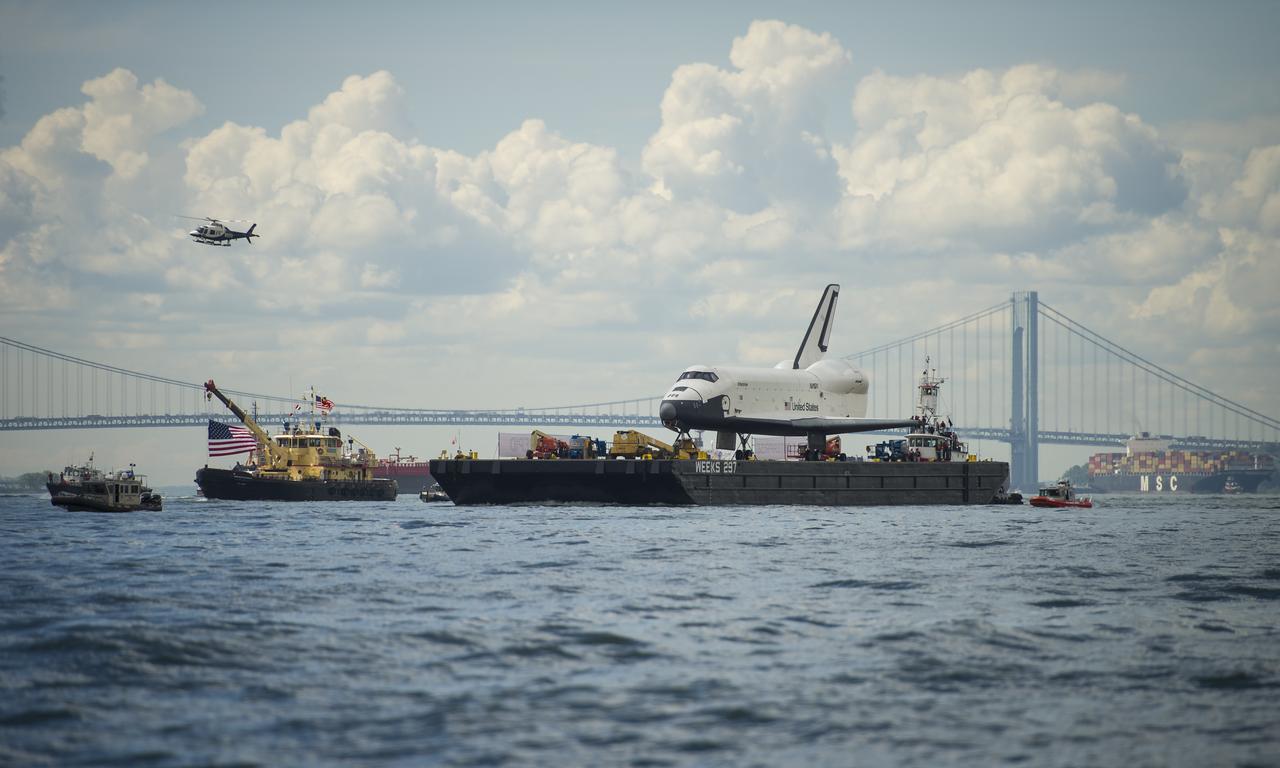
The space shuttle Enterprise, backdropped by the Verrazano-Narrows Bridge, is towed by barge in the Upper Bay on its way to the Intrepid Sea, Air and Space Museum where it will be permanently displayed, Wednesday, June 6, 2012 in New York. Photo Credit: (NASA/Bill Ingalls)
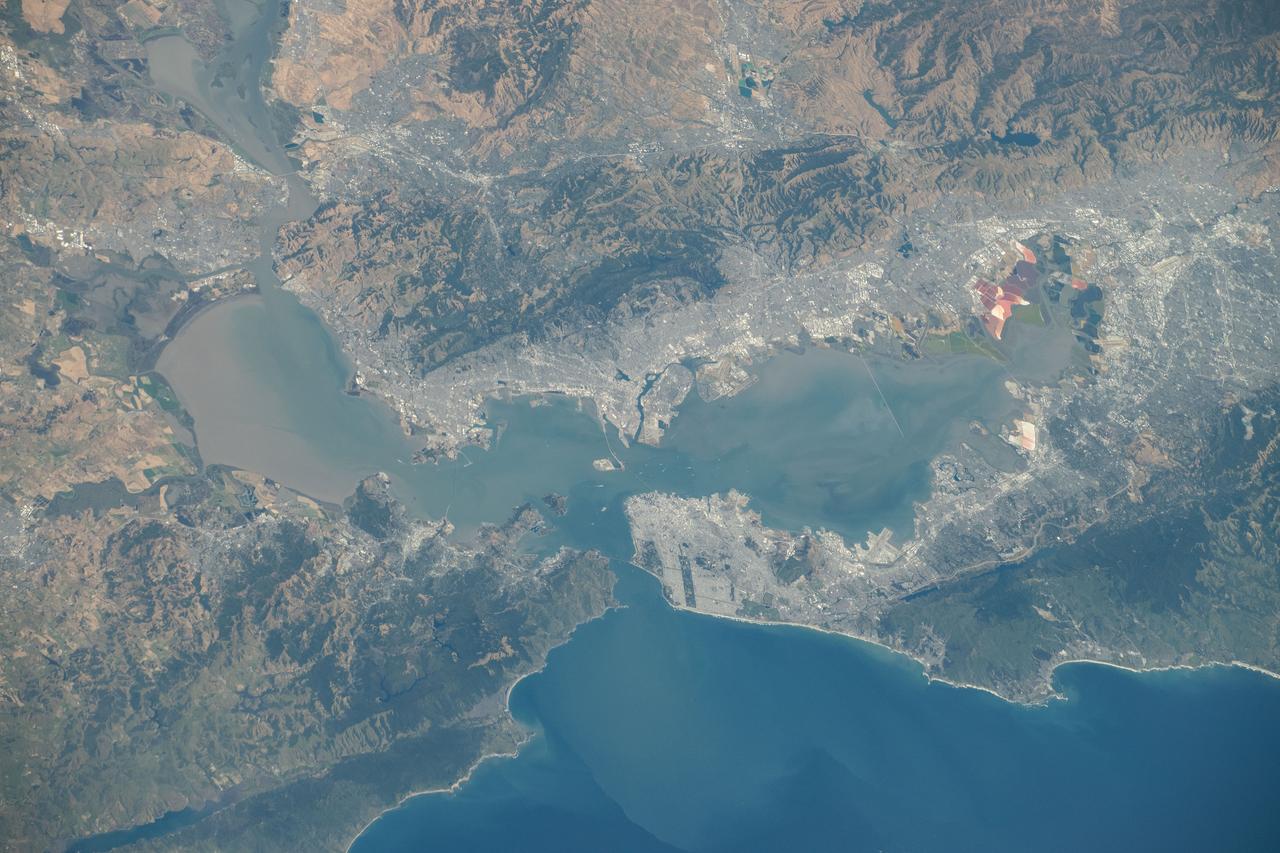
iss071e133353 (May 29, 2024) --- The San Francisco Bay Area in California, home to the Silicon Valley high-tech region and the Golden Gate Bridge, is pictured from the International Space Station as it orbited 262 miles above the Pacific Ocean.
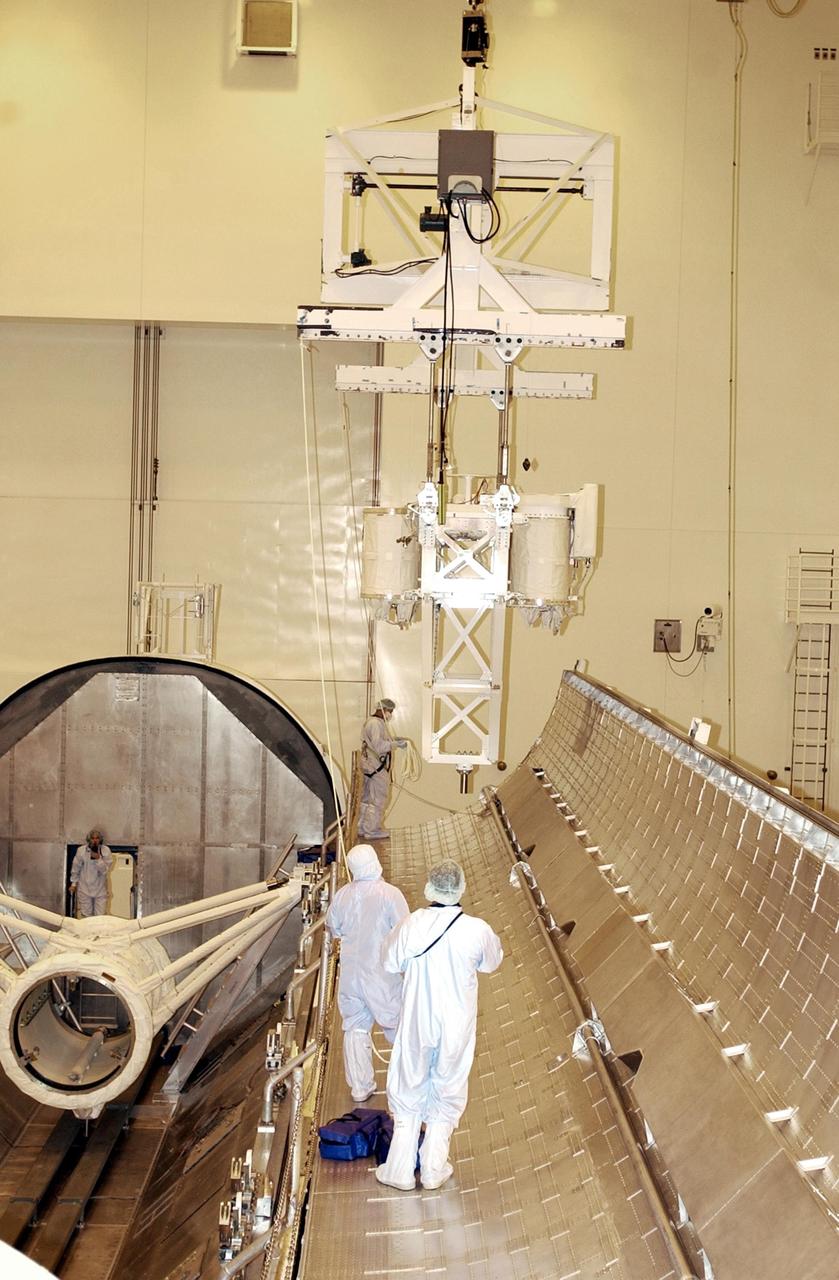
KENNEDY SPACE CENTER, FLA. - Workers in the Multi-Payload Processing Facility watch the progress of the overhead crane carrying the Hitchhiker Bridge with GetAway Special canisters (GAS cans). The bridge, a carrier for the Fast Reaction Experiments Enabling Science, Technology, Applications and Research (FREESTAR) that incorporates eight high priority secondary attached shuttle experiments, is being transferred to the payload canister below it. The bridge will be installed in Columbia's payload bay as part of mission STS-107. A research mission, STS-107 will also carry the SHI Research Double Module (SHI/RDM), known as SPACEHAB. Experiments on the module range from material sciences to life sciences (many rats). STS-107 is scheduled to launch July 19, 2002
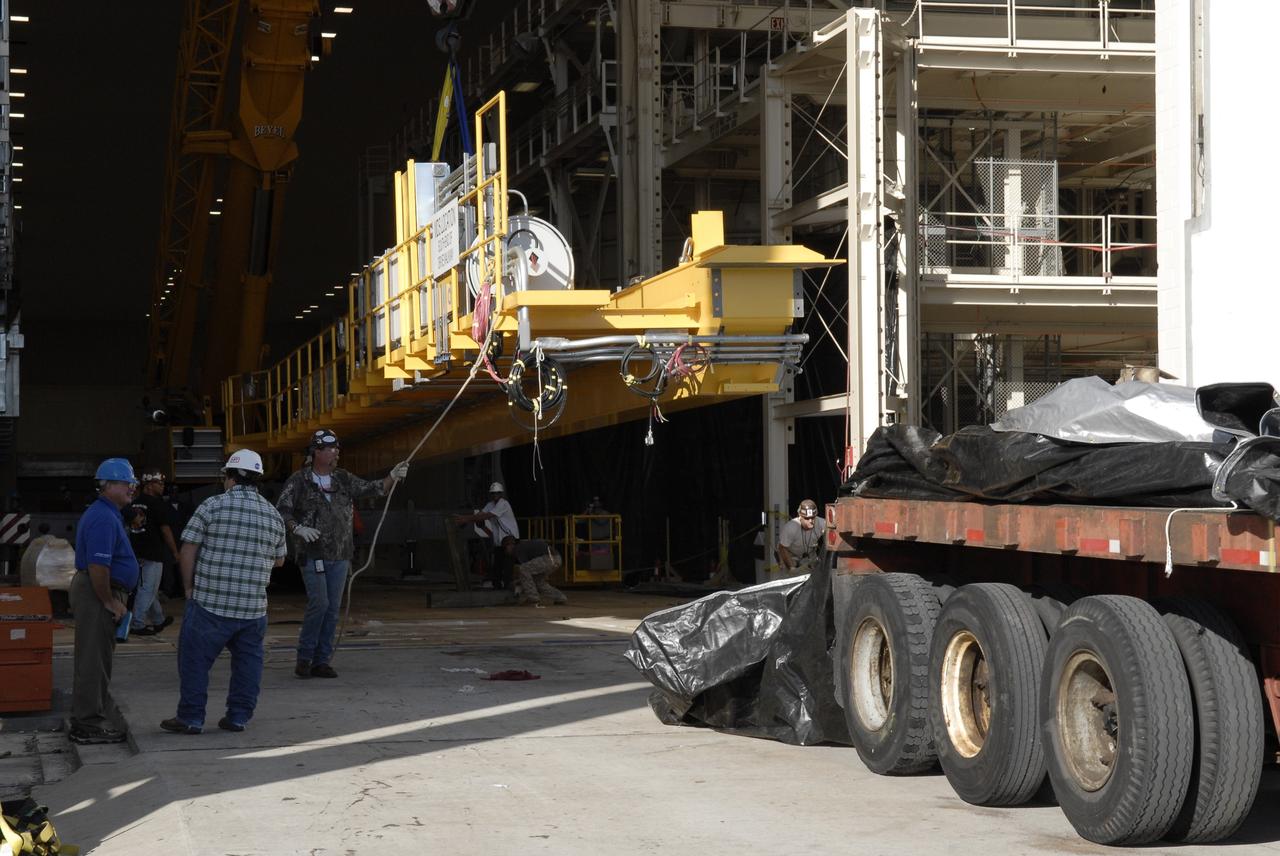
CAPE CANAVERAL, Fla. – Segments of a crane are being offloaded at the Operations and Checkout Building at NASA's Kennedy Space Center in Florida. The new O&C low-bay crane is a 25-ton overhead bridge crane built for Lockheed Martin and Space Florida by American Crane and Equipment Corporation in Douglasville, Pa. The crane has a bridge span of 78’-2” and a hook height of 48’-10”. The crane will be used for lifting and moving flight hardware, fixtures and equipment in support of the Orion spacecraft manufacturing. Part of NASA's Constellation Program, the Orion spacecraft will return humans to the moon and prepare for future voyages to Mars and other destinations in our solar system. Photo credit: NASA/Kim Shiflett
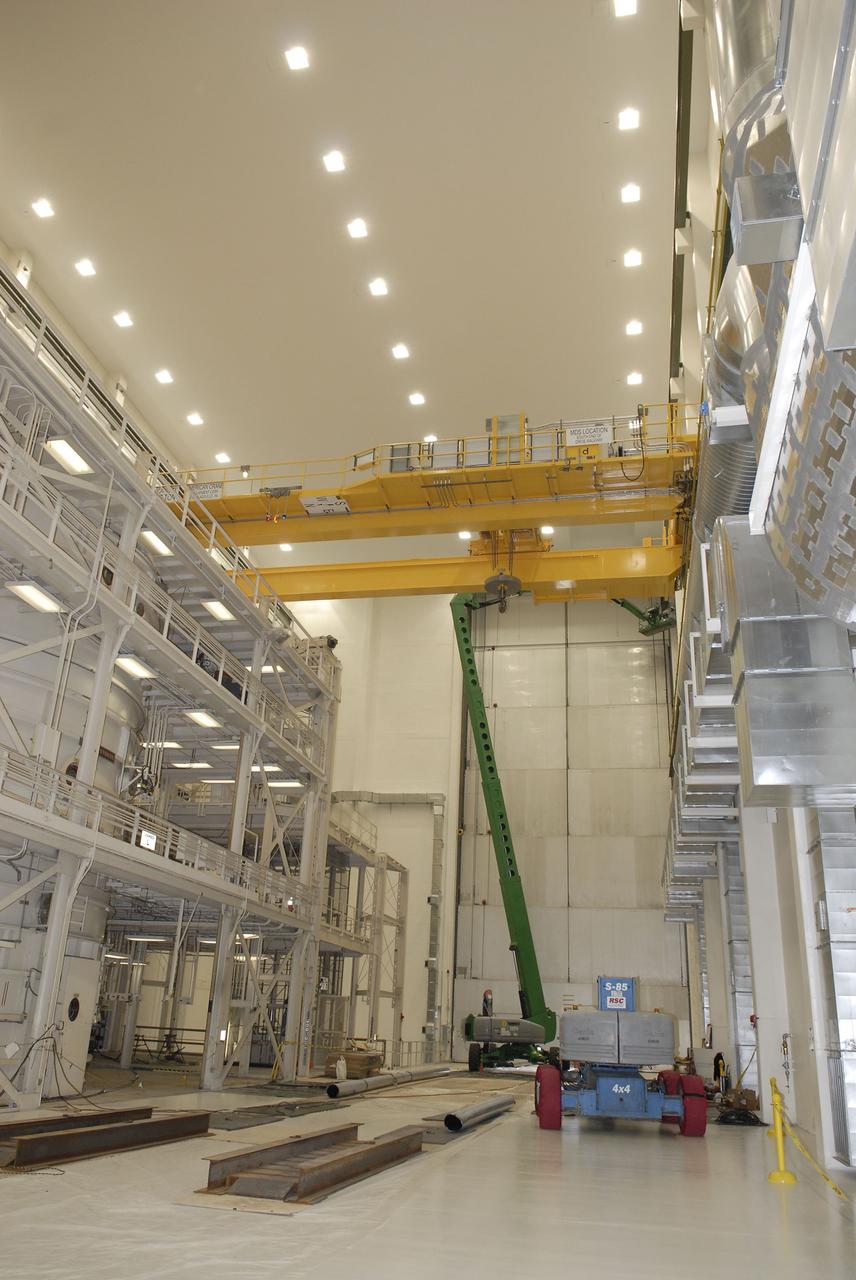
CAPE CANAVERAL, Fla. – Segments of a new crane are tested inside the Operations and Checkout Building at NASA's Kennedy Space Center in Florida. The new O&C low-bay crane is a 25-ton overhead bridge crane built for Lockheed Martin and Space Florida by American Crane and Equipment Corporation in Douglasville, Pa. The crane has a bridge span of 78’-2” and a hook height of 48’-10”. The crane will be used for lifting and moving flight hardware, fixtures and equipment in support of the Orion spacecraft manufacturing. Part of NASA's Constellation Program, the Orion spacecraft will return humans to the moon and prepare for future voyages to Mars and other destinations in our solar system. Photo credit: NASA/Kim Shiflett
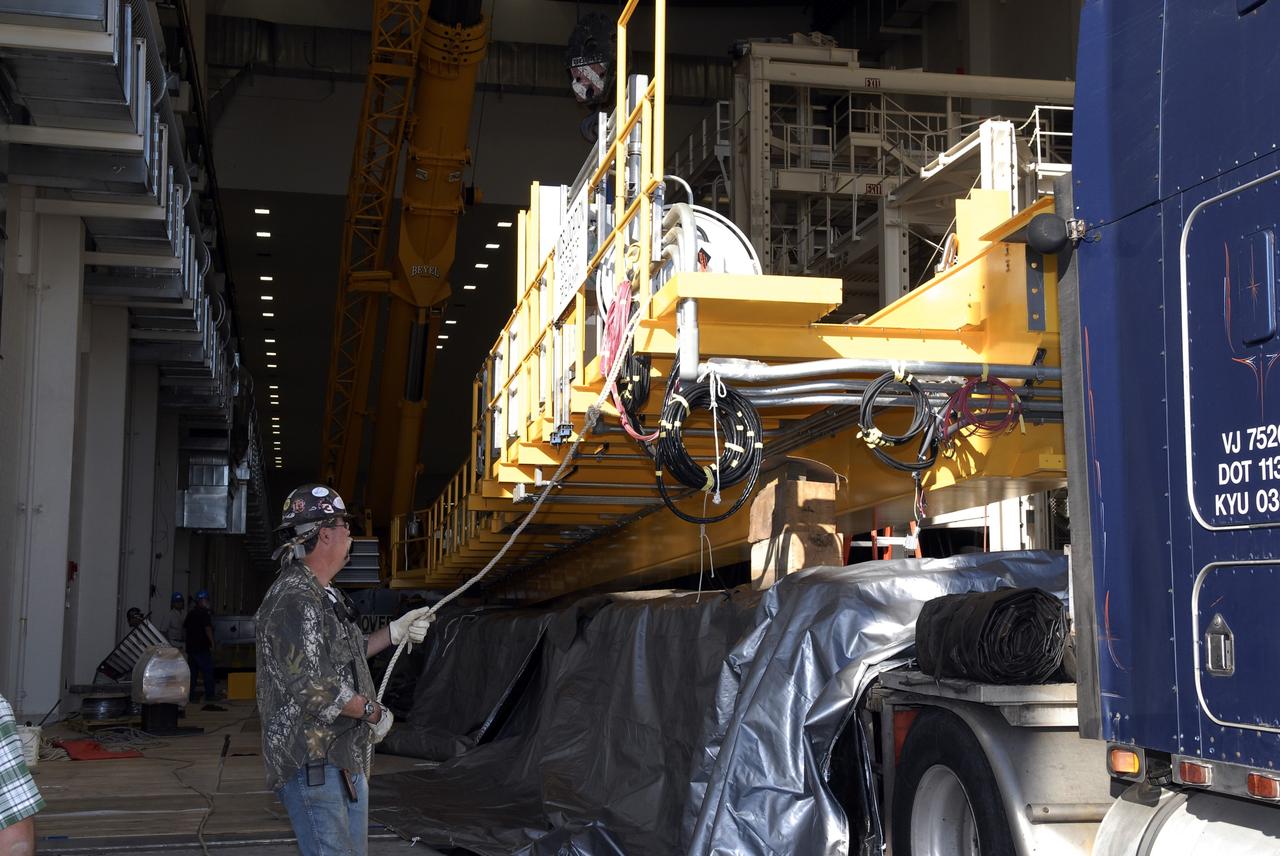
CAPE CANAVERAL, Fla. – Segments of a crane arrive at the Operations and Checkout Building at NASA's Kennedy Space Center in Florida. The new O&C low-bay crane is a 25-ton overhead bridge crane built for Lockheed Martin and Space Florida by American Crane and Equipment Corporation in Douglasville, Pa. The crane has a bridge span of 78’-2” and a hook height of 48’-10”. The crane will be used for lifting and moving flight hardware, fixtures and equipment in support of the Orion spacecraft manufacturing. Part of NASA's Constellation Program, the Orion spacecraft will return humans to the moon and prepare for future voyages to Mars and other destinations in our solar system. Photo credit: NASA/Kim Shiflett
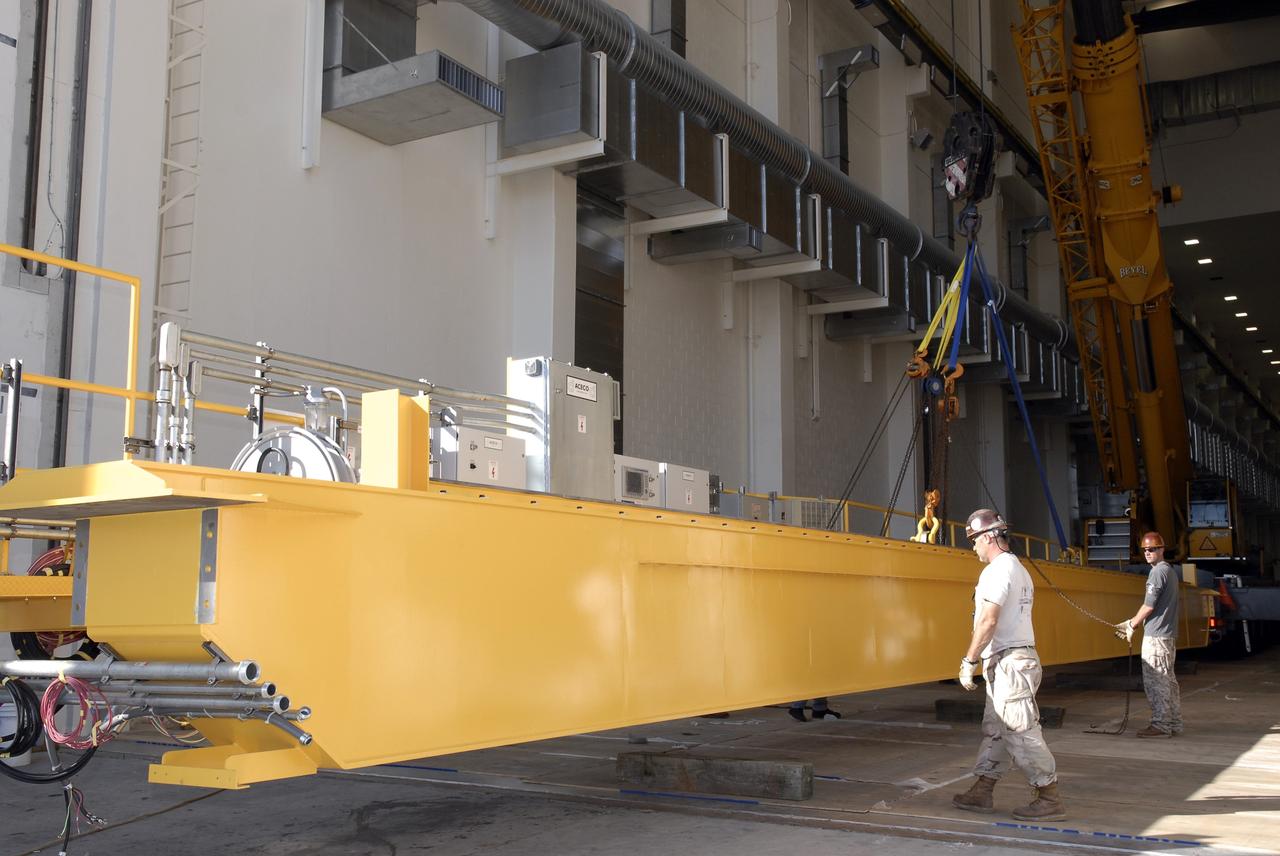
CAPE CANAVERAL, Fla. – Segments of a crane are lowered onto the floor of the Operations and Checkout Building at NASA's Kennedy Space Center in Florida. The new O&C low-bay crane is a 25-ton overhead bridge crane built for Lockheed Martin and Space Florida by American Crane and Equipment Corporation in Douglasville, Pa. The crane has a bridge span of 78’-2” and a hook height of 48’-10”. The crane will be used for lifting and moving flight hardware, fixtures and equipment in support of the Orion spacecraft manufacturing. Part of NASA's Constellation Program, the Orion spacecraft will return humans to the moon and prepare for future voyages to Mars and other destinations in our solar system. Photo credit: NASA/Kim Shiflett
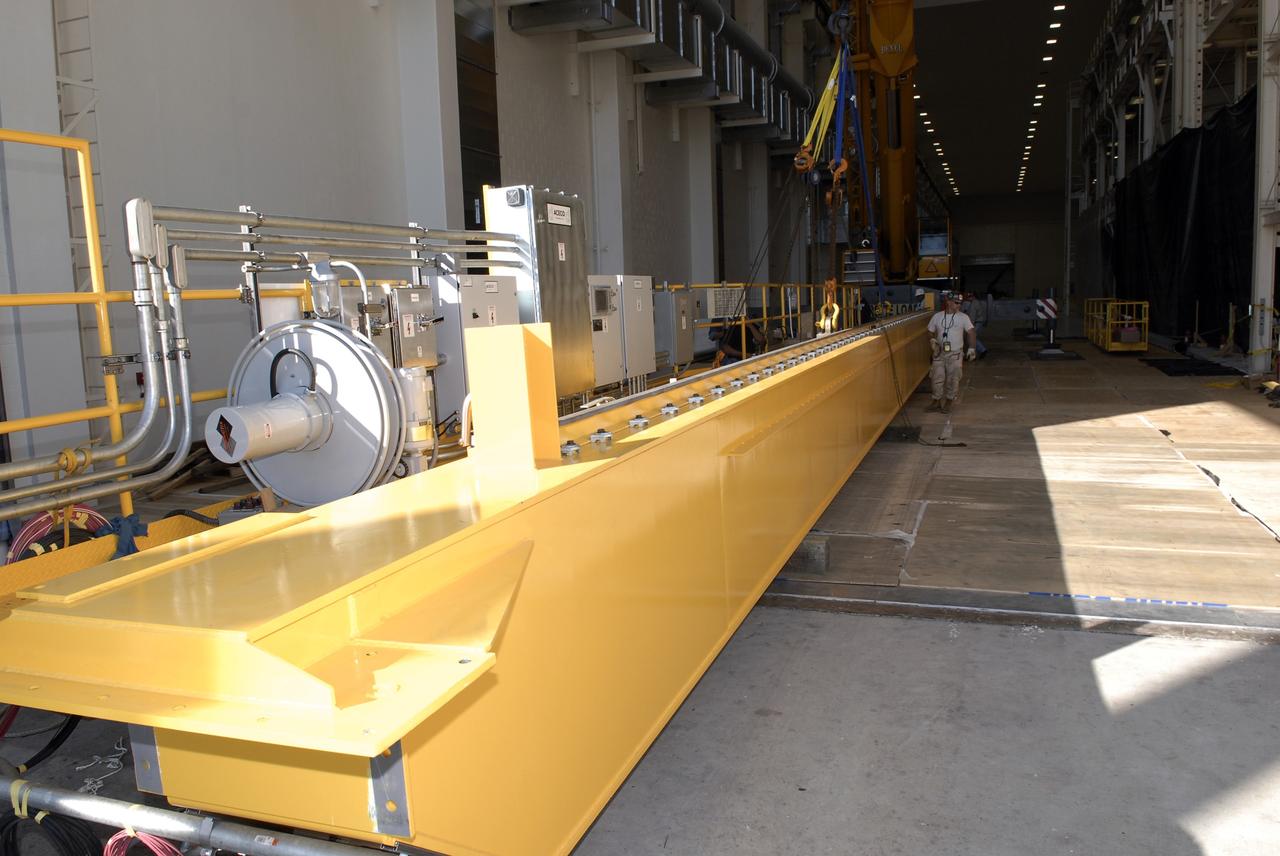
CAPE CANAVERAL, Fla. – Segments of a crane are moved into the Operations and Checkout Building at NASA's Kennedy Space Center in Florida. The new O&C low-bay crane is a 25-ton overhead bridge crane built for Lockheed Martin and Space Florida by American Crane and Equipment Corporation in Douglasville, Pa. The crane has a bridge span of 78’-2” and a hook height of 48’-10”. The crane will be used for lifting and moving flight hardware, fixtures and equipment in support of the Orion spacecraft manufacturing. Part of NASA's Constellation Program, the Orion spacecraft will return humans to the moon and prepare for future voyages to Mars and other destinations in our solar system. Photo credit: NASA/Kim Shiflett
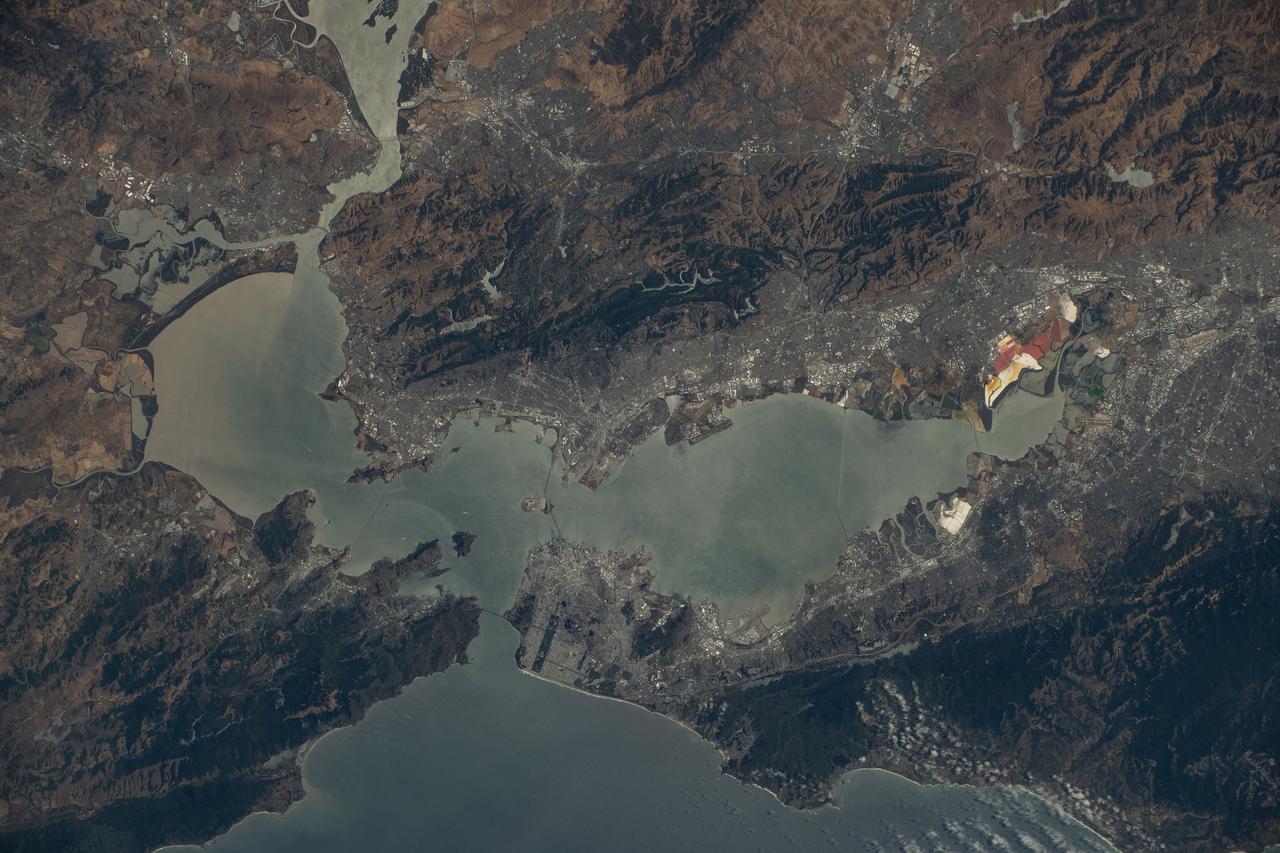
iss073e0420568 (Aug. 3, 2025) --- California's San Francisco Bay Area surrounded by the cities of San Francisico, Oakland, and San Jose, and their suburbs, is pictured from the International Space Station as it orbited 260 miles above the Golden State. Visible landmarks include the Golden Gate Bridge and the Don Edwards San Francisco Bay National Wildlife Refuge.

KENNEDY SPACE CENTER, Fla. -- The Undersecretary of the Air Force Dr. Lawrence Delaney and his wife, Angie (left), meet Center Director Roy Bridges while they tour the Orbiter Processing Facility bay 3. The orbiter Columbia is currently in bay 3 being prepared for mission STS-109. Targeted for launch in January 2002, STS-109 is a Hubble servicing mission.
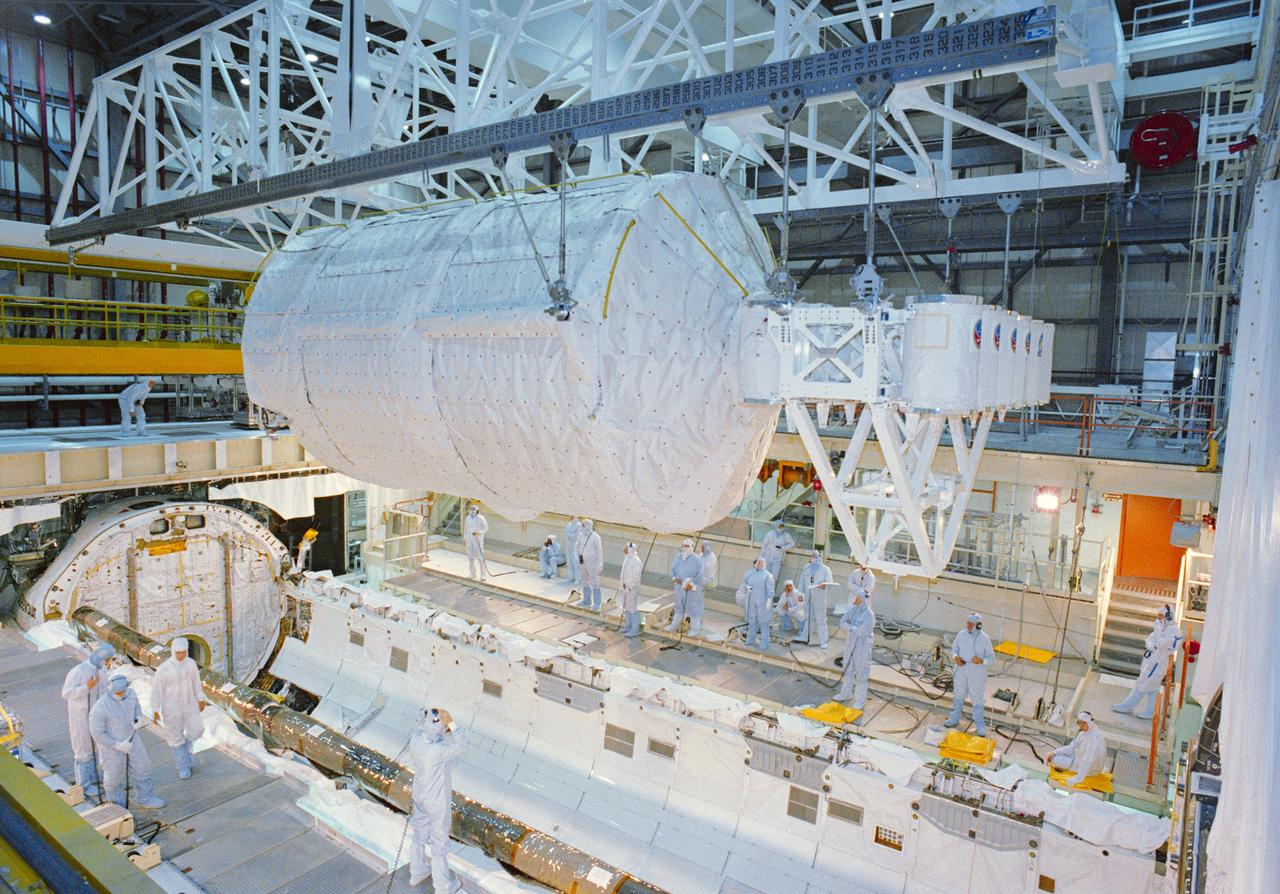
S92-44307 (25 July 1992) --- Technicians, engineers and flight crewmembers look on as the Spacelab-J laboratory module and experiment canister bridge are lowered into Endeavour's cargo bay. The STS-47 crewmembers visited Endeavour, currently undergoing pre-flight processing in a high bay area of the Orbiter Processing Facility at the Kennedy Space Center. The Spacelab-J mission is currently scheduled for September of this year.
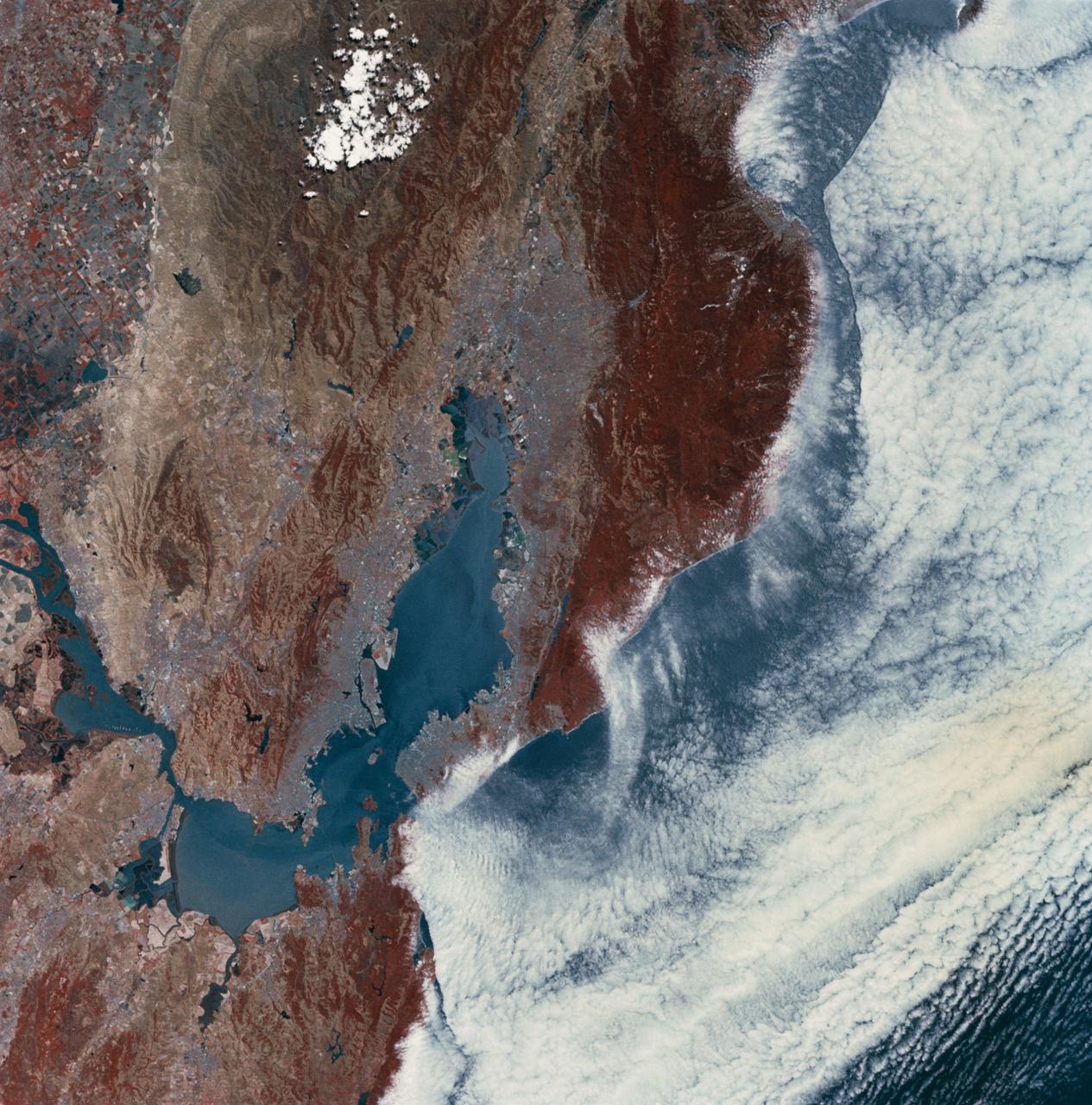
SL2-03-118 (June 1973) --- An infrared photograph of the San Francisco Bay, California area, taken from the Skylab 1/2 space station in Earth orbit. THE PICTURE SHOULD BE HELD WITH THE CLOUDS AND PACIFIC OCEAN ON THE LEFT. This photograph was taken by one of the six lenses of the Itek-furnished S190-A Multispectral Photographic Facility Experiment in the Multiple Docking Adapter of the space station. Type 2443 film was used. Note the thickly populated and highly developed area around the bay. Among the cities visible in this photograph are San Francisco, Oakland, Berkeley and San Jose. This view extends eastward to show a portion of the San Joaquin Valley. The S190-A experiment is part of the Skylab Earth Resources Experiment Package (EREP). Photo credit: NASA
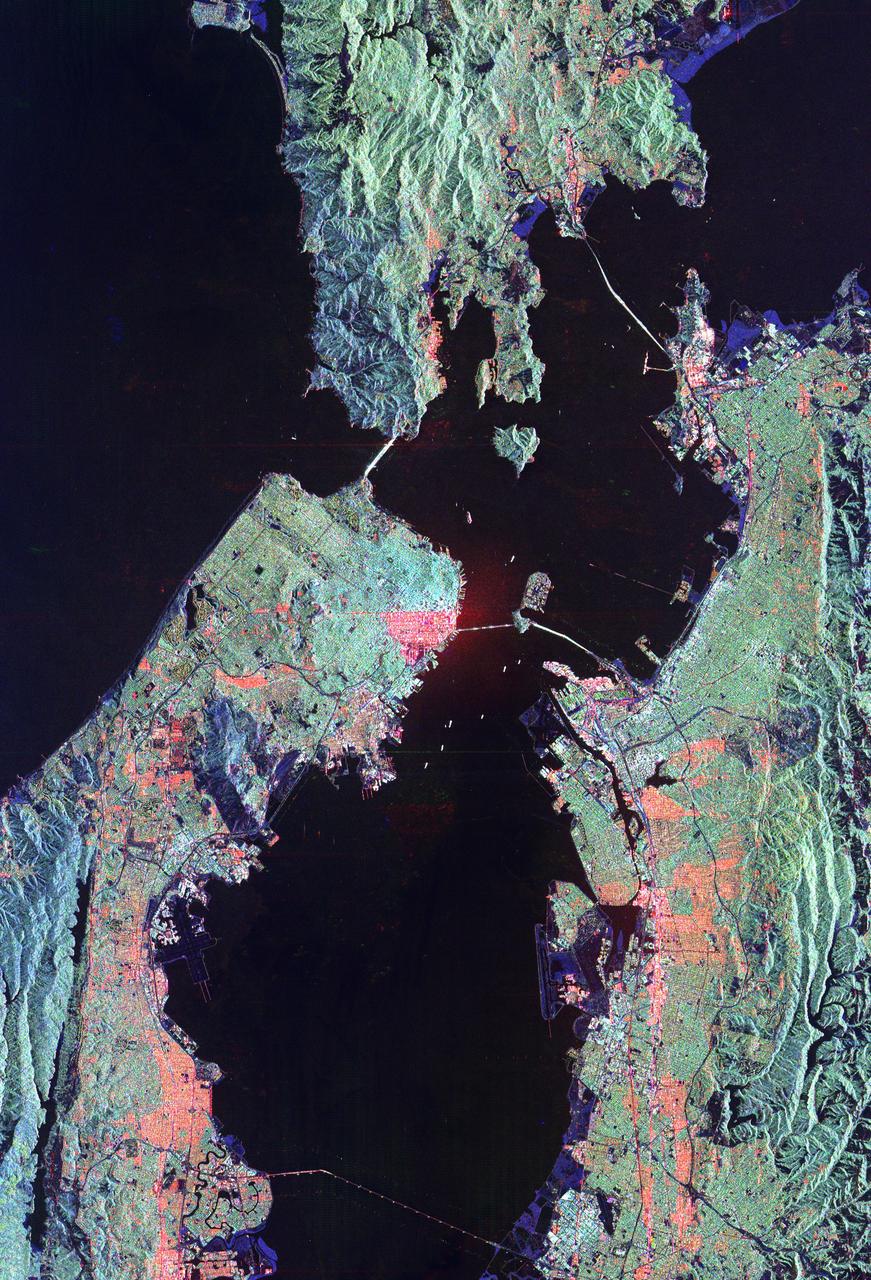
This image of San Francisco, California shows how the radar distinguishes between densely populated urban areas and nearby areas that are relatively unsettled. Downtown San Francisco is at the center and the city of Oakland is at the right across the San Francisco Bay. Some city areas, such as the South of Market, called the SOMA district in San Francisco, appear bright red due to the alignment of streets and buildings to the incoming radar beam. Various bridges in the area are also visible including the Golden Gate Bridge (left center) at the opening of San Francisco Bay, the Bay Bridge (right center) connecting San Francisco and Oakland, and the San Mateo Bridge (bottom center). All the dark areas on the image are relatively smooth water: the Pacific Ocean to the left, San Francisco Bay in the center, and various reservoirs. Two major faults bounding the San Francisco-Oakland urban areas are visible on this image. The San Andreas fault, on the San Francisco peninsula, is seen in the lower left of the image. The fault trace is the straight feature filled with linear reservoirs which appear dark. The Hayward fault is the straight feature on the right side of the image between the urban areas and the hillier terrain to the east. The image is about 42 kilometers by 58 kilometers (26 miles by 36 miles) with north toward the upper right. This area is centered at 37.83 degrees north latitude, 122.38 degrees east longitude. http://photojournal.jpl.nasa.gov/catalog/PIA01791
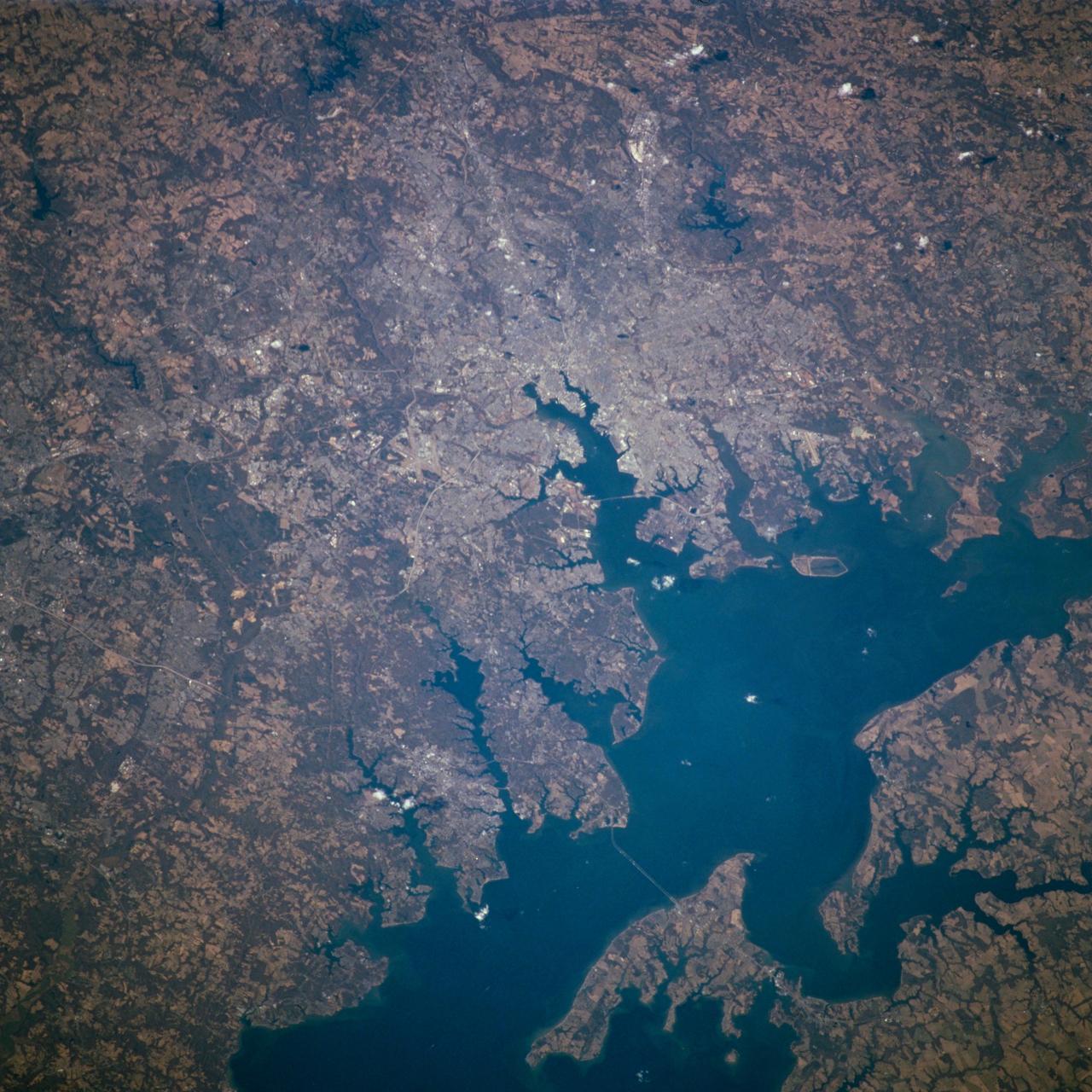
STS098-716-057 (7-20 February 2001) --- Baltimore, Maryland can be identified in this northwest-looking view, photographed with a 70mm handheld camera from the Space Shuttle Atlantis, which shows the western shore of Chesapeake Bay. Numerous drowned river valleys provide excellent natural harbors along the periphery of the bay. Baltimore’s harbor has been developed along one of these drowned valleys, the Patapsco River. With a population of over 2.5 million people, the greater Baltimore urban area is part of the northeastern U.S. Megalopolis that extends from the Boston (MA) area to Richmond (VA). Specific features that can be seen in the image include a short segment of Interstate Highway 95 that connects southwest Baltimore with northeast Washington, D.C.; the intersecting runways of Baltimore-Washington International Airport south of downtown Baltimore; Francis Scott Key Bridge that skirts around the southeast side of Baltimore; the Chesapeake Bay Bridge that spans the bay and connects the Baltimore area with the eastern shore of Maryland; and the central business district of Baltimore where the two arms of the inner harbor terminate. The darker-looking vegetation cover is mixed hardwood forests (notice that many wooded areas are located along streambeds and floodplains of small river valleys), while lighter-looking land parcels in the rural countryside is used for crops or pasturelands.
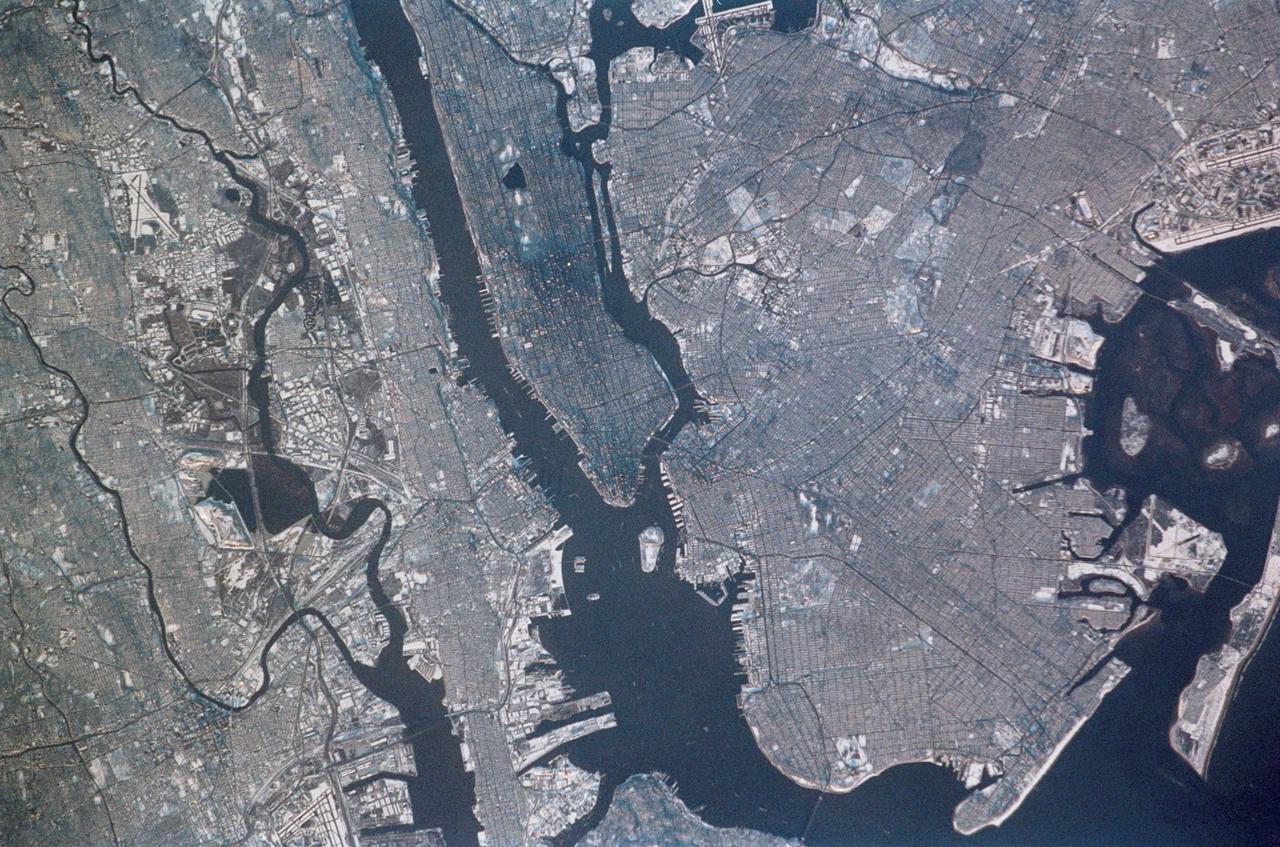
STS113-347-034 (23 November - 7 December 2002) --- The STS-113 crewmembers used a 35mm still camera to record this image of New York City. Manhattan Island appears just left of center, flanked by the lower Hudson River (left), and the East River (right). The lake in Central Park on Manhattan is particularly clear. The Verrazano Narrows Bridge appears center on the bottom margin of the view, dividing upper New York Bay from Lower New York Bay. Newark Bay is the body of water lower left. Three well known islands appear at the north (top) end of Upper New York Bay, the smallest being Liberty Island (with the Statue of Liberty not visible at this resolution), Ellis Island, the middle-sized island, and Governor's Island, the largest. Queens appears top right, and Brooklyn, lower right, with the Naval Air Station on Jamaica Bay on the right margin.
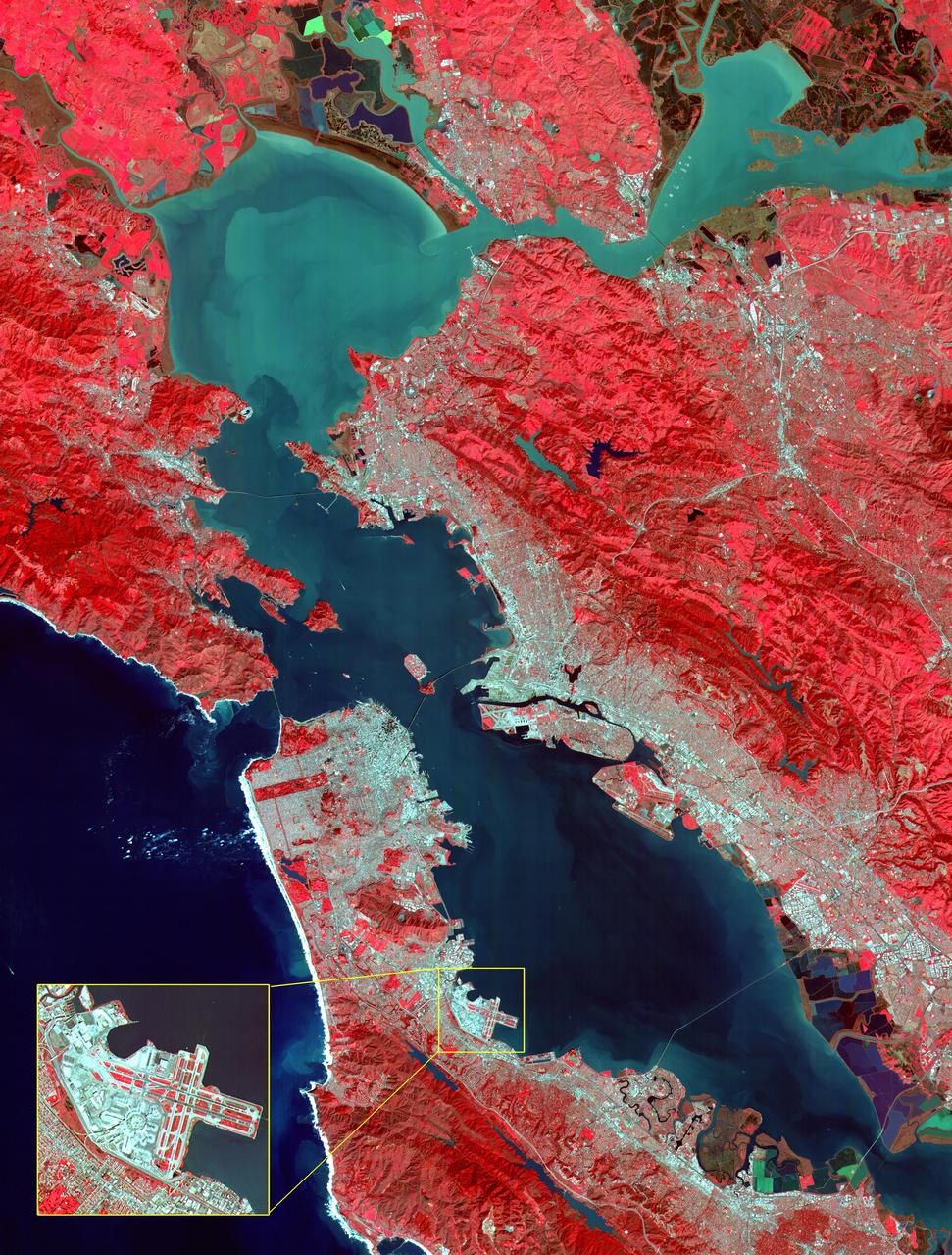
This image of the San Francisco Bay region was acquired on March 3, 2000 by the Advanced Spaceborne Thermal Emission and Reflection Radiometer (ASTER) on NASA's Terra satellite. With its 14 spectral bands from the visible to the thermal infrared wavelength region, and its high spatial resolution of 15 to 90 meters about 50 to 300 feet ), ASTER will image Earth for the next 6 years to map and monitor the changing surface of our planet. Image: This image covers an area 60 kilometers (37 miles) wide and 75 kilometers (47 miles) long in three bands of the reflected visible and infrared wavelength region. The combination of bands portrays vegetation in red, and urban areas in gray. Sediment in the Suisun Bay, San Pablo Bay, San Francisco Bay, and the Pacific Ocean shows up as lighter shades of blue. Along the west coast of the San Francisco Peninsula, strong surf can be seen as a white fringe along the shoreline. A powerful rip tide is visible extending westward from Daly City into the Pacific Ocean. In the lower right corner, the wetlands of the South San Francisco Bay National Wildlife Refuge appear as large dark blue and brown polygons. The high spatial resolution of ASTER allows fine detail to be observed in the scene. The main bridges of the area (San Mateo, San Francisco-Oakland Bay, Golden Gate, Richmond-San Rafael, Benicia-Martinez, and Carquinez) are easily picked out, connecting the different communities in the Bay area. Shadows of the towers along the Bay Bridge can be seen over the adjacent bay water. With enlargement the entire road network can be easily mapped; individual buildings are visible, including the shadows of the high-rises in downtown San Francisco. Inset: This enlargement of the San Francisco Airport highlights the high spatial resolution of ASTER. With further enlargement and careful examination, airplanes can be seen at the terminals. http://photojournal.jpl.nasa.gov/catalog/PIA02606
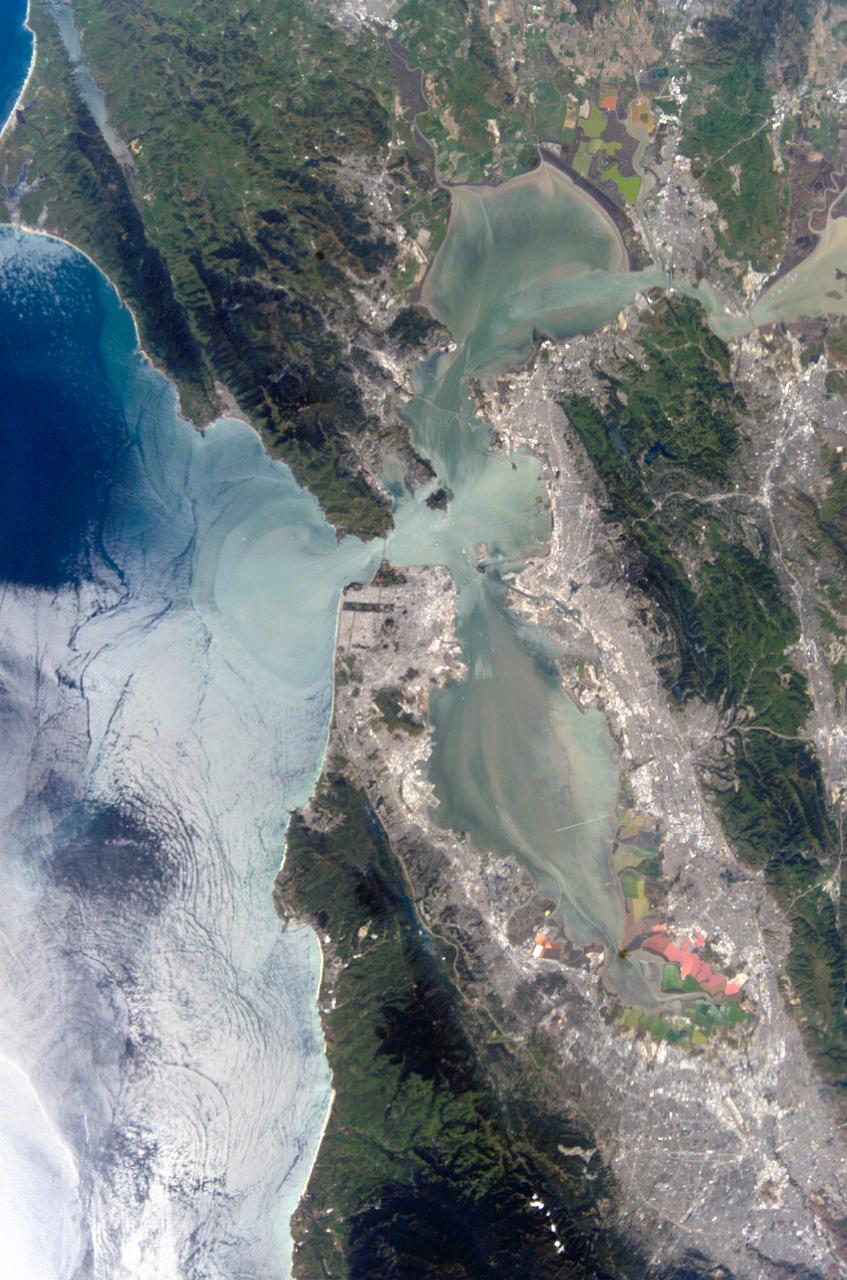
ISS004-E-10288 (21 April 2002) --- This view featuring the San Francisco Bay Area was photographed by an Expedition 4 crewmember onboard the International Space Station (ISS). The gray urban footprint of San Francisco, Oakland, San Jose, and their surrounding suburbs contrasts strongly with the green hillsides. Of particular note are the Pacific Ocean water patterns that are highlighted in the sun glint. Sets of internal waves traveling east impinge on the coastline south of San Francisco. At the same time, fresher bay water flows out from the bay beneath the Golden Gate Bridge, creating a large plume traveling westward. Tidal current channels suggest the tidal flow deep in the bay. Because the ISS orbits are not synchronous with the sun, station crewmembers view Earth with variable solar illumination angles. This allows them to document phenomena such as the sun reflecting differentially off surface waters in a way that outlines complicated water structures.
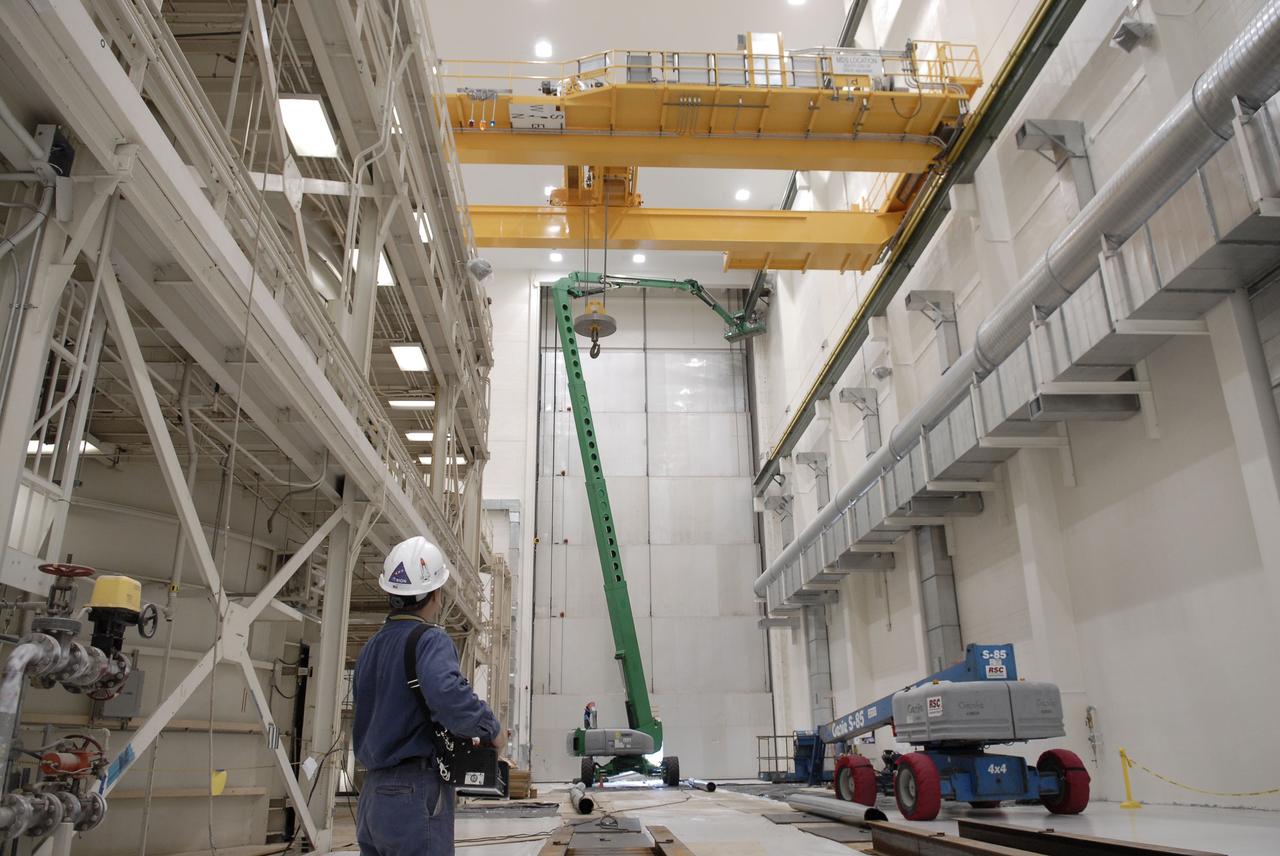
CAPE CANAVERAL, Fla. – Motion of the segments of a new crane is tested inside the Operations and Checkout Building at NASA's Kennedy Space Center in Florida. The new O&C low-bay crane is a 25-ton overhead bridge crane built for Lockheed Martin and Space Florida by American Crane and Equipment Corporation in Douglasville, Pa. The crane has a bridge span of 78’-2” and a hook height of 48’-10”. The crane will be used for lifting and moving flight hardware, fixtures and equipment in support of the Orion spacecraft manufacturing. Part of NASA's Constellation Program, the Orion spacecraft will return humans to the moon and prepare for future voyages to Mars and other destinations in our solar system. Photo credit: NASA/Kim Shiflett
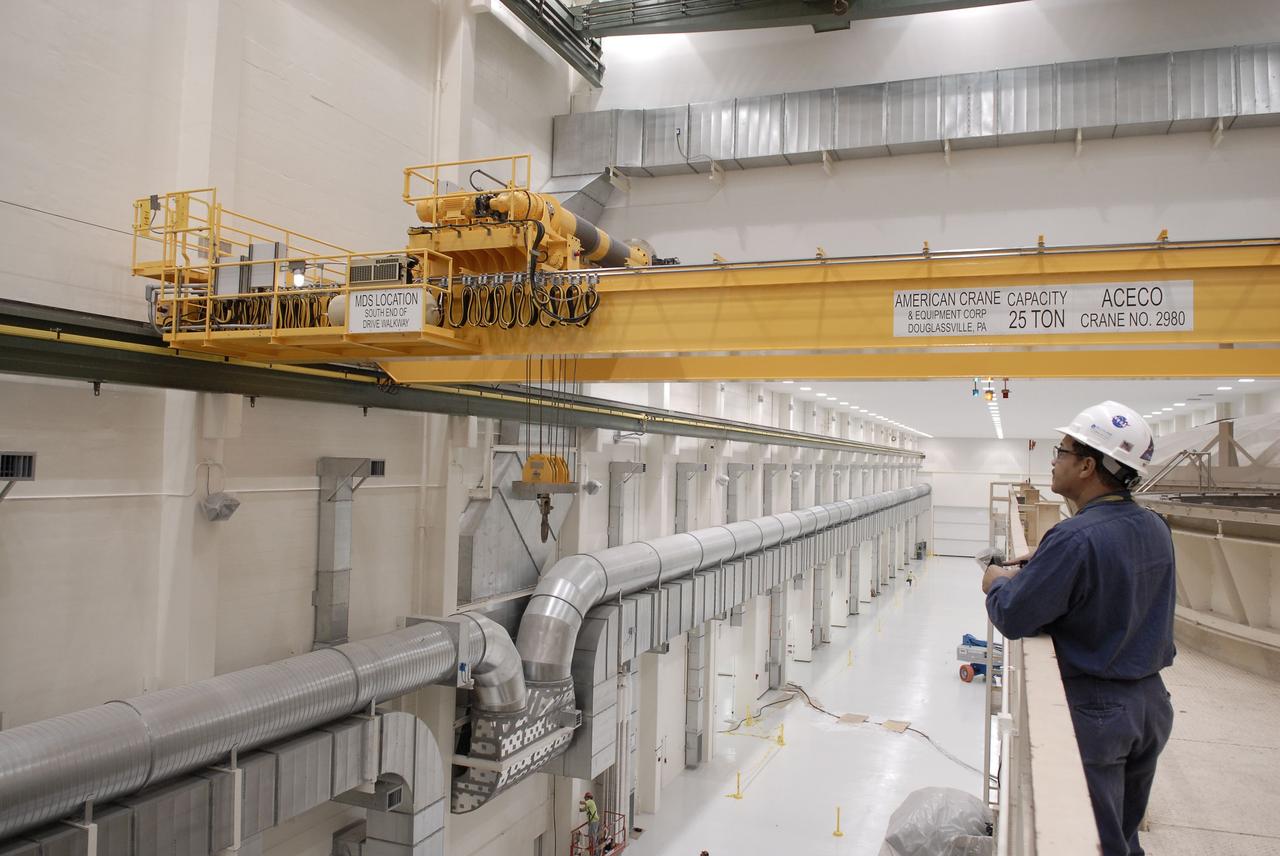
CAPE CANAVERAL, Fla. – Motion of the segments of a new crane is tested inside the Operations and Checkout Building at NASA's Kennedy Space Center in Florida. The new O&C low-bay crane is a 25-ton overhead bridge crane built for Lockheed Martin and Space Florida by American Crane and Equipment Corporation in Douglasville, Pa. The crane has a bridge span of 78’-2” and a hook height of 48’-10”. The crane will be used for lifting and moving flight hardware, fixtures and equipment in support of the Orion spacecraft manufacturing. Part of NASA's Constellation Program, the Orion spacecraft will return humans to the moon and prepare for future voyages to Mars and other destinations in our solar system. Photo credit: NASA/Kim Shiflett
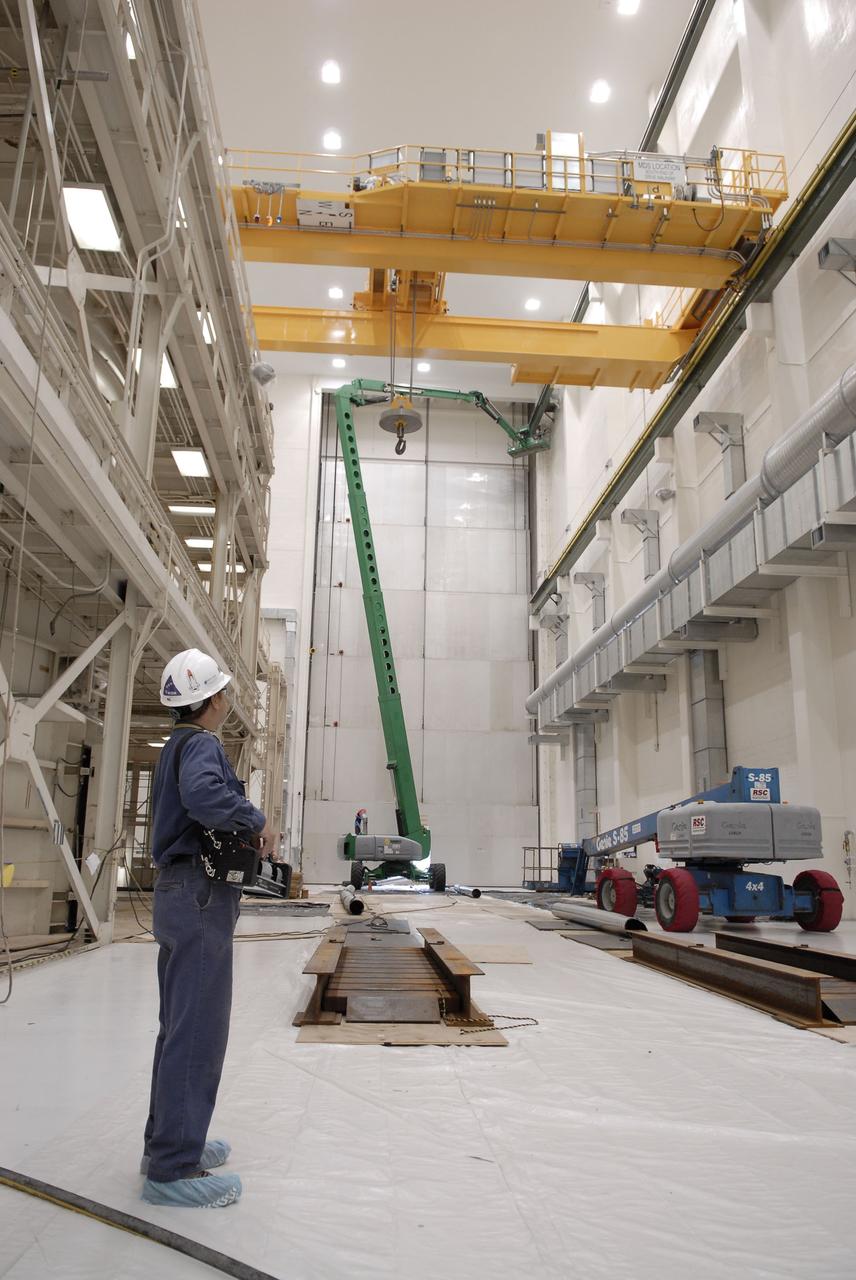
CAPE CANAVERAL, Fla. – Movement of the hook from a new crane are is tested inside the Operations and Checkout Building at NASA's Kennedy Space Center in Florida. The new O&C low-bay crane is a 25-ton overhead bridge crane built for Lockheed Martin and Space Florida by American Crane and Equipment Corporation in Douglasville, Pa. The crane has a bridge span of 78’-2” and a hook height of 48’-10”. The crane will be used for lifting and moving flight hardware, fixtures and equipment in support of the Orion spacecraft manufacturing. Part of NASA's Constellation Program, the Orion spacecraft will return humans to the moon and prepare for future voyages to Mars and other destinations in our solar system. Photo credit: NASA/Kim Shiflett
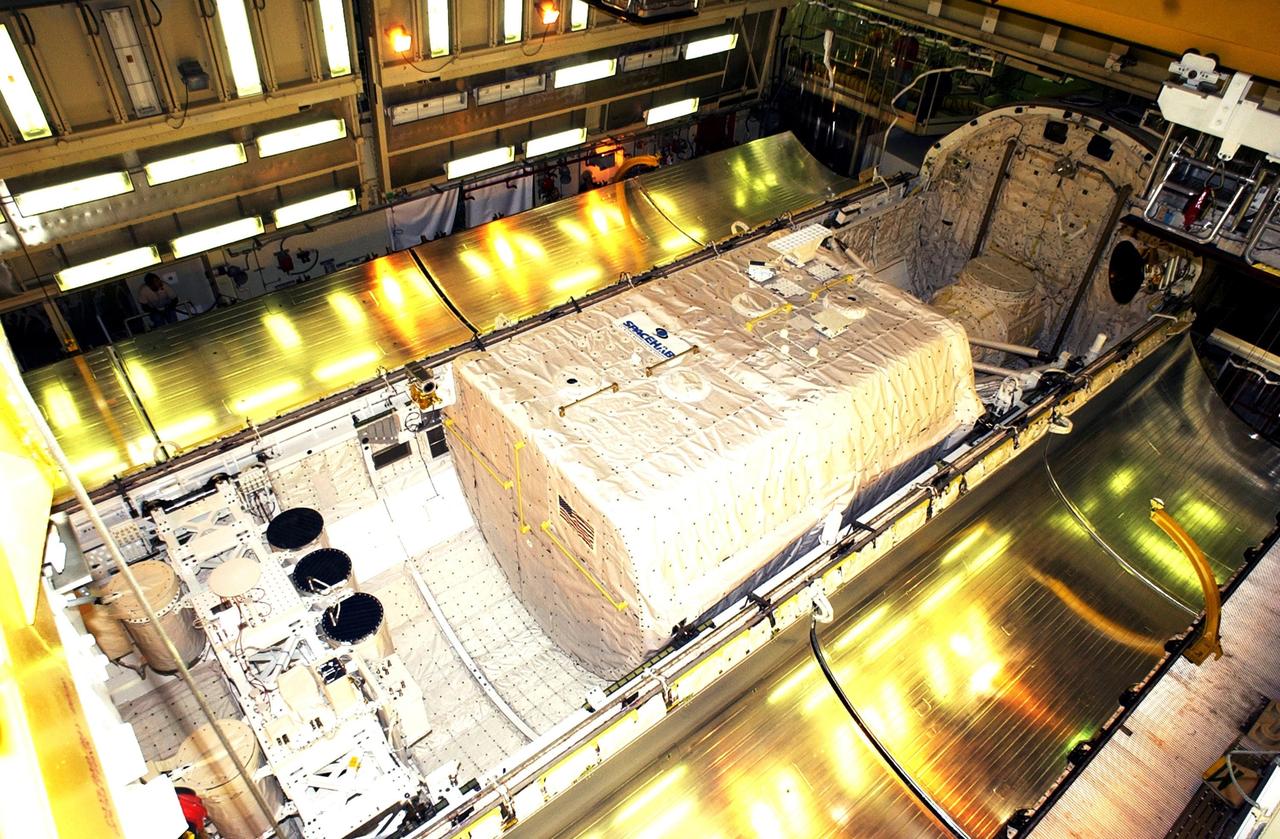
KENNEDY SPACE CENTER, FLA. - -- Columbia's payload bay doors are ready to be closed for mission STS-107. Installed inside are the Hitchhiker Bridge, a carrier for the Fast Reaction Experiments Enabling Science, Technology, Applications and Research (FREESTAR) that incorporates eight high priority secondary attached shuttle experiments, plus the SHI Research Double Module (SHI/RDM), also known as SPACEHAB. STS-107 is scheduled for launch July 19, 2001
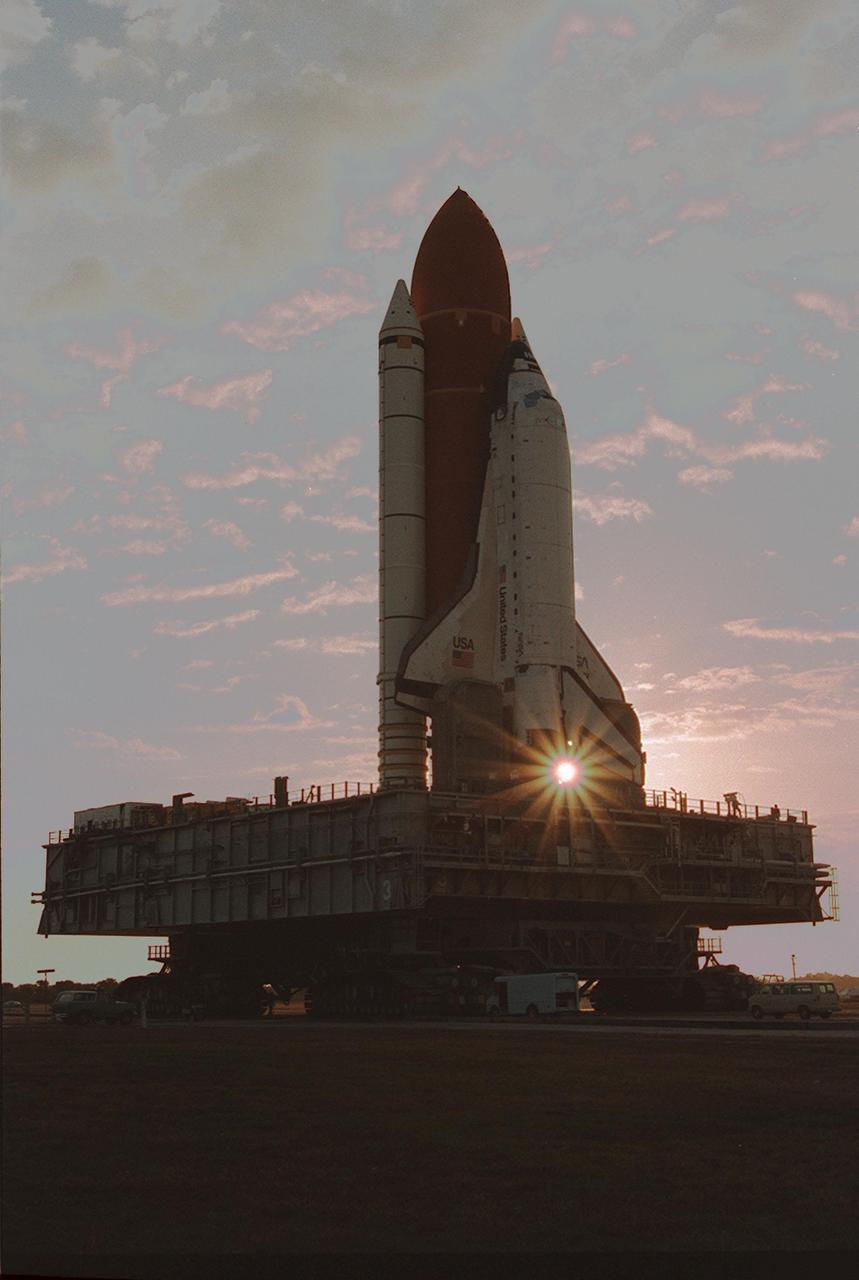
KENNEDY SPACE CENTER, FLA. -- Leaving the Vehicle Assembly Building for Launch Pad 39A on a crisp, clear winter day, the Space Shuttle Discovery makes the final Earth-bound leg of a journey into space. Once at the pad, two of the payloads for Discovery's upcoming flight, mission STS-60, will be installed. The Wake Shield Facility-1 and Get Away Special bridge assembly will be joining SPACEHAB-2 in the orbiter's payload bay. Liftoff of the first Space Shuttle flight of 1994 is currently targeted for around Feb. 3
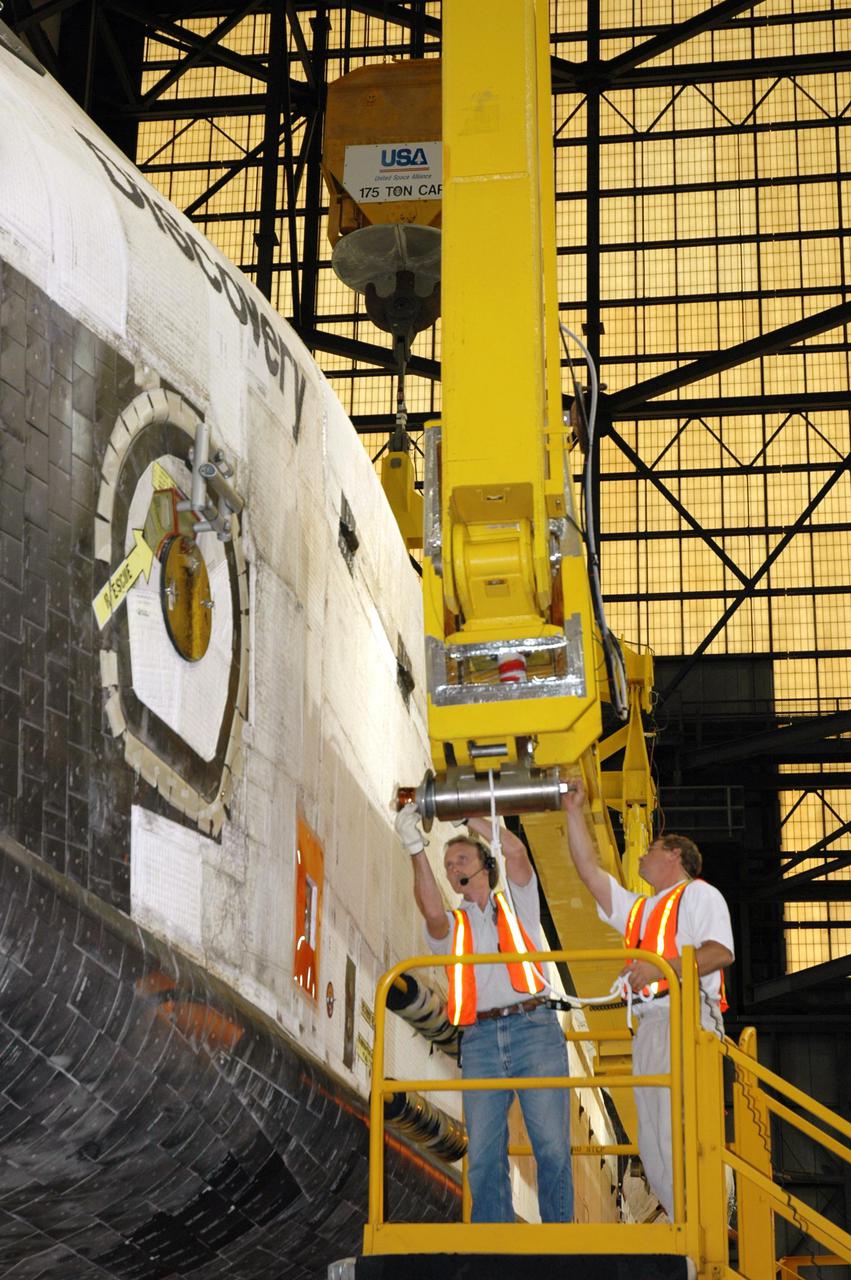
KENNEDY SPACE CENTER, FLA. - In the transfer aisle of the Vehicle Assembly Building, workers attach the 175-ton bridge crane to the orbiter Discovery, which is resting on an orbiter transporter. The crane will lift Discovery to vertical for the remate to a new External Tank, ET-121. The new tank and Solid Rocket Boosters are waiting in high bay 3. Discovery is expected roll back to the launch pad June 13 for Return to Flight mission STS-114. The launch window extends from July 13 to July 31.
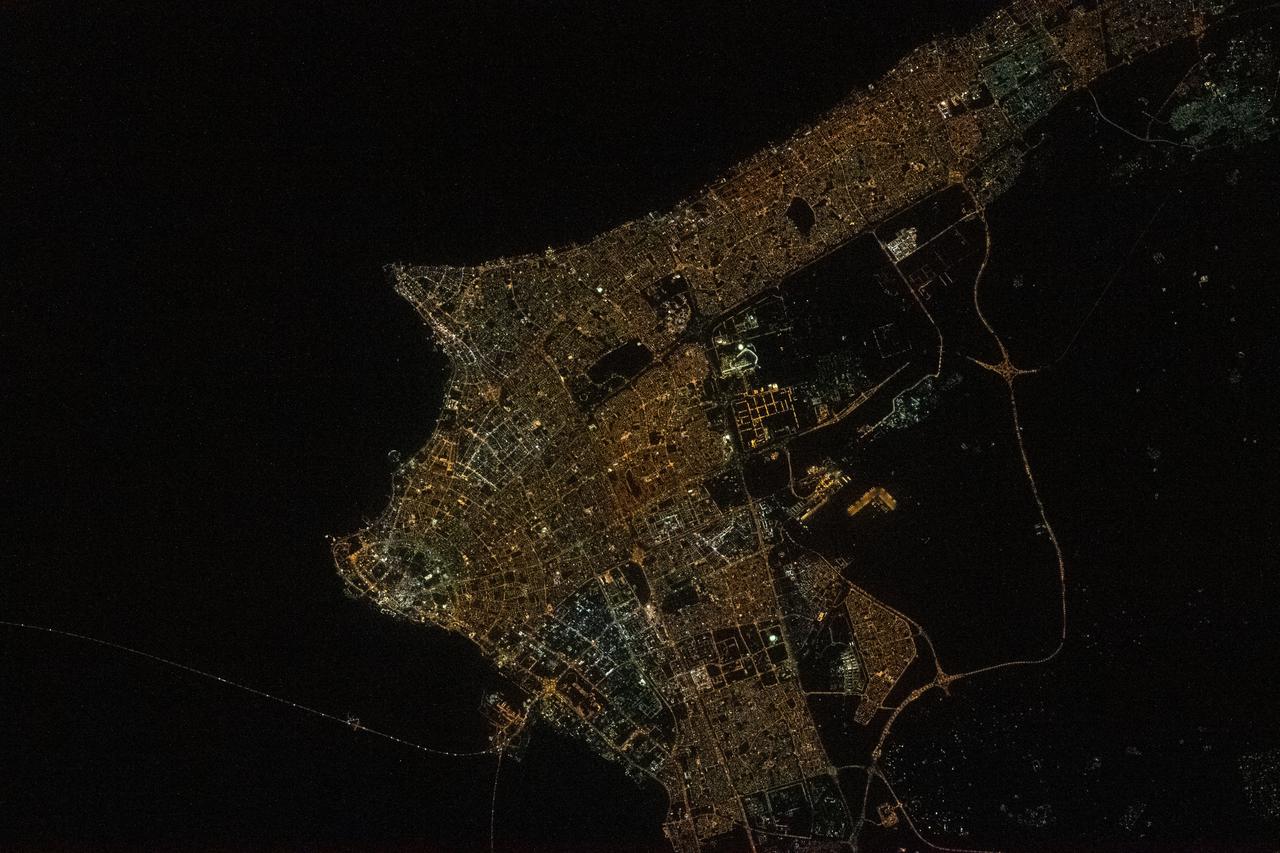
iss064e021961 (Jan. 9, 2021) --- Kuwait City is pictured during a night time pass from the International Space Station as it orbited 261 miles above the Iraq-Saudi Arabia border. Towards the bottom left, is the Sheikh Jaber Al-Ahmad Al-Sabah Causeway, the world's fourth longest road bridge at 24.5 miles, that crosses Kuwait Bay.
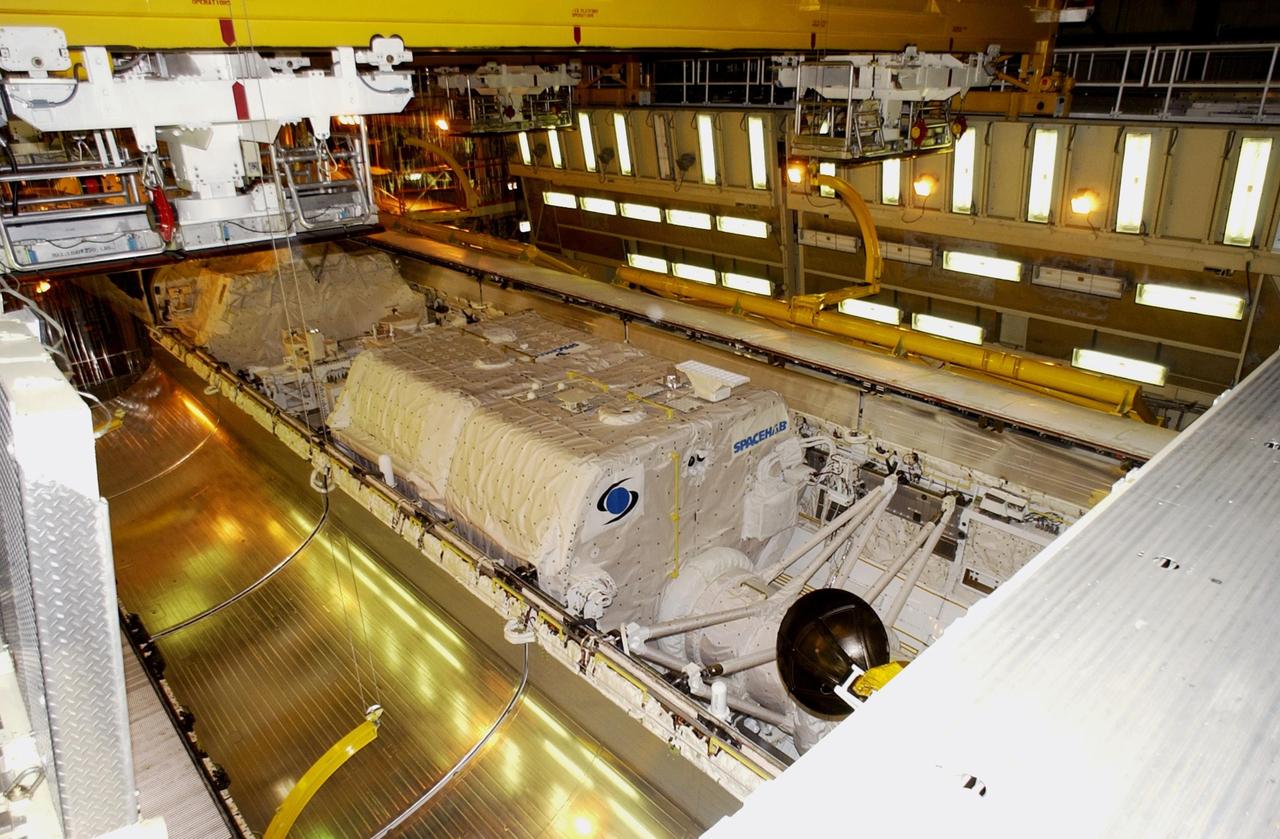
KENNEDY SPACE CENTER, FLA. -- Columbia's payload bay doors are ready to be closed for mission STS-107. Installed inside are the Hitchhiker Bridge, a carrier for the Fast Reaction Experiments Enabling Science, Technology, Applications and Research (FREESTAR) that incorporates eight high priority secondary attached shuttle experiments, plus the SHI Research Double Module (SHI/RDM), also known as SPACEHAB. STS-107 is scheduled for launch July 19, 2001

iss070e108427 (March 5, 2024) --- Rio De Janeiro, Brazil (at right), and its suburbs just across the Guanabara Bay are pictured from the International Space Station as it orbited 265 miles above the Atlantic Ocean. Toward the bottom, is the eight-and-a-quarter-mile long President Costa e Silva Bridge linking Rio de Janeiro with the city of Niterói.
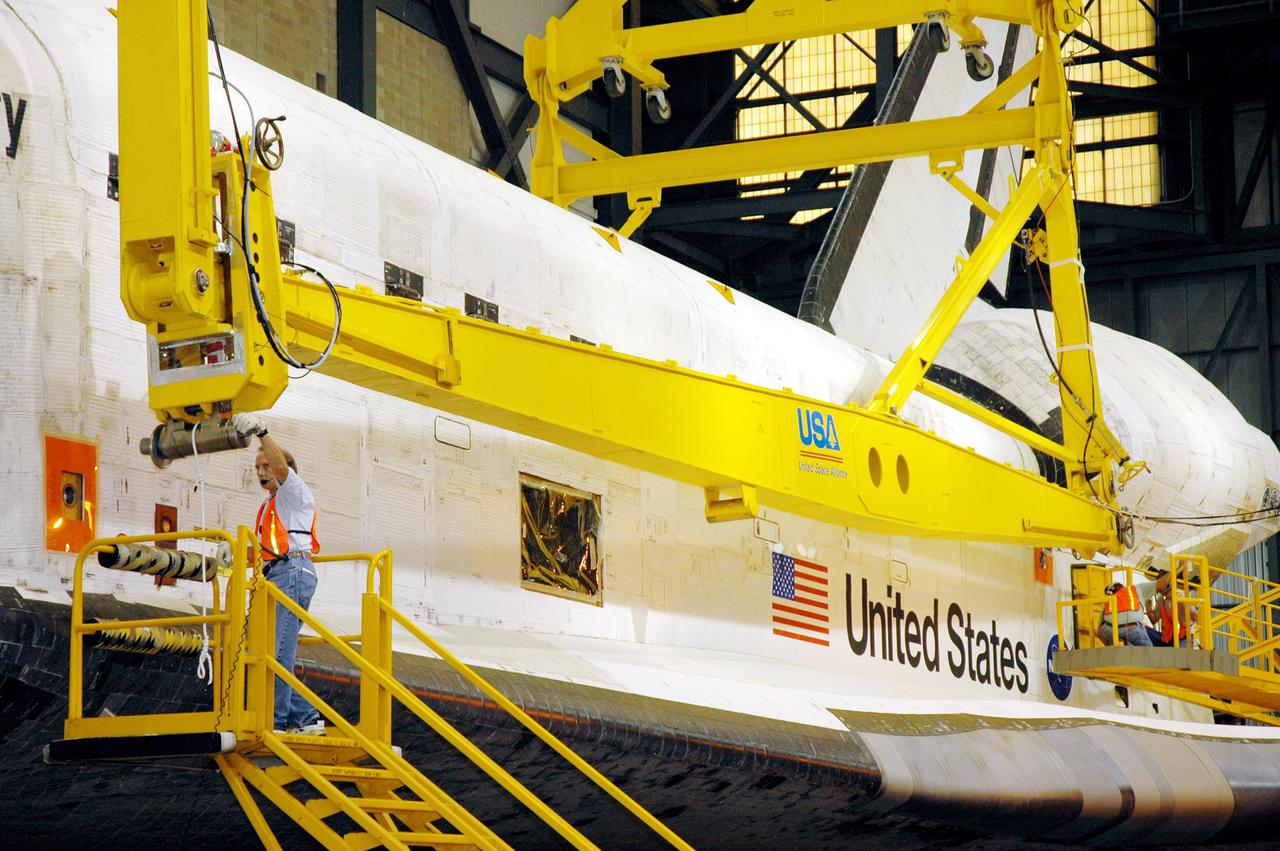
KENNEDY SPACE CENTER, FLA. - In the transfer aisle of the Vehicle Assembly Building, workers attach the 175-ton bridge crane to the orbiter Discovery, which is resting on an orbiter transporter. The crane will lift Discovery to vertical for the remate to a new External Tank, ET-121. The new tank and Solid Rocket Boosters are waiting in high bay 3. Discovery is expected roll back to the launch pad June 13 for Return to Flight mission STS-114. The launch window extends from July 13 to July 31.
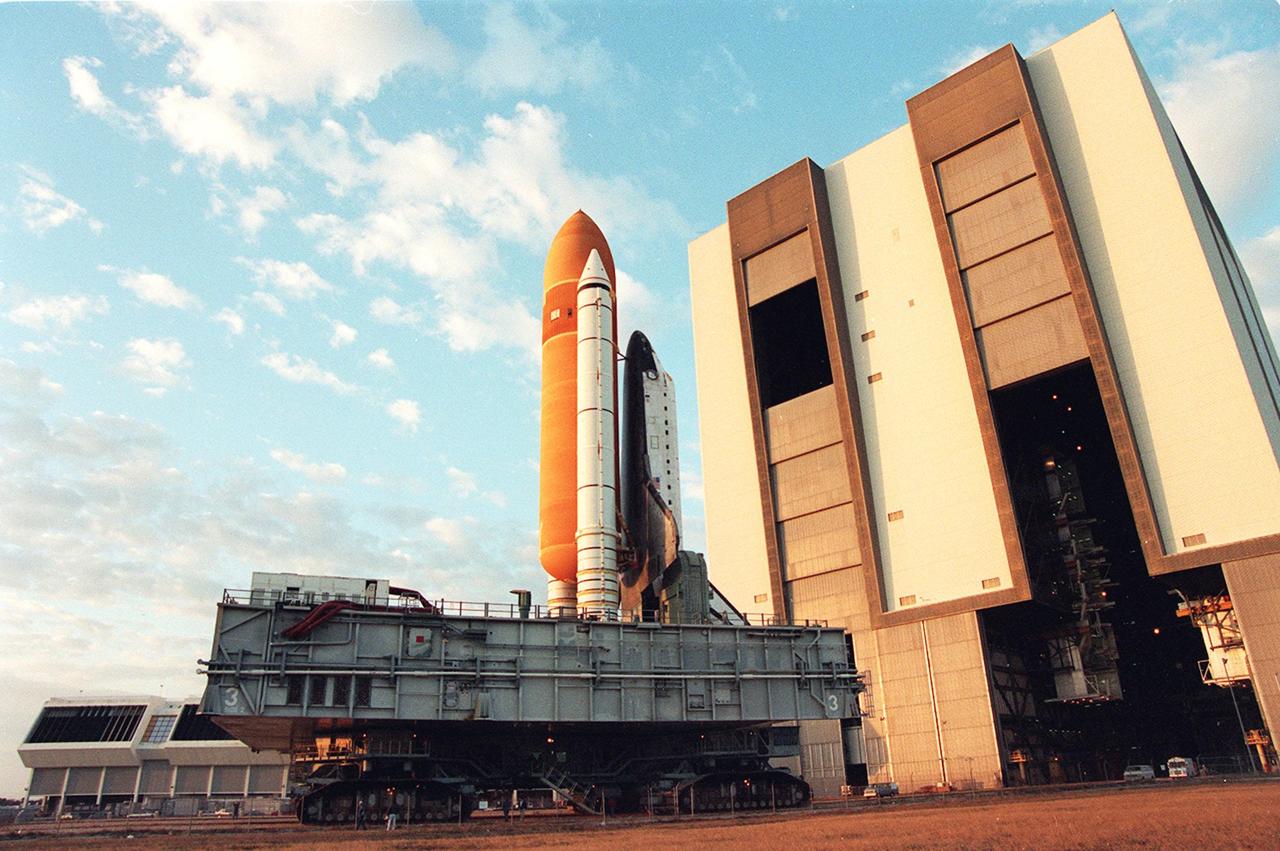
KENNEDY SPACE CENTER, FLA. -- Leaving the Vehicle Asembly Building for Launch Pad 39A on a crisp, clear winter day, the Space Shuttle Discovery makes the final Earth-bound leg of a journey into space. Once at the pad, two of the payloads for Discovery's upcoming flight, mission STS-60, will be installed. The Wake Shield Facility-1 and Get Away Special bridge assembly will be joining SPACEHAB-2 in the orbiter's payload bay. Liftoff of the first Space Shuttle flight of 1994 is currently targeted for around Feb. 3
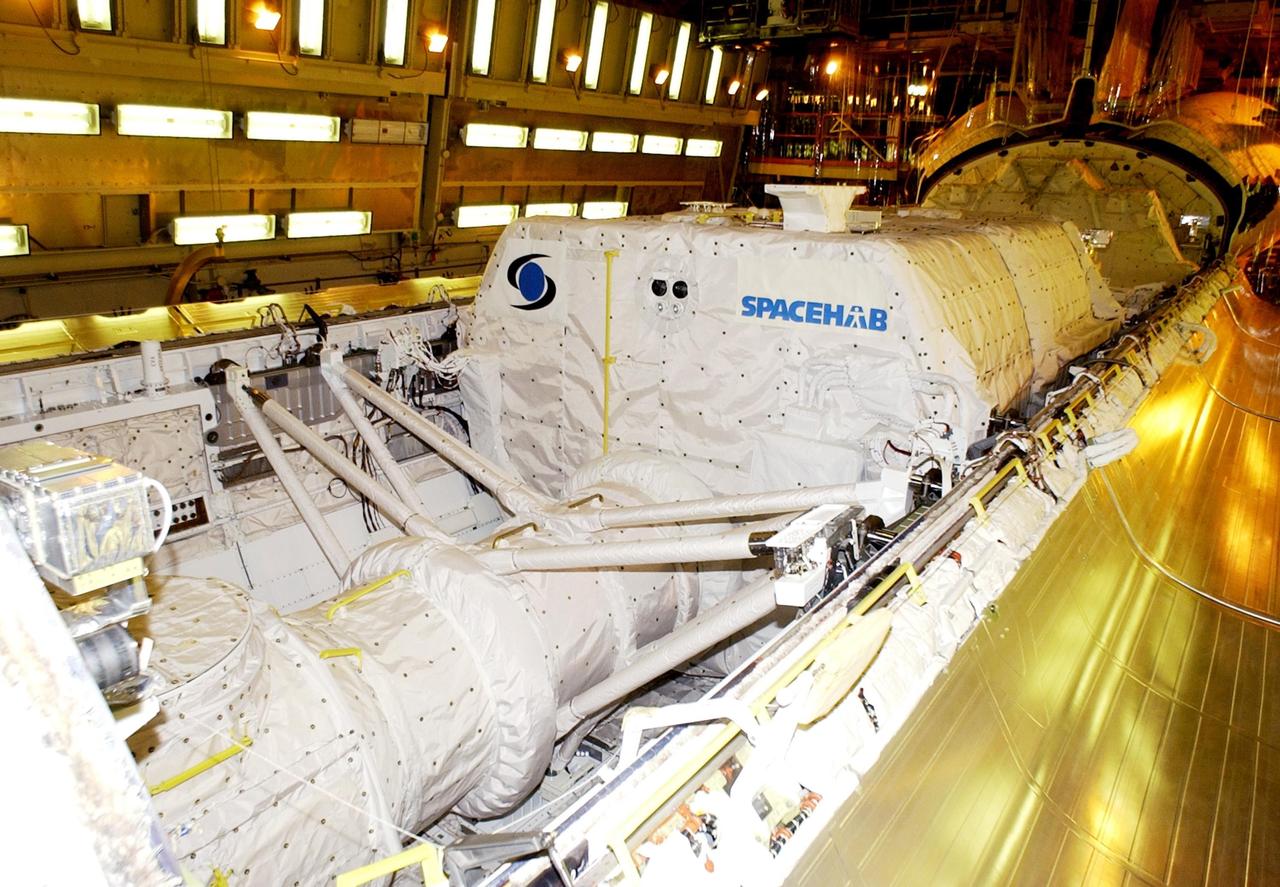
KENNEDY SPACE CENTER, FLA. -- Columbia's payload bay doors are ready to be closed for mission STS-107. Installed inside are the Hitchhiker Bridge, a carrier for the Fast Reaction Experiments Enabling Science, Technology, Applications and Research (FREESTAR) that incorporates eight high priority secondary attached shuttle experiments, plus the SHI Research Double Module (SHI/RDM), also known as SPACEHAB. STS-107 is scheduled for launch July 19, 2001
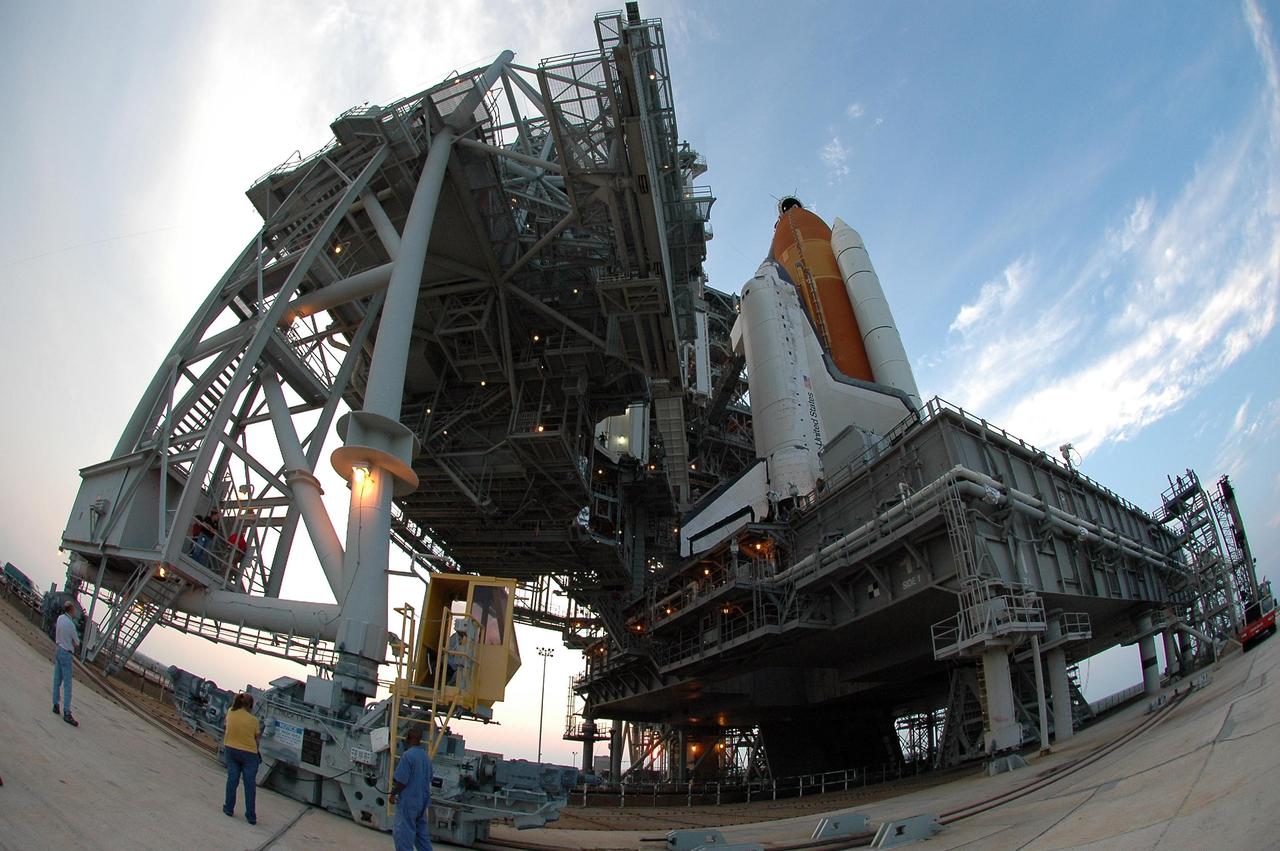
KENNEDY SPACE CENTER, FLA. - A fish-eye camera lens captures the movement of the rotating service structure (RSS) at left as it moves away from Space Shuttle Discovery in preparation for the July 1 launch from Launch Pad 39B. The RSS provides protected access to the orbiter for changeout and servicing of payloads at the pad. The structure is supported by a rotating bridge that pivots about a vertical axis on the west side of the pad's flame trench. The hinge column rests on the pad surface and is braced to the fixed service structure. Support for the outer end of the bridge is provided by two eight-wheel, motor-driven trucks that move along circular twin rails installed flush with the pad surface. The track crosses the flame trench on a permanent bridge. The RSS is 102 feet long, 50 feet wide and 130 feet high. The structure has orbiter access platforms at five levels to provide access to the payload bay while the orbiter is being serviced in the RSS. Each platform has independent extendable planks that can be arranged to conform to a payload's configuration. This mission is the 115th shuttle flight and the 18th U.S. flight to the International Space Station. Photo credit: NASA/Kim Shiflett
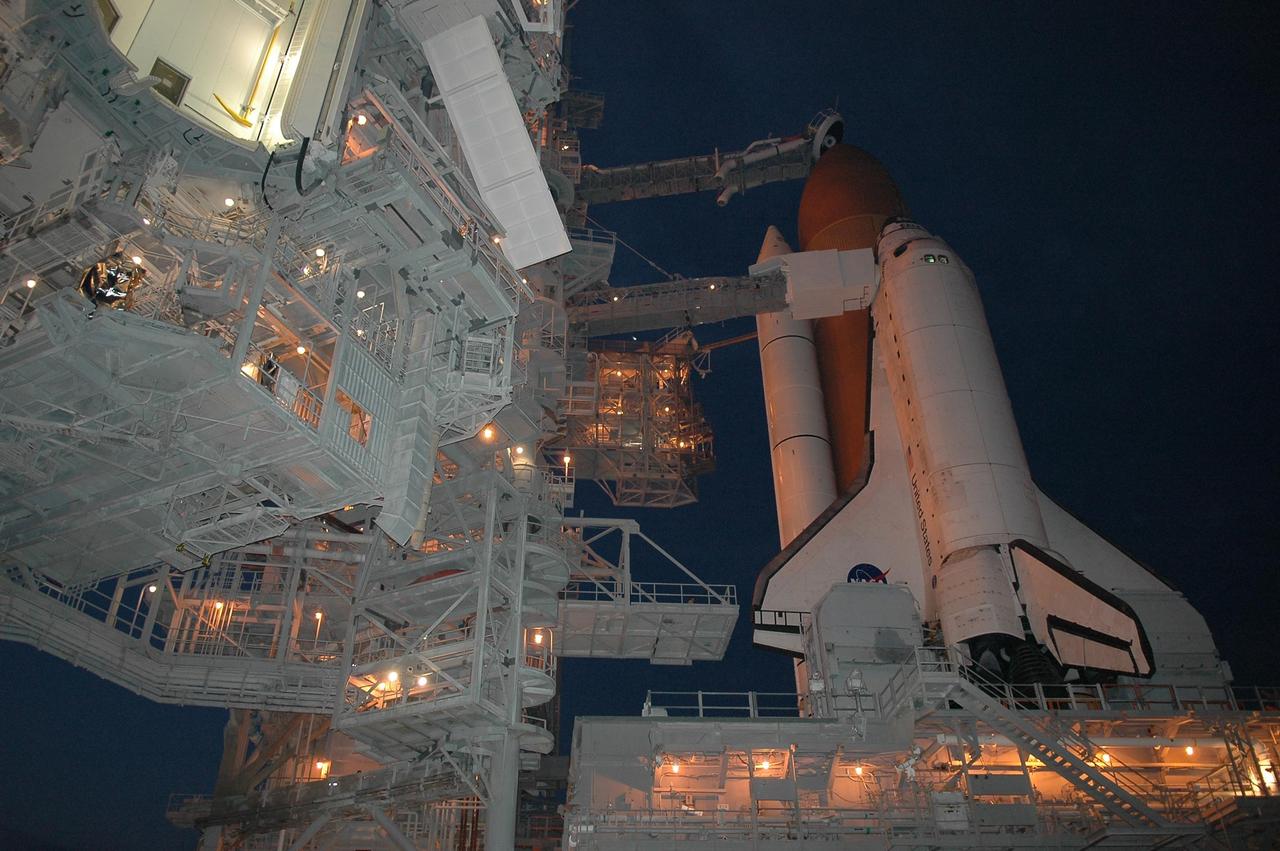
KENNEDY SPACE CENTER, FLA. - After rollback of the rotating service structure (RSS) on Launch Pad 39B, Space Shuttle Discovery stands bathed in lights from the RSS and fixed service structure. The rollback was in preparation for launch July 1 on mission STS-121. Extending toward the cockpit of the shuttle is the orbiter access arm with the White Room extended. The White Room provides access into the orbiter for the astronauts. The RSS provides protected access to the orbiter for changeout and servicing of payloads at the pad. The structure is supported by a rotating bridge that pivots about a vertical axis on the west side of the pad's flame trench. The hinge column rests on the pad surface and is braced to the fixed service structure. Support for the outer end of the bridge is provided by two eight-wheel, motor-driven trucks that move along circular twin rails installed flush with the pad surface. The track crosses the flame trench on a permanent bridge. The RSS is 102 feet long, 50 feet wide and 130 feet high. The structure has orbiter access platforms at five levels to provide access to the payload bay while the orbiter is being serviced in the RSS. Each platform has independent extendable planks that can be arranged to conform to a payload's configuration. This mission is the 115th shuttle flight and the 18th U.S. flight to the International Space Station. Photo credit: NASA/Kim Shiflett
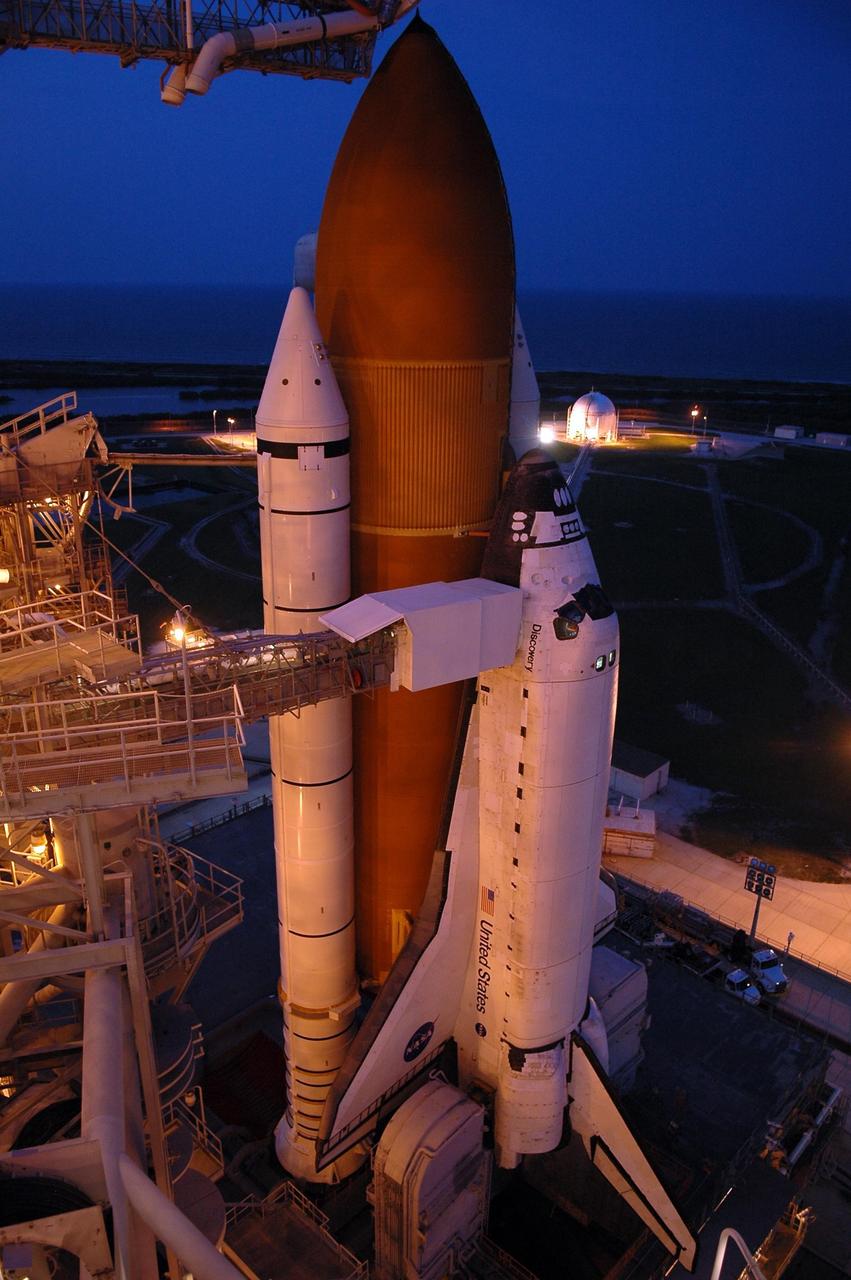
KENNEDY SPACE CENTER, FLA. - After rollback of the rotating service structure (RSS) on Launch Pad 39B, Space Shuttle Discovery stands bathed in lights from the RSS and fixed service structure. The rollback was in preparation for launch July 1 on mission STS-121. Extending toward the cockpit of the shuttle is the orbiter access arm with the White Room extended. The White Room provides access into the orbiter for the astronauts. The RSS provides protected access to the orbiter for changeout and servicing of payloads at the pad. The structure is supported by a rotating bridge that pivots about a vertical axis on the west side of the pad's flame trench. The hinge column rests on the pad surface and is braced to the fixed service structure. Support for the outer end of the bridge is provided by two eight-wheel, motor-driven trucks that move along circular twin rails installed flush with the pad surface. The track crosses the flame trench on a permanent bridge. The RSS is 102 feet long, 50 feet wide and 130 feet high. The structure has orbiter access platforms at five levels to provide access to the payload bay while the orbiter is being serviced in the RSS. Each platform has independent extendable planks that can be arranged to conform to a payload's configuration. This mission is the 115th shuttle flight and the 18th U.S. flight to the International Space Station. Photo credit: NASA/Kim Shiflett
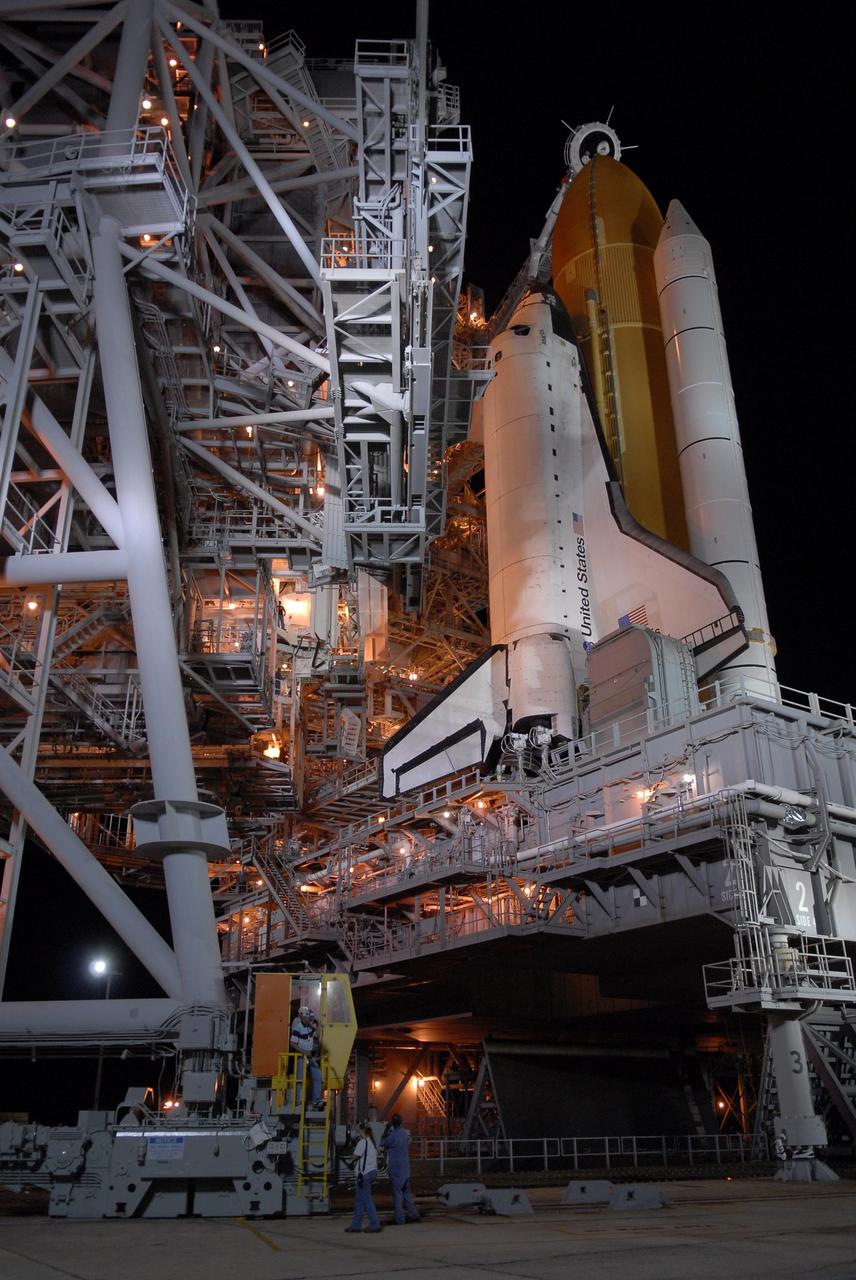
KENNEDY SPACE CENTER, FLA. -- Rollback of the rotating service structure, or RSS, begins on Launch Pad 39A, revealing Space Shuttle Atlantis, bathed in lights. Rollback is one of the milestones in preparation for the launch of mission STS-117 on June 8 and started at 10:56 p.m. EDT. The RSS provides protected access to the orbiter for changeout and servicing of payloads at the pad. The structure is supported by a rotating bridge that pivots about a vertical axis on the side of the pad's flame trench. The hinge column rests on the pad surface and is braced to the fixed service structure. Support for the outer end of the bridge is provided by two eight-wheel, motor-driven trucks that move along circular twin rails installed flush with the pad surface. The track crosses the flame trench on a permanent bridge. The RSS is 102 feet long, 50 feet wide and 130 feet high. The structure has orbiter access platforms at five levels to provide access to the payload bay while the orbiter is being serviced in the RSS. Each platform has independent extendable planks that can be arranged to conform to a payload's configuration. This mission is the 118th shuttle flight and the 21st U.S. flight to the International Space Station and will deliver and install the S3/S4 truss segment, deploy a set of solar arrays and prepare them for operation. Photo credit: NASA/Kim Shiflett
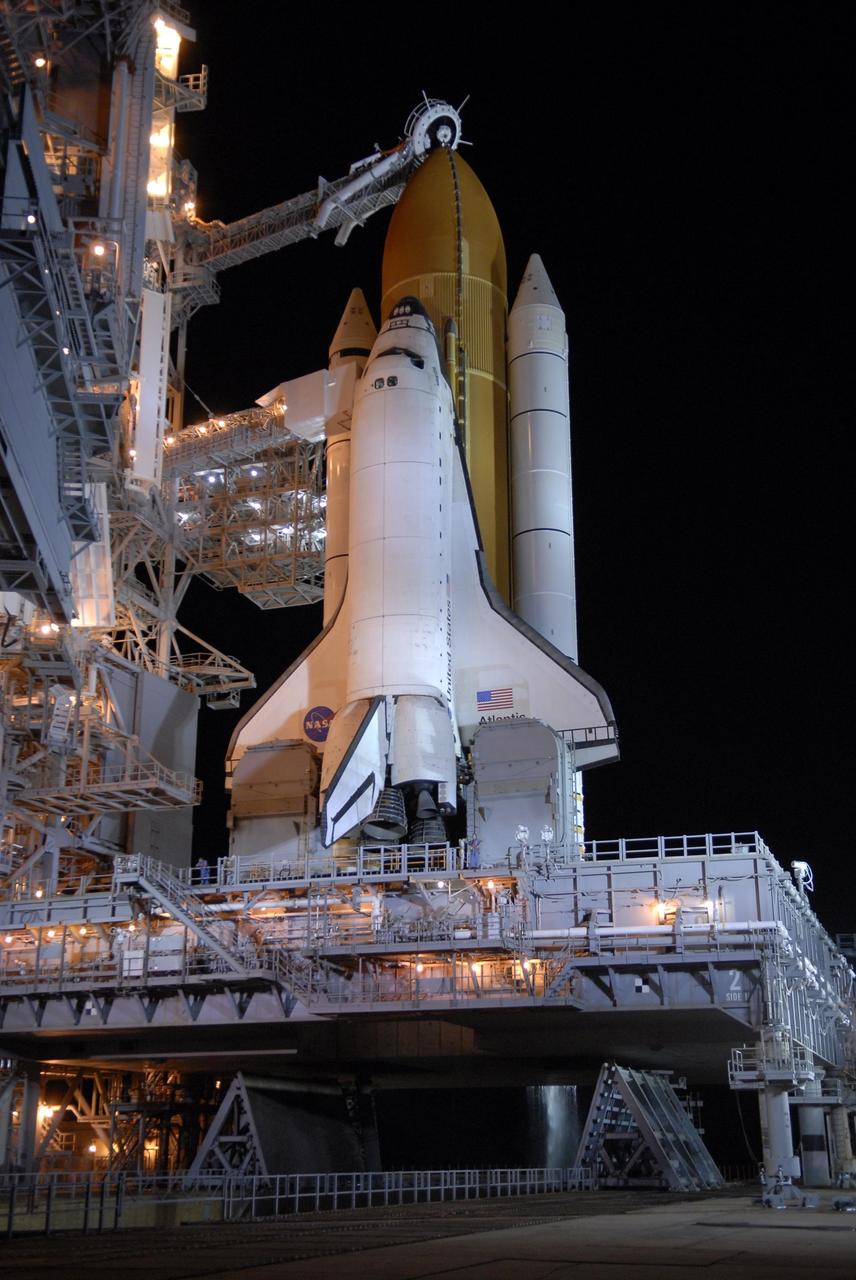
KENNEDY SPACE CENTER, FLA. -- After rollback of the rotating service structure, or RSS, on Launch Pad 39A, Space Shuttle Atlantis stands bathed in lights. Rollback is one of the milestones in preparation for the launch of mission STS-117 on June 8. Rollback started at 10:56 p.m. and was complete at 11:34 p.m EDT. The RSS provides protected access to the orbiter for changeout and servicing of payloads at the pad. The structure is supported by a rotating bridge that pivots about a vertical axis on the side of the pad's flame trench. The hinge column rests on the pad surface and is braced to the fixed service structure. Support for the outer end of the bridge is provided by two eight-wheel, motor-driven trucks that move along circular twin rails installed flush with the pad surface. The track crosses the flame trench on a permanent bridge. The RSS is 102 feet long, 50 feet wide and 130 feet high. The structure has orbiter access platforms at five levels to provide access to the payload bay while the orbiter is being serviced in the RSS. Each platform has independent extendable planks that can be arranged to conform to a payload's configuration. This mission is the 118th shuttle flight and the 21st U.S. flight to the International Space Station and will deliver and install the S3/S4 truss segment, deploy a set of solar arrays and prepare them for operation. Photo credit: NASA/Kim Shiflett
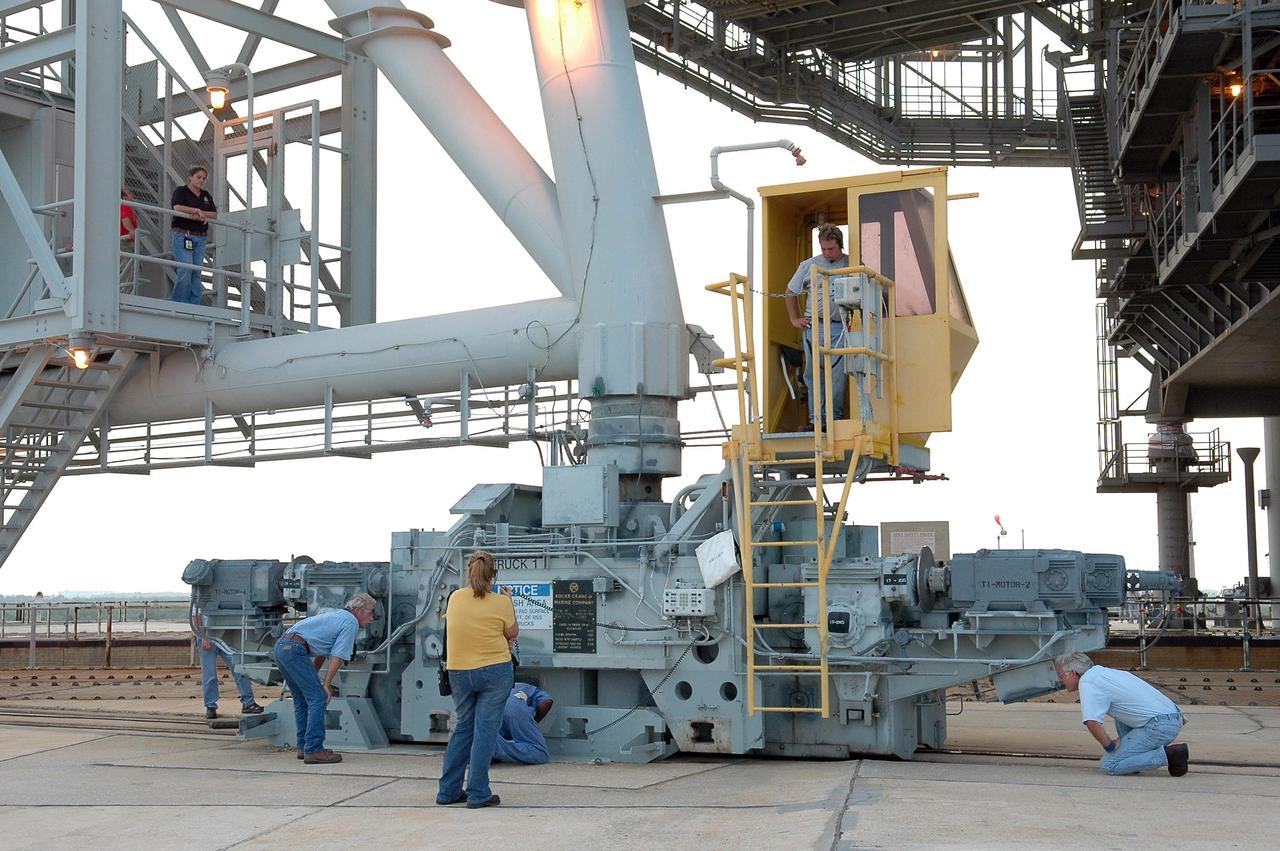
KENNEDY SPACE CENTER, FLA. - On Launch Pad 39B, workers check one of the two trucks that move the rotating service structure (RSS). In preparation for the July 1 launch of Space Shuttle Discovery on mission STS-121, the RSS is being rolled away from the shuttle. The RSS provides protected access to the orbiter for changeout and servicing of payloads at the pad. The structure is supported by a rotating bridge that pivots about a vertical axis on the west side of the pad's flame trench. The hinge column rests on the pad surface and is braced to the fixed service structure. Support for the outer end of the bridge is provided by two eight-wheel, motor-driven trucks that move along circular twin rails installed flush with the pad surface. The track crosses the flame trench on a permanent bridge. The RSS is 102 feet long, 50 feet wide and 130 feet high. The structure has orbiter access platforms at five levels to provide access to the payload bay while the orbiter is being serviced in the RSS. Each platform has independent extendable planks that can be arranged to conform to a payload's configuration. This mission is the 115th shuttle flight and the 18th U.S. flight to the International Space Station. Photo credit: NASA/Kim Shiflett
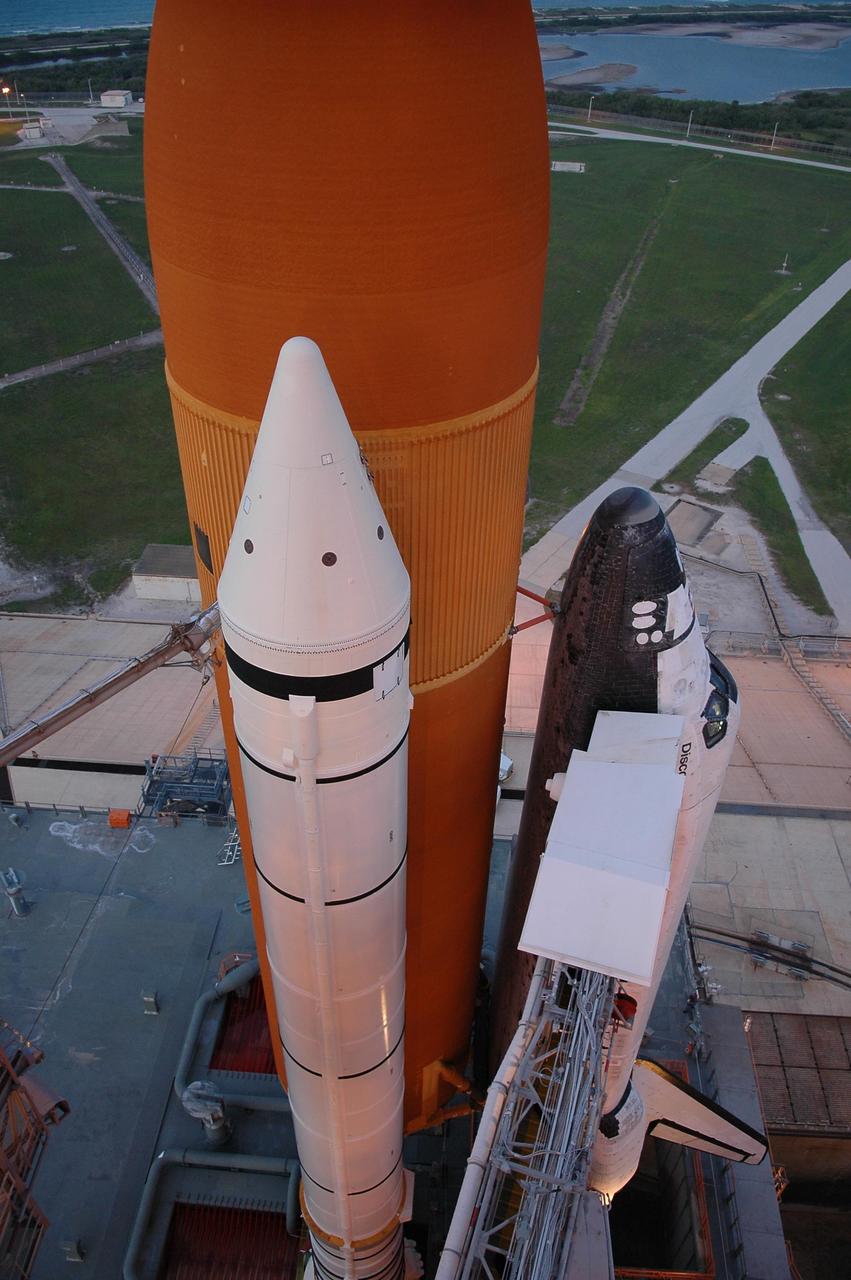
KENNEDY SPACE CENTER, FLA. - Viewed from an upper level of the fixed service structure on Launch Pad 39B, Space Shuttle Discovery looms over the pad and surrounding area after rollback of the rotating service structure (RSS). The rollback was in preparation for launch July 1 on mission STS-121. Extending toward the cockpit of the shuttle is the orbiter access arm with the White Room extended. The White Room provides access into the orbiter for the astronauts. The RSS provides protected access to the orbiter for changeout and servicing of payloads at the pad. The structure is supported by a rotating bridge that pivots about a vertical axis on the west side of the pad's flame trench. The hinge column rests on the pad surface and is braced to the fixed service structure. Support for the outer end of the bridge is provided by two eight-wheel, motor-driven trucks that move along circular twin rails installed flush with the pad surface. The track crosses the flame trench on a permanent bridge. The RSS is 102 feet long, 50 feet wide and 130 feet high. The structure has orbiter access platforms at five levels to provide access to the payload bay while the orbiter is being serviced in the RSS. Each platform has independent extendable planks that can be arranged to conform to a payload's configuration. This mission is the 115th shuttle flight and the 18th U.S. flight to the International Space Station. Photo credit: NASA/Kim Shiflett
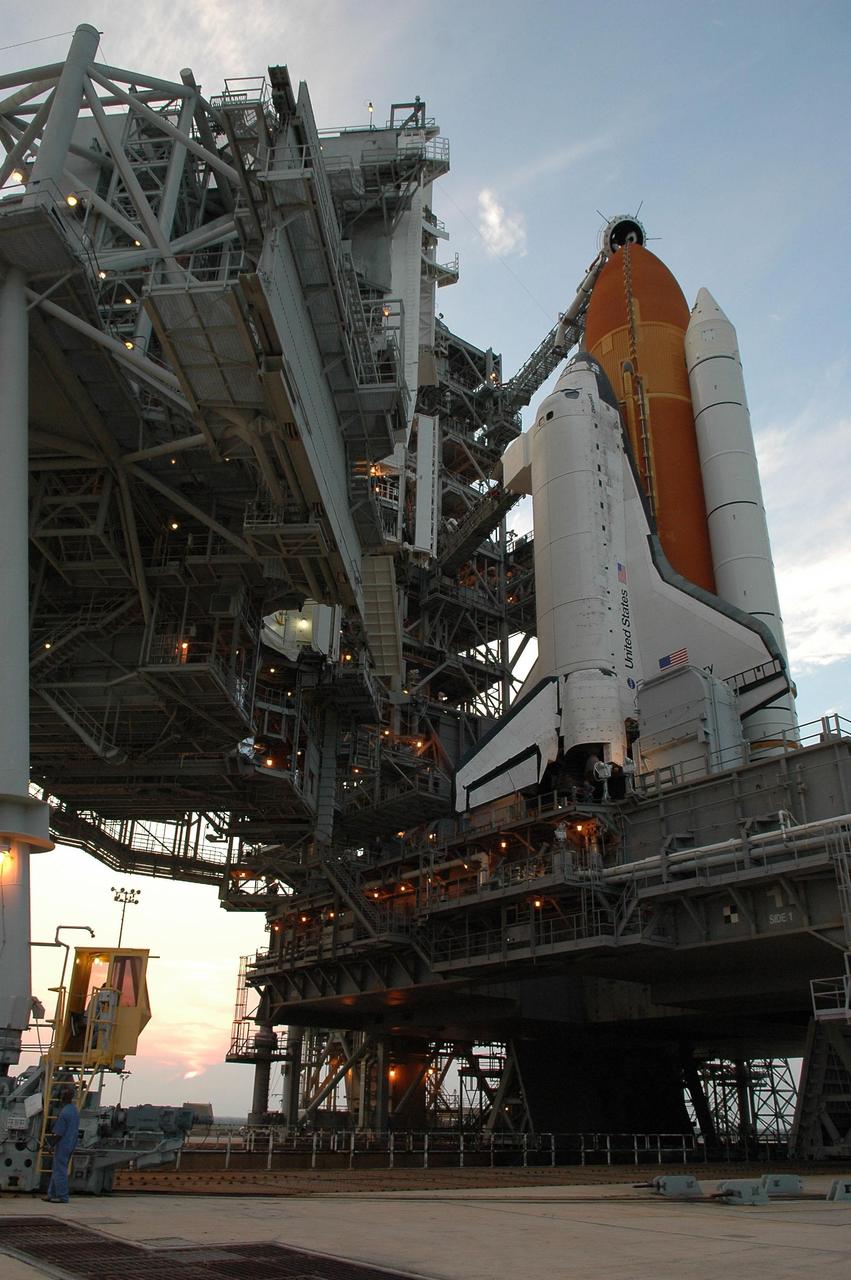
KENNEDY SPACE CENTER, FLA. - In preparation for the July 1 launch of Space Shuttle Discovery on mission STS-121, the Launch Pad 39B rotating service structure (RSS) enclosing the shuttle rolls away. The RSS provides protected access to the orbiter for changeout and servicing of payloads at the pad. The structure is supported by a rotating bridge that pivots about a vertical axis on the west side of the pad's flame trench. The hinge column rests on the pad surface and is braced to the fixed service structure. Support for the outer end of the bridge is provided by two eight-wheel, motor-driven trucks that move along circular twin rails installed flush with the pad surface. The track crosses the flame trench on a permanent bridge. The RSS is 102 feet long, 50 feet wide and 130 feet high. The structure has orbiter access platforms at five levels to provide access to the payload bay while the orbiter is being serviced in the RSS. Each platform has independent extendable planks that can be arranged to conform to a payload's configuration. This mission is the 115th shuttle flight and the 18th U.S. flight to the International Space Station. Photo credit: NASA/Kim Shiflett
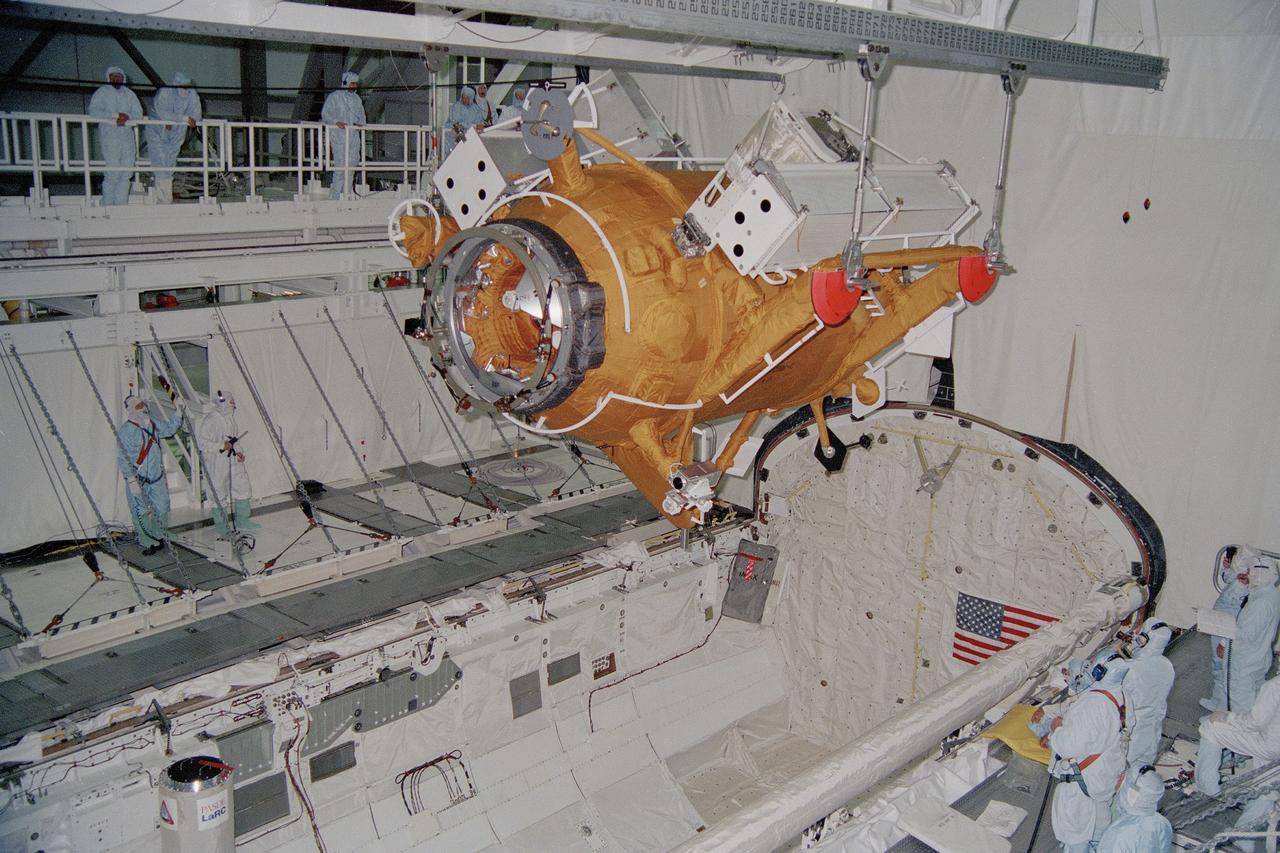
CAPE CANAVERAL, Fla. -- At NASA's Kennedy Space Center in Florida, the Russian-built Docking Module is lowered for installation into the payload bay of the space shuttle Atlantis while it is in bay 2 of the Orbiter Processing Facility. The module will fly as a primary payload on the second Space Shuttle/Mir space station docking mission, STS-74. During the mission, the module will first be attached with the orbiter's robot arm to the Orbiter Docking System in the payload bay of the orbiter Atlantis and then be docked with the Mir. When Atlantis undocks from the Mir, it will leave the new docking module permanently attached to the space station for use during future shuttle Mir docking missions. The new module will simplify future Shuttle linkups with Mir by improving orbiter clearances when it serves as a bridge between the two spacecraft. The white structures attached to the module's sides are solar panels that will be attached to the Mir after the conclusion of the STS-74 mission. Photo Credit: NASA
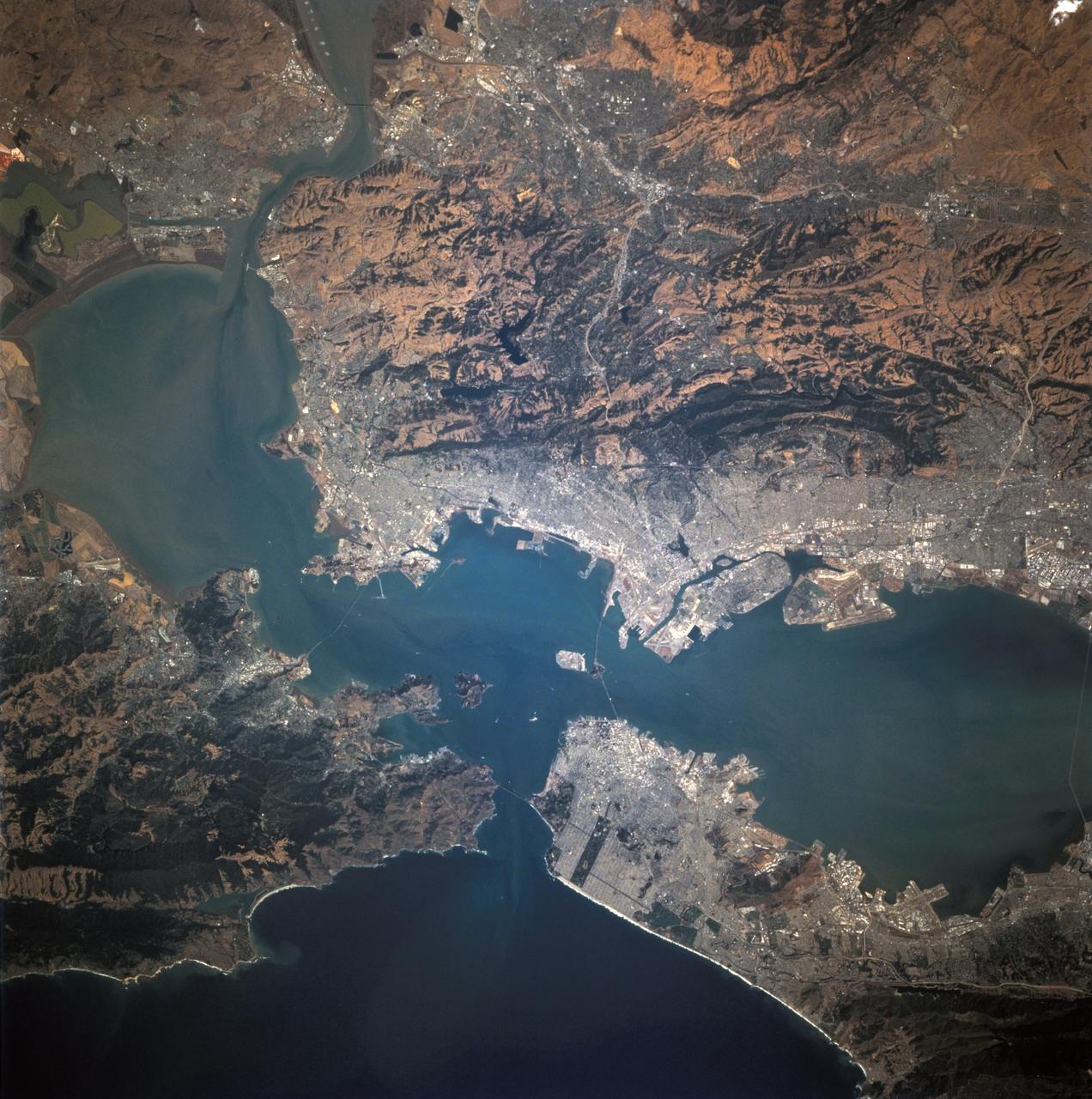
STS068-244-022 (30 September-11 October 1994) --- (San Francisco, San Pablo Bay Area) Photographed through the Space Shuttle Endeavour's flight deck windows, the heavily populated bay area is featured in this 70mm frame. The relatively low altitude of Endeavour's orbit (115 nautical miles) and the use of a 250mm lens on the Hasselblad camera allowed for capturing detail in features such as the Berkeley Marina (frame center). The region's topography is well depicted with the lowland areas heavily populated and the hills much more sparsely covered. The Oakland Hills in the right lower center appear to be re-vegetated after a devastating fire. The Golden Gate Recreation Area in the upper left also shows heavy vegetation. The three bridges across the main part of the bay and their connecting roads are prominent. Cultural features such as Golden Gate Park and the Presidio contrast with the gray of the city.
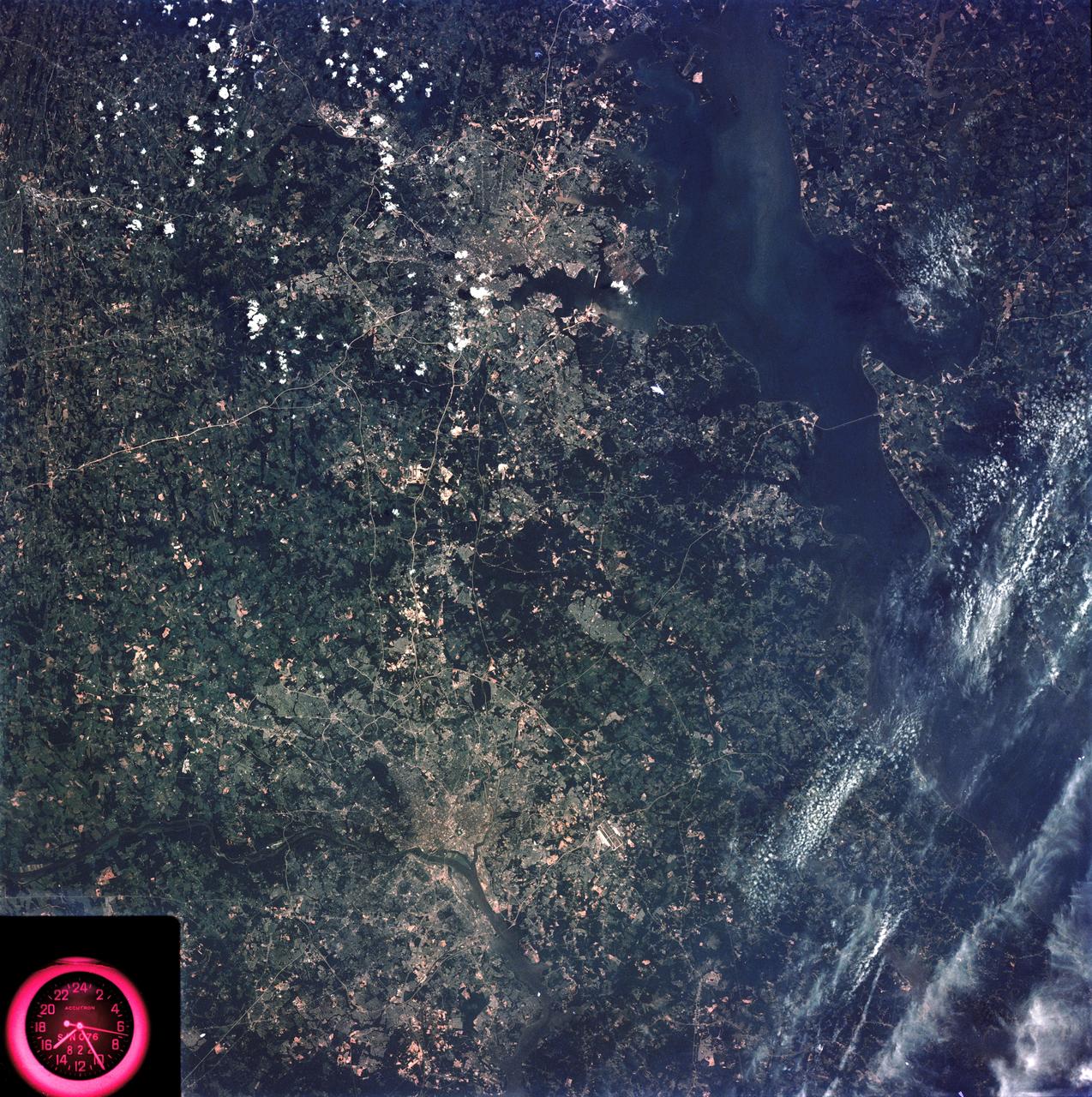
SL3-83-166 (July-September 1973) --- A vertical view of the Washington D.C. and the Baltimore, Maryland area is seen in the Skylab 3 Earth Resources Experiments Package S190-B (five-inch Earth terrain camera) photograph taken from the Skylab space station in Earth orbit. The Chesapeake Bay is on the right (east) side of the picture. The Potomac River flows through the Washington area in the lower left (southwest) corner of the photograph. Several transportation routes and major highways stand out very distinctly. Especially conspicuous are the beltways around the cities, Interstate 95 between Baltimore and the nation?s capitol and Interstate 70N leading west from Baltimore. The tunnel and harbor facilities in Baltimore show clearly, also. Identifiable features in the Washington area include the Capitol Building, the Mall area, Robert F. Kennedy Stadium (white circle), the five bridges across the Potomac, Andrews Air Force Base (on east loop), and the smaller Anacostia River. The extent of the urbanization in this area is dramatically illustrated in this picture. The photograph has sufficient resolution that the housing patterns for individual suburban areas are clearly defined with the houses shown as pink gray, wooded areas as dark green and cleared areas light green. Chesapeake Bay circulation patterns are indicated by contrast of dark and light blue. Sediment plumes (red) are seen entering the bay north and east of Baltimore. The bay bridge stands out white against the blue water. The detailed information contained in this one photograph will be of direct use to several EREP investigator teams in land use analysis, sedimentation and circulation patterns in the bay, and resource surveys of Maryland. All EREP photography is available to the public through the Department of Interior?s Earth Resources Observations Systems Data Center, Sioux Falls, South Dakota, 57198. Photo credit: NASA
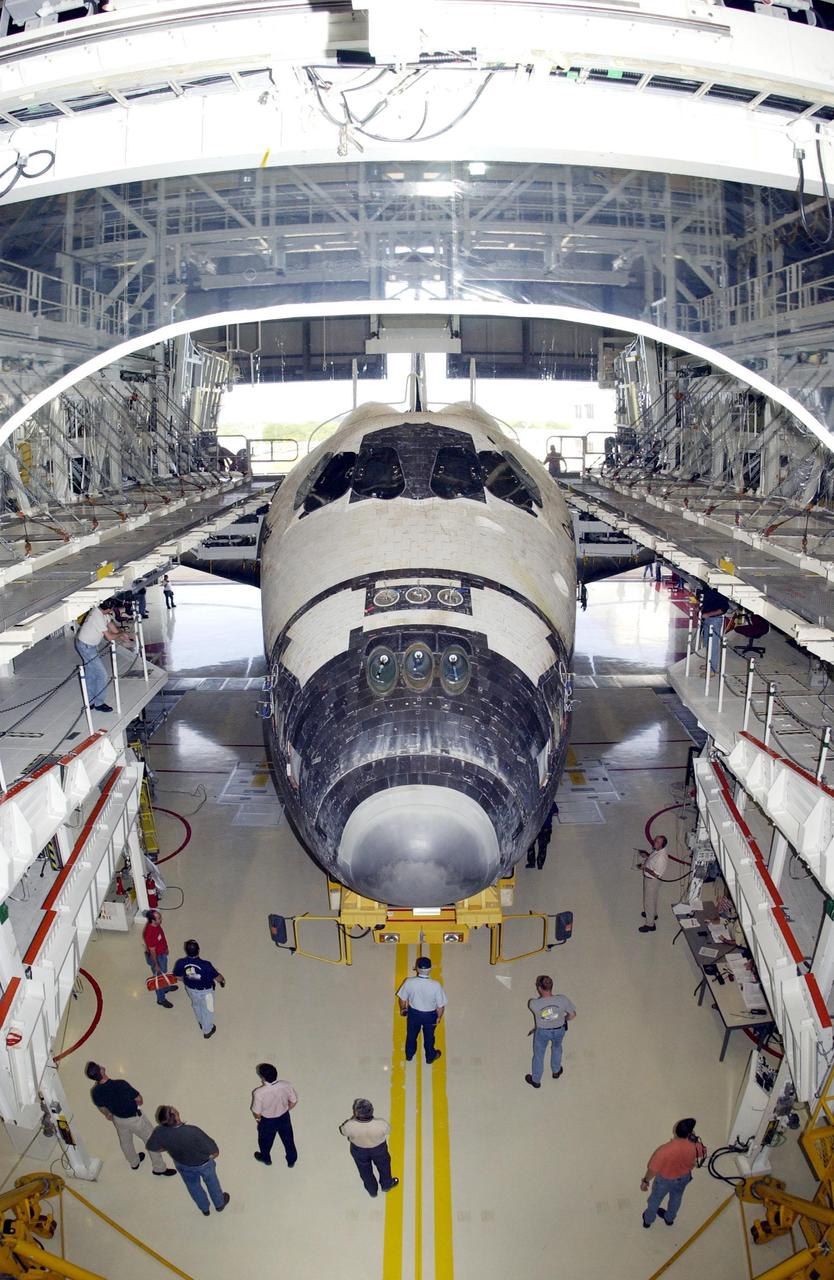
KENNEDY SPACE CENTER, FLA. -- Inside an Orbiter Processing Facility bay, Space Shuttle Columbia is readied for its move to the Vehicle Assembly Building. The orbiter is being prepared to fly on mission STS-107 now targeted for no earlier than Jan. 16, 2003. The STS-107 mission will be dedicated to microgravity research. The payloads include the Hitchhiker Bridge, a carrier for the Fast Reaction Experiments Enabling Science, Technology, Applications and Research (FREESTAR) incorporating eight high priority secondary attached Shuttle experiments, and the SHI Research Double Module (SHI/RDM), also known as SPACEHAB.
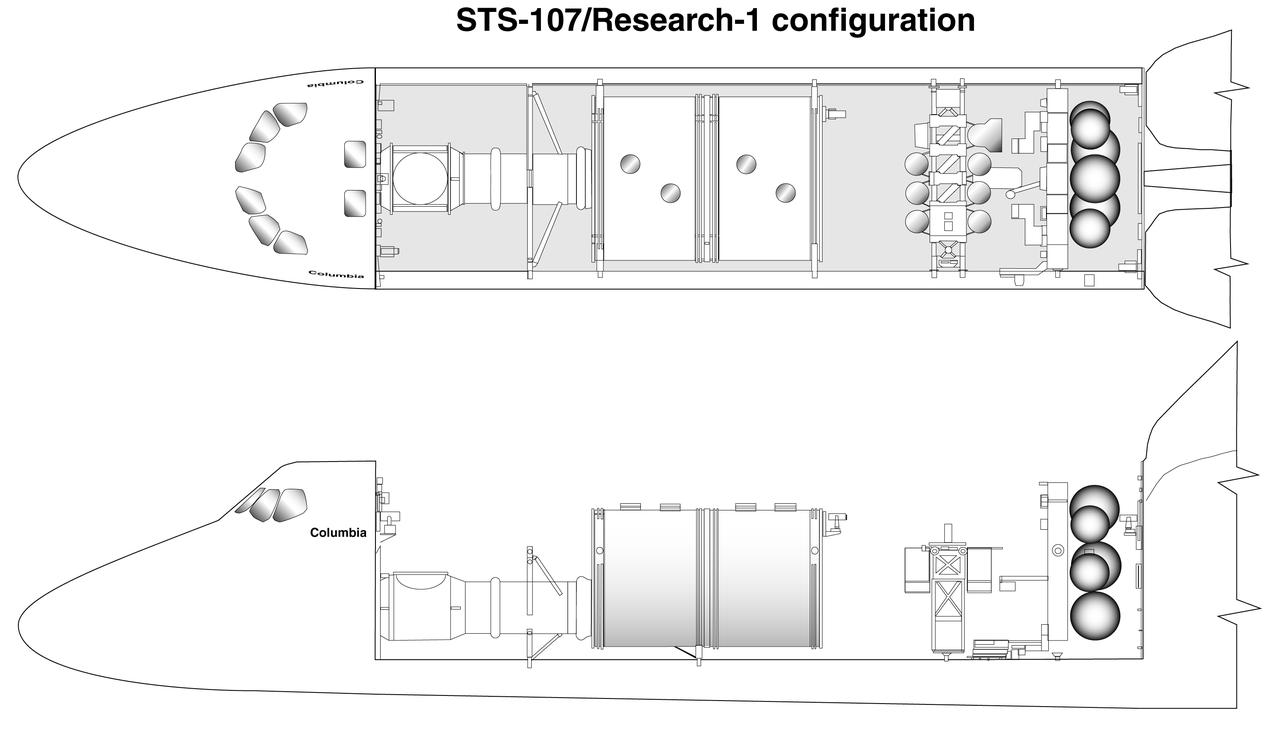
Thisdiagram shows the general arrangement of the payloads to be carried by the multidisciplinary STS-107 Research-1 Space Shuttle mission in 2002. The Spacehab module will host experiments that require direct operation by the flight crew. Others with special requirements will be on the GAS Bridge Assembly sparning the payload bay. The Extended Duration Orbiter kit carries additional oxygen and hydrogen for the electricity-producing fuel cells. Research-1 experiments will cover space biology, life science, microgravity research, and commercial space product development, research sponsored by NASA's Office of Biological and Physical Research. An alternative view with callouts is available at 0101764.
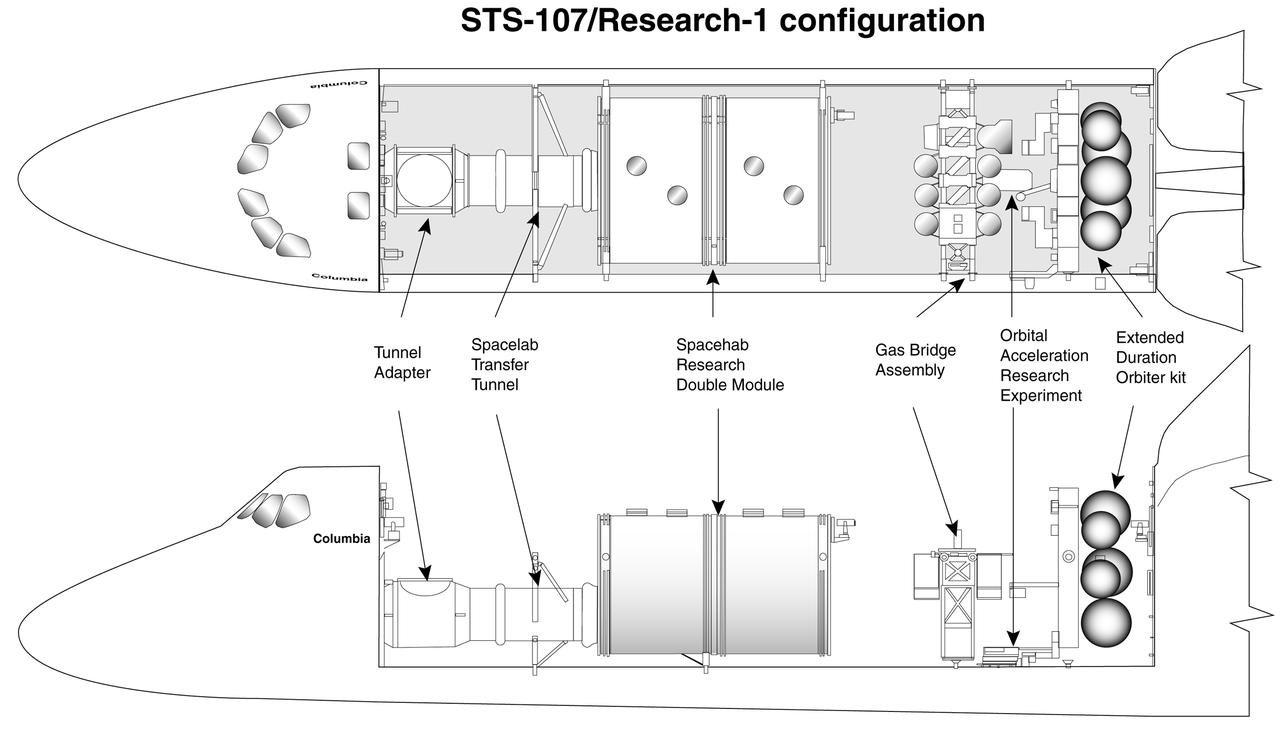
This diagram shows the general arrangement of the payloads to be carried by the multidisciplinary STS-107 Research-1 Space Shuttle mission in 2002. The Spacehab module will host experiments that require direct operation by the flight crew. Others with special requirements will be on the GAS Bridge Assembly sparning the payload bay. The Extended Duration Orbiter kit carries additional oxygen and hydrogen for the electricity-producing fuel cells. Research-1 experiments will cover space biology, life science, microgravity research, and commercial space product development, research sponsored by NASA's Office of Biological and Physical Research. An alternative view without callouts is available at 0101765.
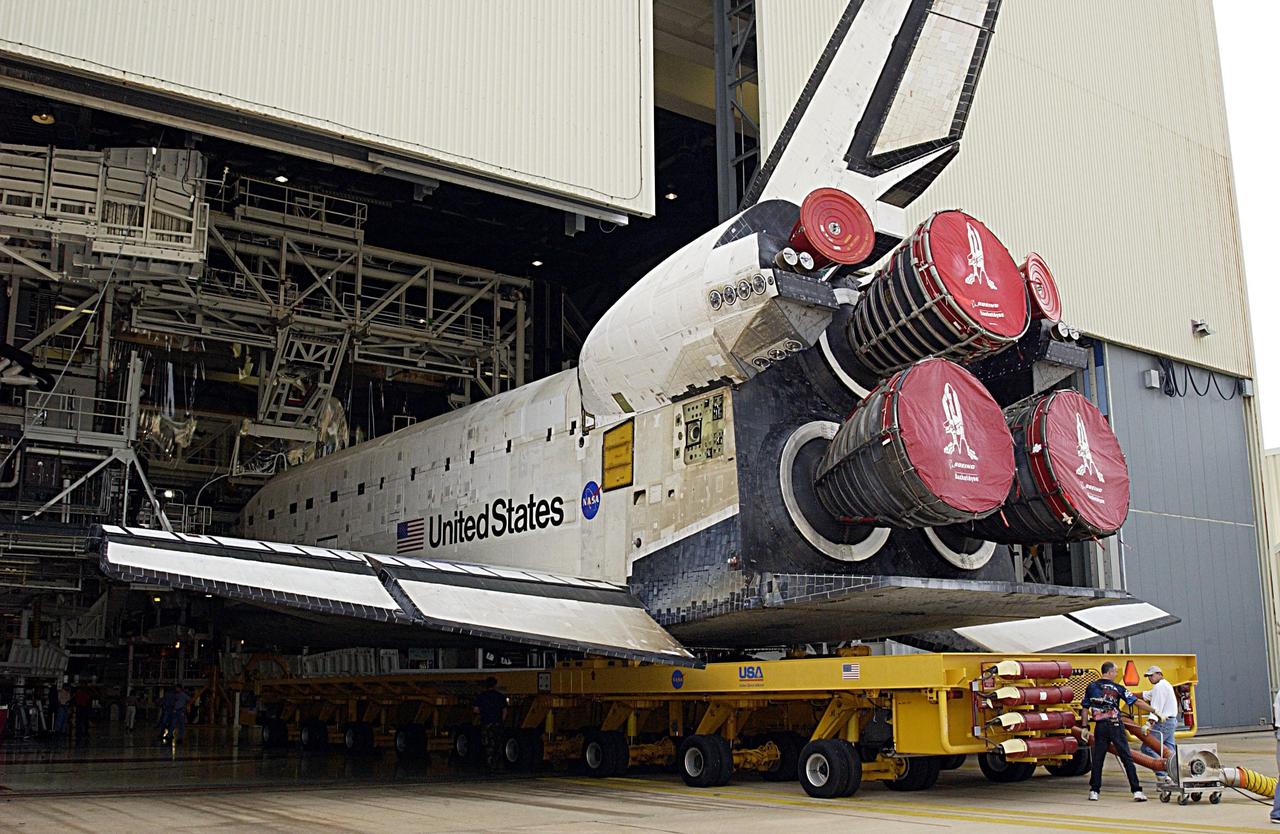
KENNEDY SPACE CENTER, FLA. -- Space Shuttle Columbia is backed out of its Orbiter Processing Facility bay as it starts its move to the Vehicle Assembly Building. The orbiter is being prepared to fly on mission STS-107 now targeted for no earlier than Jan. 16, 2003. The STS-107 mission will be dedicated to microgravity research. The payloads include the Hitchhiker Bridge, a carrier for the Fast Reaction Experiments Enabling Science, Technology, Applications and Research (FREESTAR) incorporating eight high priority secondary attached Shuttle experiments, and the SHI Research Double Module (SHI/RDM), also known as SPACEHAB.
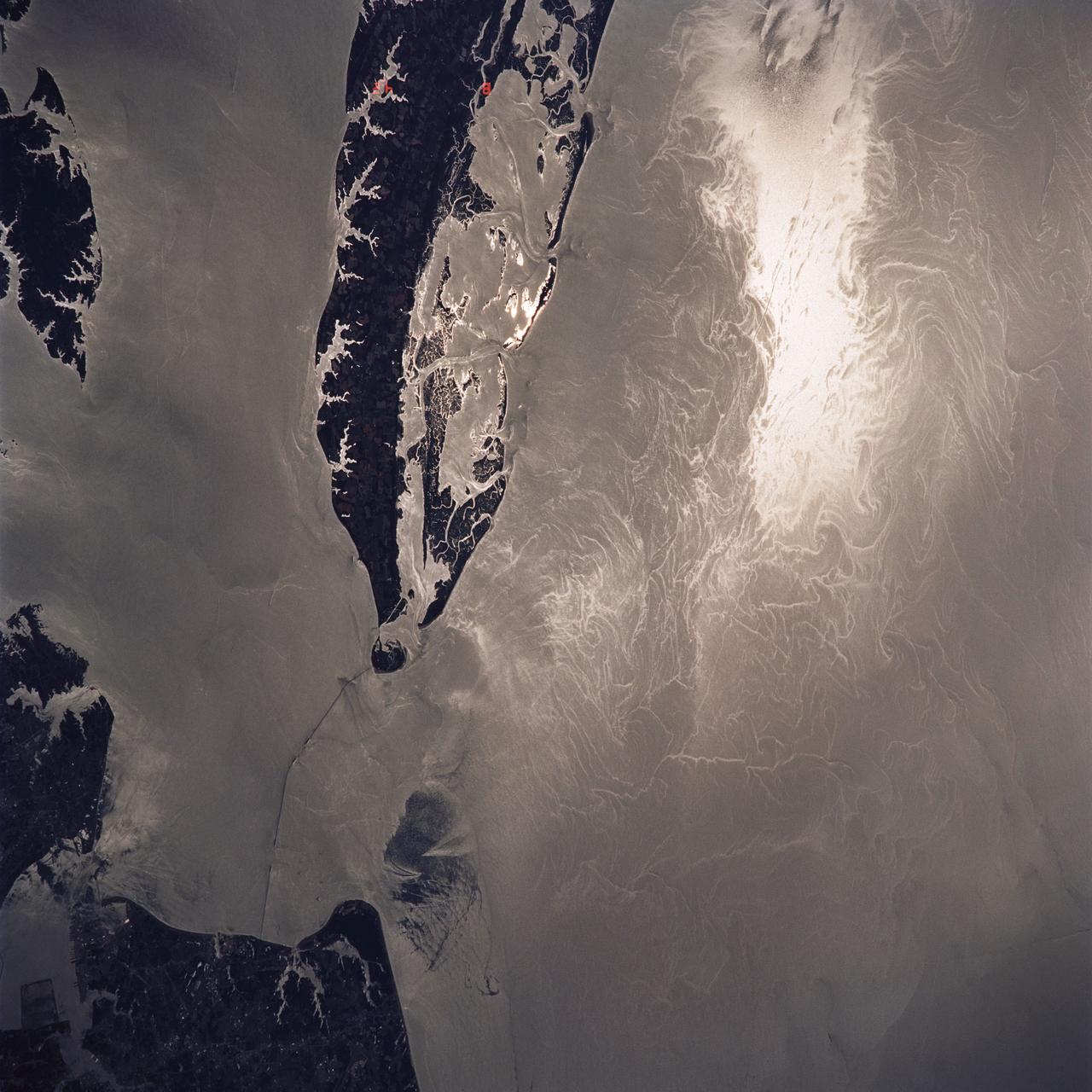
STS040-614-047 (5-14 June 1991) --- This image is of the Norfolk, Virginia -- Southern Delmarva Peninsula Southern Chesapeake Bay Area as seen in sunlight. The exposure is adjusted to emphasize the water patterns present. The outgoing tide generates considerable turbulence as it passes through the mouth of the bay. This is displayed by differences in reflective properties of the water surface due to differences in slope and turbidity. Ship wakes and the wakes of subsurface structures are seen clearly. The bridge tunnel system linking Norfolk with the peninsula and its effect on the system is quite apparent. Sunglint images over land areas were also acquired which emphasize land-water boundaries as demonstrated here in the small Delmarva inlets as a tool for wetland mapping, and river, lake and even pond description. During the first few days of the STS-40 mission the Eastern Seaboard of the United States was free of clouds and haze providing excellent photography of many of the major cities and the countryside of that area as well as the Gulf Stream.
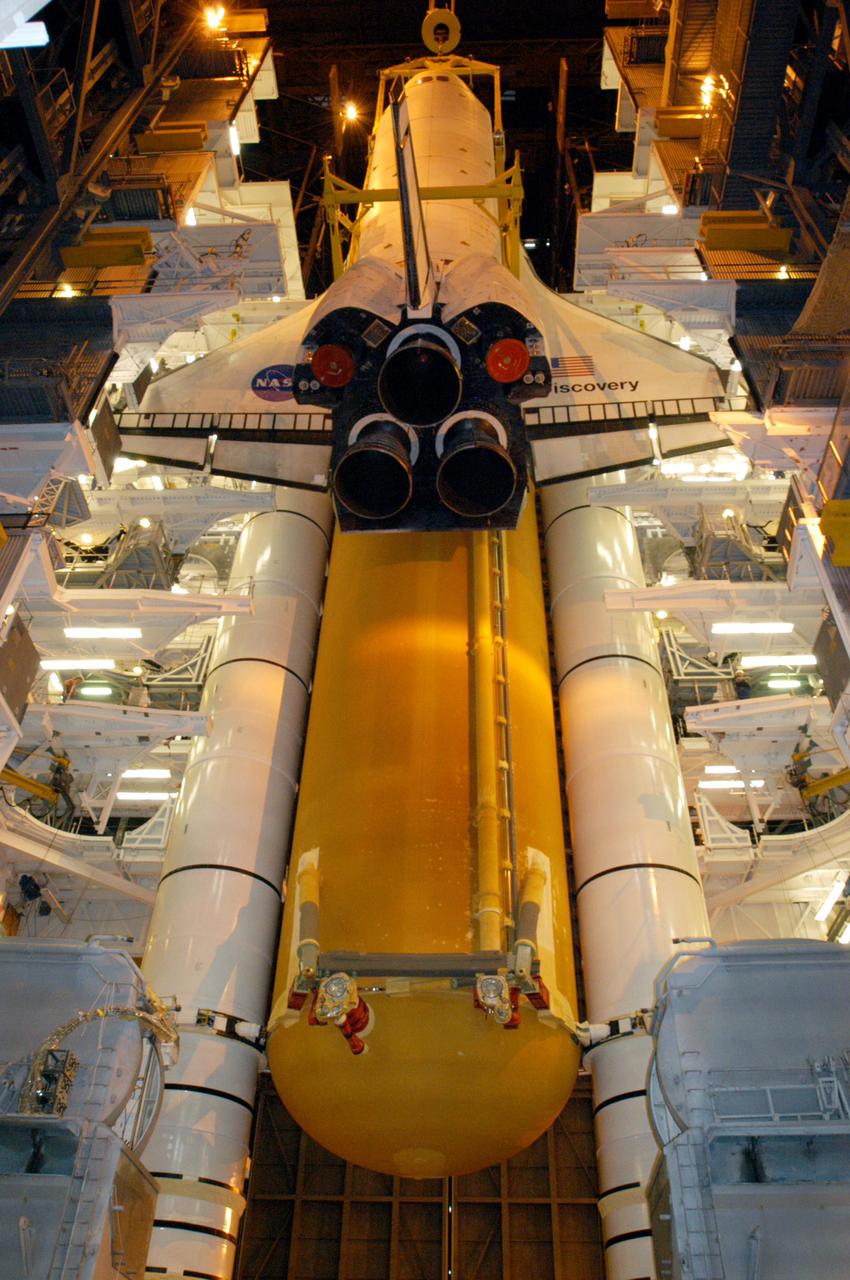
KENNEDY SPACE CENTER, FLA. - Suspended by a 175-ton bridge crane, the orbiter Discovery has cleared the cross-beam into high bay 3 and is lowered next to the new External Tank, ET-121, and Solid Rocket Boosters in the bay for mating. That tank was originally scheduled to fly with Atlantis on the second Return to Flight mission, STS-121. A new heater was added to the tank's feedline bellows, part of the pipeline that carries the liquid oxygen to the orbiter’s main engines, to minimize the potential for ice and frost buildup. After the remate, technicians will work final closeouts on the fully assembled Space Shuttle stack, and perform liquid oxygen and liquid hydrogen electrical mates and an interface verification test. Discovery is currently scheduled to return to Launch Pad 39B on June 13.
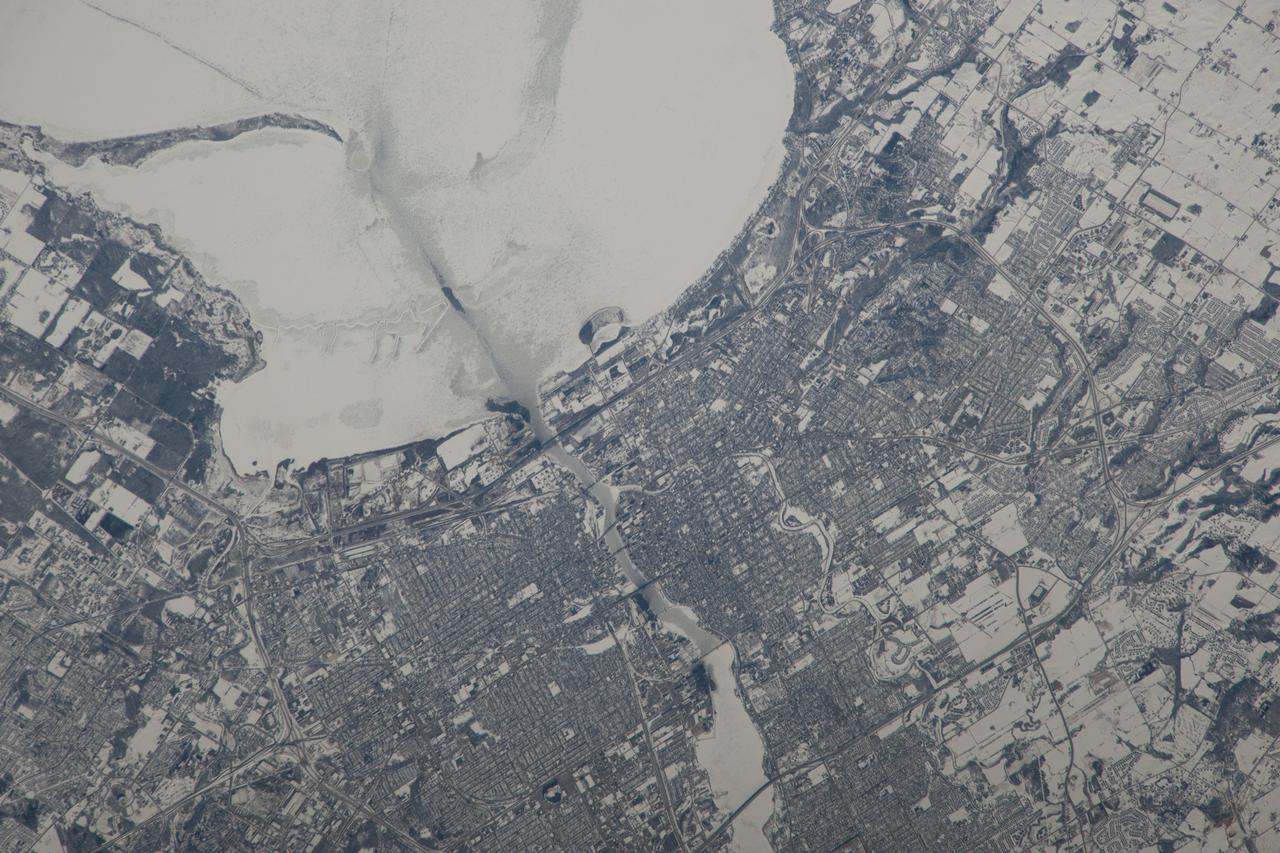
ISS038-E-057979 (22 Feb. 2014) --- This image, photographed by one of the Expedition 38 crew members aboard the International Space Station, shows the city of Green Bay, Wisconsin at the southern end of icebound Green Bay. This arm of Lake Michigan is six miles wide as seen in this view. The heavy snowfalls of the winter of 2014 cover the landscape. Combined with low sun illumination of a winter day, all surfaces appear as shades of gray. Fields appear brighter (top right, lower right), the cityscape (lower half of the image) appears as a checkerboard of grays, and forests (top left) appear dark. The center of the city lies on the Fox River, one of the few larger rivers in the United States that flow north. Open water appears as dark patches at the mouth of the river where a power station emits warm water. Thinner (grayer) ice can be detected where slightly warmer water extends from the river mouth towards Long Tail Point, an ancient shoreline of the bay. Crews aboard the space station do not usually take such detailed photographs because of the difficulty of getting sharp images with long lenses (in this case a 1000mm lens). Streets and bridges crossing the Fox River appear quite clearly.
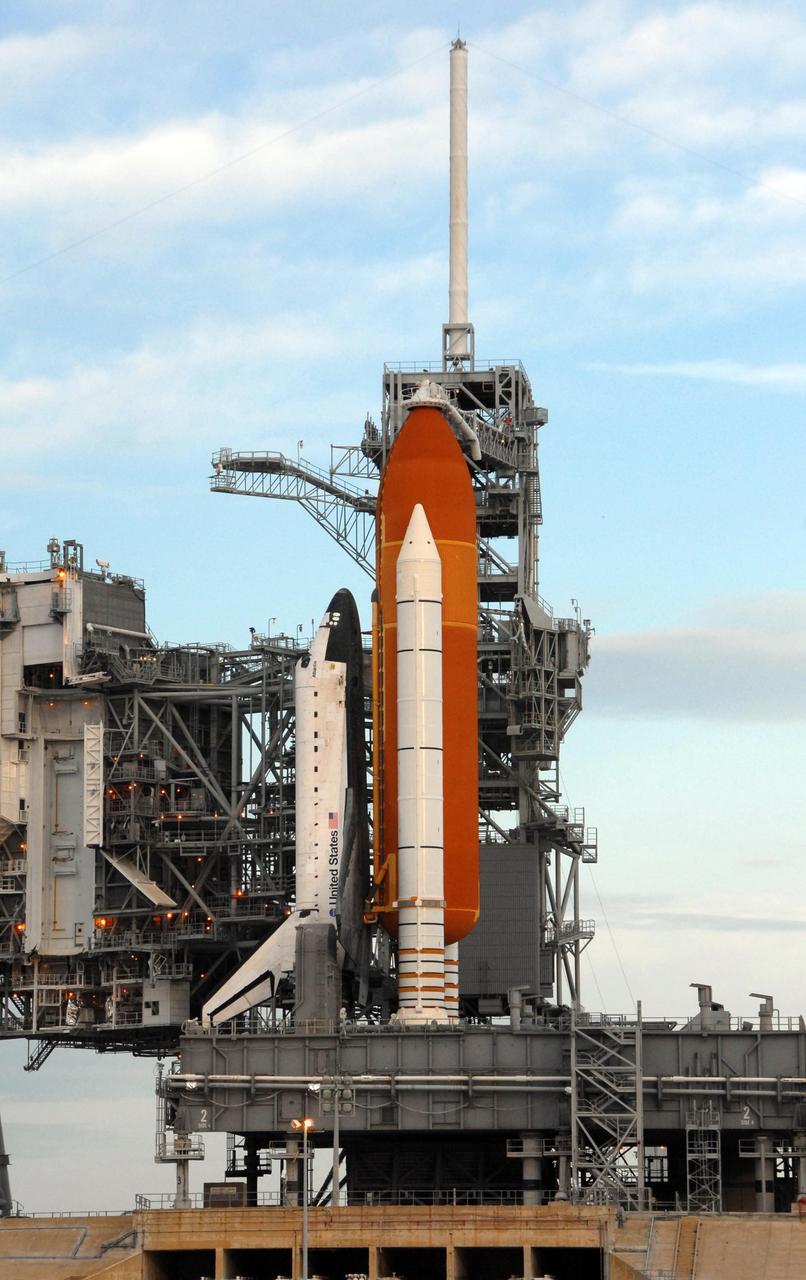
KENNEDY SPACE CENTER, FLA. -- The lightning mast on Launch Pad 39A stands ready to protect Space Shuttle Atlantis from potential thunderstorms following sunrise on a cloudy Florida day. Rollback of the pad's rotating service structure, or RSS, is one of the milestones in preparation for the launch of mission STS-117 on June 8. Rollback started at 10:56 p.m. EDT June 7 and was complete at 11:34 p.m. The RSS, the massive structure to the left of the shuttle, provides protected access to the orbiter for changeout and servicing of payloads at the pad. The structure is supported by a rotating bridge that pivots about a vertical axis on the side of the pad's flame trench. The hinge column rests on the pad surface and is braced to the fixed service structure. Support for the outer end of the bridge is provided by two eight-wheel, motor-driven trucks that move along circular twin rails installed flush with the pad surface. The track crosses the flame trench on a permanent bridge. The RSS is 102 feet long, 50 feet wide and 130 feet high. The structure has orbiter access platforms at five levels to provide access to the payload bay while the orbiter is being serviced in the RSS. Each platform has independent extendable planks that can be arranged to conform to a payload's configuration. This mission is the 118th shuttle flight and the 21st U.S. flight to the International Space Station and will deliver and install the S3/S4 truss segment, deploy a set of solar arrays and prepare them for operation. Photo credit: NASA/Ken Thornsley
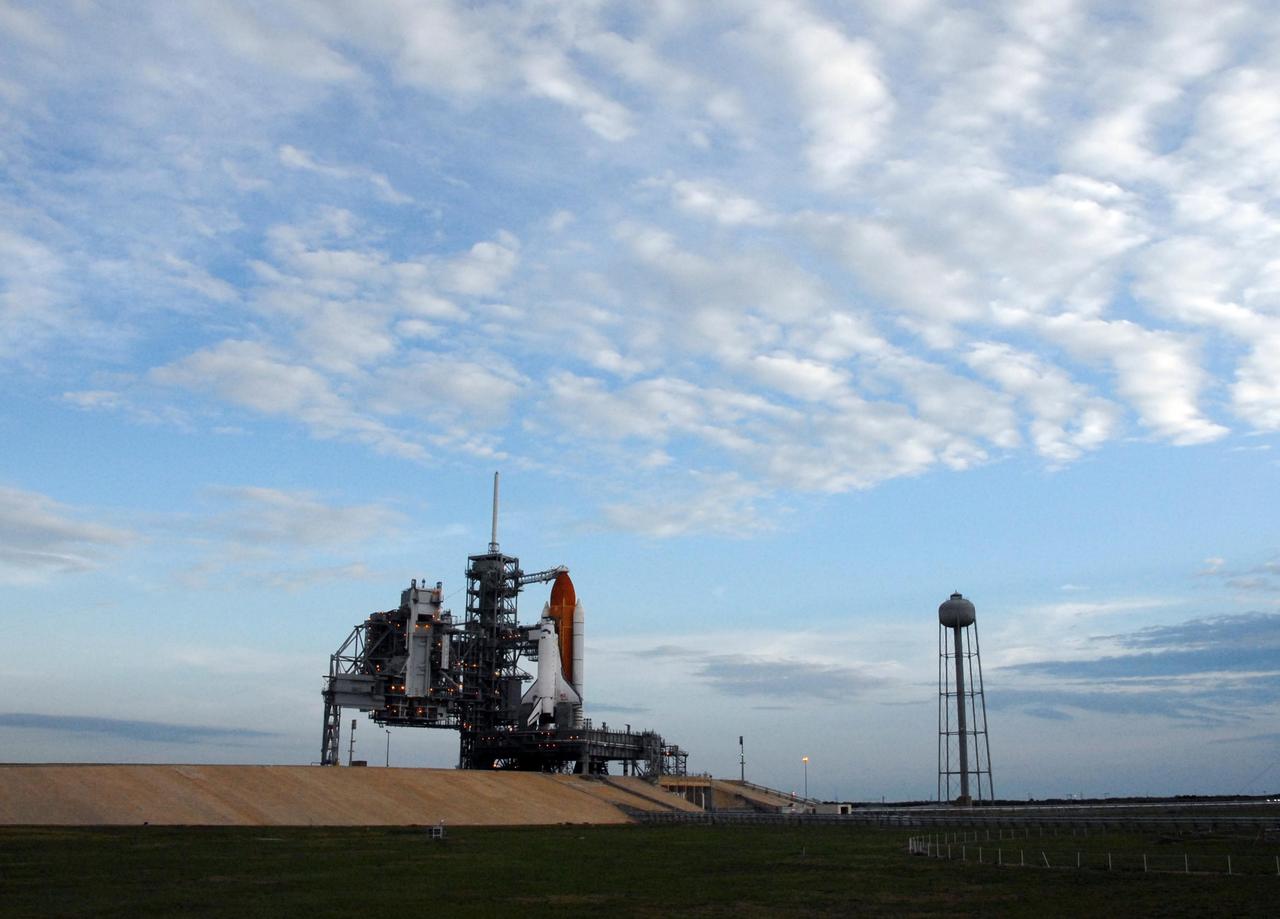
KENNEDY SPACE CENTER, FLA. -- The sun rises on a cloudy Florida day to reveal Space Shuttle Atlantis awaiting launch atop a mobile launch platform at Launch Pad 39A. Rollback of the pad's rotating service structure, or RSS, is one of the milestones in preparation for the launch of mission STS-117 on June 8. Rollback started at 10:56 p.m. EDT June 7 and was complete at 11:34 p.m. The RSS, the massive structure to the left of the shuttle, provides protected access to the orbiter for changeout and servicing of payloads at the pad. The structure is supported by a rotating bridge that pivots about a vertical axis on the side of the pad's flame trench. The hinge column rests on the pad surface and is braced to the fixed service structure. Support for the outer end of the bridge is provided by two eight-wheel, motor-driven trucks that move along circular twin rails installed flush with the pad surface. The track crosses the flame trench on a permanent bridge. The RSS is 102 feet long, 50 feet wide and 130 feet high. The structure has orbiter access platforms at five levels to provide access to the payload bay while the orbiter is being serviced in the RSS. Each platform has independent extendable planks that can be arranged to conform to a payload's configuration. This mission is the 118th shuttle flight and the 21st U.S. flight to the International Space Station and will deliver and install the S3/S4 truss segment, deploy a set of solar arrays and prepare them for operation. Photo credit: NASA/Ken Thornsley
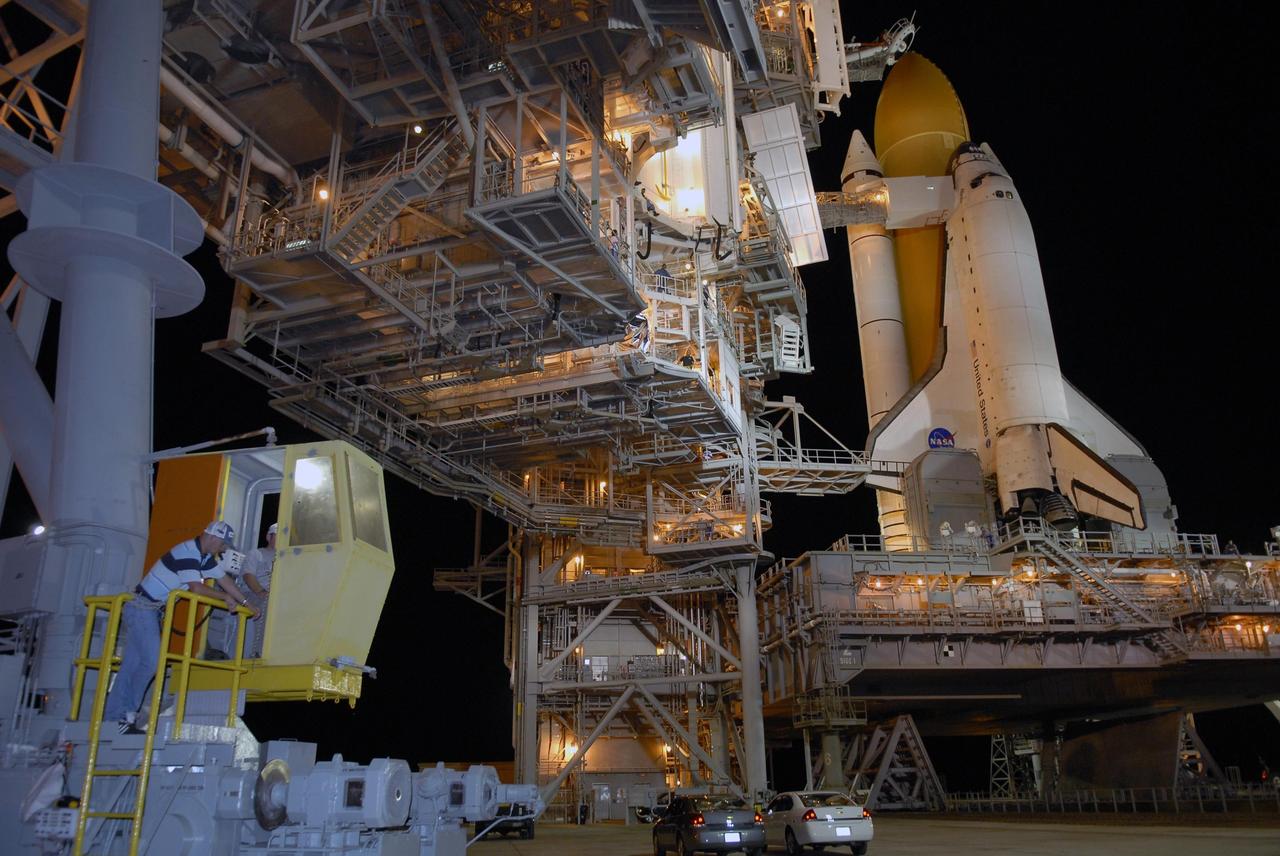
KENNEDY SPACE CENTER, FLA. -- At Launch Pad 39A, Space Shuttle Atlantis stands bathed in lights atop a mobile launch platform as technicians in the control booth roll the rotating service structure, or RSS, away from the orbiter. Rollback is one of the milestones in preparation for the launch of mission STS-117 on June 8. Rollback started at 10:56 p.m. and was complete at 11:34 p.m EDT. The RSS provides protected access to the orbiter for changeout and servicing of payloads at the pad. The structure is supported by a rotating bridge that pivots about a vertical axis on the side of the pad's flame trench. The hinge column rests on the pad surface and is braced to the fixed service structure. Support for the outer end of the bridge is provided by two eight-wheel, motor-driven trucks that move along circular twin rails installed flush with the pad surface. The track crosses the flame trench on a permanent bridge. The RSS is 102 feet long, 50 feet wide and 130 feet high. The structure has orbiter access platforms at five levels to provide access to the payload bay while the orbiter is being serviced in the RSS. Each platform has independent extendable planks that can be arranged to conform to a payload's configuration. This mission is the 118th shuttle flight and the 21st U.S. flight to the International Space Station and will deliver and install the S3/S4 truss segment, deploy a set of solar arrays and prepare them for operation. Photo credit: NASA/Kim Shiflett
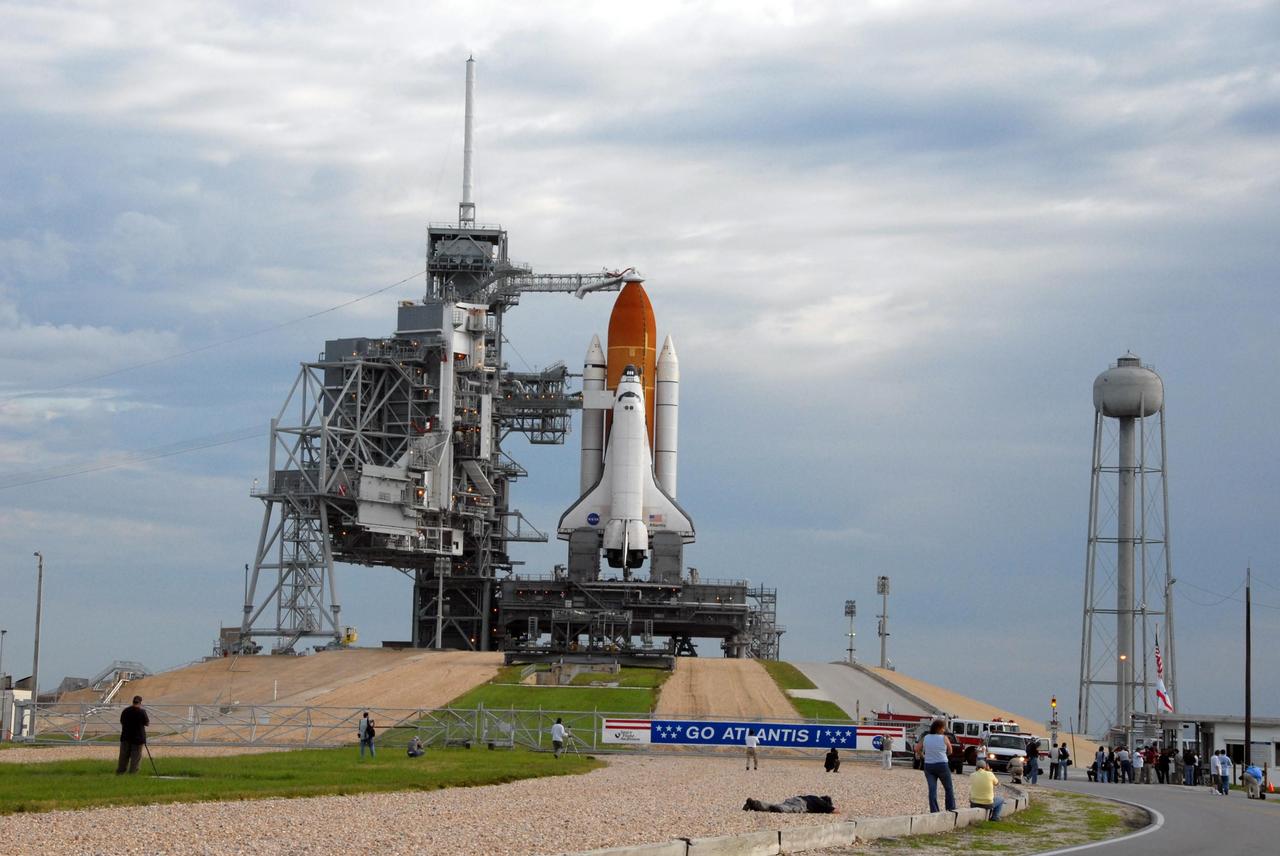
KENNEDY SPACE CENTER, FLA. -- On a cloudy Florida day, Space Shuttle Atlantis awaits launch atop a mobile launch platform at Launch Pad 39A. At the right of the pad is the 290-foot tall, 300,000-gallon water tank that is part of the sound suppression system during launches. In the foreground, photographers position themselves on the crawlerway, in hopes of capturing a unique prelaunch image. Rollback of the pad's rotating service structure, or RSS, is one of the milestones in preparation for the launch of mission STS-117 on June 8. Rollback started at 10:56 p.m. EDT June 7 and was complete at 11:34 p.m. The RSS, the massive structure to the left of the shuttle, provides protected access to the orbiter for changeout and servicing of payloads at the pad. The structure is supported by a rotating bridge that pivots about a vertical axis on the side of the pad's flame trench. The hinge column rests on the pad surface and is braced to the fixed service structure. Support for the outer end of the bridge is provided by two eight-wheel, motor-driven trucks that move along circular twin rails installed flush with the pad surface. The track crosses the flame trench on a permanent bridge. The RSS is 102 feet long, 50 feet wide and 130 feet high. The structure has orbiter access platforms at five levels to provide access to the payload bay while the orbiter is being serviced in the RSS. Each platform has independent extendable planks that can be arranged to conform to a payload's configuration. This mission is the 118th shuttle flight and the 21st U.S. flight to the International Space Station and will deliver and install the S3/S4 truss segment, deploy a set of solar arrays and prepare them for operation. Photo credit: NASA/Ken Thornsley
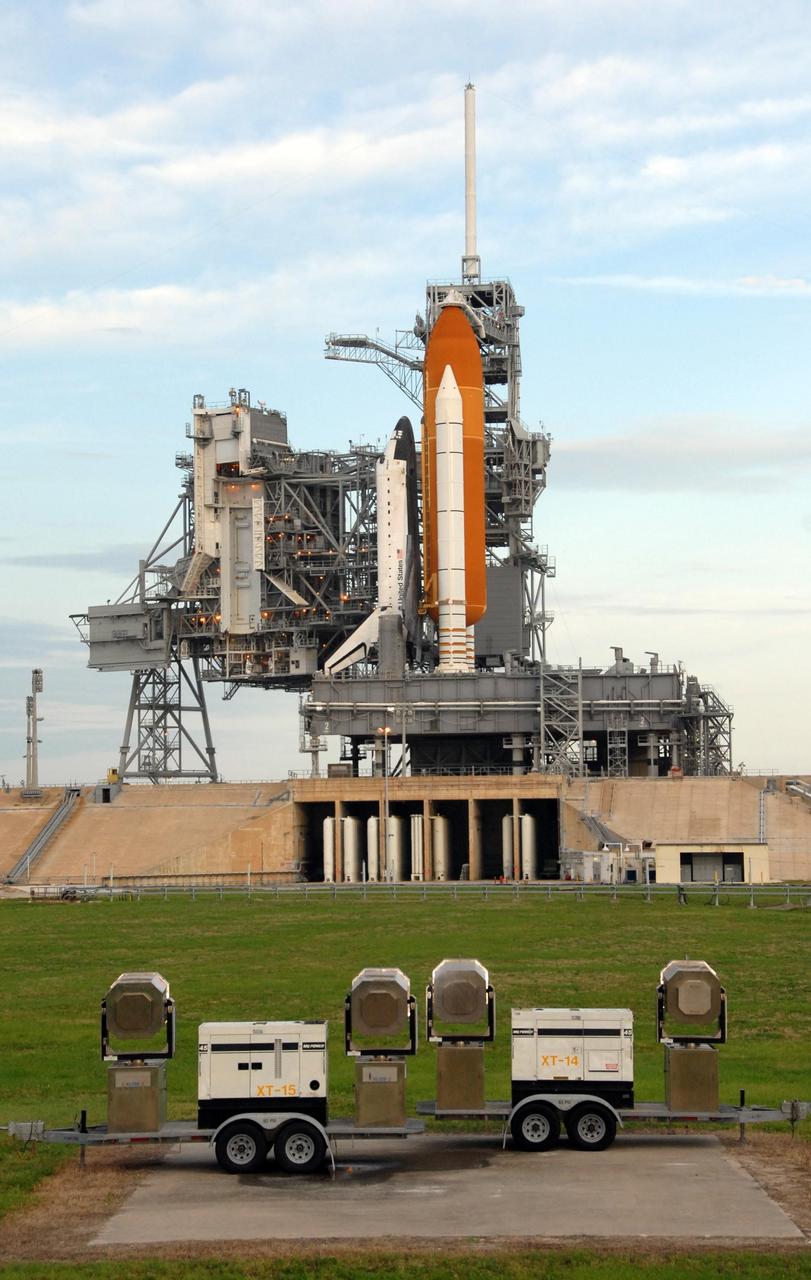
KENNEDY SPACE CENTER, FLA. -- Cameras are prepared to record the launch of Space Shuttle Atlantis from Launch Pad 39A following sunrise on a cloudy Florida day. Rollback of the pad's rotating service structure, or RSS, is one of the milestones in preparation for the launch of mission STS-117 on June 8. Rollback started at 10:56 p.m. EDT June 7 and was complete at 11:34 p.m. The RSS, the massive structure to the left of the shuttle, provides protected access to the orbiter for changeout and servicing of payloads at the pad. The structure is supported by a rotating bridge that pivots about a vertical axis on the side of the pad's flame trench. The hinge column rests on the pad surface and is braced to the fixed service structure. Support for the outer end of the bridge is provided by two eight-wheel, motor-driven trucks that move along circular twin rails installed flush with the pad surface. The track crosses the flame trench on a permanent bridge. The RSS is 102 feet long, 50 feet wide and 130 feet high. The structure has orbiter access platforms at five levels to provide access to the payload bay while the orbiter is being serviced in the RSS. Each platform has independent extendable planks that can be arranged to conform to a payload's configuration. This mission is the 118th shuttle flight and the 21st U.S. flight to the International Space Station and will deliver and install the S3/S4 truss segment, deploy a set of solar arrays and prepare them for operation. Photo credit: NASA/Ken Thornsley
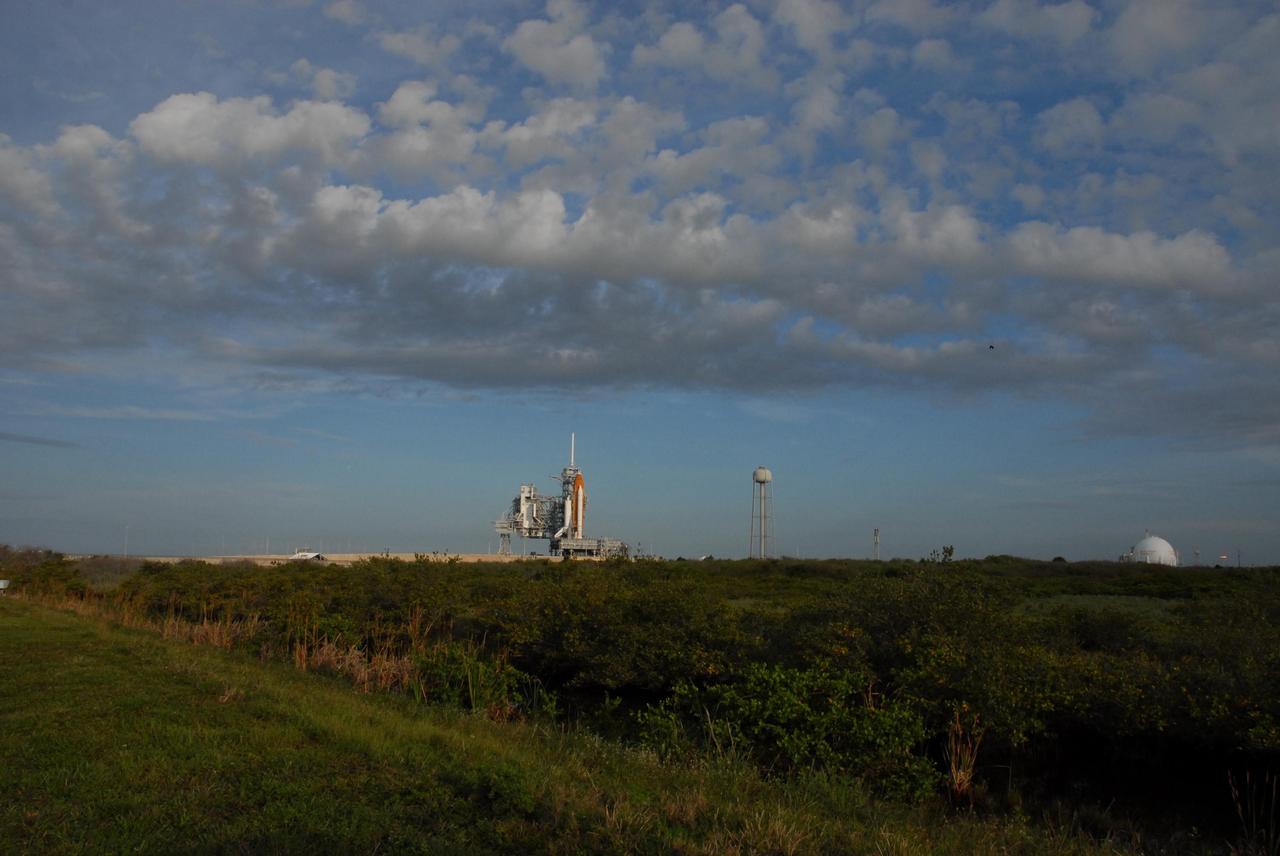
KENNEDY SPACE CENTER, FLA. -- The sun rises on a cloudy Florida day to reveal Space Shuttle Atlantis awaiting launch atop a mobile launch platform at Launch Pad 39A. At the right of the pad is the 300,000-gallon water tank that is part of the sound suppression system during launches. Rollback of the pad's rotating service structure, or RSS, is one of the milestones in preparation for the launch of mission STS-117 on June 8. Rollback started at 10:56 p.m. EDT June 7 and was complete at 11:34 p.m. The RSS, the massive structure to the left of the shuttle, provides protected access to the orbiter for changeout and servicing of payloads at the pad. The structure is supported by a rotating bridge that pivots about a vertical axis on the side of the pad's flame trench. The hinge column rests on the pad surface and is braced to the fixed service structure. Support for the outer end of the bridge is provided by two eight-wheel, motor-driven trucks that move along circular twin rails installed flush with the pad surface. The track crosses the flame trench on a permanent bridge. The RSS is 102 feet long, 50 feet wide and 130 feet high. The structure has orbiter access platforms at five levels to provide access to the payload bay while the orbiter is being serviced in the RSS. Each platform has independent extendable planks that can be arranged to conform to a payload's configuration. This mission is the 118th shuttle flight and the 21st U.S. flight to the International Space Station and will deliver and install the S3/S4 truss segment, deploy a set of solar arrays and prepare them for operation. Photo credit: NASA/Ken Thornsley
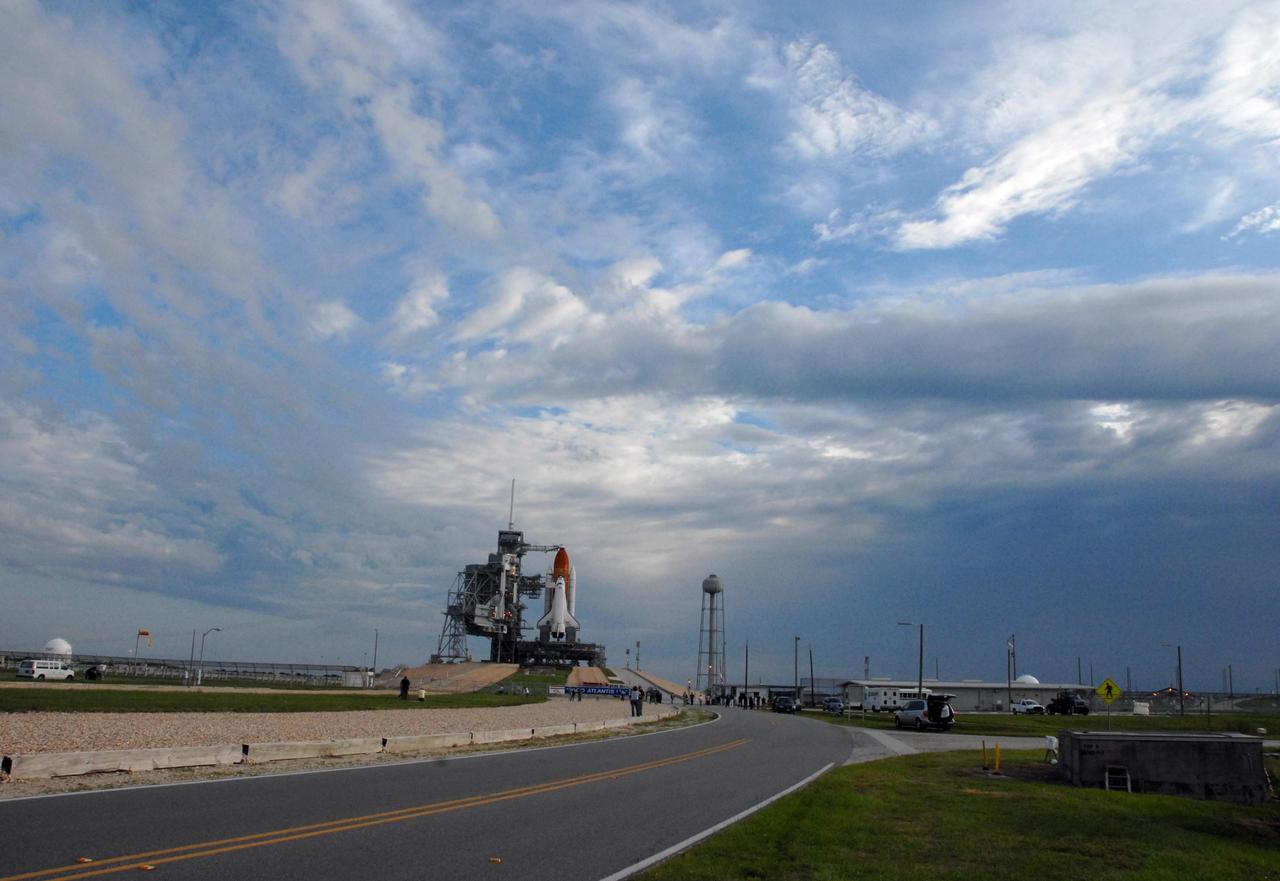
KENNEDY SPACE CENTER, FLA. -- On a cloudy Florida day, Space Shuttle Atlantis awaits launch atop a mobile launch platform at Launch Pad 39A. At the right of the pad is the 290-foot tall, 300,000-gallon water tank that is part of the sound suppression system during launches. In the foreground is the crawlerway. a 130-foot-wide roadway with a 5-percent grade leading to the top of the launch pad. Rollback of the pad's rotating service structure, or RSS, is one of the milestones in preparation for the launch of mission STS-117 on June 8. Rollback started at 10:56 p.m. EDT June 7 and was complete at 11:34 p.m. The RSS, the massive structure to the left of the shuttle, provides protected access to the orbiter for changeout and servicing of payloads at the pad. The structure is supported by a rotating bridge that pivots about a vertical axis on the side of the pad's flame trench. The hinge column rests on the pad surface and is braced to the fixed service structure. Support for the outer end of the bridge is provided by two eight-wheel, motor-driven trucks that move along circular twin rails installed flush with the pad surface. The track crosses the flame trench on a permanent bridge. The RSS is 102 feet long, 50 feet wide and 130 feet high. The structure has orbiter access platforms at five levels to provide access to the payload bay while the orbiter is being serviced in the RSS. Each platform has independent extendable planks that can be arranged to conform to a payload's configuration. This mission is the 118th shuttle flight and the 21st U.S. flight to the International Space Station and will deliver and install the S3/S4 truss segment, deploy a set of solar arrays and prepare them for operation. Photo credit: NASA/Ken Thornsley
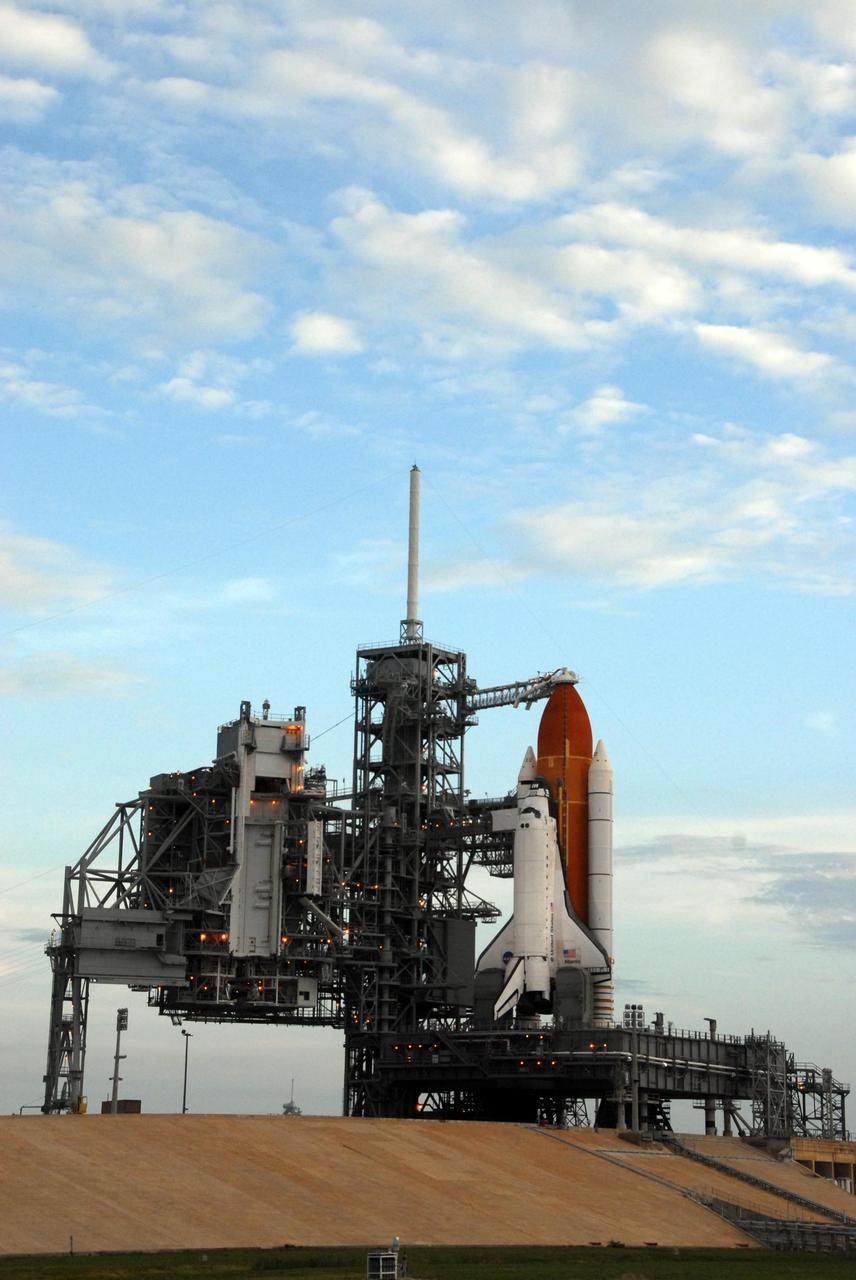
KENNEDY SPACE CENTER, FLA. -- Following sunrise on a cloudy Florida day, Space Shuttle Atlantis awaits launch atop a mobile launch platform at Launch Pad 39A. Rollback of the pad's rotating service structure, or RSS, is one of the milestones in preparation for the launch of mission STS-117 on June 8. Rollback started at 10:56 p.m. EDT June 7 and was complete at 11:34 p.m. The RSS, the massive structure to the left of the shuttle, provides protected access to the orbiter for changeout and servicing of payloads at the pad. The structure is supported by a rotating bridge that pivots about a vertical axis on the side of the pad's flame trench. The hinge column rests on the pad surface and is braced to the fixed service structure. Support for the outer end of the bridge is provided by two eight-wheel, motor-driven trucks that move along circular twin rails installed flush with the pad surface. The track crosses the flame trench on a permanent bridge. The RSS is 102 feet long, 50 feet wide and 130 feet high. The structure has orbiter access platforms at five levels to provide access to the payload bay while the orbiter is being serviced in the RSS. Each platform has independent extendable planks that can be arranged to conform to a payload's configuration. This mission is the 118th shuttle flight and the 21st U.S. flight to the International Space Station and will deliver and install the S3/S4 truss segment, deploy a set of solar arrays and prepare them for operation. Photo credit: NASA/Ken Thornsley
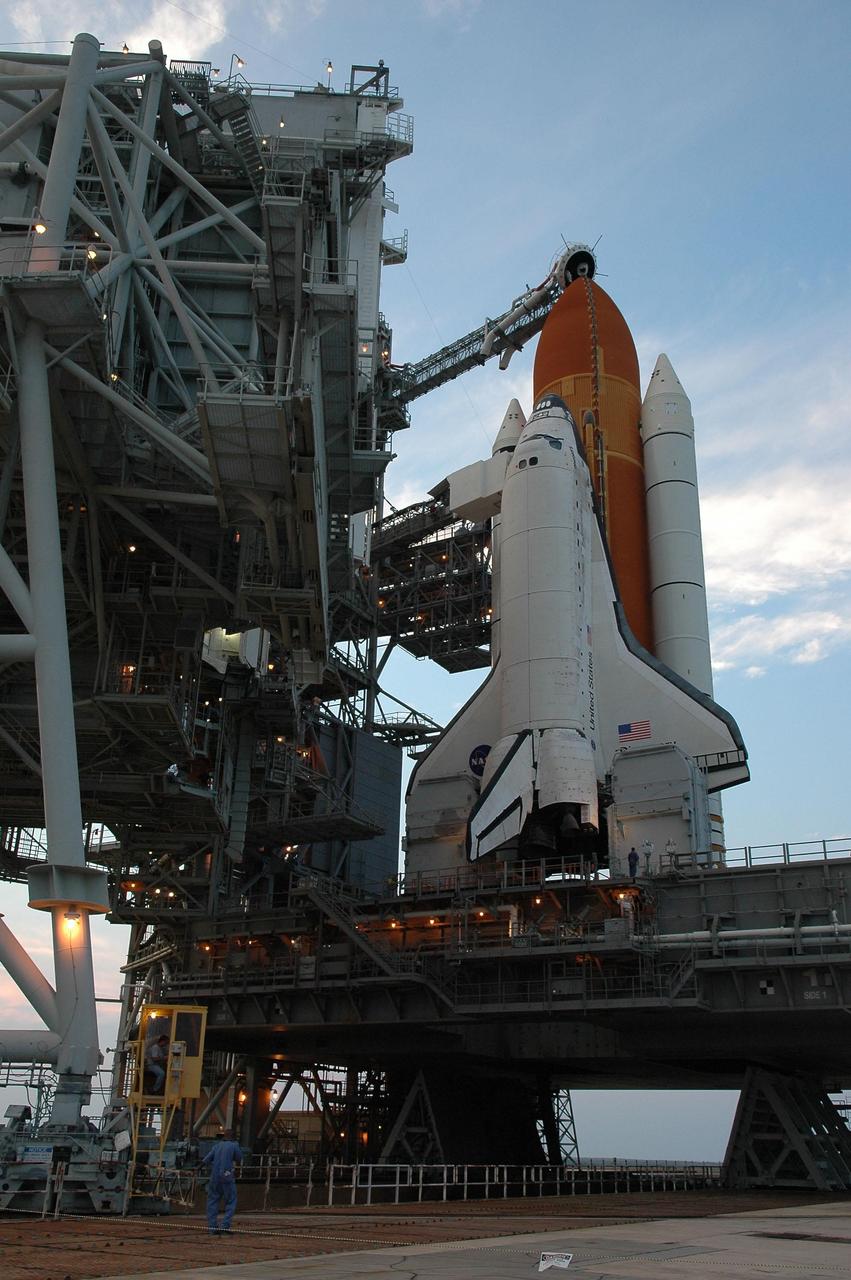
KENNEDY SPACE CENTER, FLA. - In preparation for the July 1 launch of Space Shuttle Discovery on mission STS-121, the Launch Pad 39B rotating service structure (RSS) enclosing the shuttle rolls away. Above the golden external tank is the vent hood (known as the "beanie cap") at the end of the gaseous oxygen vent arm. Vapors are created as the liquid oxygen in the external tank boil off. The hood vents the gaseous oxygen vapors away from the space shuttle vehicle. The RSS provides protected access to the orbiter for changeout and servicing of payloads at the pad. The structure is supported by a rotating bridge that pivots about a vertical axis on the west side of the pad's flame trench. The hinge column rests on the pad surface and is braced to the fixed service structure. Support for the outer end of the bridge is provided by two eight-wheel, motor-driven trucks that move along circular twin rails installed flush with the pad surface. The track crosses the flame trench on a permanent bridge. The RSS is 102 feet long, 50 feet wide and 130 feet high. The structure has orbiter access platforms at five levels to provide access to the payload bay while the orbiter is being serviced in the RSS. Each platform has independent extendable planks that can be arranged to conform to a payload's configuration. This mission is the 115th shuttle flight and the 18th U.S. flight to the International Space Station. Photo credit: NASA/Kim Shiflett
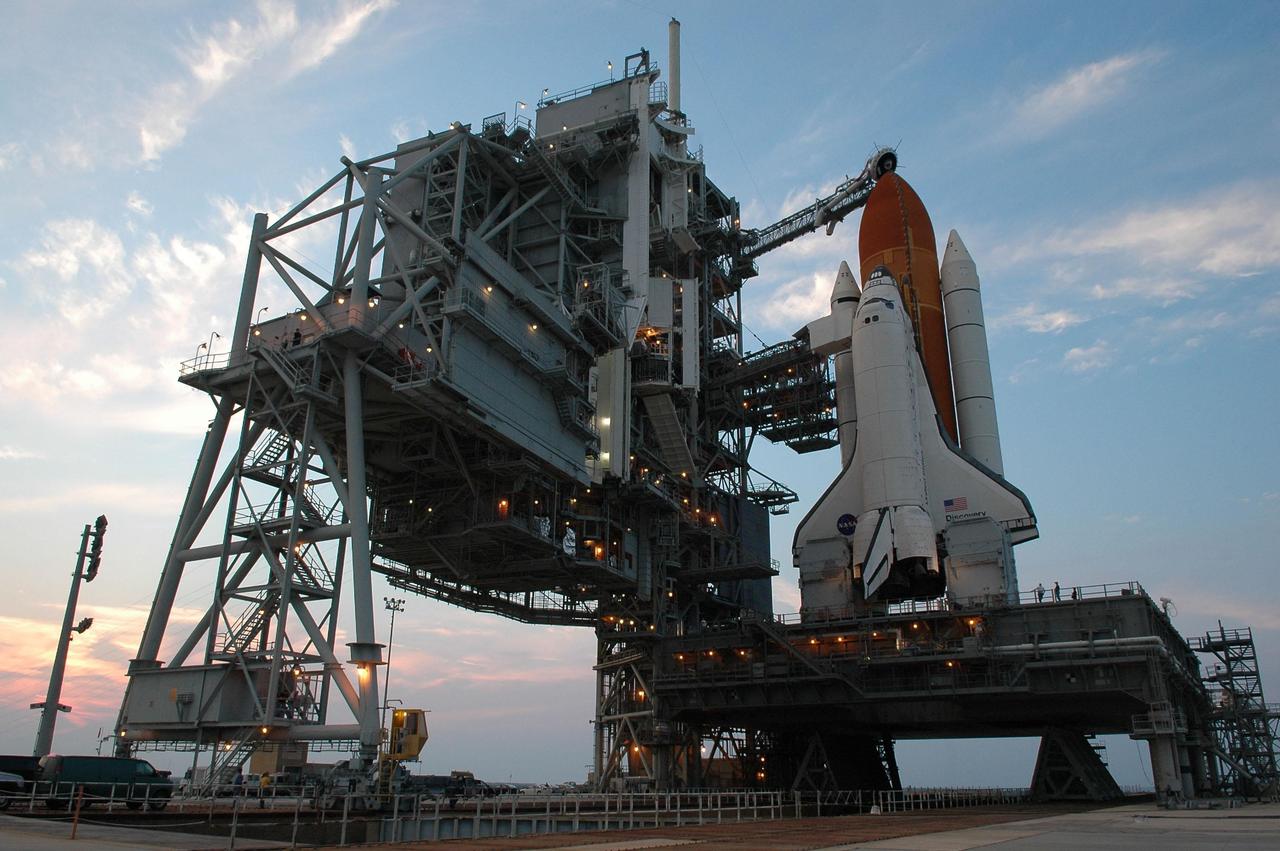
KENNEDY SPACE CENTER, FLA. - As the sun sets, painting pink and lavender clouds, the Space Shuttle Discovery is revealed after rollback of the rotating service structure in preparation for launch July 1 on mission STS-121. Above the golden external tank is the vent hood (known as the "beanie cap") at the end of the gaseous oxygen vent arm. Vapors are created as the liquid oxygen in the external tank boil off. The hood vents the gaseous oxygen vapors away from the space shuttle vehicle. The RSS provides protected access to the orbiter for changeout and servicing of payloads at the pad. The structure is supported by a rotating bridge that pivots about a vertical axis on the west side of the pad's flame trench. The hinge column rests on the pad surface and is braced to the fixed service structure. Support for the outer end of the bridge is provided by two eight-wheel, motor-driven trucks that move along circular twin rails installed flush with the pad surface. The track crosses the flame trench on a permanent bridge. The RSS is 102 feet long, 50 feet wide and 130 feet high. The structure has orbiter access platforms at five levels to provide access to the payload bay while the orbiter is being serviced in the RSS. Each platform has independent extendable planks that can be arranged to conform to a payload's configuration. This mission is the 115th shuttle flight and the 18th U.S. flight to the International Space Station. Photo credit: NASA/Kim Shiflett
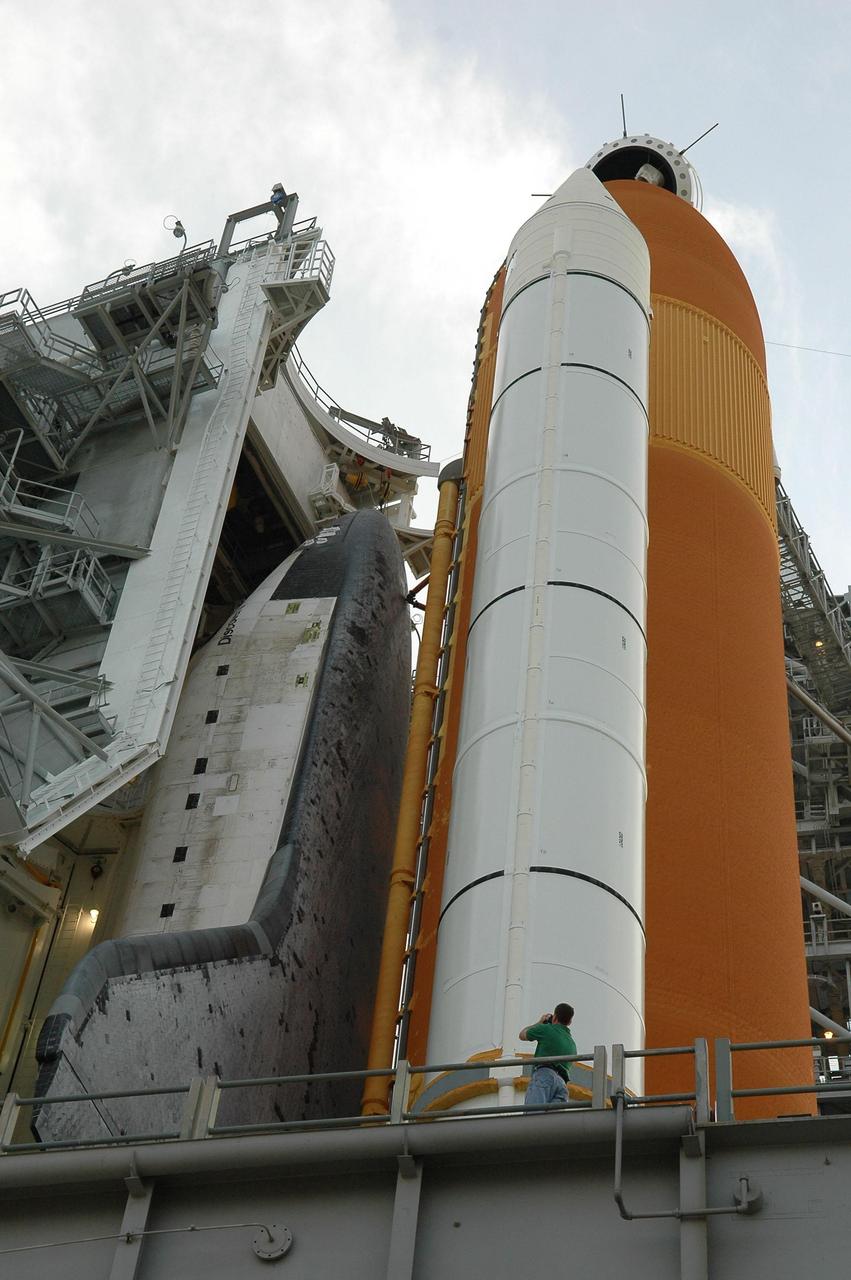
KENNEDY SPACE CENTER, FLA. - In preparation for the July 1 launch of Space Shuttle Discovery on mission STS-121, the Launch Pad 39B rotating service structure (RSS) enclosing the shuttle begins to roll away as light starts to fade from the sky. Above the golden external tank is the vent hood (known as the "beanie cap") at the end of the gaseous oxygen vent arm. Vapors are created as the liquid oxygen in the external tank boil off. The hood vents the gaseous oxygen vapors away from the space shuttle vehicle. The RSS provides protected access to the orbiter for changeout and servicing of payloads at the pad. The structure is supported by a rotating bridge that pivots about a vertical axis on the west side of the pad's flame trench. The hinge column rests on the pad surface and is braced to the fixed service structure. Support for the outer end of the bridge is provided by two eight-wheel, motor-driven trucks that move along circular twin rails installed flush with the pad surface. The track crosses the flame trench on a permanent bridge. The RSS is 102 feet long, 50 feet wide and 130 feet high. The structure has orbiter access platforms at five levels to provide access to the payload bay while the orbiter is being serviced in the RSS. Each platform has independent extendable planks that can be arranged to conform to a payload's configuration. This mission is the 115th shuttle flight and the 18th U.S. flight to the International Space Station. Photo credit: NASA/Kim Shiflett
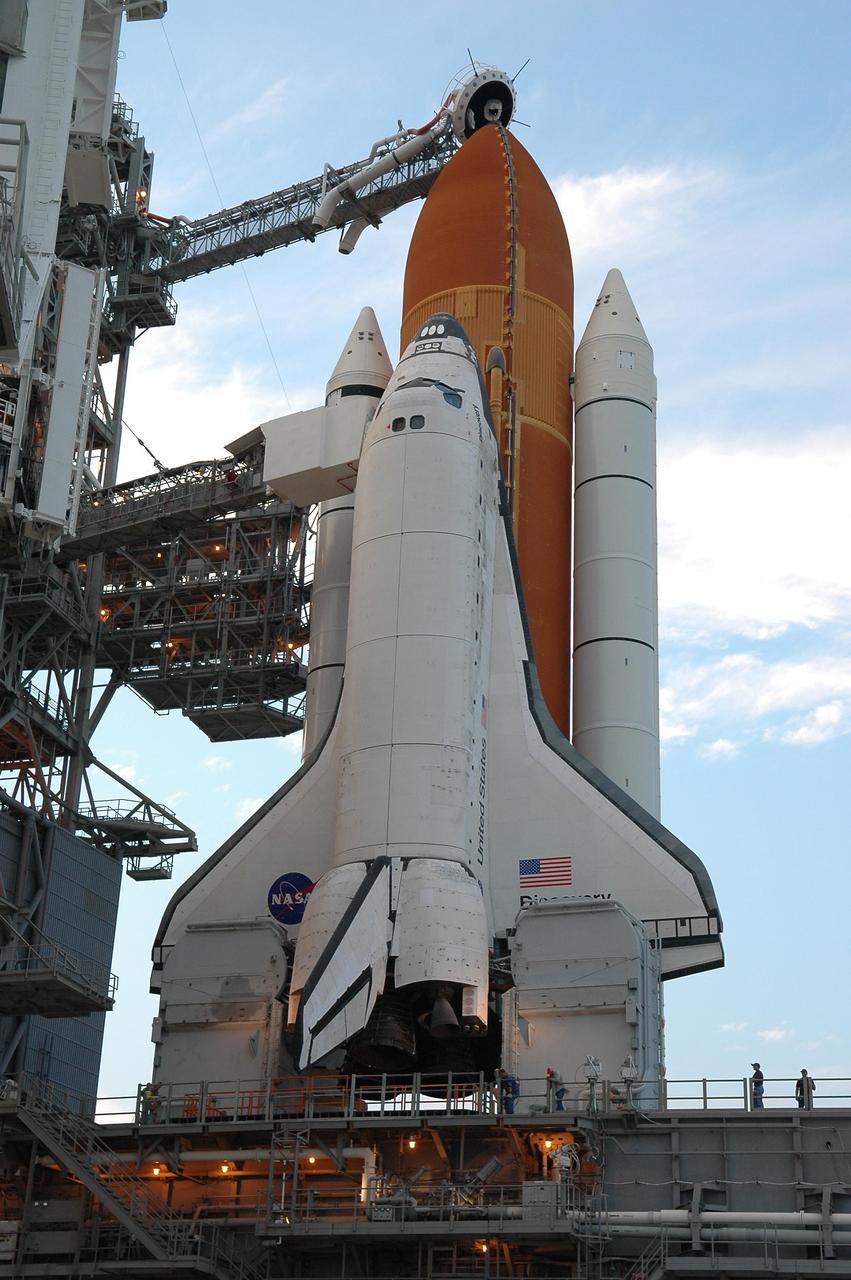
KENNEDY SPACE CENTER, FLA. - In preparation for the July 1 launch of Space Shuttle Discovery on mission STS-121, the Launch Pad 39B rotating service structure (RSS) enclosing the shuttle has been rolled away. Above the golden external tank is the vent hood (known as the "beanie cap") at the end of the gaseous oxygen vent arm. Vapors are created as the liquid oxygen in the external tank boil off. The hood vents the gaseous oxygen vapors away from the space shuttle vehicle. The RSS provides protected access to the orbiter for changeout and servicing of payloads at the pad. The structure is supported by a rotating bridge that pivots about a vertical axis on the west side of the pad's flame trench. The hinge column rests on the pad surface and is braced to the fixed service structure. Support for the outer end of the bridge is provided by two eight-wheel, motor-driven trucks that move along circular twin rails installed flush with the pad surface. The track crosses the flame trench on a permanent bridge. The RSS is 102 feet long, 50 feet wide and 130 feet high. The structure has orbiter access platforms at five levels to provide access to the payload bay while the orbiter is being serviced in the RSS. Each platform has independent extendable planks that can be arranged to conform to a payload's configuration. This mission is the 115th shuttle flight and the 18th U.S. flight to the International Space Station. Photo credit: NASA/Kim Shiflett
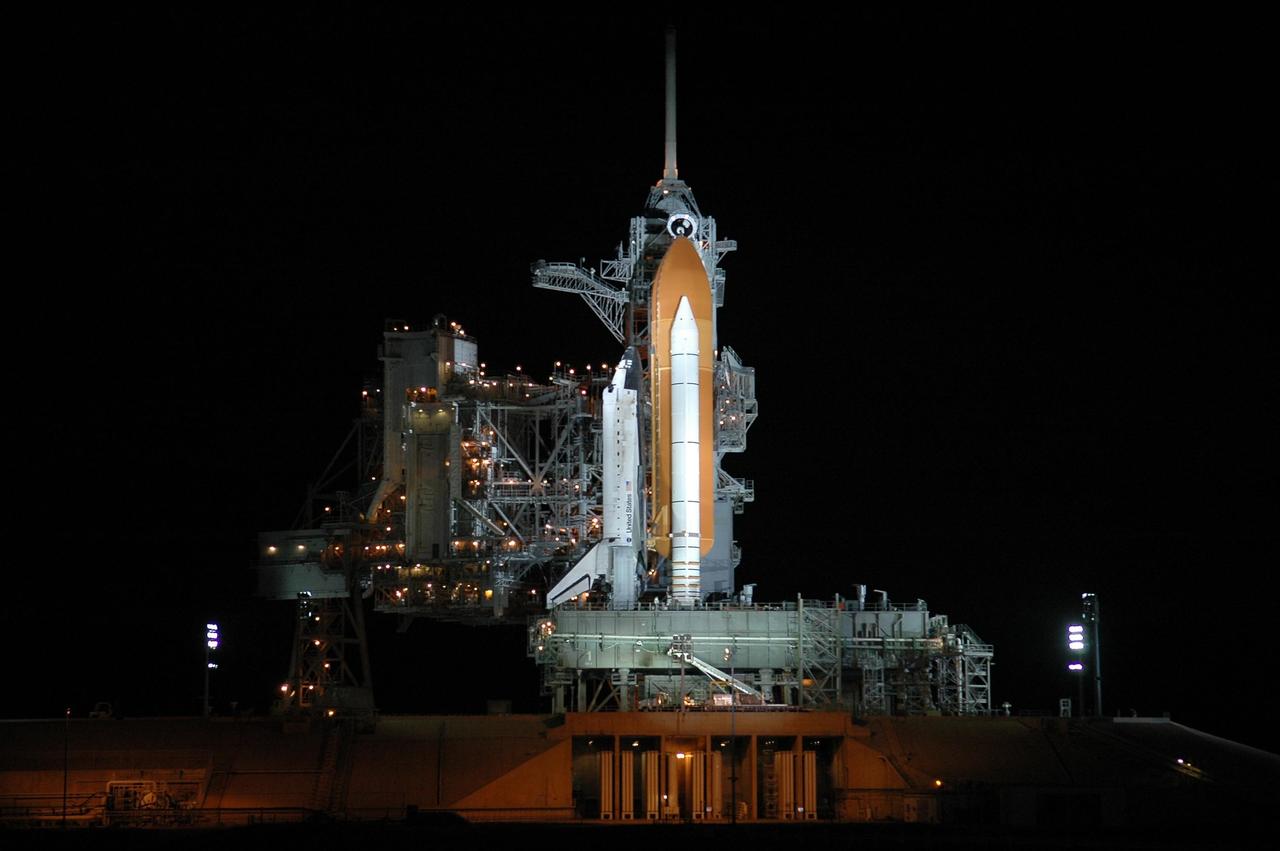
KENNEDY SPACE CENTER, FLA. - After rollback of the rotating service structure (RSS) on Launch Pad 39B, Space Shuttle Discovery stands bathed in spotlights. Beneath the shuttle is the mobile launcher platform, which spans the flame trench below. The flame deflector system includes an inverted, V-shaped steel structure that receives and deflects the flames from the orbiter main engines on one side; the opposite side deflects the flames from the solid rocket boosters. The RSS provides protected access to the orbiter for changeout and servicing of payloads at the pad. The structure is supported by a rotating bridge that pivots about a vertical axis on the west side of the pad's flame trench. The hinge column rests on the pad surface and is braced to the fixed service structure. Support for the outer end of the bridge is provided by two eight-wheel, motor-driven trucks that move along circular twin rails installed flush with the pad surface. The track crosses the flame trench on a permanent bridge. The RSS is 102 feet long, 50 feet wide and 130 feet high. The structure has orbiter access platforms at five levels to provide access to the payload bay while the orbiter is being serviced in the RSS. Each platform has independent extendable planks that can be arranged to conform to a payload's configuration. This mission is the 115th shuttle flight and the 18th U.S. flight to the International Space Station. Photo credit: NASA/Kim Shiflett
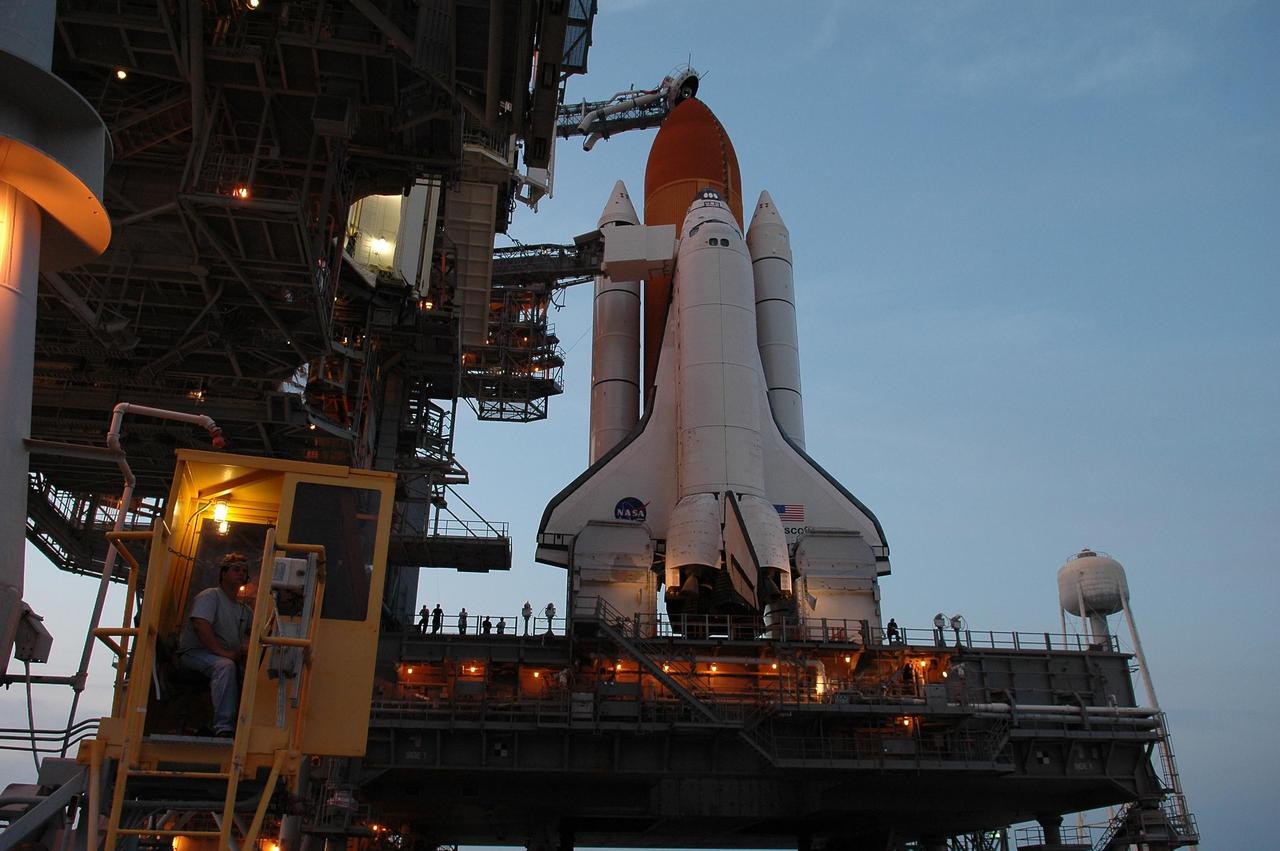
KENNEDY SPACE CENTER, FLA. - Lights glow around Space Shuttle Discovery as it stands revealed after rollback of the rotating service structure in preparation for launch July 1 on mission STS-121. Above the golden external tank is the vent hood (known as the "beanie cap") at the end of the gaseous oxygen vent arm. Vapors are created as the liquid oxygen in the external tank boil off. The hood vents the gaseous oxygen vapors away from the space shuttle vehicle. The RSS provides protected access to the orbiter for changeout and servicing of payloads at the pad. The structure is supported by a rotating bridge that pivots about a vertical axis on the west side of the pad's flame trench. The hinge column rests on the pad surface and is braced to the fixed service structure. Support for the outer end of the bridge is provided by two eight-wheel, motor-driven trucks that move along circular twin rails installed flush with the pad surface. The track crosses the flame trench on a permanent bridge. The RSS is 102 feet long, 50 feet wide and 130 feet high. The structure has orbiter access platforms at five levels to provide access to the payload bay while the orbiter is being serviced in the RSS. Each platform has independent extendable planks that can be arranged to conform to a payload's configuration. This mission is the 115th shuttle flight and the 18th U.S. flight to the International Space Station. Photo credit: NASA/Kim Shiflett
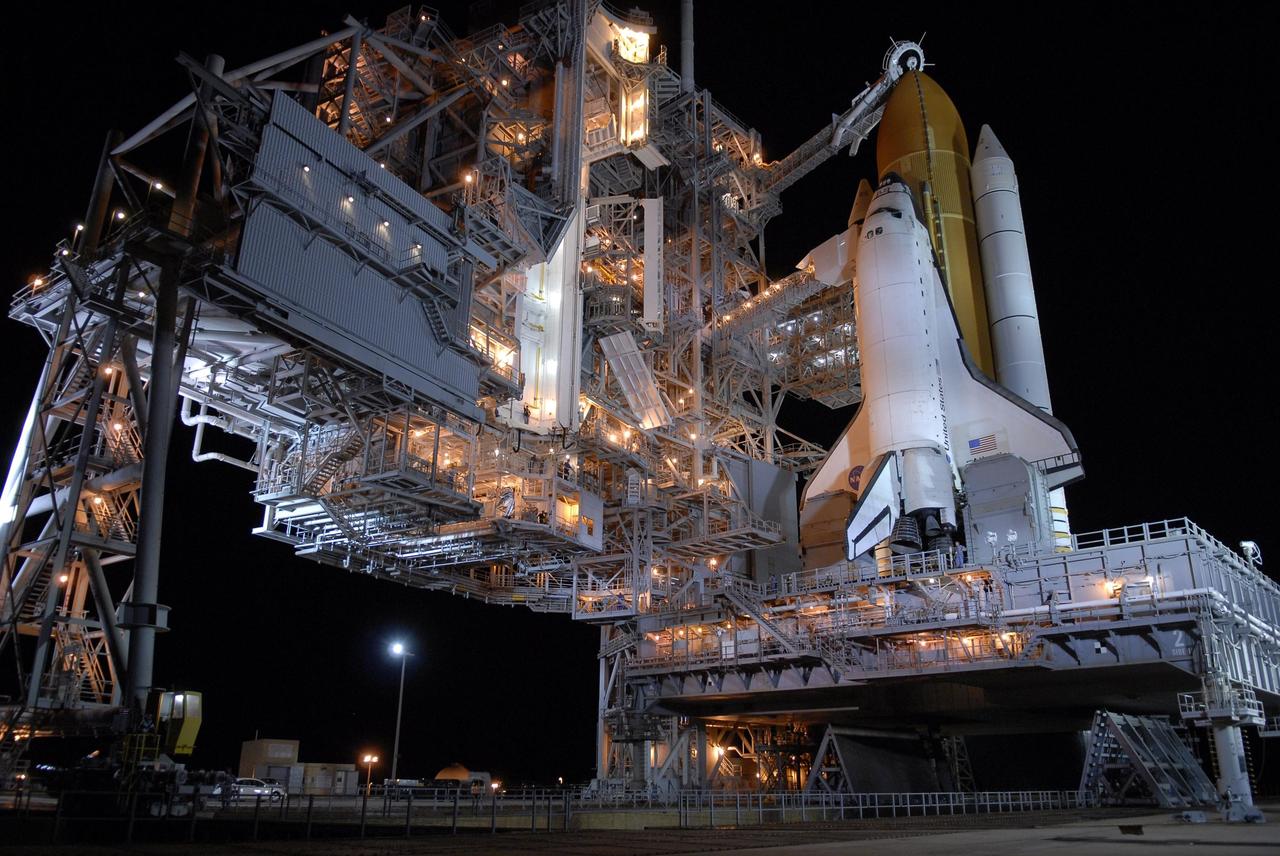
KENNEDY SPACE CENTER, FLA. -- Following rollback of the rotating service structure, or RSS, on Launch Pad 39A, Space Shuttle Atlantis stands bathed in lights atop a mobile launch platform. Rollback is one of the milestones in preparation for the launch of mission STS-117 on June 8. Rollback started at 10:56 p.m. and was complete at 11:34 p.m EDT. The RSS, the massive structure to the left of the shuttle, provides protected access to the orbiter for changeout and servicing of payloads at the pad. The structure is supported by a rotating bridge that pivots about a vertical axis on the side of the pad's flame trench. The hinge column rests on the pad surface and is braced to the fixed service structure. Support for the outer end of the bridge is provided by two eight-wheel, motor-driven trucks that move along circular twin rails installed flush with the pad surface. The track crosses the flame trench on a permanent bridge. The RSS is 102 feet long, 50 feet wide and 130 feet high. The structure has orbiter access platforms at five levels to provide access to the payload bay while the orbiter is being serviced in the RSS. Each platform has independent extendable planks that can be arranged to conform to a payload's configuration. This mission is the 118th shuttle flight and the 21st U.S. flight to the International Space Station and will deliver and install the S3/S4 truss segment, deploy a set of solar arrays and prepare them for operation. Photo credit: NASA/Kim Shiflett
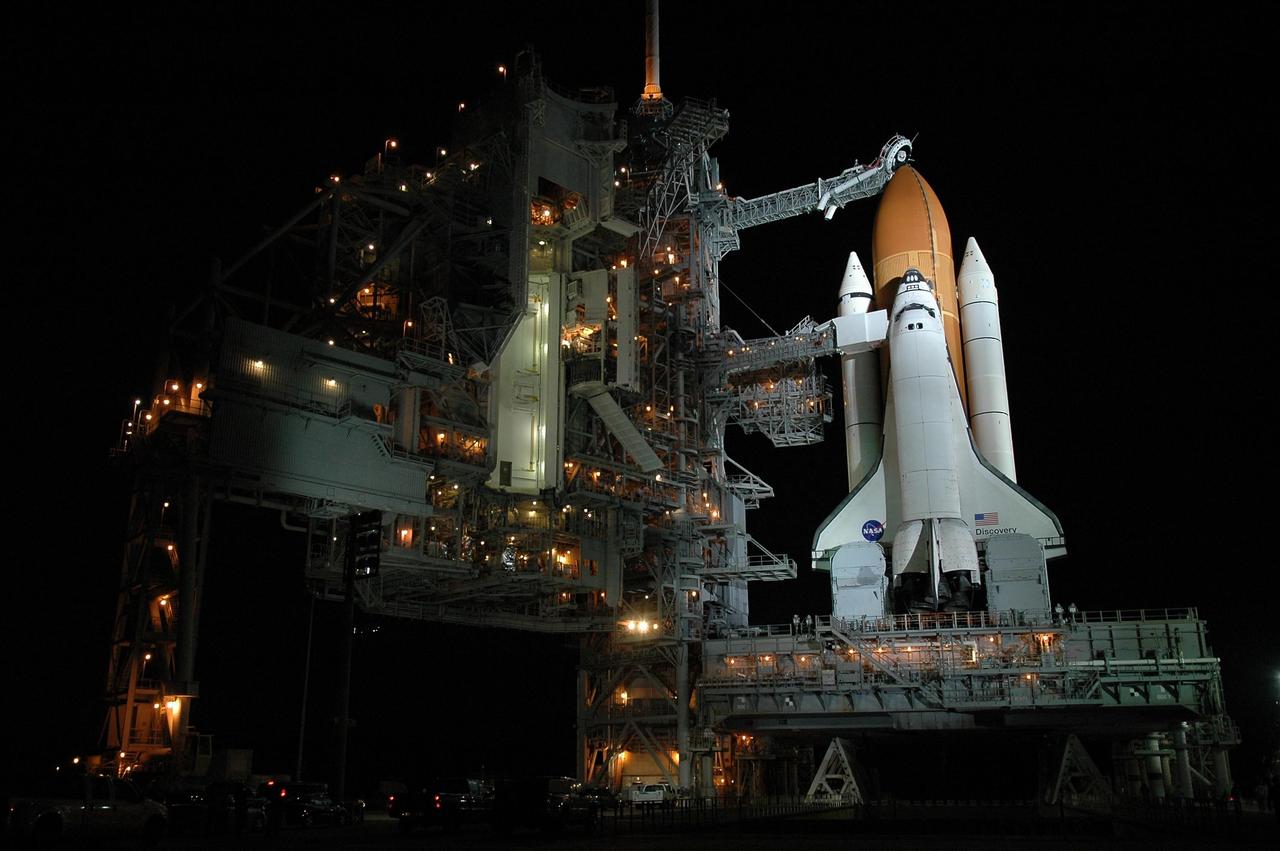
KENNEDY SPACE CENTER, FLA. - After rollback of the rotating service structure (RSS) on Launch Pad 39B, Space Shuttle Discovery seems to glow in the spotlights. Rollback was in preparation for launch July 1 on mission STS-121. Seen above the golden external tank is the vent hood (known as the "beanie cap") at the end of the gaseous oxygen vent arm. Vapors are created as the liquid oxygen in the external tank boil off. The hood vents the gaseous oxygen vapors away from the space shuttle vehicle. Extending toward the cockpit of the shuttle is the orbiter access arm with the White Room extended. The White Room provides access into the orbiter for the astronauts. The RSS provides protected access to the orbiter for changeout and servicing of payloads at the pad. The structure is supported by a rotating bridge that pivots about a vertical axis on the west side of the pad's flame trench. The hinge column rests on the pad surface and is braced to the fixed service structure. Support for the outer end of the bridge is provided by two eight-wheel, motor-driven trucks that move along circular twin rails installed flush with the pad surface. The track crosses the flame trench on a permanent bridge. The RSS is 102 feet long, 50 feet wide and 130 feet high. The structure has orbiter access platforms at five levels to provide access to the payload bay while the orbiter is being serviced in the RSS. Each platform has independent extendable planks that can be arranged to conform to a payload's configuration. This mission is the 115th shuttle flight and the 18th U.S. flight to the International Space Station. Photo credit: NASA/Kim Shiflett
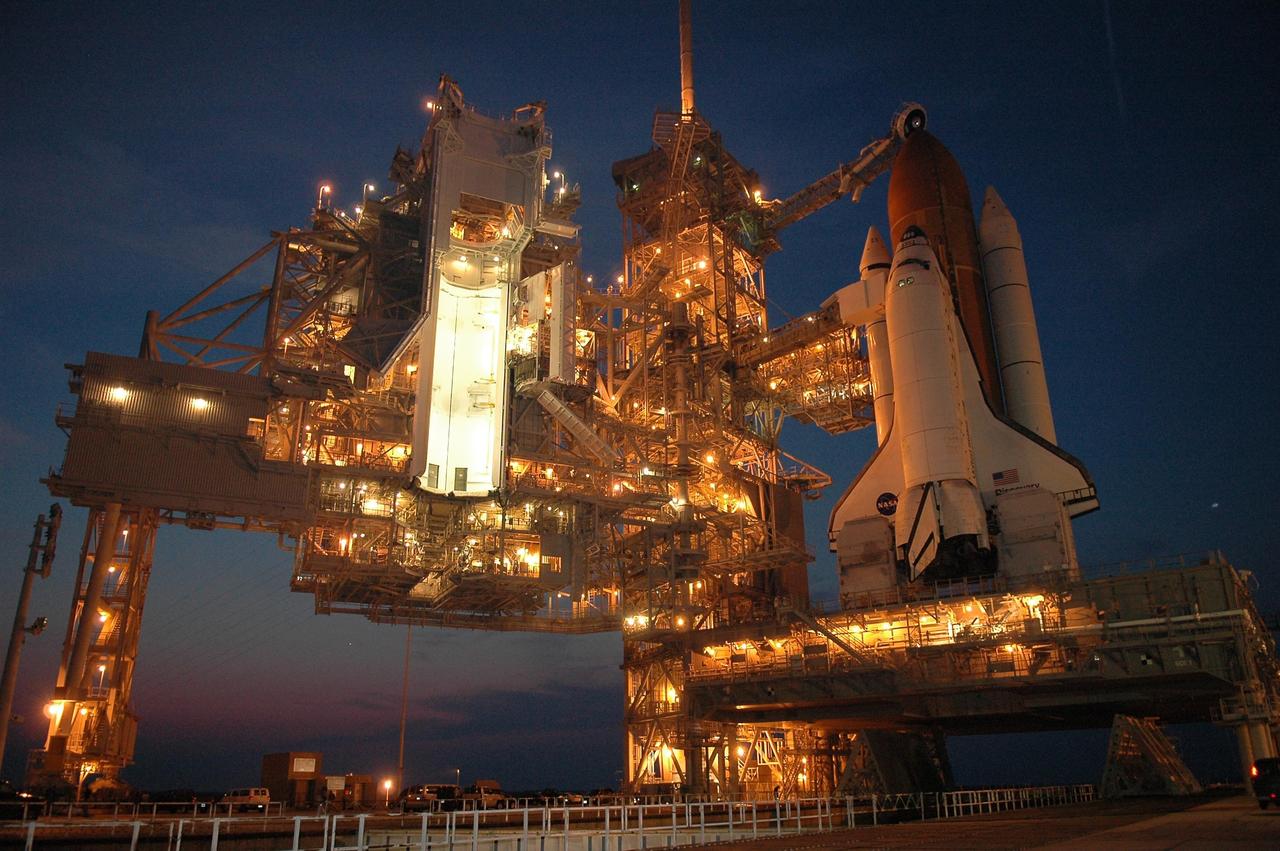
KENNEDY SPACE CENTER, FLA. - Against a dimming sky after sunset, lights on the structures on Launch Pad 39B cast a warm glow on Space Shuttle Discovery. The rotating service structure at left has been rolled back in preparation for launch July 1 on mission STS-121. Extending toward the cockpit of the shuttle is the orbiter access arm with the White Room extended. The White Room provides access into the orbiter for the astronauts. Above the golden external tank is the vent hood (known as the "beanie cap") at the end of the gaseous oxygen vent arm. Vapors are created as the liquid oxygen in the external tank boil off. The hood vents the gaseous oxygen vapors away from the space shuttle vehicle. The RSS provides protected access to the orbiter for changeout and servicing of payloads at the pad. The structure is supported by a rotating bridge that pivots about a vertical axis on the west side of the pad's flame trench. The hinge column rests on the pad surface and is braced to the fixed service structure. Support for the outer end of the bridge is provided by two eight-wheel, motor-driven trucks that move along circular twin rails installed flush with the pad surface. The track crosses the flame trench on a permanent bridge. The RSS is 102 feet long, 50 feet wide and 130 feet high. The structure has orbiter access platforms at five levels to provide access to the payload bay while the orbiter is being serviced in the RSS. Each platform has independent extendable planks that can be arranged to conform to a payload's configuration. This mission is the 115th shuttle flight and the 18th U.S. flight to the International Space Station. Photo credit: NASA/Kim Shiflett
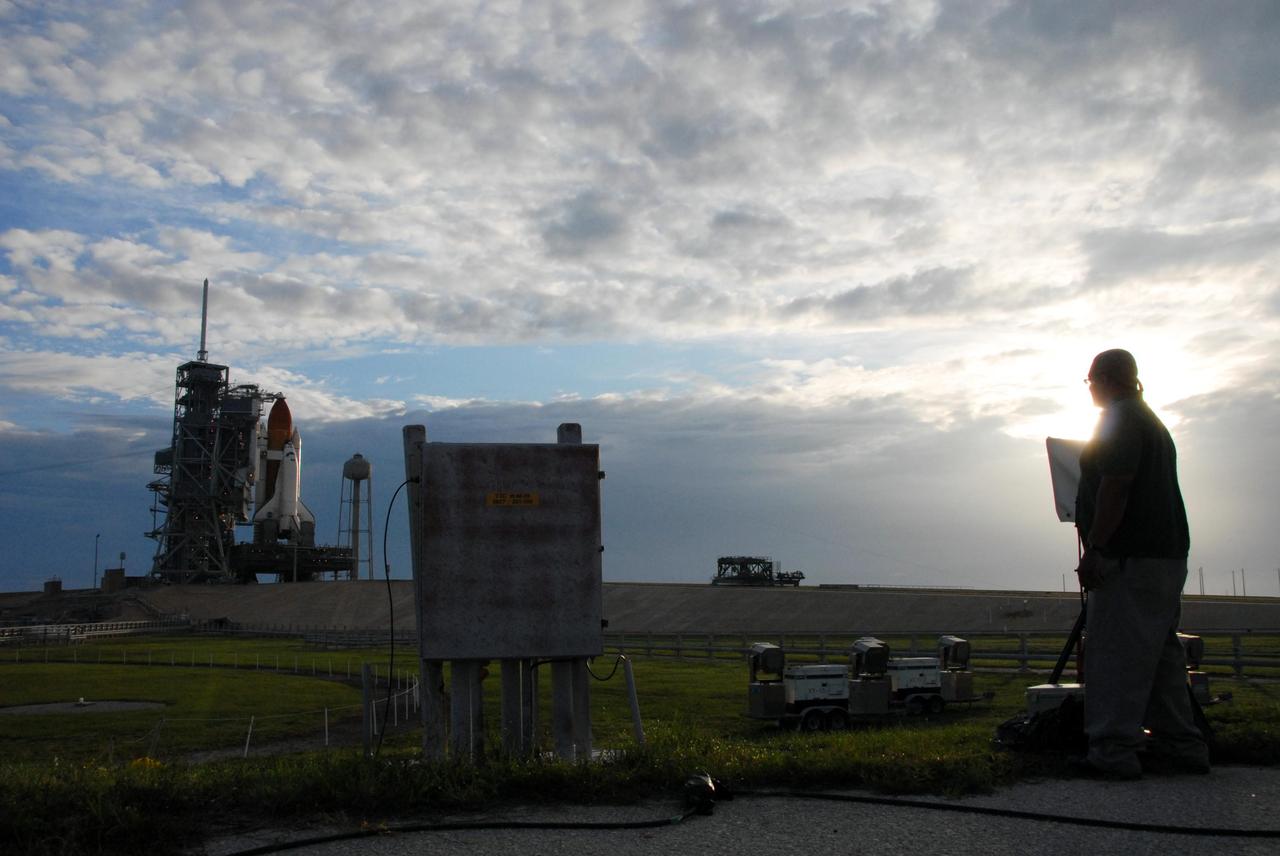
KENNEDY SPACE CENTER, FLA. -- Cameras are prepared to record the launch of Space Shuttle Atlantis from Launch Pad 39A by Theaphlias B. Terrell, operations manager of Bionetics Photoservice, following sunrise on a cloudy Florida day. Rollback of the pad's rotating service structure, or RSS, is one of the milestones in preparation for the launch of mission STS-117 on June 8. Rollback started at 10:56 p.m. EDT June 7 and was complete at 11:34 p.m. The RSS, the massive structure to the left of the shuttle, provides protected access to the orbiter for changeout and servicing of payloads at the pad. The structure is supported by a rotating bridge that pivots about a vertical axis on the side of the pad's flame trench. The hinge column rests on the pad surface and is braced to the fixed service structure. Support for the outer end of the bridge is provided by two eight-wheel, motor-driven trucks that move along circular twin rails installed flush with the pad surface. The track crosses the flame trench on a permanent bridge. The RSS is 102 feet long, 50 feet wide and 130 feet high. The structure has orbiter access platforms at five levels to provide access to the payload bay while the orbiter is being serviced in the RSS. Each platform has independent extendable planks that can be arranged to conform to a payload's configuration. This mission is the 118th shuttle flight and the 21st U.S. flight to the International Space Station and will deliver and install the S3/S4 truss segment, deploy a set of solar arrays and prepare them for operation. Photo credit: NASA/Ken Thornsley
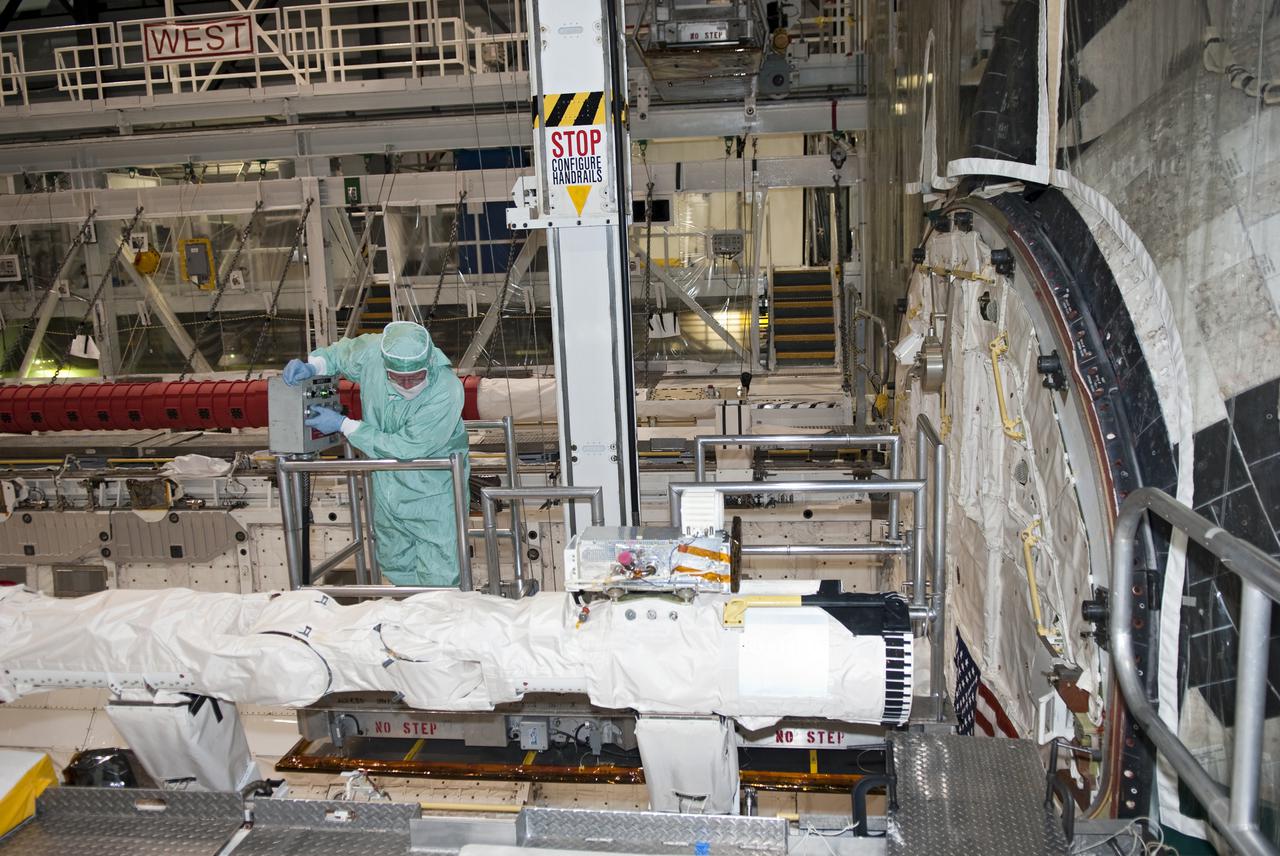
CAPE CANAVERAL, Fla. - In Orbiter Processing Facility-1 at NASA's Kennedy Space Center in Florida, United Space Alliance mid-body mechanic Mike Hyatt positions the aft bridge bucket to support the installation of a wrist camera on the orbiter boom sensor system, or OBSS, in space shuttle Atlantis' payload bay. Atlantis is being prepared for its upcoming STS-132 mission. The 50-foot-long OBSS attaches to the end of the shuttle’s robotic arm and supports the cameras and laser systems used to inspect the shuttle’s thermal protection system while in space. Atlantis will deliver an Integrated Cargo Carrier and Russian-built Mini Research Module to the International Space Station on STS-132. Launch is targeted for May 14. Photo credit: NASA_Jim Grossmann
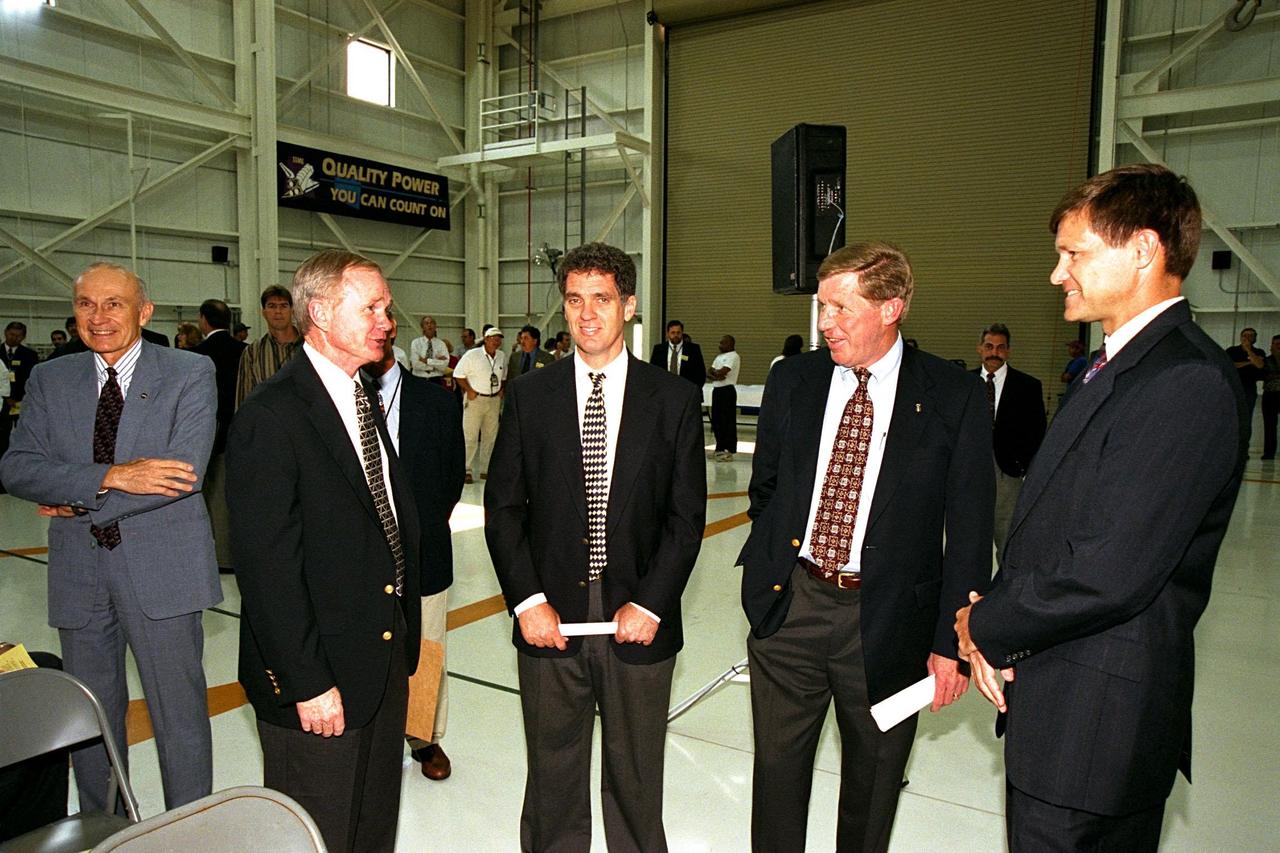
Participants in the ribbon cutting for KSC's new 34,600-square-foot Space Shuttle Main Engine Processing Facility (SSMEPF) gather to talk inside the facility following the ceremony. From left, they are Robert B. Sieck, director of Shuttle Processing; KSC Center Director Roy D. Bridges Jr.; U.S. Congressman Dave Weldon; John Plowden, vice president of Rocketdyne; and Donald R. McMonagle, manager of Launch Integration. A major addition to the existing Orbiter Processing Facility Bay 3, the SSMEPF replaces the Shuttle Main Engine Shop located in the Vehicle Assembly Building (VAB). The decision to move the shop out of the VAB was prompted by safety considerations and recent engine processing improvements. The first three main engines to be processed in the new facility will fly on Shuttle Endeavour's STS-88 mission in December 1998
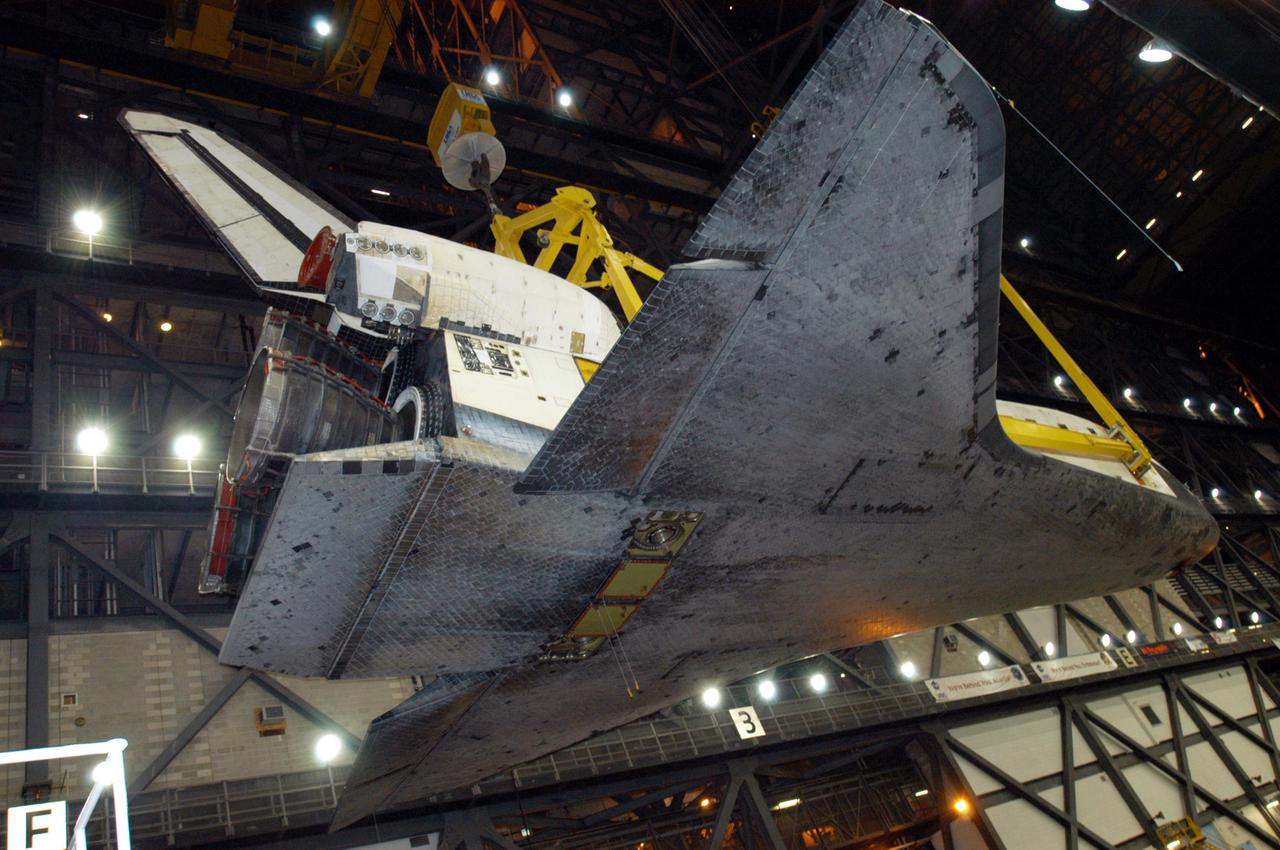
KENNEDY SPACE CENTER, FLA. - In the transfer aisle of the Vehicle Assembly Building, orbiter Discovery is lifted into the air by a 175-ton bridge crane. Discovery is being lifted to vertical for the remate with the new External Tank, ET-121, and Solid Rocket Boosters in high bay 3. That tank was originally scheduled to fly with Atlantis on the second Return to Flight mission, STS-121. A new heater was added to the tank's feedline bellows, part of the pipeline that carries the liquid oxygen to the orbiter’s main engines, to minimize the potential for ice and frost buildup. After the remate, technicians will work final closeouts on the fully assembled Space Shuttle stack, and perform liquid oxygen and liquid hydrogen electrical mates and an interface verification test. Discovery is currently scheduled to return to Launch Pad 39B on June 13.
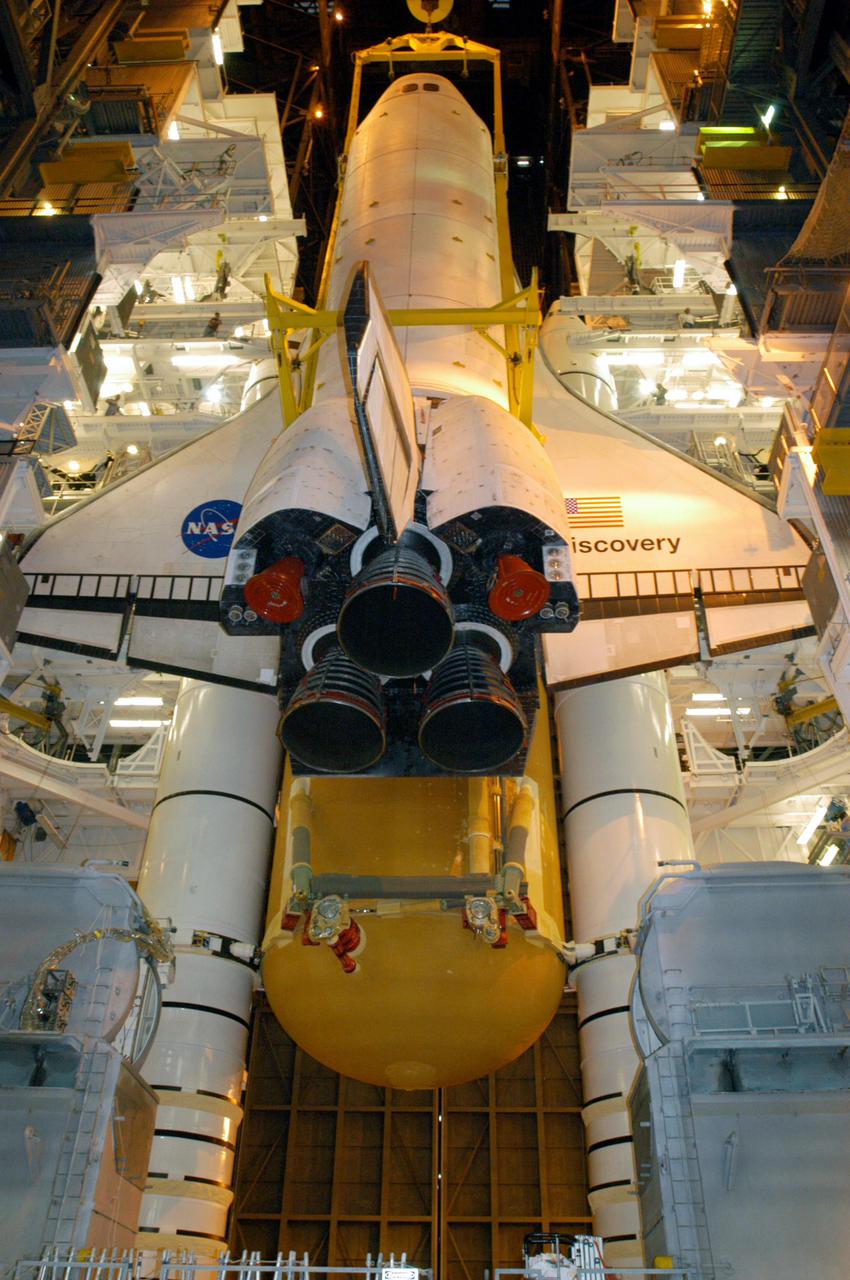
KENNEDY SPACE CENTER, FLA. - Suspended by a 175-ton bridge crane, the orbiter Discovery is lowered next to the new External Tank, ET-121, and Solid Rocket Boosters in high bay 3 for mating. That tank was originally scheduled to fly with Atlantis on the second Return to Flight mission, STS-121. A new heater was added to the tank's feedline bellows, part of the pipeline that carries the liquid oxygen to the orbiter’s main engines, to minimize the potential for ice and frost buildup. After the remate, technicians will work final closeouts on the fully assembled Space Shuttle stack, and perform liquid oxygen and liquid hydrogen electrical mates and an interface verification test. Discovery is currently scheduled to return to Launch Pad 39B on June 13.
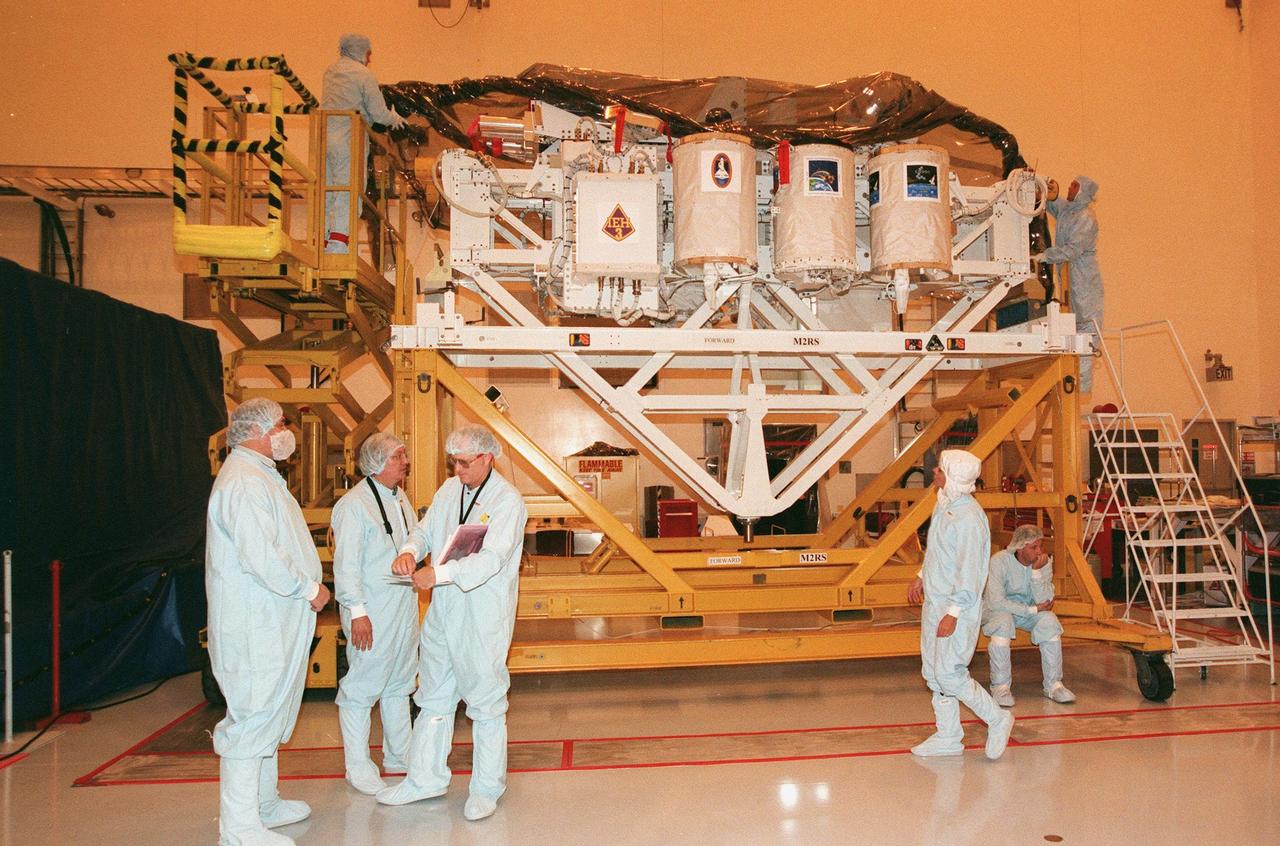
KENNEDY SPACE CENTER, FLA. The International Extreme Ultraviolet Hitchhiker-3 (IEH-3), one of the payloads for the STS-95 mission, is prepared for launch in the Multi-Payload Processing Facility. IEH-3 is comprised of seven experiments, including one that will be deployed on Flight Day 3. It is the small, non-recoverable Petite Amateur Navy Satellite (PANSAT) which will store and transmit digital communications. Other IEH investigations are the Solar Constant Experiment (SOLCON), Solar Extreme Ultraviolet Hitchhiker (SEH), Spectrograph/Telescope for Astronomical Research (STAR-LITE), Ultraviolet Spectrograph Telescope for Astronomical Research (UVSTAR), Consortium for Materials Development in Space Complex Autonomous Payloads (CONCAP-IV) for growing thin films via physical vapor transport, and two Get-Away Special (GAS) canister experiments. The experiments will be mounted on a hitchhiker bridge in Discovery's payload bay
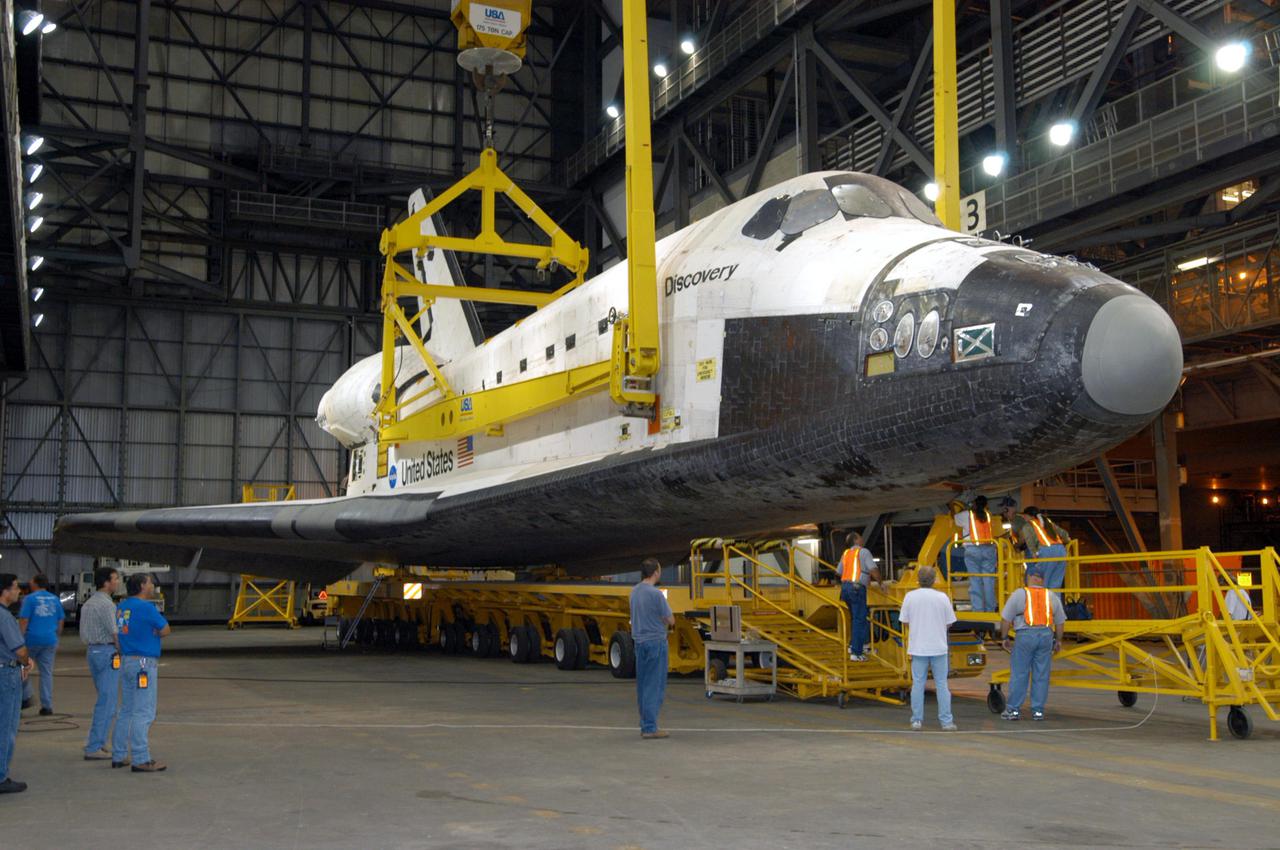
KENNEDY SPACE CENTER, FLA. - In the transfer aisle of the Vehicle Assembly Building, workers check under the nose of the orbiter Discovery as the 175-ton bridge crane slowly lifts Discovery off the orbiter transporter. Discovery is being lifted to vertical for the remate with the new External Tank, ET-121, and Solid Rocket Boosters in high bay 3. That tank was originally scheduled to fly with Atlantis on the second Return to Flight mission, STS-121. A new heater was added to the tank's feedline bellows, part of the pipeline that carries the liquid oxygen to the orbiter’s main engines, to minimize the potential for ice and frost buildup. After the remate, technicians will work final closeouts on the fully assembled Space Shuttle stack, and perform liquid oxygen and liquid hydrogen electrical mates and an interface verification test. Discovery is currently scheduled to return to Launch Pad 39B on June 13.
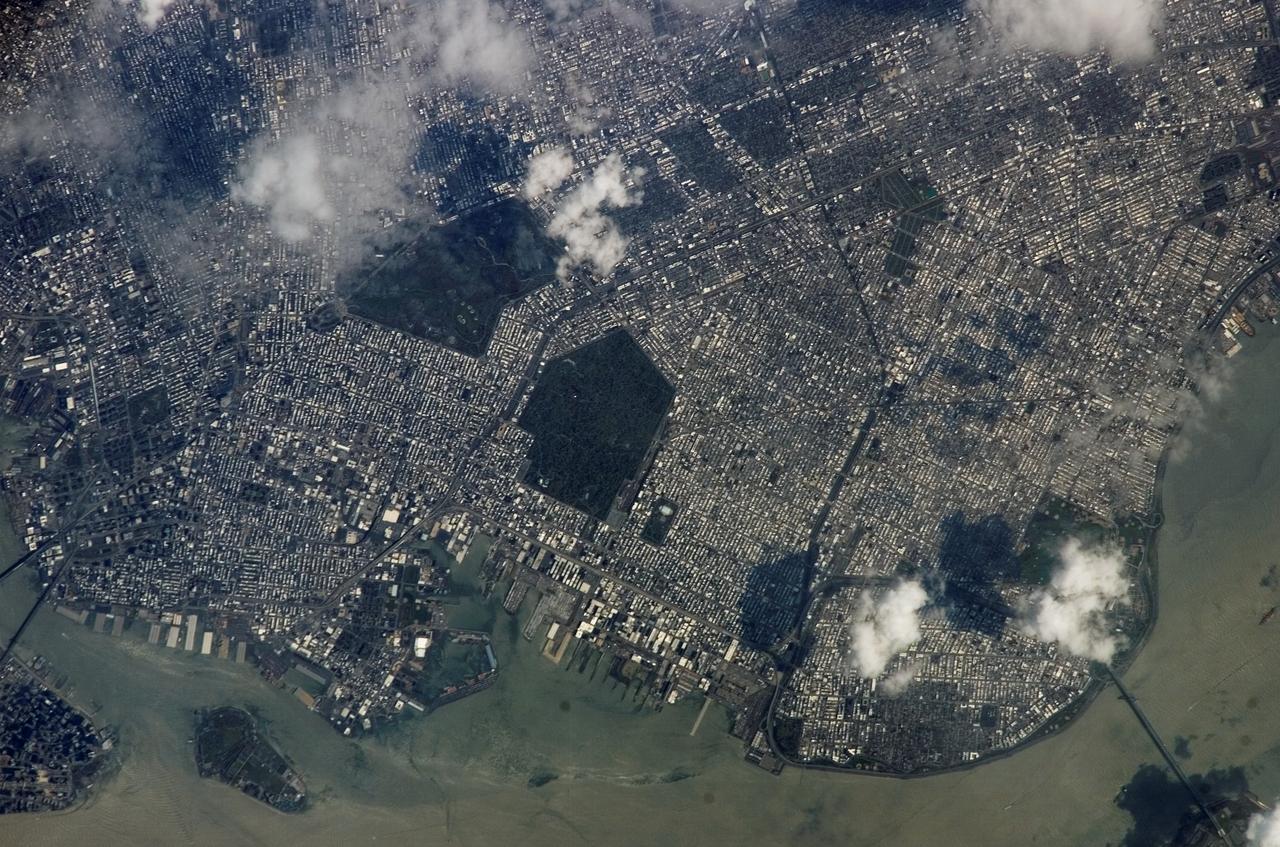
ISS015-E-05483 (28 April 2007) --- Brooklyn, New York waterfront is featured in this image photographed by an Expedition 15 crewmember on the International Space Station. This view illustrates the dense urban fabric of Brooklyn, New York City's largest borough (population of 2.6 million), characterized by the regular pattern of highly reflective building rooftops (white). Two main arteries from Manhattan into Brooklyn, the famous Brooklyn Bridge and neighboring Manhattan Bridge, cross the East River along the left (north) side of the image. The dense built-up fabric contrasts with the East River and Upper New York Bay (bottom center) waterfront areas, recognizable by docks and large industrial loading facilities that extend across the bottom center from left to right. Much of the shipping traffic has moved to the New Jersey side of New York Bay--this has spurred dismantling and redevelopment of the historic dockyards and waterfront warehouses into residential properties. However, efforts to conserve historic buildings are also ongoing. The original name for Brooklyn, Breukelen, means "broken land" in Dutch--perhaps in recognition of the highly mixed deposits (boulders, sand, silt, and clay) left behind by the Wisconsin glacier between 20,000--90,000 years ago, according to scientists. These deposits form much of Long Island, of which Brooklyn occupies the western tip. This image features one of Brooklyn's largest green spaces, the Green-Wood Cemetery. Today, the cemetery functions as both a natural park and a place of internment. The green tree canopy of the Cemetery contrasts sharply with the surrounding urban land cover, is an Audubon Sanctuary, and provides the final resting place for many 19th and 20th century New York celebrities. Also visible in the image is Governor's Island, which served as a strategic military installation for the US Army (1783--1966) and a major US Coast Guard installation (1966--1996). Today the historic fortifications on the island and their surroundings comprise the Governors Island National Monument.

These images of the San Francisco Bay region were acquired on March 3, 2000 by the Advanced Spaceborne Thermal Emission and Reflection Radiometer (ASTER) on NASA's Terra satellite. Each covers an area 60 kilometers (37 miles) wide and 75 kilometers (47 miles) long. With its 14 spectral bands from the visible to the thermal infrared wavelength region, and its high spatial resolution of 15 to 90 meters (about 50 to 300 feet), ASTER will image the Earth for the next 6 years to map and monitor the changing surface of our planet. Upper Left: The color infrared composite uses bands in the visible and reflected infrared. Vegetation is red, urban areas are gray; sediment in the bays shows up as lighter shades of blue. Thanks to the 15 meter (50-foot) spatial resolution, shadows of the towers along the Bay Bridge can be seen. Upper right: A composite of bands in the short wave infrared displays differences in soils and rocks in the mountainous areas. Even though these regions appear entirely vegetated in the visible, enough surface shows through openings in the vegetation to allow the ground to be imaged. Lower left: This composite of multispectral thermal bands shows differences in urban materials in varying colors. Separation of materials is due to differences in thermal emission properties, analogous to colors in the visible. Lower right: This is a color coded temperature image of water temperature, derived from the thermal bands. Warm waters are in white and yellow, colder waters are blue. Suisun Bay in the upper right is fed directly from the cold Sacramento River. As the water flows through San Pablo and San Francisco Bays on the way to the Pacific, the waters warm up. http://photojournal.jpl.nasa.gov/catalog/PIA02605
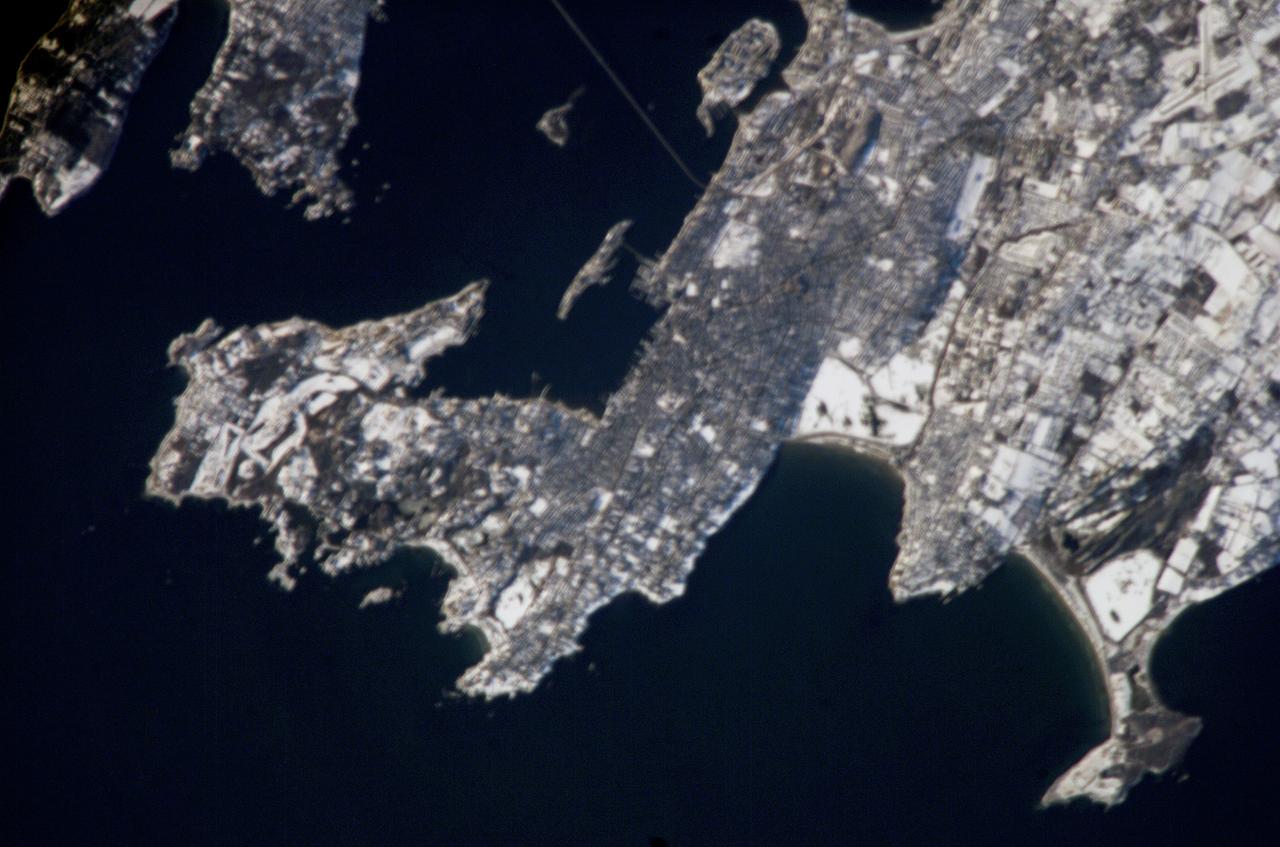
ISS012-E-19051 (4 March 2006) --- Newport, R.I., is featured in this image photographed by an Expedition 12 crew member on the International Space Station. Newport is well-known as a summer destination, but winter snow blankets the city in this image. One of the first settlements by Europeans in the Americas, the region was initially settled by colonists seeking religious freedom denied them in Europe, but over time some of them perceived a need to escape the strictures of the dominant Puritan faith. Newport, founded in 1639, became a bastion of the Baptist faith and exemplified one of the basic precepts of the United States Constitution – separation of church and state. Throughout the 17th and 18th centuries, Newport consolidated its position as one of the premier ports of the United States. The 19th and early 20th centuries saw a decline in commercial shipping at Newport and its rebirth as a recreational destination. Many of the leading industrialist families of the time, such as the Vanderbilts, built grand summer mansions in Newport that are now open to visitors. The United States Navy has also had a strong presence in the Newport area since 1869, exemplified by the establishment of the Naval War College in 1884 (image top center). The College still serves as an educational institution for naval officers. The gray-brown metropolitan area of Newport is thrown into sharp contrast by the surrounding snow-covered open fields and rural areas to the east and southwest. The Clairborne Pell (also known as Newport) Bridge connects Jamestown, R.I. on Conanicut Island to Newport at image top. The main span of this suspension bridge is 1600 feet (485 meters) long and crosses the East Passage of Narragansett Bay. The Sachuest Point National Wildlife Refuge (image lower right) supports over 200 bird species, including the largest winter harlequin duck population on the East Coast.

CAPE CANAVERAL, Fla. -- At NASA's Kennedy Space Center in Florida, the 600-Ton Test Fixture outside the Launch Equipment Test Facility conducts a 500,000-pound pull test of a bridge crane lifting element, which is used to lift space shuttles in the Vehicle Assembly Building. The fixture proofload tests, in tension and compression, a variety of ground support equipment, including slings, lifting beams and other critical lifting hardware that require periodic proofloading. Since 1977, the facility has supported NASA’s Launch Services, shuttle, International Space Station, and Constellation programs, as well as commercial providers. The facility recently underwent a major upgrade to support even more programs, projects and customers. It houses a 6,000-square-foot high bay, cable fabrication and molding shop, pneumatics shop, machine and weld shop and full-scale control room. Outside, the facility features a water flow test loop, vehicle motion simulator, launch simulation towers and a cryogenic system. Photo credit: NASA/Jim Grossmann
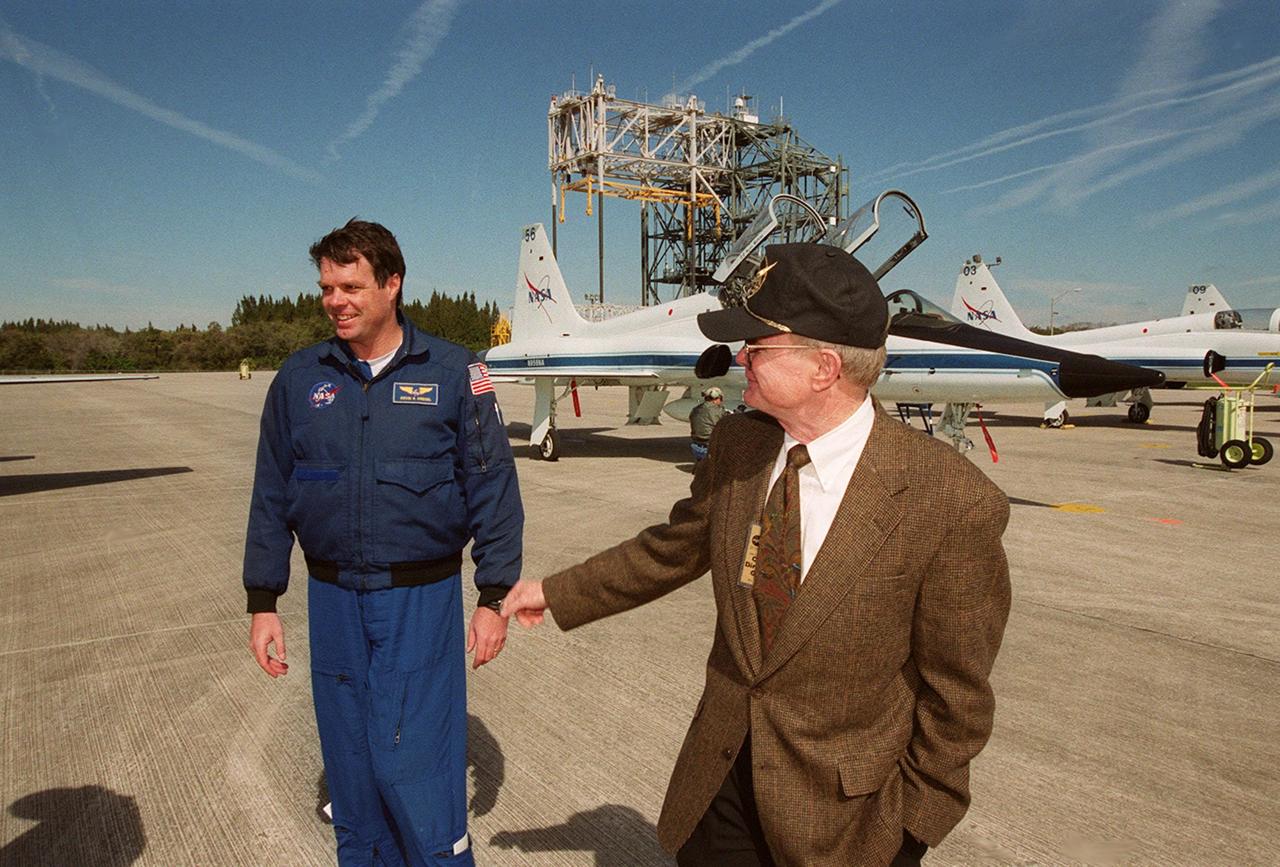
Center Director Roy Bridges (right) welcomes STS-99 Commander Kevin Kregel (left) and the rest of the crew after their arrival at KSC's Shuttle Landing Facility. Behind them are the T-38 jets that transported the crew, with the mate/demate tower in the background. Over the next few days, the crew will review mission procedures, conduct test flights in the Shuttle Training Aircraft and undergo routine preflight medical exams. STS-99 is the Shuttle Radar Topography Mission, which will chart a new course, using two antennae and a 200-foot-long section of space station-derived mast protruding from the payload bay to produce unrivaled 3-D images of the Earth's surface. The result of the Shuttle Radar Topography Mission could be close to 1 trillion measurements of the Earth's topography. Besides contributing to the production of better maps, these measurements could lead to improved water drainage modeling, more realistic flight simulators, better locations for cell phone towers, and enhanced navigation safety. Launch of Endeavour is scheduled for Jan. 31 at 12:47 p.m. EST
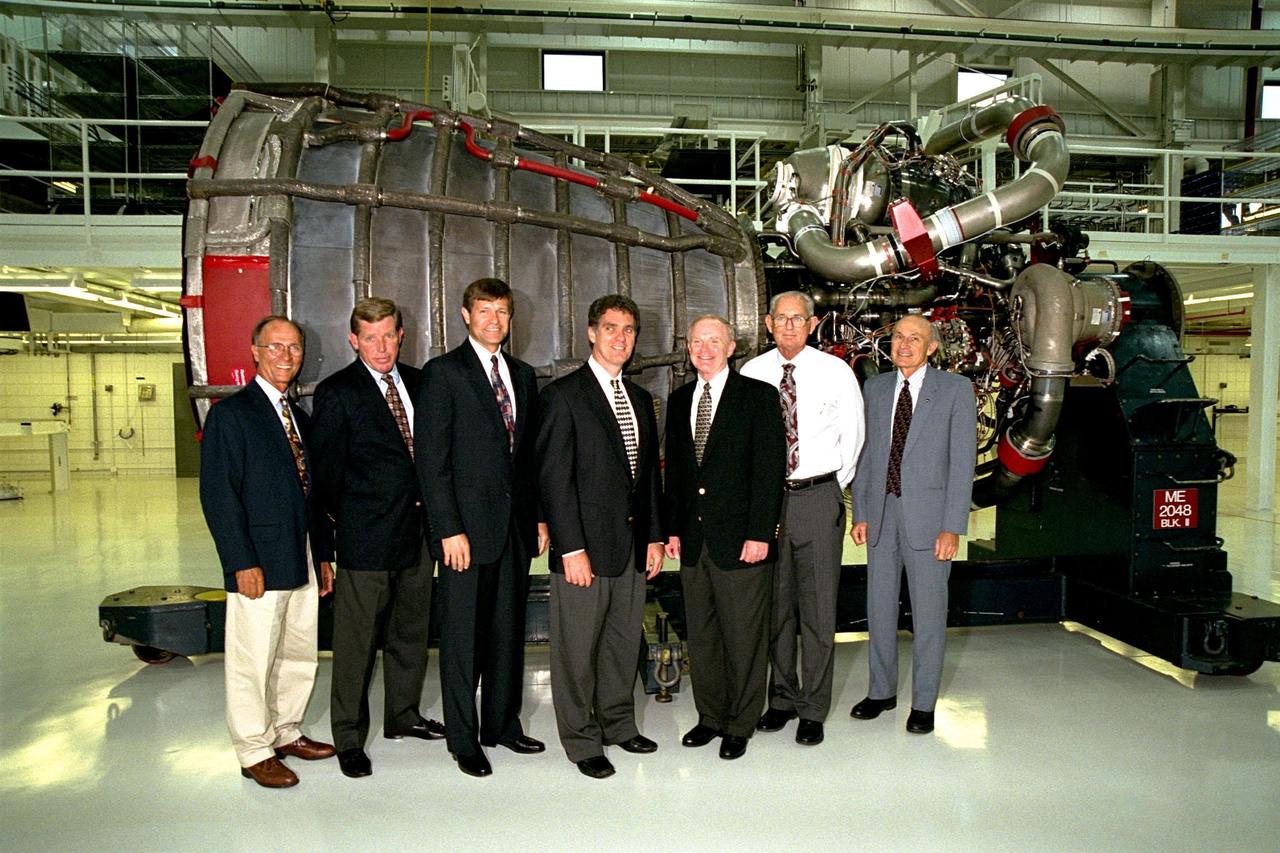
Participants in the ribbon cutting for KSC's new 34,600-square-foot Space Shuttle Main Engine Processing Facility (SSMEPF) pose in front of a Space Shuttle Main Engine on display for the ceremony. From left, they are Ed Adamek, vice president and associate program manager for Ground Operations of United Space Alliance; John Plowden, vice president of Rocketdyne; Donald R. McMonagle, manager of Launch Integration; U.S. Congressman Dave Weldon; KSC Center Director Roy D. Bridges Jr.; Wade Ivey of Ivey Construction, Inc.; and Robert B. Sieck, director of Shuttle Processing. A major addition to the existing Orbiter Processing Facility Bay 3, the SSMEPF replaces the Shuttle Main Engine Shop located in the Vehicle Assembly Building (VAB). The decision to move the shop out of the VAB was prompted by safety considerations and recent engine processing improvements. The first three main engines to be processed in the new facility will fly on Shuttle Endeavour's STS-88 mission in December 1998