
Manager of International Space Station Operations, Bernardo Patti, of the European Space Agency (ESA), speaks during the State Commission meeting to approve the Soyuz launch of Expedition 42 to the International Space Station, Saturday, Nov. 22, at the Cosmonaut Hotel in Baikonur, Kazakhstan. The mission is set to launch Nov. 24 from the Baikonur Cosmodrome. Photo Credit: (NASA/Aubrey Gemignani)
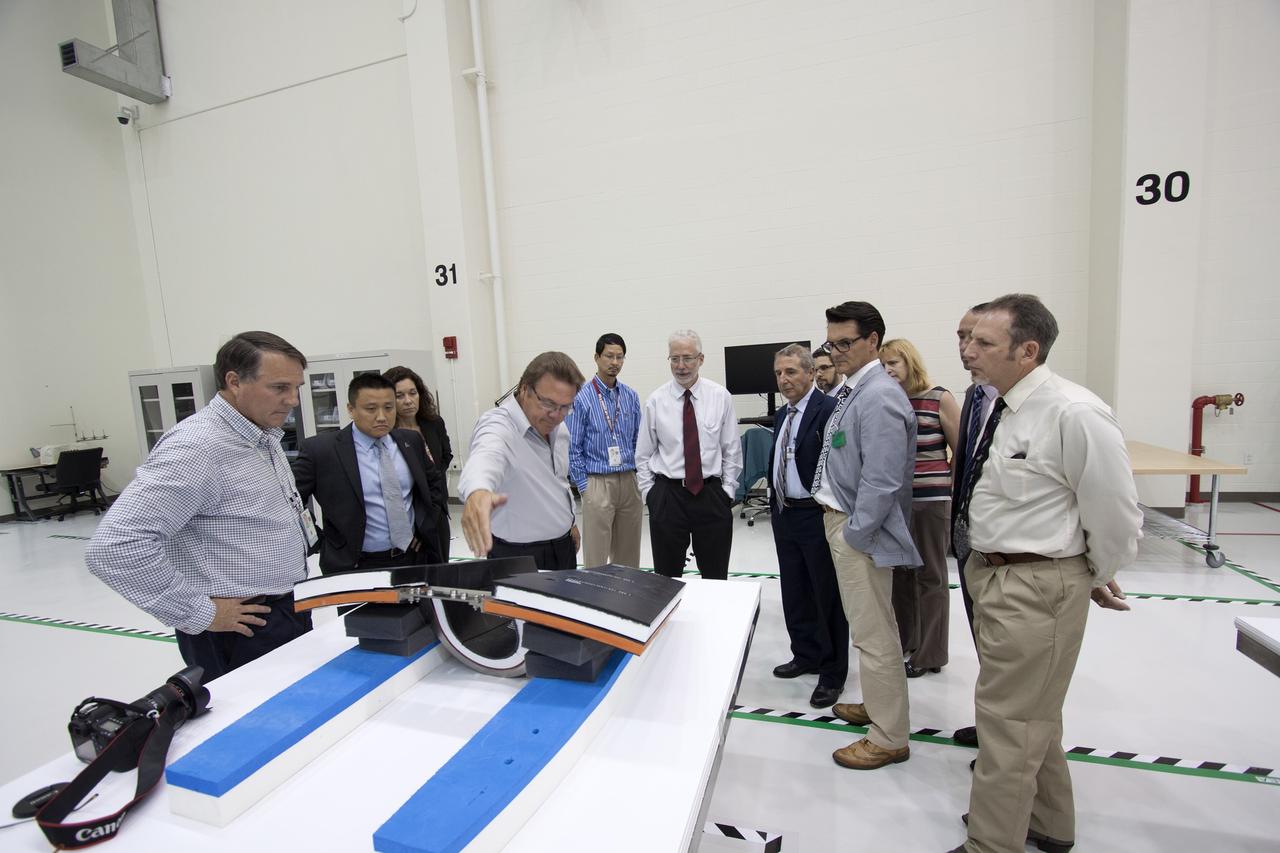
CAPE CANAVERAL, Fla. – Representatives from the European Space Agency, or ESA, toured the Operations and Checkout Building high bay at NASA’s Kennedy Space Center in Florida. Pointing at thermal protection system tiles is Jules Schneider, Lockheed Martin senior manager. At right, in the blue suit, is Bernardo Patti, ESA manager of International Space Station Operations. Standing next to Patti is Nico Dettman, ESA Space Transportation Department director. Orion is the exploration spacecraft designed to carry crews to space beyond low Earth orbit. It will provide emergency abort capability, sustain the crew during the space travel and provide safe re-entry from deep space return velocities. Orion’s first unpiloted test flight is scheduled to launch in 2014 atop a Delta IV rocket. A second uncrewed flight test is scheduled for 2017 on NASA’s Space Launch System rocket. For more information, visit http://www.nasa.gov/orion. Photo credit: NASA/Jim Grossmann
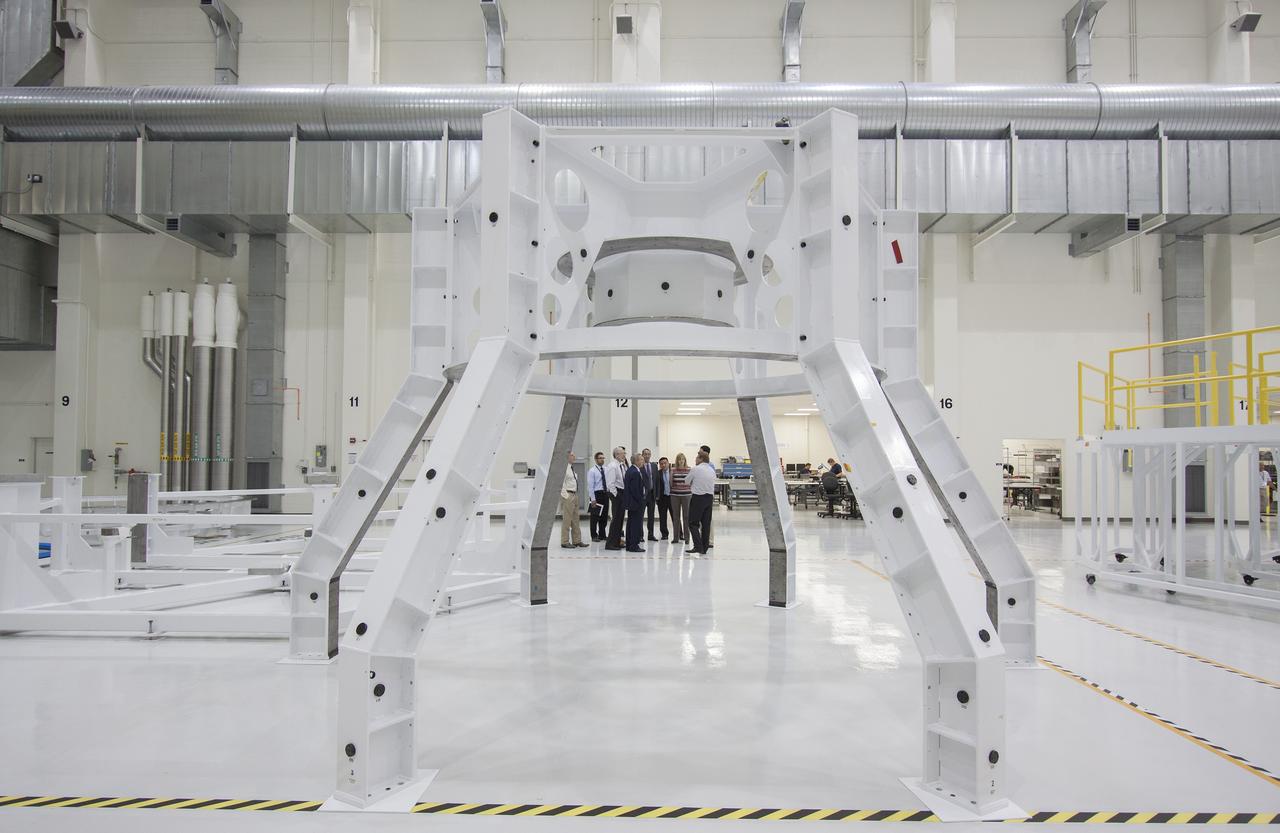
CAPE CANAVERAL, Fla. – Representatives from the European Space Agency, or ESA, toured the Operations and Checkout Building high bay and viewed the Orion crew module at NASA’s Kennedy Space Center in Florida. Among the group were Nico Dettman, ESA Space Transportation Department director Bernardo Patti, ESA International Space Station Operations manager and Philippe Deloo, ESA European Service Module Study manager. Orion is the exploration spacecraft designed to carry crews to space beyond low Earth orbit. It will provide emergency abort capability, sustain the crew during the space travel and provide safe re-entry from deep space return velocities. Orion’s first unpiloted test flight is scheduled to launch in 2014 atop a Delta IV rocket. A second uncrewed flight test is scheduled for 2017 on NASA’s Space Launch System rocket. For more information, visit http://www.nasa.gov/orion. Photo credit: NASA/Jim Grossmann
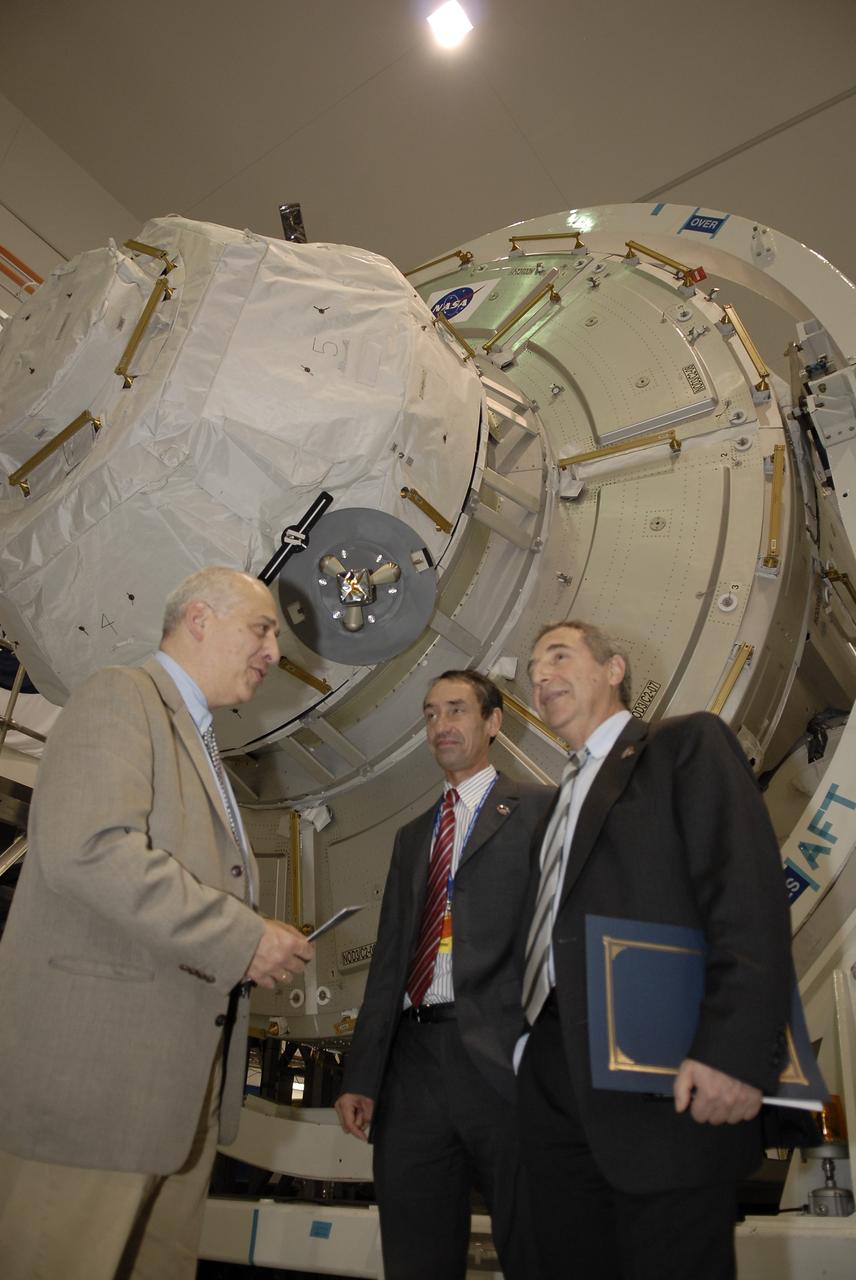
CAPE CANAVERAL, Fla. – In the Space Station Processing Facility at NASA's Kennedy Space Center in Florida, Bernardo Patti, right, head of International Space Station, Program Department, European Space Agency, or ESA, has a lot to smile about as he is photographed in front of the node 3 for the International Space Station following a ceremony transferring the ownership of the node from ESA to NASA. Node 3 is named "Tranquility" after the Sea of Tranquility, the lunar landing site of Apollo 11. The payload for the STS-130 mission, Tranquility is a pressurized module that will provide room for many of the International Space Station's life support systems. The module was built for ESA by Thales Alenia Space in Turin, Italy. Attached to one end of Tranquility is a cupola, a unique work station with six windows on its sides and one on top. The cupola resembles a circular bay window and will provide a vastly improved view of the station's exterior. Just under 10 feet in diameter, the module will accommodate two crew members and portable workstations that can control station and robotic activities. The multi-directional view will allow the crew to monitor spacewalks and docking operations, as well as provide a spectacular view of Earth and other celestial objects. Space shuttle Endeavour's STS-130 mission is targeted to launch Feb. 4, 2010. Photo credit: NASA/Kim Shiflett
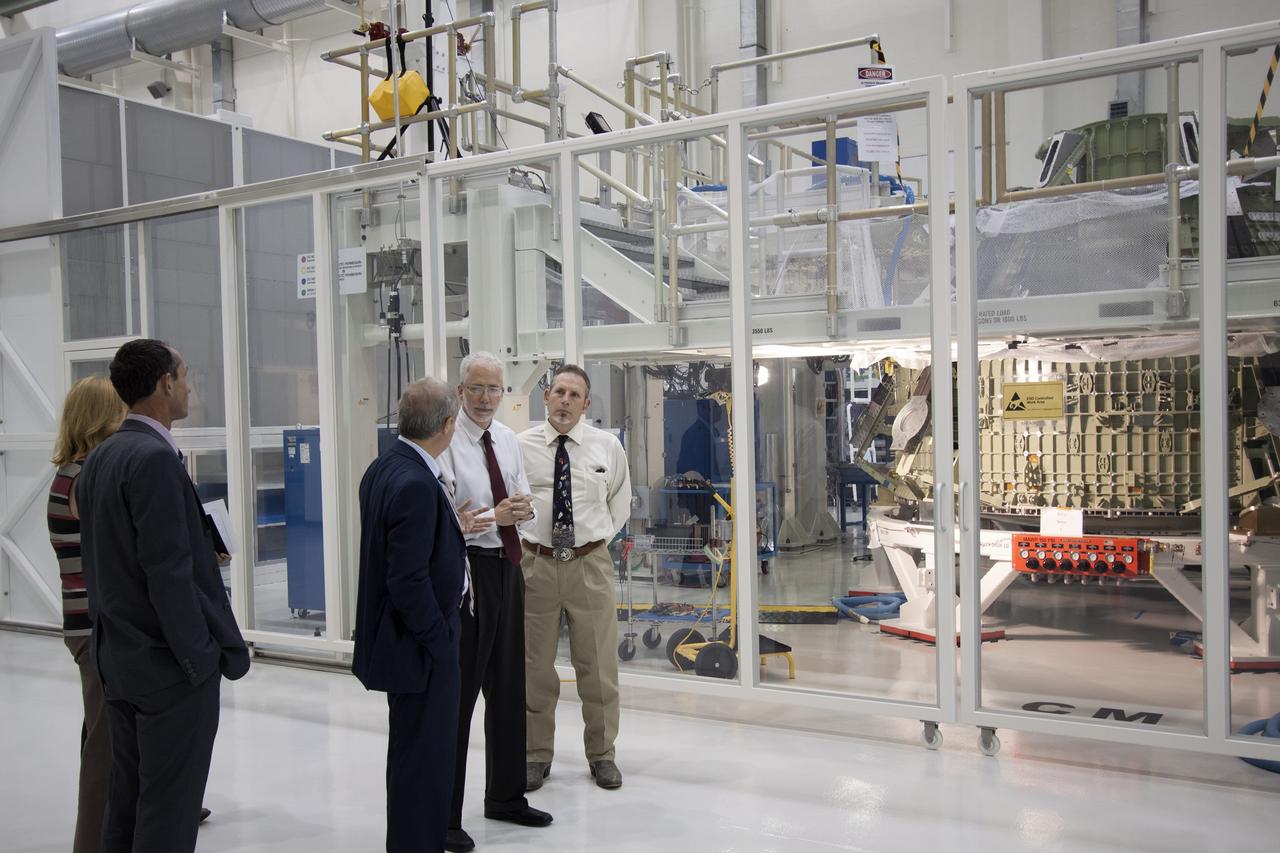
CAPE CANAVERAL, Fla. – Representatives from the European Space Agency, or ESA, toured the Operations and Checkout Building high bay and viewed the Orion crew module at NASA’s Kennedy Space Center in Florida. From the left, are Philippe Deloo, ESA European Service Module Study manager Kathleen Schubert, NASA crew and service module deputy manager Bernardo Patti, ESA manager of International Space Station Operations Mark Geyer, NASA Orion program manager and Ari Blum, NASA export administrator at Johnson Space Center in Houston. Orion is the exploration spacecraft designed to carry crews to space beyond low Earth orbit. It will provide emergency abort capability, sustain the crew during the space travel and provide safe re-entry from deep space return velocities. Orion’s first unpiloted test flight is scheduled to launch in 2014 atop a Delta IV rocket. A second uncrewed flight test is scheduled for 2017 on NASA’s Space Launch System rocket. For more information, visit http://www.nasa.gov/orion. Photo credit: NASA/Jim Grossmann
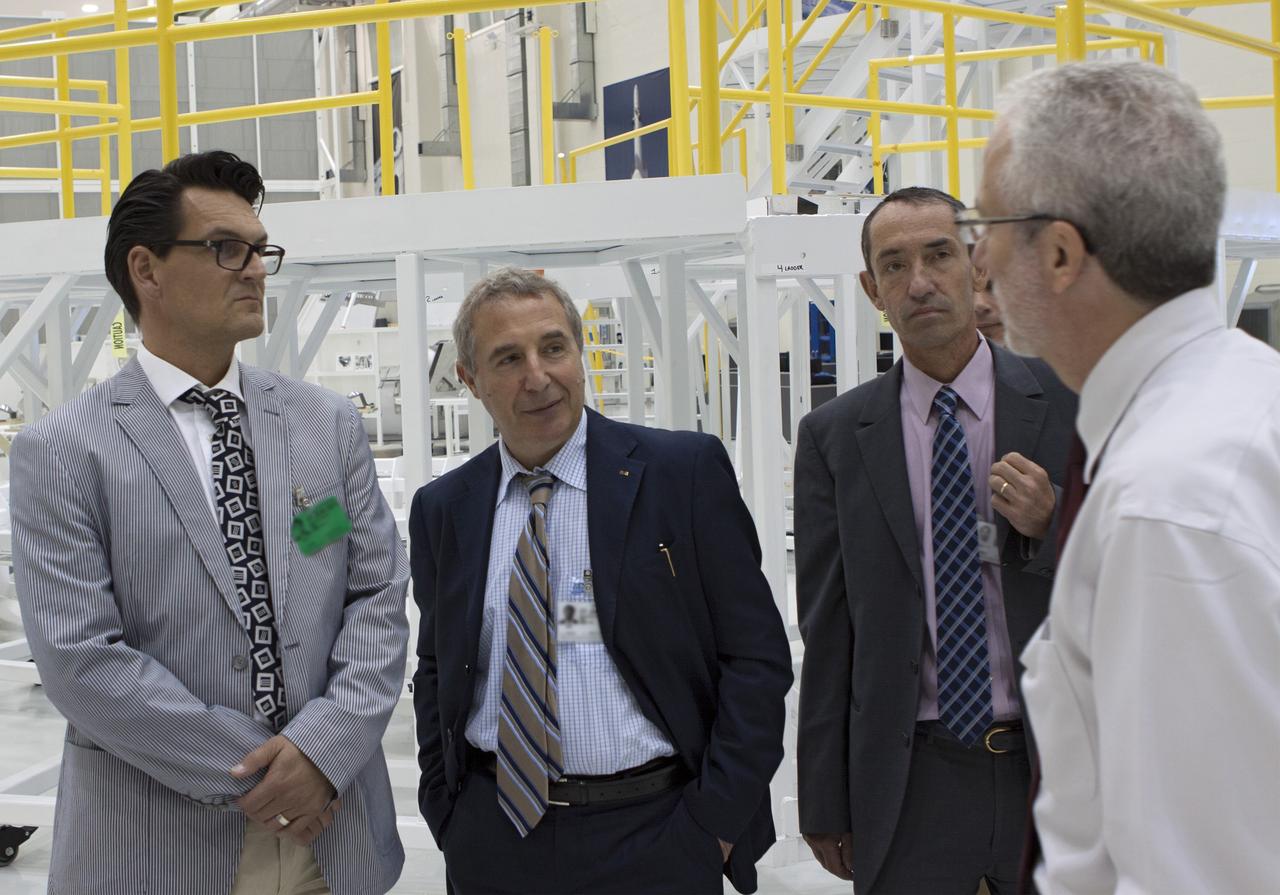
CAPE CANAVERAL, Fla. – Representatives from the European Space Agency, or ESA, toured the Operations and Checkout Building high bay at NASA’s Kennedy Space Center in Florida. From the left, are Nico Dettman, ESA Space Transportation Department director Bernardo Patti, ESA manager of International Space Station Operations Philippe Deloo, ESA European Service Module study manager and Mark Geyer, Orion Production Operations manager. Orion is the exploration spacecraft designed to carry crews to space beyond low Earth orbit. It will provide emergency abort capability, sustain the crew during the space travel and provide safe re-entry from deep space return velocities. Orion’s first unpiloted test flight is scheduled to launch in 2014 atop a Delta IV rocket. A second uncrewed flight test is scheduled for 2017 on NASA’s Space Launch System rocket. For more information, visit http://www.nasa.gov/orion. Photo credit: NASA/Jim Grossmann
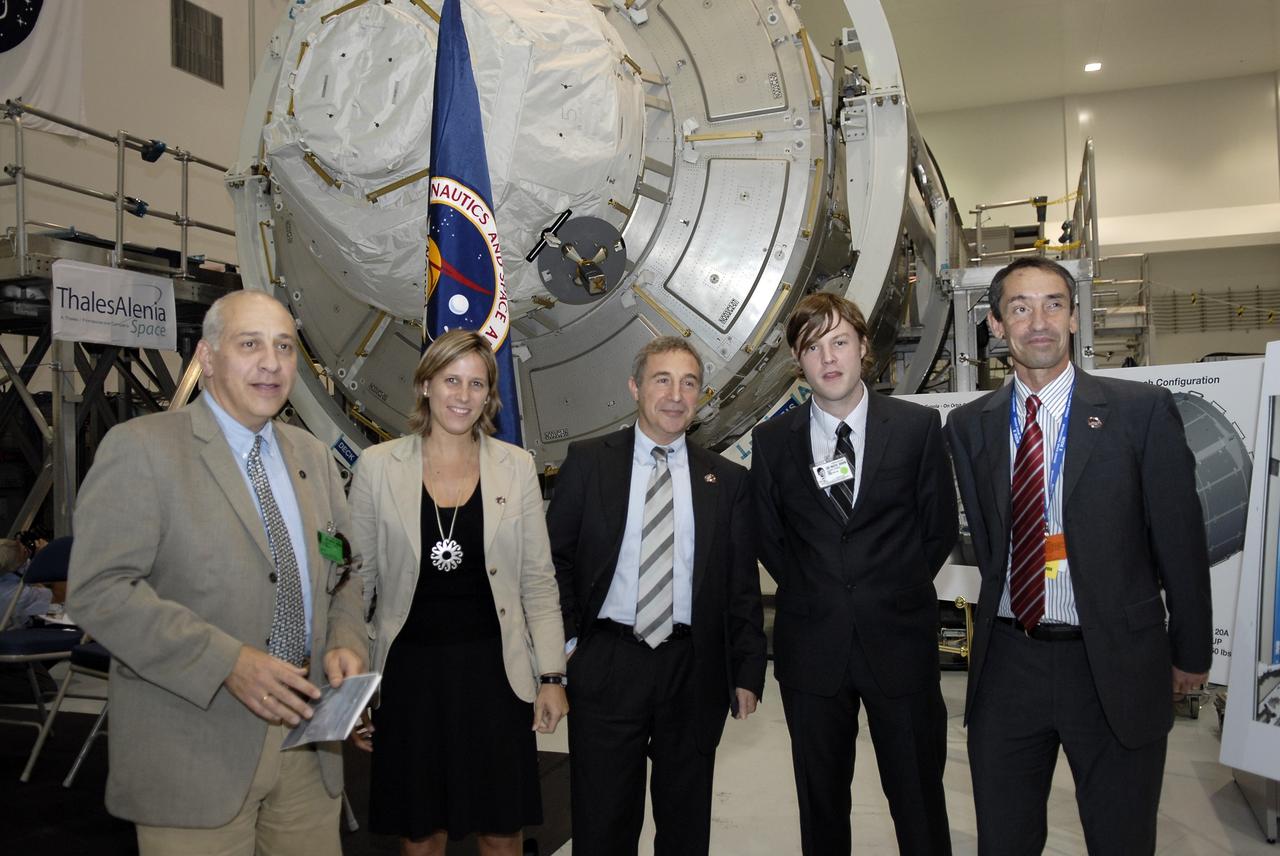
CAPE CANAVERAL, Fla. – In the Space Station Processing Facility at NASA's Kennedy Space Center in Florida, Bernardo Patti, head of International Space Station, Program Department, European Space Agency, or ESA, is photographed with invited guests of ESA in front of node 3 for the International Space Station following a ceremony transferring the ownership of the node from ESA to NASA. Node 3 is named "Tranquility" after the Sea of Tranquility, the lunar landing site of Apollo 11. The payload for the STS-130 mission, Tranquility is a pressurized module that will provide room for many of the International Space Station's life support systems. The module was built for ESA by Thales Alenia Space in Turin, Italy. Attached to one end of Tranquility is a cupola, a unique work station with six windows on its sides and one on top. The cupola resembles a circular bay window and will provide a vastly improved view of the station's exterior. Just under 10 feet in diameter, the module will accommodate two crew members and portable workstations that can control station and robotic activities. The multi-directional view will allow the crew to monitor spacewalks and docking operations, as well as provide a spectacular view of Earth and other celestial objects. Space shuttle Endeavour's STS-130 mission is targeted to launch Feb. 4, 2010. Photo credit: NASA/Kim Shiflett
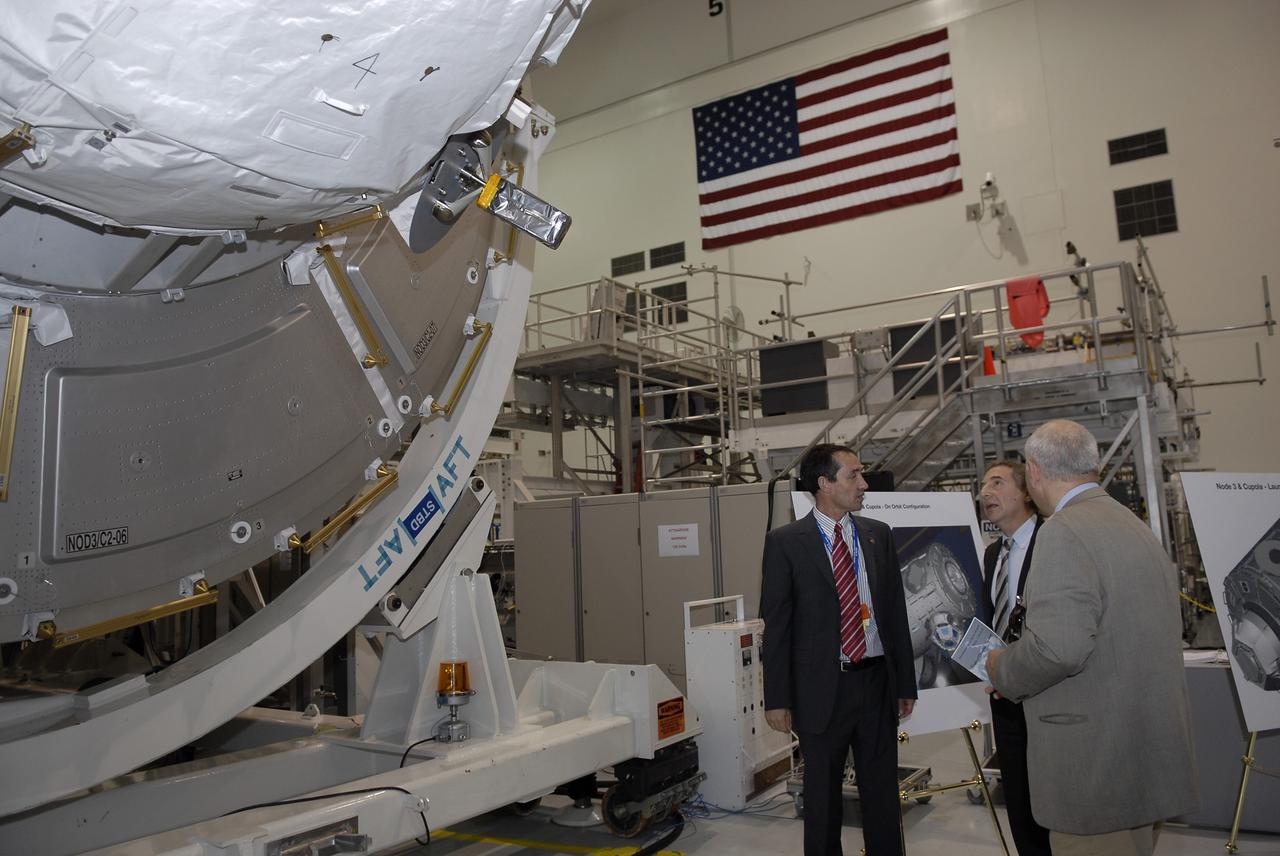
CAPE CANAVERAL, Fla. – In the Space Station Processing Facility at NASA's Kennedy Space Center in Florida, Bernardo Patti, center, head of International Space Station, Program Department, European Space Agency, or ESA, admires the node 3 for the International Space Station, which his agency provided, following a ceremony transferring the ownership of the node from ESA to NASA. Node 3 is named "Tranquility" after the Sea of Tranquility, the lunar landing site of Apollo 11. The payload for the STS-130 mission, Tranquility is a pressurized module that will provide room for many of the International Space Station's life support systems. The module was built for ESA by Thales Alenia Space in Turin, Italy. Attached to one end of Tranquility is a cupola, a unique work station with six windows on its sides and one on top. The cupola resembles a circular bay window and will provide a vastly improved view of the station's exterior. Just under 10 feet in diameter, the module will accommodate two crew members and portable workstations that can control station and robotic activities. The multi-directional view will allow the crew to monitor spacewalks and docking operations, as well as provide a spectacular view of Earth and other celestial objects. Space shuttle Endeavour's STS-130 mission is targeted to launch Feb. 4, 2010. Photo credit: NASA/Kim Shiflett
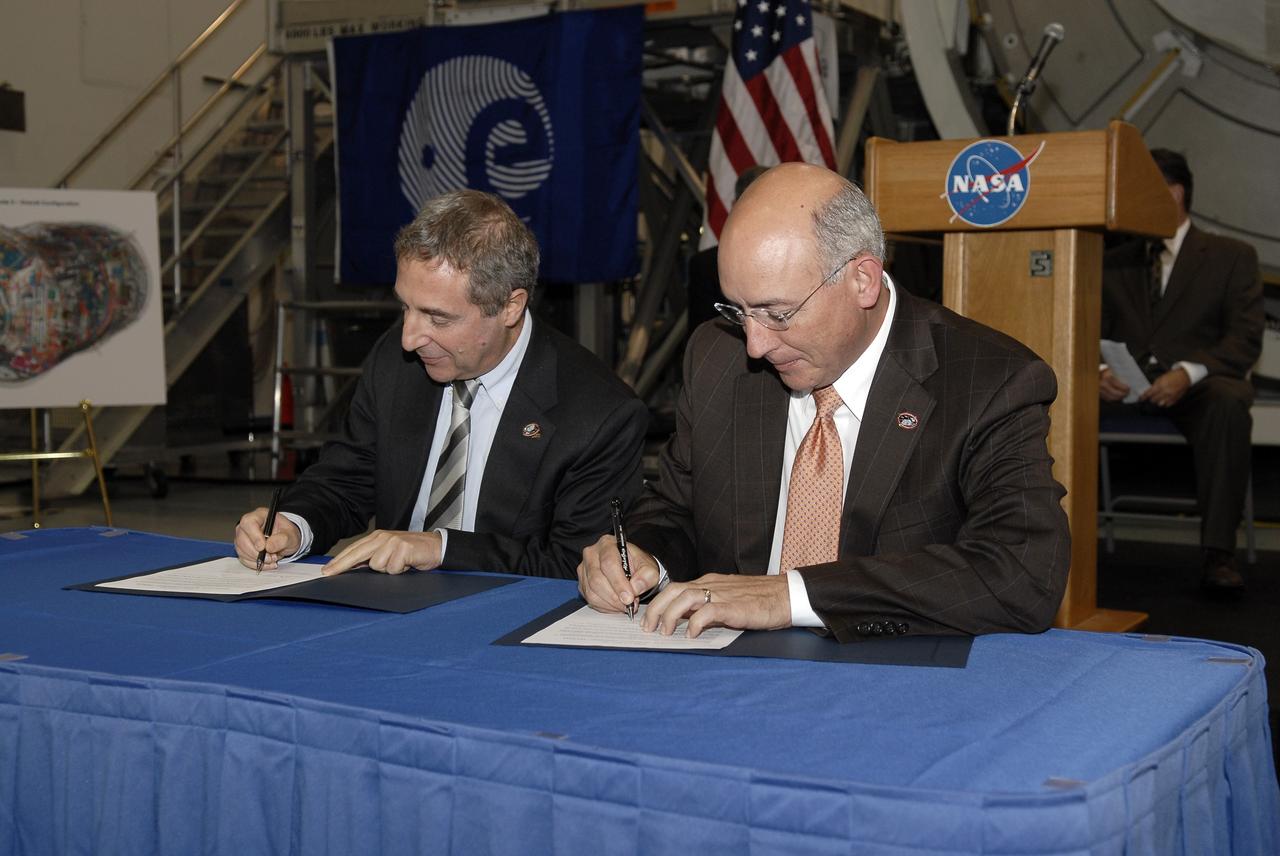
CAPE CANAVERAL, Fla. – In the Space Station Processing Facility at NASA's Kennedy Space Center in Florida, Bernardo Patti, at left, head of International Space Station, Program Department, European Space Agency, and Michael Suffredini, program manager, International Space Station, NASA, sign documents transferring the ownership of node 3 for the International Space Station from the European Space Agency, or ESA, to NASA. Node 3 is named "Tranquility" after the Sea of Tranquility, the lunar landing site of Apollo 11. The payload for the STS-130 mission, Tranquility is a pressurized module that will provide room for many of the International Space Station's life support systems. The module was built for ESA by Thales Alenia Space in Turin, Italy. Attached to one end of Tranquility is a cupola, a unique work station with six windows on its sides and one on top. The cupola resembles a circular bay window and will provide a vastly improved view of the station's exterior. Just under 10 feet in diameter, the module will accommodate two crew members and portable workstations that can control station and robotic activities. The multi-directional view will allow the crew to monitor spacewalks and docking operations, as well as provide a spectacular view of Earth and other celestial objects. Space shuttle Endeavour's STS-130 mission is targeted to launch Feb. 4, 2010. Photo credit: NASA/Kim Shiflett
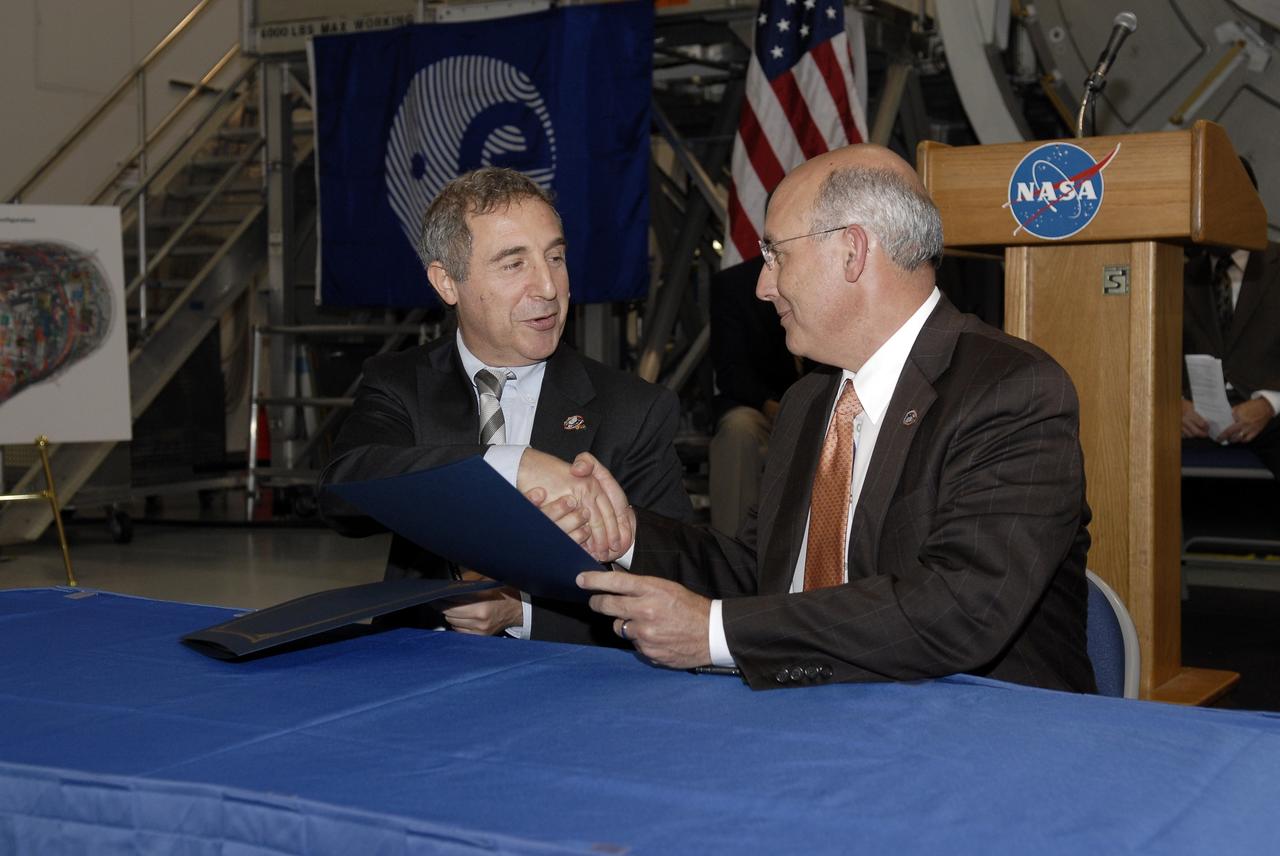
CAPE CANAVERAL, Fla. – In the Space Station Processing Facility at NASA's Kennedy Space Center in Florida, Bernardo Patti, at left, head of International Space Station, Program Department, European Space Agency, congratulates Michael Suffredini, program manager, International Space Station, NASA, upon transfer of the ownership of node 3 for the International Space Station from the European Space Agency, or ESA, to NASA. Node 3 is named "Tranquility" after the Sea of Tranquility, the lunar landing site of Apollo 11. The payload for the STS-130 mission, Tranquility is a pressurized module that will provide room for many of the International Space Station's life support systems. The module was built for ESA by Thales Alenia Space in Turin, Italy. Attached to one end of Tranquility is a cupola, a unique work station with six windows on its sides and one on top. The cupola resembles a circular bay window and will provide a vastly improved view of the station's exterior. Just under 10 feet in diameter, the module will accommodate two crew members and portable workstations that can control station and robotic activities. The multi-directional view will allow the crew to monitor spacewalks and docking operations, as well as provide a spectacular view of Earth and other celestial objects. Space shuttle Endeavour's STS-130 mission is targeted to launch Feb. 4, 2010. Photo credit: NASA/Kim Shiflett

CAPE CANAVERAL, Fla. – In the Space Station Processing Facility at NASA's Kennedy Space Center in Florida, Secondino Brondolo, head of the Space Infrastructure, Thales Alenia Space Italy, addresses the invited guests at a ceremony transferring the ownership of node 3 for the International Space Station from the European Space Agency, or ESA, to NASA. Seated, from left, are Bob Cabana, Kennedy Space Center director; Michael Suffredini, program manager, International Space Station, NASA; William Dowdell, deputy for Operations, International Space Station and Spacecraft Processing, Kennedy; and Bernardo Patti, head of International Space Station, Program Department, ESA. Node 3 is named "Tranquility" after the Sea of Tranquility, the lunar landing site of Apollo 11. The payload for the STS-130 mission, Tranquility is a pressurized module that will provide room for many of the International Space Station's life support systems. The module was built for ESA by Thales Alenia Space in Turin, Italy. Attached to one end of Tranquility is a cupola, a unique work station with six windows on its sides and one on top. The cupola resembles a circular bay window and will provide a vastly improved view of the station's exterior. Just under 10 feet in diameter, the module will accommodate two crew members and portable workstations that can control station and robotic activities. The multi-directional view will allow the crew to monitor spacewalks and docking operations, as well as provide a spectacular view of Earth and other celestial objects. Space shuttle Endeavour's STS-130 mission is targeted to launch Feb. 4, 2010. Photo credit: NASA/Kim Shiflett
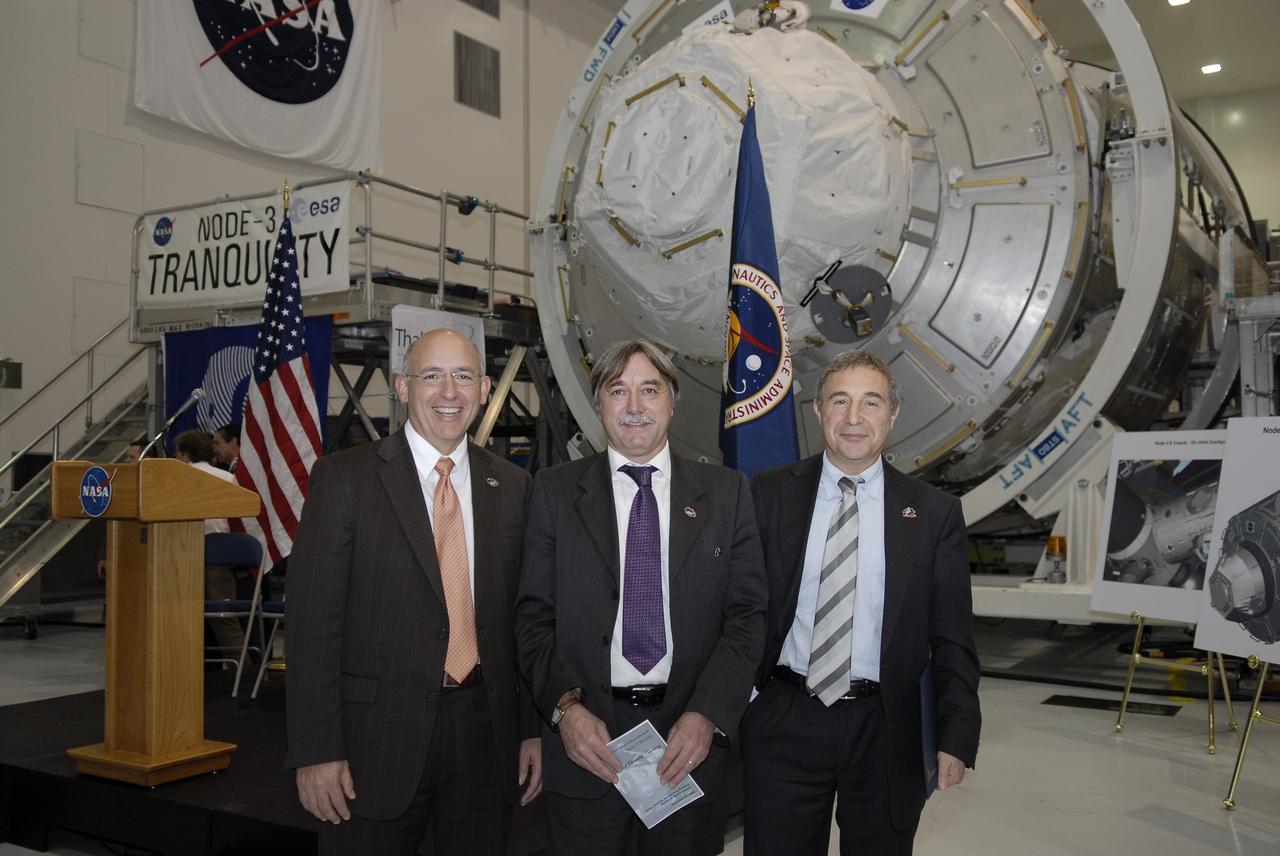
CAPE CANAVERAL, Fla. – In the Space Station Processing Facility at NASA's Kennedy Space Center in Florida, from left, Michael Suffredini, program manager, International Space Station, NASA; Secondino Brondolo, head of the Space Infrastructure, Thales Alenia Space Italy; and Bernardo Patti, head of International Space Station, Program Department, ESA, are photographed in front of node 3 for the International Space Station following a ceremony transferring the ownership of the node from the European Space Agency, or ESA, to NASA. Node 3 is named "Tranquility" after the Sea of Tranquility, the lunar landing site of Apollo 11. The payload for the STS-130 mission, Tranquility is a pressurized module that will provide room for many of the International Space Station's life support systems. The module was built for ESA by Thales Alenia Space in Turin, Italy. Attached to one end of Tranquility is a cupola, a unique work station with six windows on its sides and one on top. The cupola resembles a circular bay window and will provide a vastly improved view of the station's exterior. Just under 10 feet in diameter, the module will accommodate two crew members and portable workstations that can control station and robotic activities. The multi-directional view will allow the crew to monitor spacewalks and docking operations, as well as provide a spectacular view of Earth and other celestial objects. Space shuttle Endeavour's STS-130 mission is targeted to launch Feb. 4, 2010. Photo credit: NASA/Kim Shiflett
CAPE CANAVERAL, Fla. – In the Space Station Processing Facility at NASA's Kennedy Space Center in Florida, Kennedy Director Bob Cabana addresses the invited guests at a ceremony transferring the ownership of node 3 for the International Space Station, looming in the background, from the European Space Agency, or ESA, to NASA. Seated, from left, are William Dowdell, deputy for Operations, International Space Station and Spacecraft Processing, Kennedy; Bernardo Patti, head of International Space Station, Program Department, ESA; and Secondino Brondolo, head of the Space Infrastructure, Thales Alenia Space Italy. Node 3 is named "Tranquility" after the Sea of Tranquility, the lunar landing site of Apollo 11. The payload for the STS-130 mission, Tranquility is a pressurized module that will provide room for many of the International Space Station's life support systems. The module was built for ESA by Thales Alenia Space in Turin, Italy. Attached to one end of Tranquility is a cupola, a unique work station with six windows on its sides and one on top. The cupola resembles a circular bay window and will provide a vastly improved view of the station's exterior. Just under 10 feet in diameter, the module will accommodate two crew members and portable workstations that can control station and robotic activities. The multi-directional view will allow the crew to monitor spacewalks and docking operations, as well as provide a spectacular view of Earth and other celestial objects. Space shuttle Endeavour's STS-130 mission is targeted to launch Feb. 4, 2010. Photo credit: NASA/Kim Shiflett
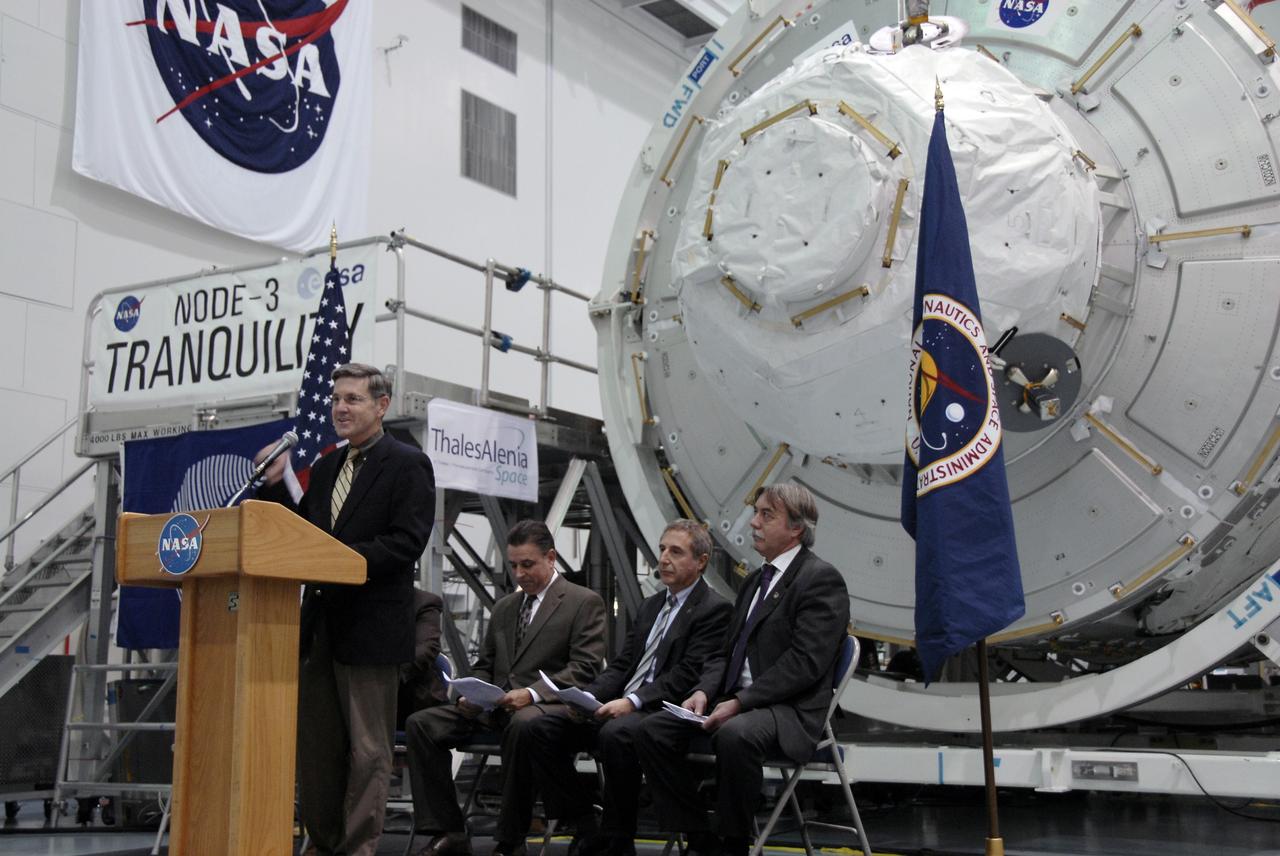
CAPE CANAVERAL, Fla. – In the Space Station Processing Facility at NASA's Kennedy Space Center in Florida, Michael Suffredini, program manager, International Space Station, NASA, addresses the invited guests at a ceremony transferring the ownership of node 3 for the International Space Station, looming in the background, from the European Space Agency, or ESA, to NASA. Seated, from left, are Bob Cabana, Kennedy Space Center director; Bernardo Patti, head of International Space Station, Program Department, ESA; and Secondino Brondolo, head of the Space Infrastructure, Thales Alenia Space Italy. Node 3 is named "Tranquility" after the Sea of Tranquility, the lunar landing site of Apollo 11. The payload for the STS-130 mission, Tranquility is a pressurized module that will provide room for many of the International Space Station's life support systems. The module was built for ESA by Thales Alenia Space in Turin, Italy. Attached to one end of Tranquility is a cupola, a unique work station with six windows on its sides and one on top. The cupola resembles a circular bay window and will provide a vastly improved view of the station's exterior. Just under 10 feet in diameter, the module will accommodate two crew members and portable workstations that can control station and robotic activities. The multi-directional view will allow the crew to monitor spacewalks and docking operations, as well as provide a spectacular view of Earth and other celestial objects. Space shuttle Endeavour's STS-130 mission is targeted to launch Feb. 4, 2010. Photo credit: NASA/Kim Shiflett
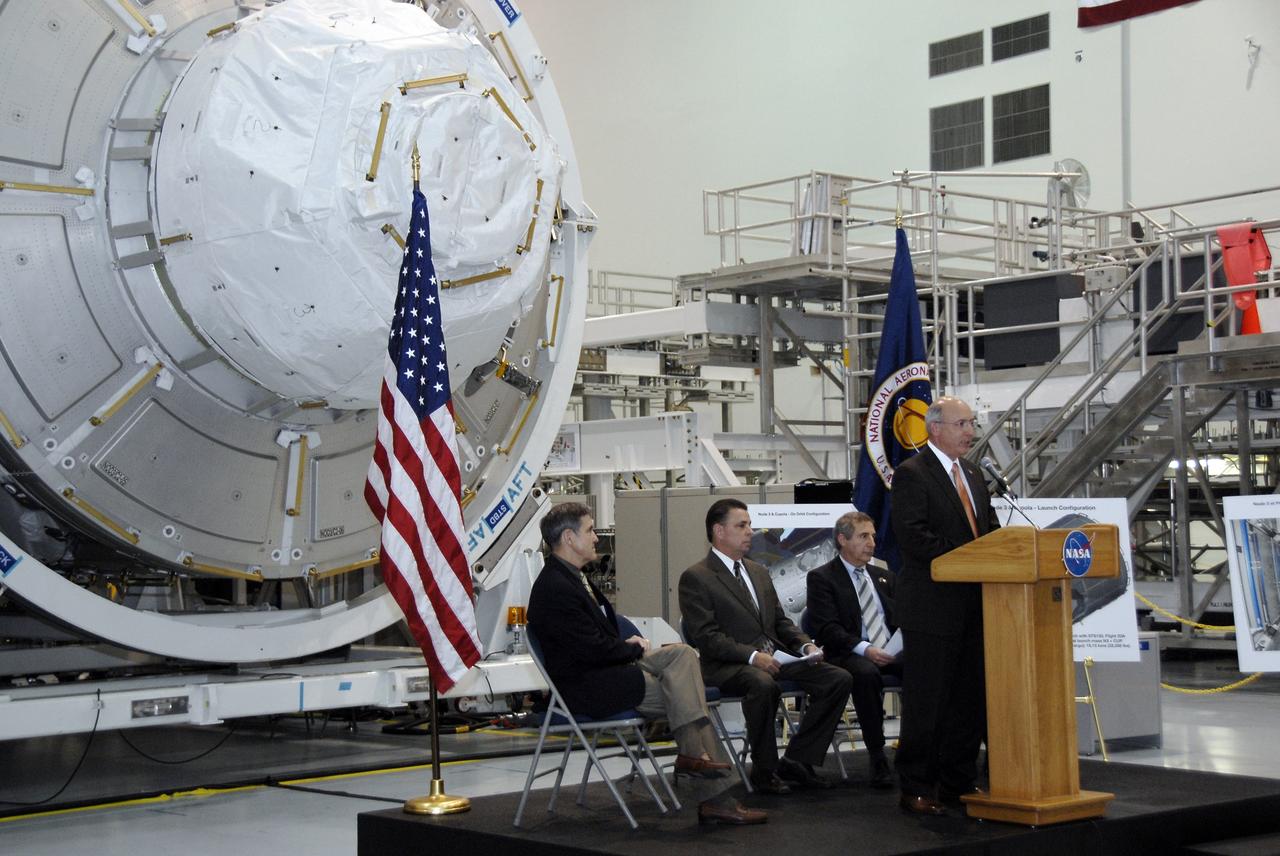
CAPE CANAVERAL, Fla. – In the Space Station Processing Facility at NASA's Kennedy Space Center in Florida, Michael Suffredini, program manager, International Space Station, NASA, addresses the invited guests at a ceremony transferring the ownership of node 3 for the International Space Station, looming in the background, from the European Space Agency, or ESA, to NASA. Seated, from left, are Michael Suffredini, program manager, International Space Station, NASA; William Dowdell, deputy for Operations, International Space Station and Spacecraft Processing, Kennedy; and Bernardo Patti, head of International Space Station, Program Department, ESA. Node 3 is named "Tranquility" after the Sea of Tranquility, the lunar landing site of Apollo 11. The payload for the STS-130 mission, Tranquility is a pressurized module that will provide room for many of the International Space Station's life support systems. The module was built for ESA by Thales Alenia Space in Turin, Italy. Attached to one end of Tranquility is a cupola, a unique work station with six windows on its sides and one on top. The cupola resembles a circular bay window and will provide a vastly improved view of the station's exterior. Just under 10 feet in diameter, the module will accommodate two crew members and portable workstations that can control station and robotic activities. The multi-directional view will allow the crew to monitor spacewalks and docking operations, as well as provide a spectacular view of Earth and other celestial objects. Space shuttle Endeavour's STS-130 mission is targeted to launch Feb. 4, 2010. Photo credit: NASA/Kim Shiflett
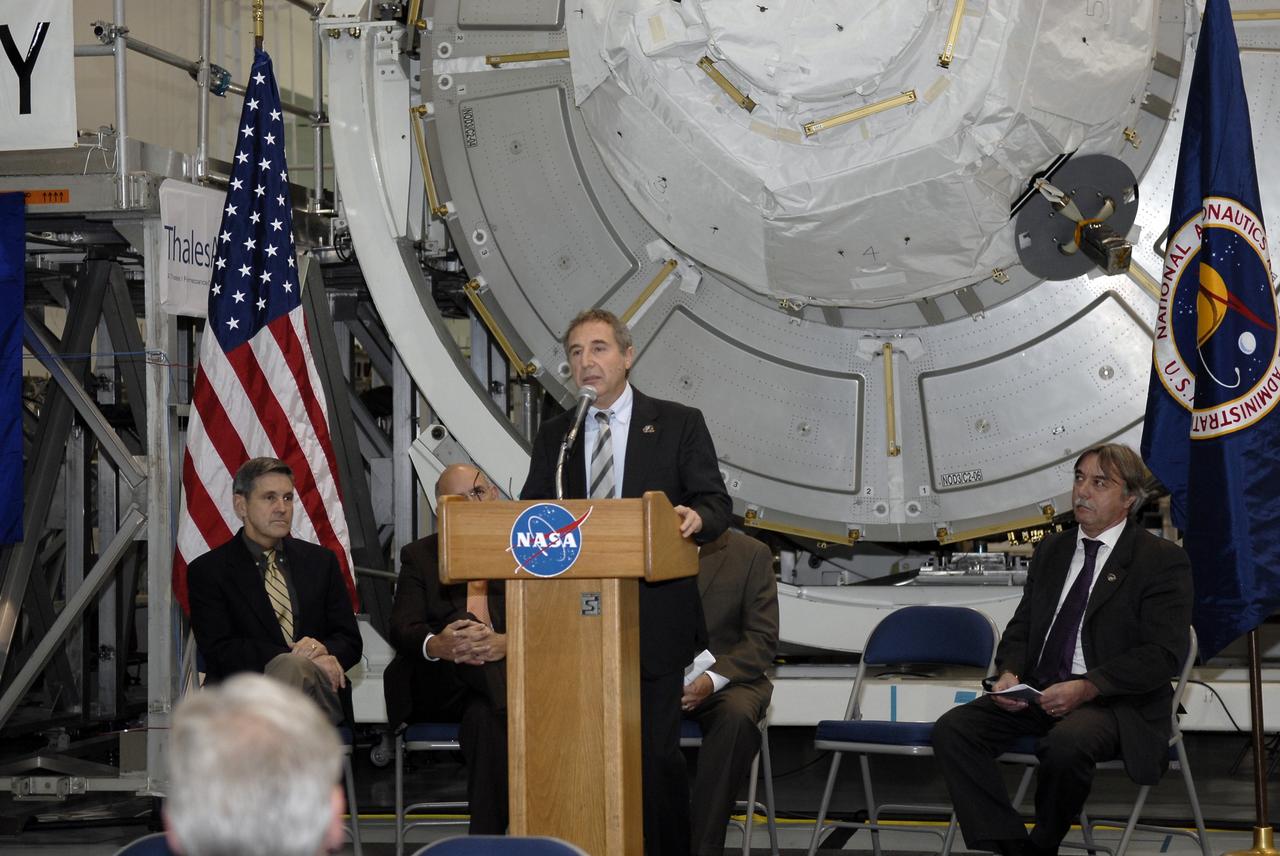
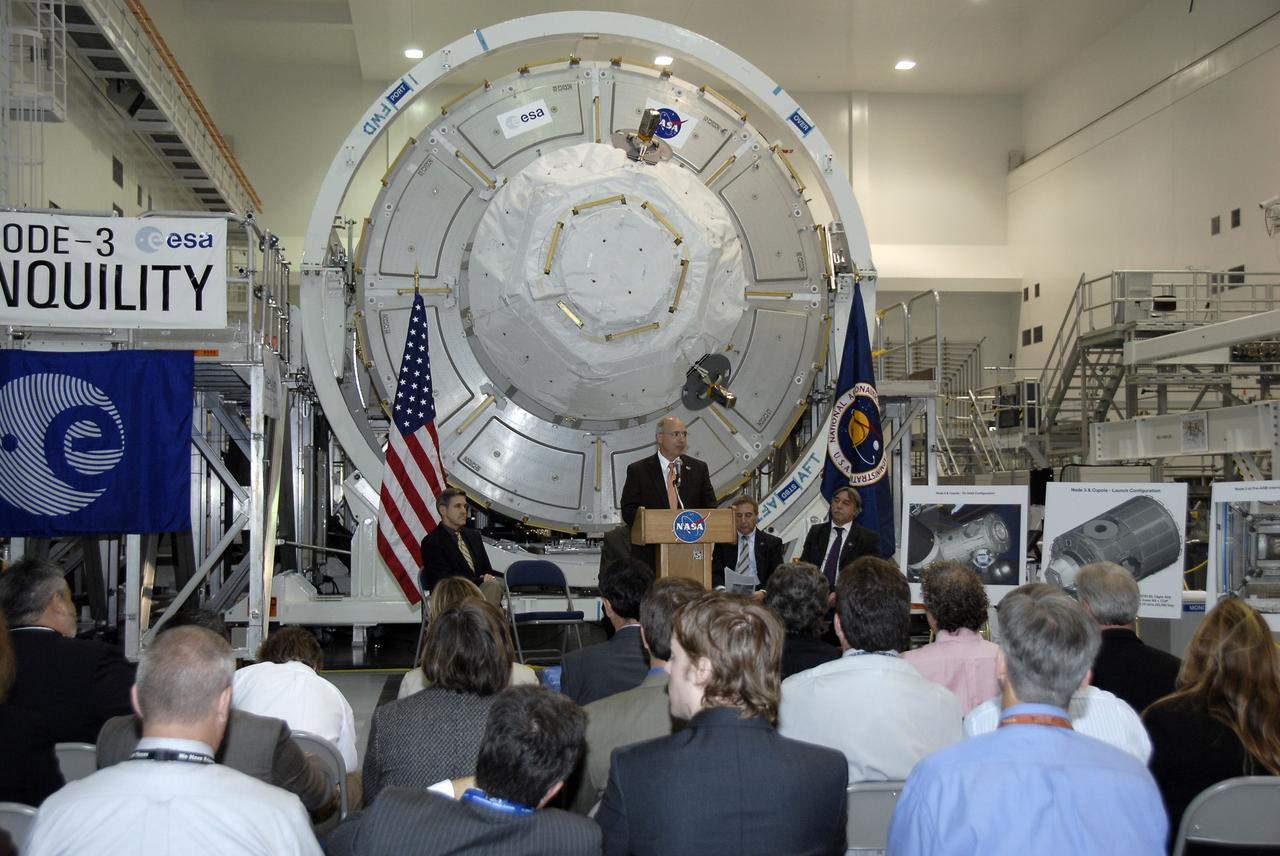
CAPE CANAVERAL, Fla. – In the Space Station Processing Facility at NASA's Kennedy Space Center in Florida, Bernardo Patti, head of International Space Station, Program Department, ESA, addresses the invited guests at a ceremony transferring the ownership of node 3 for the International Space Station, looming in the background, from the European Space Agency, or ESA, to NASA. Seated, from left, are Bob Cabana, Kennedy Space Center director, and Secondino Brondolo, head of the Space Infrastructure, Thales Alenia Space Italy. Node 3 is named "Tranquility" after the Sea of Tranquility, the lunar landing site of Apollo 11. The payload for the STS-130 mission, Tranquility is a pressurized module that will provide room for many of the International Space Station's life support systems. The module was built for ESA by Thales Alenia Space in Turin, Italy. Attached to one end of Tranquility is a cupola, a unique work station with six windows on its sides and one on top. The cupola resembles a circular bay window and will provide a vastly improved view of the station's exterior. Just under 10 feet in diameter, the module will accommodate two crew members and portable workstations that can control station and robotic activities. The multi-directional view will allow the crew to monitor spacewalks and docking operations, as well as provide a spectacular view of Earth and other celestial objects. Space shuttle Endeavour's STS-130 mission is targeted to launch Feb. 4, 2010. Photo credit: NASA/Kim Shiflett