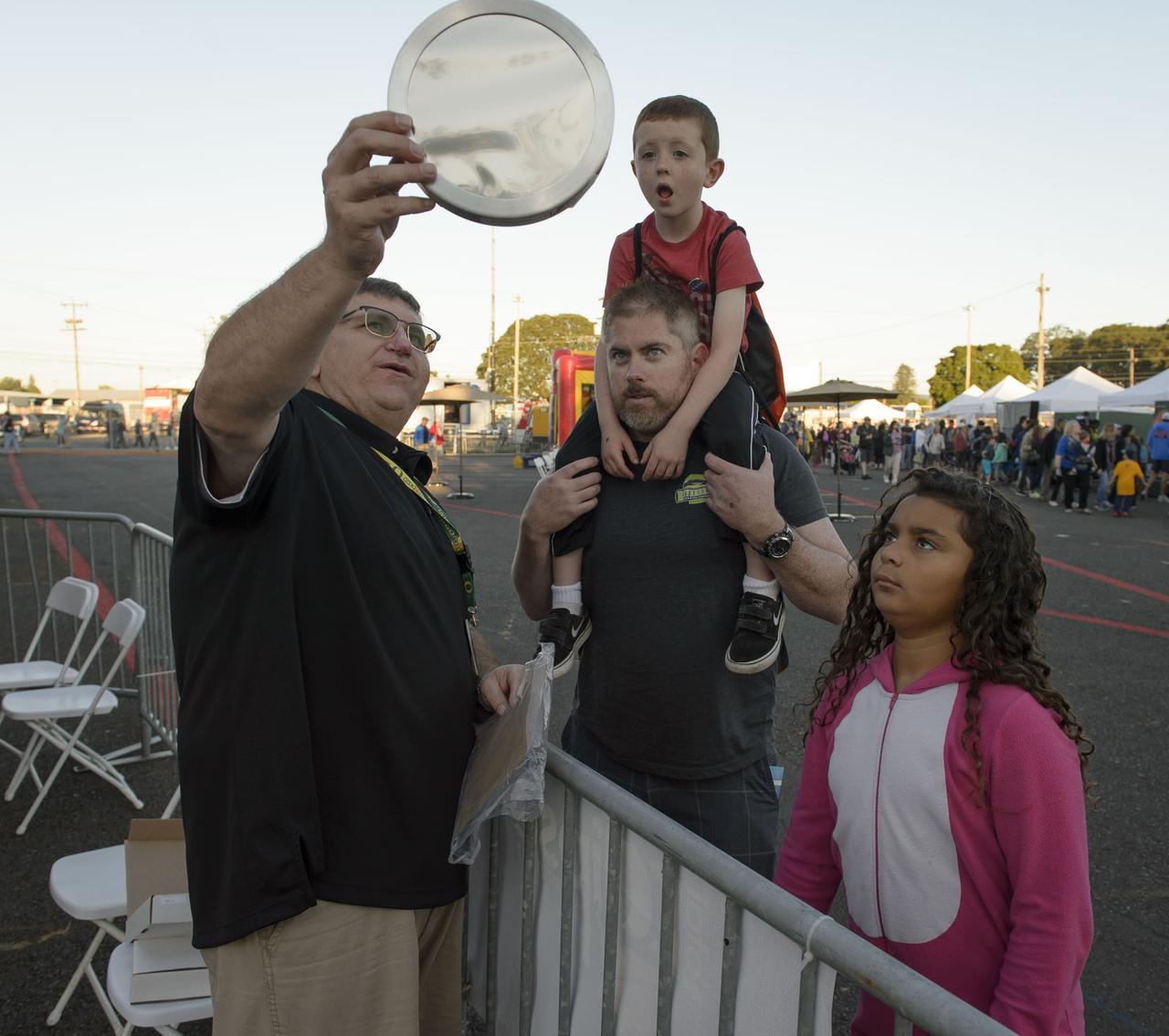
Bill Moede, Howard Video Productions, of the NASA Ames Video group explains how the filter that will be used on the camera to safely photograph the sun during the eclipse.

"Barnacle Bill" is a small rock immediately west-northwest of the Mars Pathfinder lander and was the first rock visited by the Sojourner Rover's alpha proton X-ray spectrometer (APXS) instrument. This image shows super resolution techniques applied to the first APXS target rock, which was never imaged with the rover's forward cameras. Super resolution was applied to help to address questions about the texture of this rock and what it might tell us about its mode of origin. This view of Barnacle Bill was produced by combining the "Super Panorama" frames from the IMP camera. Super resolution was applied to help to address questions about the texture of these rocks and what it might tell us about their mode of origin. The composite color frames that make up this anaglyph were produced for both the right and left eye of the IMP. The composites consist of 7 frames in the right eye and 8 frames in the left eye, taken with different color filters that were enlarged by 500% and then co-added using Adobe Photoshop to produce, in effect, a super-resolution panchromatic frame that is sharper than an individual frame would be. These panchromatic frames were then colorized with the red, green, and blue filtered images from the same sequence. The color balance was adjusted to approximate the true color of Mars. The anaglyph view was produced by combining the left with the right eye color composite frames by assigning the left eye composite view to the red color plane and the right eye composite view to the green and blue color planes (cyan), to produce a stereo anaglyph mosaic. This mosaic can be viewed in 3-D on your computer monitor or in color print form by wearing red-blue 3-D glasses. http://photojournal.jpl.nasa.gov/catalog/PIA01409
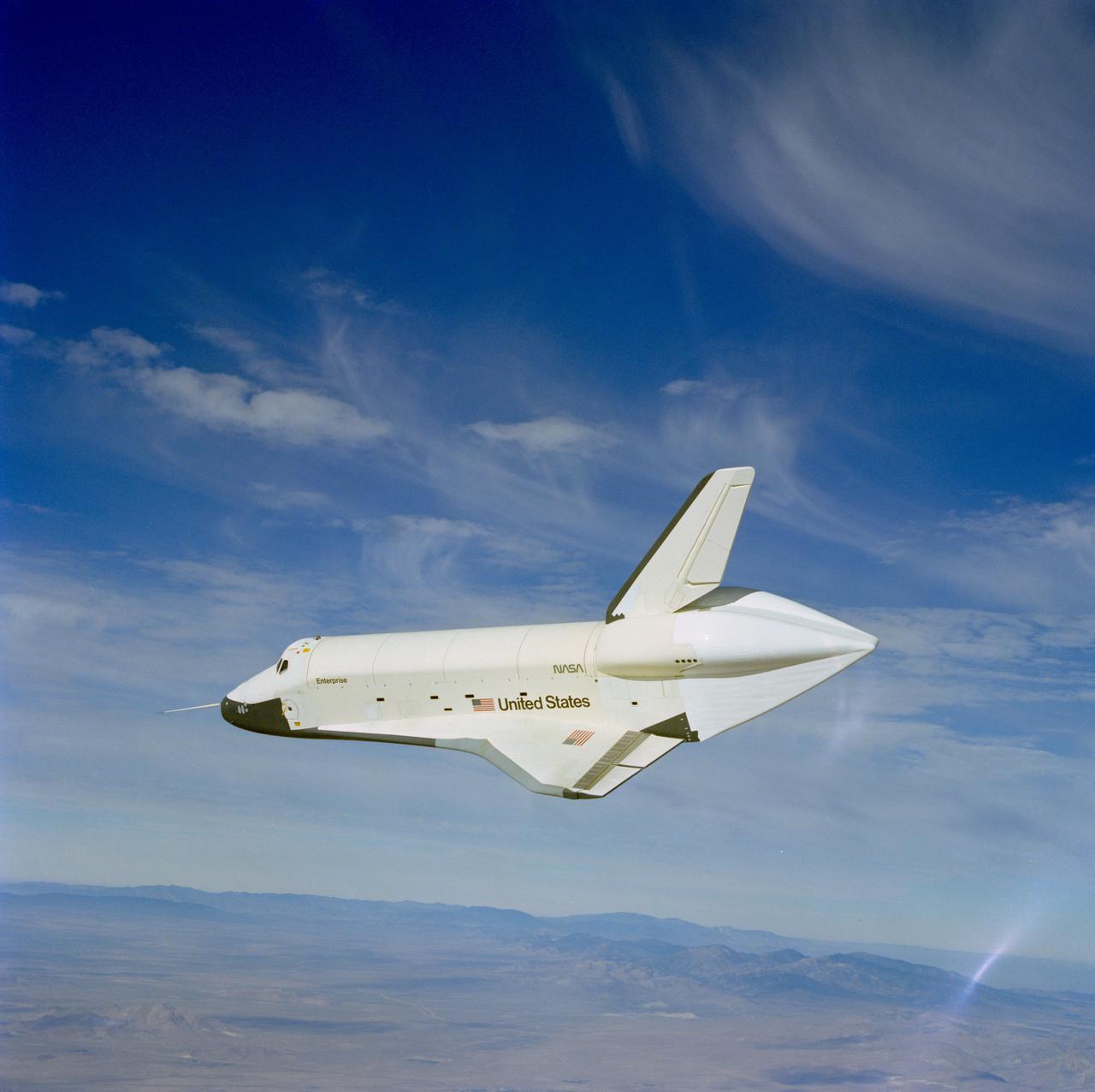
S77-28141 (13 Sept 1977) --- The shuttle Orbiter 101 "Enterprise" makes a slight turn and bank maneuver during the second free flight of the Shuttle Approach and Landing Tests (ALT) conducted on September 13, 1977, at the Dryden Flight Research Center in Southern California. The "Enterprise" separated from the NASA 747 carrier aircraft and landed following a five-minute, 28-second unpowered flight. The Orbiter 101 crew was astronauts Joe H. Engle, commander, and Richard H. Truly, pilot. The ALT free flights are designed to verify orbiter subsonic airworthiness, integrated systems operations and pilot-guided approach and landing capability and satisfy prerequisites to automatic flight control and navigation mode. The orbiter soars above the dry California desert in this post-separation view. Photographer Bill Blunck of JSC's Photographic Technology Laboratory took this picture while riding in T-38 chase plane number two. He used a 70mm Hasselblad camera with an 80mm lens.