
Residing roughly 17 million light years from Earth, in the northern constellation Coma Berenices, is a merged star system known as Messier 64 (M64). First cataloged in the 18th century by the French astronomer Messier, M64 is a result of two colliding galaxies and has an unusual appearance as well as bizarre internal motions. It has a spectacular dark band of absorbing dust in front of its bright nucleus, lending to it the nickname of the "Black Eye" or "Evil Eye" galaxy. Fine details of the dark band can be seen in this image of the central portion of M64 obtained by the Wide Field Planetary Camera (WFPC2) of NASA's Hubble Space Telescope (HST). Appearing to be a fairly normal pinwheel-shaped galaxy, the M64 stars are rotating in the same direction, clockwise, as in the majority of galaxies. However, detailed studies in the 1990's led to the remarkable discovery that the interstellar gas in the outer regions of M64 rotates in the opposite direction from the gas and stars in the irner region. Astronomers believe that the oppositely rotating gas arose when M64 absorbed a satellite galaxy that collided with it, perhaps more than one billion years ago. The Marshall Space Flight Center had responsibility for design, development, and construction of the HST.

A 2 week observation through the optic eye of the Chandra X-Ray Observatory revealed this sturning explosion occurring in the super massive black hole at the Milky Way's center, known as Sagittarius A or Sgr A*. Huge lobes of 20-million degree Centigrade gas ( red loops in image) flank both sides of the black hole and extend over dozens of light years indicating that enormous explosions occurred several times over the last 10 thousand years. Weighing in at 3-million times the mass of the sun, the Sgr A* is a starved black hole, possibly because explosive events in the past have cleared much of the gas around it.
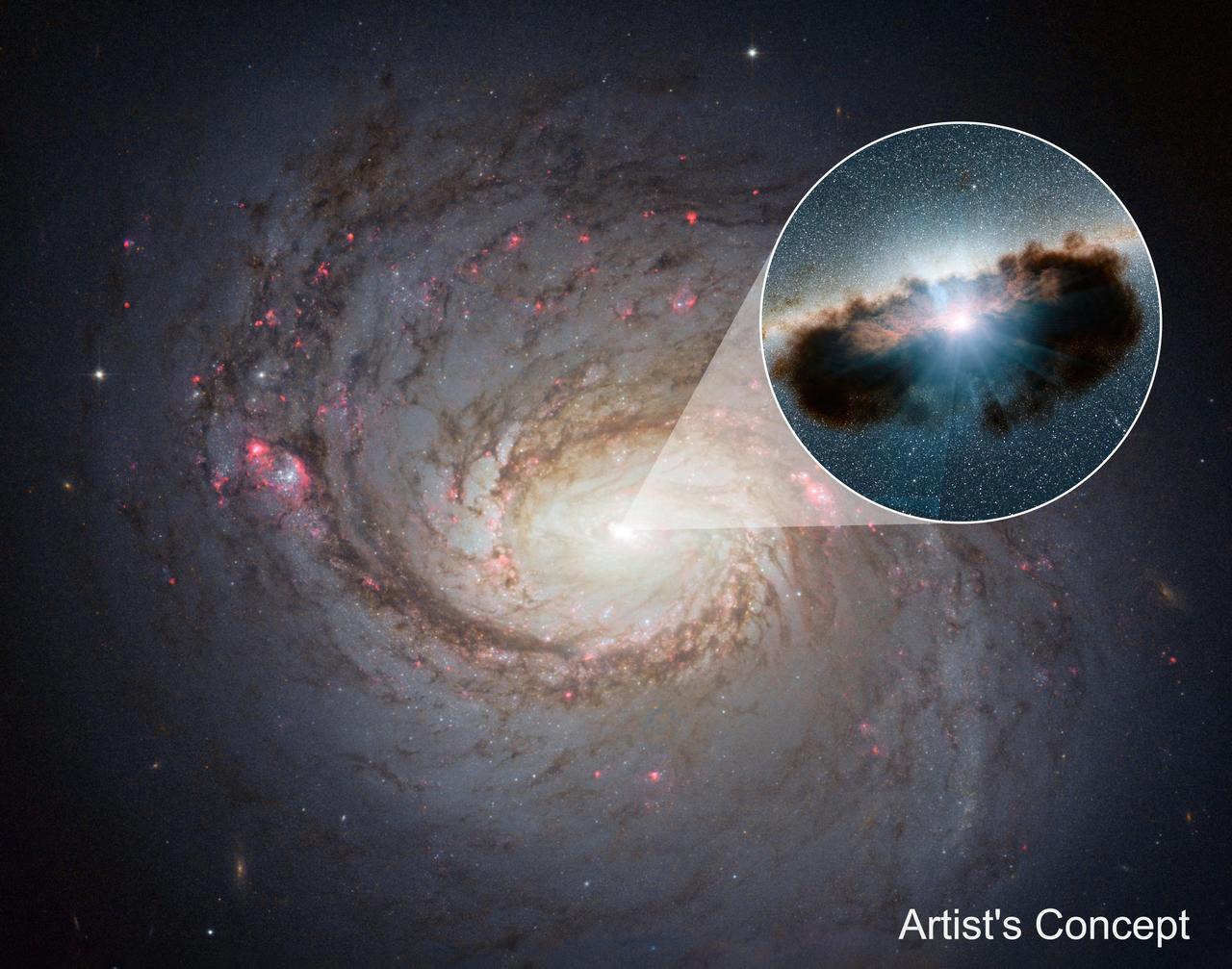
Galaxy NGC 1068 can be seen in close-up in this view from NASA's Hubble Space Telescope. NuSTAR's high-energy X-rays eyes were able to obtain the best view yet into the hidden lair of the galaxy's central, supermassive black hole. This active black hole -- shown as an illustration in the zoomed-in inset -- is one of the most obscured known, meaning that it is surrounded by extremely thick clouds of gas and dust. The NuSTAR data revealed that the torus of gas and dust surrounding the black hole, also referred to as a doughnut, is more clumpy than previously thought. doughnuts around active, supermassive black holes were originally proposed in the mid-1980s to be smooth entities. More recently, researchers have been finding that doughnuts are not so smooth but have lumps. NuSTAR's latest finding shows that this is true for even the thickest of doughnuts. http://photojournal.jpl.nasa.gov/catalog/PIA20058
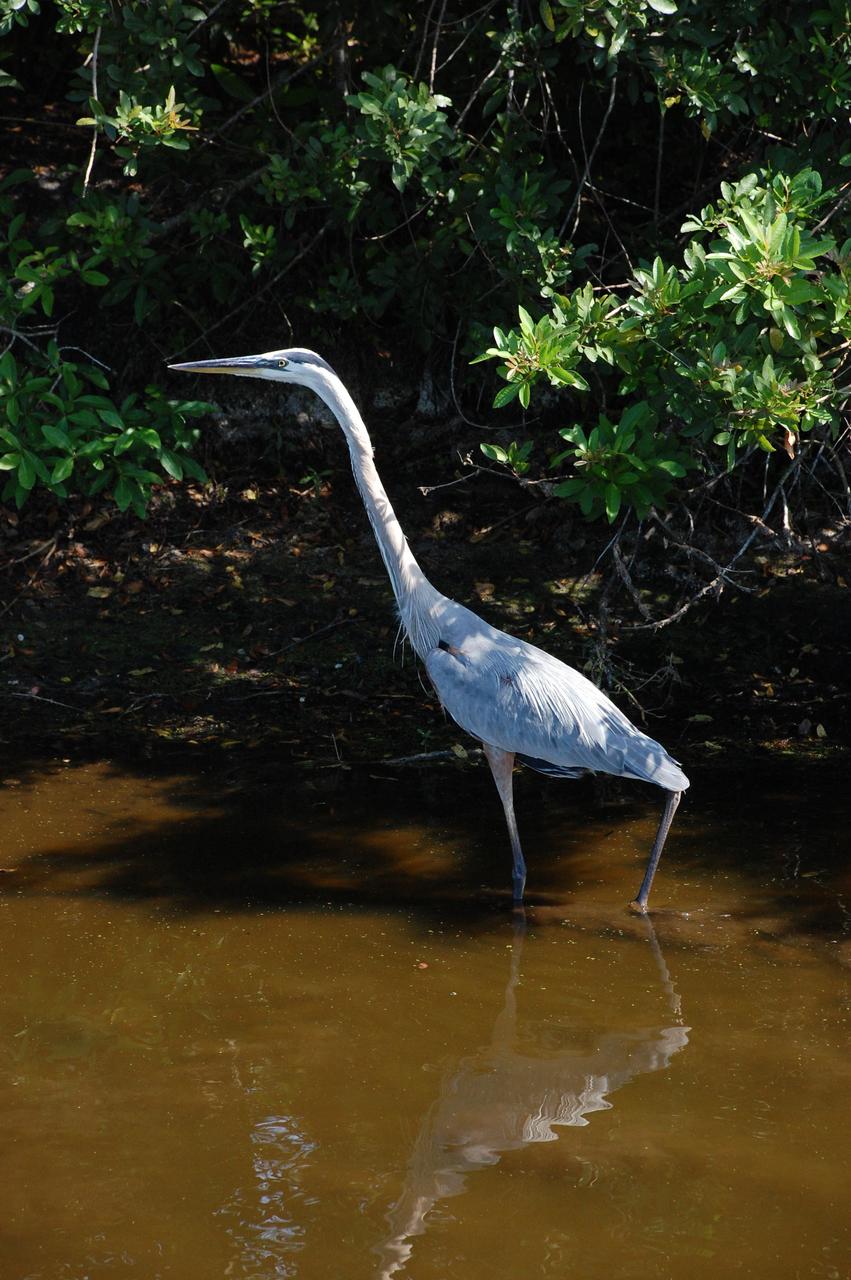
CAPE CANAVERAL, Fla. – A great blue heron stands tall in the water, perhaps looking for food, on grounds of NASA's Kennedy Space Center in Florida. More gray than blue, with a yellowish bill and black legs, it has a brownish-buff colored neck with a black border and white in front of its neck with a vertical black streak. The bird's head is white with a black stripe above its eye. They range throughout the U.S., inhabiting lakes, ponds, rivers and marshes. Their principal food is fish or frogs but may feed on small mammals, reptiles and occasionally birds. Kennedy shares a boundary with the Merritt Island National Wildlife Refuge, which is a habitat for more than 310 species of birds, 25 mammals, 117 fishes and 65 amphibians and reptiles. Photo credit: NASA/Ben Smegelsky
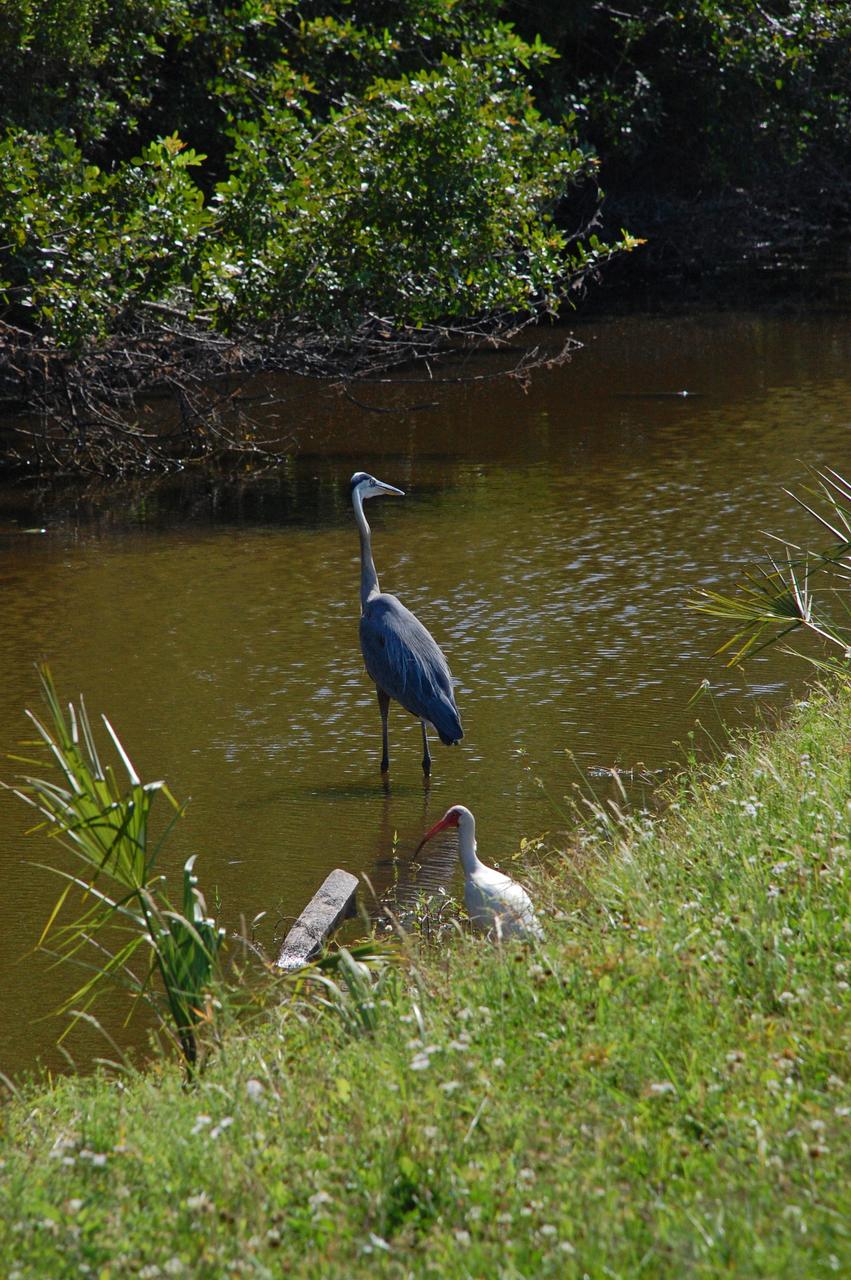
CAPE CANAVERAL, Fla. – A great blue heron stands tall in the water, perhaps looking for food, on grounds of NASA's Kennedy Space Center in Florida. More gray than blue, with a yellowish bill and black legs, it has a brownish-buff colored neck with a black border and white in front of its neck with a vertical black streak. The bird's head is white with a black stripe above its eye. They range throughout the U.S., inhabiting lakes, ponds, rivers and marshes. Their principal food is fish or frogs but may feed on small mammals, reptiles and occasionally birds. Kennedy shares a boundary with the Merritt Island National Wildlife Refuge, which is a habitat for more than 310 species of birds, 25 mammals, 117 fishes and 65 amphibians and reptiles. Photo credit: NASA/Ben Smegelsky

In this fish-eye view, a worker oversees the movement of the Chandra X-ray Observatory into the payload bay of the orbiter Columbia. Chandra is the primary payload on mission STS-93, scheduled to launch no earlier than July 20 aboard Space Shuttle Columbia. The world's most powerful X-ray telescope, Chandra will allow scientists from around the world to see previously invisible black holes and high-temperature gas clouds, giving the observatory the potential to rewrite the books on the structure and evolution of our universe
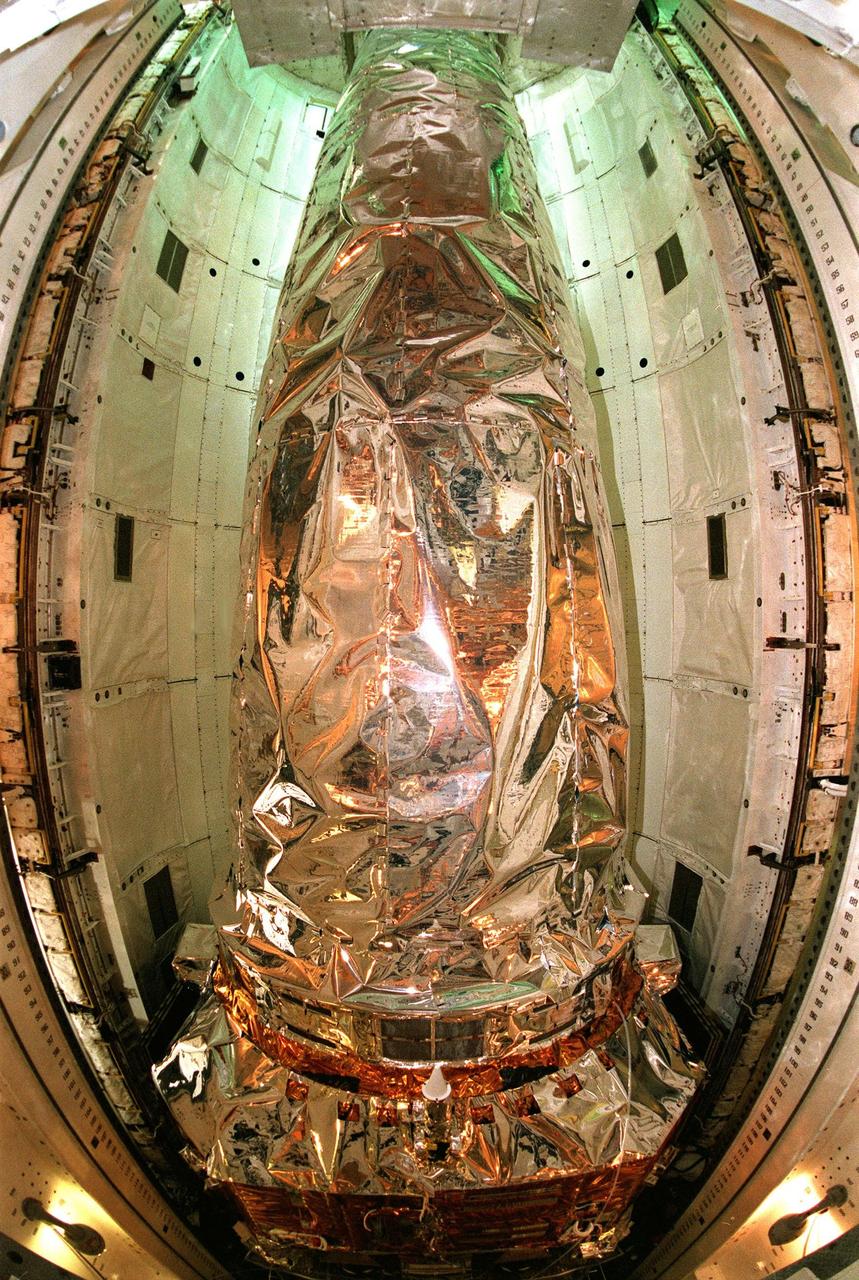
In this fish-eye view, the Chandra X-ray Observatory rests inside the payload bay of the orbiter Columbia. Chandra is the primary payload on mission STS-93, scheduled to launch no earlier than July 20 aboard Space Shuttle Columbia. The world's most powerful X-ray telescope, Chandra will allow scientists from around the world to see previously invisible black holes and high-temperature gas clouds, giving the observatory the potential to rewrite the books on the structure and evolution of our universe
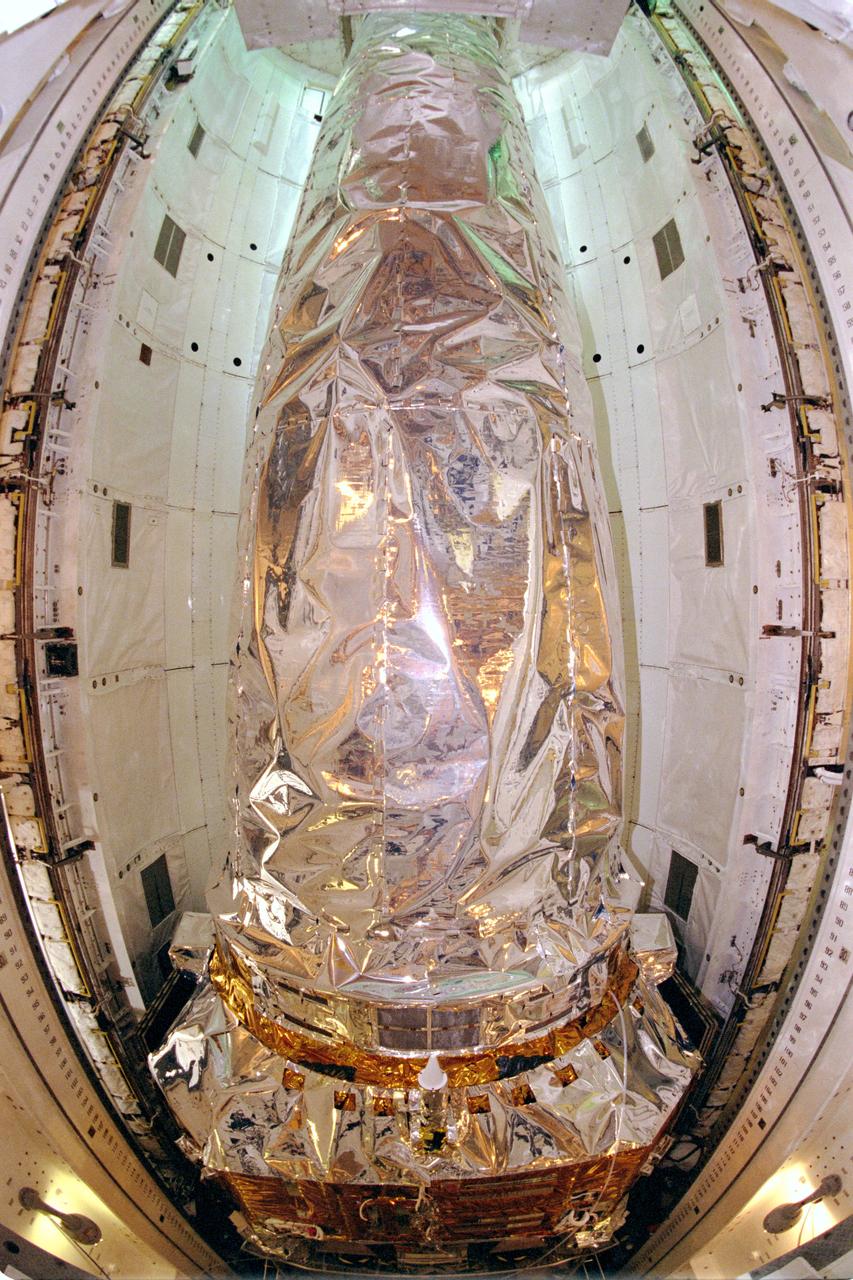
STS093-S-013 (27 June 1999) --- In this fish-eye view, the Chandra X-ray Observatory rests inside the payload bay of the Space Shuttle Columbia at the Kennedy Space Center (KSC). Chandra is the primary payload on the STS-93 mission, scheduled to launch next month. The world's most powerful X-ray telescope, Chandra, will allow scientists from around the world to see previously invisible black holes and high-temperature gas clouds, giving the observatory the potential to rewrite the books on the structure and evolution of the universe.
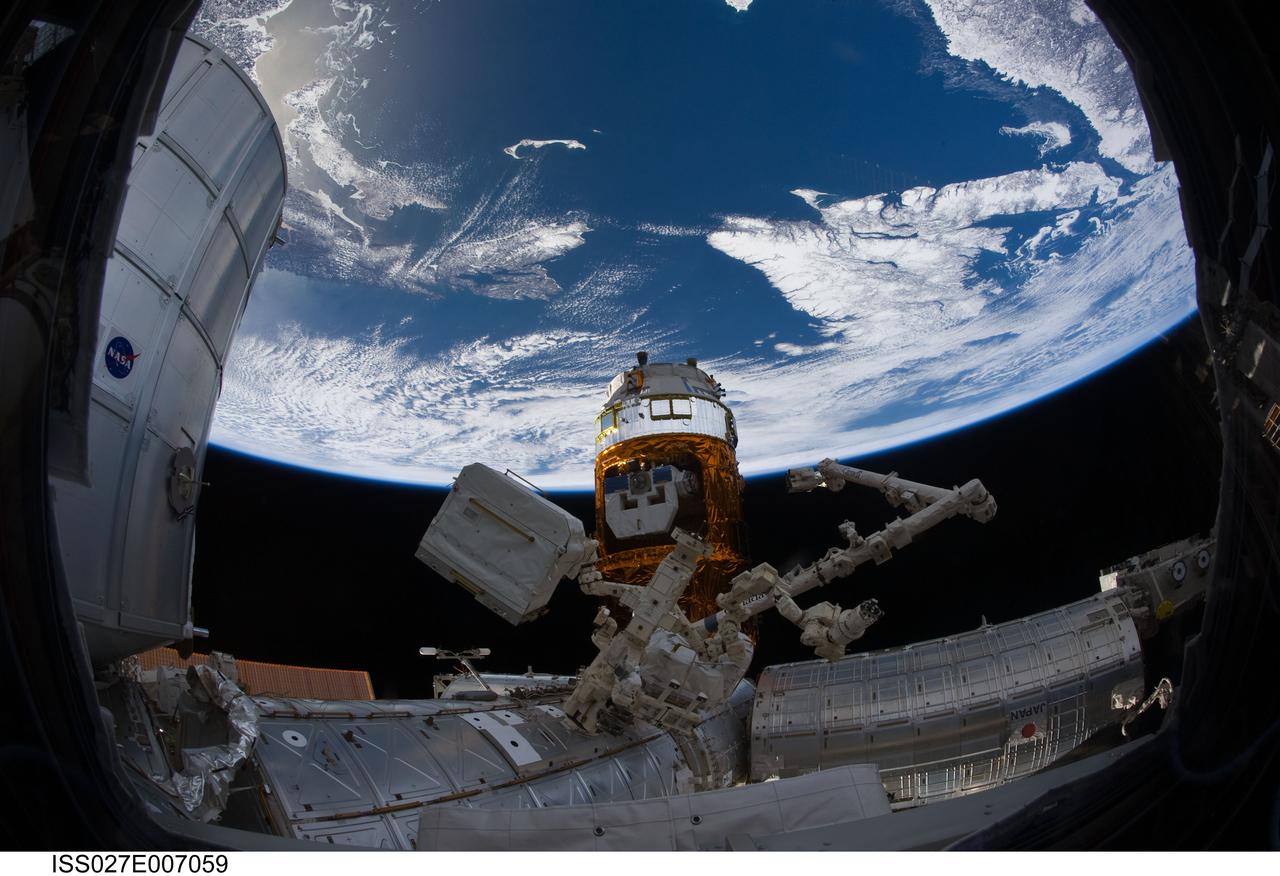
ISS027-E-007059 (20 March 2011) --- An Expedition 27 crew member used a fish-eye lens attached to an electronic still camera to capture this image of a portion of the International Space Station including the docked Kounotori2 H-II Transfer Vehicle (HTV-2); Canadarm2; and Canadian-built Dextre, also known as the Special Purpose Dextrous Manipulator (SPDM). A blue and white part of Earth and the blackness of space provide the backdrop for the scene.
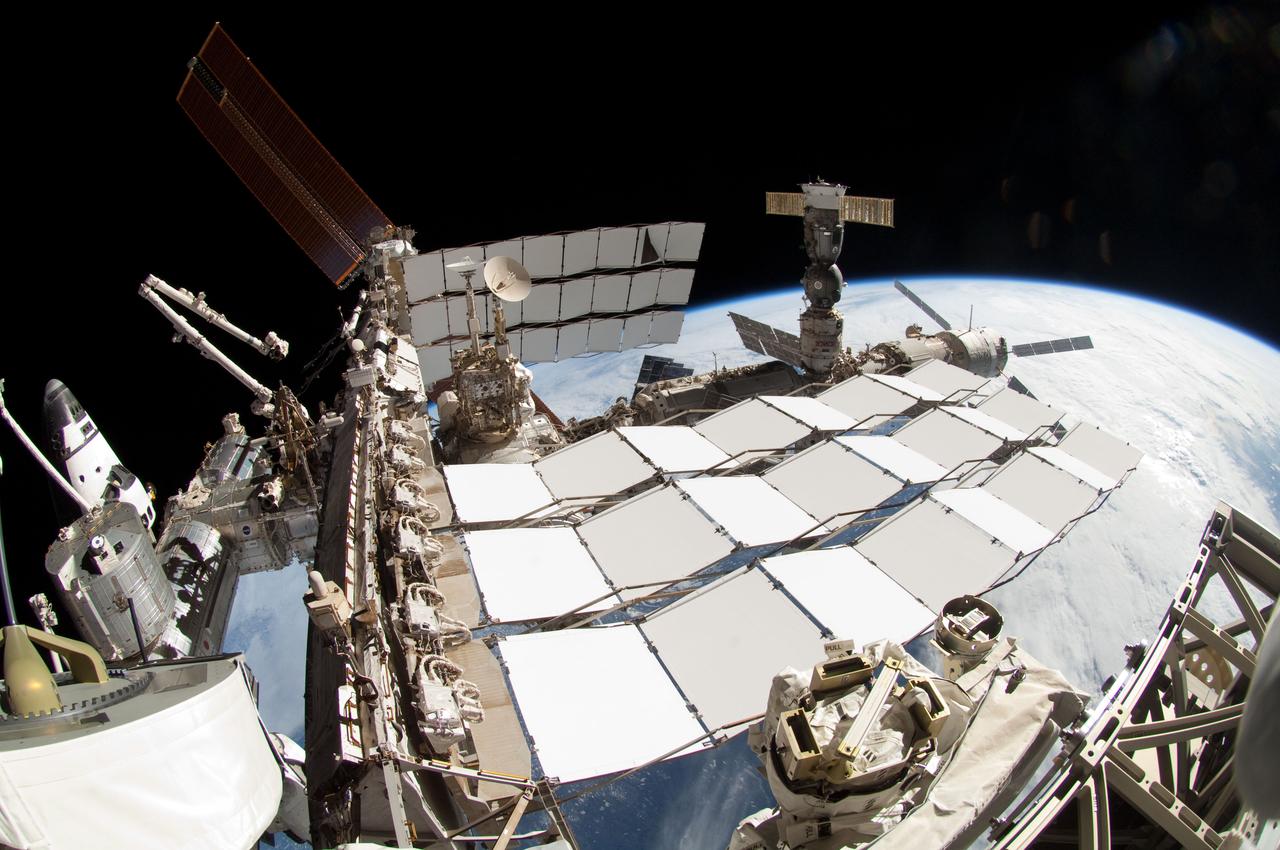
ISS028-E-005676 (27 May 2011) --- A portion of the International Space Station and the docked space shuttle Endeavour (left) are featured in this image photographed by a spacewalker, using a fish-eye lens attached to an electronic still camera, during the STS-134 mission?s fourth session of extravehicular activity (EVA). Earth?s horizon and the blackness of space provide the backdrop for the scene.
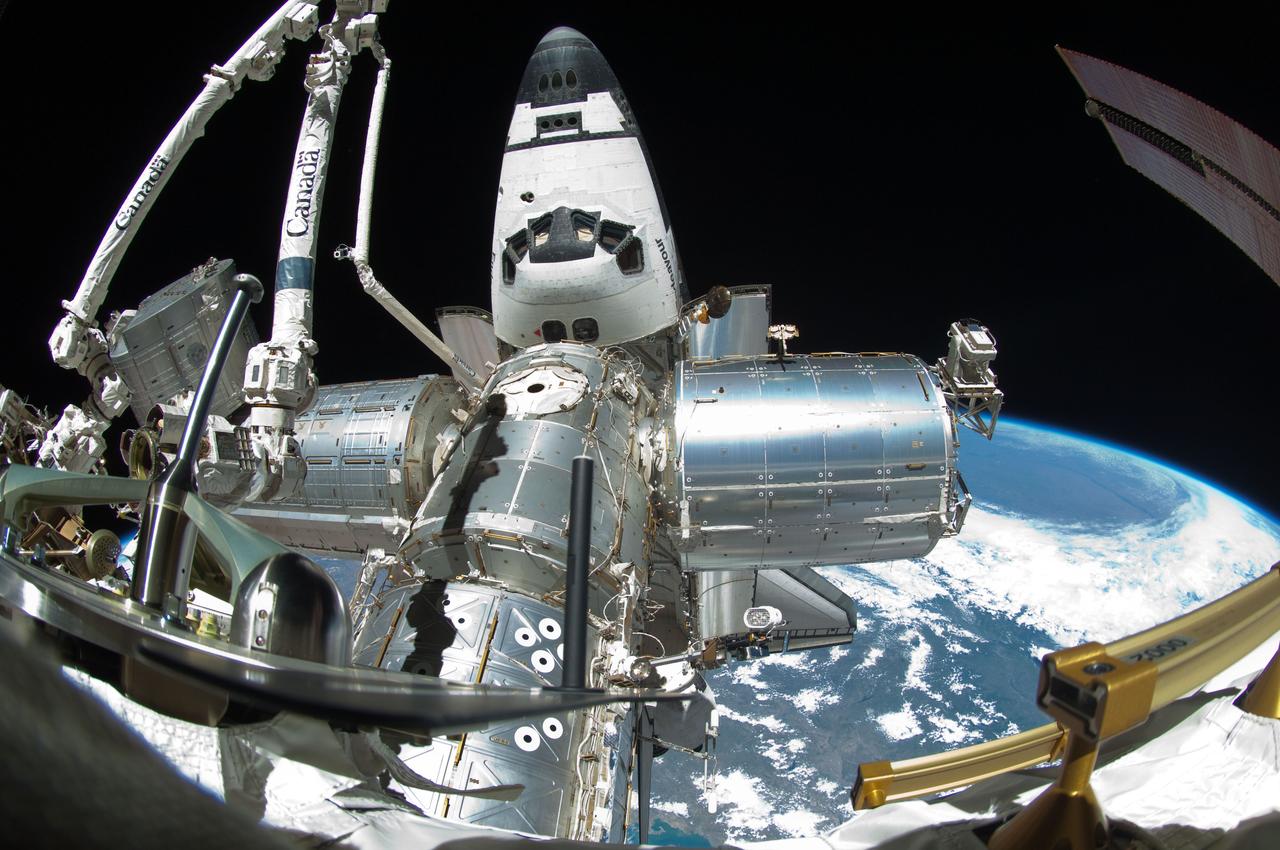
ISS028-E-005638 (27 May 2011) --- A portion of the International Space Station and the docked space shuttle Endeavour is featured in this image photographed by a spacewalker, using a fish-eye lens attached to an electronic still camera, during the STS-134 mission?s fourth session of extravehicular activity (EVA). The blackness of space and Earth?s horizon provide the backdrop for the scene.
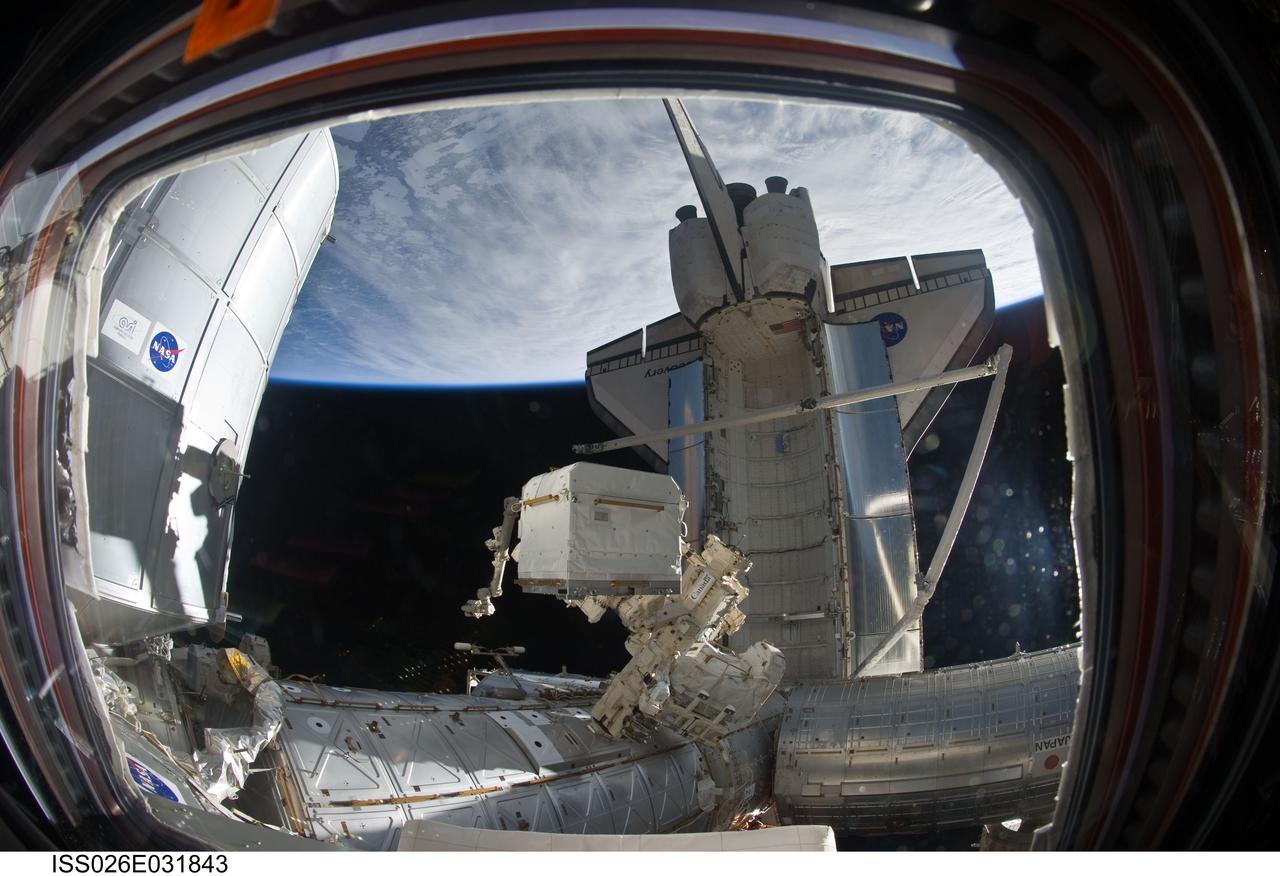
ISS026-E-031843 (2 March 2011) --- An Expedition 26 crew member used a fish-eye lens attached to an electronic still camera to capture this image of the docked space shuttle Discovery (STS-133) and its remote manipulator system/orbiter boom sensor system (RMS/OBSS), the newly-installed Permanent Multipurpose Module (PMM) and the Canadian-built Dextre, also known as the Special Purpose Dextrous Manipulator (SPDM). The blackness of space and Earth's horizon provide the backdrop for the scene.

NASA NuSTAR has captured these first, focused views of the supermassive black hole at the heart of our Milky Way galaxy in high-energy X-ray light.

KENNEDY SPACE CENTER, FLA. -- An adult Black-necked Stilt keeps a wary eye out for intruders. The species inhabits salt marshes and shallow coastal bays in the East, as well as freshwater marshes in the West. They are found along the Atlantic Coast from Delaware to northern South America. The black and white markings, long red legs and straight, very thin bill make the stilt very recognizable. This stilt was photographed in the Merritt Island National Wildlife Refuge, which shares a boundary with Kennedy Space Center. The Refuge encompasses 92,000 acres that are a habitat for more than 331 species of birds, 31 mammals, 117 fishes, and 65 amphibians and reptiles. The marshes and open water of the refuge provide wintering areas for 23 species of migratory waterfowl, as well as a year-round home for great blue herons, great egrets, wood storks, cormorants, brown pelicans and other species of marsh and shore birds, as well as a variety of insects

A supermassive black hole is depicted in this artist's concept, surrounded by a swirling disk of material falling onto it. The purplish ball of light above the black hole, a feature called the corona, contains highly energetic particles that generate X-ray light. If you could view the corona with your eyes, it would appear nearly invisible since we can't see its X-ray light. The corona gathers inward (left), becoming brighter, before shooting away from the black hole (middle and right). Astronomers don't know why the coronas shift, but they have learned that this process leads to a brightening of X-ray light that can be observed by telescopes. Normally, before a black hole's corona shifts, there is already an effect at work called relativistic boosting. As X-ray light from the corona reflects off the black hole's surrounding disk of material -- which is traveling near half the speed of light -- the X-ray light becomes brightened, as seen on the left side of the illustration. This boosting occurs on the side of the disk where the material is traveling toward us. The opposite effect, a dimming of the X-ray light, occurs on the other side of the disk moving away from us. Another form of relativistic boosting happens when the corona shoots away from the black hole, and later collapses. Its X-ray light is also brightened as the corona travels toward us at very fast speeds, leading to X-ray flares. In 2014, NASA's Nuclear Spectroscopic Telescope Array, or NuSTAR, and Swift space telescopes witnessed an X-flare from the supermassive black hole in a distant galaxy called Markarian 335. The observations allowed astronomers to link a shifting corona to an X-ray flare for the first time. http://photojournal.jpl.nasa.gov/catalog/PIA20051
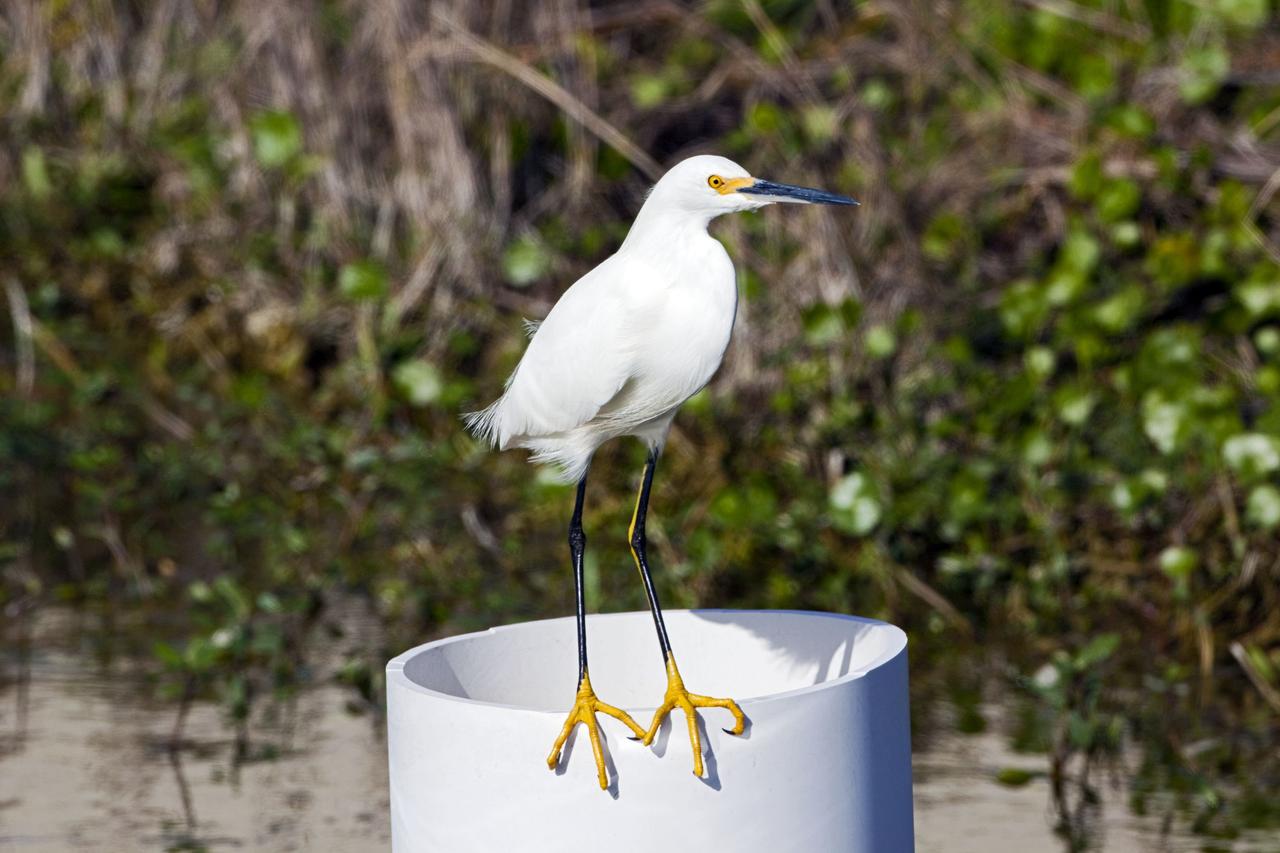
CAPE CANAVERAL, Fla. – Perched on a section of pipe, this snowy egret keeps a wary eye on the photographer on a sunny day at Black Point Wildlife Drive, part of the Merritt Island National Wildlife Refuge. NASA's Kennedy Space Center shares a boundary with the refuge, consisting of 140,000 acres. The Refuge provides a wide variety of habitats: coastal dunes, saltwater estuaries and marshes, freshwater impoundments, scrub, pine flatwoods, and hardwood hammocks that provide habitat for more than 1,500 species of plants and animals, including about 331 species of birds. Photo credit: NASA/Jim Grossmann
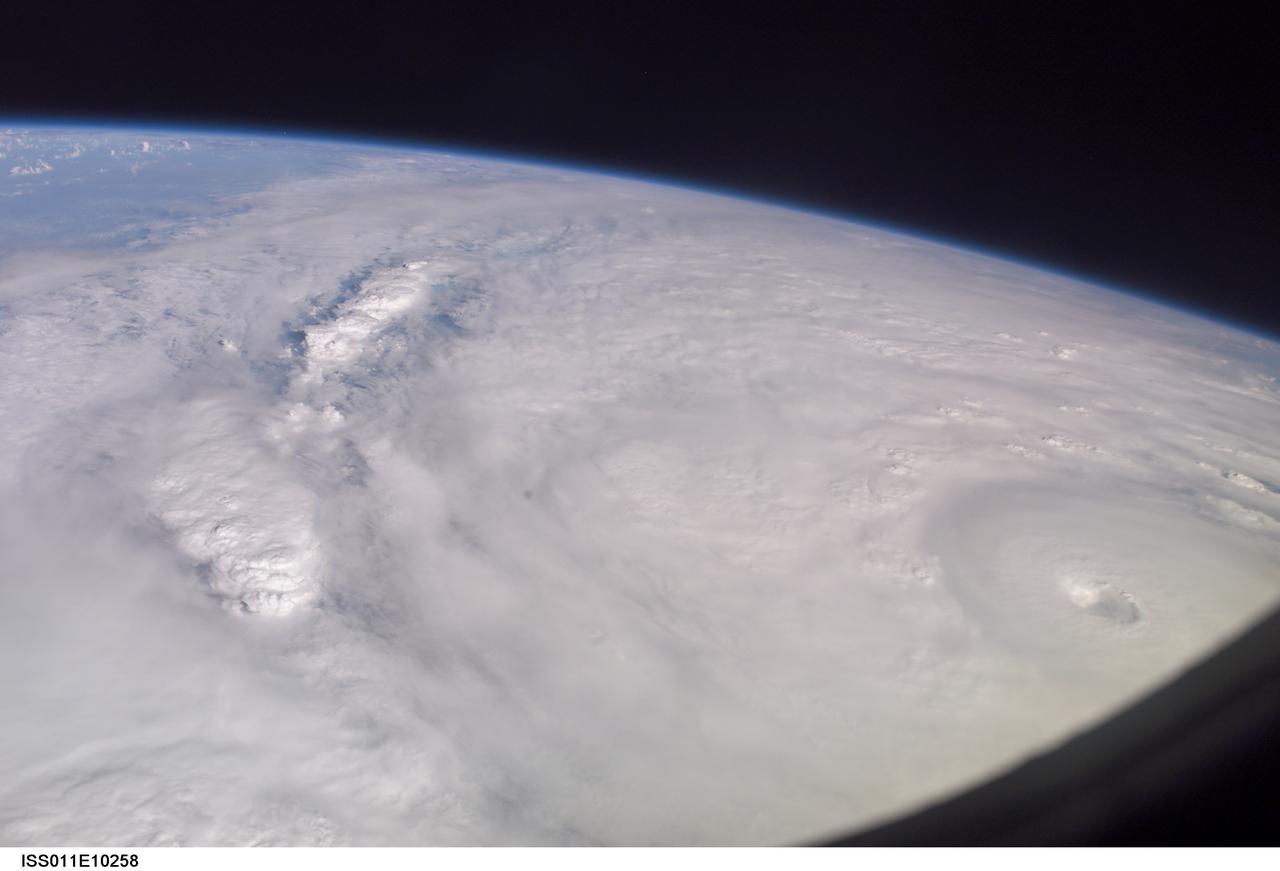
ISS011-E-10258 (9 July 2005) --- This easterly-looking image from the International Space Station shows Hurricane Dennis after the storm had already crossed Cuba and was heading for the northern Gulf of Mexico. Dennis was a Category 3 storm, packing winds of 115 miles per hour, at the time of exposure and located approximately 385 miles southeast of Biloxi, Mississippi or 280 miles south of Panama City, Florida. The ill-defined eye is in the lower right corner. The black triangle in extreme lower right is part of the Space Station's window.
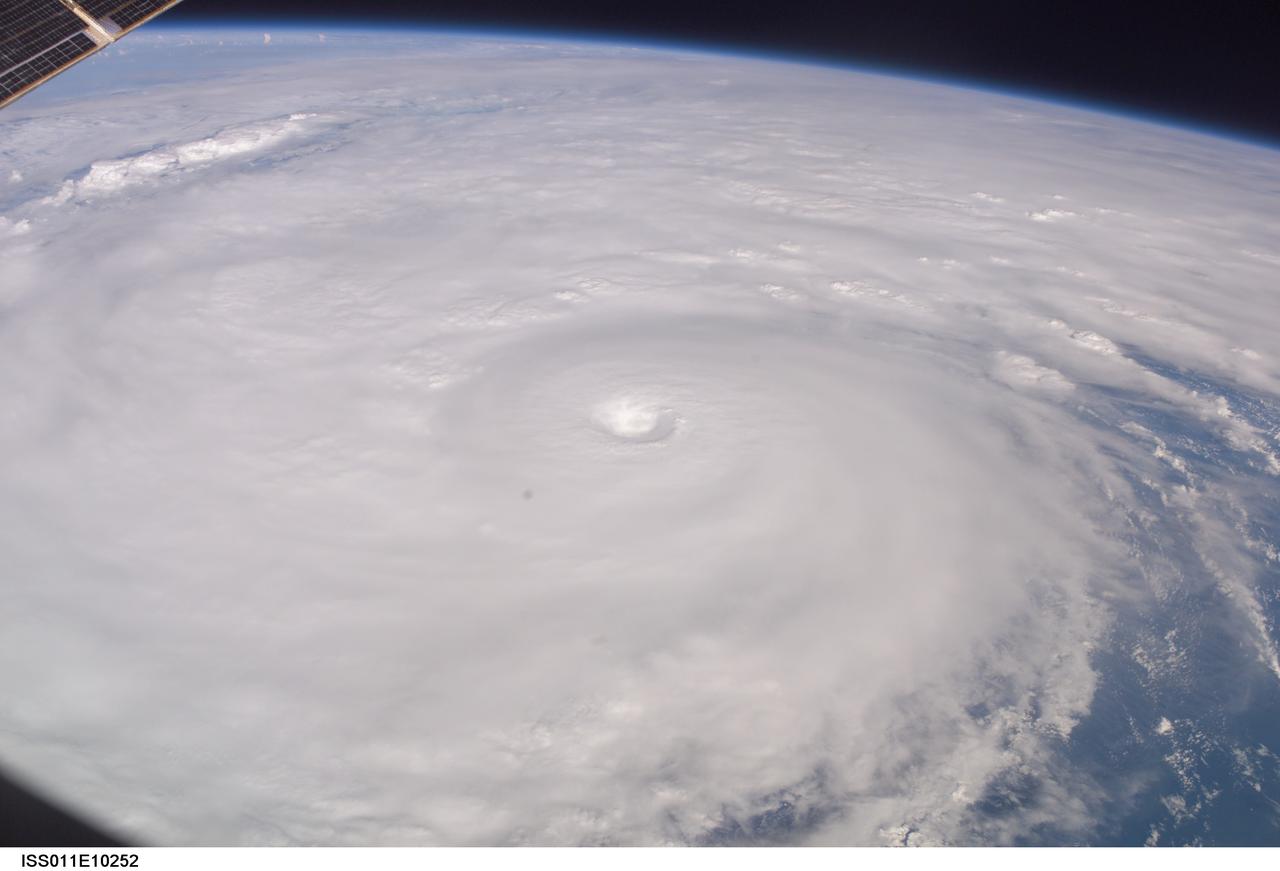
ISS011-E-10252 (9 July 2005) --- This easterly-looking image from the International Space Station shows Hurricane Dennis after the storm had already crossed Cuba and was heading for the northern Gulf of Mexico. Dennis was a Category 3 storm, packing winds of 115 miles per hour, at the time of exposure and located approximately 385 miles southeast of Biloxi, Mississippi or 280 miles south of Panama City, Florida. The image was exposed at 22:06:35 (GMT), July 9, 2005. The storm's eye is at frame center. The black triangle in extreme lower left is part of the Space Station's window.
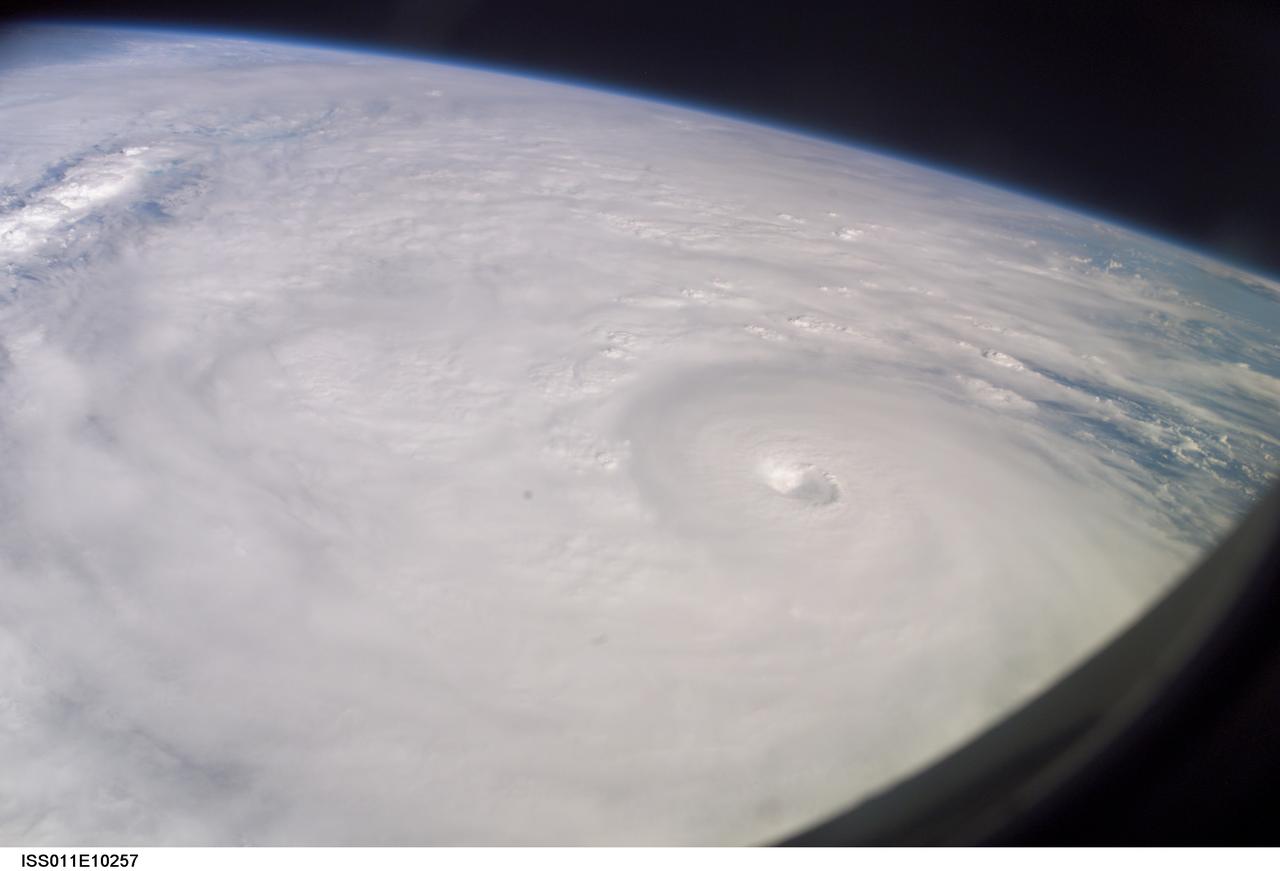
ISS011-E-10257 (9 July 2005) --- This easterly-looking image from the International Space Station shows Hurricane Dennis after the storm had already crossed Cuba and was heading for the northern Gulf of Mexico. Dennis was a Category 3 storm, packing winds of 115 miles per hour, at the time of exposure and located approximately 385 miles southeast of Biloxi, Mississippi or 280 miles south of Panama City, Florida. The image was exposed at 22:07:26 (GMT), July 9, 2005. The storm's eye is just to the right of frame center. The black triangle in extreme lower right is part of the Space Station's window.

This is an illustration of a supermassive black hole, weighing as much as 21 million suns, located in the middle of the ultradense galaxy M60-UCD1. The dwarf galaxy is so dense that millions of stars fill the sky as seen by an imaginary visitor. Because no light can escape from the black hole, it appears simply in silhouette against the starry background. The black hole's intense gravitational field warps the light of the background stars to form ring-like images just outside the dark edges of the black hole's event horizon. Combined observations by the Hubble Space Telescope and Gemini North telescope determined the presence of the black hole inside such a small and dense galaxy. More info: Astronomers using data from NASA’s Hubble Space Telescope and ground observation have found an unlikely object in an improbable place -- a monster black hole lurking inside one of the tiniest galaxies ever known. The black hole is five times the mass of the one at the center of our Milky Way galaxy. It is inside one of the densest galaxies known to date -- the M60-UCD1 dwarf galaxy that crams 140 million stars within a diameter of about 300 light-years, which is only 1/500th of our galaxy’s diameter. If you lived inside this dwarf galaxy, the night sky would dazzle with at least 1 million stars visible to the naked eye. Our nighttime sky as seen from Earth’s surface shows 4,000 stars. The finding implies there are many other compact galaxies in the universe that contain supermassive black holes. The observation also suggests dwarf galaxies may actually be the stripped remnants of larger galaxies that were torn apart during collisions with other galaxies rather than small islands of stars born in isolation. “We don’t know of any other way you could make a black hole so big in an object this small,” said University of Utah astronomer Anil Seth, lead author of an international study of the dwarf galaxy published in Thursday’s issue of the journal Nature. Seth’s team of astronomers used the Hubble Space Telescope and the Gemini North 8-meter optical and infrared telescope on Hawaii’s Mauna Kea to observe M60-UCD1 and measure the black hole’s mass. The sharp Hubble images provide information about the galaxy’s diameter and stellar density. Gemini measures the stellar motions as affected by the black hole’s pull. These data are used to calculate the mass of the black hole. Black holes are gravitationally collapsed, ultra-compact objects that have a gravitational pull so strong that even light cannot escape. Supermassive black holes -- those with the mass of at least one million stars like our sun -- are thought to be at the centers of many galaxies. The black hole at the center of our Milky Way galaxy has the mass of four million suns. As heavy as that is, it is less than 0.01 percent of the Milky Way’s total mass. By comparison, the supermassive black hole at the center of M60-UCD1, which has the mass of 21 million suns, is a stunning 15 percent of the small galaxy’s total mass. “That is pretty amazing, given that the Milky Way is 500 times larger and more than 1,000 times heavier than the dwarf galaxy M60-UCD1,” Seth said. One explanation is that M60-UCD1 was once a large galaxy containing 10 billion stars, but then it passed very close to the center of an even larger galaxy, M60, and in that process all the stars and dark matter in the outer part of the galaxy were torn away and became part of M60. The team believes that M60-UCD1 may eventually be pulled to fully merge with M60, which has its own monster black hole that weighs a whopping 4.5 billion solar masses, or more than 1,000 times bigger than the black hole in our galaxy. When that happens, the black holes in both galaxies also likely will merge. Both galaxies are 50 million light-years away. The Hubble Space Telescope is a project of international cooperation between NASA and the European Space Agency. NASA's Goddard Space Flight Center in Greenbelt, Maryland, manages the telescope. The Space Telescope Science Institute (STScI) in Baltimore conducts Hubble science operations. STScI is operated for NASA by the Association of Universities for Research in Astronomy, Inc., in Washington. For images and more information about Hubble, visit: <a href="http://www.nasa.gov/hubble" rel="nofollow">www.nasa.gov/hubble</a> <b><a href="http://www.nasa.gov/audience/formedia/features/MP_Photo_Guidelines.html" rel="nofollow">NASA image use policy.</a></b> <b><a href="http://www.nasa.gov/centers/goddard/home/index.html" rel="nofollow">NASA Goddard Space Flight Center</a></b> enables NASA’s mission through four scientific endeavors: Earth Science, Heliophysics, Solar System Exploration, and Astrophysics. Goddard plays a leading role in NASA’s accomplishments by contributing compelling scientific knowledge to advance the Agency’s mission. <b>Follow us on <a href="http://twitter.com/NASAGoddardPix" rel="nofollow">Twitter</a></b> <b>Like us on <a href="http://www.facebook.com/pages/Greenbelt-MD/NASA-Goddard/395013845897?ref=tsd" rel="nofollow">Facebook</a></b> <b>Find us on <a href="http://instagram.com/nasagoddard?vm=grid" rel="nofollow">Instagram</a></b>
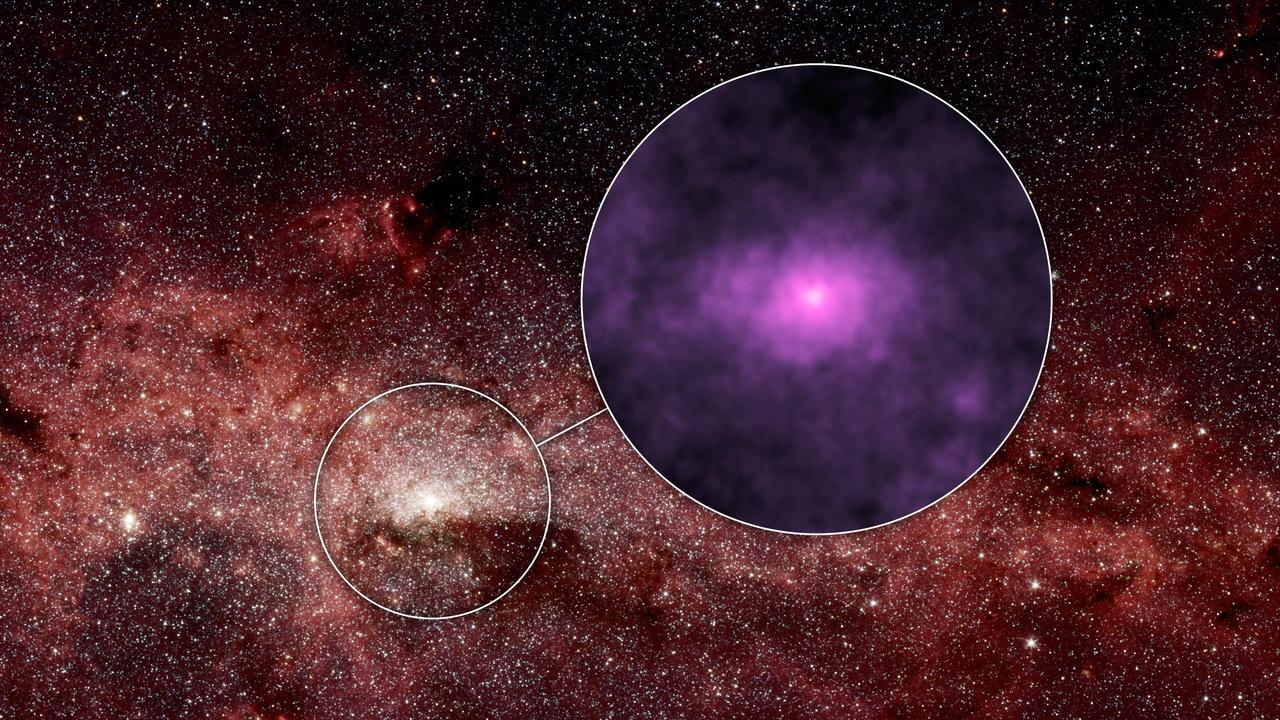
NASA's Nuclear Spectroscopic Telescope Array, or NuSTAR, has captured a new high-energy X-ray view (magenta, Figure 1) of the bustling center of our Milky Way galaxy. The smaller circle shows the area where the NuSTAR image was taken -- the very center of our galaxy, where a giant black hole resides. That region is enlarged to the right, in the larger circle, to show the NuSTAR data. The NuSTAR picture is one of the most detailed ever taken of the center of our galaxy in high-energy X-rays. The X-ray light, normally invisible to our eyes, has been assigned the color magenta. The brightest point of light near the center of the X-ray picture is coming from a spinning dead star, known as a pulsar, which is near the giant black hole. While the pulsar's X-ray emissions were known before, scientists were surprised to find more high-energy X-rays than predicted in the surrounding regions, seen here as the elliptical haze. Astronomers aren't sure what the sources of the extra X-rays are, but one possibility is a population of dead stars. The background picture was captured in infrared light by NASA's Spitzer Space Telescope. The NuSTAR image has an X-ray energy range of 20 to 40 kiloelectron volts. http://photojournal.jpl.nasa.gov/catalog/PIA19334
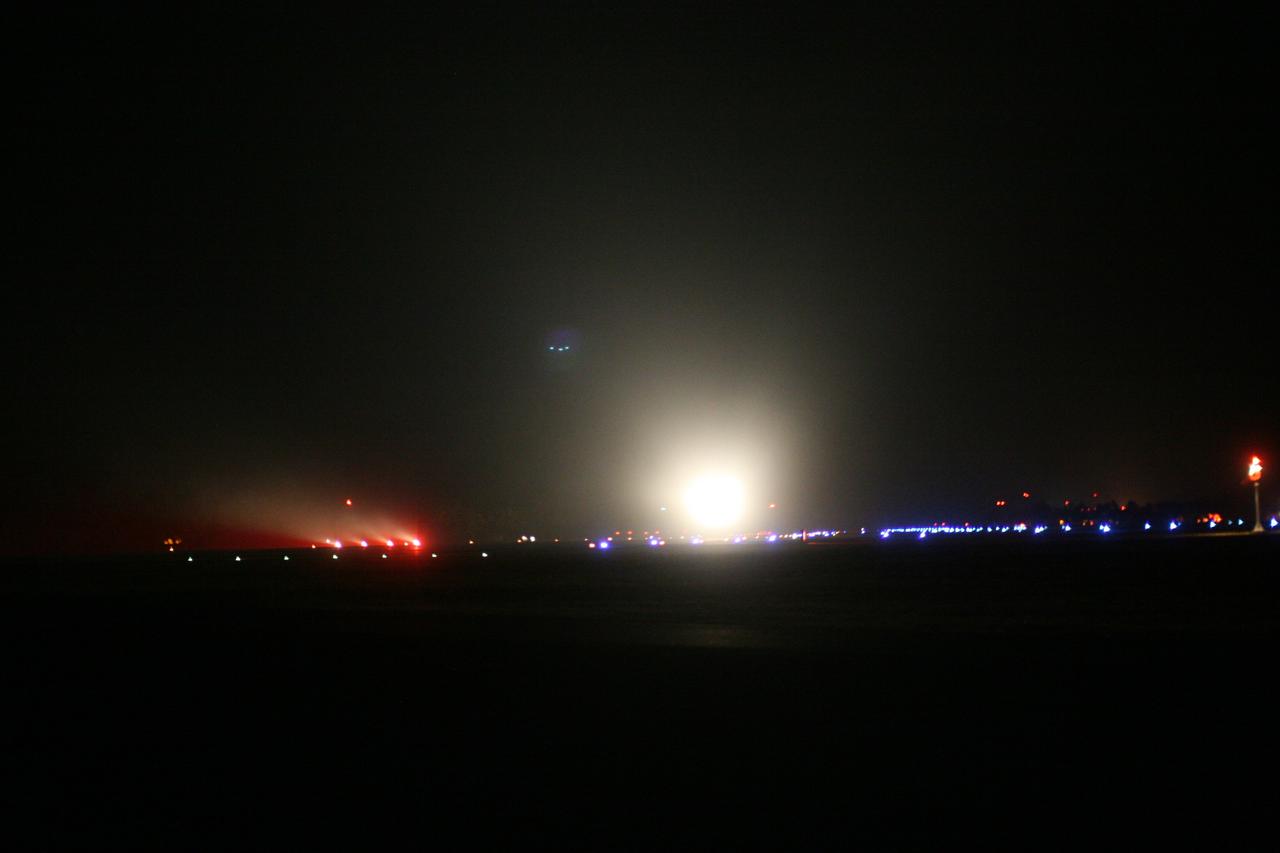
KWAJALEIN ATOLL, Marshall Islands - The lights of Orbital Sciences' L-1011 "Stargazer" aircraft illuminates the night sky as it takes off from the runway at Kwajalein Atoll with the company's Pegasus rocket to launch NASA's Nuclear Spectroscopic Telescope Array, or NuSTAR. The plane left Kwajalein one hour before launch. At 9:00:35 a.m. PDT 12:00:35 p.m. EDT), June 13, 2012, the rocket dropped with the NuSTAR payload 117 nautical miles south of Kwajalein. NuSTAR will use a unique set of “eyes” to see the highest energy X-ray light from the cosmos to reveal black holes lurking in our Milky Way galaxy, as well as those hidden in the hearts of faraway galaxies. Kwajalein is located in the Marshall Islands chain in the Pacific Ocean and is part of the Reagan Test Site and used for launches of NASA, commercial and military missions. For more information, visit http://www.nasa.gov/nustar. Photo credit: NASA
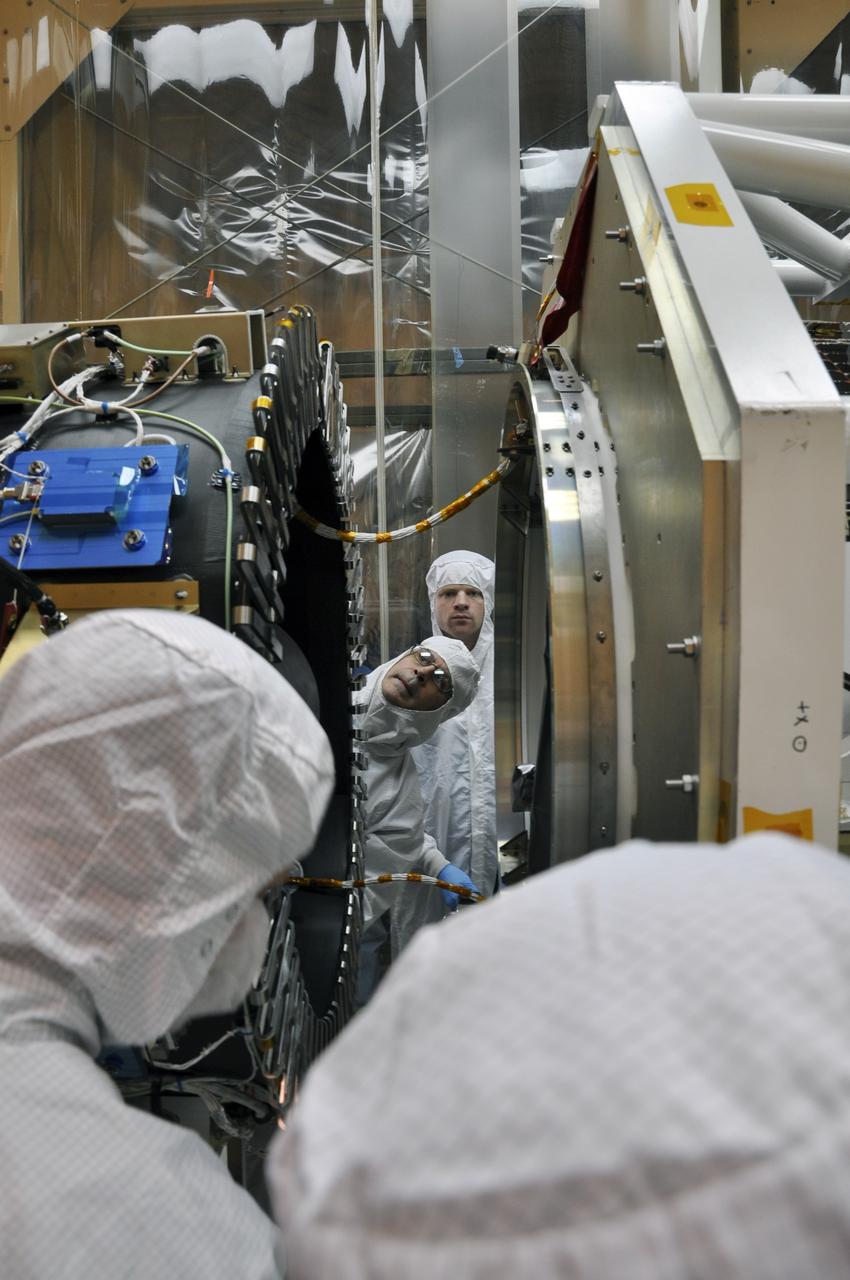
VANDENBERG AIR FORCE BASE, Calif. -- At Vandenberg Air Force Base's processing facility in California, the separation ring on the aft end of NASA's Nuclear Spectroscopic Telescope Array, or NuSTAR, , at right, inches its way toward the third stage of an Orbital Sciences Pegasus XL rocket under the watchful eye of a member of the Orbital Sciences technical team. The spacecraft is being mated to the rocket, a major milestone in prelaunch preparations. After processing of the rocket and spacecraft are complete, they will be flown on Orbital's L-1011 carrier aircraft from Vandenberg to the Ronald Reagan Ballistic Missile Defense Test Site on the Pacific Ocean’s Kwajalein Atoll for launch. The high-energy x-ray telescope will conduct a census of black holes, map radioactive material in young supernovae remnants, and study the origins of cosmic rays and the extreme physics around collapsed stars. For more information, visit http://www.nasa.gov/nustar. Photo credit: NASA/Randy Beaudoin, VAFB
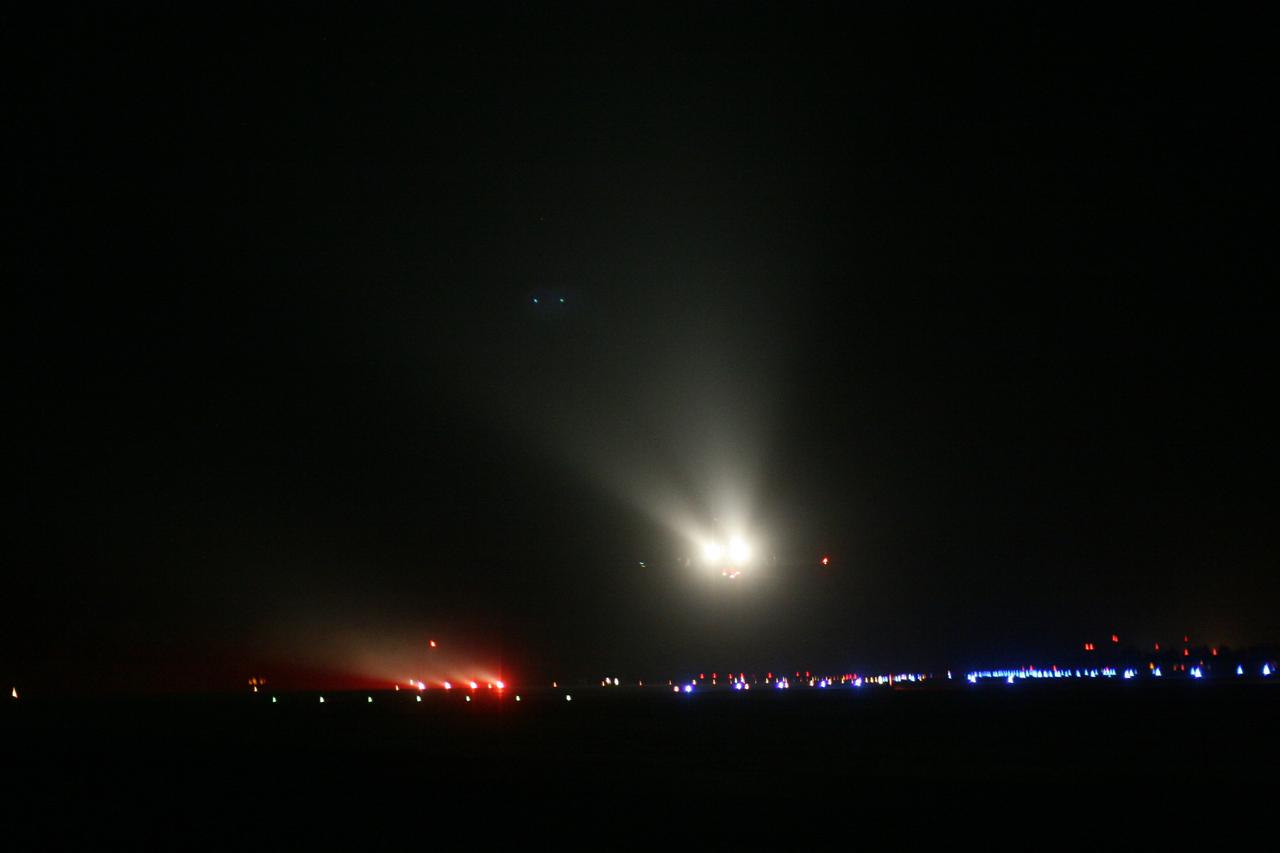
KWAJALEIN ATOLL, Marshall Islands - Orbital Sciences' L-1011 "Stargazer" aircraft takes off from the runway at Kwajalein Atoll with the company's Pegasus rocket to launch NASA's Nuclear Spectroscopic Telescope Array, or NuSTAR. The plane left Kwajalein one hour before launch. At 9:00:35 a.m. PDT 12:00:35 p.m. EDT), June 13, 2012, the rocket dropped with the NuSTAR payload 117 nautical miles south of Kwajalein. NuSTAR will use a unique set of “eyes” to see the highest energy X-ray light from the cosmos to reveal black holes lurking in our Milky Way galaxy, as well as those hidden in the hearts of faraway galaxies. Kwajalein is located in the Marshall Islands chain in the Pacific Ocean and is part of the Reagan Test Site and used for launches of NASA, commercial and military missions. For more information, visit http://www.nasa.gov/nustar. Photo credit: NASA
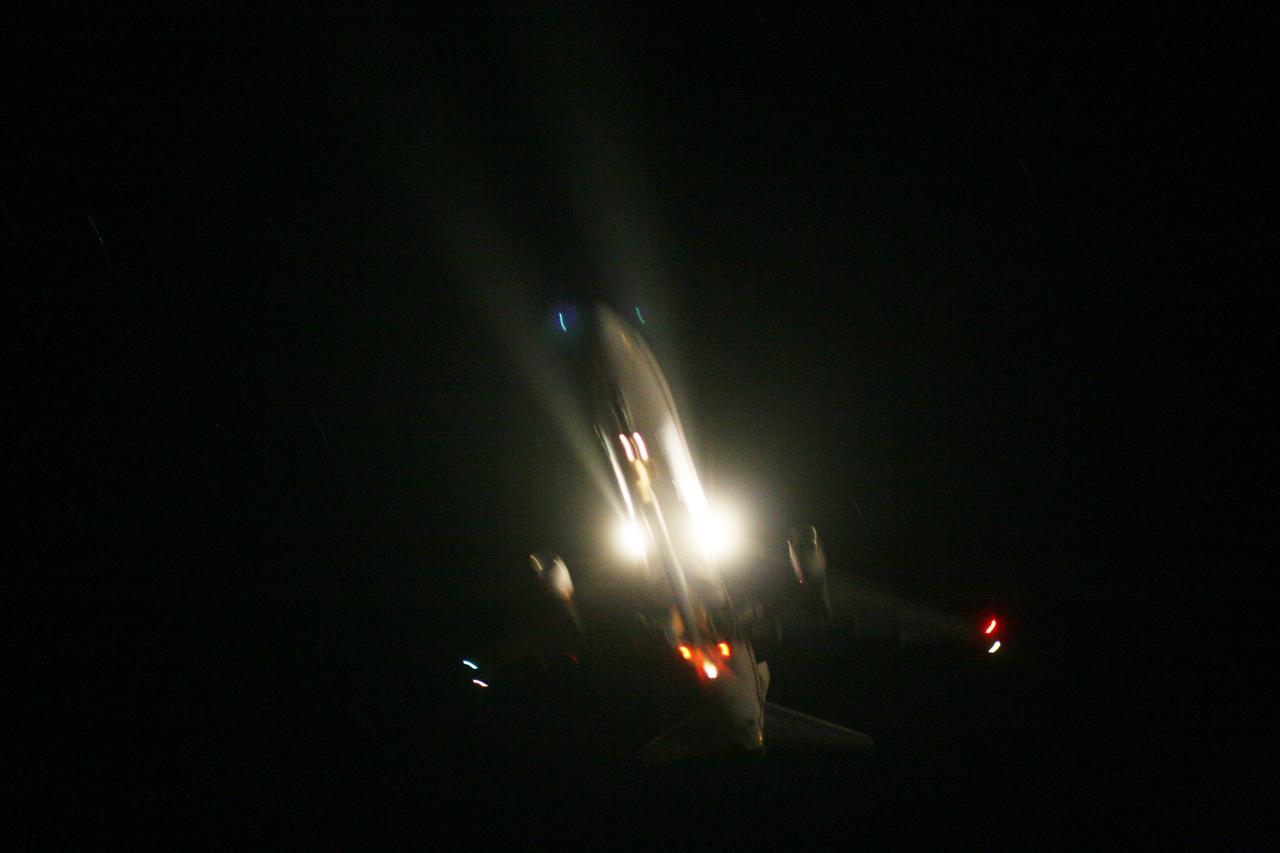
KWAJALEIN ATOLL, Marshall Islands - Orbital Sciences' L-1011 "Stargazer" aircraft takes off from the runway at Kwajalein Atoll with the company's Pegasus rocket to launch NASA's Nuclear Spectroscopic Telescope Array, or NuSTAR, payload strapped to the belly of the plane. The plane left Kwajalein one hour before launch. At 9:00:35 a.m. PDT 12:00:35 p.m. EDT), June 13, 2012, the rocket dropped with the NuSTAR payload 117 nautical miles south of Kwajalein. NuSTAR will use a unique set of “eyes” to see the highest energy X-ray light from the cosmos to reveal black holes lurking in our Milky Way galaxy, as well as those hidden in the hearts of faraway galaxies. Kwajalein is located in the Marshall Islands chain in the Pacific Ocean and is part of the Reagan Test Site and used for launches of NASA, commercial and military missions. For more information, visit http://www.nasa.gov/nustar. Photo credit: NASA
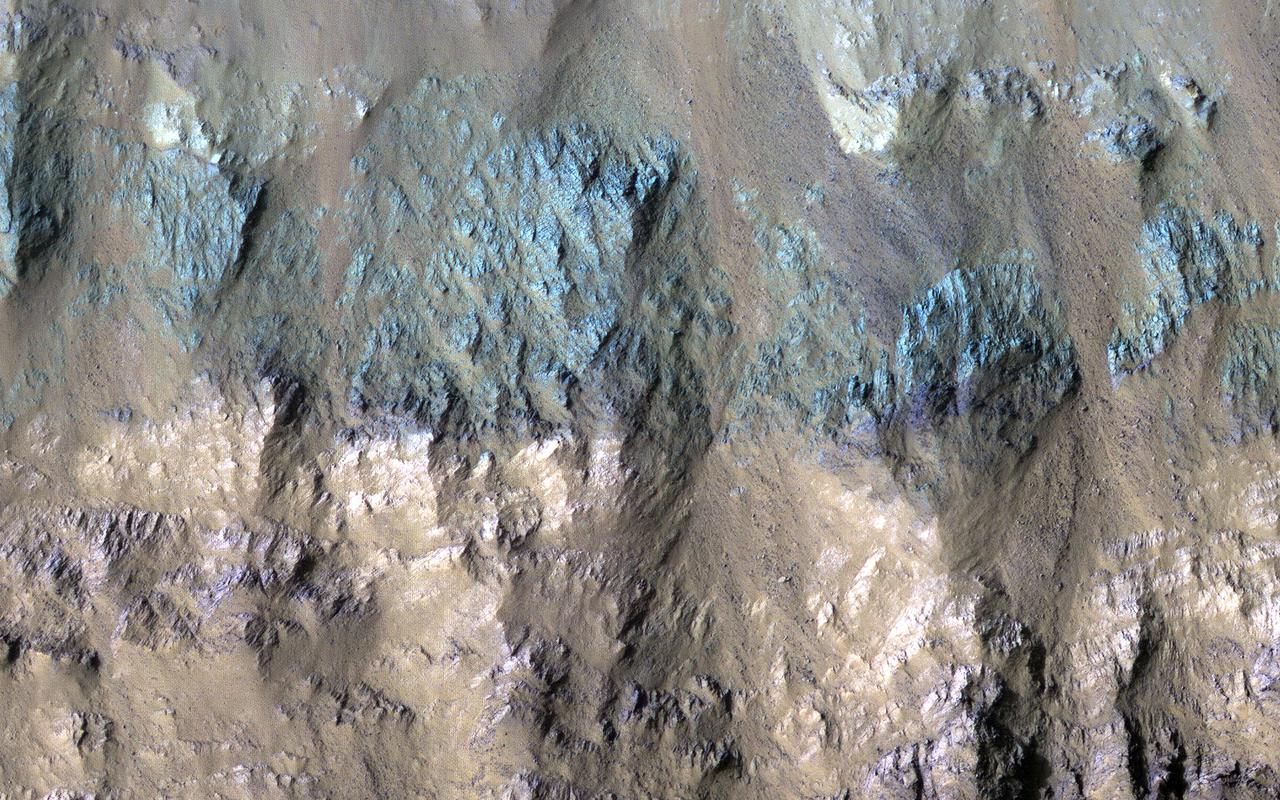
This image shows a crater on the floor of Eos Chasma, part of the Valles Marineris canyon system. Craters on Mars are useful for geologists because they provide cross-sections into the subsurface. The south wall of this crater shows evidence of several different types of rock, with diverse colors. In the black and white parts of the image, it appears that there are two types of rock: one relatively light and one dark. However, in the 1.1 kilometer-wide color swath we can see that the dark rocks are more complicated, as some have a greenish tint and others are purple. Note that these are not the colors your eyes would see if you were there! In enhanced color, the HiRISE near-infrared data appears as red, the red is shown as green, and the blue-green data is shown as blue, allowing us to see more information at once. https://photojournal.jpl.nasa.gov/catalog/PIA25182
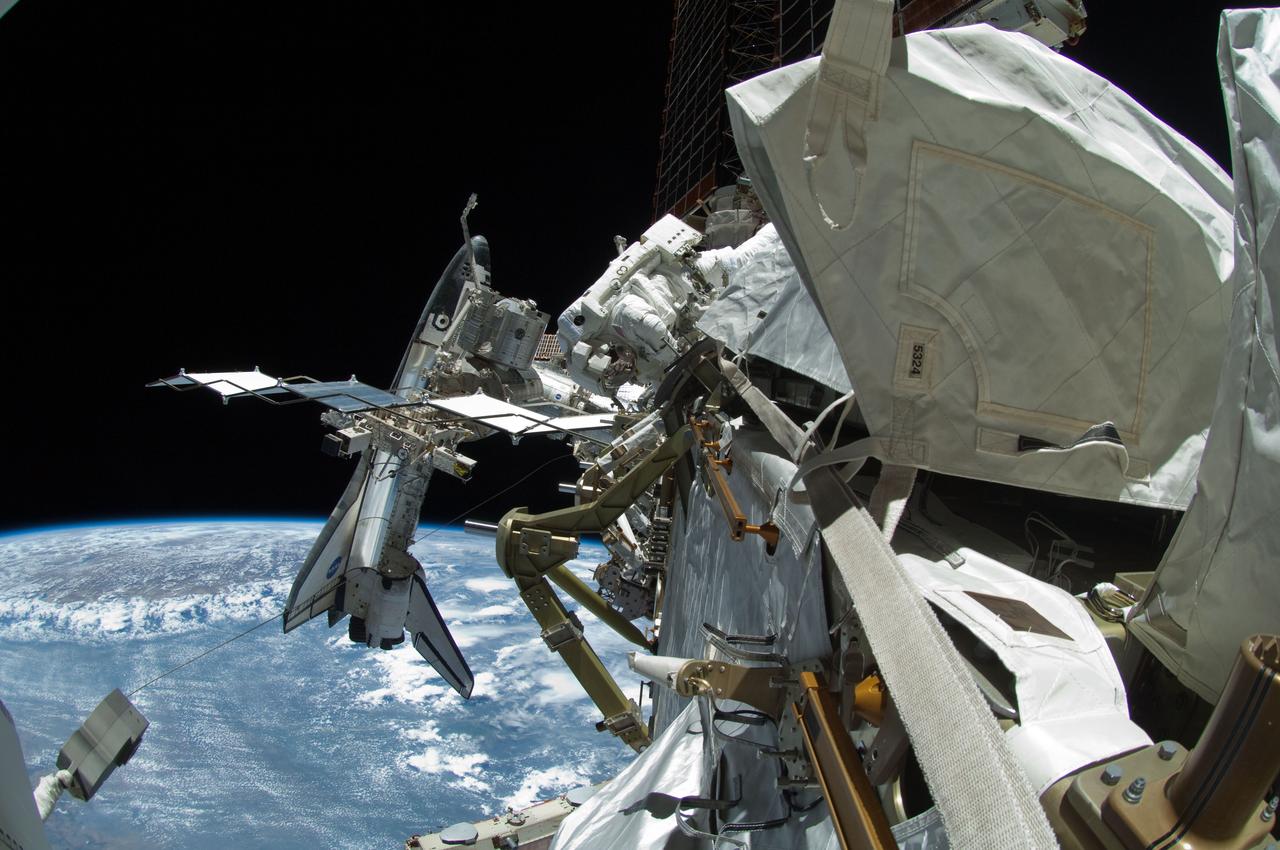
ISS028-E-005630 (27 May 2011) --- A fish-eye lens attached to an electronic still camera was used to capture this image of NASA astronaut Michael Fincke (top center) during the mission's fourth session of extravehicular activity (EVA) as construction and maintenance continue on the International Space Station. During the seven-hour, 24-minute spacewalk, Fincke and astronaut Greg Chamitoff (out of frame), both STS-134 mission specialists, completed the primary objectives for the spacewalk, including stowing the 50-foot-long boom and adding a power and data grapple fixture to make it the Enhanced International Space Station Boom Assembly, available to extend the reach of the space station's robotic arm. The docked space shuttle Endeavour is visible at left. The blackness of space and Earth?s horizon provide the backdrop for the scene.
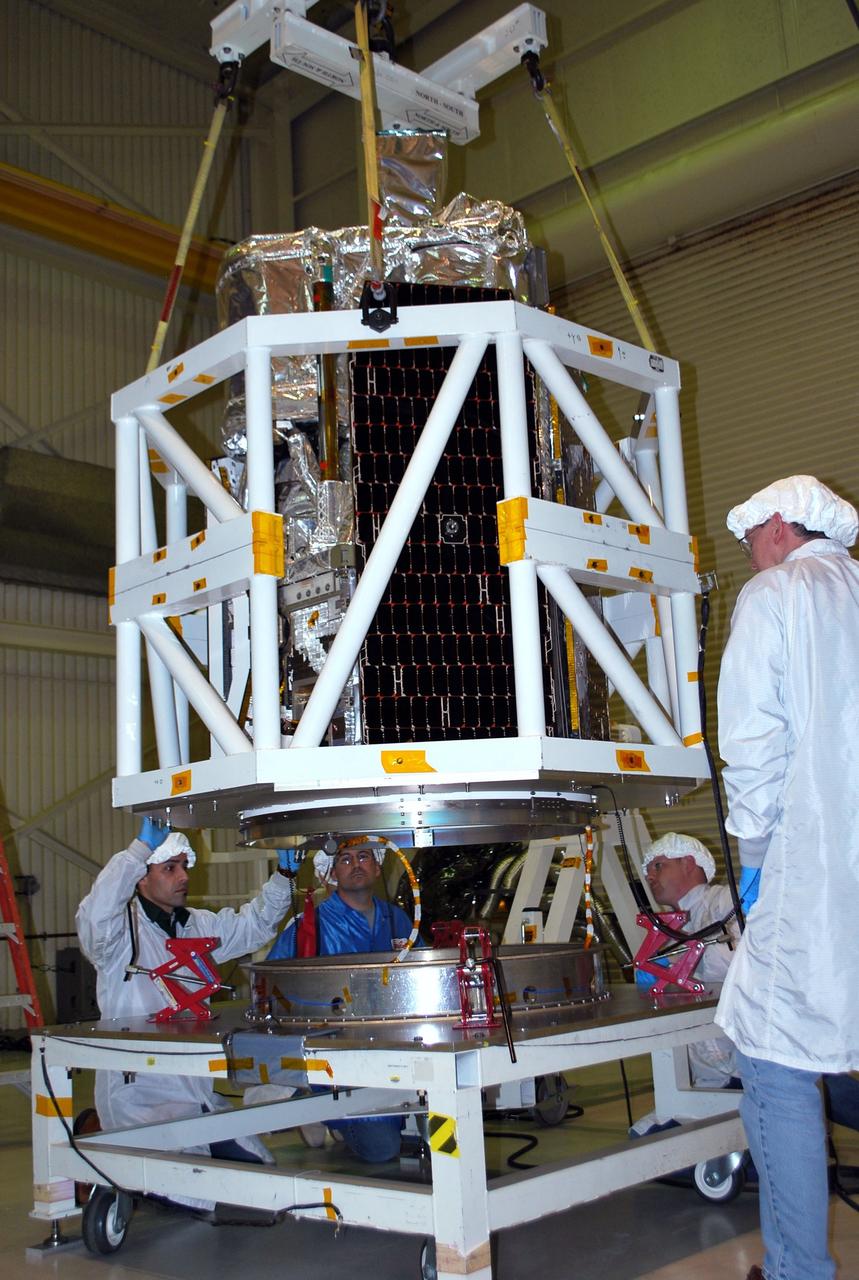
VANDENBERG AIR FORCE BASE, Calif. -- Technicians watch closely as NASA's NuSTAR spacecraft is Under the watchful eyes of technicians, NASA's NuSTAR spacecraft is lifted inside Orbital Sciences' processing facility at Vandenberg Air Force Base, Calif. The spacecraft will be rotated to horizontal for joining with the Pegasus XL rocket. The Orbital Sciences Pegasus will launch NASA's Nuclear Spectroscopic Telescope Array NuSTAR into space. After the rocket and spacecraft are processed at Vandenberg, they will be flown on Orbital's L-1011 carrier aircraft to the Ronald Reagan Ballistic Missile Defense Test Site at the Pacific Ocean’s Kwajalein Atoll for launch. The high-energy x-ray telescope will conduct a census for black holes, map radioactive material in young supernovae remnants, and study the origins of cosmic rays and the extreme physics around collapsed stars. For more information, visit science.nasa.gov/missions/nustar/. Photo credit: NASA/Randy Beaudoin, VAFB
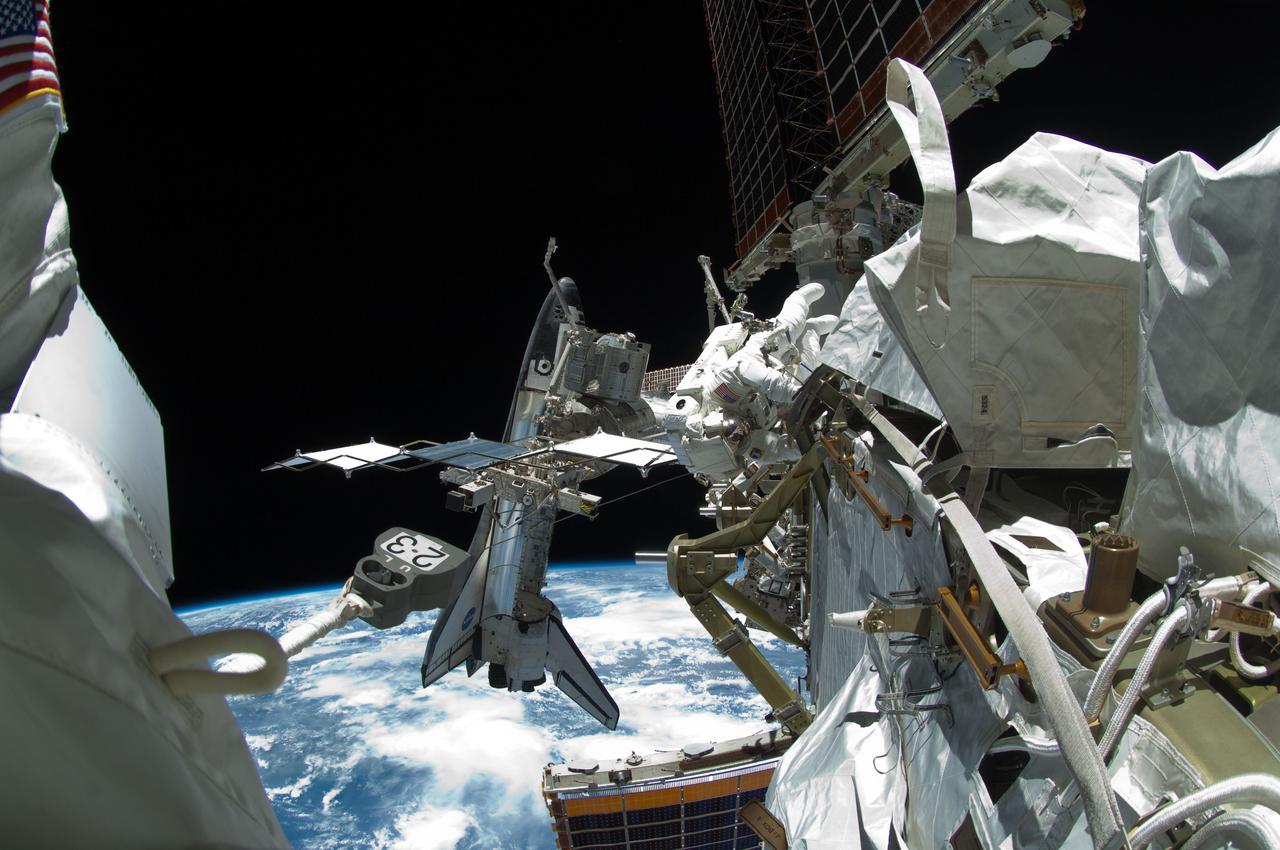
ISS028-E-005634 (27 May 2011) --- A fish-eye lens attached to an electronic still camera was used to capture this image of NASA astronaut Michael Fincke (top center) during the mission's fourth session of extravehicular activity (EVA) as construction and maintenance continue on the International Space Station. During the seven-hour, 24-minute spacewalk, Fincke and astronaut Greg Chamitoff (out of frame), both STS-134 mission specialists, completed the primary objectives for the spacewalk, including stowing the 50-foot-long boom and adding a power and data grapple fixture to make it the Enhanced International Space Station Boom Assembly, available to extend the reach of the space station's robotic arm. The docked space shuttle Endeavour is visible at left. The blackness of space and Earth?s horizon provide the backdrop for the scene.

Colors were mapped onto infrared data from NASA's Galileo mission in this image revealing locations around a crater on the Jovian moon Europa called Manannán where there are signatures of water. Manannán was created when a comet or asteroid hit the surface of Europa. The blue colors in this image indicate higher concentrations of water ice in the material thrown out of the crater during impact. Yellow and red show the locations of hydrates, chemically altered forms of water that can bind to other elements. The background black-and-white image was taken by the Galileo solid-state imaging camera, which took images in visible light. The colors correspond to wavelengths of light that are not detectable to the human eye but were observed by Galileo's near-infrared mapping spectrometer. Galileo orbited Jupiter for almost eight years, concluding its mission in 2003. https://photojournal.jpl.nasa.gov/catalog/PIA26104
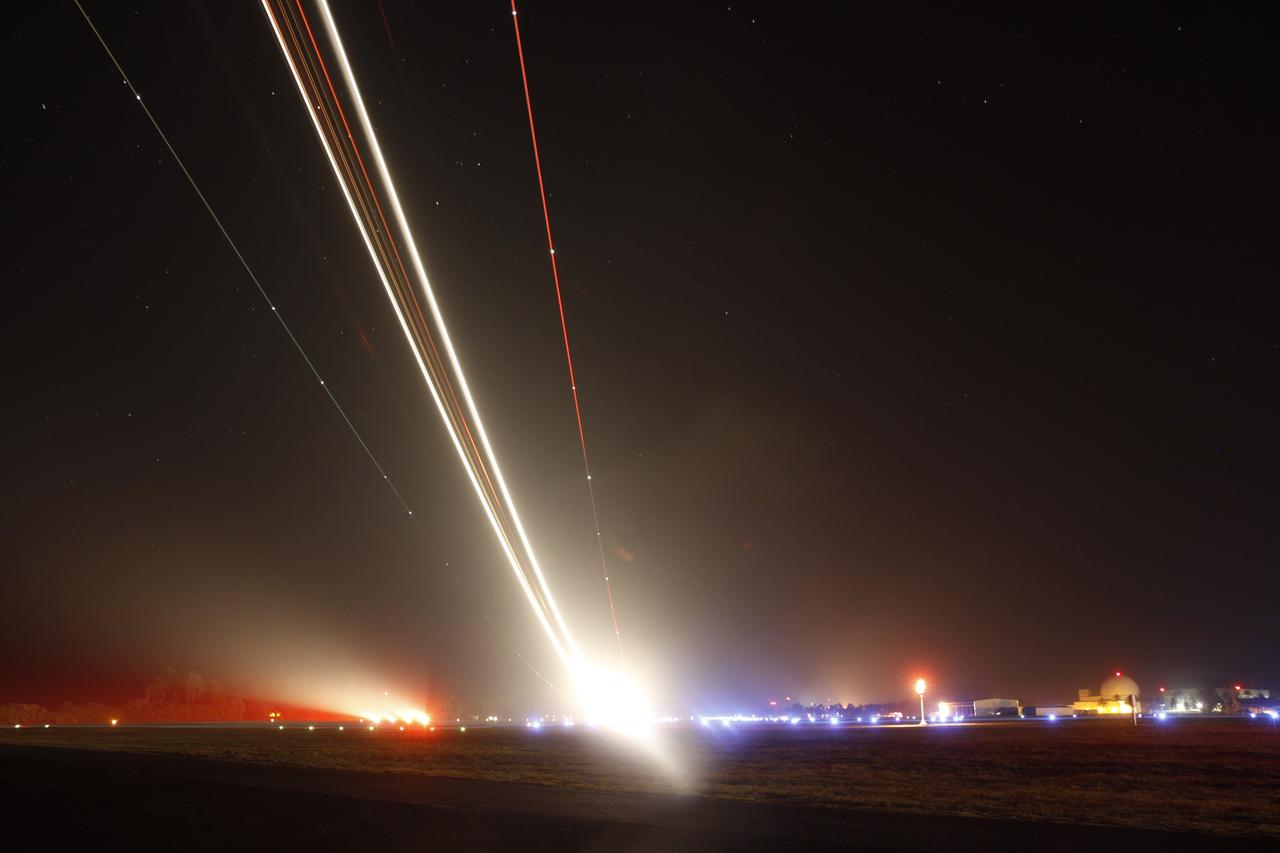
KWAJALEIN ATOLL, Marshall Islands - In this time-lapse image, the lights of Orbital Sciences' L-1011 "Stargazer" streak across the night sky as the aircraft takes off from the runway at Kwajalein Atoll with the company's Pegasus rocket to launch NASA's Nuclear Spectroscopic Telescope Array, or NuSTAR. The plane left Kwajalein one hour before launch. At 9:00:35 a.m. PDT 12:00:35 p.m. EDT), June 13, 2012, the rocket dropped with the NuSTAR payload 117 nautical miles south of Kwajalein. NuSTAR will use a unique set of “eyes” to see the highest energy X-ray light from the cosmos to reveal black holes lurking in our Milky Way galaxy, as well as those hidden in the hearts of faraway galaxies. Kwajalein is located in the Marshall Islands chain in the Pacific Ocean and is part of the Reagan Test Site and used for launches of NASA, commercial and military missions. For more information, visit http://www.nasa.gov/nustar. Photo credit: NASA
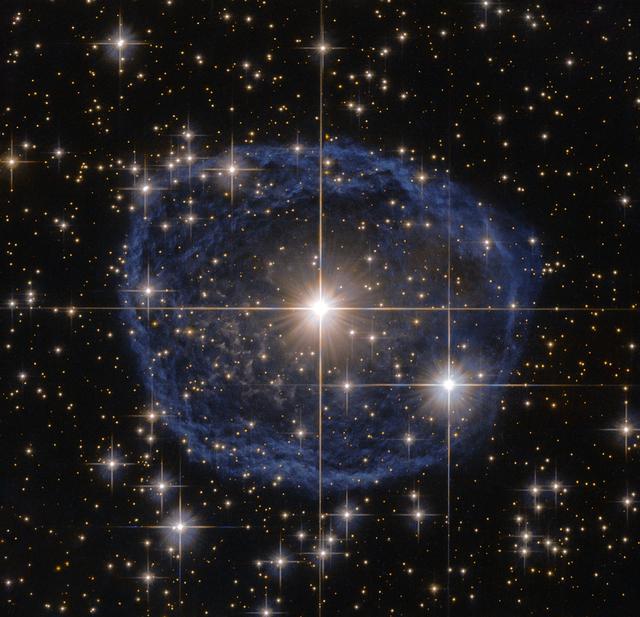
A large blue bubble with a bright star in the center on a black background filled with stars Sparkling at the center of this beautiful NASA/ESA Hubble Space Telescope image is a Wolf–Rayet star known as WR 31a, located about 30,000 light-years away in the constellation of Carina (The Keel). The distinctive blue bubble appearing to encircle WR 31a is a Wolf–Rayet nebula — an interstellar cloud of dust, hydrogen, helium and other gases. Created when speedy stellar winds interact with the outer layers of hydrogen ejected by Wolf–Rayet stars, these nebulae are frequently ring-shaped or spherical. The bubble — estimated to have formed around 20,000 years ago — is expanding at a rate of around 220,000 kilometers (136,700 miles) per hour! Unfortunately, the lifecycle of a Wolf–Rayet star is only a few hundred thousand years — the blink of an eye in cosmic terms. Despite beginning life with a mass at least 20 times that of the sun, Wolf–Rayet stars typically lose half their mass in less than 100,000 years. And WR 31a is no exception to this case. It will, therefore, eventually end its life as a spectacular supernova, and the stellar material expelled from its explosion will later nourish a new generation of stars and planets. Image credi: ESA/Hubble & NASA, Acknowledgement: Judy Schmidt
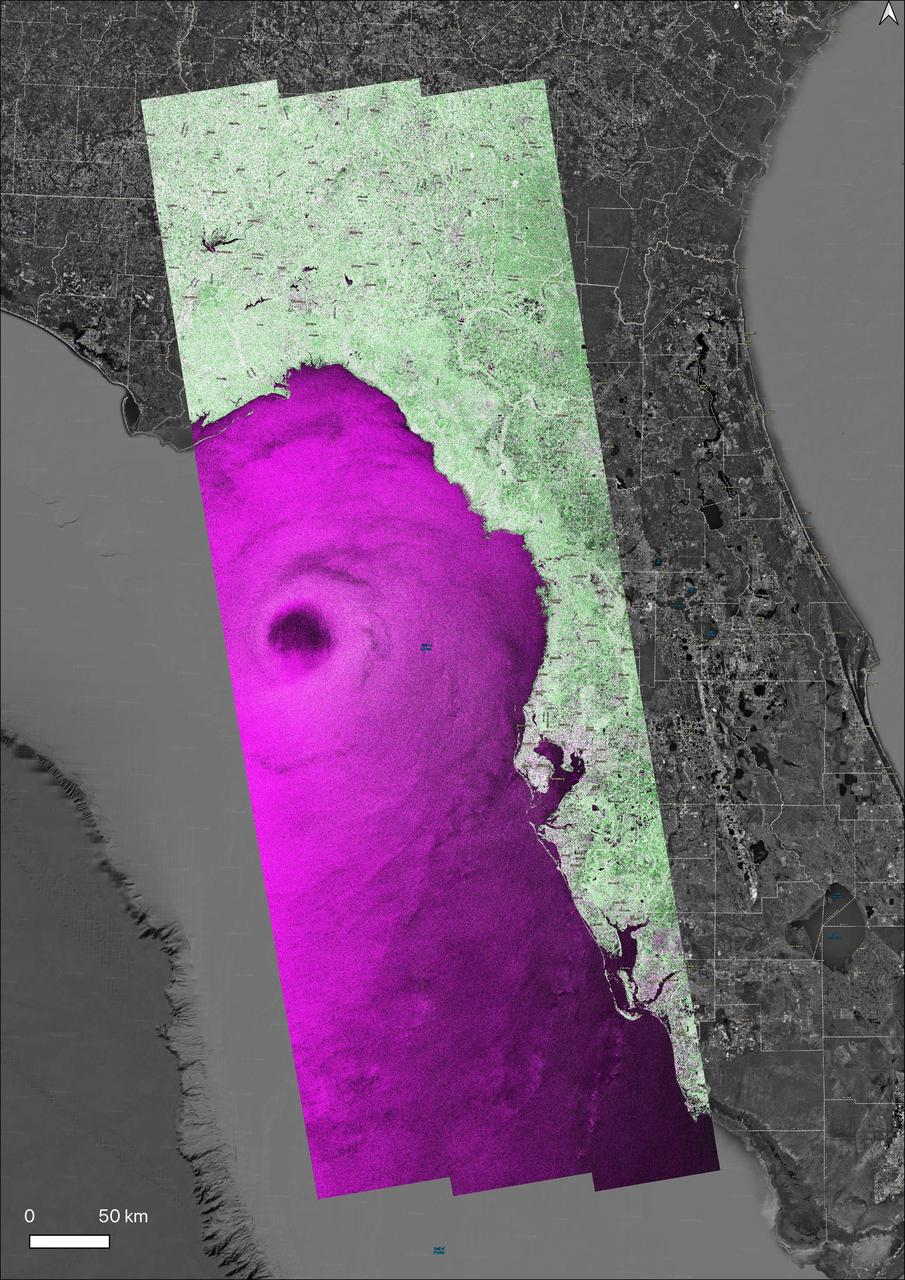
NASA's Observational Products for End-Users from Remote Sensing Analysis (OPERA) project generated a radar image of Hurricane Helene on Friday, Sept. 26, 2024, at 7:38 p.m. local time, as the storm approached the Florida coast. One of the largest storms to develop in the Gulf of Mexico in the last century, Helene made landfall as a Category 4 hurricane in the Big Bend area of Florida at about 11:10 p.m. The data shown in the image is from the synthetic aperture radar (SAR) instrument on the Copernicus Sentinel-1A satellite, operated by the European Space Agency (ESA), and processed by OPERA into a data product called OPERA RTC-S1. The OPERA RTC-S1 image was converted to a false color image. In this color scale, vegetated areas appear green, urban areas appear white/pink, calm water appears black, and rough water appears purple or magenta. The eye of the hurricane can be clearly seen as a large dark patch in the Gulf of Mexico. The OPERA RTC-S1 image was superimposed on a Google Earth satellite background shown in grayscale and the ESRI Boundaries Places layer. https://photojournal.jpl.nasa.gov/catalog/PIA26414
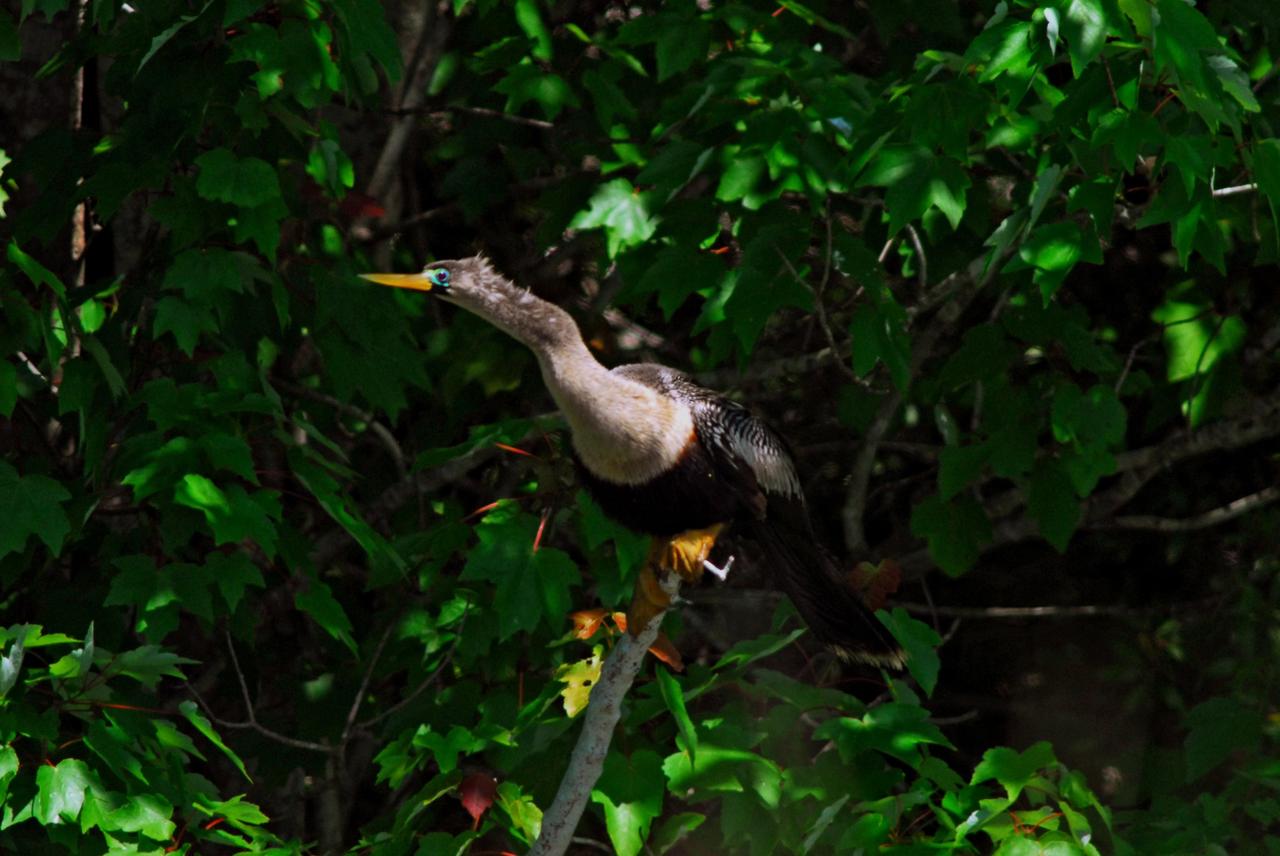
KENNEDY SPACE CENTER, FLA. -- A female anhinga roosts in branches near the water. Anhingas can be found in freshwater ponds and swamps where there is thick vegetation and tall trees. Male anhingas are black and gray; females are distinguished by a buff-colored neck and breast. When anhingas are in their breeding plumage they have a blue ring around their eyes, as seen here. The female lays three to five light blue eggs. The nest is in a tree and it is made of sticks and lined with leaves. The chicks hatch in about a month. Anhingas breed off the Gulf Coast and the Atlantic Coast from North Carolina to Texas and in the Mississippi Valley north to Kentucky and Missouri. They winter along the Gulf Coast north to North Carolina. The anhinga diet is primarily fish. Using their sharp bills, anhingas spear the fish, flip them in the air and swallow them head-first. KSC shares a boundary with the Merritt Island Wildlife Nature Refuge. The refuge is a habitat for more than 310 species of birds, 25 mammals, 117 fishes and 65 amphibians and reptiles. In addition, the Refuge supports 19 endangered or threatened wildlife species on Federal or State lists, more than any other single refuge in the U.S. Photo credit: NASA/Dimitri Gerondidakis
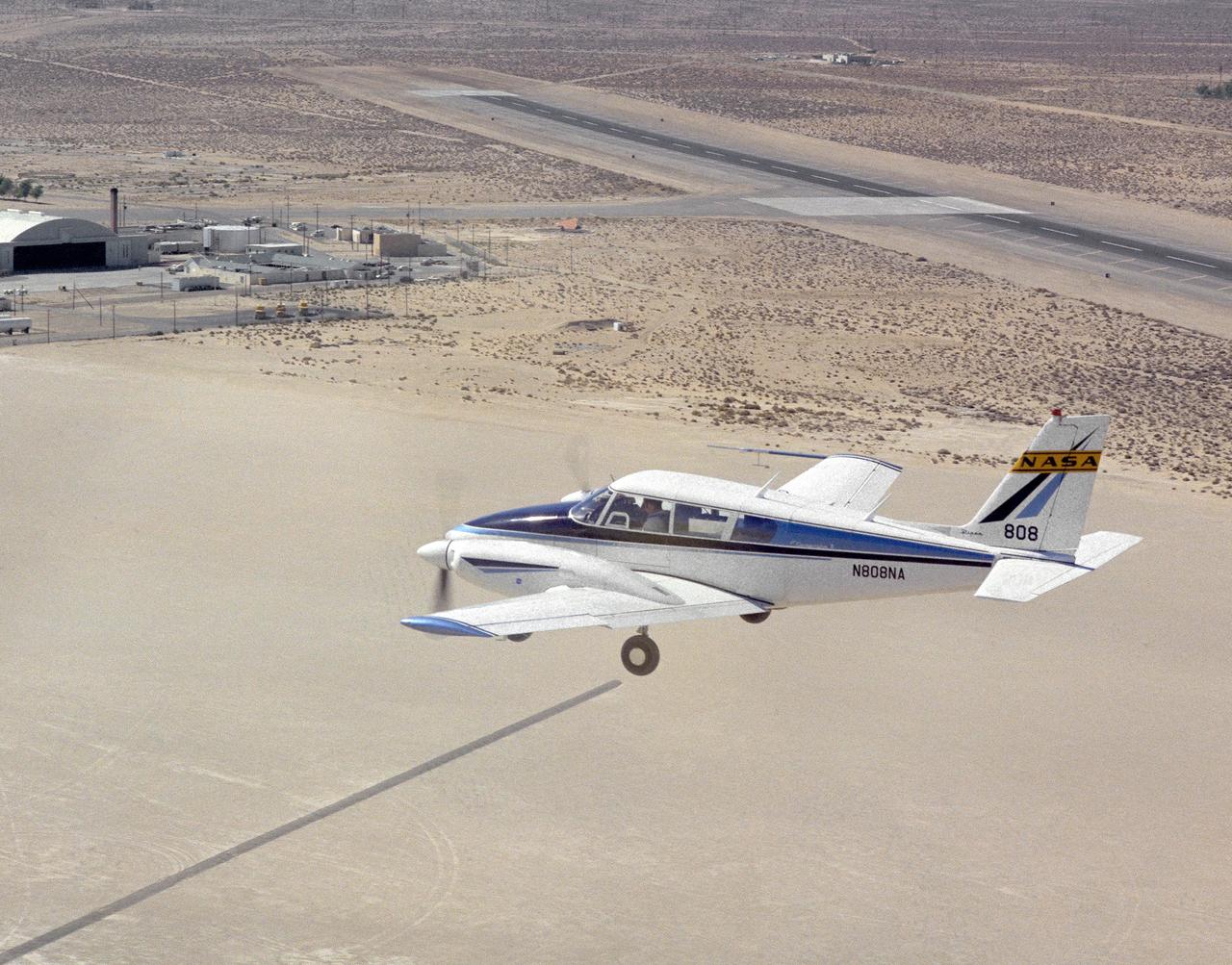
Dryden Flight Research Center's Piper PA-30 Twin Commanche, which helped validate the RPRV concept, descends to a remotely controlled landing on Rogers Dry Lake, unassisted by the onboard pilot. A Piper PA-30 Twin Commanche, known as NASA 808, was used at the NASA Dryden Flight Research Center as a rugged workhorse in a variety of research projects associated with both general aviation and military projects. In the early 1970s, the PA-30, serial number 301498, was used to test a flight technique used to fly Remotely Piloted Research Vehicles (RPRV's). The technique was first tested with the cockpit windows of the light aircraft blacked out while the pilot flew the aircraft utilizing a television monitor which gave him a "pilot's eye" view ahead of the aircraft. Later pilots flew the aircraft from a ground cockpit, a procedure used with all RPRV's. TV and two-way telemetry allow the pilot to be in constant control of the aircraft. The apparatus mounted over the cockpit is a special fish eye lens camera, used to obtain images that are transmitted to the ground based cockpit. This project paved the way for sophisticated, highly successful research programs involving high risk spin, stall, and flight control conditions, such as the HiMAT and the subscale F-15 remotely piloted vehicles. Over the years, NASA 808 has also been used for spin and stall research related to general aviation aircraft and also research to alleviate wake vortices behind large jetliners.
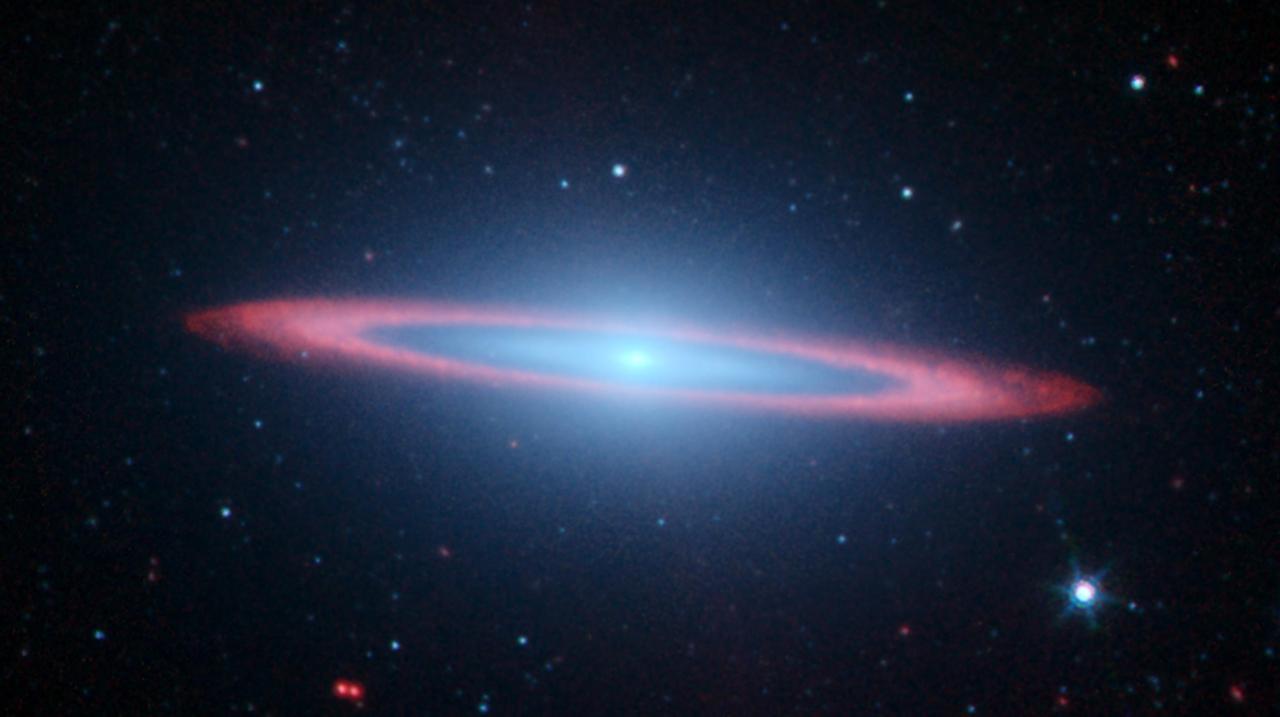
NASA's Spitzer Space Telescope set its infrared eyes on one of the most famous objects in the sky, Messier 104, also called the Sombrero galaxy. In this striking infrared picture, Spitzer sees an exciting new view of a galaxy that in visible light has been likened to a "sombrero," but here looks more like a "bulls-eye." Recent observations using Spitzer's infrared array camera uncovered the bright, smooth ring of dust circling the galaxy, seen in red. In visible light, because this galaxy is seen nearly edge-on, only the near rim of dust can be clearly seen in silhouette. Spitzer's full view shows the disk is warped, which is often the result of a gravitational encounter with another galaxy, and clumpy areas spotted in the far edges of the ring indicate young star-forming regions. Spitzer's infrared view of the starlight from this galaxy, seen in blue, can pierce through obscuring murky dust that dominates in visible light. As a result, the full extent of the bulge of stars and an otherwise hidden disk of stars within the dust ring are easily seen. The Sombrero galaxy is located some 28 million light years away. Viewed from Earth, it is just six degrees south of its equatorial plane. Spitzer detected infrared emission not only from the ring, but from the center of the galaxy too, where there is a huge black hole, believed to be a billion times more massive than our Sun. This picture is composed of four images taken at 3.6 (blue), 4.5 (green), 5.8 (orange), and 8.0 (red) microns. The contribution from starlight (measured at 3.6 microns) has been subtracted from the 5.8 and 8-micron images to enhance the visibility of the dust features. http://photojournal.jpl.nasa.gov/catalog/PIA07899

In the 19th century, astronomer V. M. Slipher first discovered a hat-like object that appeared to be rushing away from us at 700 miles per second. This enormous velocity offered some of the earliest clues that it was really another galaxy, and that the universe was expanding in all directions. The trained razor sharp eye of the Hubble Space Telescope (HST) easily resolves this Sombrero galaxy, Messier 104 (M104). The galaxy is 50,000 light-years across and is located 28 million light-years from Earth at the southern edge of the rich Virgo cluster of galaxies. Equivalent to 800 billion suns, Sombrero is one of the most massive objects in that group. The hallmark of Sombrero is a brilliant white, bulbous core encircled by the thick dust lanes comprising the spiral structure of the galaxy. As seen from Earth, the galaxy is tilted nearly edge-on. We view it from just six degrees north of its equatorial plane. At a relatively bright magnitude of +8, M104 is just beyond the limit of naked-eye visibility and is easily seen through small telescopes. This rich system of globular clusters are estimated to be nearly 2,000 in number which is 10 times as many as in our Milky Way galaxy. The ages of the clusters are similar to the clusters in the Milky Way, ranging from 10-13 billion years old. Embedded in the bright core of M104 is a smaller disk, which is tilted relative to the large disk. X-ray emission suggests that there is material falling into the compact core, where a 1-billion-solar-mass black hole resides. The Marshall Space Flight Center (MSFC) had responsibility for design, development, and construction of the HST.
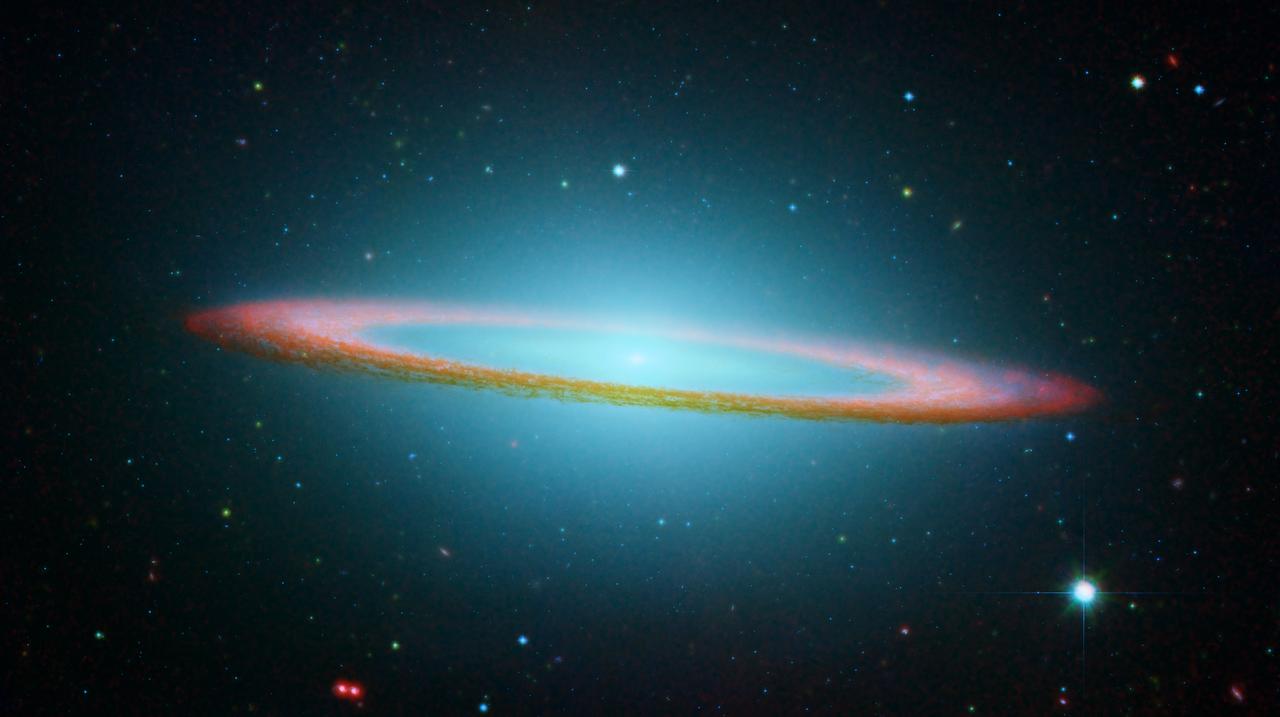
The razor sharp eye of the Hubble Space Telescope (HST) easily resolves the Sombrero galaxy, Messier 104 (M104). 50,000 light-years across, the galaxy is located 28 million light-years from Earth at the southern edge of the rich Virgo cluster of galaxies. Equivalent to 800 billion suns, Sombrero is one of the most massive objects in that group. The hallmark of Sombrero is a brilliant white, bulbous core encircled by the thick dust lanes comprising the spiral structure of the galaxy. As seen from Earth, the galaxy is tilted nearly edge-on. We view it from just six degrees north of its equatorial plane. This rich system of globular clusters is estimated to be nearly 2,000 in number which is 10 times as many as in our Milky Way galaxy. Similar to the clusters in the Milky Way, the ages range from 10-13 billion years old. Embedded in the bright core of M104 is a smaller disk, which is tilted relative to the large disk. The HST paired with the Spitzer infrared telescope, offers this striking composite capturing the magnificence of the Sombrero galaxy. In the Hubble view, the galaxy resembles a broad-rimmed Mexican hat, whereas in the Spitzer striking infrared view, the galaxy looks more like a bulls eye. The full view provided by Spitzer shows the disk is warped, which is often the result of a gravitational encounter with another galaxy, and clumpy areas spotted in the far edges of the ring indicate young star forming regions. Spitzer detected infrared emission not only from the ring, but from the center of the galaxy as well, where there is a huge black hole believed to be a billion times more massive than our Sun. The Marshall Space Flight Center (MSFC) had responsibility for design, development, and construction of the HST.
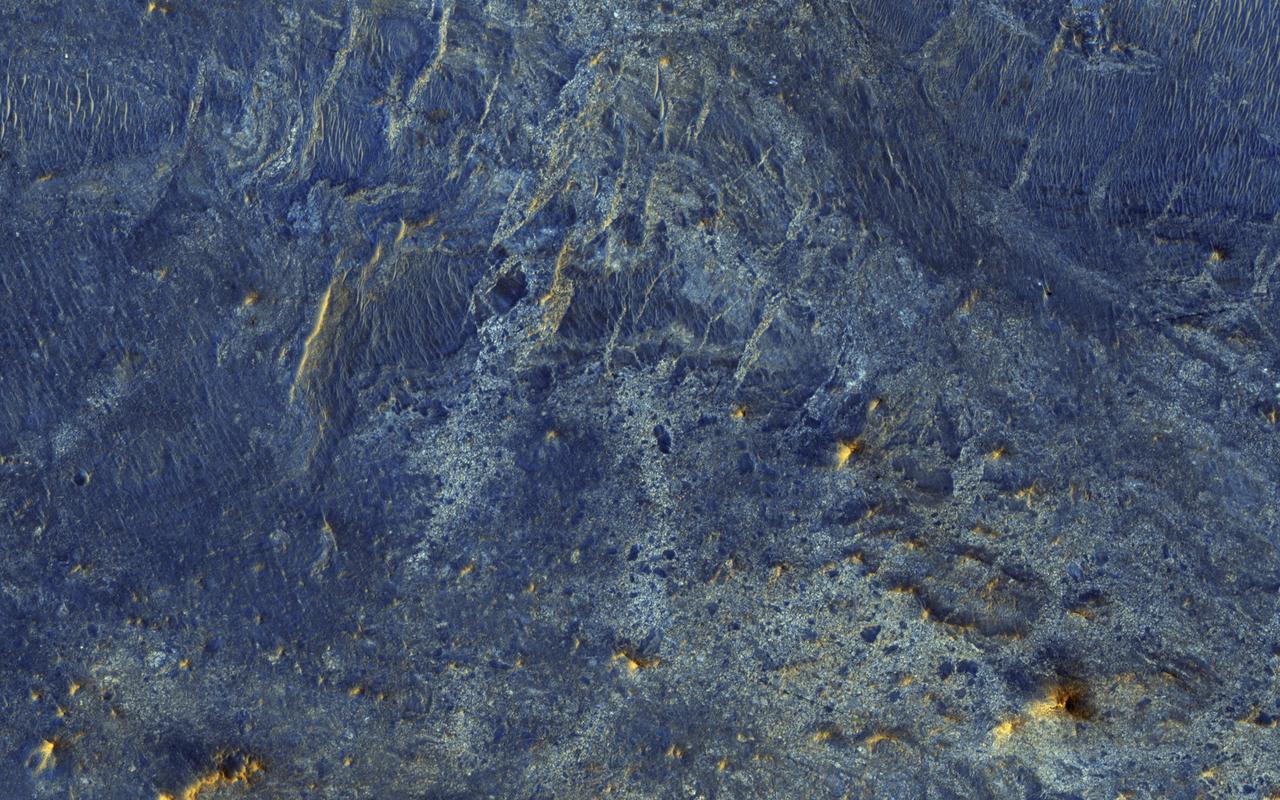
There have been several proposals to send people to Mars but not land them on the surface. Instead, they would either fly by Mars once and return to Earth, or orbit Mars for a period of time. Would they at least get spectacular naked-eye views of the Martian surface? Some parts of Mars would be interesting: for example the polar ice caps, and the bright (dust-covered) regions would be seen reasonably well, although the color is very uniform. The dark (low reflectance) regions of Mars are some of the most interesting and important regions studied by our orbiters and rovers, but they would appear very bland to humans outside of the planet's atmosphere. This is because the thin atmosphere of Mars is quite bright and dusty, so when looking at dark surface areas, most of what you would see is scattered light from the atmospheric dust, and the surface would have a very low contrast. It would also appear reddish, even if the surface materials are not reddish, from the scattered light. Here is an example from the Nili Patera region of Mars, a candidate future landing site. At the top is an approximation of the natural color as seen by people with normal color vision -- almost no surface detail is visible. In the middle is the standard HiRISE IRB color product, consisting of the infrared, red, and blue-green images displayed as red, green, and blue, respectively, and with a min-max stretch applied to each color. In other words, the darkest pixel in the entire image is set to black, the brightest pixel is set to white, and all others are linearly interpolated. At bottom is an enhanced color product, in which each bandpass is given a linear stretch for the local subimage, sometimes saturating a small percentage of data to black or white to give the rest of the scene more contrast, followed by color saturation enhancement. Now we can see a diversity of colors that distinguish different surface units: dust, sand, and rocks with different minerals. http://photojournal.jpl.nasa.gov/catalog/PIA21040
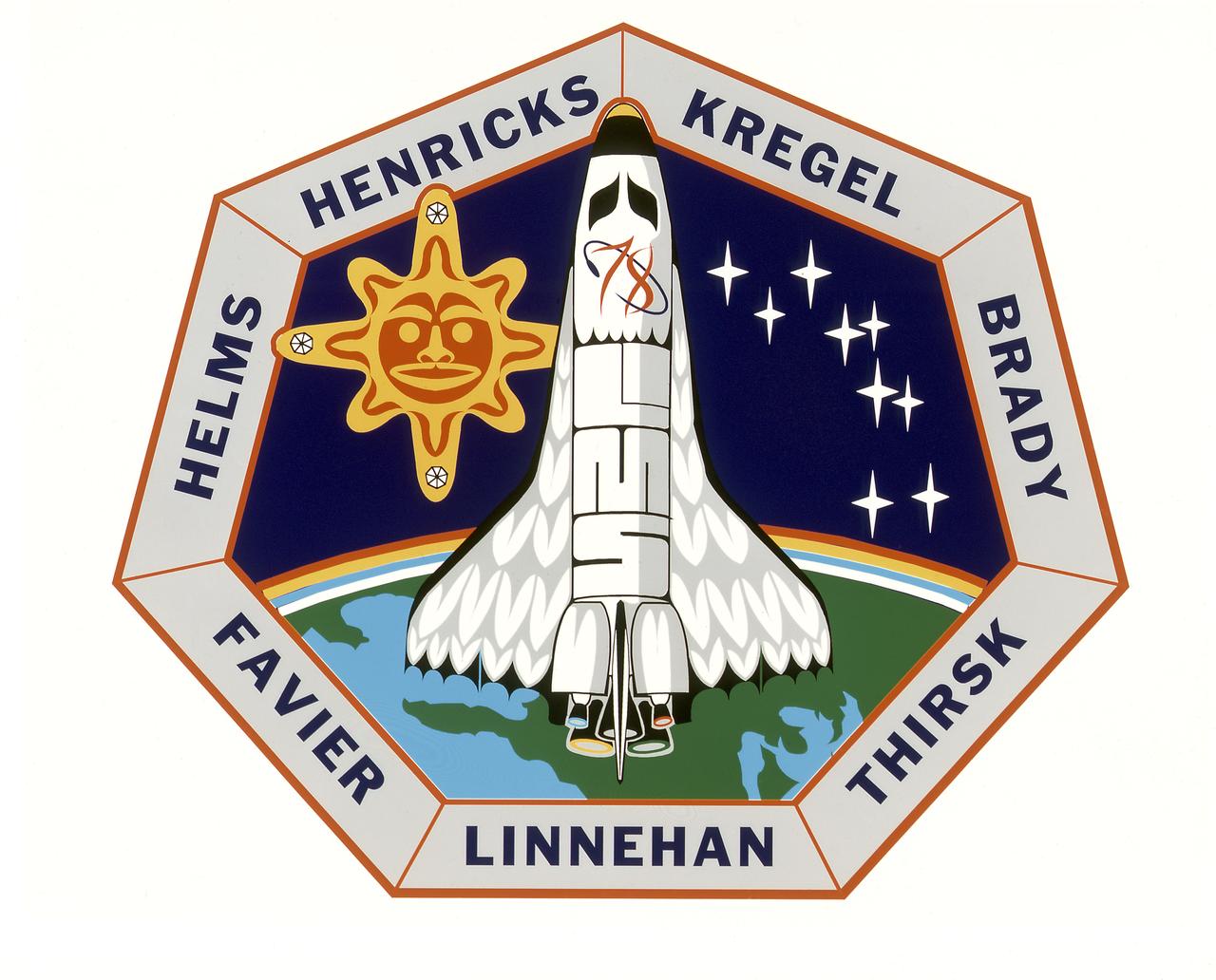
The STS-78 patch links past with present to tell the story of its mission and science through a design imbued with the strength and vitality of the 2-dimensional art of North America's northwest coast Indians. Central to the design is the space Shuttle whose bold lines and curves evoke the Indian image for the eagle, a native American symbol of power and prestige as well as the national symbol of the United States. The wings of the Shuttle suggest the wings of the eagle whose feathers, indicative of peace and friendship in Indian tradition, are captured by the U forms, a characteristic feature of Northwest coast Indian art. The nose of the Shuttle is the strong downward curve of the eagle's beak, and the Shuttle's forward windows, the eagle's eyes, represented through the tapered S forms again typical of this Indian art form. The basic black and red atoms orbiting the mission number recall the original NASA emblem while beneath, utilizing Indian ovoid forms, the major mission scientific experiment package LMS (Life and Materials Sciences) housed in the Shuttle's cargo bay is depicted in a manner reminiscent of totem-pole art. This image of a bird poised for flight, so common to Indian art, is counterpointed by an equally familiar Tsimshian Indian symbol, a pulsating sun with long hyperbolic rays, the symbol of life. Within each of these rays are now encased crystals, the products of this mission's 3 major, high-temperature materials processing furnaces. And as the sky in Indian lore is a lovely open country, home of the Sun Chief and accessible to travelers through a hole in the western horizon, so too, space is a vast and beckoning landscape for explorers launched beyond the horizon. Beneath the Tsimshian sun, the colors of the earth limb are appropriately enclosed by a red border representing life to the Northwest coast Indians. The Indian colors of red, navy blue, white, and black pervade the STS-78 path. To the right of the Shuttle-eagle, the constellation Delphinus recalls the dolphin, friend of ancient sailors and, now perhaps too, of the 9 space voyagers suggested by this constellation's blaze of 9 stars. The patch simultaneously celebrates international unity fostered by the Olympic spirit of sports competition at the 1996 Olympic Games in Atlanta, Georgia, U.S.A. Deliberately poised over the city of Atlanta, the Space Shuttle glows at its base with the 5 official Olympic rings in the 5 Olympic colors which can also be found throughout the patch, rings and colors which signify the 5 continents of the earth. This is an international mission and for the first time in NASA patch history, astronauts have dispensed with identifying country flags beneath their names to celebrate the spirit of international unity so characteristic of this flight.
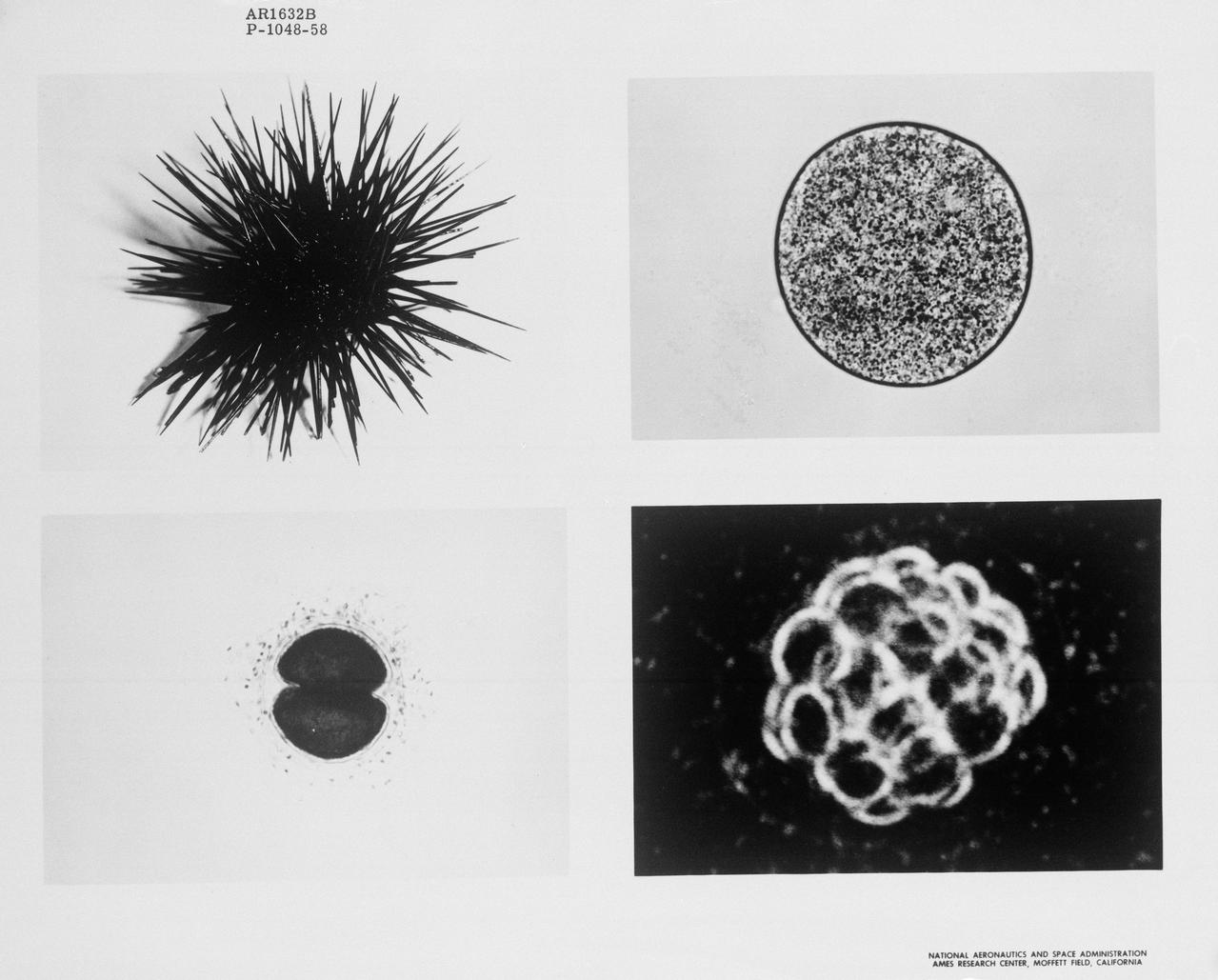
S65-18762 (March 1965) --- Effects of the weightless environment on cell division, the basic growth process for living tissue, will be studied during the Gemini-Titan 3 flight scheduled for March 23, 1965. A spiny black sea urchin (upper left) is stimulated by mild electric shock or potassium chloride. As a result it sheds many thousands of eggs. When fertilized, these eggs become actively dividing cells very similar in basic processes to cells of other animals, including humans. These pictures show stages of cell division. At upper right is a single cell; at lower right cell divisions have produced many cells. Cell photos are magnified about 700 times, and all cells shown are too small to be seen by the naked eye. (Photos at upper right and lower left are of sea urchin eggs. Group of cells at lower right are from a sand dollar, which like the sea urchin, is an Echinoderm. Its eggs are virtually identical and are used interchangeably with those of the sea urchin in NASA Ames Center weightlessness experiments.) The Gemini experiment will involve cell division like that shown here. This will take place during several hours of weightlessness aboard the Gemini spacecraft. The experiment will be flown back to laboratories at Cape Kennedy after spacecraft recovery. It has been designed so that any abnormal cell division found by postflight analysis should suggest that the weightless environment has effects on individual cells. This might mean hazards for prolonged periods of manned spaceflight.

Feast your eyes on Hubble's Megamaser galaxy! Phenomena across the Universe emit radiation spanning the entire electromagnetic spectrum — from high-energy gamma rays, which stream out from the most energetic events in the cosmos, to lower-energy microwaves and radio waves. Microwaves, the very same radiation that can heat up your dinner, are produced by a multitude of astrophysical sources, including strong emitters known as masers (microwave lasers), even stronger emitters with the somewhat villainous name of megamasers and the centers of some galaxies. Especially intense and luminous galactic centers are known as active galactic nuclei. They are in turn thought to be driven by the presence of supermassive black holes, which drag surrounding material inwards and spit out bright jets and radiation as they do so. The two galaxies shown here, imaged by the NASA/ESA Hubble Space Telescope, are named MCG+01-38-004 (the upper, red-tinted one) and MCG+01-38-005 (the lower, blue-tinted one). MCG+01-38-005 (also known as NGC 5765B) is a special kind of megamaser; the galaxy’s active galactic nucleus pumps out huge amounts of energy, which stimulates clouds of surrounding water. Water’s constituent atoms of hydrogen and oxygen are able to absorb some of this energy and re-emit it at specific wavelengths, one of which falls within the microwave regime, invisible to Hubble but detectable by microwave telescopes. MCG+01-38-005 is thus known as a water megamaser! Astronomers can use such objects to probe the fundamental properties of the Universe. The microwave emissions from MCG+01-38-005 were used to calculate a refined value for the Hubble constant, a measure of how fast the Universe is expanding. This constant is named after the astronomer whose observations were responsible for the discovery of the expanding Universe and after whom the Hubble Space Telescope was named, Edwin Hubble.
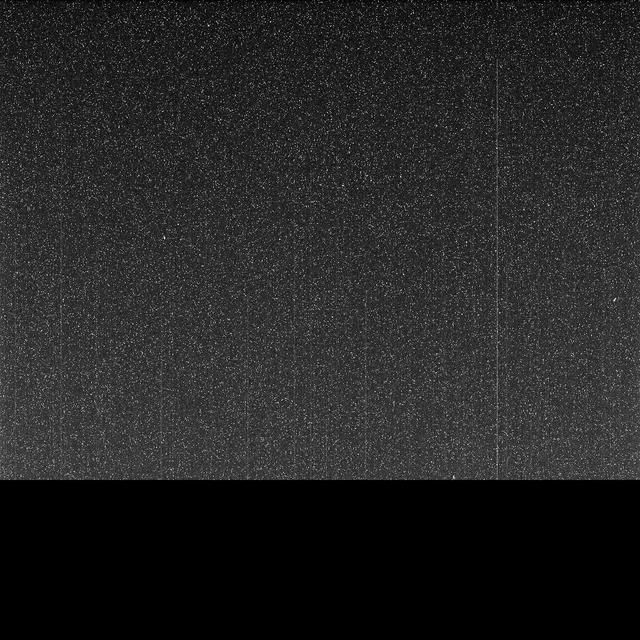
Taken on June 10, 2018 (the 5,111th Martian day, or sol, of the mission) this "noisy", incomplete image was the last data NASA's Opportunity rover sent back from Perseverance Valley on Mars. The partial, full-frame image from the Panoramic Camera (Pancam) was sent up to NASA's Mars Reconnaissance Orbiter around 9:45 a.m. PDT (12:45 p.m. EDT) to relay back to Earth as an intense dust storm darkened the skies around the solar-powered rover. The image was received on Earth at around 10:05 a.m. PDT (1:05 p.m. EDT). Opportunity took this image with the left eye of the Pancam, with its solar filter pointed at the Sun. But since the dust storm blotted out the Sun, the image is dark. The white speckles are noise from the camera. All Pancam images have noise in them, but the darkness makes it more apparent. The transmission stopped before the full image was transmitted, leaving the bottom of the image incomplete, represented here as black pixels. While this partial full-frame image was the last that Opportunity transmitted, it was not actually the last set of images from Opportunity. This image was taken at around 9:30 a.m. PDT (12:30 p.m. EDT) on June 10, 2018. Another set of images (PIA22930) was taken about three minutes later. The thumbnail versions of the last images taken were transmitted, but the rover lost contact before transmitting the full-frame versions. https://photojournal.jpl.nasa.gov/catalog/PIA22929
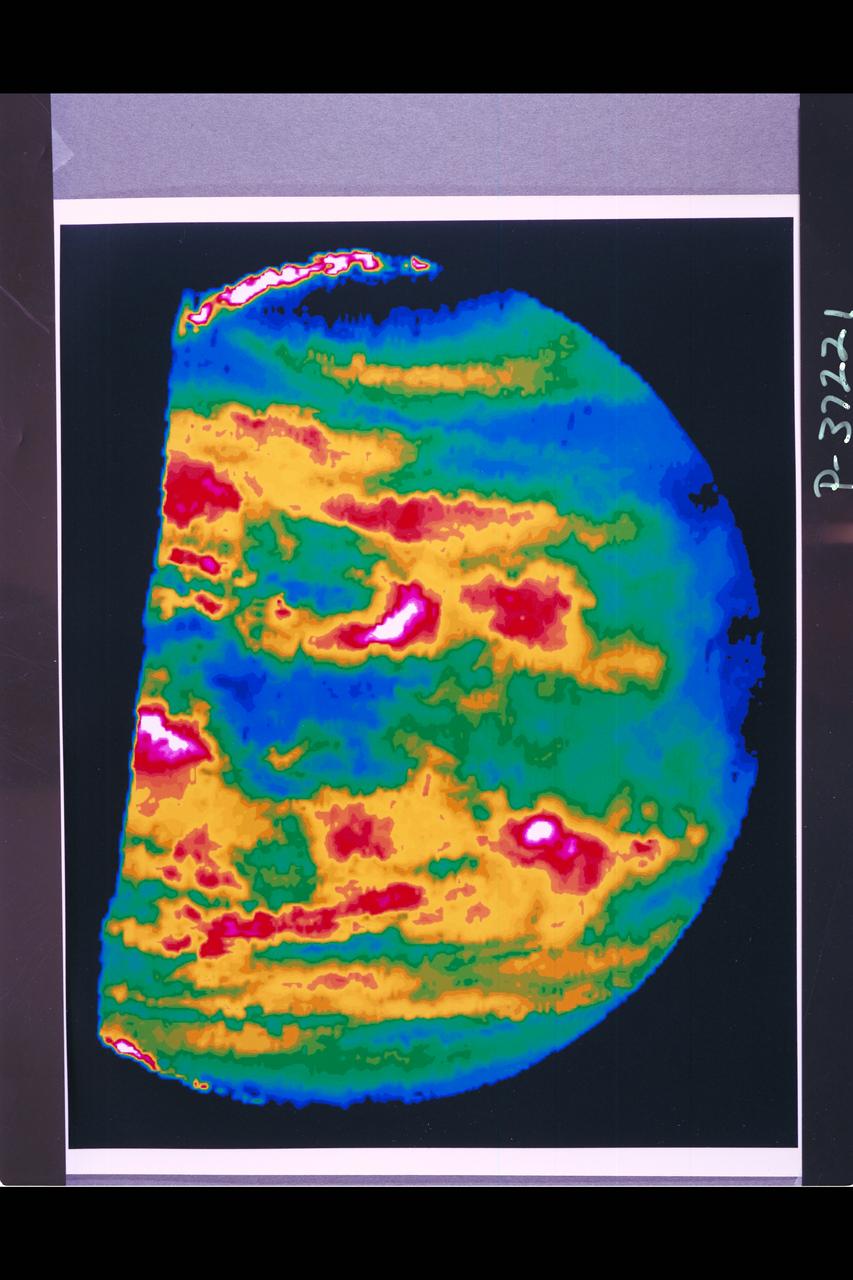
Range : 60,000 miles This image is a false-color version of a near- infrared map of lower-level clouds on the night side of Venus, obtained by the Near Infrared Mapping Spectrometer aboard Galileo. Taken at an infrared wavelength of 2.3 microns (about three times the longest wavelength visible to the human eye) the map shows the turbulent, cloudy middle atmosphere some 30-33 miles above the surface, 6-10 miles below the visible cloudtops. The image shows the radiant heat from the lower atmosphere (about 400 degrees F) shining through the sulfuric acid clouds, which appear as much as 10 times darker than the bright gaps between clouds. The colors indicate relative cloud transparency; white and red show thin cloud regions, while black and blue represent relatively this clouds. This cloud layer is at about 170 degrees F., at a pressure about 1/2 Earth's atmospheric pressure. About 2/3 of the dark hemisphere is visible, centered on longitude 350 West, with bright slivers of daylit high clouds visible at top and bottom left. Near the equator, the clouds appear fluffy and blocky; farther north, they are stretched out into East-West filaments by winds estimated at more than 150 mph, while the poles are capped by thick clouds at this altitude. The Near Infrared Mapping Spectrometer (NIMS) on the Galileo is a combined mapping (imaging) and spectral instrument. It can sense 408 contiguous wavelengths from 0.7 microns (deep red) to 5.2 microns, and can construct a map or image by mechanical scanning. It can spectroscopic-ally analyze atmospheres and surfaces and construct thermal and chemical maps. Designed and operated by scientists and engineers at the JPL, NIMS involves 15 scientists in the US, England and France.
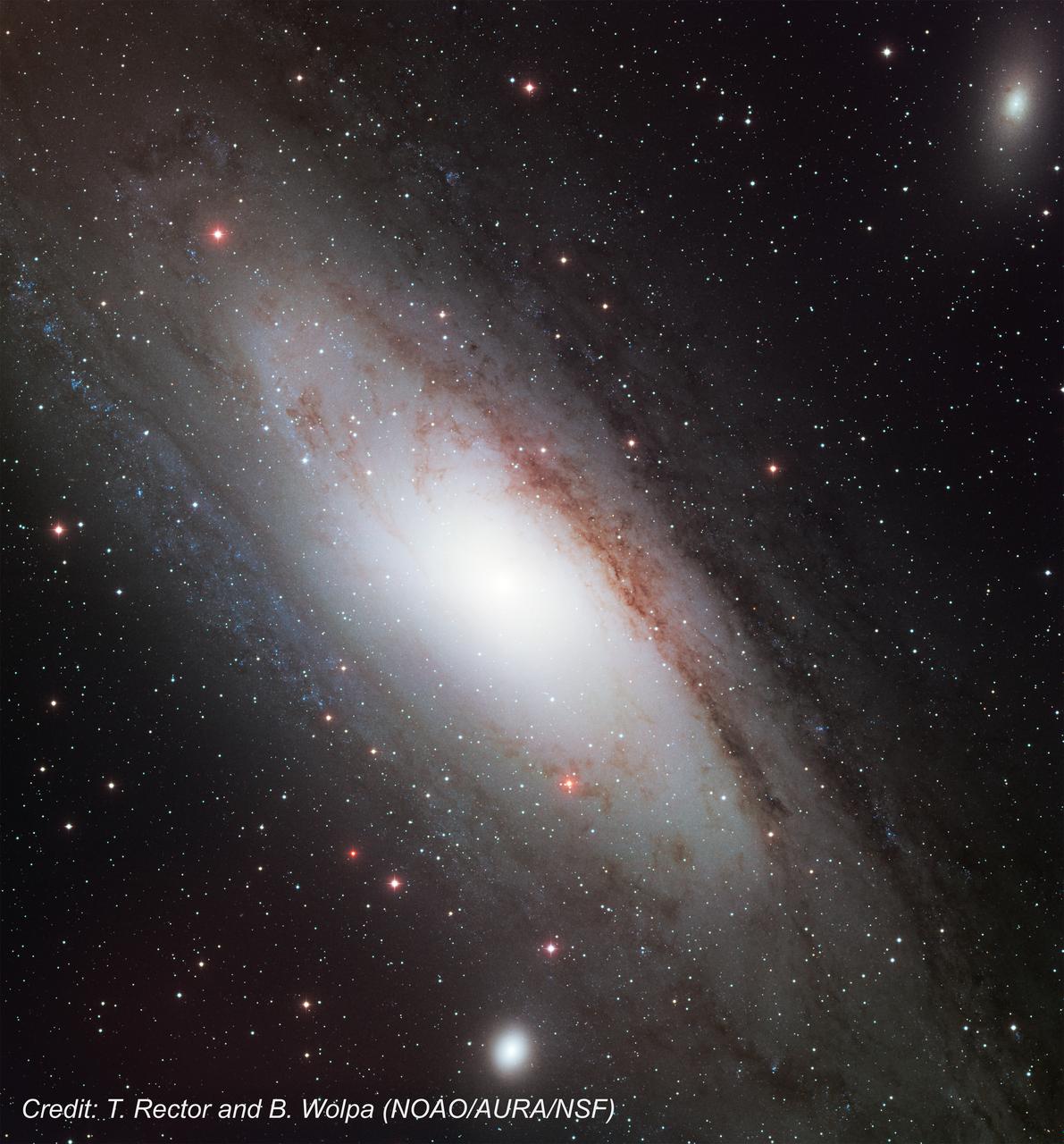
Image release January 11, 2012 A new Hubble Space Telescope image centers on the 100-million-solar-mass black hole at the hub of the neighboring spiral galaxy M31, or the Andromeda galaxy, one of the few galaxies outside the Milky Way visible to the naked eye and the only other giant galaxy in the Local Group. This is the sharpest visible-light image ever made of the nucleus of an external galaxy. The Hubble image is being presented today at the meeting of the American Astronomical Society in Austin, Texas. To read more go to: <a href="http://www.nasa.gov/mission_pages/hubble/science/ultra-blue.html" rel="nofollow">www.nasa.gov/mission_pages/hubble/science/ultra-blue.html</a> <b><a href="http://www.nasa.gov/audience/formedia/features/MP_Photo_Guidelines.html" rel="nofollow">NASA image use policy.</a></b> <b><a href="http://www.nasa.gov/centers/goddard/home/index.html" rel="nofollow">NASA Goddard Space Flight Center</a></b> enables NASA’s mission through four scientific endeavors: Earth Science, Heliophysics, Solar System Exploration, and Astrophysics. Goddard plays a leading role in NASA’s accomplishments by contributing compelling scientific knowledge to advance the Agency’s mission. <b>Follow us on <a href="http://twitter.com/NASA_GoddardPix" rel="nofollow">Twitter</a></b> <b>Like us on <a href="http://www.facebook.com/pages/Greenbelt-MD/NASA-Goddard/395013845897?ref=tsd" rel="nofollow">Facebook</a></b> <b>Find us on <a href="http://instagrid.me/nasagoddard/?vm=grid" rel="nofollow">Instagram</a></b>

This image from NASA's James Webb Space Telescope reveals at least 17 concentric dust rings emanating from a pair of stars orbiting one another. Located just over 5,000 light-years from Earth, the system is known as Wolf-Rayet 140 because one of the stars is a Wolf-Rayet star. The other is an O-type star, one of the most massive star types known. Each ring was created when the two stars came close together and their stellar winds (streams of gas they blow into space) collided, compressing the gas and forming dust. A ring is produced once per orbit, every 7.93 years. A Wolf-Rayet star is an O-type star born with at least 25 times more mass than our Sun that is nearing the end of its life, when it will likely collapse directly to black hole, or explode as a supernova. These delays between periods of dust production create the unique ring pattern. Some Wolf-Rayet binaries in which the stars are close enough together and have circular orbits produce dust continuously, often forming a pinwheel pattern. WR 140's rings are also referred to as shells because they are not perfectly circular and are thicker and wider than they appear in the image. The rings appear brighter in some areas but are almost invisible in others, rather than forming a perfect "bullseye" pattern. That's because production of dust is variable as the stars get close to one another, and because Webb views the system at an angle and is not looking directly at the orbital plane of the stars. One of the densest regions of dust production creates the bright feature appearing at 2 o'clock. The image was taken by the Mid-Infrared Instrument (MIRI), now managed by the agency's Goddard Space Flight Center. MIRI was developed through a 50-50 partnership between NASA and ESA (European Space Agency). The Jet Propulsion Laboratory in Southern California led the effort for NASA, and a multinational consortium of European astronomical institutes contributed for ESA. Webb's science instruments detect infrared light, a range of wavelengths emitted by warm objects and invisible to the human eye. MIRI detects the longest infrared wavelengths, which means it can often see cooler objects – including these dust rings – than the other three Webb instruments can. The filters used to take this image were the F770W (7.7 micrometers, shown as blue), F1500W (15 micrometers, shown as green), and F2100W (21 micrometers, shown as red). The observations were done under Webb's early release observation (ERO) program number 1349. The most common element found in stars, hydrogen, can't form dust on its own. But Wolf-Rayet stars in their later stages have blown away all of their hydrogen, so they eject elements typically found deep in a star's interior, like carbon, which can form dust. Data from MIRI's Medium Resolution Spectrometer (MRS) shows that the dust made by WR 140 is likely made of a class of molecules called polycyclic aromatic hydrocarbons (PAHs), which are a type of organic carbon-rich compounds that are thought to enrich the carbon content throughout the Universe. Initial processing of the Webb WR 140 data included eight bright "spikes" of light emanating from the center of the image. These are not features of the system, but so-called artifacts of the telescope itself. They were removed from the image, in order to give viewers an unobscured view of the source object. https://photojournal.jpl.nasa.gov/catalog/PIA25432

NASA's Lunar Reconnaissance Orbiter (LRO) recently captured a unique view of Earth from the spacecraft's vantage point in orbit around the moon. "The image is simply stunning," said Noah Petro, Deputy Project Scientist for LRO at NASA's Goddard Space Flight Center in Greenbelt, Maryland. "The image of the Earth evokes the famous 'Blue Marble' image taken by Astronaut Harrison Schmitt during Apollo 17, 43 years ago, which also showed Africa prominently in the picture." In this composite image we see Earth appear to rise over the lunar horizon from the viewpoint of the spacecraft, with the center of the Earth just off the coast of Liberia (at 4.04 degrees North, 12.44 degrees West). The large tan area in the upper right is the Sahara Desert, and just beyond is Saudi Arabia. The Atlantic and Pacific coasts of South America are visible to the left. On the moon, we get a glimpse of the crater Compton, which is located just beyond the eastern limb of the moon, on the lunar farside. LRO was launched on June 18, 2009, and has collected a treasure trove of data with its seven powerful instruments, making an invaluable contribution to our knowledge about the moon. LRO experiences 12 earthrises every day; however the spacecraft is almost always busy imaging the lunar surface so only rarely does an opportunity arise such that its camera instrument can capture a view of Earth. Occasionally LRO points off into space to acquire observations of the extremely thin lunar atmosphere and perform instrument calibration measurements. During these movements sometimes Earth (and other planets) pass through the camera's field of view and dramatic images such as the one shown here are acquired. This image was composed from a series of images taken Oct. 12, when LRO was about 83 miles (134 kilometers) above the moon's farside crater Compton. Capturing an image of the Earth and moon with LRO's Lunar Reconnaissance Orbiter Camera (LROC) instrument is a complicated task. First the spacecraft must be rolled to the side (in this case 67 degrees), then the spacecraft slews with the direction of travel to maximize the width of the lunar horizon in LROC's Narrow Angle Camera image. All this takes place while LRO is traveling faster than 3,580 miles per hour (over 1,600 meters per second) relative to the lunar surface below the spacecraft! The high-resolution Narrow Angle Camera (NAC) on LRO takes black-and-white images, while the lower resolution Wide Angle Camera (WAC) takes color images, so you might wonder how we got a high-resolution picture of the Earth in color. Since the spacecraft, Earth, and moon are all in motion, we had to do some special processing to create an image that represents the view of the Earth and moon at one particular time. The final Earth image contains both WAC and NAC information. WAC provides the color, and the NAC provides high-resolution detail. "From the Earth, the daily moonrise and moonset are always inspiring moments," said Mark Robinson of Arizona State University in Tempe, principal investigator for LROC. "However, lunar astronauts will see something very different: viewed from the lunar surface, the Earth never rises or sets. Since the moon is tidally locked, Earth is always in the same spot above the horizon, varying only a small amount with the slight wobble of the moon. The Earth may not move across the 'sky', but the view is not static. Future astronauts will see the continents rotate in and out of view and the ever-changing pattern of clouds will always catch one's eye, at least on the nearside. The Earth is never visible from the farside; imagine a sky with no Earth or moon - what will farside explorers think with no Earth overhead?" NASA's first Earthrise image was taken with the Lunar Orbiter 1 spacecraft in 1966. Perhaps NASA's most iconic Earthrise photo was taken by the crew of the Apollo 8 mission as the spacecraft entered lunar orbit on Christmas Eve Dec. 24, 1968. That evening, the astronauts -- Commander Frank Borman, Command Module Pilot Jim Lovell, and Lunar Module Pilot William Anders -- held a live broadcast from lunar orbit, in which they showed pictures of the Earth and moon as seen from their spacecraft. Said Lovell, "The vast loneliness is awe-inspiring and it makes you realize just what you have back there on Earth." Credit: NASA/Goddard/Arizona State University <b><a href="http://www.nasa.gov/audience/formedia/features/MP_Photo_Guidelines.html" rel="nofollow">NASA image use policy.</a></b> <b><a href="http://www.nasa.gov/centers/goddard/home/index.html" rel="nofollow">NASA Goddard Space Flight Center</a></b> enables NASA’s mission through four scientific endeavors: Earth Science, Heliophysics, Solar System Exploration, and Astrophysics. Goddard plays a leading role in NASA’s accomplishments by contributing compelling scientific knowledge to advance the Agency’s mission. <b>Follow us on <a href="http://twitter.com/NASAGoddardPix" rel="nofollow">Twitter</a></b> <b>Like us on <a href="http://www.facebook.com/pages/Greenbelt-MD/NASA-Goddard/395013845897?ref=tsd" rel="nofollow">Facebook</a></b> <b>Find us on <a href="http://instagrid.me/nasagoddard/?vm=grid" rel="nofollow">Instagram</a></b>
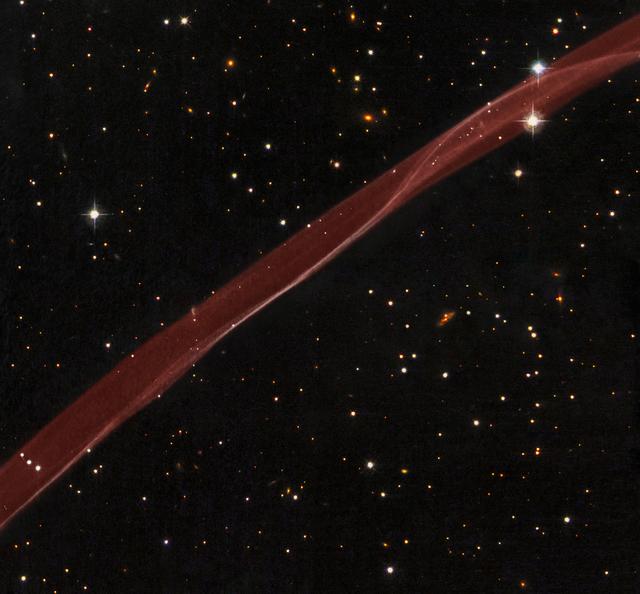
Release date: July 1, 2008 SN 1006 Supernova Remnant (Hubble) A delicate ribbon of gas floats eerily in our galaxy. A contrail from an alien spaceship? A jet from a black-hole? Actually this image, taken by NASA's Hubble Space Telescope, is a very thin section of a supernova remnant caused by a stellar explosion that occurred more than 1,000 years ago. On or around May 1, 1006 A.D., observers from Africa to Europe to the Far East witnessed and recorded the arrival of light from what is now called SN 1006, a tremendous supernova explosion caused by the final death throes of a white dwarf star nearly 7,000 light-years away. The supernova was probably the brightest star ever seen by humans, and surpassed Venus as the brightest object in the night time sky, only to be surpassed by the moon. It was visible even during the day for weeks, and remained visible to the naked eye for at least two and a half years before fading away. It wasn't until the mid-1960s that radio astronomers first detected a nearly circular ring of material at the recorded position of the supernova. The ring was almost 30 arcminutes across, the same angular diameter as the full moon. The size of the remnant implied that the blast wave from the supernova had expanded at nearly 20 million miles per hour over the nearly 1,000 years since the explosion occurred. In 1976, the first detection of exceedingly faint optical emission of the supernova remnant was reported, but only for a filament located on the northwest edge of the radio ring. A tiny portion of this filament is revealed in detail by the Hubble observation. The twisting ribbon of light seen by Hubble corresponds to locations where the expanding blast wave from the supernova is now sweeping into very tenuous surrounding gas. The hydrogen gas heated by this fast shock wave emits radiation in visible light. Hence, the optical emission provides astronomers with a detailed "snapshot" of the actual position and geometry of the shock front at any given time. Bright edges within the ribbon correspond to places where the shock wave is seen exactly edge on to our line of sight. Today we know that SN 1006 has a diameter of nearly 60 light-years, and it is still expanding at roughly 6 million miles per hour. Even at this tremendous speed, however, it takes observations typically separated by years to see significant outward motion of the shock wave against the grid of background stars. In the Hubble image as displayed, the supernova would have occurred far off the lower right corner of the image, and the motion would be toward the upper left. SN 1006 resides within our Milky Way Galaxy. Located more than 14 degrees off the plane of the galaxy's disk, there is relatively little confusion with other foreground and background objects in the field when trying to study this object. In the Hubble image, many background galaxies (orange extended objects) far off in the distant universe can be seen dotting the image. Most of the white dots are foreground or background stars in our Milky Way galaxy. This image is a composite of hydrogen-light observations taken with Hubble's Advanced Camera for Surveys in February 2006 and Wide Field Planetary Camera 2 observations in blue, yellow-green, and near-infrared light taken in April 2008. The supernova remnant, visible only in the hydrogen-light filter was assigned a red hue in the Heritage color image. Credit: NASA, ESA, and the Hubble Heritage Team (STScI/AURA) Acknowledgment: W. Blair (Johns Hopkins University) To learn more about the Hubble Space Telescope go here: <a href="http://www.nasa.gov/mission_pages/hubble/main/index.html" rel="nofollow">www.nasa.gov/mission_pages/hubble/main/index.html</a> <b><a href="http://www.nasa.gov/audience/formedia/features/MP_Photo_Guidelines.html" rel="nofollow">NASA image use policy.</a></b> <b><a href="http://www.nasa.gov/centers/goddard/home/index.html" rel="nofollow">NASA Goddard Space Flight Center</a></b> enables NASA’s mission through four scientific endeavors: Earth Science, Heliophysics, Solar System Exploration, and Astrophysics. Goddard plays a leading role in NASA’s accomplishments by contributing compelling scientific knowledge to advance the Agency’s mission. <b>Follow us on <a href="http://twitter.com/NASAGoddardPix" rel="nofollow">Twitter</a></b> <b>Like us on <a href="http://www.facebook.com/pages/Greenbelt-MD/NASA-Goddard/395013845897?ref=tsd" rel="nofollow">Facebook</a></b> <b>Find us on <a href="http://instagram.com/nasagoddard?vm=grid" rel="nofollow">Instagram</a></b>