
MR. RONALD BLAKELY SPEAKS AT HISTORICALLY BLACK COLLEGES AND UNIVERSITIES PARTNERSHIPS PROGRAM, HUNTSVILLE MUSEUM OF ART. SEPTEMBER 17, 2014
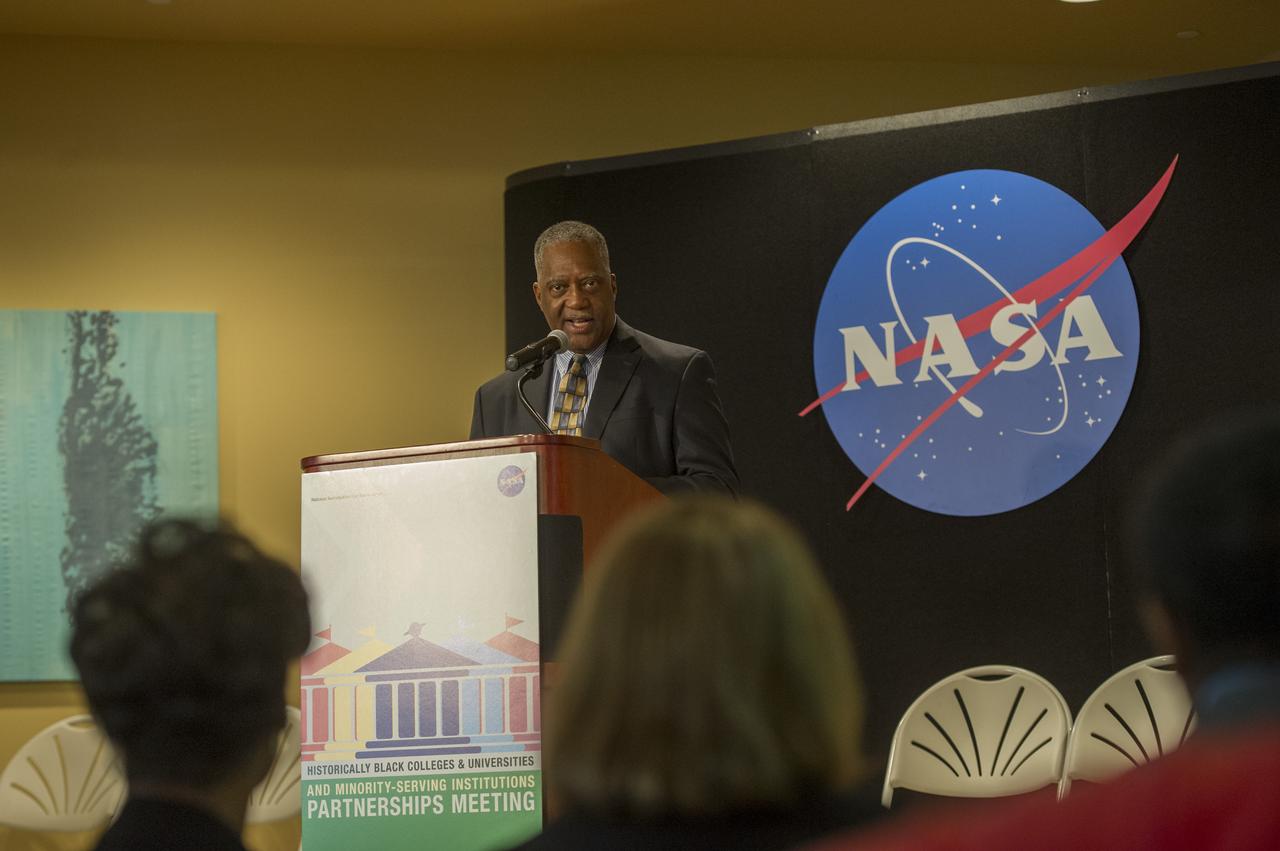
RONALD BLAKELY, ASSOCIATE DIRECTOR FOR THE WHITE HOUSE INITIATIVE ON HISTORICALLY BLACK COLLEGES AND UNIVERSITIES, SPEAKS DURING NASA’S FIRST PARTNERSHIPS MEETING FOR HISTORICALLY BLACK COLLEGES AND UNIVERSITIES AND MINORITY SERVING INSTITUTIONS. NASA’S OFFICE OF SMALL BUSINESS PROGRAMS HOSTED THE EVENT, WHICH ALLOWED REPRESENTATIVES FROM 30 NATIONWIDE UNIVERSITIES AND NASA PRIME CONTRACTORS TO DISCUSS POTENTIAL SUBCONTRACTING OPPORTUNITIES
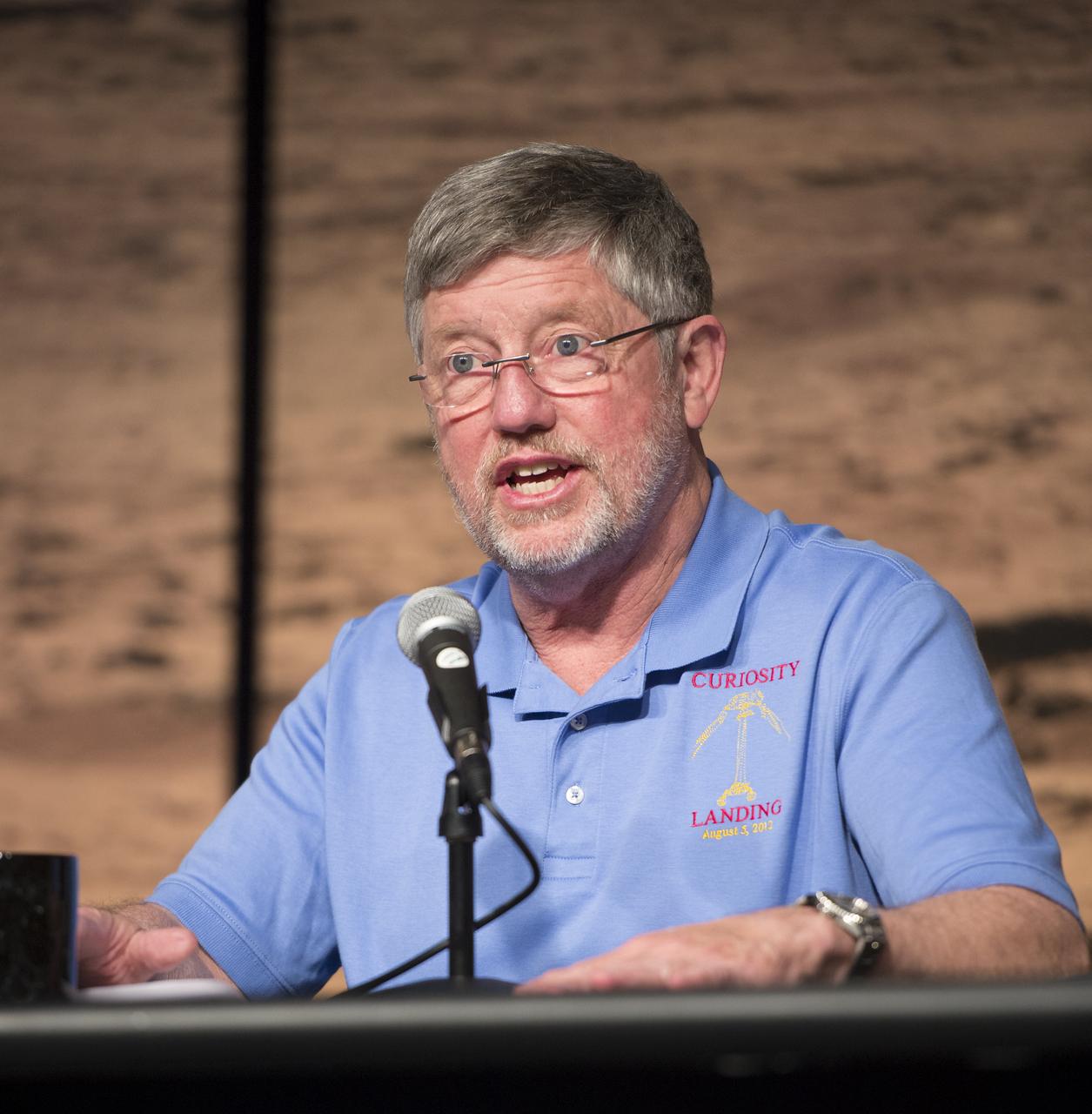
David Blake, principal investigator for Curiosity's Chemistry and Mineralogy investigation at NASA's Ames Research Center in Calif., speaks at a news conference presenting findings of the Curiosity rover's analysis of the first sample of rock powder collected on Mars, Tuesday, March 12, 2013 in Washington. The rock sample collected shows ancient Mars could have supported living microbes. Photo Credit: (NASA/Carla Cioffi)
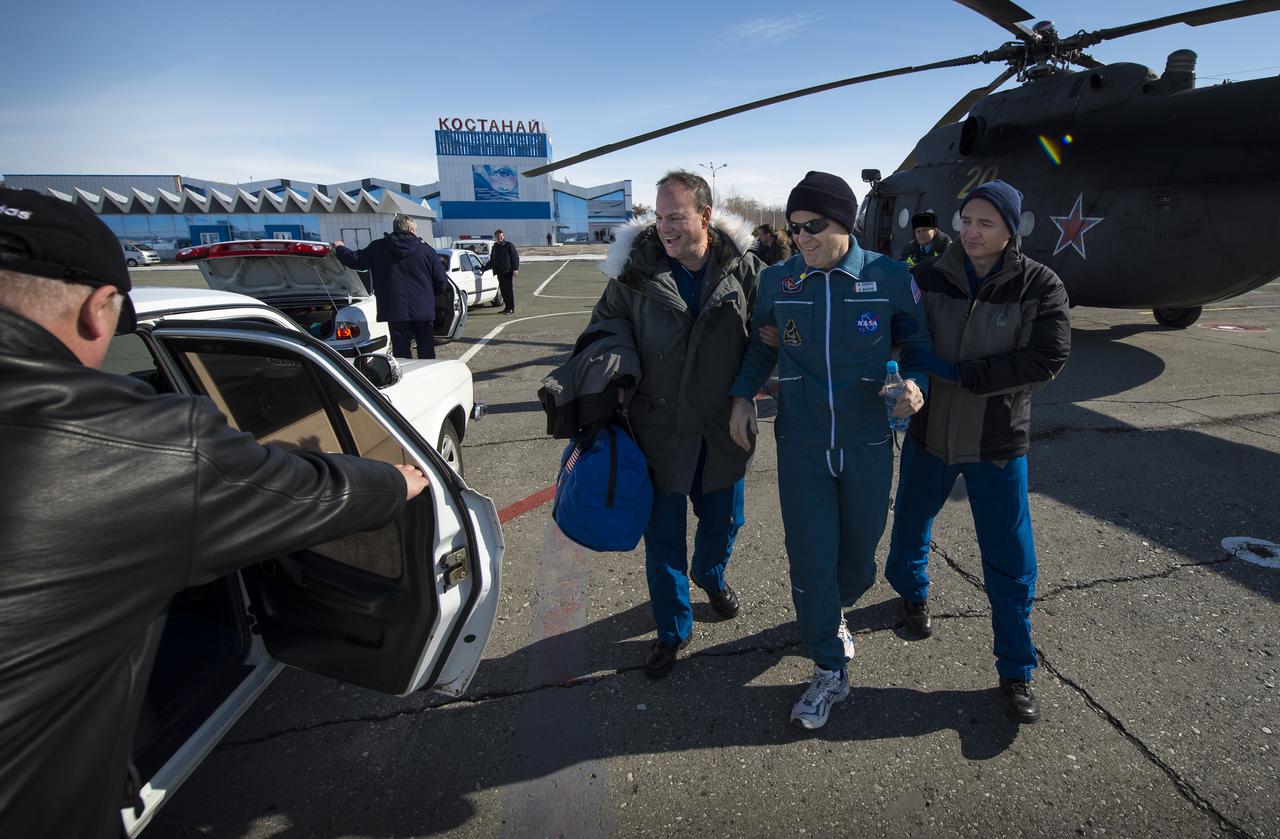
Expedition 34 Commander Kevin Ford of NASA walks from a Russian Search and Rescue helicopter with NASA flight doctors, David Alexander, left, and Blake Chamberlain after flying from his Soyuz TMA-06M spacecraft landing site outside the town of Arkalyk to Kustanay, Kazakhstan on Saturday, March 16, 2013. Ford, along with Russian Soyuz Commander Oleg Novitskiy and Flight Engineer Evgeny Tarelkin of Russia returned from 142 days onboard the International Space Station where they served as members of the Expedition 33 and 34 crews. Photo Credit: (NASA/Bill Ingalls)
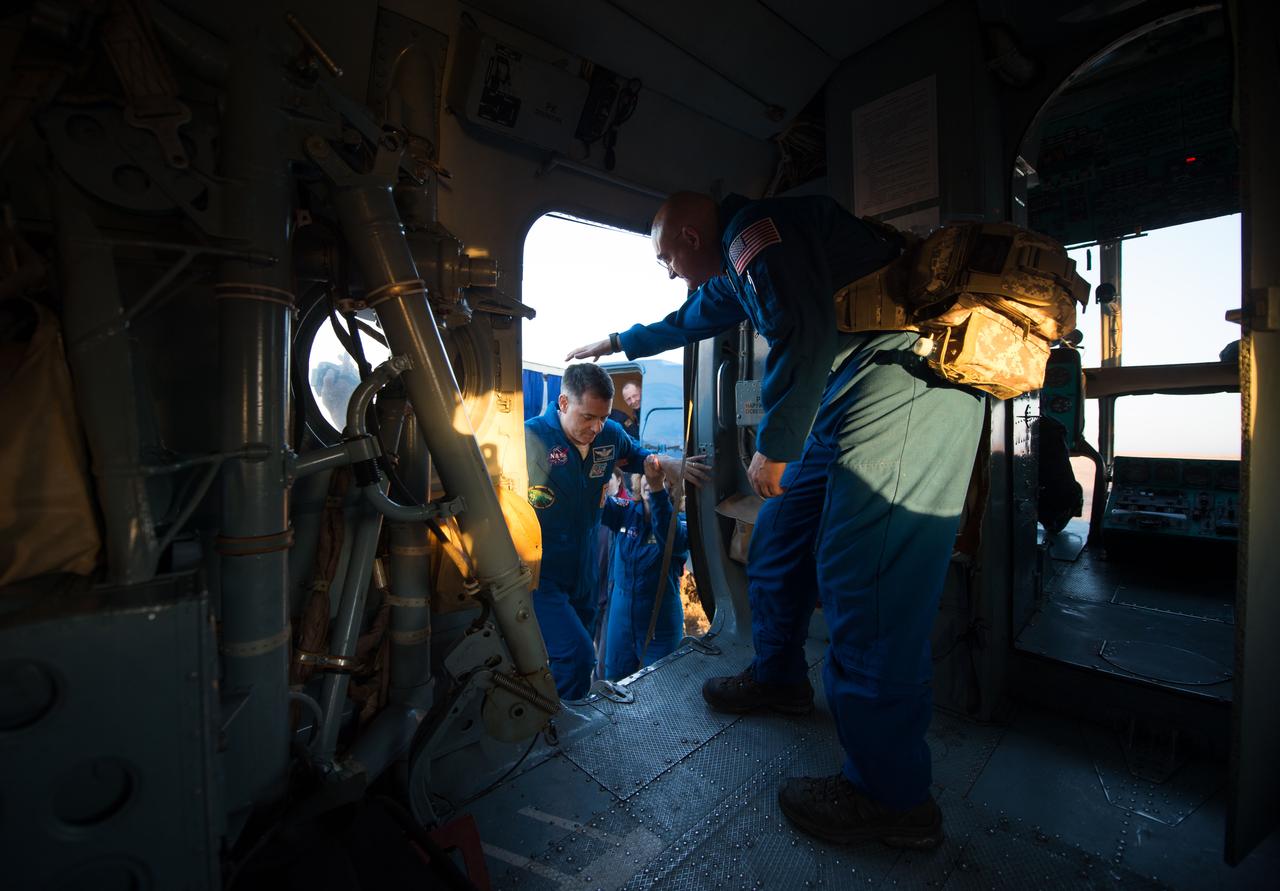
nhq201704100045 (April 10, 2017) --- NASA astronaut Shane Kimbrough, left, is helped into an awaiting Russian MI-8 helicopter by NASA flight doctor Blake Chamberlain shortly after he, Russian cosmonaut Sergey Ryzhikov of Roscosmos, and Russian cosmonaut Andrey Borisenko of Roscosmos landed in their Soyuz MS-02 spacecraft in a remote area near the town of Zhezkazgan, Kazakhstan on Monday, April 10, 2017 (Kazakh time). Kimbrough, Ryzhikov, and Borisenko are returning after 173 days in space where they served as members of the Expedition 49 and 50 crews onboard the International Space Station. Photo Credit: (NASA/Bill Ingalls)
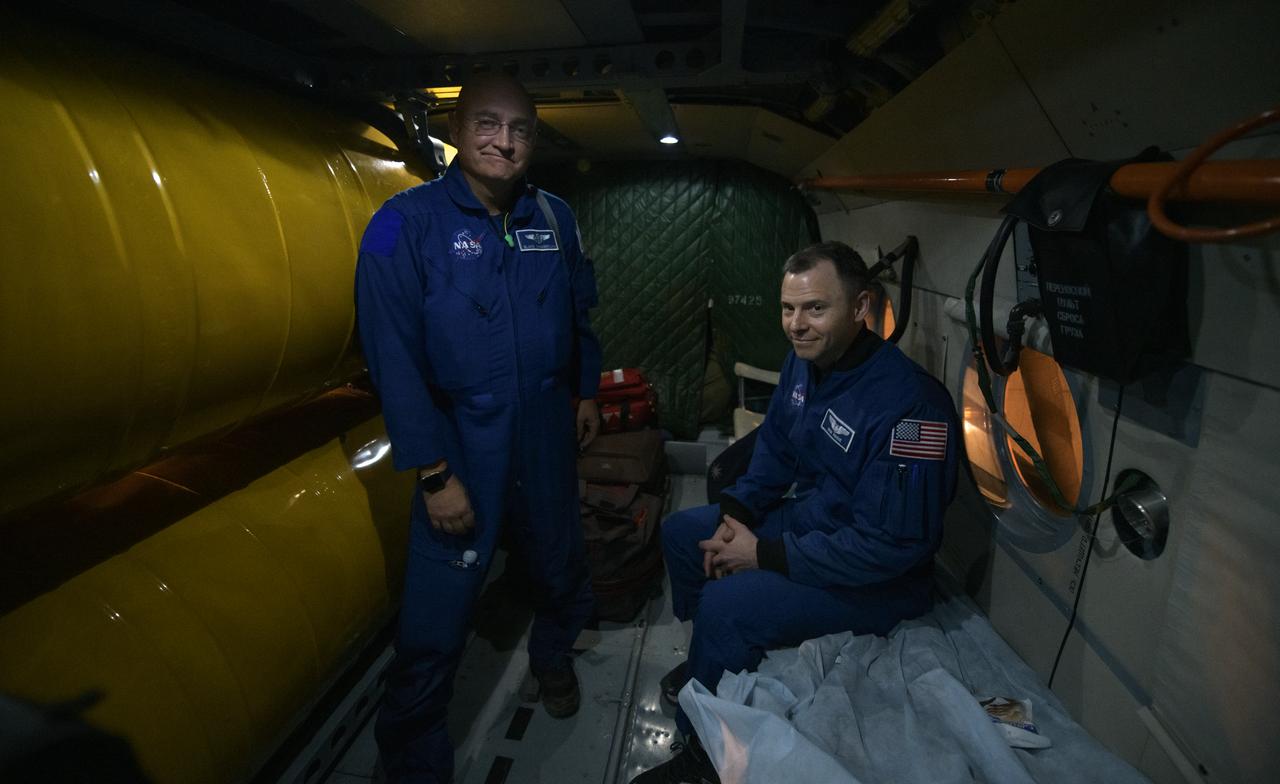
Expedition 60 NASA astronaut Nick Hague, left, and NASA Flight Surgeon Blake Chamberlain wait inside at Russian MI-8 helicopter after arriving at the Karaganda Airport in Kazakhstan from a remote area near the town of Zhezkazgan, Kazakhstan on Thursday, Oct. 3, 2019. Hague and fellow Expedition 60 crewmember Alexey Ovchinin are returning after 203 days in space where they served as members of the Expedition 59 and 60 crews onboard the International Space Station. Visiting astronaut Hazzaa Ali Almansoori of the United Arab Emirates also returned with the crew after logging 8 days in space during his first flight as an astronaut. Photo Credit: (NASA/Bill Ingalls)
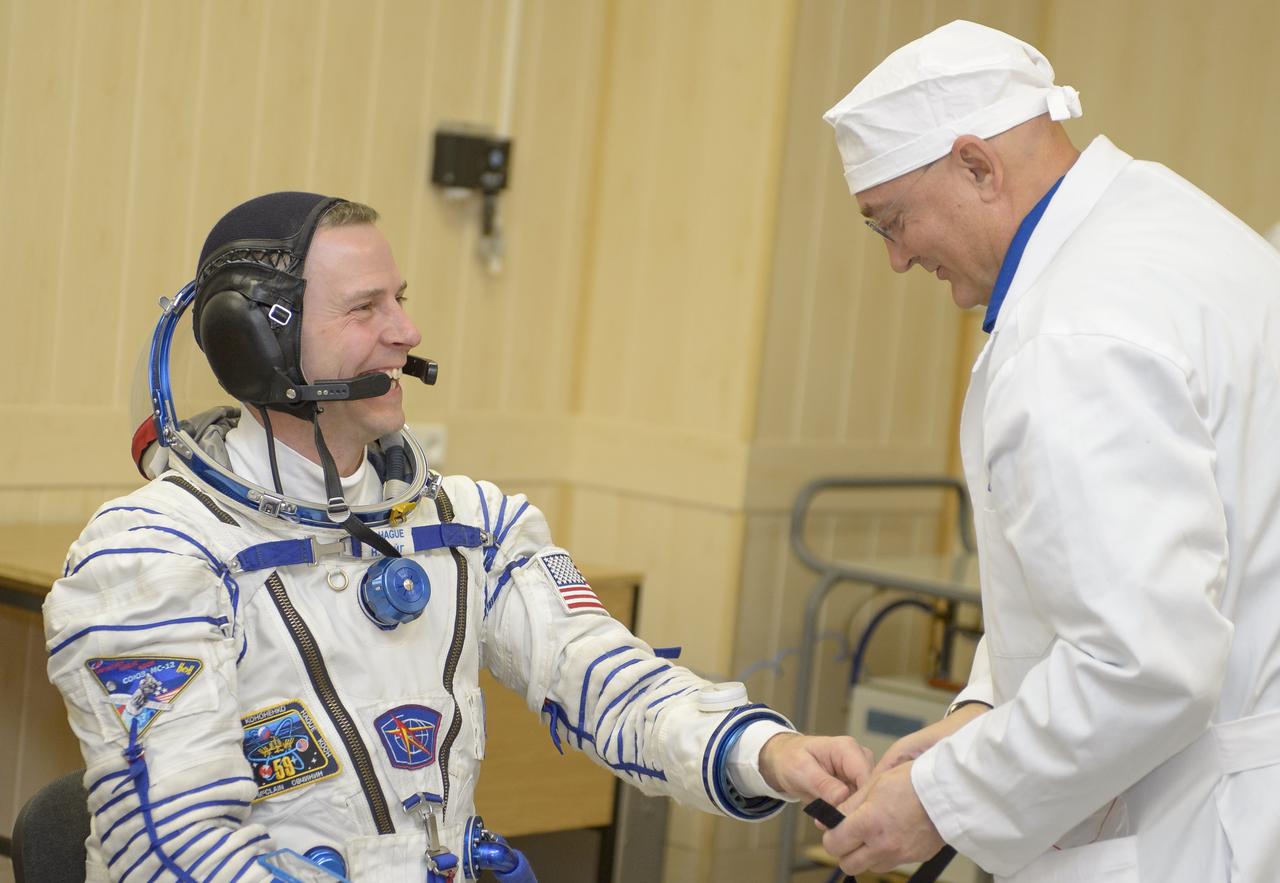
Expedition 59 astronaut Nick Hague of NASA laughs as he talks with NASA Flight Surgeon Blake Chamberlain prior to his launch on a Soyuz rocket with Christina Koch of NASA and Alexey Ovchinin of Roscosmos, Thursday, March 14, 2019 at the Baikonur Cosmodrome in Kazakhstan. Hague, Koch, and Ovchinin launched March 14, U.S. time, on the Soyuz MS-12 spacecraft from the Baikonur Cosmodrome for a six-and-a-half month mission on the International Space Station Photo Credit: (NASA/GCTC/Irina Spector)
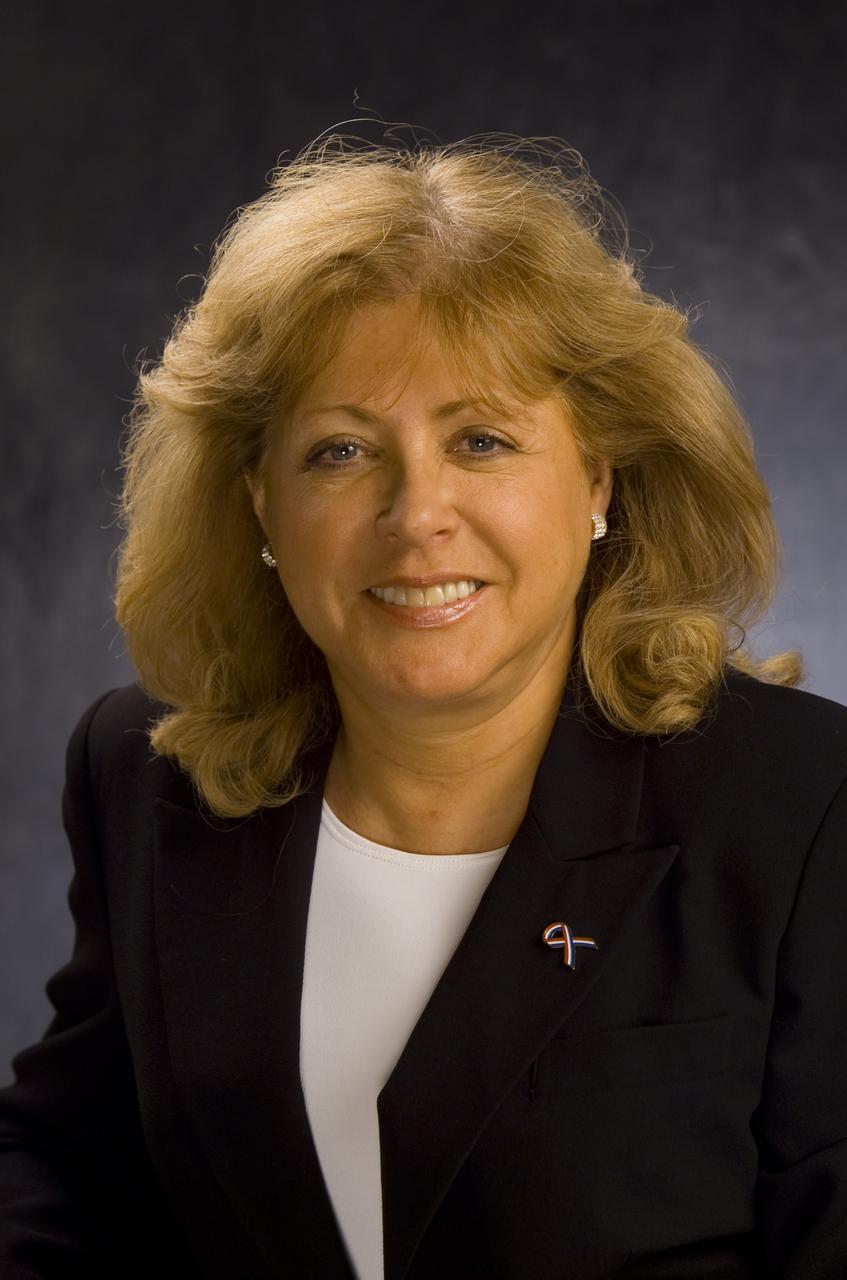
Portrait: Carolina Blake
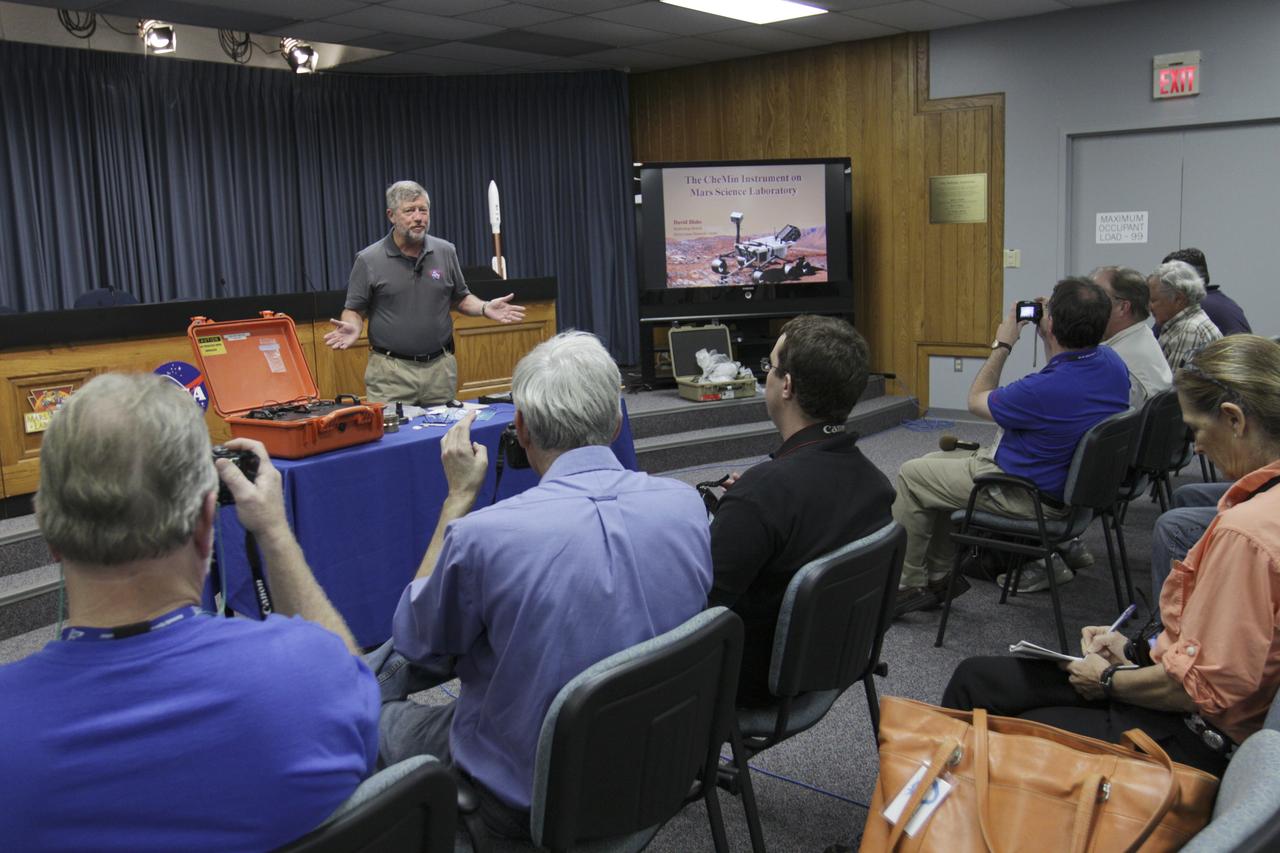
MSL - Chemistry and Mineralogy Demo by David Blake
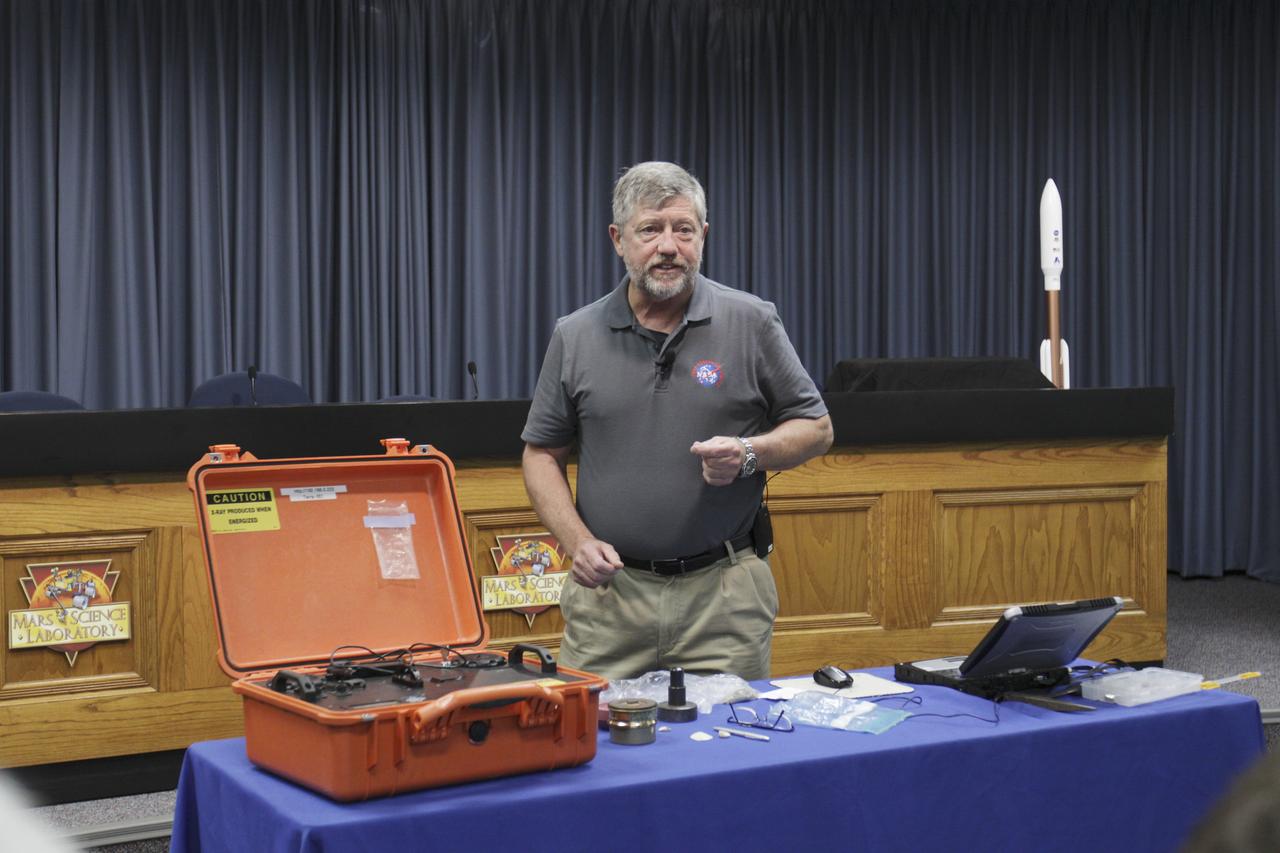
MSL - Chemistry and Mineralogy Demo by David Blake
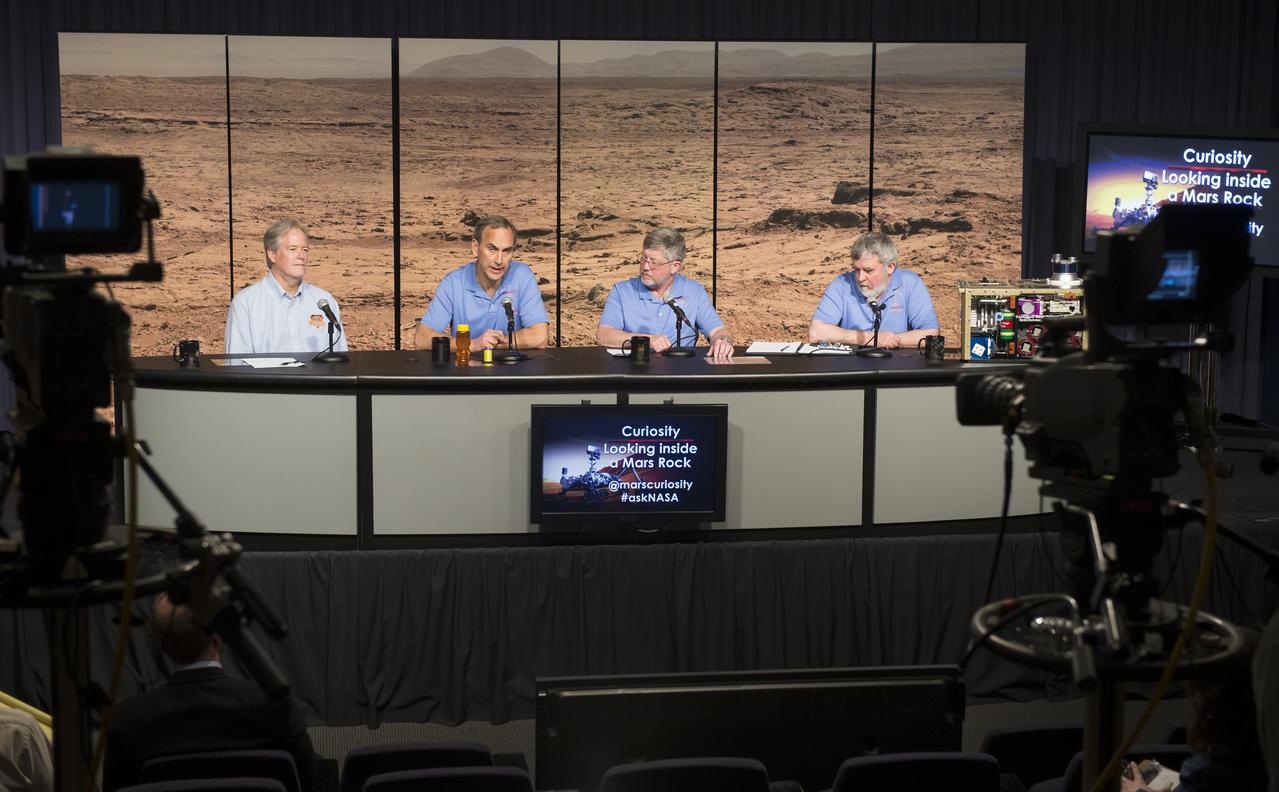
Participants at a news conference discussing findings of the analysis of a rock sample from Mars are seen, Tuesday, March 12, 2013 at NASA Headquarters in Washington. From left to right are seen: Michael Meyer, lead scientist, Mars Exploration Program at NASA Headquarters; John Grotzinger, Curiosity project scientist, California Institute of Technology in Pasadena; David Blake, principal investigator for Curiosity's Chemistry and Mineralogy investigation at NASA's Ames Research Center in Calif.; and Paul Mahaffy, principal investigator for Curiosity's Sample Analysis at Mars (SAM) investigation at NASA's Goddard Space Flight Center in Maryland. Photo Credit: (NASA/Carla Cioffi)
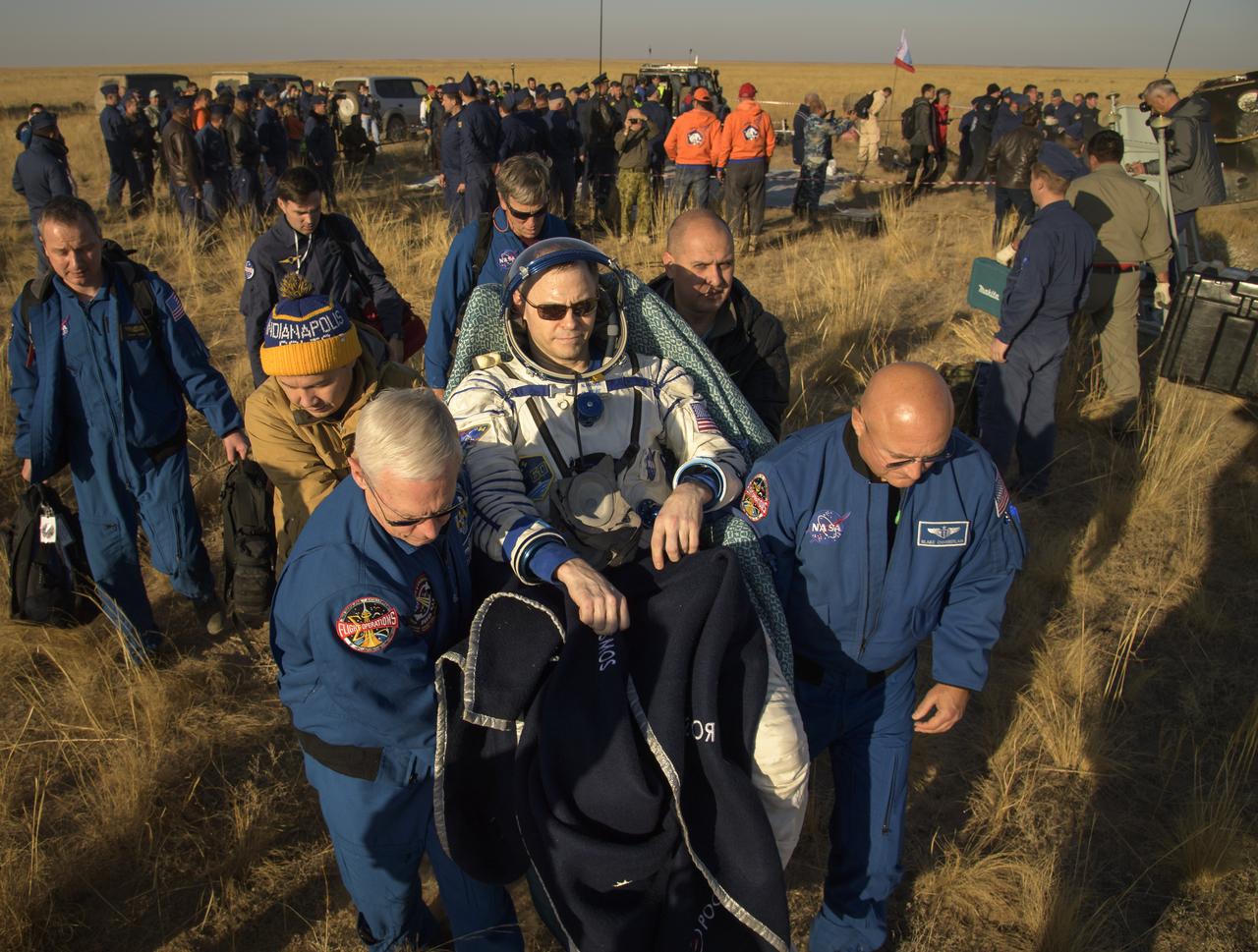
Expedition 60 crewmember Nick Hague of NASA is carried to a medical tent by NASA Chief Astronaut Pat Forrester, left, and NASA Flight Surgeon Blake Chamberlain, right, after he and fellow Expedition 60 crewmember Alexey Ovchinin of Roscosmos and visiting astronaut Hazzaa Ali Almansoori of the United Arab Emirates landed in their Soyuz MS-12 spacecraft near the town of Zhezkazgan, Kazakhstan on Thursday, Oct. 3, 2019. Hague and Ovchinin are returning after 203 days in space where they served as members of the Expedition 59 and 60 crews onboard the International Space Station. Almansoori logged 8 days in space during his first flight as an astronaut. Photo Credit: (NASA/Bill Ingalls)
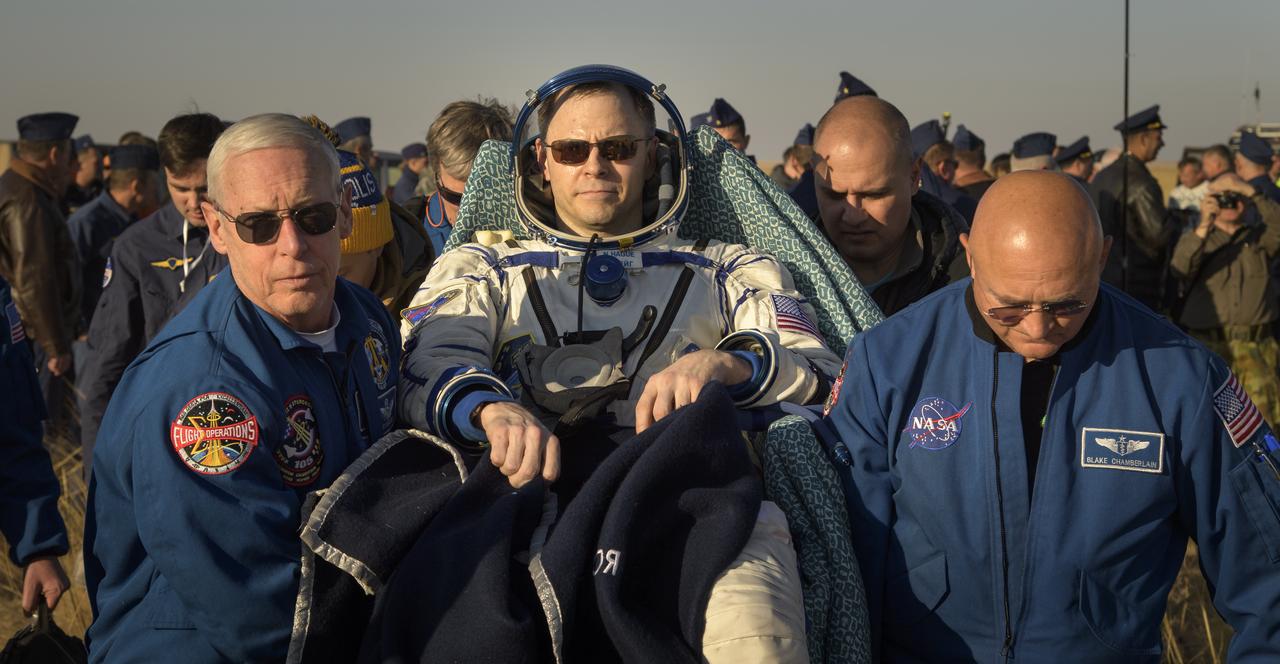
Expedition 60 crewmember Nick Hague of NASA is carried to a medical tent by NASA Chief Astronaut Pat Forrester, left, and NASA Flight Surgeon Blake Chamberlain, right, after he and fellow Expedition 60 crewmember Alexey Ovchinin of Roscosmos and visiting astronaut Hazzaa Ali Almansoori of the United Arab Emirates landed in their Soyuz MS-12 spacecraft near the town of Zhezkazgan, Kazakhstan on Thursday, Oct. 3, 2019. Hague and Ovchinin are returning after 203 days in space where they served as members of the Expedition 59 and 60 crews onboard the International Space Station. Almansoori logged 8 days in space during his first flight as an astronaut. Photo Credit: (NASA/Bill Ingalls)
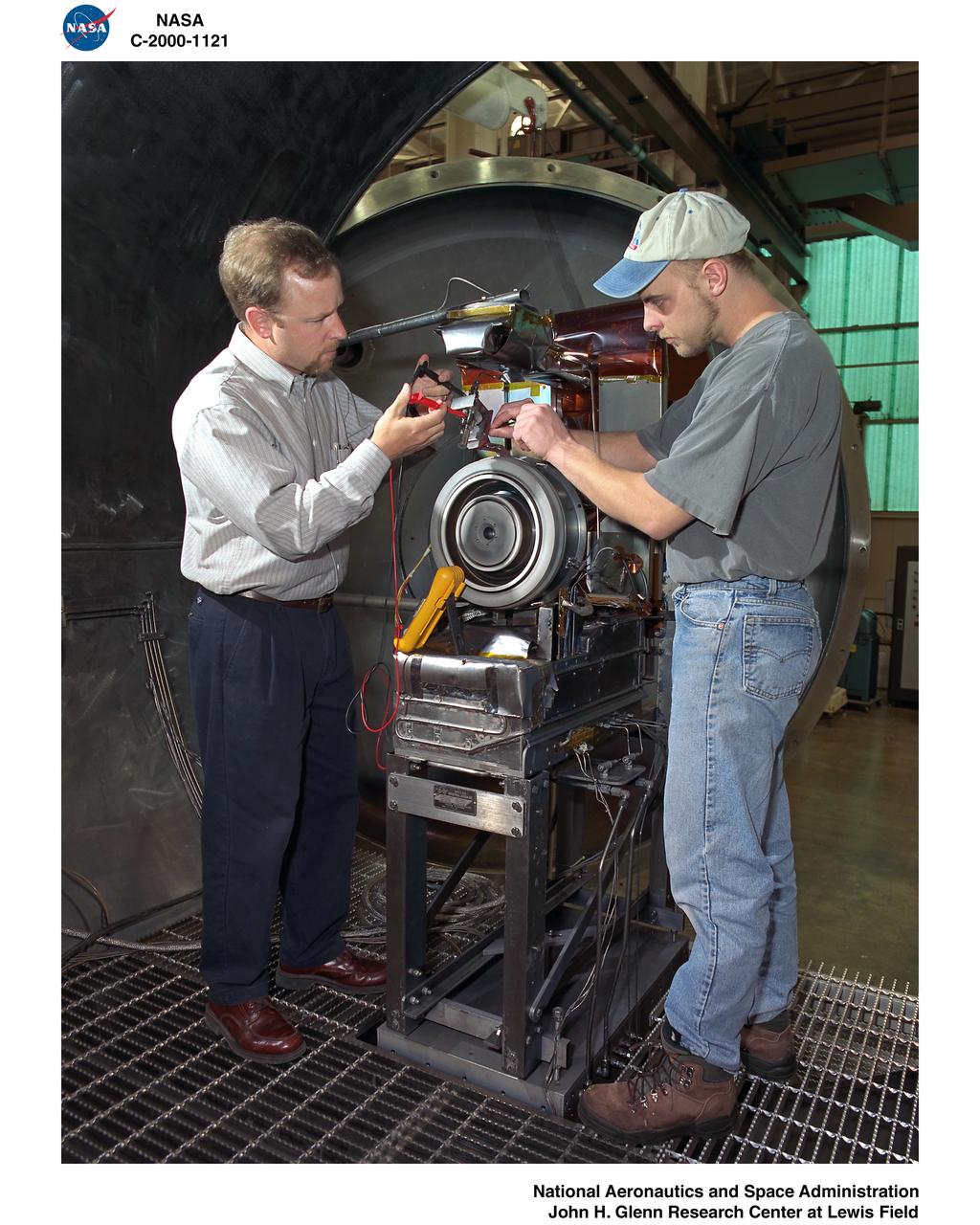
TEN KW KILOWATT T-220 HALL EFFECT THRUSTER LIFE TEST WITH LEE MASON - KEVIN BLAKE
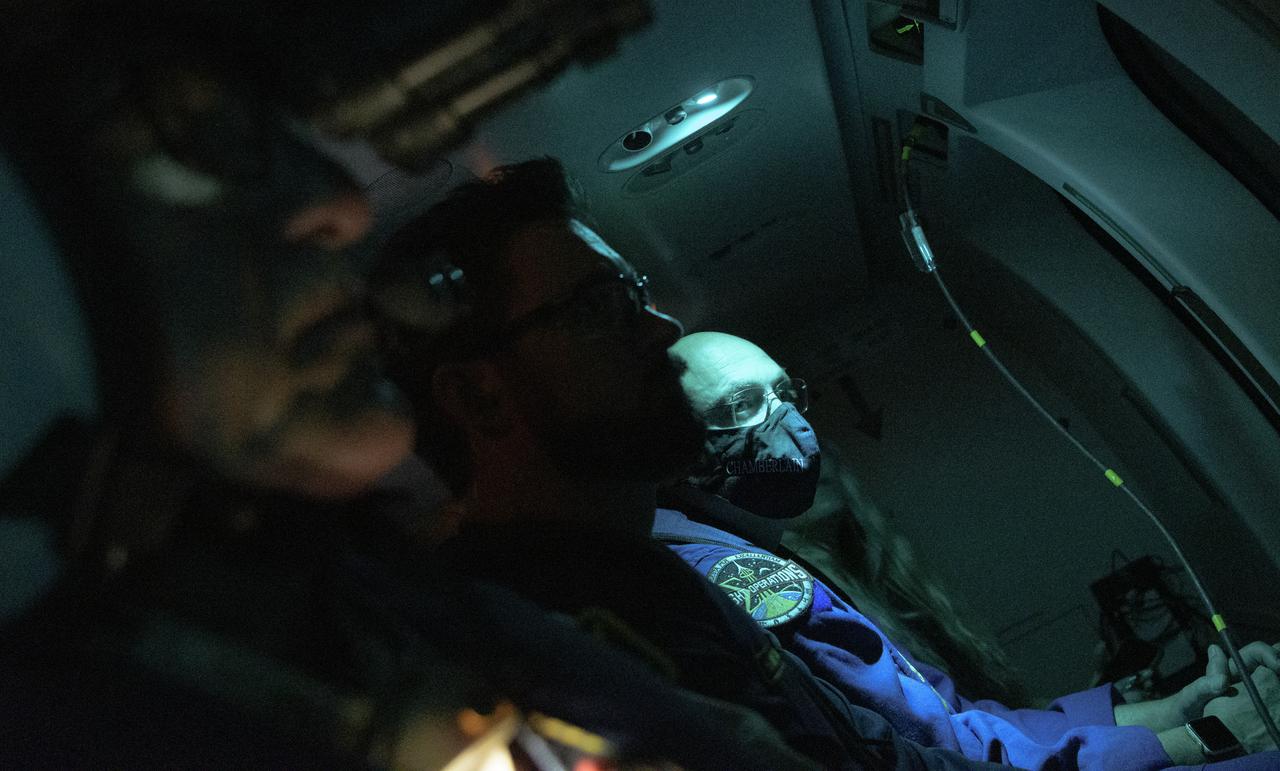
NASA Flight Surgeon Blake Chamberlain and other NASA and SpaceX support teams helicopter out to the SpaceX GO Navigator recovery ship to prepare for the landing of the SpaceX Crew Dragon Resilience spacecraft with NASA astronauts Mike Hopkins, Shannon Walker, and Victor Glover, and Japan Aerospace Exploration Agency (JAXA) astronaut Soichi Noguchi aboard in the Gulf of Mexico off the coast of Panama City, Florida, Saturday, May 1, 2021. NASA’s SpaceX Crew-1 mission is the first crew rotation flight of the SpaceX Crew Dragon spacecraft and Falcon 9 rocket with astronauts to the International Space Station as part of the agency’s Commercial Crew Program. Photo Credit: (NASA/Bill Ingalls)
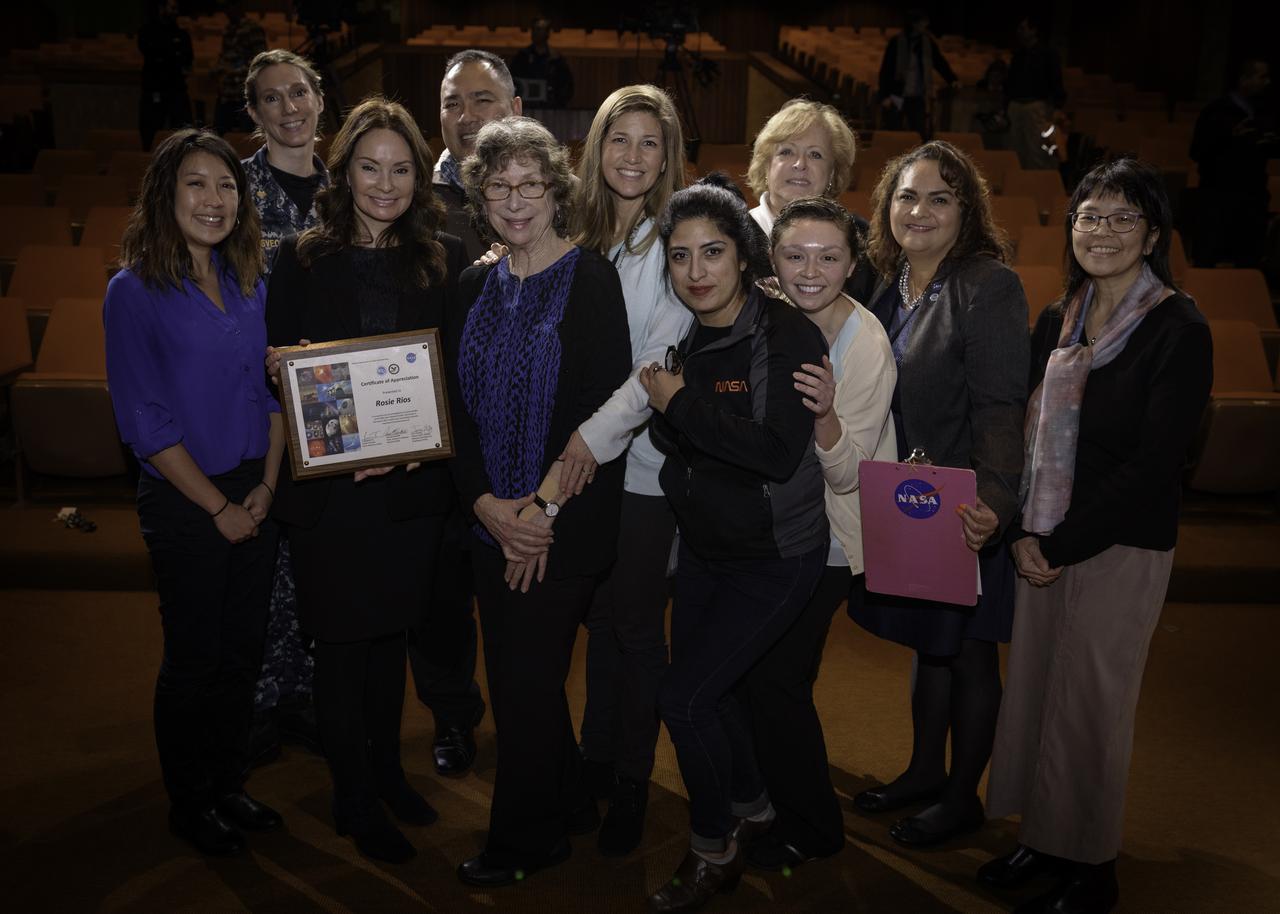
Rosie Rios, the 43rd Treasurer of the United States explores how understanding our history will provide a clearer roadmap for understanding where the country's future is heading. Presented by the Ames Women's Influence Network (WIN) and the Hispanic Advisory Committee for Employees (HACE) in the Syvertson Auditorium (N-201) at Ames Research Center. Back row; Leedjia Svec, Jonais Dino, Nettie Halcomb Roozeboom, Carolina Blake, Carolina Rudisel, Kathy Lee. Front row; Vanessa Kuroda, Rosie Rios, Annette Randall, Ali Guarneros Luna and Erika Rodriquez

Horticulture scientist Blake Costine adjusts moisture sensors for the Advanced Plant Imaging project at NASA’s Kennedy Space Center on April 17, 2023. In this project, hyperspectral cameras are used to assess plant health. The activity is taking place inside the Plant Production Area at the Florida spaceport’s Space Station Processing Facility.
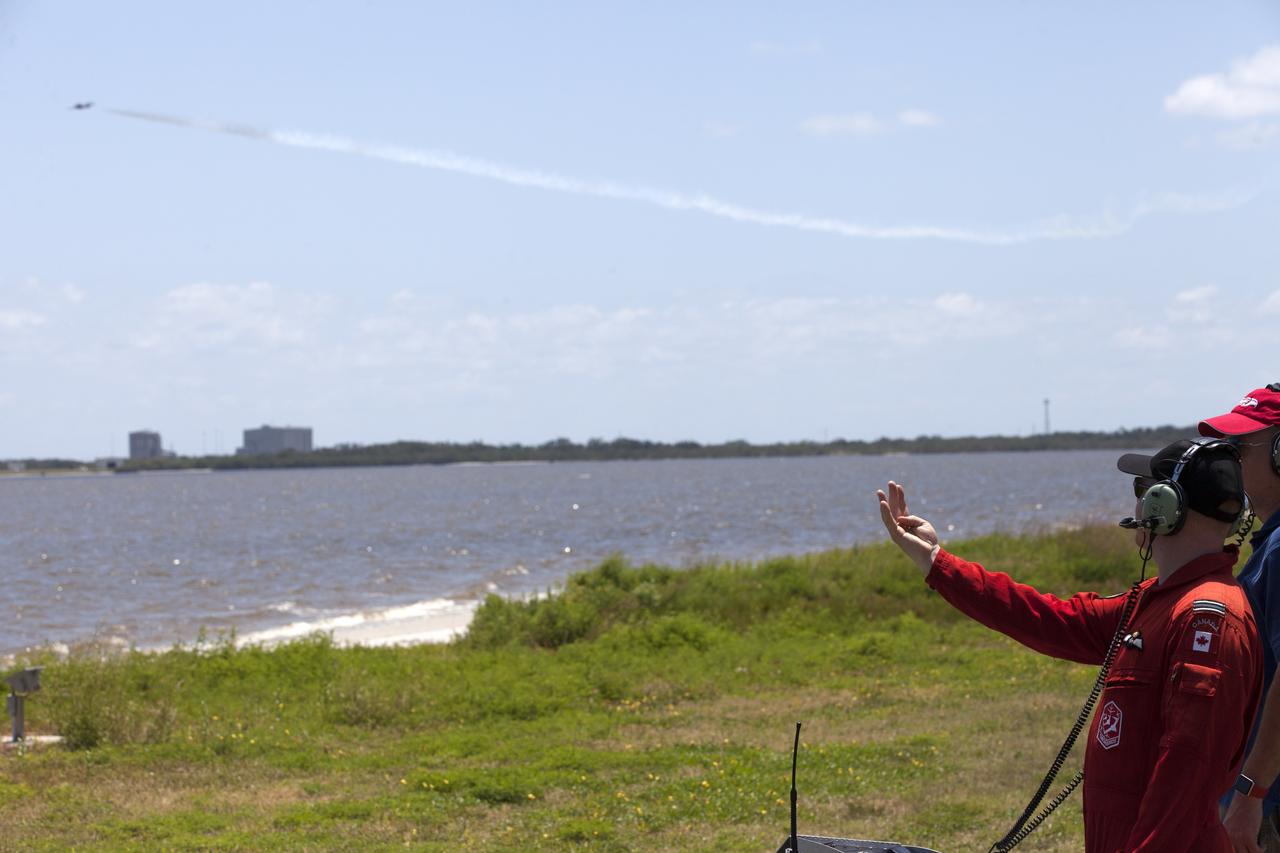
Capt. Blake McNaughton, team coordinator, Advance and Safety Pilot, 431 (Air Demonstration) Squadron Snowbirds Department of National Defence, communicates with the Canadian Forces Snowbird pilots from the NASA Causeway at Kennedy Space Center in Florida during a practice flight on May 9, 2018, between their scheduled U.S. Air Shows.

Horticulture scientist Blake Costine adjusts moisture sensors for the Advanced Plant Imaging project at NASA’s Kennedy Space Center on April 17, 2023. In this project, hyperspectral cameras are used to assess plant health. The activity is taking place inside the Plant Production Area at the Florida spaceport’s Space Station Processing Facility.
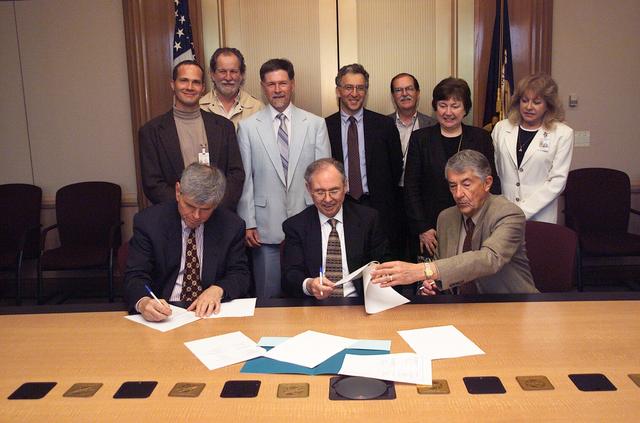
Memorandum of Understanding (MOU) to establish a Unmanned Aerial Vehicles (UAV) Applications Center at NASA Research Park (NRP) was signed into being by (L-R) John Bassett Clark University, Worcester, Mass., Dr. Henry McDonald, Director of Ames Research Center and Paul Coleman, Girvan Institute (a non-profit organization lockated in NASA Research Park). Witnessed by (Back Row, L-R) Steve Douagan, Dave Peterson, Jim Brass, Stan Herwitz, Ken Souza, Estelle Condon, Carolina Blake.
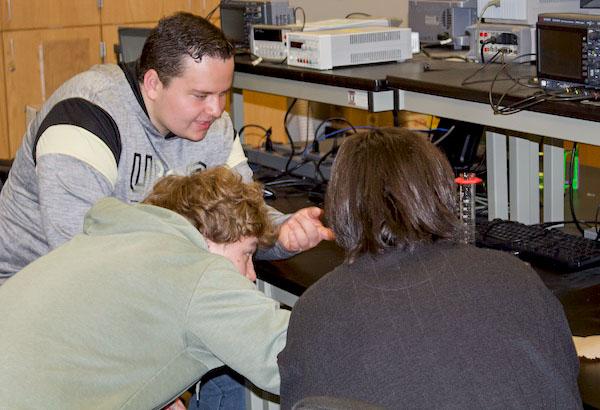
jsc2024e066523 (1/6/2024) --- Colorado Springs students Noah Grebe, Luke Davis, and Blake MacDonald observe crystal growth.Their experiment, Calcium Sulfate Crystal Growth in Microgravity, is part of the Nanoracks-National Center for Earth and Space Science Education-Surveyor-Student Spaceflight Experiments Program Mission 18 to ISS (Nanoracks-NCESSE-Surveyor-SSEP).
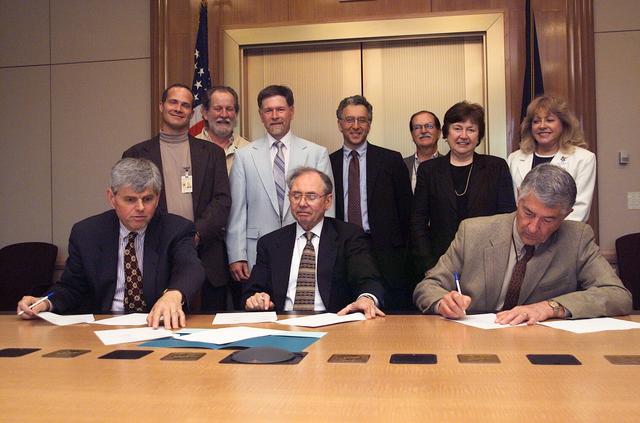
Memorandum of Understanding (MOU) to establish a Unmanned Aerial Vehicles (UAV) Applications Center at NASA Research Park (NRP) was signed into being by (L-R) John Bassett Clark University, Worcester, Mass., Dr. Henry McDonald, Director of Ames Research Center and Paul Coleman, Girvan Institute (a non-profit organization lockated in NASA Research Park). Witnessed by (Back Row, L-R) Steve Douagan, Dave Peterson, Jim Brass, Stan Herwitz, Ken Souza, Estelle Condon, Carolina Blake.
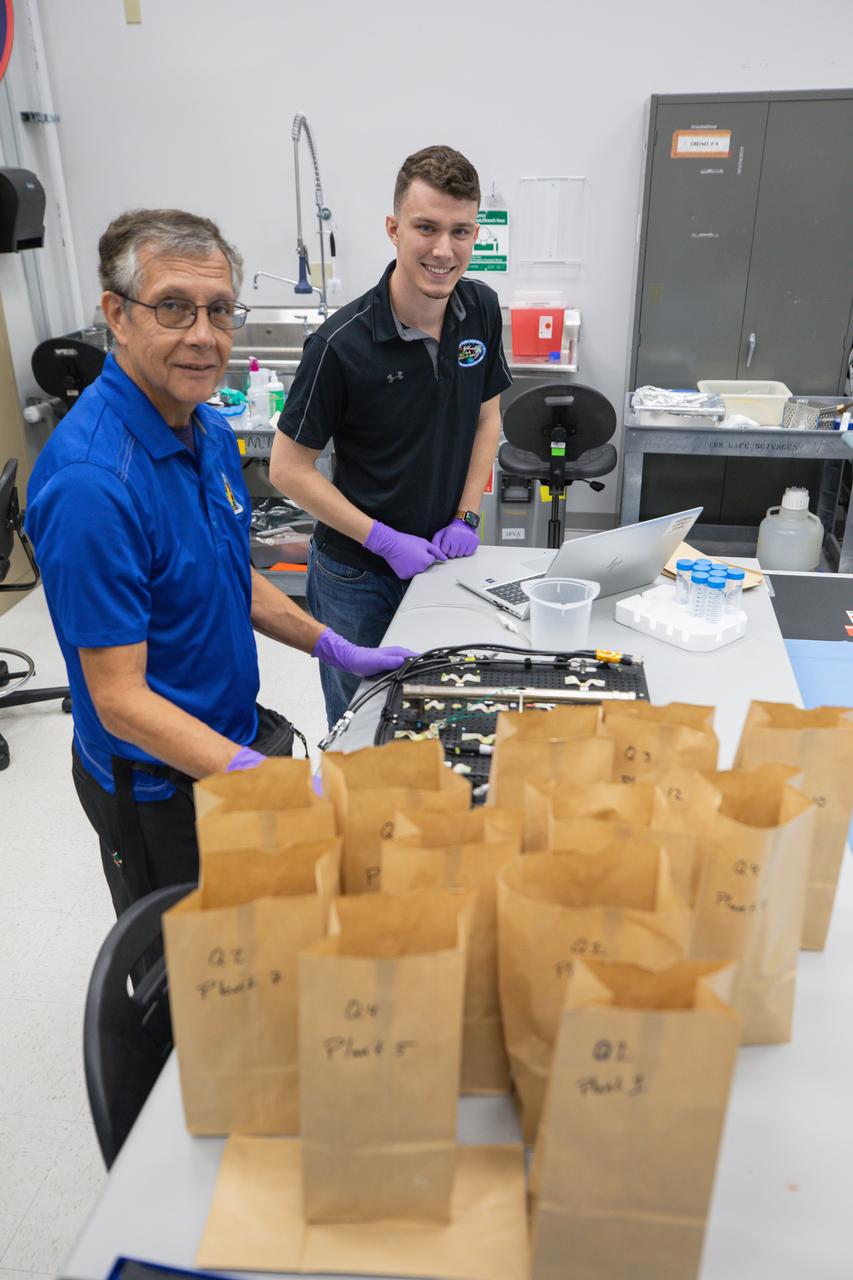
Space crop production scientists Oscar Monje (left) and Blake Costine harvest Outredgeous romaine lettuce for preflight testing of the Plant Habitat-07 (PH-07) experiment inside a laboratory at the Space Systems Processing Facility at NASA’s Kennedy Space Center in Florida on Thursday, Aug. 29, 2024. PH-07 will be sent to the International Space Station on NASA’s SpaceX 31st commercial resupply services mission to study how optimal and suboptimal moisture conditions impact plant growth, nutrient content, and the plant microbiome.
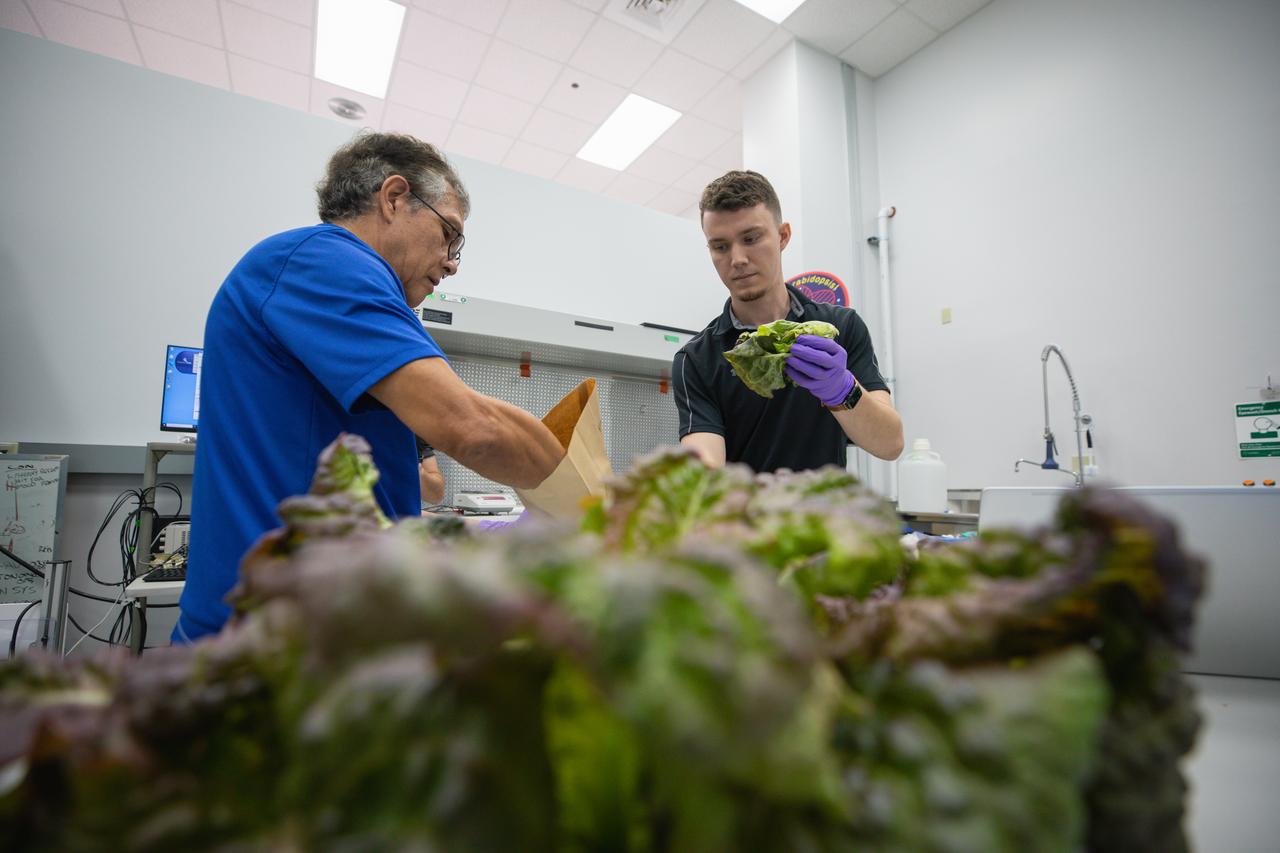
Space crop production scientists Oscar Monje (left) and Blake Costine harvest Outredgeous romaine lettuce for preflight testing of the Plant Habitat-07 (PH-07) experiment inside a laboratory at the Space Systems Processing Facility at NASA’s Kennedy Space Center in Florida on Thursday, Aug. 29, 2024. PH-07 will be sent to the International Space Station on NASA’s SpaceX 31st commercial resupply services mission to study how optimal and suboptimal moisture conditions impact plant growth, nutrient content, and the plant microbiome.

KENNEDY SPACE CENTER, FLA. - In the Space Station Processing Facility at NASA's Kennedy Space Center, flight crew systems technician Troy Mann and flight crew systems manager Jim Blake store the food containers that will be stowed on Space Shuttle Discovery for the flight of mission STS-121. The containers hold meals prepared for the mission crew. Mann and Blake are with United Space Alliance ground operations. Astronauts select their own menus from a large array of food items. Astronauts are supplied with three balanced meals, plus snacks. Foods flown on space missions are researched and developed at the Space Food Systems Laboratory at the Johnson Space Center (JSC) in Houston, which is staffed by food scientists, dietitians and engineers. Foods are analyzed through nutritional analysis, sensory evaluation, storage studies, packaging evaluations and many other methods. Each astronaut’s food is stored aboard the space shuttle and is identified by a colored dot affixed to each package. Launch of Space Shuttle Discovery on mission STS-121 is scheduled for July 1. Photo credit: NASA/Jack Pfaller
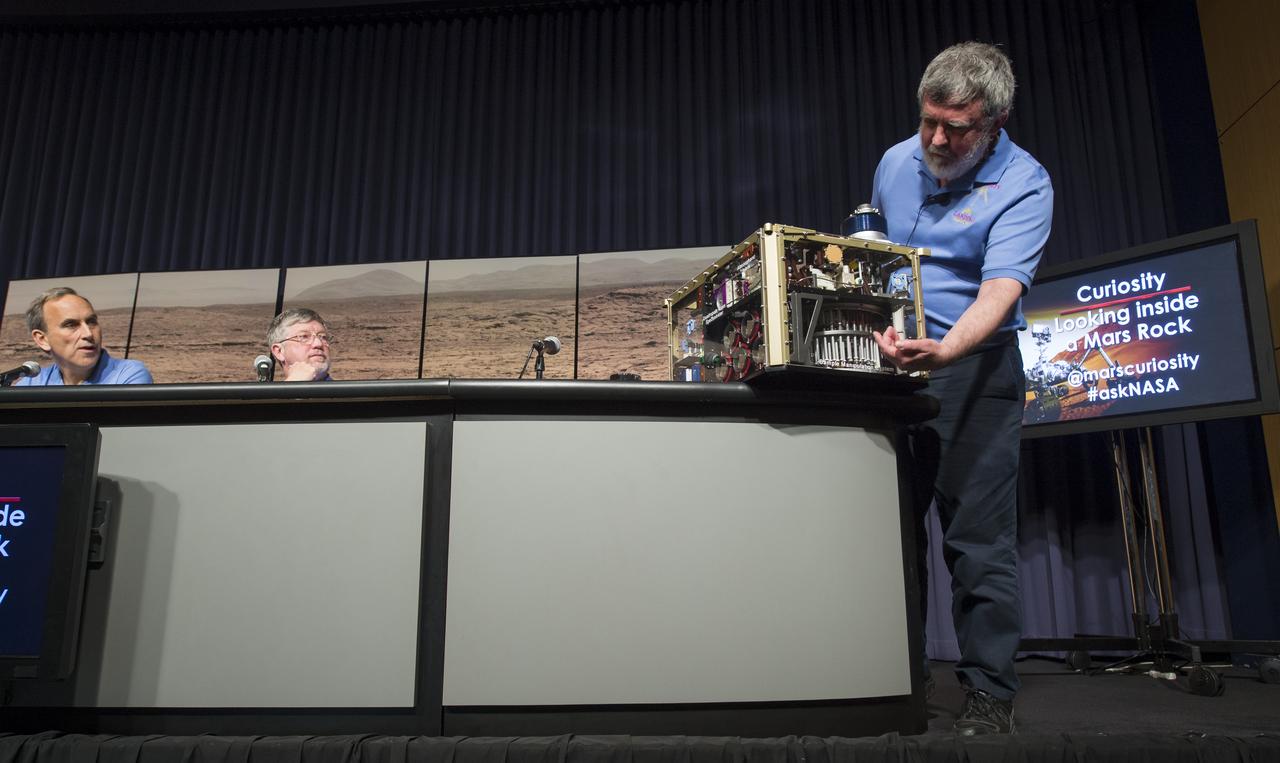
Paul Mahaffy (right), principal investigator for Curiosity's Sample Analysis at Mars (SAM) investigation at NASA's Goddard Space Flight Center in Maryland, demonstrates how the SAM instrument drilled and captured rock samples on the surface of Mars at a news conference, Tuesday, March 12, 2013 at NASA Headquarters in Washington. The analysis of the rock sample collected shows ancient Mars could have supported living microbes. Photo Credit: (NASA/Carla Cioffi)
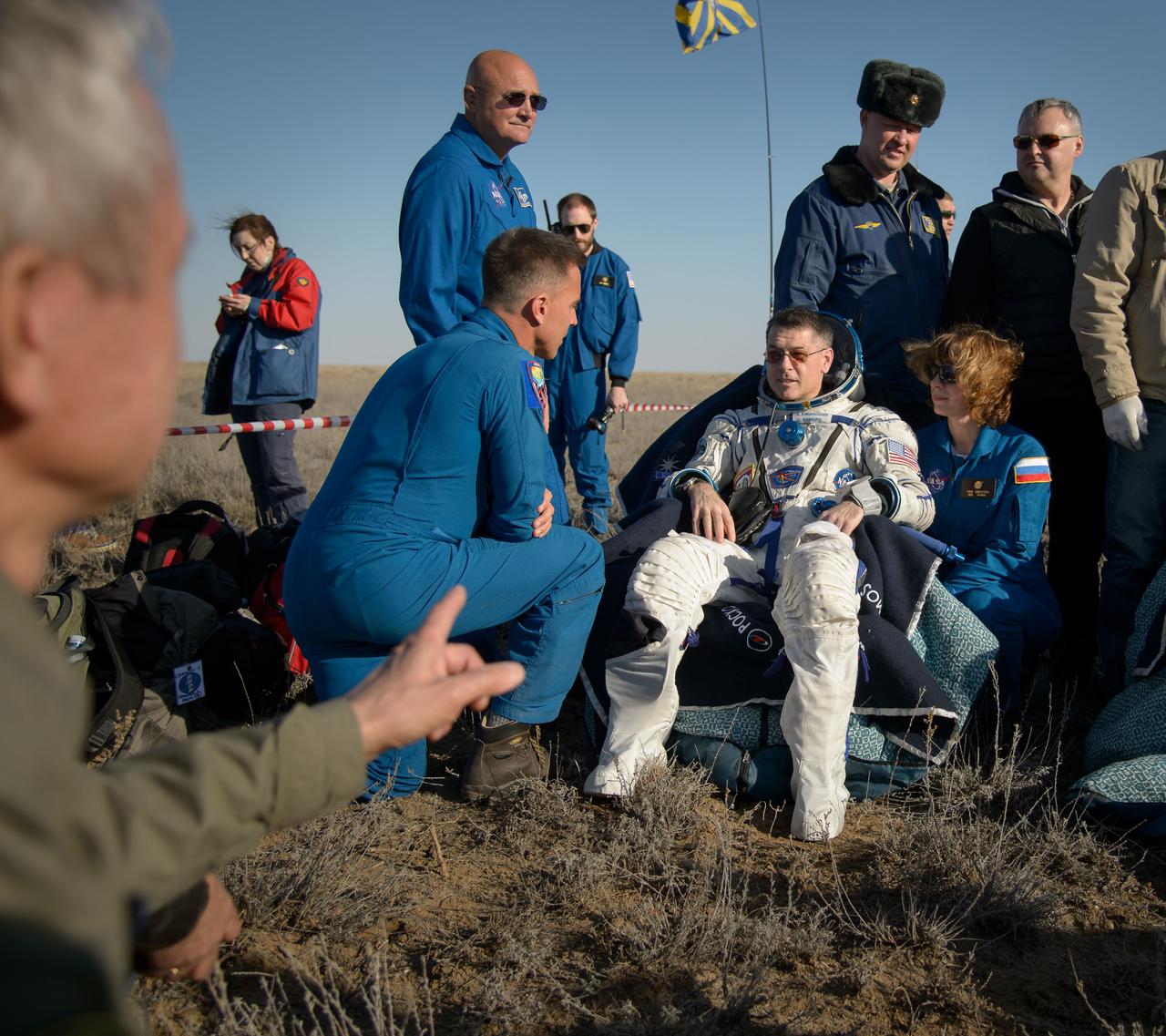
nhq201704100033 (April 10, 2017) --- NASA astronaut Shane Kimbrough rests in a chair outside the Soyuz MS-02 spacecraft just minutes after he, Russian cosmonaut Sergey Ryzhikov of Roscosmos, and Russian cosmonaut Andrey Borisenko of Roscosmos landed in a remote area near the town of Zhezkazgan, Kazakhstan on Monday, April 10, 2017 (Kazakh time). Kimbrough, Ryzhikov, and Borisenko are returning after 173 days in space where they served as members of the Expedition 49 and 50 crews onboard the International Space Station. Photo Credit: (NASA/Bill Ingalls)
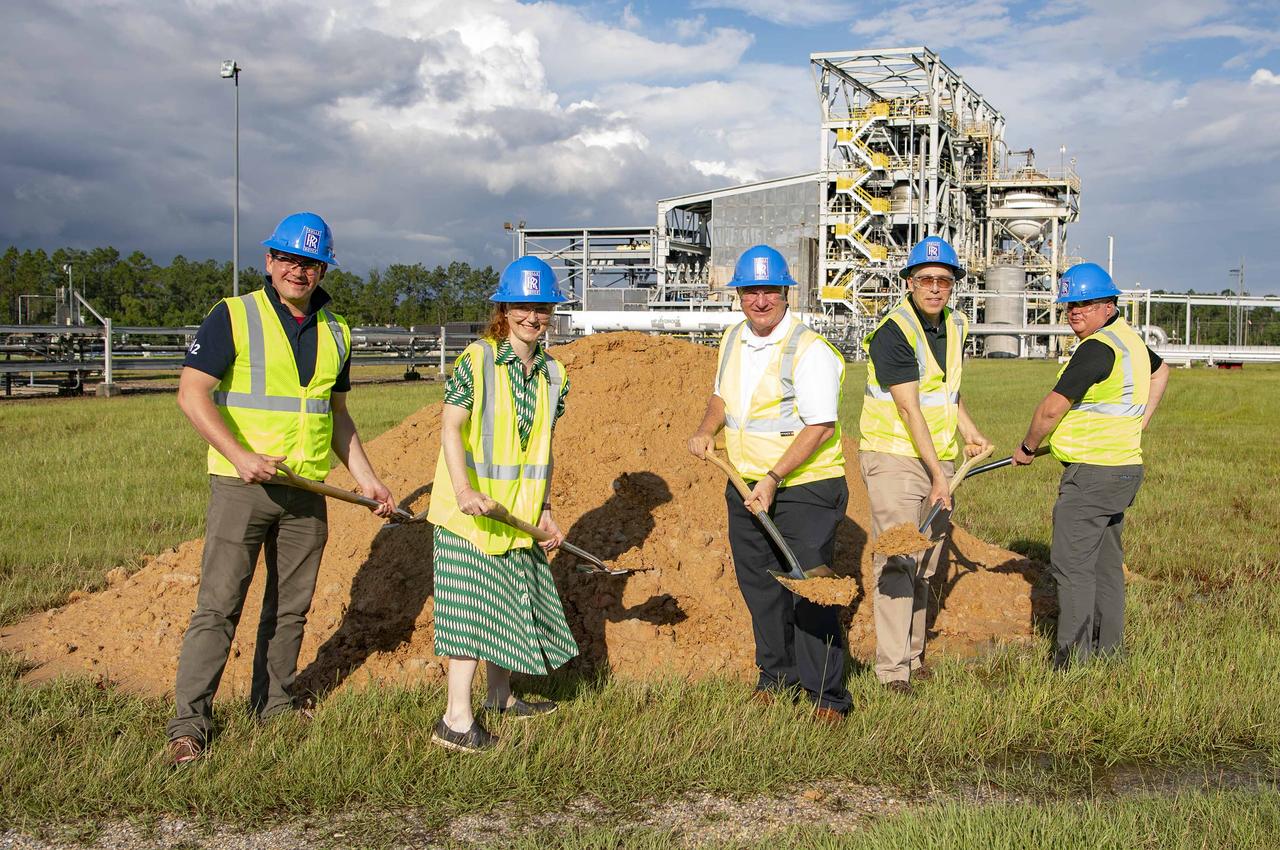
: NASA’s Stennis Space Center continues to support commercial companies and benefit the aerospace industry. The latest example comes as officials from NASA Stennis and Rolls-Royce break ground for the E-1 Hydrogen Test Pad, located at the NASA Stennis E-Complex Test Facility, during a June 27 ceremony. The site will be where Rolls-Royce conducts hydrogen testing for the Pearl 15 engine. The Pearl 15 engine helps power the Bombardier Global 5500 & 6500 aircraft and enables top speeds of Mach 0.90. Groundbreaking participants include (left to right): Adam Newman, Rolls-Royce chief engineer of hydrogen technology; Deborah Robinson, Rolls-Royce director of test and experimental engineering; Troy Frisbie, NASA Stennis legislative affairs specialist and chief of staff; Dan Lyon, Rolls-Royce North America general manager; and Steven Blake, Rolls-Royce North America indirect purchasing, global commodity manager.
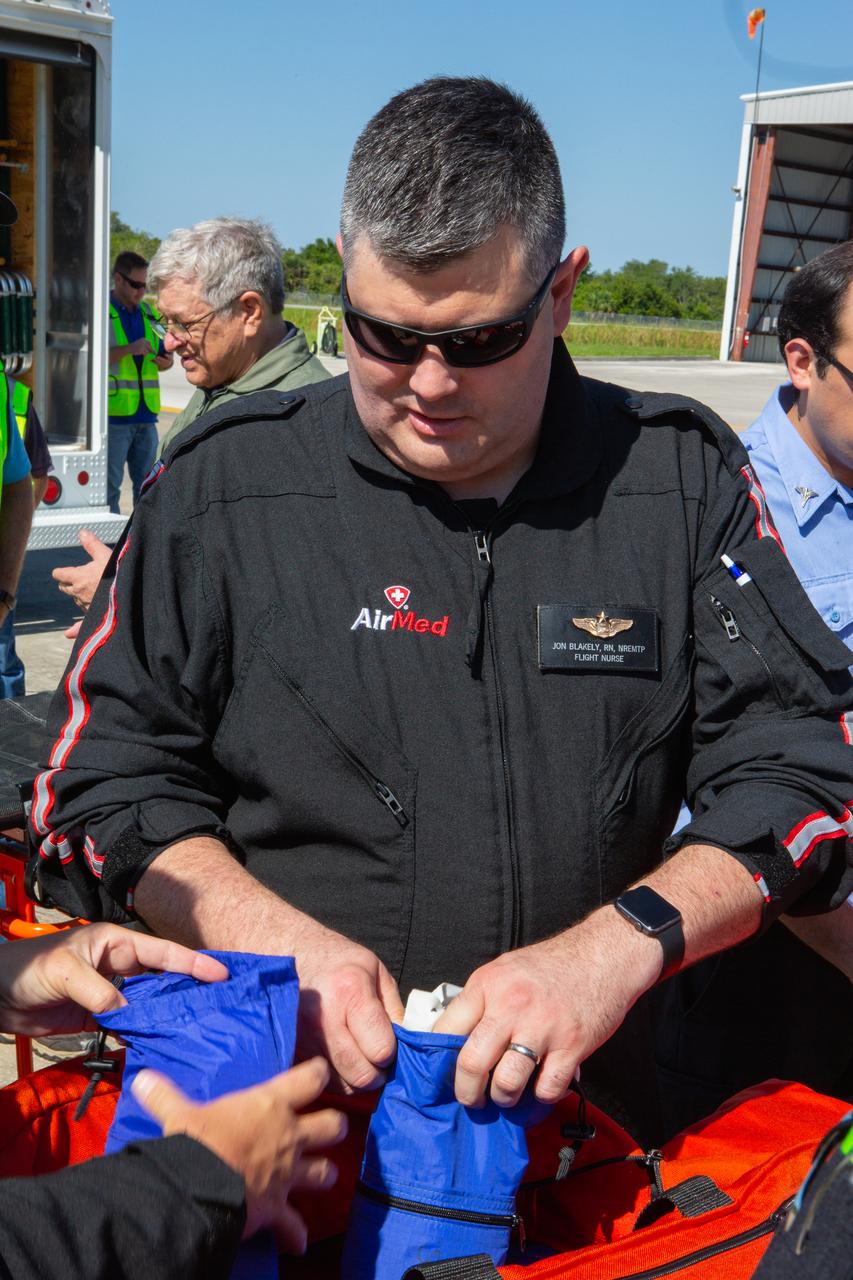
Jon Blakely, an AirMed flight nurse, joins Kennedy Space Center personnel and American Medical Response (AMR) contractor paramedics at the Florida spaceport’s Shuttle Landing Facility on May 17, 2019, for a medical support training course. Signs in the foreground indicate the “dirty side,” where patient off-loading and decontamination would take place, and the “clean side,” used for patient evaluation and medevac. The course was designed to familiarize the AMR paramedics with the center’s Triage Forces deployment, which included medical team members, fire/rescue personnel, environmental health specialists and flight operations crew members, as well as a helicopter, Mine Resistant Ambush Protected (MRAP) tactical vehicle, fire pumper truck and triage vehicles. The AMR paramedics will assist the agency in contingency planning for the return of human spaceflight from Kennedy.
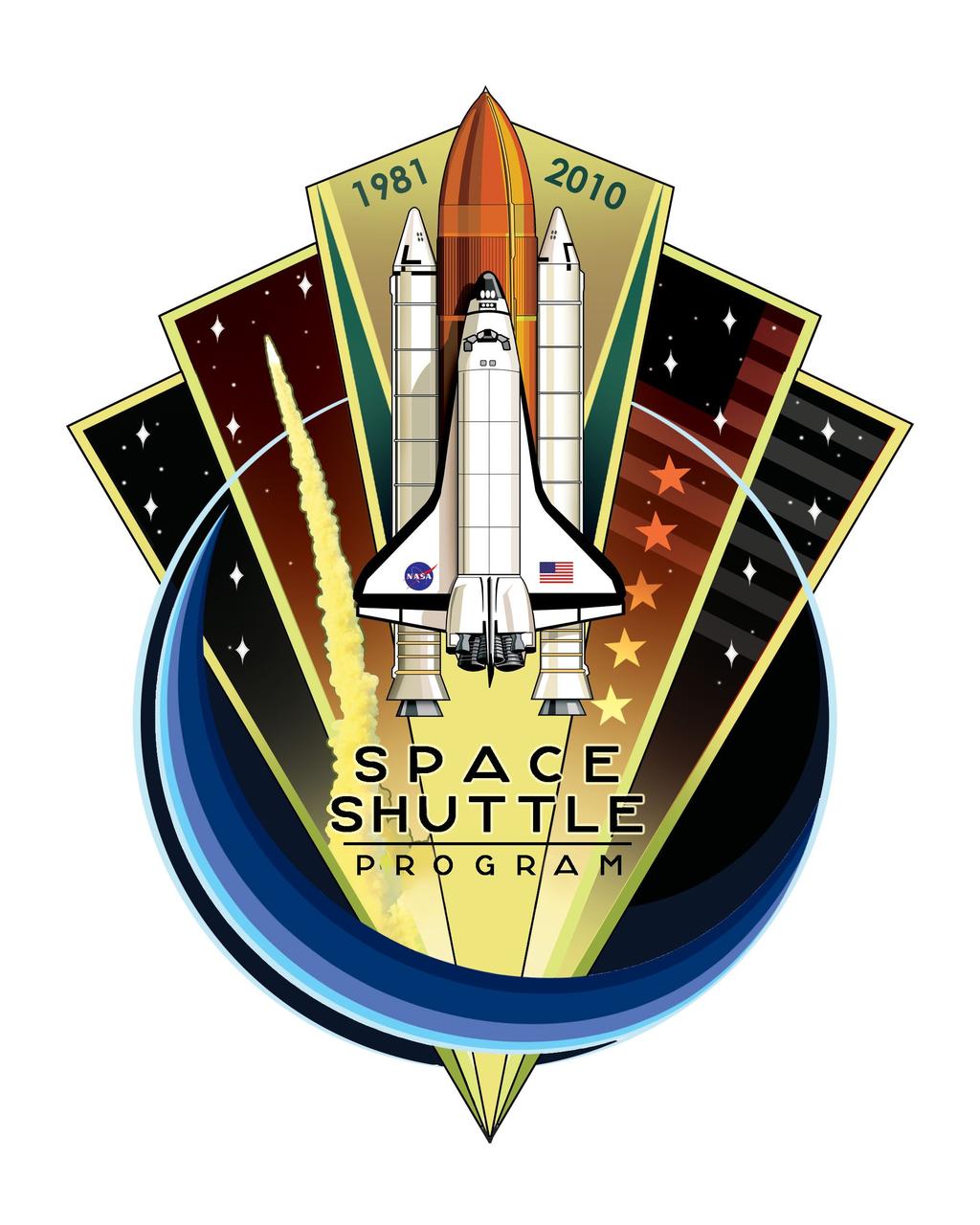
JOHNSON SPACE CENTER, Houston - JSC2010-E-079335 -- To celebrate the upcoming 30th anniversary and retirement of the Space Shuttle Program, the design of this patch aims to capture the visual essence and spirit of the program in an iconic and triumphant manner. As the Space Shuttle Program has been an innovative, iconic gem in the history of American spaceflight, the overall shape of the patch and its faceted panels are reminiscent of a diamond or other fine jewel. The shape of the patch fans out from a fine point at the bottom to a wide array across the top, to evoke the vastness of space and our aim to explore it, as the shuttle has done successfully for decades. The outlined blue circle represents the shuttle's exploration within low Earth orbit, but also creates a dynamic fluidity from the bottom right around to the top left to allude to the smoothness of the shuttle orbiting Earth. The diagonal lines cascading down into the top-right corner of the design form the American Flag as the shuttle has been one of the most recognizable icons in American history throughout the last three decades. In the top left and right panels of the design, there are seven prominent stars on each side, which represent the 14 crew members who were lost on shuttles Challenger and Columbia. Inside of the middle panel to the right of the shuttle, there are five larger, more prominent stars that signify the five space shuttle vehicles NASA has had in its fleet throughout the program. Most importantly though, this patch is as an overall celebration of the much-beloved program and vehicle that so many people have dedicated themselves to in so many capacities throughout the years with a sense of vibrancy and mysticism that the Space Shuttle Program will always be remembered by. This patch was designed by Aerospace Engineer Blake Dumesnil, who has supported the Space Shuttle Program with his work in the Avionics and Energy Systems Divisions of the NASA Johnson Space Center Engineering Directorate. It is the winning entry in a commemorative patch design contest sponsored by the Space Shuttle Program. Image credit: NASA/Blake Dumesnil
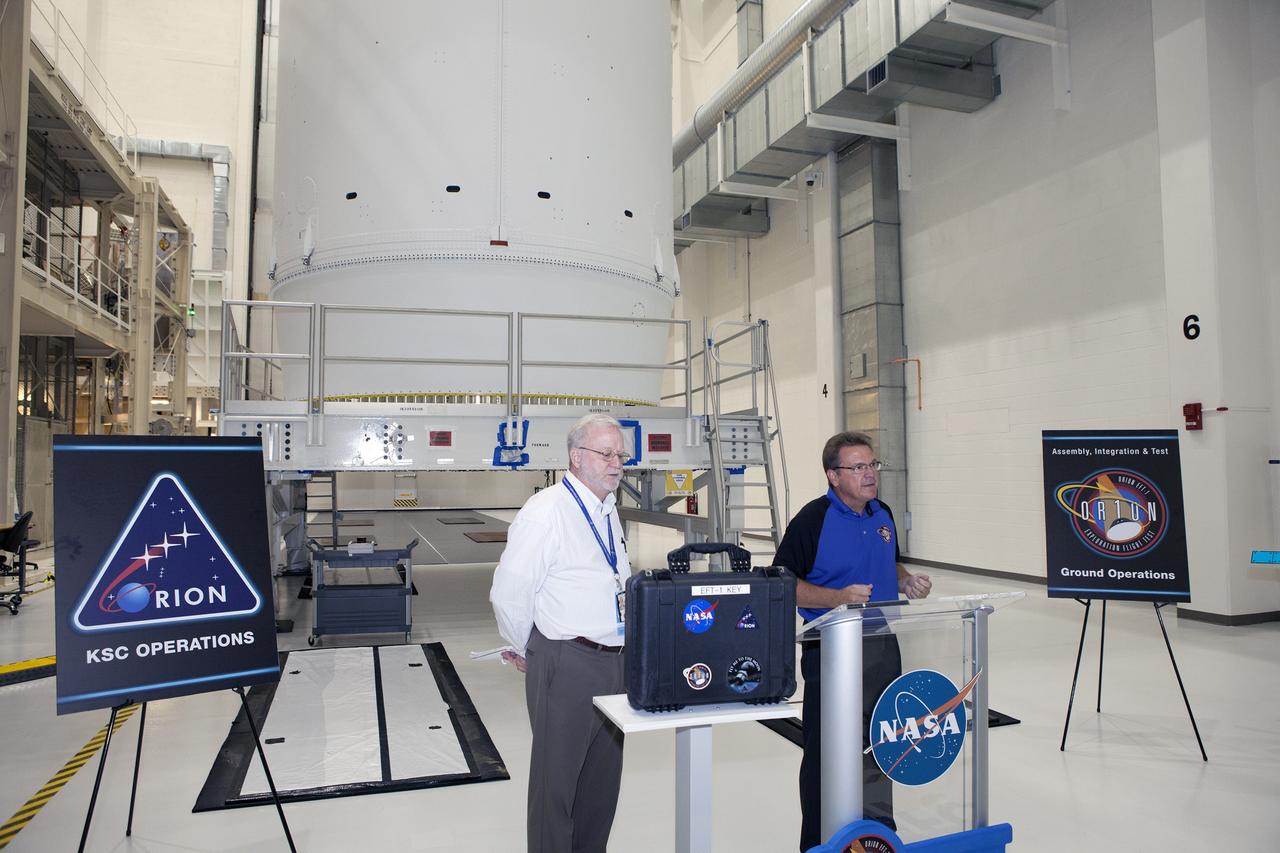
CAPE CANAVERAL, Fla. – Inside the Neil Armstrong Operations and Checkout Building high bay at NASA's Kennedy Space Center in Florida, Jules Schneider, at right, Lockheed Martin Orion Production Operations manager, speaks to NASA and Lockheed Martin workers during a ceremony to turn over the Orion spacecraft for Exploration Flight Test-1 to Ground Operations. At left is Blake Hale, Lockheed Martin Ground Operations manager. Orion is the exploration spacecraft designed to carry astronauts to destinations not yet explored by humans, including an asteroid and Mars. It will have emergency abort capability, sustain the crew during space travel and provide safe re-entry from deep space return velocities. The first unpiloted test flight of the Orion is scheduled to launch atop a United Launch Alliance Delta IV Heavy rocket from Cape Canaveral Air Force Station in Florida in December to an altitude of 3,600 miles above the Earth's surface. The two-orbit, four-hour flight test will help engineers evaluate the systems critical to crew safety including the heat shield, parachute system and launch abort system. For more information, visit http://www.nasa.gov/orion. Photo credit: NASA/Daniel Casper
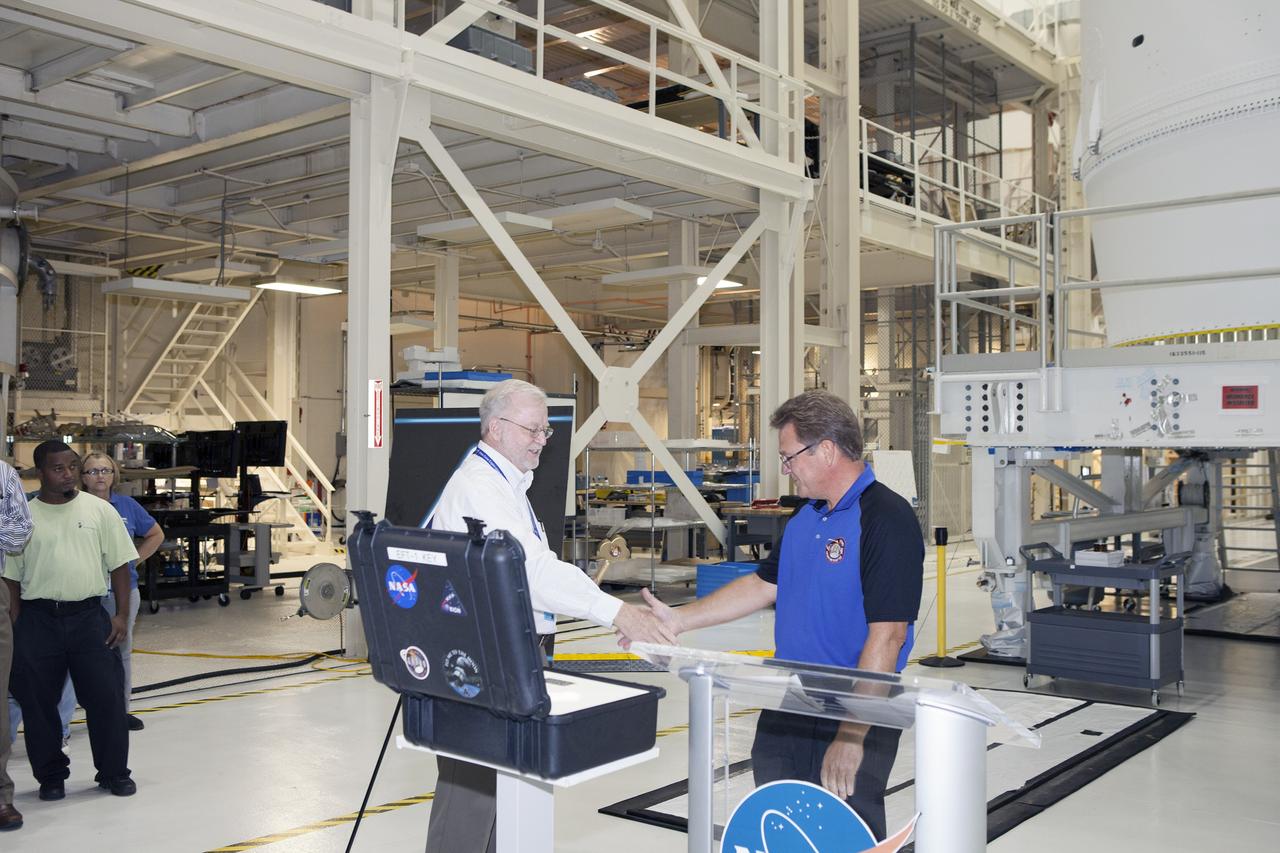
CAPE CANAVERAL, Fla. – Inside the Neil Armstrong Operations and Checkout Building high bay at NASA's Kennedy Space Center in Florida, Jules Schneider, at right, Lockheed Martin Orion Production Operations manager, shakes hands with Blake Hale, Lockheed Martin Ground Operations manager, during a ceremony to officially turn over the Orion spacecraft for Exploration Flight Test-1 to Lockheed Martin Ground Operations. Orion is the exploration spacecraft designed to carry astronauts to destinations not yet explored by humans, including an asteroid and Mars. It will have emergency abort capability, sustain the crew during space travel and provide safe re-entry from deep space return velocities. The first unpiloted test flight of the Orion is scheduled to launch atop a United Launch Alliance Delta IV Heavy rocket from Cape Canaveral Air Force Station in Florida in December to an altitude of 3,600 miles above the Earth's surface. The two-orbit, four-hour flight test will help engineers evaluate the systems critical to crew safety including the heat shield, parachute system and launch abort system. For more information, visit http://www.nasa.gov/orion. Photo credit: NASA/Daniel Casper
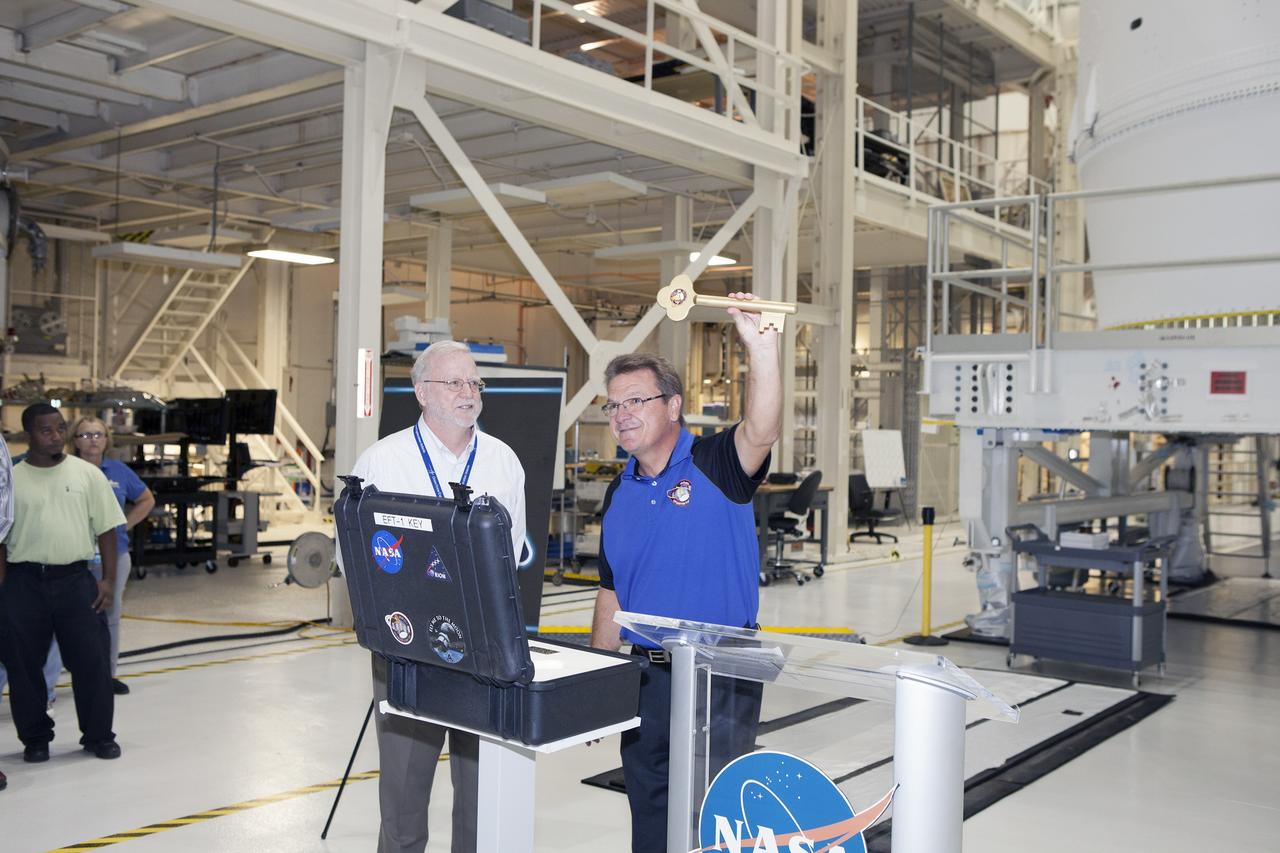
CAPE CANAVERAL, Fla. – During a ceremony inside the Neil Armstrong Operations and Checkout Building high bay at NASA's Kennedy Space Center in Florida, Jules Schneider, Lockheed Martin Orion Production Operations manager, holds the key to symbolically turn over the Orion spacecraft for Exploration Flight Test-1 to Ground Operations. Waiting to accept the key is Blake Hale, Lockheed Martin Ground Operations manager. Orion is the exploration spacecraft designed to carry astronauts to destinations not yet explored by humans, including an asteroid and Mars. It will have emergency abort capability, sustain the crew during space travel and provide safe re-entry from deep space return velocities. The first unpiloted test flight of the Orion is scheduled to launch atop a United Launch Alliance Delta IV Heavy rocket from Cape Canaveral Air Force Station in Florida in December to an altitude of 3,600 miles above the Earth's surface. The two-orbit, four-hour flight test will help engineers evaluate the systems critical to crew safety including the heat shield, parachute system and launch abort system. For more information, visit http://www.nasa.gov/orion. Photo credit: NASA/Daniel Casper
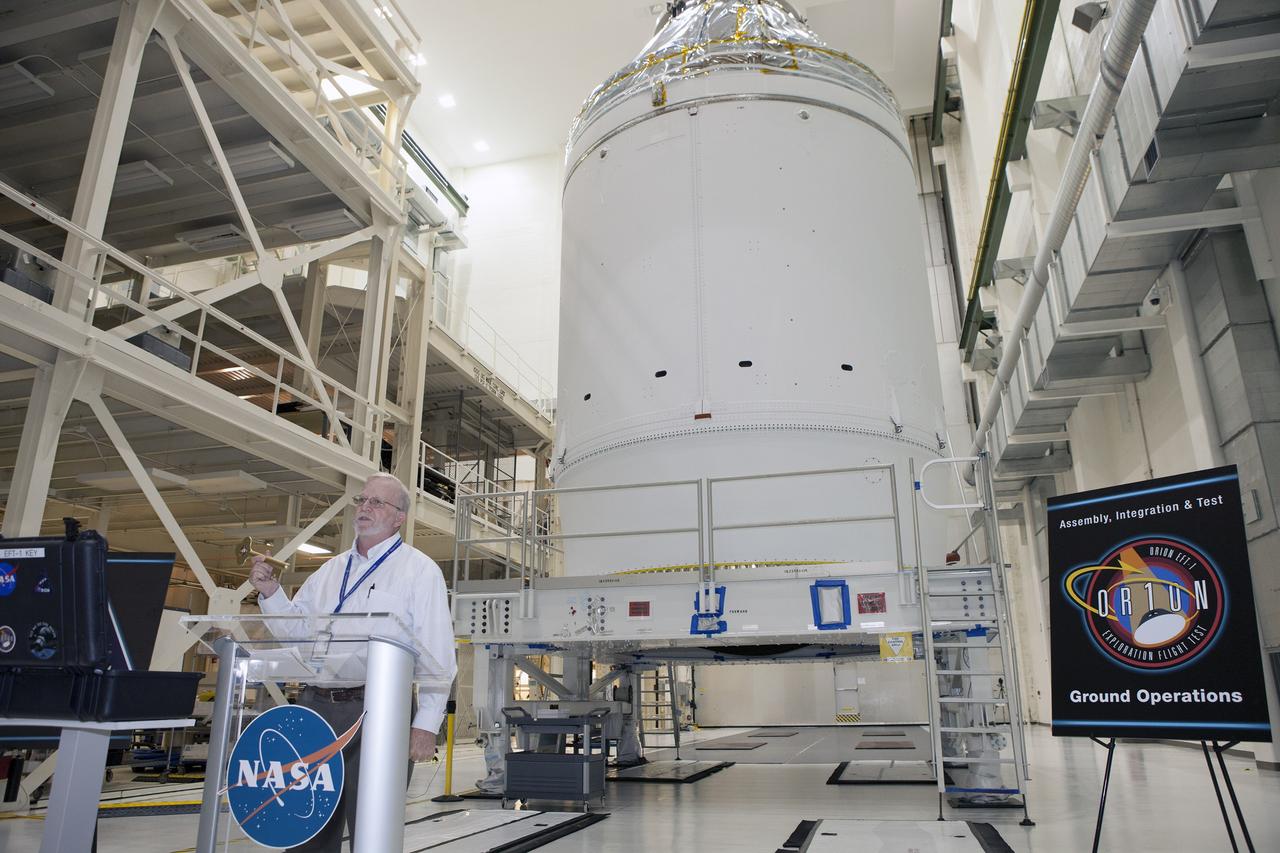
CAPE CANAVERAL, Fla. – Inside the Neil Armstrong Operations and Checkout Building high bay at NASA's Kennedy Space Center in Florida, Blake Hale, Lockheed Martin Ground Operations manager, speaks to NASA and Lockheed Martin workers during a ceremony to turn over Orion spacecraft for Exploration Flight Test-1 to Lockheed Martin Ground Operations from Orion Assembly, Integration and Production. Orion is the exploration spacecraft designed to carry astronauts to destinations not yet explored by humans, including an asteroid and Mars. It will have emergency abort capability, sustain the crew during space travel and provide safe re-entry from deep space return velocities. The first unpiloted test flight of the Orion is scheduled to launch atop a United Launch Alliance Delta IV Heavy rocket from Cape Canaveral Air Force Station in Florida in December to an altitude of 3,600 miles above the Earth's surface. The two-orbit, four-hour flight test will help engineers evaluate the systems critical to crew safety including the heat shield, parachute system and launch abort system. For more information, visit http://www.nasa.gov/orion. Photo credit: NASA/Daniel Casper
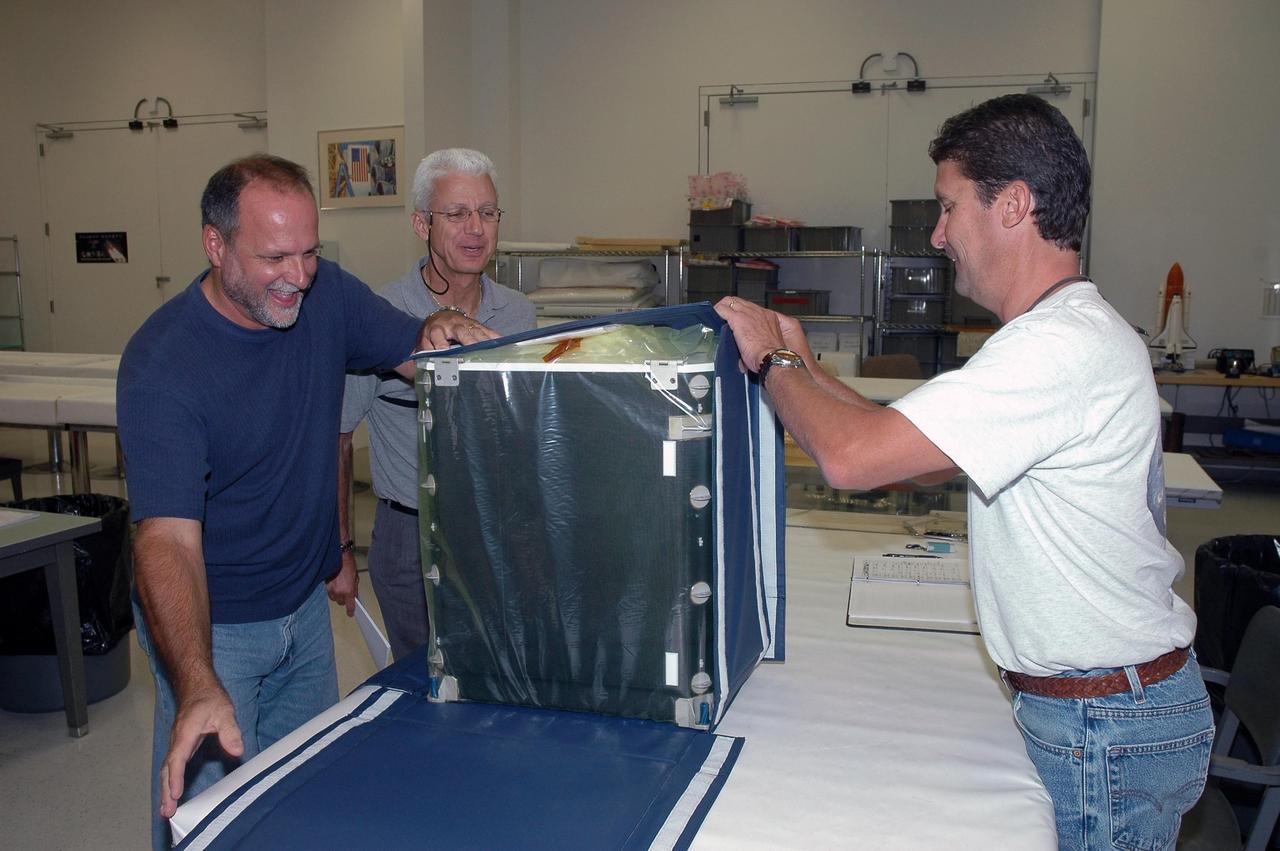
KENNEDY SPACE CENTER, FLA. - In the Space Station Processing Facility at NASA's Kennedy Space Center, Jim Blake, Dennis Huefner and Troy Mann wrap food containers that will be stowed on Space Shuttle Discovery for the flight of mission STS-121. The containers hold meals prepared for the mission crew. The men are with United Space Alliance ground operations. Astronauts select their own menus from a large array of food items. Astronauts are supplied with three balanced meals, plus snacks. Foods flown on space missions are researched and developed at the Space Food Systems Laboratory at the Johnson Space Center (JSC) in Houston, which is staffed by food scientists, dietitians and engineers. Foods are analyzed through nutritional analysis, sensory evaluation, storage studies, packaging evaluations and many other methods. Each astronaut’s food is stored aboard the space shuttle and is identified by a colored dot affixed to each package. Launch of Space Shuttle Discovery on mission STS-121 is scheduled for July 1. Photo credit: NASA/Jack Pfaller
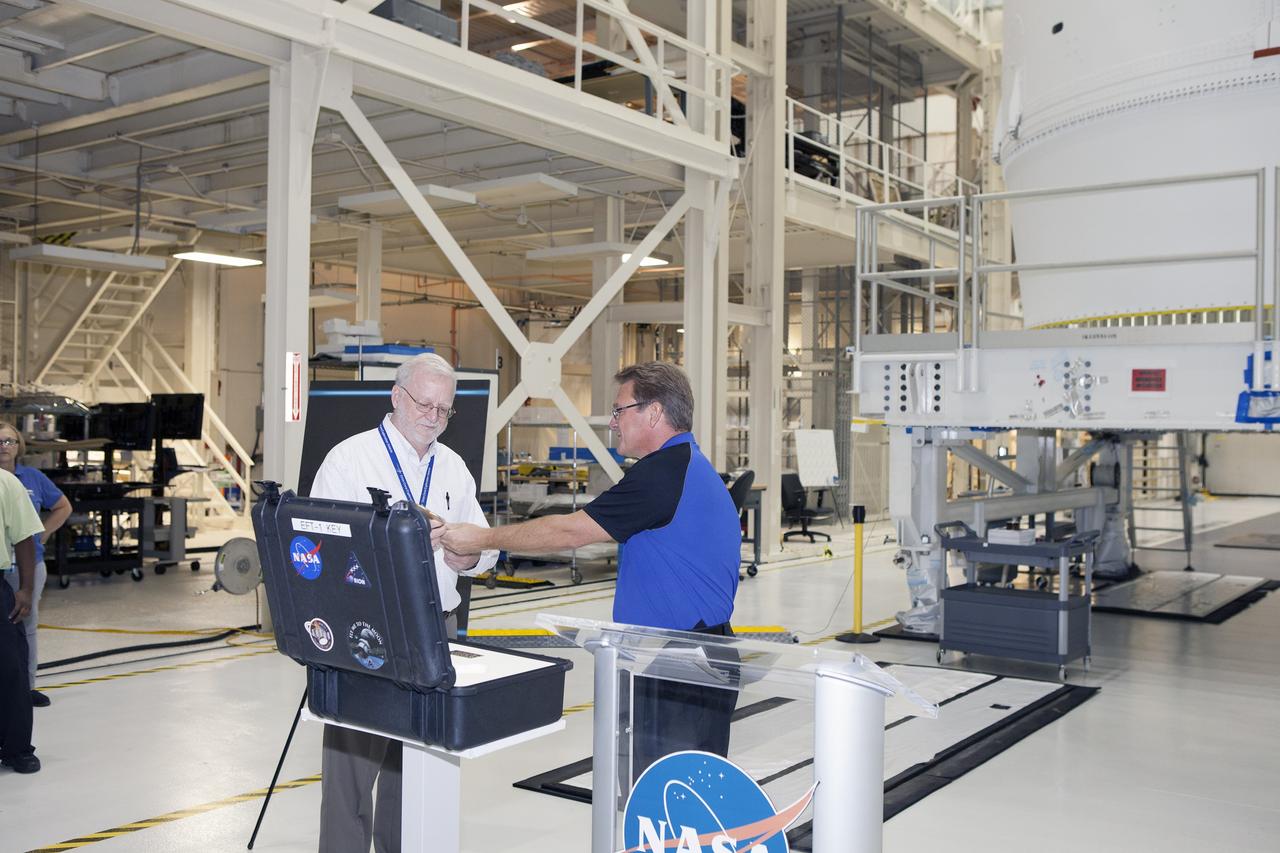
CAPE CANAVERAL, Fla. – During a ceremony inside the Neil Armstrong Operations and Checkout Building high bay at NASA's Kennedy Space Center in Florida, Jules Schneider, at right, Lockheed Martin Orion Production Operations manager, presents the key to symbolically turn over the Orion spacecraft for Exploration Flight Test-1 to Ground Operations. Accepting the key is Blake Hale, Lockheed Martin Ground Operations manager. Orion is the exploration spacecraft designed to carry astronauts to destinations not yet explored by humans, including an asteroid and Mars. It will have emergency abort capability, sustain the crew during space travel and provide safe re-entry from deep space return velocities. The first unpiloted test flight of the Orion is scheduled to launch atop a United Launch Alliance Delta IV Heavy rocket from Cape Canaveral Air Force Station in Florida in December to an altitude of 3,600 miles above the Earth's surface. The two-orbit, four-hour flight test will help engineers evaluate the systems critical to crew safety including the heat shield, parachute system and launch abort system. For more information, visit http://www.nasa.gov/orion. Photo credit: NASA/Daniel Casper
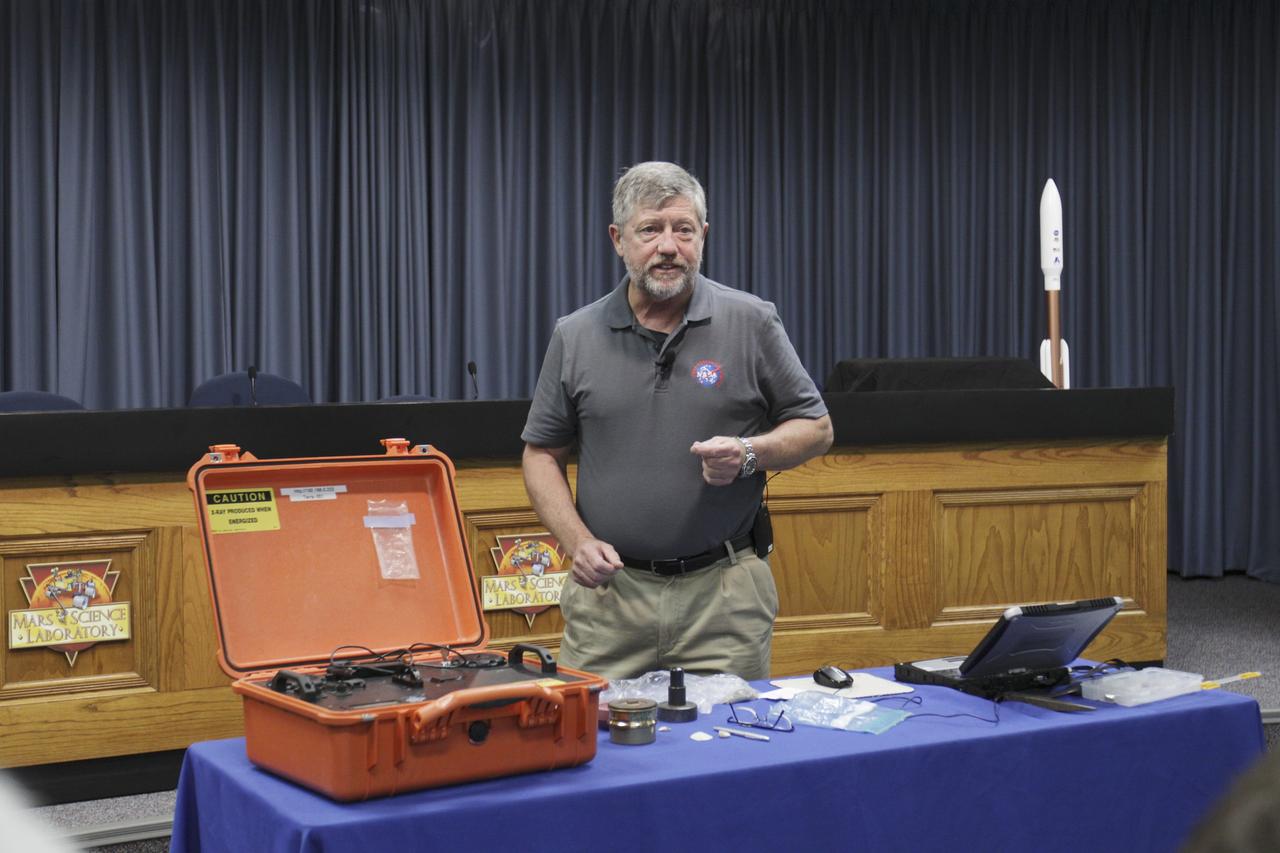
CAPE CANAVERAL, Fla. – David Blake, NASA principal investigator for the Chemistry and Mineralogy (CheMin) investigation by the Curiosity rover, demonstrates the experiment for the media in NASA Kennedy Space Center's Press Site auditorium in Florida during prelaunch activities for the agency’s Mars Science Laboratory (MSL) launch. CheMin is designed to analyze powdered rock and soil samples by identifying and quantifying their mineral content using X-ray diffraction, a first for a mission to Mars. The car-sized Martian rover, Curiosity, has 10 science instruments designed to search for signs of life, including methane, and help determine if the gas is from a biological or geological source. Liftoff of MSL aboard a United Launch Alliance Atlas V rocket from Space Launch Complex-41 on Cape Canaveral Air Force Station is planned during a launch window which extends from 10:02 a.m. to 11:45 a.m. EST on Nov. 26. For more information, visit http://www.nasa.gov/msl. Photo credit: NASA/Kim Shiflett
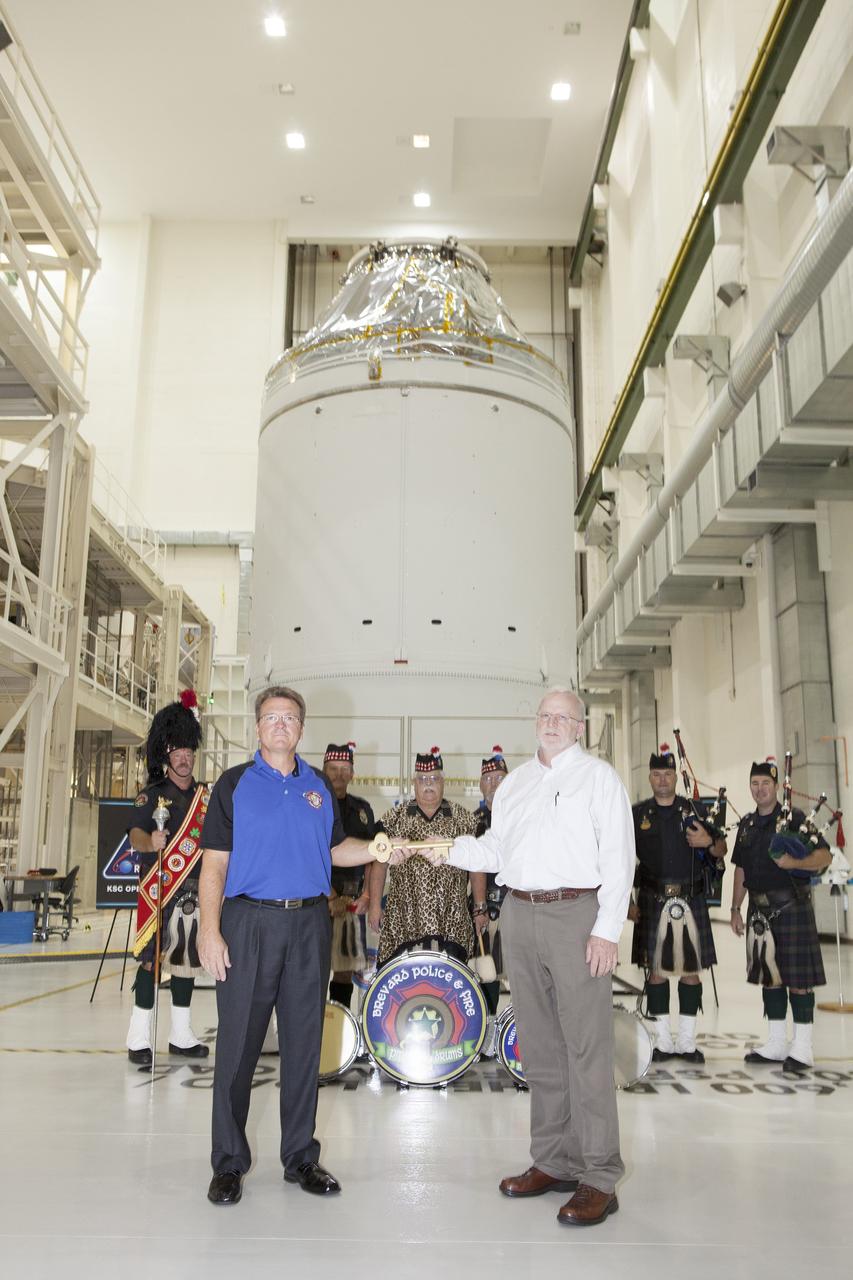
CAPE CANAVERAL, Fla. – During a ceremony inside the Neil Armstrong Operations and Checkout Building high bay at NASA's Kennedy Space Center in Florida, the Orion spacecraft for Exploration Flight Test-1 was officially turned over to Lockheed Martin Ground Operations from Orion Assembly, Integration and Production. Holding the key during the turn over, are Jules Schneider, at left, Lockheed Martin Orion Production Operations manager, and Blake Hale, Lockheed Martin Ground Operations manager. Behind them are members of the Brevard Police and Fire Pipes and Drums. Orion is the exploration spacecraft designed to carry astronauts to destinations not yet explored by humans, including an asteroid and Mars. It will have emergency abort capability, sustain the crew during space travel and provide safe re-entry from deep space return velocities. The first unpiloted test flight of the Orion is scheduled to launch atop a United Launch Alliance Delta IV Heavy rocket from Cape Canaveral Air Force Station in Florida in December to an altitude of 3,600 miles above the Earth's surface. The two-orbit, four-hour flight test will help engineers evaluate the systems critical to crew safety including the heat shield, parachute system and launch abort system. For more information, visit http://www.nasa.gov/orion. Photo credit: NASA/Daniel Casper
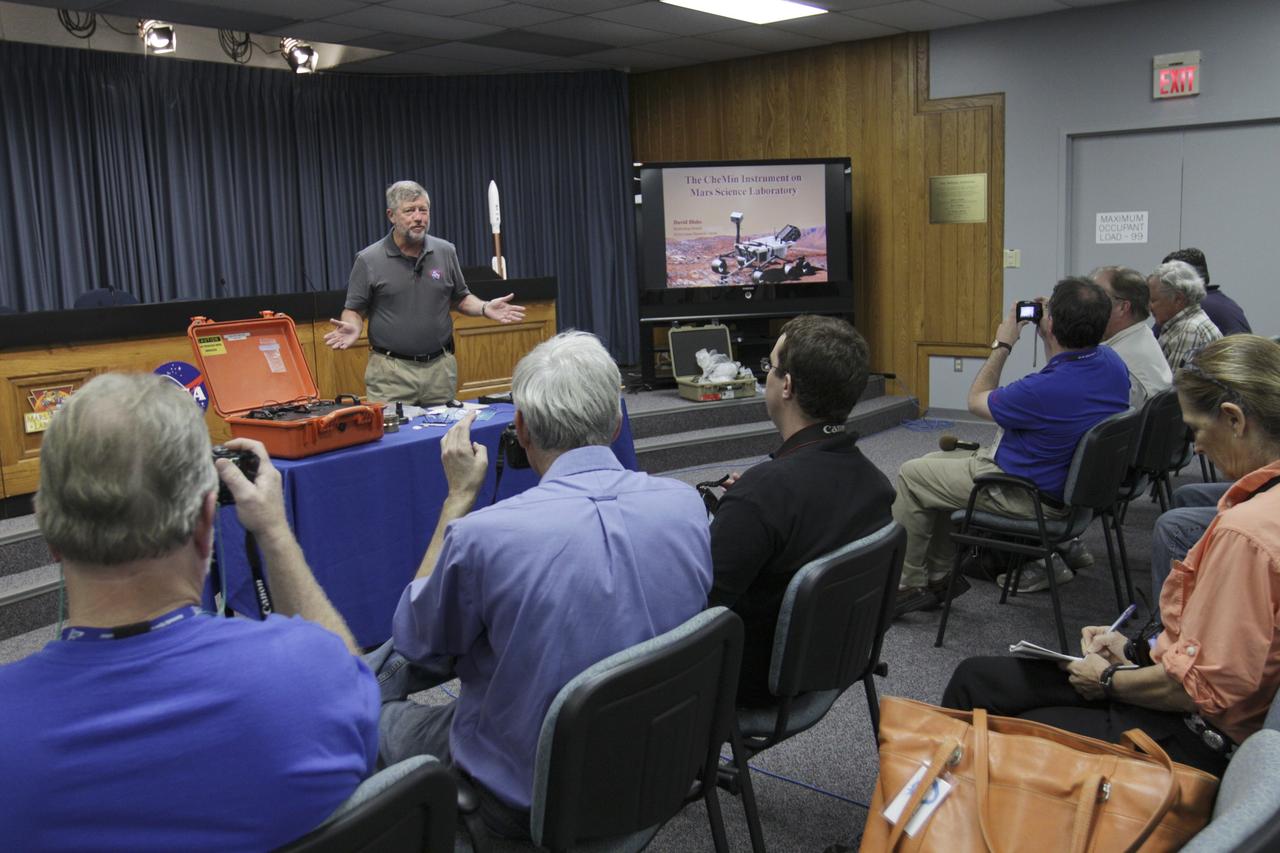
CAPE CANAVERAL, Fla. – David Blake, NASA principal investigator for the Chemistry and Mineralogy (CheMin) investigation by the Curiosity rover, explains the experiment to the media in NASA Kennedy Space Center's Press Site auditorium in Florida during prelaunch activities for the agency’s Mars Science Laboratory (MSL) launch. CheMin is designed to analyze powdered rock and soil samples by identifying and quantifying their mineral content using X-ray diffraction, a first for a mission to Mars. The car-sized Martian rover, Curiosity, has 10 science instruments designed to search for signs of life, including methane, and help determine if the gas is from a biological or geological source. Liftoff of MSL aboard a United Launch Alliance Atlas V rocket from Space Launch Complex-41 on Cape Canaveral Air Force Station is planned during a launch window which extends from 10:02 a.m. to 11:45 a.m. EST on Nov. 26. For more information, visit http://www.nasa.gov/msl. Photo credit: NASA/Kim Shiflett
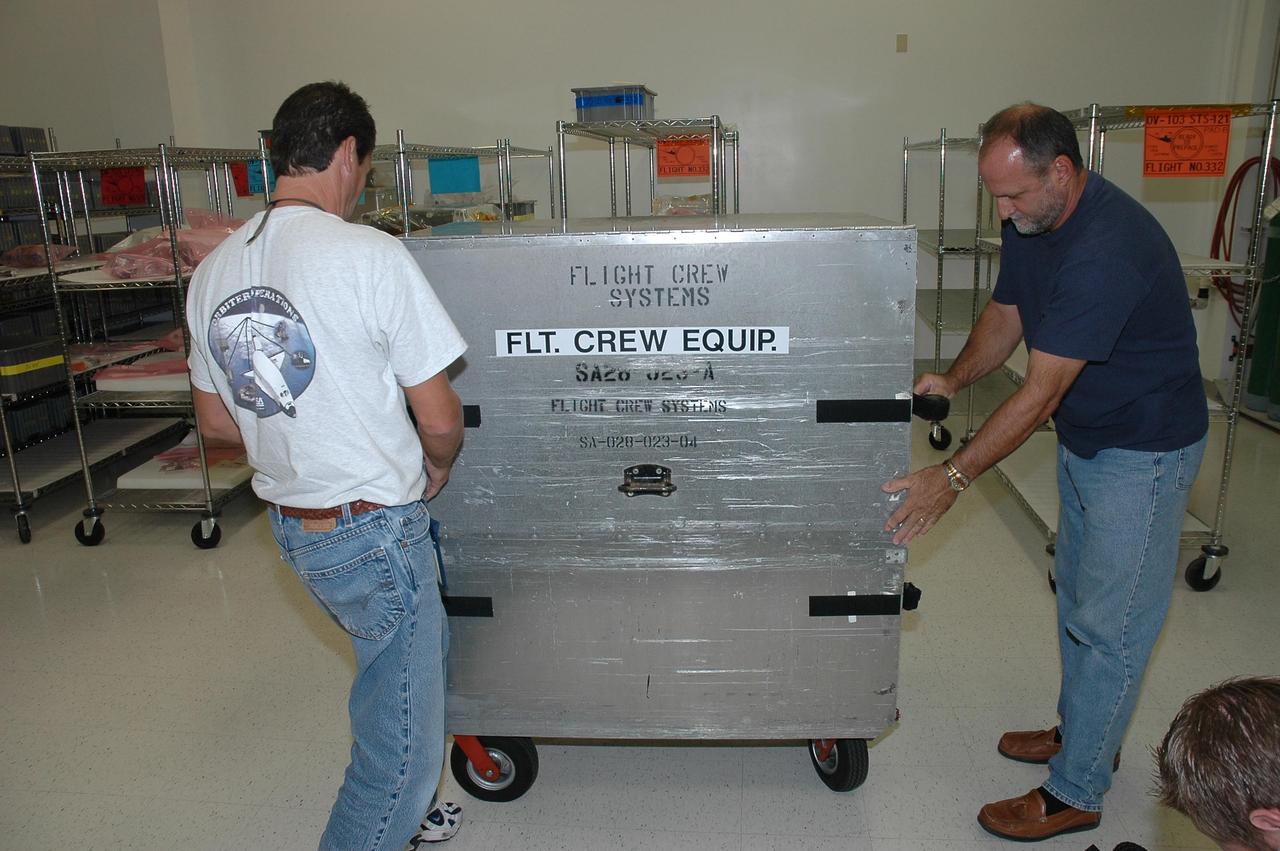
KENNEDY SPACE CENTER, FLA. - In the Space Station Processing Facility at NASA's Kennedy Space Center, flight crew systems technician Troy Mann and flight crew systems manager Jim Blake secure the storage boxes holding the food containers that will be stowed on Space Shuttle Discovery for the flight of mission STS-121. The containers hold meals prepared for the mission crew. Astronauts select their own menus from a large array of food items. Astronauts are supplied with three balanced meals, plus snacks. Foods flown on space missions are researched and developed at the Space Food Systems Laboratory at the Johnson Space Center (JSC) in Houston, which is staffed by food scientists, dietitians and engineers. Foods are analyzed through nutritional analysis, sensory evaluation, storage studies, packaging evaluations and many other methods. Each astronaut’s food is stored aboard the space shuttle and is identified by a colored dot affixed to each package. Launch of Space Shuttle Discovery on mission STS-121 is scheduled for July 1. Photo credit: NASA/Jack Pfaller
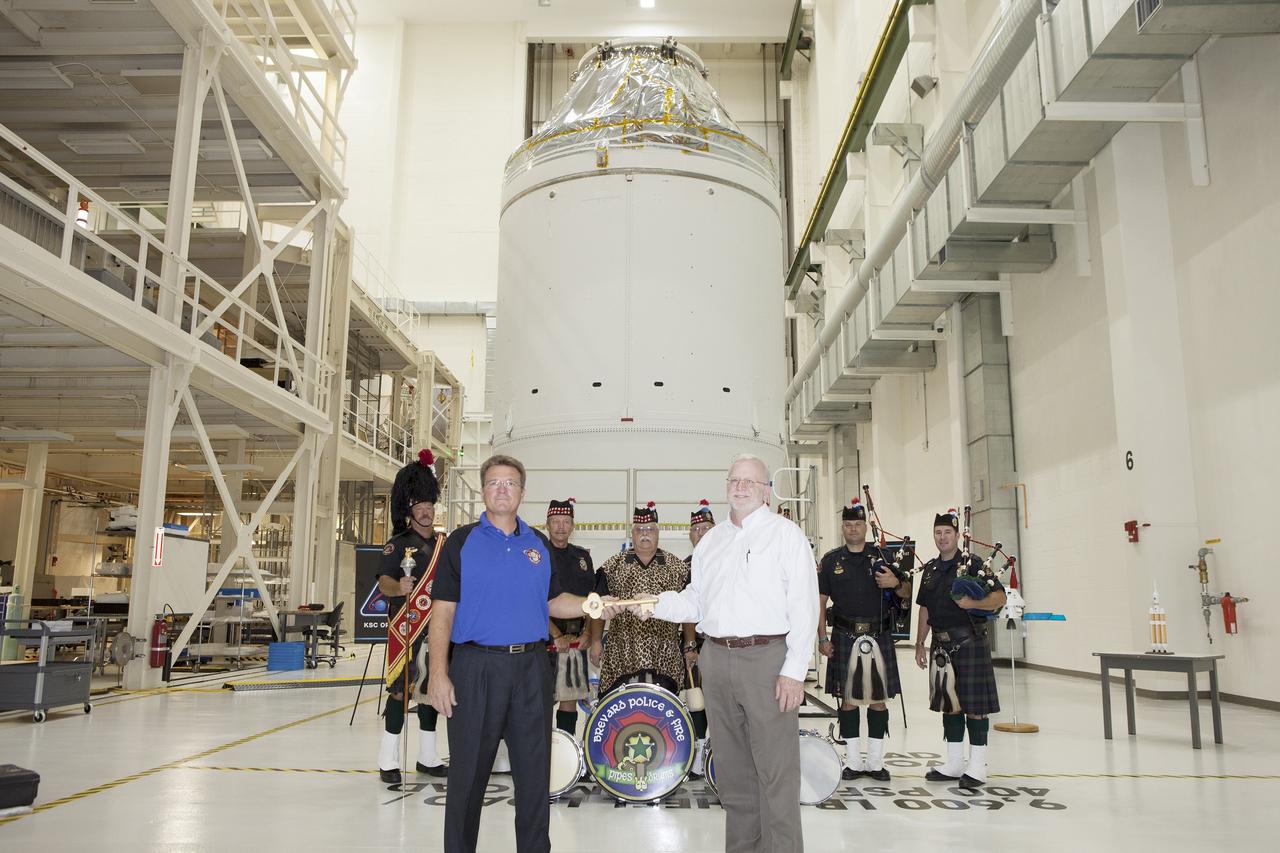
CAPE CANAVERAL, Fla. – During a ceremony inside the Neil Armstrong Operations and Checkout Building high bay at NASA's Kennedy Space Center in Florida, the Orion spacecraft for Exploration Flight Test-1 was officially turned over to Lockheed Martin Ground Operations from Orion Assembly, Integration and Production. Shaking hands during the turn over, are Jules Schneider, at left, Lockheed Martin Orion Production Operations manager, and Blake Hale, Lockheed Martin Ground Operations manager. Behind them are members of the Brevard Police and Fire Pipes and Drums. Orion is the exploration spacecraft designed to carry astronauts to destinations not yet explored by humans, including an asteroid and Mars. It will have emergency abort capability, sustain the crew during space travel and provide safe re-entry from deep space return velocities. The first unpiloted test flight of the Orion is scheduled to launch atop a United Launch Alliance Delta IV Heavy rocket from Cape Canaveral Air Force Station in Florida in December to an altitude of 3,600 miles above the Earth's surface. The two-orbit, four-hour flight test will help engineers evaluate the systems critical to crew safety including the heat shield, parachute system and launch abort system. For more information, visit http://www.nasa.gov/orion. Photo credit: NASA/Daniel Casper
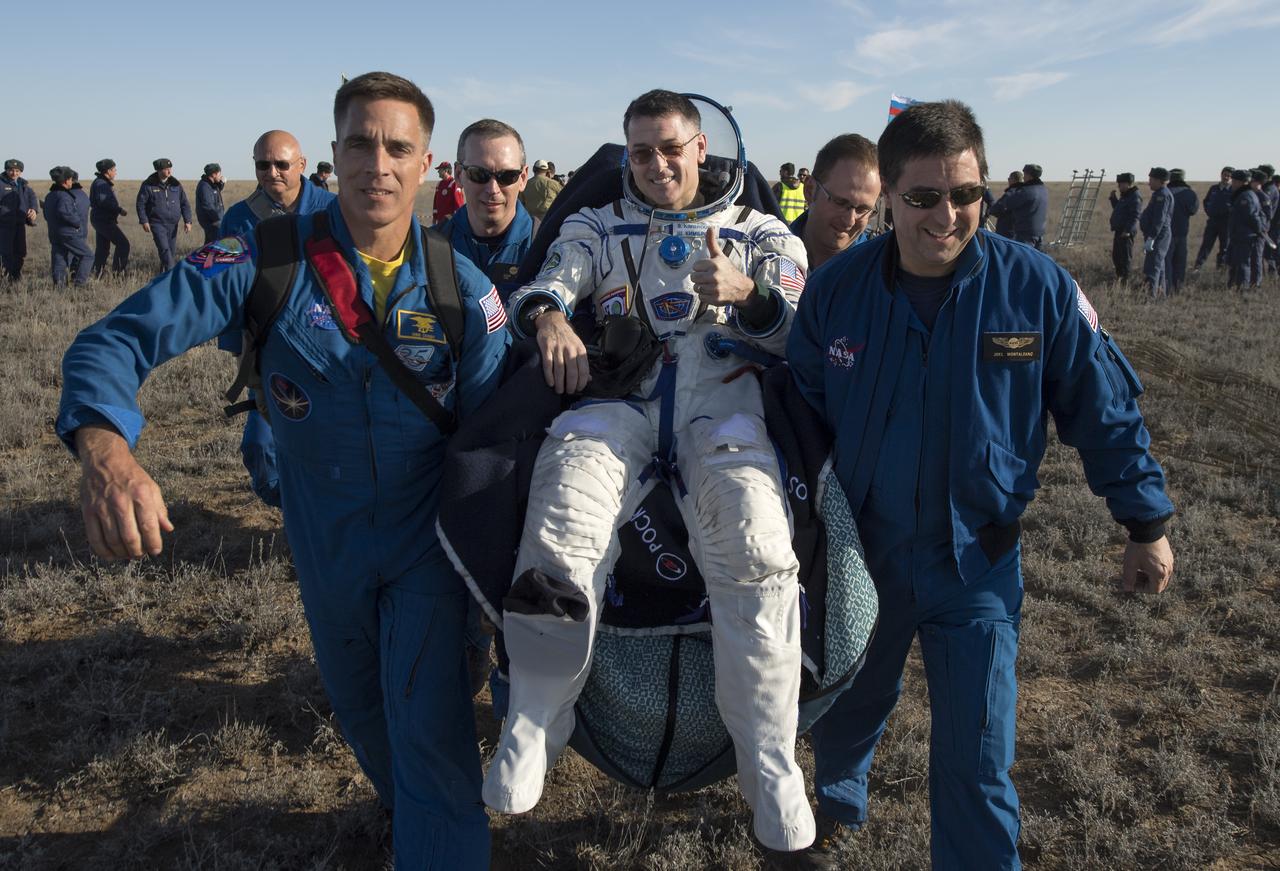
nhq201704100010 (April 10, 2017) --- NASA astronaut Shane Kimbrough is carried into a medical tent shortly after he, Russian cosmonaut Sergey Ryzhikov of Roscosmos, and Russian cosmonaut Andrey Borisenko of Roscosmos landed in their Soyuz MS-02 spacecraft in a remote area near the town of Zhezkazgan, Kazakhstan on Monday, April 10, 2017 (Kazakh time). Kimbrough, Ryzhikov, and Borisenko are returning after 173 days in space where they served as members of the Expedition 49 and 50 crews onboard the International Space Station. Photo Credit: (NASA/Bill Ingalls)
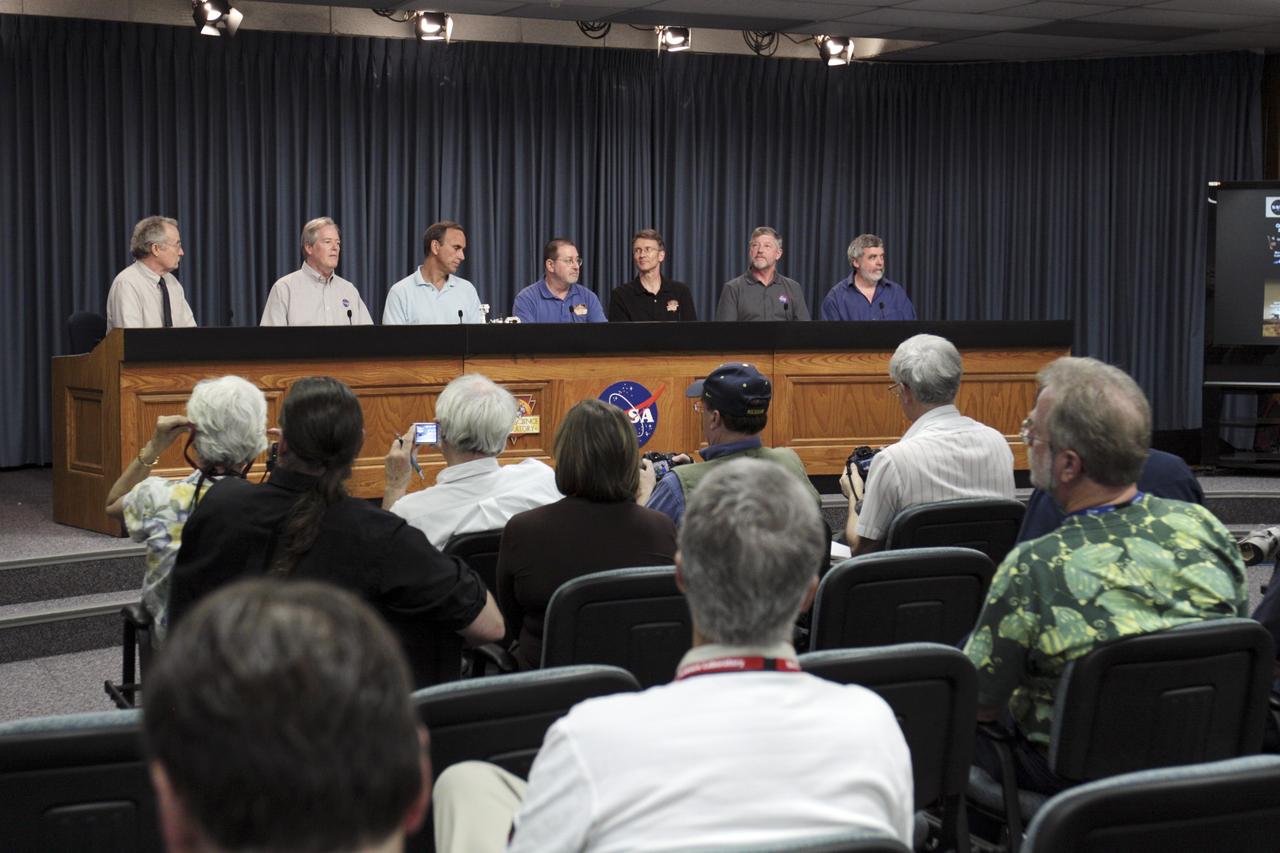
CAPE CANAVERAL, Fla. – NASA’s Kennedy Space Center in Florida is host to a Mars Science Laboratory (MSL) science briefing as part of preflight activities for the MSL mission. From left, NASA Public Affairs Officer Guy Webster moderates the conference featuring Michael Meyer, lead scientist for NASA Mars Exploration Program; John Grotzinger, project scientist for Mars Science Laboratory California Institute of Technology, Pasadena, Calif.; Michael Malin, principal investigator for the Mast Camera and Mars Descent Imager investigations on Curiosity, Malin Space Science Systems; Roger Wiens, principal investigator for Chemistry and Camera investigation on Curiosity, Los Alamos National Laboratory; David Blake, NASA principal investigator for Chemistry and Mineralogy investigation on Curiosity, NASA Ames Research Center; and Paul Mahaffy, NASA principal investigator for Sample Analysis at Mars investigation on Curiosity, NASA Goddard Space Flight Center. MSL’s components include a car-sized rover, Curiosity, which has 10 science instruments designed to search for signs of life, including methane, and help determine if the gas is from a biological or geological source. Launch of MSL aboard a United Launch Alliance Atlas V rocket is scheduled for Nov. 26 from Space Launch Complex 41 on Cape Canaveral Air Force Station in Florida. For more information, visit http://www.nasa.gov/msl. Photo credit: NASA/Kim Shiflett
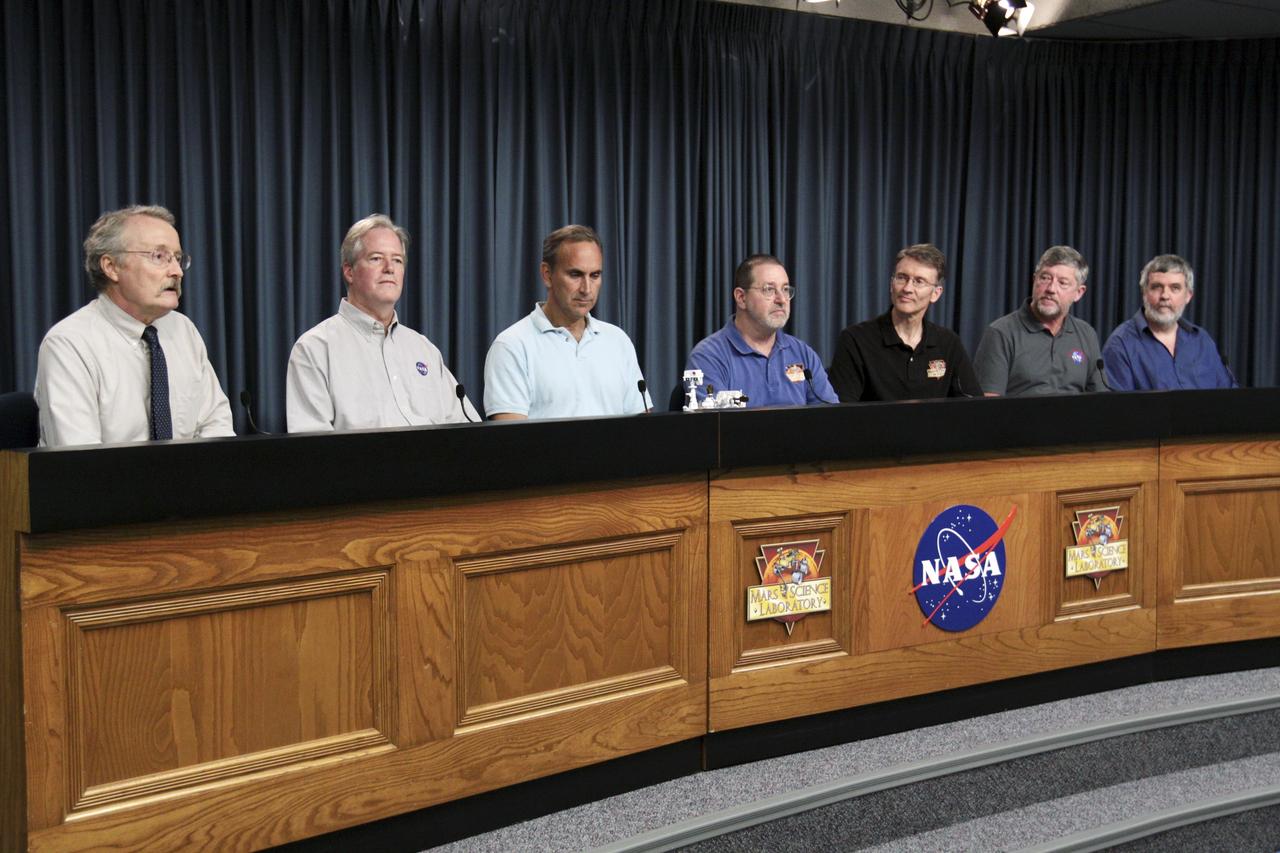
CAPE CANAVERAL, Fla. – NASA’s Kennedy Space Center in Florida is host to a Mars Science Laboratory (MSL) science briefing as part of preflight activities for the MSL mission. From left, NASA Public Affairs Officer Guy Webster moderates the conference featuring Michael Meyer, lead scientist for NASA Mars Exploration Program; John Grotzinger, project scientist for Mars Science Laboratory California Institute of Technology, Pasadena, Calif.; Michael Malin, principal investigator for the Mast Camera and Mars Descent Imager investigations on Curiosity, Malin Space Science Systems; Roger Wiens, principal investigator for Chemistry and Camera investigation on Curiosity, Los Alamos National Laboratory; David Blake, NASA principal investigator for Chemistry and Mineralogy investigation on Curiosity, NASA Ames Research Center; and Paul Mahaffy, NASA principal investigator for Sample Analysis at Mars investigation on Curiosity, NASA Goddard Space Flight Center. MSL’s components include a car-sized rover, Curiosity, which has 10 science instruments designed to search for signs of life, including methane, and help determine if the gas is from a biological or geological source. Launch of MSL aboard a United Launch Alliance Atlas V rocket is scheduled for Nov. 26 from Space Launch Complex 41 on Cape Canaveral Air Force Station in Florida. For more information, visit http://www.nasa.gov/msl. Photo credit: NASA/Kim Shiflett