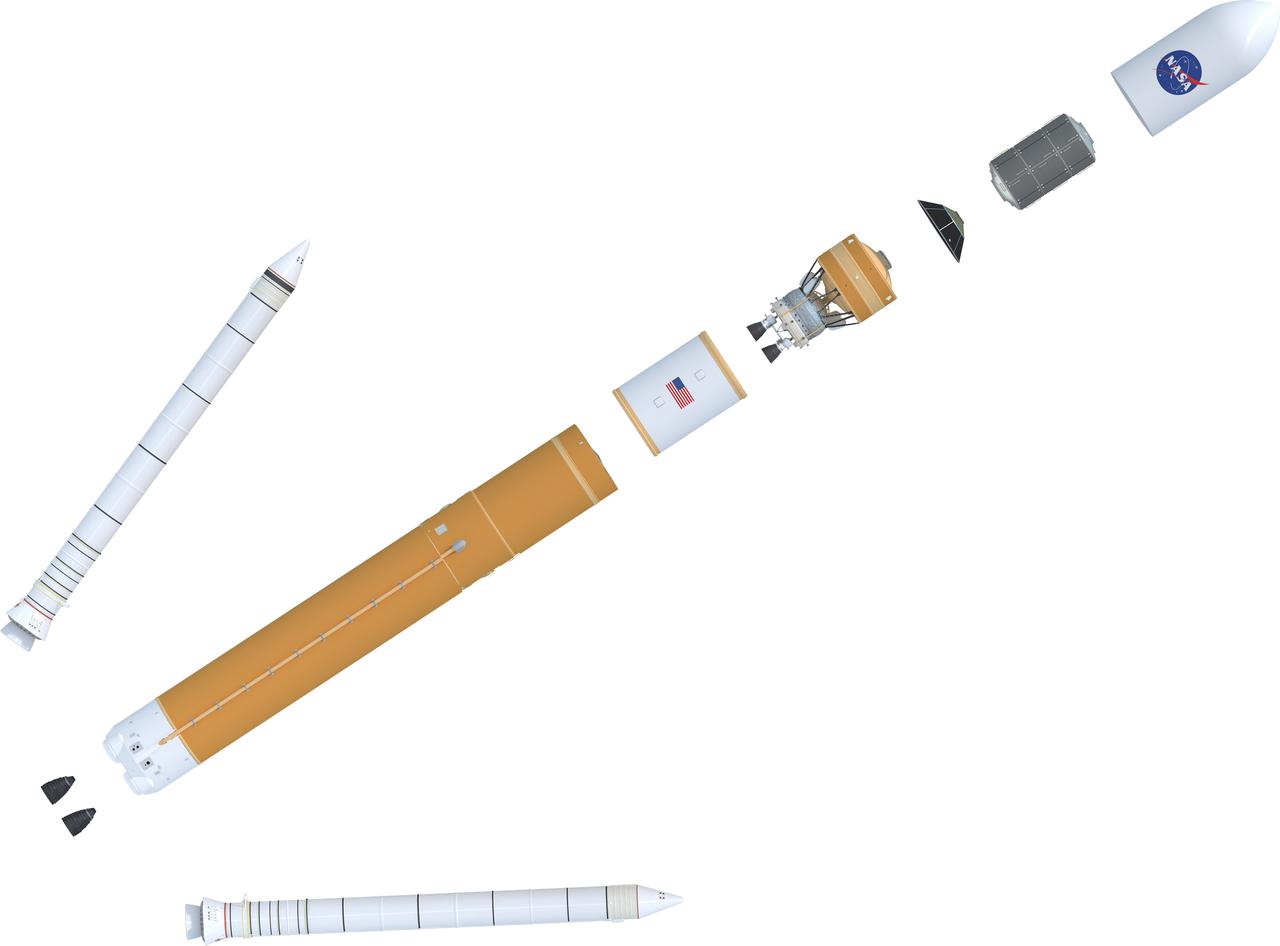
Expanded view illustration of elements of the evolved SLS Block 1B Crew variant. This configuration of the rocket, with the Exploration Upper Stage, will provide in-space propulsion to send astronauts in NASA’s Orion spacecraft and heavy cargo on a precise trajectory to the Moon. The evolution of the rocket to SLS Block 1B configuration with EUS enables SLS to launch 40% more cargo to the Moon along with the crew. Manufacturing both the core stage and Exploration Upper Stage is a collaborative effort between NASA and Boeing, the lead contractor for EUS and the SLS core stage. SLS is the only rocket that can send Orion, astronauts, and supplies to the Moon in a single mission. The SLS rocket, NASA’s Orion spacecraft, Gateway, and human landing system are part of NASA’s backbone for deep space exploration. Under the Artemis program, NASA is working to land the first woman and the next man on the Moon to pave the way for sustainable exploration at the Moon and future missions to Mars. (NASA)
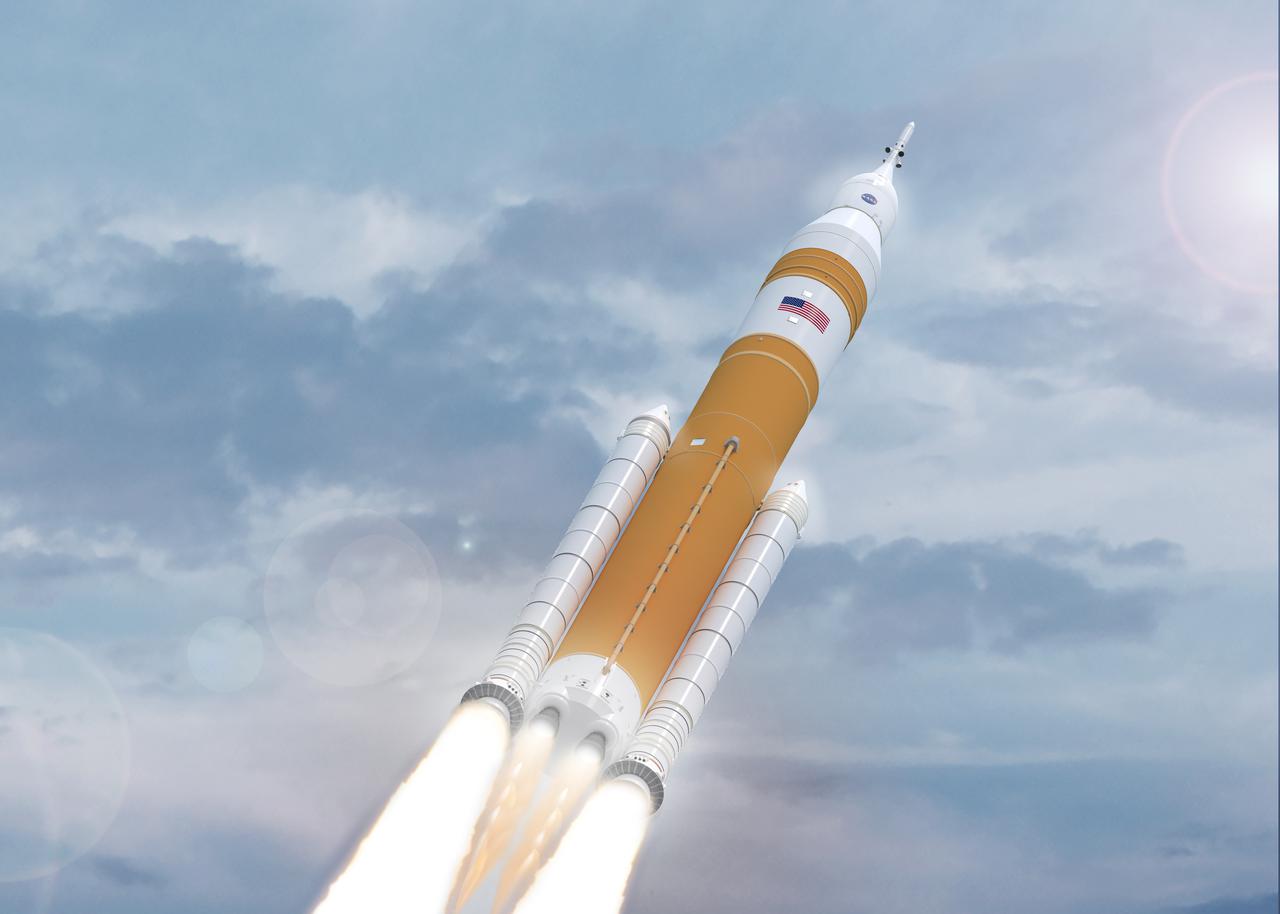
Illustration of evolved SLS Block 1B Crew variant in flight. This configuration of the rocket, with the Exploration Upper Stage, will provide in-space propulsion to send astronauts in NASA’s Orion spacecraft and heavy cargo on a precise trajectory to the Moon. The evolution of the rocket to SLS Block 1B configuration with EUS enables SLS to launch 40% more cargo to the Moon along with the crew. Manufacturing both the core stage and Exploration Upper Stage is a collaborative effort between NASA and Boeing, the lead contractor for EUS and the SLS core stage. SLS is the only rocket that can send Orion, astronauts, and supplies to the Moon in a single mission. The SLS rocket, NASA’s Orion spacecraft, Gateway, and human landing system are part of NASA’s backbone for deep space exploration. Under the Artemis program, NASA is working to land the first woman and the next man on the Moon to pave the way for sustainable exploration at the Moon and future missions to Mars. (NASA)
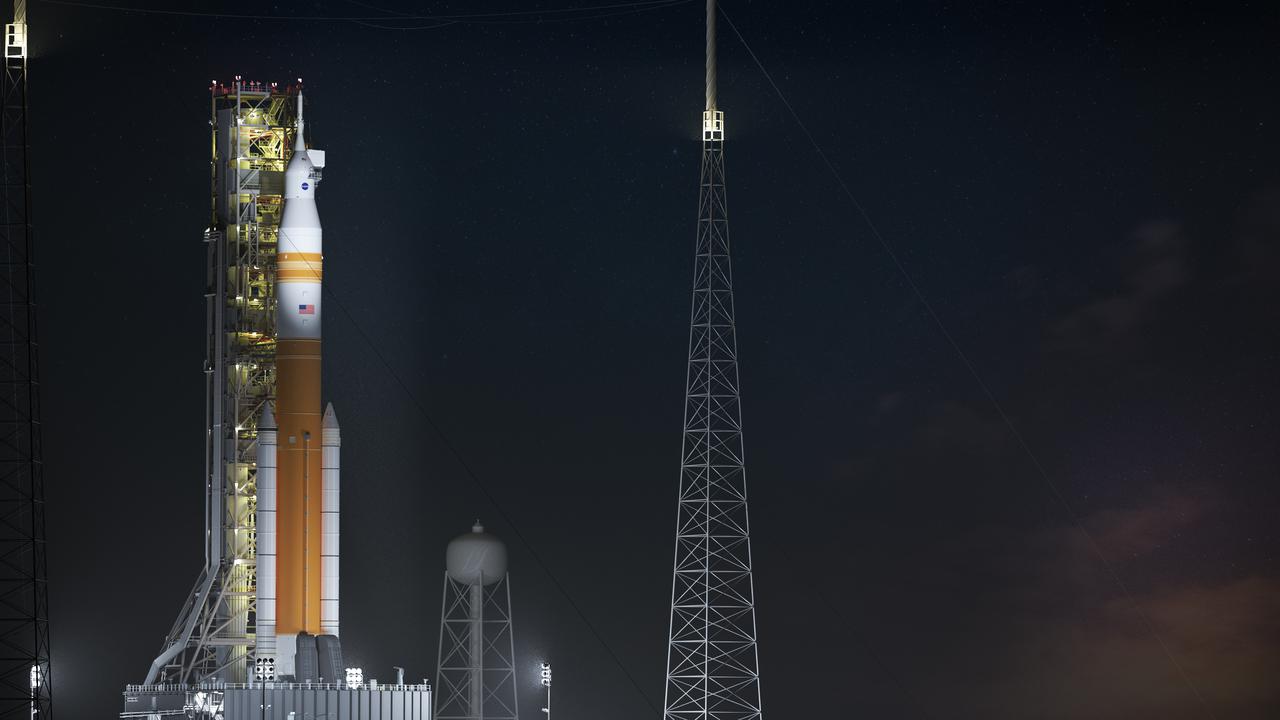
Illustration of nighttime scene of the evolved SLS Block 1B Crew variant on Pad 39B.. This configuration of the rocket, with the Exploration Upper Stage, will provide in-space propulsion to send astronauts in NASA’s Orion spacecraft and heavy cargo on a precise trajectory to the Moon. The evolution of the rocket to SLS Block 1B configuration with EUS enables SLS to launch 40% more cargo to the Moon along with the crew. Manufacturing both the core stage and Exploration Upper Stage is a collaborative effort between NASA and Boeing, the lead contractor for EUS and the SLS core stage. SLS is the only rocket that can send Orion, astronauts, and supplies to the Moon in a single mission. The SLS rocket, NASA’s Orion spacecraft, Gateway, and human landing system are part of NASA’s backbone for deep space exploration. Under the Artemis program, NASA is working to land the first woman and the next man on the Moon to pave the way for sustainable exploration at the Moon and future missions to Mars. (NASA)

Seen here, is a nighttime rendering of the evolved SLS Block 1B Crew variant positioned on the mobile launcher. This configuration of the rocket, with the Exploration Upper Stage, will provide in-space propulsion to send astronauts in NASA’s Orion spacecraft and heavy cargo on a precise trajectory to the Moon. The evolution of the rocket to SLS Block 1B configuration with EUS enables SLS to launch 40% more cargo to the Moon along with the crew. Manufacturing both the core stage and Exploration Upper Stage is a collaborative effort between NASA and Boeing, the lead contractor for EUS and the SLS core stage. SLS is the only rocket that can send Orion, astronauts, and supplies to the Moon in a single mission. The SLS rocket, NASA’s Orion spacecraft, Gateway, and human landing system are part of NASA’s backbone for deep space exploration. Under the Artemis program, NASA is working to land the first woman and the next man on the Moon to pave the way for sustainable exploration at the Moon and future missions to Mars. (NASA)

Illustration of the evolved SLS Block 1B Crew variant outer mold line. This configuration of the rocket, with the Exploration Upper Stage, will provide in-space propulsion to send astronauts in NASA’s Orion spacecraft and heavy cargo on a precise trajectory to the Moon. The evolution of the rocket to SLS Block 1B configuration with EUS enables SLS to launch 40% more cargo to the Moon along with the crew. Manufacturing both the core stage and Exploration Upper Stage is a collaborative effort between NASA and Boeing, the lead contractor for EUS and the SLS core stage. SLS is the only rocket that can send Orion, astronauts, and supplies to the Moon in a single mission. The SLS rocket, NASA’s Orion spacecraft, Gateway, and human landing system are part of NASA’s backbone for deep space exploration. Under the Artemis program, NASA is working to land the first woman and the next man on the Moon to pave the way for sustainable exploration at the Moon and future missions to Mars. (NASA)
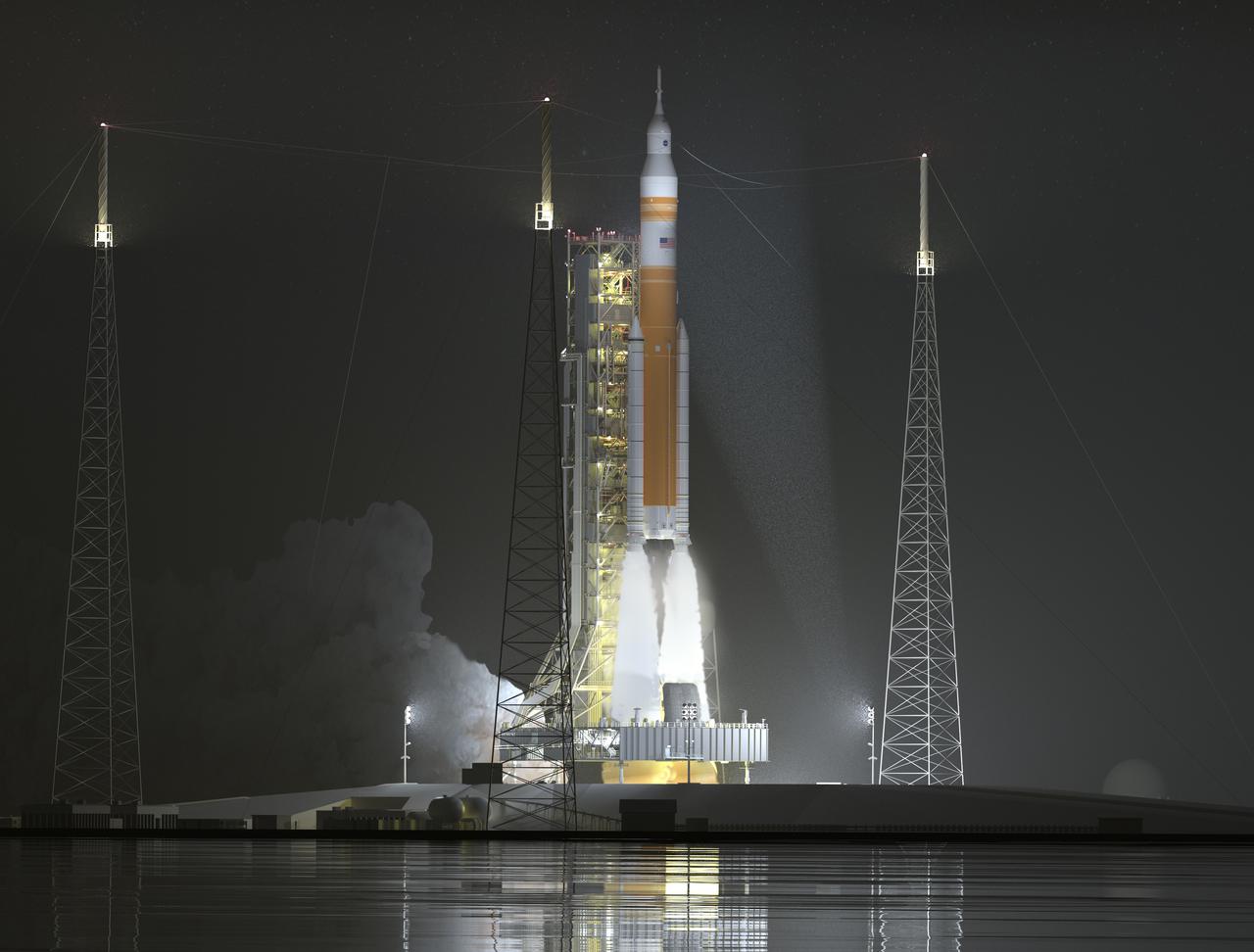
Illustration of the evolved SLS Block 1B Crew variant night launch. This configuration of the rocket, with the Exploration Upper Stage, will provide in-space propulsion to send astronauts in NASA’s Orion spacecraft and heavy cargo on a precise trajectory to the Moon. The evolution of the rocket to SLS Block 1B configuration with EUS enables SLS to launch 40% more cargo to the Moon along with the crew. Manufacturing both the core stage and Exploration Upper Stage is a collaborative effort between NASA and Boeing, the lead contractor for EUS and the SLS core stage. SLS is the only rocket that can send Orion, astronauts, and supplies to the Moon in a single mission. The SLS rocket, NASA’s Orion spacecraft, Gateway, and human landing system are part of NASA’s backbone for deep space exploration. Under the Artemis program, NASA is working to land the first woman and the next man on the Moon to pave the way for sustainable exploration at the Moon and future missions to Mars. (NASA) In album: B1B_Crew_SLS
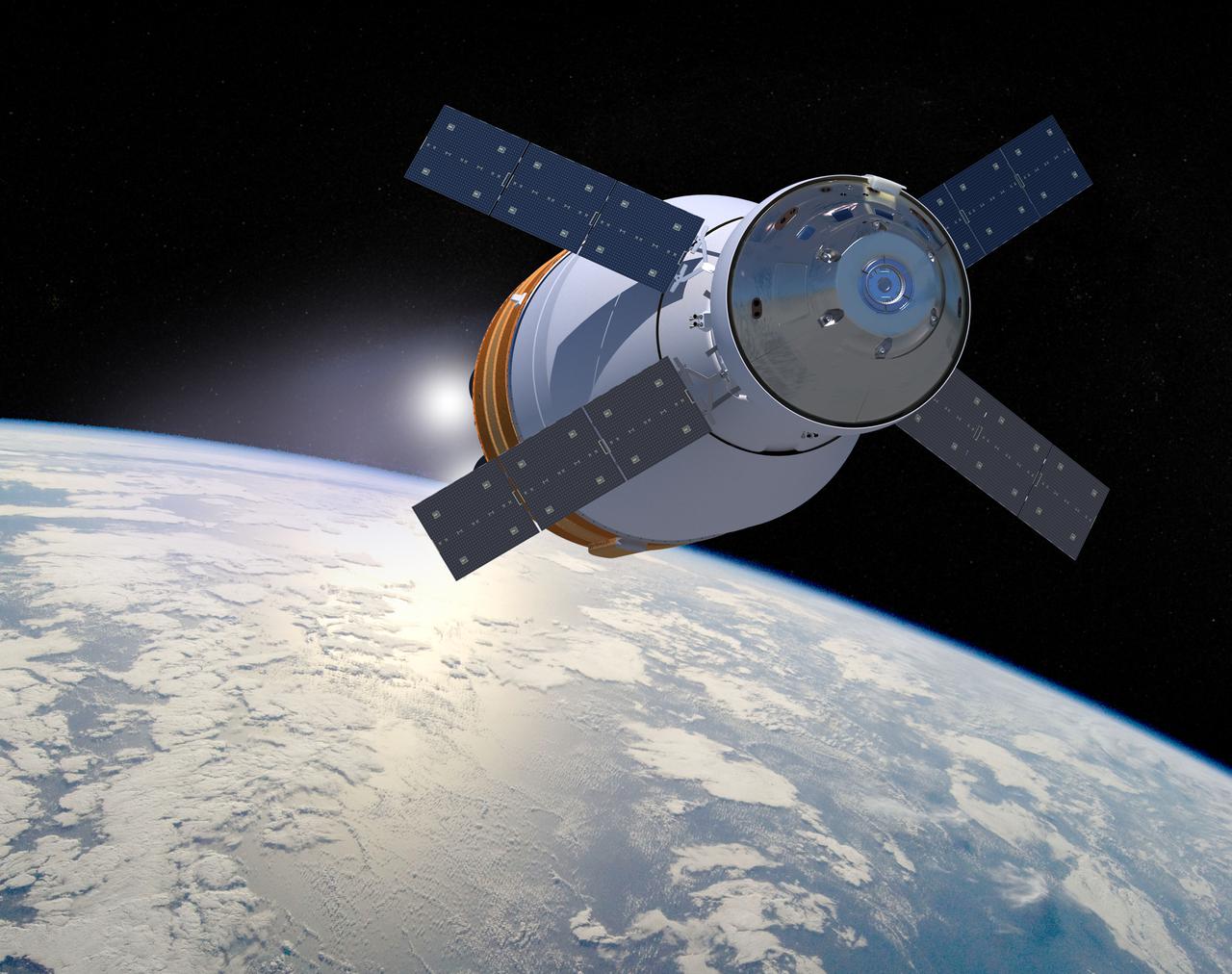
Seen here is an image of the SLS Exploration Upper Stage with the Orion Space craft on its way to a deep space mission. The Exploration Upper Stage will be used on the second configuration of the SLS rocket, known as Block 1B, and will provide in-space propulsion to send astronauts in NASA’s Orion spacecraft and heavy cargo on a precise trajectory to the Moon. The evolution of the rocket to SLS Block 1B configuration with EUS enables SLS to launch 40% more cargo to the Moon along with the crew. Manufacturing both the core stage and Exploration Upper Stage is a collaborative effort between NASA and Boeing, the lead contractor for EUS and the SLS core stage. SLS is the only rocket that can send Orion, astronauts, and supplies to the Moon in a single mission. The SLS rocket, NASA’s Orion spacecraft, Gateway, and human landing system are part of NASA’s backbone for deep space exploration. Under the Artemis program, NASA is working to land the first woman and the next man on the Moon to pave the way for sustainable exploration at the Moon and future missions to Mars. (NASA)

Illustration of the SLS Exploration Upper Stage, or EUS. This configuration of the rocket, with the Exploration Upper Stage, will provide in-space propulsion to send astronauts in NASA’s Orion spacecraft and heavy cargo on a precise trajectory to the Moon. The evolution of the rocket to SLS Block 1B configuration with EUS enables SLS to launch 40% more cargo to the Moon along with the crew. Manufacturing both the core stage and Exploration Upper Stage is a collaborative effort between NASA and Boeing, the lead contractor for EUS and the SLS core stage. SLS is the only rocket that can send Orion, astronauts, and supplies to the Moon in a single mission. The SLS rocket, NASA’s Orion spacecraft, Gateway, and human landing system are part of NASA’s backbone for deep space exploration. Under the Artemis program, NASA is working to land the first woman and the next man on the Moon to pave the way for sustainable exploration at the Moon and future missions to Mars. (NASA)
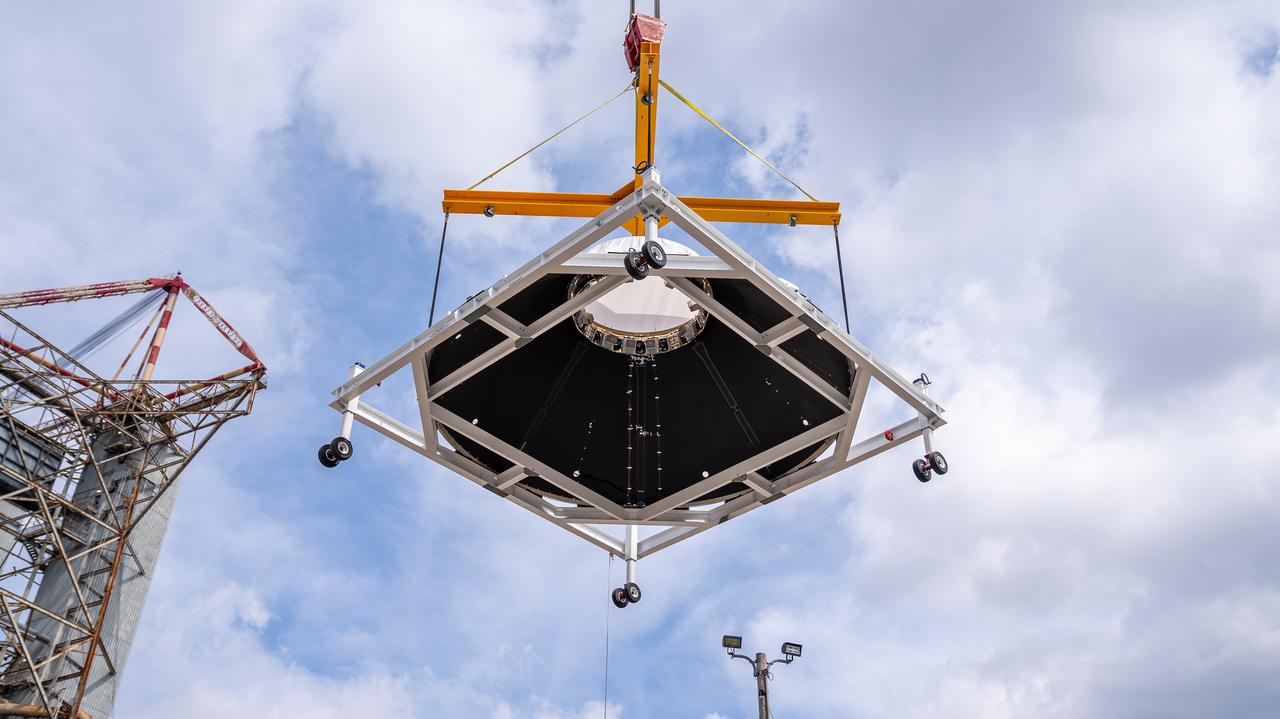
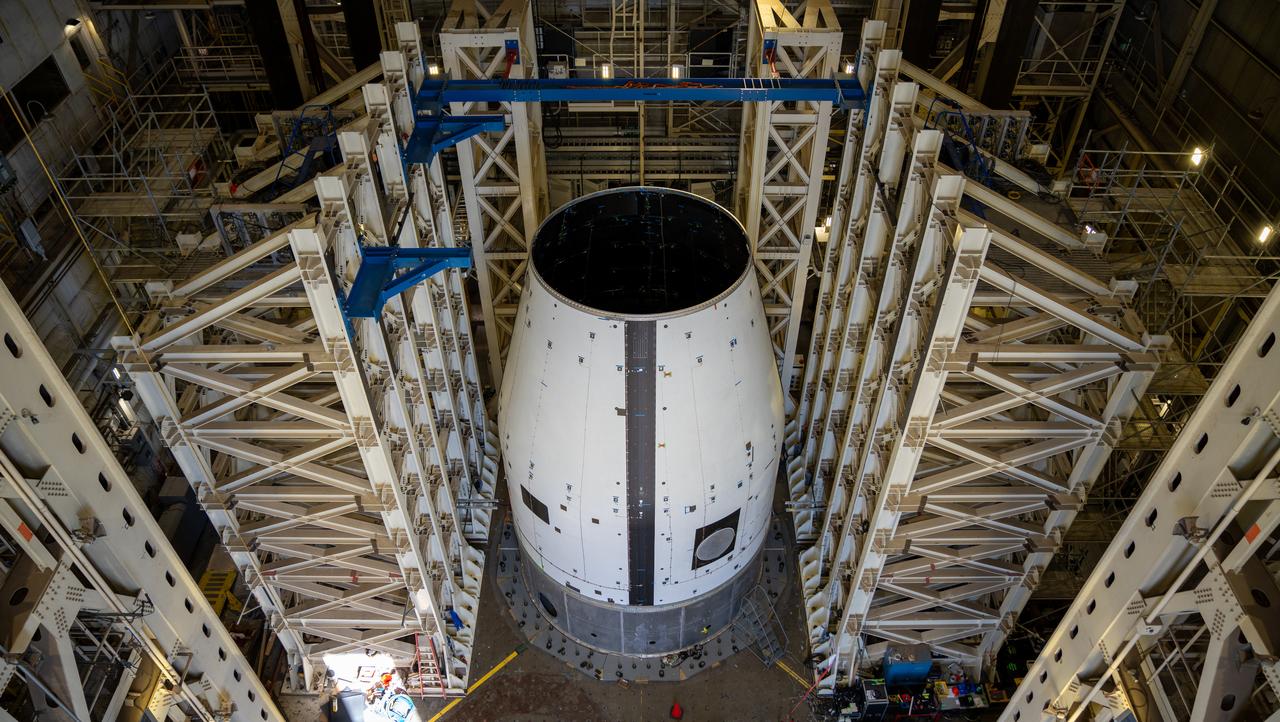
Crews at NASA’s Marshall Space Flight Center in Huntsville, Alabama, moved and installed the payload adapter that will be used in the Block 1B configuration of the SLS (Space Launch System) rocket from Building 4708, where it was manufactured, into Structural Test Stand 4697 at NASA’s Marshall Space Flight Center on March 13.

Illustration of the SLS Exploration Upper Stage, or EUS. The Exploration Upper Stage will be used on the second configuration of the SLS rocket, known as Block 1B, and will provide in-space propulsion to send astronauts in NASA’s Orion spacecraft and heavy cargo on a precise trajectory to the Moon. The evolution of the rocket to SLS Block 1B configuration with EUS enables SLS to launch 40% more cargo to the Moon along with the crew. Manufacturing both the core stage and Exploration Upper Stage is a collaborative effort between NASA and Boeing, the lead contractor for EUS and the SLS core stage. SLS is the only rocket that can send Orion, astronauts, and supplies to the Moon in a single mission. The SLS rocket, NASA’s Orion spacecraft, Gateway, and human landing system are part of NASA’s backbone for deep space exploration. Under the Artemis program, NASA is working to land the first woman and the next man on the Moon to pave the way for sustainable exploration at the Moon and future missions to Mars. (NASA)
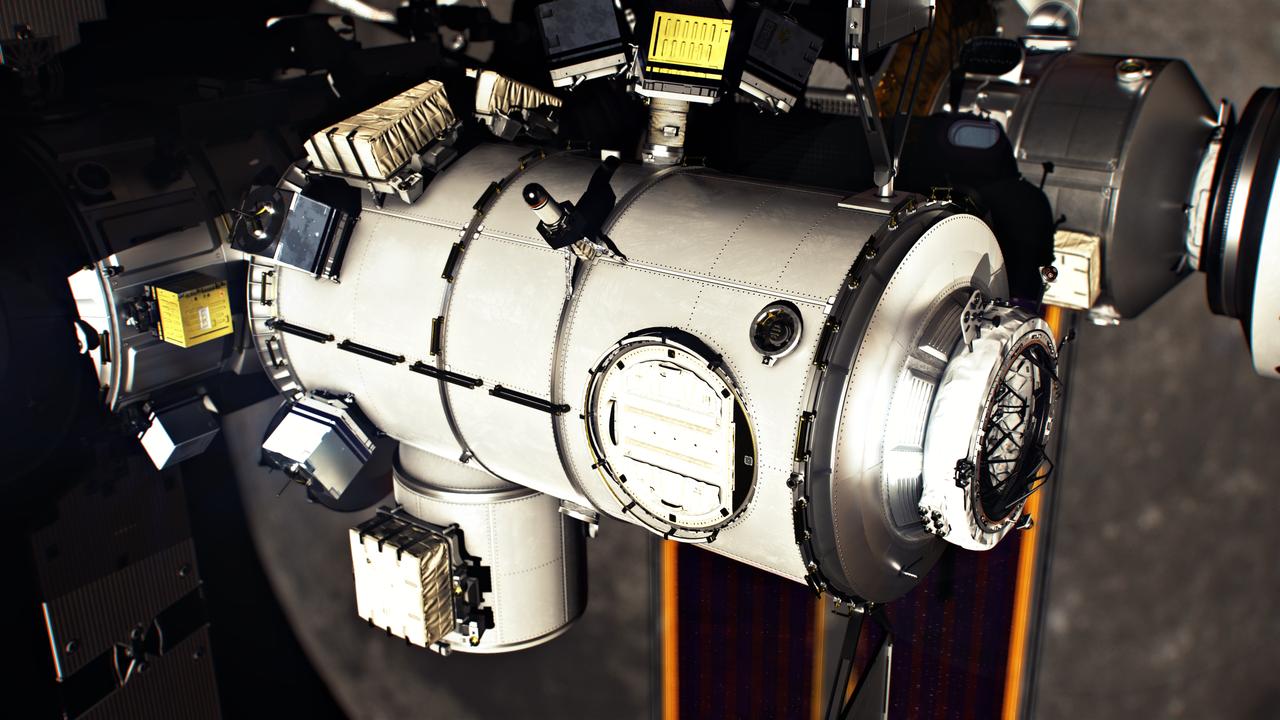
A close-up of a government-reference airlock module for the Gateway Space Station. Mission planning calls for an airlock to be delivered and integrated to Gateway by the crewed Orion spacecraft on the Artemis VI mission after launching on a Space Launch System (SLS) Block 1B rocket.
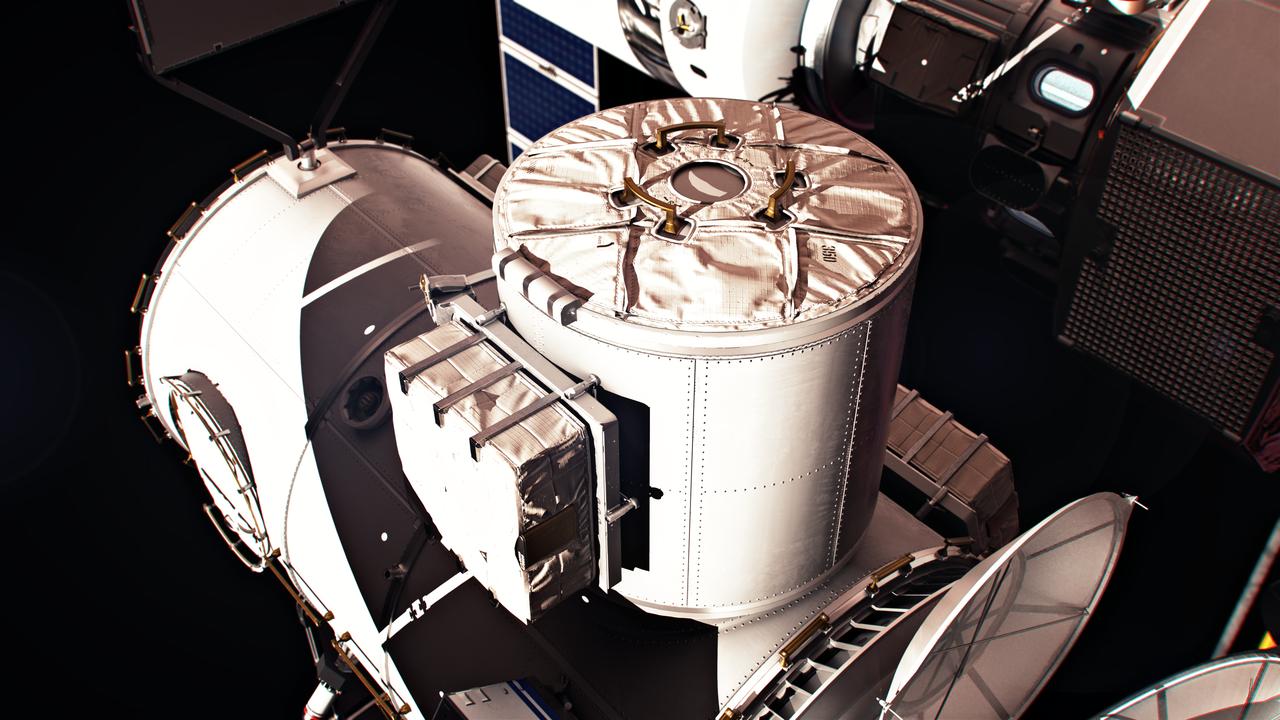
A close-up of a government-reference airlock module for the Gateway Space Station. Mission planning calls for an airlock to be delivered and integrated to Gateway by the crewed Orion spacecraft on the Artemis VI mission after launching on a Space Launch System (SLS) Block 1B rocket.
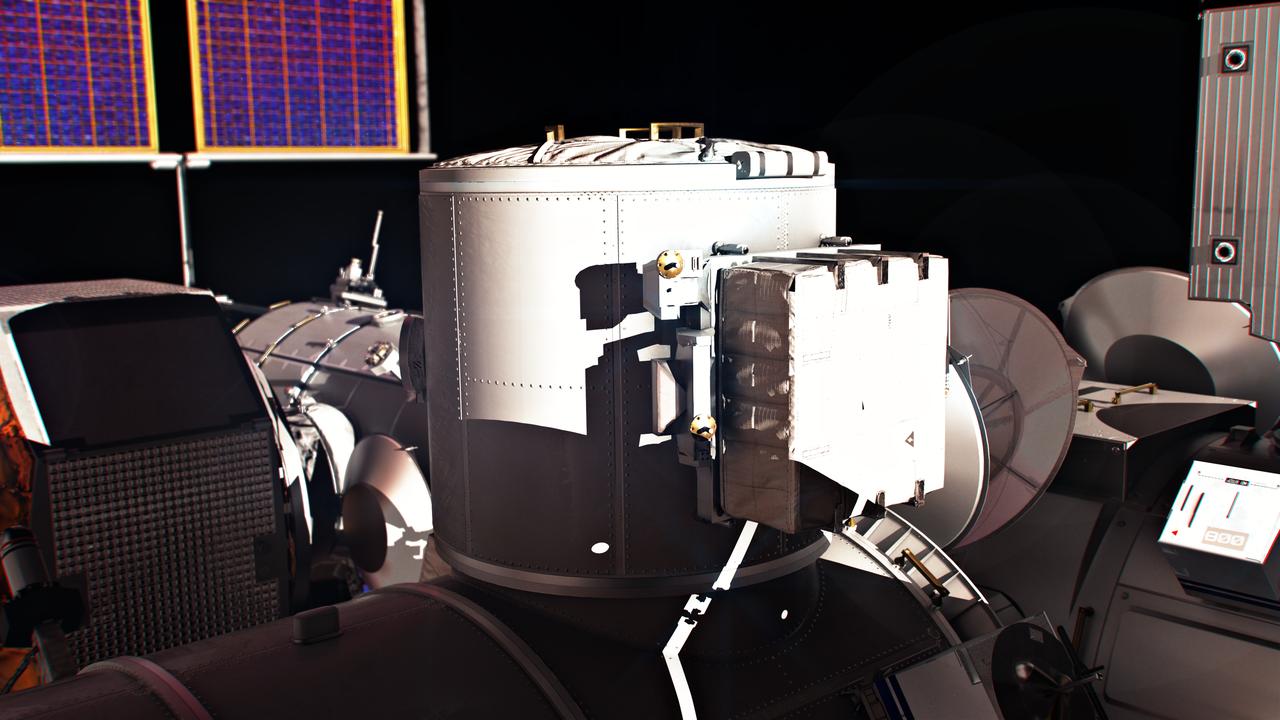
A close-up of a government-reference airlock module for the Gateway Space Station. Mission planning calls for an airlock to be delivered and integrated to Gateway by the crewed Orion spacecraft on the Artemis VI mission after launching on a Space Launch System (SLS) Block 1B rocket.
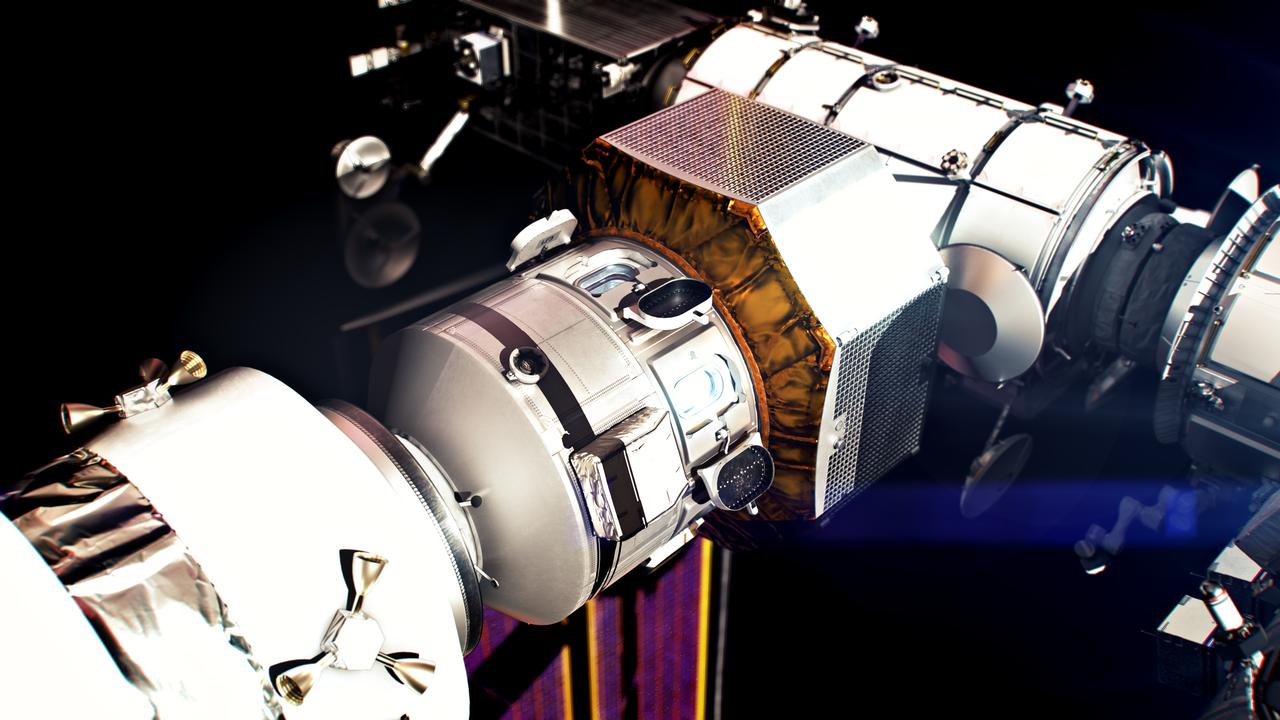
Gateway's ESPRIT Refueling Module, or ERM, will provide refueling capabilities for the space station, cargo storage, and windows for stunning views of the Earth, Moon and deep space. ERM will be delivered to Gateway by the crewed Orion spacecraft on the Artemis V mission after launching on an Space Launch System (SLS) Block 1B rocket.
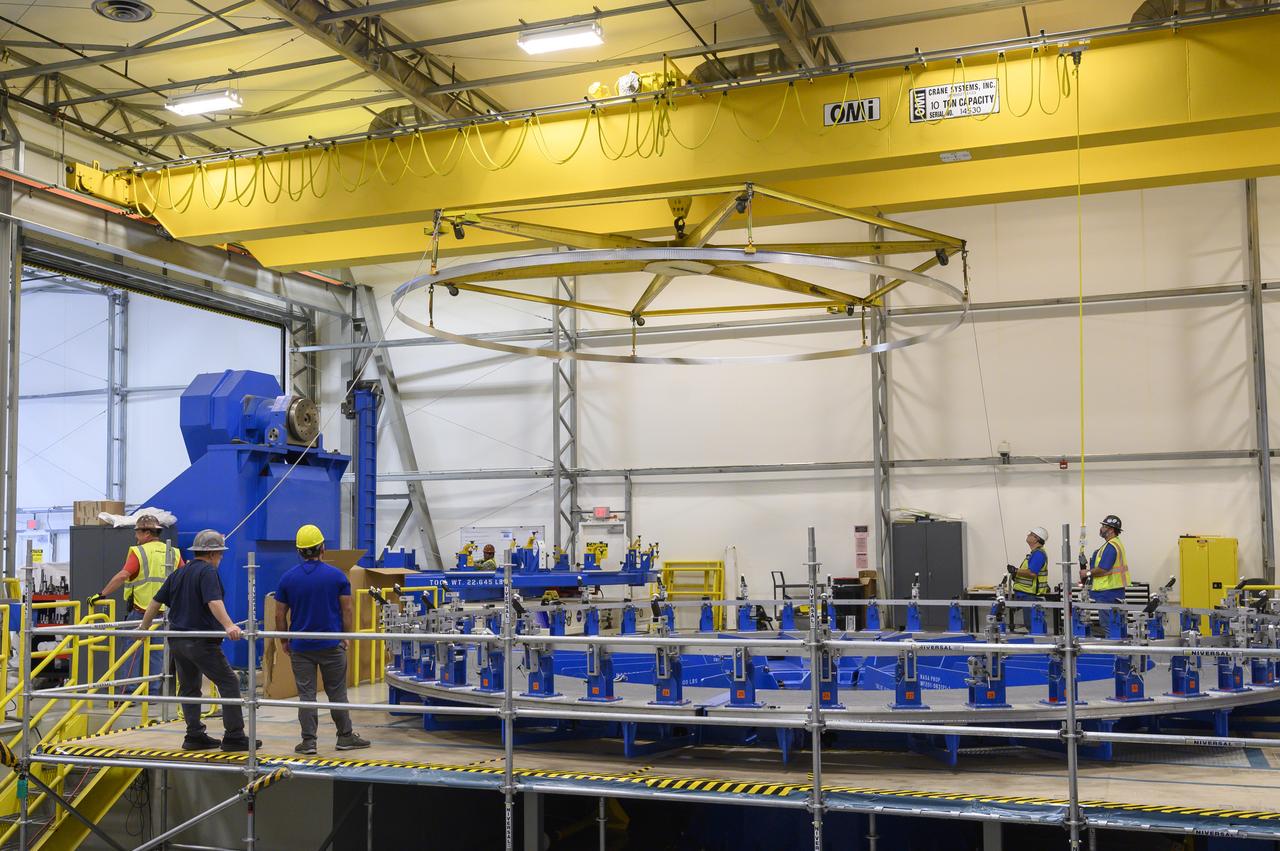
Technicians at NASA’s Michoud Assembly Facility in New Orleans lift a ring for the Exploration Upper Stage (EUS) of the SLS (Space Launch System) rocket to move it to another location in the 43-acre factory for further inspection and production. Flight hardware of the SLS EUS, a more powerful in-space propulsion stage beginning with Artemis IV, is in early production at Michoud. The rings make up the barrel sections for the flight hardware. The Exploration Upper Stage will be used on the second configuration of the SLS rocket, known as Block 1B, and will provide in-space propulsion to send astronauts in NASA’s Orion spacecraft and heavy cargo on a precise trajectory to the Moon. EUS will replace the interim cryogenic propulsion stage for the Block 1 configuration of SLS. It has larger propellant tanks and four RL10 engines, enabling SLS to launch 40% more cargo to the Moon along with crew. NASA and Boeing, the SLS lead contractor for the core stage and EUS, are currently manufacturing stages for Artemis II, III, IV, and V at the factory. NASA is working to land the first woman and first person of color on the Moon under Artemis. SLS is part of NASA’s backbone for deep space exploration, along with Orion and the Gateway in orbit around the Moon. SLS is the only rocket that can send Orion, astronauts, and supplies to the Moon in a single mission.
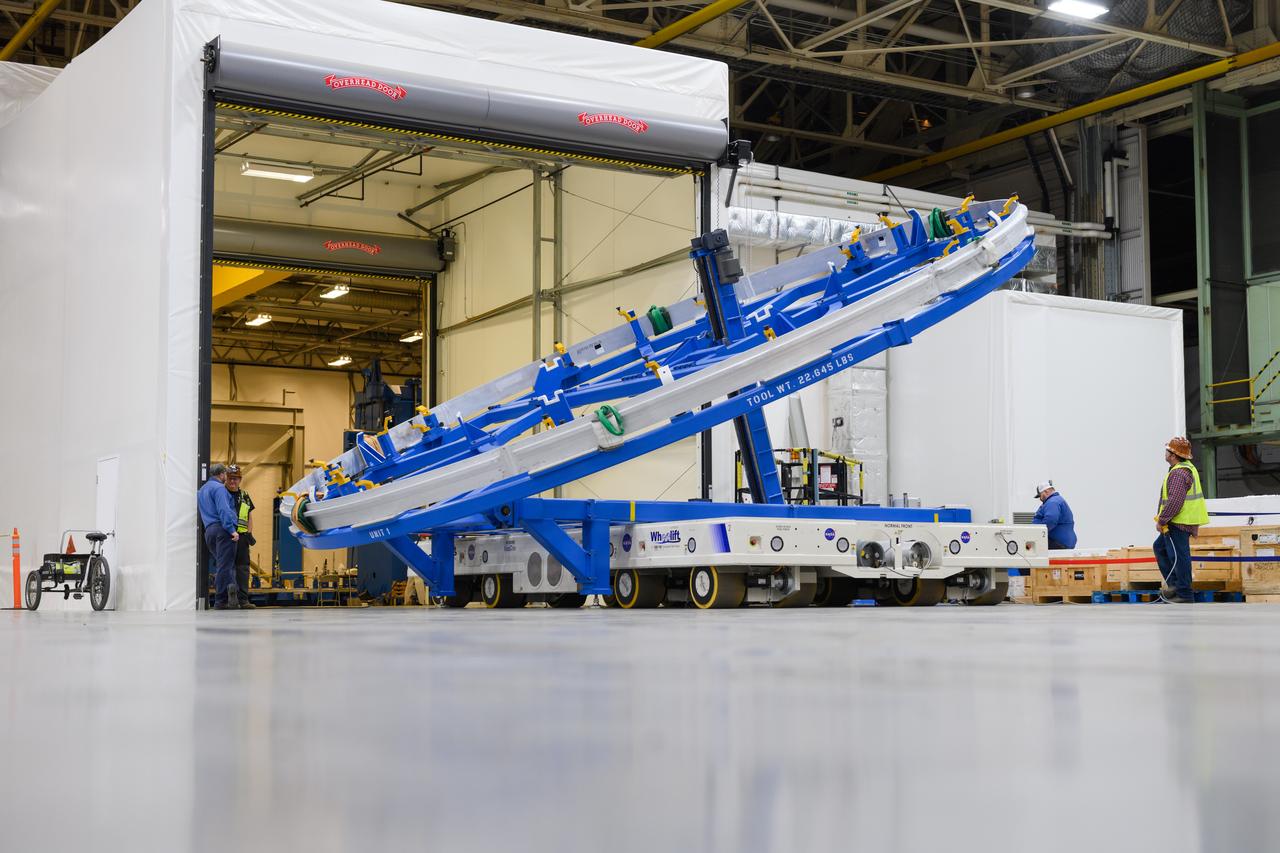
Technicians at NASA’s Michoud Assembly Facility in New Orleans lift a ring for the Exploration Upper Stage (EUS) of the SLS (Space Launch System) rocket to move it to another location in the 43-acre factory for further inspection and production. Flight hardware of the SLS EUS, a more powerful in-space propulsion stage beginning with Artemis IV, is in early production at Michoud. The rings make up the barrel sections for the flight hardware. The Exploration Upper Stage will be used on the second configuration of the SLS rocket, known as Block 1B, and will provide in-space propulsion to send astronauts in NASA’s Orion spacecraft and heavy cargo on a precise trajectory to the Moon. EUS will replace the interim cryogenic propulsion stage for the Block 1 configuration of SLS. It has larger propellant tanks and four RL10 engines, enabling SLS to launch 40% more cargo to the Moon along with crew. NASA and Boeing, the SLS lead contractor for the core stage and EUS, are currently manufacturing stages for Artemis II, III, IV, and V at the factory. NASA is working to land the first woman and first person of color on the Moon under Artemis. SLS is part of NASA’s backbone for deep space exploration, along with Orion and the Gateway in orbit around the Moon. SLS is the only rocket that can send Orion, astronauts, and supplies to the Moon in a single mission.
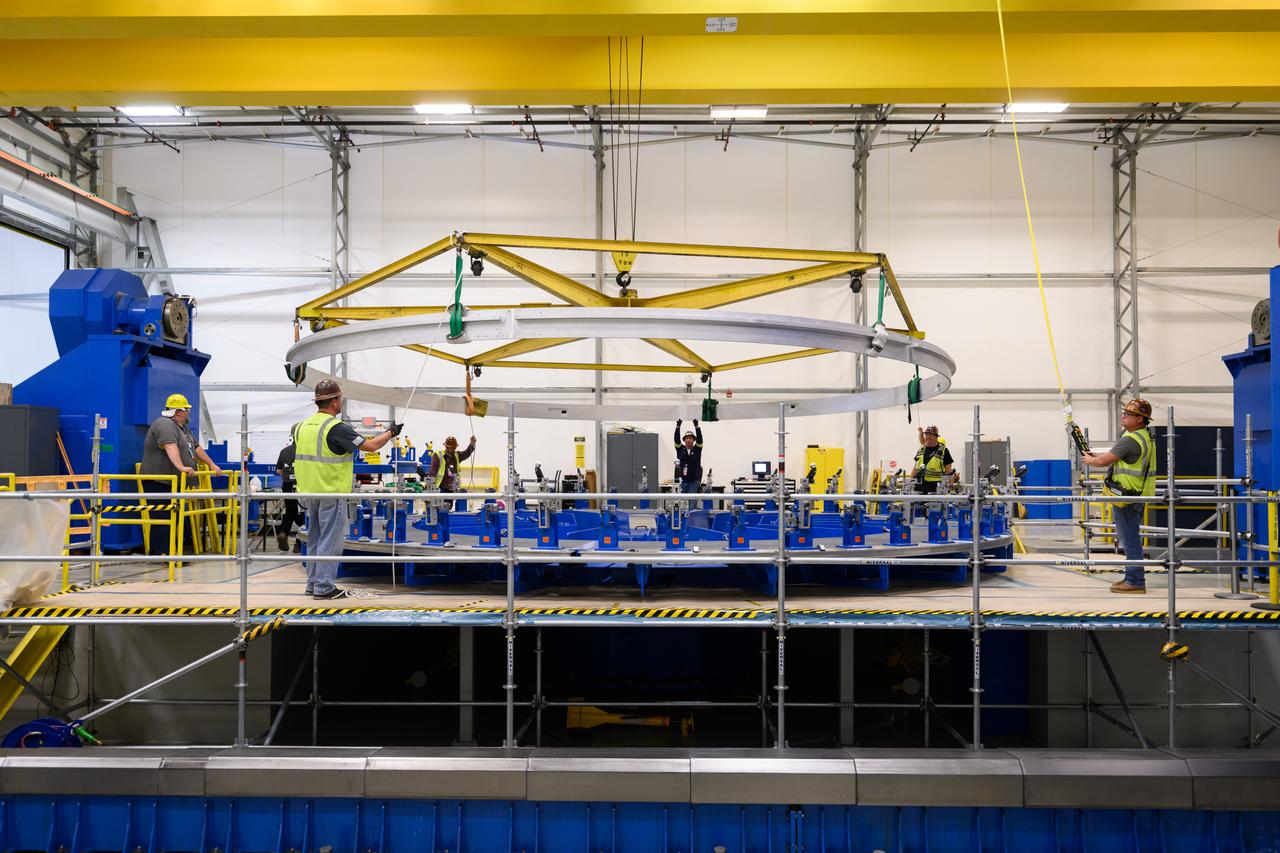
Technicians at NASA’s Michoud Assembly Facility in New Orleans lift a ring for the Exploration Upper Stage (EUS) of the SLS (Space Launch System) rocket to move it to another location in the 43-acre factory for further inspection and production. Flight hardware of the SLS EUS, a more powerful in-space propulsion stage beginning with Artemis IV, is in early production at Michoud. The rings make up the barrel sections for the flight hardware. The Exploration Upper Stage will be used on the second configuration of the SLS rocket, known as Block 1B, and will provide in-space propulsion to send astronauts in NASA’s Orion spacecraft and heavy cargo on a precise trajectory to the Moon. EUS will replace the interim cryogenic propulsion stage for the Block 1 configuration of SLS. It has larger propellant tanks and four RL10 engines, enabling SLS to launch 40% more cargo to the Moon along with crew. NASA and Boeing, the SLS lead contractor for the core stage and EUS, are currently manufacturing stages for Artemis II, III, IV, and V at the factory. NASA is working to land the first woman and first person of color on the Moon under Artemis. SLS is part of NASA’s backbone for deep space exploration, along with Orion and the Gateway in orbit around the Moon. SLS is the only rocket that can send Orion, astronauts, and supplies to the Moon in a single mission.
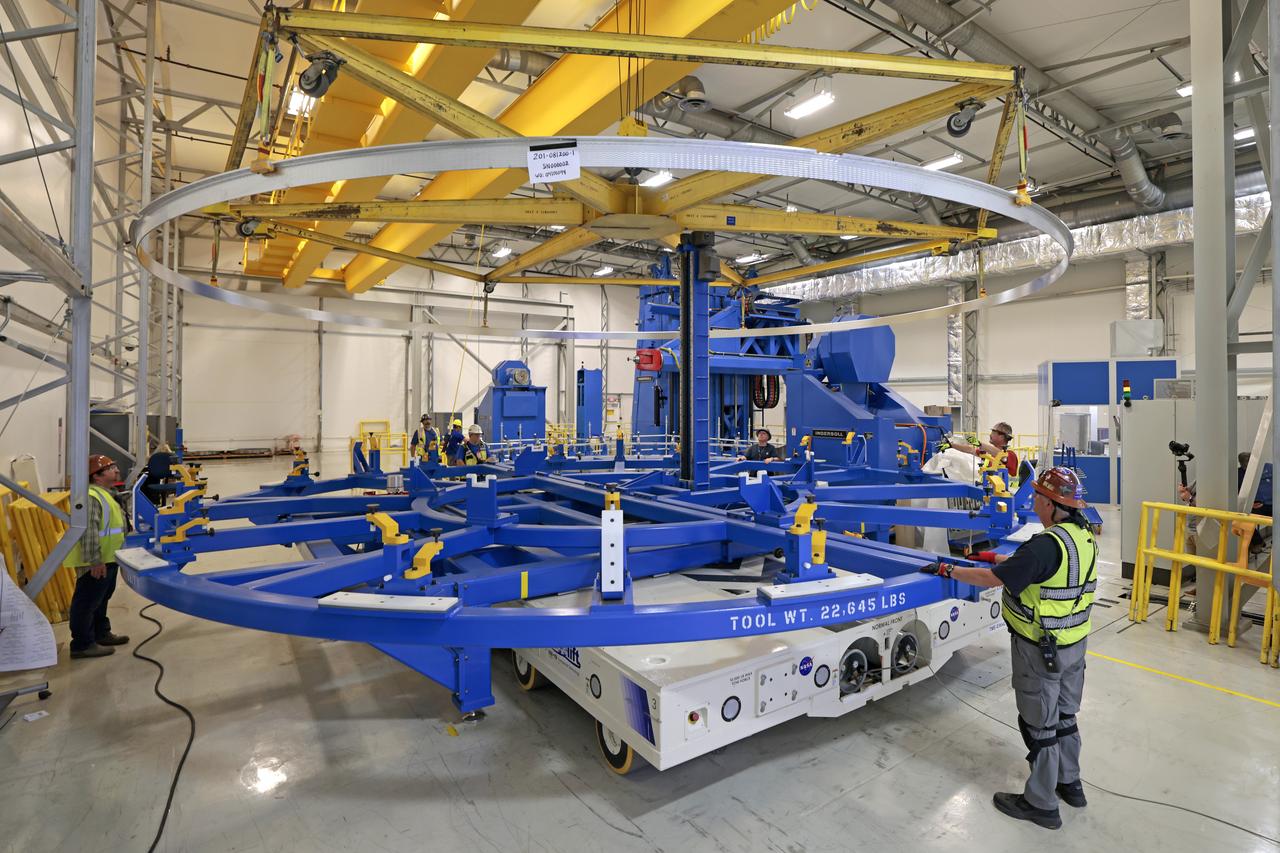
Technicians at NASA’s Michoud Assembly Facility in New Orleans lift a ring for the Exploration Upper Stage (EUS) of the SLS (Space Launch System) rocket to move it to another location in the 43-acre factory for further inspection and production. Flight hardware of the SLS EUS, a more powerful in-space propulsion stage beginning with Artemis IV, is in early production at Michoud. The rings make up the barrel sections for the flight hardware. The Exploration Upper Stage will be used on the second configuration of the SLS rocket, known as Block 1B, and will provide in-space propulsion to send astronauts in NASA’s Orion spacecraft and heavy cargo on a precise trajectory to the Moon. EUS will replace the interim cryogenic propulsion stage for the Block 1 configuration of SLS. It has larger propellant tanks and four RL10 engines, enabling SLS to launch 40% more cargo to the Moon along with crew. NASA and Boeing, the SLS lead contractor for the core stage and EUS, are currently manufacturing stages for Artemis II, III, IV, and V at the factory. NASA is working to land the first woman and first person of color on the Moon under Artemis. SLS is part of NASA’s backbone for deep space exploration, along with Orion and the Gateway in orbit around the Moon. SLS is the only rocket that can send Orion, astronauts, and supplies to the Moon in a single mission.
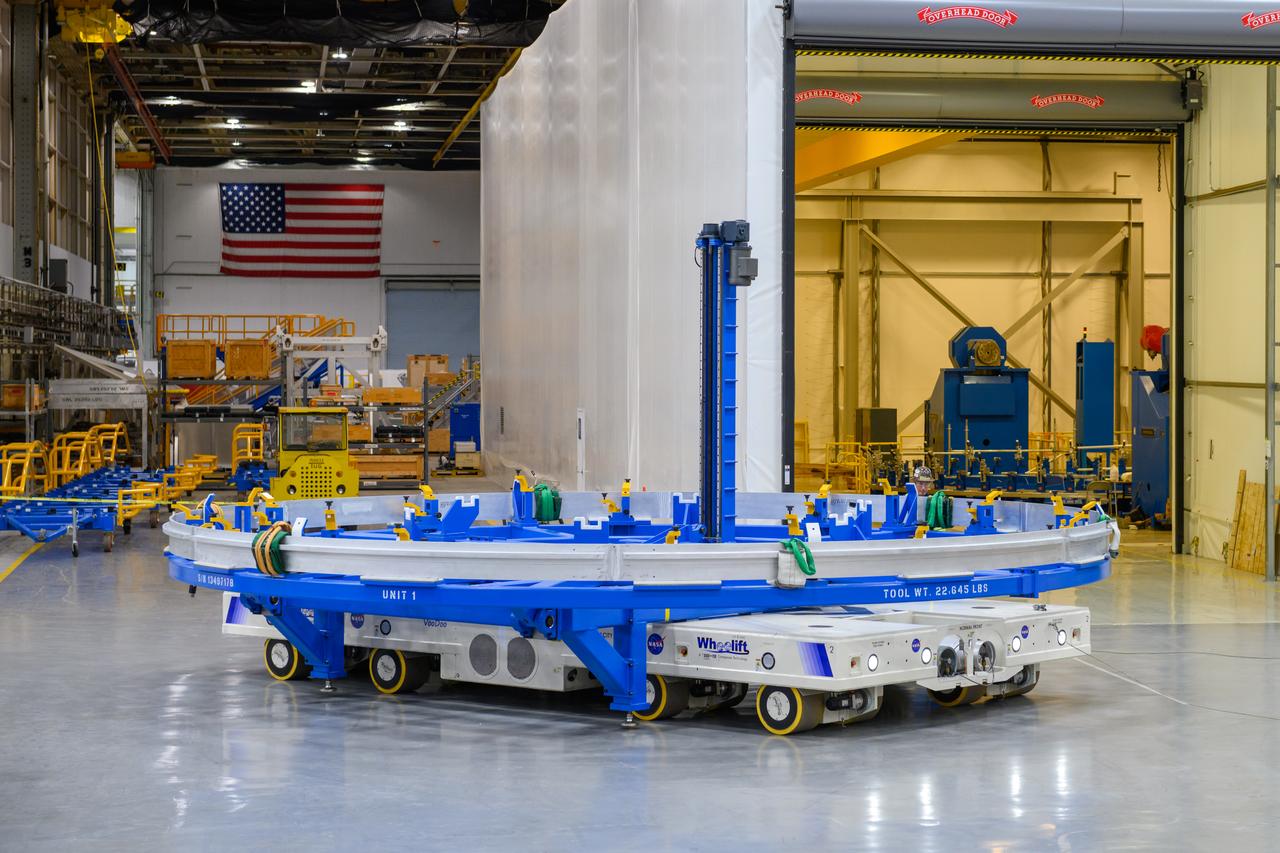
Technicians at NASA’s Michoud Assembly Facility in New Orleans lift a ring for the Exploration Upper Stage (EUS) of the SLS (Space Launch System) rocket to move it to another location in the 43-acre factory for further inspection and production. Flight hardware of the SLS EUS, a more powerful in-space propulsion stage beginning with Artemis IV, is in early production at Michoud. The rings make up the barrel sections for the flight hardware. The Exploration Upper Stage will be used on the second configuration of the SLS rocket, known as Block 1B, and will provide in-space propulsion to send astronauts in NASA’s Orion spacecraft and heavy cargo on a precise trajectory to the Moon. EUS will replace the interim cryogenic propulsion stage for the Block 1 configuration of SLS. It has larger propellant tanks and four RL10 engines, enabling SLS to launch 40% more cargo to the Moon along with crew. NASA and Boeing, the SLS lead contractor for the core stage and EUS, are currently manufacturing stages for Artemis II, III, IV, and V at the factory. NASA is working to land the first woman and first person of color on the Moon under Artemis. SLS is part of NASA’s backbone for deep space exploration, along with Orion and the Gateway in orbit around the Moon. SLS is the only rocket that can send Orion, astronauts, and supplies to the Moon in a single mission.
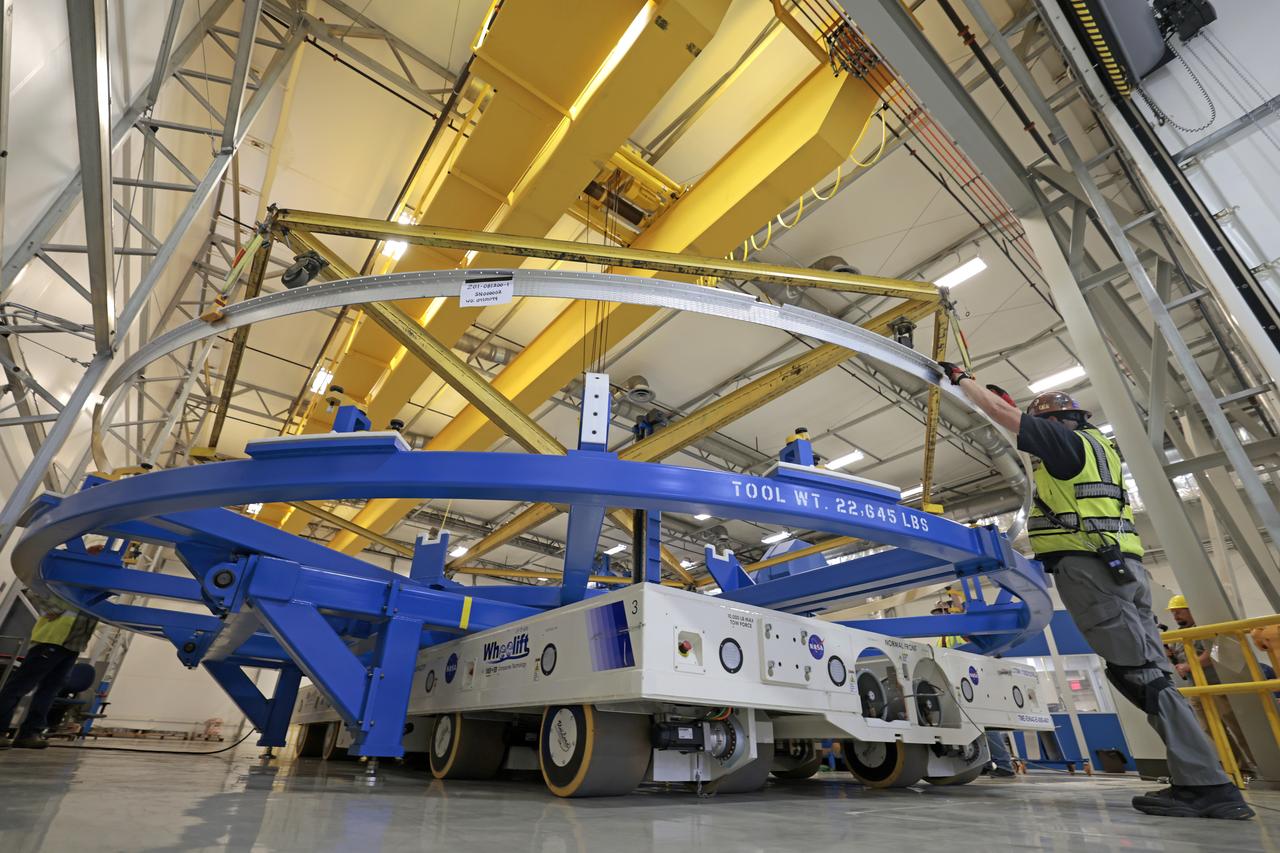
Technicians at NASA’s Michoud Assembly Facility in New Orleans lift a ring for the Exploration Upper Stage (EUS) of the SLS (Space Launch System) rocket to move it to another location in the 43-acre factory for further inspection and production. Flight hardware of the SLS EUS, a more powerful in-space propulsion stage beginning with Artemis IV, is in early production at Michoud. The rings make up the barrel sections for the flight hardware. The Exploration Upper Stage will be used on the second configuration of the SLS rocket, known as Block 1B, and will provide in-space propulsion to send astronauts in NASA’s Orion spacecraft and heavy cargo on a precise trajectory to the Moon. EUS will replace the interim cryogenic propulsion stage for the Block 1 configuration of SLS. It has larger propellant tanks and four RL10 engines, enabling SLS to launch 40% more cargo to the Moon along with crew. NASA and Boeing, the SLS lead contractor for the core stage and EUS, are currently manufacturing stages for Artemis II, III, IV, and V at the factory. NASA is working to land the first woman and first person of color on the Moon under Artemis. SLS is part of NASA’s backbone for deep space exploration, along with Orion and the Gateway in orbit around the Moon. SLS is the only rocket that can send Orion, astronauts, and supplies to the Moon in a single mission.
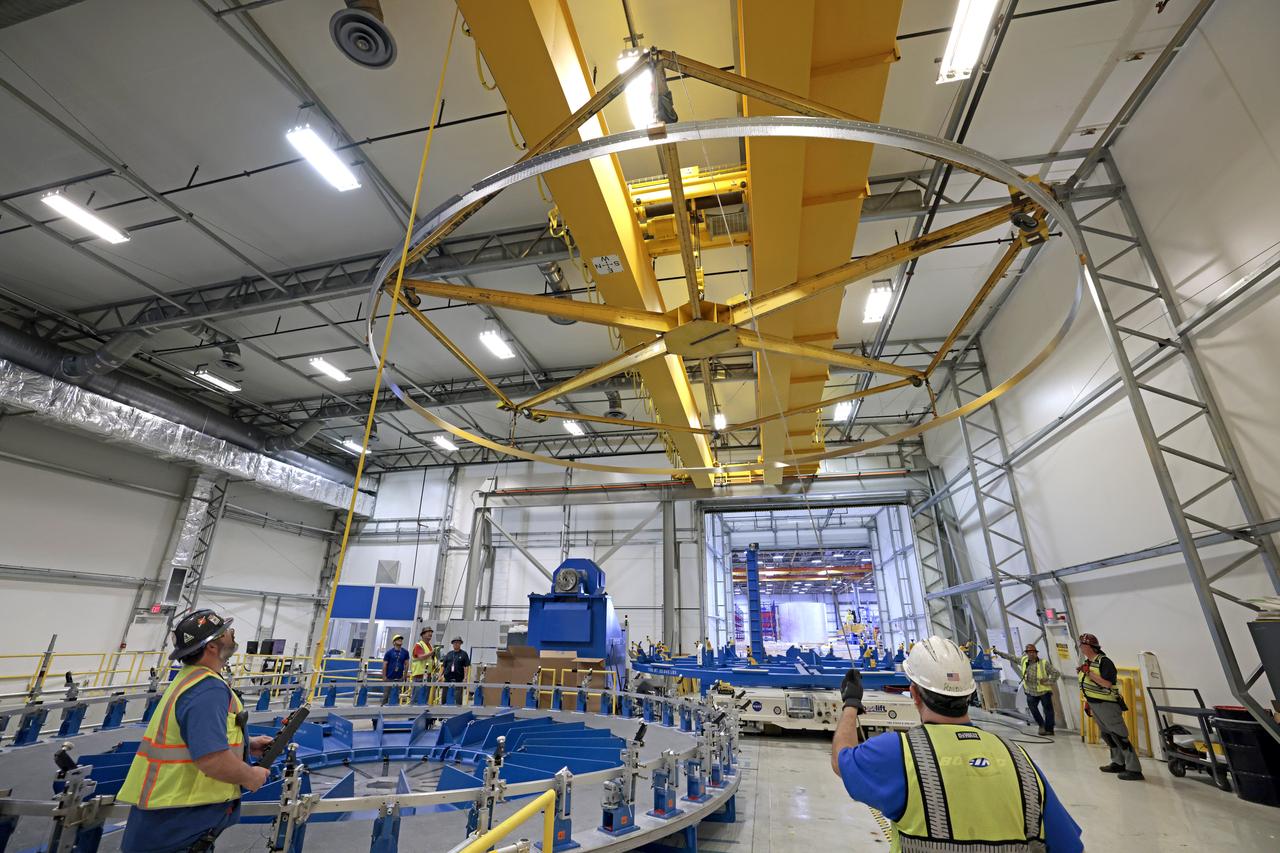
Technicians at NASA’s Michoud Assembly Facility in New Orleans lift a ring for the Exploration Upper Stage (EUS) of the SLS (Space Launch System) rocket to move it to another location in the 43-acre factory for further inspection and production. Flight hardware of the SLS EUS, a more powerful in-space propulsion stage beginning with Artemis IV, is in early production at Michoud. The rings make up the barrel sections for the flight hardware. The Exploration Upper Stage will be used on the second configuration of the SLS rocket, known as Block 1B, and will provide in-space propulsion to send astronauts in NASA’s Orion spacecraft and heavy cargo on a precise trajectory to the Moon. EUS will replace the interim cryogenic propulsion stage for the Block 1 configuration of SLS. It has larger propellant tanks and four RL10 engines, enabling SLS to launch 40% more cargo to the Moon along with crew. NASA and Boeing, the SLS lead contractor for the core stage and EUS, are currently manufacturing stages for Artemis II, III, IV, and V at the factory. NASA is working to land the first woman and first person of color on the Moon under Artemis. SLS is part of NASA’s backbone for deep space exploration, along with Orion and the Gateway in orbit around the Moon. SLS is the only rocket that can send Orion, astronauts, and supplies to the Moon in a single mission.
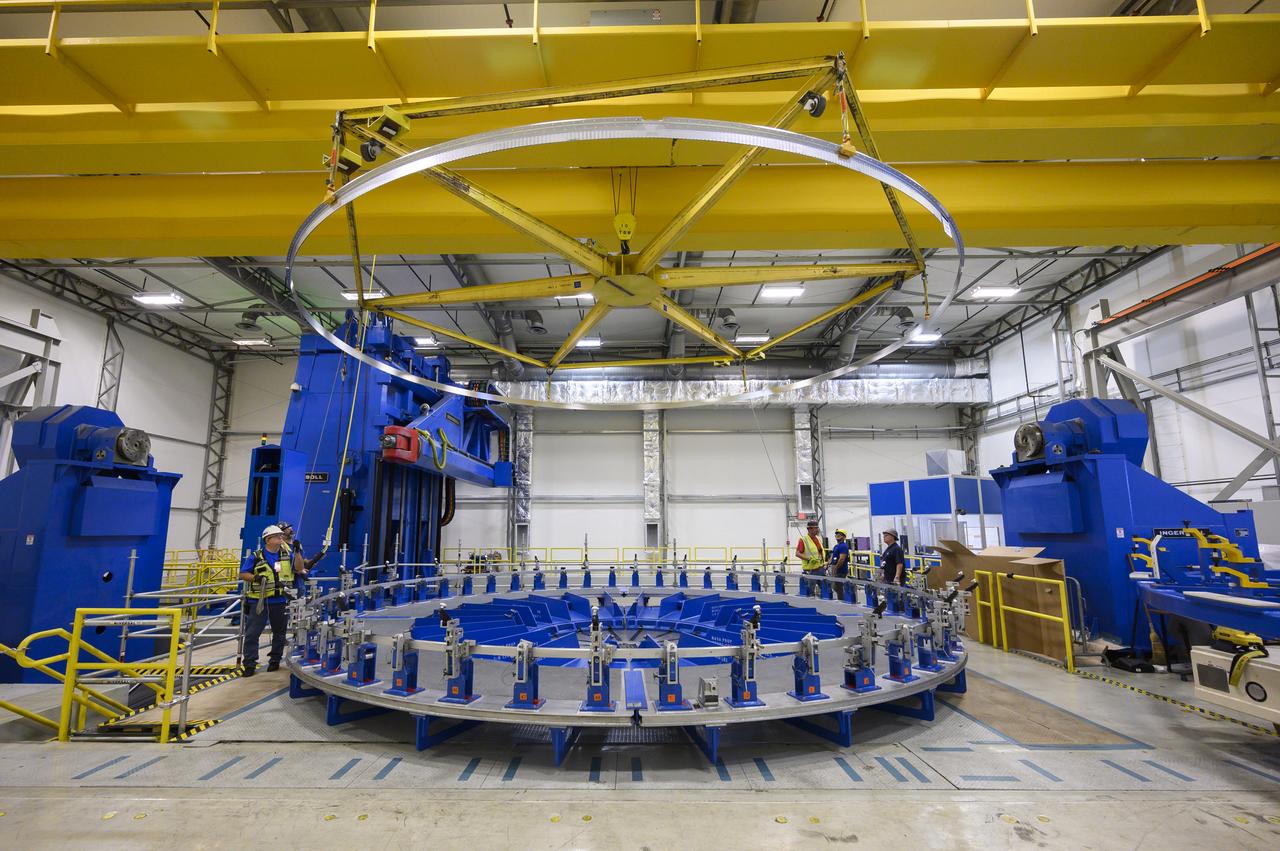
Technicians at NASA’s Michoud Assembly Facility in New Orleans lift a ring for the Exploration Upper Stage (EUS) of the SLS (Space Launch System) rocket to move it to another location in the 43-acre factory for further inspection and production. Flight hardware of the SLS EUS, a more powerful in-space propulsion stage beginning with Artemis IV, is in early production at Michoud. The rings make up the barrel sections for the flight hardware. The Exploration Upper Stage will be used on the second configuration of the SLS rocket, known as Block 1B, and will provide in-space propulsion to send astronauts in NASA’s Orion spacecraft and heavy cargo on a precise trajectory to the Moon. EUS will replace the interim cryogenic propulsion stage for the Block 1 configuration of SLS. It has larger propellant tanks and four RL10 engines, enabling SLS to launch 40% more cargo to the Moon along with crew. NASA and Boeing, the SLS lead contractor for the core stage and EUS, are currently manufacturing stages for Artemis II, III, IV, and V at the factory. NASA is working to land the first woman and first person of color on the Moon under Artemis. SLS is part of NASA’s backbone for deep space exploration, along with Orion and the Gateway in orbit around the Moon. SLS is the only rocket that can send Orion, astronauts, and supplies to the Moon in a single mission.
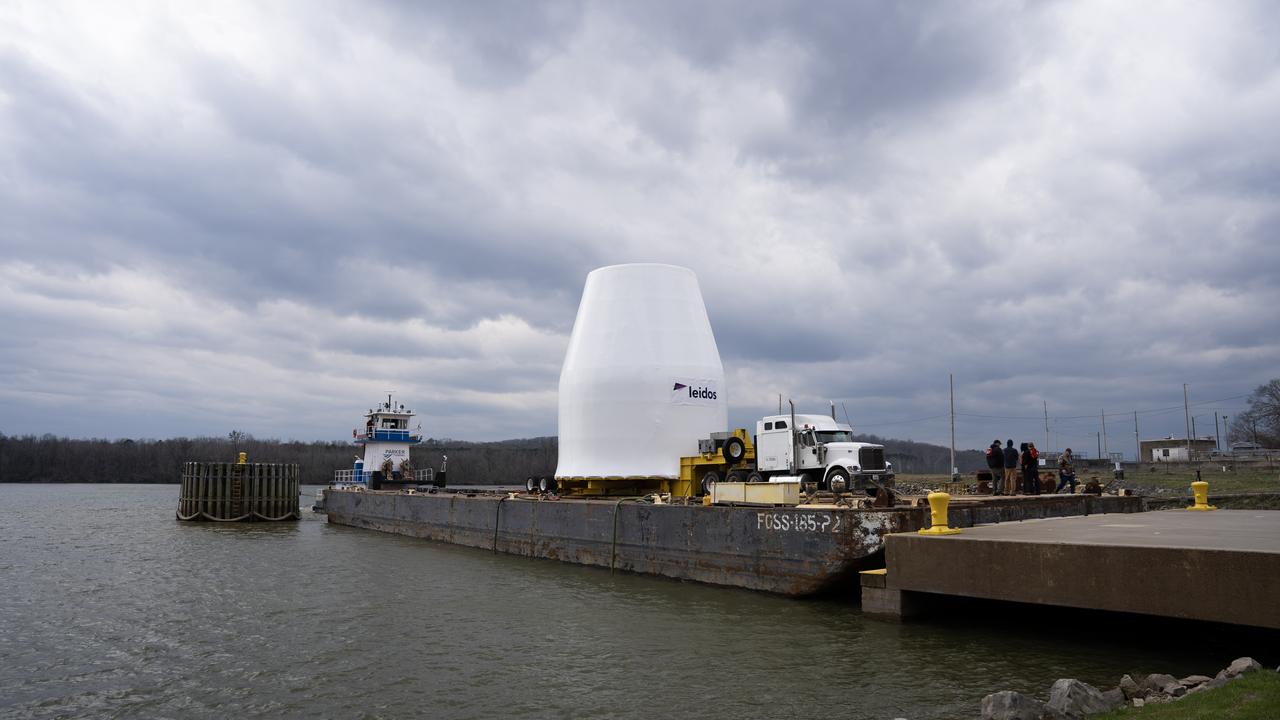
These photos and videos show how crews guided a test version of the universal stage adapter for NASA’s more powerful version of its SLS (Space Launch System) rocket to Building 4619 at the agency’s Marshall Space Flight Center in Huntsville, Alabama, Feb. 22. Built by Leidos, the lead contractor for the universal stage adapter, crews transported the hardware from a Leidos facility in Decatur, Alabama, the same day. The universal stage adapter will connect the SLS rocket’s upgraded in-space propulsion stage, called the exploration upper stage, to NASA’s Orion spacecraft as part of the evolved Block 1B configuration of the SLS rocket. It will also serve as a compartment capable of accommodating large payloads, such as modules or other exploration spacecraft. In Building 4619’s Load Test Annex High Bay at Marshall, the development test article will first undergo modal testing that will shake the hardware to validate dynamic models. Later, during ultimate load testing, force will be applied vertically and to the sides of the hardware. Unlike the flight hardware, the development test article has flaws intentionally included in its design, which will help engineers verity that the flight adapter can withstand the extreme forces it will face during launch and flight.
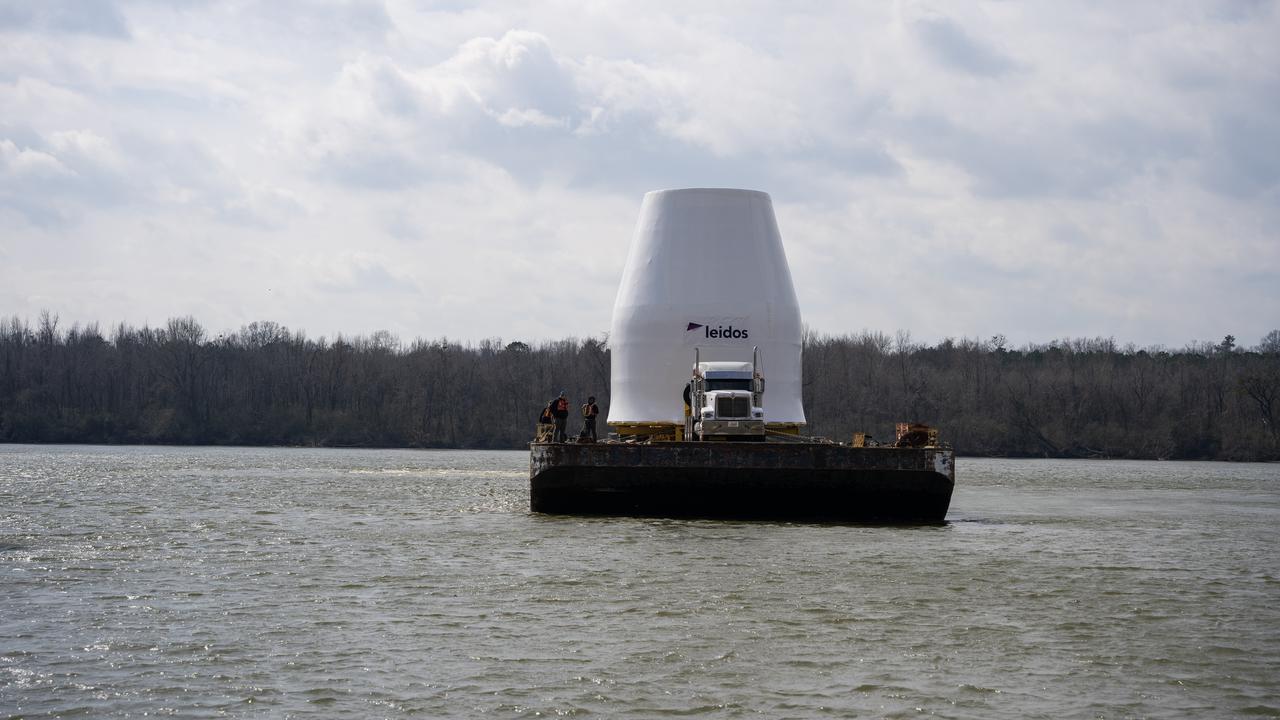
These photos and videos show how crews guided a test version of the universal stage adapter for NASA’s more powerful version of its SLS (Space Launch System) rocket to Building 4619 at the agency’s Marshall Space Flight Center in Huntsville, Alabama, Feb. 22. Built by Leidos, the lead contractor for the universal stage adapter, crews transported the hardware from a Leidos facility in Decatur, Alabama, the same day. The universal stage adapter will connect the SLS rocket’s upgraded in-space propulsion stage, called the exploration upper stage, to NASA’s Orion spacecraft as part of the evolved Block 1B configuration of the SLS rocket. It will also serve as a compartment capable of accommodating large payloads, such as modules or other exploration spacecraft. In Building 4619’s Load Test Annex High Bay at Marshall, the development test article will first undergo modal testing that will shake the hardware to validate dynamic models. Later, during ultimate load testing, force will be applied vertically and to the sides of the hardware. Unlike the flight hardware, the development test article has flaws intentionally included in its design, which will help engineers verity that the flight adapter can withstand the extreme forces it will face during launch and flight.
These photos and videos show how crews guided a test version of the universal stage adapter for NASA’s more powerful version of its SLS (Space Launch System) rocket to Building 4619 at the agency’s Marshall Space Flight Center in Huntsville, Alabama, Feb. 22. Built by Leidos, the lead contractor for the universal stage adapter, crews transported the hardware from a Leidos facility in Decatur, Alabama, the same day. The universal stage adapter will connect the SLS rocket’s upgraded in-space propulsion stage, called the exploration upper stage, to NASA’s Orion spacecraft as part of the evolved Block 1B configuration of the SLS rocket. It will also serve as a compartment capable of accommodating large payloads, such as modules or other exploration spacecraft. In Building 4619’s Load Test Annex High Bay at Marshall, the development test article will first undergo modal testing that will shake the hardware to validate dynamic models. Later, during ultimate load testing, force will be applied vertically and to the sides of the hardware. Unlike the flight hardware, the development test article has flaws intentionally included in its design, which will help engineers verity that the flight adapter can withstand the extreme forces it will face during launch and flight.
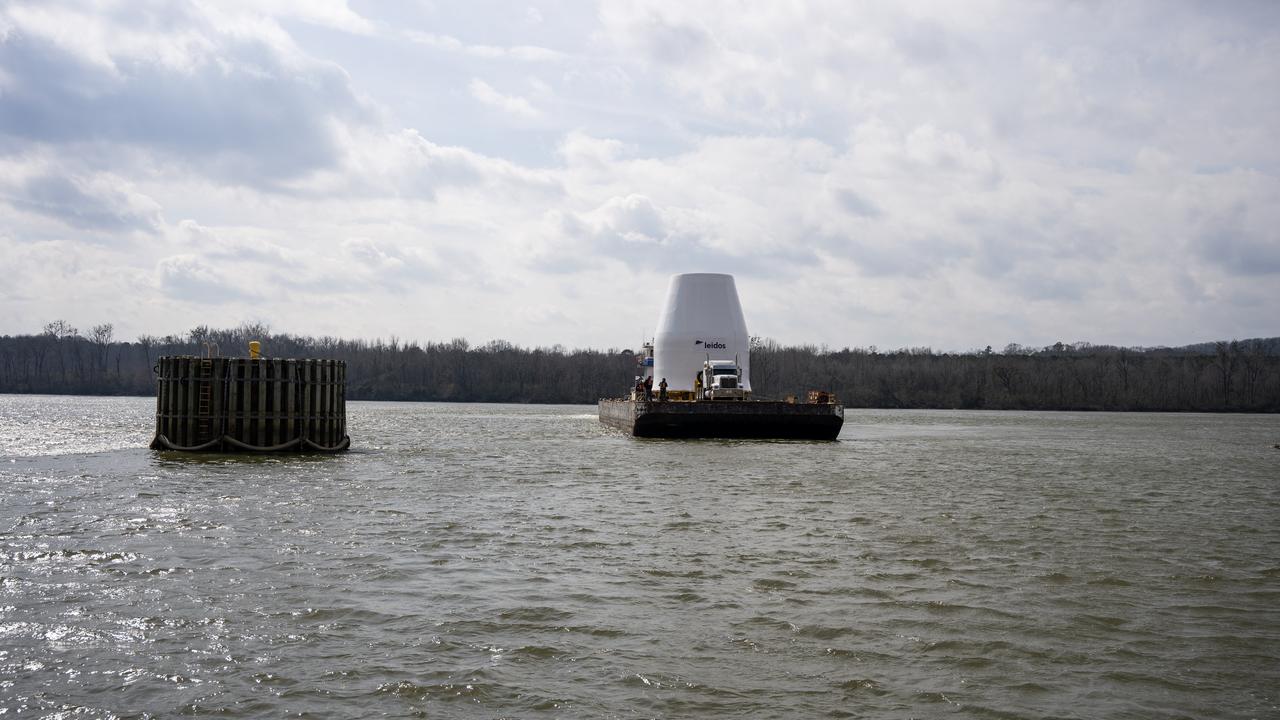
These photos and videos show how crews guided a test version of the universal stage adapter for NASA’s more powerful version of its SLS (Space Launch System) rocket to Building 4619 at the agency’s Marshall Space Flight Center in Huntsville, Alabama, Feb. 22. Built by Leidos, the lead contractor for the universal stage adapter, crews transported the hardware from a Leidos facility in Decatur, Alabama, the same day. The universal stage adapter will connect the SLS rocket’s upgraded in-space propulsion stage, called the exploration upper stage, to NASA’s Orion spacecraft as part of the evolved Block 1B configuration of the SLS rocket. It will also serve as a compartment capable of accommodating large payloads, such as modules or other exploration spacecraft. In Building 4619’s Load Test Annex High Bay at Marshall, the development test article will first undergo modal testing that will shake the hardware to validate dynamic models. Later, during ultimate load testing, force will be applied vertically and to the sides of the hardware. Unlike the flight hardware, the development test article has flaws intentionally included in its design, which will help engineers verity that the flight adapter can withstand the extreme forces it will face during launch and flight.
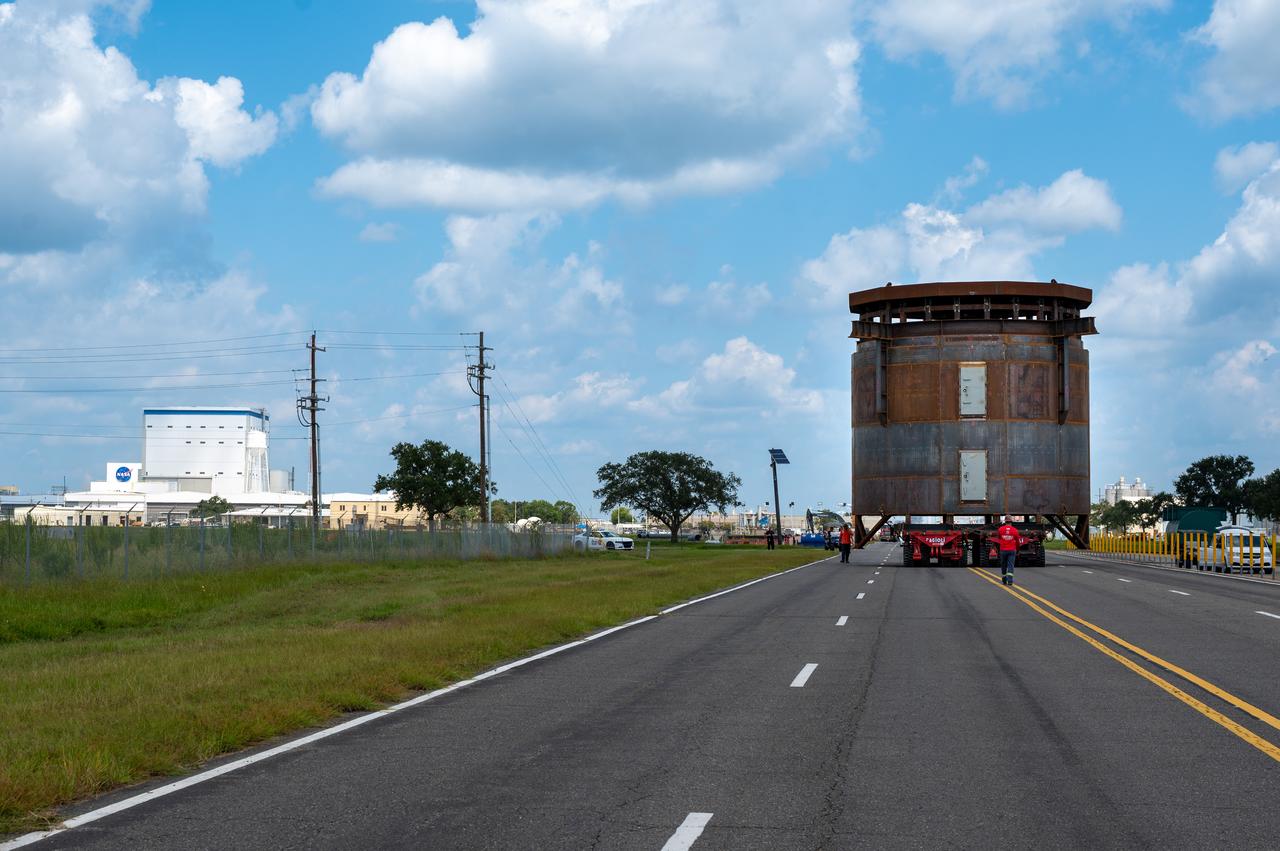
Move crews at NASA’s Michoud Assembly Facility in New Orleans guide the Inter-Stage Simulator (ISS) to the Michoud deep water port on Monday, Sept. 19 in preparation for transportation by barge to the agency’s Stennis Space Center near Bay St. Louis, Mississippi. Crews will lift the simulator into the B2 Test Stand at Stennis, where it holds the Exploration Upper Stage (EUS) in place and acts as a thrust takeout. ISS protects the lower portion of the EUS from environmental elements during its Green Run tests. The term “green” refers to the new hardware, and “run” refers to operation all the components together for the first time. During tanking and launch for its future mission, the lower portion is shrouded in a flight interstage. EUS is part of the SLS Block 1B configuration. The more powerful configuration of the SLS rocket will provide in-space propulsion to send astronauts in NASA’s Orion spacecraft and 40% more cargo mass on a precise trajectory to the Moon. Through the Artemis missions, NASA will land the first woman and the first person of color on the Moon to pave the way for a sustainable presence on the Moon and future missions beyond.

These photos and videos show how crews guided a test version of the universal stage adapter for NASA’s more powerful version of its SLS (Space Launch System) rocket to Building 4619 at the agency’s Marshall Space Flight Center in Huntsville, Alabama, Feb. 22. Built by Leidos, the lead contractor for the universal stage adapter, crews transported the hardware from a Leidos facility in Decatur, Alabama, the same day. The universal stage adapter will connect the SLS rocket’s upgraded in-space propulsion stage, called the exploration upper stage, to NASA’s Orion spacecraft as part of the evolved Block 1B configuration of the SLS rocket. It will also serve as a compartment capable of accommodating large payloads, such as modules or other exploration spacecraft. In Building 4619’s Load Test Annex High Bay at Marshall, the development test article will first undergo modal testing that will shake the hardware to validate dynamic models. Later, during ultimate load testing, force will be applied vertically and to the sides of the hardware. Unlike the flight hardware, the development test article has flaws intentionally included in its design, which will help engineers verity that the flight adapter can withstand the extreme forces it will face during launch and flight.
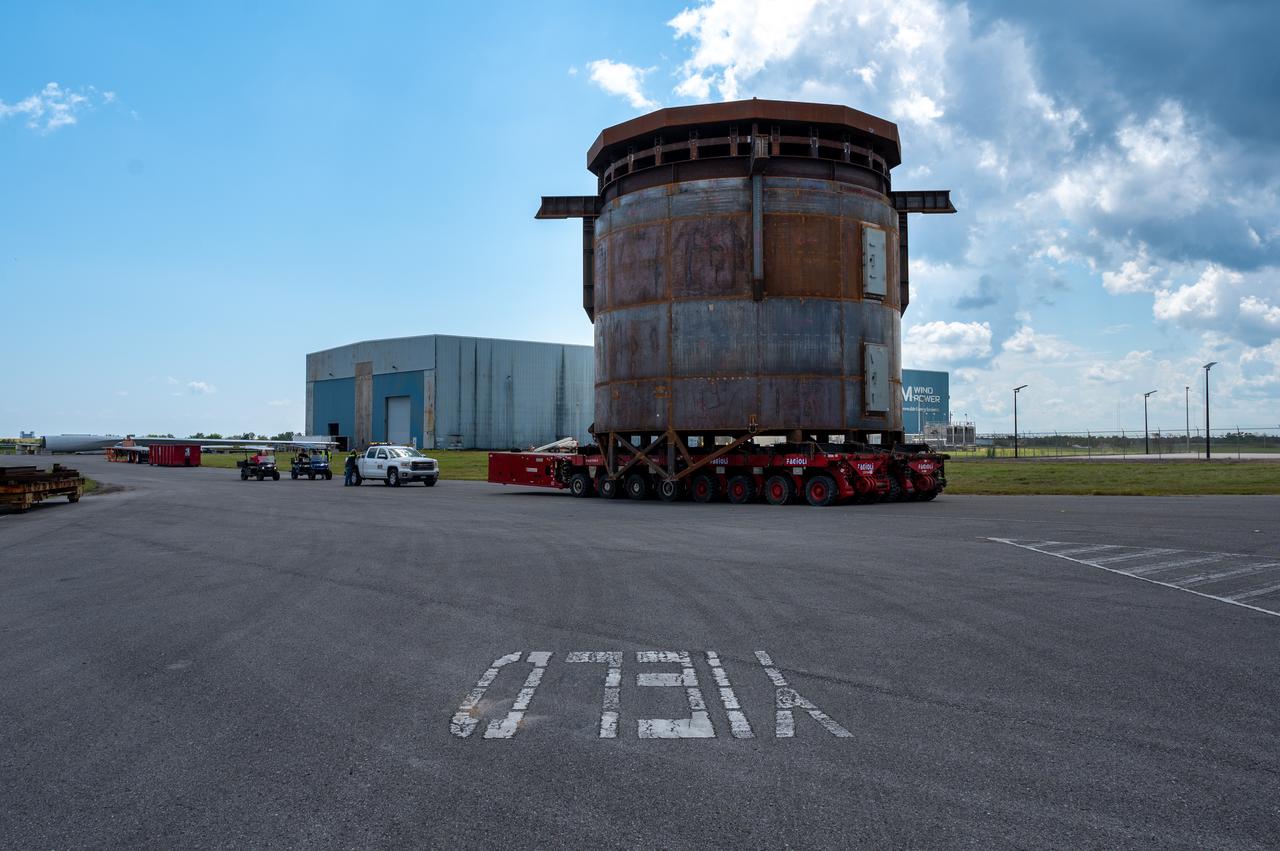
Move crews at NASA’s Michoud Assembly Facility in New Orleans guide the Inter-Stage Simulator (ISS) to the Michoud deep water port on Monday, Sept. 19 in preparation for transportation by barge to the agency’s Stennis Space Center near Bay St. Louis, Mississippi. Crews will lift the simulator into the B2 Test Stand at Stennis, where it holds the Exploration Upper Stage (EUS) in place and acts as a thrust takeout. ISS protects the lower portion of the EUS from environmental elements during its Green Run tests. The term “green” refers to the new hardware, and “run” refers to operation all the components together for the first time. During tanking and launch for its future mission, the lower portion is shrouded in a flight interstage. EUS is part of the SLS Block 1B configuration. The more powerful configuration of the SLS rocket will provide in-space propulsion to send astronauts in NASA’s Orion spacecraft and 40% more cargo mass on a precise trajectory to the Moon. Through the Artemis missions, NASA will land the first woman and the first person of color on the Moon to pave the way for a sustainable presence on the Moon and future missions beyond.
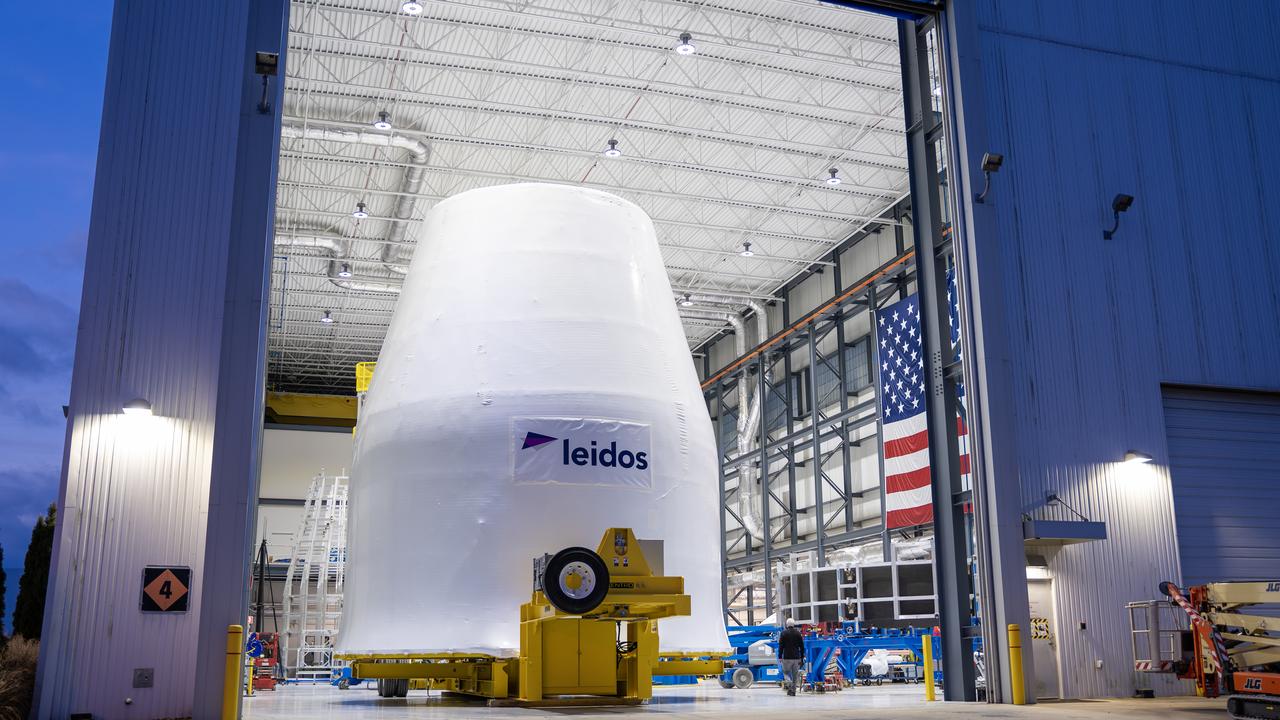
These photos and videos show how crews guided a test version of the universal stage adapter for NASA’s more powerful version of its SLS (Space Launch System) rocket to Building 4619 at the agency’s Marshall Space Flight Center in Huntsville, Alabama, Feb. 22. Built by Leidos, the lead contractor for the universal stage adapter, crews transported the hardware from a Leidos facility in Decatur, Alabama, the same day. The universal stage adapter will connect the SLS rocket’s upgraded in-space propulsion stage, called the exploration upper stage, to NASA’s Orion spacecraft as part of the evolved Block 1B configuration of the SLS rocket. It will also serve as a compartment capable of accommodating large payloads, such as modules or other exploration spacecraft. In Building 4619’s Load Test Annex High Bay at Marshall, the development test article will first undergo modal testing that will shake the hardware to validate dynamic models. Later, during ultimate load testing, force will be applied vertically and to the sides of the hardware. Unlike the flight hardware, the development test article has flaws intentionally included in its design, which will help engineers verity that the flight adapter can withstand the extreme forces it will face during launch and flight.
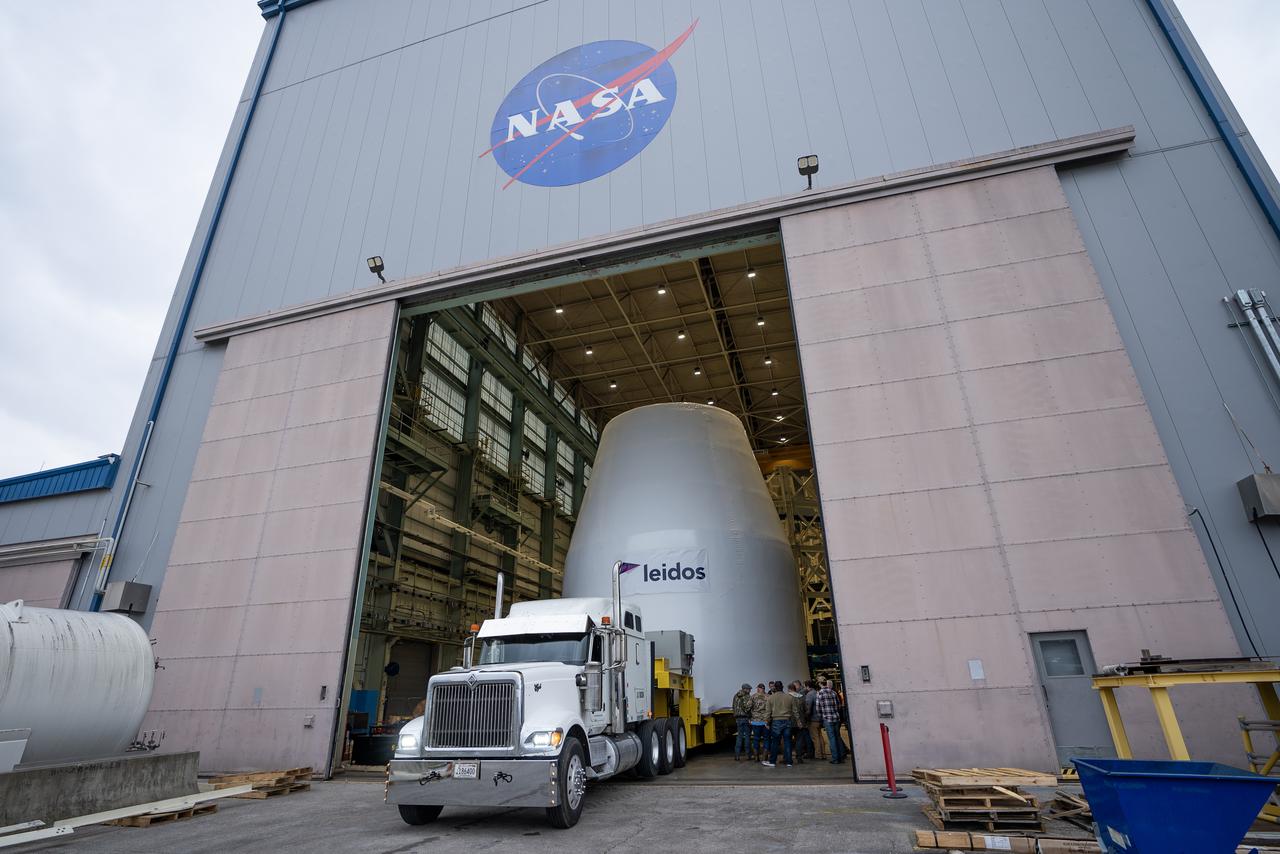
These photos and videos show how crews guided a test version of the universal stage adapter for NASA’s more powerful version of its SLS (Space Launch System) rocket to Building 4619 at the agency’s Marshall Space Flight Center in Huntsville, Alabama, Feb. 22. Built by Leidos, the lead contractor for the universal stage adapter, crews transported the hardware from a Leidos facility in Decatur, Alabama, the same day. The universal stage adapter will connect the SLS rocket’s upgraded in-space propulsion stage, called the exploration upper stage, to NASA’s Orion spacecraft as part of the evolved Block 1B configuration of the SLS rocket. It will also serve as a compartment capable of accommodating large payloads, such as modules or other exploration spacecraft. In Building 4619’s Load Test Annex High Bay at Marshall, the development test article will first undergo modal testing that will shake the hardware to validate dynamic models. Later, during ultimate load testing, force will be applied vertically and to the sides of the hardware. Unlike the flight hardware, the development test article has flaws intentionally included in its design, which will help engineers verity that the flight adapter can withstand the extreme forces it will face during launch and flight.
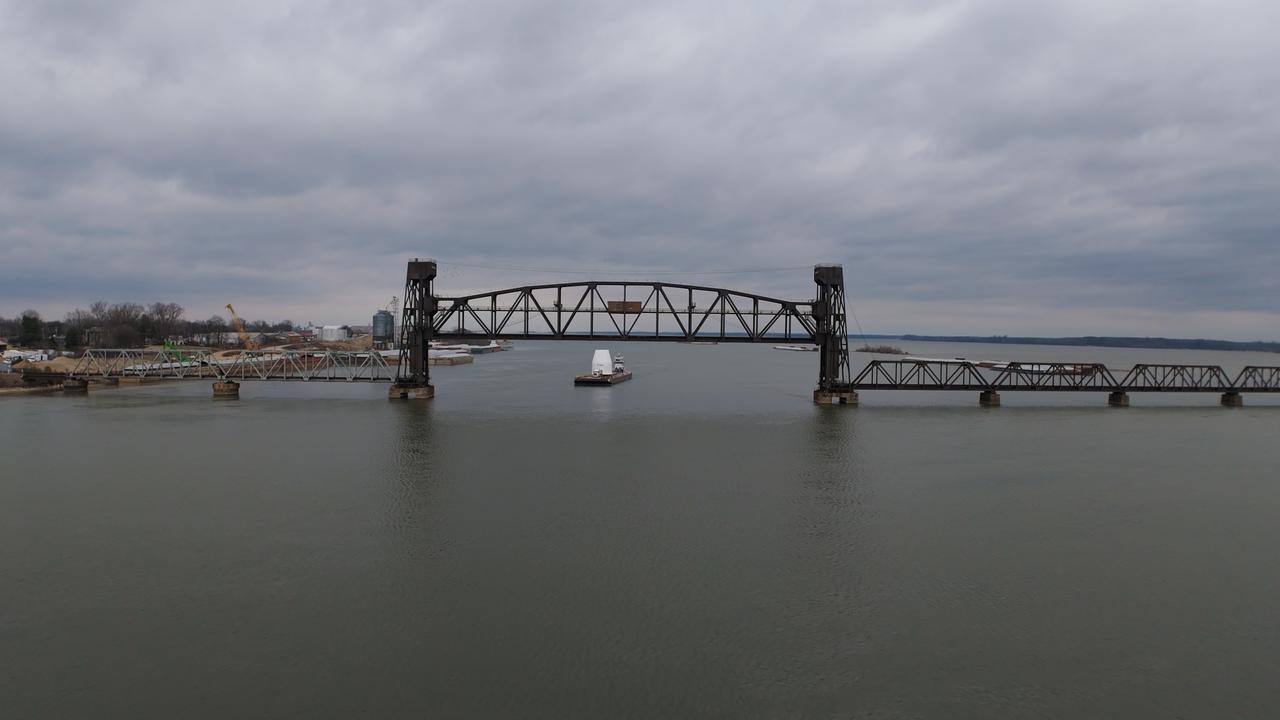
These photos and videos show how crews guided a test version of the universal stage adapter for NASA’s more powerful version of its SLS (Space Launch System) rocket to Building 4619 at the agency’s Marshall Space Flight Center in Huntsville, Alabama, Feb. 22. Built by Leidos, the lead contractor for the universal stage adapter, crews transported the hardware from a Leidos facility in Decatur, Alabama, the same day. The universal stage adapter will connect the SLS rocket’s upgraded in-space propulsion stage, called the exploration upper stage, to NASA’s Orion spacecraft as part of the evolved Block 1B configuration of the SLS rocket. It will also serve as a compartment capable of accommodating large payloads, such as modules or other exploration spacecraft. In Building 4619’s Load Test Annex High Bay at Marshall, the development test article will first undergo modal testing that will shake the hardware to validate dynamic models. Later, during ultimate load testing, force will be applied vertically and to the sides of the hardware. Unlike the flight hardware, the development test article has flaws intentionally included in its design, which will help engineers verity that the flight adapter can withstand the extreme forces it will face during launch and flight.
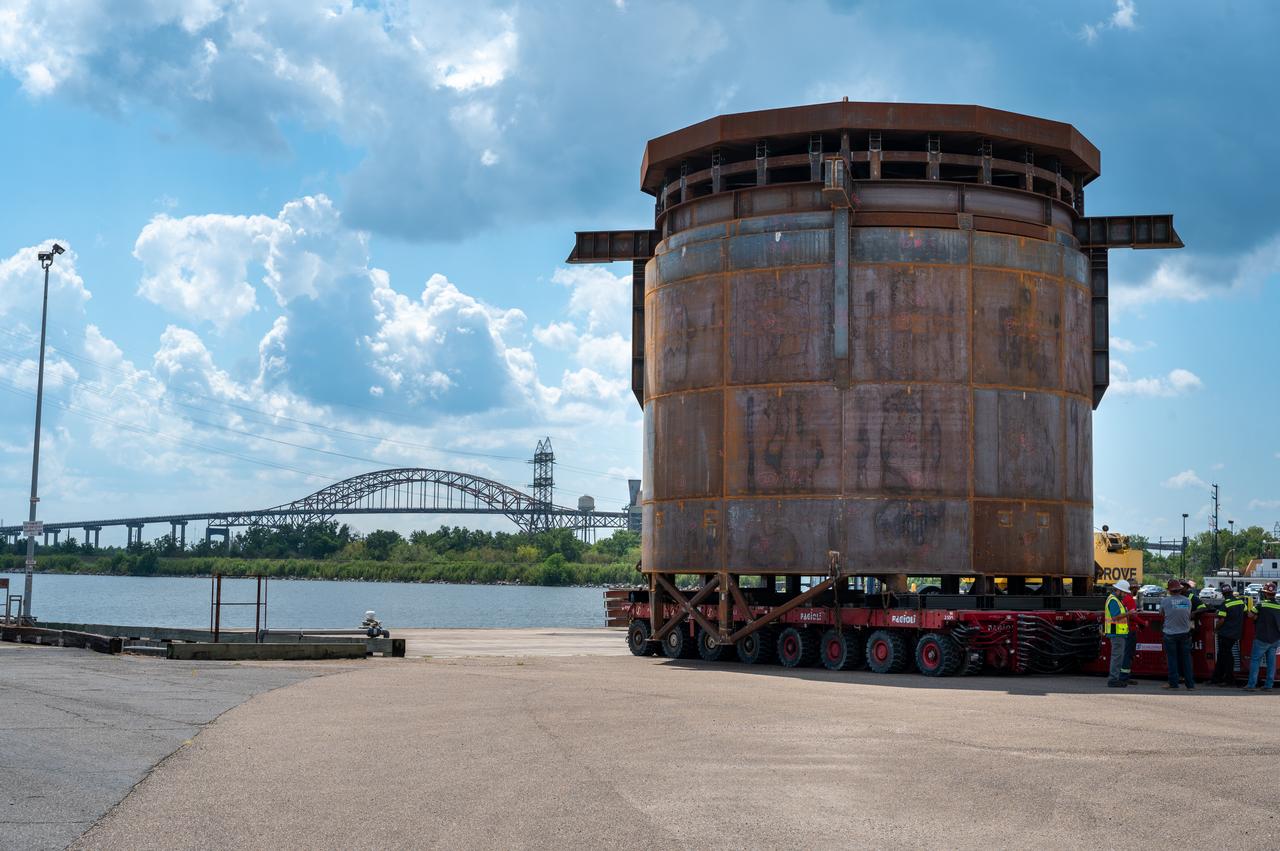
Move crews at NASA’s Michoud Assembly Facility in New Orleans guide the Inter-Stage Simulator (ISS) to the Michoud deep water port on Monday, Sept. 19 in preparation for transportation by barge to the agency’s Stennis Space Center near Bay St. Louis, Mississippi. Crews will lift the simulator into the B2 Test Stand at Stennis, where it holds the Exploration Upper Stage (EUS) in place and acts as a thrust takeout. ISS protects the lower portion of the EUS from environmental elements during its Green Run tests. The term “green” refers to the new hardware, and “run” refers to operation all the components together for the first time. During tanking and launch for its future mission, the lower portion is shrouded in a flight interstage. EUS is part of the SLS Block 1B configuration. The more powerful configuration of the SLS rocket will provide in-space propulsion to send astronauts in NASA’s Orion spacecraft and 40% more cargo mass on a precise trajectory to the Moon. Through the Artemis missions, NASA will land the first woman and the first person of color on the Moon to pave the way for a sustainable presence on the Moon and future missions beyond.
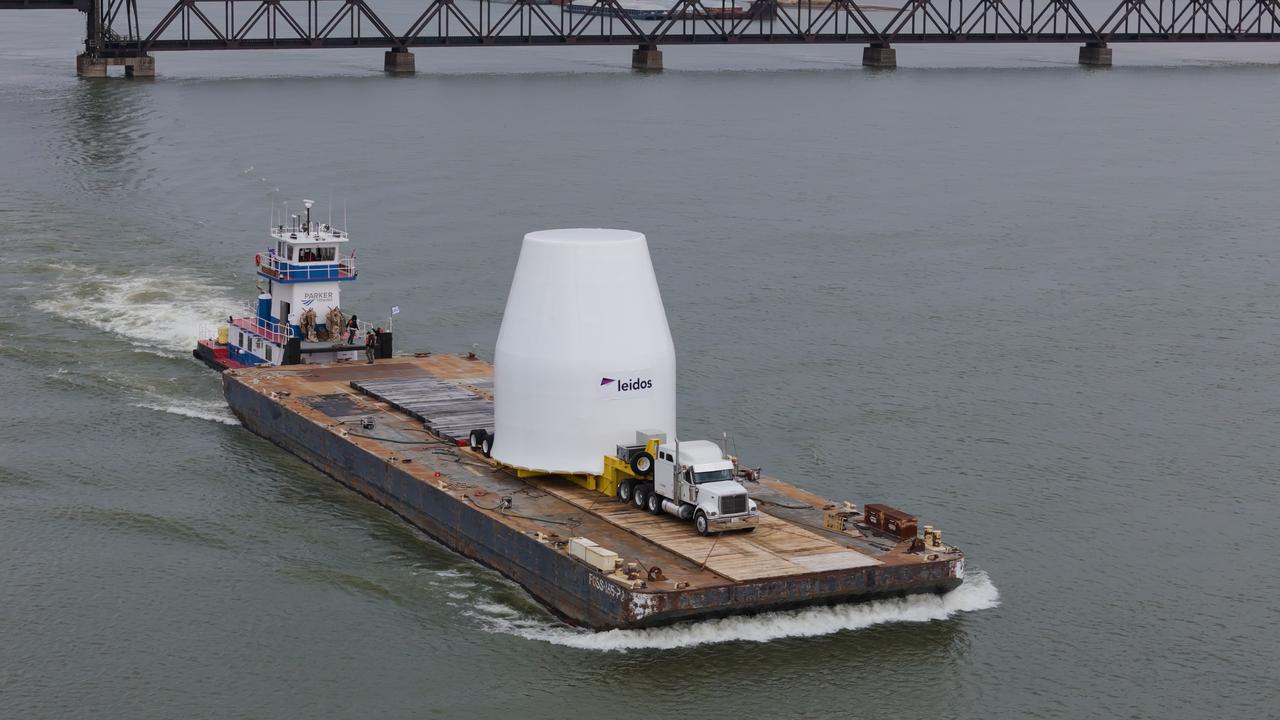
These photos and videos show how crews guided a test version of the universal stage adapter for NASA’s more powerful version of its SLS (Space Launch System) rocket to Building 4619 at the agency’s Marshall Space Flight Center in Huntsville, Alabama, Feb. 22. Built by Leidos, the lead contractor for the universal stage adapter, crews transported the hardware from a Leidos facility in Decatur, Alabama, the same day. The universal stage adapter will connect the SLS rocket’s upgraded in-space propulsion stage, called the exploration upper stage, to NASA’s Orion spacecraft as part of the evolved Block 1B configuration of the SLS rocket. It will also serve as a compartment capable of accommodating large payloads, such as modules or other exploration spacecraft. In Building 4619’s Load Test Annex High Bay at Marshall, the development test article will first undergo modal testing that will shake the hardware to validate dynamic models. Later, during ultimate load testing, force will be applied vertically and to the sides of the hardware. Unlike the flight hardware, the development test article has flaws intentionally included in its design, which will help engineers verity that the flight adapter can withstand the extreme forces it will face during launch and flight.
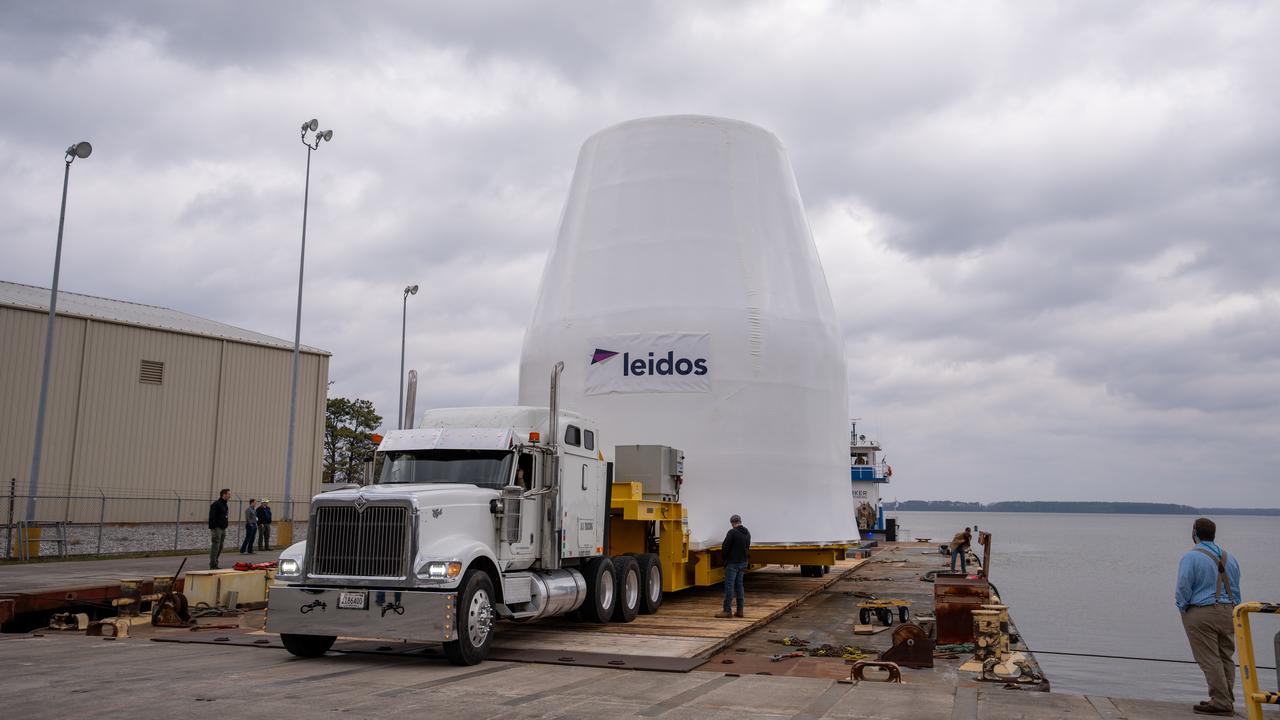
These photos and videos show how crews guided a test version of the universal stage adapter for NASA’s more powerful version of its SLS (Space Launch System) rocket to Building 4619 at the agency’s Marshall Space Flight Center in Huntsville, Alabama, Feb. 22. Built by Leidos, the lead contractor for the universal stage adapter, crews transported the hardware from a Leidos facility in Decatur, Alabama, the same day. The universal stage adapter will connect the SLS rocket’s upgraded in-space propulsion stage, called the exploration upper stage, to NASA’s Orion spacecraft as part of the evolved Block 1B configuration of the SLS rocket. It will also serve as a compartment capable of accommodating large payloads, such as modules or other exploration spacecraft. In Building 4619’s Load Test Annex High Bay at Marshall, the development test article will first undergo modal testing that will shake the hardware to validate dynamic models. Later, during ultimate load testing, force will be applied vertically and to the sides of the hardware. Unlike the flight hardware, the development test article has flaws intentionally included in its design, which will help engineers verity that the flight adapter can withstand the extreme forces it will face during launch and flight.
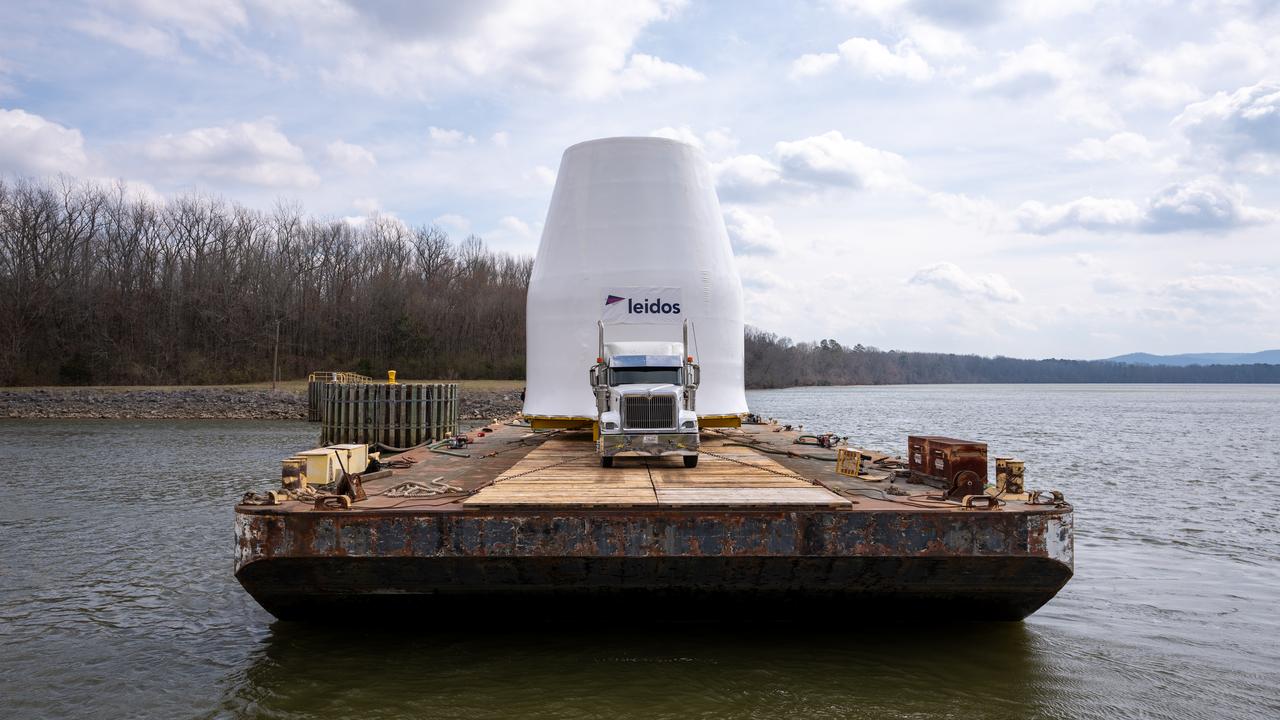
These photos and videos show how crews guided a test version of the universal stage adapter for NASA’s more powerful version of its SLS (Space Launch System) rocket to Building 4619 at the agency’s Marshall Space Flight Center in Huntsville, Alabama, Feb. 22. Built by Leidos, the lead contractor for the universal stage adapter, crews transported the hardware from a Leidos facility in Decatur, Alabama, the same day. The universal stage adapter will connect the SLS rocket’s upgraded in-space propulsion stage, called the exploration upper stage, to NASA’s Orion spacecraft as part of the evolved Block 1B configuration of the SLS rocket. It will also serve as a compartment capable of accommodating large payloads, such as modules or other exploration spacecraft. In Building 4619’s Load Test Annex High Bay at Marshall, the development test article will first undergo modal testing that will shake the hardware to validate dynamic models. Later, during ultimate load testing, force will be applied vertically and to the sides of the hardware. Unlike the flight hardware, the development test article has flaws intentionally included in its design, which will help engineers verity that the flight adapter can withstand the extreme forces it will face during launch and flight.

These photos and videos show how crews guided a test version of the universal stage adapter for NASA’s more powerful version of its SLS (Space Launch System) rocket to Building 4619 at the agency’s Marshall Space Flight Center in Huntsville, Alabama, Feb. 22. Built by Leidos, the lead contractor for the universal stage adapter, crews transported the hardware from a Leidos facility in Decatur, Alabama, the same day. The universal stage adapter will connect the SLS rocket’s upgraded in-space propulsion stage, called the exploration upper stage, to NASA’s Orion spacecraft as part of the evolved Block 1B configuration of the SLS rocket. It will also serve as a compartment capable of accommodating large payloads, such as modules or other exploration spacecraft. In Building 4619’s Load Test Annex High Bay at Marshall, the development test article will first undergo modal testing that will shake the hardware to validate dynamic models. Later, during ultimate load testing, force will be applied vertically and to the sides of the hardware. Unlike the flight hardware, the development test article has flaws intentionally included in its design, which will help engineers verity that the flight adapter can withstand the extreme forces it will face during launch and flight.
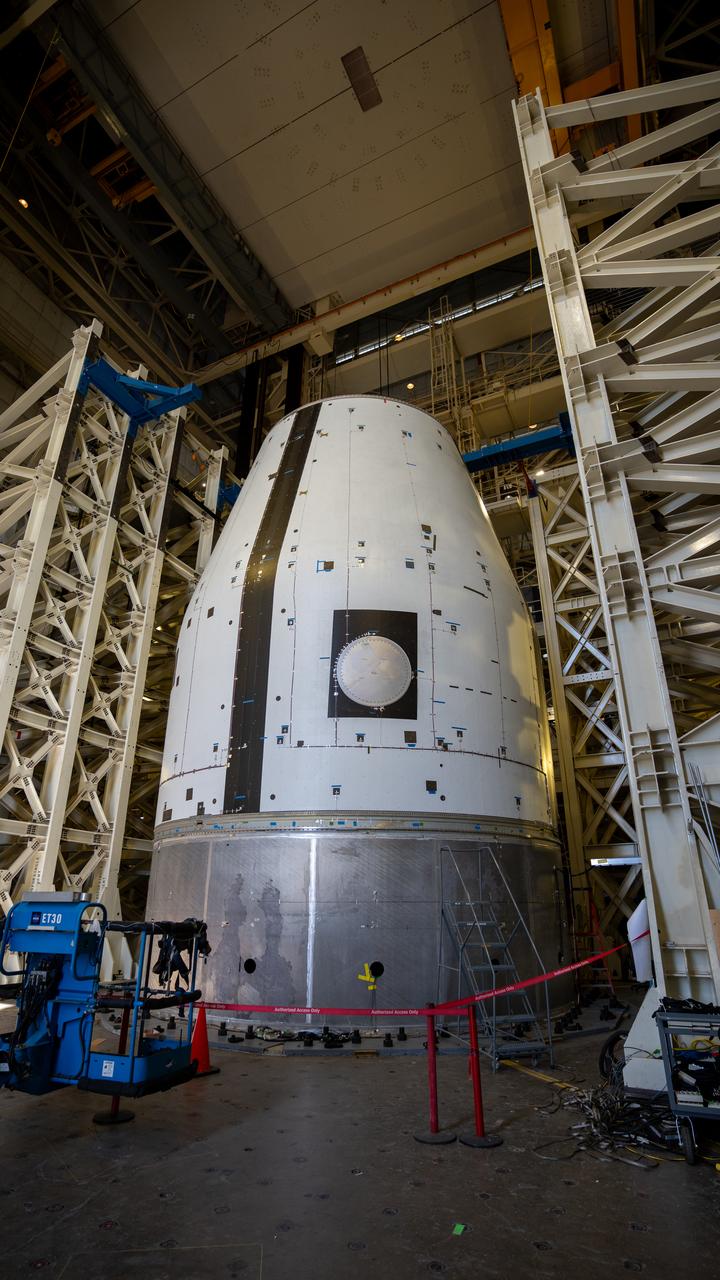
These photos and videos show how crews guided a test version of the universal stage adapter for NASA’s more powerful version of its SLS (Space Launch System) rocket to Building 4619 at the agency’s Marshall Space Flight Center in Huntsville, Alabama, Feb. 22. Built by Leidos, the lead contractor for the universal stage adapter, crews transported the hardware from a Leidos facility in Decatur, Alabama, the same day. The universal stage adapter will connect the SLS rocket’s upgraded in-space propulsion stage, called the exploration upper stage, to NASA’s Orion spacecraft as part of the evolved Block 1B configuration of the SLS rocket. It will also serve as a compartment capable of accommodating large payloads, such as modules or other exploration spacecraft. In Building 4619’s Load Test Annex High Bay at Marshall, the development test article will first undergo modal testing that will shake the hardware to validate dynamic models. Later, during ultimate load testing, force will be applied vertically and to the sides of the hardware. Unlike the flight hardware, the development test article has flaws intentionally included in its design, which will help engineers verity that the flight adapter can withstand the extreme forces it will face during launch and flight.
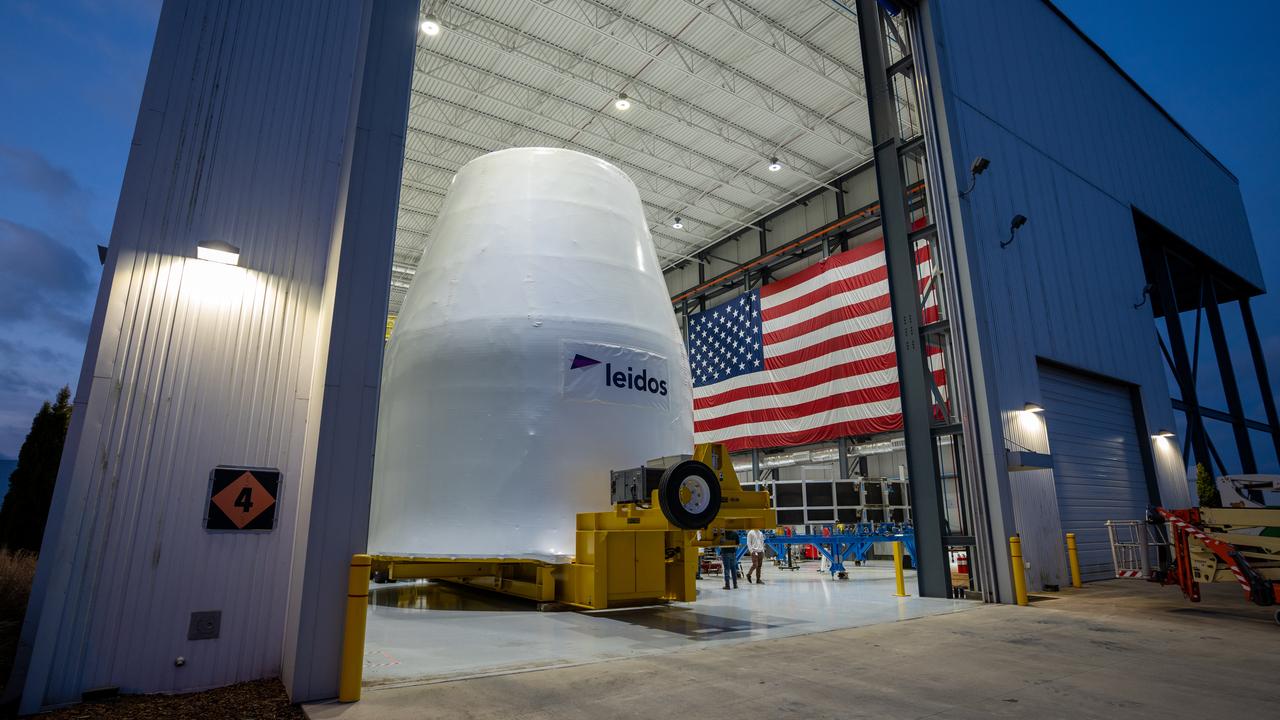
These photos and videos show how crews guided a test version of the universal stage adapter for NASA’s more powerful version of its SLS (Space Launch System) rocket to Building 4619 at the agency’s Marshall Space Flight Center in Huntsville, Alabama, Feb. 22. Built by Leidos, the lead contractor for the universal stage adapter, crews transported the hardware from a Leidos facility in Decatur, Alabama, the same day. The universal stage adapter will connect the SLS rocket’s upgraded in-space propulsion stage, called the exploration upper stage, to NASA’s Orion spacecraft as part of the evolved Block 1B configuration of the SLS rocket. It will also serve as a compartment capable of accommodating large payloads, such as modules or other exploration spacecraft. In Building 4619’s Load Test Annex High Bay at Marshall, the development test article will first undergo modal testing that will shake the hardware to validate dynamic models. Later, during ultimate load testing, force will be applied vertically and to the sides of the hardware. Unlike the flight hardware, the development test article has flaws intentionally included in its design, which will help engineers verity that the flight adapter can withstand the extreme forces it will face during launch and flight.

Move crews at NASA’s Michoud Assembly Facility in New Orleans guide the Inter-Stage Simulator (ISS) to the Michoud deep water port on Monday, Sept. 19 in preparation for transportation by barge to the agency’s Stennis Space Center near Bay St. Louis, Mississippi. Crews will lift the simulator into the B2 Test Stand at Stennis, where it holds the Exploration Upper Stage (EUS) in place and acts as a thrust takeout. ISS protects the lower portion of the EUS from environmental elements during its Green Run tests. The term “green” refers to the new hardware, and “run” refers to operation all the components together for the first time. During tanking and launch for its future mission, the lower portion is shrouded in a flight interstage. EUS is part of the SLS Block 1B configuration. The more powerful configuration of the SLS rocket will provide in-space propulsion to send astronauts in NASA’s Orion spacecraft and 40% more cargo mass on a precise trajectory to the Moon. Through the Artemis missions, NASA will land the first woman and the first person of color on the Moon to pave the way for a sustainable presence on the Moon and future missions beyond.
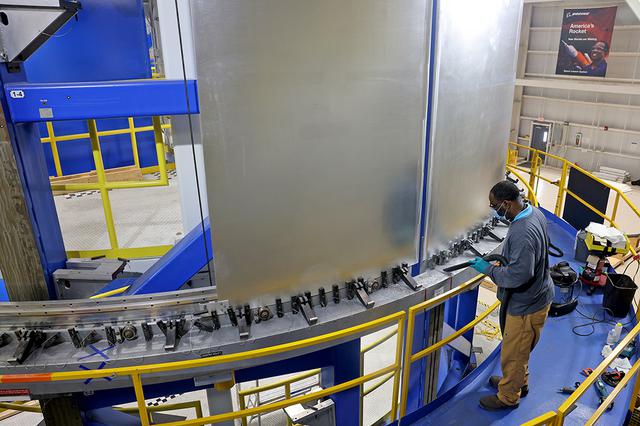
EUS panel test weld at the VXC in Building 115 at the Michoud Assembly Facility on Tuesday, February 9, 2021. Technicians are manufacturing and testing the first in a series of initial weld confidence articles for the Exploration Upper Stage (EUS) for future flights of NASA’s Space Launch System (SLS) rocket at the agency’s Michoud Assembly Facility in New Orleans. The Exploration Upper Stage will be used on the second configuration of the SLS rocket, known as Block 1B, and will provide in-space propulsion to send astronauts in NASA’s Orion spacecraft and heavy cargo on a precise trajectory to the Moon. The Exploration Upper Stage weld confidence panels are first produced in the Vertical Weld Center at Michoud, then small sections of the panels are removed for mechanical testing and analysis in another area of the factory. Teams use weld confidence articles to verify welding procedures, interfaces between the tooling and hardware, and the structural integrity of the welds. Testing of the EUS weld confidence articles will help engineers and technicians validate welding parameters for manufacturing EUS hardware. The first three SLS flights of NASA’s Artemis program will use an interim cryogenic propulsion stage with one RL10 engine to send Orion to the Moon. The SLS Exploration Upper Stage for flights beyond Artemis III has larger propellant tanks and four RL10 engines. The evolution of the rocket to SLS Block 1B configuration with EUS enables SLS to launch 40% more cargo to the Moon along with the crew. Manufacturing the Exploration Upper Stage is a collaborative effort between NASA and Boeing, the lead contractor for EUS and the SLS core stage. SLS is the only rocket that can send Orion, astronauts, and supplies to the Moon in a single mission. The SLS rocket, NASA’s Orion spacecraft, Gateway, and human landing system are part of NASA’s backbone for deep space exploration. Under the Artemis program, NASA is working to land the first woman and the next man on the Moon to pave the way for sustainable exploration at the Moon and future missions to Mars. (NASA)
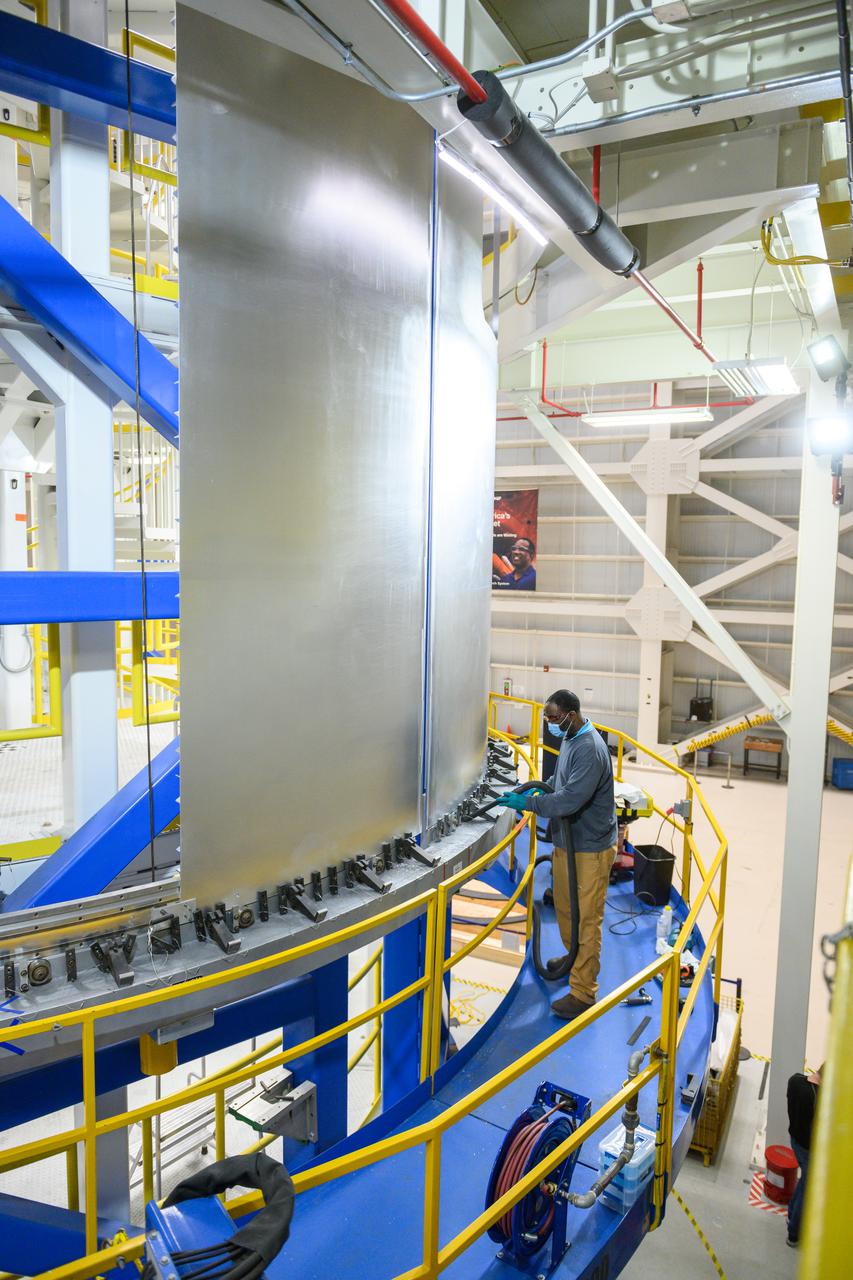
Technicians are manufacturing and testing the first in a series of initial weld confidence articles for the Exploration Upper Stage (EUS) for future flights of NASA’s Space Launch System (SLS) rocket at the agency’s Michoud Assembly Facility in New Orleans. The Exploration Upper Stage will be used on the second configuration of the SLS rocket, known as Block 1B, and will provide in-space propulsion to send astronauts in NASA’s Orion spacecraft and heavy cargo on a precise trajectory to the Moon. The Exploration Upper Stage weld confidence panels are first produced in the Vertical Weld Center at Michoud, then small sections of the panels are removed for mechanical testing and analysis in another area of the factory. Teams use weld confidence articles to verify welding procedures, interfaces between the tooling and hardware, and the structural integrity of the welds. Testing of the EUS weld confidence articles will help engineers and technicians validate welding parameters for manufacturing EUS hardware. The first three SLS flights of NASA’s Artemis program will use an interim cryogenic propulsion stage with one RL10 engine to send Orion to the Moon. The SLS Exploration Upper Stage for flights beyond Artemis III has larger propellant tanks and four RL10 engines. The evolution of the rocket to SLS Block 1B configuration with EUS enables SLS to launch 40% more cargo to the Moon along with the crew. Manufacturing the Exploration Upper Stage is a collaborative effort between NASA and Boeing, the lead contractor for EUS and the SLS core stage. SLS is the only rocket that can send Orion, astronauts, and supplies to the Moon in a single mission. The SLS rocket, NASA’s Orion spacecraft, Gateway, and human landing system are part of NASA’s backbone for deep space exploration. Under the Artemis program, NASA is working to land the first woman and the next man on the Moon to pave the way for sustainable exploration at the Moon and future missions to Mars. (NASA)
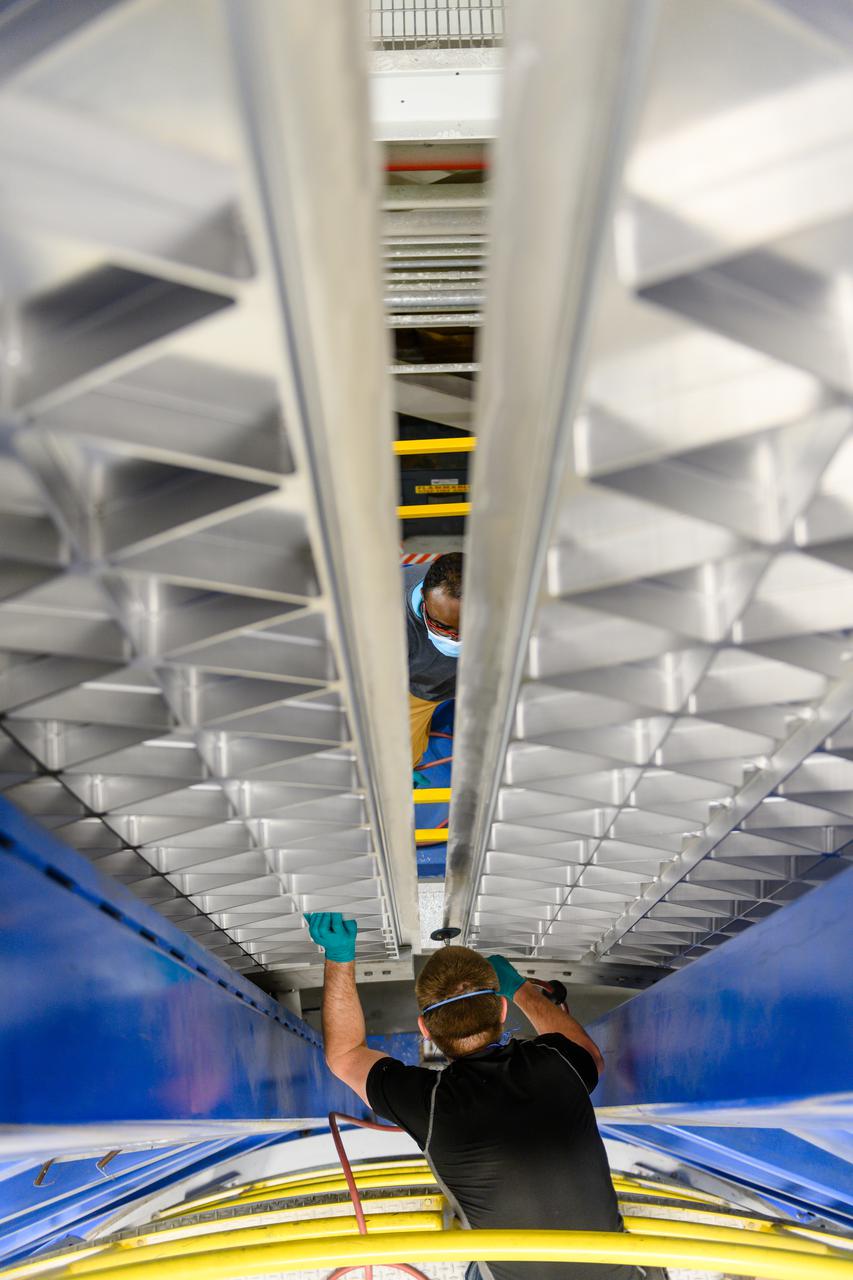
Technicians are manufacturing and testing the first in a series of initial weld confidence articles for the Exploration Upper Stage (EUS) for future flights of NASA’s Space Launch System (SLS) rocket at the agency’s Michoud Assembly Facility in New Orleans. The Exploration Upper Stage will be used on the second configuration of the SLS rocket, known as Block 1B, and will provide in-space propulsion to send astronauts in NASA’s Orion spacecraft and heavy cargo on a precise trajectory to the Moon. The Exploration Upper Stage weld confidence panels are first produced in the Vertical Weld Center at Michoud, then small sections of the panels are removed for mechanical testing and analysis in another area of the factory. Teams use weld confidence articles to verify welding procedures, interfaces between the tooling and hardware, and the structural integrity of the welds. Testing of the EUS weld confidence articles will help engineers and technicians validate welding parameters for manufacturing EUS hardware. The first three SLS flights of NASA’s Artemis program will use an interim cryogenic propulsion stage with one RL10 engine to send Orion to the Moon. The SLS Exploration Upper Stage for flights beyond Artemis III has larger propellant tanks and four RL10 engines. The evolution of the rocket to SLS Block 1B configuration with EUS enables SLS to launch 40% more cargo to the Moon along with the crew. Manufacturing the Exploration Upper Stage is a collaborative effort between NASA and Boeing, the lead contractor for EUS and the SLS core stage. SLS is the only rocket that can send Orion, astronauts, and supplies to the Moon in a single mission. The SLS rocket, NASA’s Orion spacecraft, Gateway, and human landing system are part of NASA’s backbone for deep space exploration. Under the Artemis program, NASA is working to land the first woman and the next man on the Moon to pave the way for sustainable exploration at the Moon and future missions to Mars. (NASA)

EUS panel test weld at the VXC in Building 115 at the Michoud Assembly Facility on Tuesday, February 9, 2021. Technicians are manufacturing and testing the first in a series of initial weld confidence articles for the Exploration Upper Stage (EUS) for future flights of NASA’s Space Launch System (SLS) rocket at the agency’s Michoud Assembly Facility in New Orleans. The Exploration Upper Stage will be used on the second configuration of the SLS rocket, known as Block 1B, and will provide in-space propulsion to send astronauts in NASA’s Orion spacecraft and heavy cargo on a precise trajectory to the Moon. The Exploration Upper Stage weld confidence panels are first produced in the Vertical Weld Center at Michoud, then small sections of the panels are removed for mechanical testing and analysis in another area of the factory. Teams use weld confidence articles to verify welding procedures, interfaces between the tooling and hardware, and the structural integrity of the welds. Testing of the EUS weld confidence articles will help engineers and technicians validate welding parameters for manufacturing EUS hardware. The first three SLS flights of NASA’s Artemis program will use an interim cryogenic propulsion stage with one RL10 engine to send Orion to the Moon. The SLS Exploration Upper Stage for flights beyond Artemis III has larger propellant tanks and four RL10 engines. The evolution of the rocket to SLS Block 1B configuration with EUS enables SLS to launch 40% more cargo to the Moon along with the crew. Manufacturing the Exploration Upper Stage is a collaborative effort between NASA and Boeing, the lead contractor for EUS and the SLS core stage. SLS is the only rocket that can send Orion, astronauts, and supplies to the Moon in a single mission. The SLS rocket, NASA’s Orion spacecraft, Gateway, and human landing system are part of NASA’s backbone for deep space exploration. Under the Artemis program, NASA is working to land the first woman and the next man on the Moon to pave the way for sustainable exploration at the Moon and future missions to Mars. (NASA)
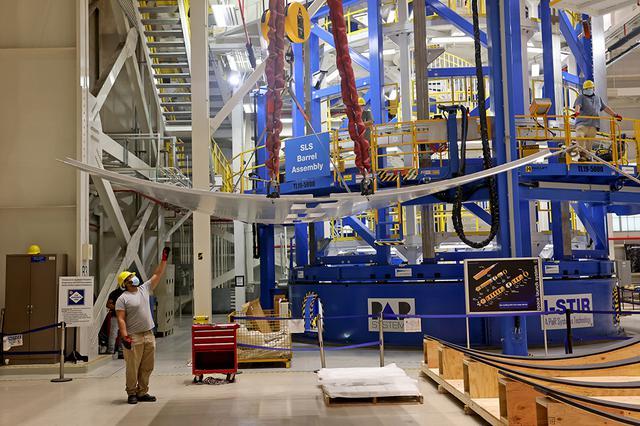
Lift of three EUS test panels in VWC at Michoud Assembly Facility on Thursday, February 11, 2021. Technicians are manufacturing and testing the first in a series of initial weld confidence articles for the Exploration Upper Stage (EUS) for future flights of NASA’s Space Launch System (SLS) rocket at the agency’s Michoud Assembly Facility in New Orleans. The Exploration Upper Stage will be used on the second configuration of the SLS rocket, known as Block 1B, and will provide in-space propulsion to send astronauts in NASA’s Orion spacecraft and heavy cargo on a precise trajectory to the Moon. The Exploration Upper Stage weld confidence panels are first produced in the Vertical Weld Center at Michoud, then small sections of the panels are removed for mechanical testing and analysis in another area of the factory. Teams use weld confidence articles to verify welding procedures, interfaces between the tooling and hardware, and the structural integrity of the welds. Testing of the EUS weld confidence articles will help engineers and technicians validate welding parameters for manufacturing EUS hardware. The first three SLS flights of NASA’s Artemis program will use an interim cryogenic propulsion stage with one RL10 engine to send Orion to the Moon. The SLS Exploration Upper Stage for flights beyond Artemis III has larger propellant tanks and four RL10 engines. The evolution of the rocket to SLS Block 1B configuration with EUS enables SLS to launch 40% more cargo to the Moon along with the crew. Manufacturing the Exploration Upper Stage is a collaborative effort between NASA and Boeing, the lead contractor for EUS and the SLS core stage. SLS is the only rocket that can send Orion, astronauts, and supplies to the Moon in a single mission. The SLS rocket, NASA’s Orion spacecraft, Gateway, and human landing system are part of NASA’s backbone for deep space exploration. Under the Artemis program, NASA is working to land the first woman and the next man on the Moon to pave the way for sustainable exploration at the Moon and future missions to Mars. (NASA)
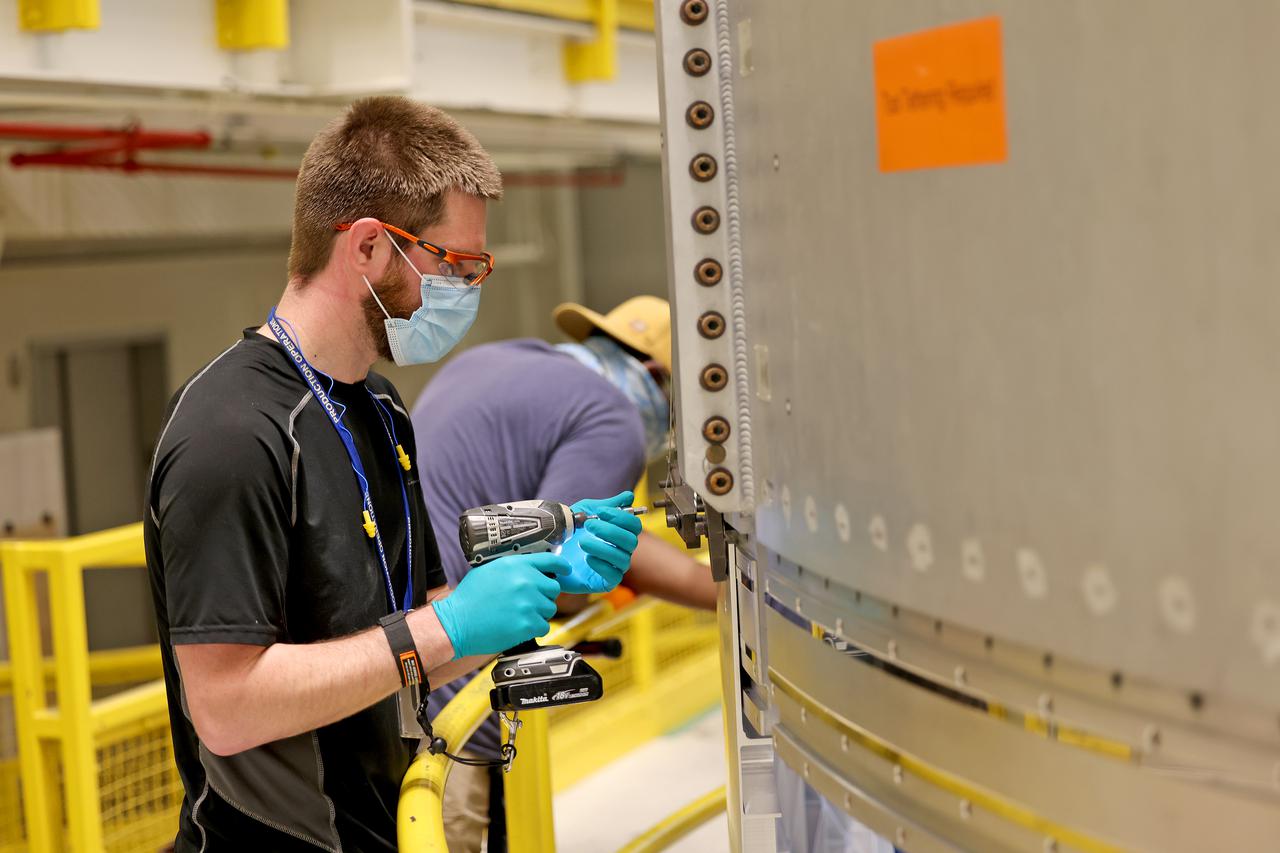
EUS panel test weld at the VXC in Building 115 at the Michoud Assembly Facility on Tuesday, February 9, 2021. Technicians are manufacturing and testing the first in a series of initial weld confidence articles for the Exploration Upper Stage (EUS) for future flights of NASA’s Space Launch System (SLS) rocket at the agency’s Michoud Assembly Facility in New Orleans. The Exploration Upper Stage will be used on the second configuration of the SLS rocket, known as Block 1B, and will provide in-space propulsion to send astronauts in NASA’s Orion spacecraft and heavy cargo on a precise trajectory to the Moon. The Exploration Upper Stage weld confidence panels are first produced in the Vertical Weld Center at Michoud, then small sections of the panels are removed for mechanical testing and analysis in another area of the factory. Teams use weld confidence articles to verify welding procedures, interfaces between the tooling and hardware, and the structural integrity of the welds. Testing of the EUS weld confidence articles will help engineers and technicians validate welding parameters for manufacturing EUS hardware. The first three SLS flights of NASA’s Artemis program will use an interim cryogenic propulsion stage with one RL10 engine to send Orion to the Moon. The SLS Exploration Upper Stage for flights beyond Artemis III has larger propellant tanks and four RL10 engines. The evolution of the rocket to SLS Block 1B configuration with EUS enables SLS to launch 40% more cargo to the Moon along with the crew. Manufacturing the Exploration Upper Stage is a collaborative effort between NASA and Boeing, the lead contractor for EUS and the SLS core stage. SLS is the only rocket that can send Orion, astronauts, and supplies to the Moon in a single mission. The SLS rocket, NASA’s Orion spacecraft, Gateway, and human landing system are part of NASA’s backbone for deep space exploration. Under the Artemis program, NASA is working to land the first woman and the next man on the Moon to pave the way for sustainable exploration at the Moon and future missions to Mars. (NASA)
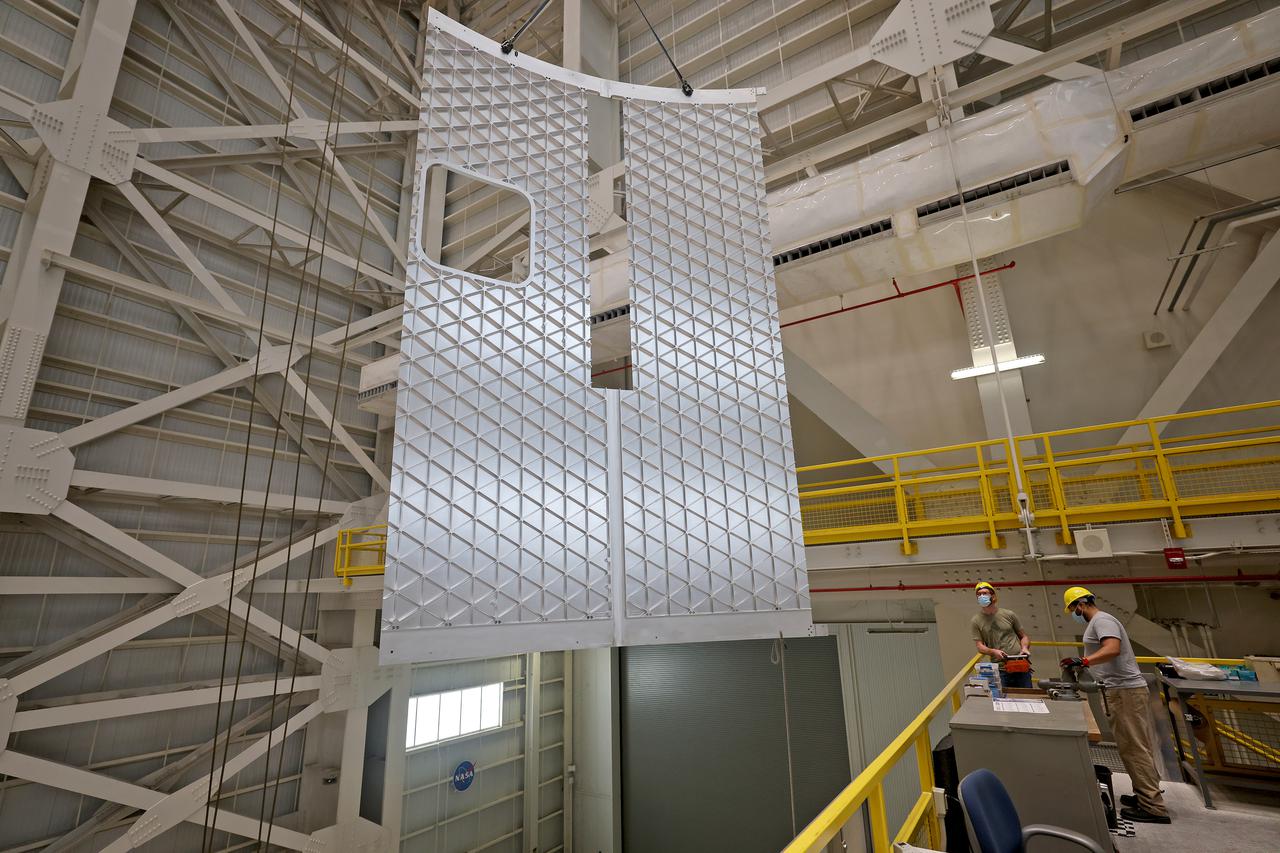
Lift of three EUS test panels in VWC at Michoud Assembly Facility on Thursday, February 11, 2021. Technicians are manufacturing and testing the first in a series of initial weld confidence articles for the Exploration Upper Stage (EUS) for future flights of NASA’s Space Launch System (SLS) rocket at the agency’s Michoud Assembly Facility in New Orleans. The Exploration Upper Stage will be used on the second configuration of the SLS rocket, known as Block 1B, and will provide in-space propulsion to send astronauts in NASA’s Orion spacecraft and heavy cargo on a precise trajectory to the Moon. The Exploration Upper Stage weld confidence panels are first produced in the Vertical Weld Center at Michoud, then small sections of the panels are removed for mechanical testing and analysis in another area of the factory. Teams use weld confidence articles to verify welding procedures, interfaces between the tooling and hardware, and the structural integrity of the welds. Testing of the EUS weld confidence articles will help engineers and technicians validate welding parameters for manufacturing EUS hardware. The first three SLS flights of NASA’s Artemis program will use an interim cryogenic propulsion stage with one RL10 engine to send Orion to the Moon. The SLS Exploration Upper Stage for flights beyond Artemis III has larger propellant tanks and four RL10 engines. The evolution of the rocket to SLS Block 1B configuration with EUS enables SLS to launch 40% more cargo to the Moon along with the crew. Manufacturing the Exploration Upper Stage is a collaborative effort between NASA and Boeing, the lead contractor for EUS and the SLS core stage. SLS is the only rocket that can send Orion, astronauts, and supplies to the Moon in a single mission. The SLS rocket, NASA’s Orion spacecraft, Gateway, and human landing system are part of NASA’s backbone for deep space exploration. Under the Artemis program, NASA is working to land the first woman and the next man on the Moon to pave the way for sustainable exploration at the Moon and future missions to Mars. (NASA)

Lift of three EUS test panels in VWC at Michoud Assembly Facility on Thursday, February 11, 2021. Technicians are manufacturing and testing the first in a series of initial weld confidence articles for the Exploration Upper Stage (EUS) for future flights of NASA’s Space Launch System (SLS) rocket at the agency’s Michoud Assembly Facility in New Orleans. The Exploration Upper Stage will be used on the second configuration of the SLS rocket, known as Block 1B, and will provide in-space propulsion to send astronauts in NASA’s Orion spacecraft and heavy cargo on a precise trajectory to the Moon. The Exploration Upper Stage weld confidence panels are first produced in the Vertical Weld Center at Michoud, then small sections of the panels are removed for mechanical testing and analysis in another area of the factory. Teams use weld confidence articles to verify welding procedures, interfaces between the tooling and hardware, and the structural integrity of the welds. Testing of the EUS weld confidence articles will help engineers and technicians validate welding parameters for manufacturing EUS hardware. The first three SLS flights of NASA’s Artemis program will use an interim cryogenic propulsion stage with one RL10 engine to send Orion to the Moon. The SLS Exploration Upper Stage for flights beyond Artemis III has larger propellant tanks and four RL10 engines. The evolution of the rocket to SLS Block 1B configuration with EUS enables SLS to launch 40% more cargo to the Moon along with the crew. Manufacturing the Exploration Upper Stage is a collaborative effort between NASA and Boeing, the lead contractor for EUS and the SLS core stage. SLS is the only rocket that can send Orion, astronauts, and supplies to the Moon in a single mission. The SLS rocket, NASA’s Orion spacecraft, Gateway, and human landing system are part of NASA’s backbone for deep space exploration. Under the Artemis program, NASA is working to land the first woman and the next man on the Moon to pave the way for sustainable exploration at the Moon and future missions to Mars. (NASA)
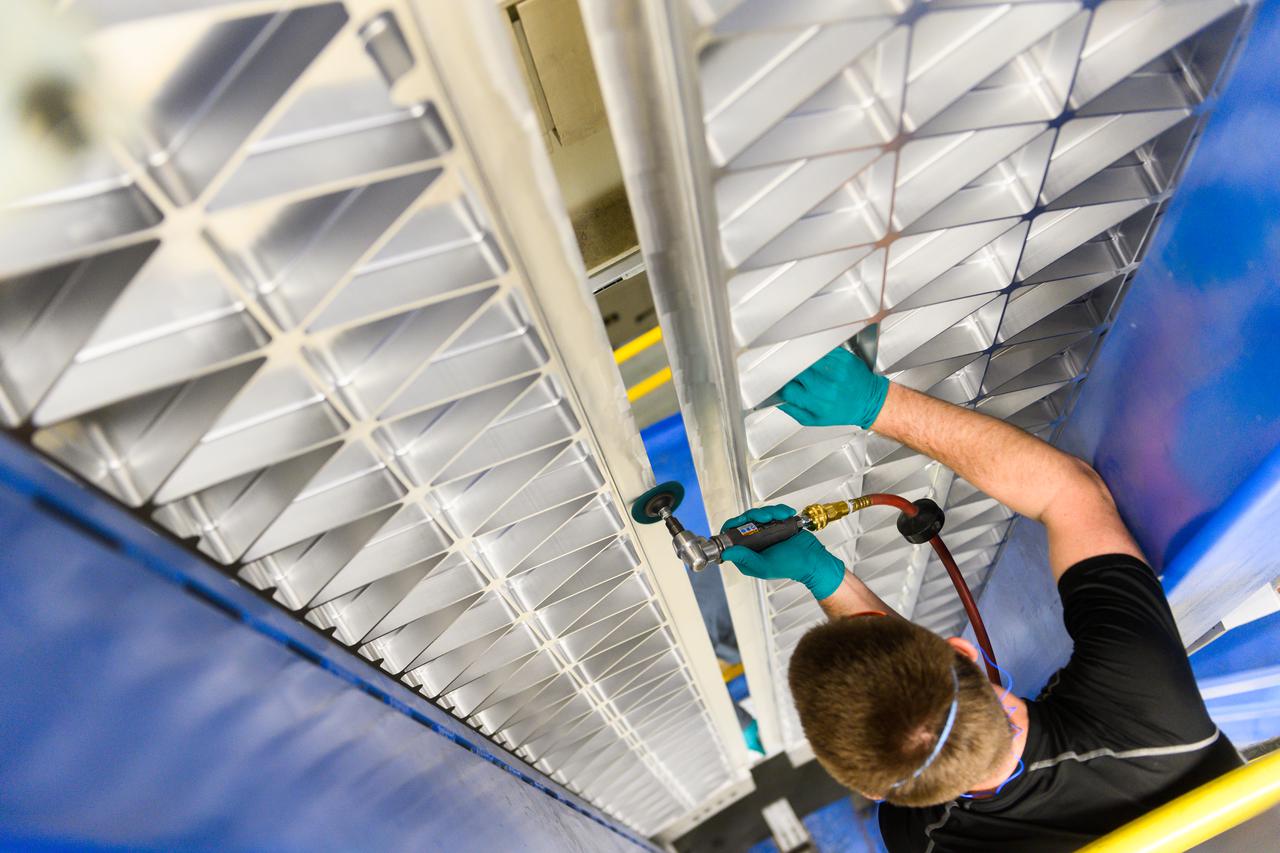
Technicians are manufacturing and testing the first in a series of initial weld confidence articles for the Exploration Upper Stage (EUS) for future flights of NASA’s Space Launch System (SLS) rocket at the agency’s Michoud Assembly Facility in New Orleans. The Exploration Upper Stage will be used on the second configuration of the SLS rocket, known as Block 1B, and will provide in-space propulsion to send astronauts in NASA’s Orion spacecraft and heavy cargo on a precise trajectory to the Moon. The Exploration Upper Stage weld confidence panels are first produced in the Vertical Weld Center at Michoud, then small sections of the panels are removed for mechanical testing and analysis in another area of the factory. Teams use weld confidence articles to verify welding procedures, interfaces between the tooling and hardware, and the structural integrity of the welds. Testing of the EUS weld confidence articles will help engineers and technicians validate welding parameters for manufacturing EUS hardware. The first three SLS flights of NASA’s Artemis program will use an interim cryogenic propulsion stage with one RL10 engine to send Orion to the Moon. The SLS Exploration Upper Stage for flights beyond Artemis III has larger propellant tanks and four RL10 engines. The evolution of the rocket to SLS Block 1B configuration with EUS enables SLS to launch 40% more cargo to the Moon along with the crew. Manufacturing the Exploration Upper Stage is a collaborative effort between NASA and Boeing, the lead contractor for EUS and the SLS core stage. SLS is the only rocket that can send Orion, astronauts, and supplies to the Moon in a single mission. The SLS rocket, NASA’s Orion spacecraft, Gateway, and human landing system are part of NASA’s backbone for deep space exploration. Under the Artemis program, NASA is working to land the first woman and the next man on the Moon to pave the way for sustainable exploration at the Moon and future missions to Mars. (NASA)
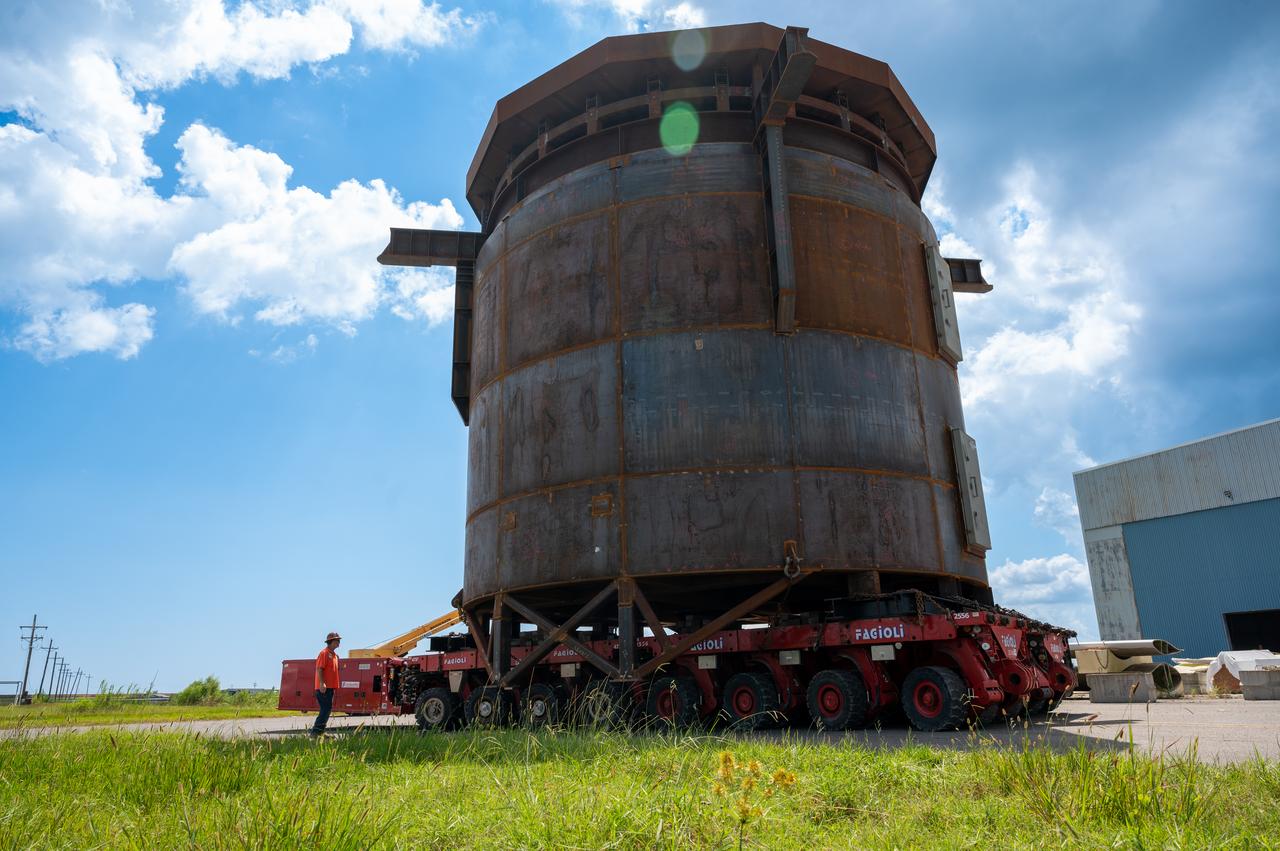
Move crews at NASA’s Michoud Assembly Facility in New Orleans guide the Inter-Stage Simulator (ISS) to the Michoud deep water port on Monday, Sept. 19 in preparation for transportation by barge to the agency’s Stennis Space Center near Bay St. Louis, Mississippi. Once it arrives at Stennis, the simulator will be lifted into the B2 Test Stand, where it holds the Exploration Upper Stage (EUS) in place and acts as a thrust takeout. ISS protects the lower portion of the EUS from environmental elements during its Green Run tests. The term “green” refers to the new hardware, and “run” refers to operation all the components together for the first time. During tanking and launch for its future mission, the lower portion is shrouded in a flight interstage. EUS is part of the SLS Block 1B configuration. The more powerful configuration of the SLS rocket will provide in-space propulsion to send astronauts in NASA’s Orion spacecraft and 40% more cargo mass on a precise trajectory to the Moon. Through the Artemis missions, NASA will land the first woman and the first person of color on the Moon to pave the way for a sustainable presence on the Moon and future missions beyond.
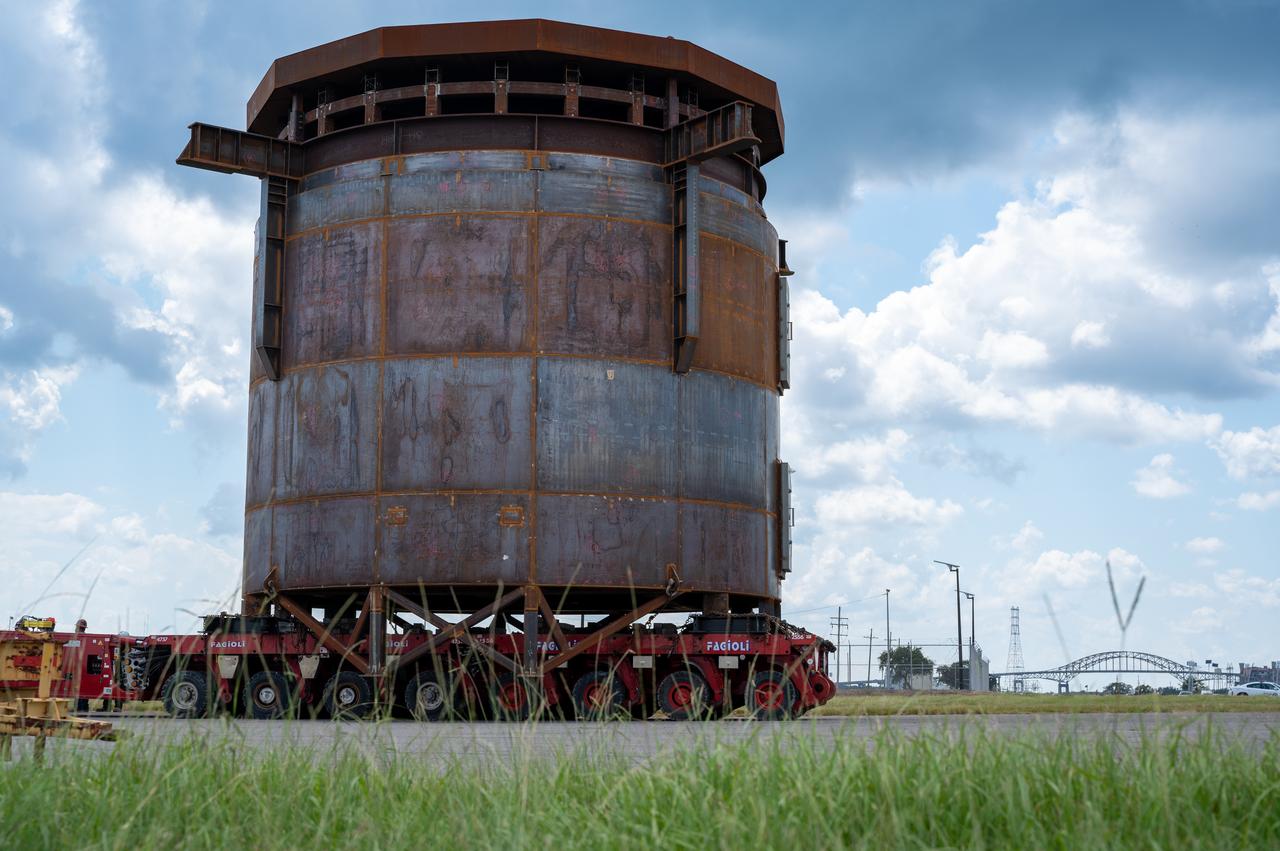
Move crews at NASA’s Michoud Assembly Facility in New Orleans guide the Inter-Stage Simulator (ISS) to the Michoud deep water port on Monday, Sept. 19 in preparation for transportation by barge to the agency’s Stennis Space Center near Bay St. Louis, Mississippi. Once it arrives at Stennis, the simulator will be lifted into the B2 Test Stand, where it holds the Exploration Upper Stage (EUS) in place and acts as a thrust takeout. ISS protects the lower portion of the EUS from environmental elements during its Green Run tests. The term “green” refers to the new hardware, and “run” refers to operation all the components together for the first time. During tanking and launch for its future mission, the lower portion is shrouded in a flight interstage. EUS is part of the SLS Block 1B configuration. The more powerful configuration of the SLS rocket will provide in-space propulsion to send astronauts in NASA’s Orion spacecraft and 40% more cargo mass on a precise trajectory to the Moon. Through the Artemis missions, NASA will land the first woman and the first person of color on the Moon to pave the way for a sustainable presence on the Moon and future missions beyond.
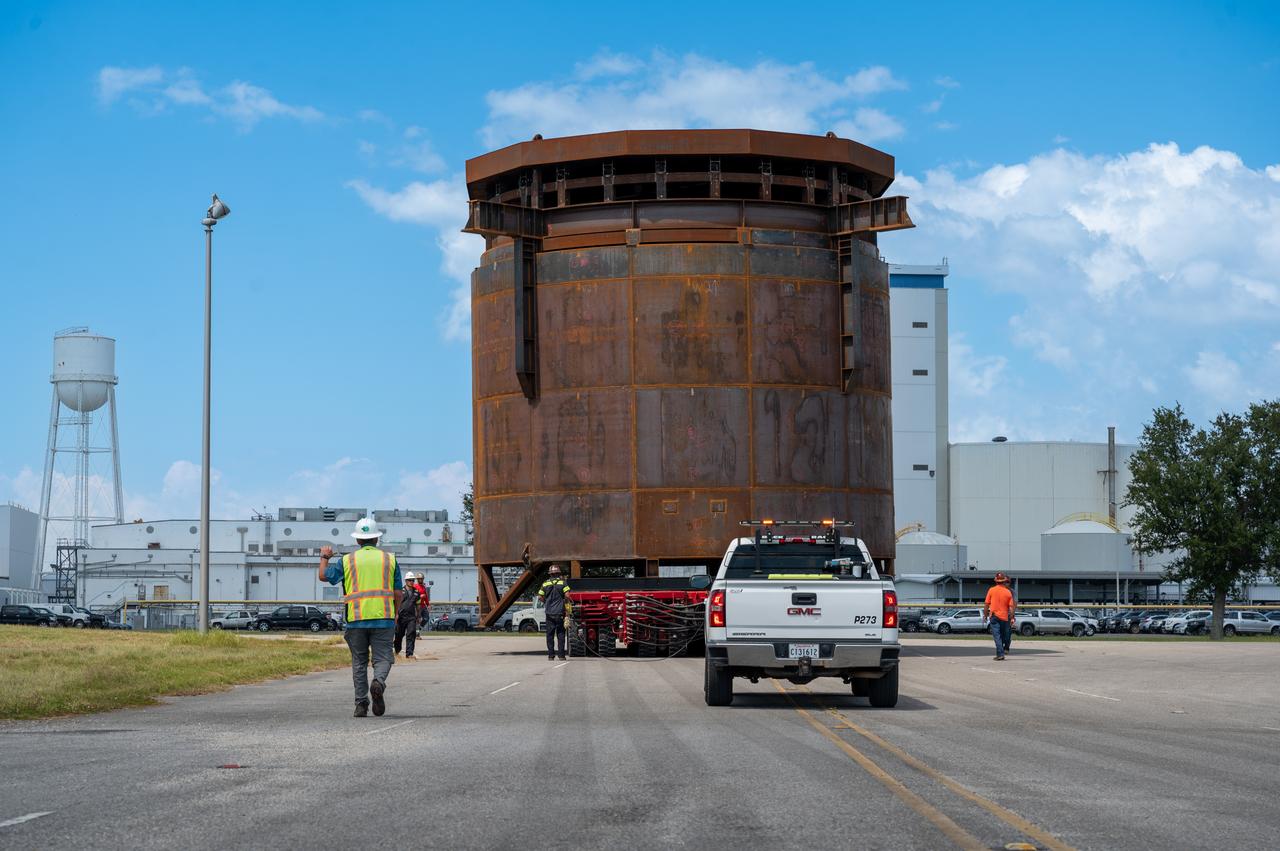
Move crews at NASA’s Michoud Assembly Facility in New Orleans guide the Inter-Stage Simulator (ISS) to the Michoud deep water port on Monday, Sept. 19 in preparation for transportation by barge to the agency’s Stennis Space Center near Bay St. Louis, Mississippi. Once it arrives at Stennis, the simulator will be lifted into the B2 Test Stand, where it holds the Exploration Upper Stage (EUS) in place and acts as a thrust takeout. ISS protects the lower portion of the EUS from environmental elements during its Green Run tests. The term “green” refers to the new hardware, and “run” refers to operation all the components together for the first time. During tanking and launch for its future mission, the lower portion is shrouded in a flight interstage. EUS is part of the SLS Block 1B configuration. The more powerful configuration of the SLS rocket will provide in-space propulsion to send astronauts in NASA’s Orion spacecraft and 40% more cargo mass on a precise trajectory to the Moon. Through the Artemis missions, NASA will land the first woman and the first person of color on the Moon to pave the way for a sustainable presence on the Moon and future missions beyond.
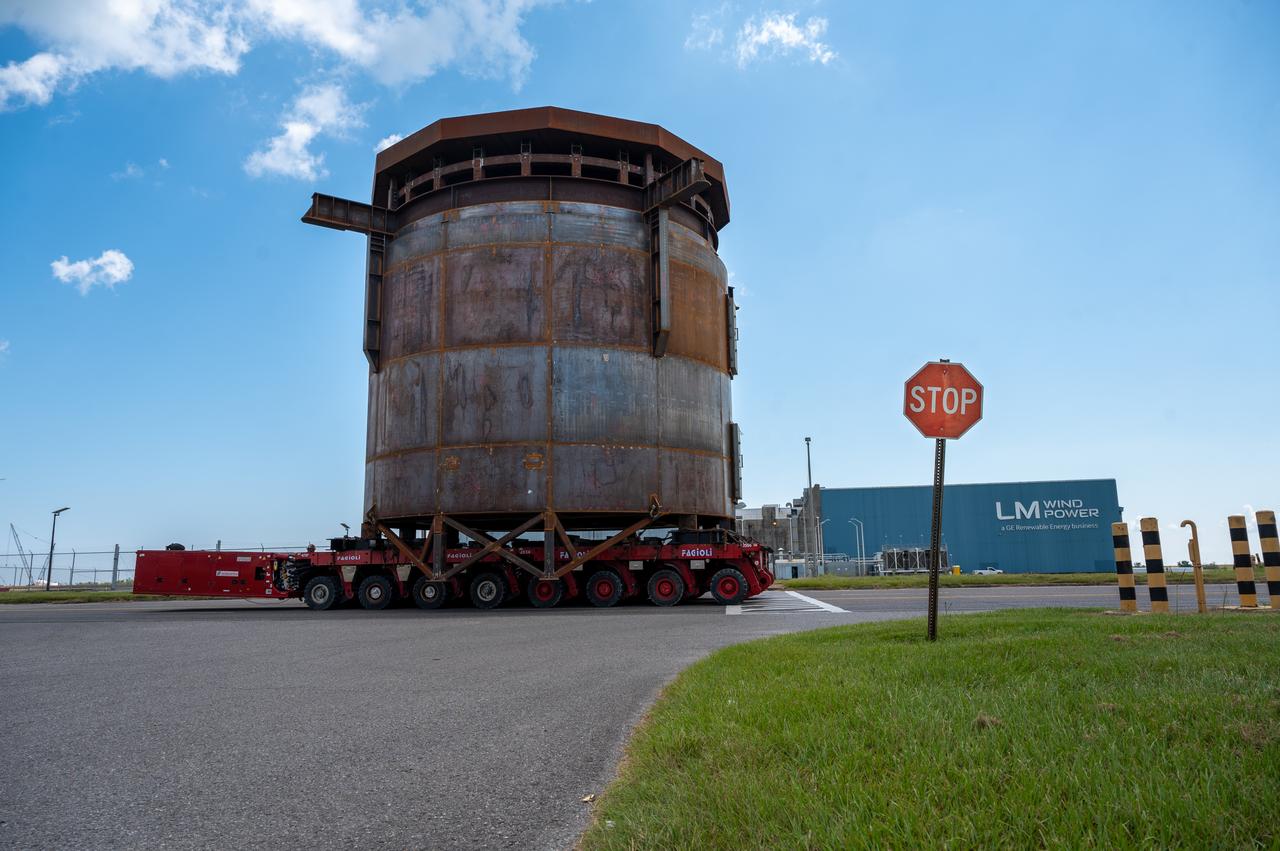
Move crews at NASA’s Michoud Assembly Facility in New Orleans guide the Inter-Stage Simulator (ISS) to the Michoud deep water port on Monday, Sept. 19 in preparation for transportation by barge to the agency’s Stennis Space Center near Bay St. Louis, Mississippi. Once it arrives at Stennis, the simulator will be lifted into the B2 Test Stand, where it holds the Exploration Upper Stage (EUS) in place and acts as a thrust takeout. ISS protects the lower portion of the EUS from environmental elements during its Green Run tests. The term “green” refers to the new hardware, and “run” refers to operation all the components together for the first time. During tanking and launch for its future mission, the lower portion is shrouded in a flight interstage. EUS is part of the SLS Block 1B configuration. The more powerful configuration of the SLS rocket will provide in-space propulsion to send astronauts in NASA’s Orion spacecraft and 40% more cargo mass on a precise trajectory to the Moon. Through the Artemis missions, NASA will land the first woman and the first person of color on the Moon to pave the way for a sustainable presence on the Moon and future missions beyond.
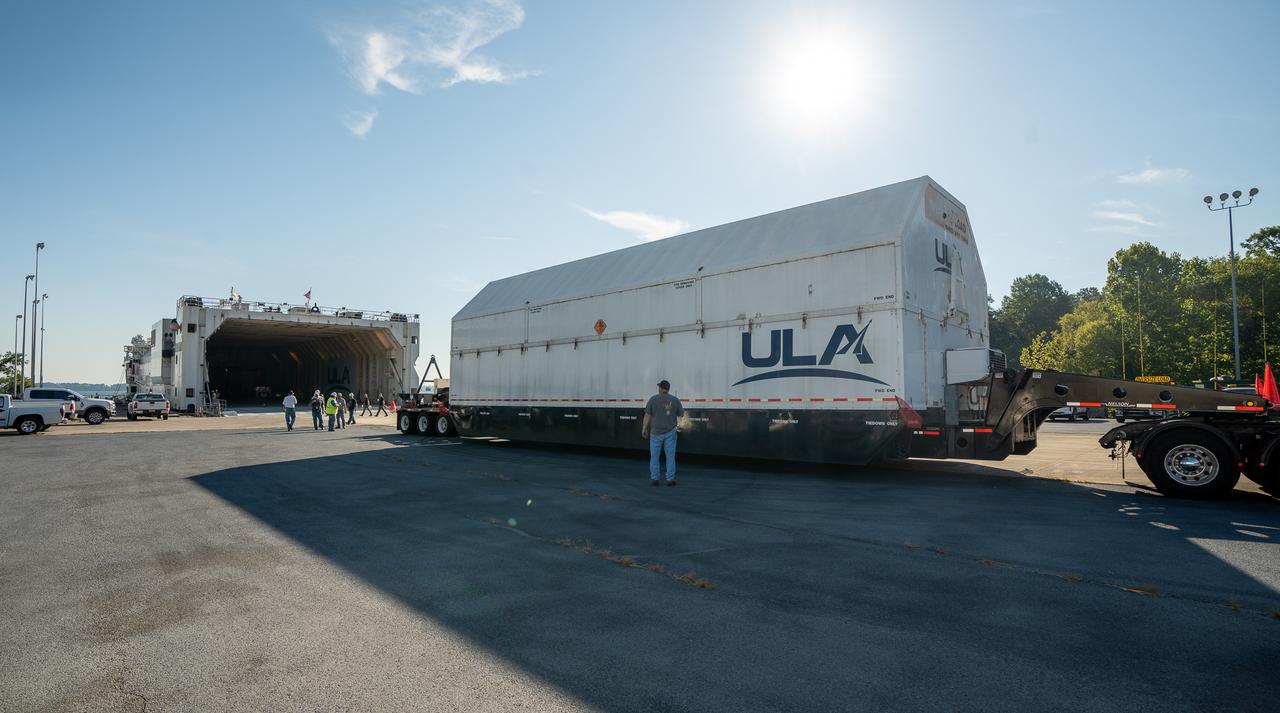
These images and videos show how crews in Alabama prepared the ICPS (interim cryogenic propulsion stage) for NASA’s SLS (Space Launch System) rocket for shipment to Florida between July 29-31. The ICPS in the photos and videos will help power NASA’s Artemis III mission to the Moon. The SLS upper stage is manufactured by United Launch Alliance at its facility in Decatur. Its RL10 engine is produced by Aerojet Rocketdyne, the SLS engines lead contractor, in West Palm Beach, Florida. ULA is working with Boeing, the SLS core stage and exploration upper stage lead contractor, to develop ICPS. ULA’s R/S RocketShip is transporting the flight hardware to its sister facility in Florida near NASA’s Kennedy Space Center for final checkouts. The ICPS for Artemis III is the last of its kind as SLS transitions to its next, more powerful Block 1B configuration with an upgraded upper stage beginning with Artemis IV. NASA is working to land the first woman and first person of color on the Moon under Artemis. SLS is part of NASA’s backbone for deep space exploration, along with Orion and the Gateway in orbit around the Moon. SLS is the only rocket that can send Orion, astronauts, and supplies to the Moon in a single mission.
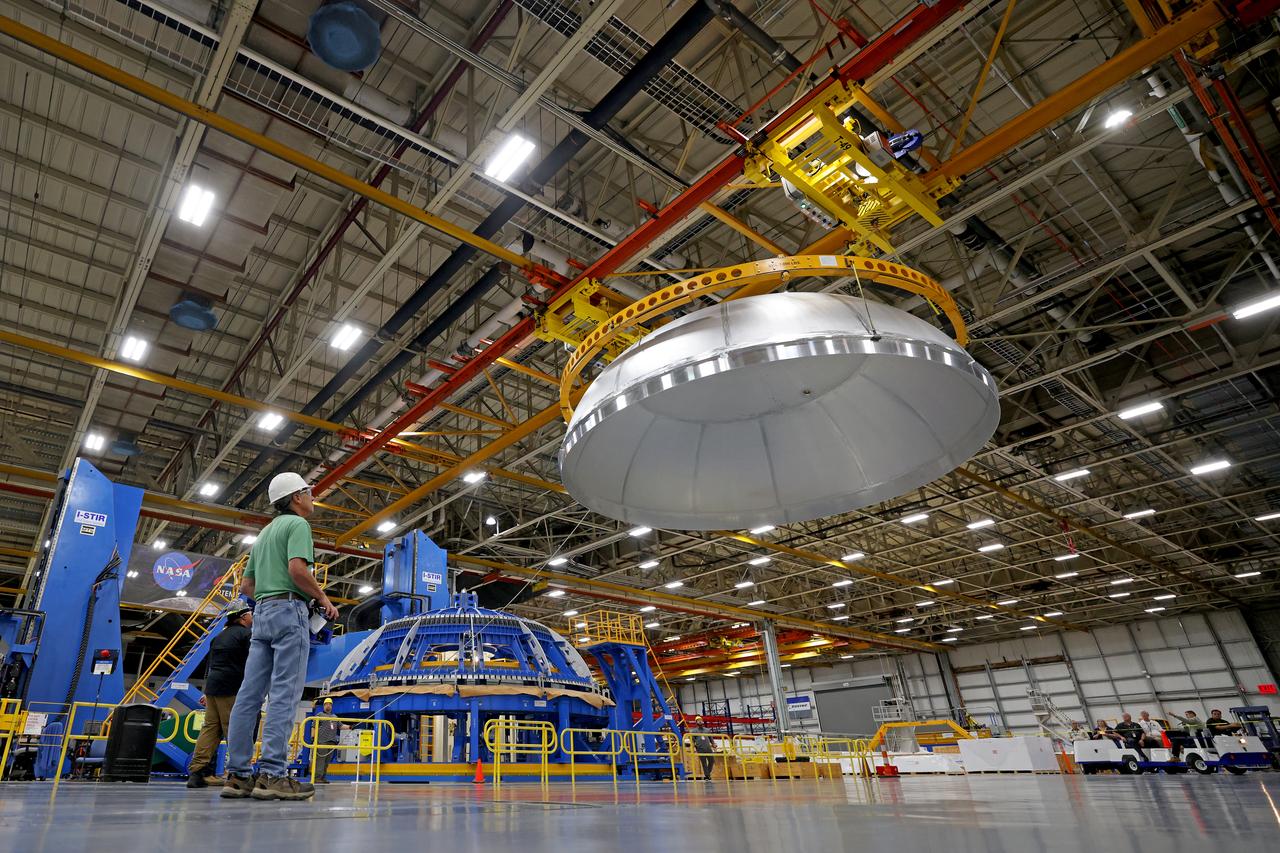
Teams completed welding of the liquid oxygen dome for the core stage of a future SLS (Space Launch System) rocket at NASA’s Michoud Assembly Facility in New Orleans. The dome, which will cap off the forward end of the liquid oxygen tank, was lifted off of the robotic weld tool and moved to an assembly area for the next phase of production. Later, crews will add the forward dome to join the two barrels and the aft dome to complete the liquid oxygen tank. The flight hardware will be used for Artemis IV, the first flight of SLS in its Block 1B configuration. The SLS core stage liquid oxygen tank holds 196,000 gallons of super-cooled liquid propellant. The SLS core stage is made up of five unique elements: the forward skirt, liquid oxygen tank, intertank, liquid hydrogen tank, and the engine section. The liquid oxygen and the liquid hydrogen tanks will provide propellant to the four RS-25 engines to produce more than two million pounds of thrust to help launch NASA’s Orion spacecraft, astronauts, and supplies beyond Earth’s orbit to the Moon. Image credit: NASA/Michael DeMocker
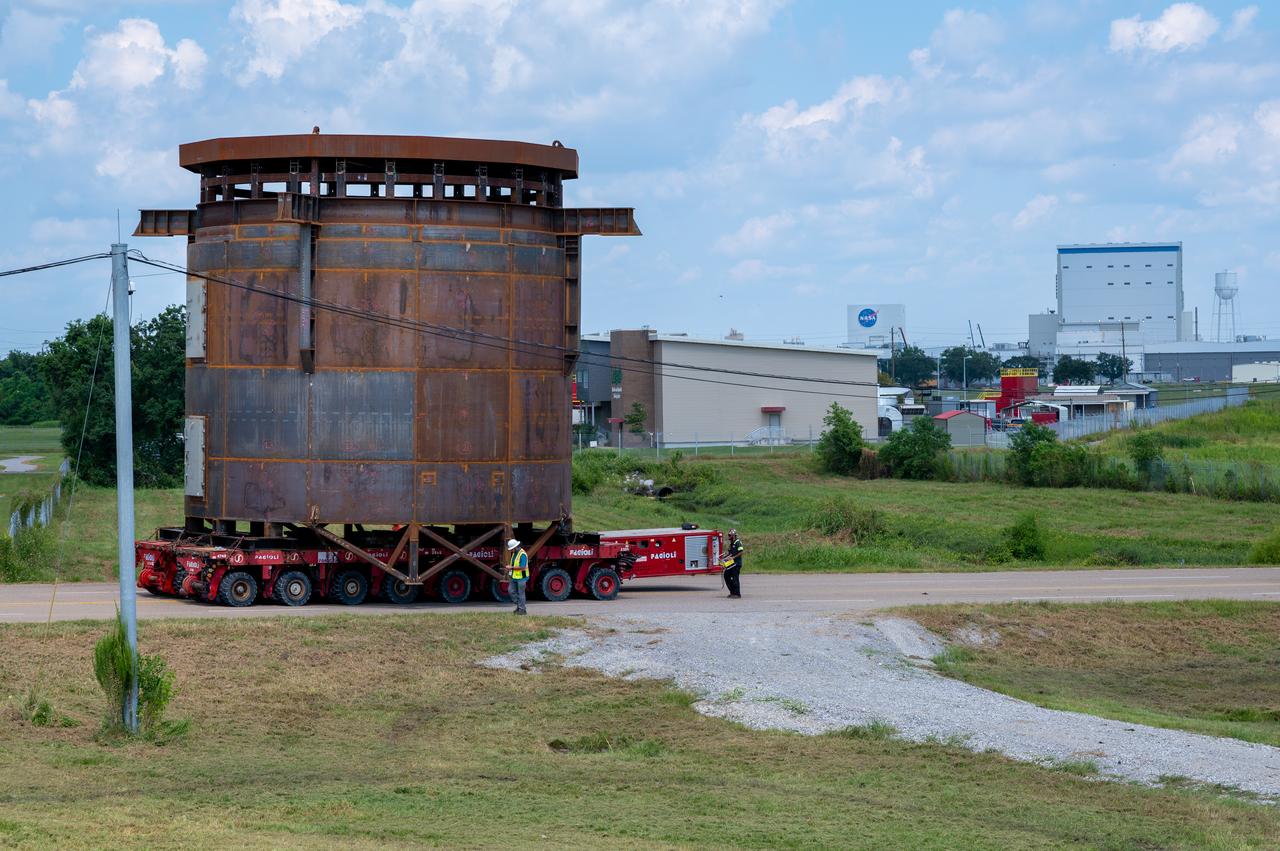
Move crews at NASA’s Michoud Assembly Facility in New Orleans guide the Inter-Stage Simulator (ISS) to the Michoud deep water port on Monday, Sept. 19 in preparation for transportation by barge to the agency’s Stennis Space Center near Bay St. Louis, Mississippi. Once it arrives at Stennis, the simulator will be lifted into the B2 Test Stand, where it holds the Exploration Upper Stage (EUS) in place and acts as a thrust takeout. ISS protects the lower portion of the EUS from environmental elements during its Green Run tests. The term “green” refers to the new hardware, and “run” refers to operation all the components together for the first time. During tanking and launch for its future mission, the lower portion is shrouded in a flight interstage. EUS is part of the SLS Block 1B configuration. The more powerful configuration of the SLS rocket will provide in-space propulsion to send astronauts in NASA’s Orion spacecraft and 40% more cargo mass on a precise trajectory to the Moon. Through the Artemis missions, NASA will land the first woman and the first person of color on the Moon to pave the way for a sustainable presence on the Moon and future missions beyond.
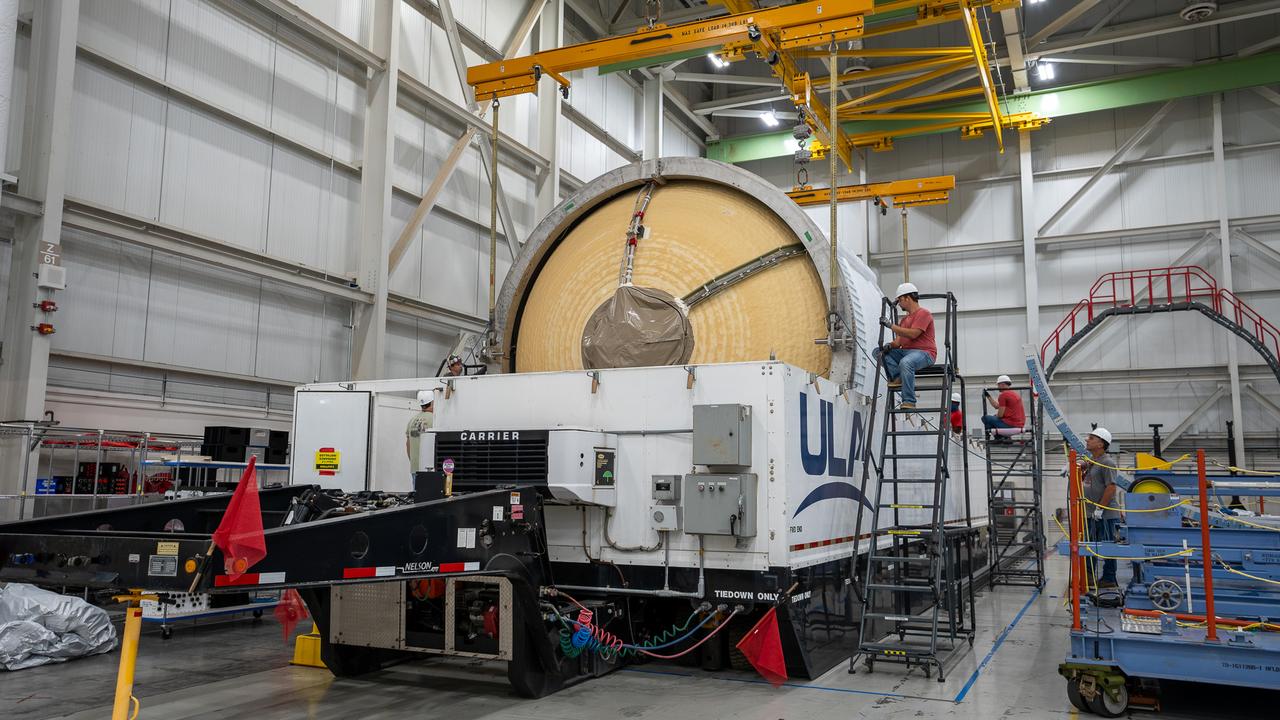
These images and videos show how crews in Alabama prepared the ICPS (interim cryogenic propulsion stage) for NASA’s SLS (Space Launch System) rocket for shipment to Florida between July 29-31. The ICPS in the photos and videos will help power NASA’s Artemis III mission to the Moon. The SLS upper stage is manufactured by United Launch Alliance at its facility in Decatur. Its RL10 engine is produced by Aerojet Rocketdyne, the SLS engines lead contractor, in West Palm Beach, Florida. ULA is working with Boeing, the SLS core stage and exploration upper stage lead contractor, to develop ICPS. ULA’s R/S RocketShip is transporting the flight hardware to its sister facility in Florida near NASA’s Kennedy Space Center for final checkouts. The ICPS for Artemis III is the last of its kind as SLS transitions to its next, more powerful Block 1B configuration with an upgraded upper stage beginning with Artemis IV. NASA is working to land the first woman and first person of color on the Moon under Artemis. SLS is part of NASA’s backbone for deep space exploration, along with Orion and the Gateway in orbit around the Moon. SLS is the only rocket that can send Orion, astronauts, and supplies to the Moon in a single mission.

These images and videos show how crews in Alabama prepared the ICPS (interim cryogenic propulsion stage) for NASA’s SLS (Space Launch System) rocket for shipment to Florida between July 29-31. The ICPS in the photos and videos will help power NASA’s Artemis III mission to the Moon. The SLS upper stage is manufactured by United Launch Alliance at its facility in Decatur. Its RL10 engine is produced by Aerojet Rocketdyne, the SLS engines lead contractor, in West Palm Beach, Florida. ULA is working with Boeing, the SLS core stage and exploration upper stage lead contractor, to develop ICPS. ULA’s R/S RocketShip is transporting the flight hardware to its sister facility in Florida near NASA’s Kennedy Space Center for final checkouts. The ICPS for Artemis III is the last of its kind as SLS transitions to its next, more powerful Block 1B configuration with an upgraded upper stage beginning with Artemis IV. NASA is working to land the first woman and first person of color on the Moon under Artemis. SLS is part of NASA’s backbone for deep space exploration, along with Orion and the Gateway in orbit around the Moon. SLS is the only rocket that can send Orion, astronauts, and supplies to the Moon in a single mission.

Move crews at NASA’s Michoud Assembly Facility in New Orleans guide the Inter-Stage Simulator (ISS) to the Michoud deep water port on Monday, Sept. 19 in preparation for transportation by barge to the agency’s Stennis Space Center near Bay St. Louis, Mississippi. Once it arrives at Stennis, the simulator will be lifted into the B2 Test Stand, where it holds the Exploration Upper Stage (EUS) in place and acts as a thrust takeout. ISS protects the lower portion of the EUS from environmental elements during its Green Run tests. The term “green” refers to the new hardware, and “run” refers to operation all the components together for the first time. During tanking and launch for its future mission, the lower portion is shrouded in a flight interstage. EUS is part of the SLS Block 1B configuration. The more powerful configuration of the SLS rocket will provide in-space propulsion to send astronauts in NASA’s Orion spacecraft and 40% more cargo mass on a precise trajectory to the Moon. Through the Artemis missions, NASA will land the first woman and the first person of color on the Moon to pave the way for a sustainable presence on the Moon and future missions beyond.
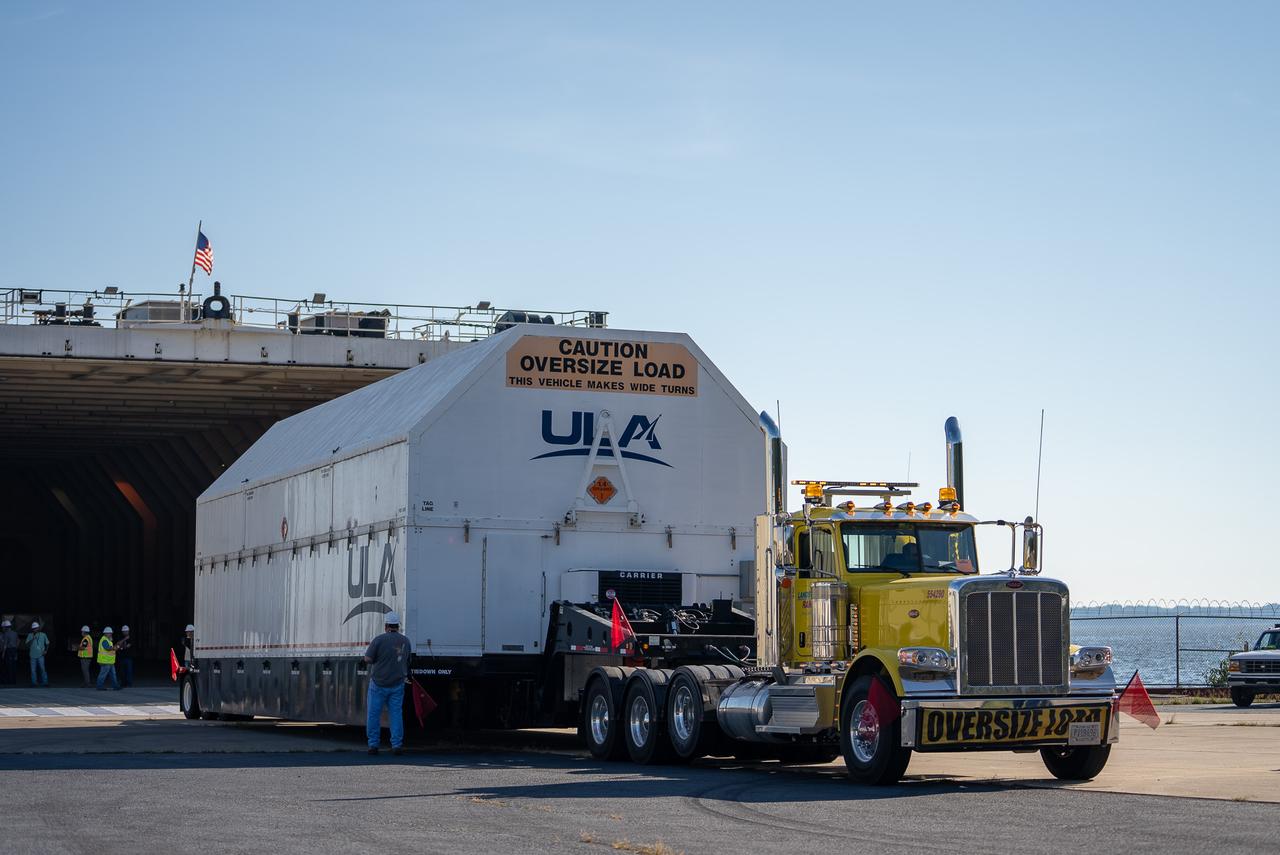
These images and videos show how crews in Alabama prepared the ICPS (interim cryogenic propulsion stage) for NASA’s SLS (Space Launch System) rocket for shipment to Florida between July 29-31. The ICPS in the photos and videos will help power NASA’s Artemis III mission to the Moon. The SLS upper stage is manufactured by United Launch Alliance at its facility in Decatur. Its RL10 engine is produced by Aerojet Rocketdyne, the SLS engines lead contractor, in West Palm Beach, Florida. ULA is working with Boeing, the SLS core stage and exploration upper stage lead contractor, to develop ICPS. ULA’s R/S RocketShip is transporting the flight hardware to its sister facility in Florida near NASA’s Kennedy Space Center for final checkouts. The ICPS for Artemis III is the last of its kind as SLS transitions to its next, more powerful Block 1B configuration with an upgraded upper stage beginning with Artemis IV. NASA is working to land the first woman and first person of color on the Moon under Artemis. SLS is part of NASA’s backbone for deep space exploration, along with Orion and the Gateway in orbit around the Moon. SLS is the only rocket that can send Orion, astronauts, and supplies to the Moon in a single mission.
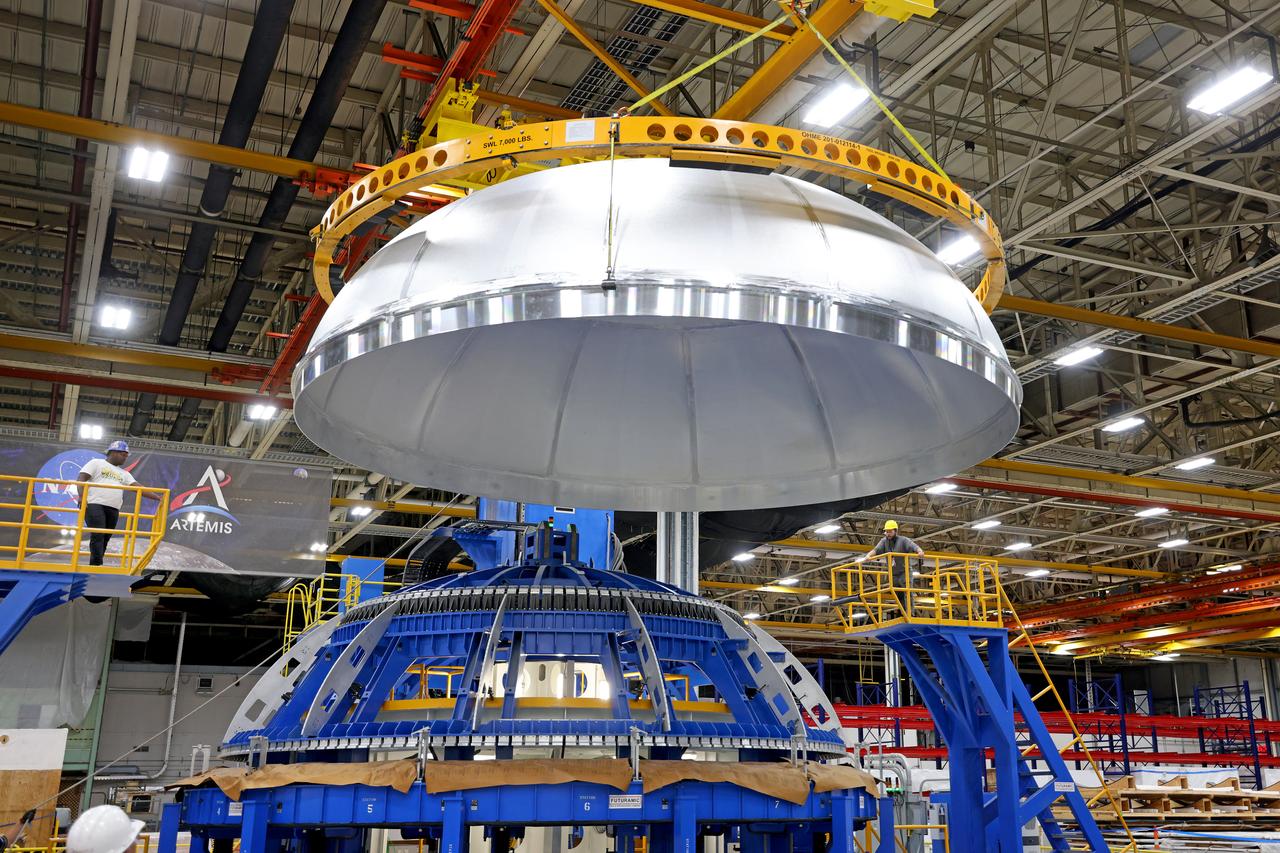
Teams completed welding of the liquid oxygen dome for the core stage of a future SLS (Space Launch System) rocket at NASA’s Michoud Assembly Facility in New Orleans. The dome, which will cap off the forward end of the liquid oxygen tank, was lifted off of the robotic weld tool and moved to an assembly area for the next phase of production. Later, crews will add the forward dome to join the two barrels and the aft dome to complete the liquid oxygen tank. The flight hardware will be used for Artemis IV, the first flight of SLS in its Block 1B configuration. The SLS core stage liquid oxygen tank holds 196,000 gallons of super-cooled liquid propellant. The SLS core stage is made up of five unique elements: the forward skirt, liquid oxygen tank, intertank, liquid hydrogen tank, and the engine section. The liquid oxygen and the liquid hydrogen tanks will provide propellant to the four RS-25 engines to produce more than two million pounds of thrust to help launch NASA’s Orion spacecraft, astronauts, and supplies beyond Earth’s orbit to the Moon. Image credit: NASA/Michael DeMocker
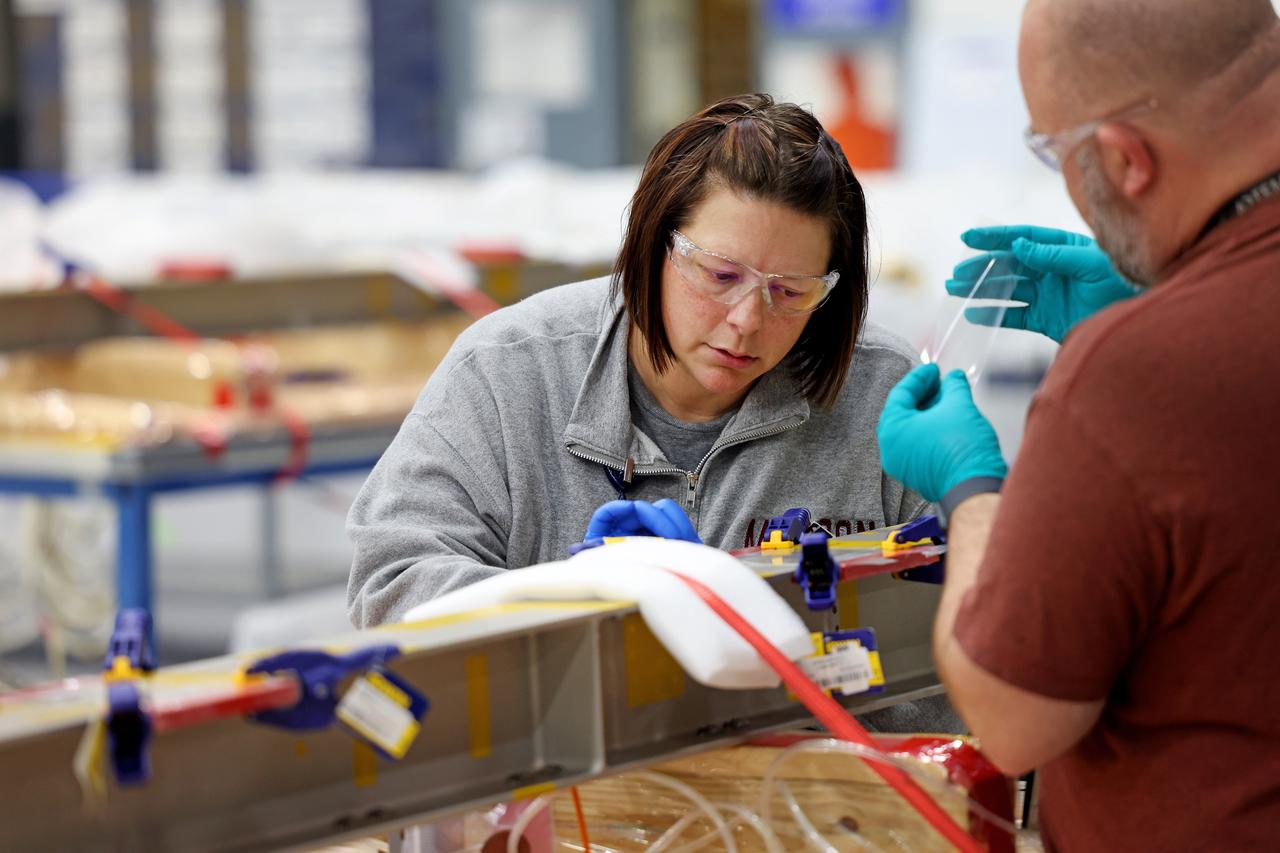
Technicians at NASA’s Michoud Assembly Facility in New Orleans on Feb. 22 prepare elements that will form part of the midbody for the future exploration upper stage for the SLS (Space Launch System) rocket. The midbody struts, or V-struts, will create the midbody’s cage-like outer structure to connect the upper stage’s larger liquid hydrogen tank to its smaller liquid oxygen tank. Manufacturing flight and test hardware for the future SLS upper stage is a collaborative effort between NASA and Boeing, the lead contractor for EUS and the SLS core stage. Beginning with Artemis IV, SLS will evolve to its more powerful Block 1B configuration with the advanced exploration upper stage that gives the rocket the capability to launch 40% more to the Moon along with Artemis astronauts inside NASA’s Orion spacecraft. The evolved in-space stage for SLS will use a combination of liquid oxygen and liquid hydrogen propellants to help power the engines to send large cargo and crew inside Orion to the Moon. Image credit: NASA/Michael DeMocker
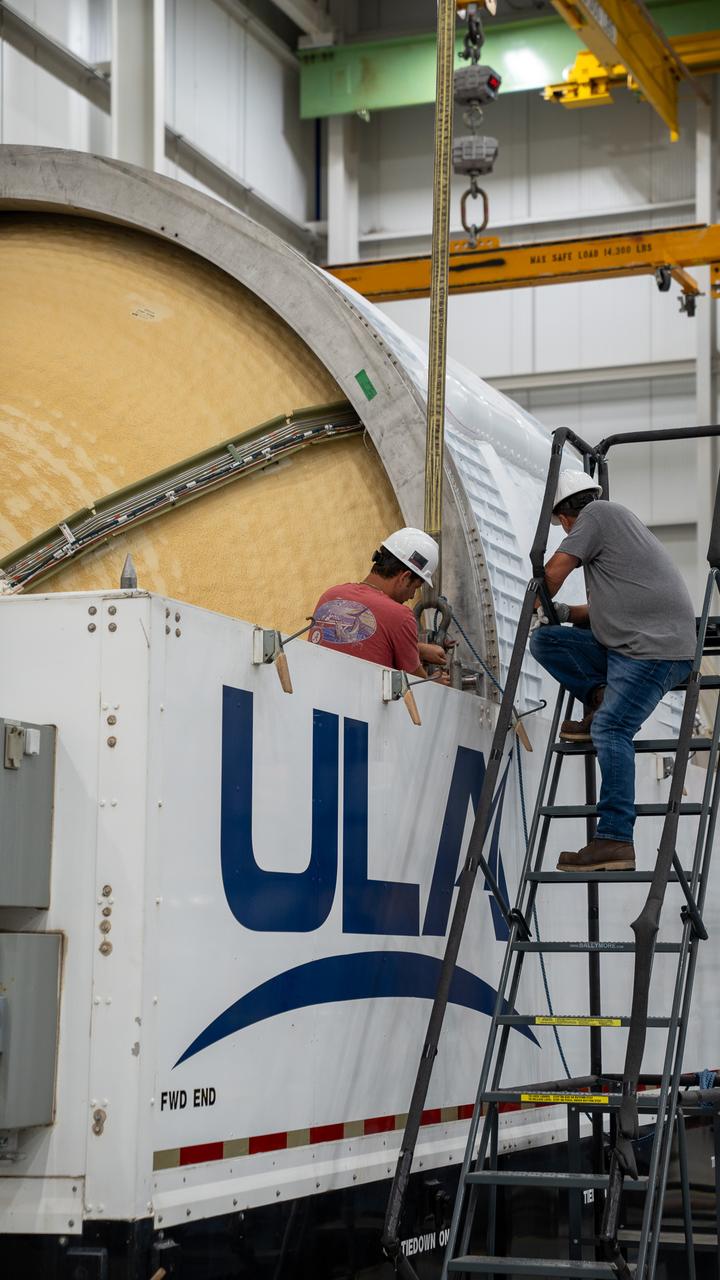
These images and videos show how crews in Alabama prepared the ICPS (interim cryogenic propulsion stage) for NASA’s SLS (Space Launch System) rocket for shipment to Florida between July 29-31. The ICPS in the photos and videos will help power NASA’s Artemis III mission to the Moon. The SLS upper stage is manufactured by United Launch Alliance at its facility in Decatur. Its RL10 engine is produced by Aerojet Rocketdyne, the SLS engines lead contractor, in West Palm Beach, Florida. ULA is working with Boeing, the SLS core stage and exploration upper stage lead contractor, to develop ICPS. ULA’s R/S RocketShip is transporting the flight hardware to its sister facility in Florida near NASA’s Kennedy Space Center for final checkouts. The ICPS for Artemis III is the last of its kind as SLS transitions to its next, more powerful Block 1B configuration with an upgraded upper stage beginning with Artemis IV. NASA is working to land the first woman and first person of color on the Moon under Artemis. SLS is part of NASA’s backbone for deep space exploration, along with Orion and the Gateway in orbit around the Moon. SLS is the only rocket that can send Orion, astronauts, and supplies to the Moon in a single mission.
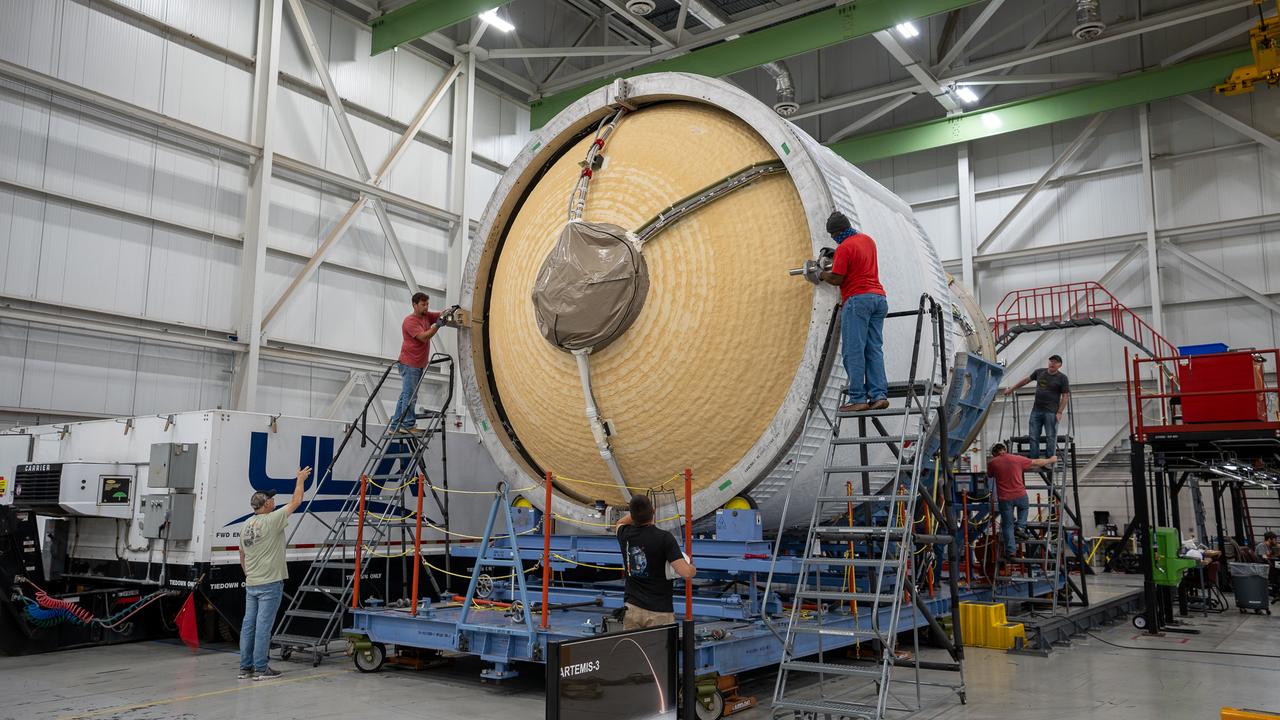
These images and videos show how crews in Alabama prepared the ICPS (interim cryogenic propulsion stage) for NASA’s SLS (Space Launch System) rocket for shipment to Florida between July 29-31. The ICPS in the photos and videos will help power NASA’s Artemis III mission to the Moon. The SLS upper stage is manufactured by United Launch Alliance at its facility in Decatur. Its RL10 engine is produced by Aerojet Rocketdyne, the SLS engines lead contractor, in West Palm Beach, Florida. ULA is working with Boeing, the SLS core stage and exploration upper stage lead contractor, to develop ICPS. ULA’s R/S RocketShip is transporting the flight hardware to its sister facility in Florida near NASA’s Kennedy Space Center for final checkouts. The ICPS for Artemis III is the last of its kind as SLS transitions to its next, more powerful Block 1B configuration with an upgraded upper stage beginning with Artemis IV. NASA is working to land the first woman and first person of color on the Moon under Artemis. SLS is part of NASA’s backbone for deep space exploration, along with Orion and the Gateway in orbit around the Moon. SLS is the only rocket that can send Orion, astronauts, and supplies to the Moon in a single mission.
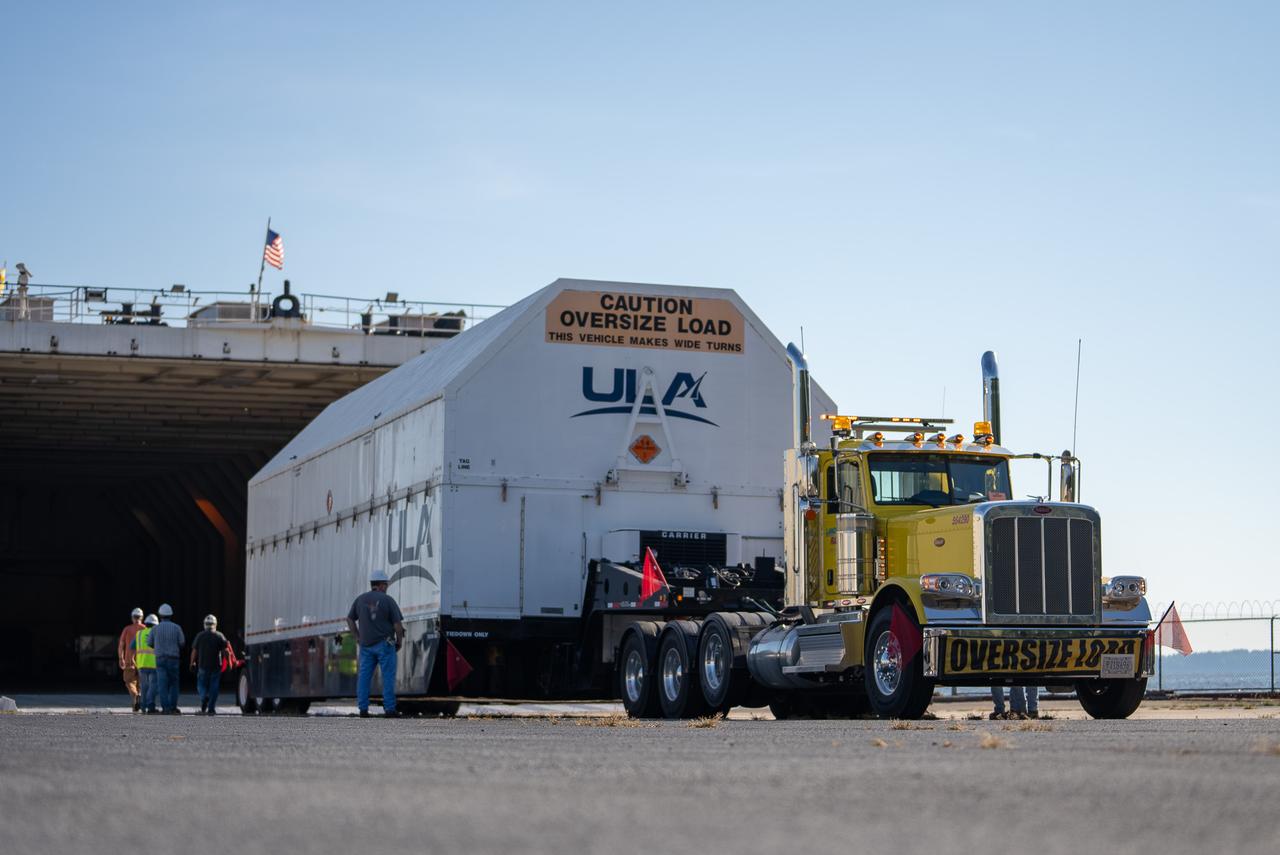
These images and videos show how crews in Alabama prepared the ICPS (interim cryogenic propulsion stage) for NASA’s SLS (Space Launch System) rocket for shipment to Florida between July 29-31. The ICPS in the photos and videos will help power NASA’s Artemis III mission to the Moon. The SLS upper stage is manufactured by United Launch Alliance at its facility in Decatur. Its RL10 engine is produced by Aerojet Rocketdyne, the SLS engines lead contractor, in West Palm Beach, Florida. ULA is working with Boeing, the SLS core stage and exploration upper stage lead contractor, to develop ICPS. ULA’s R/S RocketShip is transporting the flight hardware to its sister facility in Florida near NASA’s Kennedy Space Center for final checkouts. The ICPS for Artemis III is the last of its kind as SLS transitions to its next, more powerful Block 1B configuration with an upgraded upper stage beginning with Artemis IV. NASA is working to land the first woman and first person of color on the Moon under Artemis. SLS is part of NASA’s backbone for deep space exploration, along with Orion and the Gateway in orbit around the Moon. SLS is the only rocket that can send Orion, astronauts, and supplies to the Moon in a single mission.

Teams completed welding of the liquid oxygen dome for the core stage of a future SLS (Space Launch System) rocket at NASA’s Michoud Assembly Facility in New Orleans. The dome, which will cap off the forward end of the liquid oxygen tank, was lifted off of the robotic weld tool and moved to an assembly area for the next phase of production. Later, crews will add the forward dome to join the two barrels and the aft dome to complete the liquid oxygen tank. The flight hardware will be used for Artemis IV, the first flight of SLS in its Block 1B configuration. The SLS core stage liquid oxygen tank holds 196,000 gallons of super-cooled liquid propellant. The SLS core stage is made up of five unique elements: the forward skirt, liquid oxygen tank, intertank, liquid hydrogen tank, and the engine section. The liquid oxygen and the liquid hydrogen tanks will provide propellant to the four RS-25 engines to produce more than two million pounds of thrust to help launch NASA’s Orion spacecraft, astronauts, and supplies beyond Earth’s orbit to the Moon. Image credit: NASA/Michael DeMocker
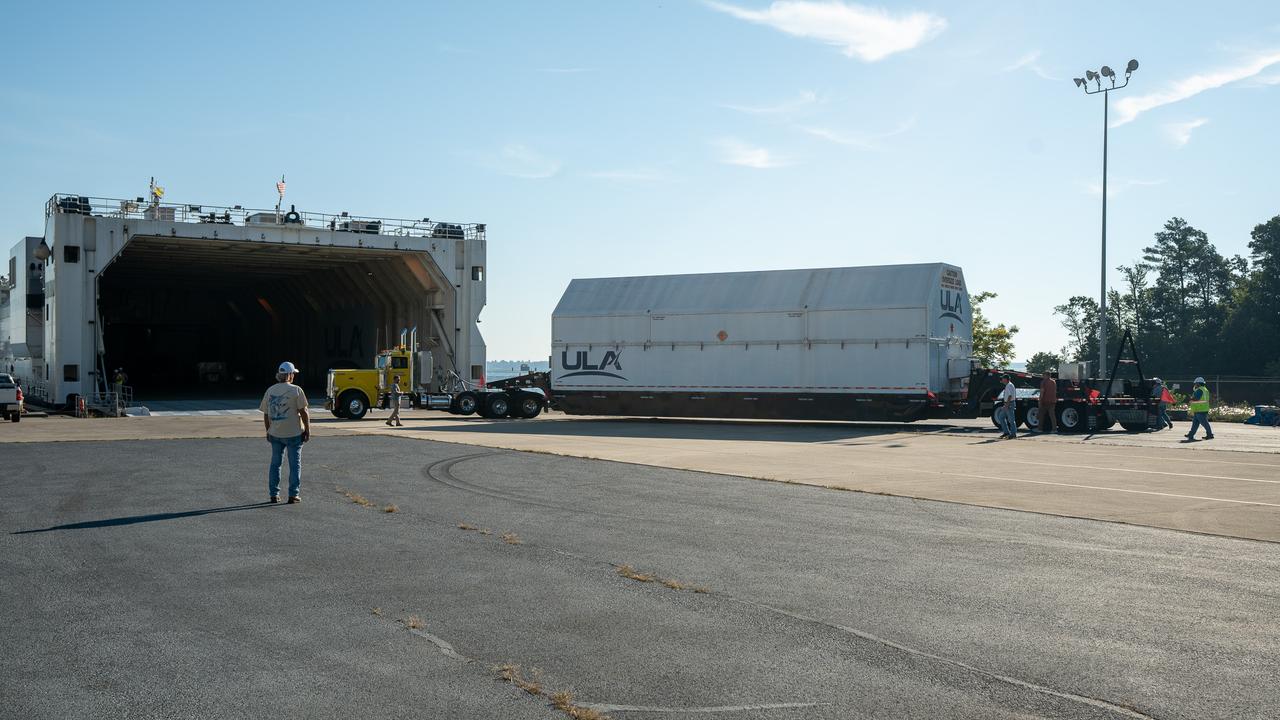
These images and videos show how crews in Alabama prepared the ICPS (interim cryogenic propulsion stage) for NASA’s SLS (Space Launch System) rocket for shipment to Florida between July 29-31. The ICPS in the photos and videos will help power NASA’s Artemis III mission to the Moon. The SLS upper stage is manufactured by United Launch Alliance at its facility in Decatur. Its RL10 engine is produced by Aerojet Rocketdyne, the SLS engines lead contractor, in West Palm Beach, Florida. ULA is working with Boeing, the SLS core stage and exploration upper stage lead contractor, to develop ICPS. ULA’s R/S RocketShip is transporting the flight hardware to its sister facility in Florida near NASA’s Kennedy Space Center for final checkouts. The ICPS for Artemis III is the last of its kind as SLS transitions to its next, more powerful Block 1B configuration with an upgraded upper stage beginning with Artemis IV. NASA is working to land the first woman and first person of color on the Moon under Artemis. SLS is part of NASA’s backbone for deep space exploration, along with Orion and the Gateway in orbit around the Moon. SLS is the only rocket that can send Orion, astronauts, and supplies to the Moon in a single mission.

Technicians at NASA’s Michoud Assembly Facility in New Orleans on Feb. 22 prepare elements that will form part of the midbody for the future exploration upper stage for the SLS (Space Launch System) rocket. The midbody struts, or V-struts, will create the midbody’s cage-like outer structure to connect the upper stage’s larger liquid hydrogen tank to its smaller liquid oxygen tank. Manufacturing flight and test hardware for the future SLS upper stage is a collaborative effort between NASA and Boeing, the lead contractor for EUS and the SLS core stage. Beginning with Artemis IV, SLS will evolve to its more powerful Block 1B configuration with the advanced exploration upper stage that gives the rocket the capability to launch 40% more to the Moon along with Artemis astronauts inside NASA’s Orion spacecraft. The evolved in-space stage for SLS will use a combination of liquid oxygen and liquid hydrogen propellants to help power the engines to send large cargo and crew inside Orion to the Moon. Image credit: NASA/Michael DeMocker
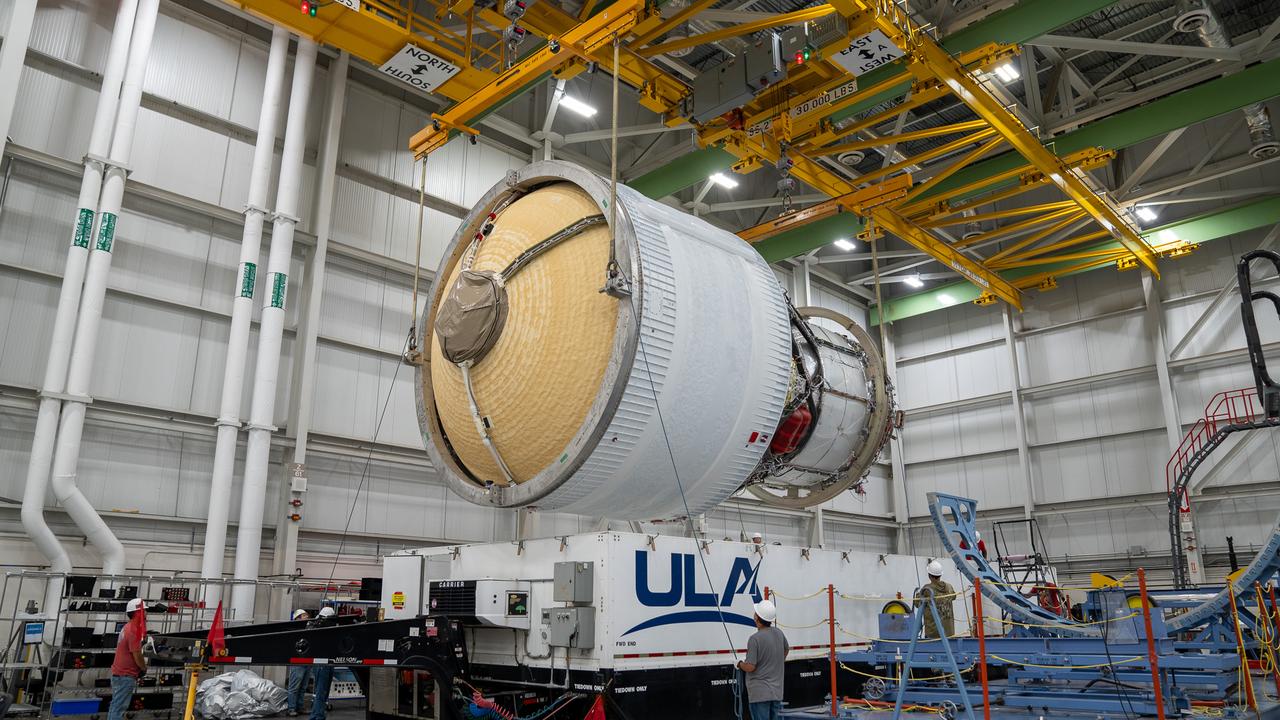
These images and videos show how crews in Alabama prepared the ICPS (interim cryogenic propulsion stage) for NASA’s SLS (Space Launch System) rocket for shipment to Florida between July 29-31. The ICPS in the photos and videos will help power NASA’s Artemis III mission to the Moon. The SLS upper stage is manufactured by United Launch Alliance at its facility in Decatur. Its RL10 engine is produced by Aerojet Rocketdyne, the SLS engines lead contractor, in West Palm Beach, Florida. ULA is working with Boeing, the SLS core stage and exploration upper stage lead contractor, to develop ICPS. ULA’s R/S RocketShip is transporting the flight hardware to its sister facility in Florida near NASA’s Kennedy Space Center for final checkouts. The ICPS for Artemis III is the last of its kind as SLS transitions to its next, more powerful Block 1B configuration with an upgraded upper stage beginning with Artemis IV. NASA is working to land the first woman and first person of color on the Moon under Artemis. SLS is part of NASA’s backbone for deep space exploration, along with Orion and the Gateway in orbit around the Moon. SLS is the only rocket that can send Orion, astronauts, and supplies to the Moon in a single mission.

Teams completed welding of the liquid oxygen dome for the core stage of a future SLS (Space Launch System) rocket at NASA’s Michoud Assembly Facility in New Orleans. The dome, which will cap off the forward end of the liquid oxygen tank, was lifted off of the robotic weld tool and moved to an assembly area for the next phase of production. Later, crews will add the forward dome to join the two barrels and the aft dome to complete the liquid oxygen tank. The flight hardware will be used for Artemis IV, the first flight of SLS in its Block 1B configuration. The SLS core stage liquid oxygen tank holds 196,000 gallons of super-cooled liquid propellant. The SLS core stage is made up of five unique elements: the forward skirt, liquid oxygen tank, intertank, liquid hydrogen tank, and the engine section. The liquid oxygen and the liquid hydrogen tanks will provide propellant to the four RS-25 engines to produce more than two million pounds of thrust to help launch NASA’s Orion spacecraft, astronauts, and supplies beyond Earth’s orbit to the Moon. Image credit: NASA/Michael DeMocker
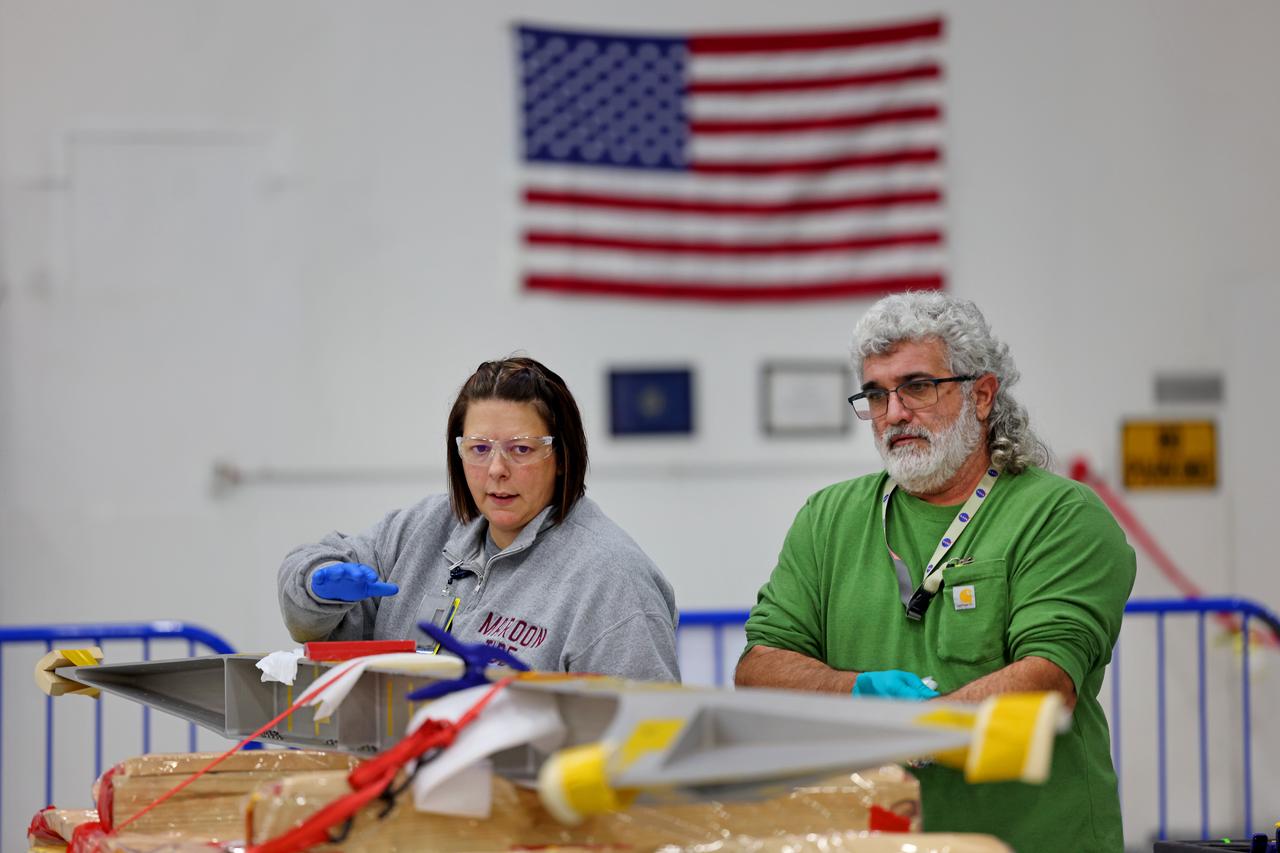
Technicians at NASA’s Michoud Assembly Facility in New Orleans on Feb. 22 prepare elements that will form part of the midbody for the future exploration upper stage for the SLS (Space Launch System) rocket. The midbody struts, or V-struts, will create the midbody’s cage-like outer structure to connect the upper stage’s larger liquid hydrogen tank to its smaller liquid oxygen tank. Manufacturing flight and test hardware for the future SLS upper stage is a collaborative effort between NASA and Boeing, the lead contractor for EUS and the SLS core stage. Beginning with Artemis IV, SLS will evolve to its more powerful Block 1B configuration with the advanced exploration upper stage that gives the rocket the capability to launch 40% more to the Moon along with Artemis astronauts inside NASA’s Orion spacecraft. The evolved in-space stage for SLS will use a combination of liquid oxygen and liquid hydrogen propellants to help power the engines to send large cargo and crew inside Orion to the Moon. Image credit: NASA/Michael DeMocker
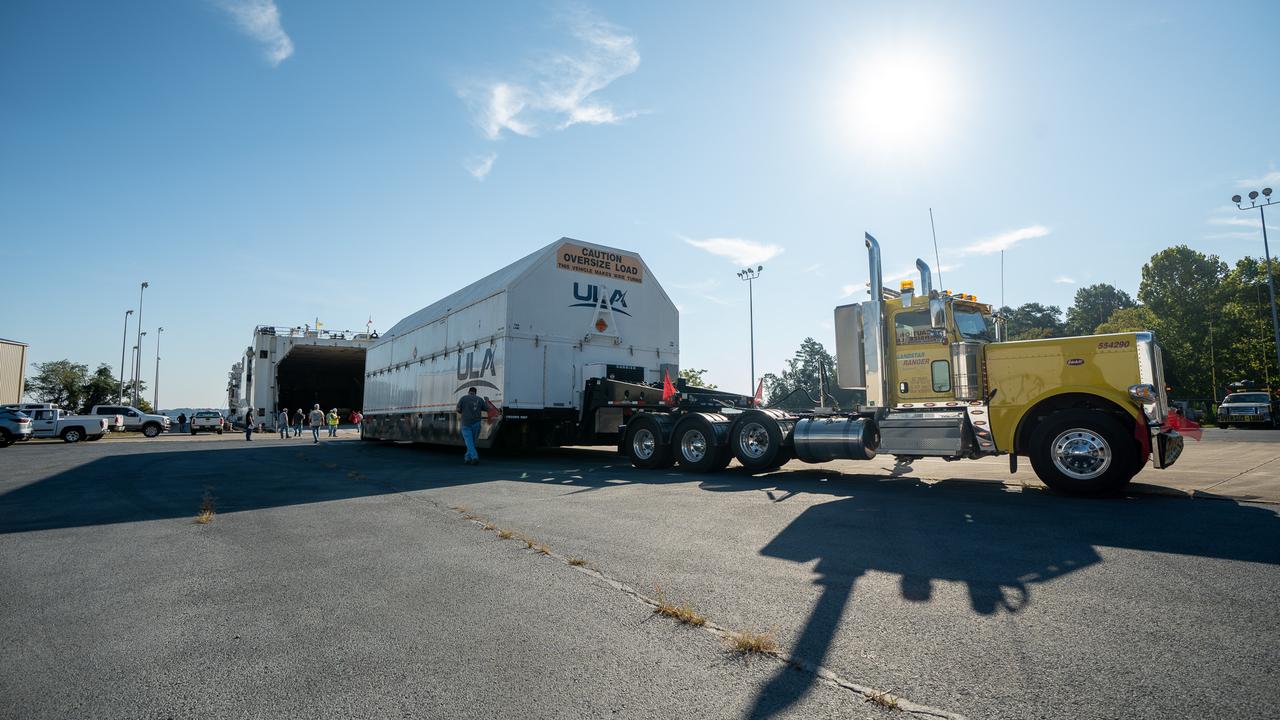
These images and videos show how crews in Alabama prepared the ICPS (interim cryogenic propulsion stage) for NASA’s SLS (Space Launch System) rocket for shipment to Florida between July 29-31. The ICPS in the photos and videos will help power NASA’s Artemis III mission to the Moon. The SLS upper stage is manufactured by United Launch Alliance at its facility in Decatur. Its RL10 engine is produced by Aerojet Rocketdyne, the SLS engines lead contractor, in West Palm Beach, Florida. ULA is working with Boeing, the SLS core stage and exploration upper stage lead contractor, to develop ICPS. ULA’s R/S RocketShip is transporting the flight hardware to its sister facility in Florida near NASA’s Kennedy Space Center for final checkouts. The ICPS for Artemis III is the last of its kind as SLS transitions to its next, more powerful Block 1B configuration with an upgraded upper stage beginning with Artemis IV. NASA is working to land the first woman and first person of color on the Moon under Artemis. SLS is part of NASA’s backbone for deep space exploration, along with Orion and the Gateway in orbit around the Moon. SLS is the only rocket that can send Orion, astronauts, and supplies to the Moon in a single mission.
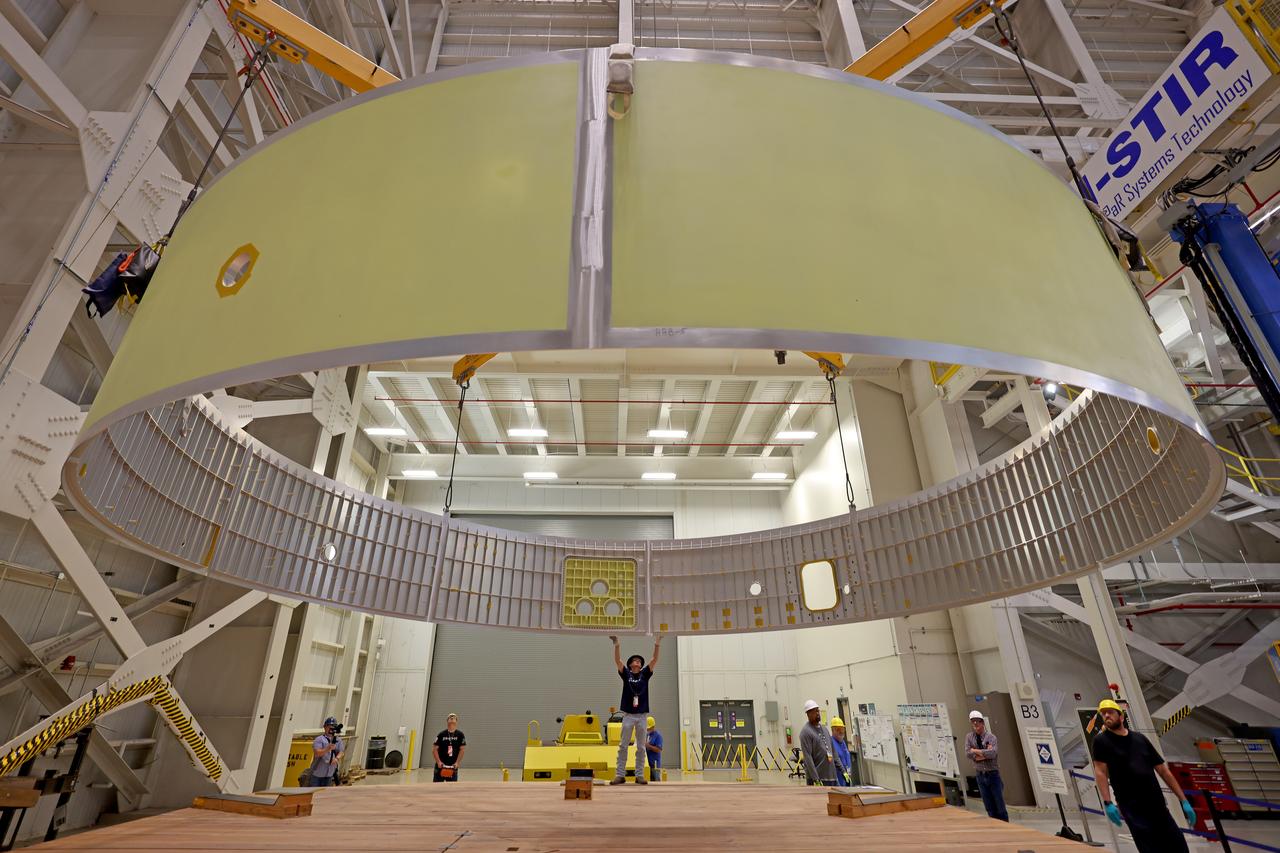
These images and videos show technicians at NASA’s Michoud Assembly Facility in New Orleans examining and lifting midbody barrels for the Exploration Upper Stage (EUS) structural test article of the SLS (Space Launch System) rocket in May 2023. The barrel sections make up the body, or main structure, of the future in-space propulsion stage for the mega rocket. The Exploration Upper Stage will be used on the second configuration of the SLS rocket, known as Block 1B, and will provide in-space propulsion to send astronauts in NASA’s Orion spacecraft and heavy cargo on a precise trajectory to the Moon. Beginning with Artemis IV, EUS will replace the interim cryogenic propulsion stage for the Block 1 configuration of SLS. It has larger propellant tanks and four RL10 engines, enabling SLS to launch 40% more cargo to the Moon along with crew. EUS flight hardware is in early production at Michoud. Crews with NASA and Boeing, the lead contractor for the SLS core stage and EUS, are also manufacturing the EUS structural test article. The test hardware is structurally identical to the flight version and will be used during a series of strenuous testing that simulates the forces the rocket will experience during launch and flight and verify its structural integrity. NASA is working to land the first woman and first person of color on the Moon under Artemis. SLS is part of NASA’s backbone for deep space exploration, along with Orion and the Gateway in orbit around the Moon. SLS is the only rocket that can send Orion, astronauts, and supplies to the Moon in a single mission.
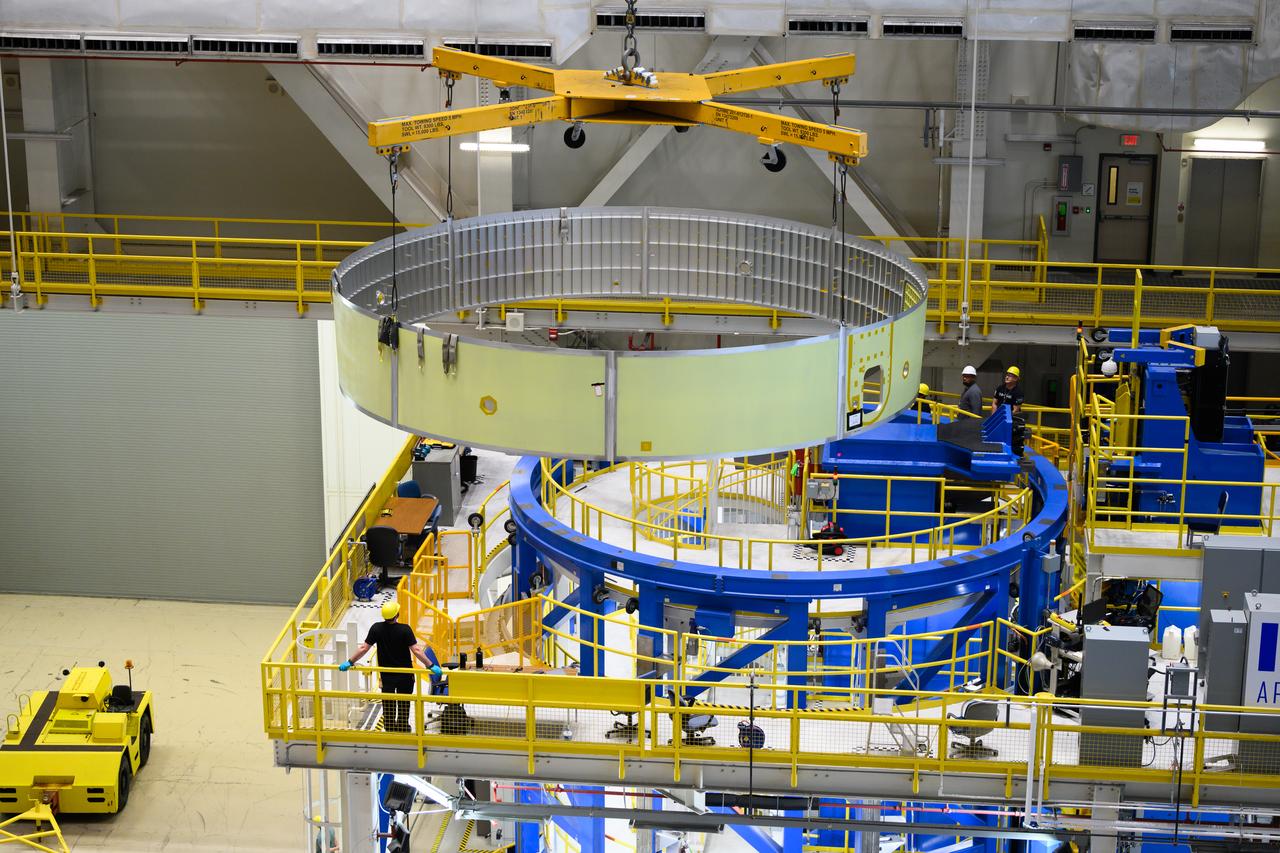
These images and videos show technicians at NASA’s Michoud Assembly Facility in New Orleans examining and lifting midbody barrels for the Exploration Upper Stage (EUS) structural test article of the SLS (Space Launch System) rocket in May 2023. The barrel sections make up the body, or main structure, of the future in-space propulsion stage for the mega rocket. The Exploration Upper Stage will be used on the second configuration of the SLS rocket, known as Block 1B, and will provide in-space propulsion to send astronauts in NASA’s Orion spacecraft and heavy cargo on a precise trajectory to the Moon. Beginning with Artemis IV, EUS will replace the interim cryogenic propulsion stage for the Block 1 configuration of SLS. It has larger propellant tanks and four RL10 engines, enabling SLS to launch 40% more cargo to the Moon along with crew. EUS flight hardware is in early production at Michoud. Crews with NASA and Boeing, the lead contractor for the SLS core stage and EUS, are also manufacturing the EUS structural test article. The test hardware is structurally identical to the flight version and will be used during a series of strenuous testing that simulates the forces the rocket will experience during launch and flight and verify its structural integrity. NASA is working to land the first woman and first person of color on the Moon under Artemis. SLS is part of NASA’s backbone for deep space exploration, along with Orion and the Gateway in orbit around the Moon. SLS is the only rocket that can send Orion, astronauts, and supplies to the Moon in a single mission.
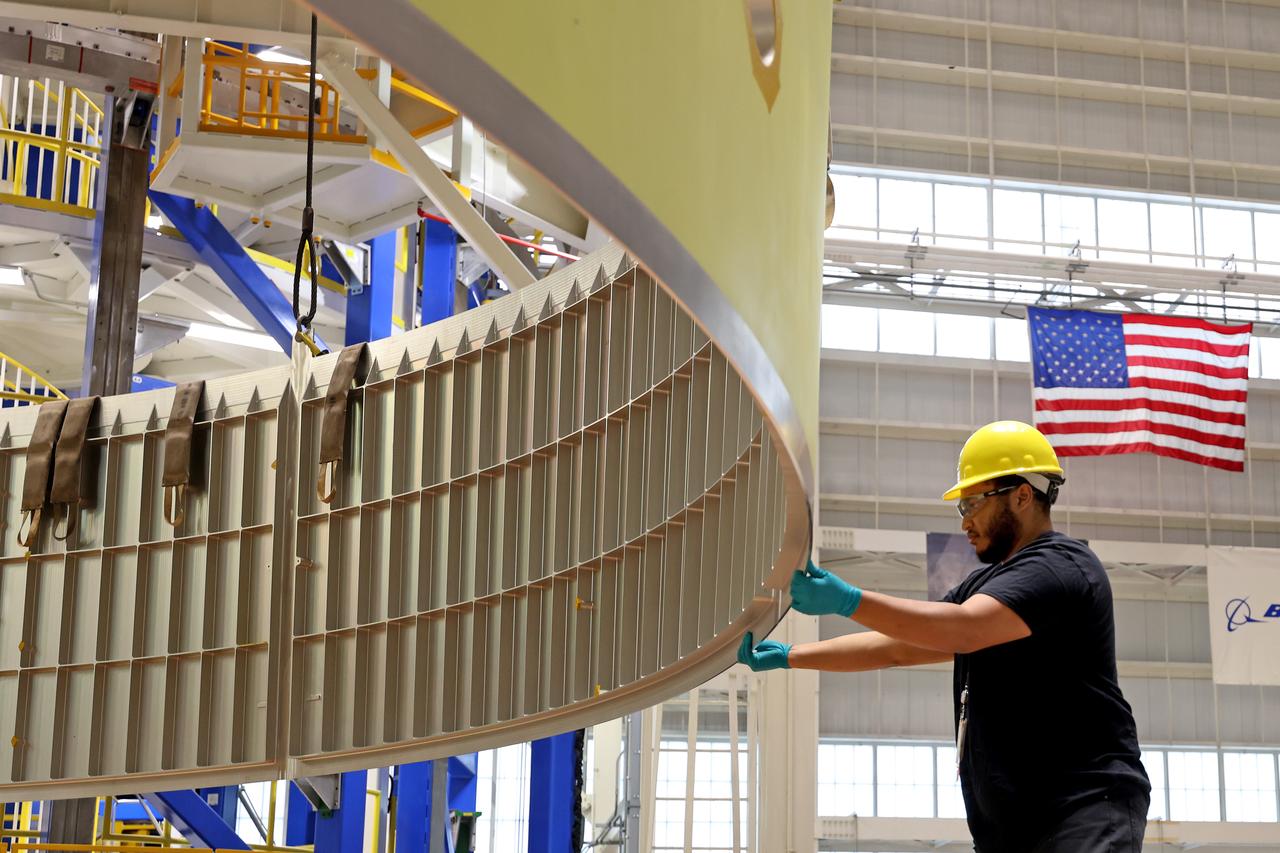
These images and videos show technicians at NASA’s Michoud Assembly Facility in New Orleans examining and lifting midbody barrels for the Exploration Upper Stage (EUS) structural test article of the SLS (Space Launch System) rocket in May 2023. The barrel sections make up the body, or main structure, of the future in-space propulsion stage for the mega rocket. The Exploration Upper Stage will be used on the second configuration of the SLS rocket, known as Block 1B, and will provide in-space propulsion to send astronauts in NASA’s Orion spacecraft and heavy cargo on a precise trajectory to the Moon. Beginning with Artemis IV, EUS will replace the interim cryogenic propulsion stage for the Block 1 configuration of SLS. It has larger propellant tanks and four RL10 engines, enabling SLS to launch 40% more cargo to the Moon along with crew. EUS flight hardware is in early production at Michoud. Crews with NASA and Boeing, the lead contractor for the SLS core stage and EUS, are also manufacturing the EUS structural test article. The test hardware is structurally identical to the flight version and will be used during a series of strenuous testing that simulates the forces the rocket will experience during launch and flight and verify its structural integrity. NASA is working to land the first woman and first person of color on the Moon under Artemis. SLS is part of NASA’s backbone for deep space exploration, along with Orion and the Gateway in orbit around the Moon. SLS is the only rocket that can send Orion, astronauts, and supplies to the Moon in a single mission.
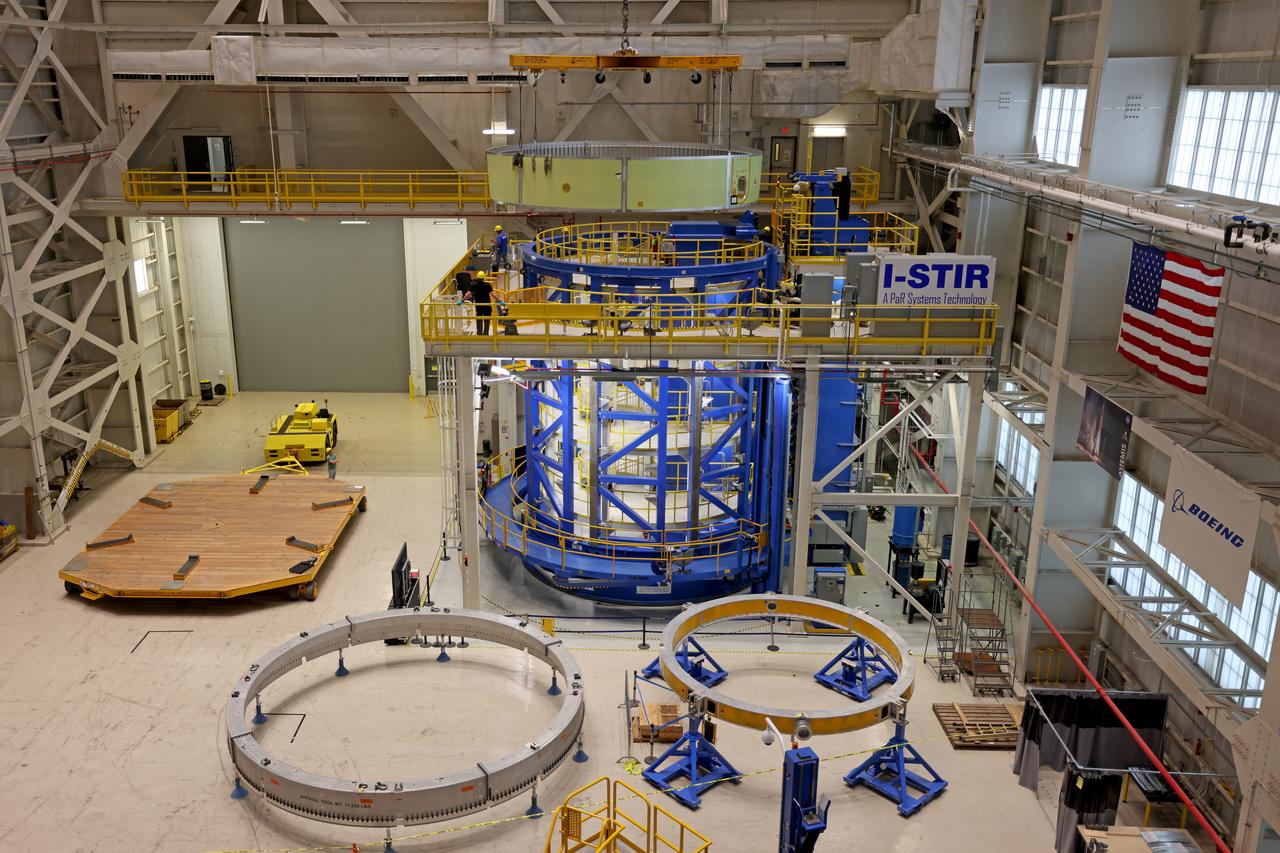
These images and videos show technicians at NASA’s Michoud Assembly Facility in New Orleans examining and lifting midbody barrels for the Exploration Upper Stage (EUS) structural test article of the SLS (Space Launch System) rocket in May 2023. The barrel sections make up the body, or main structure, of the future in-space propulsion stage for the mega rocket. The Exploration Upper Stage will be used on the second configuration of the SLS rocket, known as Block 1B, and will provide in-space propulsion to send astronauts in NASA’s Orion spacecraft and heavy cargo on a precise trajectory to the Moon. Beginning with Artemis IV, EUS will replace the interim cryogenic propulsion stage for the Block 1 configuration of SLS. It has larger propellant tanks and four RL10 engines, enabling SLS to launch 40% more cargo to the Moon along with crew. EUS flight hardware is in early production at Michoud. Crews with NASA and Boeing, the lead contractor for the SLS core stage and EUS, are also manufacturing the EUS structural test article. The test hardware is structurally identical to the flight version and will be used during a series of strenuous testing that simulates the forces the rocket will experience during launch and flight and verify its structural integrity. NASA is working to land the first woman and first person of color on the Moon under Artemis. SLS is part of NASA’s backbone for deep space exploration, along with Orion and the Gateway in orbit around the Moon. SLS is the only rocket that can send Orion, astronauts, and supplies to the Moon in a single mission.
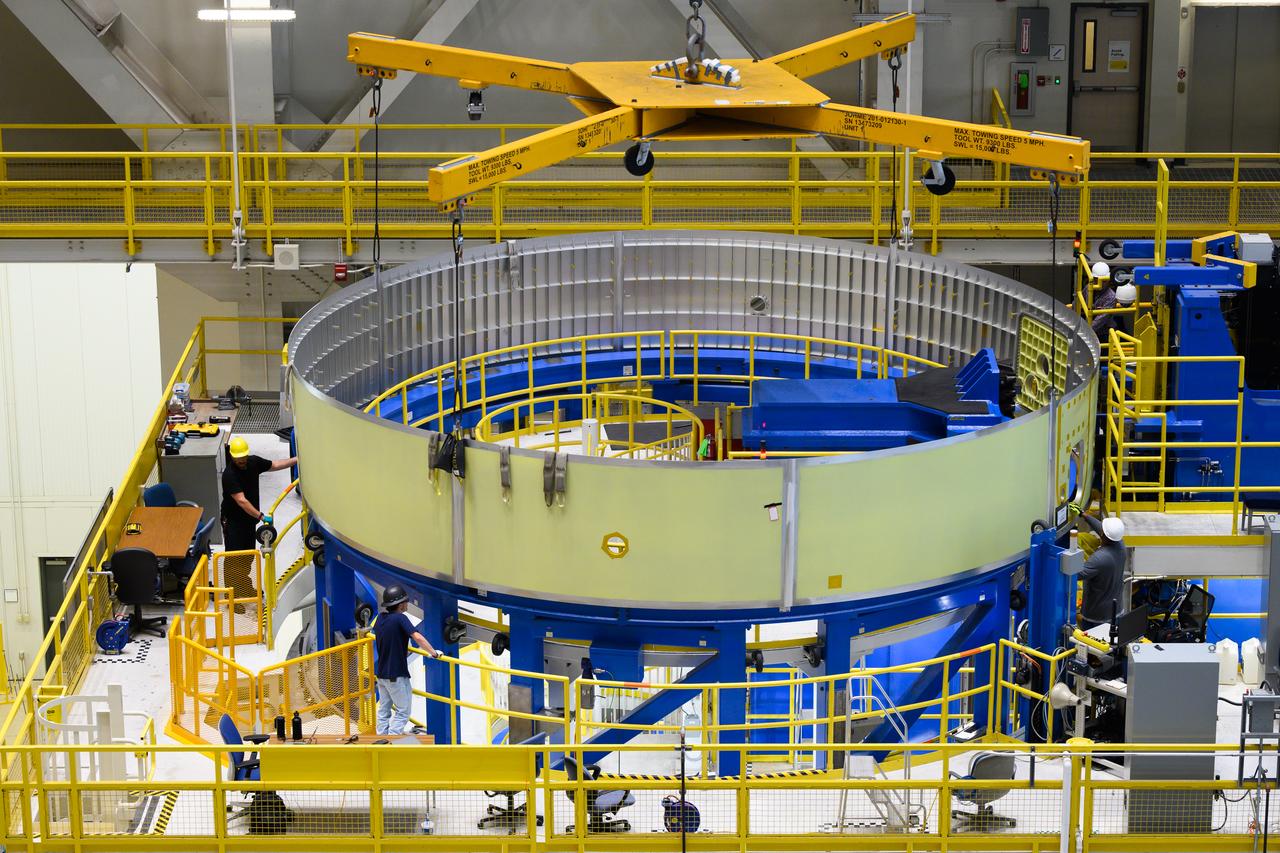
These images and videos show technicians at NASA’s Michoud Assembly Facility in New Orleans examining and lifting midbody barrels for the Exploration Upper Stage (EUS) structural test article of the SLS (Space Launch System) rocket in May 2023. The barrel sections make up the body, or main structure, of the future in-space propulsion stage for the mega rocket. The Exploration Upper Stage will be used on the second configuration of the SLS rocket, known as Block 1B, and will provide in-space propulsion to send astronauts in NASA’s Orion spacecraft and heavy cargo on a precise trajectory to the Moon. Beginning with Artemis IV, EUS will replace the interim cryogenic propulsion stage for the Block 1 configuration of SLS. It has larger propellant tanks and four RL10 engines, enabling SLS to launch 40% more cargo to the Moon along with crew. EUS flight hardware is in early production at Michoud. Crews with NASA and Boeing, the lead contractor for the SLS core stage and EUS, are also manufacturing the EUS structural test article. The test hardware is structurally identical to the flight version and will be used during a series of strenuous testing that simulates the forces the rocket will experience during launch and flight and verify its structural integrity. NASA is working to land the first woman and first person of color on the Moon under Artemis. SLS is part of NASA’s backbone for deep space exploration, along with Orion and the Gateway in orbit around the Moon. SLS is the only rocket that can send Orion, astronauts, and supplies to the Moon in a single mission.

These images and videos show technicians at NASA’s Michoud Assembly Facility in New Orleans examining and lifting midbody barrels for the Exploration Upper Stage (EUS) structural test article of the SLS (Space Launch System) rocket in May 2023. The barrel sections make up the body, or main structure, of the future in-space propulsion stage for the mega rocket. The Exploration Upper Stage will be used on the second configuration of the SLS rocket, known as Block 1B, and will provide in-space propulsion to send astronauts in NASA’s Orion spacecraft and heavy cargo on a precise trajectory to the Moon. Beginning with Artemis IV, EUS will replace the interim cryogenic propulsion stage for the Block 1 configuration of SLS. It has larger propellant tanks and four RL10 engines, enabling SLS to launch 40% more cargo to the Moon along with crew. EUS flight hardware is in early production at Michoud. Crews with NASA and Boeing, the lead contractor for the SLS core stage and EUS, are also manufacturing the EUS structural test article. The test hardware is structurally identical to the flight version and will be used during a series of strenuous testing that simulates the forces the rocket will experience during launch and flight and verify its structural integrity. NASA is working to land the first woman and first person of color on the Moon under Artemis. SLS is part of NASA’s backbone for deep space exploration, along with Orion and the Gateway in orbit around the Moon. SLS is the only rocket that can send Orion, astronauts, and supplies to the Moon in a single mission.
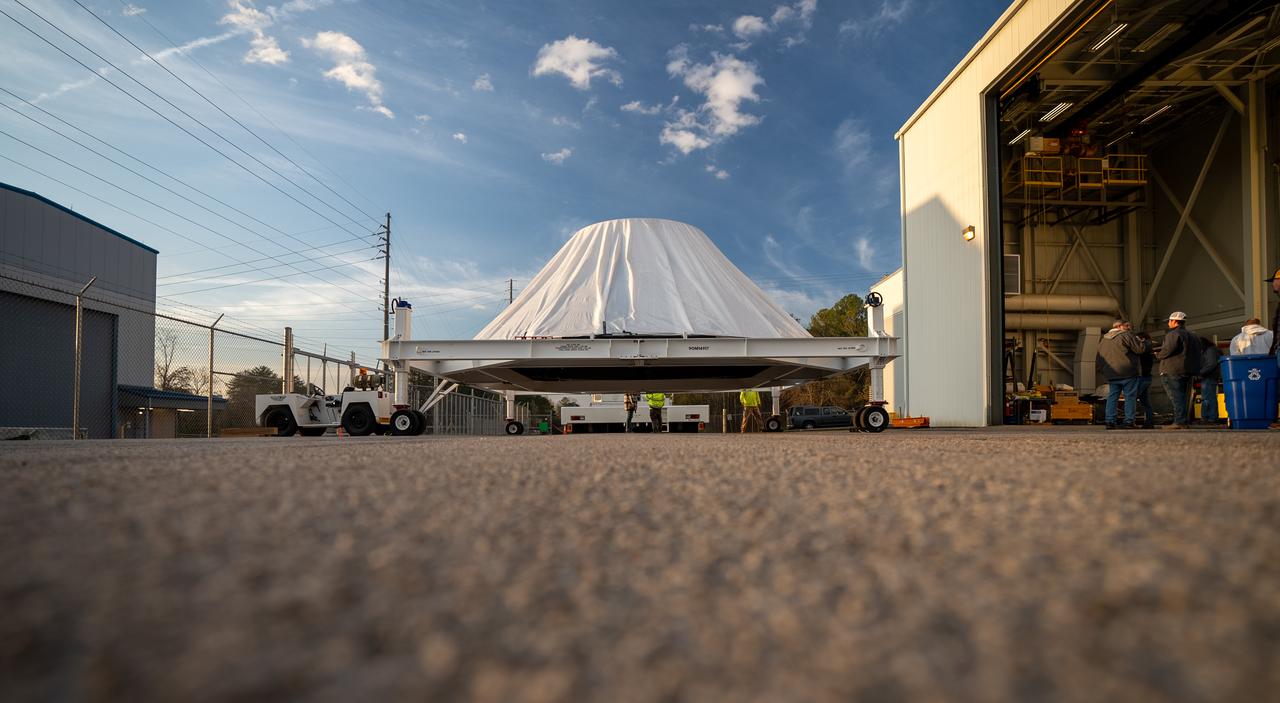
These photos and videos show how crews at NASA’s Marshall Space Flight Center in Huntsville, Alabama, moved and installed the payload adapter that will be used in the Block 1B configuration of the SLS (Space Launch System) rocket from Building 4708, where it was manufactured, into Structural Test Stand 4697 at NASA’s Marshall Space Flight Center on March 13. Teams at Marshall will begin structural testing the engineering development unit of the payload adapter – an exact replica of the flight version of the hardware – this spring. The cone-shaped payload adapter is about 8.5 feet tall and features two metal rings and eight composite panels. The adapter, which will debut on NASA’s Artemis IV mission, is an evolution from the Orion stage adapter used in the Block 1 configuration of the first three Artemis missions. It will be housed inside the universal stage adapter atop the rocket’s more powerful in-space stage, called the exploration upper stage. The payload adapter, like the launch vehicle stage adapter and the Orion stage adapter, is fully manufactured and tested at Marshall, which manages the SLS Program. NASA is working to land the first woman, first person of color, and its first international partner astronaut on the Moon under Artemis. SLS is part of NASA’s backbone for deep space exploration, along with the Orion spacecraft and Gateway in orbit around the Moon and commercial human landing systems, next-generational spacesuits, and rovers on the lunar surface. SLS is the only rocket that can send Orion, astronauts, and supplies to the Moon in a single launch.
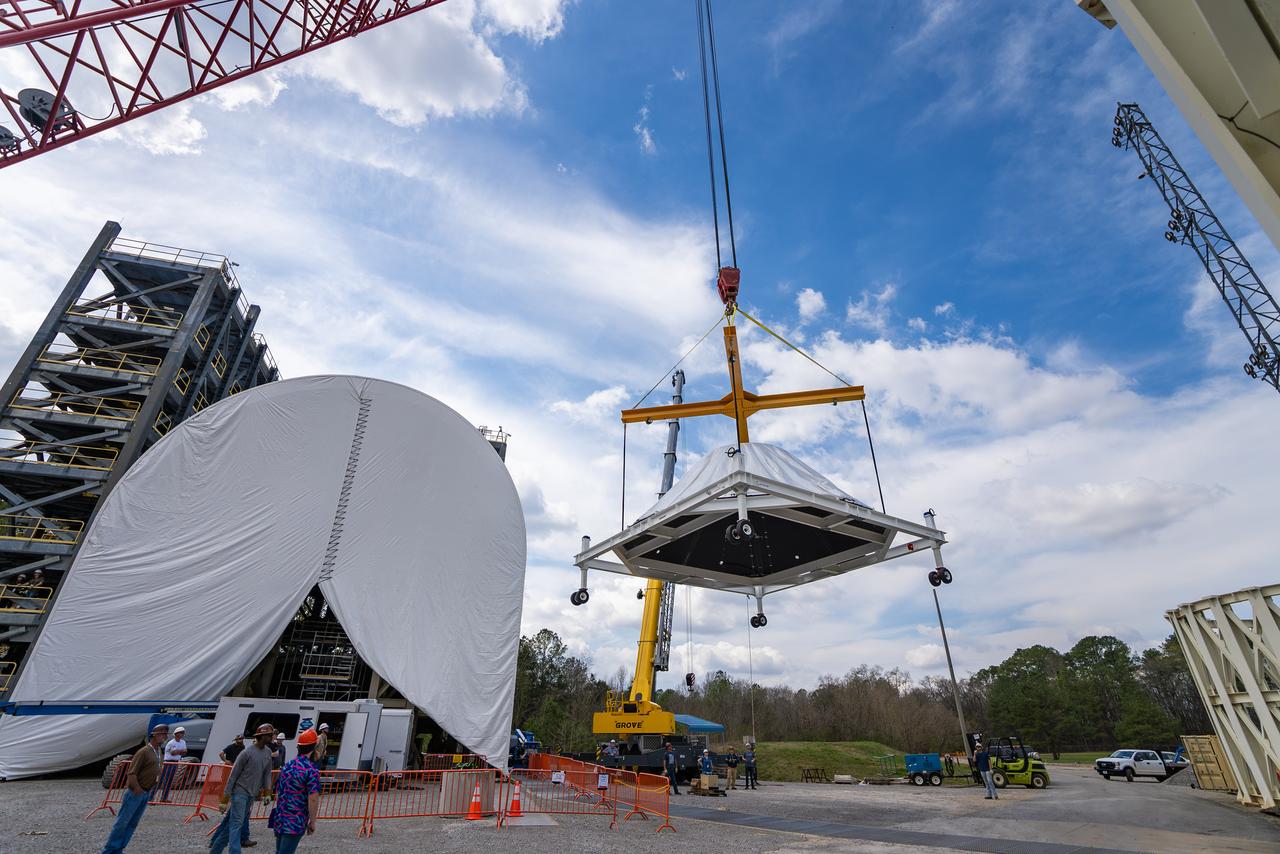
These photos and videos show how crews at NASA’s Marshall Space Flight Center in Huntsville, Alabama, moved and installed the payload adapter that will be used in the Block 1B configuration of the SLS (Space Launch System) rocket from Building 4708, where it was manufactured, into Structural Test Stand 4697 at NASA’s Marshall Space Flight Center on March 13. Teams at Marshall will begin structural testing the engineering development unit of the payload adapter – an exact replica of the flight version of the hardware – this spring. The cone-shaped payload adapter is about 8.5 feet tall and features two metal rings and eight composite panels. The adapter, which will debut on NASA’s Artemis IV mission, is an evolution from the Orion stage adapter used in the Block 1 configuration of the first three Artemis missions. It will be housed inside the universal stage adapter atop the rocket’s more powerful in-space stage, called the exploration upper stage. The payload adapter, like the launch vehicle stage adapter and the Orion stage adapter, is fully manufactured and tested at Marshall, which manages the SLS Program. NASA is working to land the first woman, first person of color, and its first international partner astronaut on the Moon under Artemis. SLS is part of NASA’s backbone for deep space exploration, along with the Orion spacecraft and Gateway in orbit around the Moon and commercial human landing systems, next-generational spacesuits, and rovers on the lunar surface. SLS is the only rocket that can send Orion, astronauts, and supplies to the Moon in a single launch.
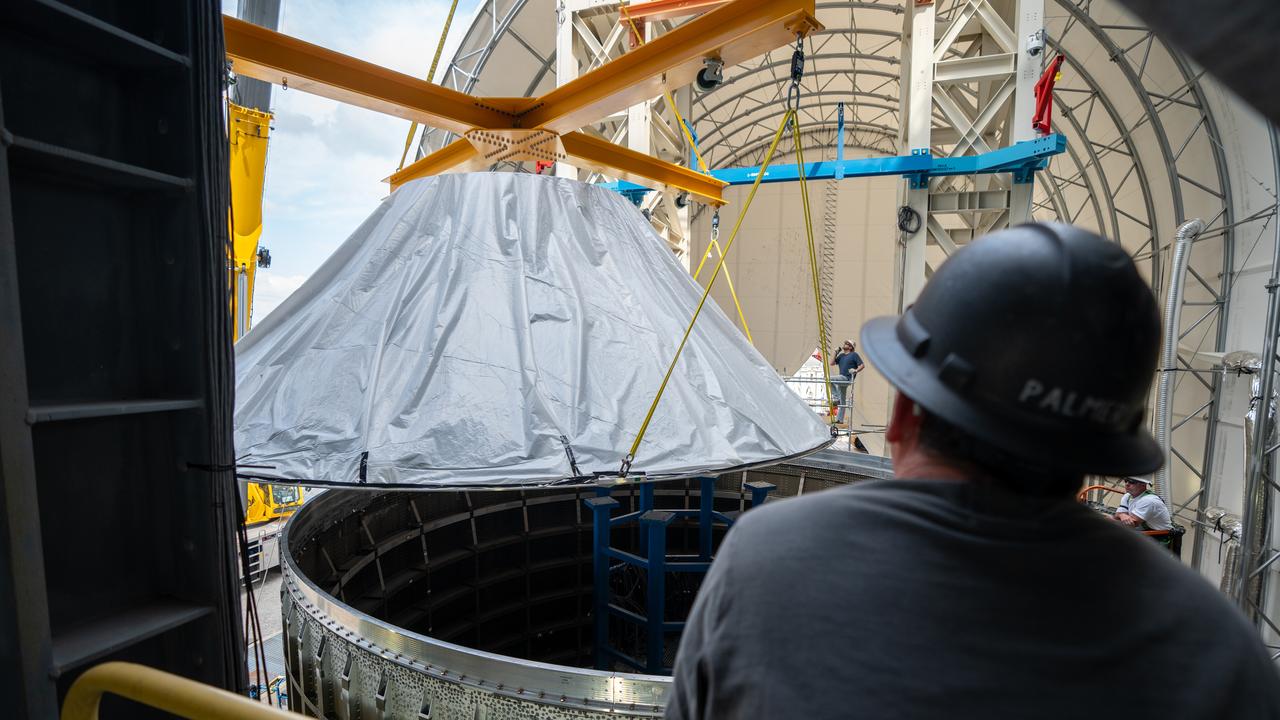
These photos and videos show how crews at NASA’s Marshall Space Flight Center in Huntsville, Alabama, moved and installed the payload adapter that will be used in the Block 1B configuration of the SLS (Space Launch System) rocket from Building 4708, where it was manufactured, into Structural Test Stand 4697 at NASA’s Marshall Space Flight Center on March 13. Teams at Marshall will begin structural testing the engineering development unit of the payload adapter – an exact replica of the flight version of the hardware – this spring. The cone-shaped payload adapter is about 8.5 feet tall and features two metal rings and eight composite panels. The adapter, which will debut on NASA’s Artemis IV mission, is an evolution from the Orion stage adapter used in the Block 1 configuration of the first three Artemis missions. It will be housed inside the universal stage adapter atop the rocket’s more powerful in-space stage, called the exploration upper stage. The payload adapter, like the launch vehicle stage adapter and the Orion stage adapter, is fully manufactured and tested at Marshall, which manages the SLS Program. NASA is working to land the first woman, first person of color, and its first international partner astronaut on the Moon under Artemis. SLS is part of NASA’s backbone for deep space exploration, along with the Orion spacecraft and Gateway in orbit around the Moon and commercial human landing systems, next-generational spacesuits, and rovers on the lunar surface. SLS is the only rocket that can send Orion, astronauts, and supplies to the Moon in a single launch.
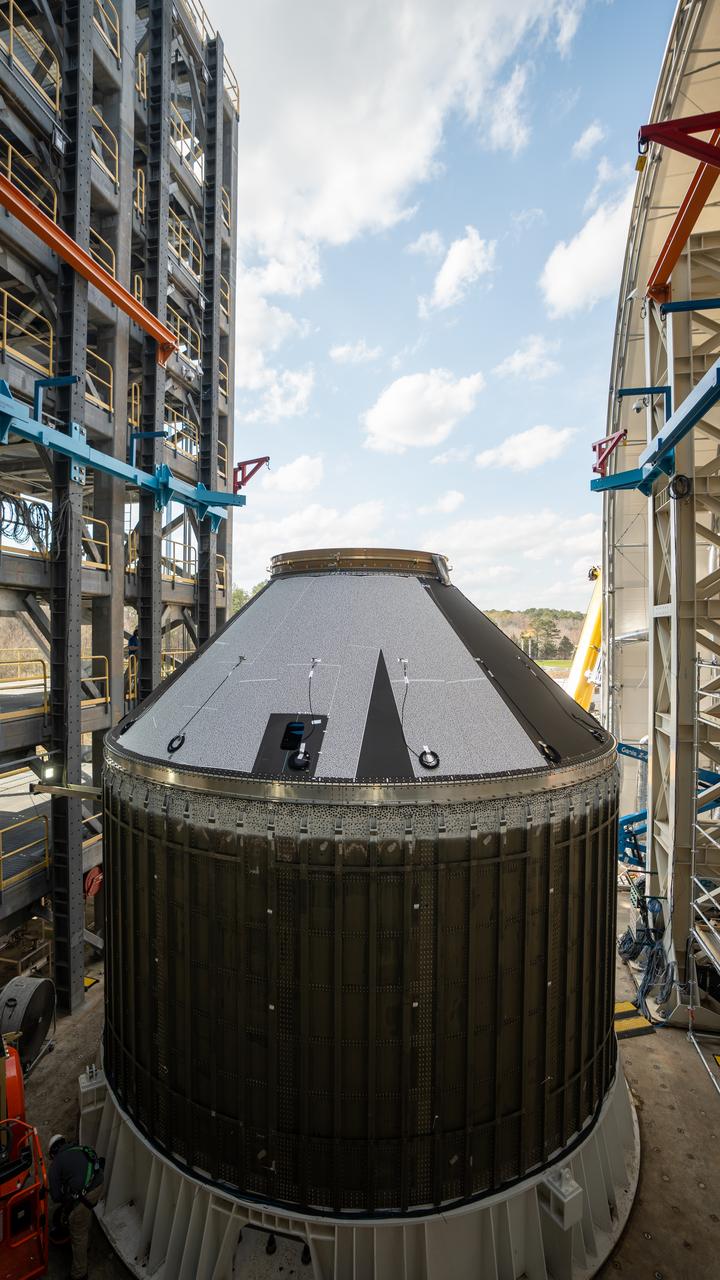
These photos and videos show how crews at NASA’s Marshall Space Flight Center in Huntsville, Alabama, moved and installed the payload adapter that will be used in the Block 1B configuration of the SLS (Space Launch System) rocket from Building 4708, where it was manufactured, into Structural Test Stand 4697 at NASA’s Marshall Space Flight Center on March 13. Teams at Marshall will begin structural testing the engineering development unit of the payload adapter – an exact replica of the flight version of the hardware – this spring. The cone-shaped payload adapter is about 8.5 feet tall and features two metal rings and eight composite panels. The adapter, which will debut on NASA’s Artemis IV mission, is an evolution from the Orion stage adapter used in the Block 1 configuration of the first three Artemis missions. It will be housed inside the universal stage adapter atop the rocket’s more powerful in-space stage, called the exploration upper stage. The payload adapter, like the launch vehicle stage adapter and the Orion stage adapter, is fully manufactured and tested at Marshall, which manages the SLS Program. NASA is working to land the first woman, first person of color, and its first international partner astronaut on the Moon under Artemis. SLS is part of NASA’s backbone for deep space exploration, along with the Orion spacecraft and Gateway in orbit around the Moon and commercial human landing systems, next-generational spacesuits, and rovers on the lunar surface. SLS is the only rocket that can send Orion, astronauts, and supplies to the Moon in a single launch.
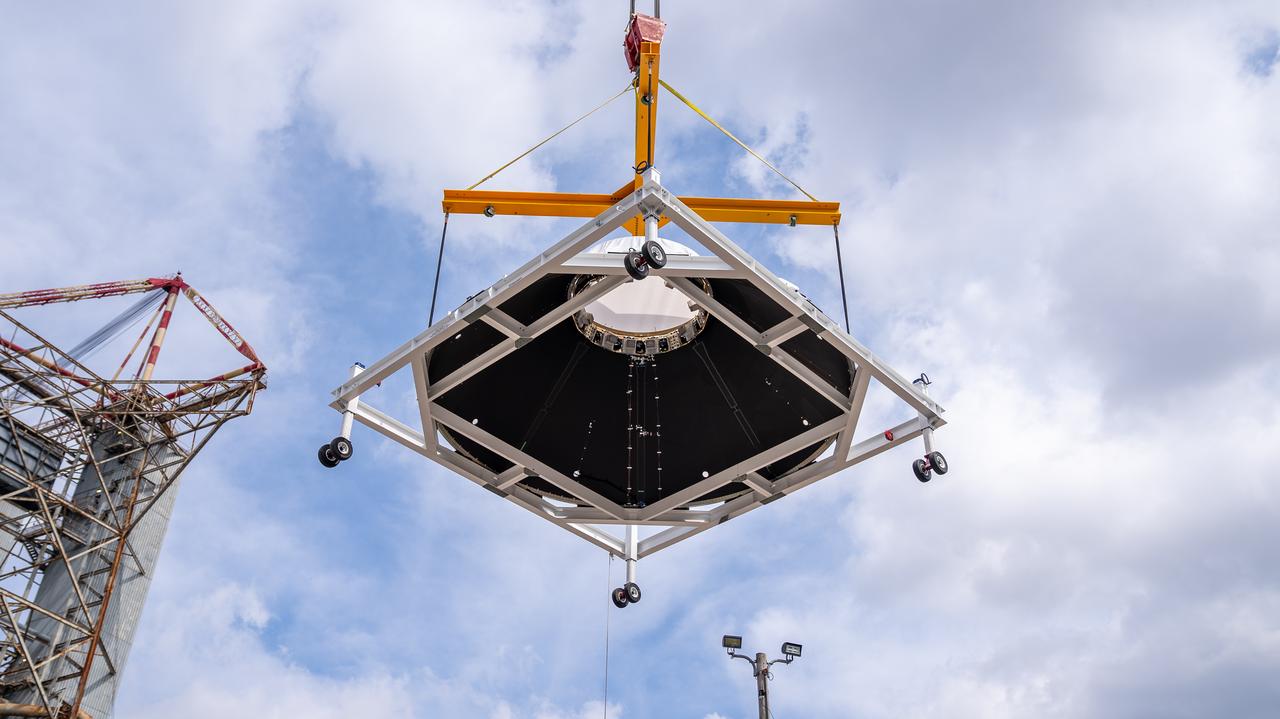
These photos and videos show how crews at NASA’s Marshall Space Flight Center in Huntsville, Alabama, moved and installed the payload adapter that will be used in the Block 1B configuration of the SLS (Space Launch System) rocket from Building 4708, where it was manufactured, into Structural Test Stand 4697 at NASA’s Marshall Space Flight Center on March 13. Teams at Marshall will begin structural testing the engineering development unit of the payload adapter – an exact replica of the flight version of the hardware – this spring. The cone-shaped payload adapter is about 8.5 feet tall and features two metal rings and eight composite panels. The adapter, which will debut on NASA’s Artemis IV mission, is an evolution from the Orion stage adapter used in the Block 1 configuration of the first three Artemis missions. It will be housed inside the universal stage adapter atop the rocket’s more powerful in-space stage, called the exploration upper stage. The payload adapter, like the launch vehicle stage adapter and the Orion stage adapter, is fully manufactured and tested at Marshall, which manages the SLS Program. NASA is working to land the first woman, first person of color, and its first international partner astronaut on the Moon under Artemis. SLS is part of NASA’s backbone for deep space exploration, along with the Orion spacecraft and Gateway in orbit around the Moon and commercial human landing systems, next-generational spacesuits, and rovers on the lunar surface. SLS is the only rocket that can send Orion, astronauts, and supplies to the Moon in a single launch.
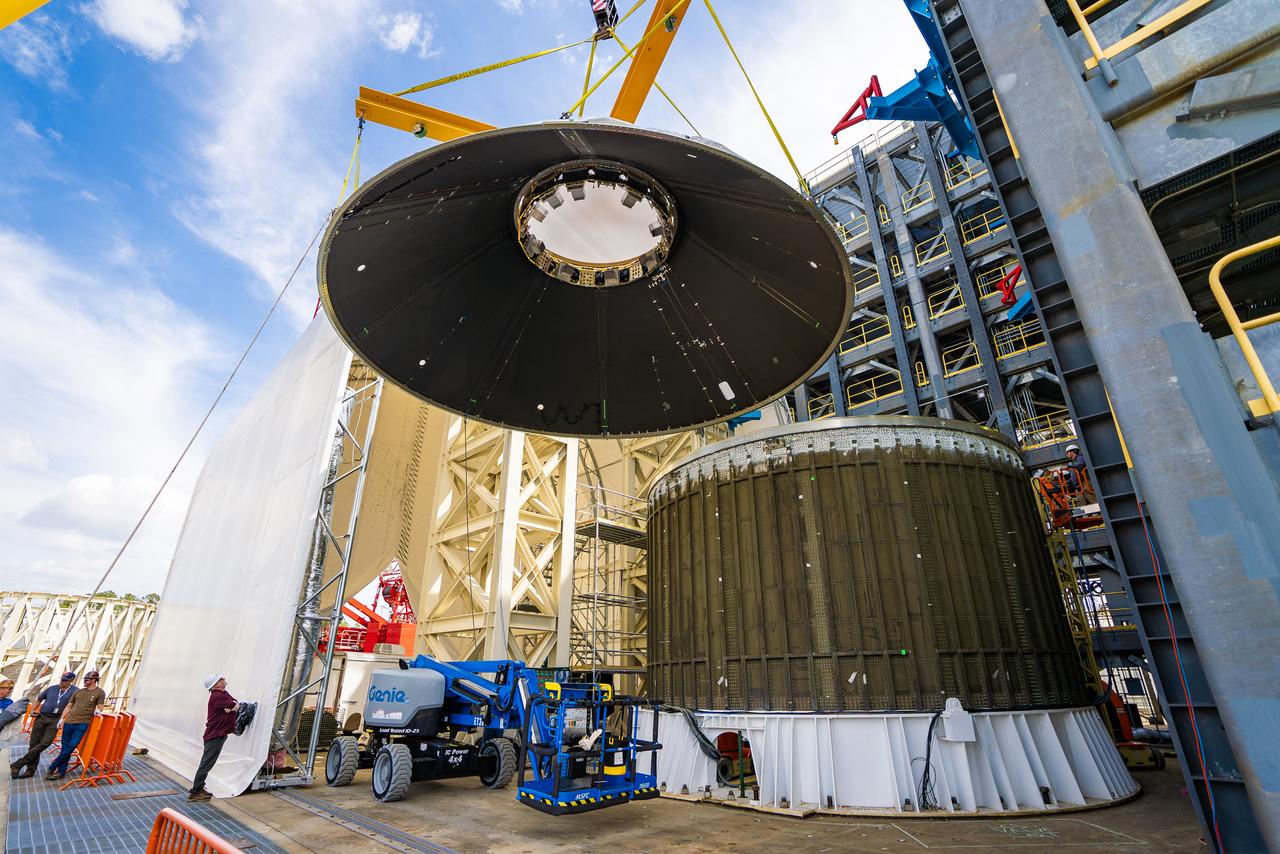
These photos and videos show how crews at NASA’s Marshall Space Flight Center in Huntsville, Alabama, moved and installed the payload adapter that will be used in the Block 1B configuration of the SLS (Space Launch System) rocket from Building 4708, where it was manufactured, into Structural Test Stand 4697 at NASA’s Marshall Space Flight Center on March 13. Teams at Marshall will begin structural testing the engineering development unit of the payload adapter – an exact replica of the flight version of the hardware – this spring. The cone-shaped payload adapter is about 8.5 feet tall and features two metal rings and eight composite panels. The adapter, which will debut on NASA’s Artemis IV mission, is an evolution from the Orion stage adapter used in the Block 1 configuration of the first three Artemis missions. It will be housed inside the universal stage adapter atop the rocket’s more powerful in-space stage, called the exploration upper stage. The payload adapter, like the launch vehicle stage adapter and the Orion stage adapter, is fully manufactured and tested at Marshall, which manages the SLS Program. NASA is working to land the first woman, first person of color, and its first international partner astronaut on the Moon under Artemis. SLS is part of NASA’s backbone for deep space exploration, along with the Orion spacecraft and Gateway in orbit around the Moon and commercial human landing systems, next-generational spacesuits, and rovers on the lunar surface. SLS is the only rocket that can send Orion, astronauts, and supplies to the Moon in a single launch.
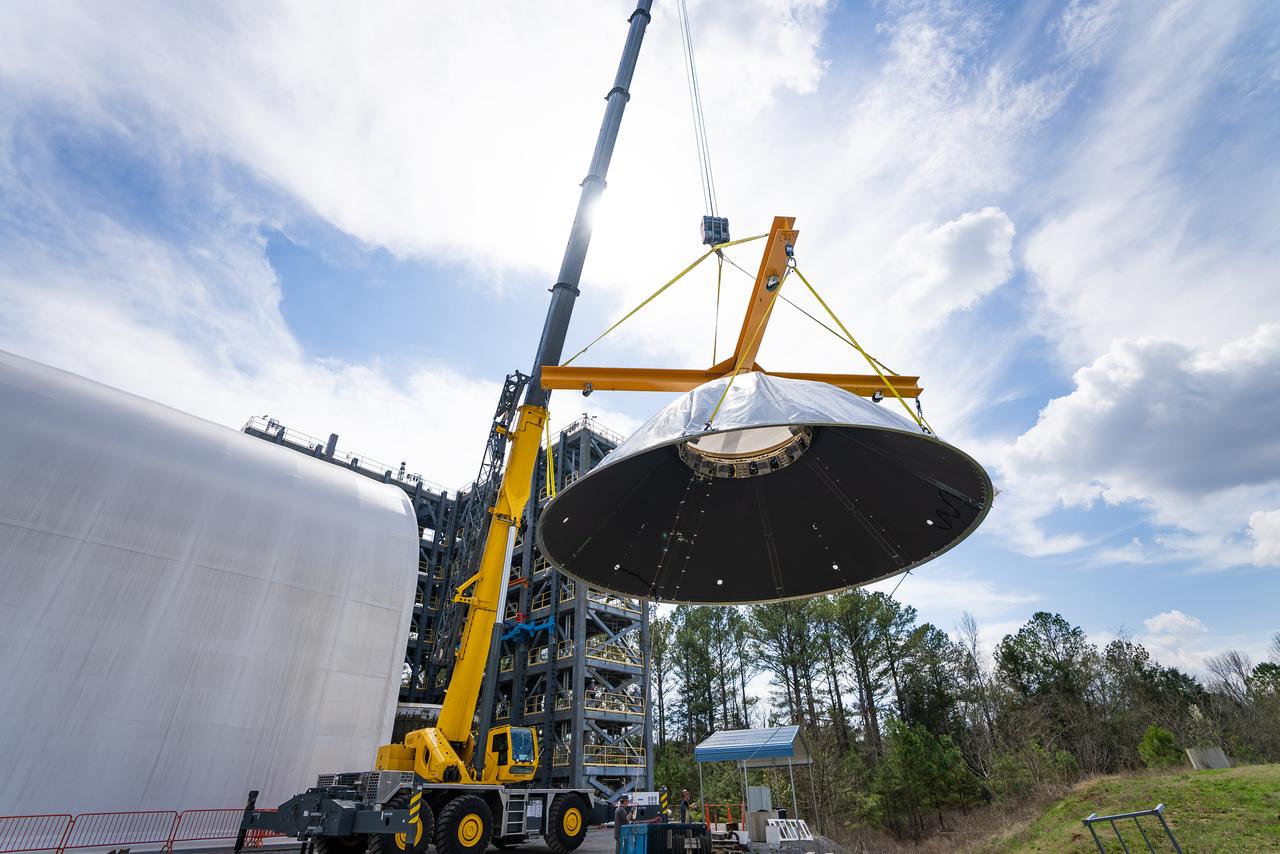
These photos and videos show how crews at NASA’s Marshall Space Flight Center in Huntsville, Alabama, moved and installed the payload adapter that will be used in the Block 1B configuration of the SLS (Space Launch System) rocket from Building 4708, where it was manufactured, into Structural Test Stand 4697 at NASA’s Marshall Space Flight Center on March 13. Teams at Marshall will begin structural testing the engineering development unit of the payload adapter – an exact replica of the flight version of the hardware – this spring. The cone-shaped payload adapter is about 8.5 feet tall and features two metal rings and eight composite panels. The adapter, which will debut on NASA’s Artemis IV mission, is an evolution from the Orion stage adapter used in the Block 1 configuration of the first three Artemis missions. It will be housed inside the universal stage adapter atop the rocket’s more powerful in-space stage, called the exploration upper stage. The payload adapter, like the launch vehicle stage adapter and the Orion stage adapter, is fully manufactured and tested at Marshall, which manages the SLS Program. NASA is working to land the first woman, first person of color, and its first international partner astronaut on the Moon under Artemis. SLS is part of NASA’s backbone for deep space exploration, along with the Orion spacecraft and Gateway in orbit around the Moon and commercial human landing systems, next-generational spacesuits, and rovers on the lunar surface. SLS is the only rocket that can send Orion, astronauts, and supplies to the Moon in a single launch.
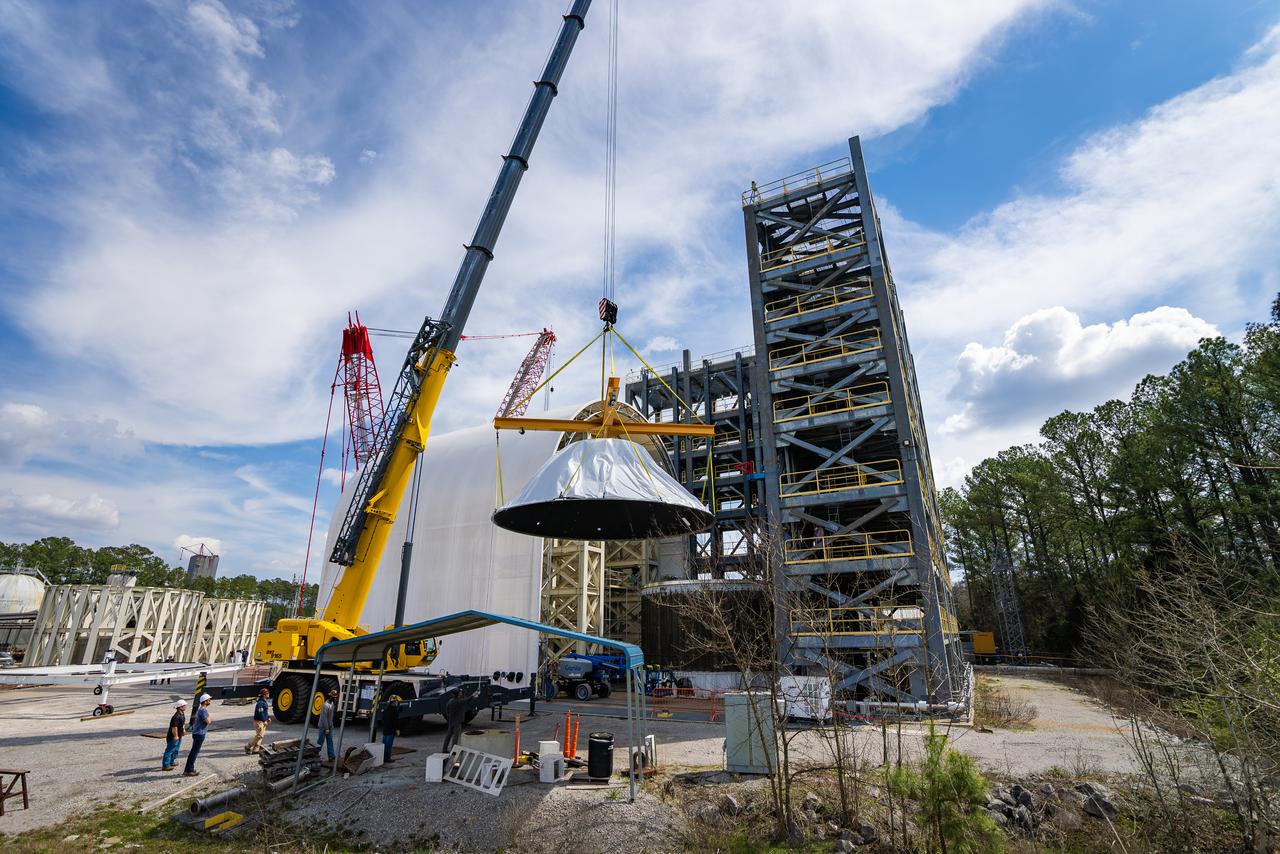
These photos and videos show how crews at NASA’s Marshall Space Flight Center in Huntsville, Alabama, moved and installed the payload adapter that will be used in the Block 1B configuration of the SLS (Space Launch System) rocket from Building 4708, where it was manufactured, into Structural Test Stand 4697 at NASA’s Marshall Space Flight Center on March 13. Teams at Marshall will begin structural testing the engineering development unit of the payload adapter – an exact replica of the flight version of the hardware – this spring. The cone-shaped payload adapter is about 8.5 feet tall and features two metal rings and eight composite panels. The adapter, which will debut on NASA’s Artemis IV mission, is an evolution from the Orion stage adapter used in the Block 1 configuration of the first three Artemis missions. It will be housed inside the universal stage adapter atop the rocket’s more powerful in-space stage, called the exploration upper stage. The payload adapter, like the launch vehicle stage adapter and the Orion stage adapter, is fully manufactured and tested at Marshall, which manages the SLS Program. NASA is working to land the first woman, first person of color, and its first international partner astronaut on the Moon under Artemis. SLS is part of NASA’s backbone for deep space exploration, along with the Orion spacecraft and Gateway in orbit around the Moon and commercial human landing systems, next-generational spacesuits, and rovers on the lunar surface. SLS is the only rocket that can send Orion, astronauts, and supplies to the Moon in a single launch.
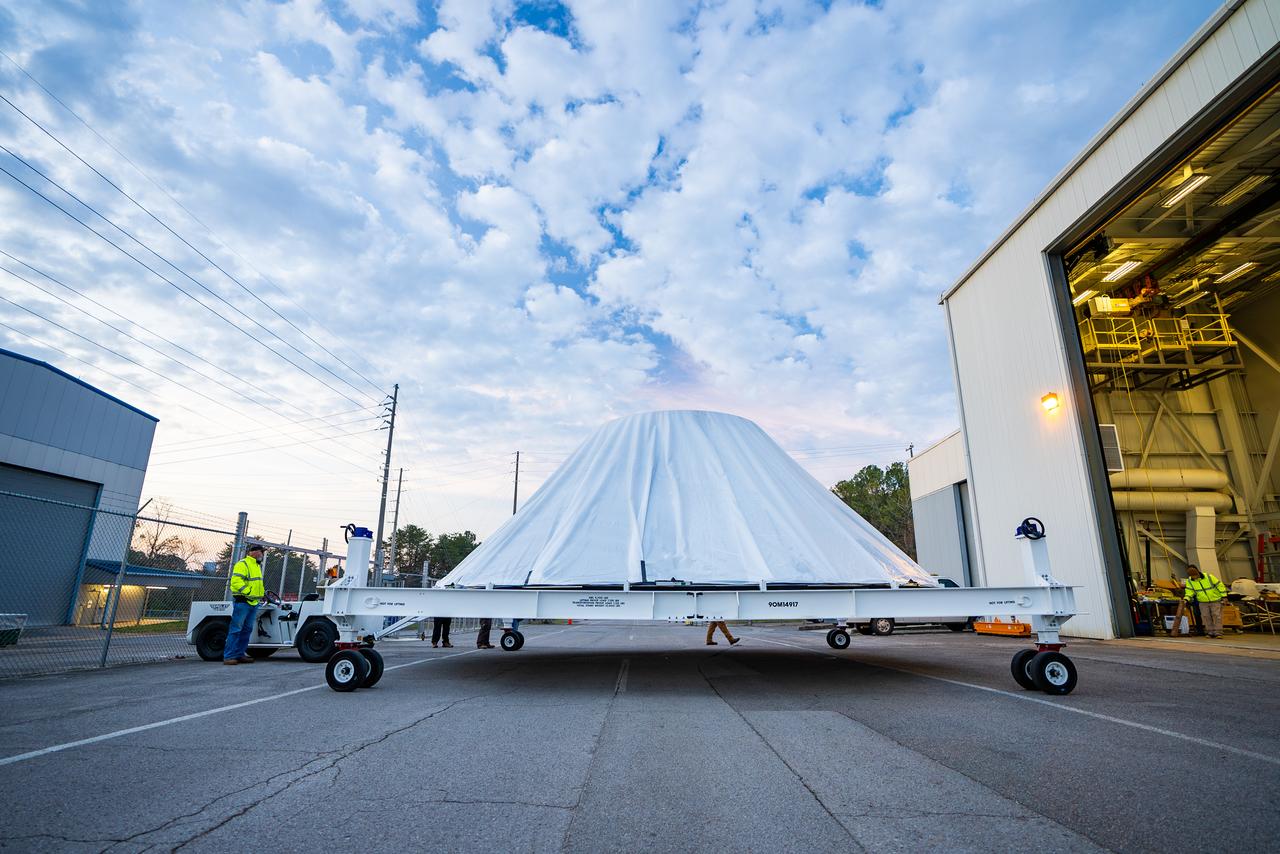
These photos and videos show how crews at NASA’s Marshall Space Flight Center in Huntsville, Alabama, moved and installed the payload adapter that will be used in the Block 1B configuration of the SLS (Space Launch System) rocket from Building 4708, where it was manufactured, into Structural Test Stand 4697 at NASA’s Marshall Space Flight Center on March 13. Teams at Marshall will begin structural testing the engineering development unit of the payload adapter – an exact replica of the flight version of the hardware – this spring. The cone-shaped payload adapter is about 8.5 feet tall and features two metal rings and eight composite panels. The adapter, which will debut on NASA’s Artemis IV mission, is an evolution from the Orion stage adapter used in the Block 1 configuration of the first three Artemis missions. It will be housed inside the universal stage adapter atop the rocket’s more powerful in-space stage, called the exploration upper stage. The payload adapter, like the launch vehicle stage adapter and the Orion stage adapter, is fully manufactured and tested at Marshall, which manages the SLS Program. NASA is working to land the first woman, first person of color, and its first international partner astronaut on the Moon under Artemis. SLS is part of NASA’s backbone for deep space exploration, along with the Orion spacecraft and Gateway in orbit around the Moon and commercial human landing systems, next-generational spacesuits, and rovers on the lunar surface. SLS is the only rocket that can send Orion, astronauts, and supplies to the Moon in a single launch.
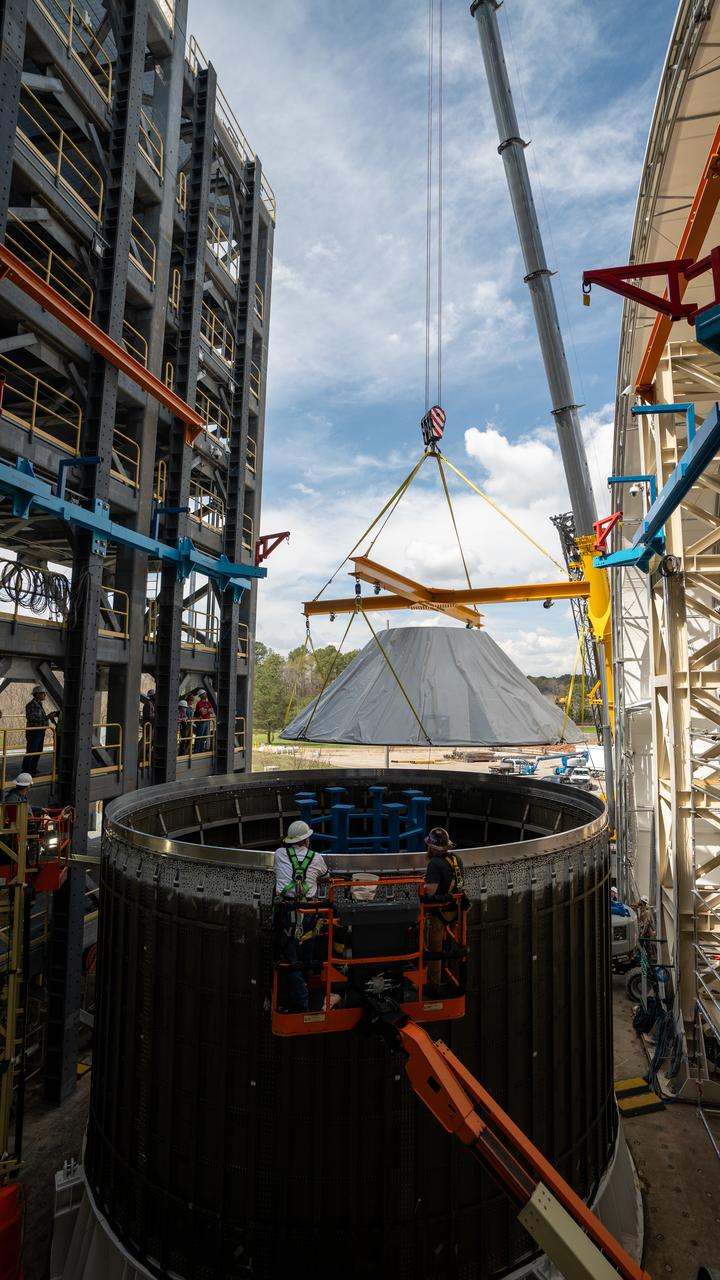
These photos and videos show how crews at NASA’s Marshall Space Flight Center in Huntsville, Alabama, moved and installed the payload adapter that will be used in the Block 1B configuration of the SLS (Space Launch System) rocket from Building 4708, where it was manufactured, into Structural Test Stand 4697 at NASA’s Marshall Space Flight Center on March 13. Teams at Marshall will begin structural testing the engineering development unit of the payload adapter – an exact replica of the flight version of the hardware – this spring. The cone-shaped payload adapter is about 8.5 feet tall and features two metal rings and eight composite panels. The adapter, which will debut on NASA’s Artemis IV mission, is an evolution from the Orion stage adapter used in the Block 1 configuration of the first three Artemis missions. It will be housed inside the universal stage adapter atop the rocket’s more powerful in-space stage, called the exploration upper stage. The payload adapter, like the launch vehicle stage adapter and the Orion stage adapter, is fully manufactured and tested at Marshall, which manages the SLS Program. NASA is working to land the first woman, first person of color, and its first international partner astronaut on the Moon under Artemis. SLS is part of NASA’s backbone for deep space exploration, along with the Orion spacecraft and Gateway in orbit around the Moon and commercial human landing systems, next-generational spacesuits, and rovers on the lunar surface. SLS is the only rocket that can send Orion, astronauts, and supplies to the Moon in a single launch.

Crews at NASA’s Michoud Assembly Facility in New Orleans load alluminum alloy panels into the Vertical Weld Center June 1. The Vertical Weld Center is a friction-stir weld tool for the large structures of the core stage for the SLS (Space Launch System) rocket. Teams load the panels into the VWC using an overhead crane system, then multiple panels are welded together to create entire barrels. The panels in these images are some of the five barrels that will form the SLS liquid hydrogen propellant tank for the SLS rocket that will power NASA’s Artemis IV mission, which is also the first flight of SLS in its more powerful Block 1B configuration. The SLS core stage is made up of five unique elements: the forward skirt, liquid oxygen tank, intertank, liquid hydrogen tank, and the engine section. The liquid hydrogen propellant tank holds 537,000 gallons of liquid hydrogen cooled to minus 432 degrees Fahrenheit and sits between the core stage’s intertank and engine section. The liquid hydrogen hardware, along with the liquid oxygen tank, provides propellant to the four RS-25 engines at the bottom of the core stage to produce more than two million pounds of thrust to help launch the Artemis IV mission to the Moon. Together with its four RS-25 engines, the rocket’s massive 212-foot-tall core stage — the largest stage NASA has ever built — and its twin solid rocket boosters produce 8.8 million pounds of thrust to send NASA’s Orion spacecraft, astronauts and supplies beyond Earth’s orbit to the Moon. NASA is working to land the first woman and first person of color on the Moon under Artemis. SLS is part of NASA’s backbone for deep space exploration, along with Orion and the Gateway in orbit around the Moon. SLS is the only rocket that can send Orion, astronauts, and supplies to the Moon in a single mission.
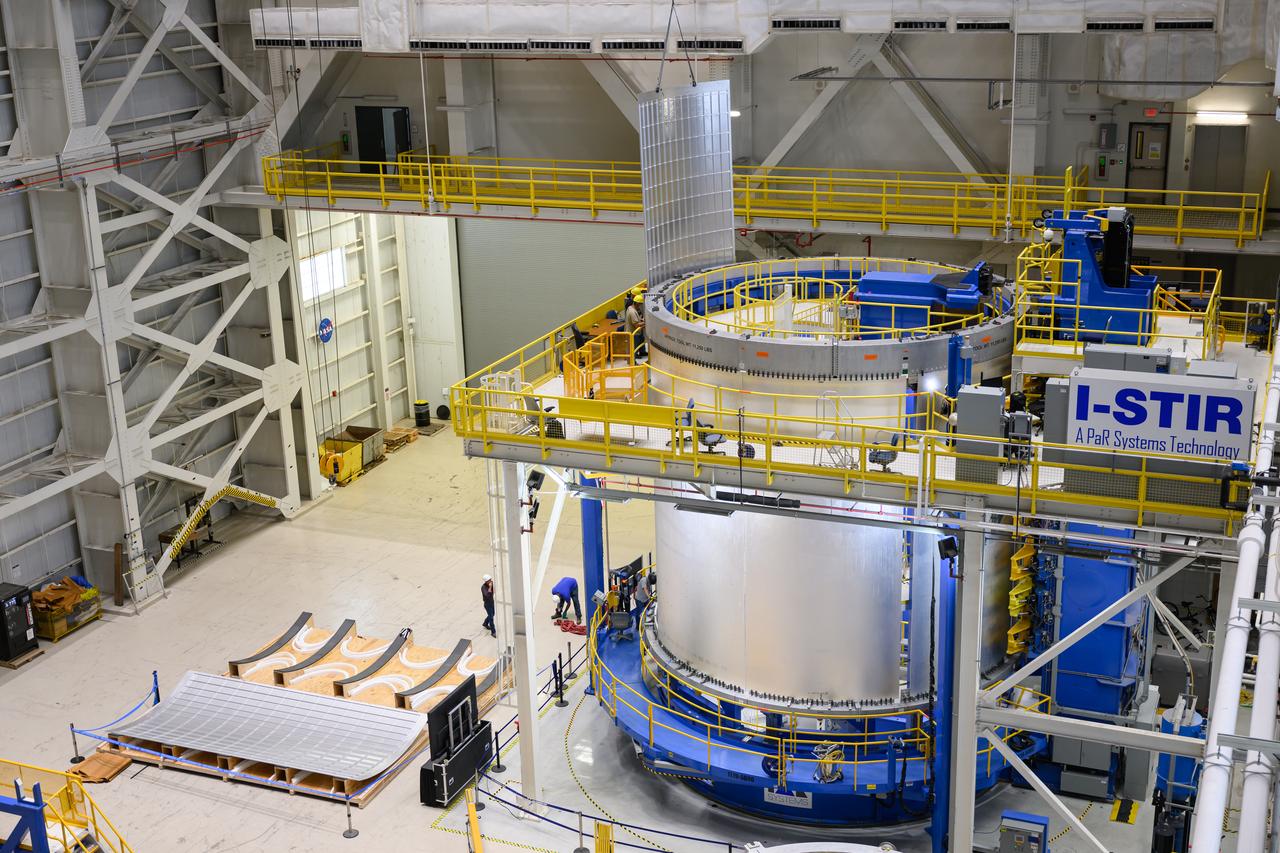
Crews at NASA’s Michoud Assembly Facility in New Orleans load alluminum alloy panels into the Vertical Weld Center June 1. The Vertical Weld Center is a friction-stir weld tool for the large structures of the core stage for the SLS (Space Launch System) rocket. Teams load the panels into the VWC using an overhead crane system, then multiple panels are welded together to create entire barrels. The panels in these images are some of the five barrels that will form the SLS liquid hydrogen propellant tank for the SLS rocket that will power NASA’s Artemis IV mission, which is also the first flight of SLS in its more powerful Block 1B configuration. The SLS core stage is made up of five unique elements: the forward skirt, liquid oxygen tank, intertank, liquid hydrogen tank, and the engine section. The liquid hydrogen propellant tank holds 537,000 gallons of liquid hydrogen cooled to minus 432 degrees Fahrenheit and sits between the core stage’s intertank and engine section. The liquid hydrogen hardware, along with the liquid oxygen tank, provides propellant to the four RS-25 engines at the bottom of the core stage to produce more than two million pounds of thrust to help launch the Artemis IV mission to the Moon. Together with its four RS-25 engines, the rocket’s massive 212-foot-tall core stage — the largest stage NASA has ever built — and its twin solid rocket boosters produce 8.8 million pounds of thrust to send NASA’s Orion spacecraft, astronauts and supplies beyond Earth’s orbit to the Moon. NASA is working to land the first woman and first person of color on the Moon under Artemis. SLS is part of NASA’s backbone for deep space exploration, along with Orion and the Gateway in orbit around the Moon. SLS is the only rocket that can send Orion, astronauts, and supplies to the Moon in a single mission.
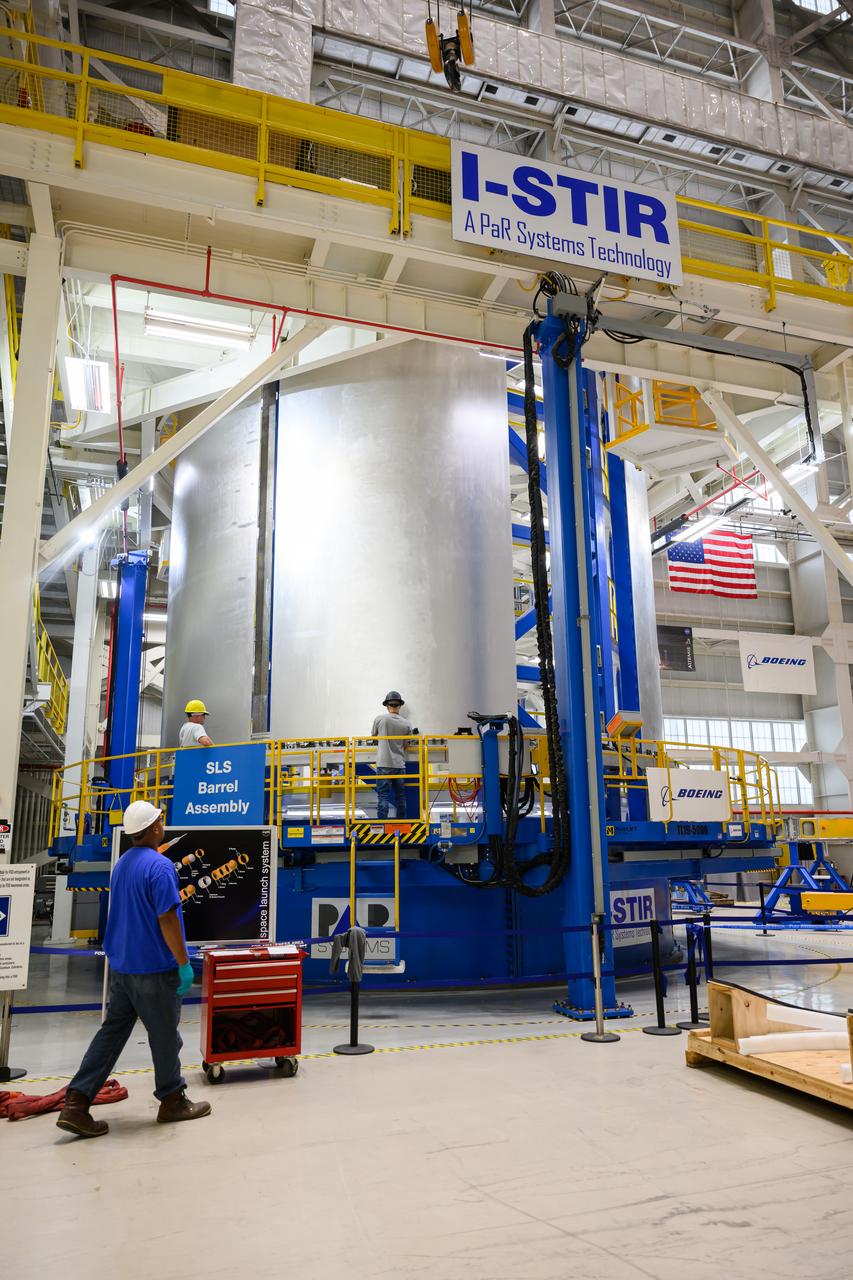
Crews at NASA’s Michoud Assembly Facility in New Orleans load alluminum alloy panels into the Vertical Weld Center June 1. The Vertical Weld Center is a friction-stir weld tool for the large structures of the core stage for the SLS (Space Launch System) rocket. Teams load the panels into the VWC using an overhead crane system, then multiple panels are welded together to create entire barrels. The panels in these images are some of the five barrels that will form the SLS liquid hydrogen propellant tank for the SLS rocket that will power NASA’s Artemis IV mission, which is also the first flight of SLS in its more powerful Block 1B configuration. The SLS core stage is made up of five unique elements: the forward skirt, liquid oxygen tank, intertank, liquid hydrogen tank, and the engine section. The liquid hydrogen propellant tank holds 537,000 gallons of liquid hydrogen cooled to minus 432 degrees Fahrenheit and sits between the core stage’s intertank and engine section. The liquid hydrogen hardware, along with the liquid oxygen tank, provides propellant to the four RS-25 engines at the bottom of the core stage to produce more than two million pounds of thrust to help launch the Artemis IV mission to the Moon. Together with its four RS-25 engines, the rocket’s massive 212-foot-tall core stage — the largest stage NASA has ever built — and its twin solid rocket boosters produce 8.8 million pounds of thrust to send NASA’s Orion spacecraft, astronauts and supplies beyond Earth’s orbit to the Moon. NASA is working to land the first woman and first person of color on the Moon under Artemis. SLS is part of NASA’s backbone for deep space exploration, along with Orion and the Gateway in orbit around the Moon. SLS is the only rocket that can send Orion, astronauts, and supplies to the Moon in a single mission.
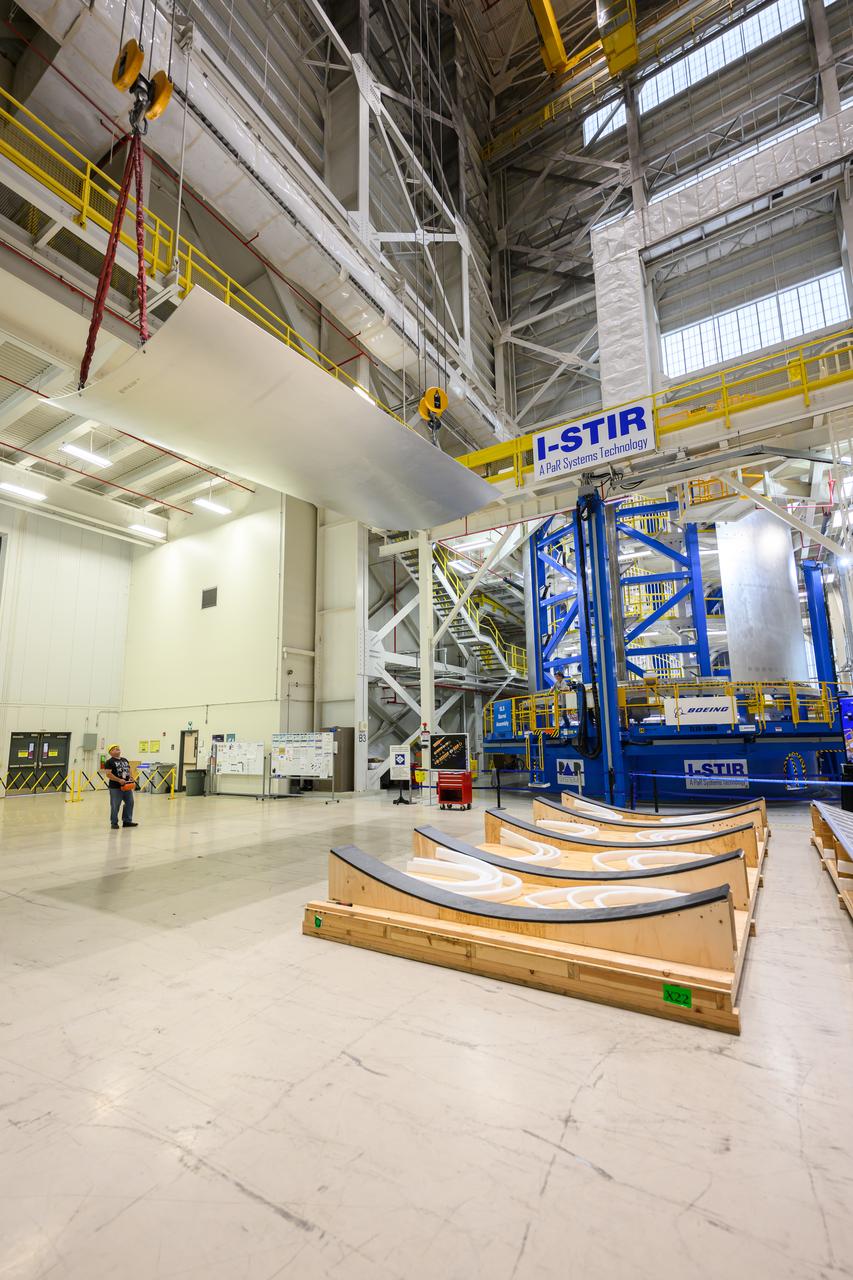
Crews at NASA’s Michoud Assembly Facility in New Orleans load alluminum alloy panels into the Vertical Weld Center June 1. The Vertical Weld Center is a friction-stir weld tool for the large structures of the core stage for the SLS (Space Launch System) rocket. Teams load the panels into the VWC using an overhead crane system, then multiple panels are welded together to create entire barrels. The panels in these images are some of the five barrels that will form the SLS liquid hydrogen propellant tank for the SLS rocket that will power NASA’s Artemis IV mission, which is also the first flight of SLS in its more powerful Block 1B configuration. The SLS core stage is made up of five unique elements: the forward skirt, liquid oxygen tank, intertank, liquid hydrogen tank, and the engine section. The liquid hydrogen propellant tank holds 537,000 gallons of liquid hydrogen cooled to minus 432 degrees Fahrenheit and sits between the core stage’s intertank and engine section. The liquid hydrogen hardware, along with the liquid oxygen tank, provides propellant to the four RS-25 engines at the bottom of the core stage to produce more than two million pounds of thrust to help launch the Artemis IV mission to the Moon. Together with its four RS-25 engines, the rocket’s massive 212-foot-tall core stage — the largest stage NASA has ever built — and its twin solid rocket boosters produce 8.8 million pounds of thrust to send NASA’s Orion spacecraft, astronauts and supplies beyond Earth’s orbit to the Moon. NASA is working to land the first woman and first person of color on the Moon under Artemis. SLS is part of NASA’s backbone for deep space exploration, along with Orion and the Gateway in orbit around the Moon. SLS is the only rocket that can send Orion, astronauts, and supplies to the Moon in a single mission.
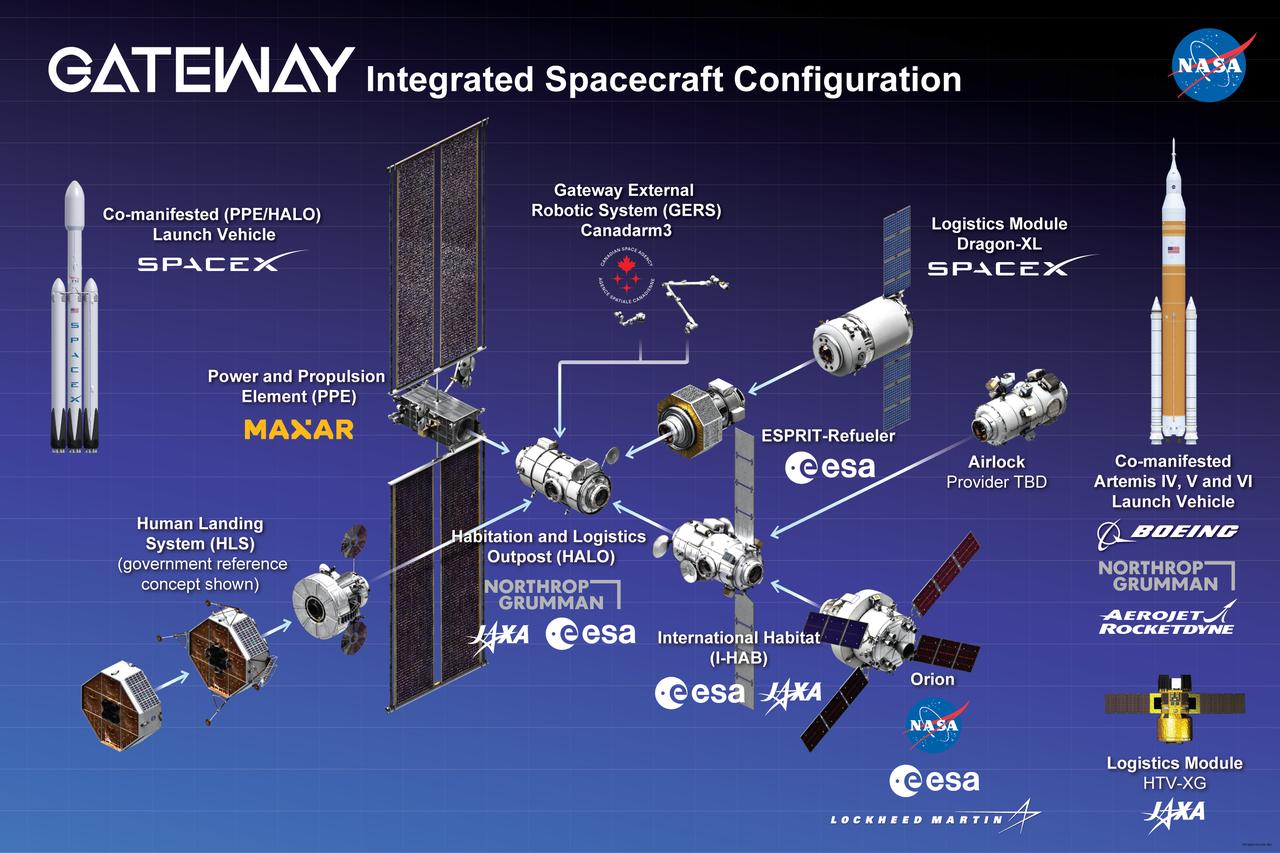
And expanded view of the Gateway space station showing each of its elements, international partner contributions, and visiting spacecraft including Orion and the Human Landing System, with prime contractors.