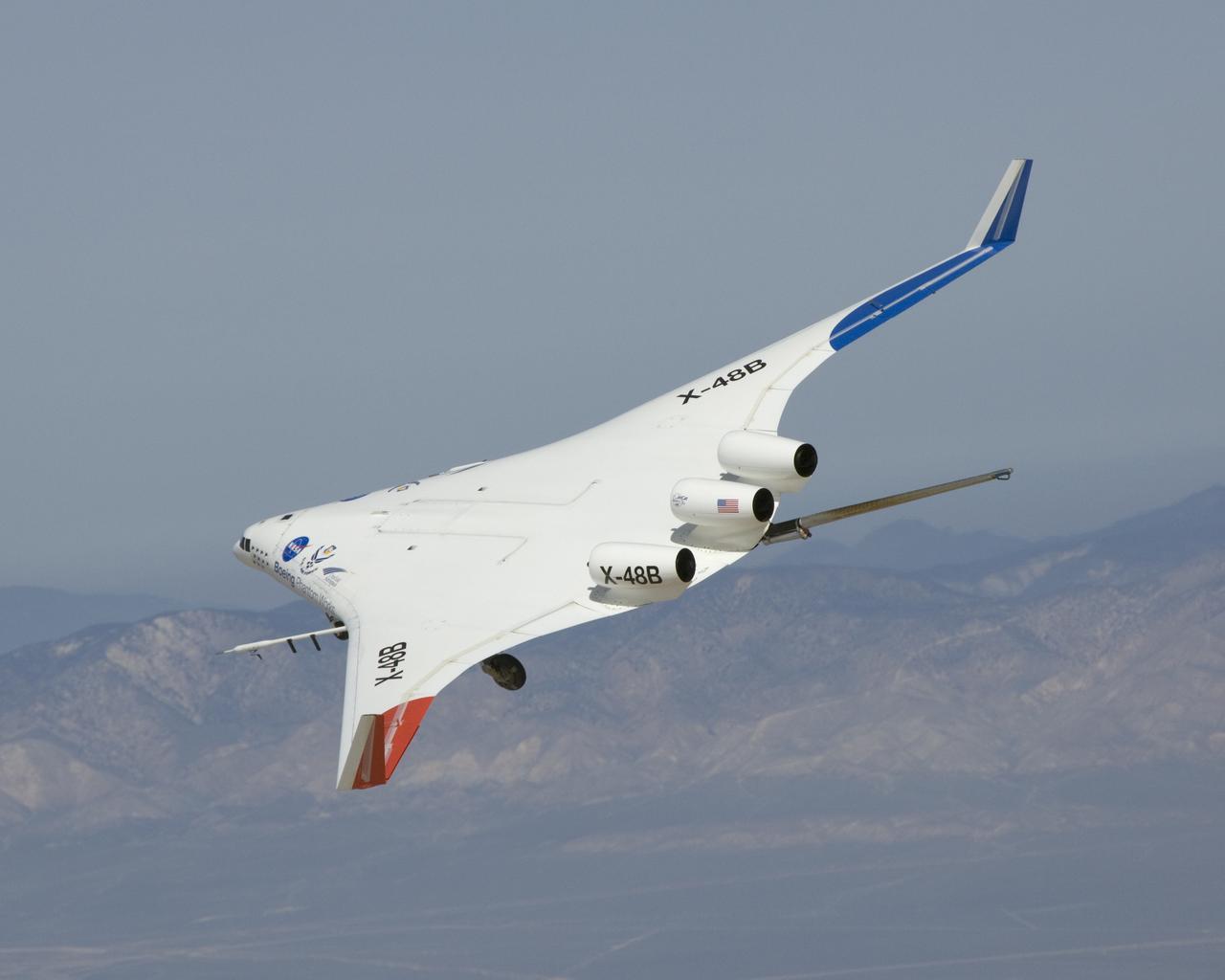
The X-48B Blended Wing Body research aircraft banks smartly in this Block 2 flight phase image.
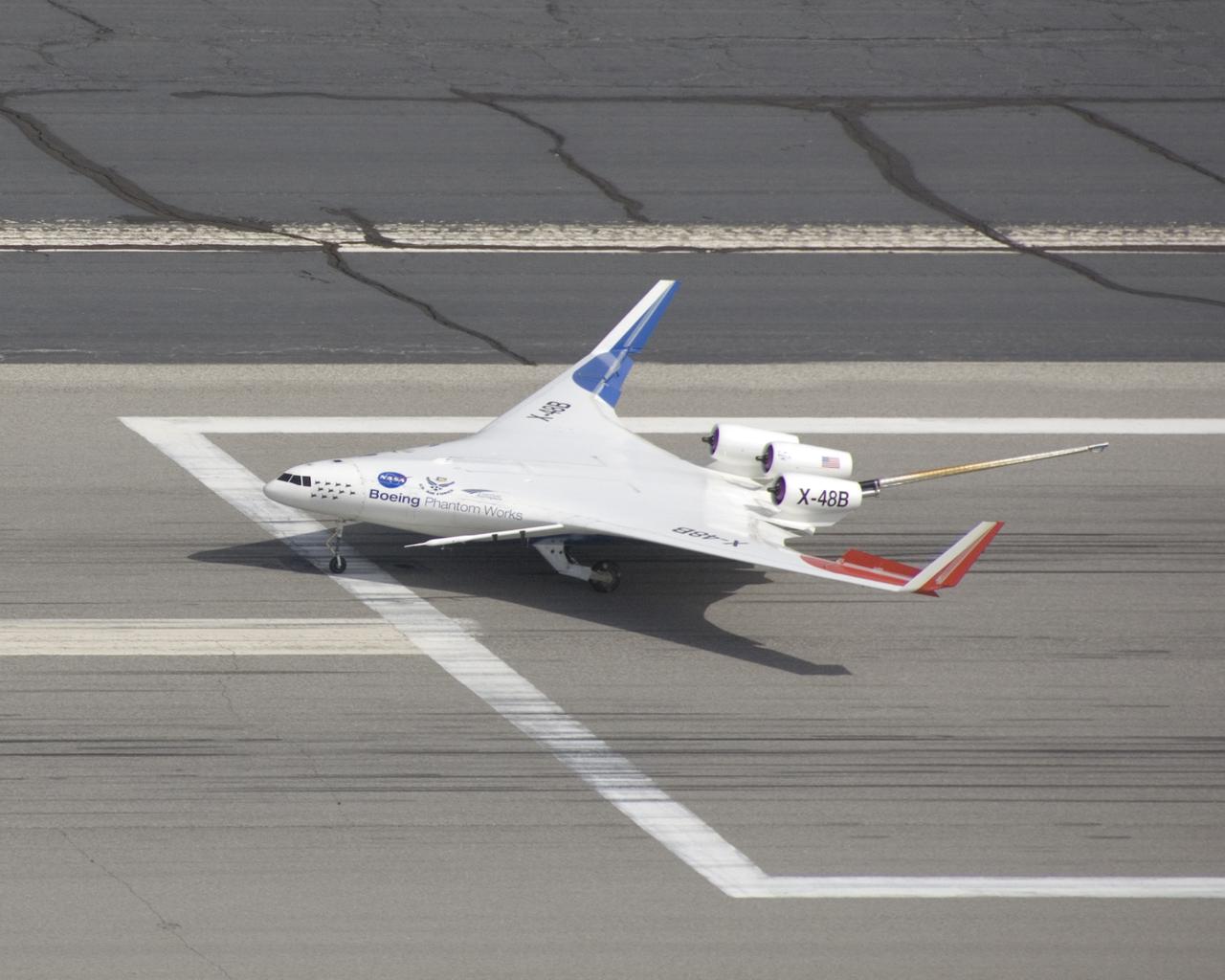
Making a nice landing, the X-48B Blended Wing Body research aircraft team ends another successful Block 2 flight.
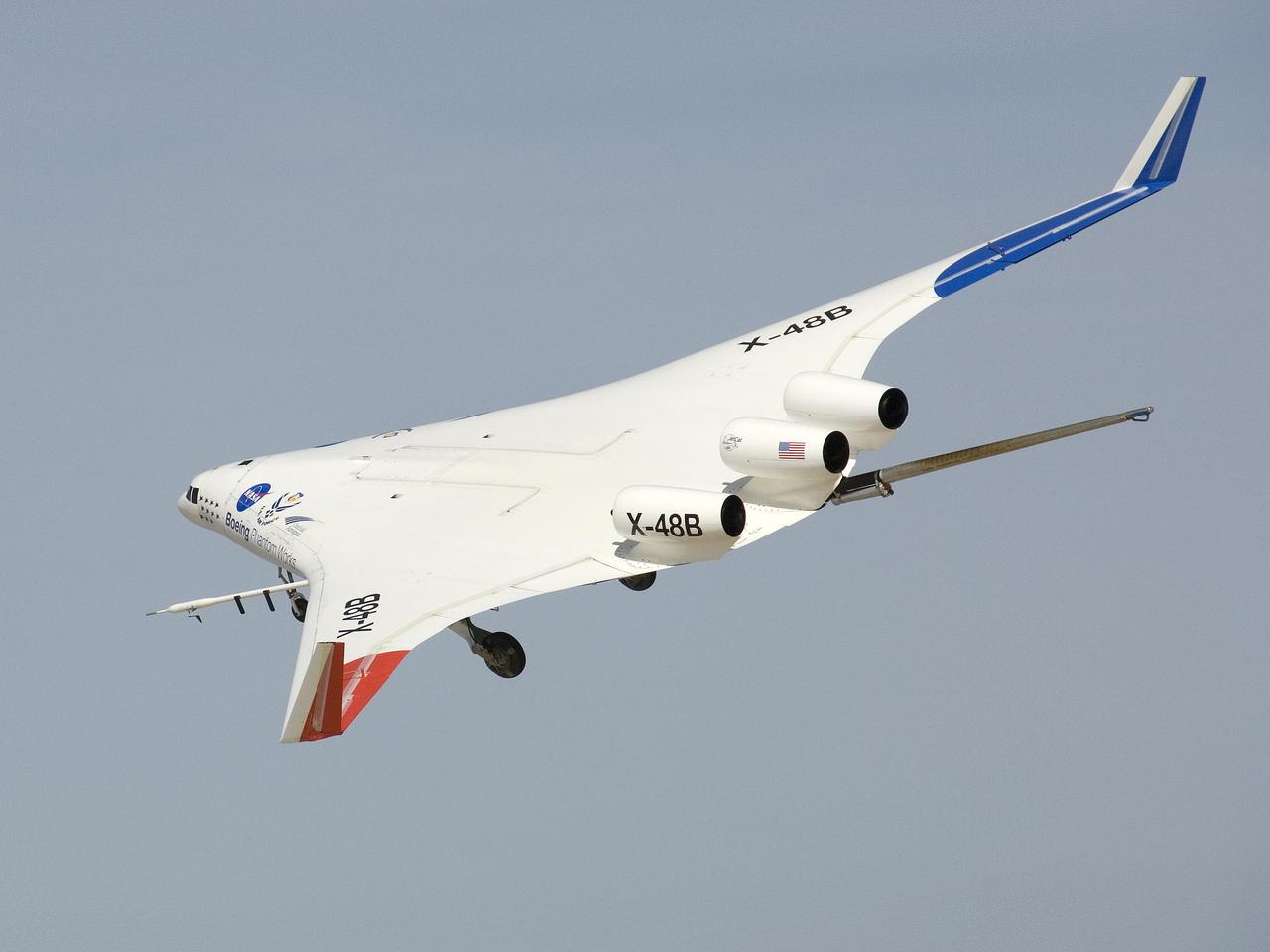
The X-48B Blended Wing Body research aircraft banked smartly in this Block 2 flight phase image.
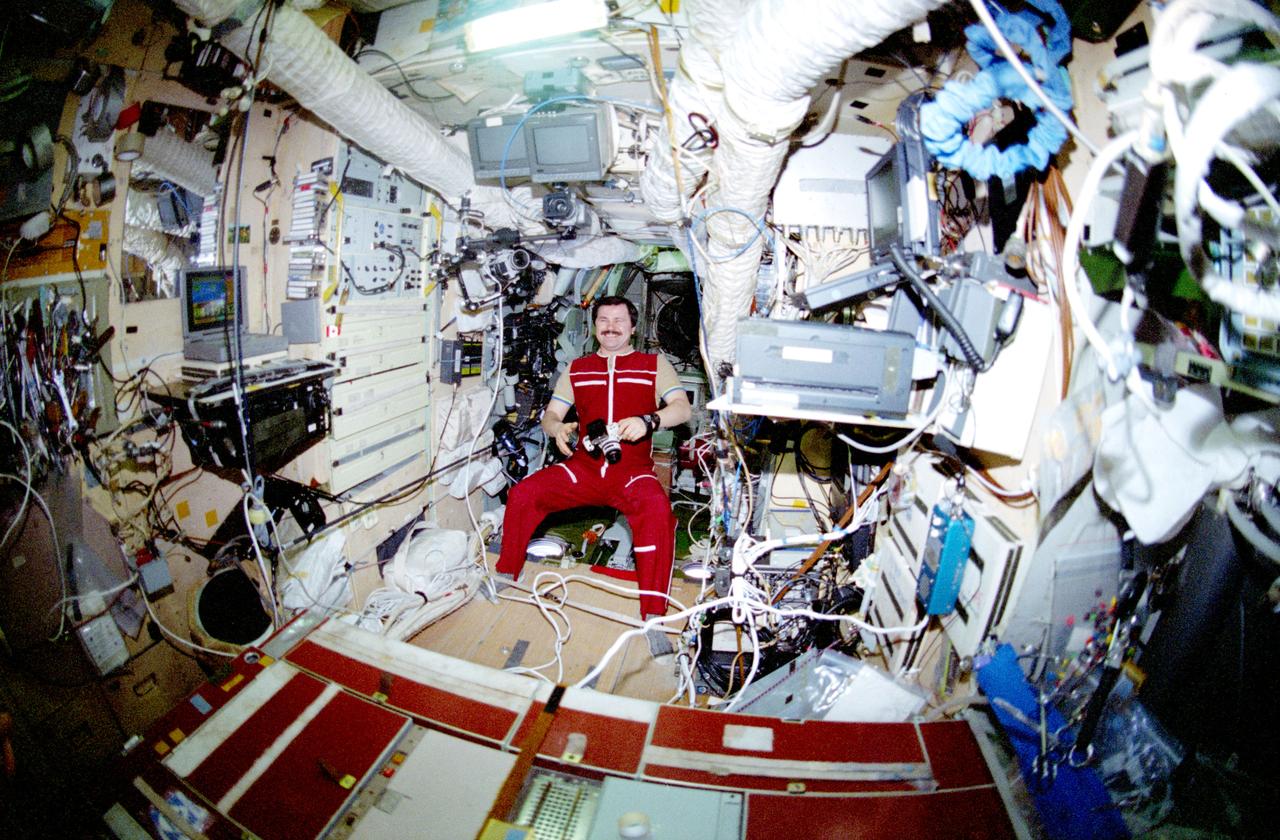
STS091-362-032 (2-12 June 1998) --- Cosmonaut Nikolai Budarin, Mir flight engineer, is at the center of this photo marking the final occasion of an American visit to Russia's Mir space station. Budarin is in the base block or core module of the complex--site of many interchanges between cosmonauts and astronauts over the last several years. Photo Credit: National Aeronautics and Space Administration (NASA) and the Russian Aviation and Space Agency.
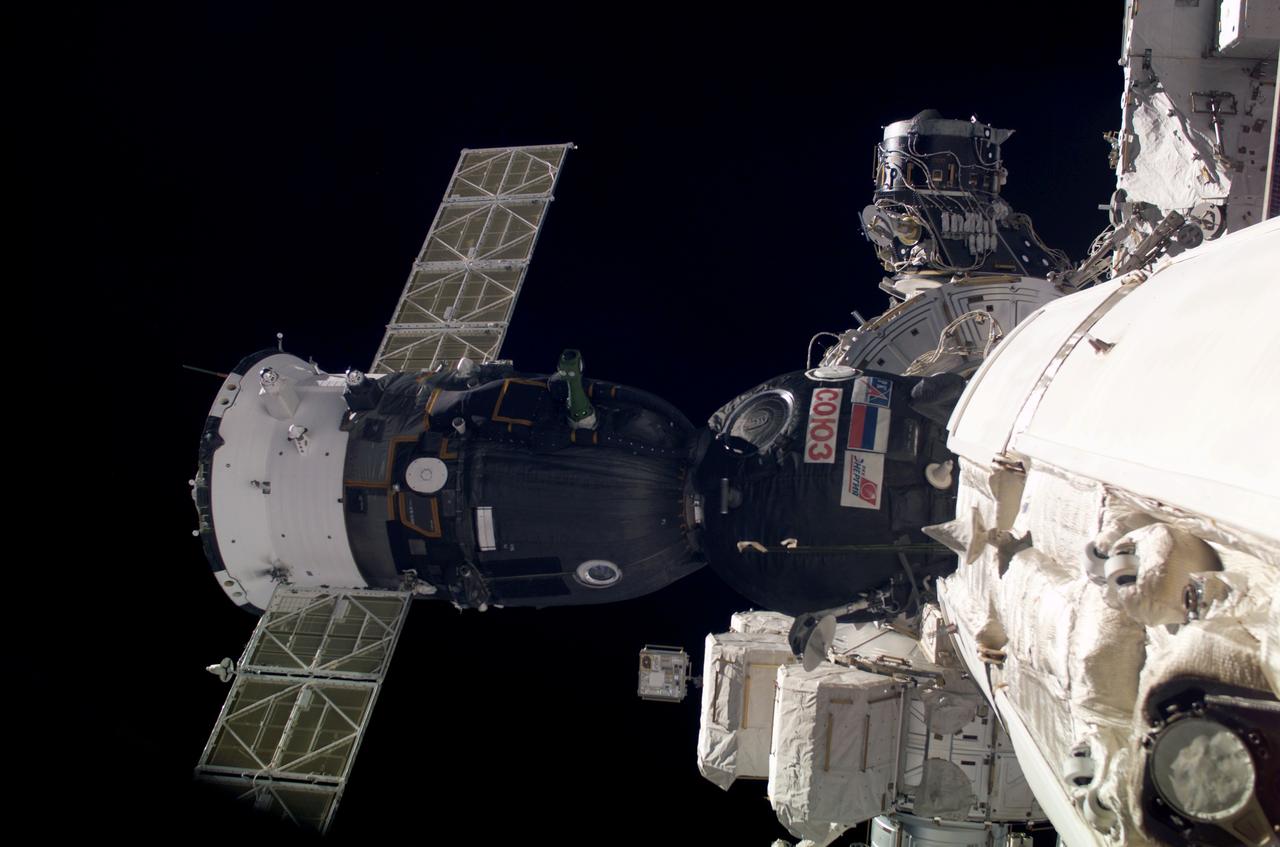
ISS006-E-48631 (28 April 2003) --- The Soyuz TMA-2 spacecraft, which carried the Expedition 7 crew, is docked to the functional cargo block (FGB) nadir port on the International Space Station (ISS).
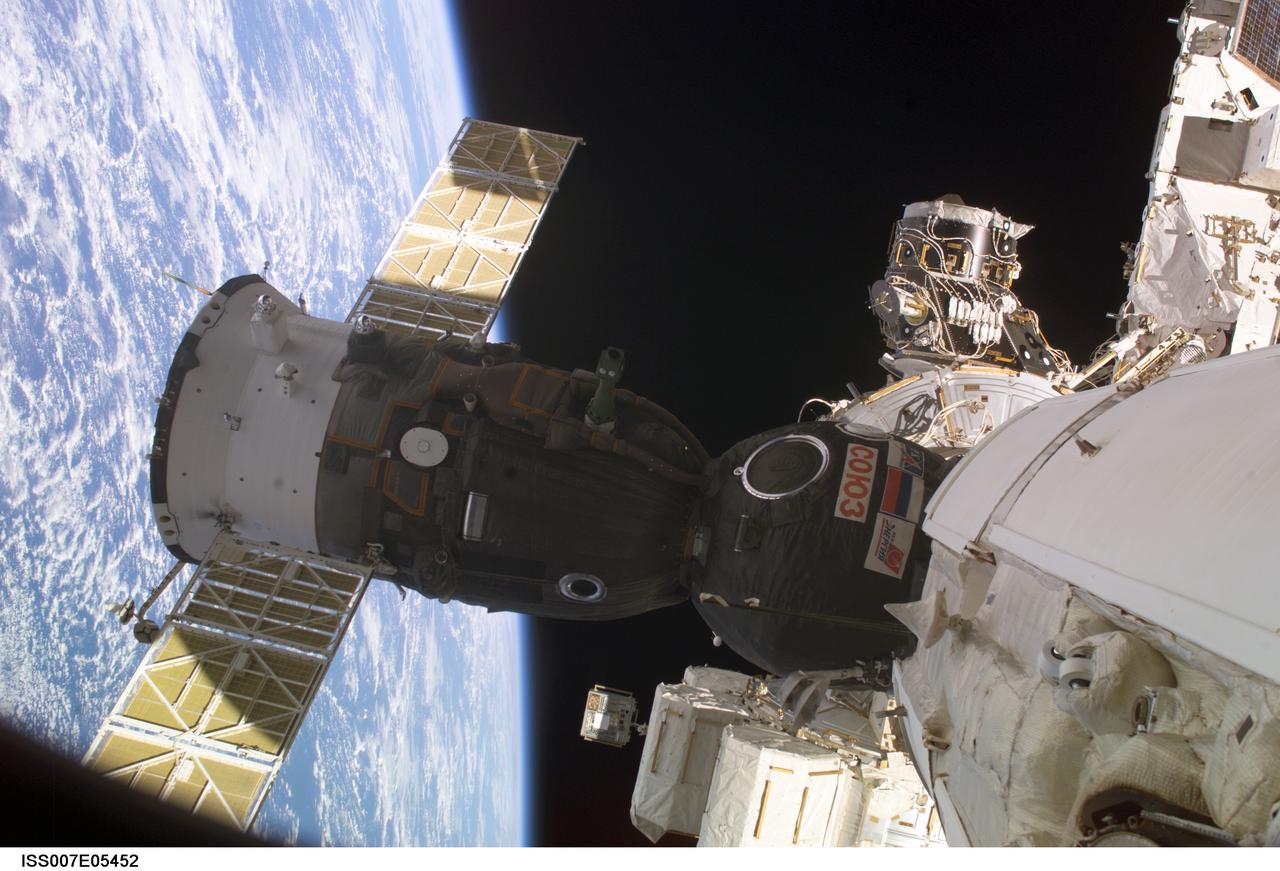
ISS007-E-05452 (14 May 2003) --- The Soyuz TMA-2 spacecraft, docked to the functional cargo block (FGB) nadir port on the International Space Station (ISS), was photographed by an Expedition Seven crewmember. The blackness of space and Earth’s horizon provide the backdrop for the scene.
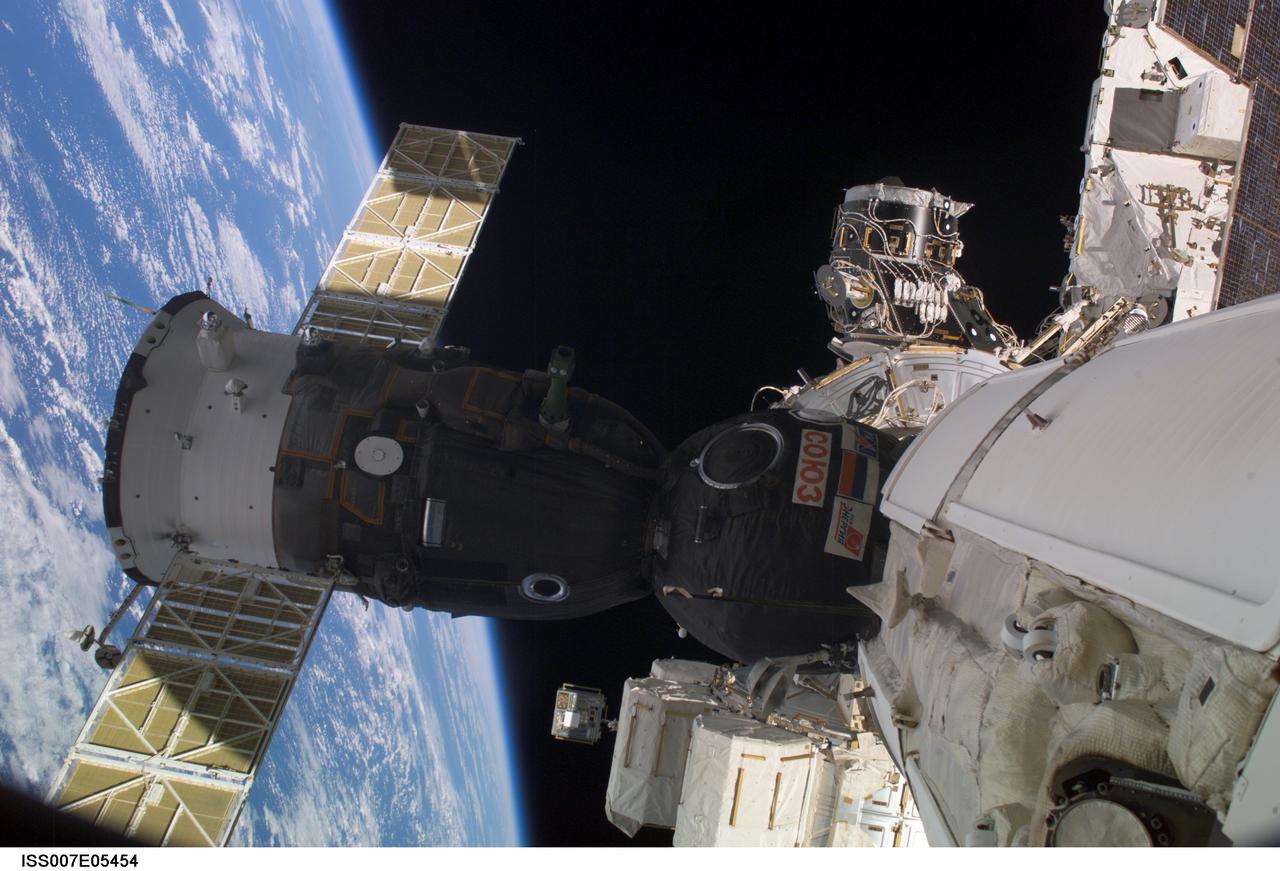
ISS007-E-05454 (14 May 2003) --- The Soyuz TMA-2 spacecraft, docked to the functional cargo block (FGB) nadir port on the International Space Station (ISS), was photographed by an Expedition Seven crewmember. The blackness of space and Earth’s horizon provide the backdrop for the scene.
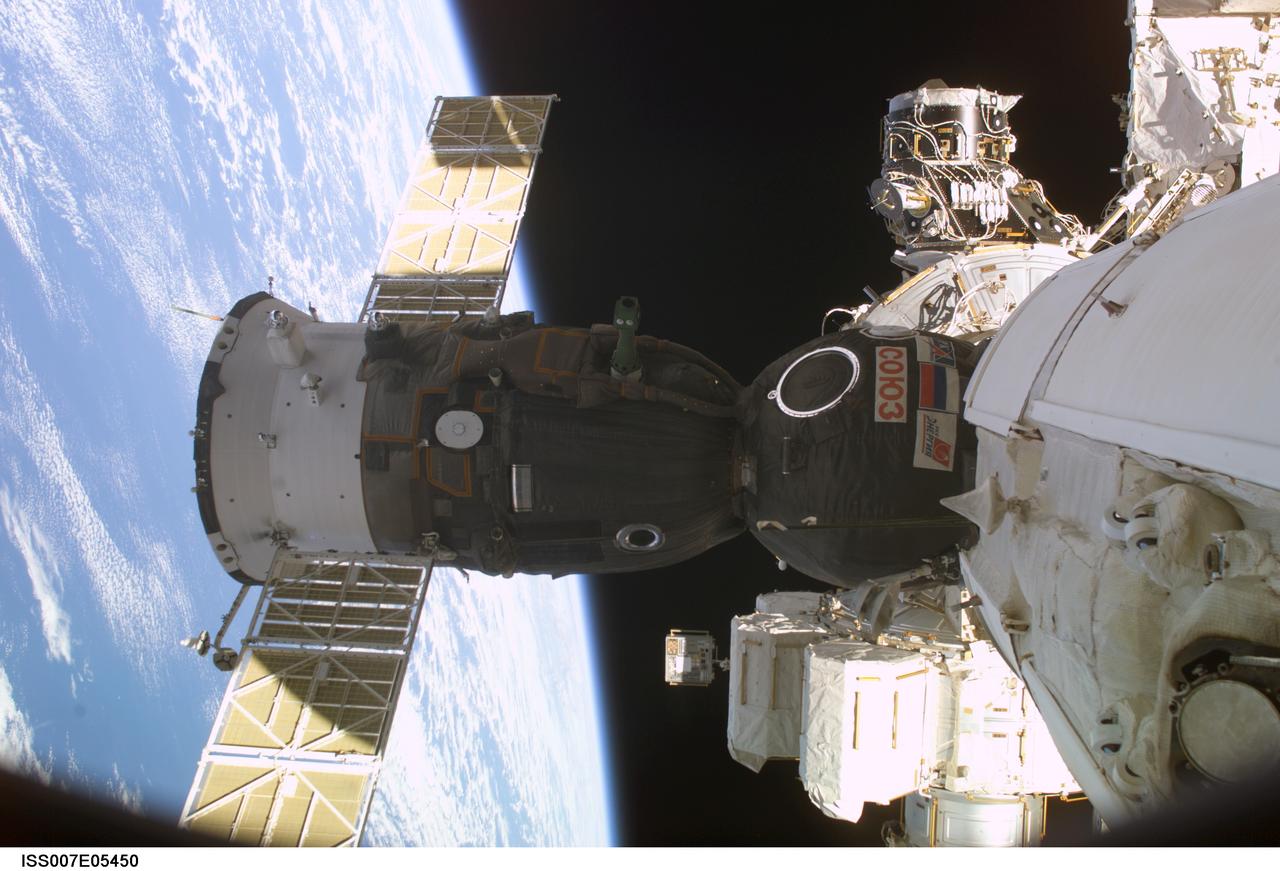
ISS007-E-05450 (14 May 2003) --- The Soyuz TMA-2 spacecraft, docked to the functional cargo block (FGB) nadir port on the International Space Station (ISS), was photographed by an Expedition Seven crewmember. The blackness of space and Earth’s horizon provide the backdrop for the scene.
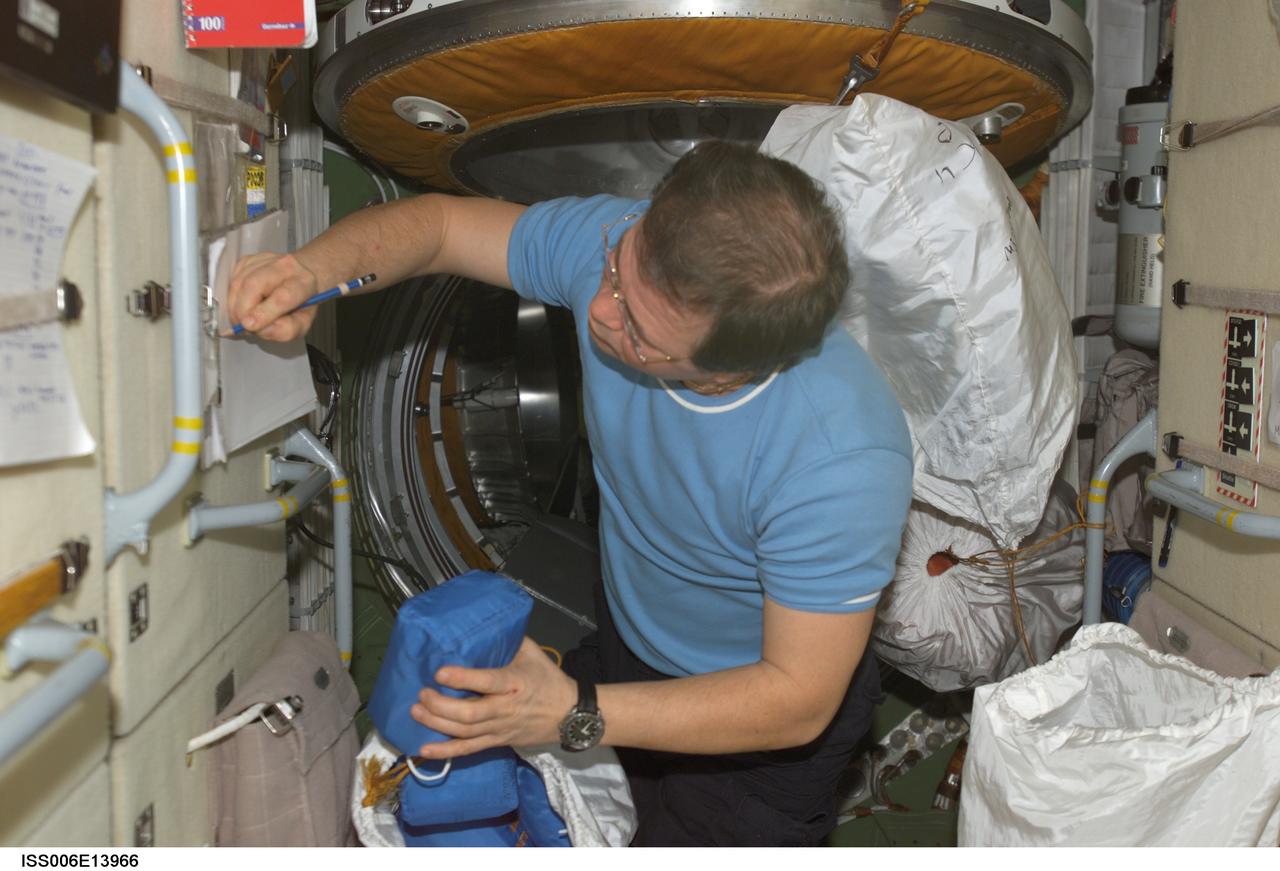
ISS006-E-13966 (2 January 2003) --- Cosmonaut Nikolai M. Budarin, Expedition Six flight engineer, takes inventory of equipment in the functional cargo block (FGB), or Zarya, on the International Space Station (ISS). Budarin represents Rosaviakosmos.
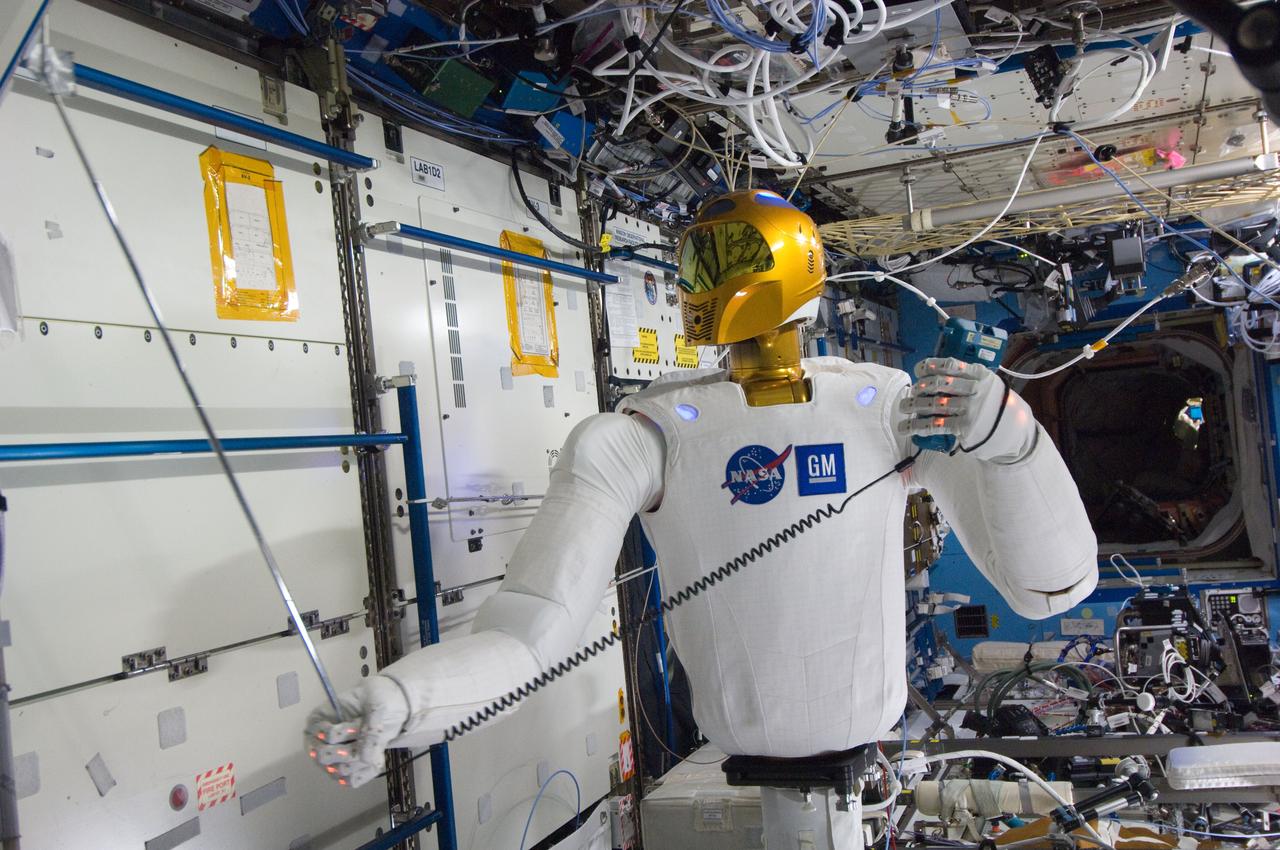
ISS030-E-177178 (14 March 2012) --- Robonaut 2 – the first dexterous humanoid robot in space – is pictured in the Destiny laboratory of the International Space Station measuring the air flow in front of vents inside the station to ensure that none of the ventilation ductwork gets clogged or blocked.
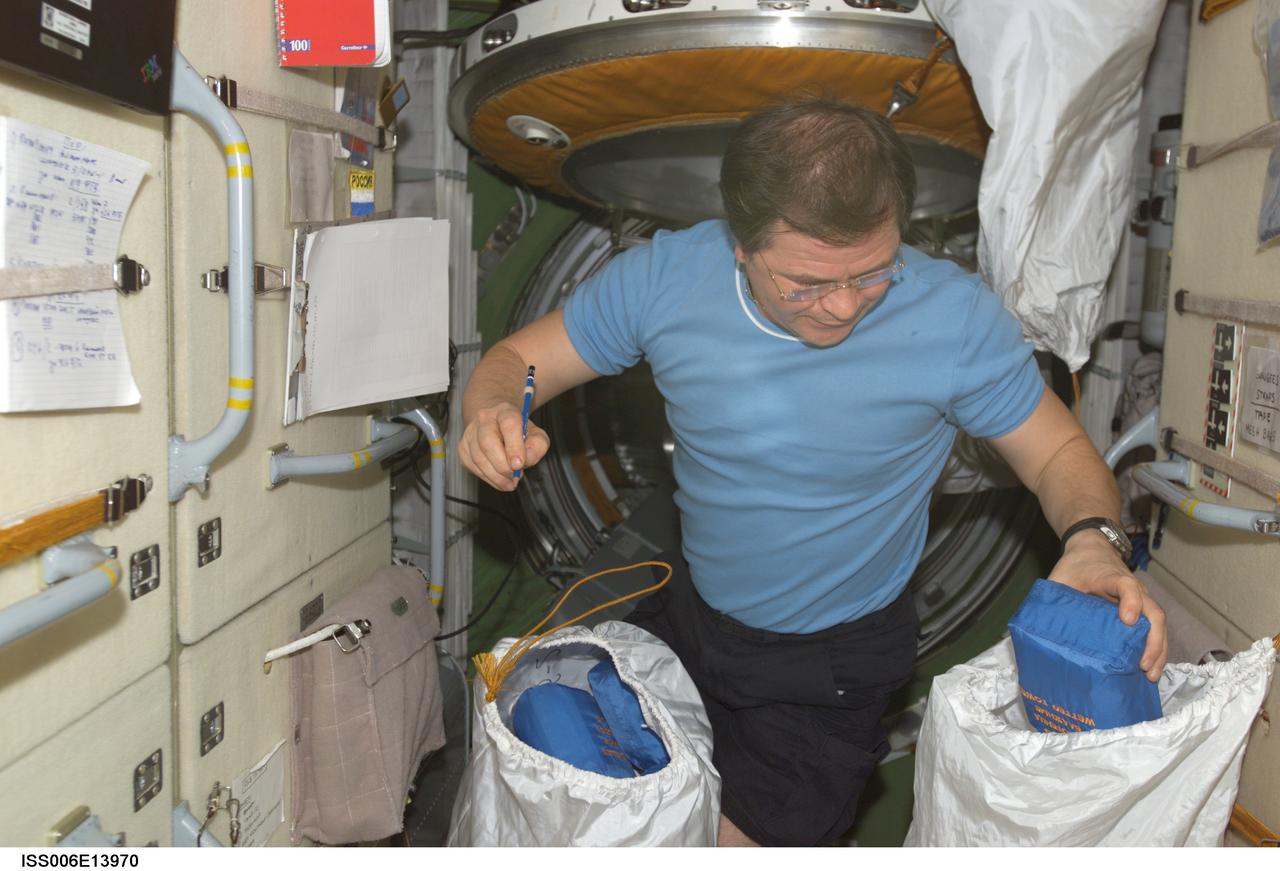
ISS006-E-13970 (2 January 2003) --- Cosmonaut Nikolai M. Budarin, Expedition Six flight engineer, takes inventory of equipment in the functional cargo block (FGB), or Zarya, on the International Space Station (ISS). Budarin represents Rosaviakosmos.
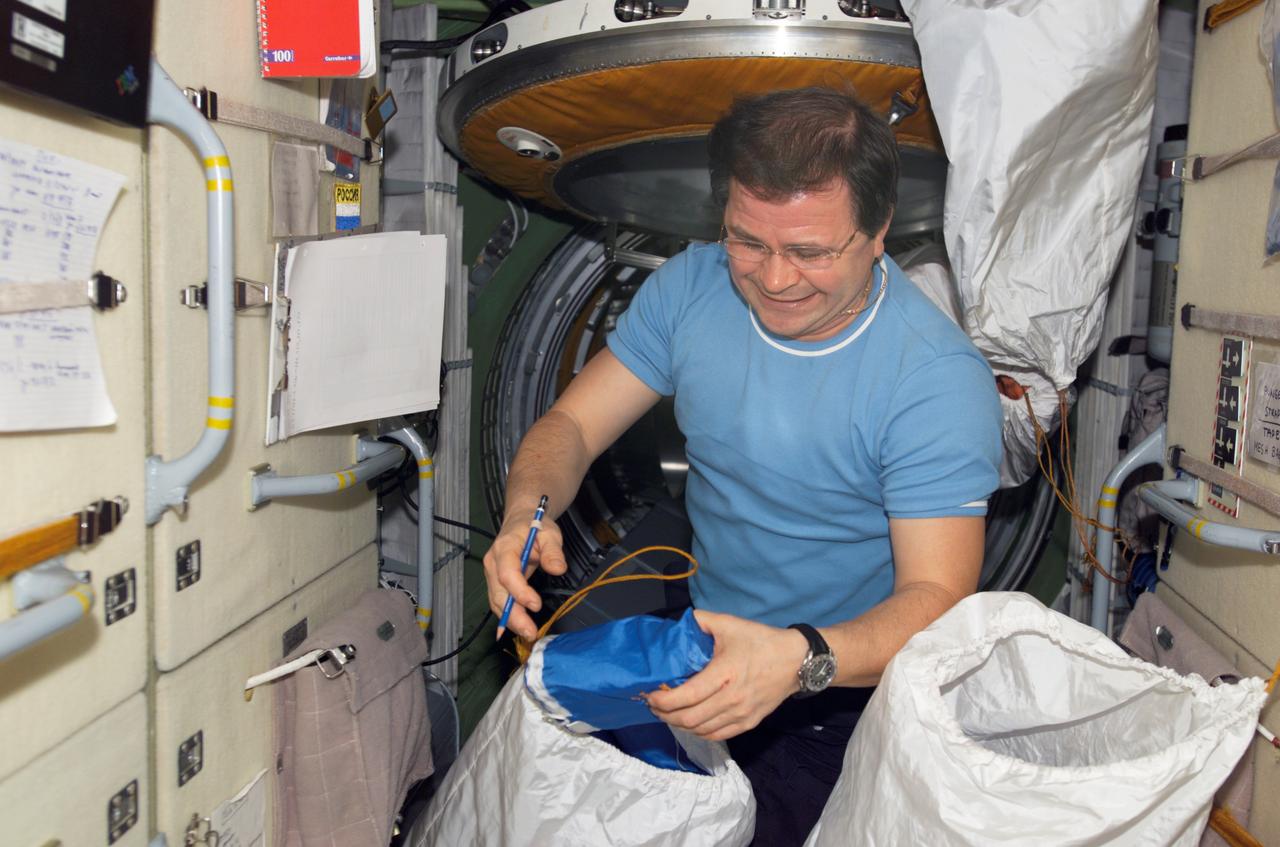
ISS006-E-13971 (2 January 2003) --- Cosmonaut Nikolai M. Budarin, Expedition 6 flight engineer, takes inventory of equipment in the functional cargo block (FGB), or Zarya, on the International Space Station (ISS). Budarin represents Rosaviakosmos.
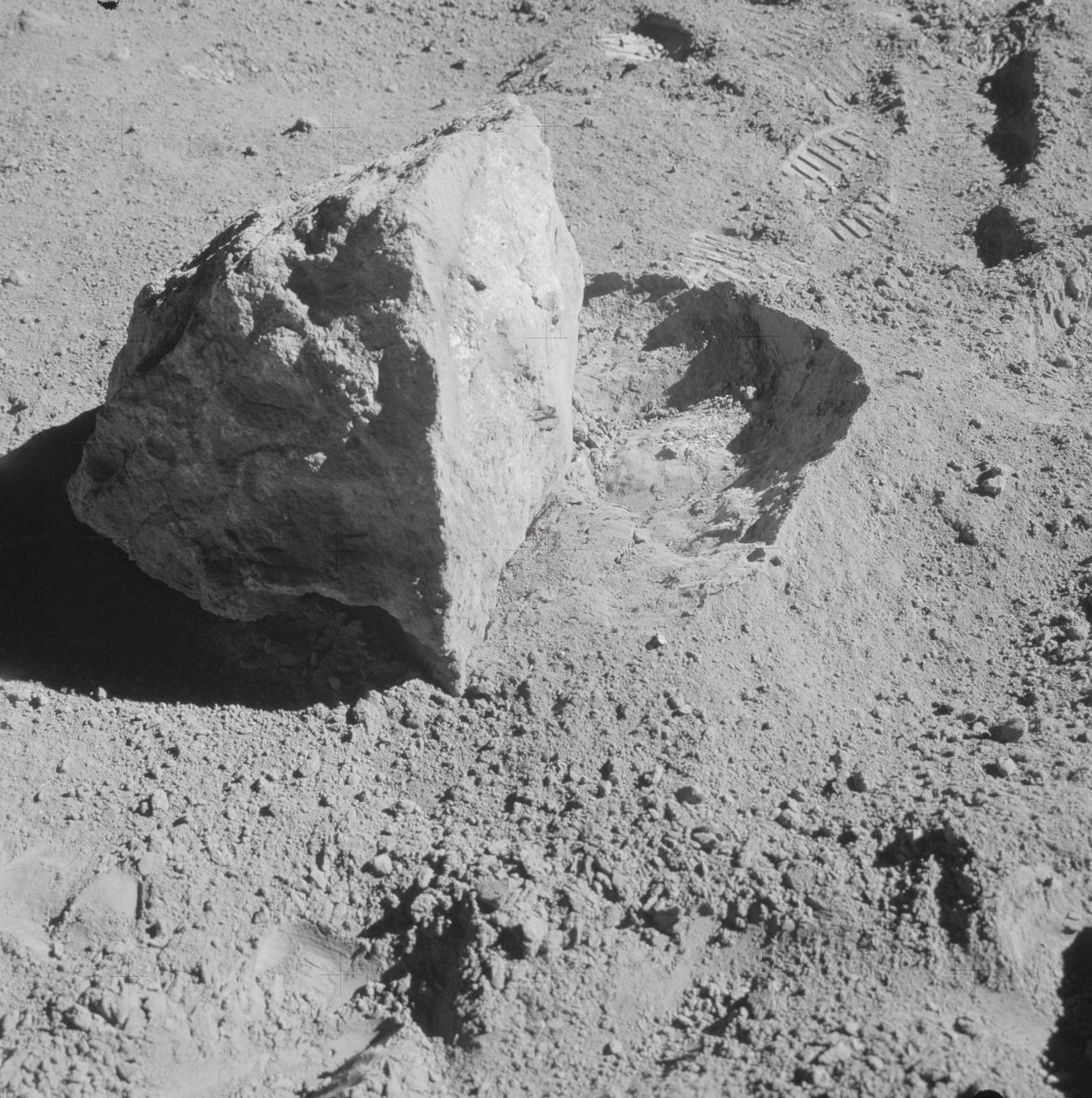
AS16-107-17573 (22 April 1972) --- A close-up view of a block (about 1/2 meter long) found by the two moon-exploring crewmembers of the Apollo 16 lunar landing mission. The block had been rolled over only moments earlier during this Apollo 16 second extravehicular activity (EVA) near South Ray Crater. Astronaut John W. Young, commander, said at the post-mission press conference, "The block has been sitting there evidently since South Ray Crater was formed." While astronauts Young and Charles M. Duke Jr., lunar module pilot; descended in the Apollo 16 Lunar Module (LM) "Orion" to explore the Descartes highlands landing site on the moon, astronaut Thomas K. Mattingly II, command module pilot, remained with the Command and Service Modules (CSM) "Casper" in lunar orbit.
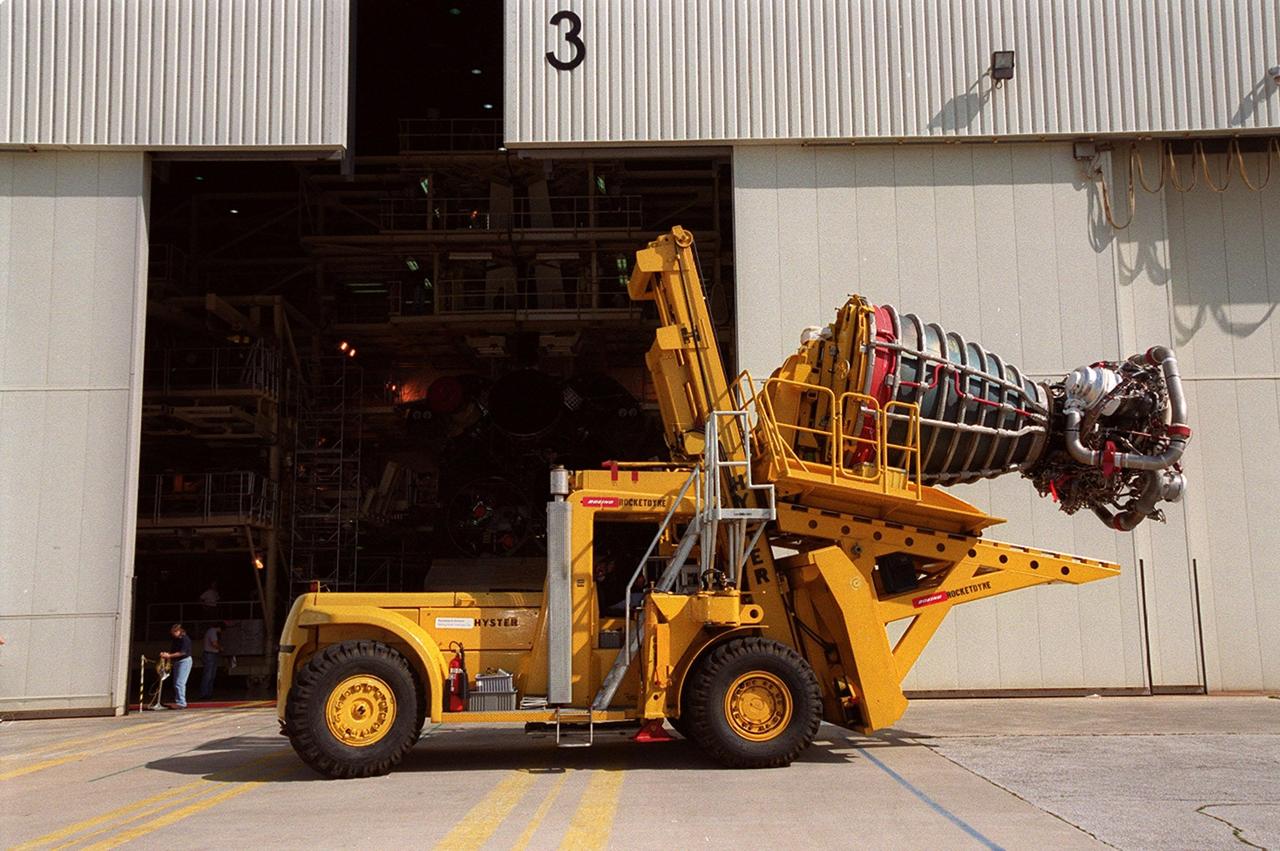
KENNEDY SPACE CENTER, FLA. -- The transport vehicle carrying a new block 2 engine arrives at Orbiter Processing Facility bay 3. There the new engine will be installed on the orbiter Atlantis, on mission STS-104, for its first flight. The Block II Main Engine configuration is manufactured by Boeing Rocketdyne in Canoga Park, Calif., and includes a new Pratt & Whitney high-pressure fuel turbo pump. Engine improvements are managed by NASA’s Marshall Space Flight Center in Huntsville, Ala. Each Space Shuttle Main Engine is 14 feet (4.3 meters) long, weighs about 7,000 pounds (3,175 kilograms), and is 7.5 feet (2.3 meters) in diameter at the end of the nozzle
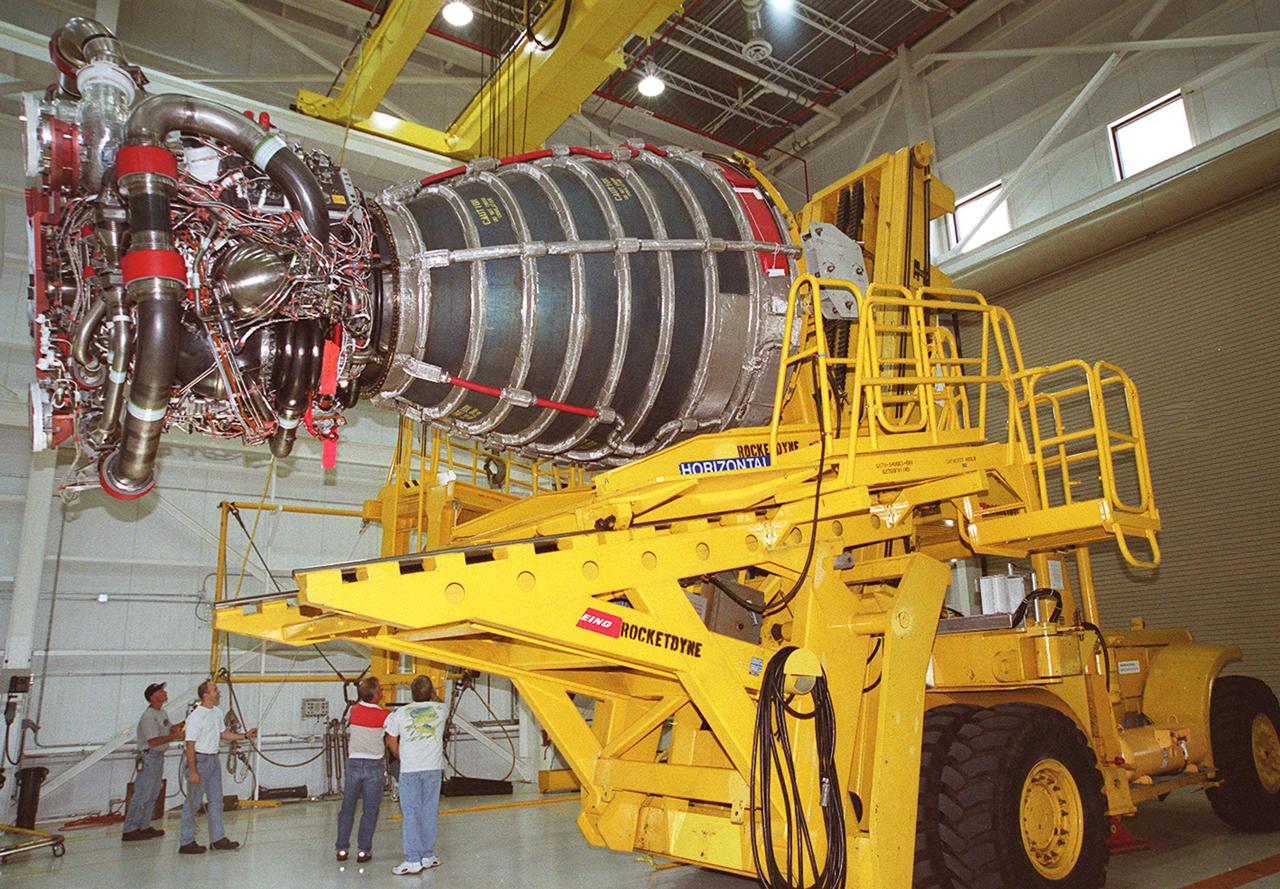
KENNEDY SPACE CENTER, FLA. -- A new block 2 engine is ready for its move to Orbiter Processing Facility bay 3. There it will be installed on the orbiter Atlantis, on mission STS-104, for its first flight. The Block II Main Engine configuration is manufactured by Boeing Rocketdyne in Canoga Park, Calif., and includes a new Pratt and Whitney high-pressure fuel turbo pump. Engine improvements are managed by NASA’s Marshall Space Flight Center in Huntsville, Ala. Each Space Shuttle Main Engine is 14 feet (4.3 meters) long, weighs about 7,000 pounds (3,175 kilograms), and is 7.5 feet (2.3 meters) in diameter at the end of the nozzle
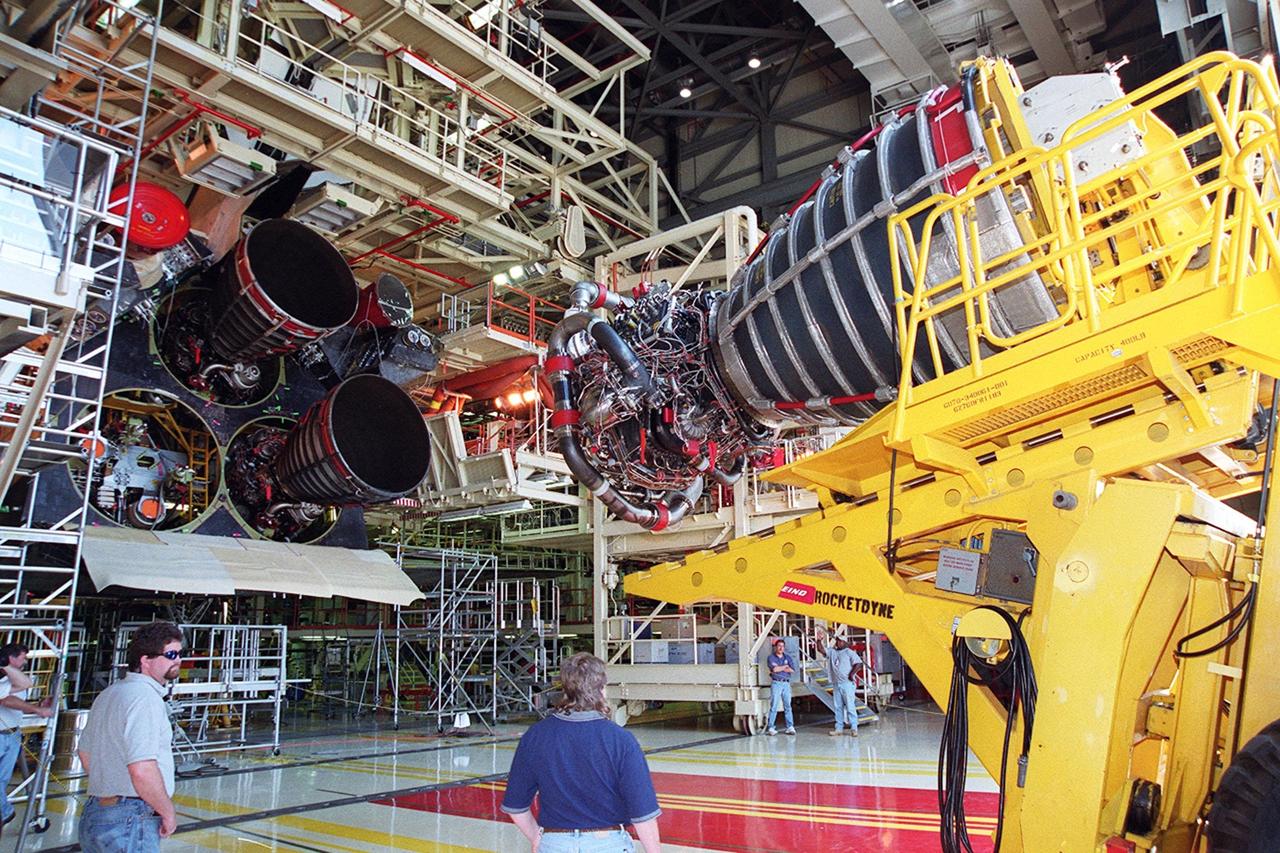
KENNEDY SPACE CENTER, FLA. -- A new block 2 engine heads toward Atlantis in Orbiter Processing Facility bay 3. There the new engine will be installed for its first flight on Atlantis, for mission STS-104. The Block II Main Engine configuration is manufactured by Boeing Rocketdyne in Canoga Park, Calif., and includes a new Pratt & Whitney high-pressure fuel turbo pump. Engine improvements are managed by NASA’s Marshall Space Flight Center in Huntsville, Ala. Each Space Shuttle Main Engine is 14 feet (4.3 meters) long, weighs about 7,000 pounds (3,175 kilograms), and is 7.5 feet (2.3 meters) in diameter at the end of the nozzle
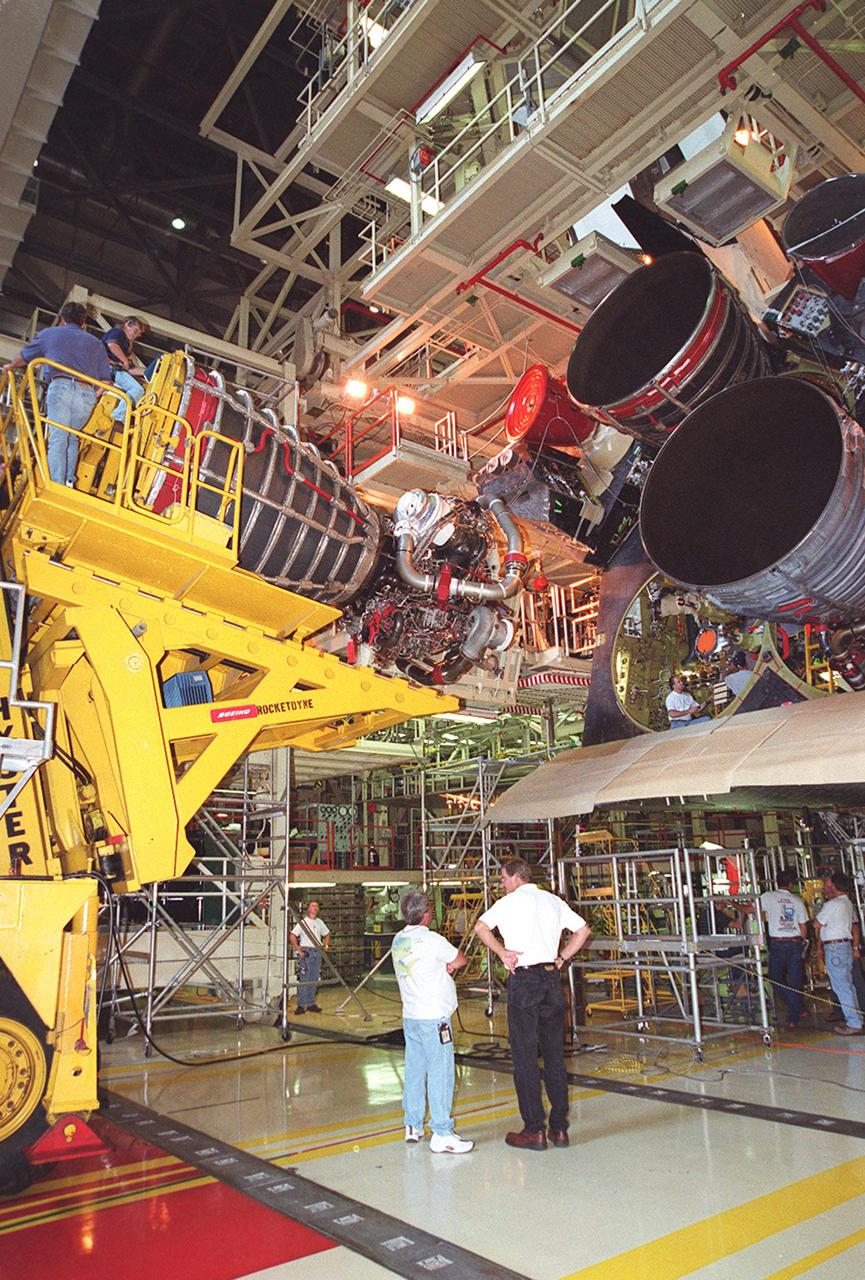
KENNEDY SPACE CENTER, FLA. -- In Orbiter Processing Facility bay 3, a new block 2 engine, at left, is moved into position for installation on Atlantis. The engine will have its first flight on mission STS-104, scheduled for launch June 14. The Block II Main Engine configuration is manufactured by Boeing Rocketdyne in Canoga Park, Calif., and includes a new Pratt and Whitney high-pressure fuel turbo pump. Engine improvements are managed by NASA’s Marshall Space Flight Center in Huntsville, Ala. Each Space Shuttle Main Engine is 14 feet (4.3 meters) long, weighs about 7,000 pounds (3,175 kilograms), and is 7.5 feet (2.3 meters) in diameter at the end of the nozzle

A new block 2 engine is lowered onto a transport vehicle for a move to the Orbiter Processing Facility. There it will be installed for its first flight on the orbiter Atlantis, on mission STS-104. The Block II Main Engine configuration is manufactured by Boeing Rocketdyne in Canoga Park, Calif., and includes a new Pratt & Whitney high-pressure fuel turbo pump. Engine improvements are managed by NASA’s Marshall Space Flight Center in Huntsville, Ala. Each Space Shuttle Main Engine is 14 feet (4.3 meters) long, weighs about 7,000 pounds (3,175 kilograms), and is 7.5 feet (2.3 meters) in diameter at the end of the nozzle

KENNEDY SPACE CENTER, FLA. -- An upgraded Space Shuttle main engine (block 2 engine) sits in the Space Shuttle Main Engine Processing Facility. The new engine will be installed for its first flight on the orbiter Atlantis, on mission STS-104. The Block II Main Engine configuration is manufactured by Boeing Rocketdyne in Canoga Park, Calif., and includes a new Pratt & Whitney high-pressure fuel turbo pump. Engine improvements are managed by NASA’s Marshall Space Flight Center in Huntsville, Ala. Each Space Shuttle Main Engine is 14 feet (4.3 meters) long, weighs about 7,000 pounds (3,175 kilograms), and is 7.5 feet (2.3 meters) in diameter at the end of the nozzle
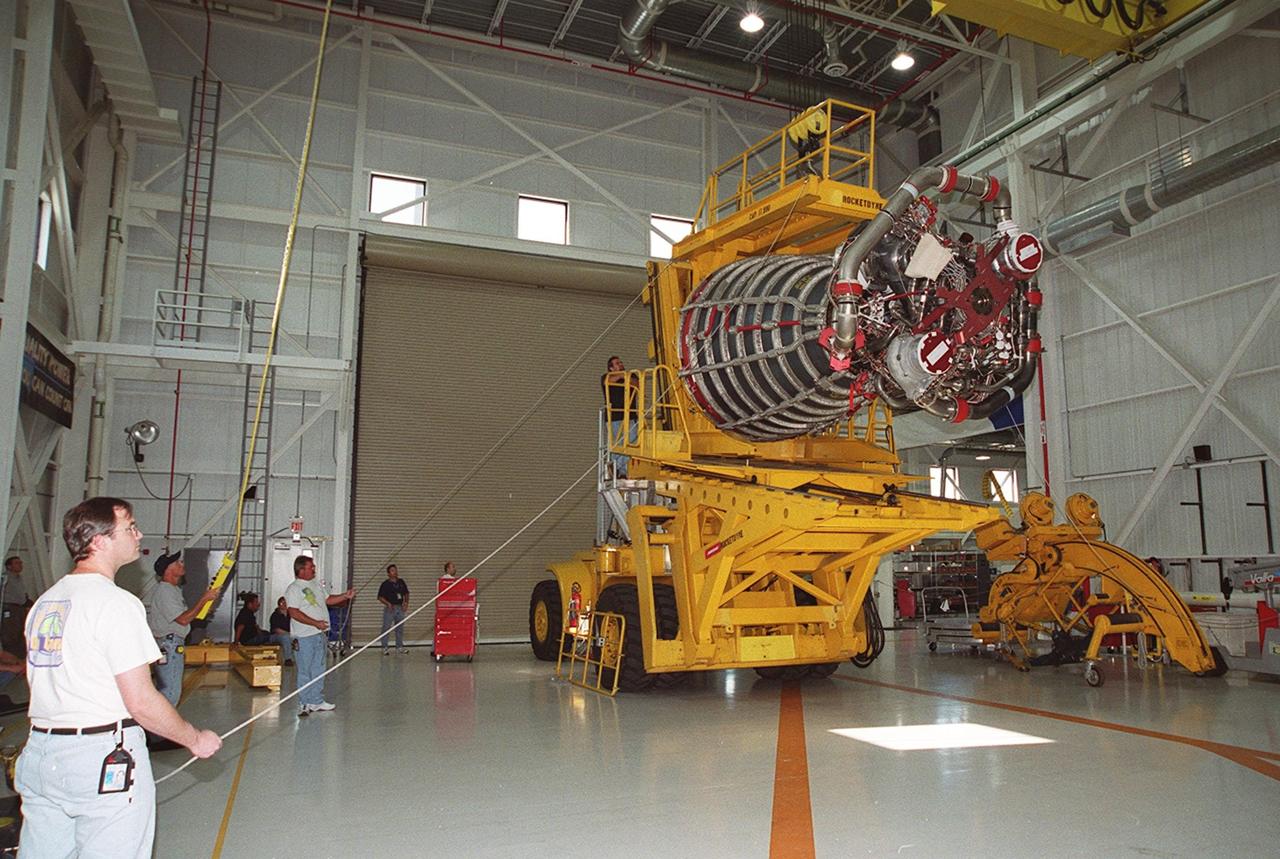
A new block 2 engine is lowered onto a transport vehicle for a move to the Orbiter Processing Facility. There it will be installed for its first flight on the orbiter Atlantis, on mission STS-104. The Block II Main Engine configuration is manufactured by Boeing Rocketdyne in Canoga Park, Calif., and includes a new Pratt & Whitney high-pressure fuel turbo pump. Engine improvements are managed by NASA’s Marshall Space Flight Center in Huntsville, Ala. Each Space Shuttle Main Engine is 14 feet (4.3 meters) long, weighs about 7,000 pounds (3,175 kilograms), and is 7.5 feet (2.3 meters) in diameter at the end of the nozzle
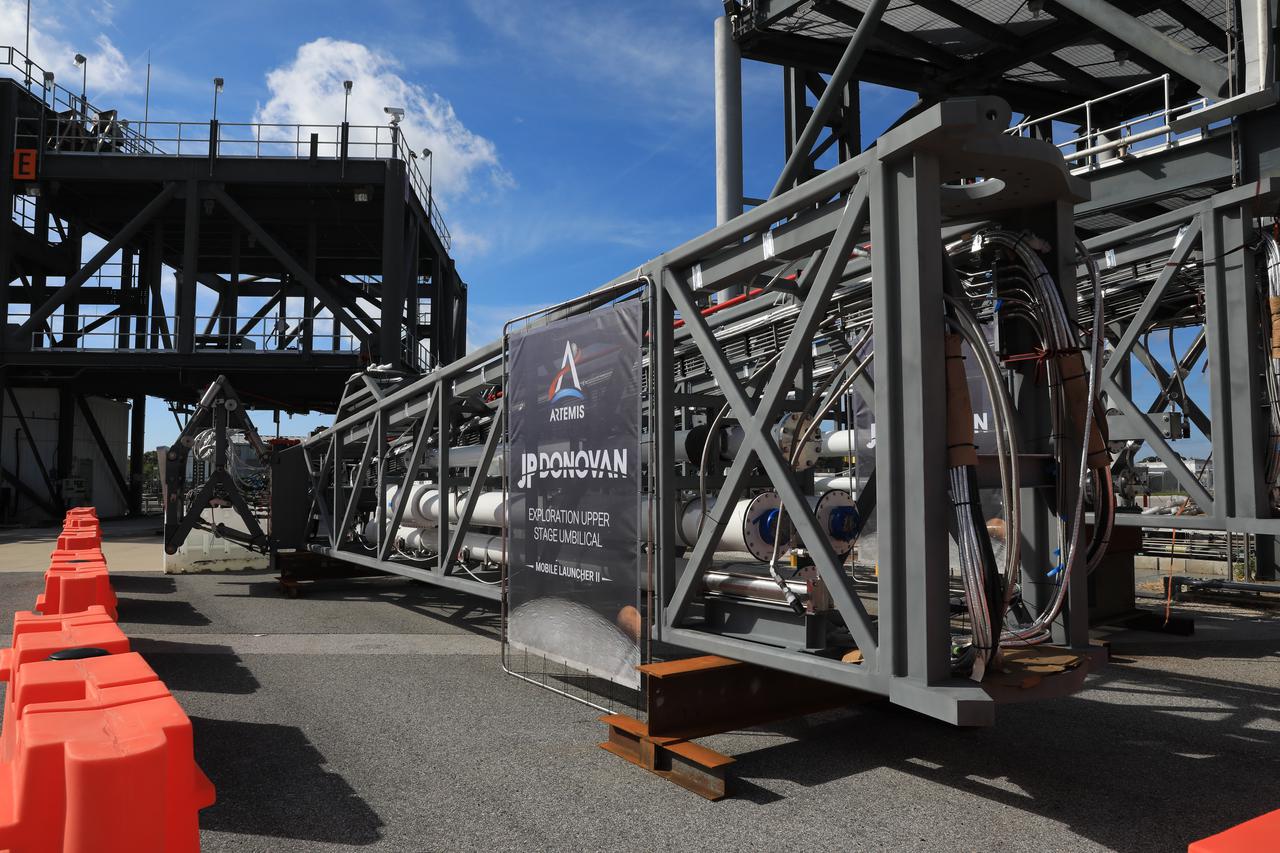
The first umbilical – one of many swing arms that will provide power, communications, and propellants to a larger configuration of NASA’s Space Launch System (SLS) rocket – for the agency’s mobile launcher 2 (ML2) arrives at the Launch Equipment Test Facility (LETF) at NASA’s Kennedy Space Center in Florida on Oct. 28, 2021. The umbilical will go through rounds of testing at the LETF to verify it functions properly before getting installed on the ML2 tower. This particular umbilical will provide propellants, environmental control systems, and a variety of purge gasses to the rocket’s Exploration Upper Stage. ML2 will be used to launch SLS Block 1B and Block 2 configurations to the Moon, starting with the Artemis IV mission, allowing NASA to send astronauts and heavy cargo to the lunar surface.
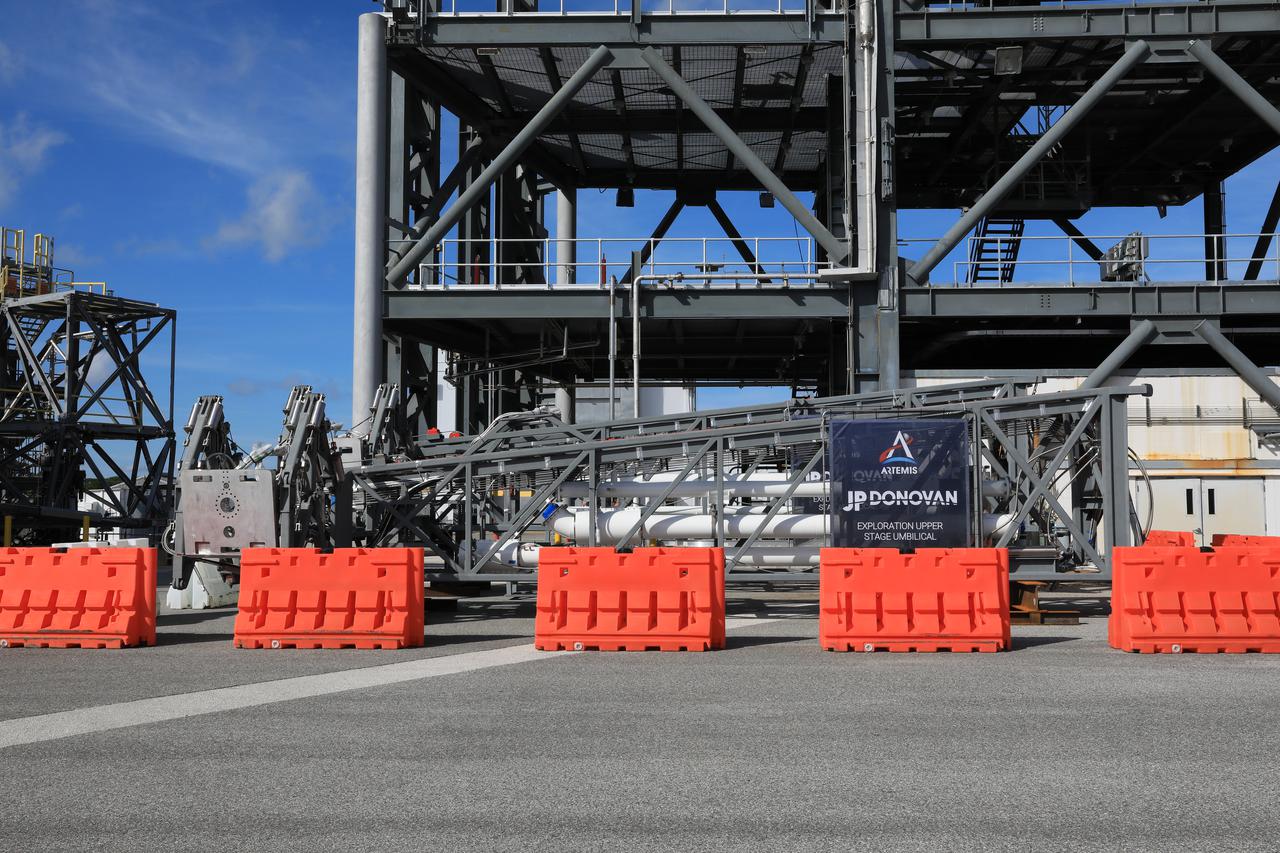
The first umbilical – one of many swing arms that will provide power, communications, and propellants to a larger configuration of NASA’s Space Launch System (SLS) rocket – for the agency’s mobile launcher 2 (ML2) arrives at the Launch Equipment Test Facility (LETF) at NASA’s Kennedy Space Center in Florida on Oct. 28, 2021. The umbilical will go through rounds of testing at the LETF to verify it functions properly before getting installed on the ML2 tower. This particular umbilical will provide propellants, environmental control systems, and a variety of purge gasses to the rocket’s Exploration Upper Stage. ML2 will be used to launch SLS Block 1B and Block 2 configurations to the Moon, starting with the Artemis IV mission, allowing NASA to send astronauts and heavy cargo to the lunar surface.
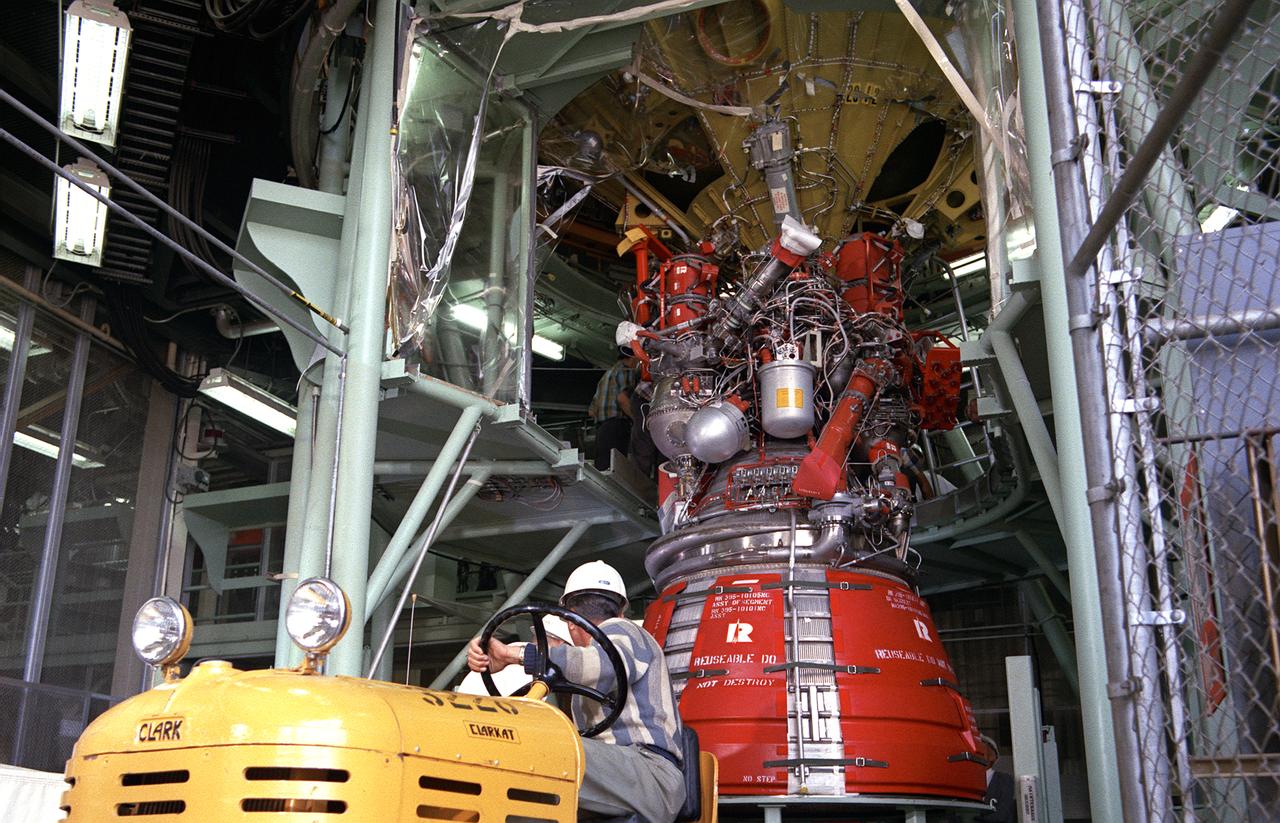
Workmen secure a J-2 engine onto the S-IVB (second) stage thrust structure. As part of Marshall Space Center's "building block" approach to the Saturn development, the S-IVB was utilized in the Saturn IBC launch vehicle as a second stage and the Saturn V launch vehicle as a third stage. The booster, built for NASA by McDornell Douglas Corporation, was powered by a single J-2 engine, initially capable of 200,000 pounds of thrust.

KENNEDY SPACE CENTER, FLA. -- The Pressurized Mating Adapter (PMA)-2 for the International Space Station (ISS) is moved on an air pallet toward Node 1, the space station’s structural building block, in KSC’s Space Station Processing Facility. This PMA is a cone-shaped connector to Node 1, which will have two PMAs attached once PMA-2 is mated with the node. The node and PMAs, which together will make up the first element of the ISS, are scheduled to be launched aboard the Space Shuttle Endeavour on STS-88
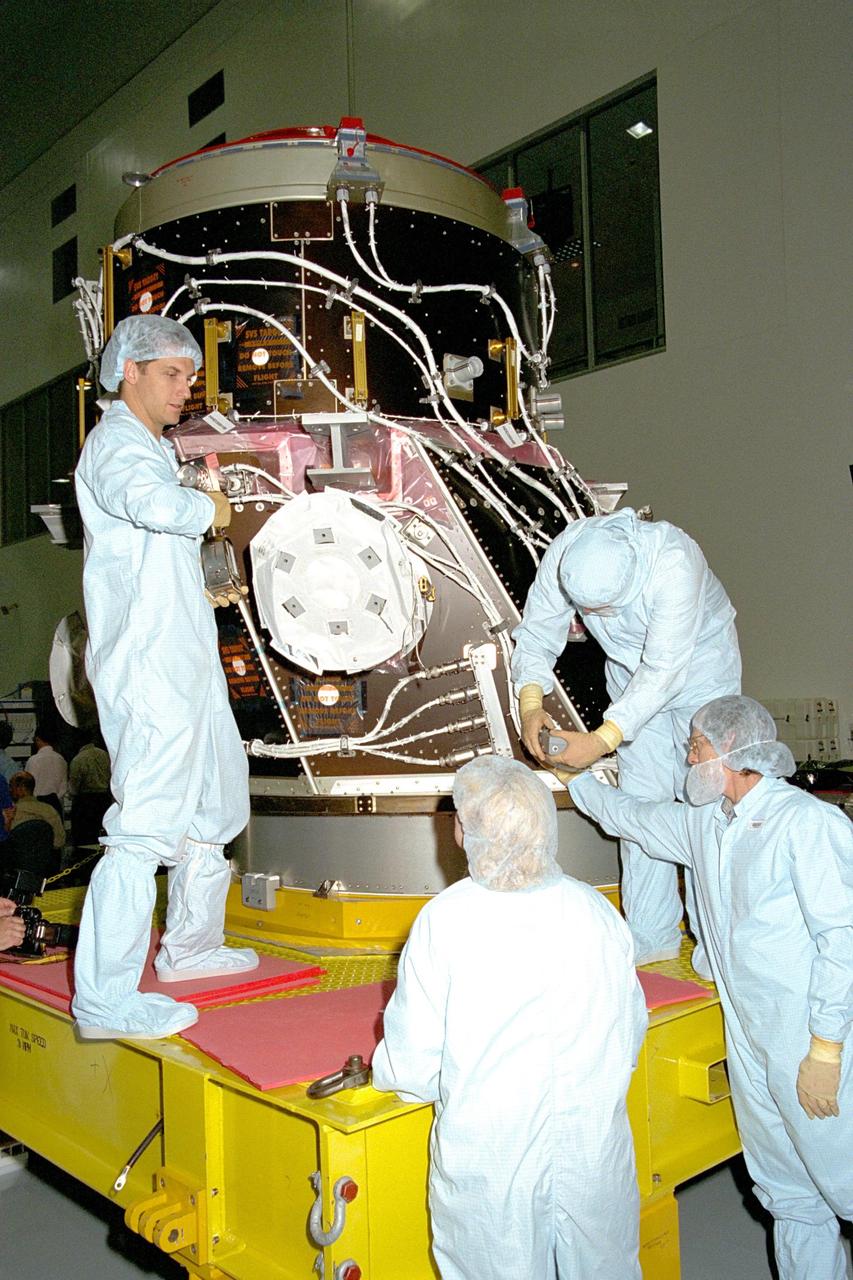
KENNEDY SPACE CENTER, FLA. -- The Pressurized Mating Adapter-2 (PMA-2) is processed in KSC's Space Station Processing Facility. This PMA is a cone-shaped connector to Node 1, the space station's structural building block. The node and two PMAs will together make up the first U.S. element of the ISS and are scheduled to be launched aboard the Space Shuttle Endeavour on STS-88.
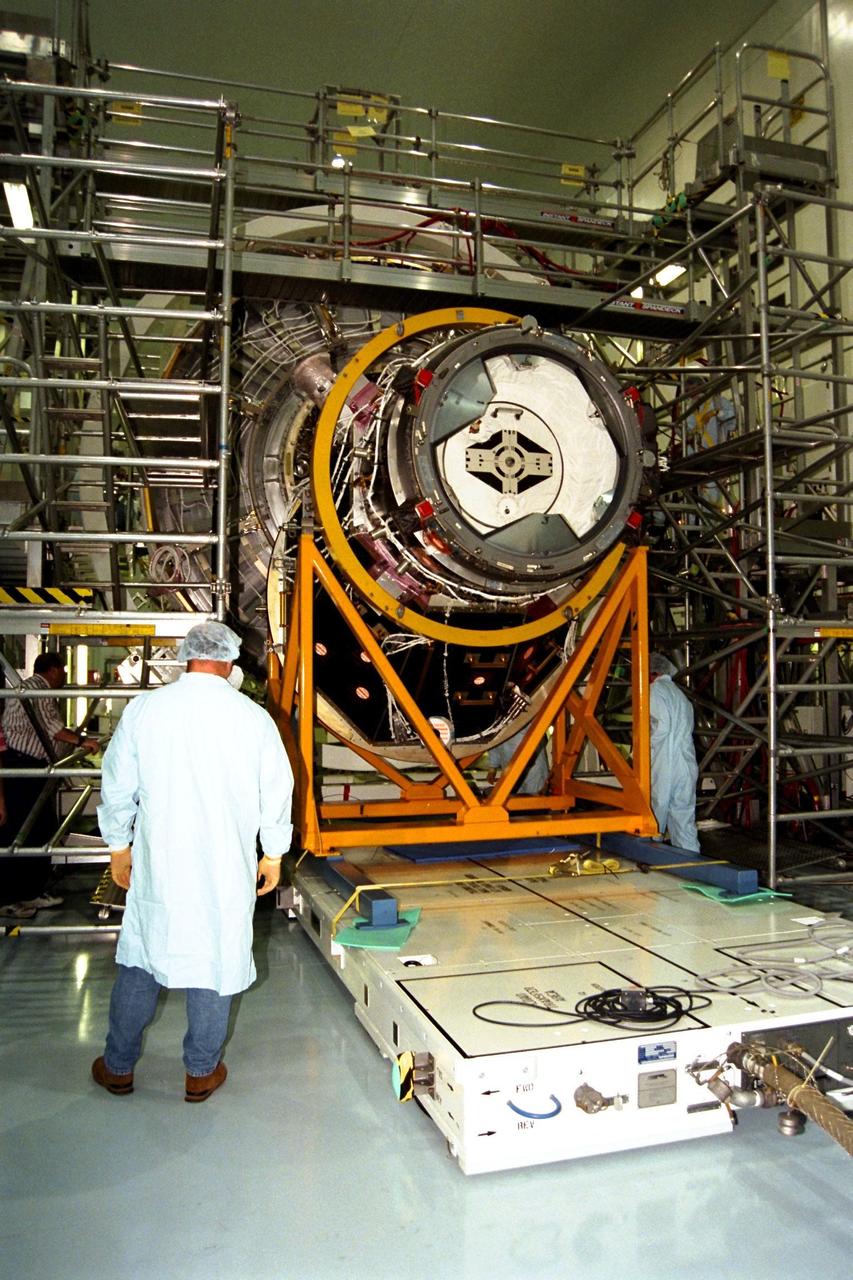
KENNEDY SPACE CENTER, FLA. -- The Pressurized Mating Adapter (PMA)-2, seen here in its yellow workstand, is moved on an air pallet toward Node 1, the International Space Station’s (ISS's) structural building block, in KSC’s Space Station Processing Facility. This PMA is a cone-shaped connector to Node 1, which will have two PMAs attached once PMA-2 is mated with the node. Node 1 can be seen directly behind PMA-2. The node and PMAs, which together will make up the first element of the ISS, are scheduled to be launched aboard the Space Shuttle Endeavour on STS-88.

KENNEDY SPACE CENTER, FLA. -- A new block 2 engine, situated on a giant forklift, is moved toward the aft of Atlantis where it will be installed. The work is being done in the Orbiter Processing Facility bay 3. The engine will have its first flight on mission STS-104, scheduled for launch June 14. The Block II Main Engine configuration is manufactured by Boeing Rocketdyne in Canoga Park, Calif., and includes a new Pratt & Whitney high-pressure fuel turbo pump. Engine improvements are managed by NASA’s Marshall Space Flight Center in Huntsville, Ala. Each Space Shuttle Main Engine is 14 feet (4.3 meters) long, weighs about 7,000 pounds (3,175 kilograms), and is 7.5 feet (2.3 meters) in diameter at the end of the nozzle
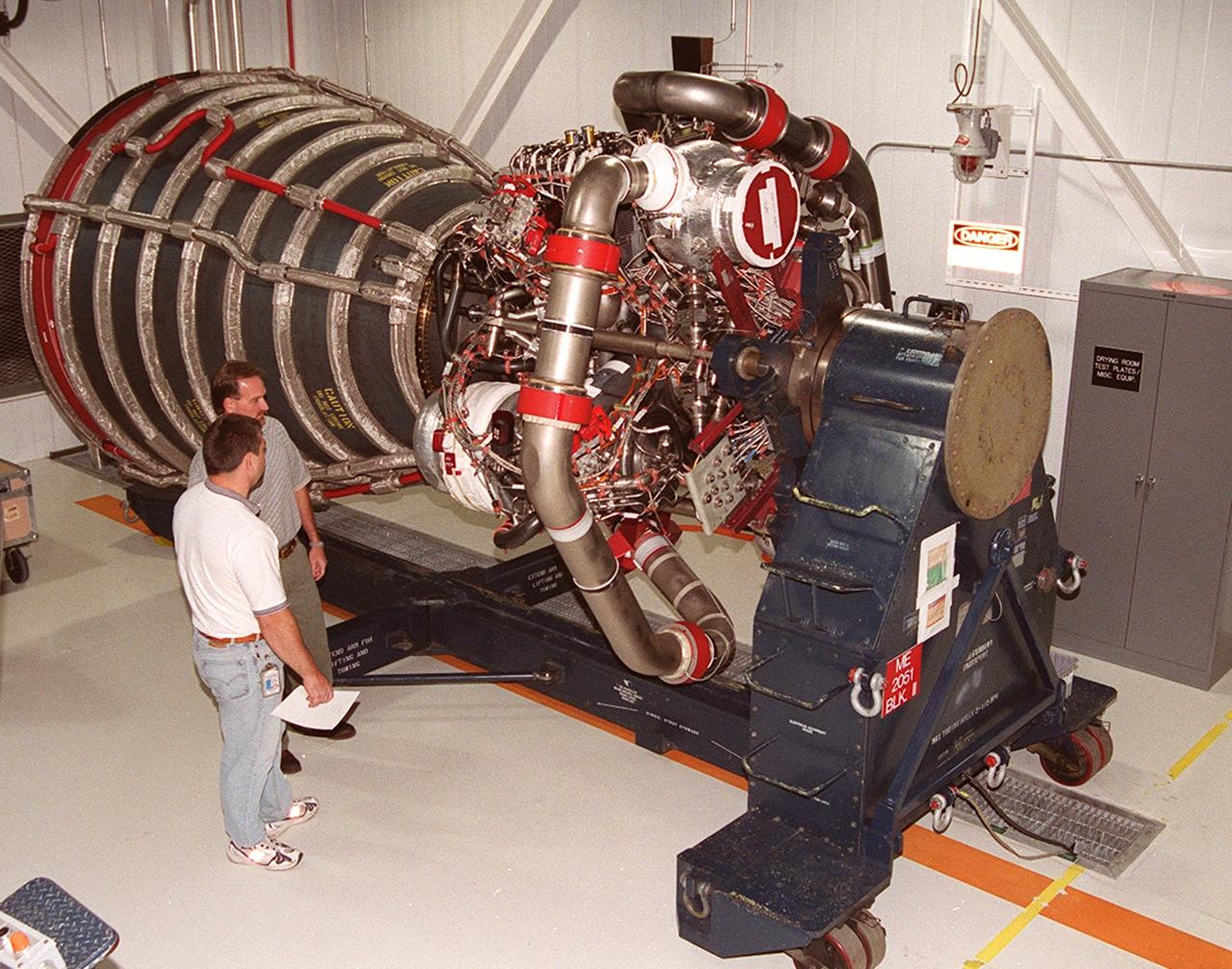
KENNEDY SPACE CENTER, FLA. -- Mike Cosgrove (front) and Bob Petrie (behind), both with Boeing/Rocketdyne, look over the upgraded Space Shuttle main engine (block 2 engine) as it sits in the Space Shuttle Main Engine Processing Facility. The new engine will be installed for its first flight on the orbiter Atlantis, on mission STS-104. The Block II Main Engine configuration is manufactured by Boeing Rocketdyne in Canoga Park, Calif., and includes a new Pratt & Whitney high-pressure fuel turbo pump. Engine improvements are managed by NASA’s Marshall Space Flight Center in Huntsville, Ala. Each Space Shuttle Main Engine is 14 feet (4.3 meters) long, weighs about 7,000 pounds (3,175 kilograms), and is 7.5 feet (2.3 meters) in diameter at the end of the nozzle
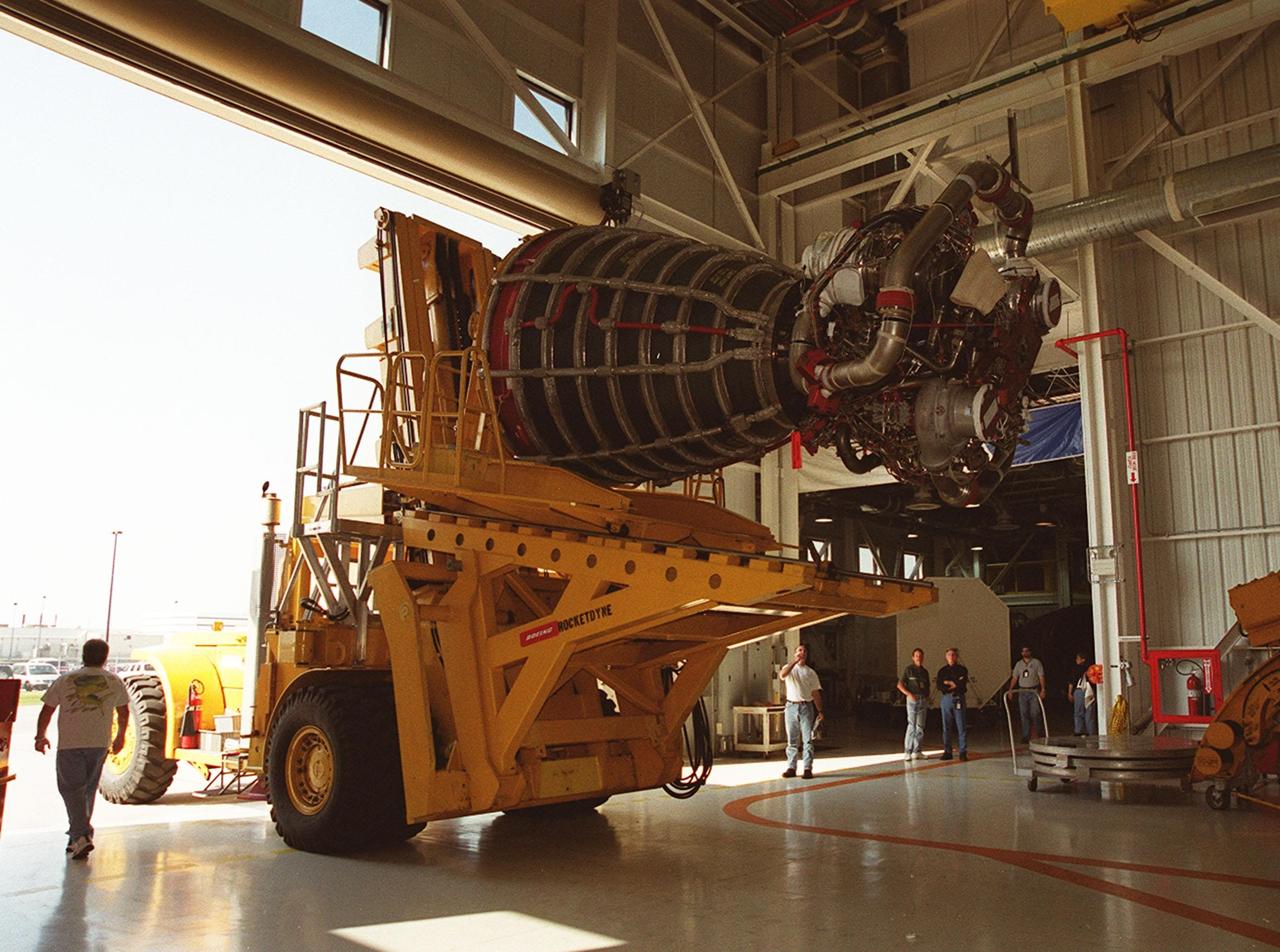
KENNEDY SPACE CENTER, FLA. -- The transport vehicle carrying a new block 2 engine leaves the Space Station Main Engine Processing Facility for a short trip to Orbiter Processing Facility bay 3. The new engine will be installed on the orbiter Atlantis, on mission STS-104, for its first flight. The Block II Main Engine configuration is manufactured by Boeing Rocketdyne in Canoga Park, Calif., and includes a new Pratt & Whitney high-pressure fuel turbo pump. Engine improvements are managed by NASA’s Marshall Space Flight Center in Huntsville, Ala. Each Space Shuttle Main Engine is 14 feet (4.3 meters) long, weighs about 7,000 pounds (3,175 kilograms), and is 7.5 feet (2.3 meters) in diameter at the end of the nozzle
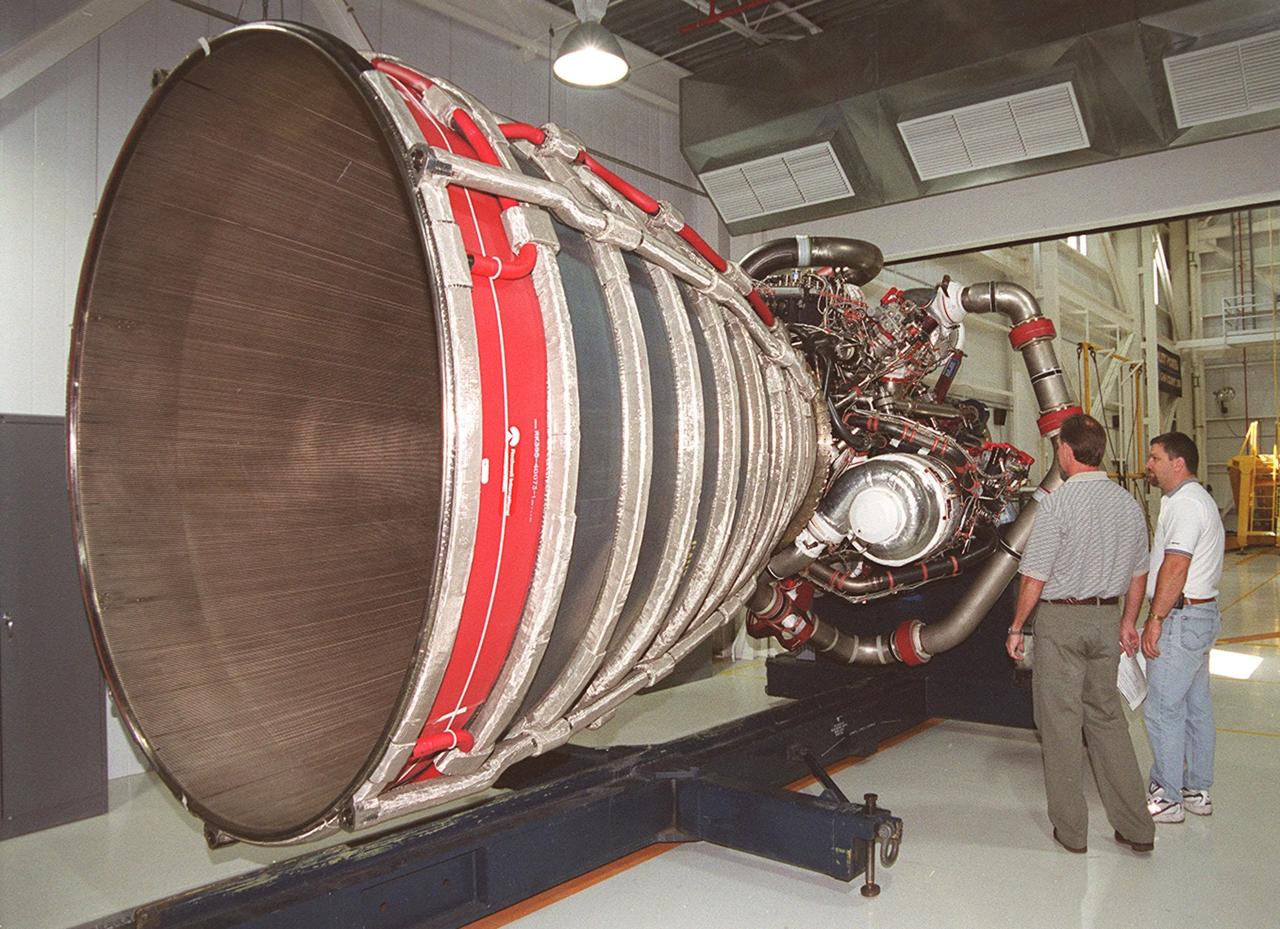
KENNEDY SPACE CENTER, FLA. -- Looking over the upgraded Space Shuttle main engine (block 2 engine) in the Space Shuttle Main Engine Processing Facility are Bob Petrie (left) and Mike Cosgrove (right). Both are with Boeing/Rocketdyne. The new engine will be installed for its first flight on the orbiter Atlantis, on mission STS-104. The Block II Main Engine configuration is manufactured by Boeing Rocketdyne in Canoga Park, Calif., and includes a new Pratt & Whitney high-pressure fuel turbo pump. Engine improvements are managed by NASA’s Marshall Space Flight Center in Huntsville, Ala. Each Space Shuttle Main Engine is 14 feet (4.3 meters) long, weighs about 7,000 pounds (3,175 kilograms), and is 7.5 feet (2.3 meters) in diameter at the end of the nozzle
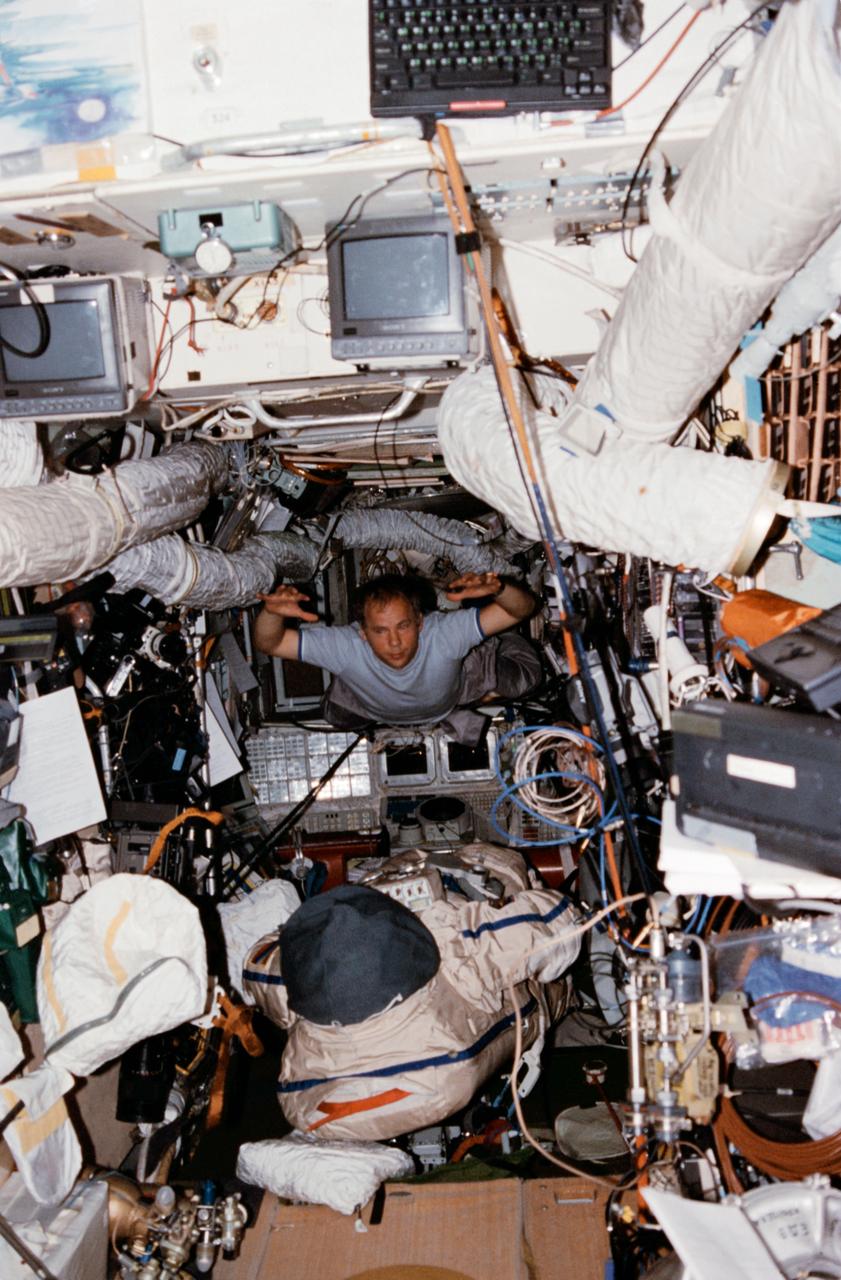
Various views of activities surrounding the Mir 24 crew's preparation for an intravehicular activity (IVA) in the Mir space station. Views include: Mir 24 crew in the Orlan suits in the Soyuz spacecraft (012-3,016). Commander Anatoly Solovyev climbs out of his suit in the Soyuz (014-5). Solovyev floats into the Base Block module (017). Underexposed views of Solovyev (left) and flight engineer Pavel Vinogradov in the Soyuz (018-20). Interior views of the airlock with IVA hardware (oxygen for suits) in view (021-2). Mir 24 crewmember climbing into his suit with his back to the camera (023). View 024 is blank. View 025 is of a Mir viewing portal. Portrait of Vinogradov in his suit, wearing his helmet (026). Guest researcher Michael Foale in the Soyuz, wearing his pressure suit (027-8). Interior views of the Soyuz (029-32). Solovyev and Vinogradov in the Base Block (033).
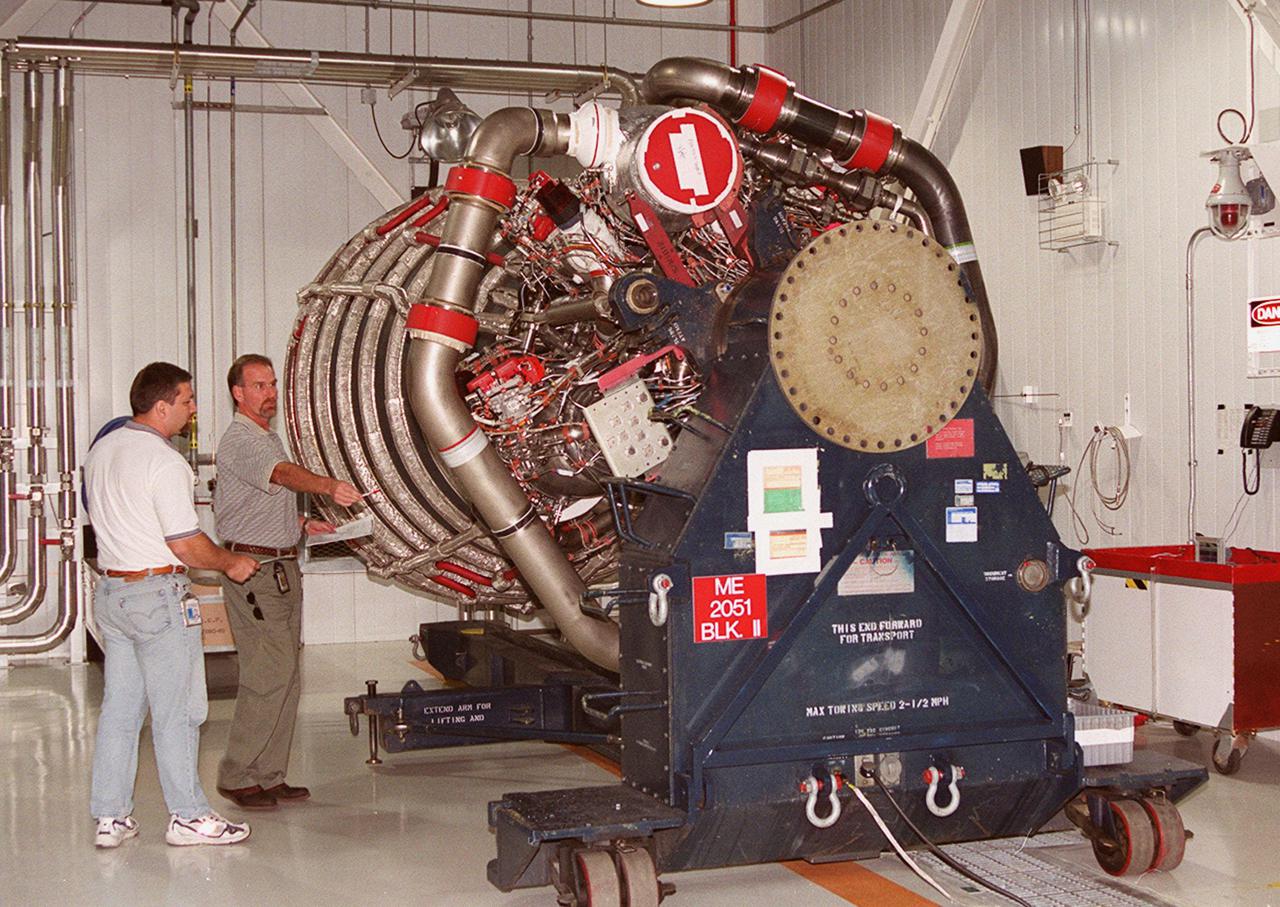
KENNEDY SPACE CENTER, FLA. -- Mike Cosgrove (left) and Bob Petrie (right), both with Boeing_Rocketdyne, look over the upgraded Space Shuttle main engine (block 2 engine) as it sits in the Space Shuttle Main Engine Processing Facility. The new engine will be installed for its first flight on the orbiter Atlantis, on mission STS-104. The Block II Main Engine configuration is manufactured by Boeing Rocketdyne in Canoga Park, Calif., and includes a new Pratt and Whitney high-pressure fuel turbo pump. Engine improvements are managed by NASA’s Marshall Space Flight Center in Huntsville, Ala. Each Space Shuttle Main Engine is 14 feet (4.3 meters) long, weighs about 7,000 pounds (3,175 kilograms), and is 7.5 feet (2.3 meters) in diameter at the end of the nozzle
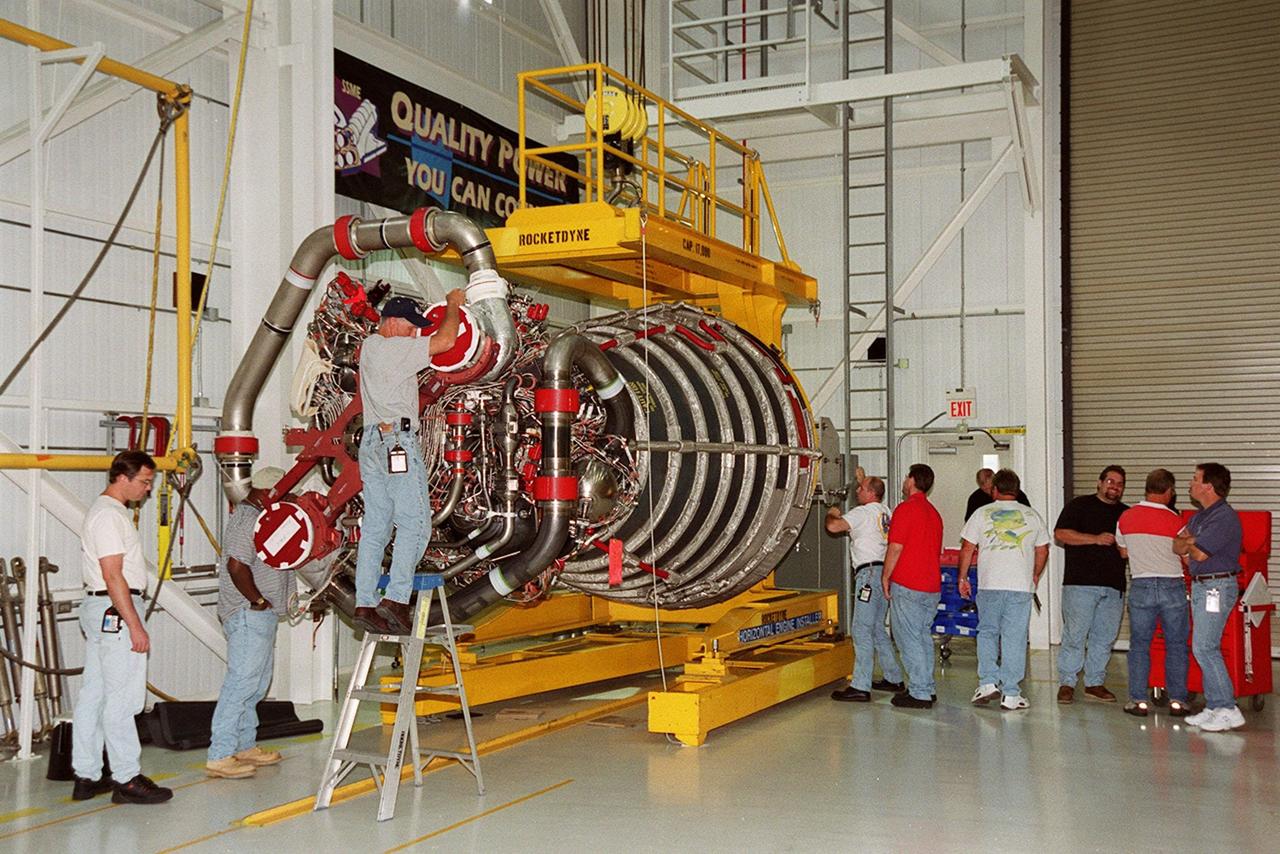
Workers in the Space Shuttle Main Engine Processing Facility prepare a new Space Shuttle main engine (block 2 engine) for its move to the Orbiter Processing Facility. The engine will be installed for its first flight on the orbiter Atlantis, on mission STS-104. The Block II Main Engine configuration is manufactured by Boeing Rocketdyne in Canoga Park, Calif., and includes a new Pratt & Whitney high-pressure fuel turbo pump. Engine improvements are managed by NASA’s Marshall Space Flight Center in Huntsville, Ala. Each Space Shuttle Main Engine is 14 feet (4.3 meters) long, weighs about 7,000 pounds (3,175 kilograms), and is 7.5 feet (2.3 meters) in diameter at the end of the nozzle. <font
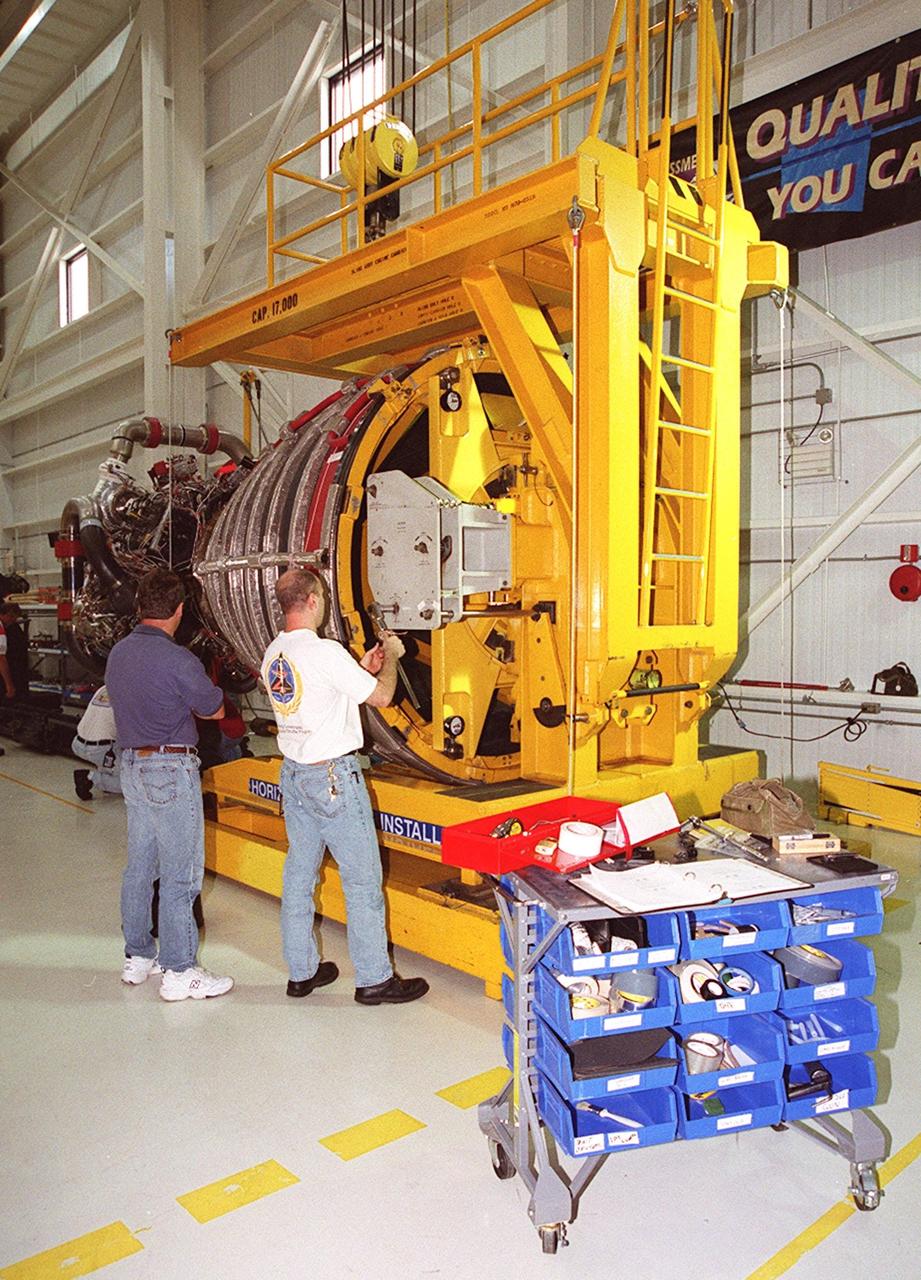
Workers in the Space Shuttle Main Engine Processing Facility get a new Space Shuttle main engine (block 2 engine) ready to move to the Orbiter Processing Facility. The engine will be installed for its first flight on the orbiter Atlantis, on mission STS-104. The Block II Main Engine configuration is manufactured by Boeing Rocketdyne in Canoga Park, Calif., and includes a new Pratt & Whitney high-pressure fuel turbo pump. Engine improvements are managed by NASA’s Marshall Space Flight Center in Huntsville, Ala. Each Space Shuttle Main Engine is 14 feet (4.3 meters) long, weighs about 7,000 pounds (3,175 kilograms), and is 7.5 feet (2.3 meters) in diameter at the end of the nozzle
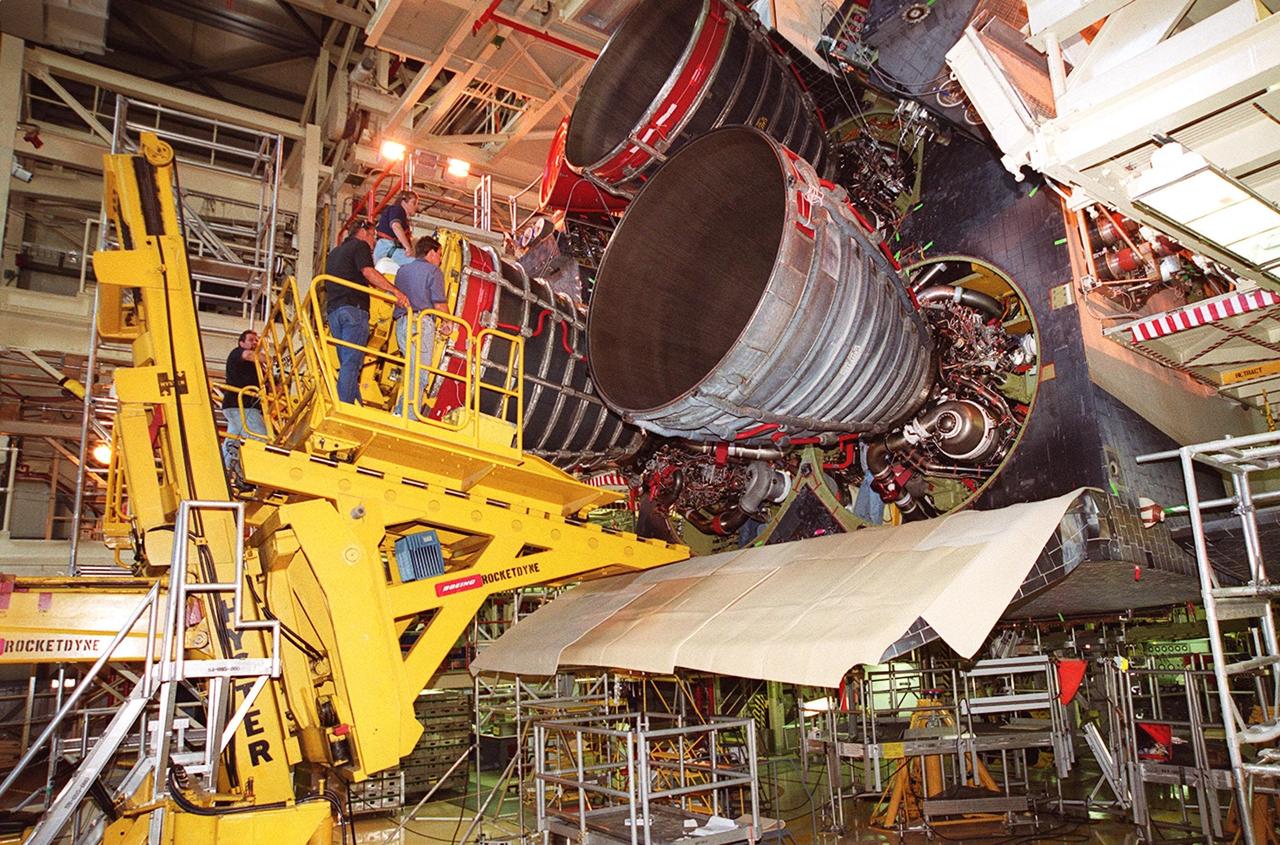
KENNEDY SPACE CENTER, FLA. -- The new block 2 engine for the orbiter Atlantis is moved into place next to the other two engines. The work is being done in the Orbiter Processing Facility bay 3. The engine will have its first flight on mission STS-104, scheduled for launch June 14. The Block II Main Engine configuration is manufactured by Boeing Rocketdyne in Canoga Park, Calif., and includes a new Pratt & Whitney high-pressure fuel turbo pump. Engine improvements are managed by NASA’s Marshall Space Flight Center in Huntsville, Ala. Each Space Shuttle Main Engine is 14 feet (4.3 meters) long, weighs about 7,000 pounds (3,175 kilograms), and is 7.5 feet (2.3 meters) in diameter at the end of the nozzle
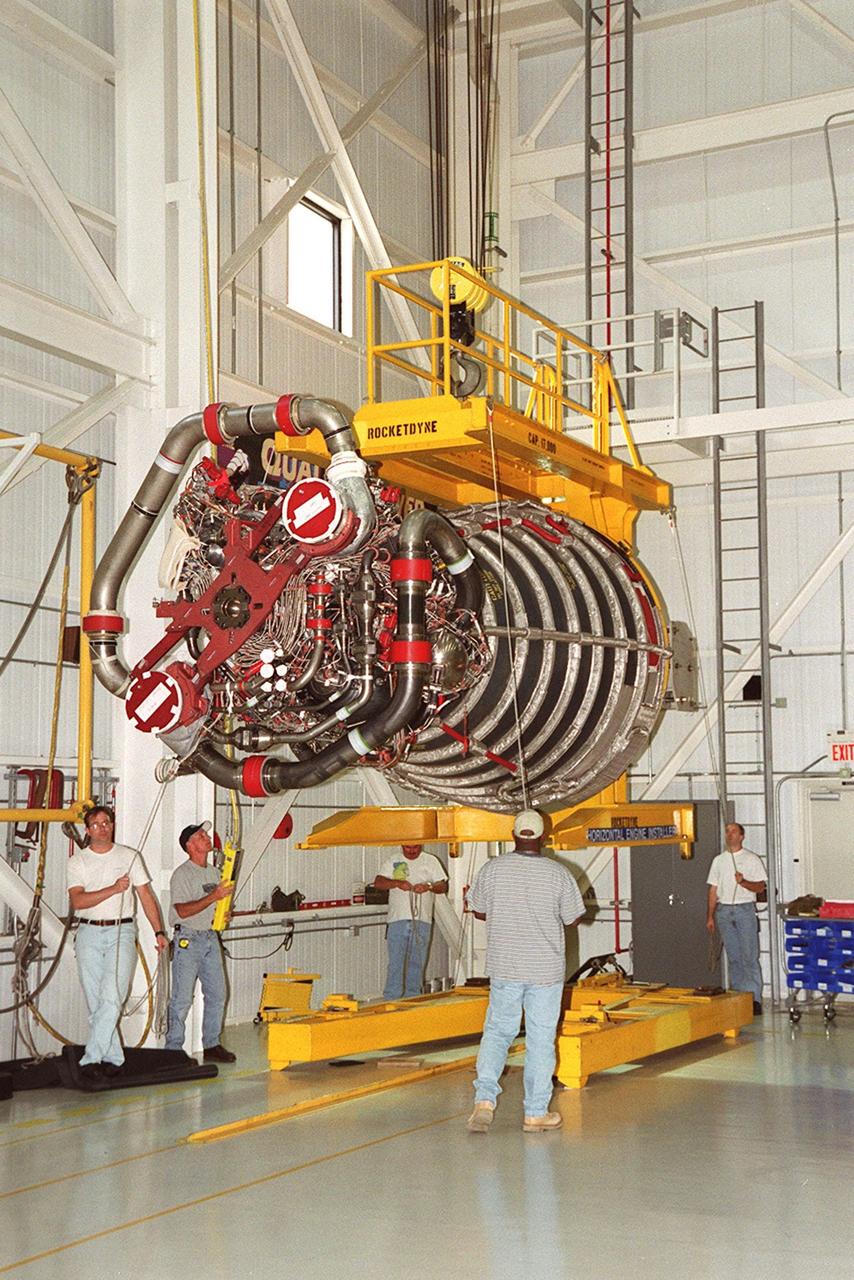
KENNEDY SPACE CENTER, FLA. -- Workers in the Space Shuttle Main Engine Processing Facility oversee lifting a new Space Shuttle main engine (block 2 engine) off its stand. The engine will be moved to the Orbiter Processing Facility and installed for its first flight on the orbiter Atlantis, on mission STS-104. The Block II Main Engine configuration is manufactured by Boeing Rocketdyne in Canoga Park, Calif., and includes a new Pratt & Whitney high-pressure fuel turbo pump. Engine improvements are managed by NASA’s Marshall Space Flight Center in Huntsville, Ala. Each Space Shuttle Main Engine is 14 feet (4.3 meters) long, weighs about 7,000 pounds (3,175 kilograms), and is 7.5 feet (2.3 meters) in diameter at the end of the nozzle
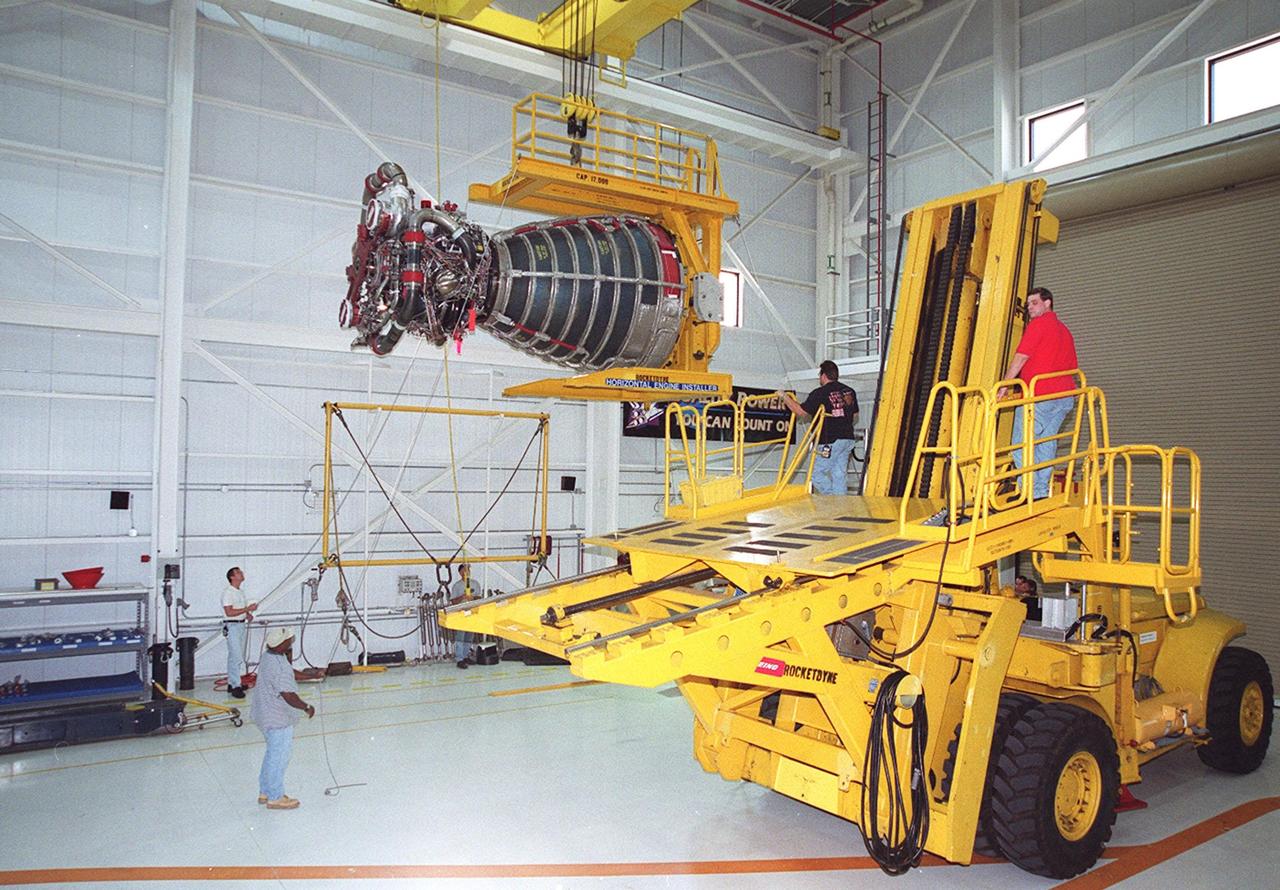
Workers in the Space Shuttle Main Engine Processing Facility oversee the movement of a new Space Shuttle main engine (block 2 engine) toward the transport vehicle in the foreground. The engine will be moved to the Orbiter Processing Facility and installed for its first flight on the orbiter Atlantis, on mission STS-104. The Block II Main Engine configuration is manufactured by Boeing Rocketdyne in Canoga Park, Calif., and includes a new Pratt & Whitney high-pressure fuel turbo pump. Engine improvements are managed by NASA’s Marshall Space Flight Center in Huntsville, Ala. Each Space Shuttle Main Engine is 14 feet (4.3 meters) long, weighs about 7,000 pounds (3,175 kilograms), and is 7.5 feet (2.3 meters) in diameter at the end of the nozzle. <font

KENNEDY SPACE CENTER, FLA. -- The new block 2 engine for the orbiter Atlantis is moved into place next to the other two engines. The work is being done in the Orbiter Processing Facility bay 3. The engine will have its first flight on mission STS-104, scheduled for launch June 14. The Block II Main Engine configuration is manufactured by Boeing Rocketdyne in Canoga Park, Calif., and includes a new Pratt and Whitney high-pressure fuel turbo pump. Engine improvements are managed by NASA’s Marshall Space Flight Center in Huntsville, Ala. Each Space Shuttle Main Engine is 14 feet (4.3 meters) long, weighs about 7,000 pounds (3,175 kilograms), and is 7.5 feet (2.3 meters) in diameter at the end of the nozzle

KENNEDY SPACE CENTER, FLA. -- As the giant forklift moves closer to Atlantis, workers keep watch as the new block 2 engine nears its installation point. The work is being done in the Orbiter Processing Facility bay 3. The engine will have its first flight on mission STS-104, scheduled for launch June 14. The Block II Main Engine configuration is manufactured by Boeing Rocketdyne in Canoga Park, Calif., and includes a new Pratt & Whitney high-pressure fuel turbo pump. Engine improvements are managed by NASA’s Marshall Space Flight Center in Huntsville, Ala. Each Space Shuttle Main Engine is 14 feet (4.3 meters) long, weighs about 7,000 pounds (3,175 kilograms), and is 7.5 feet (2.3 meters) in diameter at the end of the nozzle

KENNEDY SPACE CENTER, FLA. -- The Comet Nucleus Tour (CONTOUR) spacecraft, mated to the upper stage of its launch vehicle, is ready for transfer from the Space Assembly and Encapsulation Facility 2 (SAEF-2) to the launch pad. CONTOUR will provide the first detailed look into the heart of a comet -- the nucleus. Flying as close as 60 miles (100 kilometers) to at least two comets, the spacecraft will take the sharpest pictures yet of a nucleus while analyzing the gas and dust that surround these rocky, icy building blocks of the solar system. Launch of CONTOUR aboard a Boeing Delta II rocket is scheduled for July 1, 2002, from Launch Complex 17-A, Cape Canaveral Air Force Station
![KENNEDY SPACE CENTER, FLA. -- Technicians prepare to join the Pressurized Mating Adapter (PMA)-2, seen here in its yellow workstand at right, to Node 1 (the International Space Station’s [ISS] structural building block) in KSC’s Space Station Processing Facility. This PMA is a cone-shaped connector to Node 1, which will have two PMAs attached once PMA-2 is mated with the node. The node and PMAs, which together will make up the first element of the ISS, are scheduled to be launched aboard the Space Shuttle Endeavour on STS-88.](https://images-assets.nasa.gov/image/KSC-98pc297/KSC-98pc297~medium.jpg)
KENNEDY SPACE CENTER, FLA. -- Technicians prepare to join the Pressurized Mating Adapter (PMA)-2, seen here in its yellow workstand at right, to Node 1 (the International Space Station’s [ISS] structural building block) in KSC’s Space Station Processing Facility. This PMA is a cone-shaped connector to Node 1, which will have two PMAs attached once PMA-2 is mated with the node. The node and PMAs, which together will make up the first element of the ISS, are scheduled to be launched aboard the Space Shuttle Endeavour on STS-88.

KENNEDY SPACE CENTER, FLA. -- - In the Space Assembly and Encapsulation Facility 2 (SAEF-2), an overhead crane lowers the Comet Nucleus Tour (CONTOUR) spacecraft toward the upper stage of a Boeing Delta II rocket. The two will be mated for launch. CONTOUR will provide the first detailed look into the heart of a comet -- the nucleus. Flying as close as 60 miles (100 kilometers) to at least two comets, the spacecraft will take the sharpest pictures yet of a nucleus while analyzing the gas and dust that surround these rocky, icy building blocks of the solar system. Launch of CONTOUR aboard the Delta II is scheduled for July 1, 2002, from Launch Complex 17-A, Cape Canaveral Air Force Station
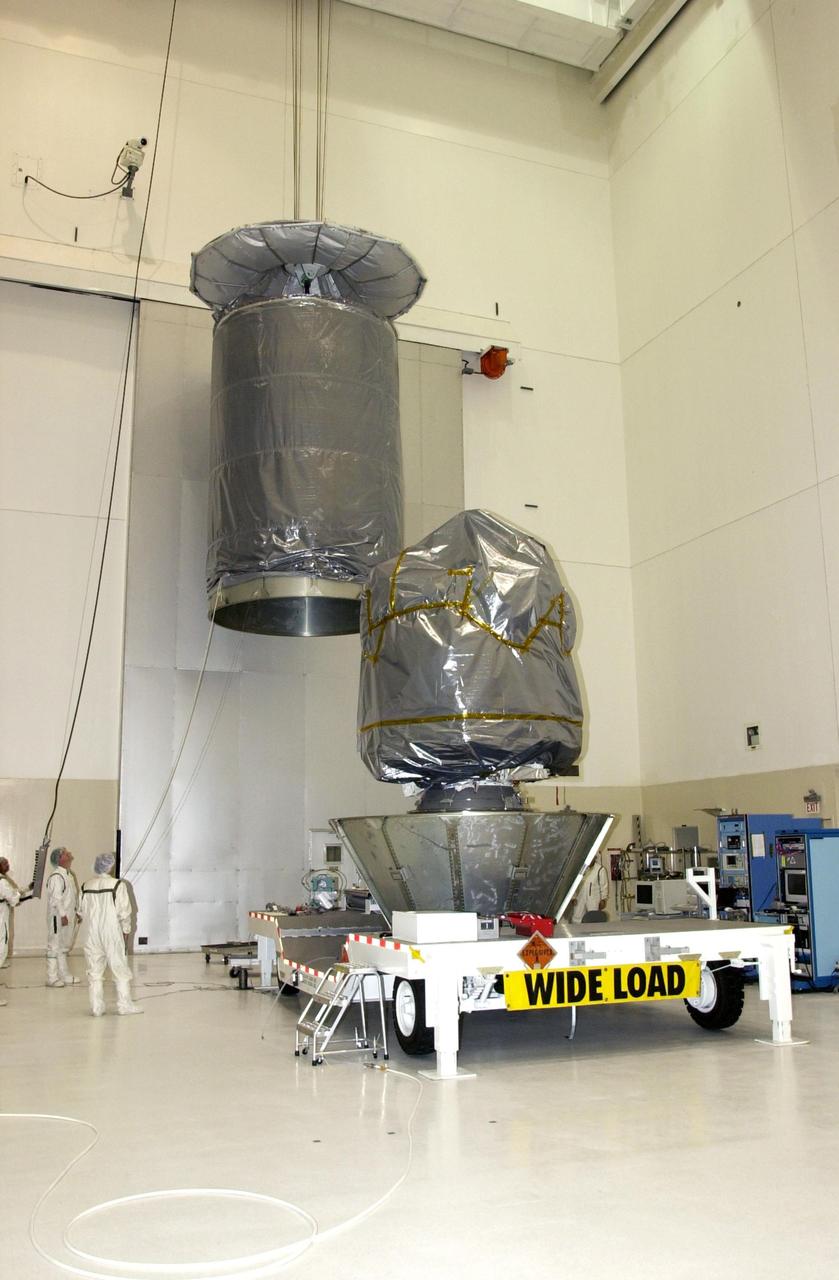
KENNEDY SPACE CENTER, FLA. -- In the Space Assembly and Encapsulation Facility 2 (SAEF-2), a container is lifted above the floor and moved toward the Comet Nucleus Tour (CONTOUR) spacecraft in front. CONTOUR will be enclosed in the container for transfer to the launch pad. CONTOUR will provide the first detailed look into the heart of a comet -- the nucleus. Flying as close as 60 miles (100 kilometers) to at least two comets, the spacecraft will take the sharpest pictures yet of a nucleus while analyzing the gas and dust that surround these rocky, icy building blocks of the solar system. Launch of CONTOUR aboard a Boeing Delta II rocket is scheduled for July 1, 2002, from Launch Complex 17-A, Cape Canaveral Air Force Station
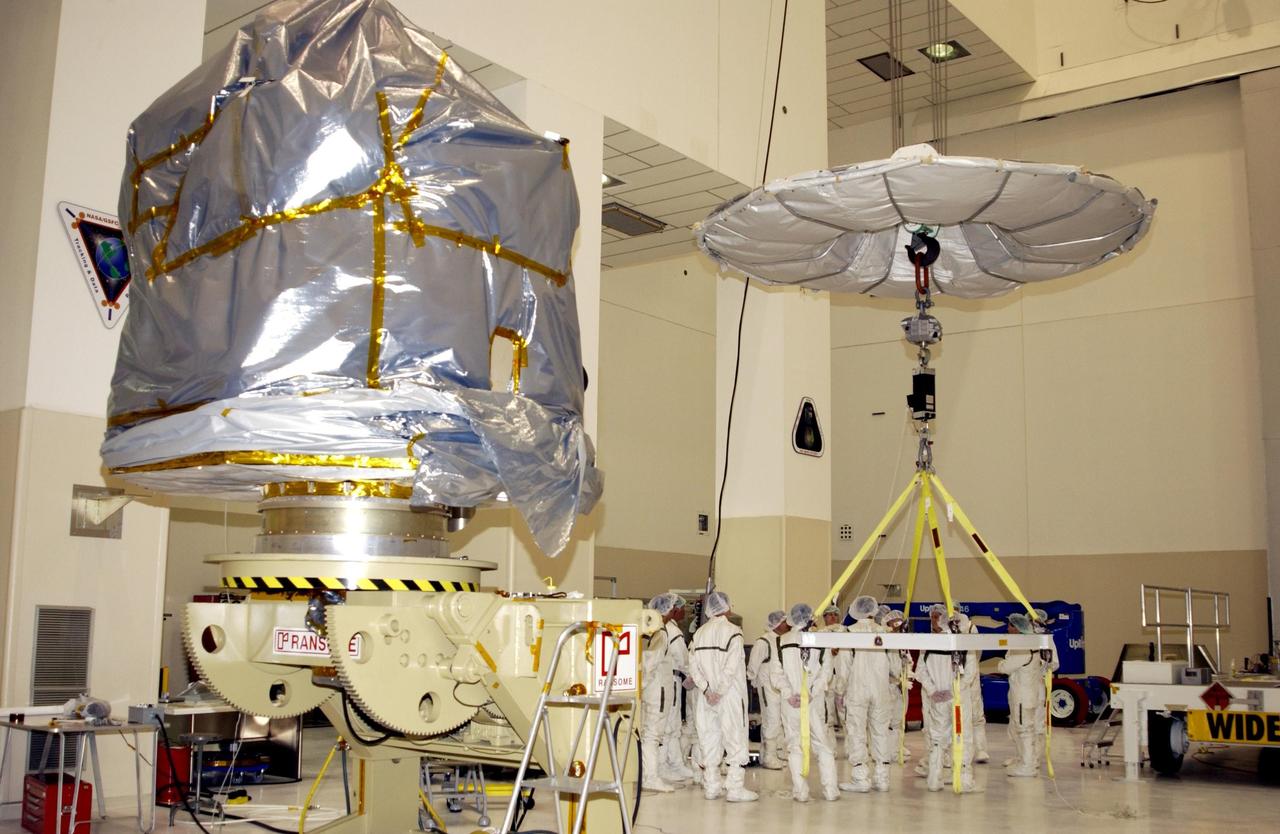
KENNEDY SPACE CENTER, FLA. -- In the Space Assembly and Encapsulation Facility 2 (SAEF-2), the Comet Nucleus Tour (CONTOUR) spacecraft (left) is wrapped and ready for the crane at right to carry it to the upper stage of a Boeing Delta II rocket for mating. CONTOUR will provide the first detailed look into the heart of a comet -- the nucleus. Flying as close as 60 miles (100 kilometers) to at least two comets, the spacecraft will take the sharpest pictures yet of a nucleus while analyzing the gas and dust that surround these rocky, icy building blocks of the solar system. Launch of CONTOUR aboard the Delta II is scheduled for July 1, 2002, from Launch Complex 17-A, Cape Canaveral Air Force Station
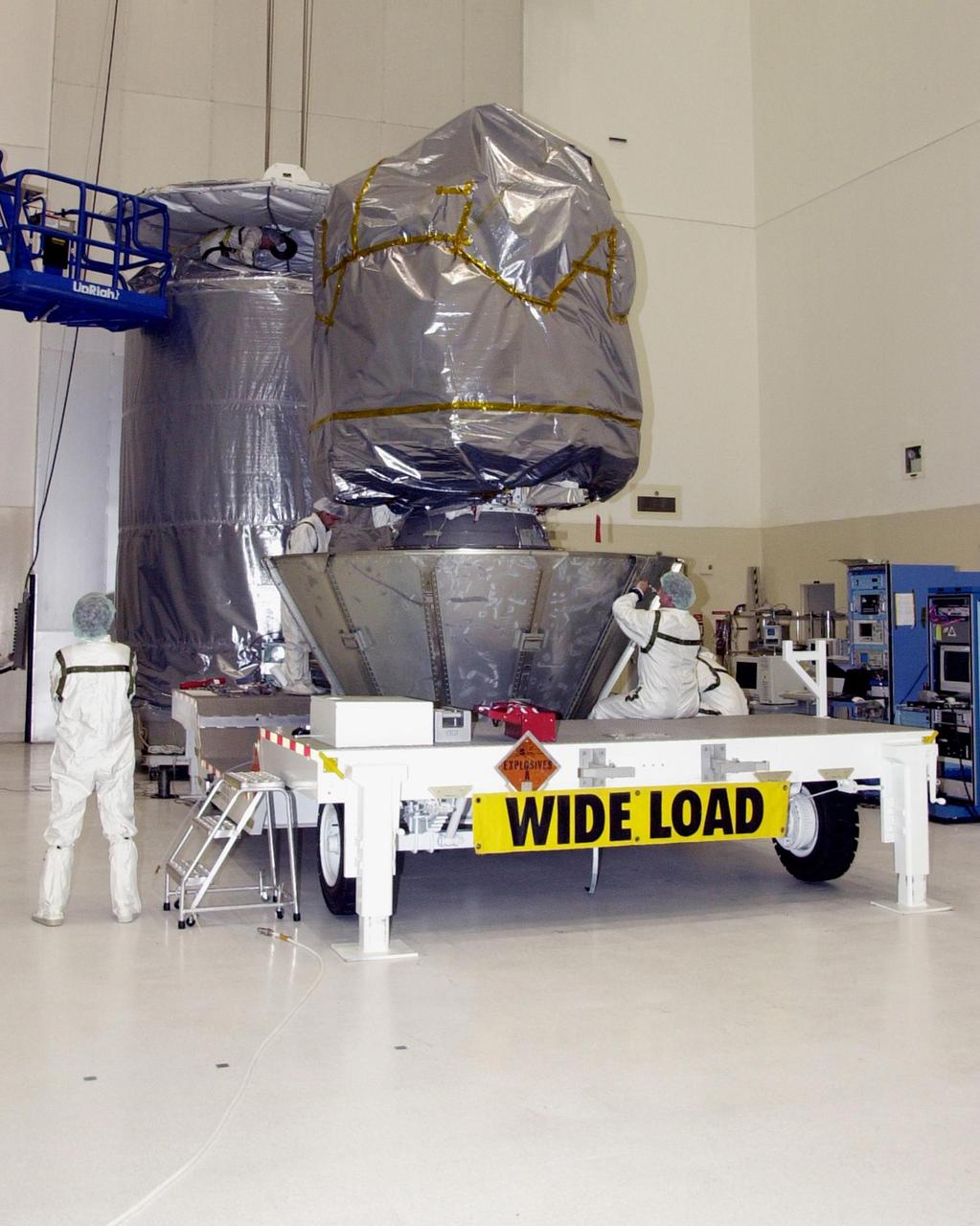
KENNEDY SPACE CENTER, FLA. - In the Space Assembly and Encapsulation Facility 2 (SAEF-2), the Comet Nucleus Tour (CONTOUR) spacecraft, mated to the upper stage of its launch vehicle, waits to be enclosed in the container behind it for transfer to the launch pad. CONTOUR will provide the first detailed look into the heart of a comet -- the nucleus. Flying as close as 60 miles (100 kilometers) to at least two comets, the spacecraft will take the sharpest pictures yet of a nucleus while analyzing the gas and dust that surround these rocky, icy building blocks of the solar system. Launch of CONTOUR aboard a Boeing Delta II rocket is scheduled for July 1, 2002, from Launch Complex 17-A, Cape Canaveral Air Force Station
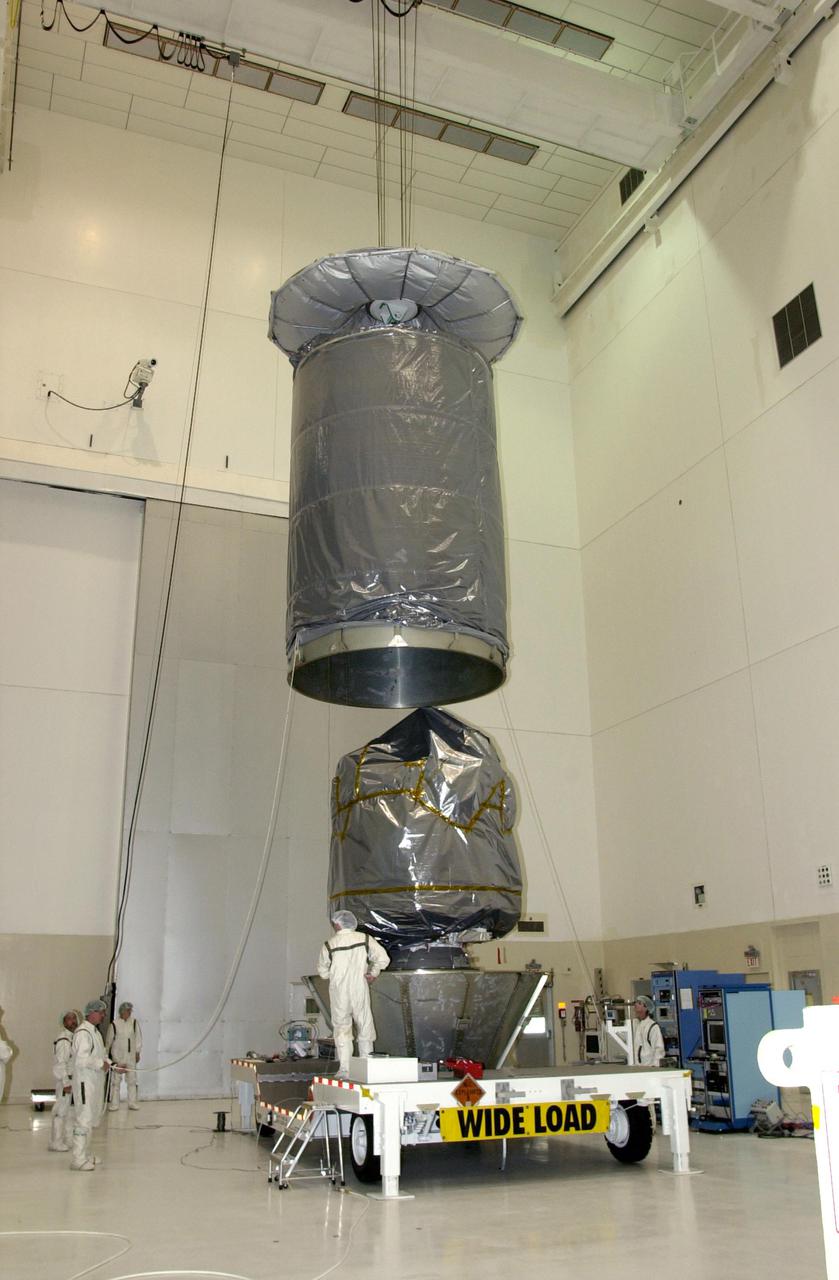
KENNEDY SPACE CENTER, FLA. -- In the Space Assembly and Encapsulation Facility 2 (SAEF-2), a container is lowered toward the Comet Nucleus Tour (CONTOUR) spacecraft below. CONTOUR will be enclosed in the container for transfer to the launch pad. CONTOUR will provide the first detailed look into the heart of a comet -- the nucleus. Flying as close as 60 miles (100 kilometers) to at least two comets, the spacecraft will take the sharpest pictures yet of a nucleus while analyzing the gas and dust that surround these rocky, icy building blocks of the solar system. Launch of CONTOUR aboard a Boeing Delta II rocket is scheduled for July 1, 2002, from Launch Complex 17-A, Cape Canaveral Air Force Station
![KENNEDY SPACE CENTER, FLA. -- Technicians and workers observe preparations to join the Pressurized Mating Adapter (PMA)-2, seen here in its yellow workstand at right, to Node 1 (the International Space Station’s [ISS] structural building block) in KSC’s Space Station Processing Facility. This PMA is a cone-shaped connector to Node 1, which will have two PMAs attached once PMA-2 is mated with the node. The node (surrounded here by scaffolding) and PMAs, which together will make up the first element of the ISS, are scheduled to be launched aboard the Space Shuttle Endeavour on STS-88](https://images-assets.nasa.gov/image/KSC-98pc298/KSC-98pc298~medium.jpg)
KENNEDY SPACE CENTER, FLA. -- Technicians and workers observe preparations to join the Pressurized Mating Adapter (PMA)-2, seen here in its yellow workstand at right, to Node 1 (the International Space Station’s [ISS] structural building block) in KSC’s Space Station Processing Facility. This PMA is a cone-shaped connector to Node 1, which will have two PMAs attached once PMA-2 is mated with the node. The node (surrounded here by scaffolding) and PMAs, which together will make up the first element of the ISS, are scheduled to be launched aboard the Space Shuttle Endeavour on STS-88
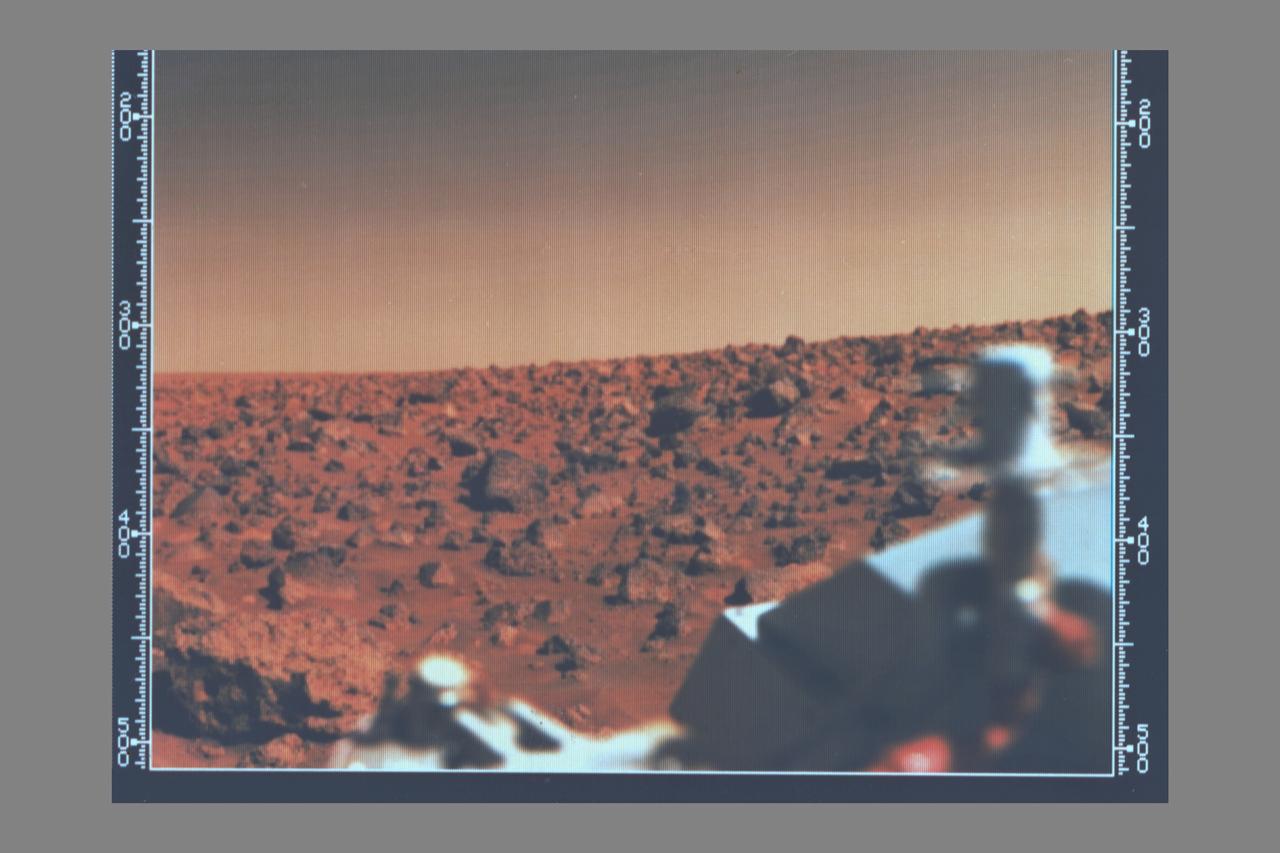
Viking 2 A utopian bright summer afternoon on Mars -- Looking south from Viking 2 on September 7, 1976 the orange-red surface of the nearly level plain upon which the spacecraft sits is seen strewn with rocks as large as three feet across. Many of these rocks are porous and sponge-like, similar to some of Earth's volcanic rocks. Other rocks are coarse-grained such as the large rock at lower left. Between the rocks, the surface is blanketed with fine-grained materials that, in places, is piled into small drifts and banked against some of the larger blocks. The cylindrical mast with the orange cable is the low-gain antenna used to receive cammands form Earth. (JPL ref: P-17690 color)
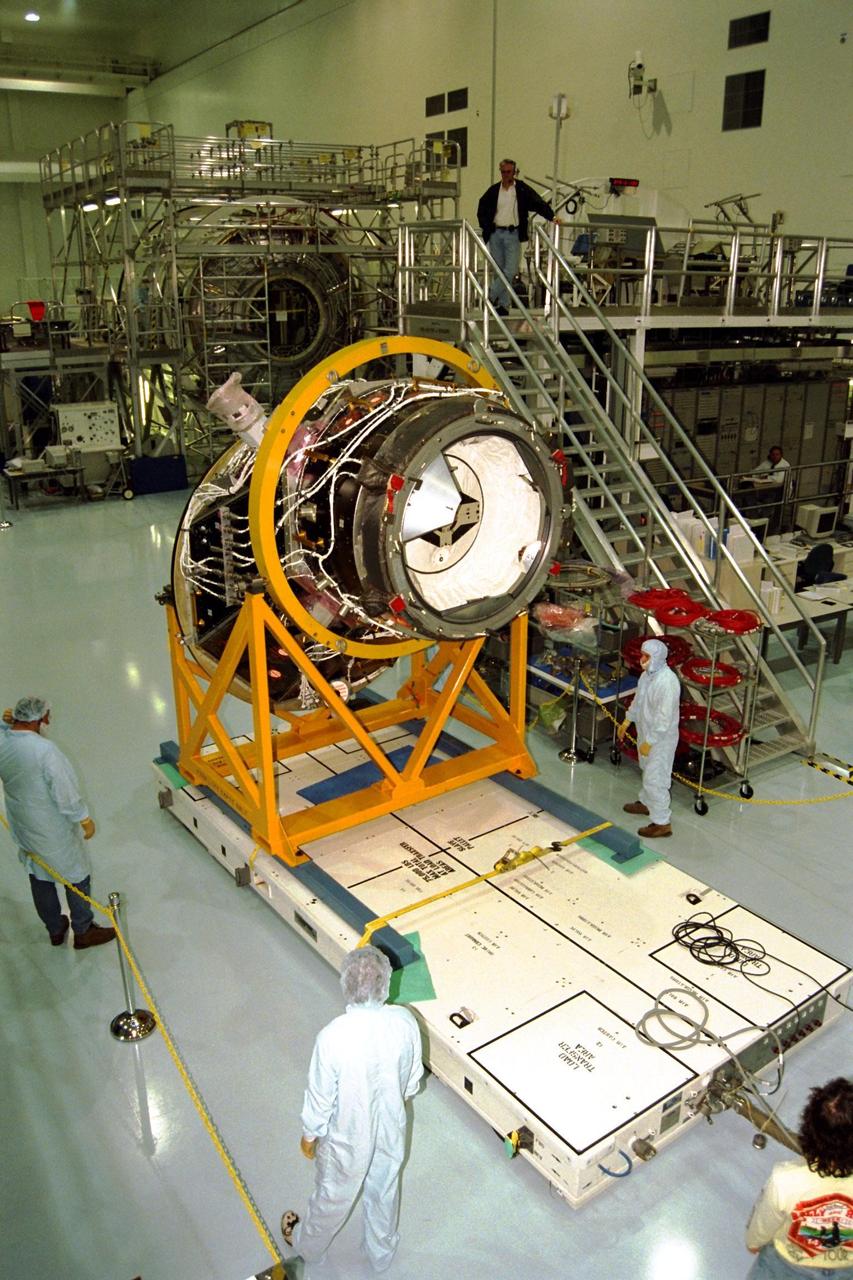
KENNEDY SPACE CENTER, FLA. -- The Pressurized Mating Adapter (PMA)-2 for the International Space Station (ISS), seen here in its yellow workstand, is moved on an air pallet toward Node 1, the space station’s structural building block, in KSC’s Space Station Processing Facility. This PMA is a cone-shaped connector to Node 1, which will have two PMAs attached once PMA-2 is mated with the node. The node and PMAs, which together will make up the first element of the ISS, are scheduled to be launched aboard the Space Shuttle Endeavour on STS-88
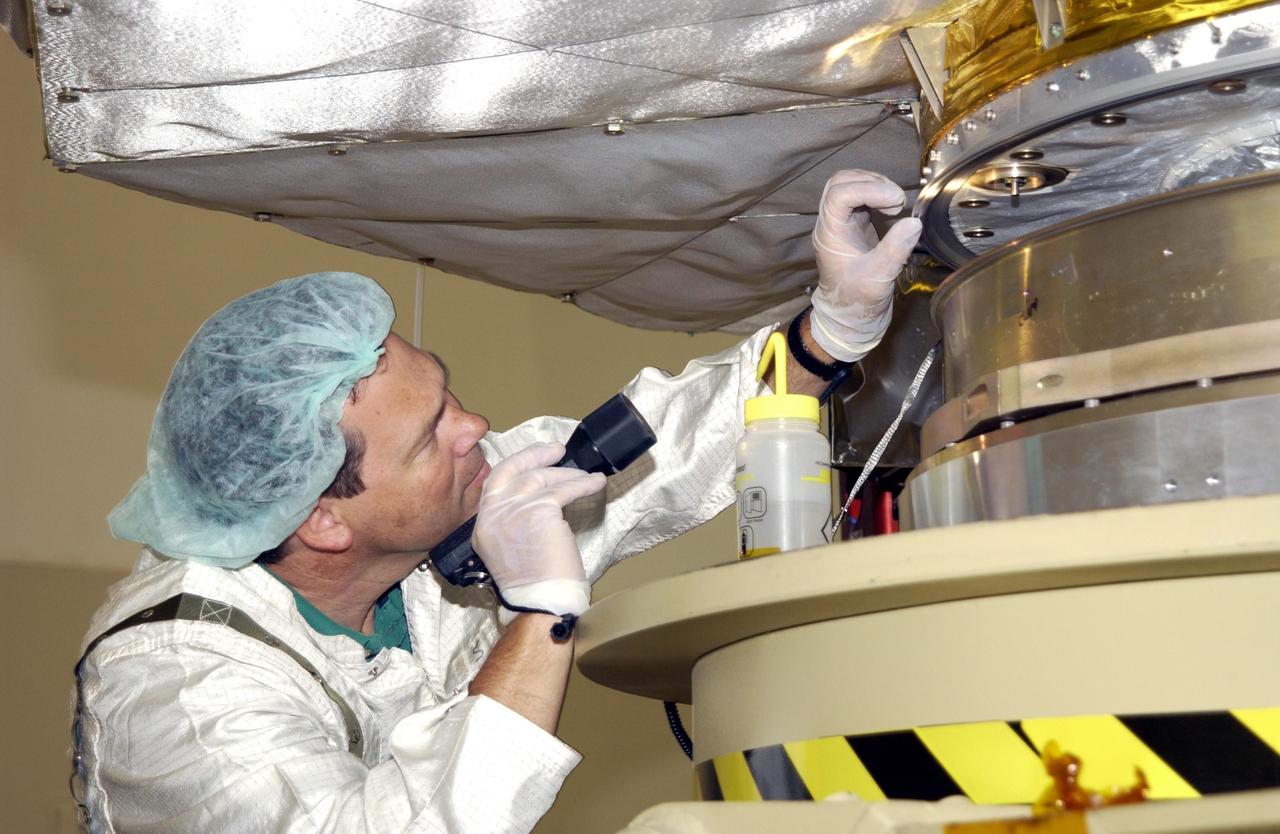
KENNEDY SPACE CENTER, FLA. -- A worker in the Space Assembly and Encapsulation Facility 2 (SAEF-2) checks the base of the Comet Nucleus Tour (CONTOUR) spacecraft before it is moved for mating with the upper stage of a Boeing Delta II rocket. CONTOUR will provide the first detailed look into the heart of a comet -- the nucleus. Flying as close as 60 miles (100 kilometers) to at least two comets, the spacecraft will take the sharpest pictures yet of a nucleus while analyzing the gas and dust that surround these rocky, icy building blocks of the solar system. Launch of CONTOUR aboard the Delta II is scheduled for July 1, 2002, from Launch Complex 17-A, Cape Canaveral Air Force Station
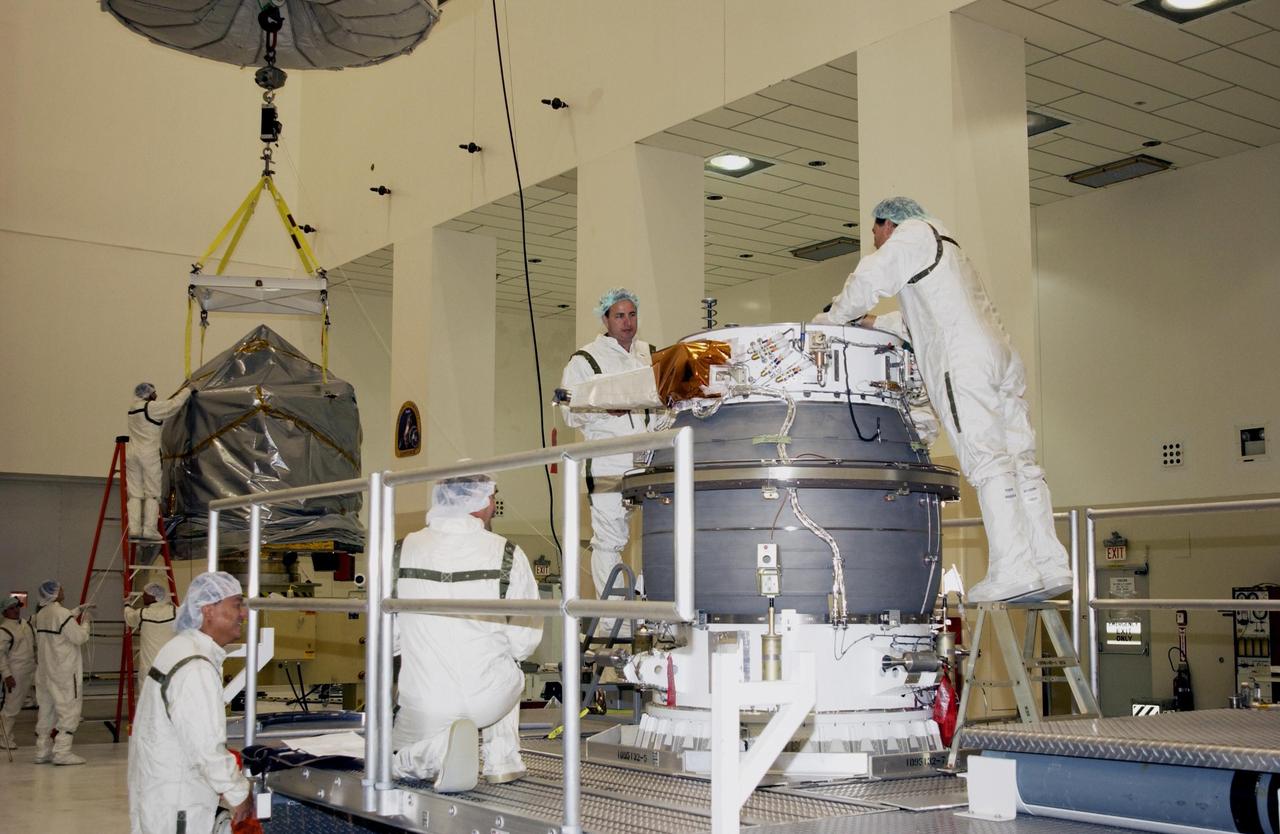
KENNEDY SPACE CENTER, FLA. -- In the Space Assembly and Encapsulation Facility 2 (SAEF-2), workers at right prepare the upper stage of a Boeing Delta II rocket for mating with the Comet Nucleus Tour (CONTOUR) spacecraft at left. CONTOUR will provide the first detailed look into the heart of a comet -- the nucleus. Flying as close as 60 miles (100 kilometers) to at least two comets, the spacecraft will take the sharpest pictures yet of a nucleus while analyzing the gas and dust that surround these rocky, icy building blocks of the solar system. Launch of CONTOUR aboard the Delta II is scheduled for July 1, 2002, from Launch Complex 17-A, Cape Canaveral Air Force Station
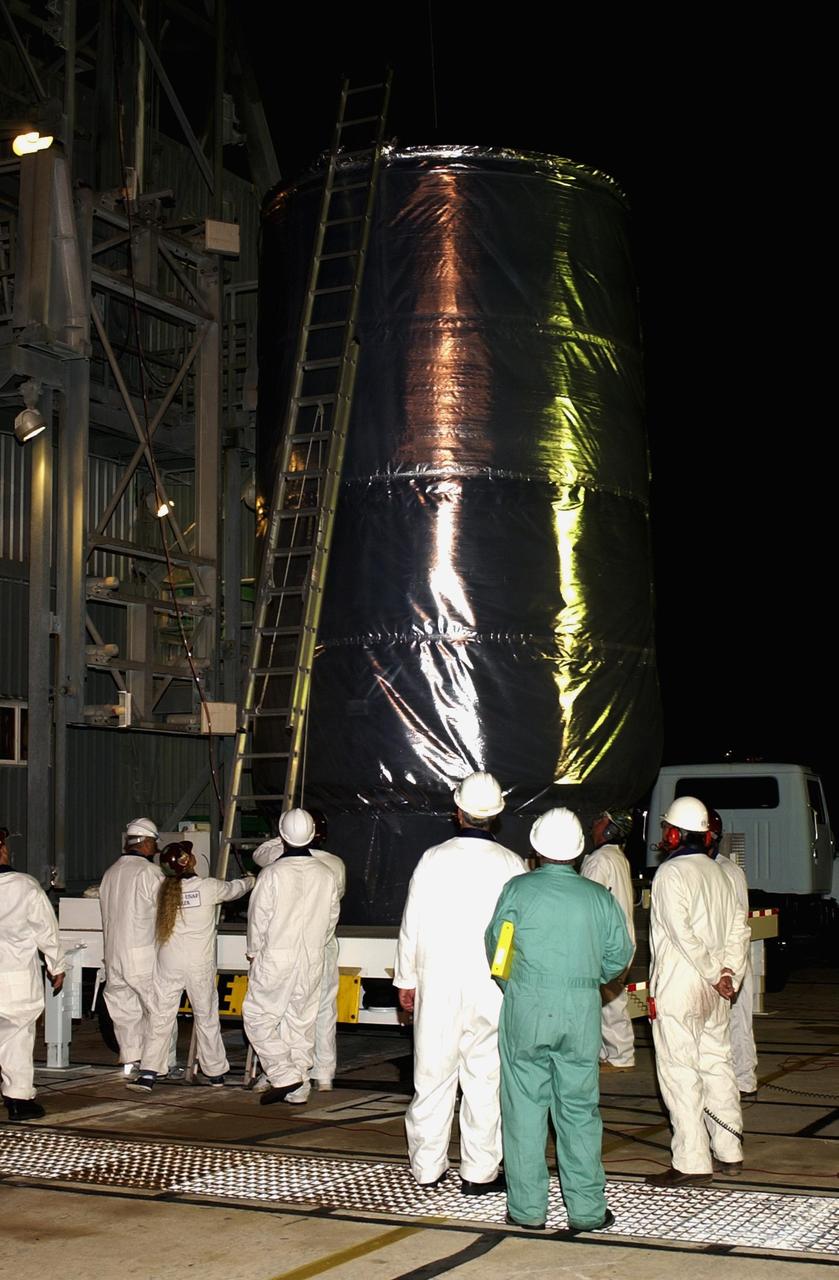
KENNEDY SPACE CENTER, FLA. -- In the early morning, the Comet Nucleus Tour (CONTOUR) spacecraft arrives at Launch Complex 17-A, Cape Canaveral Air Force Station, from the Spacecraft Assembly and Encapsulation Facility 2 (SAEF-2). CONTOUR will provide the first detailed look into the heart of a comet -- the nucleus. Flying as close as 60 miles (100 kilometers) to at least two comets, the spacecraft will take the sharpest pictures yet of a nucleus while analyzing the gas and dust that surround these rocky, icy building blocks of the solar system. Launch of CONTOUR aboard a Boeing Delta II rocket is scheduled for July 1, 2002
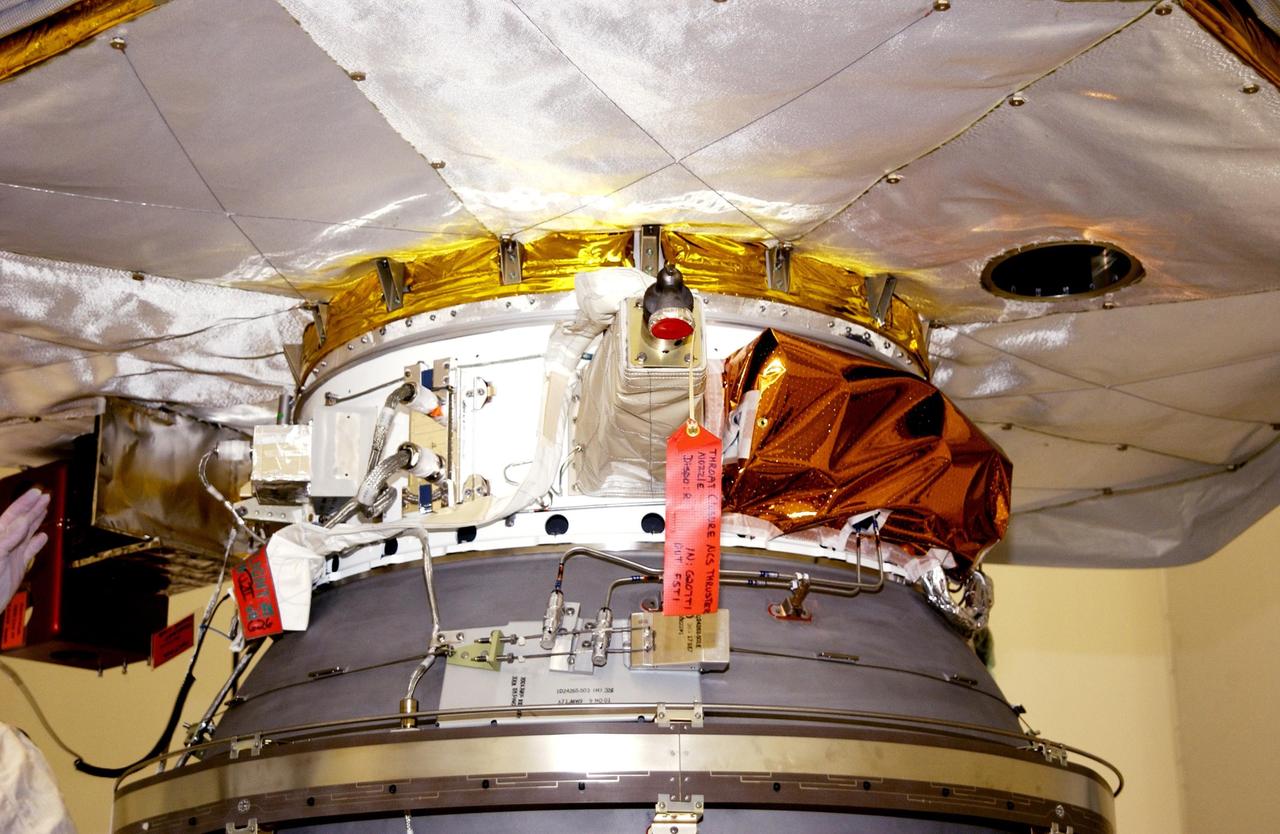
KENNEDY SPACE CENTER, FLA. -- The Comet Nucleus Tour (CONTOUR) spacecraft is mated to the upper stage of a Boeing Delta II rocket in the Space Assembly and Encapsulation Facility 2 (SAEF-2). CONTOUR will provide the first detailed look into the heart of a comet -- the nucleus. Flying as close as 60 miles (100 kilometers) to at least two comets, the spacecraft will take the sharpest pictures yet of a nucleus while analyzing the gas and dust that surround these rocky, icy building blocks of the solar system. Launch of CONTOUR aboard the Delta II is scheduled for July 1, 2002, from Launch Complex 17-A, Cape Canaveral Air Force Station
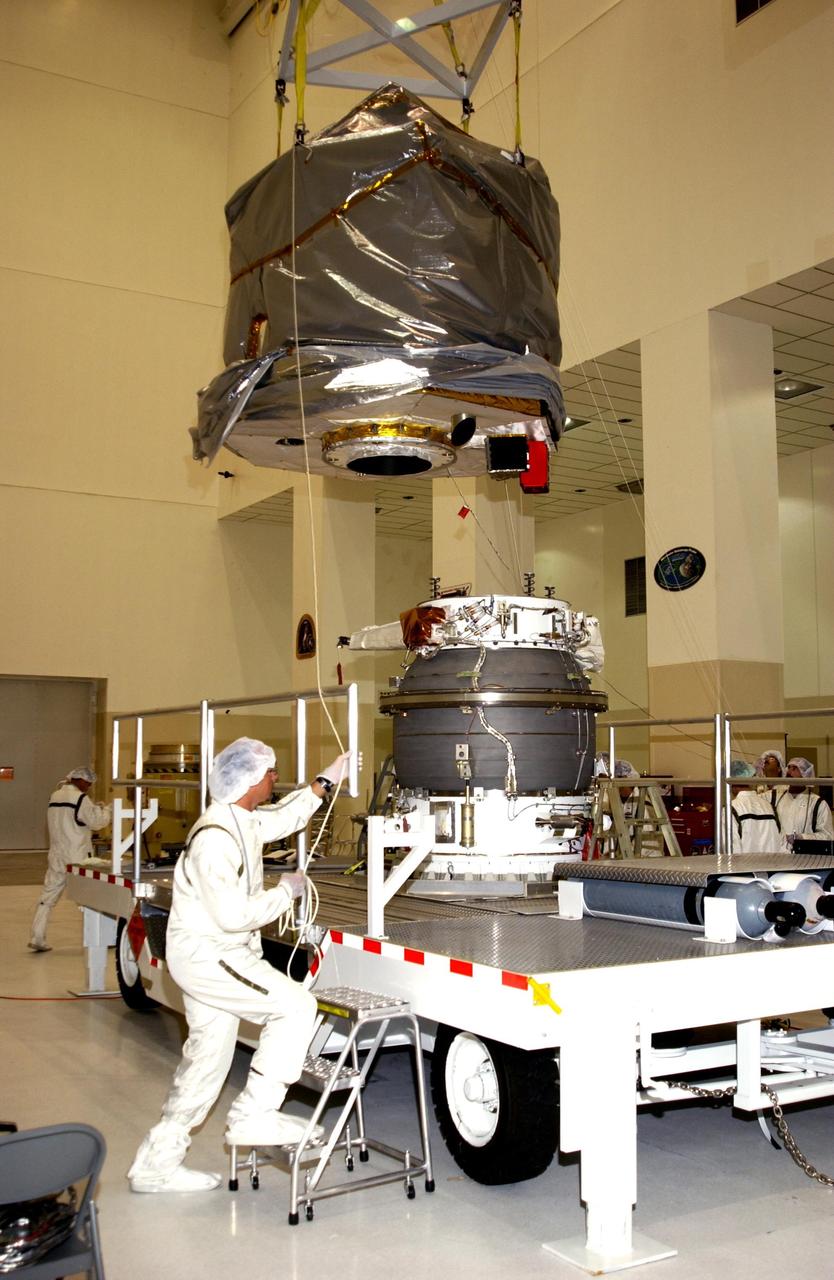
KENNEDY SPACE CENTER, FLA. - In the Space Assembly and Encapsulation Facility 2 (SAEF-2), the Comet Nucleus Tour (CONTOUR) spacecraft (top) is moved toward the upper stage of a Boeing Delta II rocket. The two will be mated for launch. CONTOUR will provide the first detailed look into the heart of a comet -- the nucleus. Flying as close as 60 miles (100 kilometers) to at least two comets, the spacecraft will take the sharpest pictures yet of a nucleus while analyzing the gas and dust that surround these rocky, icy building blocks of the solar system. Launch of CONTOUR aboard the Delta II is scheduled for July 1, 2002, from Launch Complex 17-A, Cape Canaveral Air Force Station
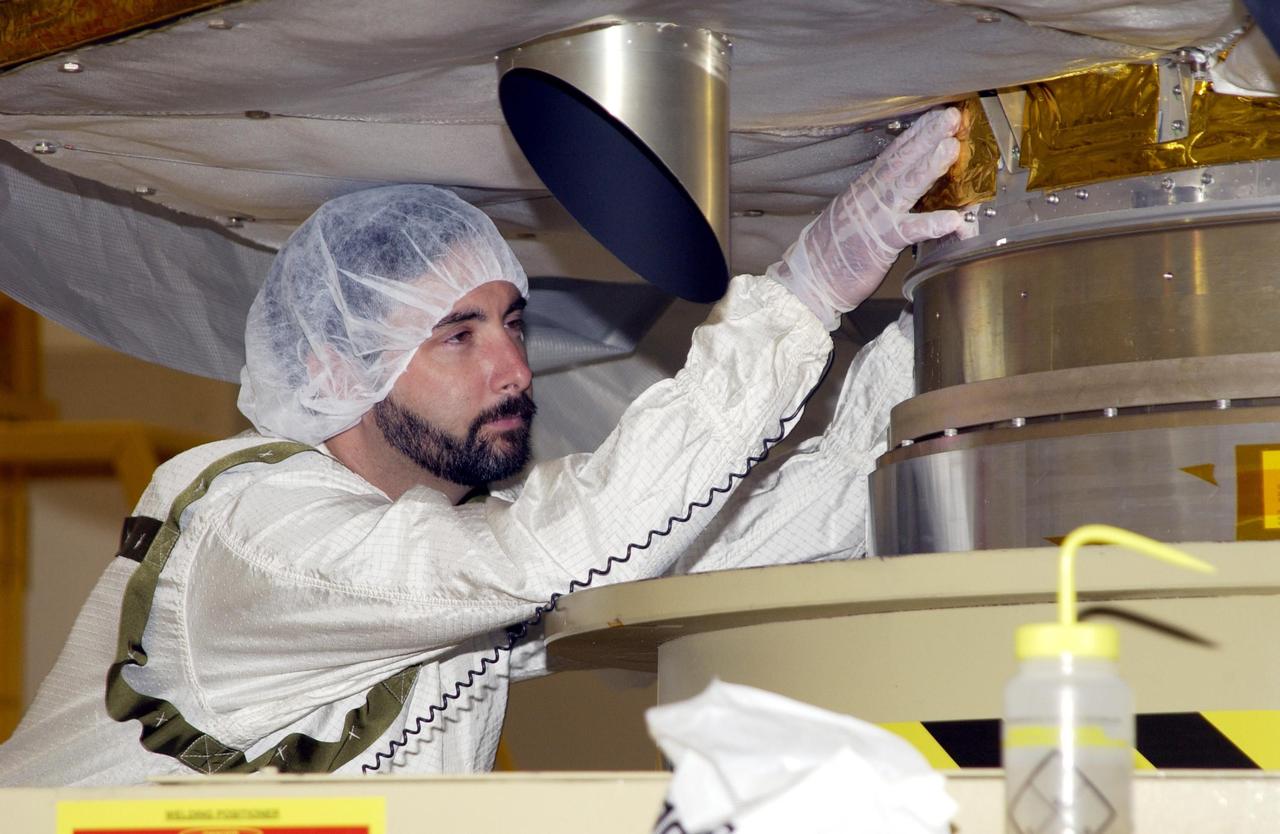
KENNEDY SPACE CENTER, FLA. -- A worker in the Space Assembly and Encapsulation Facility 2 (SAEF-2) checks the base of the Comet Nucleus Tour (CONTOUR) spacecraft before it is moved for mating with the upper stage of a Boeing Delta II rocket. CONTOUR will provide the first detailed look into the heart of a comet -- the nucleus. Flying as close as 60 miles (100 kilometers) to at least two comets, the spacecraft will take the sharpest pictures yet of a nucleus while analyzing the gas and dust that surround these rocky, icy building blocks of the solar system. Launch of CONTOUR aboard the Delta II is scheduled for July 1, 2002, from Launch Complex 17-A, Cape Canaveral Air Force Station
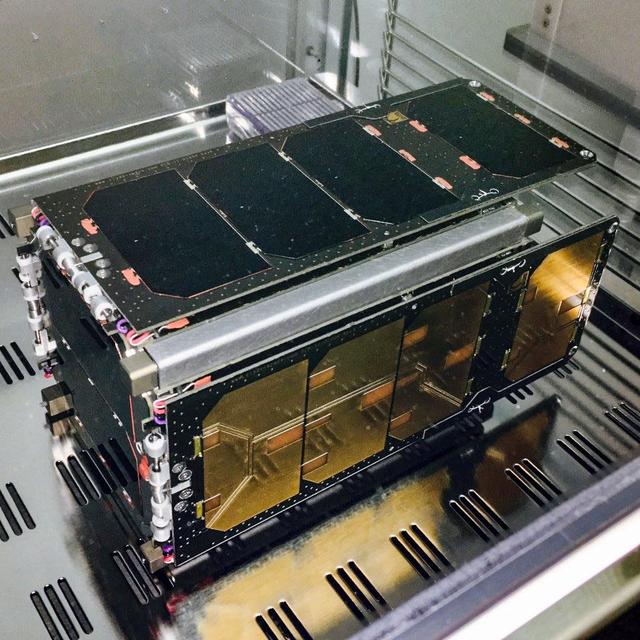
Jsc2020e004942(2/7/2020) — A preflight view of the CryoCube BUS. CryoCube demonstrates on-orbit thermal management technology. Such technology has a variety of potential applications, including storing rocket propellants in space, cooling instruments to improve their signal-to-noise ratios, and supporting future cryogenic experiments in microgravity. The small satellite uses a deployable shield to block radiation from the Sun and Earth and an attitude control system to point its experiment into deep space. Image courtesy of: Sierra Lobo Inc.

ISS006-E-48596 (28 April 2003) --- Backdropped against the blackness of space, the Soyuz TMA-2 spacecraft approaches the International Space Station (ISS). Onboard the spacecraft are the Expedition Seven crewmembers, cosmonaut Yuri I. Malenchenko, mission commander representing Rosaviakosmos, and astronaut Edward T. Lu, NASA ISS science officer and flight engineer. The Soyuz docked at the functional cargo block (FGB) nadir port at 12:56 a.m. (CDT) on April 28, 2003.
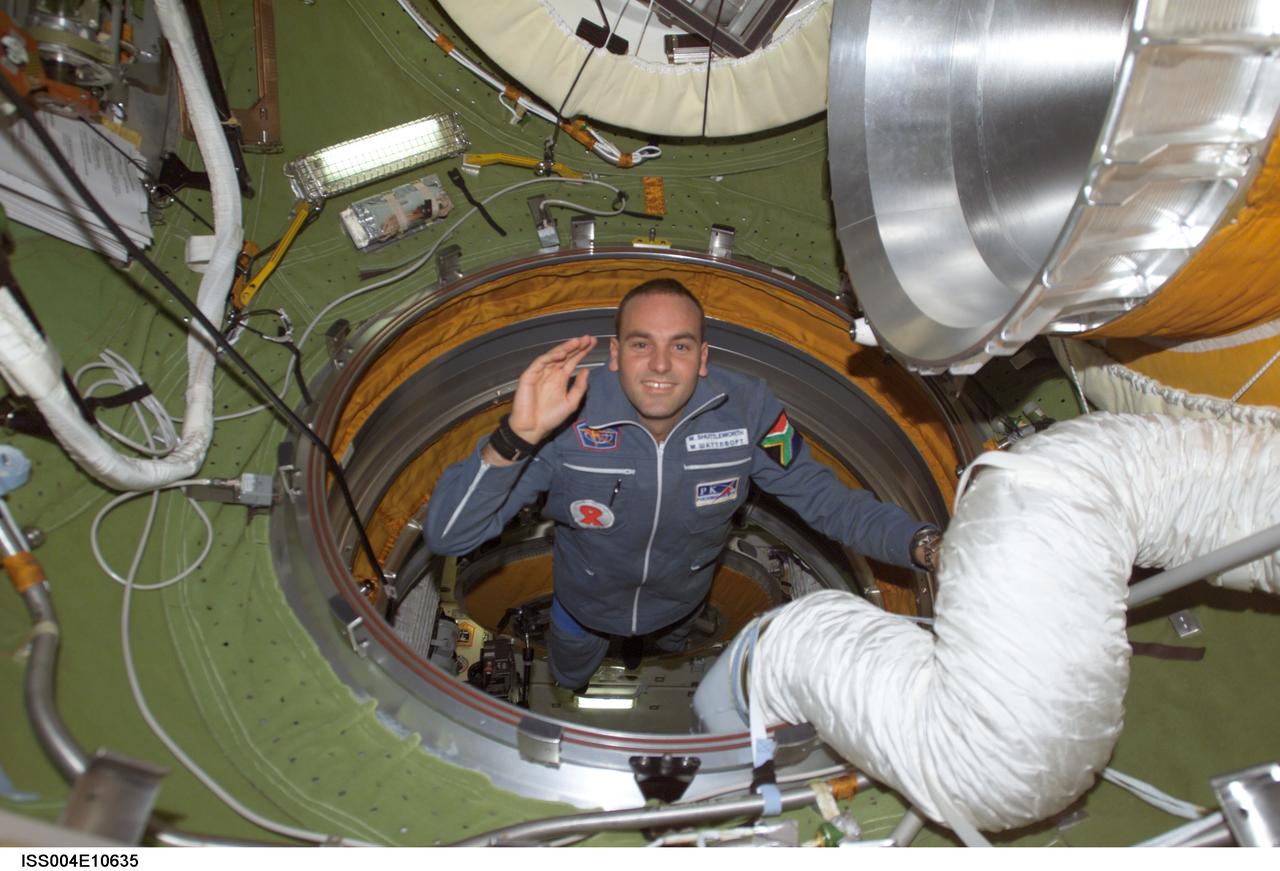
ISS004-E-10635 (27 April 2002) --- South African space flight participant Mark Shuttleworth enters the functional cargo block’s (FGB) pressurized adapter on the International Space Station (ISS). Shuttleworth and his Soyuz Taxi crewmates, Commander Yuri Gidzenko and Flight Engineer Roberto Vittori of the European Space Agency (ESA), arrived at the orbital outpost on April 27, 2002 at 2:56 a.m. (CDT) as the two vehicles flew over Central Asia.

By August, 2024, the four dams blocking the flow of the Klamath River in California and Oregon were removed. After more than 100 years, nearly 640 km of salmon habitat were restored. Two of the dams and their reservoirs, Copco 1 and Copco 2 in northern California, are shown before and after removal. The images were acquired July 18, 2024 and August 15, 2020, cover an area of 16.5 by 22.5 km, and are located at 42.1 degrees north, 122.2 degrees west. https://photojournal.jpl.nasa.gov/catalog/PIA26448
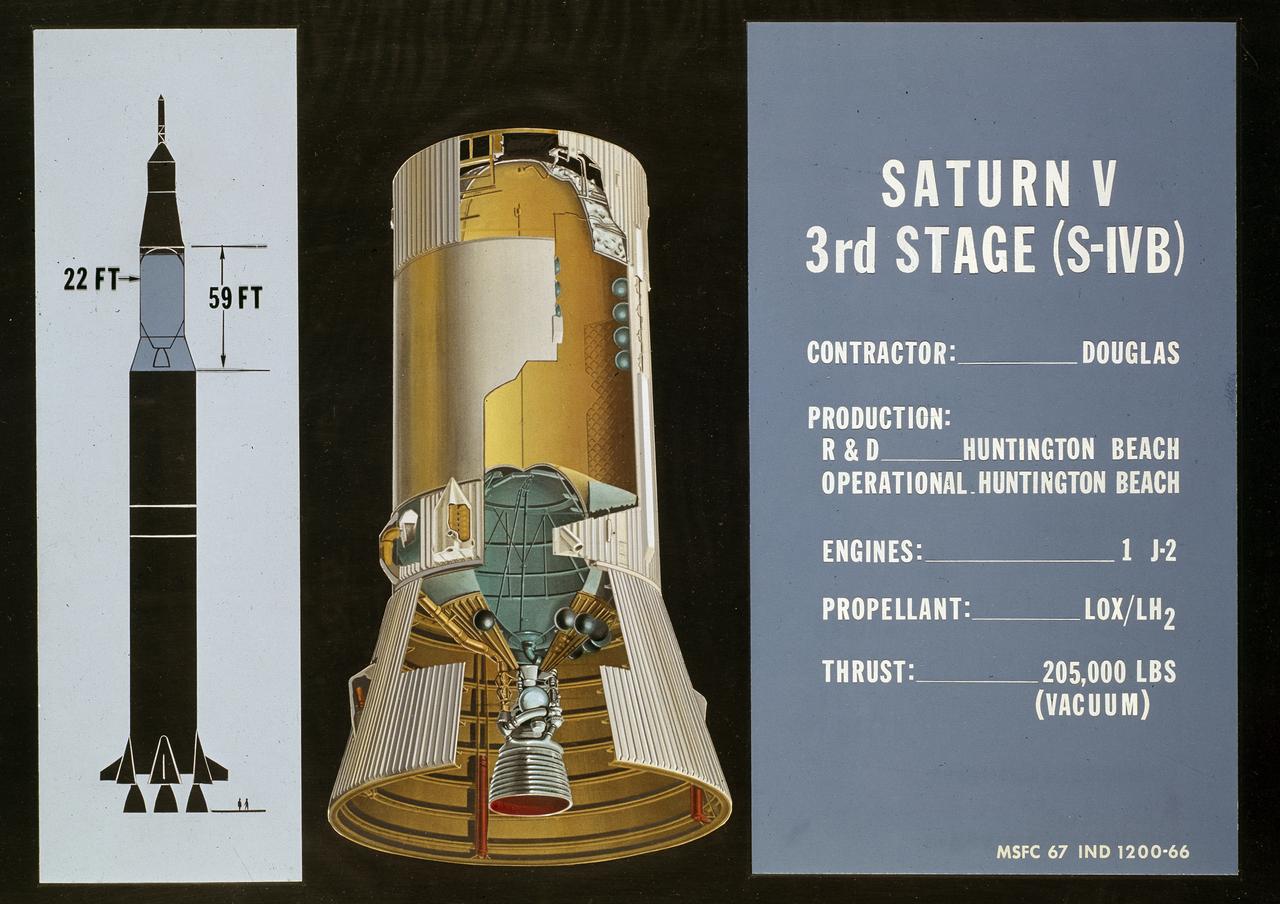
This cutaway drawing shows the S-IVB (third stage) of the Saturn V launch vehicle. As a part of the Marshall Space Flight Center’s (MSFC) “building block” approach to the Saturn development, the S-IVB stage was utilized in the Saturn IB launch vehicle as a second stage and, later, the Saturn V launch vehicle as a third stage. The 59 foot long and 22 feet diameter stage was powered by a single J-2 engine, initially capable of 200,000 pounds of thrust.
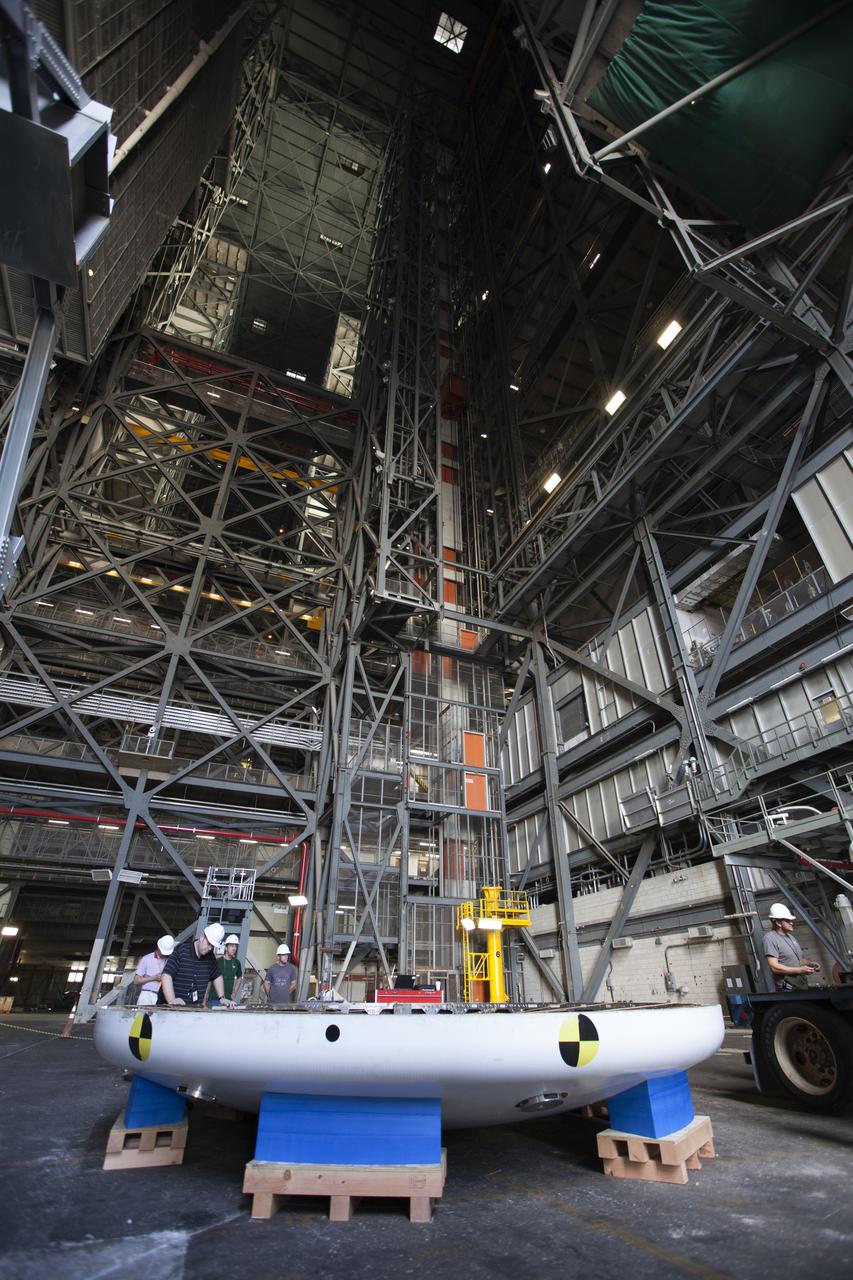
Inside High Bay 2 in the Vehicle Assembly Building (VAB) at NASA's Kennedy Space Center in Florida, the Orion heat shield from Exploration Flight Test-1 is secured on foam blocks. The heat shield is being transferred from the Orion Program to the Ground Systems Development and Operations Program, Landing and Recovery Operations. In the VAB, the heat shield will be integrated with the Orion ground test article and used for future underway recovery testing.
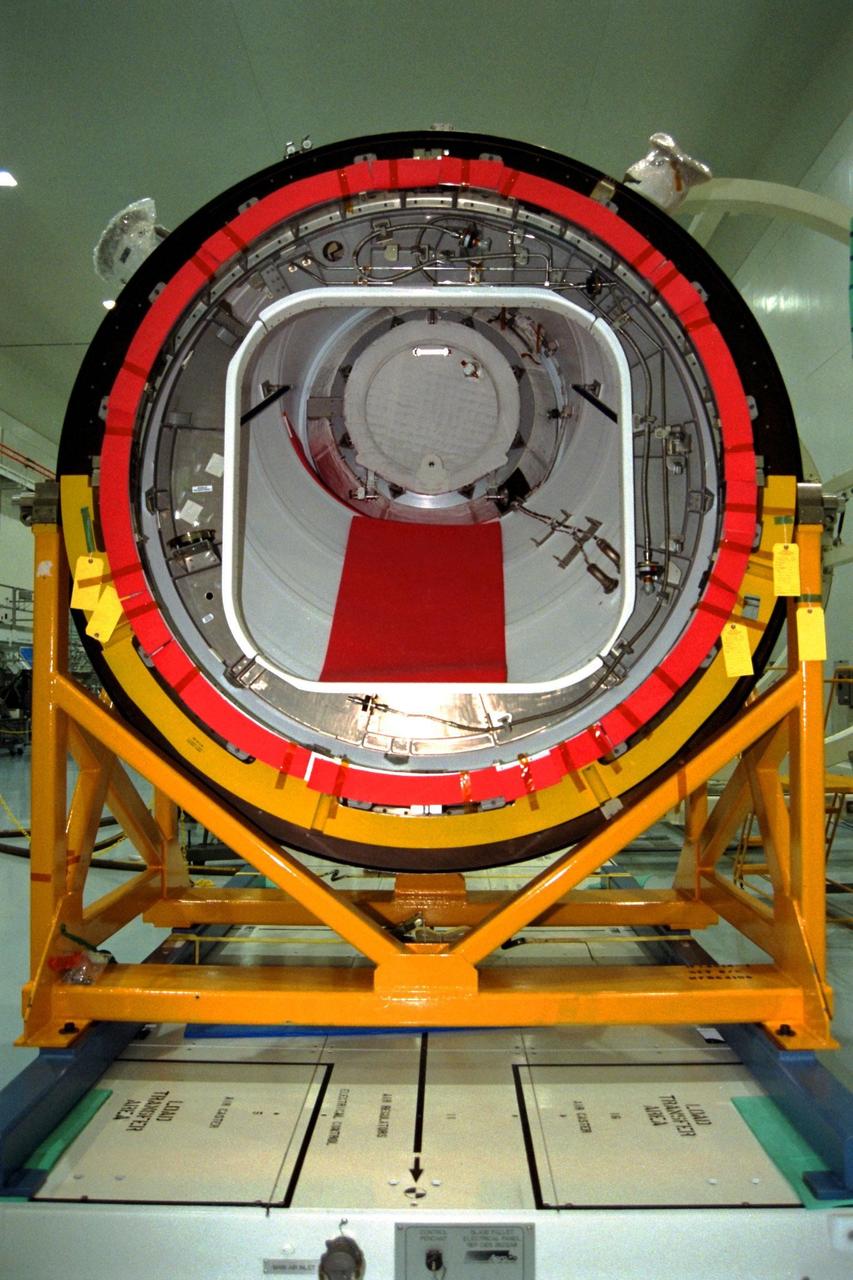
KENNEDY SPACE CENTER, FLA. -- The Pressurized Mating Adapter (PMA)-2 for the International Space Station (ISS) awaits being mated with Node 1, the space station’s structural building block, in KSC’s Space Station Processing Facility. This PMA, identifiable by its bright red ring, is a cone-shaped connector to Node 1, which will have two PMAs attached once this mate is completed. The node and PMAs, which together will make up the first element of the ISS, are scheduled to be launched aboard the Space Shuttle Endeavour on STS-88
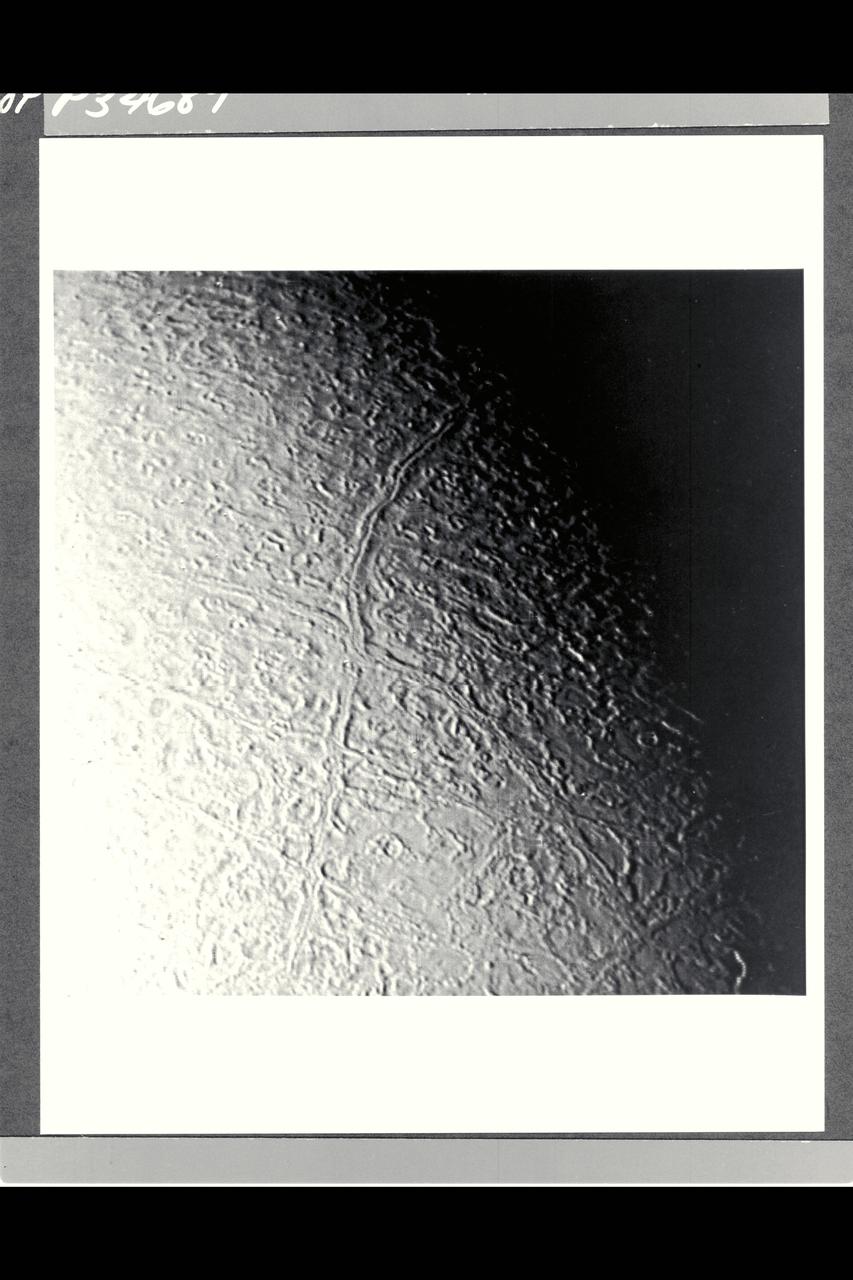
P-34689 Range : 130,000 km. ( 80,000 miles ) Smallest Resolvable Feature : 2.5 km or 1.5 miles This image of Neptune's moon Triton, shot by Voyager 2, is seen here. The long linear feature exteding vertically across the image is probably a graben -- a norrow down-dropped fault block about 35 km. or 20 miles across. The ridge in the center of the graben. The surrounding terrain is a relatively young icy surface with few impact craters.
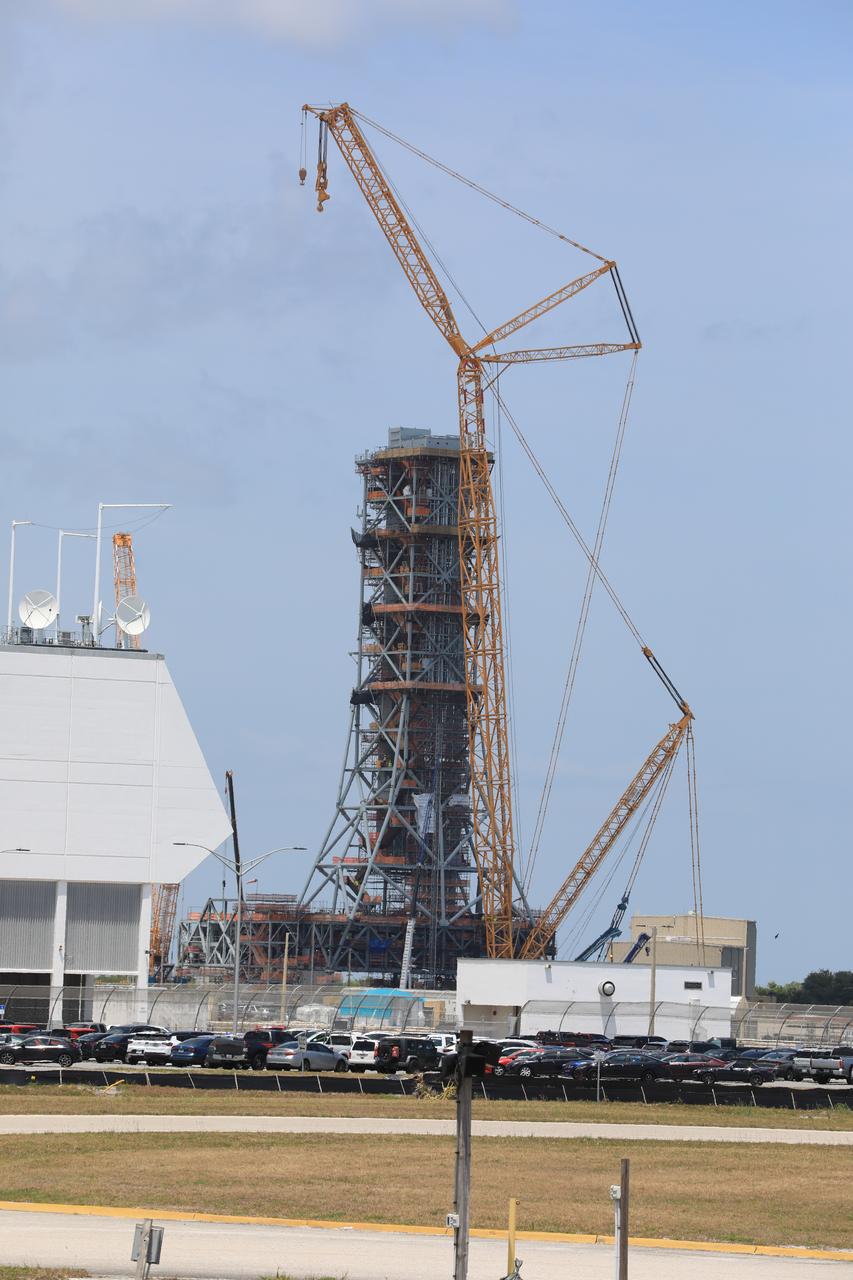
NASA’s mobile launcher 2 team, led by contractor Bechtel National Inc., integrated Module 7 onto the mobile launcher under construction near the Vehicle Assembly Building at the agency’s Kennedy Space Center in Florida on Wednesday, April 23, 2025. Each module is 40 feet tall and once complete will rise to 390 feet to provide ground support to launch for the SLS (Space Launch System) Block 1B variant rocket during launch of the Artemis IV mission.
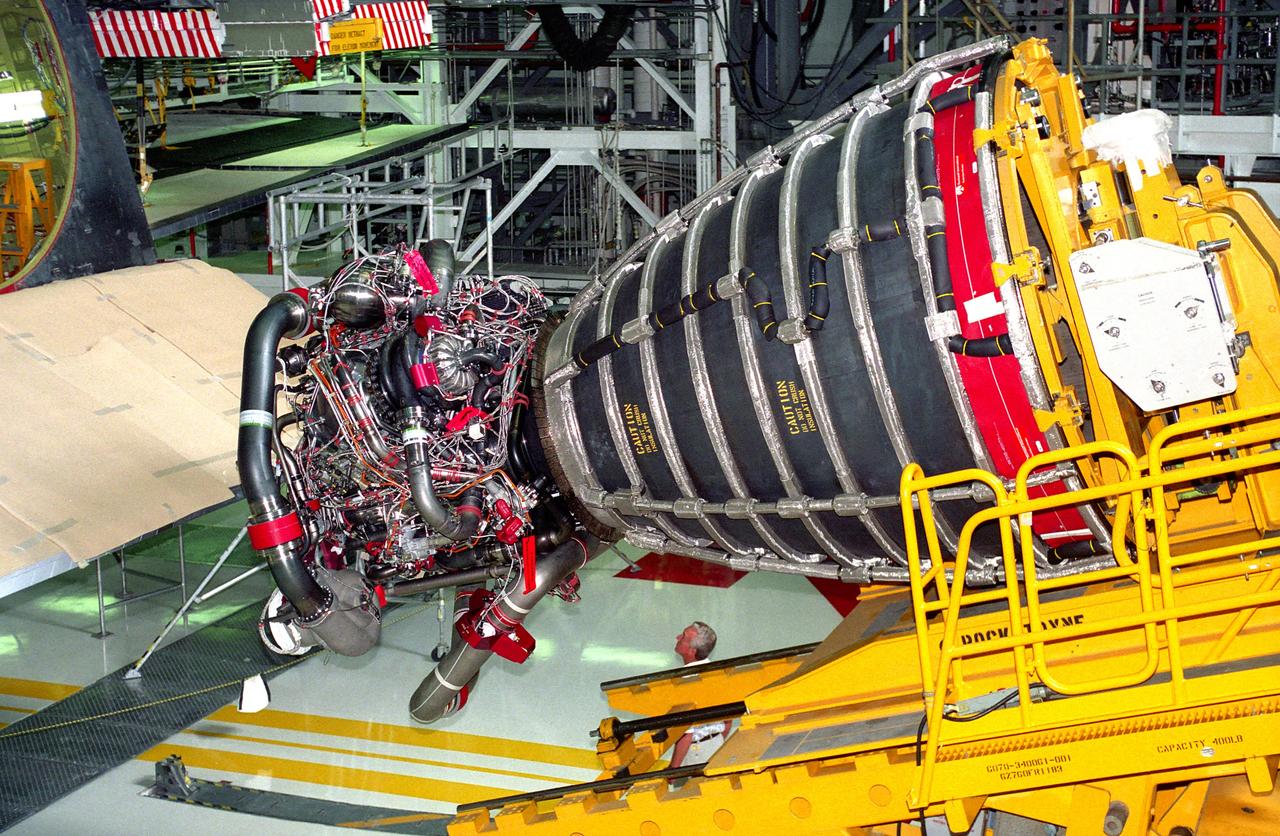
KENNEDY SPACE CENTER, FLA. - Space Shuttle Main Engine (SSME) No. 2036, the first of the new Block 1 engines to fly, awaits installation into position one of the orbiter Discovery in Orbiter Processing Facility 2 during preparation of the spaceplane for the STS-70 mission. The advanced powerplant features a new high-pressure liquid oxygen turbopump, a two-duct powerhead, a baffleless main injector, a single-coil heat exchanger and start sequence modifications. These modifications are designed to improve both engine performance and safety.
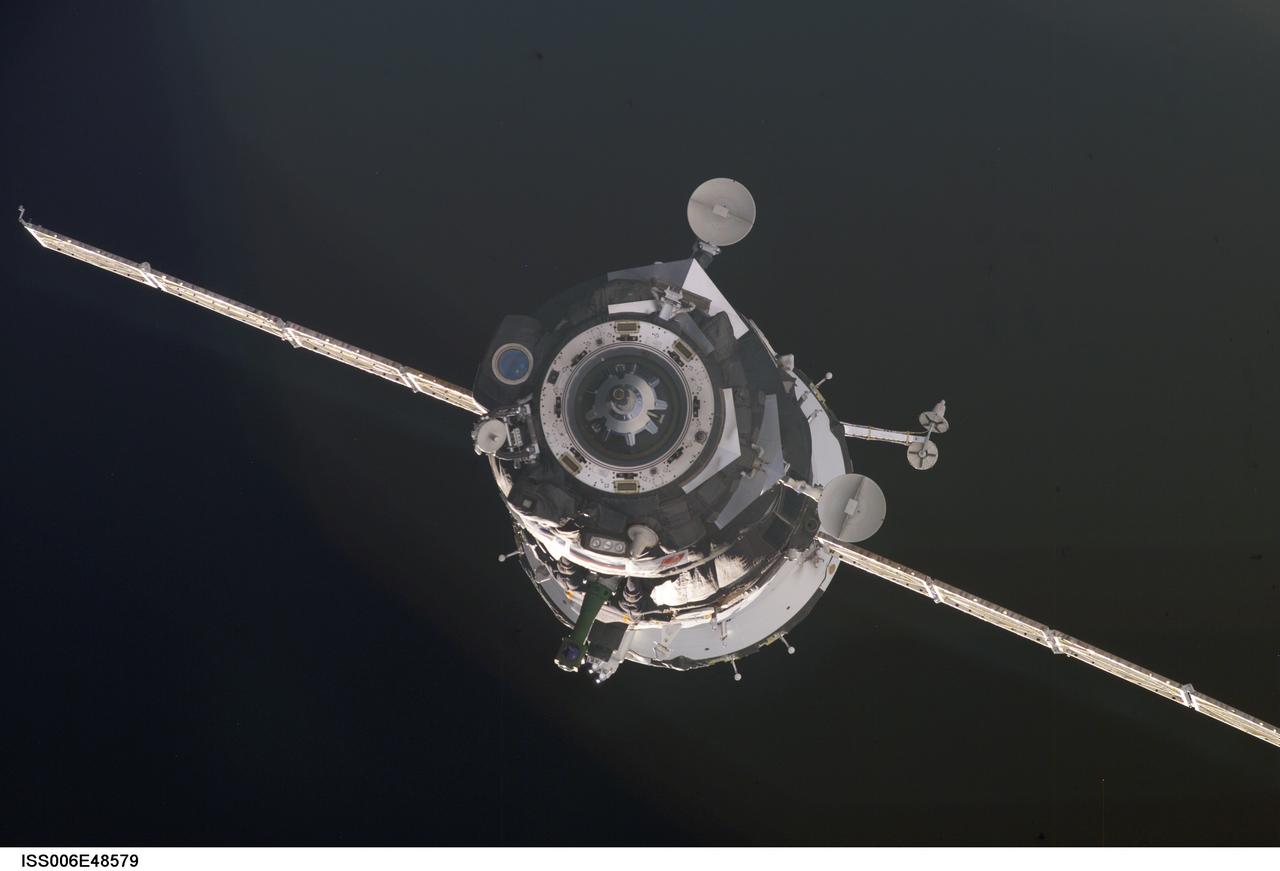
ISS006-E-48579 (28 April 2003) --- Backdropped against the blackness of space, the Soyuz TMA-2 spacecraft approaches the International Space Station (ISS). Onboard the spacecraft are the Expedition Seven crewmembers, cosmonaut Yuri I. Malenchenko, mission commander representing Rosaviakosmos, and astronaut Edward T. Lu, NASA ISS science officer and flight engineer. The Soyuz docked at the functional cargo block (FGB) nadir port at 12:56 a.m. (CDT) on April 28, 2003.
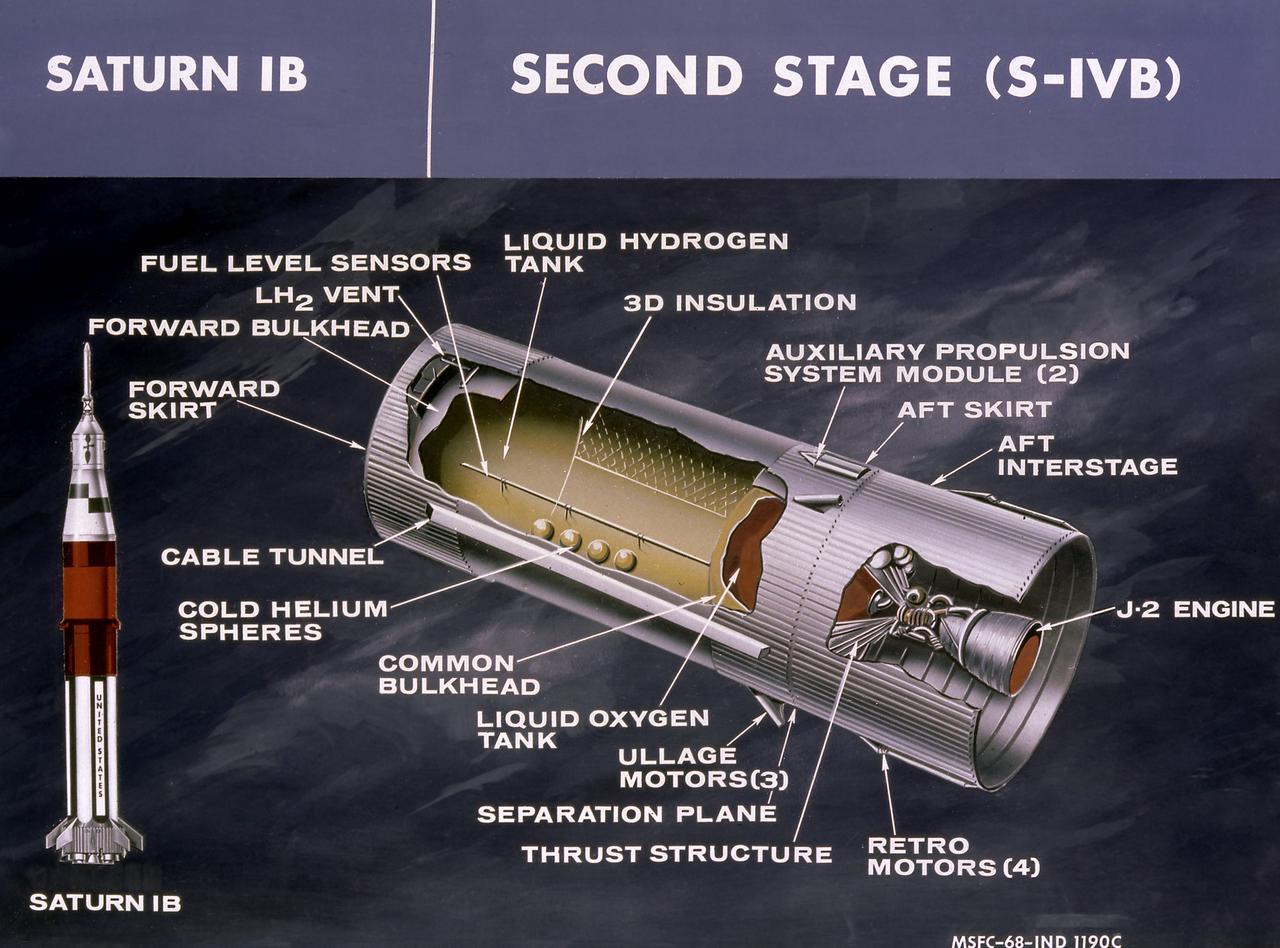
This cutaway drawing shows the S-IVB stage in its Saturn IB configuration. As a part of the Marshall Space Flight Center's (MSFC) "building block" approach to the Saturn development, the S-IVB stage was utilized in the Saturn IB launch vehicle as a second stage and, later, the Saturn V launch vehicle as a third stage. The stage was powered by a single J-2 engine, initially capable of 200,000 pounds of thrust.
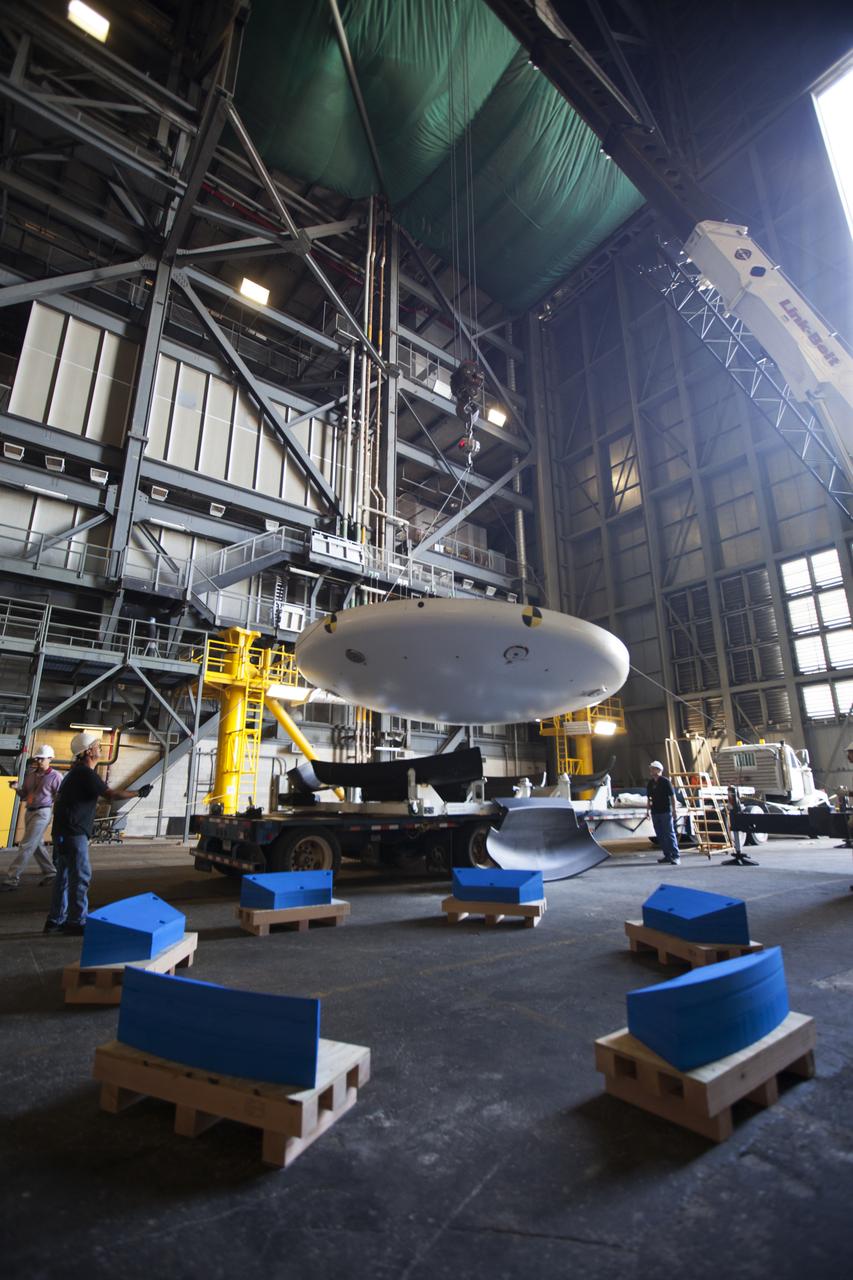
Inside High Bay 2 in the Vehicle Assembly Building (VAB) at NASA's Kennedy Space Center in Florida, a crane lifts the Orion heat shield from Exploration Flight Test-1 up off its transporter. It will be lowered onto foam blocks. The heat shield is being transferred from the Orion Program to the Ground Systems Development and Operations Program, Landing and Recovery Operations. In the VAB, the heat shield will be integrated with the Orion ground test article and used for future underway recovery testing.
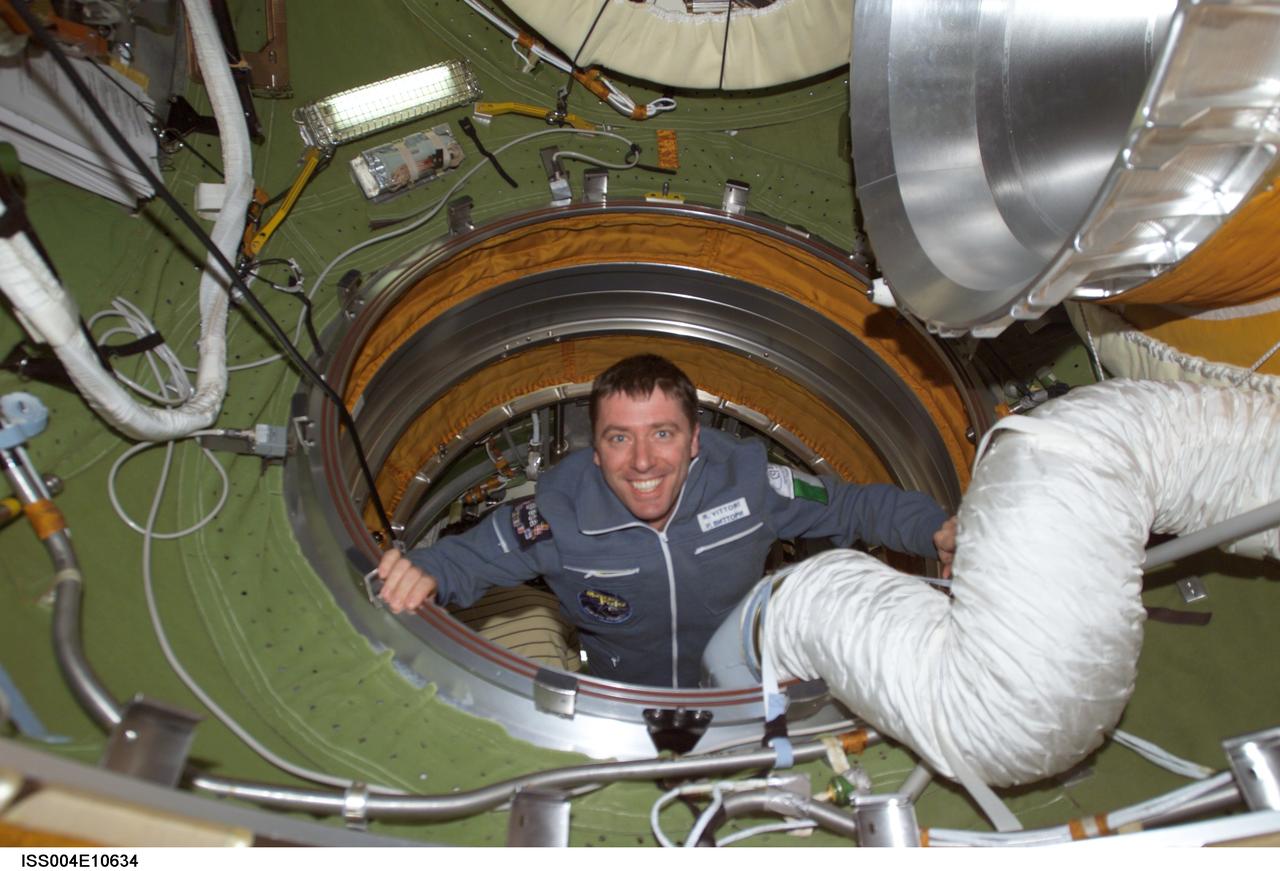
ISS004-E-10634 (27 April 2002) --- Soyuz Taxi Flight Engineer Roberto Vittori of the European Space Agency (ESA) enters the functional cargo block’s (FGB) pressurized adapter on the International Space Station (ISS). Vittori and his Soyuz Taxi crewmates, Commander Yuri Gidzenko and South African space flight participant Mark Shuttleworth, arrived at the orbital outpost on April 27, 2002 at 2:56 a.m. (CDT) as the two vehicles flew over Central Asia.
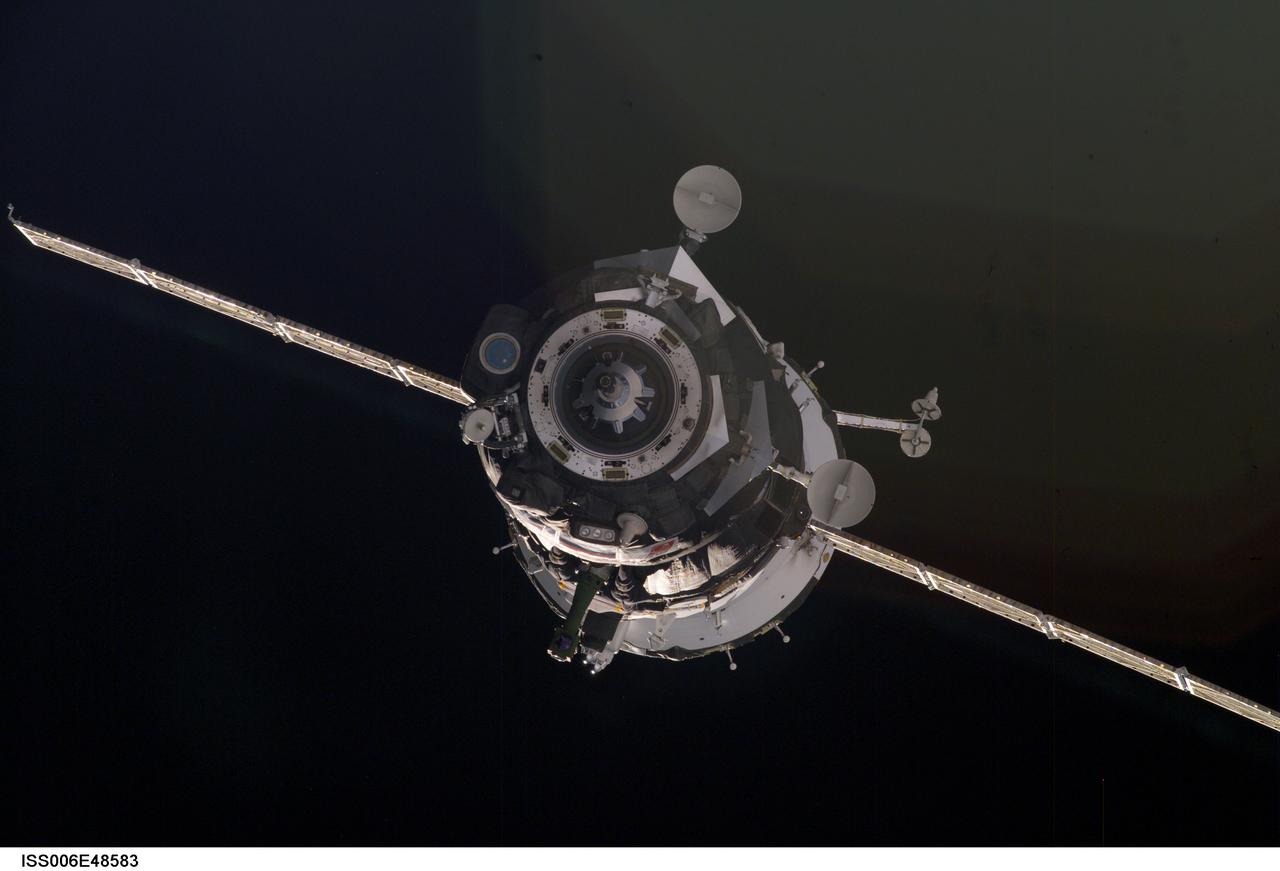
ISS006-E-48583 (28 April 2003) --- Backdropped against the blackness of space, the Soyuz TMA-2 spacecraft approaches the International Space Station (ISS). Onboard the spacecraft are the Expedition Seven crewmembers, cosmonaut Yuri I. Malenchenko, mission commander representing Rosaviakosmos, and astronaut Edward T. Lu, NASA ISS science officer and flight engineer. The Soyuz docked at the functional cargo block (FGB) nadir port at 12:56 a.m. (CDT) on April 28, 2003.

NASA’s mobile launcher 2 team, led by contractor Bechtel National Inc., integrated Module 7 onto the mobile launcher under construction near the Vehicle Assembly Building at the agency’s Kennedy Space Center in Florida on Wednesday, April 23, 2025. Each module is 40 feet tall and once complete will rise to 390 feet to provide ground support to launch for the SLS (Space Launch System) Block 1B variant rocket during launch of the Artemis IV mission.
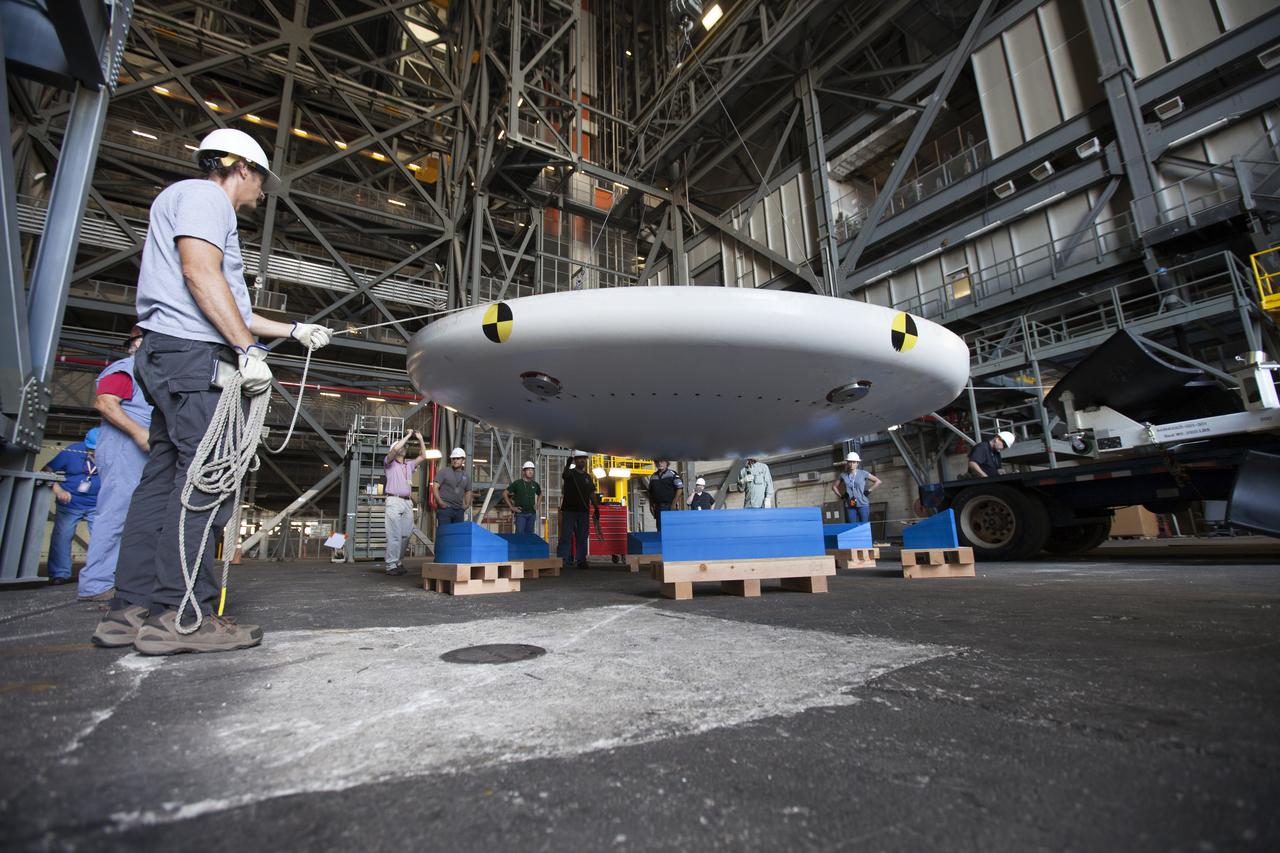
Inside High Bay 2 in the Vehicle Assembly Building (VAB) at NASA's Kennedy Space Center in Florida, workers monitor the progress as a crane lowers the Orion heat shield from Exploration Flight Test-1 onto foam blocks. The heat shield is being transferred from the Orion Program to the Ground Systems Development and Operations Program, Landing and Recovery Operations. In the VAB, the heat shield will be integrated with the Orion ground test article and used for future underway recovery testing.
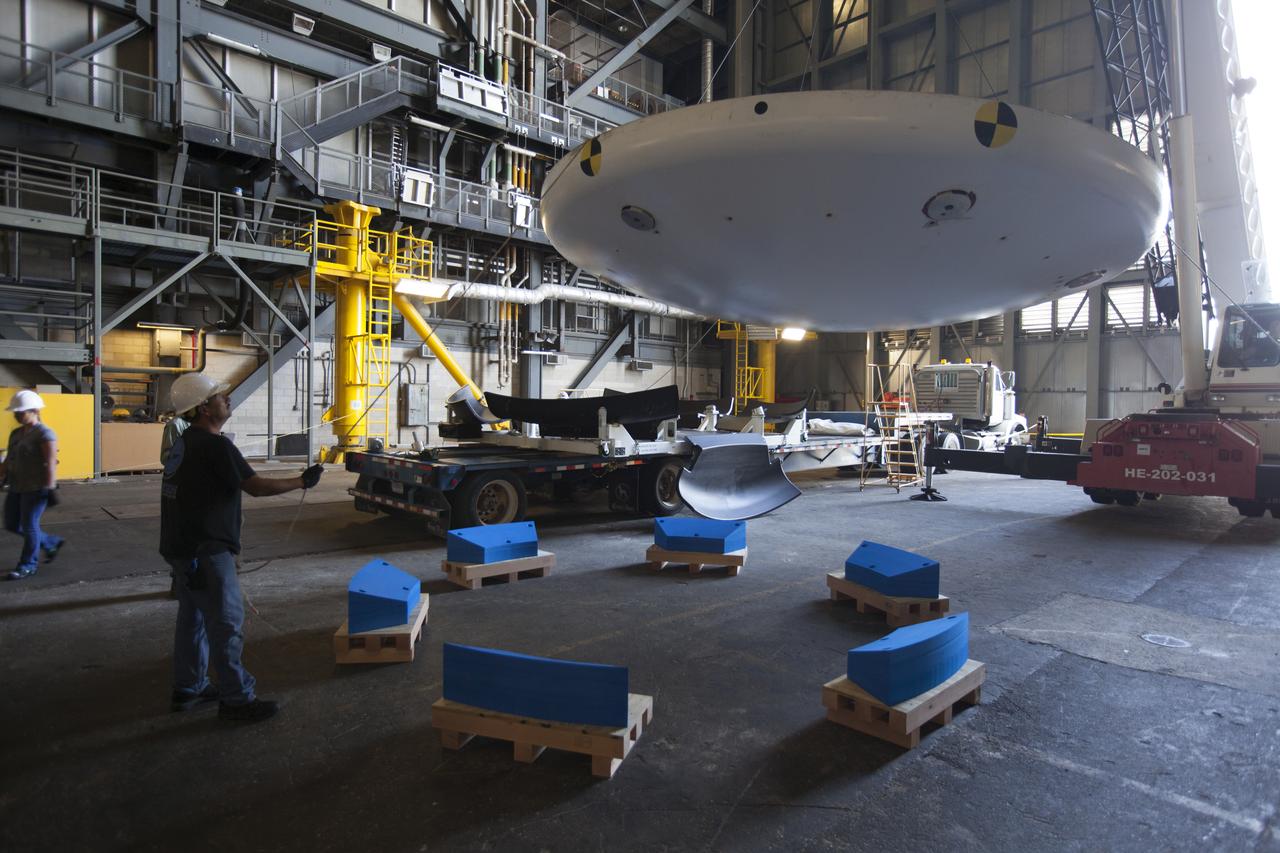
Inside High Bay 2 in the Vehicle Assembly Building (VAB) at NASA's Kennedy Space Center in Florida, a worker monitors the progress as a crane lowers the Orion heat shield from Exploration Flight Test-1 onto foam blocks. The heat shield is being transferred from the Orion Program to the Ground Systems Development and Operations Program, Landing and Recovery Operations. In the VAB, the heat shield will be integrated with the Orion ground test article and used for future underway recovery testing.
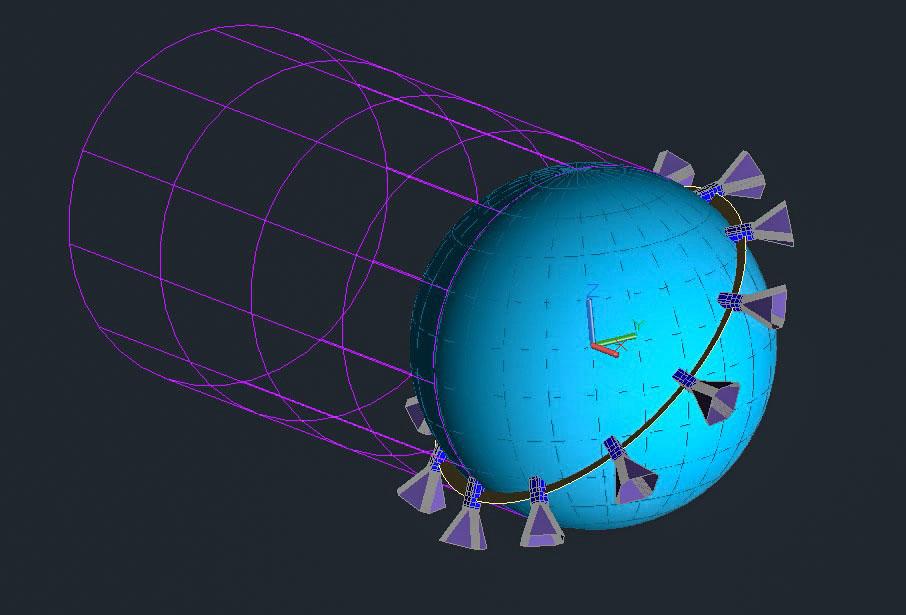
Jsc2020e004943 (2/7/2020) — A computer model showing CryoCube’s orbital orientation. CryoCube demonstrates on-orbit thermal management technology. Such technology has a variety of potential applications, including storing rocket propellants in space, cooling instruments to improve their signal-to-noise ratios, and supporting future cryogenic experiments in microgravity. The small satellite uses a deployable shield to block radiation from the Sun and Earth and an attitude control system to point its experiment into deep space. Image courtesy of : Kennedy Space Center
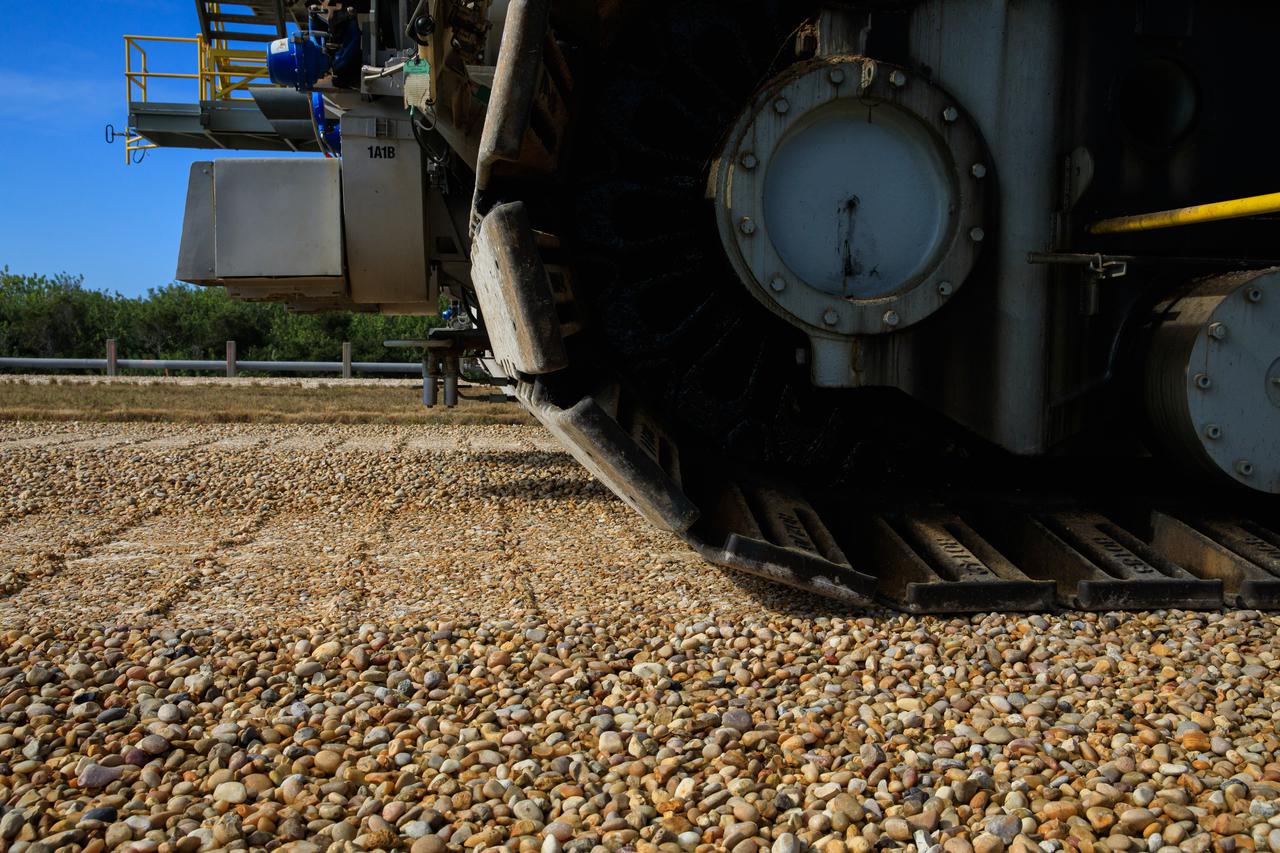
A close-up view of one of the treads on crawler-transporter 2 (CT-2) as the behemoth vehicle moves along the crawlerway at NASA’s Kennedy Space Center in Florida on Jan. 22, 2021. Teams are working to ensure the crawlerway, the path the CT-2, mobile launcher, and Space Launch System rocket with Orion atop will take from the Vehicle Assembly Building to Launch Complex 39B, is strong enough to withstand the weight and provide stability for the Artemis I mission. CT-2 carrying mobile launcher platform 1, used during the shuttle program, was driven back and forth on the crawlerway with several cement blocks, each weighing about 40,000 pounds to strengthen the crawlerway for launch. Artemis I will be the first in a series of increasingly complex missions to the Moon. Under the Artemis program, NASA aims to land the first woman and the next man on the Moon in 2024 and establish sustainable lunar exploration by the end of the decade.
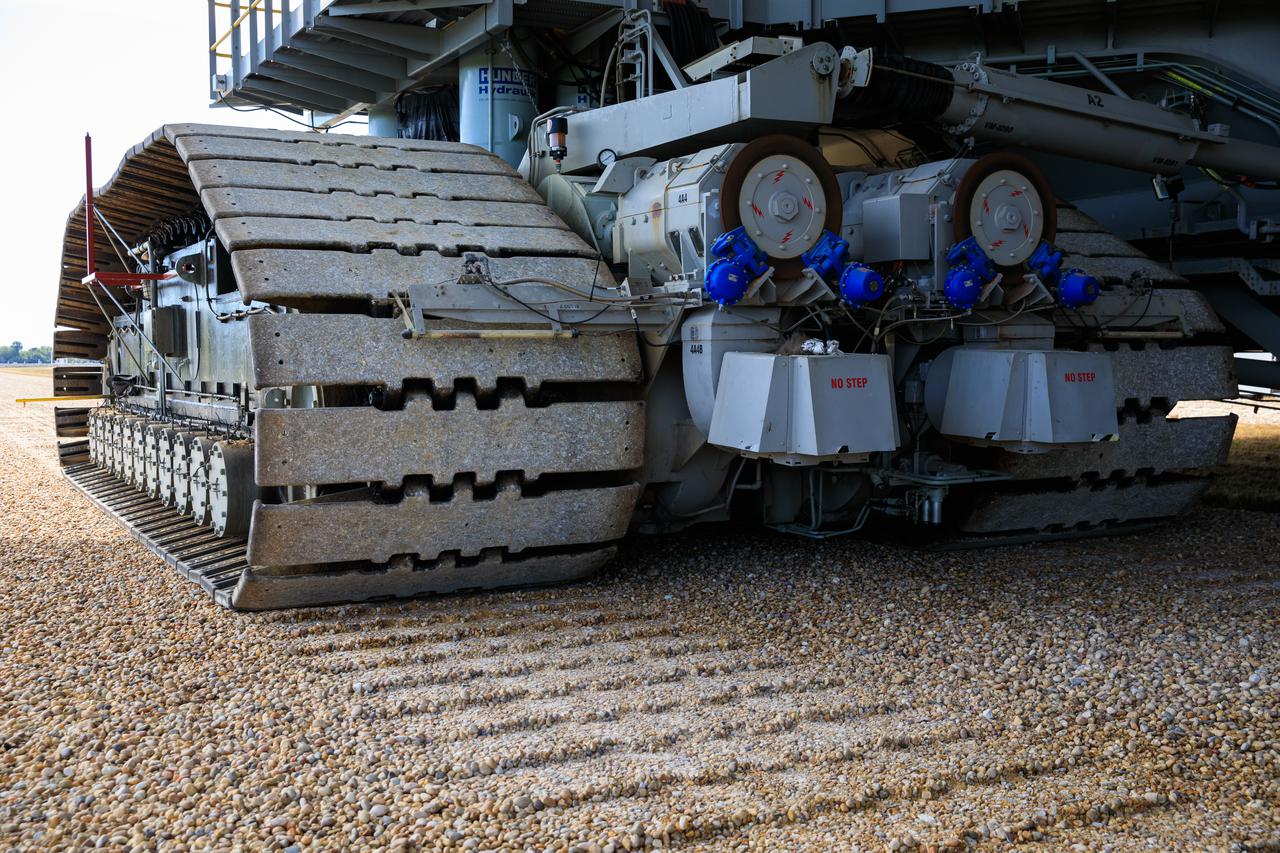
A close-up view of the treads on crawler-transporter 2 (CT-2) as the behemoth vehicle moves along the crawlerway at NASA’s Kennedy Space Center in Florida on Jan. 22, 2021. Teams are working to ensure the crawlerway, the path the CT-2, mobile launcher, and Space Launch System rocket with Orion atop will take from the Vehicle Assembly Building to Launch Complex 39B, is strong enough to withstand the weight and provide stability for the Artemis I mission. CT-2 carrying mobile launcher platform 1, used during the shuttle program, was driven back and forth on the crawlerway with several cement blocks, each weighing about 40,000 pounds to strengthen the crawlerway for launch. Artemis I will be the first in a series of increasingly complex missions to the Moon. Under the Artemis program, NASA aims to land the first woman and the next man on the Moon in 2024 and establish sustainable lunar exploration by the end of the decade.

A close-up view of the treads on crawler-transporter 2 (CT-2) as the behemoth vehicle moves along the crawlerway at NASA’s Kennedy Space Center in Florida on Jan. 22, 2021. Teams are working to ensure the crawlerway, the path the CT-2, mobile launcher, and Space Launch System rocket with Orion atop will take from the Vehicle Assembly Building to Launch Complex 39B, is strong enough to withstand the weight and provide stability for the Artemis I mission. CT-2 carrying mobile launcher platform 1, used during the shuttle program, was driven back and forth on the crawlerway with several cement blocks, each weighing about 40,000 pounds to strengthen the crawlerway for launch. Artemis I will be the first in a series of increasingly complex missions to the Moon. Under the Artemis program, NASA aims to land the first woman and the next man on the Moon in 2024 and establish sustainable lunar exploration by the end of the decade.
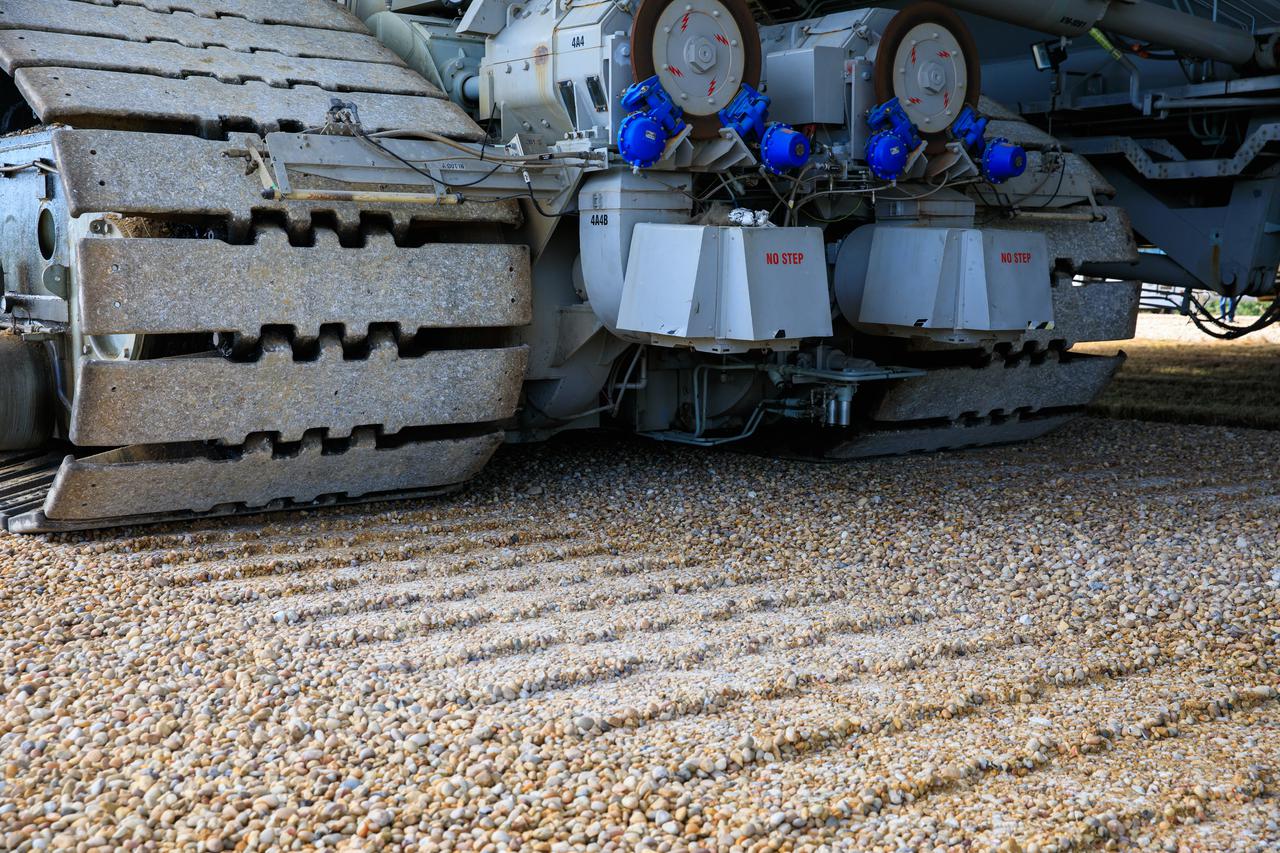
A close-up view of the treads on crawler-transporter 2 (CT-2) as the behemoth vehicle moves along the crawlerway at NASA’s Kennedy Space Center in Florida on Jan. 22, 2021. Teams are working to ensure the crawlerway, the path the CT-2, mobile launcher, and Space Launch System rocket with Orion atop will take from the Vehicle Assembly Building to Launch Complex 39B, is strong enough to withstand the weight and provide stability for the Artemis I mission. CT-2 carrying mobile launcher platform 1, used during the shuttle program, was driven back and forth on the crawlerway with several cement blocks, each weighing about 40,000 pounds to strengthen the crawlerway for launch. Artemis I will be the first in a series of increasingly complex missions to the Moon. Under the Artemis program, NASA aims to land the first woman and the next man on the Moon in 2024 and establish sustainable lunar exploration by the end of the decade.
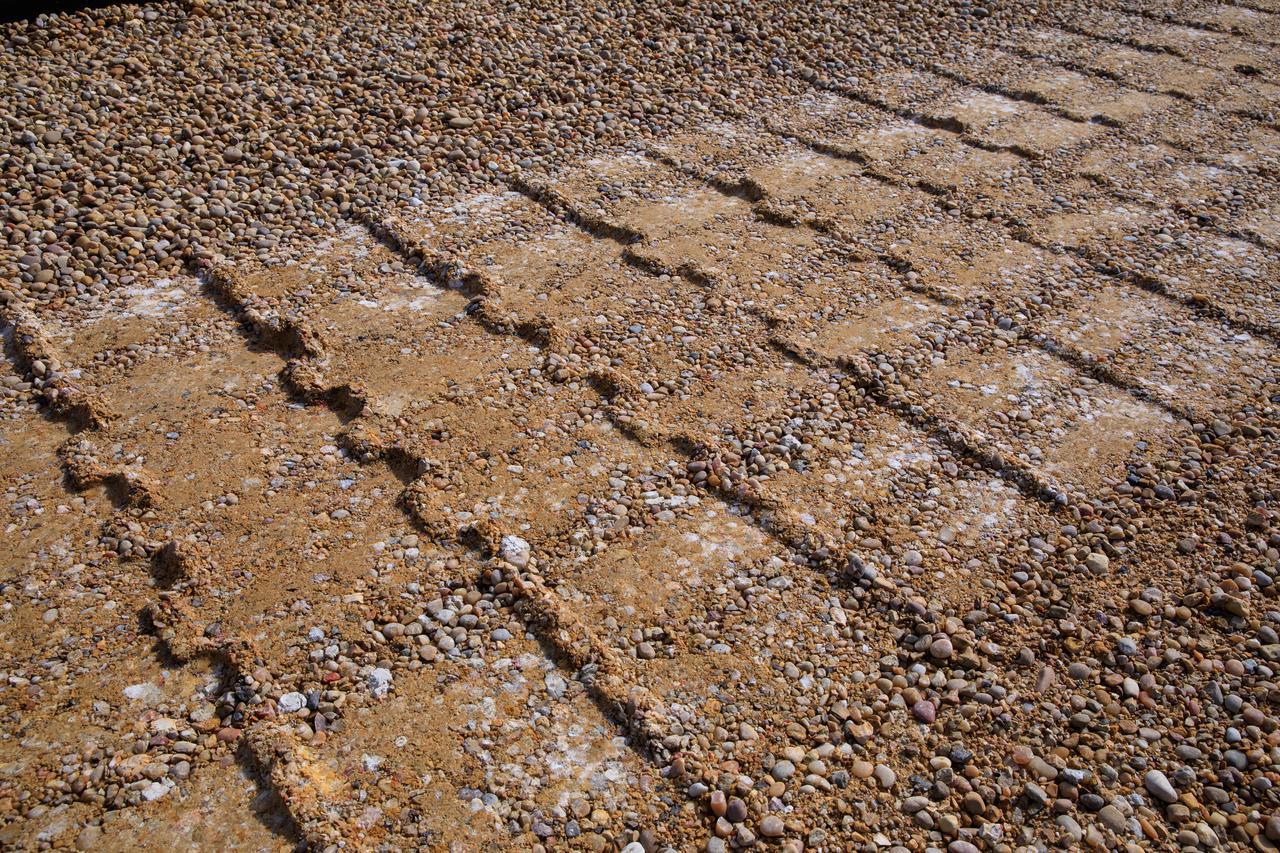
A close-up view of tread marks from crawler-transporter 2 (CT-2) as the behemoth vehicle moves along the crawlerway at NASA’s Kennedy Space Center in Florida on Jan. 22, 2021. Teams are working to ensure the crawlerway, the path the CT-2, mobile launcher, and Space Launch System rocket with Orion atop will take from the Vehicle Assembly Building to Launch Complex 39B, is strong enough to withstand the weight and provide stability for the Artemis I mission. CT-2 carrying mobile launcher platform 1, used during the shuttle program, was driven back and forth on the crawlerway with several cement blocks, each weighing about 40,000 pounds to strengthen the crawlerway for launch. Artemis I will be the first in a series of increasingly complex missions to the Moon. Under the Artemis program, NASA aims to land the first woman and the next man on the Moon in 2024 and establish sustainable lunar exploration by the end of the decade.
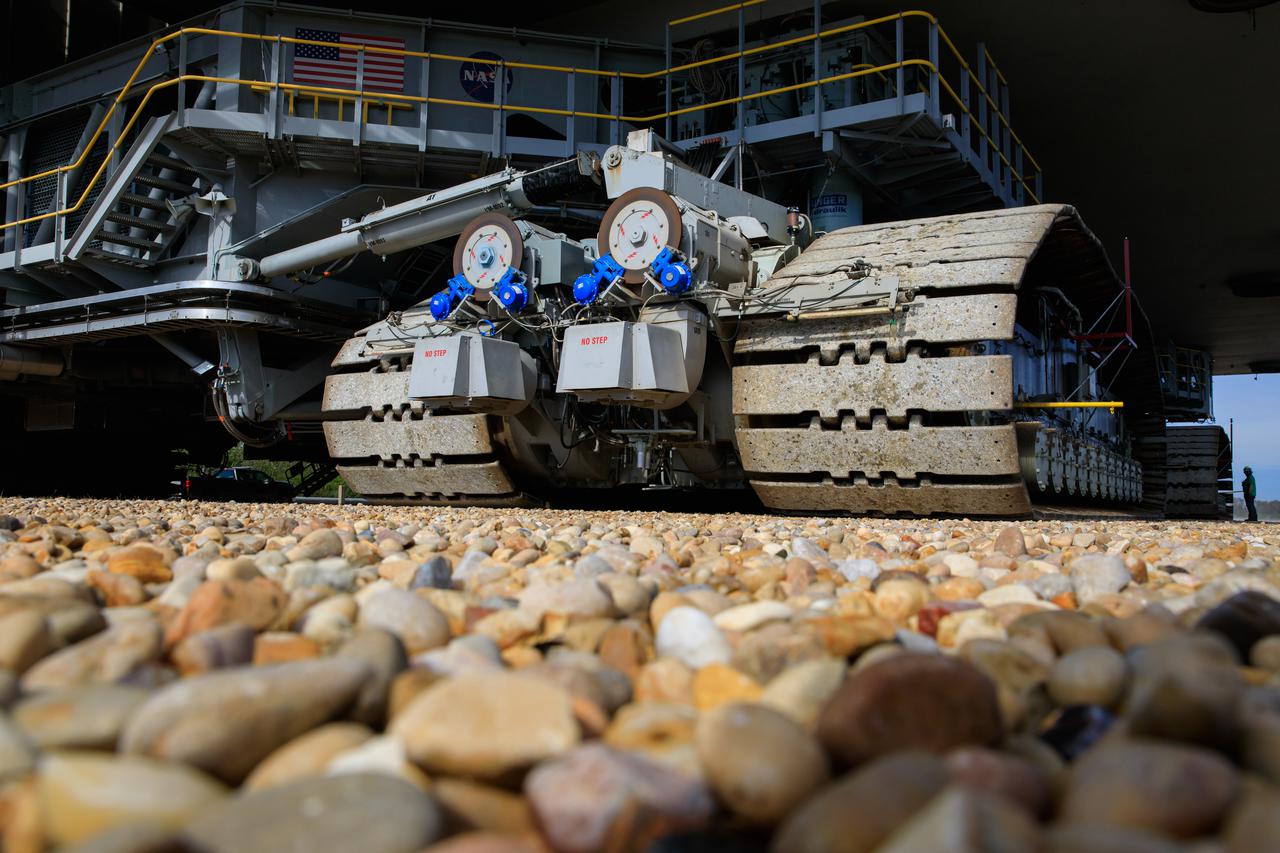
A close-up view of some of the treads on crawler-transporter 2 (CT-2) as the behemoth vehicle moves along the crawlerway at NASA’s Kennedy Space Center in Florida on Jan. 22, 2021. Teams are working to ensure the crawlerway, the path the CT-2, mobile launcher, and Space Launch System rocket with Orion atop will take from the Vehicle Assembly Building to Launch Complex 39B, is strong enough to withstand the weight and provide stability for the Artemis I mission. CT-2 carrying mobile launcher platform 1, used during the shuttle program, was driven back and forth on the crawlerway with several cement blocks, each weighing about 40,000 pounds to strengthen the crawlerway for launch. Artemis I will be the first in a series of increasingly complex missions to the Moon. Under the Artemis program, NASA aims to land the first woman and the next man on the Moon in 2024 and establish sustainable lunar exploration by the end of the decade.
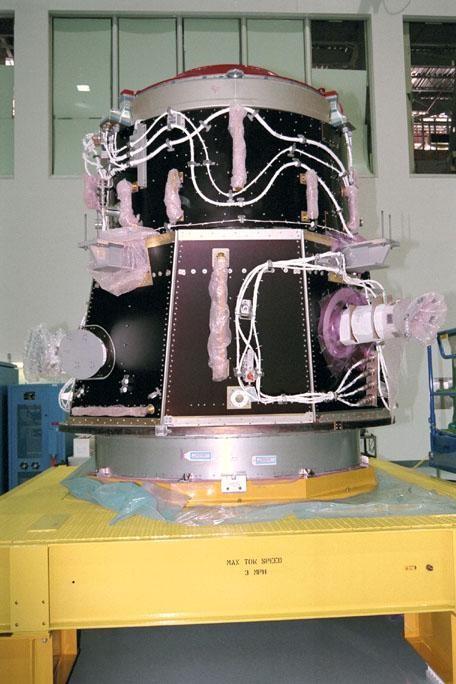
KENNEDY SPACE CENTER, FLA. -- The Pressurized Mating Adapter 2 (PMA 2), part of the first International Space Station (ISS) element to be launched from the U.S., awaits prelaunch processing in the Space Station Processing Facility after its arrival at KSC. PMAs 1 and 2 attached to a component called Node 1, a Station structural building block, will make up the first U.S.-launched ISS element. The Node 1/PMA assembly will provide key connecting points in orbit for other Space Station modules and for docking of the orbiter with the ISS. PMA 1 will provide the interface between U.S. and Russian elements of the Station; PMA 2 will provide a Shuttle orbiter docking area. The Node 1/PMA assembly is targeted for liftoff aboard the Space Shuttle Endeavour on STS-88 in July 1998.
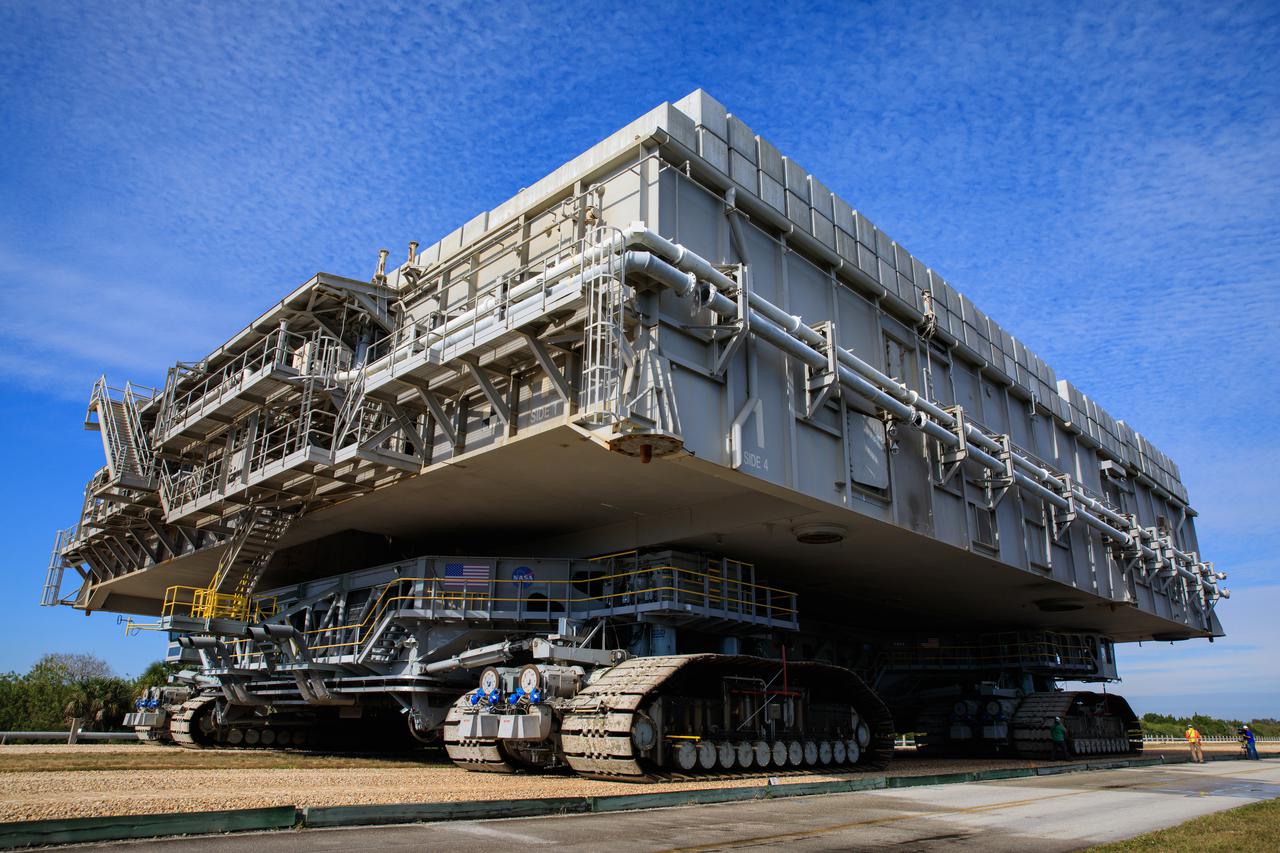
Teams at NASA’s Kennedy Space Center in Florida are working to ensure the crawlerway, the path the crawler-transporter 2 (CT-2), mobile launcher, and Space Launch System rocket with Orion atop will take from the Vehicle Assembly Building to Launch Complex 39B, is strong enough to withstand the weight and provide stability for the Artemis I mission. In this view on Jan. 22, 2021, CT-2 carrying mobile launcher platform 1 that was used during the shuttle program was driven back and forth on the crawlerway with several cement blocks, each weighing about 40,000 pounds to strengthen the crawlerway for launch. Artemis I will be the first in a series of increasingly complex missions to the Moon. Under the Artemis program, NASA aims to land the first woman and the next man on the Moon in 2024 and establish sustainable lunar exploration by the end of the decade.
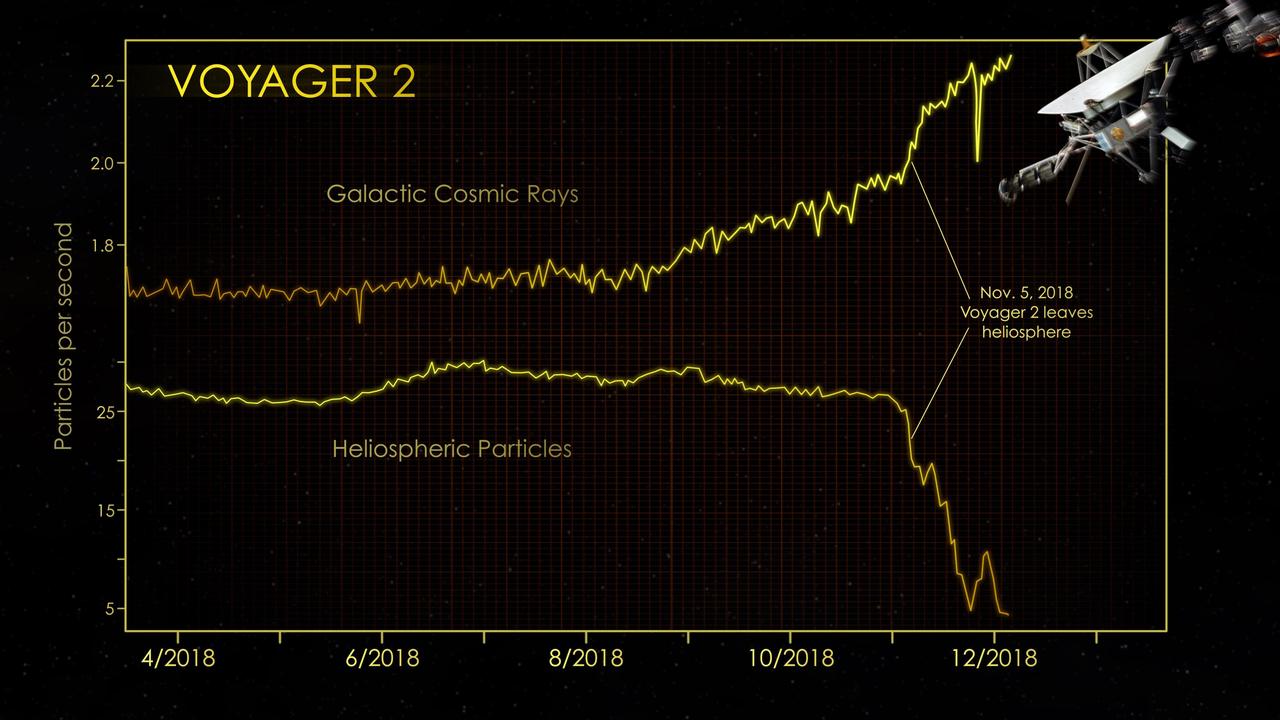
At the end of 2018, the cosmic ray subsystem (CRS) aboard NASA's Voyager 2 spacecraft provided evidence that Voyager 2 had left the heliosphere (the plasma bubble the Sun blows around itself). There were steep drops in the rate at which particles that originate inside the heliosphere hit the instrument's radiation detector. At the same time, there were significant increases in the rate at which particles that originate outside our heliosphere (also known as galactic cosmic rays) hit the detector. The graphs show data from Voyager 2's CRS, which averages the number of particle hits over a six-hour block of time. CRS detects both lower-energy particles that originate inside the heliosphere (greater than 0.5 MeV) and higher-energy particles that originate farther out in the galaxy (greater than 70 MeV). https://photojournal.jpl.nasa.gov/catalog/PIA22924
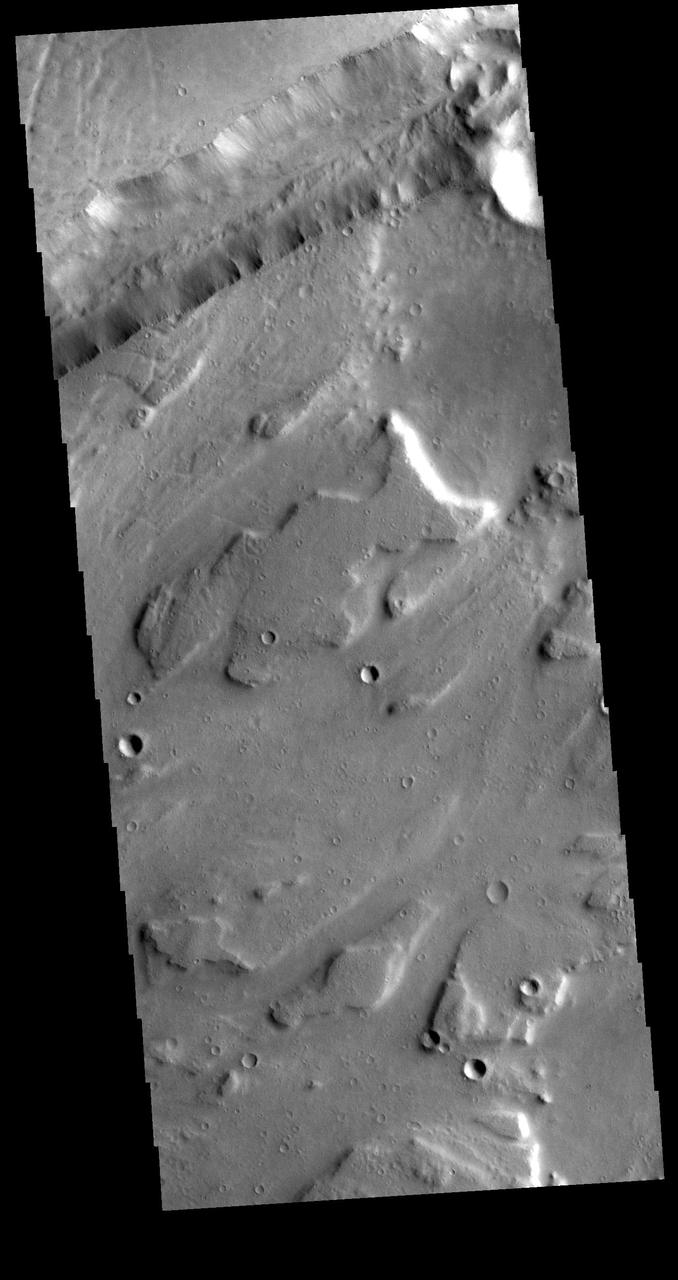
This VIS image shows part of Sacra Mensa, a large mesa located between the north and south channels of Kasei Valles. The linear feature at the top of the image is one of the many graben found in the mesa and surrounding highlands. Graben are formed by the downward motion of a block of material between paired tectonic faults. Sacra Mensa rises 3 km (almost 2 miles) above Kasei Valles. Orbit Number: 79203 Latitude: 26.0793 Longitude: 294.1 Instrument: VIS Captured: 2019-10-22 21:34 https://photojournal.jpl.nasa.gov/catalog/PIA23634
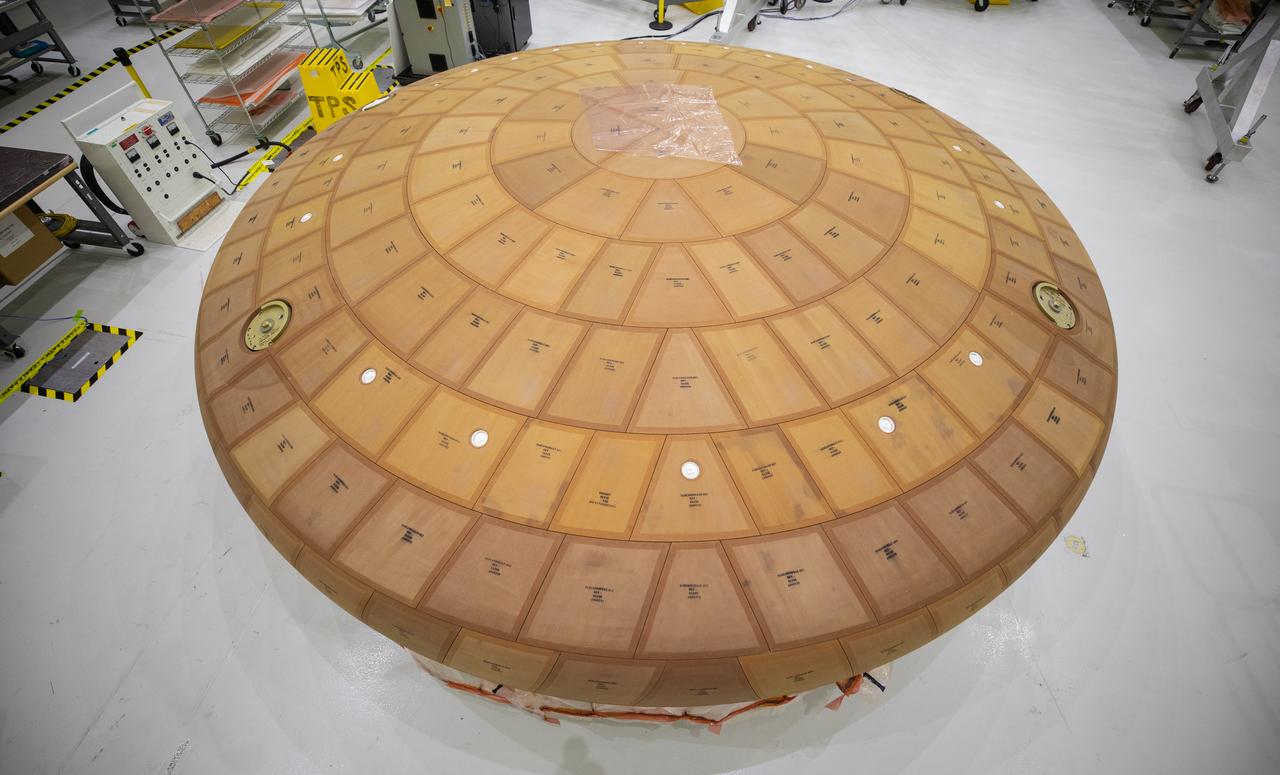
Inside the Neil Armstrong Operations and Checkout Building high bay at NASA's Kennedy Space Center in Florida, the AVOCAT block bonding is complete on the Artemis II heat shield on July 2, 2020. The heat shield is one of the most critical elements of Orion and will protect the capsule and astronauts during reentry through Earth’s atmosphere. Artemis II is the first crewed mission in a series of missions to the Moon and on to Mars. Artemis II will confirm all of the Orion spacecraft’s systems operate as designed in the actual environment of deep space with astronauts aboard. As part of the Artemis Program, NASA will send the first woman and next man to the Moon by 2024.
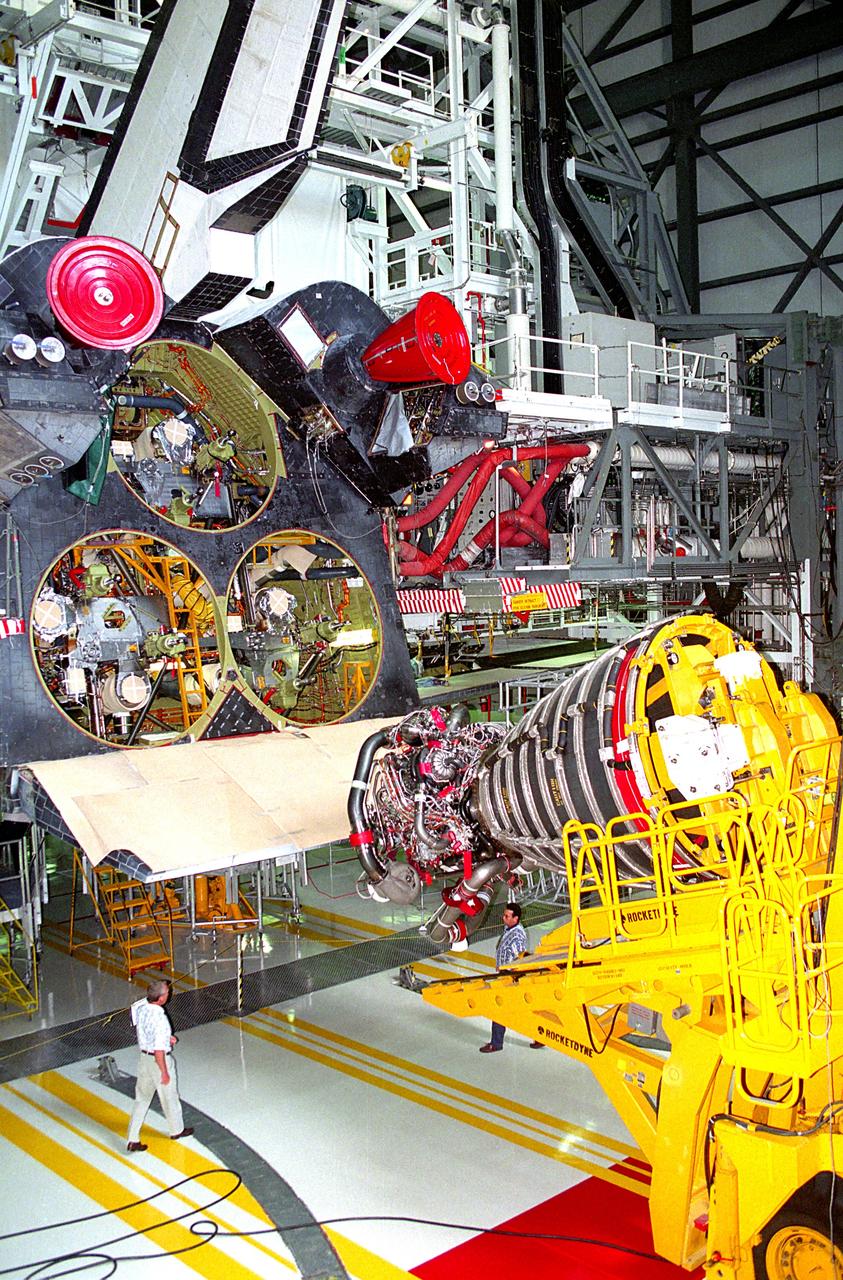
KENNEDY SPACE CENTER, FLA. - A Space Shuttle Main Engine (SSME) hoist prepares to lift the first Block 1 engine to be installed in an orbiter into the number one position on Discovery while the spaceplane is being prepared for the STS-70 mission in the high bay of Orbiter Processing Facility 2. The new engine, SSME No. 2036, features a new high-pressure liquid oxygen turbopump, a two-duct powerhead, a baffleless main injector, a single-coil heat exchanger and start sequence modifications. The other two main engines to be used during the liftoff of the STS-70 mission are of the existing Phase II design.

KENNEDY SPACE CENTER, FLA. -- Workers in the Spacecraft Assembly and Encapsulation Facility 2 move a solar panel toward the Comet Nucleus Tour (CONTOUR) spacecraft (in the background) for installation of the panel. The spacecraft will provide the first detailed look into the heart of a comet -- the nucleus. The spacecraft will fly as close as 60 miles (100 kilometers) to at least two comets and will take the sharpest pictures yet of the nucleus while analyzing the gas and dust that surround these rocky, icy building blocks of the solar system. Launch of CONTOUR aboard a Boeing Delta II rocket is scheduled for July 1 from Launch Pad 17-A, Cape Canaveral Air Force Station

KENNEDY SPACE CENTER, FLA. -- Workers in the Spacecraft Assembly and Encapsulation Facility 2 complete the installation of a solar panel onto the Comet Nucleus Tour (CONTOUR) spacecraft. The spacecraft will provide the first detailed look into the heart of a comet -- the nucleus. The spacecraft will fly as close as 60 miles (100 kilometers) to at least two comets and will take the sharpest pictures yet of the nucleus while analyzing the gas and dust that surround these rocky, icy building blocks of the solar system. Launch of CONTOUR aboard a Boeing Delta II rocket is scheduled for July 1 from Launch Pad 17-A, Cape Canaveral Air Force Station
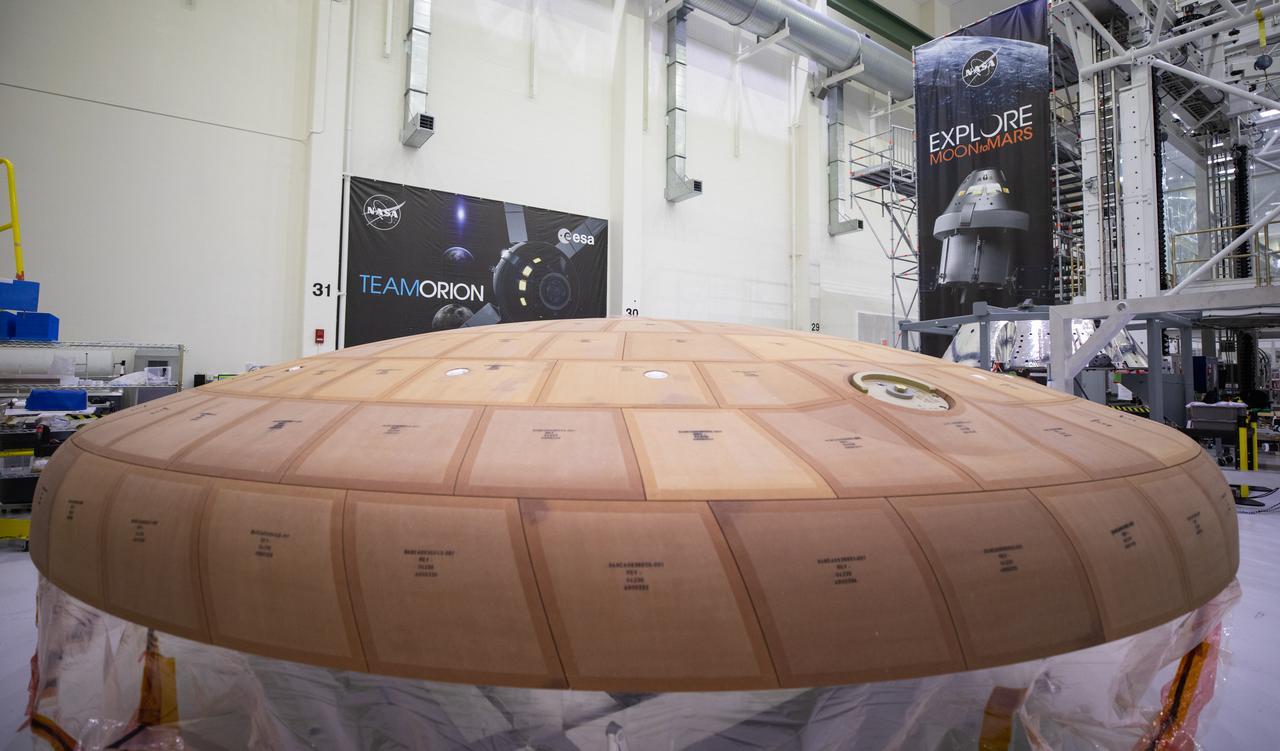
Inside the Neil Armstrong Operations and Checkout Building high bay at NASA's Kennedy Space Center in Florida, the AVCOAT block bonding is complete on the Artemis II heat shield on July 2, 2020. The heat shield is one of the most critical elements of Orion and will protect the capsule and astronauts during reentry through Earth’s atmosphere. Artemis II is the first crewed mission in a series of missions to the Moon and on to Mars. Artemis II will confirm all of the Orion spacecraft’s systems operate as designed in the actual environment of deep space with astronauts aboard. As part of the Artemis Program, NASA will send the first woman and next man to the Moon by 2024.
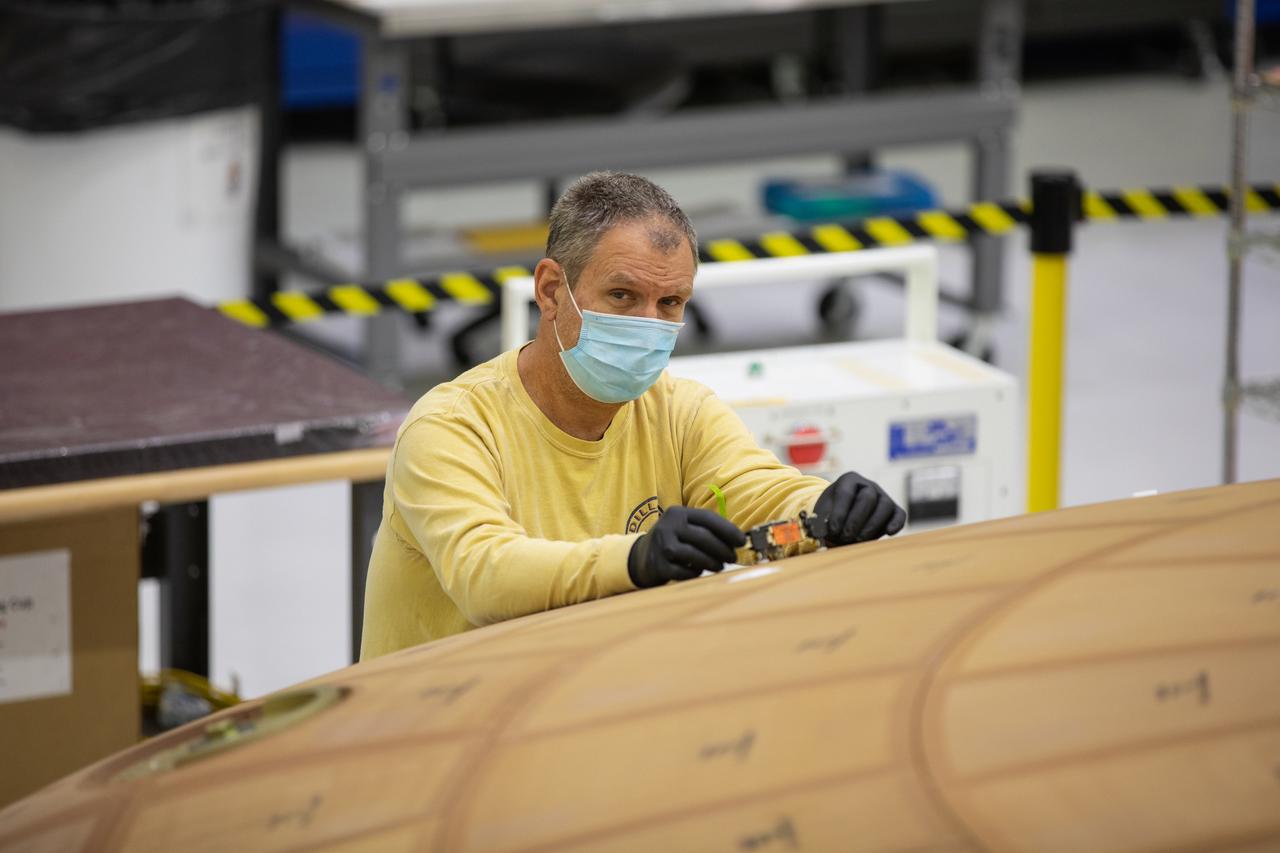
Inside the Neil Armstrong Operations and Checkout Building high bay at NASA's Kennedy Space Center in Florida, technician Kenny Leidner with ASRC Federal, inspects AVCOAT block bonding on the Artemis II heat shield on July 2, 2020. The heat shield is one of the most critical elements of Orion and will protect the capsule and astronauts during reentry through Earth’s atmosphere. Artemis II is the first crewed mission in a series of missions to the Moon and on to Mars. Artemis II will confirm all of the Orion spacecraft’s systems operate as designed in the actual environment of deep space with astronauts aboard. As part of the Artemis Program, NASA will send the first woman and next man to the Moon by 2024.

One of the most actively changing areas on Mars are the steep edges of the North Polar layered deposits. This image from NASA's Mars Reconnaissance Orbiter (MRO) shows many new ice blocks compared to an earlier image in December 2006. An animation shows one example, where a section of ice cliff collapsed. The older image (acquired in bin-2 mode) is not as sharp as the newer one. HiRISE has been re-imaging regions first photographed in 2006 through 2007, six Mars years ago. This long baseline allows us to see large, rare changes as well as many smaller changes. More information is available at https://photojournal.jpl.nasa.gov/catalog/PIA22535

KENNEDY SPACE CENTER, FLA. -- In the Spacecraft Assembly and Encapsulation Facility 2, a lighting test is being conducted on the solar panels on the Comet Nucleus Tour (CONTOUR) spacecraft. The spacecraft will provide the first detailed look into the heart of a comet -- the nucleus. The spacecraft will fly as close as 60 miles (100 kilometers) to at least two comets and will take the sharpest pictures yet of the nucleus while analyzing the gas and dust that surround these rocky, icy building blocks of the solar system. Launch of CONTOUR aboard a Boeing Delta II rocket is scheduled for July 1 from Launch Pad 17-A, Cape Canaveral Air Force Station
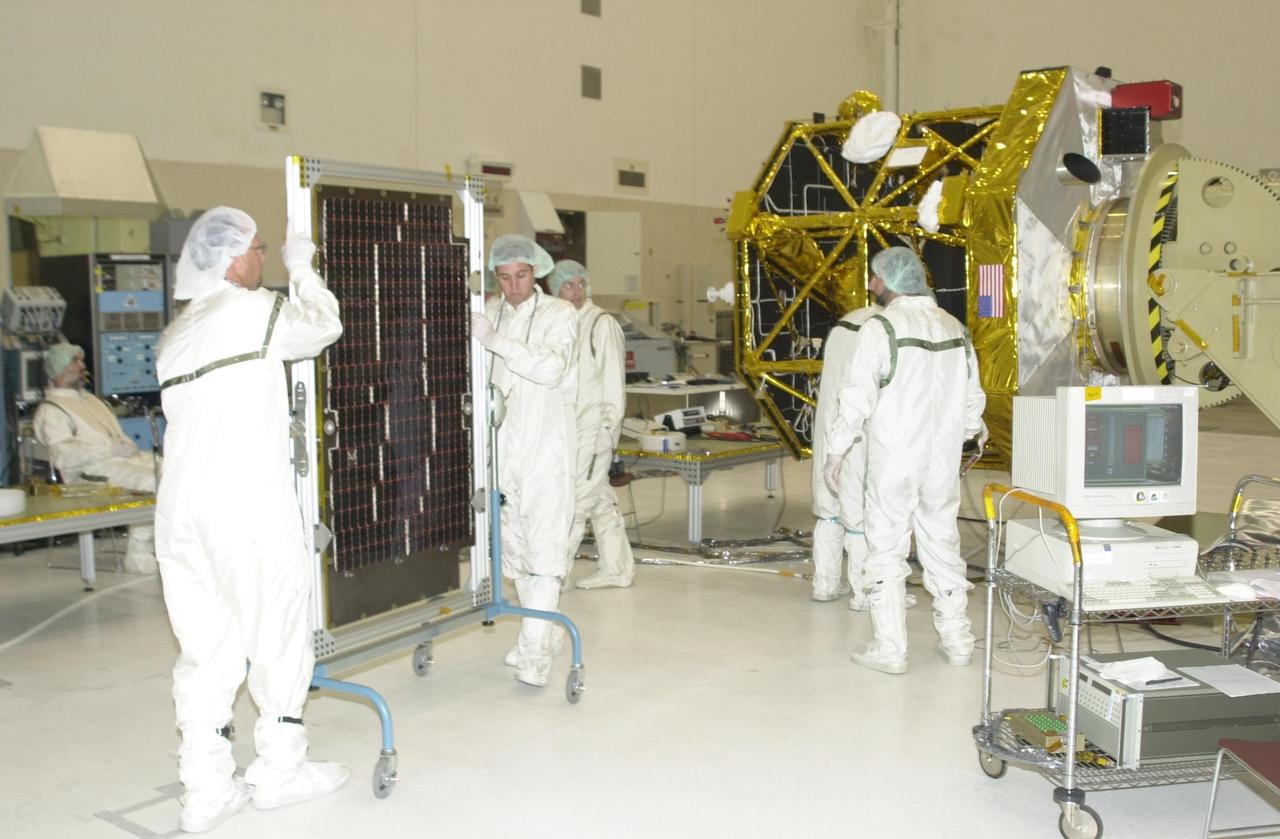
KENNEDY SPACE CENTER, FLA. -- Workers in the Spacecraft Assembly and Encapsulation Facility 2 move a solar panel toward the Comet Nucleus Tour (CONTOUR) spacecraft (in the background) for installation. The spacecraft will provide the first detailed look into the heart of a comet -- the nucleus. The spacecraft will fly as close as 60 miles (100 kilometers) to at least two comets and will take the sharpest pictures yet of the nucleus while analyzing the gas and dust that surround these rocky, icy building blocks of the solar system. Launch of CONTOUR aboard a Boeing Delta II rocket is scheduled for July 1 from Launch Pad 17-A, Cape Canaveral Air Force Station
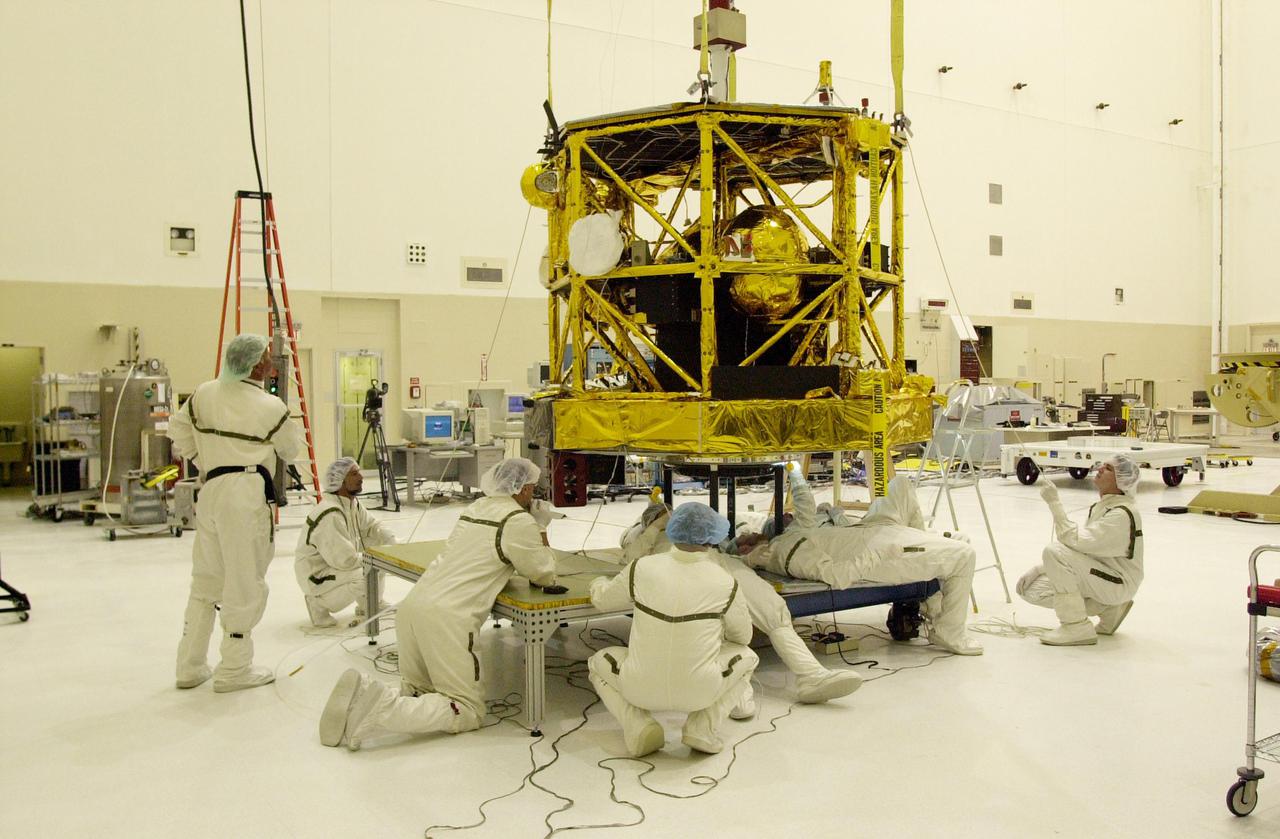
KENNEDY SPACE CENTER, FLA. -- In the Spacecraft Assembly and Encapsulation Facility 2, workers watch closely as the CONTOUR spacecraft is lowered into place over the apogee kick motor to which it will be attached. CONTOUR will provide the first detailed look into the heart of a comet -- the nucleus. The spacecraft will fly close to at least two comets, Encke and Schwassmann-Wachmann 3, taking pictures of the nucleus while analyzing the gas and dust that surround these rocky, icy building blocks of the solar system. The Applied Physics Laboratory of Johns Hopkins University, Baltimore, Md., built CONTOUR and will also be in control of the spacecraft after launch, scheduled for July 1, 2002, from LC 17A at Cape Canaveral Air Force Station
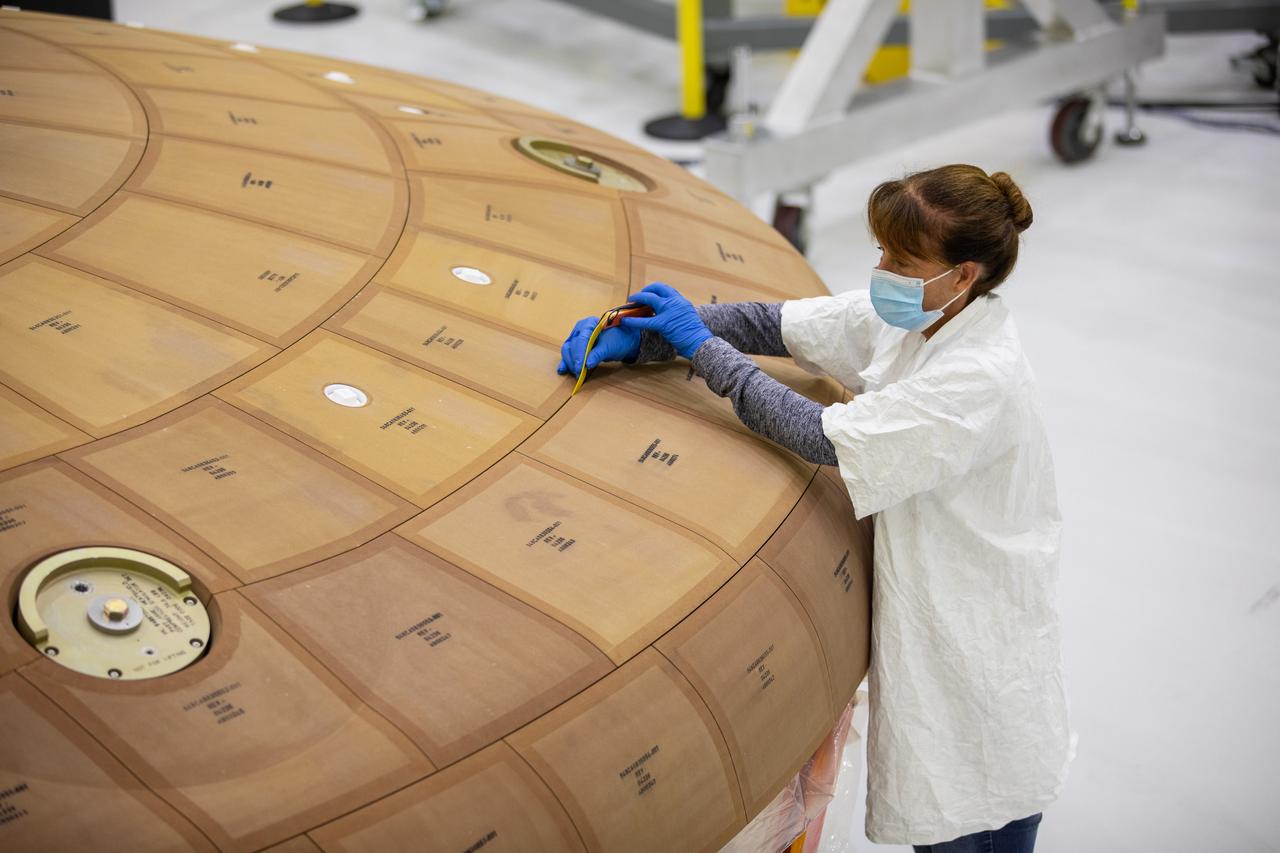
Inside the Neil Armstrong Operations and Checkout Building high bay at NASA's Kennedy Space Center in Florida, Darlene Beville with ASRC Federal, inspects AVOCAT block bonding on the Artemis II heat shield on July 2, 2020. The heat shield is one of the most critical elements of Orion and will protect the capsule and astronauts during reentry through Earth’s atmosphere. Artemis II is the first crewed mission in a series of missions to the Moon and on to Mars. Artemis II will confirm all of the Orion spacecraft’s systems operate as designed in the actual environment of deep space with astronauts aboard. As part of the Artemis Program, NASA will send the first woman and next man to the Moon by 2024.
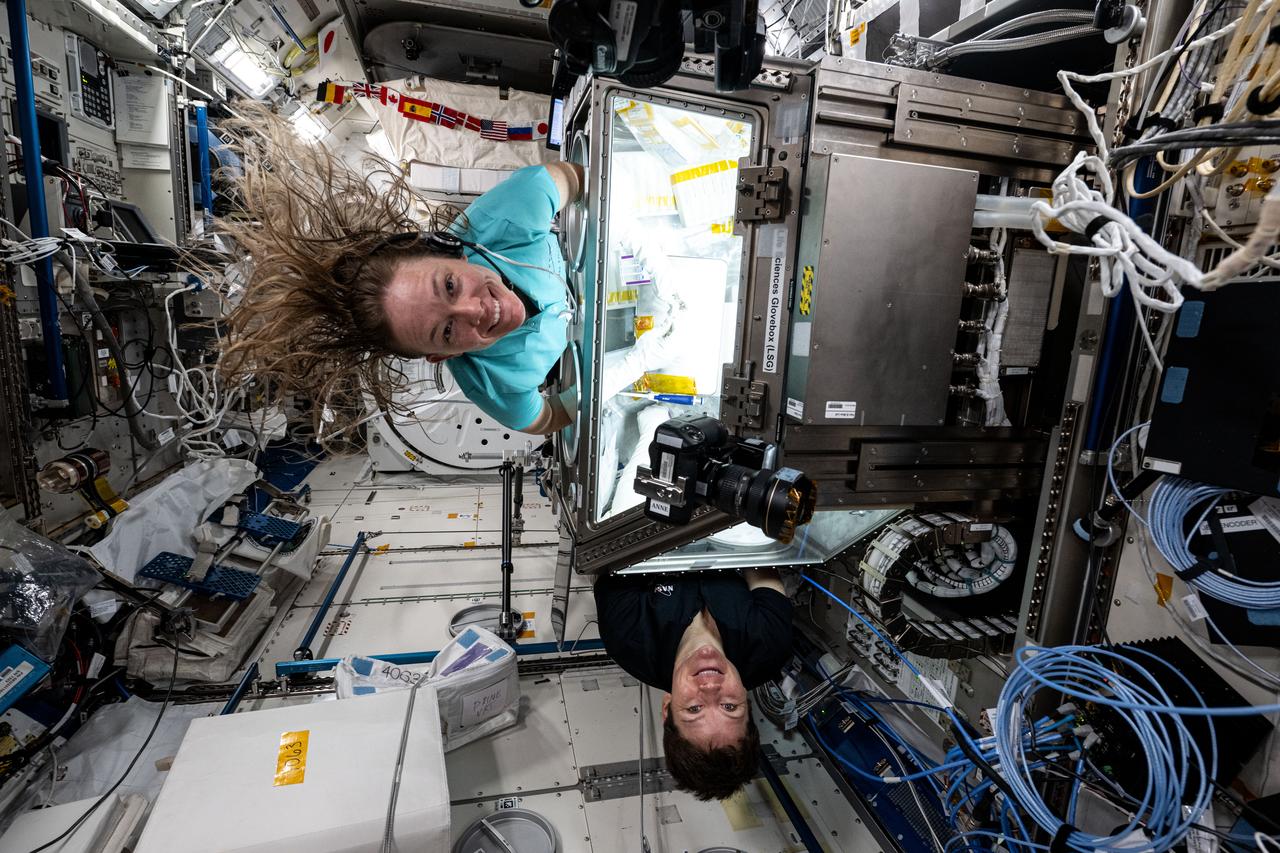
iss073e0001816 (4/25/2025) --- NASA astronauts Anne McClain, top, and Nichole Ayers, right, use the space station’s Microgravity Science Glovebox to work on DNA Nano Therapeutics-Mission 2. This investigation tests in-space production of special DNA-inspired nanomaterial building blocks and evaluates whether they reduce joint inflammation and help regenerate cartilage lost due to arthritis. These materials are less toxic, more stable, and more compatible with living tissues than current drug delivery technologies and could provide relief to patients with fewer side effects.
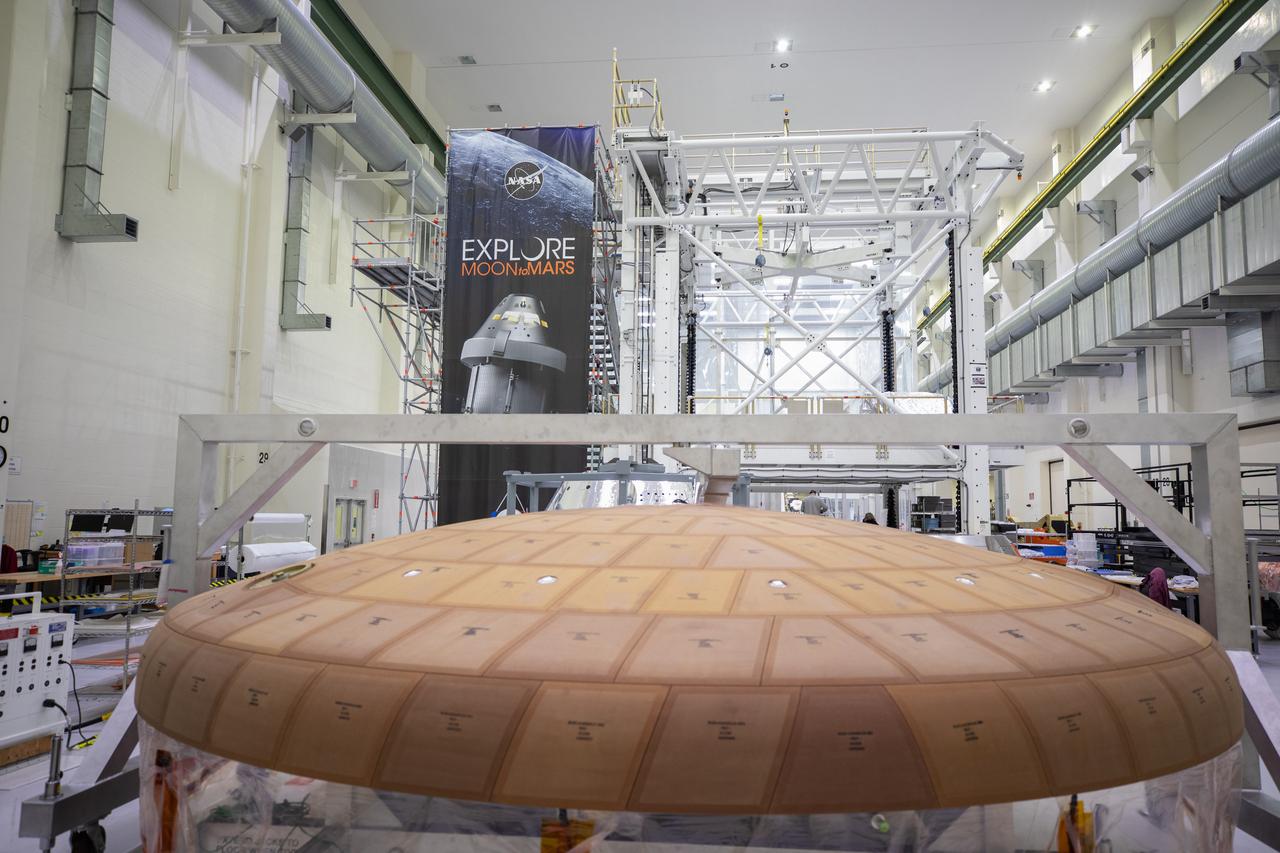
Inside the Neil Armstrong Operations and Checkout Building high bay at NASA's Kennedy Space Center in Florida, the AVCOAT block bonding is complete on the Artemis II heat shield on July 2, 2020. The heat shield is one of the most critical elements of Orion and will protect the capsule and astronauts during reentry through Earth’s atmosphere. Artemis II is the first crewed mission in a series of missions to the Moon and on to Mars. Artemis II will confirm all of the Orion spacecraft’s systems operate as designed in the actual environment of deep space with astronauts aboard. As part of the Artemis Program, NASA will send the first woman and next man to the Moon by 2024.
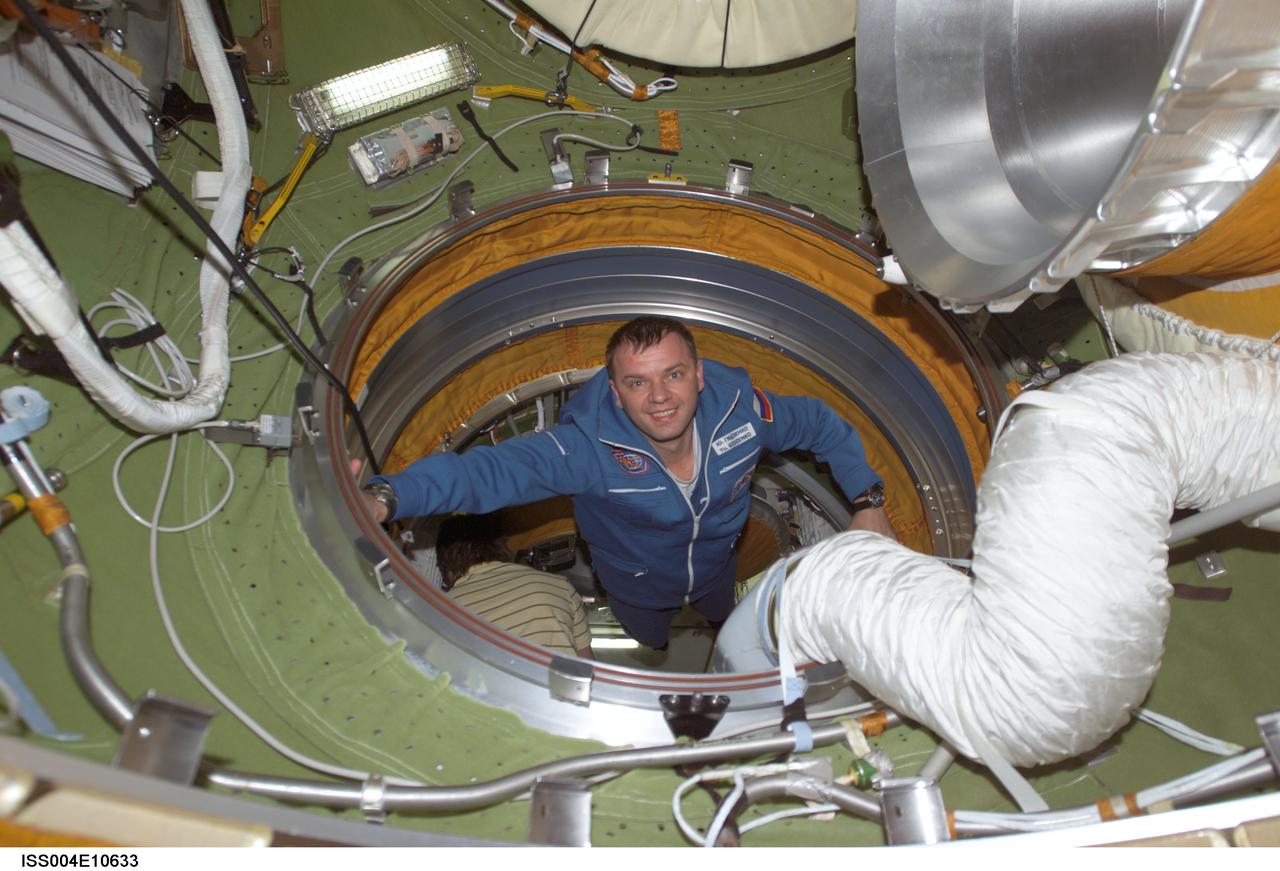
ISS004-E-10633 (27 April 2002) --- Soyuz Taxi Commander Yuri Gidzenko, representing Rosaviakosmos, enters the functional cargo block’s (FGB) pressurized adapter on the International Space Station (ISS). Gidzenko, who is making his third flight into space, is the first former resident of the ISS to return to the complex, having been a member of the Expedition One crew, the first crew to live aboard the station. The “taxi” crew arrived at the orbital outpost on April 27, 2002 at 2:56 a.m. (CDT) as the two vehicles flew over Central Asia.
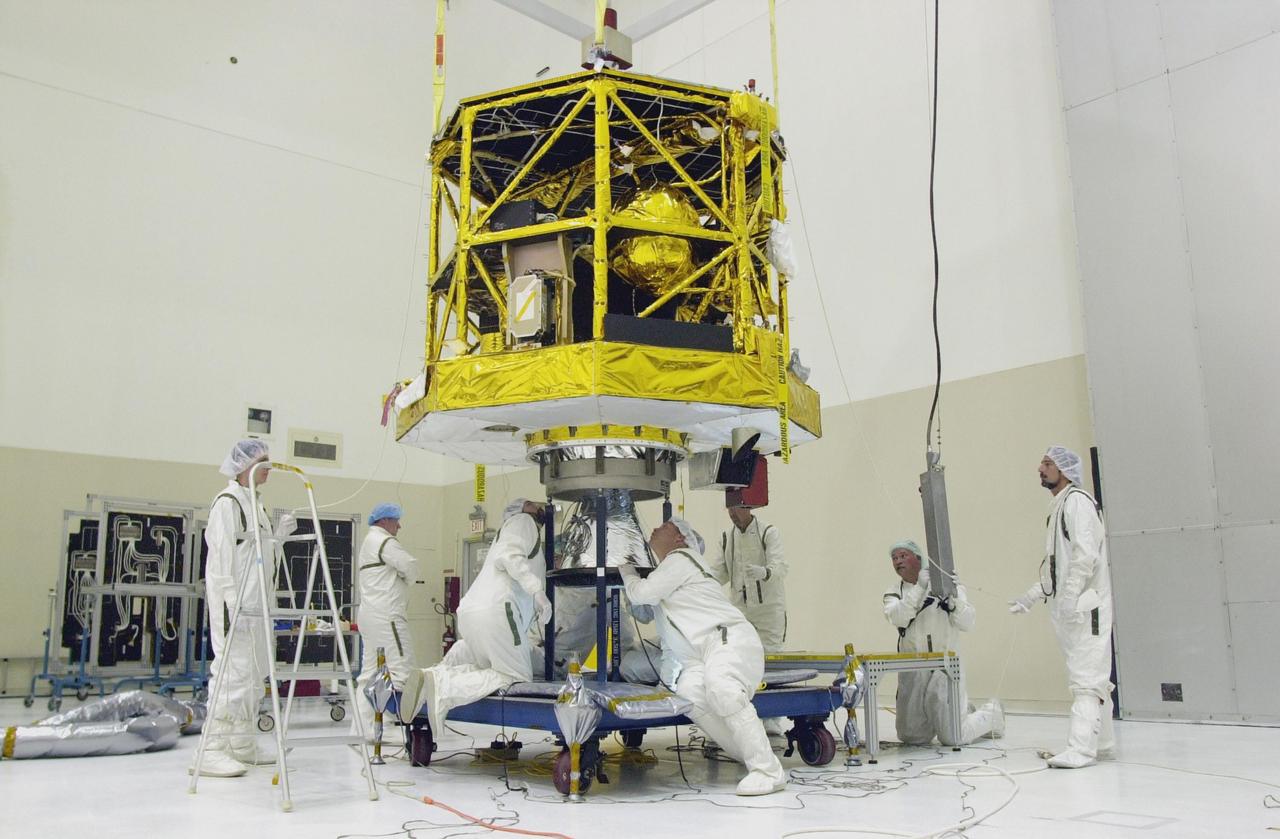
KENNEDY SPACE CENTER, FLA. - Workers in the Spacecraft Assembly and Encapsulation Facility 2 check the position of the CONTOUR spacecraft as it is lowered over the apogee kick motor to which it will be attached. CONTOUR will provide the first detailed look into the heart of a comet -- the nucleus. The spacecraft will fly close to at least two comets, Encke and Schwassmann-Wachmann 3, taking pictures of the nucleus while analyzing the gas and dust that surround these rocky, icy building blocks of the solar system. The Applied Physics Laboratory of Johns Hopkins University, Baltimore, Md., built CONTOUR and will also be in control of the spacecraft after launch, scheduled for July 1, 2002, from LC 17A at Cape Canaveral Air Force Station
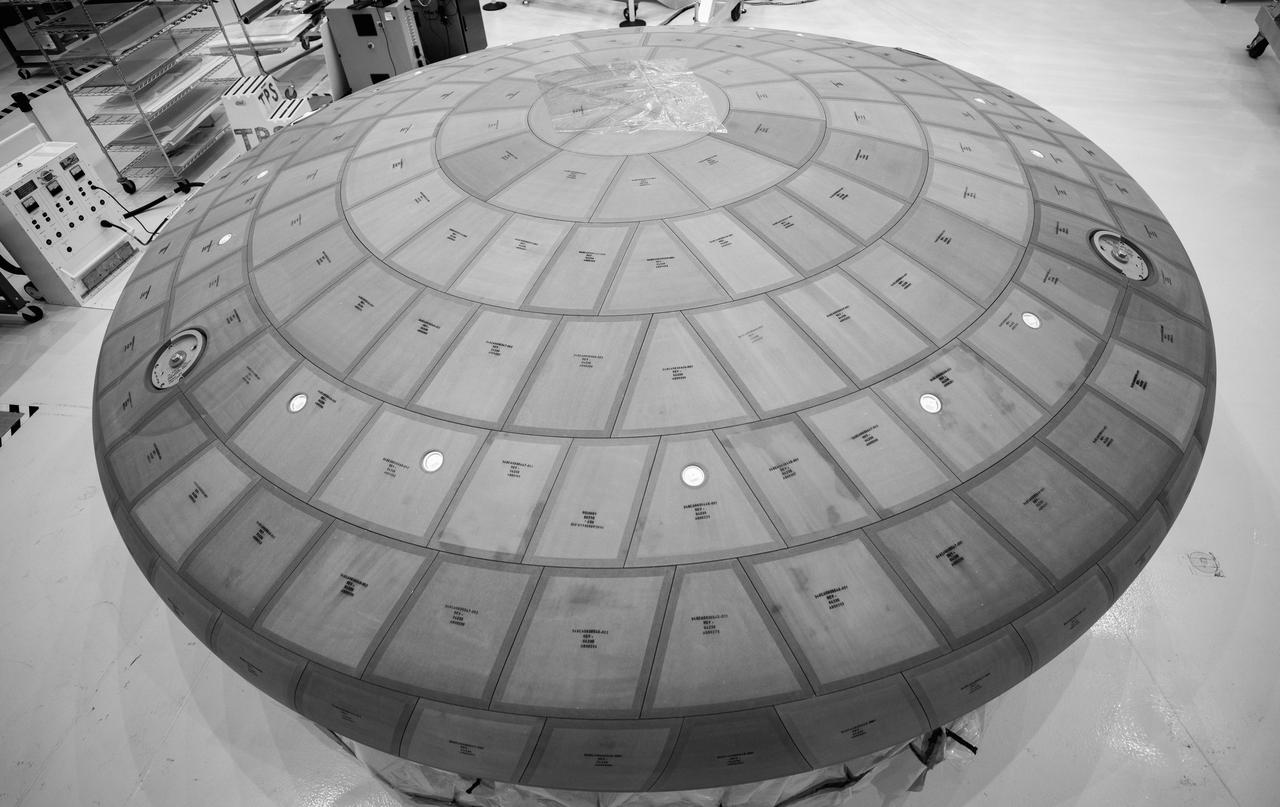
Inside the Neil Armstrong Operations and Checkout Building high bay at NASA's Kennedy Space Center in Florida, the AVOCAT block bonding is complete on the Artemis II heat shield on July 2, 2020. The heat shield is one of the most critical elements of Orion and will protect the capsule and astronauts during reentry through Earth’s atmosphere. Artemis II is the first crewed mission in a series of missions to the Moon and on to Mars. Artemis II will confirm all of the Orion spacecraft’s systems operate as designed in the actual environment of deep space with astronauts aboard. As part of the Artemis Program, NASA will send the first woman and next man to the Moon by 2024.