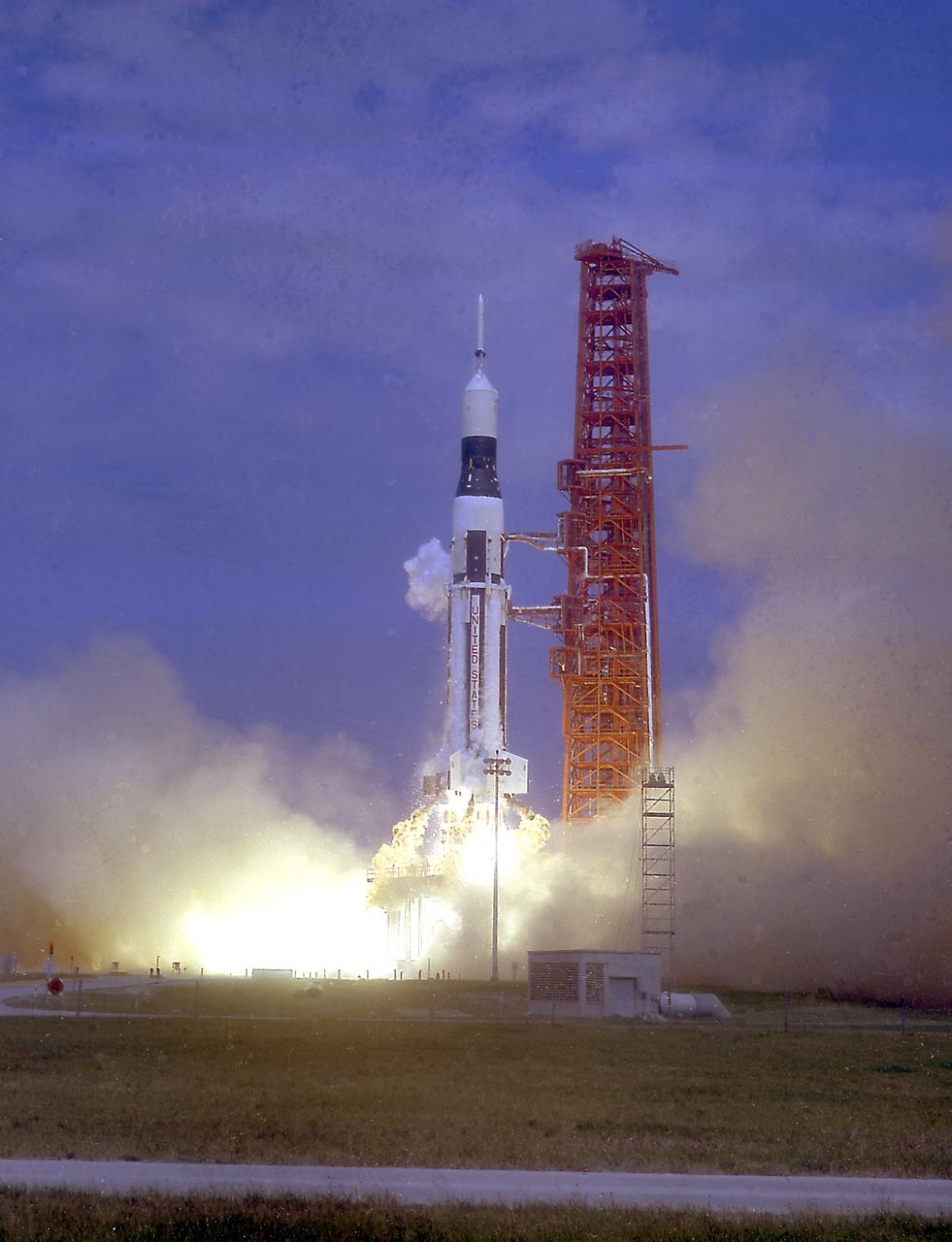
The launch of the SA-7 (Saturn I Block II) was on September 18, 1964. The SA-7 mission was the second orbital flight of the S-IV stage (second stage) with the payload consisting of the Apollo command and service module's instrument unit. The Saturn I Block II vehicle had two live stages, and were basically in the two-stage configuration of the Saturn I vehicle. While the tank arrangement and the engine patterns were the same, there were marked changes between the Block I and II versions. The first stage (S-I stage) was an improved version of the Block I S-I stage. The Block II S-1 stage had eight fins added for greater aerodynamic stability in the lower atmosphere.
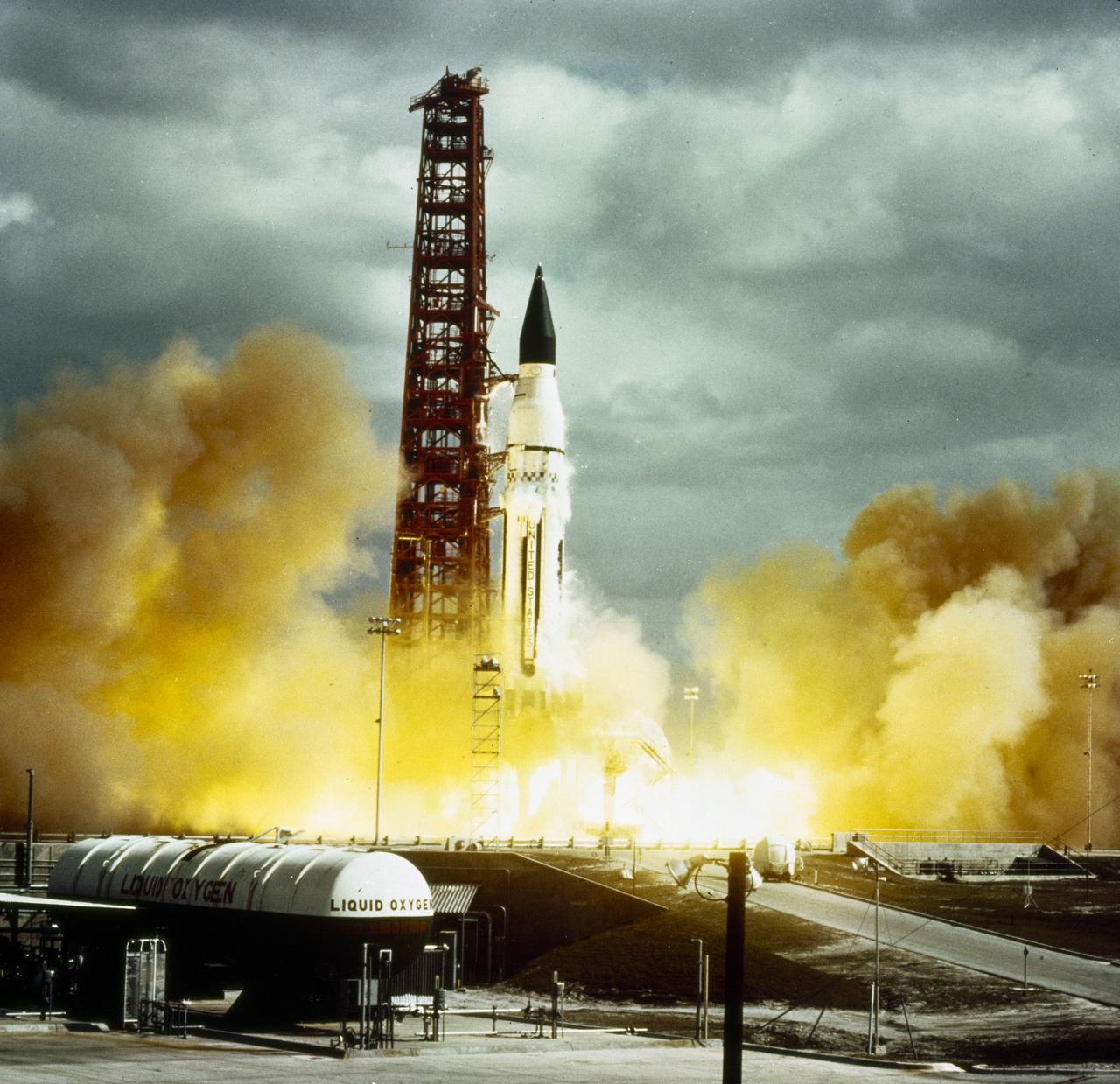
Developed at MSFC under the direction of Dr. Wernher von Braun, the SA-5 incorporated a Saturn I, Block II engine. Launched on January 29, 1964, SA-5 was the first two stage (Block II) Saturn with orbital capability and performed the first test of Instrument Unit and successful stage separation. Block II vehicles had two live stages, and were basically in the two-stage configuration of the Saturn I vehicle. There were marked changes between the Block I and II versions. The Block II S-I stage had eight fins added for greater aerodynamic stability in the lower atmosphere. All Block II H-1 engines had a thrust of 188,000 pounds each for a combined thrust over 1,500,000 pounds. The Block II second stage (S-IV) had six RL-10 hydrogen-oxygen engines, each producing a thrust of 15,000 pounds for a total combined thrust of 90,000 pounds. A motion picture camera capsule loated on stage I was successful recovered.
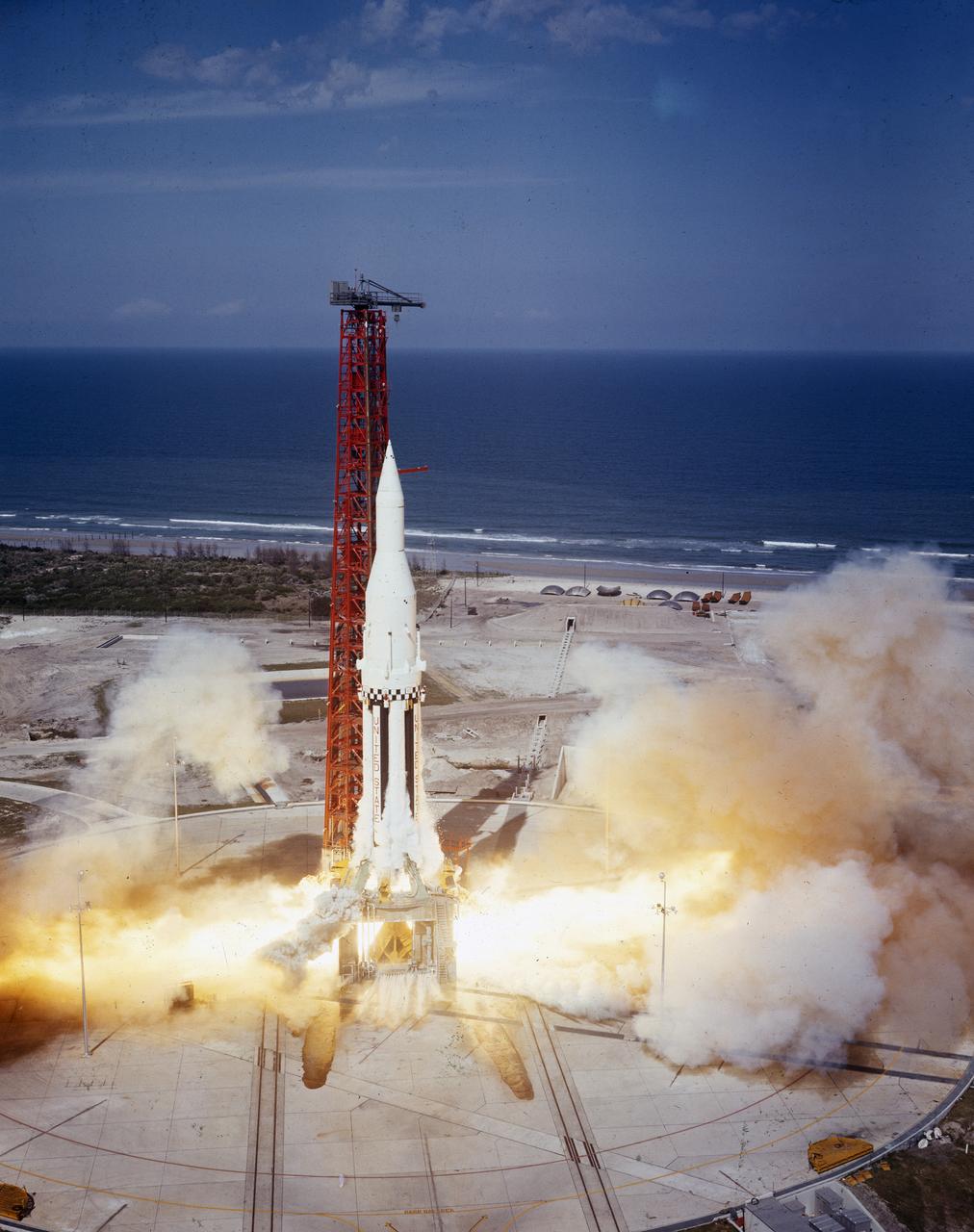
The Saturn I (SA-4) flight lifted off from Kennedy Space Center launch Complex 34, March 28, 1963. The fourth launch of Saturn launch vehicles developed at the Marshall Space Flight Center (MSFC), under the direction of Dr. Wernher von Braun, incorporated a Saturn I, Block I engine. The typical height of a Block I vehicle was approximately 163 feet and had only one live stage. It consisted of eight tanks, each 70 inches in diameter, clustered around a central tank, 105 inches in diameter. Four of the external tanks were fuel tanks for the RP-1 (kerosene) fuel. The other four, spaced alternately with the fuel tanks, were liquid oxygen tanks as was the large center tank. All fuel tanks and liquid oxygen tanks drained at the same rates respectively. The thrust for the stage came from eight H-1 engines, each producing a thrust of 165,000 pounds, for a total thrust of over 1,300,000 pounds. The engines were arranged in a double pattern. Four engines, located inboard, were fixed in a square pattern around the stage axis and canted outward slightly, while the remaining four engines were located outboard in a larger square pattern offset 40 degrees from the inner pattern. Unlike the inner engines, each outer engine was gimbaled. That is, each could be swung through an arc. They were gimbaled as a means of steering the rocket, by letting the instrumentation of the rocket correct any deviations of its powered trajectory. The block I required engine gimabling as the only method of guiding and stabilizing the rocket through the lower atmosphere. The upper stages of the Block I rocket reflected the three-stage configuration of the Saturn I vehicle. Like SA-3, the SA-4 flight’s upper stage ejected 113,560 liters (30,000 gallons) of ballast water in the upper atmosphere for "Project Highwater" physics experiment. Release of this vast quantity of water in a near-space environment marked the second purely scientific large-scale experiment. The SA-4 was the last Block I rocket launch.
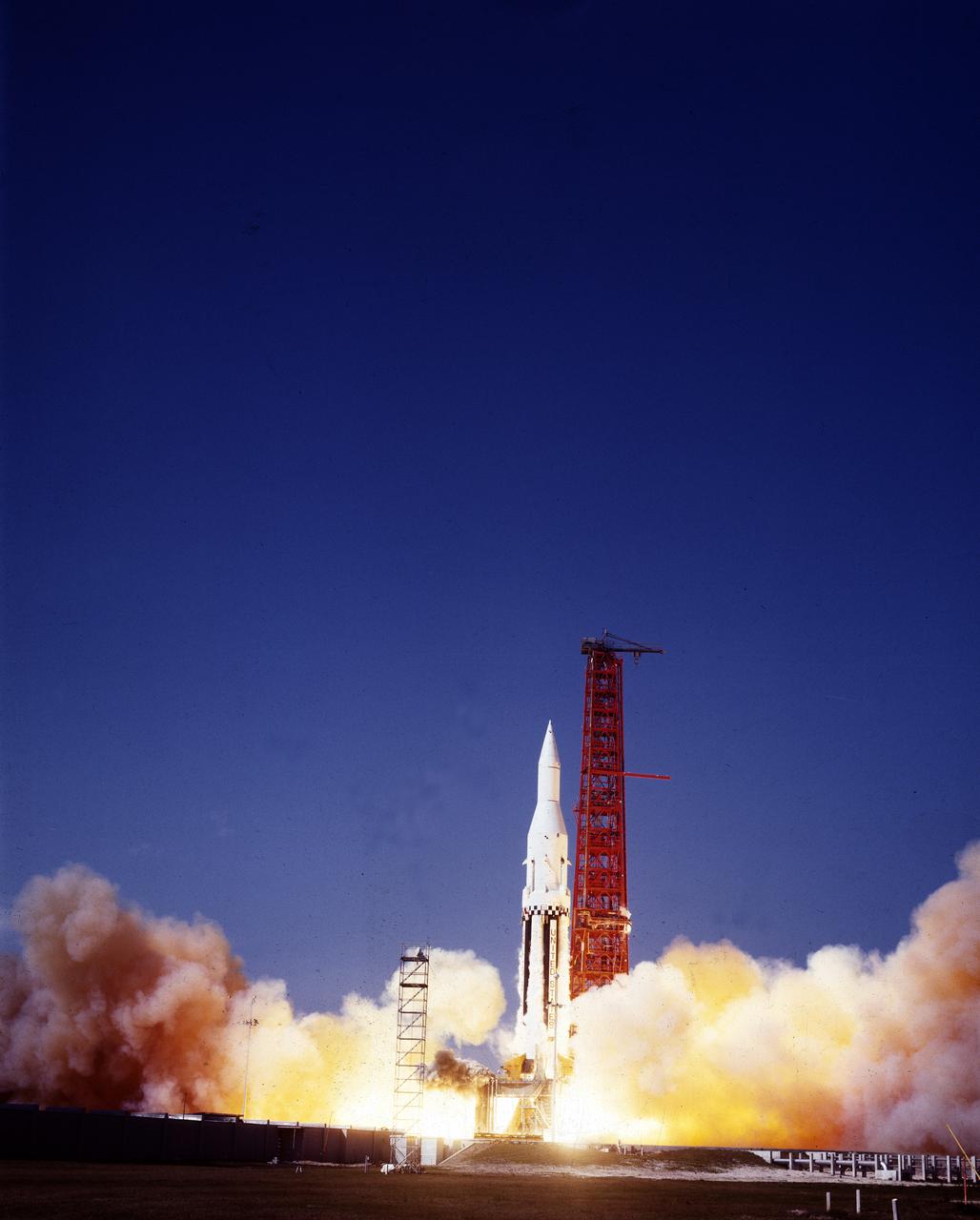
The Saturn I (SA-4) flight lifted off from Kennedy Space Center launch Complex 34, March 28, 1963. The fourth launch of Saturn launch vehicles, developed at the Marshall Space Flight Center (MSFC) under the direction of Dr. Wernher von Braun, incorporated a Saturn I, Block I engine. The typical height of a Block I vehicle was approximately 163 feet and had only one live stage. It consisted of eight tanks, each 70 inches in diameter, clustered around a central tank, 105 inches in diameter. Four of the external tanks were fuel tanks for the RP-1 (kerosene) fuel. The other four, spaced alternately with the fuel tanks, were liquid oxygen tanks as was the large center tank. All fuel tanks and liquid oxygen tanks drained at the same rates respectively. The thrust for the stage came from eight H-1 engines, each producing a thrust of 165,000 pounds, for a total thrust of over 1,300,000 pounds. The engines were arranged in a double pattern. Four engines, located inboard, were fixed in a square pattern around the stage axis and canted outward slightly, while the remaining four engines were located outboard in a larger square pattern offset 40 degrees from the inner pattern. Unlike the inner engines, each outer engine was gimbaled. That is, each could be swung through an arc. They were gimbaled as a means of steering the rocket, by letting the instrumentation of the rocket correct any deviations of its powered trajectory. The block I required engine gimabling as the only method of guiding and stabilizing the rocket through the lower atmosphere. The upper stages of the Block I rocket reflected the three-stage configuration of the Saturn I vehicle. Like SA-3, the SA-4 flight’s upper stage ejected 113,560 liters (30,000 gallons) of ballast water in the upper atmosphere for "Project Highwater" physics experiment. Release of this vast quantity of water in a near-space environment marked the second purely scientific large-scale experiment. The SA-4 was the last Block I rocket launch.
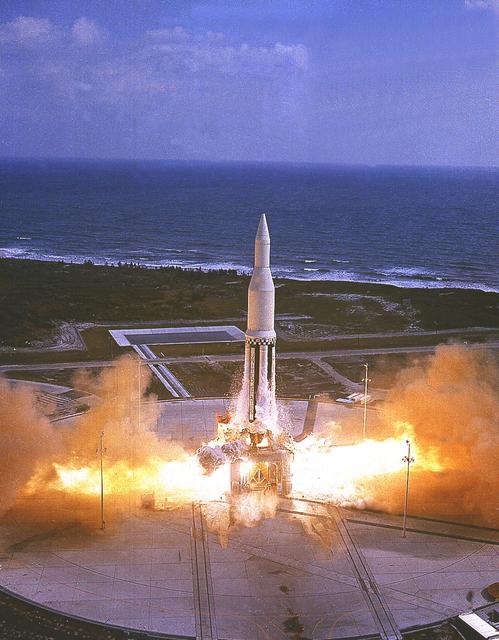
The Marshall Space Flight Center's first Saturn I vehicle, SA-1, lifts off from Cape Canaveral, Florida, on October 27, 1961. This early configuration, Saturn I Block I, 162 feet tall and weighing 460 tons, consisted of the eight H-1 engines S-I stage and the dummy second stage (S-IV stage).
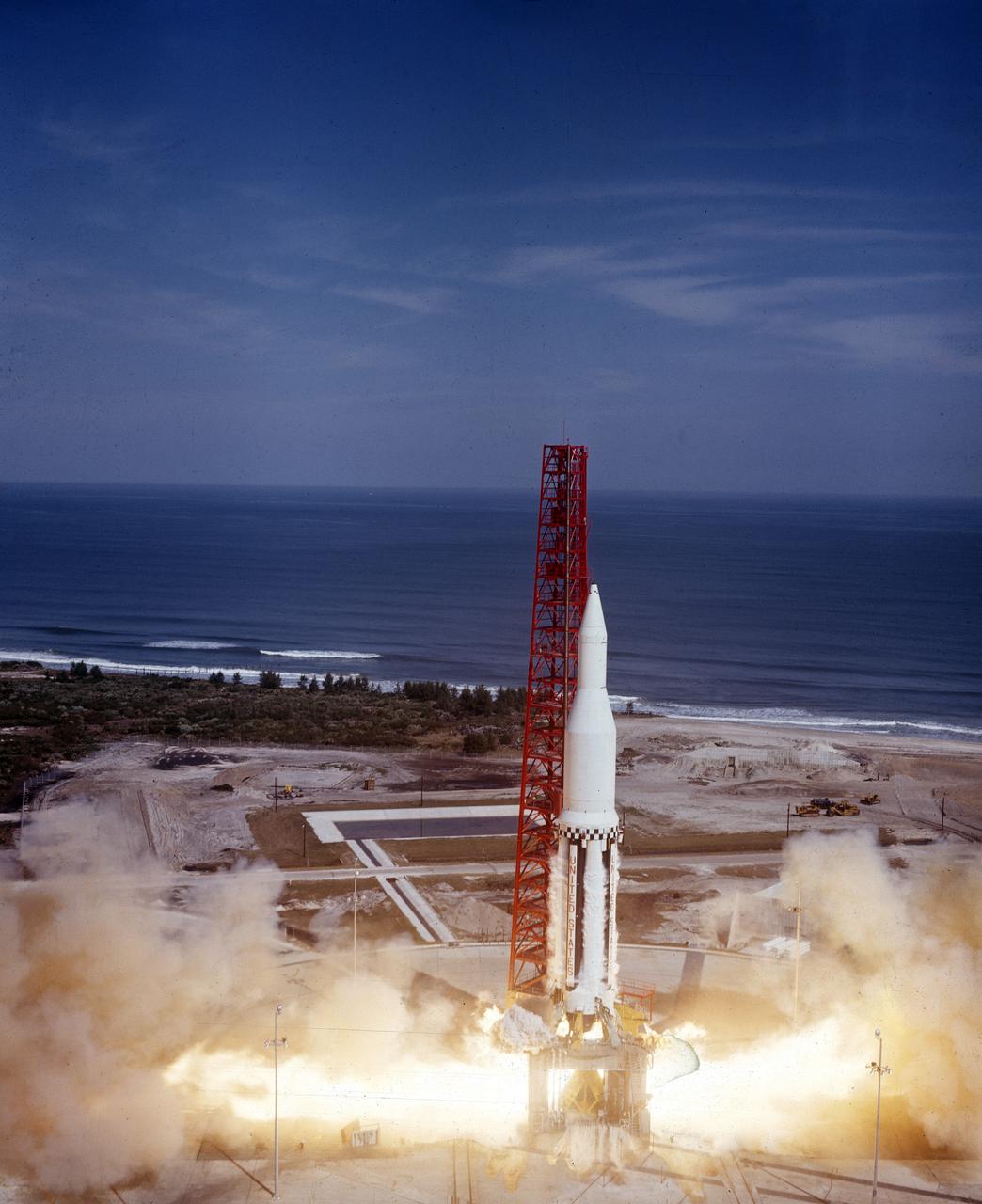
The Saturn I (SA-3) flight lifted off from Kennedy Space Center launch Complex 34, November 16, 1962. The third launch of Saturn launch vehicles, developed at the Marshall Space Flight Center (MSFC) under the direction of Dr. Wernher von Braun, incorporated a Saturn I, Block I engine. The typical height of a Block I vehicle was approximately 163 feet. and had only one live stage. It consisted of eight tanks, each 70 inches in diameter, clustered around a central tank, 105 inches in diameter. Four of the external tanks were fuel tanks for the RP-1 (kerosene) fuel. The other four, spaced alternately with the fuel tanks, were liquid oxygen tanks as was the large center tank. All fuel tanks and liquid oxygen tanks drained at the same rates respectively. The thrust for the stage came from eight H-1 engines, each producing a thrust of 165,000 pounds, for a total thrust of over 1,300,000 pounds. The engines were arranged in a double pattern. Four engines, located inboard, were fixed in a square pattern around the stage axis and canted outward slightly, while the remaining four engines were located outboard in a larger square pattern offset 40 degrees from the inner pattern. Unlike the inner engines, each outer engine was gimbaled. That is, each could be swung through an arc. They were gimbaled as a means of steering the rocket, by letting the instrumentation of the rocket correct any deviations of its powered trajectory. The block I required engine gimabling as the only method of guiding and stabilizing the rocket through the lower atmosphere. The upper stages of the Block I rocket reflected the three-stage configuration of the Saturn I vehicle. During the SA-3 flight, the upper stage ejected 113,560 liters (30,000 gallons) of ballast water in the upper atmosphere for "Project Highwater" physics experiment. The water was released at an altitude of 65 miles, where within only 5 seconds, it expanded into a massive ice cloud 4.6 miles in diameter. Release of this vast quantity of water in a near-space environment marked the first purely scientific large-scale experiment.
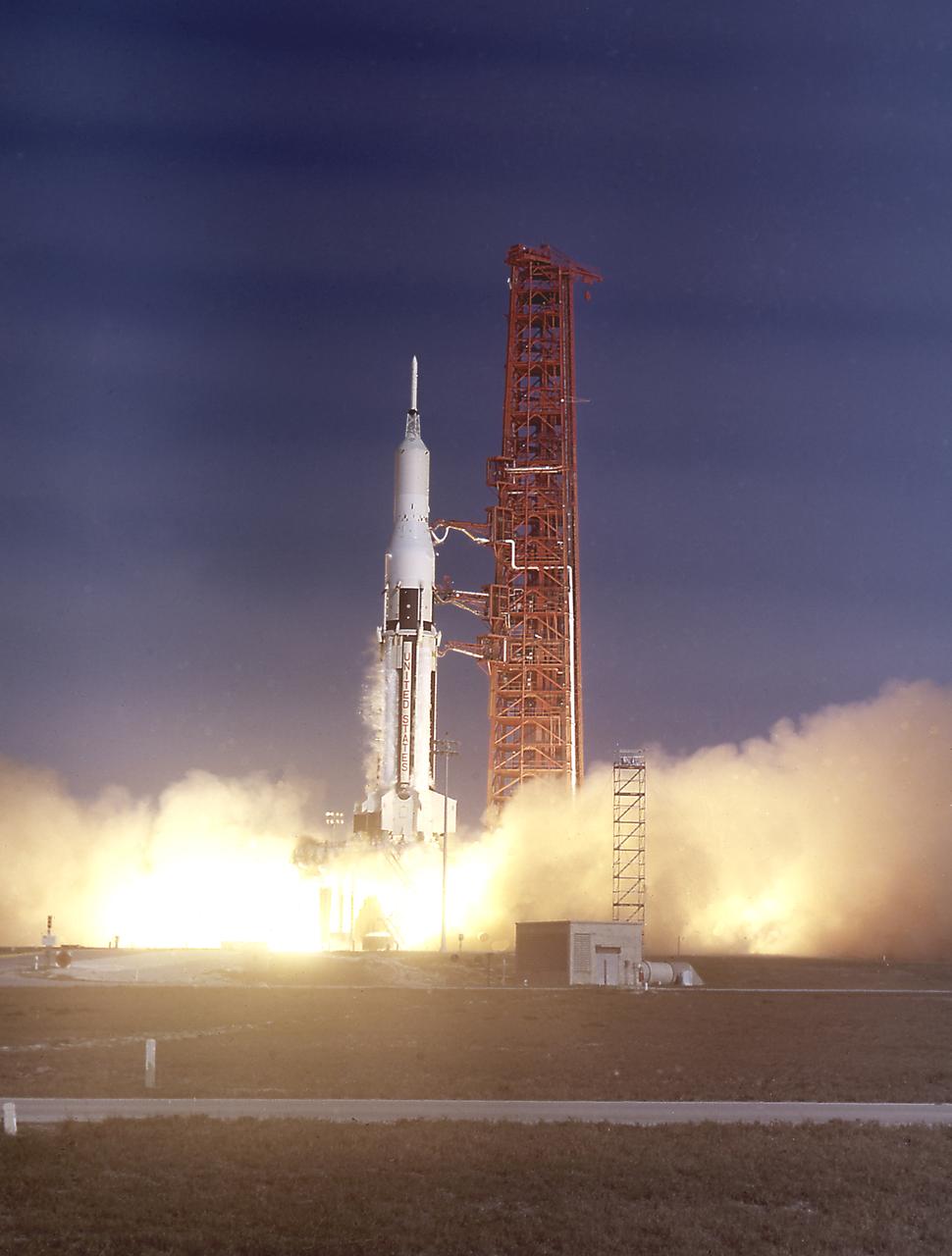
The SA-9 (Saturn I Block II), the eighth Saturn I flight, lifted off on February 16, 1965. This was the first Saturn with an operational payload, the Pegasus I meteoroid detection satellite. SA-9 successfully deployed the Pegasus I, NASA's largest unmarned instrumented satellite, into near Earth orbit.
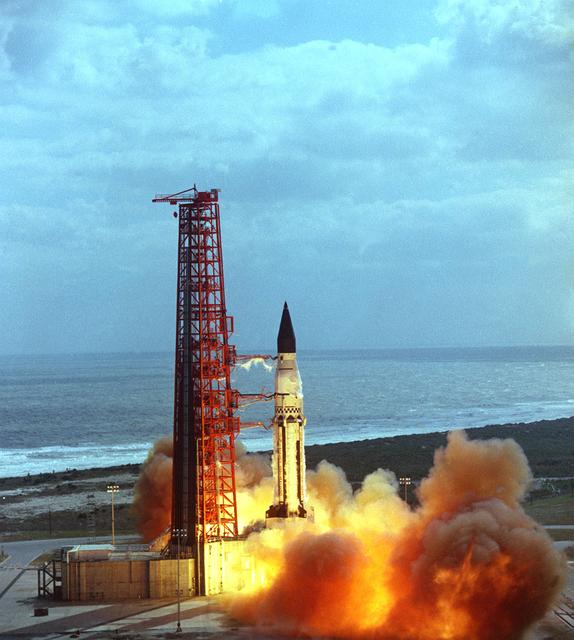
The launch of the SA-5 on January 29, 1964 was the fifth Saturn I launch vehicle. The SA-5 marked a number of firsts in the Marshall Space Flight Center-managed Saturn development program, including the first flight of Saturn I Block II vehicle with eight aerodynamic fins at the bottom of the S-I stage (first stage) for enhanced stability in flight. This also was the first flight of a live S-IV (second or upper) stage with the cluster of six liquid hydrogen-fueled RL-10 engines. the first successful second stage separation, and the first use of the Launch Complex 37.
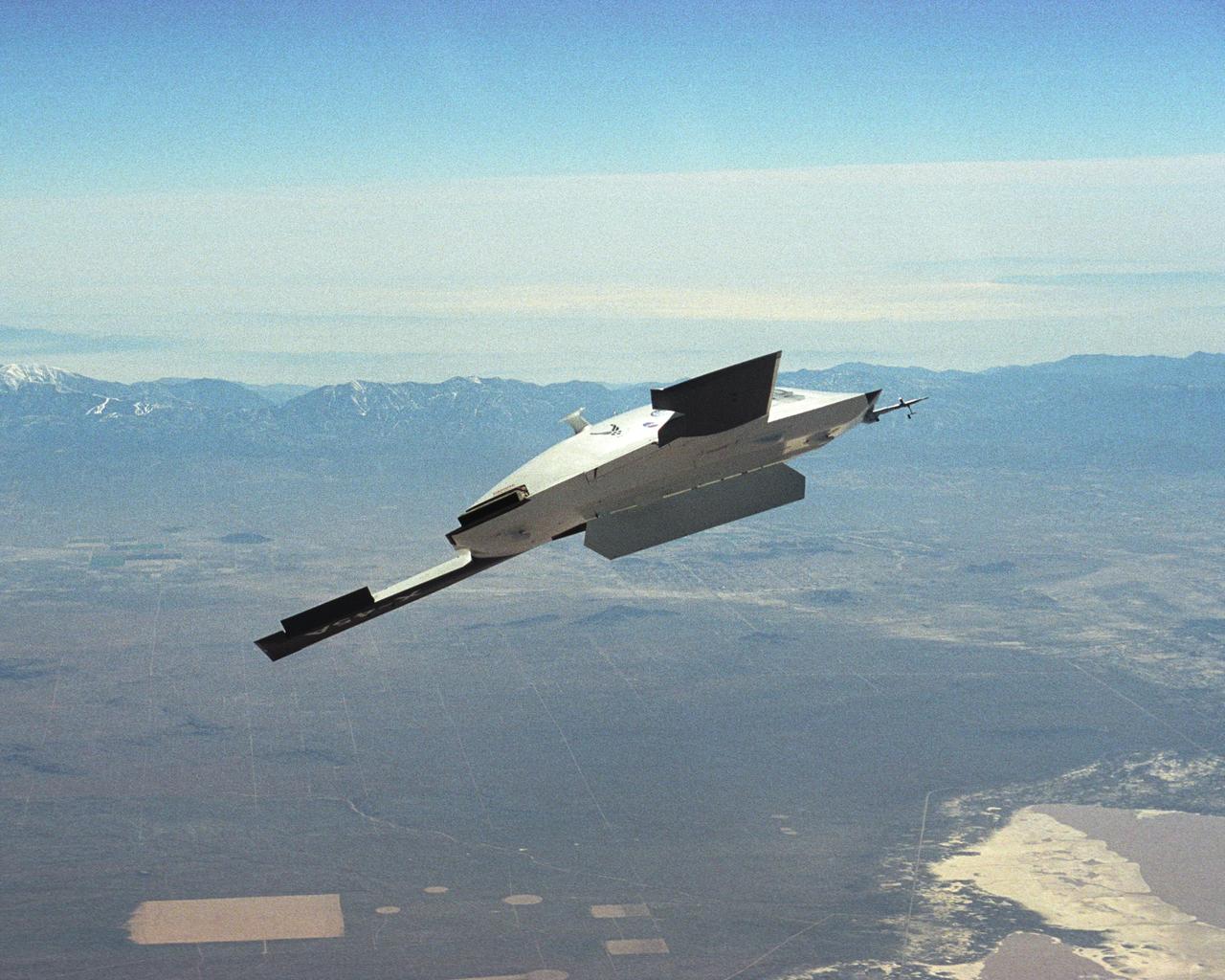
The DARPA/U.S. Air Force X-45A Unmanned Combat Air Vehicle (UCAV) system demonstration program completed the first phase of demonstrations, known as Block I, on Feb. 28, 2003. The final Block I activities included two flights at Dryden, during which safe operation of the weapons bay door was verified at 35,000 feet and speeds of Mach 0.75, the maximum planned altitude and speed for the two X-45A demonstrator vehicles.
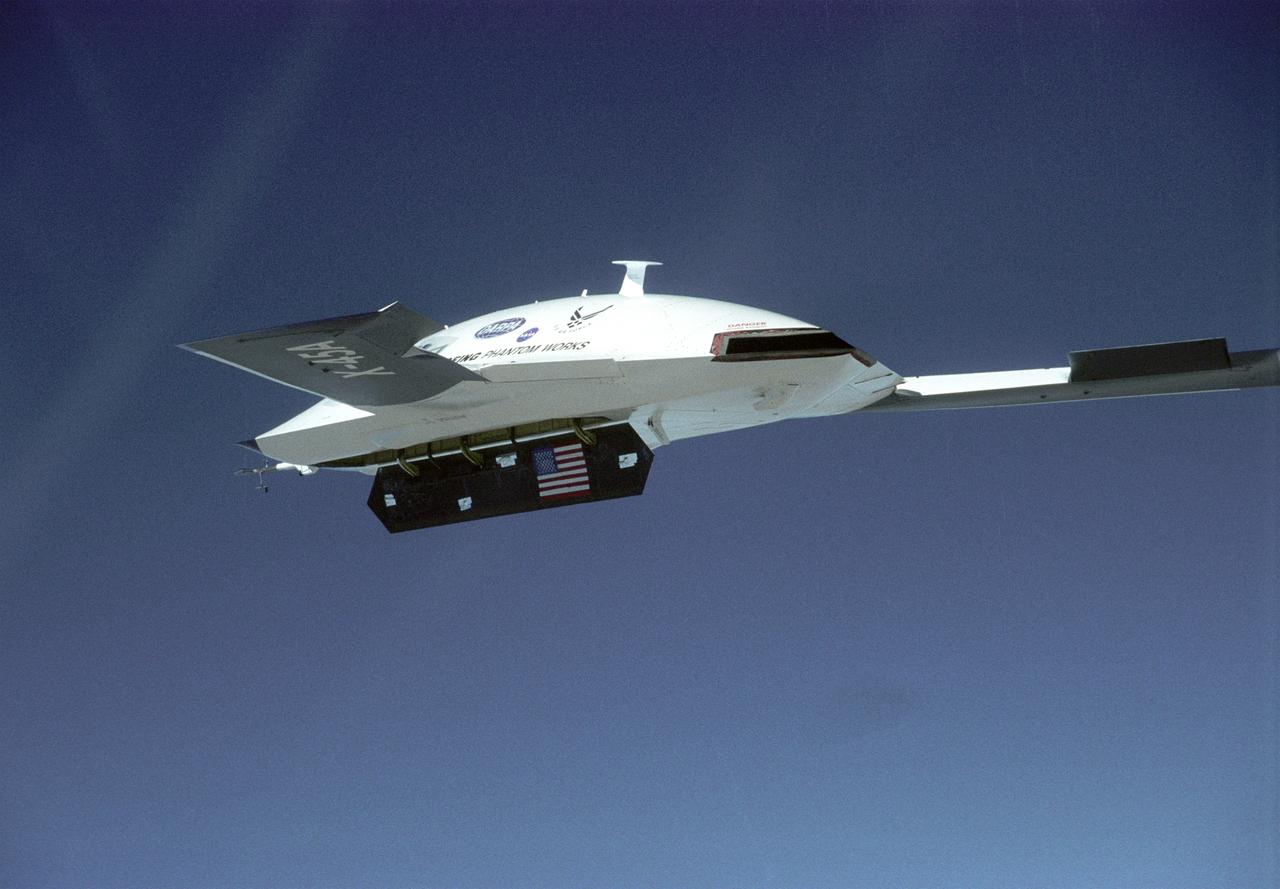
The DARPA/U.S. Air Force X-45A Unmanned Combat Air Vehicle (UCAV) system demonstration program completed the first phase of demonstrations, known as Block I, on Feb. 28, 2003. The final Block I activities included two flights at Dryden, during which safe operation of the weapons bay door was verified at 35,000 feet and speeds of Mach 0.75, the maximum planned altitude and speed for the two X-45A demonstrator vehicles.
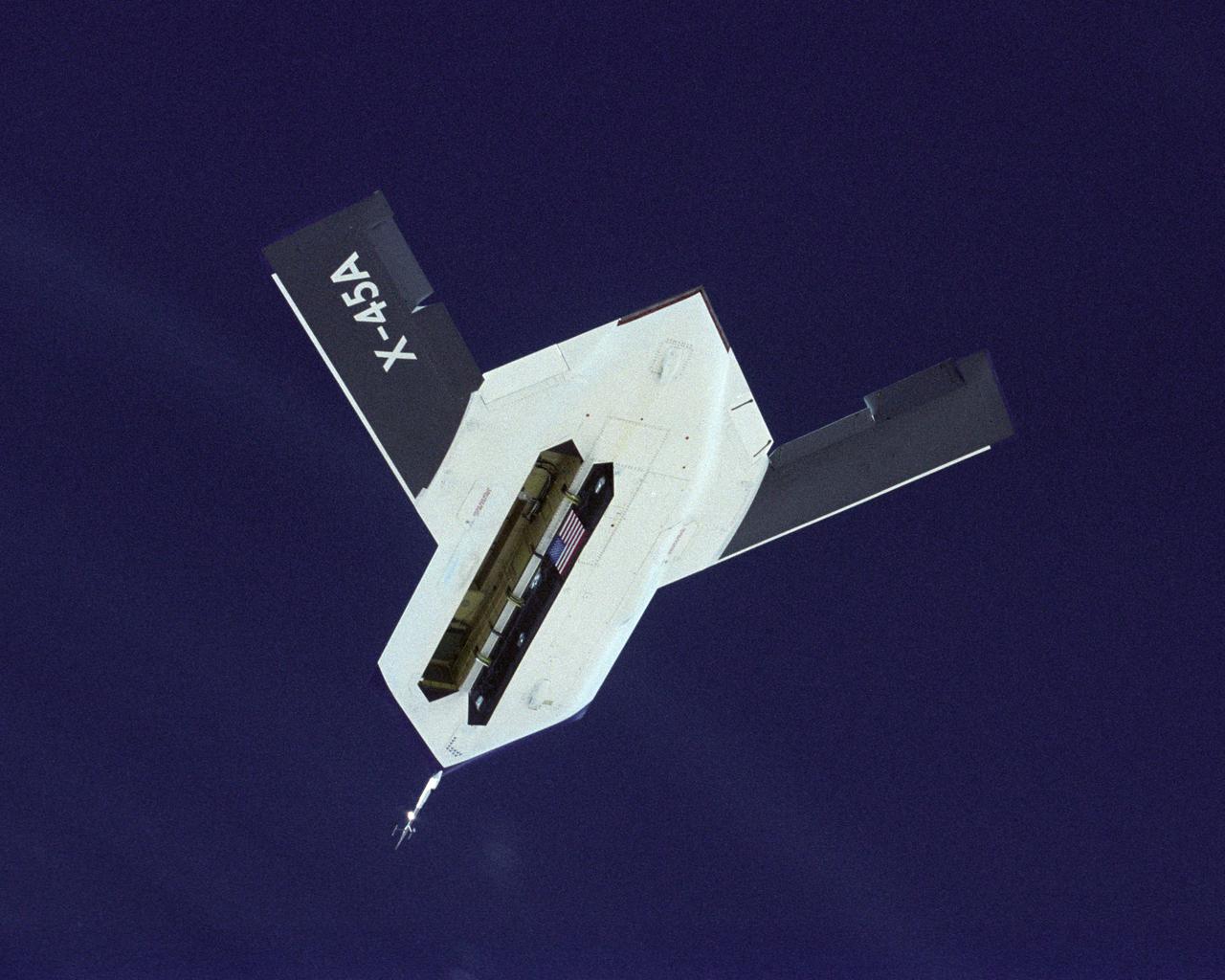
The DARPA/U.S. Air Force X-45A Unmanned Combat Air Vehicle (UCAV) system demonstration program completed the first phase of demonstrations, known as Block I, on Feb. 28, 2003. The final Block I activities included two flights at Dryden, during which safe operation of the weapons bay door was verified at 35,000 feet and speeds of Mach 0.75, the maximum planned altitude and speed for the two X-45A demonstrator vehicles.
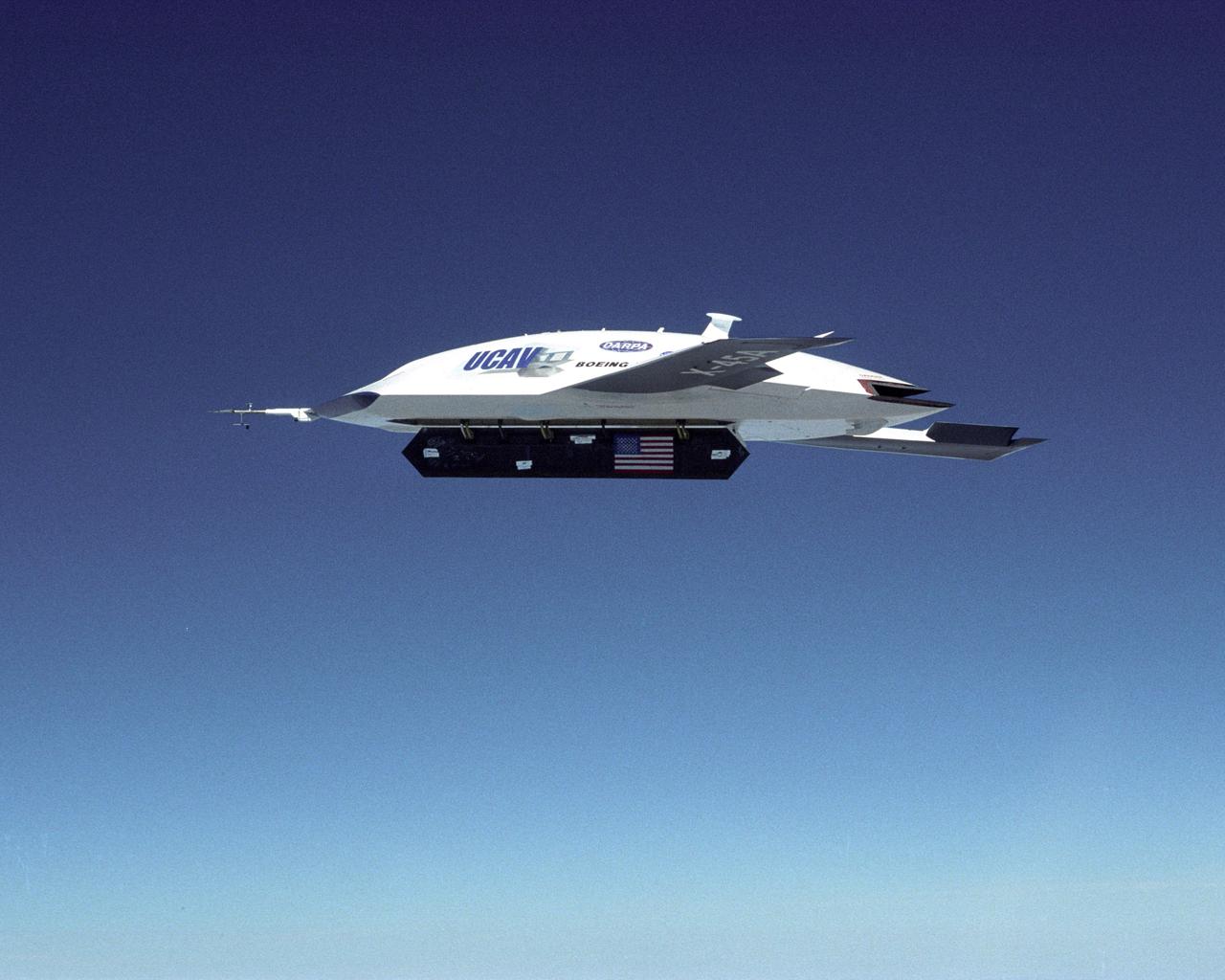
The DARPA/U.S. Air Force X-45A Unmanned Combat Air Vehicle (UCAV) system demonstration program completed the first phase of demonstrations, known as Block I, on Feb. 28, 2003. The final Block I activities included two flights at Dryden, during which safe operation of the weapons bay door was verified at 35,000 feet and speeds of Mach 0.75, the maximum planned altitude and speed for the two X-45A demonstrator vehicles.
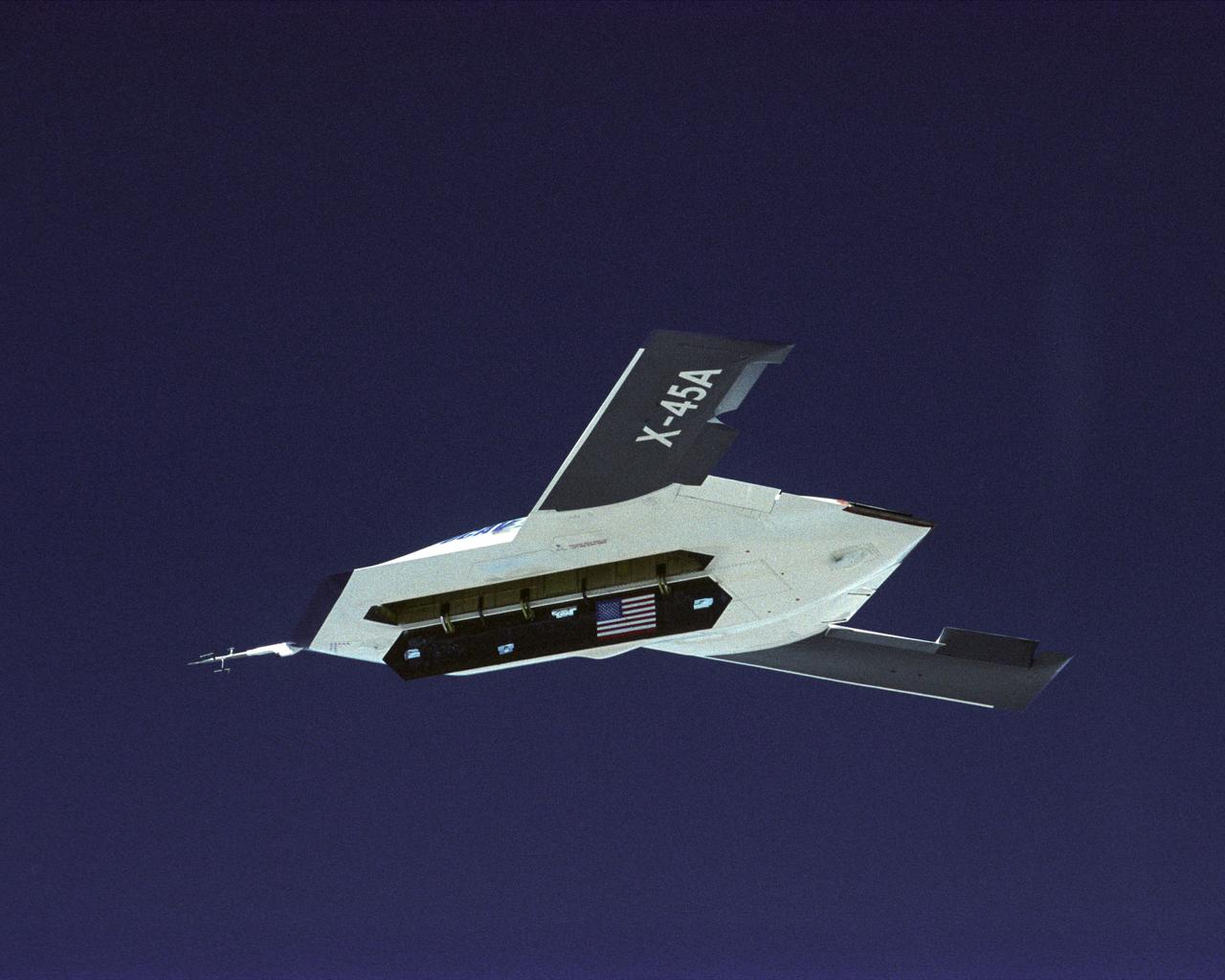
The DARPA/U.S. Air Force X-45A Unmanned Combat Air Vehicle (UCAV) system demonstration program completed the first phase of demonstrations, known as Block I, on Feb. 28, 2003. The final Block I activities included two flights at Dryden, during which safe operation of the weapons bay door was verified at 35,000 feet and speeds of Mach 0.75, the maximum planned altitude and speed for the two X-45A demonstrator vehicles.
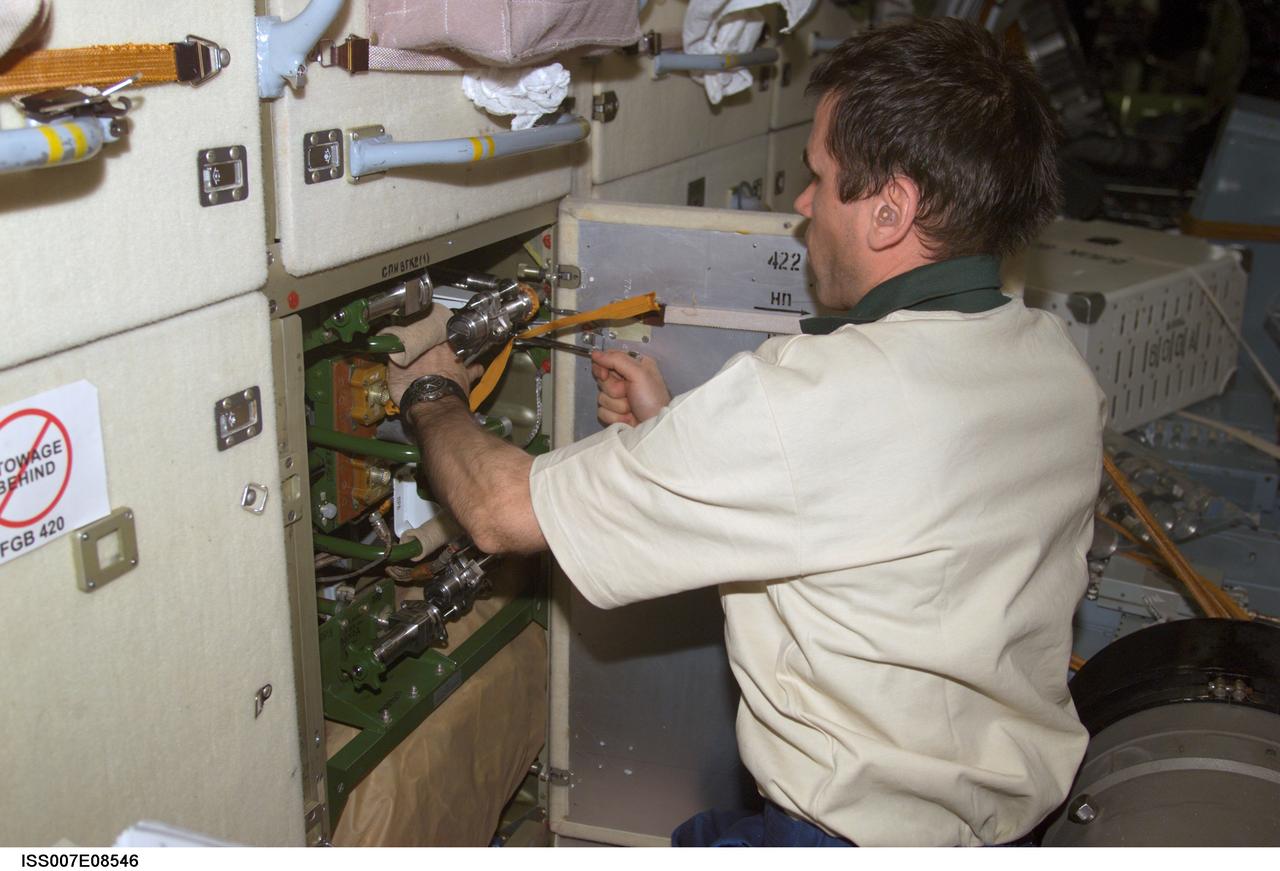
ISS007-E-08546 (24 June 2003) --- Cosmonaut Yuri I. Malenchenko, Expedition 7 mission commander, works in the functional cargo block (FGB), or Zarya, on the International Space Station (ISS). Malenchenko represents Rosaviakosmos.
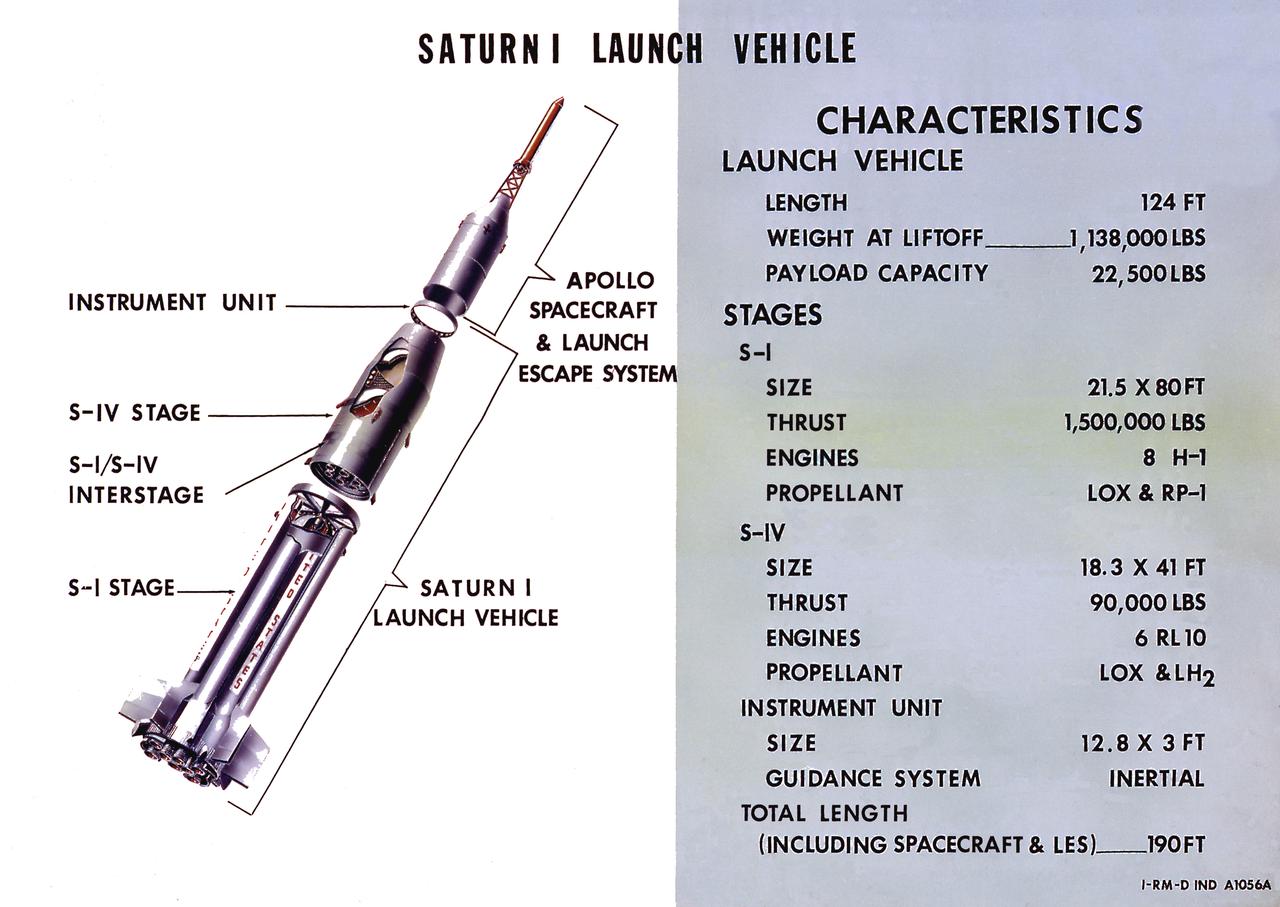
A cutaway illustration of Saturn I launch vehicle characteristics: The Saturn I, first of the Saturn launch vehicles' family, is a two-stage vehicle with a low-earth-orbit payload capability of approximately 25,000 pounds. The research and development program was plarned in two phases or blocks; one for first stage development (Block I) and the second for first and second stage development (Block II). The S-I (first) stage consisted of a cluster of nine propellant tanks and eight H-1 engines built by Rocketdyne, yeilding a total thrust of 1,500,000 pounds. The second stage identified as S-IV, was designed as a single cylinder with a common bulkhead separating the liquid oxygen from the liquid hydrogen. Propulsion was provided by six RL-10 engines built by Pratt Whitney, capable of producing a combined thrust of 90,000 pounds. Of the 10 Saturn I's planned, the first eight were designed and built at the Marshall Space Flight Center. The remaining two were built by the Chrysler Corporation.
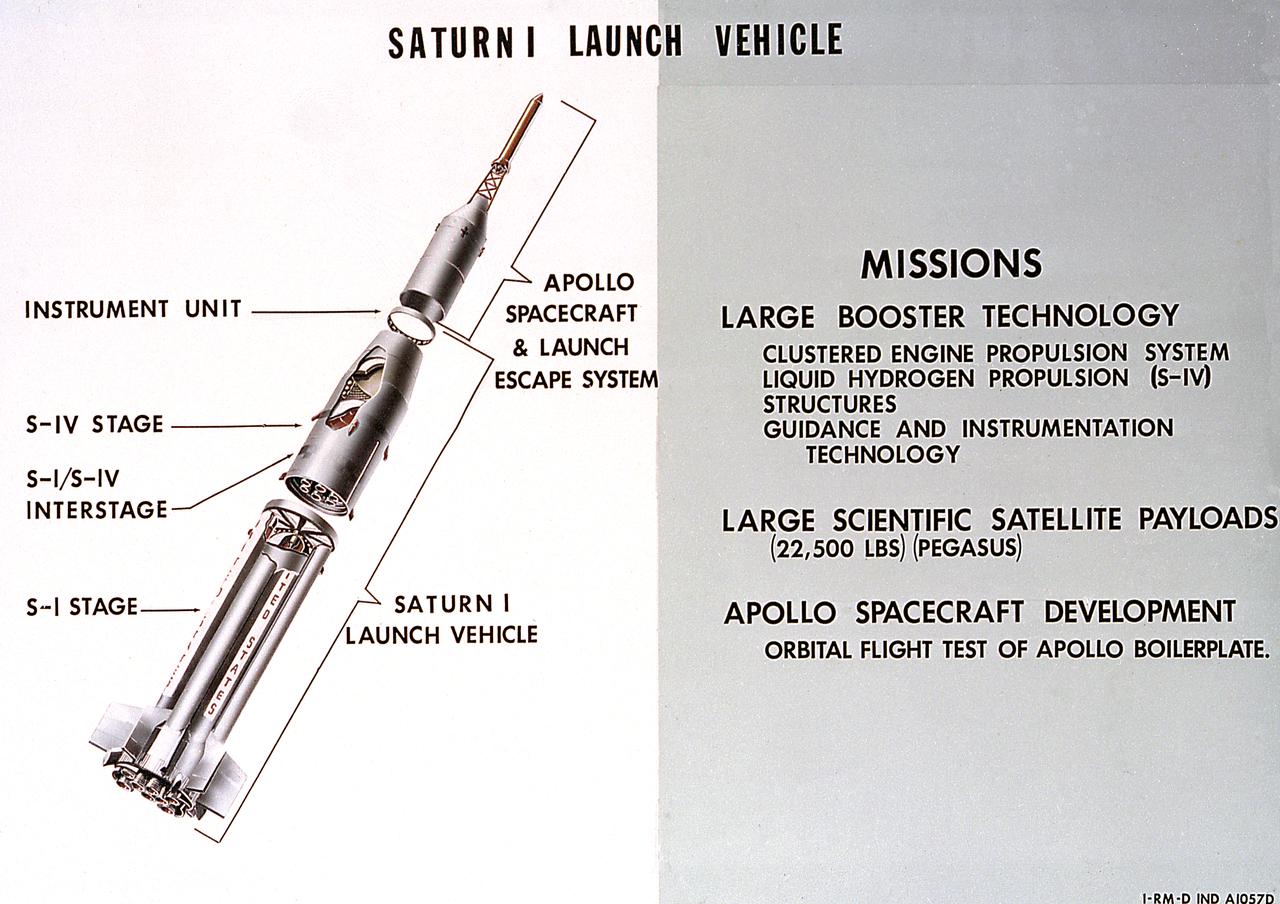
A cutaway illustration of Saturn 1 launch vehicle mission. The Saturn I, first of the Saturn launch vehicles' family, is a two-stage vehicle with a low-earth-orbit payload capability of approximately 25,000 pounds. The research and development program was plarned in two phases or blocks; one for first stage development (Block I) and the second for first and second stage development (Block II). The S-I (first) stage consisted of a cluster of nine propellant tanks and eight H-1 engines built by Rocketdyne, yeilding a total thrust of 1,500,000 pounds. The second stage of Saturn I, identified as S-IV, was designed as a single cylinder with a common bulkhead separating the liquid oxygen from the liquid hydrogen. Propulsion was provided by six RL-10 engines built by Pratt Whitney, capable of producing a combined thrust of 90,000 pounds. Of the 10 Saturn I's planned, the first eight were designed and built at the Marshall Space Flight Center. The remaining two were built by the Chrysler Corporation.
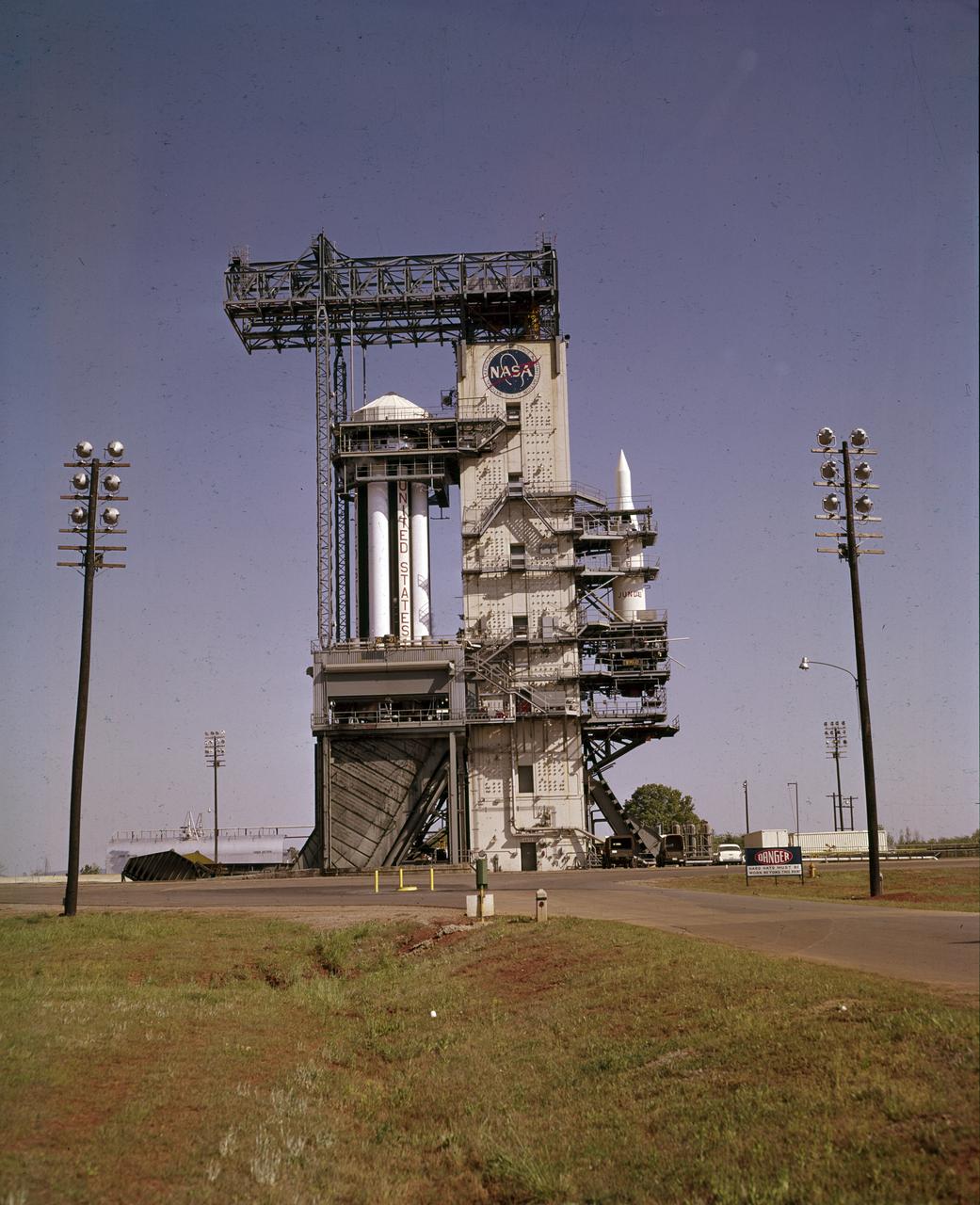
On October 27, 1961, the Marshall Space Flight Center (MSFC) and the Nation marked a high point in the 3-year-old Saturn development program when the first Saturn vehicle flew a flawless 215-mile ballistic trajectory from Cape Canaveral, Florida. SA-1 is pictured here, five months before launch, in the MSFC test stand on May 16, 1961. Developed and tested at MSFC under the direction of Dr. Wernher von Braun, SA-1 incorporated a Saturn I, Block I engine. The typical height of a Block I vehicle was approximately 163 feet. and had only one live stage. It consisted of eight tanks, each 70 inches in diameter, clustered around a central tank, 105 inches in diameter. Four of the external tanks were fuel tanks for the RP-1 (kerosene) fuel. The other four, spaced alternately with the fuel tanks, were liquid oxygen tanks, as was the large center tank. All fuel tanks and liquid oxygen tanks drained at the same rates respectively. The thrust for the stage came from eight H-1 engines, each producing a thrust of 165,000 pounds, for a total thrust of over 1,300,000 pounds. The engines were arranged in a double pattern. Four engines, located inboard, were fixed in a square pattern around the stage axis and canted outward slightly, while the remaining four engines were located outboard in a larger square pattern offset 40 degrees from the inner pattern. Unlike the inner engines, each outer engine was gimbaled. That is, each could be swung through an arc. They were gimbaled as a means of steering the rocket, by letting the instrumentation of the rocket correct any deviations of its powered trajectory. The block I required engine gimabling as the only method of guiding and stabilizing the rocket through the lower atmosphere. The upper stages of the Block I rocket reflected the three-stage configuration of the Saturn I vehicle.
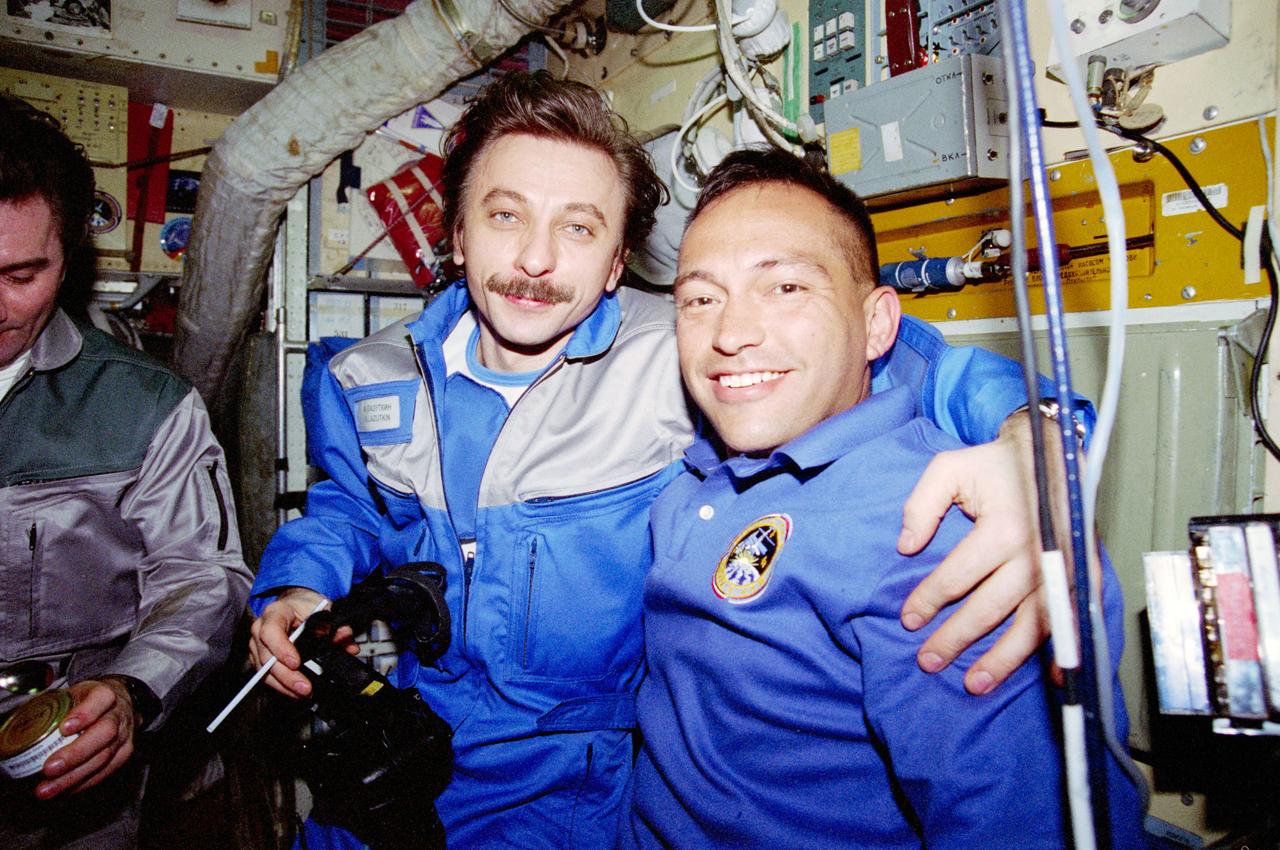
STS084-360-010 (15-24 May 1997) --- On Russia's Mir Space Station's Base Block, Mir-23 flight engineer Aleksandr I. Lazutkin greets his STS-84 counterpart, Carlos I. Noriega, soon after hatch opening. Partially visible at left is Vasili V. Tsibliyev, Mir-23 commander.
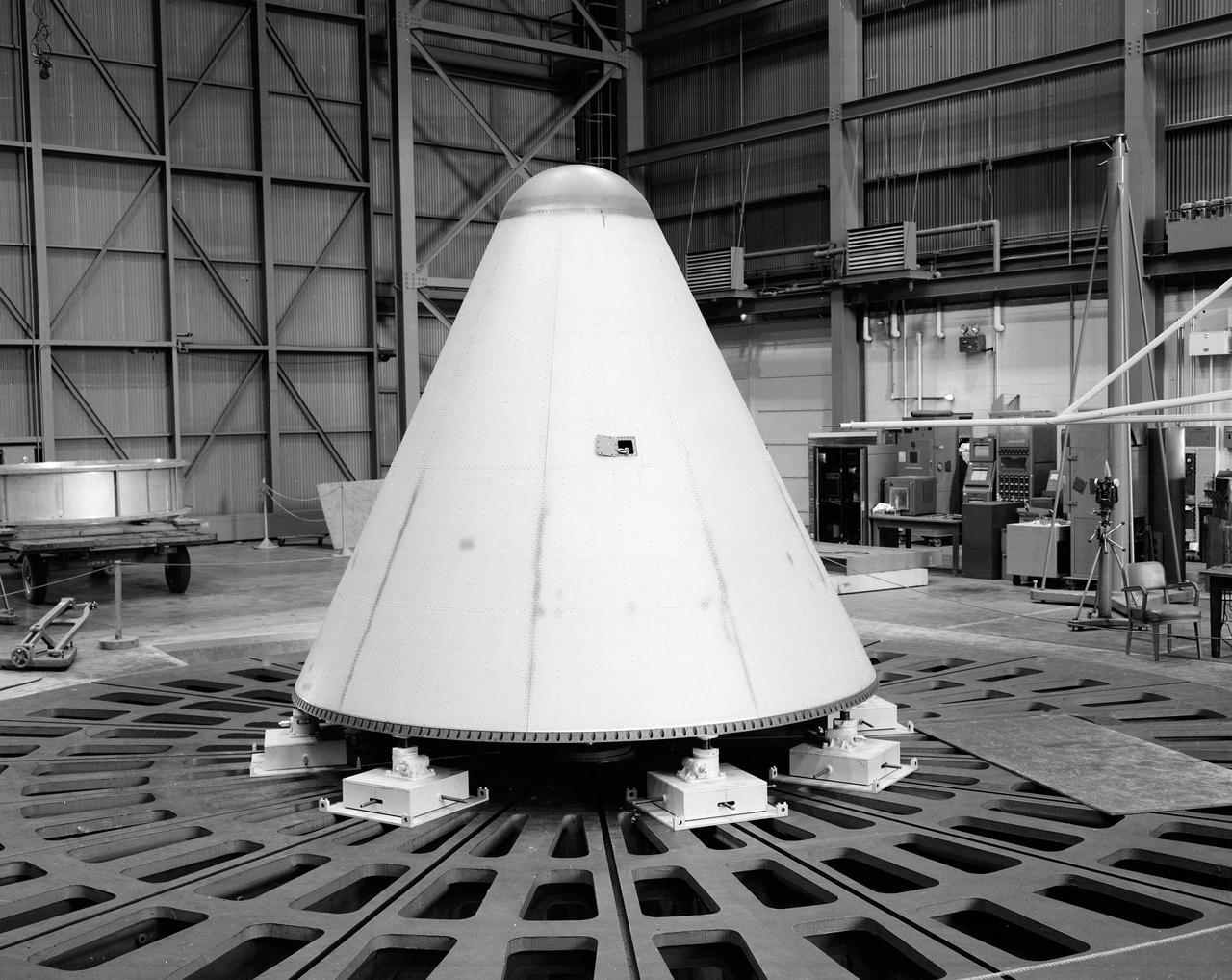
Developed by the Marshall Space Flight Center (MSFC) as an interim vehicle in MSFC’s “building block” approach to the Saturn rocket development, the Saturn IB utilized Saturn I technology to further develop and refine the larger boosters and the Apollo spacecraft capabilities required for the manned lunar missions. The Saturn IB vehicle was a two-stage rocket and had a payload capability about 50 percent greater than the Saturn I vehicle. The first stage, S-IB stage, was a redesigned first stage of the Saturn I. This photograph is of the S-IB nose cone #3 during assembly in building 4752.
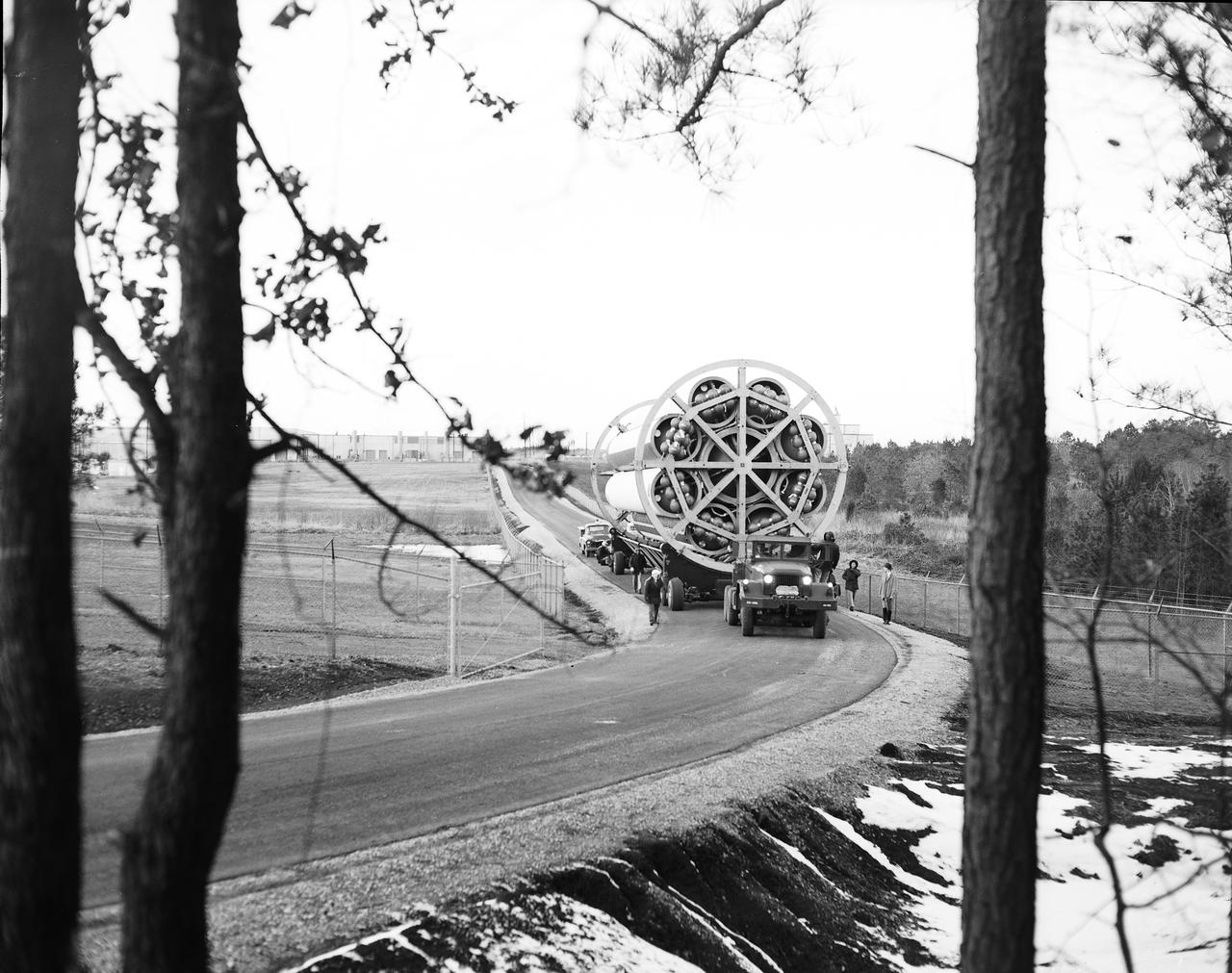
This photograph shows the Saturn-I first stage (S-1 stage) being transported to the test stand for a static test firing at the Marshall Space Flight Center. Soon after NASA began operations in October 1958, it was evident that sending people and substantial equipment beyond the Earth's gravitational field would require launch vehicles with weight-lifting capabilities far beyond any developed to that time. In early 1959, NASA accepted the proposal of Dr. Wernher von Braun for a multistage rocket, with a number of engines clustered in one or more of the stages to provide a large total thrust. The initiation of the Saturn launch vehicle program ultimately led to the study and preliminary plarning of many different configurations and resulted in production of three Saturn launch vehicles, the Saturn-I, Saturn I-B, and Saturn V. The Saturn family of launch vehicles began with the Saturn-I, a two-stage vehicle originally designated C-1. The research and development program was planned in two phases, or blocks: one for first stage development (Block I) and the second for both first and second stage development (Block-II). Saturn I had a low-earth-orbit payload capability of approximately 25,000 pounds. The design of the first stage (S-1 stage) used a cluster of propellant tanks containing liquid oxygen (LOX) and kerosene (RP-1), and eight H-1 engines, yielding a total thrust of 1,500,000 pounds. Of the ten Saturn-Is planned, the first eight were designed and built at the Marshall Space Flight Center, and the remaining two were built by the Chrysler Corporation.
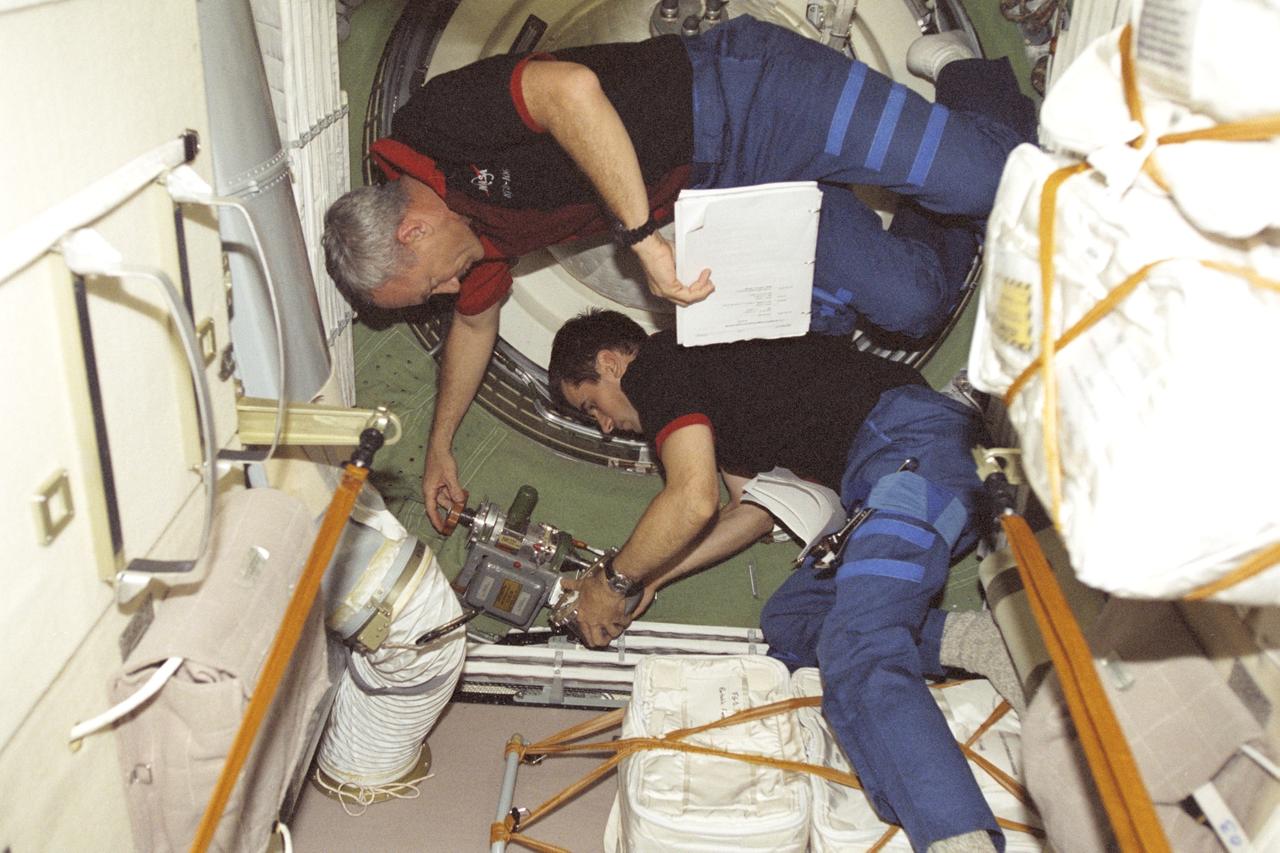
STS106-322-026 (17 September 2000) --- Astronaut Terrence W. Wilcutt (right), STS-106 mission commander, and cosmonaut Yuri I. Malenchenko, mission specialist, in the functional cargo block (FGB) or Zarya on the International Space Station (ISS), work on preparations for undocking between the Space Shuttle Atlantis and the station. Separation took place on September 17, 2000 at 10:46 p.m. (CDT). Malenchenko represents Rosaviakosmos.
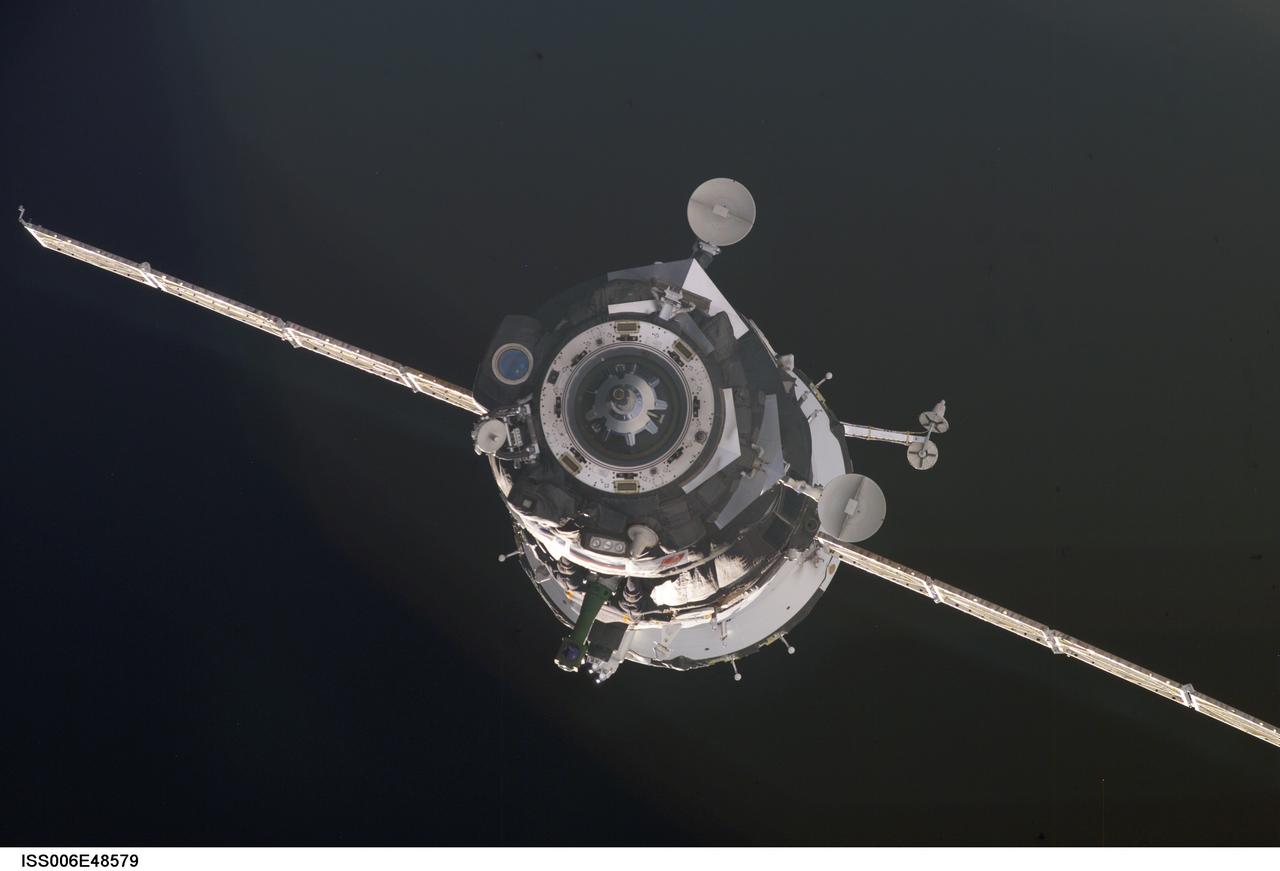
ISS006-E-48579 (28 April 2003) --- Backdropped against the blackness of space, the Soyuz TMA-2 spacecraft approaches the International Space Station (ISS). Onboard the spacecraft are the Expedition Seven crewmembers, cosmonaut Yuri I. Malenchenko, mission commander representing Rosaviakosmos, and astronaut Edward T. Lu, NASA ISS science officer and flight engineer. The Soyuz docked at the functional cargo block (FGB) nadir port at 12:56 a.m. (CDT) on April 28, 2003.
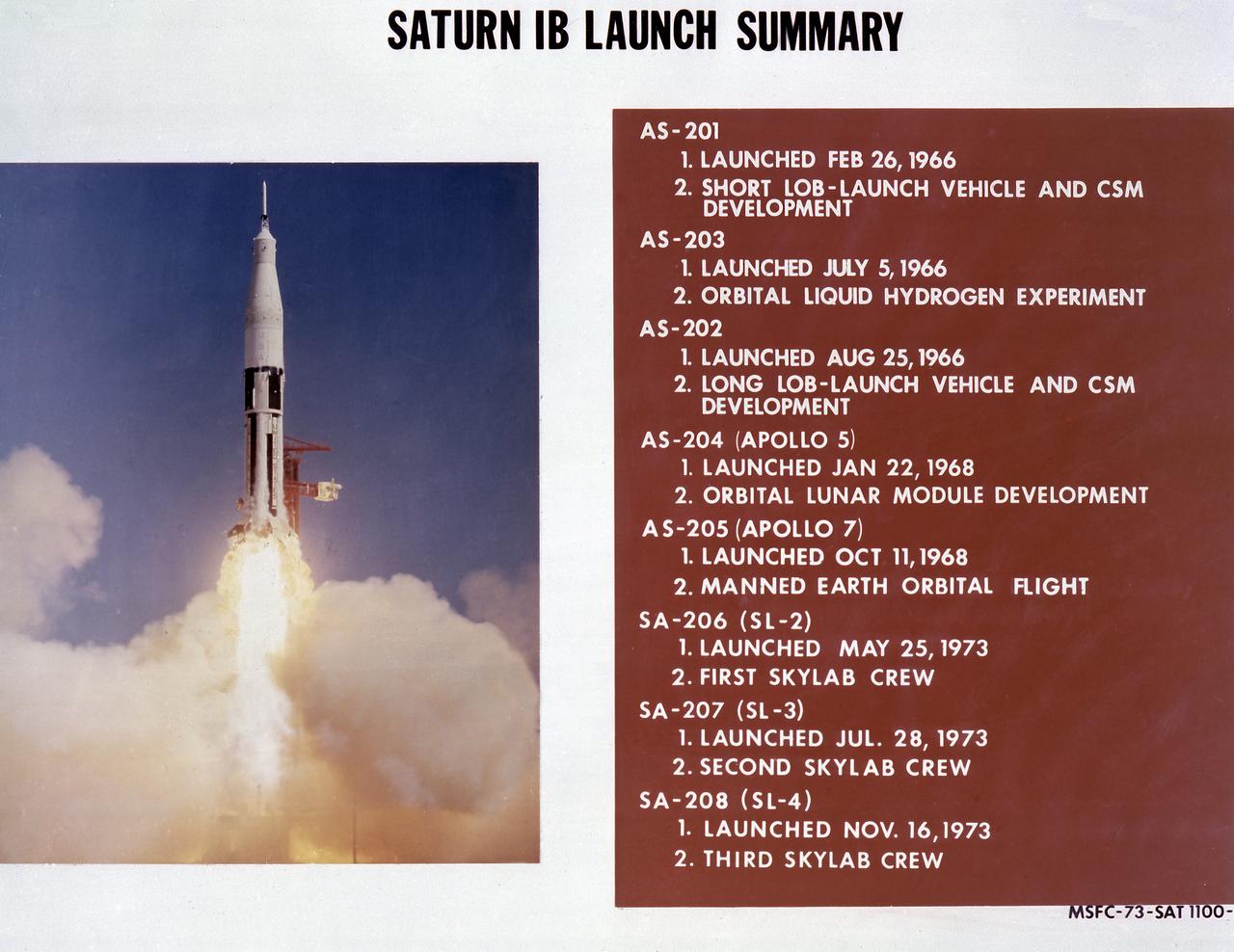
This chart provides a launch summary of the Saturn IB launch vehicle as of 1973. Developed by the Marshall Space Flight Center (MSFC) as an interim vehicle in MSFC's "building block" approach to the Saturn rocket development, the Saturn IB utilized Saturn I technology to further develop and refine the larger boosters and the Apollo spacecraft capabilities required for the marned lunar missions.
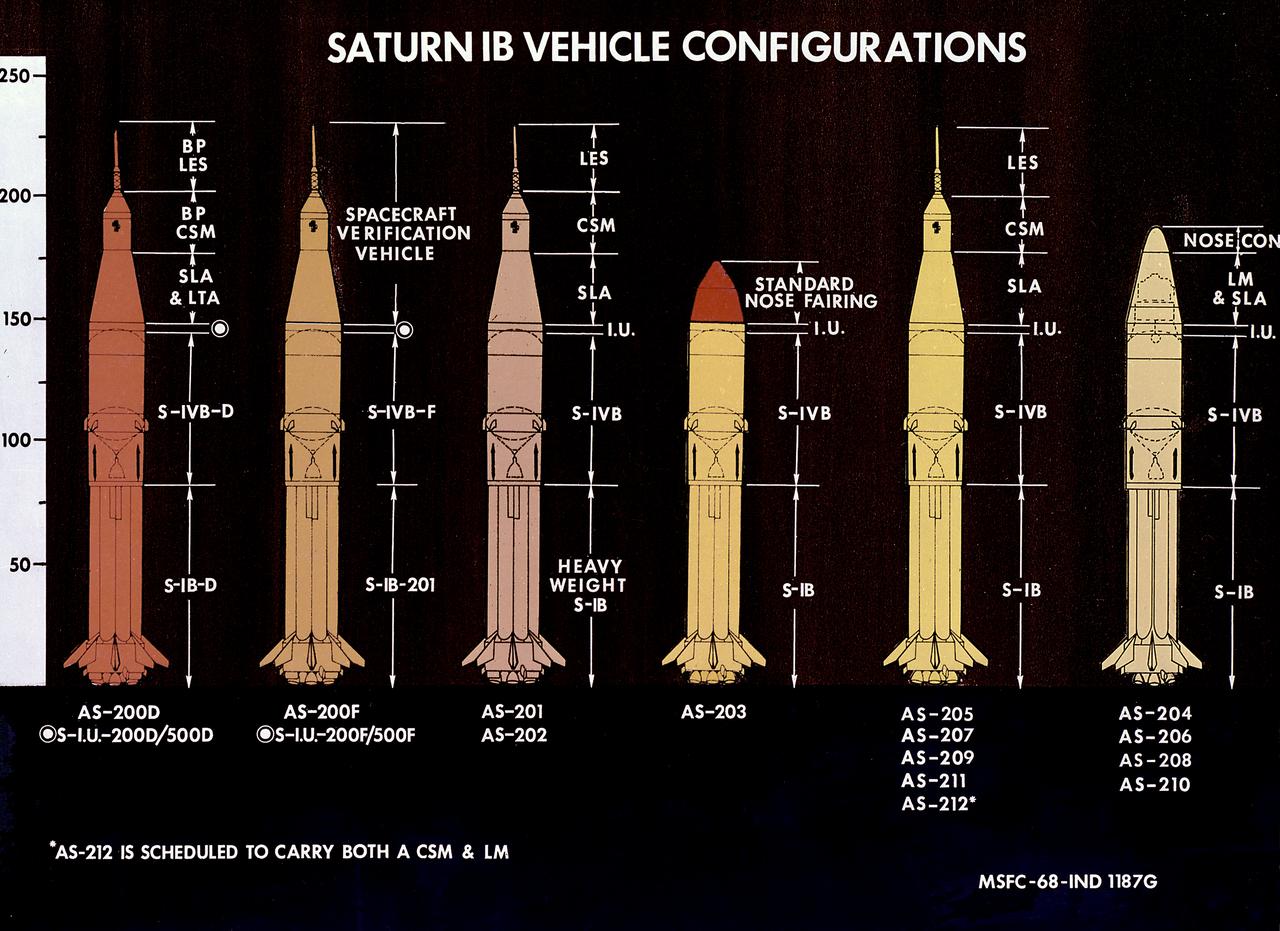
This 1968 chart depicts the various mission configurations for the Saturn IB launch vehicle. Developed by the Marshall Space Flight Center (MSFC) as an interim vehicle in MSFC's "building block" approach to the Saturn rocket development, the Saturn IB utilized Saturn I technology to further develop and refine the larger boosters and the Apollo spacecraft capabilities required for the marned lunar missions.

ISS006-E-48596 (28 April 2003) --- Backdropped against the blackness of space, the Soyuz TMA-2 spacecraft approaches the International Space Station (ISS). Onboard the spacecraft are the Expedition Seven crewmembers, cosmonaut Yuri I. Malenchenko, mission commander representing Rosaviakosmos, and astronaut Edward T. Lu, NASA ISS science officer and flight engineer. The Soyuz docked at the functional cargo block (FGB) nadir port at 12:56 a.m. (CDT) on April 28, 2003.
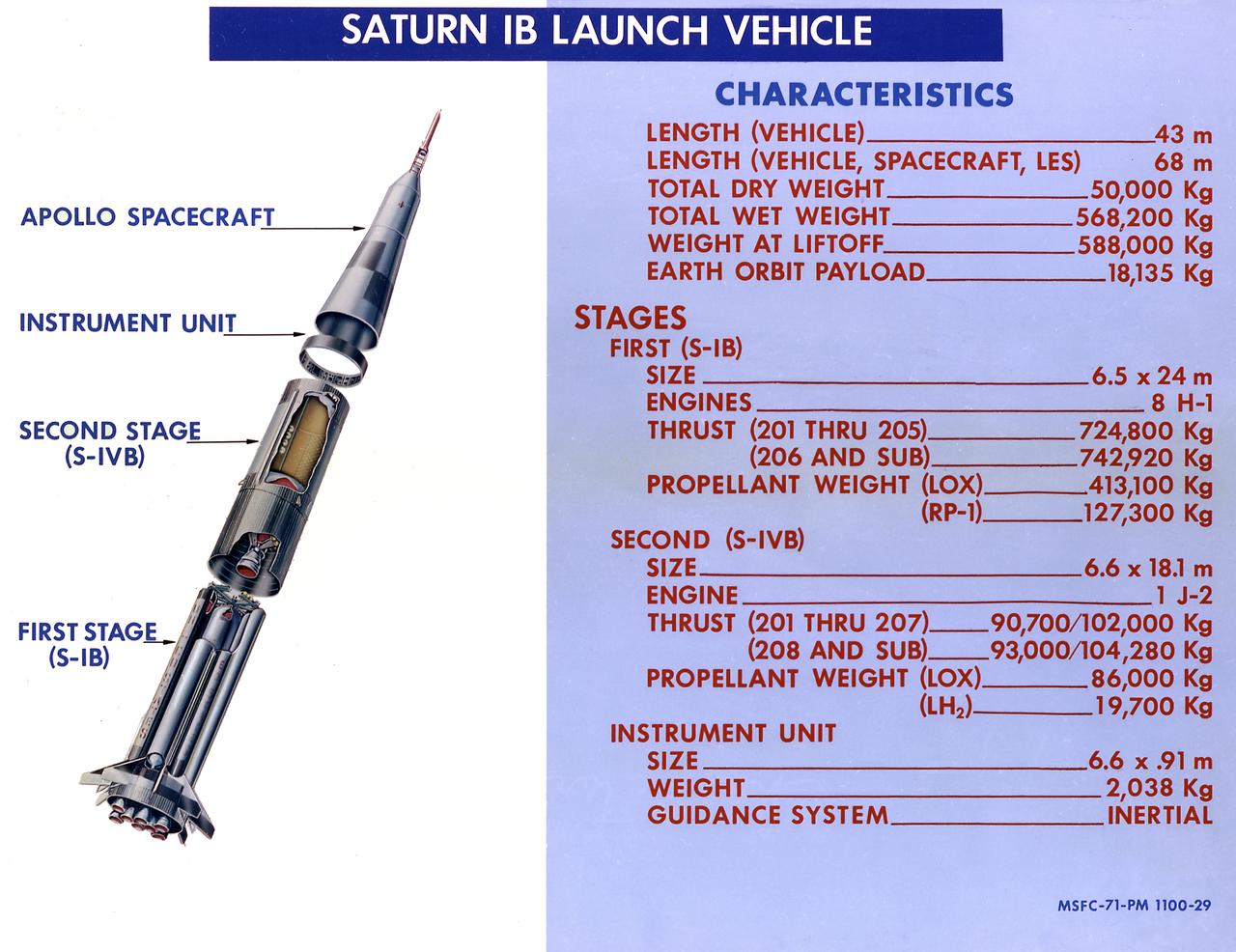
This 1968 cutaway drawing illustrates the Saturn IB launch vehicle with its two booster stages, the S-IB (first stage) and S-IVB (second stage), and provides the vital statistics in metric units. Developed by the Marshall Space Flight Center (MSFC) as an interim vehicle in MSFC's "building block" approach to the Saturn rocket development, the Saturn IB utilized Saturn I technology to further develop and refine the larger boosters and the Apollo spacecraft capabilities required for the marned lunar missions.
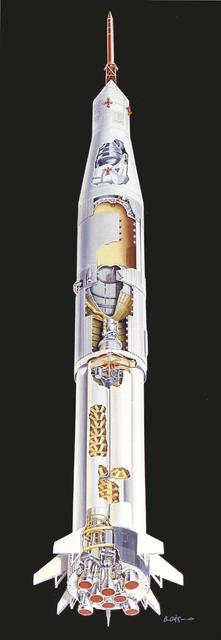
This undated cutaway drawing illustrates the Saturn IB launch vehicle with its two booster stages, the S-IB and S-IVB. Developed by the Marshall Space Flight Center (MSFC) as an interim vehicle in MSFC's "building block" approach to the Saturn rocket development, the Saturn IB utilized Saturn I technology to further develop and refine the larger boosters and the Apollo spacecraft capabilities required for the marned lunar missions.
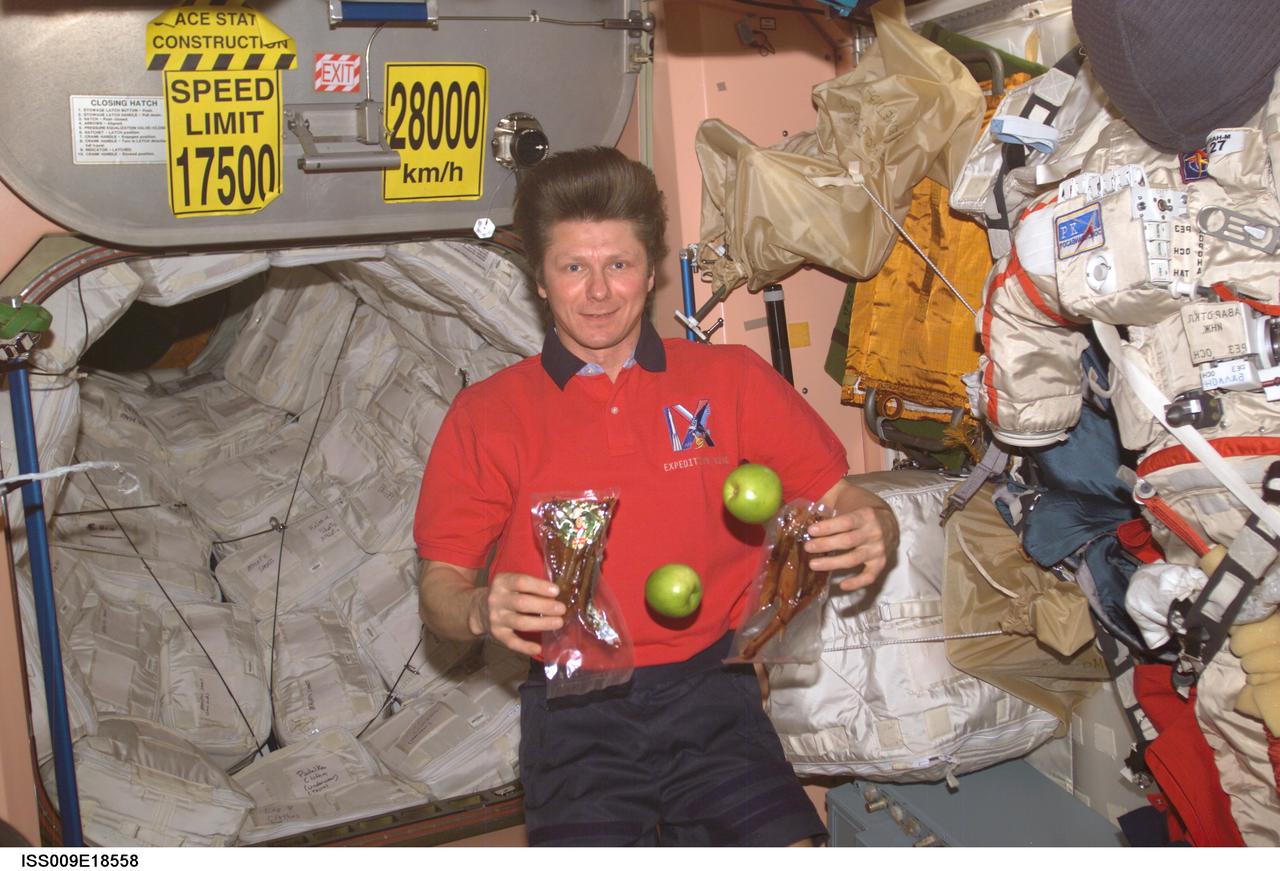
ISS009-E-18558 (15 August 2004) --- Cosmonaut Gennady I. Padalka, Expedition 9 commander representing Russia's Federal Space Agency, holds packages of food, as two apples float freely near him, in the Unity node of the International Space Station (ISS). The food was recently unloaded from the Progress 15 supply vehicle docked to the Station. The functional cargo block (FGB) or Zarya hatchway is visible in the background.
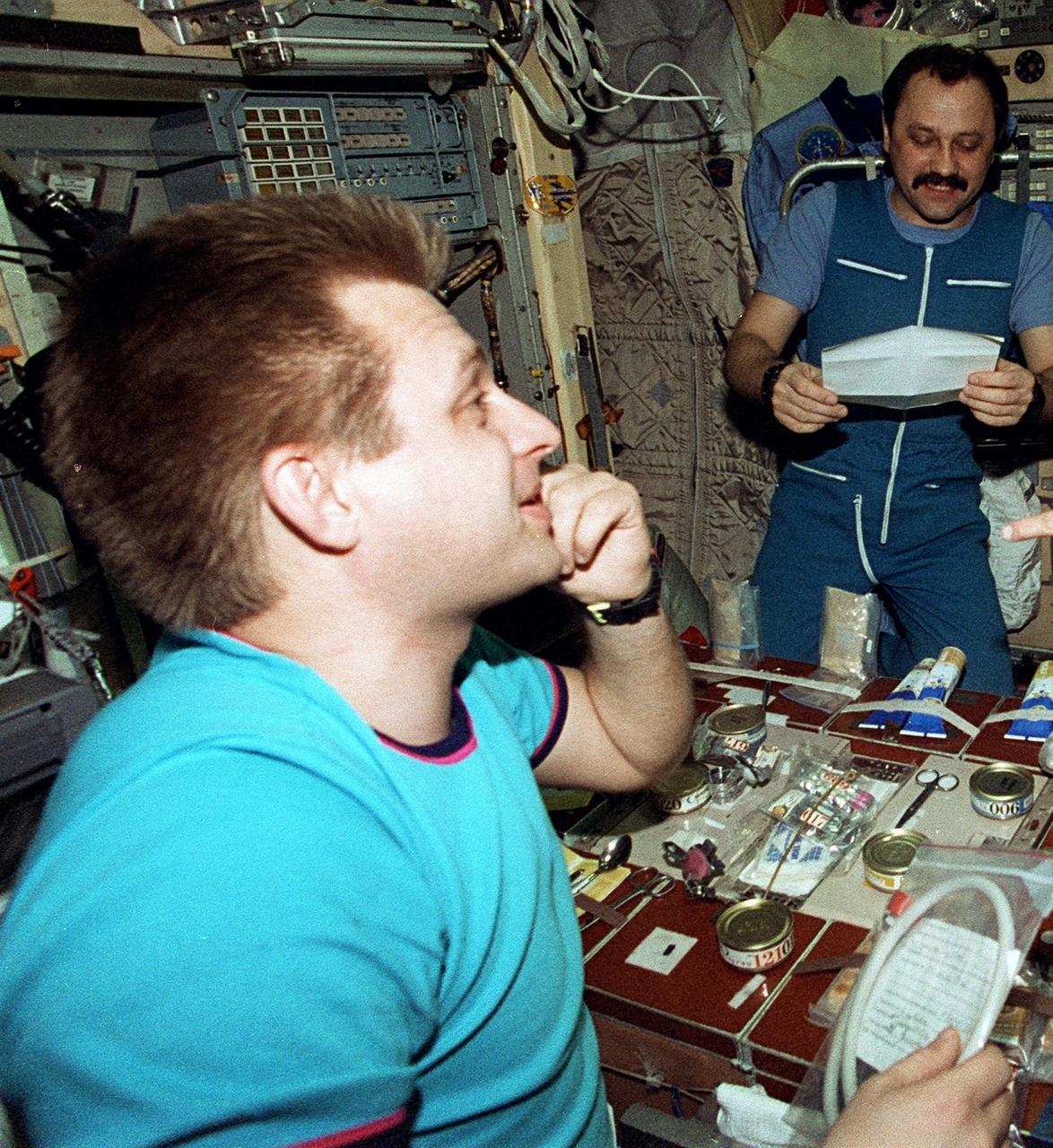
STS076-345-025 (22-31 March 1996) --- Joining her new cosmonaut crew mates, Shannon W. Lucid participates in an inventory of new food supplies in the Base Block Module of Russia's Mir Space Station. Yury I. Onufrienko, Mir-21 mission commander, is in the foreground; with Yury V. Usachev, flight engineer, pictured in the background. When this photo was taken, Mir was still docked with the Space Shuttle Atlantis.

Workmen at the Kennedy Space Center position the nose cone for the 204LM-1, an unmanned Apollo mission that tested the Apollo Lunar Module (LM) in Earth orbit. Also known as Apollo 5, the spacecraft was launched on the fourth Saturn IBC launch vehicle. Developed by the Marshall Space Flight Center (MSFC) as an interim vehicle in MSFC's "building block" approach to the Saturn rocket development, the Saturn IBC utilized Saturn I technology to further develop and refine a larger booster and the Apollo spacecraft capabilities required for the manned lunar missions.

A test block of Avcoat undergoes heat pulse testing inside an arc jet test chamber at NASA’s Ames Research Center in California. The test article, configured with both permeable (upper) and non-permeable (lower) Avcoat sections for comparison, helped to confirm understanding of the root cause of the loss of charred Avcoat material that engineers saw on the Orion spacecraft after the Artemis I test flight beyond the Moon.
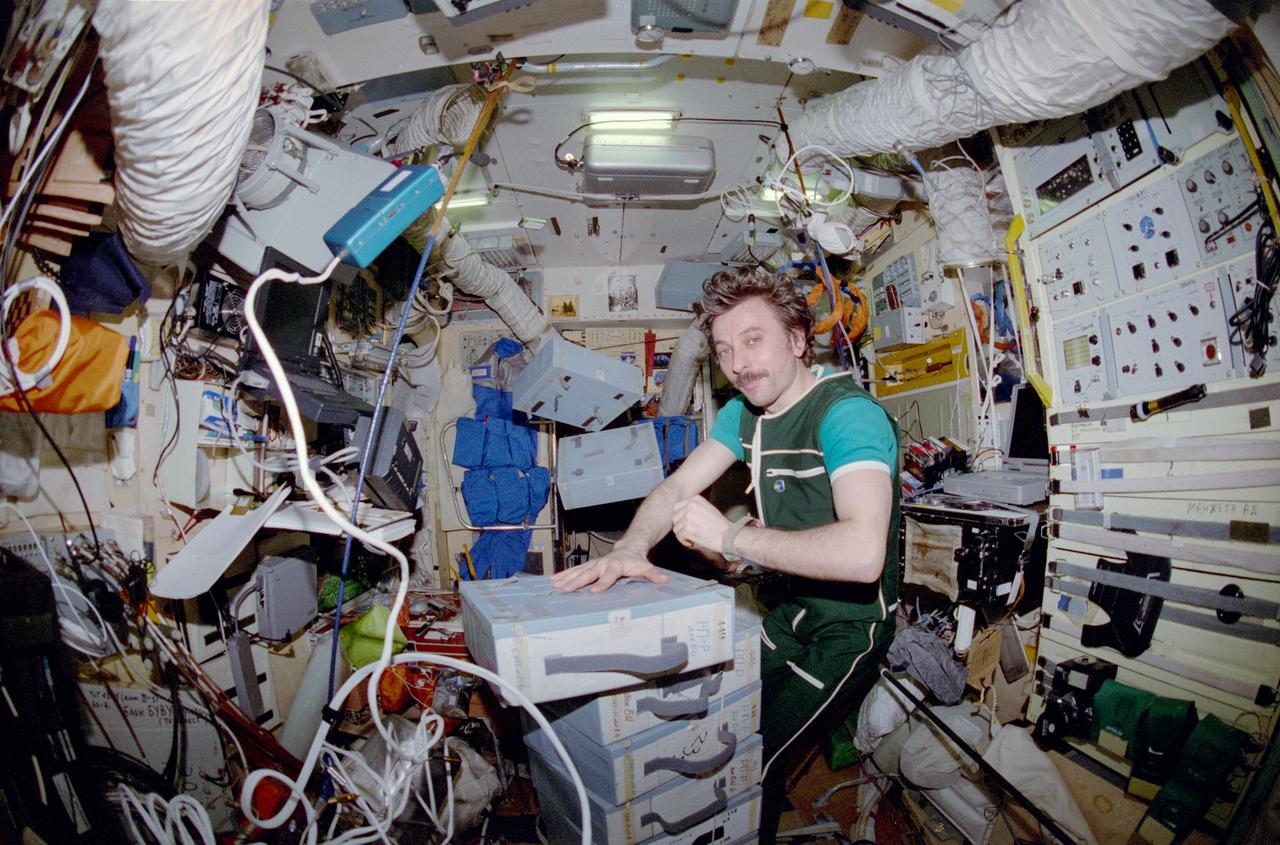
STS084-305-031 (15-24 May 1997) --- Onboard the Russia's Mir Space Station Base Block, cosmonaut Aleksandr I. Lazutkin, Mir-23 flight engineer, participates in the transfer of a small portion of the supplies which astronauts and cosmonauts are moving aboard Mir from the Space Shuttle Atlantis. A number of items were also moved from Mir onto the docked Shuttle craft during the several days of joint activities between the two crews.
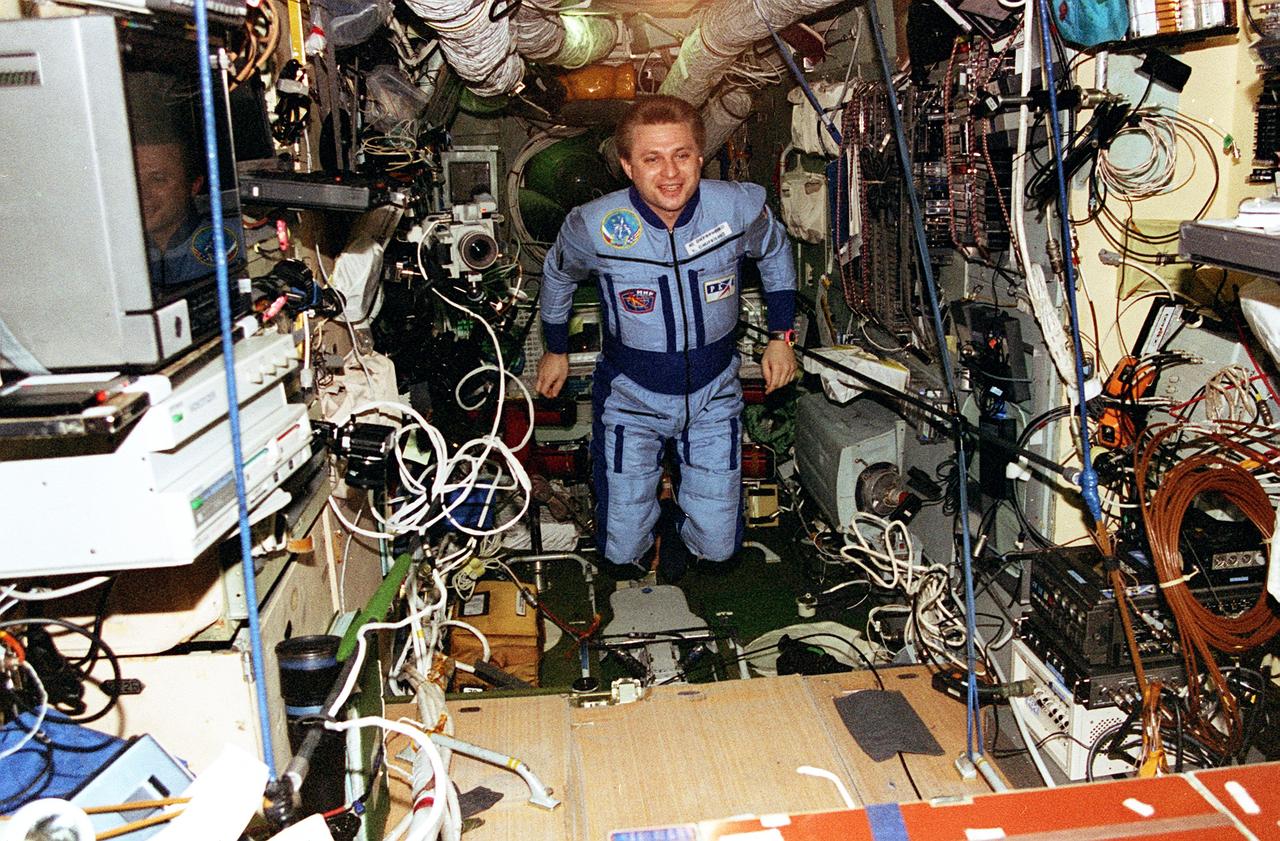
STS076-344-034 (22-31 March 1996) --- Cosmonaut Yury I. Onufrienko, commander for the Mir-21 mission, floats through the Base Block Module on Russia's Mir Space Station. The photograph was taken with a 35mm camera by one of the STS-76 Space Shuttle Atlantis crew members, aboard Mir for a brief visit following the delivery of astronaut Shannon W. Lucid, cosmonaut guest researcher, during the third docking mission.

Workmen at the Kennedy Space Center position the nose cone for the 204LM-1, an unmanned Apollo mission that tested the Apollo Lunar Module (LM) in Earth orbit. Also known as Apollo 5, the spacecraft was launched on the fourth Saturn IBC launch vehicle. Developed by the Marshall Space Flight Center (MSFC) as an interim vehicle in MSFC's "building block" approach to the Saturn rocket development, the Saturn IBC utilized Saturn I technology to further develop and refine a larger booster and the Apollo spacecraft capabilities required for the manned lunar missions.
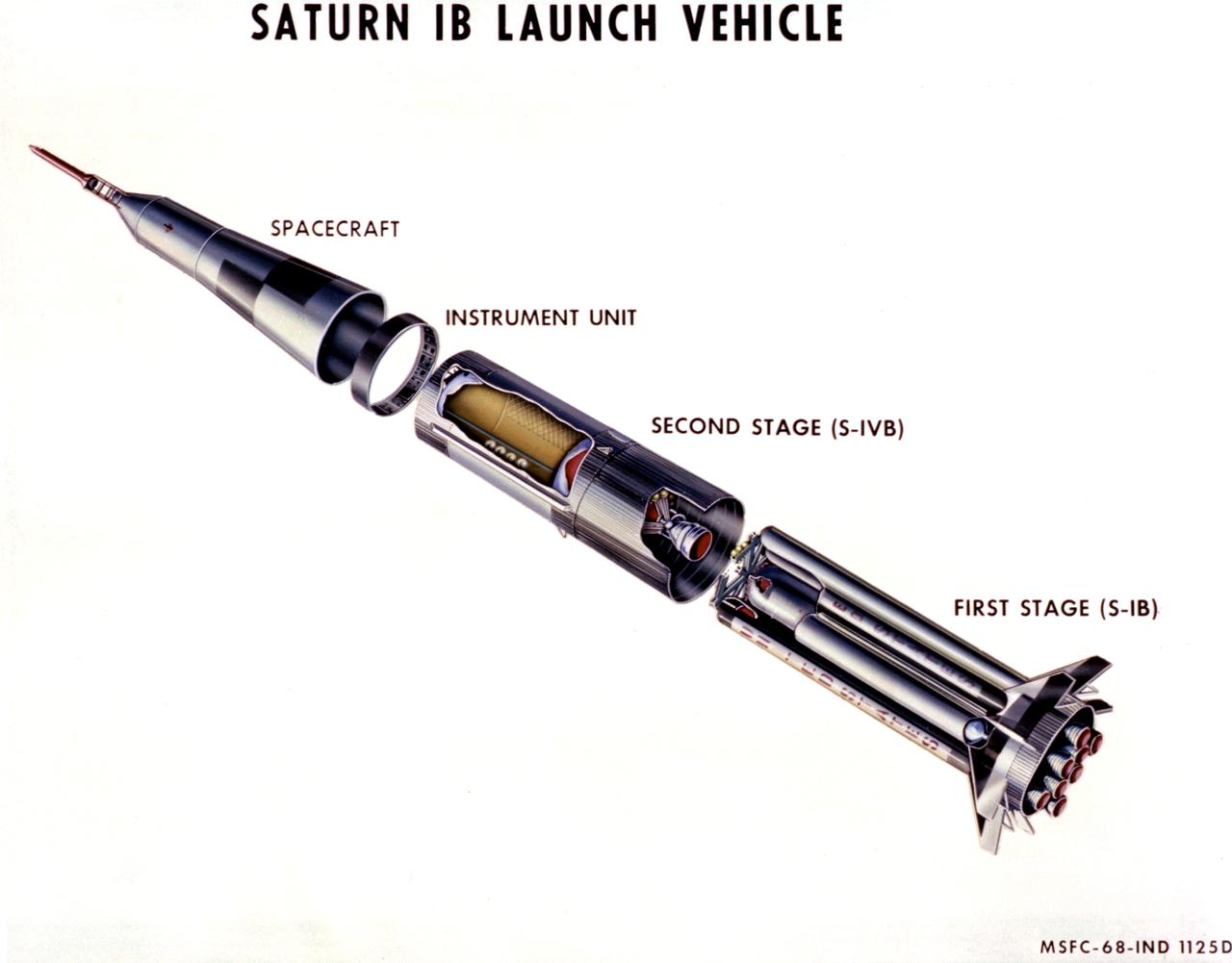
This 1968 cutaway drawing illustrates the Saturn IB launch vehicle with its two booster stages, the S-IB and S-IVB. Developed by the Marshall Space Flight Center (MSFC) as an interim vehicle in MSFC's "building block" approach to the Saturn rocket development, the Saturn IB utilized Saturn I technology to further develop and refine the larger boosters and the Apollo spacecraft capabilities required for the marned lunar mission.
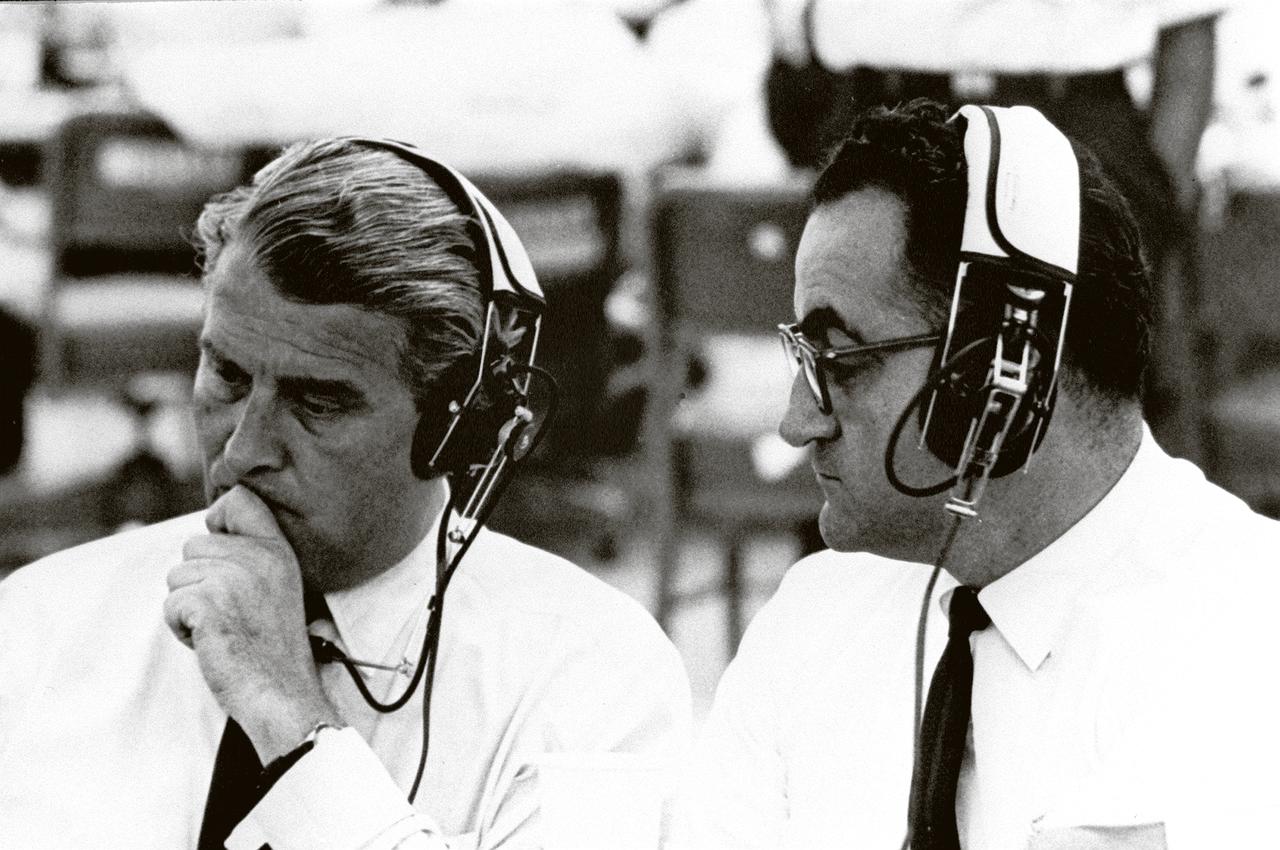
Marshall Space Flight Center (MSFC) Director Dr. Wernher von Braun (left) with Kennedy Space Center (KSC) Rocco Petrone prior to the January 29, 1964 launch of SA-5, the first Block II configuration of the Saturn I launch vehicle. Petrone played key roles at KSC in the development of Saturn launch facilities before becoming director of launch operations in 1966.
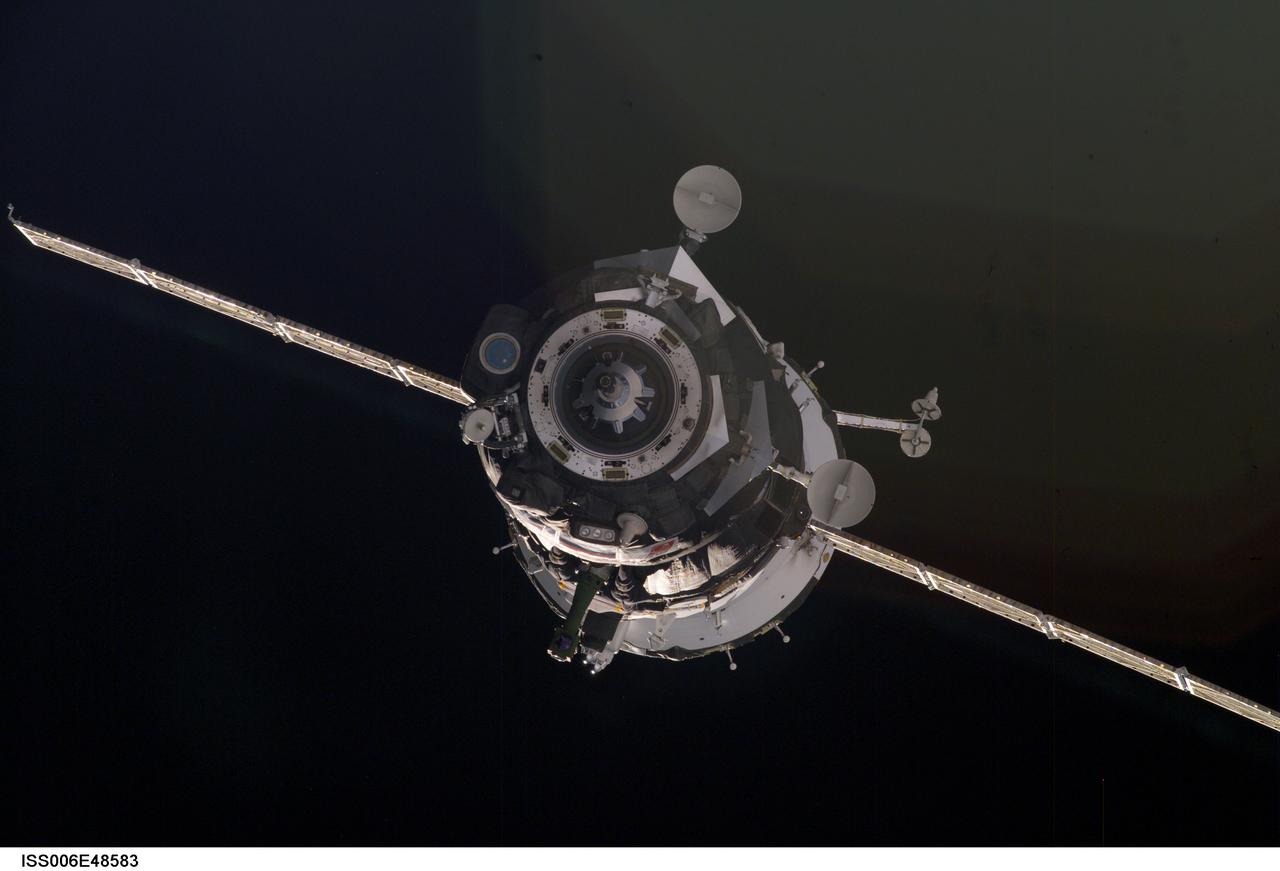
ISS006-E-48583 (28 April 2003) --- Backdropped against the blackness of space, the Soyuz TMA-2 spacecraft approaches the International Space Station (ISS). Onboard the spacecraft are the Expedition Seven crewmembers, cosmonaut Yuri I. Malenchenko, mission commander representing Rosaviakosmos, and astronaut Edward T. Lu, NASA ISS science officer and flight engineer. The Soyuz docked at the functional cargo block (FGB) nadir port at 12:56 a.m. (CDT) on April 28, 2003.
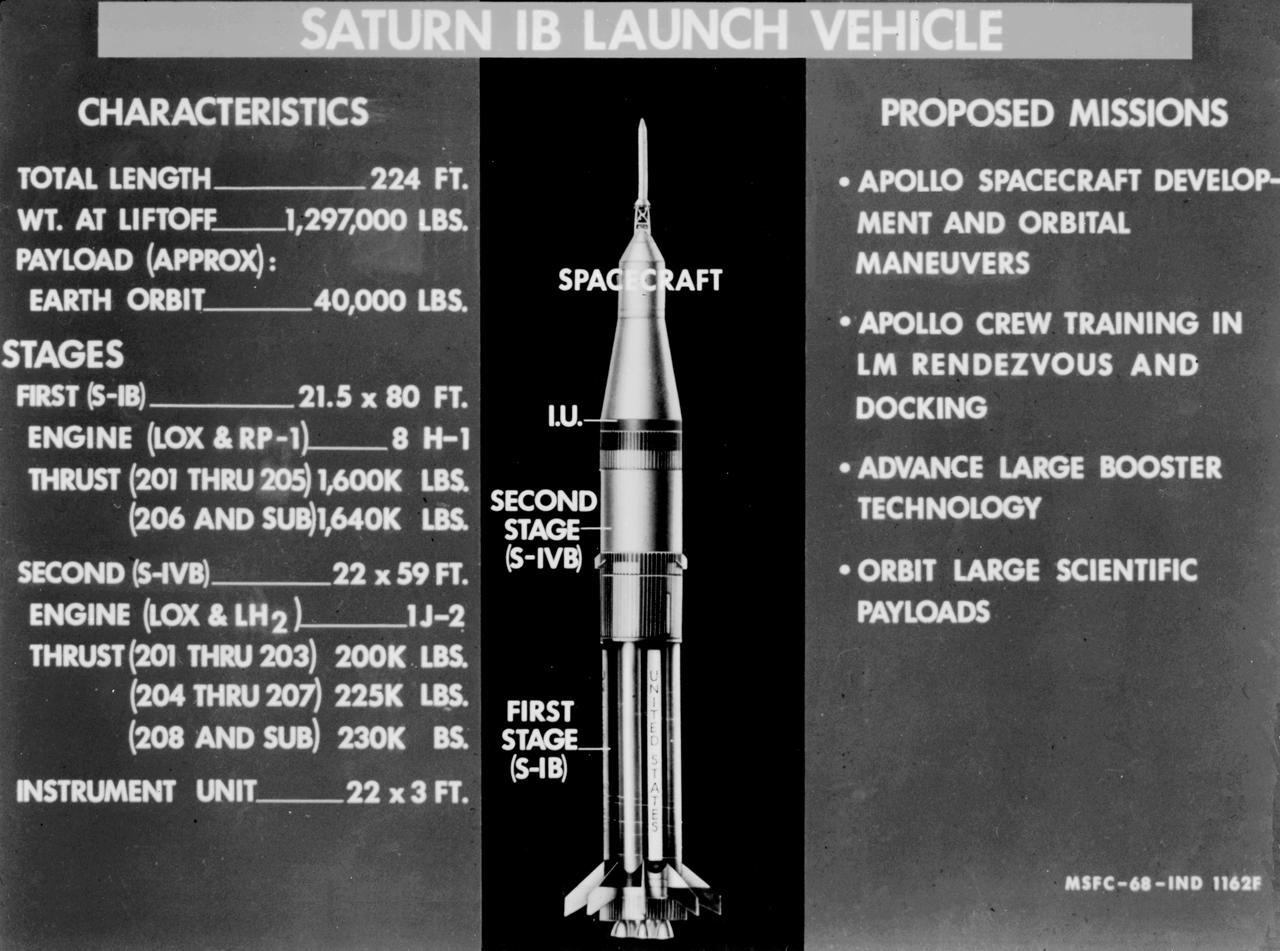
This 1968 chart illustrates the characteristics and proposed missions for the Saturn IB launch vehicle. Developed by the Marshall Space Flight Center (MSFC) as an interim vehicle in MSFC's "building block" approach to the Saturn rocket development, the Saturn IB utilized Saturn I technology to further develop and refine the larger boosters and the Apollo spacecraft capabilities required for the marned lunar missions.
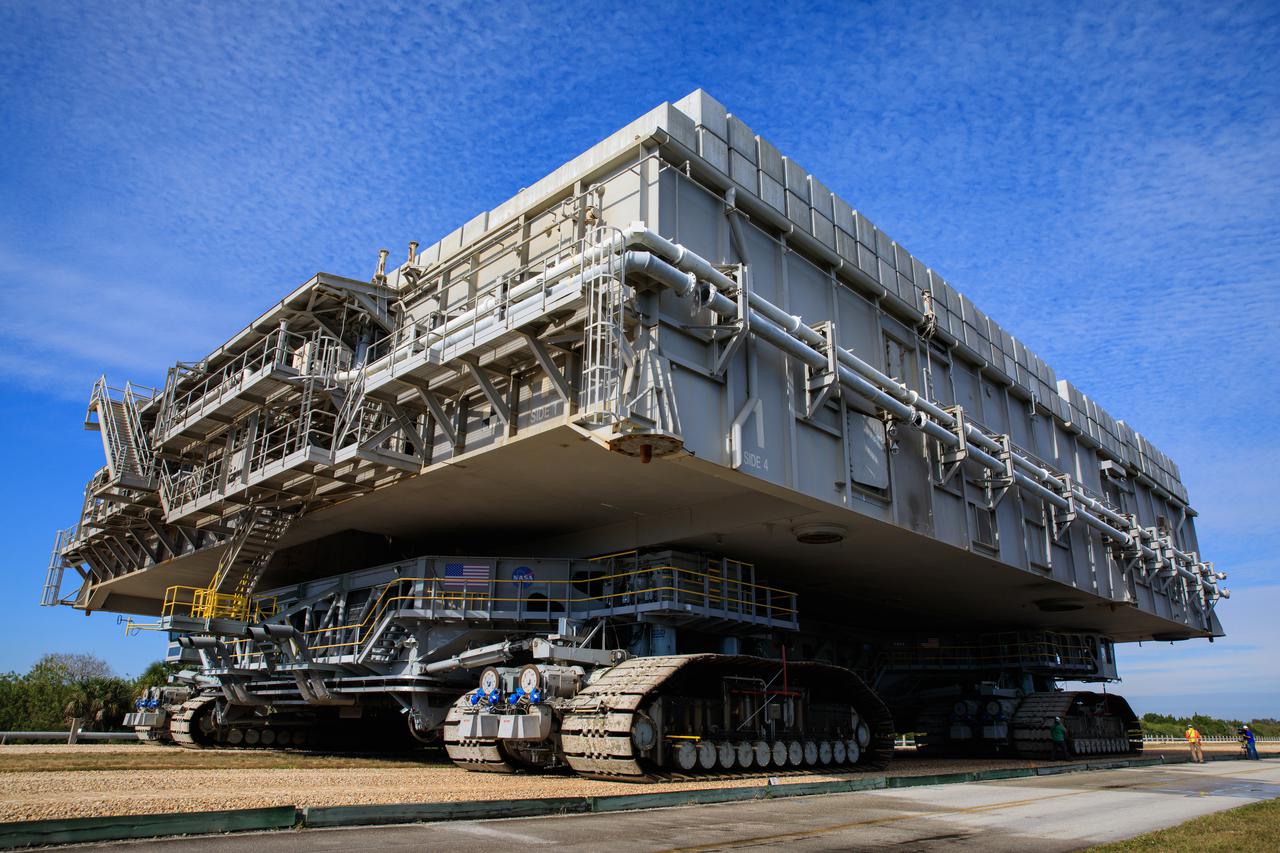
Teams at NASA’s Kennedy Space Center in Florida are working to ensure the crawlerway, the path the crawler-transporter 2 (CT-2), mobile launcher, and Space Launch System rocket with Orion atop will take from the Vehicle Assembly Building to Launch Complex 39B, is strong enough to withstand the weight and provide stability for the Artemis I mission. In this view on Jan. 22, 2021, CT-2 carrying mobile launcher platform 1 that was used during the shuttle program was driven back and forth on the crawlerway with several cement blocks, each weighing about 40,000 pounds to strengthen the crawlerway for launch. Artemis I will be the first in a series of increasingly complex missions to the Moon. Under the Artemis program, NASA aims to land the first woman and the next man on the Moon in 2024 and establish sustainable lunar exploration by the end of the decade.
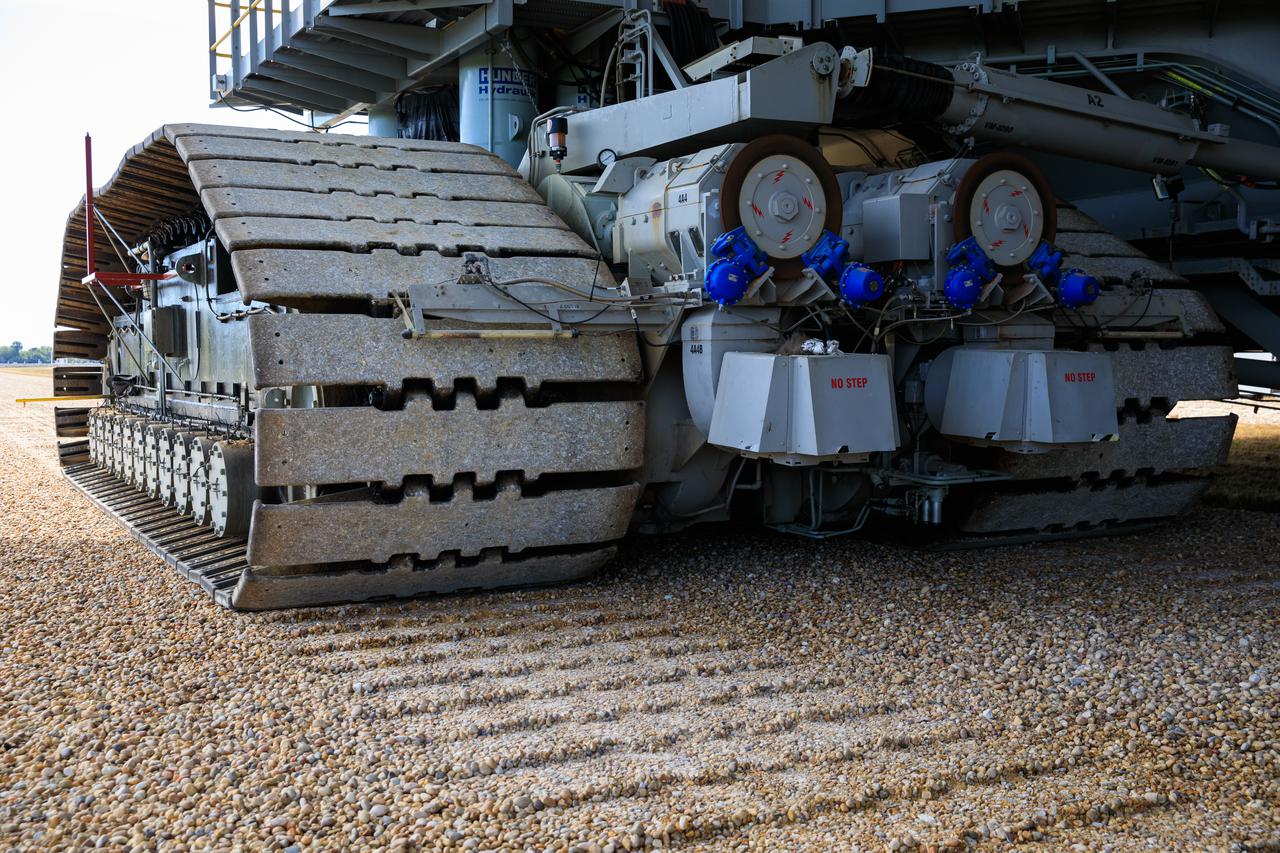
A close-up view of the treads on crawler-transporter 2 (CT-2) as the behemoth vehicle moves along the crawlerway at NASA’s Kennedy Space Center in Florida on Jan. 22, 2021. Teams are working to ensure the crawlerway, the path the CT-2, mobile launcher, and Space Launch System rocket with Orion atop will take from the Vehicle Assembly Building to Launch Complex 39B, is strong enough to withstand the weight and provide stability for the Artemis I mission. CT-2 carrying mobile launcher platform 1, used during the shuttle program, was driven back and forth on the crawlerway with several cement blocks, each weighing about 40,000 pounds to strengthen the crawlerway for launch. Artemis I will be the first in a series of increasingly complex missions to the Moon. Under the Artemis program, NASA aims to land the first woman and the next man on the Moon in 2024 and establish sustainable lunar exploration by the end of the decade.
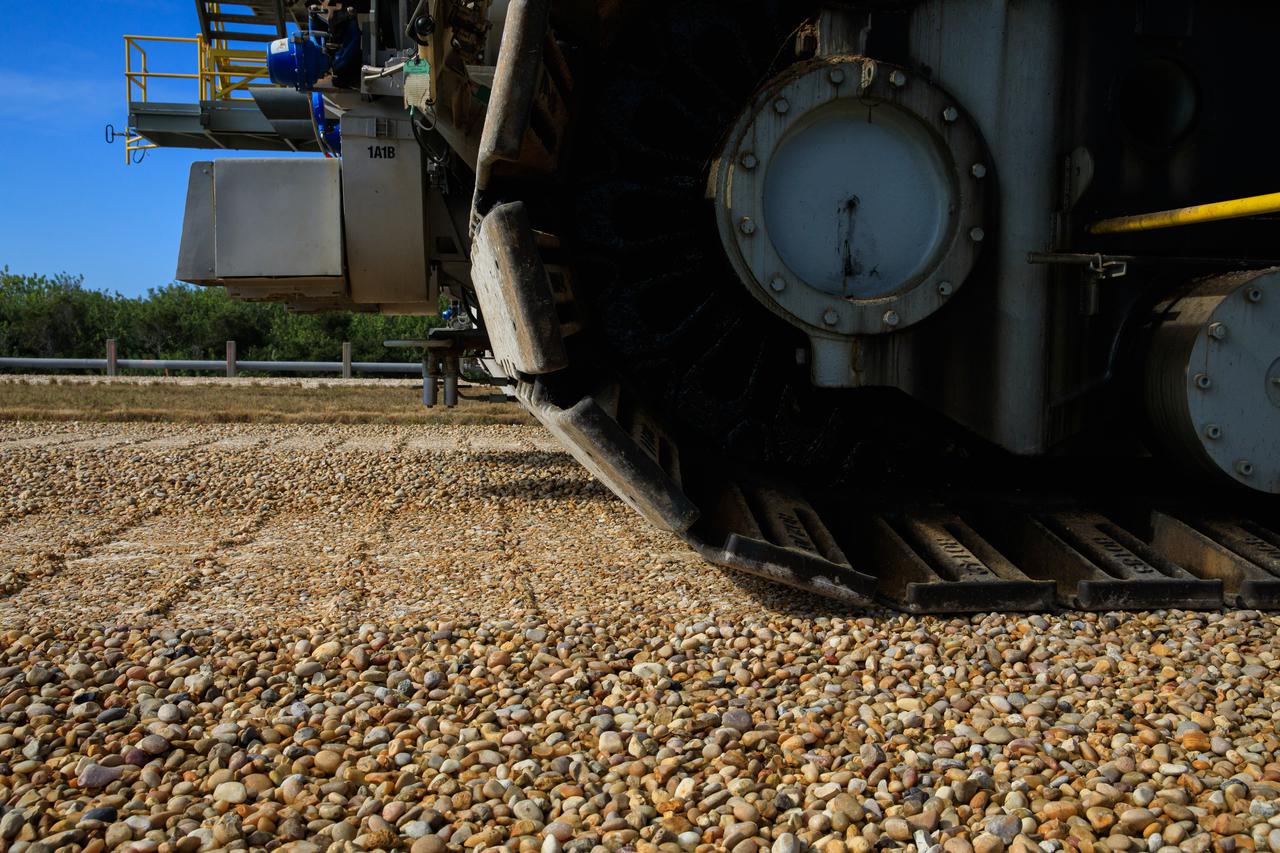
A close-up view of one of the treads on crawler-transporter 2 (CT-2) as the behemoth vehicle moves along the crawlerway at NASA’s Kennedy Space Center in Florida on Jan. 22, 2021. Teams are working to ensure the crawlerway, the path the CT-2, mobile launcher, and Space Launch System rocket with Orion atop will take from the Vehicle Assembly Building to Launch Complex 39B, is strong enough to withstand the weight and provide stability for the Artemis I mission. CT-2 carrying mobile launcher platform 1, used during the shuttle program, was driven back and forth on the crawlerway with several cement blocks, each weighing about 40,000 pounds to strengthen the crawlerway for launch. Artemis I will be the first in a series of increasingly complex missions to the Moon. Under the Artemis program, NASA aims to land the first woman and the next man on the Moon in 2024 and establish sustainable lunar exploration by the end of the decade.
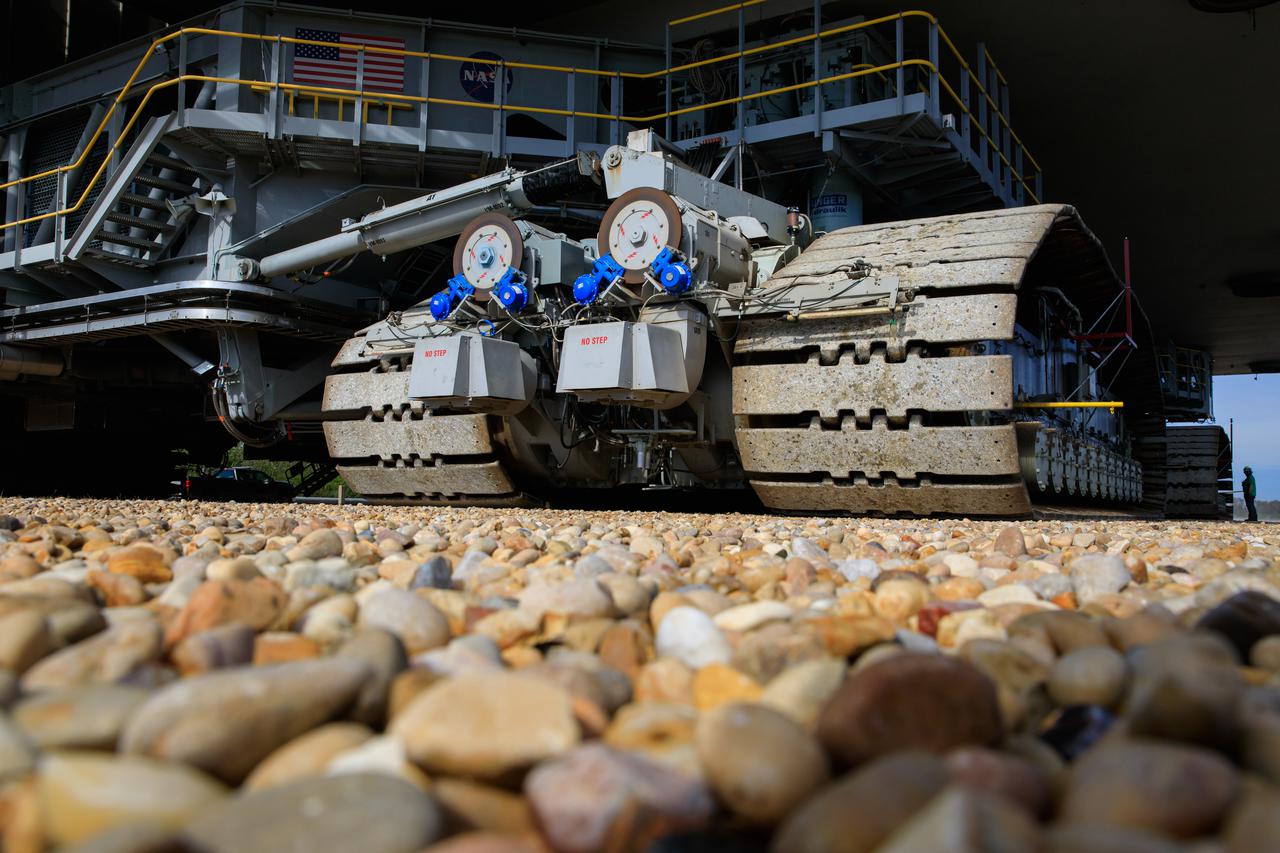
A close-up view of some of the treads on crawler-transporter 2 (CT-2) as the behemoth vehicle moves along the crawlerway at NASA’s Kennedy Space Center in Florida on Jan. 22, 2021. Teams are working to ensure the crawlerway, the path the CT-2, mobile launcher, and Space Launch System rocket with Orion atop will take from the Vehicle Assembly Building to Launch Complex 39B, is strong enough to withstand the weight and provide stability for the Artemis I mission. CT-2 carrying mobile launcher platform 1, used during the shuttle program, was driven back and forth on the crawlerway with several cement blocks, each weighing about 40,000 pounds to strengthen the crawlerway for launch. Artemis I will be the first in a series of increasingly complex missions to the Moon. Under the Artemis program, NASA aims to land the first woman and the next man on the Moon in 2024 and establish sustainable lunar exploration by the end of the decade.

A close-up view of the treads on crawler-transporter 2 (CT-2) as the behemoth vehicle moves along the crawlerway at NASA’s Kennedy Space Center in Florida on Jan. 22, 2021. Teams are working to ensure the crawlerway, the path the CT-2, mobile launcher, and Space Launch System rocket with Orion atop will take from the Vehicle Assembly Building to Launch Complex 39B, is strong enough to withstand the weight and provide stability for the Artemis I mission. CT-2 carrying mobile launcher platform 1, used during the shuttle program, was driven back and forth on the crawlerway with several cement blocks, each weighing about 40,000 pounds to strengthen the crawlerway for launch. Artemis I will be the first in a series of increasingly complex missions to the Moon. Under the Artemis program, NASA aims to land the first woman and the next man on the Moon in 2024 and establish sustainable lunar exploration by the end of the decade.
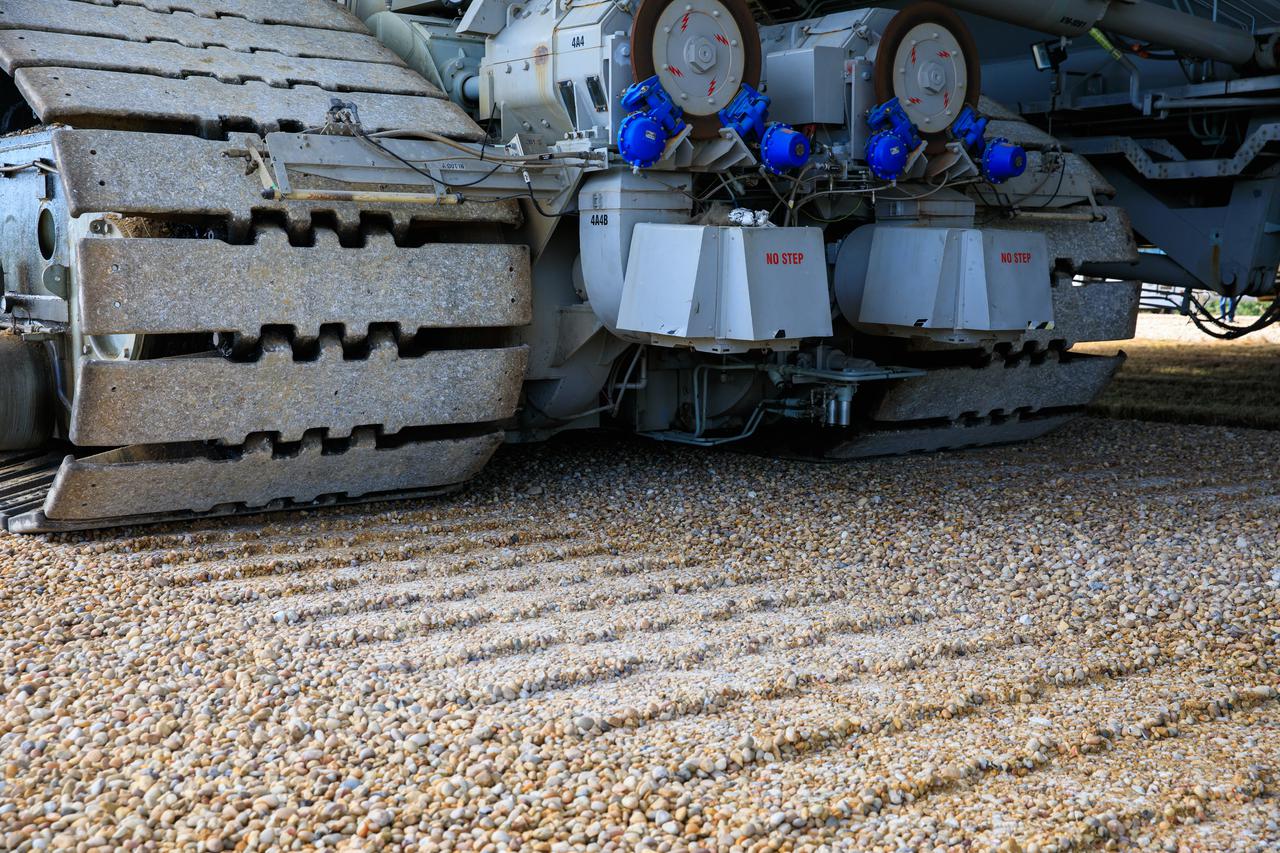
A close-up view of the treads on crawler-transporter 2 (CT-2) as the behemoth vehicle moves along the crawlerway at NASA’s Kennedy Space Center in Florida on Jan. 22, 2021. Teams are working to ensure the crawlerway, the path the CT-2, mobile launcher, and Space Launch System rocket with Orion atop will take from the Vehicle Assembly Building to Launch Complex 39B, is strong enough to withstand the weight and provide stability for the Artemis I mission. CT-2 carrying mobile launcher platform 1, used during the shuttle program, was driven back and forth on the crawlerway with several cement blocks, each weighing about 40,000 pounds to strengthen the crawlerway for launch. Artemis I will be the first in a series of increasingly complex missions to the Moon. Under the Artemis program, NASA aims to land the first woman and the next man on the Moon in 2024 and establish sustainable lunar exploration by the end of the decade.
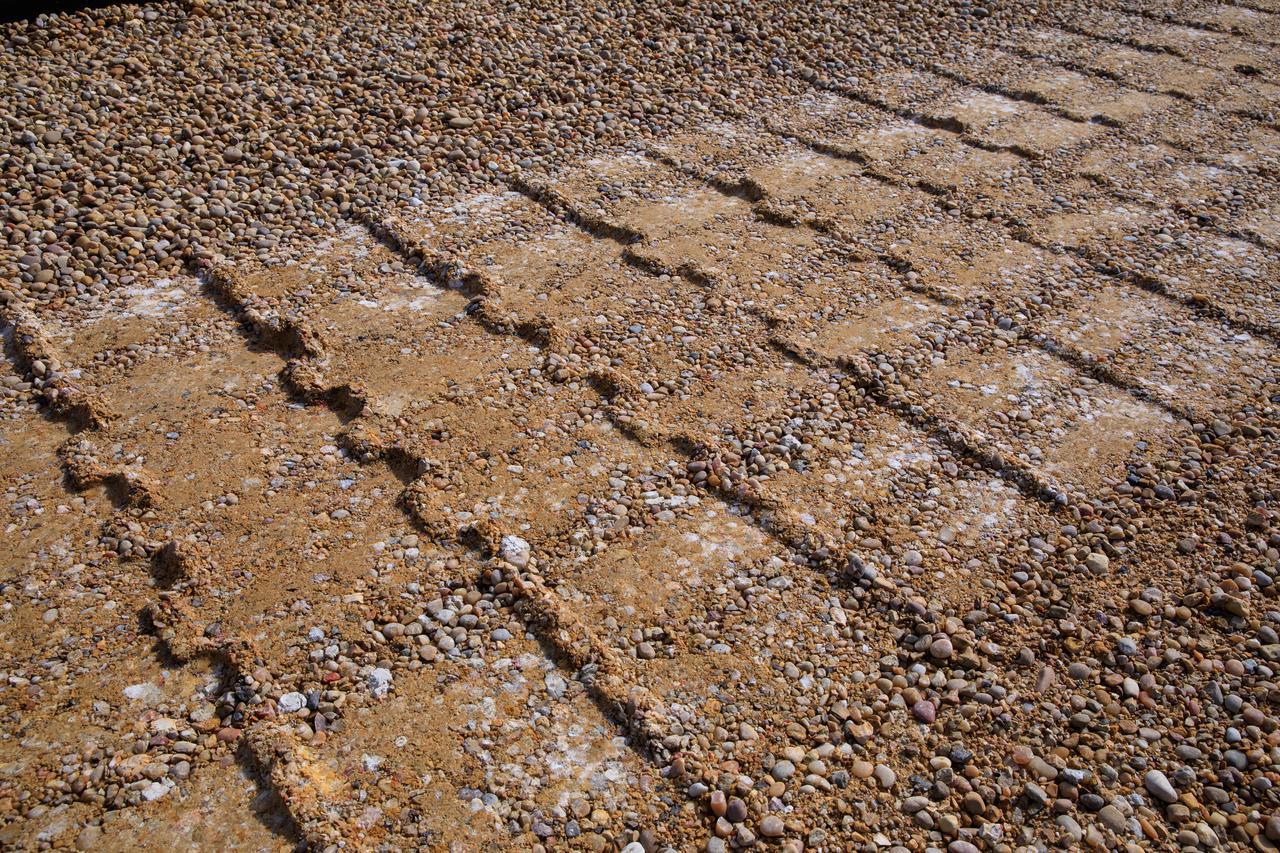
A close-up view of tread marks from crawler-transporter 2 (CT-2) as the behemoth vehicle moves along the crawlerway at NASA’s Kennedy Space Center in Florida on Jan. 22, 2021. Teams are working to ensure the crawlerway, the path the CT-2, mobile launcher, and Space Launch System rocket with Orion atop will take from the Vehicle Assembly Building to Launch Complex 39B, is strong enough to withstand the weight and provide stability for the Artemis I mission. CT-2 carrying mobile launcher platform 1, used during the shuttle program, was driven back and forth on the crawlerway with several cement blocks, each weighing about 40,000 pounds to strengthen the crawlerway for launch. Artemis I will be the first in a series of increasingly complex missions to the Moon. Under the Artemis program, NASA aims to land the first woman and the next man on the Moon in 2024 and establish sustainable lunar exploration by the end of the decade.
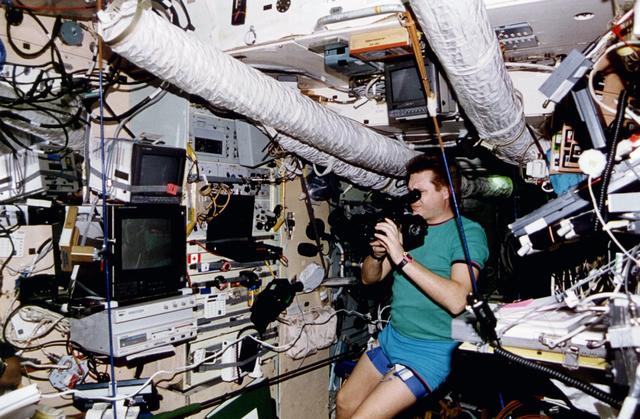
STS076-461-010 (22-31 March 1996) --- The STS-76 crew took this 70mm picture of Russia's Mir-21 mission commander Yury I. Onufrienko using a video camera on the Base Block Module of Russia's Mir Space Station. The STS-76 crew docked the Space Shuttle Atlantis with the Mir Space Station on March 23, 1996, at which time astronaut Shannon W. Lucid (out of frame) joined Onufrienko and the mission's flight engineer, Yury V. Usachev, to begin the first leg of a 140-day stay aboard Mir, as a cosmonaut guest researcher.
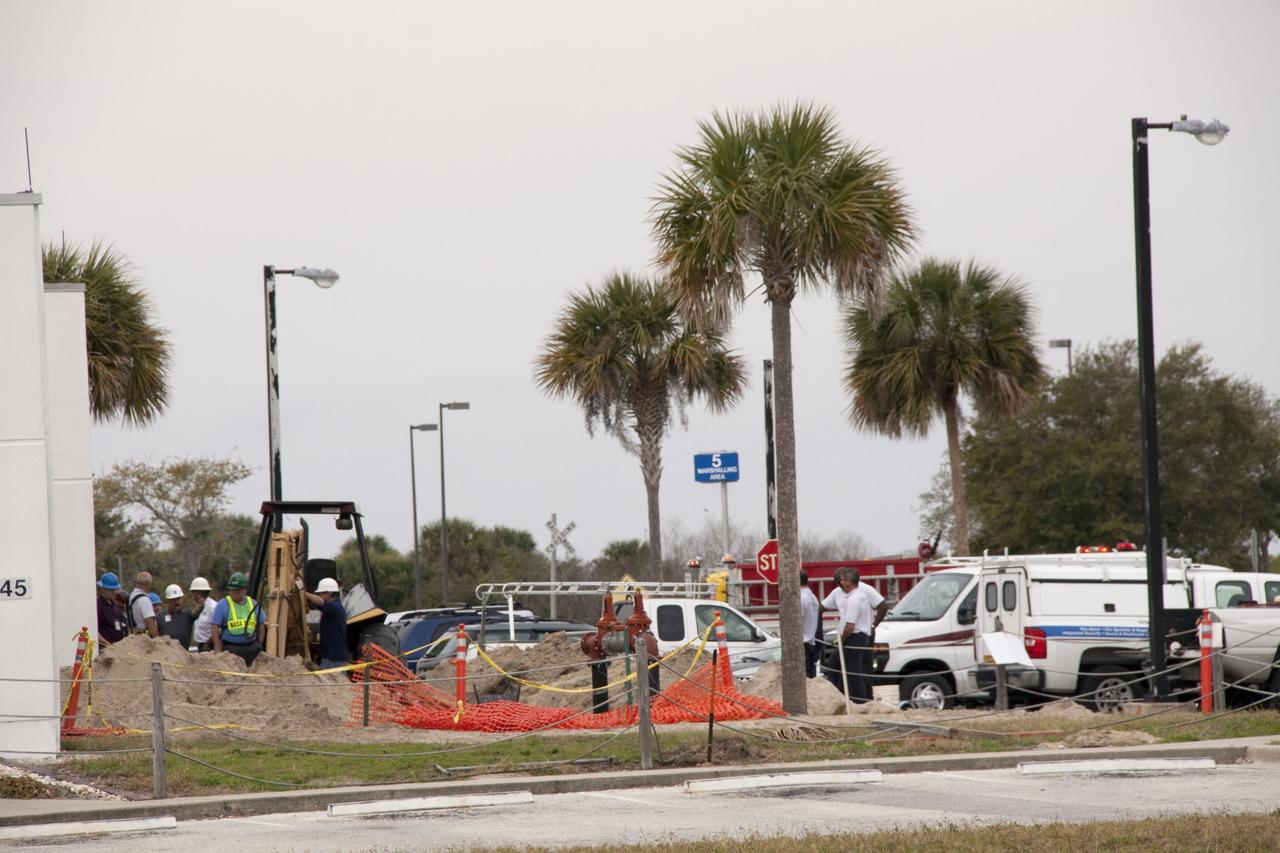
CAPE CANAVERAL, Fla. -- At NASA's Kennedy Space Center in Florida, a backhoe inadvertently struck a natural gas line in the area north of the Multi Function Facility (MFF), at around 8:40 a.m. EST. As a precaution, personnel were evacuated from Orbiter Processing Facilities 1 and 2, the MFF, Processing Control Center and the Operations Support Building (OSB) I. All traffic was blocked on the Saturn Causeway near the facilities. There were no injuries or damage to any facilities and personnel were allowed back into their buildings before mid-day and the roadway open to traffic. With the backhoe idle, workers assess the area where the break in the gas line occurred. Photo credit: NASA/Jack Pfaller
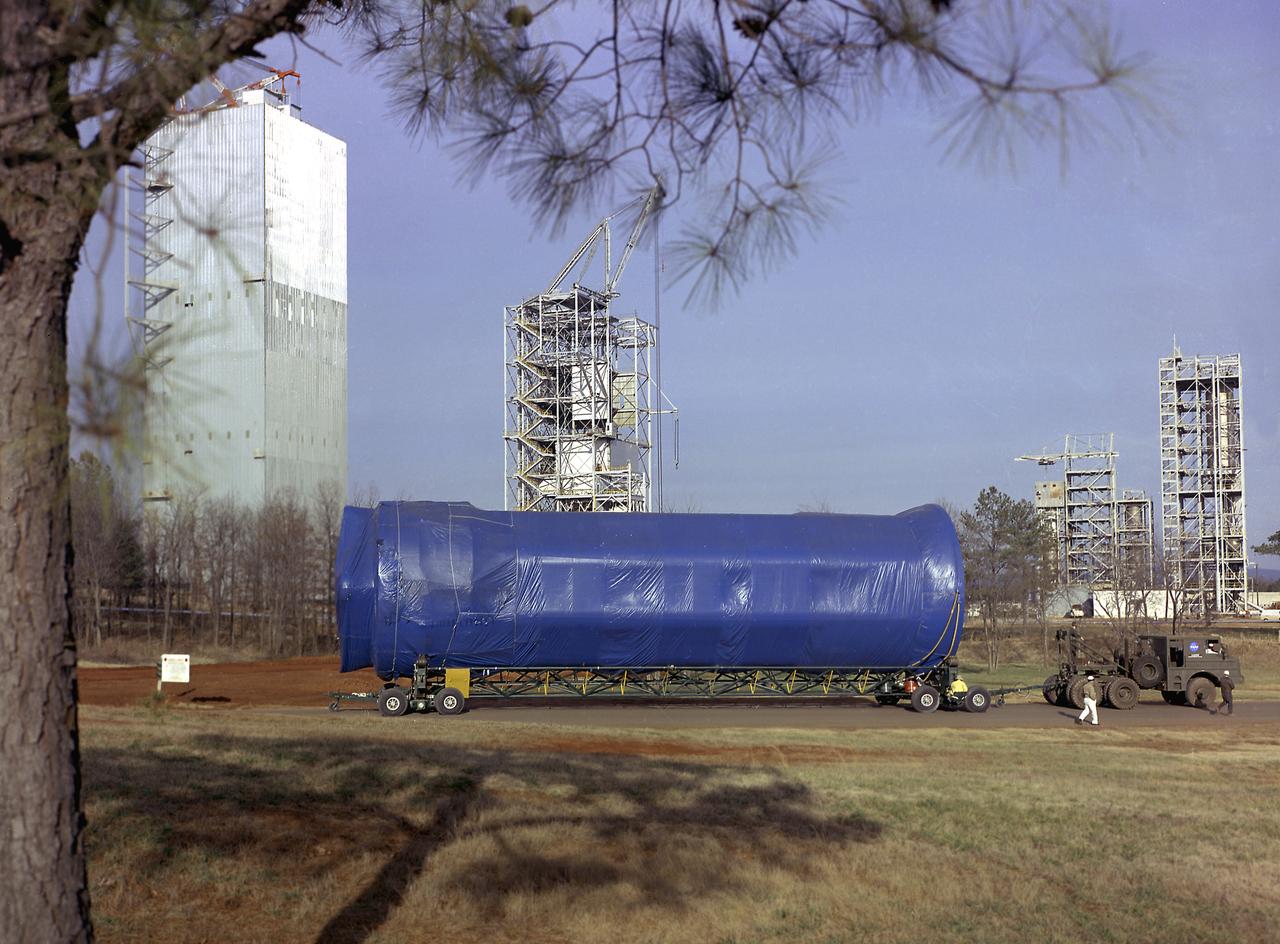
S-IB-200D, a dynamic test version of the Saturn IB launch vehicle's first stage (S-IB), makes its way to the Marshall Space Flight Center (MSFC) East Test Area on January 4, 1965. Test Laboratory persornel assembled a complete Saturn IB to test the structural soundness of the launch vehicle in the Dynamic Test Stand. Developed by the MSFC as an interim vehicle in MSFC's "building block" approach to the Saturn rocket development, the Saturn IB utilized Saturn I technology to further develop and refine the larger boosters and the Apollo spacecraft capabilities required for the manned lunar missions.
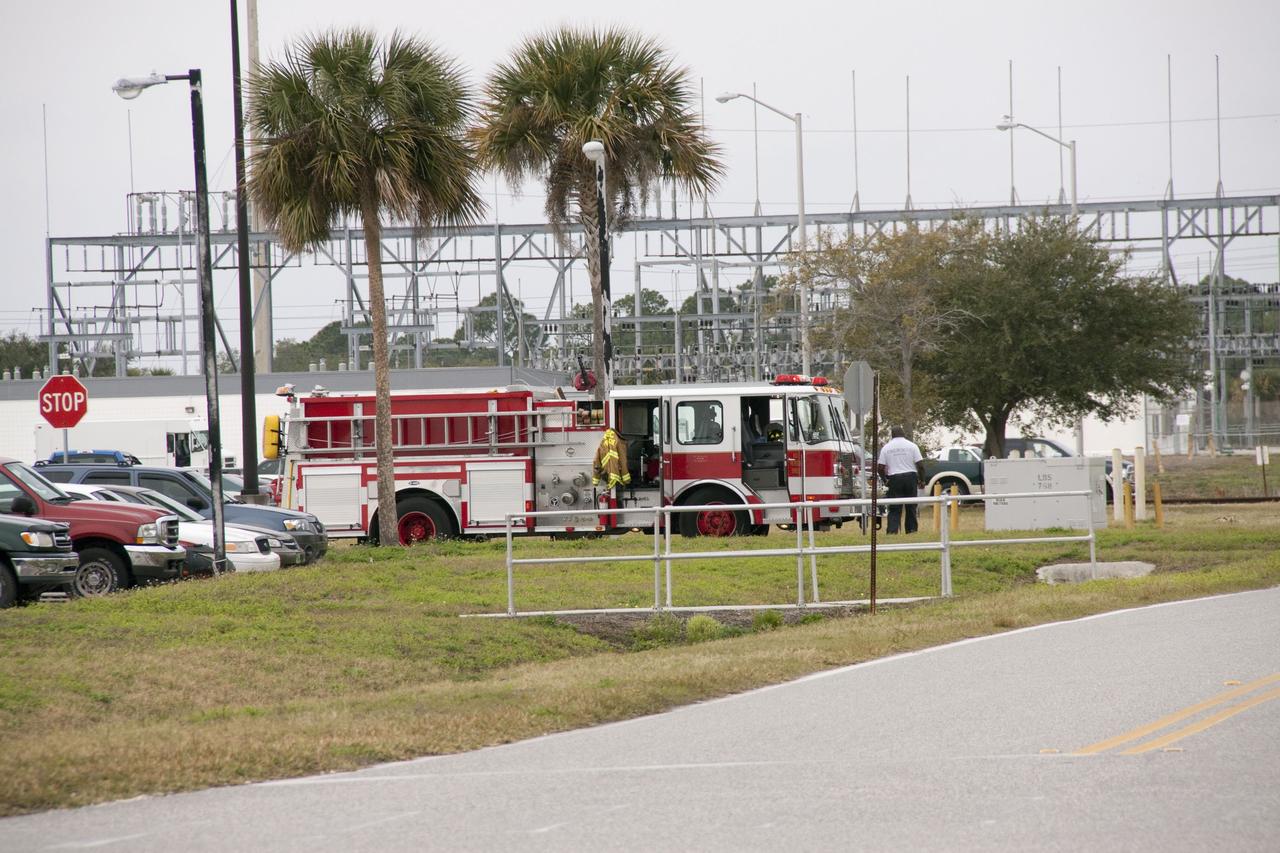
CAPE CANAVERAL, Fla. -- At NASA's Kennedy Space Center in Florida, KSC firefighters were on the scene after a backhoe inadvertently struck a natural gas line at around 8:40 a.m. EST in the area north of the Multi Function Facility (MFF). As a precaution, personnel were evacuated from Orbiter Processing Facilities 1 and 2, the MFF, Processing Control Center and Operations Support Building (OSB) I. All traffic was blocked on the Saturn Causeway near the facilities. There were no injuries or damage to any facilities and personnel were allowed back into their buildings before mid-day and the roadway open to traffic. Photo credit: NASA/Jack Pfaller
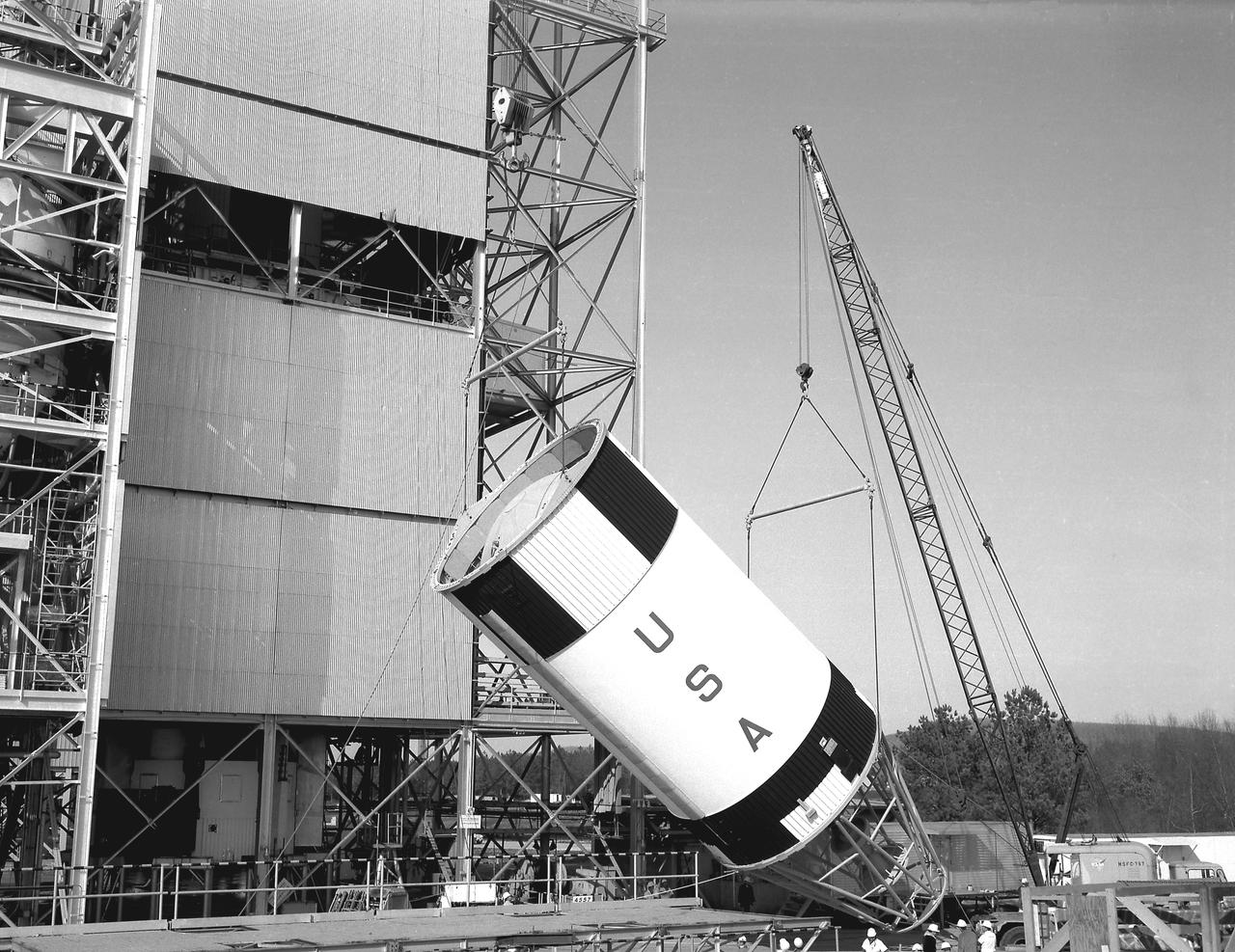
Marshall Space Flight Center (MSFC) workers hoist a dynamic test version of the S-IVB stage, the Saturn IB launch vehicle's second stage, into the Center's Dynamic Test Stand on January 18, 1965. MSFC Test Laboratory persornel assembled a complete Saturn IB to test the launch vehicle's structural soundness. Developed by the MSFC as an interim vehicle in MSFC's "building block" approach to the Saturn rocket development, the Saturn IB utilized Saturn I technology to further develop and refine the larger boosters and the Apollo spacecraft capabilities required for the manned lunar missions.
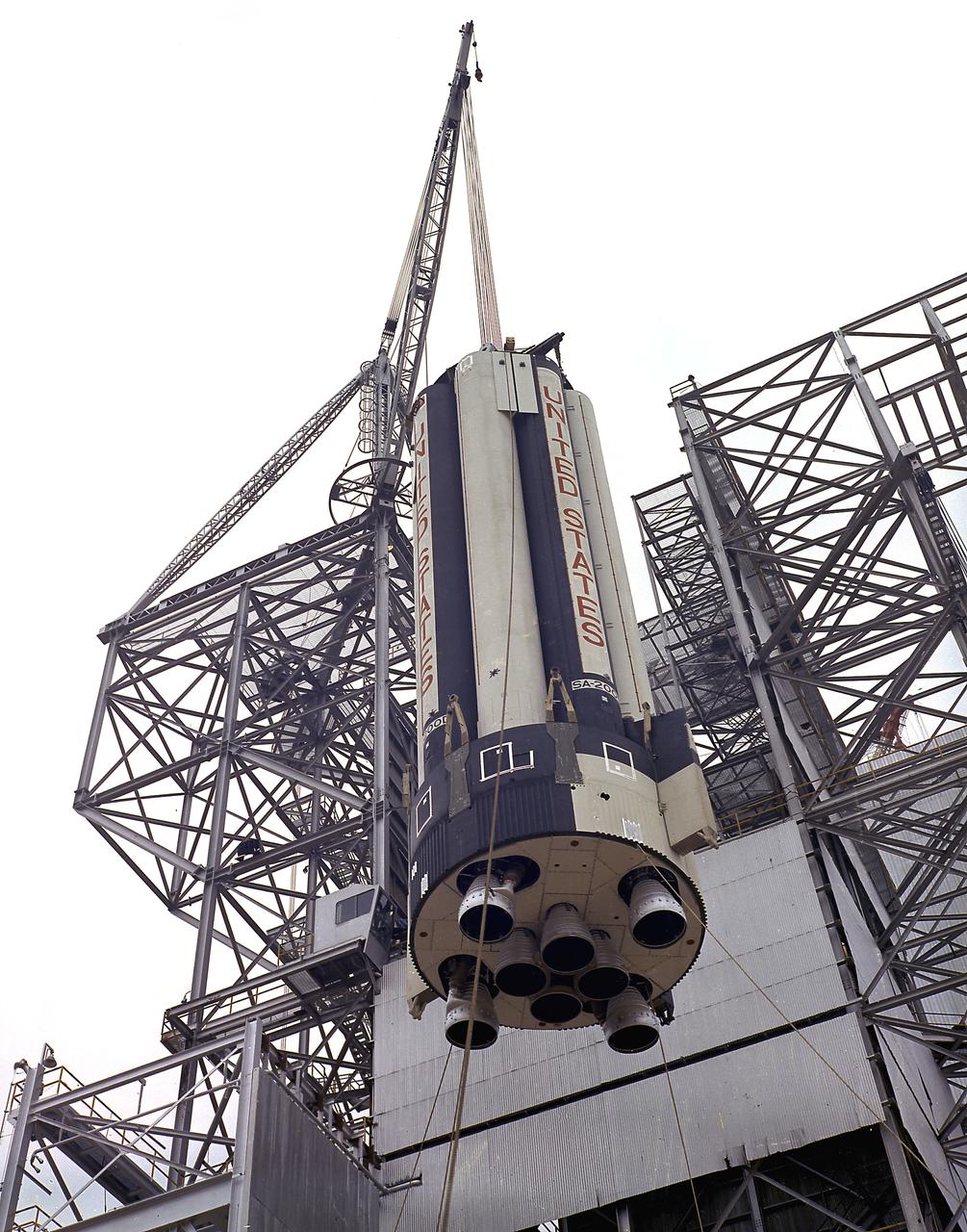
Workers at the Marshall Space Flight Center's (MSFC) Dynamic Test Stand install S-IB-200D, a dynamic test version of the Saturn IB launch vehicle's first stage, on January 11, 1965. MSFC Test Laboratory persornel assembled a complete Saturn IB to test the launch vehicle's structural soundness. Developed by the MSFC as an interim vehicle in MSFC's "building block" approach to the Saturn rocket development, the Saturn IB utilized Saturn I technology to further develop and refine the larger boosters and the Apollo spacecraft capabilities required for the manned lunar missions.
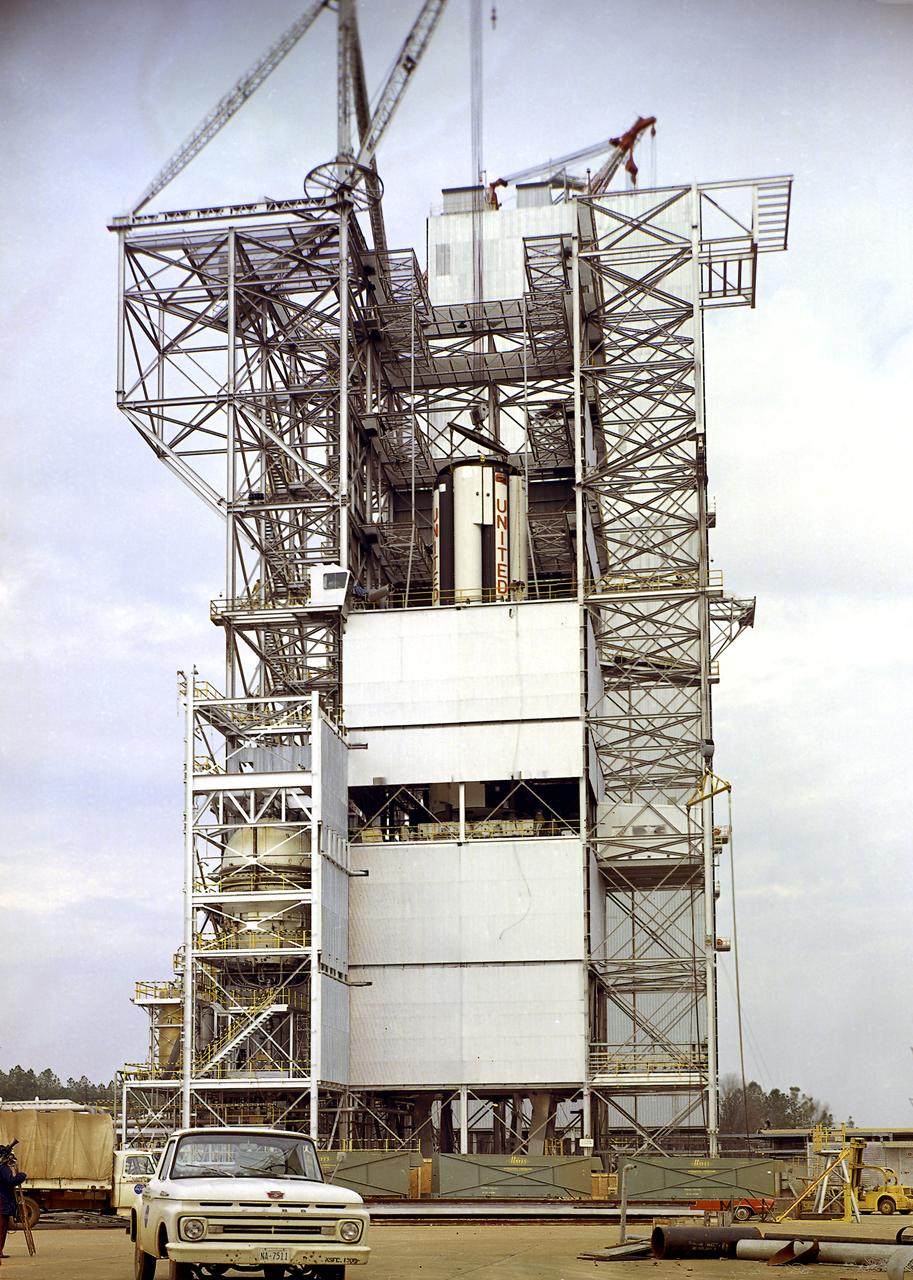
Marshall Space Flight Center (MSFC) workers lower S-IB-200D, a dynamic test version of the Saturn IB launch vehicle's first stage (S-IB stage), into the Center's Dynamic Test Stand on January 12, 1965. Test Laboratory persornel assembled a complete Saturn IB to test the structural soundness of the launch vehicle. Developed by the MSFC as an interim vehicle in MSFC's "building block" approach to Saturn rocket development, the Saturn IB utilized Saturn I technology to further develop and refine large boosters and the Apollo spacecraft capabilities required for the manned lunar missions.
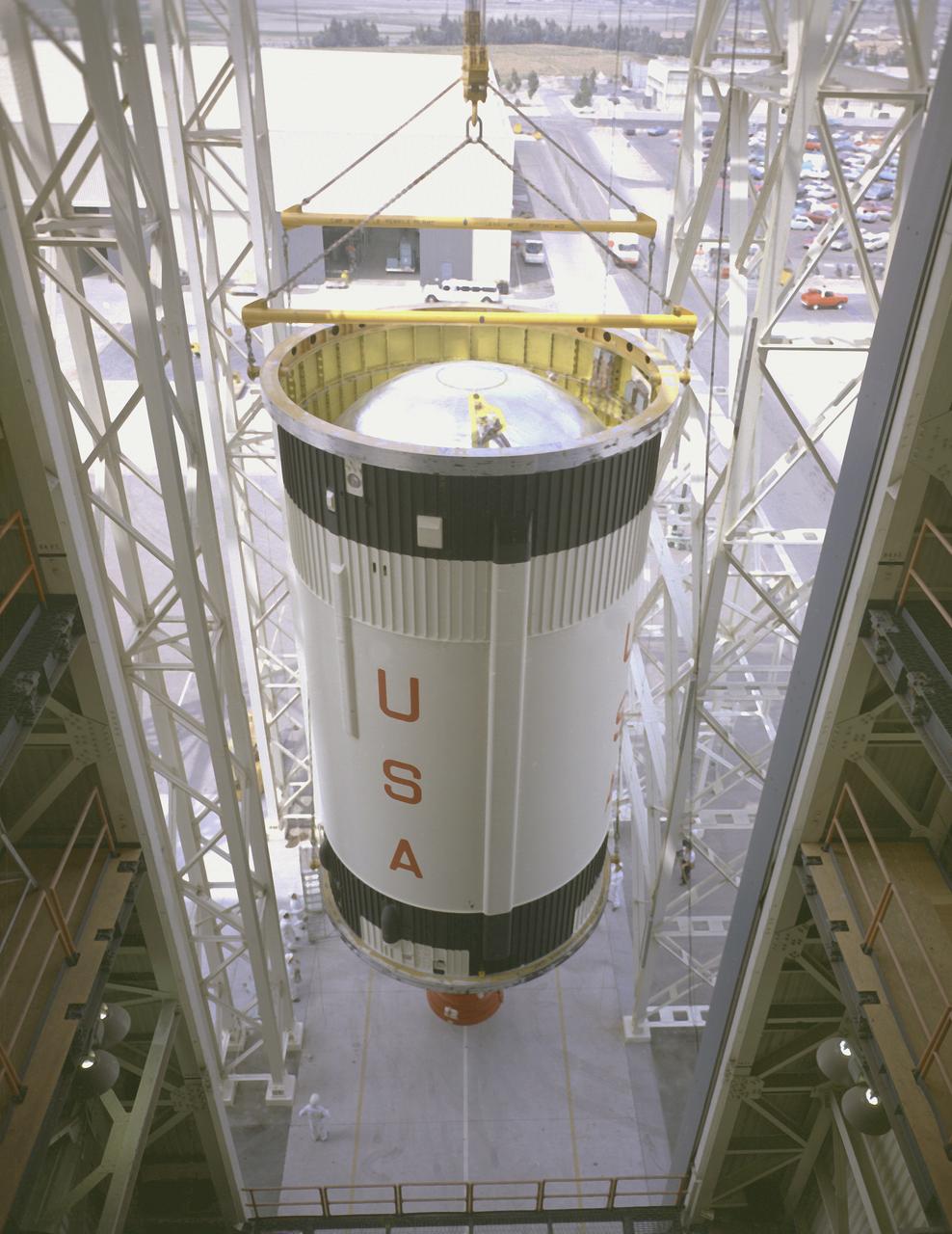
Workers at McDornel-Douglas install the Saturn IB S-IVB (second) stage for the Apollo-Soyuz mission into the company's S-IVB assembly and checkout tower in Huntington Beach, California. The Saturn IB launch vehicle was developed by the Marshall Space Flight Center (MSFC) as an interim vehicle in its "building block" approach to Saturn rocket development. This vehicle utilized the Saturn I technology to further develop and refine the capabilities of a larger booster and the Apollo spacecraft required for the manned lunar missions. The S-IVB stage, later used as the third stage of the Saturn V launch vehicle, was powered by a single J-2 engine initially capable of 200,000 pounds of thrust.
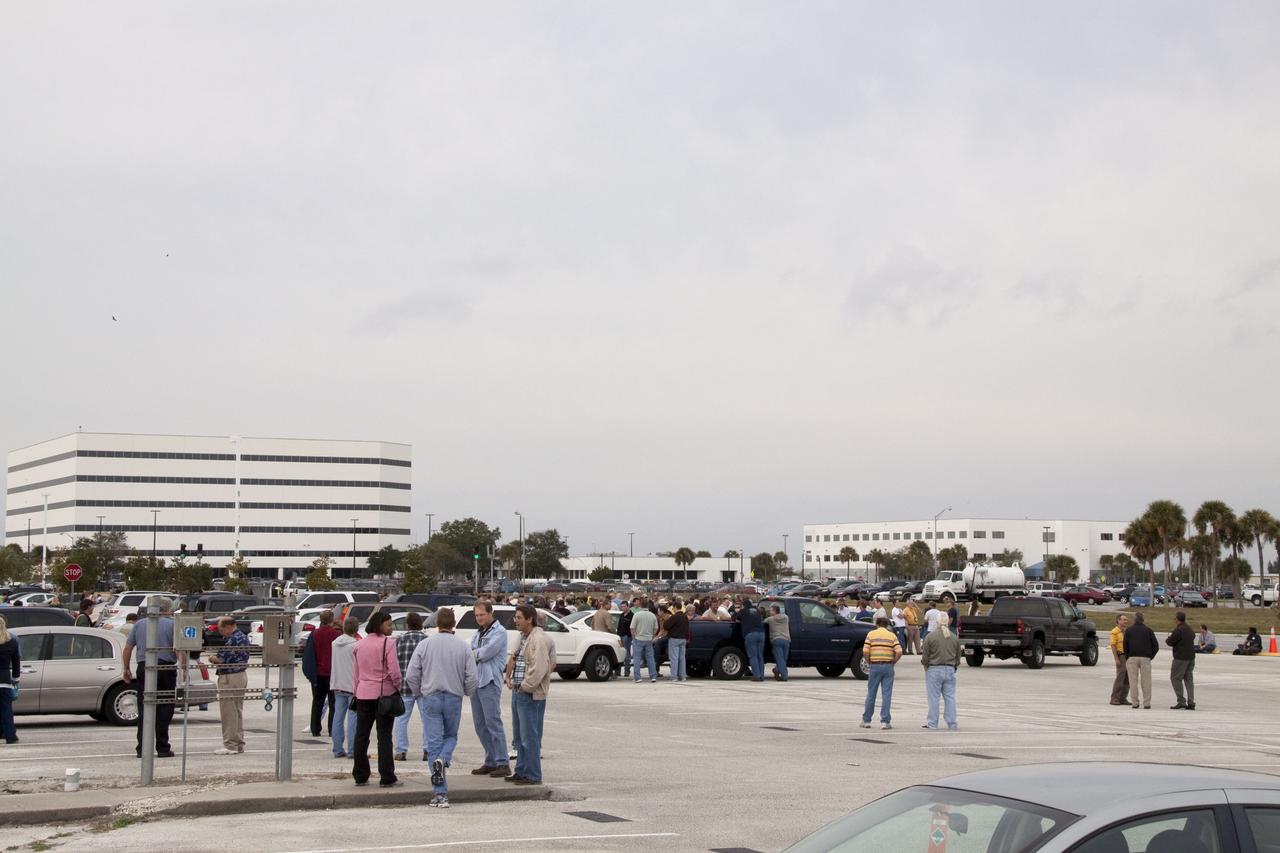
CAPE CANAVERAL, Fla. -- Workers wait to return to their buildings at NASA's Kennedy Space Center in Florida, after a backhoe inadvertently struck a natural gas line at around 8:40 a.m. EST in the area north of the Multi Function Facility (MFF). As a precaution, personnel were evacuated from Orbiter Processing Facilities 1 and 2, the MFF, Processing Control Center and Operations Support Building (OSB) I. All traffic was blocked on the Saturn Causeway near the facilities. There were no injuries or damage to any facilities and personnel were allowed back into their buildings before mid-day and the roadway open to traffic. Photo credit: NASA/Jack Pfaller
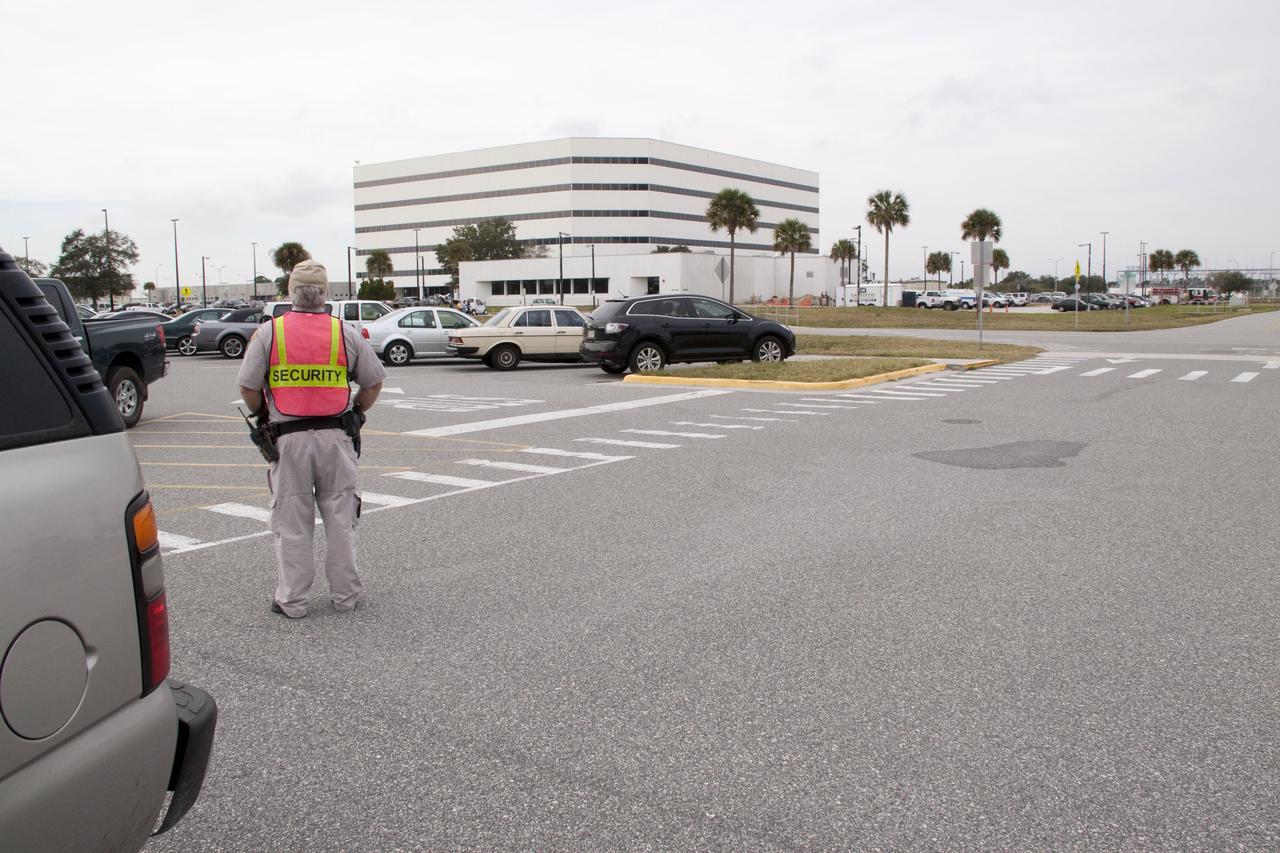
CAPE CANAVERAL, Fla. -- At NASA's Kennedy Space Center in Florida, a security officer monitors the area after a backhoe inadvertently struck a natural gas line at around 8:40 a.m. EST in the area north of the Multi Function Facility (MFF). As a precaution, personnel were evacuated from Orbiter Processing Facilities 1 and 2, the MFF, Processing Control Center and Operations Support Building (OSB) I. All traffic was blocked on the Saturn Causeway near the facilities. There were no injuries or damage to any facilities and personnel were allowed back into their buildings before mid-day and the roadway open to traffic. Photo credit: NASA/Jack Pfaller

Workmen at the Kennedy Space Center hoist the Saturn Lunar Module (LM) Adapter into position during assembly of the 204LM-1, an unmanned Apollo mission that tested the Apollo Lunar Module in Earth orbit. Also known as Apollo 5, the spacecraft was launched on the fourth Saturn IB launch vehicle. Developed by the Marshall Space Flight Center (MSFC) as an interim vehicle in MSFC's "building block" approach to the Saturn rocket development, the Saturn IB utilized Saturn I technology to further develop and refine a larger booster and the Apollo spacecraft capabilities required for the manned lunar missions.
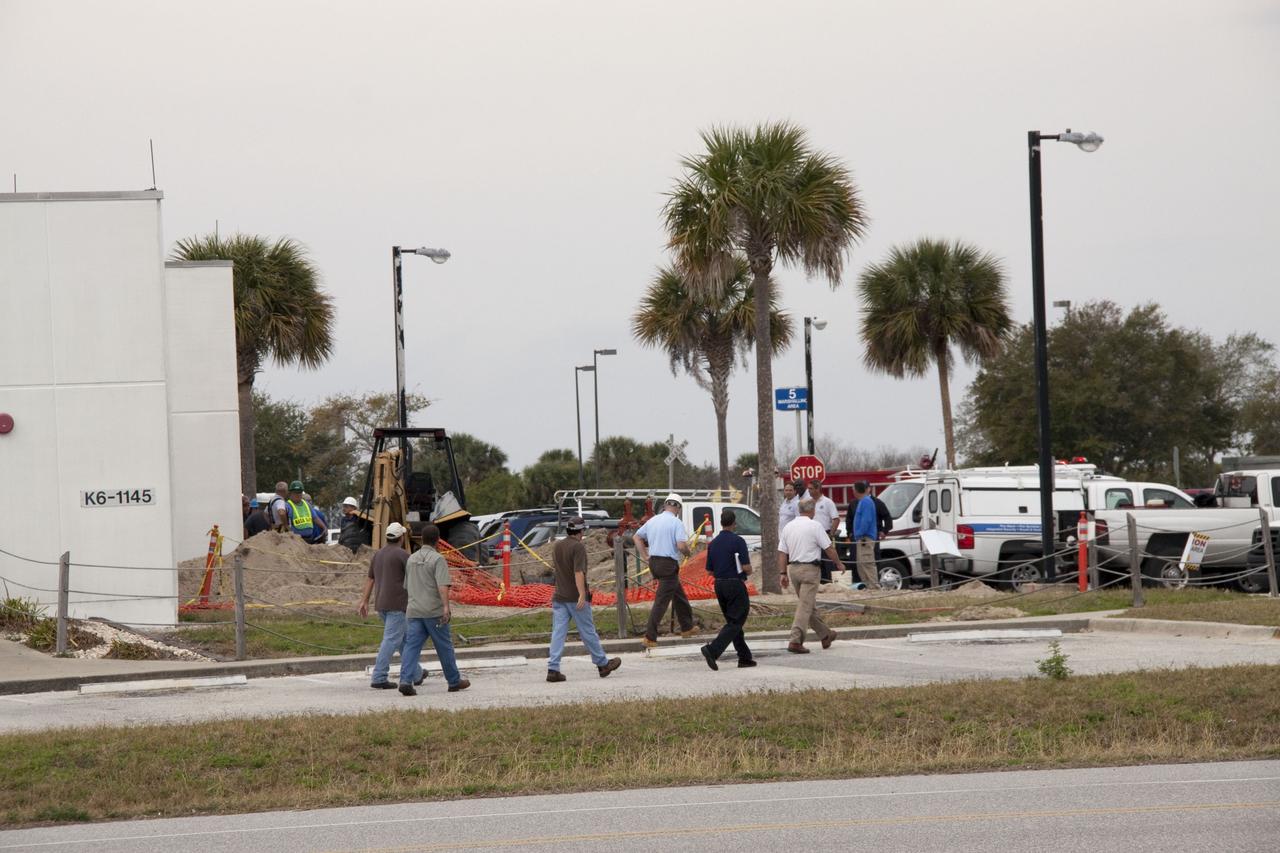
CAPE CANAVERAL, Fla. -- At NASA's Kennedy Space Center in Florida, a backhoe inadvertently struck a natural gas line in the area north of the Multi Function Facility (MFF), at around 8:40 a.m. EST. As a precaution, personnel were evacuated from Orbiter Processing Facilities 1 and 2, the MFF, Processing Control Center and the Operations Support Building (OSB) I. All traffic was blocked on the Saturn Causeway near the facilities. There were no injuries or damage to any facilities and personnel were allowed back into their buildings before mid-day and the roadway open to traffic. With the backhoe idle, workers assess the area where the break in the gas line occurred. Photo credit: NASA/Jack Pfaller
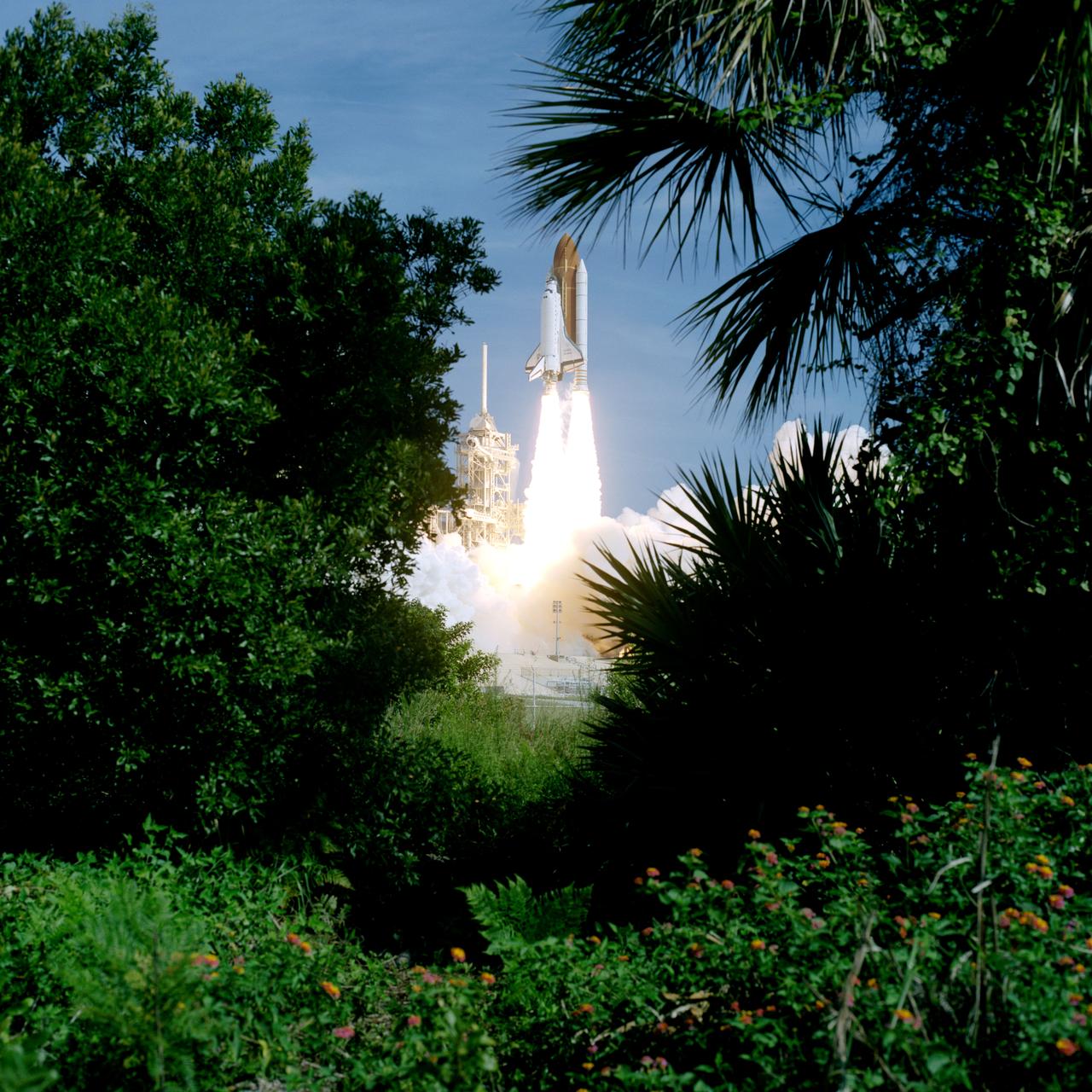
STS070-S-003 (13 JULY 1995) --- Framed by Florida foliage, the Space Shuttle Discovery begins its 21st Spaceflight. Five NASA astronauts and a Tracking and Data Relay Satellite (TDRS) were aboard for the liftoff, which occurred at 9:41:55 a.m. (EDT), July 13, 1995 from Launch Pad 39B. Onboard were astronauts Terence T. (Tom) Henricks, Kevin R. Kregel, Nancy J. Curie, Donald A. Thomas and Mary Ellen Weber. This mission also marks the maiden flight of the new Block I Space Shuttle Main Engine configuration designed to increase engine performance as well as safety and reliability.
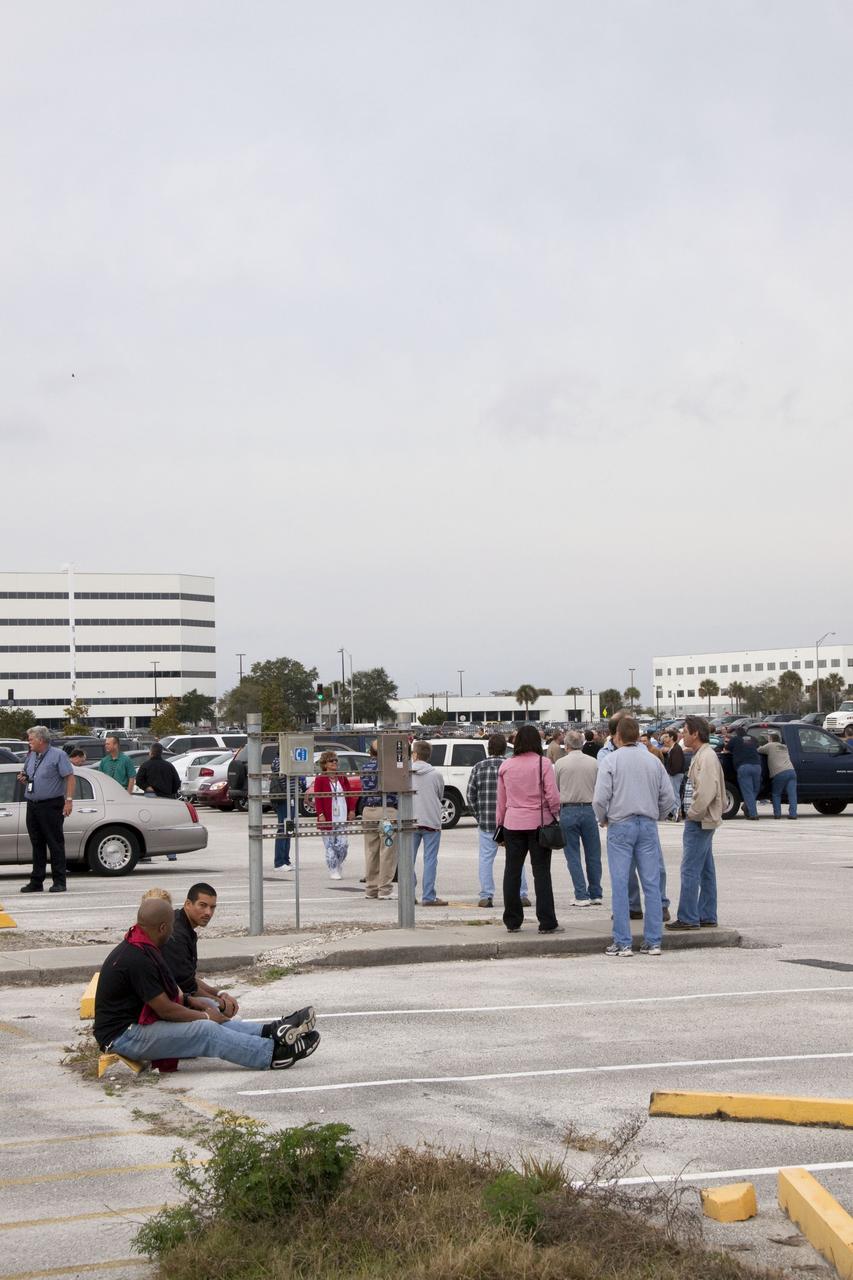
CAPE CANAVERAL, Fla. -- Workers wait to return to their buildings at NASA's Kennedy Space Center in Florida, after a backhoe inadvertently struck a natural gas line at around 8:40 a.m. EST in the area north of the Multi Function Facility (MFF). As a precaution, personnel were evacuated from Orbiter Processing Facilities 1 and 2, the MFF, Processing Control Center and Operations Support Building (OSB) I. All traffic was blocked on the Saturn Causeway near the facilities. There were no injuries or damage to any facilities and personnel were allowed back into their buildings before mid-day and the roadway open to traffic. Photo credit: NASA/Jack Pfaller
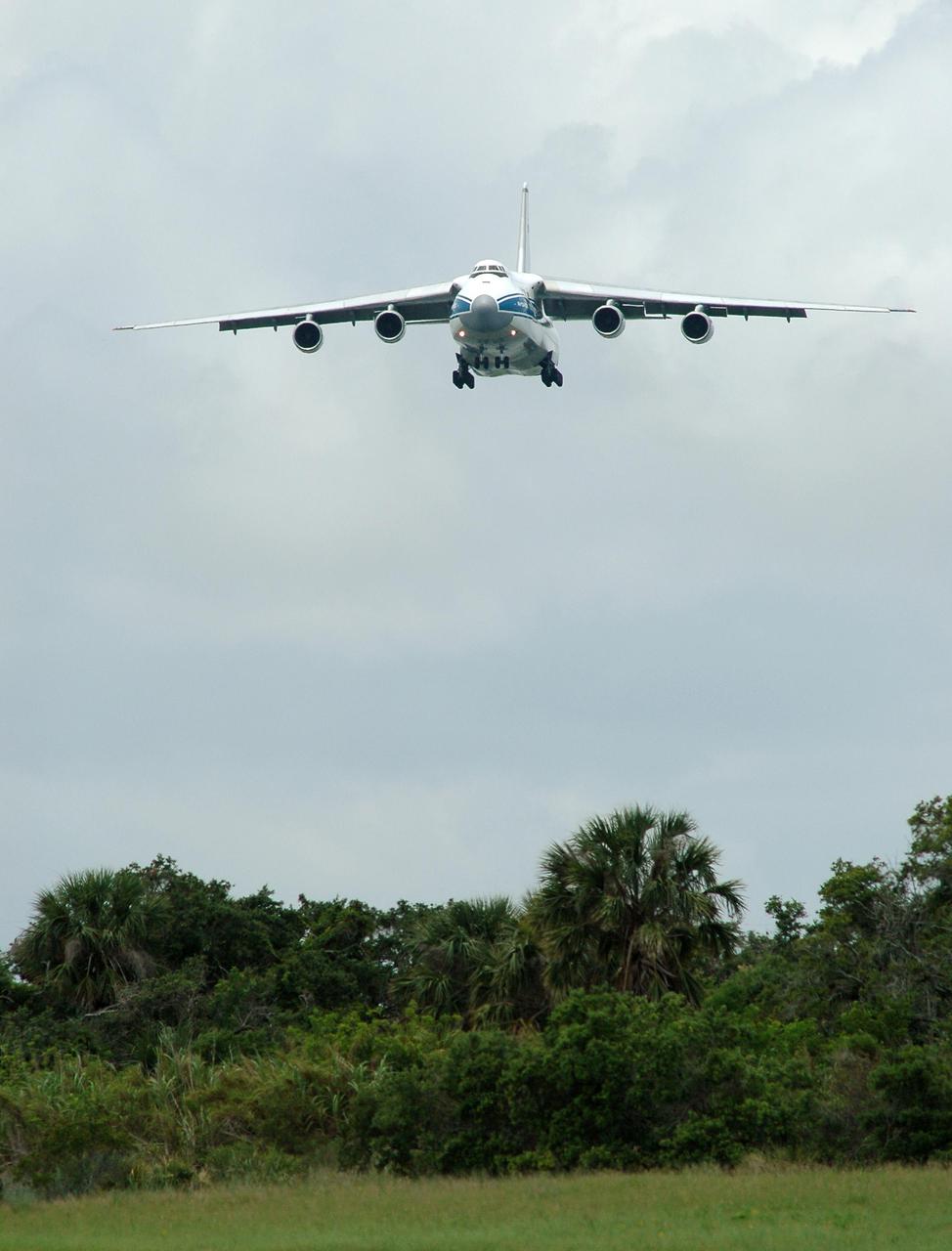
KENNEDY SPACE CENTER, FLA. - A Russian Antonov AH-124-100 cargo airplane heads for a landing at the Cape Canaveral Air Force Station Skid Strip. The plane is delivering a second stage Centaur (Block I) for the Lockheed Martin Atlas V, designated AV-007, that is the launch vehicle for the Mars Reconnaissance Orbiter (MRO). The MRO is designed for a series of global mapping, regional survey and targeted observations from a near-polar, low-altitude Mars orbit. These observations will be unprecedented in terms of the spatial resolution and coverage achieved by the orbiter’s instruments as they observe the atmosphere and surface of Mars while probing its shallow subsurface as part of a “follow the water” strategy. The orbiter is undergoing environmental tests in facilities at Lockheed Martin Space Systems in Denver, Colo., and is on schedule for a launch window that begins Aug. 10. Launch will be from Launch Complex 41 at Cape Canaveral Air Force Station in Florida.
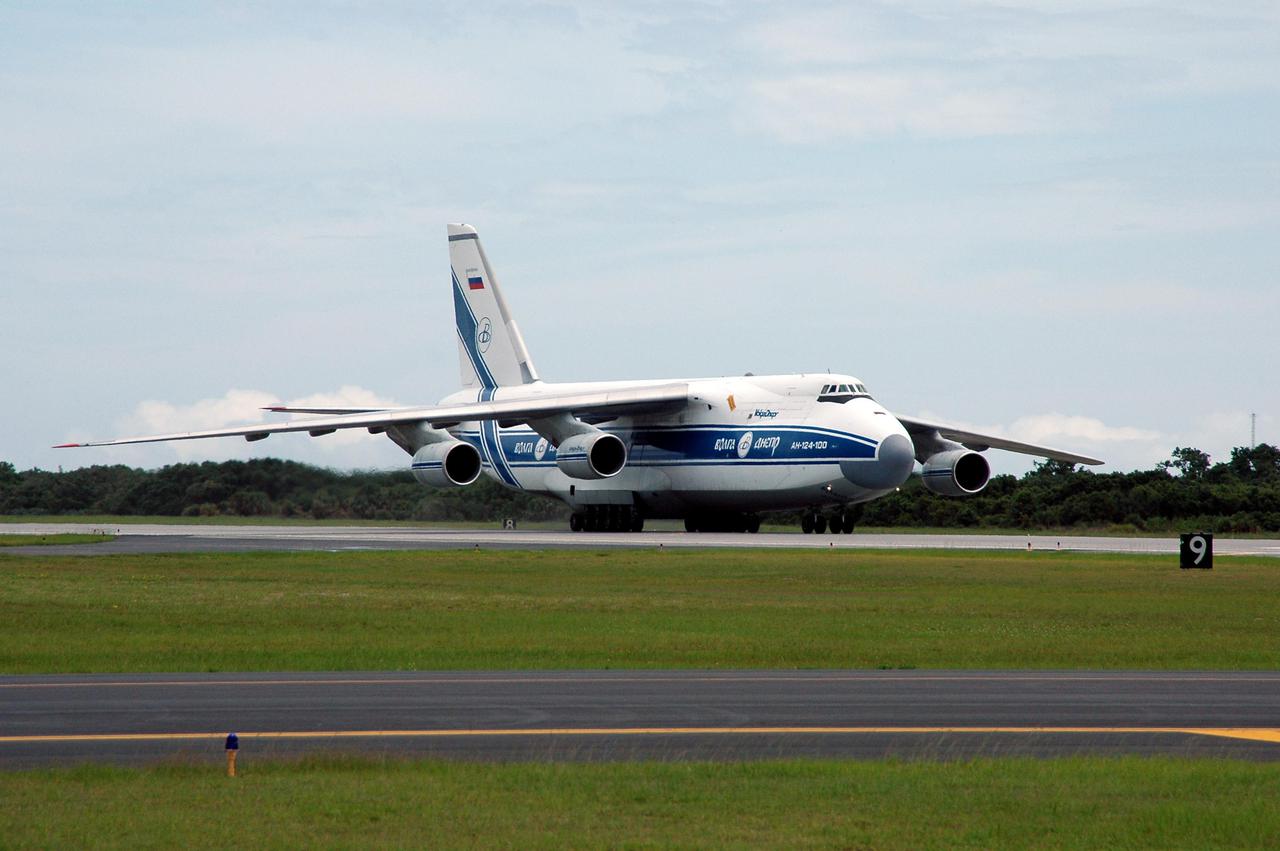
KENNEDY SPACE CENTER, FLA. - A Russian Antonov AH-124-100 cargo airplane lands at the Cape Canaveral Air Force Station Skid Strip. The plane is delivering a second stage Centaur (Block I) for the Lockheed Martin Atlas V, designated AV-007, that is the launch vehicle for the Mars Reconnaissance Orbiter (MRO). The MRO is designed for a series of global mapping, regional survey and targeted observations from a near-polar, low-altitude Mars orbit. These observations will be unprecedented in terms of the spatial resolution and coverage achieved by the orbiter’s instruments as they observe the atmosphere and surface of Mars while probing its shallow subsurface as part of a “follow the water” strategy. The orbiter is undergoing environmental tests in facilities at Lockheed Martin Space Systems in Denver, Colo., and is on schedule for a launch window that begins Aug. 10. Launch will be from Launch Complex 41 at Cape Canaveral Air Force Station in Florida.
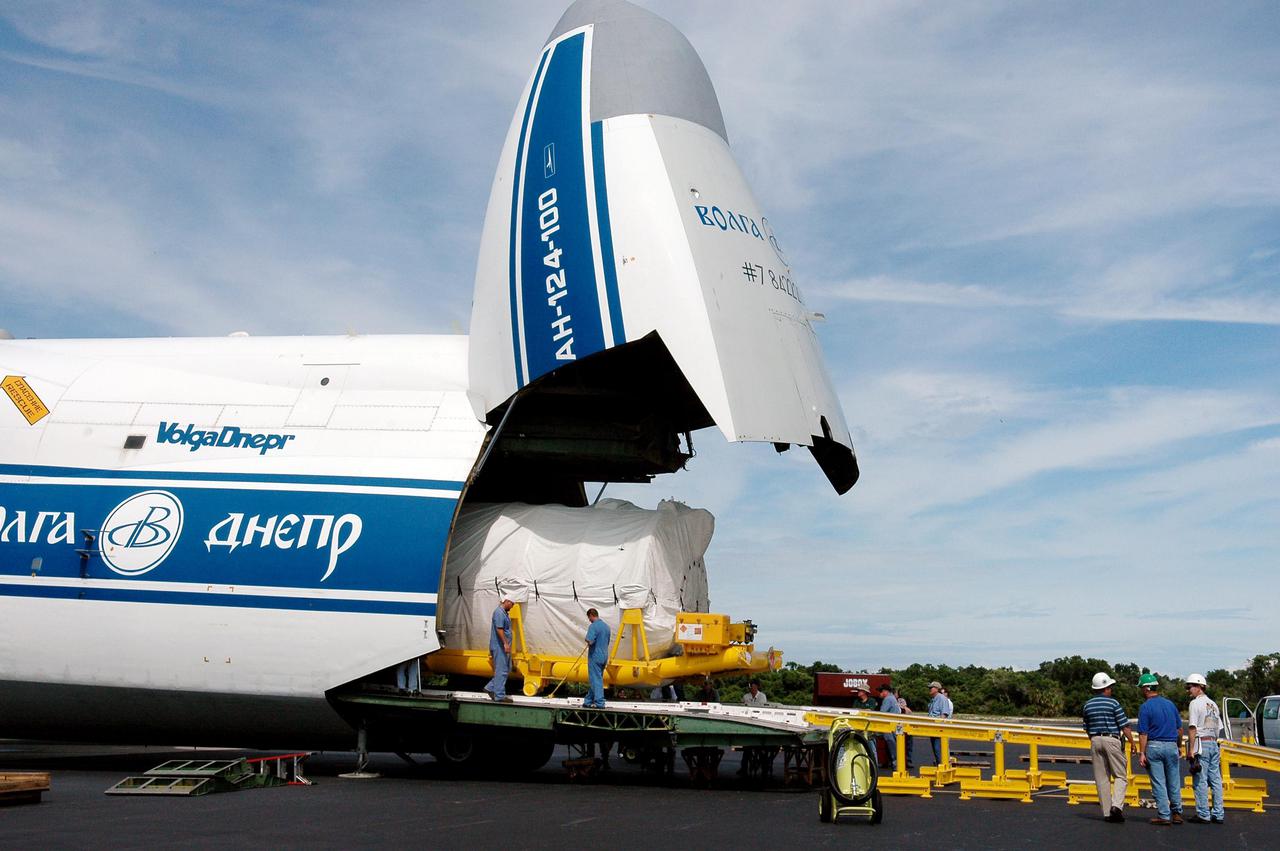
KENNEDY SPACE CENTER, FLA. - At the Cape Canaveral Air Force Station Skid Strip, a second stage Centaur (Block I) is rolled out of a Russian Antonov AH-124-100 cargo airplane. The Centaur will be mated with the Lockheed Martin Atlas V, designated AV-007, that is the launch vehicle for the Mars Reconnaissance Orbiter (MRO). The MRO is designed for a series of global mapping, regional survey and targeted observations from a near-polar, low-altitude Mars orbit. These observations will be unprecedented in terms of the spatial resolution and coverage achieved by the orbiter’s instruments as they observe the atmosphere and surface of Mars while probing its shallow subsurface as part of a “follow the water” strategy. The orbiter is undergoing environmental tests in facilities at Lockheed Martin Space Systems in Denver, Colo., and is on schedule for a launch window that begins Aug. 10. Launch will be from Launch Complex 41 at Cape Canaveral Air Force Station in Florida.
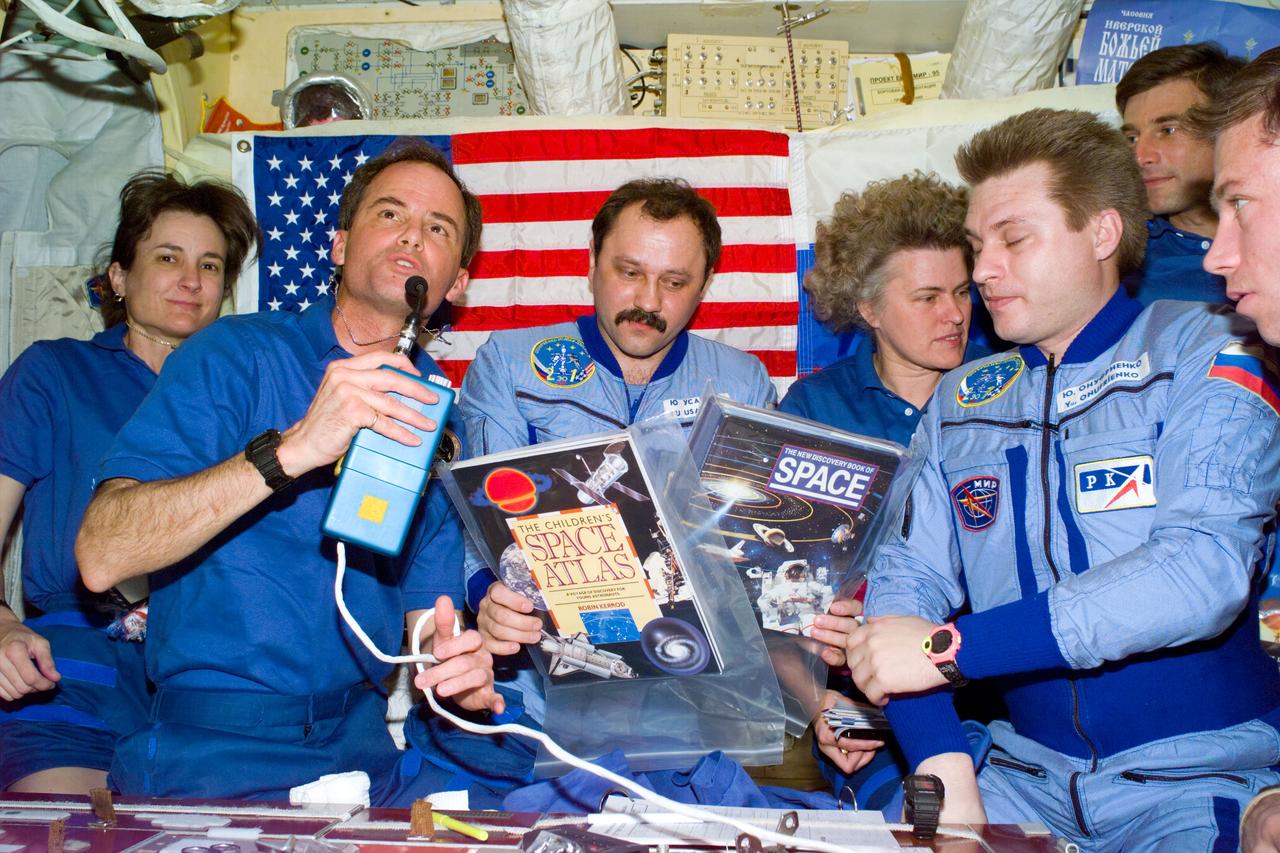
S76-E-5157 (24 March 1996) --- Two Russian cosmonauts and five of six NASA astronauts exchange gifts soon after reuniting in the Base Block Module of Russia's Mir Space Station. From the left are Linda M. Godwin, Kevin P. Chilton, Yury V. Usachev, Shannon W. Lucid, Yury I. Onufrienko, Ronald M. Sega and Richard A. Searfoss. Not pictured is astronaut Michael R. (Rich) Clifford. In a light moment around this time, ground controllers informed Chilton, the STS-76 mission commander, that Lucid, who will spend several months onboard Mir as a cosmonaut guest researcher, should now be considered a Mir-21 crew member, along with Onufrienko and Usachev, Mir-21 flight engineer. The image was recorded with a 35mm Electronic Still Camera (ESC) and downlinked at a later time to ground controllers in Houston, Texas.
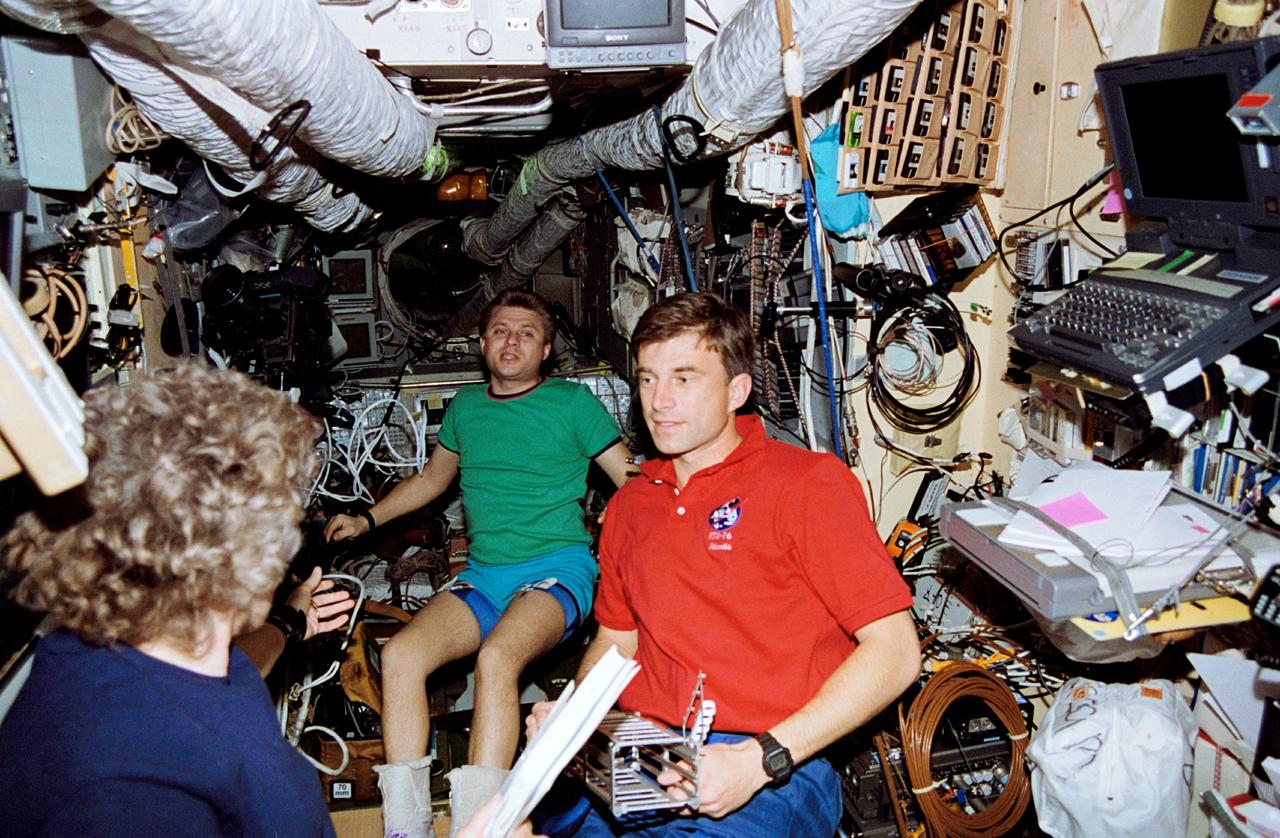
STS076-461-004 (22-31 March 1996) --- Onboard the Base Block Module of Russia's Mir Space Station, astronauts Shannon W. Lucid and Ronald M. Sega, payload commander, discuss final activities between the STS-76 and Mir-21 crews as cosmonaut Yury I. Onufrienko (center) listens. Yury V. Usachev (out of frame) is Mir-21 flight engineer. The Space Shuttle Atlantis docked with Mir on March 23, 1996, and remained linked until March 28, 1996. Lucid was in the process of transferring from STS-76 to the Mir-21 crew, which thereby grew from two to three members. She will remain aboard Mir for approximately 140 days.
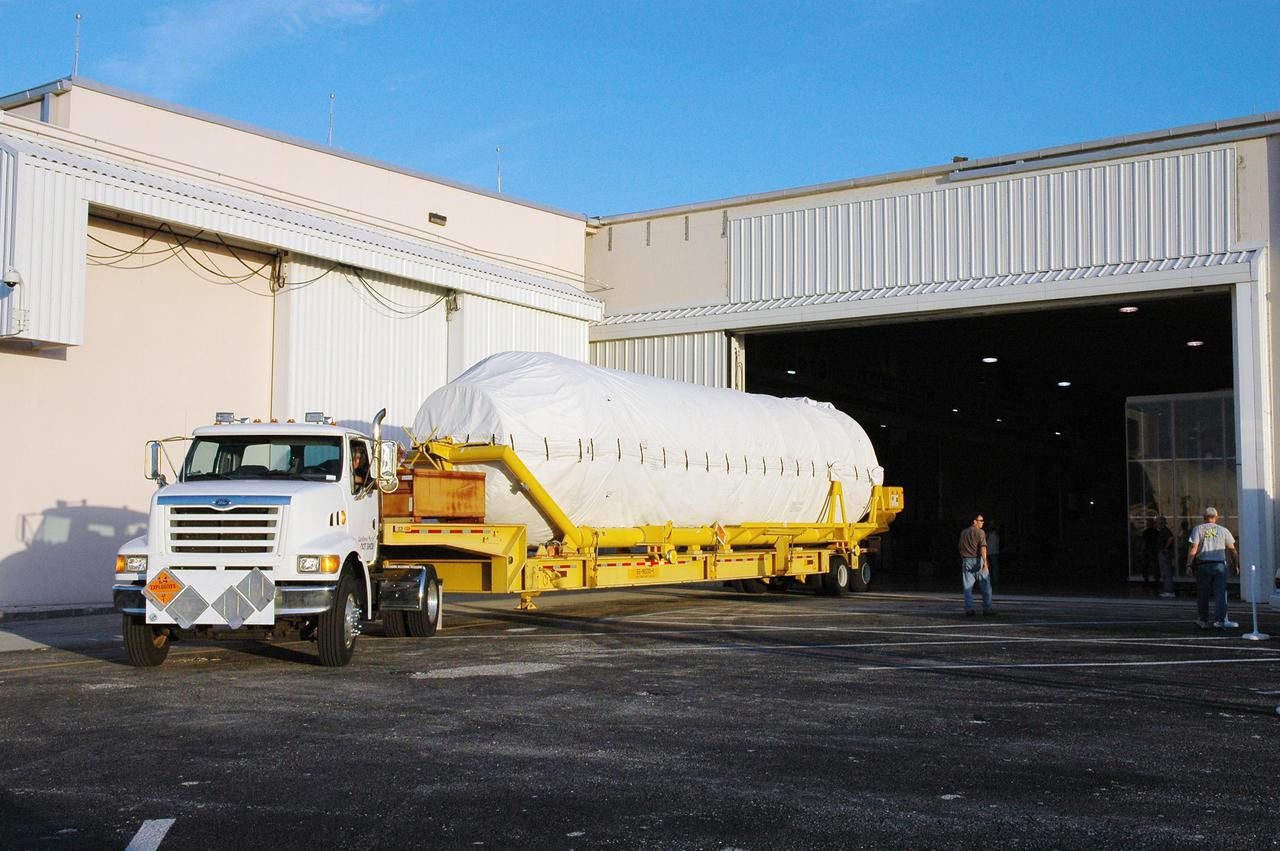
KENNEDY SPACE CENTER, FLA. - The Centaur (Block I) upper stage is rolled into the hangar of the Atlas Space Operations Center where it will be processed for mating with the Lockheed Martin Atlas V, designated AV-007, that is the launch vehicle for the Mars Reconnaissance Orbiter (MRO). The MRO is designed for a series of global mapping, regional survey and targeted observations from a near-polar, low-altitude Mars orbit. These observations will be unprecedented in terms of the spatial resolution and coverage achieved by the orbiter’s instruments as they observe the atmosphere and surface of Mars while probing its shallow subsurface as part of a “follow the water” strategy. The orbiter is undergoing environmental tests in facilities at Lockheed Martin Space Systems in Denver, Colo., and is on schedule for a launch window that begins Aug. 10. Launch will be from Launch Complex 41 at Cape Canaveral Air Force Station in Florida.
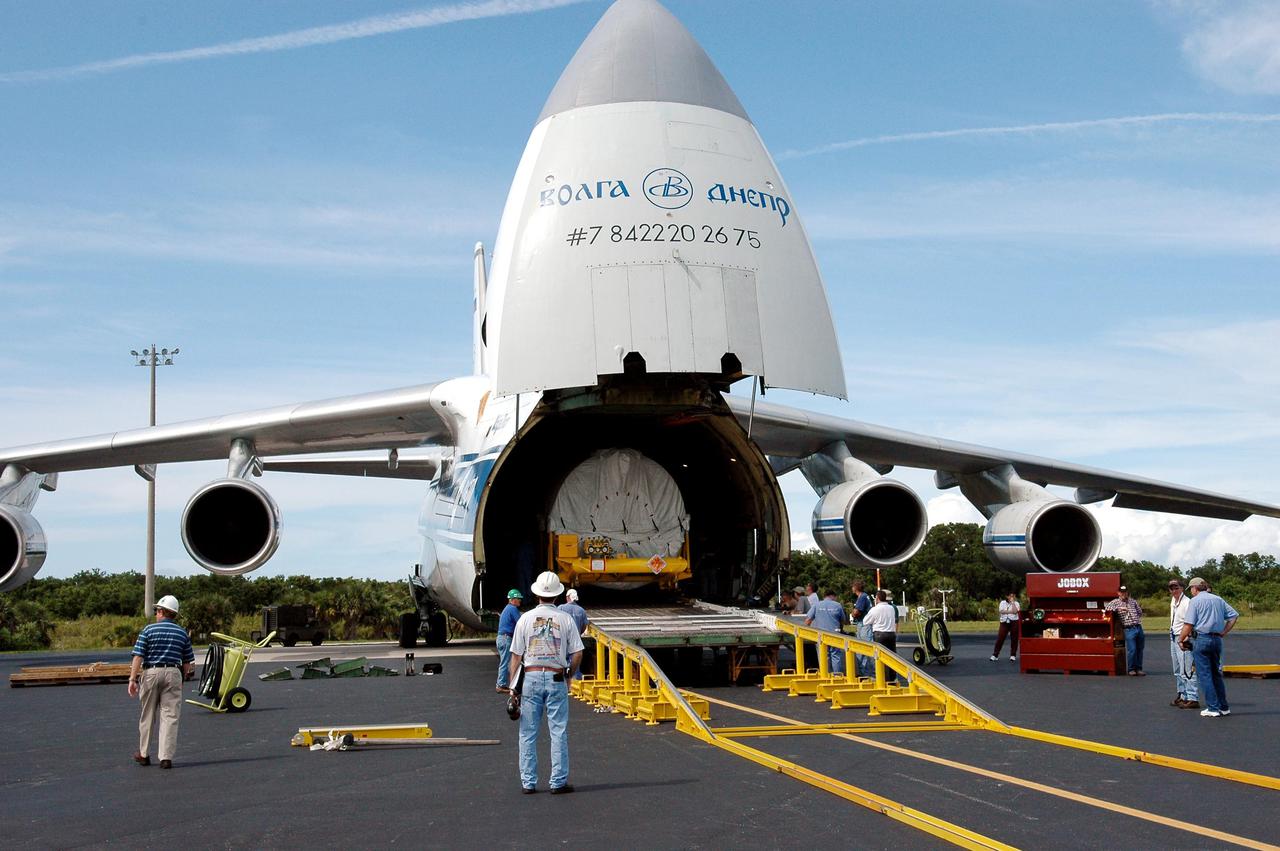
KENNEDY SPACE CENTER, FLA. - At the Cape Canaveral Air Force Station Skid Strip, a second stage Centaur (Block I) is ready to be offloaded from a Russian Antonov AH-124-100 cargo airplane. The Centaur will be mated with the Lockheed Martin Atlas V, designated AV-007, that is the launch vehicle for the Mars Reconnaissance Orbiter (MRO). The MRO is designed for a series of global mapping, regional survey and targeted observations from a near-polar, low-altitude Mars orbit. These observations will be unprecedented in terms of the spatial resolution and coverage achieved by the orbiter’s instruments as they observe the atmosphere and surface of Mars while probing its shallow subsurface as part of a “follow the water” strategy. The orbiter is undergoing environmental tests in facilities at Lockheed Martin Space Systems in Denver, Colo., and is on schedule for a launch window that begins Aug. 10. Launch will be from Launch Complex 41 at Cape Canaveral Air Force Station in Florida.
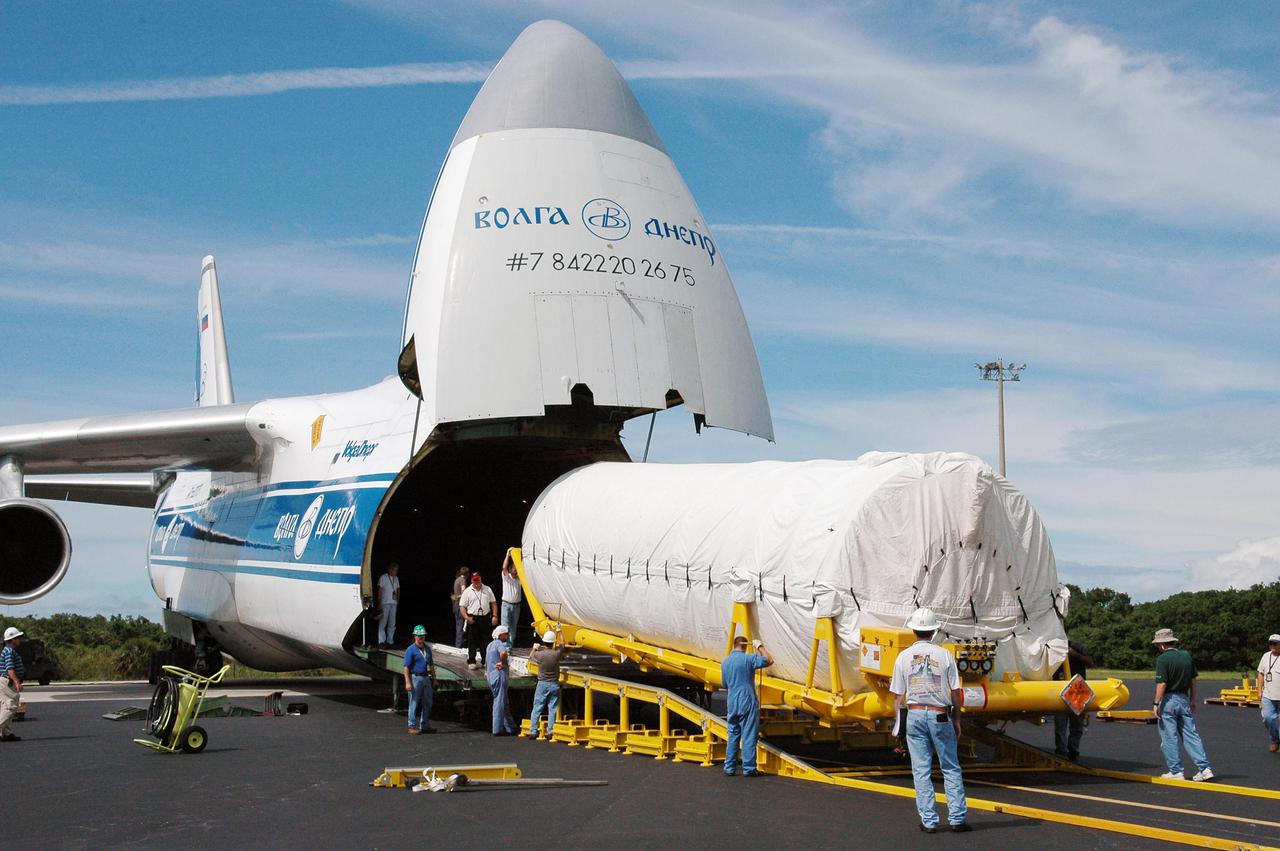
KENNEDY SPACE CENTER, FLA. - At the Cape Canaveral Air Force Station Skid Strip, a second stage Centaur (Block I) is rolled out of a Russian Antonov AH-124-100 cargo airplane. The Centaur will be mated with the Lockheed Martin Atlas V, designated AV-007, that is the launch vehicle for the Mars Reconnaissance Orbiter (MRO). The MRO is designed for a series of global mapping, regional survey and targeted observations from a near-polar, low-altitude Mars orbit. These observations will be unprecedented in terms of the spatial resolution and coverage achieved by the orbiter’s instruments as they observe the atmosphere and surface of Mars while probing its shallow subsurface as part of a “follow the water” strategy. The orbiter is undergoing environmental tests in facilities at Lockheed Martin Space Systems in Denver, Colo., and is on schedule for a launch window that begins Aug. 10. Launch will be from Launch Complex 41 at Cape Canaveral Air Force Station in Florida.
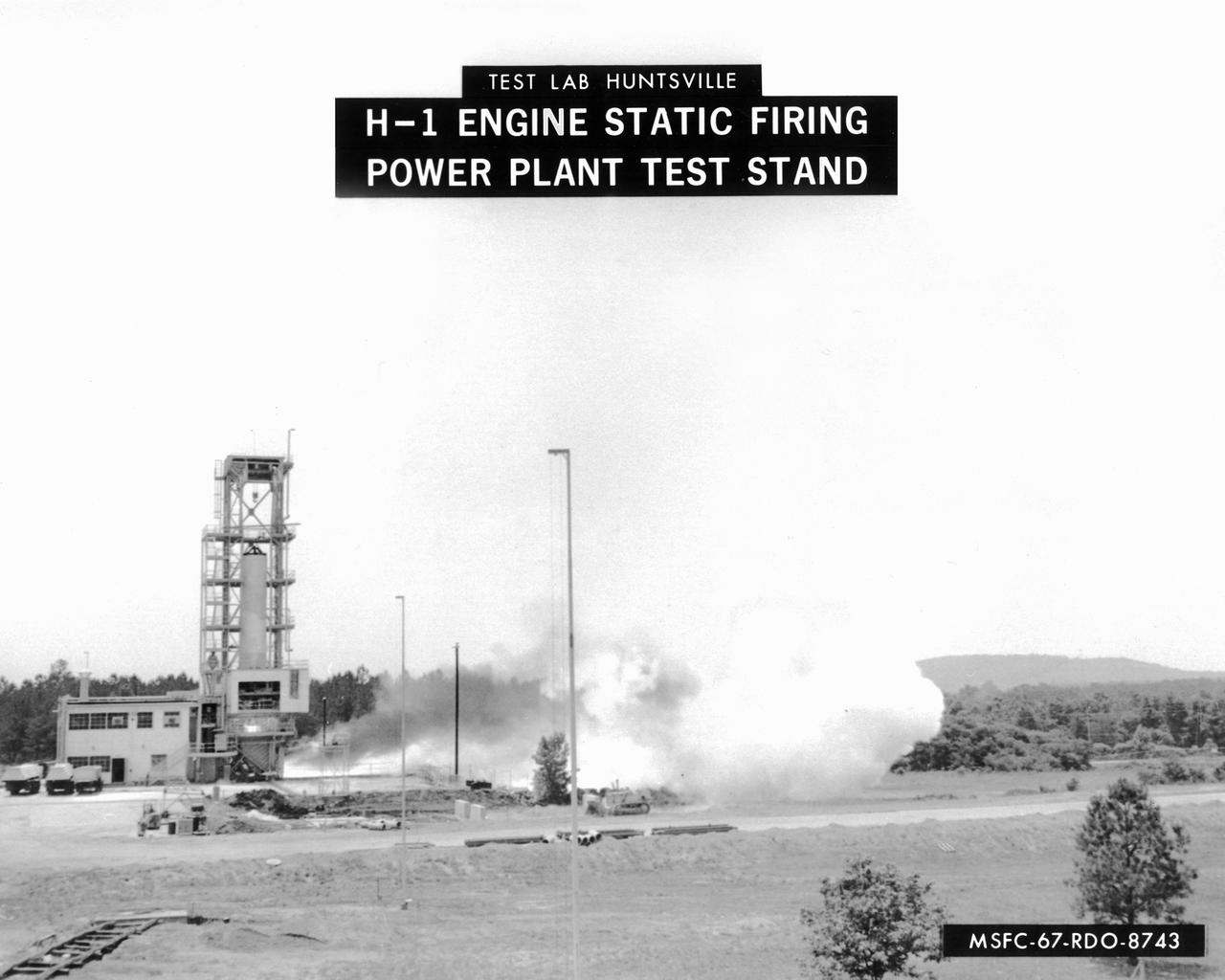
This image depicts a firing of a single H-1 engine at the Marshall Space Flight Center’s (MSFC’s) Power Plant test stand. This 1950s test stand, inherited from the Army, was used to test fire engines until the Test Area was completed in the latter 1960s. The H-1 engine was the workhorse of the first Saturn launch vehicles and used in the Saturn I, Block 1 and II, and in the Saturn IB. The eight H-1 engines were attached to a thrust frame on the vehicle’s aft end in two different ways. Four engines are rigidly attached to the inboard position and canted at a three degree angle to the long axis of the booster. The other four engines, mounted in the outboard position, are canted at six degrees.
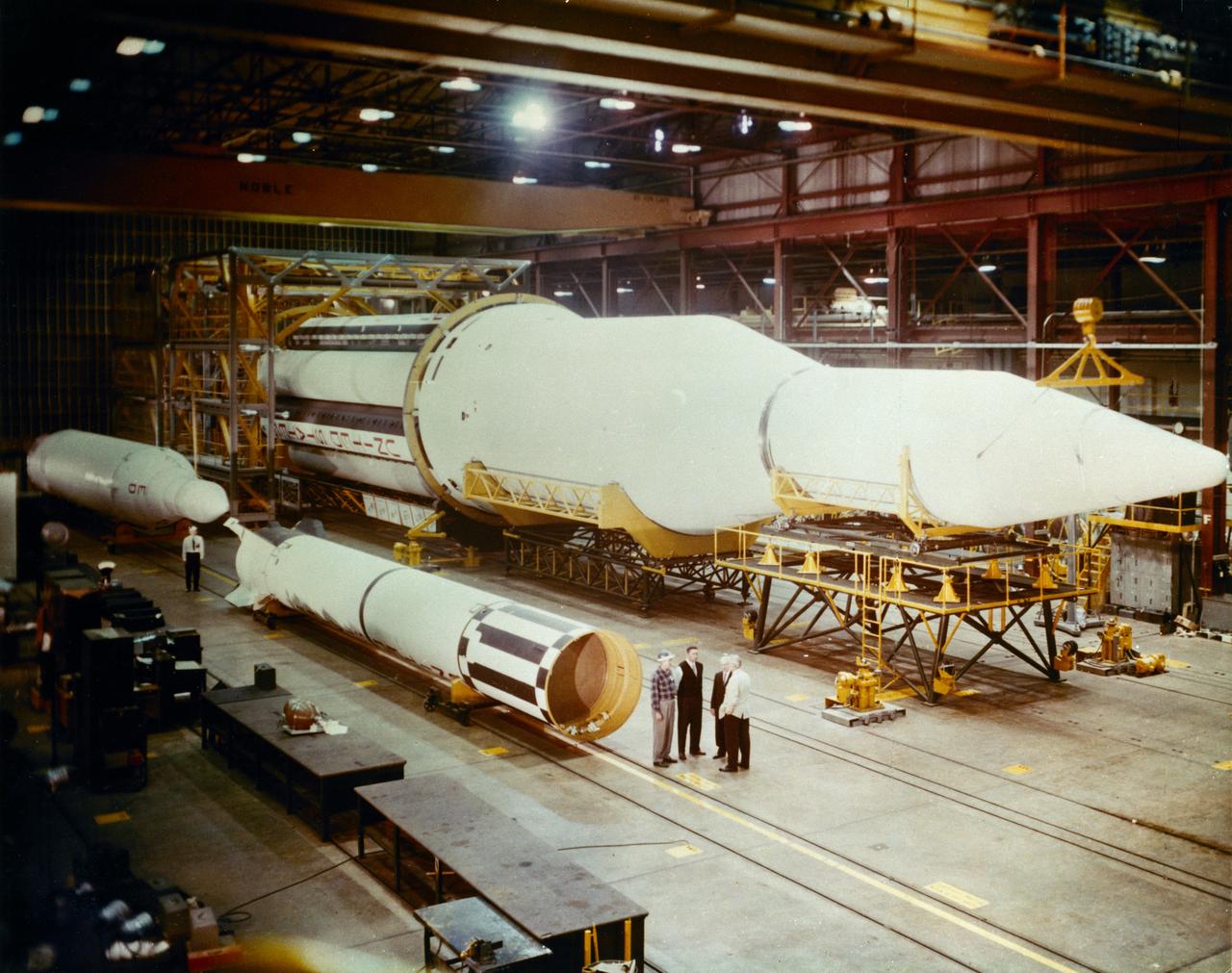
Progress in the Saturn program, depicted below, was described by Dr. Wernher von Braun, Marshall Space Flight Center (MSFC) Director, in an appearance before the Senate Committee of Aeronautical and Space Sciences. "The flight configuration of the giant three-stage Saturn C-1 rocket (later called Saturn I Block I) is seen in the Fabrication and Assembly Engineering Division at MSFC. Dwarfed by the 180-foot C-1 are a Juno II rocket (left rear) and a Mercury-Redstone rocket (front foreground). The C-1 (first version of the Saturn rocket) is composed of an S-1 first stage or booster (rear), powered by eight H-1 engines having a thrust of 1,500,000 pounds, followed by a dummy S-IV second stage and a dummy S-V third stage. The "live" S-IV for later flights, under development by Douglas Aircraft Co., will be powered by four Pratt Whitney LR-119 engines having 17,500,000 pounds thrust each. The live S-V, under development by Convair Division of General Dynamics Corp., will use two LR-119 engines. With all three stages live, the C-1 will be capable of placing 19,000 pounds into a 300-mile Earth orbit, sending 5,000 pounds to escape velocity, or lofting 2,500 pounds to Mars or Venus. The second version Saturn C-2 (later called Saturn 1 Block II) would double these capabilities. Early C-1 flights will employ a live S-1 with dummy upper stages. The first such flight is scheduled late this year."
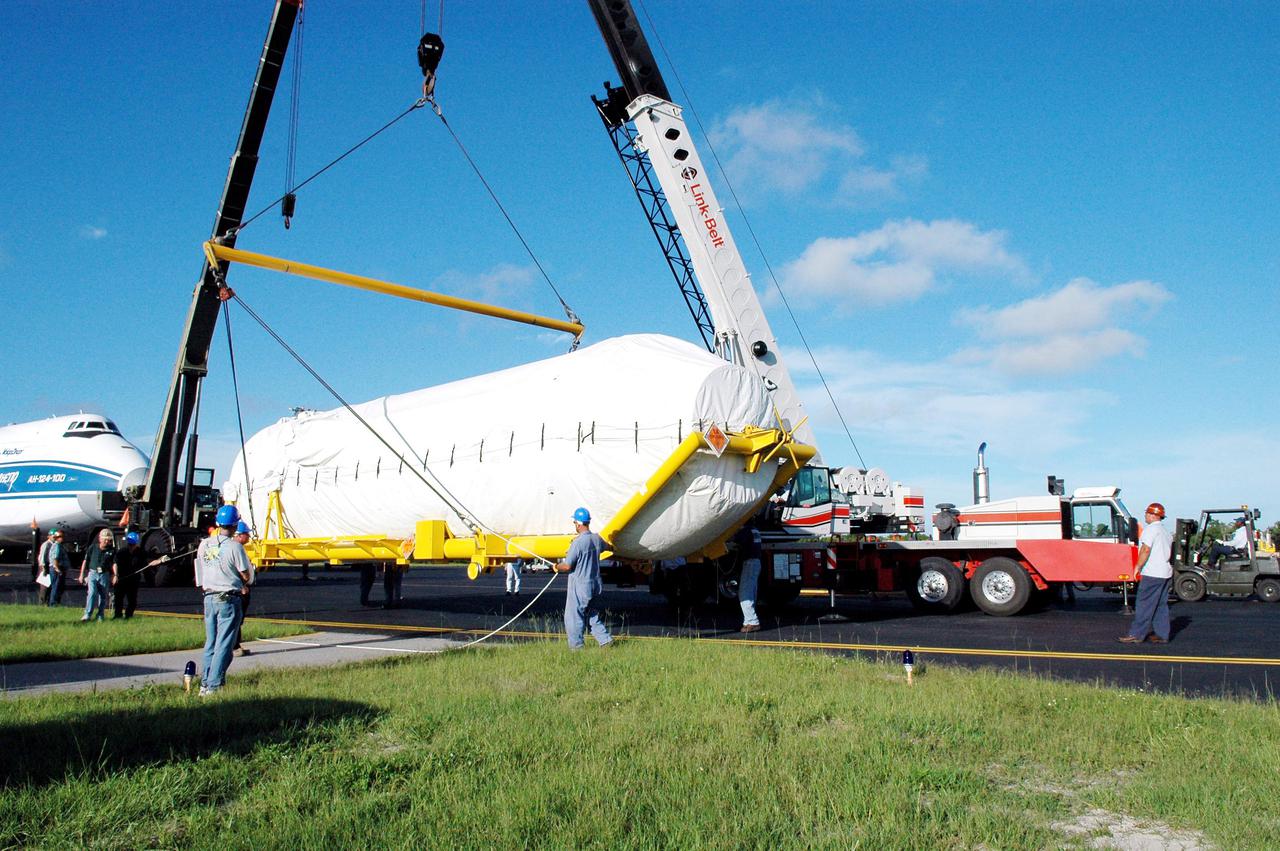
KENNEDY SPACE CENTER, FLA. - At the Cape Canaveral Air Force Station Skid Strip, a large crane is attached to the offloaded second stage Centaur (Block I) to lift and place it on a flat bed truck. The Centaur arrived on a Russian Antonov AH-124-100 cargo airplane. The Centaur upper stage will be mated with the Lockheed Martin Atlas V, designated AV-007, that is the launch vehicle for the Mars Reconnaissance Orbiter (MRO). The MRO is designed for a series of global mapping, regional survey and targeted observations from a near-polar, low-altitude Mars orbit. These observations will be unprecedented in terms of the spatial resolution and coverage achieved by the orbiter’s instruments as they observe the atmosphere and surface of Mars while probing its shallow subsurface as part of a “follow the water” strategy. The orbiter is undergoing environmental tests in facilities at Lockheed Martin Space Systems in Denver, Colo., and is on schedule for a launch window that begins Aug. 10. Launch will be from Launch Complex 41 at Cape Canaveral Air Force Station in Florida.
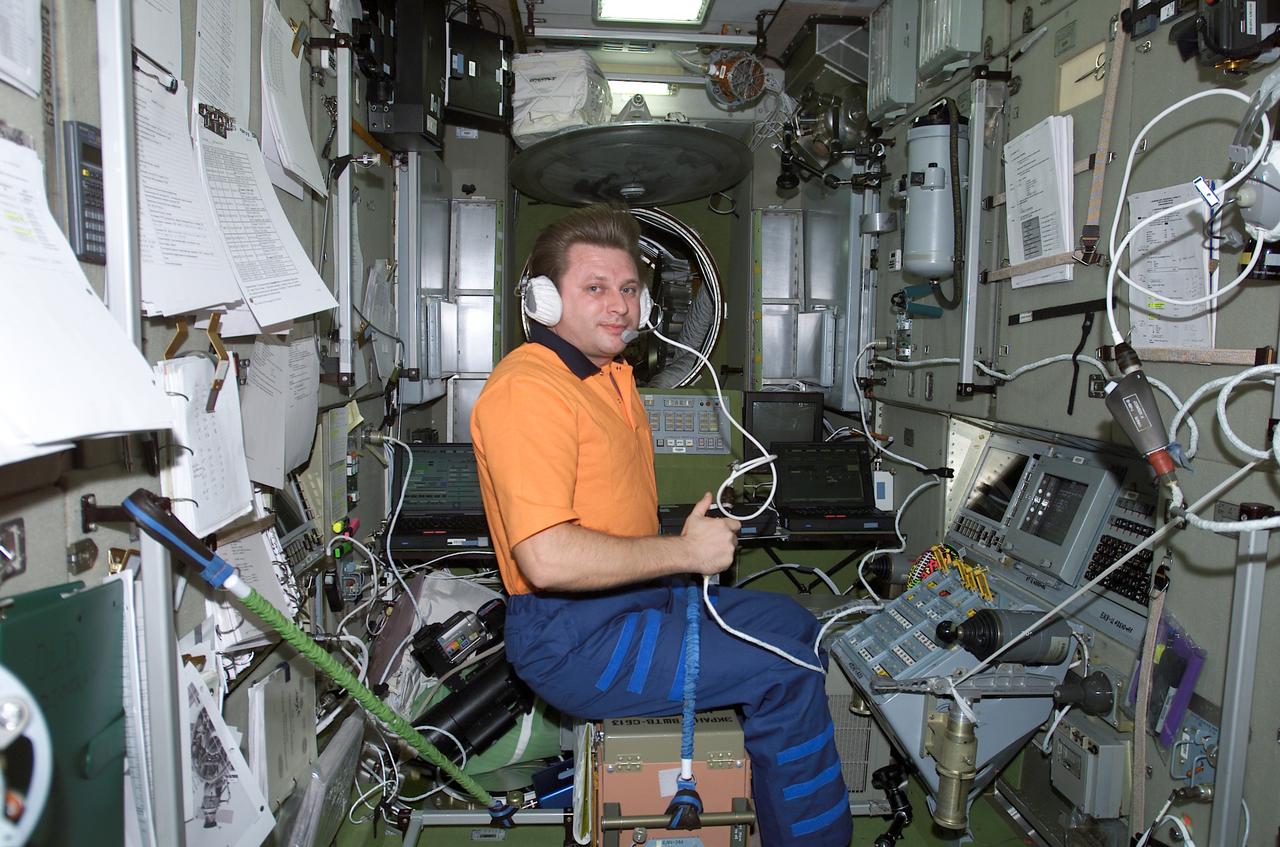
Cosmonaut Yury I. Onufrienko, Expedition Four mission commander, uses a communication system in the Russian Zvezda Service Module on the International Space Station (ISS). The Zvezda is linked to the Russian-built Functional Cargo Block (FGB) or Zarya, the first component of the ISS. Zarya was launched on a Russian Proton rocket prior to the launch of Unity. The third component of the ISS, Zvezda (Russian word for star), the primary Russian contribution to the ISS, was launched by a three-stage Proton rocket on July 12, 2000. Zvezda serves as the cornerstone for early human habitation of the station, providing living quarters, a life support system, electrical power distribution, a data processing system, flight control system, and propulsion system. It also provides a communications system that includes remote command capabilities from ground flight controllers. The 42,000-pound module measures 43 feet in length and has a wing span of 98 feet. Similar in layout to the core module of Russia's Mir space station, it contains 3 pressurized compartments and 13 windows that allow ultimate viewing of Earth and space.
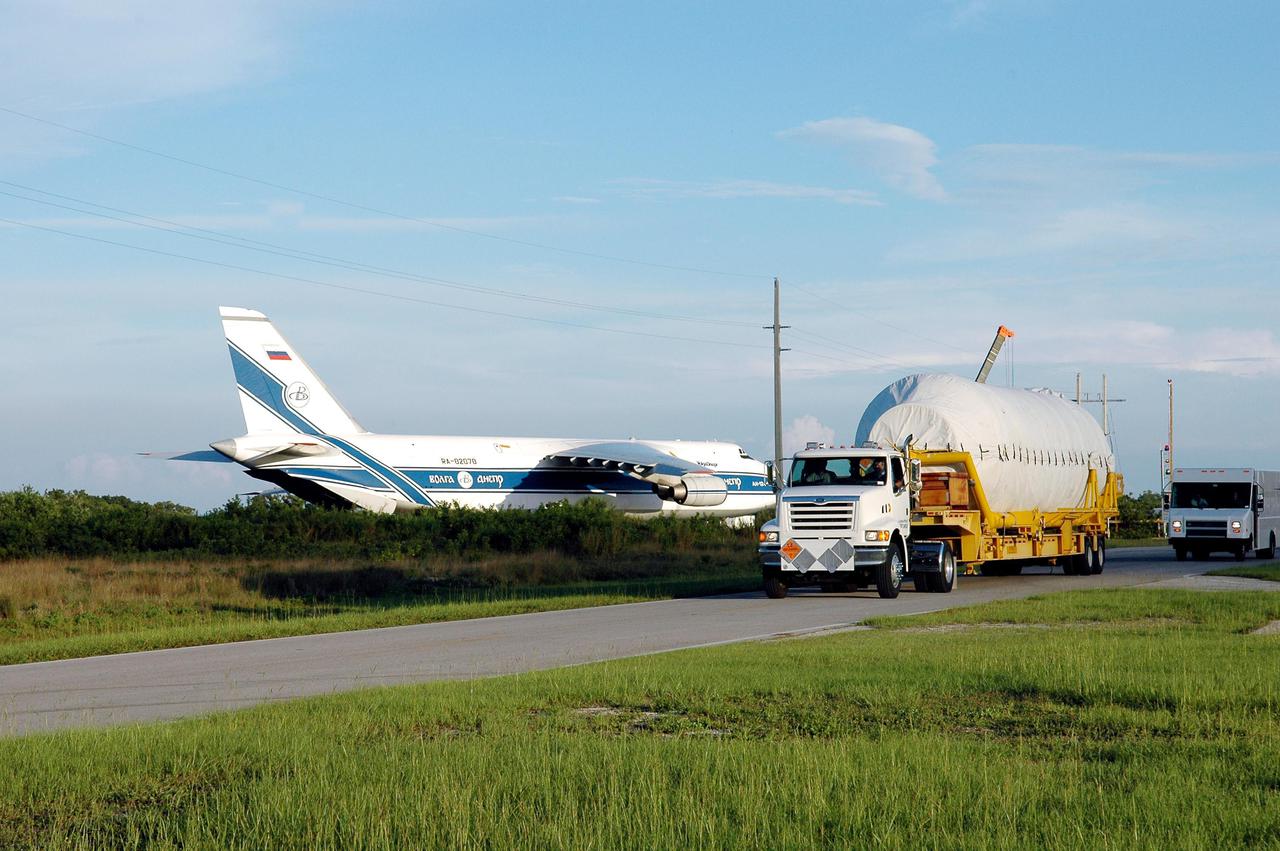
KENNEDY SPACE CENTER, FLA. - Safely placed on a flat bed truck, the Centaur (Block I) is rolled away from Cape Canaveral Air Force Station Skid Strip where it landed aboard a Russian Antonov AH-124-100 cargo airplane, seen at left. The upper stage Centaur will be mated with the Lockheed Martin Atlas V, designated AV-007, that is the launch vehicle for the Mars Reconnaissance Orbiter (MRO). The MRO is designed for a series of global mapping, regional survey and targeted observations from a near-polar, low-altitude Mars orbit. These observations will be unprecedented in terms of the spatial resolution and coverage achieved by the orbiter’s instruments as they observe the atmosphere and surface of Mars while probing its shallow subsurface as part of a “follow the water” strategy. The orbiter is undergoing environmental tests in facilities at Lockheed Martin Space Systems in Denver, Colo., and is on schedule for a launch window that begins Aug. 10. Launch will be from Launch Complex 41 at Cape Canaveral Air Force Station in Florida.
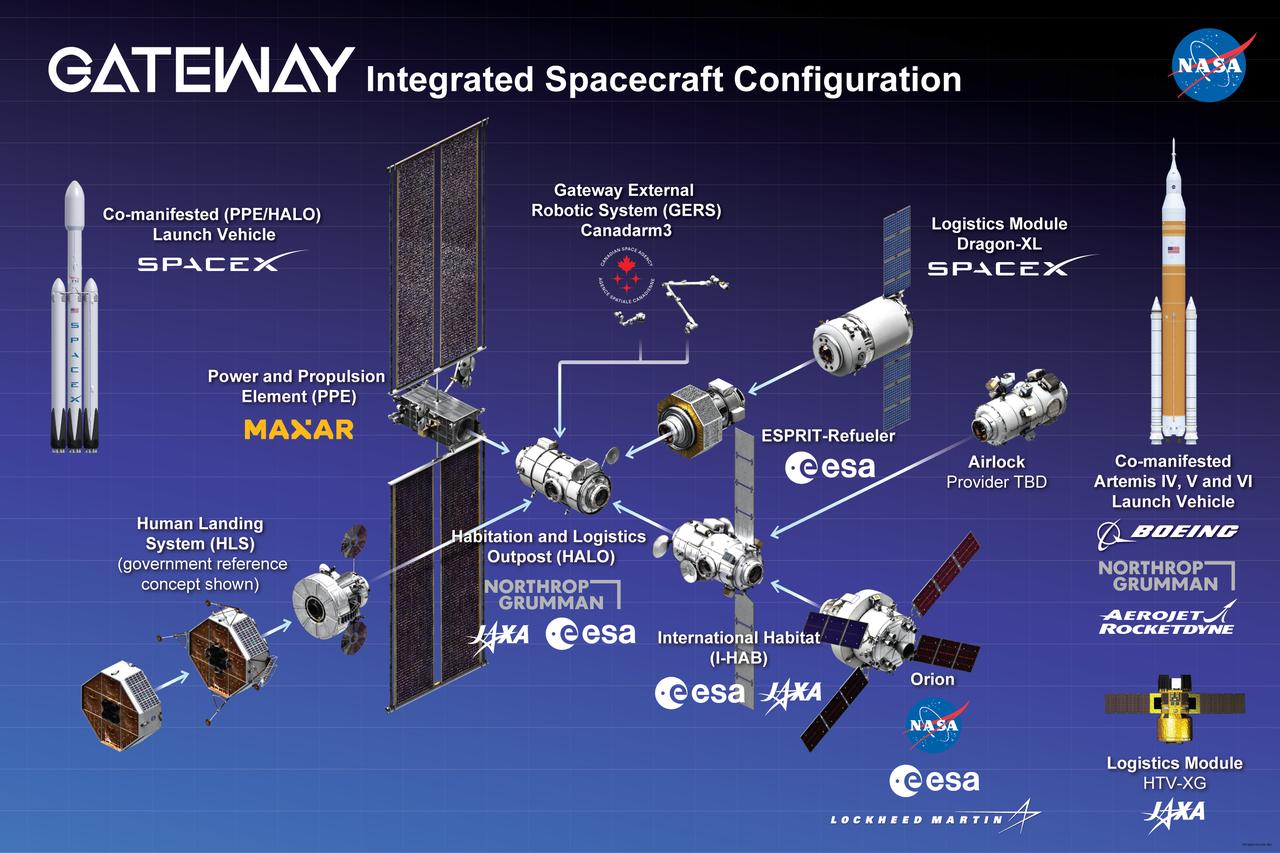
And expanded view of the Gateway space station showing each of its elements, international partner contributions, and visiting spacecraft including Orion and the Human Landing System, with prime contractors.