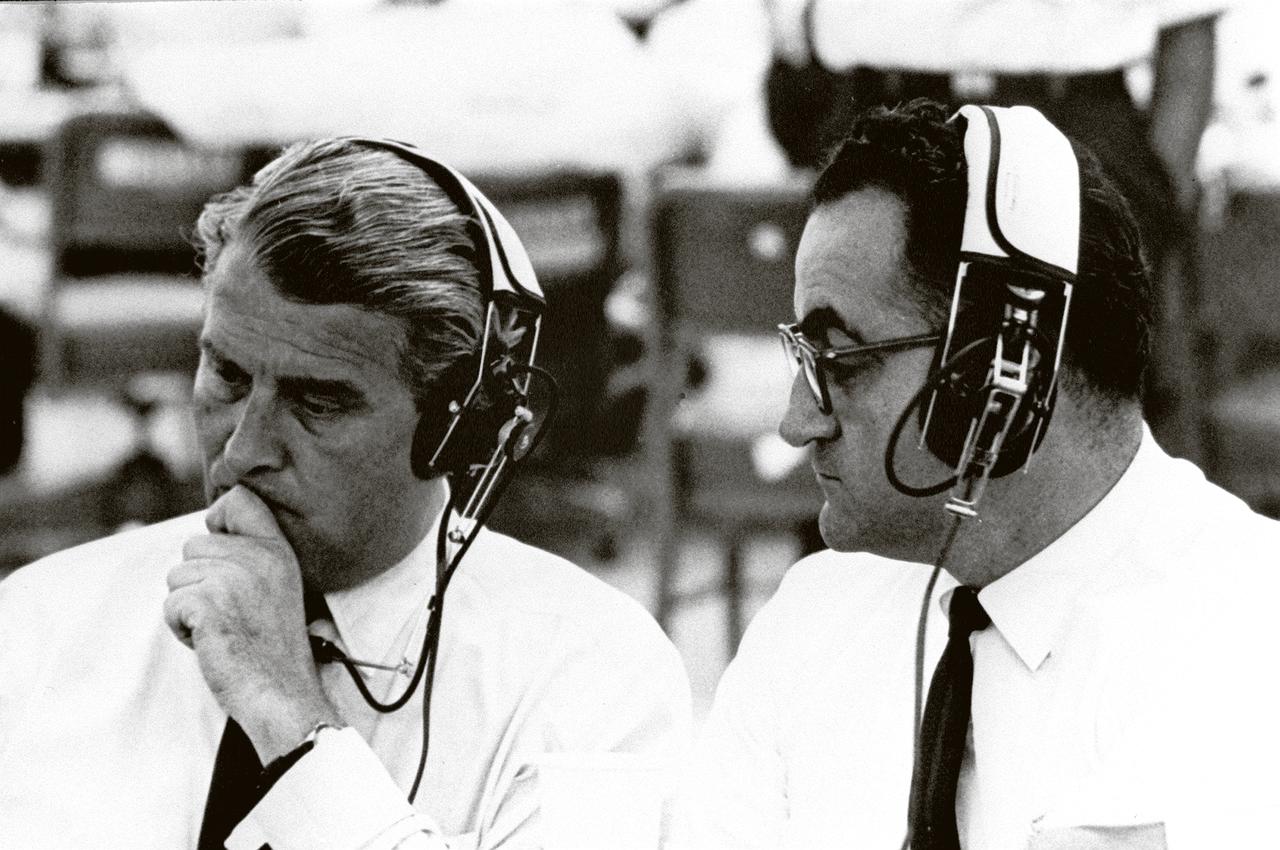
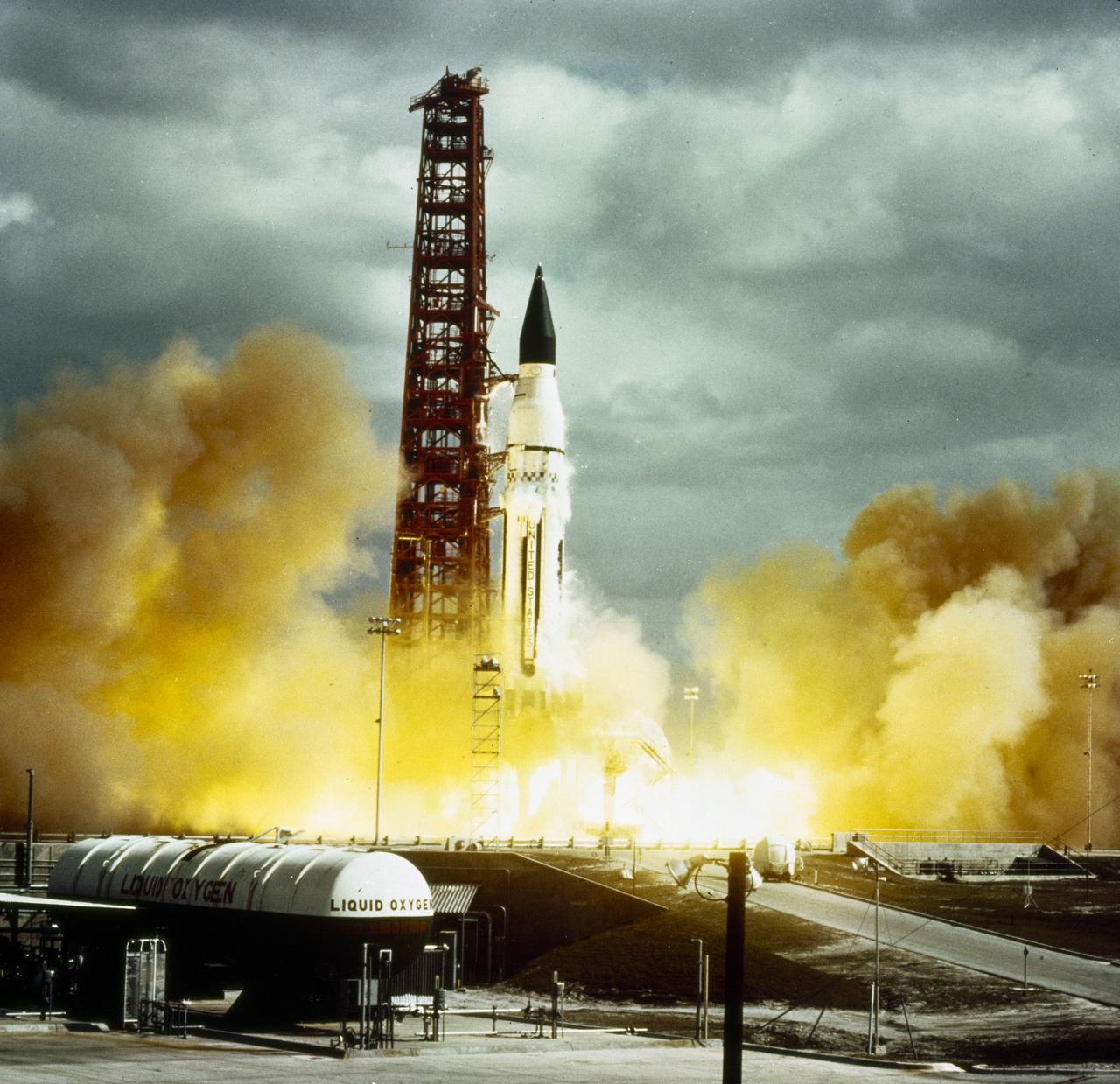
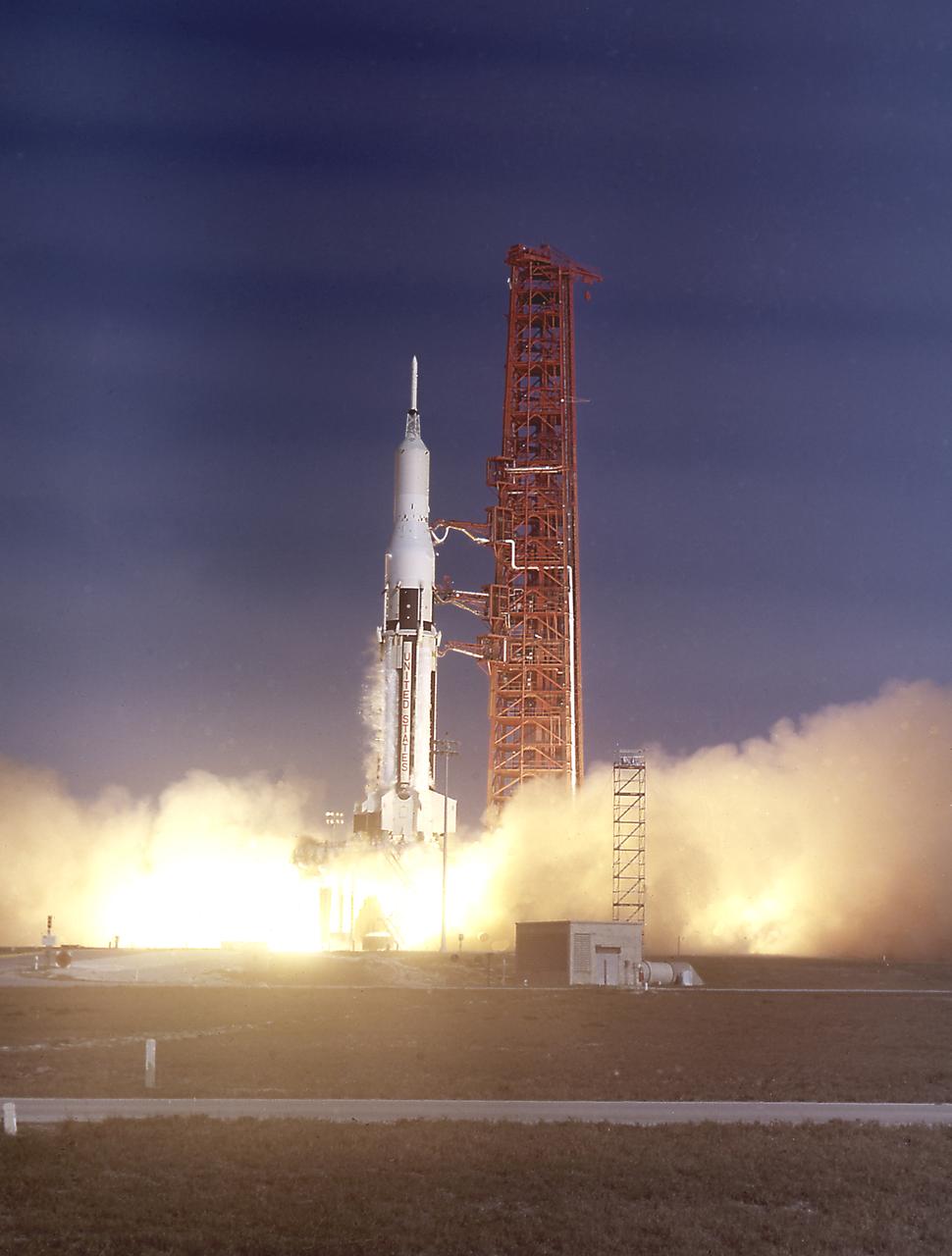
Developed at MSFC under the direction of Dr. Wernher von Braun, the SA-5 incorporated a Saturn I, Block II engine. Launched on January 29, 1964, SA-5 was the first two stage (Block II) Saturn with orbital capability and performed the first test of Instrument Unit and successful stage separation. Block II vehicles had two live stages, and were basically in the two-stage configuration of the Saturn I vehicle. There were marked changes between the Block I and II versions. The Block II S-I stage had eight fins added for greater aerodynamic stability in the lower atmosphere. All Block II H-1 engines had a thrust of 188,000 pounds each for a combined thrust over 1,500,000 pounds. The Block II second stage (S-IV) had six RL-10 hydrogen-oxygen engines, each producing a thrust of 15,000 pounds for a total combined thrust of 90,000 pounds. A motion picture camera capsule loated on stage I was successful recovered.
Saturn Apollo Program
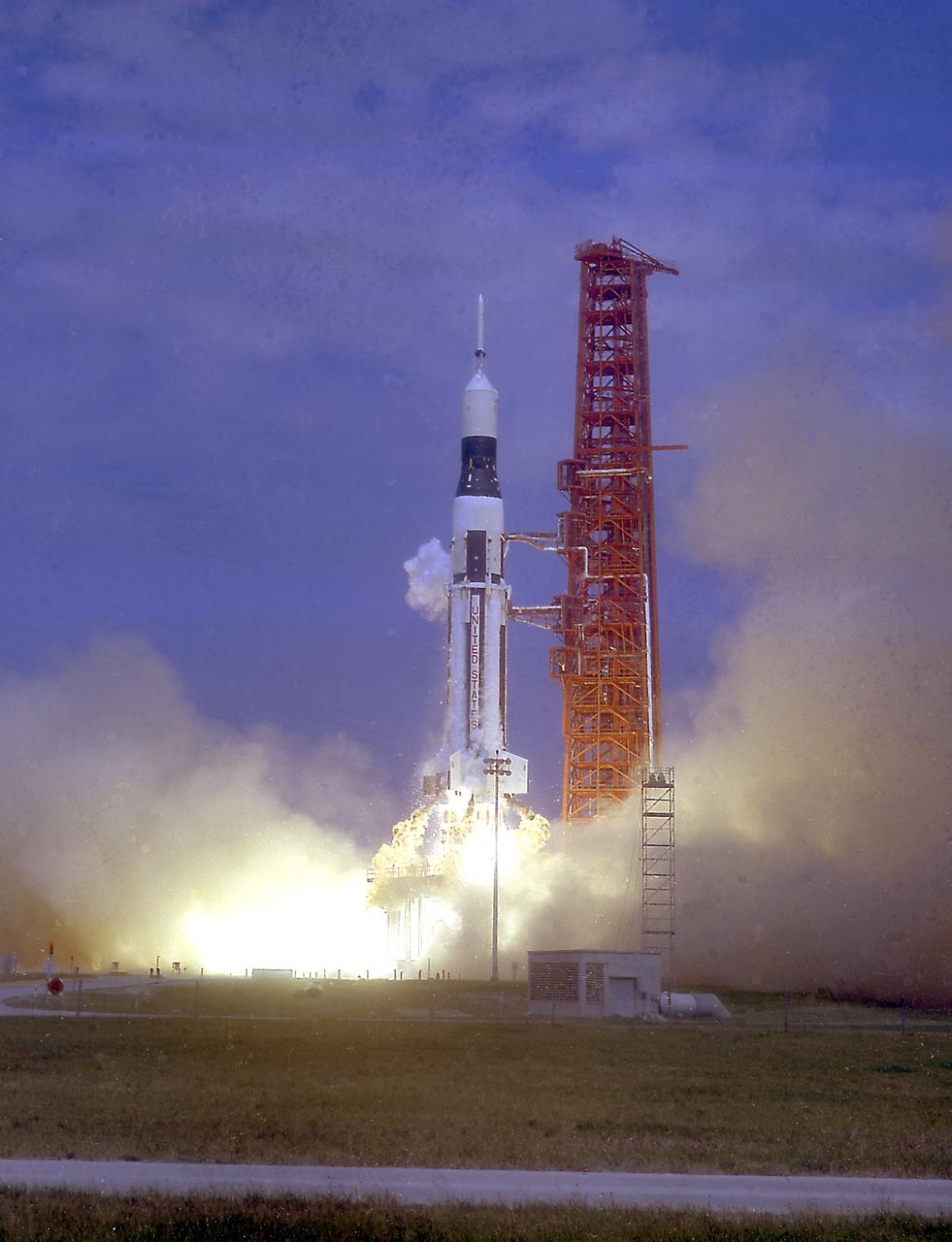
The launch of the SA-7 (Saturn I Block II) was on September 18, 1964. The SA-7 mission was the second orbital flight of the S-IV stage (second stage) with the payload consisting of the Apollo command and service module's instrument unit. The Saturn I Block II vehicle had two live stages, and were basically in the two-stage configuration of the Saturn I vehicle. While the tank arrangement and the engine patterns were the same, there were marked changes between the Block I and II versions. The first stage (S-I stage) was an improved version of the Block I S-I stage. The Block II S-1 stage had eight fins added for greater aerodynamic stability in the lower atmosphere.
Saturn Apollo Program
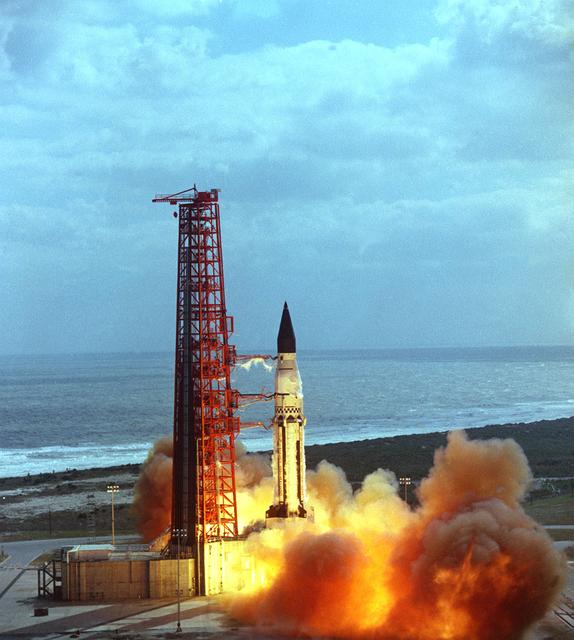
The SA-9 (Saturn I Block II), the eighth Saturn I flight, lifted off on February 16, 1965. This was the first Saturn with an operational payload, the Pegasus I meteoroid detection satellite. SA-9 successfully deployed the Pegasus I, NASA's largest unmarned instrumented satellite, into near Earth orbit.
Saturn Apollo Program
The launch of the SA-5 on January 29, 1964 was the fifth Saturn I launch vehicle. The SA-5 marked a number of firsts in the Marshall Space Flight Center-managed Saturn development program, including the first flight of Saturn I Block II vehicle with eight aerodynamic fins at the bottom of the S-I stage (first stage) for enhanced stability in flight. This also was the first flight of a live S-IV (second or upper) stage with the cluster of six liquid hydrogen-fueled RL-10 engines. the first successful second stage separation, and the first use of the Launch Complex 37.
Saturn Apollo Program
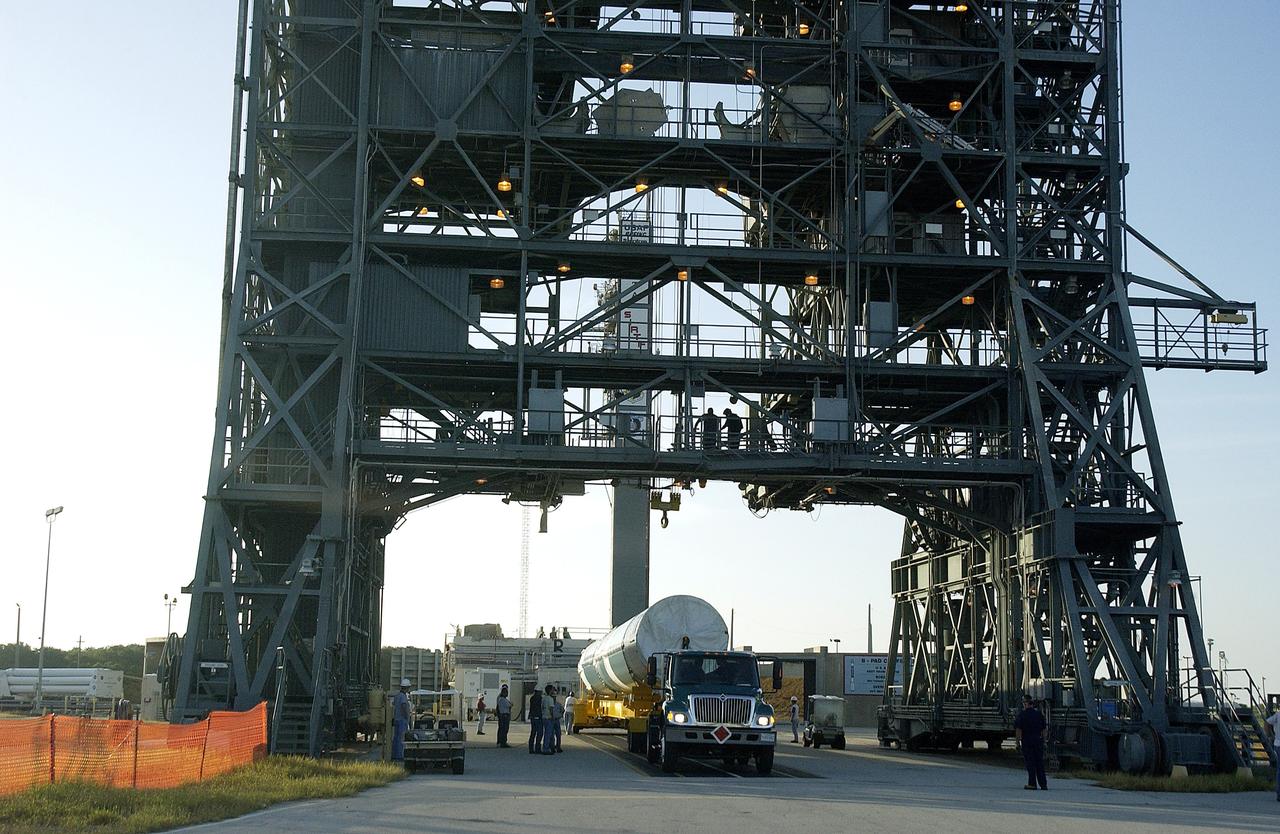
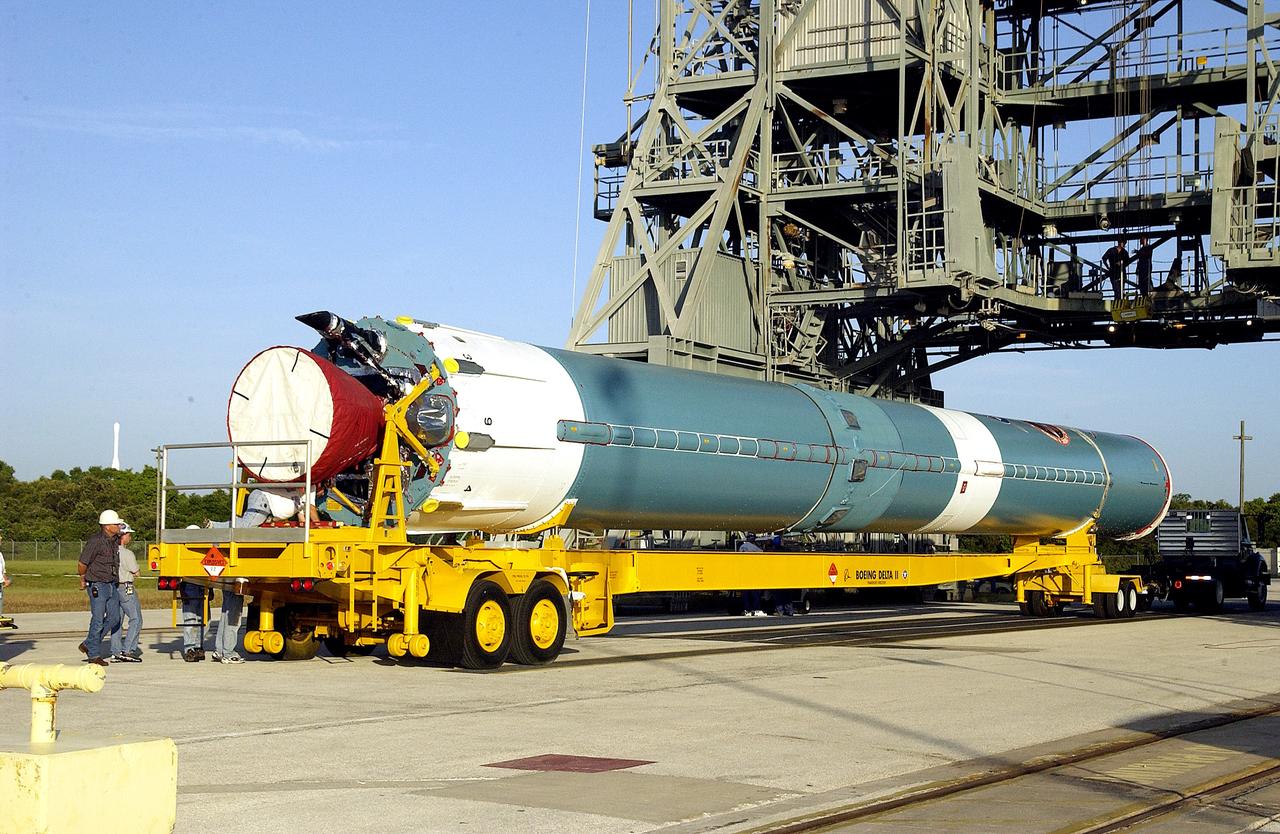
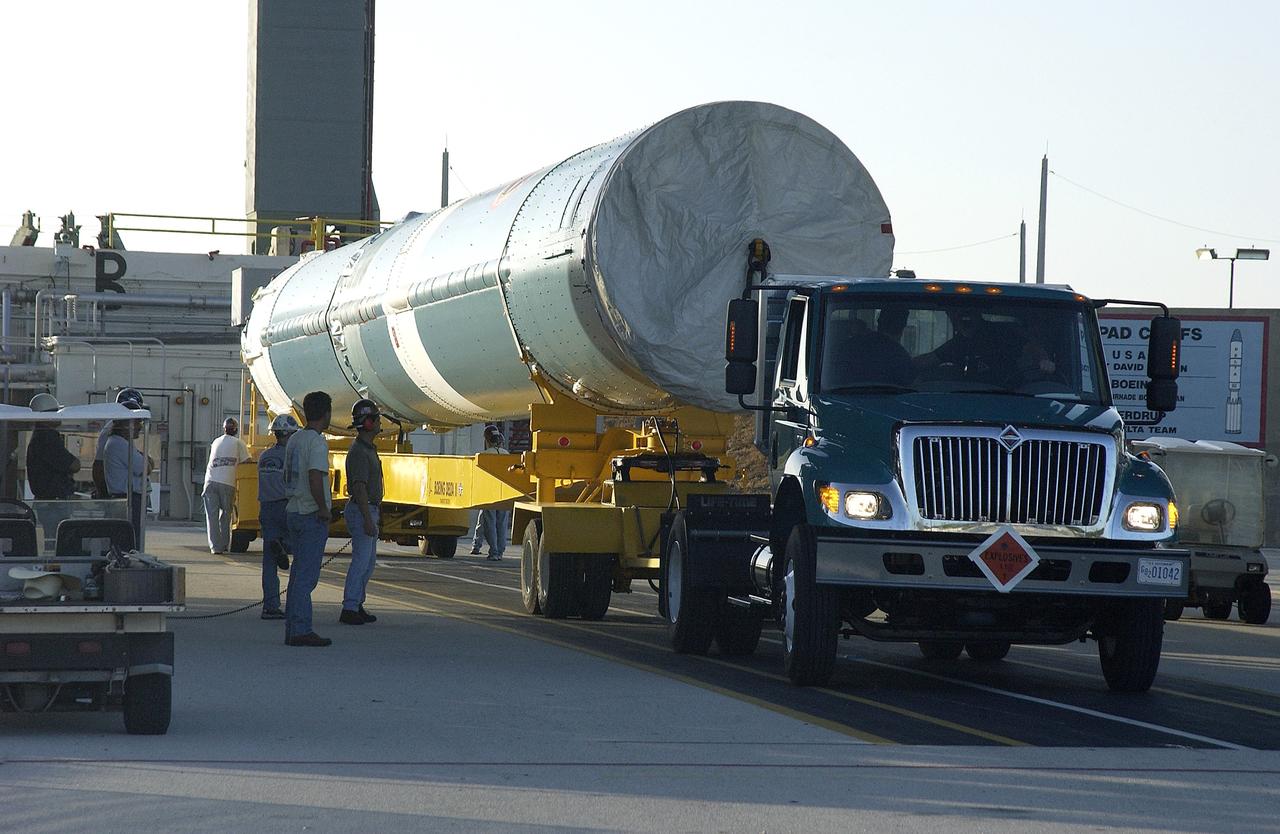
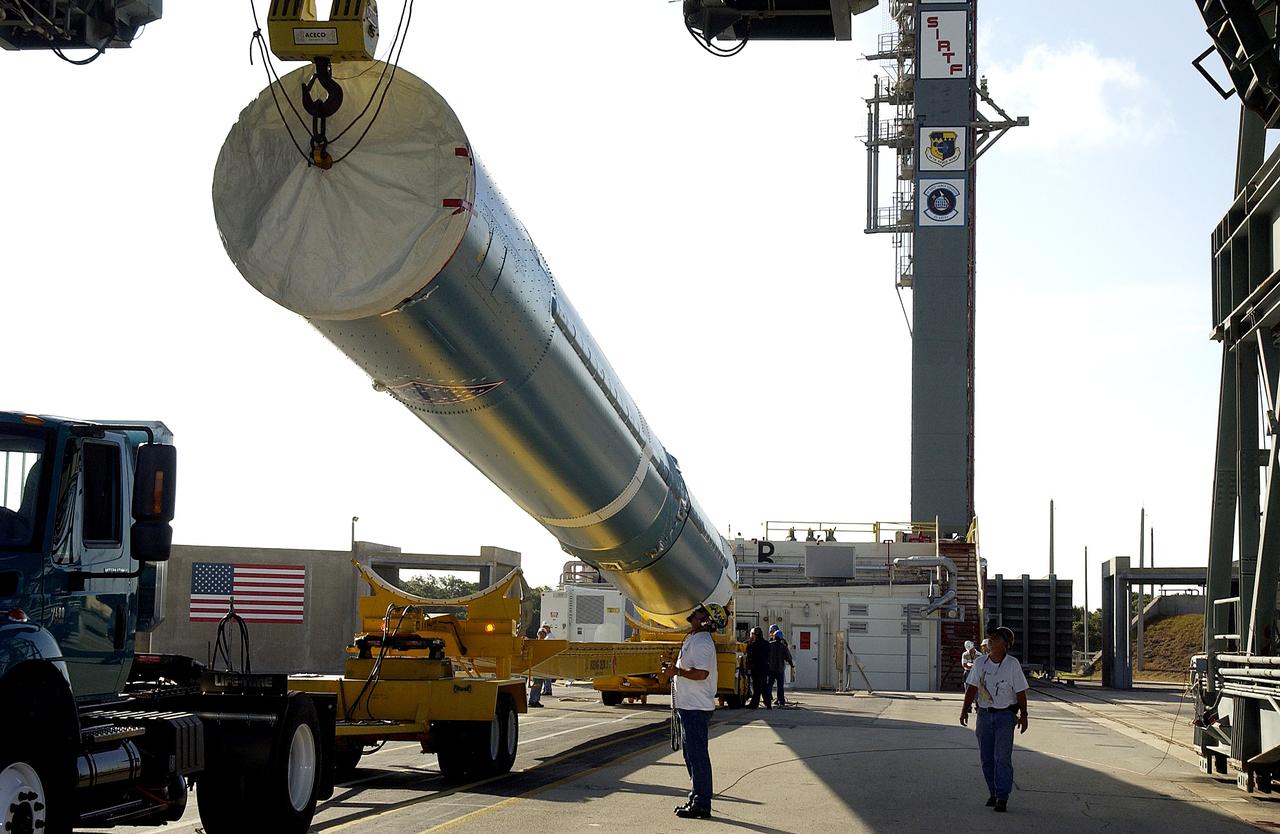
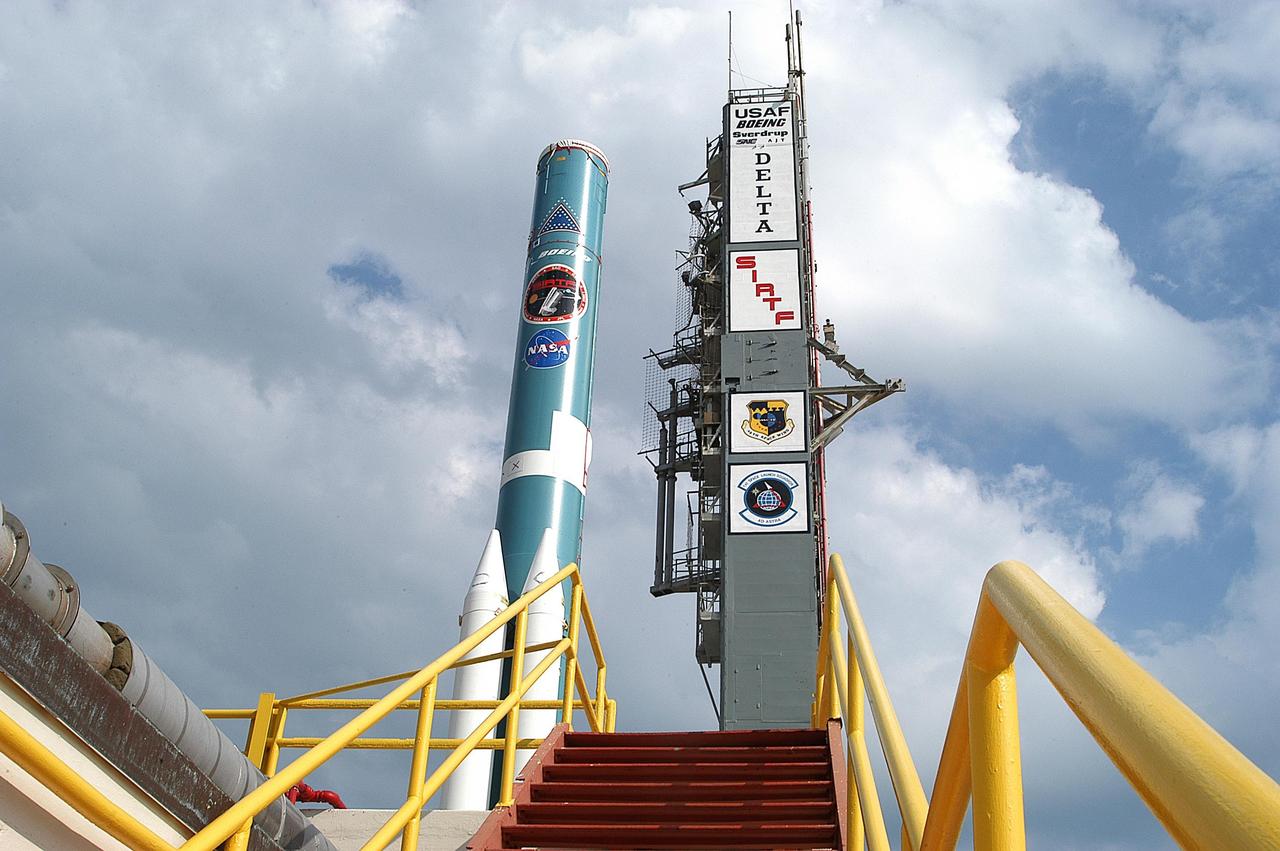
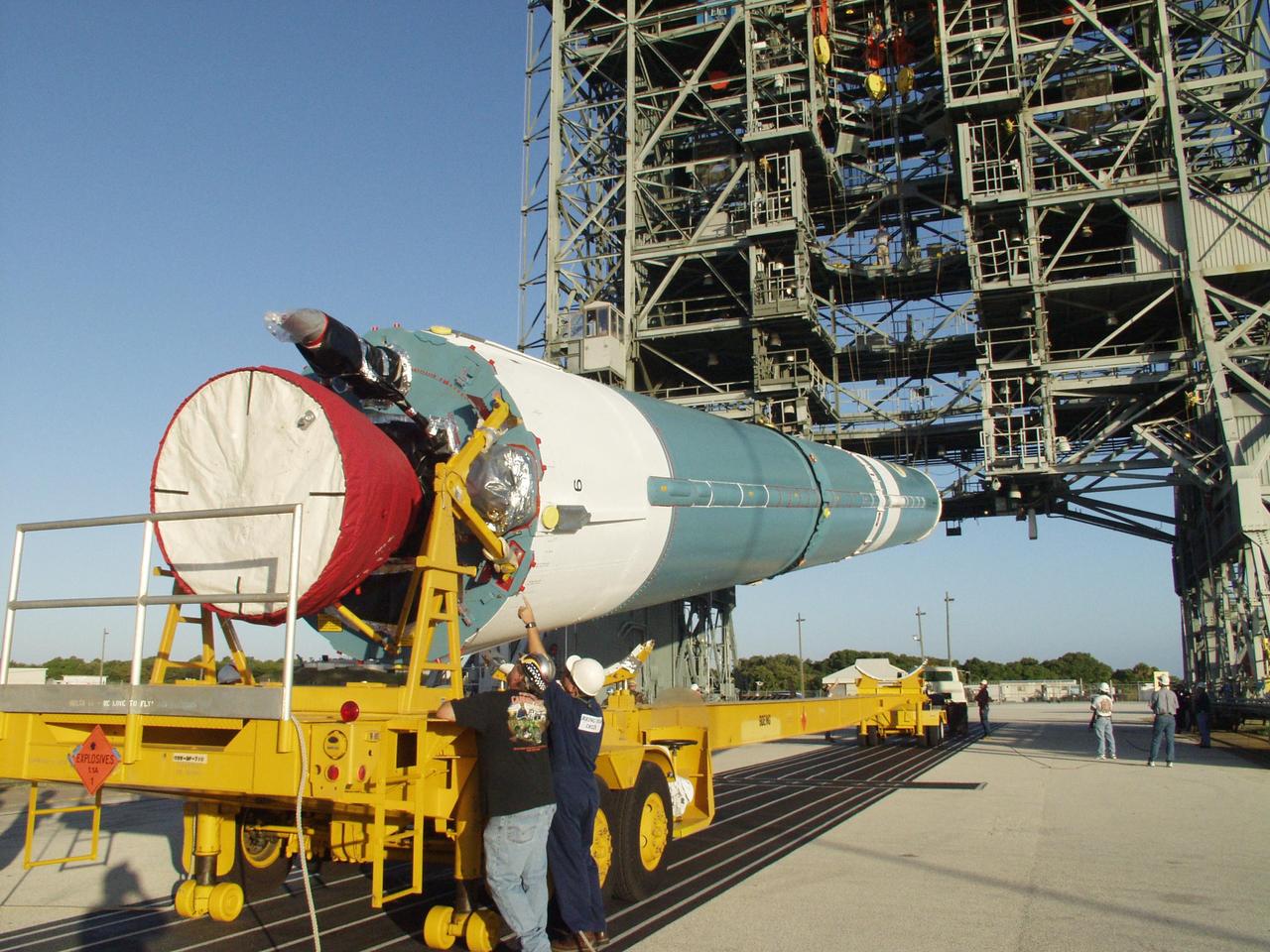
KENNEDY SPACE CENTER, FLA. -   A solid rocket booster (SRB) for the Delta II Heavy rocket that will launch the Space Infrared Telescope Facility (SIRTF) arrives at Launch Complex 17-B, Cape Canaveral Air Force Station.  The Delta II Heavy features nine 46-inch-diameter, stretched SRBs.  Consisting of three cryogenically cooled science instruments and an 0.85-meter telescope, SIRTF is one of NASA's largest infrared telescopes to be launched.  SIRTF will obtain images and spectra by detecting the infrared energy, or heat, radiated by objects in space. Most of this infrared radiation is blocked by the Earth's atmosphere and cannot be observed from the ground.
KENNEDY SPACE CENTER, FLA. - A solid rocket booster (SRB) for the Delta II Heavy rocket that will launch the Space Infrared Telescope Facility (SIRTF) arrives at Launch Complex 17-B, Cape Canaveral Air Force Station. The Delta II Heavy features nine 46-inch-diameter, stretched SRBs. Consisting of three cryogenically cooled science instruments and an 0.85-meter telescope, SIRTF is one of NASA's largest infrared telescopes to be launched. SIRTF will obtain images and spectra by detecting the infrared energy, or heat, radiated by objects in space. Most of this infrared radiation is blocked by the Earth's atmosphere and cannot be observed from the ground.
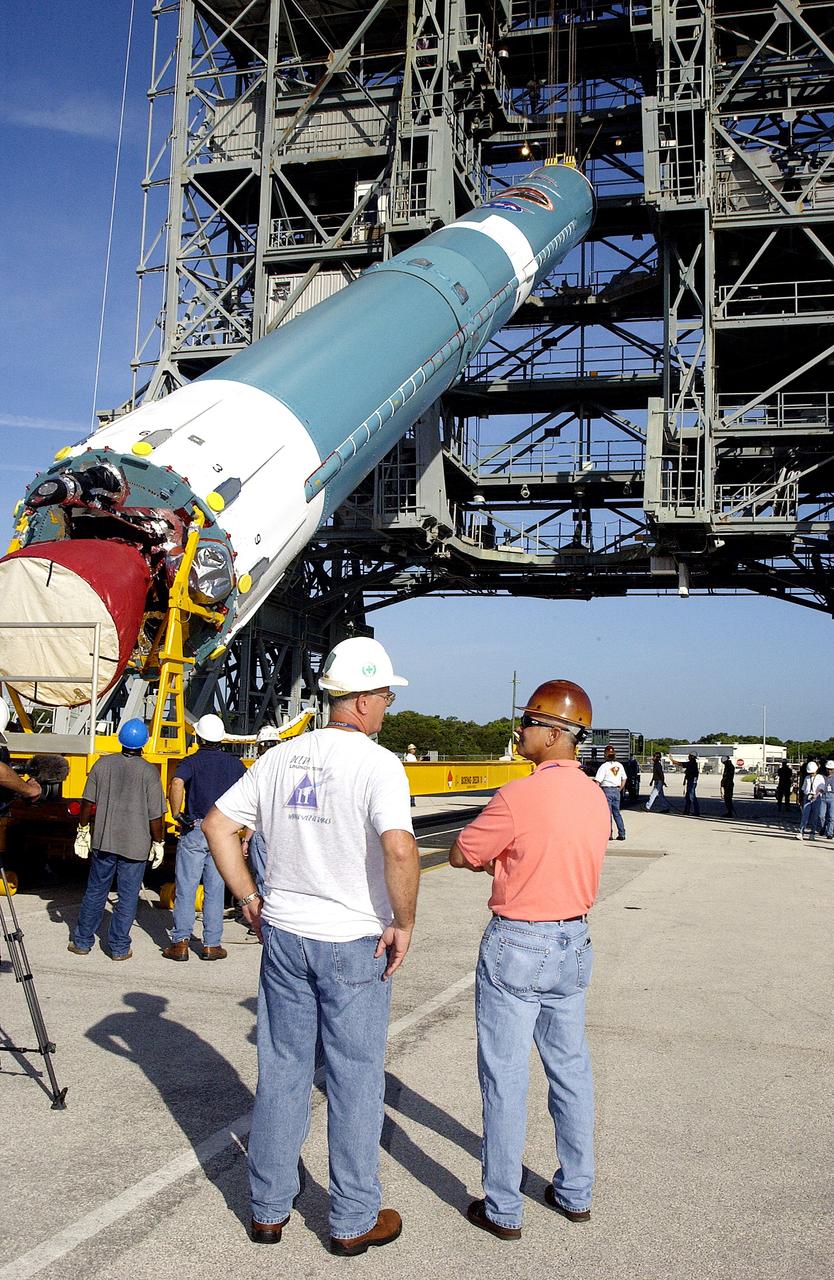
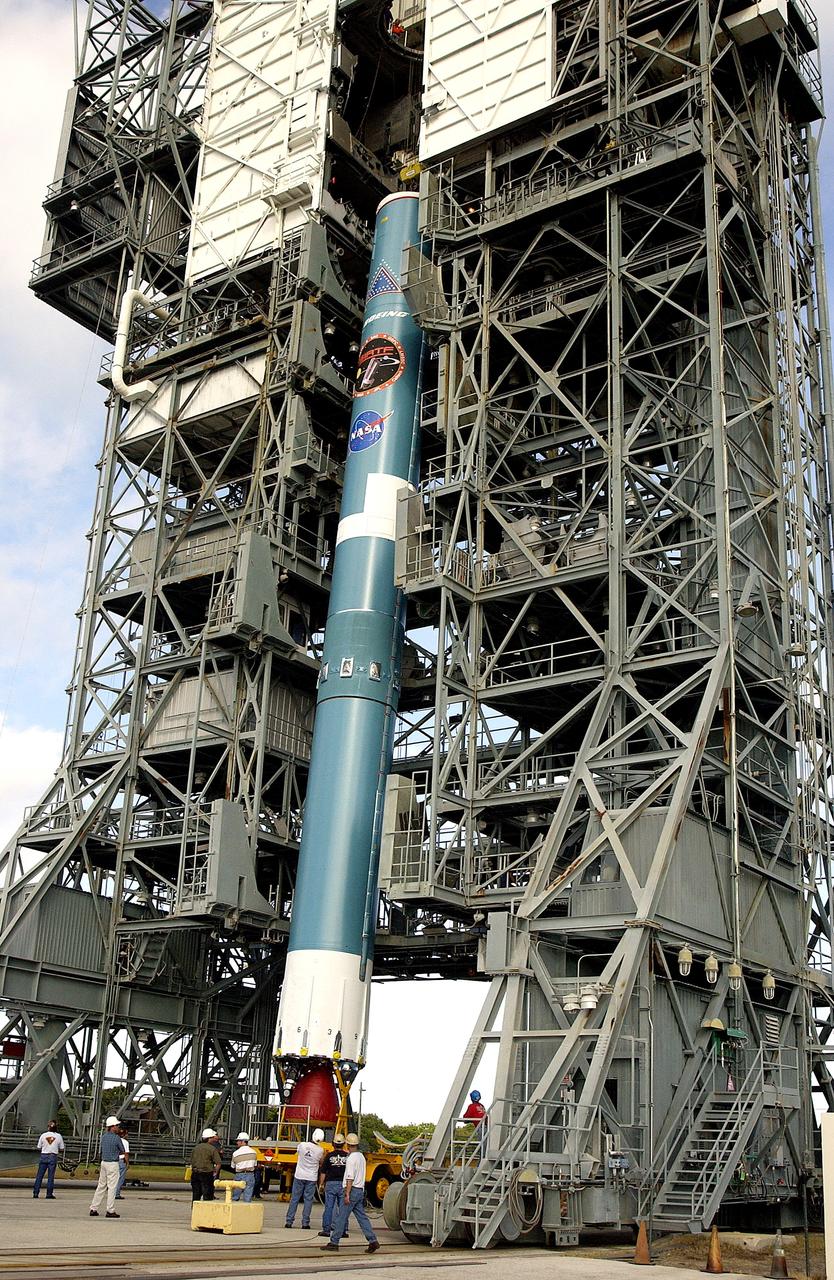
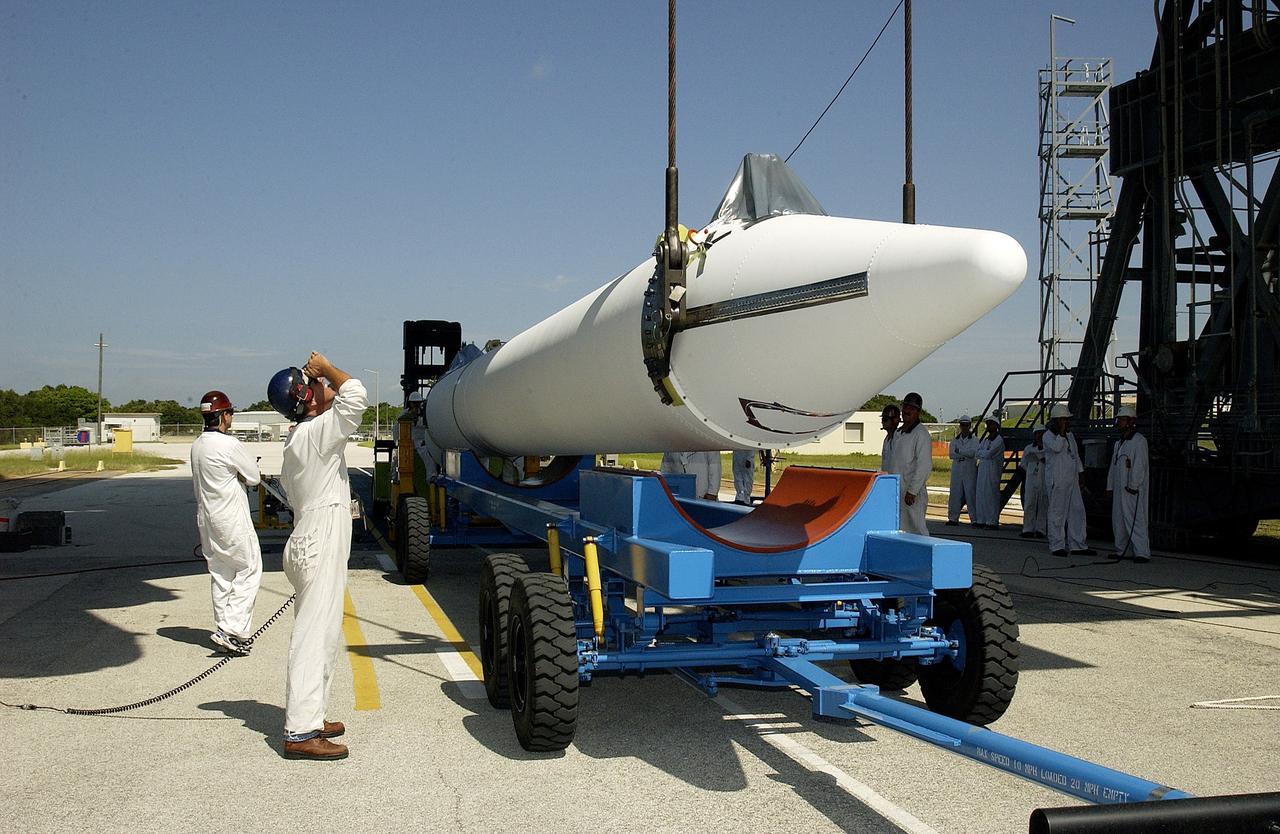
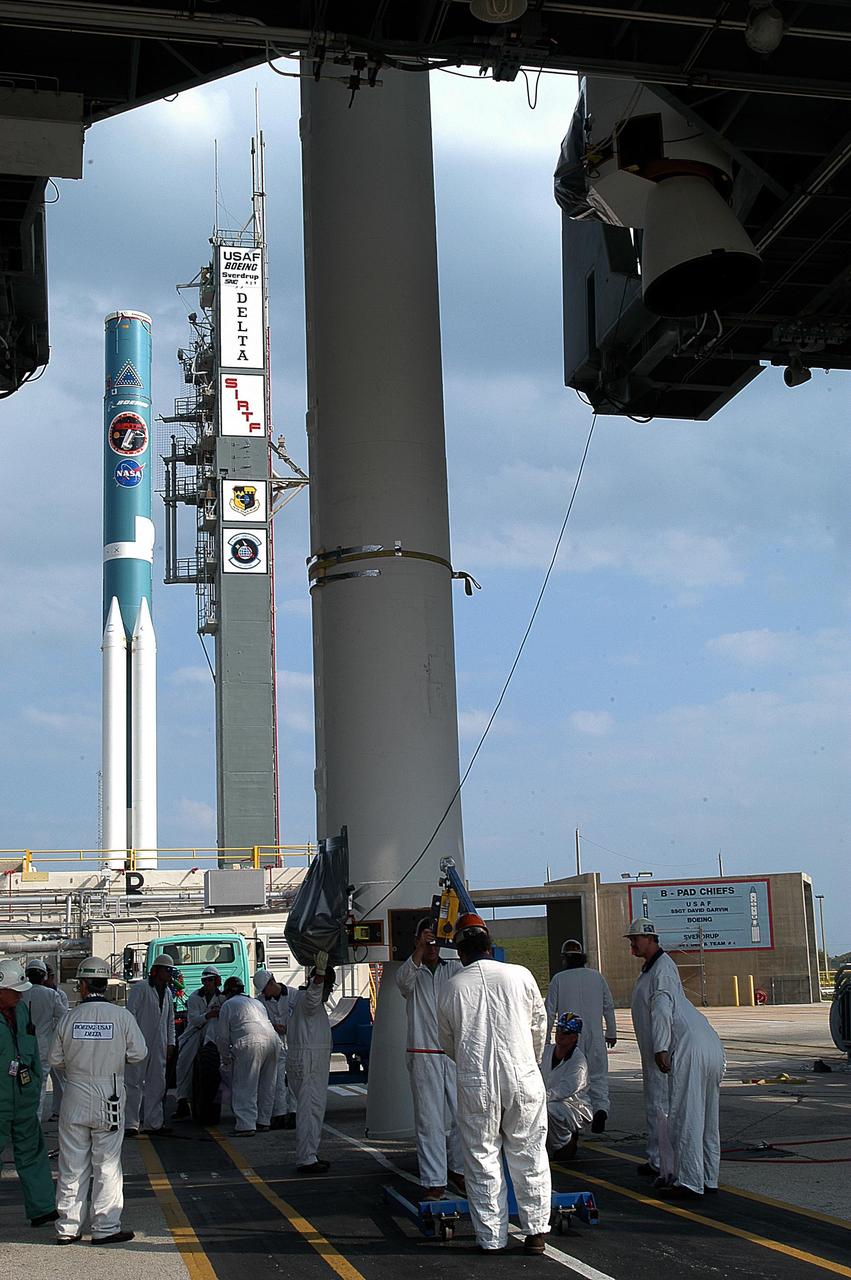
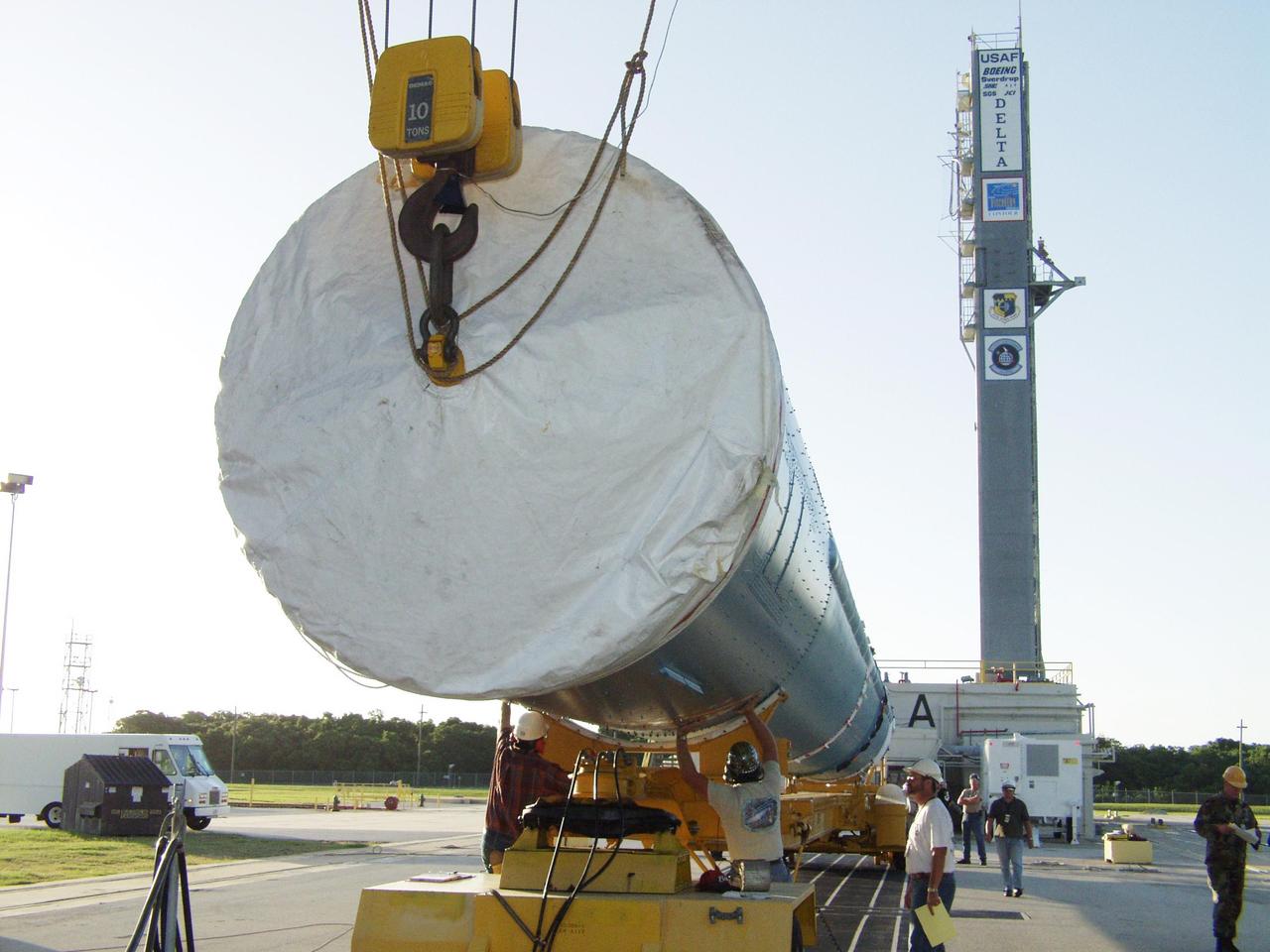
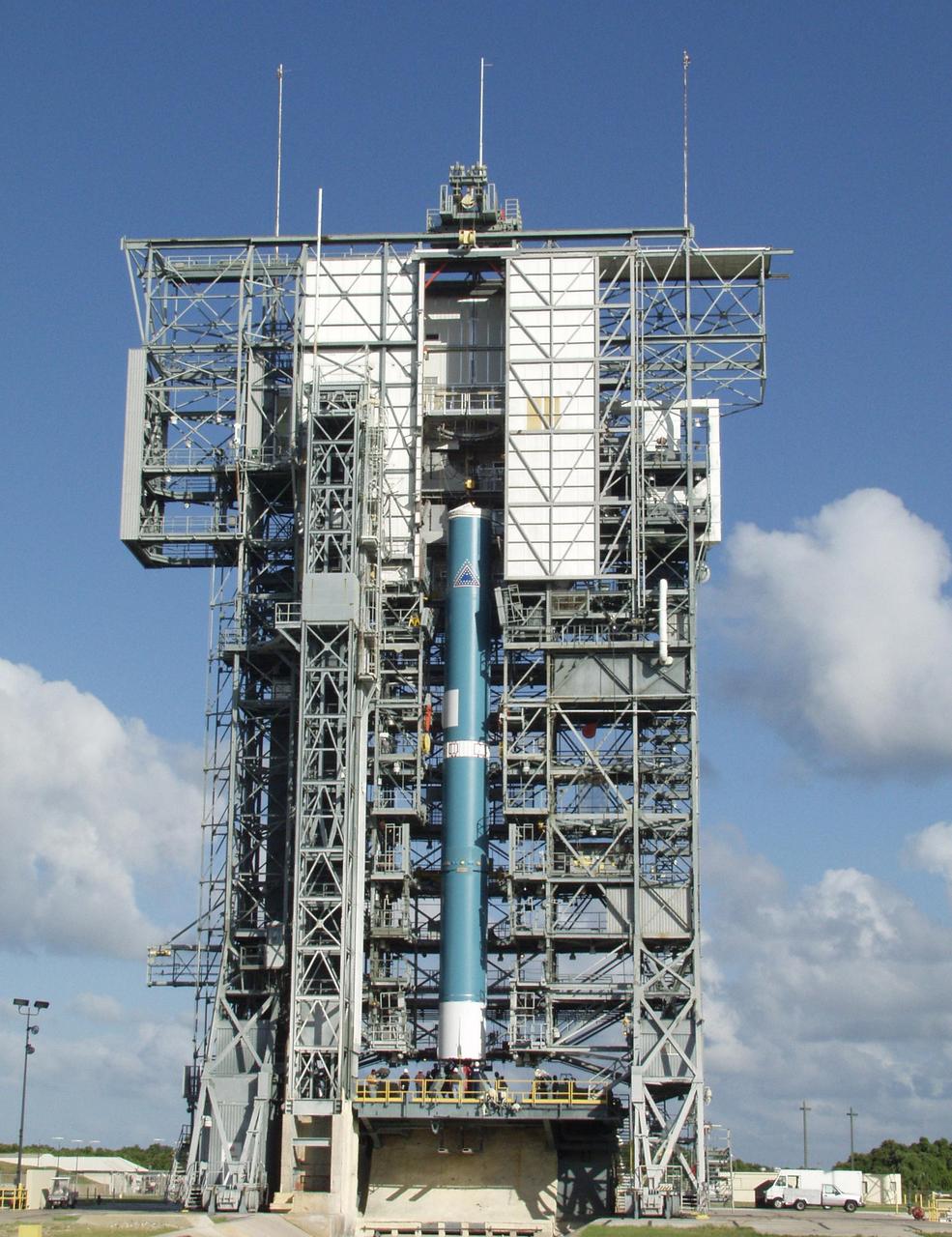
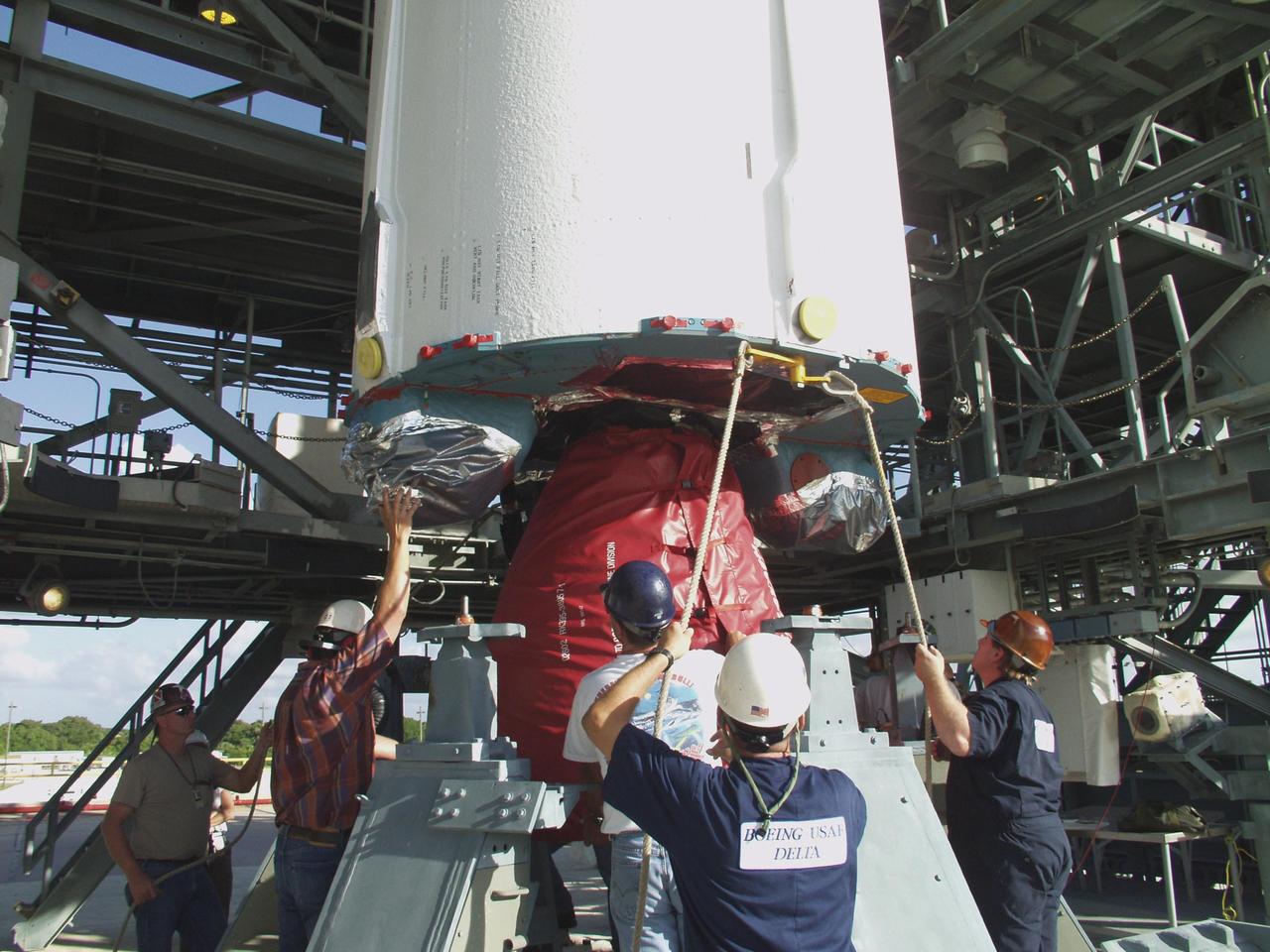
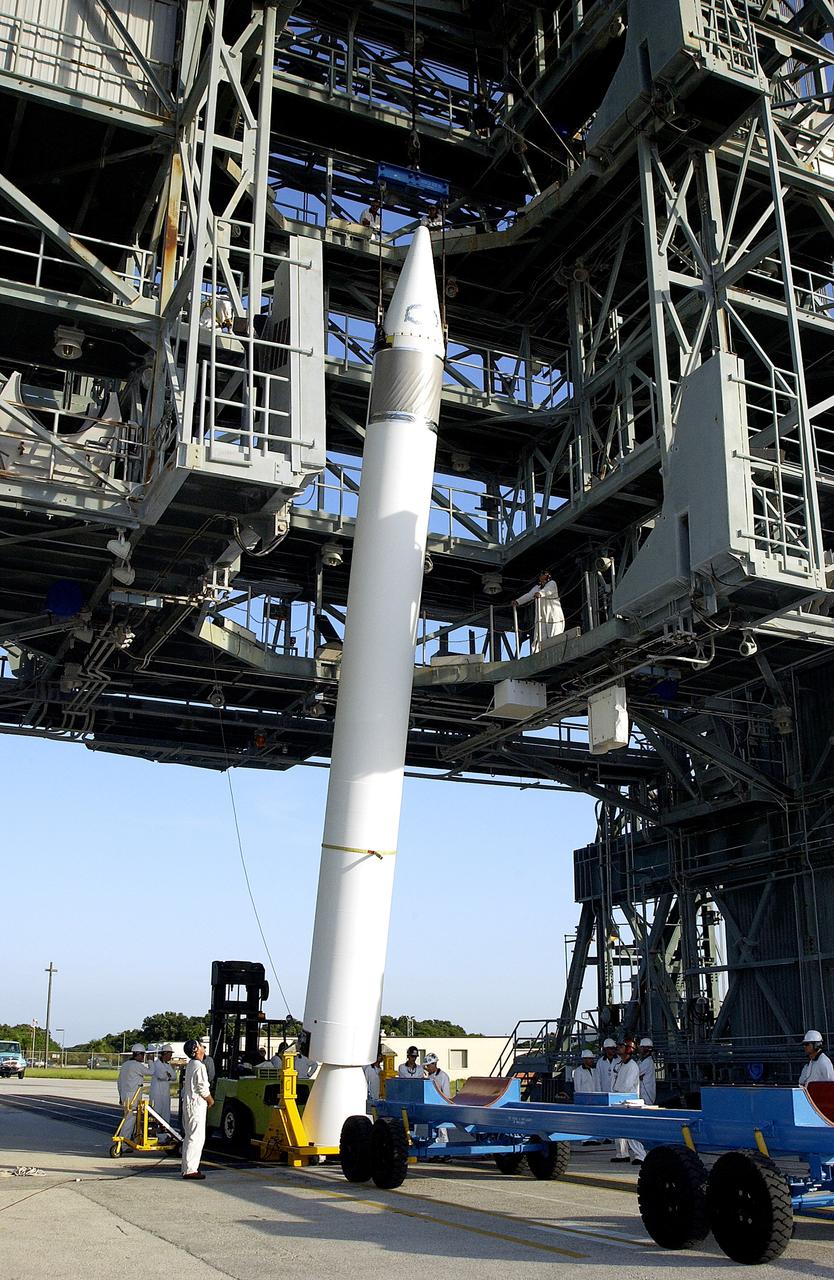
KENNEDY SPACE CENTER, FLA. -   A solid rocket booster (SRB) is lifted to vertical on Launch Complex 17-B, Cape Canaveral Air Force Station. The SRB will be attached to the Delta II Heavy rocket that will launch the Space Infrared Telescope Facility (SIRTF).  The Delta II Heavy features nine 46-inch-diameter, stretched SRBs.  Consisting of three cryogenically cooled science instruments and an 0.85-meter telescope, SIRTF is one of NASA's largest infrared telescopes to be launched.  SIRTF will obtain images and spectra by detecting the infrared energy, or heat, radiated by objects in space. Most of this infrared radiation is blocked by the Earth's atmosphere and cannot be observed from the ground.
KENNEDY SPACE CENTER, FLA. - A solid rocket booster (SRB) is lifted to vertical on Launch Complex 17-B, Cape Canaveral Air Force Station. The SRB will be attached to the Delta II Heavy rocket that will launch the Space Infrared Telescope Facility (SIRTF). The Delta II Heavy features nine 46-inch-diameter, stretched SRBs. Consisting of three cryogenically cooled science instruments and an 0.85-meter telescope, SIRTF is one of NASA's largest infrared telescopes to be launched. SIRTF will obtain images and spectra by detecting the infrared energy, or heat, radiated by objects in space. Most of this infrared radiation is blocked by the Earth's atmosphere and cannot be observed from the ground.
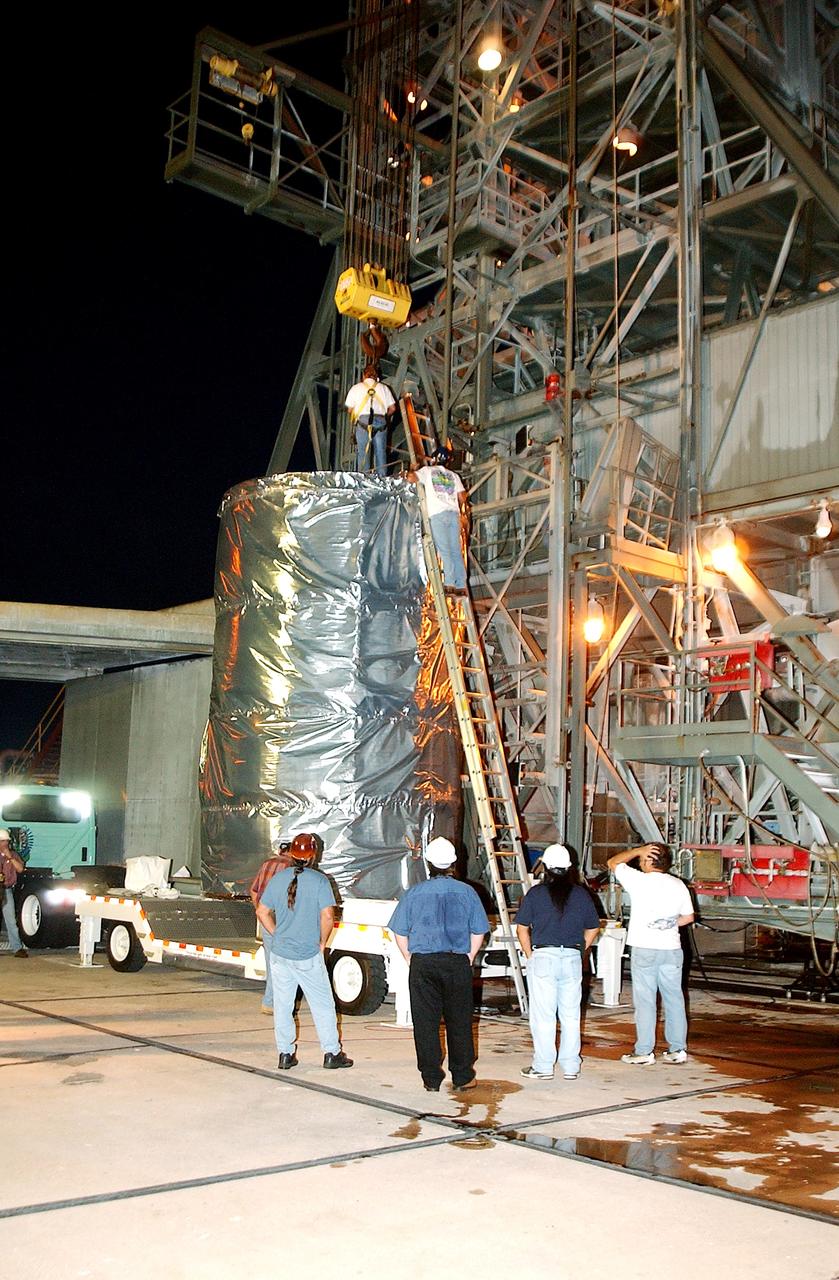
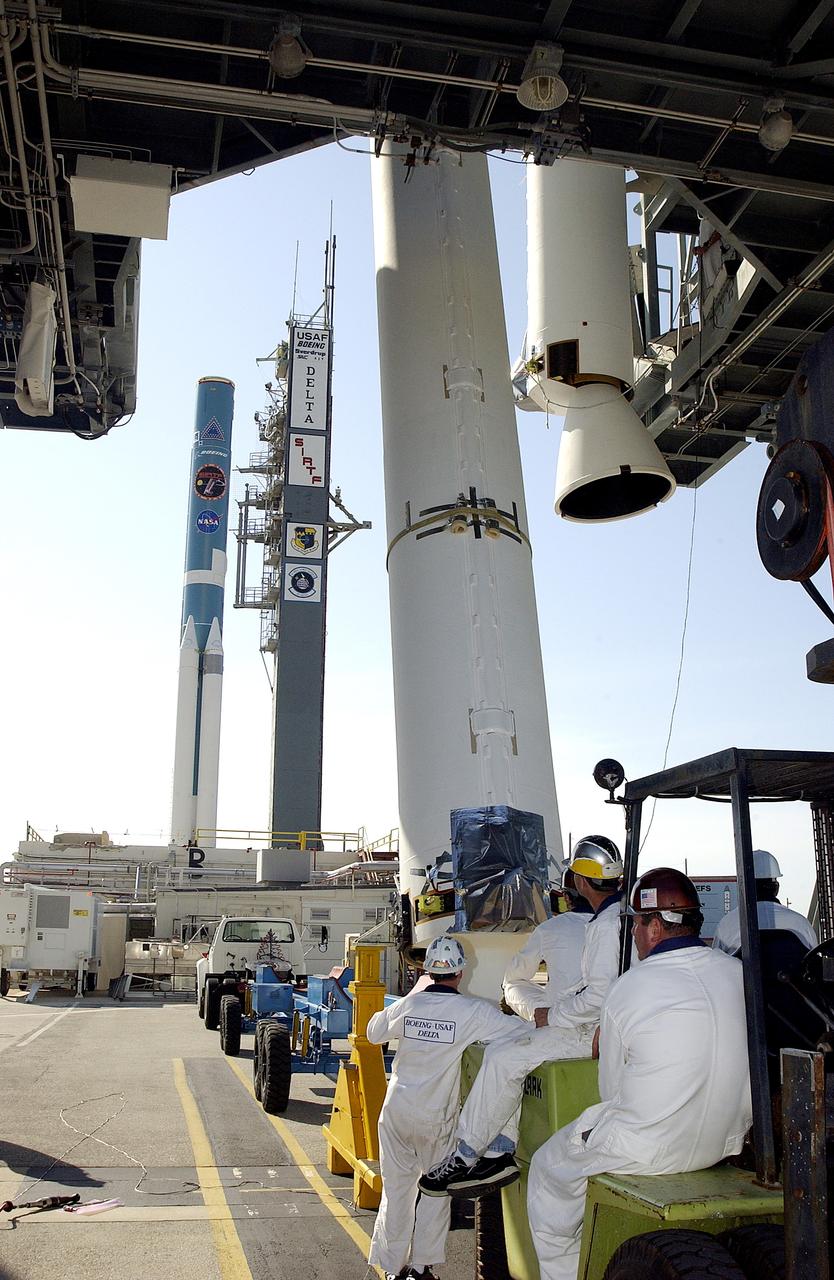
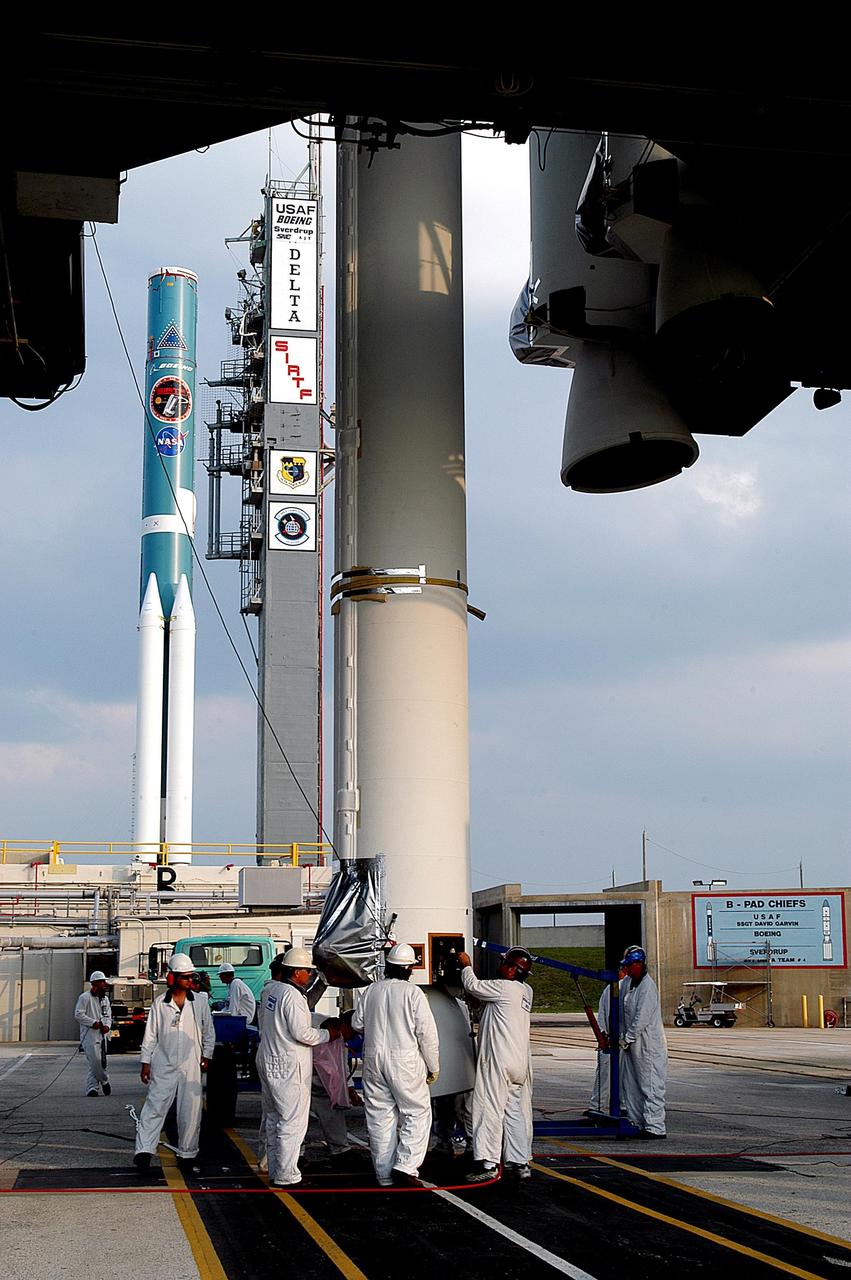
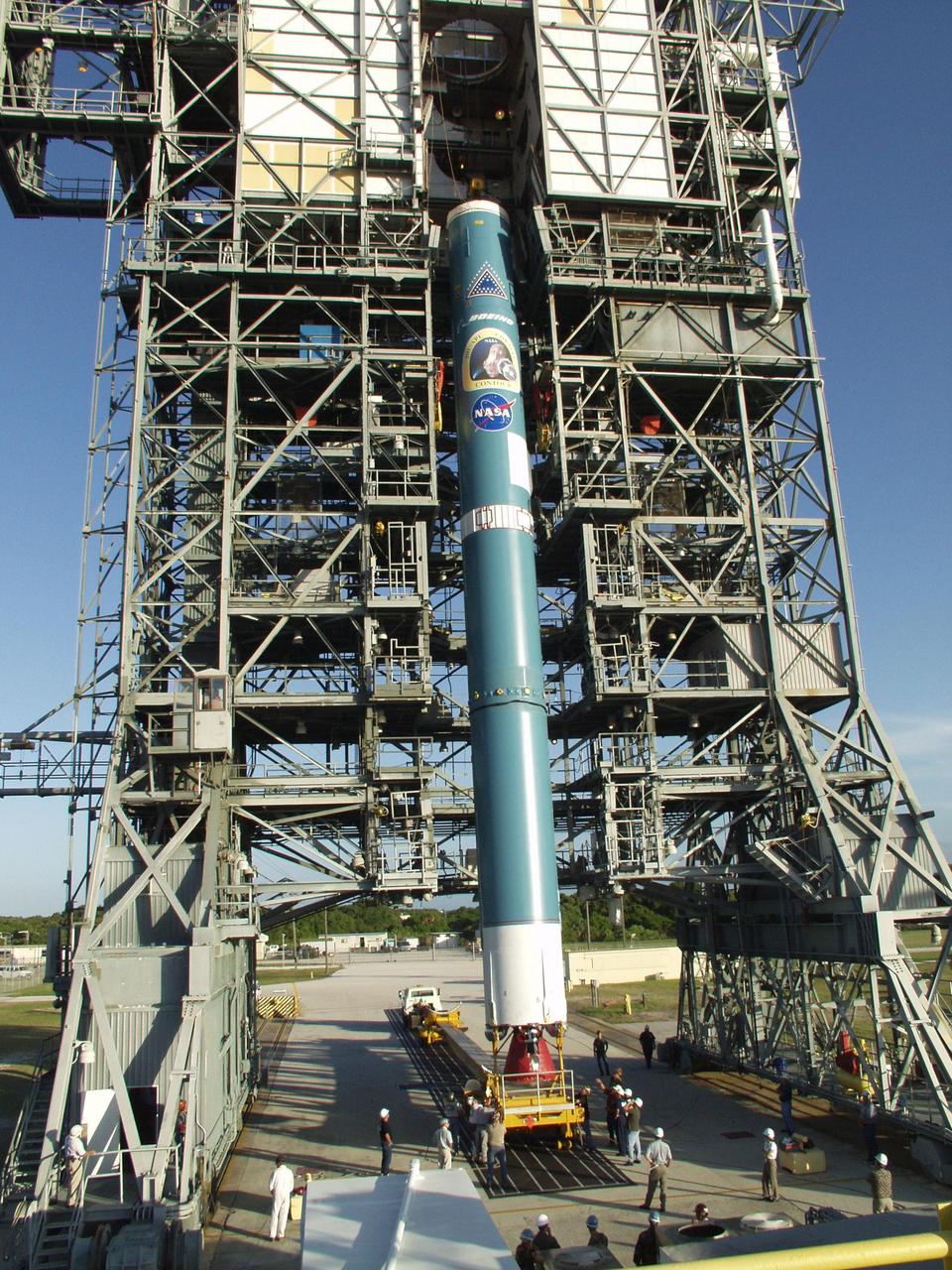
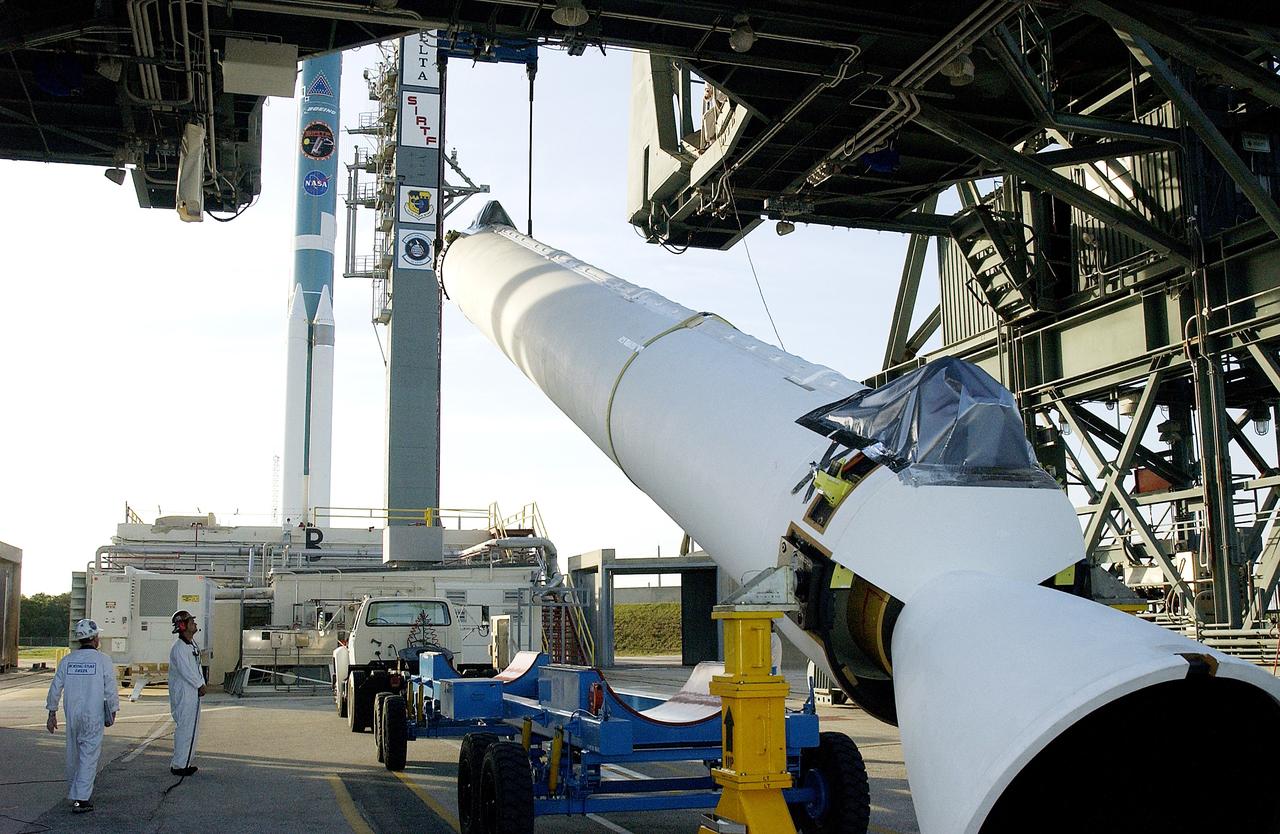
KENNEDY SPACE CENTER, FLA. -   A solid rocket booster (SRB) for the Delta II Heavy rocket that will launch the Space Infrared Telescope Facility (SIRTF) is lifted off its transporter on Launch Complex 17-B, Cape Canaveral Air Force Station.  The SRB will be added to the launch vehicle in the background.  The Delta II Heavy features nine 46-inch-diameter, stretched SRBs.  SIRTF, consisting of three cryogenically cooled science instruments and an 0.85-meter telescope, is one of NASA's largest infrared telescopes to be launched.  SIRTF will obtain images and spectra by detecting the infrared energy, or heat, radiated by objects in space. Most of this infrared radiation is blocked by the Earth's atmosphere and cannot be observed from the ground.
KENNEDY SPACE CENTER, FLA. - A solid rocket booster (SRB) for the Delta II Heavy rocket that will launch the Space Infrared Telescope Facility (SIRTF) is lifted off its transporter on Launch Complex 17-B, Cape Canaveral Air Force Station. The SRB will be added to the launch vehicle in the background. The Delta II Heavy features nine 46-inch-diameter, stretched SRBs. SIRTF, consisting of three cryogenically cooled science instruments and an 0.85-meter telescope, is one of NASA's largest infrared telescopes to be launched. SIRTF will obtain images and spectra by detecting the infrared energy, or heat, radiated by objects in space. Most of this infrared radiation is blocked by the Earth's atmosphere and cannot be observed from the ground.
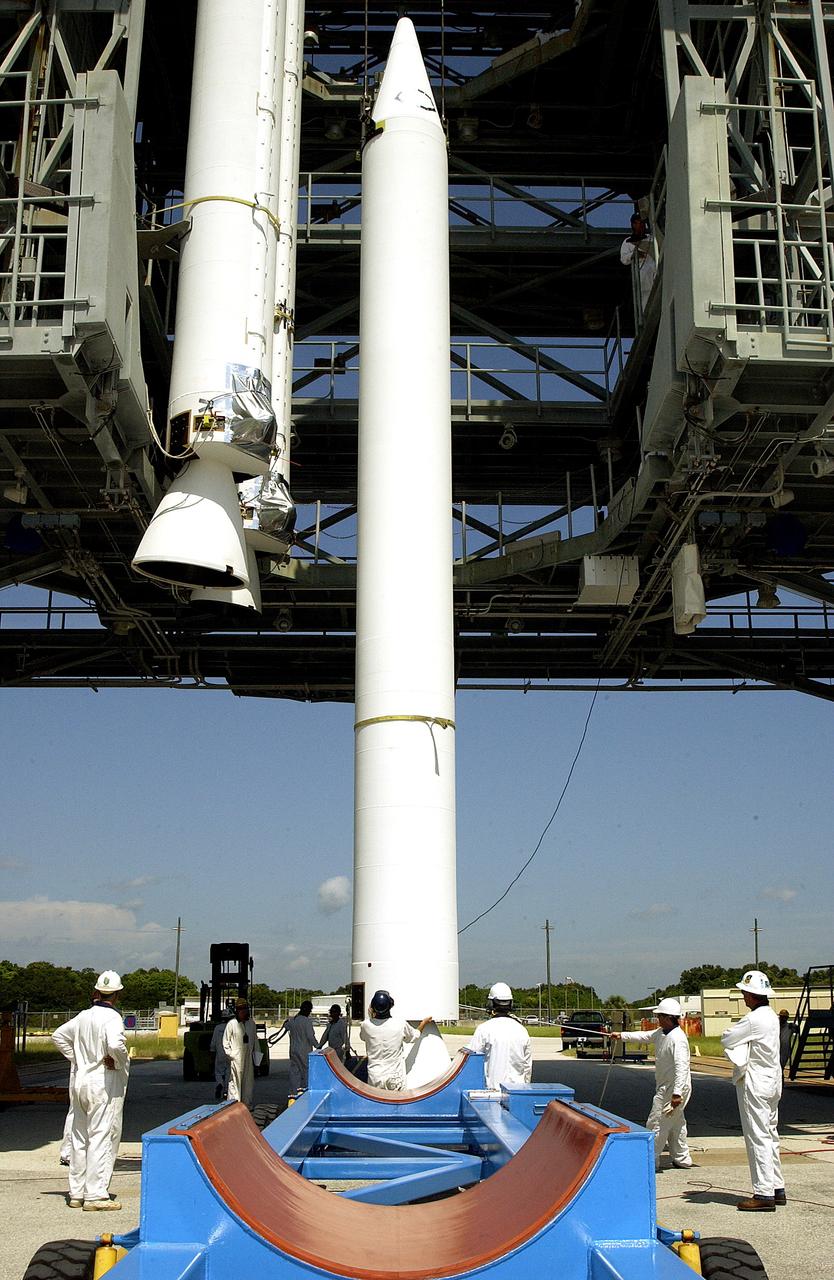
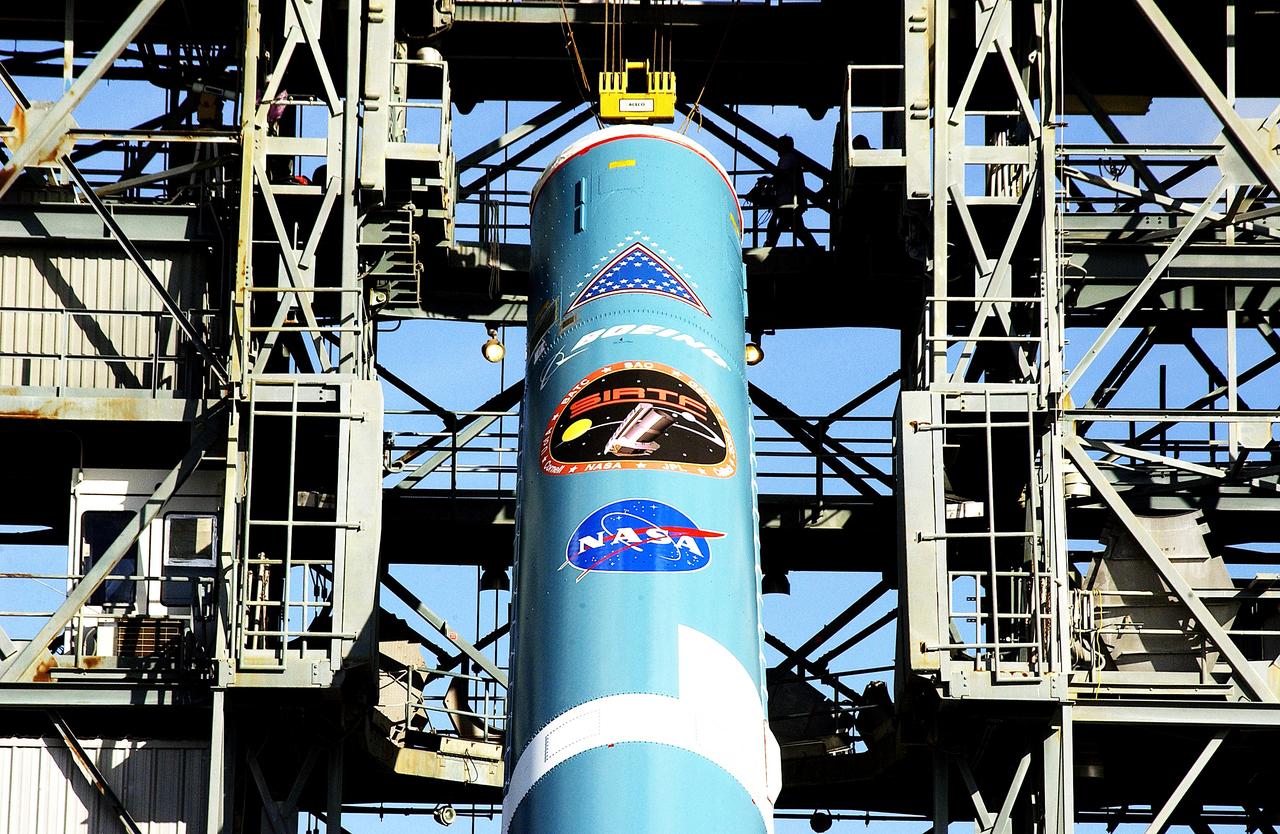
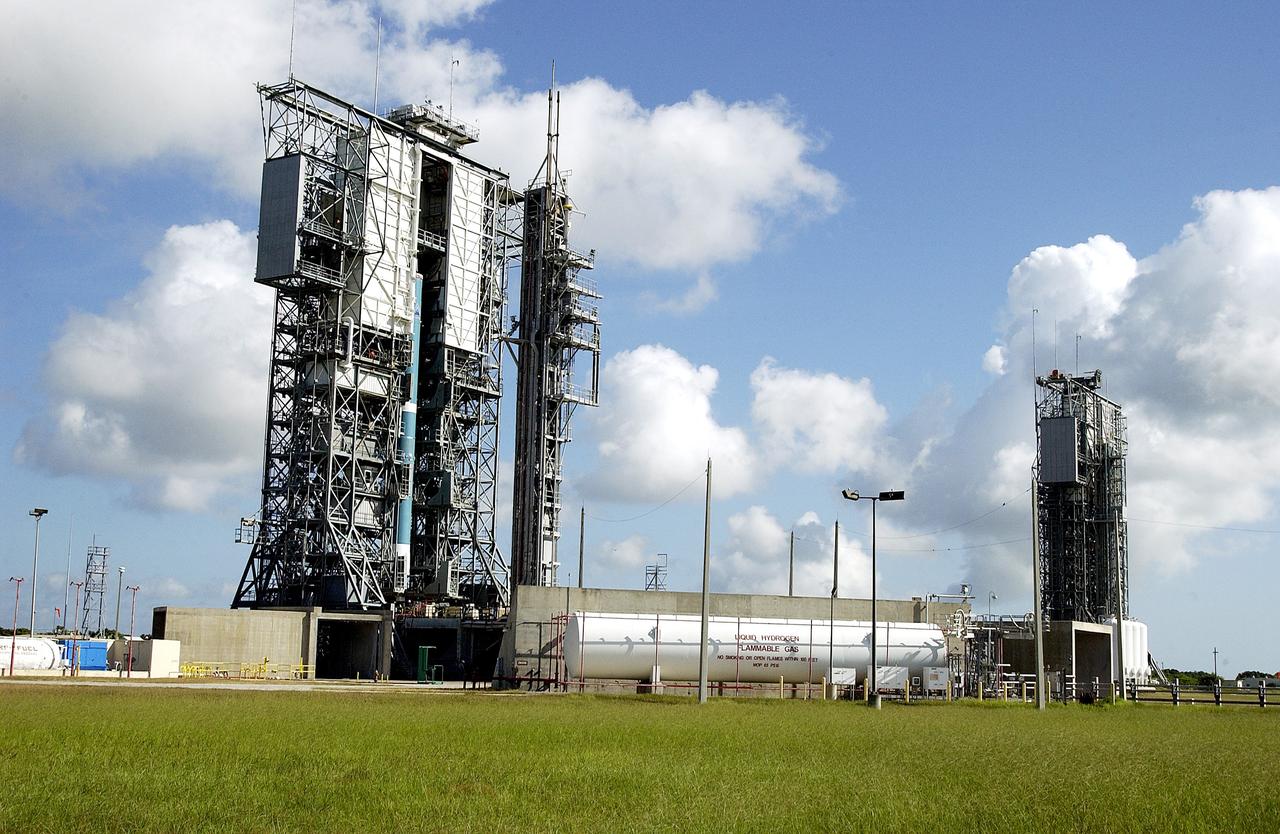
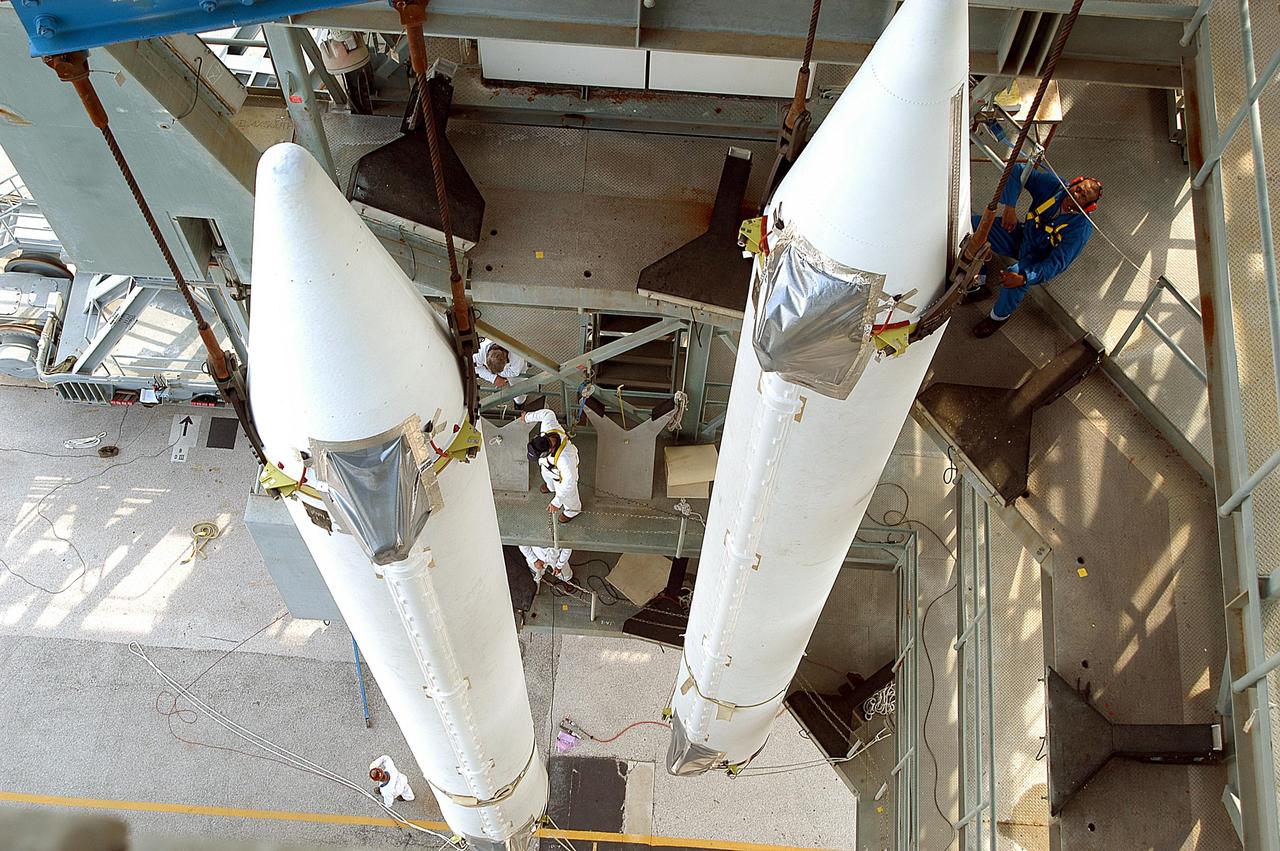
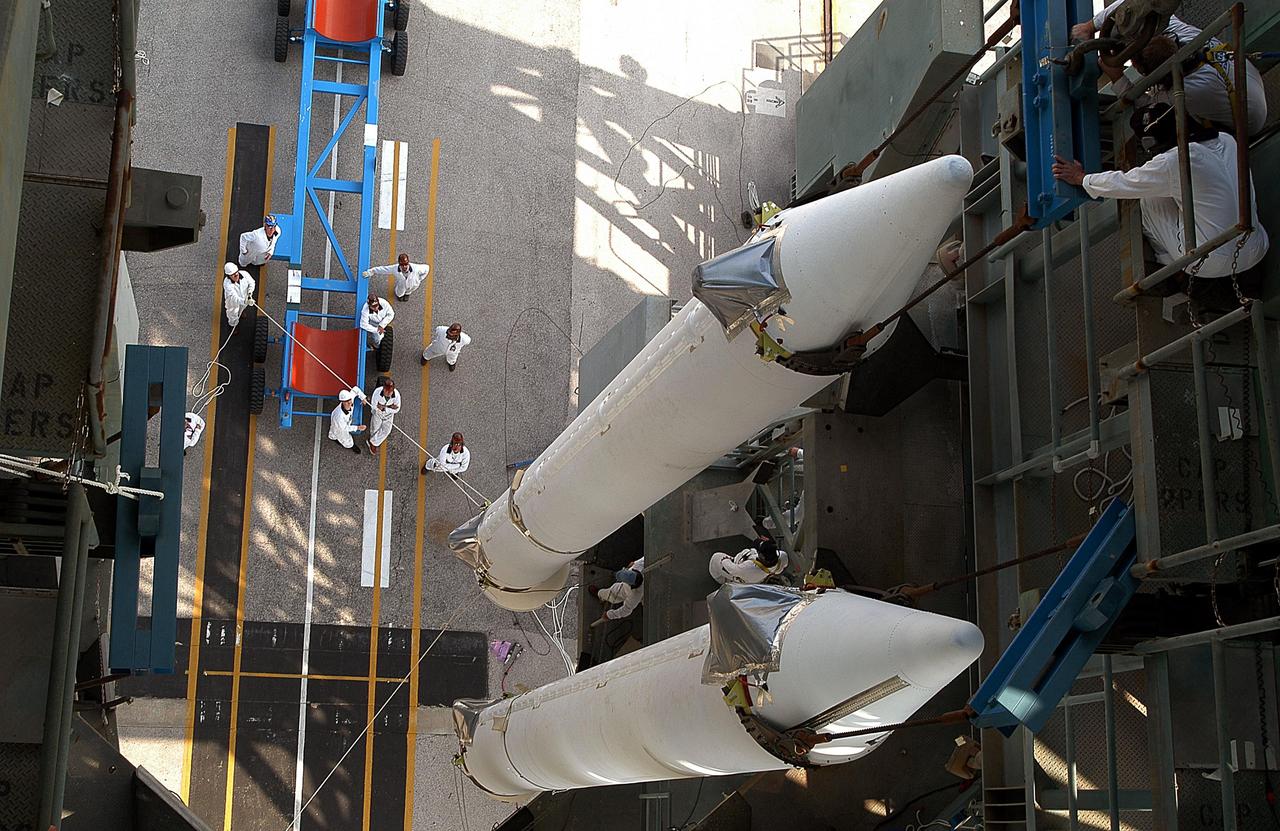
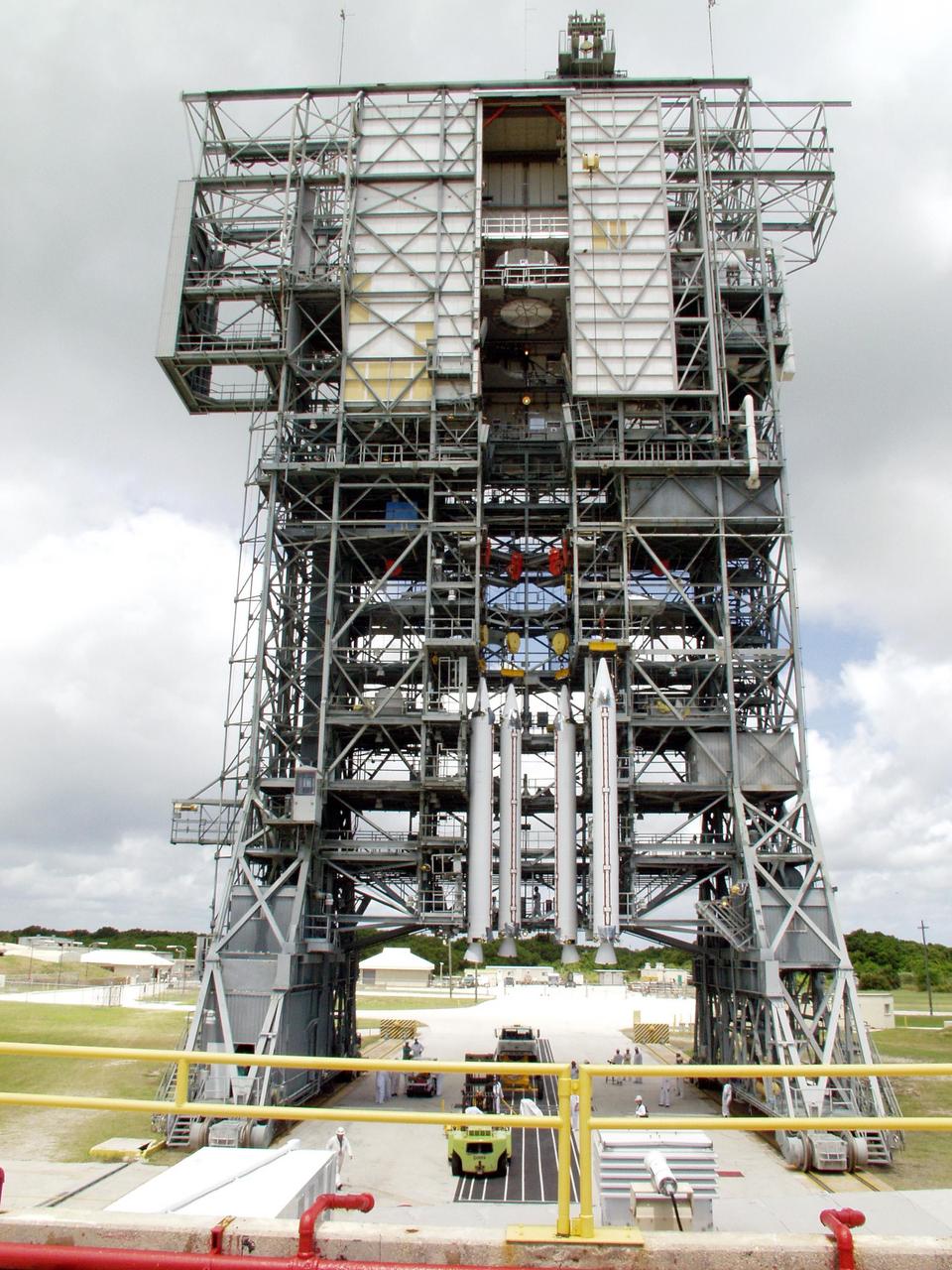
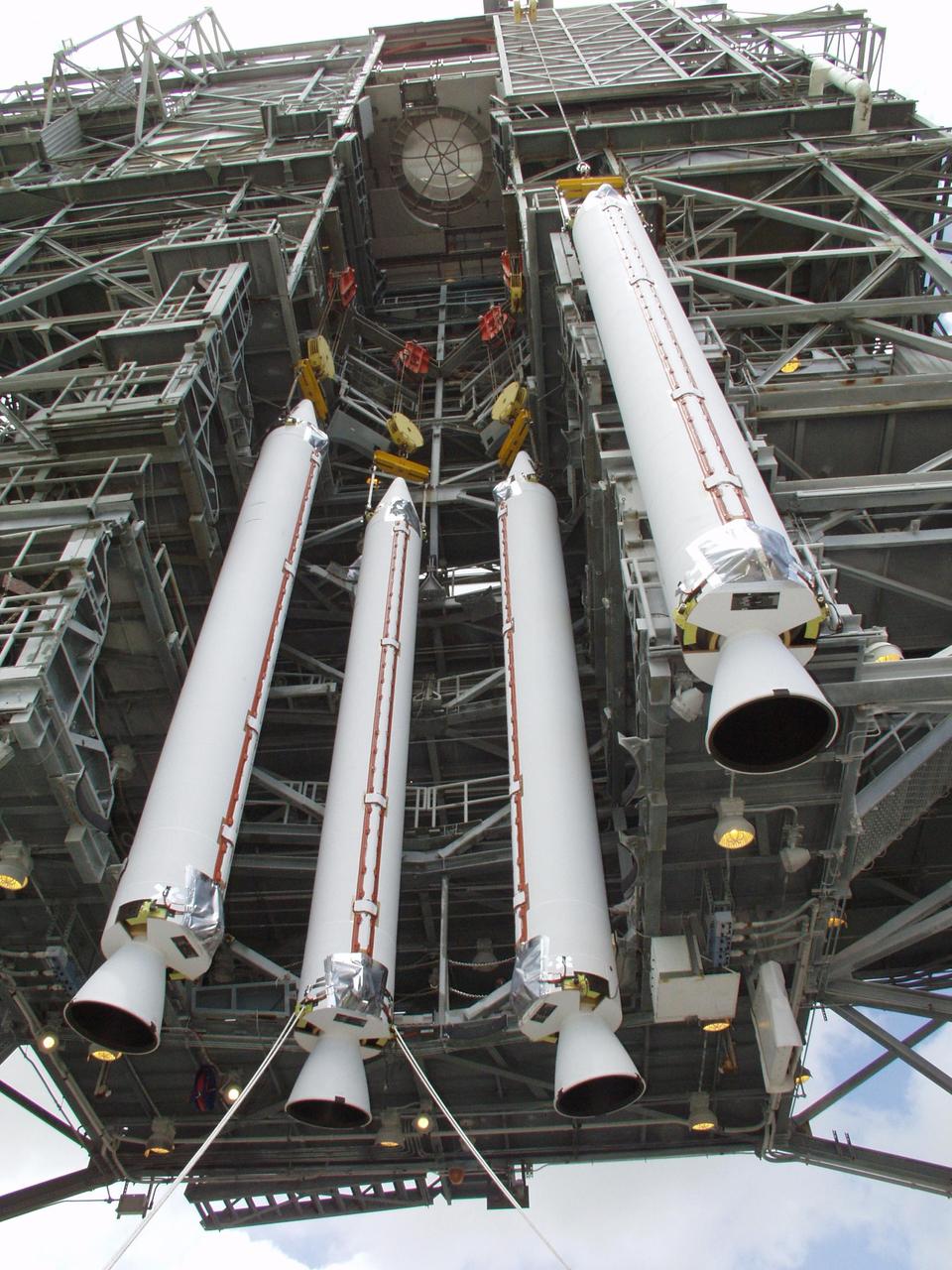
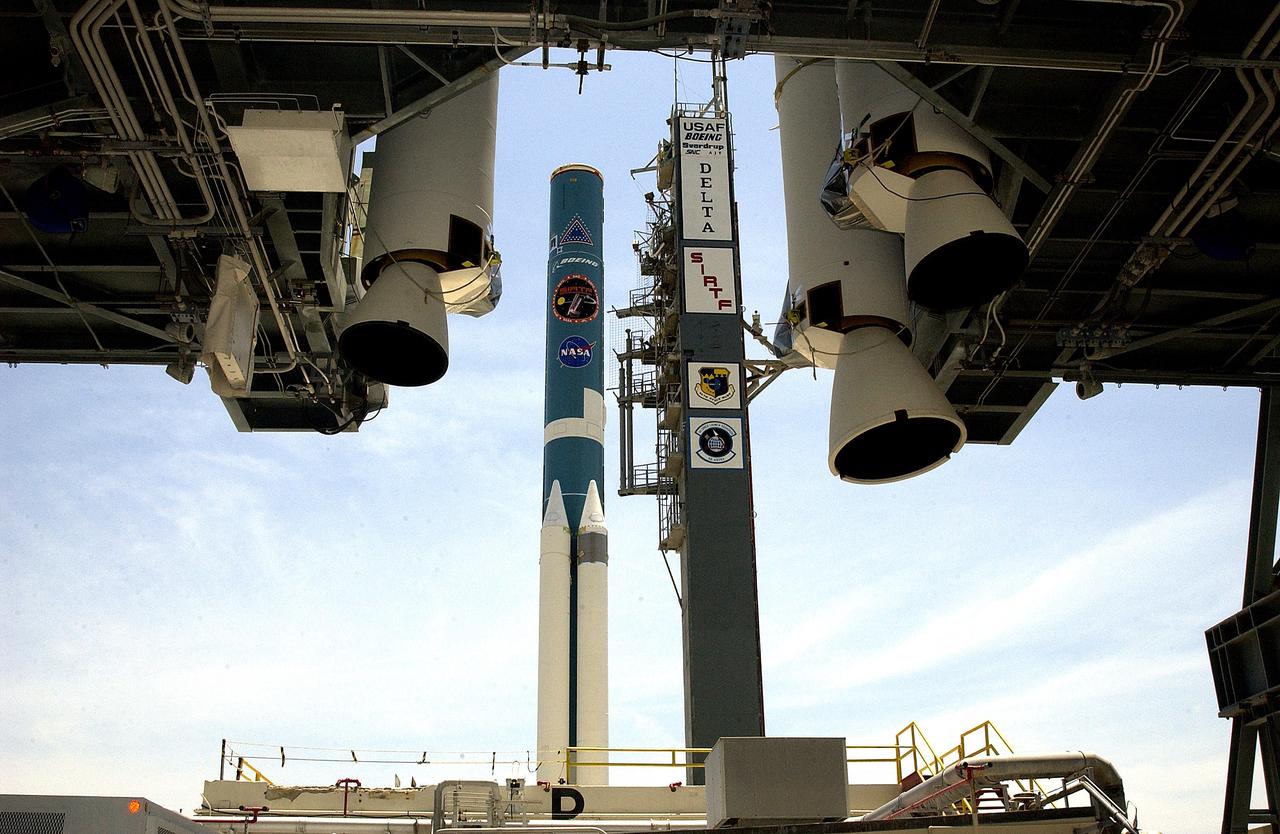
KENNEDY SPACE CENTER, FLA. -   On Launch Complex 17-B, Cape Canaveral Air Force Station, the Delta II Heavy rocket  (background) is framed by the solid rocket boosters (foreground) suspended in the mobile service tower.  The SRBs will be added to those already attached to the rocket.  The Delta II Heavy will launch the Space Infrared Telescope Facility (SIRTF).  Consisting of three cryogenically cooled science instruments and an 0.85-meter telescope, SIRTF is one of NASA's largest infrared telescopes to be launched.  SIRTF will obtain images and spectra by detecting the infrared energy, or heat, radiated by objects in space. Most of this infrared radiation is blocked by the Earth's atmosphere and cannot be observed from the ground.
KENNEDY SPACE CENTER, FLA. - On Launch Complex 17-B, Cape Canaveral Air Force Station, the Delta II Heavy rocket (background) is framed by the solid rocket boosters (foreground) suspended in the mobile service tower. The SRBs will be added to those already attached to the rocket. The Delta II Heavy will launch the Space Infrared Telescope Facility (SIRTF). Consisting of three cryogenically cooled science instruments and an 0.85-meter telescope, SIRTF is one of NASA's largest infrared telescopes to be launched. SIRTF will obtain images and spectra by detecting the infrared energy, or heat, radiated by objects in space. Most of this infrared radiation is blocked by the Earth's atmosphere and cannot be observed from the ground.
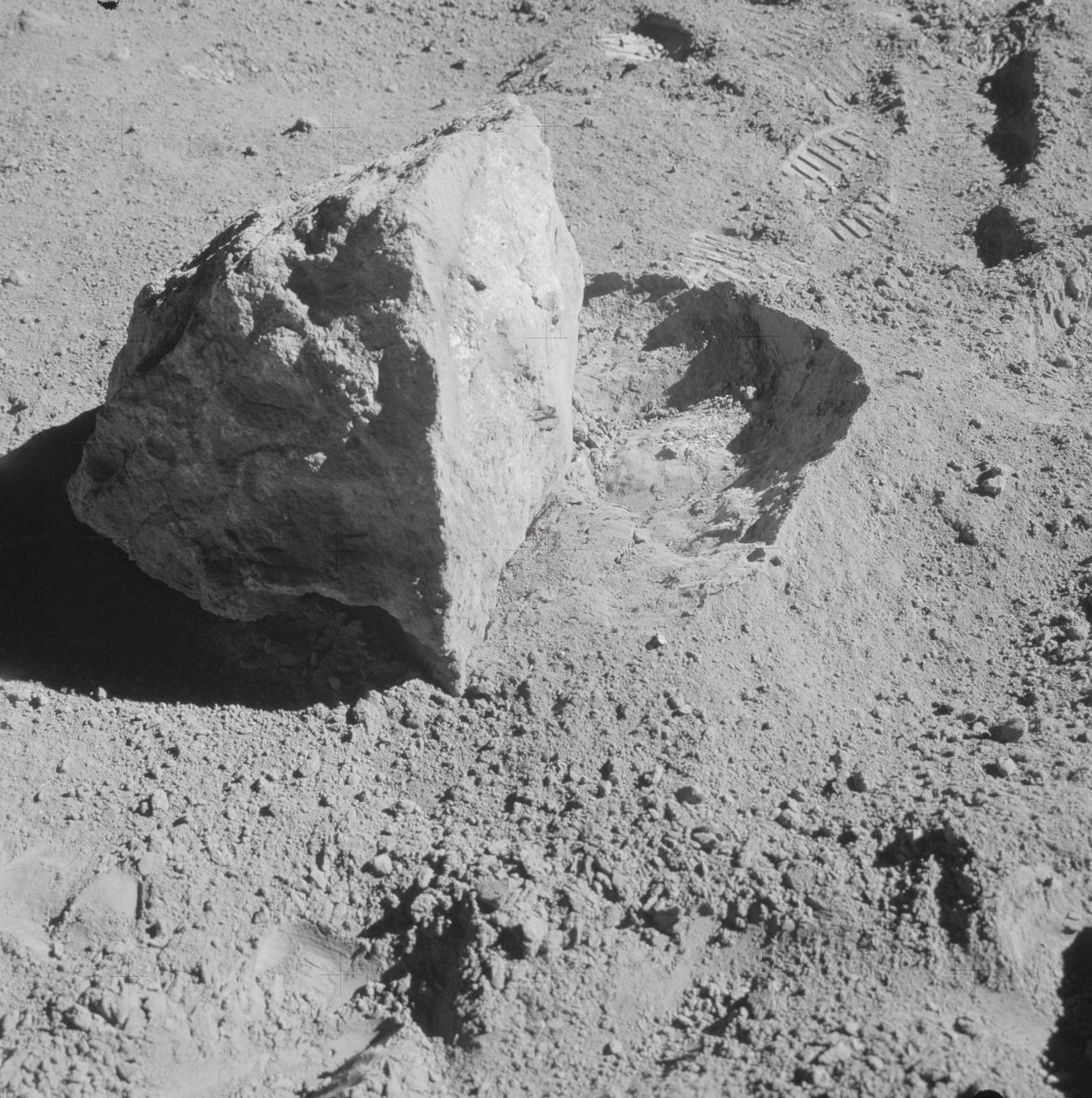
AS16-107-17573 (22 April 1972) --- A close-up view of a block (about 1/2 meter long) found by the two moon-exploring crewmembers of the Apollo 16 lunar landing mission. The block had been rolled over only moments earlier during this Apollo 16 second extravehicular activity (EVA) near South Ray Crater. Astronaut John W. Young, commander, said at the post-mission press conference, "The block has been sitting there evidently since South Ray Crater was formed." While astronauts Young and Charles M. Duke Jr., lunar module pilot; descended in the Apollo 16 Lunar Module (LM) "Orion" to explore the Descartes highlands landing site on the moon, astronaut Thomas K. Mattingly II, command module pilot, remained with the Command and Service Modules (CSM) "Casper" in lunar orbit.
A closeup view of a block found by Apollo 16 crewmen during second EVA
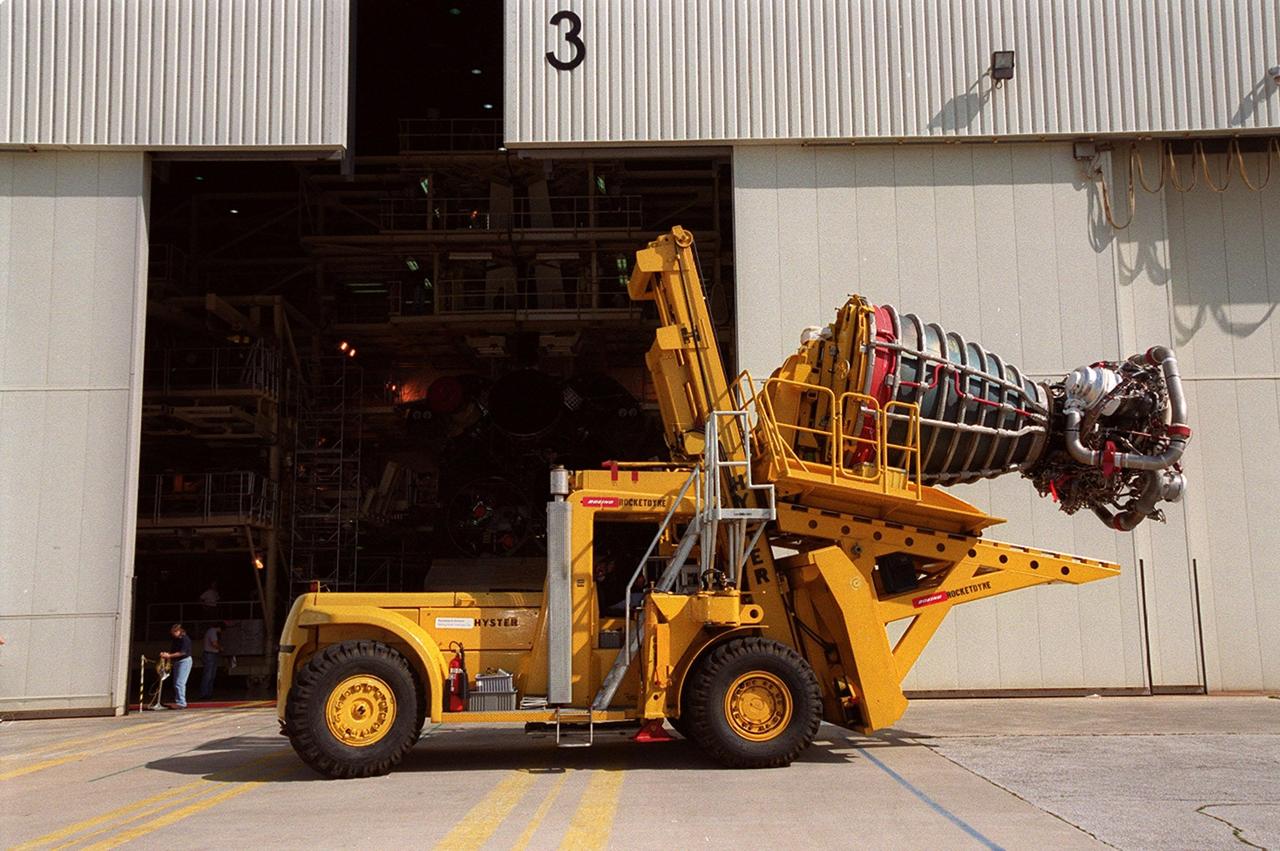
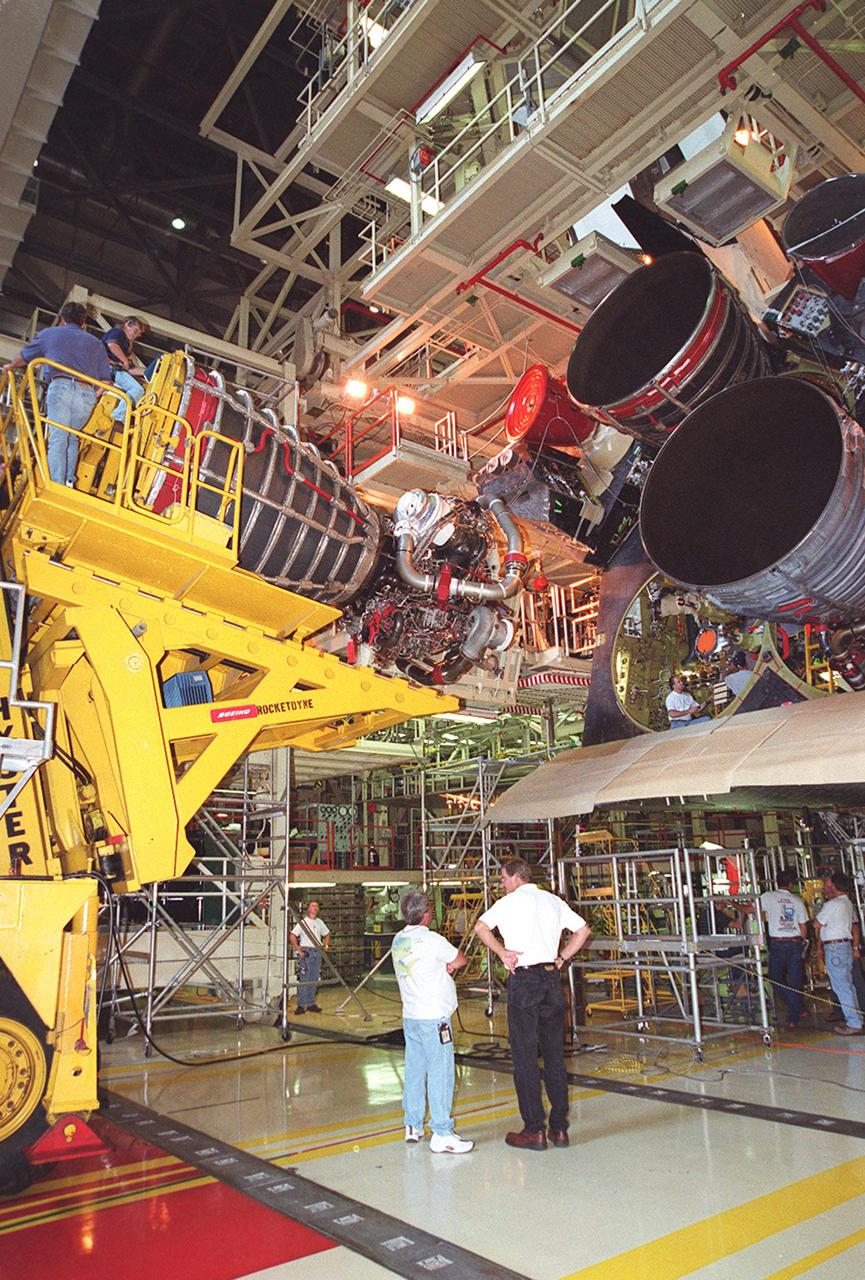
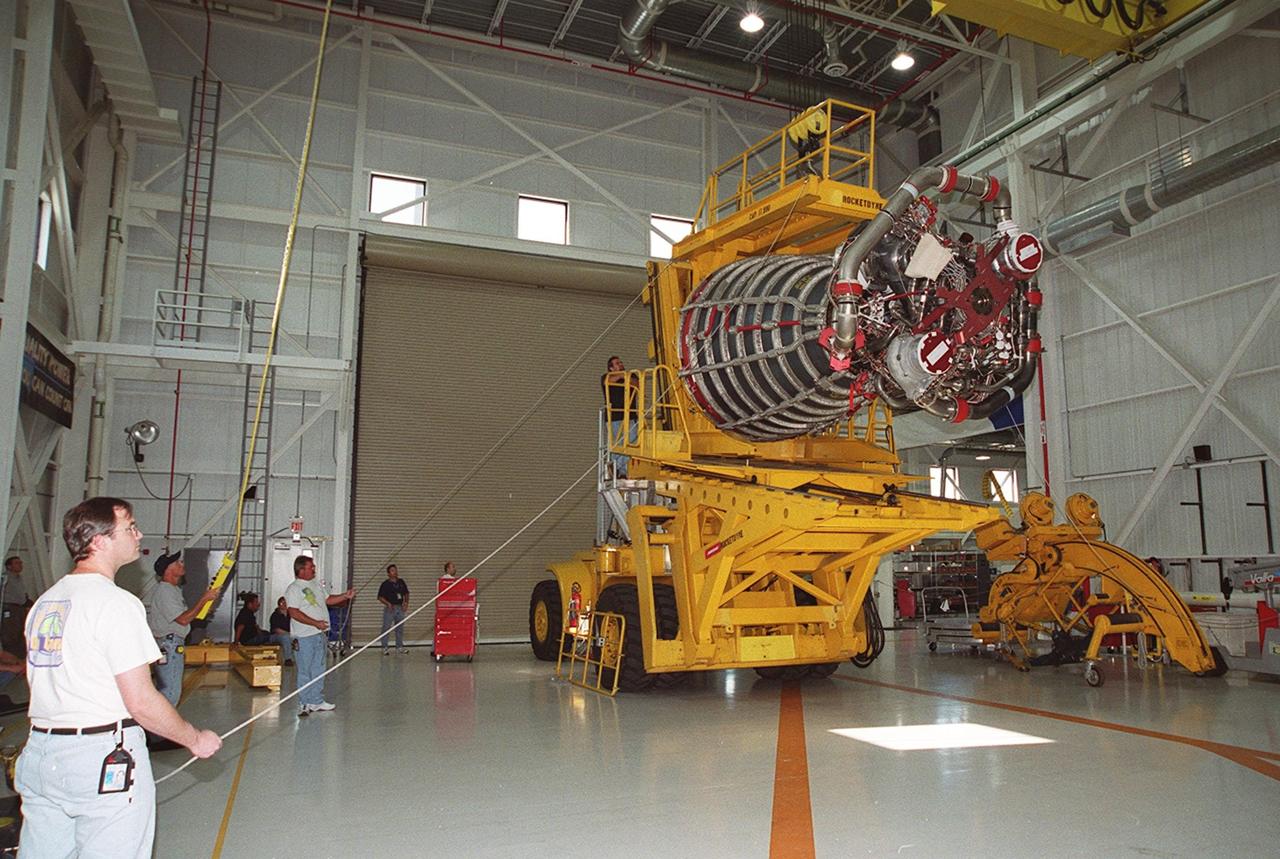
A new block 2 engine is lowered onto a transport vehicle for a move to the Orbiter Processing Facility. There it will be installed for its first flight on the orbiter Atlantis, on mission STS-104. The Block II Main Engine configuration is manufactured by Boeing Rocketdyne in Canoga Park, Calif., and includes a new Pratt & Whitney high-pressure fuel turbo pump. Engine improvements are managed by NASA’s Marshall Space Flight Center in Huntsville, Ala. Each Space Shuttle Main Engine is 14 feet (4.3 meters) long, weighs about 7,000 pounds (3,175 kilograms), and is 7.5 feet (2.3 meters) in diameter at the end of the nozzle
KSC-01pp0899
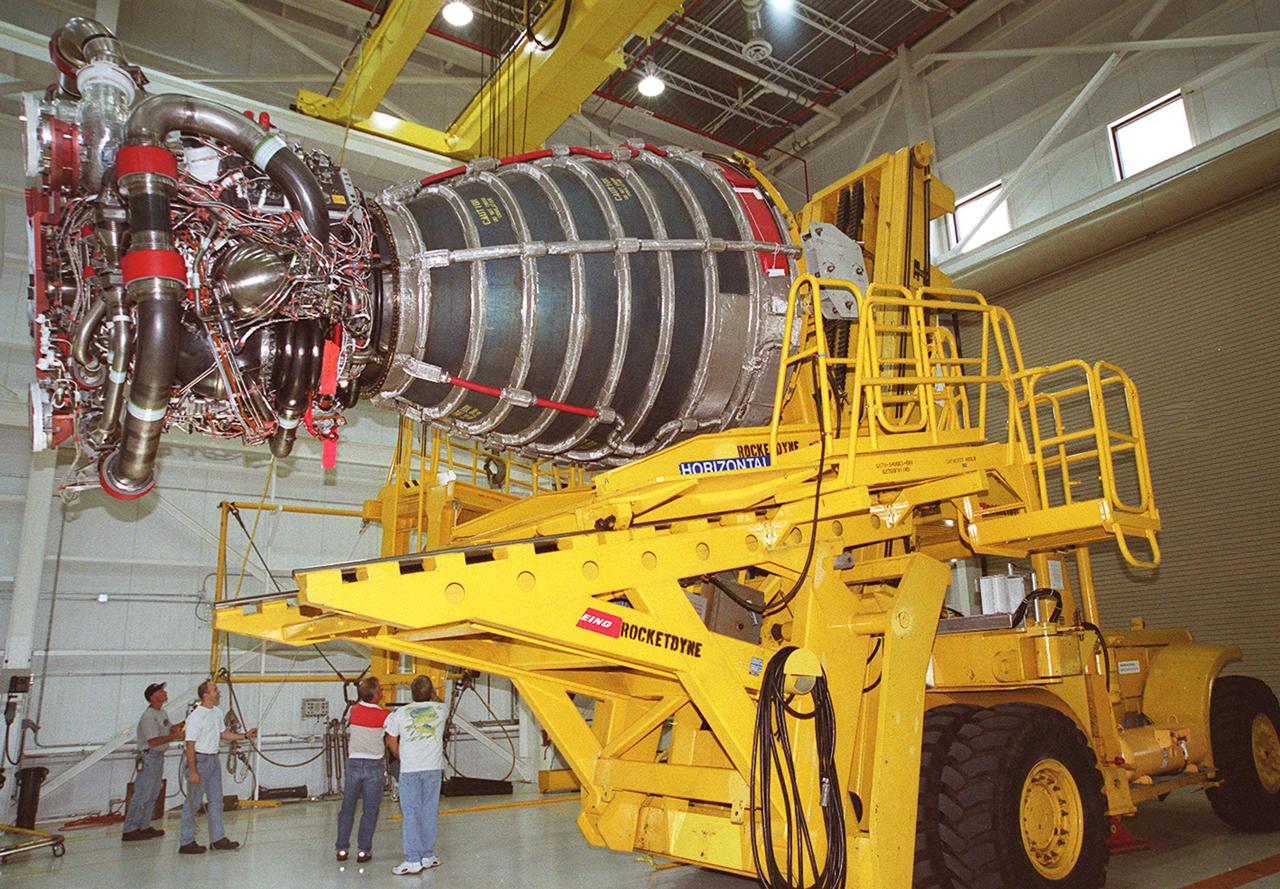
KENNEDY SPACE CENTER, FLA. -- A new block 2 engine is ready for its move to Orbiter Processing Facility bay 3. There it will be installed on the orbiter Atlantis, on mission STS-104, for its first flight. The Block II Main Engine configuration is manufactured by Boeing Rocketdyne in Canoga Park, Calif., and includes a new Pratt and Whitney high-pressure fuel turbo pump. Engine improvements are managed by NASA’s Marshall Space Flight Center in Huntsville, Ala. Each Space Shuttle Main Engine is 14 feet (4.3 meters) long, weighs about 7,000 pounds (3,175 kilograms), and is 7.5 feet (2.3 meters) in diameter at the end of the nozzle
KSC-01PP-0900
KENNEDY SPACE CENTER, FLA. -- A new block 2 engine heads toward Atlantis in Orbiter Processing Facility bay 3. There the new engine will be installed for its first flight on Atlantis, for mission STS-104. The Block II Main Engine configuration is manufactured by Boeing Rocketdyne in Canoga Park, Calif., and includes a new Pratt & Whitney high-pressure fuel turbo pump. Engine improvements are managed by NASA’s Marshall Space Flight Center in Huntsville, Ala. Each Space Shuttle Main Engine is 14 feet (4.3 meters) long, weighs about 7,000 pounds (3,175 kilograms), and is 7.5 feet (2.3 meters) in diameter at the end of the nozzle
KSC-01pp0903
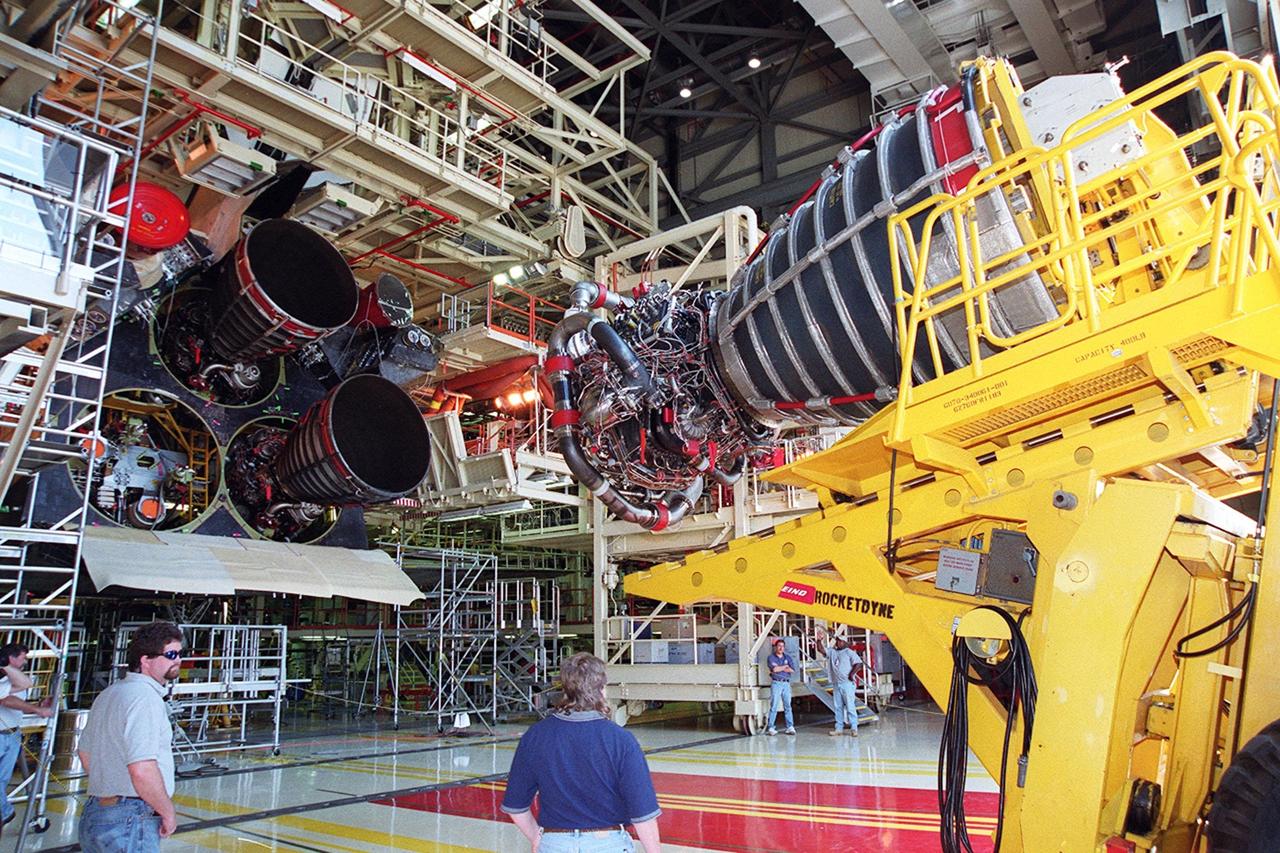
KENNEDY SPACE CENTER, FLA. -- In Orbiter Processing Facility bay 3, a new block 2 engine, at left, is moved into position for installation on Atlantis. The engine will have its first flight on mission STS-104, scheduled for launch June 14. The Block II Main Engine configuration is manufactured by Boeing Rocketdyne in Canoga Park, Calif., and includes a new Pratt and Whitney high-pressure fuel turbo pump. Engine improvements are managed by NASA’s Marshall Space Flight Center in Huntsville, Ala. Each Space Shuttle Main Engine is 14 feet (4.3 meters) long, weighs about 7,000 pounds (3,175 kilograms), and is 7.5 feet (2.3 meters) in diameter at the end of the nozzle
KSC-01PP-0904
KENNEDY SPACE CENTER, FLA. -- The transport vehicle carrying a new block 2 engine arrives at Orbiter Processing Facility bay 3. There the new engine will be installed on the orbiter Atlantis, on mission STS-104, for its first flight. The Block II Main Engine configuration is manufactured by Boeing Rocketdyne in Canoga Park, Calif., and includes a new Pratt & Whitney high-pressure fuel turbo pump. Engine improvements are managed by NASA’s Marshall Space Flight Center in Huntsville, Ala. Each Space Shuttle Main Engine is 14 feet (4.3 meters) long, weighs about 7,000 pounds (3,175 kilograms), and is 7.5 feet (2.3 meters) in diameter at the end of the nozzle
KSC-01pp0902
A new block 2 engine is lowered onto a transport vehicle for a move to the Orbiter Processing Facility. There it will be installed for its first flight on the orbiter Atlantis, on mission STS-104. The Block II Main Engine configuration is manufactured by Boeing Rocketdyne in Canoga Park, Calif., and includes a new Pratt & Whitney high-pressure fuel turbo pump. Engine improvements are managed by NASA’s Marshall Space Flight Center in Huntsville, Ala. Each Space Shuttle Main Engine is 14 feet (4.3 meters) long, weighs about 7,000 pounds (3,175 kilograms), and is 7.5 feet (2.3 meters) in diameter at the end of the nozzle
KSC-01pp0898
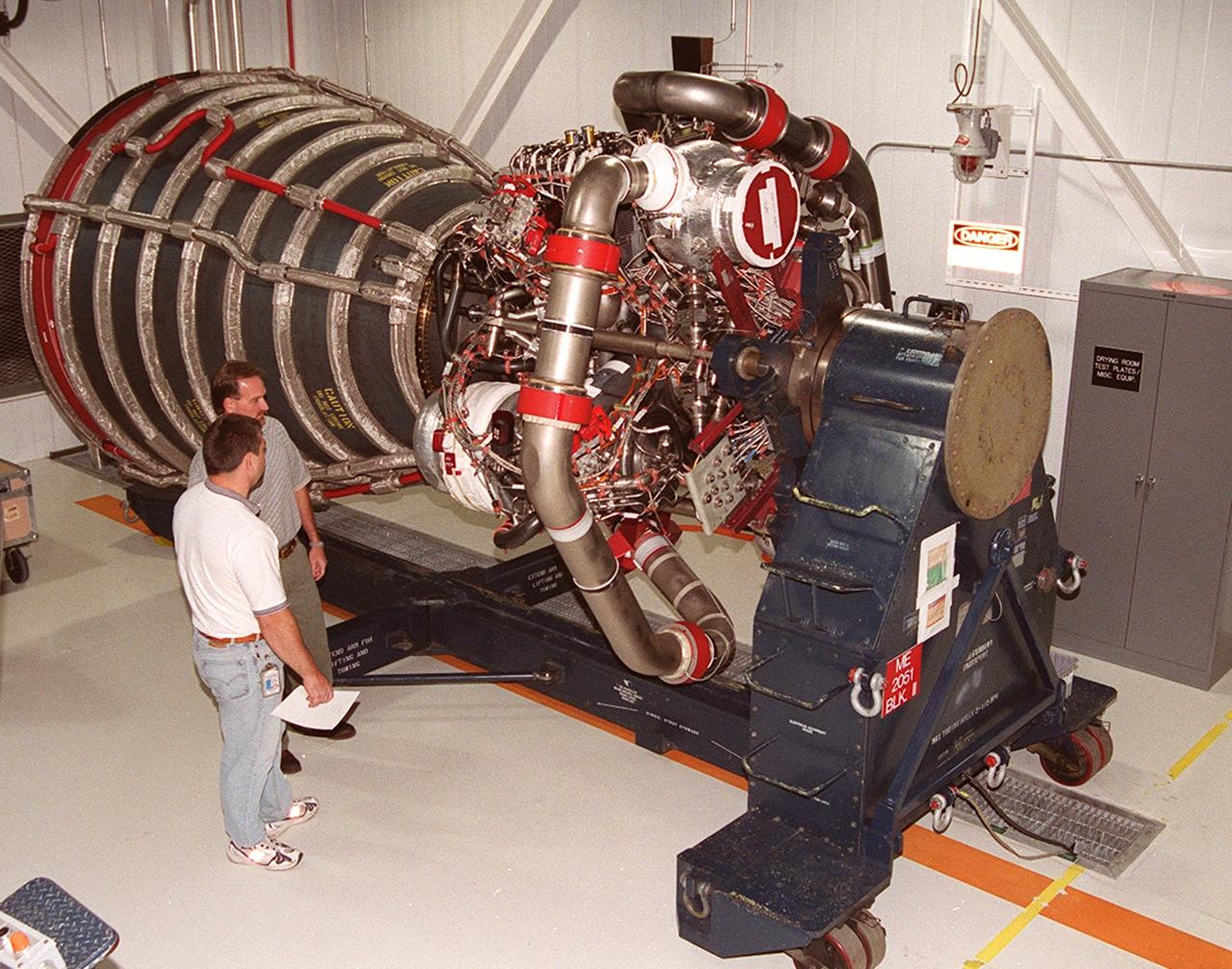
KENNEDY SPACE CENTER, FLA. -- An upgraded Space Shuttle main engine (block 2 engine) sits in the Space Shuttle Main Engine Processing Facility. The new engine will be installed for its first flight on the orbiter Atlantis, on mission STS-104. The Block II Main Engine configuration is manufactured by Boeing Rocketdyne in Canoga Park, Calif., and includes a new Pratt & Whitney high-pressure fuel turbo pump. Engine improvements are managed by NASA’s Marshall Space Flight Center in Huntsville, Ala. Each Space Shuttle Main Engine is 14 feet (4.3 meters) long, weighs about 7,000 pounds (3,175 kilograms), and is 7.5 feet (2.3 meters) in diameter at the end of the nozzle
KSC-01pp0890
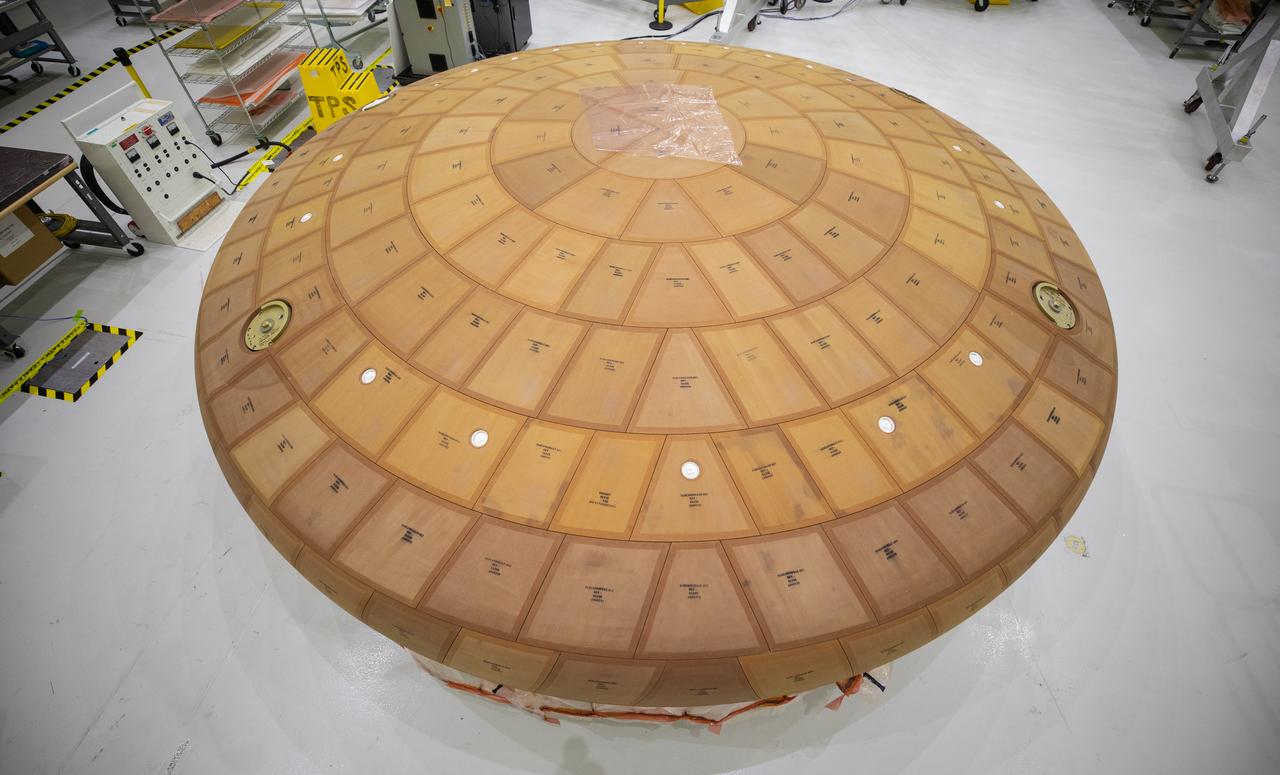
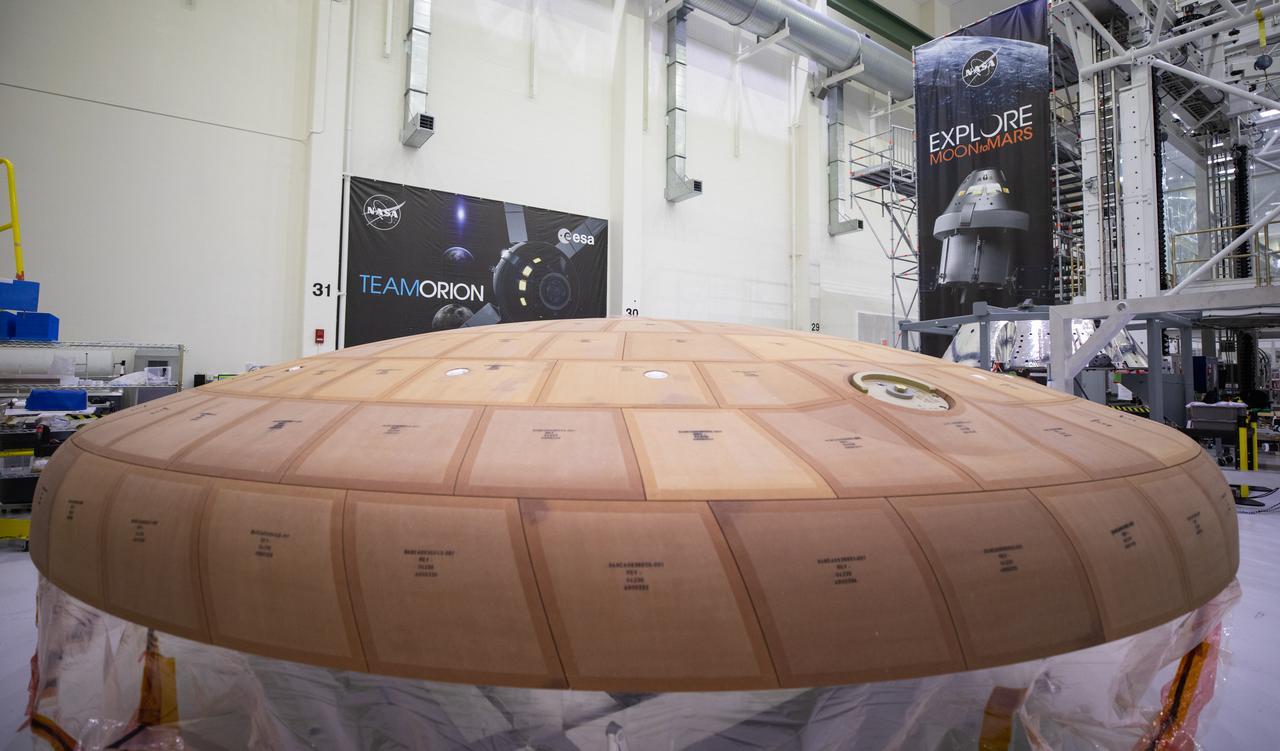
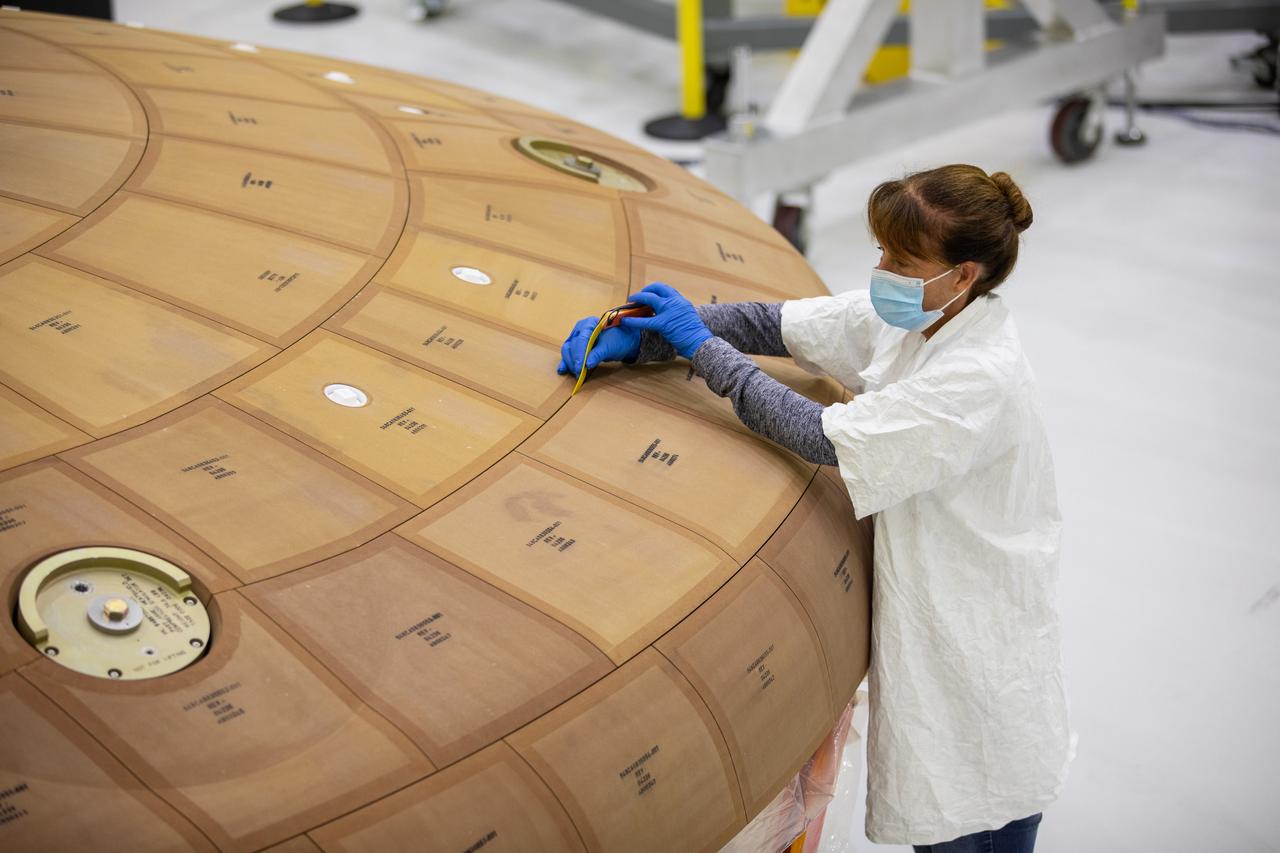
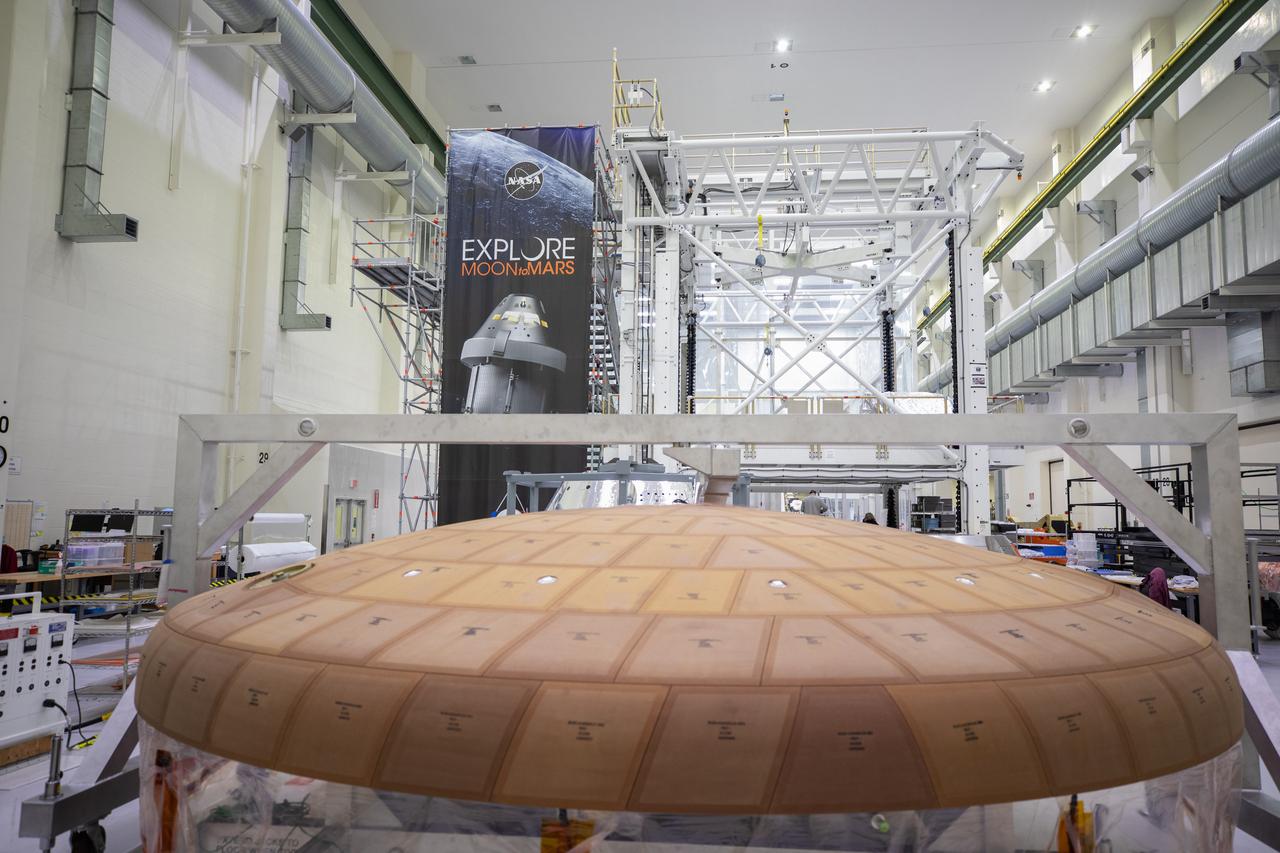
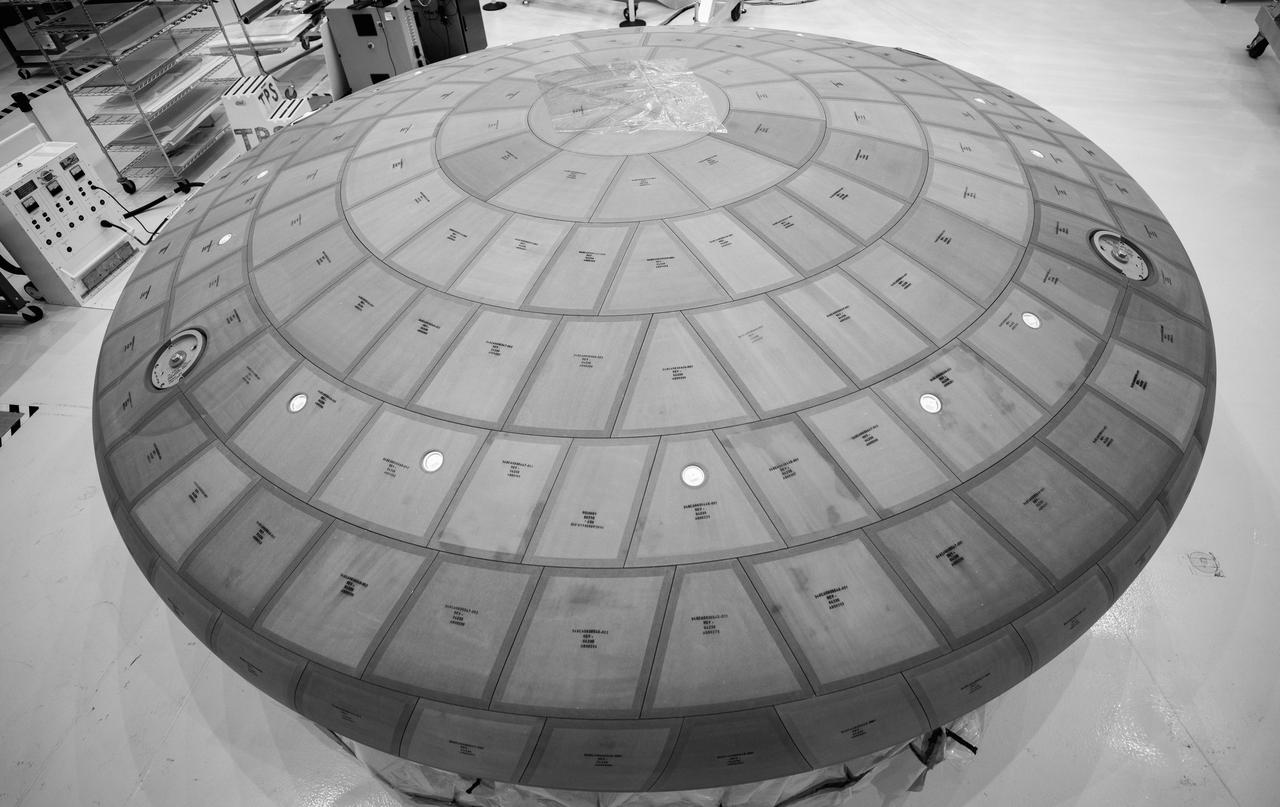
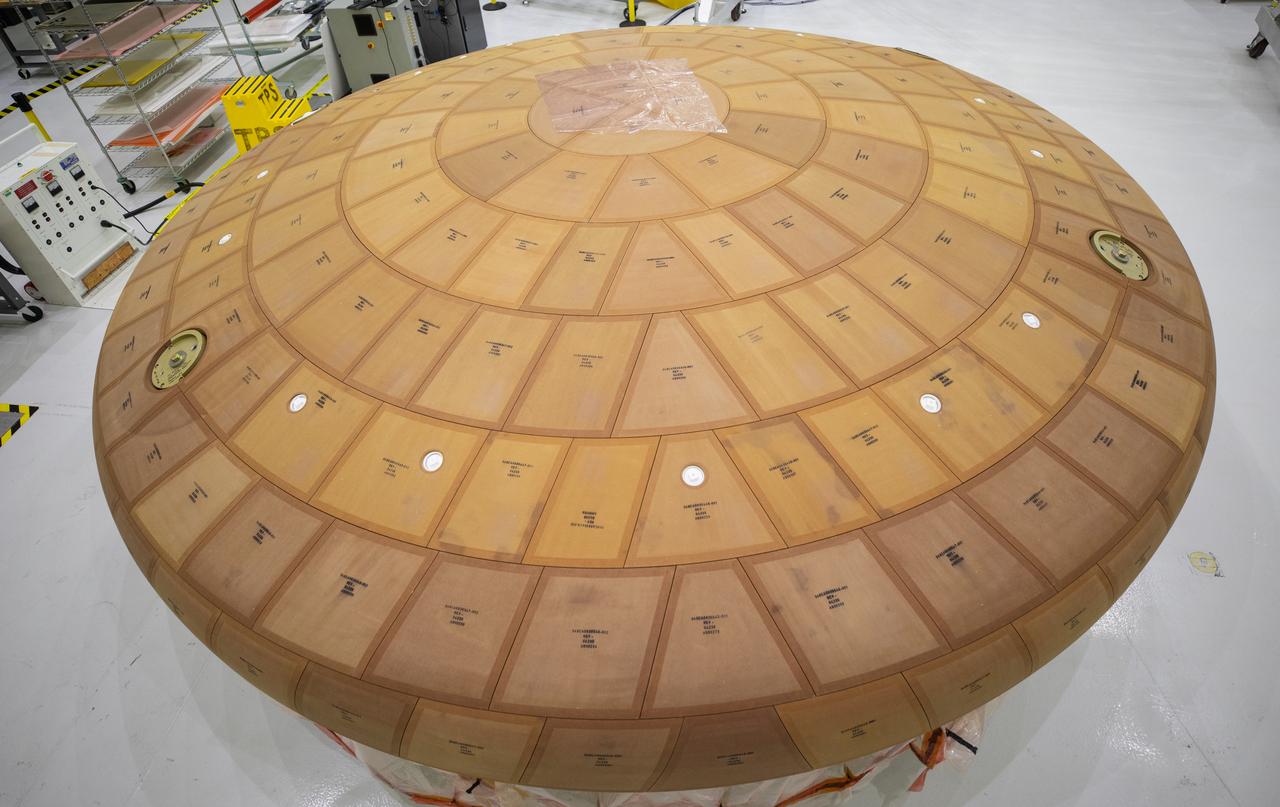
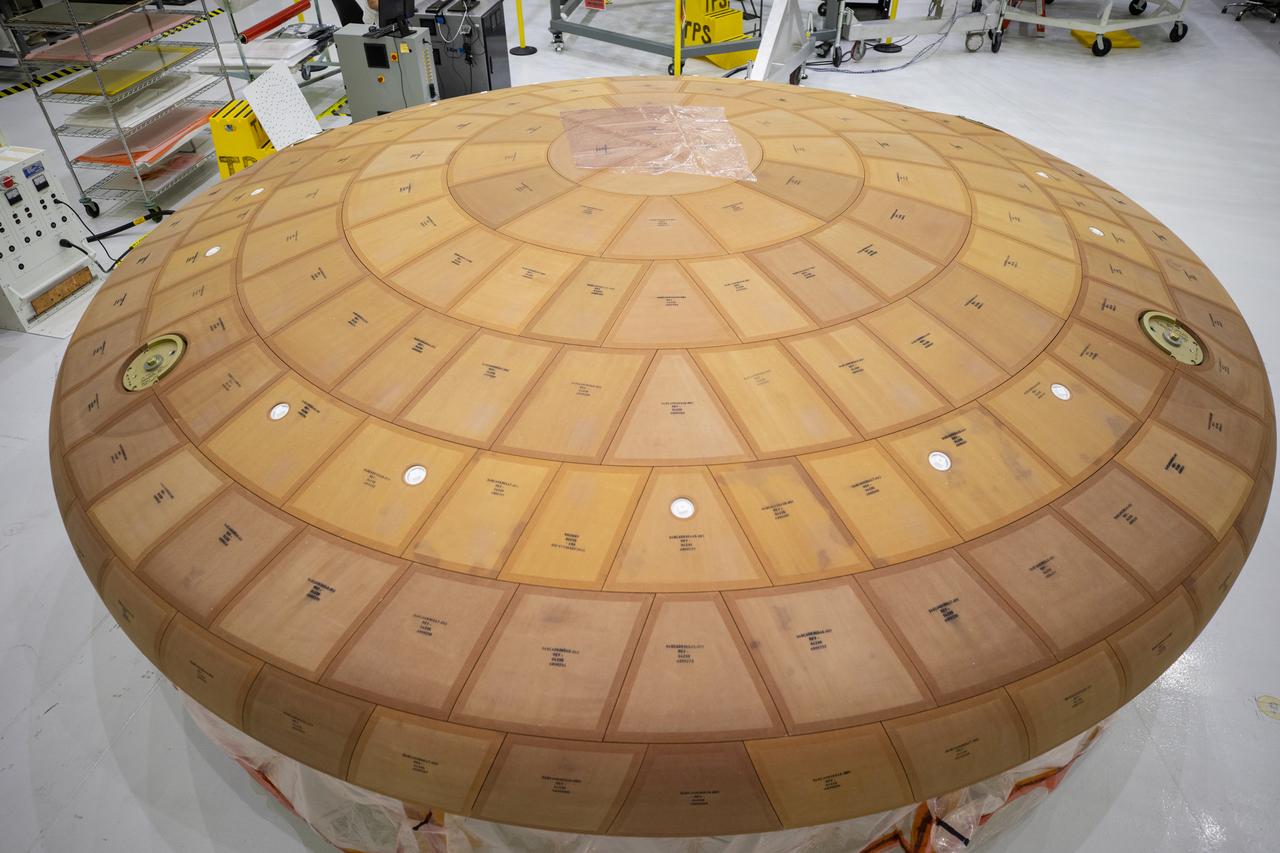
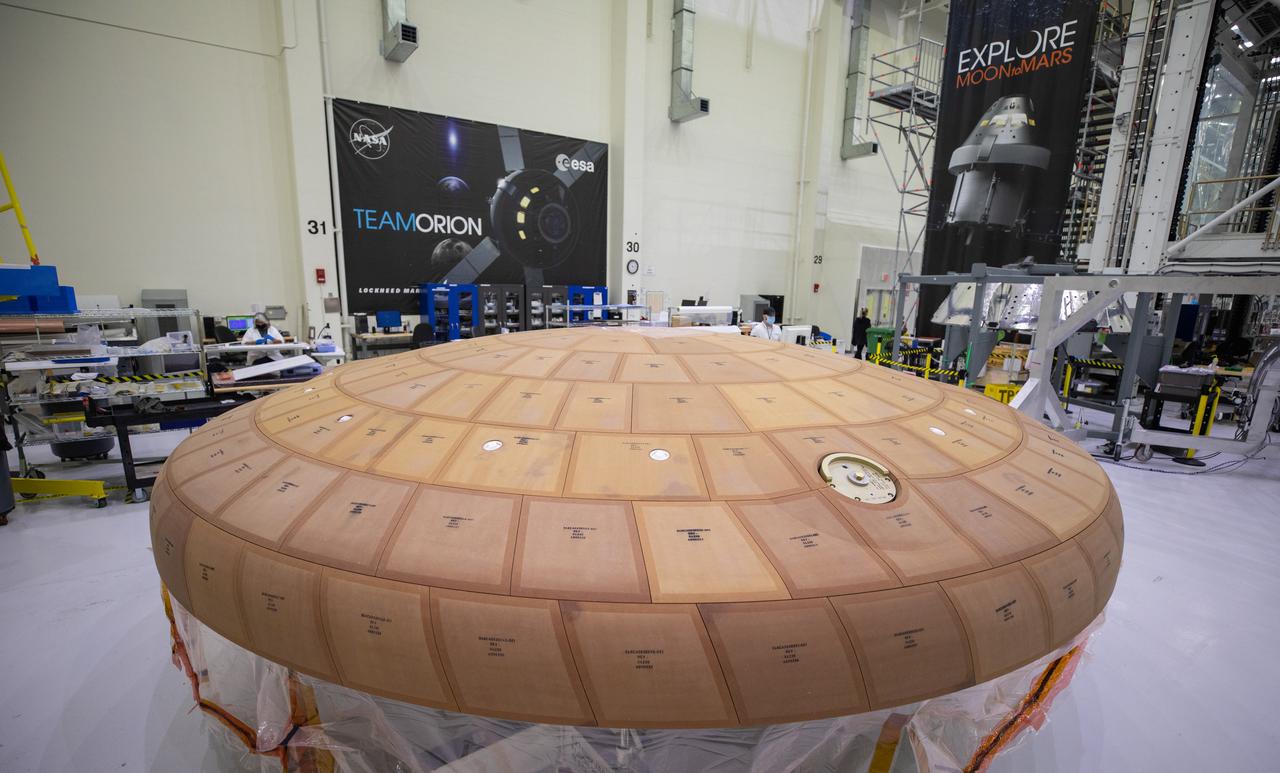
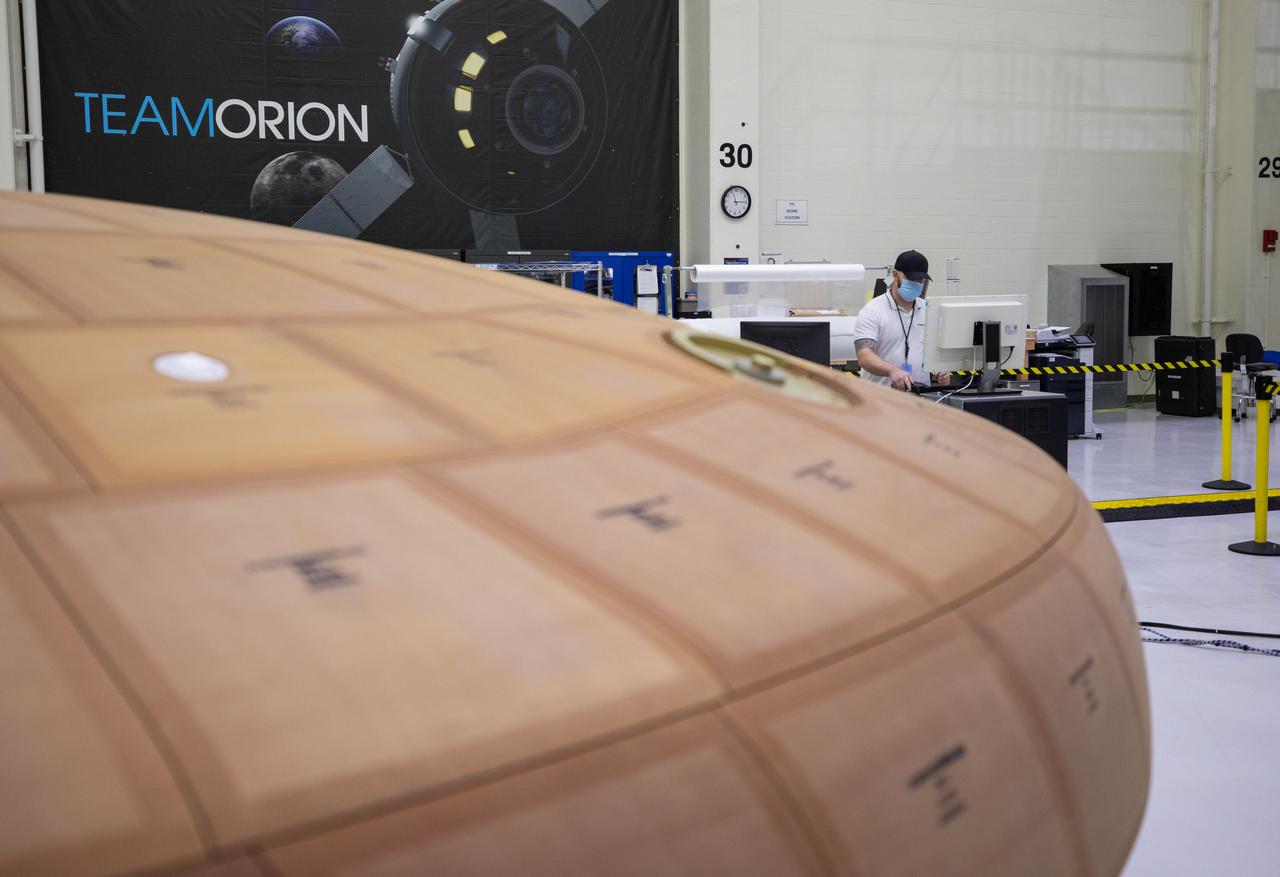
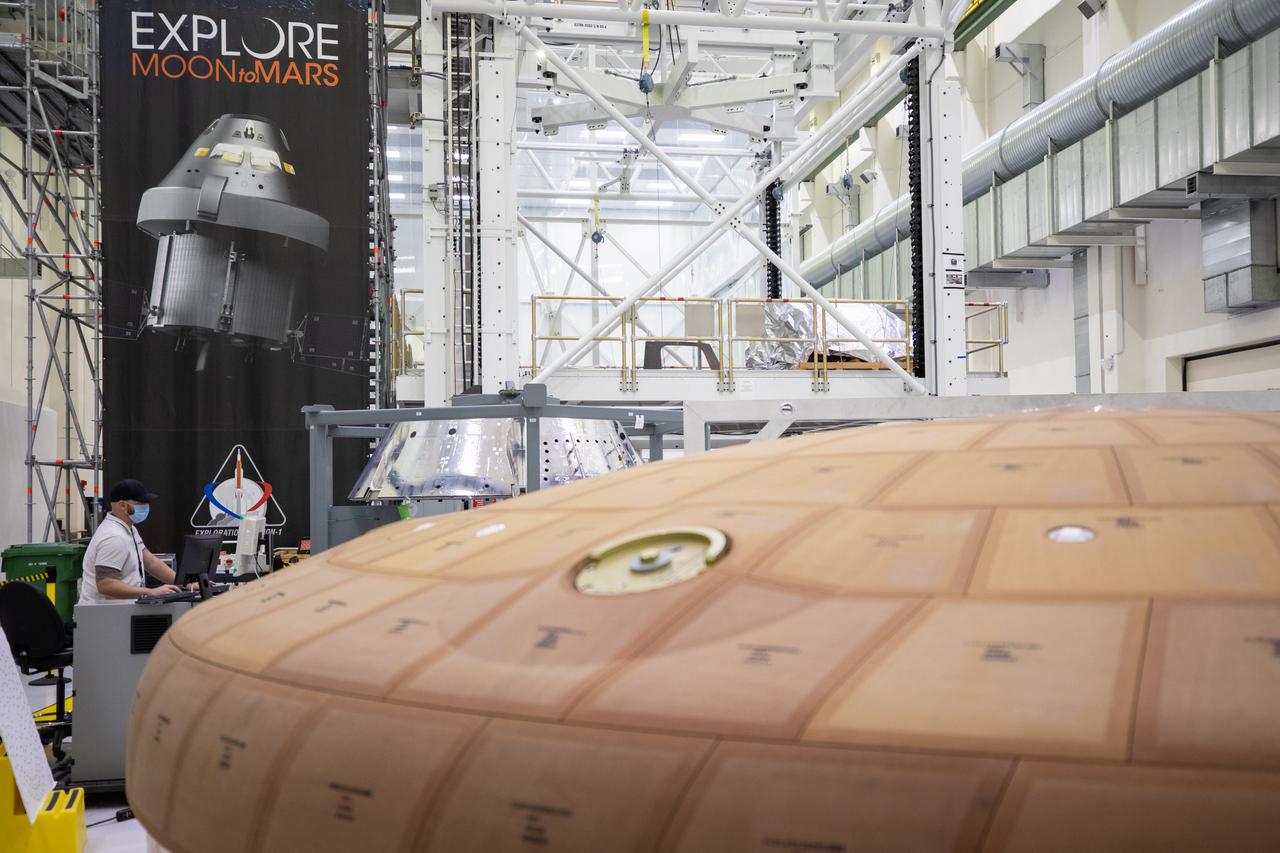
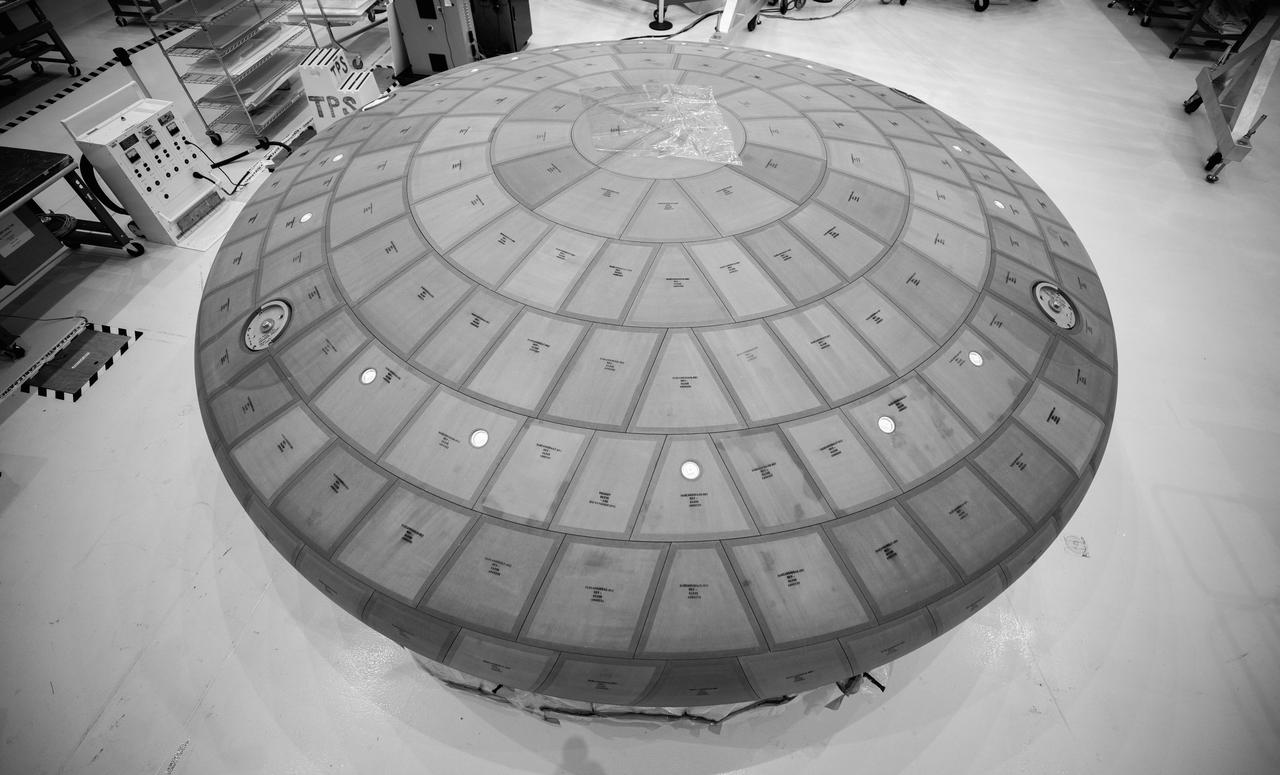
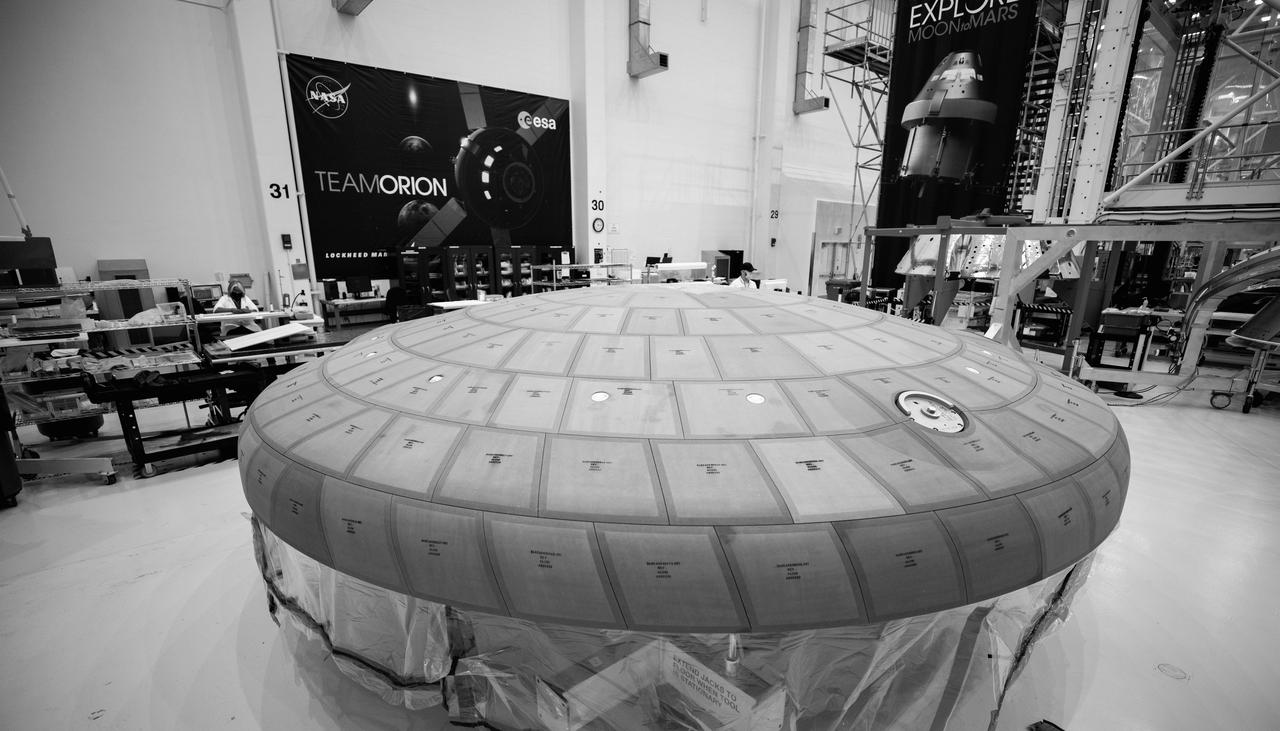
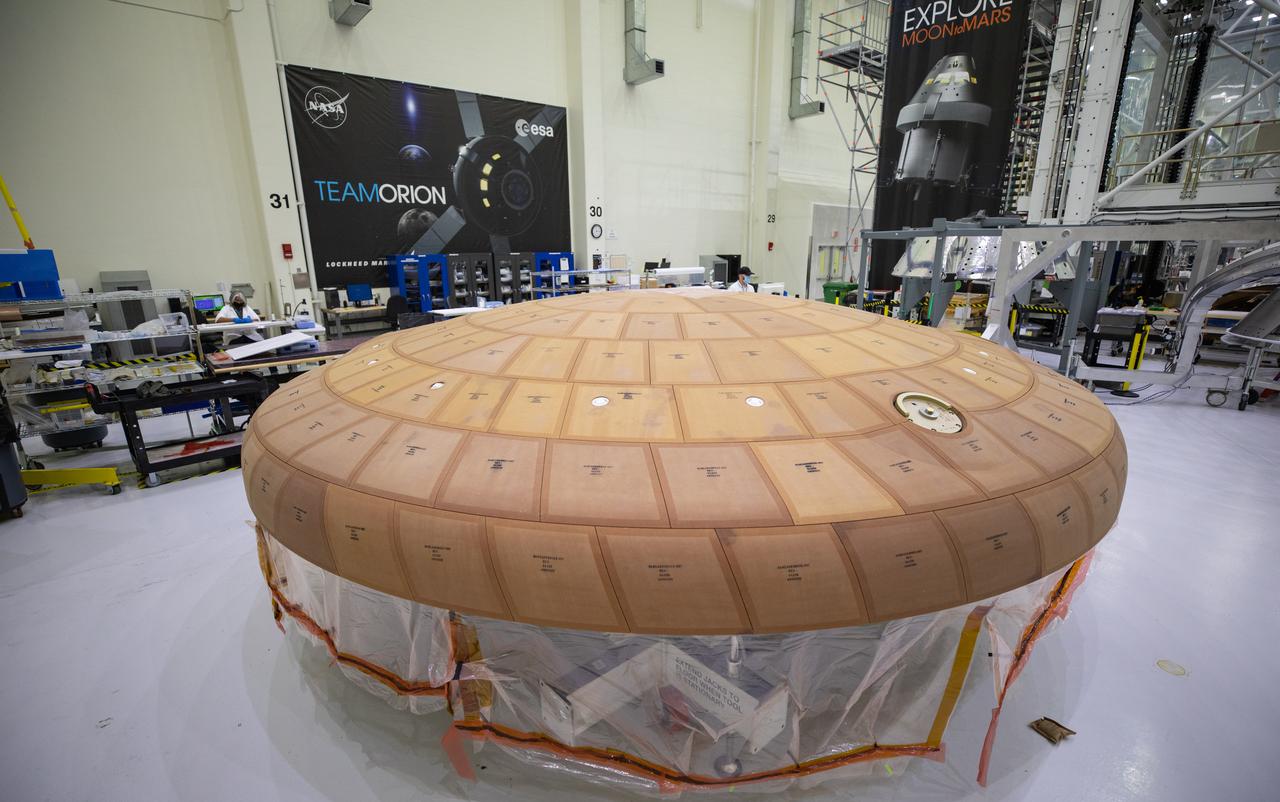
Inside the Neil Armstrong Operations and Checkout Building high bay at NASA's Kennedy Space Center in Florida, the AVOCAT block bonding is complete on the Artemis II heat shield on July 2, 2020. The heat shield is one of the most critical elements of Orion and will protect the capsule and astronauts during reentry through Earth’s atmosphere. Artemis II is the first crewed mission in a series of missions to the Moon and on to Mars. Artemis II will confirm all of the Orion spacecraft’s systems operate as designed in the actual environment of deep space with astronauts aboard. As part of the Artemis Program, NASA will send the first woman and next man to the Moon by 2024.
Artemis II Heat Shield
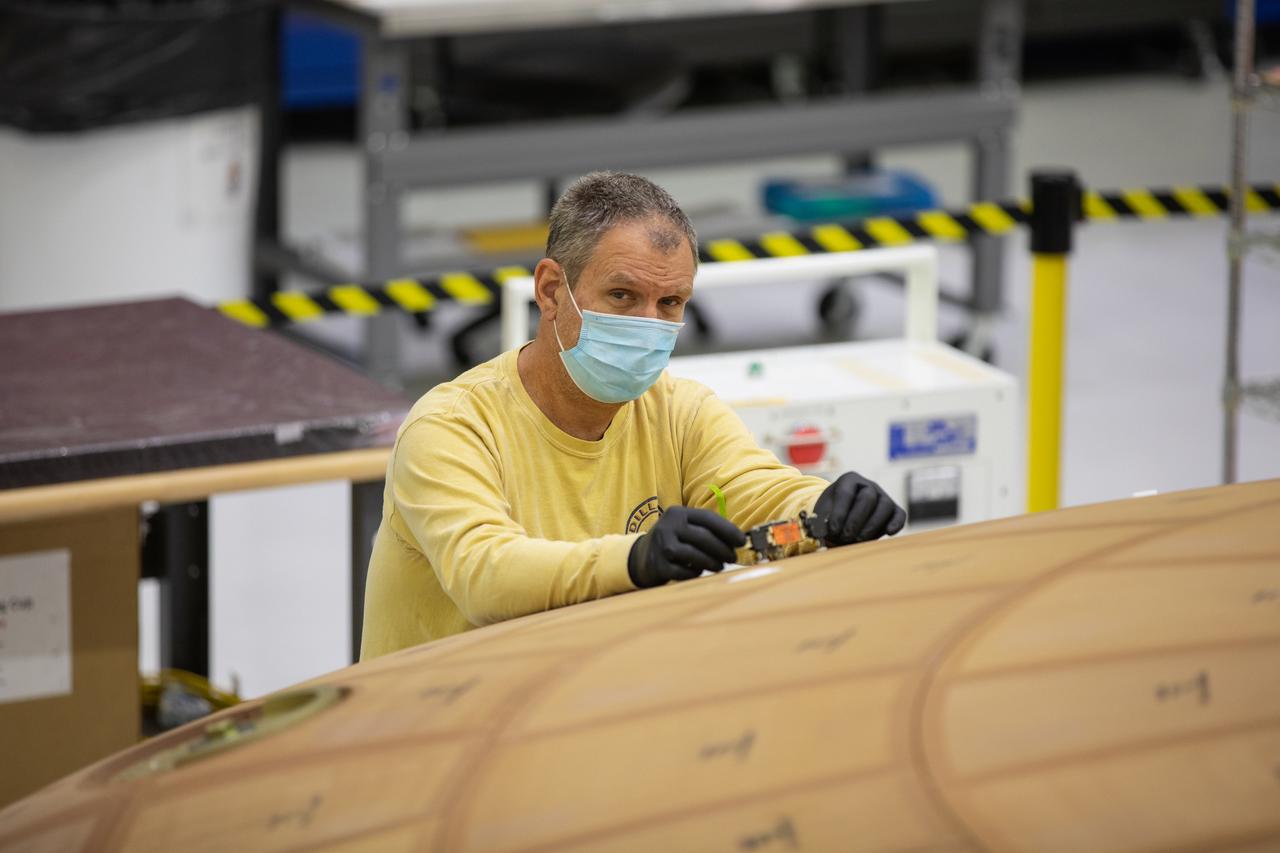
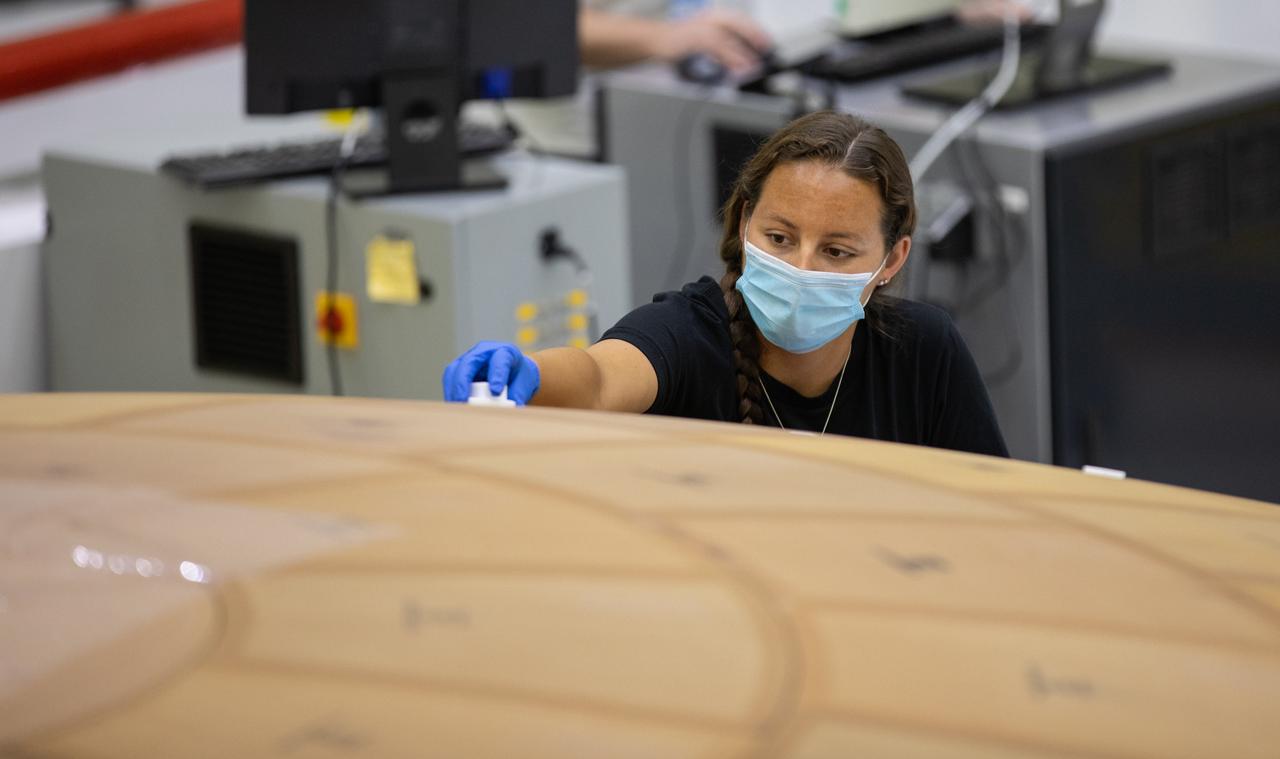
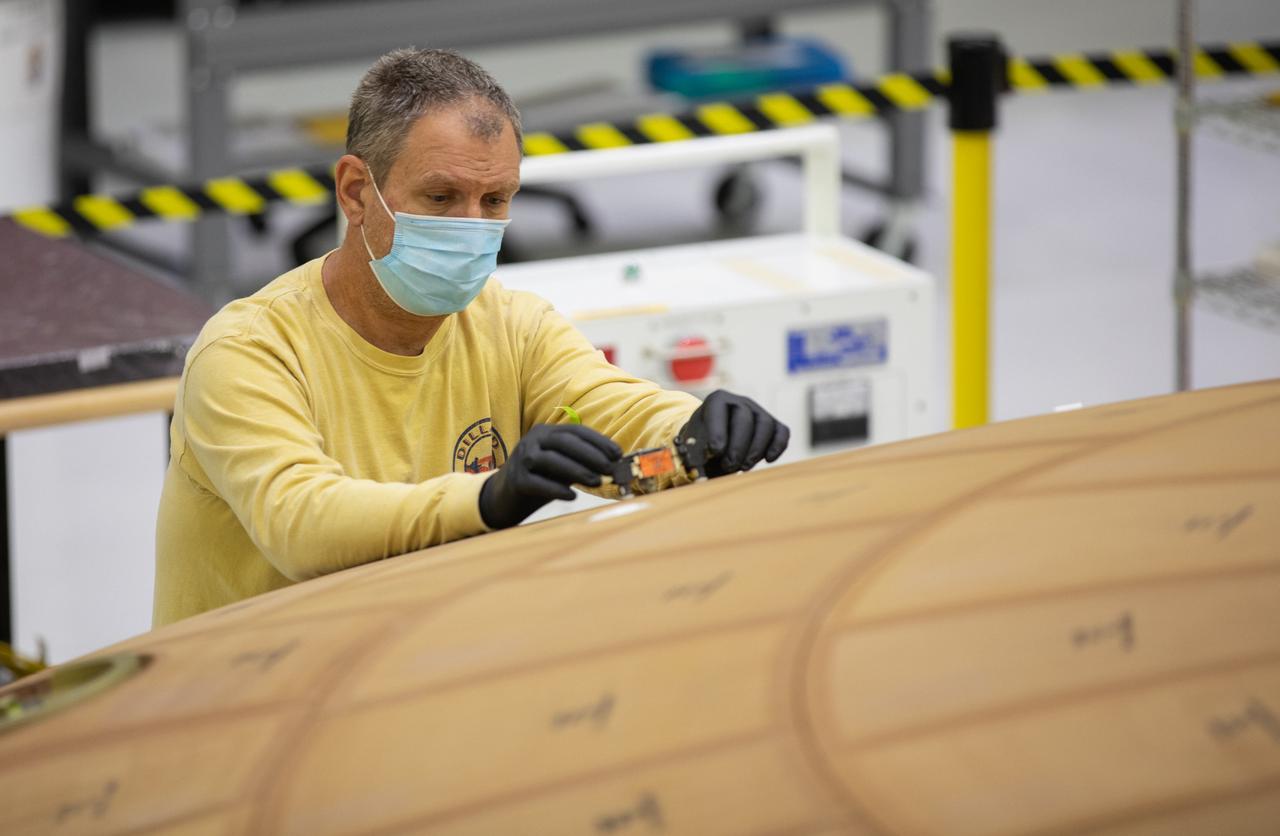
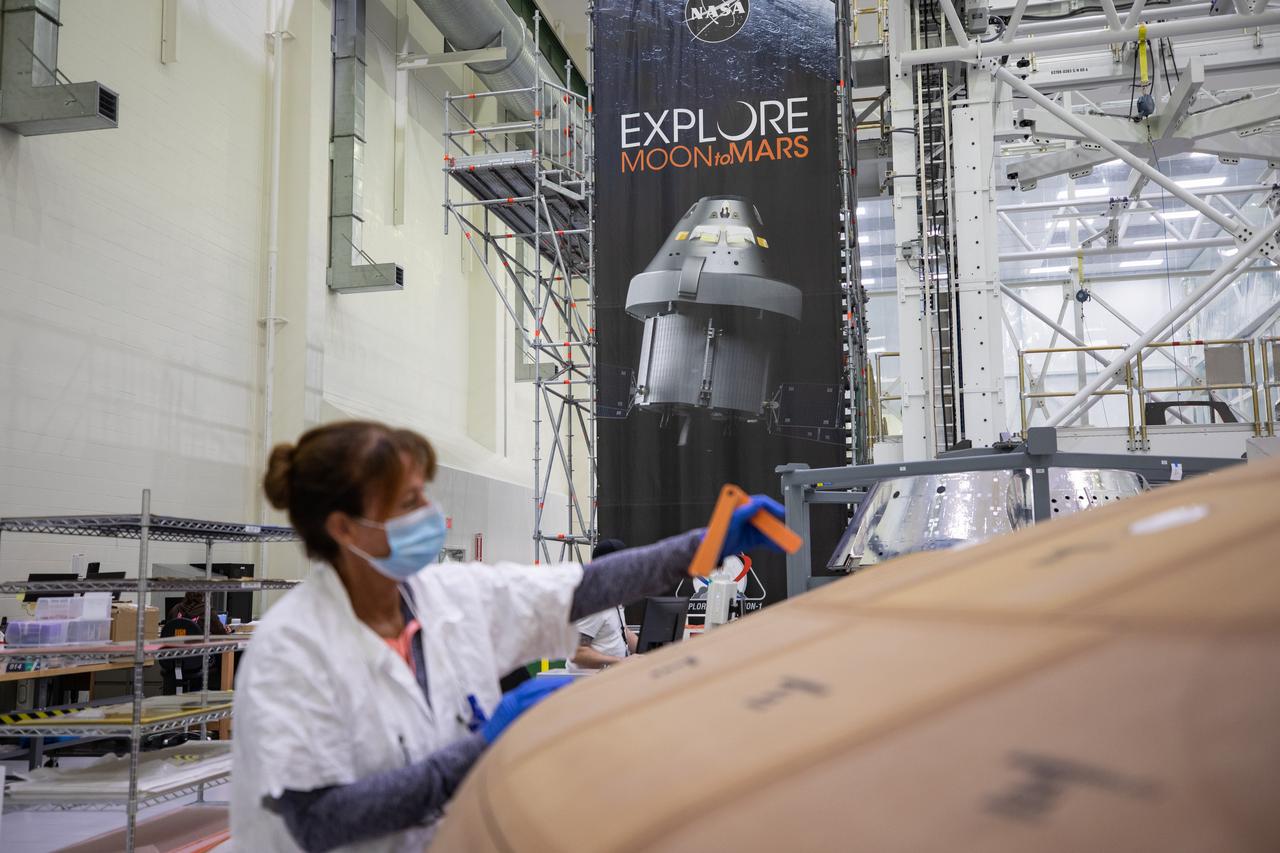
Inside the Neil Armstrong Operations and Checkout Building high bay at NASA's Kennedy Space Center in Florida, technician Darlene Beville with ASRC Federal, inspects AVCOAT block bonding on the Artemis II heat shield on July 2, 2020. The heat shield is one of the most critical elements of Orion and will protect the capsule and astronauts during reentry through Earth’s atmosphere. Artemis II is the first crewed mission in a series of missions to the Moon and on to Mars. Artemis II will confirm all of the Orion spacecraft’s systems operate as designed in the actual environment of deep space with astronauts aboard. As part of the Artemis Program, NASA will send the first woman and next man to the Moon by 2024.
Artemis II Heat Shield
Inside the Neil Armstrong Operations and Checkout Building high bay at NASA's Kennedy Space Center in Florida, technician Kenny Leidner with ASRC Federal, inspects AVCOAT block bonding on the Artemis II heat shield on July 2, 2020. The heat shield is one of the most critical elements of Orion and will protect the capsule and astronauts during reentry through Earth’s atmosphere. Artemis II is the first crewed mission in a series of missions to the Moon and on to Mars. Artemis II will confirm all of the Orion spacecraft’s systems operate as designed in the actual environment of deep space with astronauts aboard. As part of the Artemis Program, NASA will send the first woman and next man to the Moon by 2024.
Artemis II Heat Shield
Inside the Neil Armstrong Operations and Checkout Building high bay at NASA's Kennedy Space Center in Florida, technician Diamond ScharSenstine with ASRC Federal, inspects AVCOAT block bonding on the Artemis II heat shield on July 2, 2020. The heat shield is one of the most critical elements of Orion and will protect the capsule and astronauts during reentry through Earth’s atmosphere. Artemis II is the first crewed mission in a series of missions to the Moon and on to Mars. Artemis II will confirm all of the Orion spacecraft’s systems operate as designed in the actual environment of deep space with astronauts aboard. As part of the Artemis Program, NASA will send the first woman and next man to the Moon by 2024.
Artemis II Heat Shield
Inside the Neil Armstrong Operations and Checkout Building high bay at NASA's Kennedy Space Center in Florida, the AVOCAT block bonding is complete on the Artemis II heat shield on July 2, 2020. The heat shield is one of the most critical elements of Orion and will protect the capsule and astronauts during reentry through Earth’s atmosphere. Artemis II is the first crewed mission in a series of missions to the Moon and on to Mars. Artemis II will confirm all of the Orion spacecraft’s systems operate as designed in the actual environment of deep space with astronauts aboard. As part of the Artemis Program, NASA will send the first woman and next man to the Moon by 2024.
Artemis II Heat Shield
Inside the Neil Armstrong Operations and Checkout Building high bay at NASA's Kennedy Space Center in Florida, the AVCOAT block bonding is complete on the Artemis II heat shield on July 2, 2020. The heat shield is one of the most critical elements of Orion and will protect the capsule and astronauts during reentry through Earth’s atmosphere. Artemis II is the first crewed mission in a series of missions to the Moon and on to Mars. Artemis II will confirm all of the Orion spacecraft’s systems operate as designed in the actual environment of deep space with astronauts aboard. As part of the Artemis Program, NASA will send the first woman and next man to the Moon by 2024.
Artemis II Heat Shield
Inside the Neil Armstrong Operations and Checkout Building high bay at NASA's Kennedy Space Center in Florida, the AVOCAT block bonding is complete on the Artemis II heat shield on July 2, 2020. The heat shield is one of the most critical elements of Orion and will protect the capsule and astronauts during reentry through Earth’s atmosphere. Artemis II is the first crewed mission in a series of missions to the Moon and on to Mars. Artemis II will confirm all of the Orion spacecraft’s systems operate as designed in the actual environment of deep space with astronauts aboard. As part of the Artemis Program, NASA will send the first woman and next man to the Moon by 2024.
Artemis II Heat Shield
Inside the Neil Armstrong Operations and Checkout Building high bay at NASA's Kennedy Space Center in Florida, technician Russ Novak with ASRC Federal, inspects AVCOAT block bonding on the Artemis II heat shield on July 2, 2020. The heat shield is one of the most critical elements of Orion and will protect the capsule and astronauts during reentry through Earth’s atmosphere. Artemis II is the first crewed mission in a series of missions to the Moon and on to Mars. Artemis II will confirm all of the Orion spacecraft’s systems operate as designed in the actual environment of deep space with astronauts aboard. As part of the Artemis Program, NASA will send the first woman and next man to the Moon by 2024.
Artemis II Heat Shield
Inside the Neil Armstrong Operations and Checkout Building high bay at NASA's Kennedy Space Center in Florida, the AVOCAT block bonding is complete on the Artemis II heat shield on July 2, 2020. The heat shield is one of the most critical elements of Orion and will protect the capsule and astronauts during reentry through Earth’s atmosphere. Artemis II is the first crewed mission in a series of missions to the Moon and on to Mars. Artemis II will confirm all of the Orion spacecraft’s systems operate as designed in the actual environment of deep space with astronauts aboard. As part of the Artemis Program, NASA will send the first woman and next man to the Moon by 2024.
Artemis II Heat Shield
Inside the Neil Armstrong Operations and Checkout Building high bay at NASA's Kennedy Space Center in Florida, Darlene Beville with ASRC Federal, inspects AVOCAT block bonding on the Artemis II heat shield on July 2, 2020. The heat shield is one of the most critical elements of Orion and will protect the capsule and astronauts during reentry through Earth’s atmosphere. Artemis II is the first crewed mission in a series of missions to the Moon and on to Mars. Artemis II will confirm all of the Orion spacecraft’s systems operate as designed in the actual environment of deep space with astronauts aboard. As part of the Artemis Program, NASA will send the first woman and next man to the Moon by 2024.
Artemis II Heat Shield
Inside the Neil Armstrong Operations and Checkout Building high bay at NASA's Kennedy Space Center in Florida, the AVCOAT block bonding is complete on the Artemis II heat shield on July 2, 2020. The heat shield is one of the most critical elements of Orion and will protect the capsule and astronauts during reentry through Earth’s atmosphere. Artemis II is the first crewed mission in a series of missions to the Moon and on to Mars. Artemis II will confirm all of the Orion spacecraft’s systems operate as designed in the actual environment of deep space with astronauts aboard. As part of the Artemis Program, NASA will send the first woman and next man to the Moon by 2024.
Artemis II Heat Shield
Inside the Neil Armstrong Operations and Checkout Building high bay at NASA's Kennedy Space Center in Florida, the AVOCAT block bonding is complete on the Artemis II heat shield on July 2, 2020. The heat shield is one of the most critical elements of Orion and will protect the capsule and astronauts during reentry through Earth’s atmosphere. Artemis II is the first crewed mission in a series of missions to the Moon and on to Mars. Artemis II will confirm all of the Orion spacecraft’s systems operate as designed in the actual environment of deep space with astronauts aboard. As part of the Artemis Program, NASA will send the first woman and next man to the Moon by 2024.
Artemis II Heat Shield
Inside the Neil Armstrong Operations and Checkout Building high bay at NASA's Kennedy Space Center in Florida, the AVOCAT block bonding is complete on the Artemis II heat shield on July 2, 2020. The heat shield is one of the most critical elements of Orion and will protect the capsule and astronauts during reentry through Earth’s atmosphere. Artemis II is the first crewed mission in a series of missions to the Moon and on to Mars. Artemis II will confirm all of the Orion spacecraft’s systems operate as designed in the actual environment of deep space with astronauts aboard. As part of the Artemis Program, NASA will send the first woman and next man to the Moon by 2024.
Artemis II Heat Shield
Inside the Neil Armstrong Operations and Checkout Building high bay at NASA's Kennedy Space Center in Florida, technician Kenny Leidner with ASRC Federal, inspects AVCOAT block bonding on the Artemis II heat shield on July 2, 2020. The heat shield is one of the most critical elements of Orion and will protect the capsule and astronauts during reentry through Earth’s atmosphere. Artemis II is the first crewed mission in a series of missions to the Moon and on to Mars. Artemis II will confirm all of the Orion spacecraft’s systems operate as designed in the actual environment of deep space with astronauts aboard. As part of the Artemis Program, NASA will send the first woman and next man to the Moon by 2024.
Artemis II Heat Shield
Inside the Neil Armstrong Operations and Checkout Building high bay at NASA's Kennedy Space Center in Florida, technician Russ Novak with ASRC Federal, inspects AVCOAT block bonding on the Artemis II heat shield on July 2, 2020. The heat shield is one of the most critical elements of Orion and will protect the capsule and astronauts during reentry through Earth’s atmosphere. Artemis II is the first crewed mission in a series of missions to the Moon and on to Mars. Artemis II will confirm all of the Orion spacecraft’s systems operate as designed in the actual environment of deep space with astronauts aboard. As part of the Artemis Program, NASA will send the first woman and next man to the Moon by 2024.
Artemis II Heat Shield
Inside the Neil Armstrong Operations and Checkout Building high bay at NASA's Kennedy Space Center in Florida, the AVCOAT block bonding is complete on the Artemis II heat shield on July 2, 2020. The heat shield is one of the most critical elements of Orion and will protect the capsule and astronauts during reentry through Earth’s atmosphere. Artemis II is the first crewed mission in a series of missions to the Moon and on to Mars. Artemis II will confirm all of the Orion spacecraft’s systems operate as designed in the actual environment of deep space with astronauts aboard. As part of the Artemis Program, NASA will send the first woman and next man to the Moon by 2024.
Artemis II Heat Shield
Inside the Neil Armstrong Operations and Checkout Building high bay at NASA's Kennedy Space Center in Florida, the AVCOAT block bonding is complete on the Artemis II heat shield on July 2, 2020. The heat shield is one of the most critical elements of Orion and will protect the capsule and astronauts during reentry through Earth’s atmosphere. Artemis II is the first crewed mission in a series of missions to the Moon and on to Mars. Artemis II will confirm all of the Orion spacecraft’s systems operate as designed in the actual environment of deep space with astronauts aboard. As part of the Artemis Program, NASA will send the first woman and next man to the Moon by 2024.
Artemis II Heat Shield
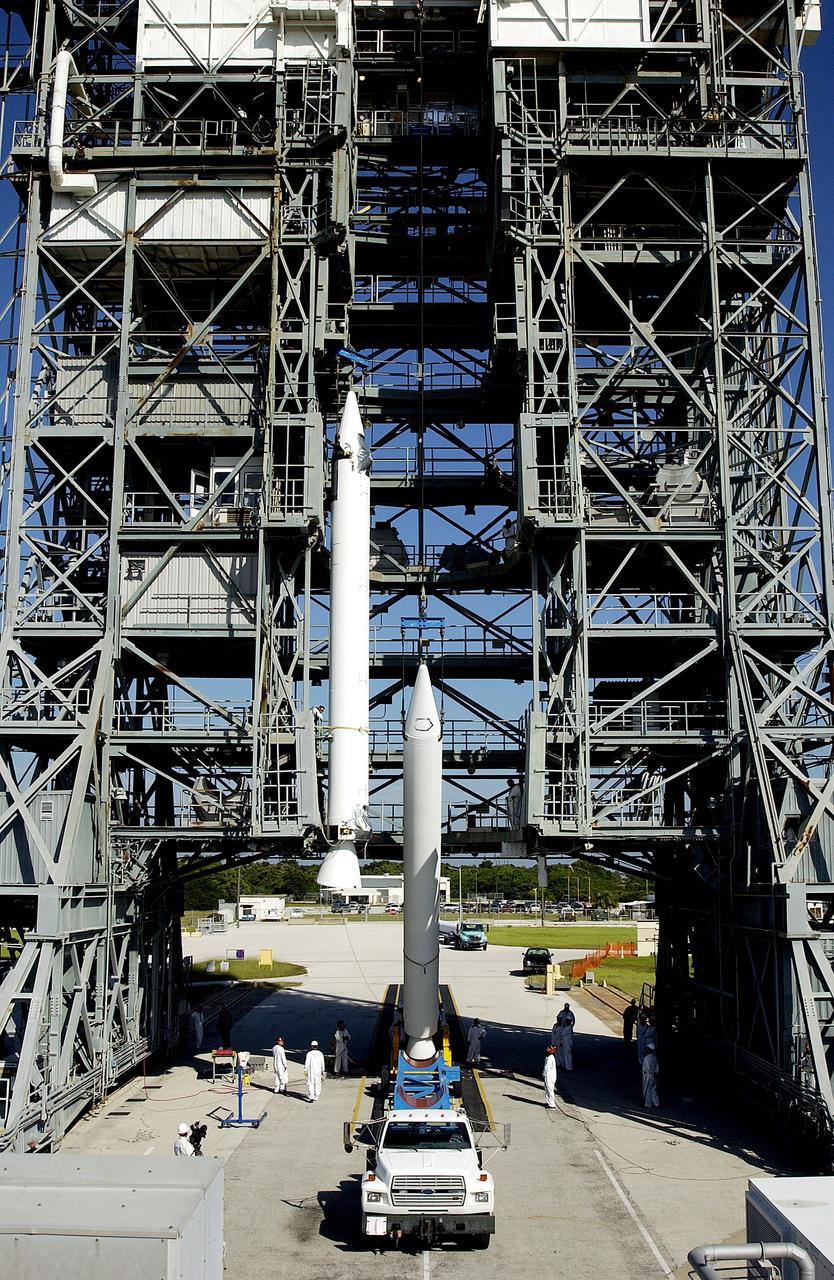
KENNEDY SPACE CENTER, FLA. -   Another solid rocket booster (SRB) is lifted to vertical on Launch Complex 17-B, Cape Canaveral Air Force Station, to join the one already in place in the mobile service tower.  The SRBs will be attached to the Delta II Heavy rocket in the background that will launch the Space Infrared Telescope Facility (SIRTF). The Delta II Heavy features nine 46-inch-diameter, stretched SRBs.  SIRTF, consisting of three cryogenically cooled science instruments and an 0.85-meter telescope, is one of NASA's largest infrared telescopes to be launched.  SIRTF will obtain images and spectra by detecting the infrared energy, or heat, radiated by objects in space. Most of this infrared radiation is blocked by the Earth's atmosphere and cannot be observed from the ground.
KENNEDY SPACE CENTER, FLA. - Another solid rocket booster (SRB) is lifted to vertical on Launch Complex 17-B, Cape Canaveral Air Force Station, to join the one already in place in the mobile service tower. The SRBs will be attached to the Delta II Heavy rocket in the background that will launch the Space Infrared Telescope Facility (SIRTF). The Delta II Heavy features nine 46-inch-diameter, stretched SRBs. SIRTF, consisting of three cryogenically cooled science instruments and an 0.85-meter telescope, is one of NASA's largest infrared telescopes to be launched. SIRTF will obtain images and spectra by detecting the infrared energy, or heat, radiated by objects in space. Most of this infrared radiation is blocked by the Earth's atmosphere and cannot be observed from the ground.
KENNEDY SPACE CENTER, FLA. -   Another solid rocket booster (SRB) is lifted to vertical on Launch Complex 17-B, Cape Canaveral Air Force Station, to join the one already in place in the mobile service tower.  The SRBs will be attached to the Delta II Heavy rocket that will launch the Space Infrared Telescope Facility (SIRTF).  The Delta II Heavy features nine 46-inch-diameter, stretched SRBs.  SIRTF, consisting of three cryogenically cooled science instruments and an 0.85-meter telescope, is one of NASA's largest infrared telescopes to be launched.  SIRTF will obtain images and spectra by detecting the infrared energy, or heat, radiated by objects in space. Most of this infrared radiation is blocked by the Earth's atmosphere and cannot be observed from the ground.
KENNEDY SPACE CENTER, FLA. - Another solid rocket booster (SRB) is lifted to vertical on Launch Complex 17-B, Cape Canaveral Air Force Station, to join the one already in place in the mobile service tower. The SRBs will be attached to the Delta II Heavy rocket that will launch the Space Infrared Telescope Facility (SIRTF). The Delta II Heavy features nine 46-inch-diameter, stretched SRBs. SIRTF, consisting of three cryogenically cooled science instruments and an 0.85-meter telescope, is one of NASA's largest infrared telescopes to be launched. SIRTF will obtain images and spectra by detecting the infrared energy, or heat, radiated by objects in space. Most of this infrared radiation is blocked by the Earth's atmosphere and cannot be observed from the ground.
KENNEDY SPACE CENTER, FLA. -   Workers on Launch Complex 17-B, Cape Canaveral Air Force Station, help steady a solid rocket booster (SRB) being lifted into the mobile service tower.  It is one of nine  46-inch-diameter, stretched SRBs that are being attached to the Delta II Heavy rocket that will launch the Space Infrared Telescope Facility (SIRTF).  Consisting of three cryogenically cooled science instruments and an 0.85-meter telescope, SIRTF is one of NASA's largest infrared telescopes to be launched.  SIRTF will obtain images and spectra by detecting the infrared energy, or heat, radiated by objects in space. Most of this infrared radiation is blocked by the Earth's atmosphere and cannot be observed from the ground.
KENNEDY SPACE CENTER, FLA. - Workers on Launch Complex 17-B, Cape Canaveral Air Force Station, help steady a solid rocket booster (SRB) being lifted into the mobile service tower. It is one of nine 46-inch-diameter, stretched SRBs that are being attached to the Delta II Heavy rocket that will launch the Space Infrared Telescope Facility (SIRTF). Consisting of three cryogenically cooled science instruments and an 0.85-meter telescope, SIRTF is one of NASA's largest infrared telescopes to be launched. SIRTF will obtain images and spectra by detecting the infrared energy, or heat, radiated by objects in space. Most of this infrared radiation is blocked by the Earth's atmosphere and cannot be observed from the ground.
KENNEDY SPACE CENTER, FLA. -  Workers on Launch Complex 17-B, Cape Canaveral Air Force Station, prepare the first stage of a Delta II rocket for its lift up the mobile service tower.  The rocket is being erected to launch the Space InfraRed Telescope Facility (SIRTF).  Consisting of an 0.85-meter telescope and three cryogenically cooled science instruments, SIRTF is one of NASA's largest infrared telescopes to be launched.  SIRTF will obtain images and spectra by detecting the infrared energy, or heat, radiated by objects in space. Most of this infrared radiation is blocked by the Earth's atmosphere and cannot be observed from the ground.
KENNEDY SPACE CENTER, FLA. - Workers on Launch Complex 17-B, Cape Canaveral Air Force Station, prepare the first stage of a Delta II rocket for its lift up the mobile service tower. The rocket is being erected to launch the Space InfraRed Telescope Facility (SIRTF). Consisting of an 0.85-meter telescope and three cryogenically cooled science instruments, SIRTF is one of NASA's largest infrared telescopes to be launched. SIRTF will obtain images and spectra by detecting the infrared energy, or heat, radiated by objects in space. Most of this infrared radiation is blocked by the Earth's atmosphere and cannot be observed from the ground.
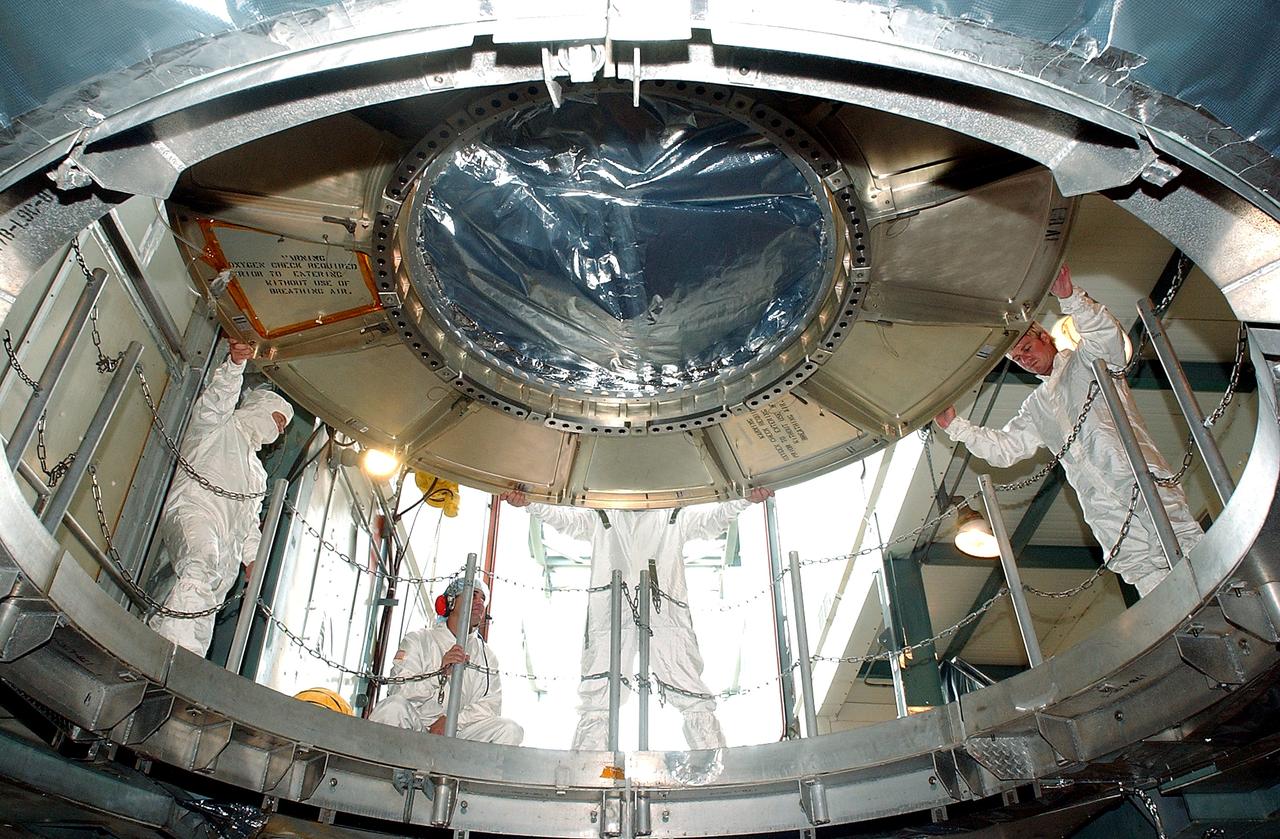
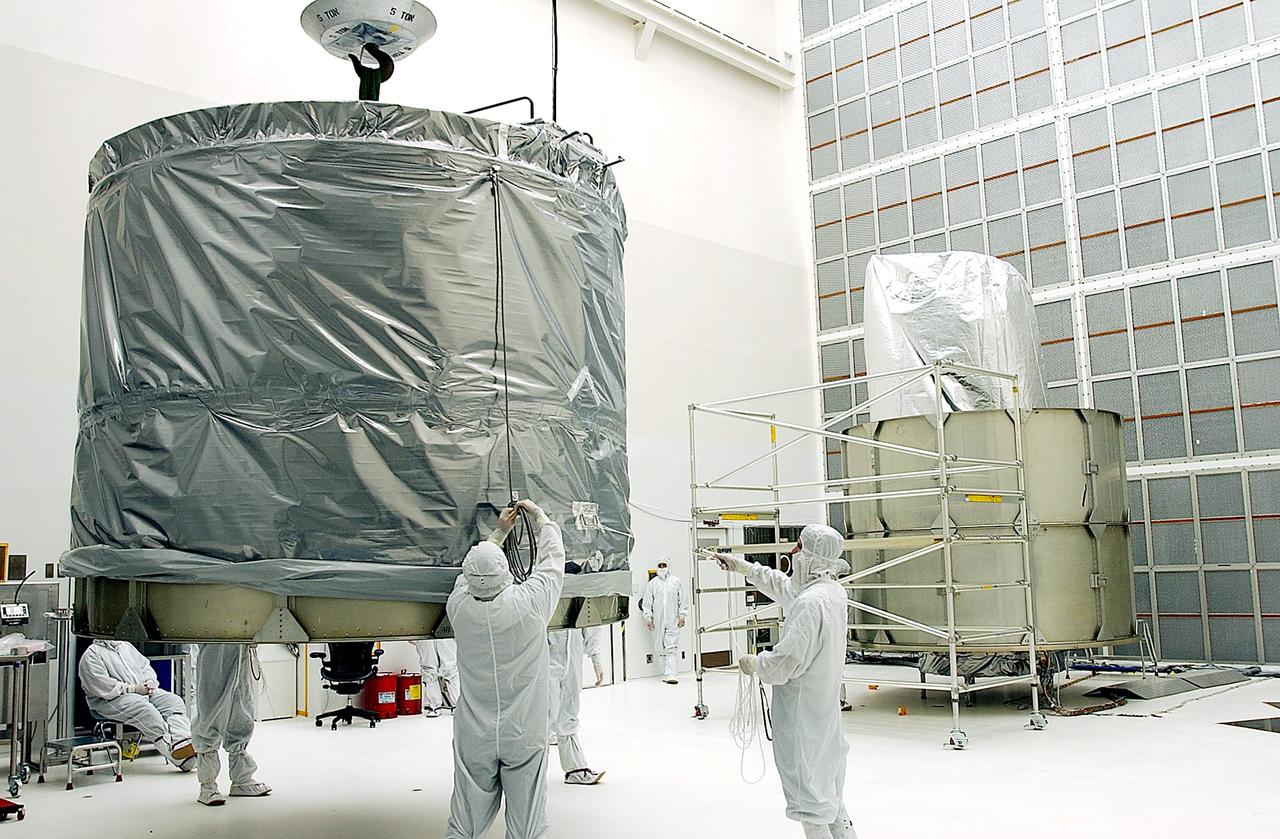
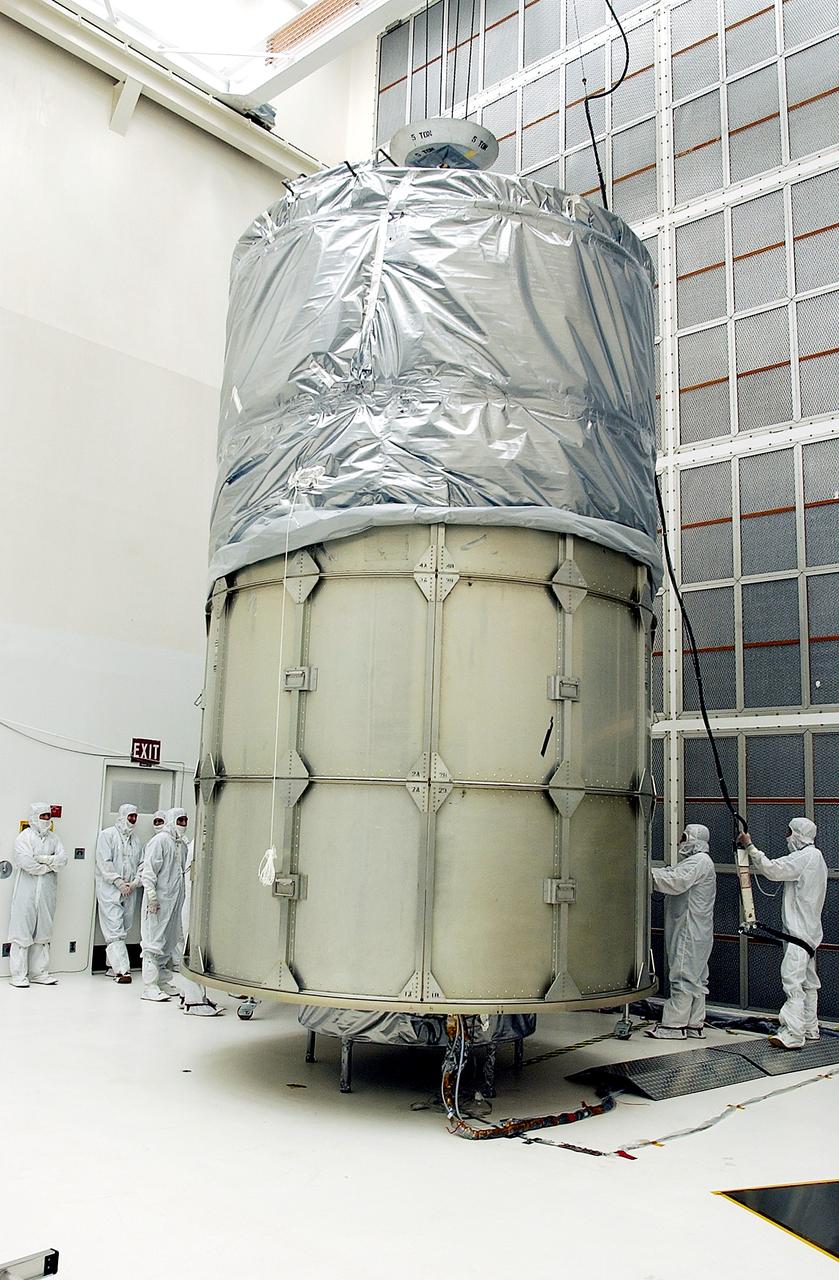
KENNEDY SPACE CENTER, FLA.  - Workers at Hangar A&E, Cape Canaveral Air Force Station, lift the upper canister to move it to the Space Infrared Telescope Facility (SIRTF) at right.  After encapsulation, the spacecraft will be transported to Launch Complex 17-B for mating with its launch vehicle, the Delta II rocket.   SIRTF consists of three cryogenically cooled science instruments and an 0.85-meter telescope, and is one of NASA's largest infrared telescopes to be launched.  SIRTF will obtain images and spectra by detecting the infrared energy, or heat, radiated by objects in space. Most of this infrared radiation is blocked by the Earth's atmosphere and cannot be observed from the ground.
KENNEDY SPACE CENTER, FLA. - Workers at Hangar A&E, Cape Canaveral Air Force Station, lift the upper canister to move it to the Space Infrared Telescope Facility (SIRTF) at right. After encapsulation, the spacecraft will be transported to Launch Complex 17-B for mating with its launch vehicle, the Delta II rocket. SIRTF consists of three cryogenically cooled science instruments and an 0.85-meter telescope, and is one of NASA's largest infrared telescopes to be launched. SIRTF will obtain images and spectra by detecting the infrared energy, or heat, radiated by objects in space. Most of this infrared radiation is blocked by the Earth's atmosphere and cannot be observed from the ground.
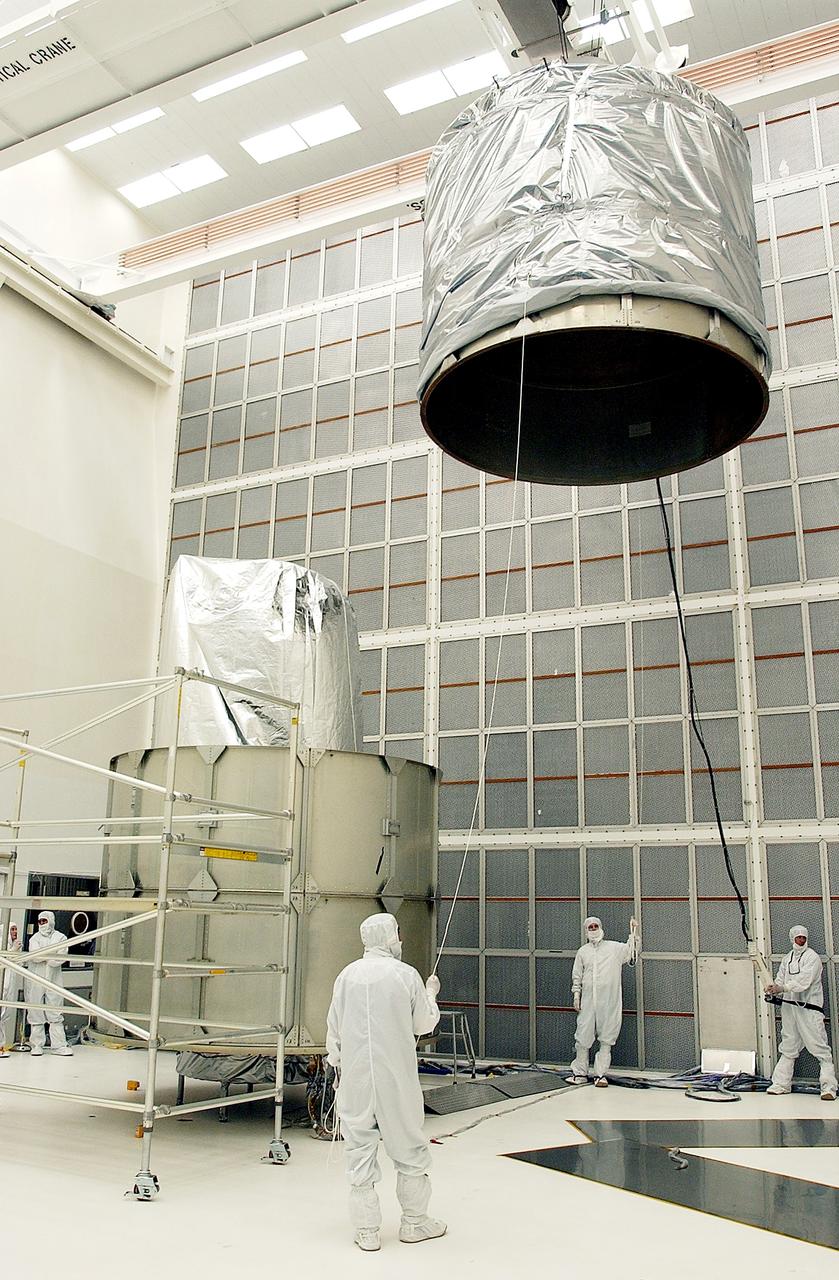
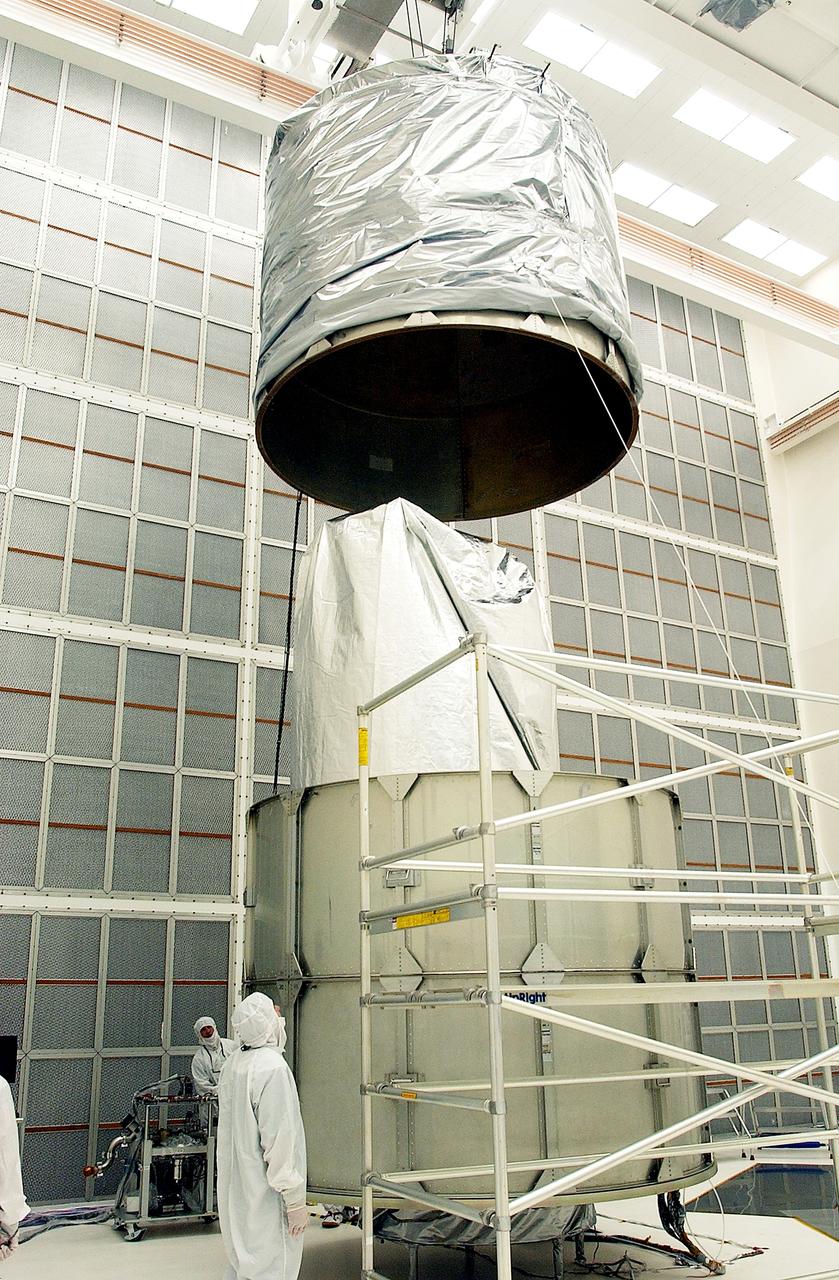
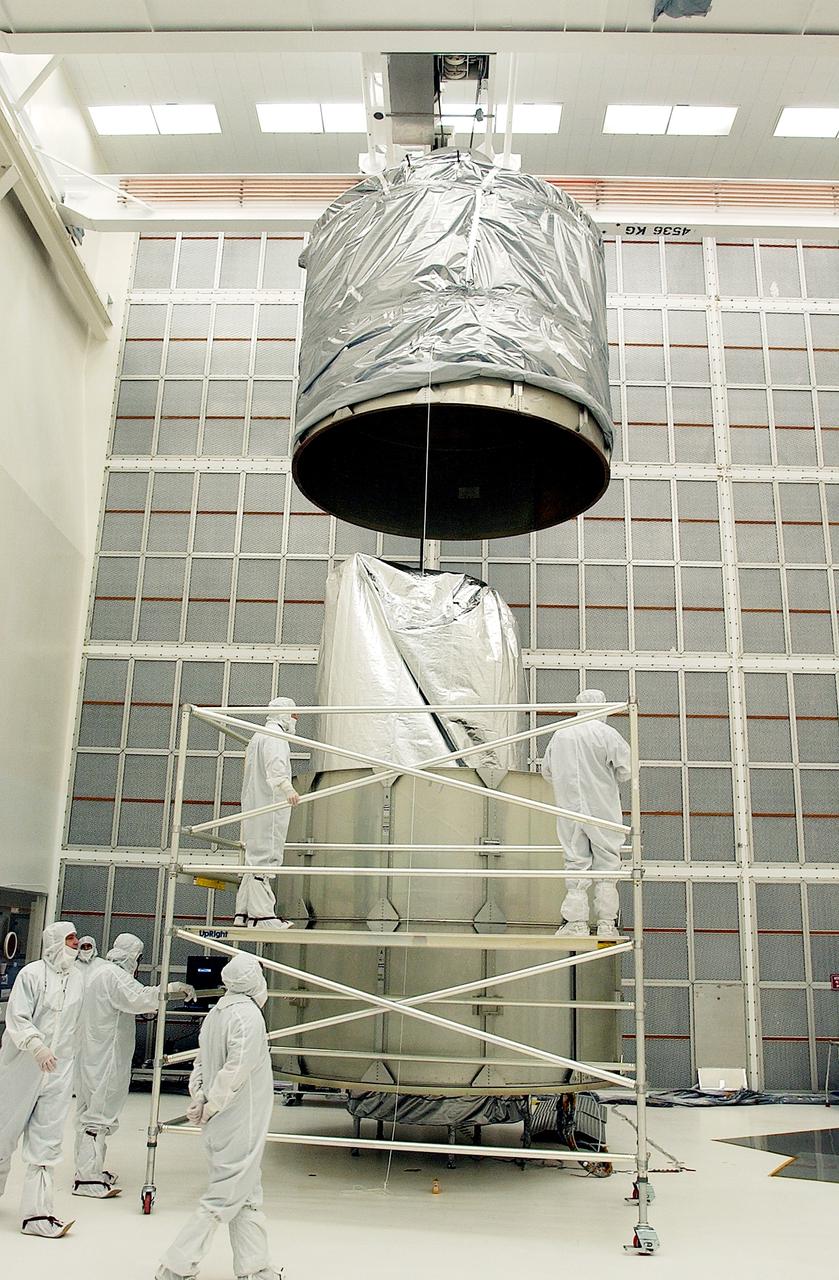
KENNEDY SPACE CENTER, FLA.  -  In Hangar A&E, Cape Canaveral Air Force Station, the upper canister is lowered toward the Space Infrared Telescope Facility (SIRTF) below.  After encapsulation is complete, the spacecraft will be transported to Launch Complex 17-B for mating with its launch vehicle, the Delta II rocket.   SIRTF consists of three cryogenically cooled science instruments and an 0.85-meter telescope, and is one of NASA's largest infrared telescopes to be launched.  SIRTF will obtain images and spectra by detecting the infrared energy, or heat, radiated by objects in space. Most of this infrared radiation is blocked by the Earth's atmosphere and cannot be observed from the ground.
KENNEDY SPACE CENTER, FLA. - In Hangar A&E, Cape Canaveral Air Force Station, the upper canister is lowered toward the Space Infrared Telescope Facility (SIRTF) below. After encapsulation is complete, the spacecraft will be transported to Launch Complex 17-B for mating with its launch vehicle, the Delta II rocket. SIRTF consists of three cryogenically cooled science instruments and an 0.85-meter telescope, and is one of NASA's largest infrared telescopes to be launched. SIRTF will obtain images and spectra by detecting the infrared energy, or heat, radiated by objects in space. Most of this infrared radiation is blocked by the Earth's atmosphere and cannot be observed from the ground.
KENNEDY SPACE CENTER, FLA.  -  After dawn,  the Space Infrared Telescope Facility (SIRTF) is lifted up the mobile service tower on Launch Pad 17-B, Cape Canaveral Air Force Station.  SIRTF will be attached to the Delta II rocket and encapsulated in its fairing before launch.   Consisting of three cryogenically cooled science instruments and an 0.85-meter telescope, SIRTF is one of NASA’s largest infrared telescopes to be launched.  It is the fourth and final element in NASA’s family of orbiting “Great Observatories.”  SIRTF will obtain images and spectra by detecting the infrared energy, or heat, radiated by objects in space. Most of this infrared radiation is blocked by the Earth's atmosphere and cannot be observed from the ground.
KENNEDY SPACE CENTER, FLA. - After dawn, the Space Infrared Telescope Facility (SIRTF) is lifted up the mobile service tower on Launch Pad 17-B, Cape Canaveral Air Force Station. SIRTF will be attached to the Delta II rocket and encapsulated in its fairing before launch. Consisting of three cryogenically cooled science instruments and an 0.85-meter telescope, SIRTF is one of NASA’s largest infrared telescopes to be launched. It is the fourth and final element in NASA’s family of orbiting “Great Observatories.” SIRTF will obtain images and spectra by detecting the infrared energy, or heat, radiated by objects in space. Most of this infrared radiation is blocked by the Earth's atmosphere and cannot be observed from the ground.
KENNEDY SPACE CENTER, FLA. -   On Launch Complex 17-B, Cape Canaveral Air Force Station, the first stage of a Delta II rocket is raised off the transporter before lifting it up and moved into the mobile service tower.  The rocket is being erected to launch the Space InfraRed Telescope Facility (SIRTF).  Consisting of an 0.85-meter telescope and three cryogenically cooled science instruments, SIRTF is one of NASA's largest infrared telescopes to be launched.  SIRTF will obtain images and spectra by detecting the infrared energy, or heat, radiated by objects in space. Most of this infrared radiation is blocked by the Earth's atmosphere and cannot be observed from the ground.
KENNEDY SPACE CENTER, FLA. - On Launch Complex 17-B, Cape Canaveral Air Force Station, the first stage of a Delta II rocket is raised off the transporter before lifting it up and moved into the mobile service tower. The rocket is being erected to launch the Space InfraRed Telescope Facility (SIRTF). Consisting of an 0.85-meter telescope and three cryogenically cooled science instruments, SIRTF is one of NASA's largest infrared telescopes to be launched. SIRTF will obtain images and spectra by detecting the infrared energy, or heat, radiated by objects in space. Most of this infrared radiation is blocked by the Earth's atmosphere and cannot be observed from the ground.
KENNEDY SPACE CENTER, FLA.  -  After dawn,  the Space Infrared Telescope Facility (SIRTF) is lifted up the mobile service tower on Launch Pad 17-B, Cape Canaveral Air Force Station.  SIRTF will be attached to the Delta II rocket and encapsulated in its fairing before launch.   Consisting of three cryogenically cooled science instruments and an 0.85-meter telescope, SIRTF is one of NASA’s largest infrared telescopes to be launched.  It is the fourth and final element in NASA’s family of orbiting “Great Observatories.”  SIRTF will obtain images and spectra by detecting the infrared energy, or heat, radiated by objects in space. Most of this infrared radiation is blocked by the Earth's atmosphere and cannot be observed from the ground.
KENNEDY SPACE CENTER, FLA. - After dawn, the Space Infrared Telescope Facility (SIRTF) is lifted up the mobile service tower on Launch Pad 17-B, Cape Canaveral Air Force Station. SIRTF will be attached to the Delta II rocket and encapsulated in its fairing before launch. Consisting of three cryogenically cooled science instruments and an 0.85-meter telescope, SIRTF is one of NASA’s largest infrared telescopes to be launched. It is the fourth and final element in NASA’s family of orbiting “Great Observatories.” SIRTF will obtain images and spectra by detecting the infrared energy, or heat, radiated by objects in space. Most of this infrared radiation is blocked by the Earth's atmosphere and cannot be observed from the ground.
KENNEDY SPACE CENTER, FLA.  -  Workers on the mobile service tower on Launch Pad 17-B, Cape Canaveral Air Force Station, wait for the Space Infrared Telescope Facility (SIRTF) to reach their level.  SIRTF will be attached to the Delta II rocket and encapsulated in its fairing before launch.   Consisting of three cryogenically cooled science instruments and an 0.85-meter telescope, SIRTF is one of NASA’s largest infrared telescopes to be launched.  It is the fourth and final element in NASA’s family of orbiting “Great Observatories.”  SIRTF will obtain images and spectra by detecting the infrared energy, or heat, radiated by objects in space. Most of this infrared radiation is blocked by the Earth's atmosphere and cannot be observed from the ground.
KENNEDY SPACE CENTER, FLA. - Workers on the mobile service tower on Launch Pad 17-B, Cape Canaveral Air Force Station, wait for the Space Infrared Telescope Facility (SIRTF) to reach their level. SIRTF will be attached to the Delta II rocket and encapsulated in its fairing before launch. Consisting of three cryogenically cooled science instruments and an 0.85-meter telescope, SIRTF is one of NASA’s largest infrared telescopes to be launched. It is the fourth and final element in NASA’s family of orbiting “Great Observatories.” SIRTF will obtain images and spectra by detecting the infrared energy, or heat, radiated by objects in space. Most of this infrared radiation is blocked by the Earth's atmosphere and cannot be observed from the ground.
KENNEDY SPACE CENTER, FLA. -   On Launch Complex 17-B, Cape Canaveral Air Force Station, the first stage of a Delta II rocket waits to be lifted up into the mobile service tower.  The rocket is being erected to launch the Space InfraRed Telescope Facility (SIRTF).  Consisting of an 0.85-meter telescope and three cryogenically cooled science instruments, SIRTF is one of NASA's largest infrared telescopes to be launched.  SIRTF will obtain images and spectra by detecting the infrared energy, or heat, radiated by objects in space. Most of this infrared radiation is blocked by the Earth's atmosphere and cannot be observed from the ground.
KENNEDY SPACE CENTER, FLA. - On Launch Complex 17-B, Cape Canaveral Air Force Station, the first stage of a Delta II rocket waits to be lifted up into the mobile service tower. The rocket is being erected to launch the Space InfraRed Telescope Facility (SIRTF). Consisting of an 0.85-meter telescope and three cryogenically cooled science instruments, SIRTF is one of NASA's largest infrared telescopes to be launched. SIRTF will obtain images and spectra by detecting the infrared energy, or heat, radiated by objects in space. Most of this infrared radiation is blocked by the Earth's atmosphere and cannot be observed from the ground.
KENNEDY SPACE CENTER, FLA.  - Workers at Hangar A&E, Cape Canaveral Air Force Station, help guide the upper canister toward the Space Infrared Telescope Facility (SIRTF) at left.  After encapsulation is complete, the spacecraft will be transported to Launch Complex 17-B for mating with its launch vehicle, the Delta II rocket.   SIRTF consists of three cryogenically cooled science instruments and an 0.85-meter telescope, and is one of NASA's largest infrared telescopes to be launched.  SIRTF will obtain images and spectra by detecting the infrared energy, or heat, radiated by objects in space. Most of this infrared radiation is blocked by the Earth's atmosphere and cannot be observed from the ground.
KENNEDY SPACE CENTER, FLA. - Workers at Hangar A&E, Cape Canaveral Air Force Station, help guide the upper canister toward the Space Infrared Telescope Facility (SIRTF) at left. After encapsulation is complete, the spacecraft will be transported to Launch Complex 17-B for mating with its launch vehicle, the Delta II rocket. SIRTF consists of three cryogenically cooled science instruments and an 0.85-meter telescope, and is one of NASA's largest infrared telescopes to be launched. SIRTF will obtain images and spectra by detecting the infrared energy, or heat, radiated by objects in space. Most of this infrared radiation is blocked by the Earth's atmosphere and cannot be observed from the ground.
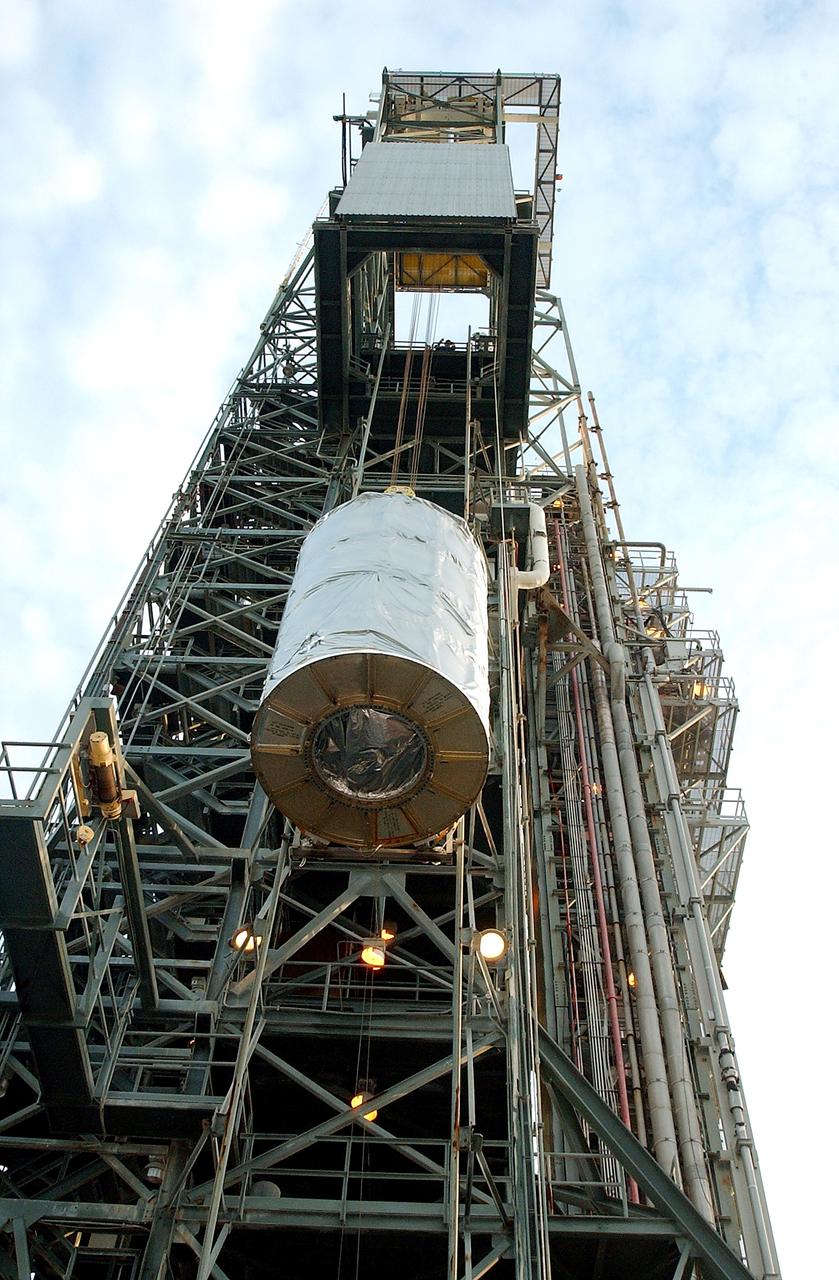
KENNEDY SPACE CENTER, FLA.  -  Viewed from below, the Space Infrared Telescope Facility (SIRTF) is lifted up the mobile service tower on Launch Pad 17-B, Cape Canaveral Air Force Station.  SIRTF will be attached to the Delta II rocket and encapsulated in its fairing before launch.   Consisting of three cryogenically cooled science instruments and an 0.85-meter telescope, SIRTF is one of NASA’s largest infrared telescopes to be launched.  It is the fourth and final element in NASA’s family of orbiting “Great Observatories.”  SIRTF will obtain images and spectra by detecting the infrared energy, or heat, radiated by objects in space. Most of this infrared radiation is blocked by the Earth's atmosphere and cannot be observed from the ground.
KENNEDY SPACE CENTER, FLA. - Viewed from below, the Space Infrared Telescope Facility (SIRTF) is lifted up the mobile service tower on Launch Pad 17-B, Cape Canaveral Air Force Station. SIRTF will be attached to the Delta II rocket and encapsulated in its fairing before launch. Consisting of three cryogenically cooled science instruments and an 0.85-meter telescope, SIRTF is one of NASA’s largest infrared telescopes to be launched. It is the fourth and final element in NASA’s family of orbiting “Great Observatories.” SIRTF will obtain images and spectra by detecting the infrared energy, or heat, radiated by objects in space. Most of this infrared radiation is blocked by the Earth's atmosphere and cannot be observed from the ground.
KENNEDY SPACE CENTER, FLA. -   On Launch Complex 17-B, Cape Canaveral Air Force Station, the first stage of a Delta II rocket is raised off the transporter before lifting and moving it into the mobile service tower.  The rocket is being erected to launch the Space InfraRed Telescope Facility (SIRTF).  Consisting of an 0.85-meter telescope and three cryogenically cooled science instruments, SIRTF is one of NASA's largest infrared telescopes to be launched.  SIRTF will obtain images and spectra by detecting the infrared energy, or heat, radiated by objects in space. Most of this infrared radiation is blocked by the Earth's atmosphere and cannot be observed from the ground.
KENNEDY SPACE CENTER, FLA. - On Launch Complex 17-B, Cape Canaveral Air Force Station, the first stage of a Delta II rocket is raised off the transporter before lifting and moving it into the mobile service tower. The rocket is being erected to launch the Space InfraRed Telescope Facility (SIRTF). Consisting of an 0.85-meter telescope and three cryogenically cooled science instruments, SIRTF is one of NASA's largest infrared telescopes to be launched. SIRTF will obtain images and spectra by detecting the infrared energy, or heat, radiated by objects in space. Most of this infrared radiation is blocked by the Earth's atmosphere and cannot be observed from the ground.
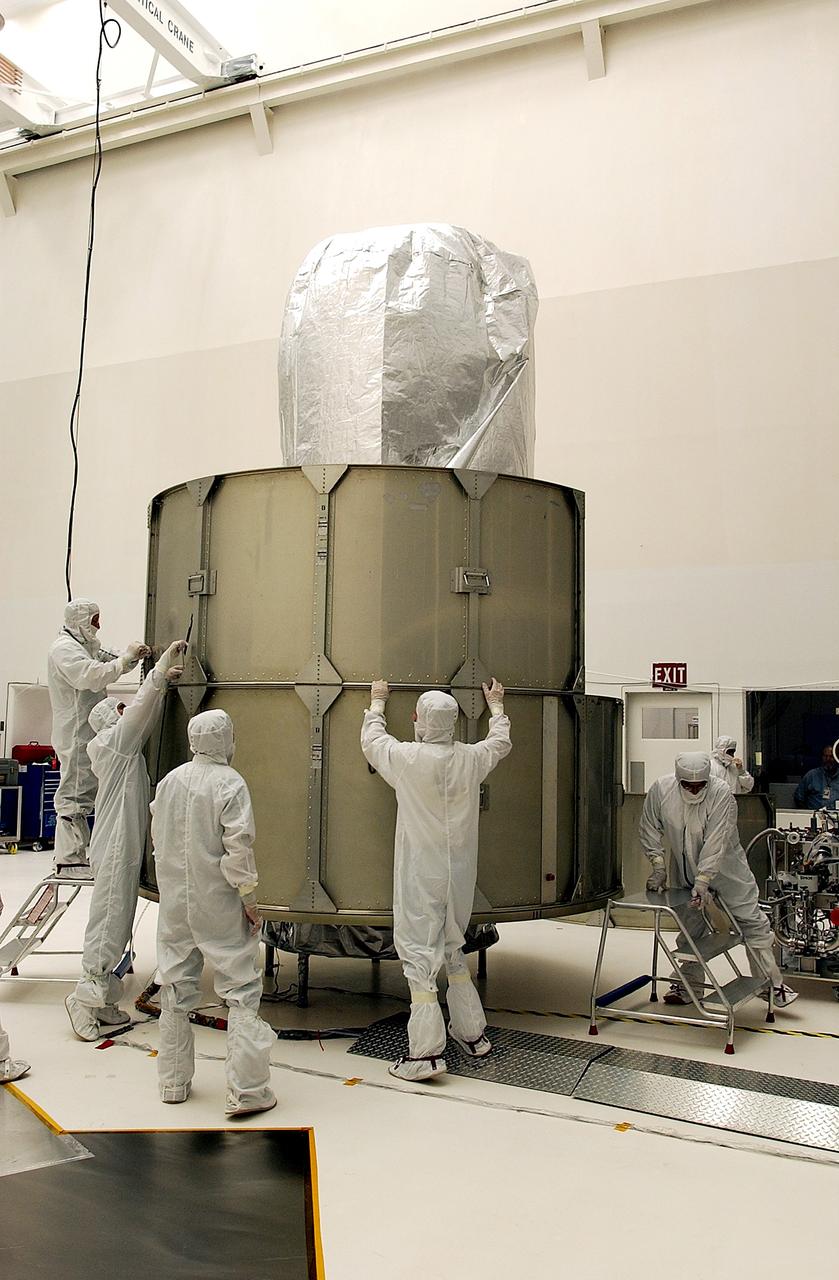
KENNEDY SPACE CENTER, FLA.  -  A worker at Hangar A&E, Cape Canaveral Air Force Station, place the lower panels of the canister around the Space Infrared Telescope Facility (SIRTF).  The spacecraft will be transported to Launch Complex 17-B for mating with its launch vehicle, the Delta II rocket.   SIRTF consists of three cryogenically cooled science instruments and an 0.85-meter telescope, and is one of NASA's largest infrared telescopes to be launched.  SIRTF will obtain images and spectra by detecting the infrared energy, or heat, radiated by objects in space. Most of this infrared radiation is blocked by the Earth's atmosphere and cannot be observed from the ground.
KENNEDY SPACE CENTER, FLA. - A worker at Hangar A&E, Cape Canaveral Air Force Station, place the lower panels of the canister around the Space Infrared Telescope Facility (SIRTF). The spacecraft will be transported to Launch Complex 17-B for mating with its launch vehicle, the Delta II rocket. SIRTF consists of three cryogenically cooled science instruments and an 0.85-meter telescope, and is one of NASA's largest infrared telescopes to be launched. SIRTF will obtain images and spectra by detecting the infrared energy, or heat, radiated by objects in space. Most of this infrared radiation is blocked by the Earth's atmosphere and cannot be observed from the ground.
KENNEDY SPACE CENTER, FLA. -   On Launch Complex 17-B, Cape Canaveral Air Force Station, the first stage of a Delta II rocket waits to be lifted up and moved into the mobile service tower.  The rocket is being erected to launch the Space InfraRed Telescope Facility (SIRTF).  Consisting of an 0.85-meter telescope and three cryogenically cooled science instruments, SIRTF is one of NASA's largest infrared telescopes to be launched.  SIRTF will obtain images and spectra by detecting the infrared energy, or heat, radiated by objects in space. Most of this infrared radiation is blocked by the Earth's atmosphere and cannot be observed from the ground.
KENNEDY SPACE CENTER, FLA. - On Launch Complex 17-B, Cape Canaveral Air Force Station, the first stage of a Delta II rocket waits to be lifted up and moved into the mobile service tower. The rocket is being erected to launch the Space InfraRed Telescope Facility (SIRTF). Consisting of an 0.85-meter telescope and three cryogenically cooled science instruments, SIRTF is one of NASA's largest infrared telescopes to be launched. SIRTF will obtain images and spectra by detecting the infrared energy, or heat, radiated by objects in space. Most of this infrared radiation is blocked by the Earth's atmosphere and cannot be observed from the ground.
KENNEDY SPACE CENTER, FLA. -   On Launch Complex 17-B, Cape Canaveral Air Force Station, the first stage of a Delta II rocket is nearly erect for its move into the mobile service tower.  The rocket is being erected to launch the Space InfraRed Telescope Facility (SIRTF).  Consisting of an 0.85-meter telescope and three cryogenically cooled science instruments, SIRTF is one of NASA's largest infrared telescopes to be launched.  SIRTF will obtain images and spectra by detecting the infrared energy, or heat, radiated by objects in space. Most of this infrared radiation is blocked by the Earth's atmosphere and cannot be observed from the ground.
KENNEDY SPACE CENTER, FLA. - On Launch Complex 17-B, Cape Canaveral Air Force Station, the first stage of a Delta II rocket is nearly erect for its move into the mobile service tower. The rocket is being erected to launch the Space InfraRed Telescope Facility (SIRTF). Consisting of an 0.85-meter telescope and three cryogenically cooled science instruments, SIRTF is one of NASA's largest infrared telescopes to be launched. SIRTF will obtain images and spectra by detecting the infrared energy, or heat, radiated by objects in space. Most of this infrared radiation is blocked by the Earth's atmosphere and cannot be observed from the ground.
KENNEDY SPACE CENTER, FLA.  -  Workers on the mobile service tower on Launch Pad 17-B, Cape Canaveral Air Force Station, help guide the Space Infrared Telescope Facility (SIRTF) toward the opening in the foreground.  SIRTF will be attached to the Delta II rocket and encapsulated in its fairing before launch.   Consisting of three cryogenically cooled science instruments and an 0.85-meter telescope, SIRTF is one of NASA’s largest infrared telescopes to be launched.  It is the fourth and final element in NASA’s family of orbiting “Great Observatories.”  SIRTF will obtain images and spectra by detecting the infrared energy, or heat, radiated by objects in space. Most of this infrared radiation is blocked by the Earth's atmosphere and cannot be observed from the ground.
KENNEDY SPACE CENTER, FLA. - Workers on the mobile service tower on Launch Pad 17-B, Cape Canaveral Air Force Station, help guide the Space Infrared Telescope Facility (SIRTF) toward the opening in the foreground. SIRTF will be attached to the Delta II rocket and encapsulated in its fairing before launch. Consisting of three cryogenically cooled science instruments and an 0.85-meter telescope, SIRTF is one of NASA’s largest infrared telescopes to be launched. It is the fourth and final element in NASA’s family of orbiting “Great Observatories.” SIRTF will obtain images and spectra by detecting the infrared energy, or heat, radiated by objects in space. Most of this infrared radiation is blocked by the Earth's atmosphere and cannot be observed from the ground.
KENNEDY SPACE CENTER, FLA.  -  Before dawn, the Space Infrared Telescope Facility (SIRTF) is attached to an overhead crane that will lift it up the mobile service tower on Launch Pad 17-B, Cape Canaveral Air Force Station.  SIRTF will be attached to the Delta II rocket and encapsulated in its fairing before launch.   Consisting of three cryogenically cooled science instruments and an 0.85-meter telescope, SIRTF is one of NASA’s largest infrared telescopes to be launched.  It is the fourth and final element in NASA’s family of orbiting “Great Observatories.”  SIRTF will obtain images and spectra by detecting the infrared energy, or heat, radiated by objects in space. Most of this infrared radiation is blocked by the Earth's atmosphere and cannot be observed from the ground.
KENNEDY SPACE CENTER, FLA. - Before dawn, the Space Infrared Telescope Facility (SIRTF) is attached to an overhead crane that will lift it up the mobile service tower on Launch Pad 17-B, Cape Canaveral Air Force Station. SIRTF will be attached to the Delta II rocket and encapsulated in its fairing before launch. Consisting of three cryogenically cooled science instruments and an 0.85-meter telescope, SIRTF is one of NASA’s largest infrared telescopes to be launched. It is the fourth and final element in NASA’s family of orbiting “Great Observatories.” SIRTF will obtain images and spectra by detecting the infrared energy, or heat, radiated by objects in space. Most of this infrared radiation is blocked by the Earth's atmosphere and cannot be observed from the ground.
KENNEDY SPACE CENTER, FLA.  - Workers at Hangar A&E, Cape Canaveral Air Force Station, place the middle row of panels to encapsulate the Space Infrared Telescope Facility (SIRTF).  The spacecraft will be transported to Launch Complex 17-B for mating with its launch vehicle, the Delta II rocket.   SIRTF consists of three cryogenically cooled science instruments and an 0.85-meter telescope, and is one of NASA's largest infrared telescopes to be launched.  SIRTF will obtain images and spectra by detecting the infrared energy, or heat, radiated by objects in space. Most of this infrared radiation is blocked by the Earth's atmosphere and cannot be observed from the ground.
KENNEDY SPACE CENTER, FLA. - Workers at Hangar A&E, Cape Canaveral Air Force Station, place the middle row of panels to encapsulate the Space Infrared Telescope Facility (SIRTF). The spacecraft will be transported to Launch Complex 17-B for mating with its launch vehicle, the Delta II rocket. SIRTF consists of three cryogenically cooled science instruments and an 0.85-meter telescope, and is one of NASA's largest infrared telescopes to be launched. SIRTF will obtain images and spectra by detecting the infrared energy, or heat, radiated by objects in space. Most of this infrared radiation is blocked by the Earth's atmosphere and cannot be observed from the ground.
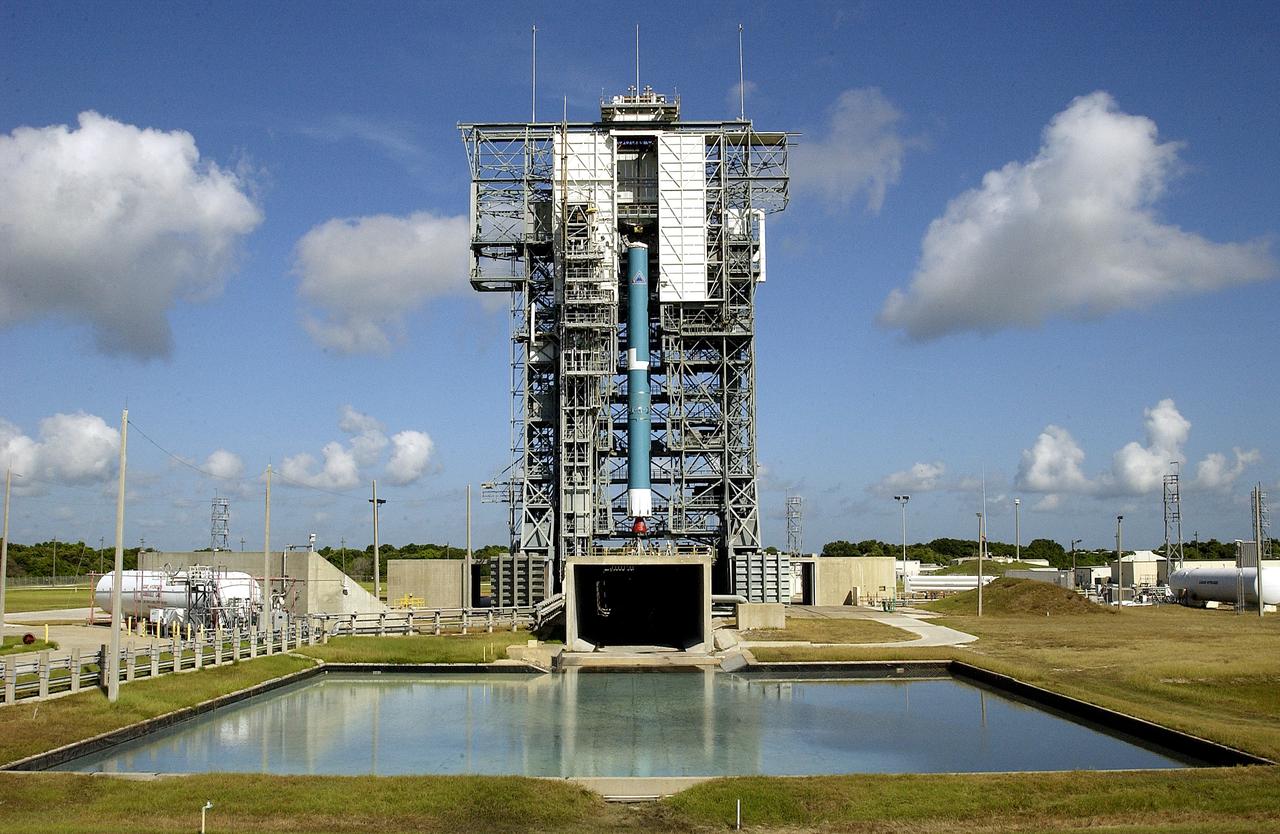
KENNEDY SPACE CENTER, FLA. -  On Launch Complex 17-B, Cape Canaveral Air Force Station, the first stage of a Delta II rocket is lifted up the mobile service tower.  Below the rocket is the flame trench, and in the foreground is the overflow pool.  The rocket is being erected to launch the Space InfraRed Telescope Facility (SIRTF).  Consisting of an 0.85-meter telescope and three cryogenically cooled science instruments, SIRTF is one of NASA's largest infrared telescopes to be launched.  SIRTF will obtain images and spectra by detecting the infrared energy, or heat, radiated by objects in space. Most of this infrared radiation is blocked by the Earth's atmosphere and cannot be observed from the ground.
KENNEDY SPACE CENTER, FLA. - On Launch Complex 17-B, Cape Canaveral Air Force Station, the first stage of a Delta II rocket is lifted up the mobile service tower. Below the rocket is the flame trench, and in the foreground is the overflow pool. The rocket is being erected to launch the Space InfraRed Telescope Facility (SIRTF). Consisting of an 0.85-meter telescope and three cryogenically cooled science instruments, SIRTF is one of NASA's largest infrared telescopes to be launched. SIRTF will obtain images and spectra by detecting the infrared energy, or heat, radiated by objects in space. Most of this infrared radiation is blocked by the Earth's atmosphere and cannot be observed from the ground.
KENNEDY SPACE CENTER, FLA. -  On Launch Complex 17-B, Cape Canaveral Air Force Station, the first stage of a Delta II rocket is lifted up the mobile service tower.  In the background is pad 17-A.   The rocket is being erected to launch the Space InfraRed Telescope Facility (SIRTF).  Consisting of an 0.85-meter telescope and three cryogenically cooled science instruments, SIRTF is one of NASA's largest infrared telescopes to be launched.  SIRTF will obtain images and spectra by detecting the infrared energy, or heat, radiated by objects in space. Most of this infrared radiation is blocked by the Earth's atmosphere and cannot be observed from the ground.
KENNEDY SPACE CENTER, FLA. - On Launch Complex 17-B, Cape Canaveral Air Force Station, the first stage of a Delta II rocket is lifted up the mobile service tower. In the background is pad 17-A. The rocket is being erected to launch the Space InfraRed Telescope Facility (SIRTF). Consisting of an 0.85-meter telescope and three cryogenically cooled science instruments, SIRTF is one of NASA's largest infrared telescopes to be launched. SIRTF will obtain images and spectra by detecting the infrared energy, or heat, radiated by objects in space. Most of this infrared radiation is blocked by the Earth's atmosphere and cannot be observed from the ground.
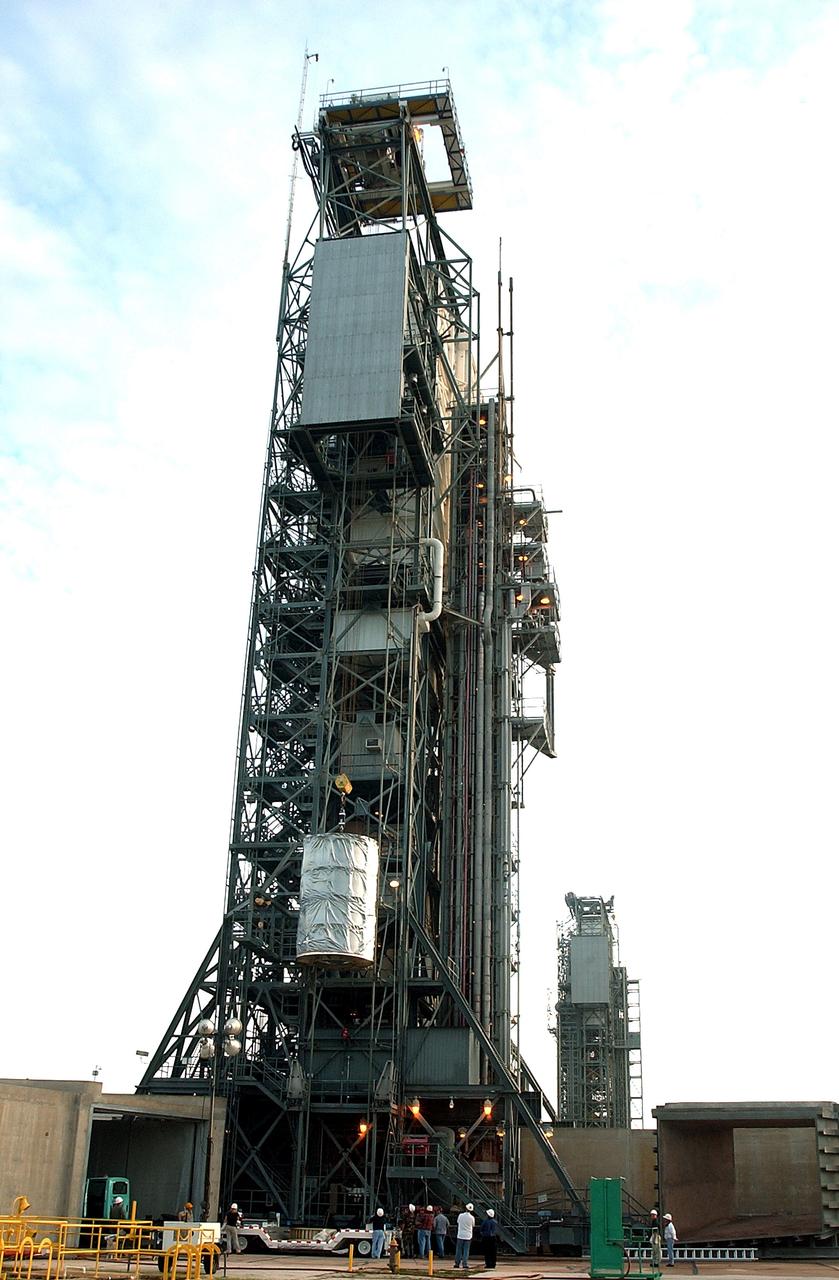
KENNEDY SPACE CENTER, FLA. -   On Launch Complex 17-B, Cape Canaveral Air Force Station, a solid rocket booster (SRB) is lifted into the mobile service tower, joining two others.  They are three of nine  46-inch-diameter, stretched SRBs that are being attached to the Delta II Heavy rocket that will launch the Space Infrared Telescope Facility (SIRTF).  Consisting of three cryogenically cooled science instruments and an 0.85-meter telescope, SIRTF is one of NASA's largest infrared telescopes to be launched.  SIRTF will obtain images and spectra by detecting the infrared energy, or heat, radiated by objects in space. Most of this infrared radiation is blocked by the Earth's atmosphere and cannot be observed from the ground.
KENNEDY SPACE CENTER, FLA. - On Launch Complex 17-B, Cape Canaveral Air Force Station, a solid rocket booster (SRB) is lifted into the mobile service tower, joining two others. They are three of nine 46-inch-diameter, stretched SRBs that are being attached to the Delta II Heavy rocket that will launch the Space Infrared Telescope Facility (SIRTF). Consisting of three cryogenically cooled science instruments and an 0.85-meter telescope, SIRTF is one of NASA's largest infrared telescopes to be launched. SIRTF will obtain images and spectra by detecting the infrared energy, or heat, radiated by objects in space. Most of this infrared radiation is blocked by the Earth's atmosphere and cannot be observed from the ground.
KENNEDY SPACE CENTER, FLA.  -  The Space Infrared Telescope Facility (SIRTF) is lowered into the opening of the mobile service tower on Launch Pad 17-B, Cape Canaveral Air Force Station.  SIRTF will be attached to the Delta II rocket and encapsulated in its fairing before launch.   Consisting of three cryogenically cooled science instruments and an 0.85-meter telescope, SIRTF is one of NASA’s largest infrared telescopes to be launched.  It is the fourth and final element in NASA’s family of orbiting “Great Observatories.”  SIRTF will obtain images and spectra by detecting the infrared energy, or heat, radiated by objects in space. Most of this infrared radiation is blocked by the Earth's atmosphere and cannot be observed from the ground.
KENNEDY SPACE CENTER, FLA. - The Space Infrared Telescope Facility (SIRTF) is lowered into the opening of the mobile service tower on Launch Pad 17-B, Cape Canaveral Air Force Station. SIRTF will be attached to the Delta II rocket and encapsulated in its fairing before launch. Consisting of three cryogenically cooled science instruments and an 0.85-meter telescope, SIRTF is one of NASA’s largest infrared telescopes to be launched. It is the fourth and final element in NASA’s family of orbiting “Great Observatories.” SIRTF will obtain images and spectra by detecting the infrared energy, or heat, radiated by objects in space. Most of this infrared radiation is blocked by the Earth's atmosphere and cannot be observed from the ground.
KENNEDY SPACE CENTER, FLA. -   On Launch Complex 17-B, Cape Canaveral Air Force Station, another solid rocket booster (SRB) is being raised from its transporter to lift it to vertical.  It is one of nine  46-inch-diameter, stretched SRBs that are being attached to the Delta II Heavy rocket that will launch the Space Infrared Telescope Facility (SIRTF).  Consisting of three cryogenically cooled science instruments and an 0.85-meter telescope, SIRTF is one of NASA's largest infrared telescopes to be launched.  SIRTF will obtain images and spectra by detecting the infrared energy, or heat, radiated by objects in space. Most of this infrared radiation is blocked by the Earth's atmosphere and cannot be observed from the ground.
KENNEDY SPACE CENTER, FLA. - On Launch Complex 17-B, Cape Canaveral Air Force Station, another solid rocket booster (SRB) is being raised from its transporter to lift it to vertical. It is one of nine 46-inch-diameter, stretched SRBs that are being attached to the Delta II Heavy rocket that will launch the Space Infrared Telescope Facility (SIRTF). Consisting of three cryogenically cooled science instruments and an 0.85-meter telescope, SIRTF is one of NASA's largest infrared telescopes to be launched. SIRTF will obtain images and spectra by detecting the infrared energy, or heat, radiated by objects in space. Most of this infrared radiation is blocked by the Earth's atmosphere and cannot be observed from the ground.
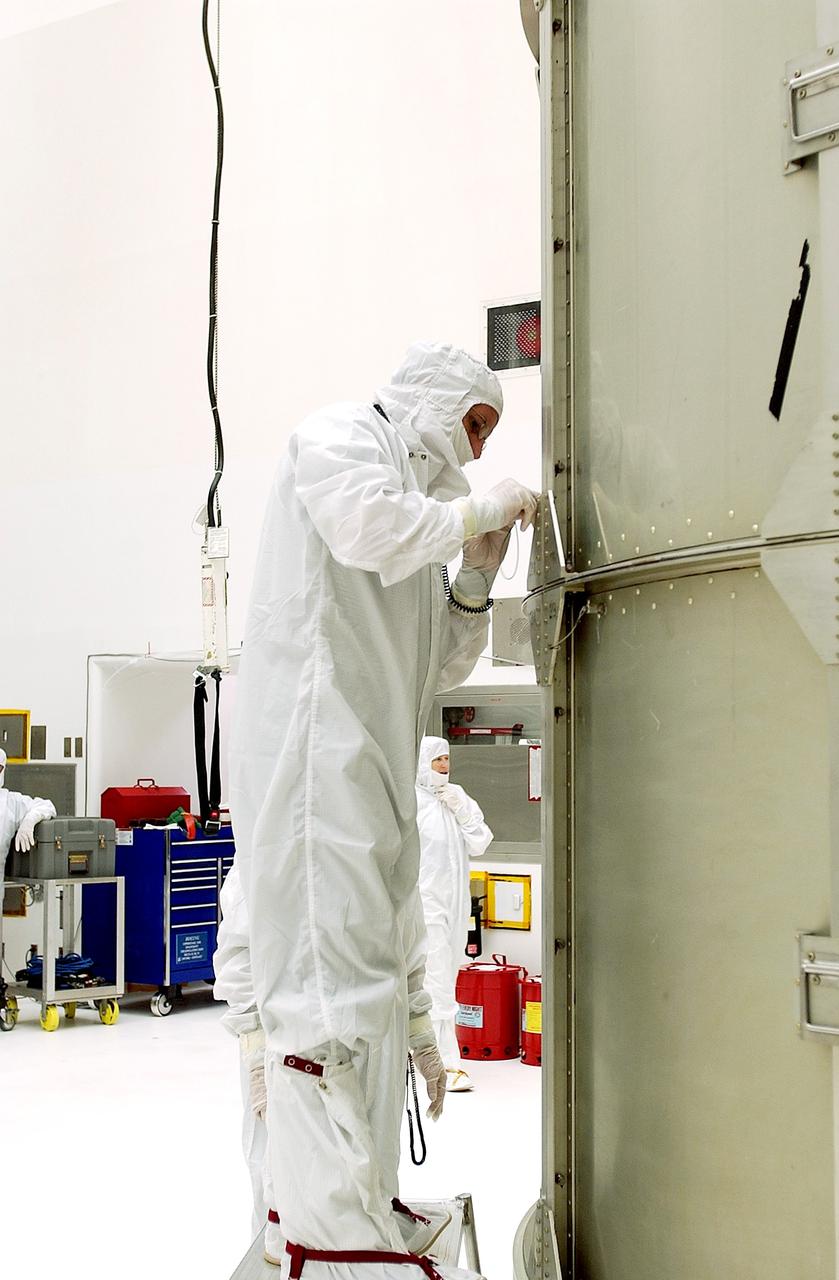
KENNEDY SPACE CENTER, FLA.  - A worker at Hangar A&E, Cape Canaveral Air Force Station, tightens the canister around the Space Infrared Telescope Facility (SIRTF).  The spacecraft will be transported to Launch Complex 17-B for mating with its launch vehicle, the Delta II rocket.   SIRTF consists of three cryogenically cooled science instruments and an 0.85-meter telescope, and is one of NASA's largest infrared telescopes to be launched.  SIRTF will obtain images and spectra by detecting the infrared energy, or heat, radiated by objects in space. Most of this infrared radiation is blocked by the Earth's atmosphere and cannot be observed from the ground.
KENNEDY SPACE CENTER, FLA. - A worker at Hangar A&E, Cape Canaveral Air Force Station, tightens the canister around the Space Infrared Telescope Facility (SIRTF). The spacecraft will be transported to Launch Complex 17-B for mating with its launch vehicle, the Delta II rocket. SIRTF consists of three cryogenically cooled science instruments and an 0.85-meter telescope, and is one of NASA's largest infrared telescopes to be launched. SIRTF will obtain images and spectra by detecting the infrared energy, or heat, radiated by objects in space. Most of this infrared radiation is blocked by the Earth's atmosphere and cannot be observed from the ground.
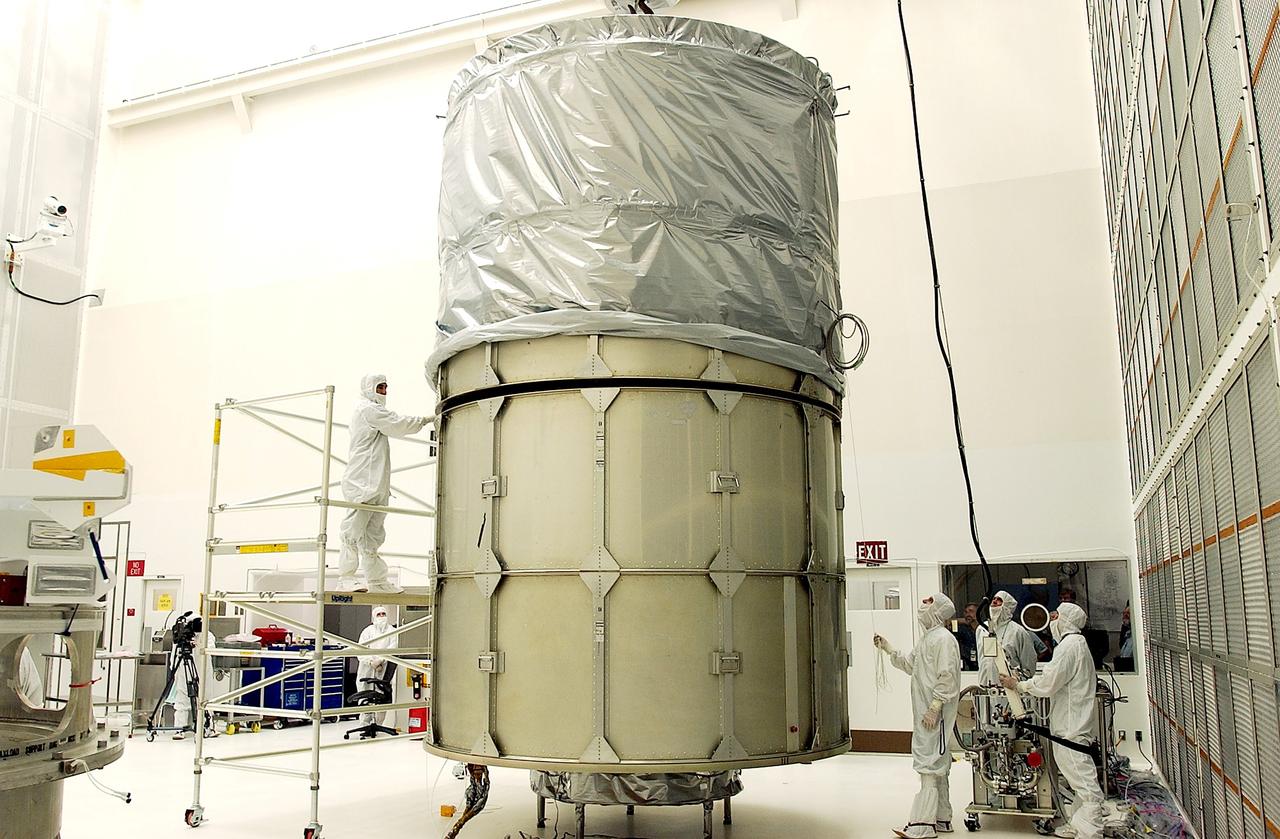
KENNEDY SPACE CENTER, FLA.  -  In Hangar A&E, Cape Canaveral Air Force Station, the upper canister is mated to the middle panels around the Space Infrared Telescope Facility (SIRTF).  The spacecraft will be transported to Launch Complex 17-B for mating with its launch vehicle, the Delta II rocket.   SIRTF consists of three cryogenically cooled science instruments and an 0.85-meter telescope, and is one of NASA's largest infrared telescopes to be launched.  SIRTF will obtain images and spectra by detecting the infrared energy, or heat, radiated by objects in space. Most of this infrared radiation is blocked by the Earth's atmosphere and cannot be observed from the ground.
KENNEDY SPACE CENTER, FLA. - In Hangar A&E, Cape Canaveral Air Force Station, the upper canister is mated to the middle panels around the Space Infrared Telescope Facility (SIRTF). The spacecraft will be transported to Launch Complex 17-B for mating with its launch vehicle, the Delta II rocket. SIRTF consists of three cryogenically cooled science instruments and an 0.85-meter telescope, and is one of NASA's largest infrared telescopes to be launched. SIRTF will obtain images and spectra by detecting the infrared energy, or heat, radiated by objects in space. Most of this infrared radiation is blocked by the Earth's atmosphere and cannot be observed from the ground.
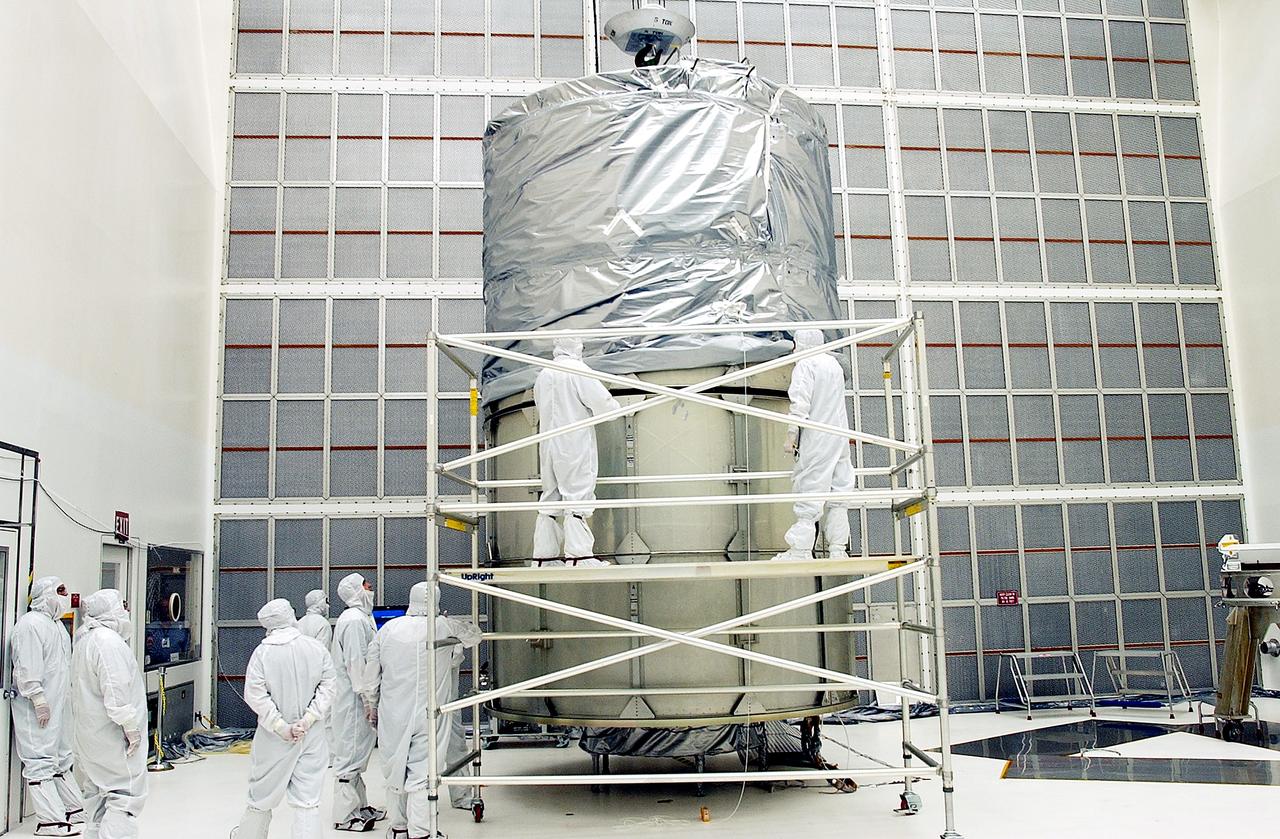
KENNEDY SPACE CENTER, FLA.  -  In Hangar A&E, Cape Canaveral Air Force Station, encapsulation of the Space Infrared Telescope Facility (SIRTF) is complete.  The spacecraft will be transported to Launch Complex 17-B for mating with its launch vehicle, the Delta II rocket.   SIRTF consists of three cryogenically cooled science instruments and an 0.85-meter telescope, and is one of NASA's largest infrared telescopes to be launched.  SIRTF will obtain images and spectra by detecting the infrared energy, or heat, radiated by objects in space. Most of this infrared radiation is blocked by the Earth's atmosphere and cannot be observed from the ground.
KENNEDY SPACE CENTER, FLA. - In Hangar A&E, Cape Canaveral Air Force Station, encapsulation of the Space Infrared Telescope Facility (SIRTF) is complete. The spacecraft will be transported to Launch Complex 17-B for mating with its launch vehicle, the Delta II rocket. SIRTF consists of three cryogenically cooled science instruments and an 0.85-meter telescope, and is one of NASA's largest infrared telescopes to be launched. SIRTF will obtain images and spectra by detecting the infrared energy, or heat, radiated by objects in space. Most of this infrared radiation is blocked by the Earth's atmosphere and cannot be observed from the ground.
KENNEDY SPACE CENTER, FLA.  -  Workers on the mobile service tower on Launch Pad 17-B, Cape Canaveral Air Force Station, watch as the Space Infrared Telescope Facility (SIRTF) clears the platform.   SIRTF will be attached to the Delta II rocket and encapsulated in its fairing before launch.   Consisting of three cryogenically cooled science instruments and an 0.85-meter telescope, SIRTF is one of NASA’s largest infrared telescopes to be launched.  It is the fourth and final element in NASA’s family of orbiting “Great Observatories.”  SIRTF will obtain images and spectra by detecting the infrared energy, or heat, radiated by objects in space. Most of this infrared radiation is blocked by the Earth's atmosphere and cannot be observed from the ground.
KENNEDY SPACE CENTER, FLA. - Workers on the mobile service tower on Launch Pad 17-B, Cape Canaveral Air Force Station, watch as the Space Infrared Telescope Facility (SIRTF) clears the platform. SIRTF will be attached to the Delta II rocket and encapsulated in its fairing before launch. Consisting of three cryogenically cooled science instruments and an 0.85-meter telescope, SIRTF is one of NASA’s largest infrared telescopes to be launched. It is the fourth and final element in NASA’s family of orbiting “Great Observatories.” SIRTF will obtain images and spectra by detecting the infrared energy, or heat, radiated by objects in space. Most of this infrared radiation is blocked by the Earth's atmosphere and cannot be observed from the ground.
KENNEDY SPACE CENTER, FLA. -   On Launch Complex 17-B, Cape Canaveral Air Force Station, the first stage of a Delta II rocket is moved into the mobile service tower.  The rocket is being erected to launch the Space InfraRed Telescope Facility (SIRTF).  Consisting of an 0.85-meter telescope and three cryogenically cooled science instruments, SIRTF is one of NASA's largest infrared telescopes to be launched.  SIRTF will obtain images and spectra by detecting the infrared energy, or heat, radiated by objects in space. Most of this infrared radiation is blocked by the Earth's atmosphere and cannot be observed from the ground.
KENNEDY SPACE CENTER, FLA. - On Launch Complex 17-B, Cape Canaveral Air Force Station, the first stage of a Delta II rocket is moved into the mobile service tower. The rocket is being erected to launch the Space InfraRed Telescope Facility (SIRTF). Consisting of an 0.85-meter telescope and three cryogenically cooled science instruments, SIRTF is one of NASA's largest infrared telescopes to be launched. SIRTF will obtain images and spectra by detecting the infrared energy, or heat, radiated by objects in space. Most of this infrared radiation is blocked by the Earth's atmosphere and cannot be observed from the ground.
KENNEDY SPACE CENTER, FLA. -   On Launch Complex 17-B, Cape Canaveral Air Force Station, the first stage of a Delta II rocket arrives at the pad.  The rocket is being erected to launch the Space InfraRed Telescope Facility (SIRTF).  Consisting of an 0.85-meter telescope and three cryogenically cooled science instruments, SIRTF is one of NASA's largest infrared telescopes to be launched.  SIRTF will obtain images and spectra by detecting the infrared energy, or heat, radiated by objects in space. Most of this infrared radiation is blocked by the Earth's atmosphere and cannot be observed from the ground.
KENNEDY SPACE CENTER, FLA. - On Launch Complex 17-B, Cape Canaveral Air Force Station, the first stage of a Delta II rocket arrives at the pad. The rocket is being erected to launch the Space InfraRed Telescope Facility (SIRTF). Consisting of an 0.85-meter telescope and three cryogenically cooled science instruments, SIRTF is one of NASA's largest infrared telescopes to be launched. SIRTF will obtain images and spectra by detecting the infrared energy, or heat, radiated by objects in space. Most of this infrared radiation is blocked by the Earth's atmosphere and cannot be observed from the ground.
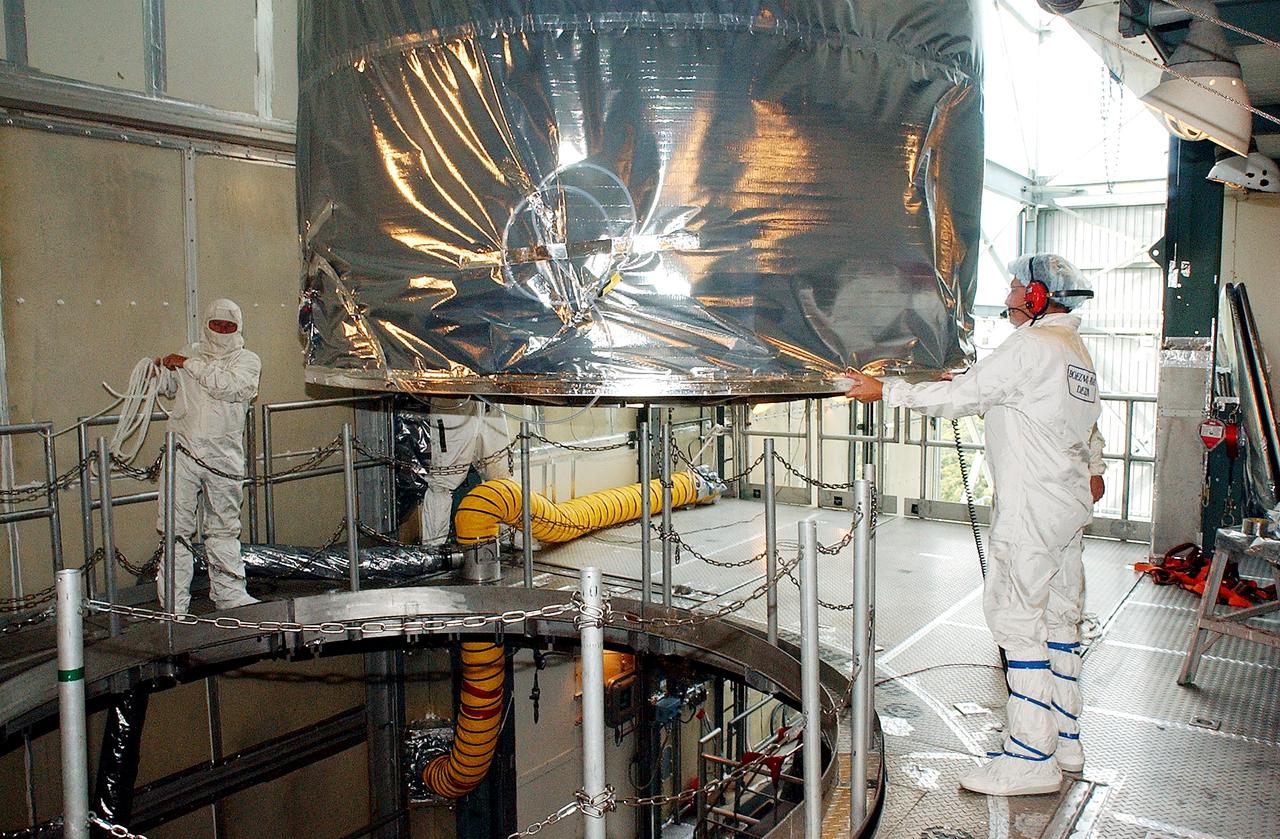
KENNEDY SPACE CENTER, FLA.  - Workers at Hangar A&E, Cape Canaveral Air Force Station, lower the upper canister toward the Space Infrared Telescope Facility (SIRTF) below.  After encapsulation is complete, the spacecraft will be transported to Launch Complex 17-B for mating with its launch vehicle, the Delta II rocket.   SIRTF consists of three cryogenically cooled science instruments and an 0.85-meter telescope, and is one of NASA's largest infrared telescopes to be launched.  SIRTF will obtain images and spectra by detecting the infrared energy, or heat, radiated by objects in space. Most of this infrared radiation is blocked by the Earth's atmosphere and cannot be observed from the ground.
KENNEDY SPACE CENTER, FLA. - Workers at Hangar A&E, Cape Canaveral Air Force Station, lower the upper canister toward the Space Infrared Telescope Facility (SIRTF) below. After encapsulation is complete, the spacecraft will be transported to Launch Complex 17-B for mating with its launch vehicle, the Delta II rocket. SIRTF consists of three cryogenically cooled science instruments and an 0.85-meter telescope, and is one of NASA's largest infrared telescopes to be launched. SIRTF will obtain images and spectra by detecting the infrared energy, or heat, radiated by objects in space. Most of this infrared radiation is blocked by the Earth's atmosphere and cannot be observed from the ground.
KENNEDY SPACE CENTER, FLA.  -  Working from a stand, technicians fasten the upper portion of the canister to the middle panels around the Space Infrared Telescope Facility (SIRTF).  The spacecraft will be transported to Launch Complex 17-B for mating with its launch vehicle, the Delta II rocket.   SIRTF consists of three cryogenically cooled science instruments and an 0.85-meter telescope, and is one of NASA's largest infrared telescopes to be launched.  SIRTF will obtain images and spectra by detecting the infrared energy, or heat, radiated by objects in space. Most of this infrared radiation is blocked by the Earth's atmosphere and cannot be observed from the ground.
KENNEDY SPACE CENTER, FLA. - Working from a stand, technicians fasten the upper portion of the canister to the middle panels around the Space Infrared Telescope Facility (SIRTF). The spacecraft will be transported to Launch Complex 17-B for mating with its launch vehicle, the Delta II rocket. SIRTF consists of three cryogenically cooled science instruments and an 0.85-meter telescope, and is one of NASA's largest infrared telescopes to be launched. SIRTF will obtain images and spectra by detecting the infrared energy, or heat, radiated by objects in space. Most of this infrared radiation is blocked by the Earth's atmosphere and cannot be observed from the ground.
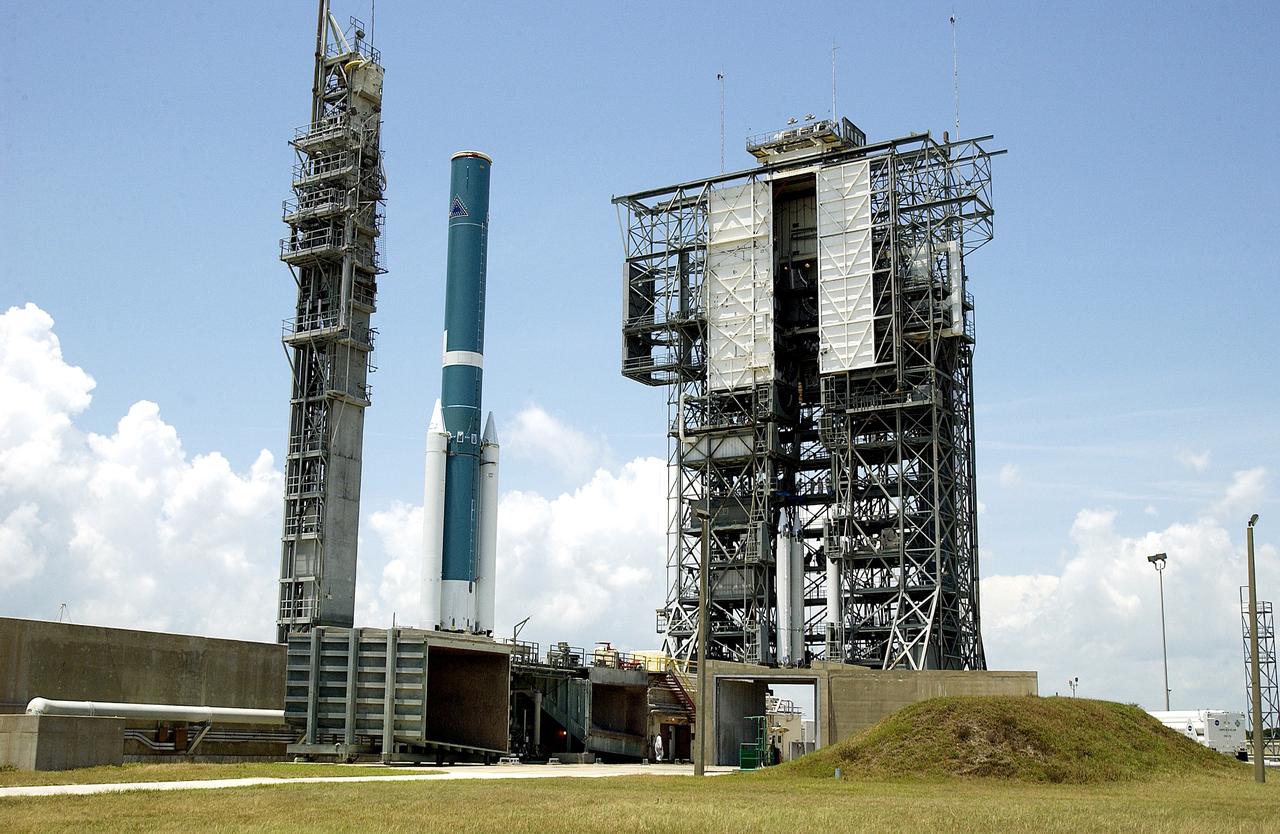
KENNEDY SPACE CENTER, FLA. -   On Launch Complex 17-B, Cape Canaveral Air Force Station, the Delta II Heavy rocket waits the arrival of the mobile service tower with three additional solid rocket boosters (SRBs).  Nine 46-inch-diameter, stretched SRBs will help launch the Space Infrared Telescope Facility (SIRTF).  Consisting of three cryogenically cooled science instruments and an 0.85-meter telescope, SIRTF is one of NASA's largest infrared telescopes to be launched.  SIRTF will obtain images and spectra by detecting the infrared energy, or heat, radiated by objects in space. Most of this infrared radiation is blocked by the Earth's atmosphere and cannot be observed from the ground.
KENNEDY SPACE CENTER, FLA. - On Launch Complex 17-B, Cape Canaveral Air Force Station, the Delta II Heavy rocket waits the arrival of the mobile service tower with three additional solid rocket boosters (SRBs). Nine 46-inch-diameter, stretched SRBs will help launch the Space Infrared Telescope Facility (SIRTF). Consisting of three cryogenically cooled science instruments and an 0.85-meter telescope, SIRTF is one of NASA's largest infrared telescopes to be launched. SIRTF will obtain images and spectra by detecting the infrared energy, or heat, radiated by objects in space. Most of this infrared radiation is blocked by the Earth's atmosphere and cannot be observed from the ground.
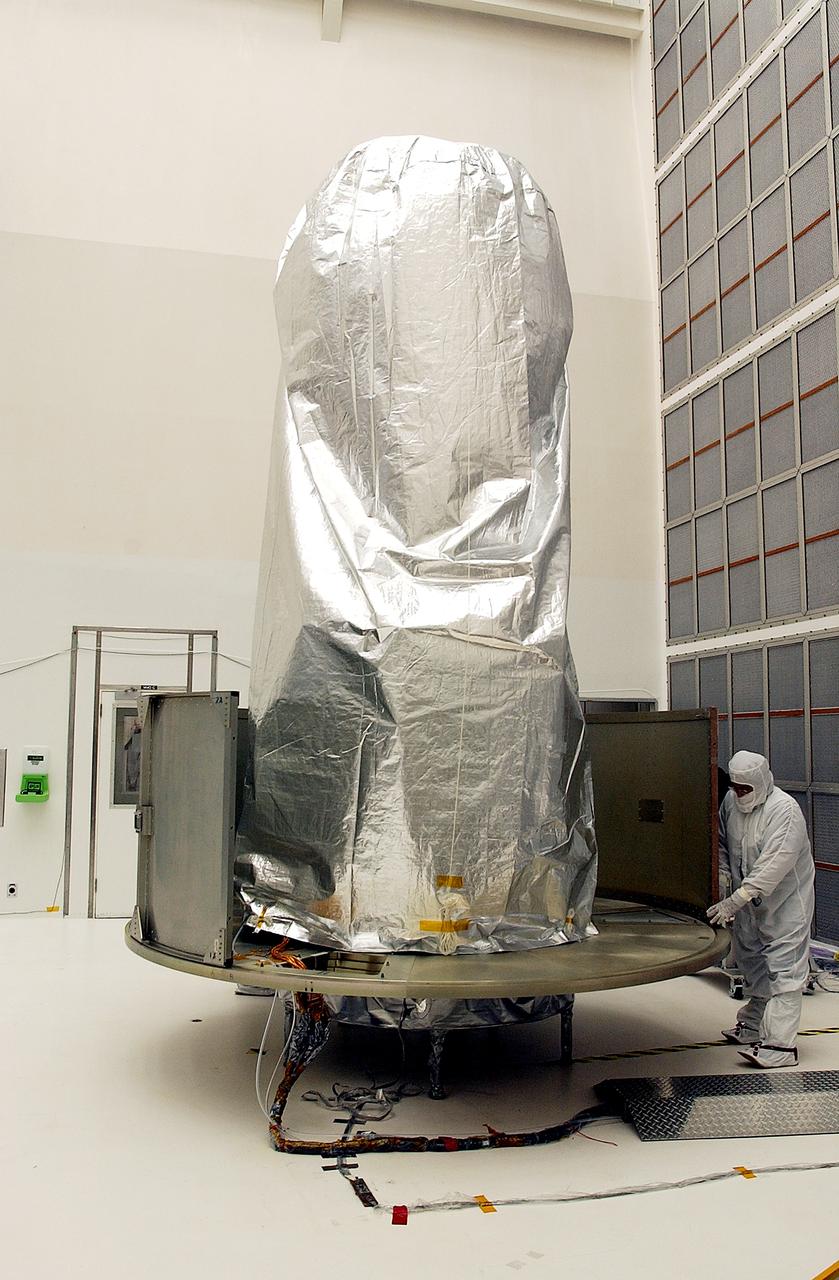
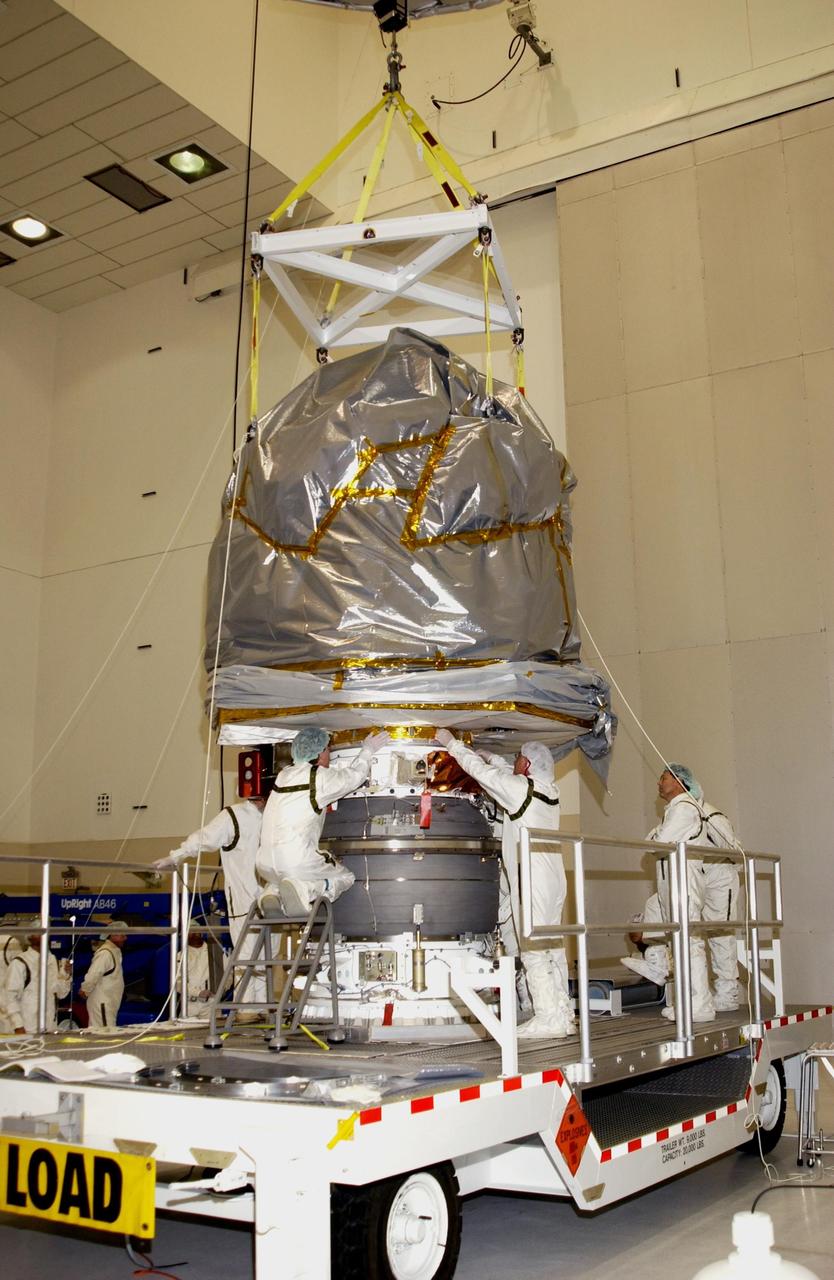
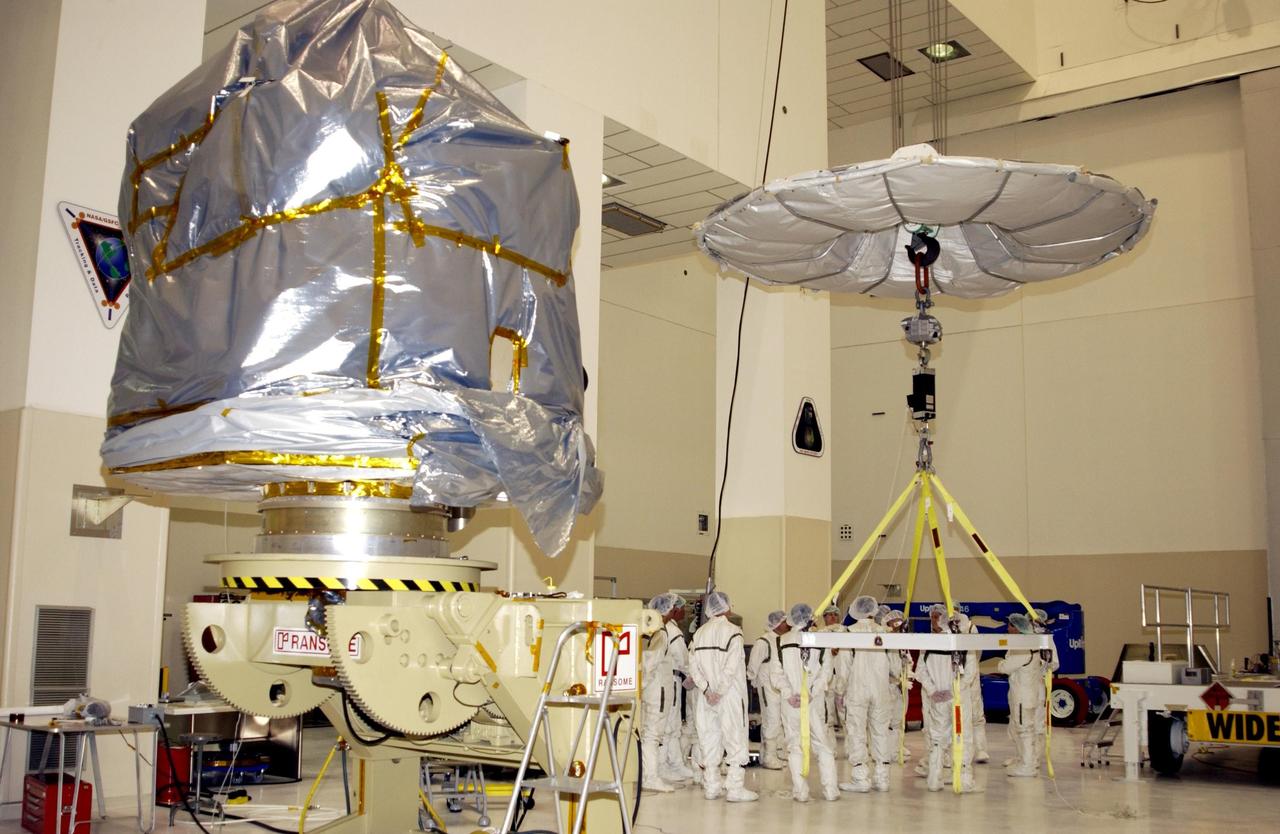
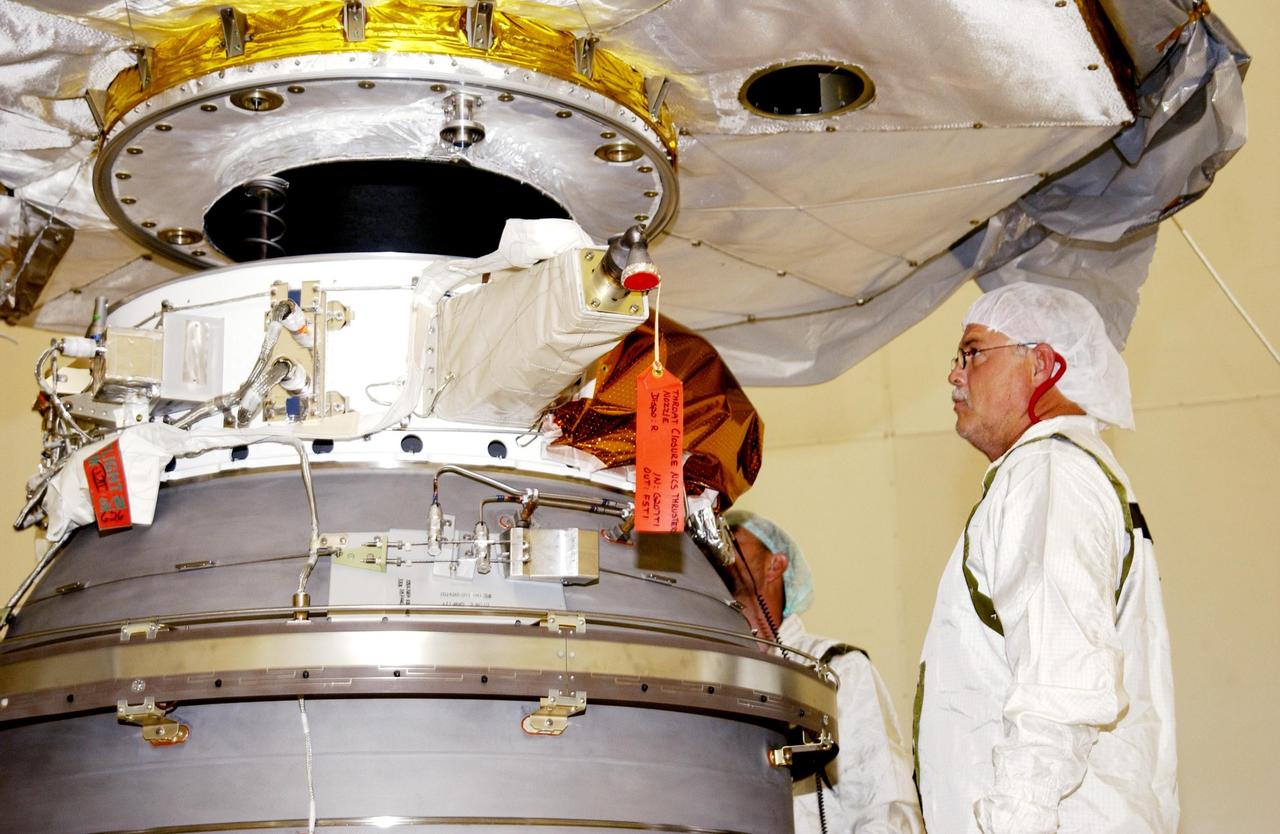
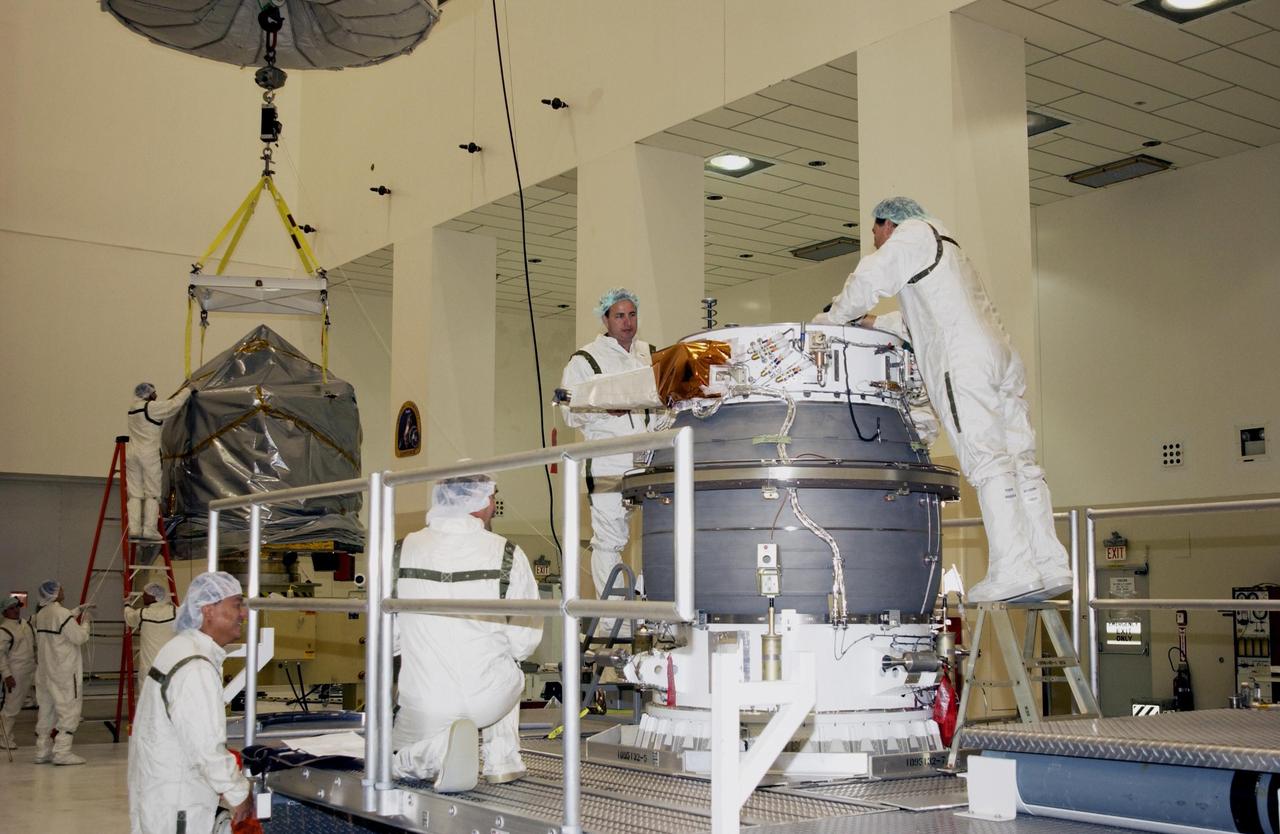
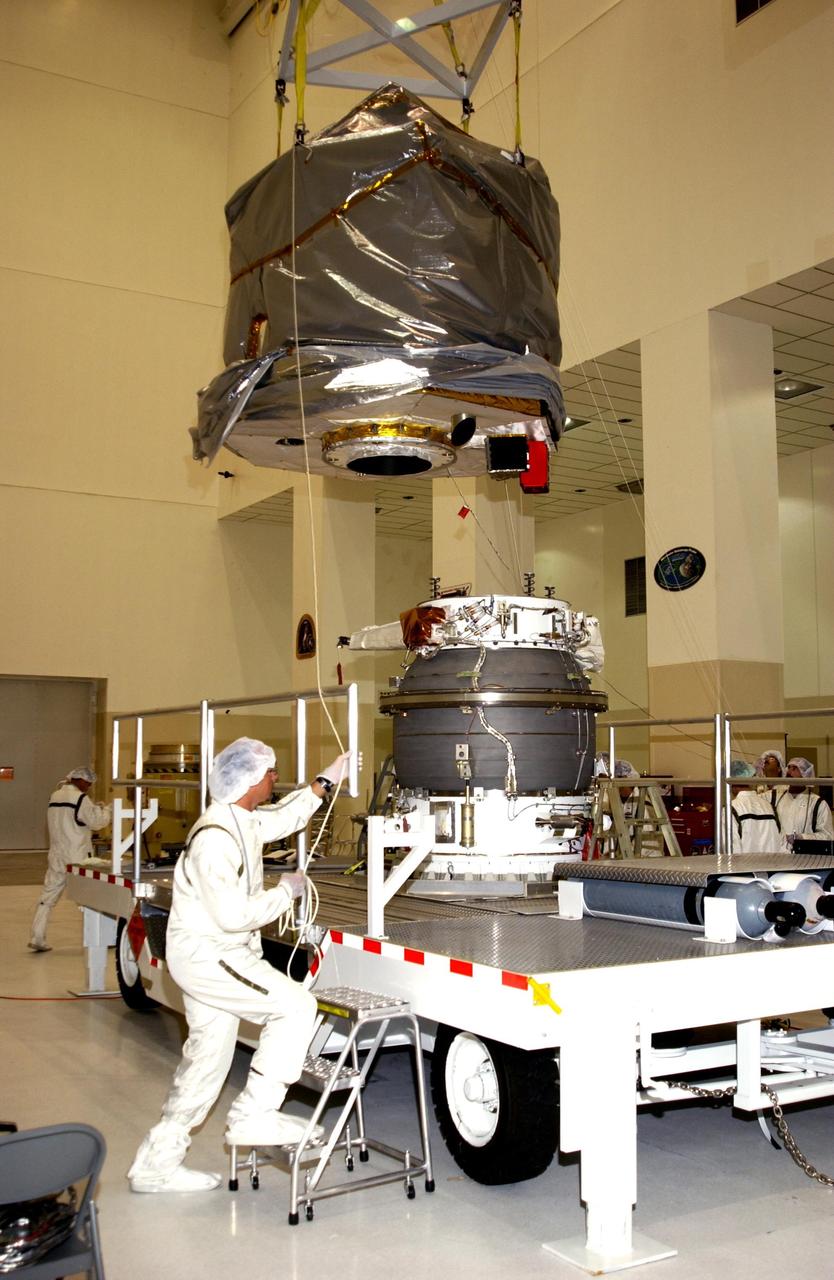
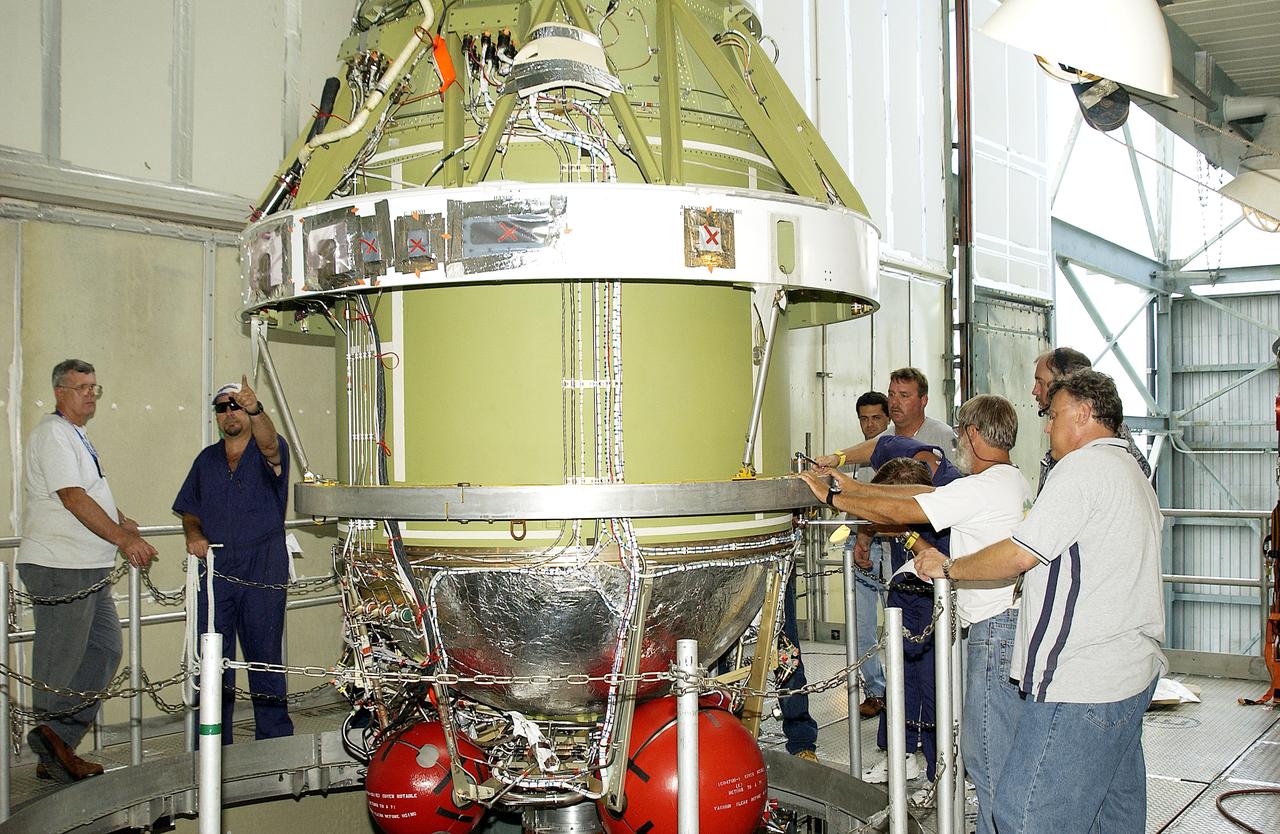
KENNEDY SPACE CENTER, FLA. --  In the Space Assembly and Encapsulation Facility 2 (SAEF-2), the Comet Nucleus Tour (CONTOUR) spacecraft (left) is wrapped and ready for the crane at right to carry it to the upper stage of a Boeing Delta II rocket for mating.  CONTOUR will provide the first detailed look into the heart of a comet -- the nucleus. Flying as close as 60 miles (100 kilometers) to at least two comets, the spacecraft will take the sharpest pictures yet of a nucleus while analyzing the gas and dust that surround these rocky, icy building blocks of the solar system.  Launch of CONTOUR aboard the Delta II is scheduled for July 1, 2002, from Launch Complex 17-A, Cape Canaveral Air Force Station
KSC-02pd1002
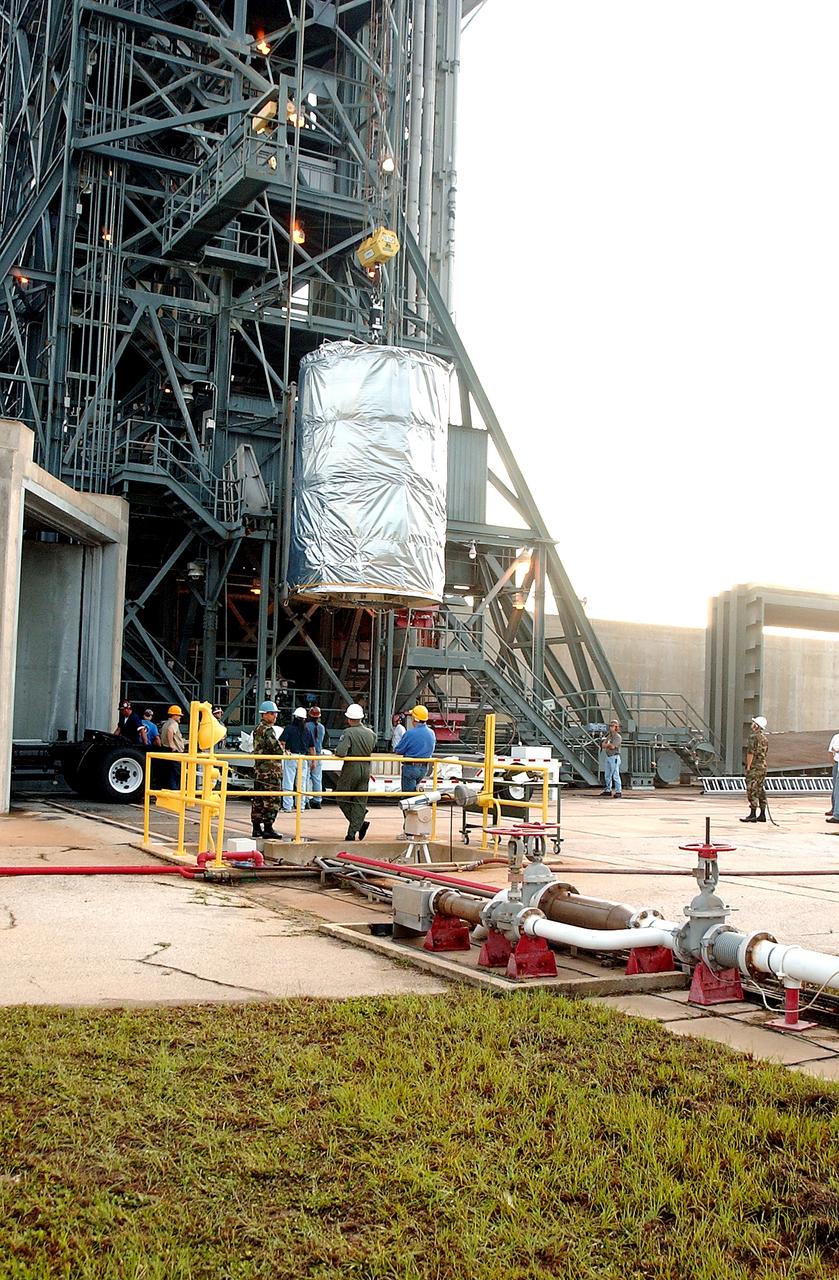
KENNEDY SPACE CENTER, FLA. - Workers maneuver another solid rocket booster that will be mated with the Delta II rocket in the background. The Delta II will launch the Space Infrared Telescope Facility. The second stage will later be hoisted atop the first stage.  SIRTF will obtain images and spectra by detecting the infrared energy, or heat, radiated by objects in space. Most of this infrared radiation is blocked by the Earth's atmosphere and cannot be observed from the ground. Consisting of an 0.85-meter telescope and three cryogenically cooled science instruments, SIRTF is one of NASA's largest infrared telescopes to be launched.
KSC-03pd0649
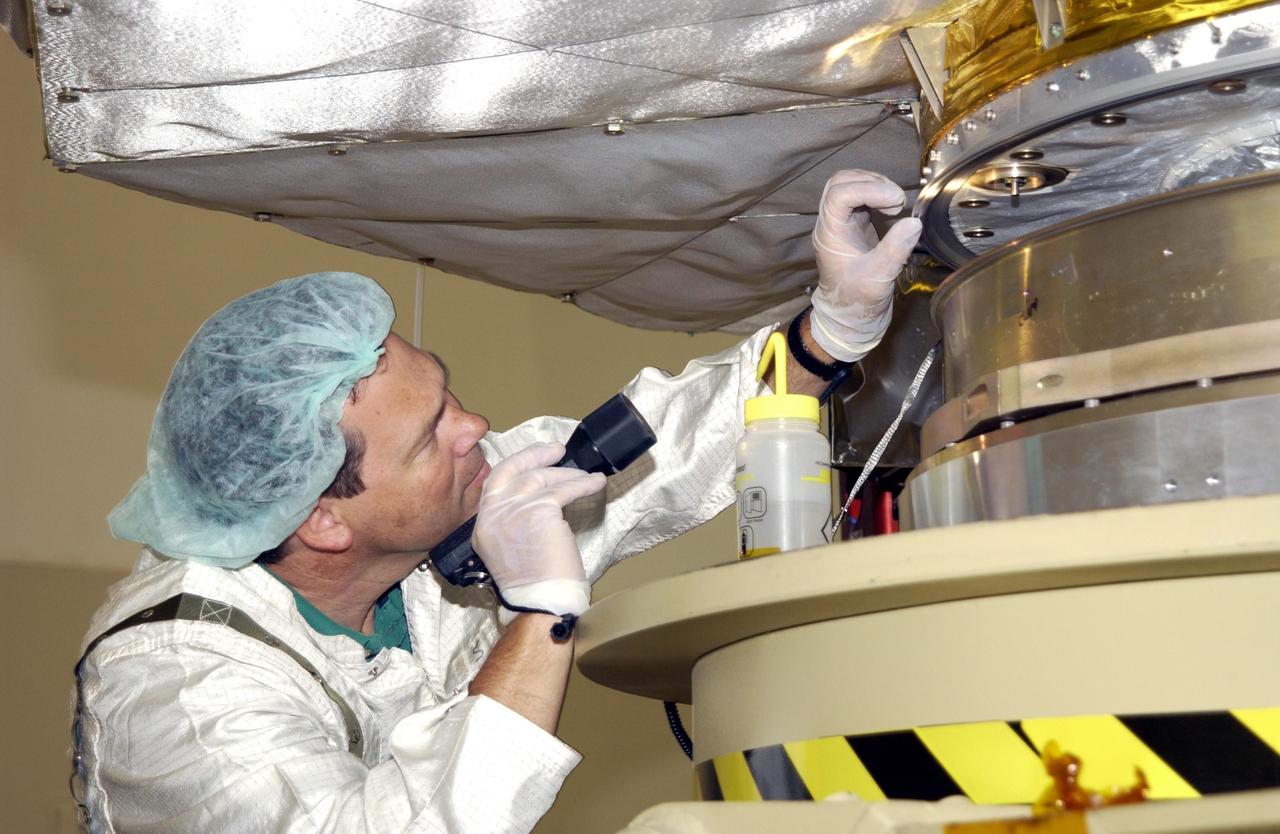
KENNEDY SPACE CENTER, FLA. -- A worker in the Space Assembly and Encapsulation Facility 2 (SAEF-2) checks the base of the Comet Nucleus Tour (CONTOUR) spacecraft before it is moved for mating with the upper stage of a Boeing Delta II rocket. CONTOUR will provide the first detailed look into the heart of a comet -- the nucleus. Flying as close as 60 miles (100 kilometers) to at least two comets, the spacecraft will take the sharpest pictures yet of a nucleus while analyzing the gas and dust that surround these rocky, icy building blocks of the solar system.  Launch of CONTOUR aboard the Delta II is scheduled for July 1, 2002, from Launch Complex 17-A, Cape Canaveral Air Force Station
KSC-02pd1006
KENNEDY SPACE CENTER, FLA. -- In the Space Assembly and Encapsulation Facility 2 (SAEF-2), workers at right prepare the upper stage of a Boeing Delta II rocket for mating with the Comet Nucleus Tour (CONTOUR) spacecraft at left. CONTOUR will provide the first detailed look into the heart of a comet -- the nucleus. Flying as close as 60 miles (100 kilometers) to at least two comets, the spacecraft will take the sharpest pictures yet of a nucleus while analyzing the gas and dust that surround these rocky, icy building blocks of the solar system.  Launch of CONTOUR aboard the Delta II is scheduled for July 1, 2002, from Launch Complex 17-A, Cape Canaveral Air Force Station
KSC-02pd1004
KENNEDY SPACE CENTER, FLA. - The Delta II rocket on Launch Complex 17-B, Cape Canaveral Air Force Station, waits for additional solid rocket boosters to be mated.  The Delta II will launch the Space Infrared Telescope Facility. The second stage will later be hoisted atop the first stage.  SIRTF will obtain images and spectra by detecting the infrared energy, or heat, radiated by objects in space. Most of this infrared radiation is blocked by the Earth's atmosphere and cannot be observed from the ground. Consisting of an 0.85-meter telescope and three cryogenically cooled science instruments, SIRTF is one of NASA's largest infrared telescopes to be launched.
KSC-03pd0648
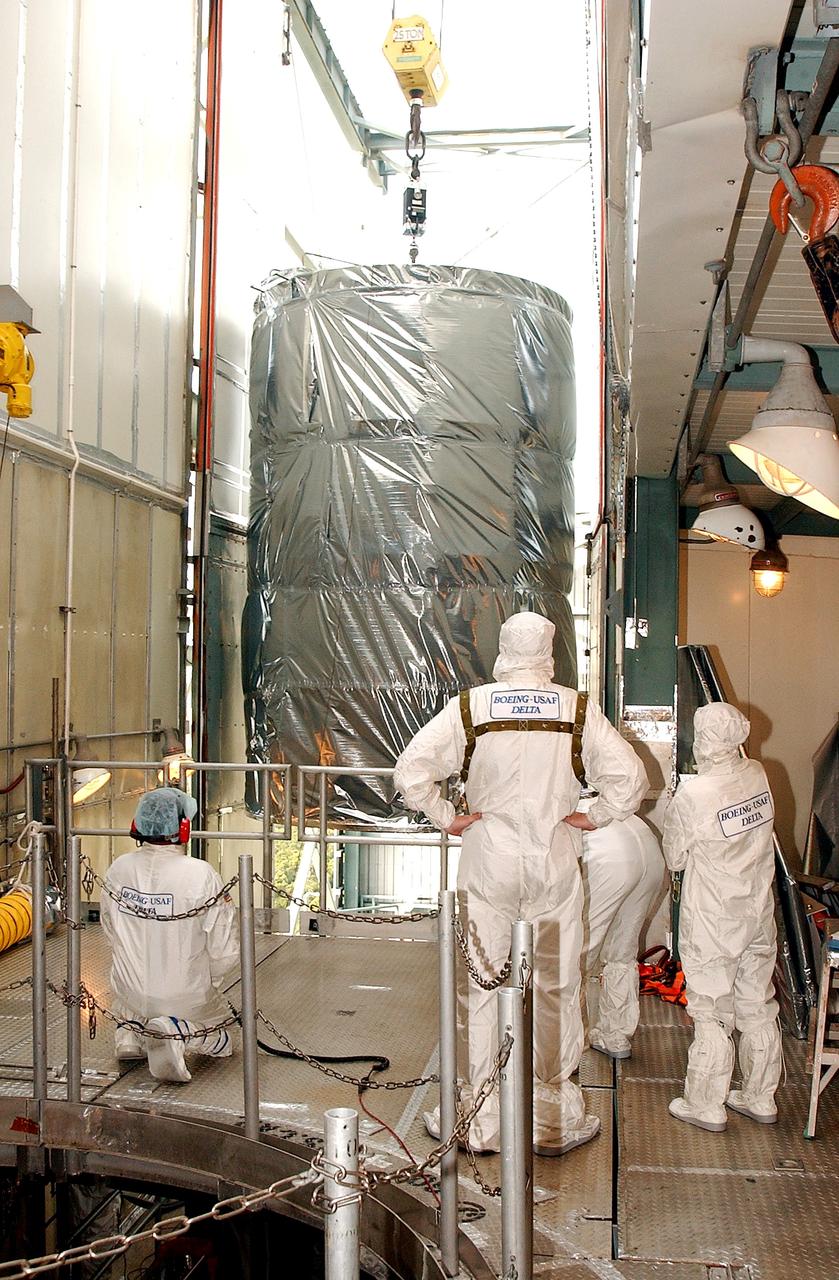
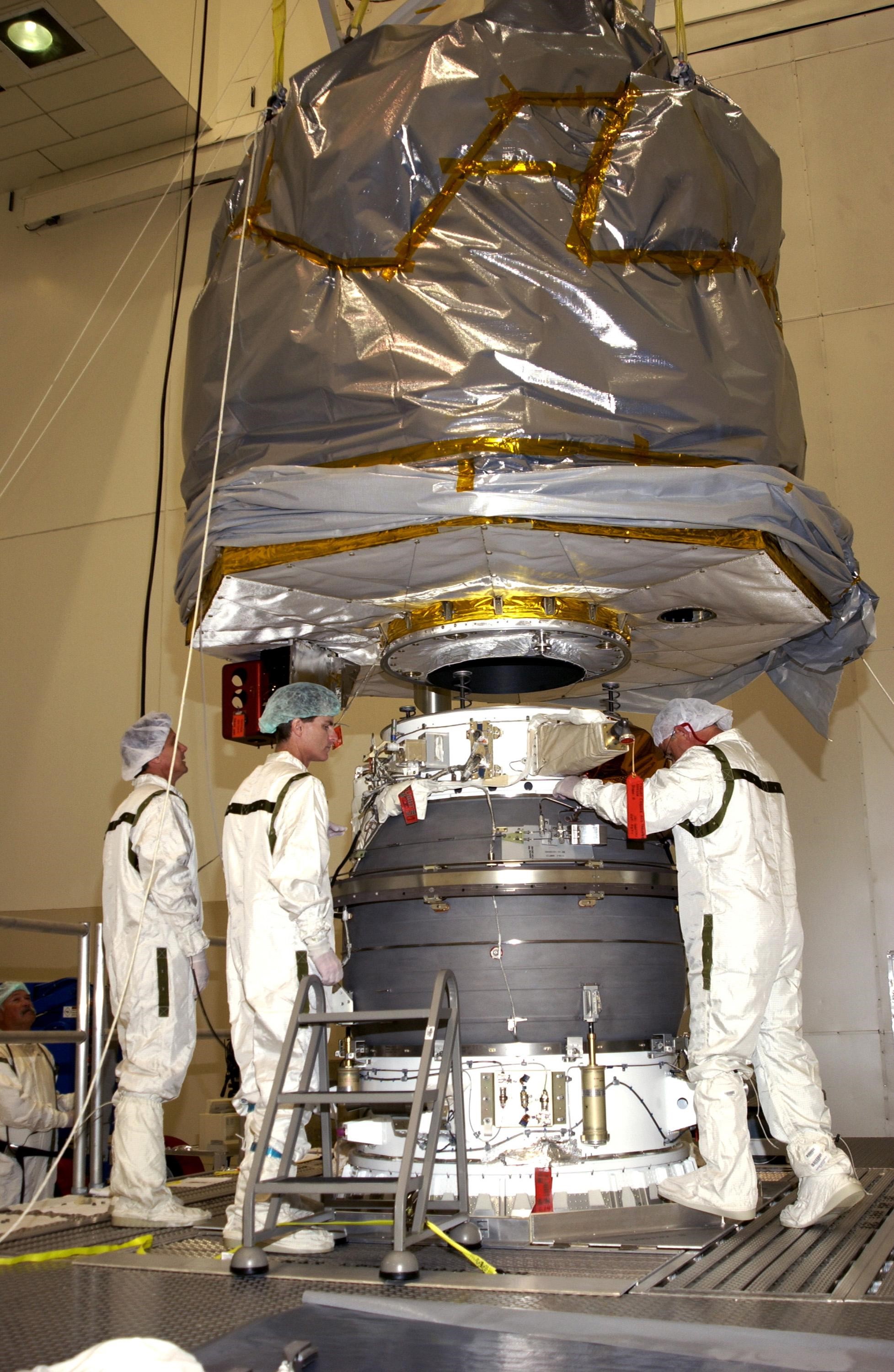
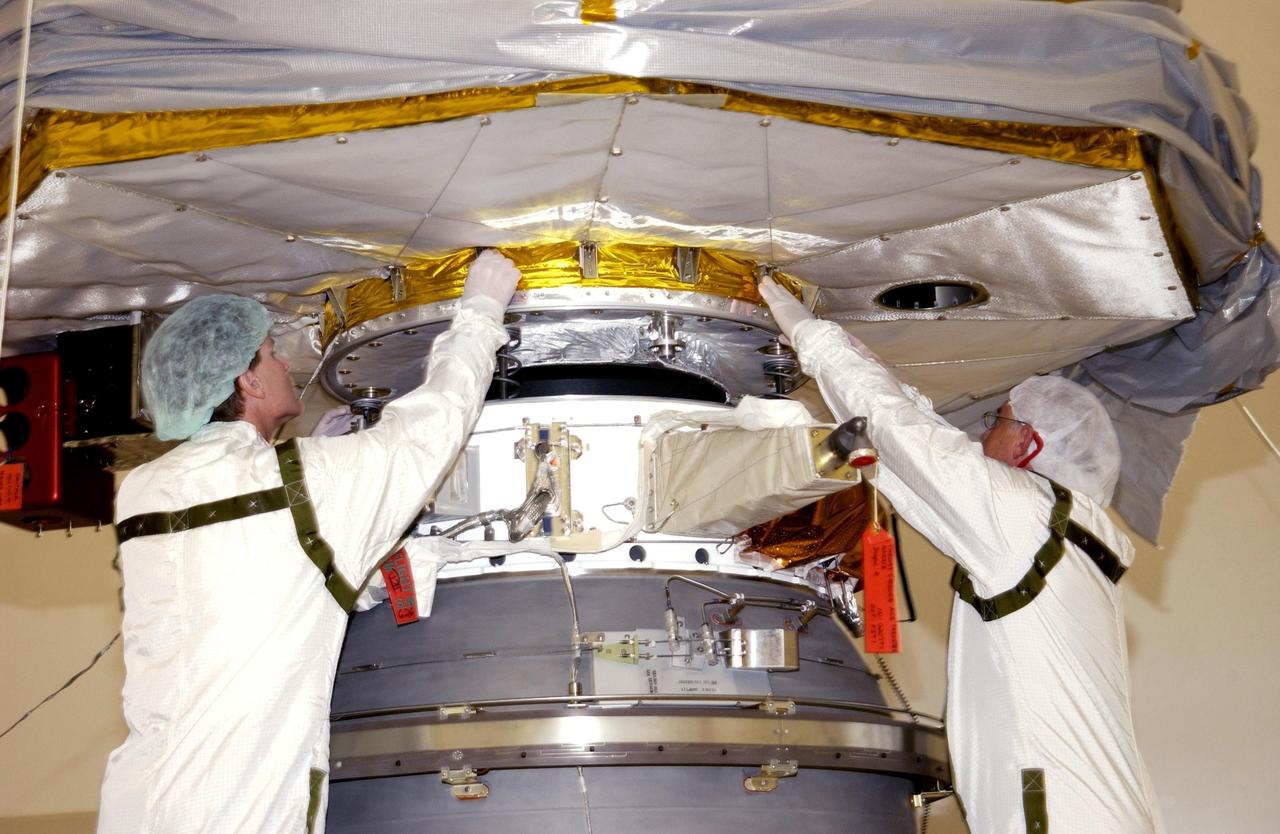
KENNEDY SPACE CENTER, FLA. --  As the Comet Nucleus Tour (CONTOUR) spacecraft is lowered toward the upper stage of a Boeing Delta II rocket, a worker keeps close watch.  The two components are being mated for launch. CONTOUR will provide the first detailed look into the heart of a comet -- the nucleus. Flying as close as 60 miles (100 kilometers) to at least two comets, the spacecraft will take the sharpest pictures yet of a nucleus while analyzing the gas and dust that surround these rocky, icy building blocks of the solar system.  Launch of CONTOUR aboard the Delta II is scheduled for July 1, 2002, from Launch Complex 17-A, Cape Canaveral Air Force Station
KSC-02pd1009
KENNEDY SPACE CENTER, FLA. --  Workers check the progress of the Comet Nucleus Tour (CONTOUR) spacecraft as it is lowered toward the upper stage of a Boeing Delta II rocket for mating. CONTOUR will provide the first detailed look into the heart of a comet -- the nucleus. Flying as close as 60 miles (100 kilometers) to at least two comets, the spacecraft will take the sharpest pictures yet of a nucleus while analyzing the gas and dust that surround these rocky, icy building blocks of the solar system.  Launch of CONTOUR aboard the Delta II is scheduled for July 1, 2002, from Launch Complex 17-A, Cape Canaveral Air Force Station
KSC-02pd1010
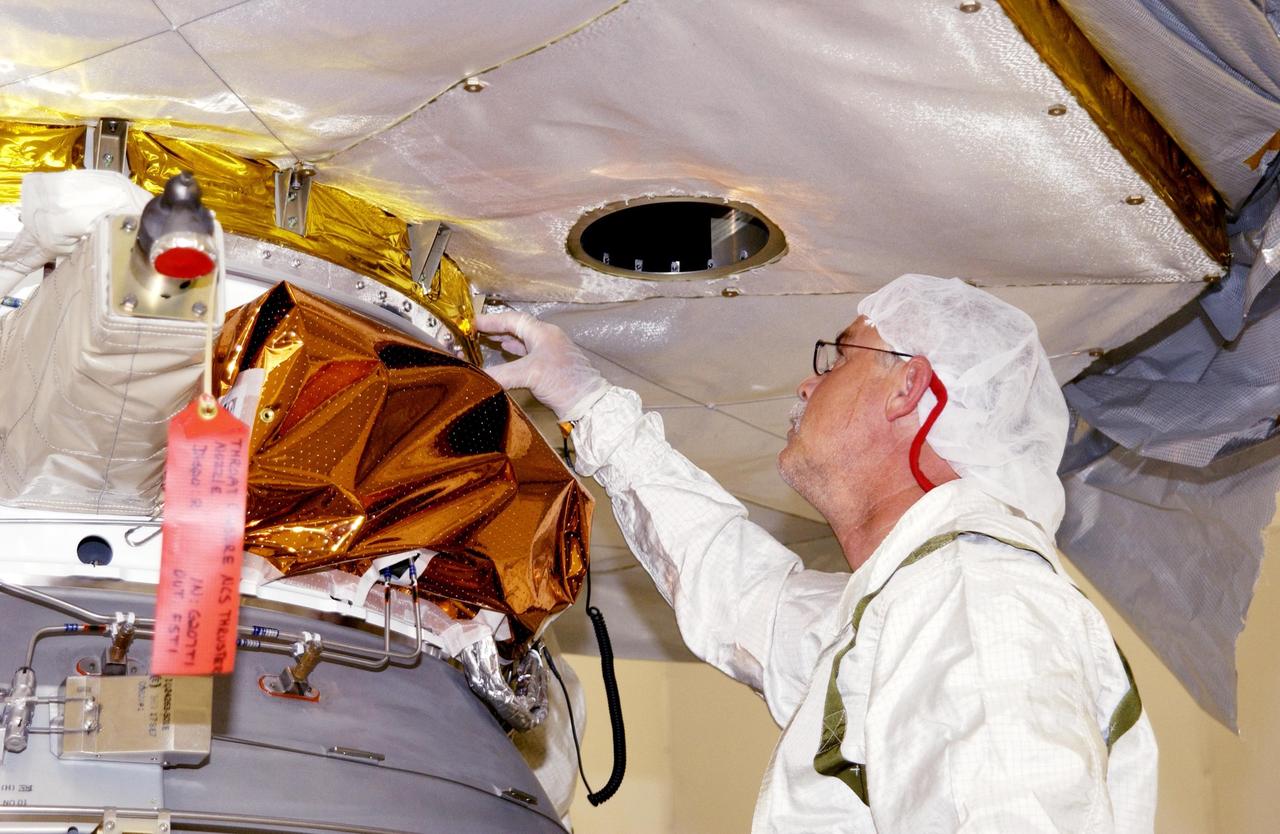
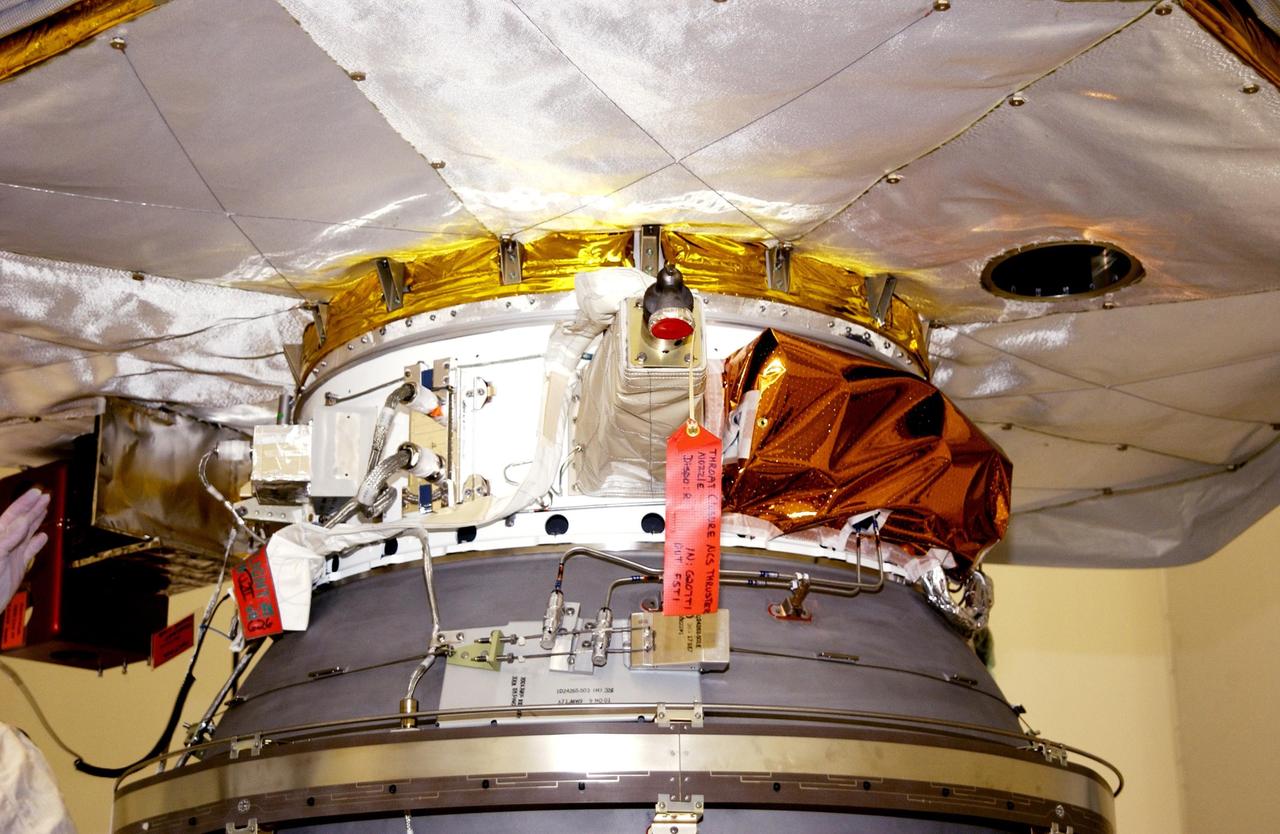
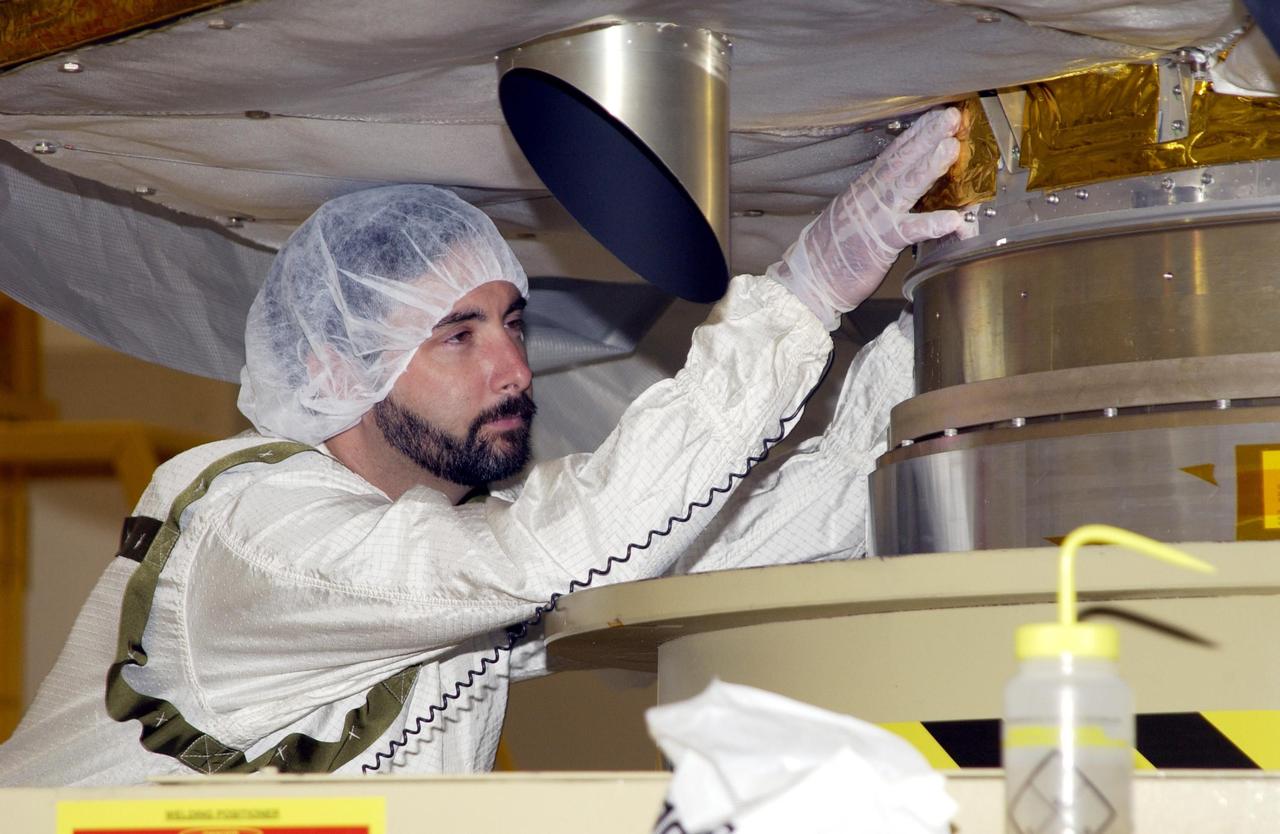
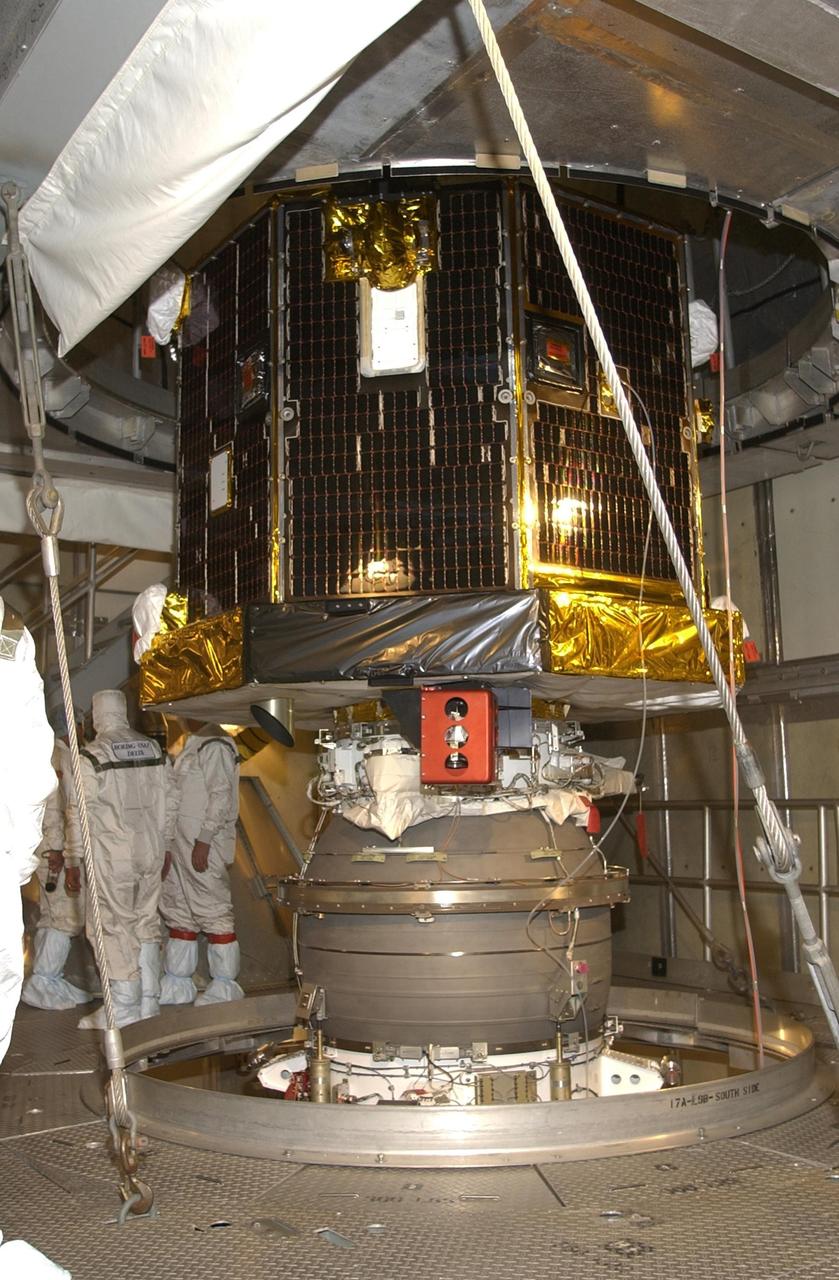
KENNEDY SPACE CENTER, FLA. -- The Comet Nucleus Tour (CONTOUR) spacecraft is mated to the upper stage of a Boeing Delta II rocket in the Space Assembly and Encapsulation Facility 2 (SAEF-2).  CONTOUR will provide the first detailed look into the heart of a comet -- the nucleus. Flying as close as 60 miles (100 kilometers) to at least two comets, the spacecraft will take the sharpest pictures yet of a nucleus while analyzing the gas and dust that surround these rocky, icy building blocks of the solar system.  Launch of CONTOUR aboard the Delta II is scheduled for July 1, 2002, from Launch Complex 17-A, Cape Canaveral Air Force Station
KSC-02pd1015
KENNEDY SPACE CENTER, FLA. - In the Space Assembly and Encapsulation Facility 2 (SAEF-2), the Comet Nucleus Tour (CONTOUR) spacecraft (top) is moved toward the upper stage of a Boeing Delta II rocket.  The two will be mated for launch. CONTOUR will provide the first detailed look into the heart of a comet -- the nucleus. Flying as close as 60 miles (100 kilometers) to at least two comets, the spacecraft will take the sharpest pictures yet of a nucleus while analyzing the gas and dust that surround these rocky, icy building blocks of the solar system.  Launch of CONTOUR aboard the Delta II is scheduled for July 1, 2002, from Launch Complex 17-A, Cape Canaveral Air Force Station
KSC-02pd1007
KENNEDY SPACE CENTER, FLA. -- This view looks down on two of the nine solid rocket boosters that will be mated with the Delta II rocket on Launch Complex 17-B, Cape Canaveral Air Force Station. The Delta II will launch the Space Infrared Telescope Facility. The second stage will later be hoisted atop the first stage.  SIRTF will obtain images and spectra by detecting the infrared energy, or heat, radiated by objects in space. Most of this infrared radiation is blocked by the Earth's atmosphere and cannot be observed from the ground. Consisting of an 0.85-meter telescope and three cryogenically cooled science instruments, SIRTF is one of NASA's largest infrared telescopes to be launched.
KSC-03pd0651
KENNEDY SPACE CENTER, FLA. -- Workers help guide the Comet Nucleus Tour (CONTOUR) spacecraft as it is lowered toward the upper stage of a Boeing Delta II rocket for mating. CONTOUR will provide the first detailed look into the heart of a comet -- the nucleus. Flying as close as 60 miles (100 kilometers) to at least two comets, the spacecraft will take the sharpest pictures yet of a nucleus while analyzing the gas and dust that surround these rocky, icy building blocks of the solar system.  Launch of CONTOUR aboard the Delta II is scheduled for July 1, 2002, from Launch Complex 17-A, Cape Canaveral Air Force Station
KSC-02pd1011
KENNEDY SPACE CENTER, FLA. --  This view looks down on two of the nine solid rocket boosters that will be mated with the Delta II rocket on Launch Complex 17-B, Cape Canaveral Air Force Station. The Delta II will launch the Space Infrared Telescope Facility. The second stage will later be hoisted atop the first stage.  SIRTF will obtain images and spectra by detecting the infrared energy, or heat, radiated by objects in space. Most of this infrared radiation is blocked by the Earth's atmosphere and cannot be observed from the ground. Consisting of an 0.85-meter telescope and three cryogenically cooled science instruments, SIRTF is one of NASA's largest infrared telescopes to be launched.
KSC-03pd0650
KENNEDY SPACE CENTER, FLA. - On Launch Complex 17-B, Cape Canaveral Air Force Station, workers prepare another solid rocket booster that will be mated with the Delta II rocket in the background. The Delta II will launch the Space Infrared Telescope Facility. The second stage will later be hoisted atop the first stage.  SIRTF will obtain images and spectra by detecting the infrared energy, or heat, radiated by objects in space. Most of this infrared radiation is blocked by the Earth's atmosphere and cannot be observed from the ground. Consisting of an 0.85-meter telescope and three cryogenically cooled science instruments, SIRTF is one of NASA's largest infrared telescopes to be launched.
KSC-03pd0652
KENNEDY SPACE CENTER, FLA. -- - In the Space Assembly and Encapsulation Facility 2 (SAEF-2), an overhead crane lowers the Comet Nucleus Tour (CONTOUR) spacecraft toward the upper stage of a Boeing Delta II rocket.  The two will be mated for launch. CONTOUR will provide the first detailed look into the heart of a comet -- the nucleus. Flying as close as 60 miles (100 kilometers) to at least two comets, the spacecraft will take the sharpest pictures yet of a nucleus while analyzing the gas and dust that surround these rocky, icy building blocks of the solar system.  Launch of CONTOUR aboard the Delta II is scheduled for July 1, 2002, from Launch Complex 17-A, Cape Canaveral Air Force Station
KSC-02pd1008
KENNEDY SPACE CENTER, FLA. -- Workers gather around the Comet Nucleus Tour (CONTOUR) spacecraft as it is lowered toward the upper stage of a Boeing Delta II rocket for mating. CONTOUR will provide the first detailed look into the heart of a comet -- the nucleus. Flying as close as 60 miles (100 kilometers) to at least two comets, the spacecraft will take the sharpest pictures yet of a nucleus while analyzing the gas and dust that surround these rocky, icy building blocks of the solar system.  Launch of CONTOUR aboard the Delta II is scheduled for July 1, 2002, from Launch Complex 17-A, Cape Canaveral Air Force Station
KSC-02pd1012
KENNEDY SPACE CENTER, FLA. -- Workers help guide the Comet Nucleus Tour (CONTOUR) spacecraft as it is lowered onto the upper stage of a Boeing Delta II rocket for mating. CONTOUR will provide the first detailed look into the heart of a comet -- the nucleus. Flying as close as 60 miles (100 kilometers) to at least two comets, the spacecraft will take the sharpest pictures yet of a nucleus while analyzing the gas and dust that surround these rocky, icy building blocks of the solar system.  Launch of CONTOUR aboard the Delta II is scheduled for July 1, 2002, from Launch Complex 17-A, Cape Canaveral Air Force Station
KSC-02pd1013
KENNEDY SPACE CENTER, FLA. --  A worker in the Space Assembly and Encapsulation Facility 2 (SAEF-2) checks the base of the Comet Nucleus Tour (CONTOUR) spacecraft before it is moved for mating with the upper stage of a Boeing Delta II rocket. CONTOUR will provide the first detailed look into the heart of a comet -- the nucleus. Flying as close as 60 miles (100 kilometers) to at least two comets, the spacecraft will take the sharpest pictures yet of a nucleus while analyzing the gas and dust that surround these rocky, icy building blocks of the solar system.  Launch of CONTOUR aboard the Delta II is scheduled for July 1, 2002, from Launch Complex 17-A, Cape Canaveral Air Force Station
KSC-02pd1005
KENNEDY SPACE CENTER, FLA. -- A worker checks the fit as the Comet Nucleus Tour (CONTOUR) spacecraft is mated to the upper stage of a Boeing Delta II rocket.  CONTOUR will provide the first detailed look into the heart of a comet -- the nucleus. Flying as close as 60 miles (100 kilometers) to at least two comets, the spacecraft will take the sharpest pictures yet of a nucleus while analyzing the gas and dust that surround these rocky, icy building blocks of the solar system.  Launch of CONTOUR aboard the Delta II is scheduled for July 1, 2002, from Launch Complex 17-A, Cape Canaveral Air Force Station
KSC-02pd1014
KENNEDY SPACE CENTER, FLA. - On Cape Canaveral Air Force Station Pad 17-A, the first stage of a Delta II rocket is lifted to vertical.  The rocket is the launch vehicle for the CONTOUR spacecraft, scheduled to launch July 1. CONTOUR will provide the first detailed look into the heart of a comet -- the nucleus. The spacecraft will fly close to at least two comets, Encke and Schwassmann-Wachmann 3, taking pictures of the nucleus while analyzing the gas and dust that surround these rocky, icy building blocks of the solar system.
KSC-02pd0787
KENNEDY SPACE CENTER, FLA. -- On Cape Canaveral Air Force Station Pad 17-A, the Boeing Delta II rocket is lifted up the gantry. The rocket is the launch vehicle for the CONTOUR spacecraft, scheduled to launch July 1. CONTOUR will provide the first detailed look into the heart of a comet -- the nucleus. The spacecraft will fly close to at least two comets, Encke and Schwassmann-Wachmann 3, taking pictures of the nucleus while analyzing the gas and dust that surround these rocky, icy building blocks of the solar system.
KSC-02pd0789
KENNEDY SPACE CENTER, FLA. --  On Launch Pad 17-A, Cape Canaveral Air Force Station, workers oversee the lifting of the Boeing Delta II rocket into the gantry above. The rocket is the launch vehicle for the CONTOUR spacecraft, scheduled to launch July 1. CONTOUR will provide the first detailed look into the heart of a comet -- the nucleus. The spacecraft will fly close to at least two comets, Encke and Schwassmann-Wachmann 3, taking pictures of the nucleus while analyzing the gas and dust that surround these rocky, icy building blocks of the solar system.
KSC-02pd0792
Marshall Space Flight Center (MSFC) Director Dr. Wernher von Braun (left) with Kennedy Space Center (KSC) Rocco Petrone prior to the January 29, 1964 launch of SA-5, the first Block II configuration of the Saturn I launch vehicle. Petrone played key roles at KSC in the development of Saturn launch facilities before becoming director of launch operations in 1966.
Wernher von Braun
KENNEDY SPACE CENTER, FLA.  - On Cape Canaveral Air Force Station Pad 17-A, workers check the lower portion of the Boeing Delta II rocket as it is lifted off the transporter. The rocket is the launch vehicle for the CONTOUR spacecraft, scheduled to launch July 1. CONTOUR will provide the first detailed look into the heart of a comet -- the nucleus. The spacecraft will fly close to at least two comets, Encke and Schwassmann-Wachmann 3, taking pictures of the nucleus while analyzing the gas and dust that surround these rocky, icy building blocks of the solar system.
KSC-02pd0788
KENNEDY SPACE CENTER, FLA. -- On Launch Pad 17-A, Cape Canaveral Air Force Station, four solid rocket boosters are lifted for mating to a Boeing Delta II rocket. The rocket will be the launch vehicle for the CONTOUR spacecraft, scheduled to launch July 1. CONTOUR will provide the first detailed look into the heart of a comet -- the nucleus. The spacecraft will fly close to at least two comets, Encke and Schwassmann-Wachmann 3, taking pictures of the nucleus while analyzing the gas and dust that surround these rocky, icy building blocks of the solar system.
KSC-02pd0809
KENNEDY SPACE CENTER, FLA. -- On Launch Pad 17-A, Cape Canaveral Air Force Station, a technician works beneath the Boeing Delta II rocket that will be the launch vehicle for the CONTOUR spacecraft, scheduled to launch July 1. CONTOUR will provide the first detailed look into the heart of a comet -- the nucleus. The spacecraft will fly close to at least two comets, Encke and Schwassmann-Wachmann 3, taking pictures of the nucleus while analyzing the gas and dust that surround these rocky, icy building blocks of the solar system.
KSC-02pd0812
KENNEDY SPACE CENTER, FLA. -- On Launch Pad 17-A, Cape Canaveral Air Force Station, the Boeing Delta II rocket is lifted up the gantry. The rocket is the launch vehicle for the CONTOUR spacecraft, scheduled to launch July 1. CONTOUR will provide the first detailed look into the heart of a comet -- the nucleus. The spacecraft will fly close to at least two comets, Encke and Schwassmann-Wachmann 3, taking pictures of the nucleus while analyzing the gas and dust that surround these rocky, icy building blocks of the solar system.
KSC-02pd0793
Workers help guide the second stage of the Delta II Heavy rocket onto the first stage, below. The rocket will launch the Space Infrared Telescope Facility (SIRTF), currently scheduled for mid-August. SIRTF consists of three cryogenically cooled science instruments and an 0.85-meter telescope, and is one of NASA's largest infrared telescopes to be launched. SIRTF will obtain images and spectra by detecting the infrared energy, or heat, radiated by objects in space. Most of this infrared radiation is blocked by the Earth's atmosphere and cannot be observed from the ground.
Delta II - SIRTF Lift and Mate
The second stage of the Delta II Heavy rocket is ready for mating onto the first stage, below. The rocket will launch the Space Infrared Telescope Facility (SIRTF), currently scheduled for mid-August. SIRTF consists of three cryogenically cooled science instruments and an 0.85-meter telescope, and is one of NASA's largest infrared telescopes to be launched. SIRTF will obtain images and spectra by detecting the infrared energy, or heat, radiated by objects in space. Most of this infrared radiation is blocked by the Earth's atmosphere and cannot be observed from the ground.
Delta II - SIRTF Lift and Mate
KENNEDY SPACE CENTER, FLA. --  The Boeing Delta II rocket nears a vertical position as it is lifted from the gantry. The rocket is the launch vehicle for the CONTOUR spacecraft, scheduled to launch July 1. CONTOUR will provide the first detailed look into the heart of a comet -- the nucleus. The spacecraft will fly close to at least two comets, Encke and Schwassmann-Wachmann 3, taking pictures of the nucleus while analyzing the gas and dust that surround these rocky, icy building blocks of the solar system.
KSC-02pd0790
KENNEDY SPACE CENTER, FLA. --  With the container removed, the Comet Nucleus Tour (CONTOUR) spacecraft is ready for fairing encapsulation. CONTOUR will provide the first detailed look into the heart of a comet -- the nucleus. Flying as close as 60 miles (100 kilometers) to at least two comets, the spacecraft will take the sharpest pictures yet of a nucleus while analyzing the gas and dust that surround these rocky, icy building blocks of the solar system.  Launch of CONTOUR aboard a Boeing Delta II rocket is scheduled for July 1, 2002
KSC-02pd1054
KENNEDY SPACE CENTER, FLA. -- On Launch Pad 17-A, Cape Canaveral Air Force Station, four solid rocket boosters are lifted for mating to a Boeing Delta II rocket. The rocket will be the launch vehicle for the CONTOUR spacecraft, scheduled to launch July 1. CONTOUR will provide the first detailed look into the heart of a comet -- the nucleus. The spacecraft will fly close to at least two comets, Encke and Schwassmann-Wachmann 3, taking pictures of the nucleus while analyzing the gas and dust that surround these rocky, icy building blocks of the solar system.
KSC-02pd0810
KENNEDY SPACE CENTER, FLA. -- Workers in the Space Shuttle Main Engine Processing Facility oversee lifting a new Space Shuttle main engine (block 2 engine) off its stand. The engine will be moved to the Orbiter Processing Facility and installed for its first flight on the orbiter Atlantis, on mission STS-104. The Block II Main Engine configuration is manufactured by Boeing Rocketdyne in Canoga Park, Calif., and includes a new Pratt & Whitney high-pressure fuel turbo pump. Engine improvements are managed by NASA’s Marshall Space Flight Center in Huntsville, Ala. Each Space Shuttle Main Engine is 14 feet (4.3 meters) long, weighs about 7,000 pounds (3,175 kilograms), and is 7.5 feet (2.3 meters) in diameter at the end of the nozzle
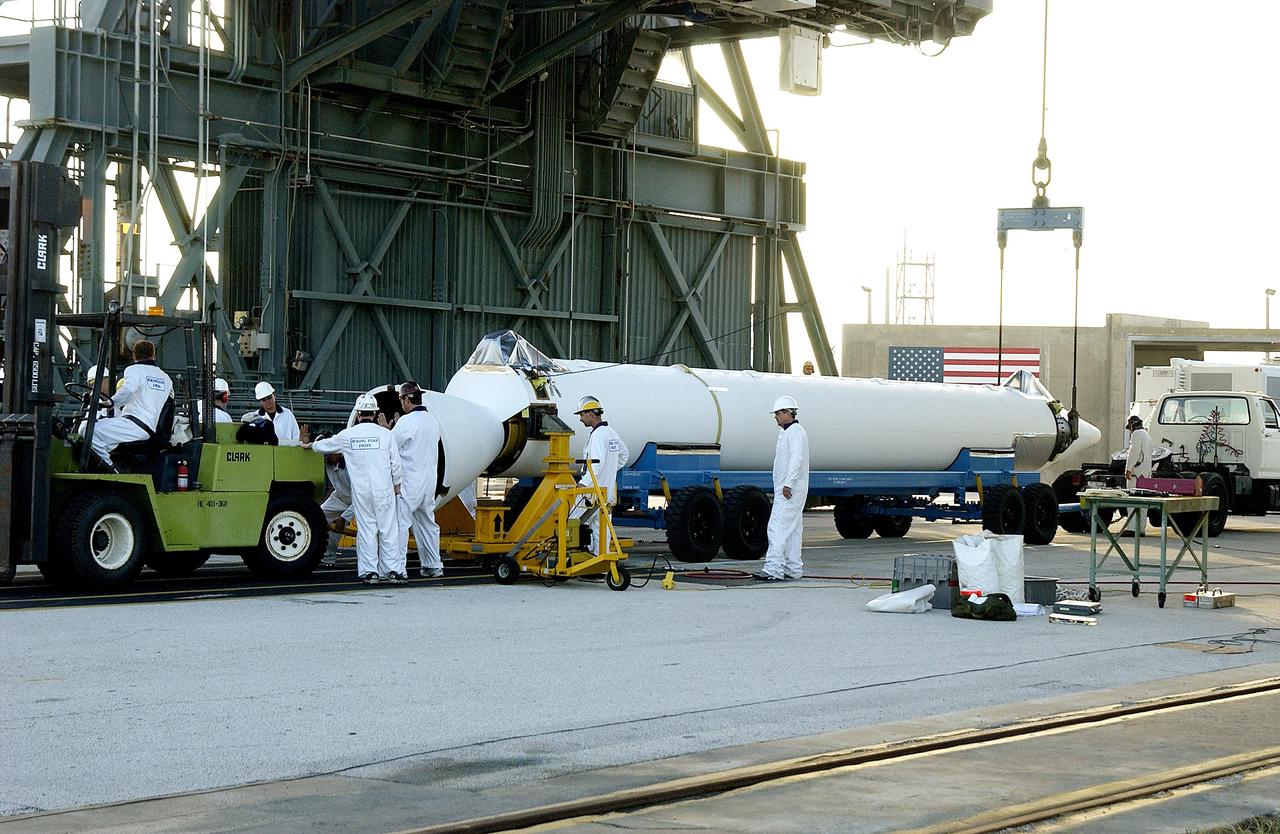
KSC-01pp0896
Workers in the Space Shuttle Main Engine Processing Facility oversee the movement of a new Space Shuttle main engine (block 2 engine) toward the transport vehicle in the foreground. The engine will be moved to the Orbiter Processing Facility and installed for its first flight on the orbiter Atlantis, on mission STS-104. The Block II Main Engine configuration is manufactured by Boeing Rocketdyne in Canoga Park, Calif., and includes a new Pratt & Whitney high-pressure fuel turbo pump. Engine improvements are managed by NASA’s Marshall Space Flight Center in Huntsville, Ala. Each Space Shuttle Main Engine is 14 feet (4.3 meters) long, weighs about 7,000 pounds (3,175 kilograms), and is 7.5 feet (2.3 meters) in diameter at the end of the nozzle. <font
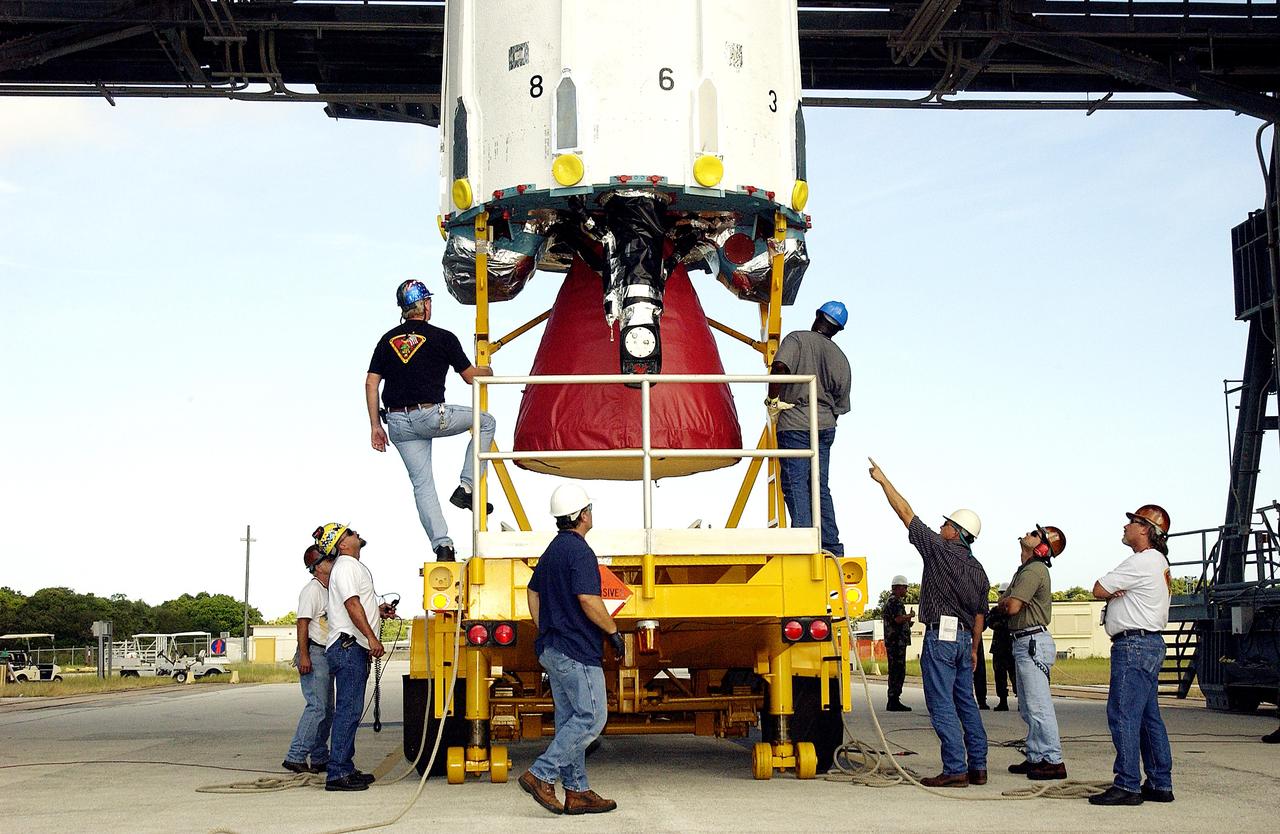
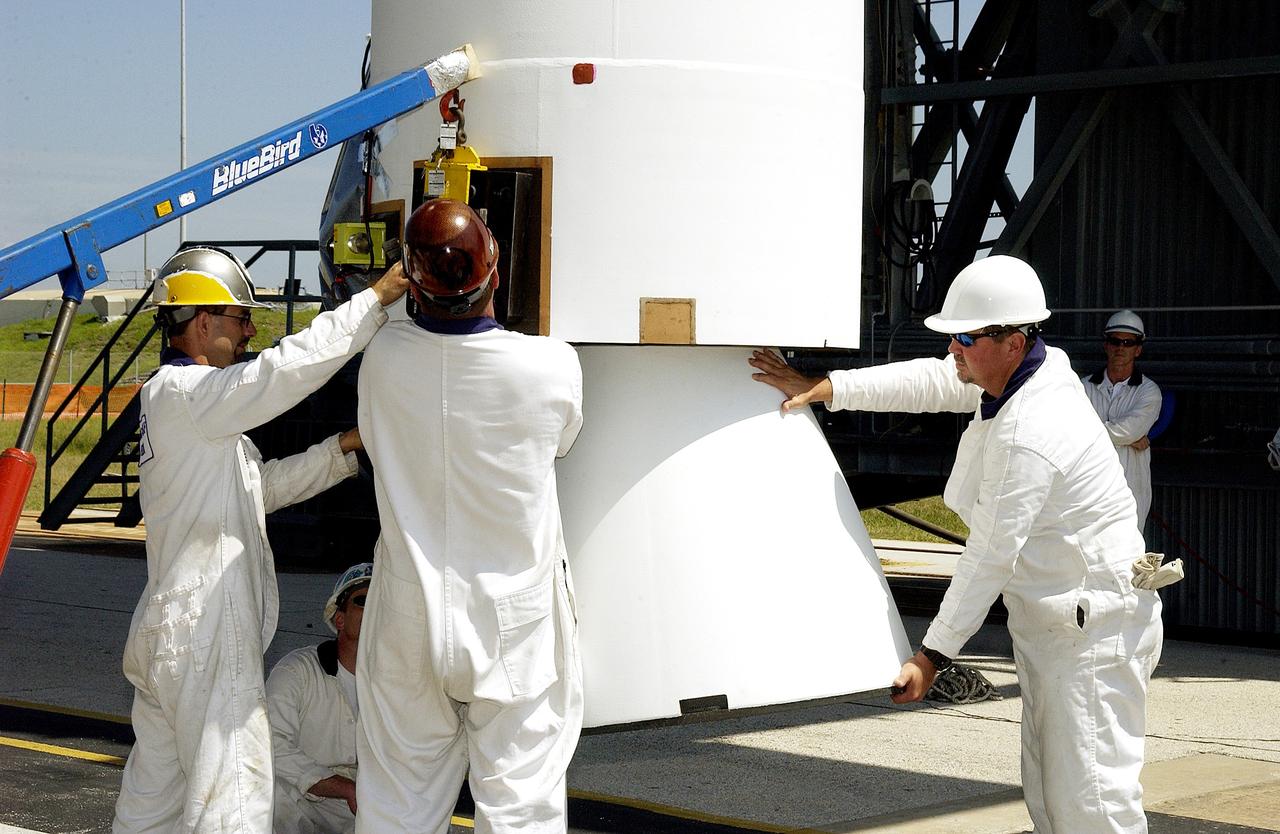
KSC-01pp0897