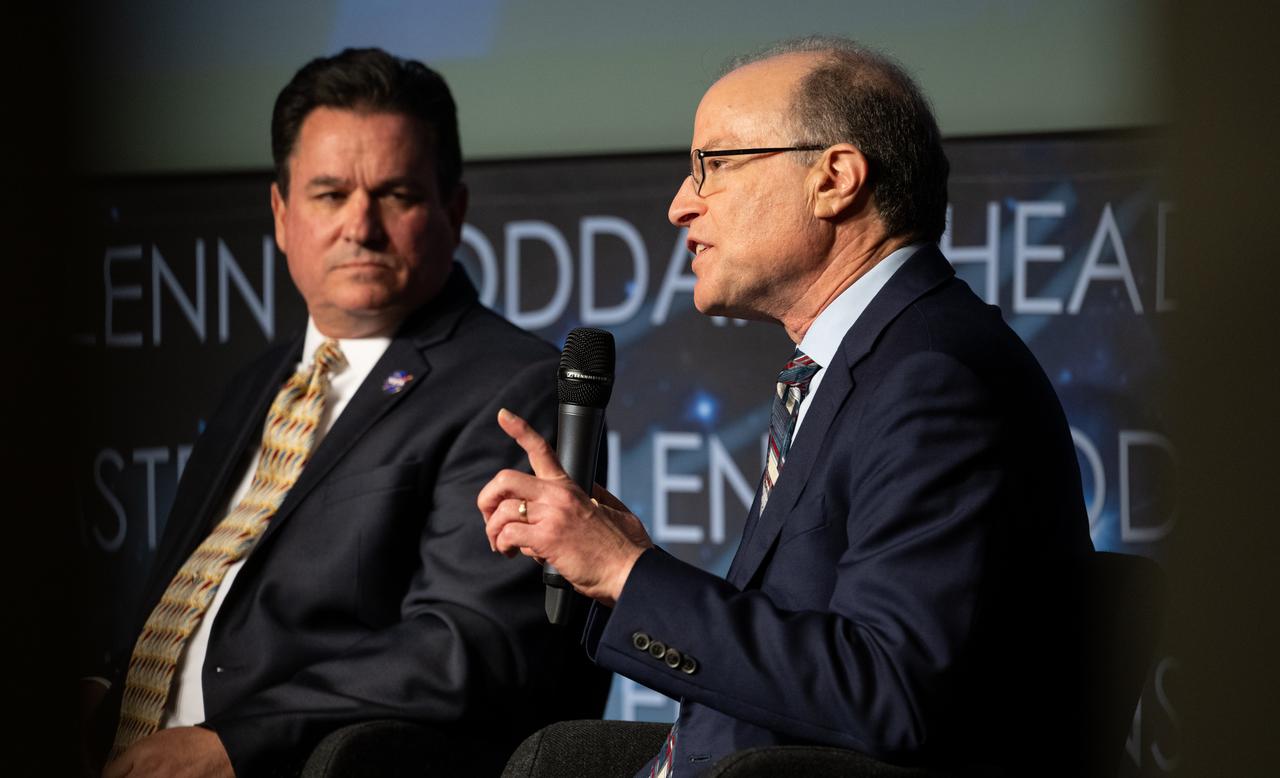
Todd Citron, chief technology officer, The Boeing Company, answers a question from a member of the media during a news conference on NASA’s Sustainable Flight Demonstrator project, Wednesday, Jan. 18, 2023, at the Mary W. Jackson NASA Headquarters building in Washington, DC. Through a Funded Space Act Agreement, The Boeing company and its industry team will collaborate with NASA to develop and flight-test a full-scale Transonic Truss-Braced Wing demonstrator aircraft. Photo Credit: (NASA/Joel Kowsky)
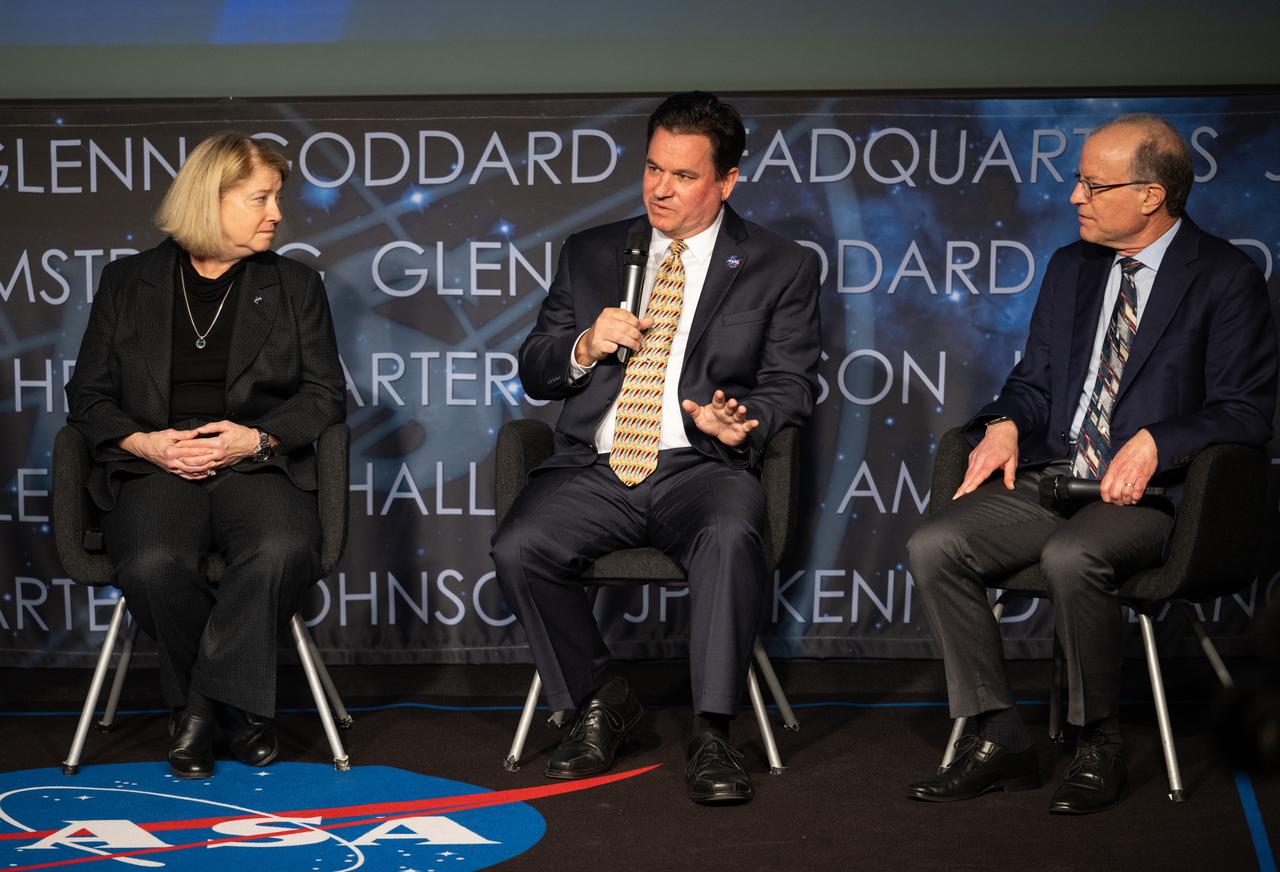
Brent Cobleigh, program manager for the Sustainable Flight Demonstrator at NASA's Armstrong Flight Research Center, center, answers a question from a member of the media during a news conference along with NASA Deputy Administrator Pam Melroy, left, and Todd Citron, chief technology officer, The Boeing Company, right, on NASA’s Sustainable Flight Demonstrator project, Wednesday, Jan. 18, 2023, at the Mary W. Jackson NASA Headquarters building in Washington, DC. Through a Funded Space Act Agreement, The Boeing company and its industry team will collaborate with NASA to develop and flight-test a full-scale Transonic Truss-Braced Wing demonstrator aircraft. Photo Credit: (NASA/Joel Kowsky)
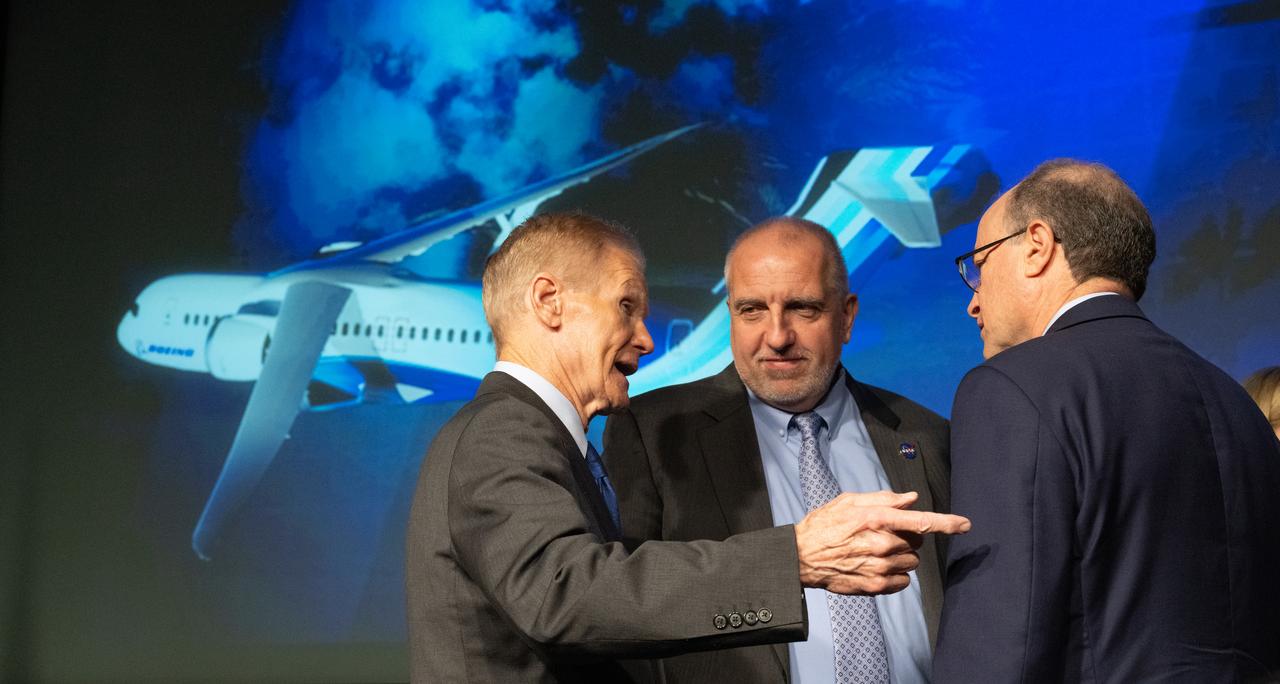
NASA Administrator Bill Nelson, left, Bob Pearce, associate administrator for NASA's Aeronautics Research Mission Directorate, center, and Todd Citron, chief technology officer, The Boeing Company, right, are seen following a news conference on NASA’s Sustainable Flight Demonstrator project, Wednesday, Jan. 18, 2023, at the Mary W. Jackson NASA Headquarters building in Washington, DC. Through a Funded Space Act Agreement, The Boeing company and its industry team will collaborate with NASA to develop and flight-test a full-scale Transonic Truss-Braced Wing demonstrator aircraft. Photo Credit: (NASA/Joel Kowsky)
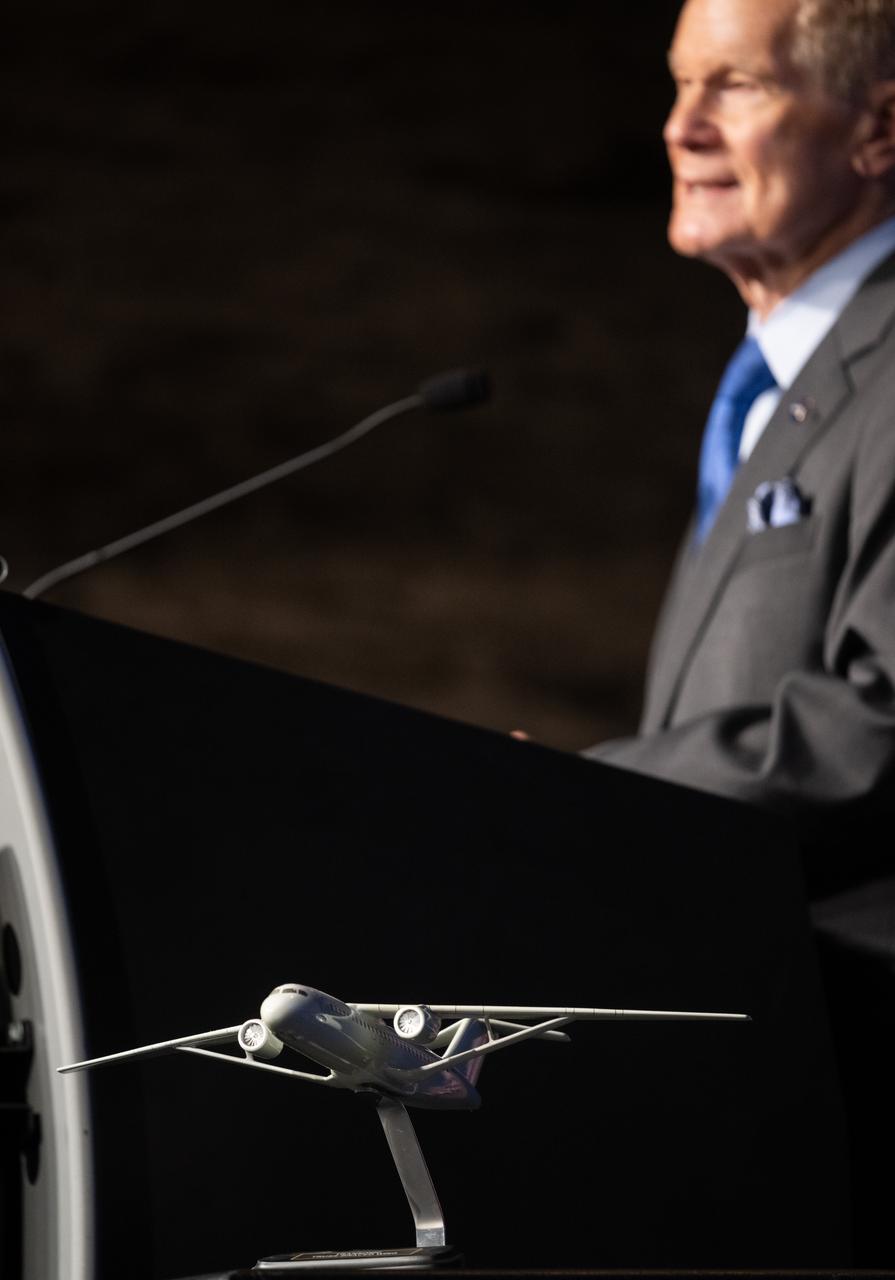
A model of an aircraft with a Transsonic Truss-Braced Wing is seen during a news conference on NASA’s Sustainable Flight Demonstrator project, Wednesday, Jan. 18, 2023, at the Mary W. Jackson NASA Headquarters building in Washington, DC. Through a Funded Space Act Agreement, The Boeing company and its industry team will collaborate with NASA to develop and flight-test a full-scale Transonic Truss-Braced Wing demonstrator aircraft. Photo Credit: (NASA/Joel Kowsky)
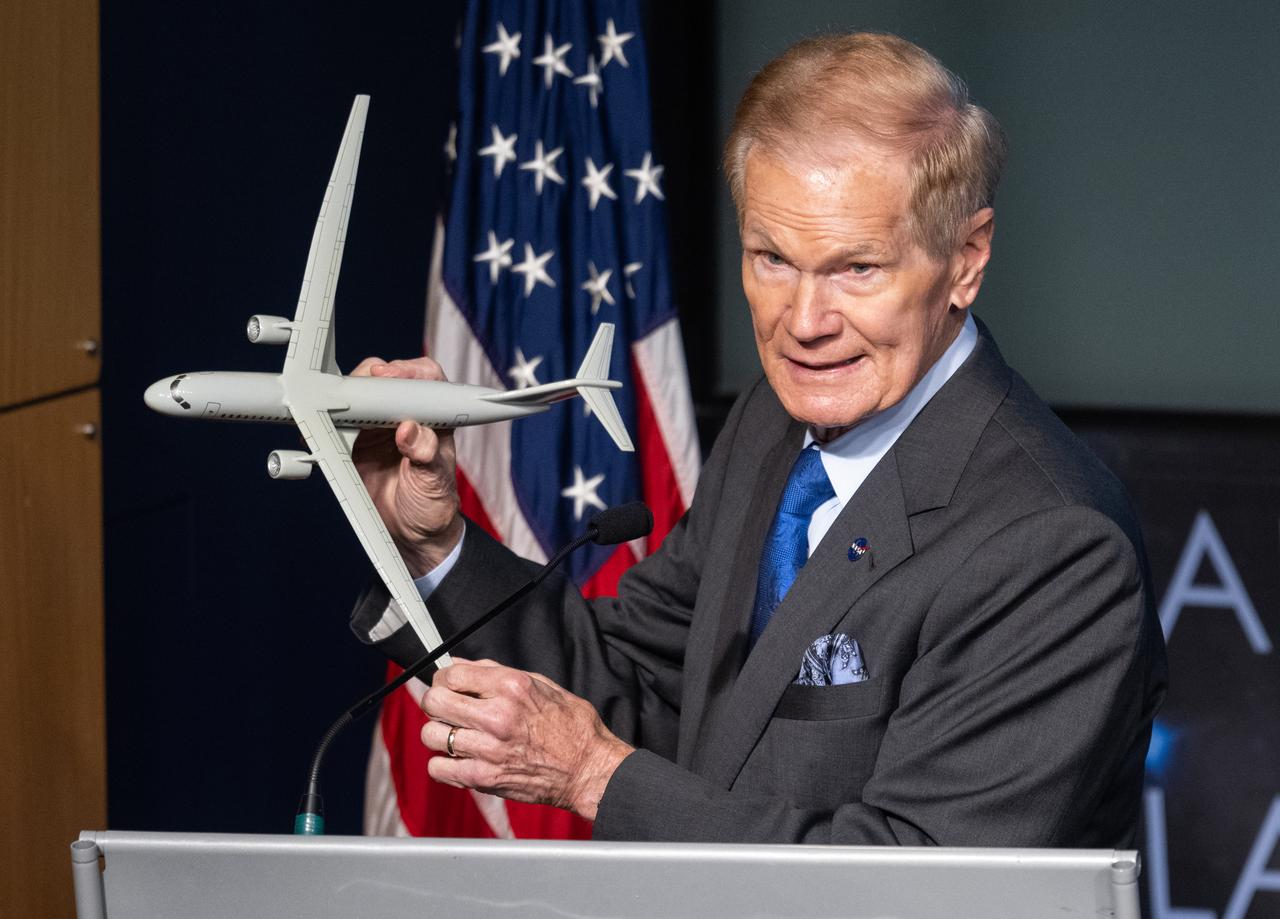
NASA Administrator Bill Nelson holds a model of an aircraft with a Transonic Truss-Braced Wing during a news conference on NASA’s Sustainable Flight Demonstrator project, Wednesday, Jan. 18, 2023, at the Mary W. Jackson NASA Headquarters building in Washington, DC. Through a Funded Space Act Agreement, The Boeing company and its industry team will collaborate with NASA to develop and flight-test a full-scale Transonic Truss-Braced Wing demonstrator aircraft. Photo Credit: (NASA/Joel Kowsky)
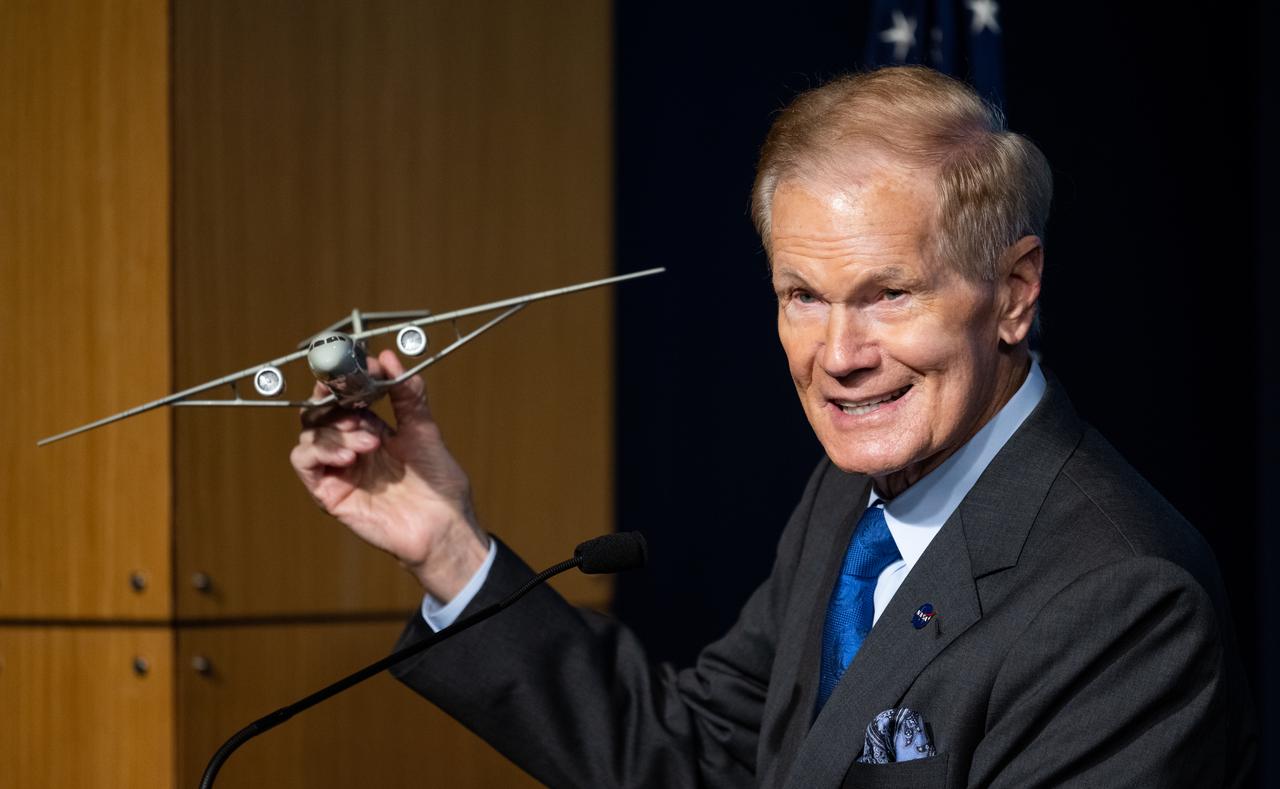
NASA Administrator Bill Nelson holds a model of an aircraft with a Transonic Truss-Braced Wing during a news conference on NASA’s Sustainable Flight Demonstrator project, Wednesday, Jan. 18, 2023, at the Mary W. Jackson NASA Headquarters building in Washington, DC. Through a Funded Space Act Agreement, The Boeing company and its industry team will collaborate with NASA to develop and flight-test a full-scale Transonic Truss-Braced Wing demonstrator aircraft. Photo Credit: (NASA/Joel Kowsky)
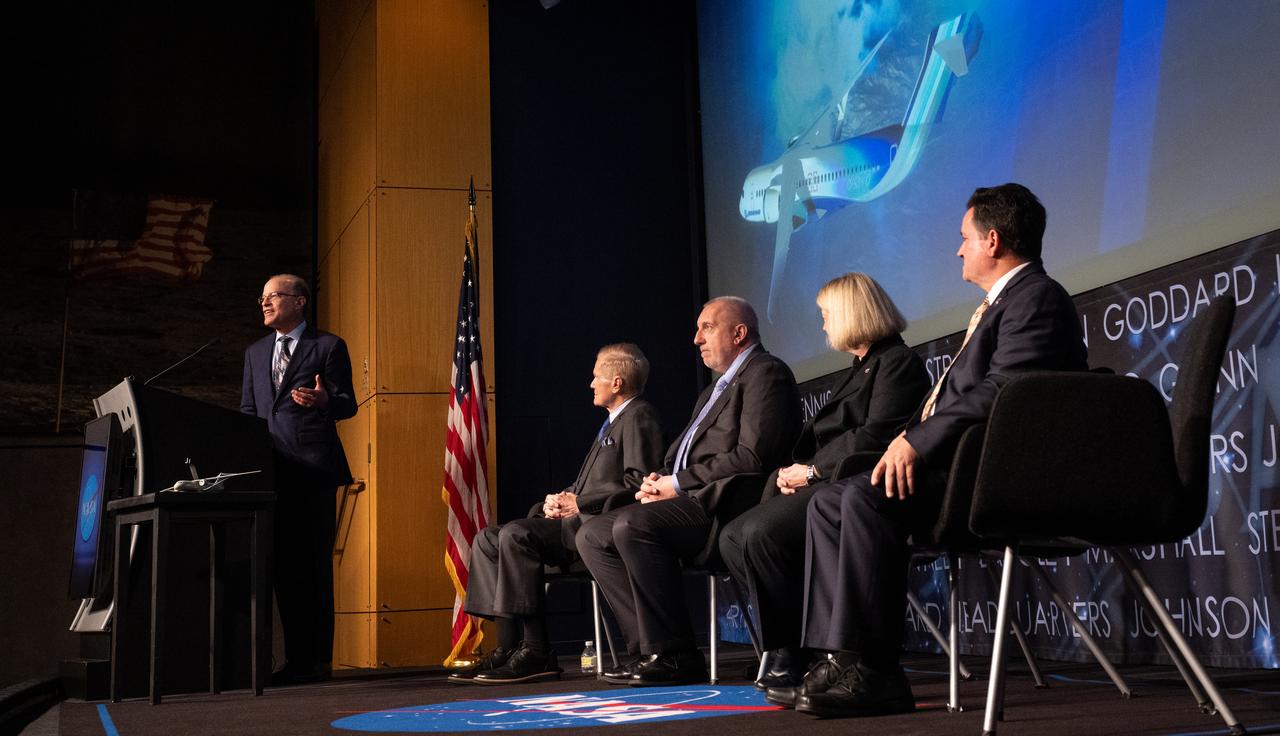
Todd Citron, chief technology officer, The Boeing Company, left, delivers remarks during a news conference on NASA’s Sustainable Flight Demonstrator project as NASA Administrator Bill Nelson, second from left, Bob Pearce, associate administrator for NASA's Aeronautics Research Mission Directorate, NASA Deputy Administrator Pam Melroy, and Brent Cobleigh, program manager for the Sustainable Flight Demonstrator at NASA's Armstrong Flight Research Center, look on, Wednesday, Jan. 18, 2023, at the Mary W. Jackson NASA Headquarters building in Washington, DC. Through a Funded Space Act Agreement, The Boeing company and its industry team will collaborate with NASA to develop and flight-test a full-scale Transonic Truss-Braced Wing demonstrator aircraft. Photo Credit: (NASA/Joel Kowsky)
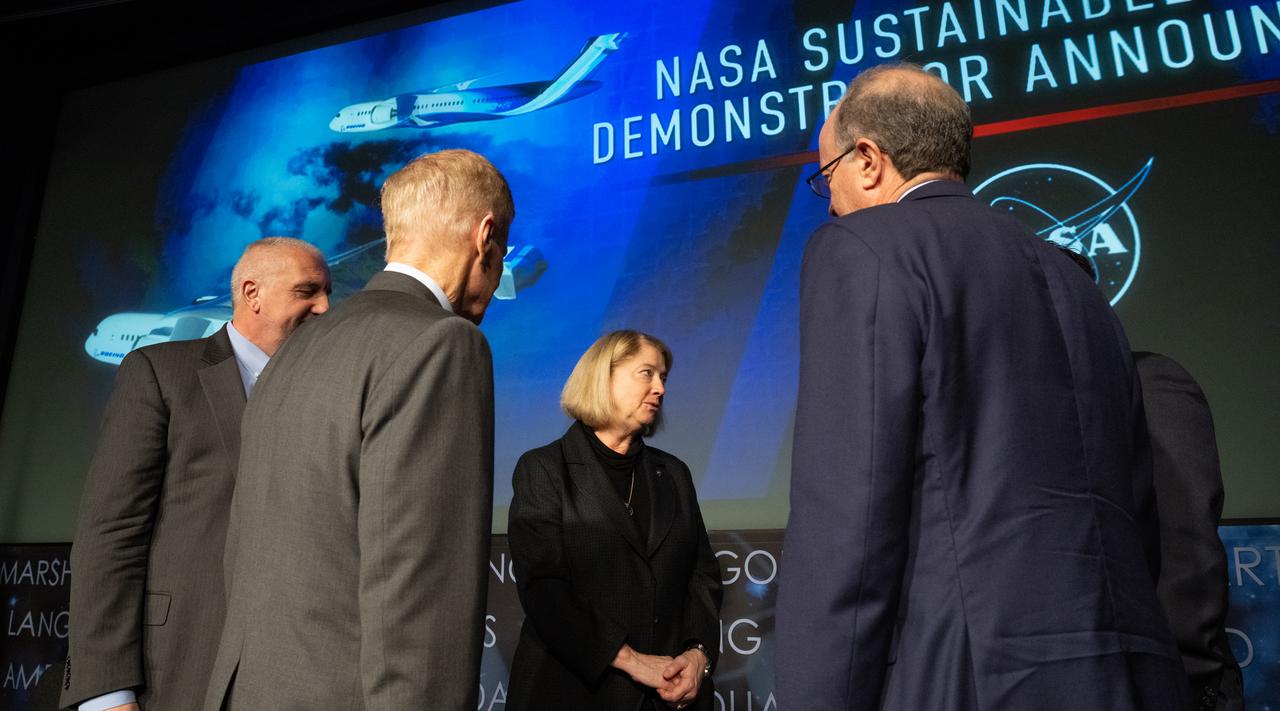
NASA Deputy Administrator Pam Melroy, center, is seen with Bob Pearce, associate administrator for NASA's Aeronautics Research Mission Directorate, NASA Administrator Bill Nelson, Todd Citron, chief technology officer, The Boeing Company, and Brent Cobleigh, program manager for the Sustainable Flight Demonstrator at NASA's Armstrong Flight Research Center, following a news conference on NASA’s Sustainable Flight Demonstrator project, Wednesday, Jan. 18, 2023, at the Mary W. Jackson NASA Headquarters building in Washington, DC. Through a Funded Space Act Agreement, The Boeing company and its industry team will collaborate with NASA to develop and flight-test a full-scale Transonic Truss-Braced Wing demonstrator aircraft. Photo Credit: (NASA/Joel Kowsky)
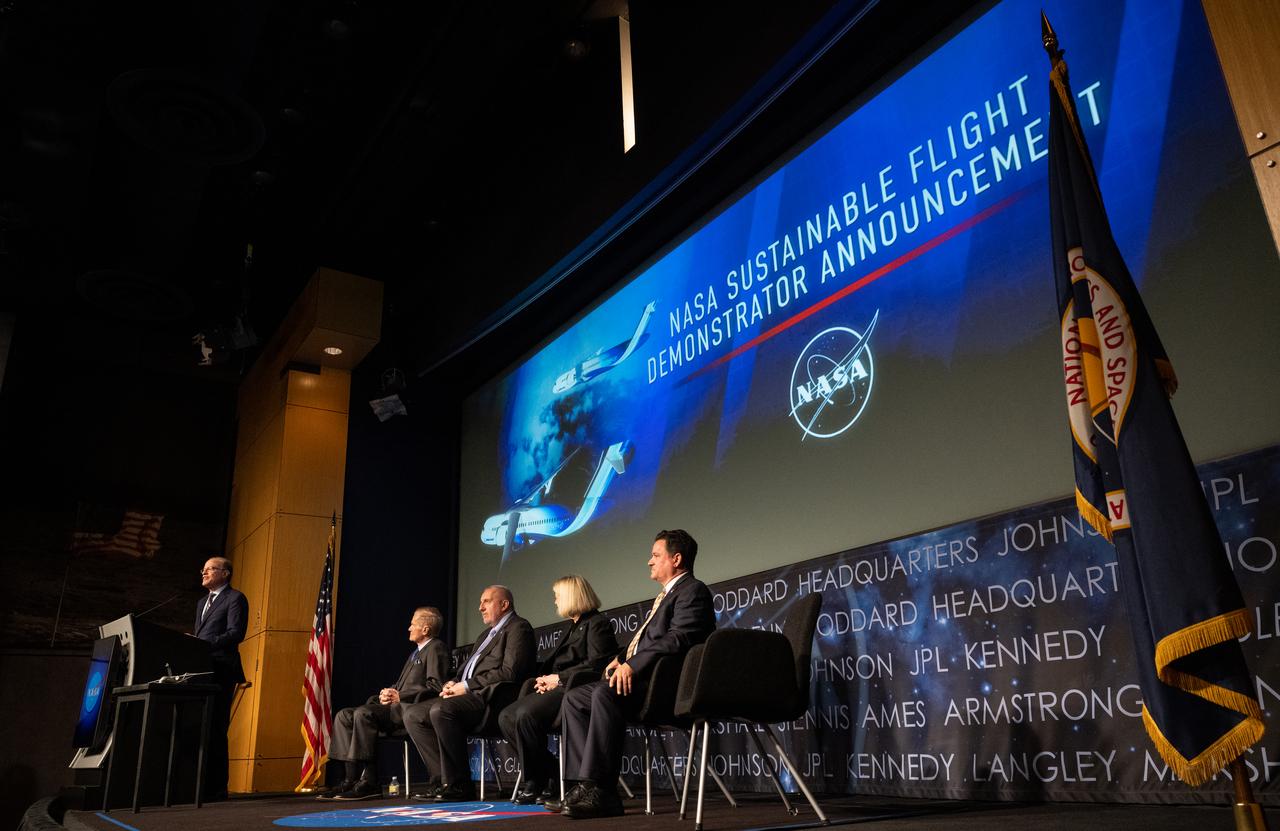
Todd Citron, chief technology officer, The Boeing Company, left, delivers remarks during a news conference on NASA’s Sustainable Flight Demonstrator project as NASA Administrator Bill Nelson, second from left, Bob Pearce, associate administrator for NASA's Aeronautics Research Mission Directorate, NASA Deputy Administrator Pam Melroy, and Brent Cobleigh, program manager for the Sustainable Flight Demonstrator at NASA's Armstrong Flight Research Center, look on, Wednesday, Jan. 18, 2023, at the Mary W. Jackson NASA Headquarters building in Washington, DC. Through a Funded Space Act Agreement, The Boeing company and its industry team will collaborate with NASA to develop and flight-test a full-scale Transonic Truss-Braced Wing demonstrator aircraft. Photo Credit: (NASA/Joel Kowsky)
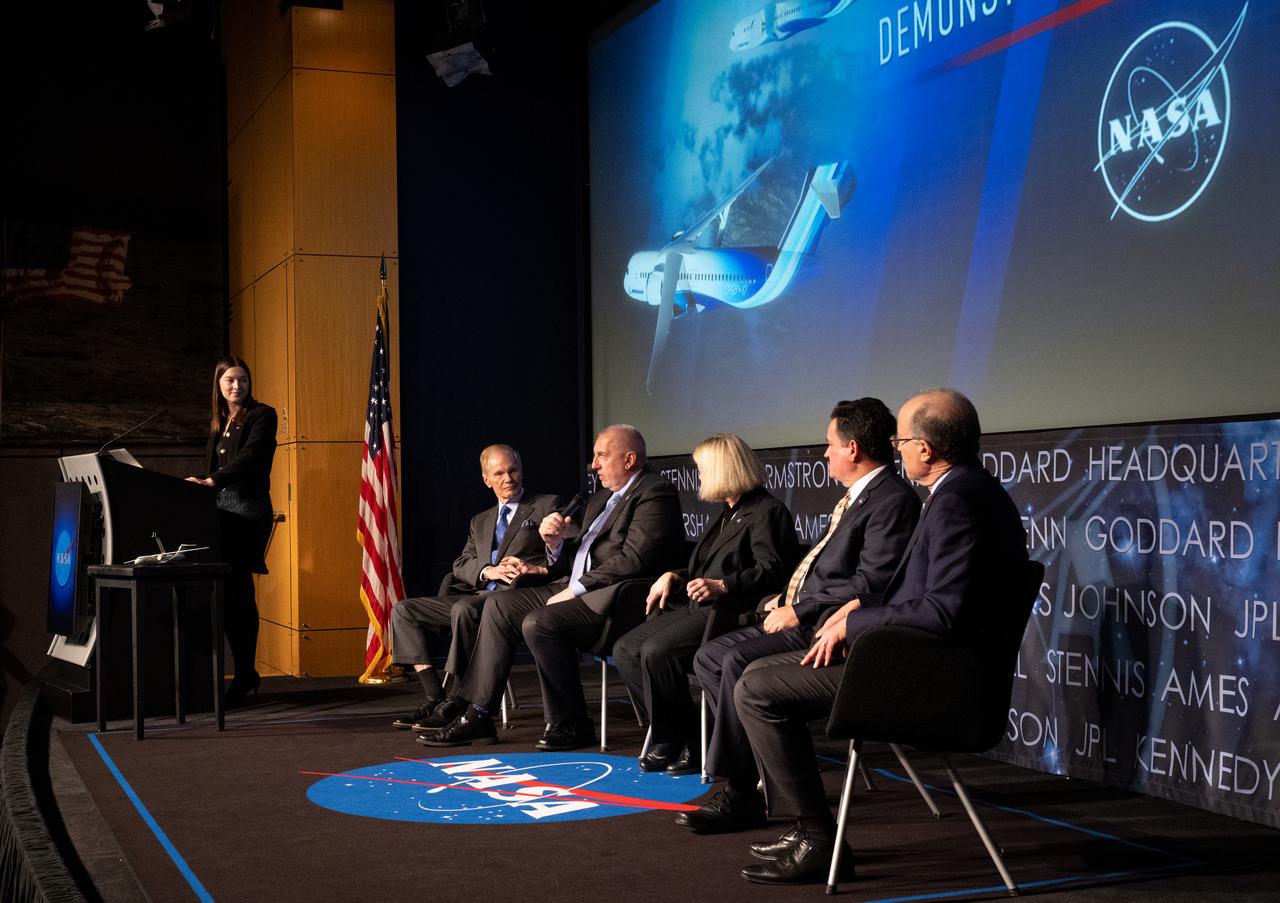
Jackie McGuinness, NASA’s Press Secretary, left, NASA Administrator Bill Nelson, Bob Pearce, associate administrator for NASA's Aeronautics Research Mission Directorate, NASA Deputy Administrator Pam Melroy, Brent Cobleigh, program manager for the Sustainable Flight Demonstrator at NASA's Armstrong Flight Research Center, and Todd Citron, chief technology officer, The Boeing Company, are seen as they take questions from members of the media during a news conference on NASA’s Sustainable Flight Demonstrator project, Wednesday, Jan. 18, 2023, at the Mary W. Jackson NASA Headquarters building in Washington, DC. Through a Funded Space Act Agreement, The Boeing company and its industry team will collaborate with NASA to develop and flight-test a full-scale Transonic Truss-Braced Wing demonstrator aircraft. Photo Credit: (NASA/Joel Kowsky)
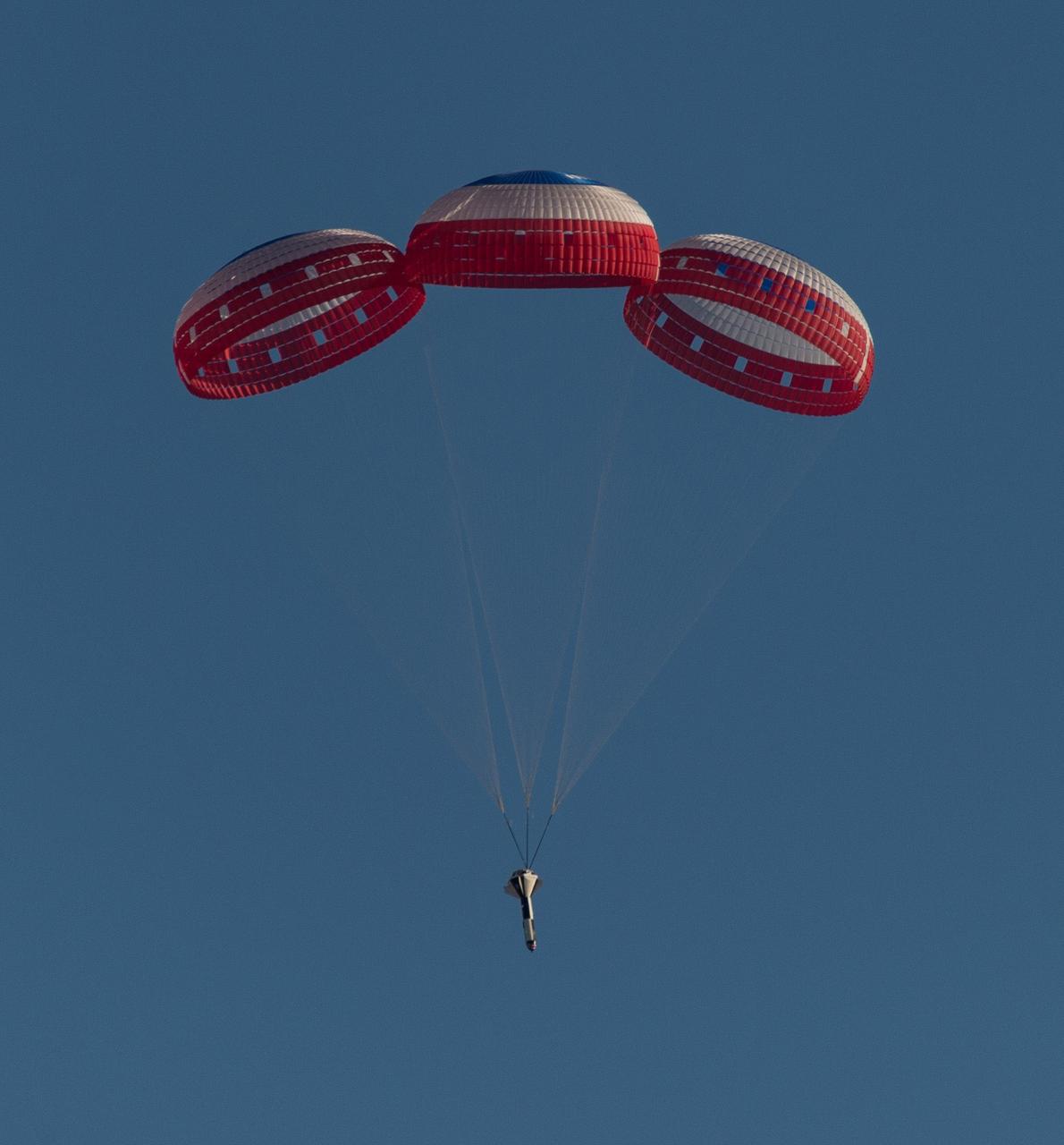
Boeing’s CST-100 Starliner’s parachute systems successfully completed a “lawn dart” test at the Yuma Proving Ground in Arizona in February. The test involved dropping the dart from a C-17 aircraft. This reliability test was part of a special studies program NASA initiated to validate the robust design of Starliner’s parachute systems, and is an important milestone in proving the systems are ready to safely land Starliner. NASA and Boeing are preparing for the company’s uncrewed and crewed flight tests of Starliner as part of NASA’s Commercial Crew Program, which will return human spaceflight launches into low-Earth orbit from U.S. soil

Boeing’s CST-100 Starliner’s parachute systems successfully completed a “lawn dart” test at the Yuma Proving Ground in Arizona in February. The test involved dropping the dart from a C-17 aircraft. This reliability test was part of a special studies program NASA initiated to validate the robust design of Starliner’s parachute systems, and is an important milestone in proving the systems are ready to safely land Starliner. NASA and Boeing are preparing for the company’s uncrewed and crewed flight tests of Starliner as part of NASA’s Commercial Crew Program, which will return human spaceflight launches into low-Earth orbit from U.S. soil
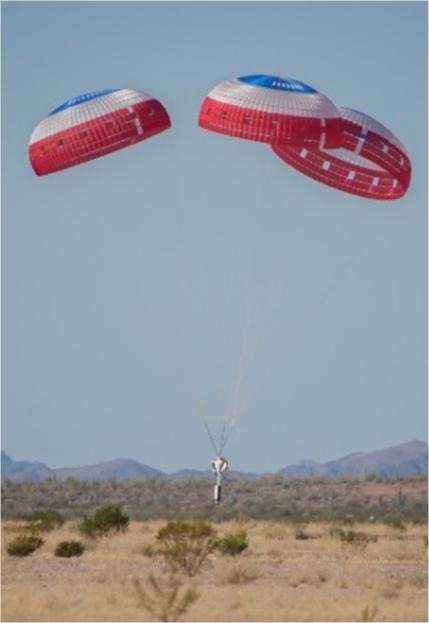
Boeing’s CST-100 Starliner’s parachute systems successfully completed a “lawn dart” test at the Yuma Proving Ground in Arizona in February. The test involved dropping the dart from a C-17 aircraft. This reliability test was part of a special studies program NASA initiated to validate the robust design of Starliner’s parachute systems, and is an important milestone in proving the systems are ready to safely land Starliner. NASA and Boeing are preparing for the company’s uncrewed and crewed flight tests of Starliner as part of NASA’s Commercial Crew Program, which will return human spaceflight launches into low-Earth orbit from U.S. soil.
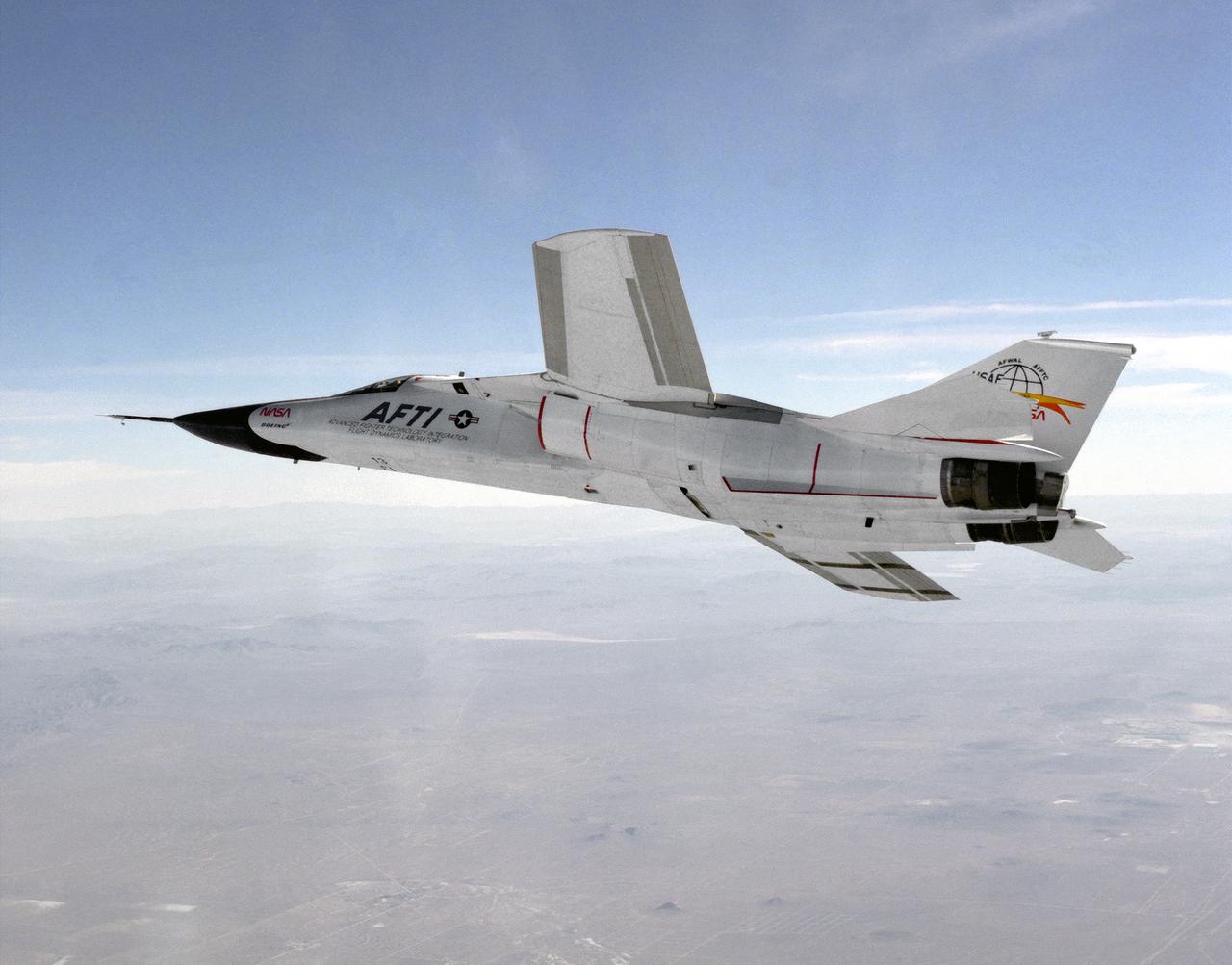
This photograph shows a modified General Dynamics AFTI/F-111A Aardvark with supercritical mission adaptive wings (MAW) installed. The AFTI/F111A is seen banking towards Rodgers Dry Lake and Edwards Air Force Base. With the phasing out of the TACT program came a renewed effort by the Air Force Flight Dynamics Laboratory to extend supercritical wing technology to a higher level of performance. In the early 1980s the supercritical wing on the F-111A aircraft was replaced with a wing built by Boeing Aircraft Company System called a “mission adaptive wing” (MAW), and a joint NASA and Air Force program called Advanced Fighter Technology Integration (AFTI) was born.
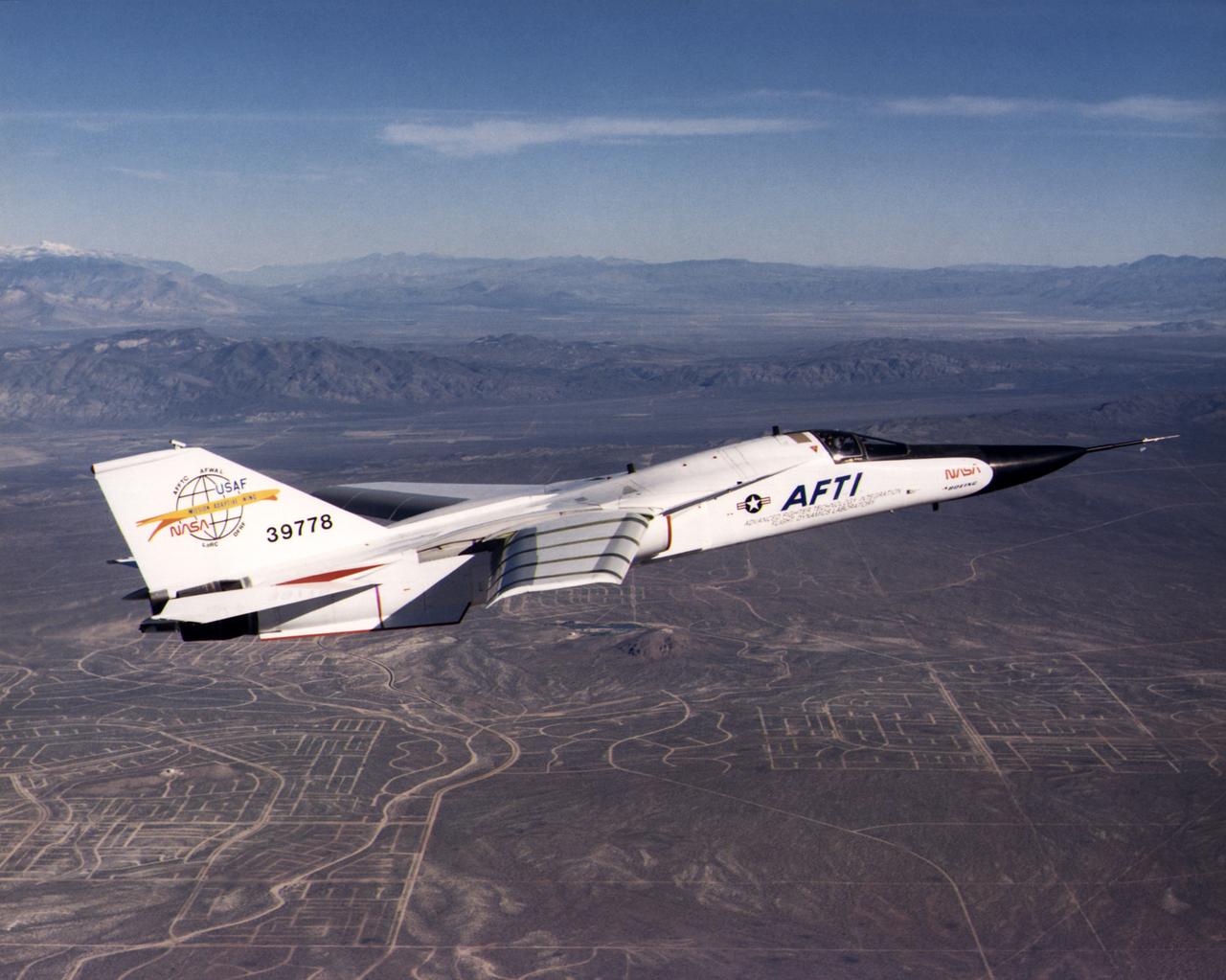
This photograph shows a modified General Dynamics AFTI/F-111A Aardvark in flight with supercritical mission adaptive wings (MAW) installed. With the phasing out of the TACT program came a renewed effort by the Air Force Flight Dynamics Laboratory to extend supercritical wing technology to a higher level of performance. In the early 1980s the supercritical wing on the F-111A aircraft was replaced with a wing built by Boeing Aircraft Company System called a “mission adaptive wing” (MAW), and a joint NASA and Air Force program called Advanced Fighter Technology Integration (AFTI) was born.
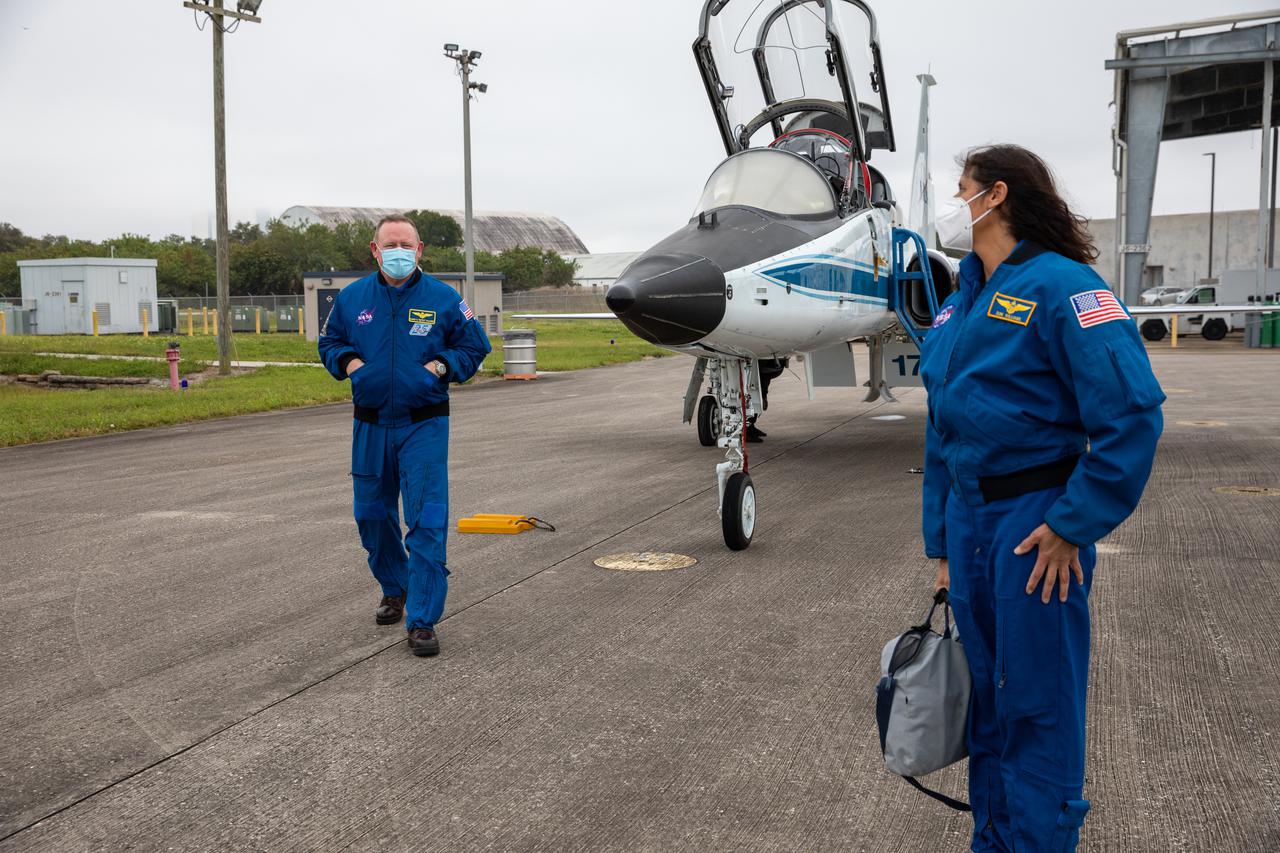
NASA astronauts arrive aboard T-38 jet aircraft at the Launch and Landing Facility at Kennedy Space Center in Florida on Dec. 17, 2020. The astronauts are at Kennedy to prepare for their flights to the International Space Station on Boeing’s CST-100 Starliner, as part of the agency’s Commercial Crew Program. At right is Sunita “Suni” Williams. At left is Barry “Butch” Wilmore. Wilmore and Williams will command the company’s Crew Flight Test and the Starliner-1 mission, respectively.
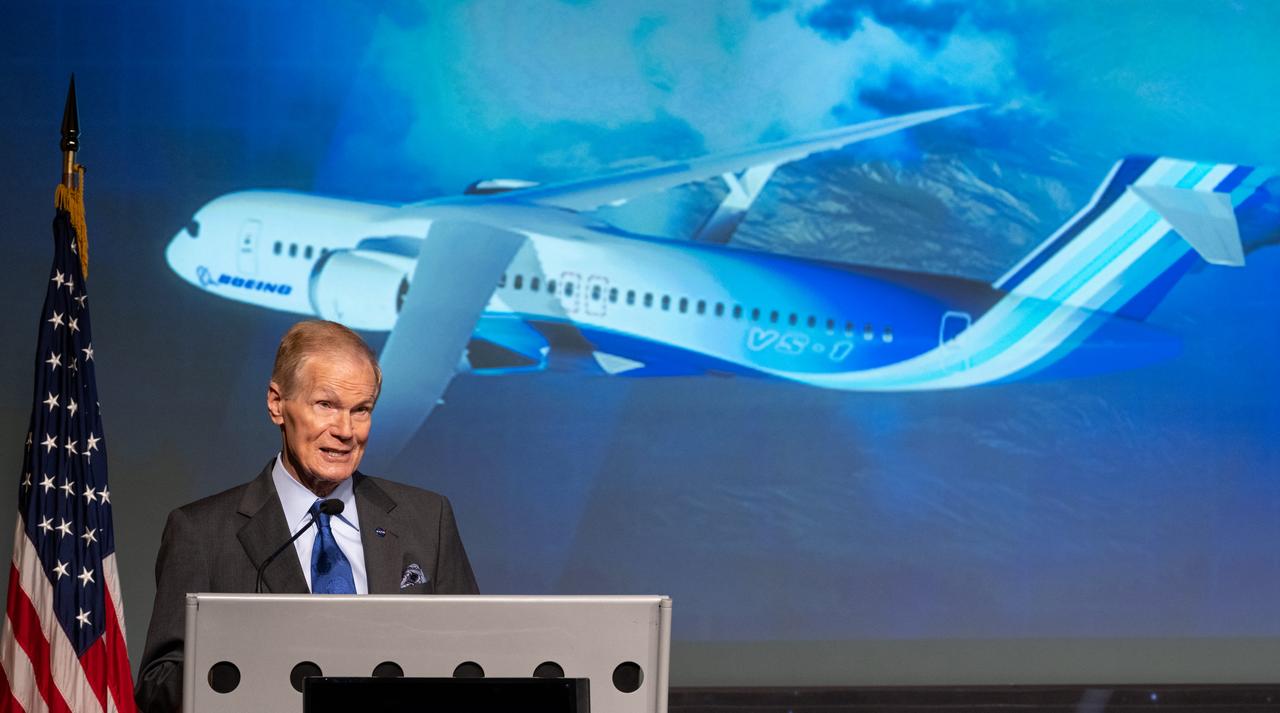
NASA Administrator Bill Nelson delivers remarks during a news conference on NASA’s Sustainable Flight Demonstrator project, Wednesday, Jan. 18, 2023, at the Mary W. Jackson NASA Headquarters building in Washington, DC. Through a Funded Space Act Agreement, The Boeing company and its industry team will collaborate with NASA to develop and flight-test a full-scale Transonic Truss-Braced Wing demonstrator aircraft. Photo Credit: (NASA/Joel Kowsky)
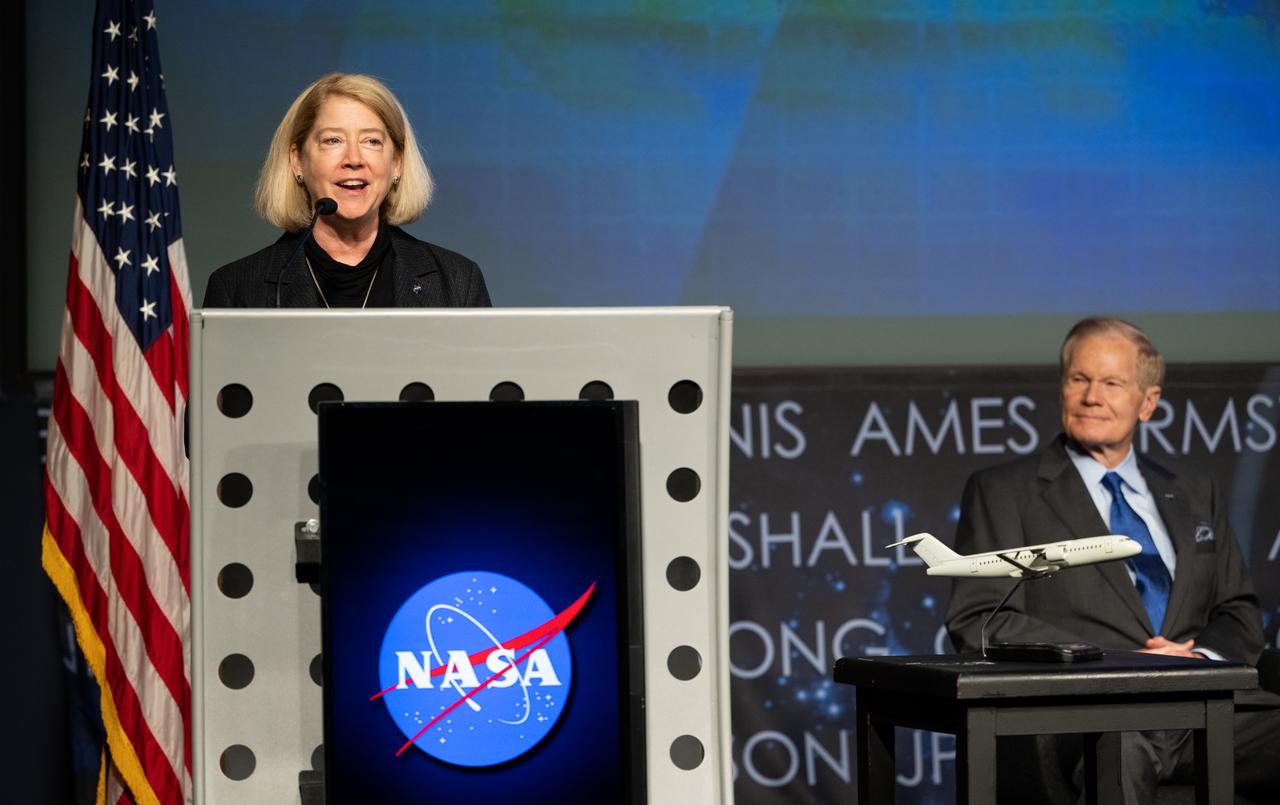
NASA Deputy Administrator Pam Melroy delivers remarks during a news conference on NASA’s Sustainable Flight Demonstrator project, Wednesday, Jan. 18, 2023, at the Mary W. Jackson NASA Headquarters building in Washington, DC. Through a Funded Space Act Agreement, The Boeing company and its industry team will collaborate with NASA to develop and flight-test a full-scale Transonic Truss-Braced Wing demonstrator aircraft. Photo Credit: (NASA/Joel Kowsky)
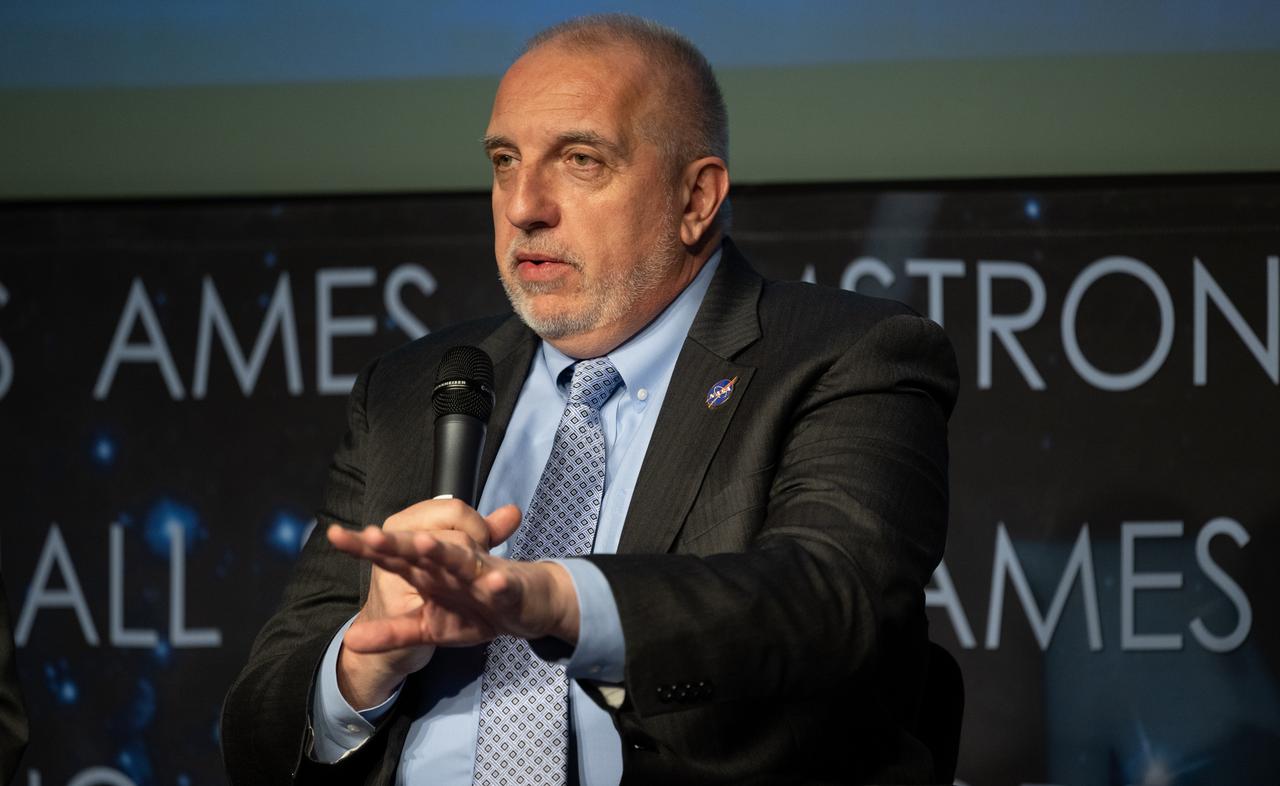
Bob Pearce, associate administrator for NASA's Aeronautics Research Mission Directorate, answers a question from a member of the media during a news conference on NASA’s Sustainable Flight Demonstrator project, Wednesday, Jan. 18, 2023, at the Mary W. Jackson NASA Headquarters building in Washington, DC. Through a Funded Space Act Agreement, The Boeing company and its industry team will collaborate with NASA to develop and flight-test a full-scale Transonic Truss-Braced Wing demonstrator aircraft. Photo Credit: (NASA/Joel Kowsky)
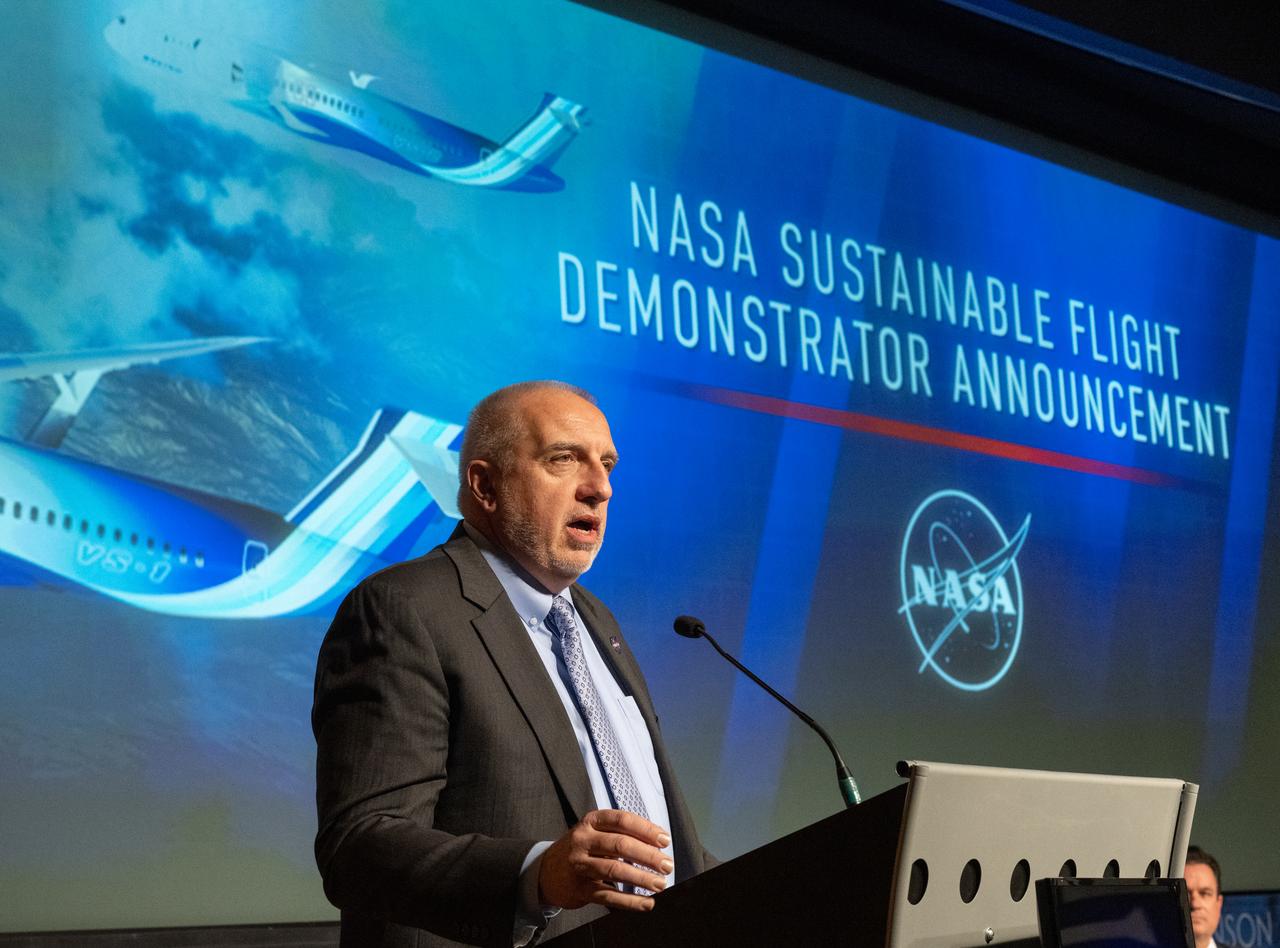
Bob Pearce, associate administrator for NASA's Aeronautics Research Mission Directorate, delivers remarks during a news conference on NASA’s Sustainable Flight Demonstrator project, Wednesday, Jan. 18, 2023, at the Mary W. Jackson NASA Headquarters building in Washington, DC. Through a Funded Space Act Agreement, The Boeing company and its industry team will collaborate with NASA to develop and flight-test a full-scale Transonic Truss-Braced Wing demonstrator aircraft. Photo Credit: (NASA/Joel Kowsky)
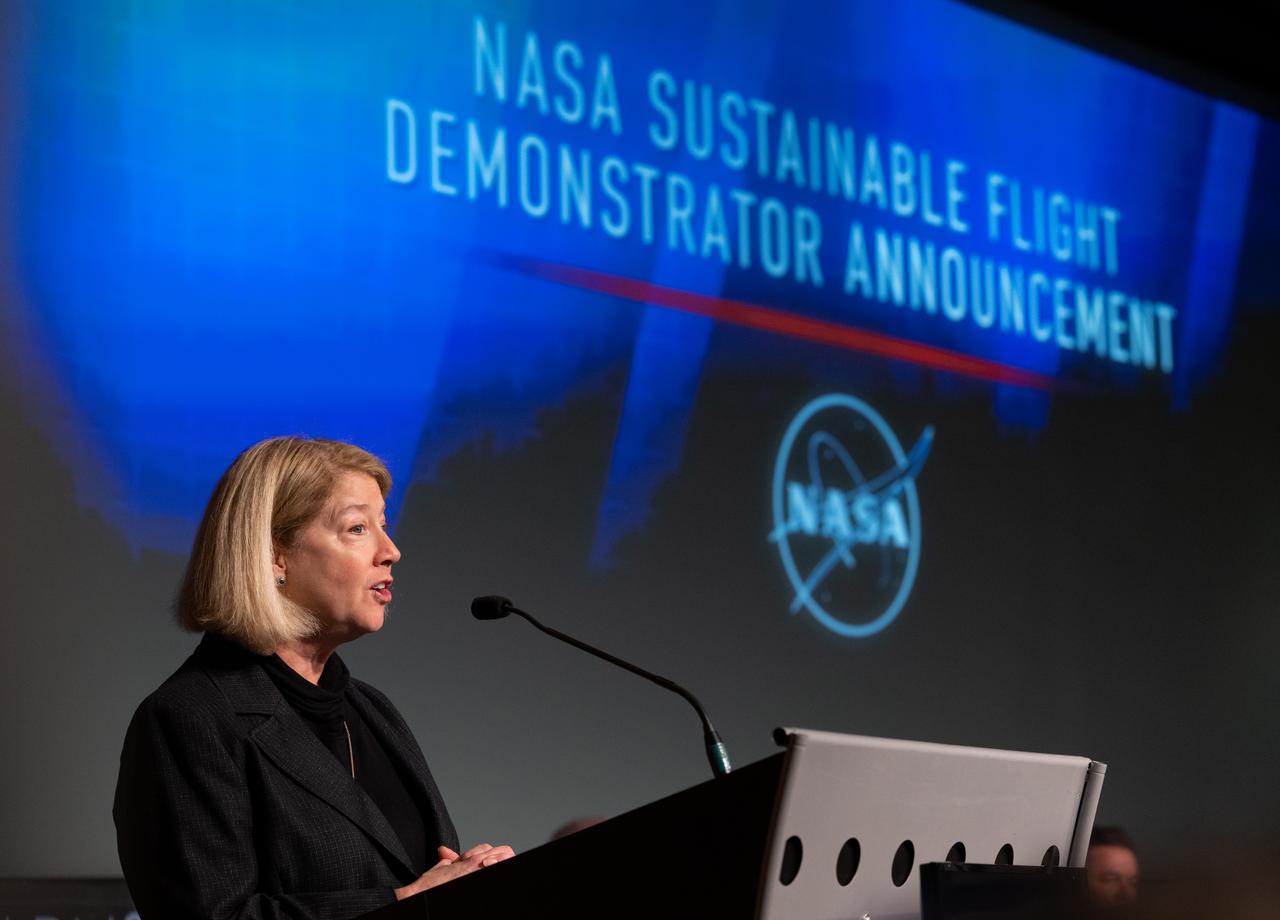
NASA Deputy Administrator Pam Melroy delivers remarks during a news conference on NASA’s Sustainable Flight Demonstrator project, Wednesday, Jan. 18, 2023, at the Mary W. Jackson NASA Headquarters building in Washington, DC. Through a Funded Space Act Agreement, The Boeing company and its industry team will collaborate with NASA to develop and flight-test a full-scale Transonic Truss-Braced Wing demonstrator aircraft. Photo Credit: (NASA/Joel Kowsky)
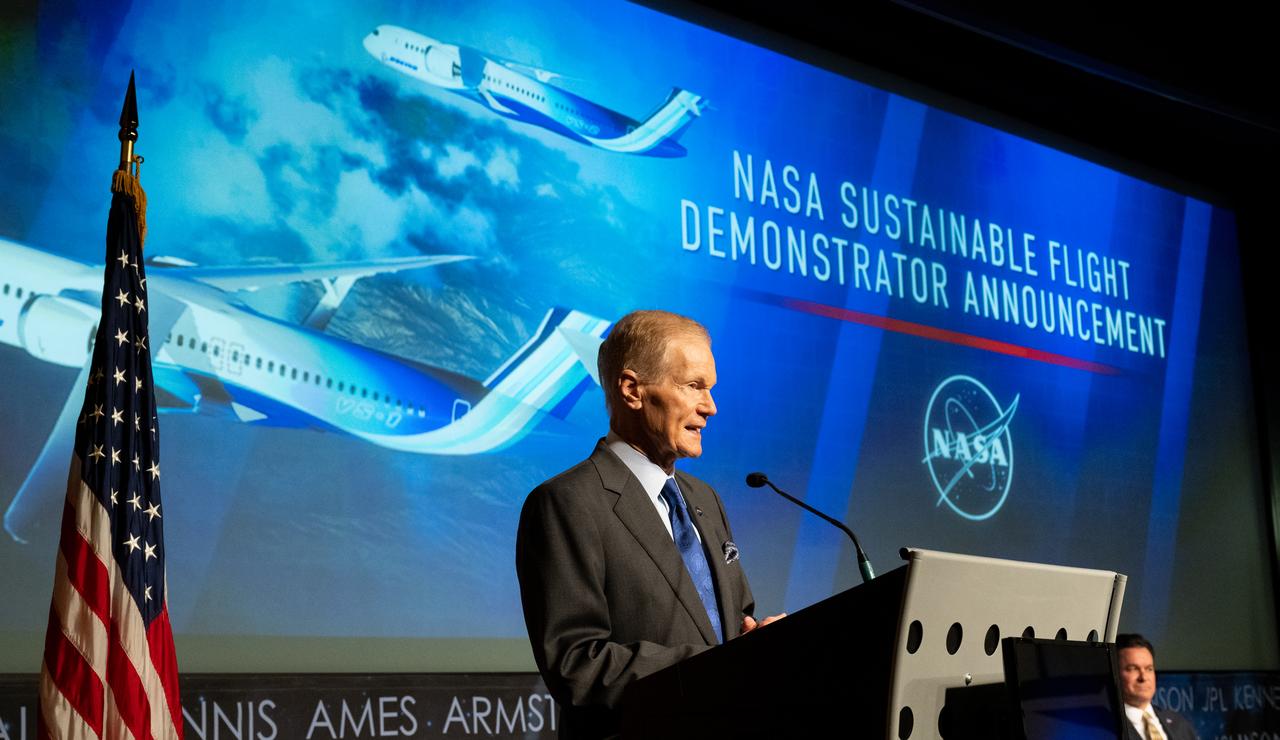
NASA Administrator Bill Nelson delivers remarks during a news conference on NASA’s Sustainable Flight Demonstrator project, Wednesday, Jan. 18, 2023, at the Mary W. Jackson NASA Headquarters building in Washington, DC. Through a Funded Space Act Agreement, The Boeing company and its industry team will collaborate with NASA to develop and flight-test a full-scale Transonic Truss-Braced Wing demonstrator aircraft. Photo Credit: (NASA/Joel Kowsky)
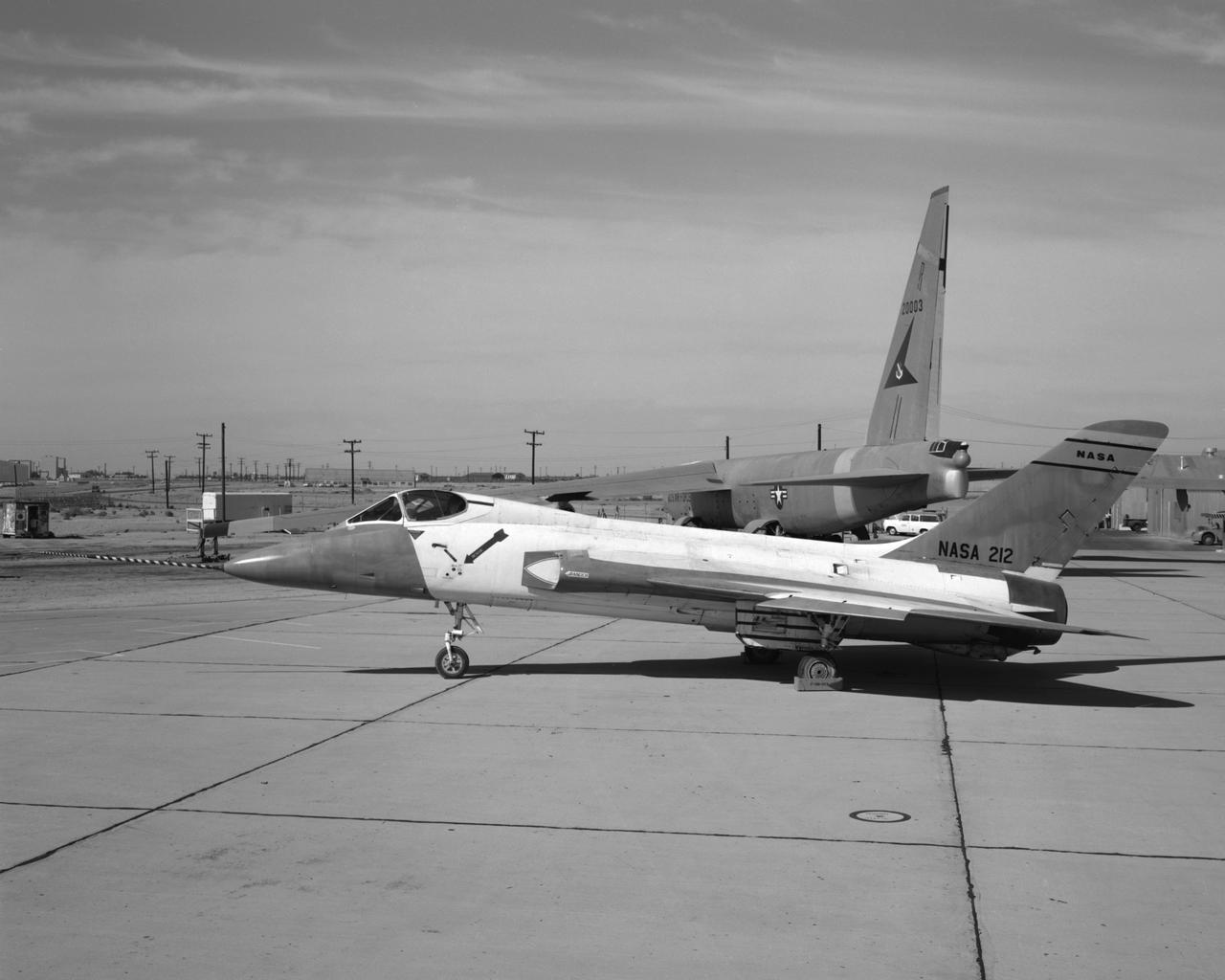
F5D Skylancer NASA 212 modified as the X-20 Dyna-Soar vision field simulator.
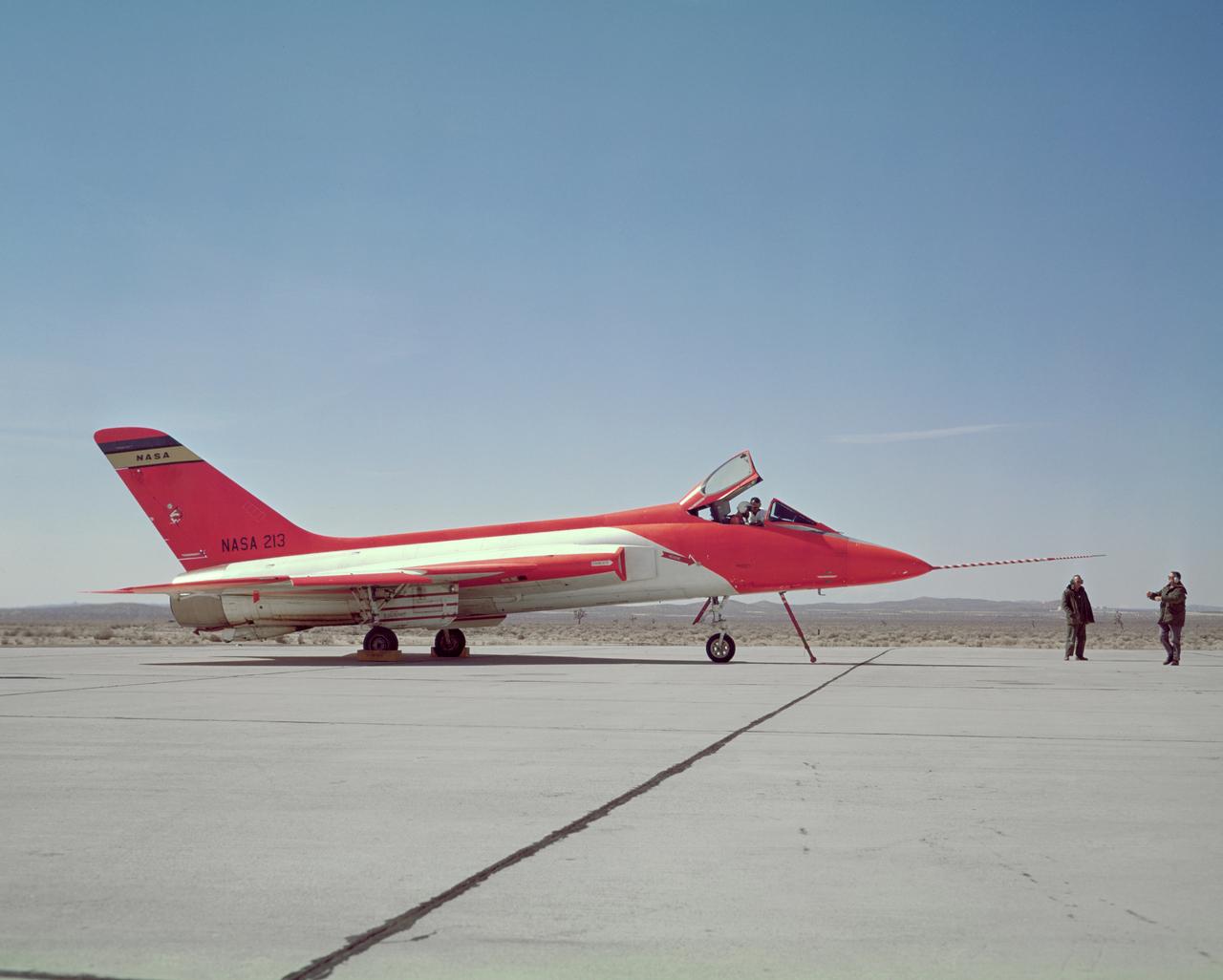
F5D Skylancer taxis in after a mission.
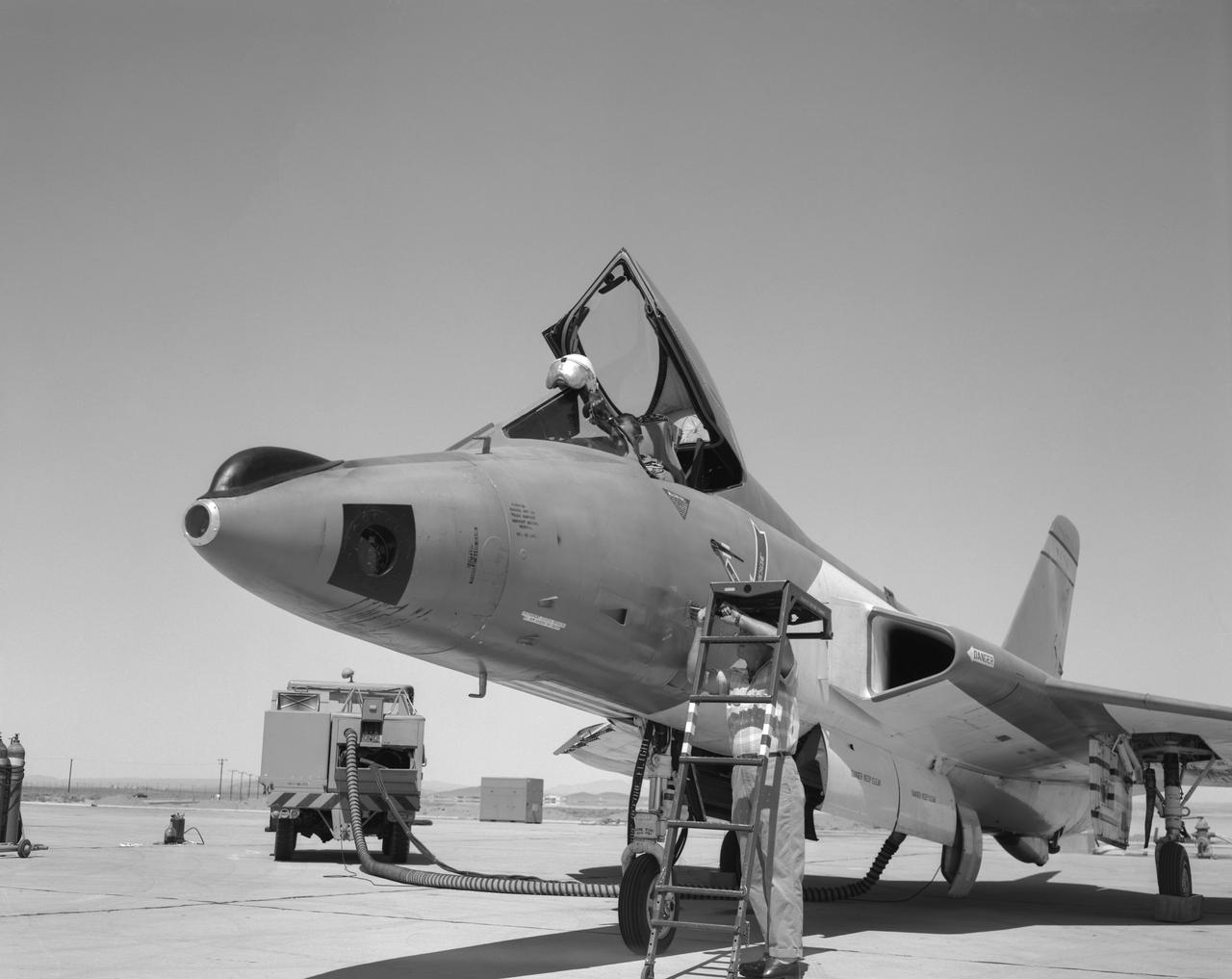
F5D Skylancer with camera installation in nose.
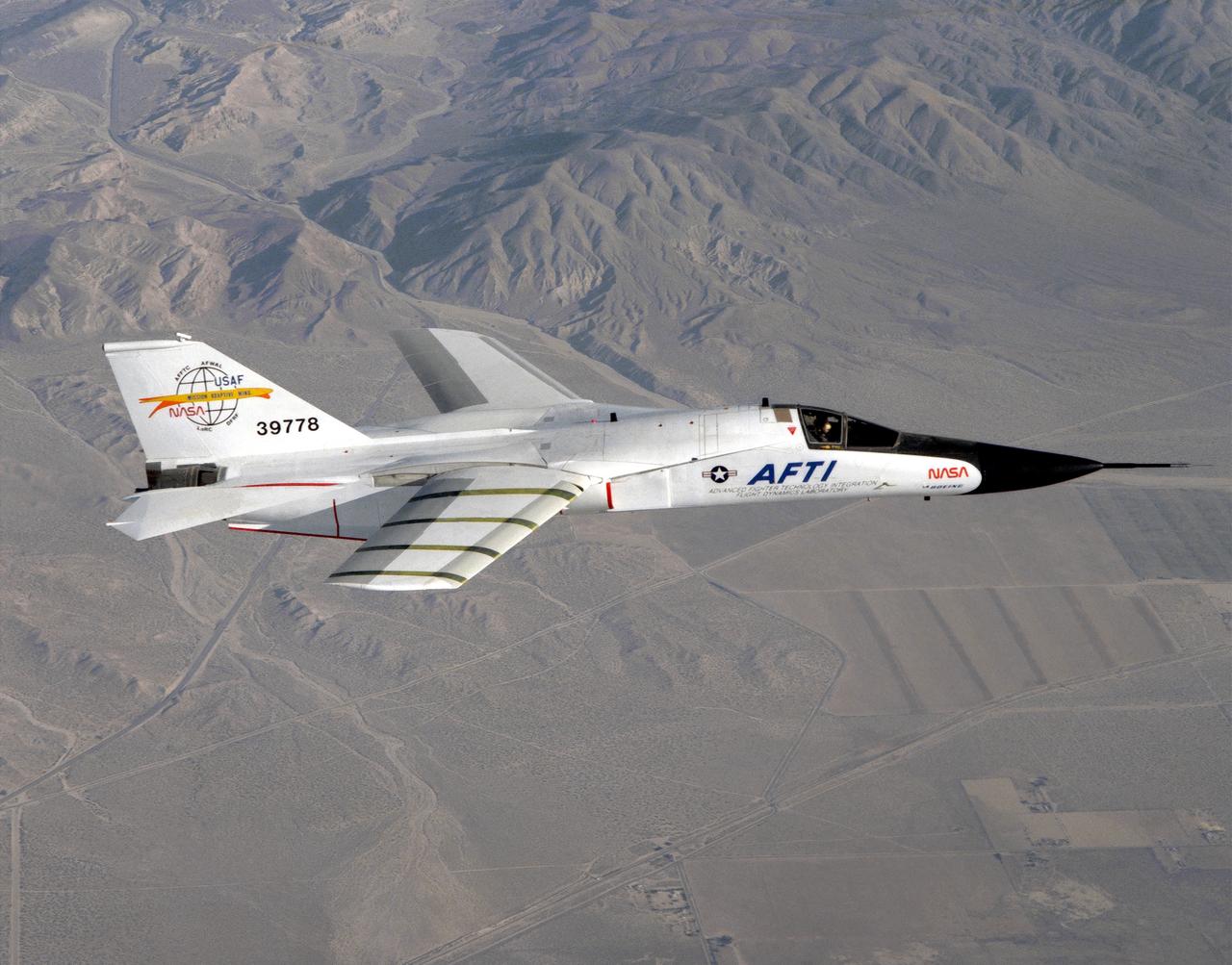
This photograph shows a modified General Dynamics AFTI/F-111A Aardvark with supercritical mission adaptive wings (MAW) installed. The four dark bands on the right wing are the locations of pressure orifices used to measure surface pressures and shock locations on the MAW. The El Paso Mountains and Red Rock Canyon State Park Califonia, about 30 miles northwest of Edwards Air Force Base, are seen directly in the background. With the phasing out of the TACT program came a renewed effort by the Air Force Flight Dynamics Laboratory to extend supercritical wing technology to a higher level of performance. In the early 1980s the supercritical wing on the F-111A aircraft was replaced with a wing built by Boeing Aircraft Company System called a “mission adaptive wing” (MAW), and a joint NASA and Air Force program called Advanced Fighter Technology Integration (AFTI) was born.
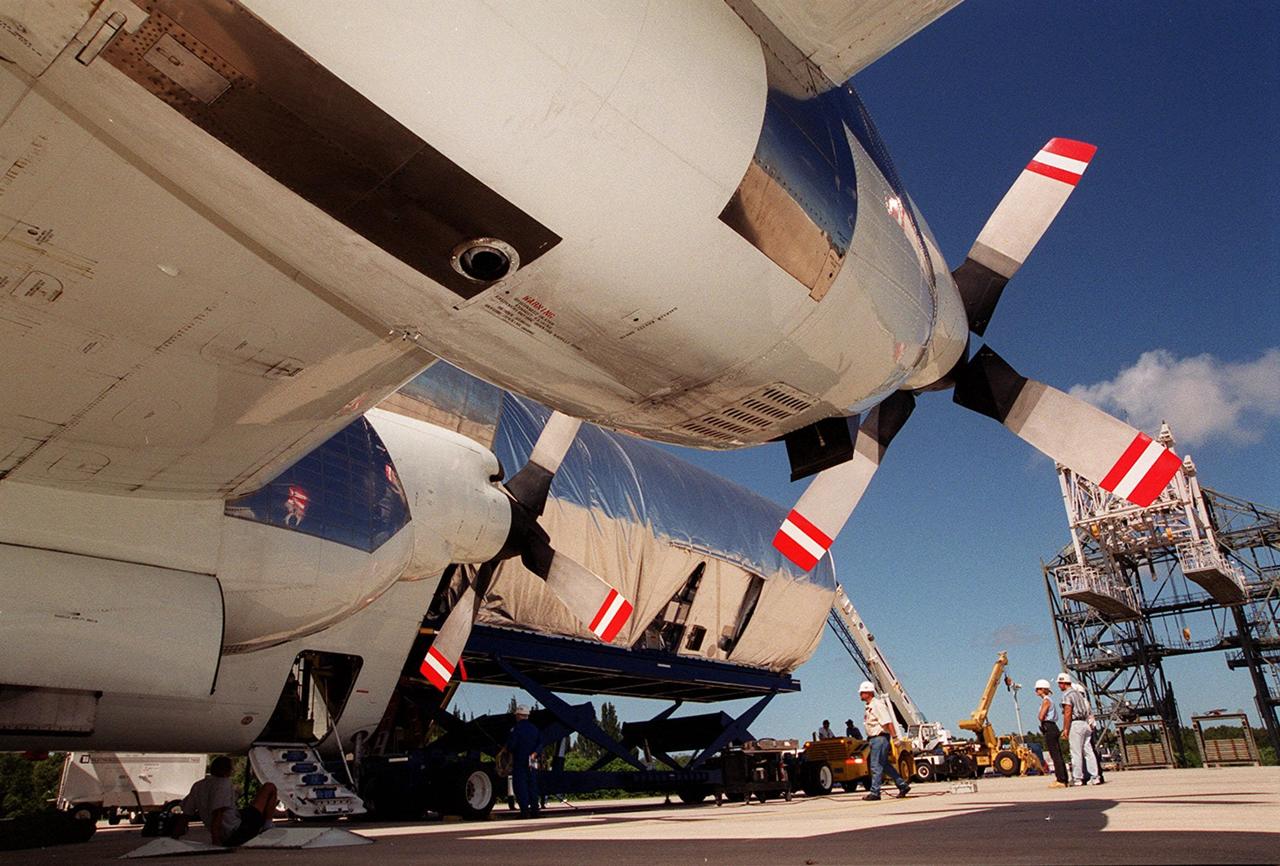
KENNEDY SPACE CENTER, FLA. -- Viewed from underneath the wing of NASA’s Super Guppy aircraft, the Joint Airlock Module, the gateway from which crew members aboard the International Space Station (ISS) will enter and exit the 470-ton orbiting research facility, rolls out of the aircraft. It will be transferred to the Operations and Checkout Building in the KSC industrial area where it will undergo vacuum chamber testing. Then it will be moved to the Space Station Processing Facility (SSPF) for further pre-launch preparation and checkout. The massive, spindle-shaped airlock is 20 feet long, has a diameter of 13 feet at its widest point, and weighs six and a half tons. It was manufactured at NASA's Marshall Space Flight Center by the Huntsville division of The Boeing Company. The Space Shuttle Atlantis will carry the airlock to orbit on mission STS-104, the tenth International Space Station flight, currently targeted for liftoff in May 2001
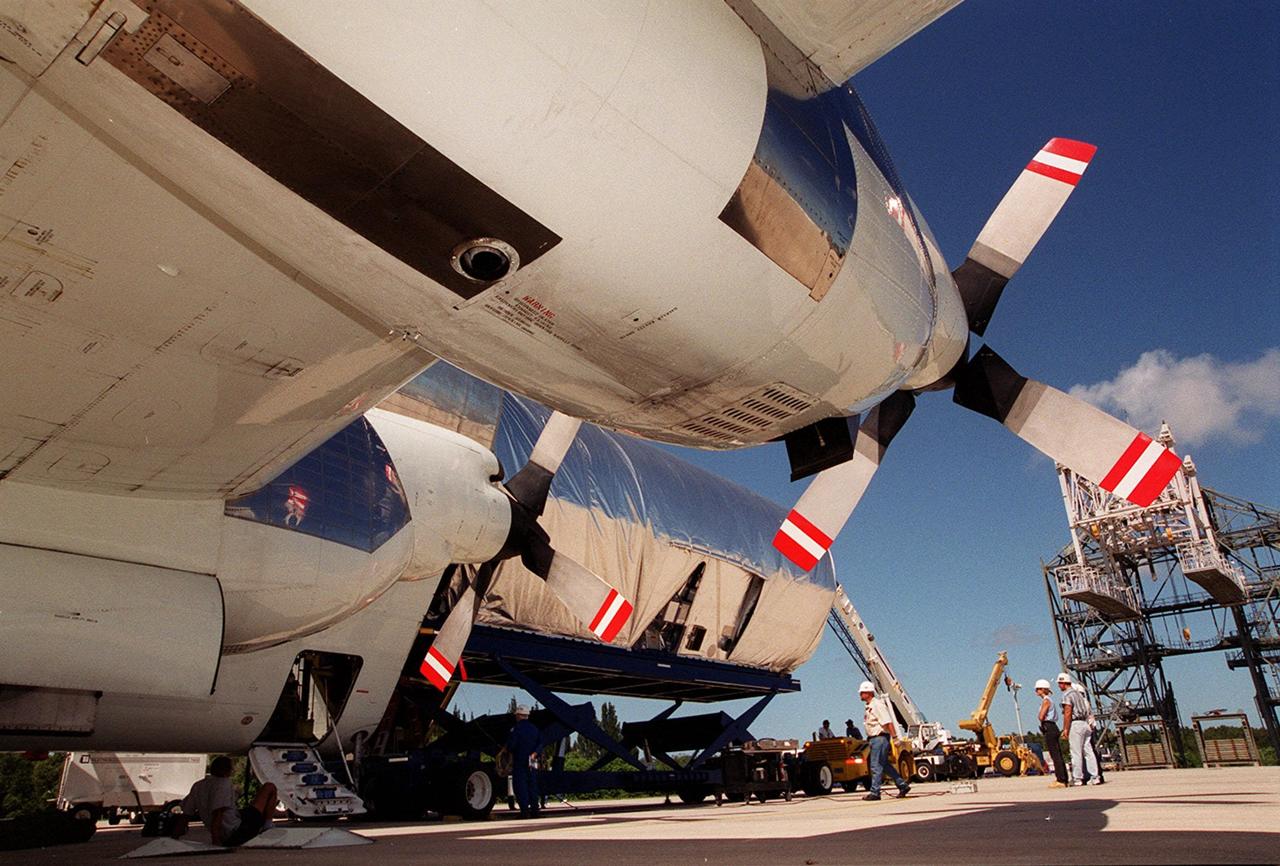
KENNEDY SPACE CENTER, FLA. -- Viewed from underneath the wing of NASA’s Super Guppy aircraft, the Joint Airlock Module, the gateway from which crew members aboard the International Space Station (ISS) will enter and exit the 470-ton orbiting research facility, rolls out of the aircraft. It will be transferred to the Operations and Checkout Building in the KSC industrial area where it will undergo vacuum chamber testing. Then it will be moved to the Space Station Processing Facility (SSPF) for further pre-launch preparation and checkout. The massive, spindle-shaped airlock is 20 feet long, has a diameter of 13 feet at its widest point, and weighs six and a half tons. It was manufactured at NASA's Marshall Space Flight Center by the Huntsville division of The Boeing Company. The Space Shuttle Atlantis will carry the airlock to orbit on mission STS-104, the tenth International Space Station flight, currently targeted for liftoff in May 2001
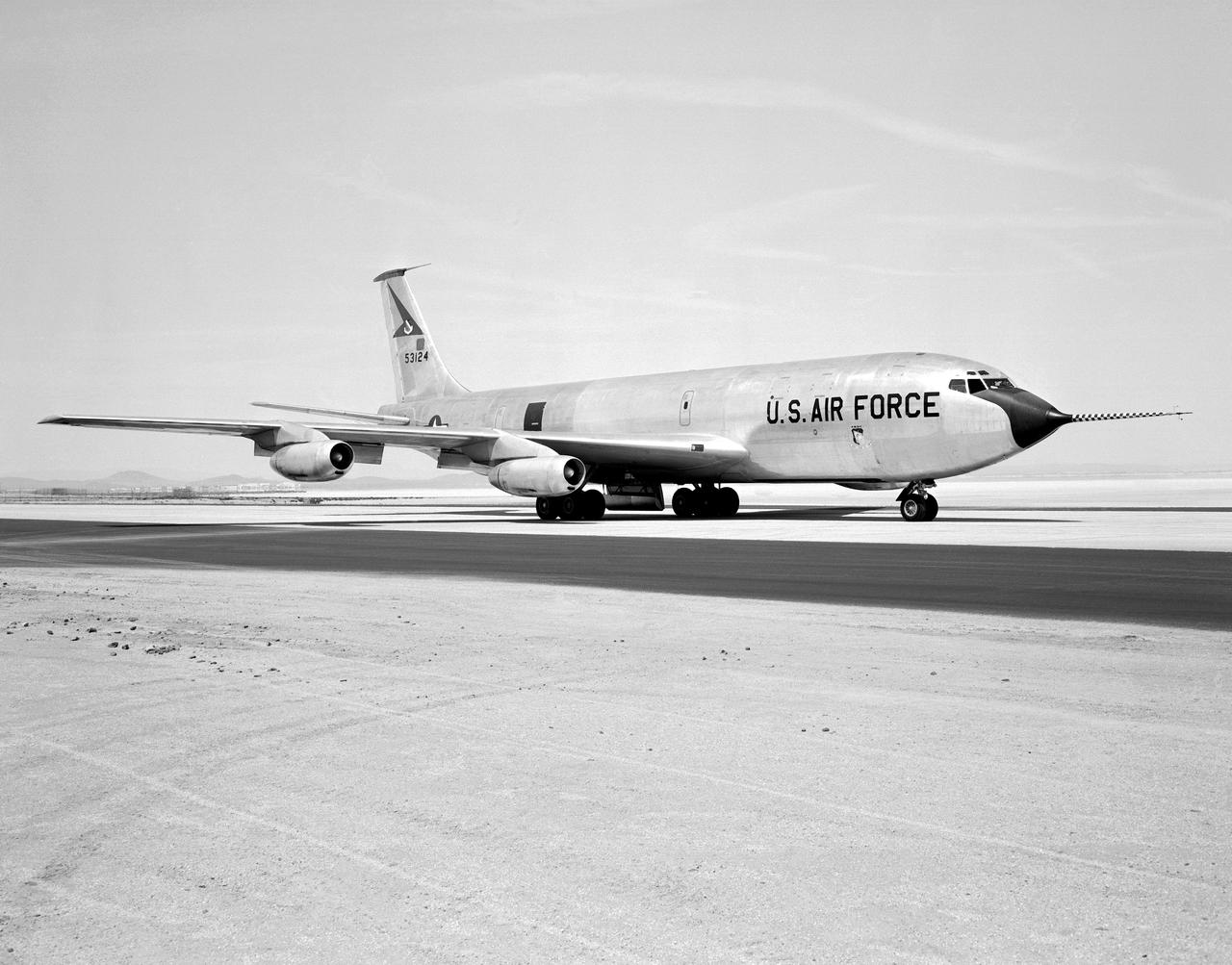
The Boeing KC-135 Stratotanker, besides being used extensively in its primary role as an inflight aircraft refueler, has assisted in several projects at the NASA Dryden Flight Research Center, Edwards, California. In 1957 and 1958, Dryden was asked by what was then the Civil Aeronautics Administration (later absorbed into the Federal Aviation Administration (FAA) in 1958) to help establish new approach procedure guidelines on cloud-ceiling and visibility minimums for Boeing's first jet airliner, the B-707. Dryden used a KC-135 (the military variant of the 707), seen here on the runway at Edwards Air Force Base, to aid the CAA in these tests. In 1979 and 1980, Dryden was again involved with general aviation research with the KC-135. This time, a special wingtip "winglet", developed by Richard Whitcomb of Langley Research Center, was tested on the jet aircraft. Winglets are small, nearly vertical fins installed on an airplane's wing tips to help produce a forward thrust in the vortices that typically swirl off the end of the wing, thereby reducing drag. This winglet idea was tested at the Dryden Flight Research Center on a KC-135A tanker loaned to NASA by the Air Force. The research showed that the winglets could increase an aircraft's range by as much as 7 percent at cruise speeds. The first application of NASA's winglet technology in industry was in general aviation business jets, but winglets are now being incorporated into most new commercial and military transport jets, including the Gulfstream III and IV business jets, the Boeing 747-400 and MD-11 airliners, and the C-17 military transport. In the 1980's, a KC-135 was used in support of the Space Shuttle program. Since the Shuttle was to be launched from Florida, researchers wanted to test the effect of rain on the sensitive thermal tiles. Tiles were mounted on special fixtures on an F-104 aircraft and a P-3 Orion. The F-104 was flown in actual rain conditions, and also behind the KC-135 spray tanker as it rel
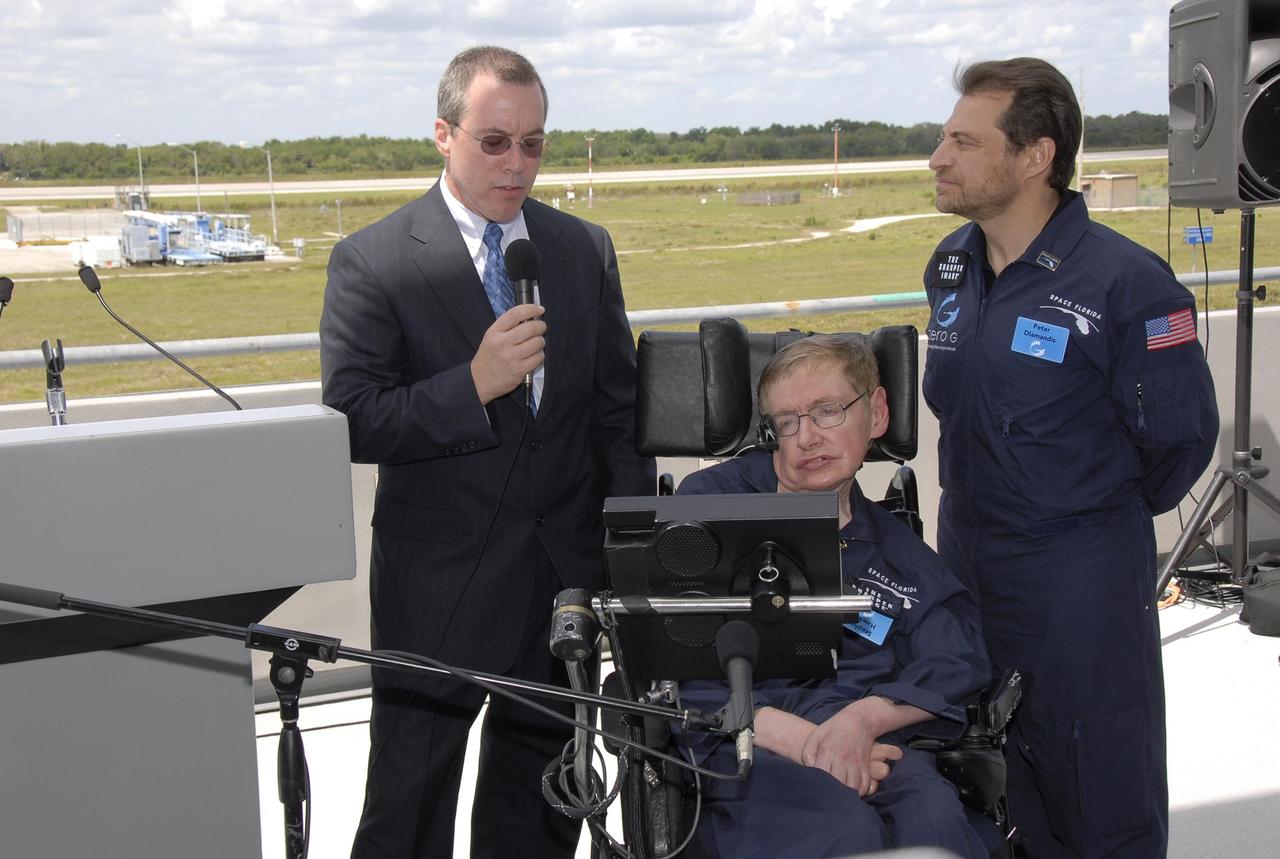
KENNEDY SPACE CENTER, FLA. -- At the Kennedy Space Center Shuttle Landing Facility, Space Florida president Steve Kohler (left) talks to the media about physicist Stephen Hawking's (in the wheelchair) first zero-gravity flight. The flight will be aboard a modified Boeing 727 aircraft owned by Zero Gravity Corp., a commercial company licensed to provide the public with weightless flight experiences. At right is Peter Diamandis, founder of the Zero Gravity Corp. Hawking developed amyotrophic lateral sclerosis disease in the 1960s, a type of motor neuron disease which would cost him the loss of almost all neuromuscular control. At the celebration of his 65th birthday on January 8 this year, Hawking announced his plans for a zero-gravity flight to prepare for a sub-orbital space flight in 2009 on Virgin Galactic's space service. Photo credit: NASA/Kim Shiflett
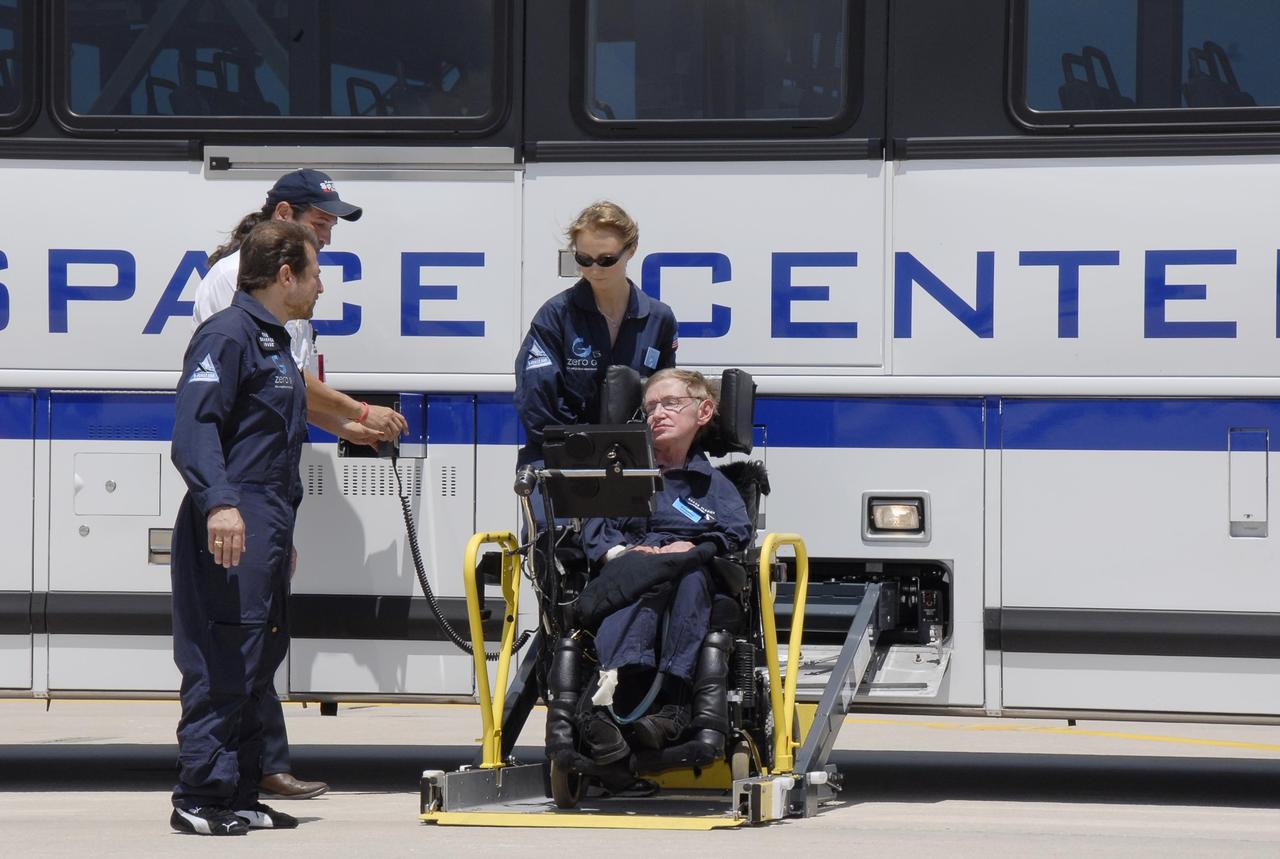
KENNEDY SPACE CENTER, FLA. -- At the Kennedy Space Center Shuttle Landing Facility, noted physicist Stephen Hawking, in the wheelchair, arrives at the runway for his first zero-gravity flight. The flight will be aboard a modified Boeing 727 aircraft owned by Zero Gravity Corp., a commercial company licensed to provide the public with weightless flight experiences. At left is Peter Diamandis, founder of the Zero Gravity Corp. Behind Hawking is Nicola O'Brien, a nurse practitioner who is Hawking's aide. Hawking developed amyotrophic lateral sclerosis disease in the 1960s, a type of motor neuron disease which would cost him the loss of almost all neuromuscular control. At the celebration of his 65th birthday on January 8 this year, Hawking announced his plans for a zero-gravity flight to prepare for a sub-orbital space flight in 2009 on Virgin Galactic's space service. Photo credit: NASA/Kim Shiflett
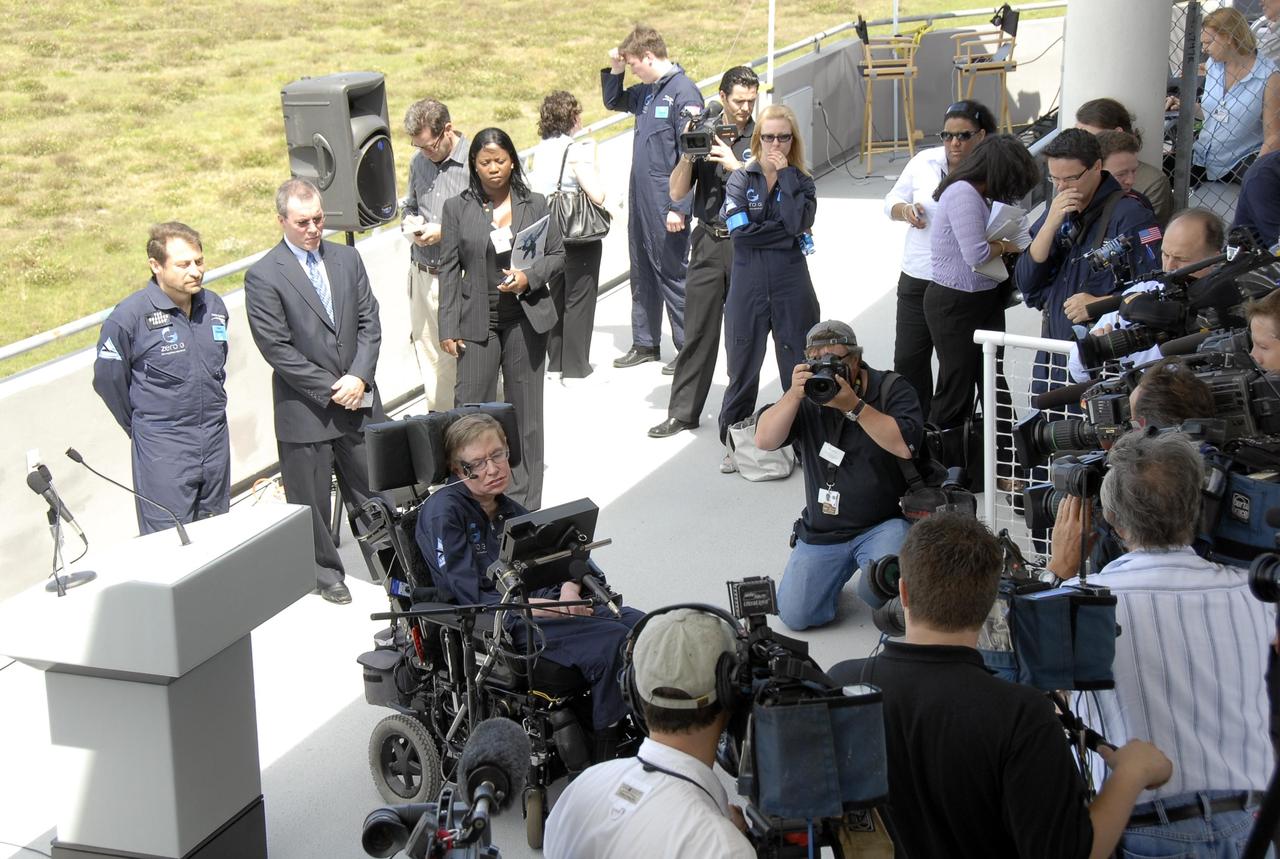
KENNEDY SPACE CENTER, FLA. -- The media surround noted wheelchair-bound physicist Stephen Hawking after his arrival at the Kennedy Space Center Shuttle Landing Facility for his first zero-gravity flight. Behind Hawking, at left, are Zero Gravity Corporation founder Peter Diamandis and Space Florida president Steve Kohler. The flight will be aboard a modified Boeing 727 aircraft owned by Zero G, a commercial company licensed to provide the public with weightless flight experiences. Hawking developed amyotrophic lateral sclerosis disease in the 1960s, a type of motor neuron disease which would cost him the loss of almost all neuromuscular control. At the celebration of his 65th birthday on January 8 this year, Hawking announced his plans for a zero-gravity flight to prepare for a sub-orbital space flight in 2009 on Virgin Galactic's space service. Photo credit: NASA/Kim Shiflett

KENNEDY SPACE CENTER, FLA. — Noted physicist Stephen Hawking greets the media after his arrival at the Kennedy Space Center Shuttle Landing Facility for his first zero-gravity flight. The flight will be aboard a modified Boeing 727 aircraft owned by Zero Gravity Corp., a commercial company licensed to provide the public with weightless flight experiences. Hawking developed amyotrophic lateral sclerosis disease in the 1960s, a type of motor neuron disease which would cost him the loss of almost all neuromuscular control. At the celebration of his 65th birthday on January 8 this year, Hawking announced his plans for a zero-gravity flight to prepare for a sub-orbital space flight in 2009 on Virgin Galactic's space service. Photo credit: NASA/Kim Shiflett
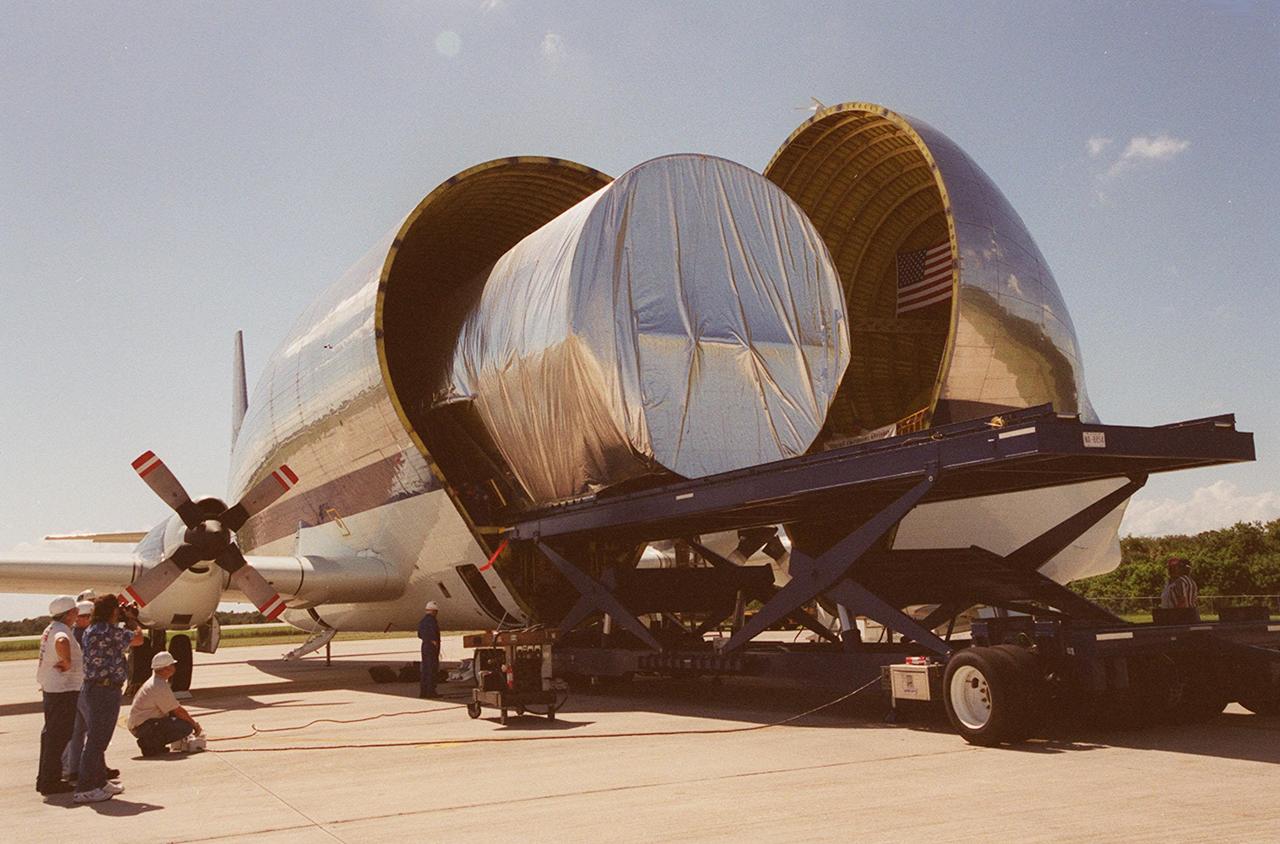
KENNEDY SPACE CENTER, FLA. -- The Joint Airlock Module, the gateway from which crew members aboard the International Space Station (ISS) will enter and exit the 470-ton orbiting research facility, rolls out of NASA's Super Guppy aircraft. It will be transferred to the Operations and Checkout Building in the KSC industrial area where it will undergo vacuum chamber testing. It will then be moved to the Space Station Processing Facility (SSPF) for further prelaunch preparation and checkout. The massive, spindle-shaped airlock is 20 feet long, has a diameter of 13 feet at its widest point, and weighs six and a half tons. It was manufactured at NASA's Marshall Space Flight Center by the Huntsville division of The Boeing Company. The Space Shuttle Atlantis will carry the airlock to orbit on mission STS-104, the tenth International Space Station flight, currently targeted for liftoff in May 2001
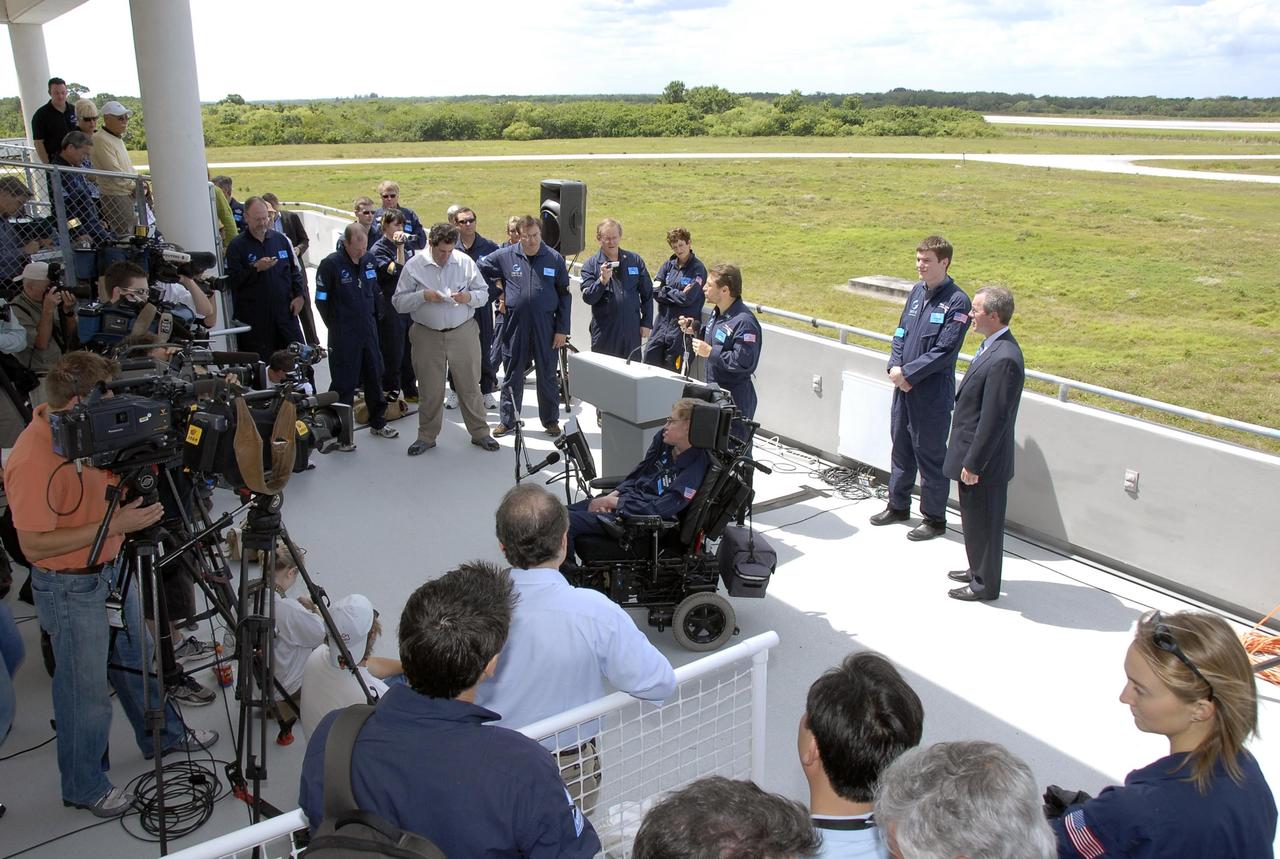
KENNEDY SPACE CENTER, FLA. -- At the Kennedy Space Center Shuttle Landing Facility, Peter Diamandis, founder of the Zero Gravity Corp., talks to the media about physicist Stephen Hawking's (in the wheelchair) first zero-gravity flight. The flight will be aboard a modified Boeing 727 aircraft owned by Zero Gravity Corp., a commercial company licensed to provide the public with weightless flight experiences. Hawking developed amyotrophic lateral sclerosis disease in the 1960s, a type of motor neuron disease which would cost him the loss of almost all neuromuscular control. At the celebration of his 65th birthday on January 8 this year, Hawking announced his plans for a zero-gravity flight to prepare for a sub-orbital space flight in 2009 on Virgin Galactic's space service. Photo credit: NASA/Kim Shiflett
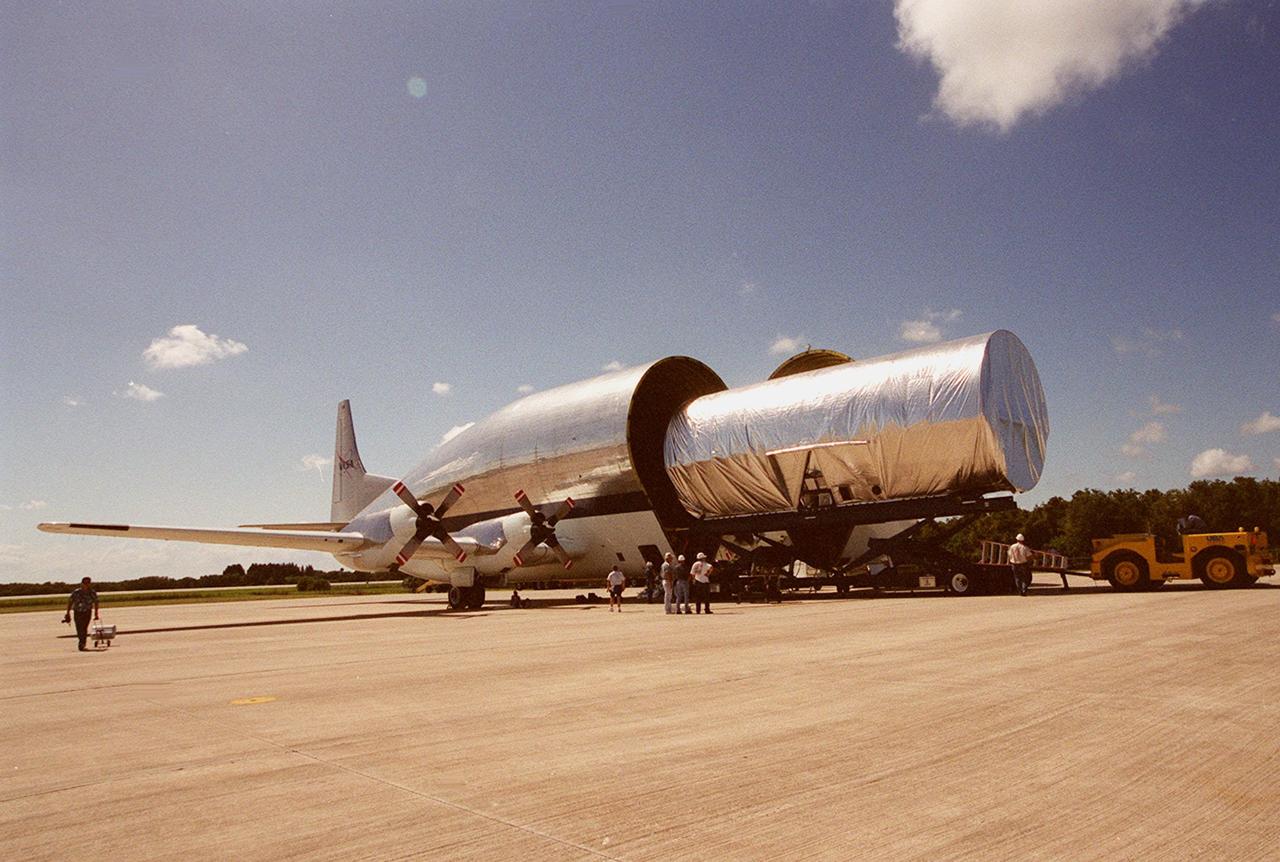
KENNEDY SPACE CENTER, FLA. -- At the KSC Shuttle Landing Facility, the Joint Airlock Module, the gateway from which crew members aboard the International Space Station (ISS) will enter and exit the 470-ton orbiting research facility, is moved away from NASA’s Super Guppy aircraft for transfer to the Operations and Checkout Building in the KSC industrial area. There it will undergo vacuum chamber testing. It will then be moved to the Space Station Processing Facility (SSPF) for further prelaunch preparation and checkout. The massive, spindle-shaped airlock is 20 feet long, has a diameter of 13 feet at its widest point, and weighs six and a half tons. It was manufactured at NASA's Marshall Space Flight Center by the Huntsville division of The Boeing Company. The Space Shuttle Atlantis will carry the airlock to orbit on mission STS-104, the tenth International Space Station flight, currently targeted for liftoff in May 2001
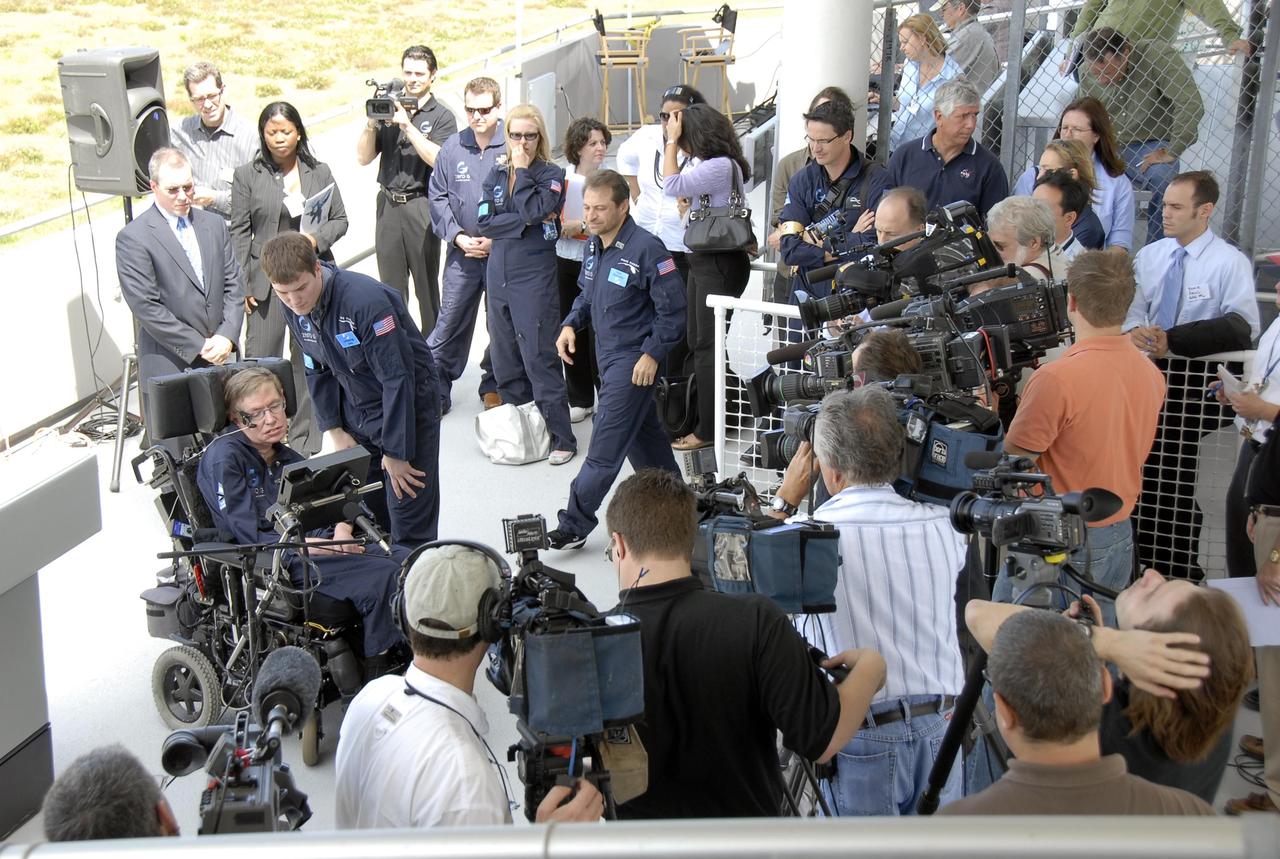
KENNEDY SPACE CENTER, FLA. -- The media surround noted wheelchair-bound physicist Stephen Hawking after his arrival at the Kennedy Space Center Shuttle Landing Facility for his first zero-gravity flight. Behind Hawking, at left, is Space Florida president Steve Kohler. In the center, striding toward Hawking, is Zero Gravity Corp. founder Peter Diamandis. The flight will be aboard a modified Boeing 727 aircraft owned by Zero Gravity, a commercial company licensed to provide the public with weightless flight experiences. Hawking developed amyotrophic lateral sclerosis disease in the 1960s, a type of motor neuron disease which would cost him the loss of almost all neuromuscular control. At the celebration of his 65th birthday on January 8 this year, Hawking announced his plans for a zero-gravity flight to prepare for a sub-orbital space flight in 2009 on Virgin Galactic's space service. Photo credit: NASA/Kim Shiflett
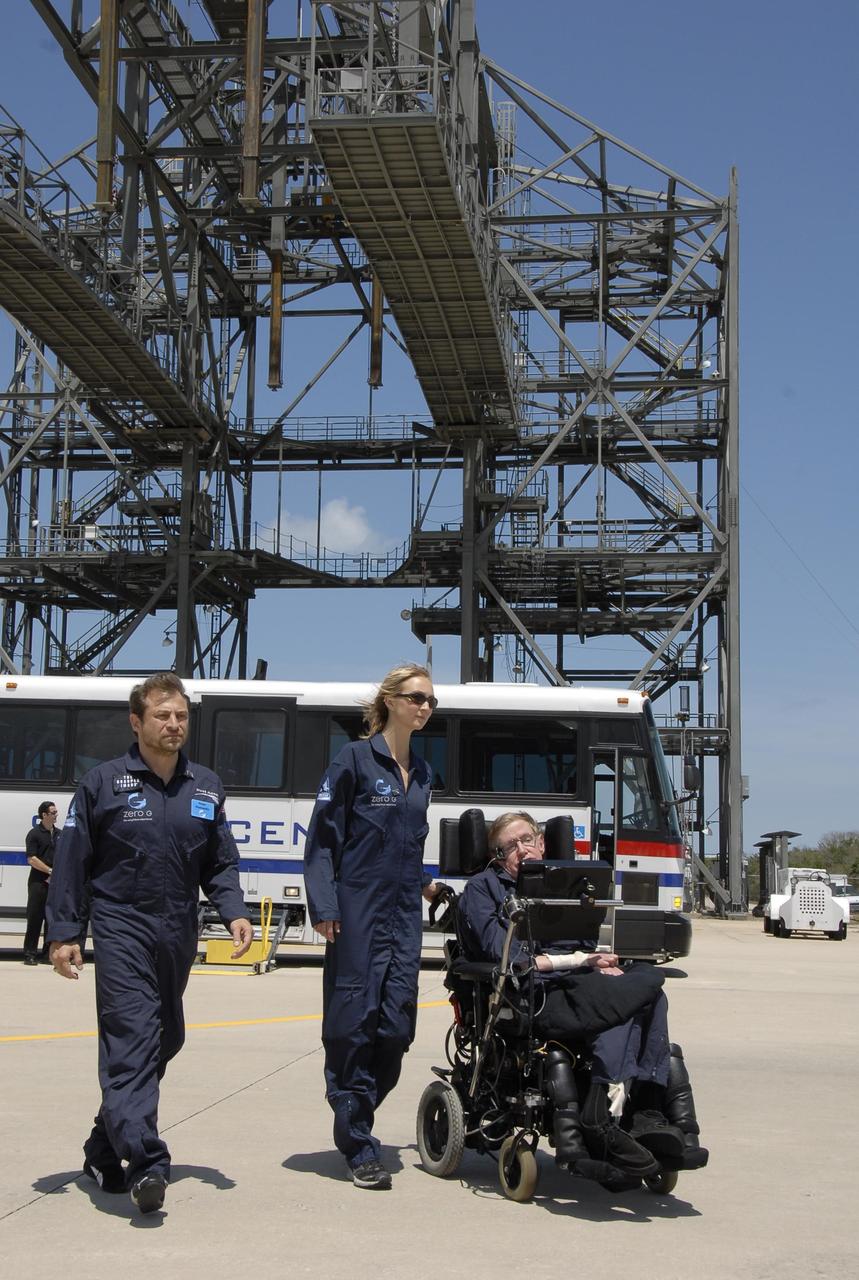
KENNEDY SPACE CENTER, FLA. -- At the Kennedy Space Center Shuttle Landing Facility, noted physicist Stephen Hawking, in the wheelchair, arrives at the runway for his first zero-gravity flight. The flight will be aboard a modified Boeing 727 aircraft owned by Zero Gravity Corp., a commercial company licensed to provide the public with weightless flight experiences. At left is Peter Diamandis, founder of the Zero Gravity Corp. At center is Nicola O'Brien, a nurse practitioner who is Hawking's aide. Hawking developed amyotrophic lateral sclerosis disease in the 1960s, a type of motor neuron disease which would cost him the loss of almost all neuromuscular control. At the celebration of his 65th birthday on January 8 this year, Hawking announced his plans for a zero-gravity flight to prepare for a sub-orbital space flight in 2009 on Virgin Galactic's space service. Photo credit: NASA/Kim Shiflett
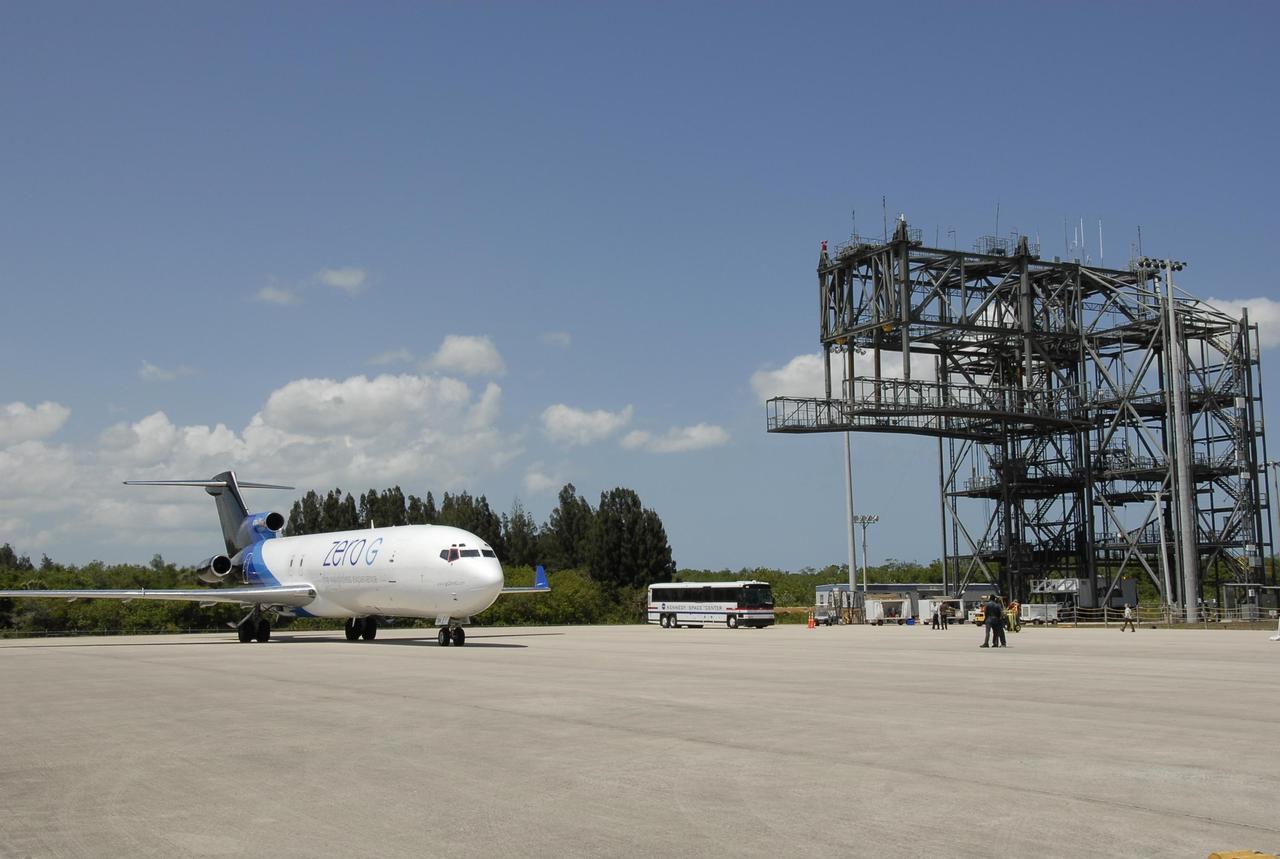
KENNEDY SPACE CENTER, FLA. -- At the Kennedy Space Center Shuttle Landing Facility, a modified Boeing 727 aircraft owned by Zero Gravity Corp. is ready to take off with its well-known passenger, physicist Stephen Hawking. Zero Gravity Corp. is a commercial company licensed to provide the public with weightless flight experiences. Hawking will be making his first zero-gravity flight. Hawking developed amyotrophic lateral sclerosis disease in the 1960s, a type of motor neuron disease which would cost him the loss of almost all neuromuscular control. At the celebration of his 65th birthday on January 8 this year, Hawking announced his plans for a zero-gravity flight to prepare for a sub-orbital space flight in 2009 on Virgin Galactic's space service. Photo credit: NASA/Kim Shiflett
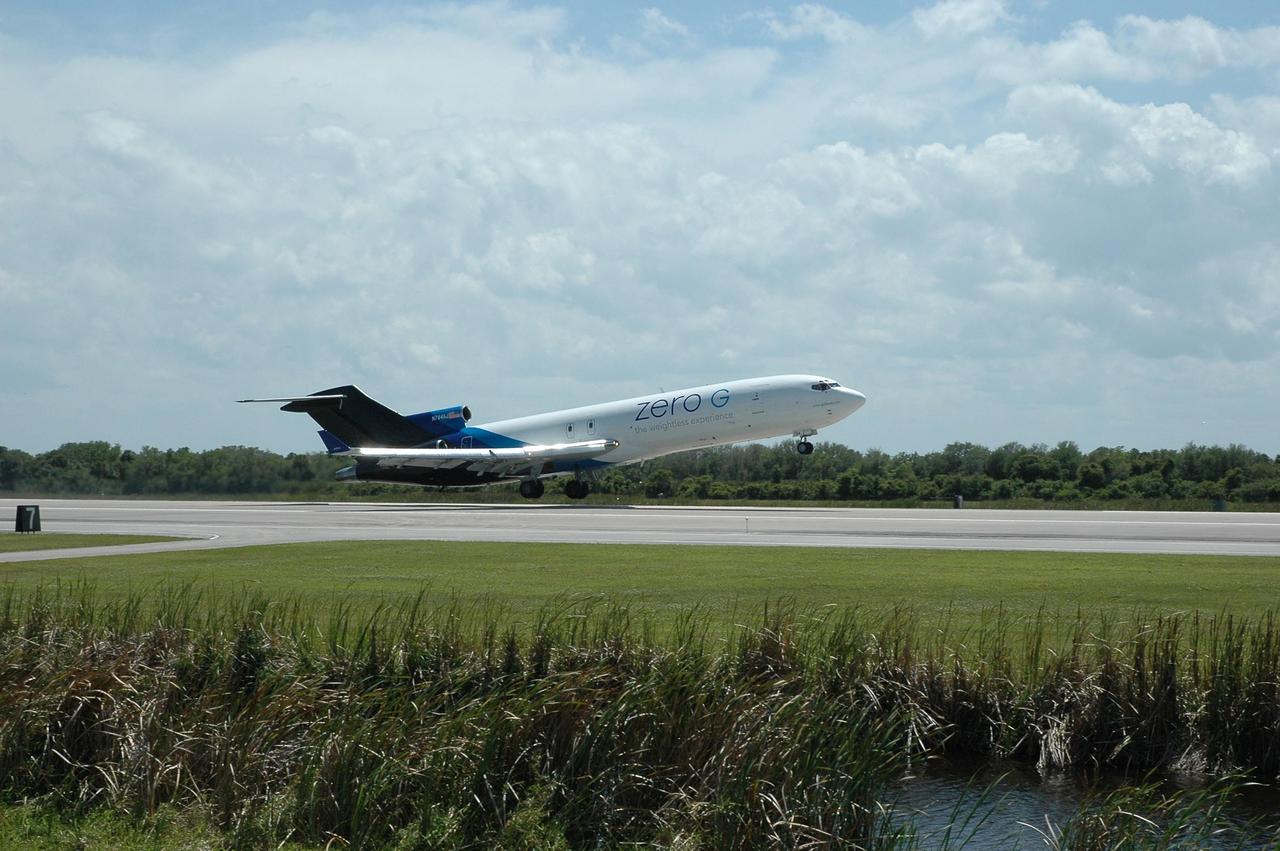
KENNEDY SPACE CENTER, FLA. -- At the Kennedy Space Center Shuttle Landing Facility, a modified Boeing 727 aircraft owned by Zero Gravity Corp. takes off with its well-known passenger, physicist Stephen Hawking. Zero Gravity Corp. is a commercial company licensed to provide the public with weightless flight experiences. Hawking will be making his first zero-gravity flight. Hawking developed amyotrophic lateral sclerosis disease in the 1960s, a type of motor neuron disease which would cost him the loss of almost all neuromuscular control. At the celebration of his 65th birthday on January 8 this year, Hawking announced his plans for a zero-gravity flight to prepare for a sub-orbital space flight in 2009 on Virgin Galactic's space service. Photo credit: NASA/Jack Pfaller
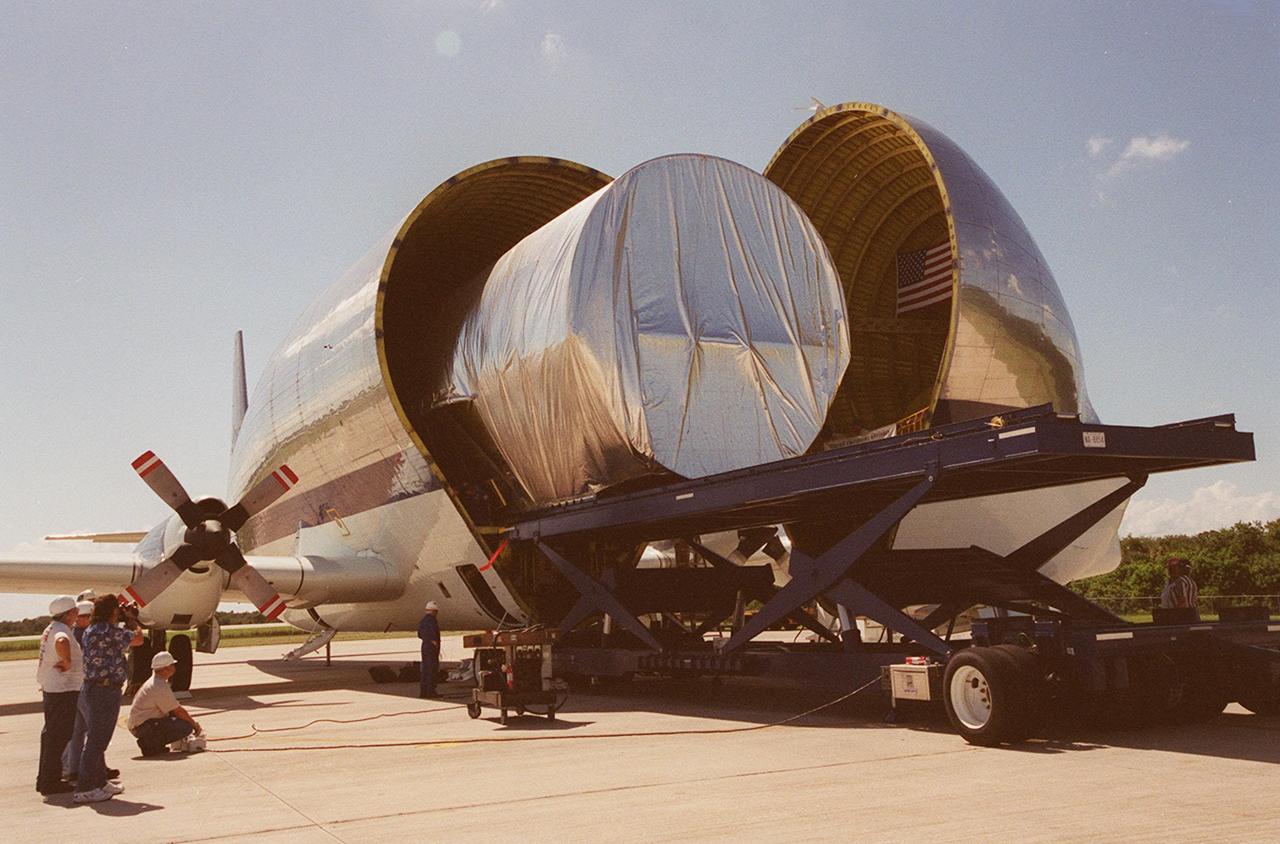
KENNEDY SPACE CENTER, FLA. -- The Joint Airlock Module, the gateway from which crew members aboard the International Space Station (ISS) will enter and exit the 470-ton orbiting research facility, rolls out of NASA's Super Guppy aircraft. It will be transferred to the Operations and Checkout Building in the KSC industrial area where it will undergo vacuum chamber testing. It will then be moved to the Space Station Processing Facility (SSPF) for further prelaunch preparation and checkout. The massive, spindle-shaped airlock is 20 feet long, has a diameter of 13 feet at its widest point, and weighs six and a half tons. It was manufactured at NASA's Marshall Space Flight Center by the Huntsville division of The Boeing Company. The Space Shuttle Atlantis will carry the airlock to orbit on mission STS-104, the tenth International Space Station flight, currently targeted for liftoff in May 2001
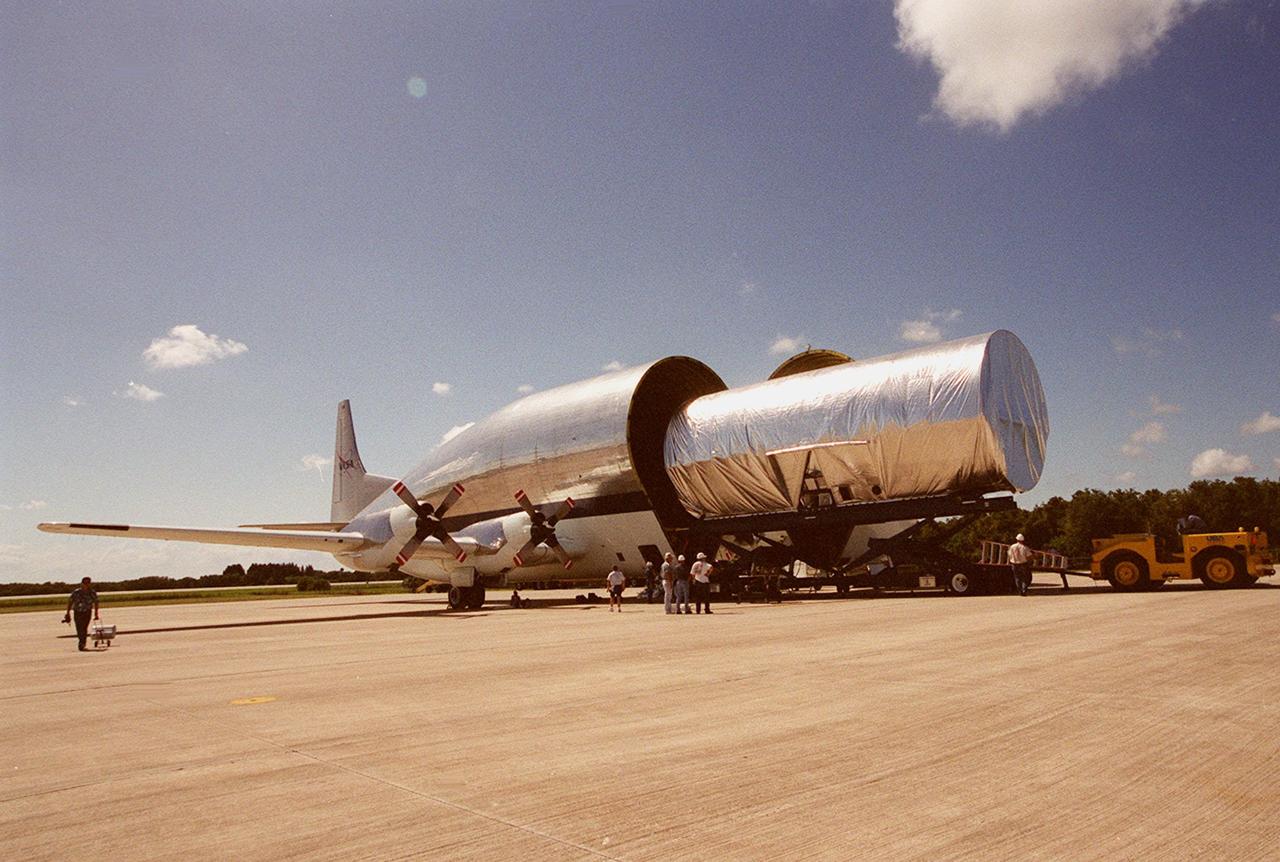
KENNEDY SPACE CENTER, FLA. -- At the KSC Shuttle Landing Facility, the Joint Airlock Module, the gateway from which crew members aboard the International Space Station (ISS) will enter and exit the 470-ton orbiting research facility, is moved away from NASA’s Super Guppy aircraft for transfer to the Operations and Checkout Building in the KSC industrial area. There it will undergo vacuum chamber testing. It will then be moved to the Space Station Processing Facility (SSPF) for further prelaunch preparation and checkout. The massive, spindle-shaped airlock is 20 feet long, has a diameter of 13 feet at its widest point, and weighs six and a half tons. It was manufactured at NASA's Marshall Space Flight Center by the Huntsville division of The Boeing Company. The Space Shuttle Atlantis will carry the airlock to orbit on mission STS-104, the tenth International Space Station flight, currently targeted for liftoff in May 2001
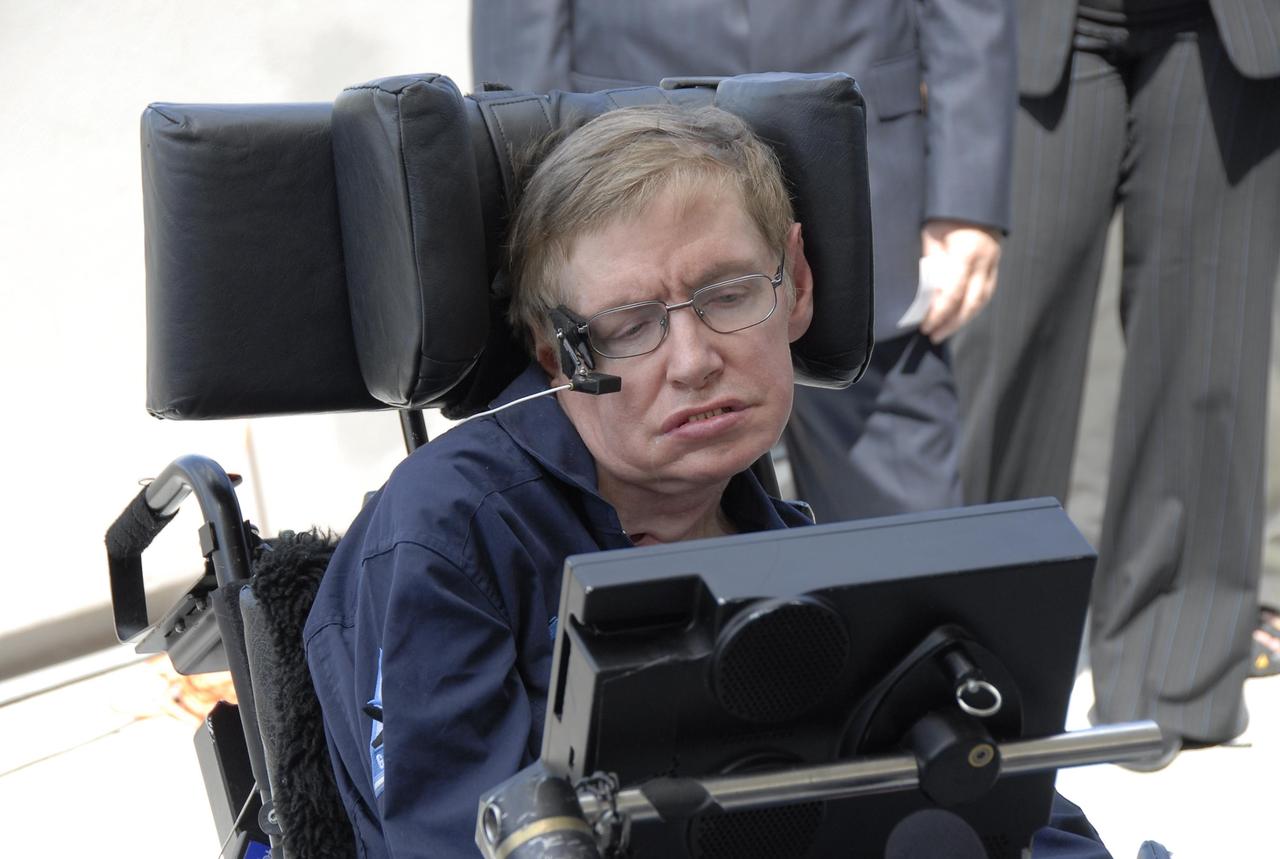
KENNEDY SPACE CENTER, FLA. -- Noted physicist Stephen Hawking arrives at the Kennedy Space Center Shuttle Landing Facility for his first zero-gravity flight. The flight will be aboard a modified Boeing 727 aircraft owned by Zero Gravity Corp., a commercial company licensed to provide the public with weightless flight experiences. Hawking developed amyotrophic lateral sclerosis disease in the 1960s, a type of motor neuron disease which would cost him the loss of almost all neuromuscular control. At the celebration of his 65th birthday on January 8 this year, Hawking announced his plans for a zero-gravity flight to prepare for a sub-orbital space flight in 2009 on Virgin Galactic's space service. Photo credit: NASA/Kim Shiflett
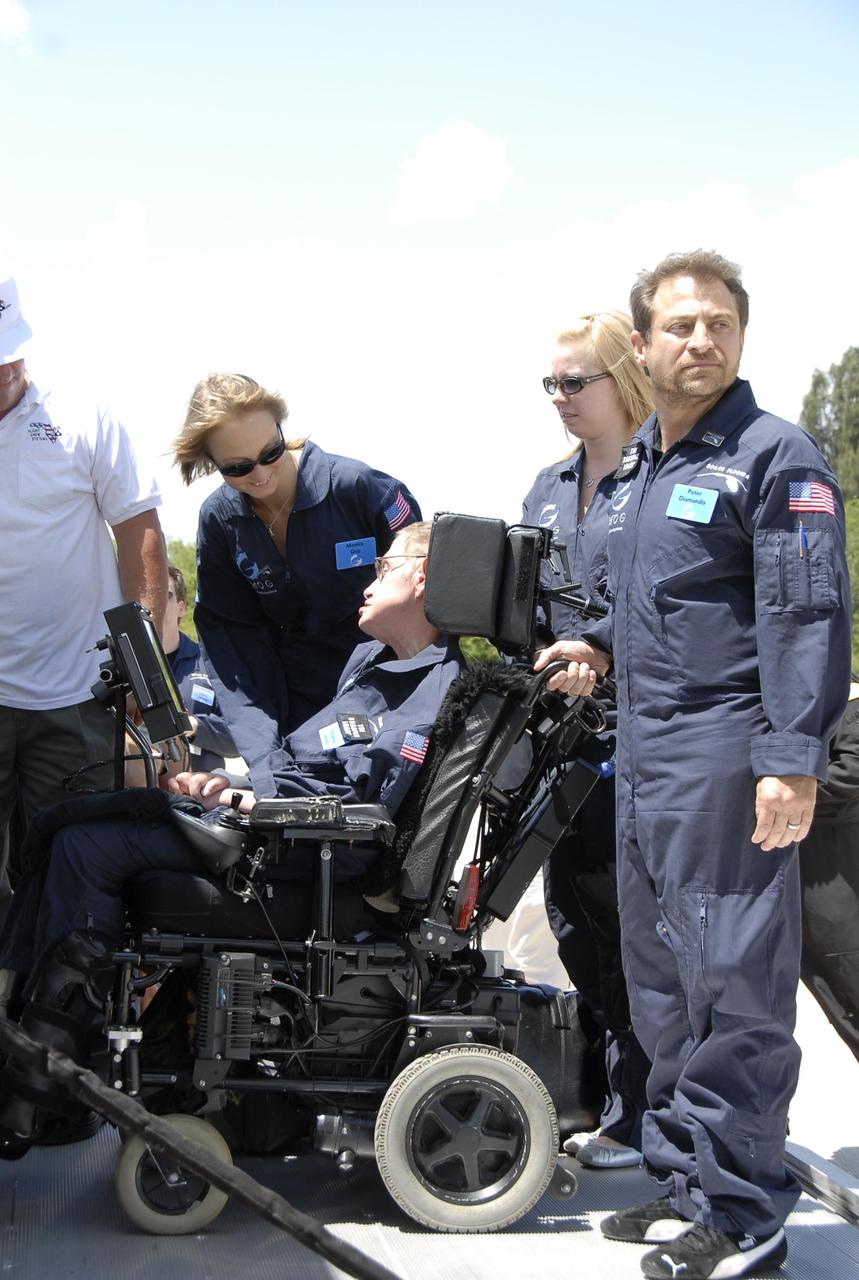
KENNEDY SPACE CENTER, FLA. -- At the Kennedy Space Center Shuttle Landing Facility, noted physicist Stephen Hawking, in the wheelchair, is ready to get onboard a modified Boeing 727 aircraft owned by Zero Gravity Corp. for his first zero-gravity flight. Zero Gravity Corp. is a commercial company licensed to provide the public with weightless flight experiences. At right is Peter Diamandis, founder of the Zero Gravity Corp. Behind Hawking is Nicola O'Brien, a nurse practitioner who is Hawking's aide. Hawking developed amyotrophic lateral sclerosis disease in the 1960s, a type of motor neuron disease which would cost him the loss of almost all neuromuscular control. At the celebration of his 65th birthday on January 8 this year, Hawking announced his plans for a zero-gravity flight to prepare for a sub-orbital space flight in 2009 on Virgin Galactic's space service. Photo credit: NASA/Kim Shiflett
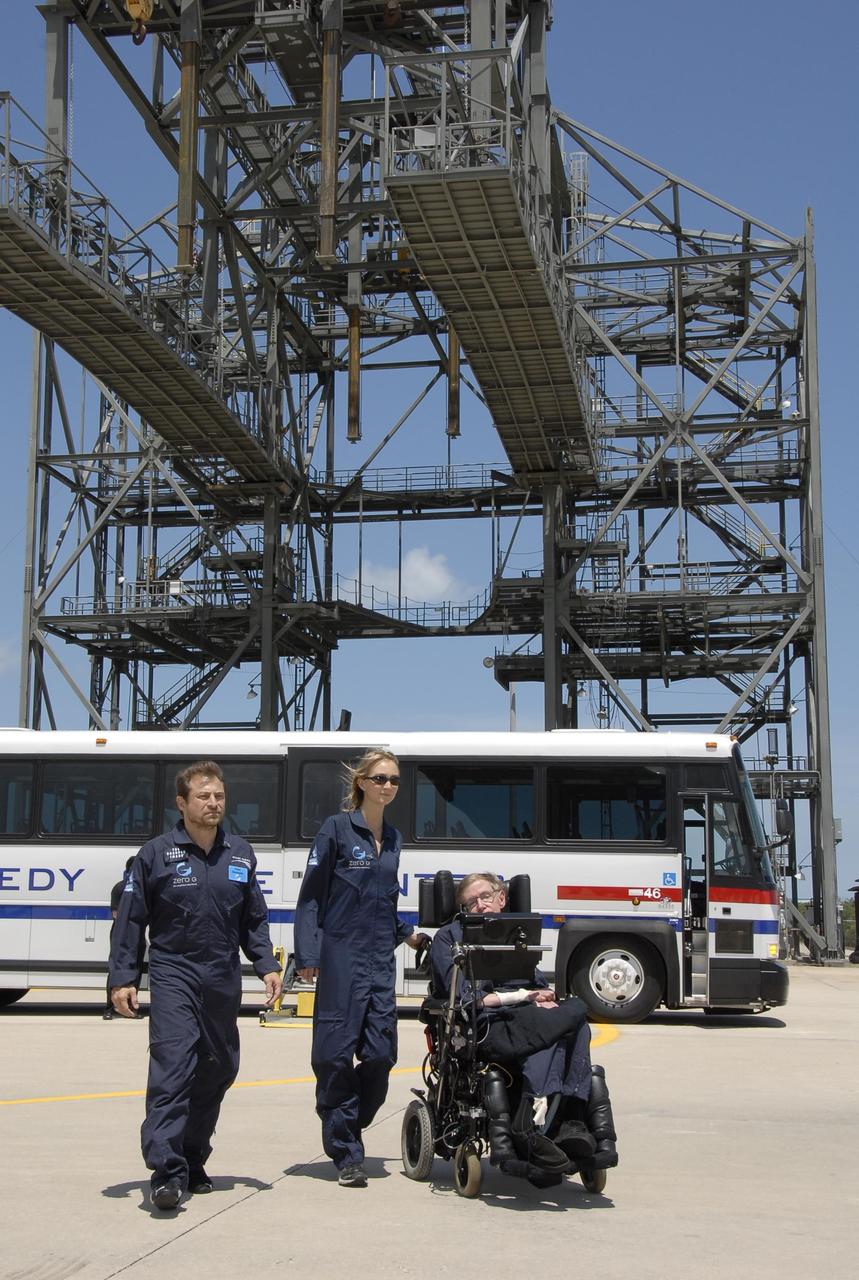
KENNEDY SPACE CENTER, FLA. -- At the Kennedy Space Center Shuttle Landing Facility, noted physicist Stephen Hawking, in the wheelchair, arrives at the runway for his first zero-gravity flight. The flight will be aboard a modified Boeing 727 aircraft owned by Zero Gravity Corp., a commercial company licensed to provide the public with weightless flight experiences. At left is Peter Diamandis, founder of the Zero Gravity Corp. At center is Nicola O'Brien, a nurse practitioner who is Hawking's aide. Hawking developed amyotrophic lateral sclerosis disease in the 1960s, a type of motor neuron disease which would cost him the loss of almost all neuromuscular control. At the celebration of his 65th birthday on January 8 this year, Hawking announced his plans for a zero-gravity flight to prepare for a sub-orbital space flight in 2009 on Virgin Galactic's space service. Photo credit: NASA/Kim Shiflett
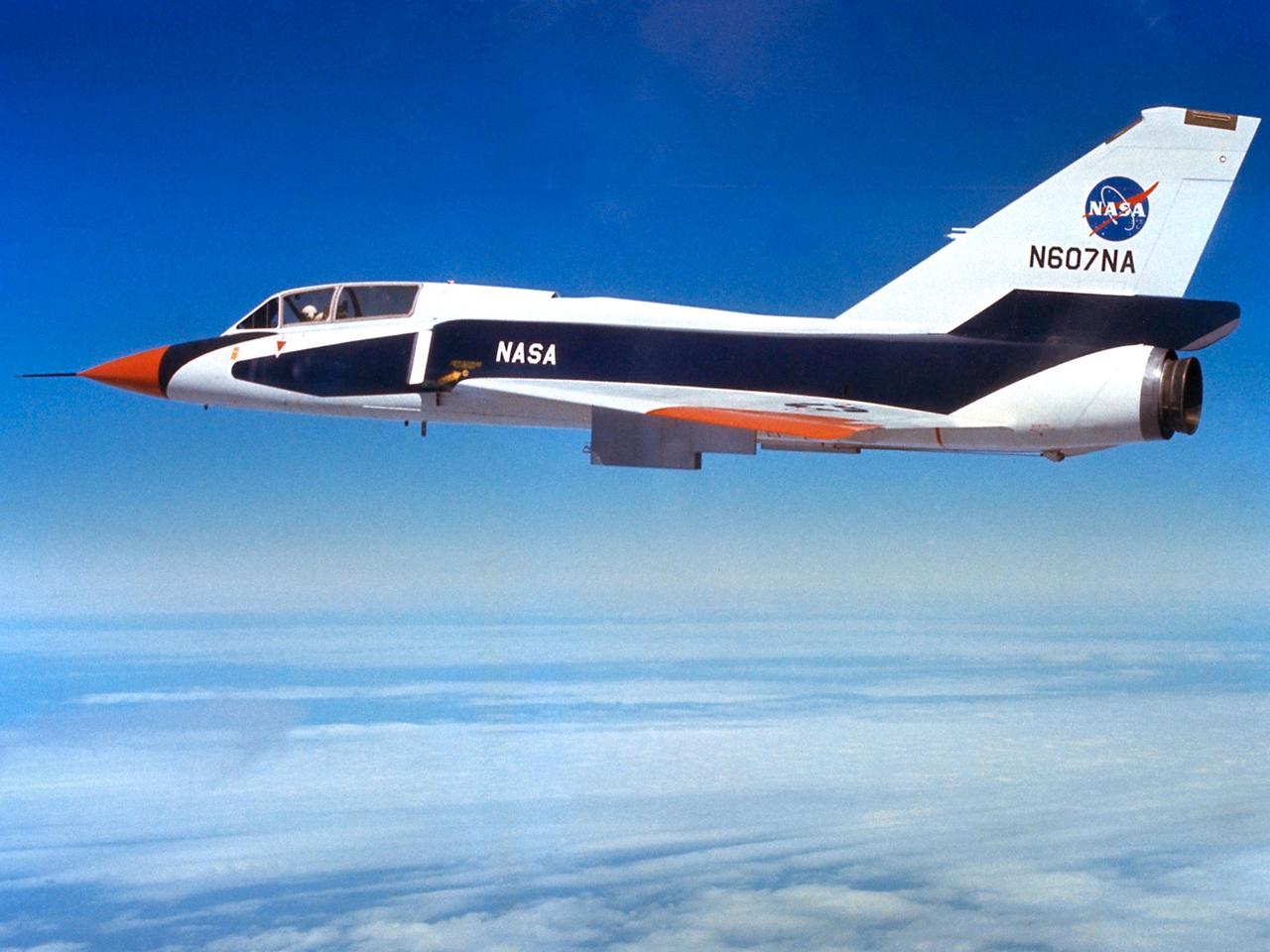
The National Aeronautics and Space Administration (NASA) Lewis Research Center’s Convair F-106B Delta Dart equipped with air sampling equipment in the mid-1970s. NASA Lewis created and managed the Global Air Sampling Program (GASP) in 1972 in partnership with several airline companies. NASA researchers used the airliners’ Boeing 747 aircraft to gather air samples to determine the amount of pollution present in the stratosphere. Private companies developed the air sampling equipment for the GASP program, and Lewis created a particle collector. The collector was flight tested on NASA Lewis’ F-106B in the summer of 1973. The sampling equipment was automatically operated once the proper altitude was achieved. The sampling instruments collected dust particles in the air so their chemical composition could be analyzed. The equipment analyzed one second’s worth of data at a time. The researchers also monitored carbon monoxide, monozide, ozone, and water vapor. The 747 flights began in December 1974 and soon included four airlines flying routes all over the globe. The F-106B augmented the airline data with sampling of its own, seen here. It gathered samples throughout this period from locations such as New Mexico, Texas, Michigan, and Ohio. In July 1977 the F-106B flew eight GASP flights in nine days over Alaska to supplement the earlier data gathered by the airlines.
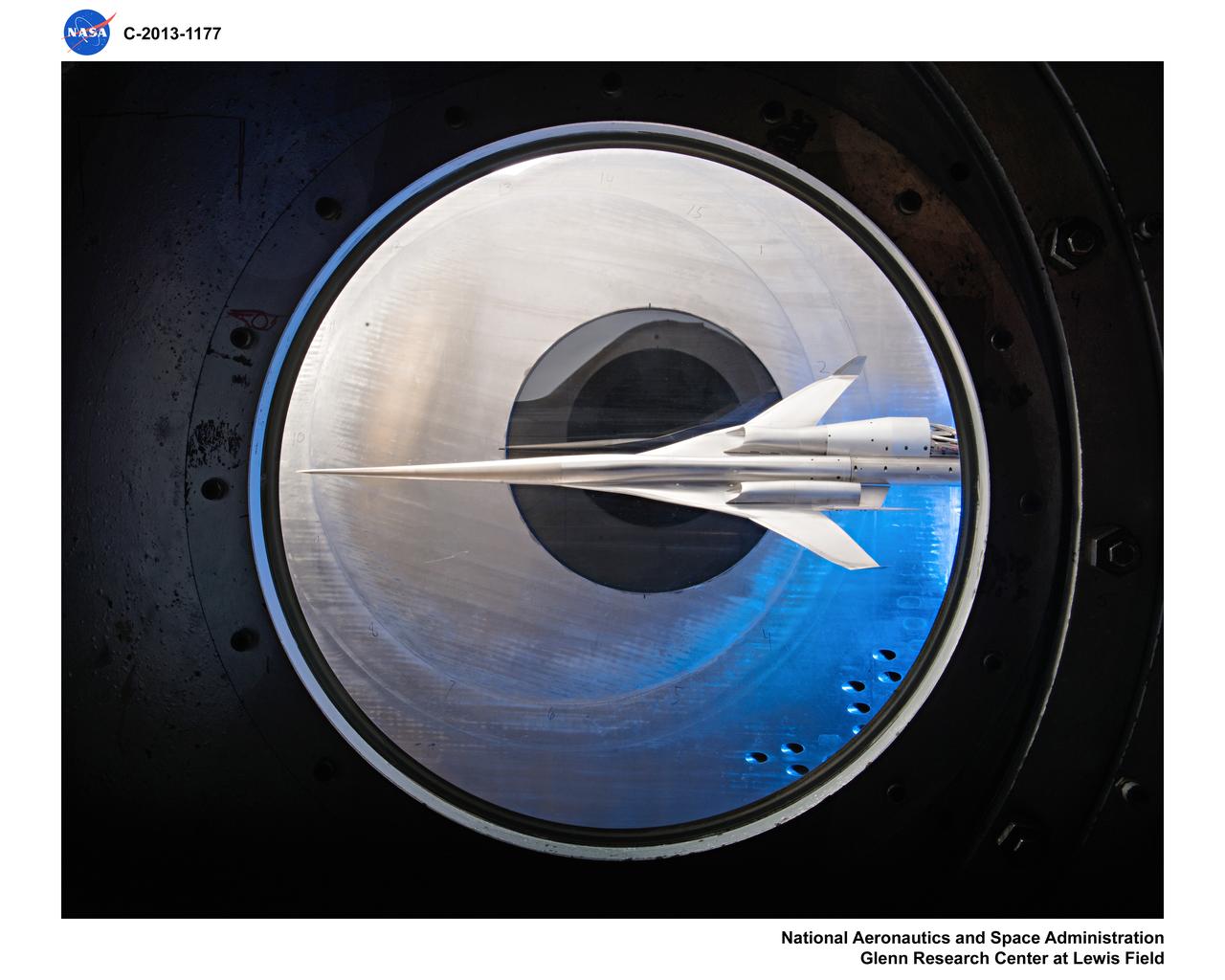
Supersonic Aircraft Model The window in the sidewall of the 8- by 6-foot supersonic wind tunnel at NASA's Glenn Research Center shows a 1.79 percent scale model of a future concept supersonic aircraft built by The Boeing Company. In recent tests, researchers evaluated the performance of air inlets mounted on top of the model to see how changing the amount of airflow at supersonic speeds through the inlet affected performance. The inlet on the pilot's right side (top inlet in this side view) is larger because it contains a remote-controlled device through which the flow of air could be changed. The work is part of ongoing research in NASA's Aeronautics Research Mission Directorate to address the challenges of making future supersonic flight over land possible. Researchers are testing overall vehicle design and performance options to reduce emissions and noise, and identifying whether the volume of sonic booms can be reduced to a level that leads to a reversal of the current ruling that prohibits commercial supersonic flight over land. Image Credit: NASA/Quentin Schwinn
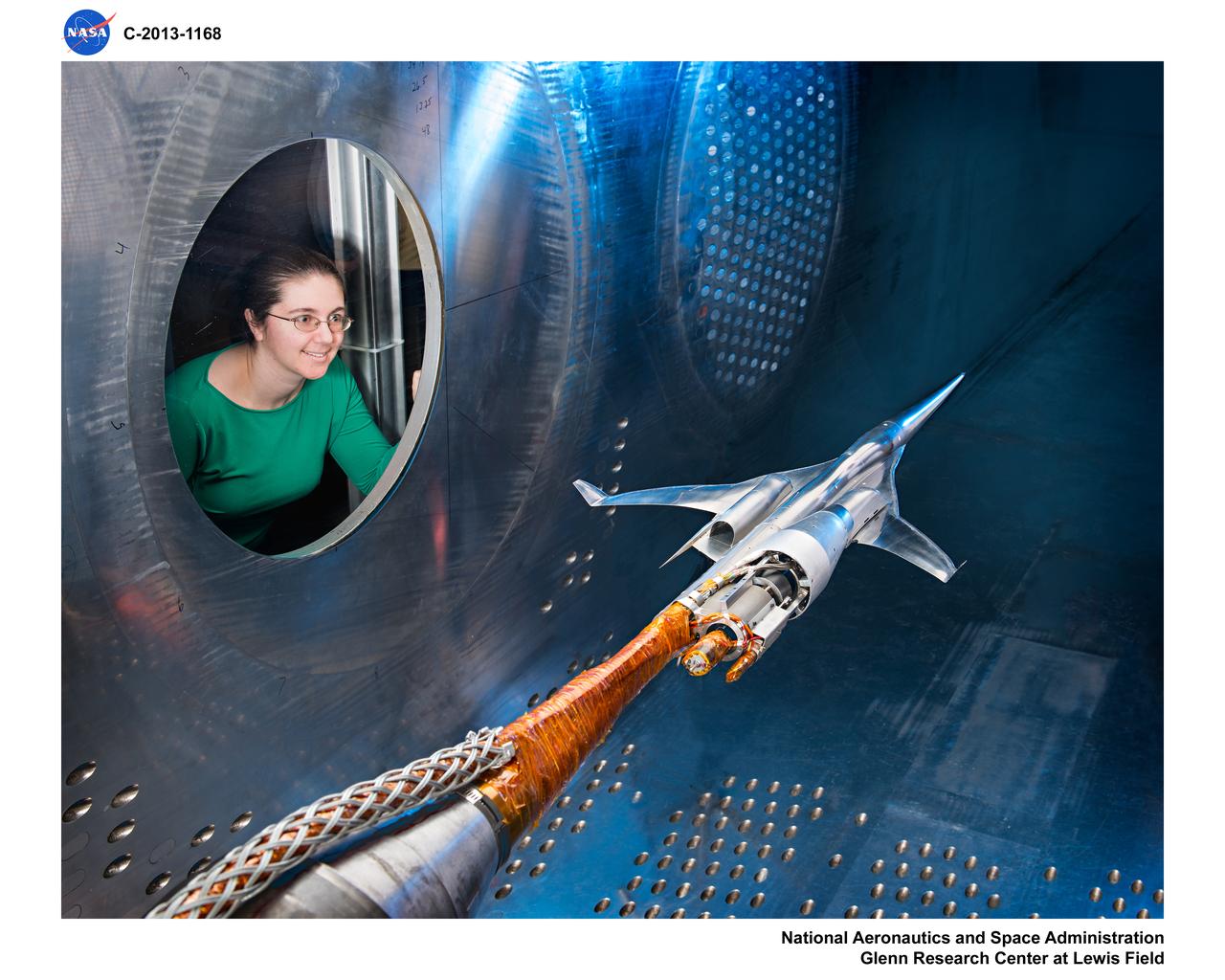
Supersonic Aircraft Model The window in the sidewall of the 8- by 6-foot supersonic wind tunnel at NASA's Glenn Research Center shows a 1.79 percent scale model of a future concept supersonic aircraft built by The Boeing Company. In recent tests, researchers evaluated the performance of air inlets mounted on top of the model to see how changing the amount of airflow at supersonic speeds through the inlet affected performance. The inlet on the pilot's right side (top inlet in this side view) is larger because it contains a remote-controlled device through which the flow of air could be changed. The work is part of ongoing research in NASA's Aeronautics Research Mission Directorate to address the challenges of making future supersonic flight over land possible. Researchers are testing overall vehicle design and performance options to reduce emissions and noise, and identifying whether the volume of sonic booms can be reduced to a level that leads to a reversal of the current ruling that prohibits commercial supersonic flight over land. Image Credit: NASA/Quentin Schwinn
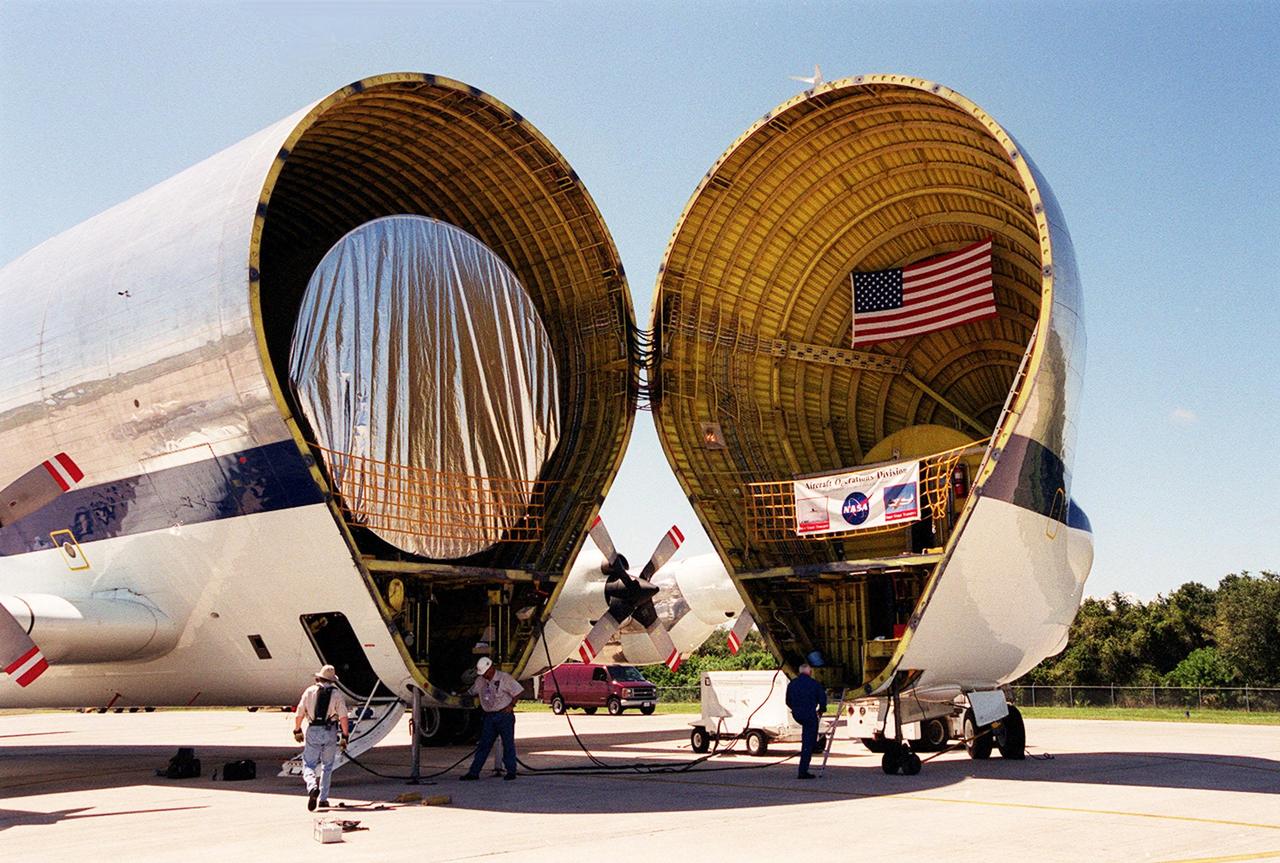
KENNEDY SPACE CENTER, FLA. -- The nose of NASA's Super Guppy aircraft opens to reveal the <a href="http://www-pao.ksc.nasa.gov/kscpao/release/2000/78-00.htm">Joint Airlock Module</a> the gateway from which crew members aboard the International Space Station (ISS) will enter and exit the 470-ton orbiting research facility. The airlock was transported from NASA's Marshall Space Flight Center in Huntsville, Ala. The airlock will be transported to the Operations and Checkout Building in the KSC industrial area where it will undergo vacuum chamber testing. It will then be moved to the Space Station Processing Facility (SSPF) for further prelaunch preparation and checkout. The massive, spindle-shaped airlock is 20 feet long, has a diameter of 13 feet at its widest point, and weighs six and a half tons. It was manufactured at NASA's Marshall Space Flight Center by the Huntsville division of The Boeing Company. The Space Shuttle Atlantis will carry the airlock to orbit on mission STS-104, the tenth International Space Station flight, currently targeted for liftoff in May 2001
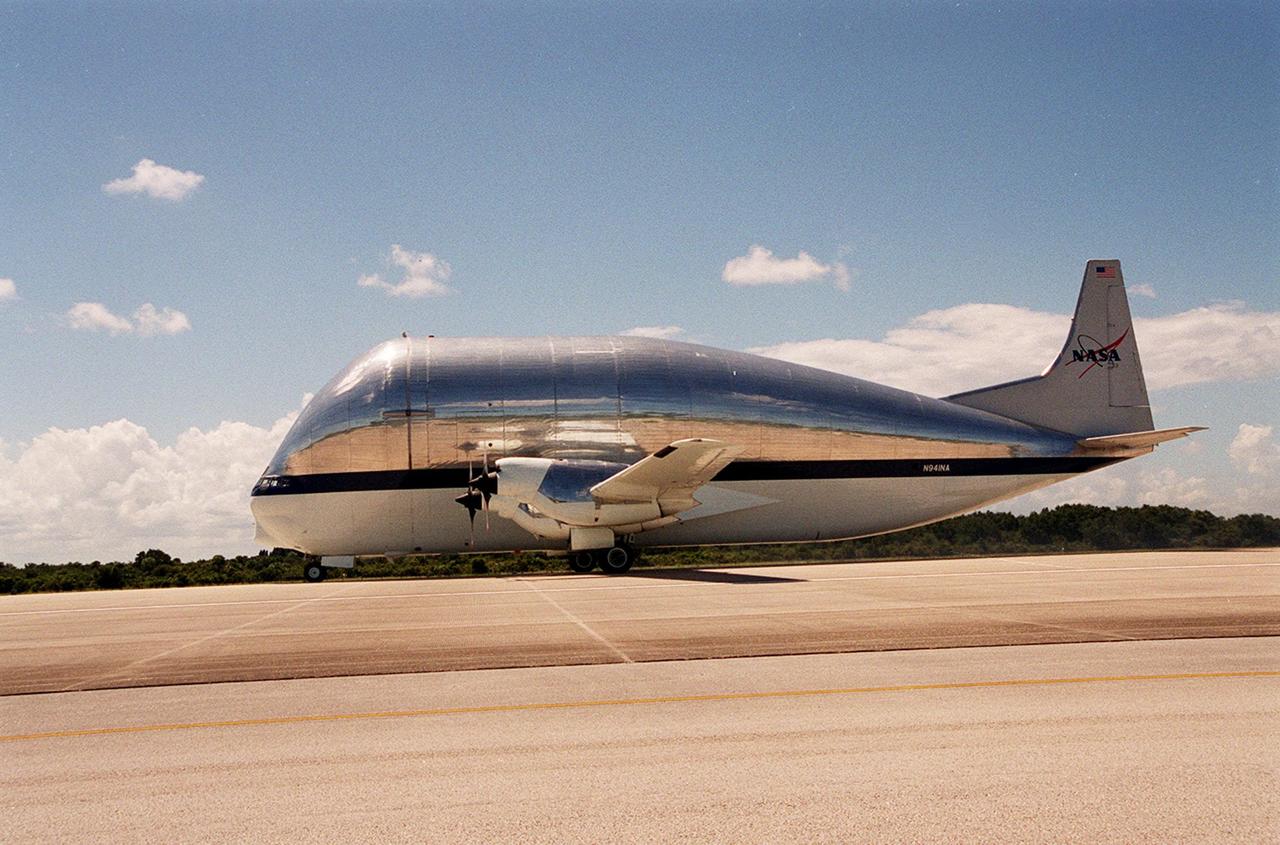
KENNEDY SPACE CENTER, FLA. -- NASA's Super Guppy aircraft lands at the KSC Shuttle Landing Facility with its cargo, the <a href="http://www-pao.ksc.nasa.gov/kscpao/release/2000/78-00.htm"> Joint Airlock Module</a> the gateway from which crew members aboard the International Space Station (ISS) will enter and exit the 470-ton orbiting research facility. The airlock was transported from NASA's Marshall Space Flight Center in Huntsville, Ala. The airlock will be transported to the Operations and Checkout Building in the KSC industrial area where it will undergo vacuum chamber testing. It will then be moved to the Space Station Processing Facility (SSPF) for further prelaunch preparation and checkout. The massive, spindle-shaped airlock is 20 feet long, has a diameter of 13 feet at its widest point, and weighs six and a half tons. It was manufactured at NASA's Marshall Space Flight Center by the Huntsville division of The Boeing Company. The Space Shuttle Atlantis will carry the airlock to orbit on mission STS-104, the tenth International Space Station flight, currently targeted for liftoff in May 2001
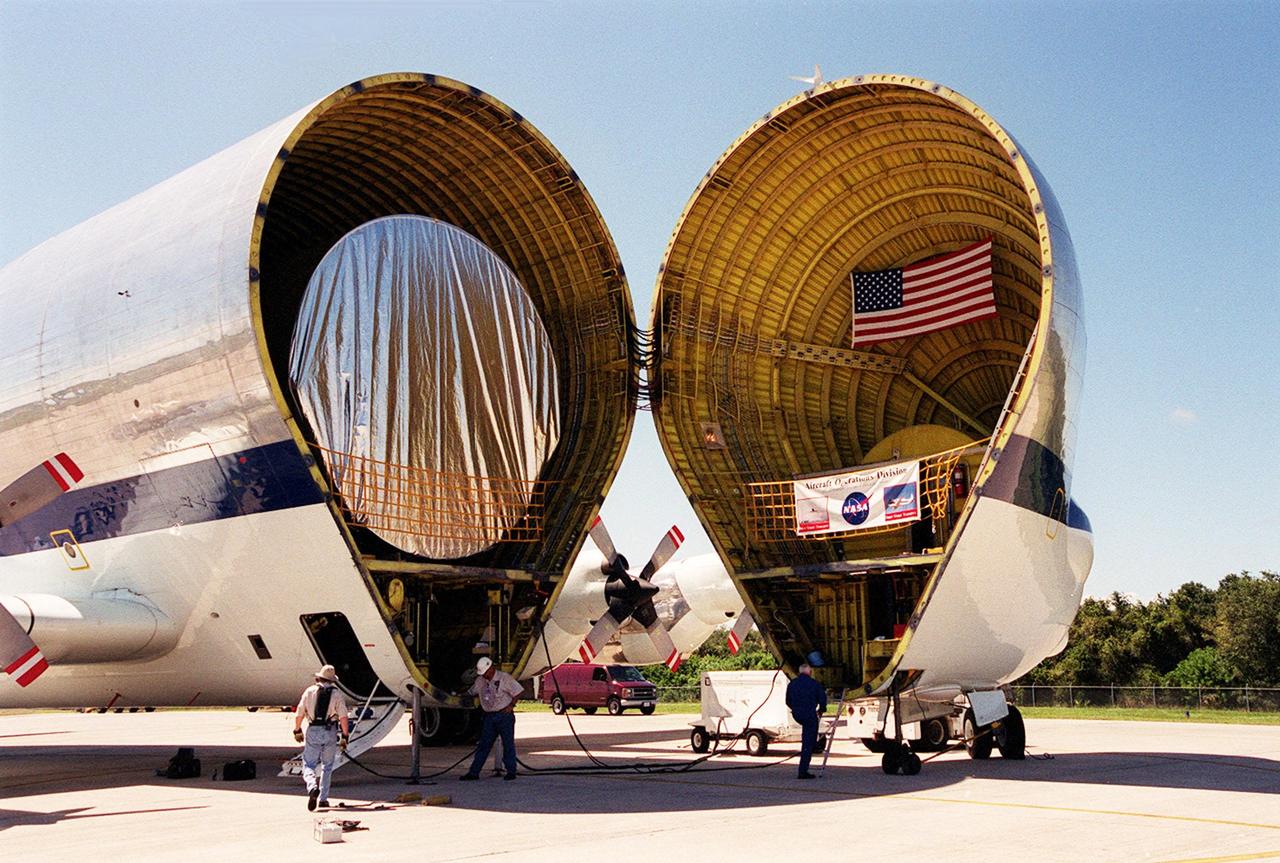
KENNEDY SPACE CENTER, FLA. -- The nose of NASA's Super Guppy aircraft opens to reveal the <a href="http://www-pao.ksc.nasa.gov/kscpao/release/2000/78-00.htm">Joint Airlock Module</a> the gateway from which crew members aboard the International Space Station (ISS) will enter and exit the 470-ton orbiting research facility. The airlock was transported from NASA's Marshall Space Flight Center in Huntsville, Ala. The airlock will be transported to the Operations and Checkout Building in the KSC industrial area where it will undergo vacuum chamber testing. It will then be moved to the Space Station Processing Facility (SSPF) for further prelaunch preparation and checkout. The massive, spindle-shaped airlock is 20 feet long, has a diameter of 13 feet at its widest point, and weighs six and a half tons. It was manufactured at NASA's Marshall Space Flight Center by the Huntsville division of The Boeing Company. The Space Shuttle Atlantis will carry the airlock to orbit on mission STS-104, the tenth International Space Station flight, currently targeted for liftoff in May 2001
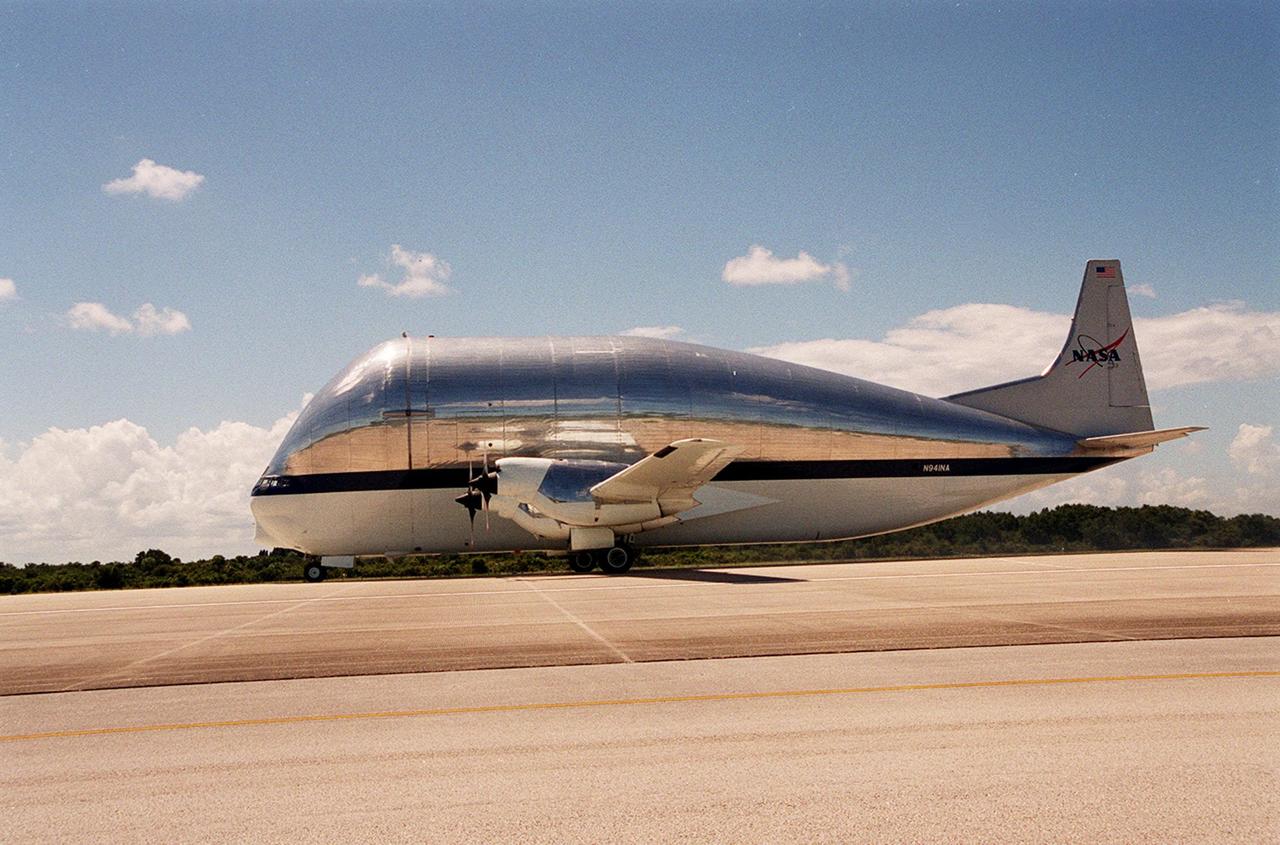
KENNEDY SPACE CENTER, FLA. -- NASA's Super Guppy aircraft lands at the KSC Shuttle Landing Facility with its cargo, the <a href="http://www-pao.ksc.nasa.gov/kscpao/release/2000/78-00.htm"> Joint Airlock Module</a> the gateway from which crew members aboard the International Space Station (ISS) will enter and exit the 470-ton orbiting research facility. The airlock was transported from NASA's Marshall Space Flight Center in Huntsville, Ala. The airlock will be transported to the Operations and Checkout Building in the KSC industrial area where it will undergo vacuum chamber testing. It will then be moved to the Space Station Processing Facility (SSPF) for further prelaunch preparation and checkout. The massive, spindle-shaped airlock is 20 feet long, has a diameter of 13 feet at its widest point, and weighs six and a half tons. It was manufactured at NASA's Marshall Space Flight Center by the Huntsville division of The Boeing Company. The Space Shuttle Atlantis will carry the airlock to orbit on mission STS-104, the tenth International Space Station flight, currently targeted for liftoff in May 2001