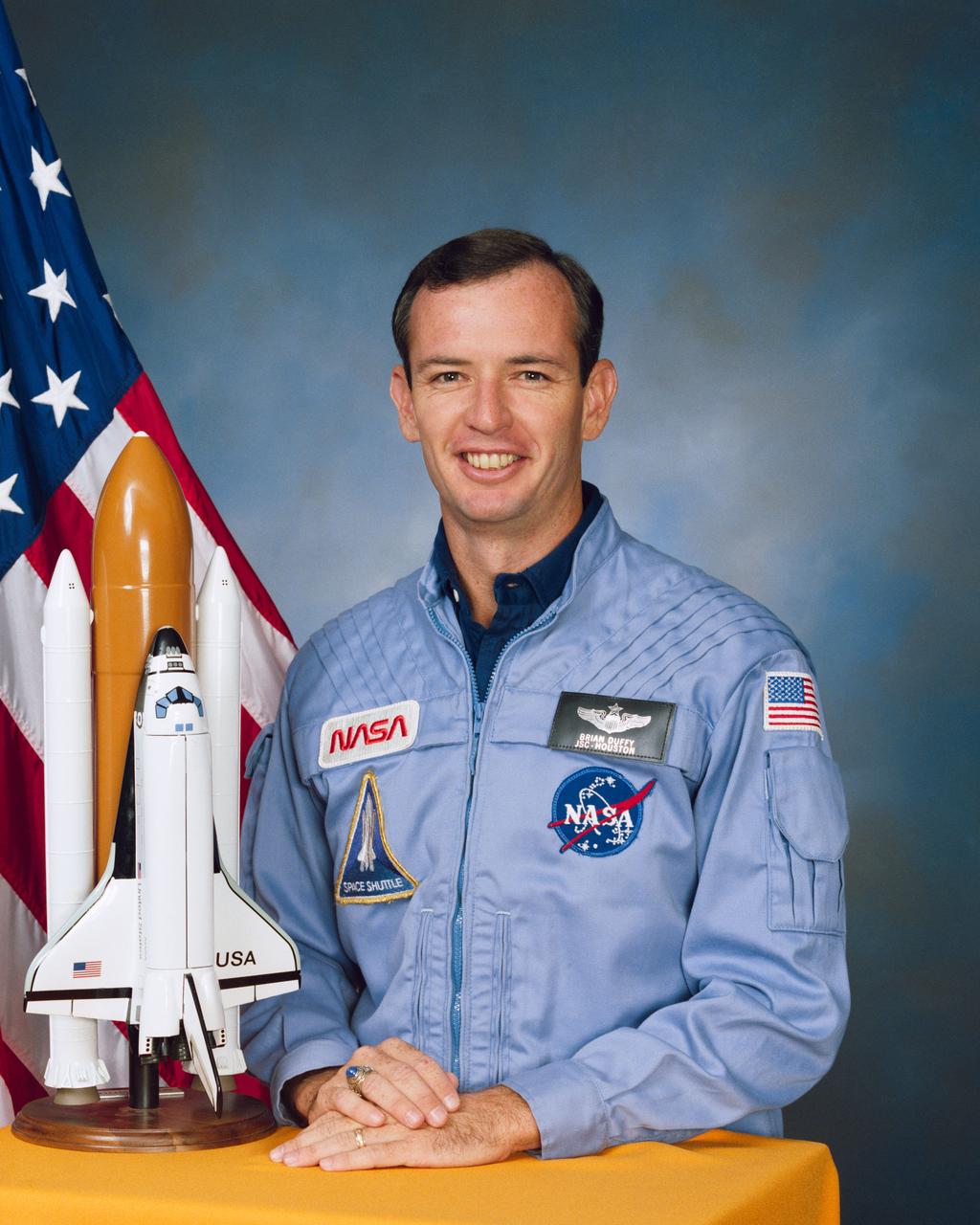
S85-41886 (October 1995) --- Astronaut Brian Duffy, Astronaut Candidate Group 11
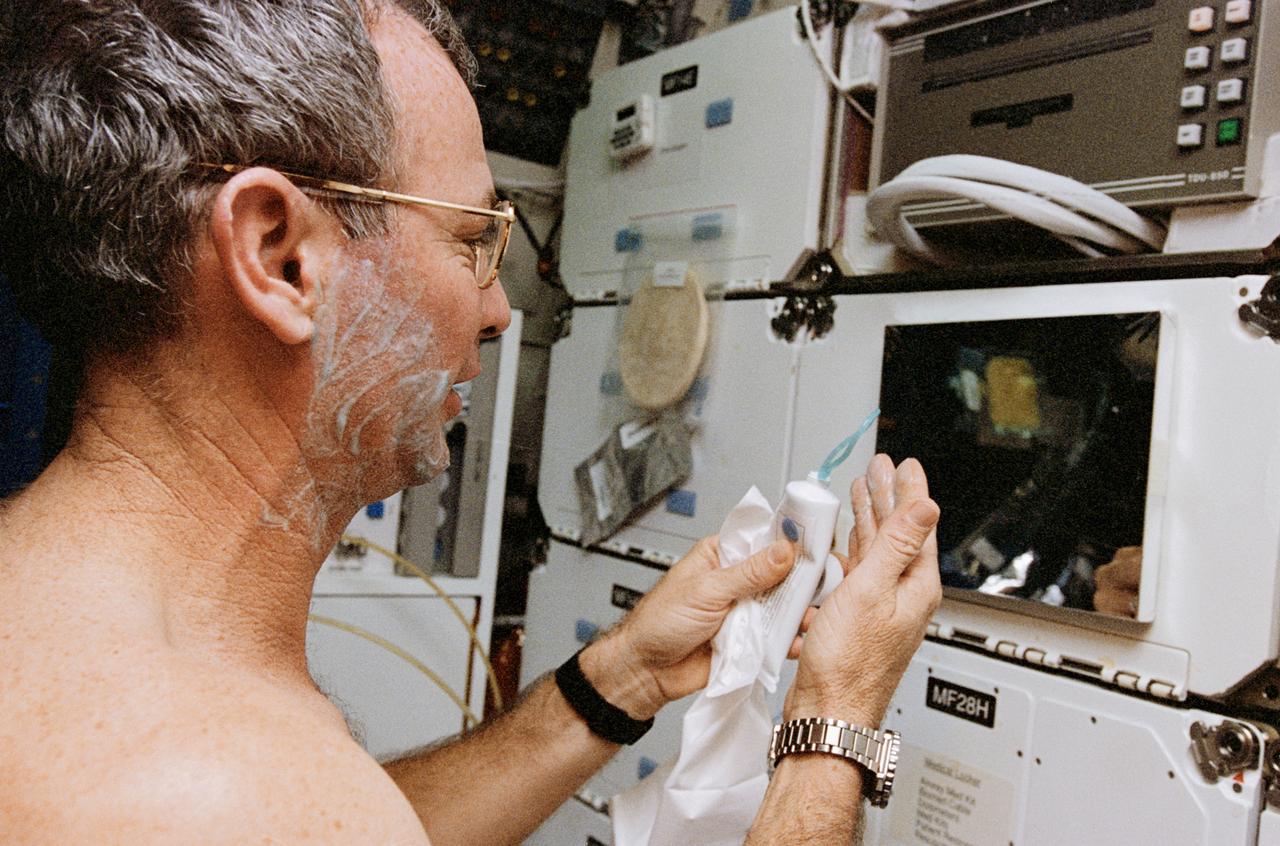
STS072-331-016 (11-20 Jan. 1996) --- On the Space Shuttle Endeavour’s middeck, astronaut Brian Duffy, mission commander, shaves. Duffy was joined on the week and a half long mission by four United States astronauts and a mission specialist representing Japan’s National Space Development Agency (NASDA).
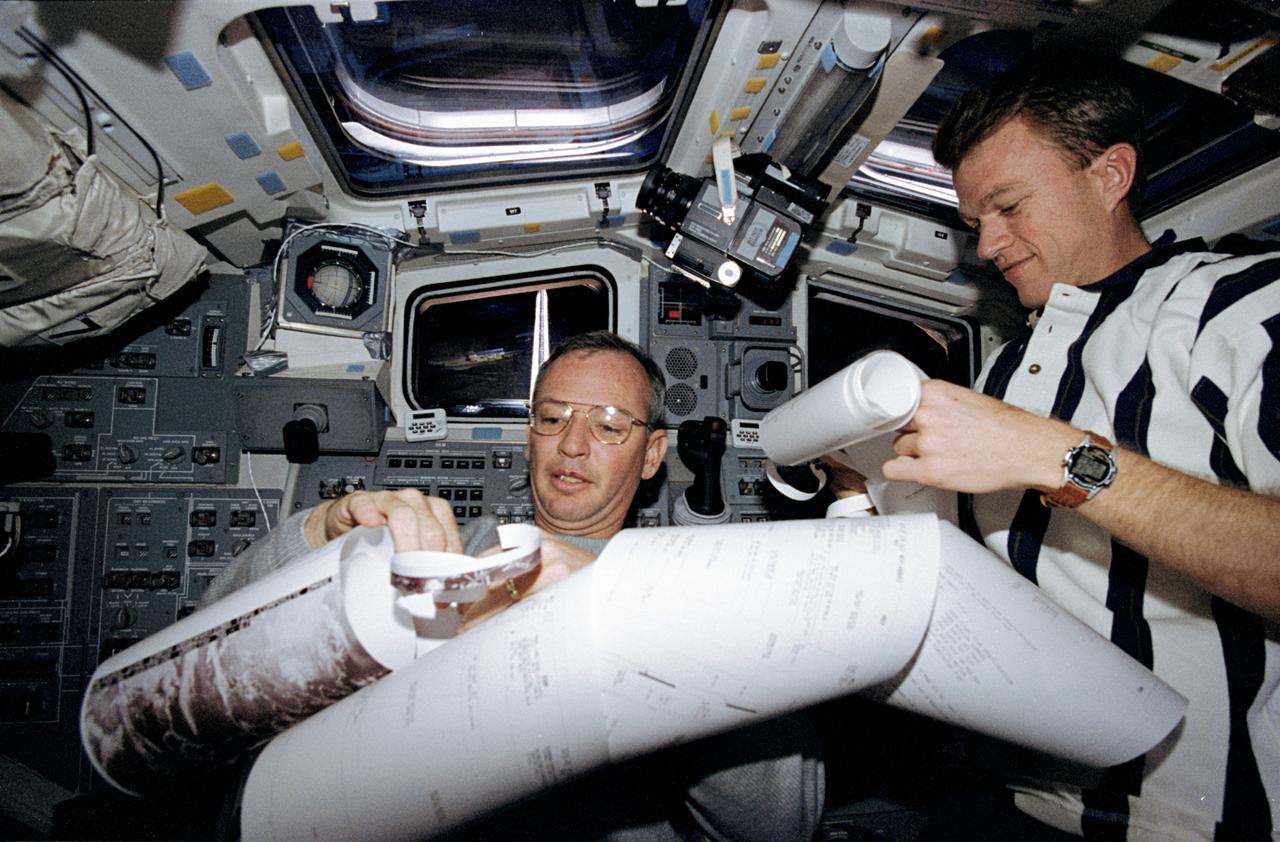
STS072-312-026 (11-20 Jan. 1996) --- Astronauts Brian Duffy (left) and Brent W. Jett Jr. check the latest batch of mail uplinked to the Space Shuttle Endeavour from ground controllers in Houston, Texas. Duffy and Jett served as mission commander and pilot, respectively, for the week and a half mission.
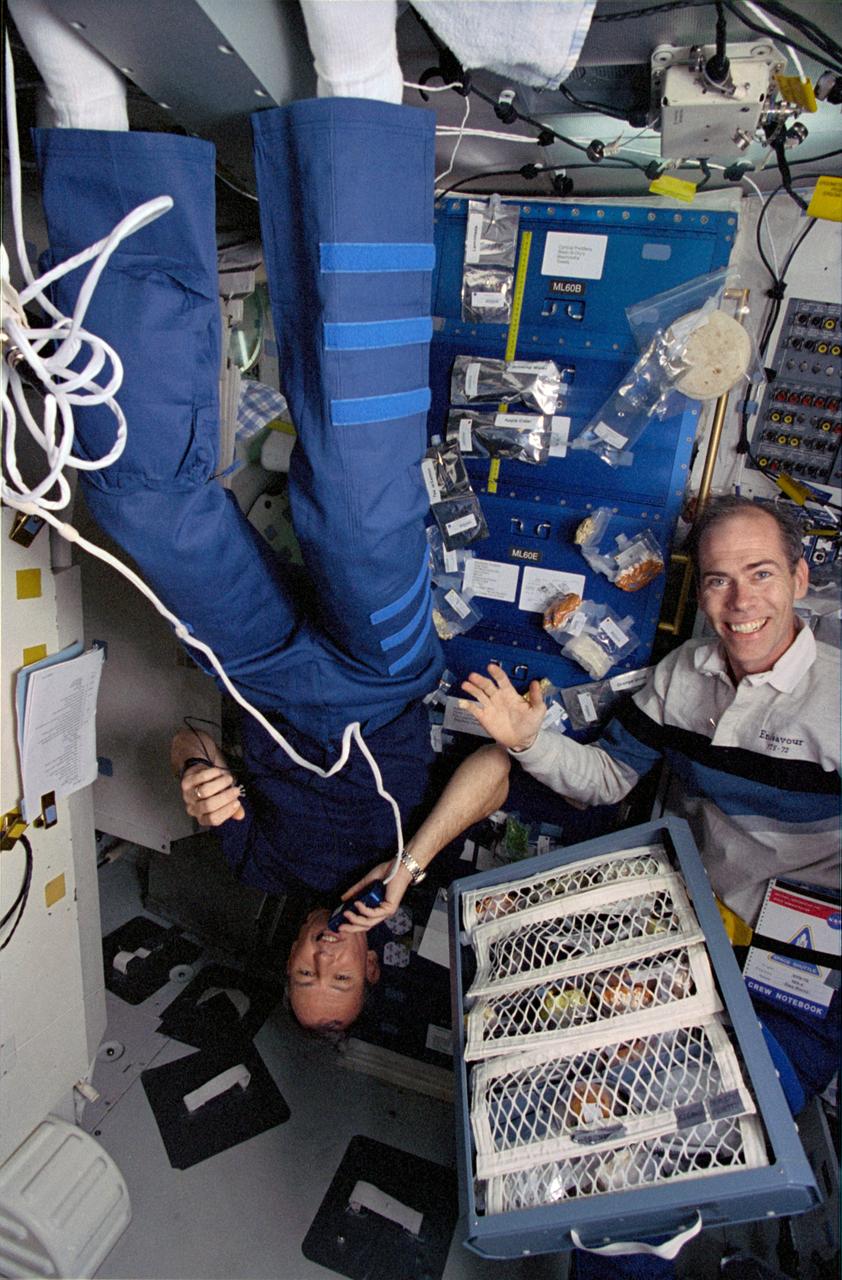
STS072-306-004 (11-20 Jan. 1996) --- Astronauts Brian Duffy (left), mission commander, and Daniel T. Barry, mission specialist, team up to prepare a meal on the Space Shuttle Endeavour’s middeck. Duffy is also talking to ground controllers during a television tour of the spacecraft. A locker drawer, complete with pre-packaged food is in the foreground, while various smaller packets of food items are attached to nearby locker doors. Orient photo with socked feet at bottom.
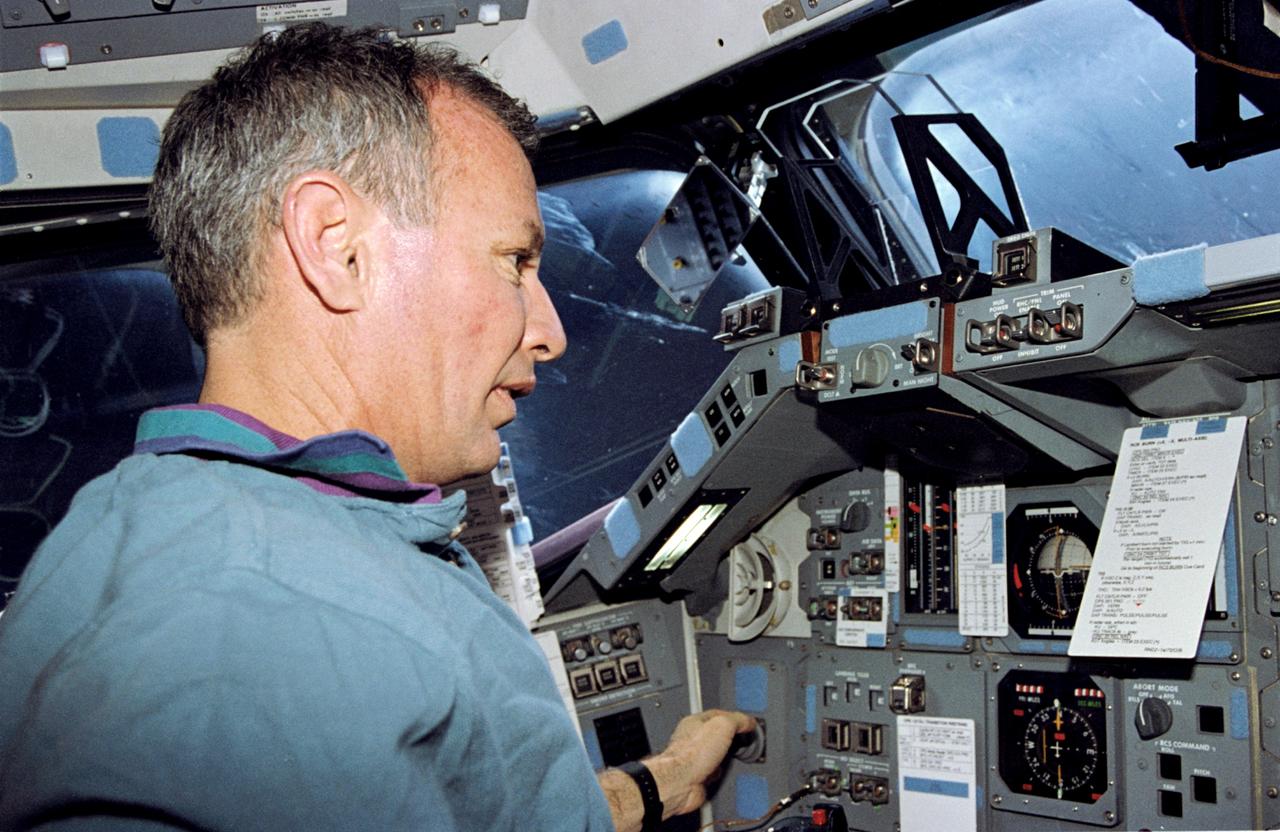
STS072-301-035 (11-20 Jan. 1996) --- Astronaut Brian Duffy mans the commander's station aboard the Space Shuttle Endeavour during rendezvous operations with the Japanese Space Flyer Unit (SFU). The mission commander was joined aboard Endeavour by five other astronauts for a week a half in Earth-orbit.
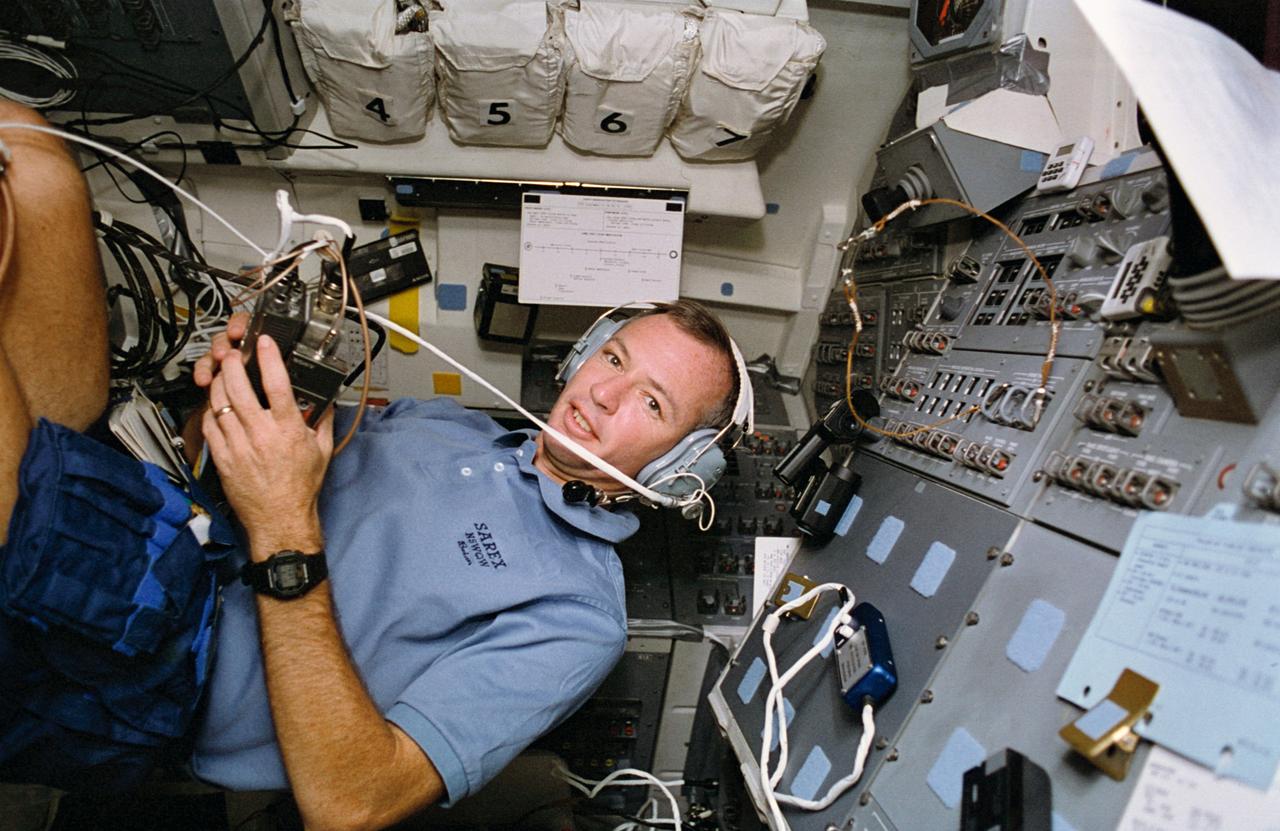
STS057-40-028 (21 June-1 July 1993) --- Astronaut Brian Duffy, pilot, talks to amateur radio operators on Earth from the flight deck of the Earth-orbiting Space Shuttle Endeavour. The space to Earth communications was part of the Shuttle amateur radio experiment (SAREX), which has been included on a number of Space Shuttle missions. Duffy, a licensed amateur radio operator using call letters N5WQW, was among crewmembers talking to students at various points on the ground.
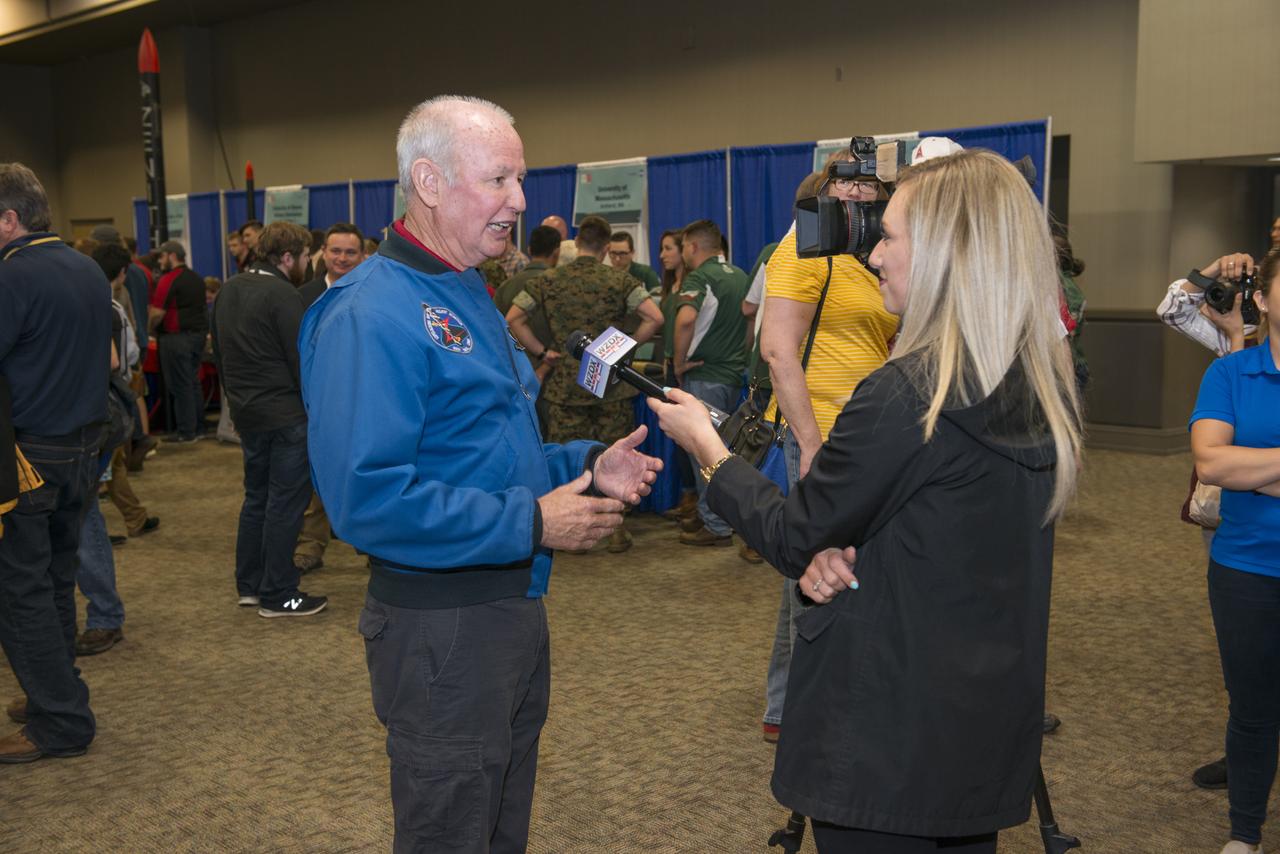
Students from 23 states display their rockets and talk about what they did to make them fly at the NASA Student Launch Rocket Fair on Friday, April 6. Over 800 students traveled to Huntsville, Alabama, to participate in a week of activities as part of NASA Student Launch. Retired Astronaut Brian Duffy speaks with local media.
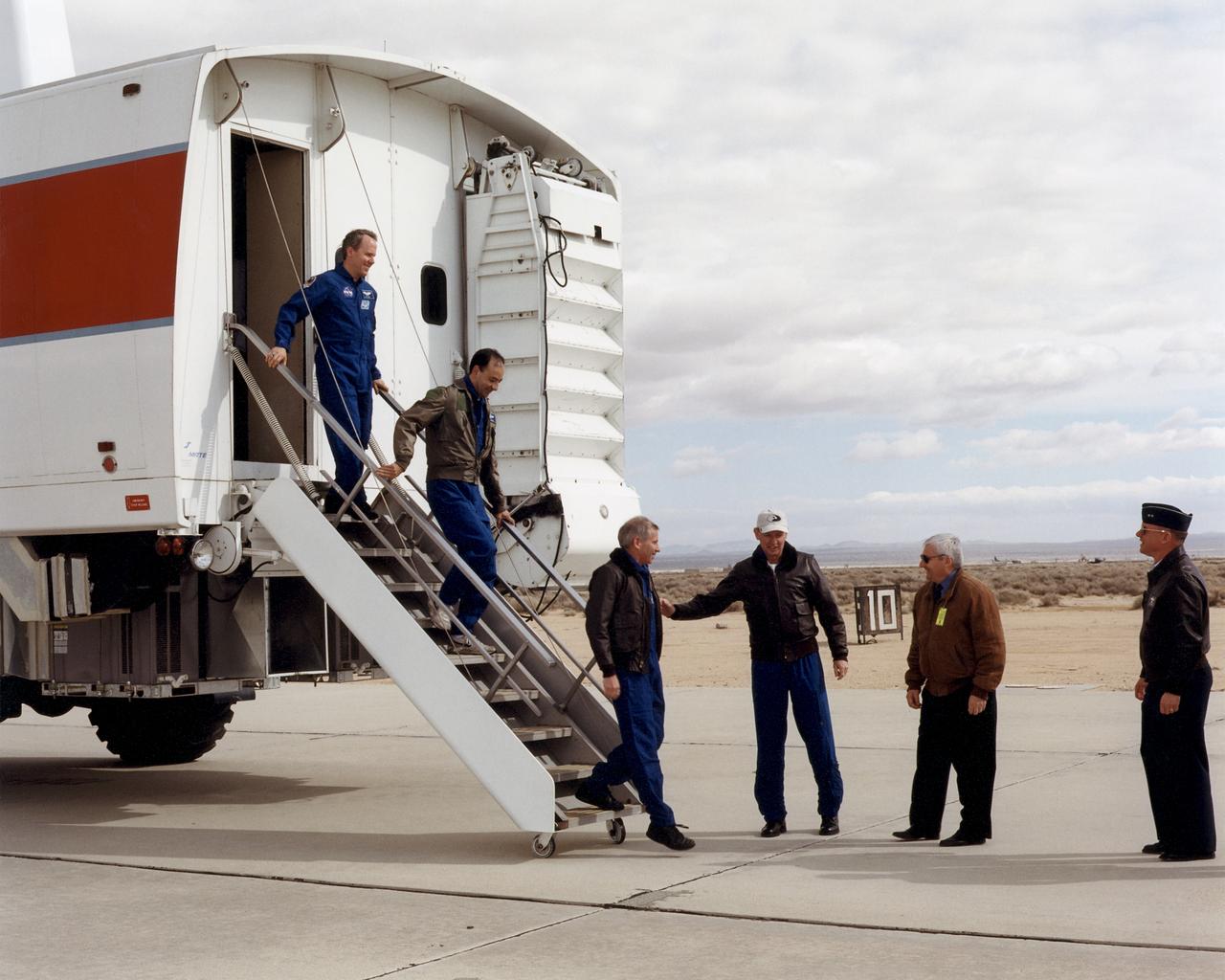
L to R: STS-98 Mission Specialist Thomas Jones, Pilot Mark Polansky, and Commander Kenneth Cockrell greet STS-92 Commander Brian Duffy, Dryden Center Director Kevin Petersen, and AFFTC Commander Major General Richard Reynolds after landing on the runway at Edwards Air Force Base, California, where NASA's Dryden Flight Research Center is located.
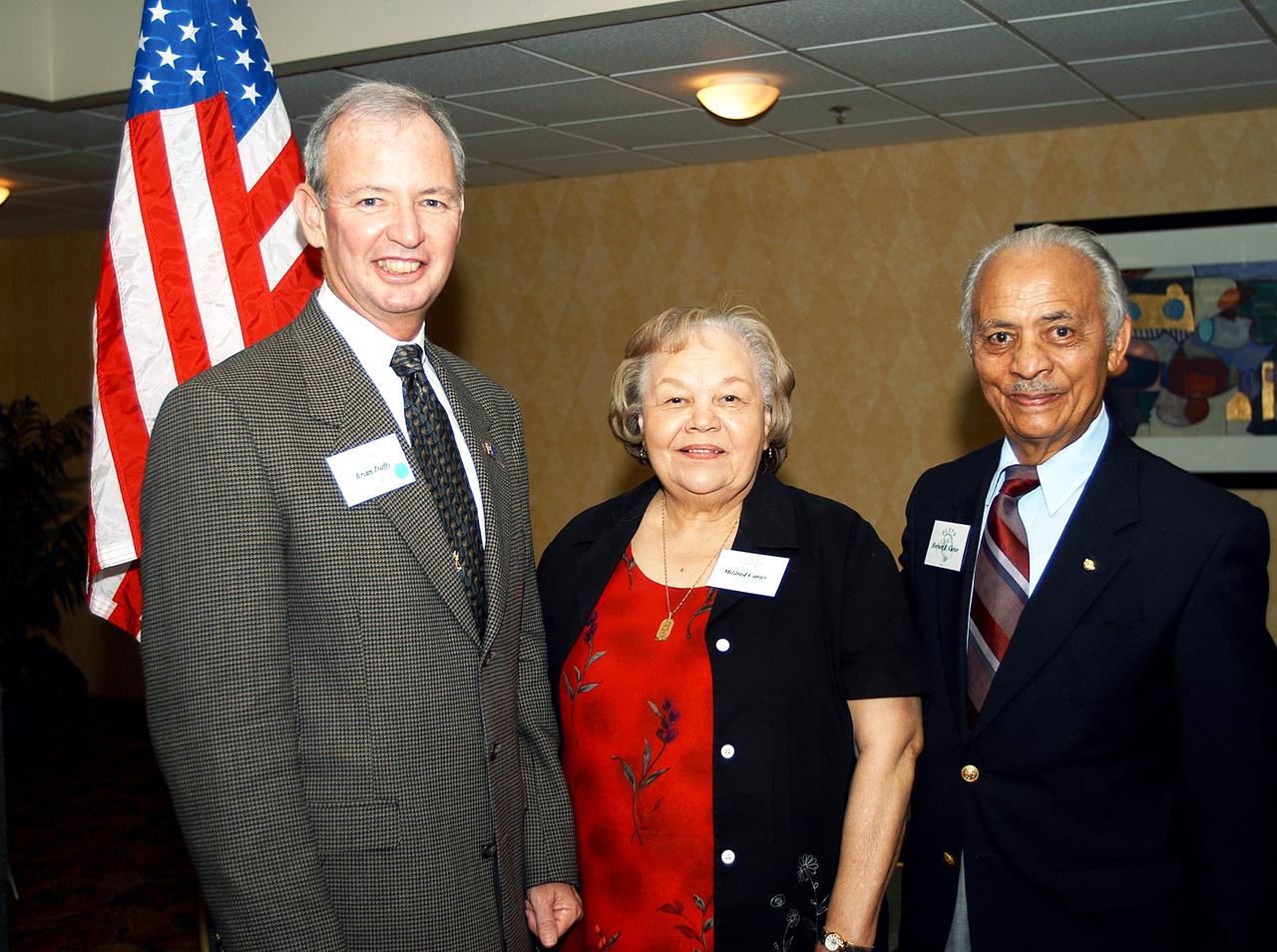
KENNEDY SPACE CENTER, FLA. - (From left) Brian Duffy, Lockheed Martin vice president/associate program manager, Mildred Carter and Col. (Ret.) Herbert E. Carter, one of the Tuskegee Airmen, attend a dinner sponsored by the KSC Spaceflight and Life Sciences Office. Col. Carter was a guest speaker at the dinner.
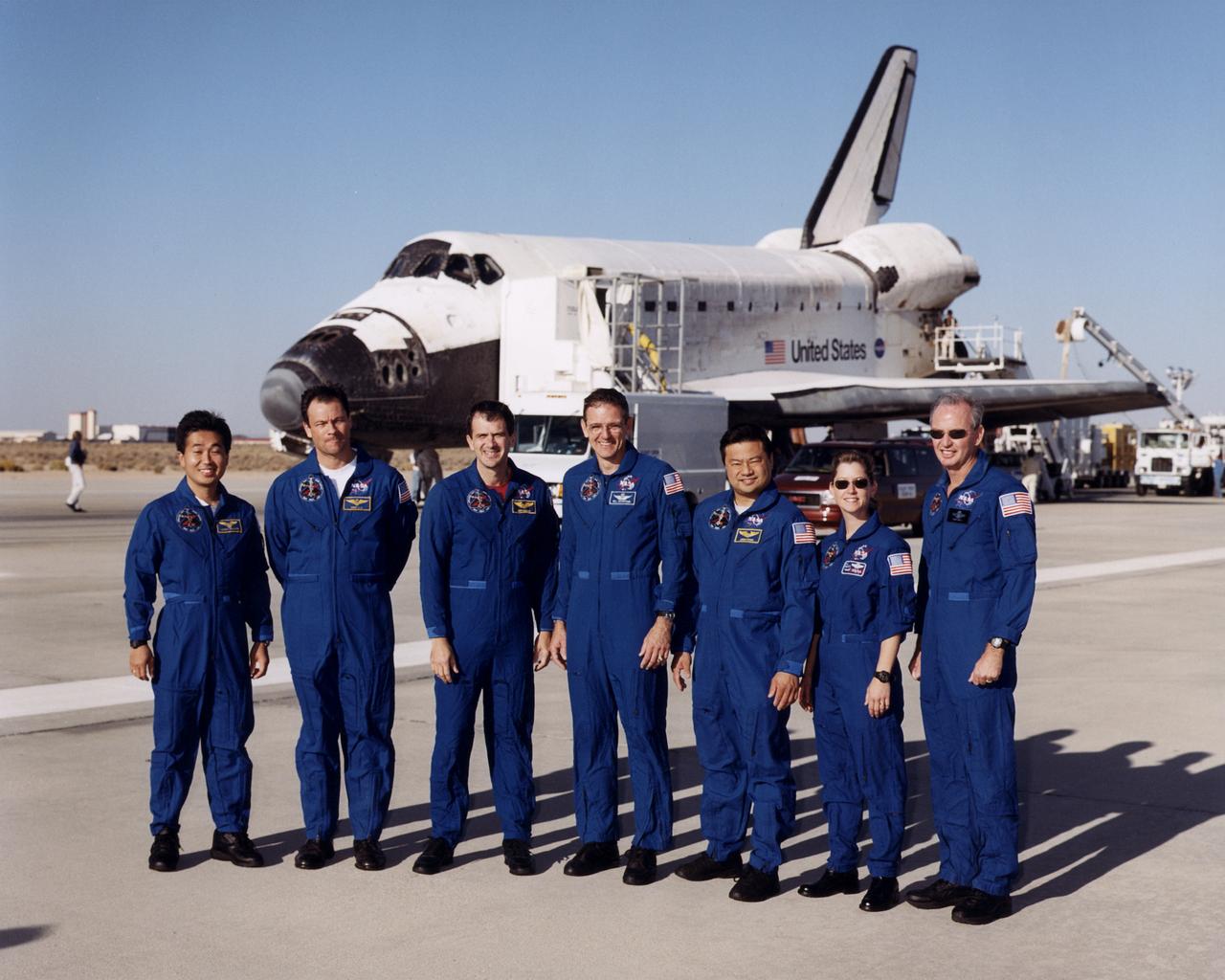
The seven-member crew of the Space Shuttle mission STS-92 gathered in front of the Shuttle Discovery shortly after landing at Edwards Air Force Base in Southern California October 24, 2000. From left are mission specialists Koichi Wakata, Michael Lopez-Alegria, Jeff Wisoff, Bill McArthur and Leroy Chiao, pilot Pam Melroy and mission commander Brian Duffy.
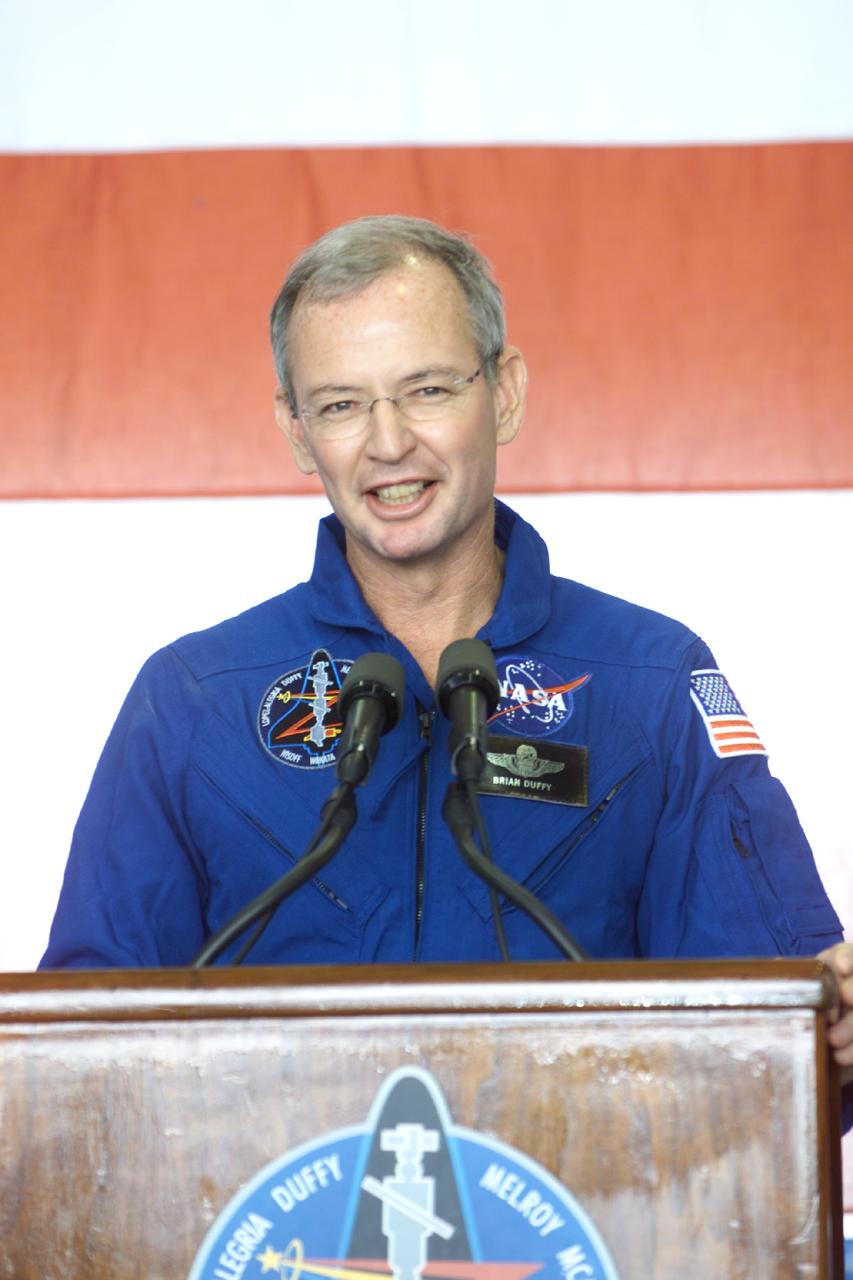
JSC2000-E-27051 (27 October 2000) --- Astronaut Brian Duffy, STS-92 commander, addresses crowd at Ellington Field during crew return ceremonies.
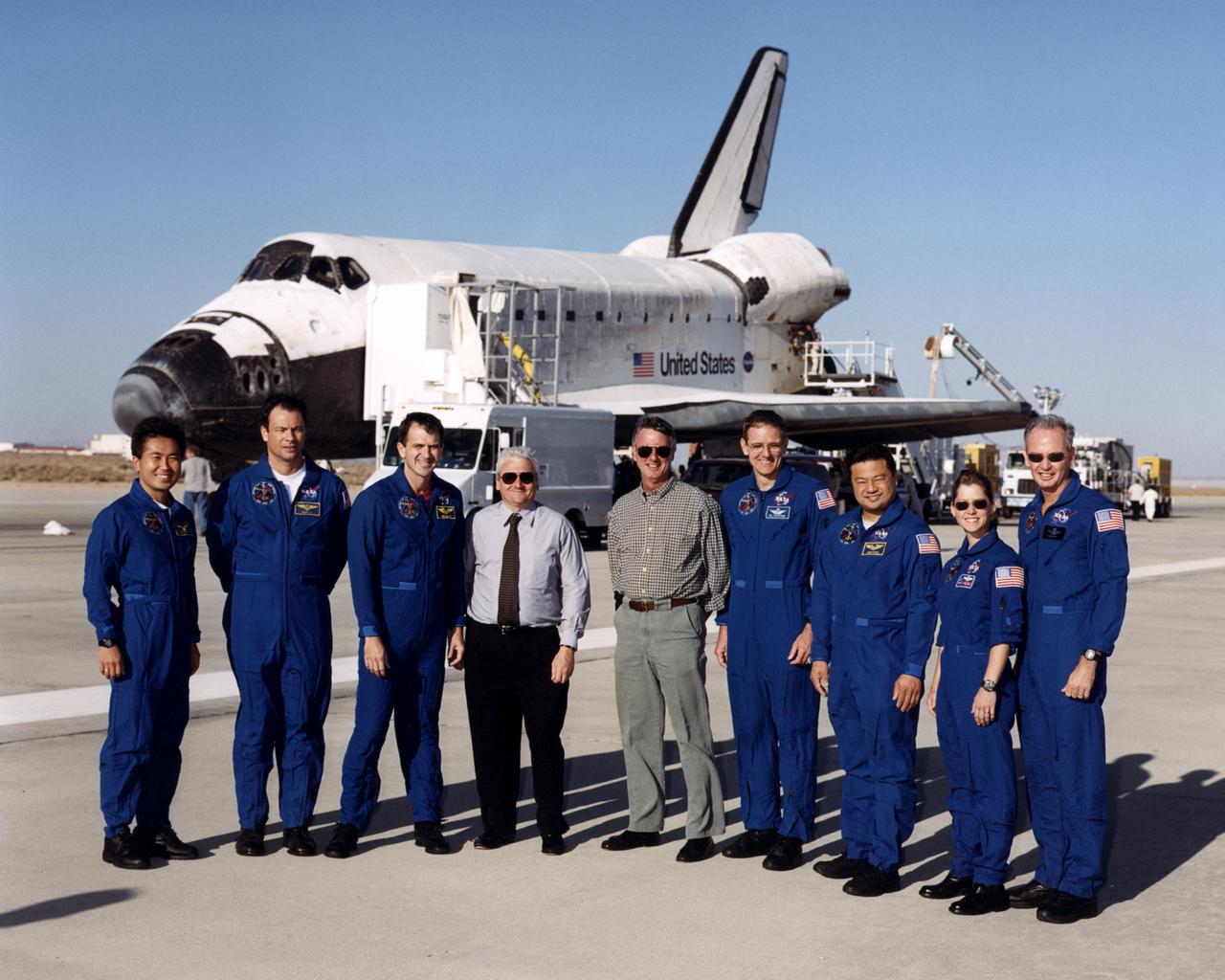
The seven-member crew of the Space Shuttle mission STS-92 gathered in front of the Shuttle Discovery shortly after landing at Edwards Air Force Base in Southern California October 24, 2000. They are seen here with NASA Dryden Fight Research Center Director Kevin Petersen and Deputy Director Wallace Sawyer. From left are mission specialists Koichi Wakata, Michael Lopez-Alegria, Jeff Wisoff, Bill McArthur and Leroy Chiao, pilot Pam Melroy and mission commander Brian Duffy. Between Jeff Wisoff and Brian McArthur are Kevin Petersen and Wally Sawyer, wearing ordinary civilian clothing.

STS045-19-032 (24 March-2 April 1992) --- Astronaut Brian Duffy, STS-45 pilot, uses an inflatable globe to demonstrate Earth observations for an educational program to be distributed to classrooms following the mission.
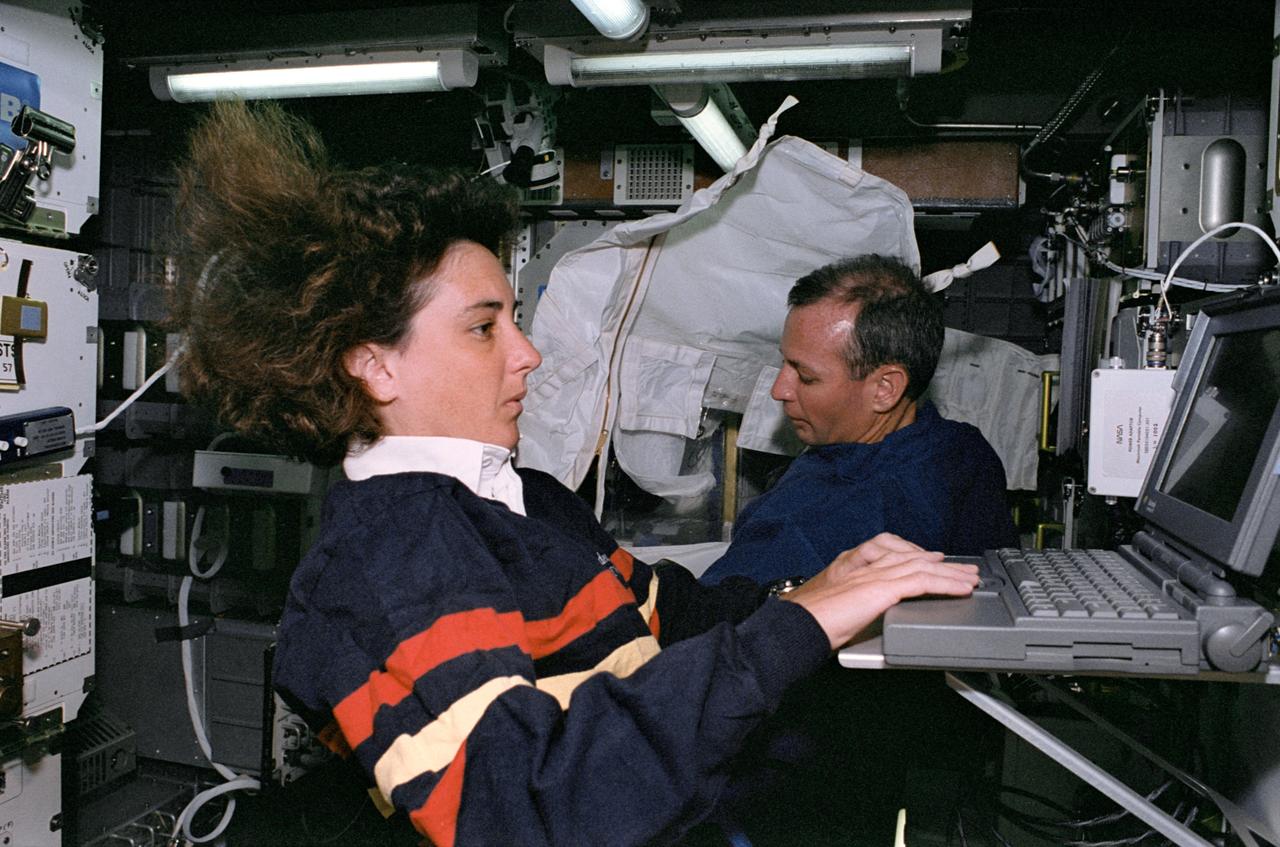
STS057-34-029 (21 June-1 July 1993) --- Astronaut Nancy J. Sherlock works on the Electronic Procedures Portion (EPROC) of the Human Factors Assessment (HFA) experiment. Astronaut Brian Duffy works nearby. The computer portion of HFA-EPROC simulated a space station propulsion system task. Sherlock, Duffy and four other astronauts spent almost ten days aboard the Space Shuttle Endeavour for the STS-57 mission.
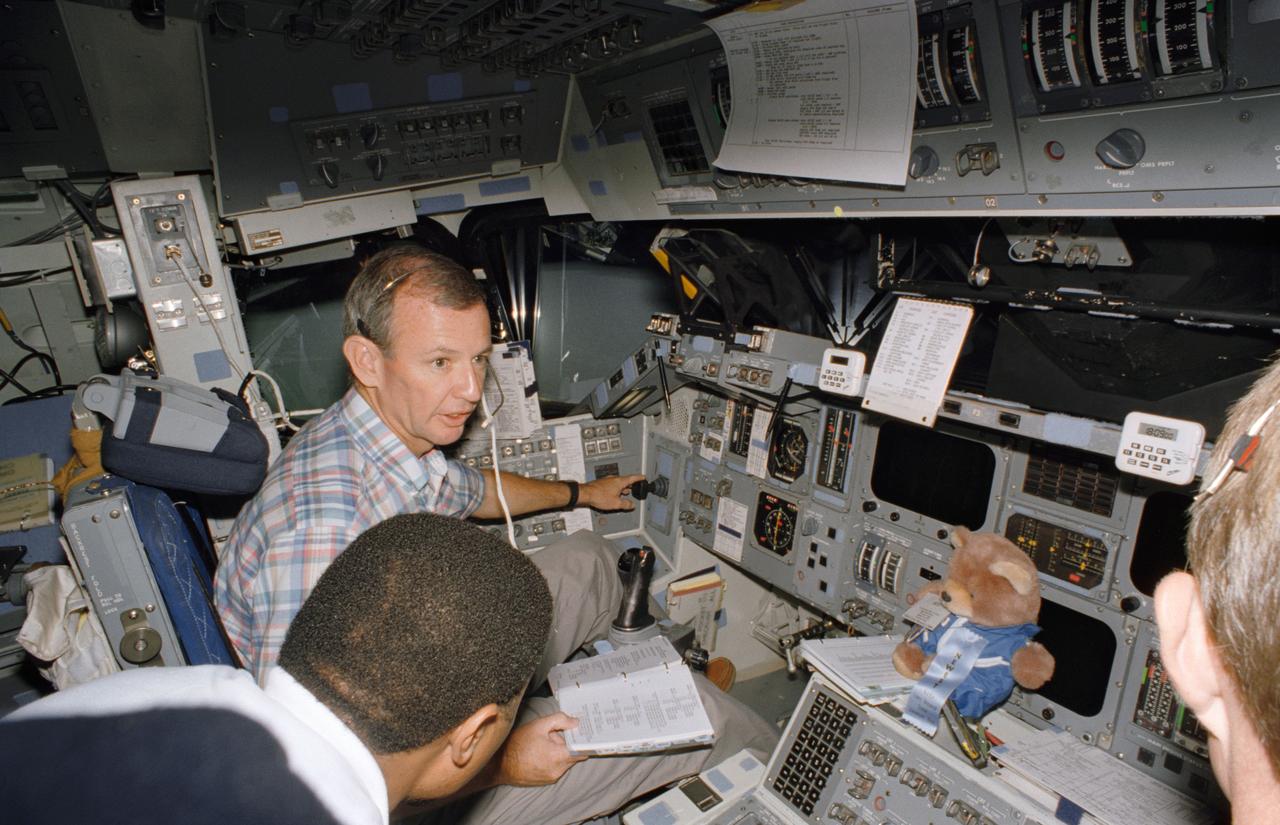
S95-12716 (May 1995) --- Astronauts Brian Duffy, in commander's seat, and Winston E. Scott discuss their scheduled flight aboard the Space Shuttle Endeavour. The two are on the flight deck of the Johnson Space Center's (JSC) fixed base Shuttle Mission Simulator (SMS). Duffy, mission commander, and Scott, mission specialist, will be joined for the winter flight by three other NASA astronauts and an international mission specialist representing NASDA.
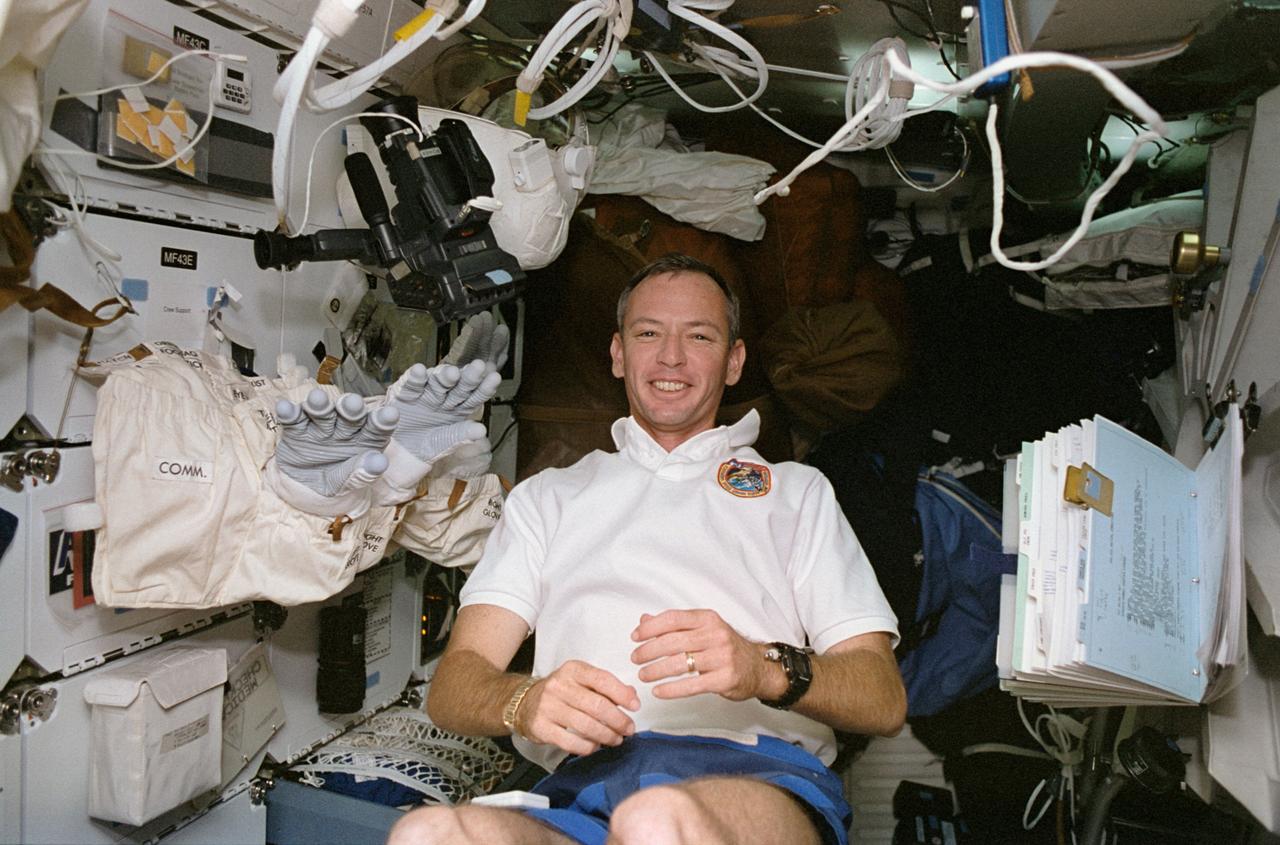
STS057-32-017 (24 June 1993) --- Near the airlock hatch on Endeavour's middeck, astronaut Brian Duffy, pilot, checks out some of the equipment to be used on the June 25 extravehicular activity (EVA) of two crewmates. Less than 24 hours later, Duffy and three other NASA astronauts remained inside Endeavour's cabin while astronauts G. David Low and Peter J. K. (Jeff) Wisoff, began a lengthy, variegated session of EVA.

During pre-pack and fit check on his launch and entry suit, STS-92 Commander Brian Duffy adjusts his helmet. Duffy and the rest of the crew are at KSC for Terminal Countdown Demonstration Test activities. The TCDT provides emergency egress training, simulated countdown exercises and opportunities to inspect the mission payload. This mission will be Duffy’s fourth Shuttle flight. STS-92 is scheduled to launch Oct. 5 at 9:38 p.m. EDT from Launch Pad 39A on the fifth flight to the International Space Station. It will carry two elements of the Space Station, the Integrated Truss Structure Z1 and the third Pressurized Mating Adapter. The mission is also the 100th flight in the Shuttle program
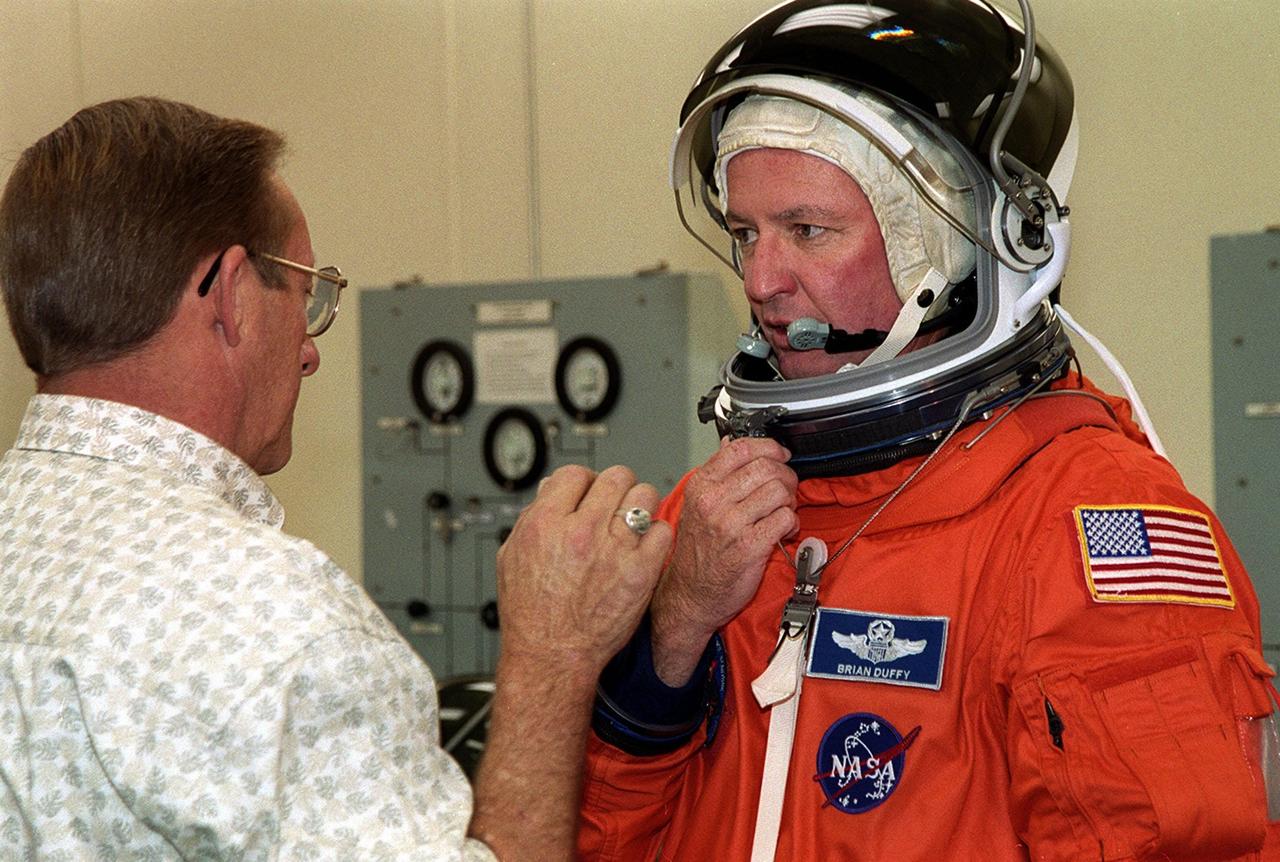
During pre-pack and fit check on his launch and entry suit, STS-92 Commander Brian Duffy adjusts his helmet. Duffy and the rest of the crew are at KSC for Terminal Countdown Demonstration Test activities. The TCDT provides emergency egress training, simulated countdown exercises and opportunities to inspect the mission payload. This mission will be Duffy’s fourth Shuttle flight. STS-92 is scheduled to launch Oct. 5 at 9:38 p.m. EDT from Launch Pad 39A on the fifth flight to the International Space Station. It will carry two elements of the Space Station, the Integrated Truss Structure Z1 and the third Pressurized Mating Adapter. The mission is also the 100th flight in the Shuttle program
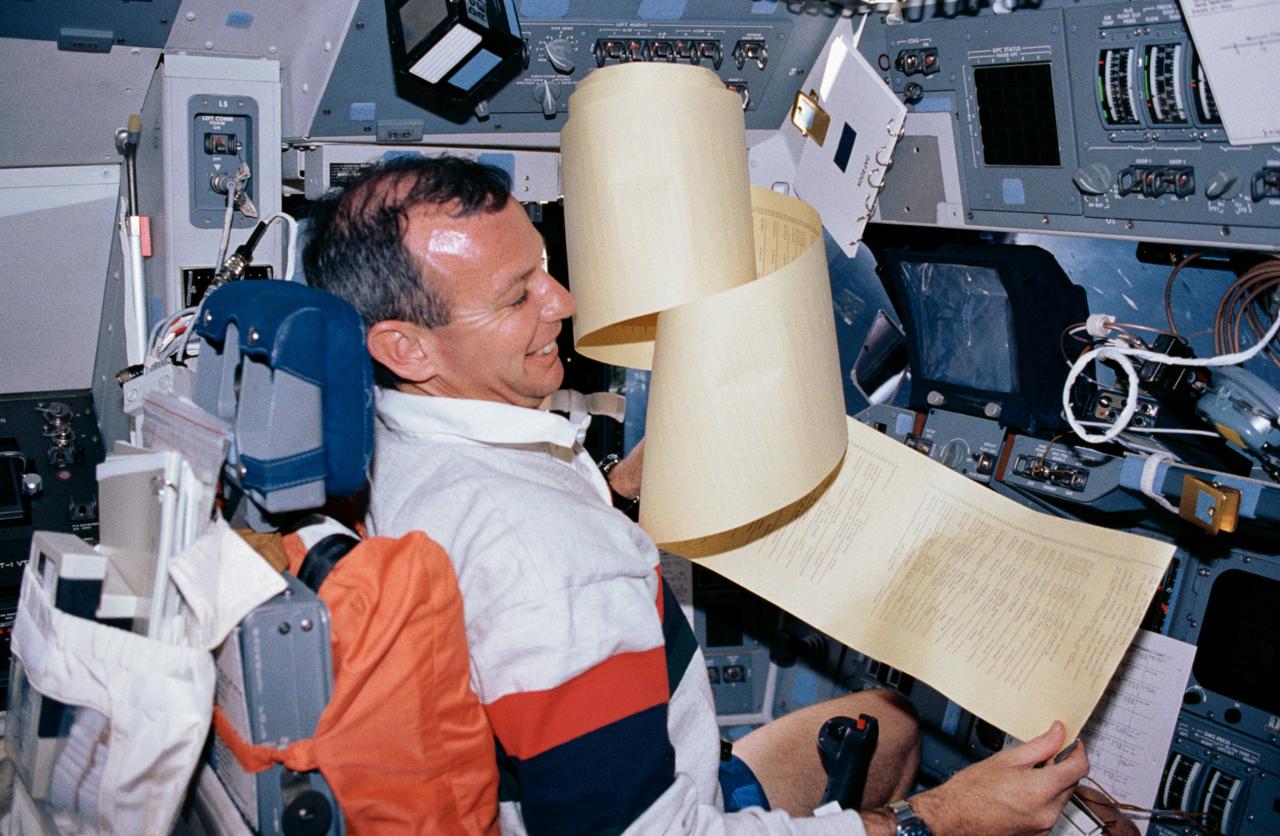
STS045-02-020 (24 March-2 April 1992) --- Brian Duffy, STS-45 pilot, struggles with a large volume of data printouts from the teleprinter system. He is seated at the commander's station on the flight deck of the Earth-orbiting Atlantis during the nine-day mission. This frame was taken with a 35mm camera.
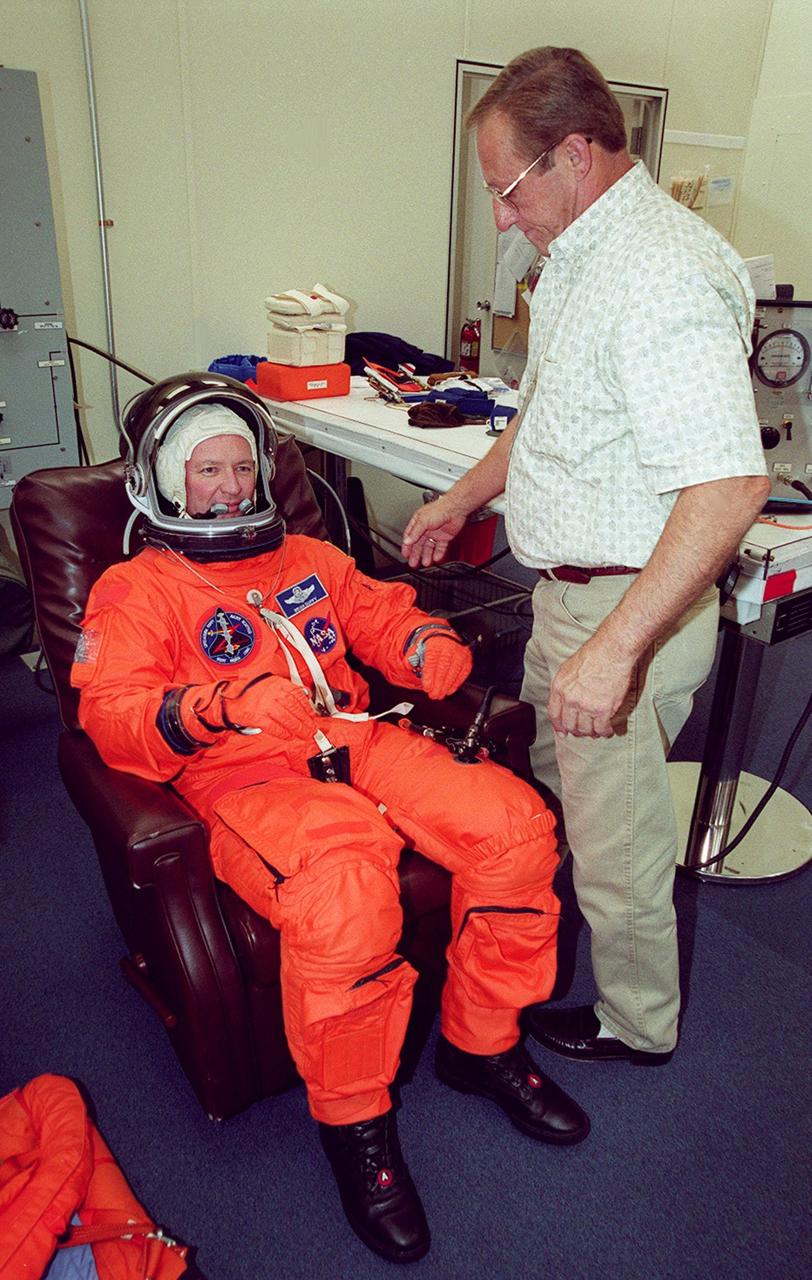
During pre-pack and fit check, STS-92 Commander Brian Duffy tests his launch and entry suit for comfort and ease while sitting. This mission will be Duffy’s fourth Shuttle flight. He and the rest of the crew are at KSC for Terminal Countdown Demonstration Test activities. The TCDT provides emergency egress training, simulated countdown exercises and opportunities to inspect the mission payload. STS-92 is scheduled to launch Oct. 5 at 9:38 p.m. EDT from Launch Pad 39A on the fifth flight to the International Space Station. It will carry two elements of the Space Station, the Integrated Truss Structure Z1 and the third Pressurized Mating Adapter. The mission is also the 100th flight in the Shuttle program
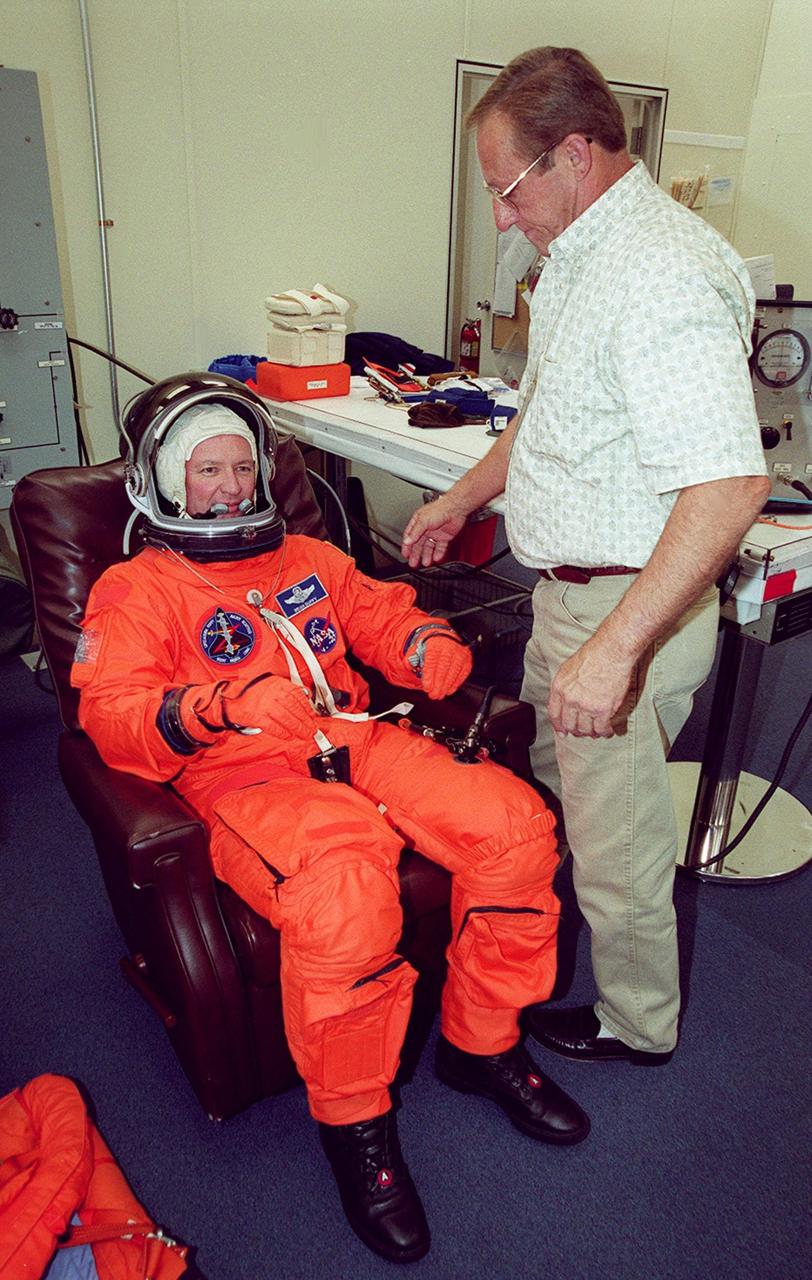
During pre-pack and fit check, STS-92 Commander Brian Duffy tests his launch and entry suit for comfort and ease while sitting. This mission will be Duffy’s fourth Shuttle flight. He and the rest of the crew are at KSC for Terminal Countdown Demonstration Test activities. The TCDT provides emergency egress training, simulated countdown exercises and opportunities to inspect the mission payload. STS-92 is scheduled to launch Oct. 5 at 9:38 p.m. EDT from Launch Pad 39A on the fifth flight to the International Space Station. It will carry two elements of the Space Station, the Integrated Truss Structure Z1 and the third Pressurized Mating Adapter. The mission is also the 100th flight in the Shuttle program
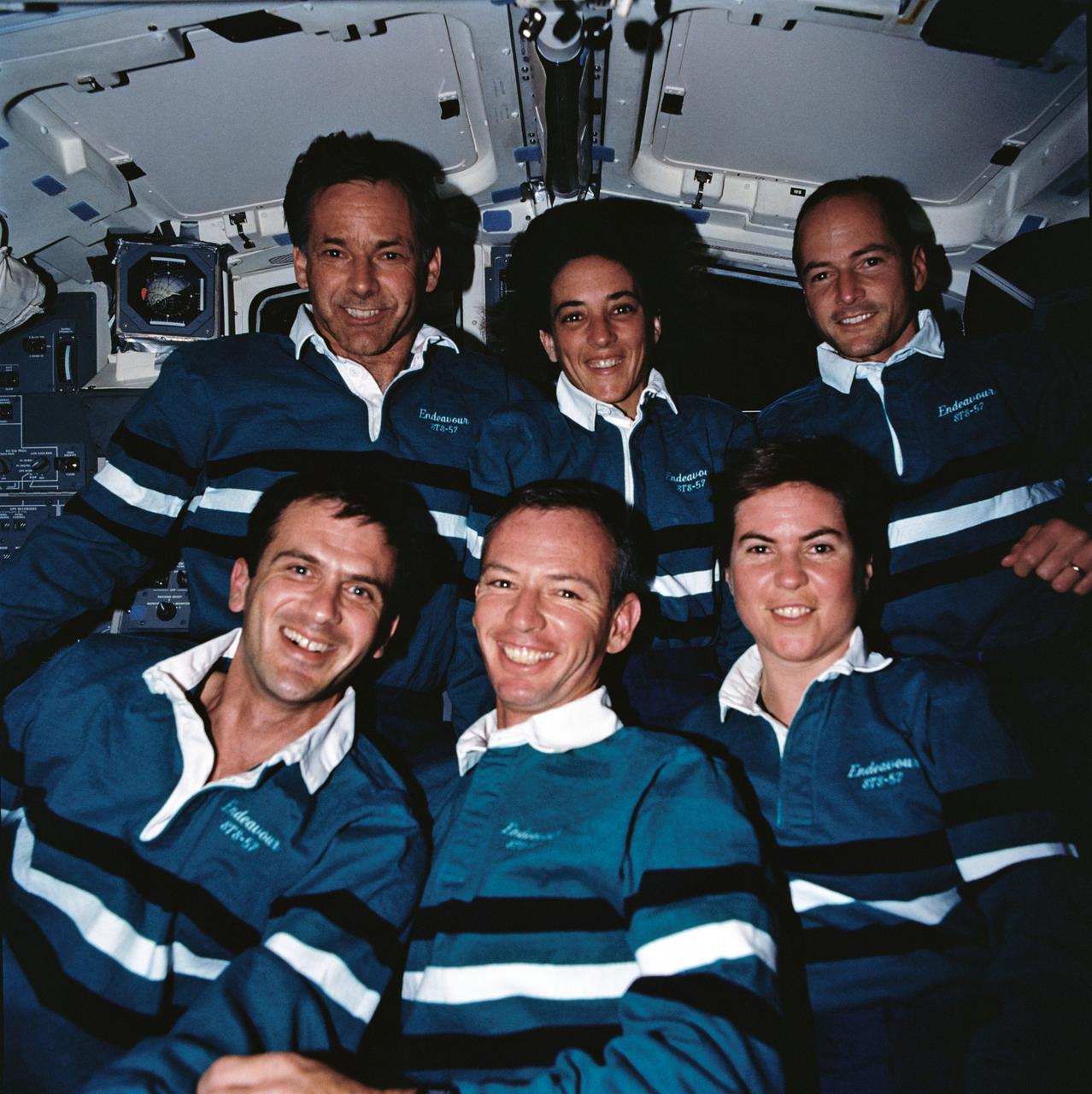
STS057-94-017 (21 June - 1 July 1993) --- Six astronauts onboard the Space Shuttle Endeavour pose for the traditional inflight crew portrait on the aft flight deck. In the rear (left to right) are astronauts Ronald J. Grabe, mission commander; Nancy J. Sherlock, mission specialist; and G. David Low, payload commander; in front (left to right), Peter J. K. (Jeff) Wisoff, mission specialist; Brian Duffy, pilot; and Janice E. Voss, mission specialist.
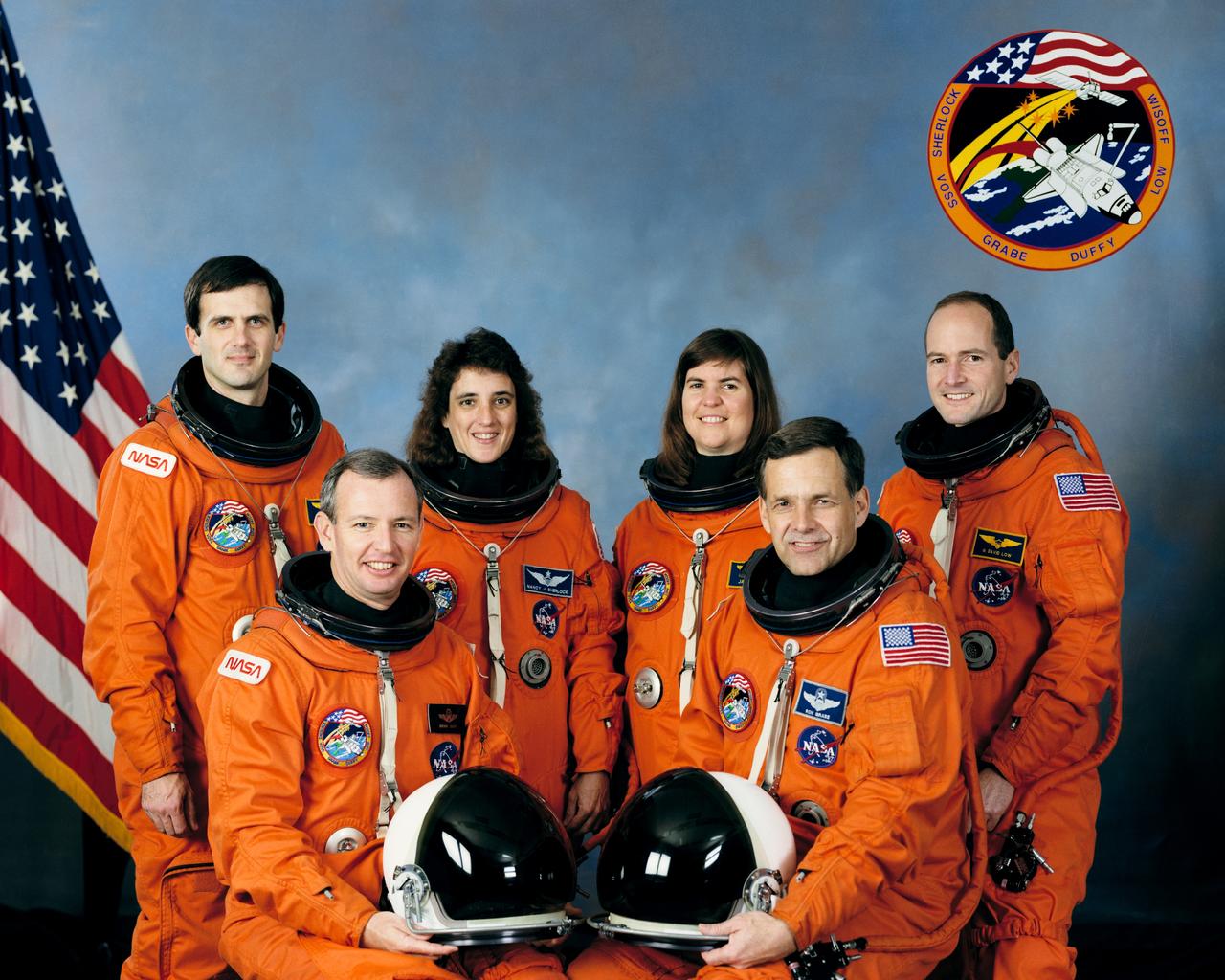
STS057-S-002 (February 1993) --- These seven astronauts are in training for NASA's mission scheduled for spring of this year. In front are astronauts Brian Duffy (left) and Ronald J. Grabe, pilot and commander, respectively. In back are (left to right) astronauts Peter J. Wisoff, Nancy J. Sherlock, Janice E. Voss, all mission specialists; and G. David Low, payload commander.
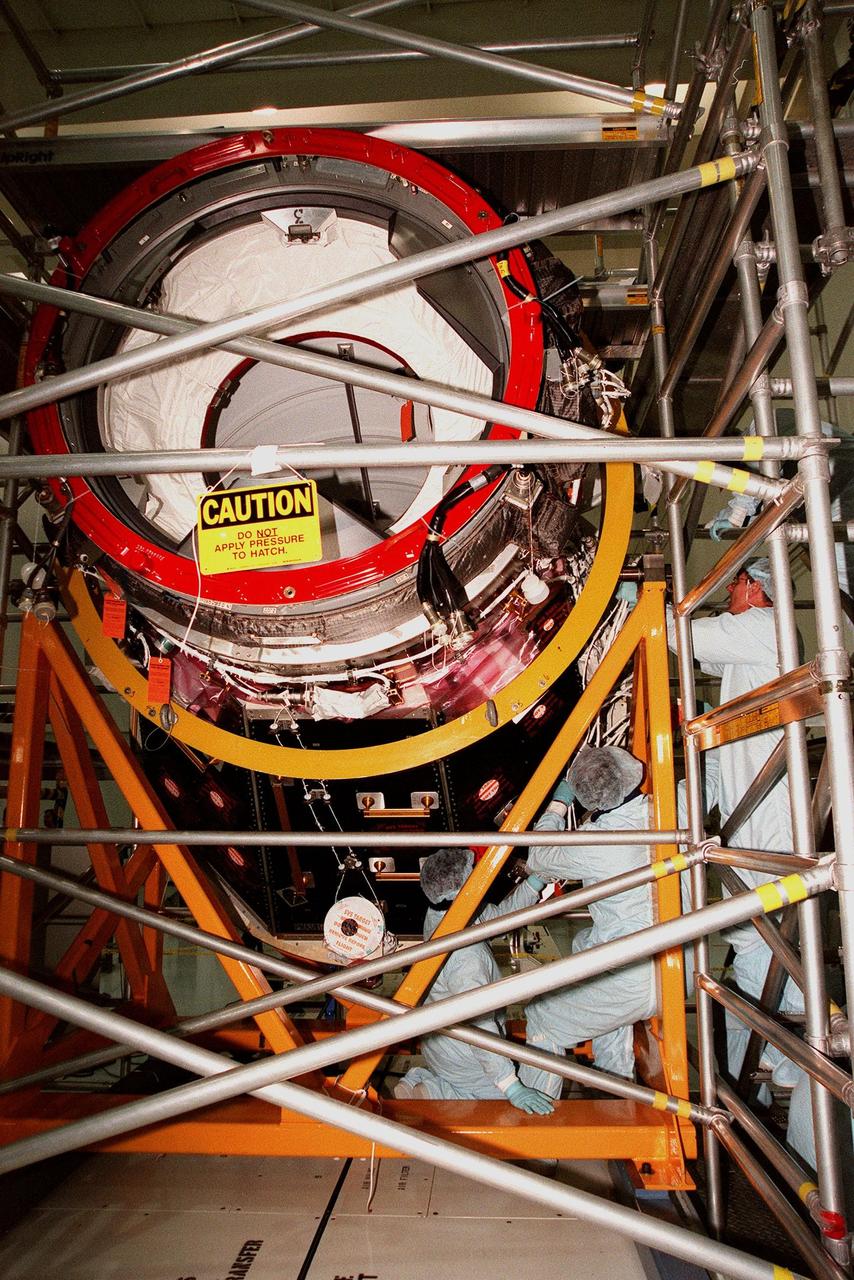
In the Space Station Processing Facility, members of the STS-92 crew practice working with the Pressurized Mating Adapter-3, part of the payload for their mission to the International Space Station (ISS). STS-92 is targeted for launch in December 1999. STS-92 crew members visiting KSC are Commander Brian Duffy and Mission Specialists Koichi Wakata, Leroy Chiao, Jeff Wisoff, Michael Lopez-Alegria and Bill McArthur. STS-92 is the fourth U.S. flight for construction of the International Space Station. The payload also includes an integrated truss structure
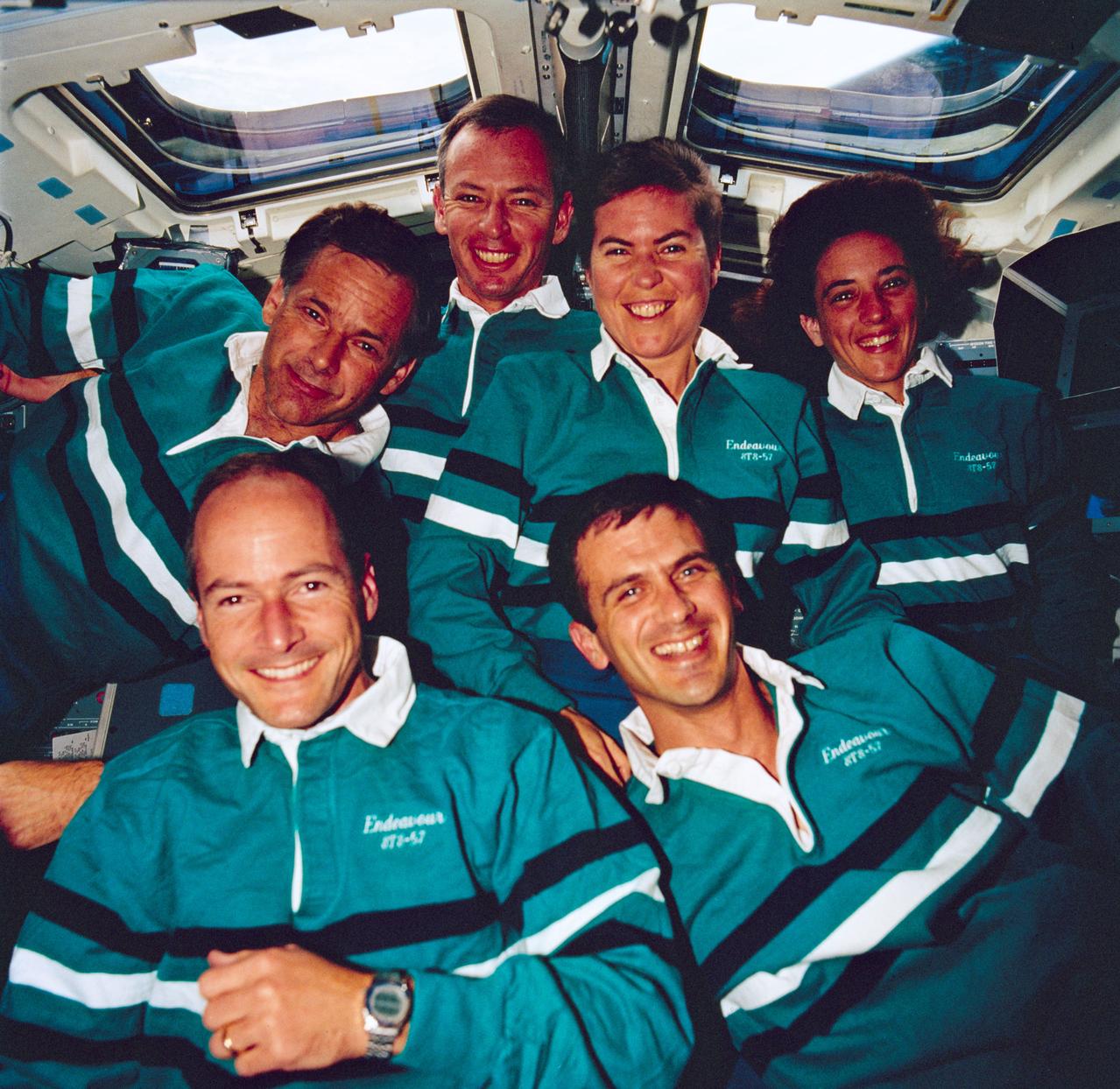
STS057-94-007 (21 June-1 July 1993) --- The six STS-57 crewmembers used a pre-set 70mm camera to record the traditional in-space crew portrait on Endeavour's aft flight deck. In front are astronauts G. David Low, payload commander; and Peter J. K. (Jeff) Wisoff, mission specialist. In the back are astronauts Ronald J. Grabe, mission commander; Brian Duffy, pilot; Janice E. Voss and Nancy J. Sherlock, mission specialists.
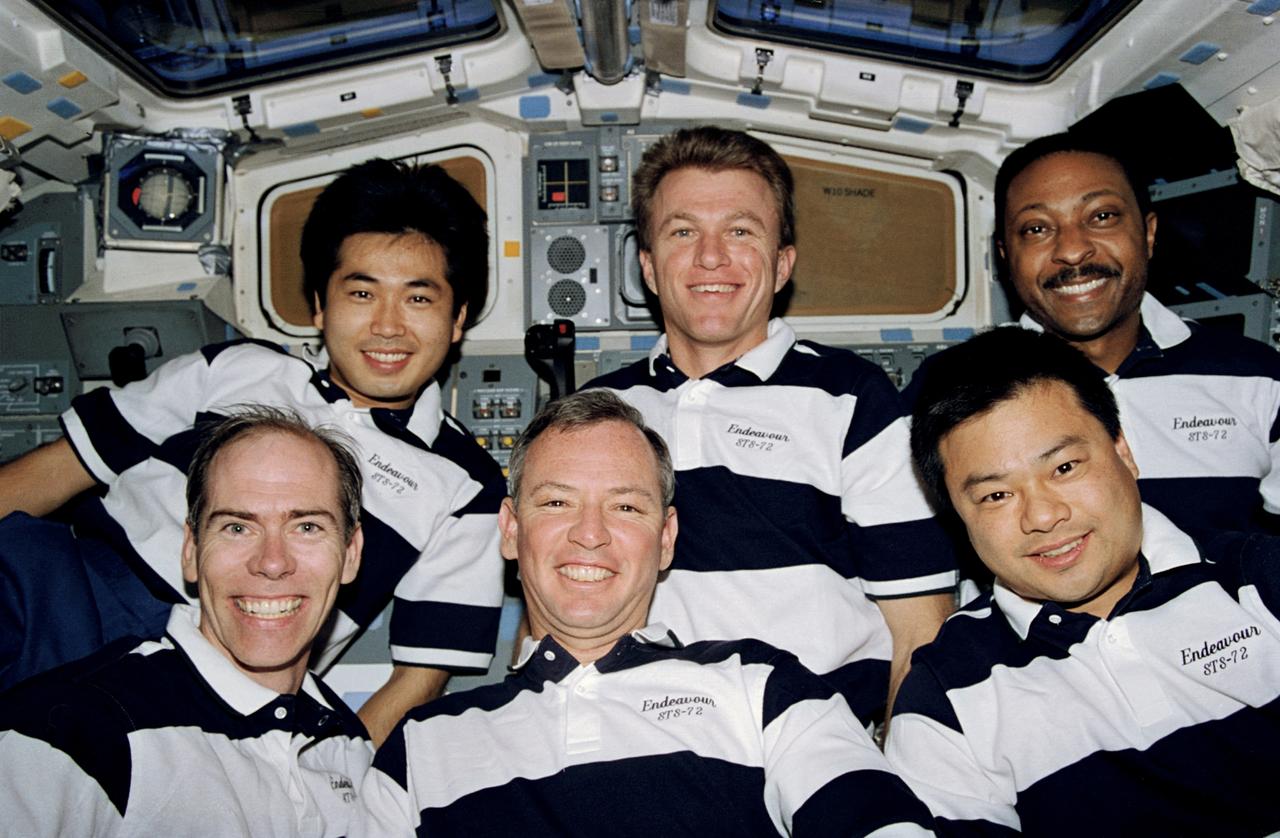
STS072-410-007 (11-20 Jan. 1996) --- The crewmembers selected the aft flight deck for the site of their inflight crew portrait aboard the Earth-orbiting Space Shuttle Endeavour. In front are, left to right, astronauts Daniel T. Barry, mission specialist; Brian Duffy, mission commander; and Leroy Chiao, mission specialist. In the rear are (left to right) Koichi Wakata, mission specialist representing Japan's National Space Development Agency (NASDA); Brent W. Jett Jr., pilot; and Winston E. Scott, mission specialist.
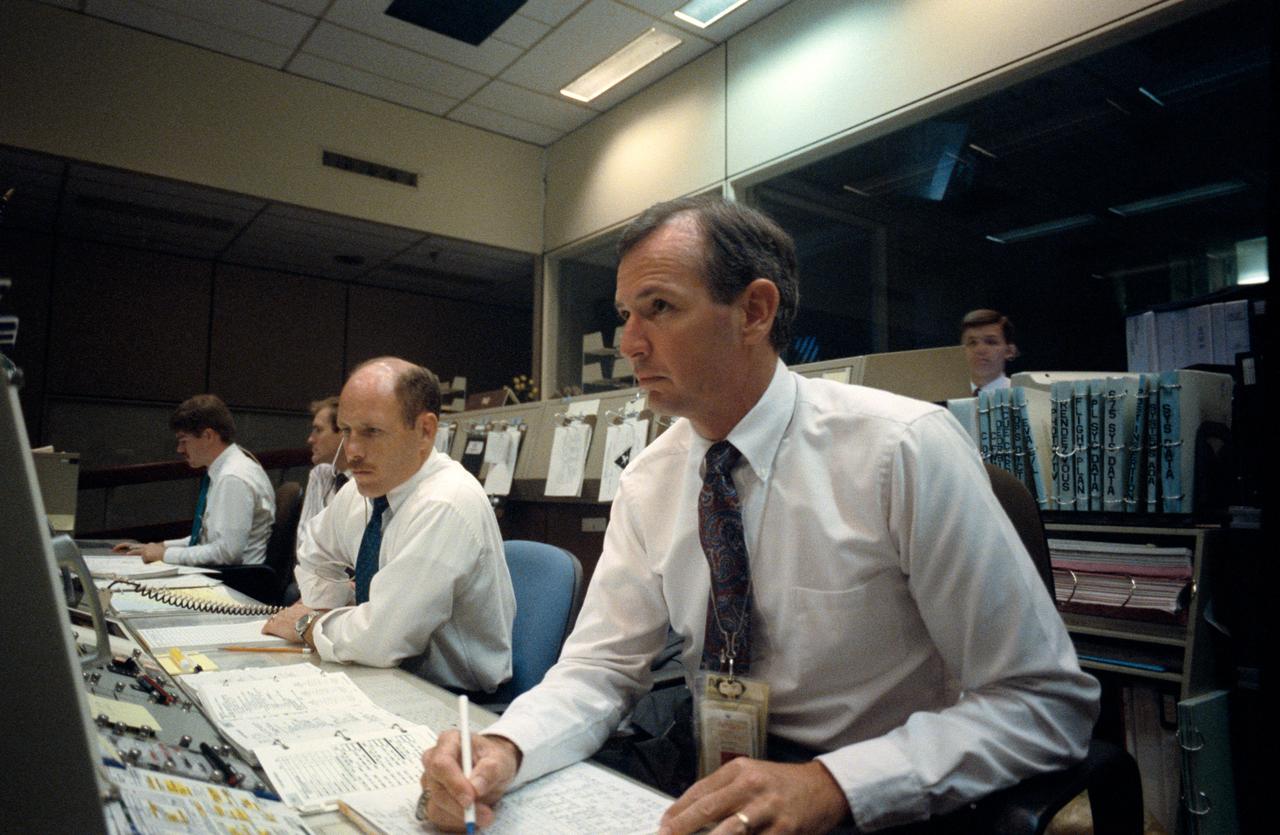
STS039-S-022 (28 April 1991)--- Two spacecraft communicators at the CAPCOM console monitor the ascent of the Space Shuttle Discovery. They are astronauts Kenneth D. Bowersox (left) and Brian Duffy. Launch occurred at 6:33 a.m. (CDT), April 28, 1991. The scene is in the second floor Flight Control Room (FCR) of the Johnson Space Center's Mission Control Center (MCC).
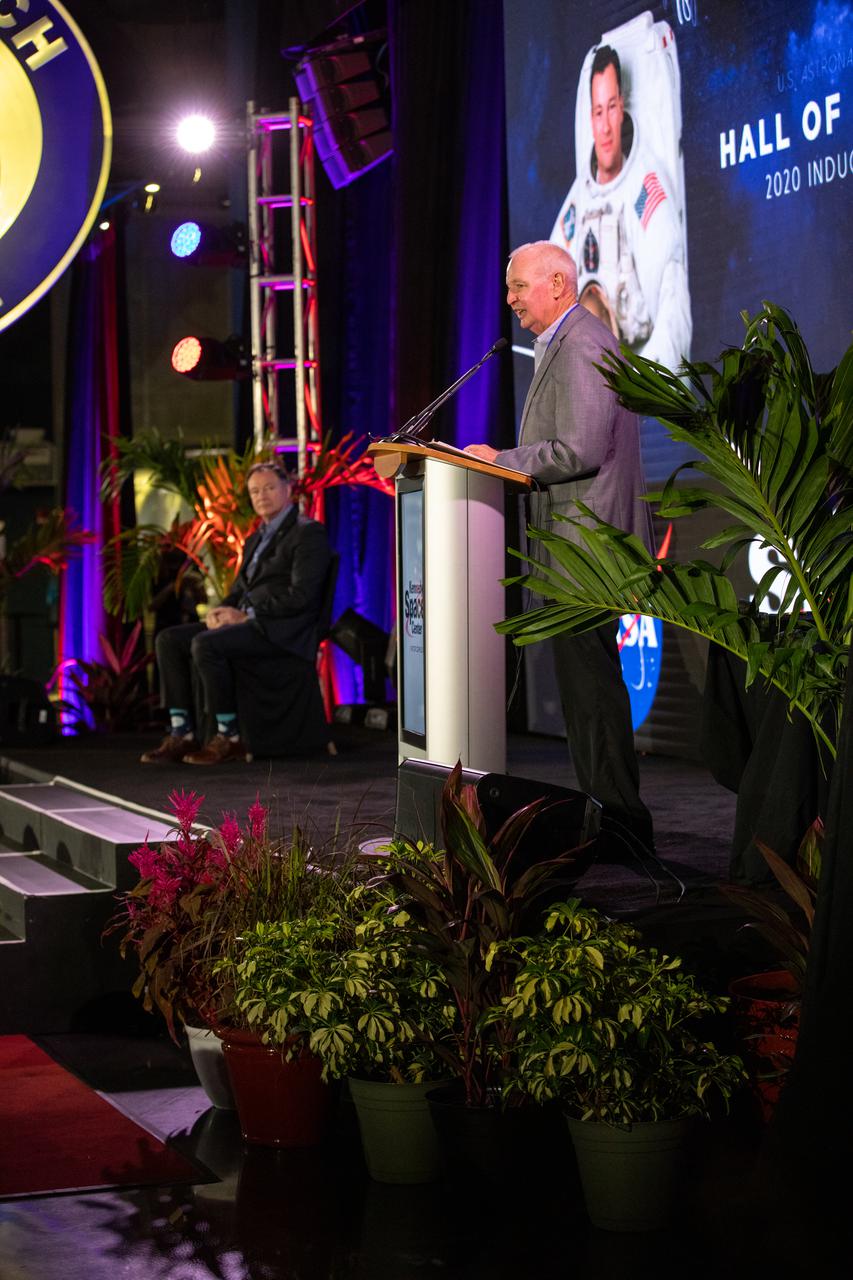
Former NASA astronaut and Hall of Famer Brian Duffy (right) inducts Michael Lopez-Alegria into the U.S. Astronaut Hall of Fame (AHOF) on Nov. 13, 2021, during a ceremony at the Kennedy Space Center Visitor Complex in Florida. Lopez-Alegria received an official medal and became a member of the 19th class of space shuttle astronauts to be inducted. The 2021 inductees were selected by a committee of Hall of Fame astronauts, former NASA officials, flight directors, historians, and journalists. This year’s induction brings the total number of AHOF members to 102.
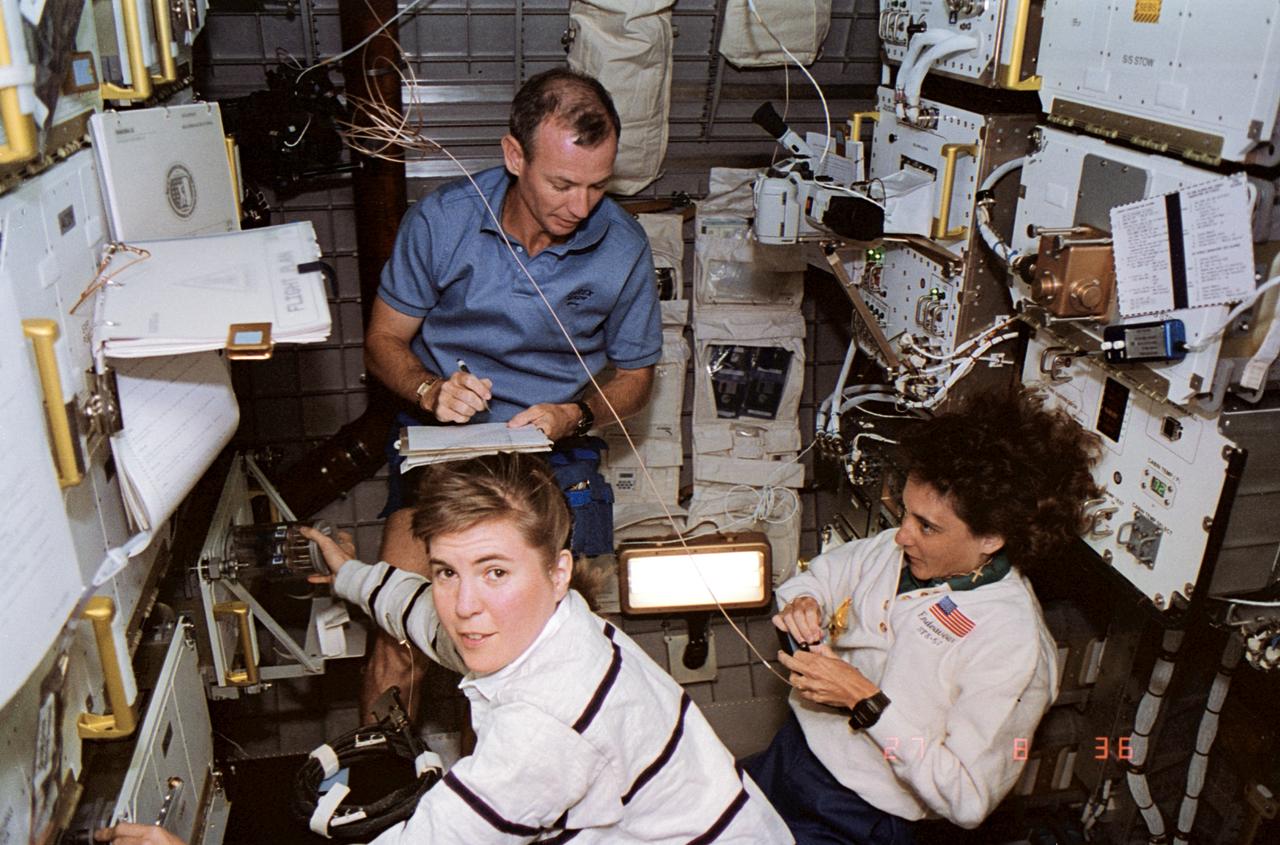
STS057-39-001 (27 June 1993) --- This high angle shot inside the SPACEHAB module, onboard the Space Shuttle Endeavour, typifies the pace of activity conducted there during the ten-day STS-57 mission. Astronaut Janice E. Voss (foreground), mission specialist, works with biomaterials products, while astronauts Brian Duffy, pilot, and Nancy J. Sherlock, mission specialist, participate in other tasks.
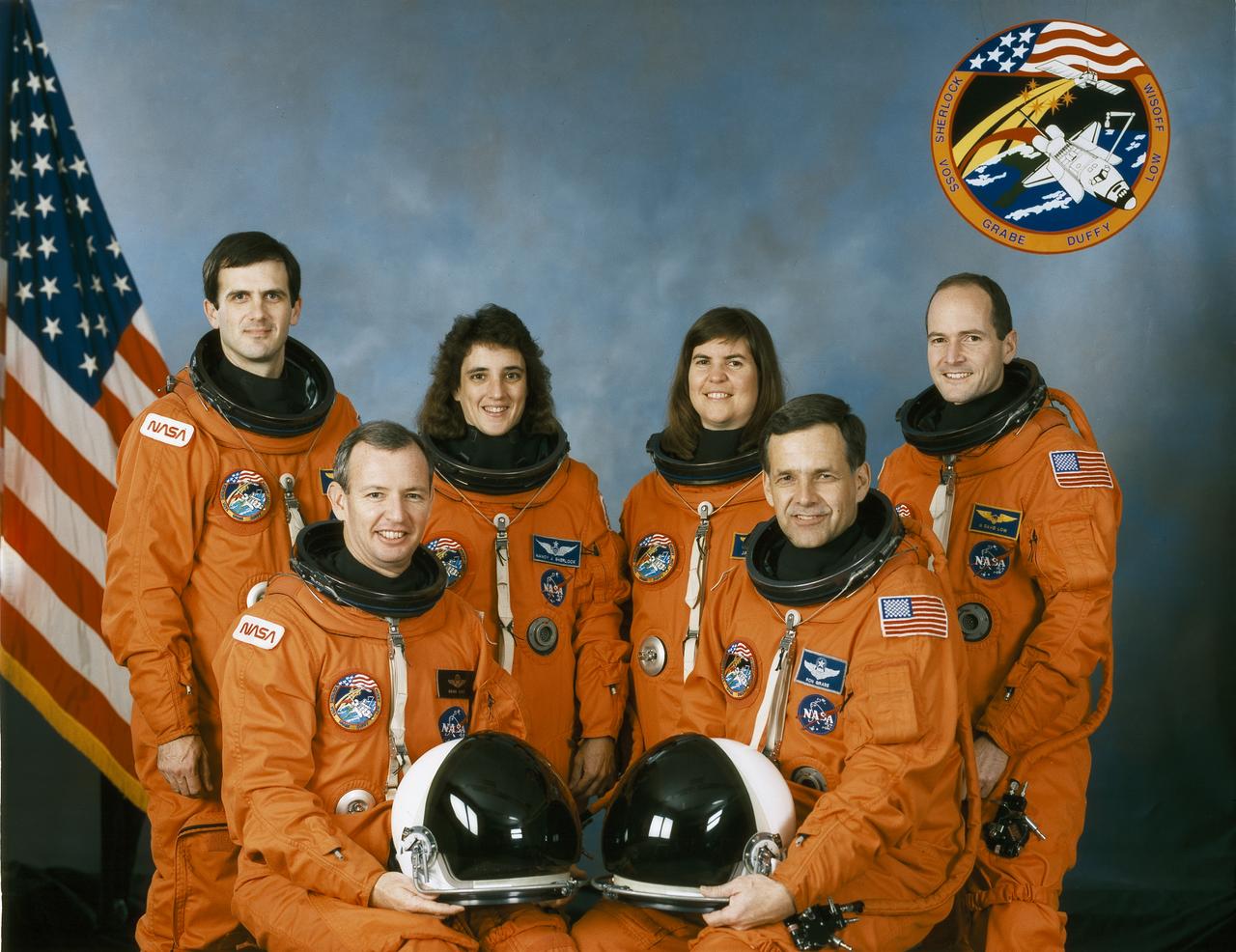
Pictured in the STS-57 crew portrait (front left to right) are Brian Duffy, pilot; and Ronald J. Grabe, commander. On the back row (left to right) are Peter J. Wisoff, Nancy J. Sherlock, and Janice E. Voss, all mission specialists; and G. David Low, payload commander. Launched aboard the Space Shuttle Endeavour on June 21, 1993 at 9:07:00 am (EDT), the STS-57 mission marked the first flight of the commercially developed SPACEHAB pressurized laboratory.
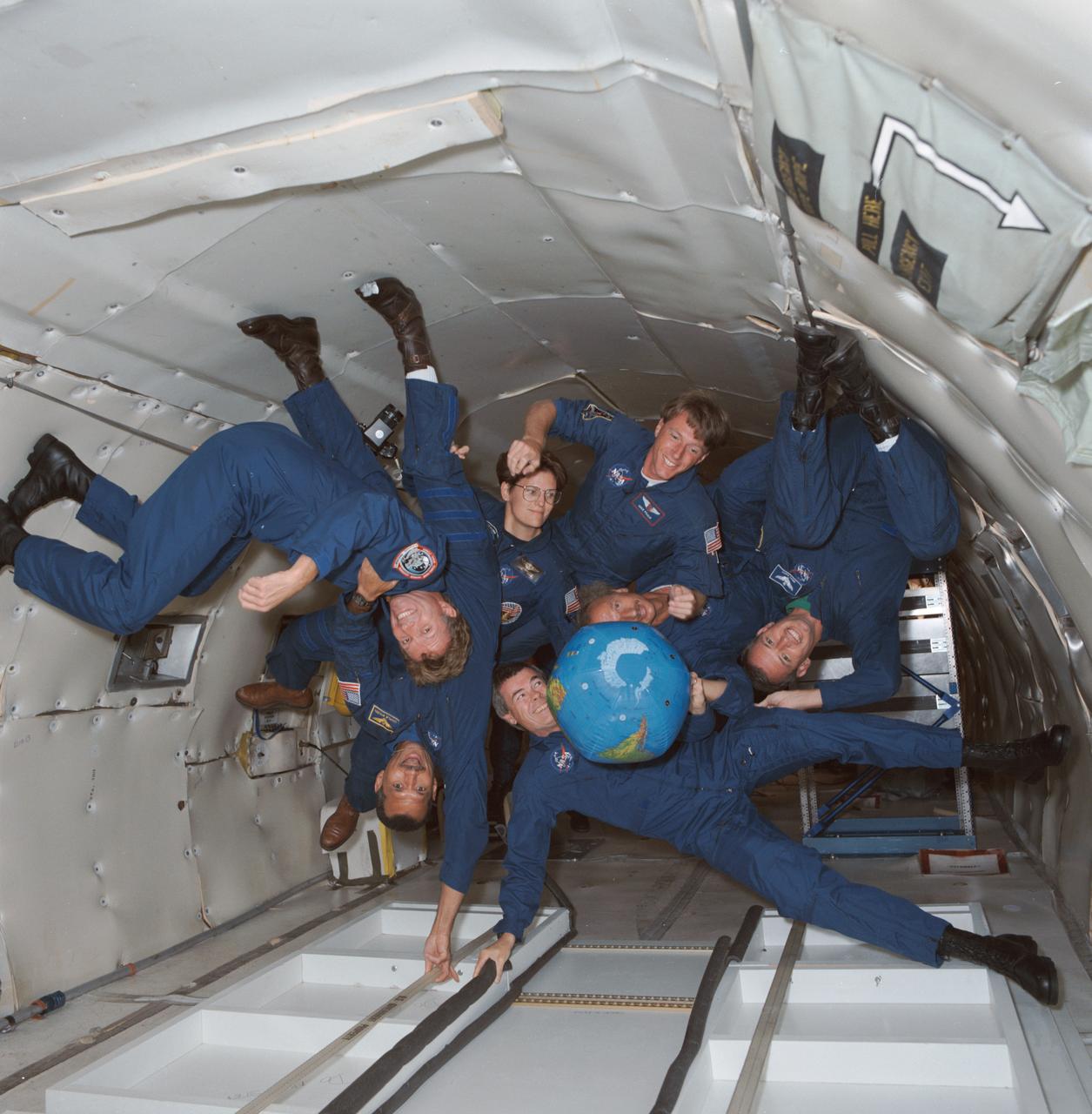
S91-44453 (21 Aug 1991) --- The crew of STS-45 is already training for its March 1992 mission, including stints on the KC-135 zero-gravity-simulating aircraft. Shown with an inflatable globe are, clockwise from the top, C. Michael Foale, mission specialist; Dirk Frimout, payload specialist; Brian Duffy, pilot; Charles R. (Rick) Chappell, backup payload specialist; Charles F. Bolden, mission commander; Byron K. Lichtenberg, payload specialist; and Kathryn D. Sullivan, payload commander.
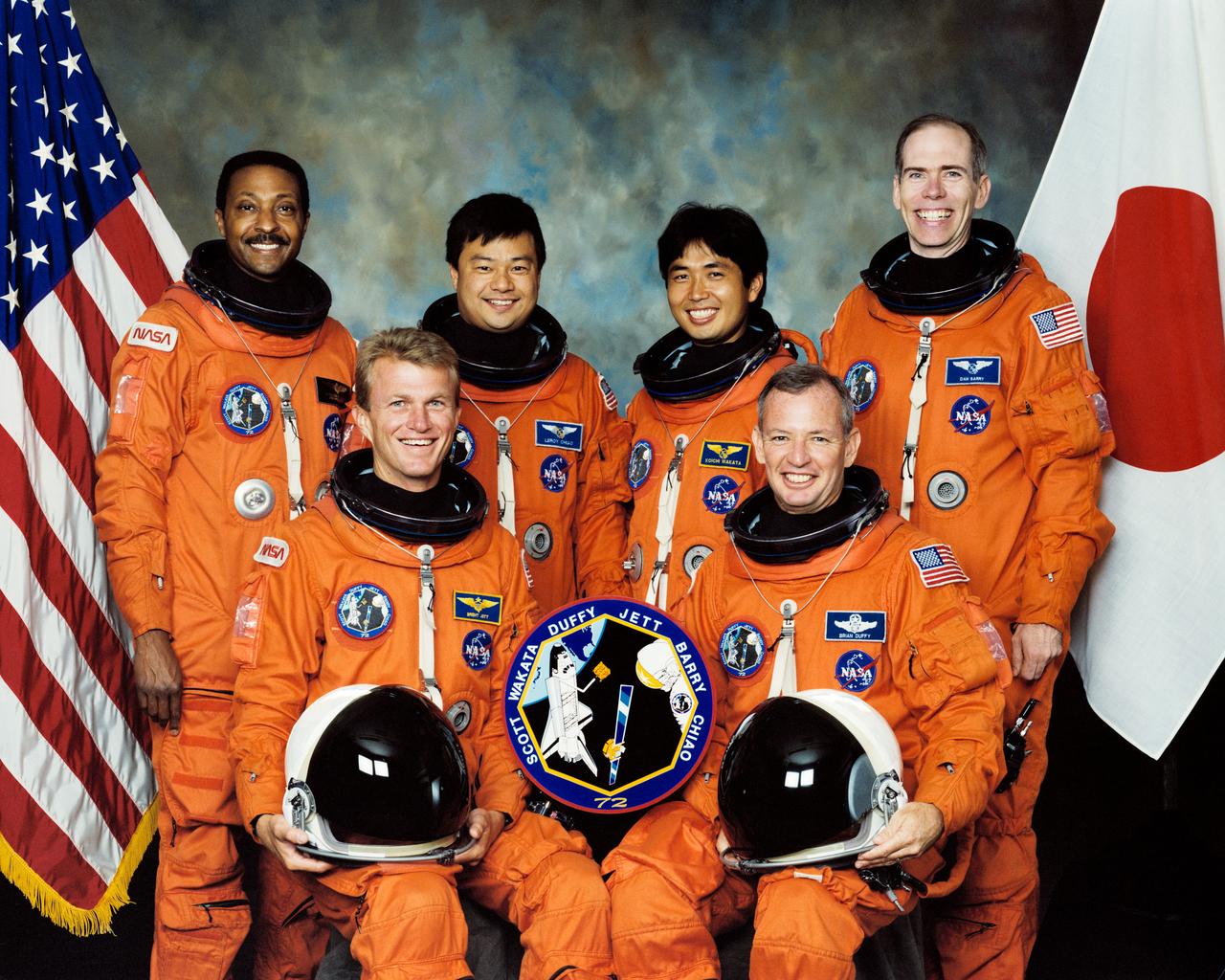
STS072-S-002 (August 1995) --- These six astronauts are in training for their mission scheduled aboard the Space Shuttle Endeavour later this year. Astronauts Brian Duffy (right front) and Brent W. Jett (left front) are mission commander and pilot, respectively. Mission specialists (back row, left to right) are Winston E. Scott, Leroy Chiao, Koichi Wakata and Daniel T. Barry. Wakata is an international mission specialist representing Japan’s National Space Development Agency (NASDA) based at the Johnson Space Center (JSC).
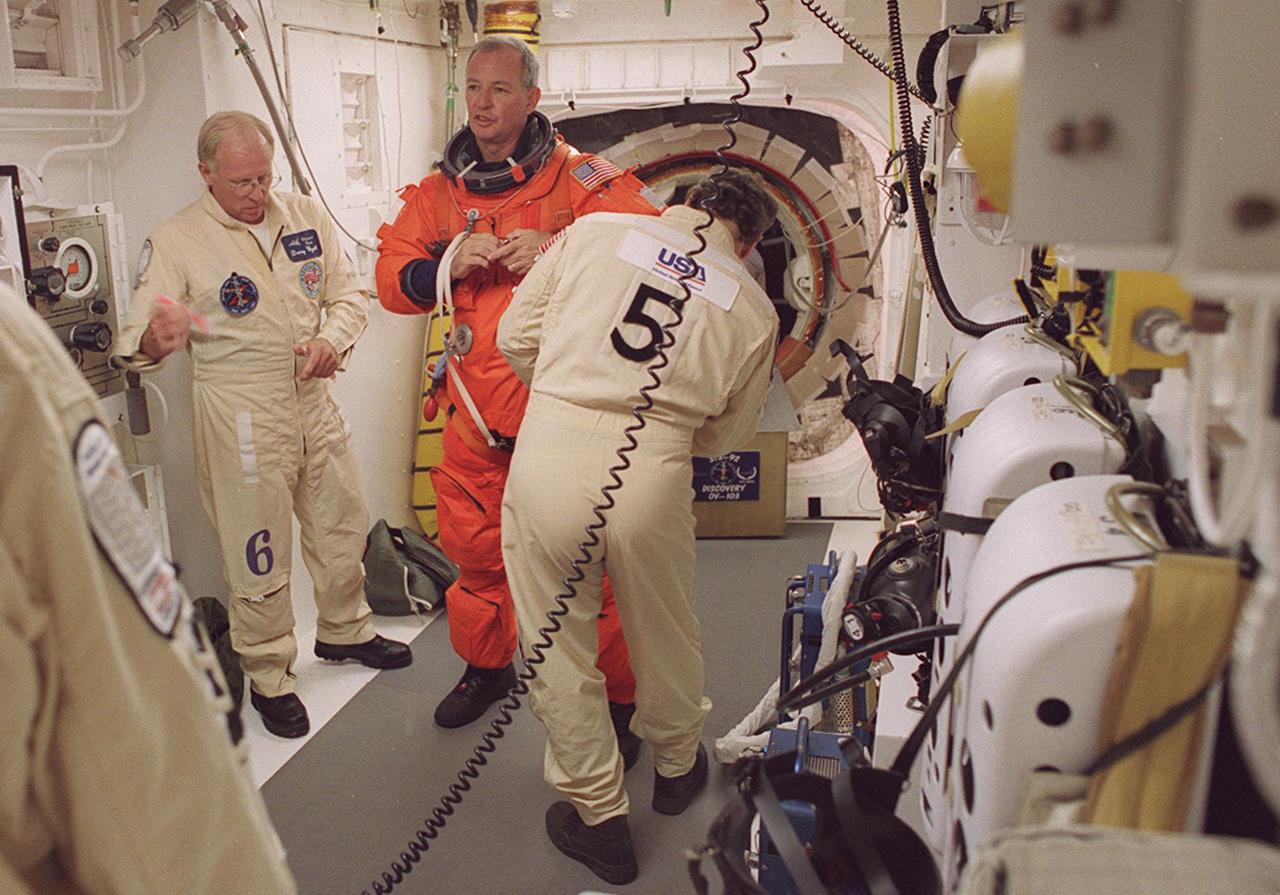
STS-92 Commander Brian Duffy is helped with final suit check in the White Room before entering Discovery. The White Room is an environmentally controlled area at the end of the Orbiter Access Arm that provides entry to the orbiter as well as emergency egress if needed. The arm remains in the extended position until 7 minutes 24 seconds before launch. Duffy and the rest of the crew are undertaking the fifth flight to the International Space Station for construction. Discovery carries a payload that includes the Integrated Truss Structure Z-1, first of 10 trusses that will form the backbone of the Space Station, and the third Pressurized Mating Adapter that will provide a Shuttle docking port for solar array installation on the sixth Station flight and Lab installation on the seventh Station flight. The mission includes four spacewalks for the construction activities. Discovery’s landing is expected Oct. 22 at 2:10 p.m. EDT
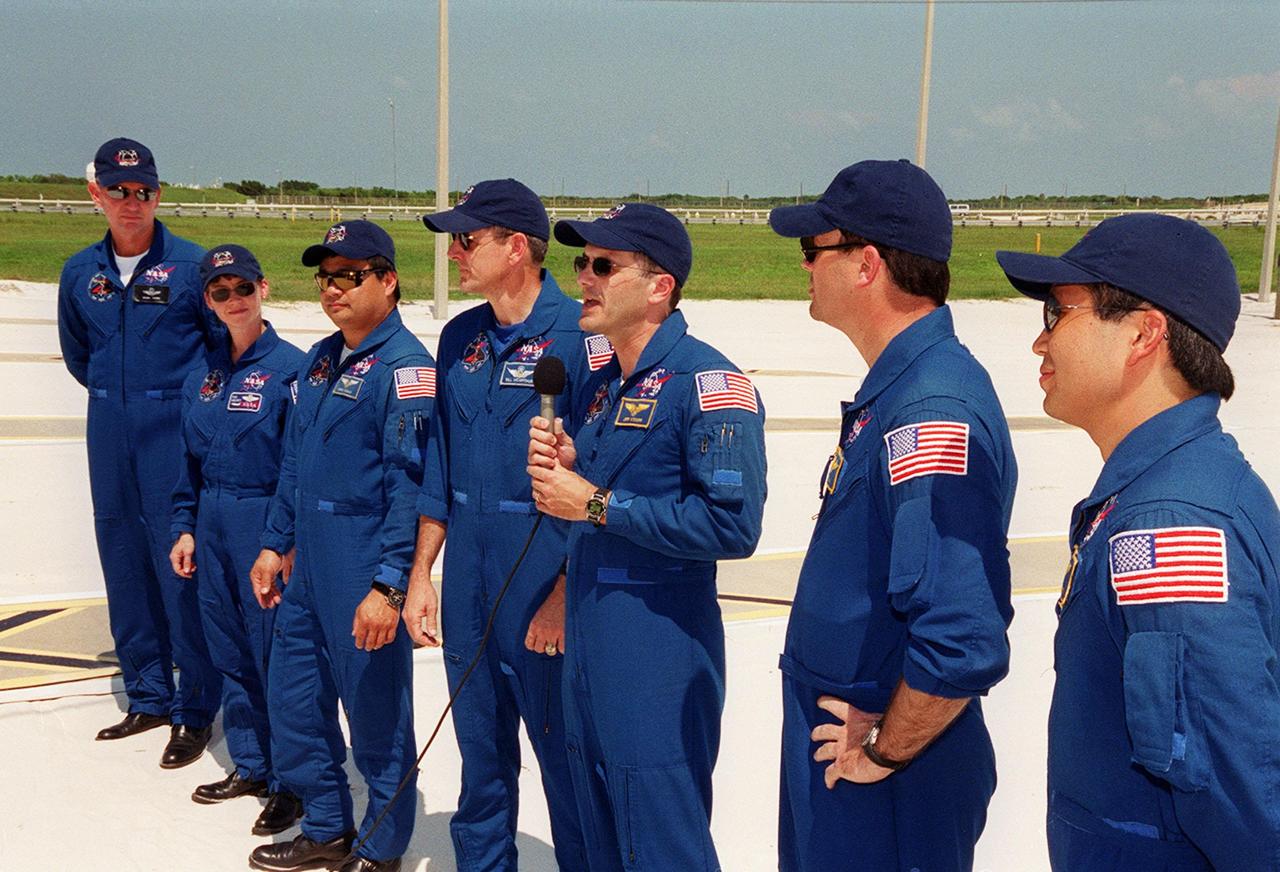
KENNEDY SPACE CENTER, FLA. -- At Launch Pad 39A during a question and answer session with the media, STS-92 Commander Brian Duffy talks about the mission. Duffy and the rest of the crew are at KSC for Terminal Countdown Demonstration Test activities that provide emergency egress training, opportunities to inspect the mission payload, and a simulated countdown. The slidewire basket area is a landing site for the crew if they have to use the slidewire baskets to exit the orbiter on the pad in an emergency. STS-92 is scheduled to launch Oct. 5 at 9:38 p.m. EDT on the fifth flight to the International Space Station. It will carry two elements of the Space Station, the Integrated Truss Structure Z1 and the third Pressurized Mating Adapter. The mission is also the 100th flight in the Shuttle program
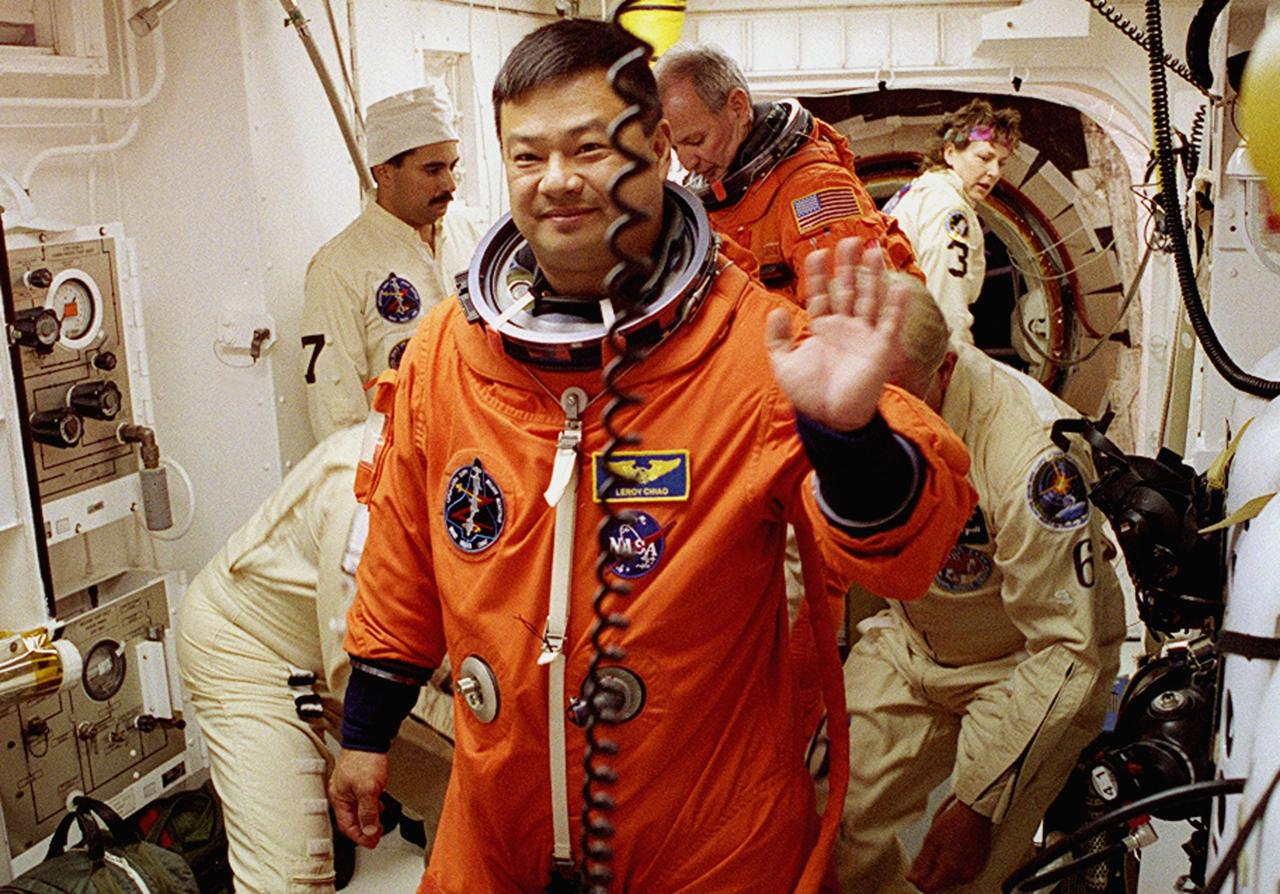
STS-92 Mission Specialist Leroy Chiao waves while waiting for suit check in the White Room. Behind him is Commander Brian Duffy. The White Room is an environmentally controlled area at the end of the Orbiter Access Arm that provides entry to the orbiter as well as emergency egress if needed. The arm remains in the extended position until 7 minutes 24 seconds before launch. Chiao, Duffy and the rest of the crew are undertaking the fifth flight to the International Space Station for construction. Discovery carries a payload that includes the Integrated Truss Structure Z-1, first of 10 trusses that will form the backbone of the Space Station, and the third Pressurized Mating Adapter that will provide a Shuttle docking port for solar array installation on the sixth Station flight and Lab installation on the seventh Station flight. The mission includes four spacewalks for the construction activities. Discovery’s landing is expected Oct. 22 at 2:10 p.m. EDT
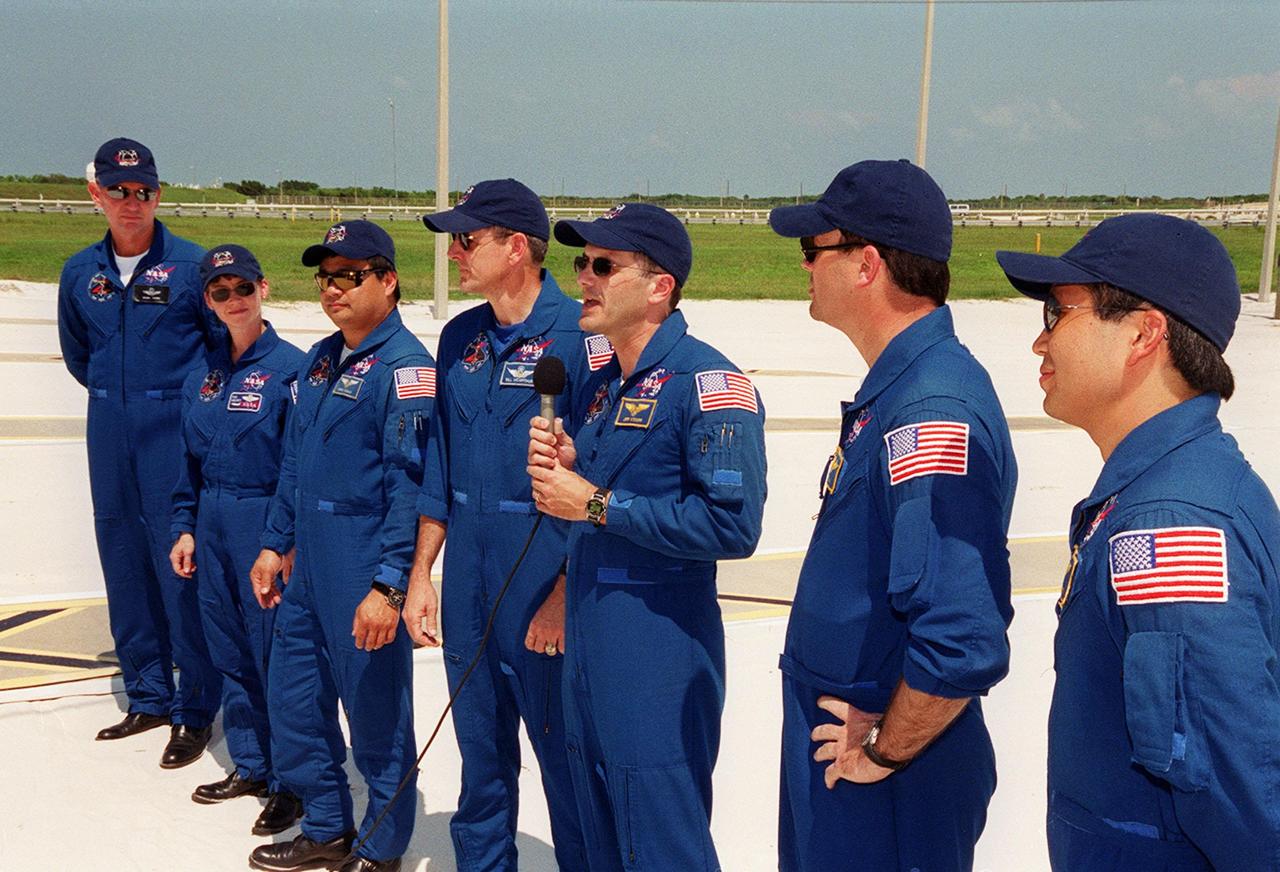
KENNEDY SPACE CENTER, FLA. -- At Launch Pad 39A during a question and answer session with the media, STS-92 Commander Brian Duffy talks about the mission. Duffy and the rest of the crew are at KSC for Terminal Countdown Demonstration Test activities that provide emergency egress training, opportunities to inspect the mission payload, and a simulated countdown. The slidewire basket area is a landing site for the crew if they have to use the slidewire baskets to exit the orbiter on the pad in an emergency. STS-92 is scheduled to launch Oct. 5 at 9:38 p.m. EDT on the fifth flight to the International Space Station. It will carry two elements of the Space Station, the Integrated Truss Structure Z1 and the third Pressurized Mating Adapter. The mission is also the 100th flight in the Shuttle program
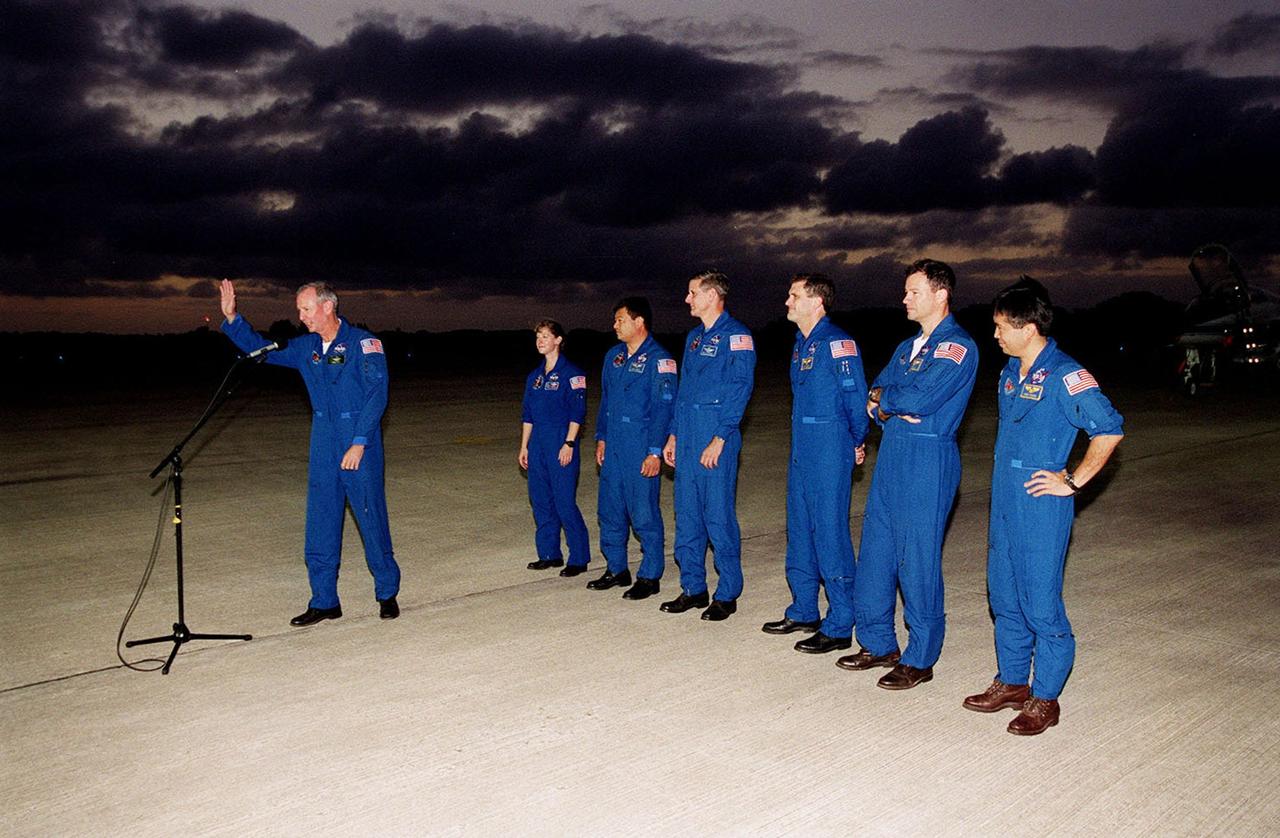
Gathered on the parking apron at the Shuttle Landing Facility after their arrival is the STS-92 crew. Commander Brian Duffy waves to the media (out of view) before heading to the bus for the short trip to crew quarters at the Operations and Checkout Building. Standing behind Duffy are (left to right) Pilot Pamela Ann Melroy and Mission Specialists Leroy Chiao, William S. McArthur Jr., Peter J.K. “Jeff” Wisoff, Michael E. Lopez-Alegria and Koichi Wakata of Japan. The mission is the fifth flight for the construction of the International Space Station. The payload includes the Integrated Truss Structure Z-1 and the third Pressurized Mating Adapter. During the 11-day mission, four extravehicular activities (EVAs), or space walks, are planned

STS057-30-021 (21 June-1 July 1993) --- Astronaut Brian Duffy, pilot, handles a soldering tool onboard the Earth-orbiting Space Shuttle Endeavour. The Soldering Experiment (SE) called for a crew member to solder on a printed circuit board containing 45 connection points, then de-solder 35 points on a similar board. The SE was part of a larger project called the Tools and Diagnostic Systems (TDS), sponsored by the Space and Life Sciences Directorate at Johnson Space Center (JSC). TDS represents a group of equipment selected from the tools and diagnostic hardware to be supported by the International Space Station program. TDS was designed to demonstrate the maintenance of experiment hardware on-orbit and to evaluate the adequacy of its design and the crew interface. Duffy and five other NASA astronauts spent almost ten days aboard the Space Shuttle Endeavour in Earth-orbit supporting the SpaceHab mission, retrieving the European Retrievable Carrier (EURECA) and conducting various experiments.
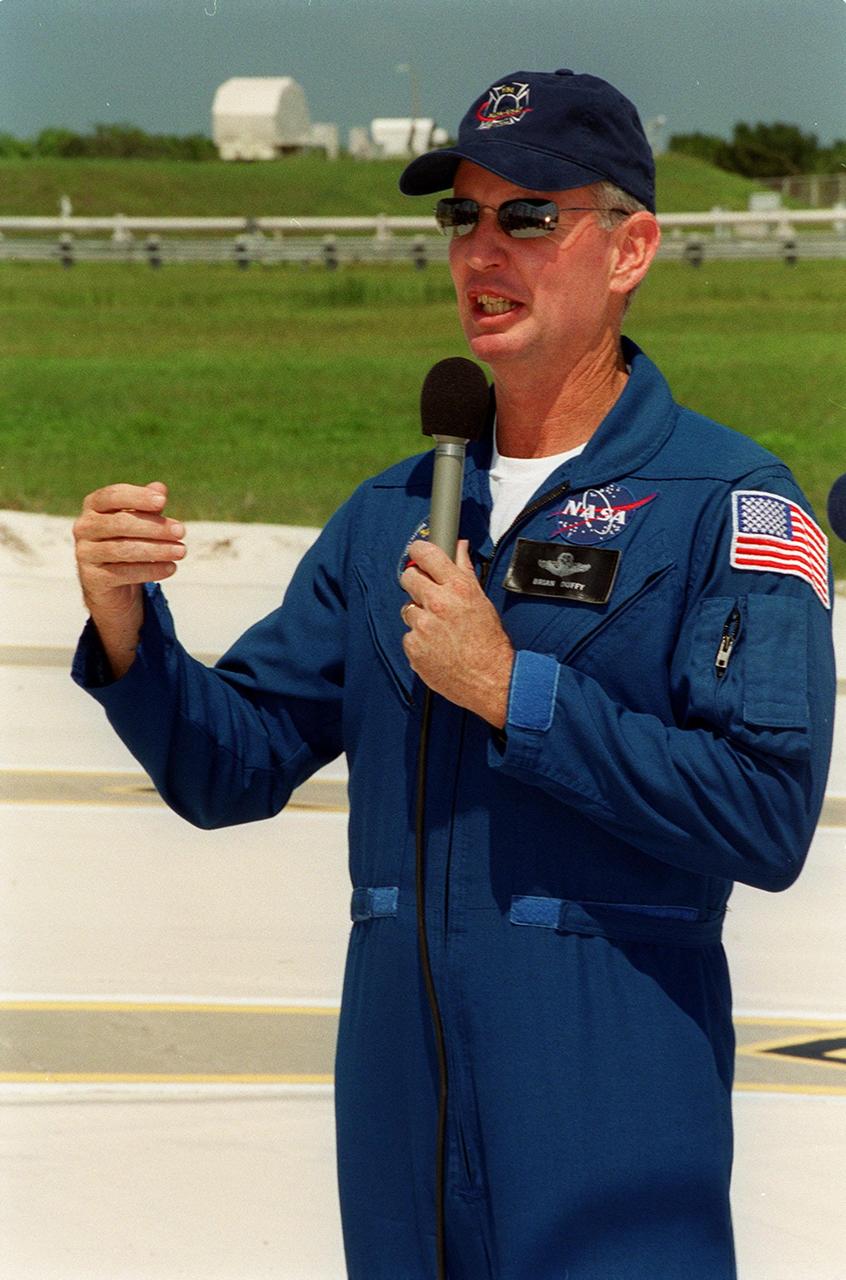
KENNEDY SPACE CENTER, FLA. -- At Launch Pad 39A during a question and answer session with the media, STS-92 Commander Brian Duffy talks about the mission. Duffy and the rest of the crew are at KSC for Terminal Countdown Demonstration Test activities that provide emergency egress training, opportunities to inspect the mission payload, and a simulated countdown. The slidewire basket area is a landing site for the crew if they have to use the slidewire baskets to exit the orbiter on the pad in an emergency. STS-92 is scheduled to launch Oct. 5 at 9:38 p.m. EDT on the fifth flight to the International Space Station. It will carry two elements of the Space Station, the Integrated Truss Structure Z1 and the third Pressurized Mating Adapter. The mission is also the 100th flight in the Shuttle program
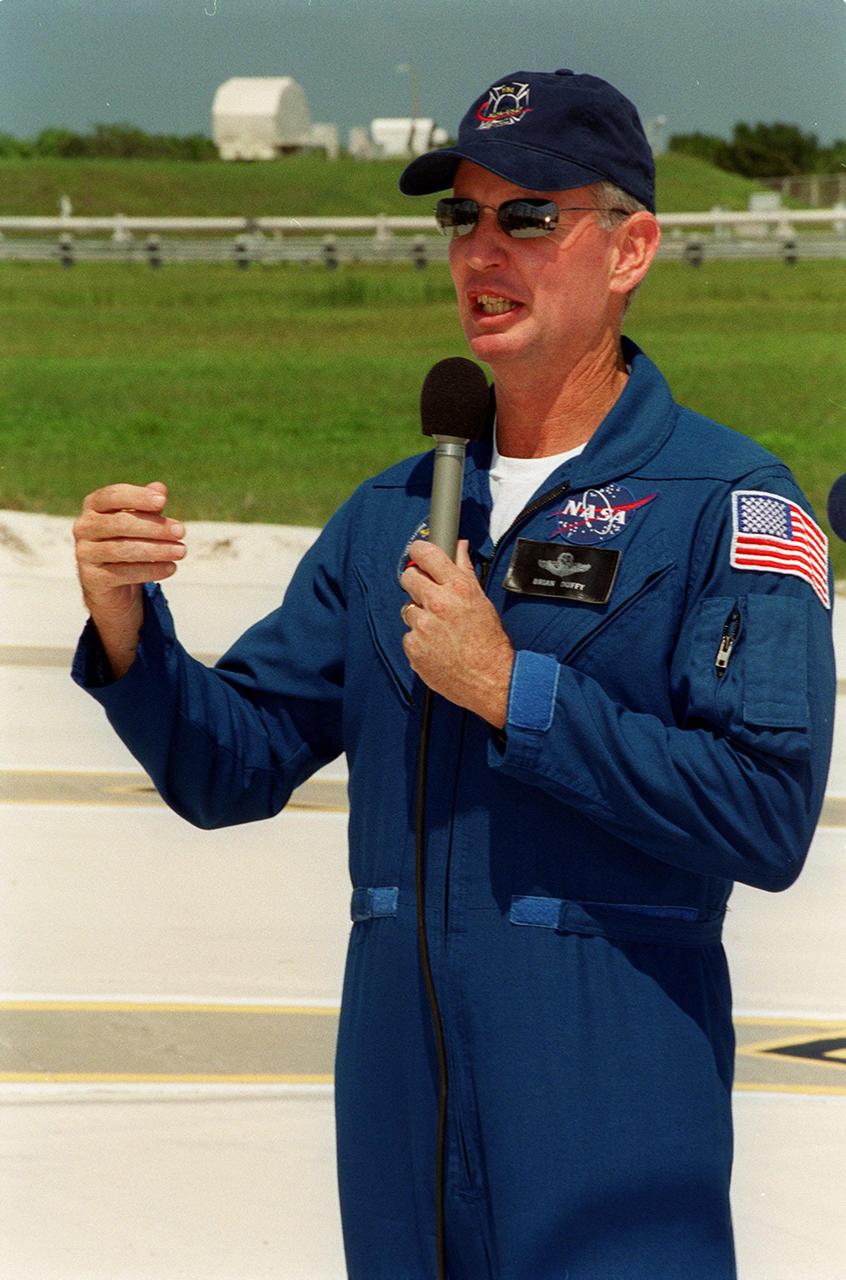
KENNEDY SPACE CENTER, FLA. -- At Launch Pad 39A during a question and answer session with the media, STS-92 Commander Brian Duffy talks about the mission. Duffy and the rest of the crew are at KSC for Terminal Countdown Demonstration Test activities that provide emergency egress training, opportunities to inspect the mission payload, and a simulated countdown. The slidewire basket area is a landing site for the crew if they have to use the slidewire baskets to exit the orbiter on the pad in an emergency. STS-92 is scheduled to launch Oct. 5 at 9:38 p.m. EDT on the fifth flight to the International Space Station. It will carry two elements of the Space Station, the Integrated Truss Structure Z1 and the third Pressurized Mating Adapter. The mission is also the 100th flight in the Shuttle program
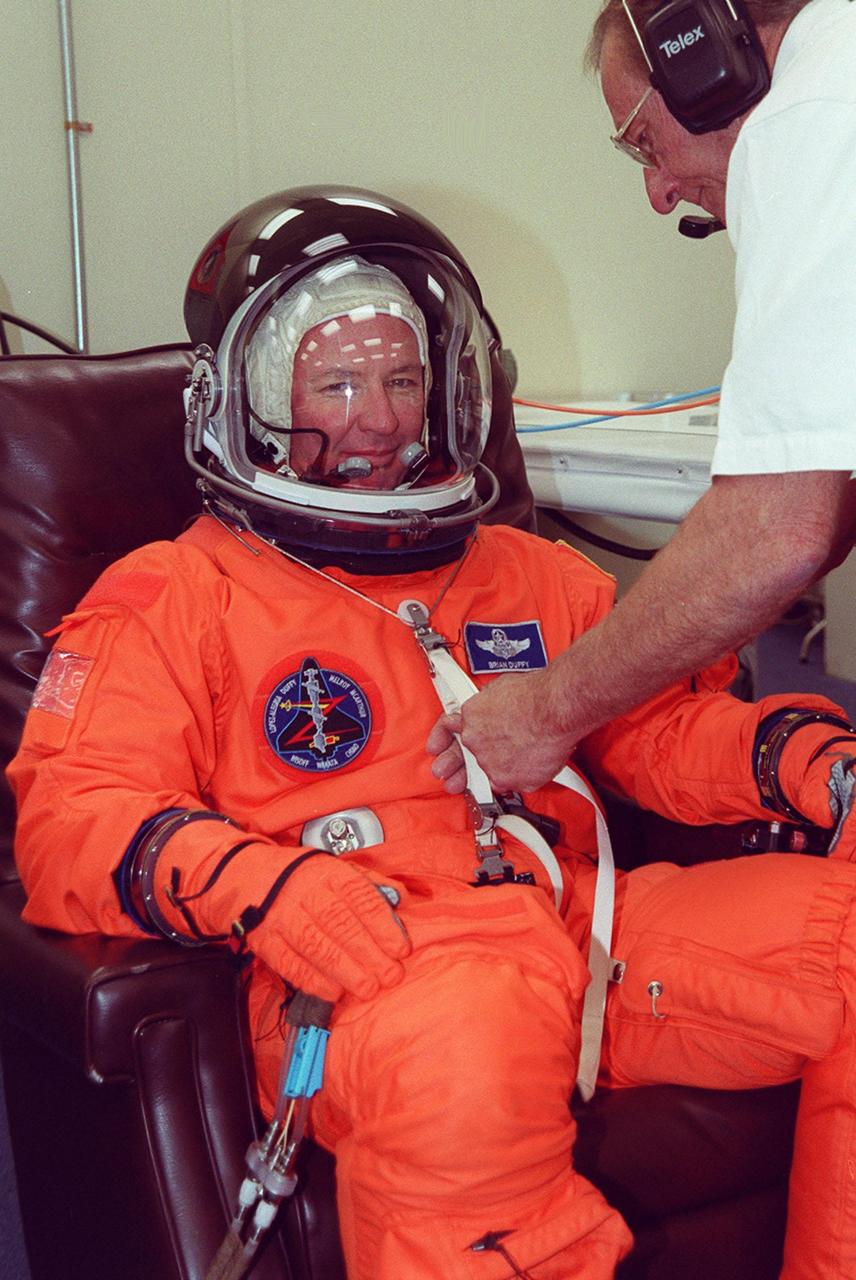
STS-92 Commander Brian Duffy has his launch and entry suit checked before launch, scheduled for 8:05 p.m. EDT. The mission is the fifth flight for the construction of the ISS. The payload includes the Integrated Truss Structure Z-1 and the third Pressurized Mating Adapter. During the 11-day mission, four extravehicular activities (EVAs), or spacewalks, are planned. The Z-1 truss is the first of 10 that will become the backbone of the International Space Station, eventually stretching the length of a football field. PMA-3 will provide a Shuttle docking port for solar array installation on the sixth ISS flight and Lab installation on the seventh ISS flight. This launch is the fourth for Duffy. Landing is expected Oct. 21 at 3:55 p.m. EDT
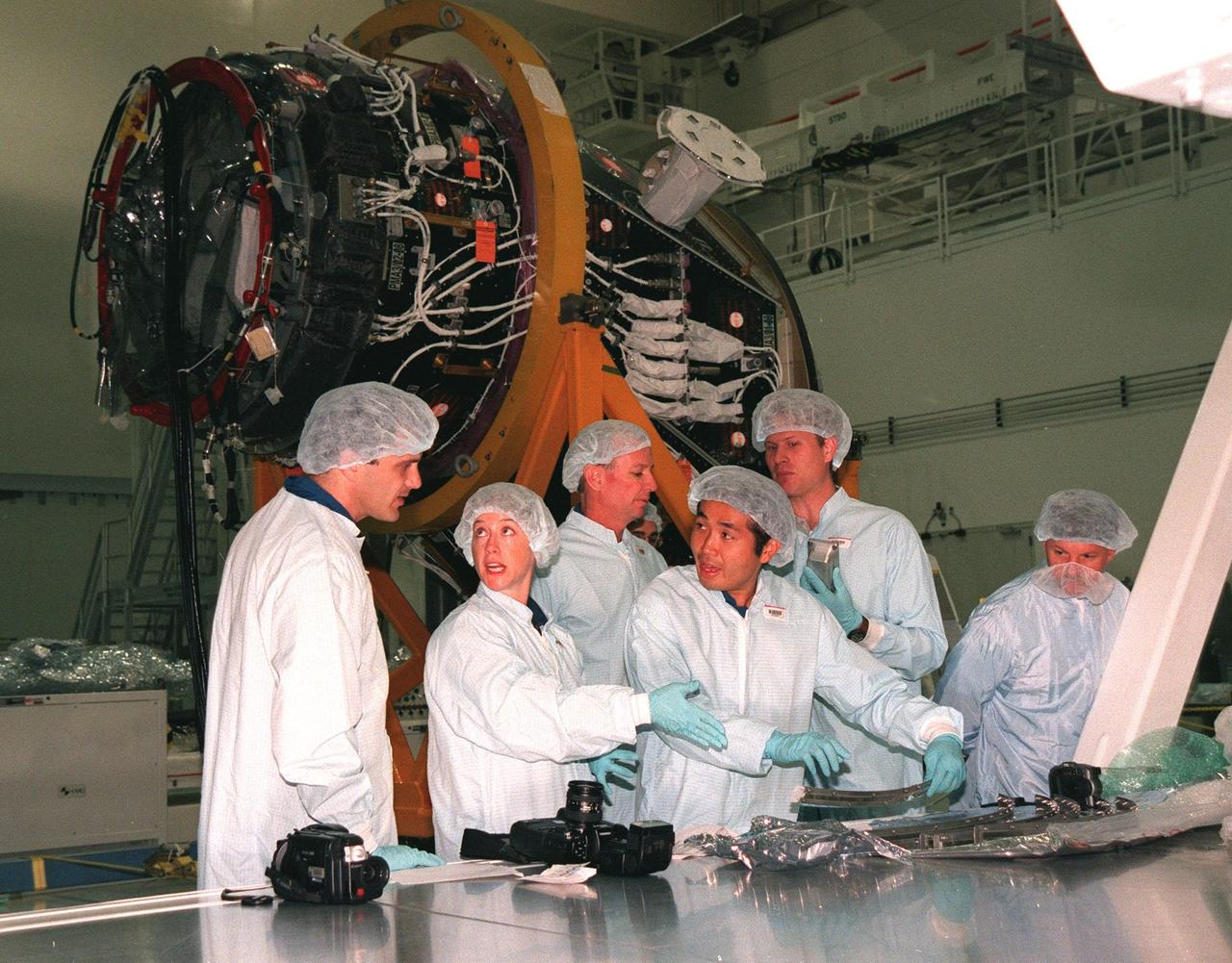
In the Space Station Processing Facility, STS-92 crew members take part in a Leak Seal Kit Fit Check in connection with the Pressurized Mating Adapter -3 in the background. From left are Mission Specialist Peter J.K. "Jeff" Wisoff (Ph.D.), Pilot Pamela A. Melroy, Commander Brian Duffy, Mission Specialist Koichi Wakata, who represents the National Space Development Agency of Japan (NASDA), Brian Warkentine, with JSC, and a Boeing worker at right. Also participating are other crew members Mission Specialists Leroy Chiao (Ph.D.), Michael E. Lopez-Alegria and William Surles "Bill" McArthur Jr. The mission payload also includes an integrated truss structure (Z-1 truss). Launch of STS-92 is scheduled for Feb. 24, 2000
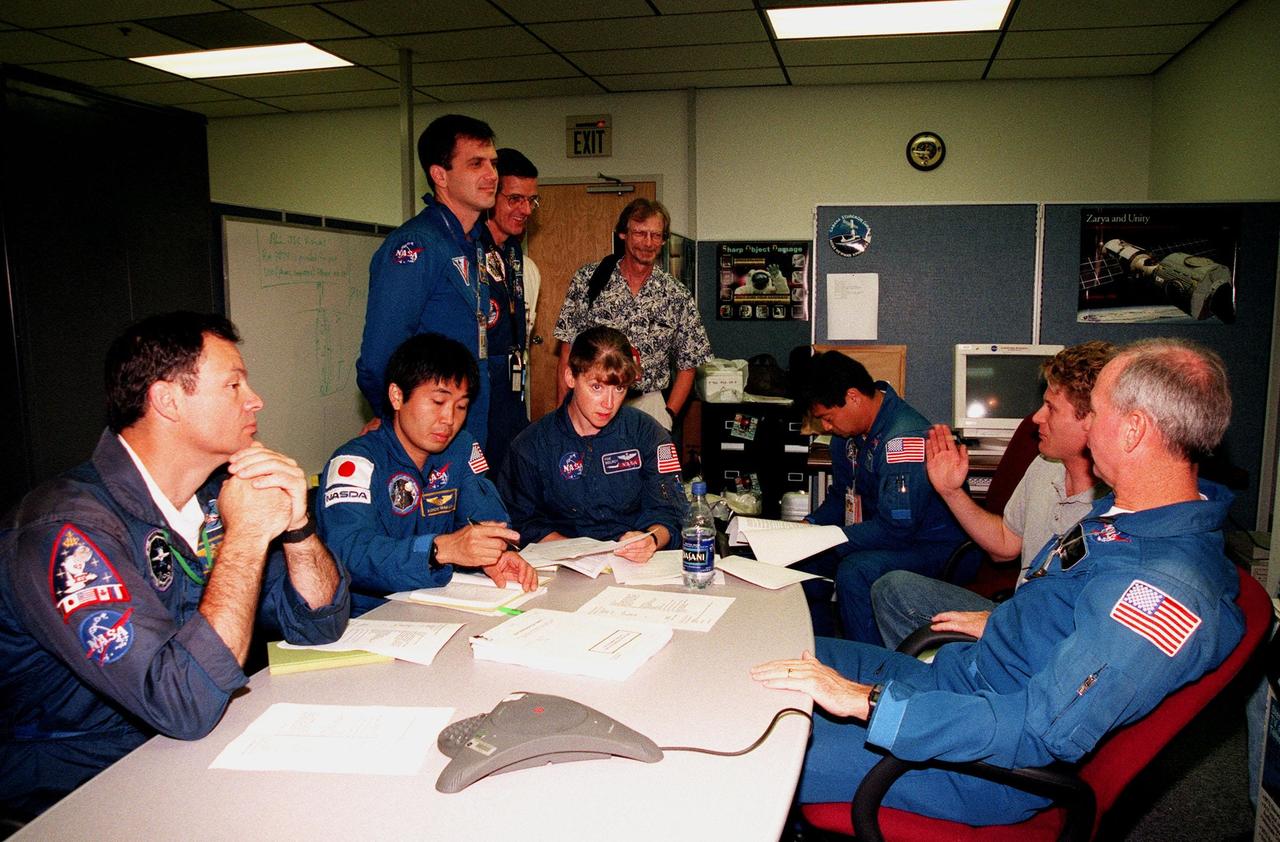
STS-92 crew members discuss results of a Leak Seal Kit Fit Check on the Pressurized Mating Adapter -3, part of their mission payload, with JSC and Boeing representatives. From left are Mission Specialists Michael E. Lopez-Alegria; Koichi Wakata, who represents the National Space Development Agency of Japan (NASDA); (standing) Peter J.K. "Jeff" Wisoff (Ph.D.) and William Surles "Bill" McArthur Jr.; (seated) Pilot Pamela A. Melroy; Dave Moore (behind Melroy), with Boeing; Mission Specialist Leroy Chiao (Ph.D.); Brian Warkentine, with JSC; and Commander Brian Duffy. The mission payload also includes an integrated truss structure (Z-1 truss). Launch of STS-92 is scheduled for Feb. 24, 2000
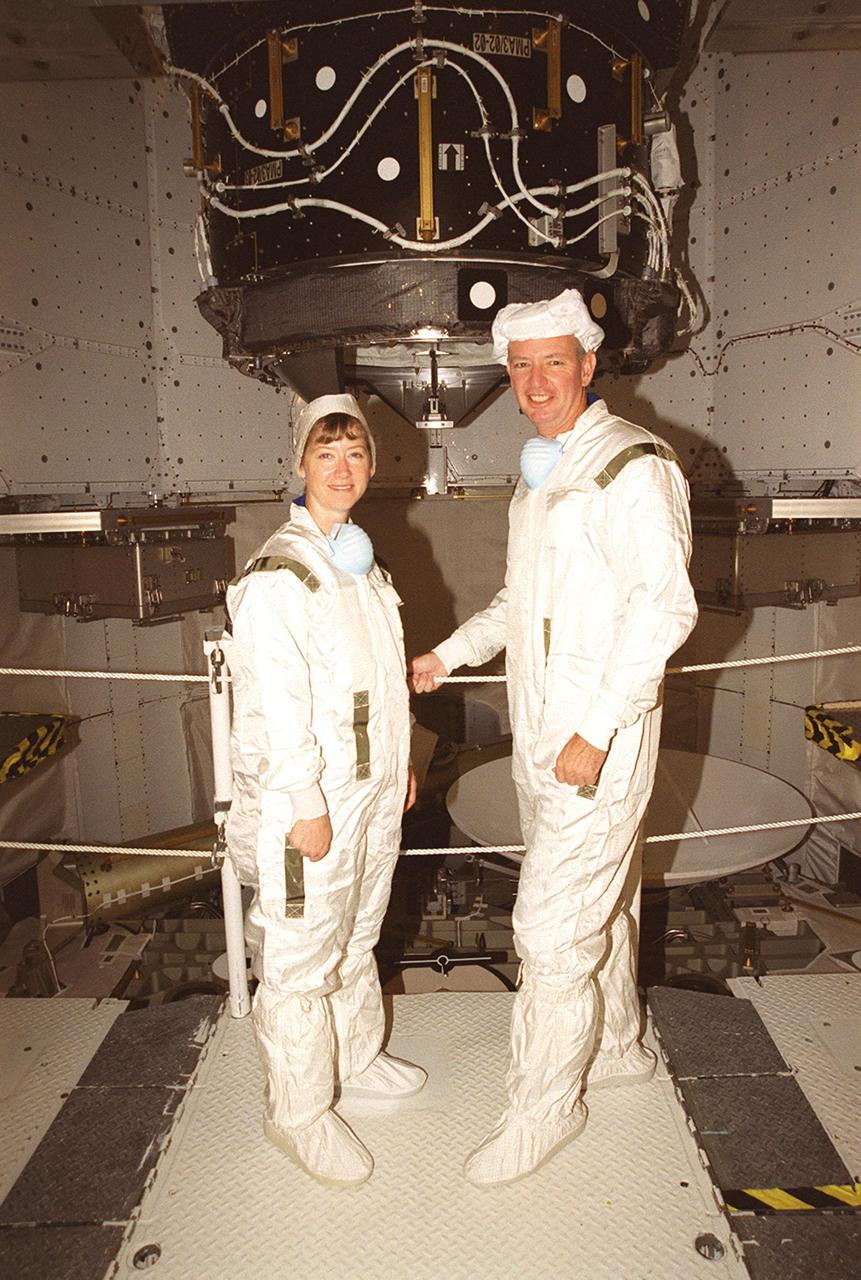
KENNEDY SPACE CENTER, FLA. -- STS-92 Pilot Pamela Ann Melroy (left) and Commander Brian Duffy pose for a photo during payload inspection in Space Shuttle Discovery’s payload bay. Behind them is the Pressurized Mating Adapter. The STS-92 crew has been inspecting the payload in preparation for launch Oct. 5, 2000. The mission is the fifth flight for the construction of the International Space Station. The payload also includes the Integrated Truss Structure Z-1. During the 11-day mission, four extravehicular activities (EVAs), or space walks, are planned
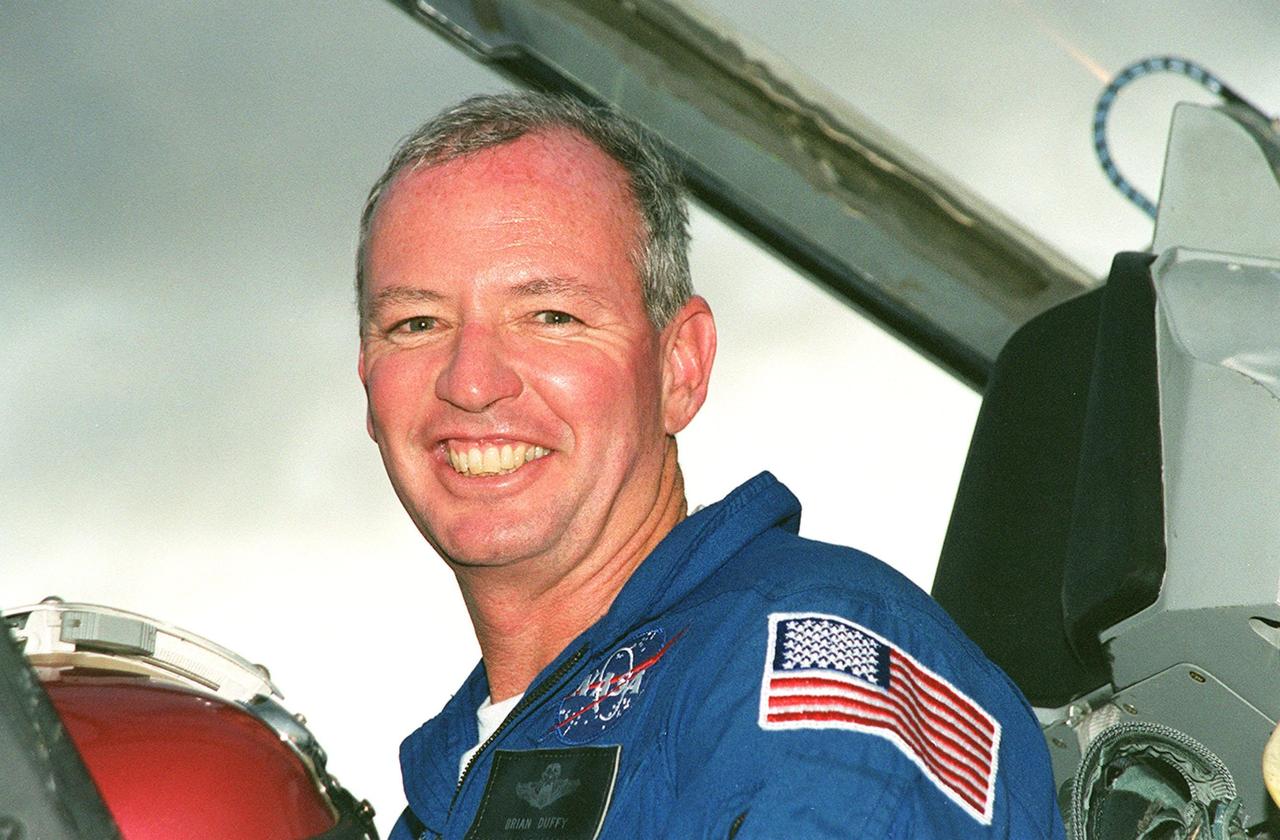
KENNEDY SPACE CENTER, FLA. -- STS-92 Commander Brian Duffy is happy to return to KSC for the launch of Space Shuttle Discovery on Oct. 5. . He and other crew members Pilot Pamela Ann Melroy and Mission Specialists Koichi Wakata of Japan, Leroy Chiao, Peter J.K. “Jeff” Wisoff, Michael E. Lopez-Alegria and William S. McArthur Jr. expressed their eagerness to launch to a waiting group of media at the Shuttle Landing Facility. The mission is the fifth flight for the construction of the International Space Station. The payload includes the Integrated Truss Structure Z-1 and the third Pressurized Mating Adapter. During the 11-day mission, four extravehicular activities (EVAs), or space walks, are planned.
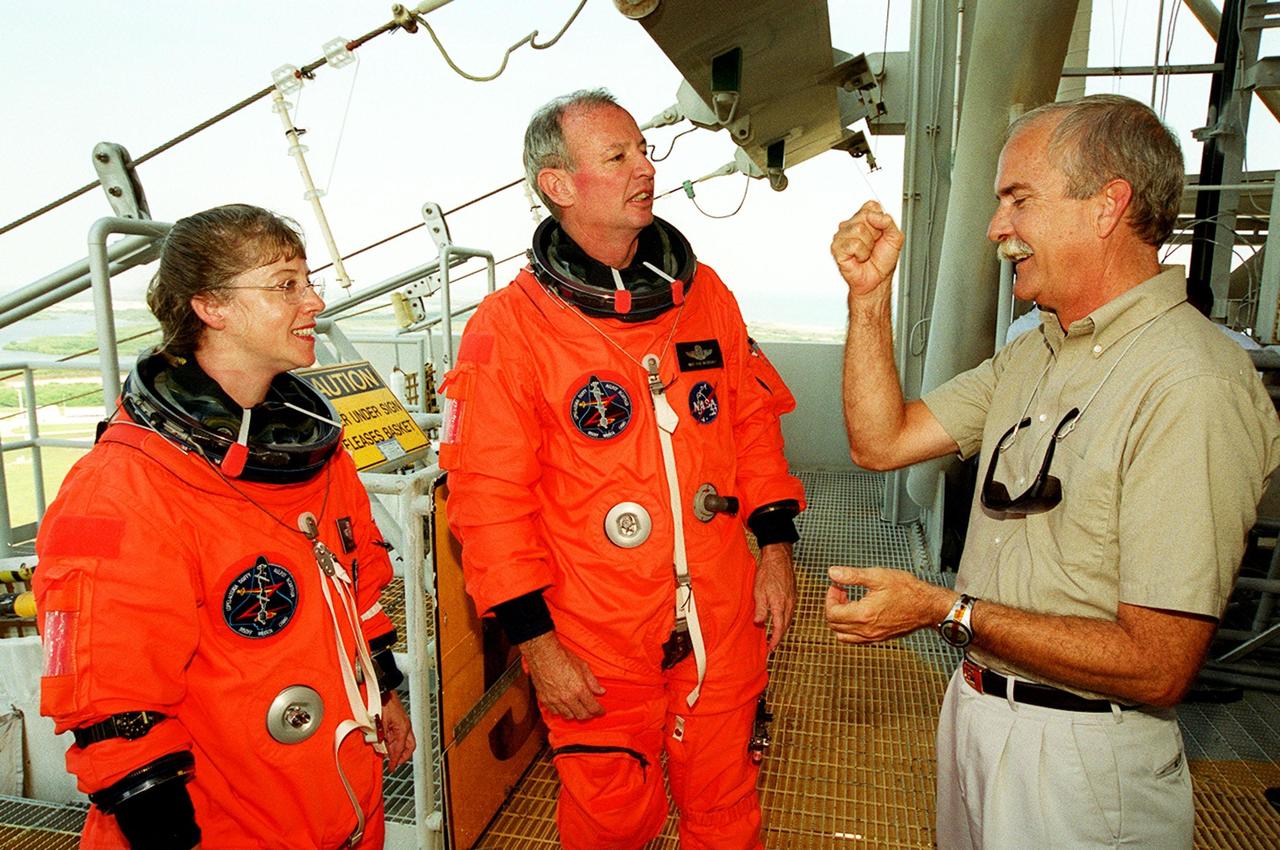
KENNEDY SPACE CENTER, FLA. -- On the 195-foot level of the Fixed Service Structure on Launch Pad 39A, STS-92 Pilot Pamela Ann Melroy and Commander Brian Duffy learn more about the emergency egress training they and the rest of the crew have received. The training is part of Terminal Countdown Demonstration Test activities that also include a simulated countdown. STS-92 is scheduled to launch Oct. 5 at 9:38 p.m. EDT on the fifth flight to the International Space Station. It will carry two elements of the Space Station, the Integrated Truss Structure Z1 and the third Pressurized Mating Adapter. The mission is also the 100th flight in the Shuttle program
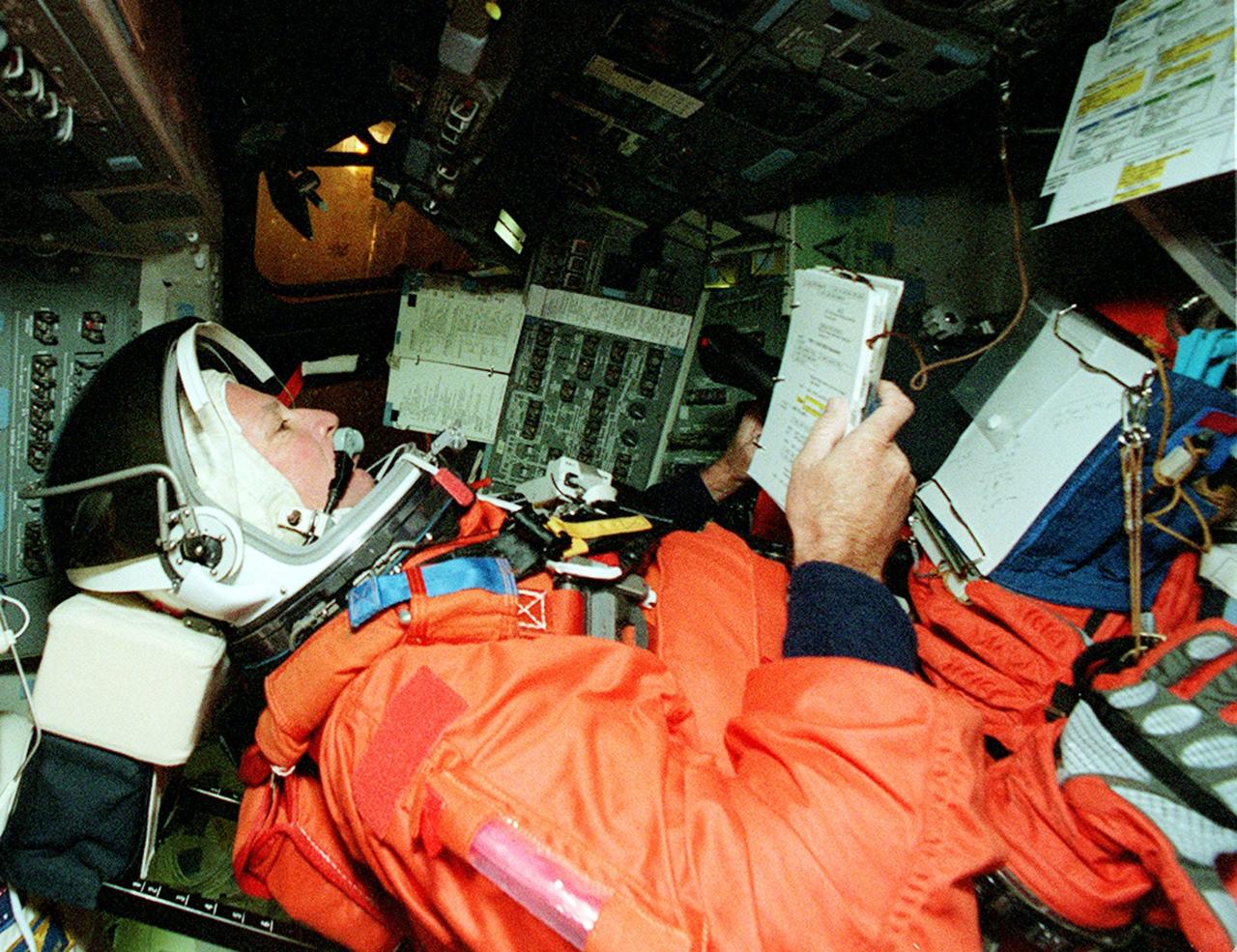
KENNEDY SPACE CENTER, FLA. -- STS-92 Commander Brian Duffy is seated at the controls of Discovery to take part in a simulated countdown. The countdown is part of Terminal Countdown Demonstration Test (TCDT) activities that he and other crew members have been performing. STS-92 is scheduled to launch Oct. 5 at 9:38 p.m. EDT on the fifth flight to the International Space Station. It will carry two elements of the Space Station, the Integrated Truss Structure Z1 and the third Pressurized Mating Adapter. The mission is also the 100th flight in the Shuttle program
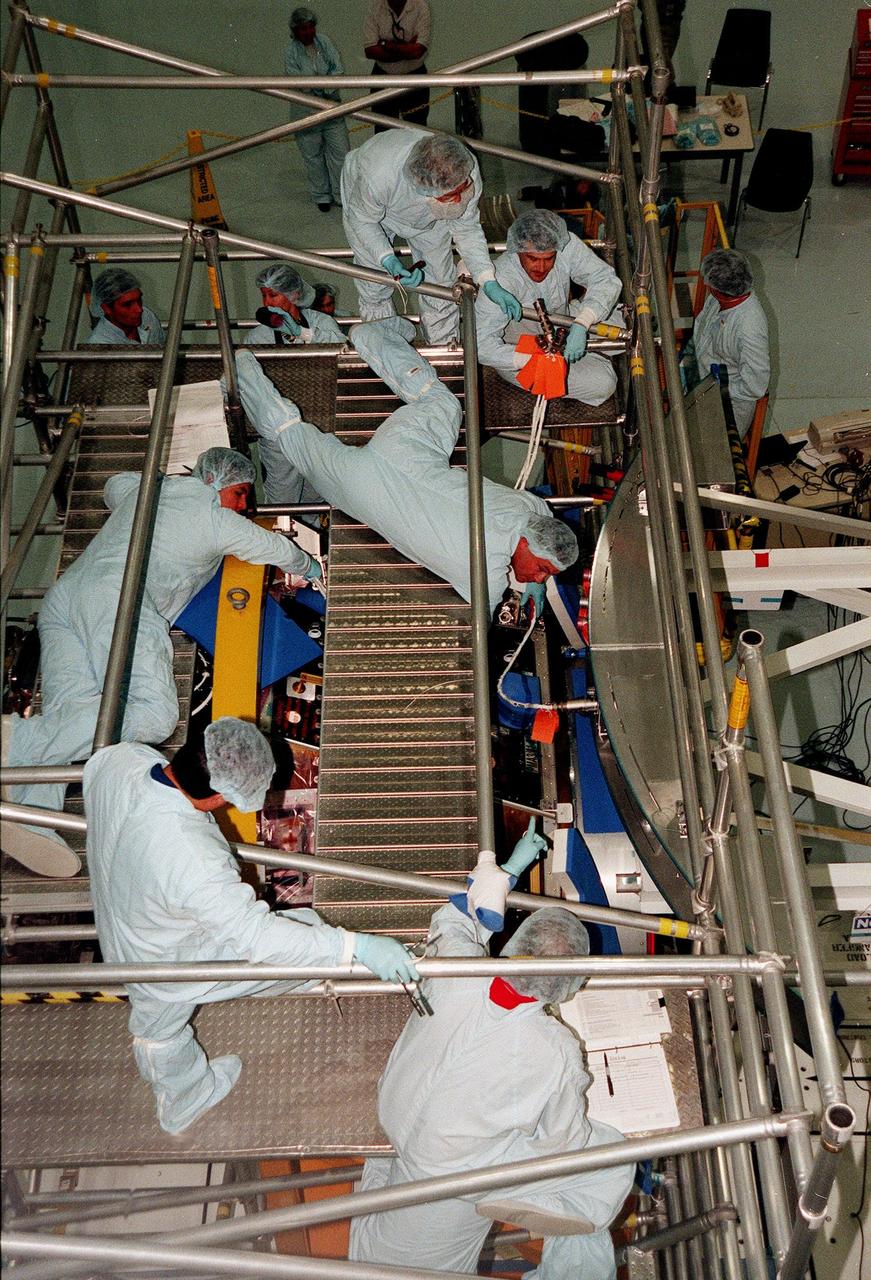
In the Space Station Processing Facility, members of the STS-92 crew fill scaffolding to look over the Pressurized Mating Adapter-3, part of the payload for their mission to the International Space Station (ISS). STS-92 is targeted for launch in December 1999. From lower left are Mission Specialists Leroy Chiao, Michael Lopez-Alegria (center), Bill McArthur and Jeff Wisoff (top). Other crew members visiting KSC are Commander Brian Duffy and Mission Specialist Koichi Wakata. STS-92 is the fourth U.S. flight for construction of the International Space Station. The payload also includes an integrated truss structure
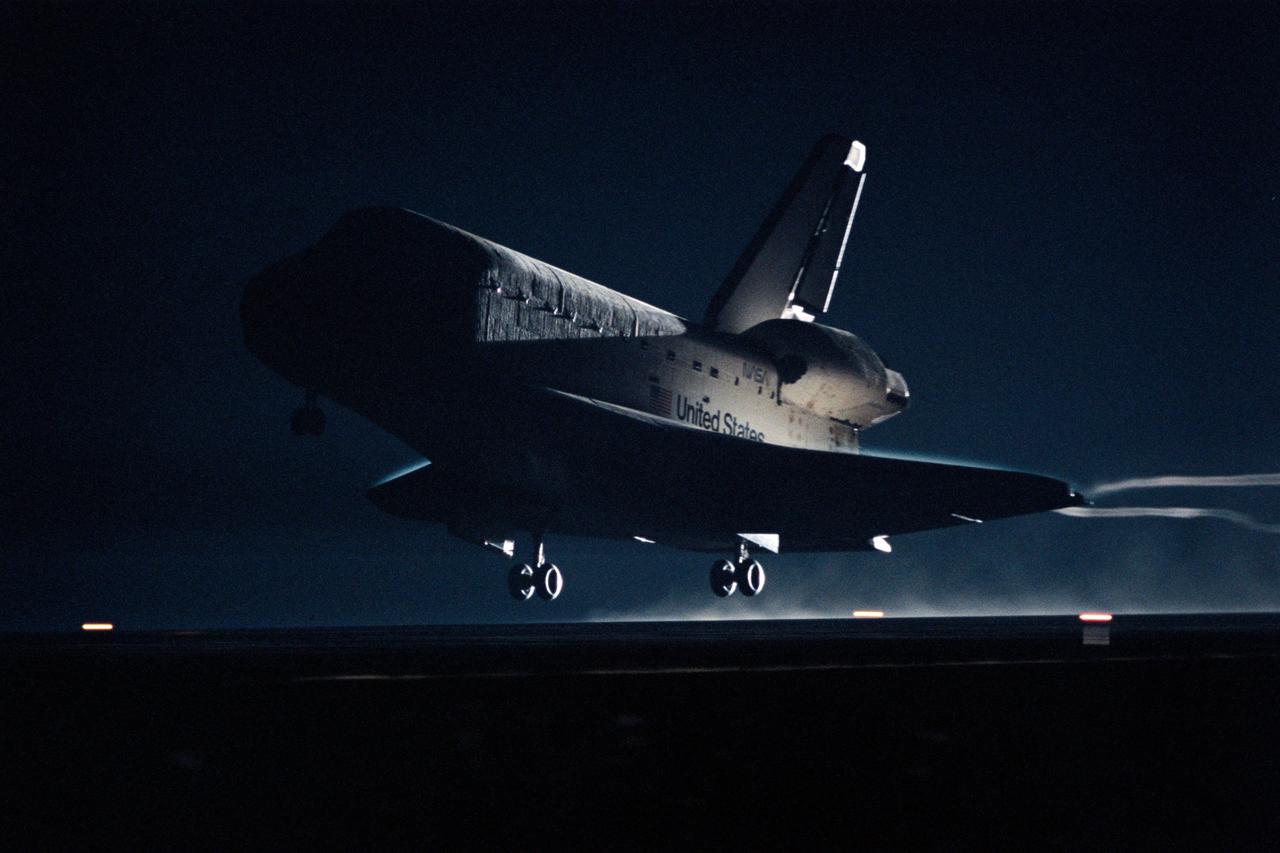
STS072-S-009 (20 Jan. 1996) --- The Space Shuttle Endeavour, with a crew of six aboard, touches down on Runway 15 at the Kennedy Space Center’s (KSC) Shuttle Landing Facility (SLF). This mission’s conclusion marks only the third nocturnal Shuttle landing at the Florida facility. Crew members were astronauts Brian Duffy, commander; and Brent W. Jett Jr., pilot; along with astronauts Leroy Chiao, Winston E. Scott, Daniel T. Barry and Koichi Wakata, all mission specialists. Wakata represents Japan’s National Space Development Agency (NASDA).
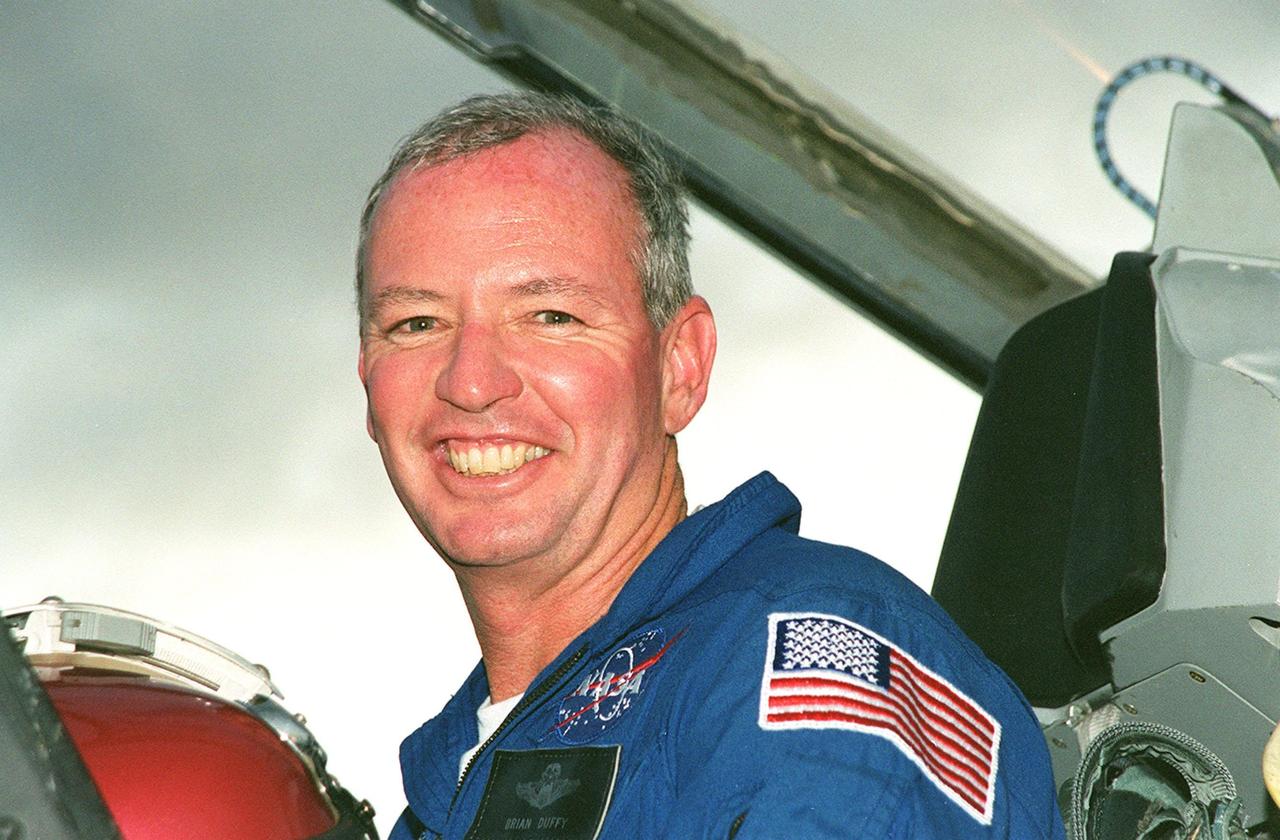
KENNEDY SPACE CENTER, FLA. -- STS-92 Commander Brian Duffy is happy to return to KSC for the launch of Space Shuttle Discovery on Oct. 5. . He and other crew members Pilot Pamela Ann Melroy and Mission Specialists Koichi Wakata of Japan, Leroy Chiao, Peter J.K. “Jeff” Wisoff, Michael E. Lopez-Alegria and William S. McArthur Jr. expressed their eagerness to launch to a waiting group of media at the Shuttle Landing Facility. The mission is the fifth flight for the construction of the International Space Station. The payload includes the Integrated Truss Structure Z-1 and the third Pressurized Mating Adapter. During the 11-day mission, four extravehicular activities (EVAs), or space walks, are planned.
![STS092-S-020 [EC00-0311-1] (24 October 2000)--- The main landing gear on the Space Shuttle Discovery is just about to touch down to mark mission completion at Edwards Air Force Base in the Mojave Desert of California. Onboard were astronauts Brian Duffy, Pamela A. Melroy, William S. McArthur, Jr., Leroy Chiao, Michael E. Lopez-Alegria, Peter J.K. (Jeff) Wisoff and Koichi Wakata of Japan's National Space Development Agency (NASDA). Discovery touched down at 2 p.m. (PDT), October 24, and rolled to a stop on Edward's concrete runway at 2:0l, for a mission elapsed time of 12 days, 21 hours and 43 minutes.](https://images-assets.nasa.gov/image/sts092-s-020/sts092-s-020~medium.jpg)
STS092-S-020 [EC00-0311-1] (24 October 2000)--- The main landing gear on the Space Shuttle Discovery is just about to touch down to mark mission completion at Edwards Air Force Base in the Mojave Desert of California. Onboard were astronauts Brian Duffy, Pamela A. Melroy, William S. McArthur, Jr., Leroy Chiao, Michael E. Lopez-Alegria, Peter J.K. (Jeff) Wisoff and Koichi Wakata of Japan's National Space Development Agency (NASDA). Discovery touched down at 2 p.m. (PDT), October 24, and rolled to a stop on Edward's concrete runway at 2:0l, for a mission elapsed time of 12 days, 21 hours and 43 minutes.
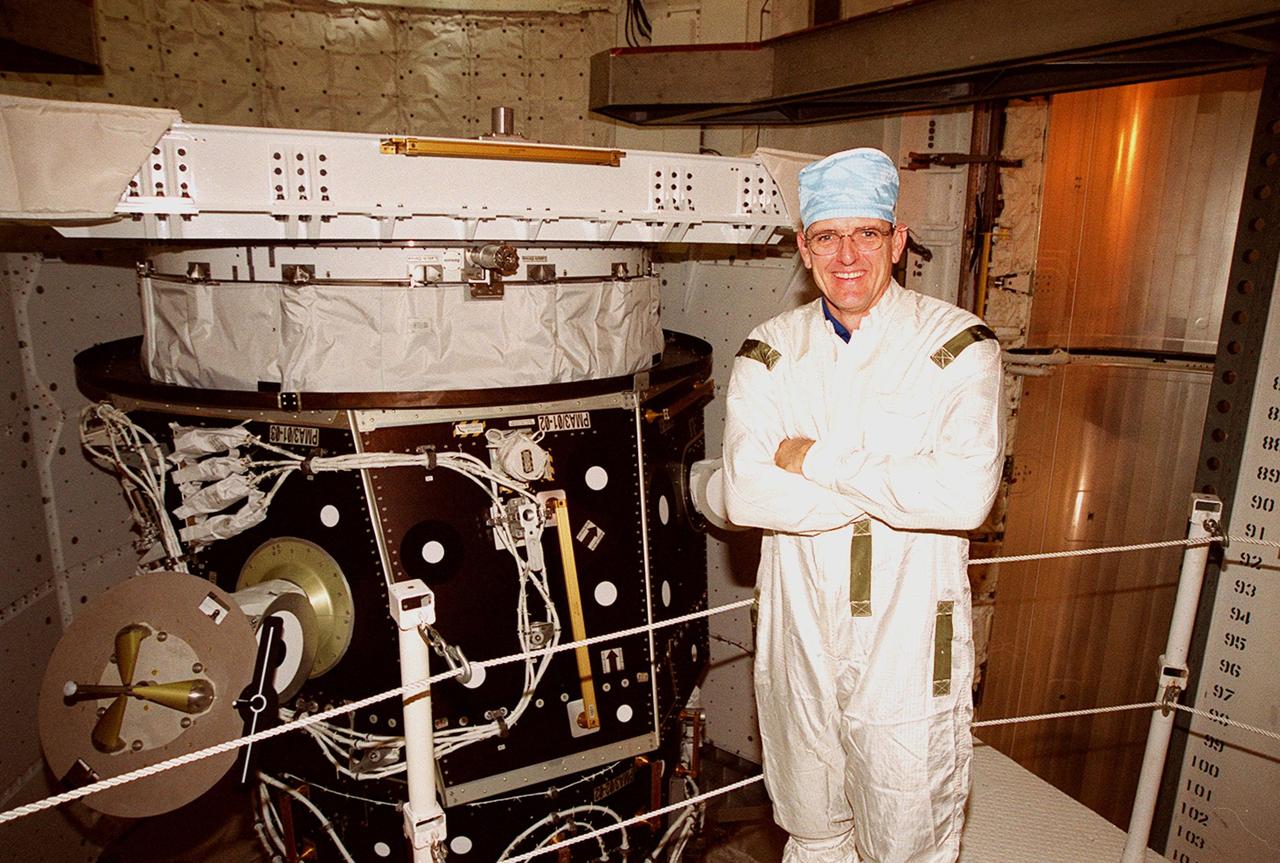
STS-92 Mission Specialist William S. McArthur Jr. smiles for the camera during inspection of the payload (left) in Space Shuttle Discovery’s payload bay. He and other crew members Commander Brian Duffy, Pilot Pamela Ann Melroy and Mission Specialists Koichi Wakata of Japan, Leroy Chiao, Peter J.K. “Jeff” Wisoff and Michael E. Lopez-Alegria are preparing for launch on Oct. 5, 2000. The mission is the fifth flight for the construction of the International Space Station. The payload includes the Integrated Truss Structure Z-1 and the third Pressurized Mating Adapter. During the 11-day mission, four extravehicular activities (EVAs), or space walks, are planned
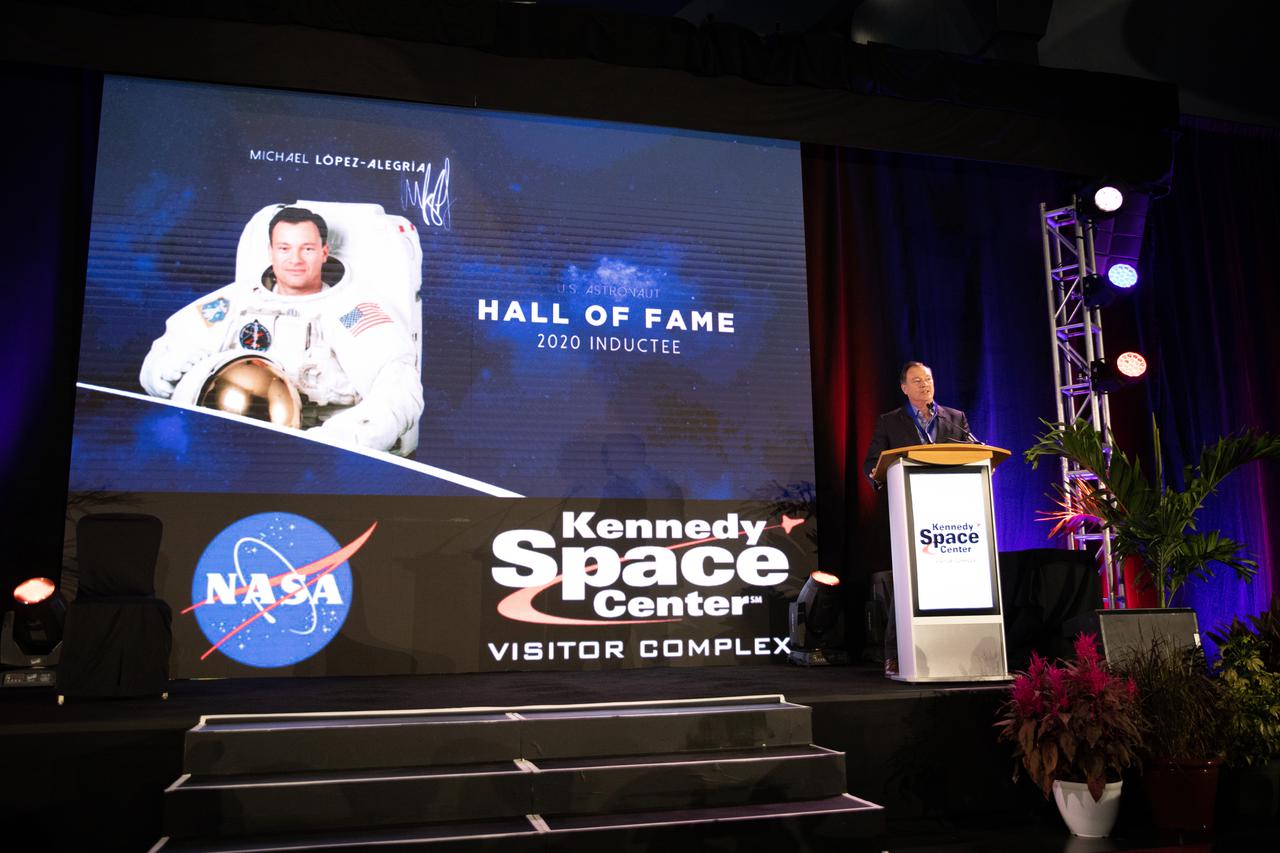
Michael Lopez-Alegria is one of three former astronauts inducted into the U.S. Astronaut Hall of Fame (AHOF) on Nov. 13, 2021, during a ceremony at the Kennedy Space Center Visitor Complex in Florida. Brian Duffy, former NASA astronaut and Hall of Famer, inducted Lopez-Alegria. Lopez-Alegria received an official medal and became a member of the 19th class of space shuttle astronauts to be inducted. The 2021 inductees were selected by a committee of Hall of Fame astronauts, former NASA officials, flight directors, historians, and journalists. This year’s induction brings the total number of AHOF members to 102.
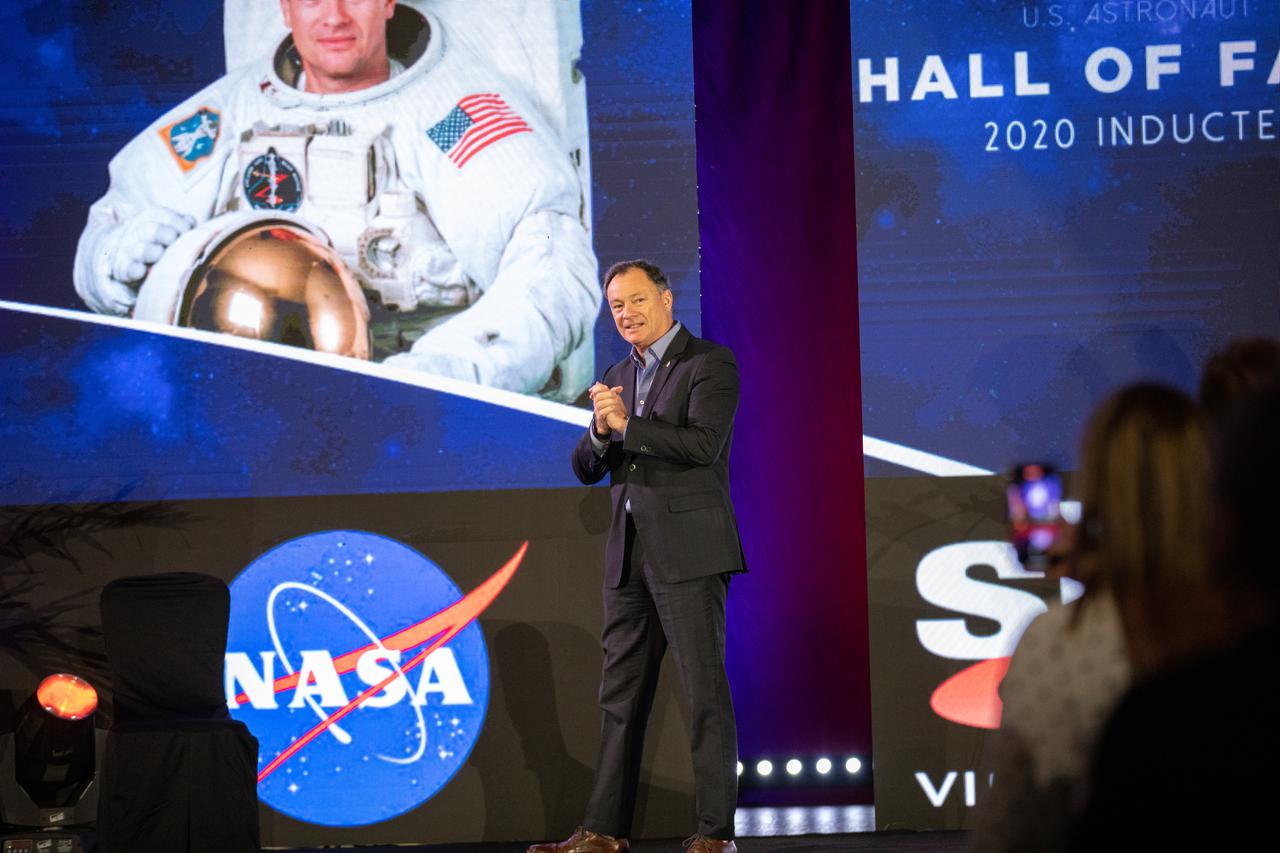
Michael Lopez-Alegria is one of three former astronauts inducted into the U.S. Astronaut Hall of Fame (AHOF) on Nov. 13, 2021, during a ceremony at the Kennedy Space Center Visitor Complex in Florida. Lopez-Alegria received an official medal and became a member of the 19th class of space shuttle astronauts to be inducted. Brian Duffy, former NASA astronaut and Hall of Famer, inducted Lopez-Alegria. The 2021 inductees were selected by a committee of Hall of Fame astronauts, former NASA officials, flight directors, historians, and journalists. This year’s induction brings the total number of AHOF members to 102.
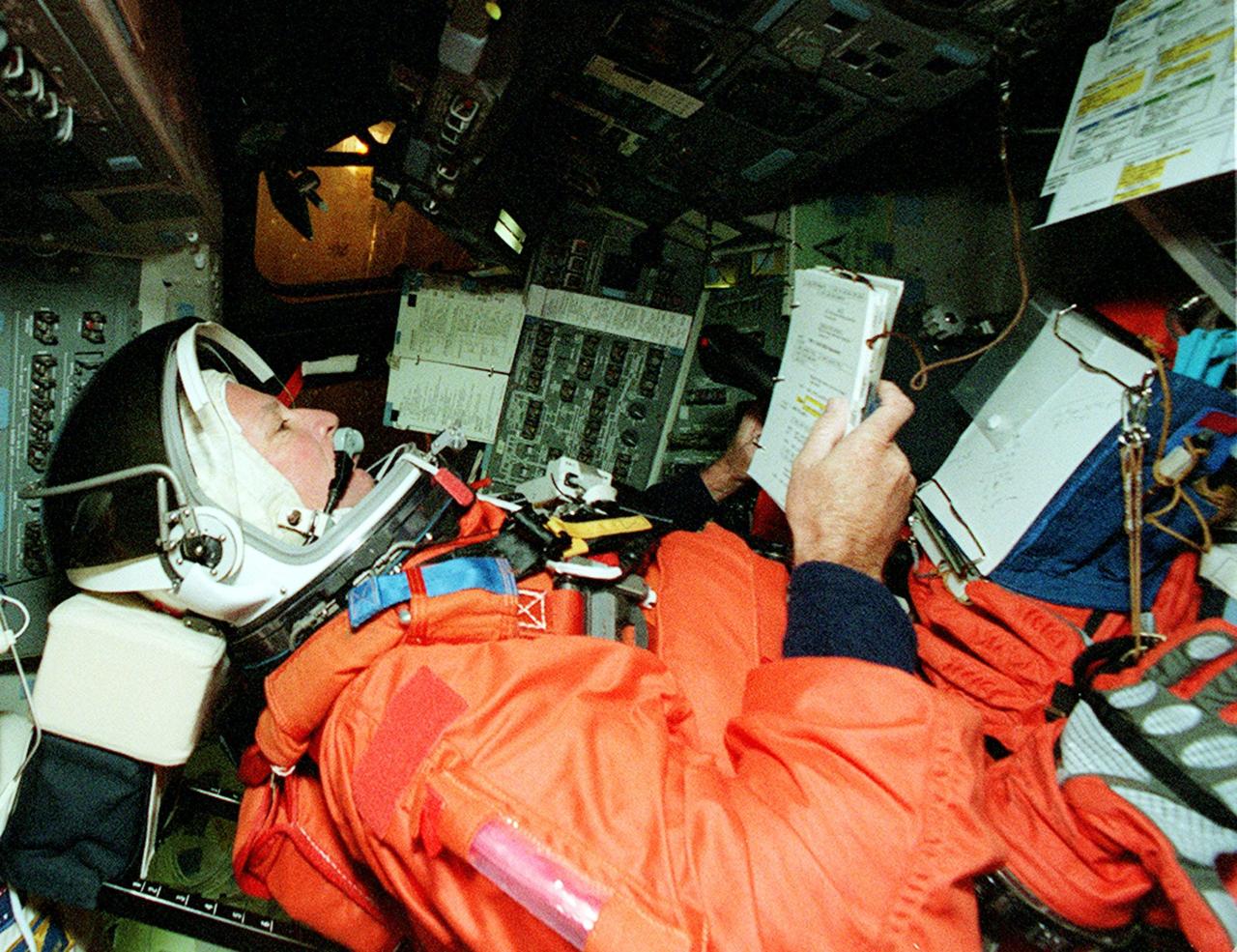
KENNEDY SPACE CENTER, FLA. -- STS-92 Commander Brian Duffy is seated at the controls of Discovery to take part in a simulated countdown. The countdown is part of Terminal Countdown Demonstration Test (TCDT) activities that he and other crew members have been performing. STS-92 is scheduled to launch Oct. 5 at 9:38 p.m. EDT on the fifth flight to the International Space Station. It will carry two elements of the Space Station, the Integrated Truss Structure Z1 and the third Pressurized Mating Adapter. The mission is also the 100th flight in the Shuttle program
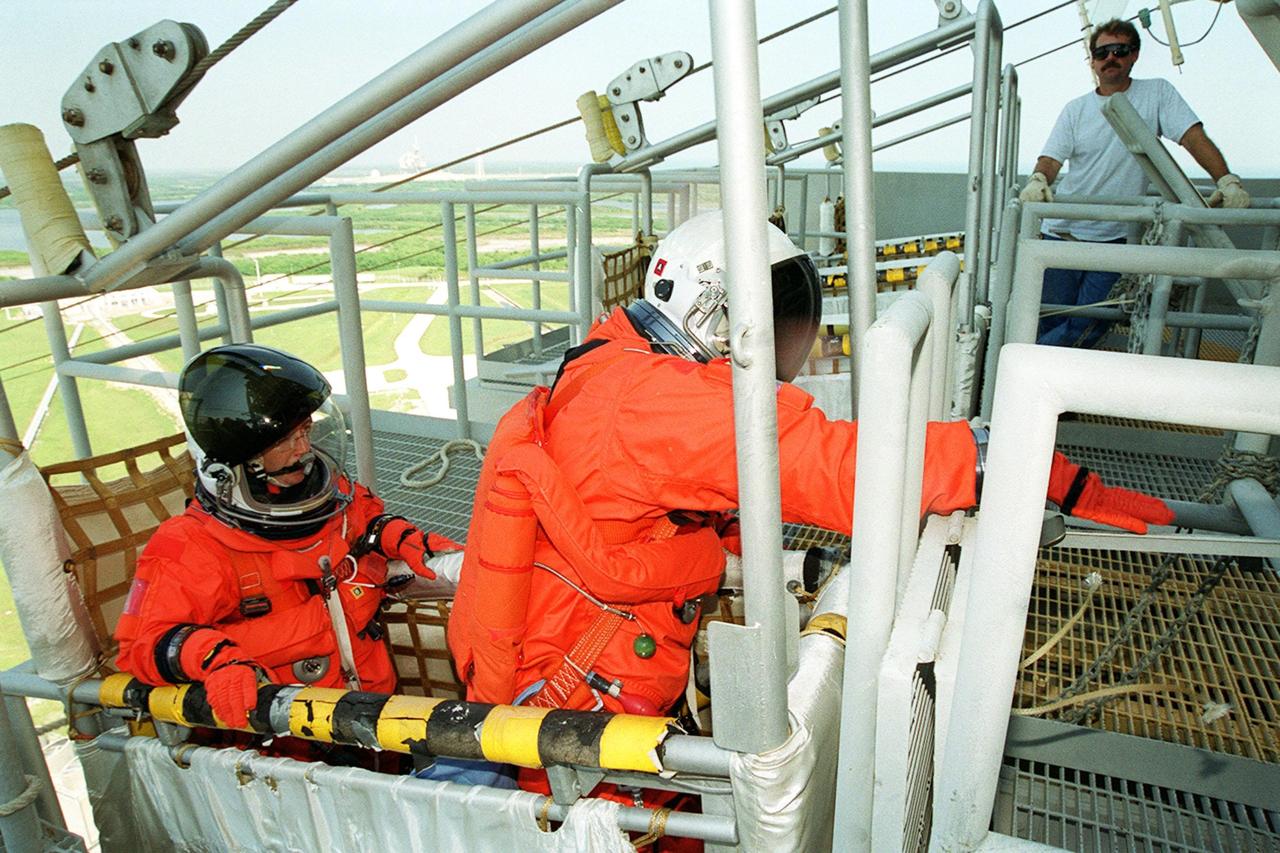
KENNEDY SPACE CENTER, FLA. -- On the 195-foot level of the Fixed Service Structure on Launch Pad 39A, STS-92 Pilot Pamela Ann Melroy (left) sits in the slidewire basket while Commander Brian Duffy reaches for the lever to release the basket. They and other crew members are taking part in emergency egress training, one of the Terminal Countdown Demonstration Test activities that also include a simulated countdown. STS-92 is scheduled to launch Oct. 5 at 9:38 p.m. EDT on the fifth flight to the International Space Station. It will carry two elements of the Space Station, the Integrated Truss Structure Z1 and the third Pressurized Mating Adapter. The mission is also the 100th flight in the Shuttle program
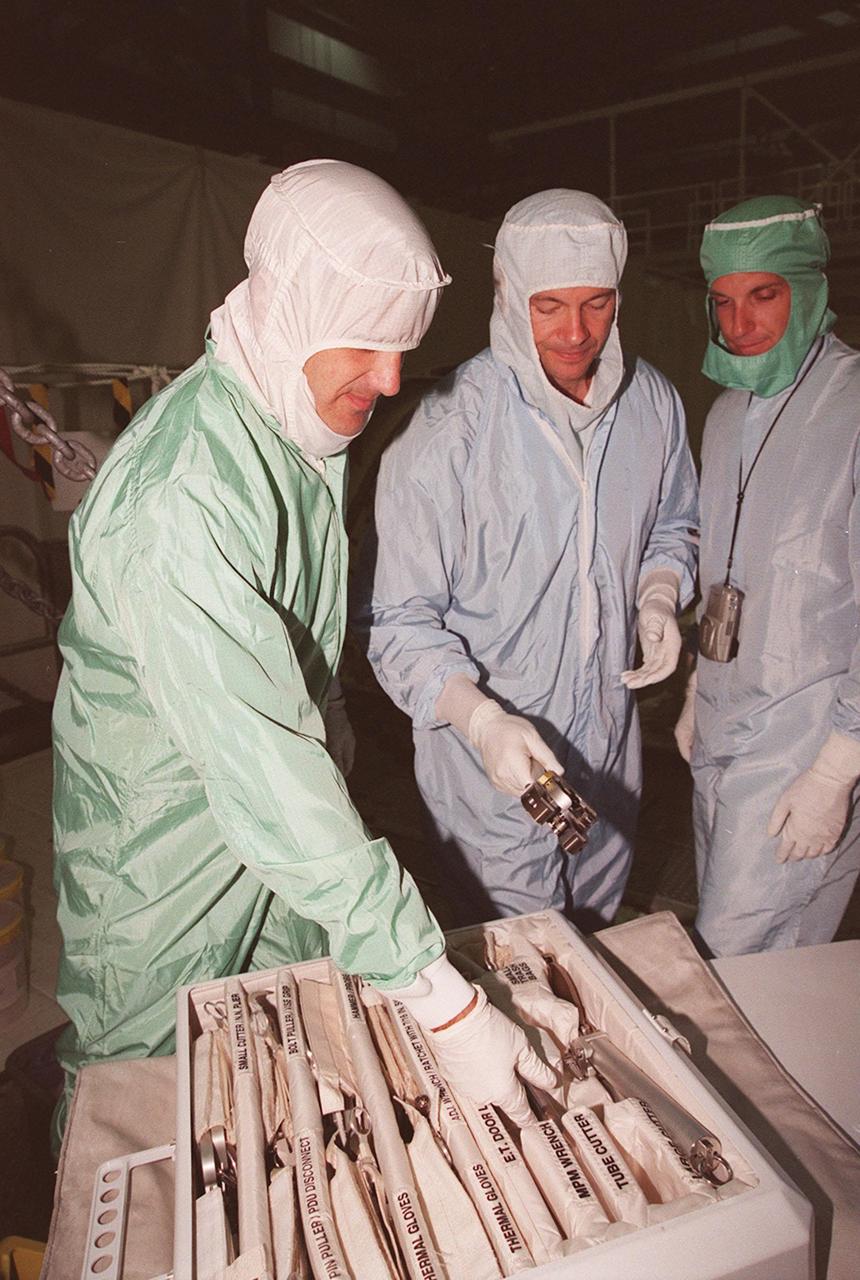
In the Orbiter Processing Facility bay 1, STS-92 crew members, along with Boeing workers, look closely at the tools they will be using on their mission. The crew comprises Commander Brian Duffy, Pilot Pam Melroy and Mission Specialists Koichi Wakata, Leroy Chiao, Jeff Wisoff, Michael Lopez-Alegria and Bill McArthur. STS-92 is scheduled to launch Oct. 5 on Shuttle Discovery from Launch Pad 39A on the fifth flight to the International Space Station. Discovery will carry the Integrated Truss Structure (ITS) Z1, Pressurized Mating Adapter 3, Ku-band Communications System, and Control Moment Gyros (CMGs)
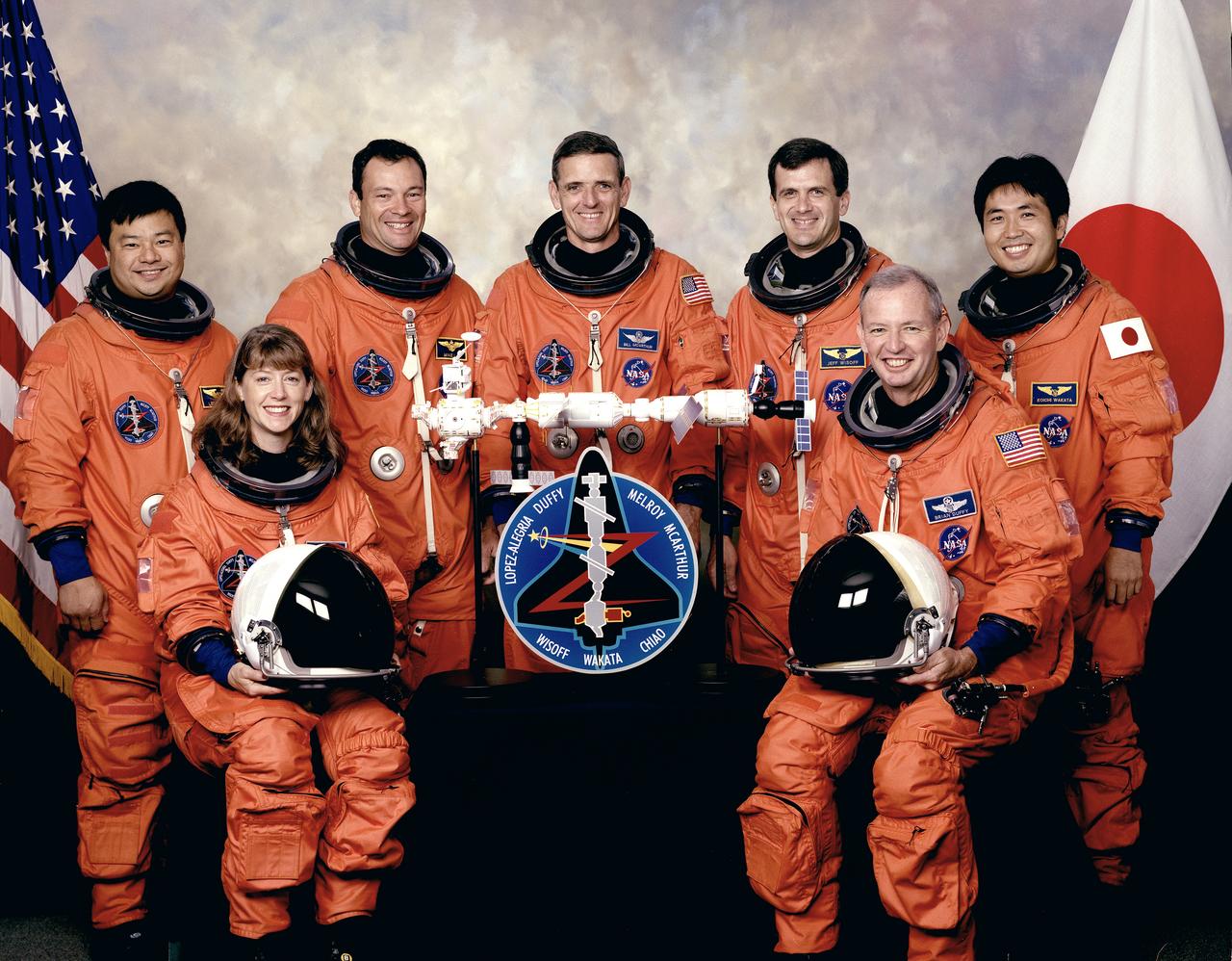
These seven astronauts composed the crew for the STS-92 mission. In front are astronauts Pamela A. Melroy, pilot; and Brian Duffy, mission commander. In the rear, from the left, are astronauts Leroy Chiao, Michael E. Lopez-Alegria, William S. McArthur, Jr., Peter J.K. (Jeff) Wisoff, and Koichi Wakata, all mission specialists. Wakata represents Japan's National Space Development Agency (NASDA). Launched aboard the Space Shuttle Discovery on October 11, 2000, the 100th shuttle flight was the second to deliver hardware to the International Space Station (ISS). During Four space walks, the crew installed the Z1 truss and the Pressurized Mating Adapter (PMA) 3.
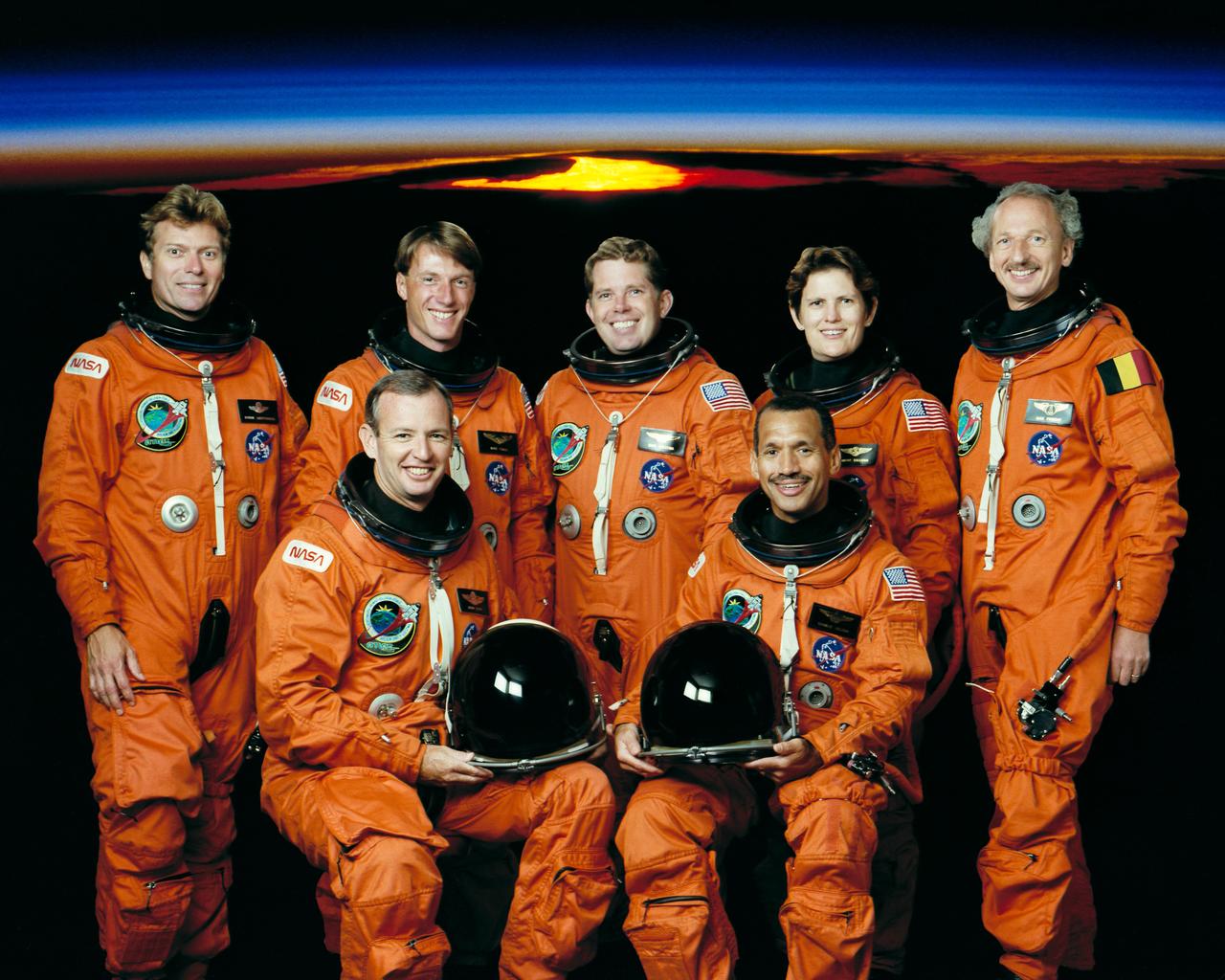
STS045-S-002 (January 1992) --- The seven crew members for NASA's STS-45 mission are pictured in their partial-pressure launch and entry suits. In front are astronauts Charles F. Bolden, Jr. (right), mission commander, and Brian Duffy, pilot. Back row, left to right, are payload specialist Byron K. Lichtenberg; astronauts C. Michael Foale and David C. Leestma, mission specialists; Kathryn D. Sullivan, payload commander; and payload specialist Dirk Frimout, of Belgium. The Atmospheric Laboratory for Applications and Science (ATLAS) is scheduled for a March 1992 launch aboard the Space Shuttle Atlantis.
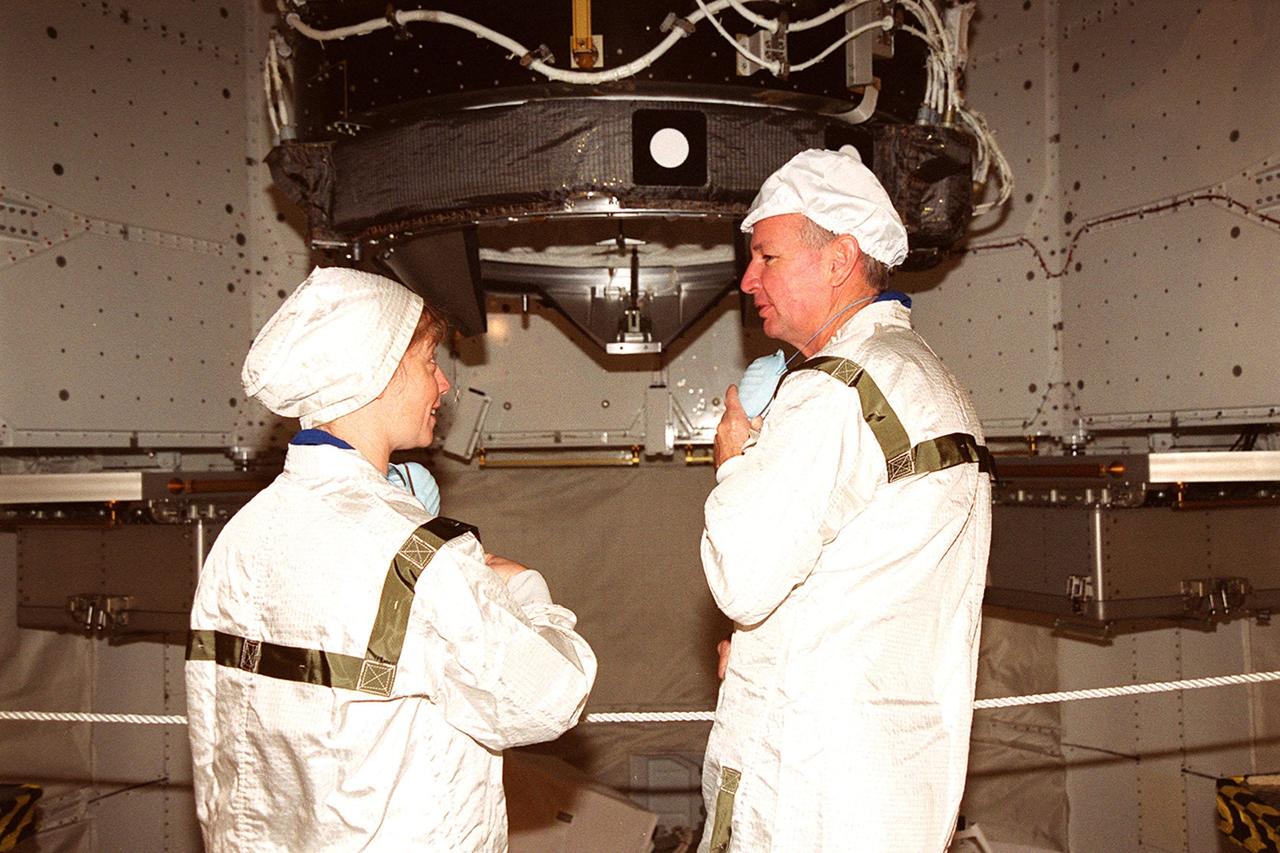
KENNEDY SPACE CENTER, FLA. -- In Space Shuttle Discovery’s payload bay, STS-92 Pilot Pamela Ann Melroy (left) and Commander Brian Duffy share thoughts about the mission as they inspect part of the payload (behind them), the Pressurized Mating Adapter. The STS-92 crew has been inspecting the payload in preparation for launch Oct. 5, 2000. The mission is the fifth flight for the construction of the International Space Station. The payload also includes the Integrated Truss Structure Z-1. During the 11-day mission, four extravehicular activities (EVAs), or space walks, are planned
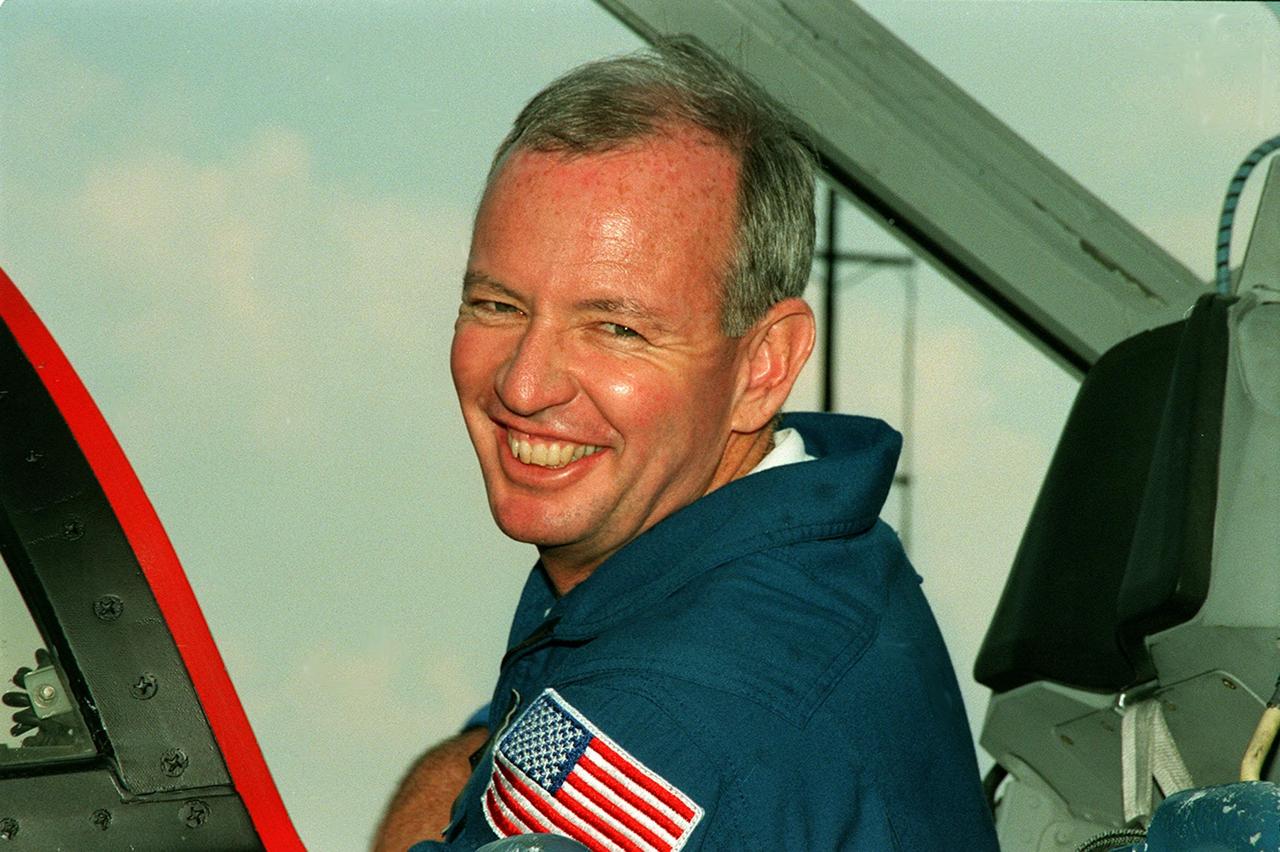
STS-92 Commander Brian Duffy climbs into a T-38 jet aircraft at KSC’s Shuttle Landing Facility for a flight back to Houston. He and other crew members were at KSC for Crew Equipment Interface Test (CEIT) activities, looking over their mission payload and related equipment. STS-92 is scheduled to launch Oct. 5 on Shuttle Discovery from Launch Pad 39A on the fifth flight to the International Space Station. Discovery will carry the Integrated Truss Structure (ITS) Z1, the PMA-3, Ku-band Communications System, and Control Moment Gyros (CMGs)
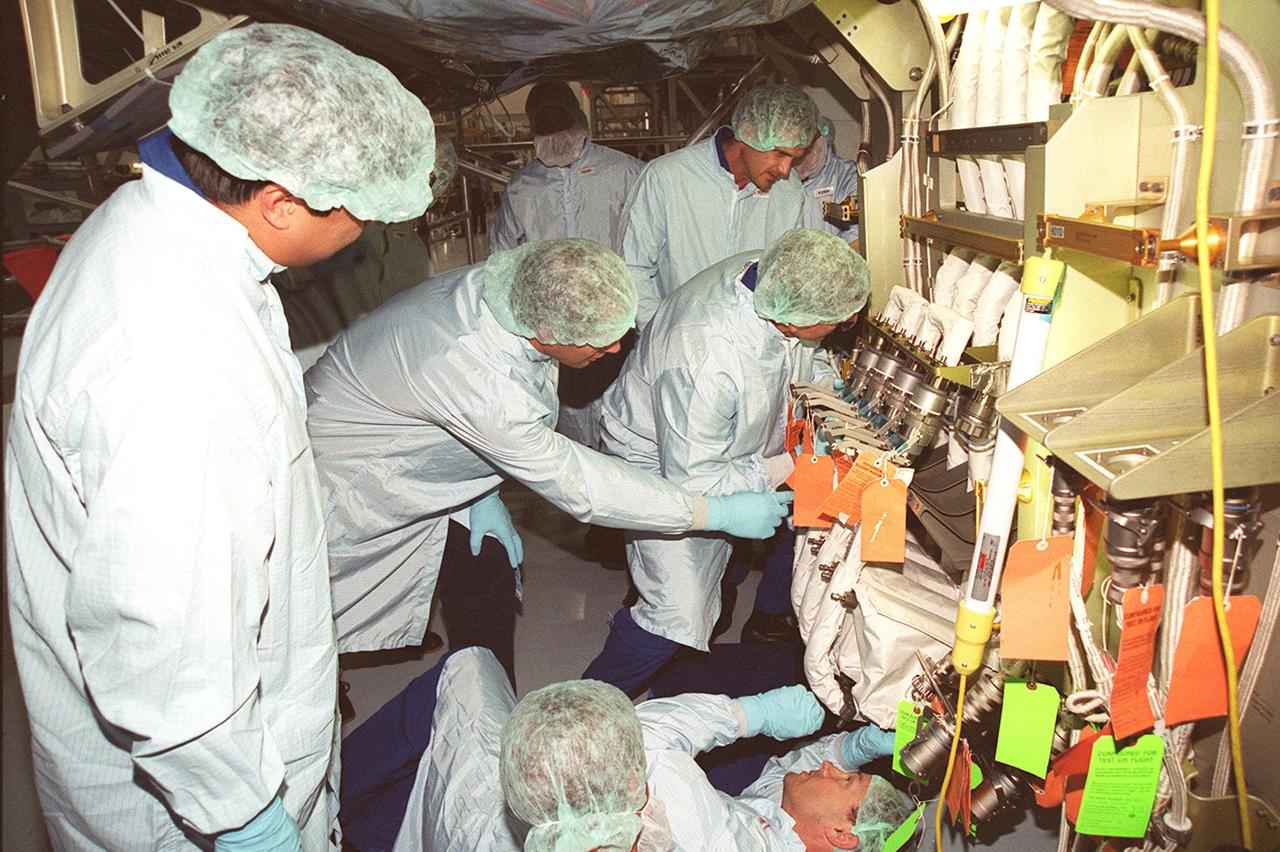
As part of Crew Equipment Interface Test (CEIT) activities, members of the STS-92 crew check out equipment they will be using on the mission to the International Space Station. At left is Mission Specialist Leroy Chiao, looking at part of the Integrated Truss Structure Z1, a component of the Station and payload on STS-92. Others seen in the photo are Mission Specialists Michael Lopez-Alegria (on his back, lower right); Jeff Wisoff (standing in back); and Bill McArthur (bending closer to the Z1 truss). Also taking part in the CIET are Commander Brian Duffy, Pilot Pam Melroy, and Mission Specialist Koichi Wakata. STS-92 is scheduled to launch Oct. 5 from launch Pad 39A
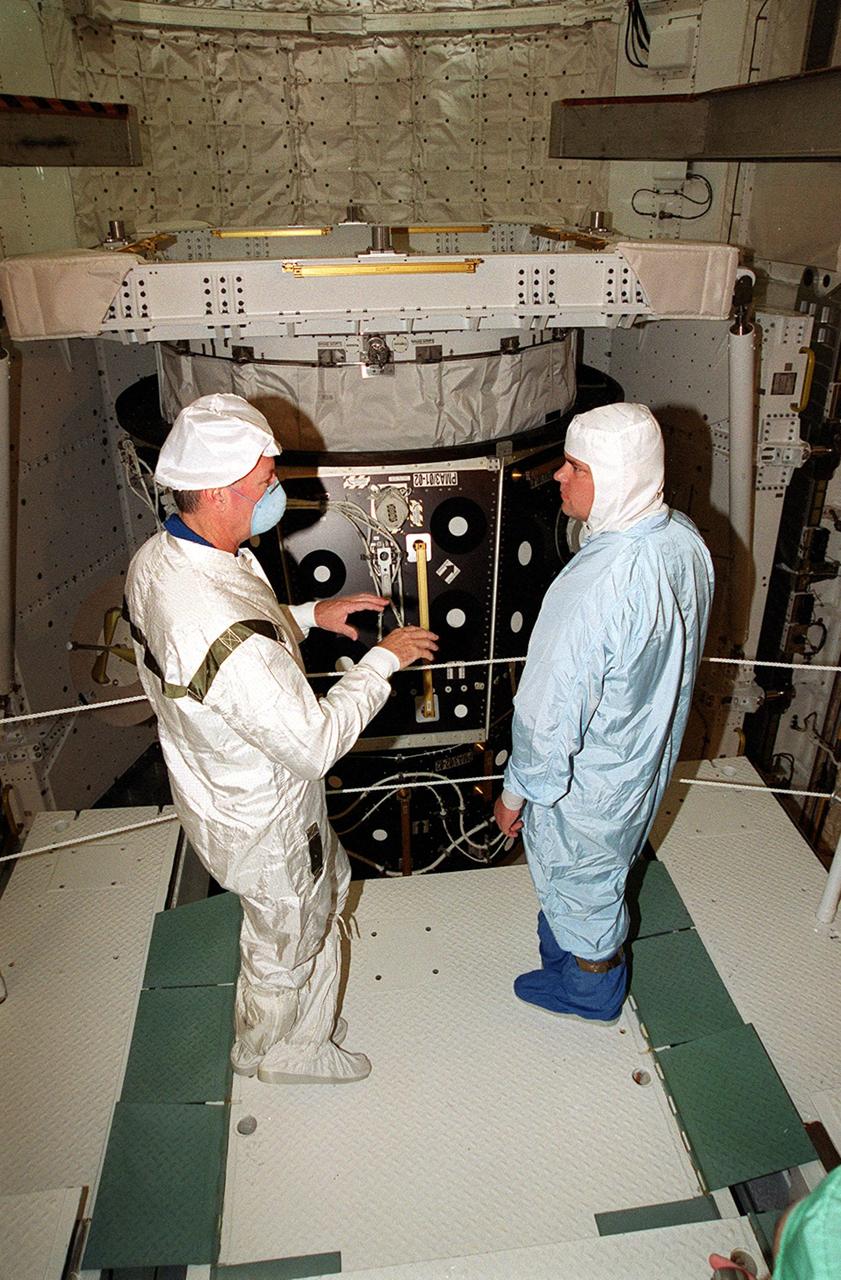
STS-92 Commander Brian Duffy (left) talks with a worker during inspection of the payload (behind them) in Space Shuttle Discovery’s payload bay. He and other crew members Pilot Pamela Ann Melroy and Mission Specialists Koichi Wakata of Japan, Leroy Chiao, Peter J.K. “Jeff” Wisoff, Michael E. Lopez-Alegria and William S. McArthur Jr. are preparing for launch on Oct. 5, 2000. The mission is the fifth flight for the construction of the International Space Station. The payload includes the Integrated Truss Structure Z-1 and the third Pressurized Mating Adapter. During the 11-day mission, four extravehicular activities (EVAs), or space walks, are planned
 --- The drag chute on the Space Shuttle Discovery is deployed as the vehicle rolls toward mission completion at Edwards Air Force Base in the Mojave Desert of California. Onboard were astronauts Brian Duffy, Pamela A. Melroy, Leroy Chiao, William S. McArthur, Jr., Peter J.K. (Jeff) Wisoff, Michael E. Lopez-Alegria, and Koichi Wakata of Japan's National Space Development Agency (NASDA). Discovery touched down at 2 p.m. (PDT), October 24, and rolled to a stop on Edward's concrete runway at 2:0l, for a mission elapsed time of 12 days, 21 hours and 43 minutes.](https://images-assets.nasa.gov/image/sts092-s-022/sts092-s-022~medium.jpg)
STS092-S-022 [EC00-0311-3](24 OCTOBER 2000) --- The drag chute on the Space Shuttle Discovery is deployed as the vehicle rolls toward mission completion at Edwards Air Force Base in the Mojave Desert of California. Onboard were astronauts Brian Duffy, Pamela A. Melroy, Leroy Chiao, William S. McArthur, Jr., Peter J.K. (Jeff) Wisoff, Michael E. Lopez-Alegria, and Koichi Wakata of Japan's National Space Development Agency (NASDA). Discovery touched down at 2 p.m. (PDT), October 24, and rolled to a stop on Edward's concrete runway at 2:0l, for a mission elapsed time of 12 days, 21 hours and 43 minutes.
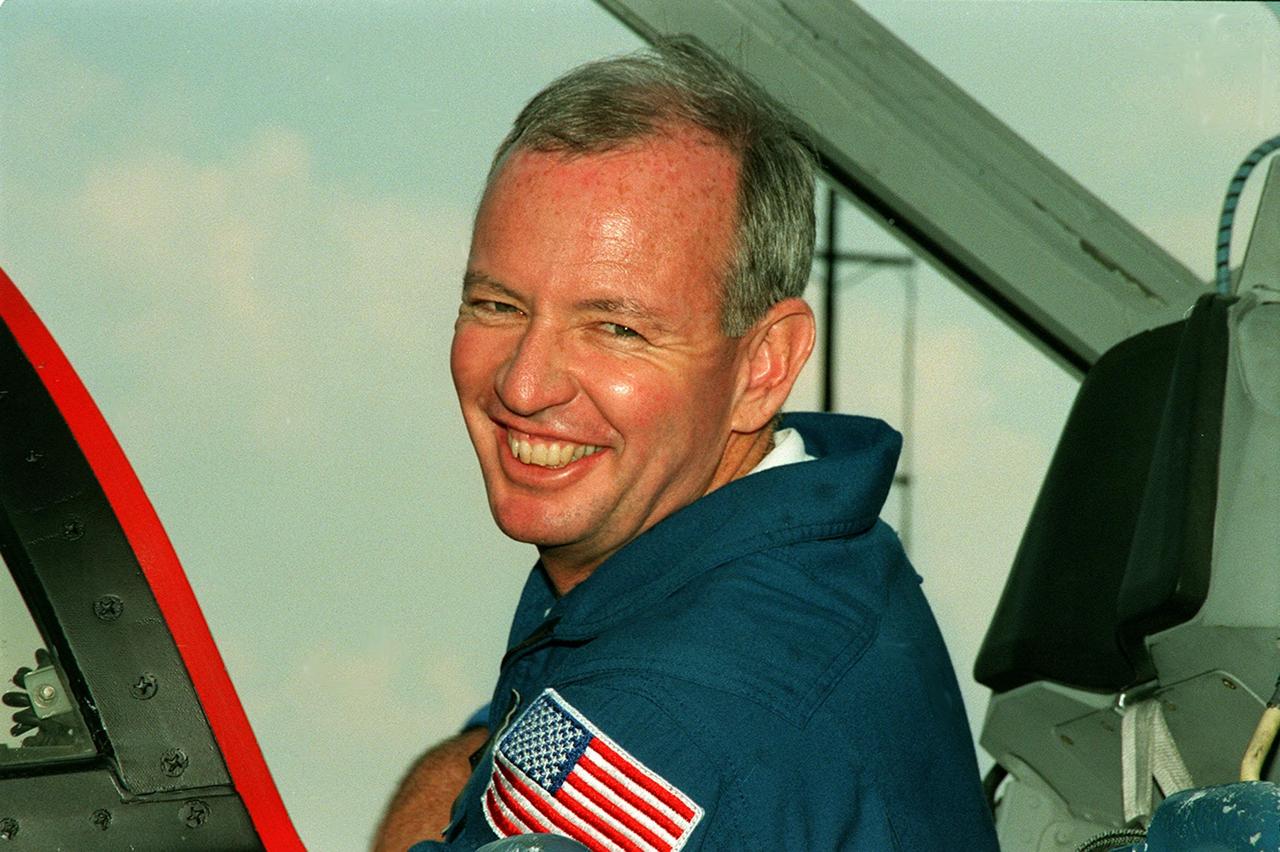
STS-92 Commander Brian Duffy climbs into a T-38 jet aircraft at KSC’s Shuttle Landing Facility for a flight back to Houston. He and other crew members were at KSC for Crew Equipment Interface Test (CEIT) activities, looking over their mission payload and related equipment. STS-92 is scheduled to launch Oct. 5 on Shuttle Discovery from Launch Pad 39A on the fifth flight to the International Space Station. Discovery will carry the Integrated Truss Structure (ITS) Z1, the PMA-3, Ku-band Communications System, and Control Moment Gyros (CMGs)
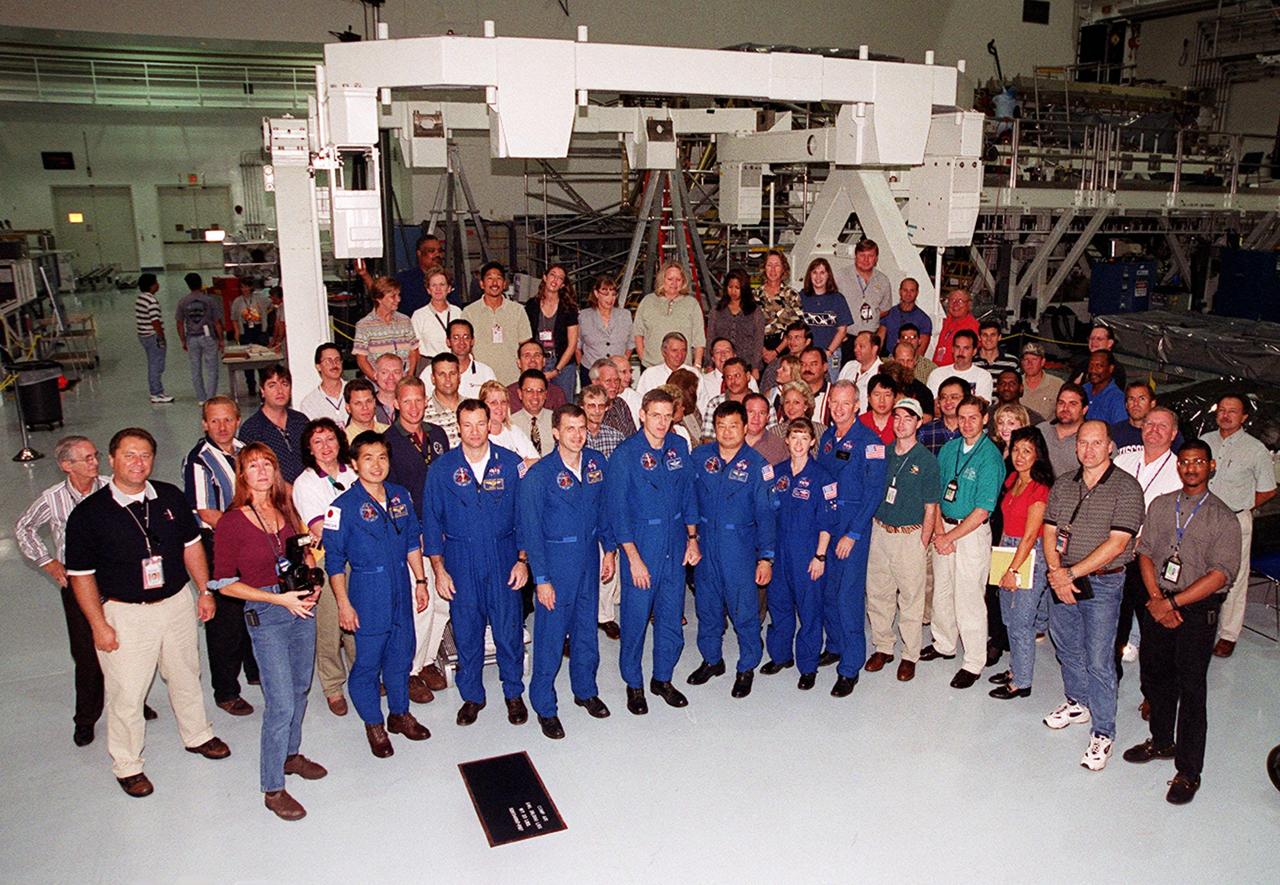
In the Space Station Processing Facility, workers who have supported mission STS-92 gather for a photo with the crew: (left to right) Mission Specialists Koichi Wakata of Japan, Michael Lopez-Alegria, Jeff Wisoff, Bill McArthur and Leroy Chiao; Pilot Pam Melroy; and Commander Brian Duffy. STS-92 is scheduled to launch Oct. 5 at 9:30 p.m. EDT on the fifth flight to the International Space Station. It will carry two elements of the Space Station, the Integrated Truss Structure Z1 and the third Pressurized Mating Adapter. The mission is also the 100th flight in the Shuttle program
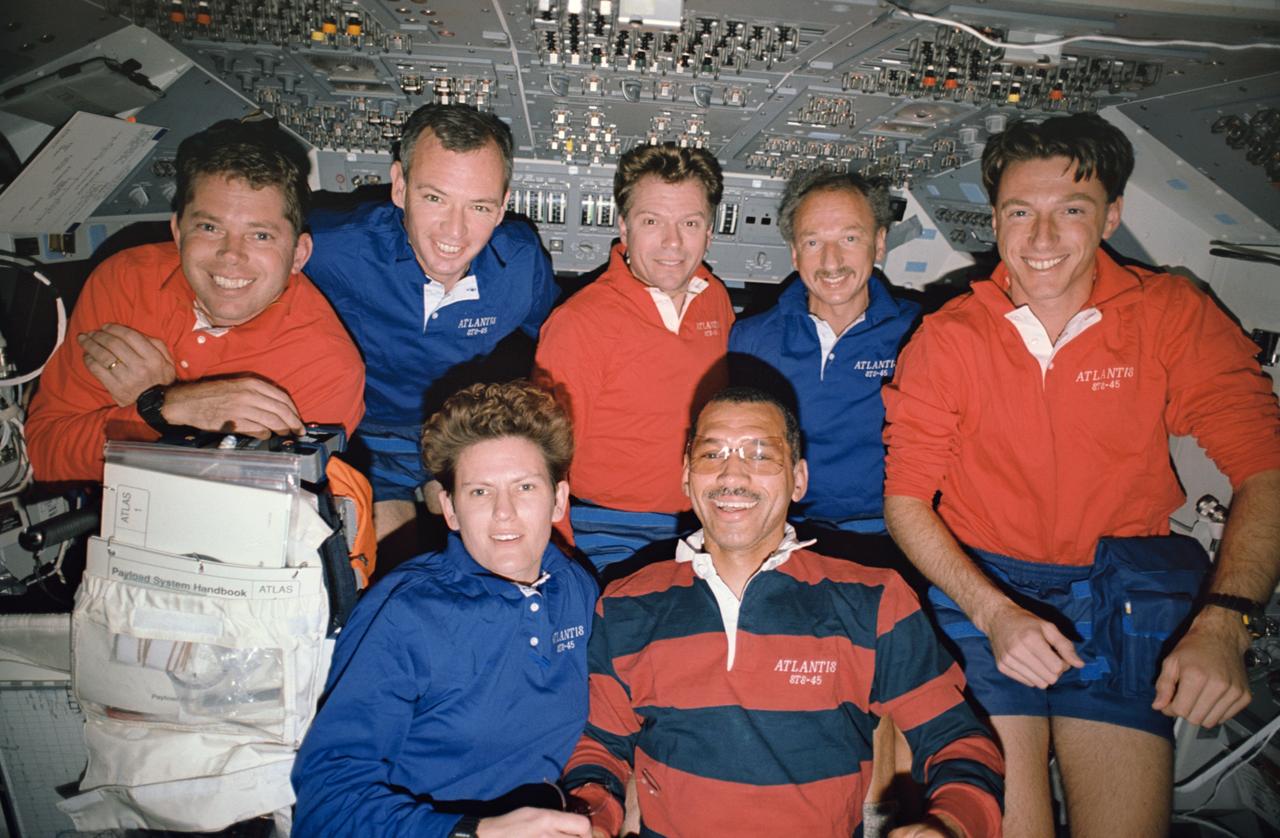
STS045-38-004 (24 March-2 April 1992) --- The traditional inflight crew portrait has Kathryn D. Sullivan, payload commander, and Charles F. Bolden, mission commander, on the front row, with ( left to right) David C. Leestma, mission specialist; Brian Duffy, pilot; Byron K. Lichtenberg and Dirk Frimout, both payload specialists; and C. Michael Foale, mission specialist, on the back row. (The "headpieces" worn by Sullivan and Bolden are actually shadows.) This frame was taken with a 35mm camera on the flight deck of the Earth-orbiting Space Shuttle Atlantis during the nine-day mission.
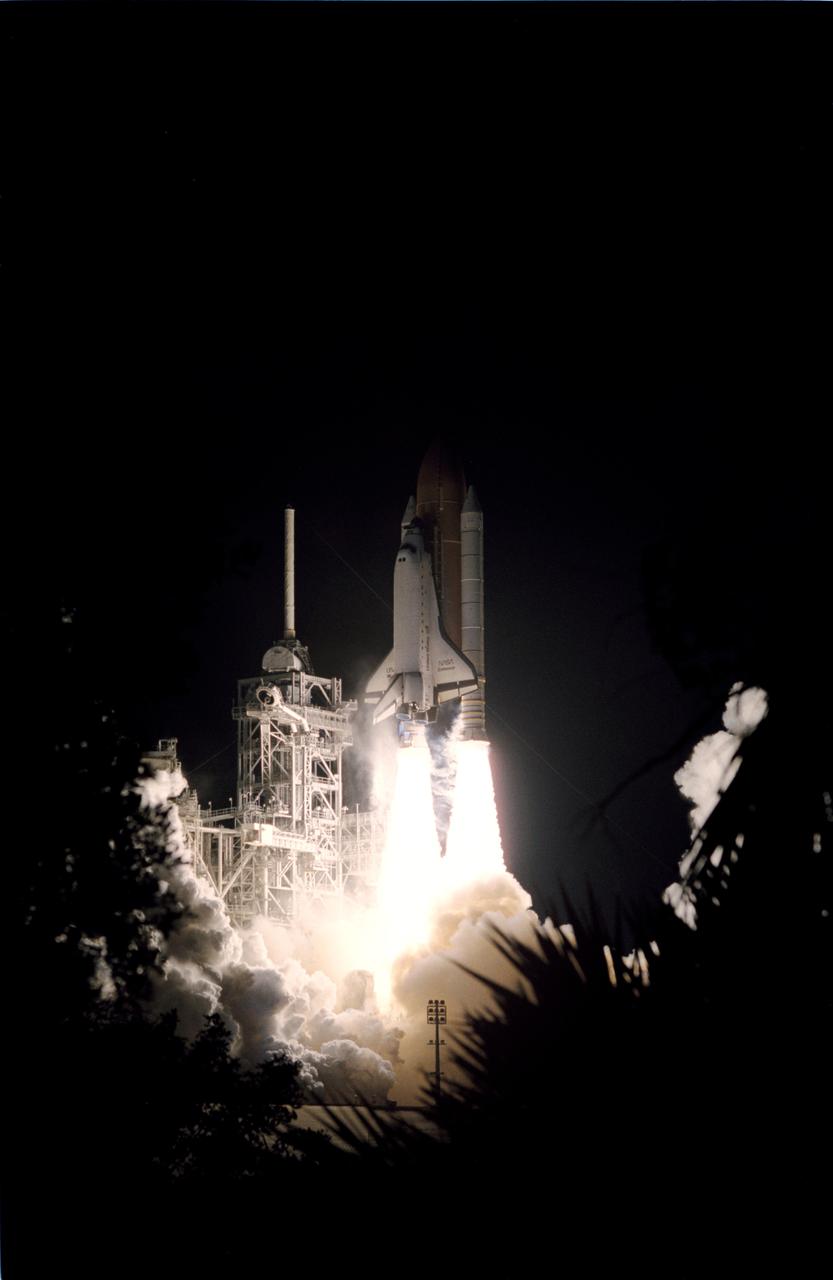
STS072-S-004 (11 Jan. 1996) --- The Space Shuttle Endeavour lights up the night sky as it lifts off from Launch Pad 39B at the Kennedy Space Center (KSC). Liftoff for STS-72 occurred at 4:41:00:072 a.m. (EST), January 11, 1996. Onboard the spacecraft were astronauts Brian Duffy, commander; Brent W. Jett, pilot; along with Daniel T. Barry, Leroy Chiao, Winston E. Scott and Koichi Wakata, all mission specialists. Wakata represents Japan's National Space Development Agency (NASDA).
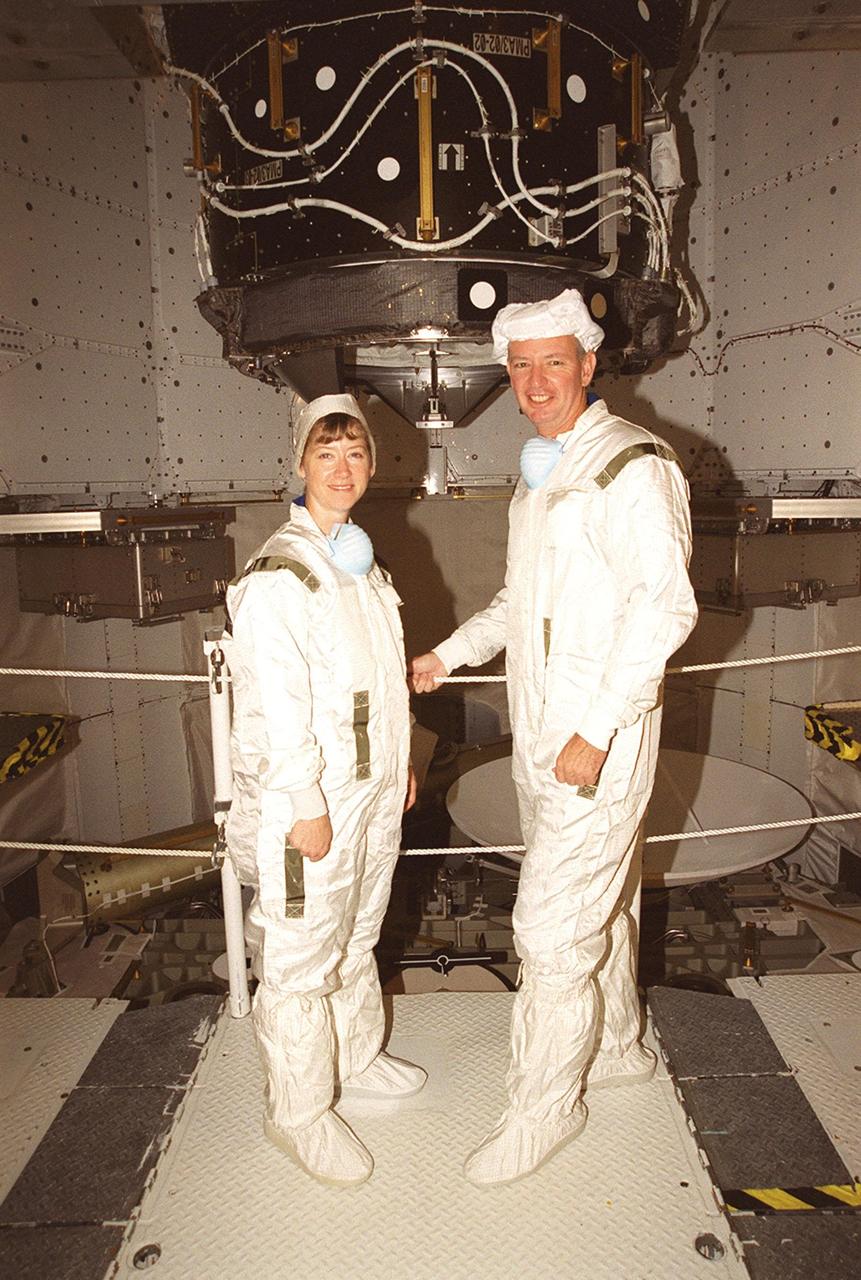
KENNEDY SPACE CENTER, FLA. -- STS-92 Pilot Pamela Ann Melroy (left) and Commander Brian Duffy pose for a photo during payload inspection in Space Shuttle Discovery’s payload bay. Behind them is the Pressurized Mating Adapter. The STS-92 crew has been inspecting the payload in preparation for launch Oct. 5, 2000. The mission is the fifth flight for the construction of the International Space Station. The payload also includes the Integrated Truss Structure Z-1. During the 11-day mission, four extravehicular activities (EVAs), or space walks, are planned
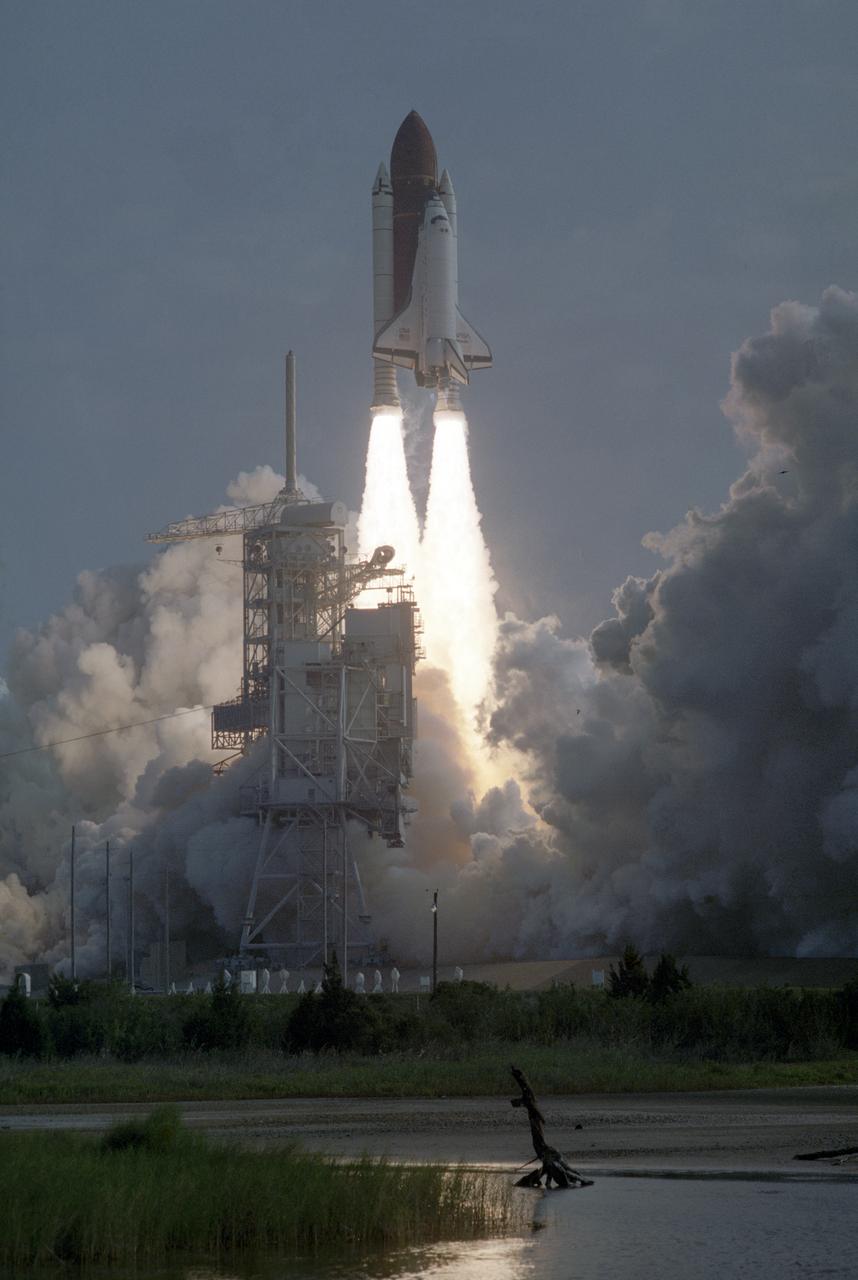
The STS-45 mission launched aboard the Space Shuttle Atlantis on March 24, 1992 at 8:13:40am (EST) carrying the Atmospheric Laboratory for Application and Science (ATLAS-1) as its primary payload. Crew members included: Charles F. Bolden, Jr., commander; Brian Duffy, pilot; Kathryn D. Sullivan, payload commander; Byron K. Lichtenberg, payload specialist 1; Dirk K. Frimout, payload specialist 2; David C. Leestma, mission specialist 2; and C. Michael Foale, mission specialist 3.
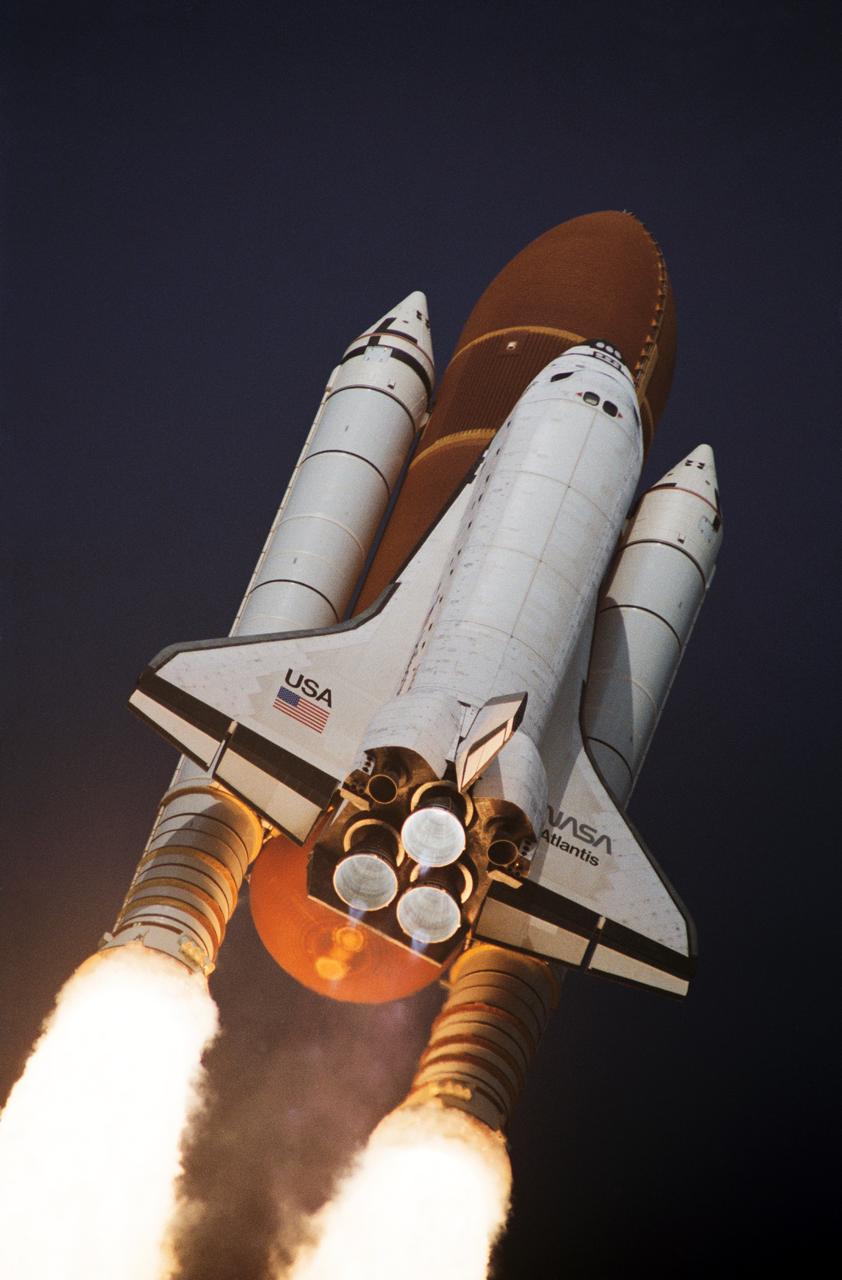
STS045-S-053 (24 March 1992) --- A low-angle view of the Space Shuttle Atlantis as it soars off the launch pad and heads toward Earth orbit with a crew of seven and the Atmospheric Laboratory for Applications and Science (ATLAS) aboard. Launch occurred at 8:13:40:048 a.m. (EST), March 24, 1992. Onboard were astronauts Charles F. Bolden, STS-45 commander; Brian Duffy, pilot; Kathryn D. Sullivan, payload commander; David C. Leestma and C. Michael Foale, mission specialists; and Dirk Frimout of the European Space Agency and Byron K. Lichtenberg, payload specialists.
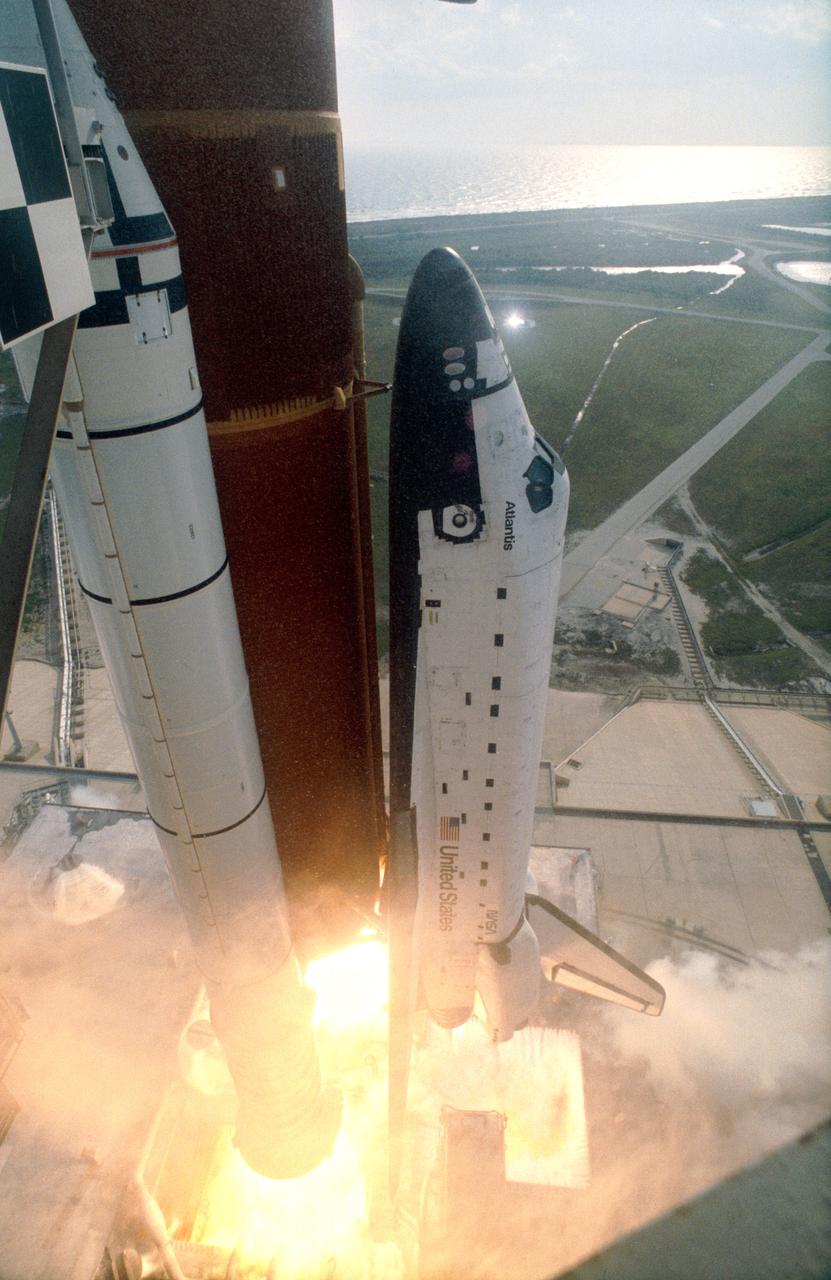
STS045-S-054 (24 March 1992) --- A profile view of the Space Shuttle Atlantis as it soars off the launch pad and heads toward Earth orbit with a crew of seven and the Atmospheric Laboratory for Applications and Science (ATLAS) aboard. Launch occurred at 8:13:40:048 a.m. (EST), March 24, 1992. Onboard were Charles F. Bolden, mission commander; Brian Duffy, pilot; Kathryn D. Sullivan, payload commander; David C. Leestma and C. Michael Foale, mission specialists; and Dirk Frimout of the European Space Agency and Byron K. Lichtenberg, payload specialists. The view was provided by an automatic camera on the launch service structure.
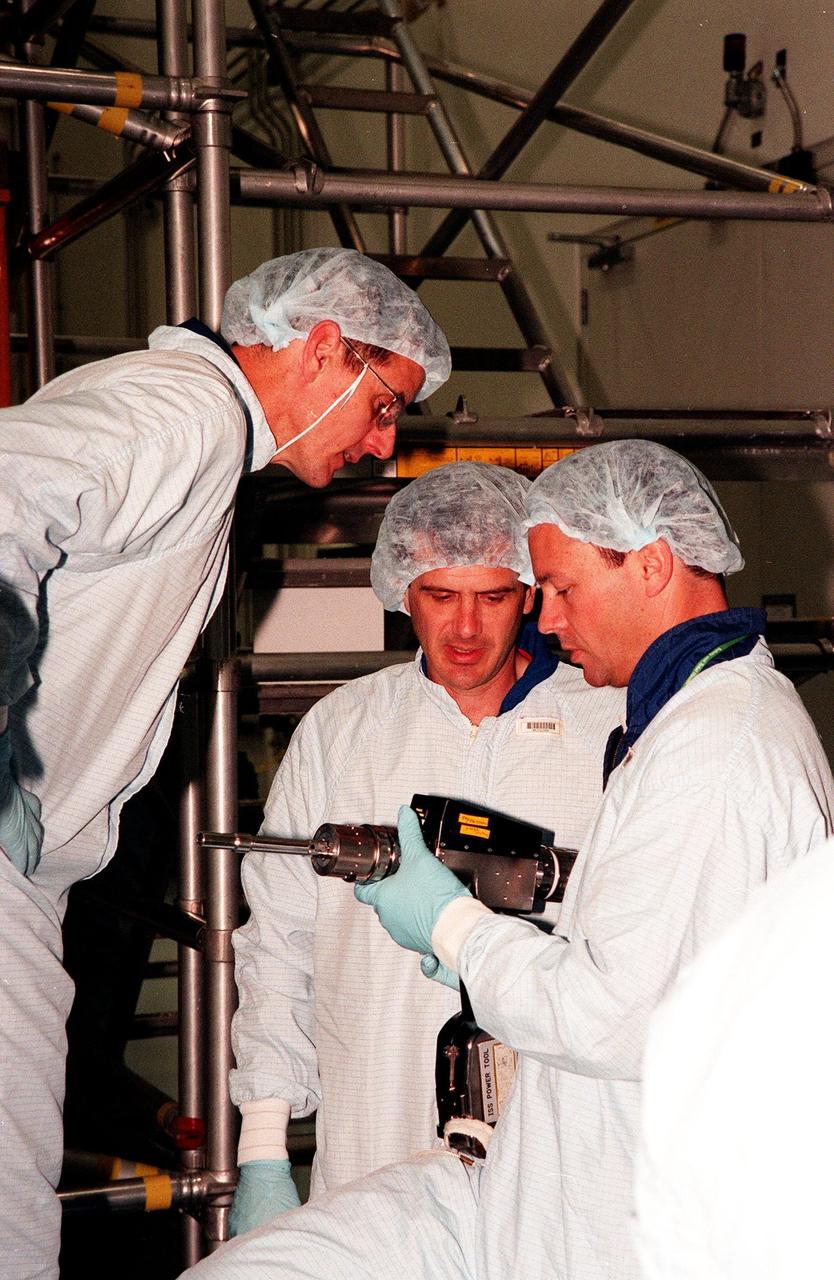
In the Space Station Processing Facility, members of the STS-92 crew become familiar with equipment in preparation for their mission to the International Space Station (ISS). STS-92 is targeted for launch in December 1999. From left are Mission Specialists Bill McArthur, Jeff Wisoff and Michael Lopez-Alegria, holding an ISS power tool. Other crew members visiting KSC are Commander Brian Duffy and Mission Specialists Koichi Wakata and Leroy Chiao. STS-92 is the fourth U.S. flight for construction of the International Space Station. The payload includes an integrated truss structure and a pressurized mating adapter
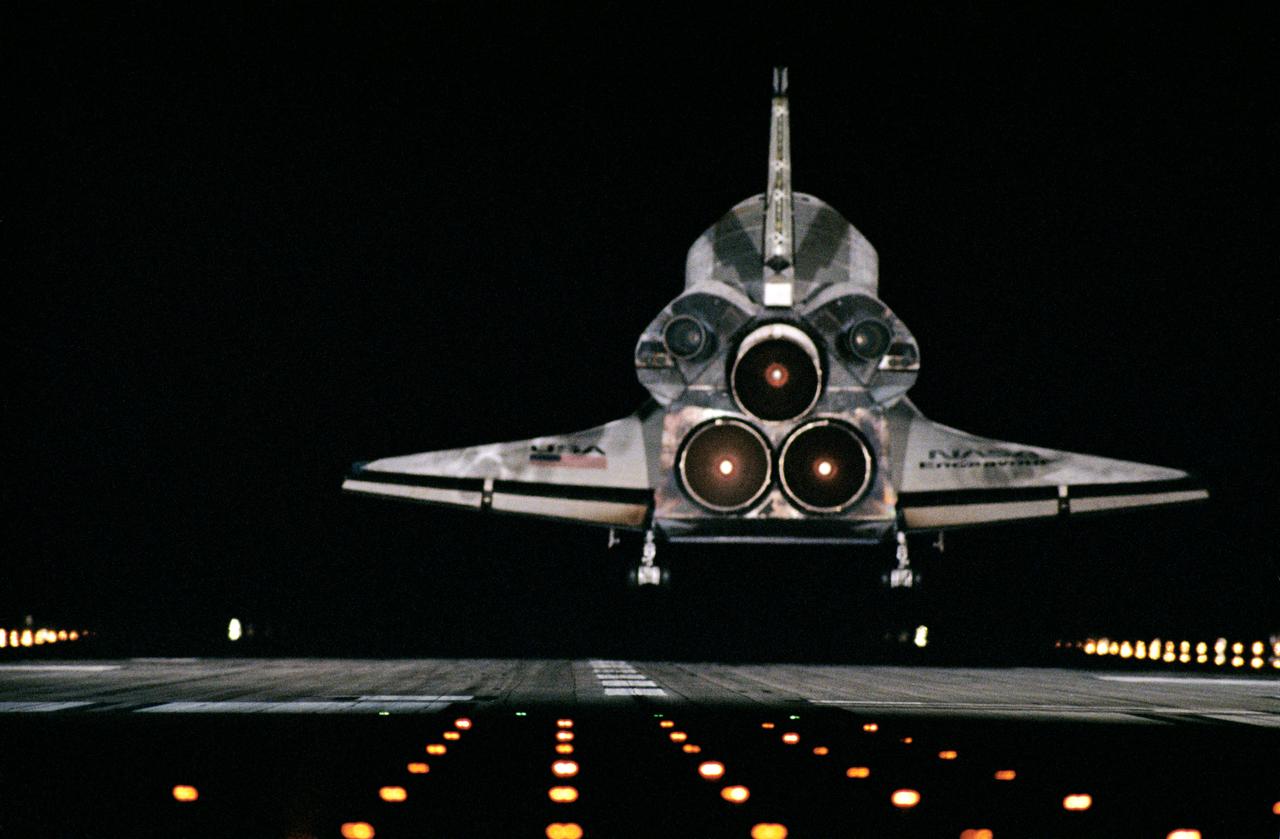
STS072-S-008 (20 Jan. 1996) --- The Space Shuttle Endeavour, with a crew of six aboard, is about to touch down on Runway 15 at the Kennedy Space Center’s (KSC) Shuttle Landing Facility (SLF). This mission’s conclusion marks only the third nocturnal Shuttle landing at the Florida facility. Crew members were astronauts Brian Duffy, commander; and Brent W. Jett Jr., pilot; along with astronauts Leroy Chiao, Winston E. Scott, Daniel T. Barry and Koichi Wakata, all mission specialists. Wakata represents Japan’s National Space Development Agency (NASDA).
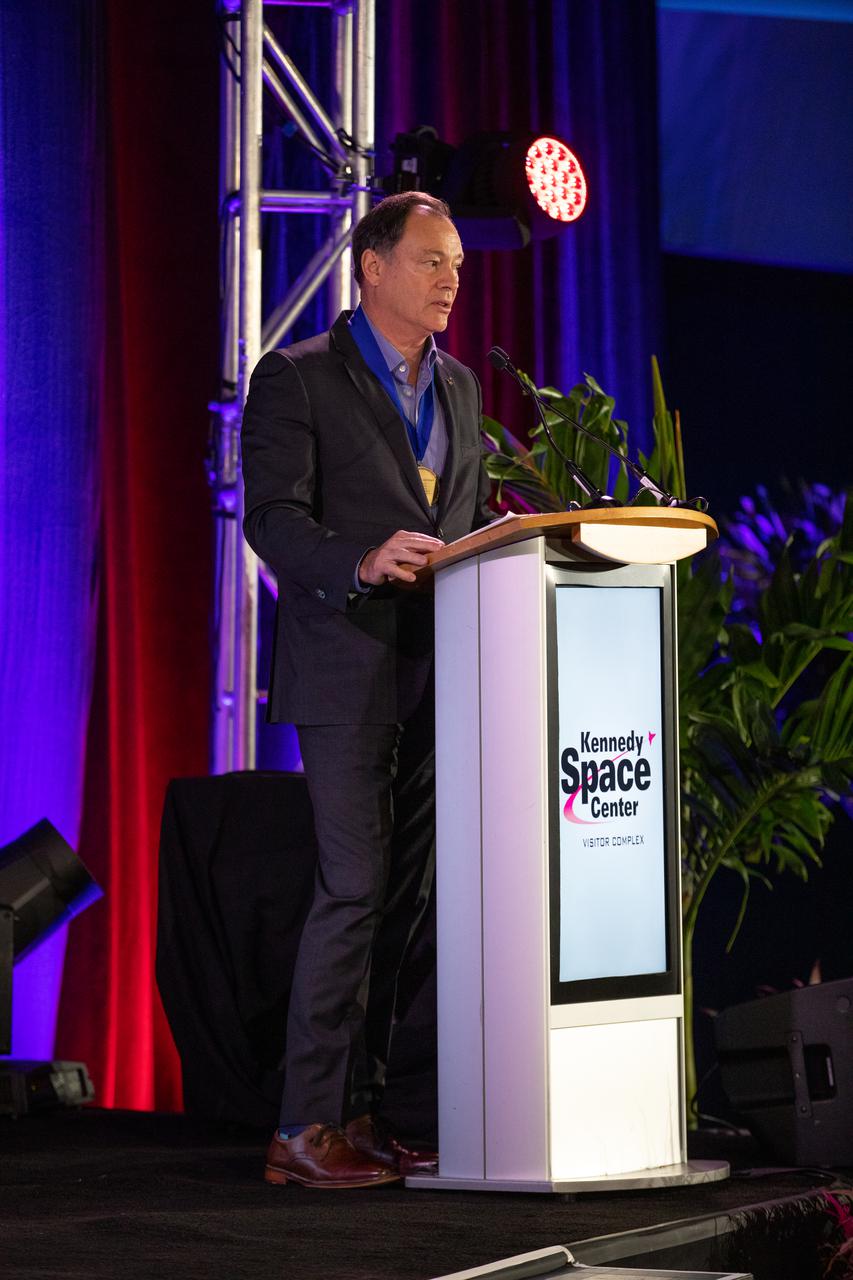
Michael Lopez-Alegria is one of three former astronauts inducted into the U.S. Astronaut Hall of Fame (AHOF) on Nov. 13, 2021, during a ceremony at the Kennedy Space Center Visitor Complex in Florida. Brian Duffy, former NASA astronaut and Hall of Famer, inducted Lopez-Alegria. Lopez-Alegria received an official medal and became a member of the 19th class of space shuttle astronauts to be inducted. The 2021 inductees were selected by a committee of Hall of Fame astronauts, former NASA officials, flight directors, historians, and journalists. This year’s induction brings the total number of AHOF members to 102.
 Wisoff and Koichi Wakata of Japan's National Space Development Agency (NASDA). Discovery touched down at 2 p.m. (PDT), October 24, and rolled to a stop on Edward's concrete runway at 2:0l, for a mission elapsed time of 12 days, 21 hours and 43 minutes.](https://images-assets.nasa.gov/image/sts092-s-021/sts092-s-021~medium.jpg)
STS092-S-021 [EC00-0311-2](24 October 2000 --- The main landing gear on the Space Shuttle Discovery is just about to touch down to mark mission completion at Edwards Air Force Base in the Mojave Desert of California. Onboard were astronauts Brian Duffy, Pamela A. Melroy, William S. McArthur, Jr., Leroy Chiao, Michael E. Lopez-Alegria, Peter J.K. (Jeff) Wisoff and Koichi Wakata of Japan's National Space Development Agency (NASDA). Discovery touched down at 2 p.m. (PDT), October 24, and rolled to a stop on Edward's concrete runway at 2:0l, for a mission elapsed time of 12 days, 21 hours and 43 minutes.
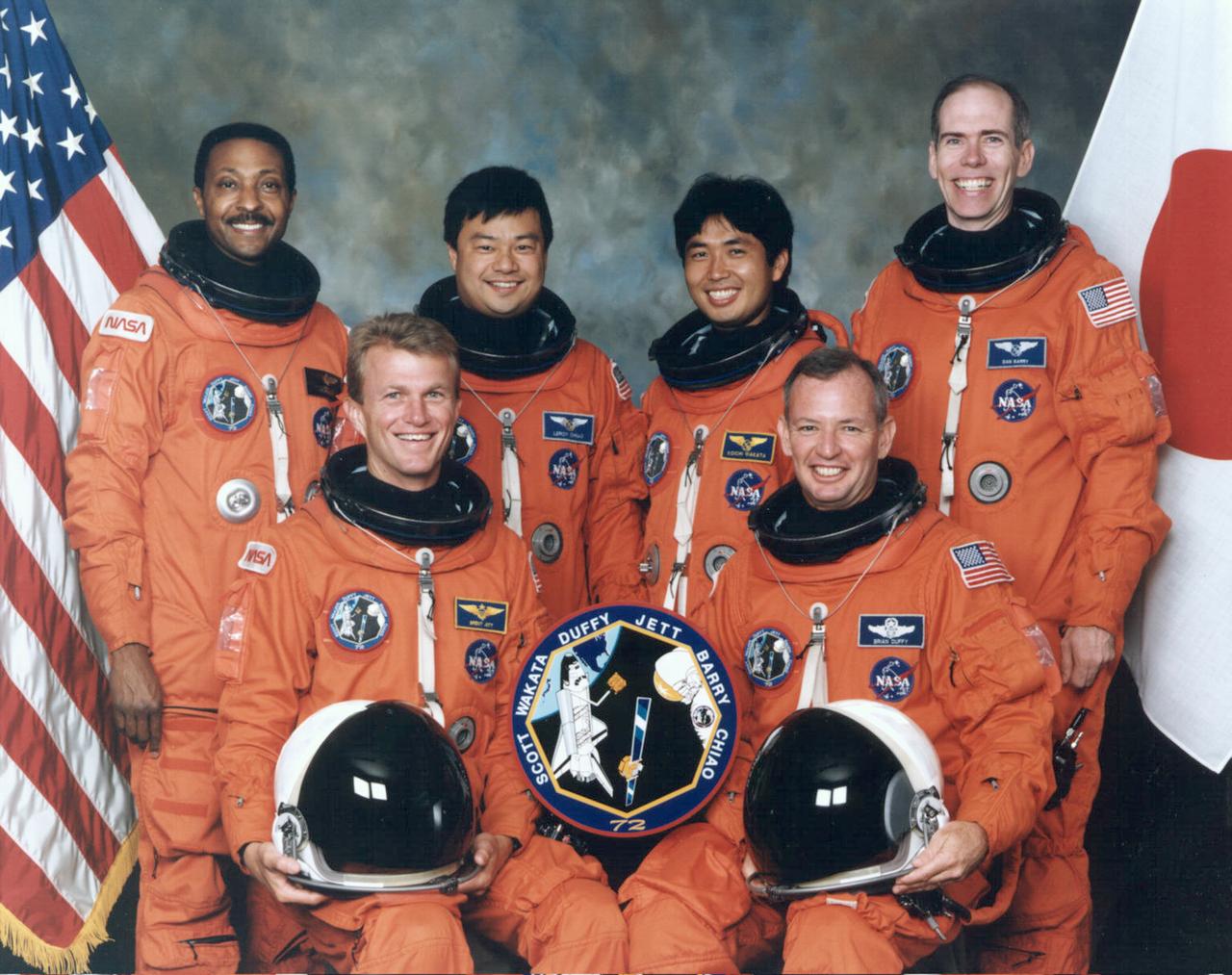
Six astronauts composed the crew for the STS-72 mission that launched aboard the Space Shuttle Endeavour on January 11, 1996. Astronauts Brian Duffy (right front) and Brent W. Jett (left front) are mission commander and pilot, respectively. Mission specialists (back row, left to right) are Winston E. Scott, Leroy Chiao, Koichi Wakata, and Daniel T. Barry. Wakata is an international mission specialist representing Japan’s National Space Development Agency (NASDA) based at the Johnson Space Center (JSC). Mission objectives included the retrieval of the Japanese Space Flyer Unit (SFU), and the deployment of the Office of Aeronautics and Space Technology-Flyer (OAST-Flyer).
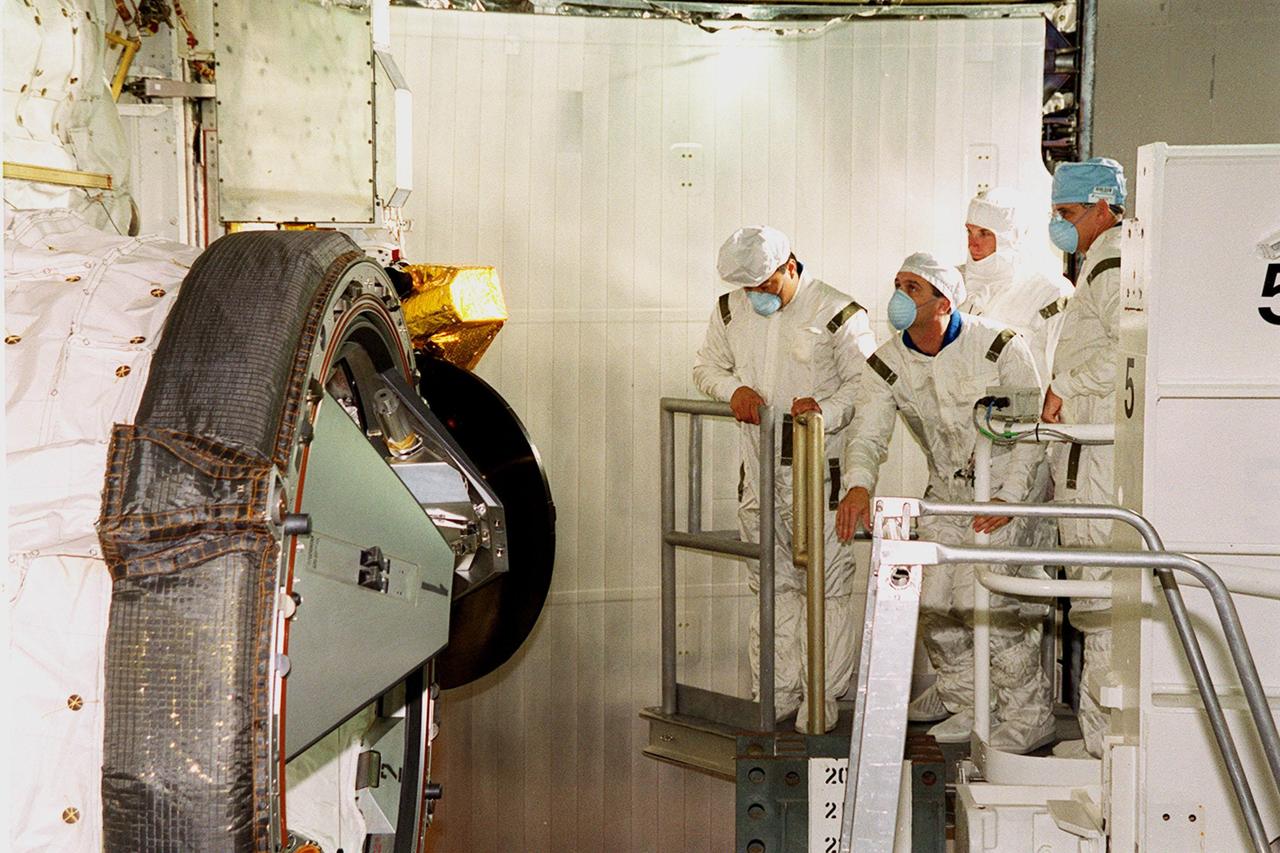
Members of the STS-92 crew look over the payload (left) in Space Shuttle Discovery’s payload bay. Left to right, in masks, are Mission Specialists Leroy Chiao, Peter J.K. “Jeff” Wisoff and William S. McArthur Jr. They and the other crew members Commander Brian Duffy, Pilot Pamela Ann Melroy and Mission Specialists Koichi Wakata of Japan, and Michael E. Lopez-Alegria are preparing for launch on Oct. 5, 2000. The mission is the fifth flight for the construction of the International Space Station. The payload includes the Integrated Truss Structure Z-1 and the third Pressurized Mating Adapter. During the 11-day mission, four extravehicular activities (EVAs), or space walks, are planned
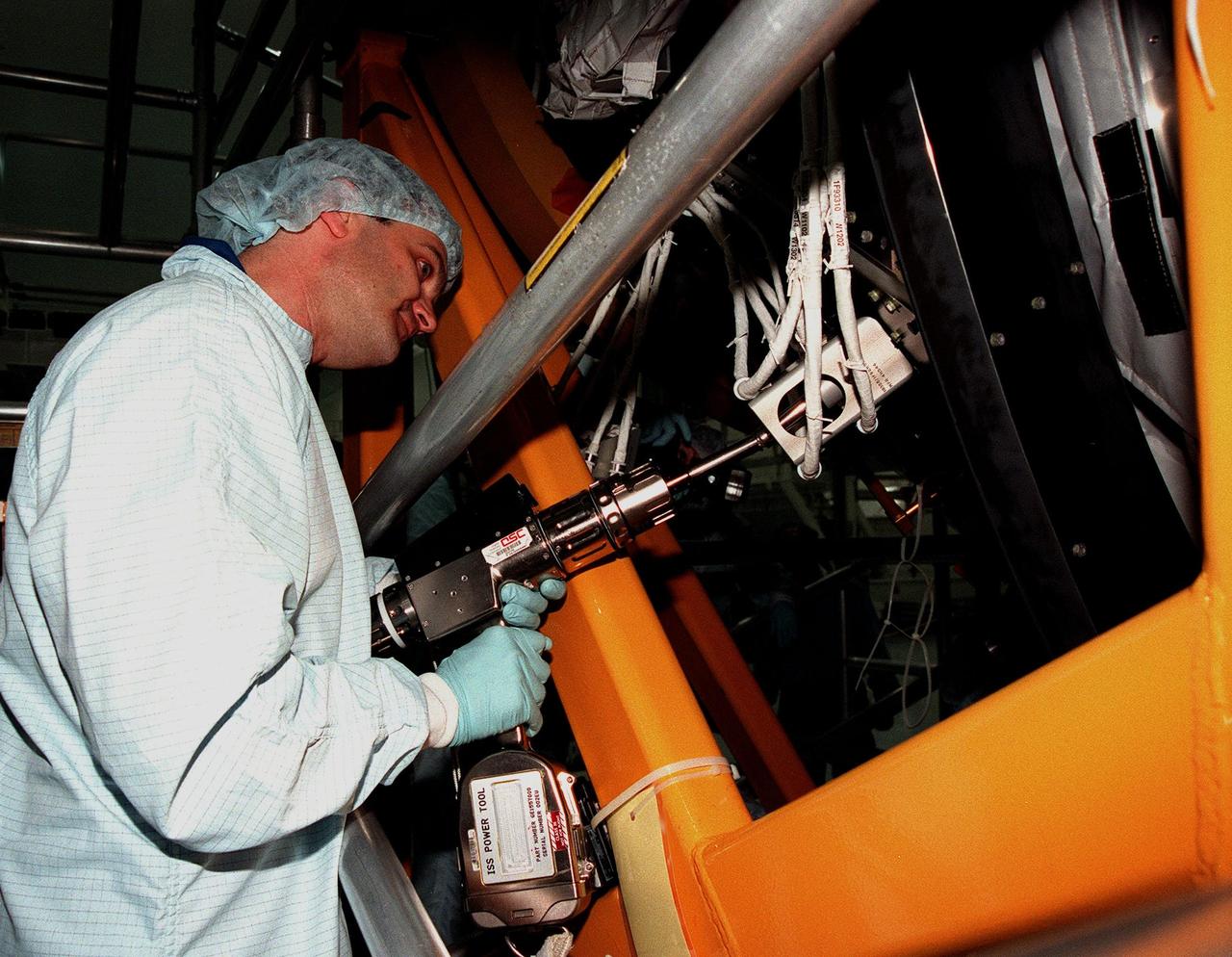
In the Space Station Processing Facility, STS-92 Mission Specialist Jeff Wisoff practices removing a wire harness from the Pressurized Mating Adapter-3, part of the payload on the STS-92 mission to the International Space Station (ISS). STS-92 is targeted for launch in December 1999. Other crew members visiting KSC are Commander Brian Duffy and Mission Specialists Koichi Wakata, Leroy Chiao, Michael Lopez-Alegria and Bill McArthur. STS-92 is the fourth U.S. flight for construction of the International Space Station. The payload also includes an integrated truss structure
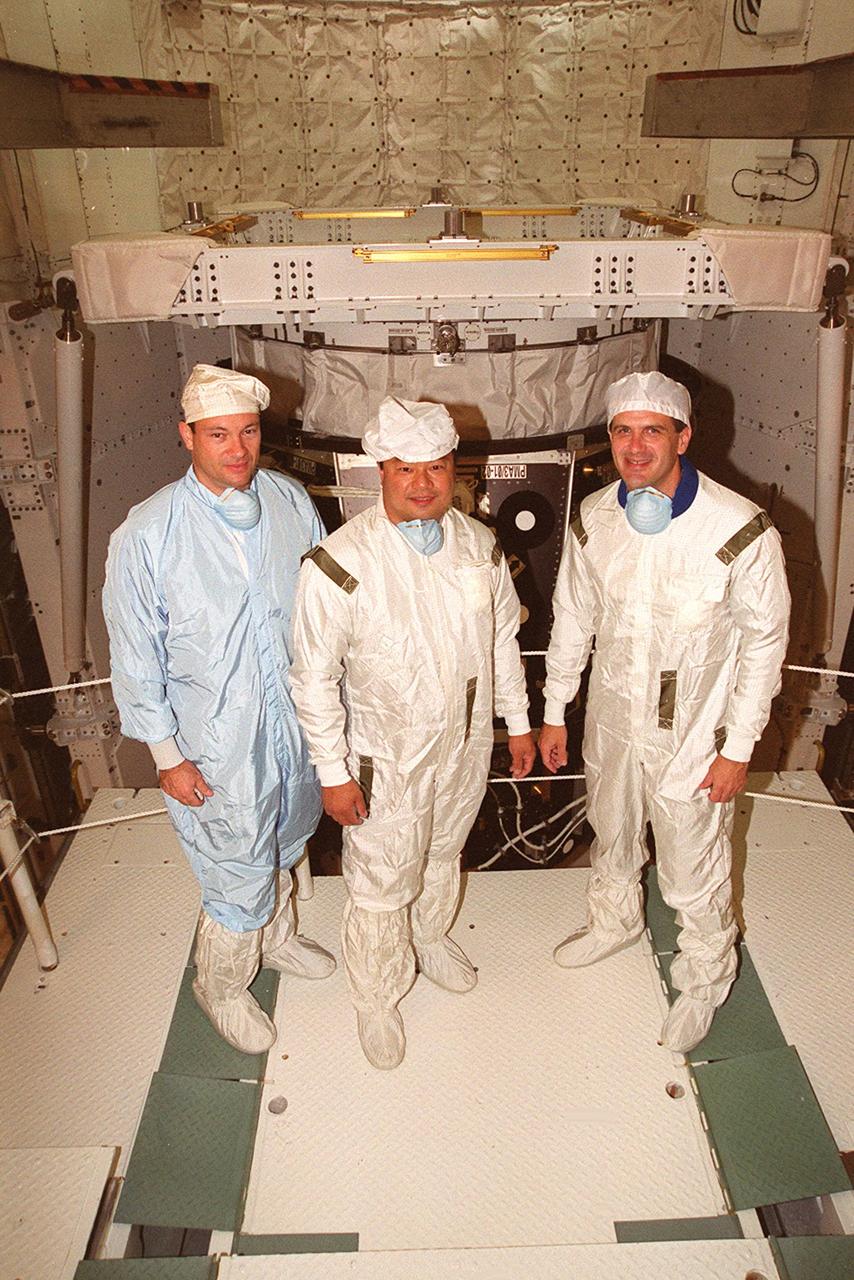
KENNEDY SPACE CENTER, FLA. -- During inspection of the payload in Space Shuttle Discovery’s payload bay (background), STS-92 Mission Specialists Michael E. Lopez-Alegria, Leroy Chiao and Peter J.K. “Jeff” Wisoff pause for a photo. They and other crew members Commander Brian Duffy, Pilot Pamela Ann Melroy and Mission Specialists Koichi Wakata of Japan and William S. McArthur Jr. are preparing for launch on Oct. 5, 2000. The mission is the fifth flight for the construction of the International Space Station. The payload includes the Integrated Truss Structure Z-1 and the third Pressurized Mating Adapter. During the 11-day mission, four extravehicular activities (EVAs), or space walks, are planned
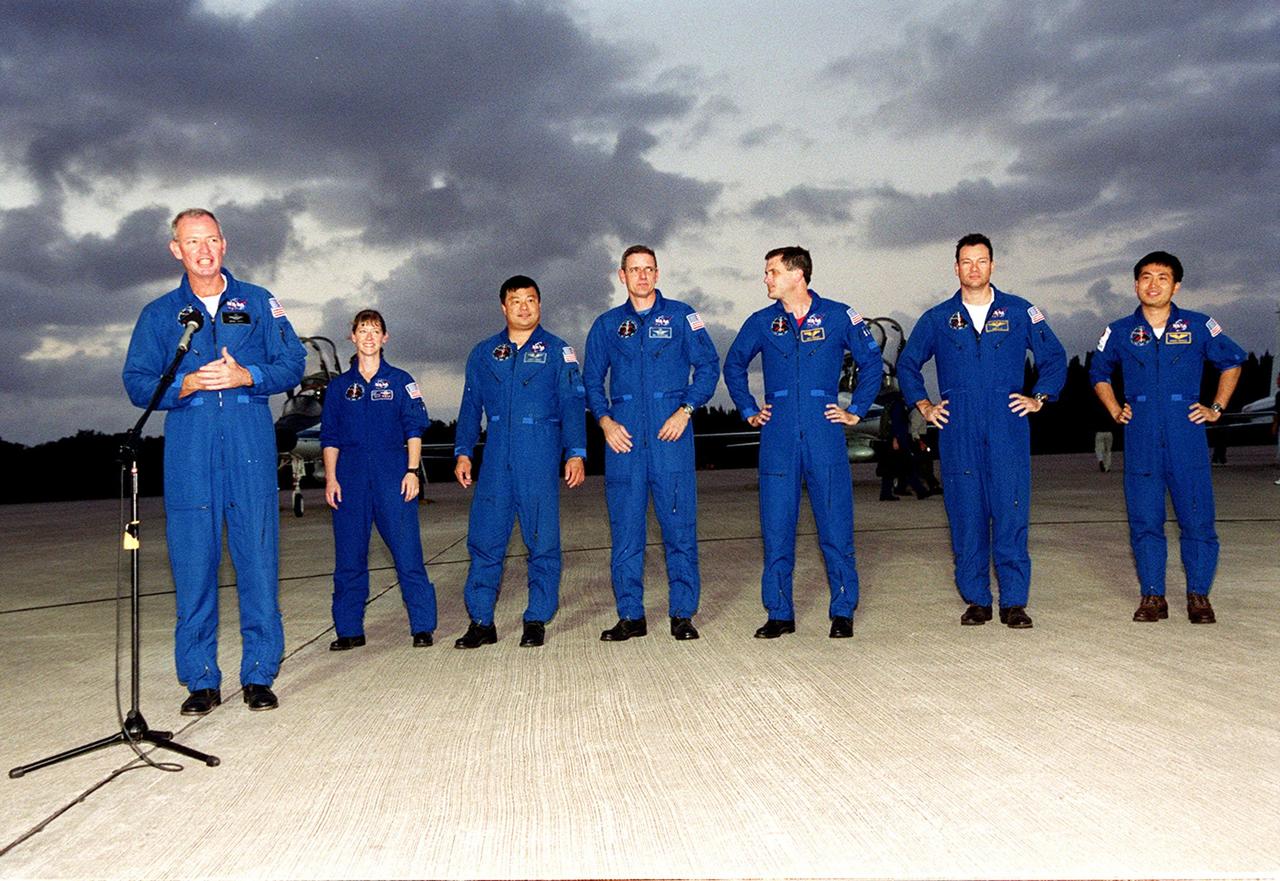
KENNEDY SPACE CENTER, FLA. -- After their arrival at KSC’s Shuttle Landing Facility, the STS-92 crew paused to talk to the media, who were waiting nearby. At the microphone is Commander Brian Duffy. Standing behind him, left to right, are Pilot Pamela Ann Melroy and Mission Specialists Leroy Chiao, William S. McArthur Jr., Peter J.K. “Jeff” Wisoff, Michael E. Lopez-Alegria and Koichi Wakata of Japan. The mission is the fifth flight for the construction of the International Space Station. The payload includes the Integrated Truss Structure Z-1 and the third Pressurized Mating Adapter. During the 11-day mission, four extravehicular activities (EVAs), or space walks, are planned
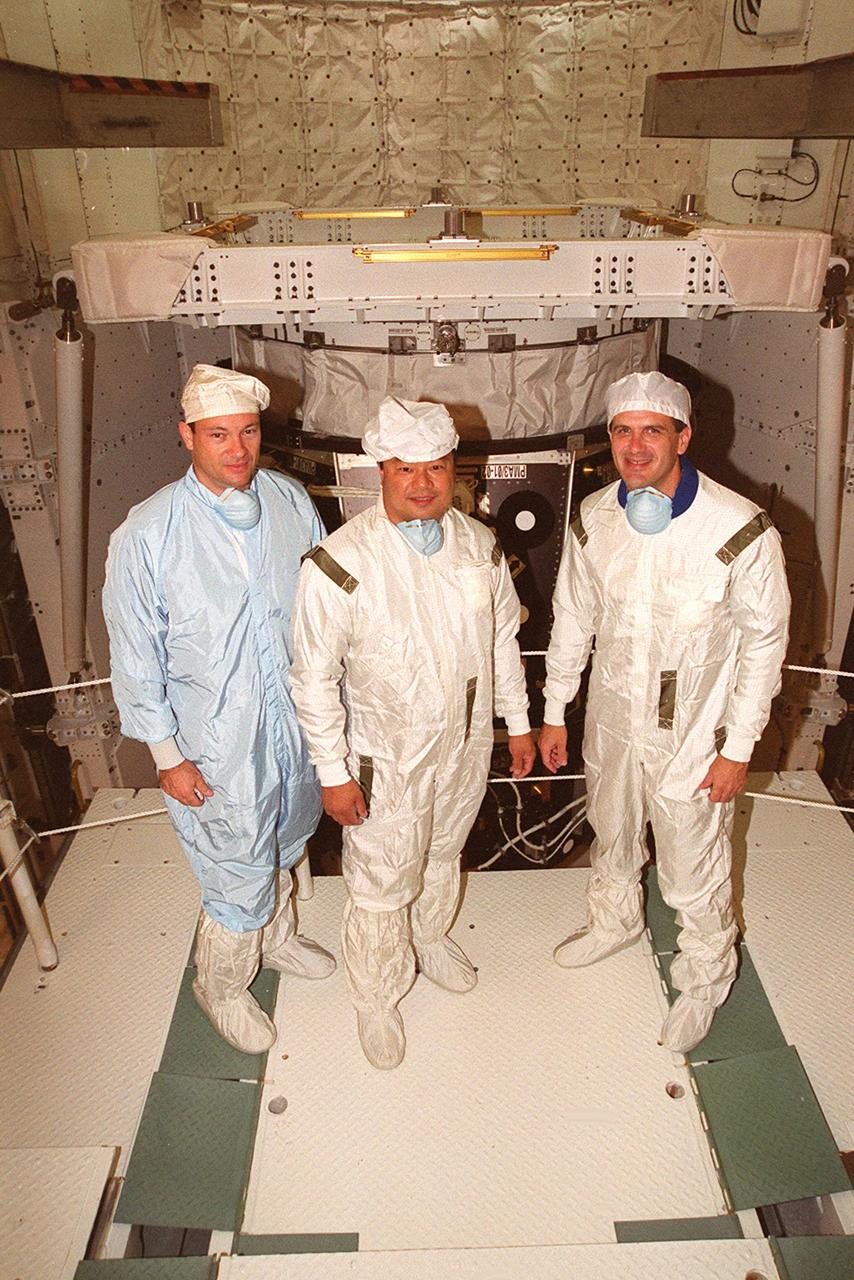
KENNEDY SPACE CENTER, FLA. -- During inspection of the payload in Space Shuttle Discovery’s payload bay (background), STS-92 Mission Specialists Michael E. Lopez-Alegria, Leroy Chiao and Peter J.K. “Jeff” Wisoff pause for a photo. They and other crew members Commander Brian Duffy, Pilot Pamela Ann Melroy and Mission Specialists Koichi Wakata of Japan and William S. McArthur Jr. are preparing for launch on Oct. 5, 2000. The mission is the fifth flight for the construction of the International Space Station. The payload includes the Integrated Truss Structure Z-1 and the third Pressurized Mating Adapter. During the 11-day mission, four extravehicular activities (EVAs), or space walks, are planned
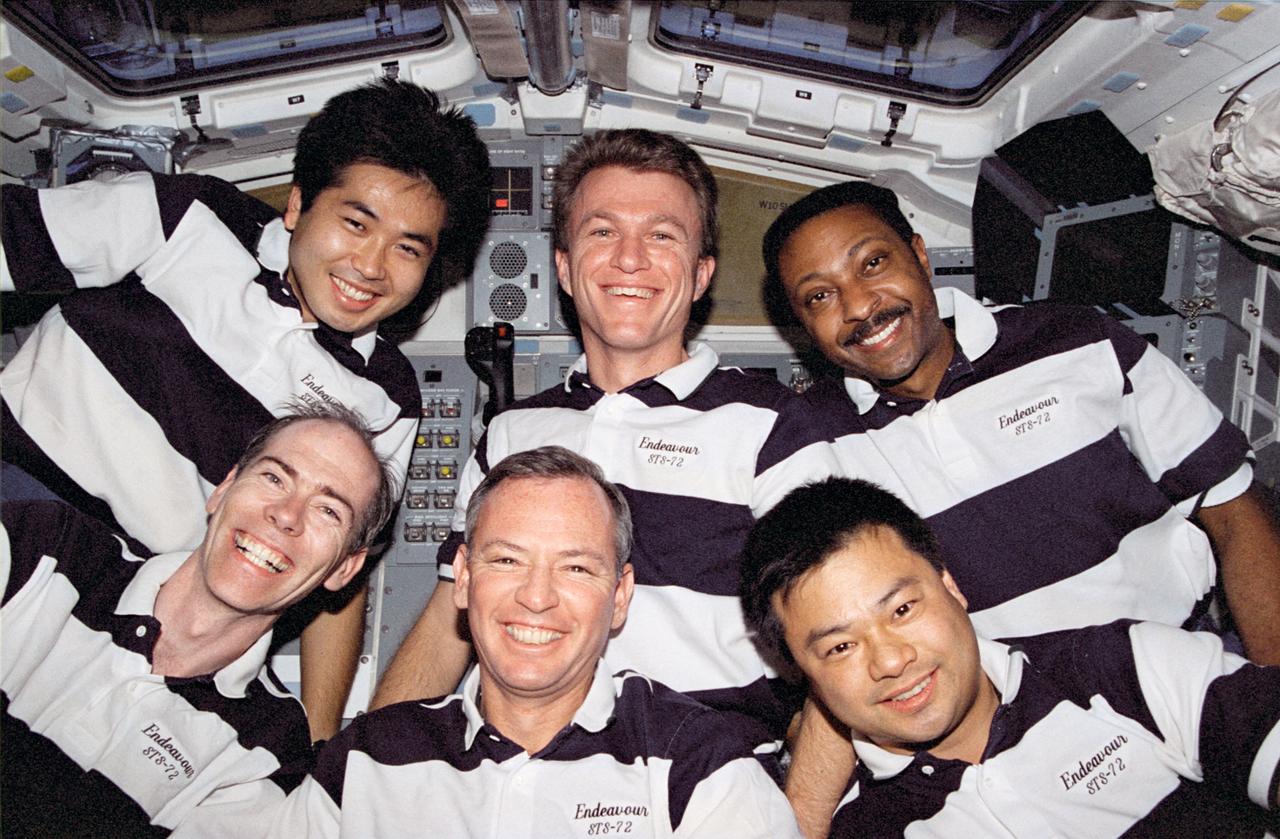
STS072-344-019 (11-20 Jan. 1996) --- The crew members selected the aft flight deck for the site of their inflight crew portrait aboard the Earth-orbiting Space Shuttle Endeavour. In front, left to right, are astronauts Daniel T. Barry, mission specialist; Brian Duffy, mission commander; and Leroy Chiao, mission specialist. In the rear are, left to right, Koichi Wakata, mission specialist representing Japan’s National Space Development Agency (NASDA); Brett W. Jett Jr., pilot; and Winston E. Scott, mission specialist. Flying in the bright sunlight, the crew had put shades in the aft flight deck windows to prevent heavy shadowing.
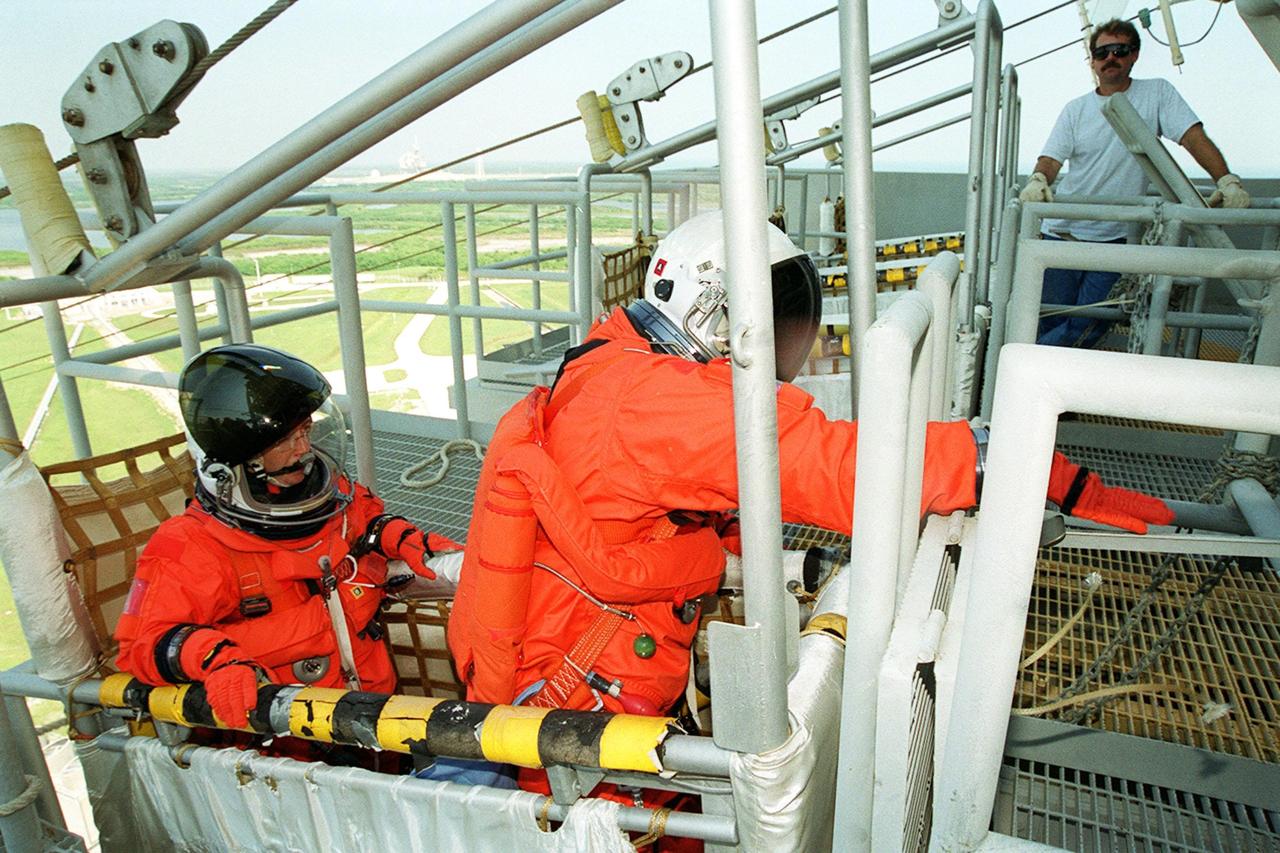
KENNEDY SPACE CENTER, FLA. -- On the 195-foot level of the Fixed Service Structure on Launch Pad 39A, STS-92 Pilot Pamela Ann Melroy (left) sits in the slidewire basket while Commander Brian Duffy reaches for the lever to release the basket. They and other crew members are taking part in emergency egress training, one of the Terminal Countdown Demonstration Test activities that also include a simulated countdown. STS-92 is scheduled to launch Oct. 5 at 9:38 p.m. EDT on the fifth flight to the International Space Station. It will carry two elements of the Space Station, the Integrated Truss Structure Z1 and the third Pressurized Mating Adapter. The mission is also the 100th flight in the Shuttle program
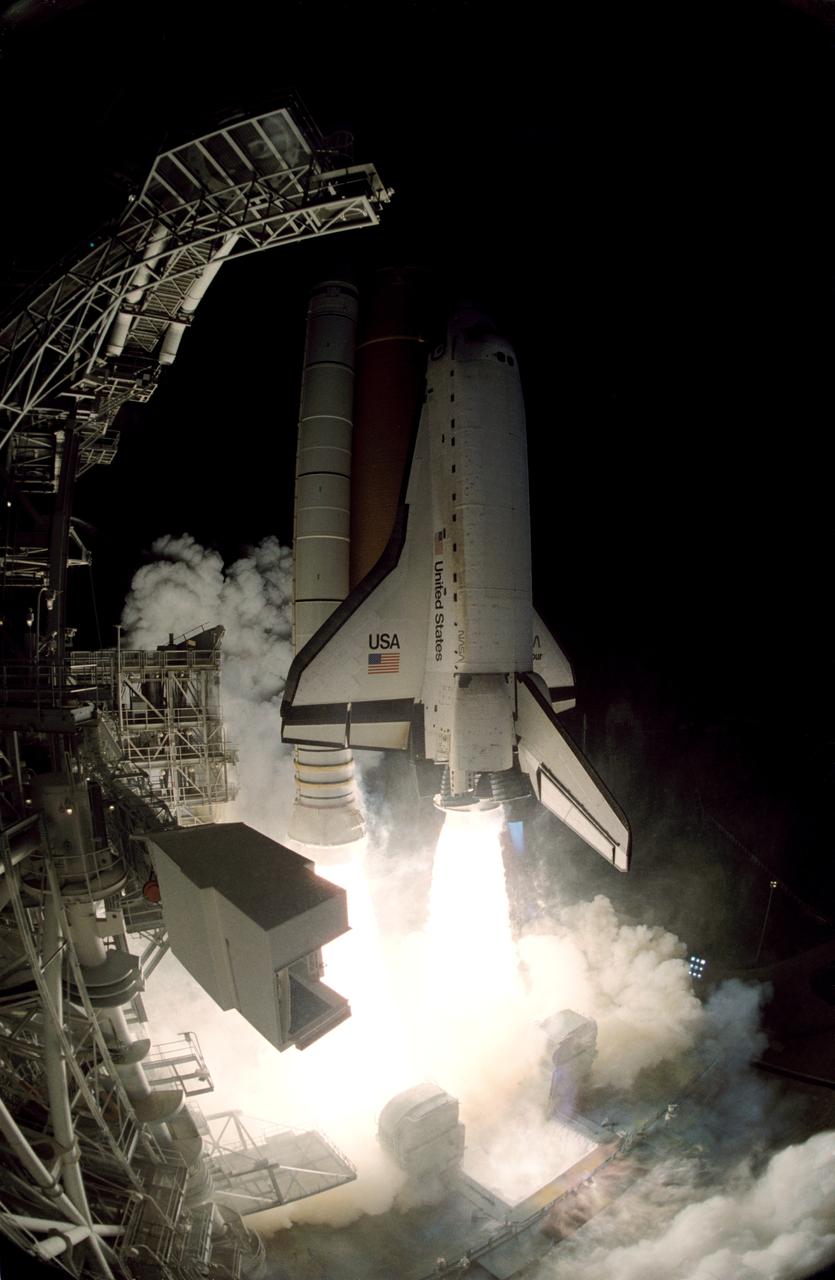
STS072-S-003 (11 Jan. 1996) --- A "fish-eye" lens was used to afford this unique view of the Space Shuttle Endeavour as it lifts off from Launch Pad 39B at the Kennedy Space Center (KSC). Liftoff for STS-72 occurred at 4:41:00:072 a.m. (EST), January 11, 1996. Onboard the spacecraft were astronauts Brian Duffy, commander; Brent W. Jett, pilot; along with Daniel T. Barry, Leroy Chiao, Winston E. Scott and Koichi Wakata, all mission specialists. Wakata represents Japan's National Space Development Agency (NASDA).
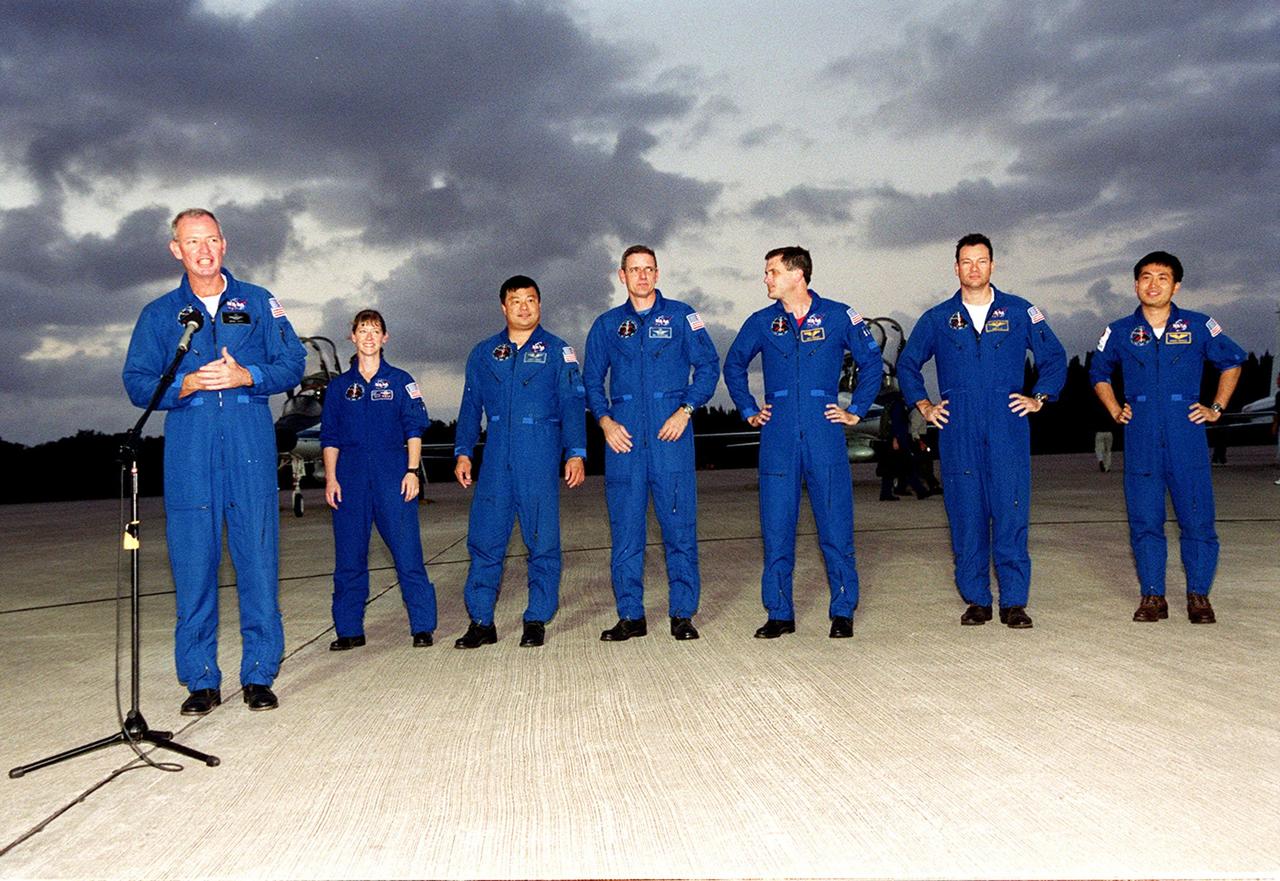
KENNEDY SPACE CENTER, FLA. -- After their arrival at KSC’s Shuttle Landing Facility, the STS-92 crew paused to talk to the media, who were waiting nearby. At the microphone is Commander Brian Duffy. Standing behind him, left to right, are Pilot Pamela Ann Melroy and Mission Specialists Leroy Chiao, William S. McArthur Jr., Peter J.K. “Jeff” Wisoff, Michael E. Lopez-Alegria and Koichi Wakata of Japan. The mission is the fifth flight for the construction of the International Space Station. The payload includes the Integrated Truss Structure Z-1 and the third Pressurized Mating Adapter. During the 11-day mission, four extravehicular activities (EVAs), or space walks, are planned
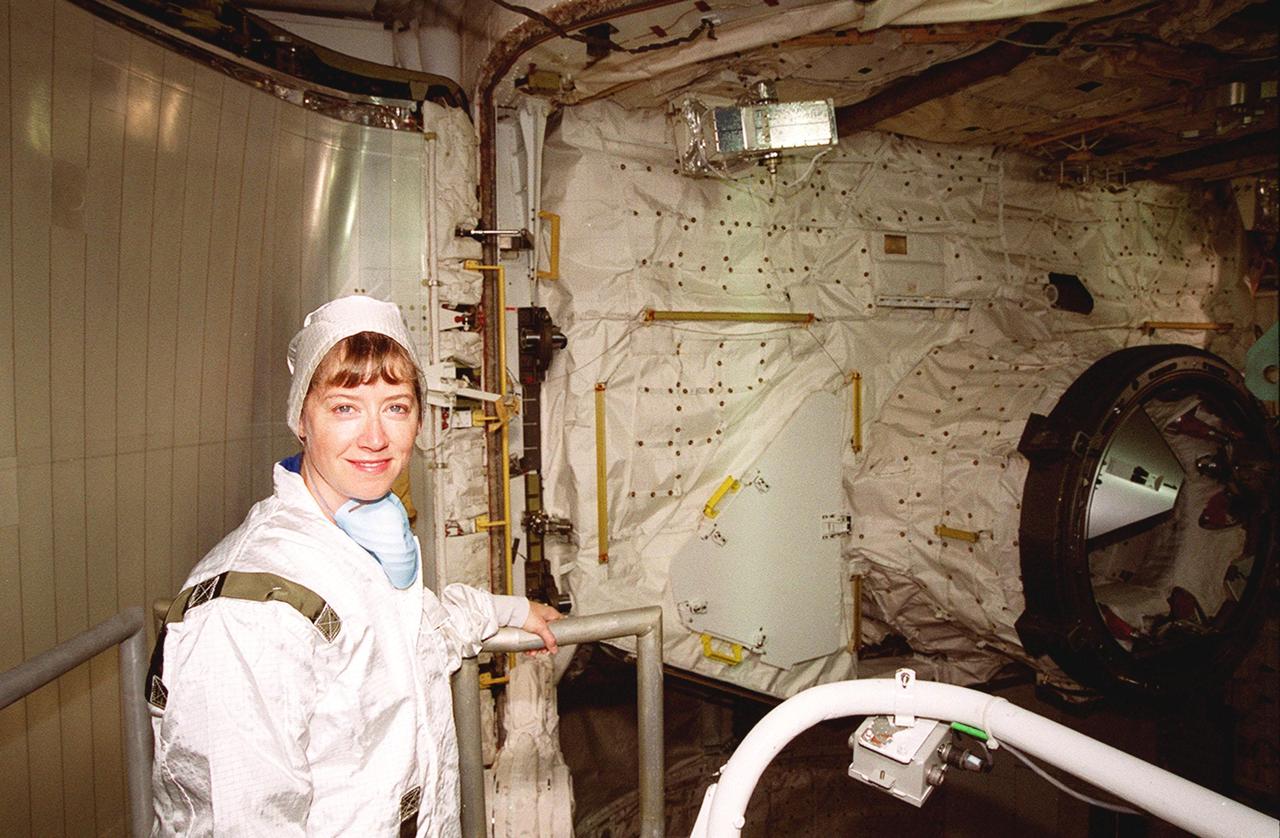
STS-92 Pamela Ann Melroy pauses during inspection of the payload (behind her) in Space Shuttle Discovery’s payload bay. She and other crew members Commander Brian Duffy and Mission Specialists Koichi Wakata of Japan, Leroy Chiao, Peter J.K. “Jeff” Wisoff. Michael E. Lopez-Alegria and William S. McArthur Jr. are preparing for launch on Oct. 5, 2000. The mission is the fifth flight for the construction of the International Space Station. The payload includes the Integrated Truss Structure Z-1 and the third Pressurized Mating Adapter. During the 11-day mission, four extravehicular activities (EVAs), or space walks, are planned
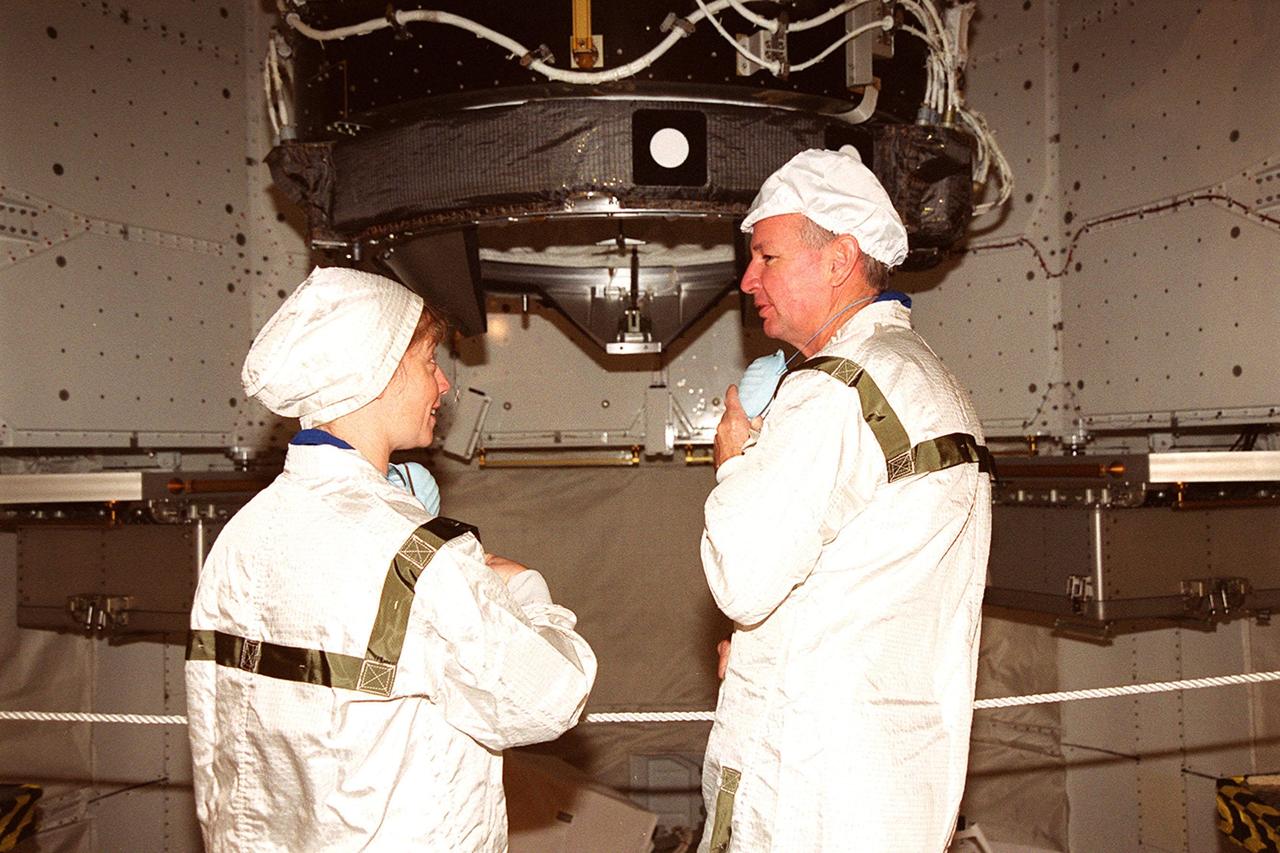
KENNEDY SPACE CENTER, FLA. -- In Space Shuttle Discovery’s payload bay, STS-92 Pilot Pamela Ann Melroy (left) and Commander Brian Duffy share thoughts about the mission as they inspect part of the payload (behind them), the Pressurized Mating Adapter. The STS-92 crew has been inspecting the payload in preparation for launch Oct. 5, 2000. The mission is the fifth flight for the construction of the International Space Station. The payload also includes the Integrated Truss Structure Z-1. During the 11-day mission, four extravehicular activities (EVAs), or space walks, are planned
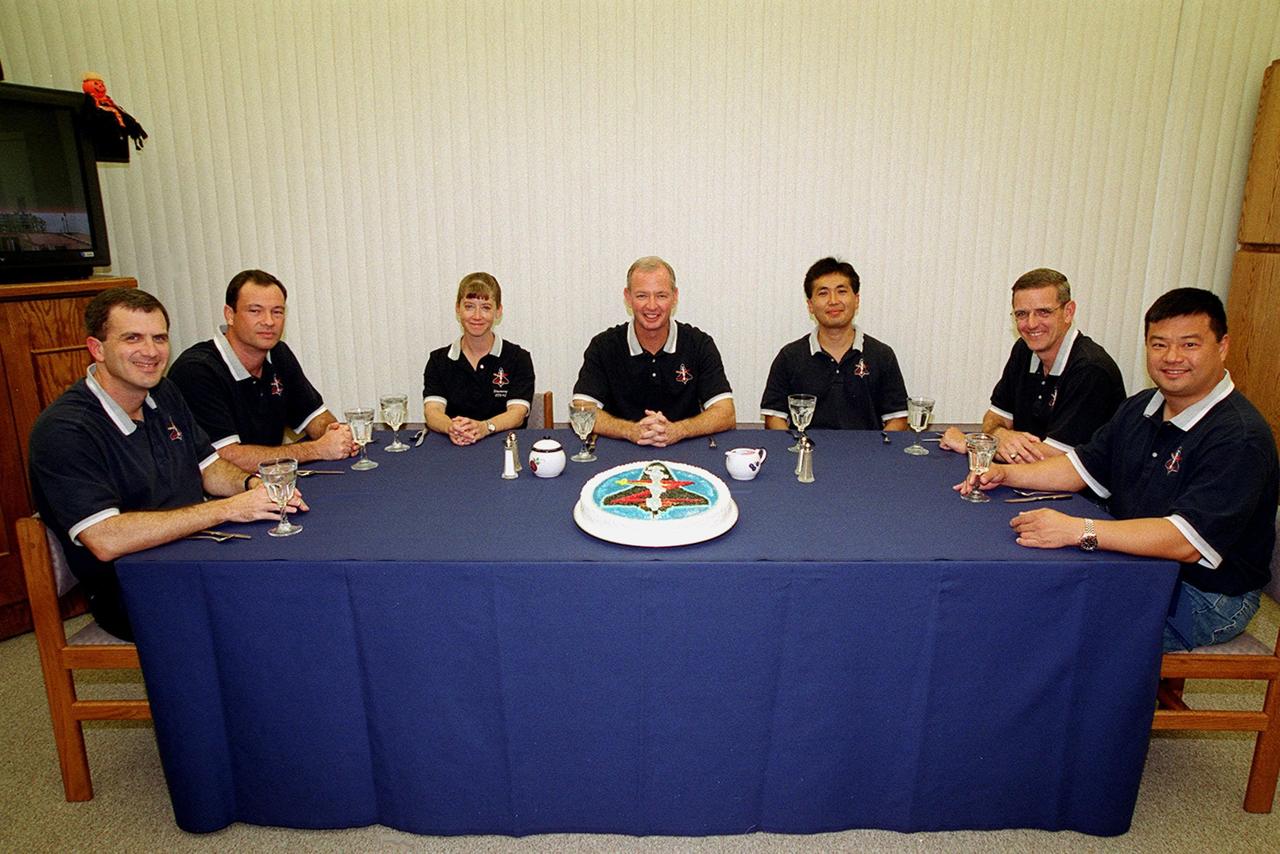
The STS-92 crew pose for a group photo after a snack prior to suiting up for launch. Seated left to right are Mission Specialists Peter J.K. “Jeff” Wisoff and Michael E. Lopez-Alegria; Pilot Pamela Ann Melory; Commander Brian Duffy; and Mission Specialists Koichi Wakata of Japan, William S. McArthur Jr. and Leroy Chiao. The mission is the fifth flight for the construction of the ISS. The payload includes the Integrated Truss Structure Z-1 and the third Pressurized Mating Adapter. During the 11-day mission, four extravehicular activities (EVAs), or spacewalks, are planned. The Z-1 truss is the first of 10 that will become the backbone of the International Space Station, eventually stretching the length of a football field. PMA-3 will provide a Shuttle docking port for solar array installation on the sixth ISS flight and Lab installation on the seventh ISS flight. This launch is the fourth for Duffy and Wisoff, the third for Chiao and McArthur, second for Wakata and Lopez-Alegria, and first for Melroy. Launch is scheduled for 8:05 p.m. EDT. Landing is expected Oct. 21 at 3:55 p.m. EDT
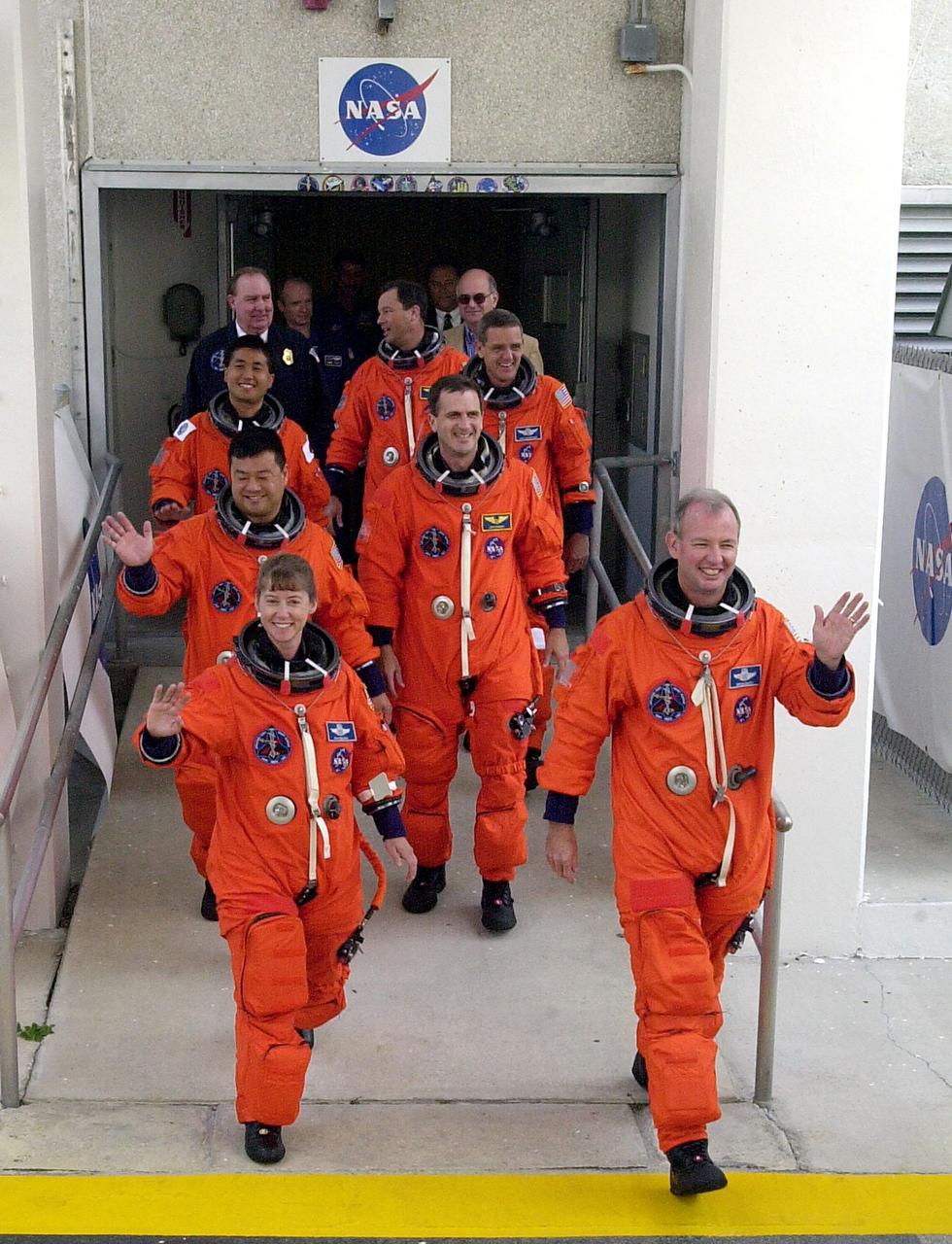
The STS-92 crew eagerly walk out of the Operations and Checkout Building for the second time for their trip to Launch Pad 39A. On the left side, from front to back, are Pilot Pamela Ann Melroy and Mission Specialists Leroy Chiao and Koichi Wakata of Japan. On the right side, front to back, are Commander Brian Duffy and Mission Specialists Peter J.K. “Jeff” Wisoff, William S. McArthur Jr. and Michael E. Lopez-Alegria. During the 11-day mission to the International Space Station, four extravehicular activities (EVAs), or spacewalks, are planned for construction. The payload includes the Integrated Truss Structure Z-1 and the third Pressurized Mating Adapter. The Z-1 truss is the first of 10 that will become the backbone of the Space Station, eventually stretching the length of a football field. PMA-3 will provide a Shuttle docking port for solar array installation on the sixth Station flight and Lab installation on the seventh Station flight. This launch is the fourth for Duffy and Wisoff, the third for Chiao and McArthur, second for Wakata and Lopez-Alegria, and first for Melroy. Launch is scheduled for 7:17 p.m. EDT. Landing is expected Oct. 22 at 2:10 p.m. EDT. [Photo taken with a Nikon D1 camera.
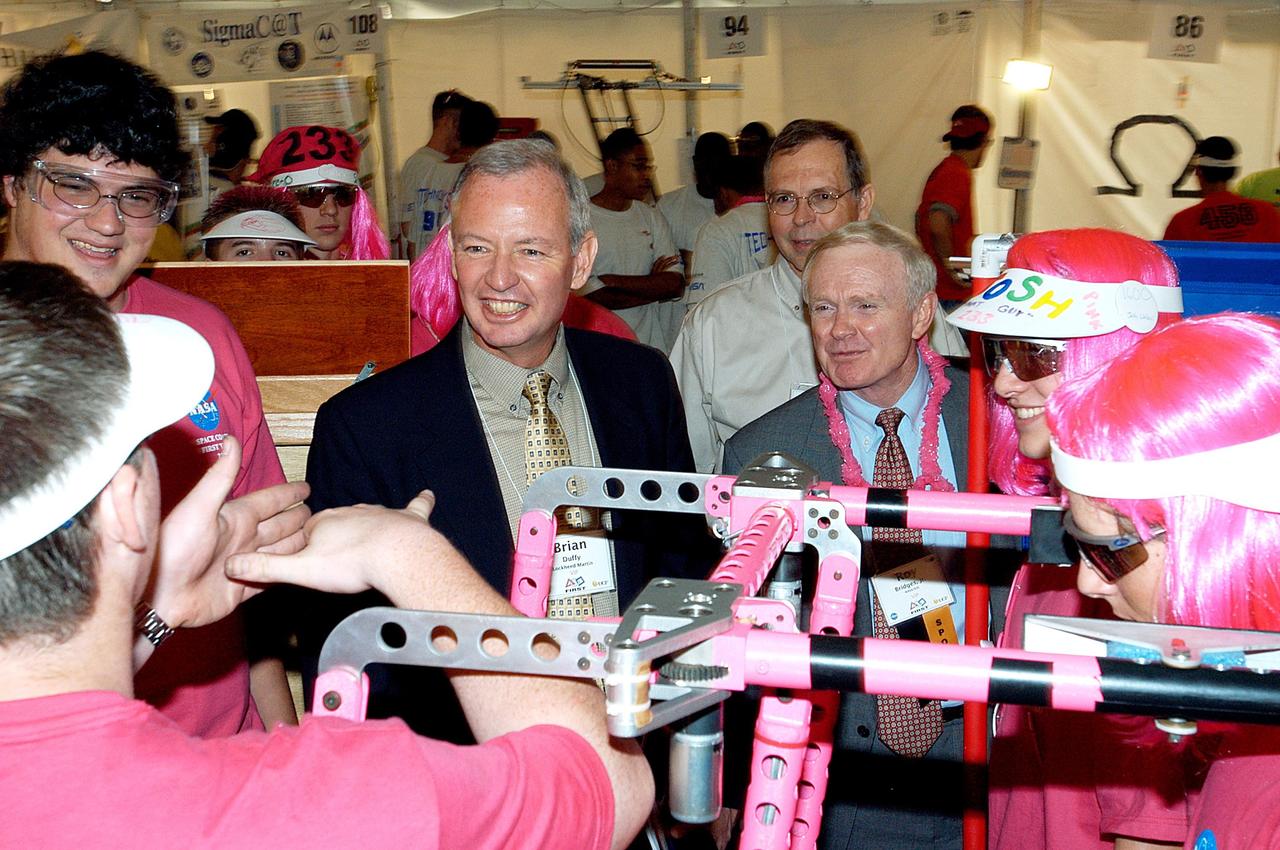
KENNEDY SPACE CENTER, FLA. - Lockheed Martin Vice President/Associate Program Manager Brian Duffy (second from left) and NASA Kennedy Space Center Director Roy Bridges (next to Duffy) talk with student participants in the 2003 Southeastern Regional FIRST Robotic Competition. Chris Fairey, the former director of Spaceport Services at KSC, looks on in the background. The competition is being held at the University of Central Florida (UCF) in Orlando, March 20-23. Forty student teams from around the country are participating in the event that pits team-built gladiator robots against each other in an athletic-style competition. The teams are sponsored by NASA/Kennedy Space Center, The Boeing Company/Brevard Community College, and Lockheed Martin Space Operations/Mission Systems for the nonprofit organization For Inspiration and Recognition of Science and Technology, known as FIRST. The vision of FIRST is to inspire in the youth of our nation an appreciation of science and technology and an understanding that mastering these disciplines can enrich the lives of all mankind.
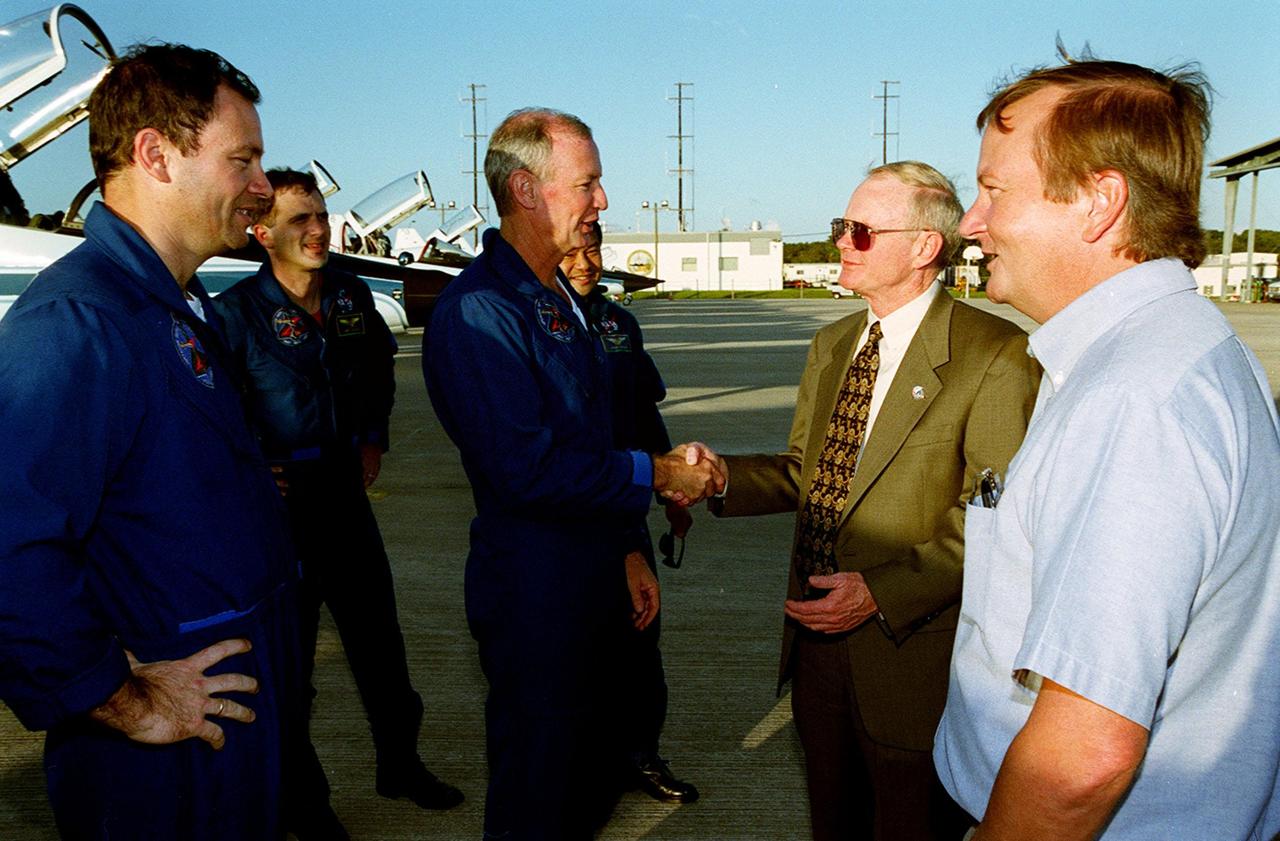
Center Director Roy Bridges greets STS-92 Commander Brian Duffy after the crew’s arrival at the KSC Shuttle Landing Facility. Behind Duffy are Mission Specialists Michael Lopez-Alegria, Jeff Wisoff and Koichi Wakata (NASDA). Next to Bridges is Michael Leinbach, the new KSC launch director. The STS-92 crew is at KSC to take part in Terminal Countdown Demonstration Test (TCDT) activities. The TCDT includes emergency egress training from the orbiter and pad, plus a simulated countdown. The fifth mission to the International Space Station, STS-92 will carry the Integrated Truss Structure Z1, the first of the planned 10 trusses on the Space Station, and the third Pressurized Mating Adapter. The Z1 will allow the first U.S. solar arrays on a future flight to be temporarily installed on Unity for early power. PMA-3 will provide a Shuttle docking port for the solar array installation on the sixth ISS flight and Lab installation on the seventh ISS flight. STS-92 is scheduled to launch Oct. 5 from launch Pad 39A. It will be the 100th flight in the Shuttle program
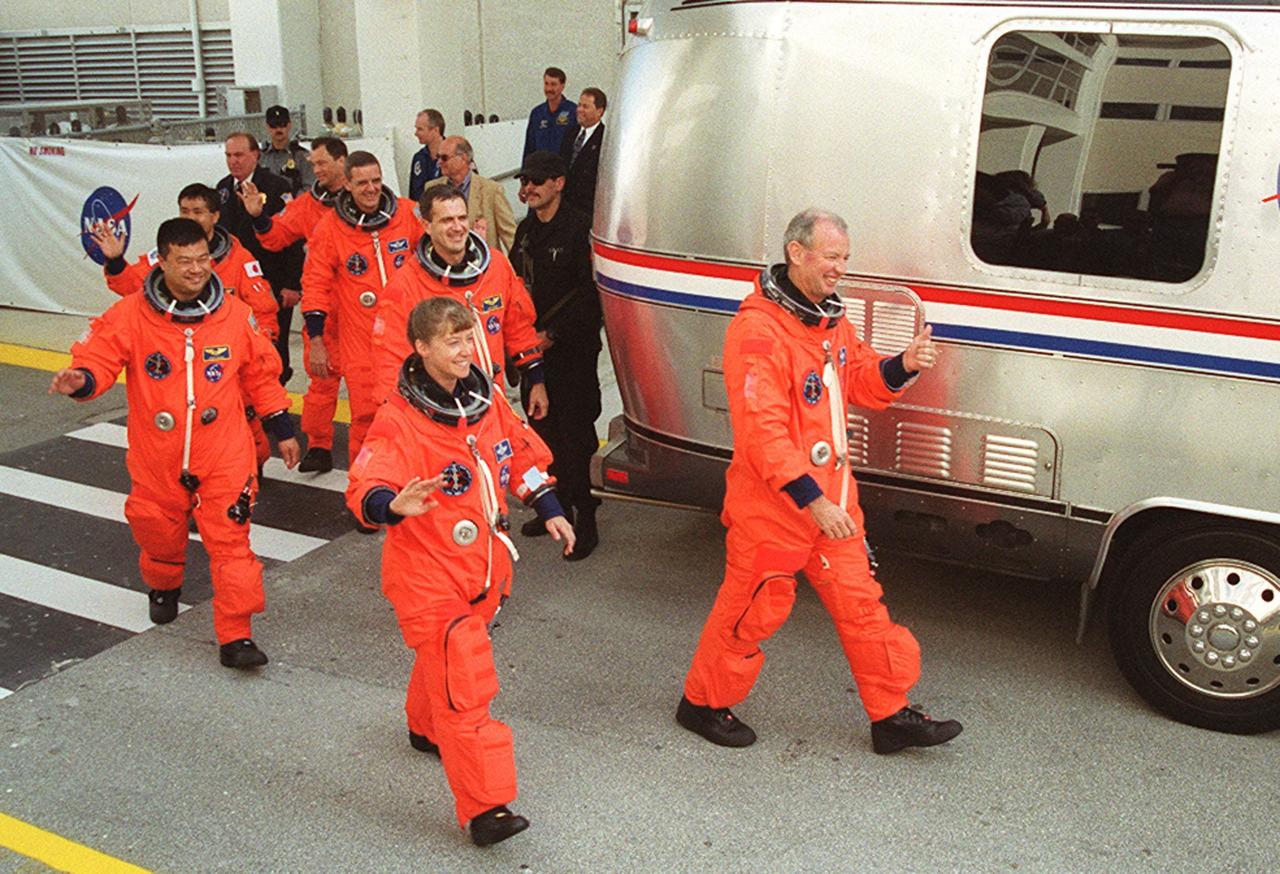
Smiling and waving at photographers and onlookers, the STS-92 crew hurries to the waiting Astrovan for the trip to Launch Pad 39A and liftoff of Space Shuttle Discovery. Clockwise from right, leading the way are Commander Brian Duffy and Pilot Pamela Ann Melroy; then Mission Specialists Leroy Chiao, Koichi Wakata of Japan, Michael Lopez-Alegria, William S. McArthur Jr. and Peter J.K. “Jeff” Wisoff. During the 11-day mission to the International Space Station, four extravehicular activities (EVAs), or spacewalks, are planned for construction. The payload includes the Integrated Truss Structure Z-1 and the third Pressurized Mating Adapter. The Z-1 truss is the first of 10 that will become the backbone of the Space Station, eventually stretching the length of a football field. PMA-3 will provide a Shuttle docking port for solar array installation on the sixth Station flight and Lab installation on the seventh Station flight. This launch is the fourth for Duffy and Wisoff, the third for Chiao and McArthur, second for Wakata and Lopez-Alegria, and first for Melroy. Launch is scheduled for 7:17 p.m. EDT. Discovery’s landing is expected Oct. 22 at 2:10 p.m. EDT
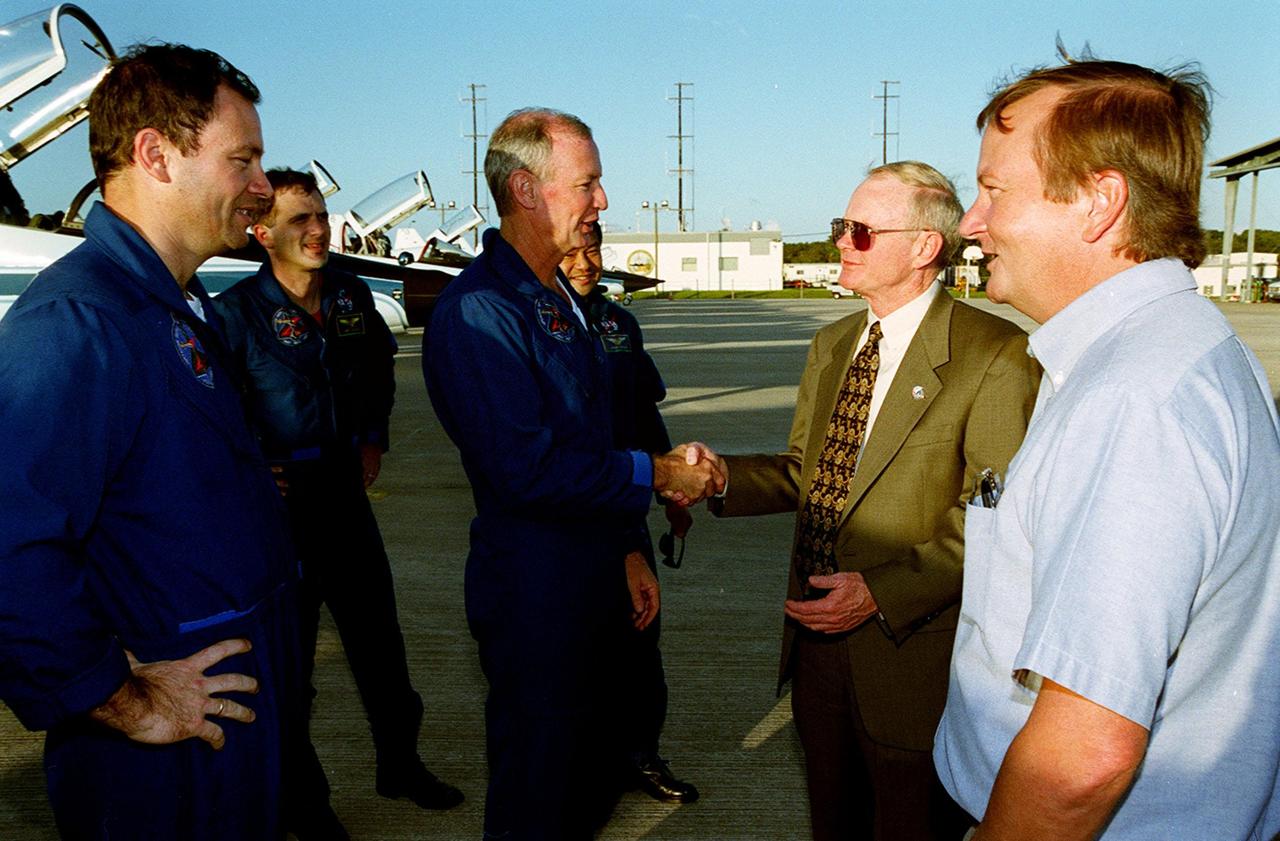
Center Director Roy Bridges greets STS-92 Commander Brian Duffy after the crew’s arrival at the KSC Shuttle Landing Facility. Behind Duffy are Mission Specialists Michael Lopez-Alegria, Jeff Wisoff and Koichi Wakata (NASDA). Next to Bridges is Michael Leinbach, the new KSC launch director. The STS-92 crew is at KSC to take part in Terminal Countdown Demonstration Test (TCDT) activities. The TCDT includes emergency egress training from the orbiter and pad, plus a simulated countdown. The fifth mission to the International Space Station, STS-92 will carry the Integrated Truss Structure Z1, the first of the planned 10 trusses on the Space Station, and the third Pressurized Mating Adapter. The Z1 will allow the first U.S. solar arrays on a future flight to be temporarily installed on Unity for early power. PMA-3 will provide a Shuttle docking port for the solar array installation on the sixth ISS flight and Lab installation on the seventh ISS flight. STS-92 is scheduled to launch Oct. 5 from launch Pad 39A. It will be the 100th flight in the Shuttle program
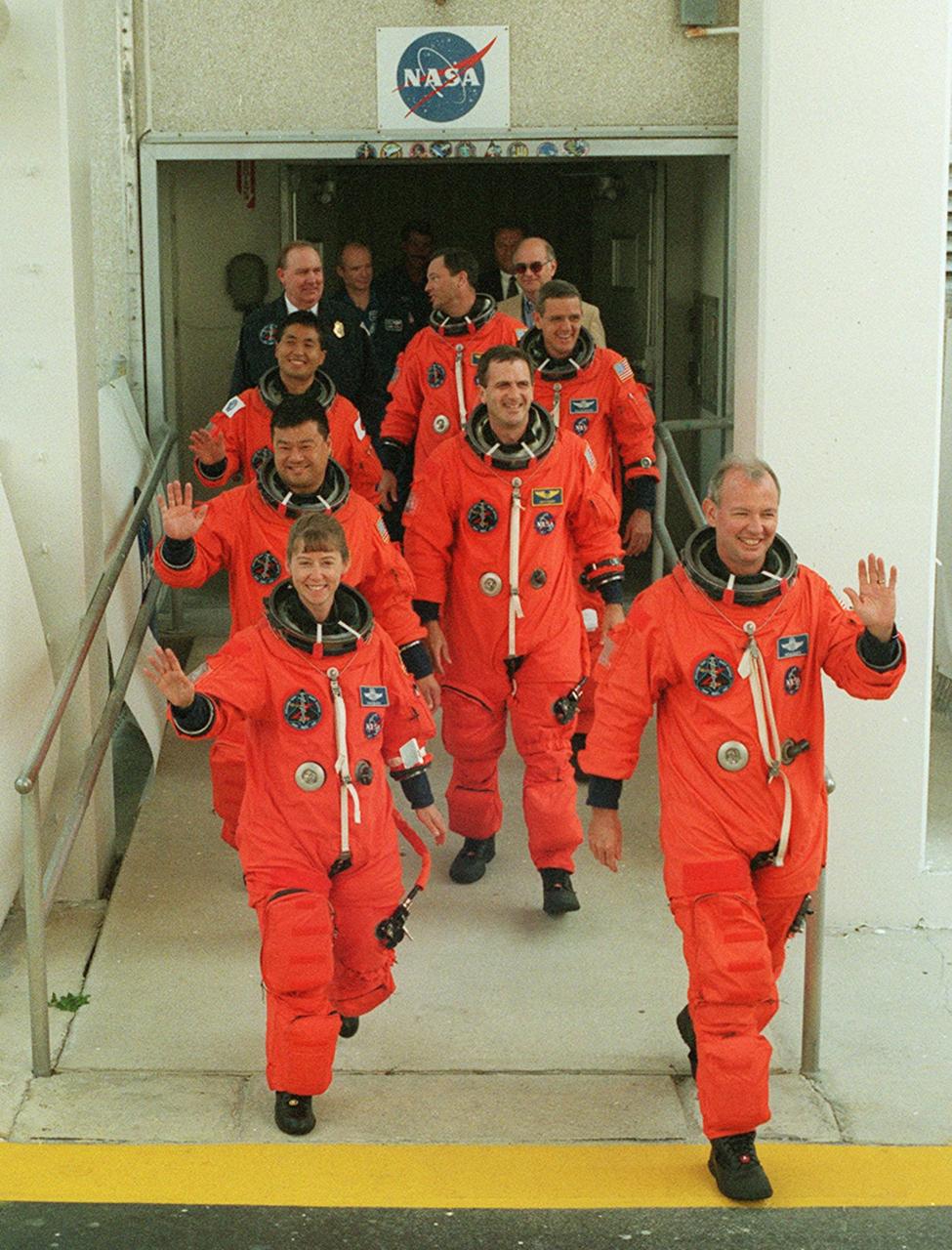
The STS-92 crew greets cheering onlookers as they exit the Operations and Checkout Building for the trip to Launch Pad 39A and liftoff of Space Shuttle Discovery. In rows of two, starting at front, are Pilot Pamela Ann Melroy and Commander Brian Duffy; Mission Specialists Leroy Chiao, Peter J.K. “Jeff” Wisoff; Koichi Wakata, William S. McArthur Jr.; and Michael E. Lopez-Alegria taking up the rear. . This launch is the fourth for Duffy and Wisoff, the third for Chiao and McArthur, second for Wakata and Lopez-Alegria, and first for Melroy. During the 11-day mission to the International Space Station, four extravehicular activities (EVAs), or spacewalks, are planned for construction. The payload includes the Integrated Truss Structure Z-1 and the third Pressurized Mating Adapter. The Z-1 truss is the first of 10 that will become the backbone of the Space Station, eventually stretching the length of a football field. PMA-3 will provide a Shuttle docking port for solar array installation on the sixth Station flight and Lab installation on the seventh Station flight. Launch is scheduled for 7:17 p.m. EDT. Discovery’s landing is expected Oct. 22 at 2:10 p.m. EDT
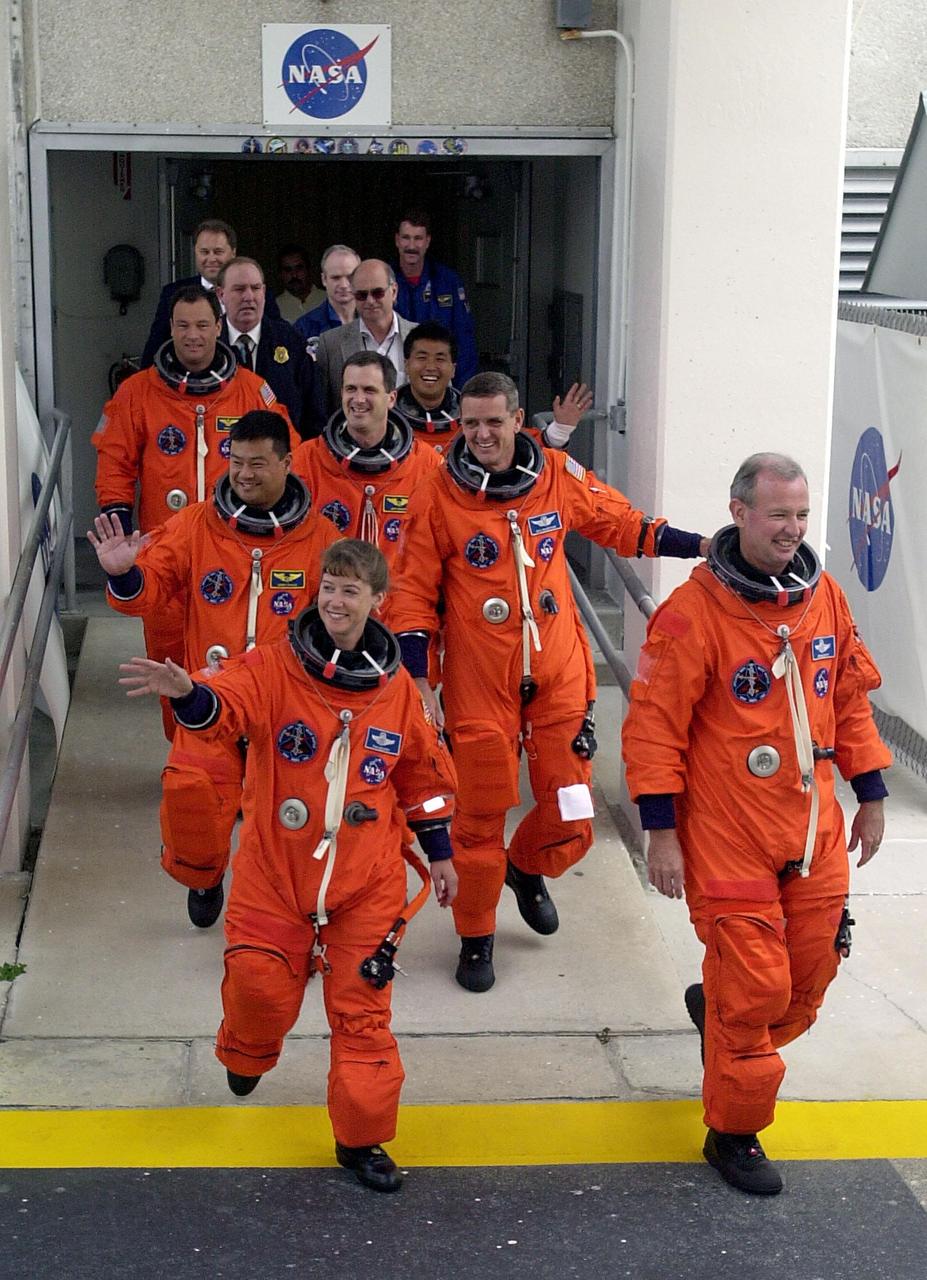
The STS-92 crew wave to onlookers as they exit the Operations and Checkout Building on their way to Launch Pad 39A for liftoff at 8:05 p.m. EDT to the International Space Station (ISS). They are (from front to back) Pilot Pamela Ann Melroy and Commander Brian Duffy; and Mission Specialists Leroy Chiao and William S. McArthur Jr.; Peter J.K. Wisoff; Michael E. Lopez-Alegria and Koichi Wakata of Japan. The mission is the fifth flight for the construction of the ISS. The payload includes the Integrated Truss Structure Z-1 and the third Pressurized Mating Adapter. During the 11-day mission, four extravehicular activities (EVAs), or spacewalks, are planned. The Z-1 truss is the first of 10 that will become the backbone of the International Space Station, eventually stretching the length of a football field. PMA-3 will provide a Shuttle docking port for solar array installation on the sixth ISS flight and Lab installation on the seventh ISS flight. This launch is the fourth for Duffy and Wisoff, the third for Chiao and McArthur, second for Wakata and Lopez-Alegria, and first for Melroy. Landing is expected Oct. 21 at 3:55 p.m. EDT
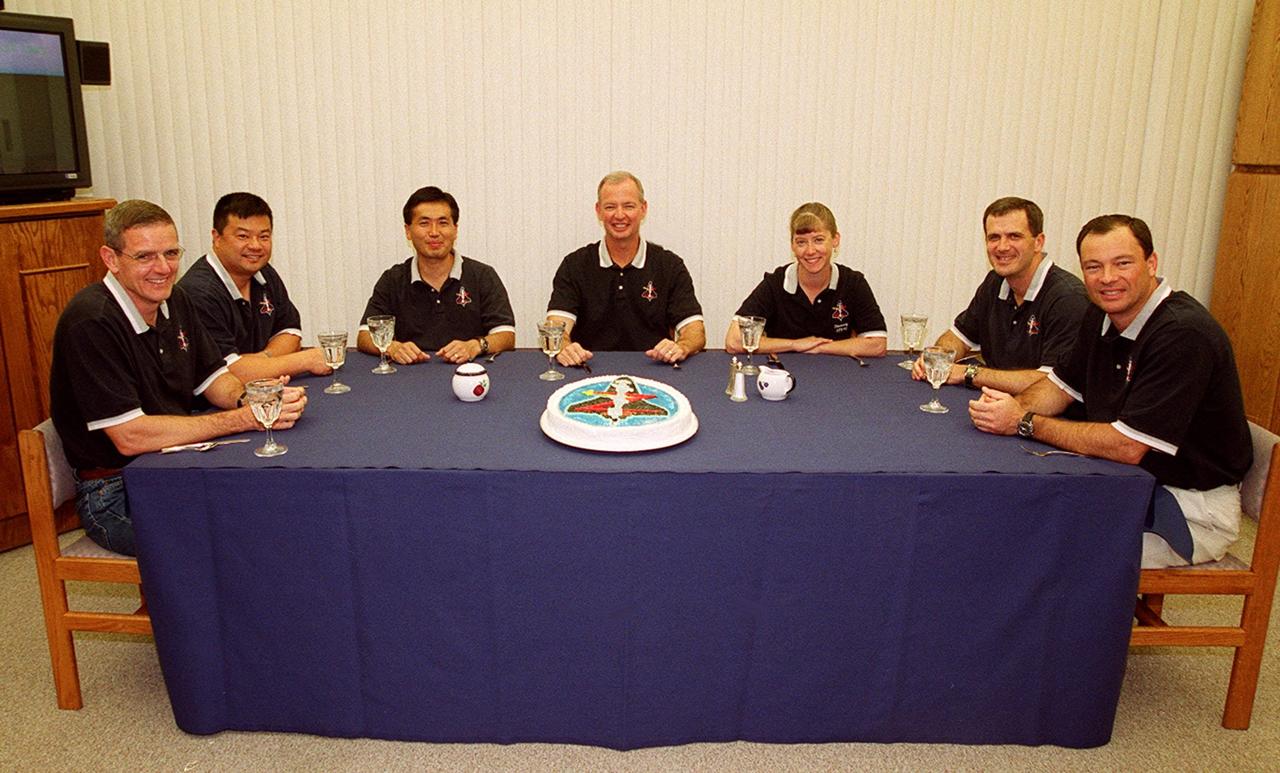
The STS-92 crew begin their journey to Launch Pad 39A with a snack. Seated at the table (left to right) are Mission Specialists William S. McArthur Jr., Leroy Chiao and Koichi Wakata of Japan; Commander Brian Duffy; Pilot Pamela Ann Melroy; and Mission Specialists Peter J.K. “Jeff” Wisoff and Michael E. Lopez-Alegria. During the 11-day mission to the International Space Station, four extravehicular activities (EVAs), or spacewalks, are planned for construction. The payload includes the Integrated Truss Structure Z-1 and the third Pressurized Mating Adapter. The Z-1 truss is the first of 10 that will become the backbone of the Space Station, eventually stretching the length of a football field. PMA-3 will provide a Shuttle docking port for solar array installation on the sixth Station flight and Lab installation on the seventh Station flight. This launch is the fourth for Duffy and Wisoff, the third for Chiao and McArthur, second for Wakata and Lopez-Alegria, and first for Melroy. Launch is scheduled for 7:17 p.m. EDT. Landing is expected Oct. 22 at 2:10 p.m. EDT
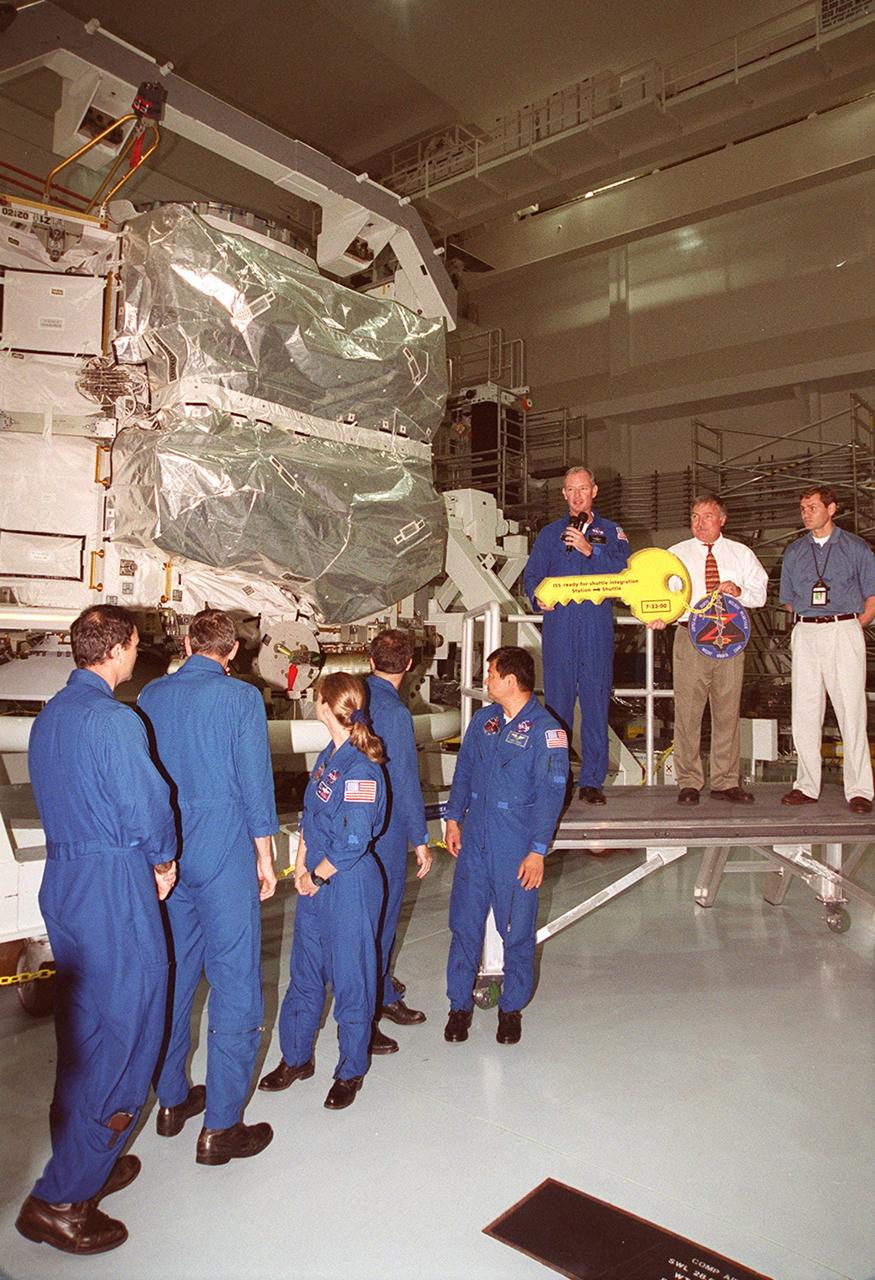
The Zenith-1 (Z-1) Truss is officially presented to NASA by The Boeing Co. on the Space Station Processing Facility floor on July 31. STS-92 Commander Col. Brian Duffy, comments on the presentation. At his side is Tip Talone, NASA director of International Space Station and Payload Processing at KSC. Talone and Col. Duffy received a symbolic key for the truss from John Elbon, Boeing director of ISS ground operations. The Z-1 Truss is the cornerstone truss of the International Space Station and is scheduled to fly in Space Shuttle Discovery's payload pay on STS-92 targeted for launch Oct. 5, 2000. The Z-1 is considered a cornerstone truss because it carries critical components of the Station's attitude, communications, thermal and power control systems as well as four control moment gyros, high and low gain antenna systems, and two plasma contactor units used to disperse electrical charge build-ups. The Z-1 truss and a Pressurized Mating Adapter (PMA-3), also flying to the Station on the same mission, will be the first major U.S. elements flown to the ISS aboard the Shuttle since the launch of the Unity element in December 1998
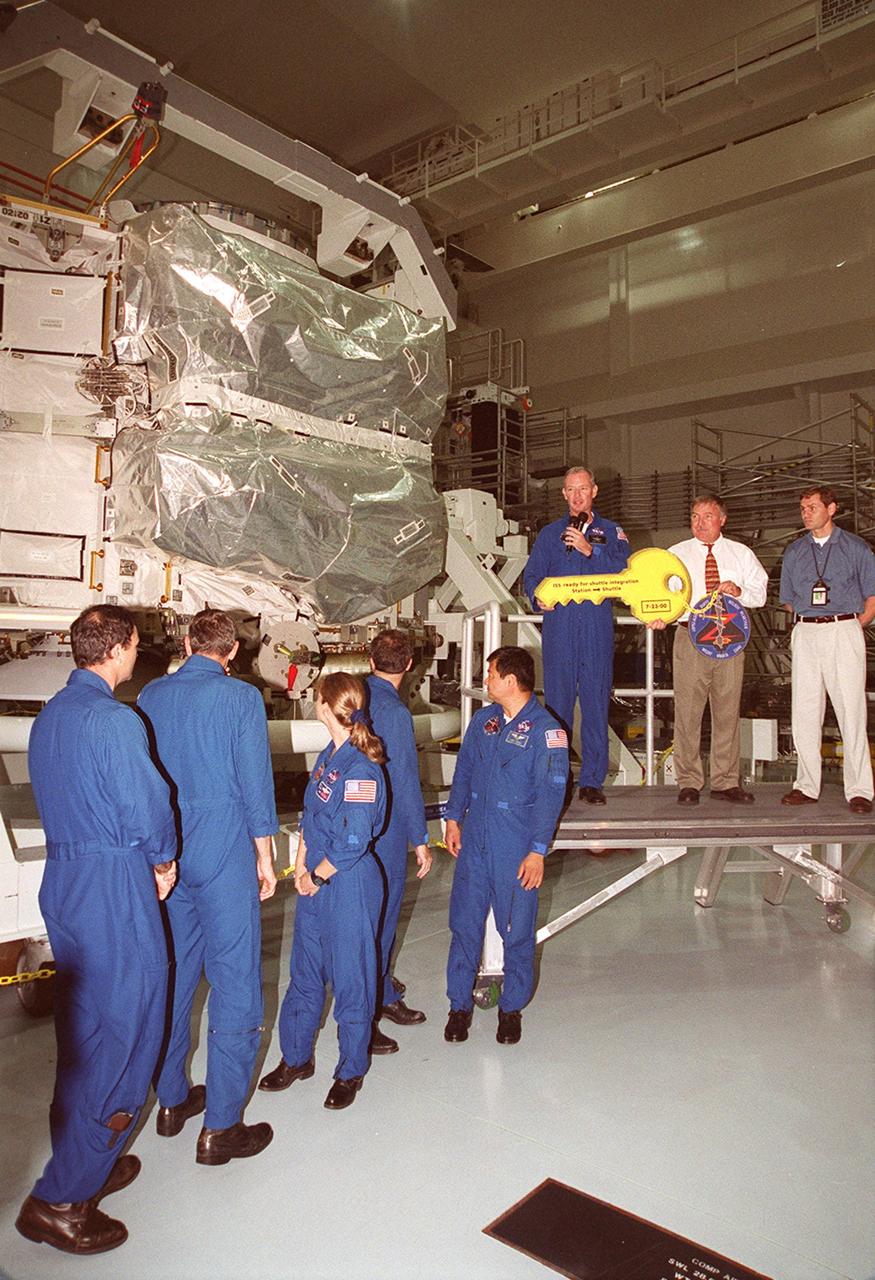
The Zenith-1 (Z-1) Truss is officially presented to NASA by The Boeing Co. on the Space Station Processing Facility floor on July 31. STS-92 Commander Col. Brian Duffy, comments on the presentation. At his side is Tip Talone, NASA director of International Space Station and Payload Processing at KSC. Talone and Col. Duffy received a symbolic key for the truss from John Elbon, Boeing director of ISS ground operations. The Z-1 Truss is the cornerstone truss of the International Space Station and is scheduled to fly in Space Shuttle Discovery's payload pay on STS-92 targeted for launch Oct. 5, 2000. The Z-1 is considered a cornerstone truss because it carries critical components of the Station's attitude, communications, thermal and power control systems as well as four control moment gyros, high and low gain antenna systems, and two plasma contactor units used to disperse electrical charge build-ups. The Z-1 truss and a Pressurized Mating Adapter (PMA-3), also flying to the Station on the same mission, will be the first major U.S. elements flown to the ISS aboard the Shuttle since the launch of the Unity element in December 1998
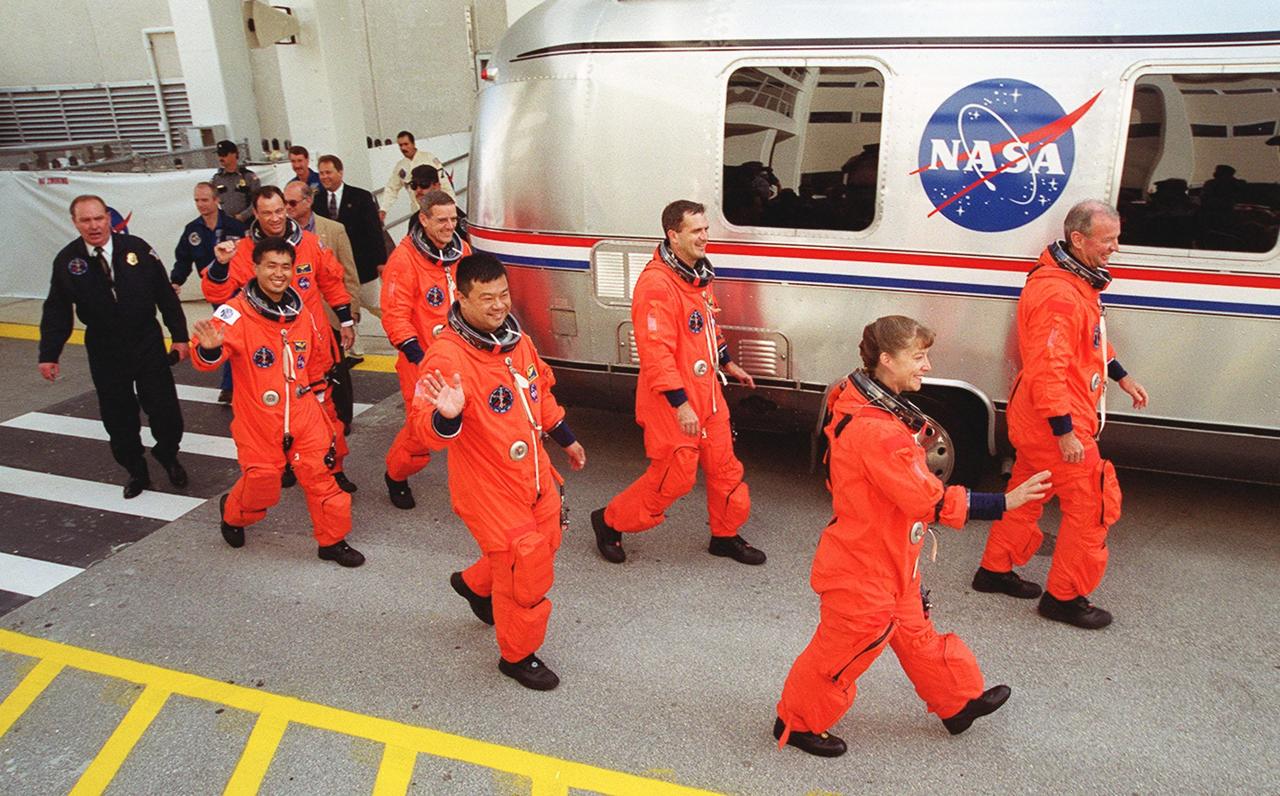
Eager to get to the launch pad and liftoff of Space Shuttle Discovery on mission STS-92, the crew hurries to the waiting Astrovan for the trip. From left are Mission Specialists Michael E. Lopez-Alegria, Koichi Wakata of Japan, William S. McArthur Jr., Leroy Chiao and Peter J.K. “Jeff” Wisoff; Pilot Pamela Ann Melroy; and Commander Brian Duffy. This launch is the fourth for Duffy and Wisoff, the third for Chiao and McArthur, second for Wakata and Lopez-Alegria, and first for Melroy. During the 11-day mission to the International Space Station, four extravehicular activities (EVAs), or spacewalks, are planned for construction. The payload includes the Integrated Truss Structure Z-1 and the third Pressurized Mating Adapter. The Z-1 truss is the first of 10 that will become the backbone of the Space Station, eventually stretching the length of a football field. PMA-3 will provide a Shuttle docking port for solar array installation on the sixth Station flight and Lab installation on the seventh Station flight. Launch is scheduled for 7:17 p.m. EDT. Discovery’s landing is expected Oct. 22 at 2:10 p.m. EDT