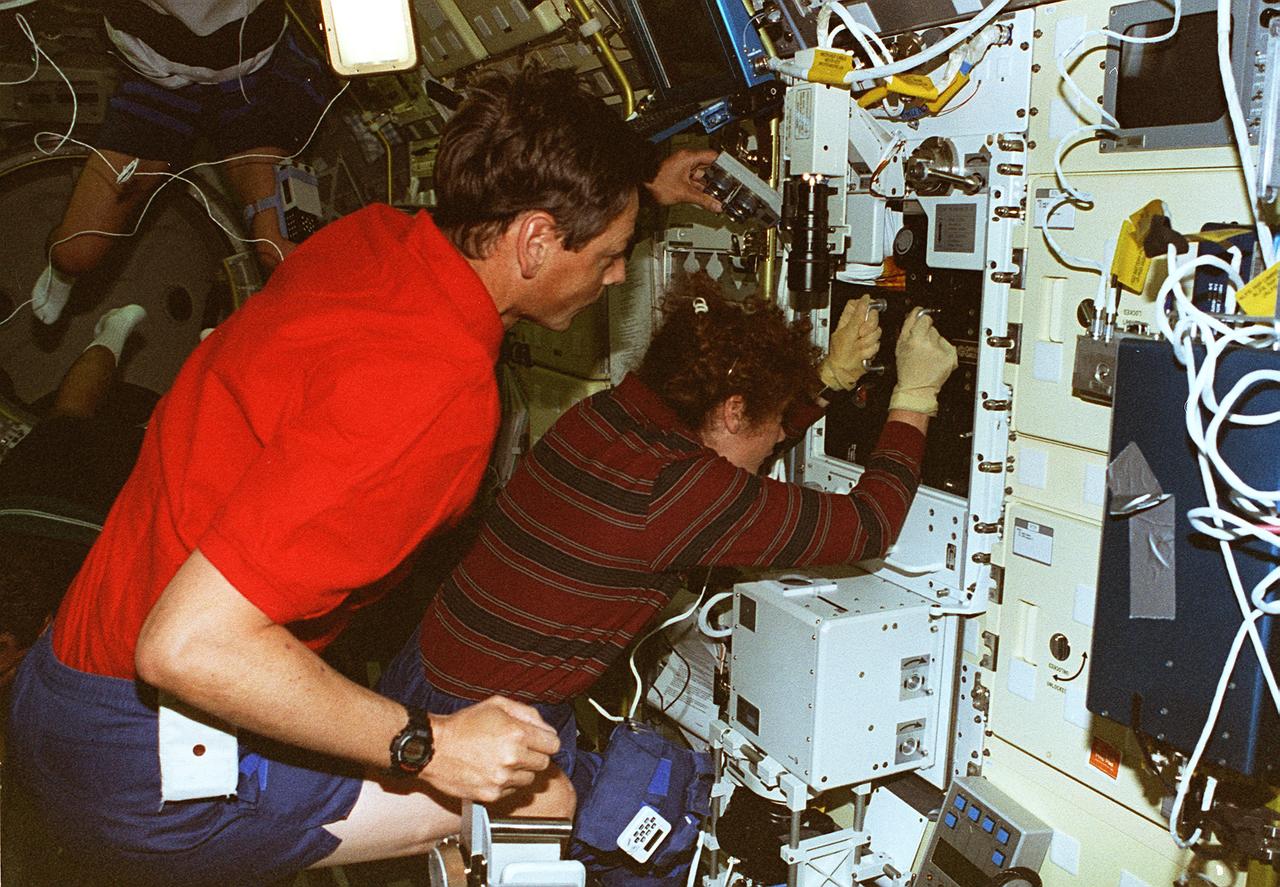
STS078-306-035 (20 June - 7 July 1996) --- Astronaut Susan J. Helms, payload commander, and payload specialist Jean-Jacques Favier, representing the French Space Agency (CNES), insert a test container into the Bubble Drop Particle Unit (BDPU) in the Life and Microgravity Spacelab (LMS-1) Science Module aboard the Space Shuttle Columbia. The fluid in the chamber is heated and the fluid processes are observed by use of three internal cameras mounted inside the BDPU. Investigations in this facility will help characterize interfacial processes involving either bubbles, drops, liquid columns or liquid layers.
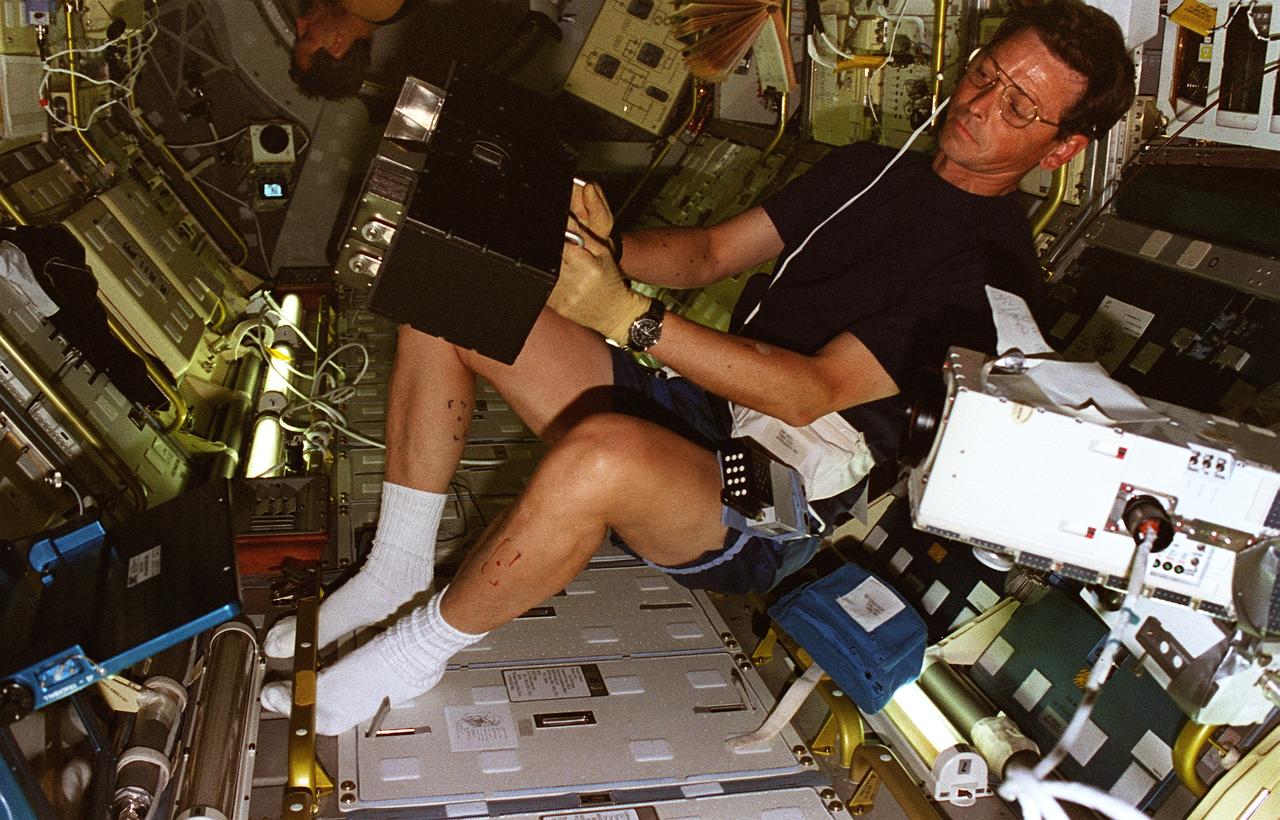
STS078-301-021 (20 June - 7 July 1996) --- Payload specialist Jean-Jacques Favier, representing the French Space Agency (CNES), holds up a test container to a Spacelab camera. The test involves the Bubble Drop Particle Unit (BDPU), which Favier is showing to ground controllers at the Marshall Space Flight Center (MSFC) in order to check the condition of the unit prior to heating in the BDPU facility. The test container holds experimental fluid and allows experiment observation through optical windows. BDPU contains three internal cameras that are used to continuously downlink BDPU activity so that behavior of the bubbles can be monitored. Astronaut Richard M. Linnehan, mission specialist, conducts biomedical testing in the background.
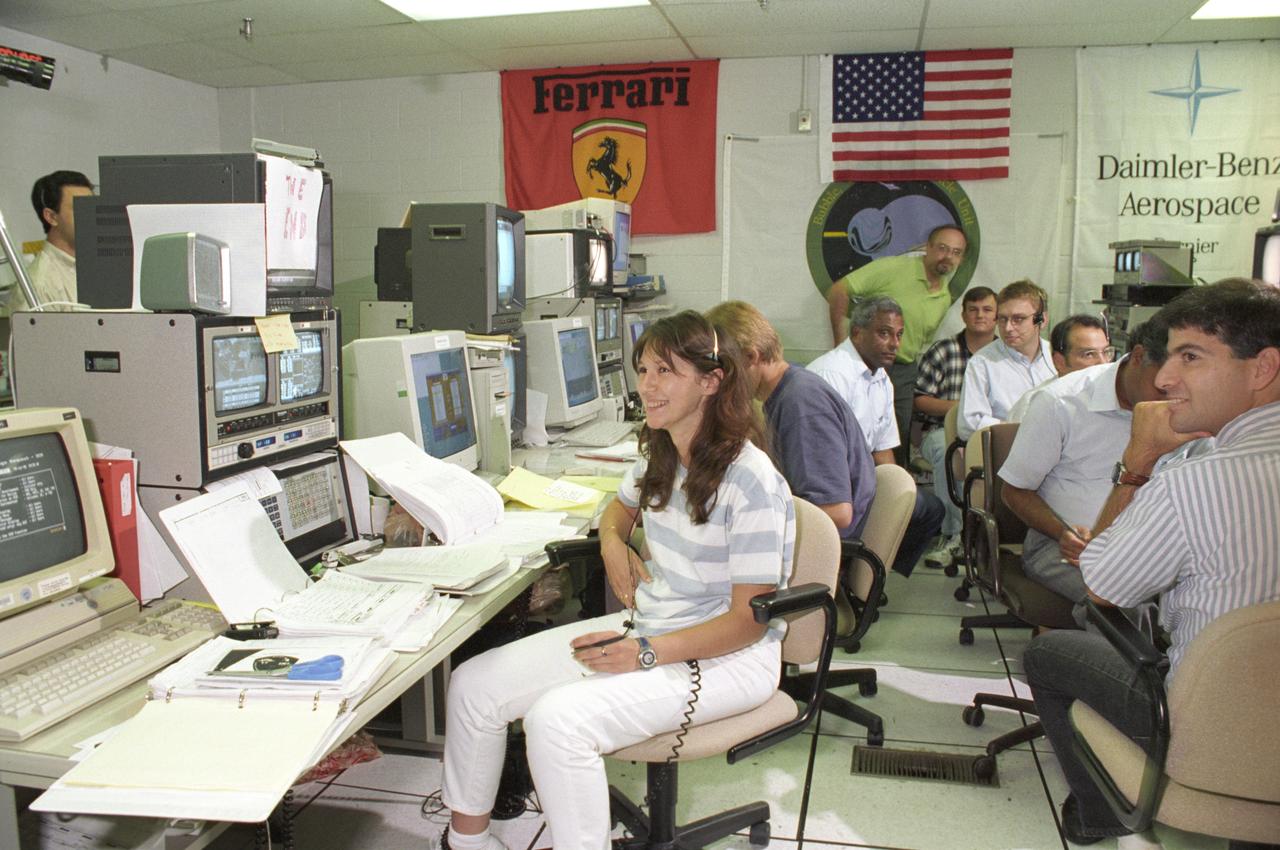
Launched on June 20, 1996, the STS-78 mission’s primary payload was the Life and Microgravity Spacelab (LMS), which was managed by the Marshall Space Flight Center (MSFC). During the 17 day space flight, the crew conducted a diverse slate of experiments divided into a mix of life science and microgravity investigations. In a manner very similar to future International Space Station operations, LMS researchers from the United States and their European counterparts shared resources such as crew time and equipment. Five space agencies (NASA/USA, European Space Agency/Europe (ESA), French Space Agency/France, Canadian Space Agency /Canada, and Italian Space Agency/Italy) along with research scientists from 10 countries worked together on the design, development and construction of the LMS. This photo represents members of the Bubble Drop and Particle Unit team expressing satisfaction with a completed experiment run at the Huntsville Operations Support Center (HOSC) Spacelab Payload Operations Control Center (SL POCC) at MSFC.

STS078-397-010 (20 June - 7 July 1996) --- Payload specialist Jean-Jacques Favier, representing the French Space Agency (CNES), and astronaut Kevin R. Kregel, pilot, perform a successful Inflight Maintenance (IFM) on the Bubble Drop Particle Unit (BDPU). The IFM technique was performed initially on the ground at the Marshall Space Flight Center (MSFC) by alternate payload specialist Pedro Duque of the European Space Agency (ESA), with the procedure being recorded on video and uplinked to the crew of the Space Shuttle Columbia to aid in the repair.
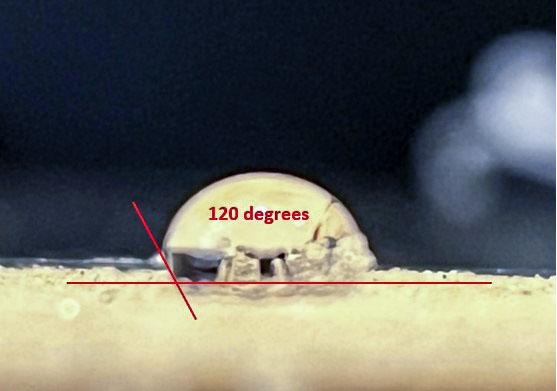
jsc2022e072961 (9/16/2022) --- Researchers drop a water droplet on the flat surface of hydrophobic fine sand. The water droplet has a contact angle of 120 degrees at the three-phase interface. The water droplet stands up and has a more rounded shape than a flattened shape compared to normal hydrophilic sand. Catastrophic Post-Wildfire Mudflows studies the formation and stability of this bubble-sand structure in microgravity. A better understanding of these phenomena could improve the understanding, modeling, and predicting of mudflows and support development of innovative solutions to prevent catastrophic post-fire events. Image courtesy of the UCSD Geo-Micromechanics Research Group.
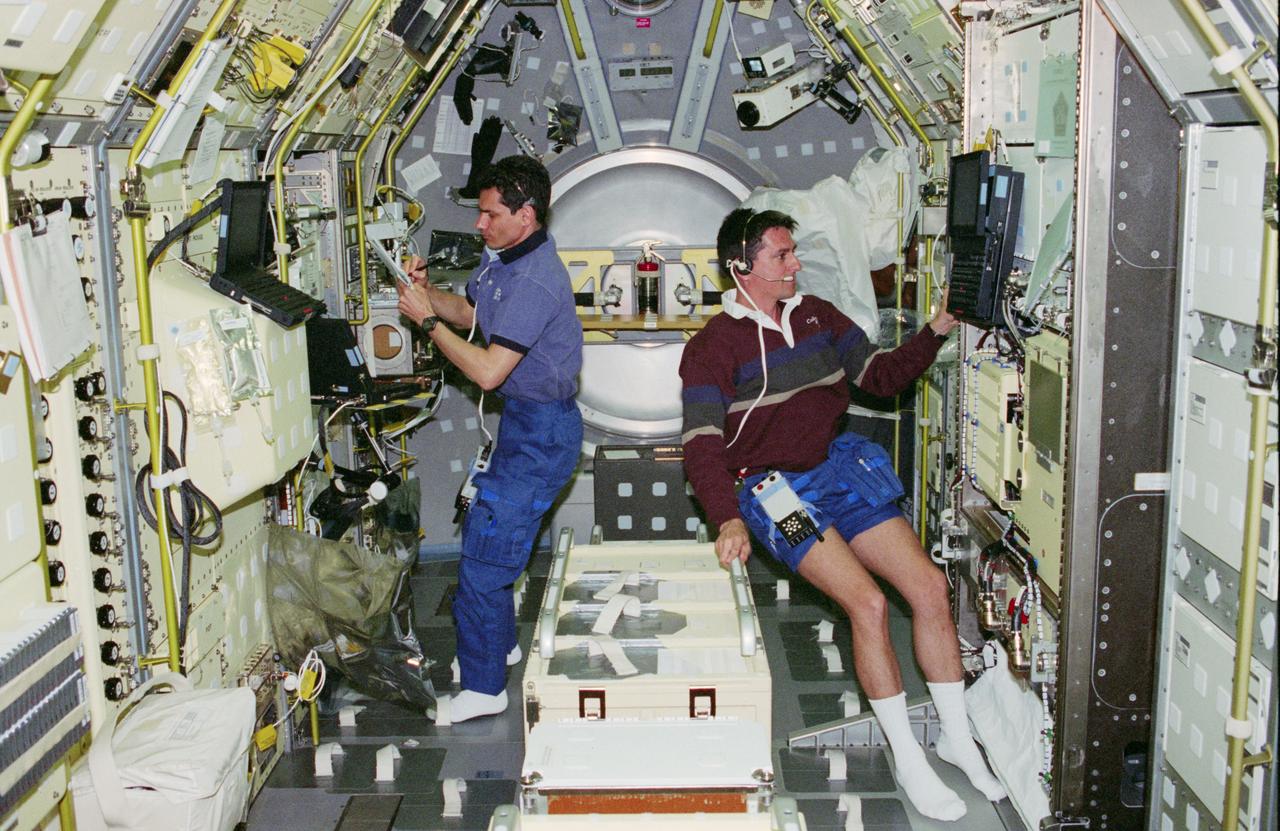
STS083-312-031 (4-8 April 1997) --- Payload specialist Gregory T. Linteris (left) is seen at the Mid Deck Glove Box (MGBX), while astronaut Donald A. Thomas, mission specialist, works at the Expedite the Processing of Experiments to Space Station (EXPRESS) rack. MGBX is a facility that allows scientists the capability of doing tests on hardware and materials that are not approved to be handled in the open Spacelab. It is equipped with photographic, video and data recording capability, allowing a complete record of experiment operations. Experiments performed on STS-83 were Bubble Drop Nonlinear Dynamics and Fiber Supported Droplet Combustion. EXPRESS is designed to provide accommodations for Sub-rack payloads on Space Station. For STS-83, it held two payloads. The Physics of Hard Colloidal Spheres (PHaSE) and ASTRO-Plant Generic Bioprocessing Apparatus (ASTRO-PGBA), a facility with light and atmospheric controls which supports plant growth for commercial research.
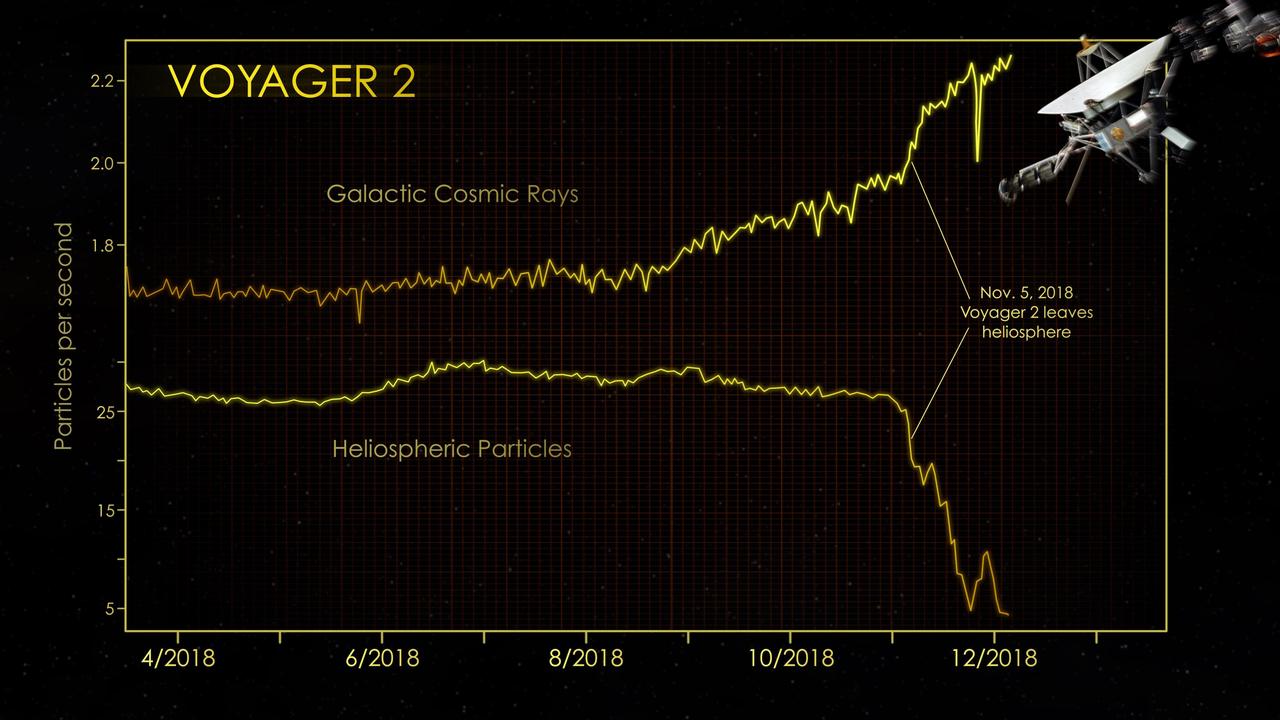
At the end of 2018, the cosmic ray subsystem (CRS) aboard NASA's Voyager 2 spacecraft provided evidence that Voyager 2 had left the heliosphere (the plasma bubble the Sun blows around itself). There were steep drops in the rate at which particles that originate inside the heliosphere hit the instrument's radiation detector. At the same time, there were significant increases in the rate at which particles that originate outside our heliosphere (also known as galactic cosmic rays) hit the detector. The graphs show data from Voyager 2's CRS, which averages the number of particle hits over a six-hour block of time. CRS detects both lower-energy particles that originate inside the heliosphere (greater than 0.5 MeV) and higher-energy particles that originate farther out in the galaxy (greater than 70 MeV). https://photojournal.jpl.nasa.gov/catalog/PIA22924

Images of the Milky Way and the Large Magellanic Cloud (LMC) are overlaid on a map of the surrounding area, our galaxy's galactic halo. Dark blue represents a low concentration of stars; lighter blues indicate increasing stellar density. The map spans from about 200,000 light-years to 325,000 light-years from the galactic center and provides the first clear view of the major features in this region. The LMC is orbiting the Milky Way and will eventually merge with it. The high concentration in the lower half is a wake created by the LMC as it sails through the galactic halo. In the upper half of the image, astronomers observed an apparent excess of stars compared to the southern hemisphere. This is evidence that the Large Magellanic Cloud has pulled the Milky Way disk significantly off-center. The galactic halo can be thought of as a bubble surrounding the disk. The number of stars per area is highest near the center of the bubble, and drops off moving away from the center. If the Milky Way were in the center of the halo, astronomers would see an approximately equal number of stars in both hemispheres. But because the Milky Way has been pulled away from the center, when astronomers look into the northern hemisphere, they see more of the central, highly populated area. Comparing these two views, there is an apparent excess of stars in the northern hemisphere. The image of the Milky Way used here is from the ESA (European Space Agency) Gaia mission: https://www.eso.org/public/images/eso1908e/. https://photojournal.jpl.nasa.gov/catalog/PIA24571