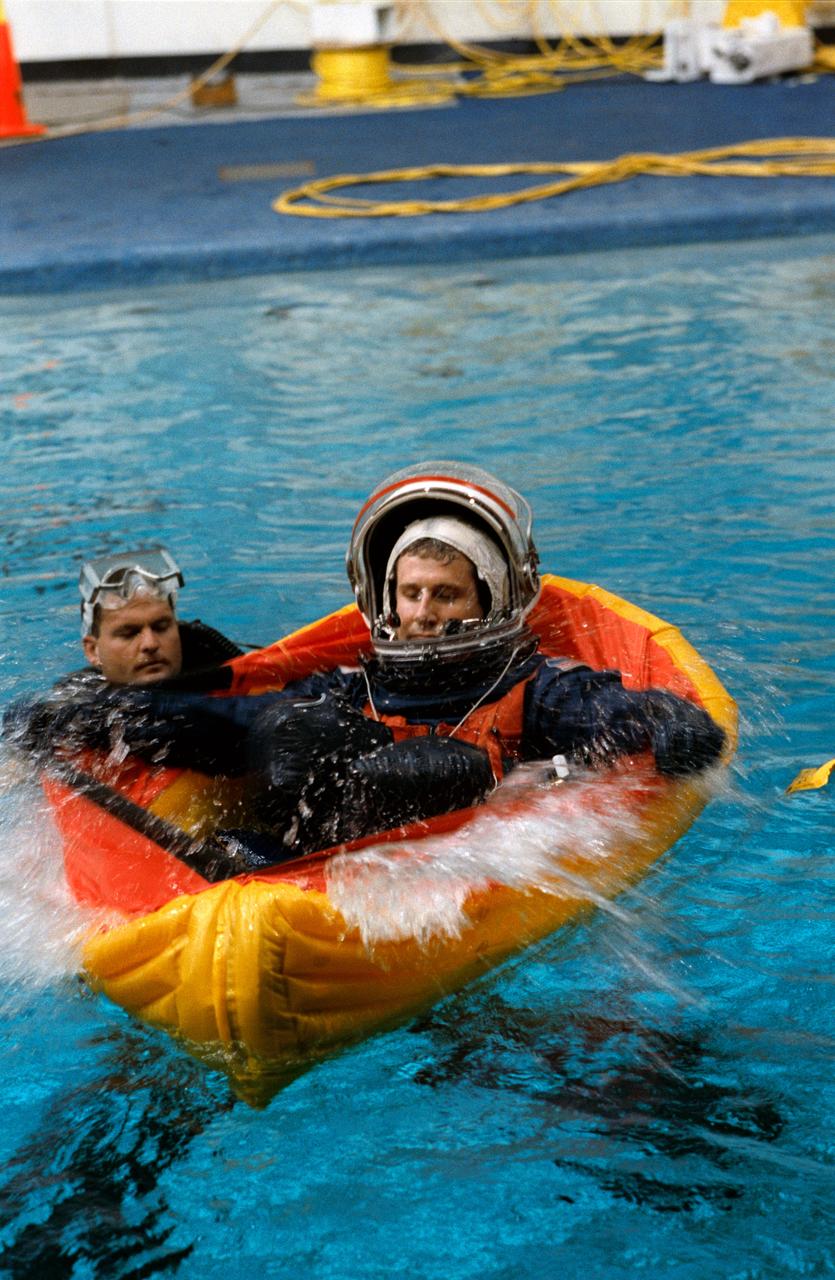
S93-43856 (7 Ssept 1993) --- Navigating a one person life raft, Jay C. Buckey, M.D., participates in emergency bailout training in the Johnson Space Center's (JSC) Weightless Environment Training Facility (WET-F). Dr. Buckey has been assigned as an alternate payload specialist for the Spacelab Life Sciences (SLS-2) mission scheduled for next month. Nearby is a SCUBA-equipped diver who assisted in the training exercises.
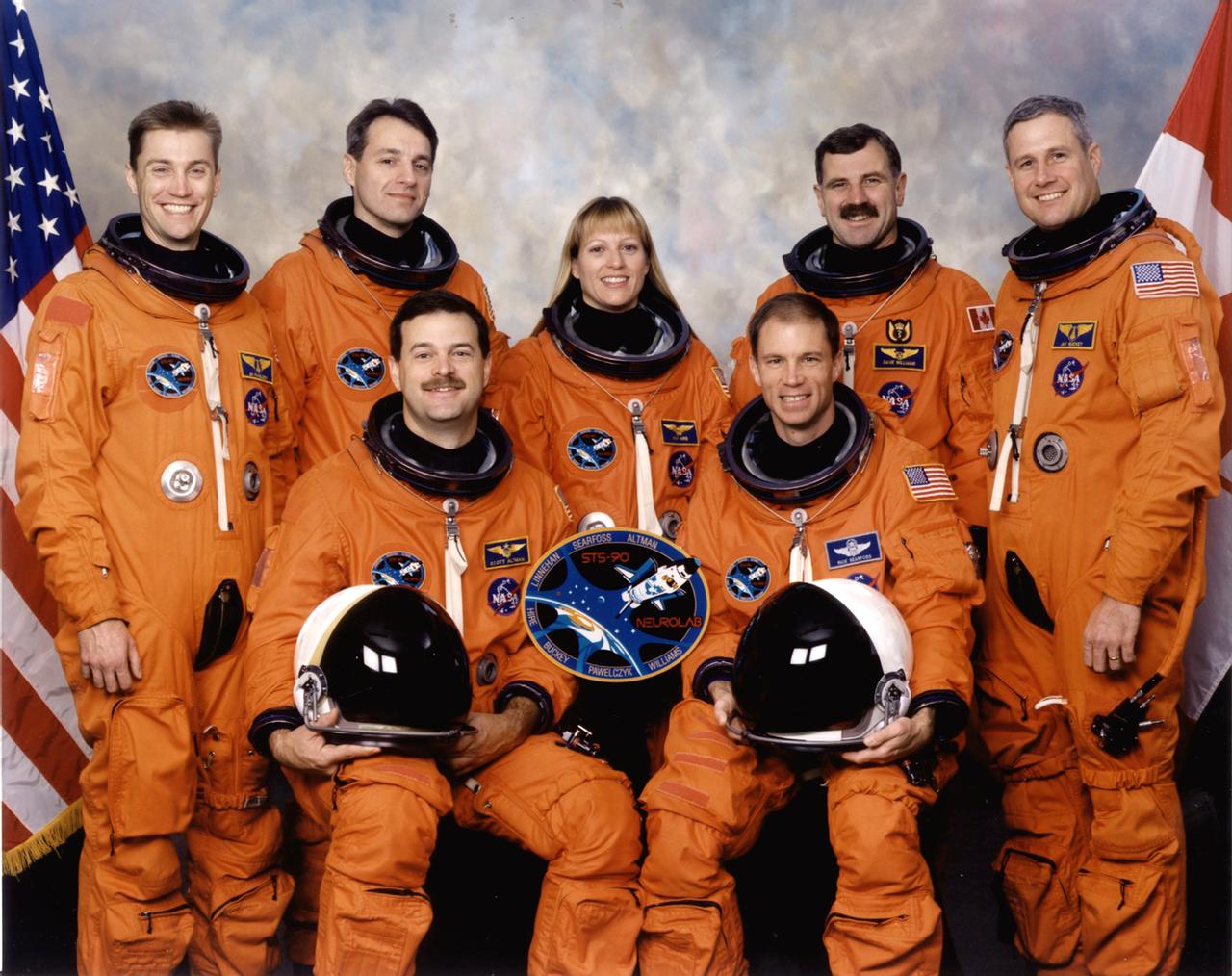
Five astronauts and two payload specialists take a break in training for the Neurolab mission to pause for a crew portrait. The Spacelab mission was conducted aboard the Space Shuttle Columbia on STS-90 which launched on April 17, 1998. Astronauts Richard A. Searfoss, commander (right front); and Scott D. Altman, pilot (left front). Other crew members (back row, left to right) are James A. (Jim) Pawelczyk, Ph.D., payload specialist; and astronauts Richard M. Linnehan, Kathryn P. Hire, and Dafydd R. (Dave) Williams, all mission specialists; along with payload specialist Jay C. Buckey, Jr., MD. Linnehan and Williams, alumnus of the 1995 class of astronaut candidates (ASCAN), represents the Canadian Space Agency (CSA).
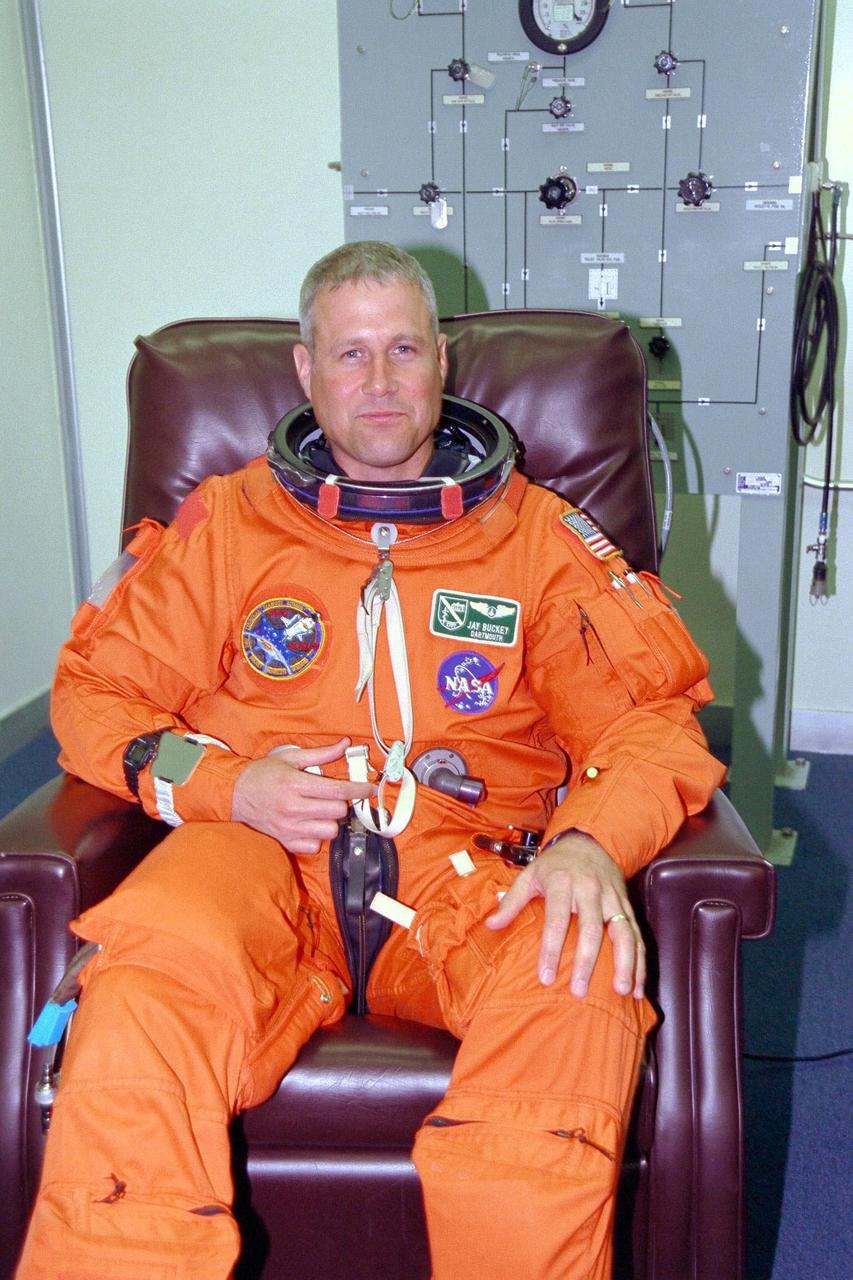
STS-90 Payload Specialist Jay Buckey, M.D., prepares for launch during suit-up activities in KSC's Operations and Checkout Building. Buckey and the rest of the STS-90 crew will shortly depart for Launch Pad 39B, where the Space Shuttle Columbia awaits a second liftoff attempt at 2:19 p.m. EDT. His first trip into space, Buckey is participating in a life sciences research flight that will focus on the most complex and least understood part of the human body the nervous system. Neurolab will examine the effects of spaceflight on the brain, spinal cord, peripheral nerves and sensory organs in the human body
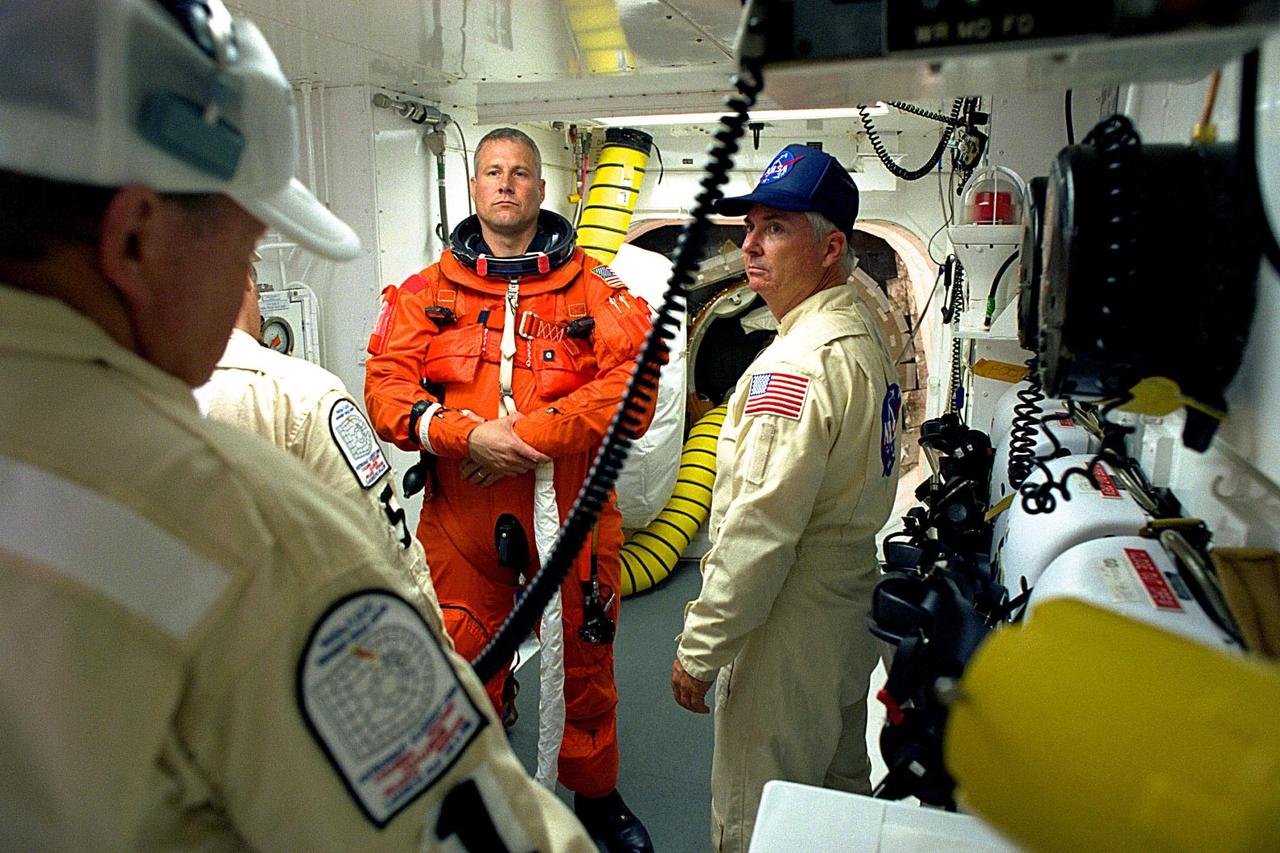
STS-90 Payload Specialist Jay Buckey, M.D., is assisted by NASA and USA closeout crew members immediately preceding launch for the nearly 17-day Neurolab mission. Investigations during the Neurolab mission will focus on the effects of microgravity on the nervous system. Buckey and six fellow crew members will shortly enter the orbiter at KSC's Launch Pad 39B, where the Space Shuttle Columbia will lift off during a launch window that opens at 2:19 p.m. EDT, April 17
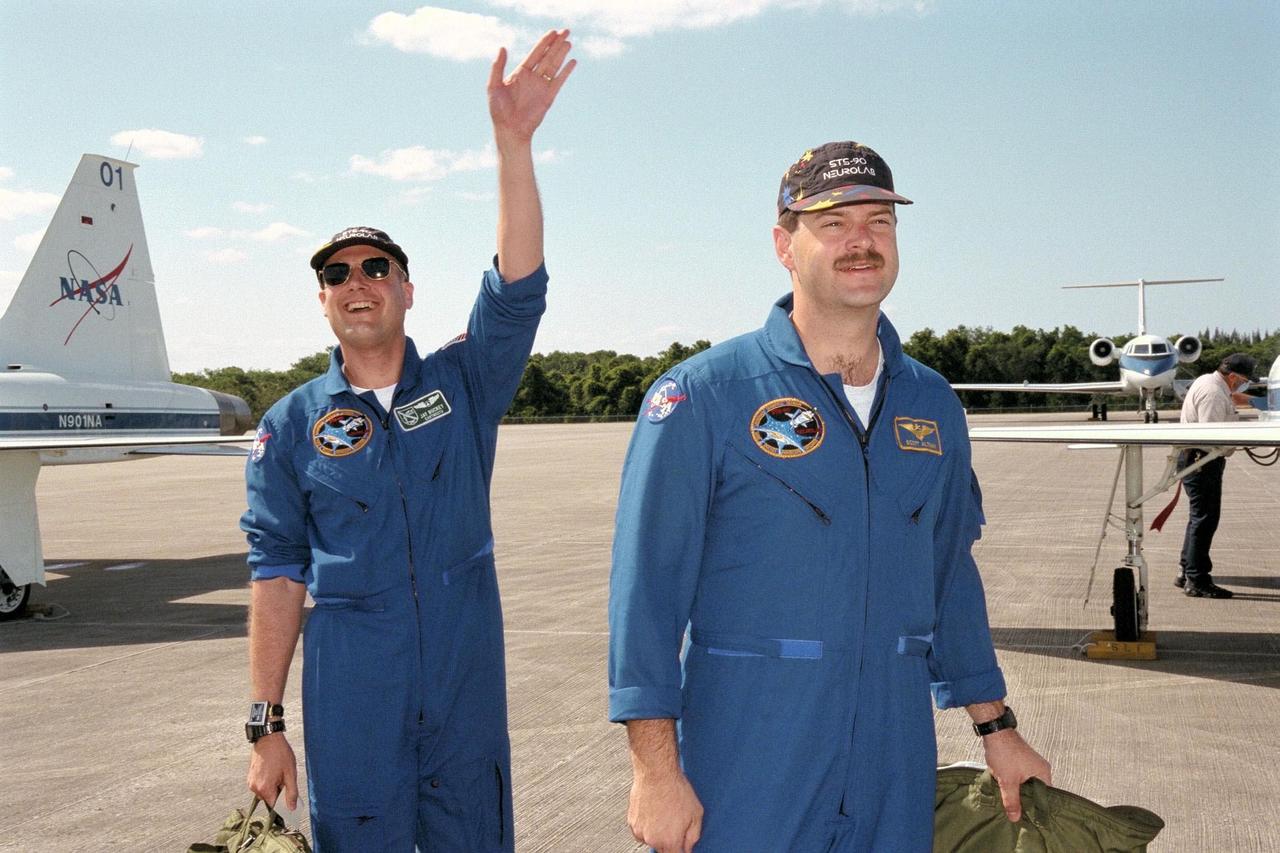
KENNEDY SPACE CENTER, FLA. -- STS-90 Payload Specialist Jay Buckey, M.D. (at left), and Pilot Scott Altman arrive at Kennedy Space Center's Shuttle Landing Facility in preparation for the launch of Columbia on April 16 at 2:19 p.m. EDT from KSC's Launch Pad 39B. The launch of Neurolab on STS-90, which will be the second mission of 1998, is scheduled to last nearly 17 days
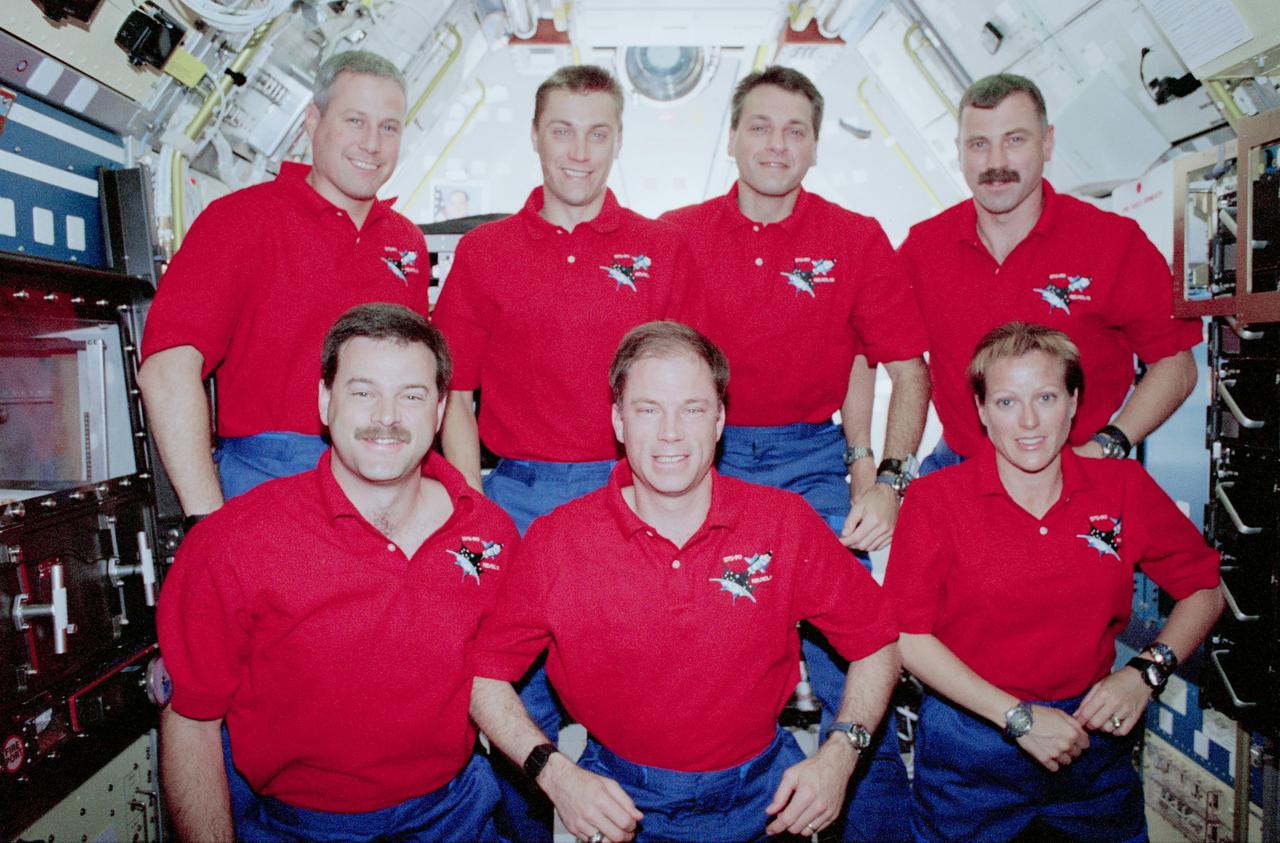
STS-90 crew crew portrait.. The various crew portraits were taken in the Spacelab module and include: back row (l.-r.) Payload specialists Jay Buckey and James Pawelczyk, Payload commander Richard Linnehan and Mission specialist Dafydd Rhys Williams. Bottom row (l.-r.) Pilot Scott Altman, Mission commander Richard Searfoss and Mission specialist Kathryn Hire. View 023 was selected by the crew for use in their postflight presentation.
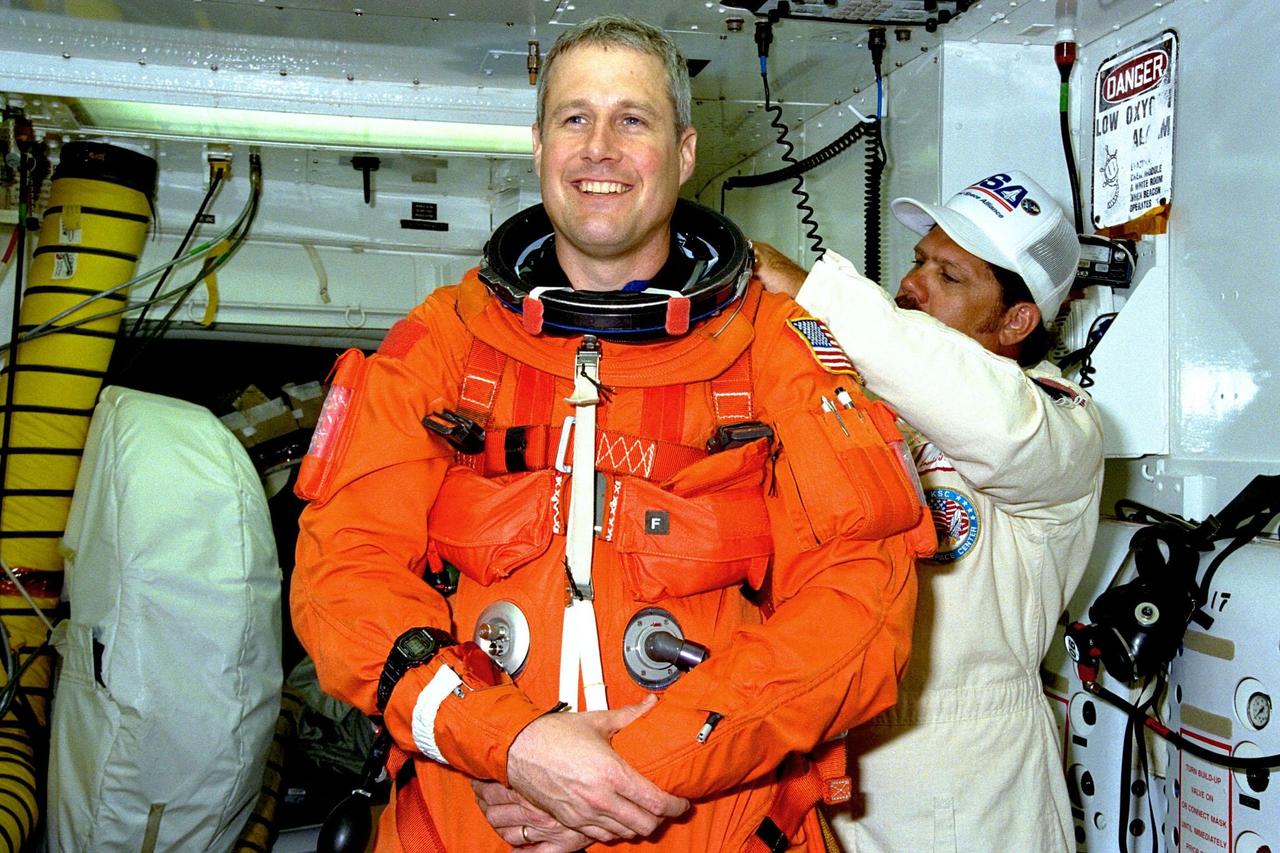
The crew of STS-90 participate in Terminal Countdown Demonstration Test (TCDT) activities at KSC's Launch Pad 39B. The TCDT is held at KSC prior to each Space Shuttle flight to provide crews with the opportunity to participate in simulated countdown activities. Here, Payload Specialist Jay Buckey, M.D., is assisted with his orange launch and re-entry suit by a USA technician. Columbia is targeted for launch of STS-90 on April 16 at 2:19 p.m. EDT and will be the second mission of 1998. The mission is scheduled to last nearly 17 days
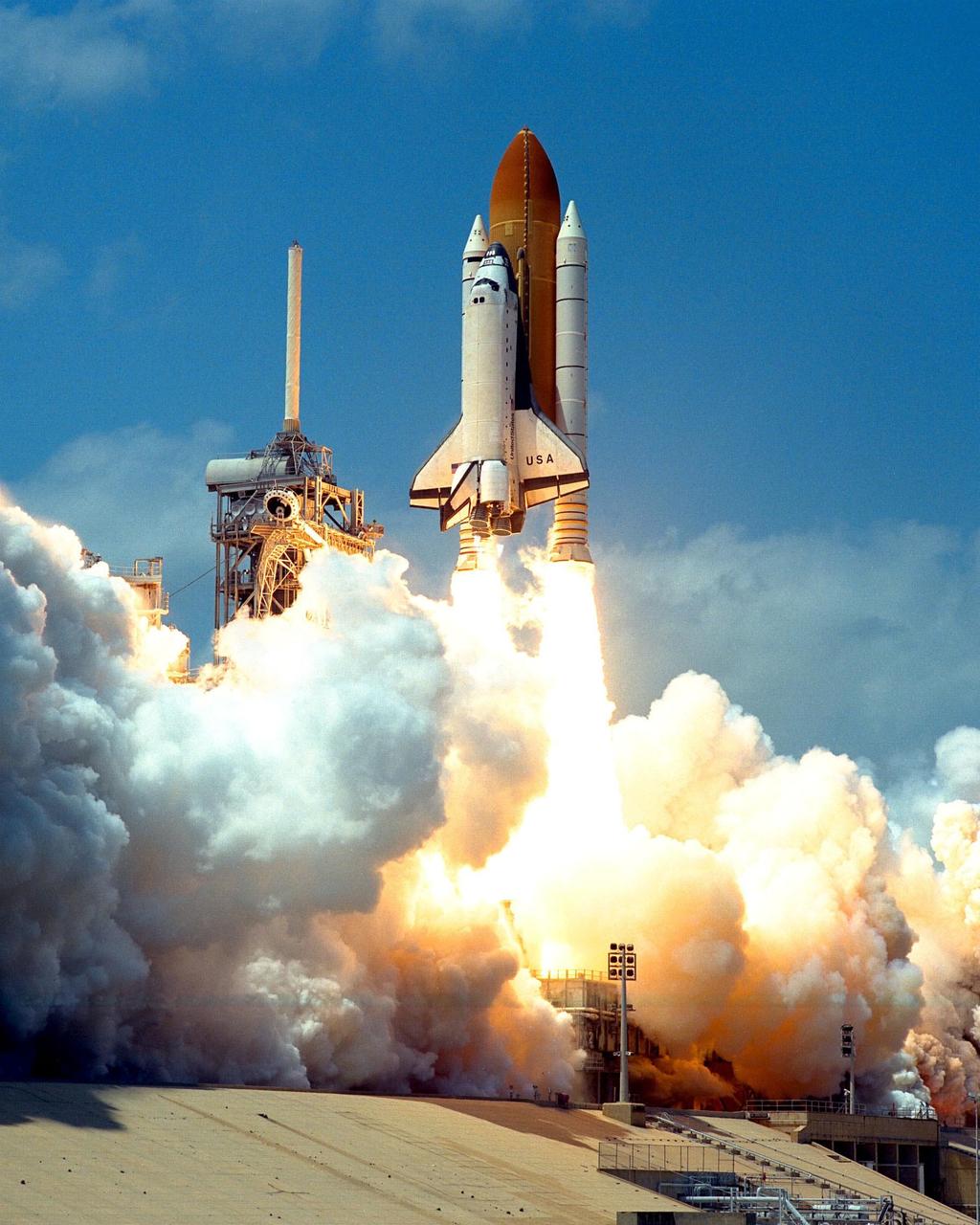
KENNEDY SPACE CENTER, FLA. -- The Space Shuttle Columbia soars from Launch Pad 39B at 2:19 p.m. EDT Apr. 17 to begin the nearly 17-day STS-90 Neurolab mission. The launch was delayed 24 hours due to difficulty with a network signal processor, which was replaced Apr. 16, on the orbiter. The crew members are Commander Richard Searfoss, Pilot Scott Altman, Mission Specialists Richard Linnehan, D.V.M., Dafydd (Dave) Williams, M.D., with the Canadian Space Agency, and Kathryn (Kay) Hire; and Payload Specialists Jay Buckey, M.D., and James Pawelczyk, Ph.D. Investigations during the Neurolab mission will focus on the effects of microgravity on the nervous system
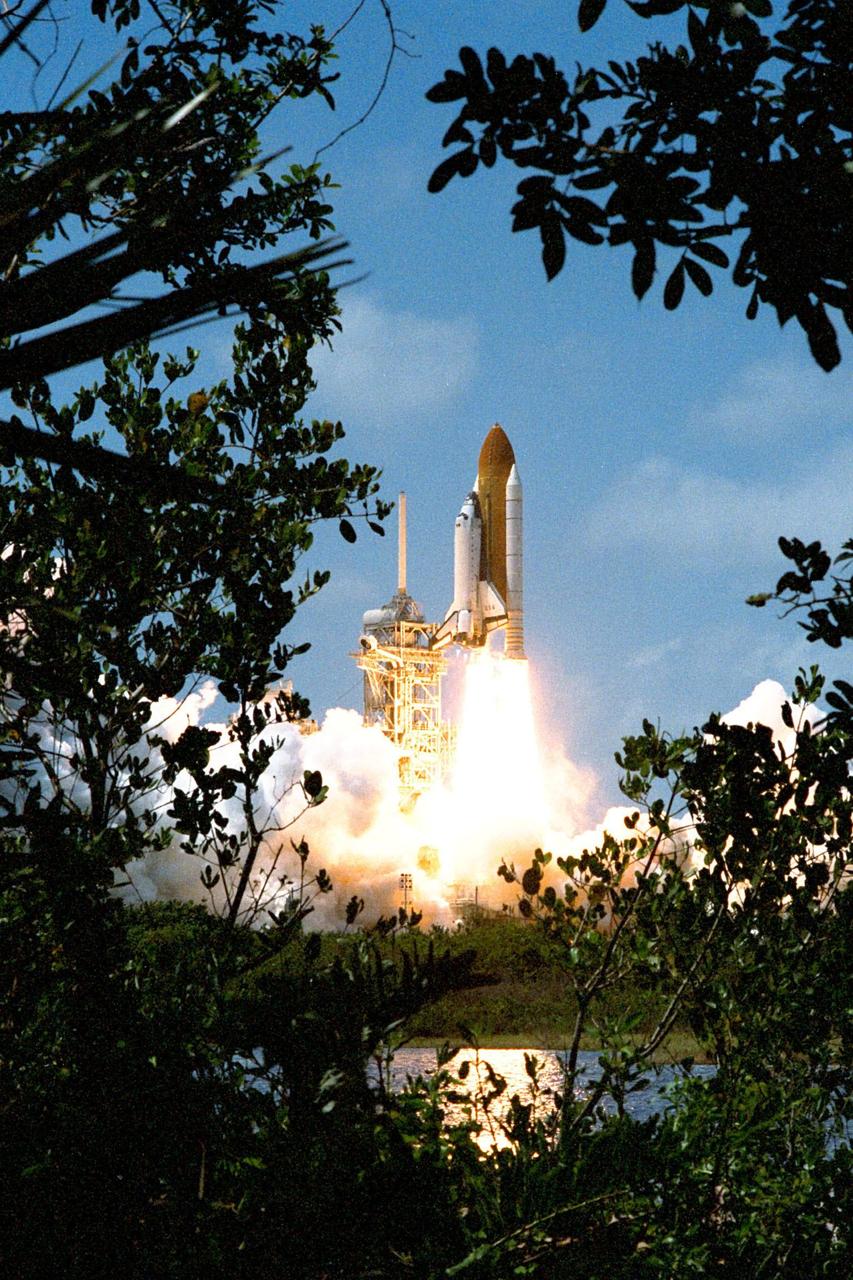
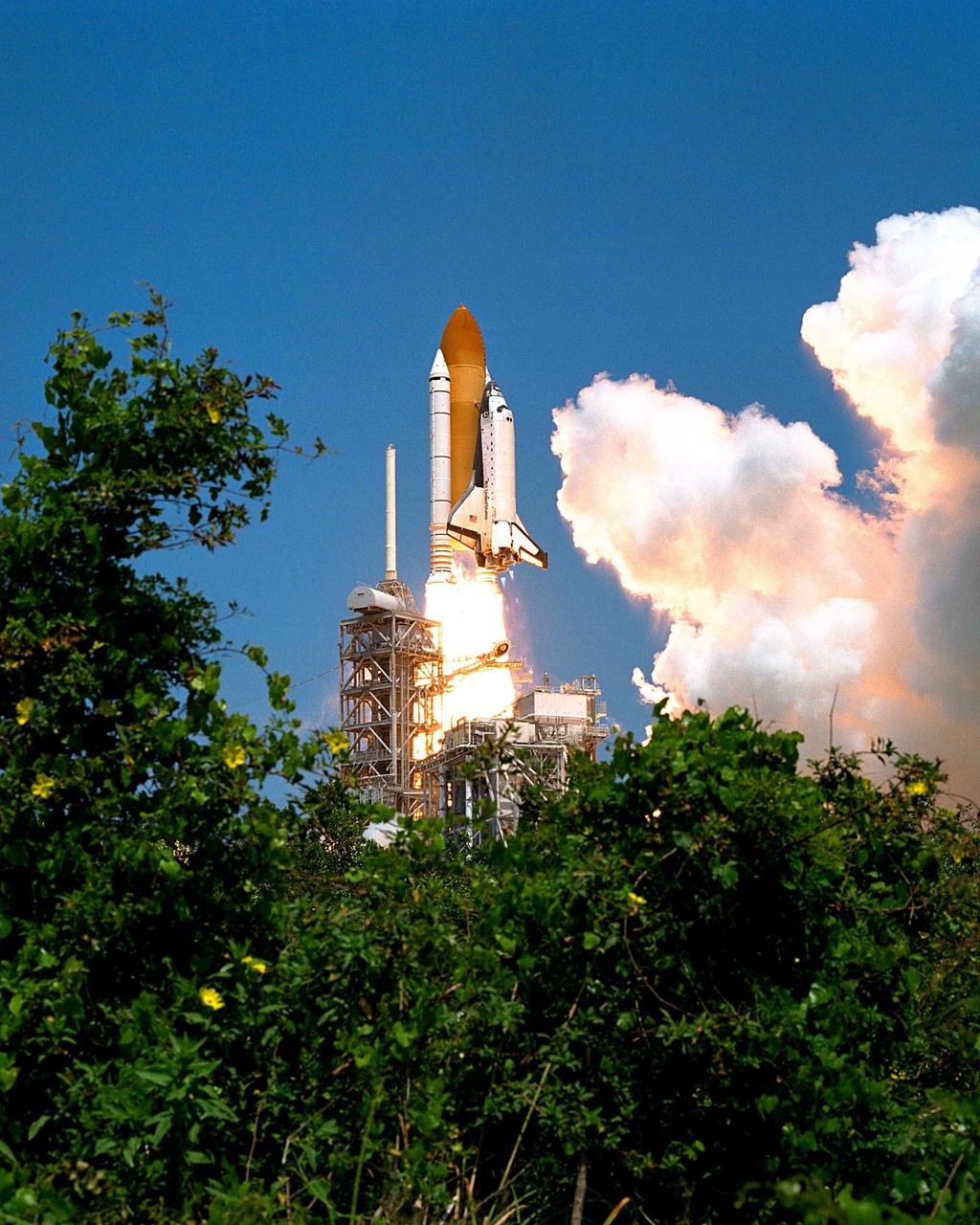
Framed by native Floridian foliage, the Space Shuttle Columbia soars from Launch Pad 39B at 2:19 p.m. EDT Apr. 17 to begin the nearly 17-day STS-90 Neurolab mission. The launch was delayed 24 hours due to difficulty with a network signal processor, which was replaced Apr. 16, on the orbiter. The crew members are Commander Richard Searfoss, Pilot Scott Altman, Mission Specialists Richard Linnehan, D.V.M., Dafydd (Dave) Williams, M.D., with the Canadian Space Agency, and Kathryn (Kay) Hire; and Payload Specialists Jay Buckey, M.D., and James Pawelczyk, Ph.D. Investigations during the Neurolab mission will focus on the effects of microgravity on the nervous system
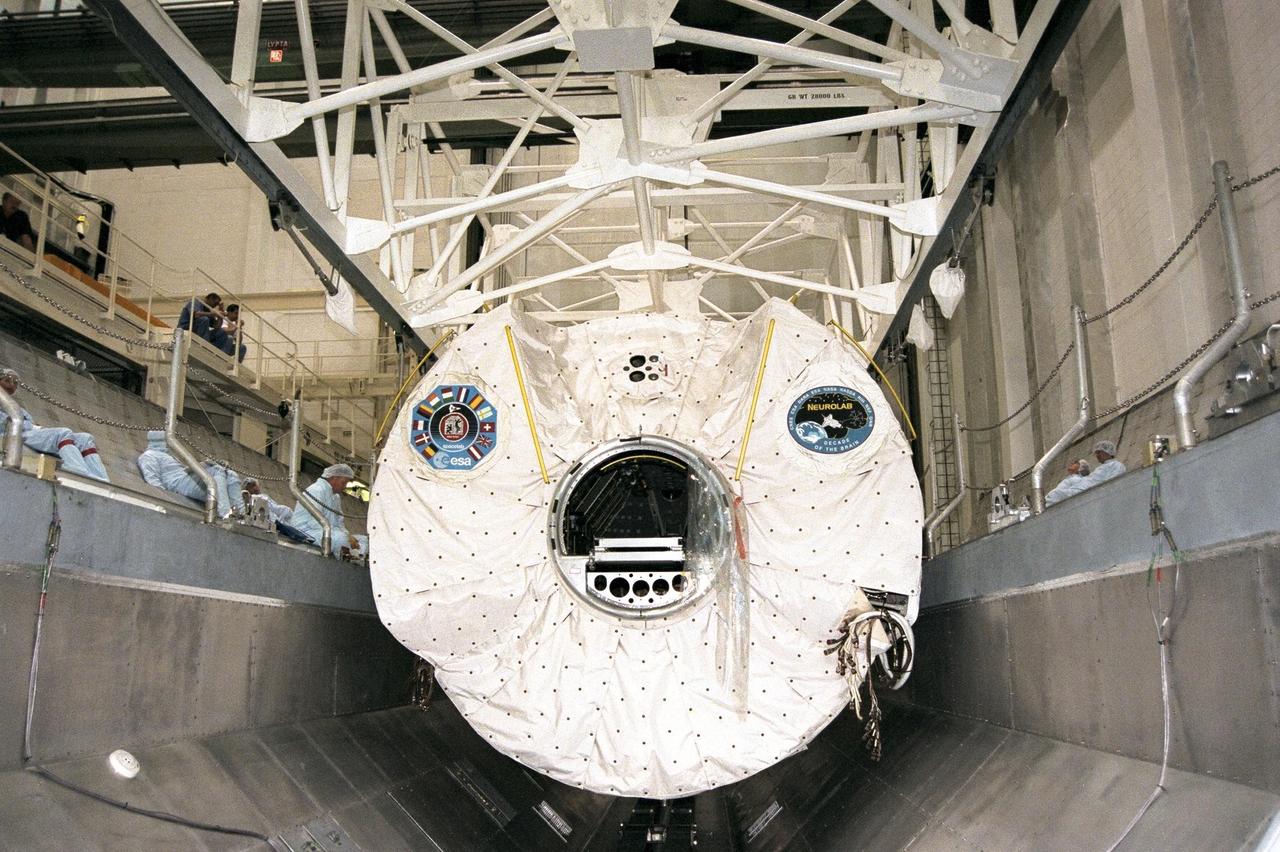
KENNEDY SPACE CENTER, FLA. -- The STS-90 Neurolab payload is lowered into its payload canister in KSC's Operations and Checkout Building. Investigations during the Neurolab mission will focus on the effects of microgravity on the nervous system. Specifically, experiments will study the adaptation of the vestibular system, the central nervous system, and the pathways that control the ability to sense location in the absence of gravity, as well as the effect of microgravity on a developing nervous system. The crew of STS-90, slated for launch in April, will include Commander Richard Searfoss, Pilot Scott Altman, Mission Specialists Richard Linnehan, Dafydd (Dave) Williams, M.D., and Kathryn (Kay) Hire, and Payload Specialists Jay Buckey, M.D., and James Pawelczyk, Ph.D
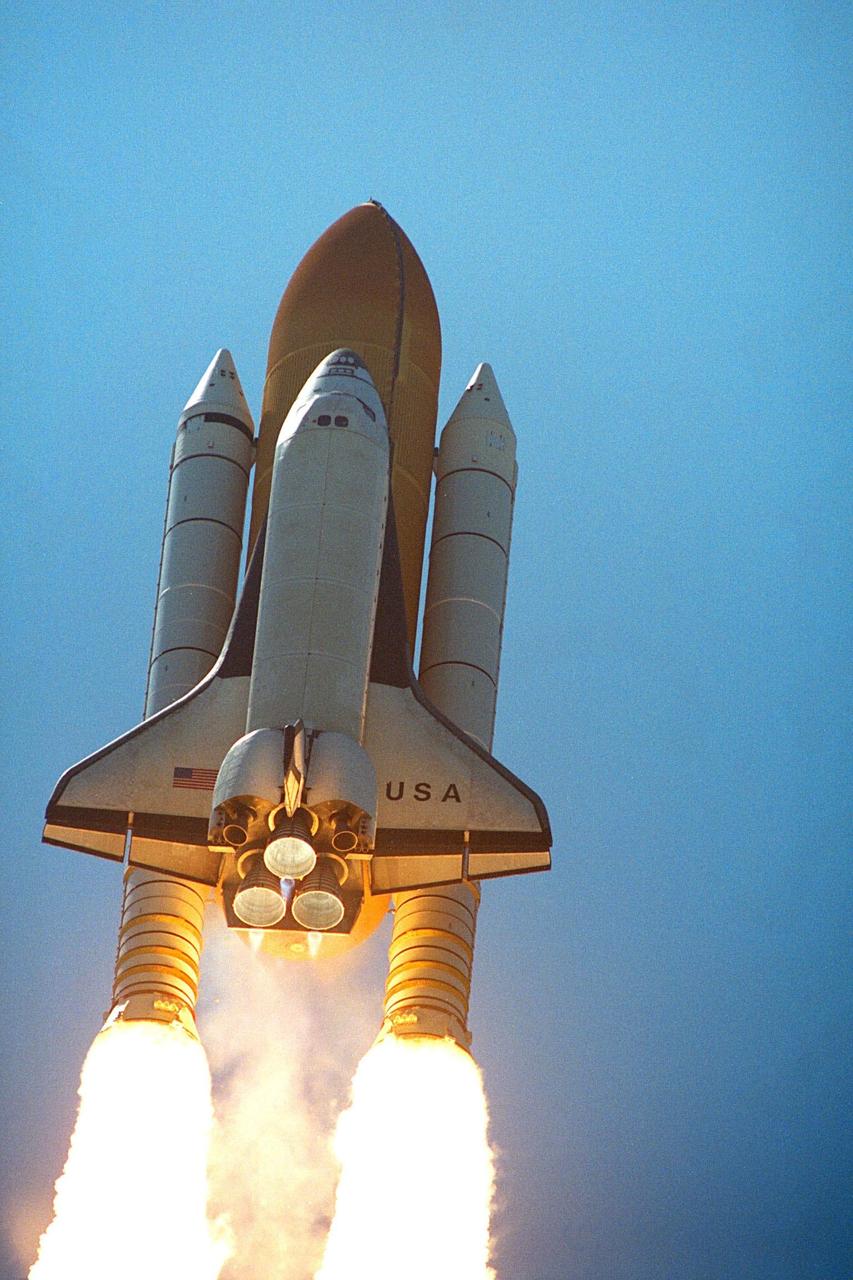
KENNEDY SPACE CENTER, FLA. -- The Space Shuttle Columbia surges skyward from Launch Pad 39B at 2:19 p.m. EDT Apr. 17 to begin the nearly 17-day STS-90 Neurolab mission. The launch was delayed 24 hours due to difficulty with a network signal processor, which was replaced Apr. 16, on the orbiter. The crew members on-board include Commander Richard Searfoss, Pilot Scott Altman, Mission Specialists Richard Linnehan, D.V.M., Dafydd (Dave) Williams, M.D., with the Canadian Space Agency, and Kathryn (Kay) Hire; and Payload Specialists Jay Buckey, M.D., and James Pawelczyk, Ph.D. Investigations during the Neurolab mission will focus on the effects of microgravity on the nervous system
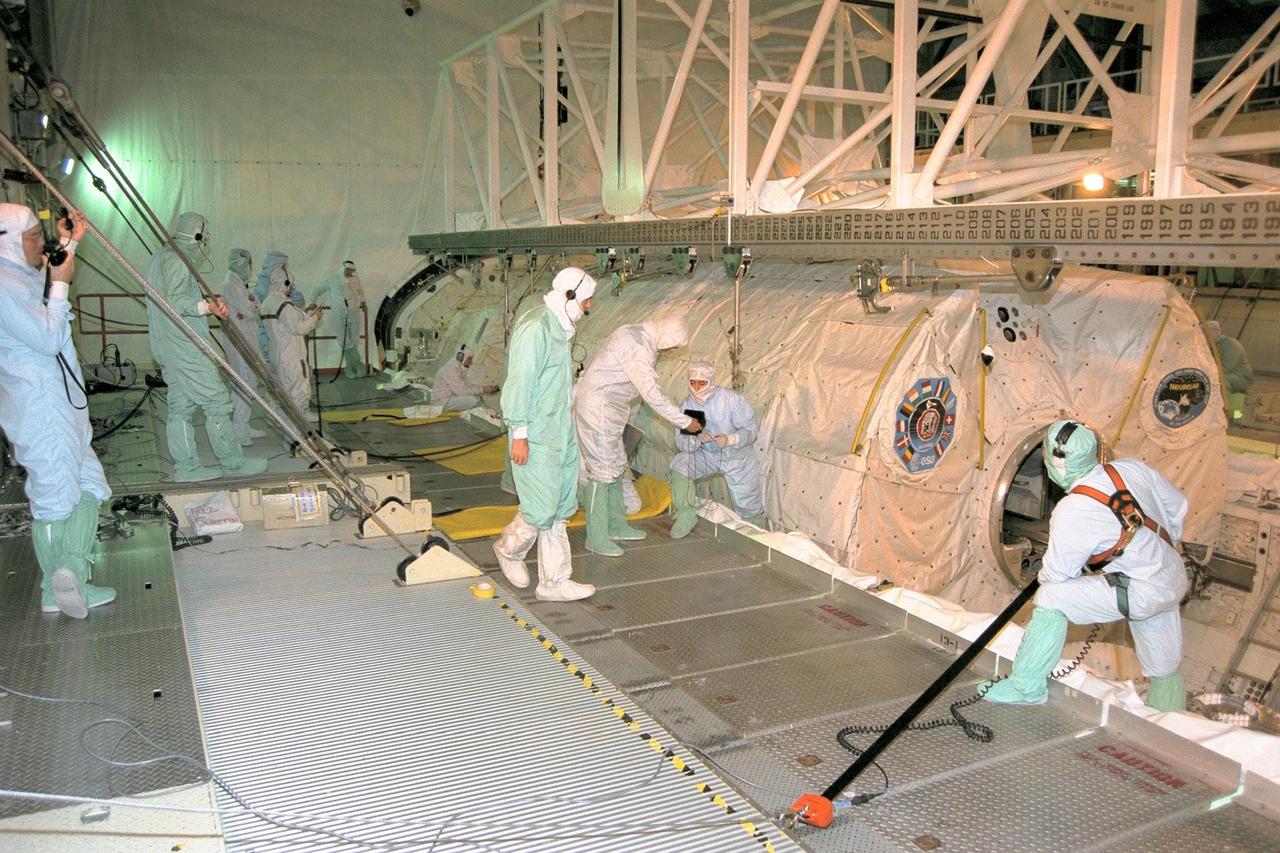
The STS-90 Neurolab payload is positioned into the cargo bay of Space Shuttle Columbia today in Orbiter Processing Facility bay 3. Investigations during the Neurolab mission will focus on the effects of microgravity on the nervous system. Specifically, experiments will study the adaptation of the vestibular system, the central nervous system, and the pathways that control the ability to sense location in the absence of gravity, as well as the effect of microgravity on a developing nervous system. The crew of STS-90, slated for launch in April, will include Commander Richard Searfoss, Pilot Scott Altman, Mission Specialists Richard Linnehan, Dafydd (Dave) Williams, M.D., and Kathryn (Kay) Hire, and Payload Specialists Jay Buckey, M.D., and James Pawelczyk, Ph.D
KENNEDY SPACE CENTER, FLA. -- The Space Shuttle Columbia soars from Launch Pad 39B at 2:19 p.m. EDT Apr. 17 to begin the STS-90 Neurolab mission. The launch was delayed 24 hours due to difficulty with a network signal processor, which was replaced Apr. 16, on the orbiter. The crew members are Commander Richard Searfoss, Pilot Scott Altman, Mission Specialists Richard Linnehan, D.V.M., Dafydd (Dave) Williams, M.D., with the Canadian Space Agency, and Kathryn (Kay) Hire; and Payload Specialists Jay Buckey, M.D., and James Pawelczyk, Ph.D. Investigations during the Neurolab mission will focus on the effects of microgravity on the nervous system
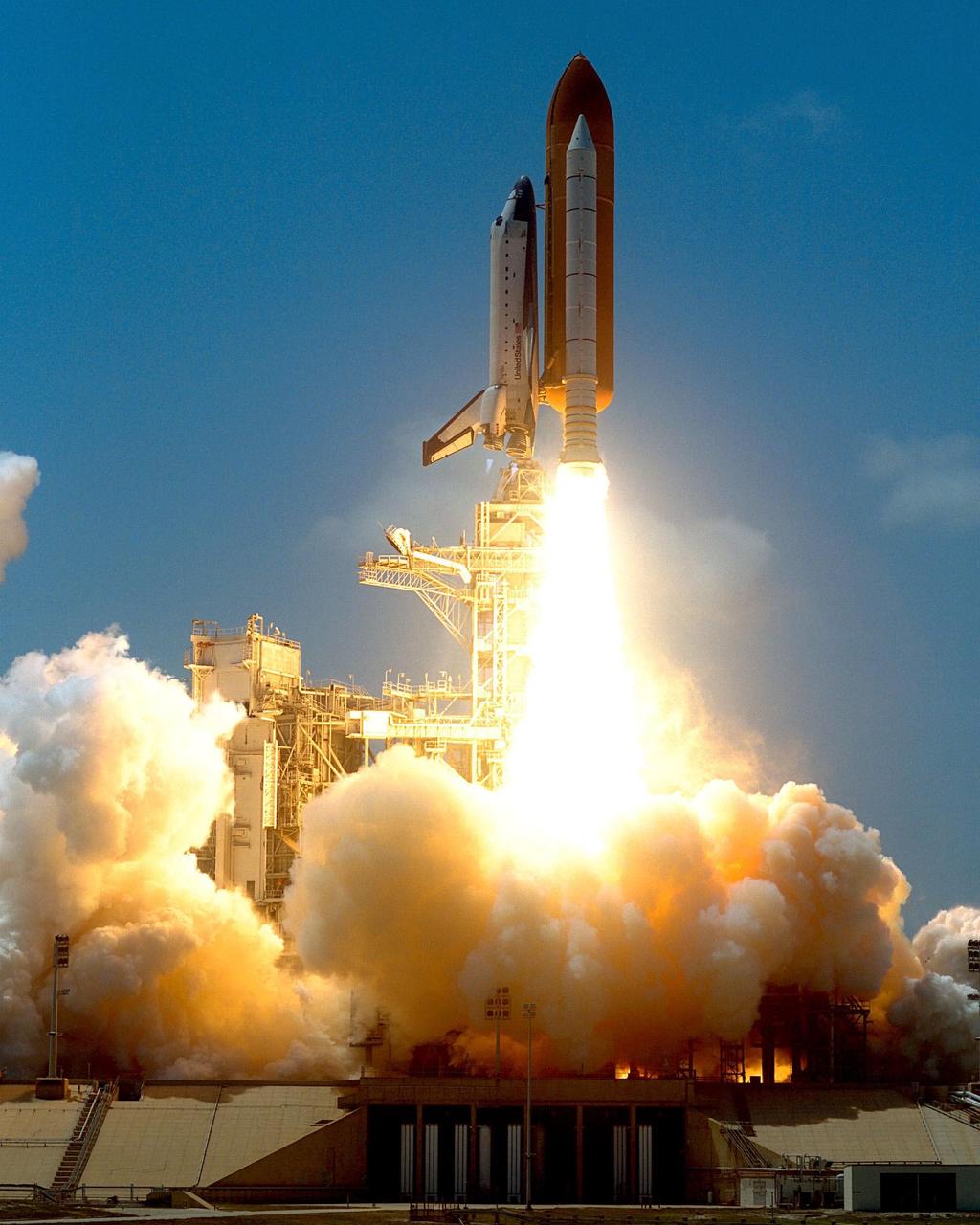
KENNEDY SPACE CENTER, FLA. -- The Space Shuttle Columbia lifts off from Launch Pad 39B at 2:19 p.m. EDT Apr. 17 to begin the nearly 17-day STS-90 Neurolab mission. The launch was delayed 24 hours due to difficulty with a network signal processor, which was replaced Apr. 16, on the orbiter. The crew members are Commander Richard Searfoss, Pilot Scott Altman, Mission Specialists Richard Linnehan, D.V.M., Dafydd (Dave) Williams, M.D., with the Canadian Space Agency, and Kathryn (Kay) Hire; and Payload Specialists Jay Buckey, M.D., and James Pawelczyk, Ph.D. Investigations during the Neurolab mission will focus on the effects of microgravity on the nervous system
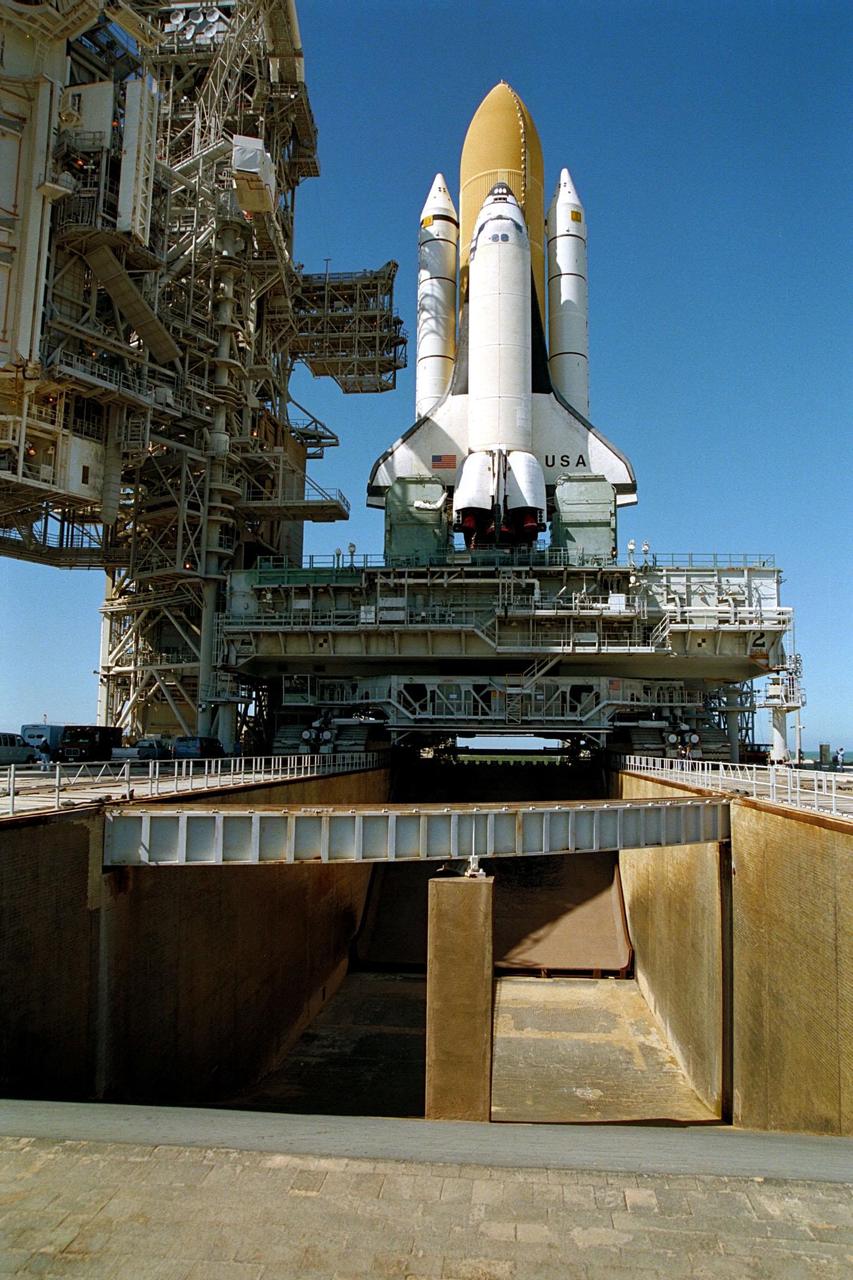
KENNEDY SPACE CENTER, FLA. -- The Space Shuttle Columbia arrives at the top of Launch Pad 39B after its morning rollout prior to STS-90. The Neurolab experiments are the primary payload on this nearly 17-day space flight. Investigations during the Neurolab mission will focus on the effects of microgravity on the nervous system. The crew of STS-90, slated for launch April 16 at 2:19 p.m. EDT, includes Commander Richard Searfoss, Pilot Scott Altman, Mission Specialists Richard Linnehan, Dafydd (Dave) Williams, M.D., and Kathryn (Kay) Hire, and Payload Specialists Jay Buckey, M.D., and James Pawelczyk, Ph.D

KENNEDY SPACE CENTER, FLA. -- Technicians gather around the STS-90 Neurolab payload during weight and center-of-gravity measurements in KSC's Operations and Checkout Building. Investigations during the Neurolab mission will focus on the effects of microgravity on the nervous system. Specifically, experiments will study the adaptation of the vestibular system, the central nervous system, and the pathways that control the ability to sense location in the absence of gravity, as well as the effect of microgravity on a developing nervous system. The crew of STS-90, slated for launch in April, will include Commander Richard Searfoss, Pilot Scott Altman, Mission Specialists Richard Linnehan, Dafydd (Dave) Williams, M.D., and Kathryn (Kay) Hire, and Payload Specialists Jay Buckey, M.D., and James Pawelczyk, Ph.D
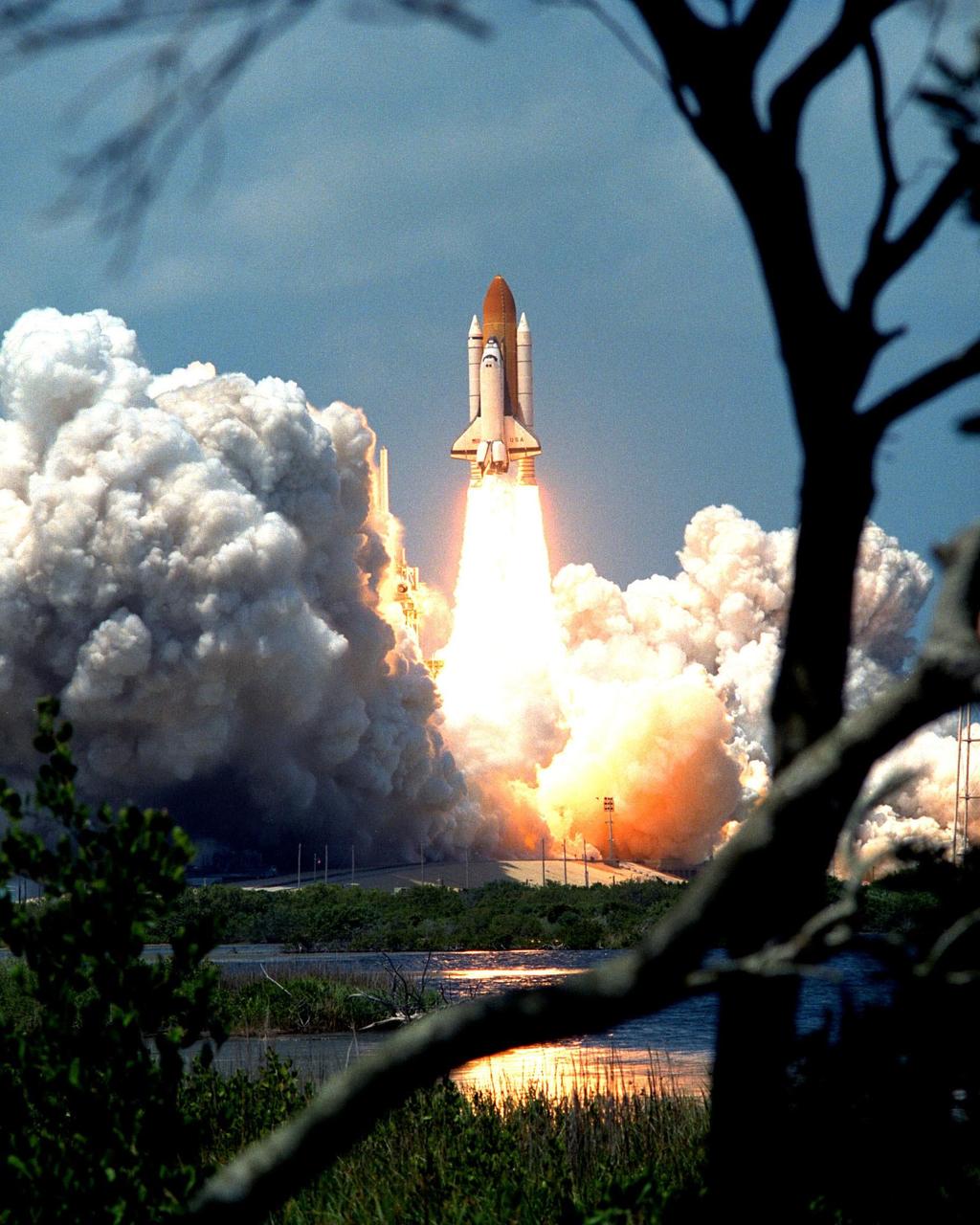
KENNEDY SPACE CENTER, FLA. -- The Space Shuttle Columbia soars from Launch Pad 39B at 2:19 p.m. EDT Apr. 17 to begin the nearly 17-day STS-90 Neurolab mission. The launch was delayed 24 hours due to difficulty with a network signal processor, which was replaced Apr. 16, on the orbiter. The crew members are Commander Richard Searfoss, Pilot Scott Altman, Mission Specialists Richard Linnehan, D.V.M., Dafydd (Dave) Williams, M.D., with the Canadian Space Agency, and Kathryn (Kay) Hire; and Payload Specialists Jay Buckey, M.D., and James Pawelczyk, Ph.D. Investigations during the Neurolab mission will focus on the effects of microgravity on the nervous system.
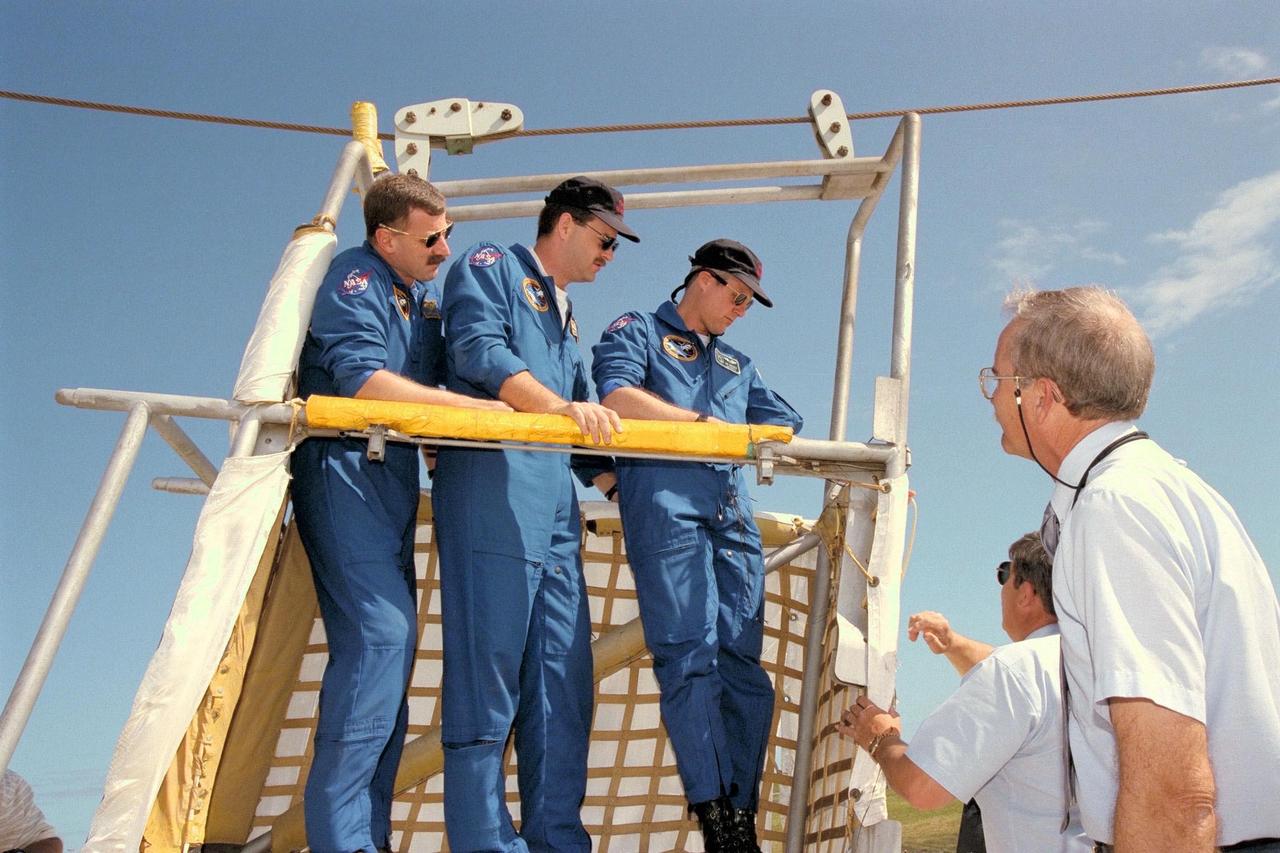
STS-90 Mission Specialist Dafydd (Dave) Williams, M.D., with the Canadian Space Agency, Pilot Scott Altman, and Payload Specialist Jay Buckey, M.D., train in an emergency egress system slidewire basket at Launch Pad 39B during Terminal Countdown Demonstration Test (TCDT) activities. The TCDT is held at KSC prior to each Space Shuttle flight to provide crews with the opportunity to participate in simulated countdown activities. Columbia is targeted for launch of STS-90 on April 16 at 2:19 p.m. EDT and will be the second mission of 1998. The mission is scheduled to last nearly 17 days
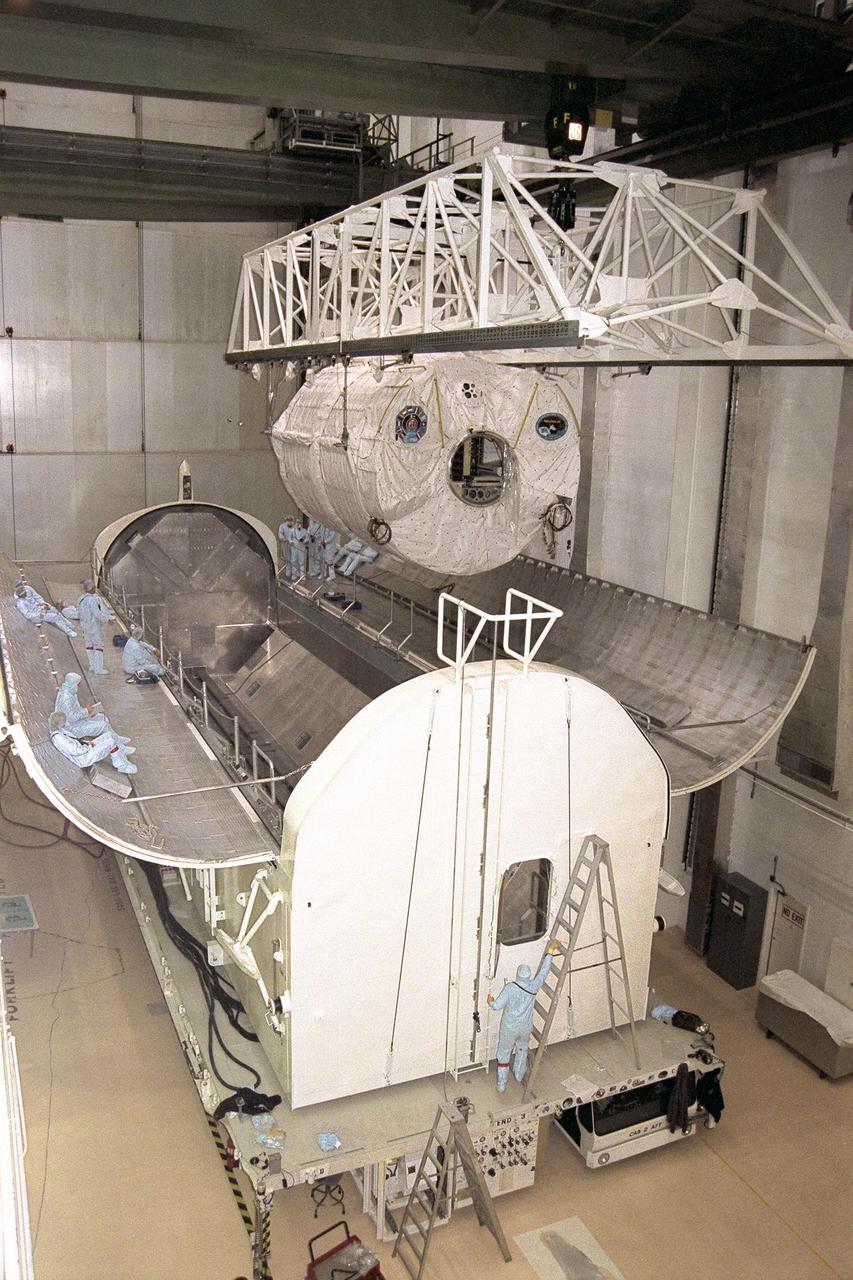
KENNEDY SPACE CENTER, FLA. -- The STS-90 Neurolab payload is lowered into its payload canister in KSC's Operations and Checkout Building. Investigations during the Neurolab mission will focus on the effects of microgravity on the nervous system. Specifically, experiments will study the adaptation of the vestibular system, the central nervous system, and the pathways that control the ability to sense location in the absence of gravity, as well as the effect of microgravity on a developing nervous system. The crew of STS-90, slated for launch in April, will include Commander Richard Searfoss, Pilot Scott Altman, Mission Specialists Richard Linnehan, Dafydd (Dave) Williams, M.D., and Kathryn (Kay) Hire, and Payload Specialists Jay Buckey, M.D., and James Pawelczyk, Ph.D

KENNEDY SPACE CENTER, FLA. -- The Space Shuttle Columbia soars from Launch Pad 39B at 2:19 p.m. EDT Apr. 17 to begin the STS-90 Neurolab mission. The launch was delayed 24 hours due to difficulty with a network signal processor, which was replaced Apr. 16, on the orbiter. The crew members are Commander Richard Searfoss, Pilot Scott Altman, Mission Specialists Richard Linnehan, D.V.M., Dafydd (Dave) Williams, M.D., with the Canadian Space Agency, and Kathryn (Kay) Hire; and Payload Specialists Jay Buckey, M.D., and James Pawelczyk, Ph.D. Investigations during the Neurolab mission will focus on the effects of microgravity on the nervous system

The STS-90 Neurolab payload is lowered into position into the cargo bay of Space Shuttle Columbia today in Orbiter Processing Facility bay 3. Investigations during the Neurolab mission will focus on the effects of microgravity on the nervous system. Specifically, experiments will study the adaptation of the vestibular system, the central nervous system, and the pathways that control the ability to sense location in the absence of gravity, as well as the effect of microgravity on a developing nervous system. The crew of STS-90, slated for launch in April, will include Commander Richard Searfoss, Pilot Scott Altman, Mission Specialists Richard Linnehan, Dafydd (Dave) Williams, M.D., and Kathryn (Kay) Hire, and Payload Specialists Jay Buckey, M.D., and James Pawelczyk, Ph.D
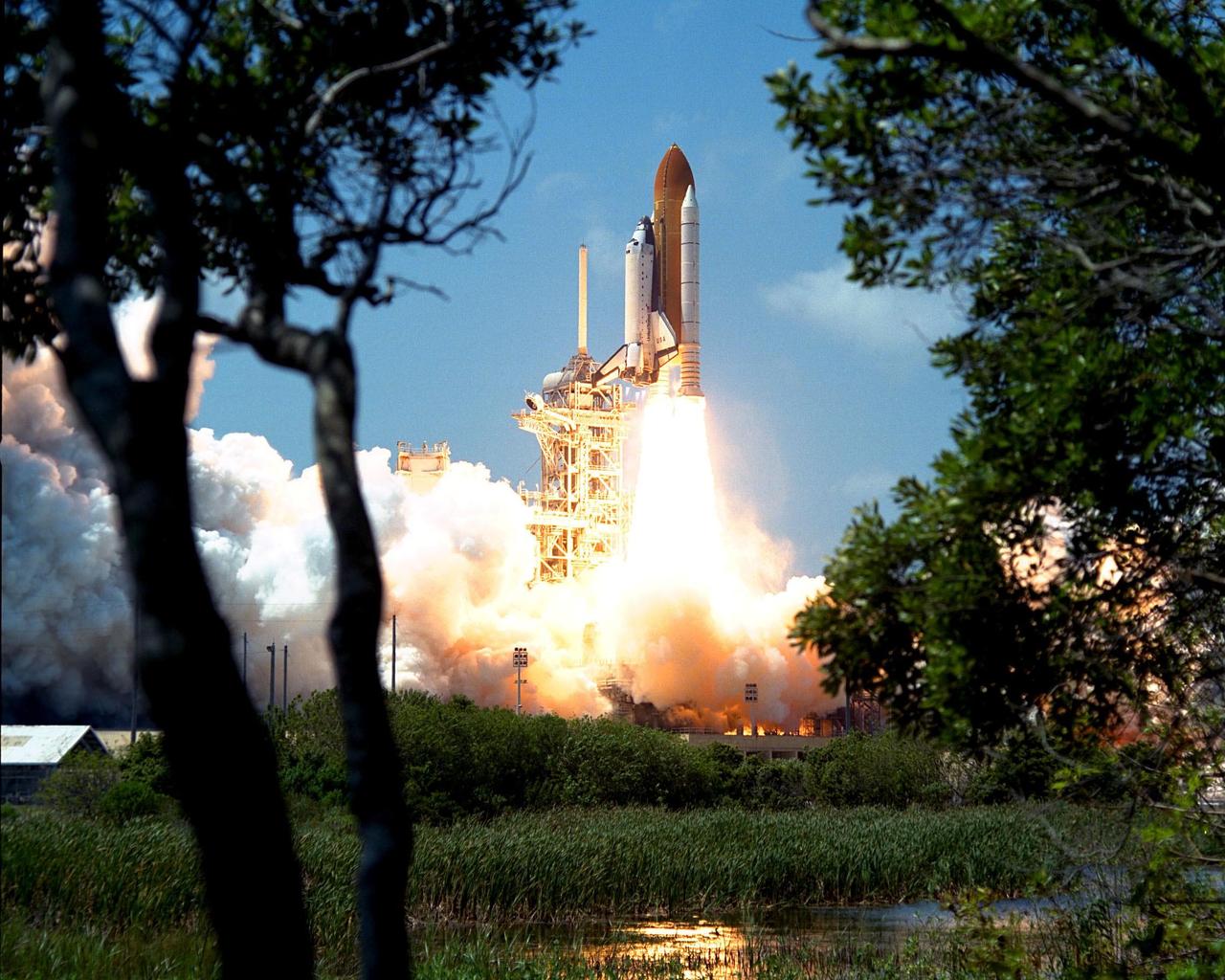
Framed by native Floridian foliage, the Space Shuttle Columbia soars from Launch Pad 39B at 2:19 p.m. EDT Apr. 17 to begin the nearly 17-day STS-90 Neurolab mission. The launch was delayed 24 hours due to difficulty with a network signal processor, which was replaced Apr. 16, on the orbiter. The crew members are Commander Richard Searfoss, Pilot Scott Altman, Mission Specialists Richard Linnehan, D.V.M., Dafydd (Dave) Williams, M.D., with the Canadian Space Agency, and Kathryn (Kay) Hire; and Payload Specialists Jay Buckey, M.D., and James Pawelczyk, Ph.D. Investigations during the Neurolab mission will focus on the effects of microgravity on the nervous system
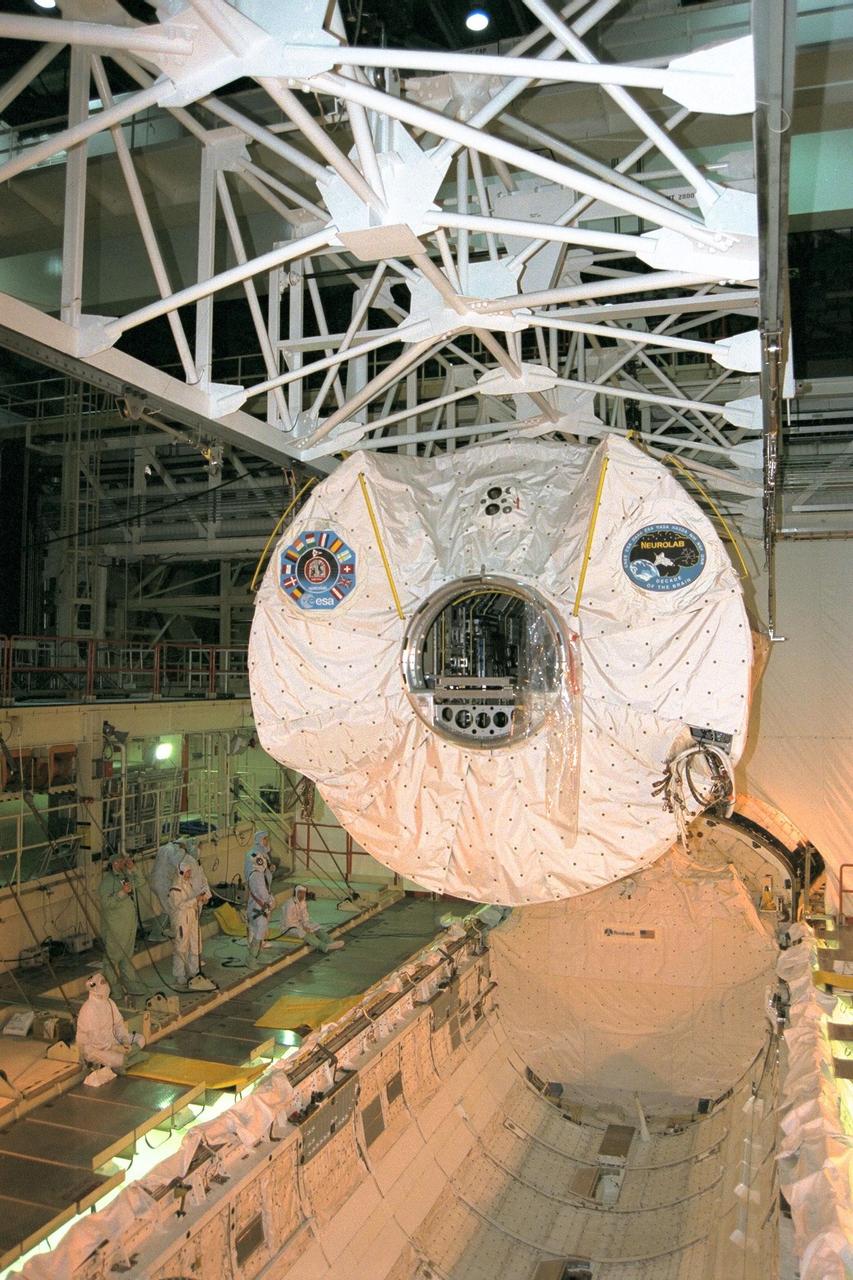
The STS-90 Neurolab payload is lowered into position into the cargo bay of Space Shuttle Columbia today in Orbiter Processing Facility bay 3. Investigations during the Neurolab mission will focus on the effects of microgravity on the nervous system. Specifically, experiments will study the adaptation of the vestibular system, the central nervous system, and the pathways that control the ability to sense location in the absence of gravity, as well as the effect of microgravity on a developing nervous system. The crew of STS-90, slated for launch in April, will include Commander Richard Searfoss, Pilot Scott Altman, Mission Specialists Richard Linnehan, Dafydd (Dave) Williams, M.D., and Kathryn (Kay) Hire, and Payload Specialists Jay Buckey, M.D., and James Pawelczyk, Ph.D
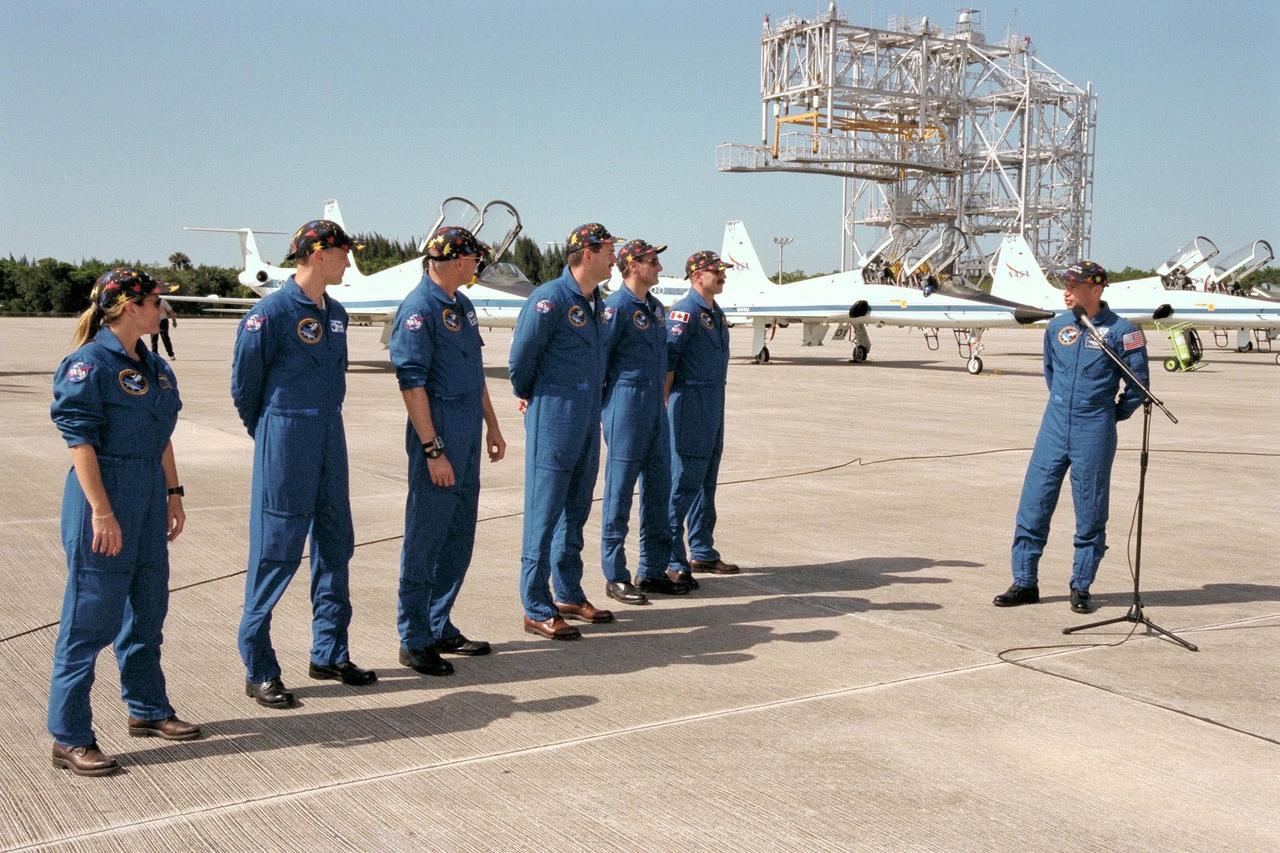
KENNEDY SPACE CENTER, FLA. -- The STS-90 crew arrive at Kennedy Space Center's Shuttle Landing Facility in preparation for the launch of Columbia on April 16 at 2:19 p.m. EDT from KSC's Launch Pad 39B. The crew of STS-90 are, left to right, Mission Specialist Kathryn (Kay) Hire; Payload Specialist James Pawelczyk, Ph.D.; Payload Specialist Jay Buckey, M.D.; Pilot Scott Altman; Mission Specialist Richard Linnehan, D.V.M.; Mission Specialist Dafydd (Dave) Williams with the Canadian Space Agency; and Commander Richard Searfoss. STS-90, which will be the second mission of 1998, is scheduled to last nearly 17 days

The Space Shuttle Columbia soars from Launch Pad 39B at 2:19 p.m. EDT Apr. 17 to begin the nearly 17-day STS-90 Neurolab mission. The launch was delayed 24 hours due to difficulty with a network signal processor, which was replaced Apr. 16, on the orbiter. The crew members are Commander Richard Searfoss, Pilot Scott Altman, Mission Specialists Richard Linnehan, D.V.M., Dafydd (Dave) Williams, M.D., with the Canadian Space Agency, and Kathryn (Kay) Hire; and Payload Specialists Jay Buckey, M.D., and James Pawelczyk, Ph.D. Investigations during the Neurolab mission will focus on the effects of microgravity on the nervous system
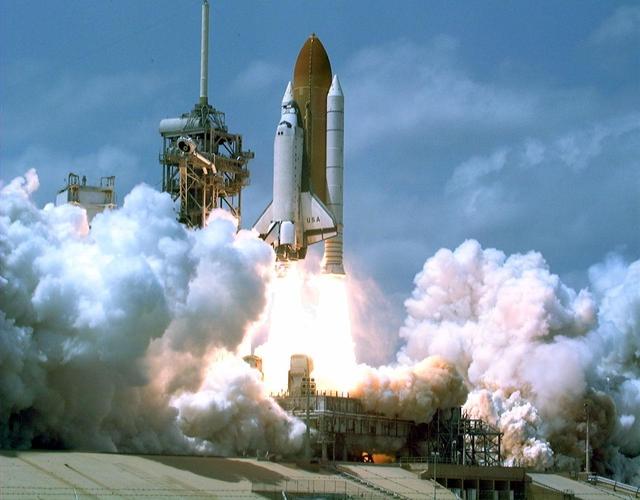
The Space Shuttle Columbia soars from Launch Pad 39B at 2:19 p.m. EDT Apr. 17 to begin the nearly 17-day STS-90 Neurolab mission. The launch was delayed 24 hours due to difficulty with a network signal processor, which was replaced Apr. 16, on the orbiter. The crew members are Commander Richard Searfoss, Pilot Scott Altman, Mission Specialists Richard Linnehan, D.V.M., Dafydd (Dave) Williams, M.D., with the Canadian Space Agency, and Kathryn (Kay) Hire; and Payload Specialists Jay Buckey, M.D., and James Pawelczyk, Ph.D. Investigations during the Neurolab mission will focus on the effects of microgravity on the nervous system
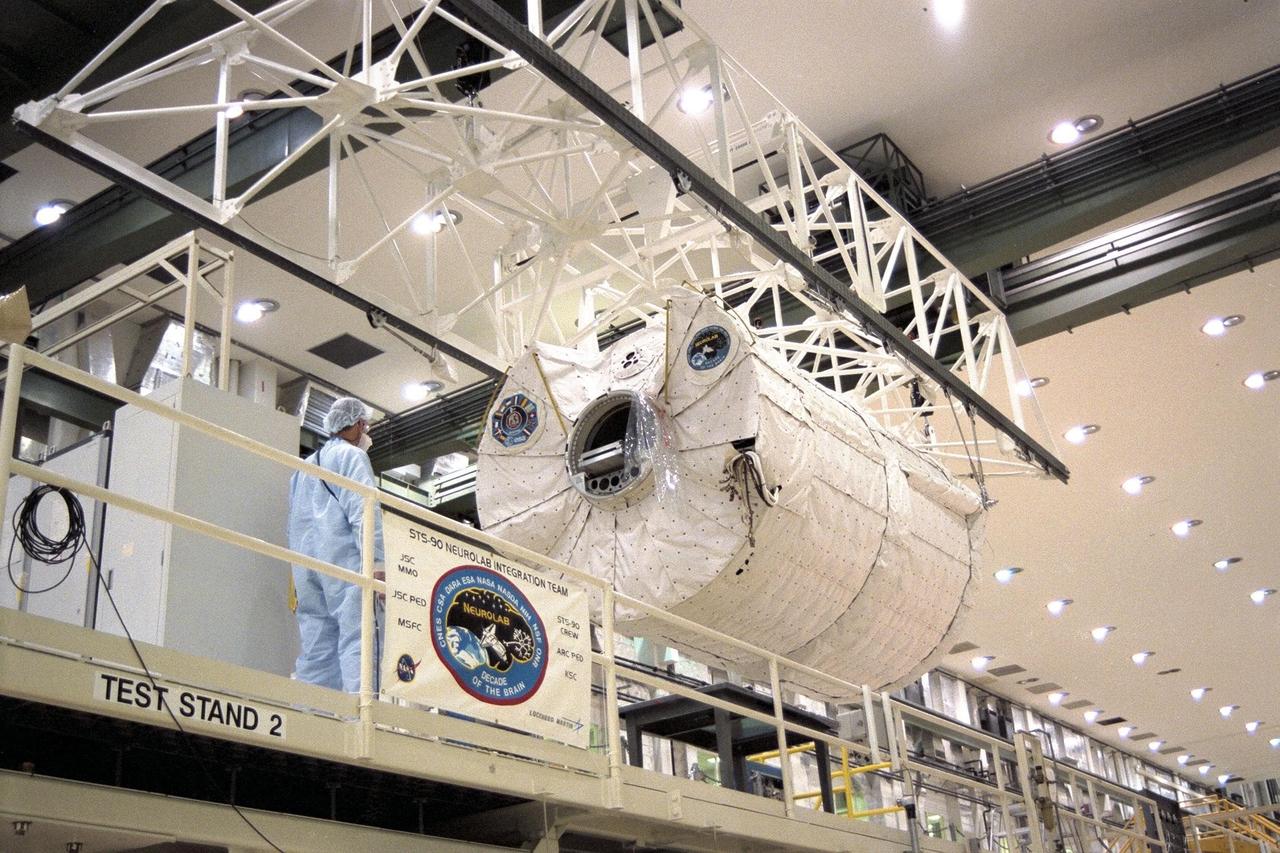
KENNEDY SPACE CENTER, FLA. -- A technician looks at the STS-90 Neurolab payload as it is moved from its test stand in KSC's Operations and Checkout Building. Investigations during the Neurolab mission will focus on the effects of microgravity on the nervous system. Specifically, experiments will study the adaptation of the vestibular system, the central nervous system, and the pathways that control the ability to sense location in the absence of gravity, as well as the effect of microgravity on a developing nervous system. The crew of STS-90, slated for launch in April, will include Commander Richard Searfoss, Pilot Scott Altman, Mission Specialists Richard Linnehan, Dafydd (Dave) Williams, M.D., and Kathryn (Kay) Hire, and Payload Specialists Jay Buckey, M.D., and James Pawelczyk, Ph.D
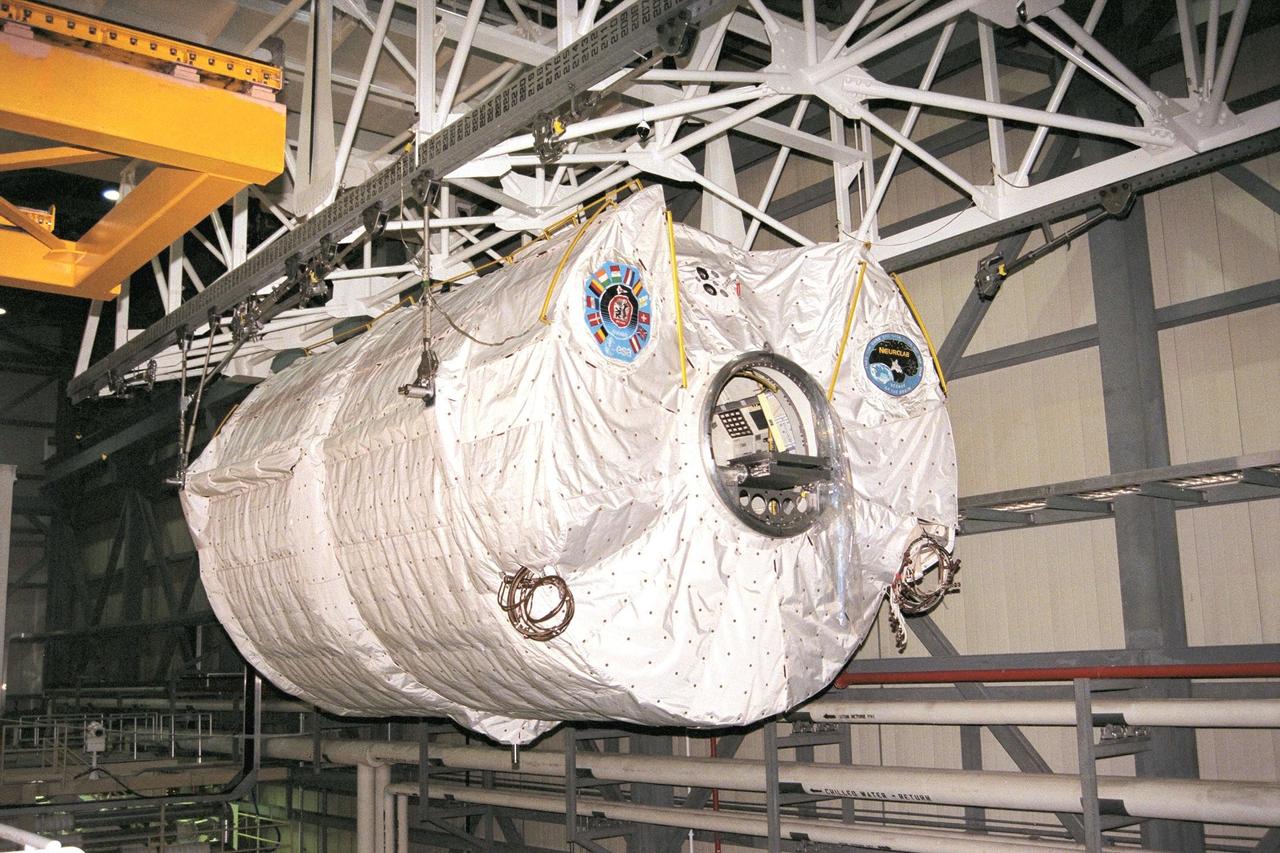
The STS-90 Neurolab payload is prepared to be positioned into the cargo bay of Space Shuttle Columbia today in Orbiter Processing Facility bay 3. Investigations during the Neurolab mission will focus on the effects of microgravity on the nervous system. Specifically, experiments will study the adaptation of the vestibular system, the central nervous system, and the pathways that control the ability to sense location in the absence of gravity, as well as the effect of microgravity on a developing nervous system. The crew of STS-90, slated for launch in April, will include Commander Richard Searfoss, Pilot Scott Altman, Mission Specialists Richard Linnehan, Dafydd (Dave) Williams, M.D., and Kathryn (Kay) Hire, and Payload Specialists Jay Buckey, M.D., and James Pawelczyk, Ph.D
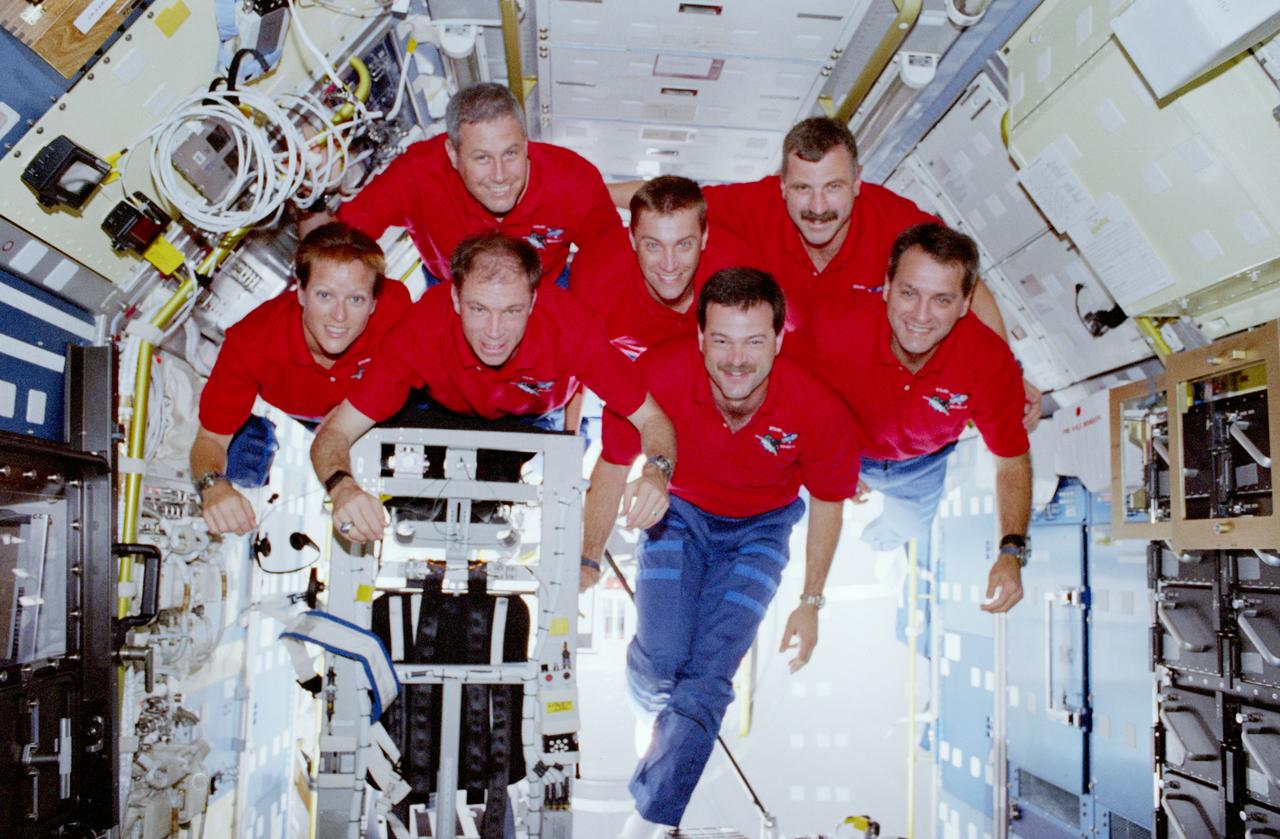
STS090-378-022 (17 April - 3 May 1998) --- During a change of shift for Neurolab duty, the crew floats as a unit onboard the Spacelab Science Module on the Space Shuttle Columbia. From the left are Kathryn P. Hire, mission specialist; Jay C. Buckey, Jr. (top), payload specialist; Richard A. Searfoss, mission commander; James A. (Jim) Pawelczyk, payload specialist; Scott D. Altman, pilot; Dafydd R. (Dave) Williams, mission specialist (top); and Richard M. Linnehan, payload commander. Williams represents the Canadian Space Agency (CSA).
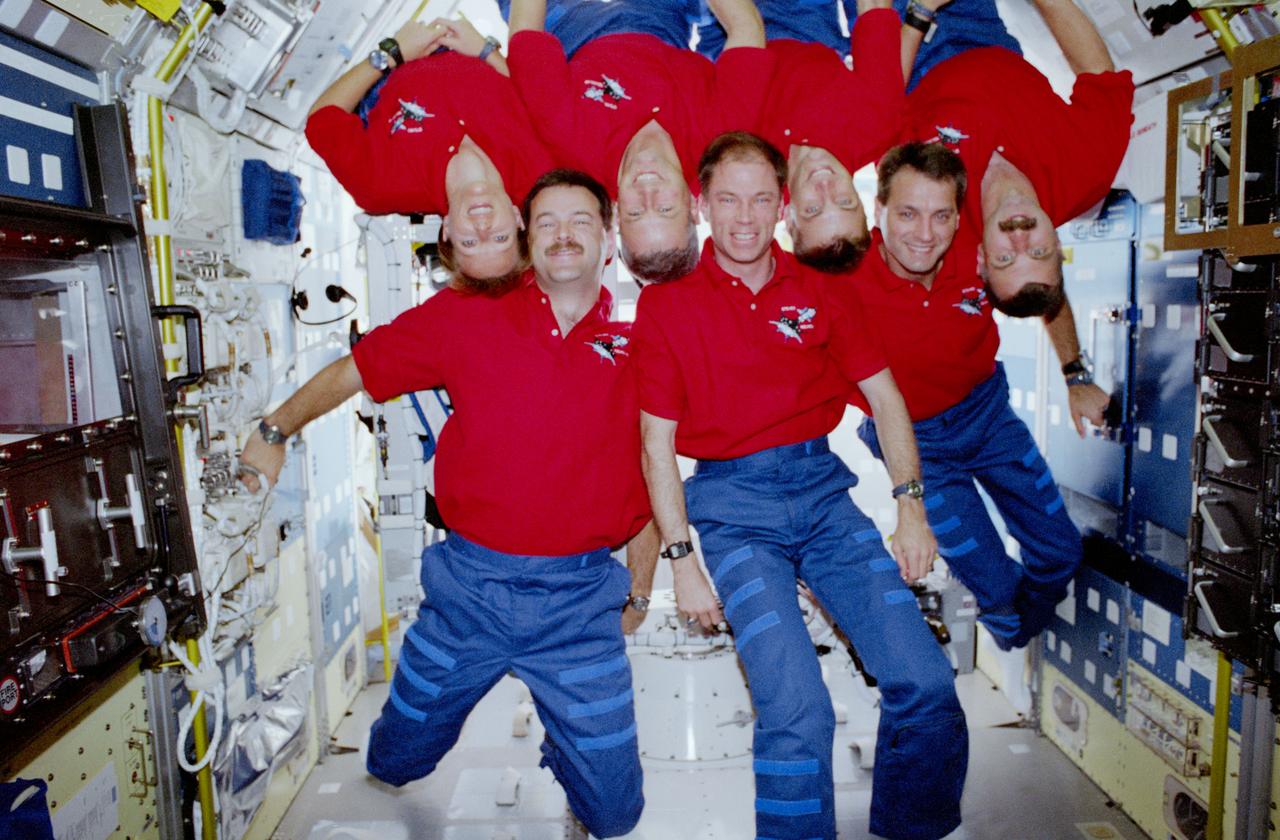
STS090-378-019 (17 April - 3 May 1998) --- The Neurolab crew takes advantage of the weightlessness in the Spacelab Science Module to add a unique twist to one of their traditional in-flight space portraits. From the left (with feet toward the floor) are Scott D. Altman, pilot; Richard A. Searfoss, mission commander; and Richard M. Linnehan, payload commander. Others, from the left, are Kathryn P. Hire, mission specialist; Jay C. Buckey, Jr. and James A. (Jim) Pawelczyk, both payload specialists; and Dafydd R. (Dave) Williams, mission specialist representing the Canadian Space Agency (CSA).
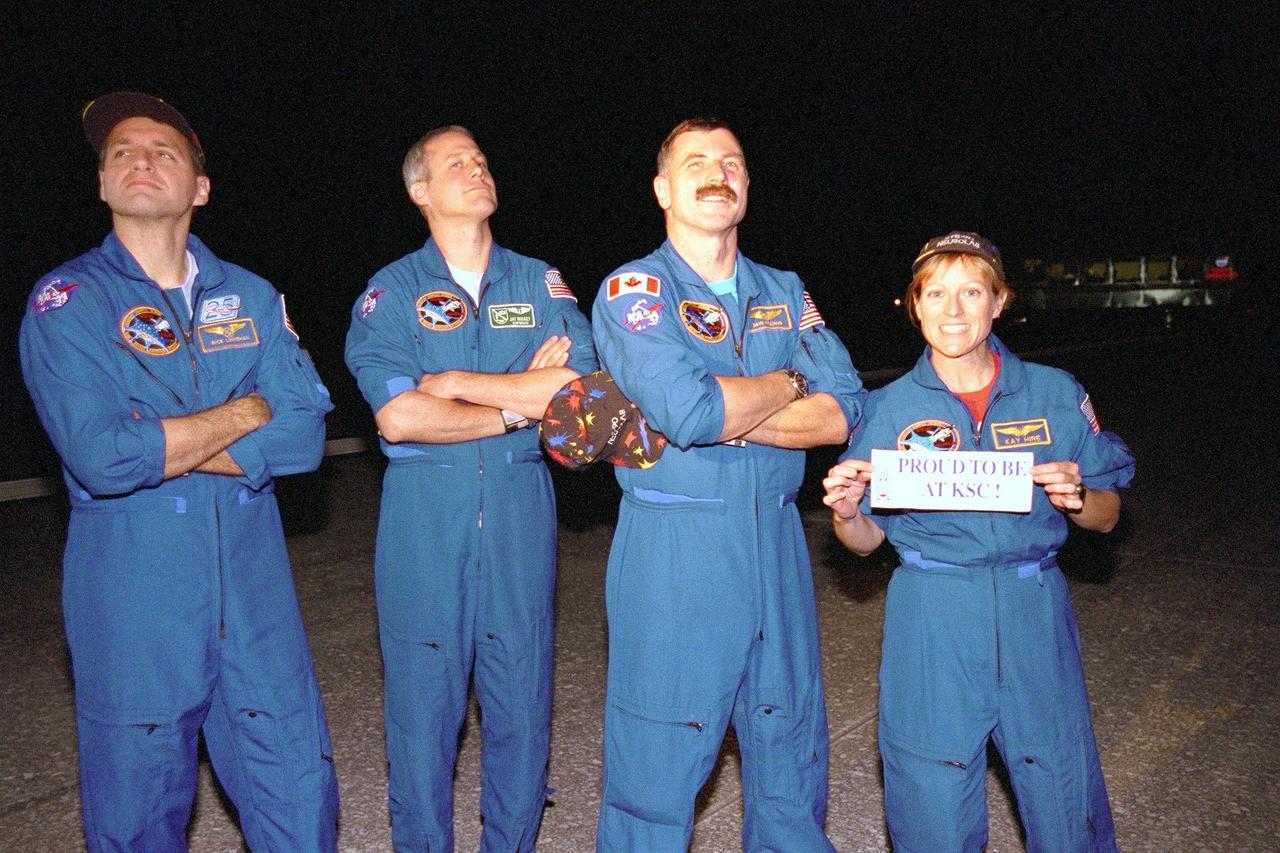
Some of the STS-90 crew members pose at the Shuttle Landing Facility hours after arrival on May 3, ending their nearly 16-day Neurolab mission. Shown left to right are Mission Specialist Richard Linnehan, D.V.M.; Payload Specialist Jay Buckey, M.D.; and Mission Specialists Dafydd (Dave) Williams, M.D., with the Canadian Space Agency and Kathryn (Kay) Hire holding a sign that states "Proud to be at KSC." The 90th Shuttle mission was Columbia's 13th landing at the space center and the 43rd KSC landing in the history of the Space Shuttle program. During the mission, the crew conducted research to contribute to a better understanding of the human nervous system
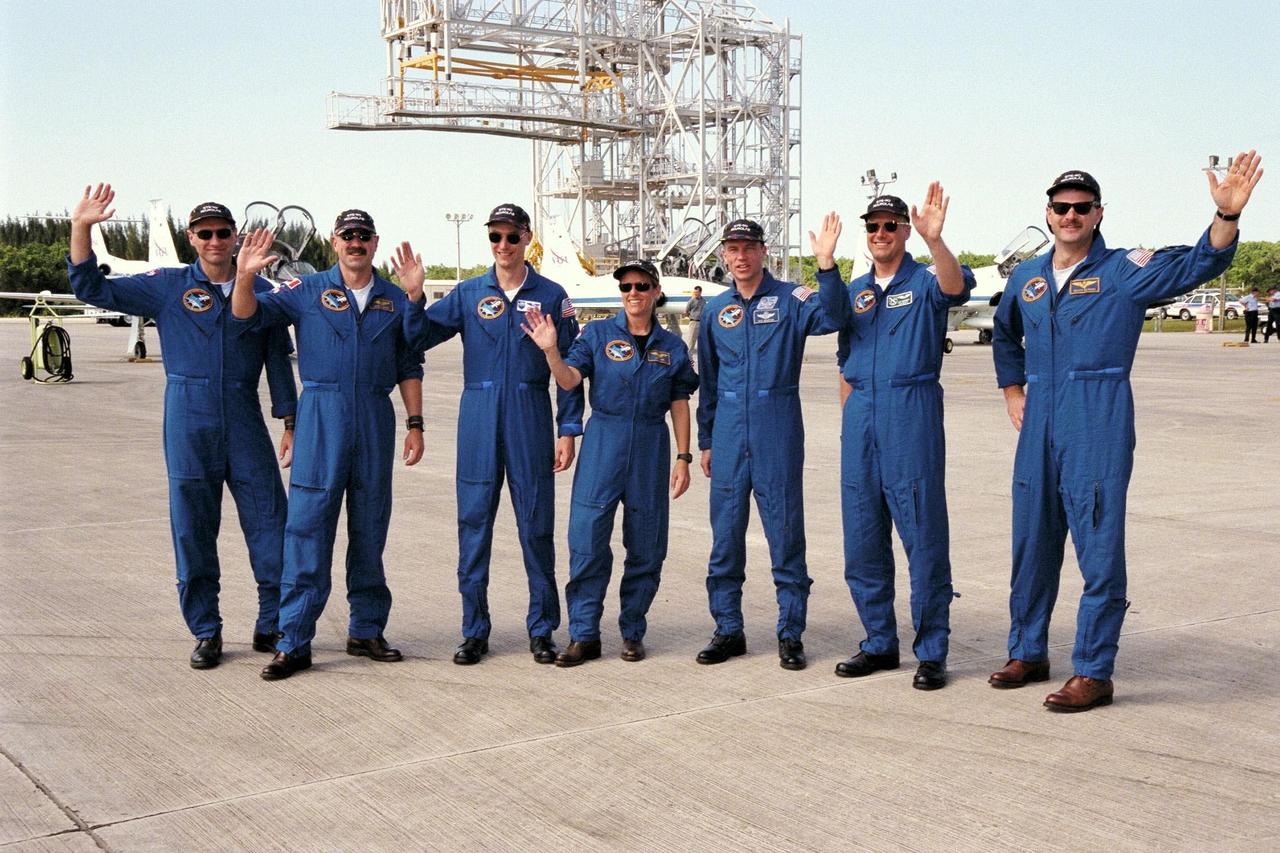
KENNEDY SPACE CENTER, FLA. -- The STS-90 crew arrive at Kennedy Space Center's Shuttle Landing Facility in preparation for the launch of Columbia on April 16 at 2:19 p.m. EDT from KSC's Launch Pad 39B. The crew of STS-90 are, left to right, Mission Specialist Richard Linnehan, D.V.M.; Mission Specialist Dafydd (Dave) Williams with the Canadian Space Agency; Payload Specialist James Pawelczyk, Ph.D.; Mission Specialist Kathryn (Kay) Hire; Commander Richard Searfoss; Payload Specialist Jay Buckey, M.D.; and Pilot Scott Altman. STS-90, which will be the second mission of 1998, is scheduled to last nearly 17 days
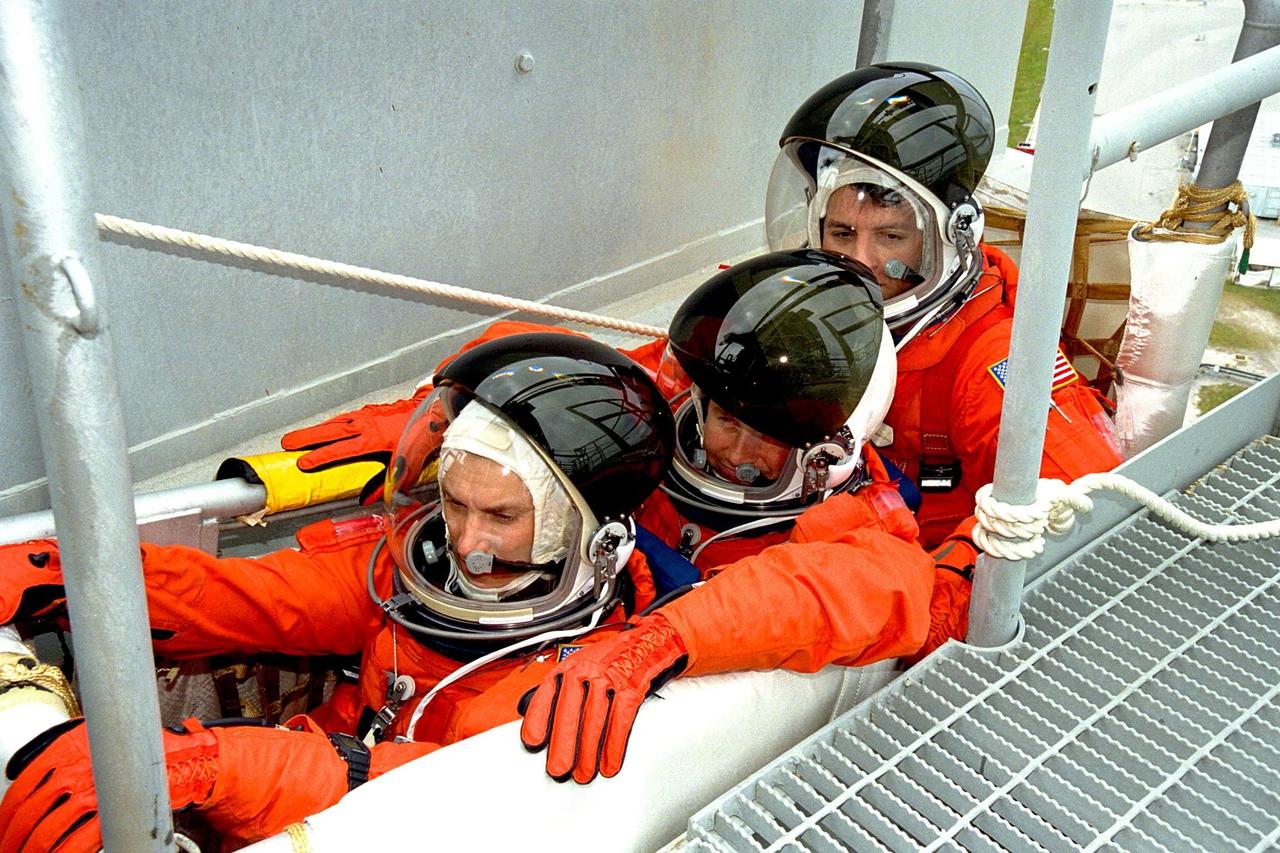
Members of the STS-90 crew participate in mock emergency egress activities during the Terminal Countdown Demonstration Test (TCDT) at KSC's Launch Pad 39B. The TCDT is held at KSC prior to each Space Shuttle flight to provide crews with the opportunity to participate in simulated countdown activities. The STS-90 crew members shown here are, front to back, Payload Specialists James Pawelczyk, Ph.D., and Jay Buckey, M.D., and Mission Specialist Richard Linnehan, D.V.M. Columbia is targeted for launch of STS-90 on April 16 at 2:19 p.m. EDT and will be the second mission of 1998. The mission is scheduled to last nearly 17 days
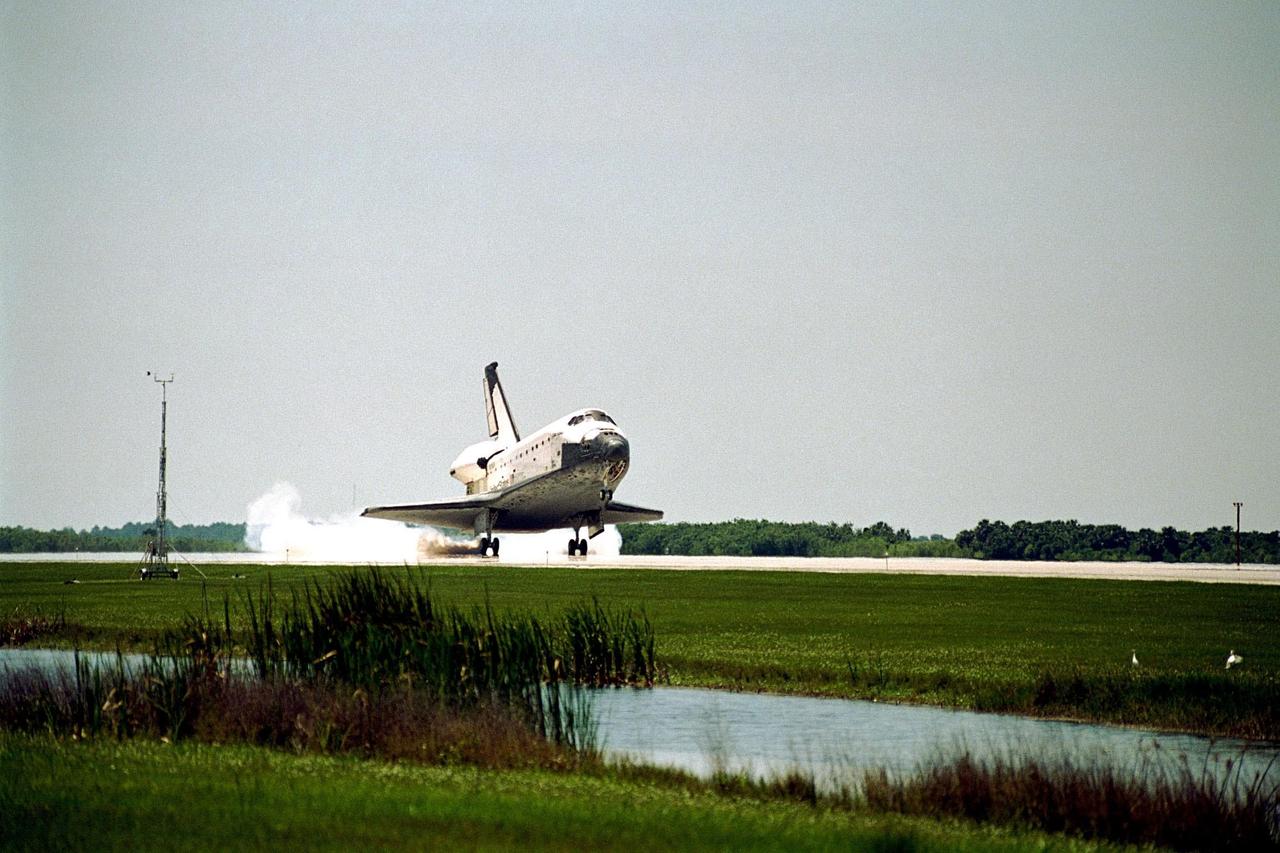
The orbiter Columbia touches down on Runway 33 of KSC's Shuttle Landing Facility to complete the nearly 16-day STS-90 mission. Main gear touchdown was at 12:08:59 p.m. EDT on May 3, 1998, landing on orbit 256 of the mission. The wheels stopped at 12:09:58 EDT, completing a total mission time of 15 days, 21 hours, 50 minutes and 58 seconds. The 90th Shuttle mission was Columbia's 13th landing at the space center and the 43rd KSC landing in the history of the Space Shuttle program. During the mission, the crew conducted research to contribute to a better understanding of the human nervous system. The crew of the STS-90 Neurolab mission include Commander Richard Searfoss; Pilot Scott Altman; Mission Specialists Richard Linnehan, D.V.M., Dafydd (Dave) Williams, M.D., with the Canadian Space Agency, and Kathryn (Kay) Hire; and Payload Specialists Jay Buckey, M.D., and James Pawelczyk, Ph.D
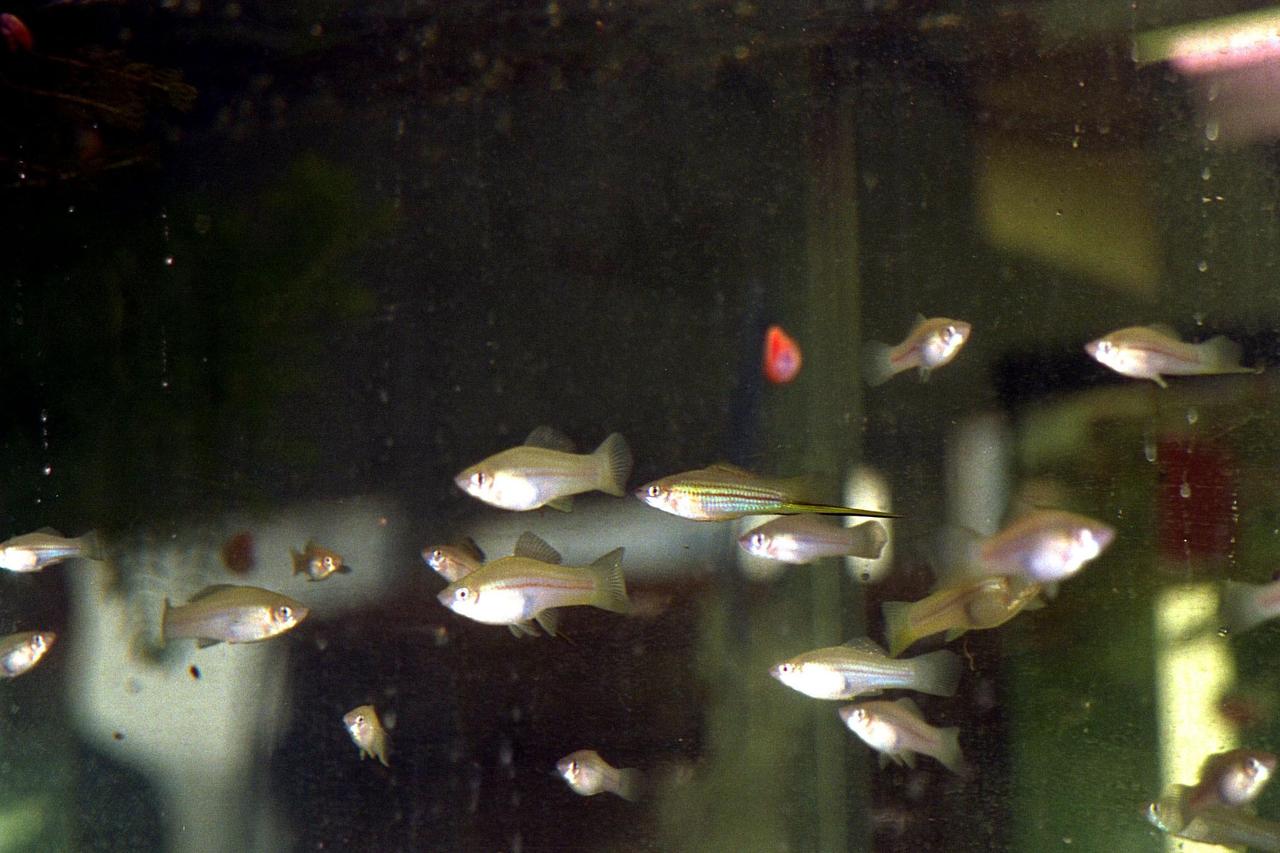
KENNEDY SPACE CENTER, FLA. -- Swordtail fish (Xiphophorus helleri), like those that are part of the Neurolab payload on Space Shuttle Mission STS-90, are shown in their holding tank in the Operations and Checkout Building. The fish will fly in the Closed Equilibrated Biological Aquatic System (CEBAS) Minimodule, a middeck locker-sized fresh water habitat, designed to allow the controlled incubation of aquatic species in a self-stabilizing, artifical ecosystem for up to three weeks under space conditions. Investigations during the Neurolab mission will focus on the effects of microgravity on the nervous system. The crew of STS-90, slated for launch April 16 at 2:19 p.m. EDT, include Commander Richard Searfoss, Pilot Scott Altman, Mission Specialists Richard Linnehan, D.V.M., Dafydd (Dave) Williams, M.D., and Kathryn (Kay) Hire, and Payload Specialists Jay Buckey, M.D., and James Pawelczyk, Ph.D
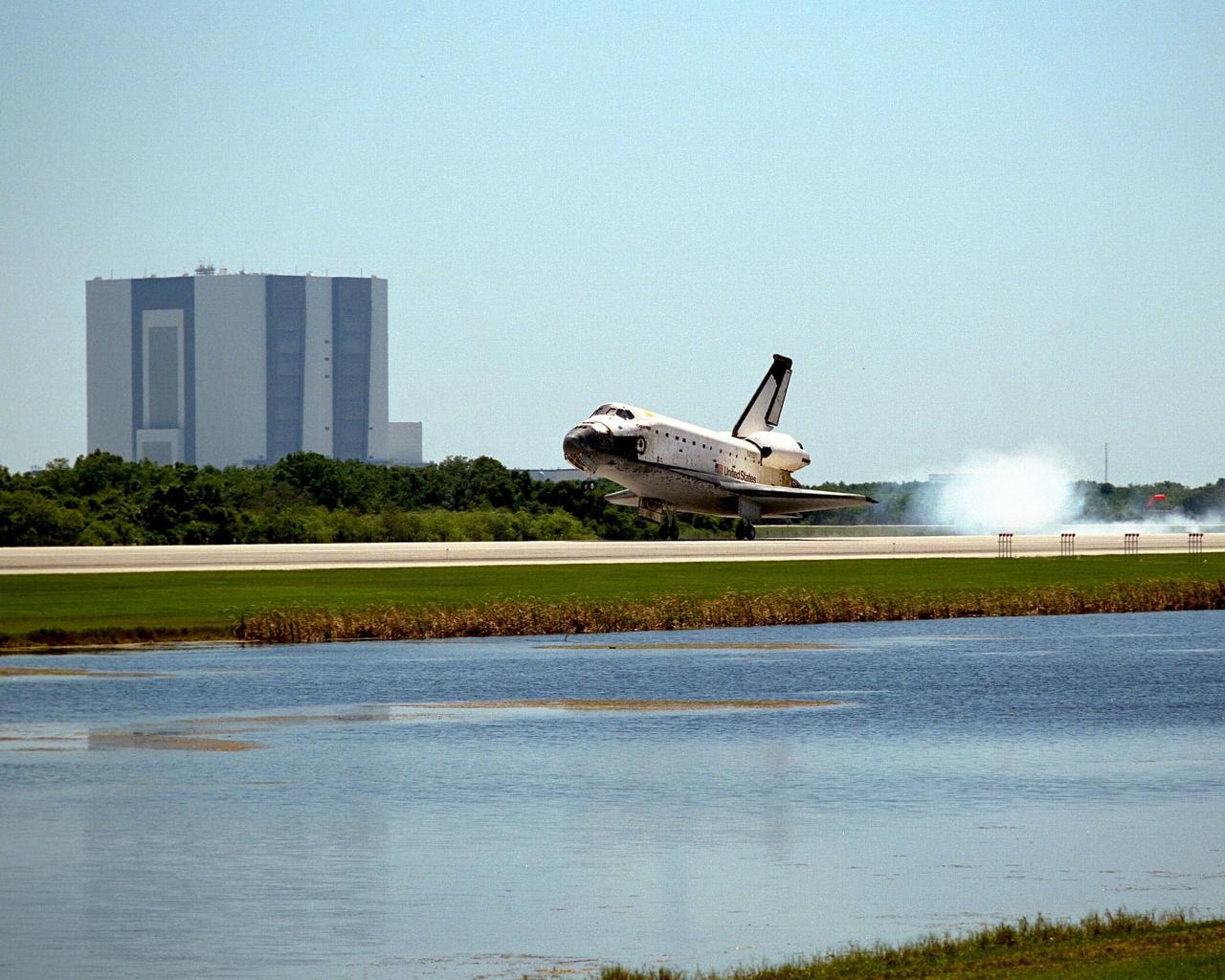
The orbiter Columbia touches down on Runway 33 of KSC's Shuttle Landing Facility to complete the nearly 16-day STS-90 mission. Main gear touchdown was at 12:08:59 p.m. EDT on May 3, 1998, landing on orbit 256 of the mission. The wheels stopped at 12:09:58 EDT, completing a total mission time of 15 days, 21 hours, 50 minutes and 58 seconds. The 90th Shuttle mission was Columbia's 13th landing at the space center and the 43rd KSC landing in the history of the Space Shuttle program. During the mission, the crew conducted research to contribute to a better understanding of the human nervous system. The crew of the STS-90 Neurolab mission include Commander Richard Searfoss; Pilot Scott Altman; Mission Specialists Richard Linnehan, D.V.M., Dafydd (Dave) Williams, M.D., with the Canadian Space Agency, and Kathryn (Kay) Hire; and Payload Specialists Jay Buckey, M.D., and James Pawelczyk, Ph.D
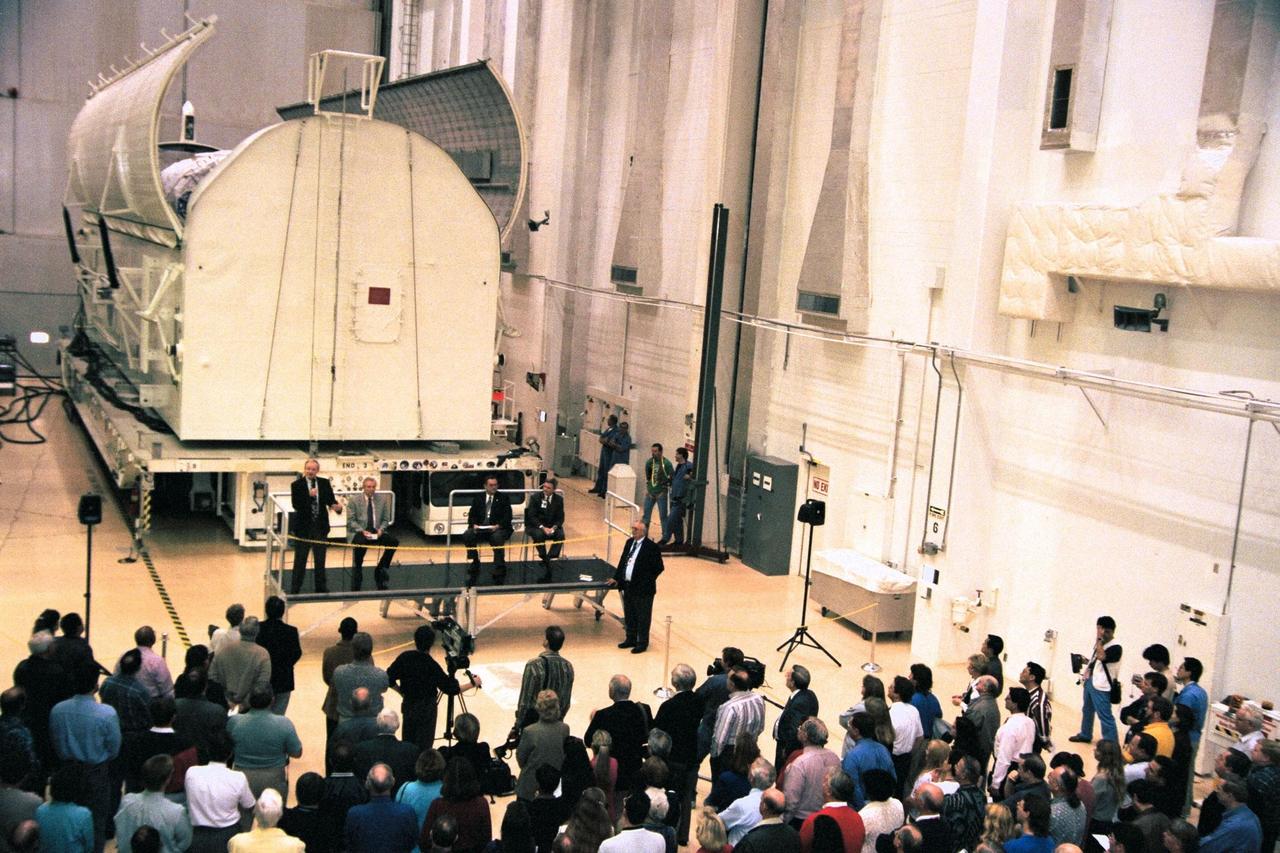
The STS-90 Neurolab payload is honored with a ceremony after being lowered into its payload canister in KSC's Operations and Checkout Building for the last time. This phase of the Shuttle program is winding down as the second phase of the International Space Station (ISS) program gets under way. Microgravity and life science research that formerly was conducted in Spacelab modules, such as Neurolab, will eventually be conducted inside the completed ISS. Investigations during the Neurolab mission will focus on the effects of microgravity on the nervous system. The crew of STS-90, slated for launch in April, will include Commander Richard Searfoss, Pilot Scott Altman, Mission Specialists Richard Linnehan, Dafydd (Dave) Williams, M.D., and Kathryn (Kay) Hire, and Payload Specialists Jay Buckey, M.D., and James Pawelczyk, Ph.D
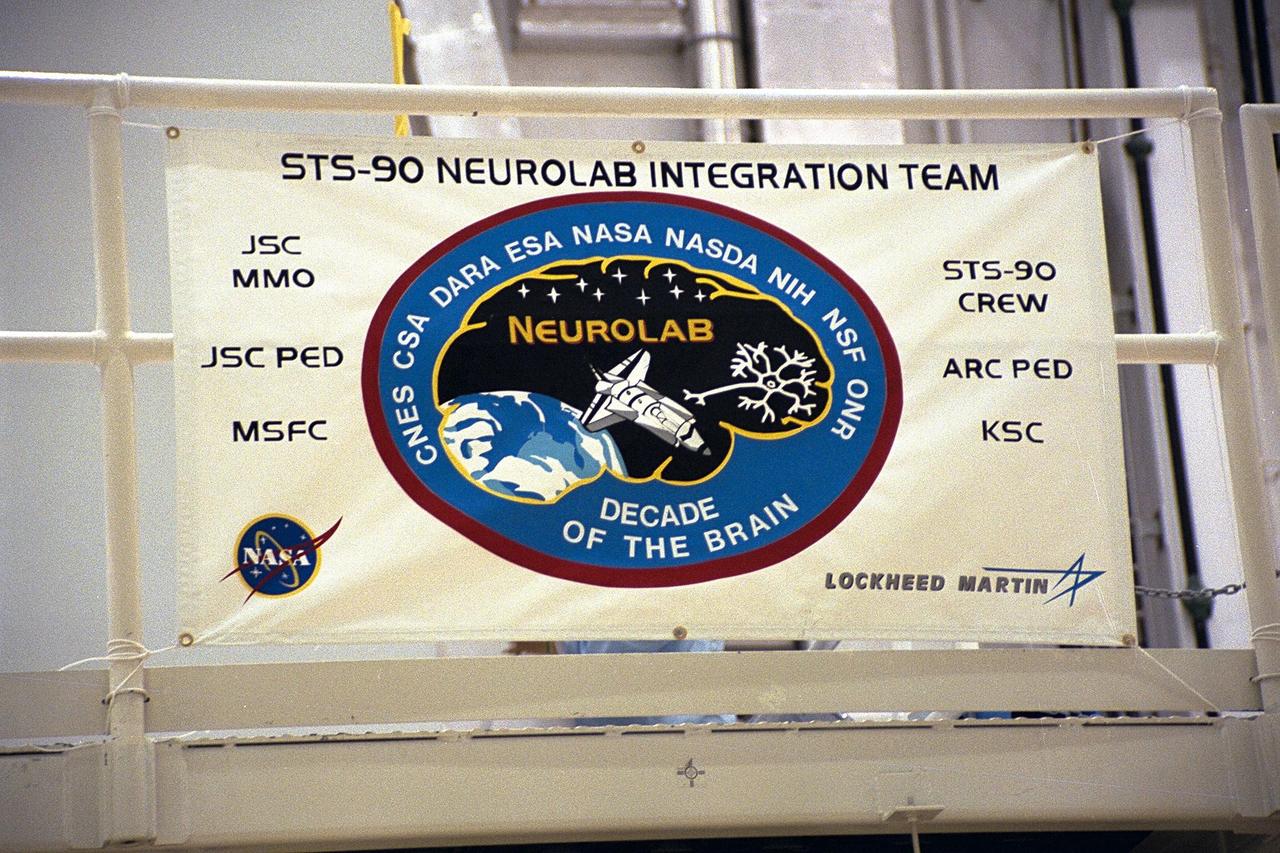
The Neurolab payload for STS-90, scheduled to launch aboard the Shuttle Columbia from Kennedy Space Center (KSC) on April 2, 1998, undergoes further processing in the Operations and Checkout Building at KSC. Investigations during the Neurolab mission will focus on the effects of microgravity on the nervous system. Specifically, experiments will study the adaptation of the vestibular system, the central nervous system, and the pathways that control the ability to sense location in the absence of gravity, as well as the effect of microgravity on a developing nervous system. The crew of STS-90 will include Commander Richard Searfoss, Pilot Scott Altman, Mission Specialists Richard Linnehan, Dafydd (Dave) Williams, M.D., and Kathryn (Kay) Hire, and Payload Specialists Jay Buckey, M.D., and James Pawelczyk, Ph.D
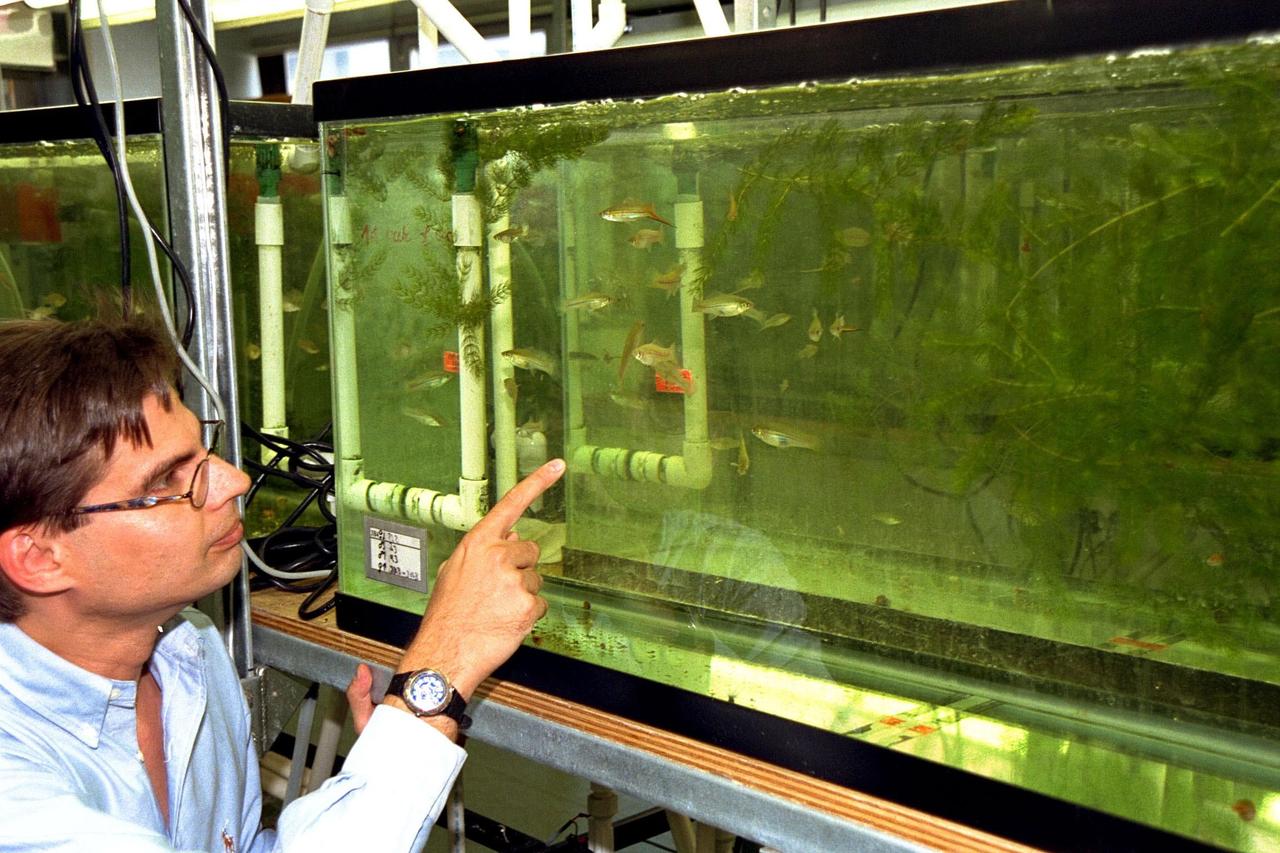
KENNEDY SPACE CENTER, FLA. -- Dr. Dirk Voeste, a scientist with Ruhr-University of Bochum, Germany, examines some swordtail fish (Xiphophorus helleri), like those that are part of the Neurolab payload on Space Shuttle Mission STS-90, in their holding tank in the Operations and Checkout Building. The fish will fly in the Closed Equilibrated Biological Aquatic System (CEBAS) Minimodule, a middeck locker-sized fresh water habitat, designed to allow the controlled incubation of aquatic species in a self-stabilizing, artifical ecosystem for up to three weeks under space conditions. Investigations during the Neurolab mission will focus on the effects of microgravity on the nervous system. The crew of STS-90, slated for launch April 16 at 2:19 p.m. EDT, include Commander Richard Searfoss, Pilot Scott Altman, Mission Specialists Richard Linnehan, D.V.M., Dafydd (Dave) Williams, M.D., and Kathryn (Kay) Hire, and Payload Specialists Jay Buckey, M.D., and James Pawelczyk, Ph.D

The Neurolab payload for STS-90, scheduled to launch aboard the Shuttle Columbia from Kennedy Space Center (KSC) on April 2, 1998, is ready for processing after being placed in its workstand in the Operations and Checkout Building at KSC. Investigations during the Neurolab mission will focus on the effects of microgravity on the nervous system. Specifically, experiments will study the adaptation of the vestibular system, the central nervous system, and the pathways that control the ability to sense location in the absence of gravity, as well as the effect of microgravity on a developing nervous system. The crew of STS-90 will include Commander Richard Searfoss, Pilot Scott Altman, Mission Specialists Richard Linnehan, Dafydd (Dave) Williams, M.D., and Kathryn (Kay) Hire, and Payload Specialists Jay Buckey, M.D., and James Pawelczyk, Ph.D
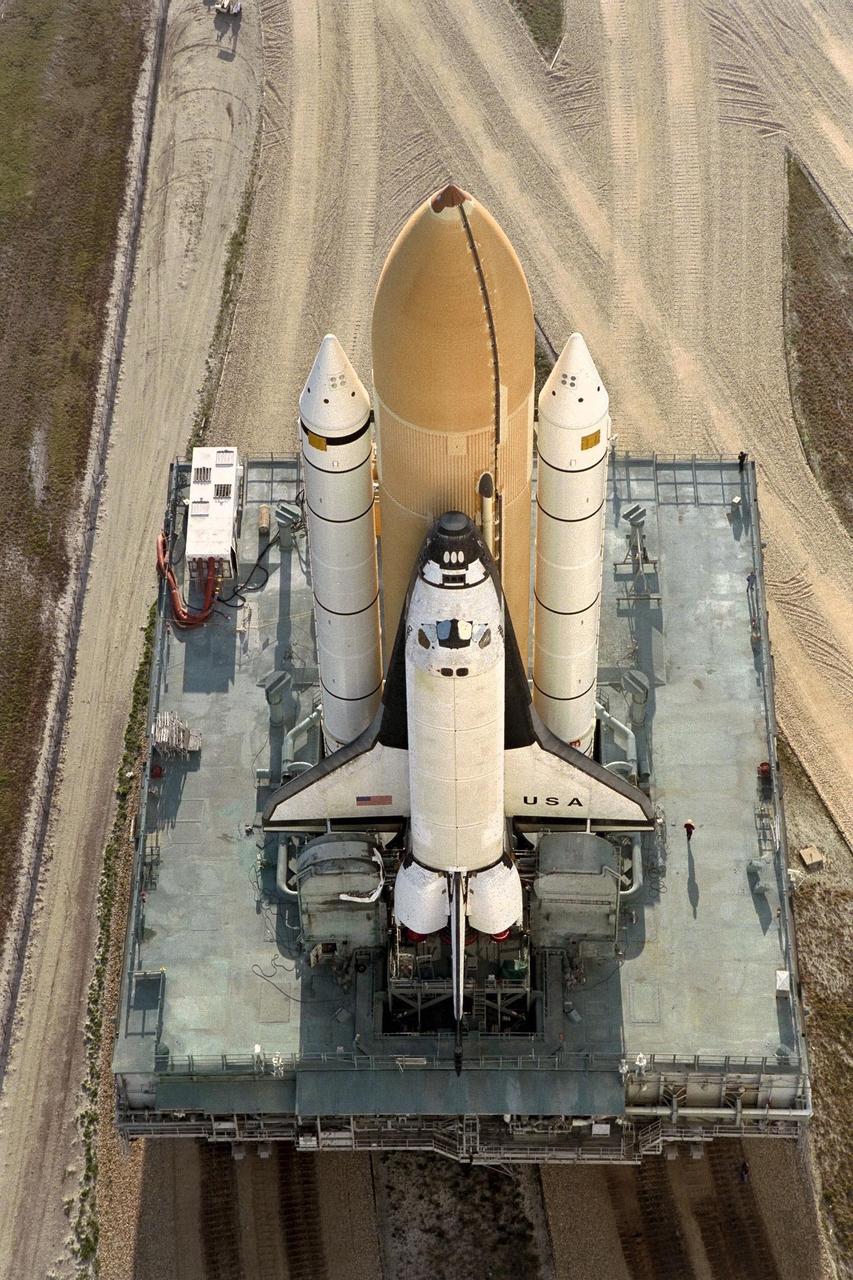
KENNEDY SPACE CENTER, FLA. -- The Space Shuttle Columbia continues its morning rollout from the Vehicle Assembly Building to Launch Pad 39B in preparation for the STS-90 mission. The Neurolab experiments are the primary payload on this nearly 17-day space flight. Investigations during the Neurolab mission will focus on the effects of microgravity on the nervous system. Specifically, experiments will study the adaptation of the vestibular system, the central nervous system, and the pathways that control the ability to sense location in the absence of gravity, as well as the effect of microgravity on a developing nervous system. The crew of STS-90, slated for launch April 16 at 2:19 p.m. EDT, includes Commander Richard Searfoss, Pilot Scott Altman, Mission Specialists Richard Linnehan, Dafydd (Dave) Williams, M.D., and Kathryn (Kay) Hire, and Payload Specialists Jay Buckey, M.D., and James Pawelczyk, Ph.D
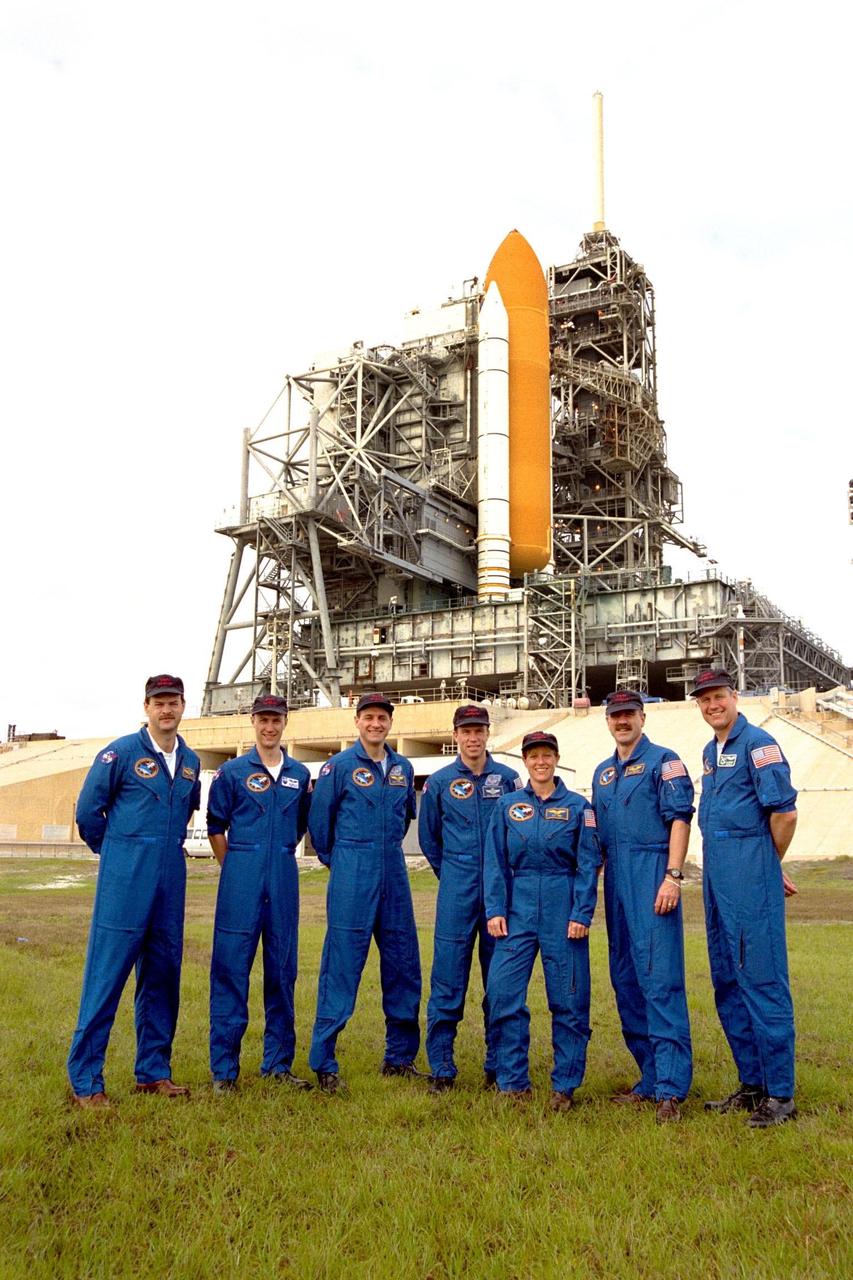
The crew of STS-90 participate in Terminal Countdown Demonstration Test (TCDT) activities at KSC's Launch Pad 39B. The TCDT is held at KSC prior to each Space Shuttle flight to provide crews with the opportunity to participate in simulated countdown activities. The STS-90 crew, left to right, are Pilot Scott Altman, Payload Specialist James Pawelczyk, Ph.D., Mission Specialist Richard Linnehan, D.V.M., Commander Richard Searfoss, Mission Specialists Kathryn (Kay) Hire and Dafydd (Dave) Williams with the Canadian Space Agency, and Payload Specialist Jay Buckey, M.D. Columbia is targeted for launch of STS-90 on April 16 at 2:19 p.m. EST and will be the second mission of 1998. The mission is scheduled to last nearly 17 days
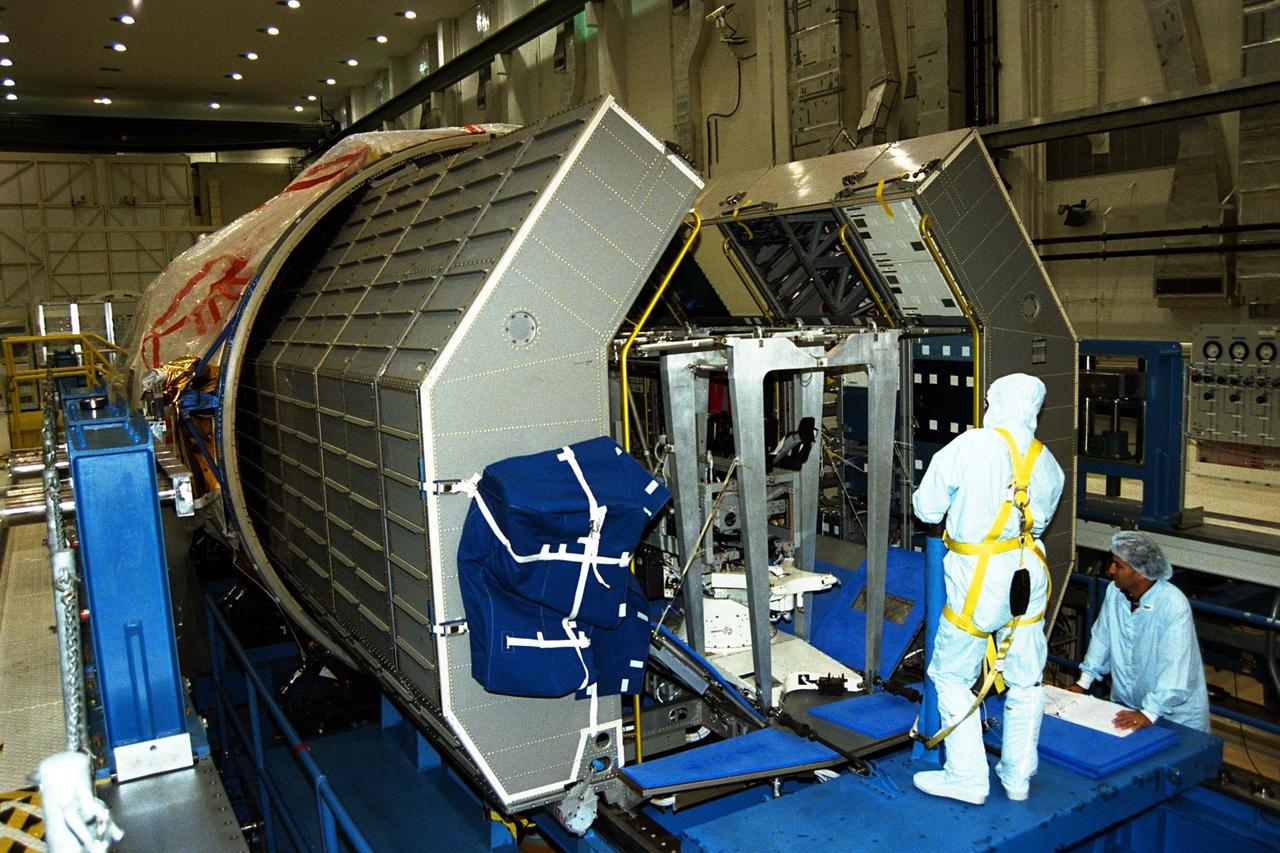
The Neurolab payload for STS-90, scheduled to launch aboard the Shuttle Columbia from Kennedy Space Center (KSC) on April 2, 1998, is installed in the Spacelab module by Boeing technicians in the Operations and Checkout Building at KSC. Investigations during the Neurolab mission will focus on the effects of microgravity on the nervous system. Specifically, experiments will study the adaptation of the vestibular system, the central nervous system, and the pathways that control the ability to sense location in the absence of gravity, as well as the effect of microgravity on a developing nervous system. The crew of STS-90 will include Commander Richard Searfoss, Pilot Scott Altman, Mission Specialists Richard Linnehan, Dafydd (Dave) Williams, M.D., and Kathryn (Kay) Hire, and Payload Specialists Jay Buckey, M.D., and James Pawelczyk, Ph.D

The Neurolab payload for STS-90, scheduled to launch aboard the Shuttle Columbia from Kennedy Space Center (KSC) on April 2, 1998, is installed in the Spacelab module by Boeing technicians in the Operations and Checkout Building at KSC. Investigations during the Neurolab mission will focus on the effects of microgravity on the nervous system. Specifically, experiments will study the adaptation of the vestibular system, the central nervous system, and the pathways that control the ability to sense location in the absence of gravity, as well as the effect of microgravity on a developing nervous system. The crew of STS-90 will include Commander Richard Searfoss, Pilot Scott Altman, Mission Specialists Richard Linnehan, Dafydd (Dave) Williams, M.D., and Kathryn (Kay) Hire, and Payload Specialists Jay Buckey, M.D., and James Pawelczyk, Ph.D
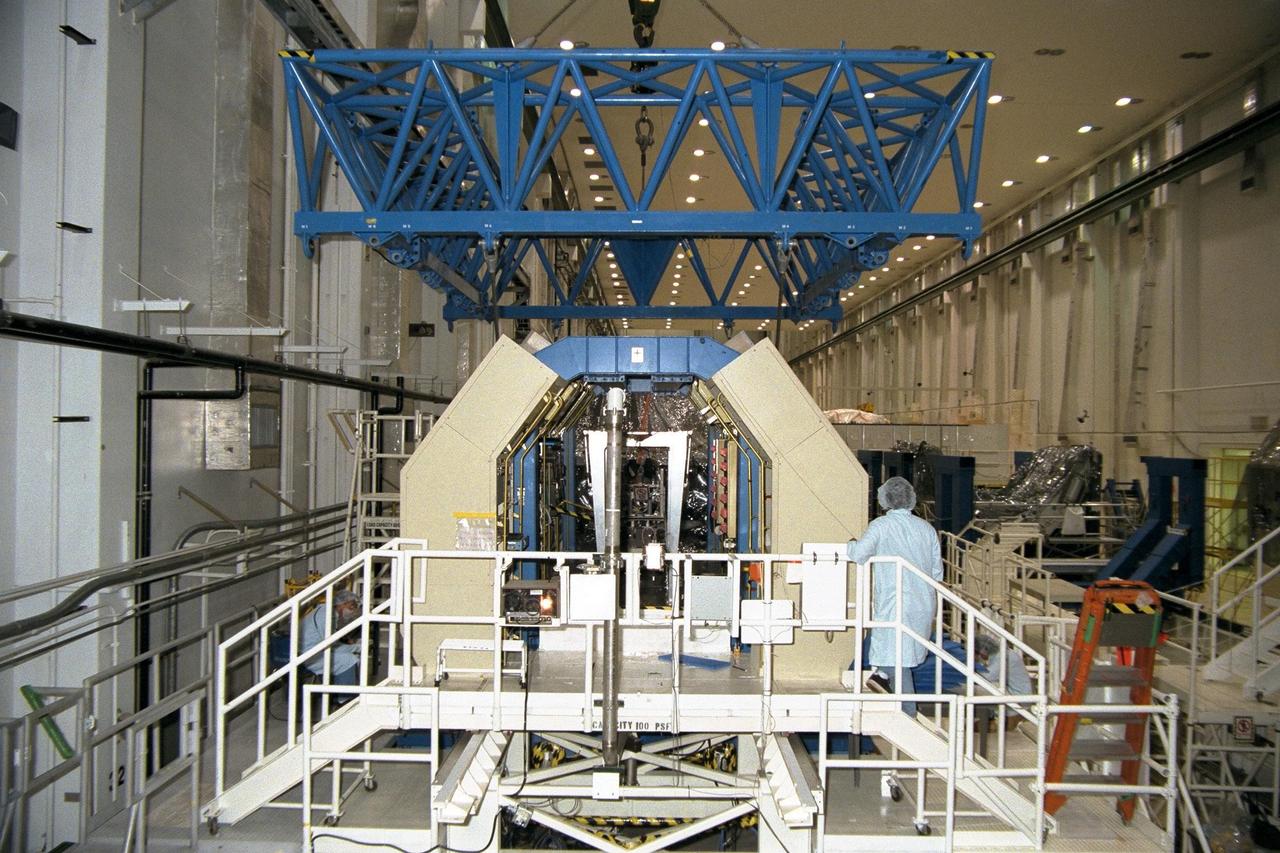
The Neurolab payload for STS-90, scheduled to launch aboard the Shuttle Columbia from Kennedy Space Center (KSC) on April 2, 1998, is ready for processing after being placed in its workstand in the Operations and Checkout Building at KSC. Investigations during the Neurolab mission will focus on the effects of microgravity on the nervous system. Specifically, experiments will study the adaptation of the vestibular system, the central nervous system, and the pathways that control the ability to sense location in the absence of gravity, as well as the effect of microgravity on a developing nervous system. The crew of STS-90 will include Commander Richard Searfoss, Pilot Scott Altman, Mission Specialists Richard Linnehan, Dafydd (Dave) Williams, M.D., and Kathryn (Kay) Hire, and Payload Specialists Jay Buckey, M.D., and James Pawelczyk, Ph.D
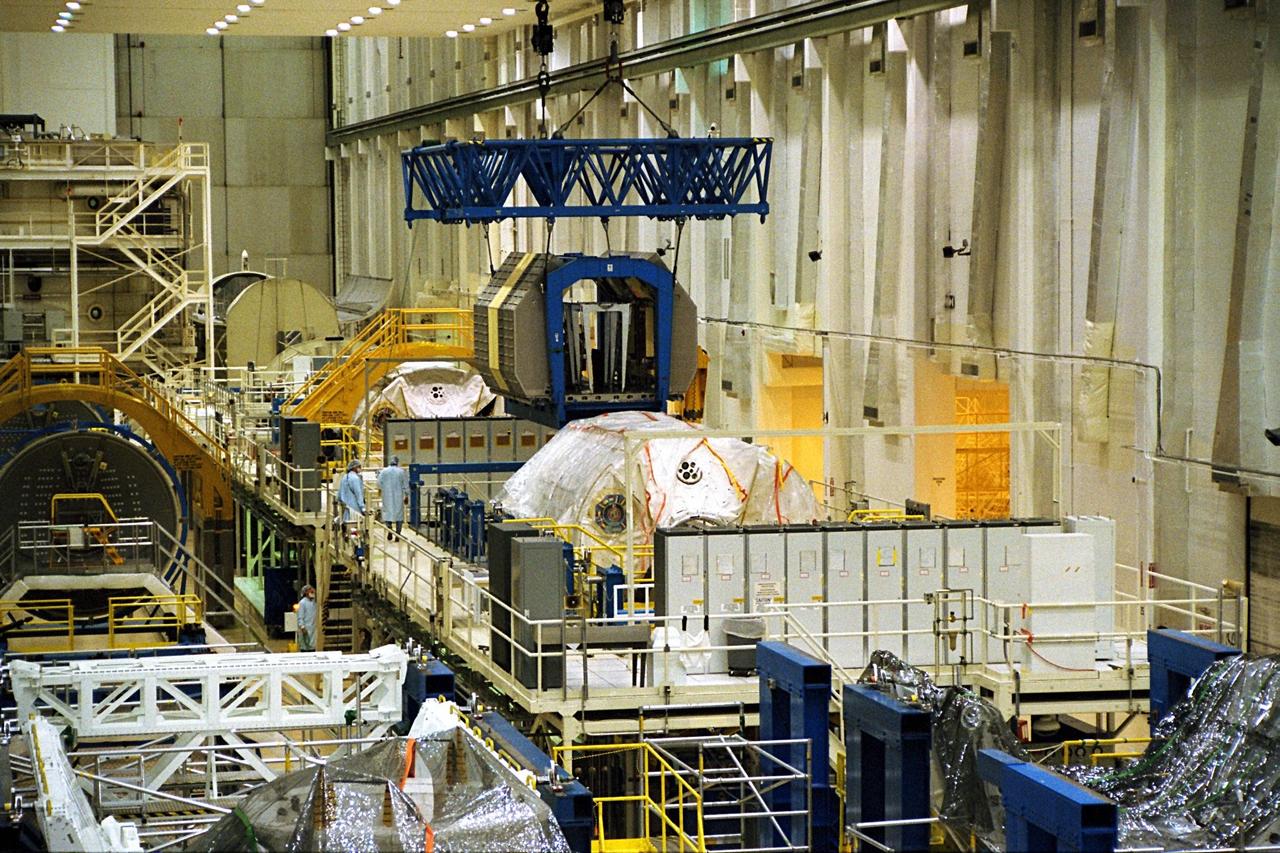
The Neurolab payload for STS-90, scheduled to launch aboard the Shuttle Columbia from Kennedy Space Center (KSC) on April 2, 1998, is moved to its workstand in the Operations and Checkout Building at KSC. Investigations during the Neurolab mission will focus on the effects of microgravity on the nervous system. Specifically, experiments will study the adaptation of the vestibular system, the central nervous system, and the pathways that control the ability to sense location in the absence of gravity, as well as the effect of microgravity on a developing nervous system. The crew of STS-90 will include Commander Richard Searfoss, Pilot Scott Altman, Mission Specialists Richard Linnehan, Dafydd (Dave) Williams, M.D., and Kathryn (Kay) Hire, and Payload Specialists Jay Buckey, M.D., and James Pawelczyk, Ph.D
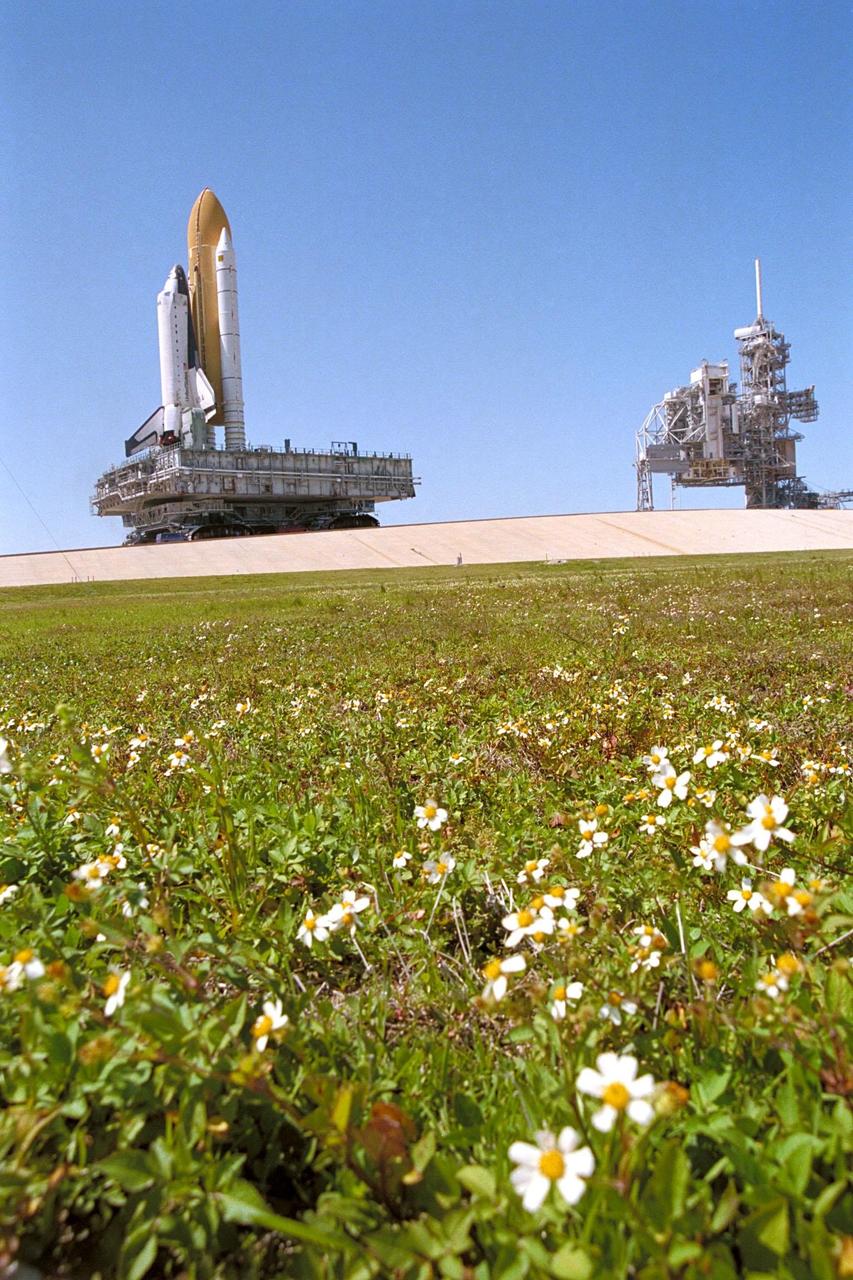
KENNEDY SPACE CENTER, FLA. -- The Space Shuttle Columbia continues up the ramp to Launch Pad 39B in its morning rollout prior to STS-90. Leveling systems within the crawler-transporter underneath the Shuttle keep the platform level while negotiating the five percent ramp leading up to the pad surface. The top of the orbiter is kept vertical within plus or minus 10 minutes of arc, about the diameter of a basketball during the journey. The Neurolab experiments are the primary payload on this nearly 17-day space flight. Investigations during the Neurolab mission will focus on the effects of microgravity on the nervous system. The crew of STS-90, slated for launch April 16 at 2:19 p.m. EDT, includes Commander Richard Searfoss, Pilot Scott Altman, Mission Specialists Richard Linnehan, Dafydd (Dave) Williams, M.D., and Kathryn (Kay) Hire, and Payload Specialists Jay Buckey, M.D., and James Pawelczyk, Ph.D
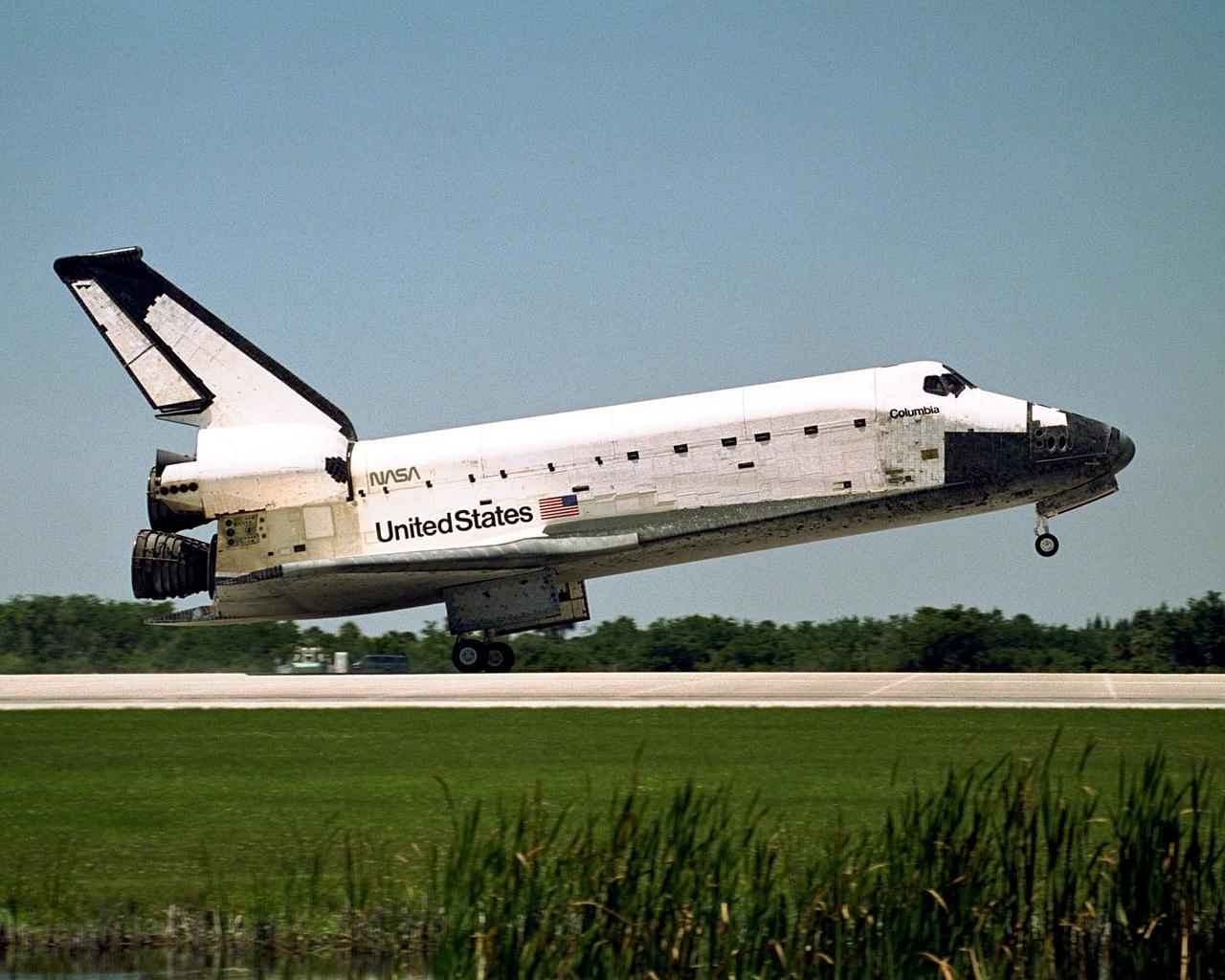
The orbiter Columbia approaches touchdown on Runway 33 of KSC's Shuttle Landing Facility to complete the nearly 16-day STS-90 mission. Main gear touchdown was at 12:08:59 p.m. EDT on May 3, 1998, landing on orbit 256 of the mission. The wheels stopped at 12:09:58 EDT, completing a total mission time of 15 days, 21 hours, 50 minutes and 58 seconds. The 90th Shuttle mission was Columbia's 13th landing at the space center and the 43rd KSC landing in the history of the Space Shuttle program. During the mission, the crew conducted research to contribute to a better understanding of the human nervous system. The crew of the STS-90 Neurolab mission include Commander Richard Searfoss; Pilot Scott Altman; Mission Specialists Richard Linnehan, D.V.M., Dafydd (Dave) Williams, M.D., with the Canadian Space Agency, and Kathryn (Kay) Hire; and Payload Specialists Jay Buckey, M.D., and James Pawelczyk, Ph.D
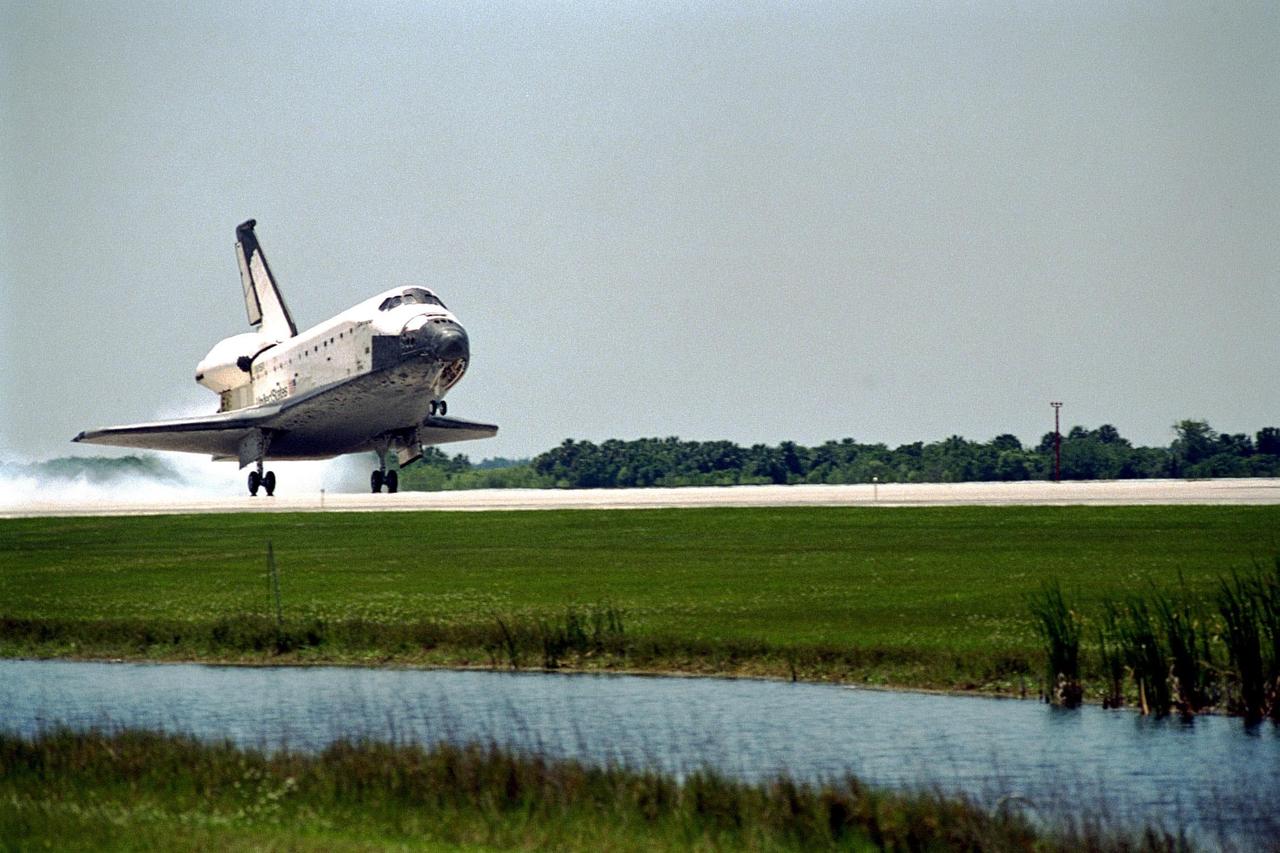
The orbiter Columbia touches down on Runway 33 of KSC's Shuttle Landing Facility to complete the nearly 16-day STS-90 mission. Main gear touchdown was at 12:08:59 p.m. EDT on May 3, 1998, landing on orbit 256 of the mission. The wheels stopped at 12:09:58 EDT, completing a total mission time of 15 days, 21 hours, 50 minutes and 58 seconds. The 90th Shuttle mission was Columbia's 13th landing at the space center and the 43rd KSC landing in the history of the Space Shuttle program. During the mission, the crew conducted research to contribute to a better understanding of the human nervous system. The crew of the STS-90 Neurolab mission include Commander Richard Searfoss; Pilot Scott Altman; Mission Specialists Richard Linnehan, D.V.M., Dafydd (Dave) Williams, M.D., with the Canadian Space Agency, and Kathryn (Kay) Hire; and Payload Specialists Jay Buckey, M.D., and James Pawelczyk, Ph.D
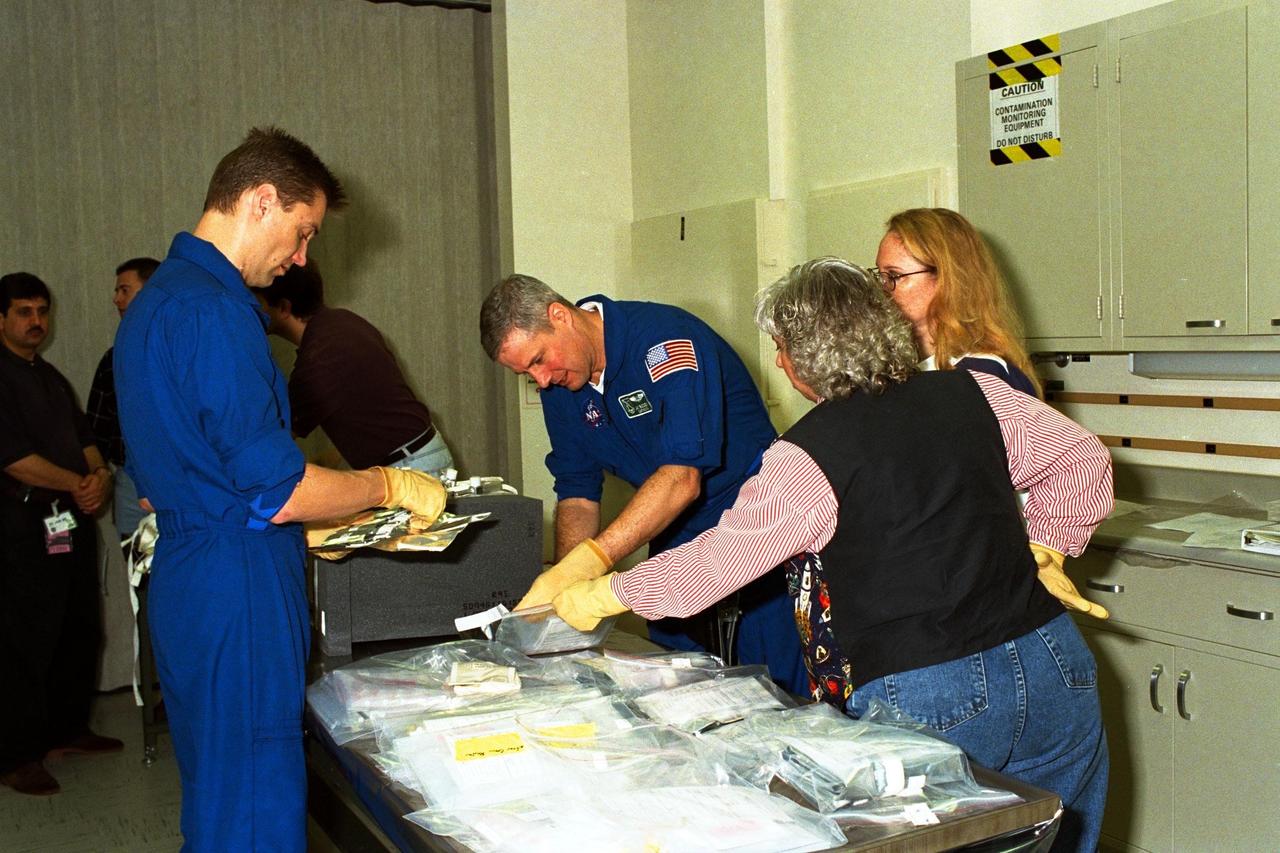
STS-90 Payload Specialists James Pawelczyk, Ph.D. (at left), and Jay Buckey Jr., M.D., examine items to be used during the Crew Equipment Interface Test (CEIT) in Kennedy Space Center's (KSC's) Operations and Checkout Building, where the Neurolab payload is undergoing processing. The CEIT gives astronauts an opportunity to get a hands-on look at the payloads with which they will be working on-orbit. STS-90 is scheduled to launch aboard the Shuttle Columbia from KSC on April 2. Investigations during the Neurolab mission will focus on the effects of microgravity on the nervous system. Specifically, experiments will study the adaptation of the vestibular system, the central nervous system, and the pathways that control the ability to sense location in the absence of gravity, as well as the effect of microgravity on a developing nervous system
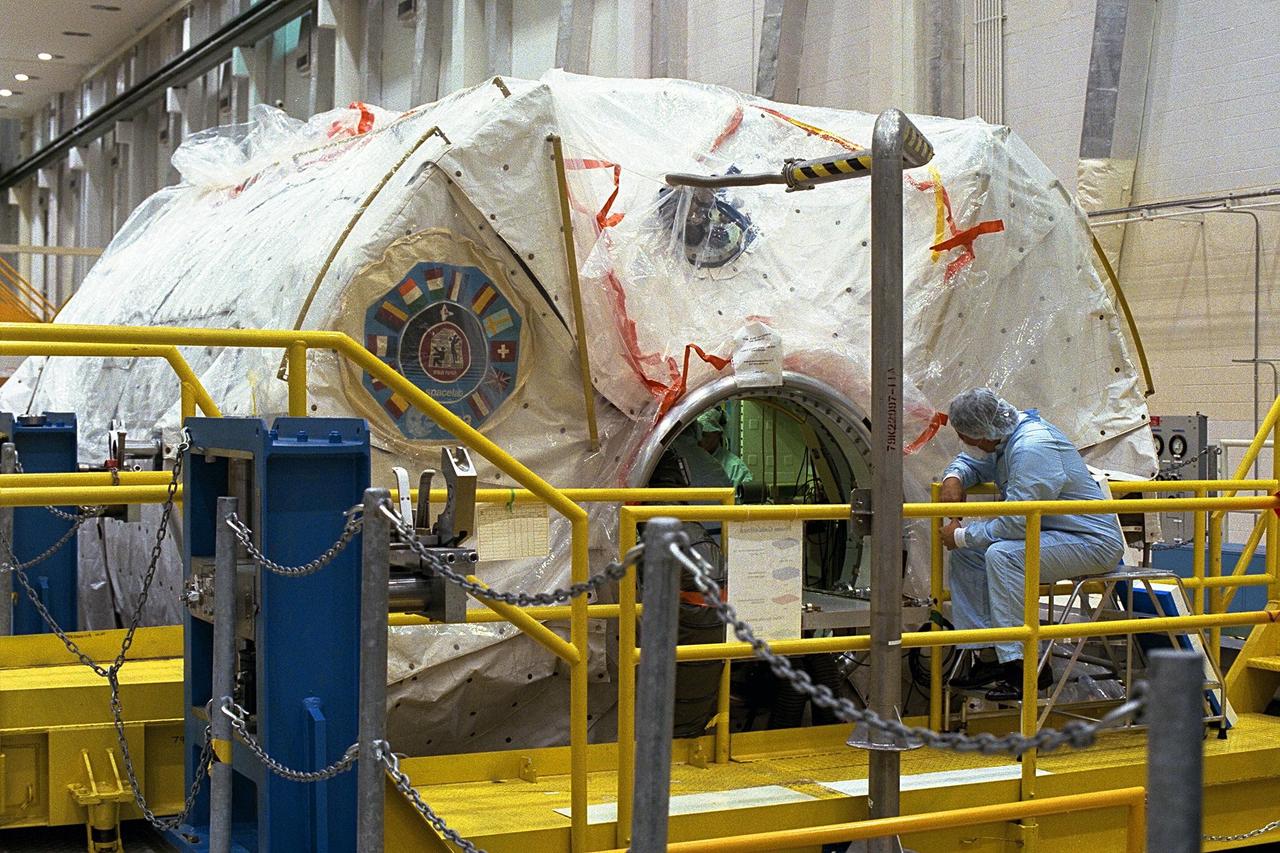
The Neurolab payload for STS-90, scheduled to launch aboard the Shuttle Columbia from Kennedy Space Center (KSC) on April 2, 1998, undergoes further processing in the Operations and Checkout Building at KSC. Investigations during the Neurolab mission will focus on the effects of microgravity on the nervous system. Specifically, experiments will study the adaptation of the vestibular system, the central nervous system, and the pathways that control the ability to sense location in the absence of gravity, as well as the effect of microgravity on a developing nervous system. The crew of STS-90 will include Commander Richard Searfoss, Pilot Scott Altman, Mission Specialists Richard Linnehan, Dafydd (Dave) Williams, M.D., and Kathryn (Kay) Hire, and Payload Specialists Jay Buckey, M.D., and James Pawelczyk, Ph.D
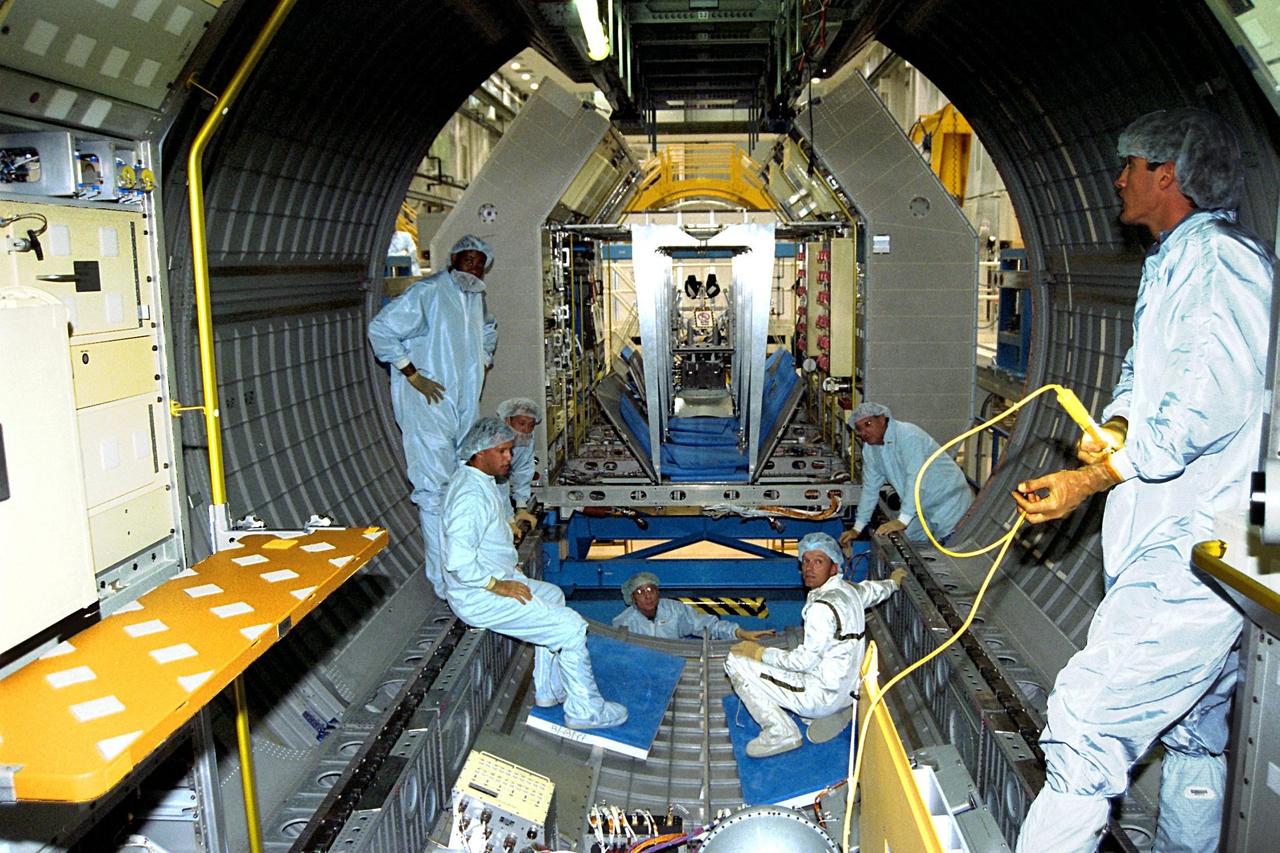
The Neurolab payload for STS-90, scheduled to launch aboard the Shuttle Columbia from Kennedy Space Center (KSC) on April 2, 1998, is installed in the Spacelab module by Boeing technicians in the Operations and Checkout Building at KSC. Investigations during the Neurolab mission will focus on the effects of microgravity on the nervous system. Specifically, experiments will study the adaptation of the vestibular system, the central nervous system, and the pathways that control the ability to sense location in the absence of gravity, as well as the effect of microgravity on a developing nervous system. The crew of STS-90 will include Commander Richard Searfoss, Pilot Scott Altman, Mission Specialists Richard Linnehan, Dafydd (Dave) Williams, M.D., and Kathryn (Kay) Hire, and Payload Specialists Jay Buckey, M.D., and James Pawelczyk, Ph.D
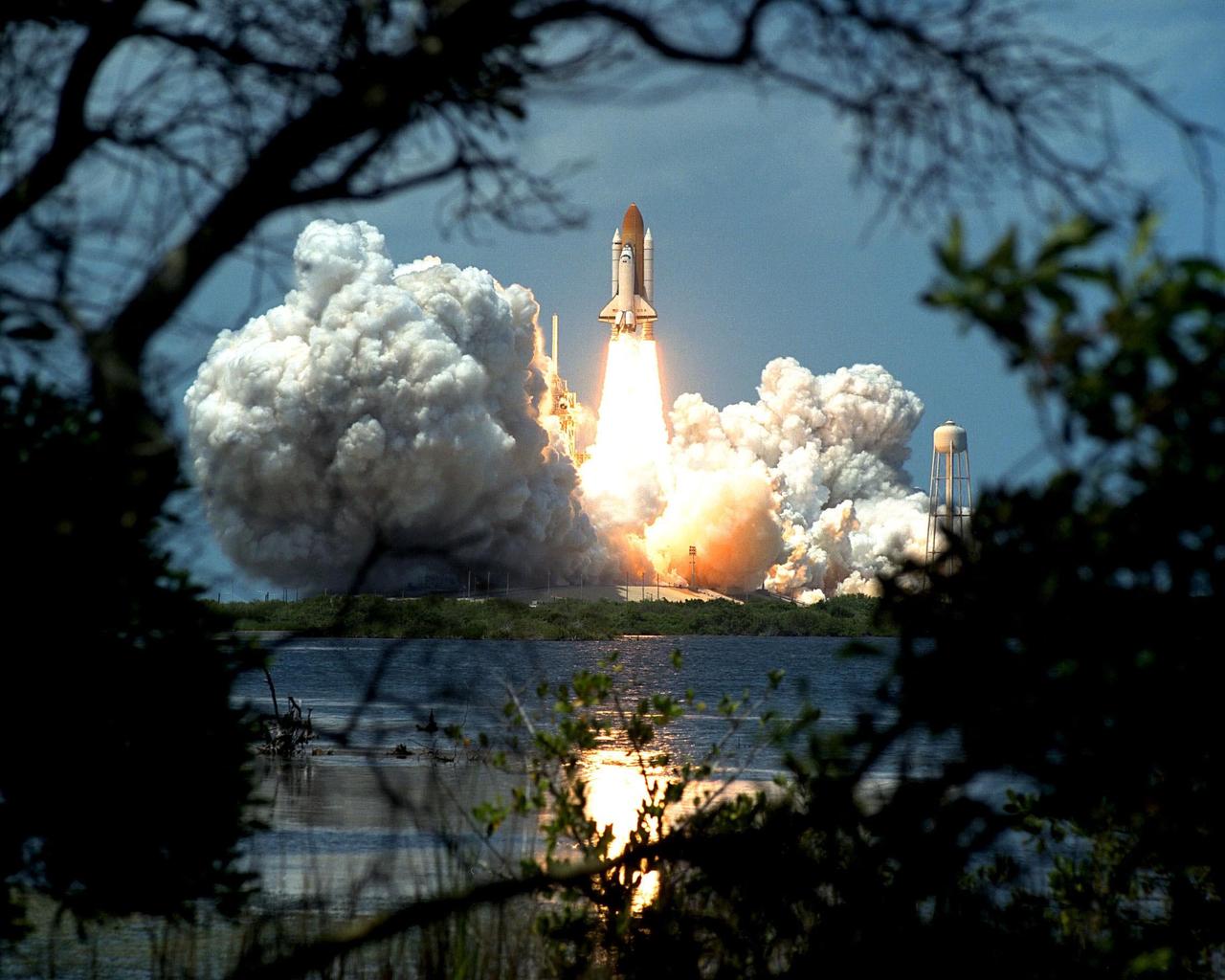
KENNEDY SPACE CENTER, FLA. -- Framed by native Floridian foliage, the Space Shuttle Columbia soars from Launch Pad 39B at 2:19 p.m. EDT Apr. 17 to begin the nearly 17-day STS-90 Neurolab mission. The launch was delayed 24 hours due to difficulty with a network signal processor, which was replaced Apr. 16, on the orbiter. The crew members are Commander Richard Searfoss, Pilot Scott Altman, Mission Specialists Richard Linnehan, D.V.M., Dafydd (Dave) Williams, M.D., with the Canadian Space Agency, and Kathryn (Kay) Hire; and Payload Specialists Jay Buckey, M.D., and James Pawelczyk, Ph.D. Investigations during the Neurolab mission will focus on the effects of microgravity on the nervous system

The crew of STS-90 pose in the white room at KSC's Launch Pad 39B, where they are participating in Terminal Countdown Demonstration Test (TCDT) activities. The TCDT is held at KSC prior to each Space Shuttle flight to provide crews with the opportunity to participate in simulated countdown activities. The crew include, left to right, Commander Richard Searfoss, Pilot Scott Altman, Mission Specialist Kathryn (Kay) Hire, Richard Linnehan, D.V.M., Payload Specialists James Pawelczyk, Ph.D., and Jay Buckey, M.D., and Mission Specialist Dafydd (Dave) Williams, M.D., with the Canadian Space Agency. Columbia is targeted for launch of STS-90 on April 16 at 2:19 p.m. EDT and will be the second mission of 1998. The mission is scheduled to last nearly 17 days
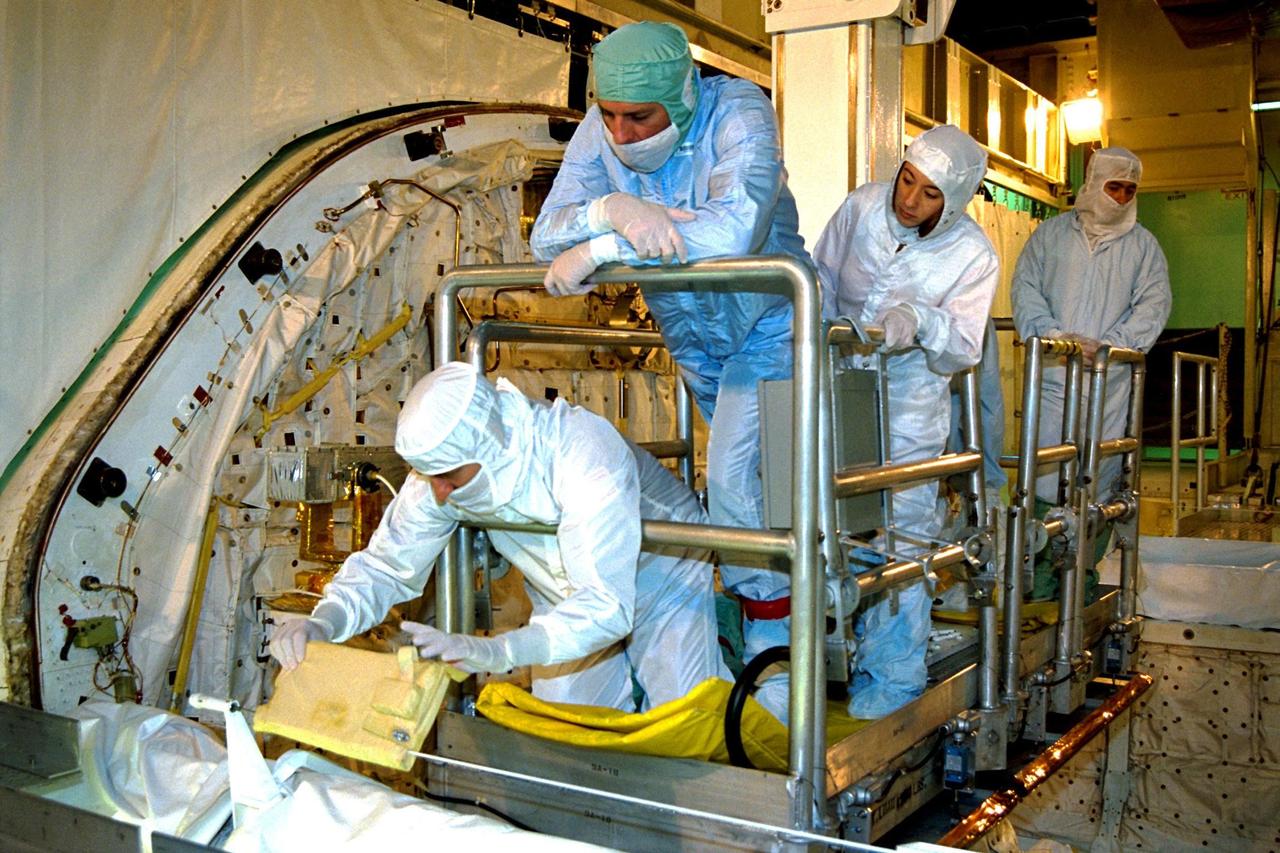
Members of the STS-90 crew participate in the Crew Equipment Interface Test (CEIT) in Kennedy Space Center's Orbiter Processing Facility Bay 3. The CEIT gives astronauts an opportunity to get a hands-on look at the payloads with which they will be working on-orbit. Investigations during the STS-90 Neurolab mission will focus on the effects of microgravity on the nervous system. Specifically, experiments will study the adaptation of the vestibular system, the central nervous system, and the pathways that control the ability to sense location in the absence of gravity, as well as the effect of microgravity on a developing nervous system. The crew of STS-90, slated for launch in April, will include Commander Richard Searfoss, Pilot Scott Altman, Mission Specialists Richard Linnehan, Dafydd (Dave) Williams, M.D., and Kathryn (Kay) Hire, and Payload Specialists Jay Buckey, M.D., and James Pawelczyk, Ph.D

The Neurolab payload for STS-90, scheduled to launch aboard the Shuttle Columbia from Kennedy Space Center (KSC) on April 2, 1998, is moved to its workstand in the Operations and Checkout Building at KSC. Investigations during the Neurolab mission will focus on the effects of microgravity on the nervous system. Specifically, experiments will study the adaptation of the vestibular system, the central nervous system, and the pathways that control the ability to sense location in the absence of gravity, as well as the effect of microgravity on a developing nervous system. The crew of STS-90 will include Commander Richard Searfoss, Pilot Scott Altman, Mission Specialists Richard Linnehan, Dafydd (Dave) Williams, M.D., and Kathryn (Kay) Hire, and Payload Specialists Jay Buckey, M.D., and James Pawelczyk, Ph.D
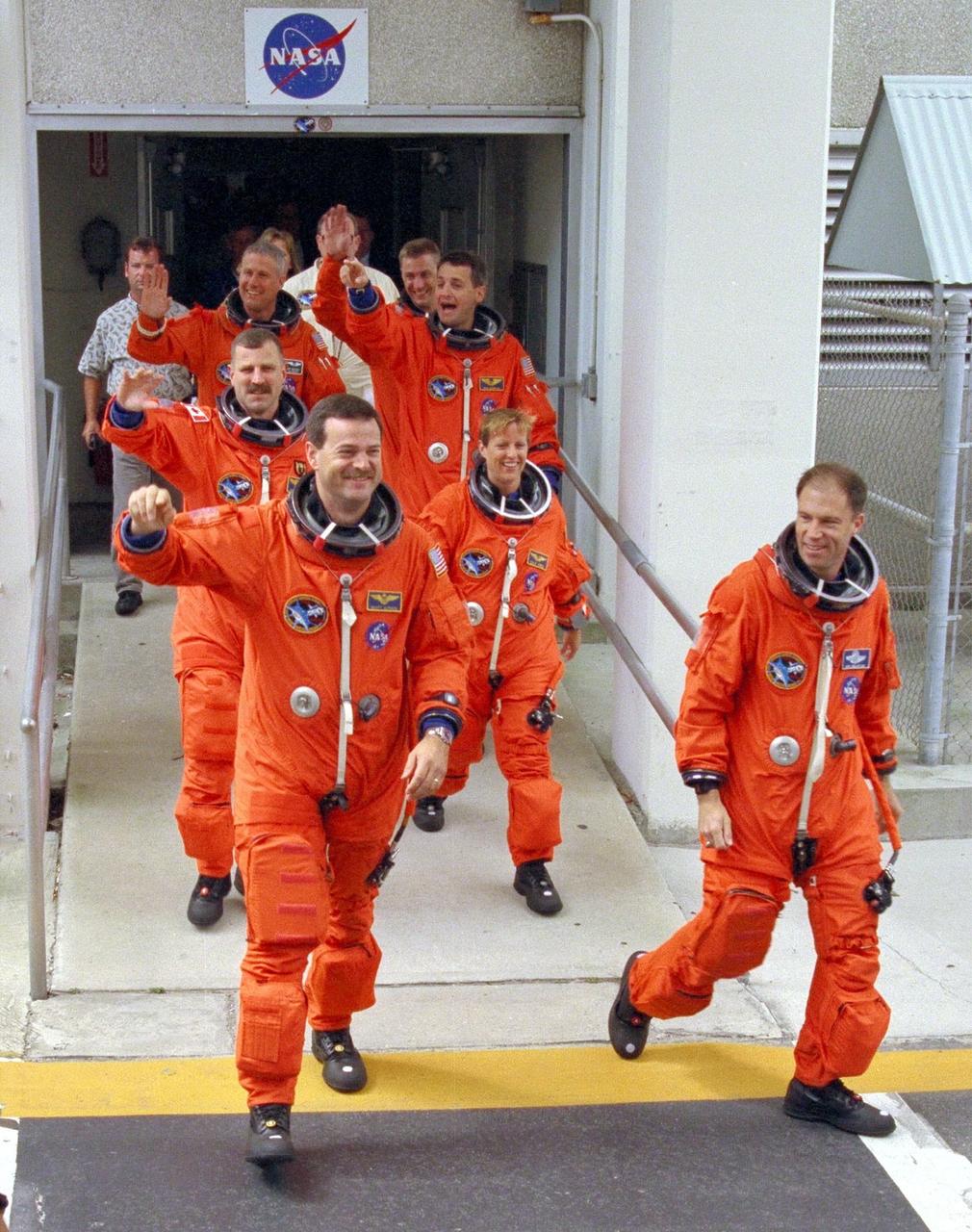
KENNEDY SPACE CENTER, FLA. -- Greeted by cheers from wellwishers at KSC and eager for their venture into space on the Neurolab mission, the STS-90 astronauts depart the Operations and Checkout Building on their way to Launch Pad 39B. Leading the seven-member crew is Mission Commander Richard Searfoss (far right), with Pilot Scott Altman by his side. Behind Altman are Mission Specialist Dafydd (Dave) Williams, M.D., (waving) with the Canadian Space Agency, and Mission Specialist Kathryn (Kay) Hire. Behind Hire is Mission Specialist Richard Linnehan, D.V.M., and next to Linnehan is Payload Specialist Jay Buckey, M.D. At the rear behind Linnehan is Payload Specialist James Pawelczyk, Ph.D. Their trip to the pad will take about 25 minutes aboard the Astrovan. Once there, they will take their positions in the crew cabin of the Space Shuttle Columbia to await a liftoff during a two-and-a-half hour window that will open at 2:19 p.m. EDT
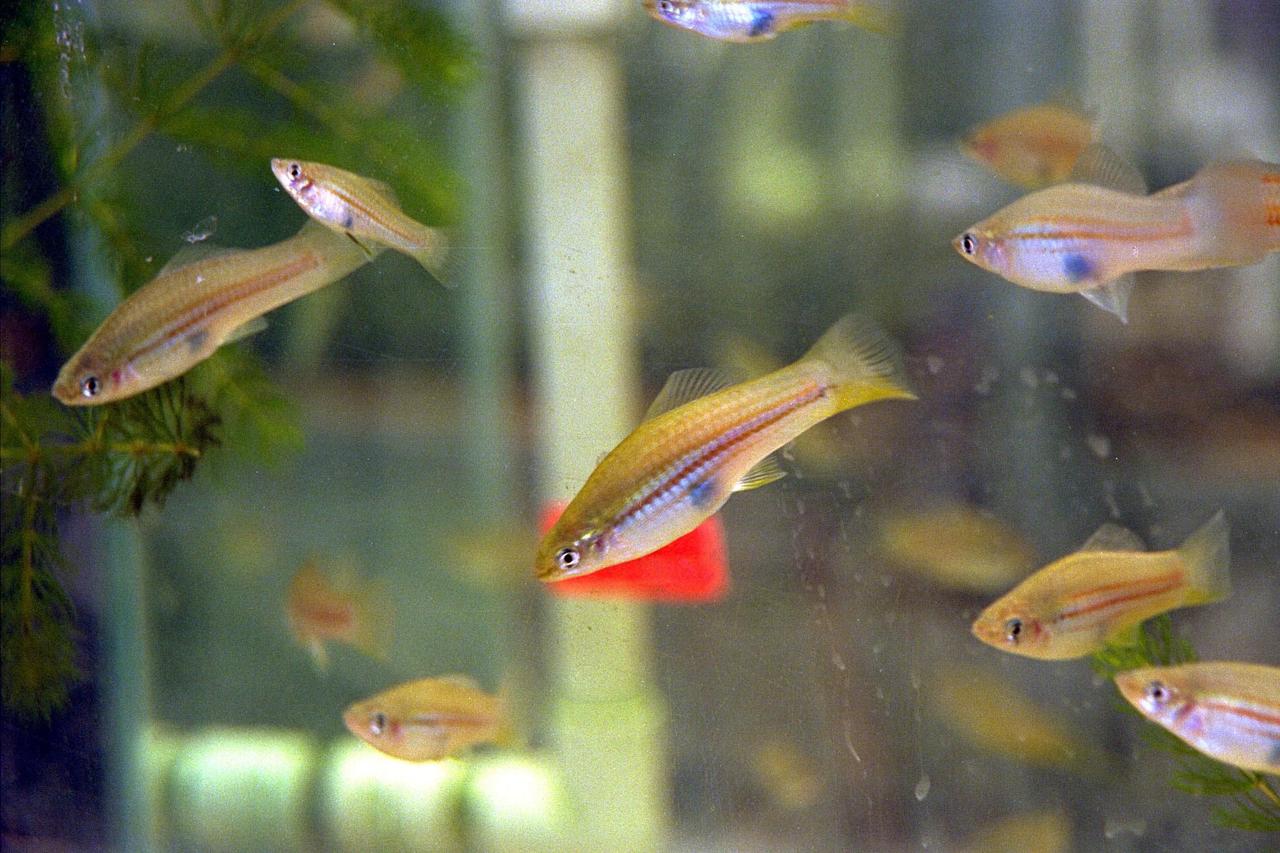
KENNEDY SPACE CENTER, FLA. -- Swordtail fish (Xiphophorus helleri), like those that are part of the Neurolab payload on Space Shuttle Mission STS-90, are shown in their holding tank in the Operations and Checkout Building. The fish will fly in the Closed Equilibrated Biological Aquatic System (CEBAS) Minimodule, a middeck locker-sized fresh water habitat, designed to allow the controlled incubation of aquatic species in a self-stabilizing, artifical ecosystem for up to three weeks under space conditions. Investigations during the Neurolab mission will focus on the effects of microgravity on the nervous system. The crew of STS-90, slated for launch April 16 at 2:19 p.m. EDT, include Commander Richard Searfoss, Pilot Scott Altman, Mission Specialists Richard Linnehan, D.V.M., Dafydd (Dave) Williams, M.D., and Kathryn (Kay) Hire, and Payload Specialists Jay Buckey, M.D., and James Pawelczyk, Ph.D.
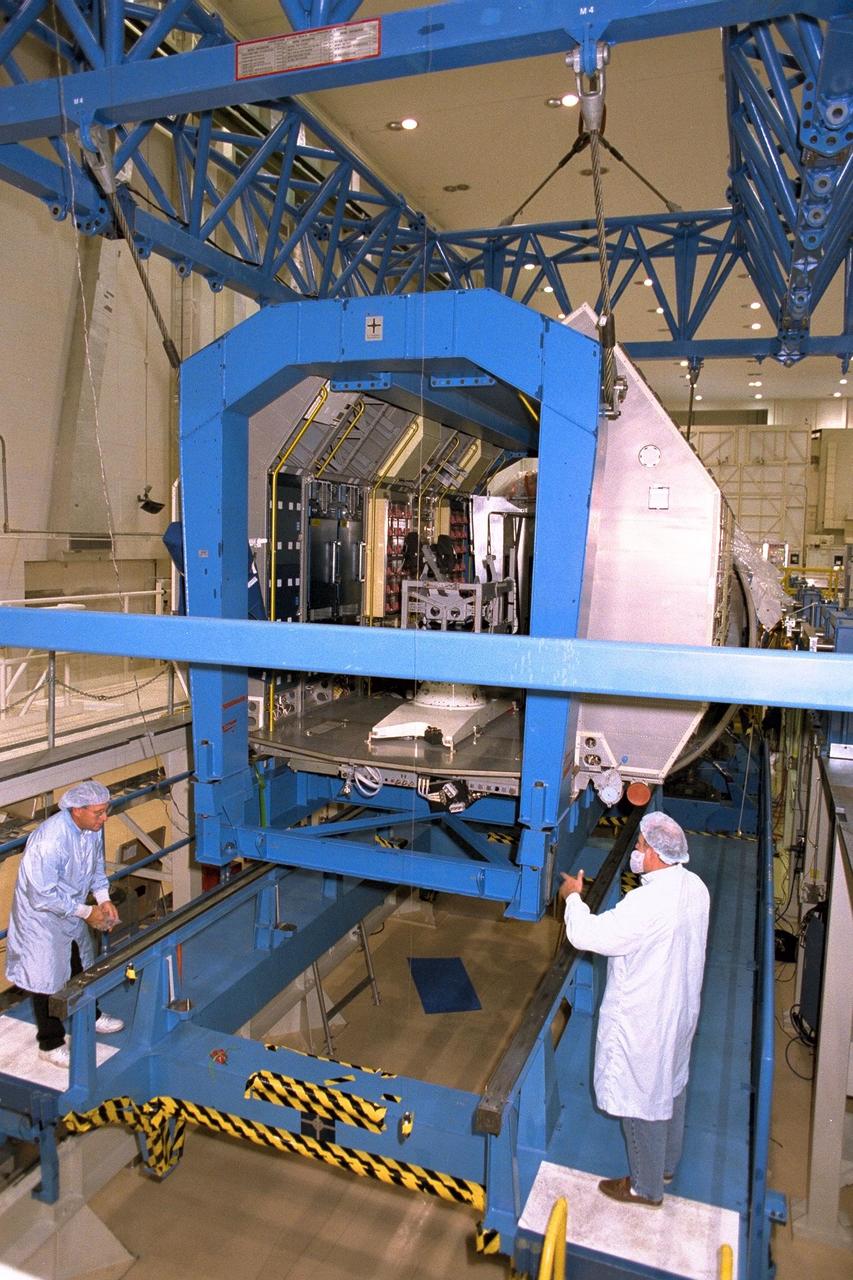
The Neurolab payload for STS-90, scheduled to launch aboard the Shuttle Columbia from Kennedy Space Center (KSC) on April 2, 1998, is moved to its workstand in the Operations and Checkout Building at KSC. Investigations during the Neurolab mission will focus on the effects of microgravity on the nervous system. Specifically, experiments will study the adaptation of the vestibular system, the central nervous system, and the pathways that control the ability to sense location in the absence of gravity, as well as the effect of microgravity on a developing nervous system. The crew of STS-90 will include Commander Richard Searfoss, Pilot Scott Altman, Mission Specialists Richard Linnehan, Dafydd (Dave) Williams, M.D., and Kathryn (Kay) Hire, and Payload Specialists Jay Buckey, M.D., and James Pawelczyk, Ph.D
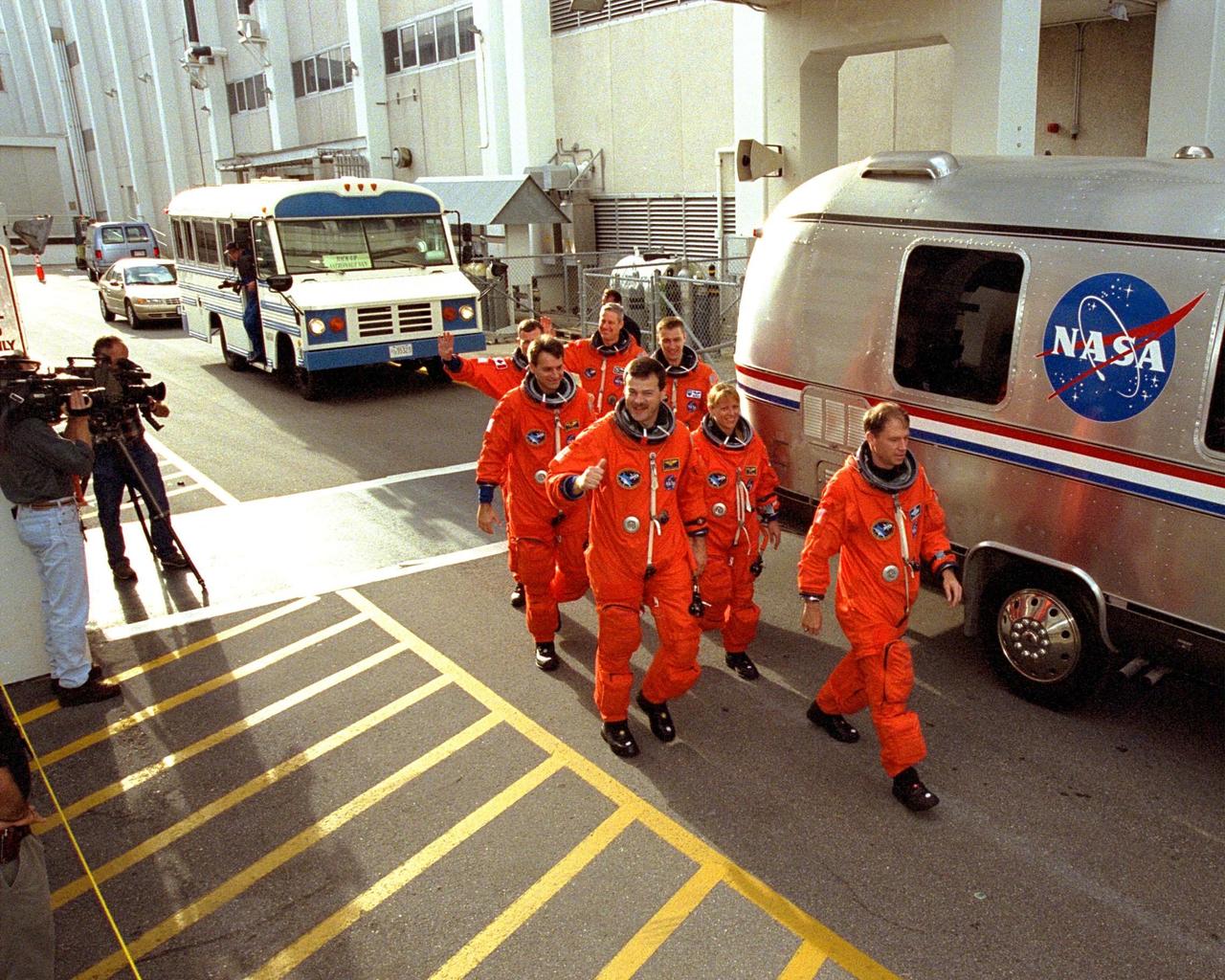
The crew of STS-90 leave the Operations and Checkout Building for Launch Pad 39B during Terminal Countdown Demonstration Test (TCDT) activities. The TCDT is held at KSC prior to each Space Shuttle flight to provide crews with the opportunity to participate in simulated countdown activities. The STS-90 crew members are, front to back and left to right, Commander Richard Searfoss, Pilot Scott Altman, Mission Specialist Kathryn (Kay) Hire, Mission Specialist Richard Linnehan, D.V.M., Payload Specialist James Pawelczyk, Ph.D., Mission Specialist Dafydd (Dave) Williams with the Canadian Space Agency, and Payload Specialist Jay Buckey, M.D. Columbia is targeted for launch of STS-90 on April 16 at 2:19 p.m. EDT and will be the second mission of 1998. The mission is scheduled to last nearly 17 days
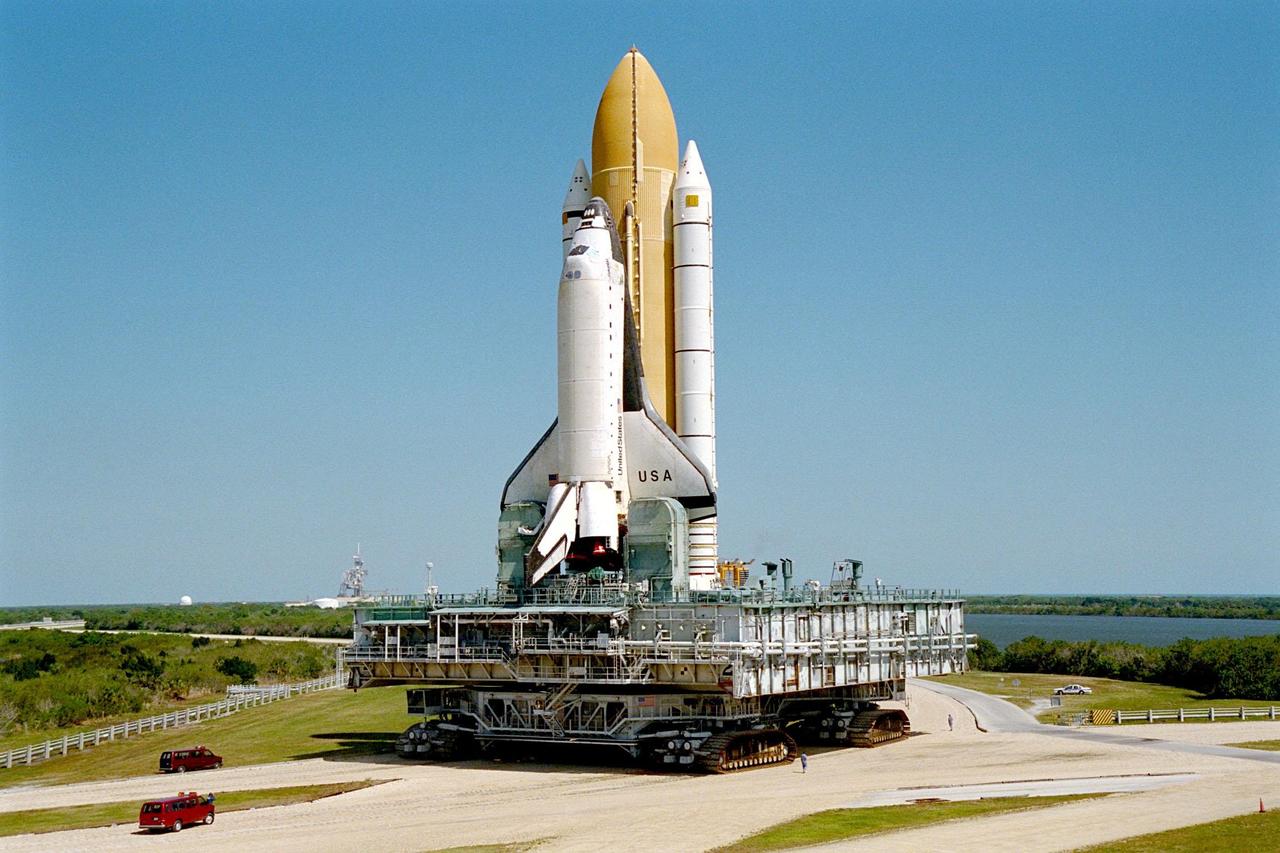
KENNEDY SPACE CENTER, FLA. -- The Space Shuttle Columbia continues its morning rollout from the Vehicle Assembly Building to Launch Pad 39B in preparation for the STS-90 mission. The Neurolab experiments are the primary payload on this nearly 17-day space flight. Investigations during the Neurolab mission will focus on the effects of microgravity on the nervous system. Specifically, experiments will study the adaptation of the vestibular system, the central nervous system, and the pathways that control the ability to sense location in the absence of gravity, as well as the effect of microgravity on a developing nervous system. The crew of STS-90, slated for launch April 16 at 2:19 p.m. EDT, includes Commander Richard Searfoss, Pilot Scott Altman, Mission Specialists Richard Linnehan, Dafydd (Dave) Williams, M.D., and Kathryn (Kay) Hire, and Payload Specialists Jay Buckey, M.D., and James Pawelczyk, Ph.D

KENNEDY SPACE CENTER, FLA. -- The Space Shuttle Columbia arrives at the top of Launch Pad 39B after its morning rollout prior to STS-90. The white room of the Orbiter Access Arm where astronauts suit up for launch can be seen to the left of the orbiter. The Neurolab experiments are the primary payload on this nearly 17-day space flight. Investigations during the Neurolab mission will focus on the effects of microgravity on the nervous system. The crew of STS-90, slated for launch April 16 at 2:19 p.m. EDT, includes Commander Richard Searfoss, Pilot Scott Altman, Mission Specialists Richard Linnehan, Dafydd (Dave) Williams, M.D., and Kathryn (Kay) Hire, and Payload Specialists Jay Buckey, M.D., and James Pawelczyk, Ph.D
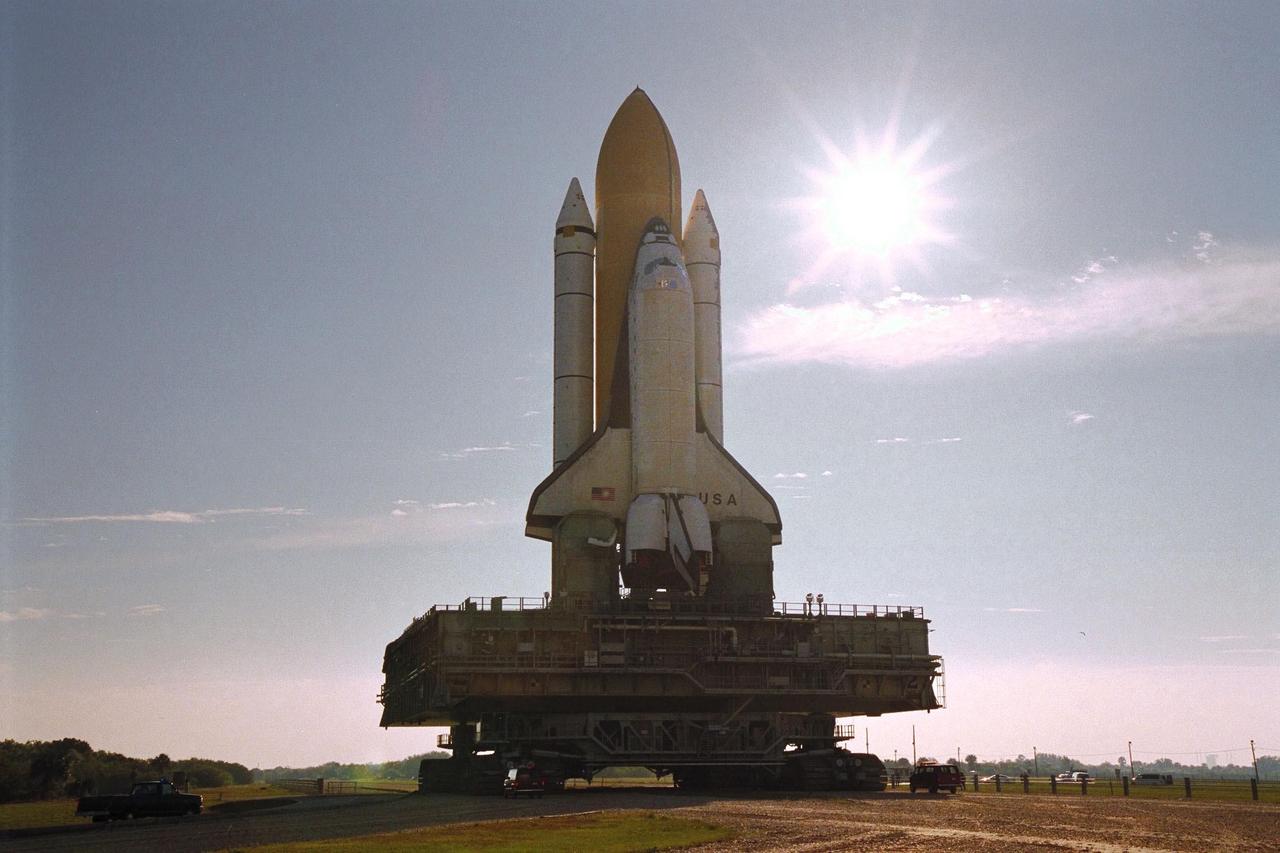
KENNEDY SPACE CENTER, Fla. -- The Space Shuttle Columbia continues its morning rollout from the Vehicle Assembly Building to Launch Pad 39B in preparation for the STS-90 mission. The Neurolab experiments are primary payload on this nearly 17-day space flight. Investigations during the Neurolab mission will focus on the effects of microgravity on the nervous system. Specifically, experiments will study the adaptation of the vestibular system, the central nervous system, and the pathways that control the ability to sense location in the absence of gravity, as well as the effect of microgravity on a developing nervous system. The crew of STS-90, slated for launch April 16 at 2:19 p.m. EDT, includes Commander Richard Searfoss, Pilot Scott Altman, Mission Specialists Richard Linnehan, Dafydd (Dave) Williams, M.D., and Kathryn (Kay) Hire, and Payload Specialists Jay Buckey, M.D., and James Pawelczyk, Ph.D
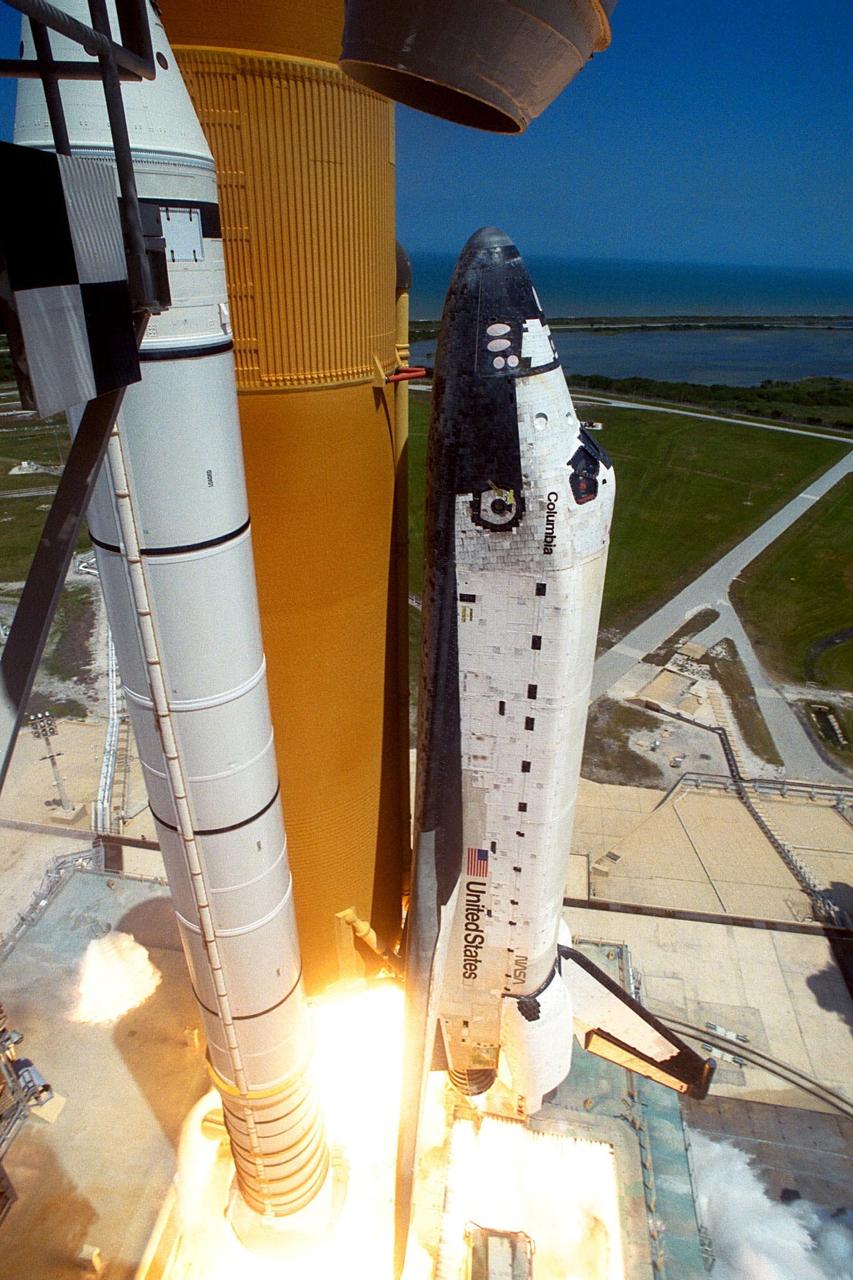
KENNEDY SPACE CENTER, FLA. -- The Space Shuttle Columbia lifts off from Launch Pad 39B at 2:19 p.m. EDT Apr. 17 to begin the nearly 17-day STS-90 Neurolab mission. A torrent of water is seen flowing onto the mobile launcher platform as several large quench nozzles, or "rainbirds," mounted on platform's surface operate as a sound suppression system. The crew members are Commander Richard Searfoss, Pilot Scott Altman, Mission Specialists Richard Linnehan, D.V.M., Dafydd (Dave) Williams, M.D., with the Canadian Space Agency, and Kathryn (Kay) Hire; and Payload Specialists Jay Buckey, M.D., and James Pawelczyk, Ph.D. Investigations during the Neurolab mission will focus on the effects of microgravity on the nervous system
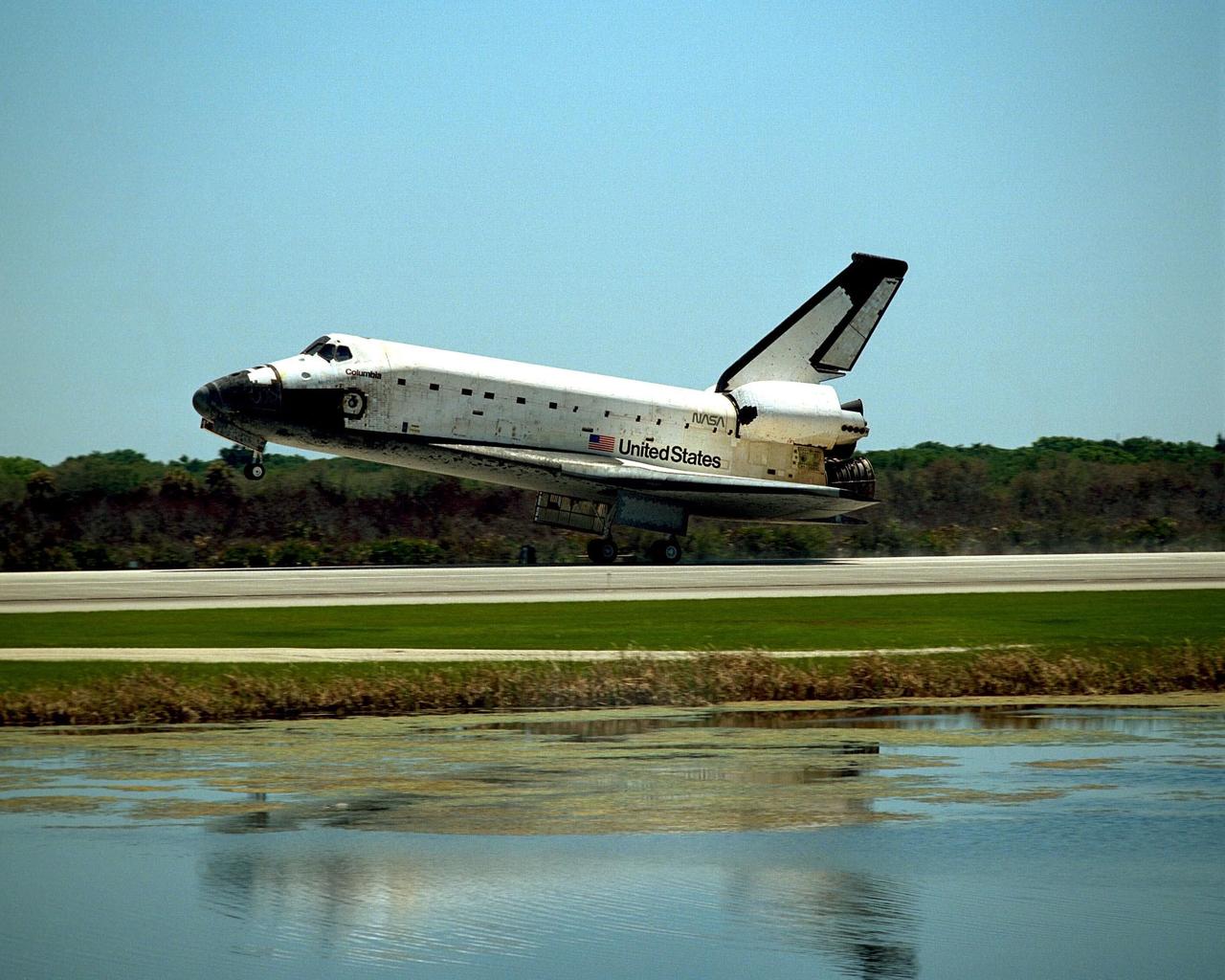
The orbiter Columbia approaches touchdown on Runway 33 of KSC's Shuttle Landing Facility to complete the nearly 16-day STS-90 mission. Main gear touchdown was at 12:08:59 p.m. EDT on May 3, 1998, landing on orbit 256 of the mission. The wheels stopped at 12:09:58 EDT, completing a total mission time of 15 days, 21 hours, 50 minutes and 58 seconds. The 90th Shuttle mission was Columbia's 13th landing at the space center and the 43rd KSC landing in the history of the Space Shuttle program. During the mission, the crew conducted research to contribute to a better understanding of the human nervous system. The crew of the STS-90 Neurolab mission include Commander Richard Searfoss; Pilot Scott Altman; Mission Specialists Richard Linnehan, D.V.M., Dafydd (Dave) Williams, M.D., with the Canadian Space Agency, and Kathryn (Kay) Hire; and Payload Specialists Jay Buckey, M.D., and James Pawelczyk, Ph.D
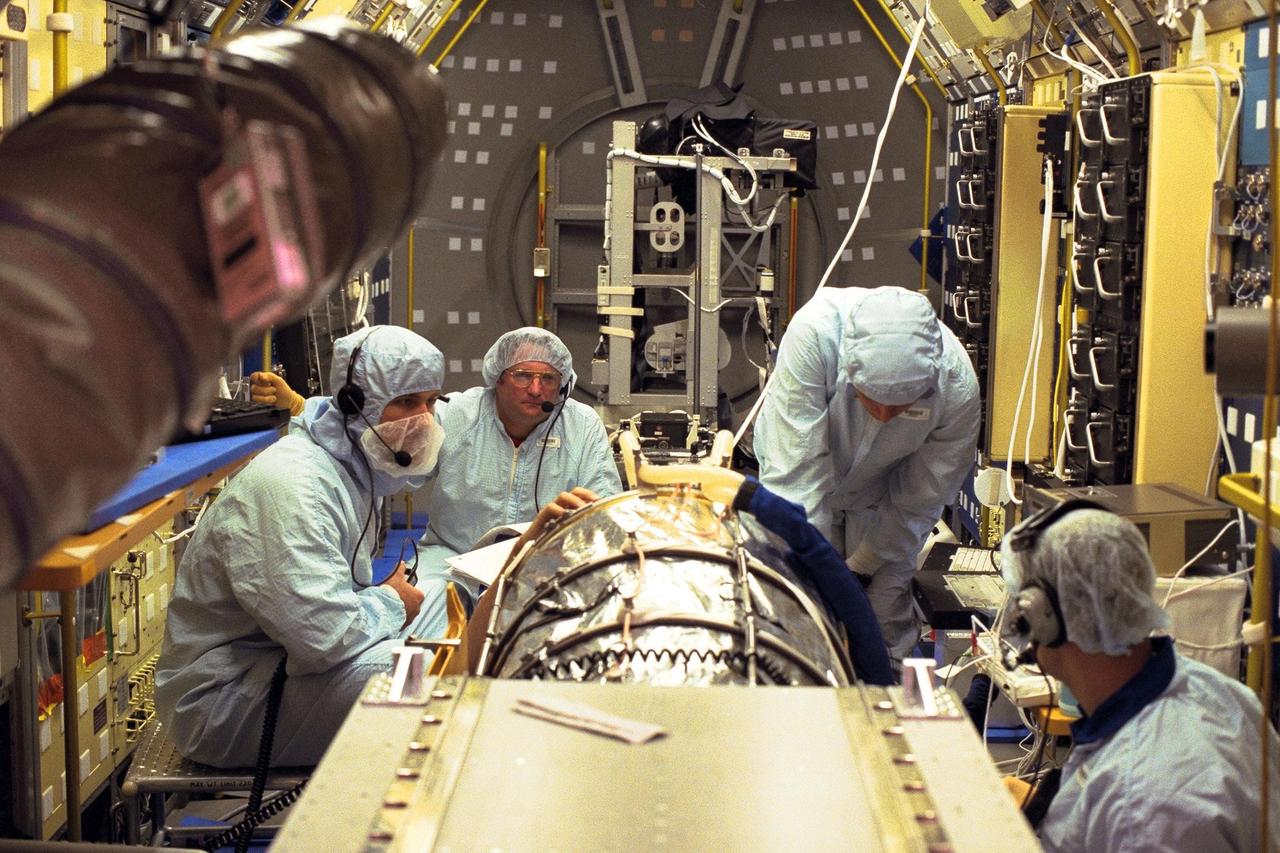
The Neurolab payload for STS-90, scheduled to launch aboard the Shuttle Columbia from Kennedy Space Center (KSC) on April 2, 1998, undergoes further processing in the Operations and Checkout Building at KSC. Investigations during the Neurolab mission will focus on the effects of microgravity on the nervous system. Specifically, experiments will study the adaptation of the vestibular system, the central nervous system, and the pathways that control the ability to sense location in the absence of gravity, as well as the effect of microgravity on a developing nervous system. The crew of STS-90 will include Commander Richard Searfoss, Pilot Scott Altman, Mission Specialists Richard Linnehan, Dafydd (Dave) Williams, M.D., and Kathryn (Kay) Hire, and Payload Specialists Jay Buckey, M.D., and James Pawelczyk, Ph.D
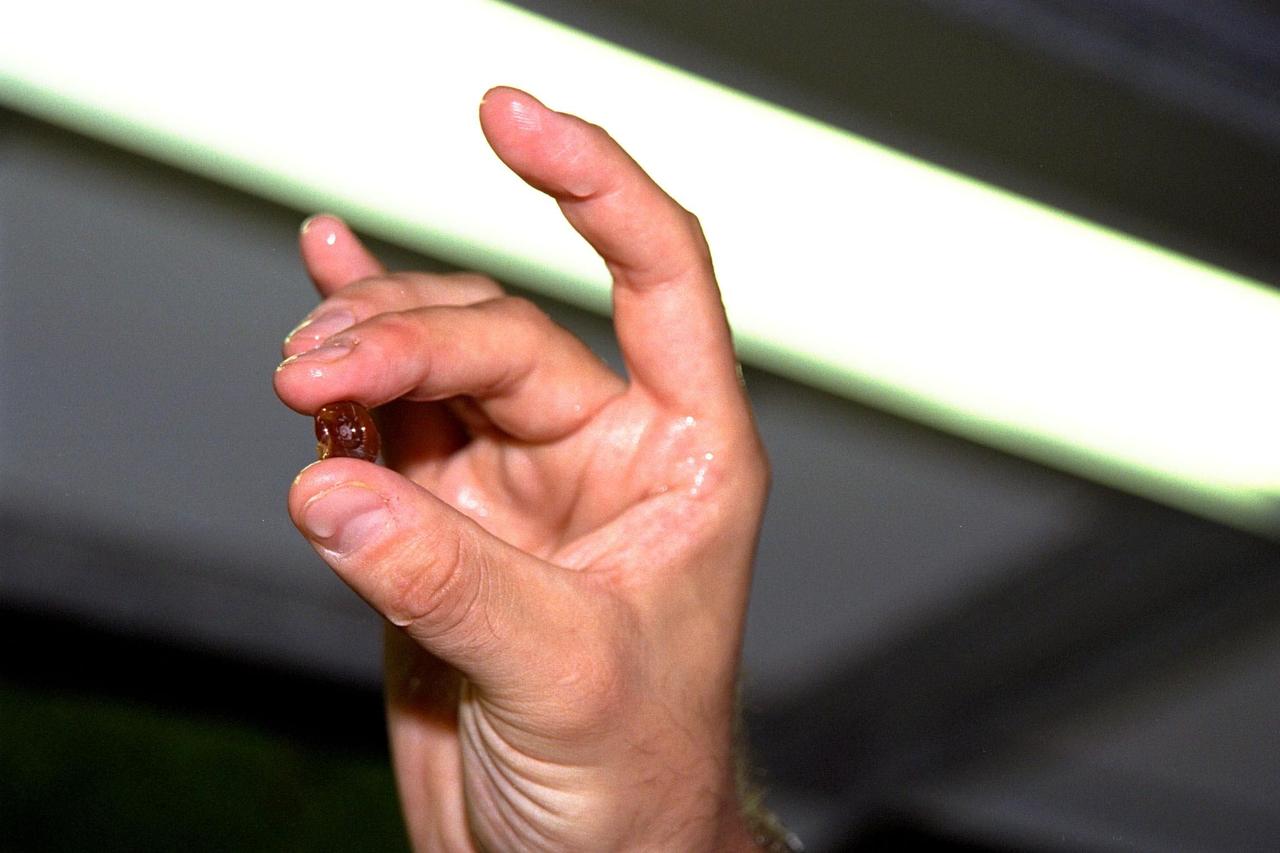
KENNEDY SPACE CENTER, FLA. -- A water snail (Biomphalaria glabrata), like those that are part of the Neurolab payload on Space Shuttle Mission STS-90, is held up for inspection in the Operations and Checkout Building. The snails will fly in the Closed Equilibrated Biological Aquatic System (CEBAS) Minimodule, a middeck locker-sized fresh water habitat, designed to allow the controlled incubation of aquatic species in a self-stabilizing, artifical ecosystem for up to three weeks under space conditions. Investigations during the Neurolab mission will focus on the effects of microgravity on the nervous system. The crew of STS-90, slated for launch April 16 at 2:19 p.m. EDT, includes Commander Richard Searfoss, Pilot Scott Altman, Mission Specialists Richard Linnehan, D.V.M., Dafydd (Dave) Williams, M.D., and Kathryn (Kay) Hire, and Payload Specialists Jay Buckey, M.D., and James Pawelczyk, Ph.D
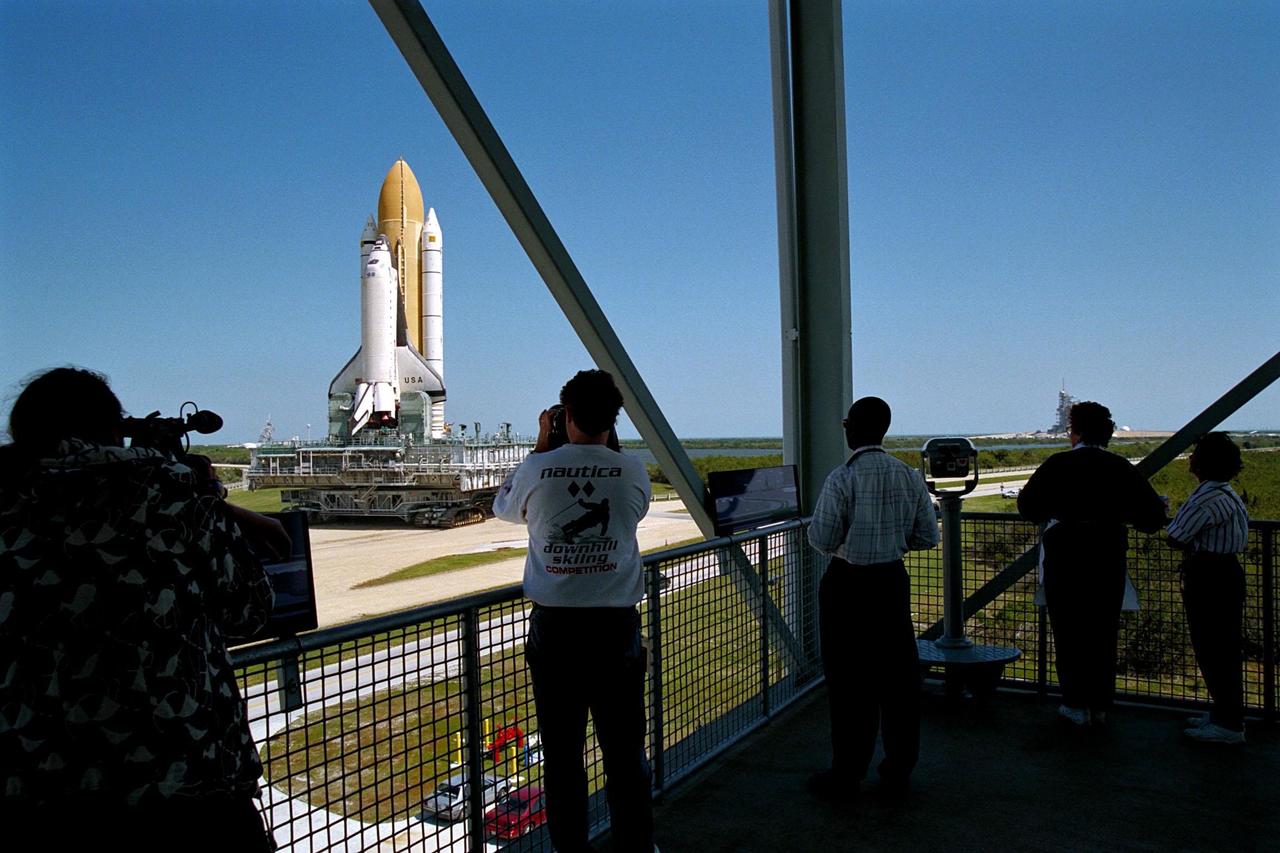
KENNEDY SPACE CENTER, FLA. -- The Space Shuttle Columbia continues its morning rollout past the newly opened tour stop, the Launch Complex 39 Observation Gantry, to Launch Pad 39B in preparation for the STS-90 mission. The Neurolab experiments are the primary payload on this nearly 17-day space flight. Investigations during the Neurolab mission will focus on the effects of microgravity on the nervous system. Specifically, experiments will study the adaptation of the vestibular system, the central nervous system, and the pathways that control the ability to sense location in the absence of gravity, as well as the effect of microgravity on a developing nervous system. The crew of STS-90, slated for launch April 16 at 2:19 p.m. EDT, includes Commander Richard Searfoss, Pilot Scott Altman, Mission Specialists Richard Linnehan, Dafydd (Dave) Williams, M.D., and Kathryn (Kay) Hire, and Payload Specialists Jay Buckey, M.D., and James Pawelczyk, Ph.D

KENNEDY SPACE CENTER, FLA. -- The STS-90 flight crew enjoy the traditional pre-liftoff breakfast in the crew quarters of the Operations and Checkout Building. They are, from left, Payload Specialist Jay Buckey, M.D., Mission Specialist Dafydd (Dave) Williams, M.D., with the Canadian Space Agency, Pilot Scott Altman, Commander Richard Searfoss, Mission Specialist Kathryn (Kay) Hire, Mission Specialist Richard Linnehan, D.V.M., and Payload Specialist James Pawelczyk, Ph.D. After a weather briefing, the flight crew will be fitted with their launch and entry suits and depart for Launch Pad 39B. Once there, they will take their positions in the crew cabin of the Space Shuttle Columbia to await liftoff during a two-and-a-half-hour window that will open at 2:19 p.m. EDT, Apr. 17. STS-90 is the launch of Neurolab, a nearly 17-day mission to examine the effects of spaceflight on the brain, spinal cord, peripheral nerves and sensory organs in the human body

KENNEDY SPACE CENTER, FLA. -- The Space Shuttle Columbia begins its rollout from the Vehicle Assembly Building to Launch Pad 39B in preparation for the STS-90 mission. The Neurolab experiments are the primary payload on this nearly 17-day space flight. Investigations during the Neurolab mission will focus on the effects of microgravity on the nervous system. Specifically, experiments will study the adaptation of the vestibular system, the central nervous system, and the pathways that control the ability to sense location in the absence of gravity, as well as the effect of microgravity on a developing nervous system. The crew of STS-90, slated for launch April 16 at 2:19 p.m. EDT, includes Commander Richard Searfoss, Pilot Scott Altman, Mission Specialists Richard Linnehan, Dafydd (Dave) Williams, M.D., and Kathryn (Kay) Hire, and Payload Specialists Jay Buckey, M.D., and James Pawelczyk, Ph.D
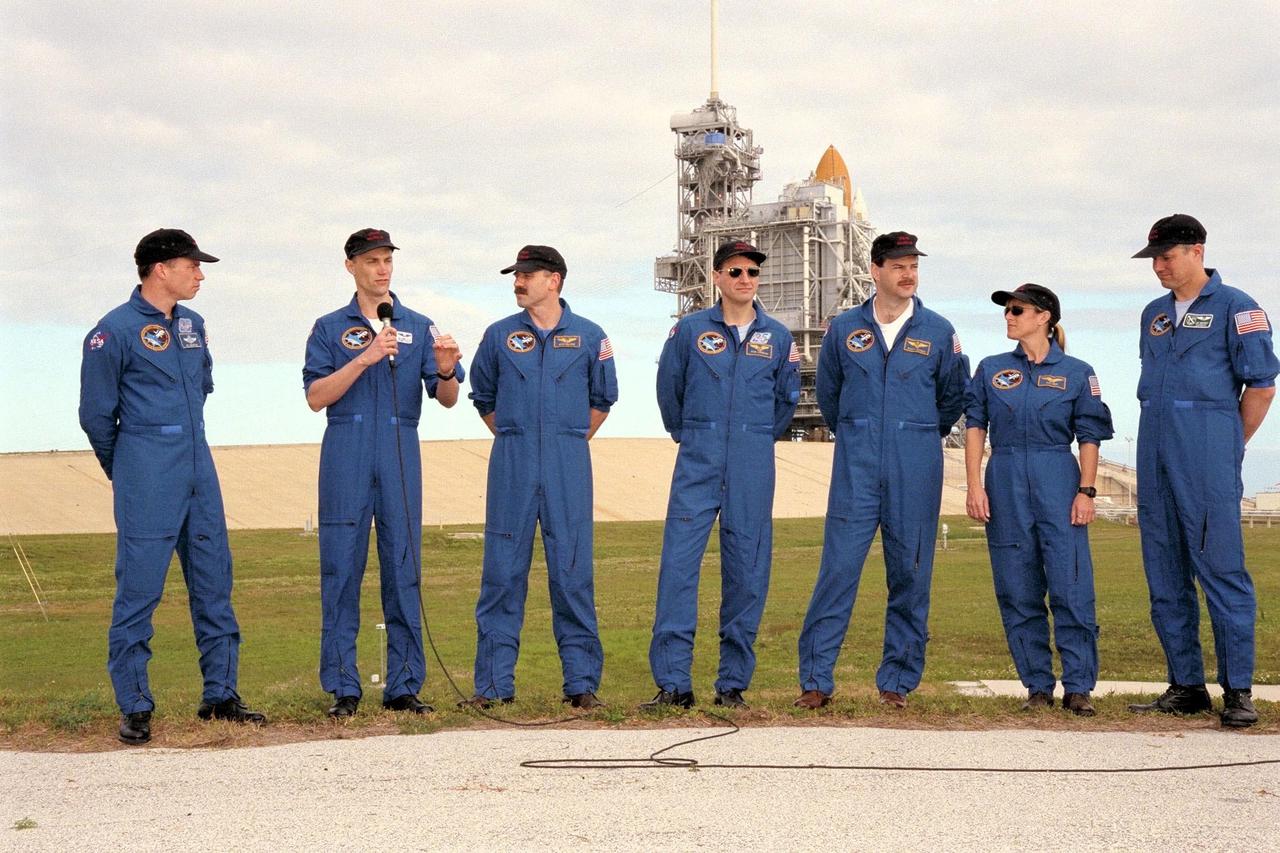
The crew of STS-90 participate in Terminal Countdown Demonstration Test (TCDT) activities at KSC's Launch Pad 39B. The TCDT is held at KSC prior to each Space Shuttle flight to provide crews with the opportunity to participate in simulated countdown activities. The crew include, left to right, Commander Richard Searfoss, Payload Specialist James Pawelczyk, Ph.D., Mission Specialist Dafydd (Dave) Williams, M.D., with the Canadian Space Agency, Mission Specialist Richard Linnehan, D.V.M., Pilot Scott Altman, Mission Specialist Kathryn (Kay) Hire, and Payload Specialist Jay Buckey, M.D. Columbia is targeted for launch of STS-90 on April 16 at 2:19 p.m. EDT and will be the second mission of 1998. The mission is scheduled to last nearly 17 days
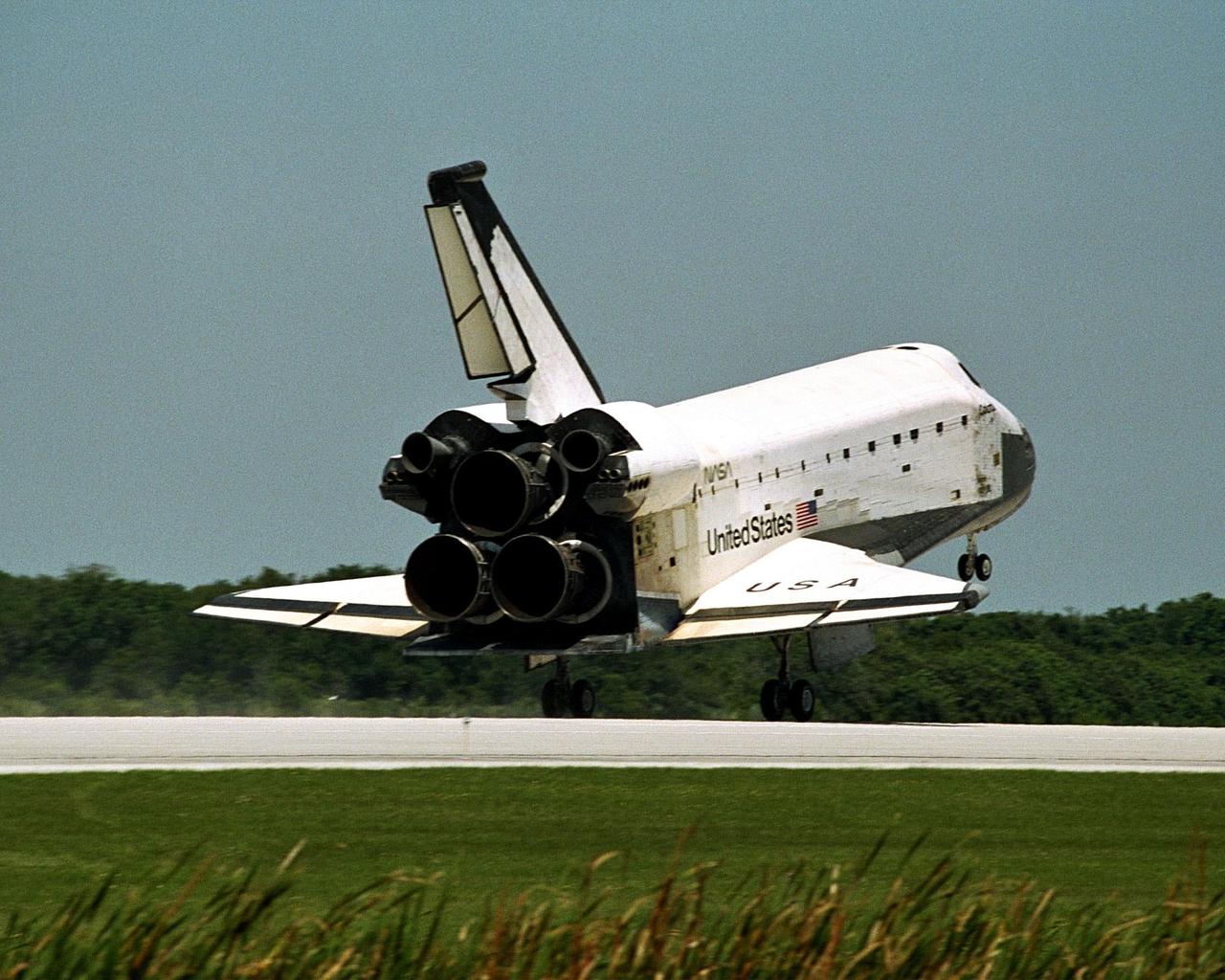
The orbiter Columbia approaches touchdown on Runway 33 of KSC's Shuttle Landing Facility to complete the nearly 16-day STS-90 mission. Main gear touchdown was at 12:08:59 p.m. EDT on May 3, 1998, landing on orbit 256 of the mission. The wheels stopped at 12:09:58 EDT, completing a total mission time of 15 days, 21 hours, 50 minutes and 58 seconds. The 90th Shuttle mission was Columbia's 13th landing at the space center and the 43rd KSC landing in the history of the Space Shuttle program. During the mission, the crew conducted research to contribute to a better understanding of the human nervous system. The crew of the STS-90 Neurolab mission include Commander Richard Searfoss; Pilot Scott Altman; Mission Specialists Richard Linnehan, D.V.M., Dafydd (Dave) Williams, M.D., with the Canadian Space Agency, and Kathryn (Kay) Hire; and Payload Specialists Jay Buckey, M.D., and James Pawelczyk, Ph.D

Members of the STS-90 crew participate in Terminal Countdown Demonstration Test (TCDT) activities at KSC's Launch Pad 39B. The TCDT is held at KSC prior to each Space Shuttle flight to provide crews with the opportunity to participate in simulated countdown activities. The STS-90 crew members are, from left to right, Payload Specialist Jay Buckey, M.D., Pilot Scott Altman, Mission Specialist Kathryn (Kay) Hire, Commander Richard Searfoss, Payload Specialist James Pawelczyk, Ph.D., Mission Specialist Dafydd (Dave) Williams with the Canadian Space Agency, and Mission Specialist Richard Linnehan, D.V.M. Columbia is targeted for launch of STS-90 on April 16 at 2:19 p.m. EDT and will be the second mission of 1998. The mission is scheduled to last nearly 17 days
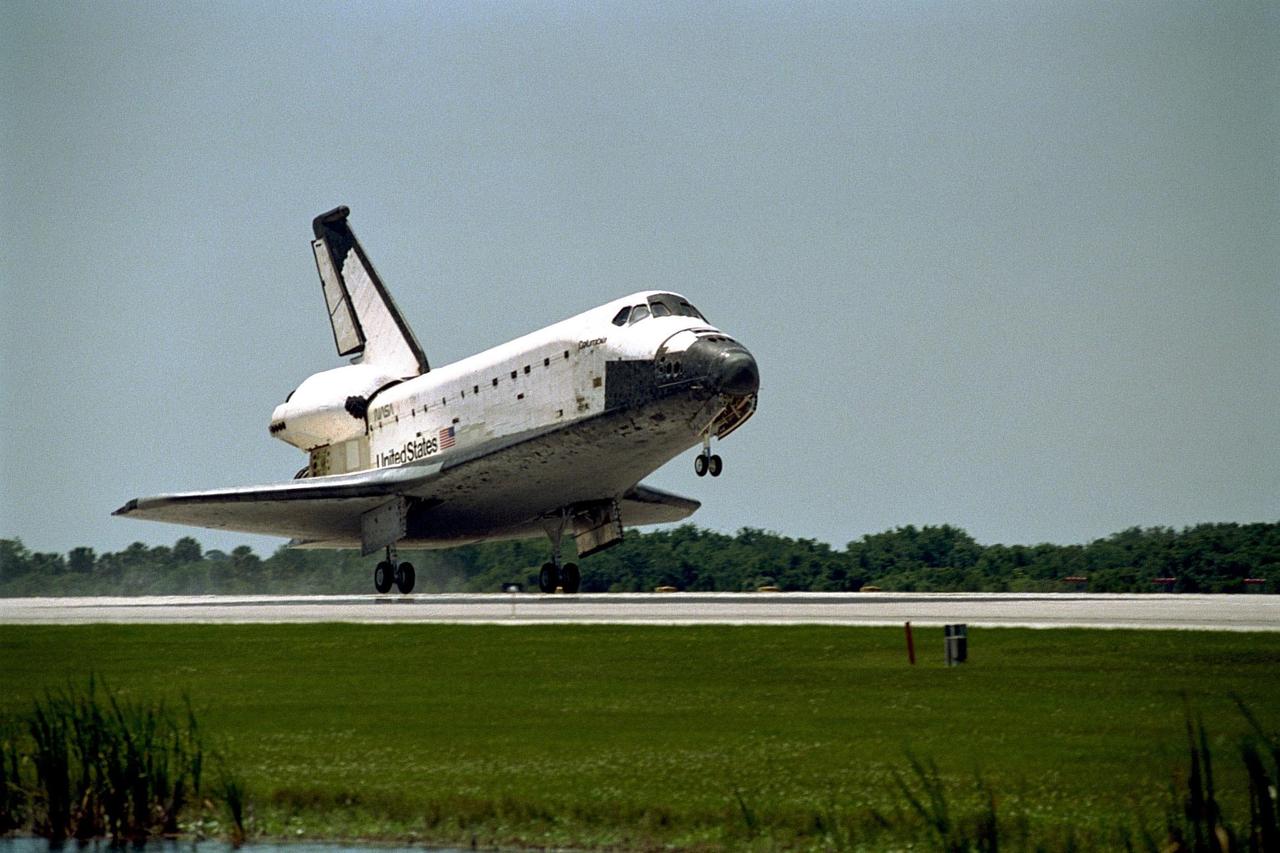
The orbiter Columbia approaches touchdown on Runway 33 of KSC's Shuttle Landing Facility to complete the nearly 16-day STS-90 mission. Main gear touchdown was at 12:08:59 p.m. EDT on May 3, 1998, landing on orbit 256 of the mission. The wheels stopped at 12:09:58 EDT, completing a total mission time of 15 days, 21 hours, 50 minutes and 58 seconds. The 90th Shuttle mission was Columbia's 13th landing at the space center and the 43rd KSC landing in the history of the Space Shuttle program. During the mission, the crew conducted research to contribute to a better understanding of the human nervous system. The crew of the STS-90 Neurolab mission include Commander Richard Searfoss; Pilot Scott Altman; Mission Specialists Richard Linnehan, D.V.M., Dafydd (Dave) Williams, M.D., with the Canadian Space Agency, and Kathryn (Kay) Hire; and Payload Specialists Jay Buckey, M.D., and James Pawelczyk, Ph.D
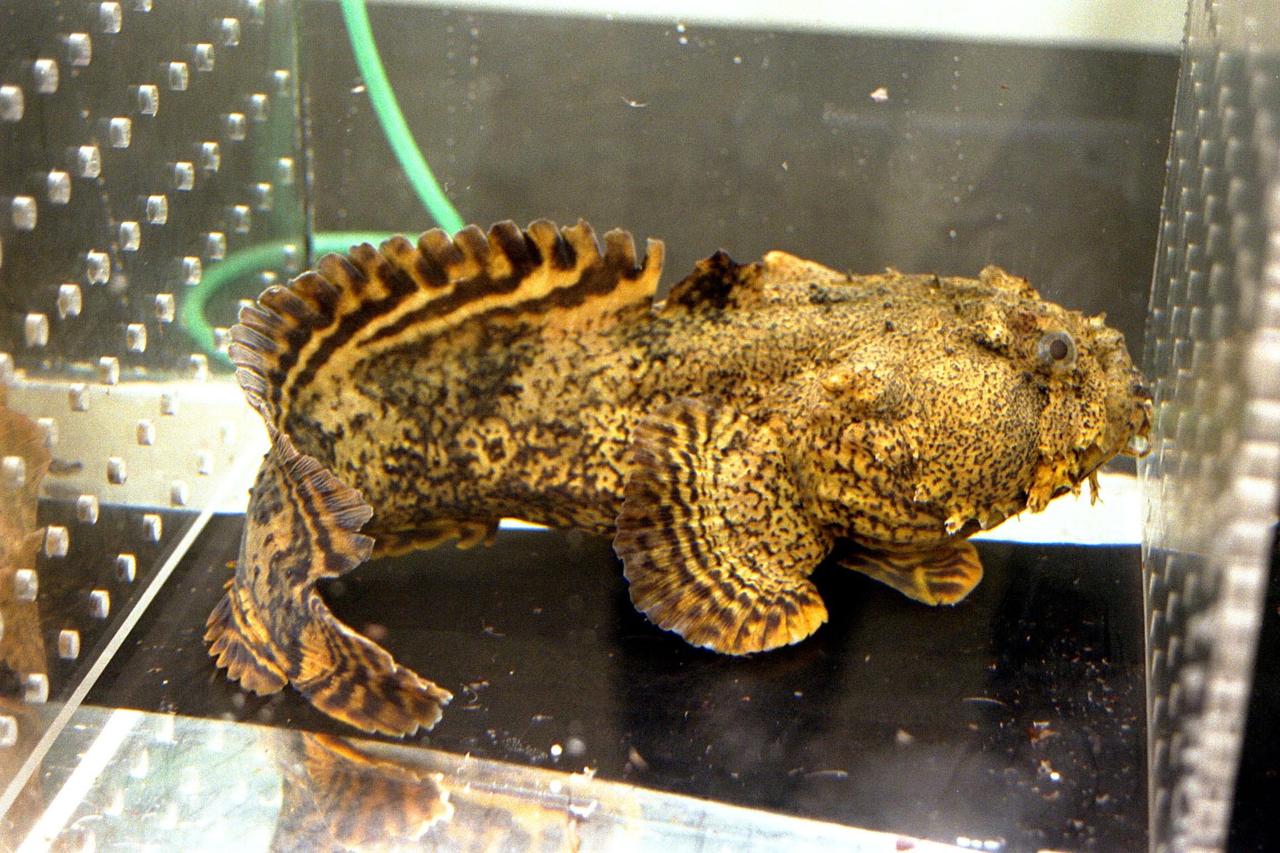
KENNEDY SPACE CENTER, FLA. -- An oyster toadfish (Opsanus tau), like those that are part of the Neurolab payload on Space Shuttle Mission STS-90, is shown in its holding tank in the Space Station Processing Facility. Each fish is between eight and 14 inches long. Toadfish live in an estuarine environment and are native to areas along the Northeast coast of the United States. Investigations during the Neurolab mission will focus on the effects of microgravity on the nervous system. This fish is an excellent model for looking at vestibular function because the architecture of its inner and middle ear are similar to those of mammals with respect to the vestibular apparatus. The crew of STS-90, slated for launch April 16 at 2:19 p.m. EDT, includes Commander Richard Searfoss, Pilot Scott Altman, Mission Specialists Richard Linnehan, Dafydd (Dave) Williams, M.D., and Kathryn (Kay) Hire, and Payload Specialists Jay Buckey, M.D., and James Pawelczyk, Ph.D
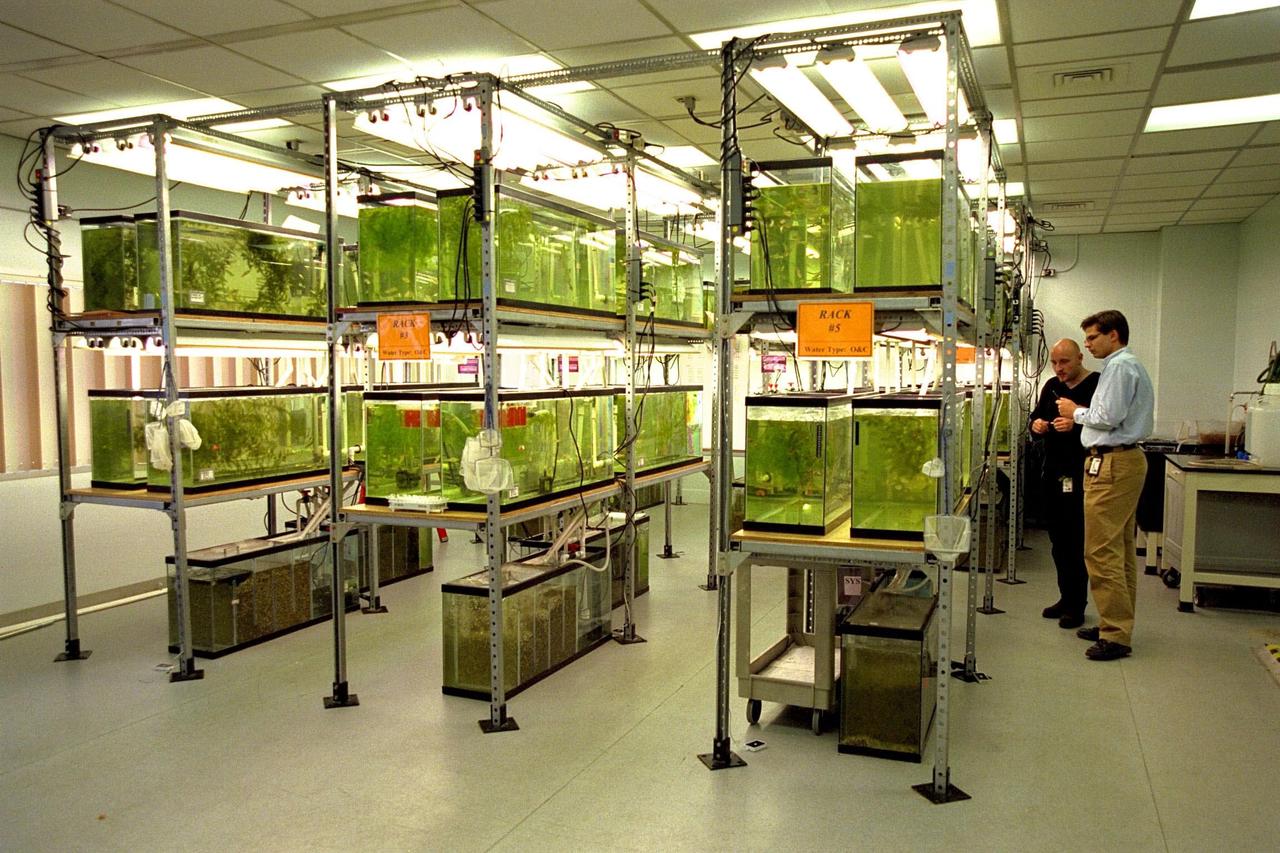
KENNEDY SPACE CENTER, FLA. -- Ingo Ronny Wortmann (left) and Dr. Dirk Voeste, scientists with Ruhr-University of Bochum, Germany, examine swordtail fish (Xiphophorus helleri), like those that are part of the Neurolab payload on Space Shuttle Mission STS-90, in their holding tanks in the Operations and Checkout Building. The fish will fly in the Closed Equilibrated Biological Aquatic System (CEBAS) Minimodule, a middeck locker-sized freshwater habitat, designed to allow the controlled incubation of aquatic species in a self-stabilizing, artifical ecosystem for up to three weeks under space conditions. Investigations during the Neurolab mission will focus on the effects of microgravity on the nervous system. The crew of STS-90, slated for launch April 16 at 2:19 p.m. EDT, include Commander Richard Searfoss, Pilot Scott Altman, Mission Specialists Richard Linnehan, D.V.M., Dafydd (Dave) Williams, M.D., and Kathryn (Kay) Hire, and Payload Specialists Jay Buckey, M.D., and James Pawelczyk, Ph.D
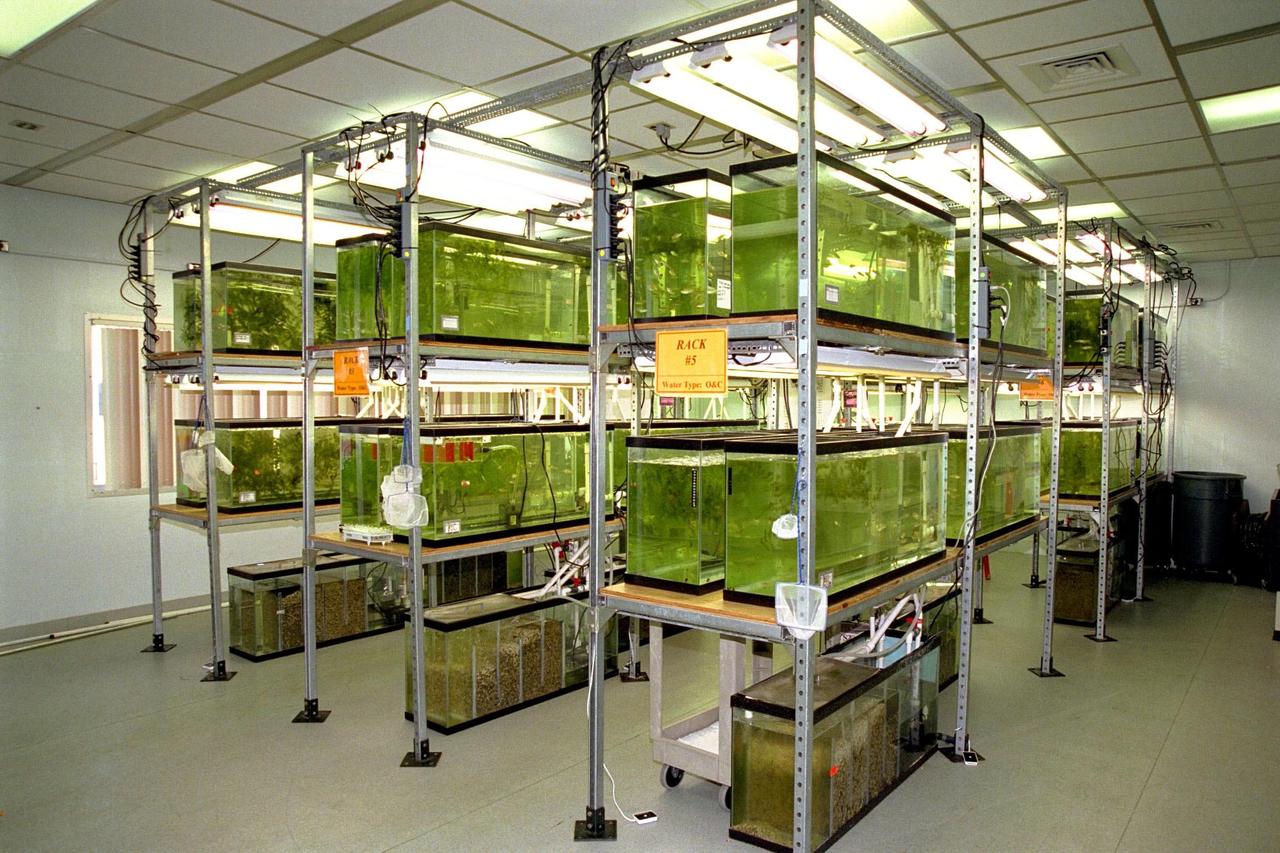
KENNEDY SPACE CENTER, FLA. -- Swordtail fish (Xiphophorus helleri), like those that are part of the Neurolab payload on Space Shuttle Mission STS-90, are shown in their holding tanks in the Operations and Checkout Building. The fish will fly in the Closed Equilibrated Biological Aquatic System (CEBAS) Minimodule, a middeck locker-sized fresh water habitat, designed to allow the controlled incubation of aquatic species in a self-stabilizing, artifical ecosystem for up to three weeks under space conditions. Investigations during the Neurolab mission will focus on the effects of microgravity on the nervous system. The crew of STS-90, slated for launch April 16 at 2:19 p.m. EDT, include Commander Richard Searfoss, Pilot Scott Altman, Mission Specialists Richard Linnehan, D.V.M., Dafydd (Dave) Williams, M.D., and Kathryn (Kay) Hire, and Payload Specialists Jay Buckey, M.D., and James Pawelczyk, Ph.D
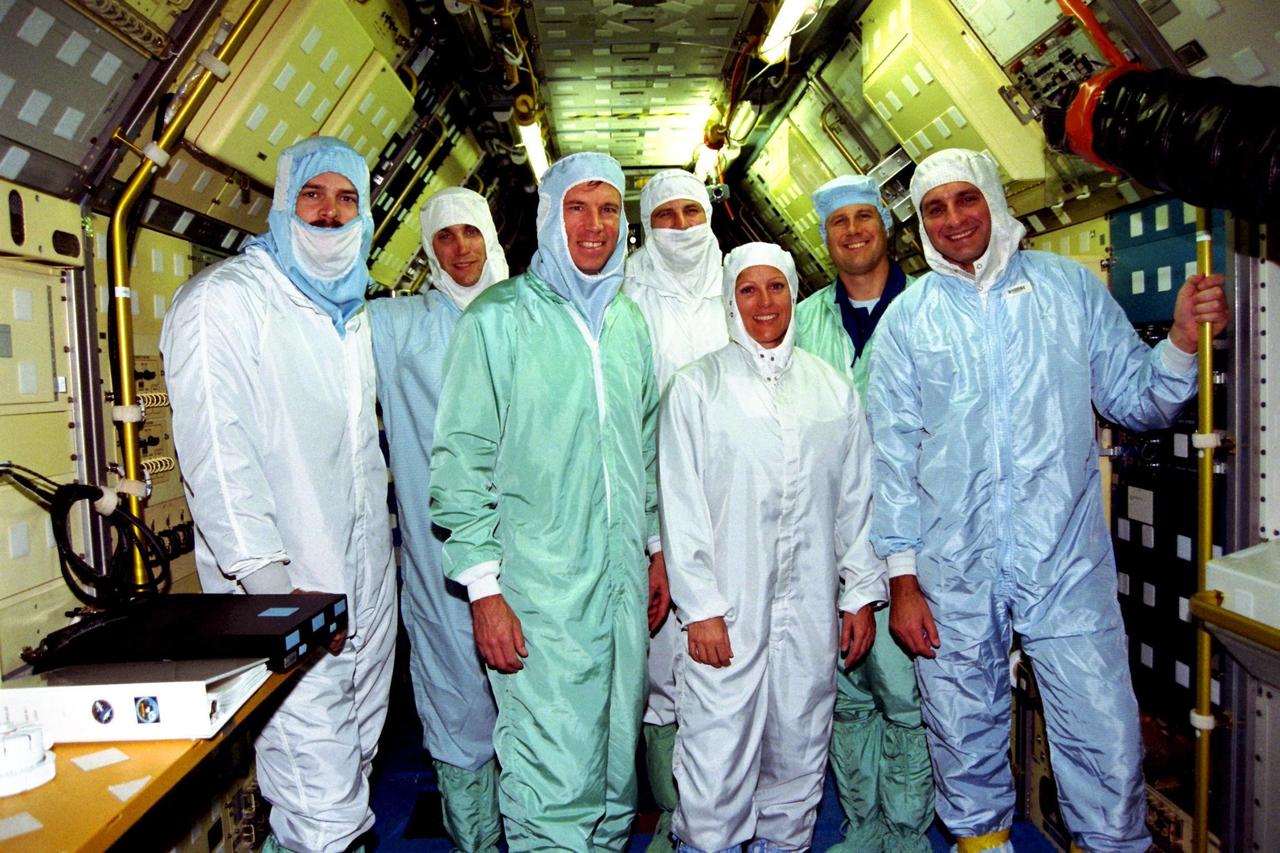
Members of the STS-90 crew participate in the Crew Equipment Interface Test (CEIT) in Kennedy Space Center's Orbiter Processing Facility Bay 3. The CEIT gives astronauts an opportunity to get a hands-on look at the payloads with which they will be working on-orbit. Investigations during the STS-90 Neurolab mission will focus on the effects of microgravity on the nervous system. Specifically, experiments will study the adaptation of the vestibular system, the central nervous system, and the pathways that control the ability to sense location in the absence of gravity, as well as the effect of microgravity on a developing nervous system. The crew of STS-90, slated for launch in April, are, left to right, Pilot Scott Altman; Payload Specialist James Pawelczyk, Ph.D.; Commander Richard Searfoss; Mission Specialists Dafydd (Dave) Williams, M.D., and Kathryn (Kay) Hire; Payload Specialist Jay Buckey, M.D.; and Mission Specialist Richard Linnehan
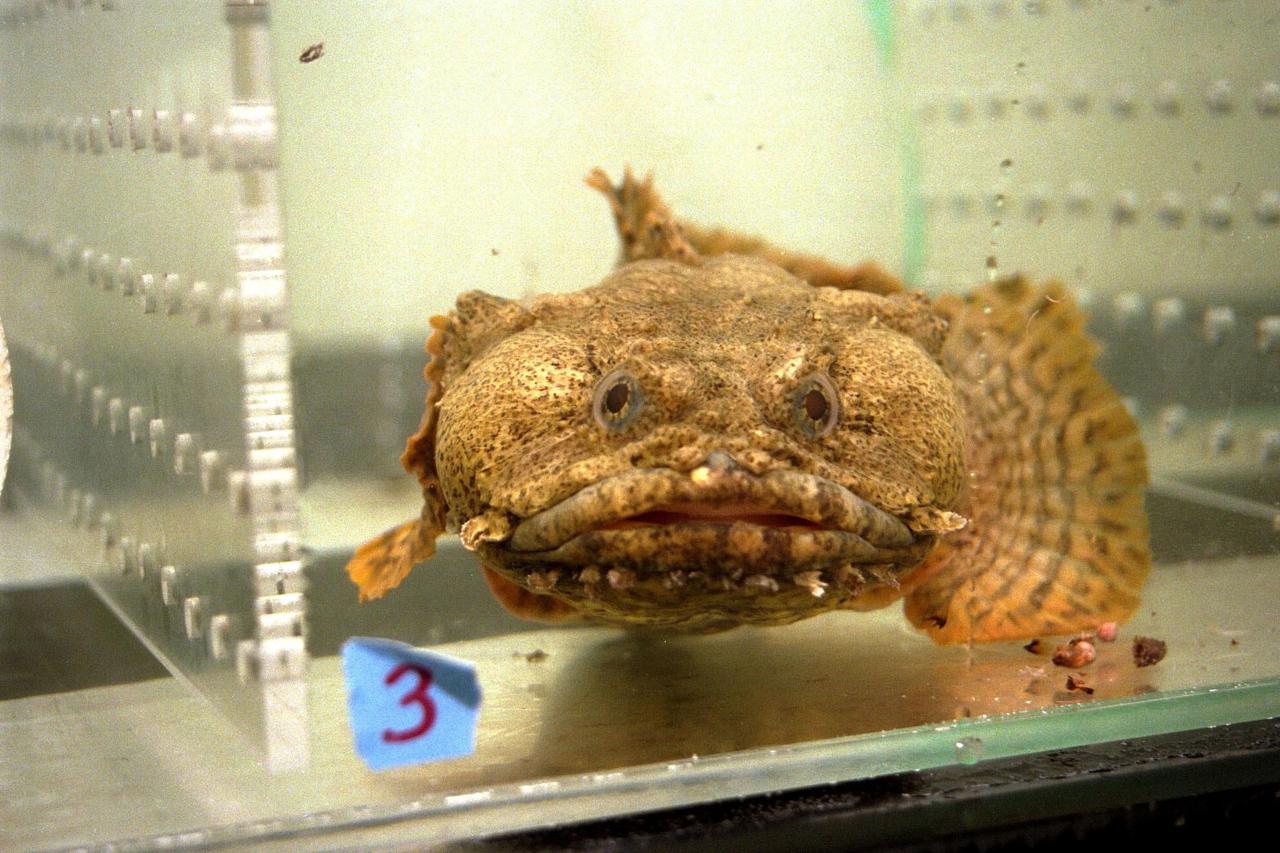
KENNEDY SPACE CENTER, FLA. -- An oyster toadfish (Opsanus tau), like those that are part of the Neurolab payload on Space Shuttle Mission STS-90, is shown in its holding tank in the Space Station Processing Facility. Each fish is between eight and 14 inches long. Toadfish live in an estuarine environment and are native to areas along the Northeast coast of the United States. Investigations during the Neurolab mission will focus on the effects of microgravity on the nervous system. This fish is an excellent model for looking at vestibular function because the architecture of its inner and middle ear are similar to those of mammals with respect to the vestibular apparatus. The crew of STS-90, slated for launch April 16 at 2:19 p.m. EDT, includes Commander Richard Searfoss, Pilot Scott Altman, Mission Specialists Richard Linnehan, Dafydd (Dave) Williams, M.D., and Kathryn (Kay) Hire, and Payload Specialists Jay Buckey, M.D., and James Pawelczyk, Ph.D
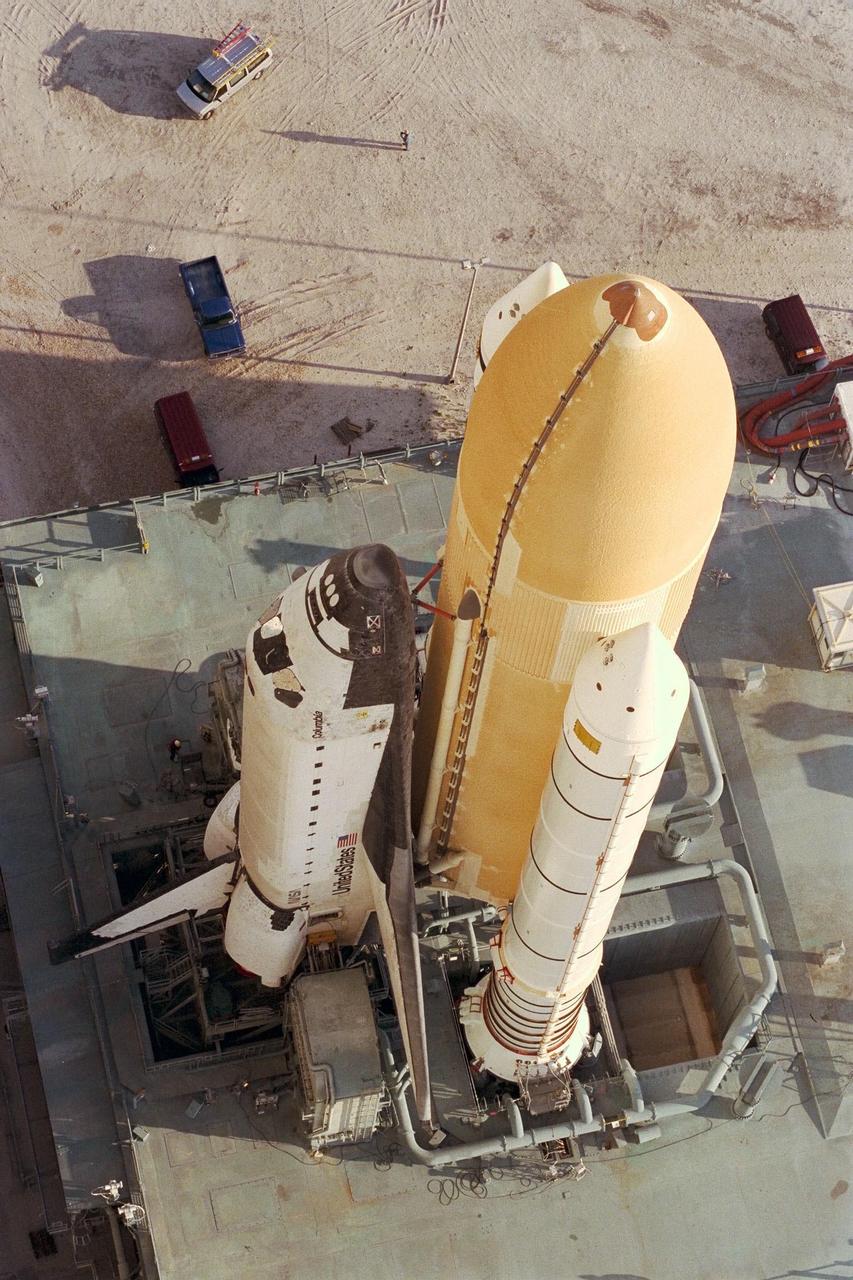
KENNEDY SPACE CENTER, FLA. -- The Space Shuttle Columbia continues its rollout from the Vehicle Assembly Building to Launch Pad 39B in preparation for the STS-90 mission. The Neurolab experiments are the primary payload on this nearly 17-day space flight. Investigations during the Neurolab mission will focus on the effects of microgravity on the nervous system. Specifically, experiments will study the adaptation of the vestibular system, the central nervous system, and the pathways that control the ability to sense location in the absence of gravity, as well as the effect of microgravity on a developing nervous system. The crew of STS-90, slated for launch April 16 at 2:19 p.m. EDT, includes Commander Richard Searfoss, Pilot Scott Altman, Mission Specialists Richard Linnehan, Dafydd (Dave) Williams, M.D., and Kathryn (Kay) Hire, and Payload Specialists Jay Buckey, M.D., and James Pawelczyk, Ph.D
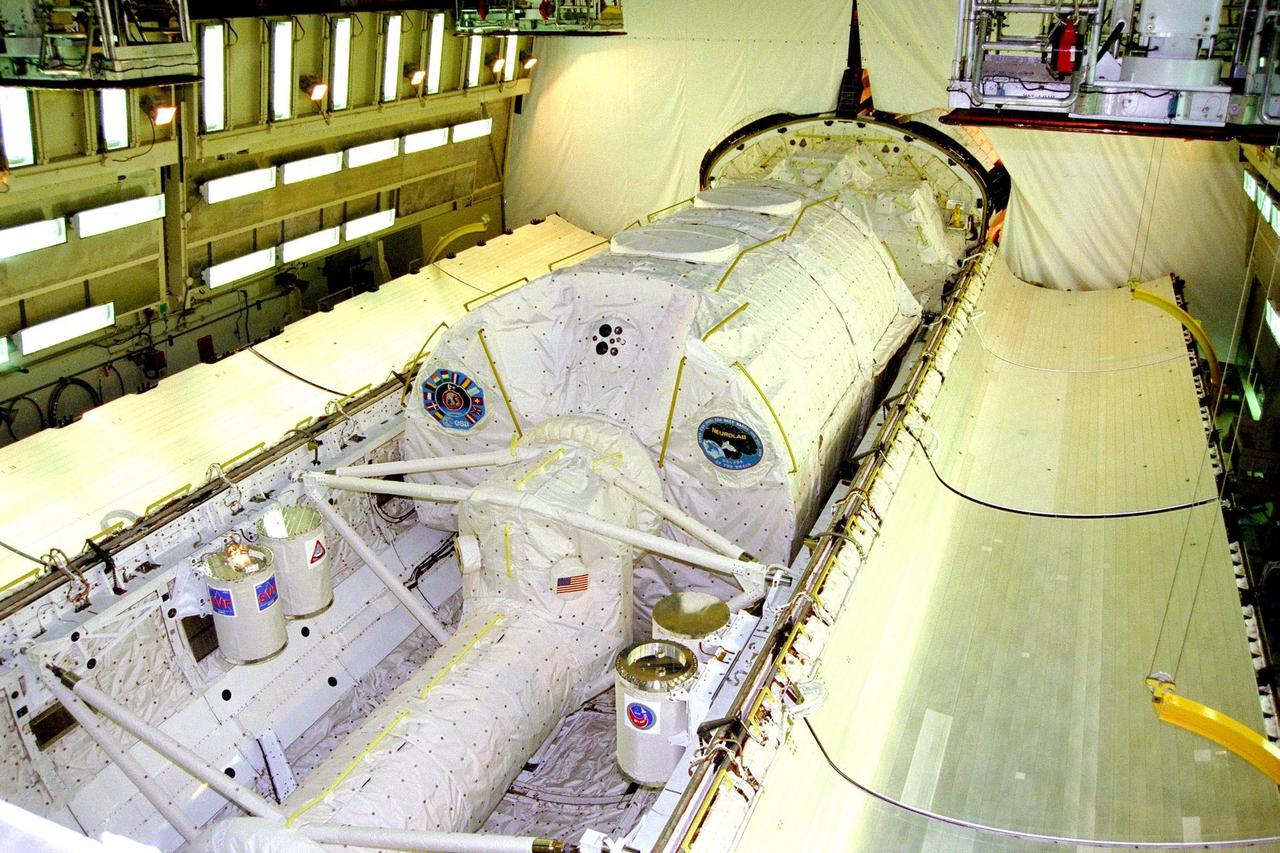
KENNEDY SPACE CENTER, FLA. -- The STS-90 Neurolab payload and four Getaway Specials (GAS) await payload bay door closure in the orbiter Columbia today in Orbiter Processing Facility bay 3. Investigations during the Neurolab mission will focus on the effects of microgravity on the nervous system. Specifically, experiments will study the adaptation of the vestibular system, the central nervous system, and the pathways that control the ability to sense location in the absence of gravity, as well as the effect of microgravity on a developing nervous system. The crew of STS-90, slated for launch in April, will include Commander Richard Searfoss, Pilot Scott Altman, Mission Specialists Richard Linnehan, Dafydd (Dave) Williams, M.D., and Kathryn (Kay) Hire, and Payload Specialists Jay Buckey, M.D., and James Pawelczyk, Ph.D
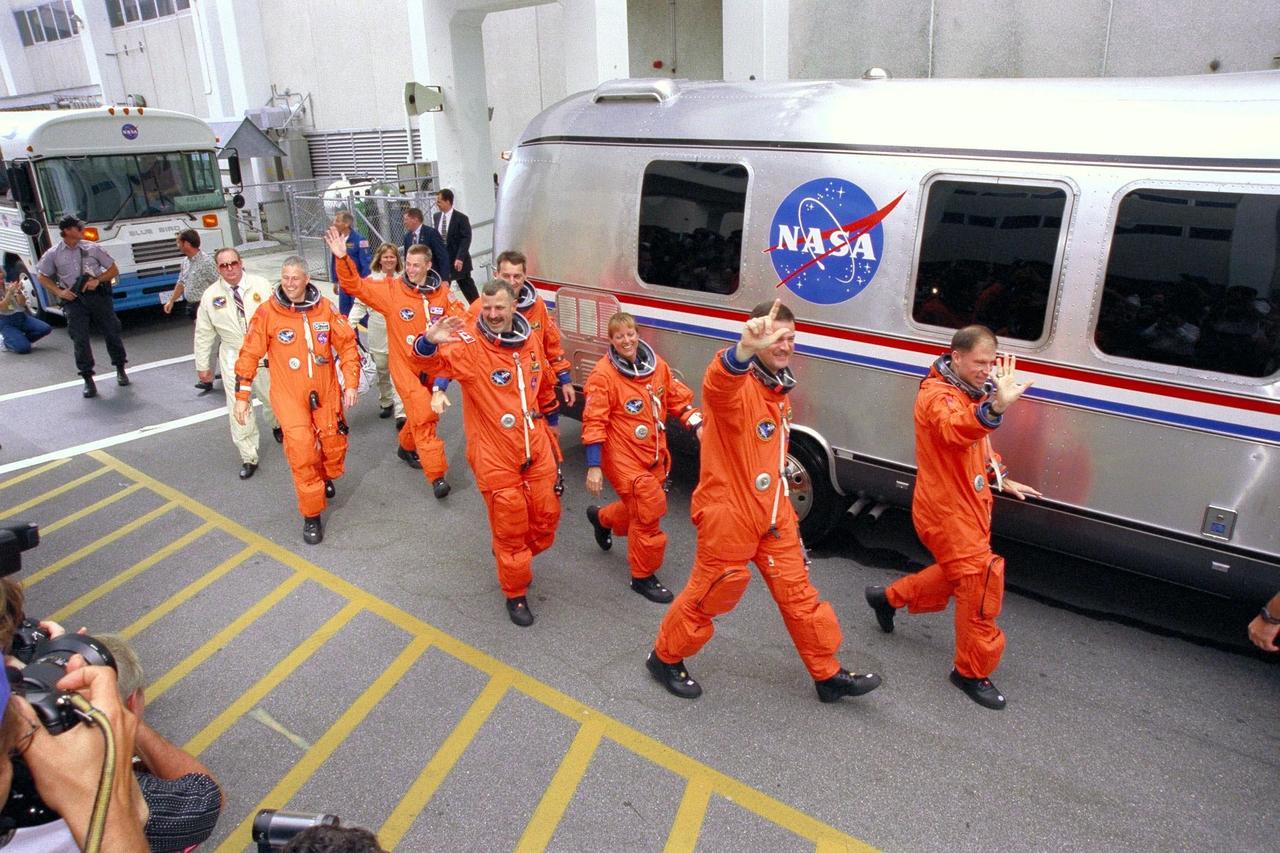
KENNEDY SPACE CENTER, FLA. -- Greeted by cheers from wellwishers at KSC and eager for their venture into space on the Neurolab mission, the STS-90 astronauts depart the Operations and Checkout Building on their way to Launch Pad 39B. The seven-member crew include (front to back, right to left) Mission Commander Richard Searfoss; Pilot Scott Altman; Mission Specialists Kathryn (Kay) Hire, Dafydd (Dave) Williams, M.D., with the Canadian Space Agency, and Richard Linnehan, D.V.M.; and Payload Specialists James Pawelczyk, Ph.D., and Jay Buckey, M.D. Their trip to the pad will take about 25 minutes aboard the Astrovan. Once there, they will take their positions in the crew cabin of the Space Shuttle Columbia to await a liftoff during a two-and-a-half hour window that will open at 2:19 p.m. EDT.
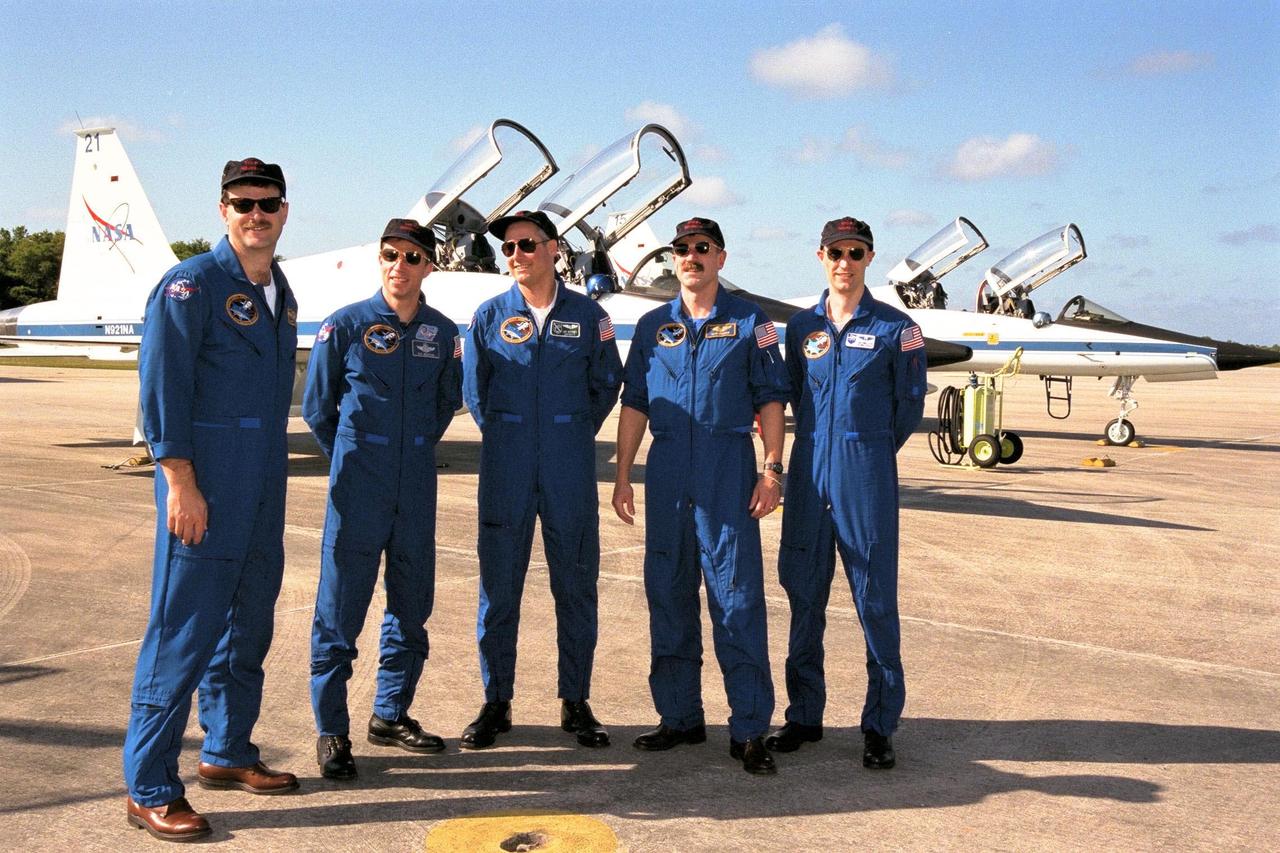
Members of the STS-90 crew pose together shortly after arriving at the KSC Shuttle Landing Facility from NASA’s Johnson Space Center to begin Terminal Countdown Demonstration Test (TCDT) activities. The TCDT is held at KSC prior to each Space Shuttle flight to provide crews with the opportunity to participate in simulated countdown activities. These five members of the seven-member crew are, left to right, Pilot Scott Altman, Commander Richard Searfoss, Payload Specialist Jay Buckey, M.D., Mission Specialist Daffyd (Dave) Williams with the Canadian Space Agency, and Payload Specialist James Pawelczyk, Ph.D. Columbia is targeted for launch of STS-90 on April 16 at 2:19 p.m. EDT and will be the second mission of 1998. The mission is scheduled to last nearly 17 days
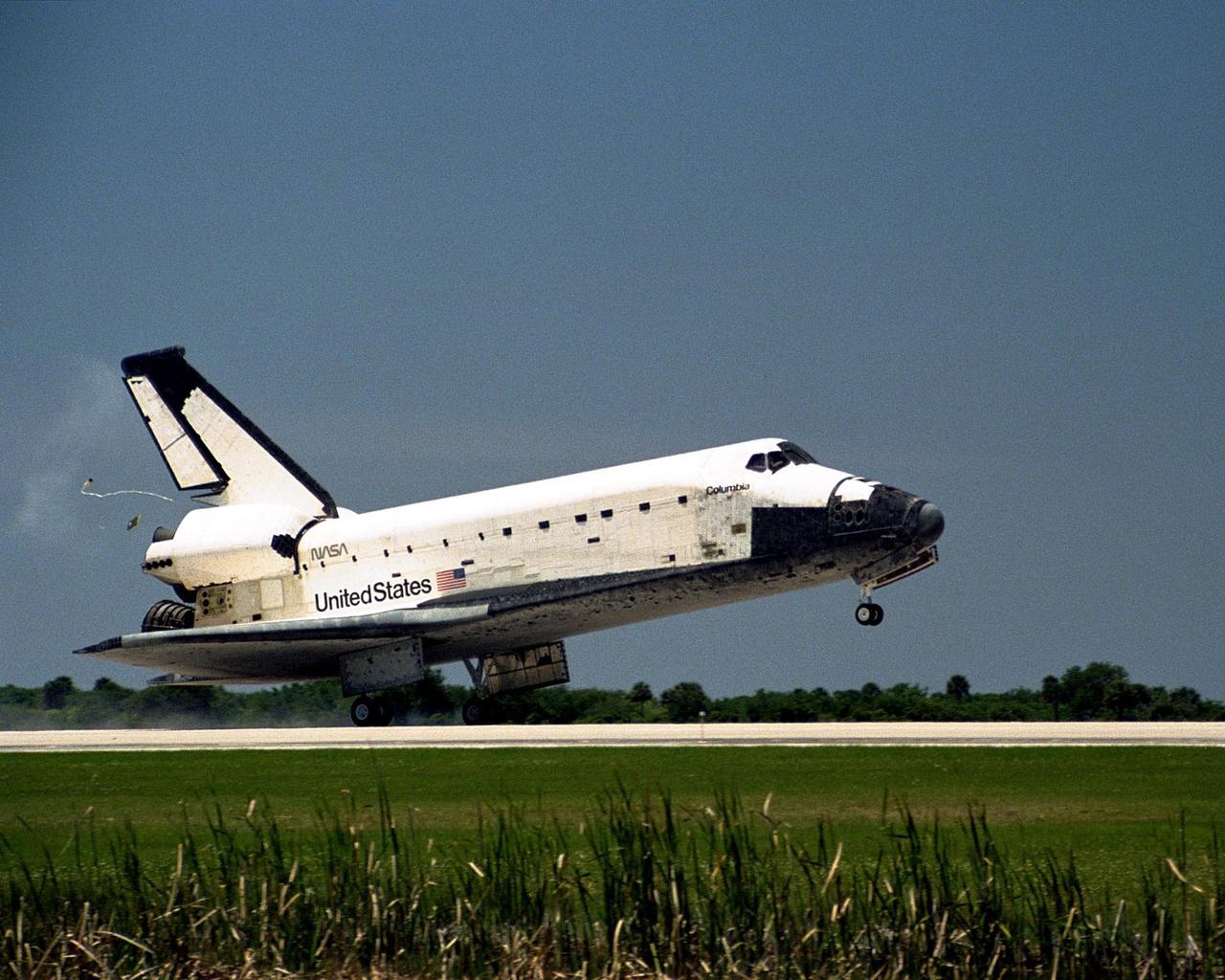
The orbiter Columbia touches down on Runway 33 of KSC's Shuttle Landing Facility to complete the nearly 16-day STS-90 mission. Main gear touchdown was at 12:08:59 p.m. EDT on May 3, 1998, landing on orbit 256 of the mission. The wheels stopped at 12:09:58 EDT, completing a total mission time of 15 days, 21 hours, 50 minutes and 58 seconds. The 90th Shuttle mission was Columbia's 13th landing at the space center and the 43rd KSC landing in the history of the Space Shuttle program. During the mission, the crew conducted research to contribute to a better understanding of the human nervous system. The crew of the STS-90 Neurolab mission include Commander Richard Searfoss; Pilot Scott Altman; Mission Specialists Richard Linnehan, D.V.M., Dafydd (Dave) Williams, M.D., with the Canadian Space Agency, and Kathryn (Kay) Hire; and Payload Specialists Jay Buckey, M.D., and James Pawelczyk, Ph.D
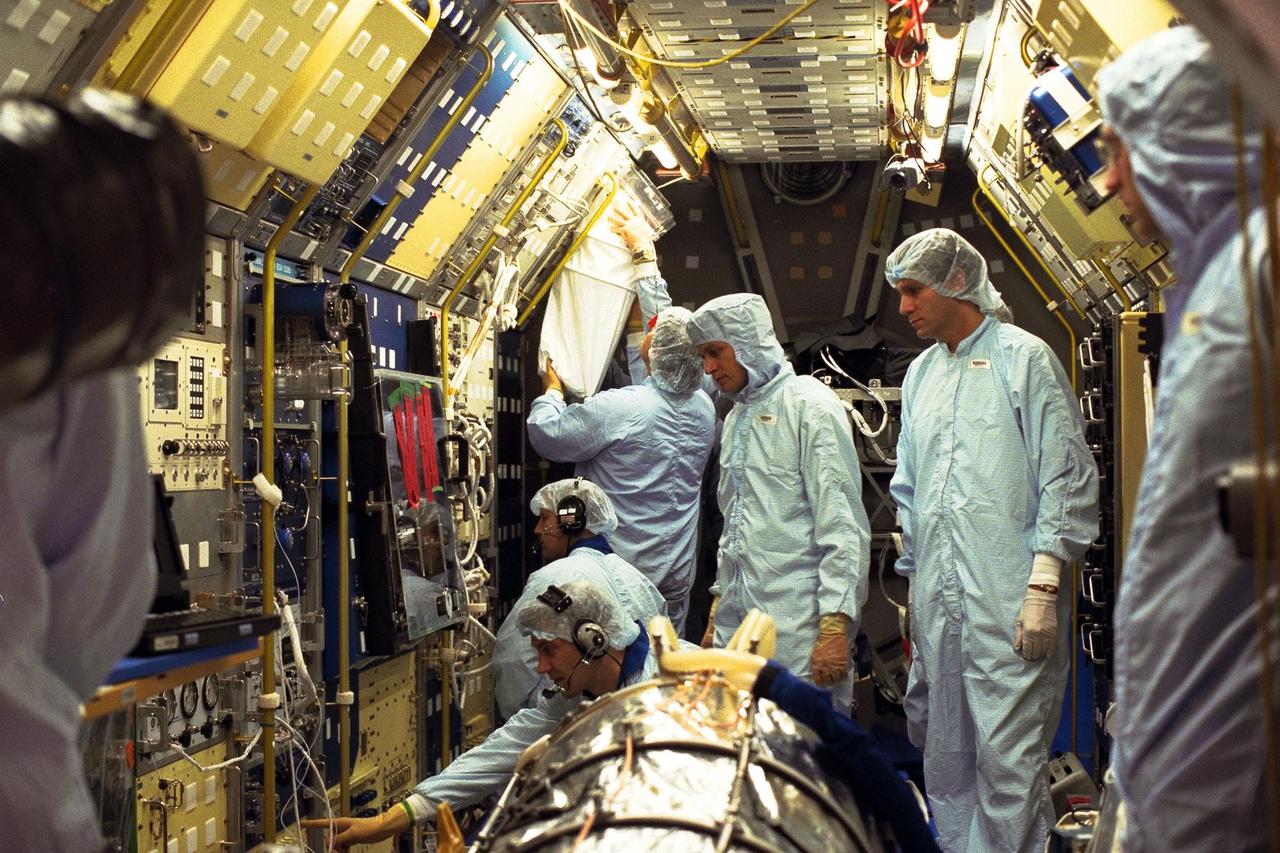
The Neurolab payload for STS-90, scheduled to launch aboard the Shuttle Columbia from Kennedy Space Center (KSC) on April 2, 1998, undergoes further processing in the Operations and Checkout Building at KSC. Investigations during the Neurolab mission will focus on the effects of microgravity on the nervous system. Specifically, experiments will study the adaptation of the vestibular system, the central nervous system, and the pathways that control the ability to sense location in the absence of gravity, as well as the effect of microgravity on a developing nervous system. The crew of STS-90 will include Commander Richard Searfoss, Pilot Scott Altman, Mission Specialists Richard Linnehan, Dafydd (Dave) Williams, M.D., and Kathryn (Kay) Hire, and Payload Specialists Jay Buckey, M.D., and James Pawelczyk, Ph.D
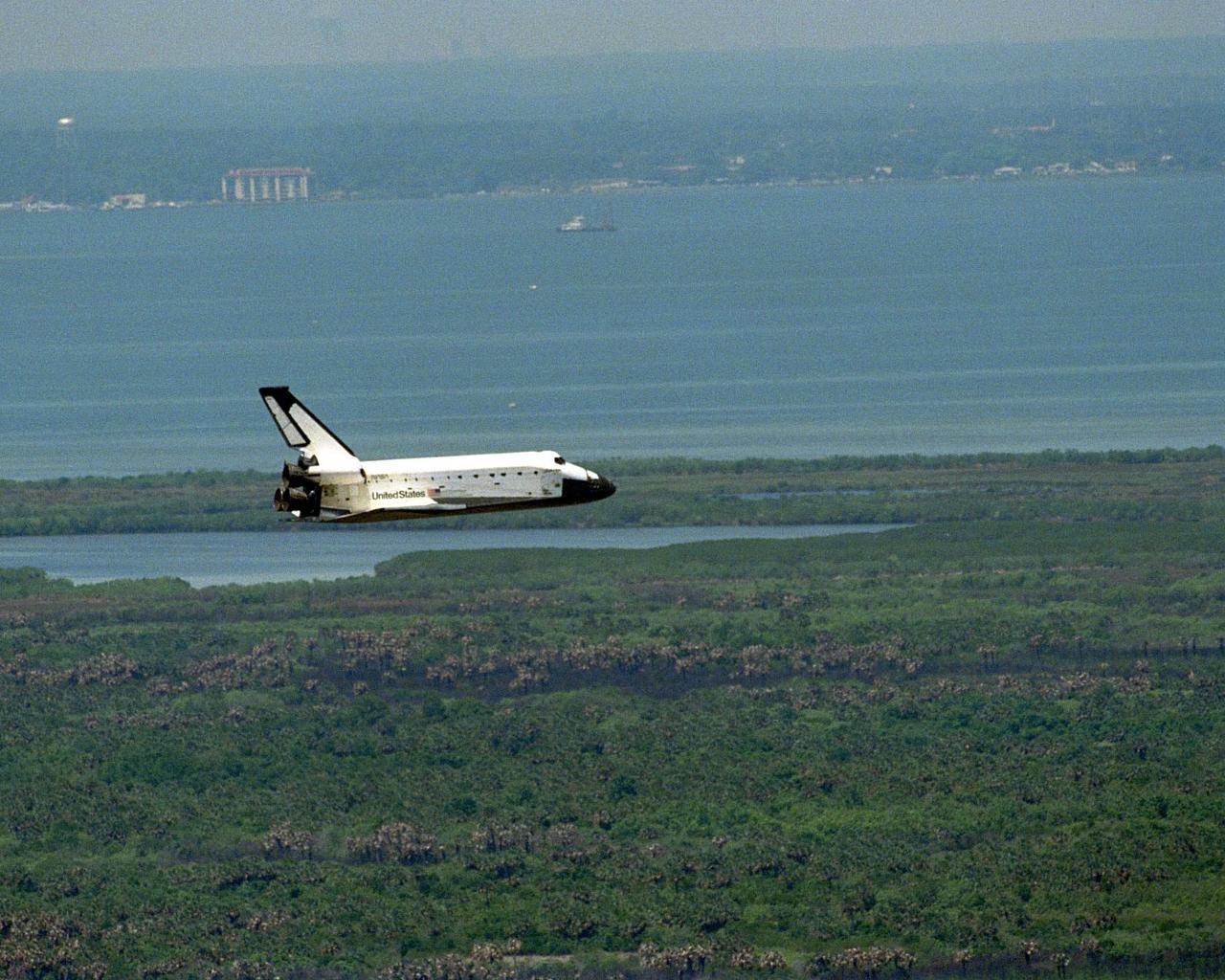
Flying along the Indian River toward KSC's Shuttle Landing Facility is the orbiter Columbia as it nears touchdown on Runway 33 to complete the nearly 16-day STS-90 mission. This unique view with Titusville and the Indian River in the background was taken from the roof of the 525-foot-high Vehicle Assembly Building. Main gear touchdown was at 12:08:59 p.m. EDT on May 3, 1998, landing on orbit 256 of the mission. The wheels stopped at 12:09:58 EDT, completing a total mission time of 15 days, 21 hours, 50 minutes and 58 seconds. The 90th Shuttle mission was Columbia's 13th landing at the space center and the 43rd KSC landing in the history of the Space Shuttle program. During the mission, the crew conducted research to contribute to a better understanding of the human nervous system. The crew of the STS-90 Neurolab mission include Commander Richard Searfoss; Pilot Scott Altman; Mission Specialists Richard Linnehan, D.V.M., Dafydd (Dave) Williams, M.D., with the Canadian Space Agency, and Kathryn (Kay) Hire; and Payload Specialists Jay Buckey, M.D., and James Pawelczyk, Ph.D
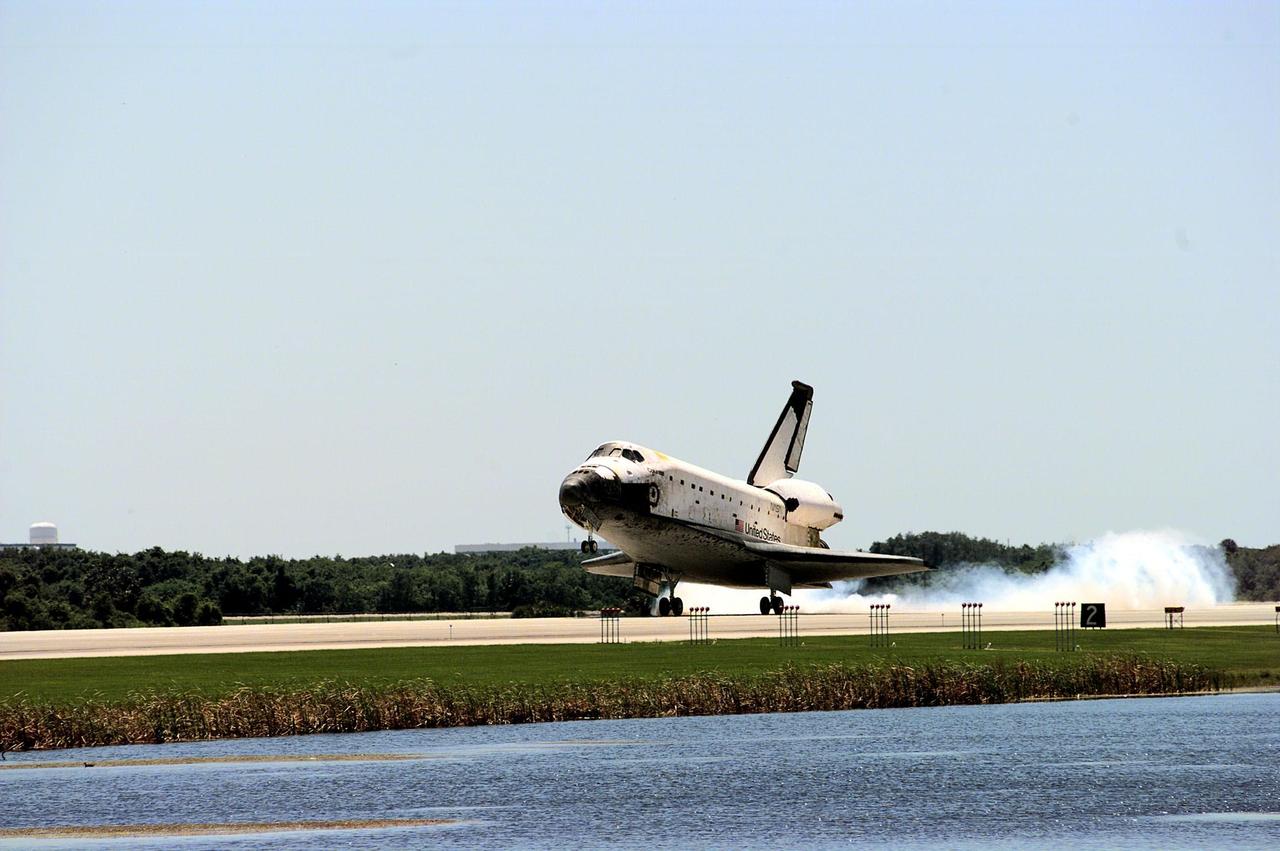
KENNEDY SPACE CENTER, FLA. -- The orbiter Columbia touches down on Runway 33 of KSC's Shuttle Landing Facility to complete the nearly 16-day STS-90 mission. Main gear touchdown was at 12:08:59 p.m. EDT on May 3, 1998, landing on orbit 256 of the mission. The wheels stopped at 12:09:58 EDT, completing a total mission time of 15 days, 21 hours, 50 minutes and 58 seconds. The 90th Shuttle mission was Columbia's 13th landing at the space center and the 43rd KSC landing in the history of the Space Shuttle program. During the mission, the crew conducted research to contribute to a better understanding of the human nervous system. The crew of the STS-90 Neurolab mission include Commander Richard Searfoss; Pilot Scott Altman; Mission Specialists Richard Linnehan, D.V.M., Dafydd (Dave) Williams, M.D., with the Canadian Space Agency, and Kathryn (Kay) Hire; and Payload Specialists Jay Buckey, M.D., and James Pawelczyk, Ph.D
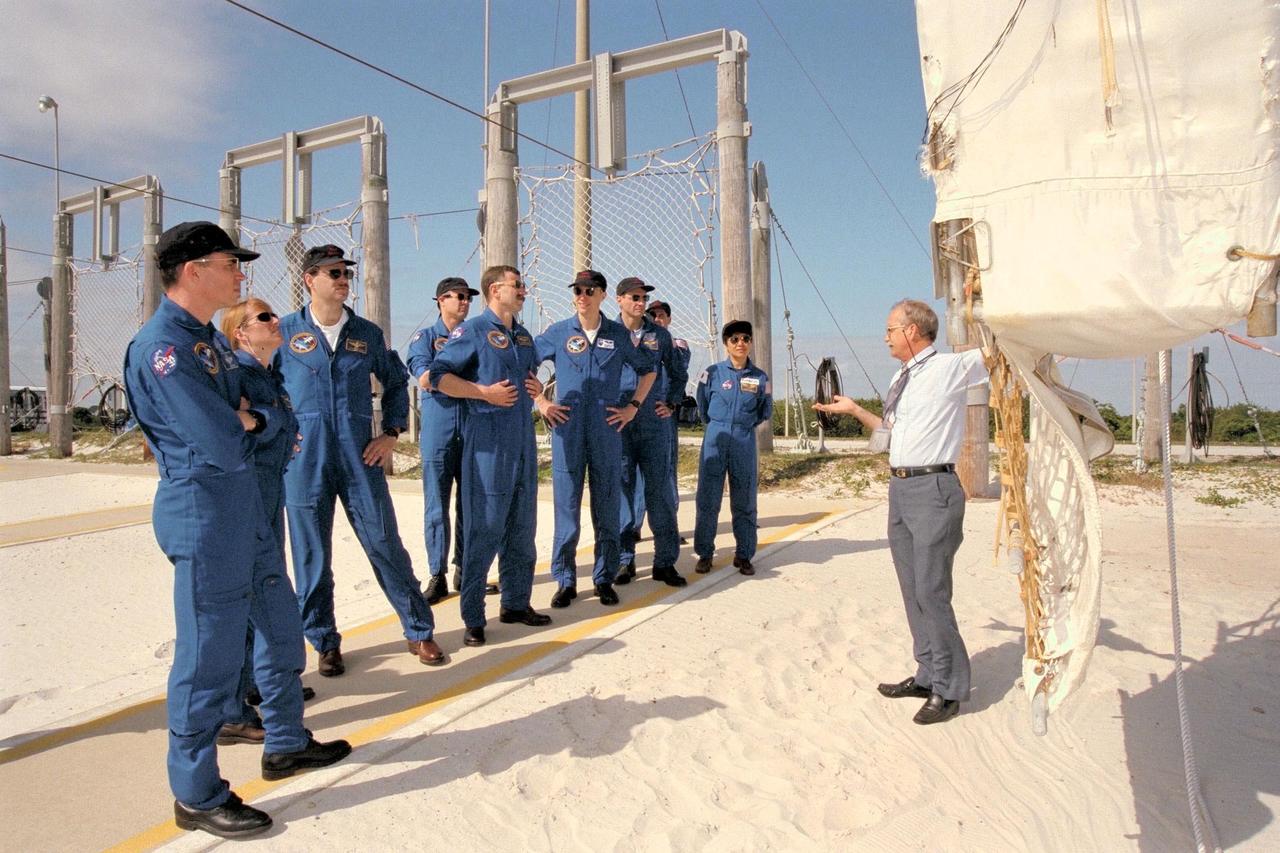
Members of the STS-90 flight crew train in the braking pit area for the emergency egress system slidewire baskets for Launch Pad 39B during Terminal Countdown Demonstration Test (TCDT) activities for that mission. The TCDT is held at KSC prior to each Space Shuttle flight to provide crews with the opportunity to participate in simulated countdown activities. From left to right are Commander Richard Searfoss, Mission Specialist Kathryn (Kay) Hire, Pilot Scott Altman, Payload Specialist Jay Buckey, M.D. (behind), Mission Specialist Dafydd (Dave) Williams, M.D., with the Canadian Space Agency, Payload Specialist James Pawelczyk, Ph.D., and Mission Specialist Richard Linnehan, D.V.M. Backup Payload Specialists Alexander Dunlap (holding camera), D.V.M., M.D., and Chiaki Mukai, M.D., Ph.D., with the National Space Development Agency of Japan are also listening to USA technical trainer Bob Parks' instruction. Columbia is targeted for launch of STS-90 on April 16 at 2:19 p.m. EDT and will be the second mission of 1998. The mission is scheduled to last nearly 17 days
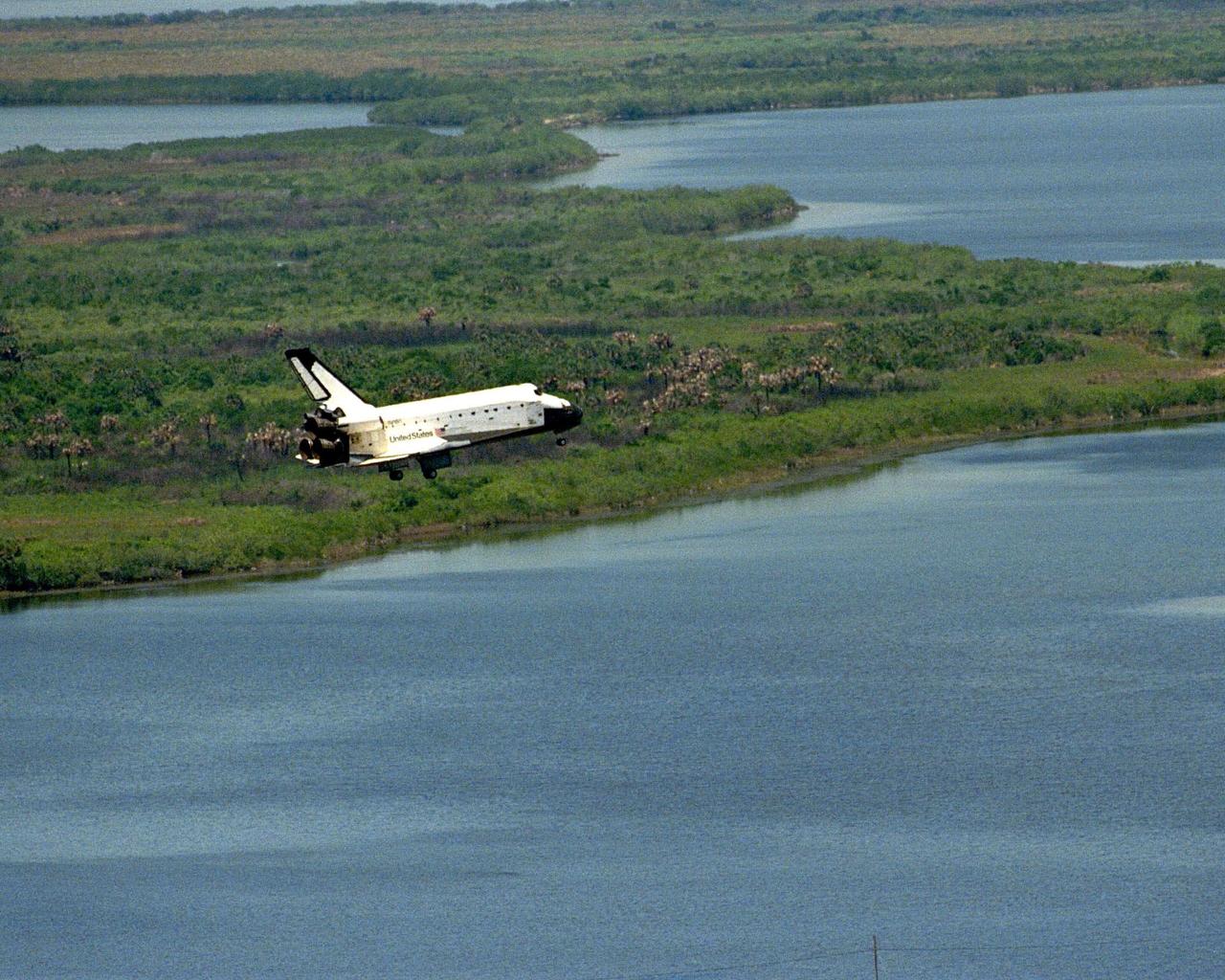
The orbiter Columbia approaches touchdown on Runway 33 of KSC's Shuttle Landing Facility to complete the nearly 16-day STS-90 mission. Framed by Florida foliage and wetlands, this unique view was taken from the roof of the 525-foot-high Vehicle Assembly Building. Main gear touchdown was at 12:08:59 p.m. EDT on May 3, 1998, landing on orbit 256 of the mission. The wheels stopped at 12:09:58 EDT, completing a total mission time of 15 days, 21 hours, 50 minutes and 58 seconds. The 90th Shuttle mission was Columbia's 13th landing at the space center and the 43rd KSC landing in the history of the Space Shuttle program. During the mission, the crew conducted research to contribute to a better understanding of the human nervous system. The crew of the STS-90 Neurolab mission include Commander Richard Searfoss; Pilot Scott Altman; Mission Specialists Richard Linnehan, D.V.M., Dafydd (Dave) Williams, M.D., with the Canadian Space Agency, and Kathryn (Kay) Hire; and Payload Specialists Jay Buckey, M.D., and James Pawelczyk, Ph.D
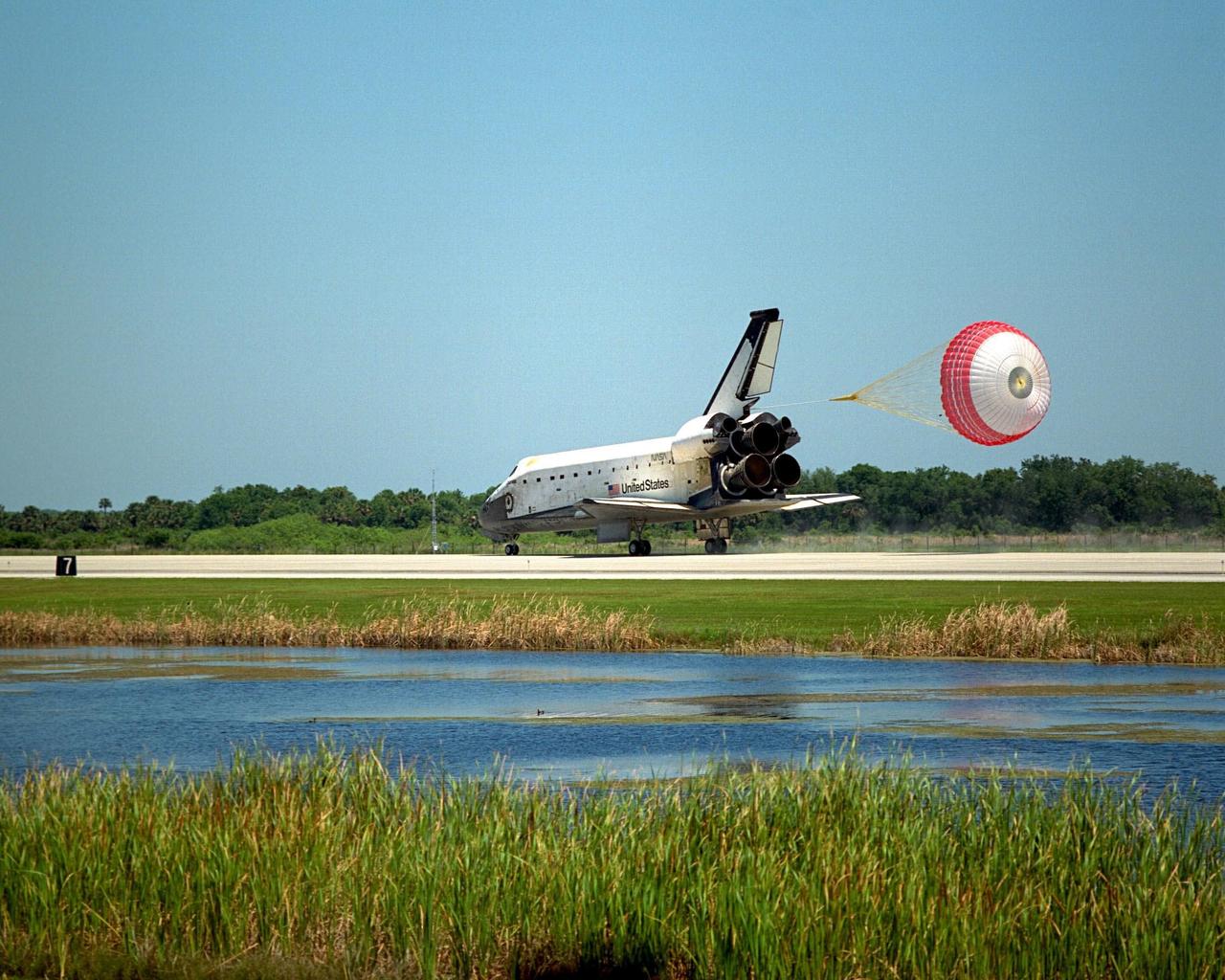
With its drag chute deployed, the orbiter Columbia touches down on Runway 33 of KSC's Shuttle Landing Facility to complete the nearly 16-day STS-90 mission. Main gear touchdown was at 12:08:59 p.m. EDT on May 3, 1998, landing on orbit 256 of the mission. The wheels stopped at 12:09:58 EDT, completing a total mission time of 15 days, 21 hours, 50 minutes and 58 seconds. The 90th Shuttle mission was Columbia's 13th landing at the space center and the 43rd KSC landing in the history of the Space Shuttle program. During the mission, the crew conducted research to contribute to a better understanding of the human nervous system. The crew of the STS-90 Neurolab mission include Commander Richard Searfoss; Pilot Scott Altman; Mission Specialists Richard Linnehan, D.V.M., Dafydd (Dave) Williams, M.D., with the Canadian Space Agency, and Kathryn (Kay) Hire; and Payload Specialists Jay Buckey, M.D., and James Pawelczyk, Ph.D
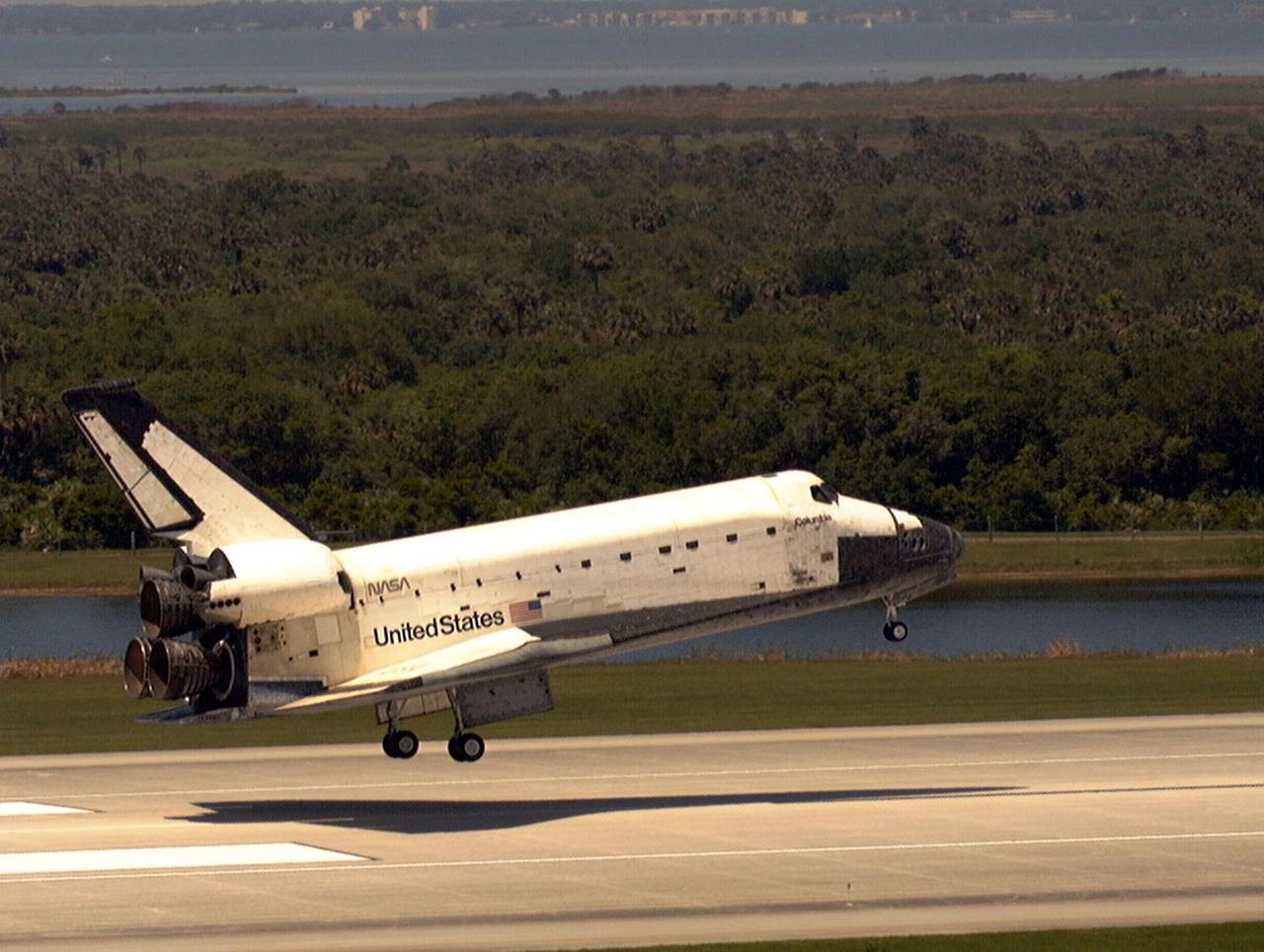
KENNEDY SPACE CENTER, FLA. -- The orbiter Columbia is about to touch down on Runway 33 of KSC's Shuttle Landing Facility to complete the nearly 16-day STS-90 mission. Main gear touchdown was at 12:08:59 p.m. EDT on May 3, 1998, landing on orbit 256 of the mission. The wheels stopped at 12:09:58 EDT, completing a total mission time of 15 days, 21 hours, 50 minutes and 58 seconds. The 90th Shuttle mission was Columbia's 13th landing at the space center and the 43rd KSC landing in the history of the Space Shuttle program. During the mission, the crew conducted research to contribute to a better understanding of the human nervous system. The crew of the STS-90 Neurolab mission include Commander Richard Searfoss; Pilot Scott Altman; Mission Specialists Richard Linnehan, D.V.M., Dafydd (Dave) Williams, M.D., with the Canadian Space Agency, and Kathryn (Kay) Hire; and Payload Specialists Jay Buckey, M.D., and James Pawelczyk, Ph.D

A flock of birds takes flight as the orbiter Columbia, with its drag chute deployed, touches down on Runway 33 of KSC's Shuttle Landing Facility to complete the nearly 16-day STS-90 mission. Main gear touchdown was at 12:08:59 p.m. EDT on May 3, 1998, landing on orbit 256 of the mission. The wheels stopped at 12:09:58 EDT, completing a total mission time of 15 days, 21 hours, 50 minutes and 58 seconds. The 90th Shuttle mission was Columbia's 13th landing at the space center and the 43rd KSC landing in the history of the Space Shuttle program. During the mission, the crew conducted research to contribute to a better understanding of the human nervous system. The crew of the STS-90 Neurolab mission include Commander Richard Searfoss; Pilot Scott Altman; Mission Specialists Richard Linnehan, D.V.M., Dafydd (Dave) Williams, M.D., with the Canadian Space Agency, and Kathryn (Kay) Hire; and Payload Specialists Jay Buckey, M.D., and James Pawelczyk, Ph.D
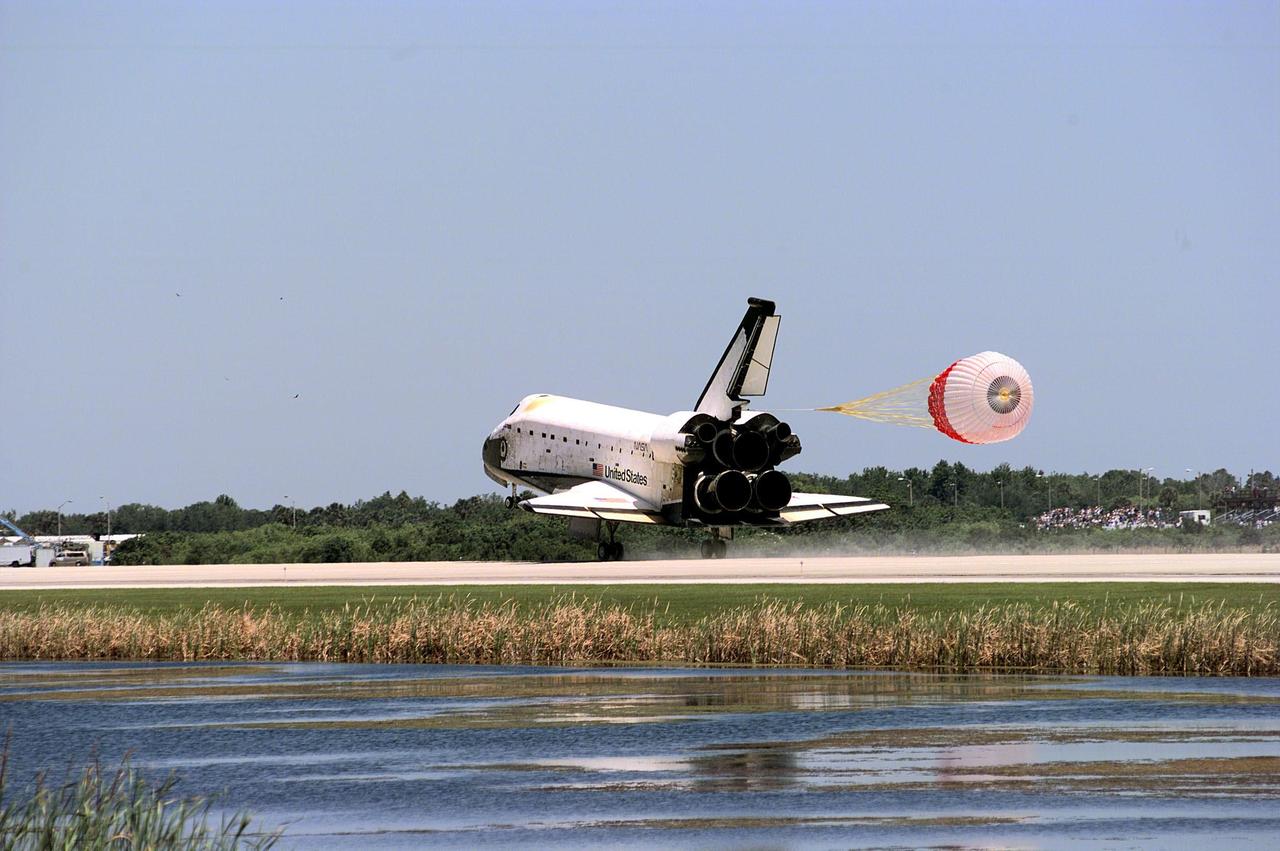
KENNEDY SPACE CENTER, FLA. -- The orbiter Columbia touches down on Runway 33 of KSC's Shuttle Landing Facility to complete the nearly 16-day STS-90 mission. Main gear touchdown was at 12:08:59 p.m. EDT on May 3, 1998, landing on orbit 256 of the mission. The wheels stopped at 12:09:58 EDT, completing a total mission time of 15 days, 21 hours, 50 minutes and 58 seconds. The 90th Shuttle mission was Columbia's 13th landing at the space center and the 43rd KSC landing in the history of the Space Shuttle program. During the mission, the crew conducted research to contribute to a better understanding of the human nervous system. The crew of the STS-90 Neurolab mission include Commander Richard Searfoss; Pilot Scott Altman; Mission Specialists Richard Linnehan, D.V.M., Dafydd (Dave) Williams, M.D., with the Canadian Space Agency, and Kathryn (Kay) Hire; and Payload Specialists Jay Buckey, M.D., and James Pawelczyk, Ph.D
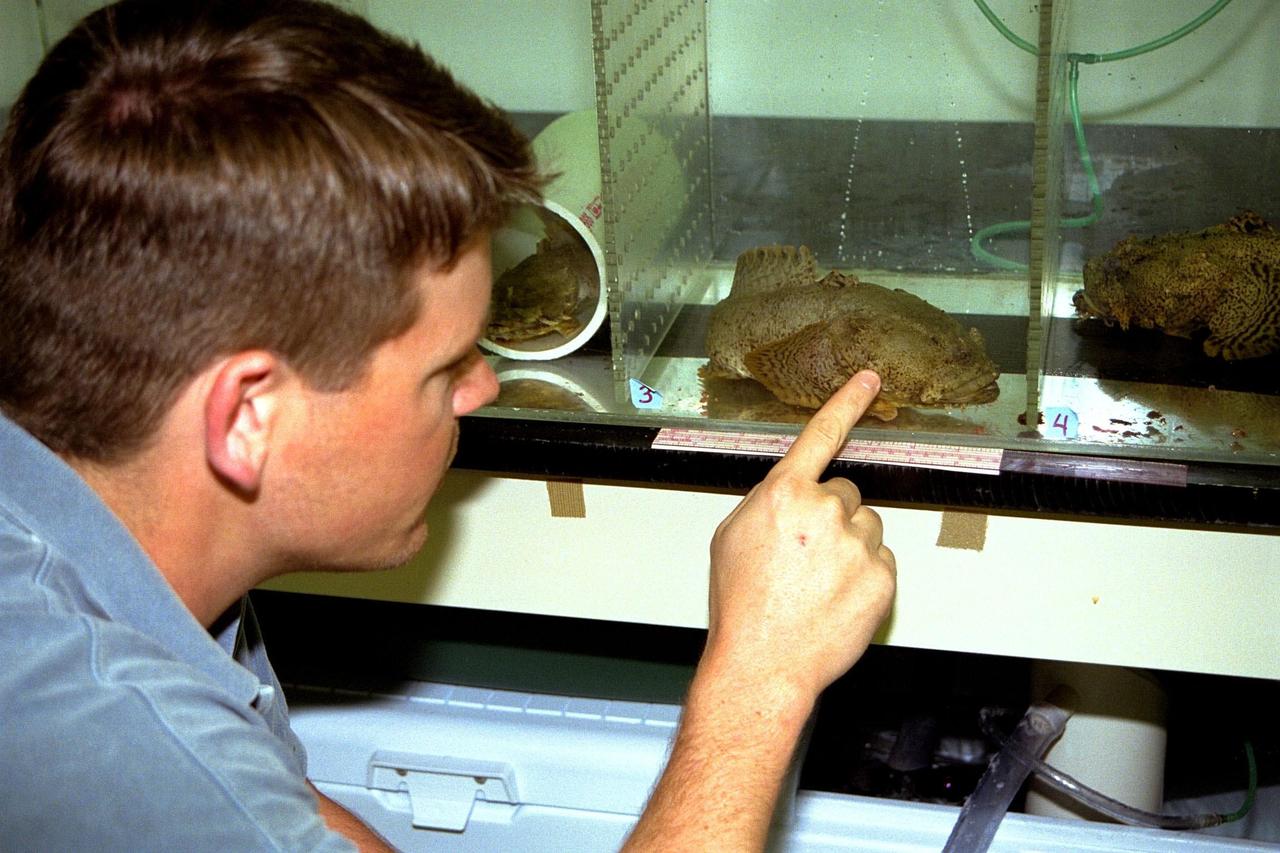
KENNEDY SPACE CENTER, FLA. -- Bill Kroeger, an aquatic technician for the Bionetics Corporation, examines an oyster toadfish (Opsanus tau), like those that are part of the Neurolab payload on Space Shuttle Mission STS-90, in its holding tank in the Space Station Processing Facility. Each fish is between eight and 14 inches long. Toadfish live in an estuarine environment and are native to areas along the Northeast coast of the United States. Investigations during the Neurolab mission will focus on the effects of microgravity on the nervous system. This fish is an excellent model for looking at vestibular function because the architecture of its inner and middle ear are similar to those of mammals with respect to the vestibular apparatus. The crew of STS-90, slated for launch April 16 at 2:19 p.m. EDT, includes Commander Richard Searfoss, Pilot Scott Altman, Mission Specialists Richard Linnehan, Dafydd (Dave) Williams, M.D., and Kathryn (Kay) Hire, and Payload Specialists Jay Buckey, M.D., and James Pawelczyk, Ph.D
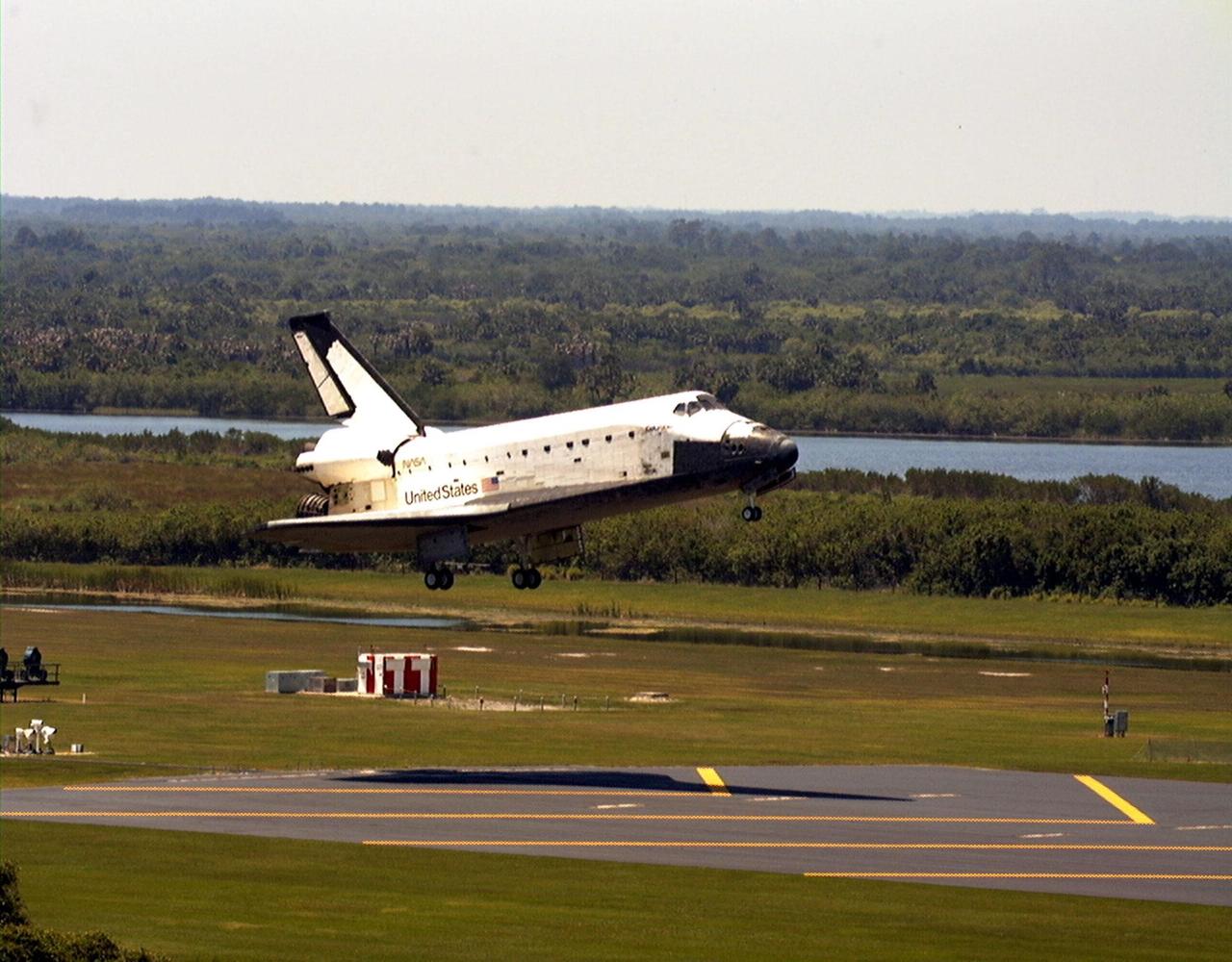
KENNEDY SPACE CENTER, FLA. -- The orbiter Columbia is about to touch down on Runway 33 of KSC's Shuttle Landing Facility to complete the nearly 16-day STS-90 mission. Main gear touchdown was at 12:08:59 p.m. EDT on May 3, 1998, landing on orbit 256 of the mission. The wheels stopped at 12:09:58 EDT, completing a total mission time of 15 days, 21 hours, 50 minutes and 58 seconds. The 90th Shuttle mission was Columbia's 13th landing at the space center and the 43rd KSC landing in the history of the Space Shuttle program. During the mission, the crew conducted research to contribute to a better understanding of the human nervous system. The crew of the STS-90 Neurolab mission include Commander Richard Searfoss; Pilot Scott Altman; Mission Specialists Richard Linnehan, D.V.M., Dafydd (Dave) Williams, M.D., with the Canadian Space Agency, and Kathryn (Kay) Hire; and Payload Specialists Jay Buckey, M.D., and James Pawelczyk, Ph.D
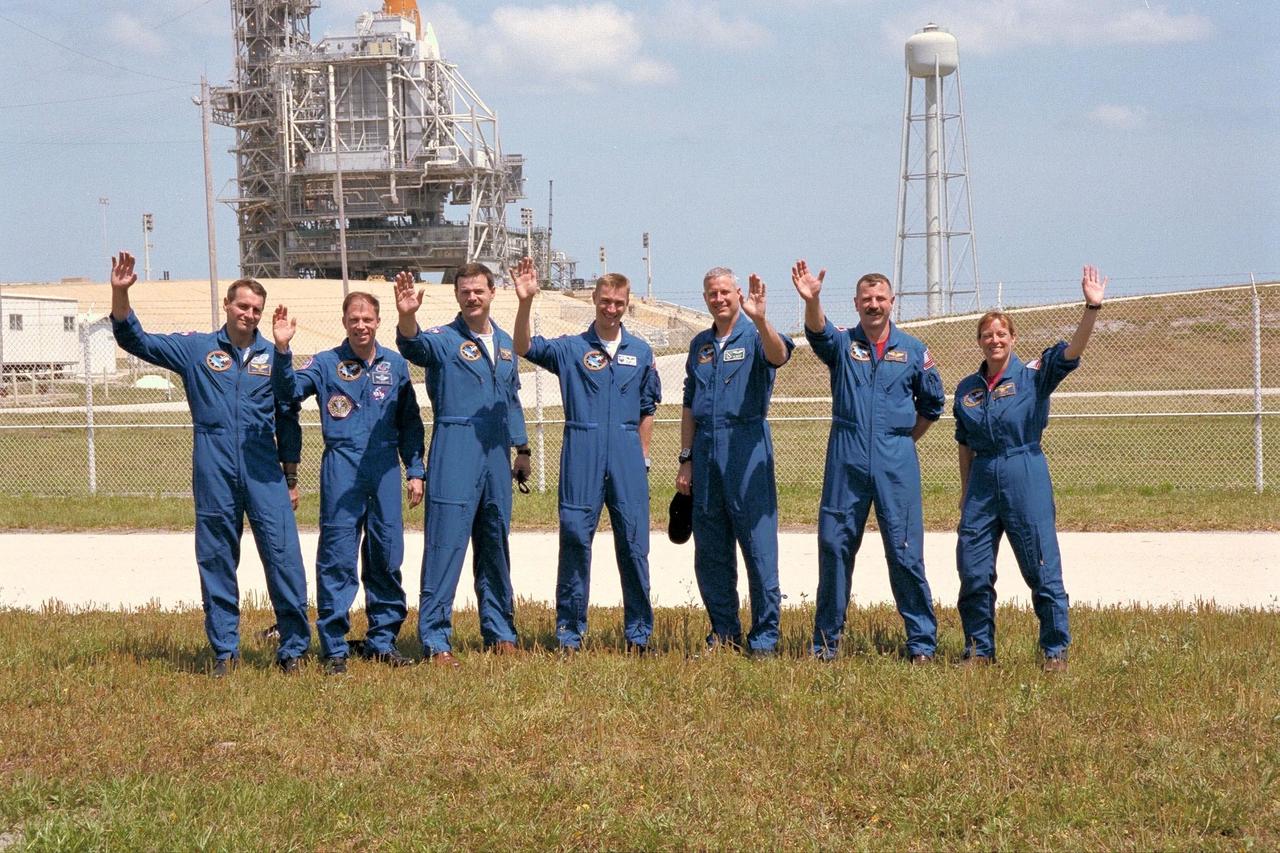
KENNEDY SPACE CENTER, FLA. -- The STS-90 crew wave to friends and family members near Launch Pad 39B, from which they are scheduled to launch aboard Columbia on May 16 at 2:19 p.m. EDT. The crew include, left to right, Mission Specialist Richard Linnehan, D.V.M., Commander Richard Searfoss, Pilot Scott Altman, Payload Specialists James Pawelczyk, Ph.D., and Jay Buckey, M.D., and Mission Specialists Dafydd (Dave) Williams, M.D., with the Canadian Space Agency, and Kathryn (Kay) Hire. The Space Shuttle Columbia is seen in the background, protected by its Rotating Service Structure. This is the 25th flight of Columbia and the 90th mission flown since the start of the Space Shuttle program. STS-90 is a nearly 17-day life sciences research flight that will focus on the most complex and least understood part of the human body the nervous system. Neurolab will examine the effects of spaceflight on the brain, spinal cord, peripheral nerves and sensory organs in the human body
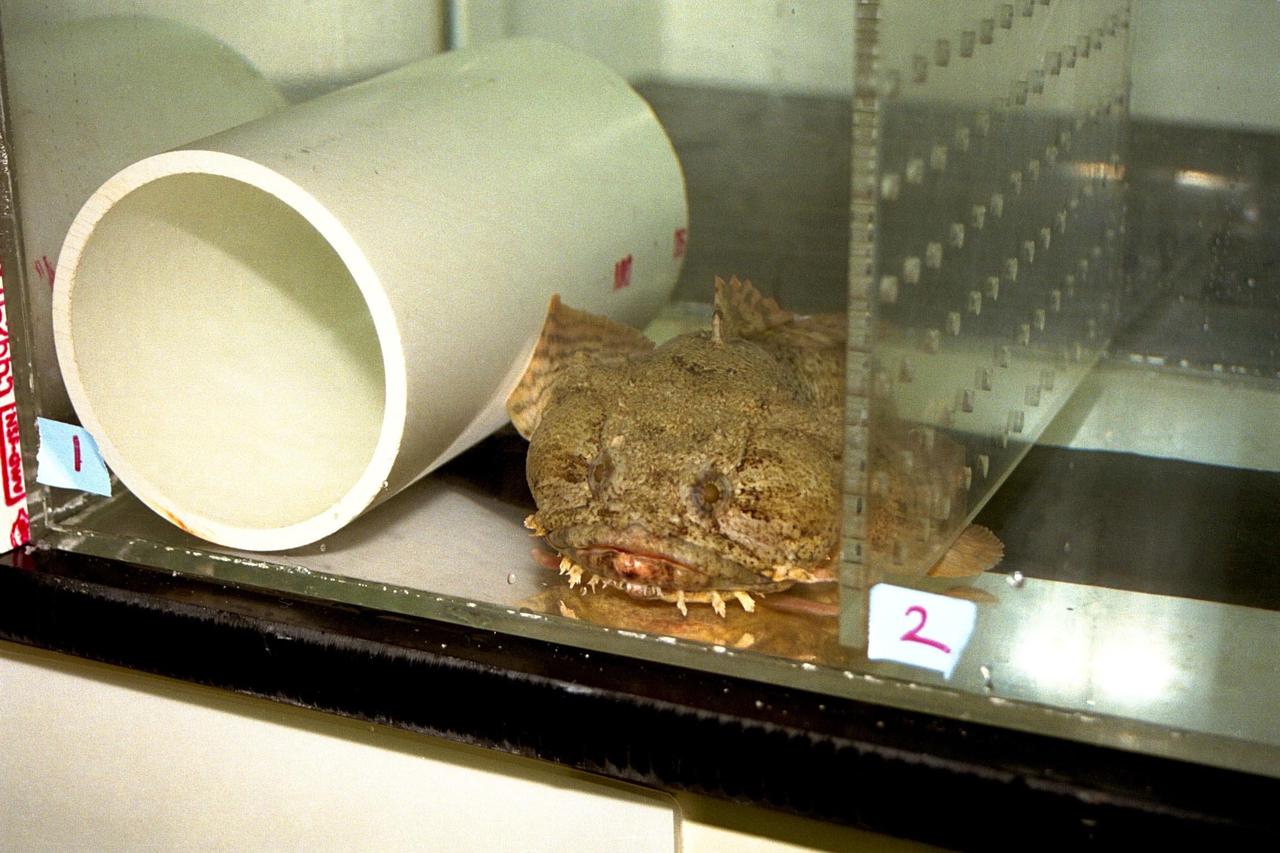
KENNEDY SPACE CENTER, FLA. -- An oyster toadfish (Opsanus tau), like those that are part of the Neurolab payload on Space Shuttle Mission STS-90, is shown in its holding tank in the Space Station Processing Facility. Each fish is between eight and 14 inches long. Toadfish live in an estuarine environment and are native to areas along the Northeast coast of the United States. Since they are bottom dwellers that live in cracks and crevices, a tube is provided in its tank to give it a place to retreat and hide. Investigations during the Neurolab mission will focus on the effects of microgravity on the nervous system. This fish is an excellent model for looking at vestibular function because the architecture of its inner and middle ear are similar to those of mammals with respect to the vestibular apparatus. The crew of STS-90, slated for launch April 16 at 2:19 p.m. EDT, includes Commander Richard Searfoss, Pilot Scott Altman, Mission Specialists Richard Linnehan, Dafydd (Dave) Williams, M.D., and Kathryn (Kay) Hire, and Payload Specialists Jay Buckey, M.D., and James Pawelczyk, Ph.D
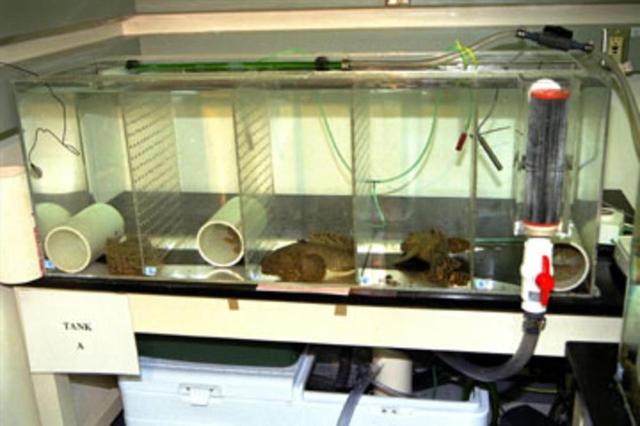
KENNEDY SPACE CENTER, FLA. -- Oyster toadfish (Opsanus tau), like those that are part of the Neurolab payload on Space Shuttle Mission STS-90, are shown in their holding tank in the Space Station Processing Facility. Each fish is between 8 and 14 inches long. Toadfish live in an estuarine environment and are native to areas along the Northeast coast of the United States. Since they are bottom dwellers that live in cracks and crevices, tubes are provided in their tank to give them a place to retreat and hide. Investigations during the Neurolab mission will focus on the effects of microgravity on the nervous system. The toadfish fish is an excellent model for looking at vestibular function because the architecture of its inner and middle ear are similar to those of mammals with respect to the vestibular apparatus. The crew of STS-90, slated for launch April 16 at 2:19 p.m. EDT, includes Commander Richard Searfoss, Pilot Scott Altman, Mission Specialists Richard Linnehan, Dafydd (Dave) Williams, M.D., and Kathryn (Kay) Hire, and Payload Specialists Jay Buckey, M.D., and James Pawelczyk, Ph.D
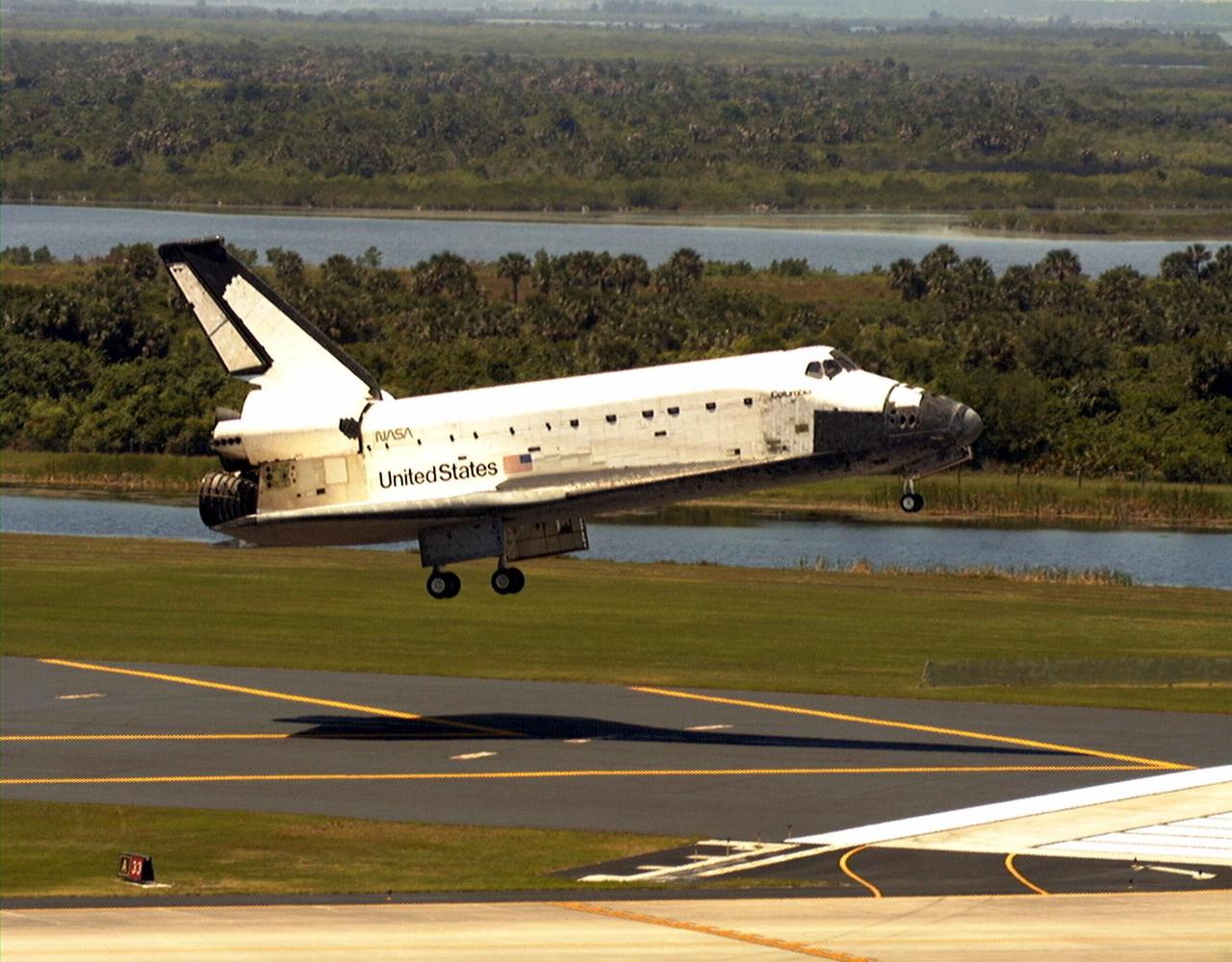
KENNEDY SPACE CENTER, FLA. -- The orbiter Columbia is moments from touchdown on Runway 33 of KSC's Shuttle Landing Facility to complete the nearly 16-day STS-90 mission. Main gear touchdown was at 12:08:59 p.m. EDT on May 3, 1998, landing on orbit 256 of the mission. The wheels stopped at 12:09:58 EDT, completing a total mission time of 15 days, 21 hours, 50 minutes and 58 seconds. The 90th Shuttle mission was Columbia's 13th landing at the space center and the 43rd KSC landing in the history of the Space Shuttle program. During the mission, the crew conducted research to contribute to a better understanding of the human nervous system. The crew of the STS-90 Neurolab mission include Commander Richard Searfoss; Pilot Scott Altman; Mission Specialists Richard Linnehan, D.V.M., Dafydd (Dave) Williams, M.D., with the Canadian Space Agency, and Kathryn (Kay) Hire; and Payload Specialists Jay Buckey, M.D., and James Pawelczyk, Ph.D