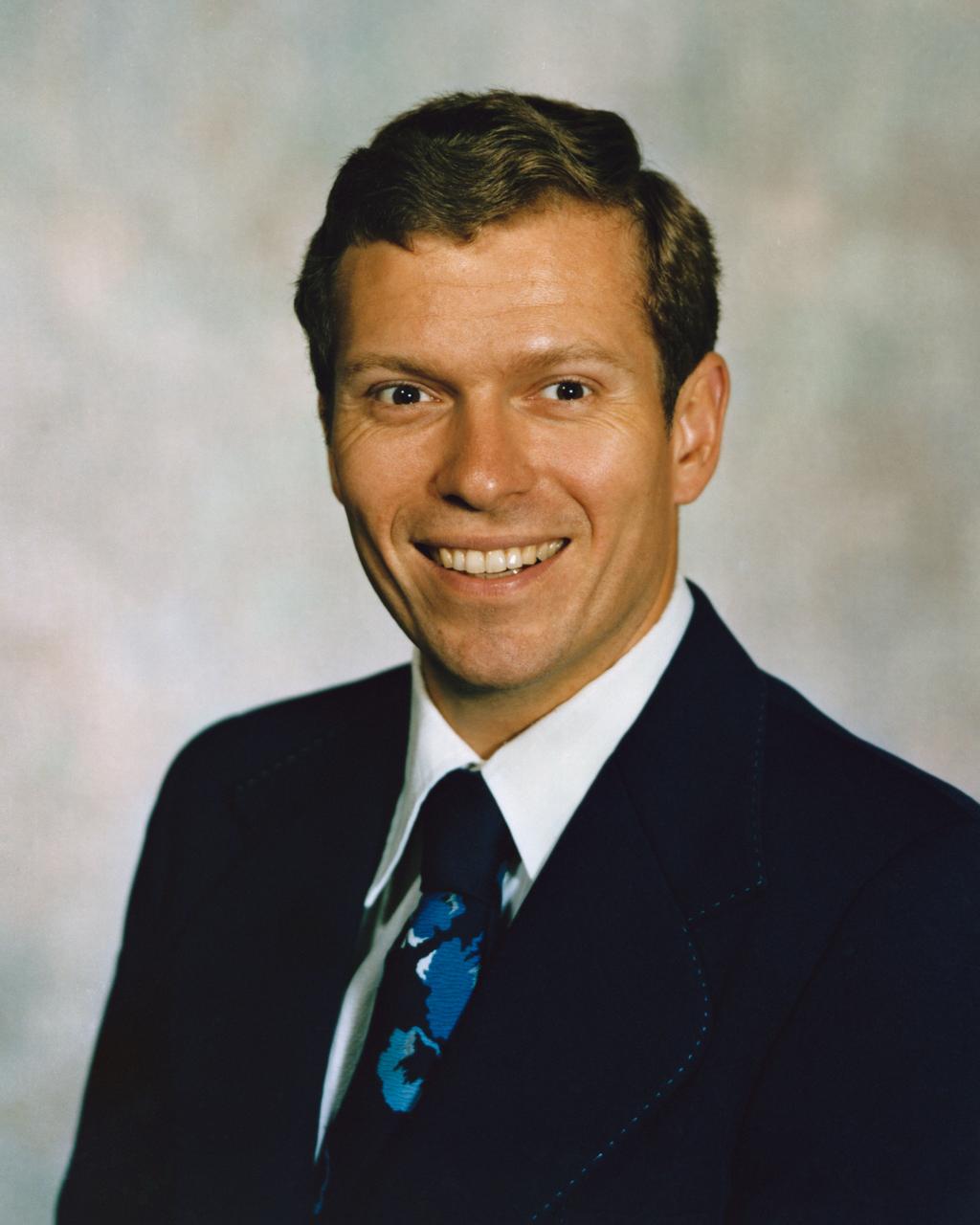
S82-41554 (1982) --- Dr. Byron K. Lichtenberg, payload specialist, Massachusetts Institute of Technology (MIT).
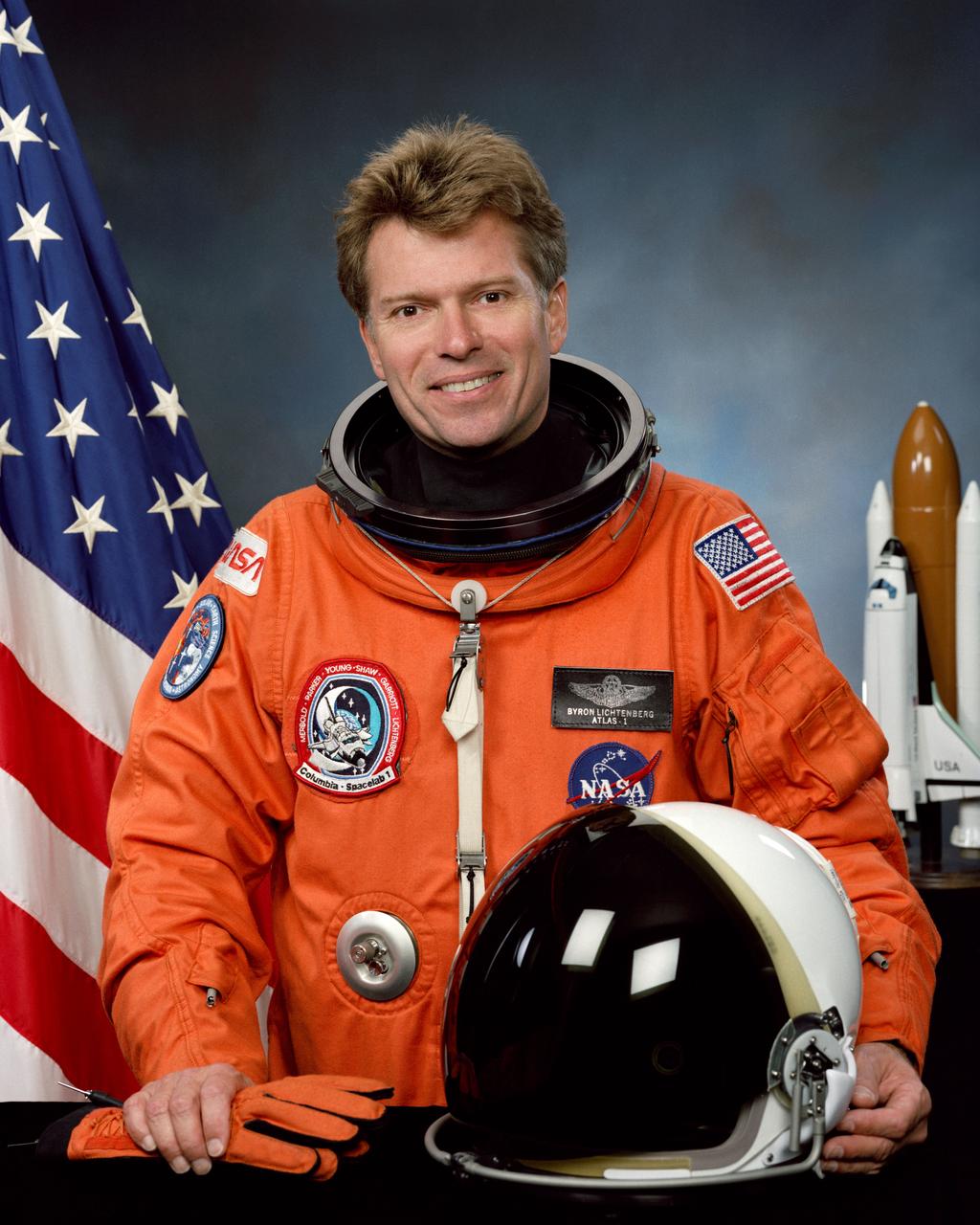
S91-51294 (Nov 1991) --- Astronaut Byron K. Lichtenberg, payload specialist.
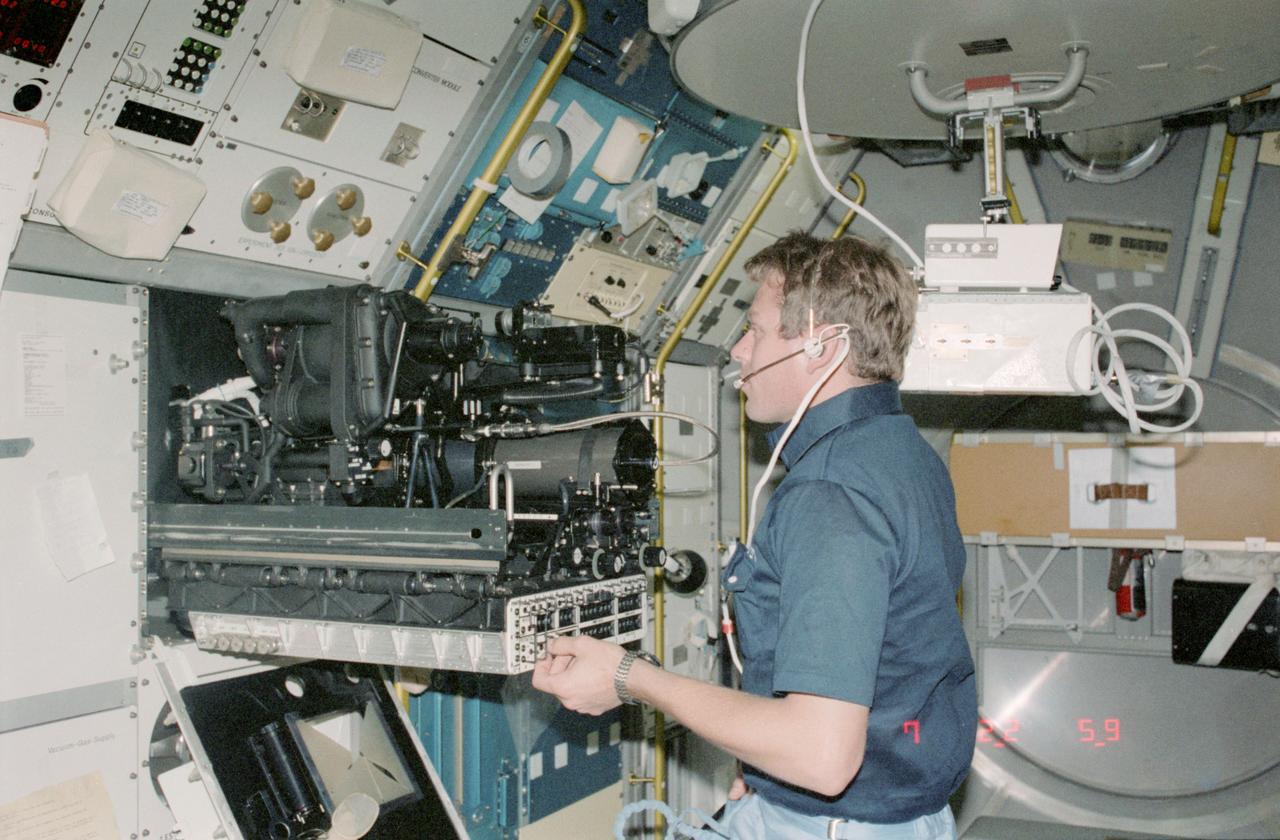
STS009-125-427 (28 Nov 1983) --- Payload Specialist Byron K. Lichtenberg carries out an experiment at the fluid physics module on the busy materials science double rack facility. Two beverage containers can be seen just above the biomedical engineer's head.
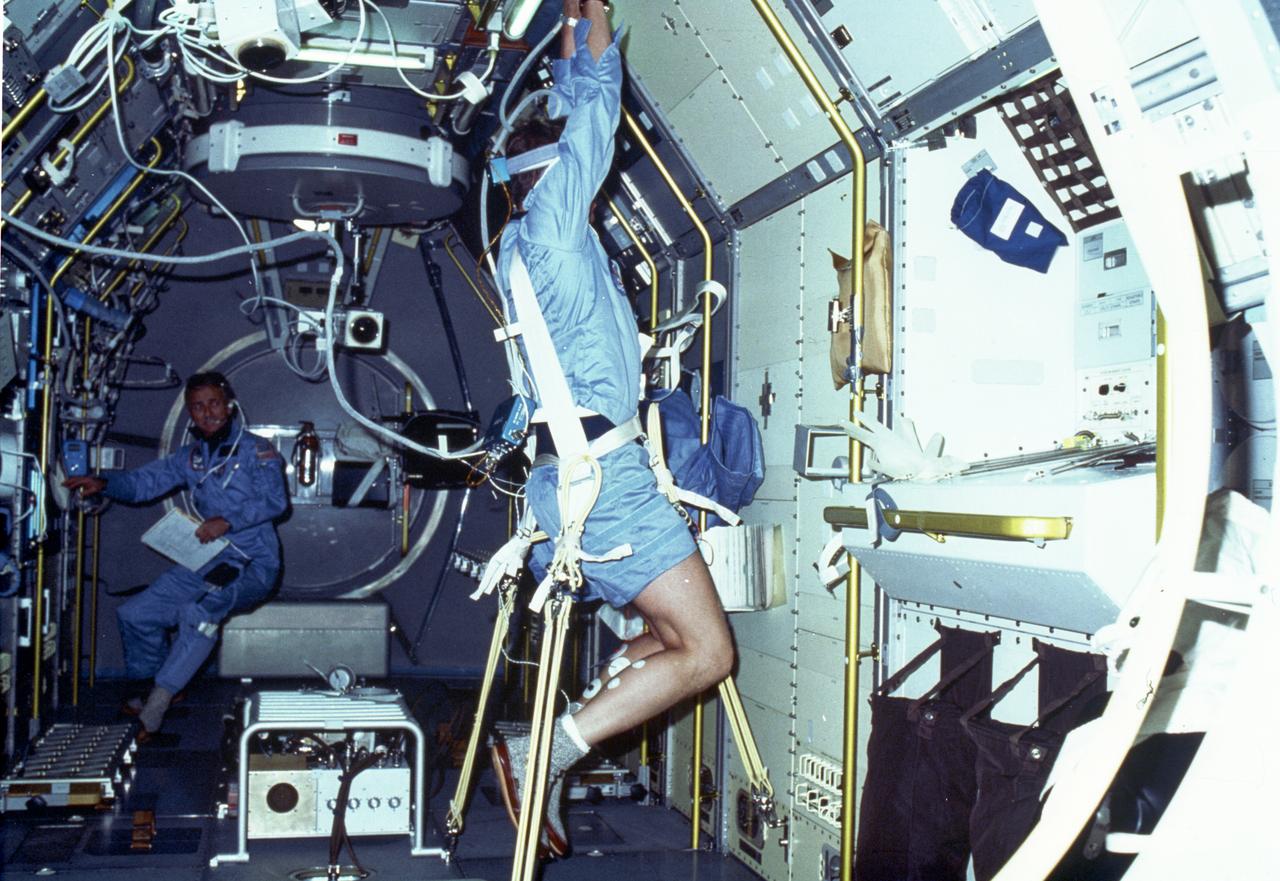
In this Spacelab-1 mission onboard photograph, astronaut Byron Lichtenberg performs a drop experiment, one of the Vestibular Experiments in Space investigations. The experiment examined spinal reflexes to determine whether they changed in microgravity. In Earth's environment, the otoliths signal the muscles to prepare for jolts associated with falling. During the flight, the normal reflex between the otoliths and the muscles was partially inhibited early in flight, declined further as the flight progressed, and returned to normal immediately after landing, suggesting that the brain ignored or reinterpreted otolith signals during space flight. Crewmembers reported a lack of awareness of position and location of feet, difficulty in maintaining balance, and a perception that falls were more sudden, faster, and harder than similar drops experienced in preflight. Crewmembers experienced illusions as they performed prescribed movement tests. When crew members viewed various targets and then pointed at them while blindfolded, their perception of target location and position of their own limbs was inaccurate in flight compared with similar tests on the ground. The Spacelab-1 was a multidisciplinary mission; that is, investigations were performed in several different fields of scientific research. The overall goal of the mission was to verify Spacelab performance through a variety of scientific experiments. The Spacelab-1 was launched aboard the Space Shuttle Orbiter Columbia for the STS-9 mission on November 28, 1983. The Marshall Space Flight Center had management responsibilities for the mission.
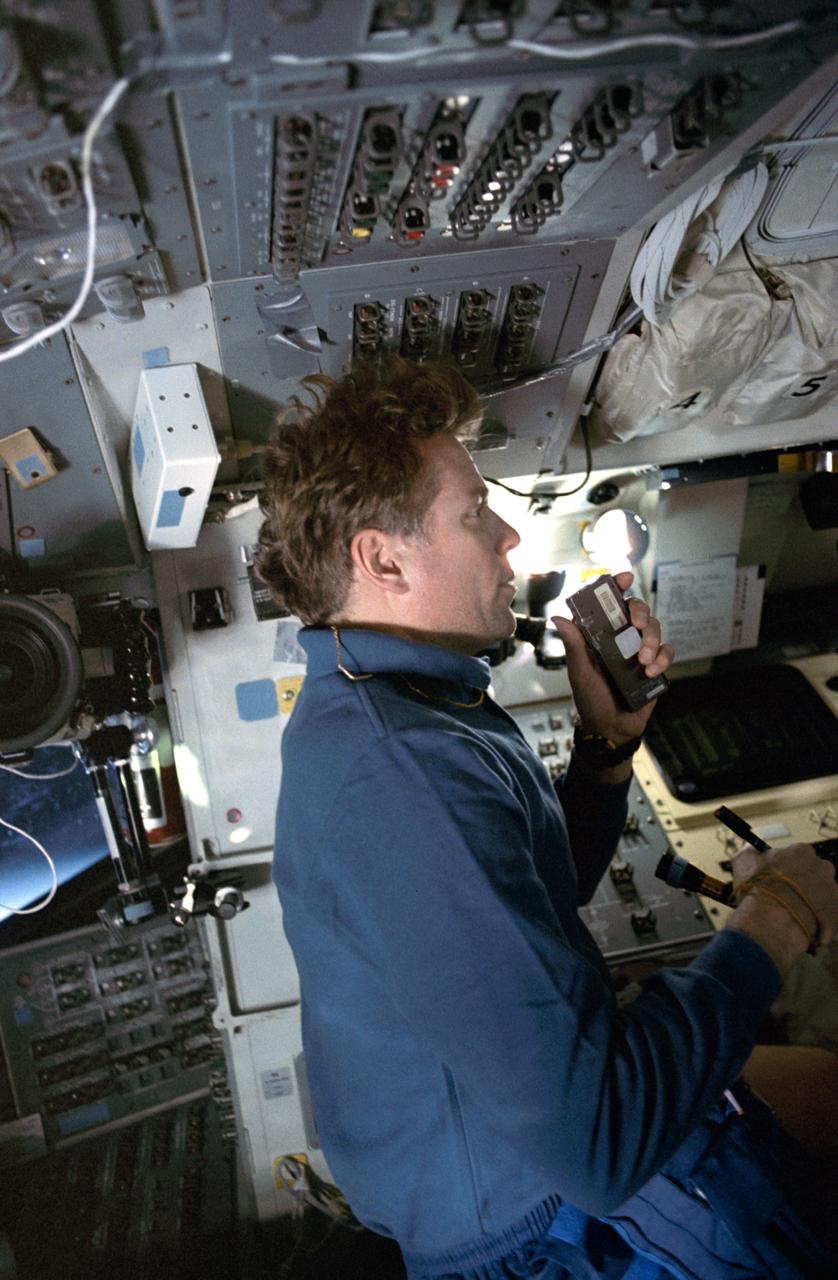
STS045-20-018 (2 April 1992) --- STS-45 Payload Specialist Byron K. Lichtenberg talks into a cassette tape recorder to note observations following a science run of the Atmospheric Emissions Photometric Imaging (AEPI) experiment. Lichtenberg is on the aft flight deck of Atlantis, Orbiter Vehicle (OV) 104. At Lichtenberg's left is the mission station, the forward flight deck and window W6 appear behind him, and overhead control panels appear above his head.

STS009-15-755 (28 Nov-8 Dec 1983) --- The lone television monitor in the Spacelab module is a popular item in this 35mm scene of all four science specialists on the 10-day STS-9 mission. Left to right are Robert A. R. Parker, Byron K. Lichtenberg, Owen K. Garriott and Ulf Merbold.
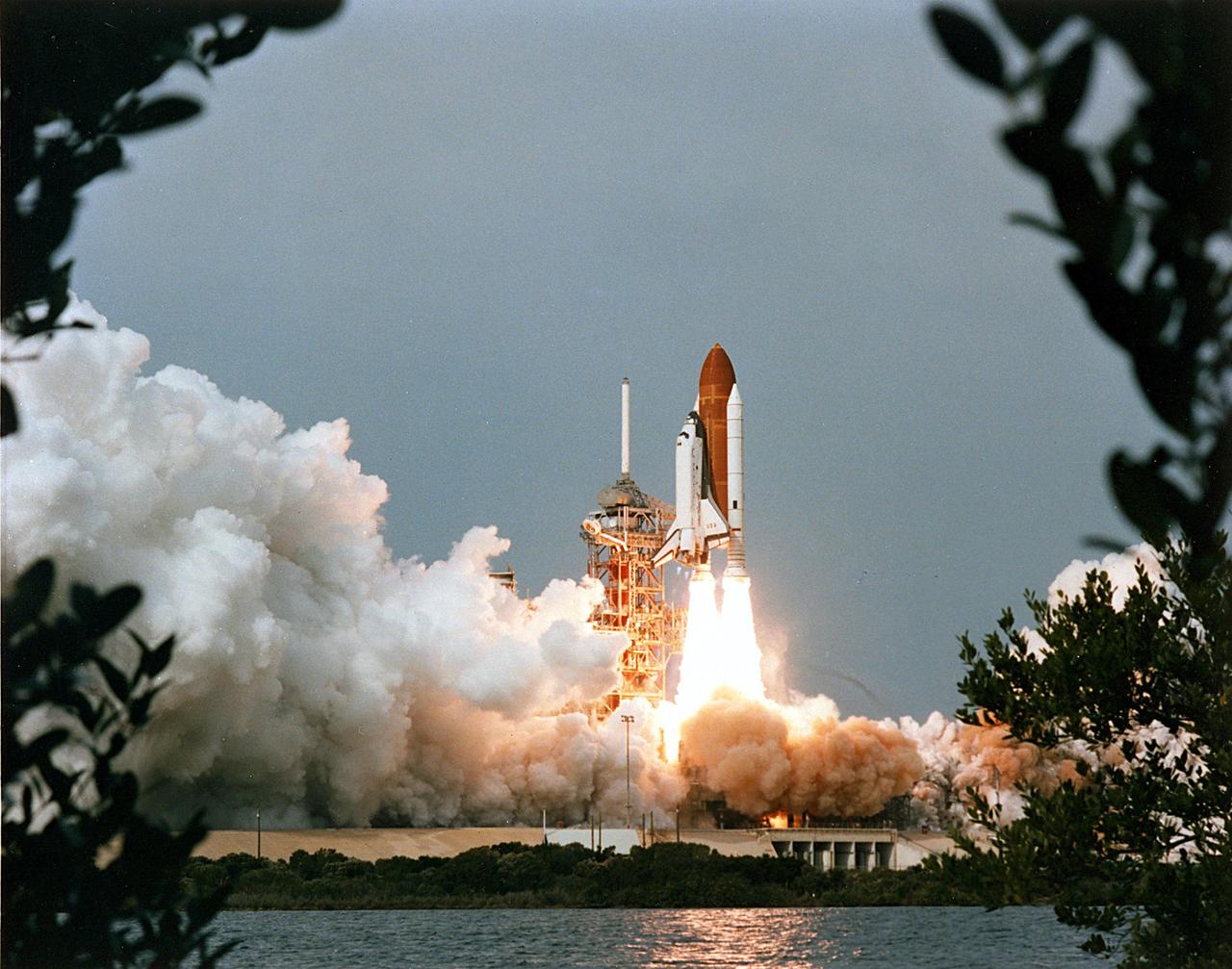
KENNEDY SPACE CENTER, FLA. -- Columbia launches on mission STS-9 from Launch Pad 39-A. This is the first Shuttle flight with six crew members: Commander John W. Young, Pilot Brewster H. Shaw Jr., Mission Specialists Owen K. Garriott and Robert A.R. Parker, and Payload Specialists Byron K. Lichtenberg and Ulf Merbold, who is with the European Space Agency (ESA). The flight carries the first Spacelab mission and first astronaut to represent ESA.
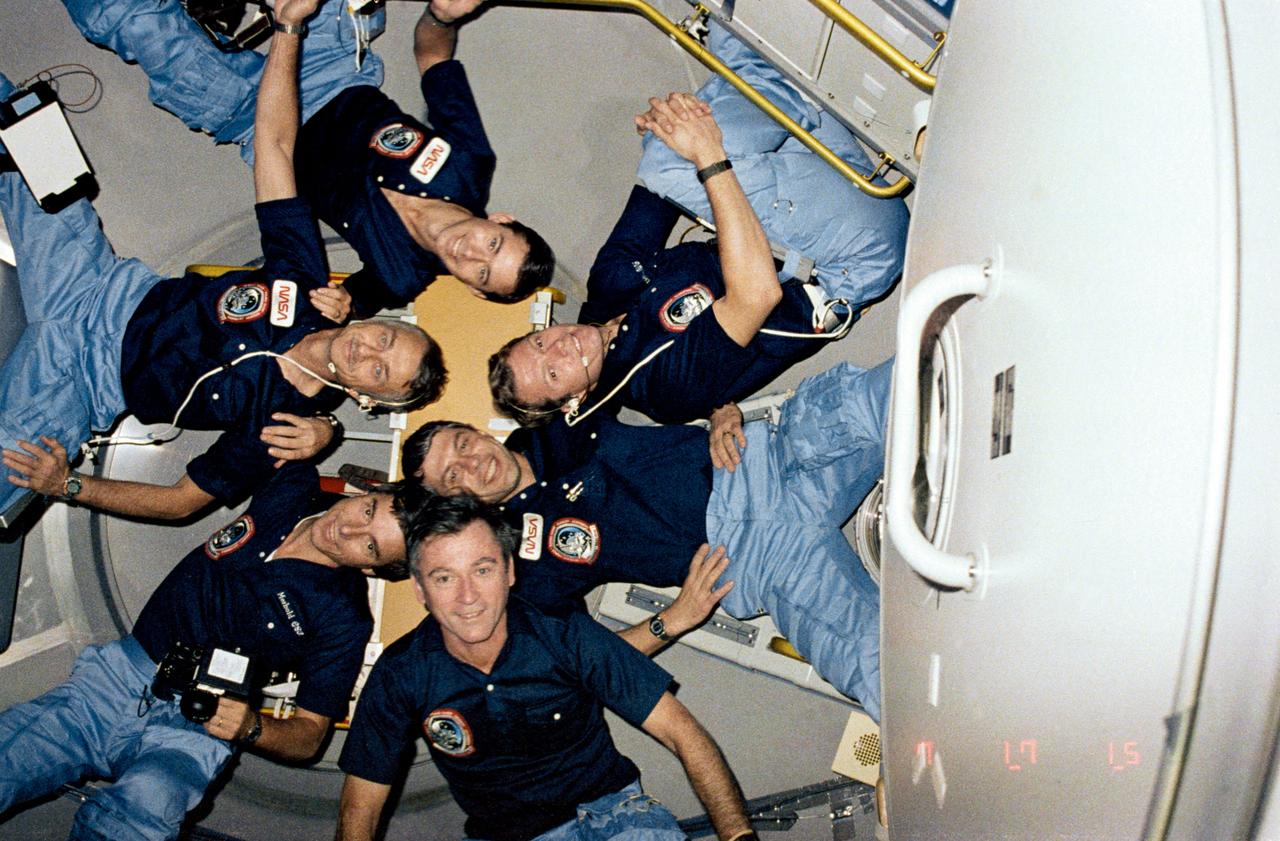
STS009-126-441 (28 Nov 1983) --- The six crewmembers of STS-9 position themselves in a star bust-like cluster in the aft end cone of Spacelab aboard the Shuttle Columbia. Clockwise, beginning with John W. Young, are Ulf Merbold, Owen K. Garriott, Brewster H. Shaw, Jr., Byron M. Lichtenberg and Robert A.R. Parker.
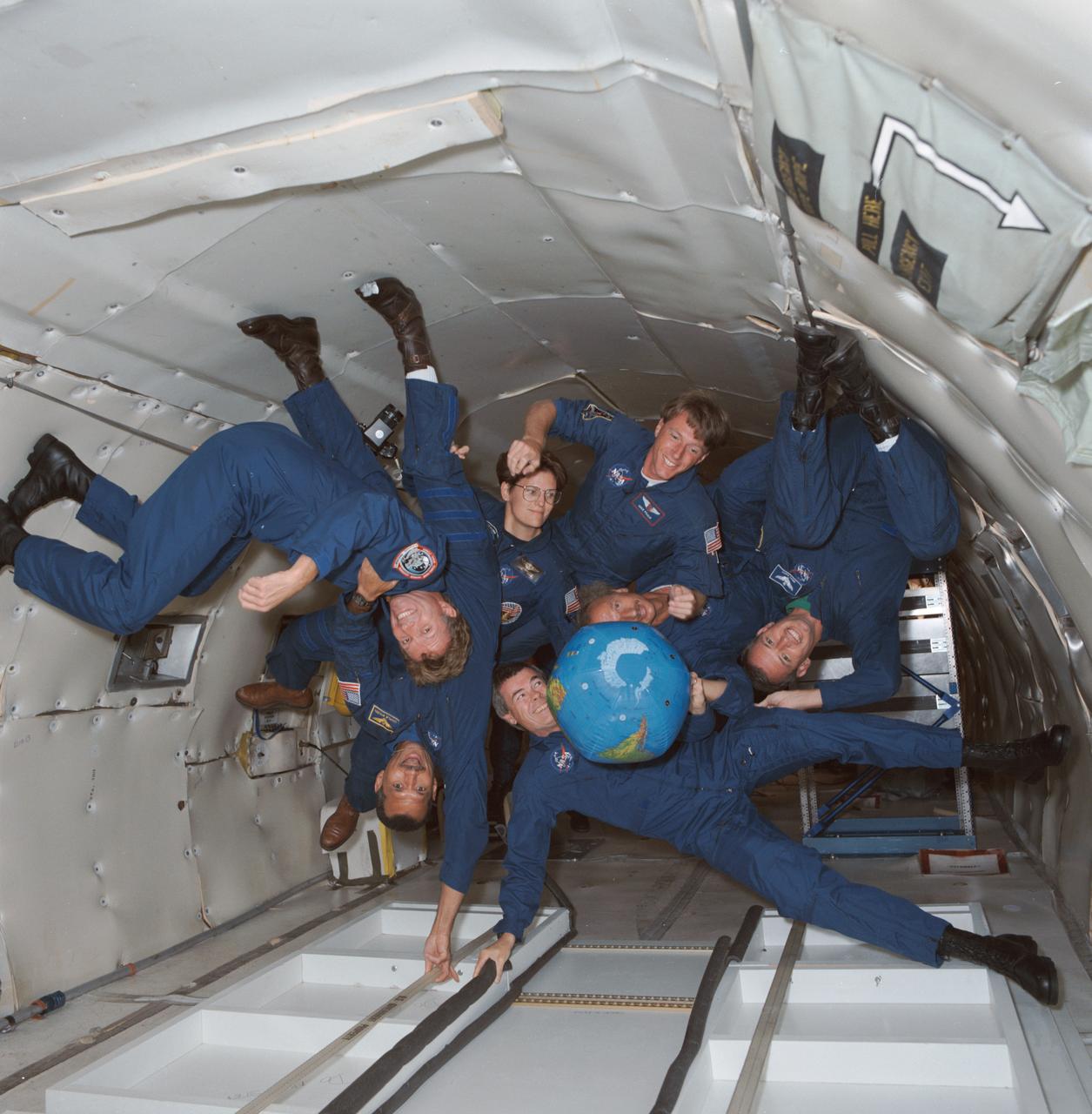
S91-44453 (21 Aug 1991) --- The crew of STS-45 is already training for its March 1992 mission, including stints on the KC-135 zero-gravity-simulating aircraft. Shown with an inflatable globe are, clockwise from the top, C. Michael Foale, mission specialist; Dirk Frimout, payload specialist; Brian Duffy, pilot; Charles R. (Rick) Chappell, backup payload specialist; Charles F. Bolden, mission commander; Byron K. Lichtenberg, payload specialist; and Kathryn D. Sullivan, payload commander.
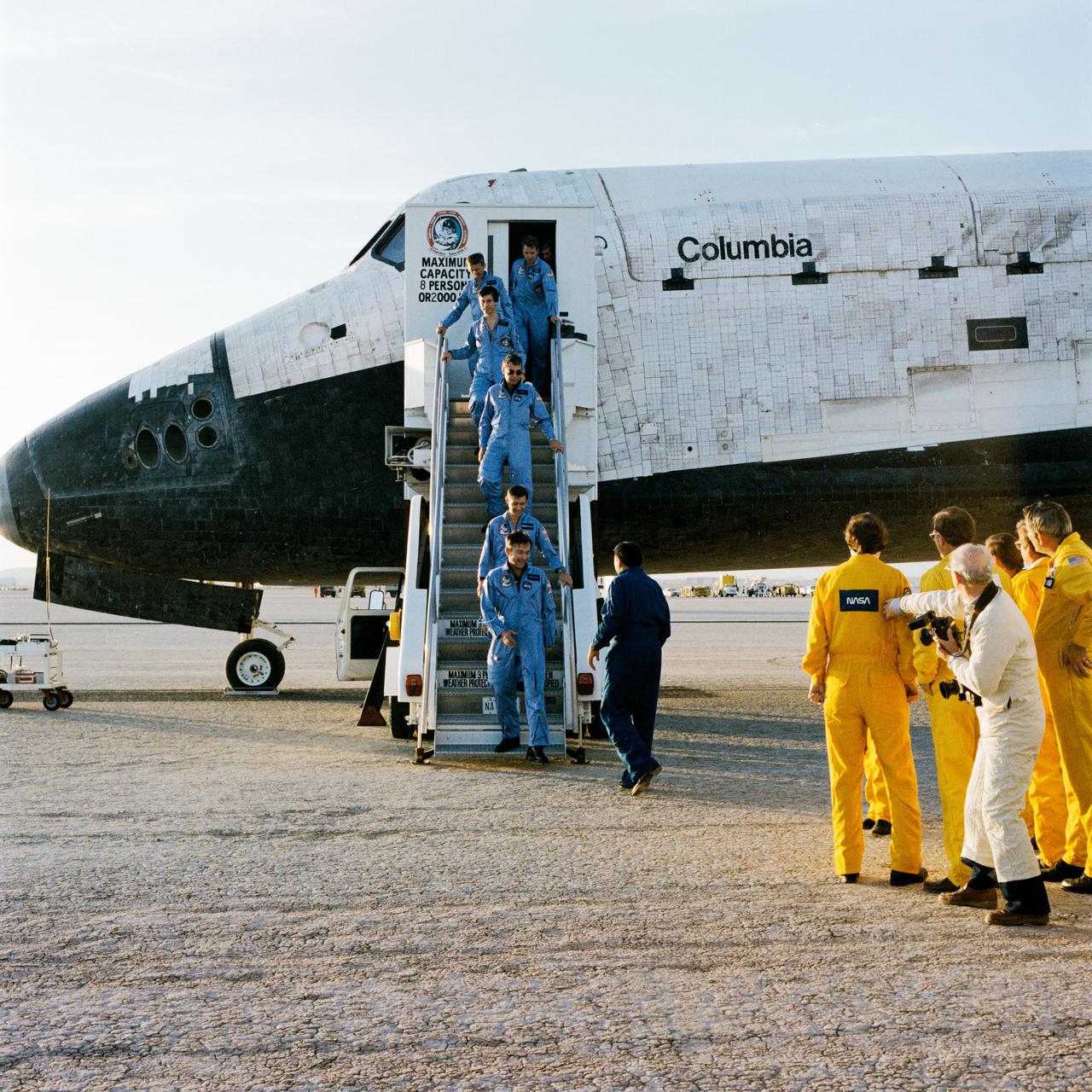
S83-45648 (8 Dec 1983) --- After more than 10 days in Earth orbit, the crewmembers for STS-9 egress the Space Shuttle Columbia following its successful landing at Edwards Air Force Base in southern California. Descending the stairs are (from bottom) Astronaut John W. Young, Brewster H. Shaw Jr. and Robert A. R. Parker; West German physicist Dr. Ulf Merbold; Astronaut Owen K. Garriott, and Dr. Byron K. Lichtenberg, a biomedical engineer from the Massachusetts Institute of Technology. Young was STS-9 crew commander; Shaw, pilot Drs. Parker and Garriott were mission specialists; and Drs. Merbold and Lichtenberg, payload specialists. Dr. Merbold was the European Space Agency?s first scientist to fly aboard a NASA spacecraft and Dr. Lichtenberg was America?s first non-astronaut to join a NASA crew in space. On hand to greet the crewmembers is George W. S. Abbey, director of flight crew operations.
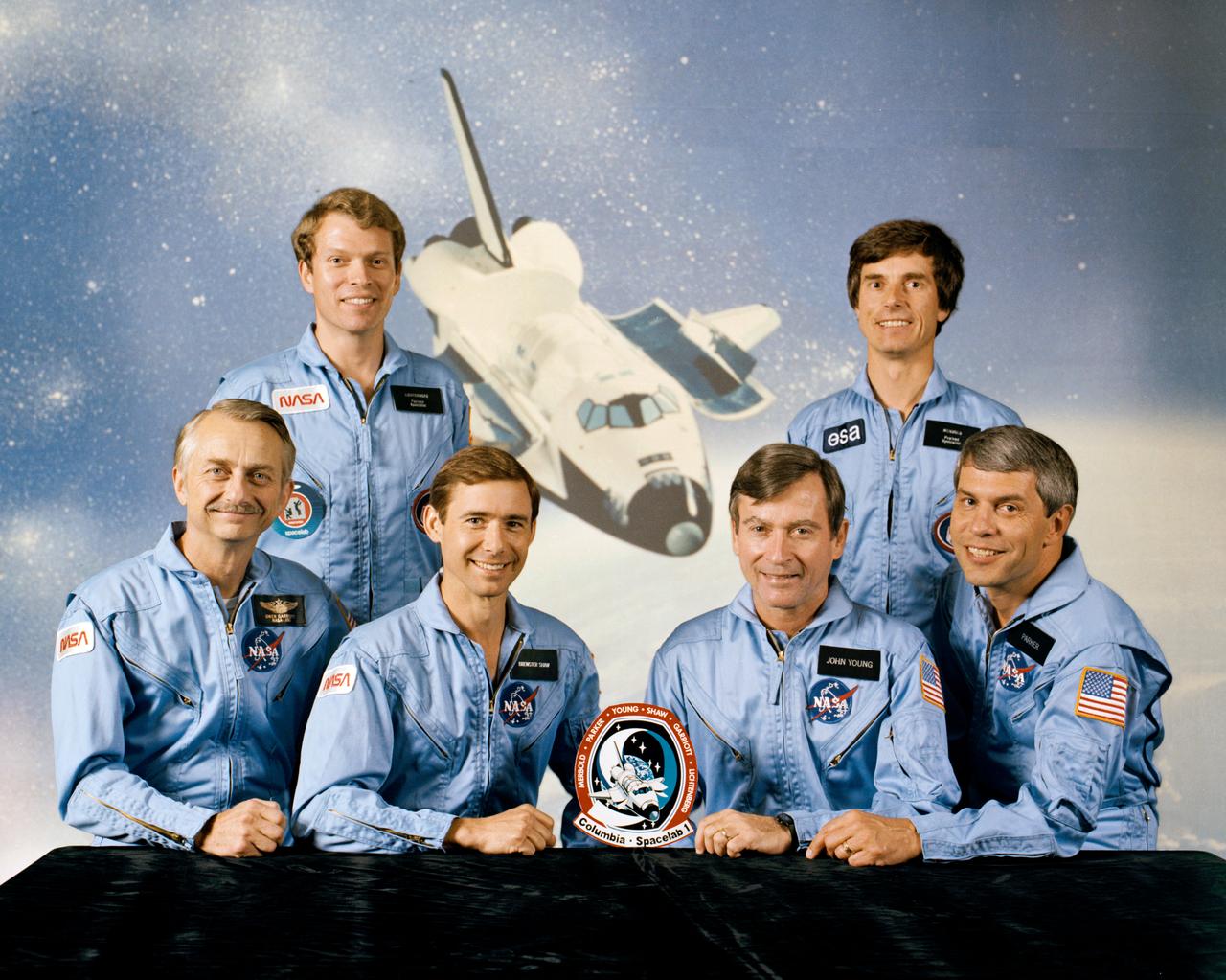
S83-35017 (June 1983) --- These six men represent the first crewmembers to man the Columbia when it gets reactivated later this year. The four NASA astronauts are joined by a European and MIT scientist payload specialist and the Spacelab module and experiment array for STS-9. On the front row are Astronauts Owen K. Garriott, mission specialist; Brewster H. Shaw, Jr., pilot; John W. Young, commander; and Robert A. R. Parker, mission specialist. Byron K. Lichtenberg of the Massachusetts of Technology, left and Ulf Merbold of the Republic of West Germany and the European Space Agency stand in front of an orbital scene featuring the Columbia. Columbia was used for the first five Space Transportation System missions in 1981 and 1982.
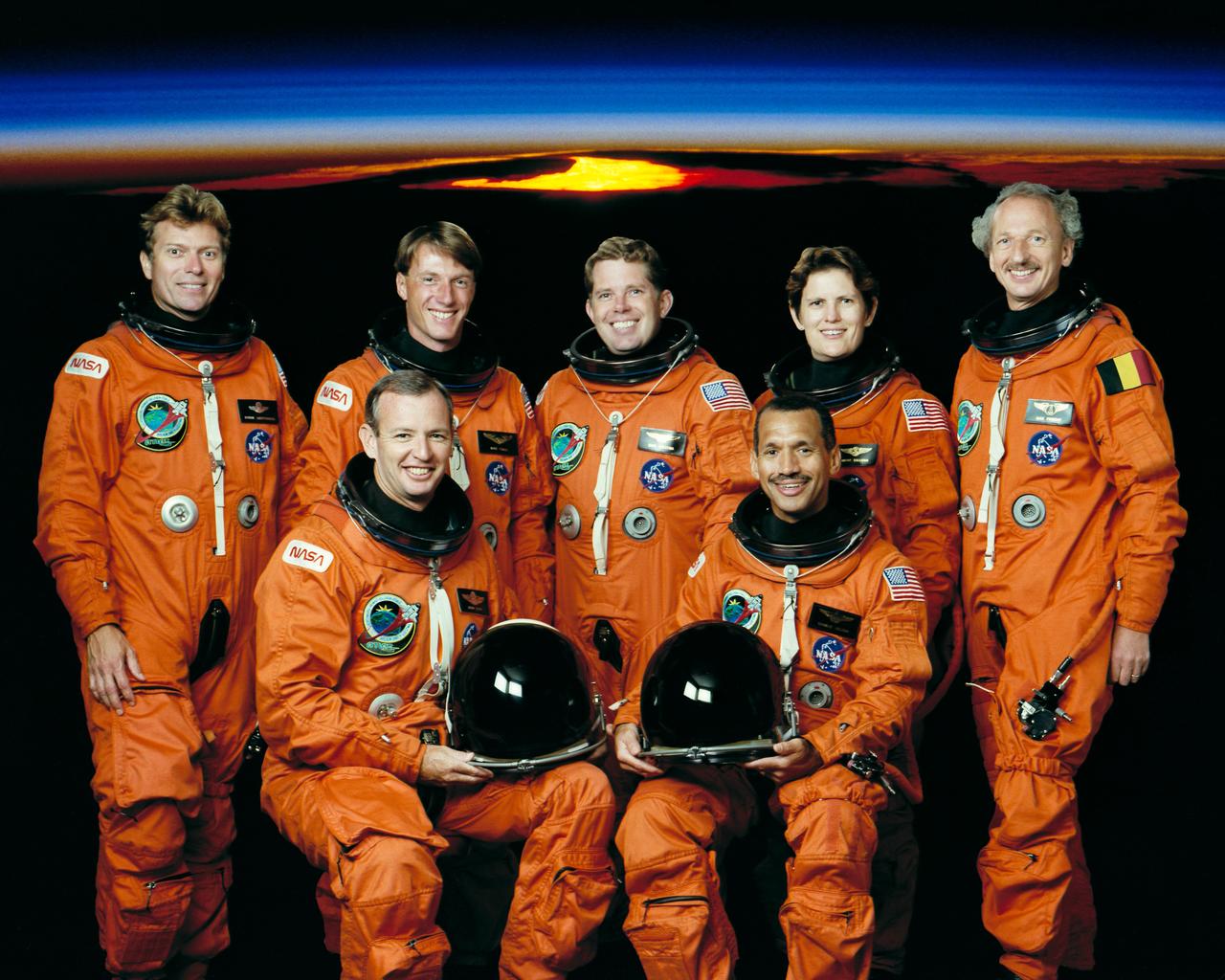
STS045-S-002 (January 1992) --- The seven crew members for NASA's STS-45 mission are pictured in their partial-pressure launch and entry suits. In front are astronauts Charles F. Bolden, Jr. (right), mission commander, and Brian Duffy, pilot. Back row, left to right, are payload specialist Byron K. Lichtenberg; astronauts C. Michael Foale and David C. Leestma, mission specialists; Kathryn D. Sullivan, payload commander; and payload specialist Dirk Frimout, of Belgium. The Atmospheric Laboratory for Applications and Science (ATLAS) is scheduled for a March 1992 launch aboard the Space Shuttle Atlantis.
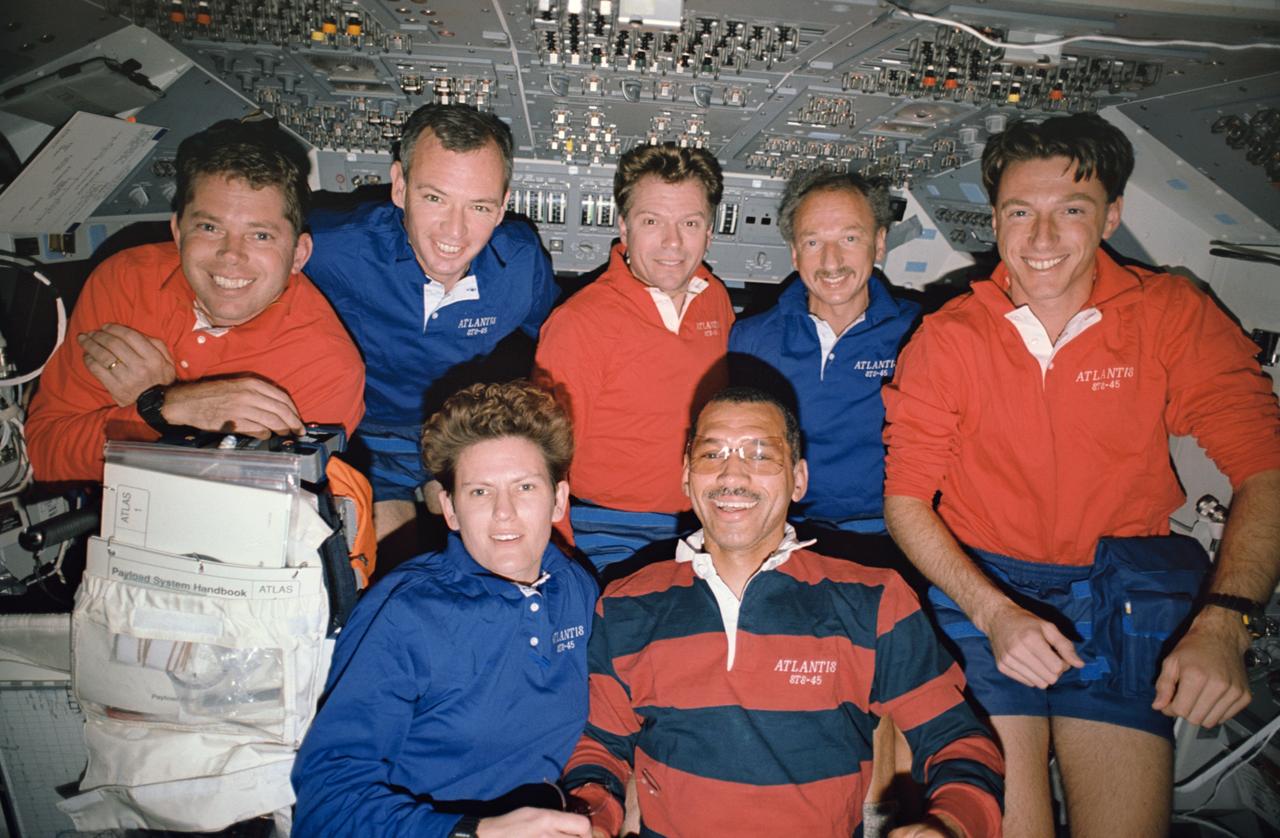
STS045-38-004 (24 March-2 April 1992) --- The traditional inflight crew portrait has Kathryn D. Sullivan, payload commander, and Charles F. Bolden, mission commander, on the front row, with ( left to right) David C. Leestma, mission specialist; Brian Duffy, pilot; Byron K. Lichtenberg and Dirk Frimout, both payload specialists; and C. Michael Foale, mission specialist, on the back row. (The "headpieces" worn by Sullivan and Bolden are actually shadows.) This frame was taken with a 35mm camera on the flight deck of the Earth-orbiting Space Shuttle Atlantis during the nine-day mission.
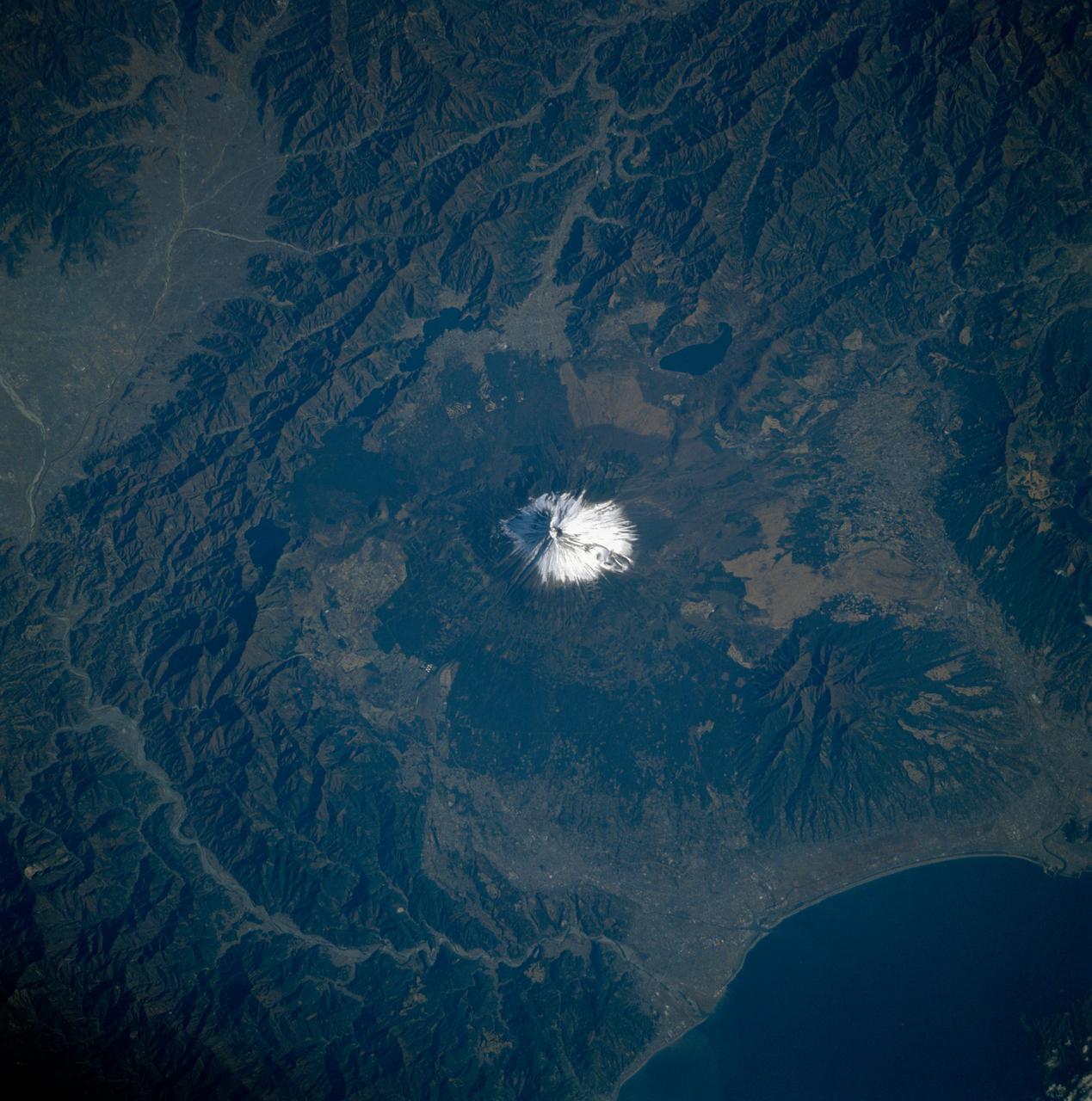
STS009-40-2575 (28 Nov-8 Dec 1983) --- This view of the Fuji volcano, Japan was taken on the 54th orbit of the Space Shuttle Columbia. The center coordinates are 35.5 degrees north latitude and 139.0 degrees east longitude. This was the first time a non-United States crew member was flown aboard the United States Space Shuttle, European Space Agency (ESA) payload specialist Ulf Merbold, Germany. The crew included NASA astronauts John W. Young, commander; Brewster H. Shaw Jr., pilot; Owen K. Garriott, mission specialist, Robert A. Parker, mission specialist; and Byron Lichtenberg, payload specialist.
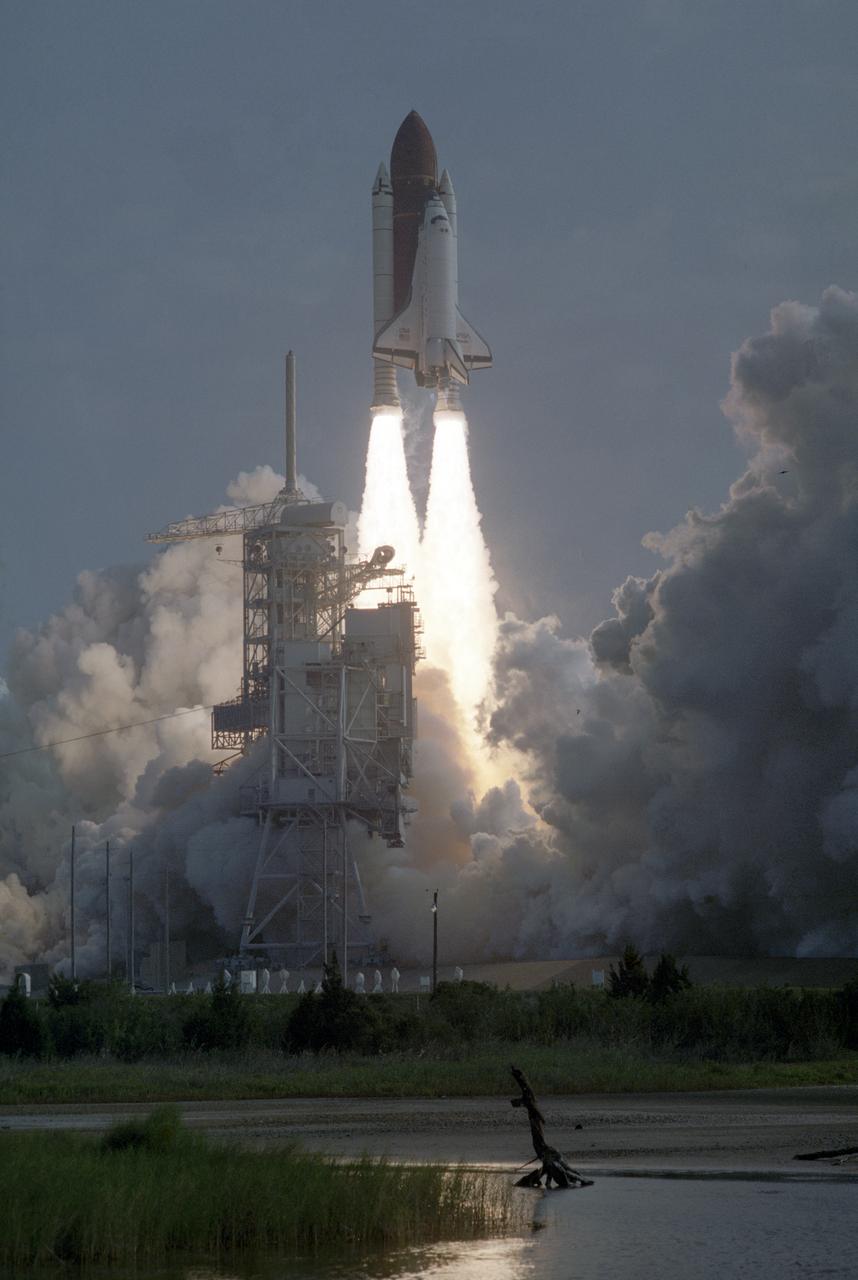
The STS-45 mission launched aboard the Space Shuttle Atlantis on March 24, 1992 at 8:13:40am (EST) carrying the Atmospheric Laboratory for Application and Science (ATLAS-1) as its primary payload. Crew members included: Charles F. Bolden, Jr., commander; Brian Duffy, pilot; Kathryn D. Sullivan, payload commander; Byron K. Lichtenberg, payload specialist 1; Dirk K. Frimout, payload specialist 2; David C. Leestma, mission specialist 2; and C. Michael Foale, mission specialist 3.
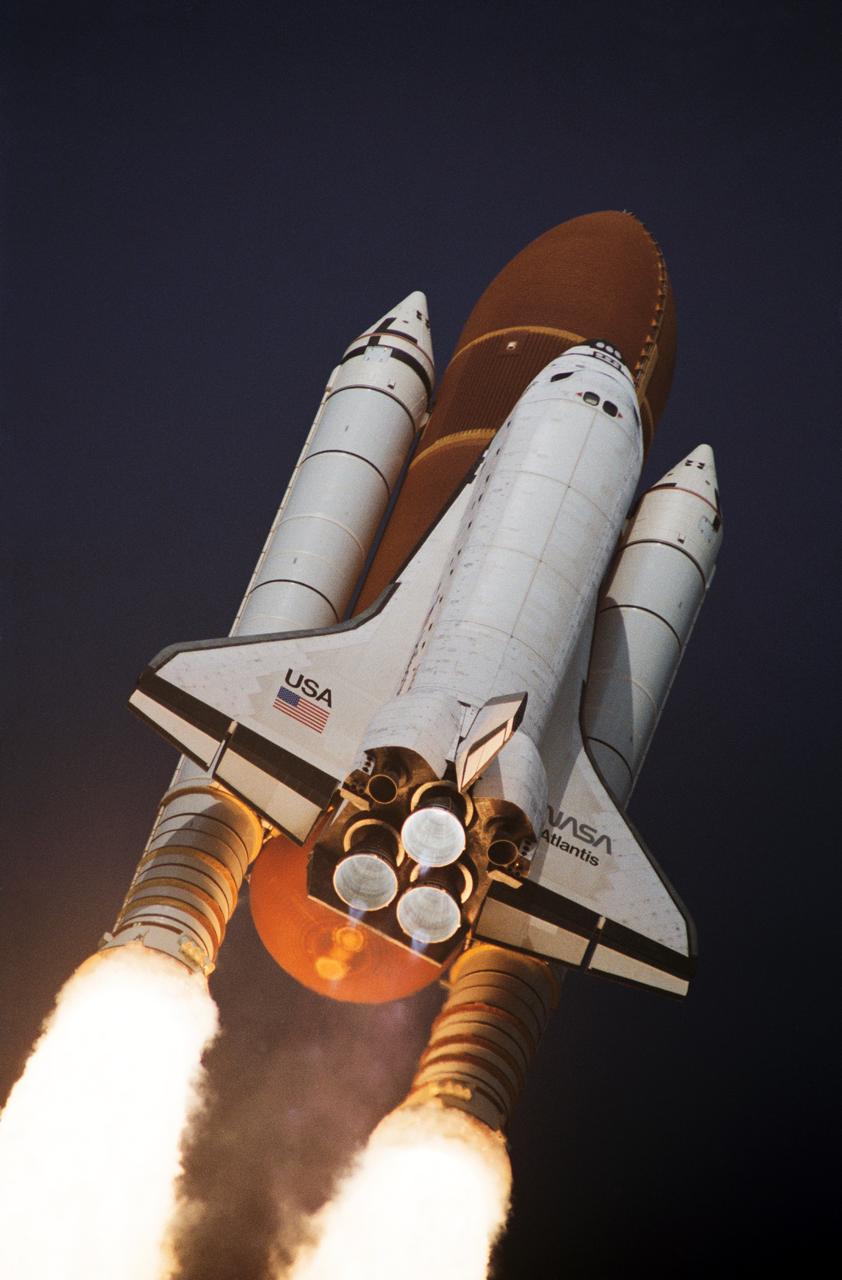
STS045-S-053 (24 March 1992) --- A low-angle view of the Space Shuttle Atlantis as it soars off the launch pad and heads toward Earth orbit with a crew of seven and the Atmospheric Laboratory for Applications and Science (ATLAS) aboard. Launch occurred at 8:13:40:048 a.m. (EST), March 24, 1992. Onboard were astronauts Charles F. Bolden, STS-45 commander; Brian Duffy, pilot; Kathryn D. Sullivan, payload commander; David C. Leestma and C. Michael Foale, mission specialists; and Dirk Frimout of the European Space Agency and Byron K. Lichtenberg, payload specialists.
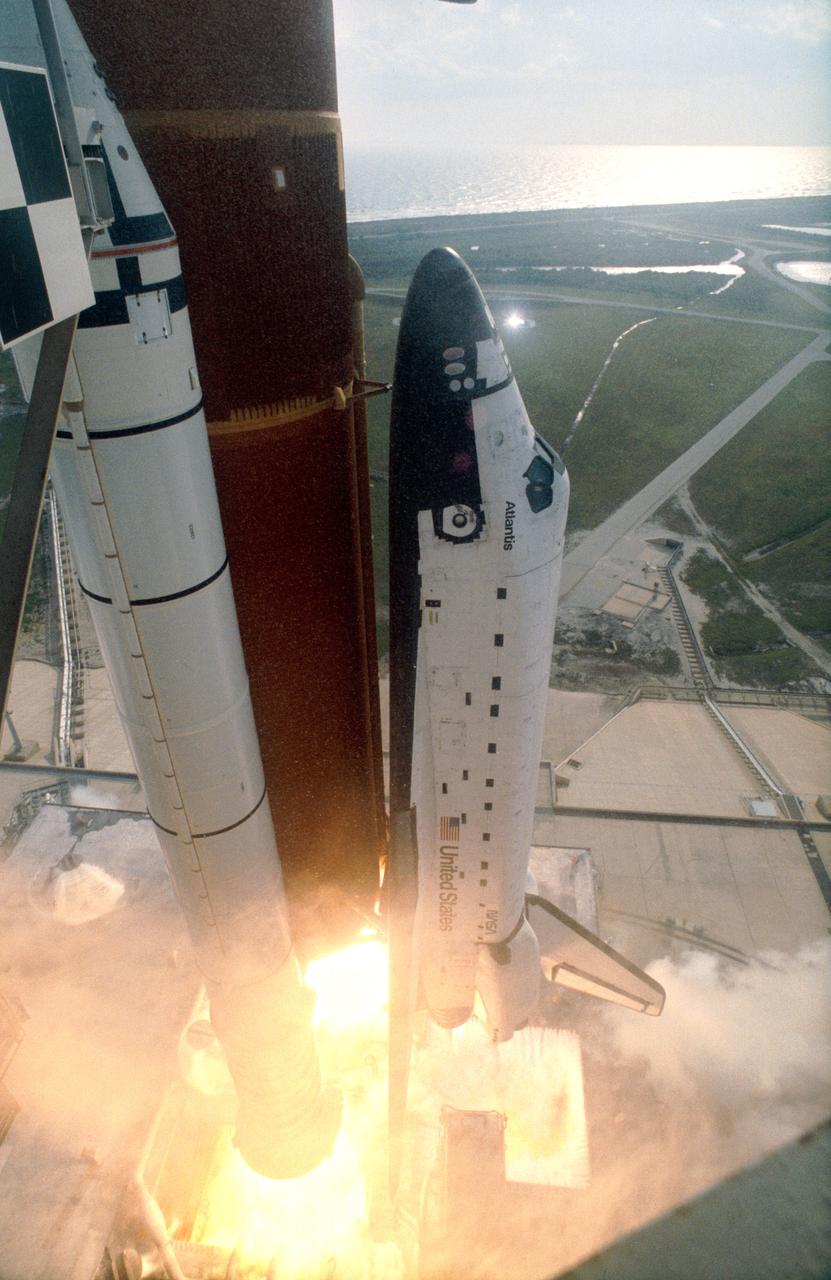
STS045-S-054 (24 March 1992) --- A profile view of the Space Shuttle Atlantis as it soars off the launch pad and heads toward Earth orbit with a crew of seven and the Atmospheric Laboratory for Applications and Science (ATLAS) aboard. Launch occurred at 8:13:40:048 a.m. (EST), March 24, 1992. Onboard were Charles F. Bolden, mission commander; Brian Duffy, pilot; Kathryn D. Sullivan, payload commander; David C. Leestma and C. Michael Foale, mission specialists; and Dirk Frimout of the European Space Agency and Byron K. Lichtenberg, payload specialists. The view was provided by an automatic camera on the launch service structure.
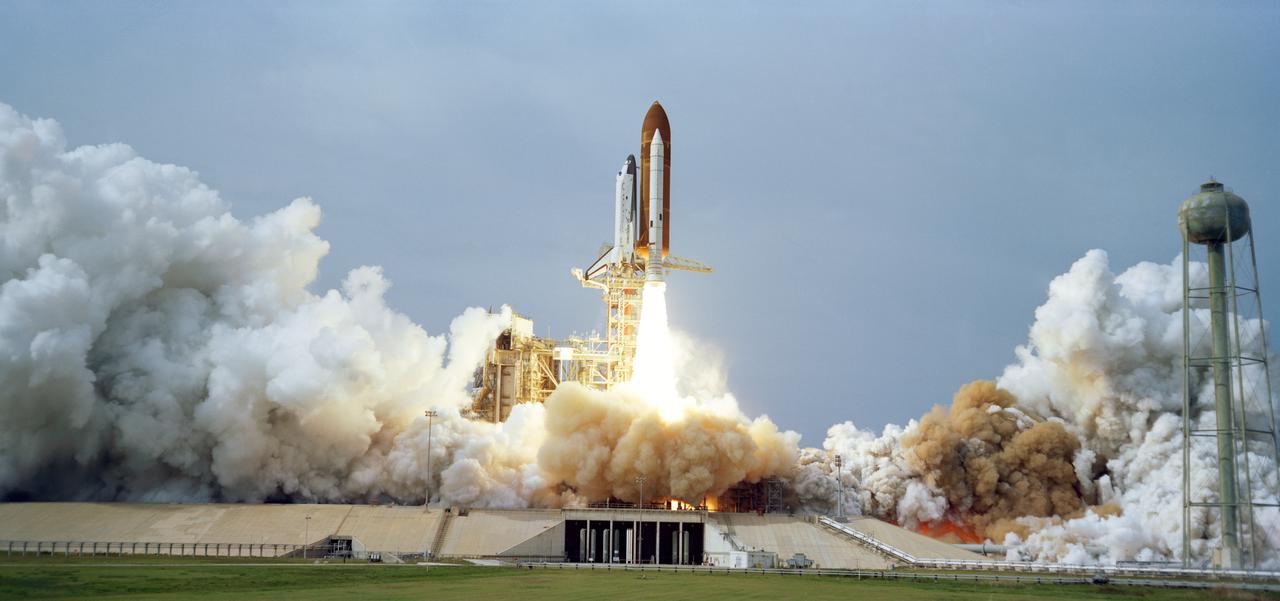
S83-44997 (28 Nov 1983) --- The Columbia lifts off once again from launch pad 39A at the Kennedy Space Center to begin a busy nine days in space for six crewmembers. Official launch time was 11:00:00:84 a.m. (EST). Onboard the spacecraft are Astronauts John W. Young, Brewster Shaw, Jr., Dr. Owen K. Garriott, Dr. Robert A. R. Parker; the European Space Agency?s Dr. Ulf Merbold; and Dr. Byron K. Lichtenberg, biomedical engineer with Massachusetts Institute of Technology.
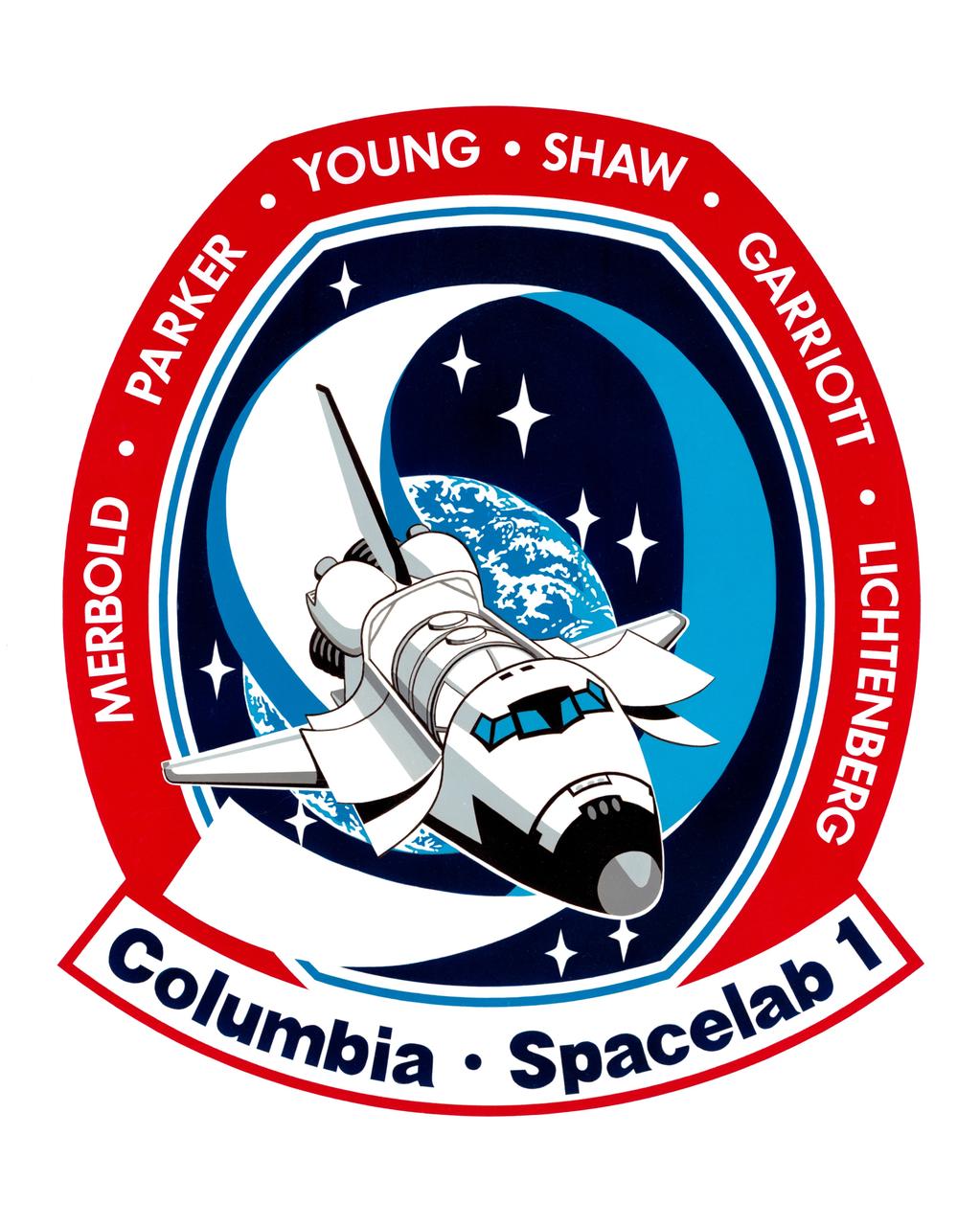
S83-32900 (25 May 1983) --- This is the official insignia for STS-9, the major payload of which is Spacelab-1, depicted in the cargo bay of the space shuttle Columbia. The nine stars and the path of the orbiter tell the flight's numerical designation in the Space Transportation System's mission sequence. Astronaut John W. Young is crew commander; Brewster H. Shaw Jr., pilot. NASA astronauts Owen K. Garriott and Robert A.R. Parker are mission specialists. Byron K. Lichtenberg of the Massachusetts Institute of Technology and Ulf Merbold of the Republic of West Germany are the Spacelab-1 payload specialists. Launch has been set for late 1983. Merbold is a physicist representing the European Space Agency (ESA). The NASA insignia design for space shuttle flights is reserved for use by the astronauts and for other official use as the NASA Administrator may authorize. Public availability has been approved only in the forms of illustrations by the various news media. When and if there is any change in this policy, which is not anticipated, the change will be publicly announced. Photo credit: NASA
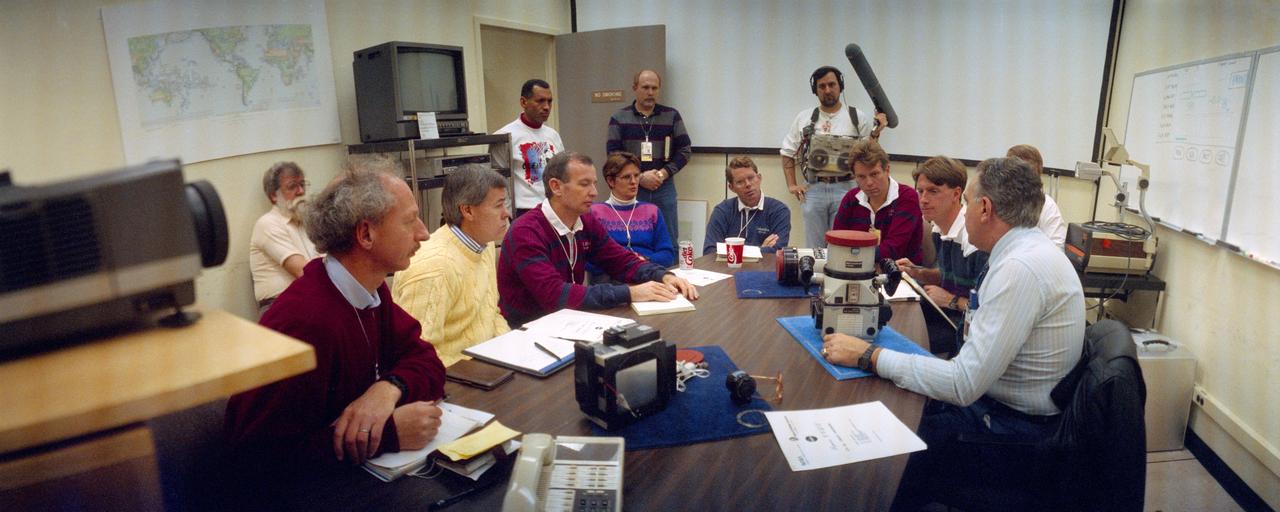
S92-26522 (Feb 1992) --- Crewmembers assigned to NASA's STS-45 mission are briefed on the use of the Linhof camera in the flight operations facility at the Johnson Space Center (JSC). Charles F. Bolden, mission commander, stands at left. Other crewmembers (seated clockwise around the table from lower left) are Dirk Frimout of Belgium representing the European Space Agency as payload specialist; Charles R. (Rick) Chappell, backup payload specialist; Brian Duffy, pilot; Kathryn D. Sullivan, payload commander; David C. Leestma, mission specialist; Byron K. Lichtenberg, payload specialist; and C. Michael Foale, mission specialist. James H. Ragan (far right), head of the flight equipment section of the flight systems branch in JSC's Man Systems Division, briefs the crewmembers. Donald C. Carico, of the crew training staff and Rockwell International, stands near Bolden. The camera, used for out-the-window observations, is expected to be used frequently on the Atmospheric Laboratory for Applications and Science (ATLAS-1) mission, scheduled for a March date with the Space Shuttle Atlantis.
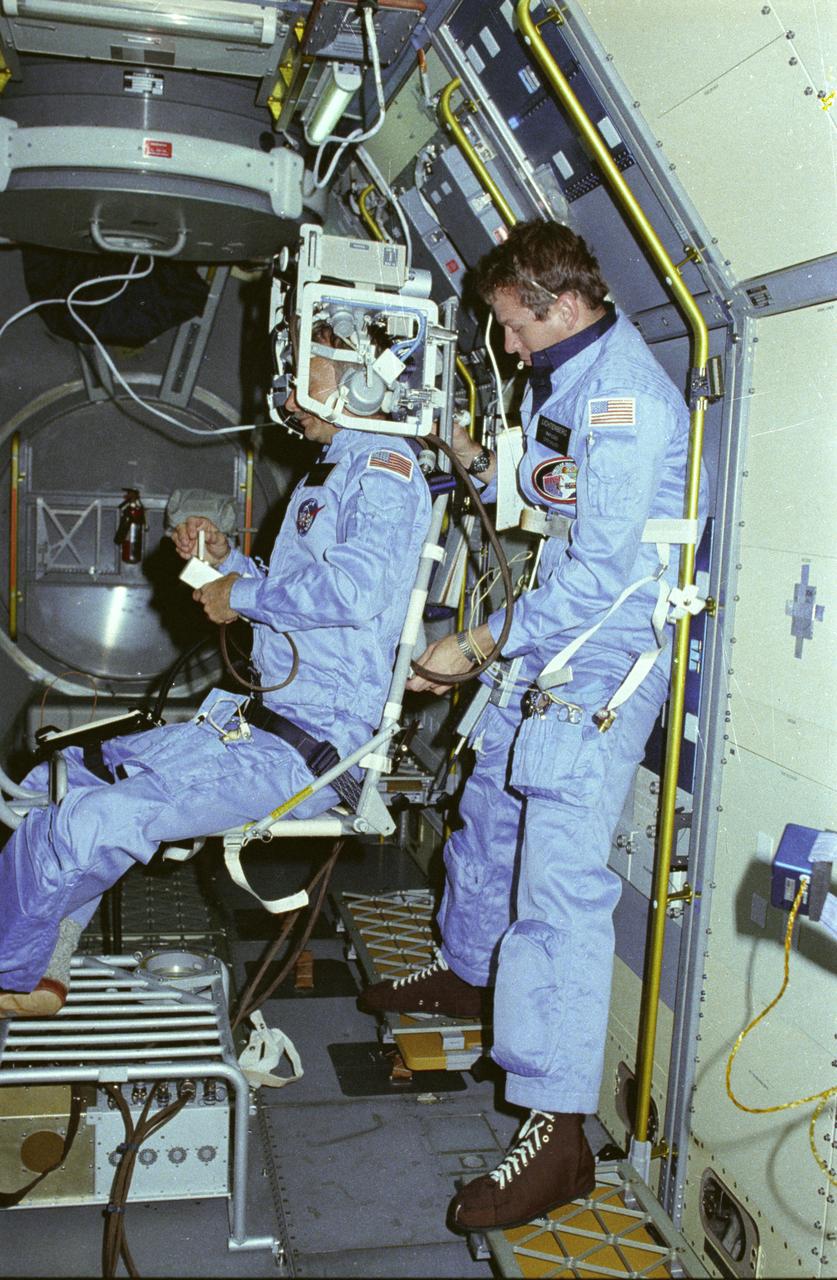
In this photograph, astronauts Owen Garriott on the body restriant system and Byron Lichtenberg prepare for a Vestibular Experiment during the Spacelab-1 mission. The Vestibular Experiments in Space were the study of the interaction among the otoliths, semicircular canals, vision, and spinal reflexes in humans. The main objective was to determine how the body, which receives redundant information for several sensory sources, interprets this information in microgravity. Another objective was to record and characterize the symptoms of space sickness experienced by crewmembers. The body restraint system was a rotating chair with a harness to hold the test subject in place. The crewmember wore an accelerometer and electrodes to record head motion and horizontal and vertical eye movement as the body rotated. The first Spacelab mission, Spacelab-1, sponsored jointly and shared equally by NASA and the European Space Agency, was a multidisciplinary mission; that is, investigations were performed in several different fields of scientific research. The overall goal of the mission was to verify Spacelab performance through a variety of scientific experiments. The Spacelab-1 was launched aboard the Space Shuttle Orbiter Columbia for the STS-9 mission on November 28, 1983. The Marshall Space Flight Center had management responsibilities for the mission.
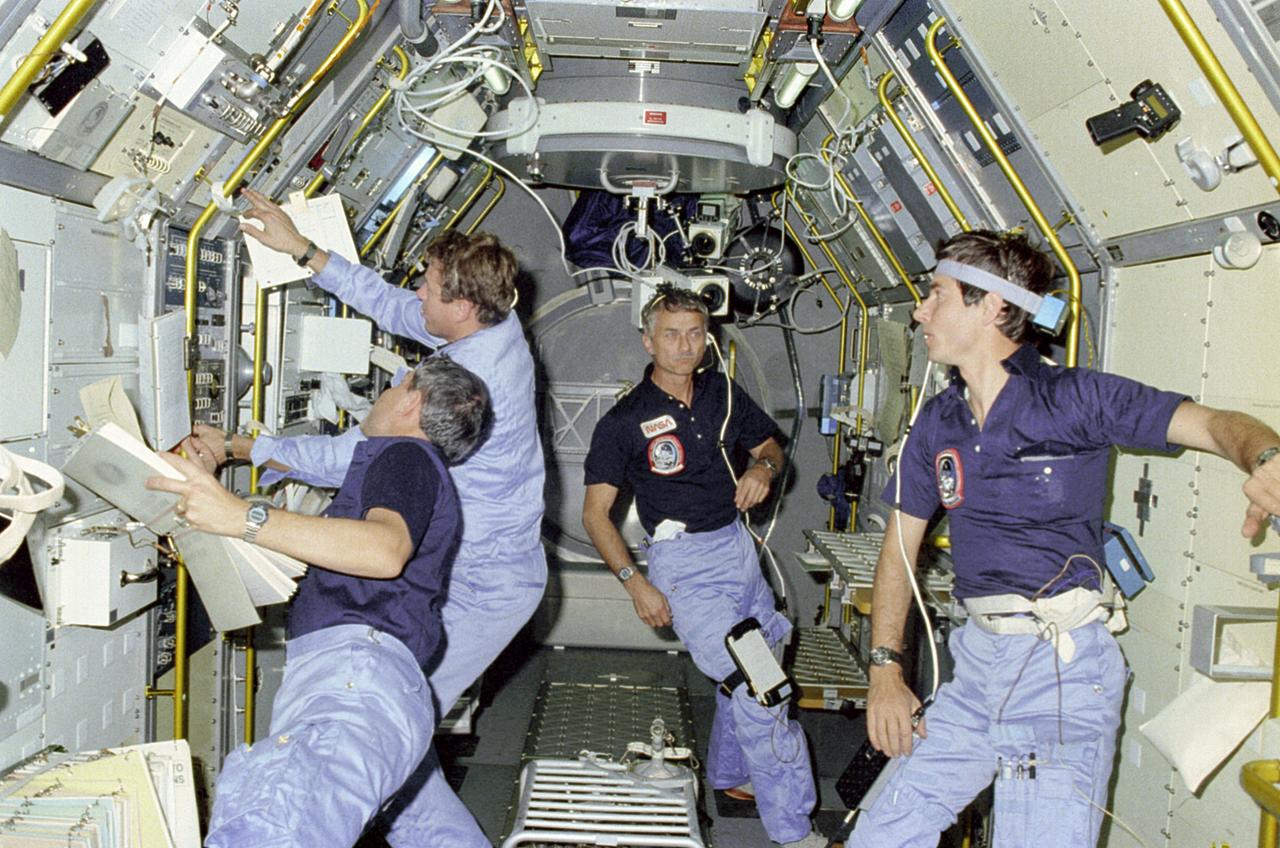
This photograph shows activities inside the science module during the Spacelab-1 (STS-9) mission. Left to right are Mission Specialist Robert Parker, Payload Specialist Byron Lichtenberg, Mission Specialist Owen Garriott, and Payload Specialist Ulf Merbold. The overall goal of the Spacelab-1 mission, the first mission of the Spacelab facility, were: (1) To verify the Spacelab system capability, (2) to obtain valuable scientific, applications, and technology data from a U.S./European multidisciplinary payload, and (3) to demonstrate the broad capability of Spacelab for scientific research. More than 70 experiments in 5 disciplines from 14 nations were conducted during the mission. The mission marked the the entry of non-astronaut persornel, called Payload Specialists, into space as working members of the crew. They are fellow scientists representing the international group of investigators using the mission. Mission Specialists are NASA astronauts who have broad scientific training. They operate various Orbiter-Spacelab systems, perform any required activity outside the spacecraft, and support investigations as needed. The Space Shuttle Orbiter Columbia that carried Spacelab-1 was operated by two other NASA astronauts serving as commander and pilot. The STS-9 mission, managed by the Marshall Space Flight Center, was launched on November 28, 1983.
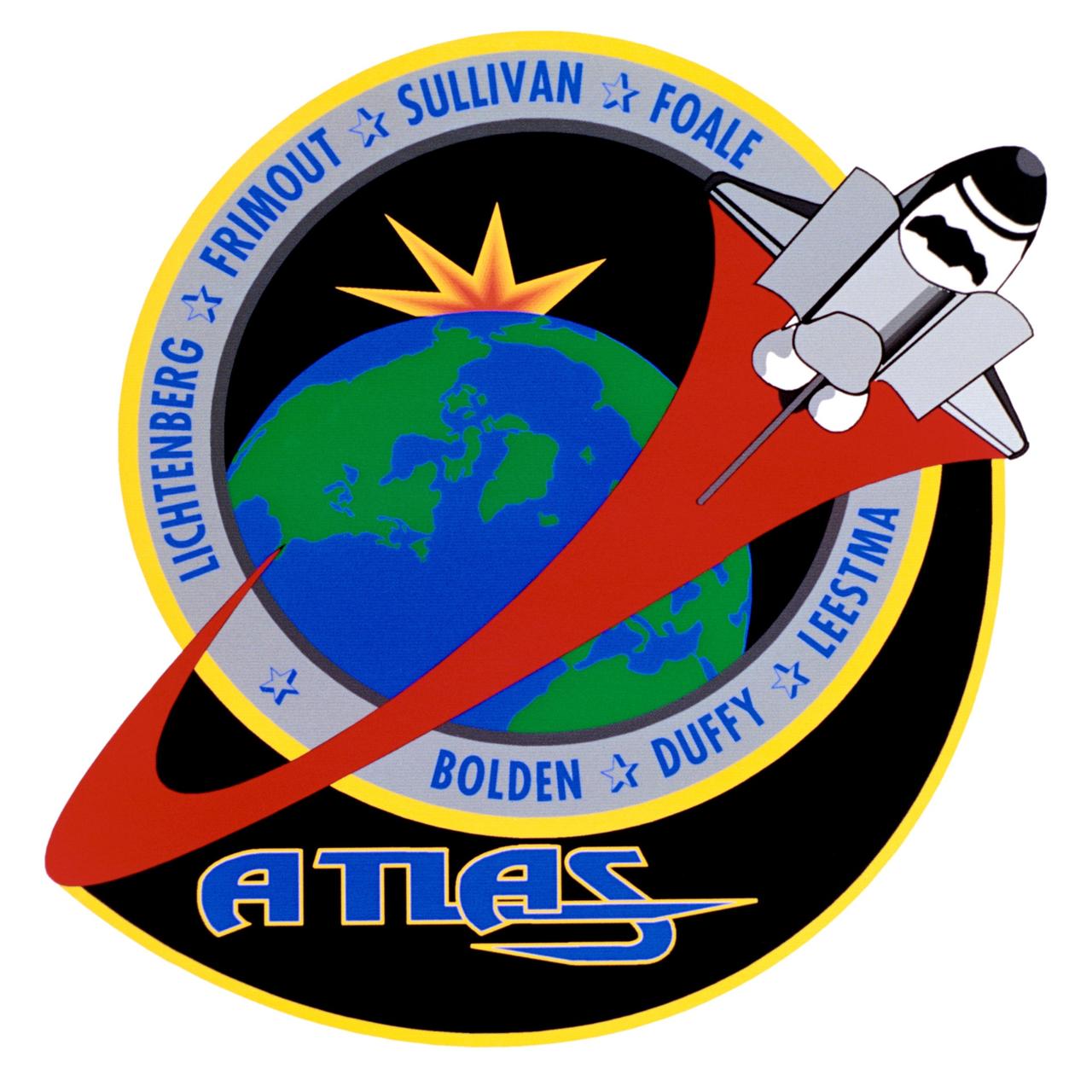
STS045-S-001 (October 1991) --- Designed by the crew members, the patch depicts the space shuttle launching from the Kennedy Space Center (KSC) into a high inclination orbit. From this vantage point, the Atmospheric Laboratory for Applications and Science (ATLAS) payload can view Earth, the sun, and their dynamic interactions against the background of space. Earth is prominently displayed and is the focus of the mission's space plasma physics and Earth sciences observations. The colors of the setting sun, measured by sensitive instruments, provide detailed information about ozone, carbon dioxide and other gases which determine Earth's climate and environment. Encircling the scene are the names of the flight crew members: Charles F. Bolden Jr., commander; Brian Duffy, pilot; C. Michael Foale, David C. Leestma, and Kathryn D. Sullivan, all mission specialists; Dirk Frimout and Byron K. Lichtenberg, payload specialists. The additional star in the ring is to recognize Charles R. Chappell and Michael Lampton, alternate payload specialists, and the entire ATLAS-1 team for its dedication and support of this "Mission to Planet Earth" (MTPE). The NASA insignia design for space shuttle flights is reserved for use by the astronauts and for other official use as the NASA Administrator may authorize. Public availability has been approved only in the form of illustrations by the various news media. When and if there is any change in this policy, which is not anticipated, it will be publicly announced. Photo credit: NASA