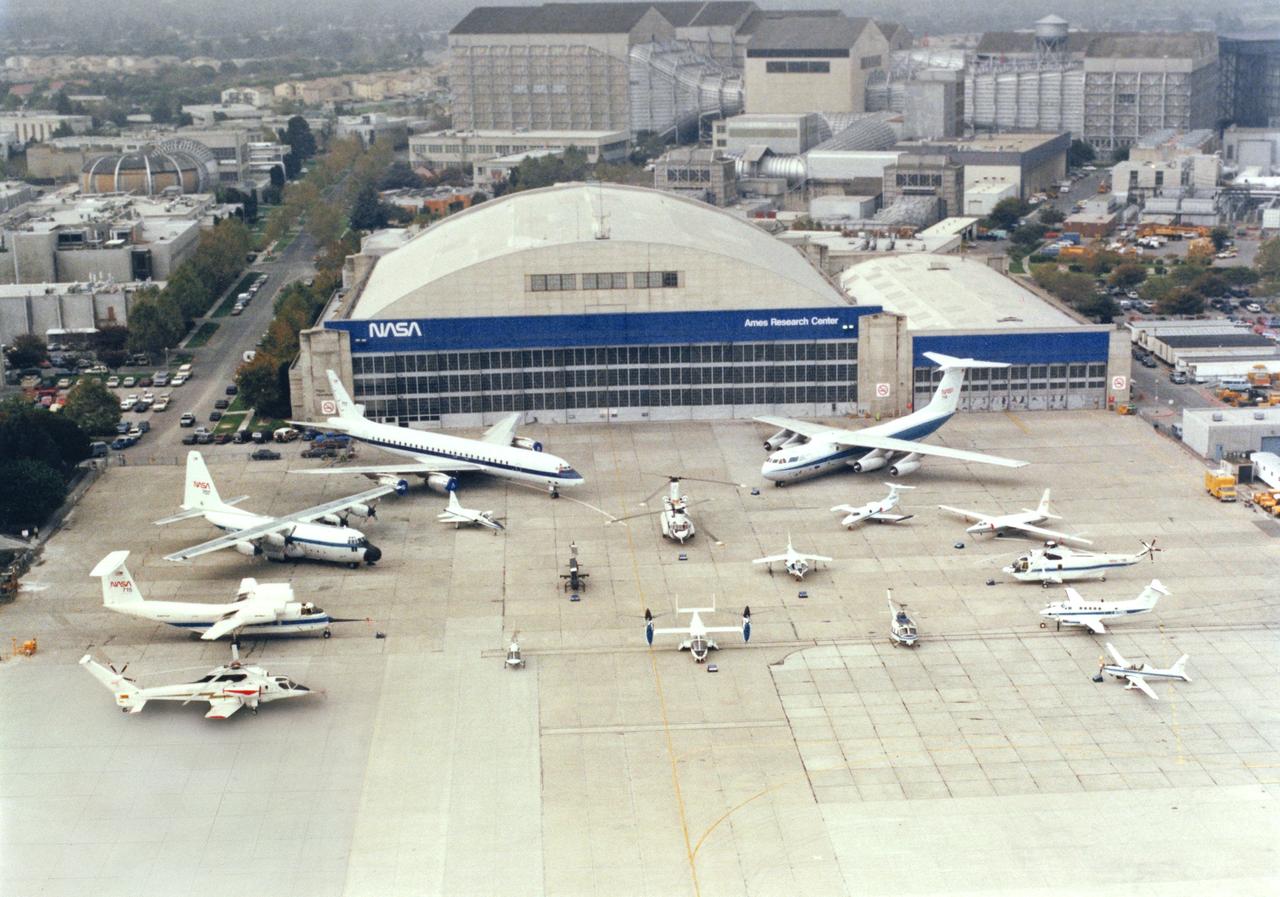
Ames Aircraft complement on ramp DC-8, C-130, QSRA, RSRA, C-141, U-2, SH-3G, King Air, YO-3A, T-38, CH-47, Lear Jet, AH-1G, AV-8B Harrier, OH-58A, XV-15, UH-1H
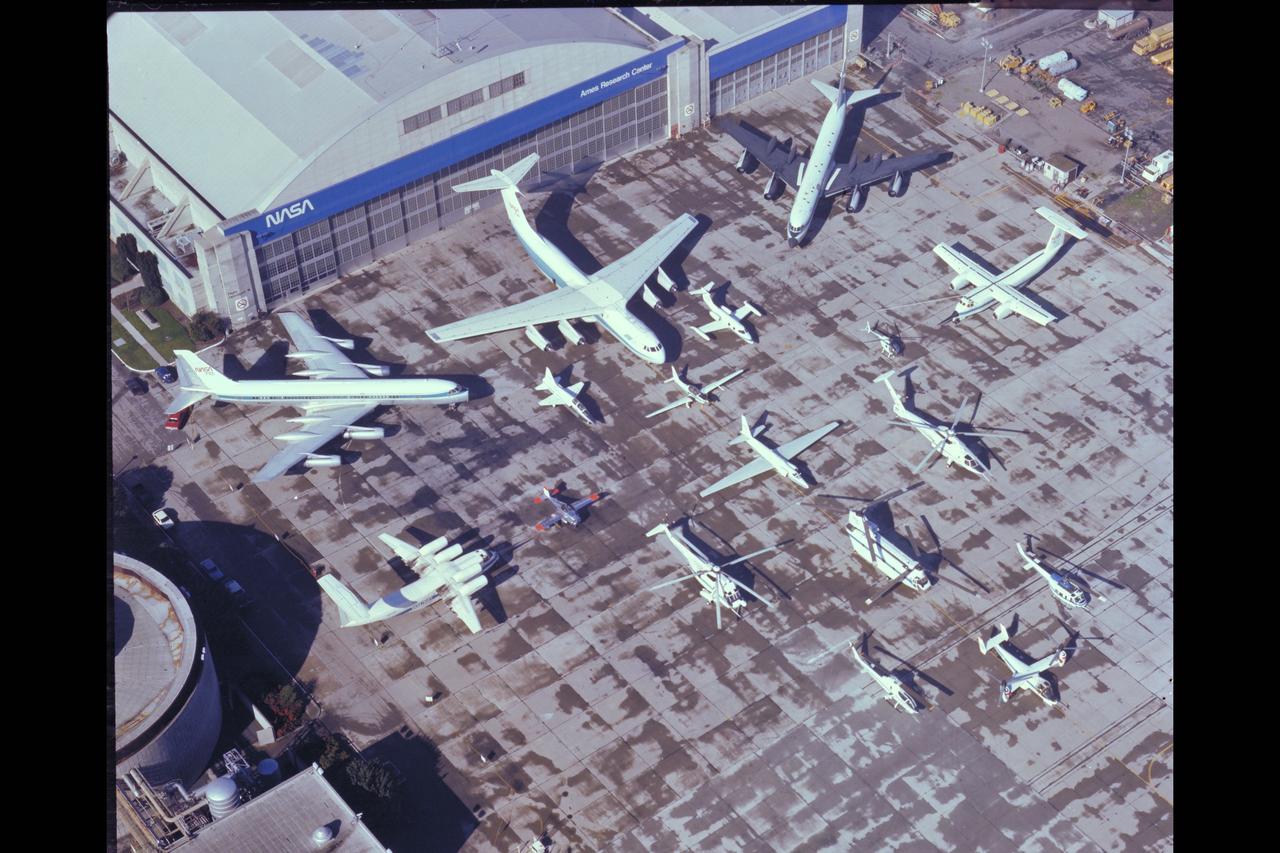
NASA Aircraft on ramp (Aerial view) Sides: (L) QSRA (R) C-8A AWJSRA - Back to Front: CV-990 (711) C-141 KAO, CV-990 (712) Galileo, T-38, YO-3A, Lear Jet, X-14, U-2, OH-6, CH-47, SH-3G, RSRA, AH-1G, XV-15, UH-1H
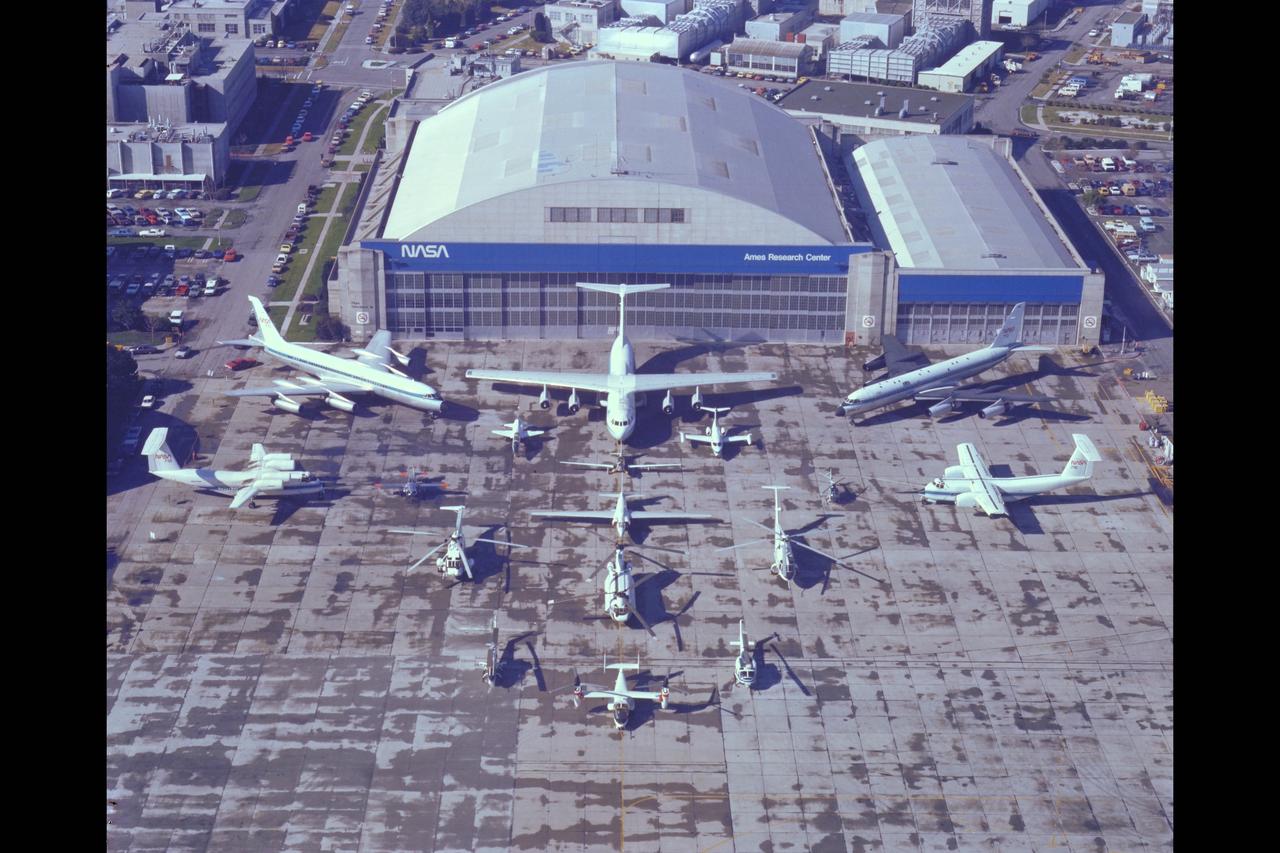
NASA Aircraft on ramp (Aerial view) Sides: (L) QSRA (R) C-8A AWJSRA - Back to Front: CV-990 (711) C-141 KAO, CV-990 (712) Galileo, T-38, YO-3A, Lear Jet, X-14, U-2, OH-6, CH-47, SH-3G, RSRA, AH-1G, XV-15, UH-1H
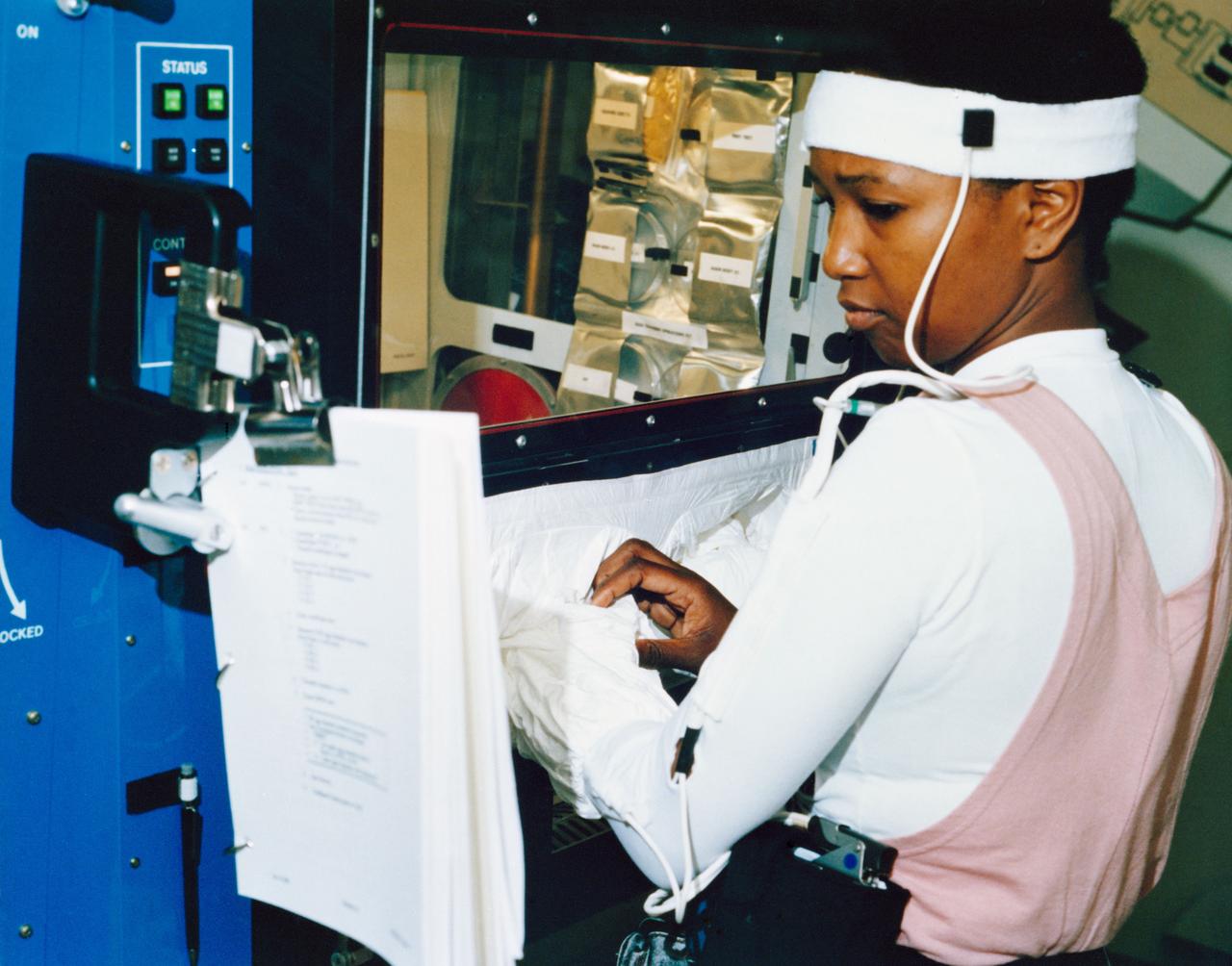
S92-45761 --- Astronaut Mae C. Jemison, mission specialist for the STS-47 mission, participates in a training exercise at the Johnson Space Center. Photo credit: NASA
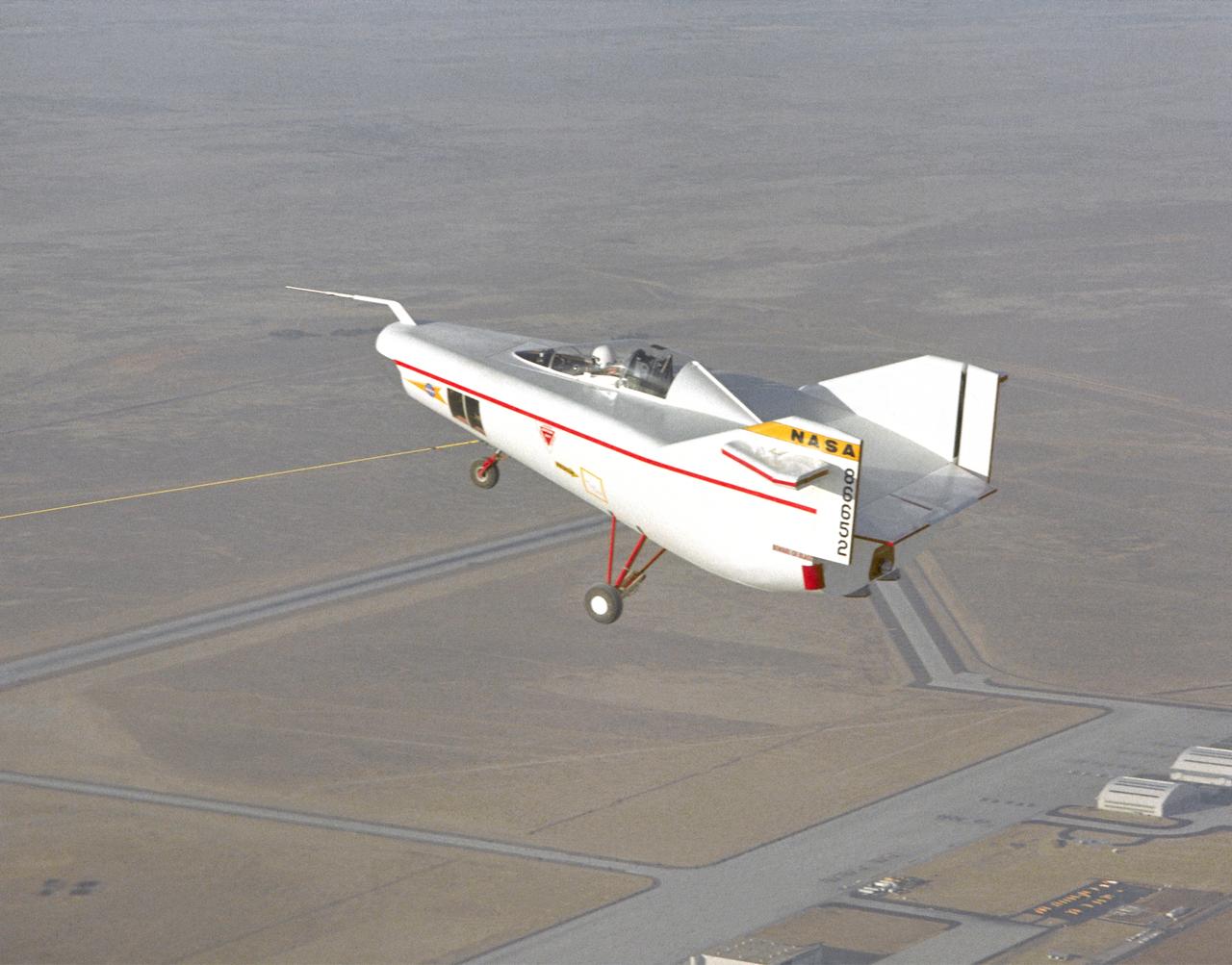
The M2-F1 Lifting Body is seen here under tow by an unseen C-47 at the NASA Flight Research Center (later redesignated the Dryden Flight Research Center), Edwards, California. The low-cost vehicle was the first piloted lifting body to be test flown. The lifting-body concept originated in the mid-1950s at the National Advisory Committee for Aeronautics' Ames Aeronautical Laboratory, Mountain View California. By February 1962, a series of possible shapes had been developed, and R. Dale Reed was working to gain support for a research vehicle.
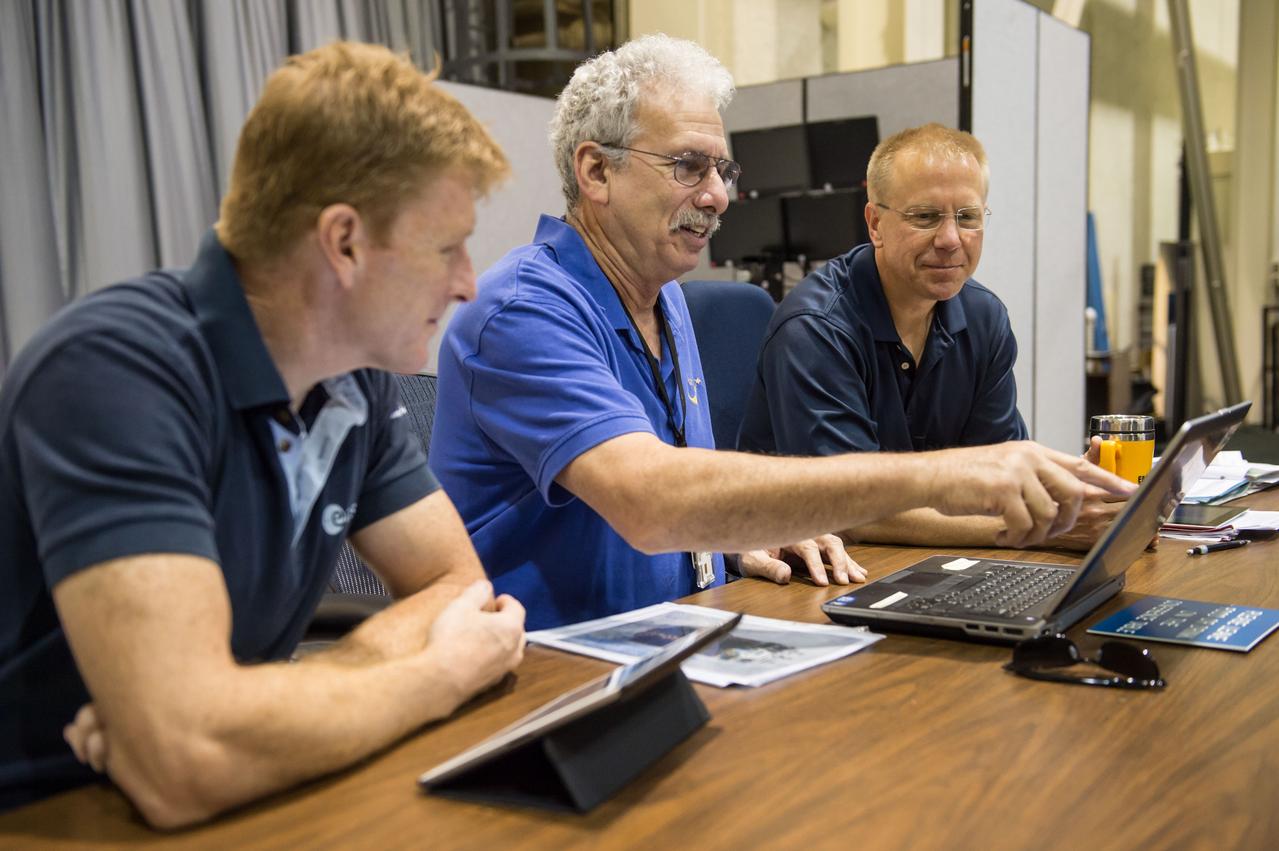
DATE: 5-16-14. LOCATION: Bldg. 16N, Room 1040. SUBJECT: Expedition 47 (Soyuz 45) crew members Tim Kopra and Timothy Peake during FF T&C/R ADV2 training in the SES Alpha Cupola. PHOTOGRAPHER: Lauren Harnett
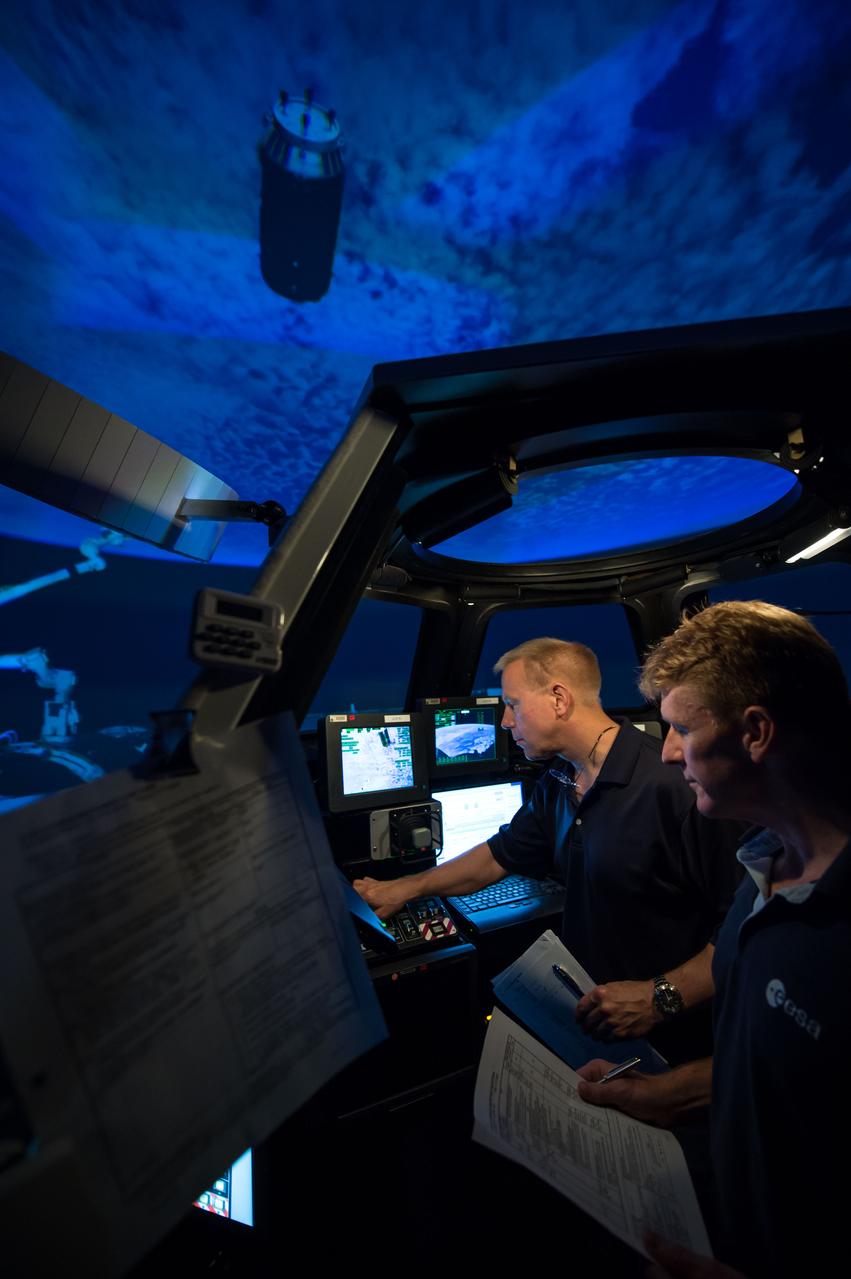
DATE: 5-16-14. LOCATION: Bldg. 16N, Room 1040. SUBJECT: Expedition 47 (Soyuz 45) crew members Tim Kopra and Timothy Peake during FF T&C/R ADV2 training in the SES Alpha Cupola. PHOTOGRAPHER: Lauren Harnett
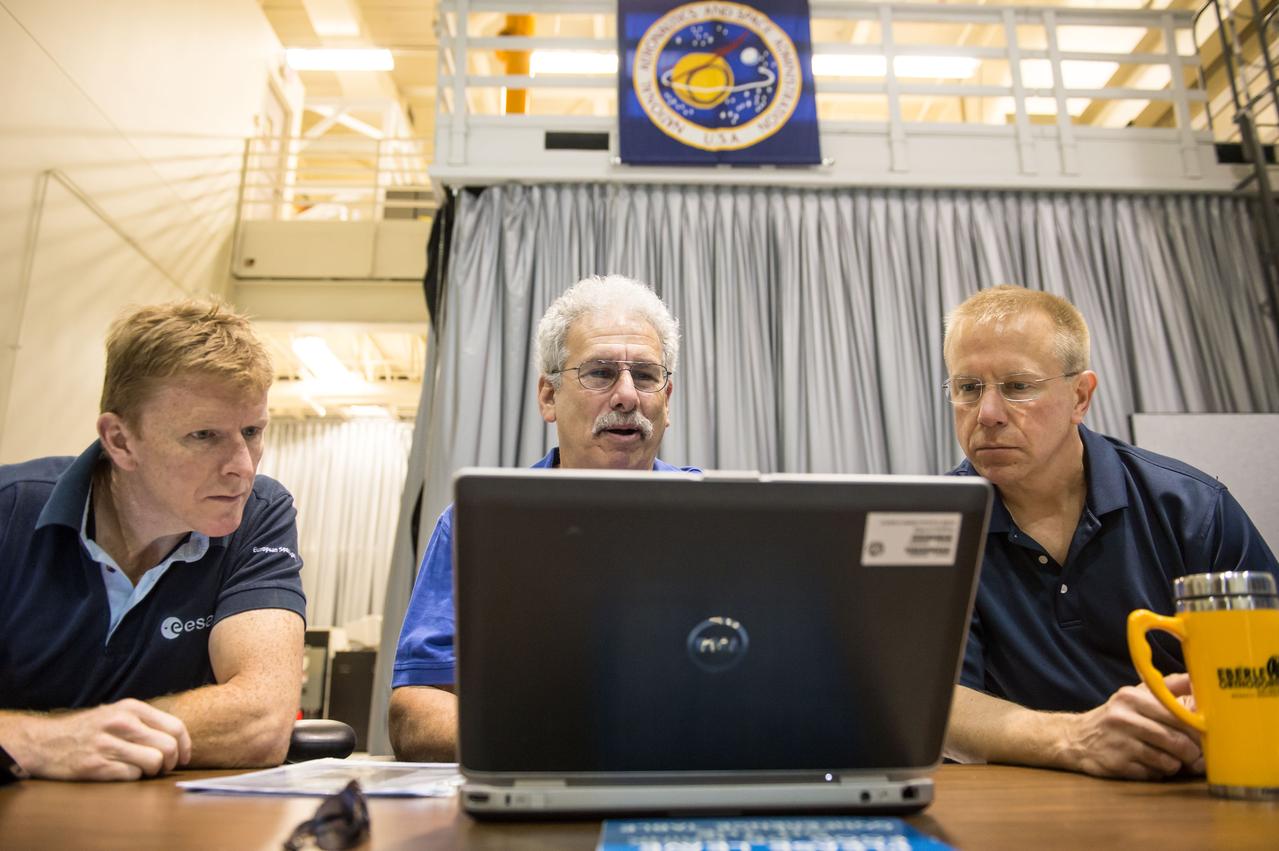
DATE: 5-16-14. LOCATION: Bldg. 16N, Room 1040. SUBJECT: Expedition 47 (Soyuz 45) crew members Tim Kopra and Timothy Peake during FF T&C/R ADV2 training in the SES Alpha Cupola. PHOTOGRAPHER: Lauren Harnett
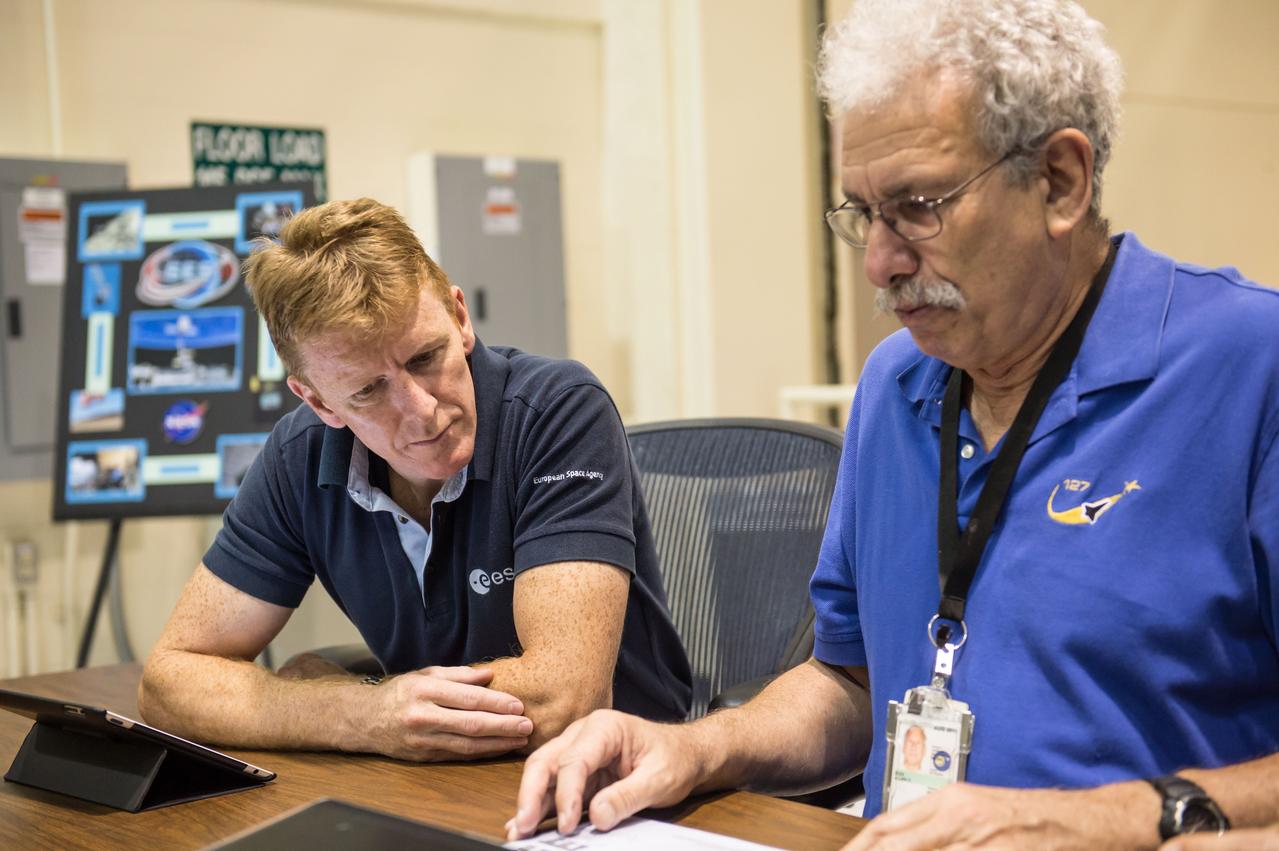
DATE: 5-16-14. LOCATION: Bldg. 16N, Room 1040. SUBJECT: Expedition 47 (Soyuz 45) crew members Tim Kopra and Timothy Peake during FF T&C/R ADV2 training in the SES Alpha Cupola. PHOTOGRAPHER: Lauren Harnett
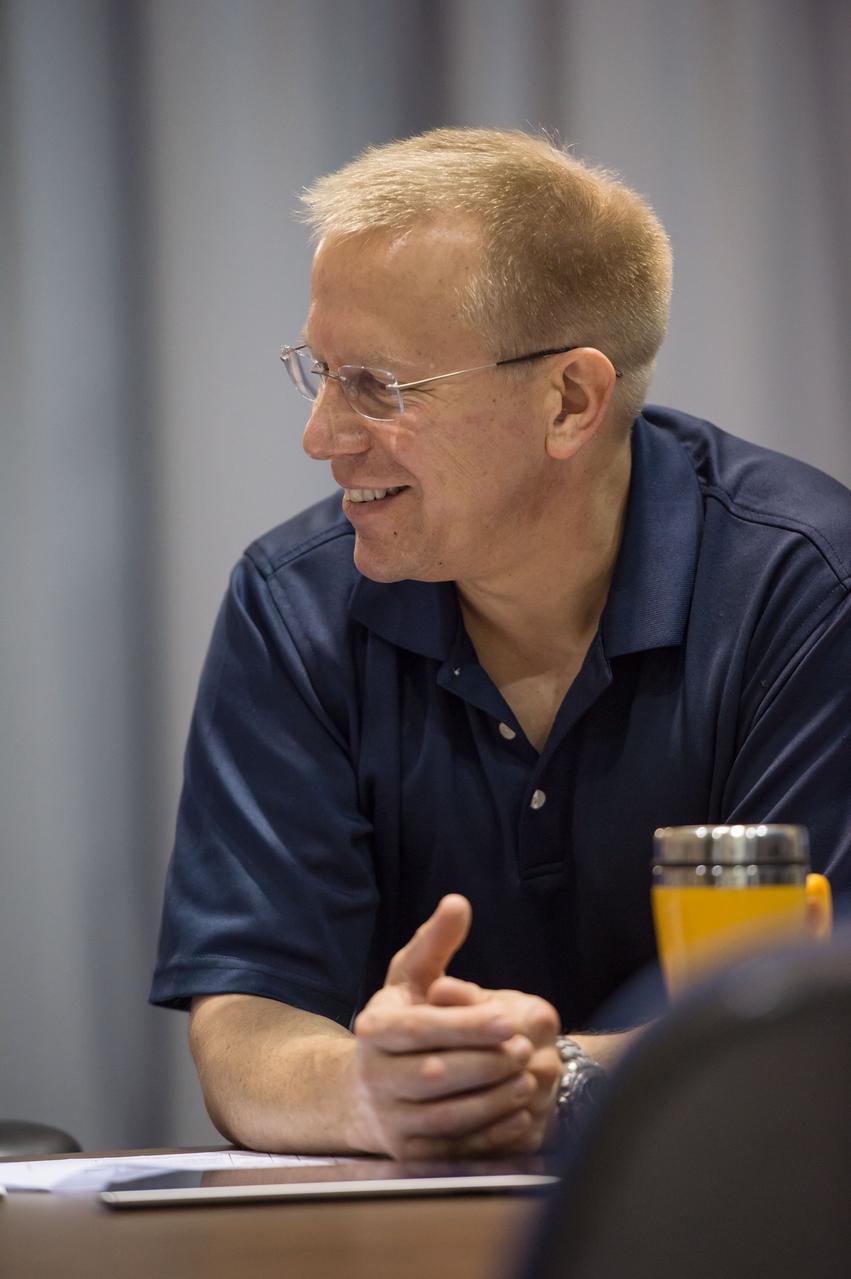
DATE: 5-16-14. LOCATION: Bldg. 16N, Room 1040. SUBJECT: Expedition 47 (Soyuz 45) crew members Tim Kopra and Timothy Peake during FF T&C/R ADV2 training in the SES Alpha Cupola. PHOTOGRAPHER: Lauren Harnett
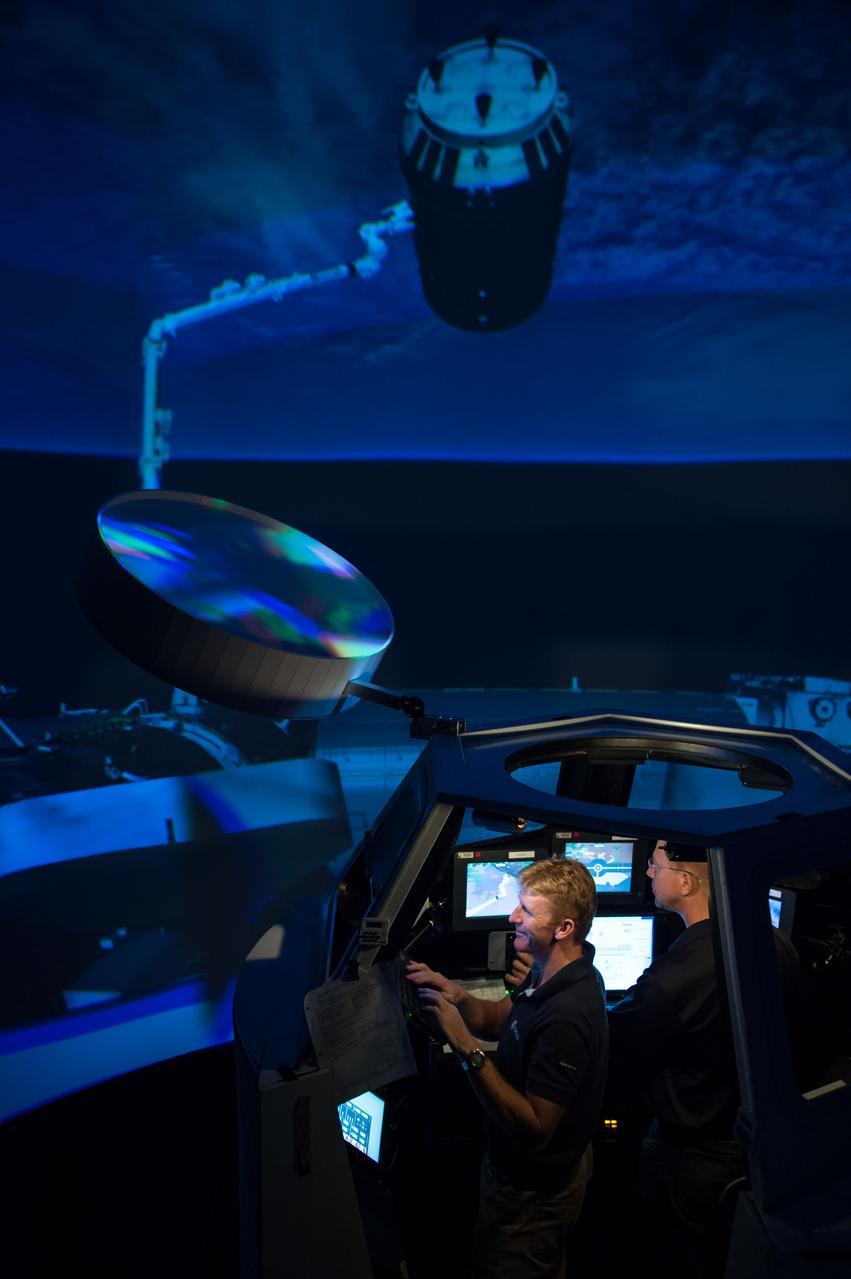
DATE: 5-16-14. LOCATION: Bldg. 16N, Room 1040. SUBJECT: Expedition 47 (Soyuz 45) crew members Tim Kopra and Timothy Peake during FF T&C/R ADV2 training in the SES Alpha Cupola. PHOTOGRAPHER: Lauren Harnett
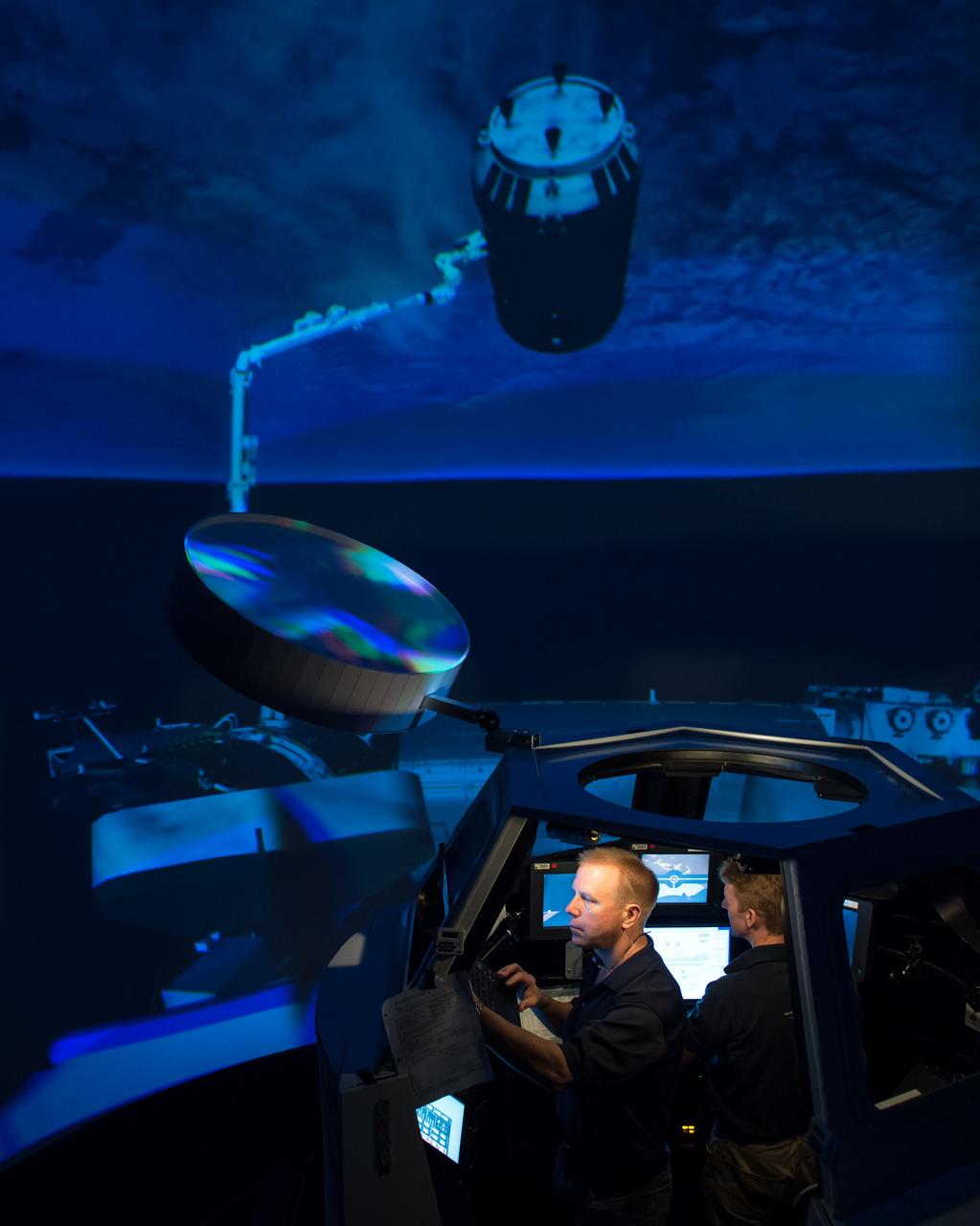
DATE: 5-16-14. LOCATION: Bldg. 16N, Room 1040. SUBJECT: Expedition 47 (Soyuz 45) crew members Tim Kopra and Timothy Peake during FF T&C/R ADV2 training in the SES Alpha Cupola. PHOTOGRAPHER: Lauren Harnett
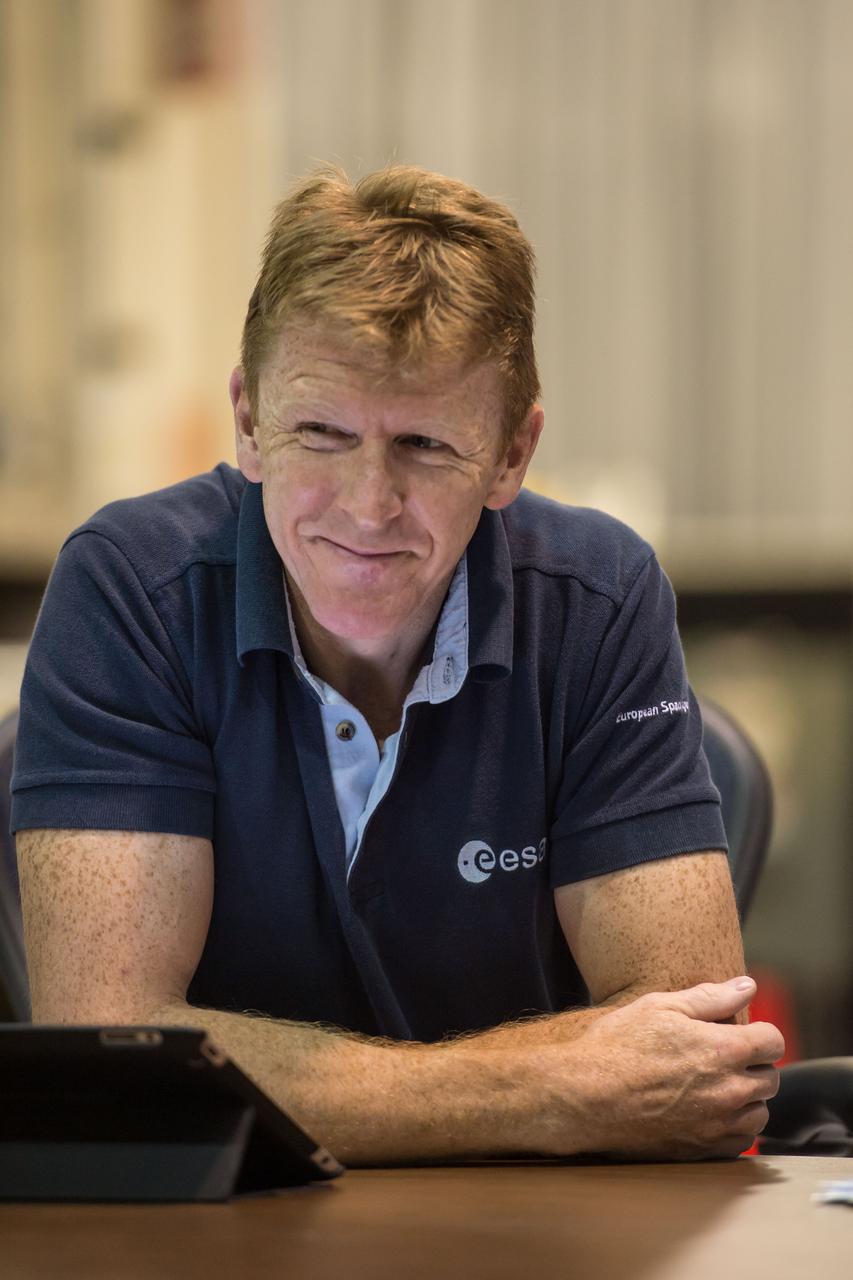
DATE: 5-16-14. LOCATION: Bldg. 16N, Room 1040. SUBJECT: Expedition 47 (Soyuz 45) crew members Tim Kopra and Timothy Peake during FF T&C/R ADV2 training in the SES Alpha Cupola. PHOTOGRAPHER: Lauren Harnett
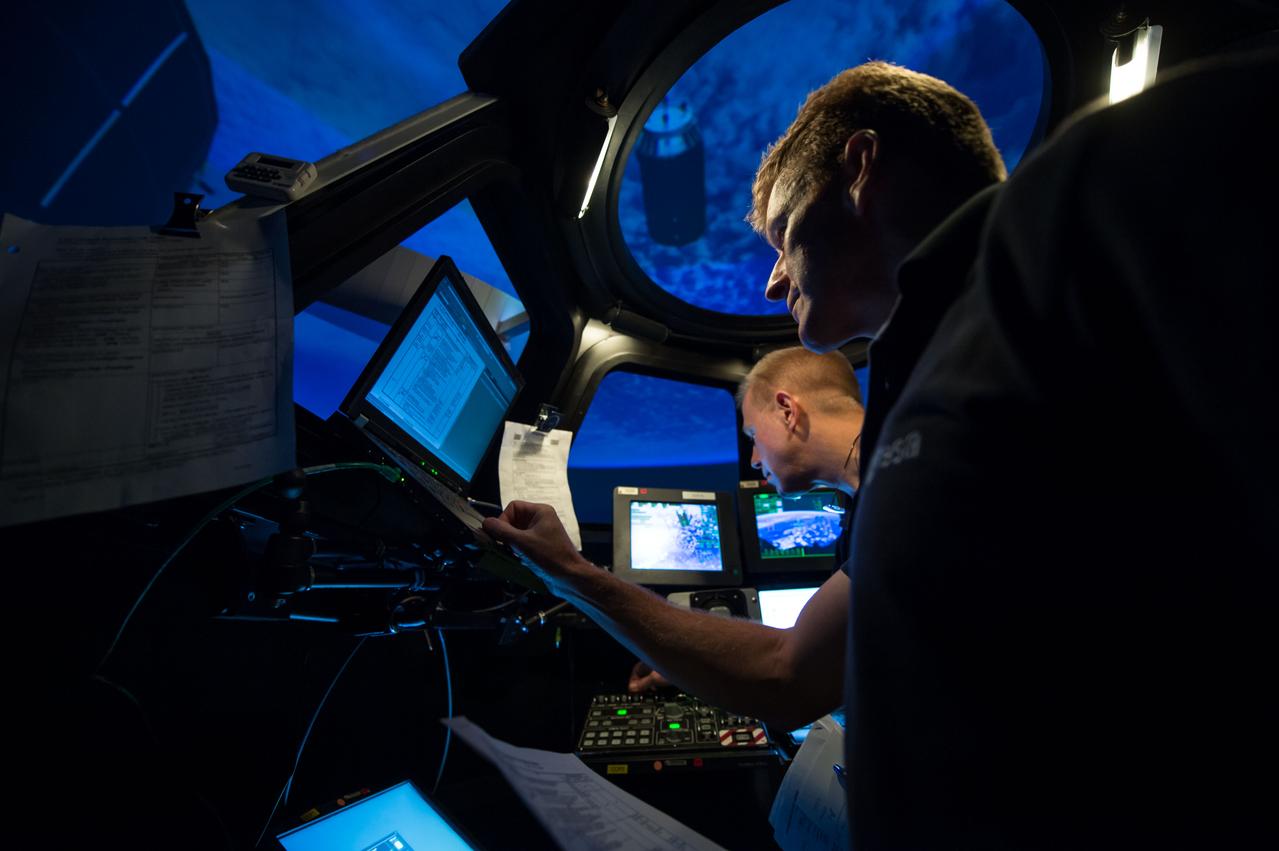
DATE: 5-16-14. LOCATION: Bldg. 16N, Room 1040. SUBJECT: Expedition 47 (Soyuz 45) crew members Tim Kopra and Timothy Peake during FF T&C/R ADV2 training in the SES Alpha Cupola. PHOTOGRAPHER: Lauren Harnett
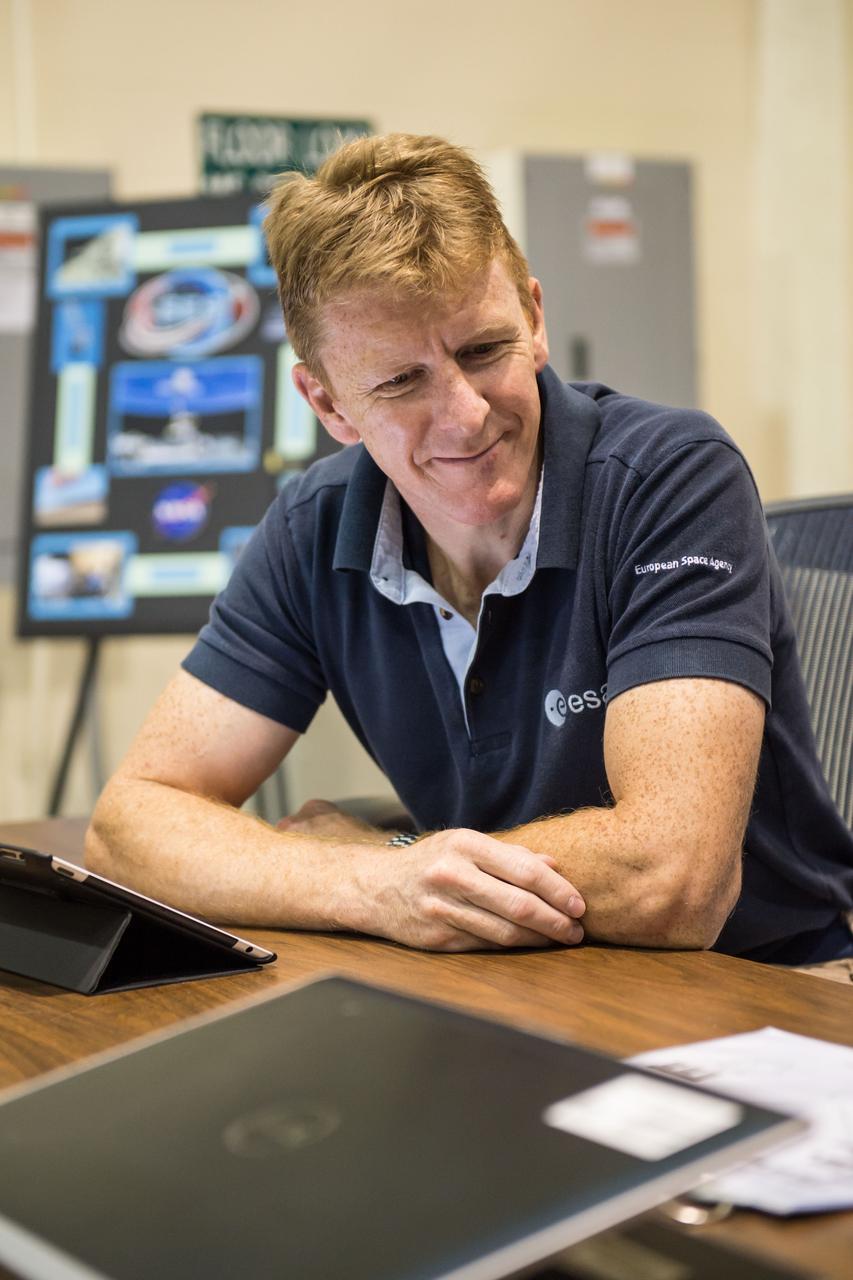
DATE: 5-16-14. LOCATION: Bldg. 16N, Room 1040. SUBJECT: Expedition 47 (Soyuz 45) crew members Tim Kopra and Timothy Peake during FF T&C/R ADV2 training in the SES Alpha Cupola. PHOTOGRAPHER: Lauren Harnett
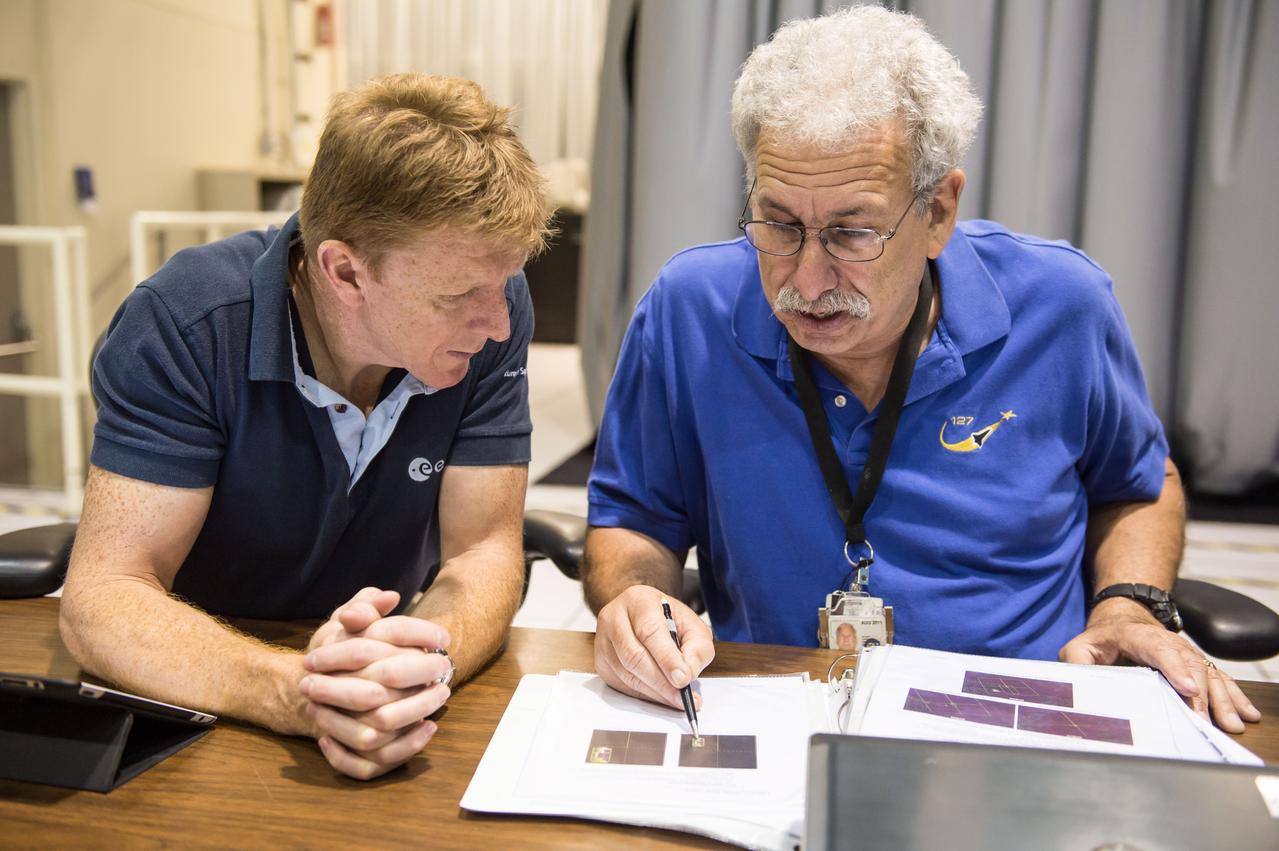
DATE: 5-16-14. LOCATION: Bldg. 16N, Room 1040. SUBJECT: Expedition 47 (Soyuz 45) crew members Tim Kopra and Timothy Peake during FF T&C/R ADV2 training in the SES Alpha Cupola. PHOTOGRAPHER: Lauren Harnett
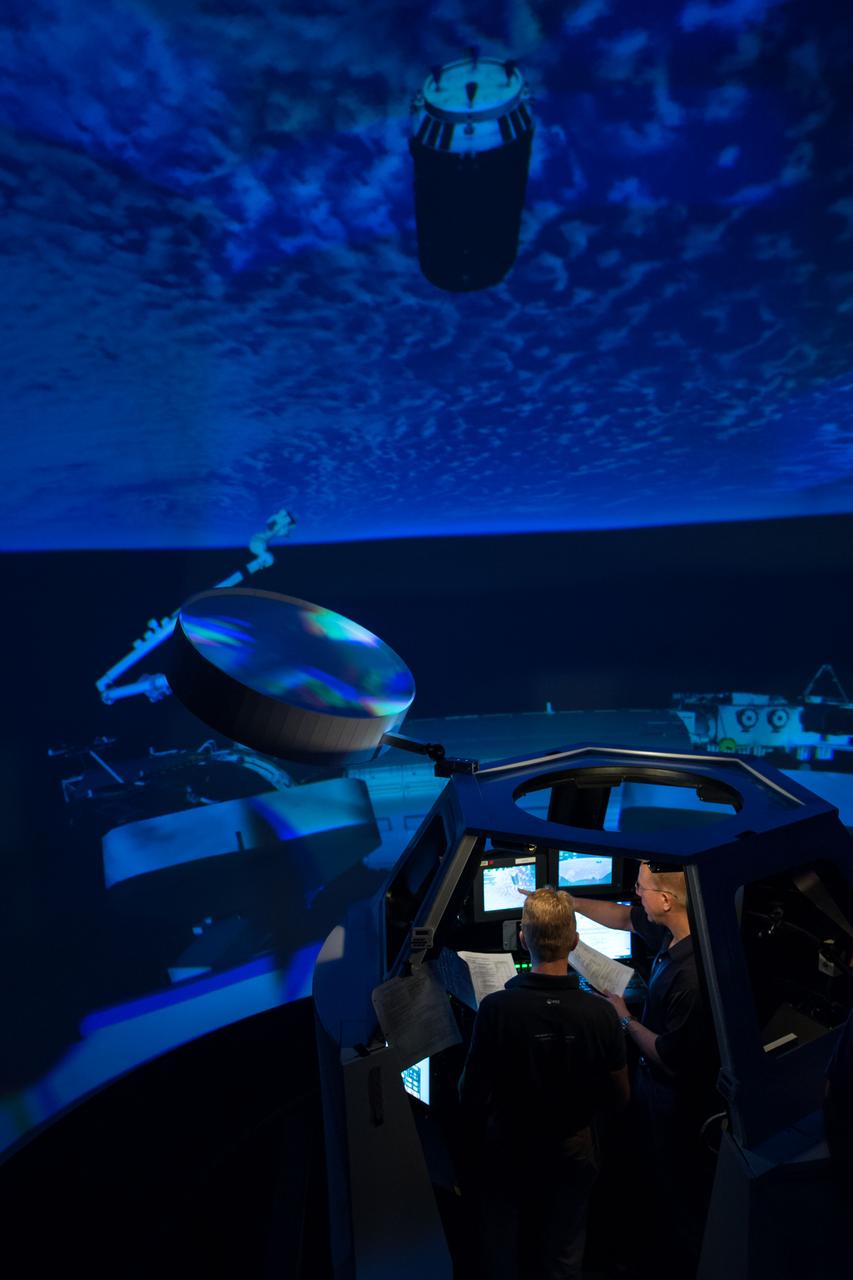
DATE: 5-16-14. LOCATION: Bldg. 16N, Room 1040. SUBJECT: Expedition 47 (Soyuz 45) crew members Tim Kopra and Timothy Peake during FF T&C/R ADV2 training in the SES Alpha Cupola. PHOTOGRAPHER: Lauren Harnett

DATE: 5-16-14. LOCATION: Bldg. 16N, Room 1040. SUBJECT: Expedition 47 (Soyuz 45) crew members Tim Kopra and Timothy Peake during FF T&C/R ADV2 training in the SES Alpha Cupola. PHOTOGRAPHER: Lauren Harnett
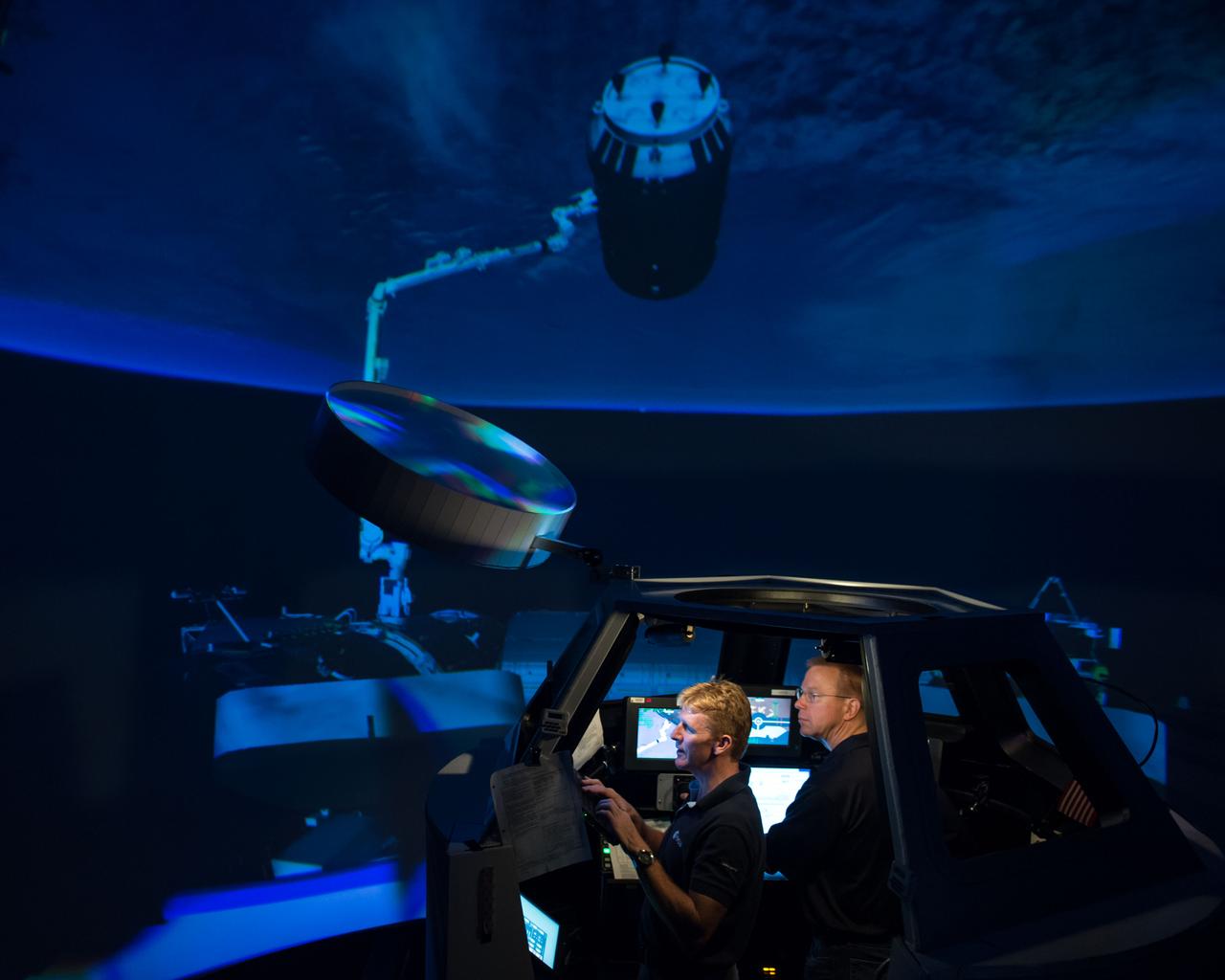
DATE: 5-16-14. LOCATION: Bldg. 16N, Room 1040. SUBJECT: Expedition 47 (Soyuz 45) crew members Tim Kopra and Timothy Peake during FF T&C/R ADV2 training in the SES Alpha Cupola. PHOTOGRAPHER: Lauren Harnett
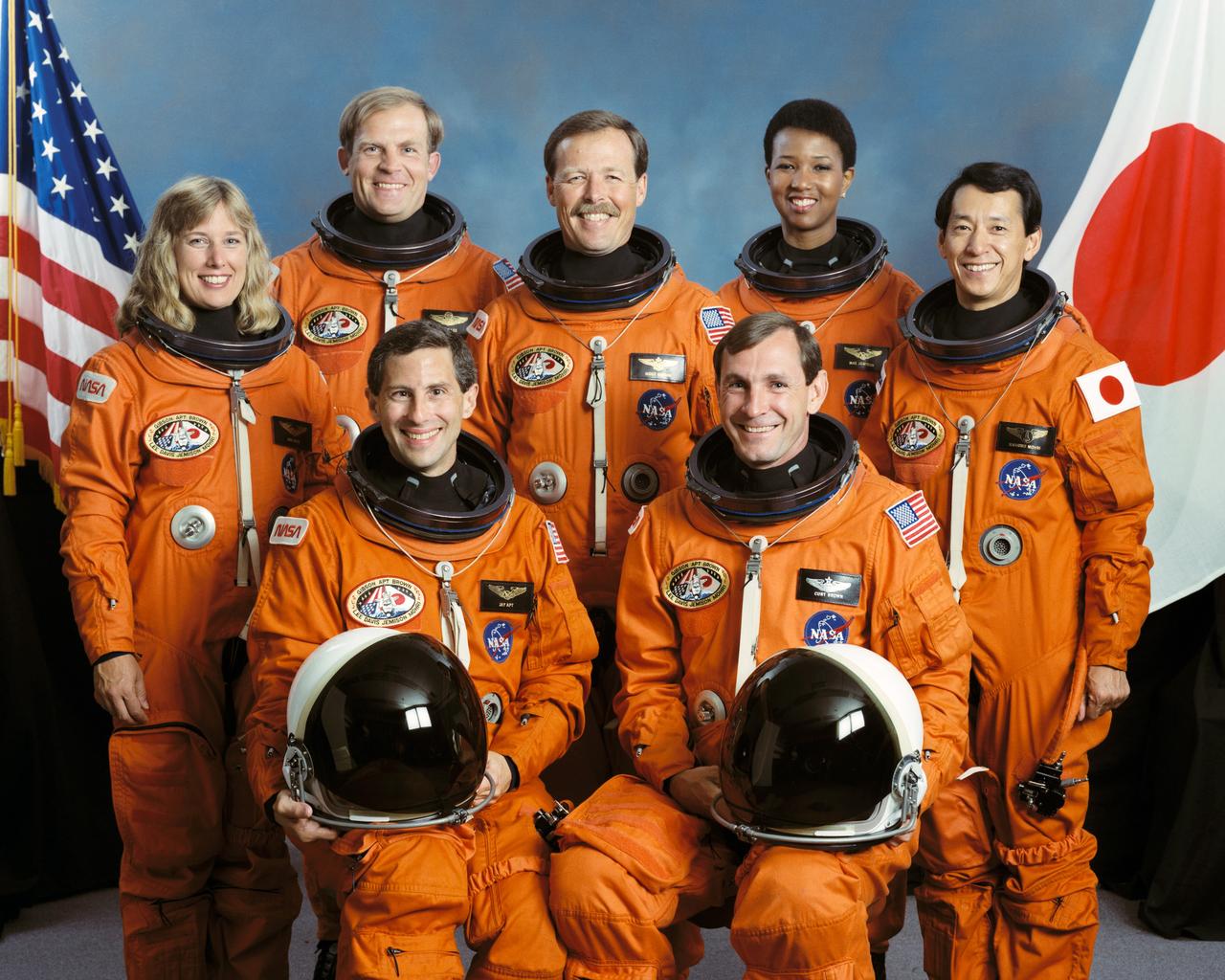
STS047-S-002 (June 1992) --- These seven crew members are currently in training for the STS-47/Spacelab J mission scheduled for later this year. Pictured are (left to right, front) Jerome (Jay) Apt, mission specialist; Curtis L. Brown, pilot; and (left to right, rear) N. Jan Davis, mission specialist; Mark C. Lee, payload commander; Robert L. Gibson, mission commander; Mae C. Jemison, mission specialist; and Mamoru Mohri, payload specialist, representing the National Space Development Agency of Japan (NASDA). This is the Space Shuttle Endeavour's second scheduled mission.
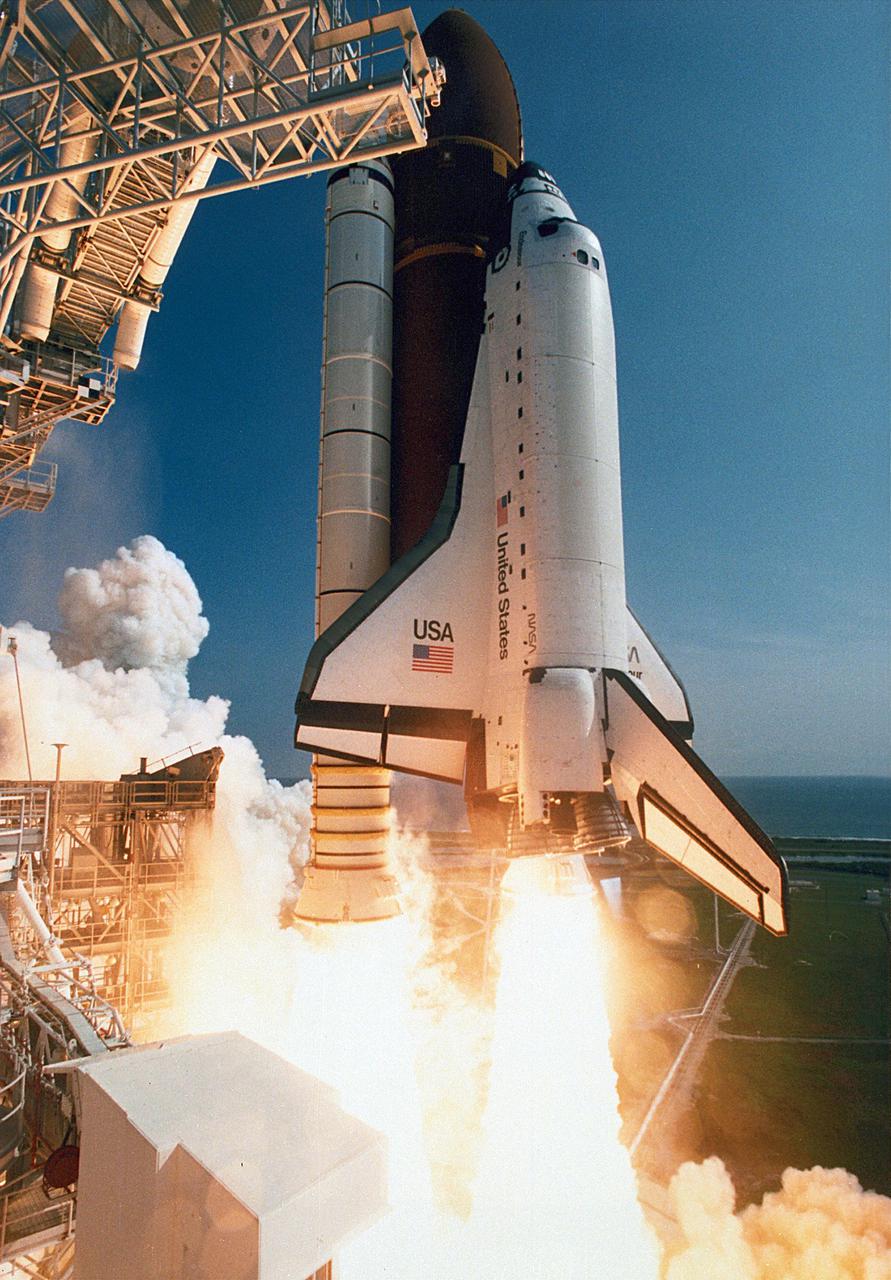
KENNEDY SPACE CENTER, FLA. -- The Space Shuttle Endeavour thunders past the uppermost reaches of the Fixed Service Structure at Launch Pad 39B after an on-schedule liftoff at 10:23:00 a.m. EDT, Sept. 12. Primary payload for the planned seven-day mission STS-47 is the Spacelab-J science laboratory. Mission Commander is Robert L. 'Hoot' Gibson; the Pilot, Curtis L. Brown Jr.; Payload Commander, Mark C. Lee; Mission Specialists, N. Jan Davis and Jay Apt; Science Mission Specialist, Dr. Mae C. Jamison; and Payload Specialist Mamoru Mohri.
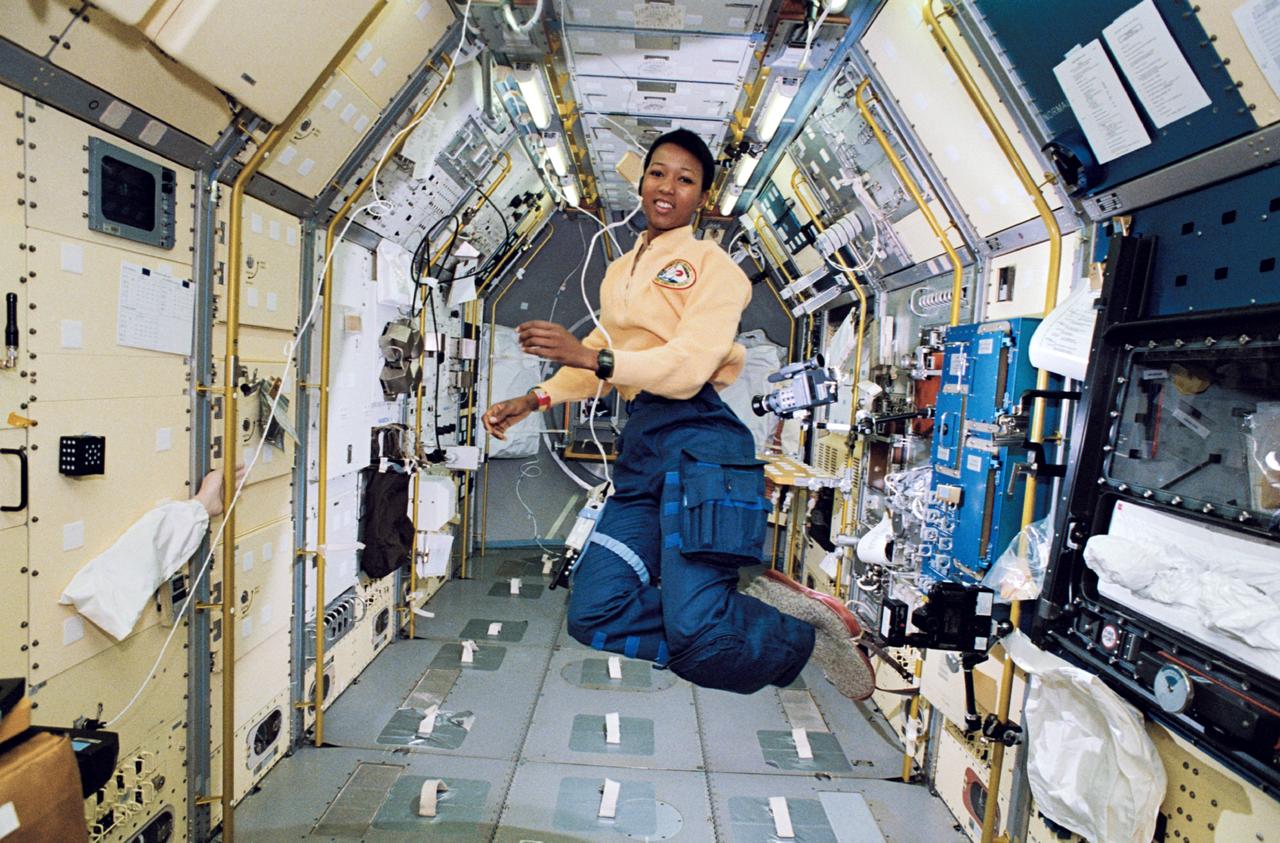
STS047-37-003 (12-20 Sept. 1992) --- Astronaut Mae C. Jemison, STS-47 mission specialist, appears to be clicking her heels in zero-gravity in this 35mm frame photographed in the Science Module aboard the Earth-orbiting Space Shuttle Endeavour. Making her first flight in space, Dr. Jemison was joined by five other NASA astronauts and a Japanese payload specialist for eight days of research in support of the Spacelab-J mission, a joint effort between Japan and the United States.
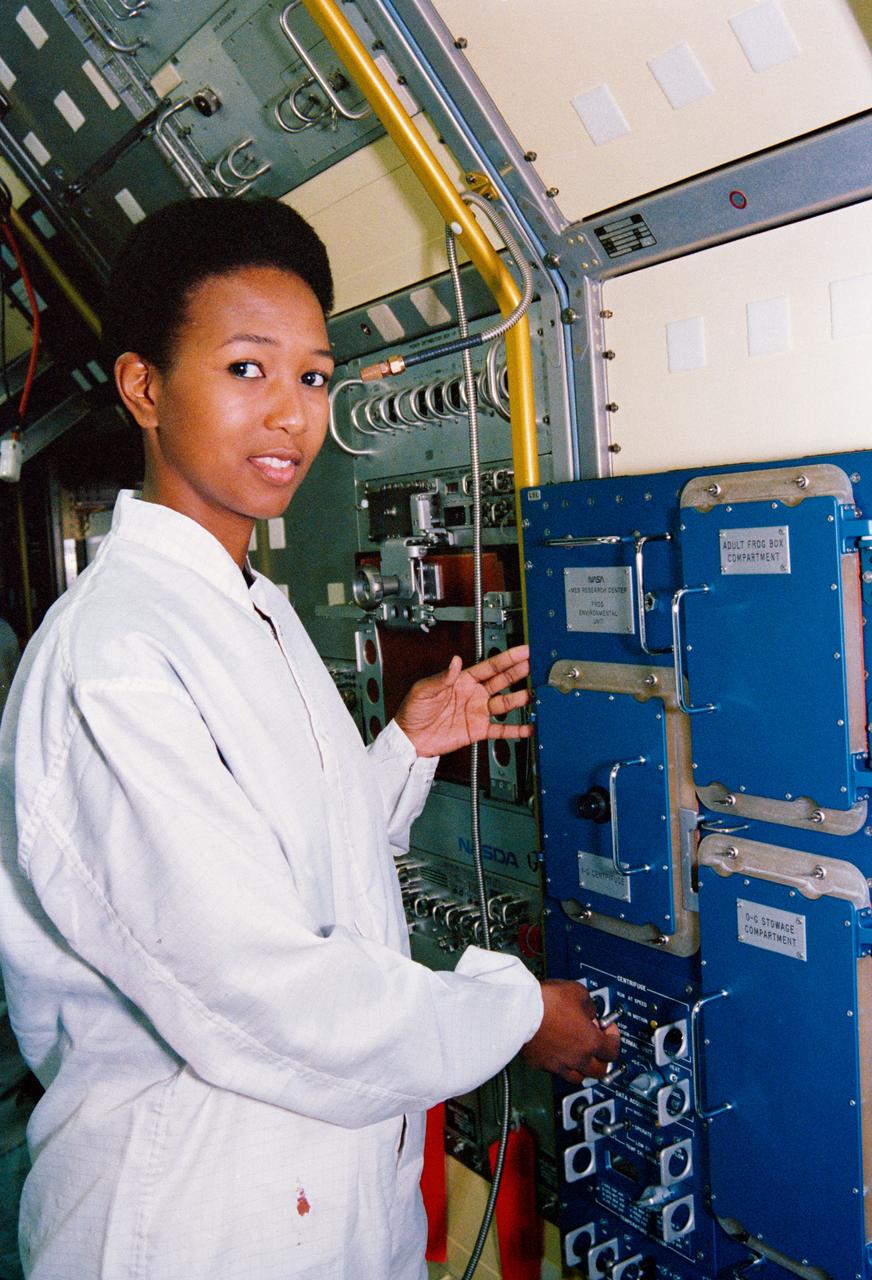
S92-44302 (25 July 1992) --- Astronaut Mae C. Jemison, mission specialist, examines the interior of the Spacelab-J laboratory module installed in Endeavour's cargo bay. The STS-47 crewmembers visited Endeavour, currently undergoing pre-flight processing in a high bay area of the Orbiter Processing Facility at the Kennedy Space Center. The Spacelab-J mission is currently scheduled for September of this year.
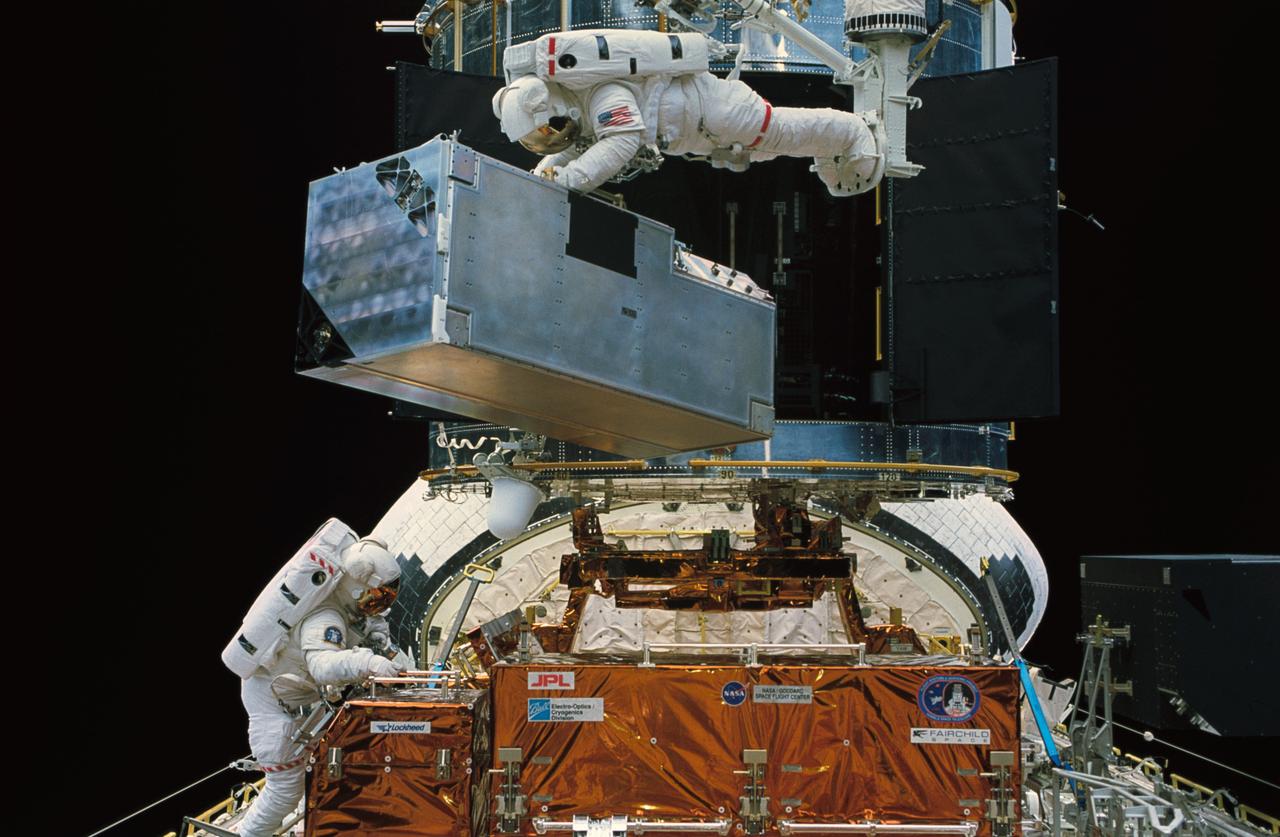
STS061-47-014 (8 Dec 1993) --- Astronaut Kathryn C. Thornton lifts the Corrective Optics Space Telescope Axial Replacement (COSTAR) prior to its installation on the Hubble Space Telescope (HST). Thornton is anchored to a foot restraint on the end of the Remote Manipulator System (RMS) arm. Astronaut Thomas D. Akers, who assisted in the COSTAR installation, is at lower left.
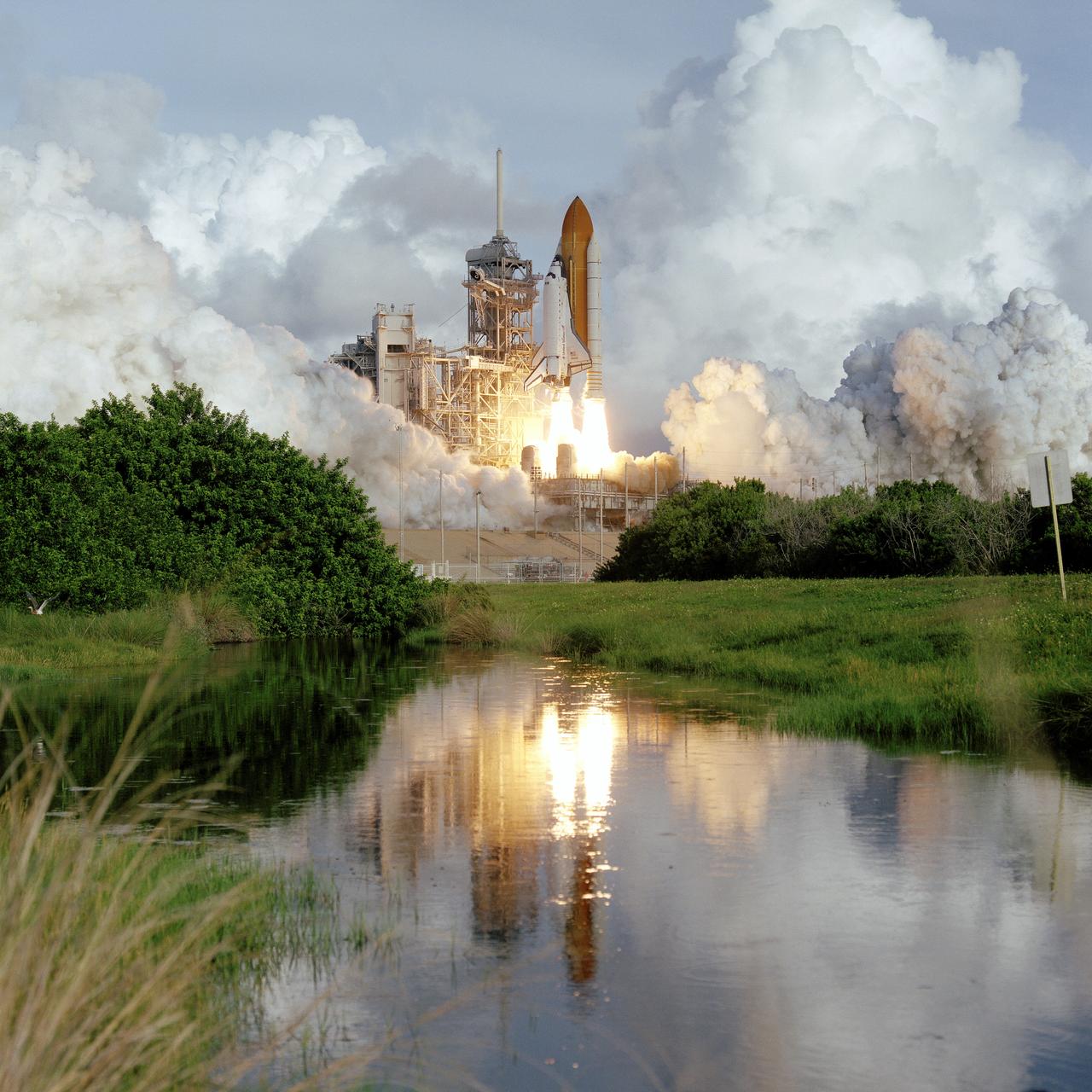
STS106-S-010 (8 Sept. 2000) --- The Space Shuttle Atlantis is mirrored in nearby marsh waters as it makes its 22nd launch into space. The perfect on-time liftoff for STS-106 occurred at 8:45:47 a.m. (EDT), Sept. 8, 2000. Onboard the shuttle were astronauts Terrence W. Wilcutt, Scott D. Altman, Edward T. Lu, Richard A. Mastracchio and Daniel C. Burbank, along with cosmonauts Yuri I. Malenchenko and Boris V. Morukov who represent the Russian Aviation and Space Agency.
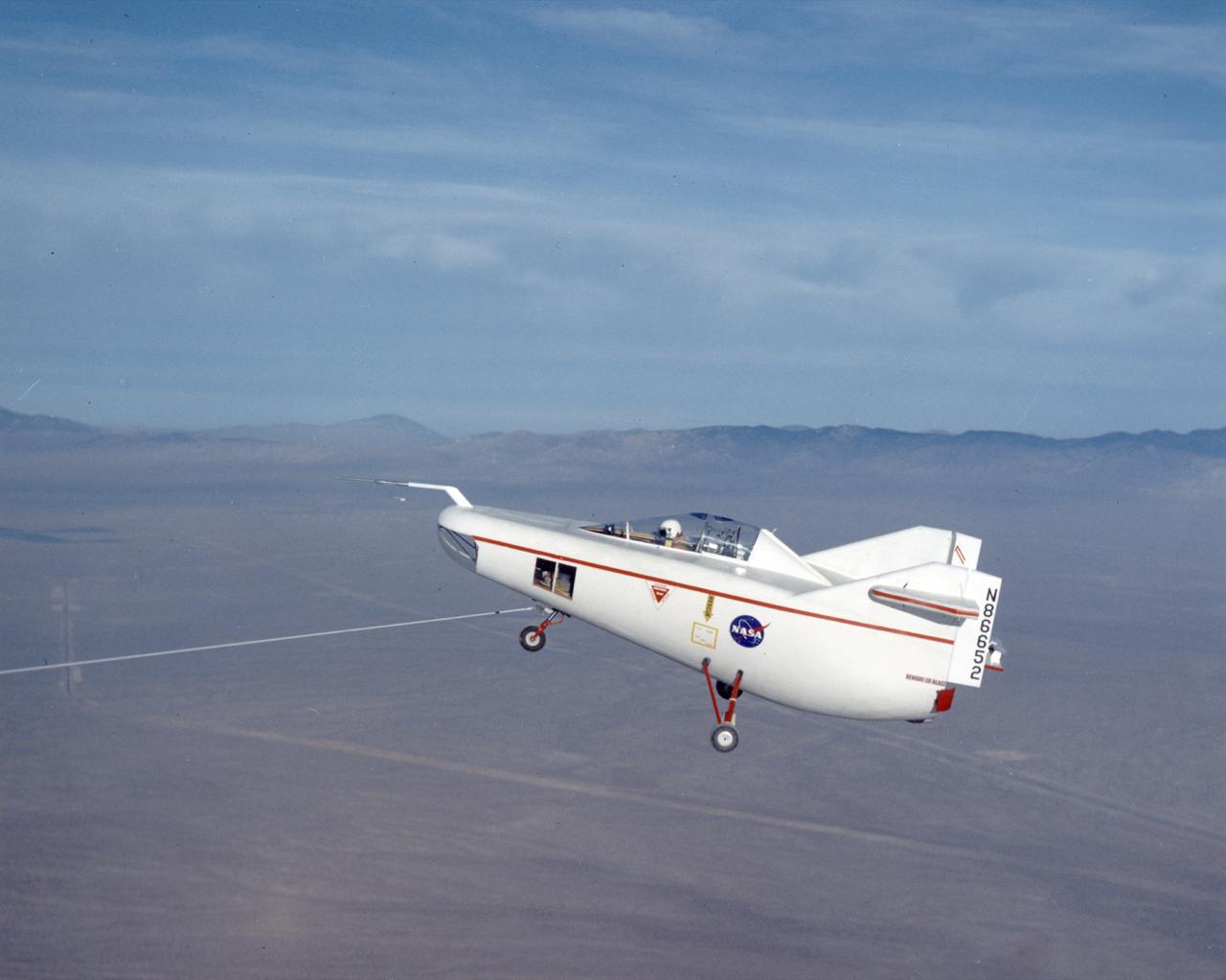
After initial ground-tow flights of the M2-F1 using the Pontiac as a tow vehicle, the way was clear to make air tows behind a C-47. The first air tow took place on 16 August 1963. Pilot Milt Thompson found that the M2-F1 flew well, with good control. This first flight lasted less than two minutes from tow-line release to touchdown. The descent rate was 4,000 feet per minute.
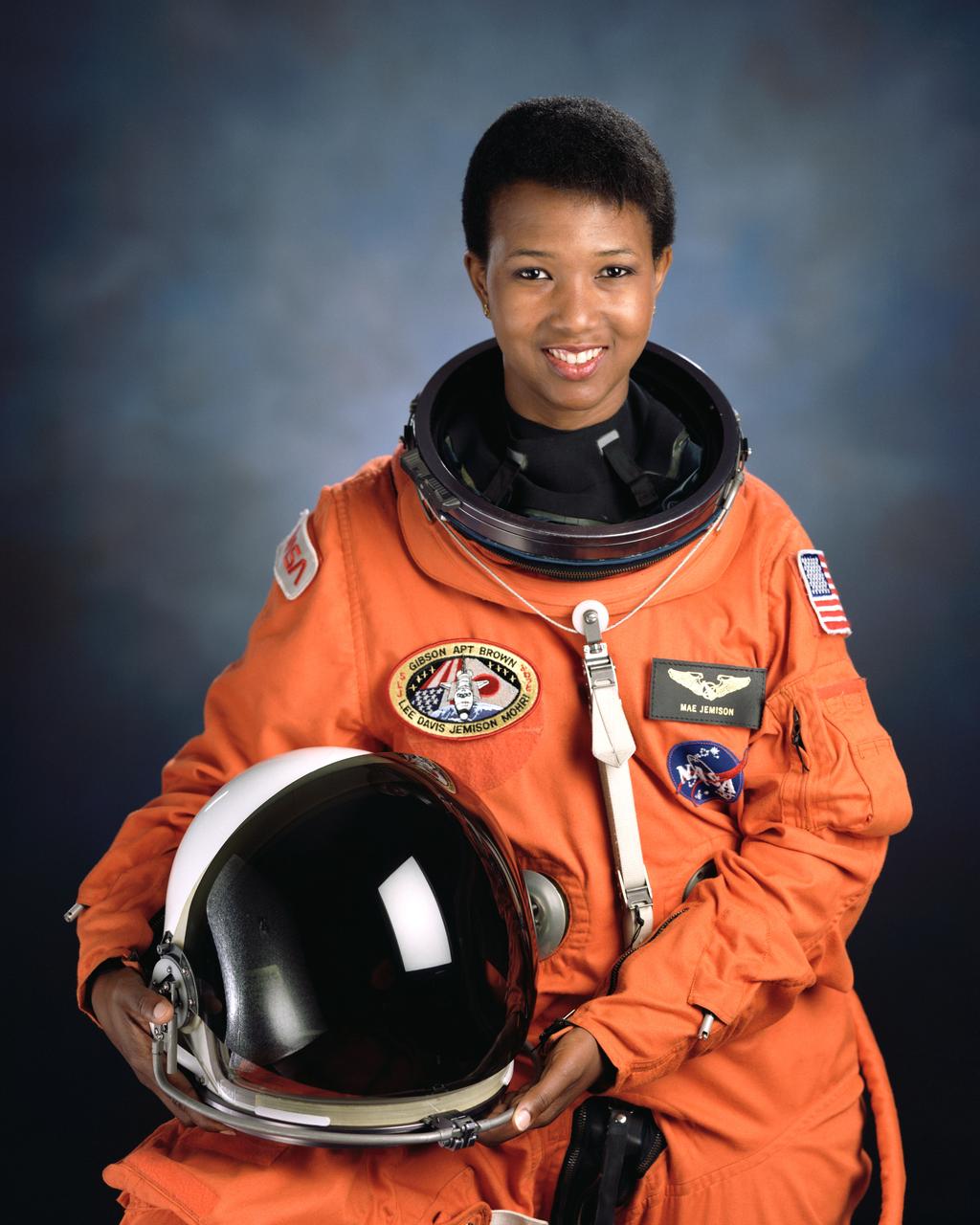
S92-40463 (July 1992) --- Astronaut Mae C. Jemison, M.D., mission specialist.
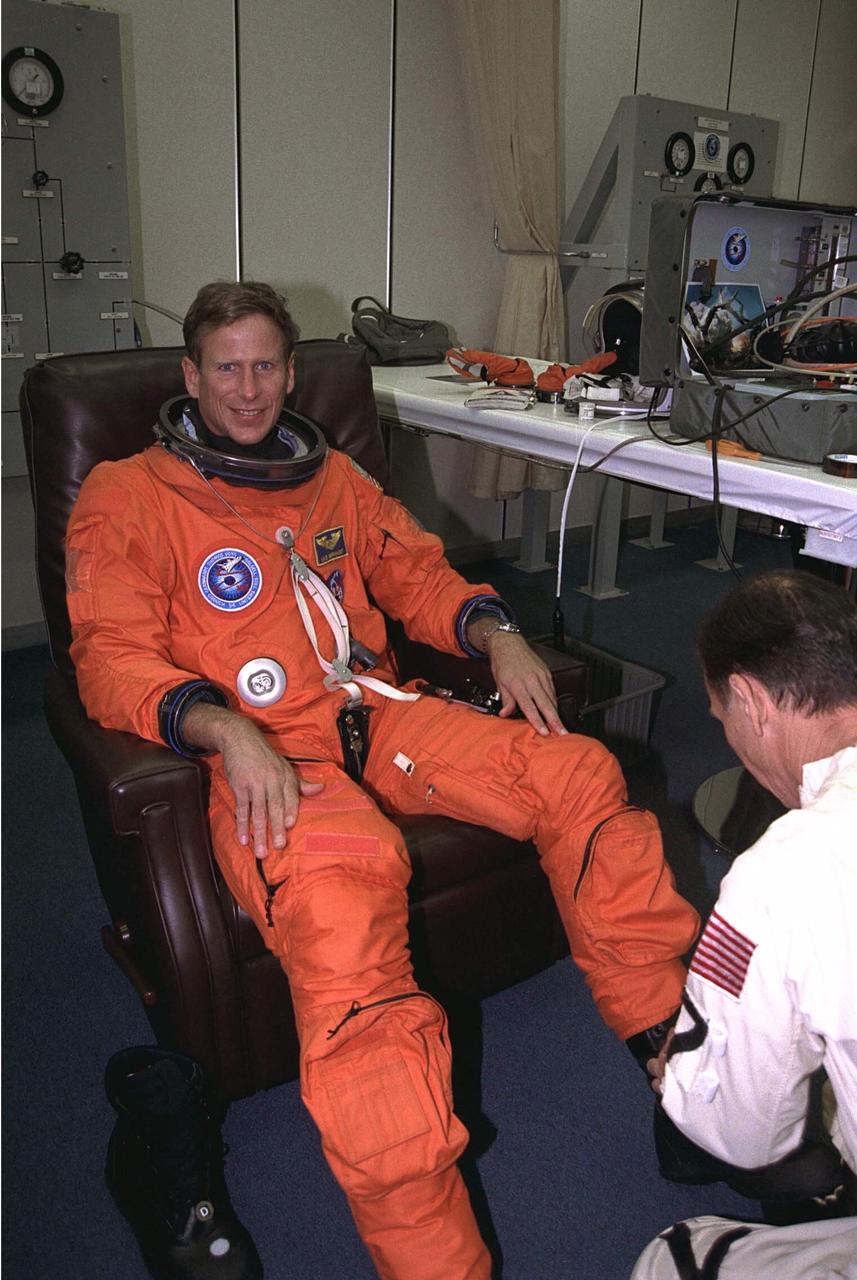
STS-94 Mission Specialist Michael L. Gernhardt is assisted into his launch/entry suit by a suit technician in the Operations and Checkout (O&C) Building. He first flew in this capacity on STS-69. He has been a professional deep sea diver and engineer and holds a doctorate in bioengineering. Gernhardt will be in charge of the Blue shift and as flight engineer will operate and maintain the orbiter while Halsell and Still are asleep as members of the Red shift. He will also back them up on the flight deck during the ascent and re-entry phases of the mission. Gernhardt and six fellow crew members will shortly depart the O&C and head for Launch Pad 39A, where the Space Shuttle Columbia will lift off during a launch window that opens at 1:50 p.m. EDT, July 1. The launch window was opened 47 minutes early to improve the opportunity to lift off before Florida summer rain showers reached the space center
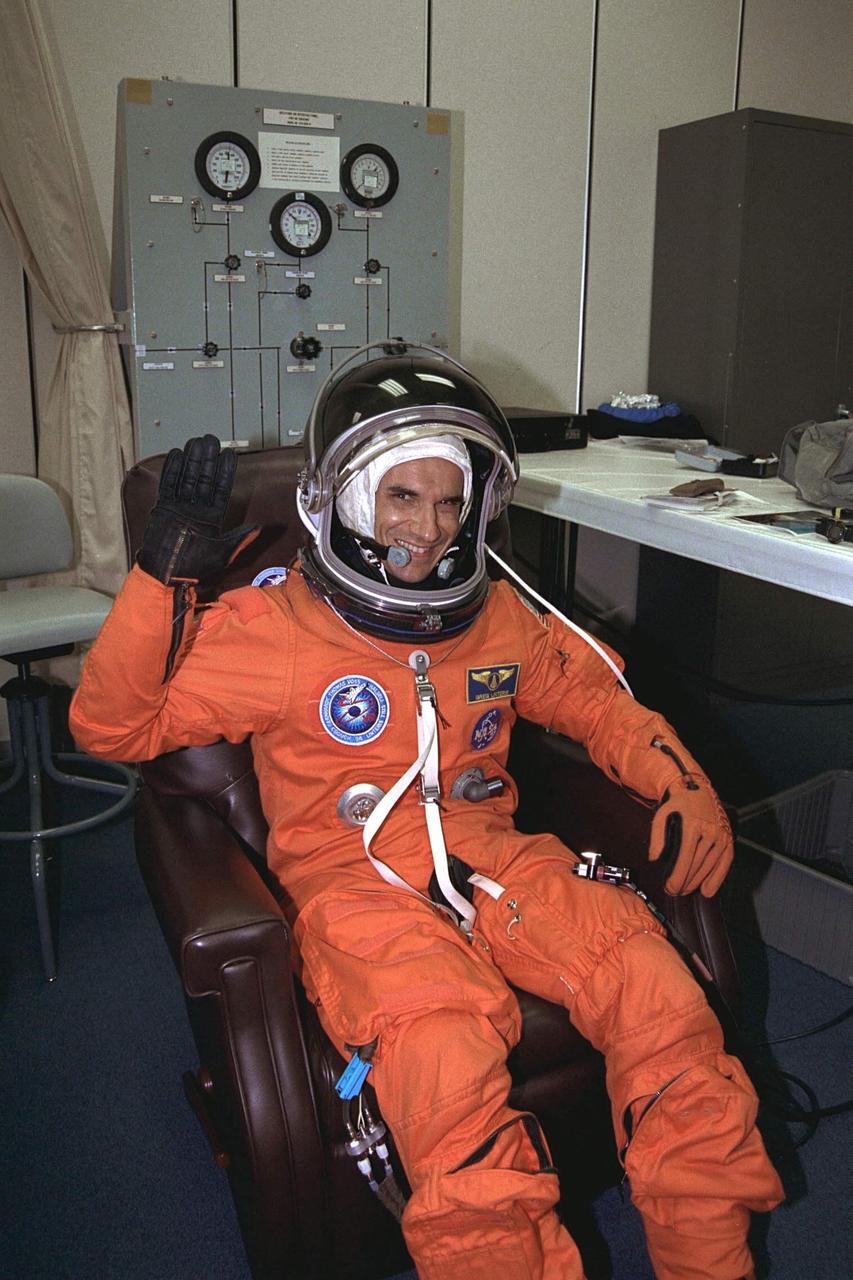
STS-94 Payload Specialist Gregory T. Linteris waves as he completes the donning of his launch/entry suit in the Operations and Checkout (O&C) Building. He holds a doctorate in mechanical and aerospace engineering. Linteris has worked at the National Institute of Standards and Technology and is the Principal Investigator on a NASA microgravity combustion experiment. As a member of the Red team, Linteris will concentrate on three combustion experiments. Two of these experiments are housed in the Combustion Module. He will also be backing up crew members on the other Microgravity Science Laboratory-1 (MSL-1) investigations. He and six fellow crew members will shortly depart the O&C and head for Launch Pad 39A, where the Space Shuttle Columbia will lift off during a launch window that opens at 1:50 p.m. EDT, July 1. The launch window was opened 47 minutes early to improve the opportunity to lift off before Florida summer rain showers reached the space center
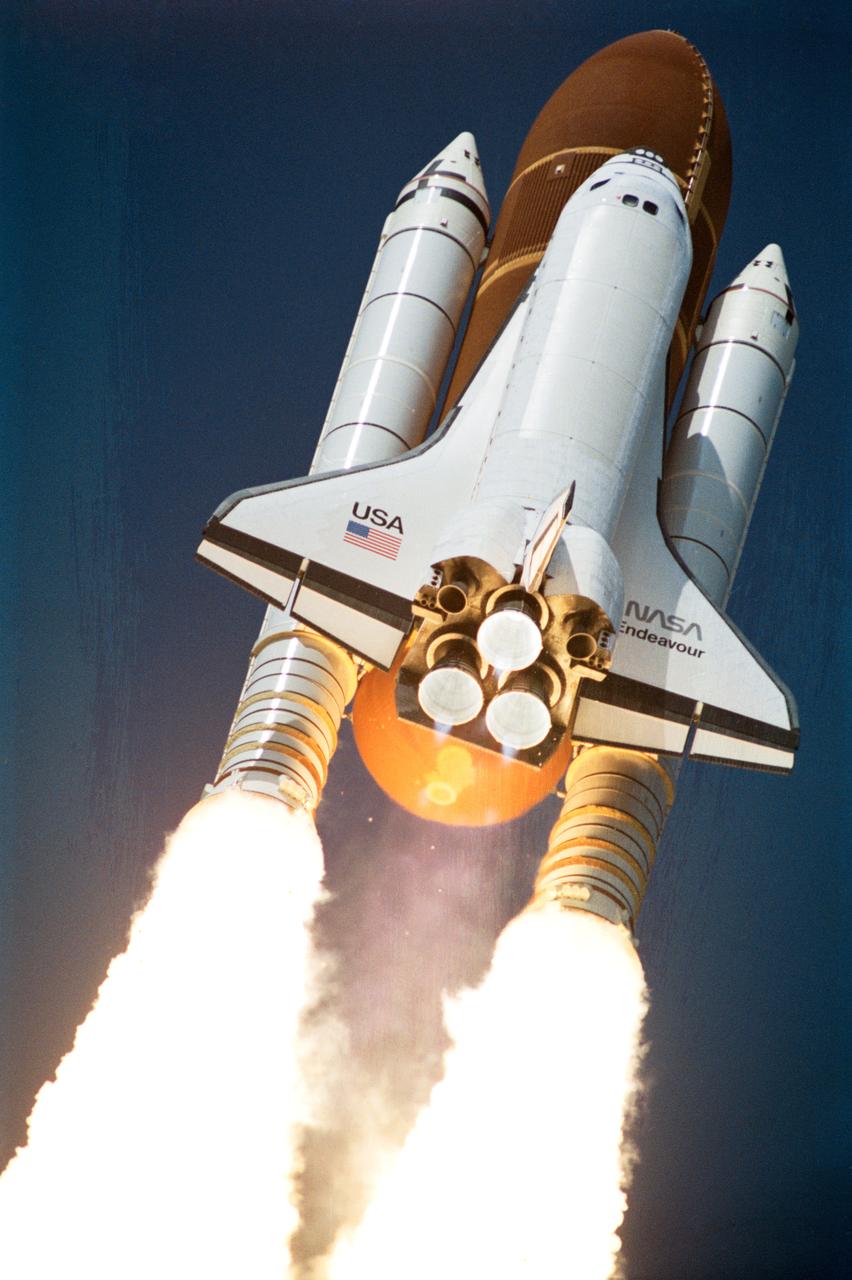
STS047-S-039 (12 Sept 1992) --- A 35mm camera was used to record this low-angle view of the STS-47 launch. With a crew of six NASA astronauts and a Japanese payload specialist onboard, the Space Shuttle Endeavour was heading for its second trip into space. This mission will be devoted to support of the Spacelab-J mission, a joint effort between Japan and the United States. Launch occurred at 10:23:00:0680 a.m. (EDT), September 12, 1992. Onboard were astronauts Robert L. Gibson, mission commander; Curtis L. Brown Jr., pilot; Mark C. Lee, payload commander; and Jerome (Jay) Apt, Mae C. Jemison and N. Jan Davis, mission specialists; along with payload specialist Mamoru Mohri, representing the National Space Development Agency (NASDA) of Japan.
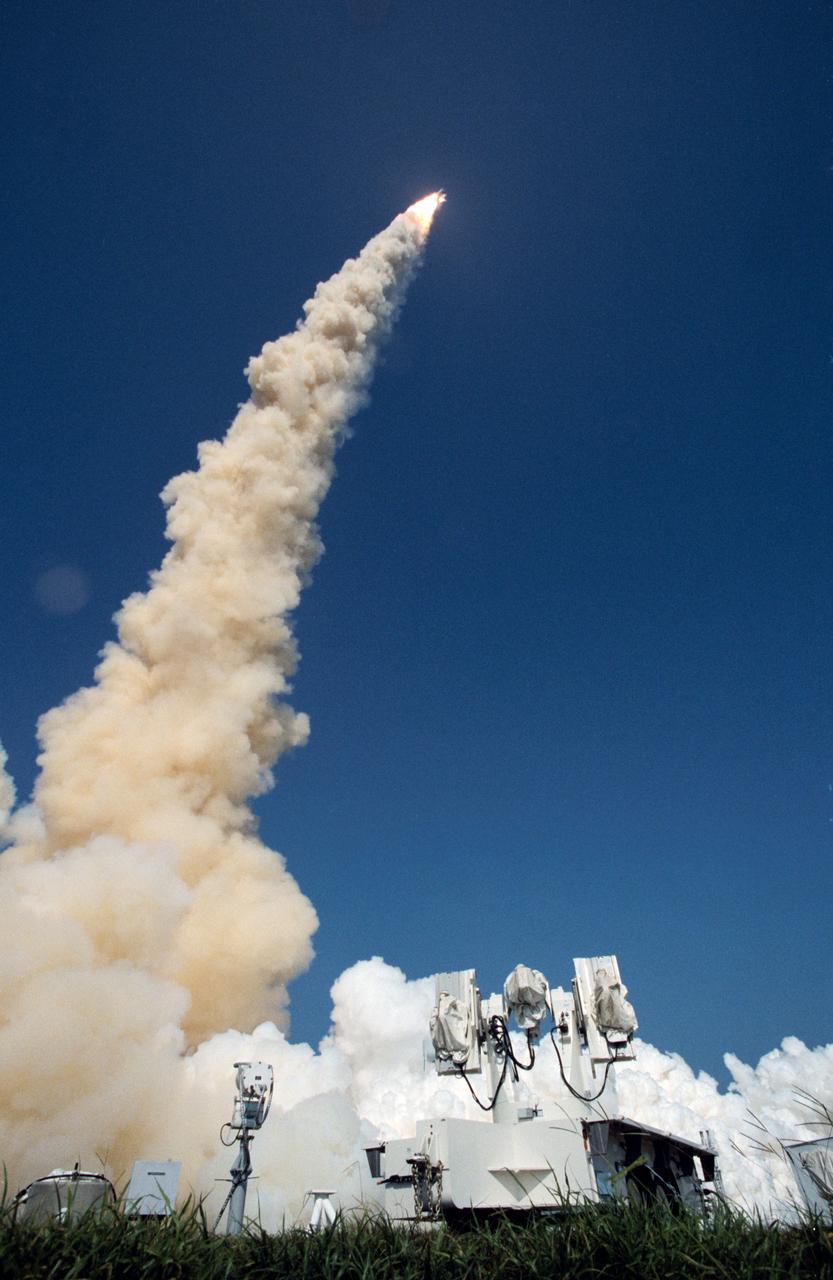
STS047-S-040 (12 Sept 1992) --- A 35mm camera was used to record this distant, low-angle view of the STS-47 launch. With a crew of six NASA astronauts and a Japanese payload specialist onboard, the Space Shuttle Endeavour was heading for its second trip into space. This mission is devoted to support of the Spacelab-J mission, a joint effort between Japan and the United States. Launch occurred at 10:23:00:0680 a.m. (EDT), September 12, 1992. Onboard were astronauts Robert L. Gibson, mission commander; Curtis L. Brown Jr., pilot; Mark C. Lee, payload commander; and Jerome (Jay) Apt, Mae C. Jemison and N. Jan Davis, mission specialists; along with payload specialist Mamoru Mohri, representing the National Space Development Agency (NASDA) of Japan.
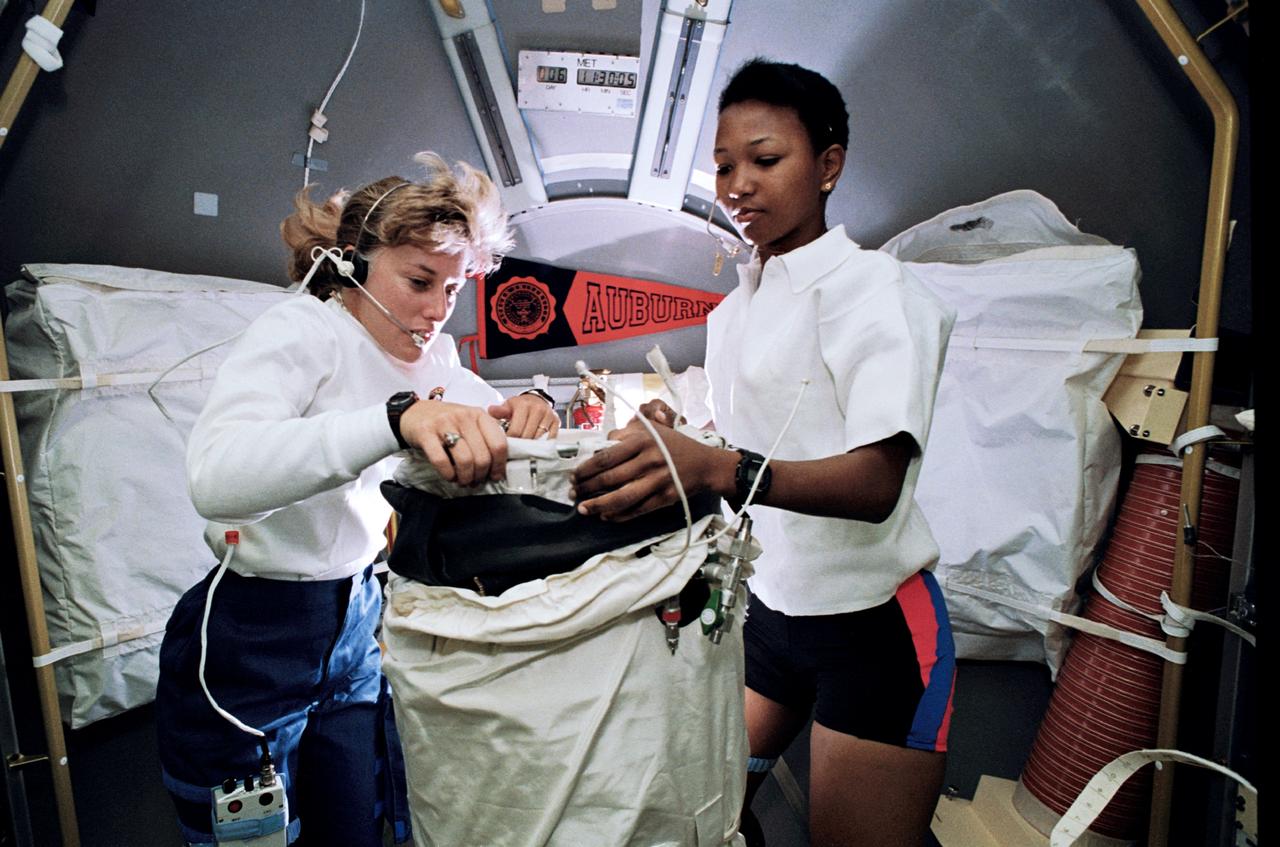
STS047-46-027 (12-20 Sept. 1992) --- Astronauts N. Jan Davis (left) and Mae C. Jemison, STS-47 mission specialists, prepare to deploy the Lower Body Negative Pressure (LBNP) apparatus in this 35mm frame photographed in the Science Module aboard the Earth-orbiting Space Shuttle Endeavour. Making their first flight in space, the two were joined by four other NASA astronauts and a Japanese payload specialist for eight days of research. The Spacelab-J mission is a joint effort between Japan and the United States of America.
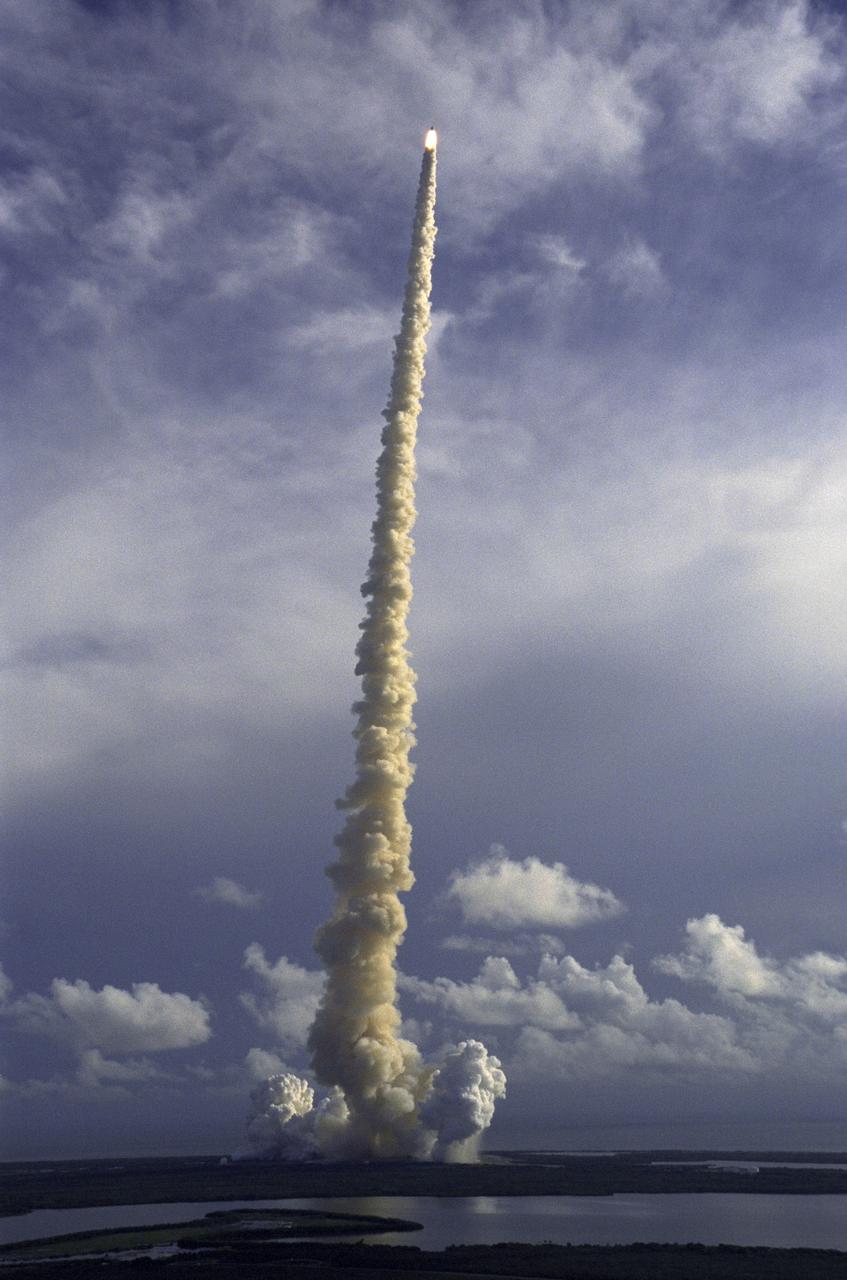
STS106-S-005 (8 September 2000) --- This distant view of the STS-106 liftoff was photographed across marsh waters around Mosquito Lagoon and Banana Creek, looking toward the Atlantic Ocean. The perfect on-time liftoff of the Space Shuttle Atlantis occurred at 8:45:47 a.m. (EDT), September 8, 2000. Onboard the shuttle were astronauts Terrence W. Wilcutt, Scott D. Altman, Edward T. Lu, Richard A. Mastracchio and Daniel C. Burbank, along with cosmonauts Yuri I. Malenchenko and Boris V. Morukov who represent the Russian Aviation and Space Agency.
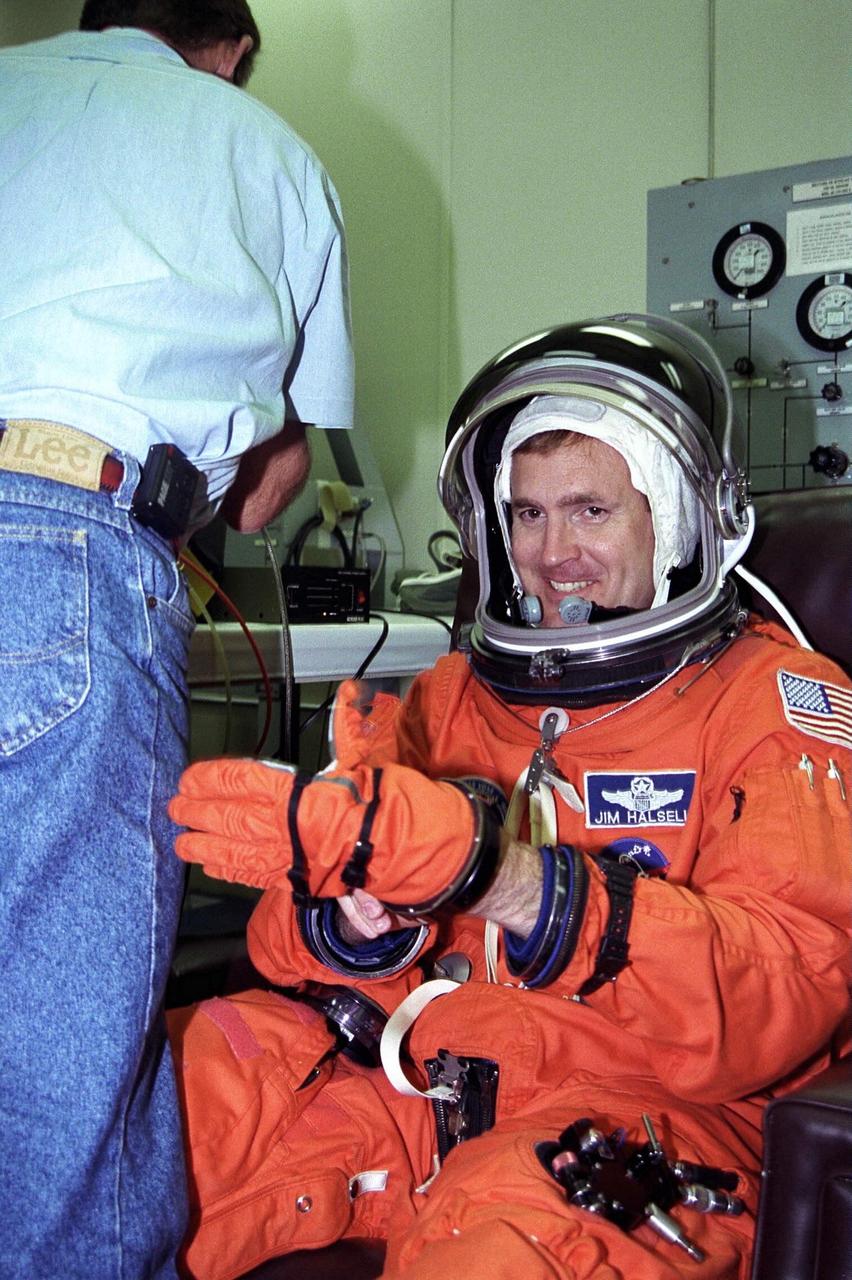
STS-94 Mission Commander James D. Halsell, Jr., puts his left glove on while he is assisted into his launch/entry suit in the Operations and Checkout (O&C) Building. Halsell is on his fourth space flight, having served as commander of STS-83 and pilot of both STS-74 and STS-65. He is a lieutenant colonel in the Air Force and a former SR-71 Blackbird test pilot and holds master’s degrees in management and space operations. Halsell will have responsibility for the success of the mission and will operate and maintain Columbia during the Red, or second shift. He will also assist with a materials science experiment and a protein crystal growth payload during the 16-day mission. Halsell and six fellow crew members will shortly depart the O&C and head for Launch Pad 39A, where the Space Shuttle Columbia will lift off during a launch window that opens at 1:50 p.m. EDT, July 1. The launch window was opened 47 minutes early to improve the opportunity to lift off before Florida summer rain showers reached the space center
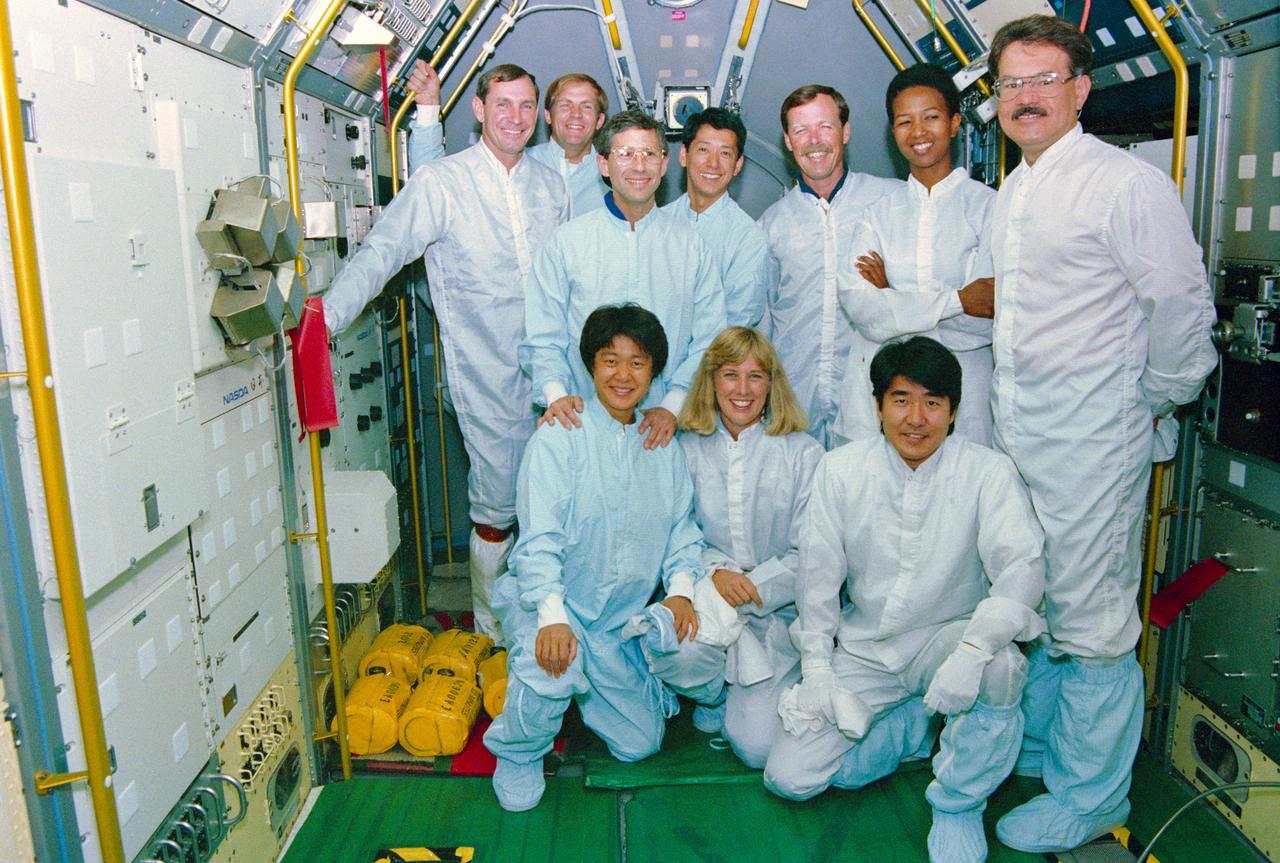
S92-44303 --- STS-47 Endeavour, Orbiter Vehicle (OV) 105, crew members and back-up payload specialists, wearing clean suits, pose for a group portrait in the Spacelab Japan (SLJ) module. The team is at the Kennedy Space Center's (KSC's) Orbiter Processing Facility (OPF) to inspect SLJ configuration and OV-105 preparations. Kneeling, from left, are back-up Payload Specialist Chiaki Naito-Mukai; Mission Specialist N. Jan Davis; and backup Payload Specialist Takao Doi. Standing, from the left, are Pilot Curtis L. Brown,Jr; Payload Commander Mark C. Lee; Jerome Apt; Payload Specialist Mamoru Mohri; Commander Robert L. Gibson; Mae C. Jemison; and back-up Payload Specialist Stanely L. Koszelak. Mohri, Mukai, and Doi represent the National Space Development Agency of Japan (NASDA). View provided by KSC with alternate KSC number KSC-92PC-1647. Photo credit: NASA
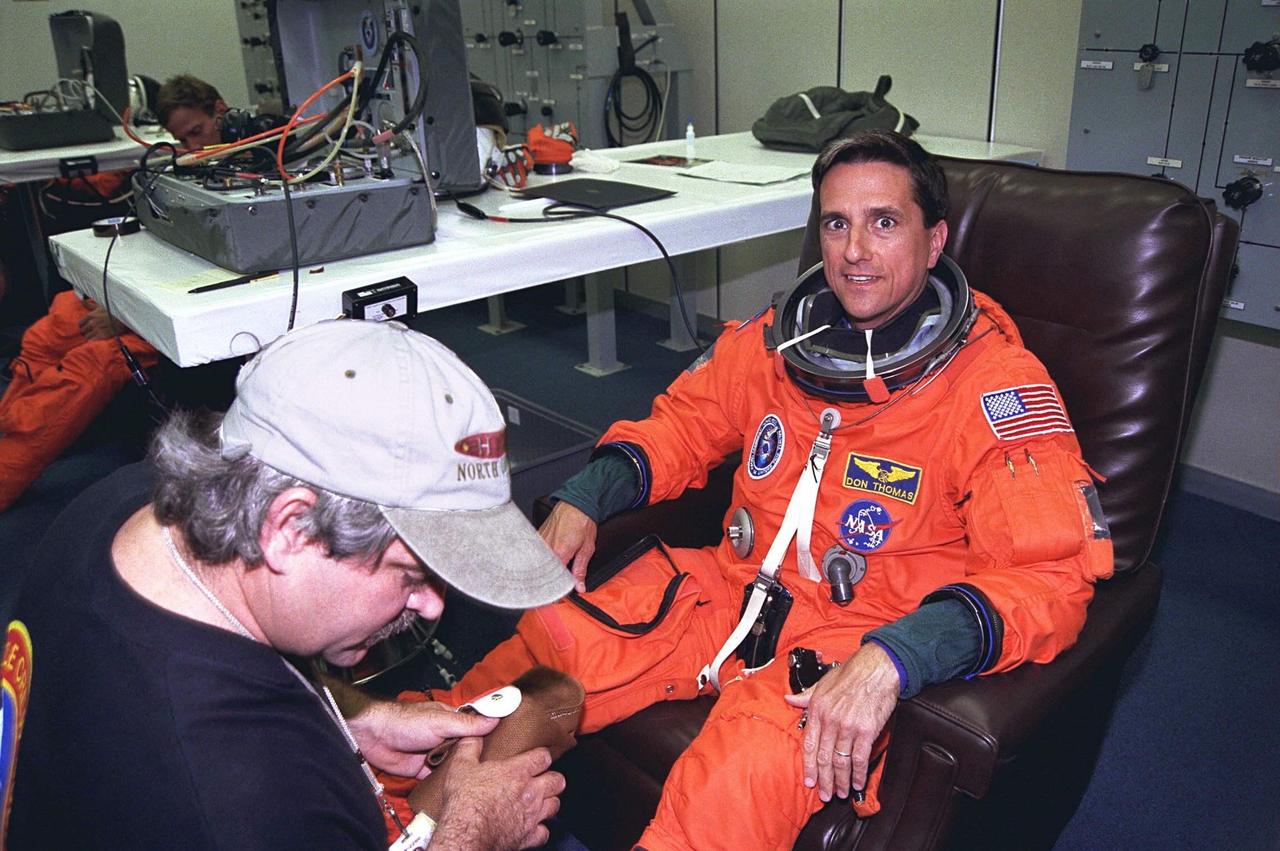
STS-94 Mission Specialist Donald A. Thomas smiles as a suit technician helps him into his launch/entry suit in the Operations and Checkout (O&C) Building. He has flown on STS-83, STS-70 and STS-65. He holds a doctorate in materials science and has been the Principal Investigator for a Space Shuttle crystal growth experiment. Because of his background in materials science, Thomas will be concentrating his efforts during the Red shift on the five experiments in this discipline in the Large Isothermal Furnace. He also will work on the ten materials science investigations in the Electromagnetic Containerless Processing Facility and four that will be measuring the effects of microgravity and motion in the orbiter on the experiments. Thomas and six fellow crew members will shortly depart the O&C and head for Launch Pad 39A, where the Space Shuttle Columbia will lift off during a launch window that opens at 1:50 p.m. EDT, July 1. The launch window was opened 47 minutes early to improve the opportunity to lift off before Florida summer rain showers reached the space center
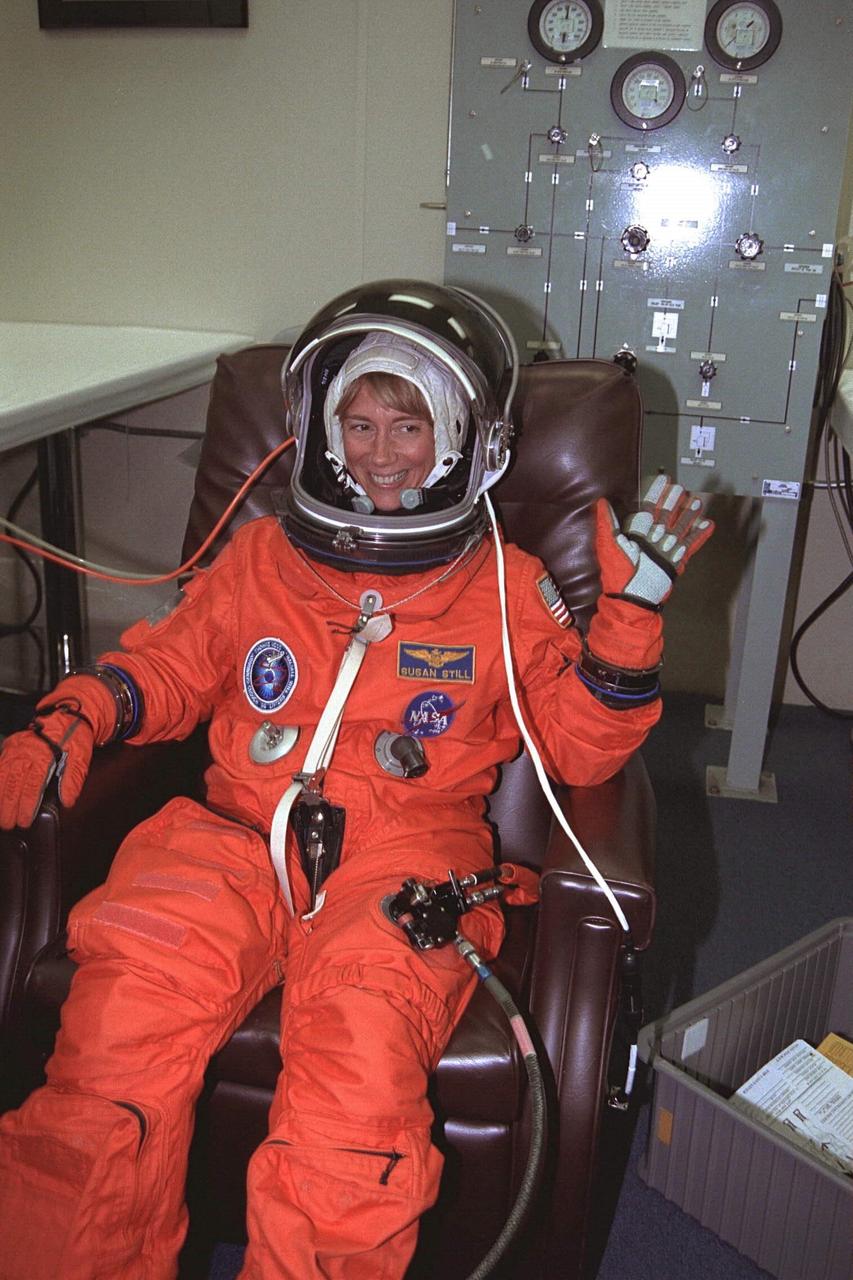
STS-94 Pilot Susan L. Still waves as she is assisted into her launch/entry suit in the Operations and Checkout (O&C) Building. She is the second woman to fly in this capacity on a Space Shuttle. Still is a lieutenant colonel in the Navy and has more than 2,000 flight hours in 30 different types of aircraft. She also holds a master’s degree in aerospace engineering. Still will assist Halsell with all phases of the space flight and will have primary responsibility to take action in the event of an emergency. After Columbia reaches orbit, Still will be busy with the many and varied tasks associated with monitoring and maintaining the orbiter. She and six fellow crew members will shortly depart the O&C and head for Launch Pad 39A, where the Space Shuttle Columbia will lift off during a launch window that opens at 1:50 p.m. EDT, July 1. The launch window was opened 47 minutes early to improve the opportunity to lift off before Florida summer rain showers reached the space center
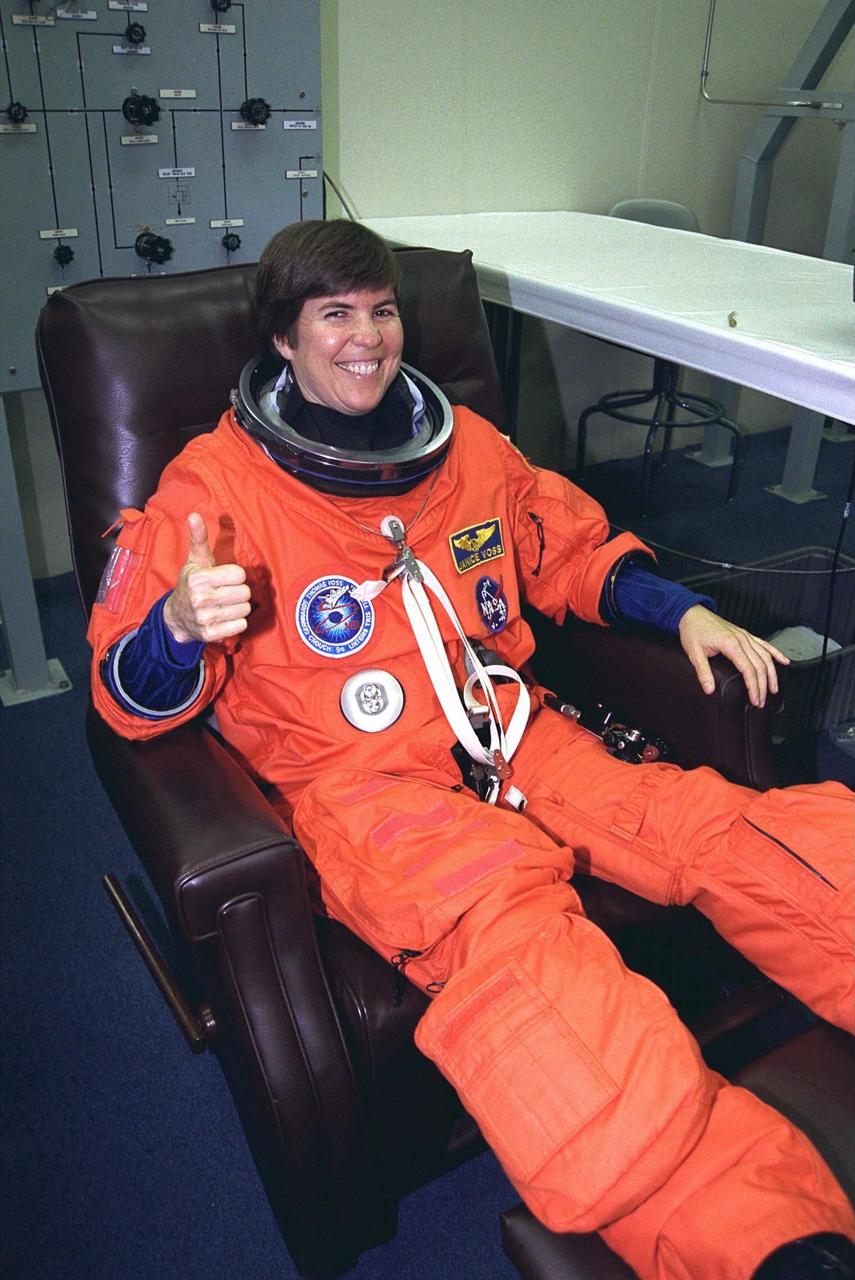
STS-94 Payload Commander Janice Voss smiles and gives a thumbs-up as she is assisted into her launch/entry suit in the Operations and Checkout (O&C) Building. She has flown on STS-83, STS-63 and STS-57. Voss holds a doctorate degree in aeronautics/astronautics from the Massachusetts Institute of Technology and has earned two NASA Space Flight Medals. As Payload Commander and a member of the Blue team, Voss will have overall responsibility for the operation of all of the MSL-1 experiments. During the experimentation phase of the mission, she be working primarily with three combustion experiments. She and six fellow crew members will shortly depart the O&C and head for Launch Pad 39A, where the Space Shuttle Columbia will lift off during a launch window that opens at 1:50 p.m. EDT, July 1. The launch window was opened 47 minutes early to improve the opportunity to lift off before Florida summer rain showers reached the space center
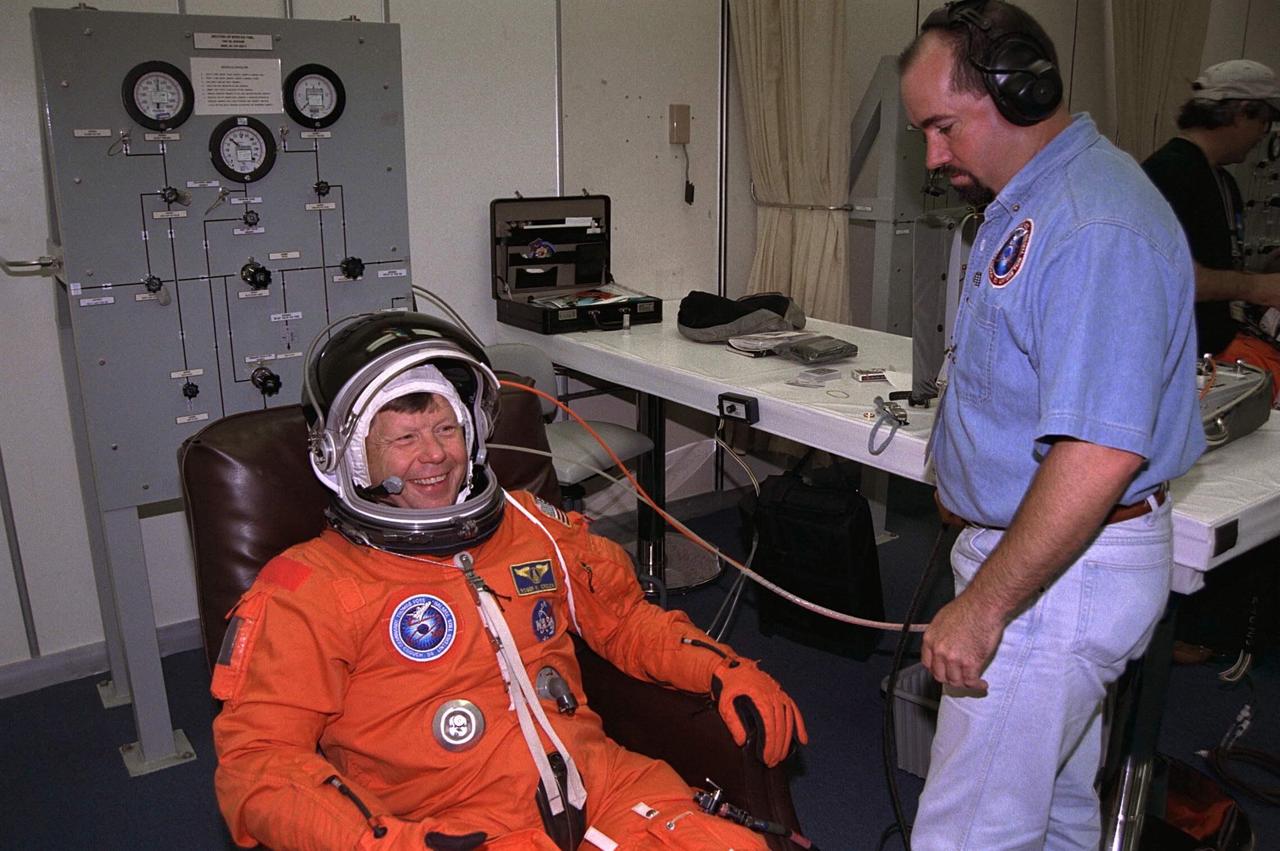
STS-94 Payload Specialist Roger K. Crouch is helped into his launch/entry suit by a suit technician in the Operations and Checkout (O&C) Building after the suit has been given a pressure test. He is the Chief Scientist of the NASA Microgravity Space and Applications Division. He also has served as a Program Scientist for previous Spacelab microgravity missions and is an expert in semiconductor crystal growth. Since Crouch has more than 25 years of experience as a materials scientist, he will be concentrating on the five physics of materials processing experiments in the Middeck Glovebox Facility on the Blue shift. He will also share the workload with Thomas by monitoring the materials furnace experiments during this time. Crouch and six fellow crew members will shortly depart the O&C and head for Launch Pad 39A, where the Space Shuttle Columbia will lift off during a launch window that opens at 1:50 p.m. EDT, July 1. The launch window was opened 47 minutes early to improve the opportunity to lift off before Florida summer rain showers reached the space center
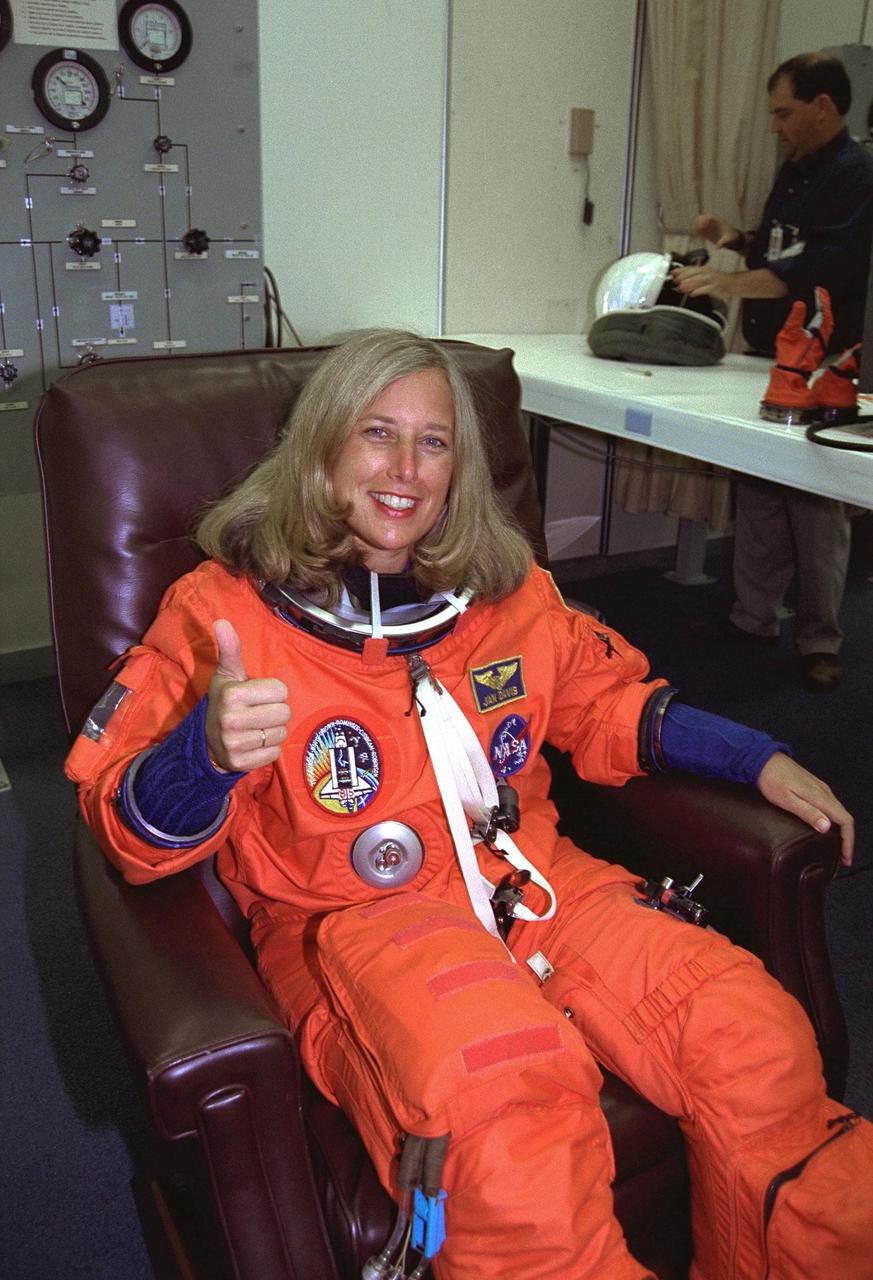
STS-85 Payload Commander N. Jan Davis gives a thumbs up as she is assisted with her ascent/reentry flight suit in the Operations and Checkout (O&C) Building. She has logged nearly 400 hours in space on the STS-47 and STS-60 missions and holds a doctorate in mechanical engineering. Davis will have overall responsibility for the experiments conducted on STS-85. She will also deploy and retrieve the Cryogenic Infrared Spectrometers and Telescopes for the AtmosphereShuttle Pallet Satellite-2 (CRISTA-SPAS-2) free-flyer and operate the prototype Japanese robotic arm. The primary payload aboard the Space Shuttle orbiter Discovery is the CRISTA-SPAS-2. Other payloads on the 11-day mission include the Manipulator Flight Demonstration (MFD), and Technology Applications and Science-1 (TAS-1) and International Extreme Ultraviolet Hitchhiker-2 (IEH-2) experiments
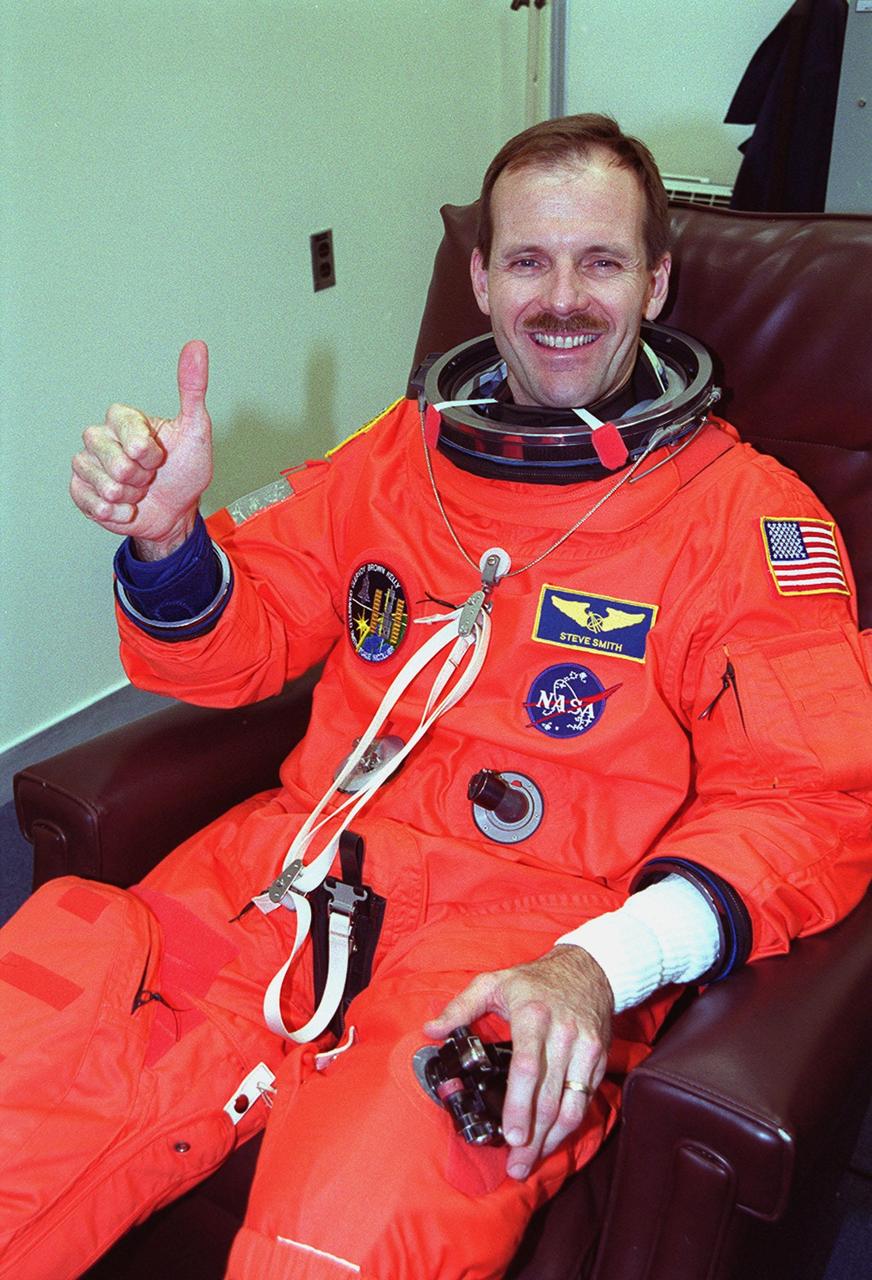
In the Operations and Checkout Building, STS-103 Mission Specialist Steven L. Smith signals he is suited up and ready for launch. Other crew members are Commander Curtis L. Brown Jr., Pilot Scott J. Kelly and Mission Specialists C. Michel Foale (Ph.D.), John M. Grunsfeld (Ph.D.), Jean-François Clervoy of France and Claude Nicollier of Switzerland. Clervoy and Nicollier are with the European Space Agency. The STS-103 mission, to service the Hubble Space Telescope, is scheduled for launch Dec. 17 at 8:47 p.m. EST from Launch Pad 39B. Mission objectives include replacing gyroscopes and an old computer, installing another solid state recorder, and replacing damaged insulation in the telescope. After the 8-day, 21-hour mission, Discovery is expected to land at KSC Sunday, Dec. 26, at about 6:30 p.m. EST
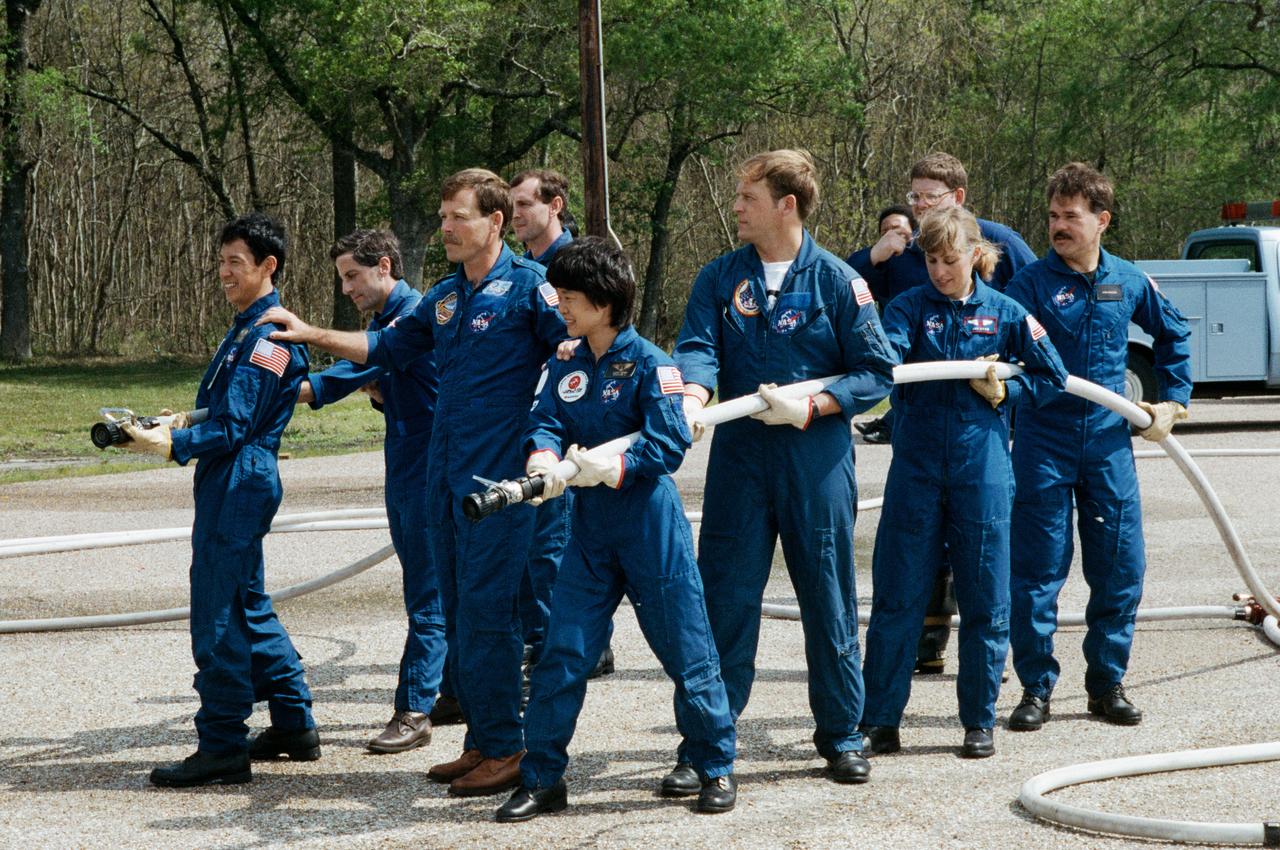
STS-47 Endeavour, Orbiter Vehicle (OV) 105, crewmembers led by Commander Robert L. Gibson (center) prepare to extinguish a blaze in JSC's Fire Training Pit. Lined up along the water hoses are: (on left) Payload Specialist Mamoru Mohri, holding the hose nozzle, followed by Mission Specialist (MS) Jerome Apt, and Pilot Curtis L. Brown, Jr; and (on right) backup Payload Specialist Chiaki Naito-Mukai, holding the hose nozzle, followed by MS and Payload Commander (PLC) Mark C. Lee, MS N. Jan Davis, and backup Payload Specialist Stan Koszelak. A veteran fire fighter and the instructor, positioned between the two hoses, looks on. Mohri and Mukai represent Japan's National Space Development Agency (NASDA). The Fire Training Pit is located across from the Gilruth Center Bldg 207.
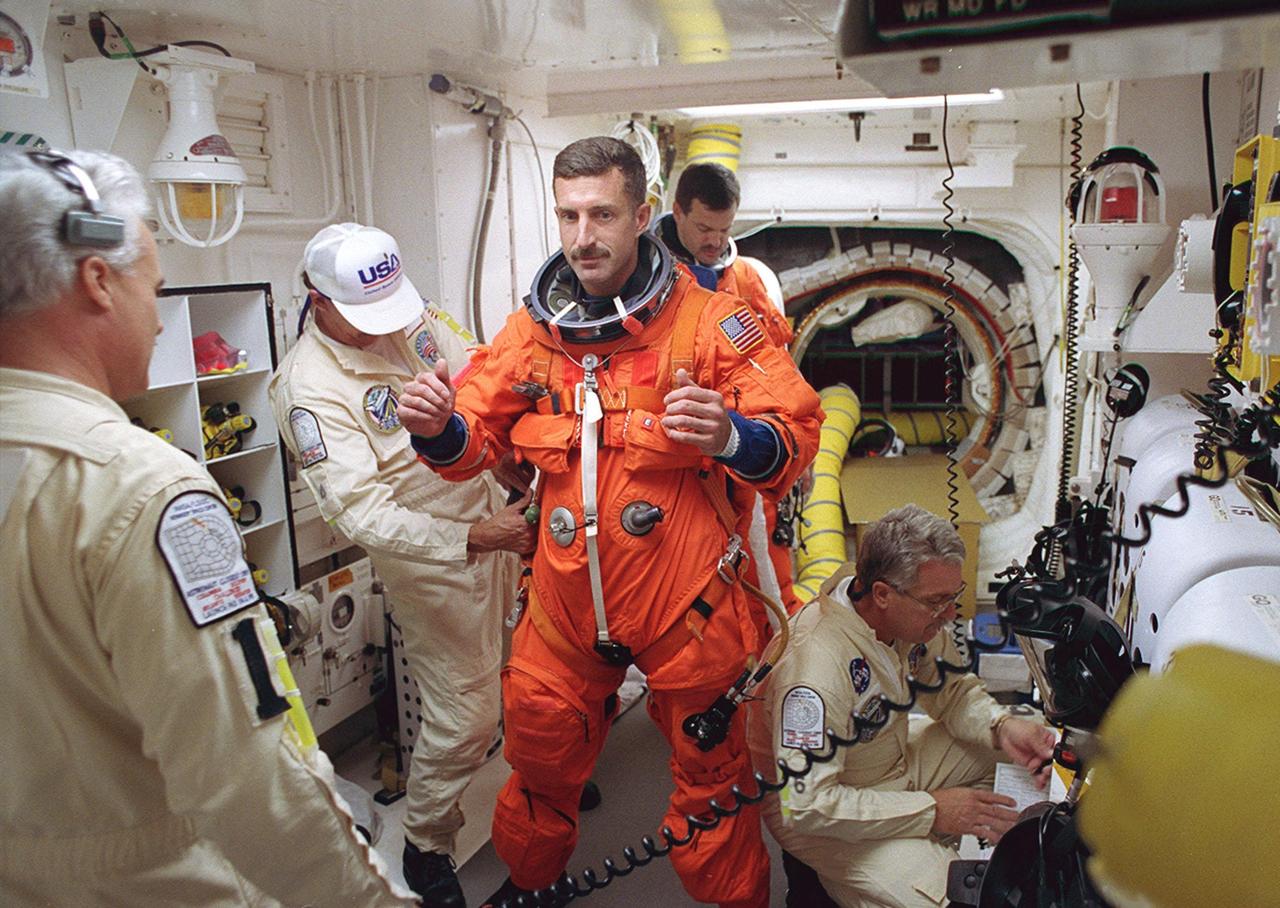
Before entering Space Shuttle Atlantis, STS-106 Mission Specialist Daniel C. Burbank is helped getting into his launch and entry suit in the White Room. Behind him is Pilot Scott D. Altman. In the background can be seen the opening into Atlantis. The perfect on-time liftoff of Atlantis on mission STS-106 occurred at 8:45:47 a.m. EDT. On the 11-day mission to the International Space Station, the seven-member crew will perform support tasks on orbit, transfer supplies and prepare the living quarters in the newly arrived Zvezda Service Module. The first long-duration crew, dubbed “Expedition One,” is due to arrive at the Station in late fall. Landing of Atlantis is targeted for 4:45 a.m. EDT on Sept. 19
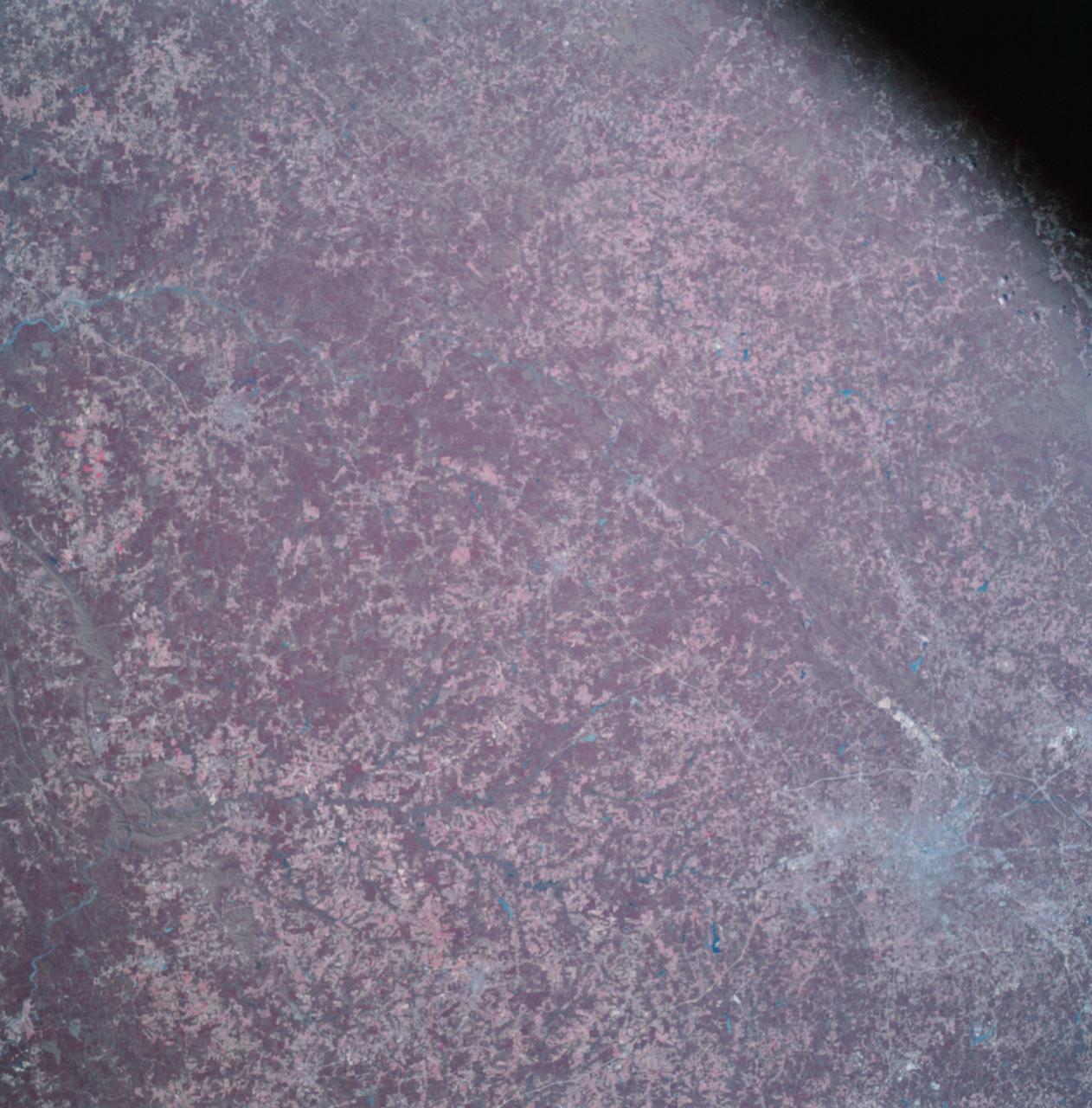
AS09-26A-3792A (11 March 1969) --- Color infrared photograph of the Atlanta, Georgia area taken on March 11, 1969, by one of the four synchronized cameras of the Apollo 9 Earth Resources Survey (SO-65) experiment. At 11:21 a.m. (EST) when this picture was taken, the Apollo 9 spacecraft was at an altitude of 106 nautical miles, and the sun elevation was 47 degrees above the horizon. The location of the point on Earth's surface at which the four-camera combination was aimed was 33 degrees 10 minutes north latitude, and 84 degrees and 40 minutes west longitude. The other three cameras used: (B) black and white film with a red filter; (C) black and white infrared film; and (D) black and white film with a green filter.
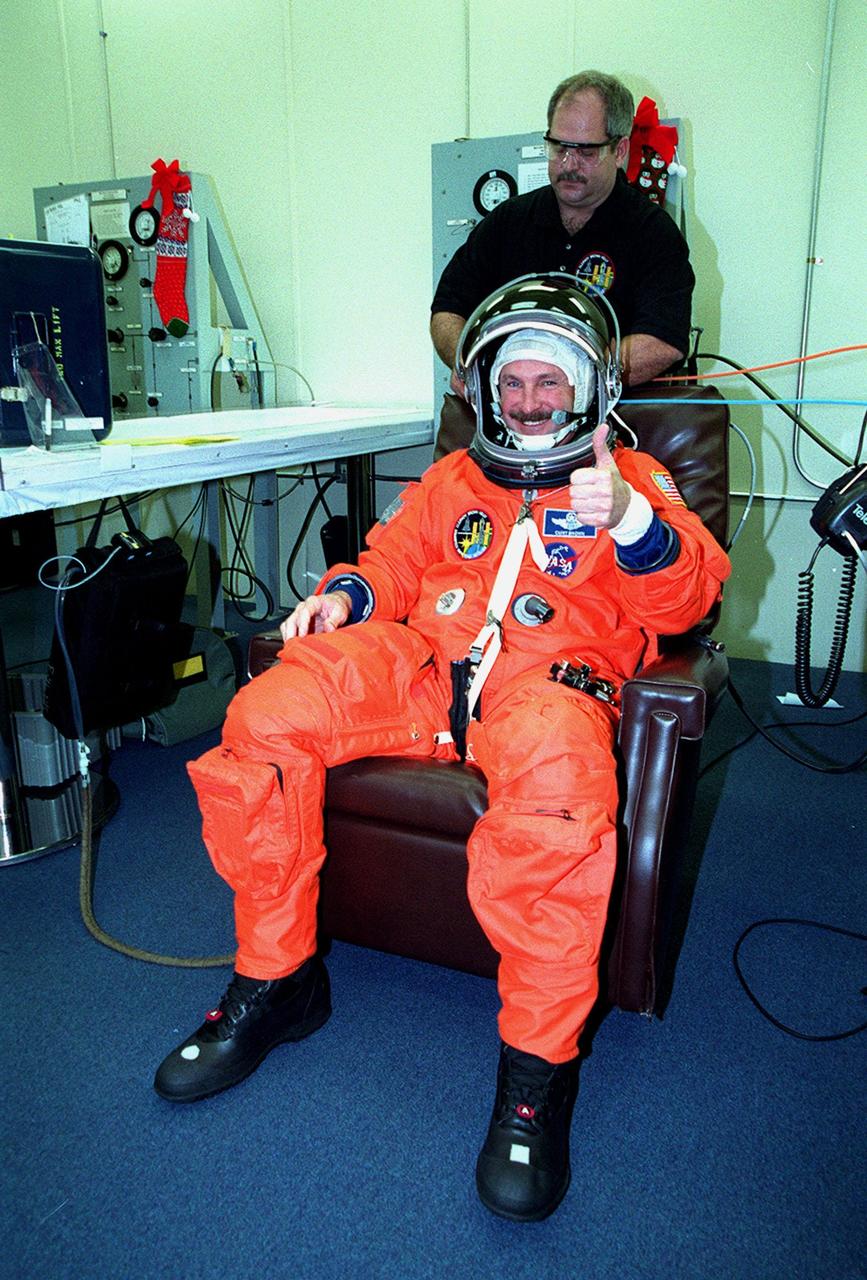
In the Operations and Checkout Building, STS-103 Commander Curtis L. Brown Jr. signals he's ready for launch while having his launch and entry suit checked by a suit technician. Other crew members are Pilot Scott J. Kelly and Mission Specialists Steven L. Smith, C. Michel Foale (Ph.D.), John M. Grunsfeld (Ph.D.), Claude Nicollier of Switzerland and Jean-François Clervoy of France. Nicollier and Clervoy are with the European Space Agency. The STS-103 mission, to service the Hubble Space Telescope, is scheduled for launch Dec. 17 at 8:47 p.m. EST from Launch Pad 39B. Mission objectives include replacing gyroscopes and an old computer, installing another solid state recorder, and replacing damaged insulation in the telescope. After the 8-day, 21-hour mission, Discovery is expected to land at KSC Sunday, Dec. 26, at about 6:30 p.m. EST
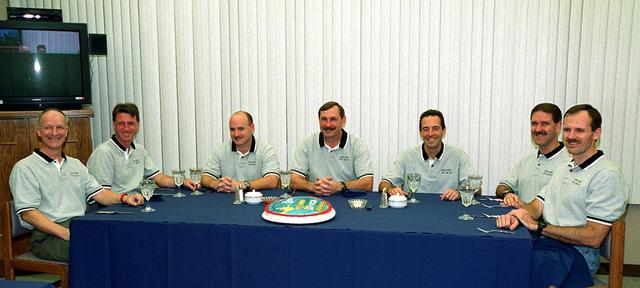
In the Operations and Checkout Building, the STS-103 crew are all smiles as they gather for breakfast before suiting up for launch. From left are Mission Specialists Claude Nicollier of Switzerland and C. Michael Foale (Ph.D.), Pilot Scott J. Kelly, Commander Curtis L. Brown Jr., and Mission Specialists Jean-Francois Clervoy of France, John M. Grunsfeld (Ph.D.) and Steven L. Smith. Nicollier and Clervoy are with the European Space Agency. The STS-103 mission, to service the Hubble Space Telescope, is scheduled for launch Dec. 17 at 8:47 p.m. EST from Launch Pad 39B. Mission objectives include replacing gyroscopes and an old computer, installing another solid state recorder, and replacing damaged insulation in the telescope. The mission is expected to last about 8 days and 21 hours. Discovery is expected to land at KSC Sunday, Dec. 26, at about 6:30 p.m. EST
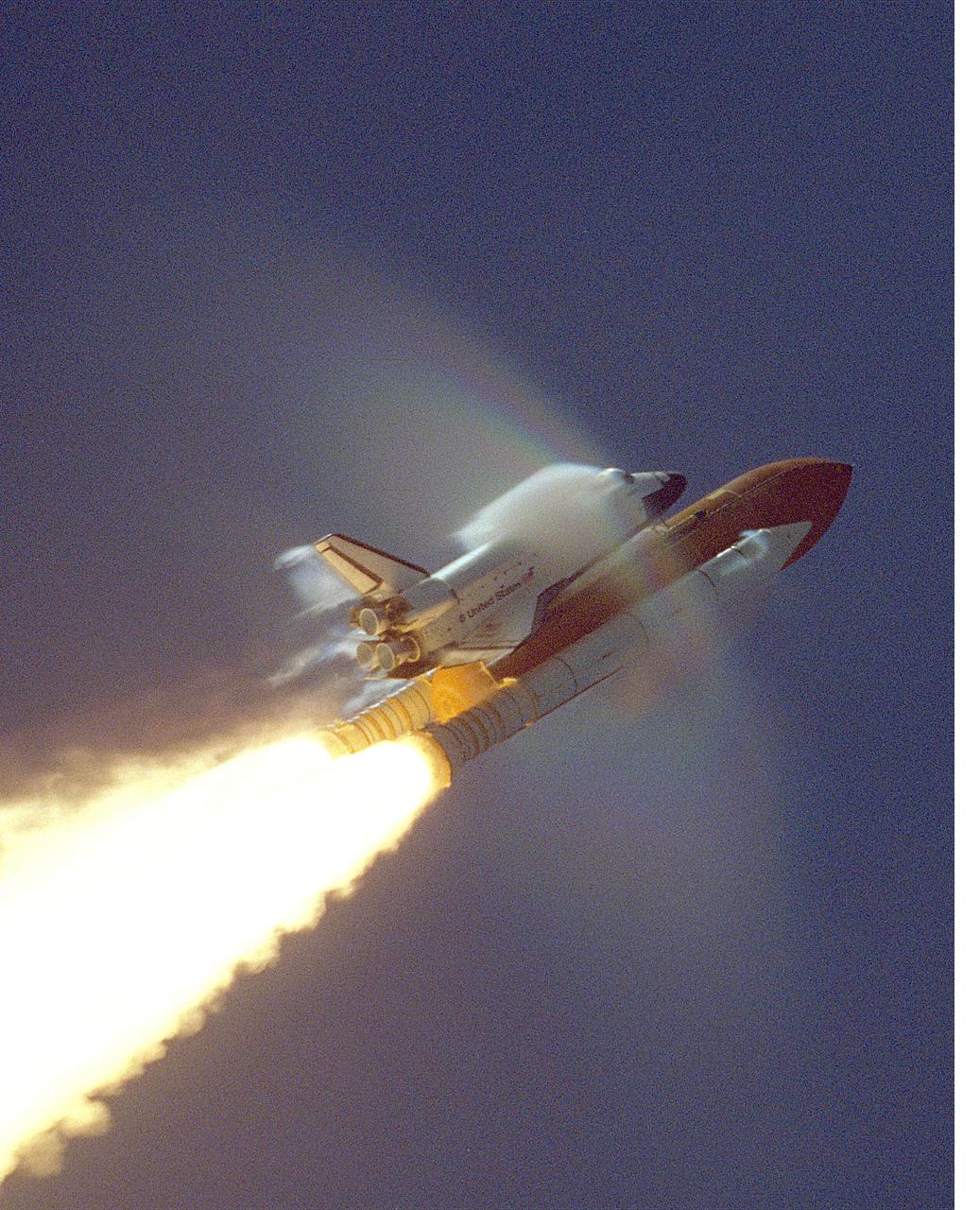
STS106-S-013 (8 September 2000)--- This view of shock-wave condensation collars backlit by the Sun occurred during the launch of the Space Shuttle Atlantis on September 8, 2000. The scene was captured on 35mm motion picture film. One frame was digitized to make this still image. Although the primary effect is created by the forward fuselage of the Atlantis, secondary effects can be seen on the solid rocket booster (SRB) forward skirt, shuttle vertical stabilizer and wing trailing edge, behind the Space Shuttle Main Engines (SSME). The perfect on-time launch took place at 8:45:47 a.m. (EDT), September 8, 2000. Onboard the shuttle were astronauts Terrence W. Wilcutt, Scott D. Altman, Edward T. Lu, Richard A. Mastracchio and Daniel C. Burbank, along with cosmonauts Yuri I. Malenchenko and Boris V. Morukov who represent the Russian Aviation and Space Agency.
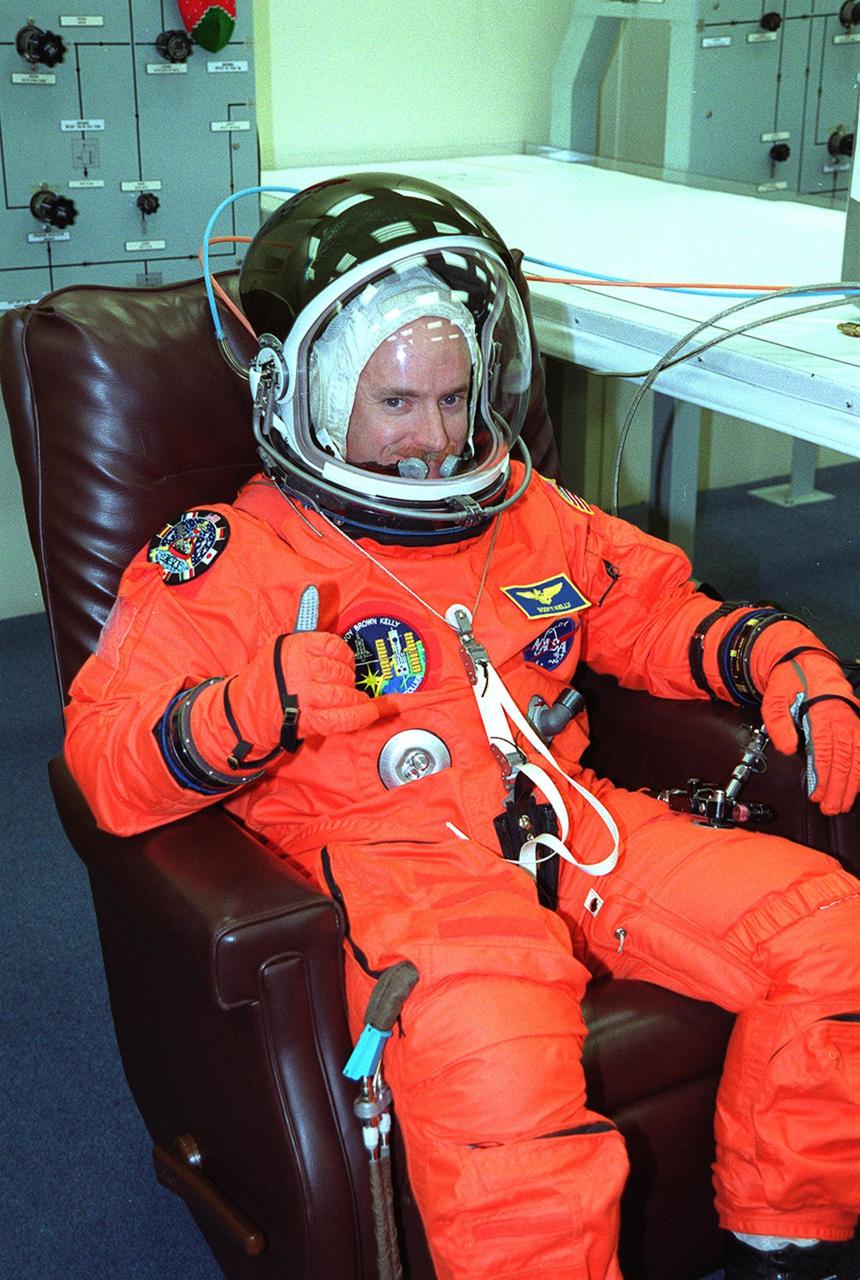
STS-103 Pilot Scott J. Kelly signals he is ready for launch after suiting up in the Operations and Checkout Building. Other crew members are Commander Curtis L. Brown Jr. and Mission Specialists Steven L. Smith, C. Michel Foale (Ph.D.), John M. Grunsfeld (Ph.D.), Jean-François Clervoy of France and Claude Nicollier of Switzerland. Clervoy and Nicollier are with the European Space Agency. The STS-103 mission, to service the Hubble Space Telescope, is scheduled for launch Dec. 17 at 8:47 p.m. EST from Launch Pad 39B. Mission objectives include replacing gyroscopes and an old computer, installing another solid state recorder, and replacing damaged insulation in the telescope. After the 8-day, 21-hour mission, Discovery is expected to land at KSC Sunday, Dec. 26, at about 6:30 p.m. EST
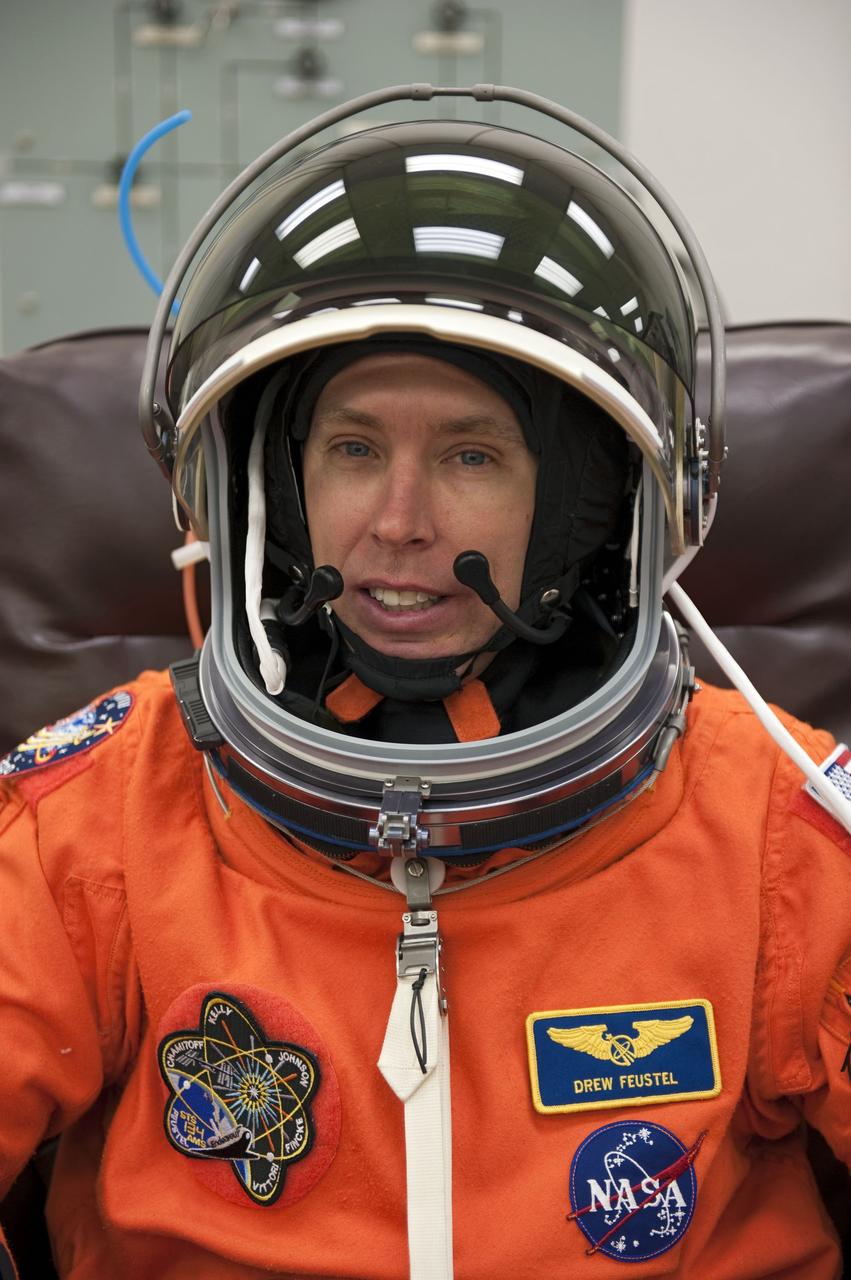
CAPE CANAVERAL, Fla. -- In the Operations and Checkout Building (O&C) at NASA's Kennedy Space Center in Florida, space shuttle Endeavour's STS-134 astronauts put on their launch-and-entry suits and check the fit of their helmets and gloves before heading to the Astrovan for the ride to Launch Pad 39A. Mission Specialist Andrew Feustel, seen here, last flew to NASA's Hubble Space Telescope in 2009. STS-134 will deliver the Express Logistics Carrier-3, Alpha Magnetic Spectrometer-2 (AMS), a high-pressure gas tank and additional spare parts for the Dextre robotic helper to the space station. Endeavour was scheduled to launch at 3:47 p.m. on April 29, but that attempt was scrubbed for at least 72 hours while engineers assess an issue associated with the shuttle's Auxiliary Power Unit 1. STS-134 will be the final spaceflight for Endeavour. For more information visit, www.nasa.gov/mission_pages/shuttle/shuttlemissions/sts134/index.html. Photo credit: NASA/Kim Shiflett
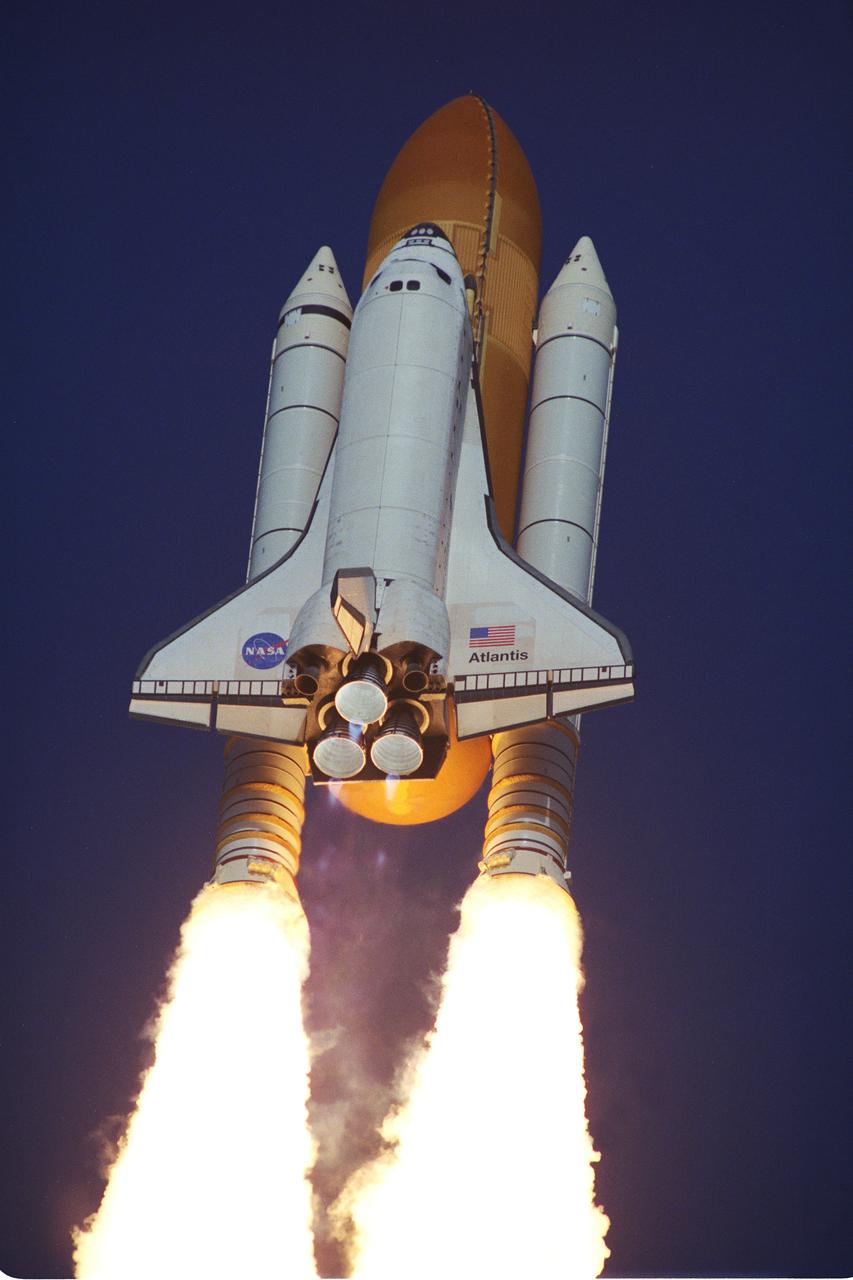
STS106-S-015 (8 September 2000) --- The Space Shuttle Atlantis streaks into the sky on mission STS-106 after a perfect on-time launch at 8:45:47 a.m. (EDT), September 8, 2000. Blue mach diamonds are barely visible beneath the main engine nozzles. On the 11-day mission to the International Space Station, the seven-member crew will perform support tasks on orbit; transfer supplies and prepare the living quarters in the newly arrived Zvezda Service Module. The first long-duration crew is due to arrive at the Station in late fall. Onboard the spacecraft were astronauts Terrance W. Wilcutt, Scott D. Altman, Edward T. Lu, Richard A. Mastracchio and Daniel C. Burbank, along with cosmonauts Yuri I. Malenchenko and Boris Morukov, both of whom represent Rosaviakosmos.
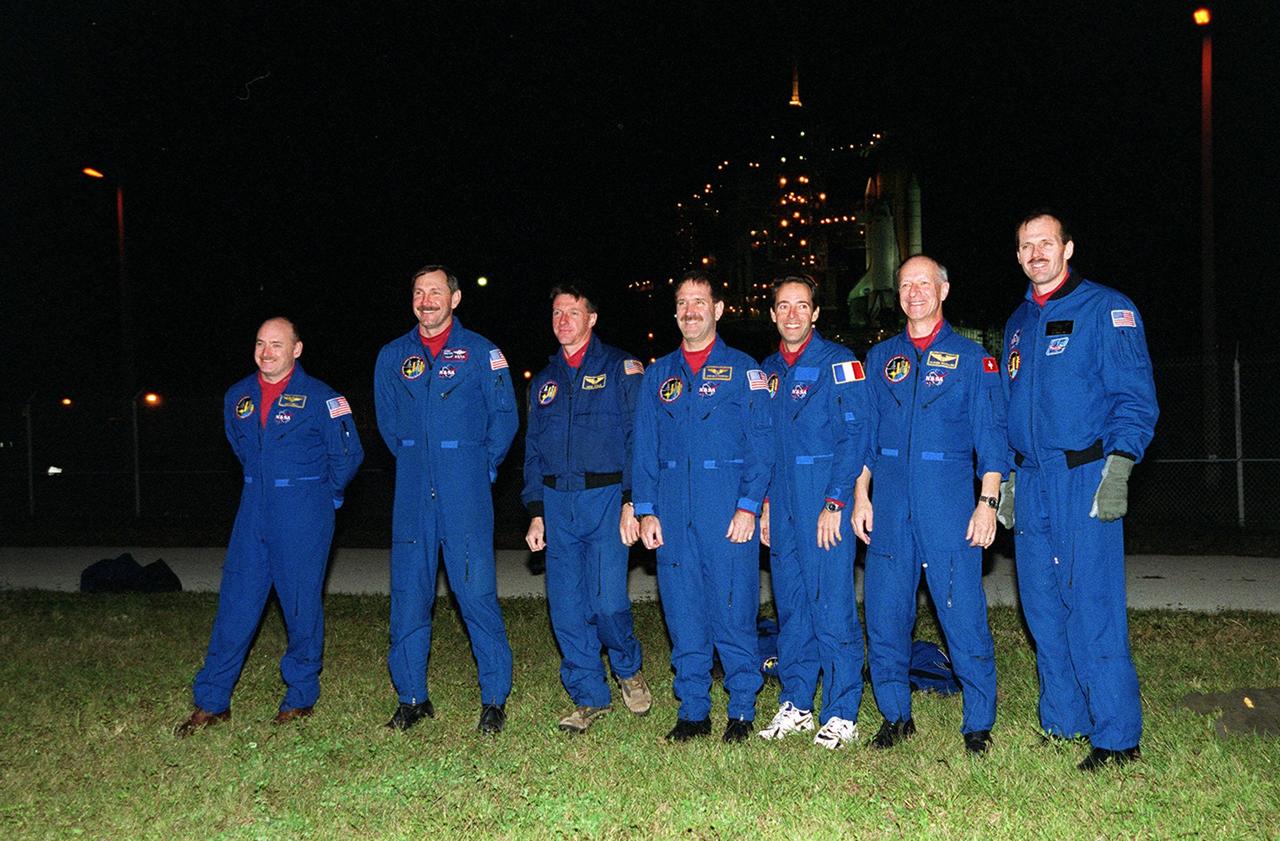
The STS-103 crew address family and friends at Launch Pad 39B. From left to right are Pilot Scott J. Kelly, Commander Curtis L. Brown Jr., and Mission Specialists C. Michael Foale (Ph.D.), John M. Grunsfeld (Ph.D.), Jean-François Clervoy of France , Claude Nicollier of Switzerland and Steven L. Smith. Nicollier and Clervoy are with the European Space Agency. In the background is Space Shuttle Discovery, alongside the lighted Fixed Service Structure. The STS-103 mission, to service the Hubble Space Telescope, is scheduled for launch Dec. 17 at 8:47 p.m. EST from Launch Pad 39B. Mission objectives include replacing gyroscopes and an old computer, installing another solid state recorder, and replacing damaged insulation in the telescope. The mission is expected to last about 8 days and 21 hours. Discovery is expected to land at KSC Sunday, Dec. 26, at about 6:25 p.m. EST
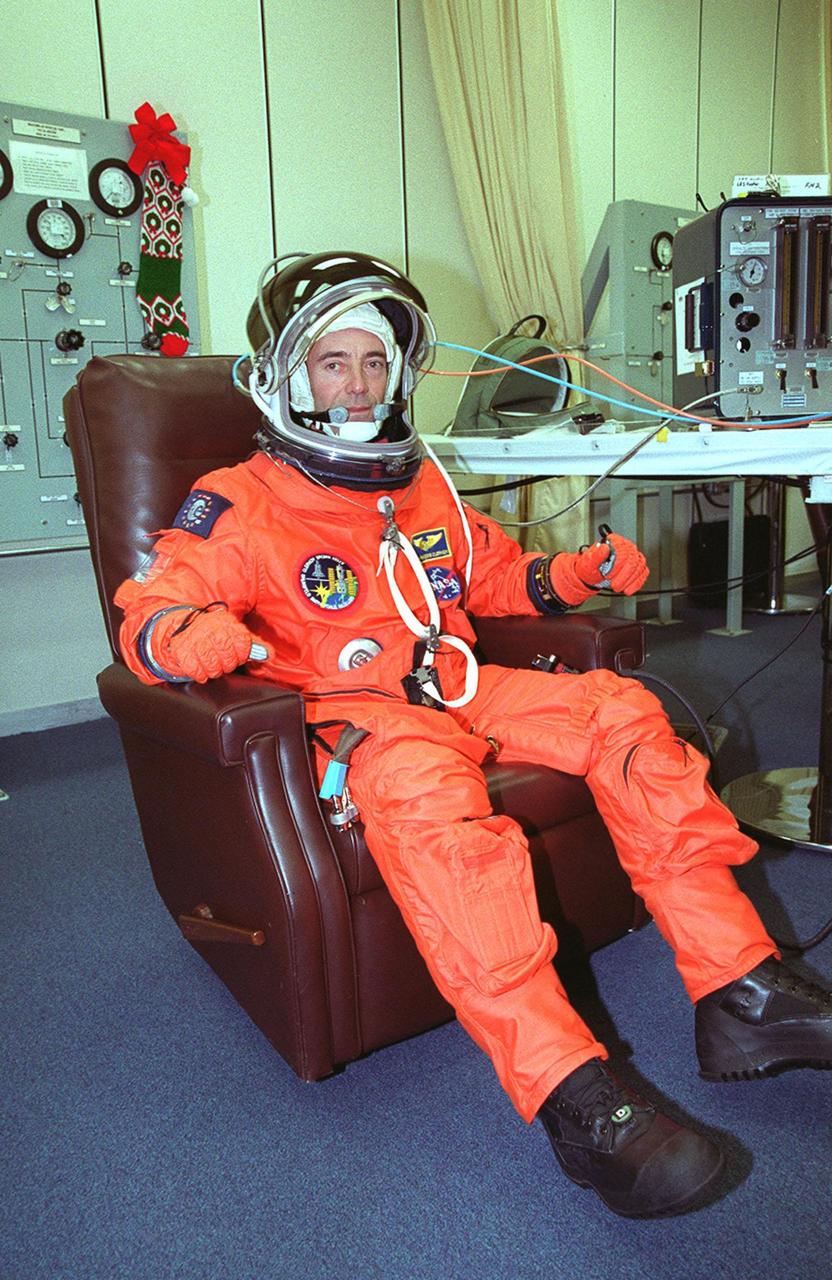
In the Operations and Checkout Building, STS-103 Mission Specialist Jean-François Clervoy of France has donned his launch and entry suit and is ready for launch. Other crew members are Commander Curtis L. Brown Jr., Pilot Scott J. Kelly and Mission Specialists Steven L. Smith, C. Michel Foale (Ph.D.), John M. Grunsfeld (Ph.D.), and Claude Nicollier of Switzerland. Nicollier and Clervoy are with the European Space Agency. The STS-103 mission, to service the Hubble Space Telescope, is scheduled for launch Dec. 17 at 8:47 p.m. EST from Launch Pad 39B. Mission objectives include replacing gyroscopes and an old computer, installing another solid state recorder, and replacing damaged insulation in the telescope. After the 8-day, 21-hour mission, Discovery is expected to land at KSC Sunday, Dec. 26, at about 6:30 p.m. EST
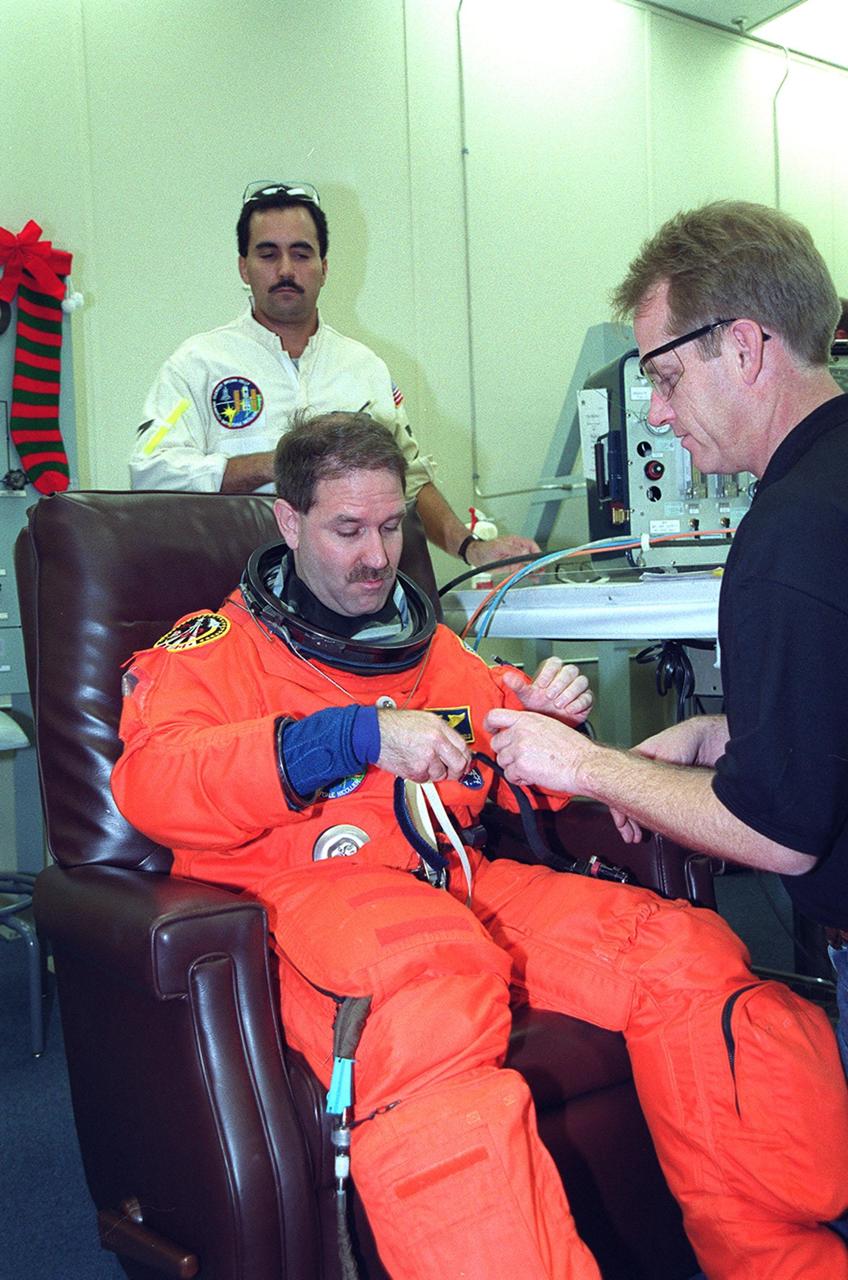
In the Operations and Checkout Building, STS-103 Mission Specialist John M. Grunsfeld (Ph.D.) is assisted by a suit technician in donning his launch and entry suit during final launch preparations. Other crew members are Commander Curtis L. Brown Jr., Pilot Scott J. Kelly and Mission Specialists Steven L. Smith, C. Michael Foale (Ph.D.), Claude Nicollier of Switzerland and Jean-François Clervoy of France. Nicollier and Clervoy are with the European Space Agency. The STS-103 mission, to service the Hubble Space Telescope, is scheduled for launch Dec. 17 at 8:47 p.m. EST from Launch Pad 39B. Mission objectives include replacing gyroscopes and an old computer, installing another solid state recorder, and replacing damaged insulation in the telescope. After the 8-day, 21-hour mission, Discovery is expected to land at KSC Sunday, Dec. 26, at about 6:30 p.m. EST
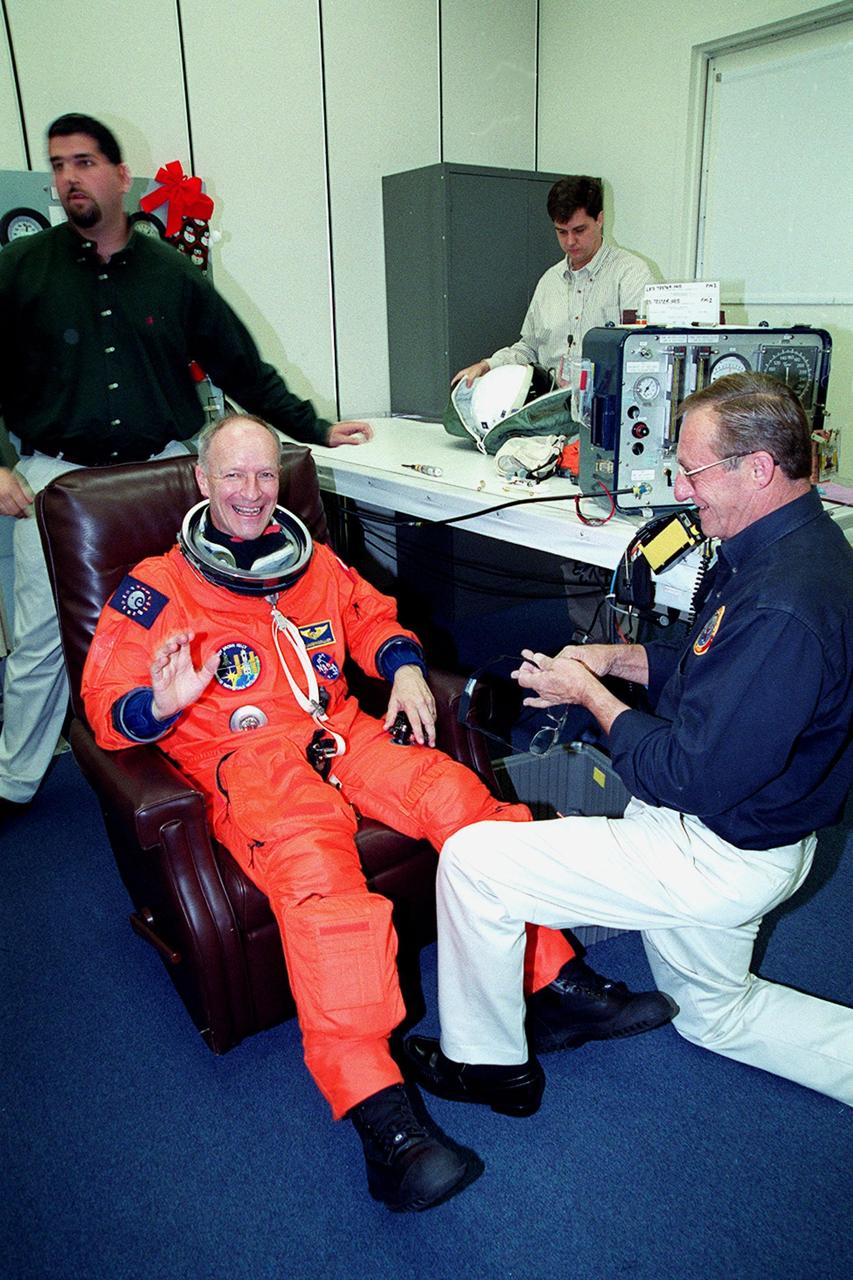
In the Operations and Checkout Building, STS-103 Mission Specialist Claude Nicollier of Switzerland waves while having his launch and entry suit checked by a suit techician during final launch preparations. Other crew members are Commander Curtis L. Brown Jr., Pilot Scott J. Kelly and Mission Specialists Steven L. Smith, C. Michael Foale (Ph.D.), John M. Grunsfeld (Ph.D.) and Jean-François Clervoy of France. Nicollier and Clervoy are with the European Space Agency. The STS-103 mission, to service the Hubble Space Telescope, is scheduled for launch Dec. 17 at 8:47 p.m. EST from Launch Pad 39B. Mission objectives include replacing gyroscopes and an old computer, installing another solid state recorder, and replacing damaged insulation in the telescope. After the 8-day, 21-hour mission, Discovery is expected to land at KSC Sunday, Dec. 26, at about 6:30 p.m. EST
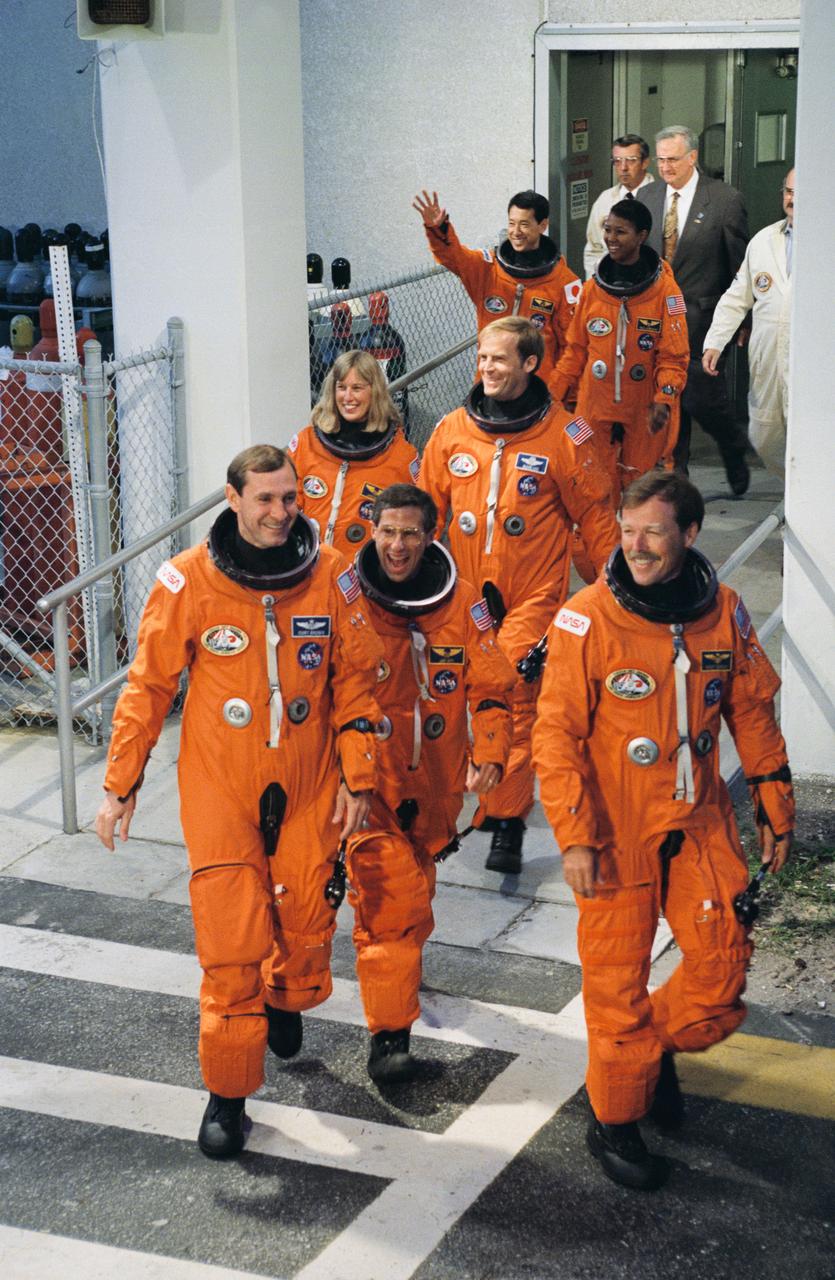
STS047-S-038 (12 Sept 1992) --- The seven crewmembers who will be aboard for Endeavour's second trip into space leave the Operations and Checkout Building to board a van headed for Launch Complex 39. This mission will be devoted to support of the Spacelab-J mission, a joint effort between Japan and the United States. Launch occurred at 10:23:00:0680 a.m. (EDT), September 12, 1992. Onboard were astronauts Robert L. Gibson, mission commander; Curtis L. Brown Jr., pilot; Mark C. Lee, payload commander; and Jerome (Jay) Apt, Mae C. Jemison and N. Jan Davis, mission specialists; along with payload specialist Mamoru Mohri, representing the National Space Development Agency (NASDA) of Japan.
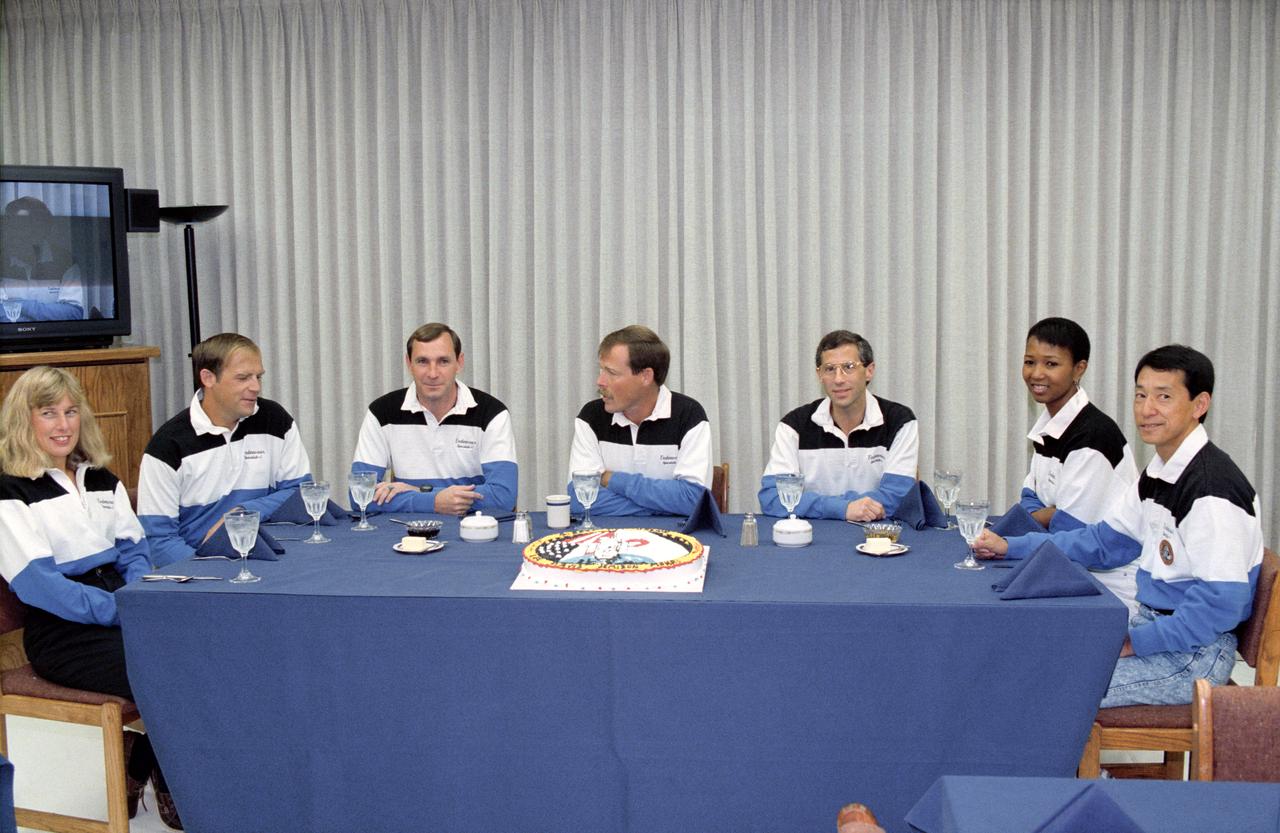
STS047-S-037 (12 Sept 1992) --- The seven crewmembers who will be aboard for Endeavour's second trip into space are about to have a light breakfast prior to the pre-launch suiting up process in the Operations and Checkout Building. Left to right are astronauts N. Jan Davis, Mark C. Lee, Curtis L. Brown Jr., Robert L. Gibson, Jerome (Jay) Apt and Mae C. Jemison; and payload specialist Mamoru Mohri, representing the National Space Development Agency (NASDA) of Japan. This mission will be devoted to support of the Spacelab-J mission, a joint effort between Japan and the United States. Launch occurred at 10:23:00:0680 a.m. (EDT), September 12, 1992.
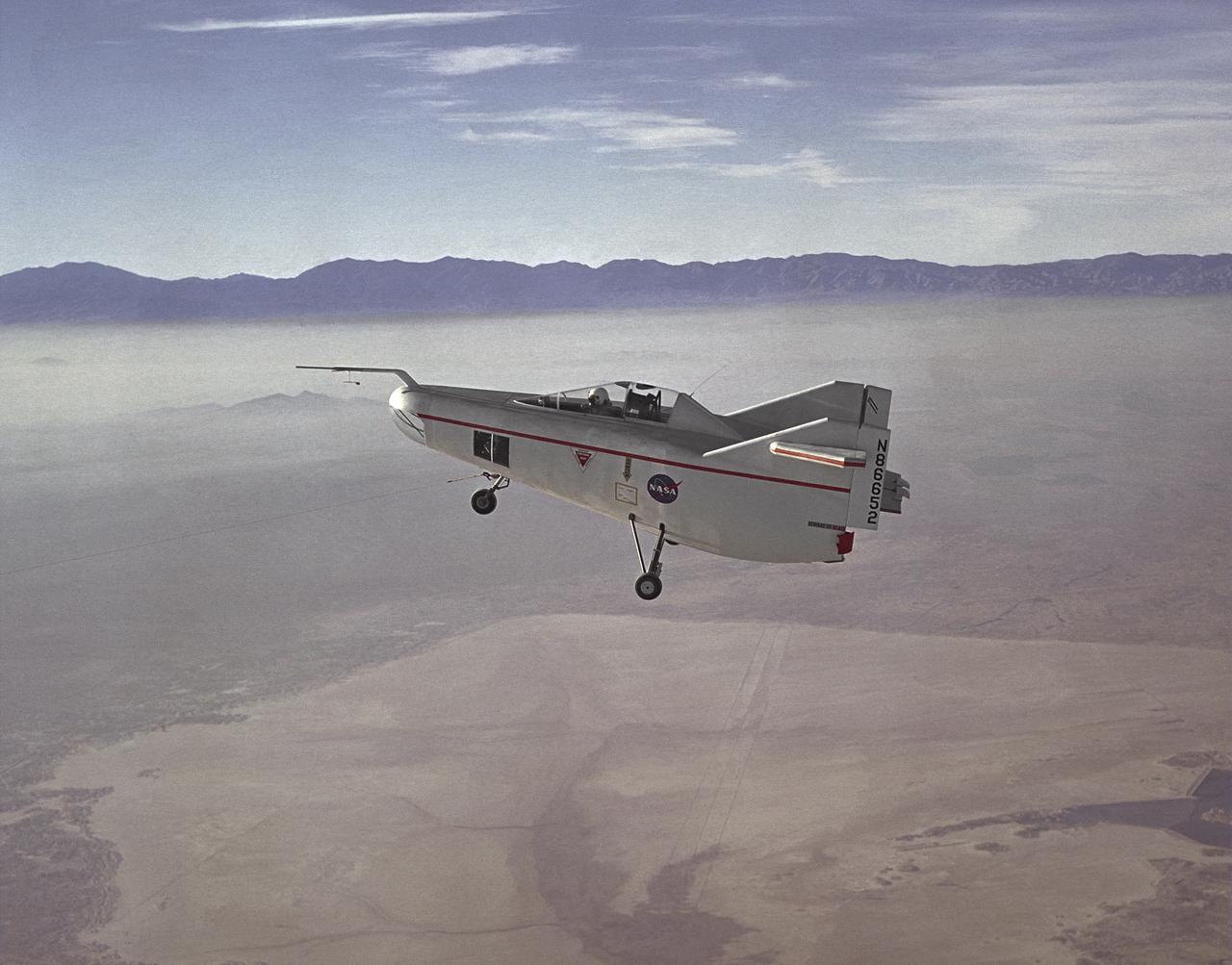
The M2-F1 Lifting Body is seen here under tow, high above Rogers Dry Lake near the Flight Research Center (later redesignated the Dryden Flight Research Center), Edwards, California. R. Dale Reed effectively advocated the project with the support of NASA research pilot Milt Thompson. Together, they gained the support of Flight Research Center Director Paul Bikle. After a six-month feasibility study, Bikle gave approval in the fall of 1962 for the M2-F1 to be built.
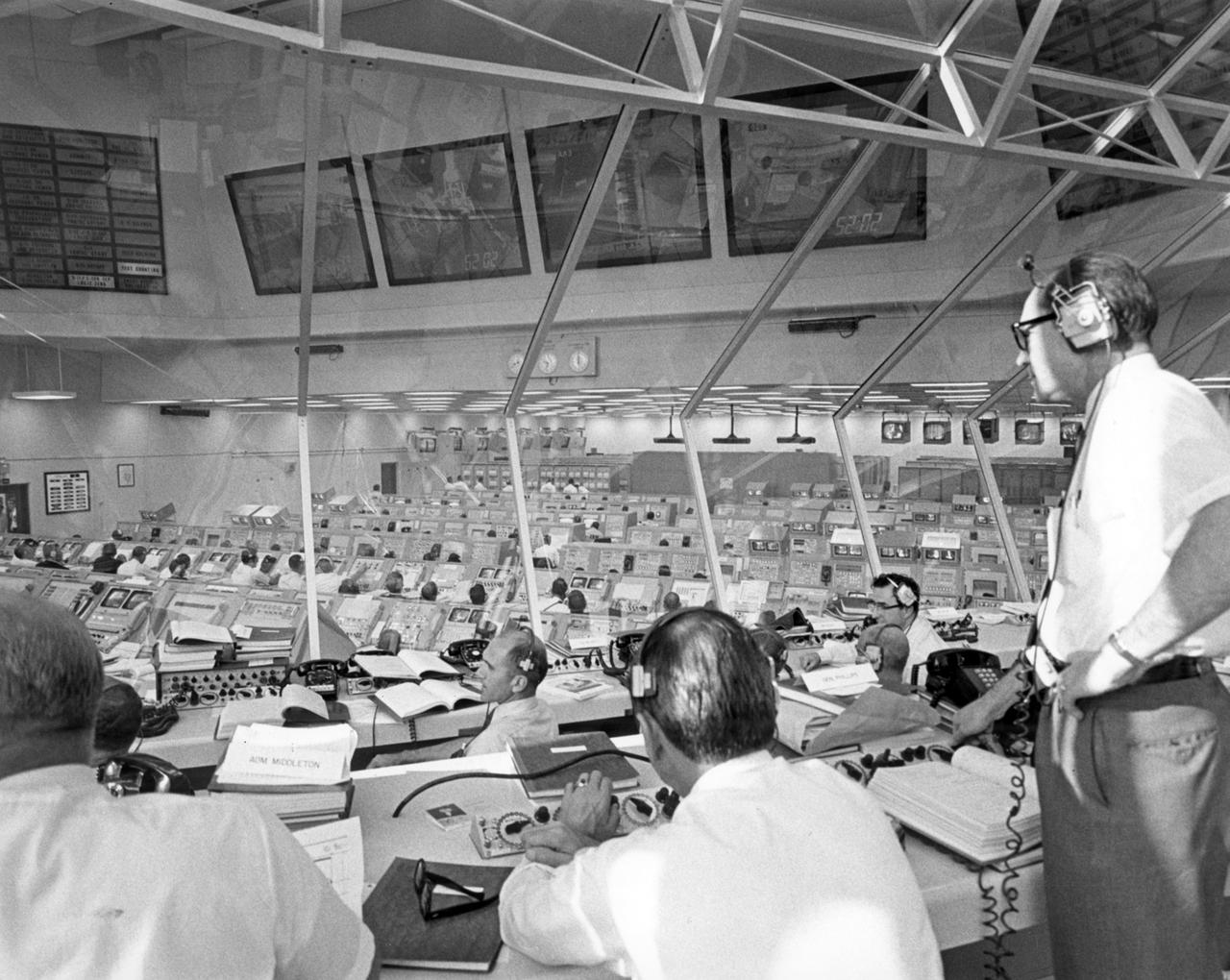
From the Kennedy Space Flight Center (KSC) control room, Apollo Program Director Lieutenant General Samuel C. Phillips monitors pre-launch activities for Apollo 11. The Apollo 11 mission, the first lunar landing mission, launched from the KSC in Florida via the Marshall Space Flight Center (MSFC) developed Saturn V launch vehicle on July 16, 1969 and safely returned to Earth on July 24, 1969. Aboard the space craft were astronauts Neil A. Armstrong, commander; Michael Collins, Command Module (CM) pilot; and Edwin E. (Buzz) Aldrin Jr., Lunar Module (LM) pilot. The CM, “Columbia”, piloted by Collins, remained in a parking orbit around the Moon while the LM, “Eagle’’, carrying astronauts Armstrong and Aldrin, landed on the Moon. On July 20, 1969, Armstrong was the first human to ever stand on the lunar surface, followed by Aldrin. During 2½ hours of surface exploration, the crew collected 47 pounds of lunar surface material for analysis back on Earth. With the success of Apollo 11, the national objective to land men on the Moon and return them safely to Earth had been accomplished.
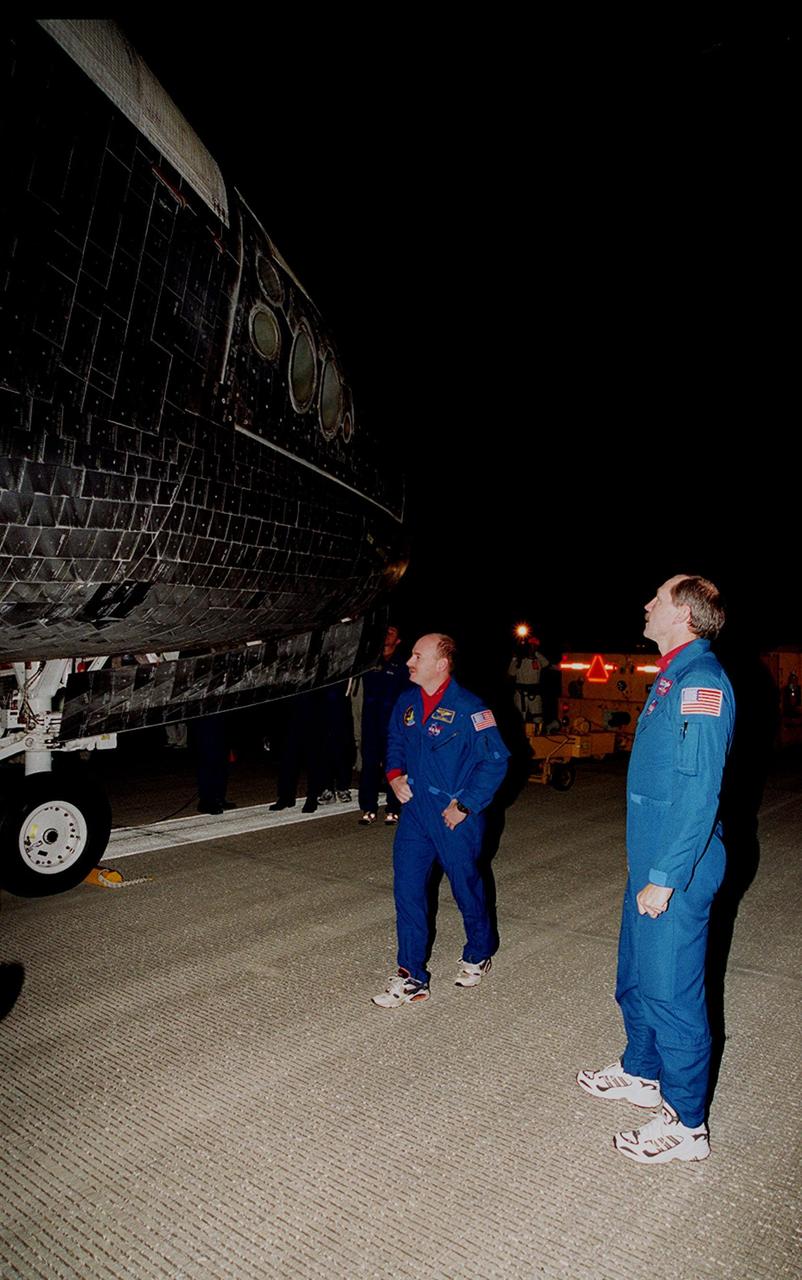
After landing at the Shuttle Landing Facility, STS-103 Pilot Scott J. Kelly (left) and Commander Curtis L. Brown Jr. (right) look at the tiles on orbiter Discovery. They and other crew members Mission Specialists Steven L. Smith, C. Michael Foale (Ph.D.), John M. Grunsfeld (Ph.D.), Jean-Francois Clervoy of France and Claude Nicollier of Switzerland, completed a successful eight-day mission to service the Hubble Space Telescope, spending the Christmas holiday in space in order to accomplish their mission before the end of 1999. During the mission, Discovery's four space-walking astronauts, Smith, Foale, Grunsfeld and Nicollier, spent 24 hours and 33 minutes upgrading and refurbishing Hubble, making it more capable than ever to renew its observations of the universe. Mission objectives included replacing gyroscopes and an old computer, installing another solid state recorder, and replacing damaged insulation in the telescope. Hubble was released from the end of Discovery's robot arm on Christmas Day. Main gear touchdown was at 7:00:47 p.m. EST. Nose gear touchdown occurred at 7:00:58 p.m. EST and wheel stop at 7:01:34 p.m. EST. This was the 96th flight in the Space Shuttle program and the 27th for the orbiter Discovery. The landing was the 20th consecutive Shuttle landing in Florida and the 13th night landing in Shuttle program history
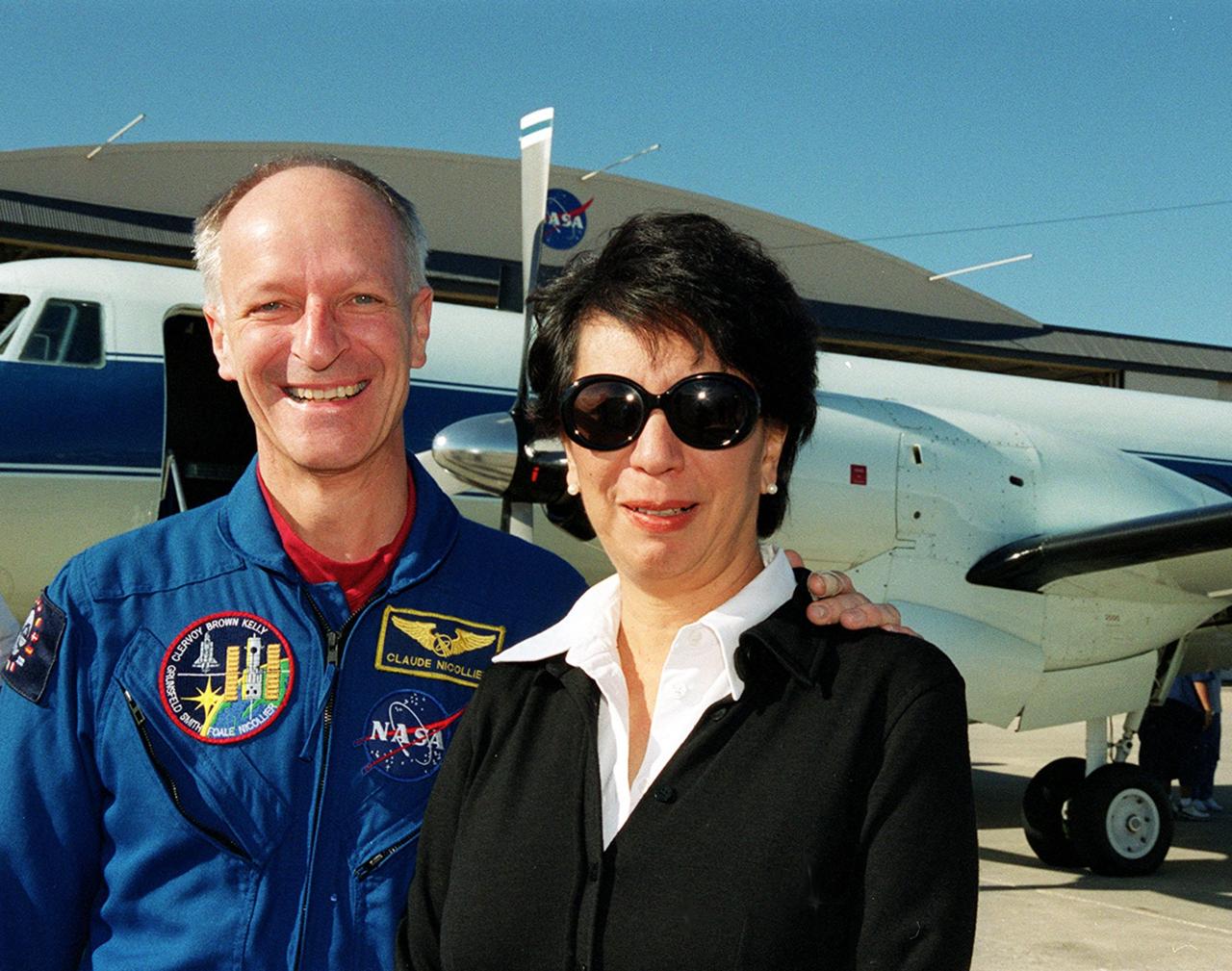
STS-103 Mission Specialist Claude Nicollier of Switzerland and his wife, Susana, beam at the camera on the runway at Patrick Air Force Base. The STS-103 crew and their families are preparing to board an airplane that will return them to their home base at the Johnson Space Center in Houston following the successful completion of their mission. Discovery landed in darkness the previous evening, Dec. 27, on runway 33 at KSC's Shuttle Landing Facility at 7:00:47 p.m. EST. This was the first time that a Shuttle crew spent the Christmas holiday in space. The other STS-103 crew members are Commander Curtis L. Brown Jr.; Pilot Scott J. Kelly; and Mission Specialists Steven L. Smith, C. Michael Foale (Ph.D.), John M. Grunsfeld (Ph.D.), and Jean-François Clervoy of France. The STS-103 mission supplied the Hubble Space Telescope with six new gyroscopes, six new voltage/temperature improvement kits, a new onboard computer, a new solid state recorder and new data transmitter, and a new fine guidance sensor along with new insulation on parts of the orbiting telescope. This was the 96th flight in the Space Shuttle program and the 27th for the orbiter Discovery
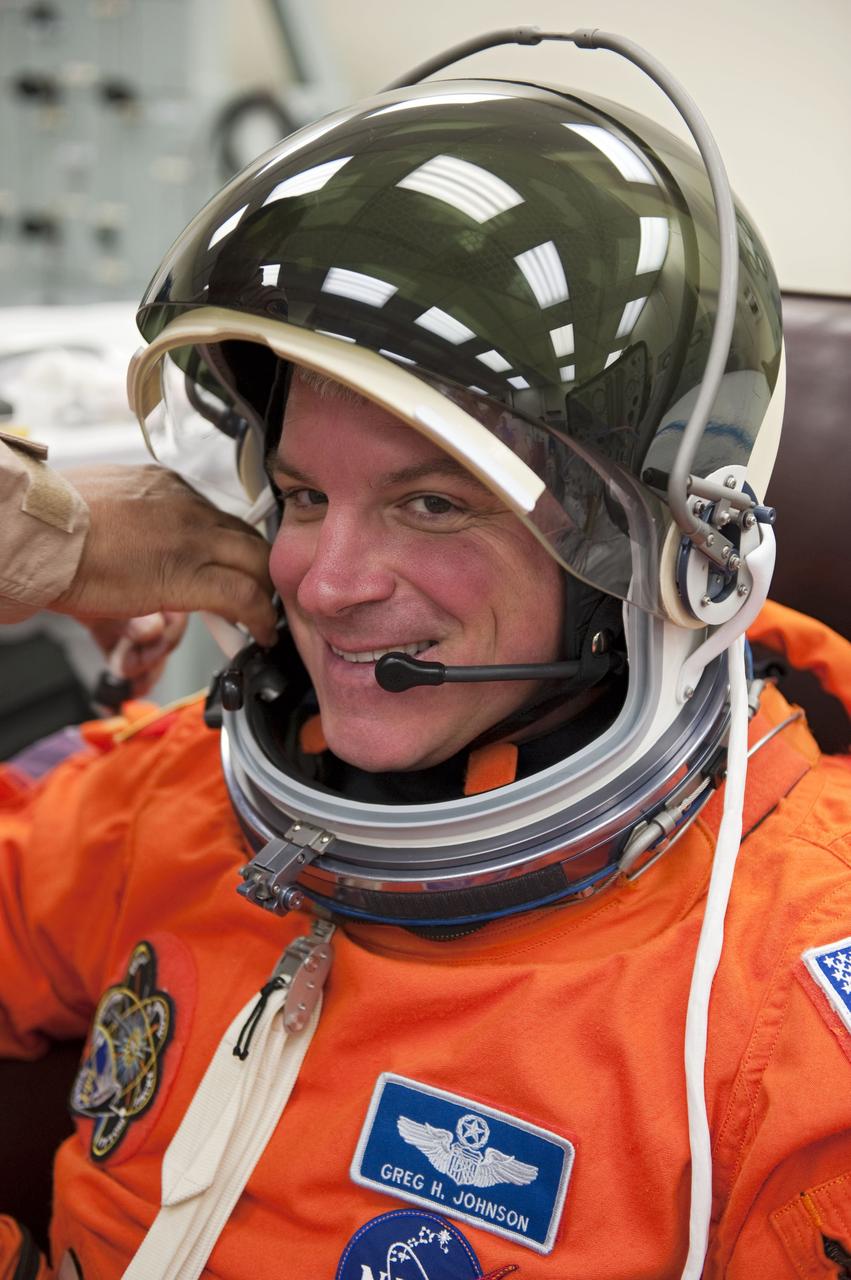
CAPE CANAVERAL, Fla. -- In the Operations and Checkout Building (O&C) at NASA's Kennedy Space Center in Florida, space shuttle Endeavour's STS-134 astronauts put on their launch-and-entry suits and check the fit of their helmets and gloves before heading to the Astrovan for the ride to Launch Pad 39A. Pilot Greg H. Johnson, seen here, last piloted space shuttle Endeavour during its STS-123 mission in 2008. STS-134 will deliver the Express Logistics Carrier-3, Alpha Magnetic Spectrometer-2 (AMS), a high-pressure gas tank and additional spare parts for the Dextre robotic helper to the space station. Endeavour was scheduled to launch at 3:47 p.m. on April 29, but that attempt was scrubbed for at least 72 hours while engineers assess an issue associated with the shuttle's Auxiliary Power Unit 1. STS-134 will be the final spaceflight for Endeavour. For more information visit, www.nasa.gov/mission_pages/shuttle/shuttlemissions/sts134/index.html. Photo credit: NASA/Kim Shiflett
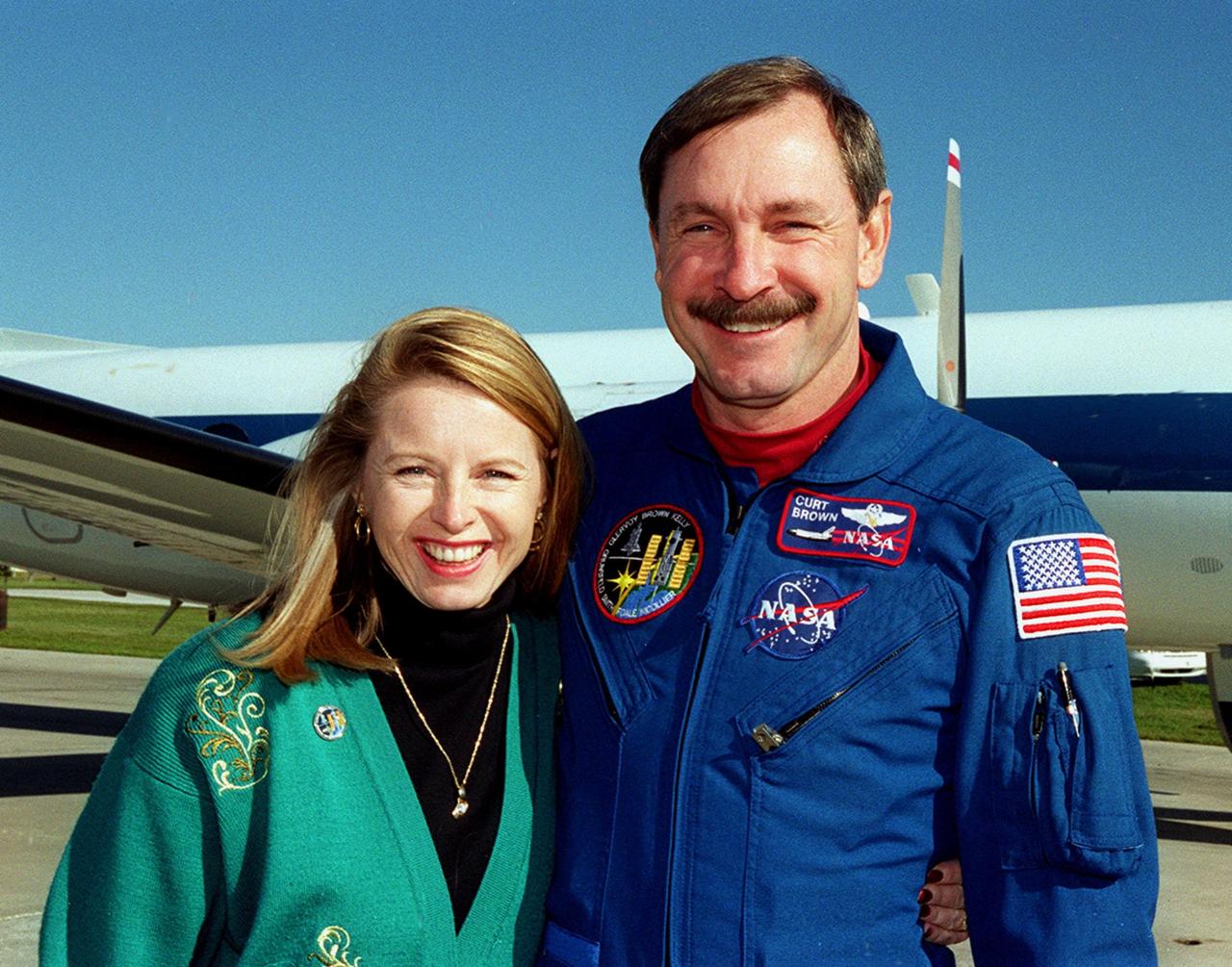
STS-103 Commander Curtis L. Brown Jr. and his fiancee, Ann Brickert, smile for the camera on the runway at Patrick Air Force Base. The STS-103 crew and their families are preparing to board an airplane that will return them to their home base at the Johnson Space Center in Houston following the successful completion of their mission. Discovery landed in darkness the previous evening, Dec. 27, on runway 33 at KSC's Shuttle Landing Facility at 7:00:47 p.m. EST. This was the first time that a Shuttle crew spent the Christmas holiday in space. The other STS-103 crew members are Pilot Scott J. Kelly and Mission Specialists Steven L. Smith, C. Michael Foale (Ph.D.), John M. Grunsfeld (Ph.D.), Claude Nicollier of Switzerland and Jean-François Clervoy of France. The STS-103 mission supplied the Hubble Space Telescope with six new gyroscopes, six new voltage/temperature improvement kits, a new onboard computer, a new solid state recorder and new data transmitter, and a new fine guidance sensor along with new insulation on parts of the orbiting telescope. This was the 96th flight in the Space Shuttle program and the 27th for the orbiter Discovery
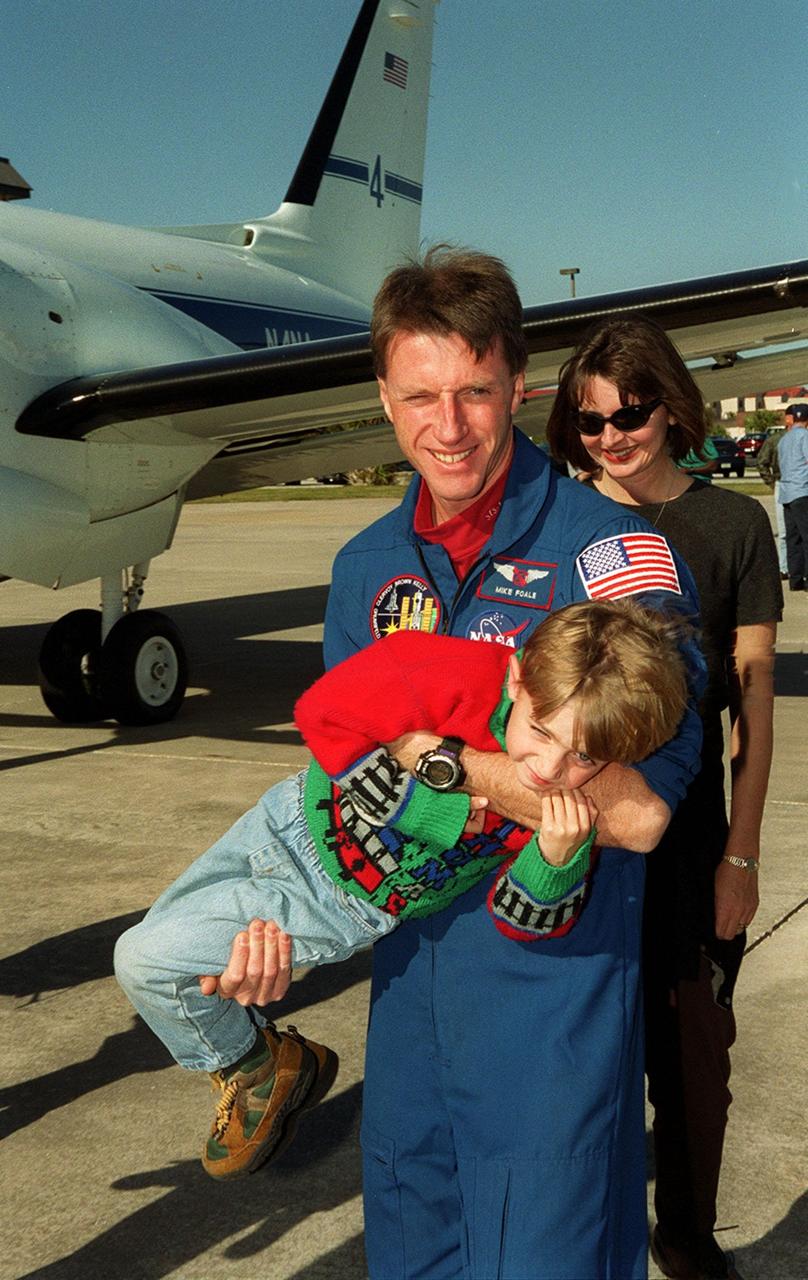
STS-103 Mission Specialist C. Michael Foale (Ph.D.) holds one of his children on the runway at Patrick Air Force Base, as his wife, Rhonda, looks on. The STS-103 crew and their families are preparing to board an airplane that will return them to their home base at the Johnson Space Center in Houston following the successful completion of their mission. Discovery landed in darkness the previous evening, Dec. 27, on runway 33 at KSC's Shuttle Landing Facility at 7:00:47 p.m. EST. This was the first time that a Shuttle crew spent the Christmas holiday in space. The other STS-103 crew members are Commander Curtis L. Brown Jr.; Pilot Scott J. Kelly; and Mission Specialists Steven L. Smith, John M. Grunsfeld (Ph.D.), Claude Nicollier of Switzerland and Jean-François Clervoy of France. The STS-103 mission supplied the Hubble Space Telescope with six new gyroscopes, six new voltage/temperature improvement kits, a new onboard computer, a new solid state recorder and new data transmitter, and a new fine guidance sensor along with new insulation on parts of the orbiting telescope. This was the 96th flight in the Space Shuttle program and the 27th for the orbiter Discovery
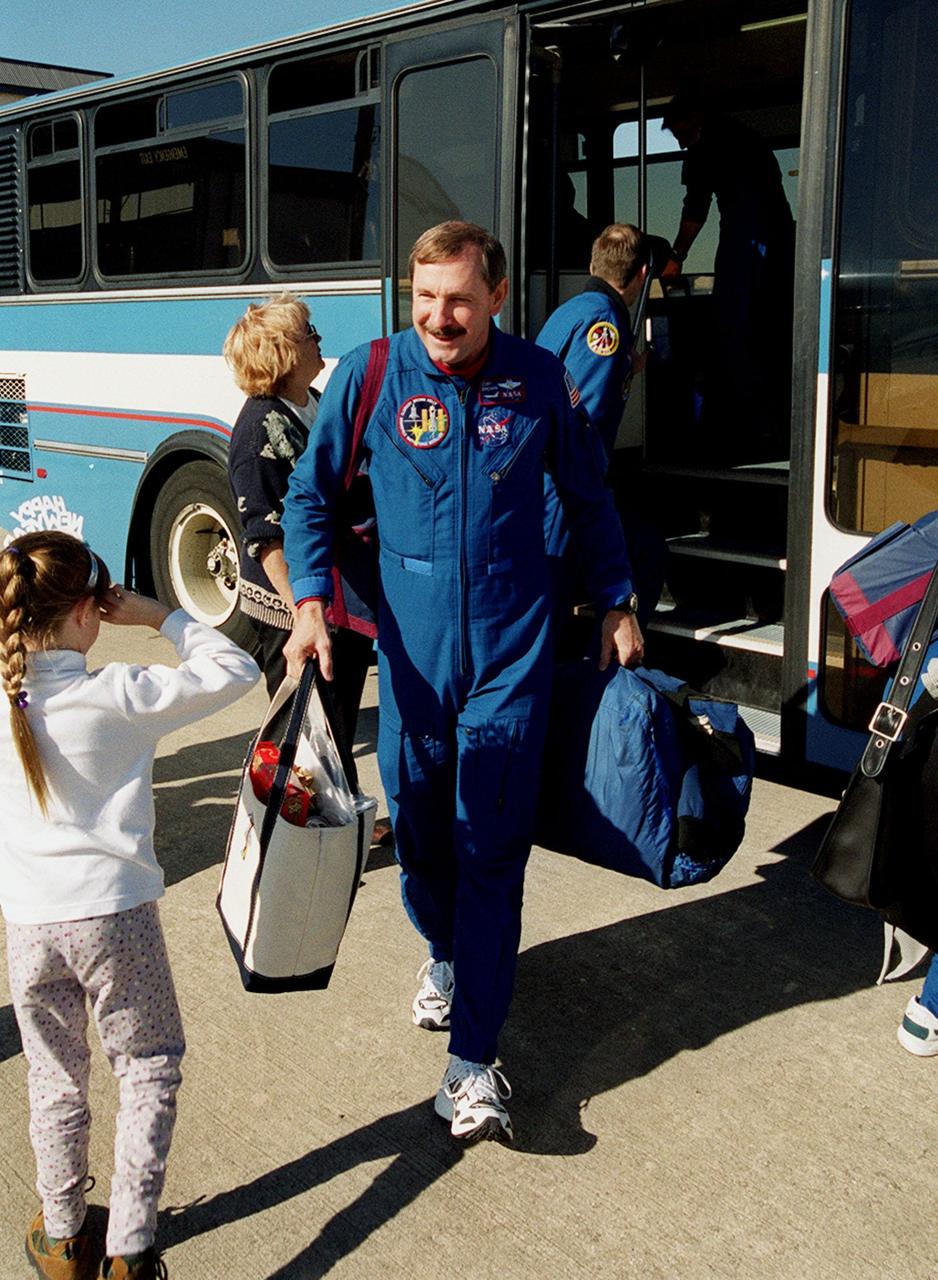
Amid a flurry of activity, STS-103 Commander Curtis L. Brown Jr. disembarks from the bus which brought him to the runway at Patrick Air Force Base. The STS-103 crew and their families are preparing to board an airplane that will return them to their home base at the Johnson Space Center in Houston following the successful completion of their mission. Discovery landed in darkness the previous evening, Dec. 27, on runway 33 at KSC's Shuttle Landing Facility at 7:00:47 p.m. EST. This was the first time that a Shuttle crew spent the Christmas holiday in space. The other STS-103 crew members are Pilot Scott J. Kelly and Mission Specialists Steven L. Smith, C. Michael Foale (Ph.D.), John M. Grunsfeld (Ph.D.), Claude Nicollier of Switzerland and Jean-François Clervoy of France. The STS-103 mission supplied the Hubble Space Telescope with six new gyroscopes, six new voltage/temperature improvement kits, a new onboard computer, a new solid state recorder and new data transmitter, and a new fine guidance sensor along with new insulation on parts of the orbiting telescope. This was the 96th flight in the Space Shuttle program and the 27th for the orbiter Discovery
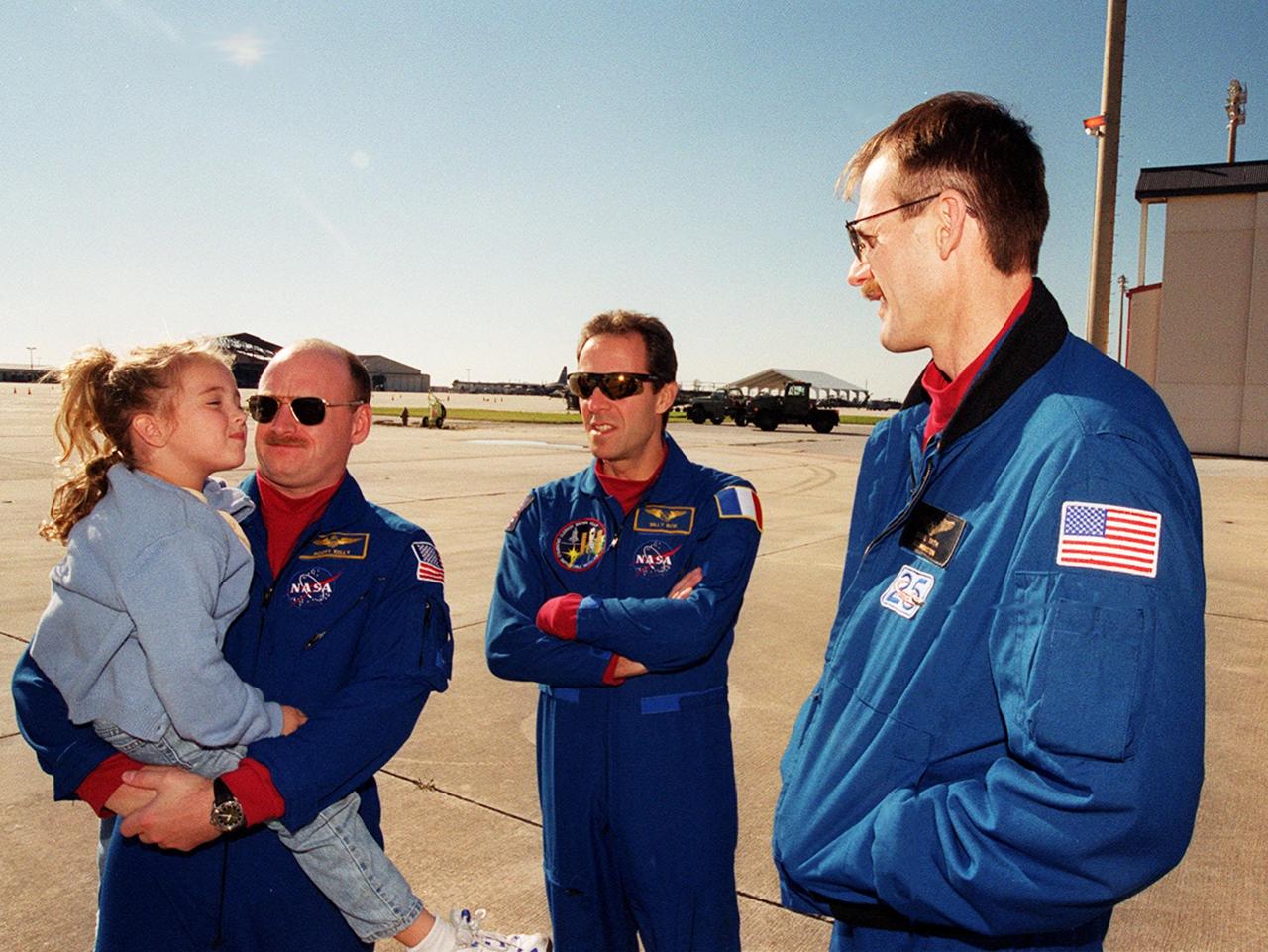
STS-103 Pilot Scott J. Kelly holds his daughter as he talks to Mission Specialists and fellow crew members Jean-François Clervoy of France and Steven L. Smith on the runway at Patrick Air Force Base. The STS-103 crew and their families are preparing to board an airplane that will return them to their home base at the Johnson Space Center in Houston following the successful completion of their mission. Discovery landed in darkness the previous evening, Dec. 27, on runway 33 at KSC's Shuttle Landing Facility at 7:00:47 p.m. EST. This was the first time that a Shuttle crew spent the Christmas holiday in space. The other STS-103 crew members are Commander Curtis L. Brown Jr. and Mission Specialists C. Michael Foale (Ph.D.), John M. Grunsfeld (Ph.D.), and Claude Nicollier of Switzerland. The STS-103 mission supplied the Hubble Space Telescope with six new gyroscopes, six new voltage/temperature improvement kits, a new onboard computer, a new solid state recorder and new data transmitter, and a new fine guidance sensor along with new insulation on parts of the orbiting telescope. This was the 96th flight in the Space Shuttle program and the 27th for the orbiter Discovery
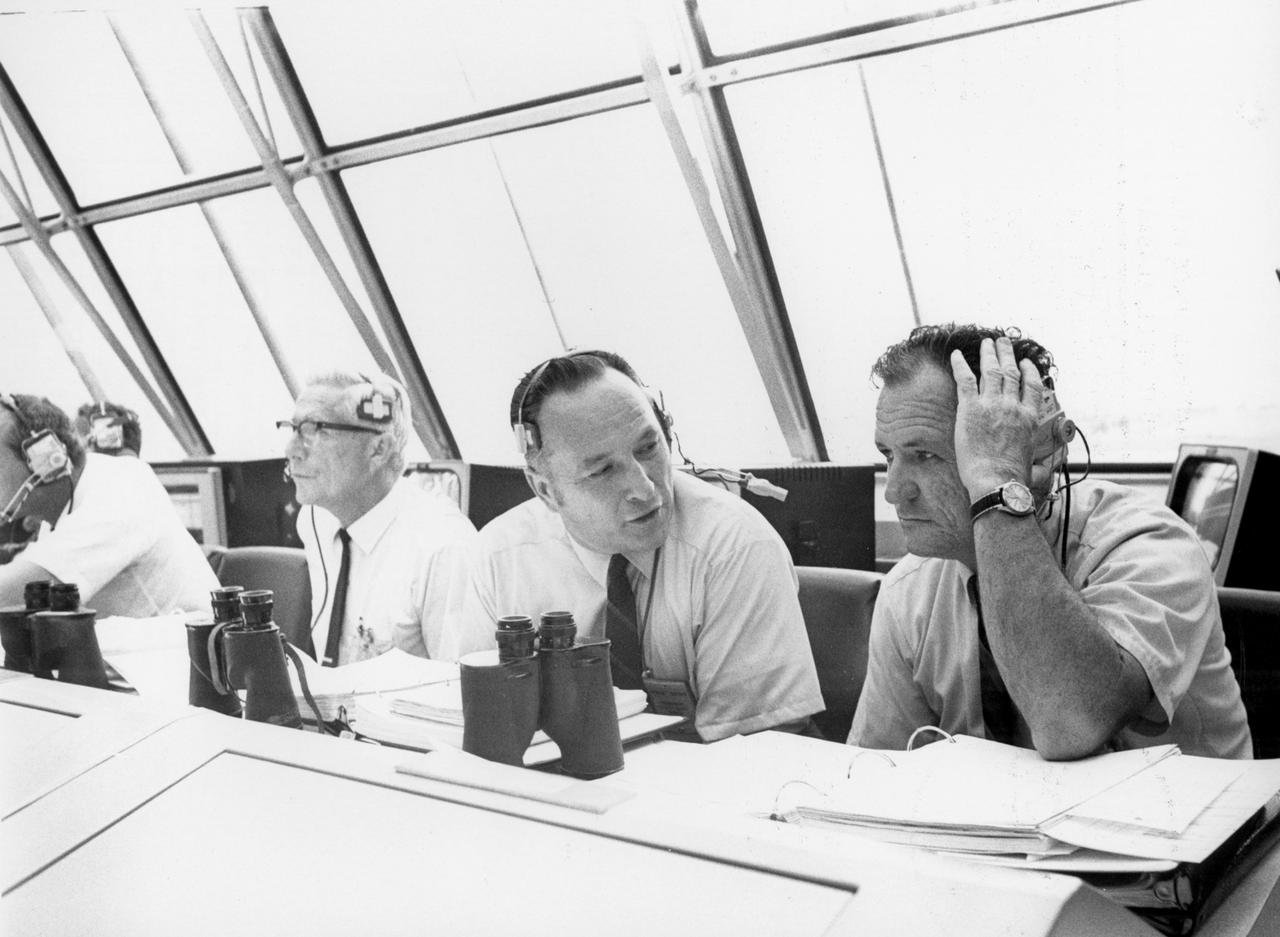
Lee B. James (left), manager of the Saturn Program at the Marshall Space flight Center (MSFC), talks with Isom Pigell in the firing room 1 of the Kennedy Space Center (KSC) control center during the countdown demonstration test for the Apollo 11 mission. At left is Dr. Hans C. Gruen of KSC. The Apollo 11 mission, the first lunar landing mission, launched from the KSC in Florida via the MSFC developed Saturn V launch vehicle on July 16, 1969 and safely returned to Earth on July 24, 1969. Aboard the space craft were astronauts Neil A. Armstrong, commander; Michael Collins, Command Module (CM) pilot; and Edwin E. (Buzz) Aldrin Jr., Lunar Module (LM) pilot. The CM, “Columbia”, piloted by Collins, remained in a parking orbit around the Moon while the LM, “Eagle’’, carrying astronauts Armstrong and Aldrin, landed on the Moon. On July 20, 1969, Armstrong was the first human to ever stand on the lunar surface, followed by Aldrin. During 2½ hours of surface exploration, the crew collected 47 pounds of lunar surface material for analysis back on Earth. With the success of Apollo 11, the national objective to land men on the Moon and return them safely to Earth had been accomplished.
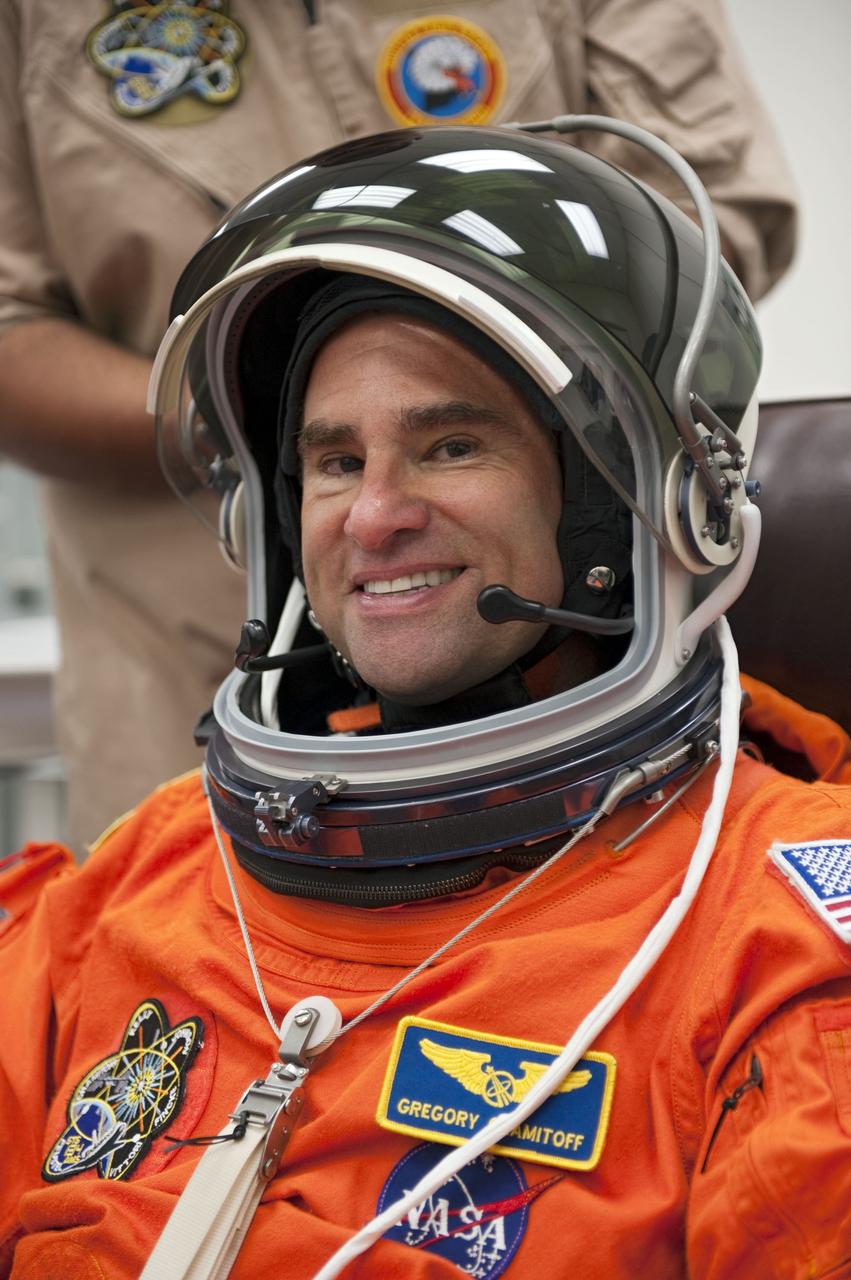
CAPE CANAVERAL, Fla. -- In the Operations and Checkout Building (O&C) at NASA's Kennedy Space Center in Florida, space shuttle Endeavour's STS-134 astronauts put on their launch-and-entry suits and check the fit of their helmets and gloves before heading to the Astrovan for the ride to Launch Pad 39A. Mission Specialist Greg Chamitoff, seen here, last served as flight engineer and science officer aboard the International Space Station in 2008. STS-134 will deliver the Express Logistics Carrier-3, Alpha Magnetic Spectrometer-2 (AMS), a high-pressure gas tank and additional spare parts for the Dextre robotic helper to the space station. Endeavour was scheduled to launch at 3:47 p.m. on April 29, but that attempt was scrubbed for at least 72 hours while engineers assess an issue associated with the shuttle's Auxiliary Power Unit 1. STS-134 will be the final spaceflight for Endeavour. For more information visit, www.nasa.gov/mission_pages/shuttle/shuttlemissions/sts134/index.html. Photo credit: NASA/Kim Shiflett

In the Operations and Checkout Building, STS-103 Mission Specialist C. Michel Foale (Ph.D.) smiles as a suit technician helps him don his launch and entry suit during final launch preparations. Other crew members are Commander Curtis L. Brown Jr., Pilot Scott J. Kelly and Mission Specialists Steven L. Smith, John M. Grunsfeld (Ph.D.), Claude Nicollier of Switzerland and Jean-François Clervoy of France. Nicollier and Clervoy are with the European Space Agency. The STS-103 mission, to service the Hubble Space Telescope, is scheduled for launch Dec. 17 at 8:47 p.m. EST from Launch Pad 39B. Mission objectives include replacing gyroscopes and an old computer, installing another solid state recorder, and replacing damaged insulation in the telescope. After the 8-day, 21-hour mission, Discovery is expected to land at KSC Sunday, Dec. 26, at about 6:30 p.m. EST.is expected to land at KSC Sunday, Dec. 26, at about 6:30 p.m. EST

STS-103 Mission Specialist John M. Grunsfeld (Ph.D.), with his wife, Carol, and their children, smiles for the camera on the runway at Patrick Air Force Base. The STS-103 crew and their families are preparing to board an airplane that will return them to their home base at the Johnson Space Center in Houston following the successful completion of their mission. Discovery landed in darkness the previous evening, Dec. 27, on runway 33 at KSC's Shuttle Landing Facility at 7:00:47 p.m. EST. This was the first time that a Shuttle crew spent the Christmas holiday in space. The other STS-103 crew members are Commander Curtis L. Brown Jr.; Pilot Scott J. Kelly; and Mission Specialists Steven L. Smith, C. Michael Foale (Ph.D.), Claude Nicollier of Switzerland and Jean-François Clervoy of France. The STS-103 mission supplied the Hubble Space Telescope with six new gyroscopes, six new voltage/temperature improvement kits, a new onboard computer, a new solid state recorder and new data transmitter, and a new fine guidance sensor along with new insulation on parts of the orbiting telescope. This was the 96th flight in the Space Shuttle program and the 27th for the orbiter Discovery
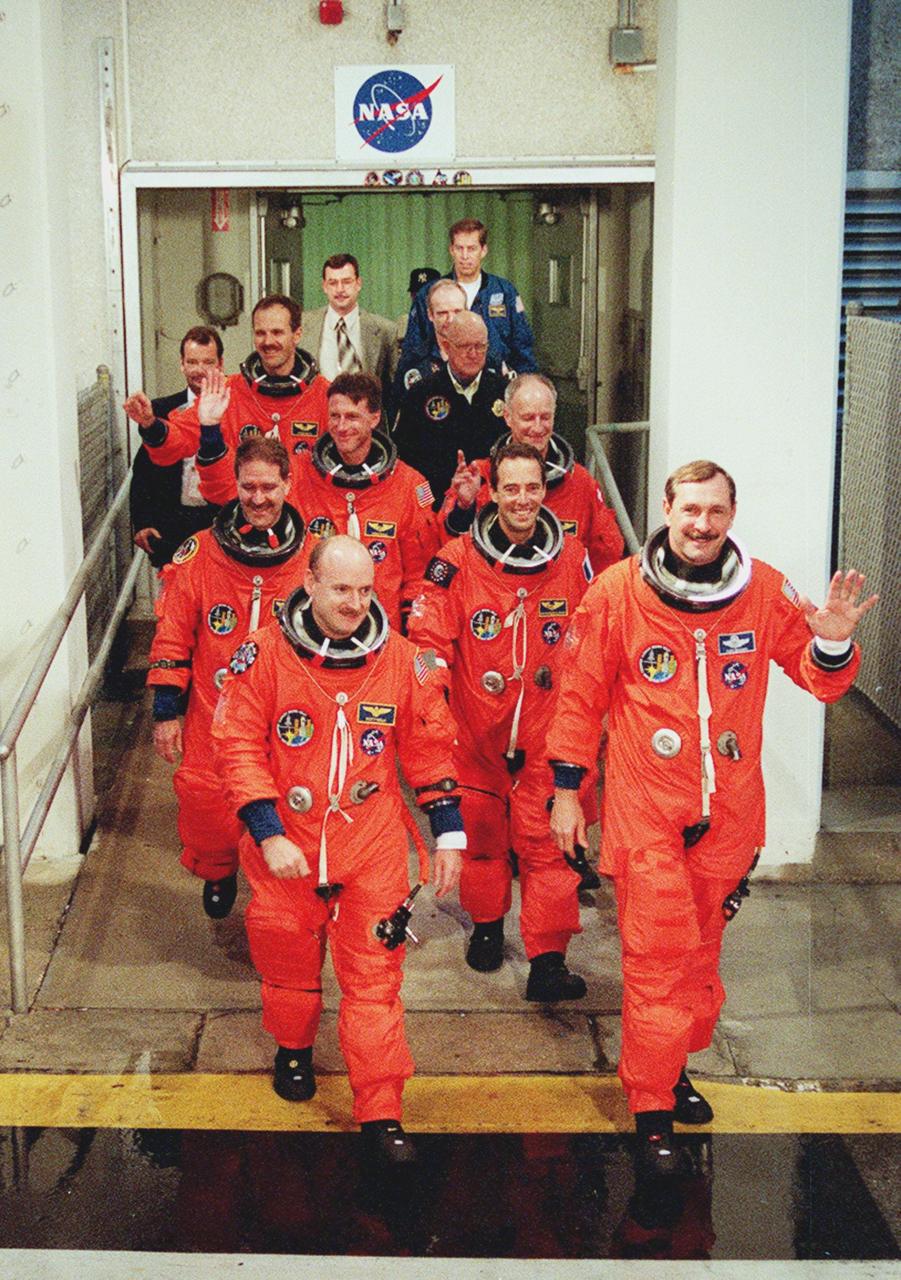
The STS-103 crew smile and wave to onlookers as they walk out of the Operations and Checkout Building enroute to Launch Pad 39B and liftoff of Space Shuttle Discovery. In their orange launch and entry suits, they are (front row) Pilot Scott J. Kelly and Commander Curtis L. Brown Jr., (second row) Mission Specialists John M. Grunsfeld (Ph.D.) and Jean-Francois Clervoy of France, (third row) C. Michael Foale (Ph. D.) and Claude Nicollier of Switzerland, and bringing up the rear, Steven L. Smith. The STS-103 mission, to service the Hubble Space Telescope, is scheduled for launch Dec. 17 at 8:47 p.m. EST from Launch Pad 39B. Mission objectives include replacing gyroscopes and an old computer, installing another solid state recorder, and replacing damaged insulation in the telescope. After the 8-day, 21-hour mission, Discovery is expected to land at KSC Sunday, Dec. 26, at about 6:30 p.m. EST
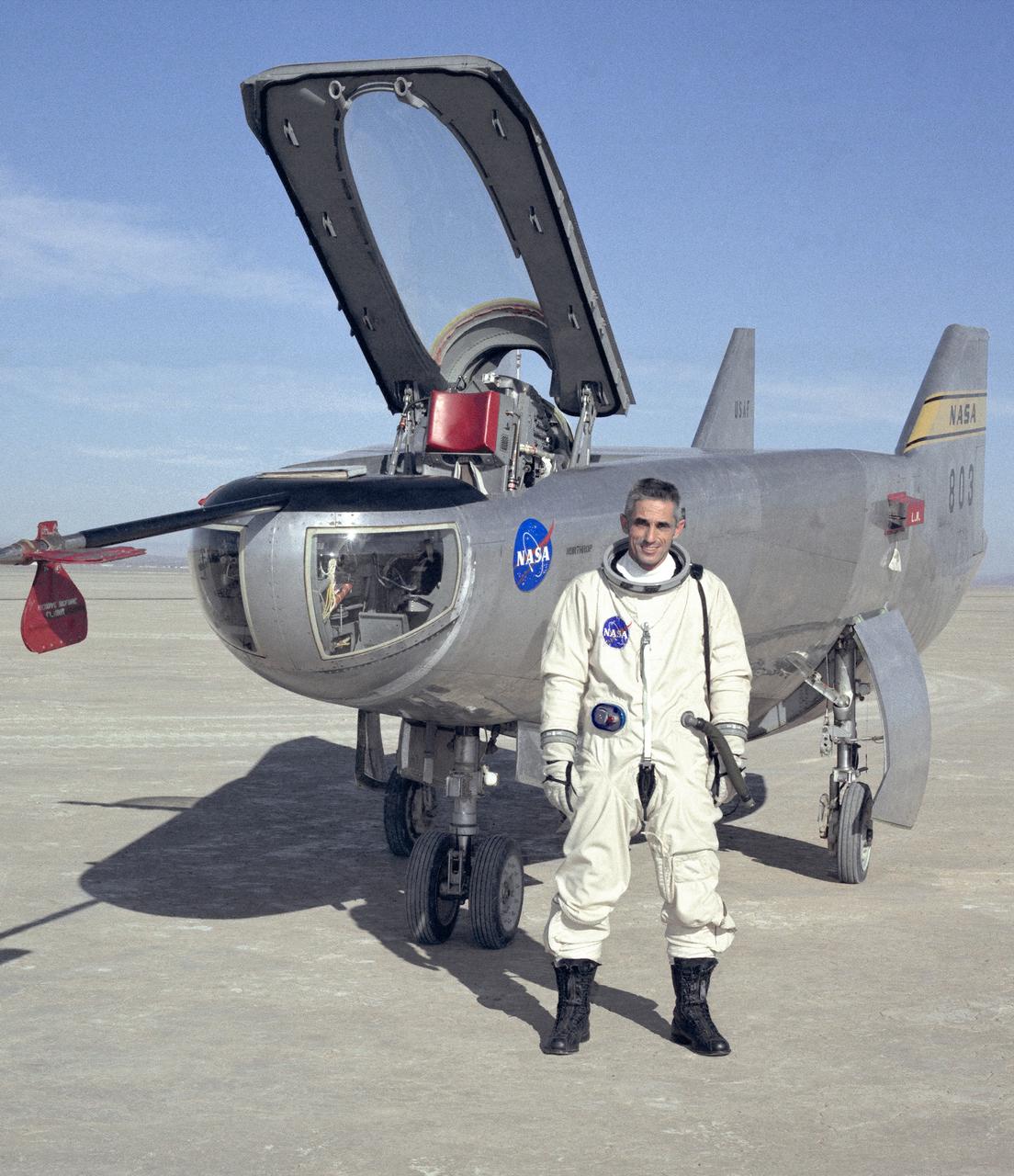
NASA research pilot John A. Manke is seen here in front of the M2-F3 Lifting Body. Manke was hired by NASA on May 25, 1962, as a flight research engineer. He was later assigned to the pilot's office and flew various support aircraft including the F-104, F5D, F-111 and C-47. After leaving the Marine Corps in 1960, Manke worked for Honeywell Corporation as a test engineer for two years before coming to NASA. He was project pilot on the X-24B and also flew the HL-10, M2-F3, and X-24A lifting bodies. John made the first supersonic flight of a lifting body and the first landing of a lifting body on a hard surface runway. Manke served as Director of the Flight Operations and Support Directorate at the Dryden Flight Research Center prior to its integration with Ames Research Center in October 1981. After this date John was named to head the joint Ames-Dryden Directorate of Flight Operations. He also served as site manager of the NASA Ames-Dryden Flight Research Facility. John is a member of the Society of Experimental Test Pilots. He retired on April 27, 1984.
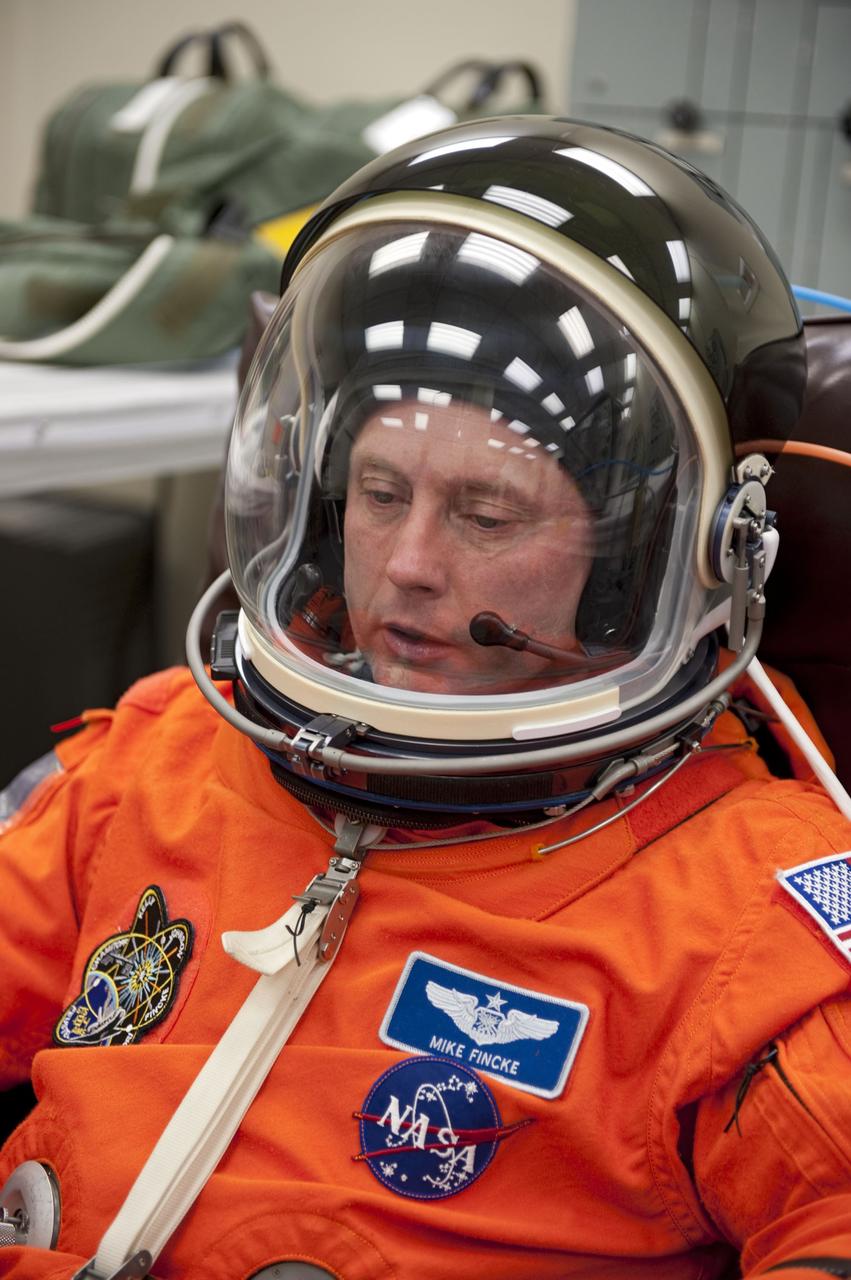
CAPE CANAVERAL, Fla. -- In the Operations and Checkout Building (O&C) at NASA's Kennedy Space Center in Florida, space shuttle Endeavour's STS-134 astronauts put on their launch-and-entry suits and check the fit of their helmets and gloves before heading to the Astrovan for the ride to Launch Pad 39A. Mission Specialist Michael Fincke, seen here, last served as a member of the Expedition 18 crew of the International Space Station in 2009. This will be Fincke's first flight aboard a space shuttle. STS-134 will deliver the Express Logistics Carrier-3, Alpha Magnetic Spectrometer-2 (AMS), a high-pressure gas tank and additional spare parts for the Dextre robotic helper to the space station. Endeavour was scheduled to launch at 3:47 p.m. on April 29, but that attempt was scrubbed for at least 72 hours while engineers assess an issue associated with the shuttle's Auxiliary Power Unit 1. STS-134 will be the final spaceflight for Endeavour. For more information visit, www.nasa.gov/mission_pages/shuttle/shuttlemissions/sts134/index.html. Photo credit: NASA/Kim Shiflett
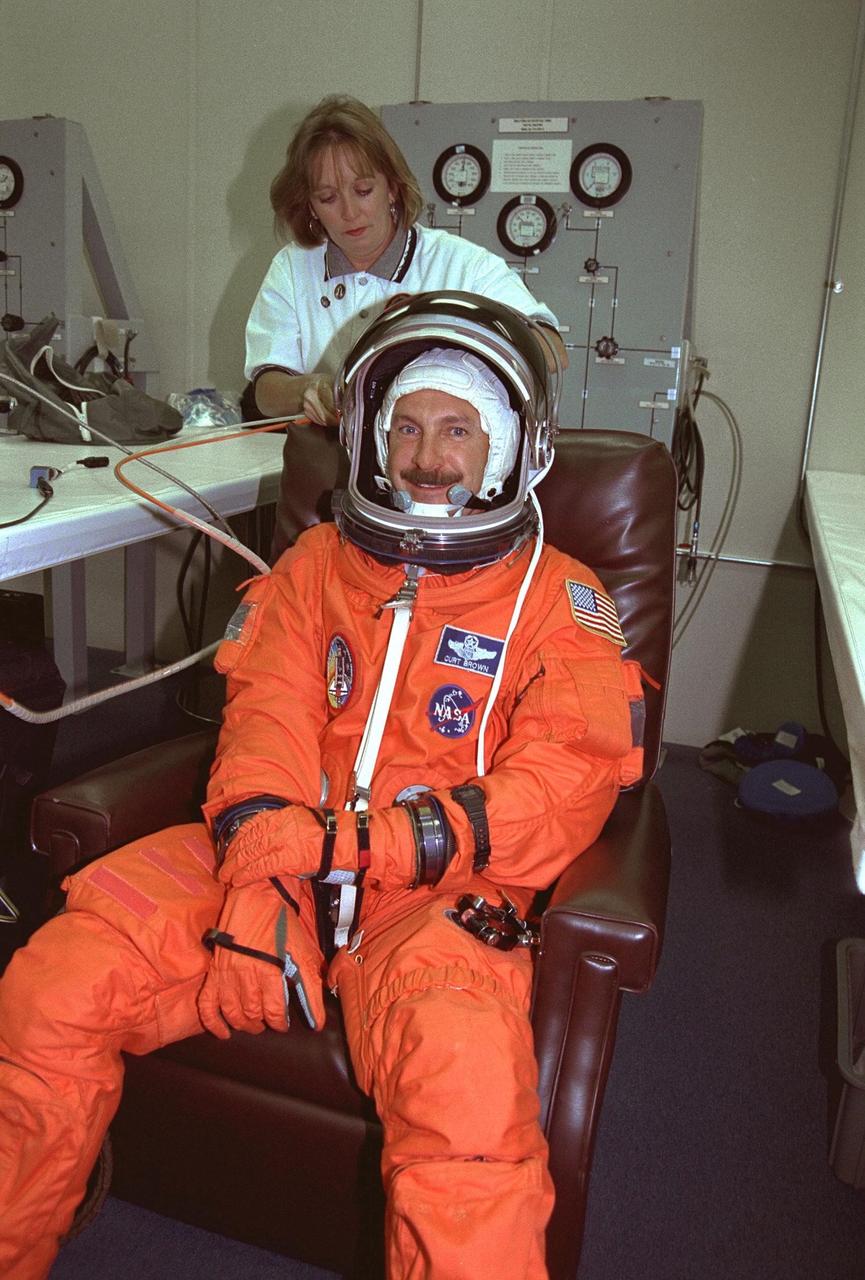
STS-85 Commander Curtis L. Brown, Jr. smiles as he is assisted with his ascent/reentry flight suit by a suit technician in the Operations and Checkout (O&C) Building. He is a lieutenant colonel in the Air Force and is on his fourth space flight. Brown has served as the pilot of STS-47, STS-66 and STS-77. A test pilot, he has more than 5,000 hours of flight time in jet aircraft. Brown will have responsibility for the overall success of this space flight and will operate and maintain Discovery throughout the mission. This will include the performance of station-keeping with the Cryogenic Infrared Spectrometers and Telescopes for the Atmosphere-Shuttle Pallet Satellite-2 (CRISTA-SPAS-2) free-flyer payload and many different maneuvers required by different payloads. The primary payload aboard the Space Shuttle orbiter Discovery is the CRISTA-SPAS-2. Other payloads on the 11-day mission include the Manipulator Flight Demonstration (MFD), and Technology Applications and Science-1 (TAS-1) and International Extreme Ultraviolet Hitchhiker-2 (IEH-2) experiments
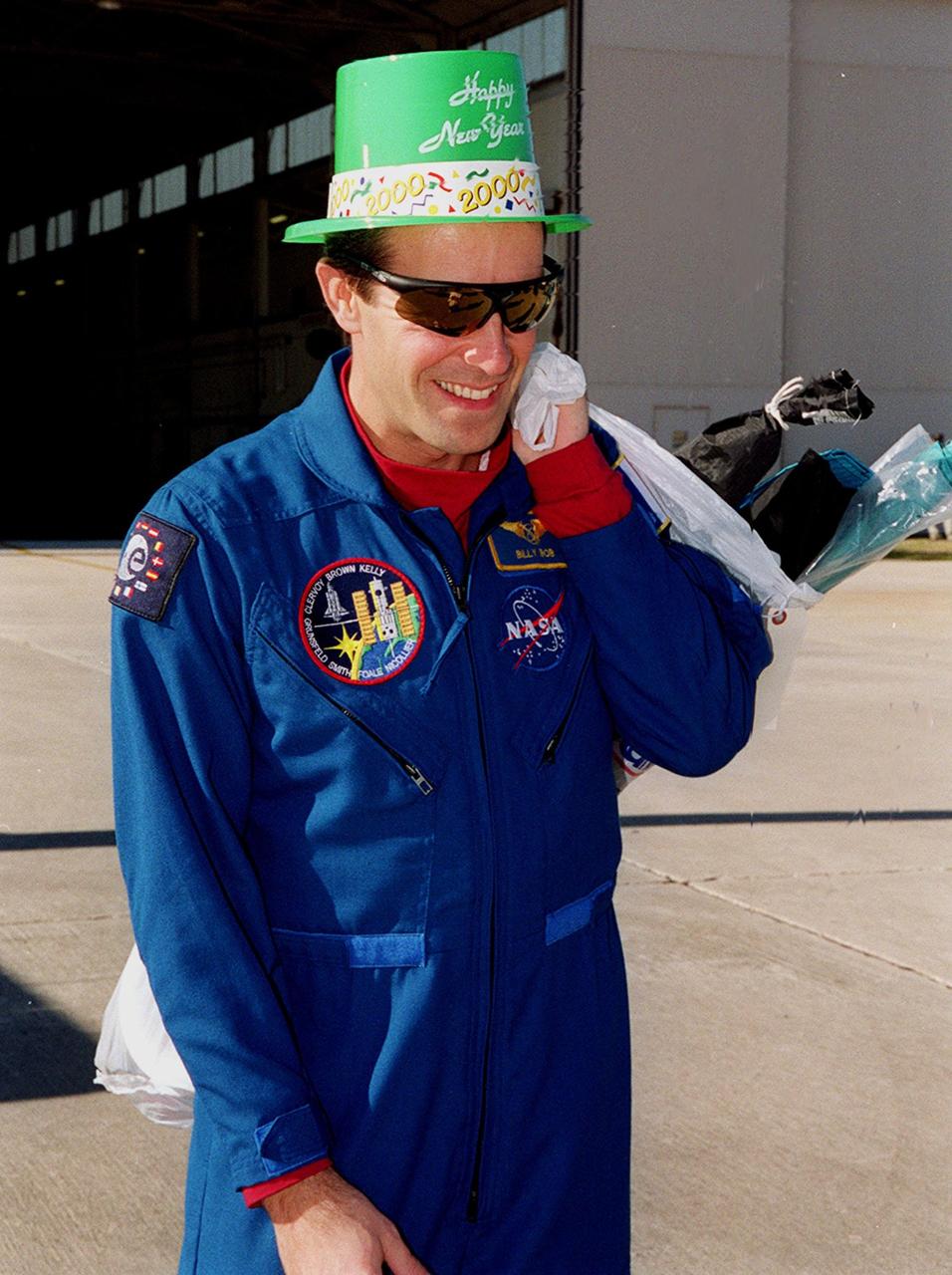
STS-103 Mission Specialist Jean-François Clervoy of France exhibits his holiday spirit on the runway at Patrick Air Force Base. The STS-103 crew and their families are preparing to board an airplane that will return them to their home base at the Johnson Space Center in Houston following the successful completion of their mission. Discovery landed in darkness the previous evening, Dec. 27, on runway 33 at KSC's Shuttle Landing Facility at 7:00:47 p.m. EST. This was the first time that a Shuttle crew spent the Christmas holiday in space. The other STS-103 crew members are Commander Curtis L. Brown Jr.; Pilot Scott J. Kelly; and Mission Specialists Steven L. Smith, C. Michael Foale (Ph.D.), John M. Grunsfeld (Ph.D.), and Claude Nicollier of Switzerland. The STS-103 mission supplied the Hubble Space Telescope with six new gyroscopes, six new voltage/temperature improvement kits, a new onboard computer, a new solid state recorder and new data transmitter, and a new fine guidance sensor along with new insulation on parts of the orbiting telescope. This was the 96th flight in the Space Shuttle program and the 27th for the orbiter Discovery
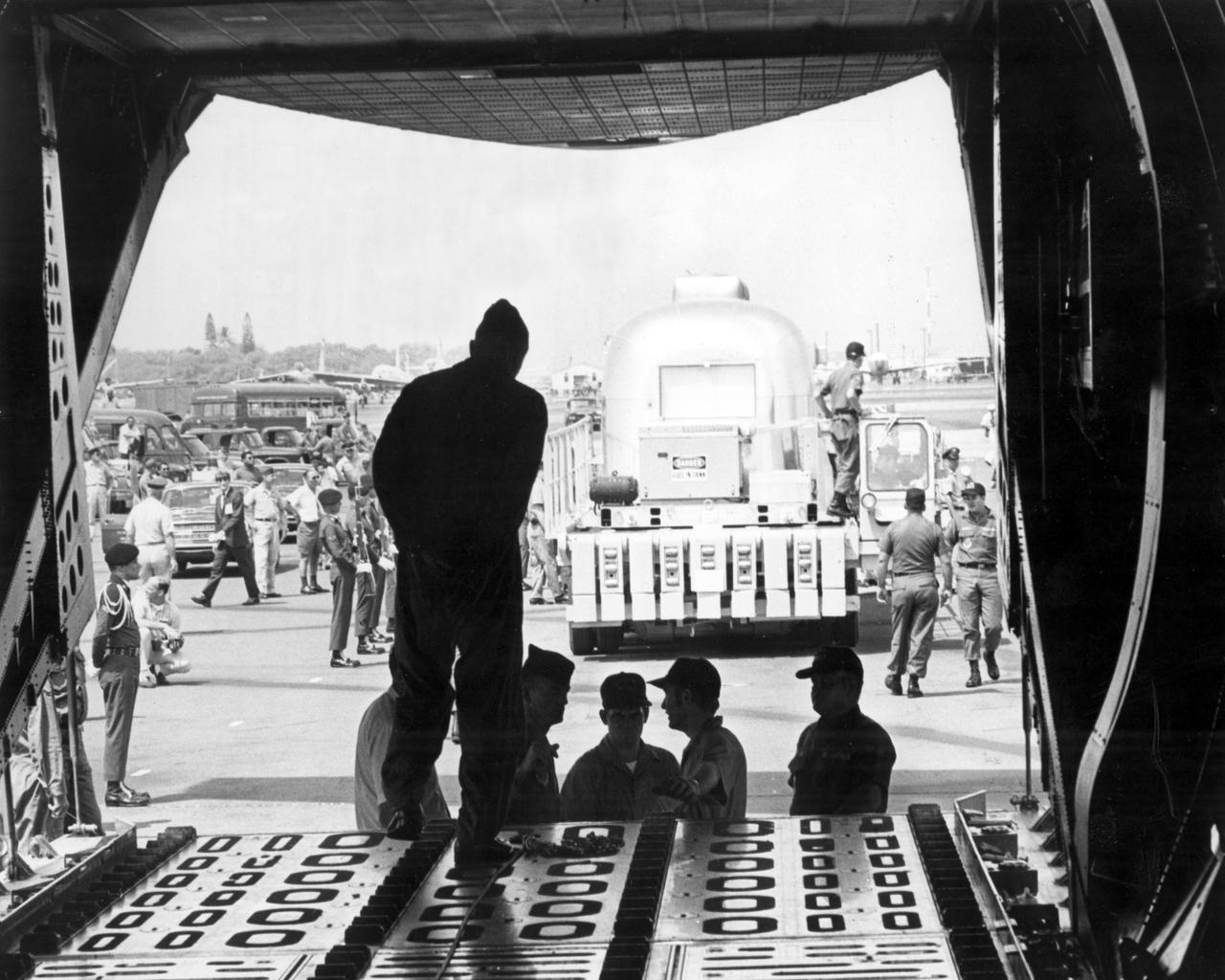
The Apollo 11 mission, the first manned lunar mission, launched from the Kennedy Space Center, Florida via the Marshall Space Flight Center (MSFC) developed Saturn V launch vehicle on July 16, 1969 and safely returned to Earth on July 24, 1969. Aboard the space craft were astronauts Neil A. Armstrong, commander; Michael Collins, Command Module (CM) pilot; and Edwin E. Aldrin Jr., Lunar Module (LM) pilot. The CM, piloted by Michael Collins remained in a parking orbit around the Moon while the LM, named “Eagle’’, carrying astronauts Neil Armstrong and Edwin Aldrin, landed on the Moon. During 2½ hours of surface exploration, the crew collected 47 pounds of lunar surface material for analysis back on Earth. The recovery operation took place in the Pacific Ocean where Navy para-rescue men recovered the capsule housing the 3-man Apollo 11 crew. The crew was airlifted to safety aboard the U.S.S. Hornet, where they were quartered in a Mobile Quarantine Facility (MQF) which served as their home until they reached the NASA Manned Spacecraft Center (MSC) Lunar Receiving Laboratory in Houston, Texas. In this photo taken at Pearl Harbor, Hawaii, the inhabited MQF is prepared for loading into an Air Force C-141 jet transport for the flight back to Ellington Air Force Base Texas and then on to the MSC.
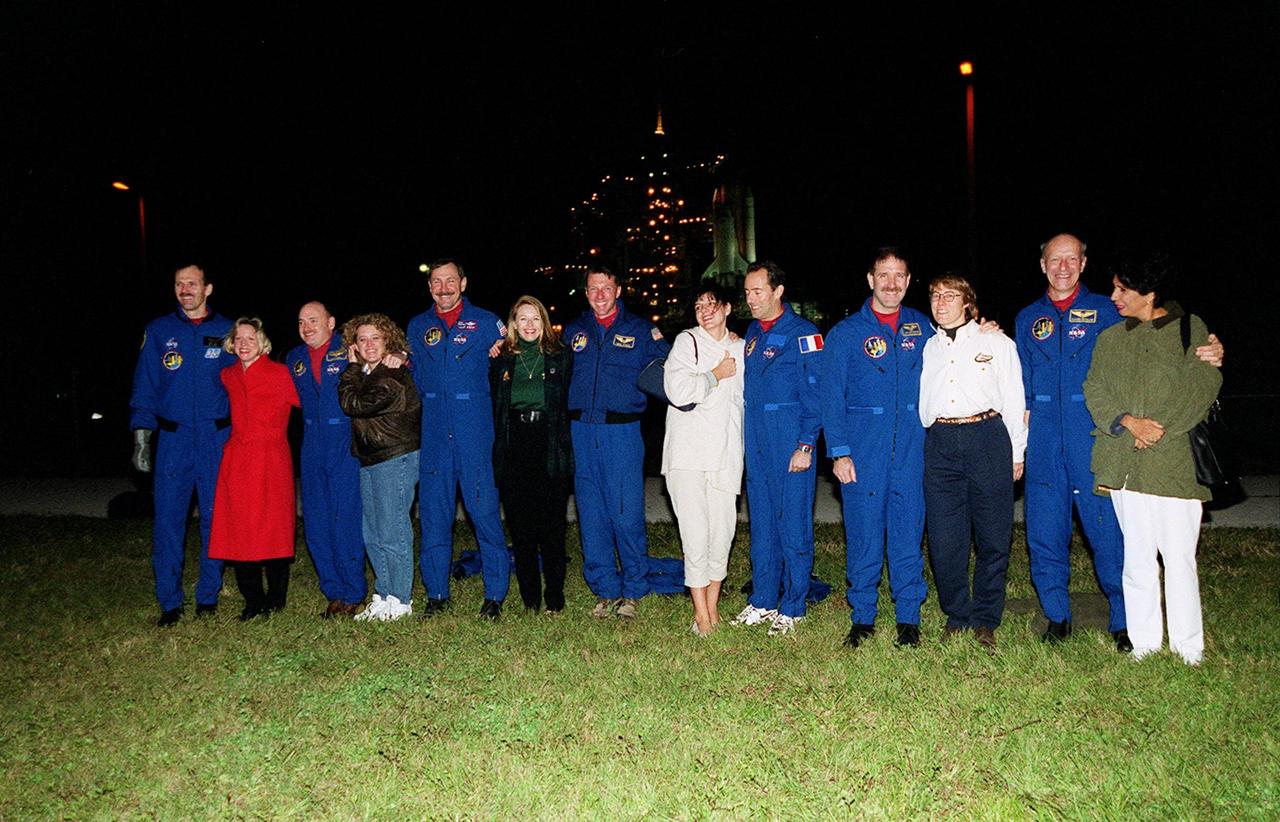
The STS-103 crew pose for photographers with their loved ones at Launch Pad 39B. Space Shuttle Discovery is in the background, next to the Fixed Service Structure lit up like a Christmas tree. Viewed left to right are Mission Specialist Steven L. Smith and his wife, Peggy; Pilot Scott J. Kelly and his wife, Leslie; Commander Curtis L. Brown Jr. and his fiancee, Ann Brickert; Mission Specialist C. Michael Foale; Laurence Clervoy and her husband, Mission Specialist Jean-François Clervoy; Mission Specialist John M. Grunsfeld and his wife, Carol; Mission Specialist Claude Nicollier and his wife, Susana. Nicollier and Clervoy are with the European Space Agency. The mission, to service the Hubble Space Telescope, is scheduled for launch Dec. 17 at 8:47 p.m. EST from Launch Pad 39B. Mission objectives include replacing gyroscopes and an old computer, installing another solid state recorder, and replacing damaged insulation in the telescope. The mission is expected to last about 8 days and 21 hours. Discovery is expected to land at KSC Sunday, Dec. 26, at about 6:25 p.m. EST

CAPE CANAVERAL, Fla. -- In the Operations and Checkout Building (O&C) at NASA's Kennedy Space Center in Florida, space shuttle Endeavour's STS-134 astronauts put on their launch-and-entry suits and check the fit of their helmets and gloves before heading to the Astrovan for the ride to Launch Pad 39A. Mission Specialist Roberto Vittori with the European Space Agency, seen here, will be making his third trip to the International Space Station. His first mission was in 2002 and second in 2005, both of which were launched aboard a Russian Soyuz spacecraft. STS-134 will deliver the Express Logistics Carrier-3, Alpha Magnetic Spectrometer-2 (AMS), a high-pressure gas tank and additional spare parts for the Dextre robotic helper to the space station. Endeavour was scheduled to launch at 3:47 p.m. on April 29, but that attempt was scrubbed for at least 72 hours while engineers assess an issue associated with the shuttle's Auxiliary Power Unit 1. STS-134 will be the final spaceflight for Endeavour. For more information visit, www.nasa.gov/mission_pages/shuttle/shuttlemissions/sts134/index.html. Photo credit: NASA/Kim Shiflett
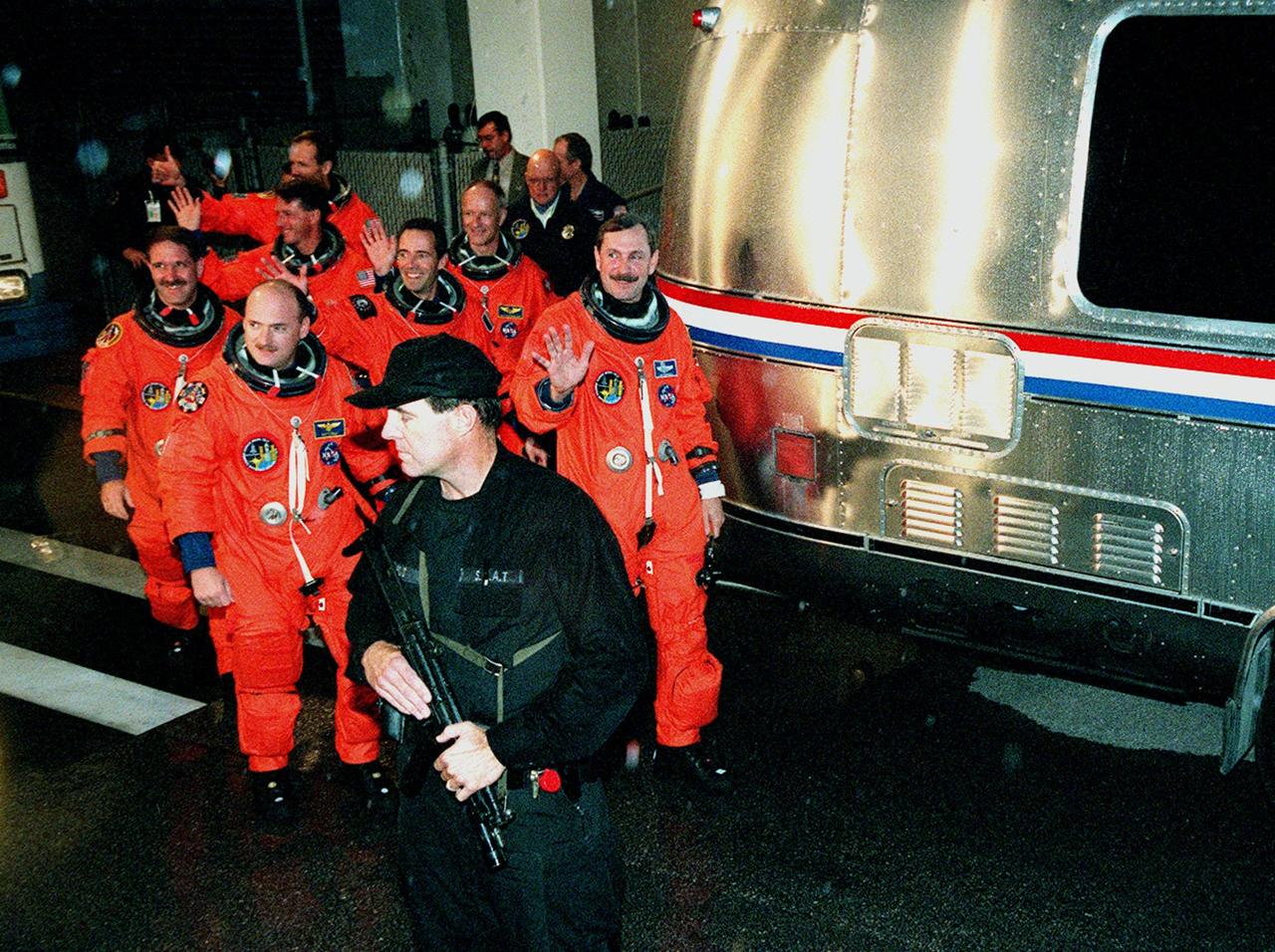
The STS-103 crew smile and wave to onlookers as they head toward the "Astrovan" at right that will carry them to Launch Pad 39B for liftoff of Space Shuttle Discovery. In their orange launch and entry suits, they are (front row) Pilot Scott J. Kelly and Commander Curtis L. Brown Jr., (second row) Mission Specialists John M. Grunsfeld (Ph.D.) and Jean-Francois Clervoy of France, (third row) C. Michael Foale (Ph. D.) and Claude Nicollier of Switzerland, and bringing up the rear, Steven L. Smith. The STS-103 mission, to service the Hubble Space Telescope, is scheduled for launch Dec. 17 at 8:47 p.m. EST from Launch Pad 39B. Mission objectives include replacing gyroscopes and an old computer, installing another solid state recorder, and replacing damaged insulation in the telescope. After the 8-day, 21-hour mission, Discovery is expected to land at KSC Sunday, Dec. 26, at about 6:30 p.m. EST
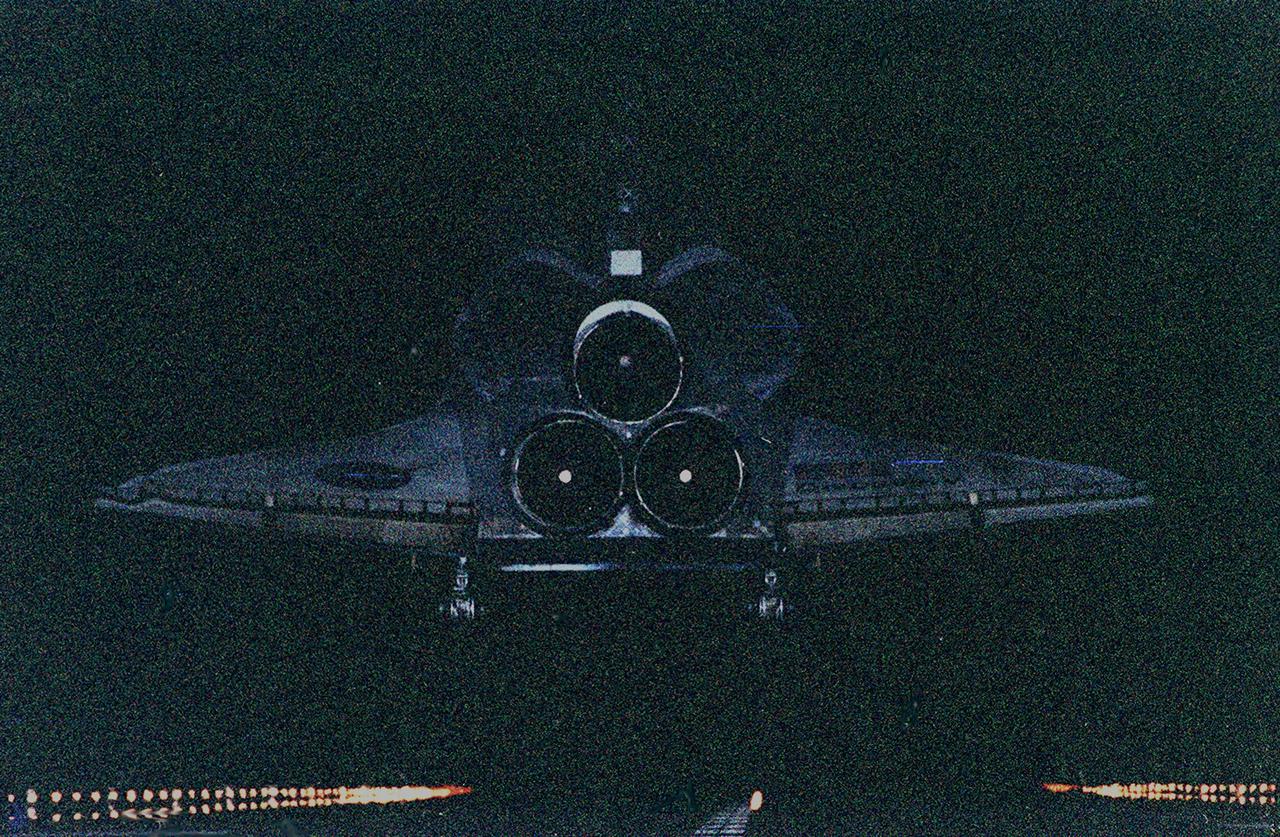
KENNEDY SPACE CENTER, Fla. -- The orbiter Discovery looks like a blue ghost as it drops from the darkness onto lighted runway 33 at KSC's Shuttle Landing Facility. After traveling more than 3,267,000 miles on a successful eight-day mission to service the Hubble Space Telescope, the orbiter touches down at 7:00:47 p.m. EST. Aboard are Commander Curtis L. Brown Jr., Pilot Scott J. Kelly, and Mission Specialists Steven L. Smith, C. Michael Foale (Ph.D.), John M. Grunsfeld (Ph.D.), Claude Nicollier of Switzerland and Jean-François Clervoy of France, who spent the Christmas holiday in space in order to accomplish their mission before the end of 1999. During the mission, Discovery's four space-walking astronauts, Smith, Foale, Grunsfeld and Nicollier, spent 24 hours and 33 minutes upgrading and refurbishing Hubble, making it more capable than ever to renew its observations of the universe. Mission objectives included replacing gyroscopes and an old computer, installing another solid state recorder, and replacing damaged insulation in the telescope. Hubble was released from the end of Discovery's robot arm on Christmas Day. This was the 96th flight in the Space Shuttle program and the 27th for the orbiter Discovery. The landing was the 20th consecutive Shuttle landing in Florida and the 13th night landing in Shuttle program history
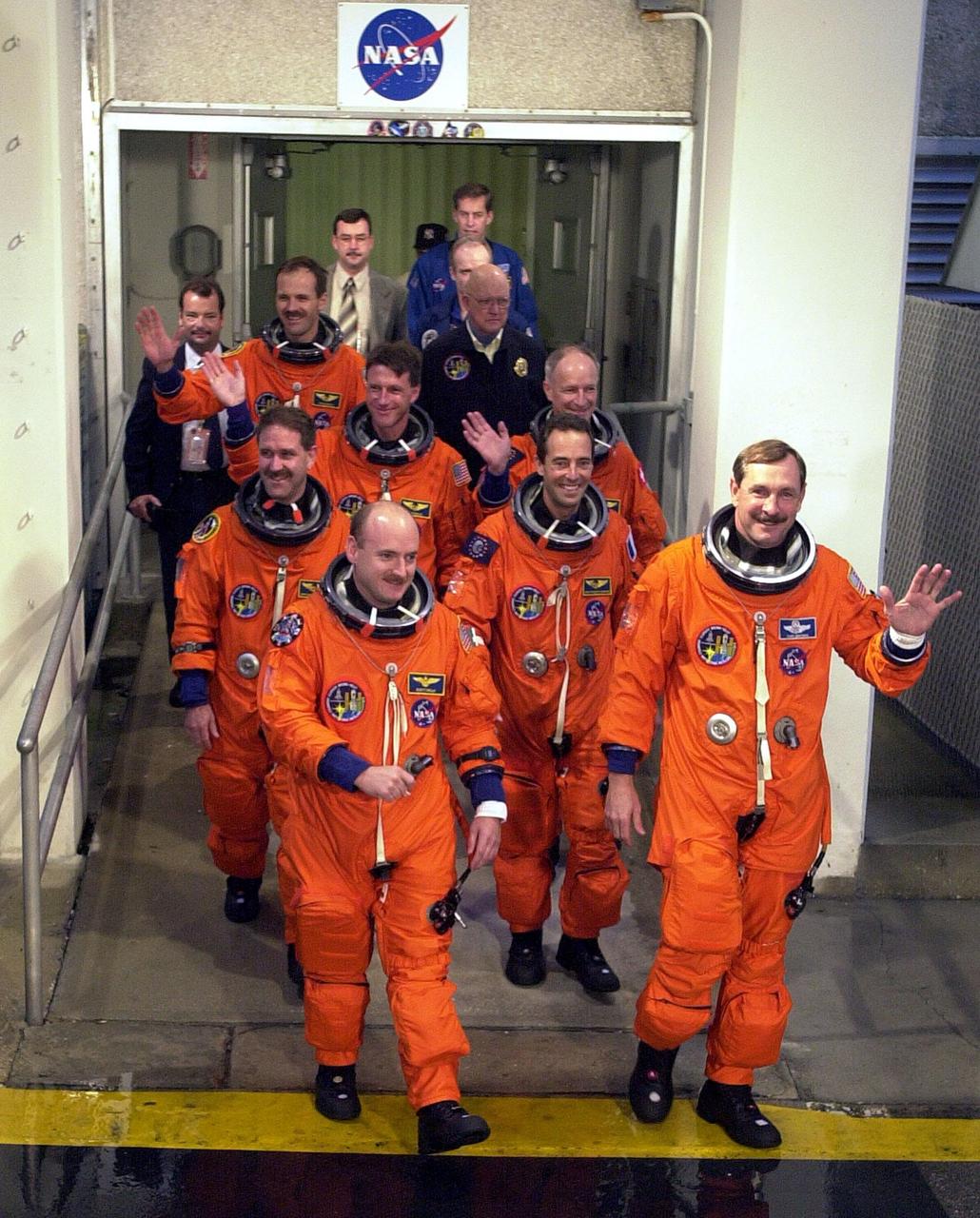
The STS-103 crew wave to onlookers as they walk out of the Operations and Checkout Building enroute to Launch Pad 39B and liftoff of Space Shuttle Discovery. In their orange launch and entry suits, they are (front row) Pilot Scott J. Kelly and Commander Curtis L. Brown Jr., (second row) Mission Specialists John M. Grunsfeld (Ph.D.) and Jean-Francois Clervoy of France, (third row) C. Michael Foale (Ph. D.) and Claude Nicollier of Switzerland, and bringing up the rear, Steven L. Smith. The STS-103 mission, to service the Hubble Space Telescope, is scheduled for launch Dec. 17 at 8:47 p.m. EST from Launch Pad 39B. Mission objectives include replacing gyroscopes and an old computer, installing another solid state recorder, and replacing damaged insulation in the telescope. After the 8-day, 21-hour mission, Discovery is expected to land at KSC Sunday, Dec. 26, at about 6:30 p.m. EST
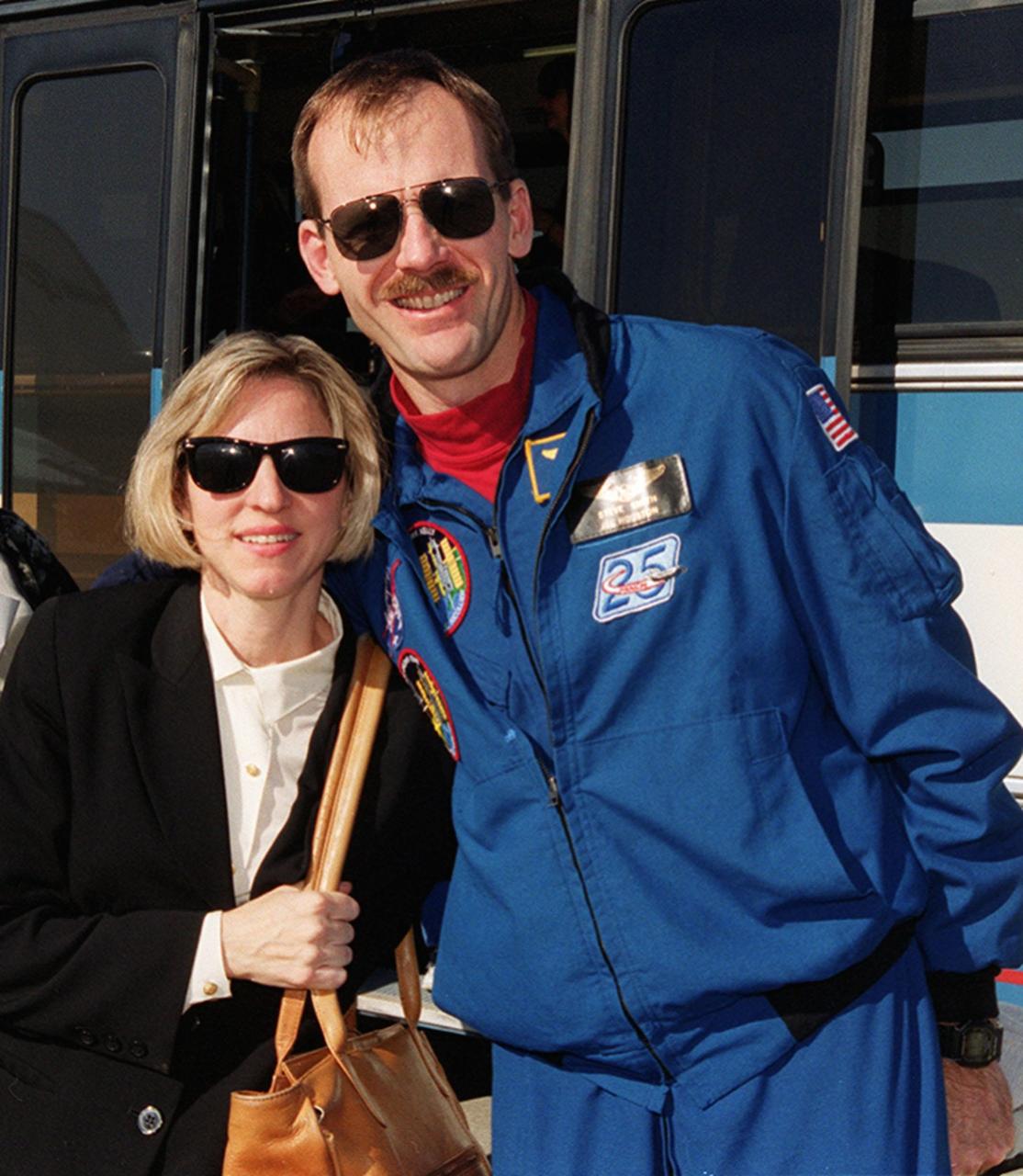
STS-103 Payload Commander Steven L. Smith and his wife, Peggy, smile for the camera on the runway at Patrick Air Force Base. The STS-103 crew and their families are preparing to board an airplane that will return them to their home base at the Johnson Space Center in Houston following the successful completion of their mission. Discovery landed in darkness the previous evening, Dec. 27, on runway 33 at KSC's Shuttle Landing Facility at 7:00:47 p.m. EST. This was the first time that a Shuttle crew spent the Christmas holiday in space. The other STS-103 crew members are Commander Curtis L. Brown Jr.; Pilot Scott J. Kelly; and Mission Specialists C. Michael Foale (Ph.D.), John M. Grunsfeld (Ph.D.), Claude Nicollier of Switzerland and Jean-François Clervoy of France. The STS-103 mission supplied the Hubble Space Telescope with six new gyroscopes, six new voltage/temperature improvement kits, a new onboard computer, a new solid state recorder and new data transmitter, and a new fine guidance sensor along with new insulation on parts of the orbiting telescope. This was the 96th flight in the Space Shuttle program and the 27th for the orbiter Discovery

CAPE CANAVERAL, Fla. -- In the Operations and Checkout Building (O&C) at NASA's Kennedy Space Center in Florida, space shuttle Endeavour's STS-134 astronauts put on their launch-and-entry suits and check the fit of their helmets and gloves before heading to the Astrovan for the ride to Launch Pad 39A. Commander Mark Kelly, seen here, last commanded space shuttle Discovery during its STS-124 mission in 2008. STS-134 will deliver the Express Logistics Carrier-3, Alpha Magnetic Spectrometer-2 (AMS), a high-pressure gas tank and additional spare parts for the Dextre robotic helper to the space station. Endeavour was scheduled to launch at 3:47 p.m. on April 29, but that attempt was scrubbed for at least 72 hours while engineers assess an issue associated with the shuttle's Auxiliary Power Unit 1. STS-134 will be the final spaceflight for Endeavour. For more information visit, www.nasa.gov/mission_pages/shuttle/shuttlemissions/sts134/index.html. Photo credit: NASA/Kim Shiflett
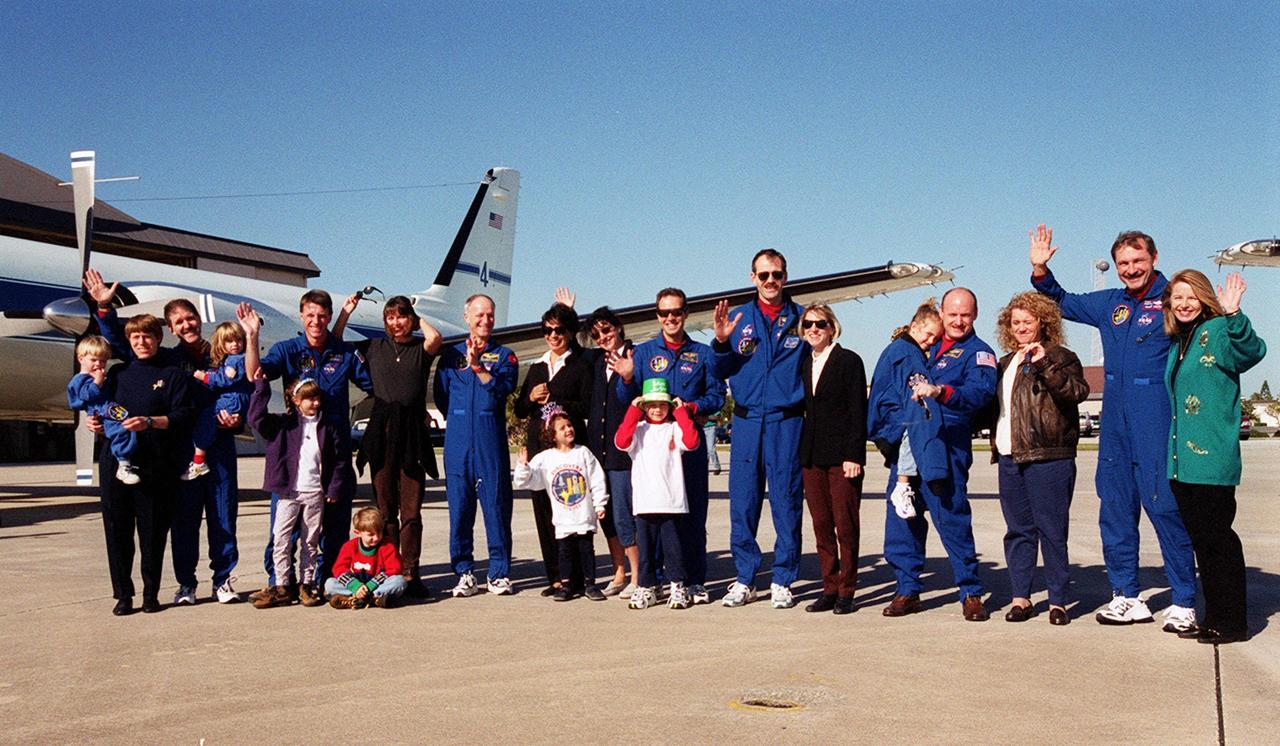
The STS-103 crew pose for a group portrait with their families and loved ones on the runway at Patrick Air Force Base. They are preparing to board an airplane that will return them to their home base at the Johnson Space Center in Houston following the successful completion of their mission. From left to right, the crew members are Mission Specialists John M. Grunsfeld (Ph.D.), C. Michael Foale (Ph.D.), Claude Nicollier of Switzerland, Jean-François Clervoy of France, and Steven L. Smith; Pilot Scott J. Kelly; and Commander Curtis L. Brown Jr. Discovery landed in darkness the previous evening, Dec. 27, on runway 33 at KSC's Shuttle Landing Facility at 7:00:47 p.m. EST. This was the first time that a Shuttle crew spent the Christmas holiday in space. The STS-103 mission supplied the Hubble Space Telescope with six new gyroscopes, six new voltage/temperature improvement kits, a new onboard computer, a new solid state recorder and new data transmitter, and a new fine guidance sensor along with new insulation on parts of the orbiting telescope. This was the 96th flight in the Space Shuttle program and the 27th for the orbiter Discovery
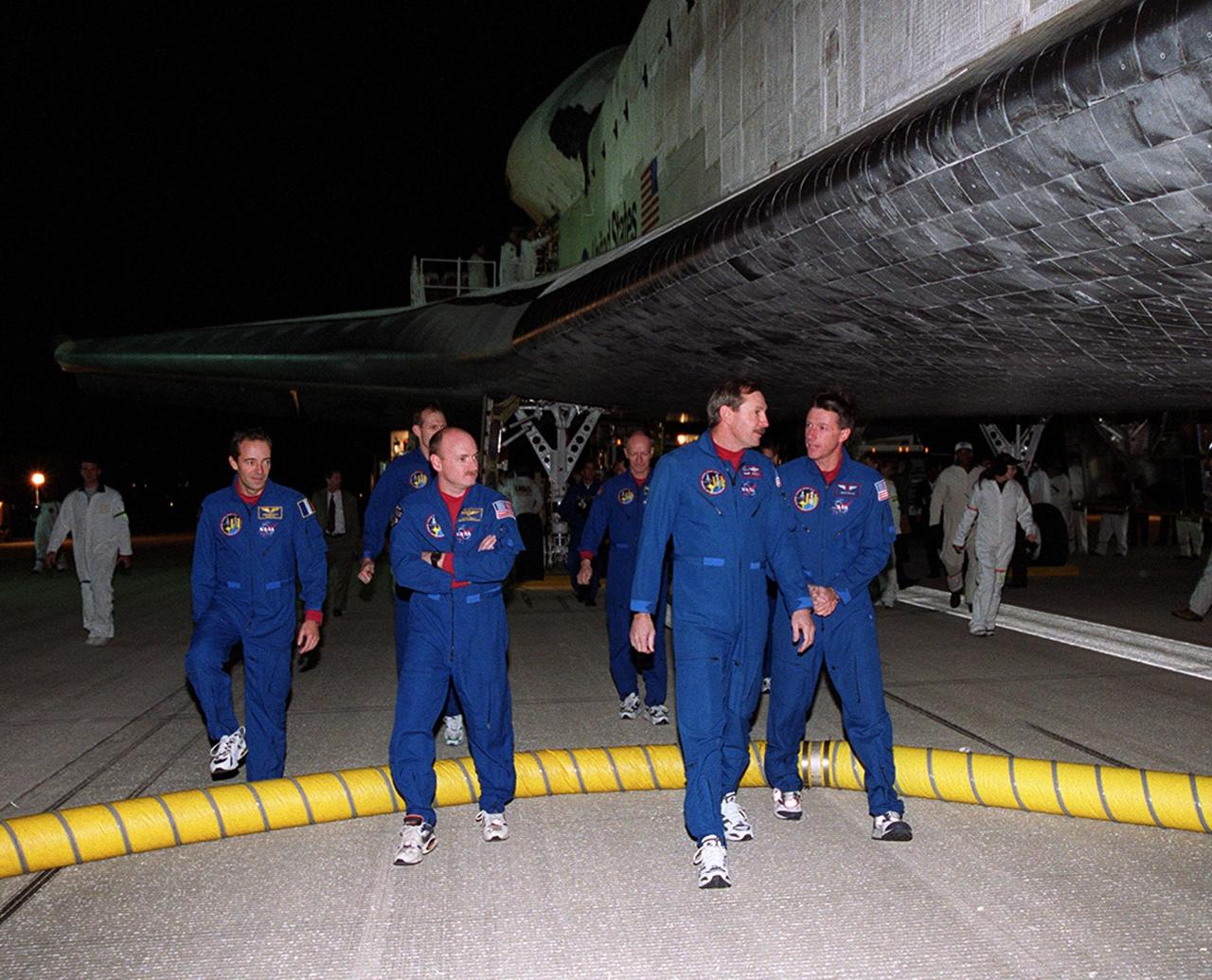
After landing at the Shuttle Landing Facility, the STS-103 crew looks over the orbiter Discovery. In the foreground, from left, are Mission Specialist Jean-Francois Clervoy of France, Pilot Scott J. Kelly, Commander Curtis L. Brown Jr. and Mission Specialist C. Michael Foale (Ph.D.); behind them, from left, are Mission Specialists Steven L. Smith and Claude Nicollier of Switzerland. The remaining crew member (not shown) is Mission Specialist John M. Grunsfeld (Ph.D.). The crew of seven completed a successful eight-day mission to service the Hubble Space Telescope, spending the Christmas holiday in space in order to accomplish their mission before the end of 1999. During the mission, Discovery's four space-walking astronauts, Smith, Foale, Grunsfeld and Nicollier, spent 24 hours and 33 minutes upgrading and refurbishing Hubble, making it more capable than ever to renew its observations of the universe. Mission objectives included replacing gyroscopes and an old computer, installing another solid state recorder, and replacing damaged insulation in the telescope. Hubble was released from the end of Discovery's robot arm on Christmas Day. Main gear touchdown was at 7:00:47 p.m. EST. Nose gear touchdown occurred at 7:00:58 p.m. EST and wheel stop at 7:01:34 p.m. EST. This was the 96th flight in the Space Shuttle program and the 27th for the orbiter Discovery. The landing was the 20th consecutive Shuttle landing in Florida and the 13th night landing in Shuttle program history
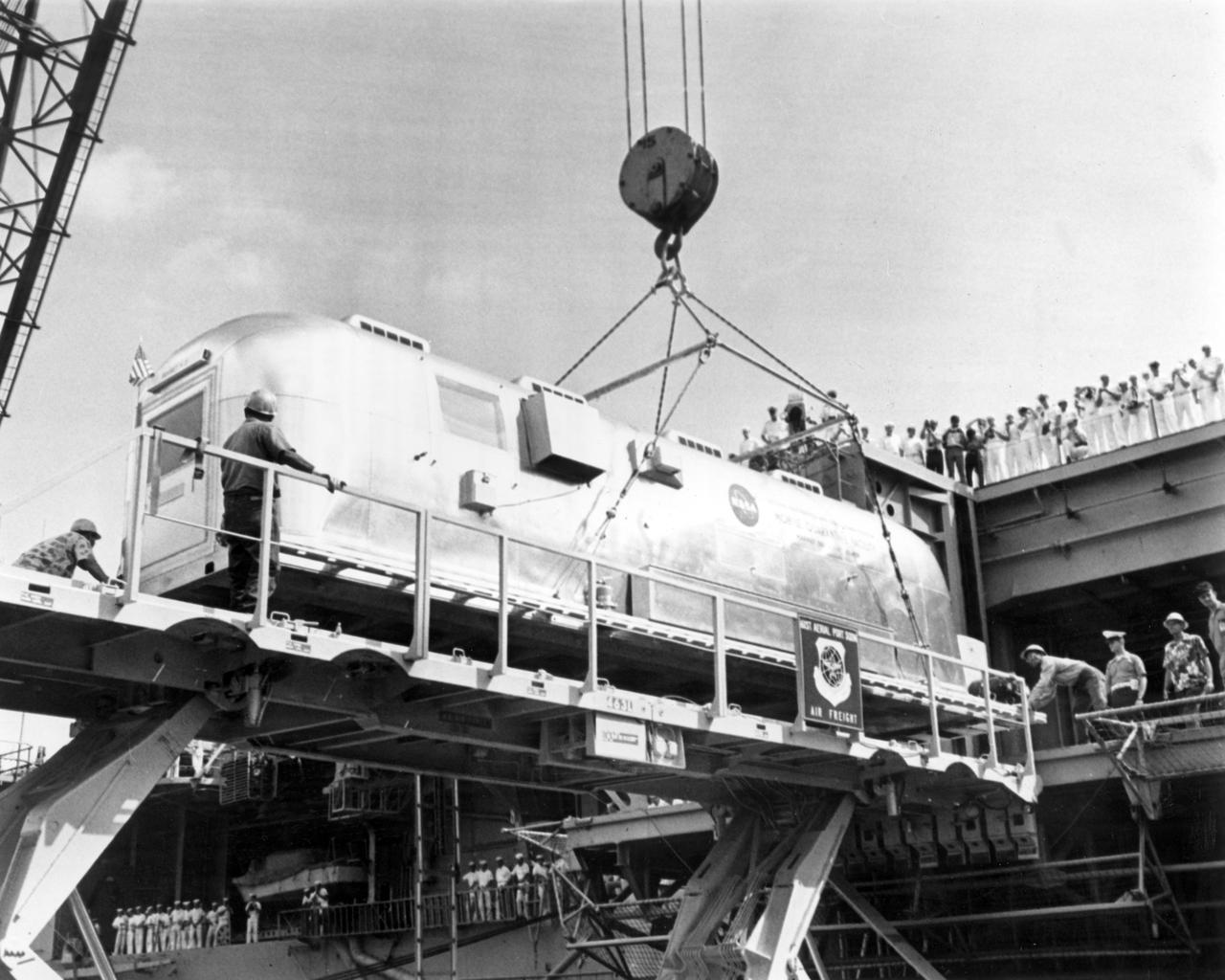
The Apollo 11 mission, the first manned lunar mission, launched from the Kennedy Space Center, Florida via the Marshall Space Flight Center (MSFC) developed Saturn V launch vehicle on July 16, 1969 and safely returned to Earth on July 24, 1969. Aboard the space craft were astronauts Neil A. Armstrong, commander; Michael Collins, Command Module (CM) pilot; and Edwin E. Aldrin Jr., Lunar Module (LM) pilot. The CM, piloted by Michael Collins remained in a parking orbit around the Moon while the LM, named “Eagle’’, carrying astronauts Neil Armstrong and Edwin Aldrin, landed on the Moon. During 2½ hours of surface exploration, the crew collected 47 pounds of lunar surface material for analysis back on Earth. The recovery operation took place in the Pacific Ocean where Navy para-rescue men recovered the capsule housing the 3-man Apollo 11 crew. The crew was airlifted to safety aboard the U.S.S. Hornet recovery ship, where they were quartered in a Mobile Quarantine Facility (MQF) which served as their home for 21 days. In this photo taken at Pearl Harbor, Hawaii, the quarantined housing facility is being lowered from the U.S.S. Hornet, onto a trailer for transport to Hickam Field. From there, it was loaded aboard an Air Force C-141 jet and flown back to Ellington Air Force Base Texas, and then on to the NASA Manned Spacecraft Center (MSC) Lunar Receiving Laboratory in Houston, Texas.
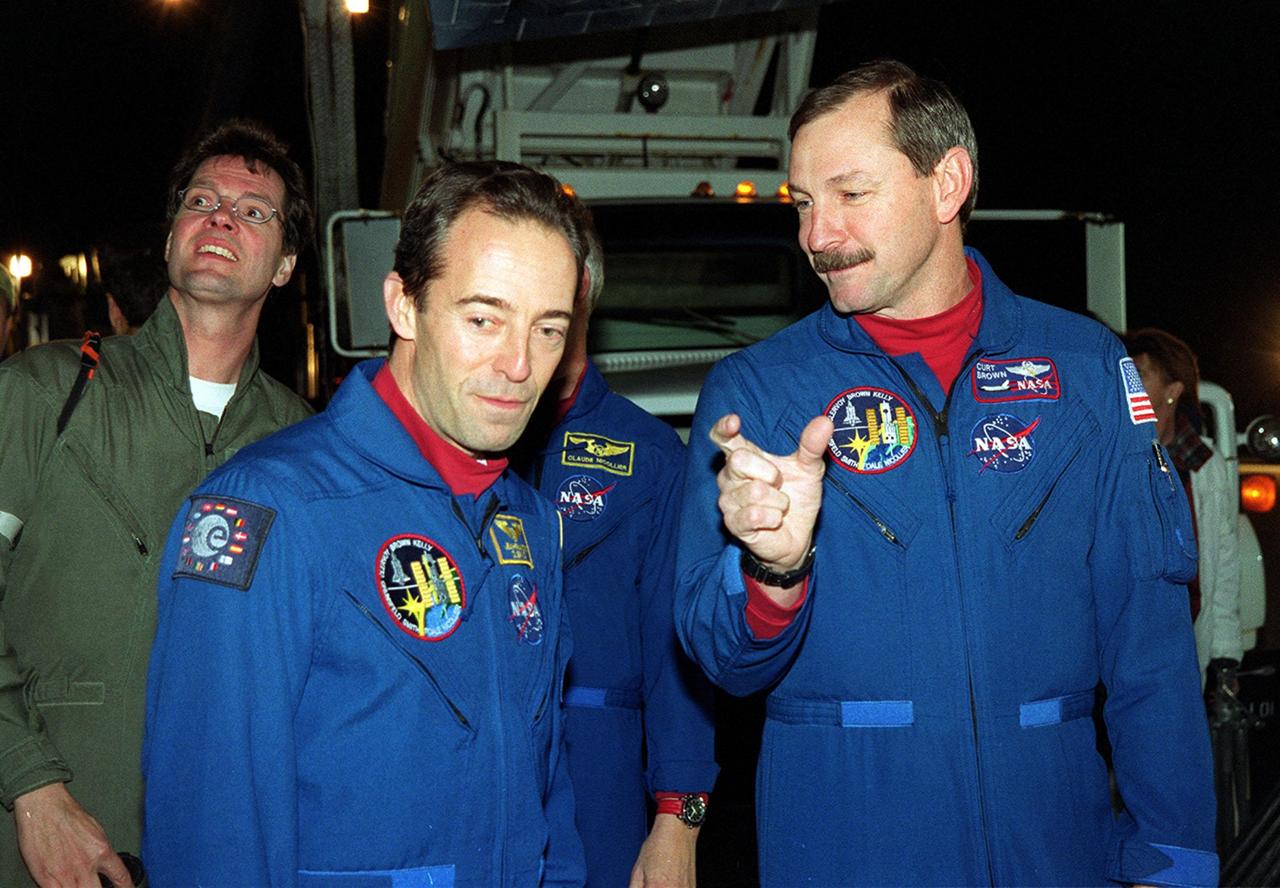
After landing at the Shuttle Landing Facility, STS-103 Mission Specialist Jean-François Clervoy of France (left), with the European Space Agency (ESA), and Commander Curtis L. Brown Jr. (right) look over the orbiter Discovery. They and other crew members Pilot Scott J. Kelly and Mission Specialists Steven L. Smith, C. Michael Foale (Ph.D.), John M. Grunsfeld (Ph.D.) and Claude Nicollier of Switzerland (also with ESA), completed a successful eight-day mission to service the Hubble Space Telescope, spending the Christmas holiday in space in order to accomplish their mission before the end of 1999. During the mission, Discovery's four space-walking astronauts, Smith, Foale, Grunsfeld and Nicollier, spent 24 hours and 33 minutes upgrading and refurbishing Hubble, making it more capable than ever to renew its observations of the universe. Mission objectives included replacing gyroscopes and an old computer, installing another solid state recorder, and replacing damaged insulation in the telescope. Hubble was released from the end of Discovery's robot arm on Christmas Day. Main gear touchdown was at 7:00:47 p.m. EST. Nose gear touchdown occurred at 7:00:58 p.m. EST and wheel stop at 7:01:34 p.m. EST. This was the 96th flight in the Space Shuttle program and the 27th for the orbiter Discovery. The landing was the 20th consecutive Shuttle landing in Florida and the 13th night landing in Shuttle program history
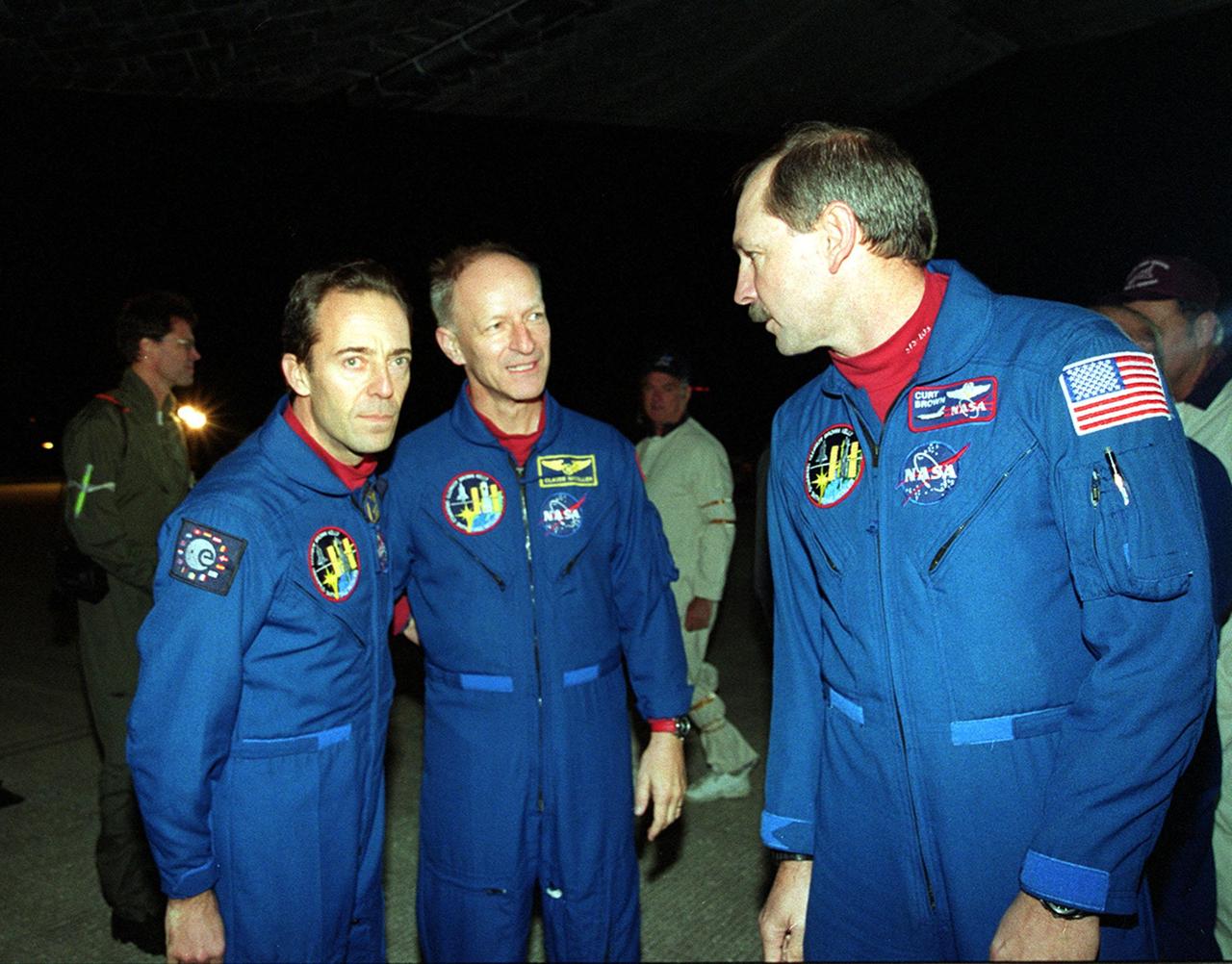
After landing at the Shuttle Landing Facility, STS-103 Mission Specialists Jean-Francois Clervoy of France and Claude Nicollier of Switzerland, who are with the European Space Agency, listen to a comment by Commander Curtis L. Brown Jr. while looking over the orbiter Discovery. Other members of the crew are Pilot Scott J. Kelly and Mission Specialists Steven L. Smith, C. Michael Foale (Ph.D.), and John M. Grunsfeld (Ph.D.). The crew of seven completed a successful eight-day mission to service the Hubble Space Telescope, spending the Christmas holiday in space in order to accomplish their mission before the end of 1999. During the mission, Discovery's four space-walking astronauts, Smith, Foale, Grunsfeld and Nicollier, spent 24 hours and 33 minutes upgrading and refurbishing Hubble, making it more capable than ever to renew its observations of the universe. Mission objectives included replacing gyroscopes and an old computer, installing another solid state recorder, and replacing damaged insulation in the telescope. Hubble was released from the end of Discovery's robot arm on Christmas Day. Main gear touchdown was at 7:00:47 p.m. EST. Nose gear touchdown occurred at 7:00:58 p.m. EST and wheel stop at 7:01:34 p.m. EST. This was the 96th flight in the Space Shuttle program and the 27th for the orbiter Discovery. The landing was the 20th consecutive Shuttle landing in Florida and the 13th night landing in Shuttle program history
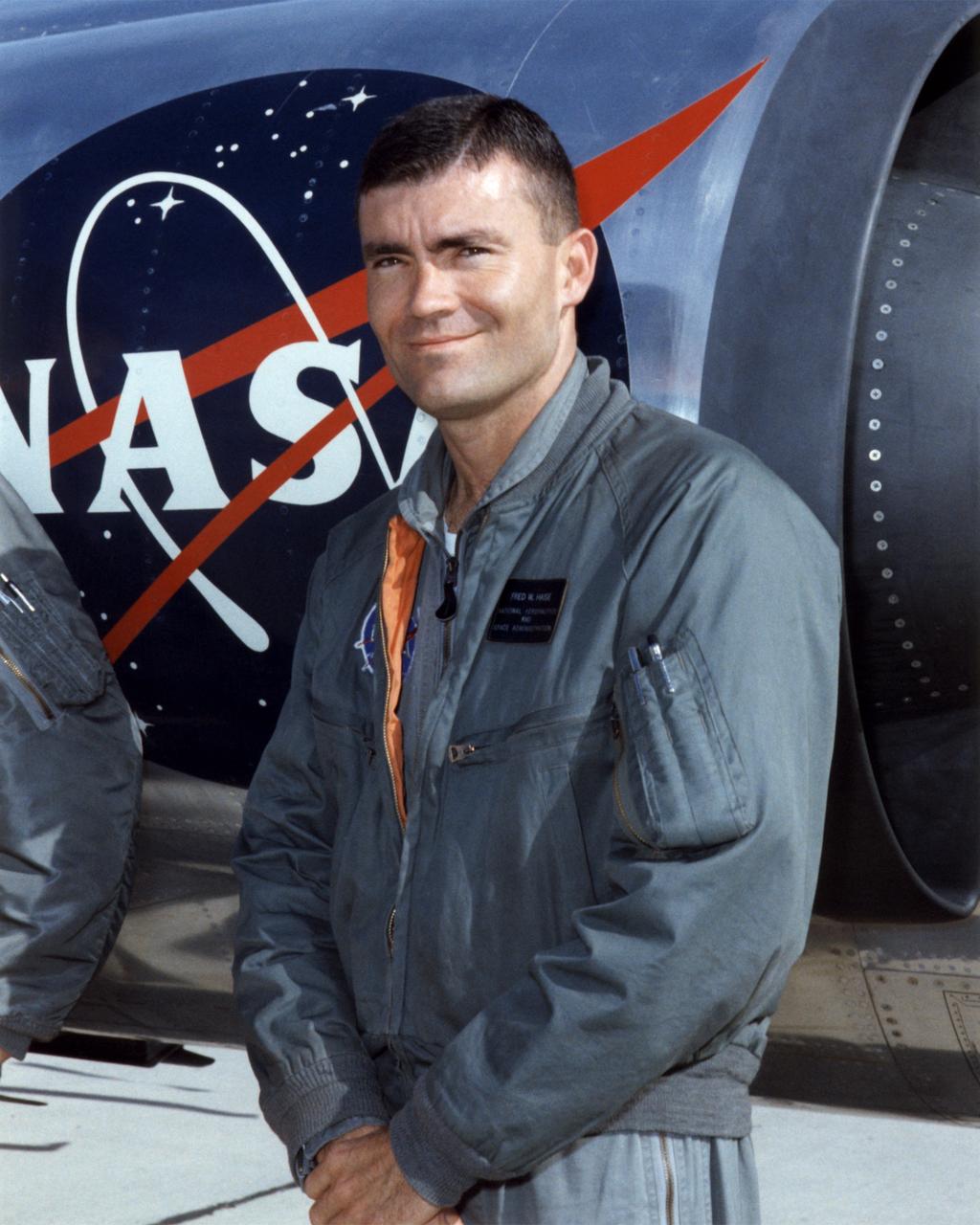
Fred W. Haise Jr. was a research pilot and an astronaut for the National Aeronautics and Space Administration from 1959 to 1979. He began flying at the Lewis Research Center in Cleveland, Ohio (today the Glenn Research Center), in 1959. He became a research pilot at the NASA Flight Research Center (FRC), Edwards, Calif., in 1963, serving NASA in that position for three years until being selected to be an astronaut in 1966 His best-known assignment at the FRC (later redesignated the Dryden Flight Research Center) was as a lifting body pilot. Shortly after flying the M2-F1 on a car tow to about 25 feet on April 22, 1966, he was assigned as an astronaut to the Johnson Space Center in Houston, Texas. While at the FRC he had also flown a variety of other research and support aircraft, including the variable-stability T-33A to simulate the M2-F2 heavyweight lifting body, some light aircraft including the Piper PA-30 to evaluate their handling qualities, the Apache helicopter, the Aero Commander, the Cessna 310, the Douglas F5D, the Lockheed F-104 and T-33, the Cessna T-37, and the Douglas C-47. After becoming an astronaut, Haise served as a backup crewmember for the Apollo 8, 11, and 16 missions. He flew on the aborted Apollo 13 lunar mission in 1970, spending 142 hours and 54 minutes in space before returning safely to Earth. In 1977, he was the commander of three free flights of the Space Shuttle prototype Enterprise when it flew its Approach and Landing Tests at Edwards Air Force Base, Calif. Meanwhile, from April 1973 to January 1976, Haise served as the Technical Assistant to the Manager of the Space Shuttle Orbiter Project. In 1979, he left NASA to become the Vice President for Space Programs with the Grumman Aerospace Corporation. He then served as President of Grumman Technical Services, an operating division of Northrop Grumman Corporation, from January 1992 until his retirement. Haise was born in Biloxi, Miss., on November 14, 1933. He underwent flight traini
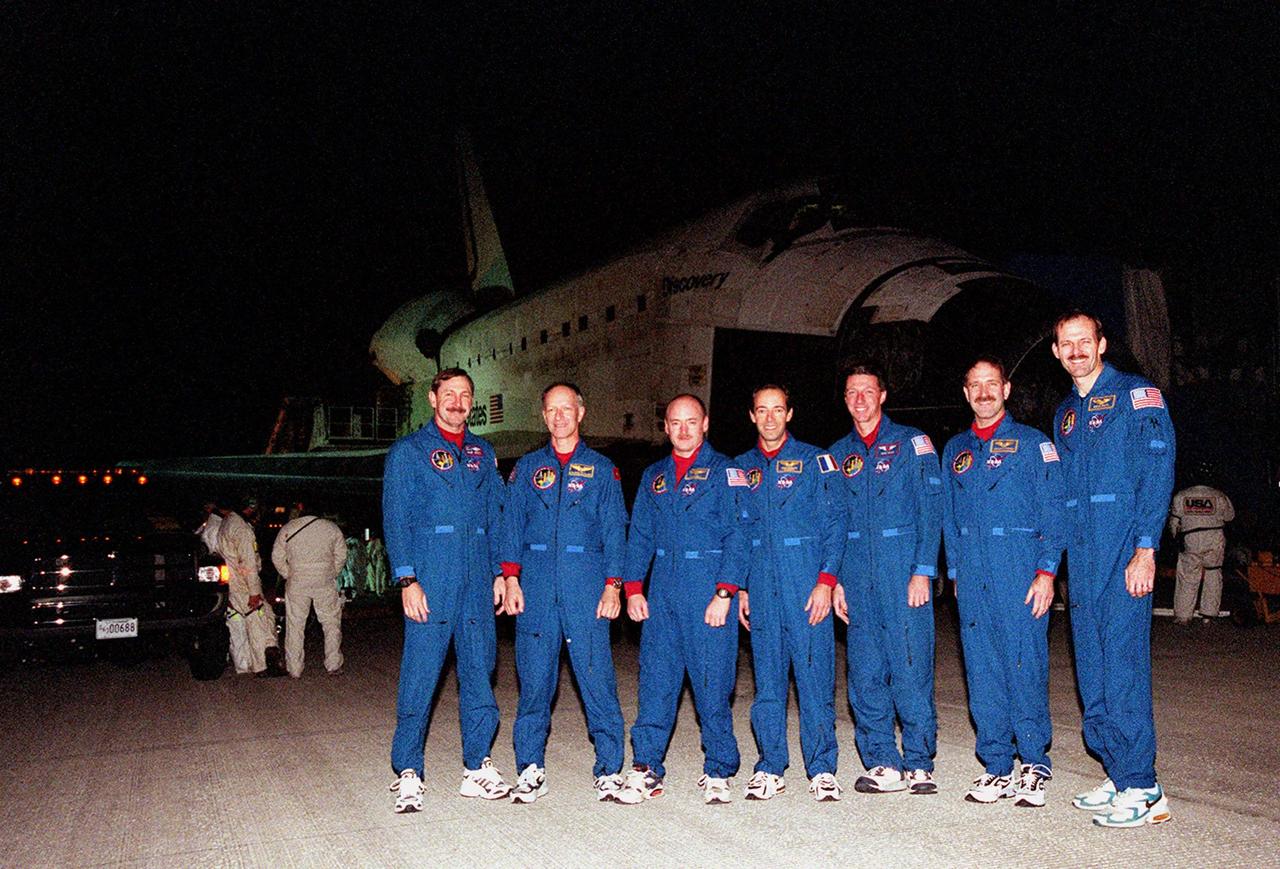
After landing at the Shuttle Landing Facility, the STS-103 crew poses in front of the orbiter Discovery. Standing left to right are Commander Curtis L. Brown Jr., Mission Specialist Claude Nicollier of Switzerland, Pilot Scott J. Kelly, and Mission Specialists Jean-Francois Clervoy of France, C. Michael Foale (Ph.D.), John M. Grunsfeld (Ph.D.) and Steven L. Smith. The crew of seven completed a successful eight-day mission to service the Hubble Space Telescope, spending the Christmas holiday in space in order to accomplish their mission before the end of 1999. During the mission, Discovery's four space-walking astronauts, Smith, Foale, Grunsfeld and Nicollier, spent 24 hours and 33 minutes upgrading and refurbishing Hubble, making it more capable than ever to renew its observations of the universe. Mission objectives included replacing gyroscopes and an old computer, installing another solid state recorder, and replacing damaged insulation in the telescope. Hubble was released from the end of Discovery's robot arm on Christmas Day. Main gear touchdown was at 7:00:47 p.m. EST. Nose gear touchdown occurred at 7:00:58 p.m. EST and wheel stop at 7:01:34 p.m. EST. This was the 96th flight in the Space Shuttle program and the 27th for the orbiter Discovery. The landing was the 20th consecutive Shuttle landing in Florida and the 13th night landing in Shuttle program history
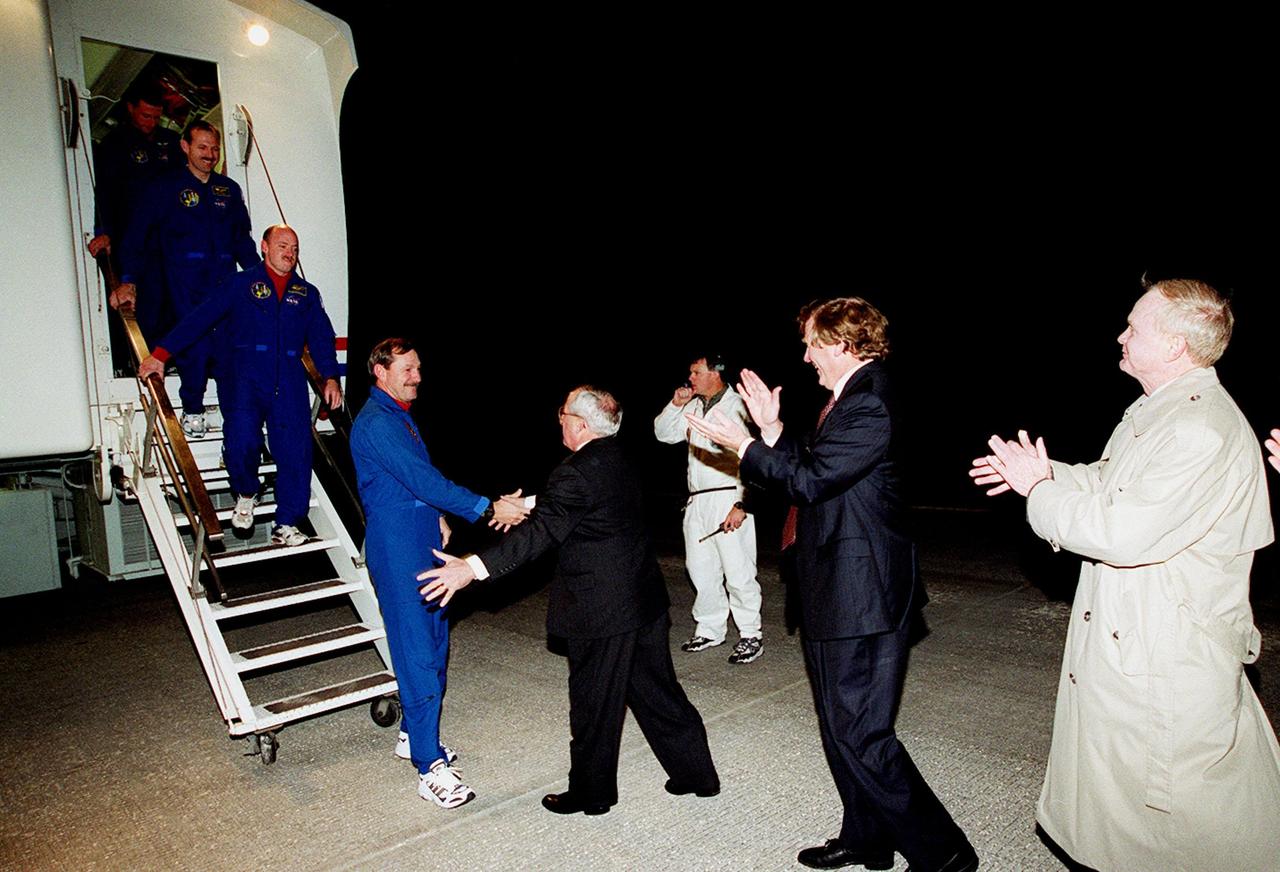
As he exits the Crew Hatch Access Vehicle, STS-103 Commander Curtis L. Brown Jr. is greeted with a handshake by Joseph Rothenberg, associate administrator, Office of Space Flight. Descending the stairs behind Brown are (left to right) Mission Specialists C. Michael Foale (Ph.D.) and John M. Grunsfeld (Ph.D.) and Pilot Scott J. Kelly. At right, applauding the astronauts return are Earle Huckins, deputy associate administrator, Office of Space Science, and Roy Bridges, director, Kennedy Space Center. Others in the crew (not shown) are Mission Specialists Steven L. Smith, and Jean-Francois Clervoy of France and Claude Nicollier of Switzerland, who are with the European Space Agency. The crew of seven completed a successful eight-day mission to service the Hubble Space Telescope, spending the Christmas holiday in space in order to accomplish their mission before the end of 1999. During the mission, Discovery's four space-walking astronauts, Smith, Foale, Grunsfeld and Nicollier, spent 24 hours and 33 minutes upgrading and refurbishing Hubble, making it more capable than ever to renew its observations of the universe. Mission objectives included replacing gyroscopes and an old computer, installing another solid state recorder, and replacing damaged insulation in the telescope. Hubble was released from the end of Discovery's robot arm on Christmas Day. Main gear touchdown was at 7:00:47 p.m. EST. Nose gear touchdown occurred at 7:00:58 p.m. EST and wheel stop at 7:01:34 p.m. EST. This was the 96th flight in the Space Shuttle program and the 27th for the orbiter Discovery. The landing was the 20th consecutive Shuttle landing in Florida and the 13th night landing in Shuttle program history
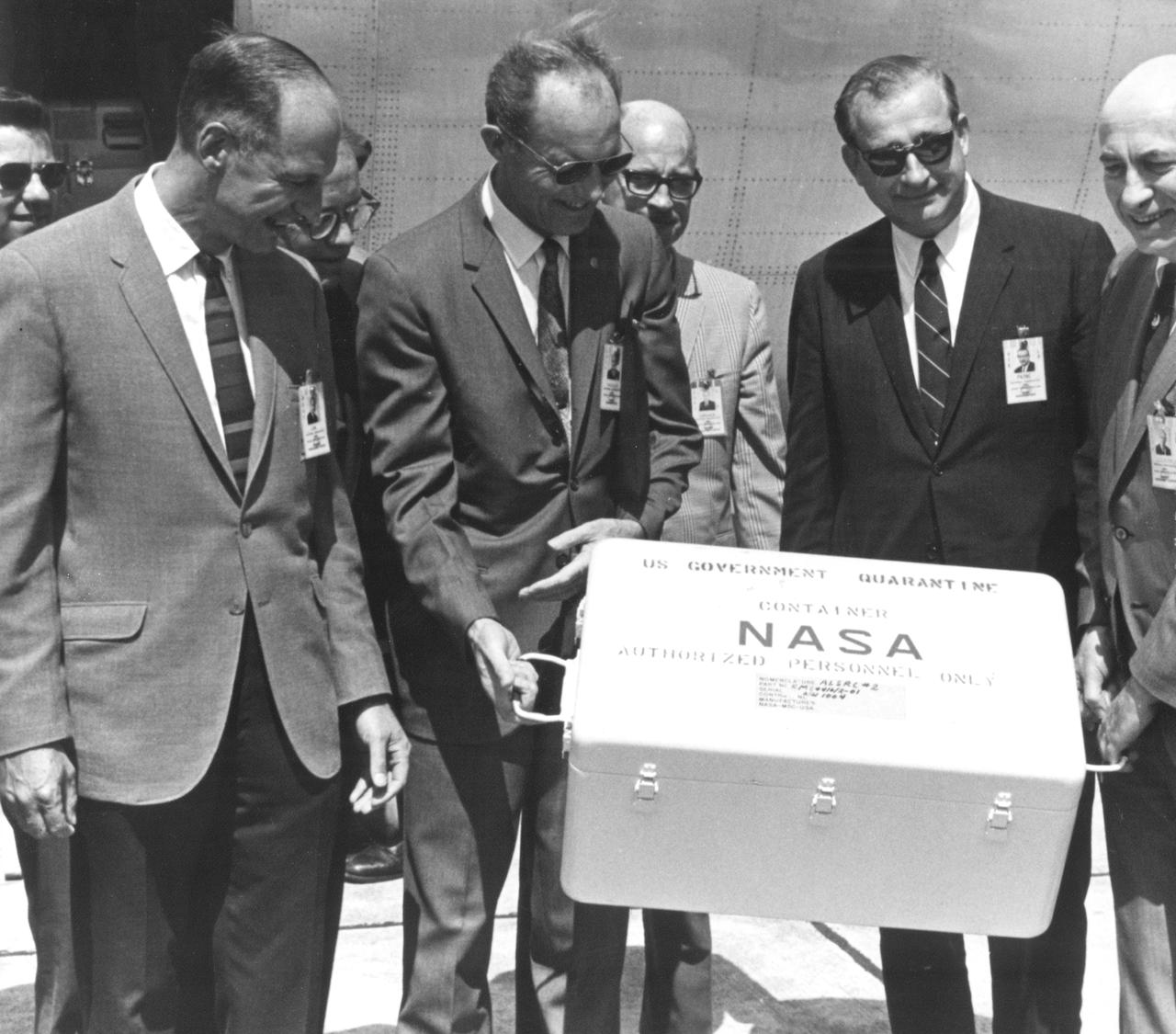
The Apollo 11 mission, the first manned lunar mission, launched from the Kennedy Space Center, Florida via the Marshall Space Flight Center (MSFC) developed Saturn V launch vehicle on July 16, 1969 and safely returned to Earth on July 24, 1969. Aboard the space craft were astronauts Neil A. Armstrong, commander; Michael Collins, Command Module (CM) pilot; and Edwin E. Aldrin Jr., Lunar Module (LM) pilot. The CM, piloted by Michael Collins remained in a parking orbit around the Moon while the LM, named “Eagle’’, carrying astronauts Neil Armstrong and Edwin Aldrin, landed on the Moon. During 2½ hours of surface exploration, the crew collected 47 pounds of lunar surface material for analysis back on Earth. This photograph was taken as the mission’s first loaded sample return container arrived at Ellington Air Force Base by air from the Pacific recovery area. The rock box was immediately taken to the Lunar Receiving Laboratory at the Manned Spacecraft Center (MSC) in Houston, Texas. Happily posing for the photograph with the rock container are (L-R) Richard S. Johnston (back), special assistant to the MSC Director; George M. Low, MSC Apollo Spacecraft Program manager; George S. Trimble (back), MSC Deputy Director; Lt. General Samuel C. Phillips, Apollo Program Director, Office of Manned Spaceflight at NASA headquarters; Eugene G. Edmonds, MSC Photographic Technology Laboratory; Dr. Thomas O. Paine, NASA Administrator; and Dr. Robert R. Gilruth, MSC Director.
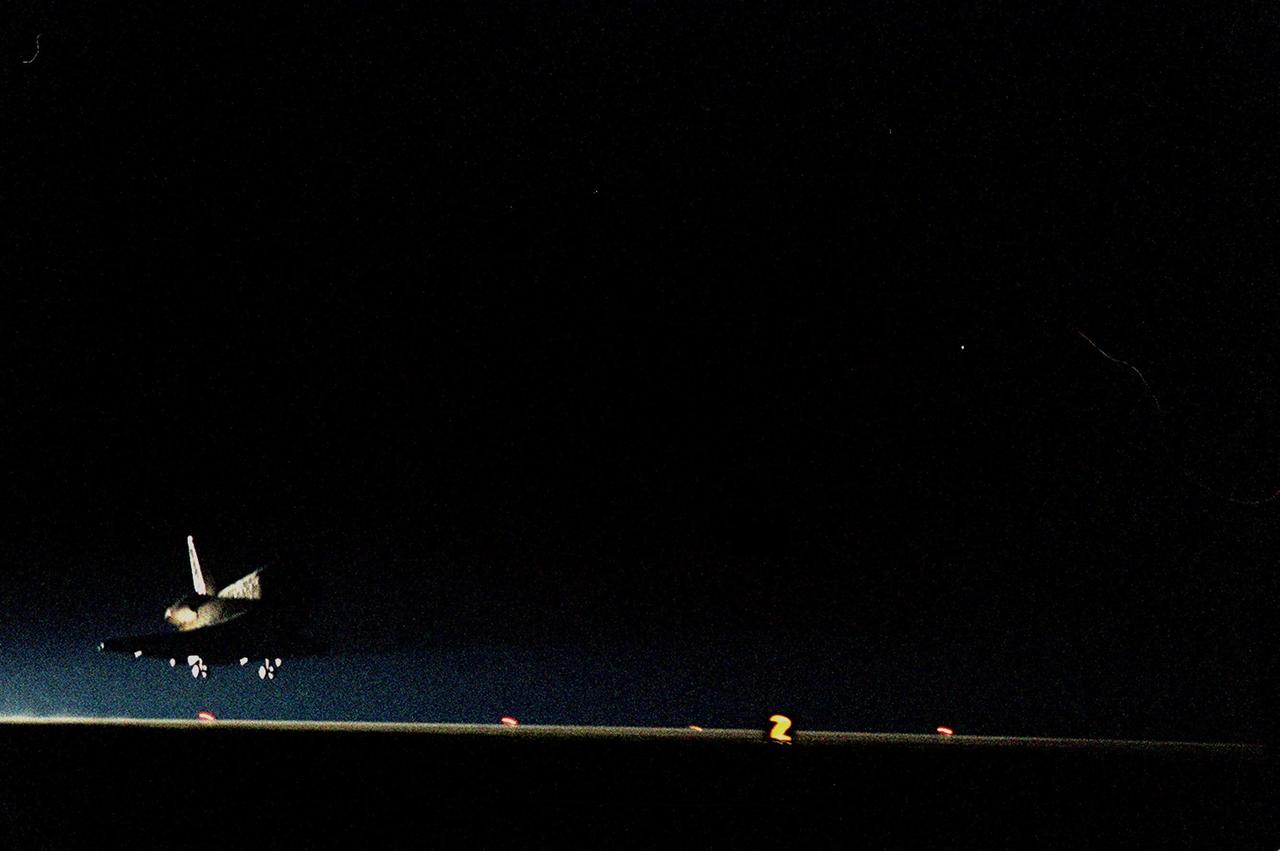
KENNEDY SPACE CENTER, Fla. -- The Space Shuttle Discovery drops out of the darkness onto runway 33 at the Shuttle Landing Facility after traveling more than 3,267,000 miles on a successful eight-day mission to service the Hubble Space Telescope. Astronauts Curtis L. Brown Jr., Commander; Scott J. Kelly, Pilot; and Steven L. Smith, C. Michael Foale (Ph.D.), John M. Grunsfeld (Ph.D.), Claude Nicollier of Switzerland and Jean-François Clervoy of France, all Mission Specialists, spent the Christmas holiday in space in order to accomplish their mission before the end of 1999. During the mission, Discovery's four space-walking astronauts, Smith, Foale, Grunsfeld and Nicollier, spent 24 hours and 33 minutes upgrading and refurbishing Hubble, making it more capable than ever to renew its observations of the universe. Mission objectives included replacing gyroscopes and an old computer, installing another solid state recorder, and replacing damaged insulation in the telescope. Hubble was released from the end of Discovery's robot arm on Christmas Day. Main gear touchdown was at 7:00:47 p.m. EST. Nose gear touchdown occurred at 7:00:58 p.m. EST and wheel stop at 7:01:34 p.m. EST. This was the 96th flight in the Space Shuttle program and the 27th for the orbiter Discovery. The landing was the 20th consecutive Shuttle landing in Florida and the 13th night landing in Shuttle program history
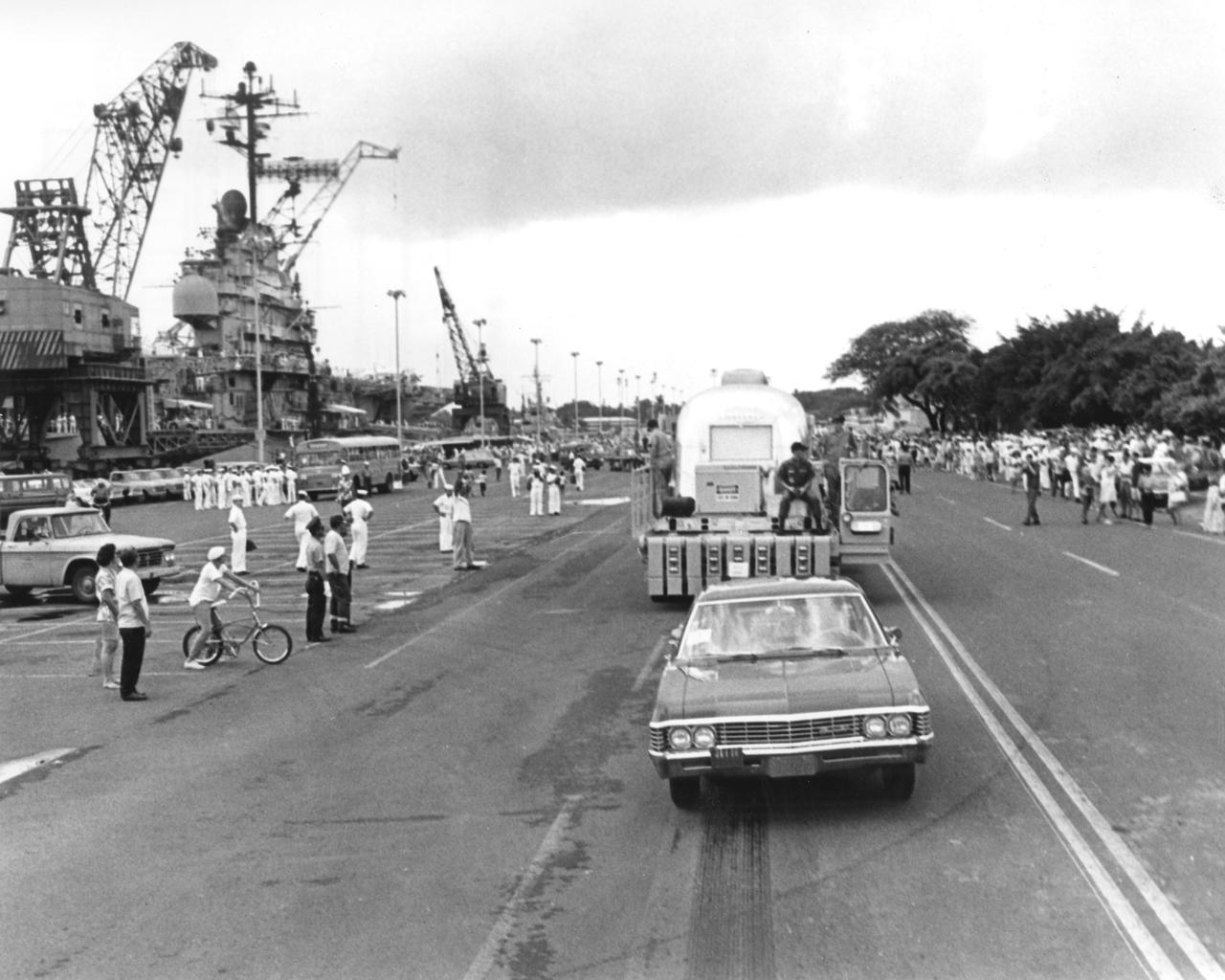
The Apollo 11 mission, the first manned lunar mission, launched from the Kennedy Space Center, Florida via the Marshall Space Flight Center (MSFC) developed Saturn V launch vehicle on July 16, 1969 and safely returned to Earth on July 24, 1969. Aboard the space craft were astronauts Neil A. Armstrong, commander; Michael Collins, Command Module (CM) pilot; and Edwin E. Aldrin Jr., Lunar Module (LM) pilot. The CM, piloted by Michael Collins remained in a parking orbit around the Moon while the LM, named “Eagle’’, carrying astronauts Neil Armstrong and Edwin Aldrin, landed on the Moon. During 2½ hours of surface exploration, the crew collected 47 pounds of lunar surface material for analysis back on Earth. The recovery operation took place in the Pacific Ocean where Navy para-rescue men recovered the capsule housing the 3-man Apollo 11 crew. The crew was airlifted to safety aboard the U.S.S. Hornet recovery ship, where they were quartered in a Mobile Quarantine Facility (MQF) which served as their home until they reached the NASA Manned Spacecraft Center (MSC) Lunar Receiving Laboratory in Houston, Texas. The occupied MQF was unloaded from the U.S.S. Hornet in Pearl Harbor, Hawaii. In this photo, the facility is moved from the Hornet’s dock enroute to Hickam Field where it was loaded aboard an Air Force C-141 jet transport for the flight back to Ellington Air Force Base Texas, and then on to the MSC.
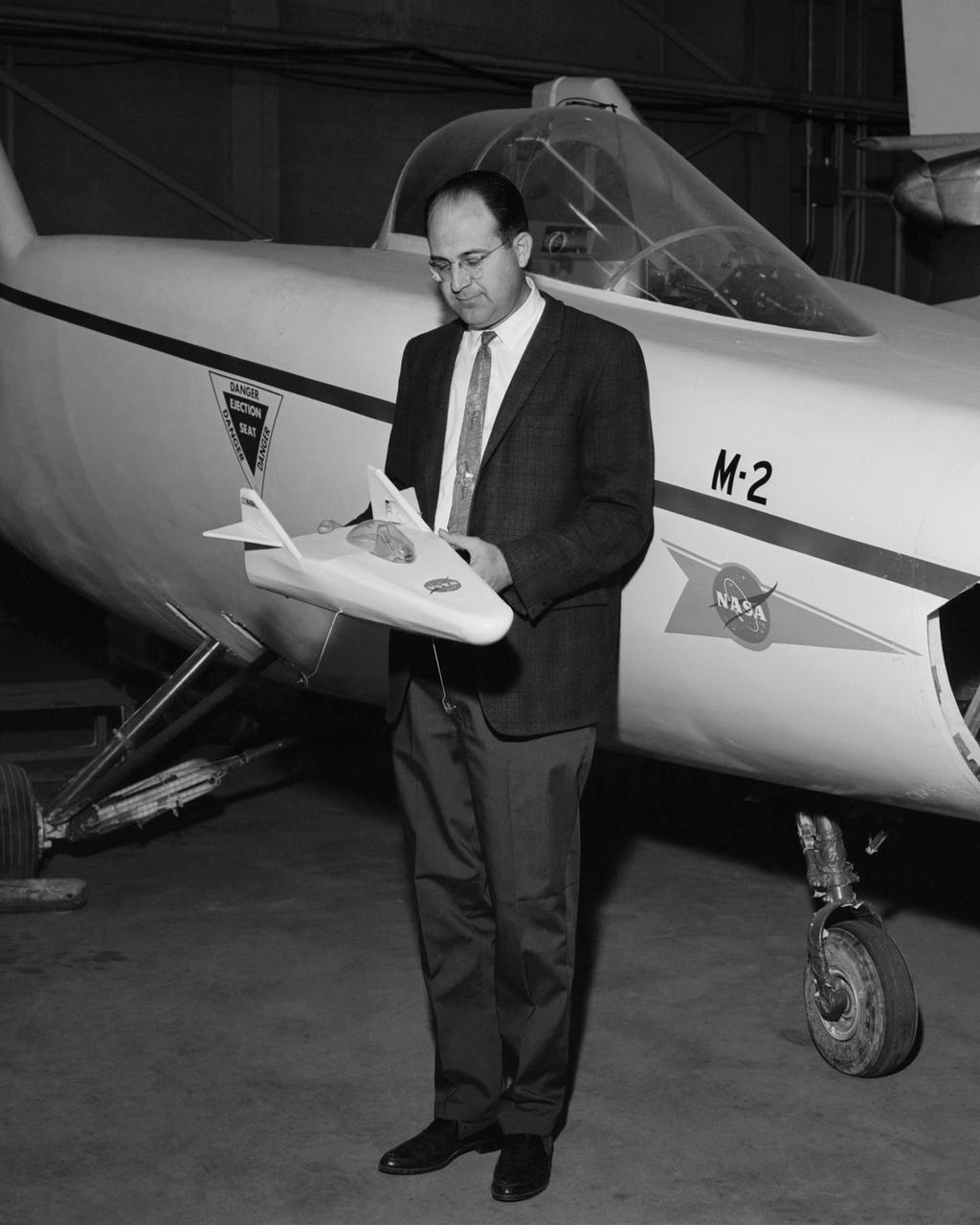
Dale Reed with a model of the M2-F1 in front of the actual lifting body. Reed used the model to show the potential of the lifting bodies. He first flew it into tall grass to test stability and trim, then hand-launched it from buildings for longer flights. Finally, he towed the lifting-body model aloft using a powered model airplane known as the "Mothership." A timer released the model and it glided to a landing. Dale's wife Donna used a 9 mm. camera to film the flights of the model. Its stability as it glided--despite its lack of wings--convinced Milt Thompson and some Flight Research Center engineers including the center director, Paul Bikle, that a piloted lifting body was possible.
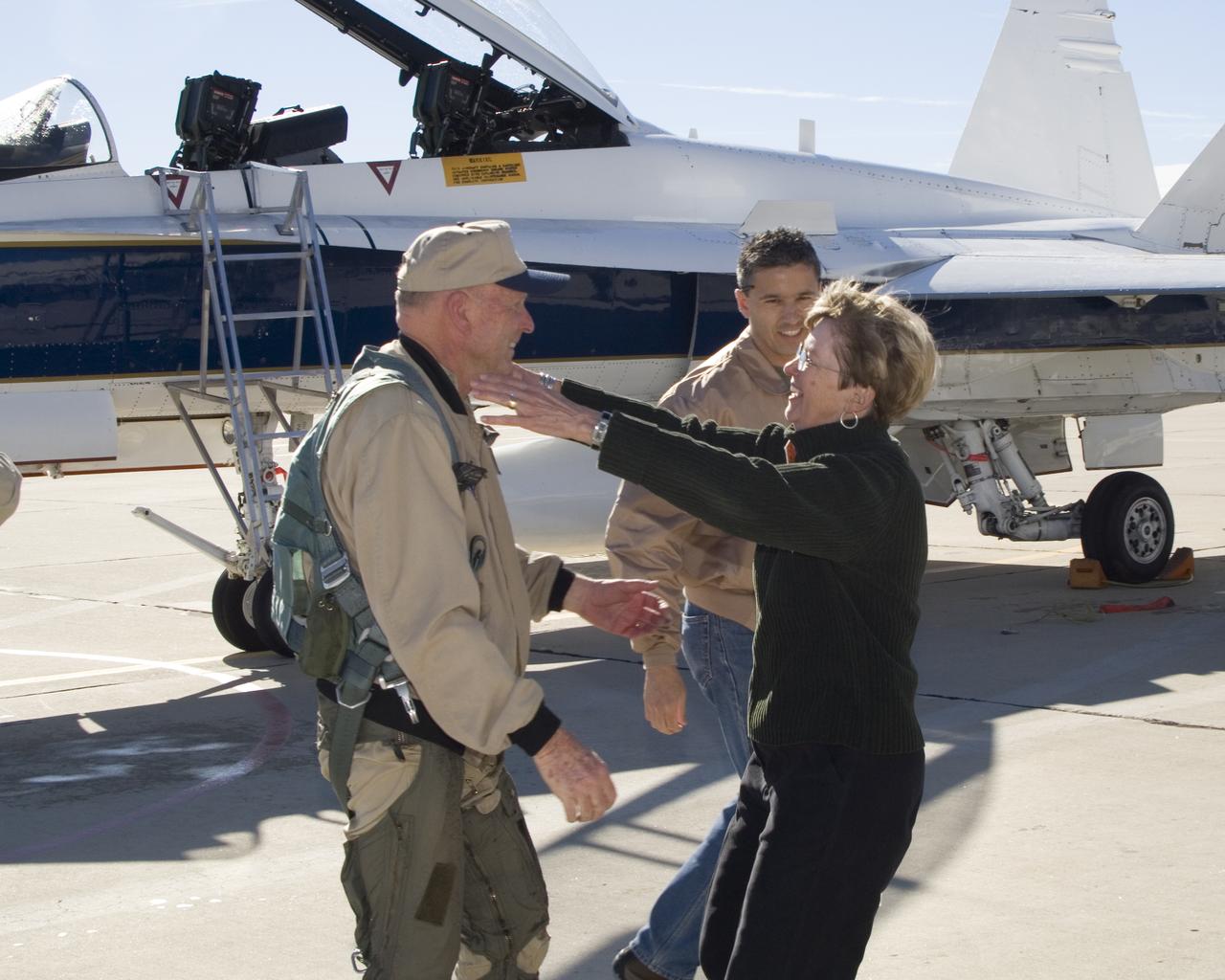
NASA Dryden research pilot Gordon Fullerton is greeted by his wife Marie on the Dryden ramp after his final flight in a NASA F/A-18 on Dec. 21, 2007.
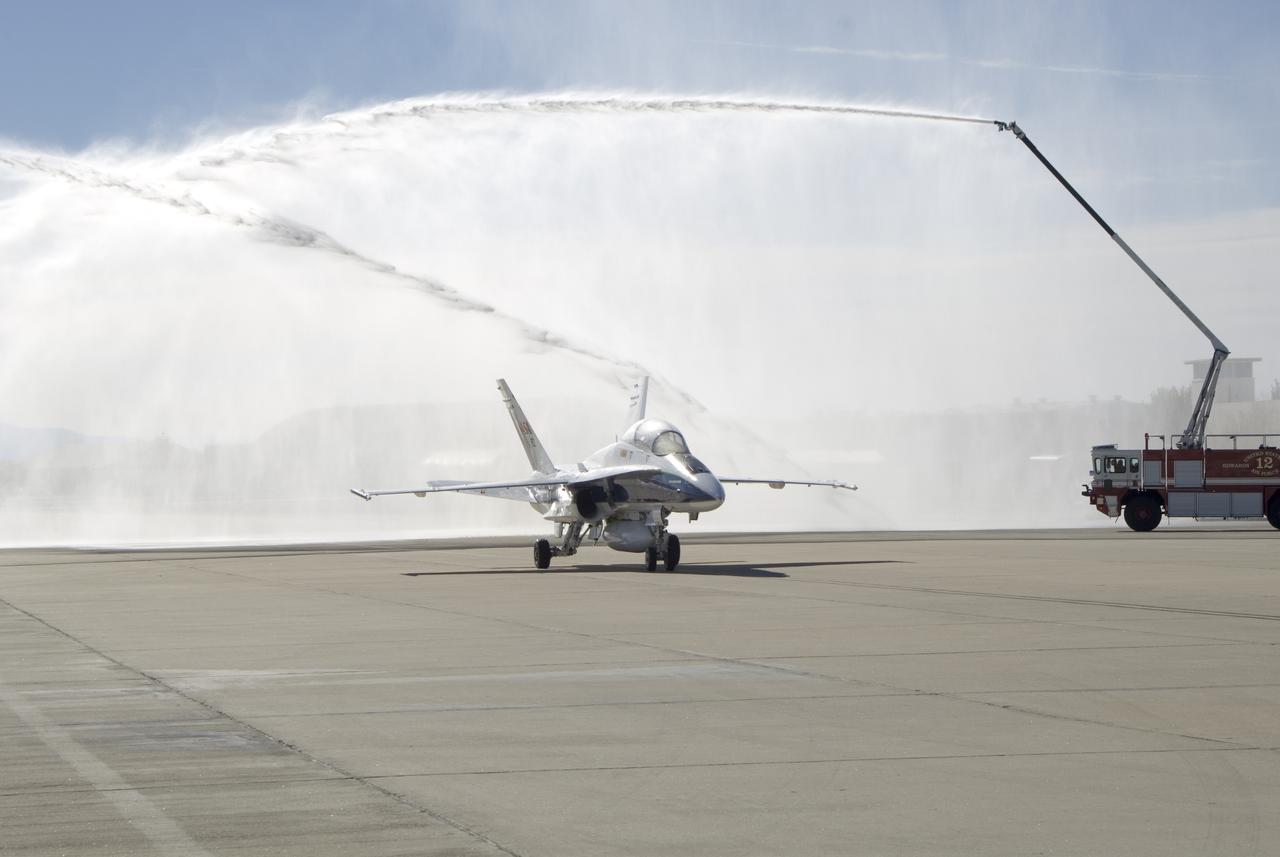
Long-time NASA Dryden research pilot and former astronaut C. Gordon Fullerton capped an almost 50-year flying career, including more than 38 years with NASA, with a final flight in a NASA F/A-18 on Dec. 21, 2007. Fullerton and Dryden research pilot Jim Smolka flew a 90-minute pilot proficiency formation aerobatics flight with another Dryden F/A-18 and a Dryden T-38 before concluding with two low-level formation flyovers of Dryden before landing. Fullerton was honored with a water-cannon spray arch provided by two fire trucks from the Edwards Air Force Base fire department as he taxied the F/A-18 up to the Dryden ramp, and was then greeted by his wife Marie and several hundred Dryden staff after his final flight. Fullerton began his flying career with the U.S. Air Force in 1958 after earning bachelor's and master's degrees in mechanical engineering from the California Institute of Technology. Initially trained as a fighter pilot, he later transitioned to multi-engine bombers and became a bomber operations test pilot after attending the Air Force Aerospace Research Pilot School at Edwards Air Force Base, Calif. He then was assigned to the flight crew for the planned Air Force Manned Orbital Laboratory in 1966. Upon cancellation of that program, the Air Force assigned Fullerton to NASA's astronaut corps in 1969. He served on the support crews for the Apollo 14, 15, 16 and 17 lunar missions, and was later assigned to one of the two flight crews that piloted the space shuttle prototype Enterprise during the Approach and Landing Test program at Dryden. He then logged some 382 hours in space when he flew on two early space shuttle missions, STS-3 on Columbia in 1982 and STS-51F on Challenger in 1985. He joined the flight crew branch at NASA Dryden after leaving the astronaut corps in 1986. During his 21 years at Dryden, Fullerton was project pilot on a number of high-profile research efforts, including the Propulsion Controlled Aircraft, the high-speed landing tests of
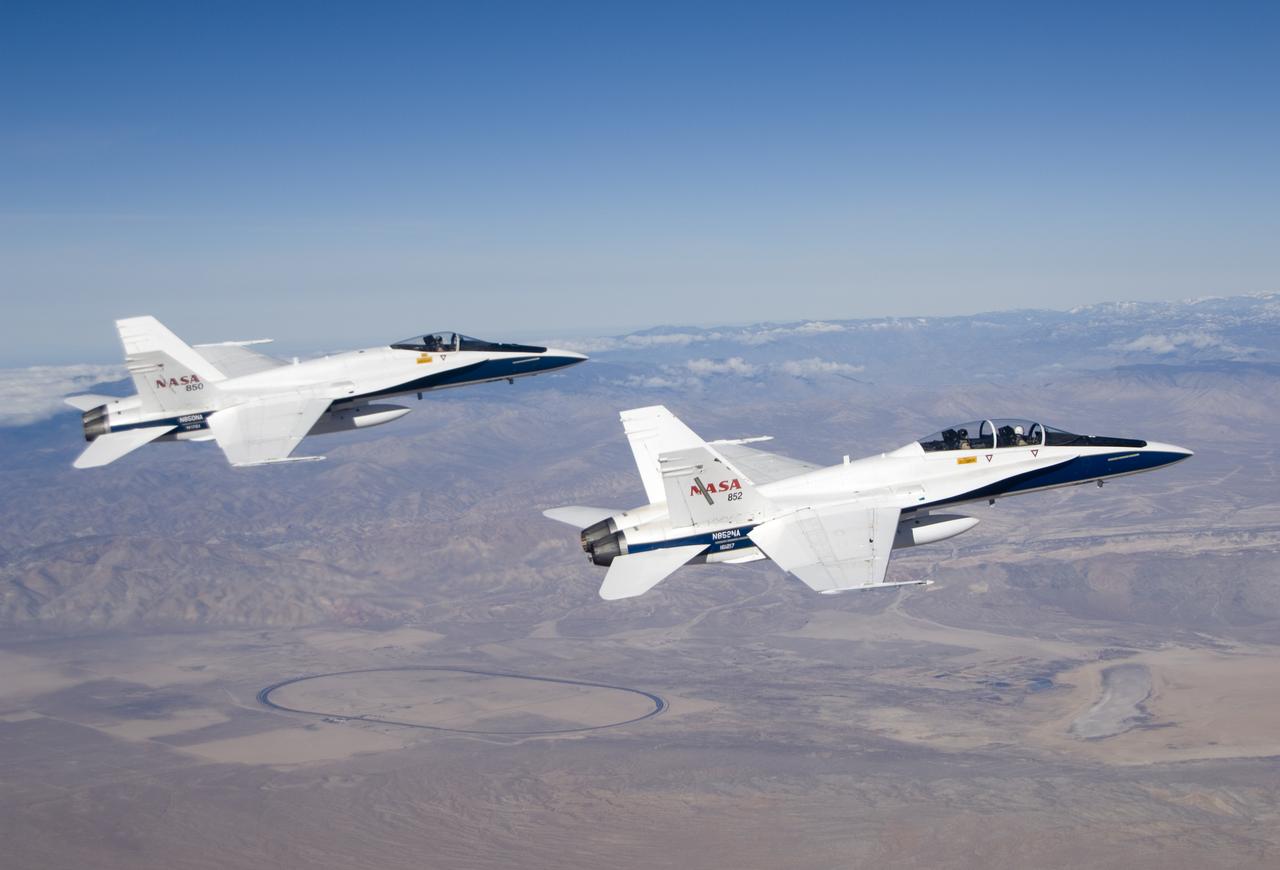
Long-time NASA Dryden research pilot and former astronaut C. Gordon Fullerton capped an almost 50-year flying career, including more than 38 years with NASA, with a final flight in a NASA F/A-18 on Dec. 21, 2007. Fullerton and Dryden research pilot Jim Smolka flew a 90-minute pilot proficiency formation aerobatics flight with another Dryden F/A-18 and a Dryden T-38 before concluding with two low-level formation flyovers of Dryden before landing. Fullerton was honored with a water-cannon spray arch provided by two fire trucks from the Edwards Air Force Base fire department as he taxied the F/A-18 up to the Dryden ramp, and was then greeted by his wife Marie and several hundred Dryden staff after his final flight. Fullerton began his flying career with the U.S. Air Force in 1958 after earning bachelor's and master's degrees in mechanical engineering from the California Institute of Technology. Initially trained as a fighter pilot, he later transitioned to multi-engine bombers and became a bomber operations test pilot after attending the Air Force Aerospace Research Pilot School at Edwards Air Force Base, Calif. He then was assigned to the flight crew for the planned Air Force Manned Orbital Laboratory in 1966. Upon cancellation of that program, the Air Force assigned Fullerton to NASA's astronaut corps in 1969. He served on the support crews for the Apollo 14, 15, 16 and 17 lunar missions, and was later assigned to one of the two flight crews that piloted the space shuttle prototype Enterprise during the Approach and Landing Test program at Dryden. He then logged some 382 hours in space when he flew on two early space shuttle missions, STS-3 on Columbia in 1982 and STS-51F on Challenger in 1985. He joined the flight crew branch at NASA Dryden after leaving the astronaut corps in 1986. During his 21 years at Dryden, Fullerton was project pilot on a number of high-profile research efforts, including the Propulsion Controlled Aircraft, the high-speed landing tests of sp
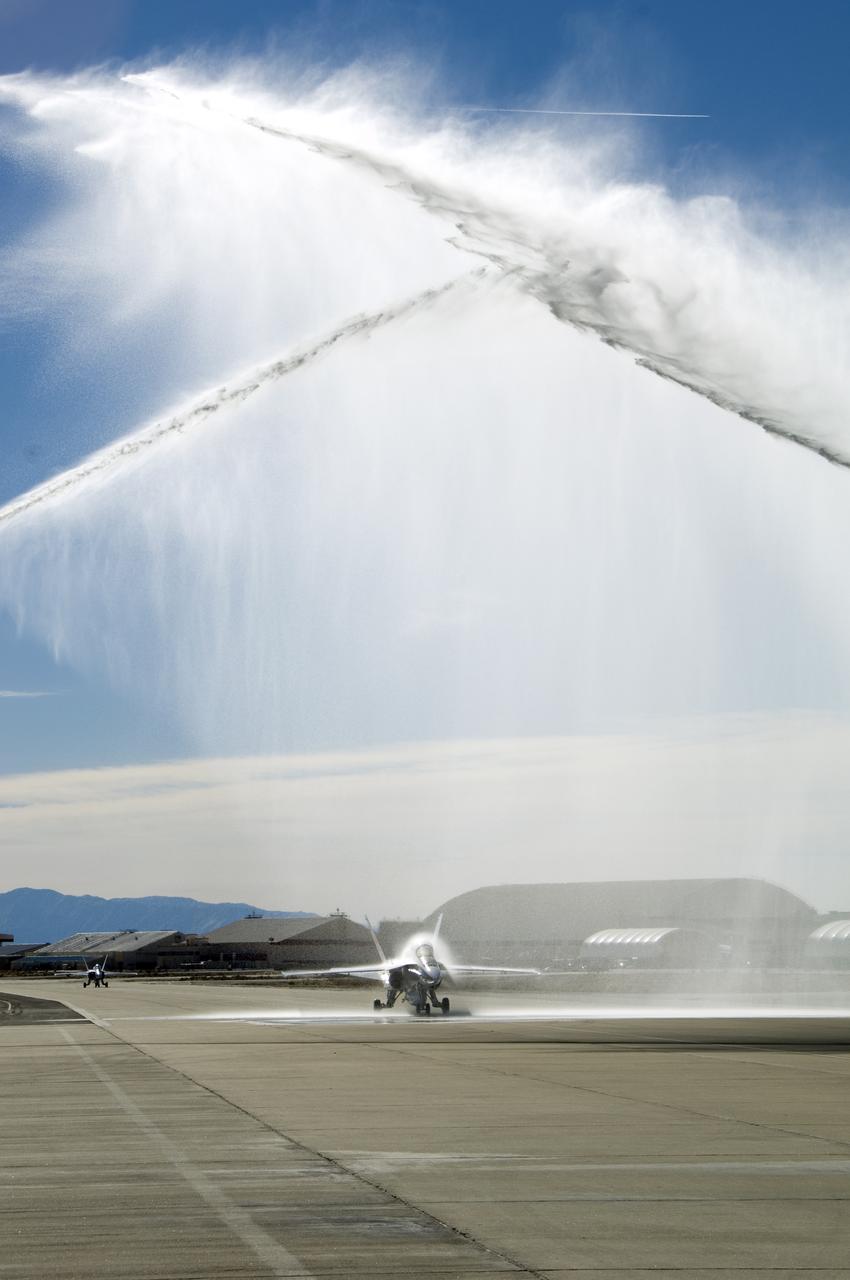
Long-time NASA Dryden research pilot and former astronaut C. Gordon Fullerton capped an almost 50-year flying career, including more than 38 years with NASA, with a final flight in a NASA F/A-18 on Dec. 21, 2007. Fullerton and Dryden research pilot Jim Smolka flew a 90-minute pilot proficiency formation aerobatics flight with another Dryden F/A-18 and a Dryden T-38 before concluding with two low-level formation flyovers of Dryden before landing. Fullerton was honored with a water-cannon spray arch provided by two fire trucks from the Edwards Air Force Base fire department as he taxied the F/A-18 up to the Dryden ramp, and was then greeted by his wife Marie and several hundred Dryden staff after his final flight. Fullerton began his flying career with the U.S. Air Force in 1958 after earning bachelor's and master's degrees in mechanical engineering from the California Institute of Technology. Initially trained as a fighter pilot, he later transitioned to multi-engine bombers and became a bomber operations test pilot after attending the Air Force Aerospace Research Pilot School at Edwards Air Force Base, Calif. He then was assigned to the flight crew for the planned Air Force Manned Orbital Laboratory in 1966. Upon cancellation of that program, the Air Force assigned Fullerton to NASA's astronaut corps in 1969. He served on the support crews for the Apollo 14, 15, 16 and 17 lunar missions, and was later assigned to one of the two flight crews that piloted the space shuttle prototype Enterprise during the Approach and Landing Test program at Dryden. He then logged some 382 hours in space when he flew on two early space shuttle missions, STS-3 on Columbia in 1982 and STS-51F on Challenger in 1985. He joined the flight crew branch at NASA Dryden after leaving the astronaut corps in 1986. During his 21 years at Dryden, Fullerton was project pilot on a number of high-profile research efforts, including the Propulsion Controlled Aircraft, the high-speed landing tests of
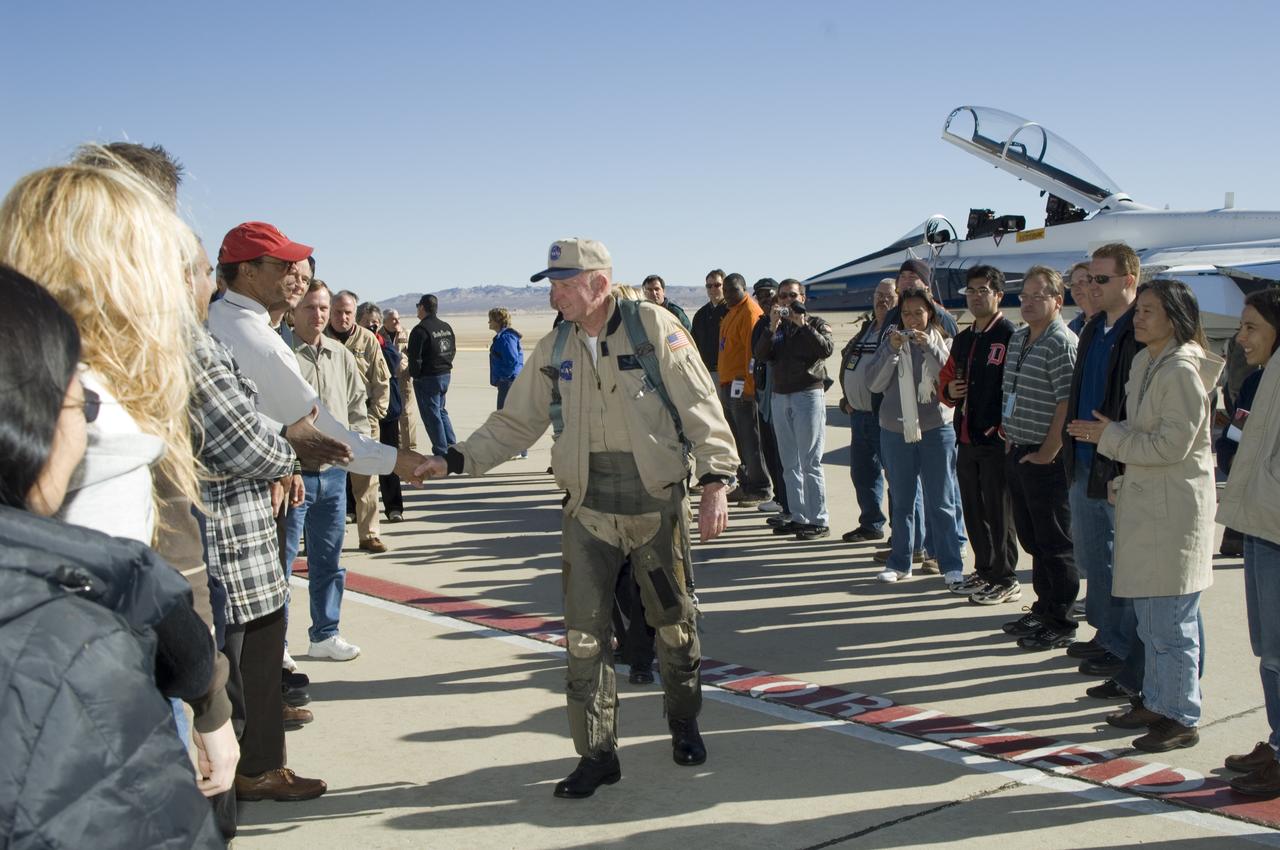
Long-time NASA Dryden research pilot and former astronaut C. Gordon Fullerton capped an almost 50-year flying career, including more than 38 years with NASA, with a final flight in a NASA F/A-18 on Dec. 21, 2007. Fullerton and Dryden research pilot Jim Smolka flew a 90-minute pilot proficiency formation aerobatics flight with another Dryden F/A-18 and a Dryden T-38 before concluding with two low-level formation flyovers of Dryden before landing. Fullerton was honored with a water-cannon spray arch provided by two fire trucks from the Edwards Air Force Base fire department as he taxied the F/A-18 up to the Dryden ramp, and was then greeted by his wife Marie and several hundred Dryden staff after his final flight. Fullerton began his flying career with the U.S. Air Force in 1958 after earning bachelor's and master's degrees in mechanical engineering from the California Institute of Technology. Initially trained as a fighter pilot, he later transitioned to multi-engine bombers and became a bomber operations test pilot after attending the Air Force Aerospace Research Pilot School at Edwards Air Force Base, Calif. He then was assigned to the flight crew for the planned Air Force Manned Orbital Laboratory in 1966. Upon cancellation of that program, the Air Force assigned Fullerton to NASA's astronaut corps in 1969. He served on the support crews for the Apollo 14, 15, 16 and 17 lunar missions, and was later assigned to one of the two flight crews that piloted the space shuttle prototype Enterprise during the Approach and Landing Test program at Dryden. He then logged some 382 hours in space when he flew on two early space shuttle missions, STS-3 on Columbia in 1982 and STS-51F on Challenger in 1985. He joined the flight crew branch at NASA Dryden after leaving the astronaut corps in 1986. During his 21 years at Dryden, Fullerton was project pilot on a number of high-profile research efforts, including the Propulsion Controlled Aircraft, the high-speed landing tests of
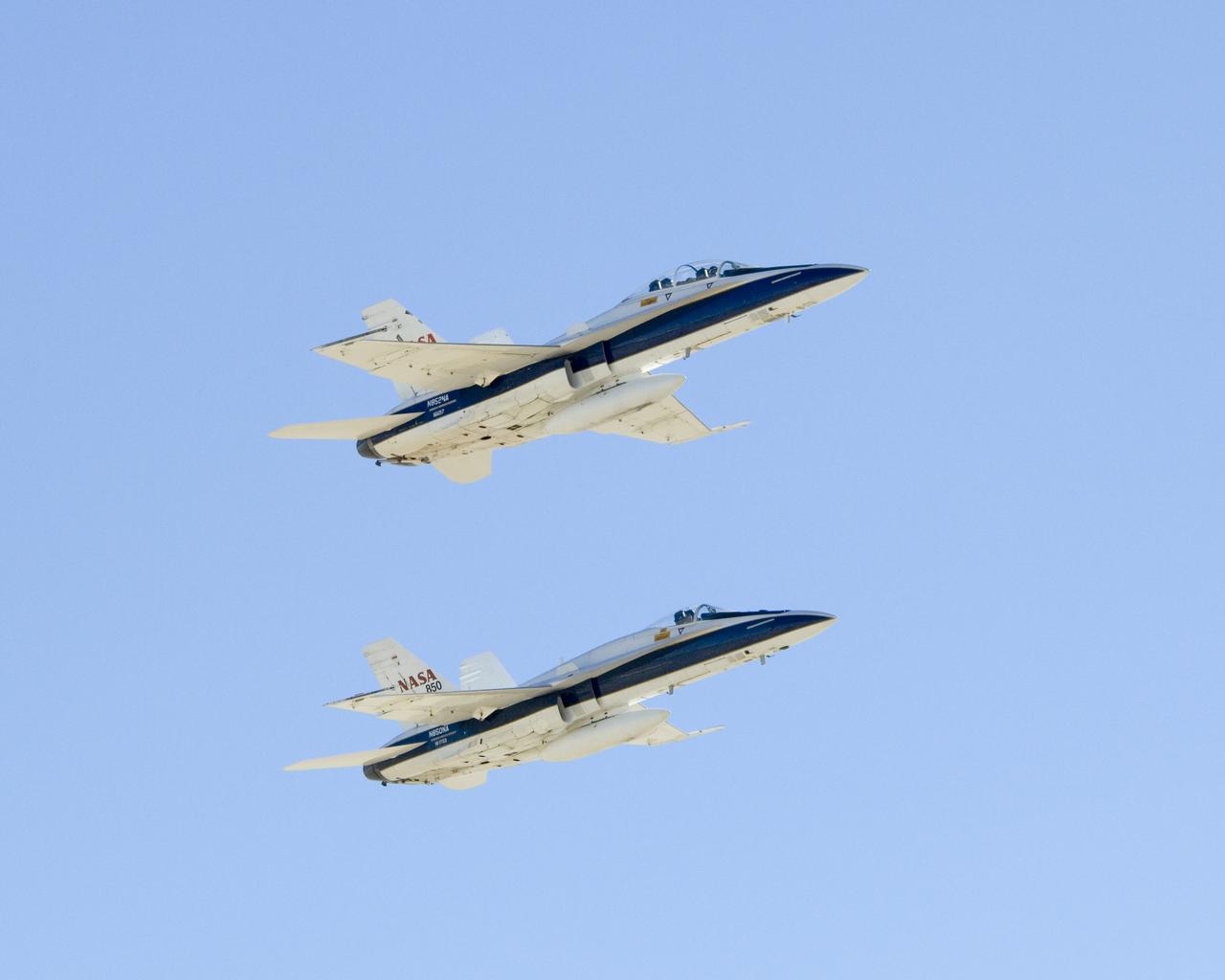
Long-time NASA Dryden research pilot and former astronaut C. Gordon Fullerton capped an almost 50-year flying career, including more than 38 years with NASA, with a final flight in a NASA F/A-18 on Dec. 21, 2007. Fullerton and Dryden research pilot Jim Smolka flew a 90-minute pilot proficiency formation aerobatics flight with another Dryden F/A-18 and a Dryden T-38 before concluding with two low-level formation flyovers of Dryden before landing. Fullerton was honored with a water-cannon spray arch provided by two fire trucks from the Edwards Air Force Base fire department as he taxied the F/A-18 up to the Dryden ramp, and was then greeted by his wife Marie and several hundred Dryden staff after his final flight. Fullerton began his flying career with the U.S. Air Force in 1958 after earning bachelor's and master's degrees in mechanical engineering from the California Institute of Technology. Initially trained as a fighter pilot, he later transitioned to multi-engine bombers and became a bomber operations test pilot after attending the Air Force Aerospace Research Pilot School at Edwards Air Force Base, Calif. He then was assigned to the flight crew for the planned Air Force Manned Orbital Laboratory in 1966. Upon cancellation of that program, the Air Force assigned Fullerton to NASA's astronaut corps in 1969. He served on the support crews for the Apollo 14, 15, 16 and 17 lunar missions, and was later assigned to one of the two flight crews that piloted the space shuttle prototype Enterprise during the Approach and Landing Test program at Dryden. He then logged some 382 hours in space when he flew on two early space shuttle missions, STS-3 on Columbia in 1982 and STS-51F on Challenger in 1985. He joined the flight crew branch at NASA Dryden after leaving the astronaut corps in 1986. During his 21 years at Dryden, Fullerton was project pilot on a number of high-profile research efforts, including the Propulsion Controlled Aircraft, the high-speed landing tests of