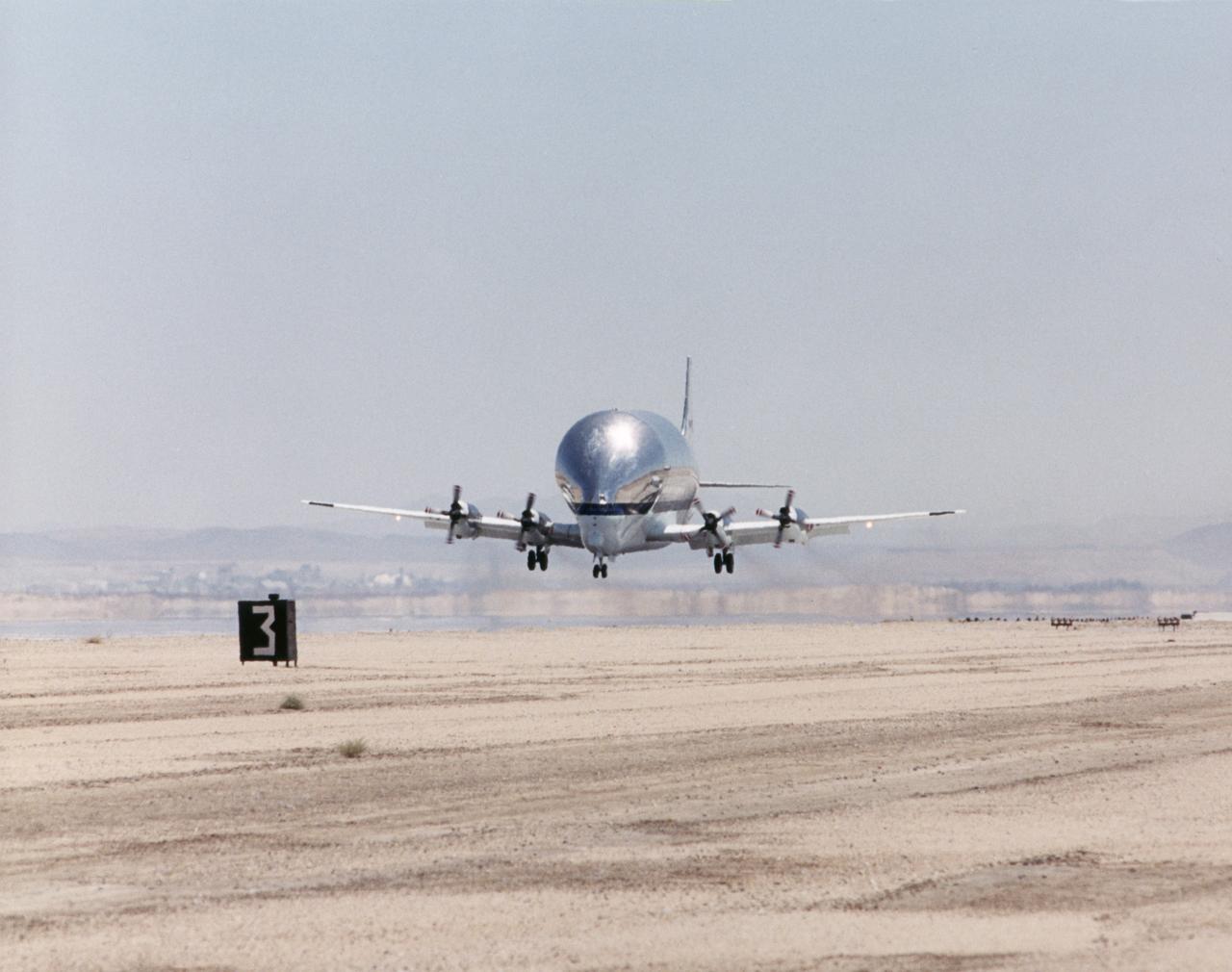
NASA's Super Guppy transport aircraft landed at Edwards Air Force Base, Calif. on July 11, 2000, to deliver the latest version of the X-38 drop vehicle to Dryden. The X-38s are intended as prototypes for a possible "crew lifeboat" for the International Space Station. The X-38 vehicle 131R will demonstrate a huge 7,500 square-foot parafoil that will that will enable the potential crew return vehicle to land on the length of a football field after returning from space. The crew return vehicle is intended to serve as a possible emergency transport to carry a crew to safety in the event of problems with the International Space Station. The Super Guppy evolved from the 1960s-vintage Pregnant Guppy, used for transporting outsized sections of the Apollo moon rocket. The Super Guppy was modified from 1950s-vintage Boeing C-97. NASA acquired its Super Guppy from the European Space Agency in 1997.
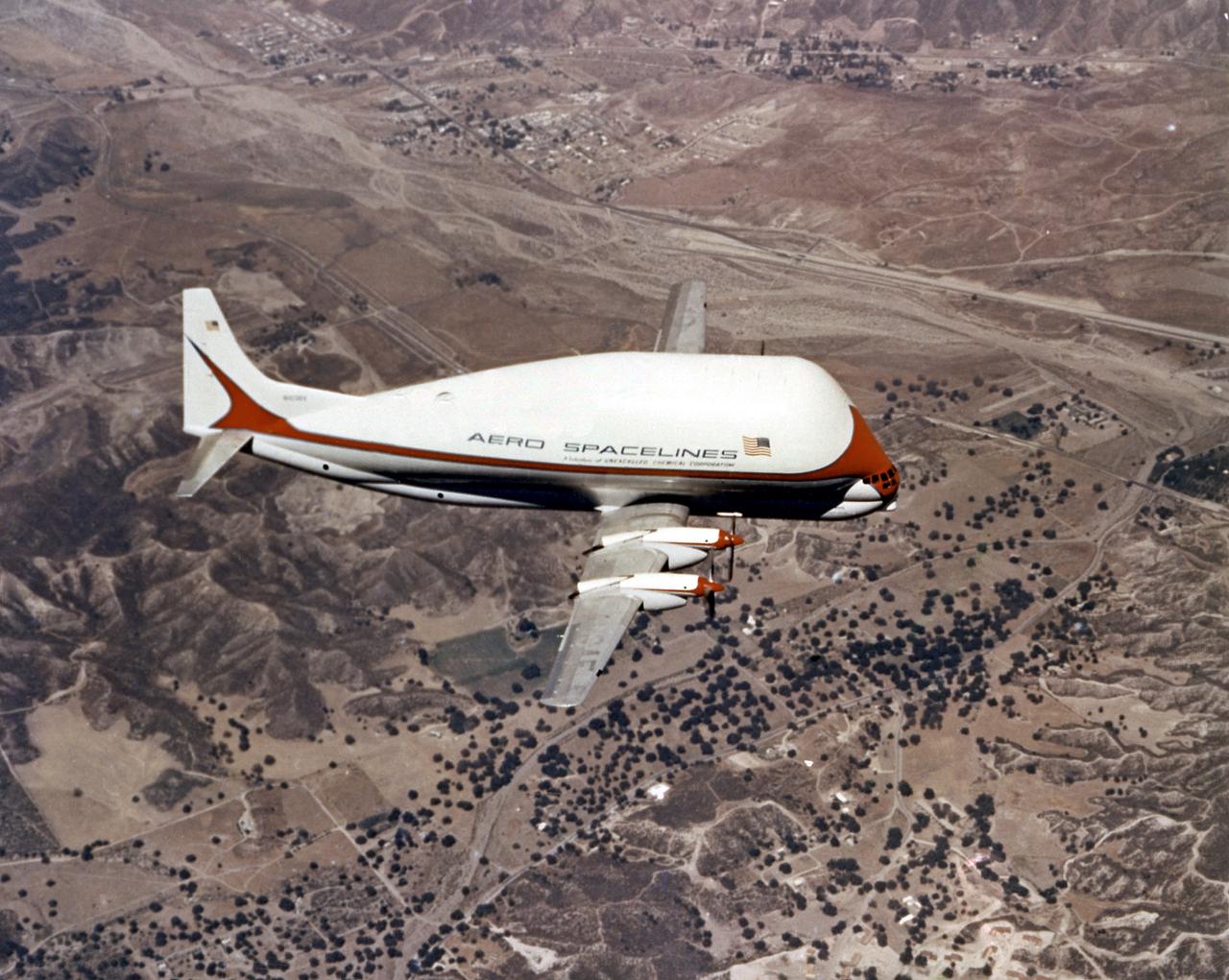
Super Guppy, bigger sister of the aptly named Pregnant Guppy, was the only airplane in the world capable of carrying a complete S-IVB stage. This aircraft was built by John M. Conroy of Aero Spaceliners, Incorporated, who started with the fuselages of a surplus Boeing C-97 Stratocruiser, ballooned out the upper decks enormously, and hinged the front sections so that they could be folded back 110 degrees. The Super Guppy flew smoothly at a 250-mph cruising speed, and its cargo deck provided a 25-foot clear diameter.
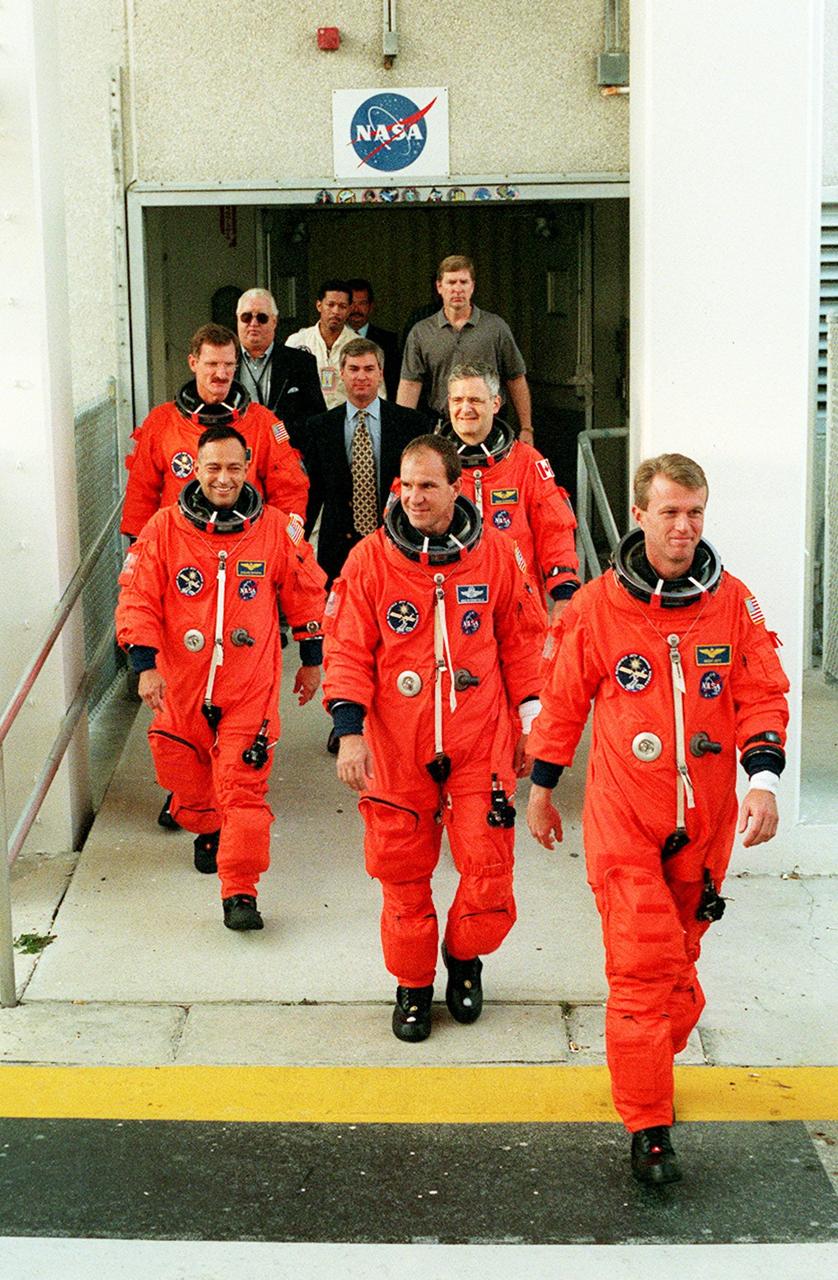
The STS-97 crew get a taste of the excitement of launch day as they exit the O&C Building to head for Launch Pad 39B. They are taking part in Terminal Countdown Demonstration Test (TCDT) activities that include emergency egress training and a simulated launch countdown. On the left (front to back) are Mission Specialists Carlos Noriega and Joe Tanner; on the right (front to back) are Commander Brent Jett, Pilot Mike Bloomfield and Mission Specialist Marc Garneau, who is a Canadian astronaut. Mission STS-97is the sixth construction flight to the International Space Station. Its payload includes the P6 Integrated Truss Structure and a photovoltaic (PV) module, with giant solar arrays that will provide power to the Station. The mission includes two spacewalks to complete the solar array connections. STS-97 is scheduled to launch Nov. 30 at 10:05 p.m. EST
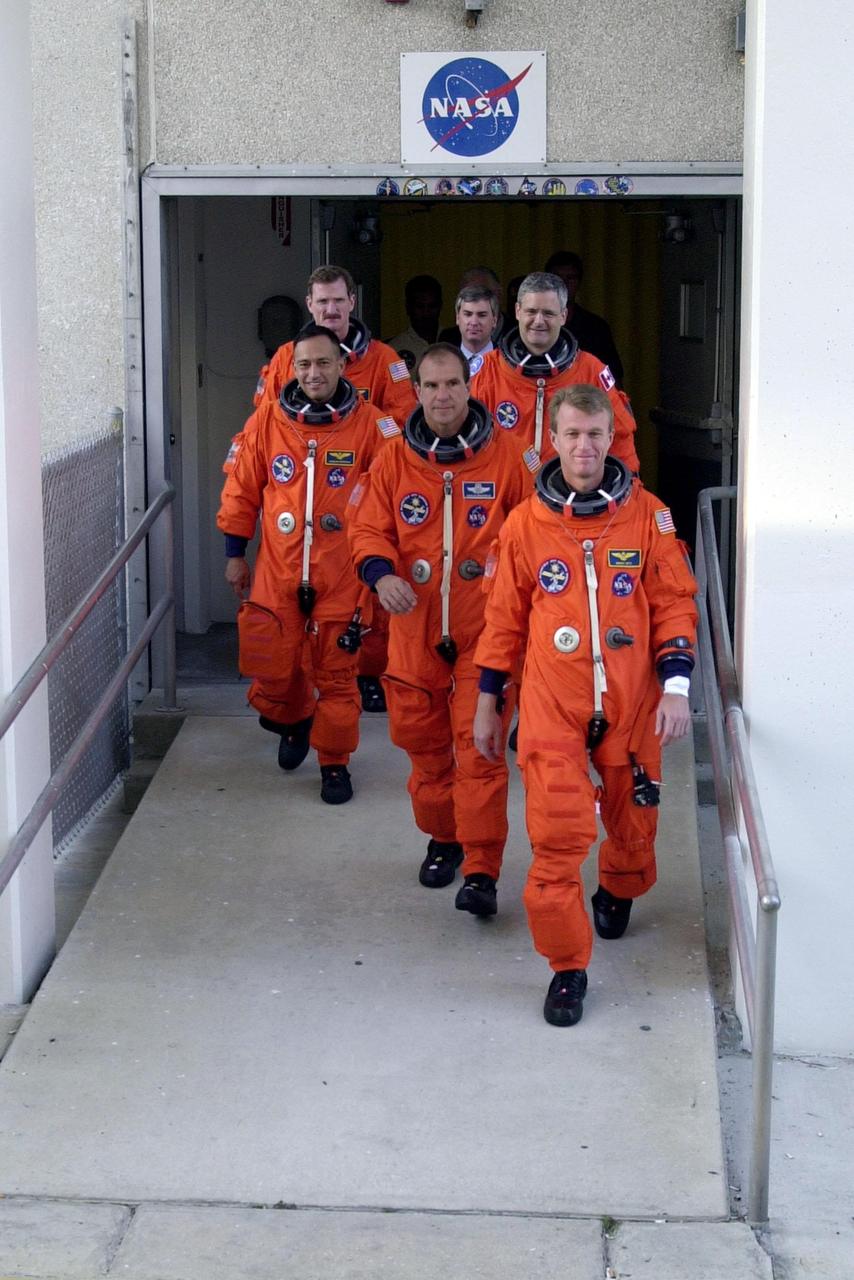
The STS-97 crew leaves the O&C Building on their way to Launch Pad 39B for a simulated launch countdown. Commander Brent Jett (right) leads the way with Pilot Mike Bloomfield behind him. Taking up the rear are (left) Mission Specialists Carlos Noriega, Joe Tanner and (right) Marc Garneau, who is with the Canadian Space Agency. The crew is taking part in Terminal Countdown Demonstration Test activities that include emergency egress training, familiarization with the payload, and the simulated launch countdown. Mission STS-97is the sixth construction flight to the International Space Station. Its payload includes the P6 Integrated Truss Structure and a photovoltaic (PV) module, with giant solar arrays that will provide power to the Station. The mission includes two spacewalks to complete the solar array connections. STS-97 is scheduled to launch Nov. 30 at about 10:05 p.m. EST
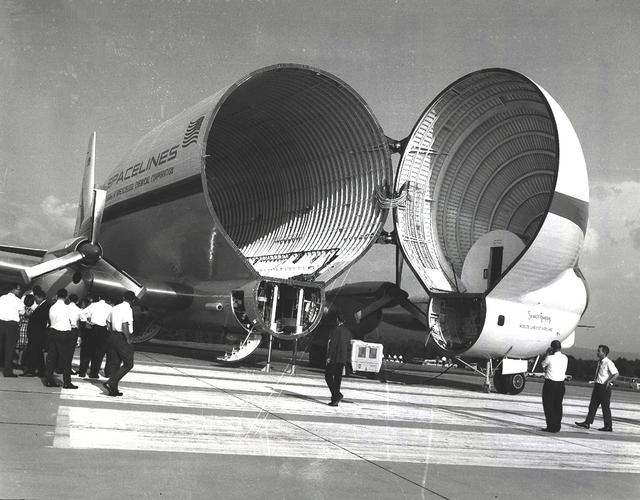
The Super Guppy is shown at the Redstone Airstrip. NASA used the aircraft to transport the S-IVB upper stage used on the Saturn IB and Saturn V launch vehicles between manufacturing facilities on the West coast, and testing and launch facilities in the Southeast. This aircraft was built by John M. Conroy of Aero Spaceliners, Incorporated, who started with the fuselages of a surplus Boeing C-97 Stratocruiser, ballooned out the upper decks enormously, and hinged the front sections so that they could be folded back 110 degrees. The Super Guppy flew smoothly at a 250-mph cruising speed, and its cargo deck provided a 25-foot clear diameter.
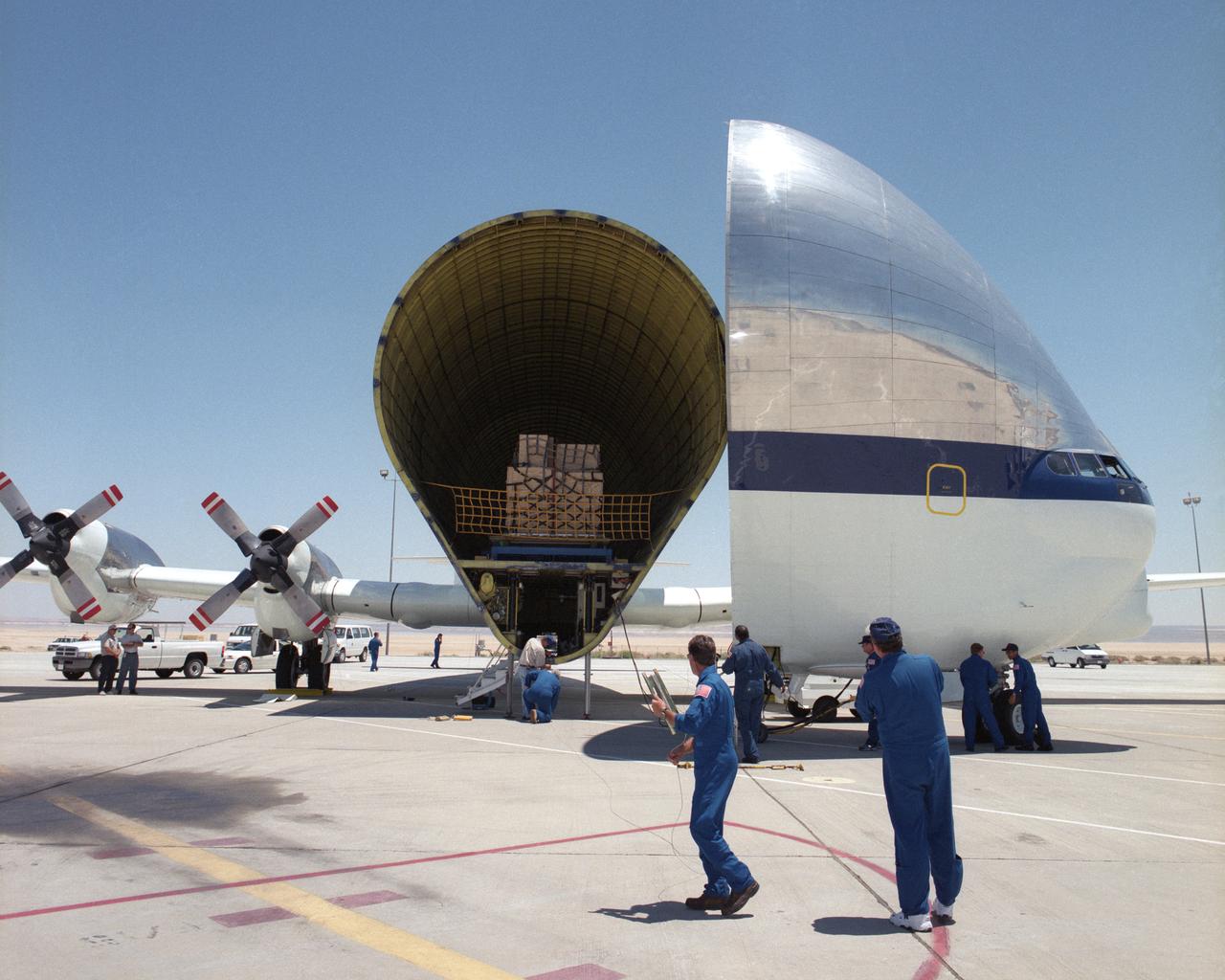
Members of the flight and ground crews prepare to unload equipment from NASA's B377SGT Super Guppy Turbine cargo aircraft on the ramp at NASA's Dryden Flight Research Center at Edwards Air Force Base, Calif. The outsize cargo plane had delivered the latest version of the X-38 flight test vehicle to NASA Dryden when this photo was taken on June 11, 2000.
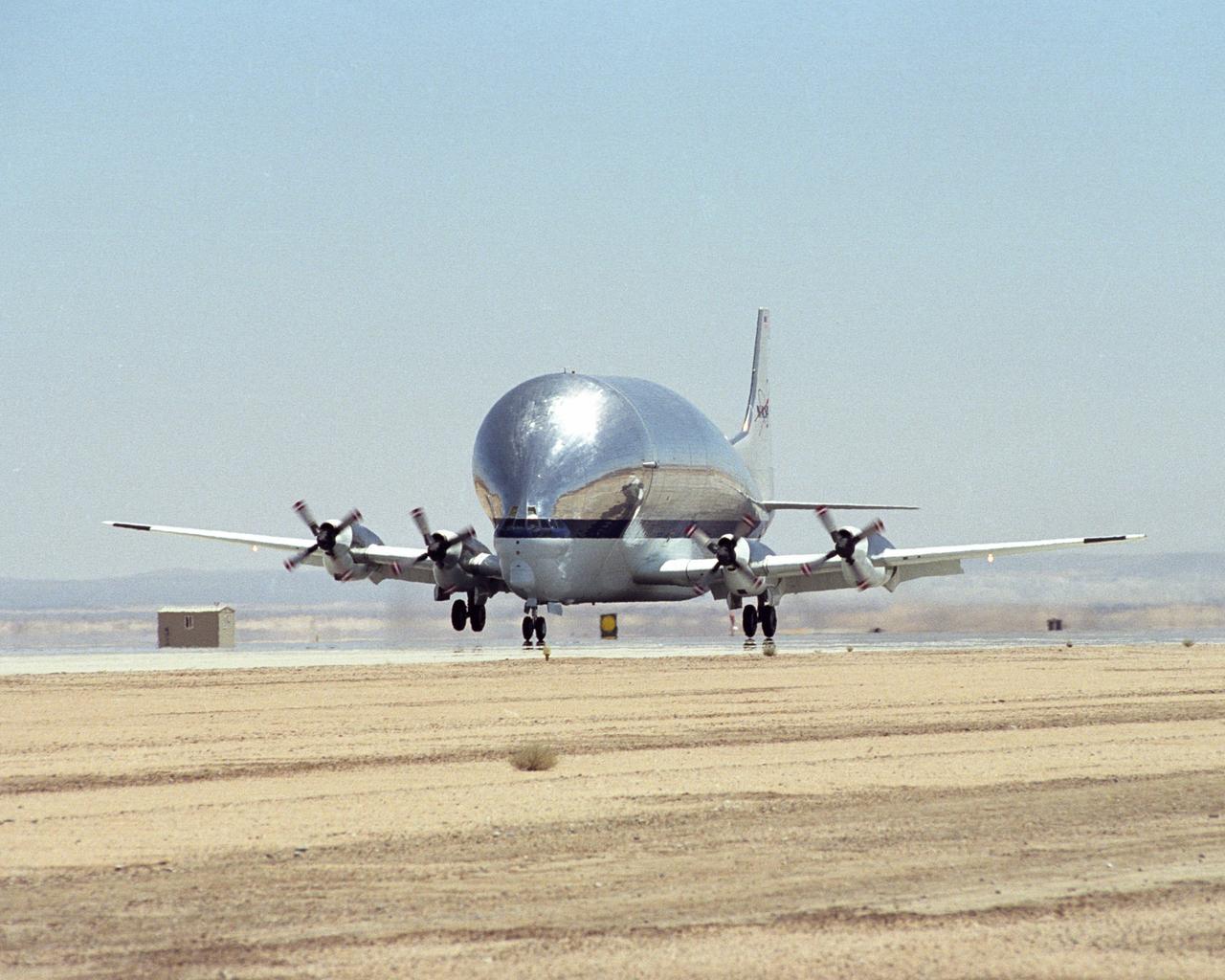
NASA's B377SGT Super Guppy Turbine cargo aircraft touches down at Edwards Air Force Base, Calif. on June 11, 2000 to deliver the latest version of the X-38 flight test vehicle to NASA's Dryden Flight Research Center.

Workers offload the shipping container with the Cassini orbiter from what looks like a giant shark mouth, but is really an Air Force C-17 air cargo plane which <a href="http://www-pao.ksc.nasa.gov/kscpao/release/1997/66-97.htm">just landed</a> at KSC’s Shuttle Landing Facility from Edwards Air Force Base, California. The orbiter and the Huygens probe already being processed at KSC are the two primary components of the Cassini spacecraft, which will be launched on a Titan IVB/Centaur expendable launch vehicle from Cape Canaveral Air Station. Cassini will explore Saturn, its rings and moons for four years. The Huygens probe, designed and developed for the European Space Agency (ESA), will be deployed from the orbiter to study the clouds, atmosphere and surface of Saturn’s largest moon, Titan. The orbiter was designed and assembled at NASA’s Jet Propulsion Laboratory in California. Following postflight inspections, integration of the 12 science instruments not already installed on the orbiter will be completed. Then, the parabolic high-gain antenna and the propulsion module will be mated to the orbiter, followed by the Huygens probe, which will complete spacecraft integration. The Cassini mission is targeted for an Oct. 6 launch to begin its 6.7-year journey to the Saturnian system. Arrival at the planet is expected to occur around July 1, 2004
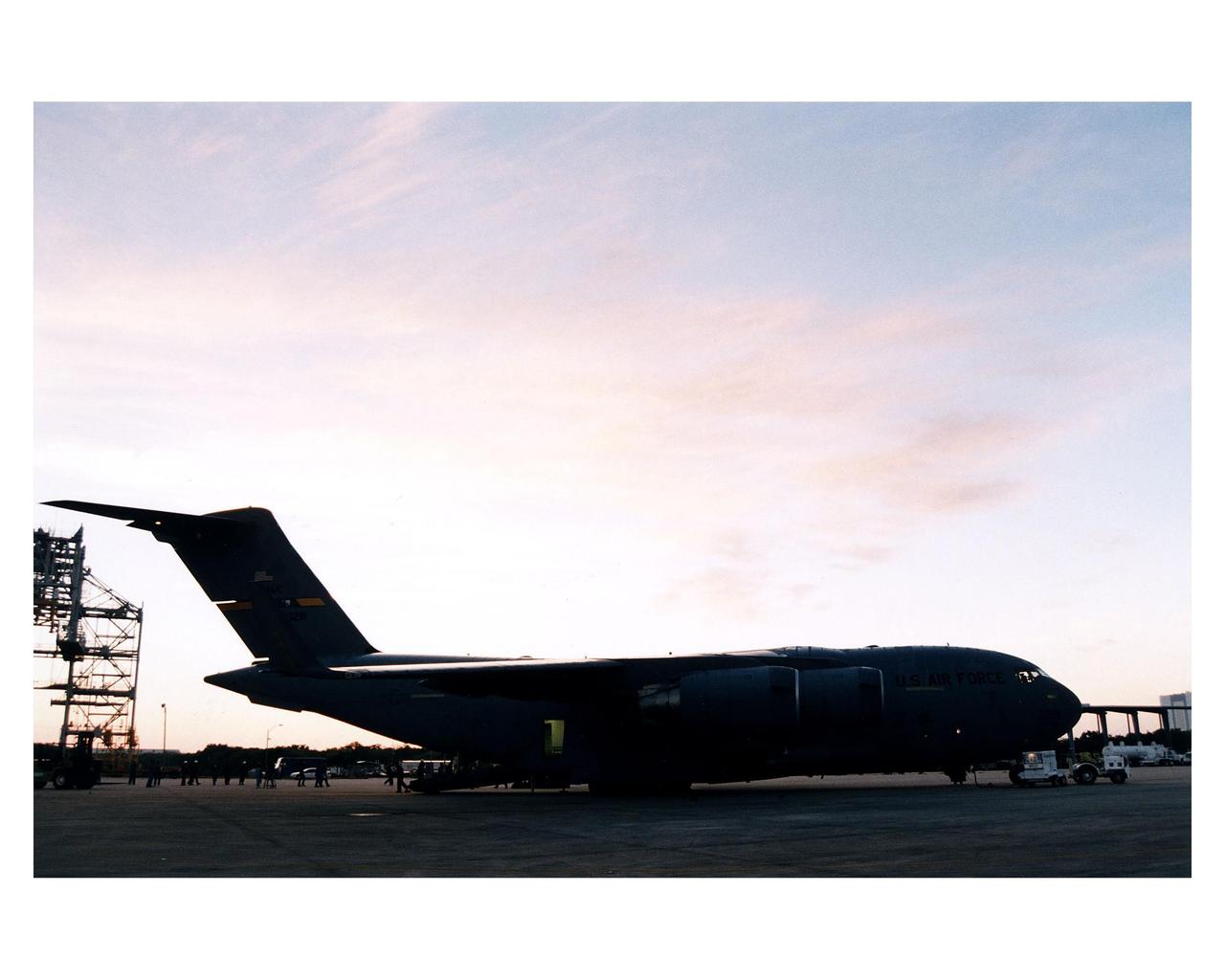
Workers begin unloading the Cassini orbiter from a U.S. Air Force C-17 air cargo plane after its <a href="http://www-pao.ksc.nasa.gov/kscpao/release/1997/66-97.htm">arrival</a> at KSC’s Shuttle Landing Facility from Edwards Air Force Base, California. The orbiter and the Huygens probe already being processed at KSC are the two primary components of the Cassini spacecraft, which will be launched on a Titan IVB/Centaur expendable launch vehicle from Cape Canaveral Air Station. Cassini will explore Saturn, its rings and moons for four years. The Huygens probe, designed and developed for the European Space Agency (ESA), will be deployed from the orbiter to study the clouds, atmosphere and surface of Saturn’s largest moon, Titan. The orbiter was designed and assembled at NASA’s Jet Propulsion Laboratory in California. Following postflight inspections, integration of the 12 science instruments not already installed on the orbiter will be completed. Then, the parabolic high-gain antenna and the propulsion module will be mated to the orbiter, followed by the Huygens probe, which will complete spacecraft integration. The Cassini mission is targeted for an Oct. 6 launch to begin its 6.7-year journey to the Saturnian system. Arrival at the planet is expected to occur around July 1, 2004
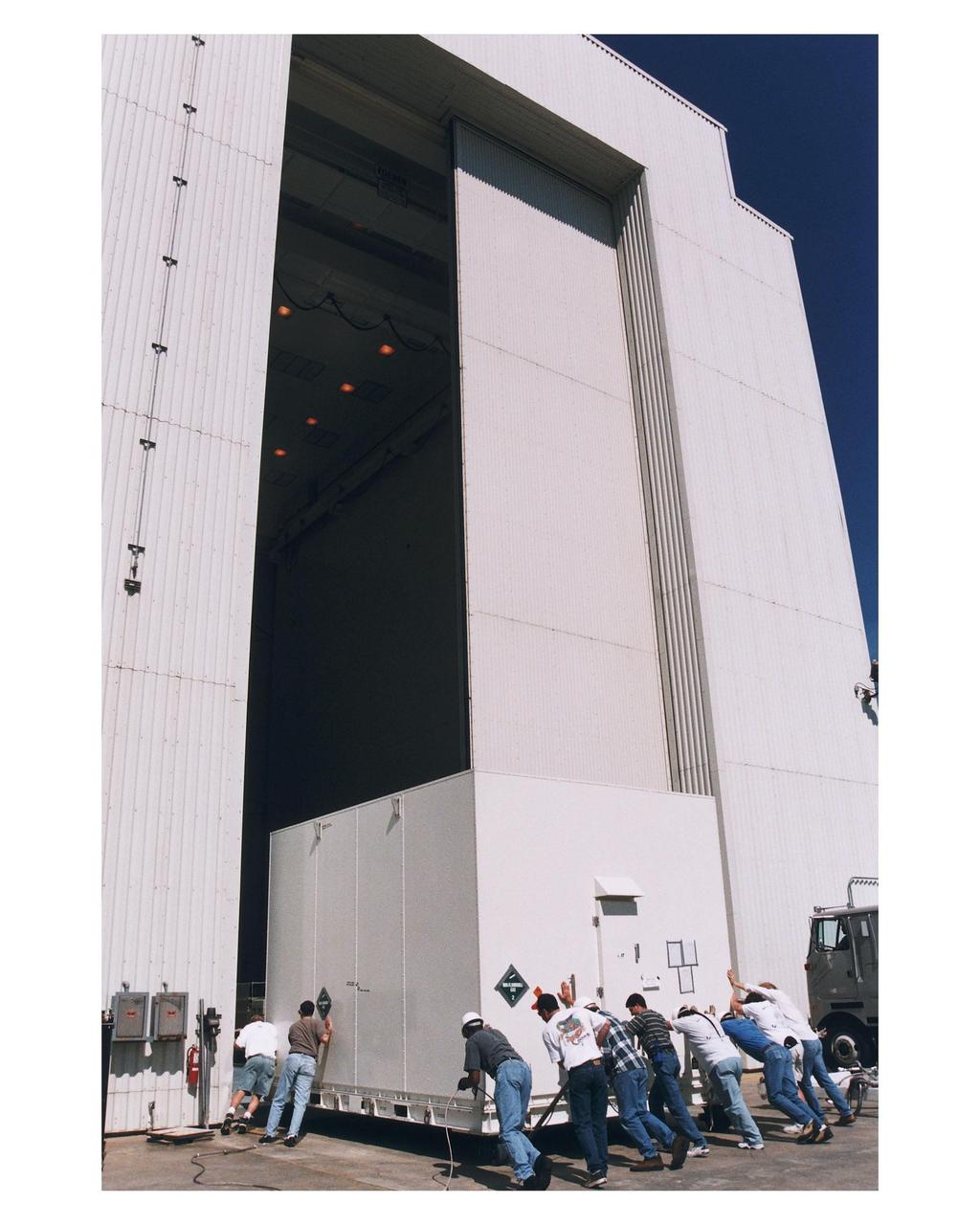
Workers prepare to move the shipping container with the Cassini orbiter inside the Payload Hazardous Servicing Facility (PHSF) for prelaunch processing, testing and integration. The <a href="http://www-pao.ksc.nasa.gov/kscpao/release/1997/66-97.htm">orbiter arrived</a> at KSC’s Shuttle Landing Facility in a U.S. Air Force C-17 air cargo plane from Edwards Air Force Base, California. The orbiter and the Huygens probe already being processed at KSC are the two primary components of the Cassini spacecraft, which will be launched on a Titan IVB/Centaur expendable launch vehicle from Cape Canaveral Air Station. Cassini will explore Saturn, its rings and moons for four years. The Huygens probe, designed and developed for the European Space Agency (ESA), will be deployed from the orbiter to study the clouds, atmosphere and surface of Saturn’s largest moon, Titan. The orbiter was designed and assembled at NASA’s Jet Propulsion Laboratory in California. Following postflight inspections, integration of the 12 science instruments not already installed on the orbiter will be completed. Then, the parabolic high-gain antenna and the propulsion module will be mated to the orbiter, followed by the Huygens probe, which will complete spacecraft integration. The Cassini mission is targeted for an Oct. 6 launch to begin its 6.7-year journey to the Saturnian system. Arrival at the planet is expected to occur around July 1, 2004
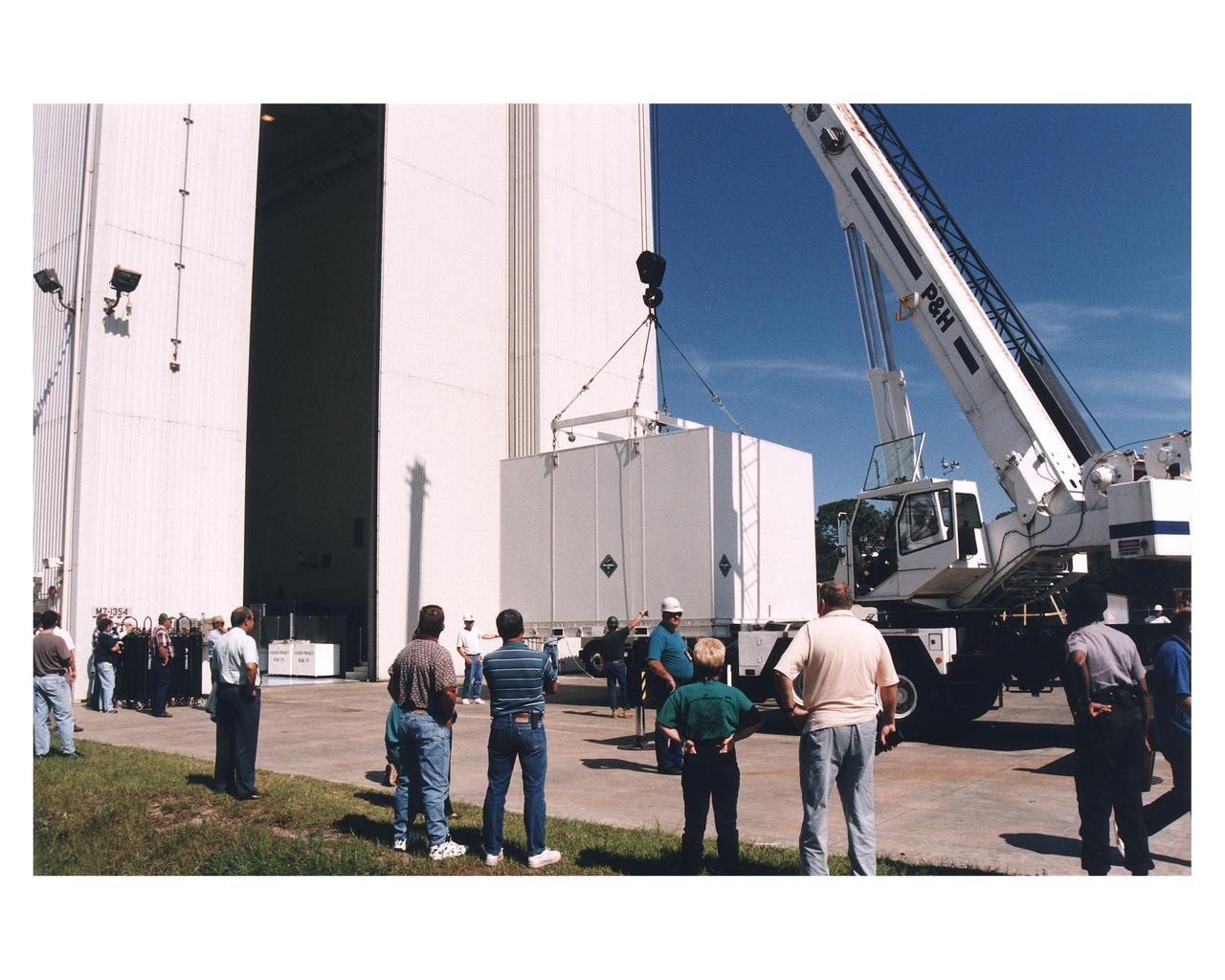
Workers prepare to move the shipping container with the Cassini orbiter inside the Payload Hazardous Servicing Facility (PHSF) for prelaunch processing, testing and integration. The <a href="http://www-pao.ksc.nasa.gov/kscpao/release/1997/66-97.htm">orbiter arrived</a> at KSC’s Shuttle Landing Facility in a U.S. Air Force C-17 air cargo plane from Edwards Air Force Base, California. The orbiter and the Huygens probe already being processed at KSC are the two primary components of the Cassini spacecraft, which will be launched on a Titan IVB/Centaur expendable launch vehicle from Cape Canaveral Air Station. Cassini will explore Saturn, its rings and moons for four years. The Huygens probe, designed and developed for the European Space Agency (ESA), will be deployed from the orbiter to study the clouds, atmosphere and surface of Saturn’s largest moon, Titan. The orbiter was designed and assembled at NASA’s Jet Propulsion Laboratory in California. Following postflight inspections, integration of the 12 science instruments not already installed on the orbiter will be completed. Then, the parabolic high-gain antenna and the propulsion module will be mated to the orbiter, followed by the Huygens probe, which will complete spacecraft integration. The Cassini mission is targeted for an Oct. 6 launch to begin its 6.7-year journey to the Saturnian system. Arrival at the planet is expected to occur around July 1, 2004
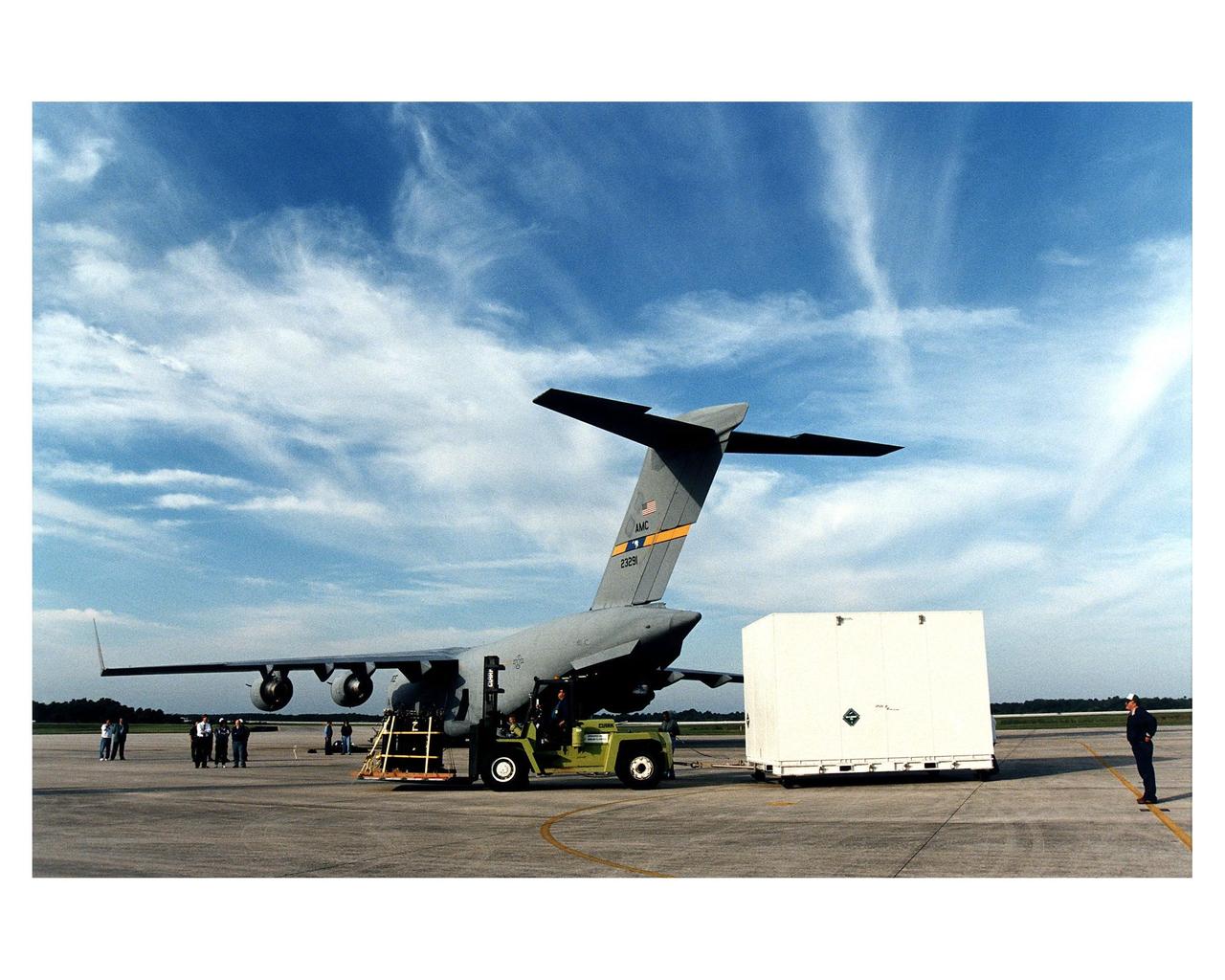
Workers prepare to tow away the large container with the Cassini orbiter from KSC’s Shuttle Landing Facility. The orbiter <a href="http://www-pao.ksc.nasa.gov/kscpao/release/1997/66-97.htm">just arrived</a> on the U.S. Air Force C-17 air cargo plane, shown here, from Edwards Air Force Base, California. The orbiter and the Huygens probe already being processed at KSC are the two primary components of the Cassini spacecraft, which will be launched on a Titan IVB/Centaur expendable launch vehicle from Cape Canaveral Air Station. Cassini will explore Saturn, its rings and moons for four years. The Huygens probe, designed and developed for the European Space Agency (ESA), will be deployed from the orbiter to study the clouds, atmosphere and surface of Saturn’s largest moon, Titan. The orbiter was designed and assembled at NASA’s Jet Propulsion Laboratory in California. Following postflight inspections, integration of the 12 science instruments not already installed on the orbiter will be completed. Then, the parabolic high-gain antenna and the propulsion module will be mated to the orbiter, followed by the Huygens probe, which will complete spacecraft integration. The Cassini mission is targeted for an Oct. 6 launch to begin its 6.7-year journey to the Saturnian system. Arrival at the planet is expected to occur around July 1, 2004
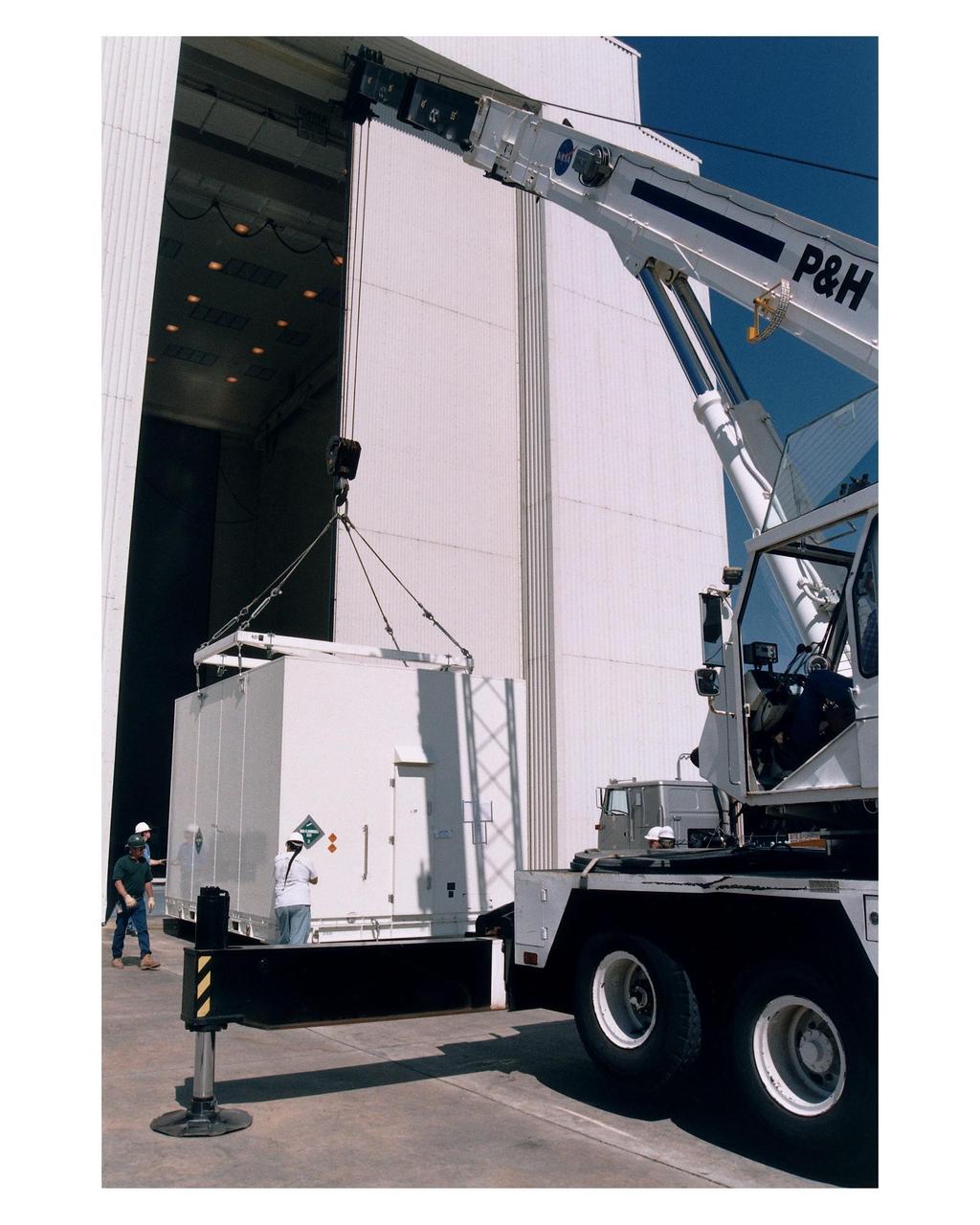
Workers prepare to move the shipping container with the Cassini orbiter inside the Payload Hazardous Servicing Facility (PHSF) for prelaunch processing, testing and integration. The <a href="http://www-pao.ksc.nasa.gov/kscpao/release/1997/66-97.htm">orbiter arrived</a> at KSC’s Shuttle Landing Facility in a U.S. Air Force C-17 air cargo plane from Edwards Air Force Base, California. The orbiter and the Huygens probe already being processed at KSC are the two primary components of the Cassini spacecraft, which will be launched on a Titan IVB/Centaur expendable launch vehicle from Cape Canaveral Air Station. Cassini will explore Saturn, its rings and moons for four years. The Huygens probe, designed and developed for the European Space Agency (ESA), will be deployed from the orbiter to study the clouds, atmosphere and surface of Saturn’s largest moon, Titan. The orbiter was designed and assembled at NASA’s Jet Propulsion Laboratory in California. Following postflight inspections, integration of the 12 science instruments not already installed on the orbiter will be completed. Then, the parabolic high-gain antenna and the propulsion module will be mated to the orbiter, followed by the Huygens probe, which will complete spacecraft integration. The Cassini mission is targeted for an Oct. 6 launch to begin its 6.7-year journey to the Saturnian system. Arrival at the planet is expected to occur around July 1, 2004
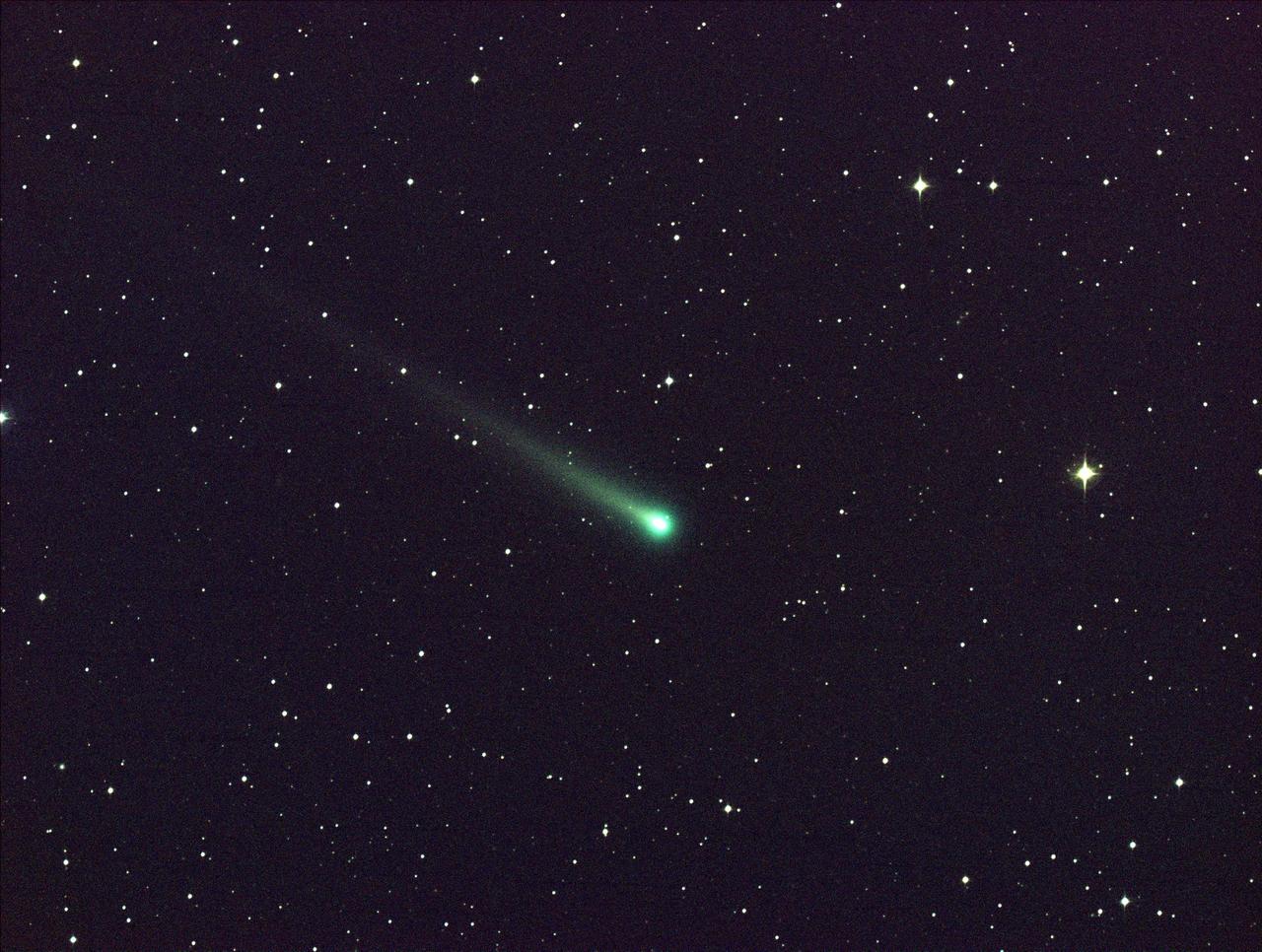
Date: 8 Nov 2013 - Comet ISON shines in this five-minute exposure taken at NASA's Marshall Space Flight Center on Nov. 8, 2013.. The image was captured using a color CCD camera attached to a 14" telescope located at Marshall. At the time of this picture, comet ISON was 97 million miles from Earth, moving ever closer toward the sun. Credit: NASA/MSFC/Aaron Kingery -------- More details on Comet ISON: Comet ISON began its trip from the Oort cloud region of our solar system and is now travelling toward the sun. The comet will reach its closest approach to the sun on Thanksgiving Day -- 28 Nov 2013 -- skimming just 730,000 miles above the sun's surface. If it comes around the sun without breaking up, the comet will be visible in the Northern Hemisphere with the naked eye, and from what we see now, ISON is predicted to be a particularly bright and beautiful comet. Catalogued as C/2012 S1, Comet ISON was first spotted 585 million miles away in September 2012. This is ISON's very first trip around the sun, which means it is still made of pristine matter from the earliest days of the solar system’s formation, its top layers never having been lost by a trip near the sun. Comet ISON is, like all comets, a dirty snowball made up of dust and frozen gases like water, ammonia, methane and carbon dioxide -- some of the fundamental building blocks that scientists believe led to the formation of the planets 4.5 billion years ago. NASA has been using a vast fleet of spacecraft, instruments, and space- and Earth-based telescope, in order to learn more about this time capsule from when the solar system first formed. The journey along the way for such a sun-grazing comet can be dangerous. A giant ejection of solar material from the sun could rip its tail off. Before it reaches Mars -- at some 230 million miles away from the sun -- the radiation of the sun begins to boil its water, the first step toward breaking apart. And, if it survives all this, the intense radiation and pressure as it flies near the surface of the sun could destroy it altogether. This collection of images show ISON throughout that journey, as scientists watched to see whether the comet would break up or remain intact. The comet reaches its closest approach to the sun on Thanksgiving Day -- Nov. 28, 2013 -- skimming just 730,000 miles above the sun’s surface. If it comes around the sun without breaking up, the comet will be visible in the Northern Hemisphere with the naked eye, and from what we see now, ISON is predicted to be a particularly bright and beautiful comet. ISON stands for International Scientific Optical Network, a group of observatories in ten countries who have organized to detect, monitor, and track objects in space. ISON is managed by the Keldysh Institute of Applied Mathematics, part of the Russian Academy of Sciences. <b><a href="http://www.nasa.gov/audience/formedia/features/MP_Photo_Guidelines.html" rel="nofollow">NASA image use policy.</a></b> <b><a href="http://www.nasa.gov/centers/goddard/home/index.html" rel="nofollow">NASA Goddard Space Flight Center</a></b> enables NASA’s mission through four scientific endeavors: Earth Science, Heliophysics, Solar System Exploration, and Astrophysics. Goddard plays a leading role in NASA’s accomplishments by contributing compelling scientific knowledge to advance the Agency’s mission. <b>Follow us on <a href="http://twitter.com/NASA_GoddardPix" rel="nofollow">Twitter</a></b> <b>Like us on <a href="http://www.facebook.com/pages/Greenbelt-MD/NASA-Goddard/395013845897?ref=tsd" rel="nofollow">Facebook</a></b> <b>Find us on <a href="http://instagram.com/nasagoddard?vm=grid" rel="nofollow">Instagram</a></b>