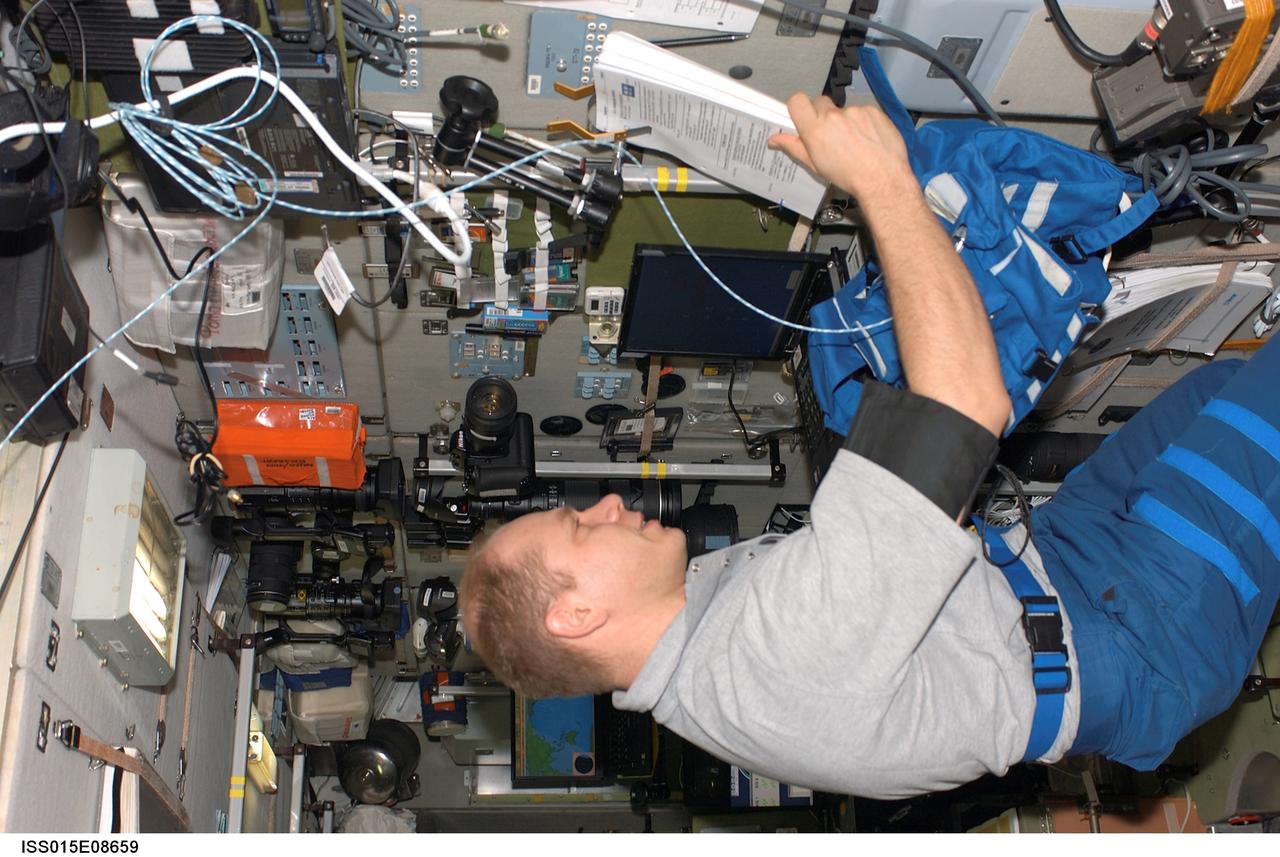
ISS015-E-08659 (May 2007) --- Cosmonaut Oleg V. Kotov, Expedition 15 flight engineer representing Russia's Federal Space Agency, checks procedures checklists while collecting medical data for the Cognitive Cardiovascular (Cardiocog-2) experiment in the Zvezda Service Module of the International Space Station. Cardiocog-2 will determine the impact of weightlessness on the cardiovascular system and respiratory system and the cognitive reactions of crewmembers. The results of this study will be used to develop additional countermeasures that will continue to keep crewmembers healthy during long-duration space exploration.
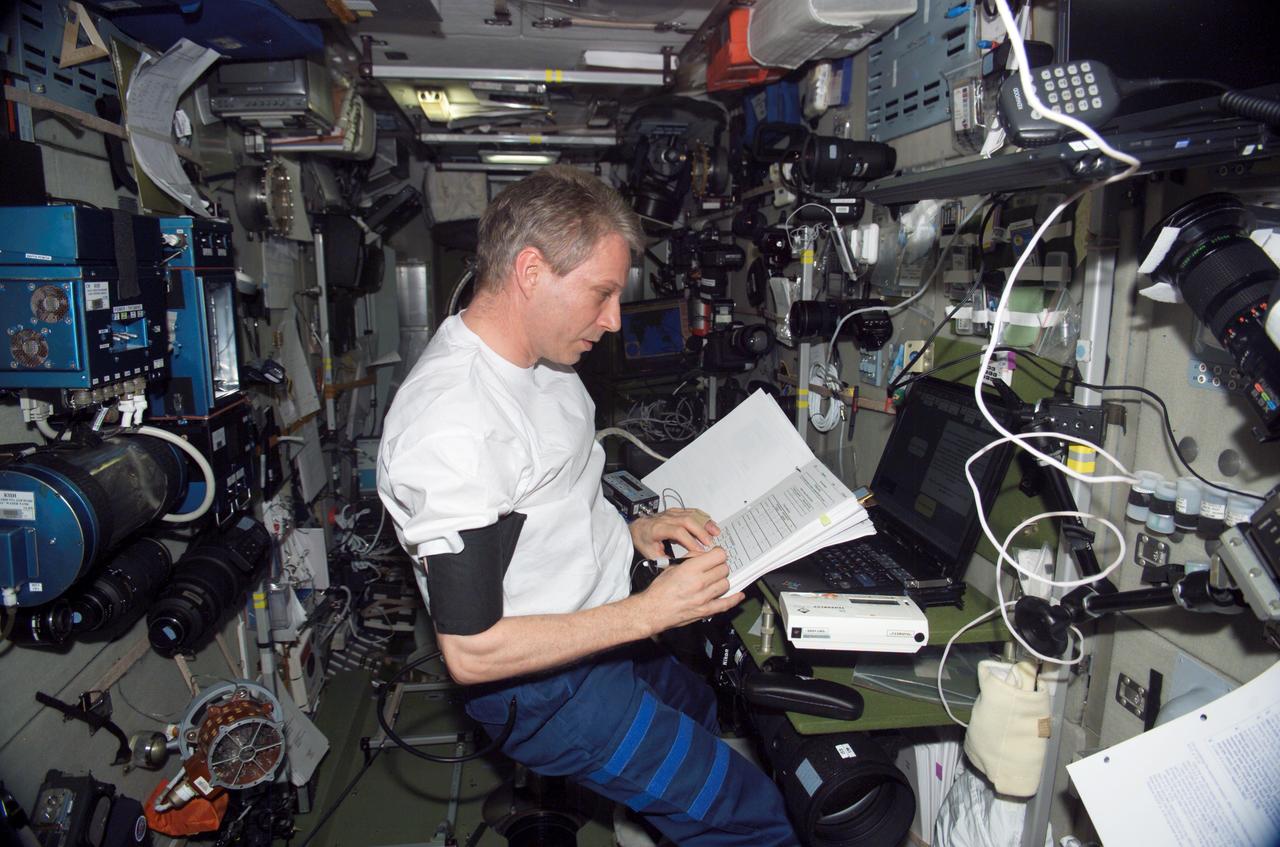
ISS014-E-08795 (29 Nov. 2006) --- European Space Agency (ESA) astronaut Thomas Reiter, Expedition 14 flight engineer, works with the Cognitive Cardiovascular (Cardiocog-2) experiment in the Zvezda Service Module of the International Space Station. Cardiocog-2 will determine the impact of weightlessness on the cardiovascular system and respiratory system and the cognitive reactions of crewmembers. The results of this study will be used to develop additional countermeasures that will continue to keep crewmembers healthy during long-duration space exploration.
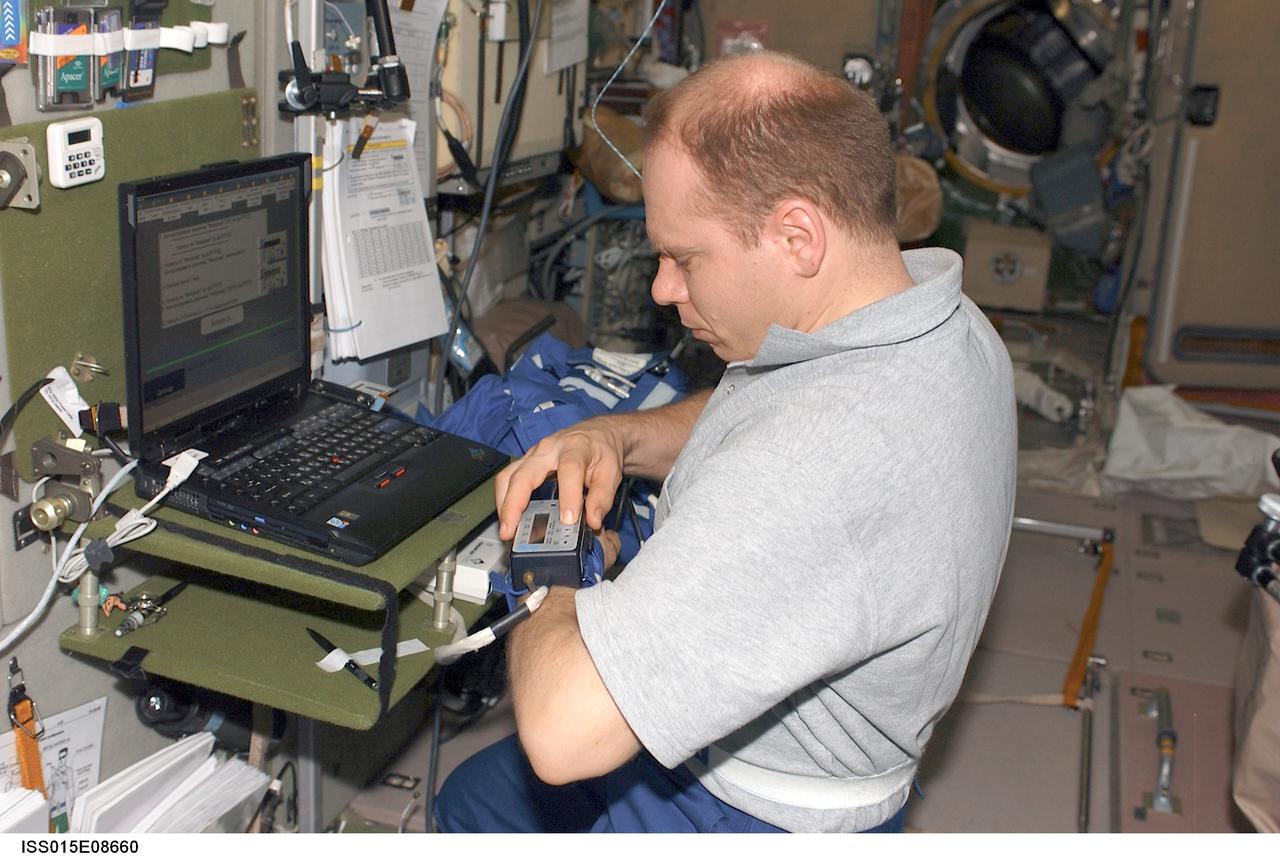
ISS015-E-08660 (May 2007) --- Cosmonaut Oleg V. Kotov, Expedition 15 flight engineer representing Russia's Federal Space Agency, collects medical data for the Cognitive Cardiovascular (Cardiocog-2) experiment in the Zvezda Service Module of the International Space Station. Cardiocog-2 will determine the impact of weightlessness on the cardiovascular system and respiratory system and the cognitive reactions of crewmembers. The results of this study will be used to develop additional countermeasures that will continue to keep crewmembers healthy during long-duration space exploration.
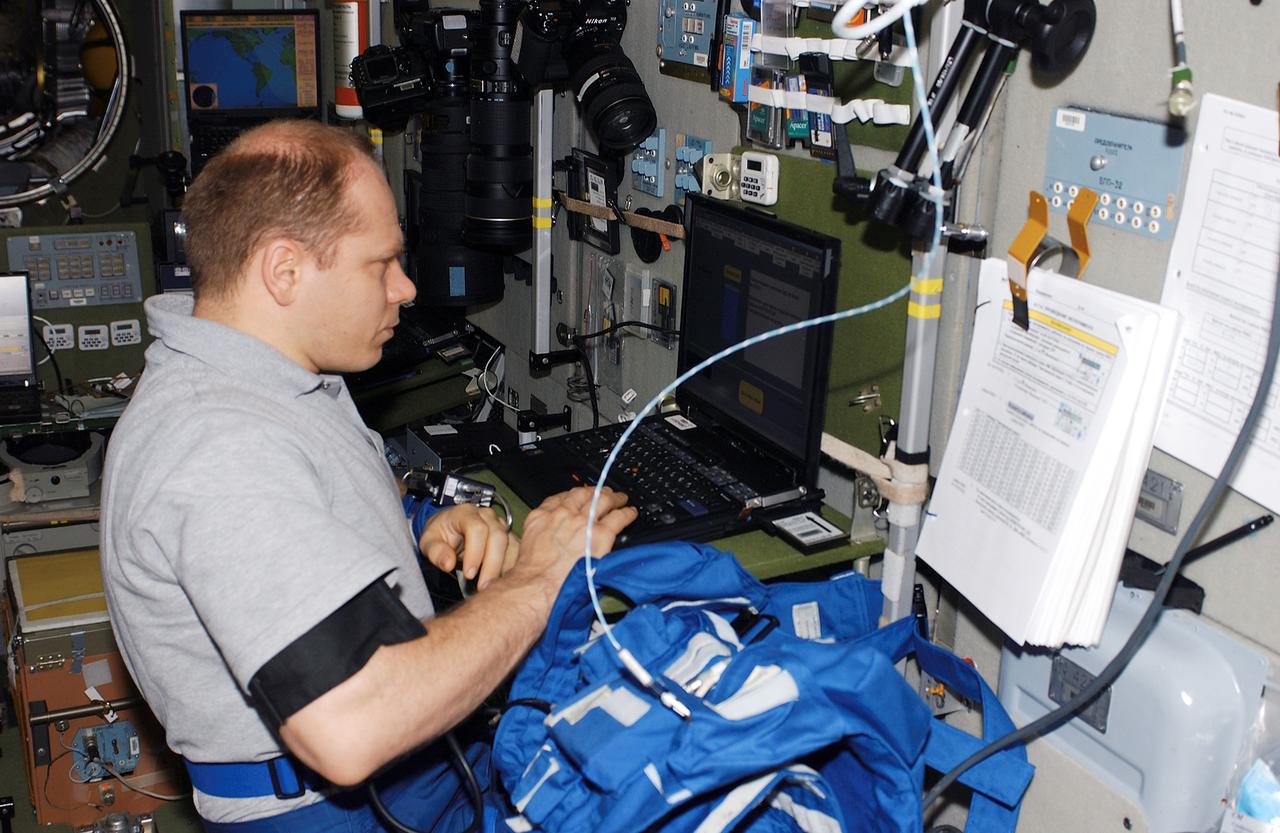
ISS015-E-08661 (May 2007) --- Cosmonaut Oleg V. Kotov, Expedition 15 flight engineer representing Russia's Federal Space Agency, collects medical data for the Cognitive Cardiovascular (Cardiocog-2) experiment in the Zvezda Service Module of the International Space Station. Cardiocog-2 will determine the impact of weightlessness on the cardiovascular system and respiratory system and the cognitive reactions of crewmembers. The results of this study will be used to develop additional countermeasures that will continue to keep crewmembers healthy during long-duration space exploration.
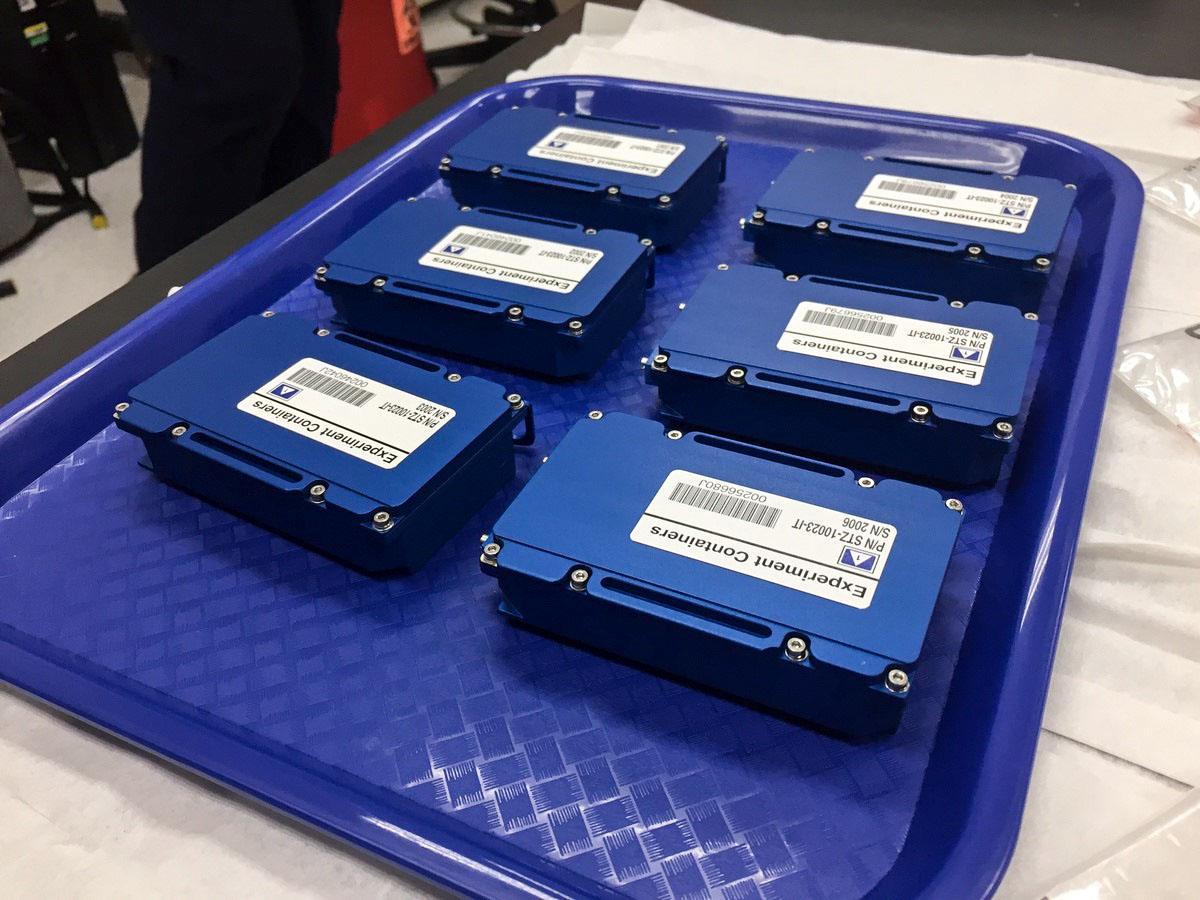
jsc2019e041782 (7/25/2019) --- A preflight image of the KEU-RO experiment units for STaARS BioScience-3 experiment. The Spaceflight Effects on Vascular Endothelial and Smooth Muscle Cell Process (STaARS BioScience-3) investigation contributes to a greater understanding of cardiovascular disease (CVD) through the study of transcriptomics of vascular cells. Upon return from spaceflight, crew members often display alterations in their cardiovascular systems, similar to those suffering from CVD. The goal of this work is to elucidate the mechanism of vascular cell damage in the space environment by exposing vascular cells to spaceflight.
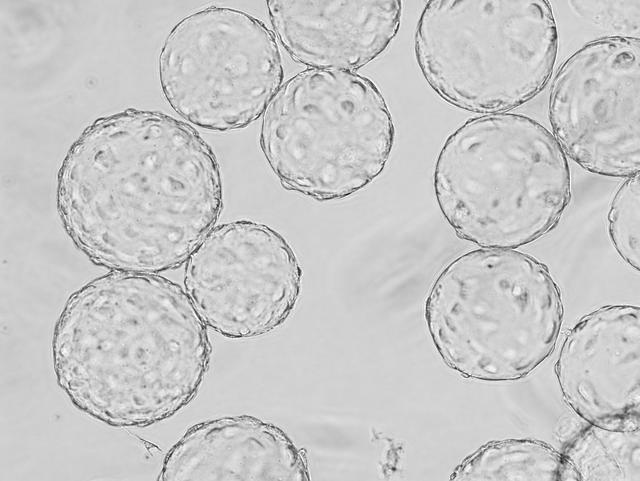
jsc2019e041776 (10/2/2012) --- A preflight phase contrast image of vascular endothelial cells cultured on microcarrier beads before being put into the flight hardware. Used for STaARS BioScience-3 experiment. The Spaceflight Effects on Vascular Endothelial and Smooth Muscle Cell Process (STaARS BioScience-3) investigation contributes to a greater understanding of cardiovascular disease (CVD) through the study of transcriptomics of vascular cells. Upon return from spaceflight, crew members often display alterations in their cardiovascular systems, similar to those suffering from CVD. The goal of this work is to elucidate the mechanism of vascular cell damage in the space environment by exposing vascular cells to spaceflight.
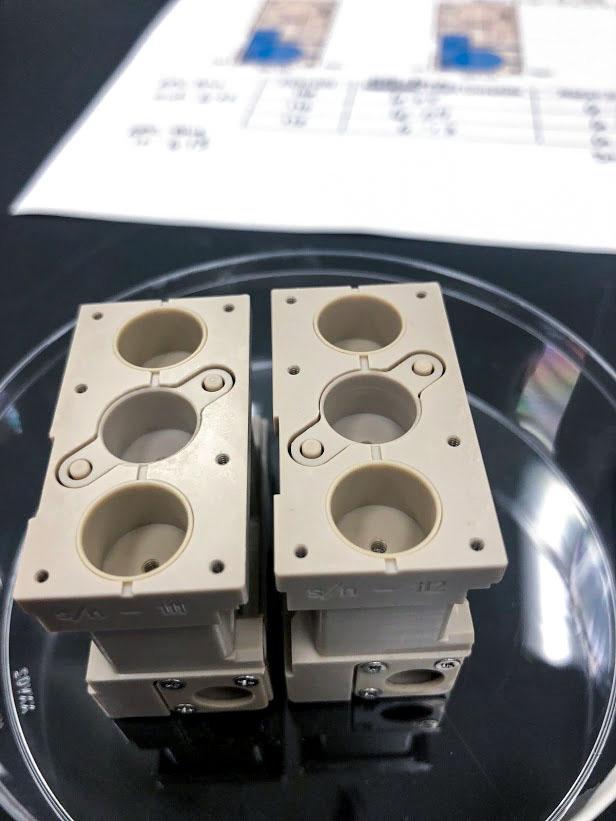
jsc2019e041780 (7/25/2019) --- A preflight image of the KEU-RO experiment units for STaARS BioScience-3 experiment. The Spaceflight Effects on Vascular Endothelial and Smooth Muscle Cell Process (STaARS BioScience-3) investigation contributes to a greater understanding of cardiovascular disease (CVD) through the study of transcriptomics of vascular cells. Upon return from spaceflight, crew members often display alterations in their cardiovascular systems, similar to those suffering from CVD. The goal of this work is to elucidate the mechanism of vascular cell damage in the space environment by exposing vascular cells to spaceflight.
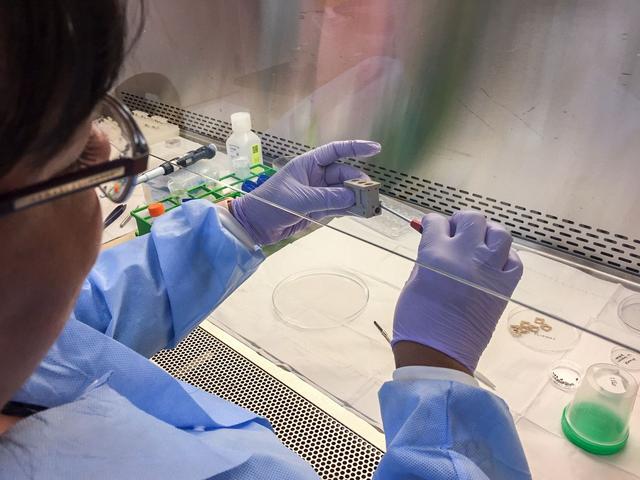
jsc2019e041779 (7/25/2019) --- A view of Dr. Josephine Allen assembling the KEU-RO experiment units for STaARS BioScience-3 experiment. The Spaceflight Effects on Vascular Endothelial and Smooth Muscle Cell Process (STaARS BioScience-3) investigation contributes to a greater understanding of cardiovascular disease (CVD) through the study of transcriptomics of vascular cells. Upon return from spaceflight, crew members often display alterations in their cardiovascular systems, similar to those suffering from CVD. The goal of this work is to elucidate the mechanism of vascular cell damage in the space environment by exposing vascular cells to spaceflight.
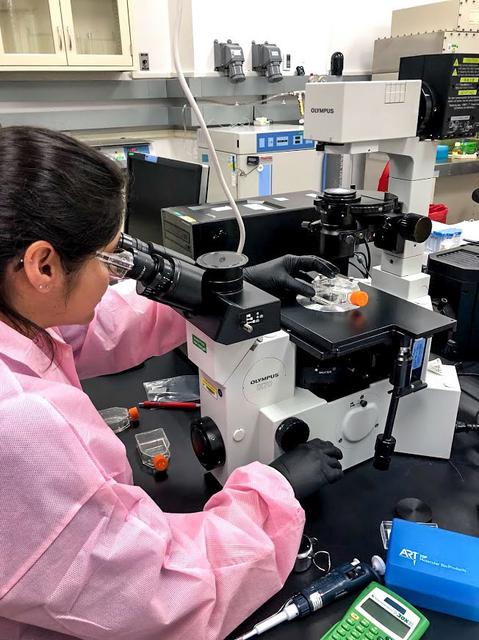
jsc2019e041778 (7/25/2019) --- A view of Dr. Marina Scotti viewing the cells on the microscope for STaARS BioScience-3 experiment. The Spaceflight Effects on Vascular Endothelial and Smooth Muscle Cell Process (STaARS BioScience-3) investigation contributes to a greater understanding of cardiovascular disease (CVD) through the study of transcriptomics of vascular cells. Upon return from spaceflight, crew members often display alterations in their cardiovascular systems, similar to those suffering from CVD. The goal of this work is to elucidate the mechanism of vascular cell damage in the space environment by exposing vascular cells to spaceflight.
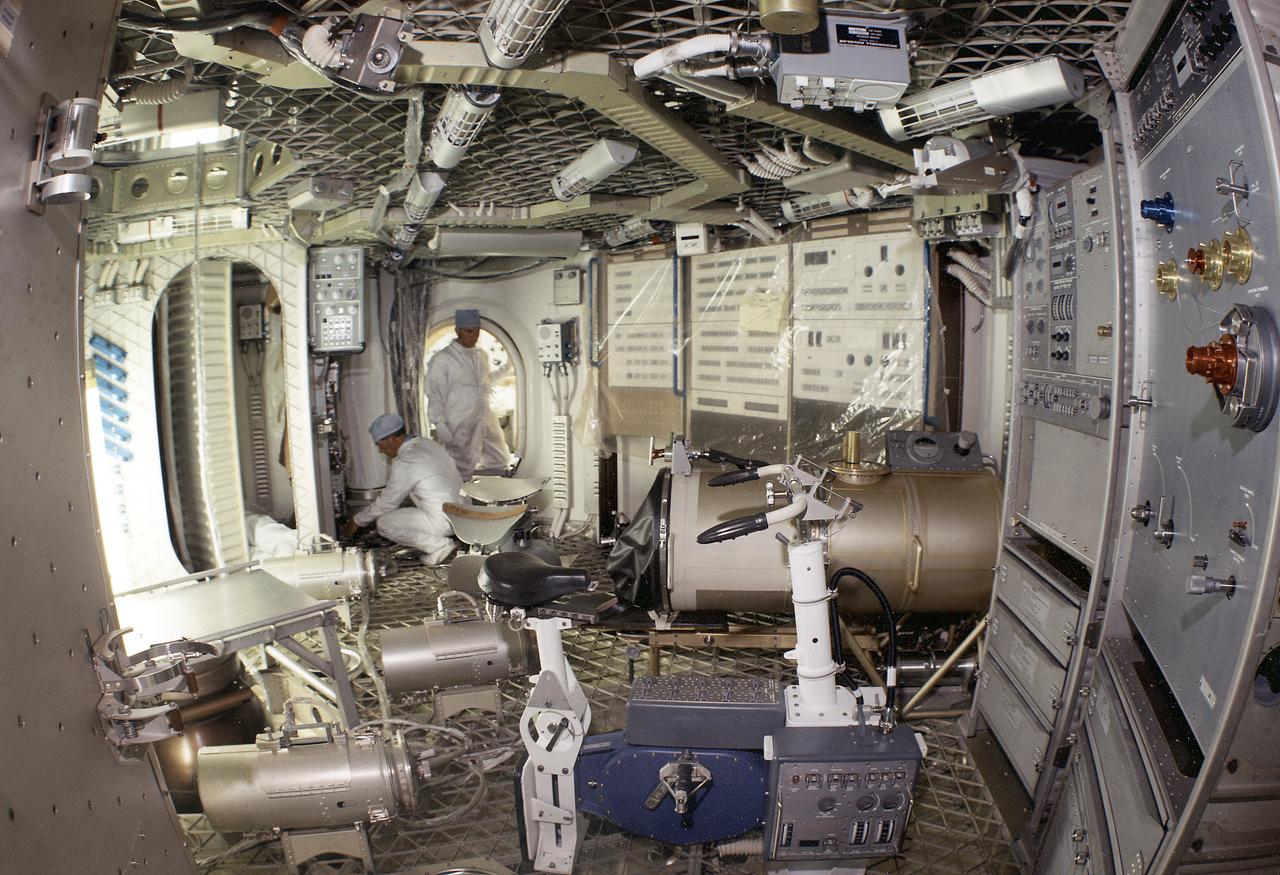
This is a wide-angle view of the Orbital Workshop lower level experiment area. In center foreground is the ergometer bicycle. In center background is a litter chair for the Human Vestibular Function experiment (Skylab Experiment M131) and in right background is the Lower Body Negative Pressure System experiment (Skylab Experiment M092). The ergometer bicycle was used for metabolic activity experiments and exercise. The purpose of the Human Vestibular (irner ear) Function experiment was to examine the effect of weightlessness on man's sensitivity and susceptibility to motion rotation, and his perception of orientation. The Lower Body Negative Pressure experiment investigated the relationship between the zero gravity environment and cardiovascular deconditioning. A characteristic of cardiovascular deconditoning is the partial failure of the blood vessels resulting in the excessive pooling of the blood in the legs when a person assumes an erect posture in a gravity field. The Marshall Space Flight Center had the program management responsibility for the development of Skylab hardware and experiments.
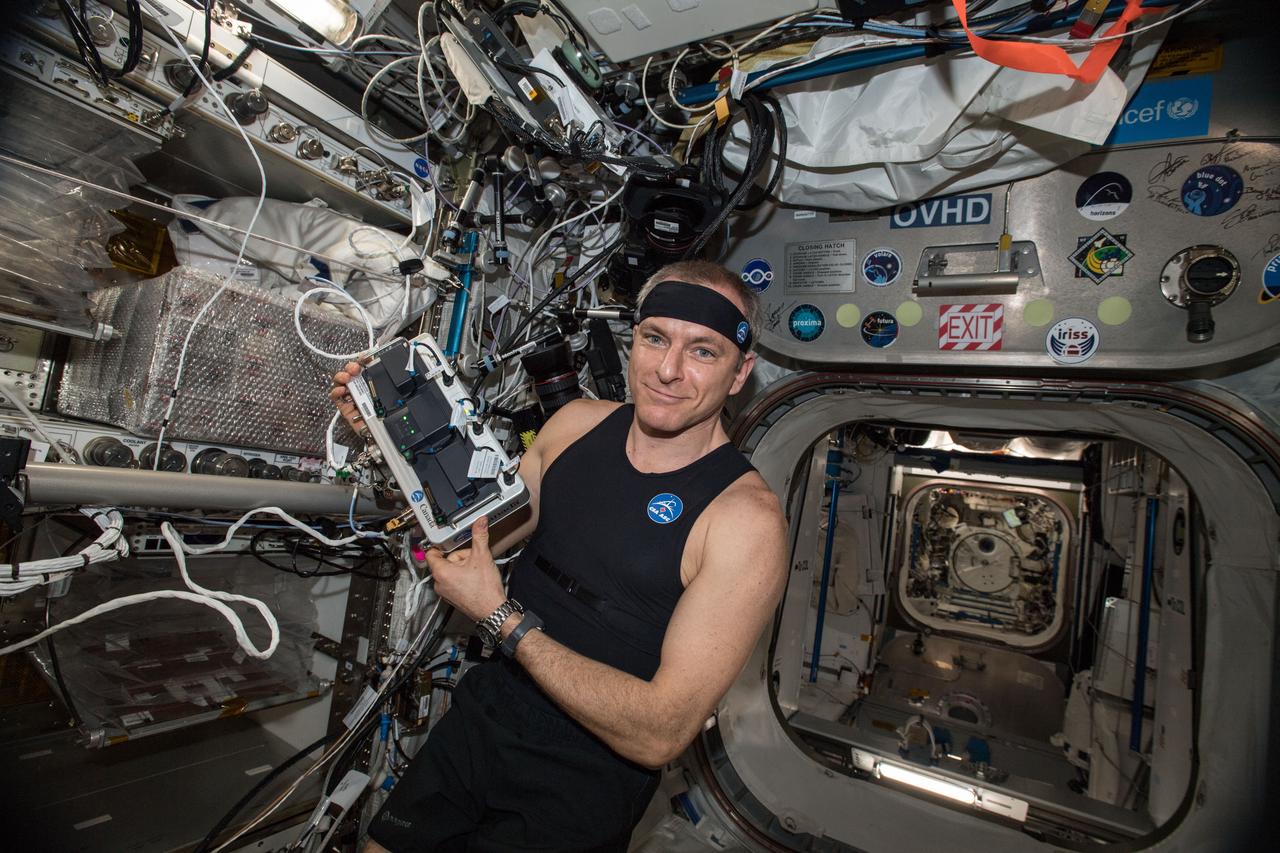
iss058e003984 (1/16/2019) --- Canadian Space Agency (CSA) astronaut David Saint-Jacques demonstrates the Bio-Monitor, a Canadian technology, which is utilized in the Autonomous Health Monitoring for Adaption Assessment on Long Range Missions Using Big Data Analytic.(Space Health) study. The innovative smart shirt system captures the astronauts' vital signs, and the data is used to assess the impact of spaceflight on the cardiovascular system. Image courtesy of CSA/NASA.
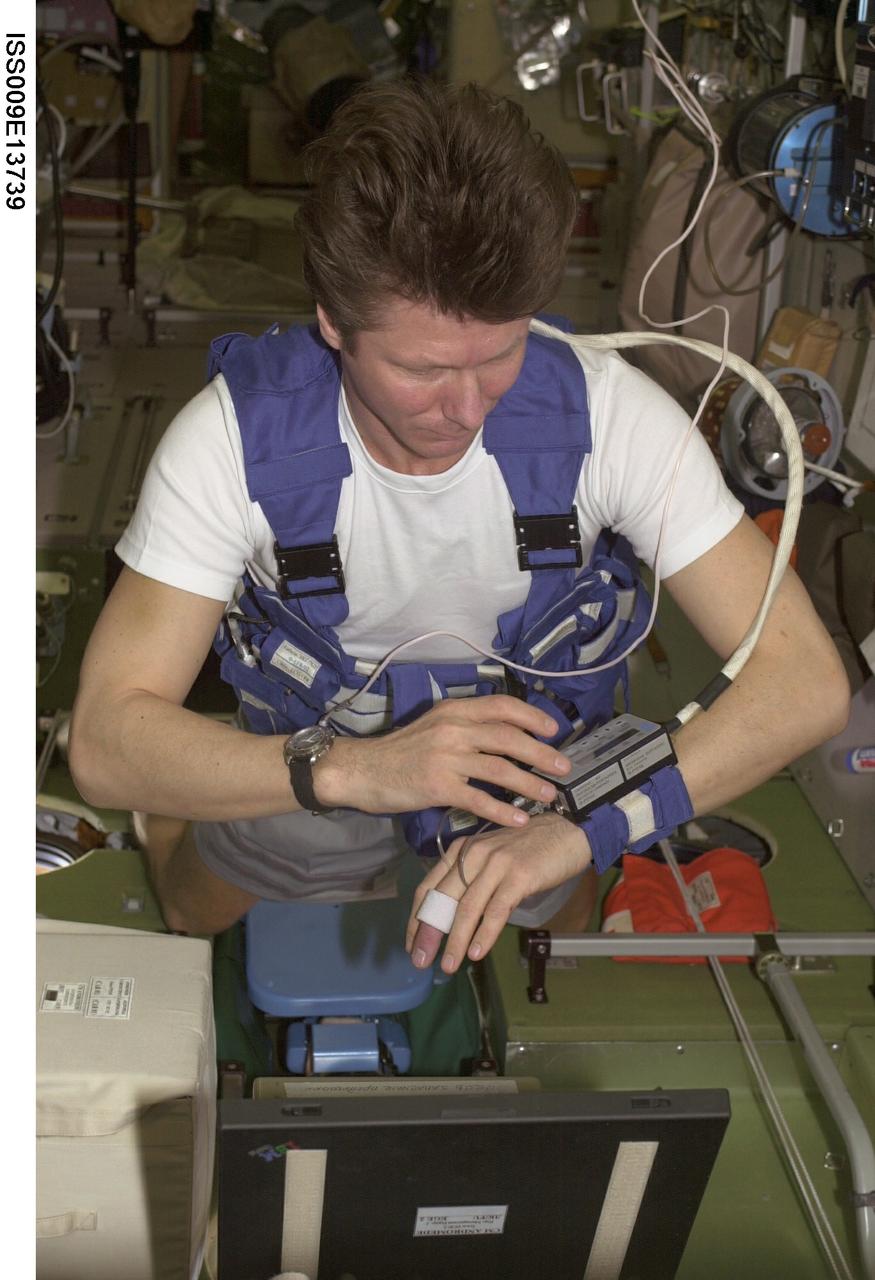
ISS009-E-13739 (5 July 2004) --- Cosmonaut Gennady I. Padalka, Expedition 9 commander representing Russia’s Federal Space Agency, works with the Cardiocog experiment in the Zvezda Service Module of the International Space Station (ISS). Originally part of Pedro Duque's VC5 "Cervantes" science program, Cardiocog studies changes in the human cardiovascular system in micro-G, expressed in the peripheral arteries, and the vegetative regulation of arterial blood pressure and heart rate.
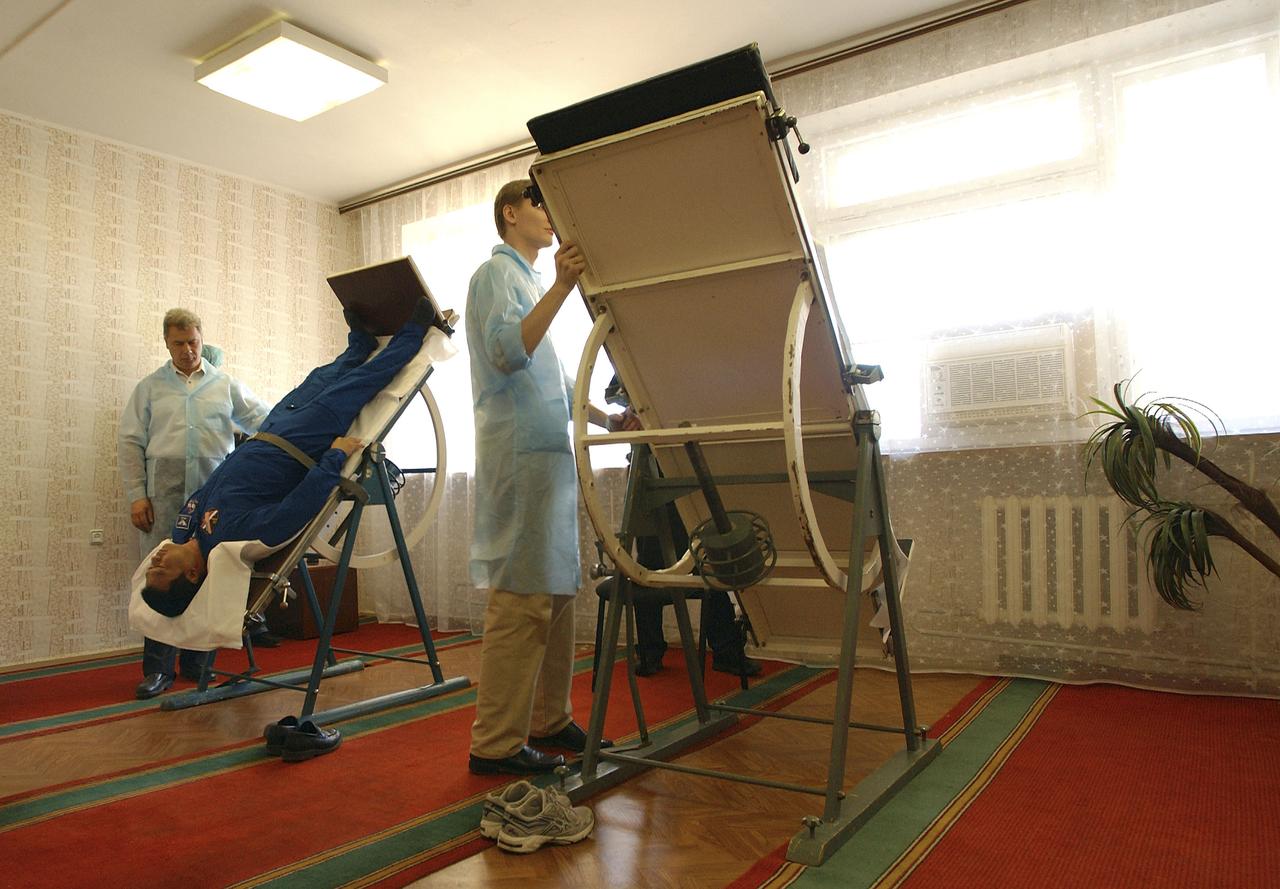
Expedition 10 Commander Leroy Chiao undergoes physical testing on a mechanized tilt table at crew quarters in Baikonur, Kazakhstan, Friday, October 8, 2004, in preparation for launch with Flight Engineer and Soyuz Commander Salizhan Sharipov and Russian Space Forces Agency cosmonaut Yuri Shargin to the International Space Station on October 14. The tilt table is used to condition the crewmembers' cardiovascular system against the effects of weightlessness once on orbit. Photo Credit: (NASA/Bill Ingalls)
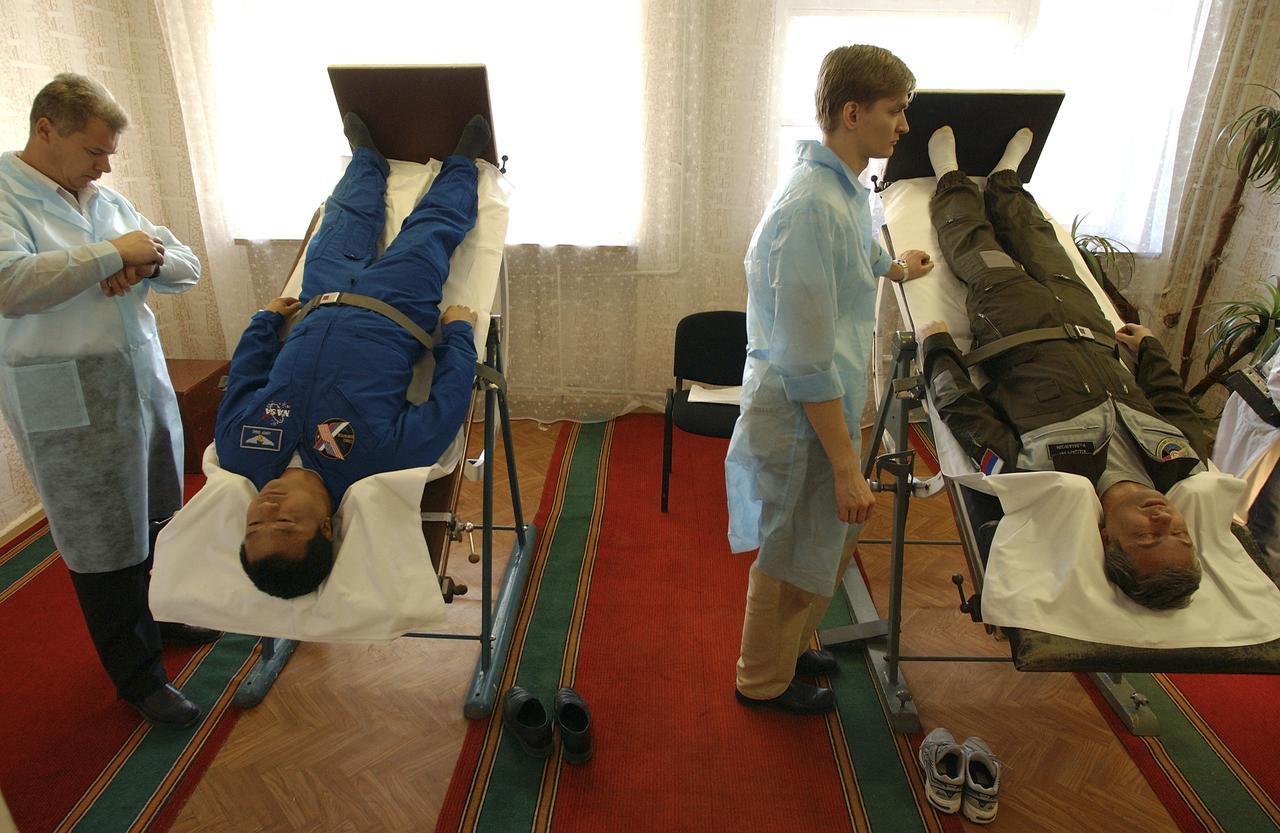
Expedition 10 Commander Leroy Chiao, left, and Russian Space Forces cosmonaut Yuri Shargin undergo physical testing on a mechanized tilt table at their crew quarters in Baikonur, Kazakhstan, Friday, October 8, 2004, in preparation for launch with Flight Engineer and Soyuz Commander Salizhan Sharipov to the International Space Station on October 14. The tilt table is used to condition the crewmembers' cardiovascular system against the effects of weightlessness once in orbit. Photo Credit: (NASA/Bill Ingalls)
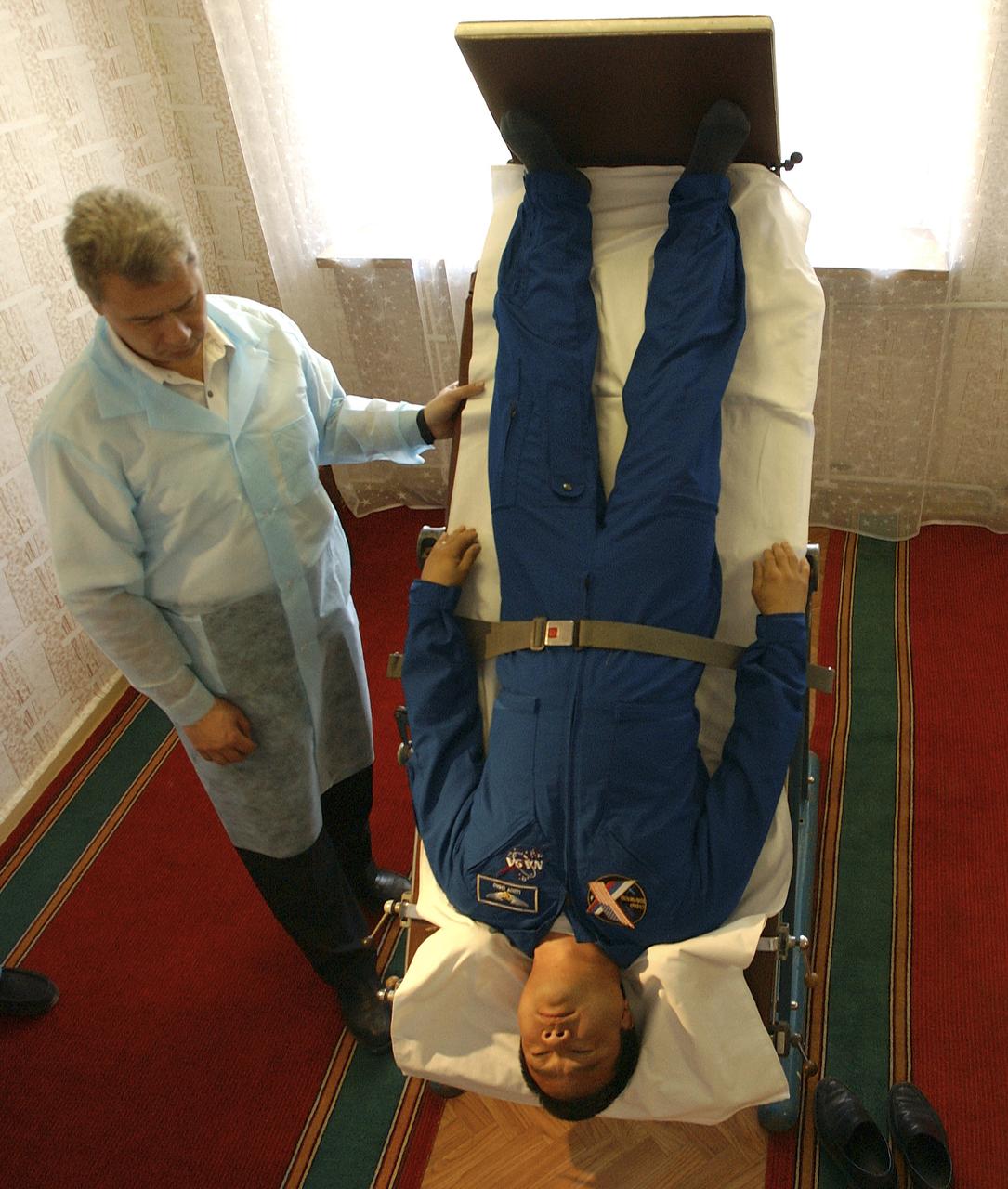
Expedition 10 Commander Leroy Chiao undergoes physical testing on a mechanized tilt table at crew quarters in Baikonur, Kazakhstan, Friday, October 8, 2004, in preparation for launch with Flight Engineer and Soyuz Commander Salizhan Sharipov and Russian Space Forces Agency cosmonaut Yuri Shargin to the International Space Station on October 14. The tilt table is used to condition the crewmembers' cardiovascular system against the effects of weightlessness once on orbit. Photo Credit: (NASA/Bill Ingalls)
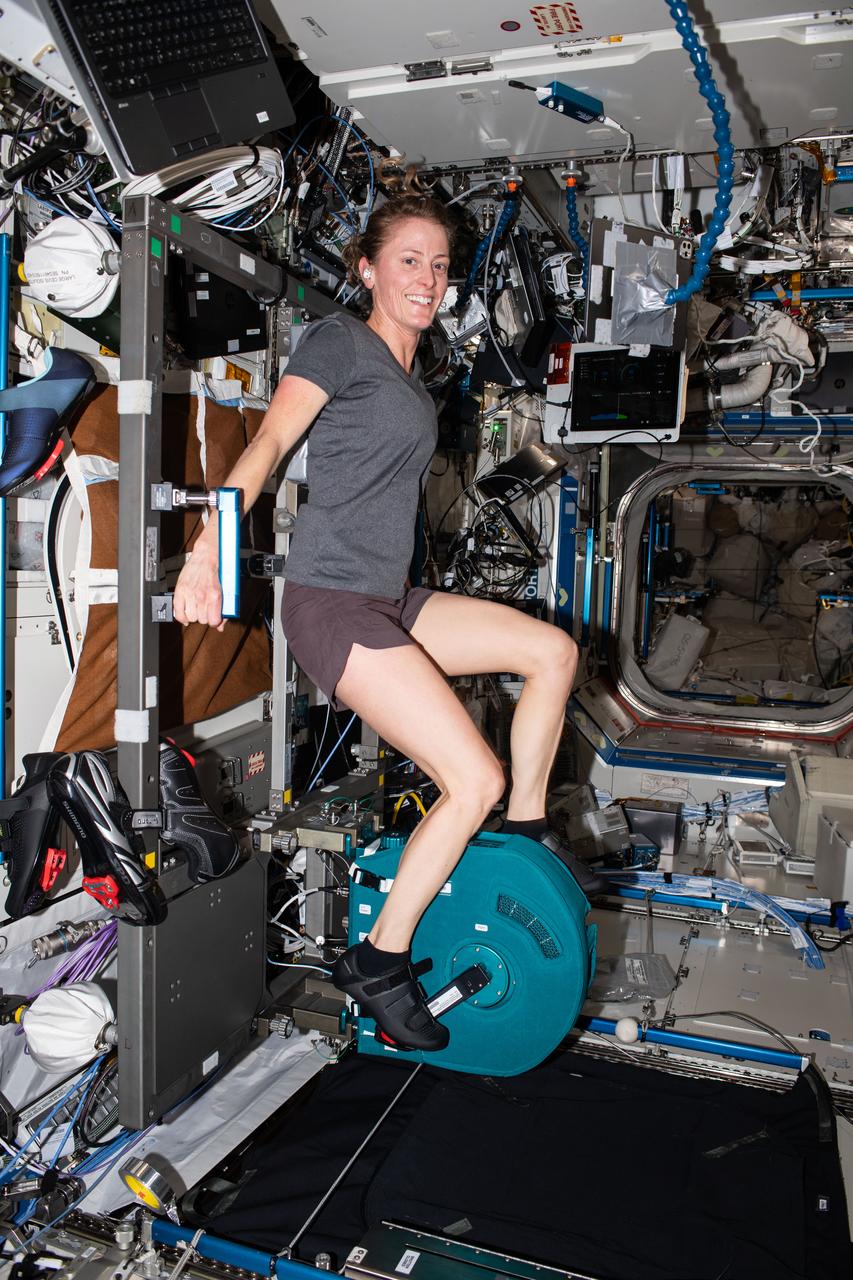
iss070e009186 (Oct. 25, 2023) --- NASA astronaut and Expedition 70 Flight Engineer Loral O'Hara pedals on an exercise cycle, also known as CEVIS, or Cycle Ergometer Vibration Isolation System, inside the International Space Station's Destiny laboratory module. The CEVIS provides aerobic and cardiovascular conditioning and supports science activities, pre-breathe spacewalk activities, periodic fitness evaluations, and pre-landing fitness evaluations.
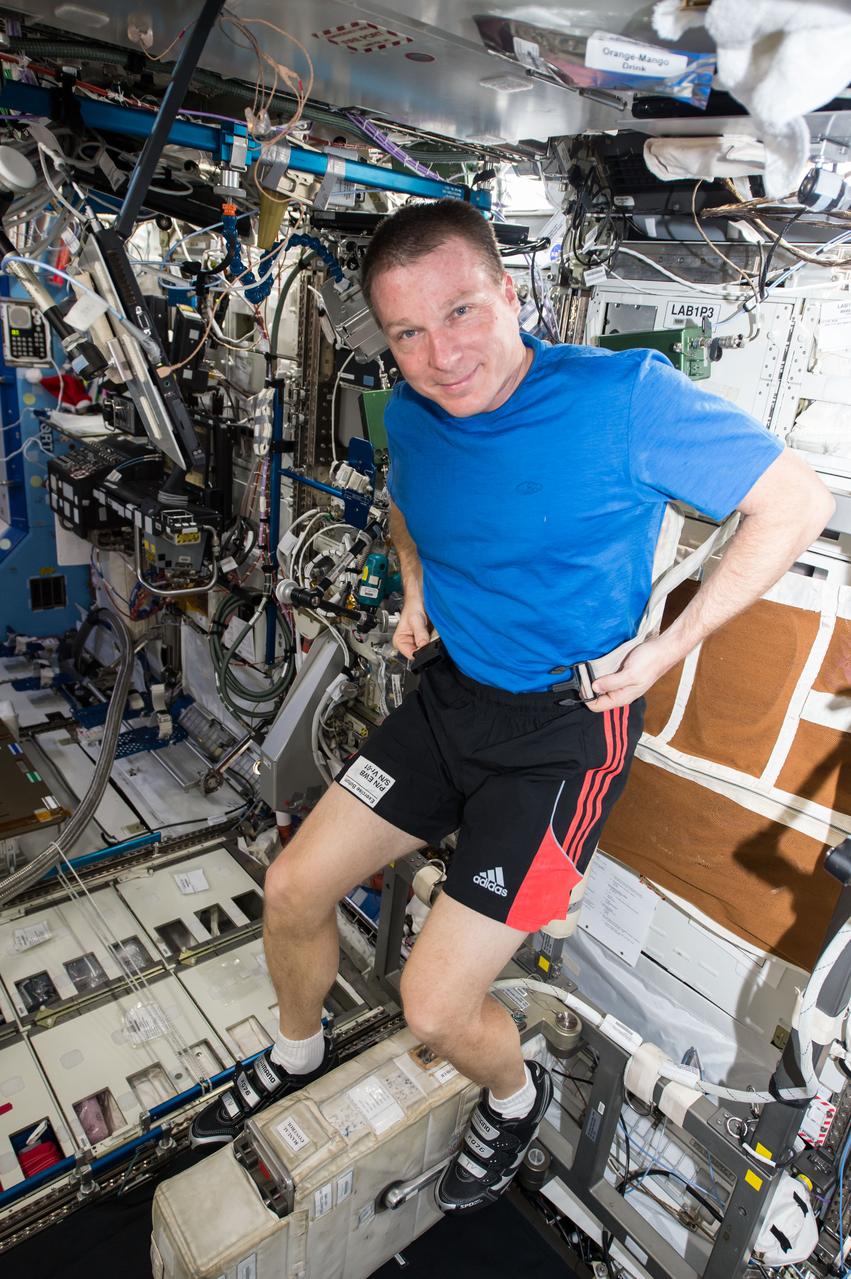
ISS042E082884 (12/27/2014) --- Expedition 42 Flight Engineer Terry Virts of NASA straps into the station’s stationary exercise bicycle known as the Cycle Ergometer with Vibration Isolation System (CEVIS). Each crew member spends an average of 2.5 hours a day exercising to combat the negative effects of prolonged weightlessness by maintaining bone and muscle mass and cardiovascular health.
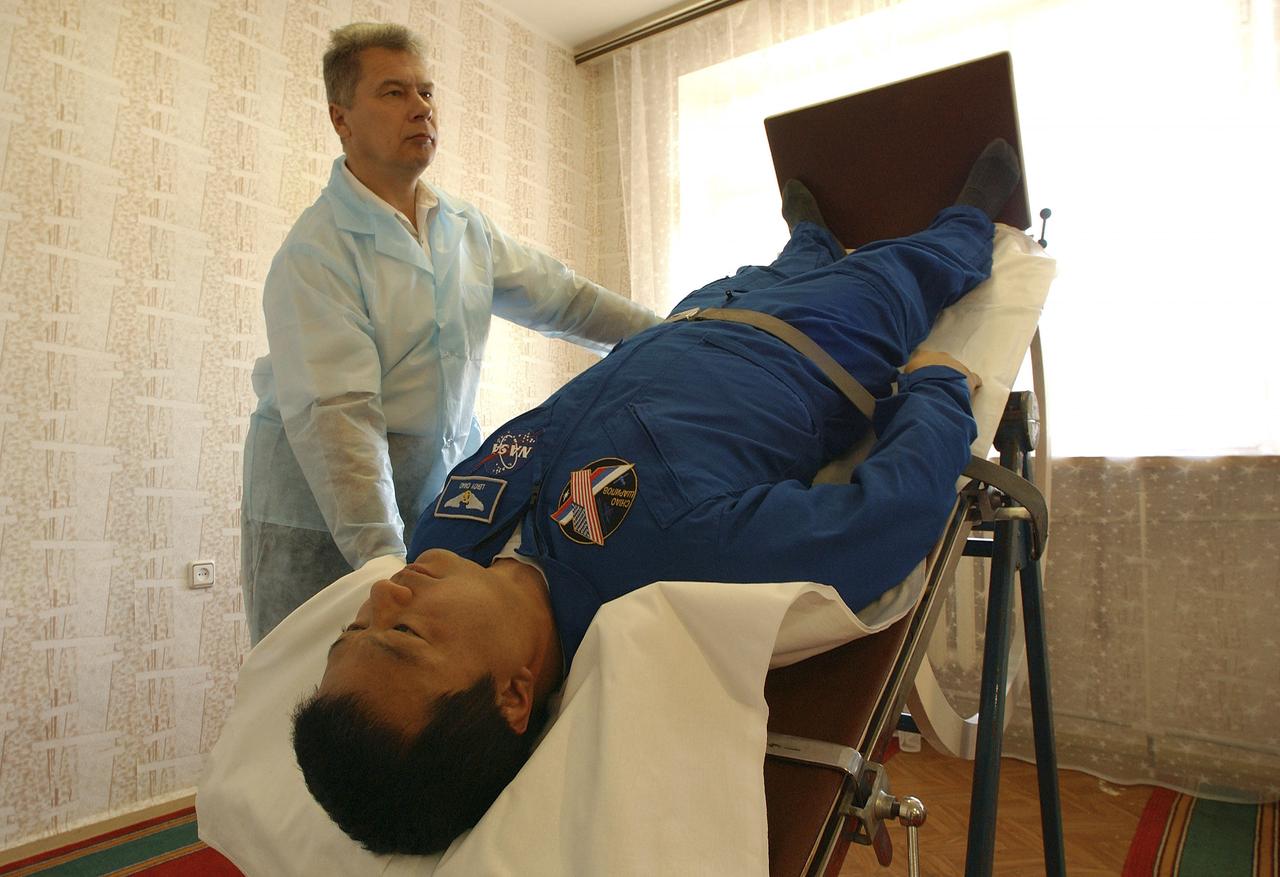
Expedition 10 Commander Leroy Chiao undergoes physical testing on a mechanized tilt table at crew quarters in Baikonur, Kazakhstan, Friday, October 8, 2004, in preparation for launch with Flight Engineer and Soyuz Commander Salizhan Sharipov and Russian Space Forces Agency cosmonaut Yuri Shargin to the International Space Station on October 14. The tilt table is used to condition the crewmembers' cardiovascular system against the effects of weightlessness once on orbit. Photo Credit: (NASA/Bill Ingalls)
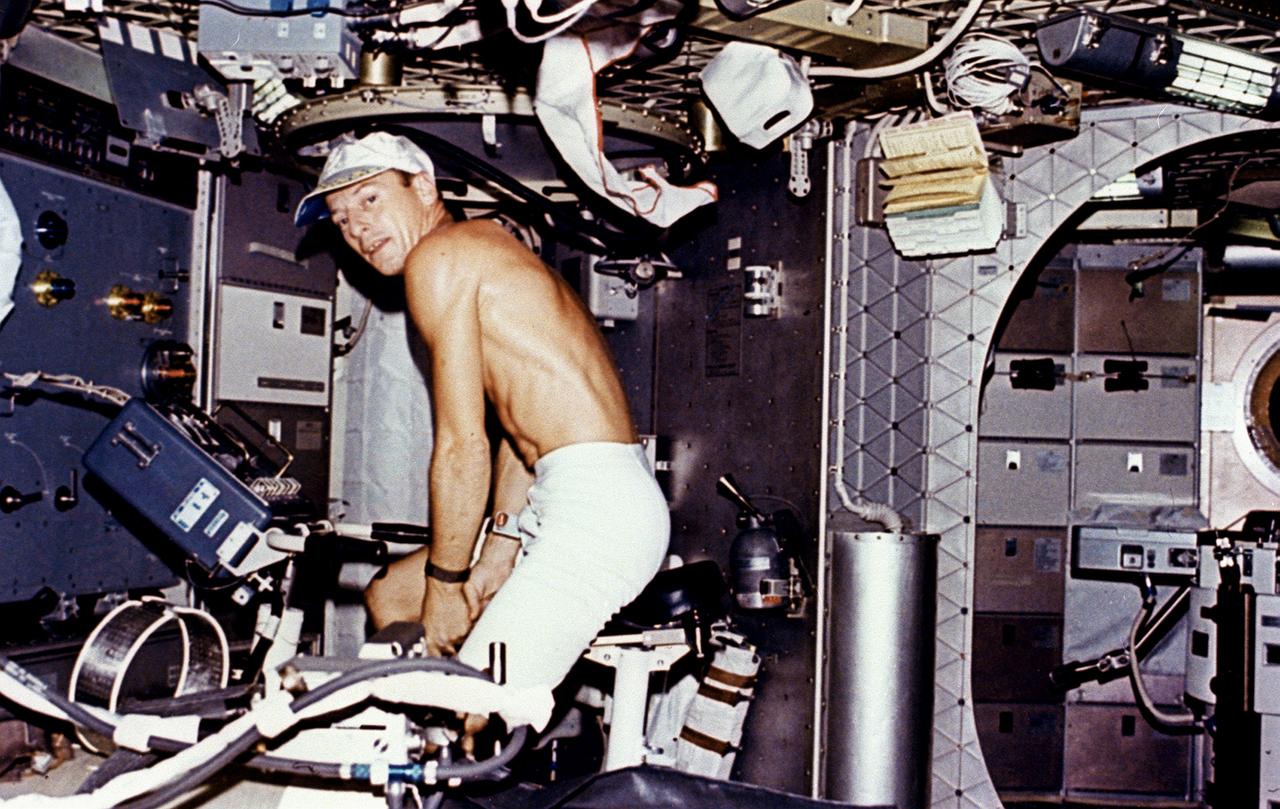
This Skylab-2 onboard photograph shows astronaut Charles "Pete" Conrad exercising on a stationary bicycle (ergometer) used for monitoring the metabolism of the astronauts. The ergometer was used to conduct both Vectorcardiogram experiment (M093) and Metabolic Activity experiment (M171). Experiment M093 was a medical evaluation designed to monitor changes in astronauts' cardiovascular systems, while Experiment M171 was to measure astronauts' metabolic changes during long-duration space missions.
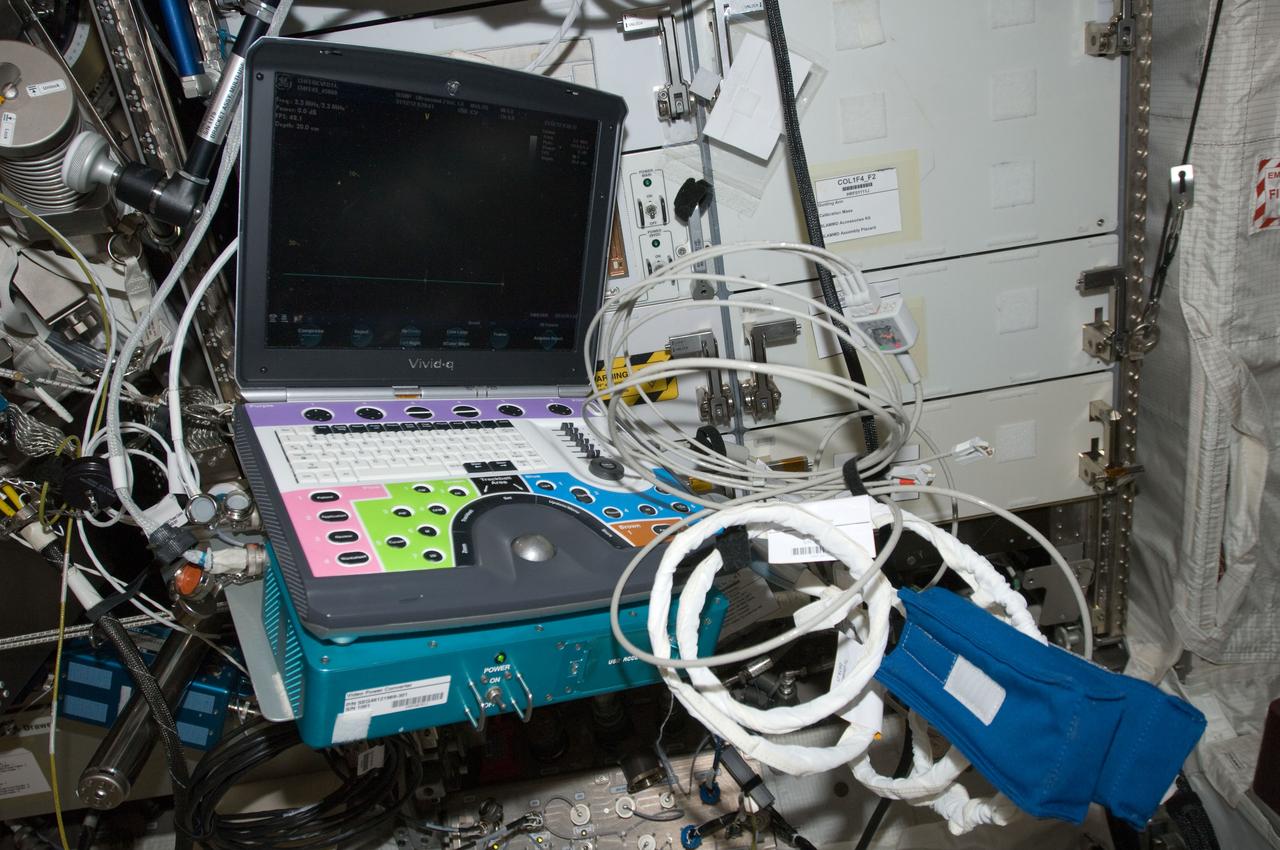
View of Integrated Cardiovascular (ICV) Echo Ultrasound Scan,in the Columbus module. ICV aims to quantify the extent,time course and clinical significance of cardiac atrophy (decrease in the size of the heart muscle) in space. Photo was taken during Expedition 34.
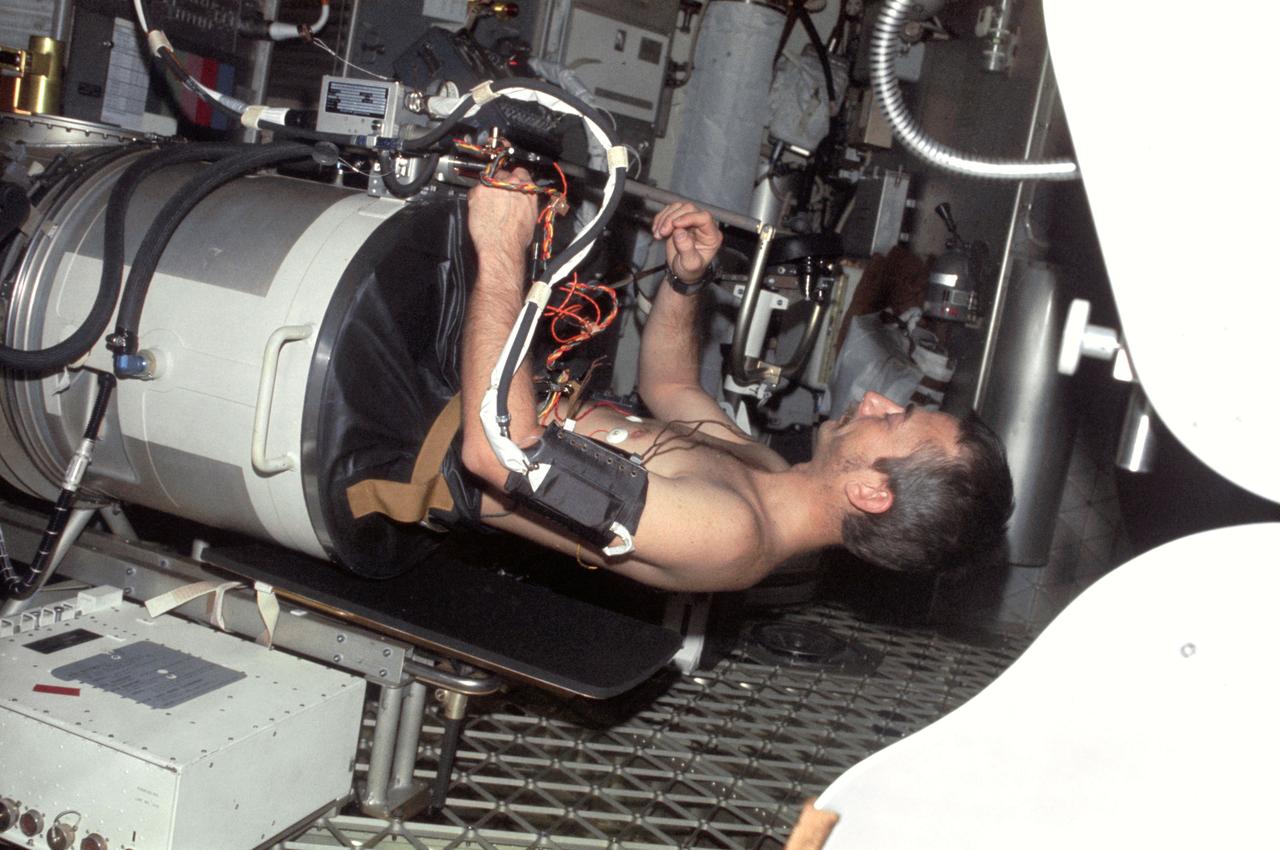
SL3-108-1278 (July-September 1973) --- Scientist-astronaut Owen K. Garriott, science pilot of the Skylab 3 mission, lies in the Lower Body Negative Pressure Device in the work and experiments area of the Orbital Workshop (OWS) crew quarters of the Skylab space station cluster in Earth orbit. This picture was taken with a hand-held 35mm Nikon camera. Astronauts Garriott, Alan L. Bean and Jack R. Lousma remained with the Skylab space station in orbit for 59 days conducting numerous medical, scientific and technological experiments. The LBNPD (MO92) Experiment is to provide information concerning the time course of cardiovascular adaptation during flight, and to provide in-flight data for predicting the degree of orthostatic intolerance and impairment of physical capacity to be expected upon return to Earth environment. The bicycle ergometer is in the right foreground. Photo credit: NASA
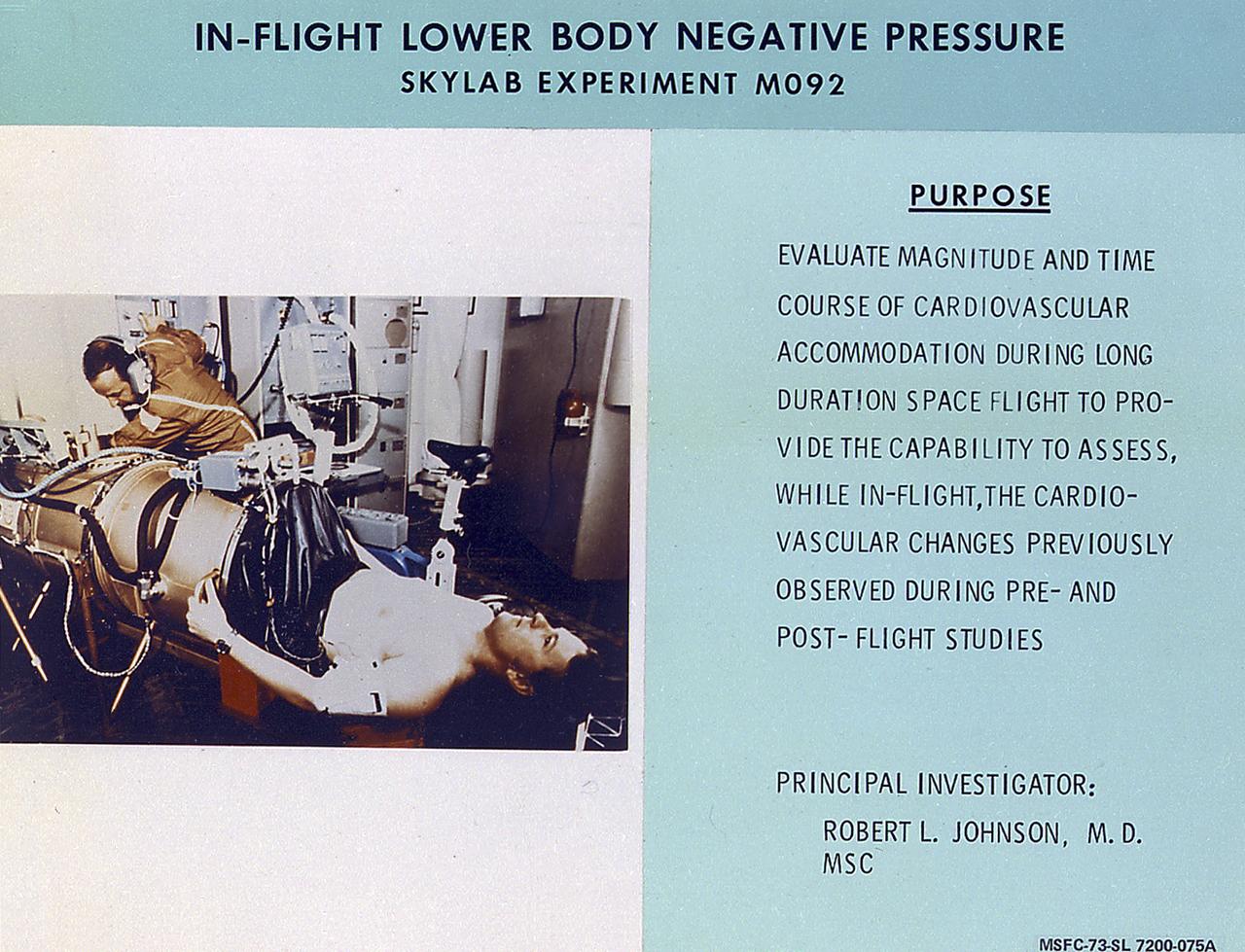
This chart details Skylab's In-Flight Lower Body Negative Pressure experiment facility, a medical evaluation designed to monitor changes in astronauts' cardiovascular systems during long-duration space missions. This experiment collected in-flight data for predicting the impairment of physical capacity and the degree of orthostatic intolerance to be expected upon return to Earth. Data to be collected were blood pressure, heart rate, body temperature, vectorcardiogram, lower body negative pressure, leg volume changes, and body mass. The Marshall Space Flight Center had program management responsibility for the development of Skylab hardware and experiments.
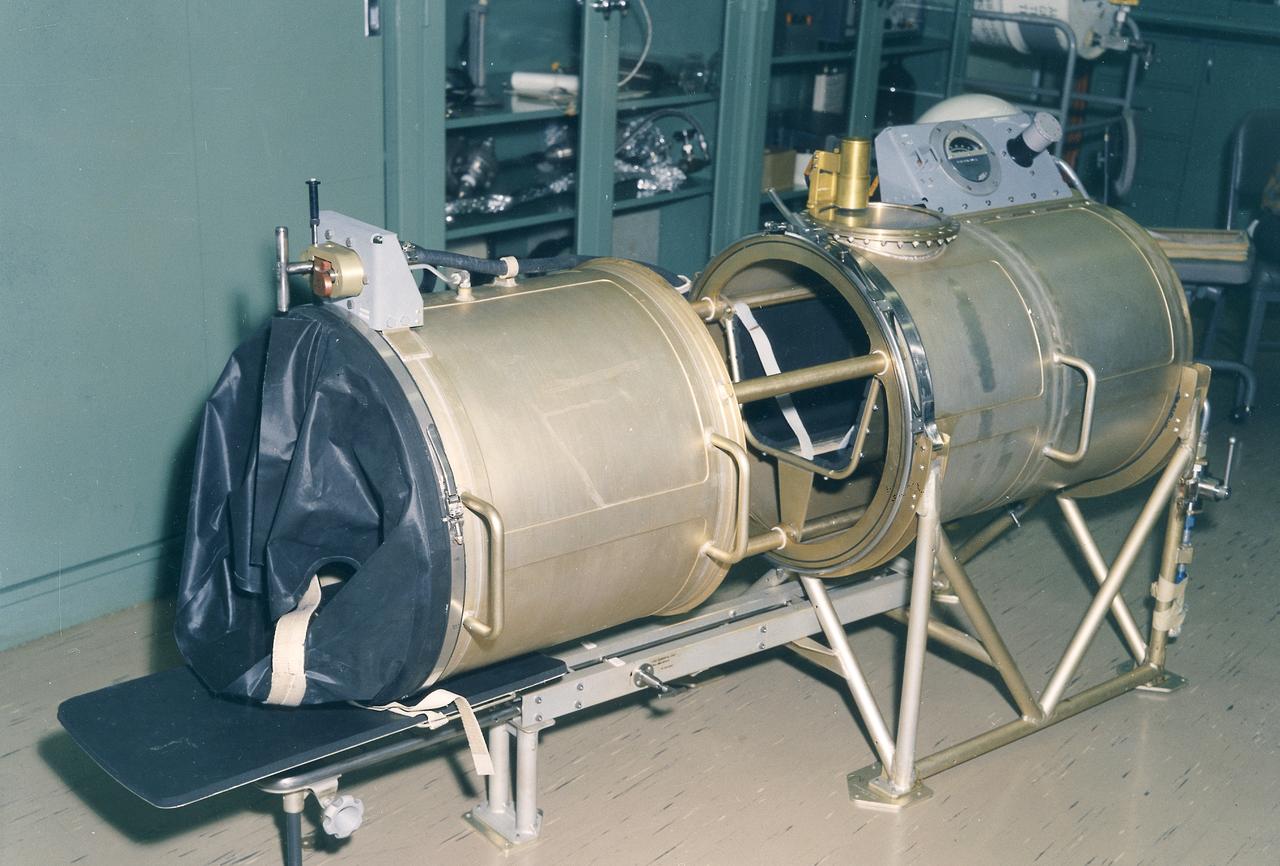
This 1970 photograph shows Skylab's In-Flight Lower Body Negative Pressure experiment facility, a medical evaluation designed to monitor changes in astronauts' cardiovascular systems during long-duration space missions. This experiment collected in-flight data for predicting the impairment of physical capacity and the degree of orthostatic intolerance to be expected upon return to Earth. Data to be collected were blood pressure, heart rate, body temperature, vectorcardiogram, lower body negative pressure, leg volume changes, and body mass. The Marshall Space Flight Center had program management responsibility for the development of Skylab hardware and experiments.
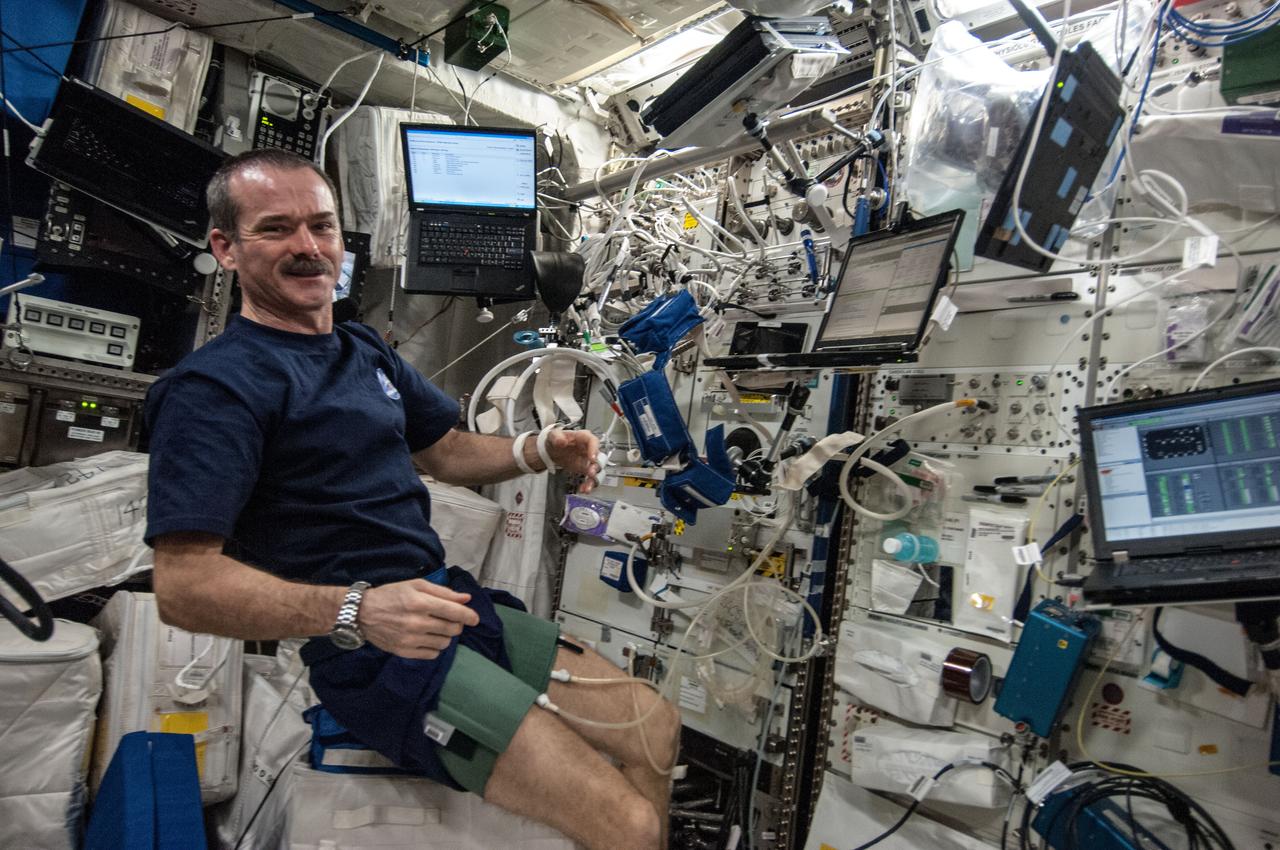
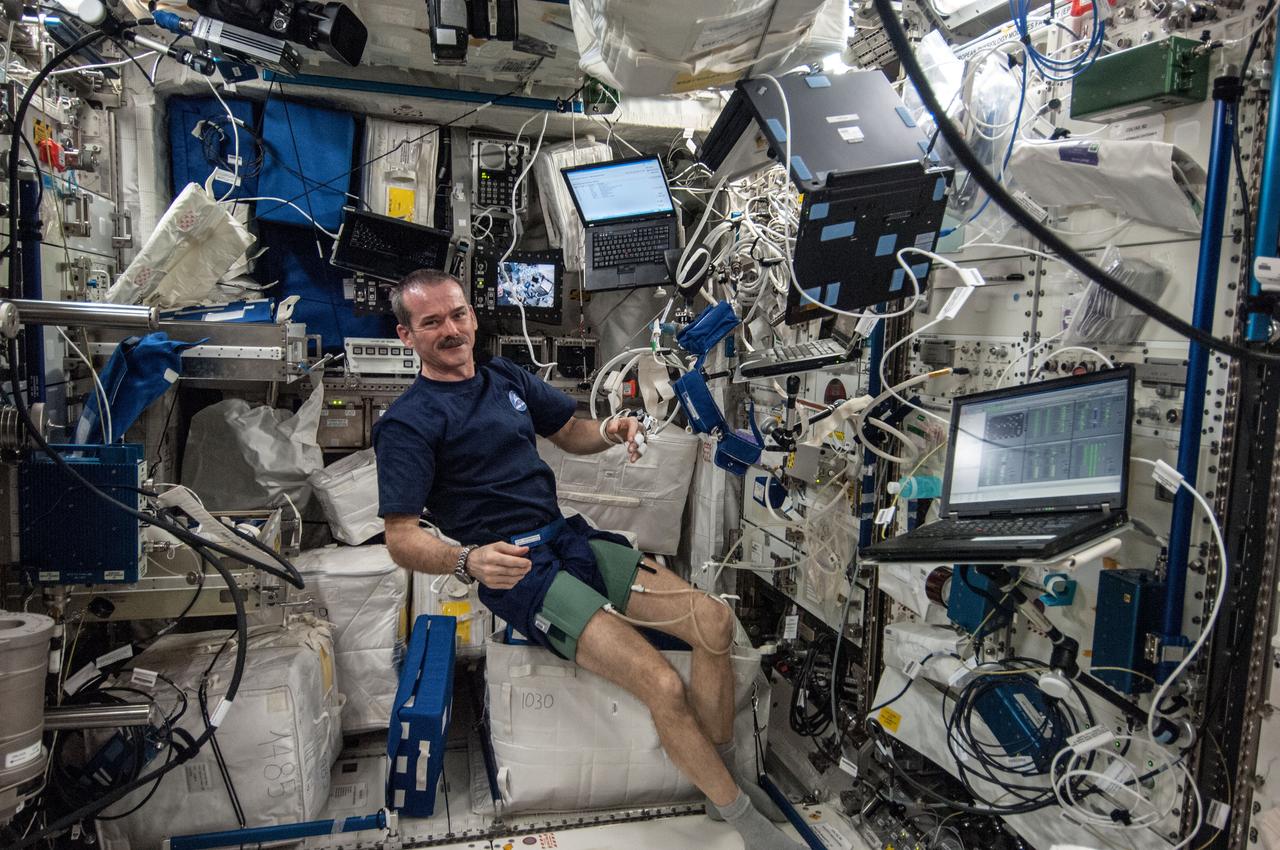
ISS035-E-022357 (17 April 2013) --- In support of the Blood Pressure Regulation Experiment (BP Reg), Expedition 35 Commander Chris Hadfield of the Canadian Space Agency is pictured after having set up the Human Research Facility (HRF) PFS (Pulmonary Function System) and the European Physiology Module (EPM) Cardiolab (CDL) Leg/Arm Cuff System (LACS) and conducting the first ever session of this experiment. The test, which will be repeated using other crew members as well, will help to identify the astronauts who could benefit from countermeasures before returning to Earth. Thus, this method has great potential for astronaut health monitoring during future long-term space flights and it also has important implications for testing of individuals on Earth, especially the elderly, who are at risk for fainting. The research will also allow demonstrating the feasibility of obtaining a set of indicators of overall cardiovascular regulation from the non-invasive measurement of continuous blood pressure.
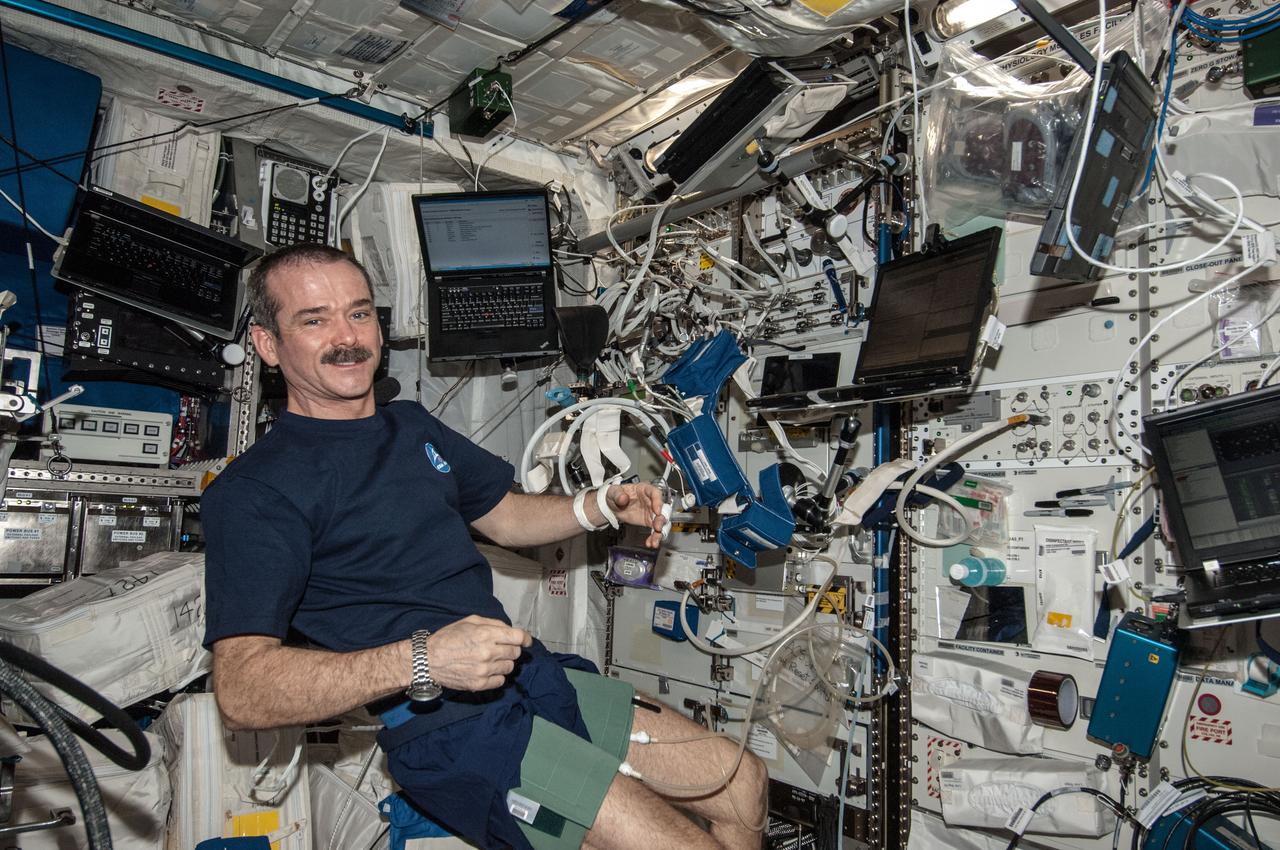
ISS035-E-022356 (17 April 2013) --- In support of the Blood Pressure Regulation Experiment (BP Reg), Expedition 35 Commander Chris Hadfield of the Canadian Space Agency is pictured after having set up the Human Research Facility (HRF) PFS (Pulmonary Function System) and the European Physiology Module (EPM) Cardiolab (CDL) Leg/Arm Cuff System (LACS) and conducting the first ever session of this experiment. The test, which will be repeated using other crew members as well, will help to identify the astronauts who could benefit from countermeasures before returning to Earth. Thus, this method has great potential for astronaut health monitoring during future long-term space flights and it also has important implications for testing of individuals on Earth, especially the elderly, who are at risk for fainting. The research will also allow demonstrating the feasibility of obtaining a set of indicators of overall cardiovascular regulation from the non-invasive measurement of continuous blood pressure.
ISS035-E-022360 (17 April 2013) --- In support of the Blood Pressure Regulation Experiment (BP Reg), Expedition 35 Commander Chris Hadfield of the Canadian Space Agency is pictured after having set up the Human Research Facility (HRF) PFS (Pulmonary Function System) and the European Physiology Module (EPM) Cardiolab (CDL) Leg/Arm Cuff System (LACS) and conducting the first ever session of this experiment. The test, which will be repeated using other crew members as well, will help to identify the astronauts who could benefit from countermeasures before returning to Earth. Thus, this method has great potential for astronaut health monitoring during future long-term space flights and it also has important implications for testing of individuals on Earth, especially the elderly, who are at risk for fainting. The research will also allow demonstrating the feasibility of obtaining a set of indicators of overall cardiovascular regulation from the non-invasive measurement of continuous blood pressure.
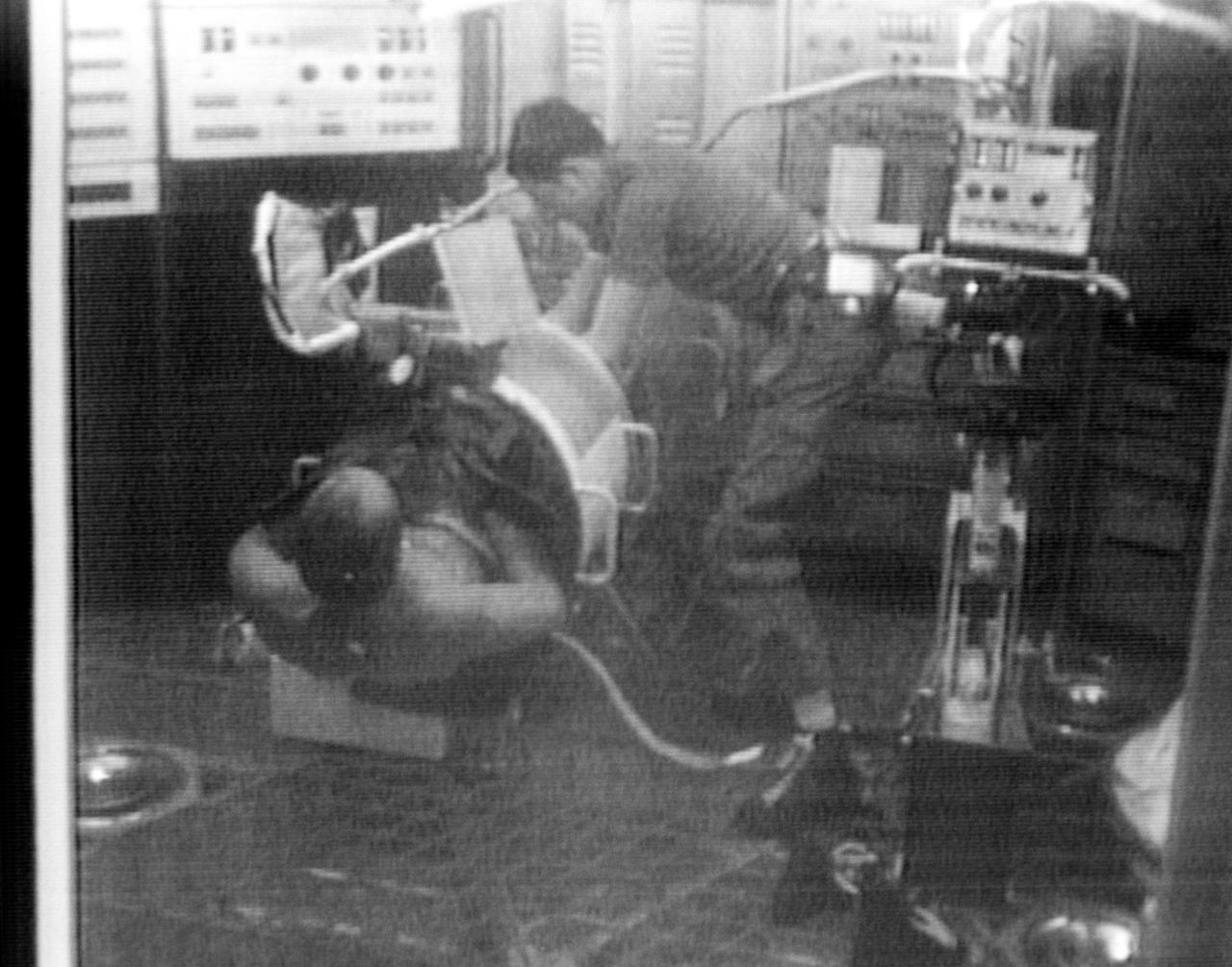
S73-27707 (9 June 1973) --- Astronaut Charles Conrad Jr., Skylab 2 commander, serves as test subject for the Lower Body Negative Pressure (MO92) Experiment, as seen in this reproduction taken from a color television transmission made by a TV camera aboard the Skylab 1/2 space station cluster in Earth orbit. Scientist-astronaut Joseph P. Kerwin, Skylab 2 science pilot, assists Conrad into the LBNP device. Kerwin served as monitor for the experiment. The purpose of the MO92 experiment is to provide information concerning the time course of cardiovascular adaptation during flight, and to provide inflight data for predicting the degree of orthostatic intolerance and impairment of physical capacity to be expected upon return to Earth environment. The data collected in support of MO92 blood pressure, heart rate, body temperature, vectorcardiogram, LBNPD pressure, leg volume changes, and body weight. Photo credit: NASA
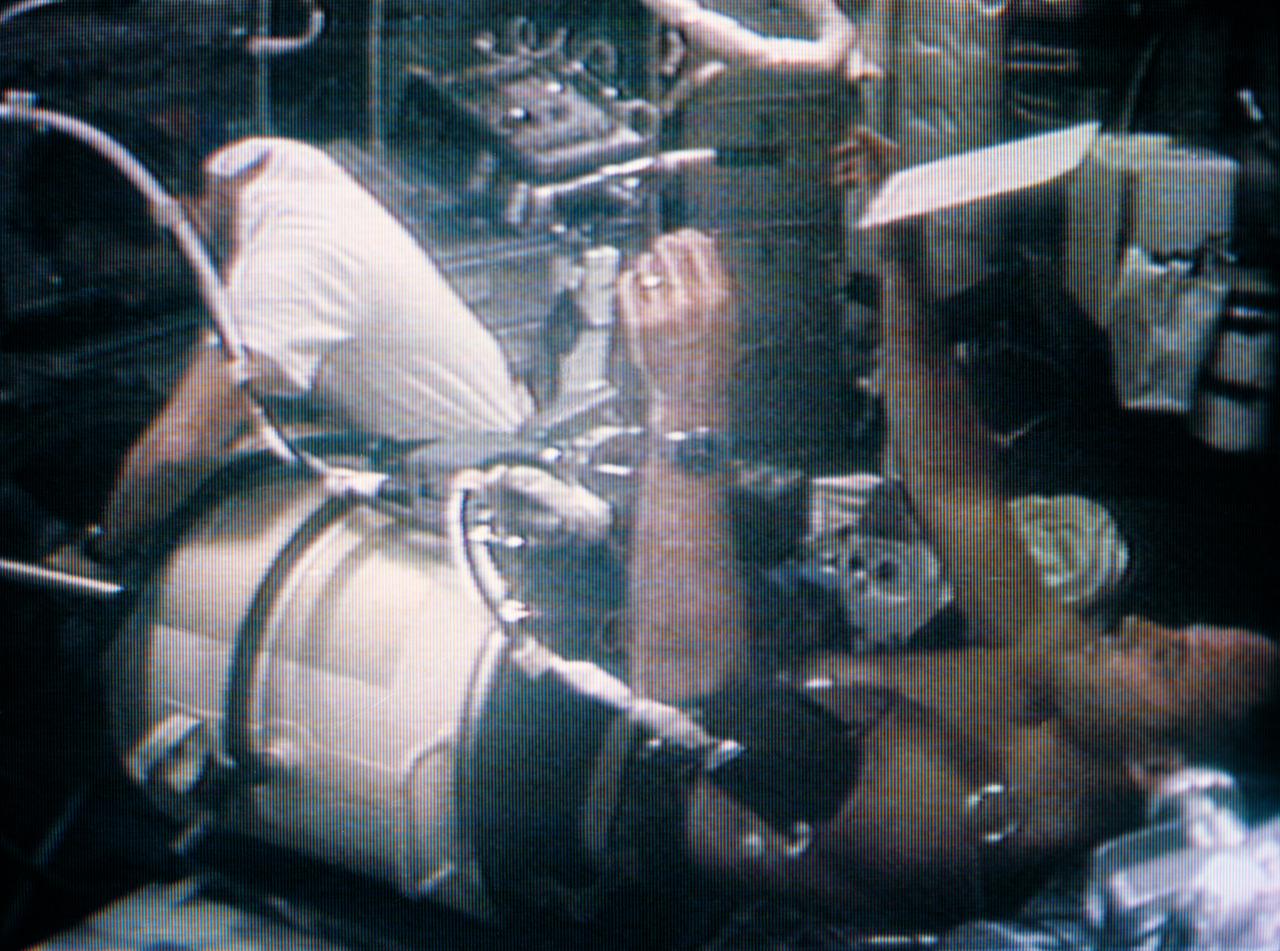
S73-34180 (7 Aug. 1973) --- A medium close-up view of astronaut Jack R. Lousma, Skylab 3 pilot, in the Lower Body Negative Pressure Device (LBNPD), as astronaut Alan L. Bean, commander, works around the leg band area. This portion of the LBNPD MO-92 experiment was televised on Aug. 7, 1973. The LBNPD experiment is to provide information concerning the time course of cardiovascular adaptation during flight, and to provide in-flight data for predicting the degree of orthostatic intolerence and impairment of physical capacity to be expected upon returning to Earth environment. The bicycle ergometer is in the background, partially visible behind Bean. Photo credit: NASA
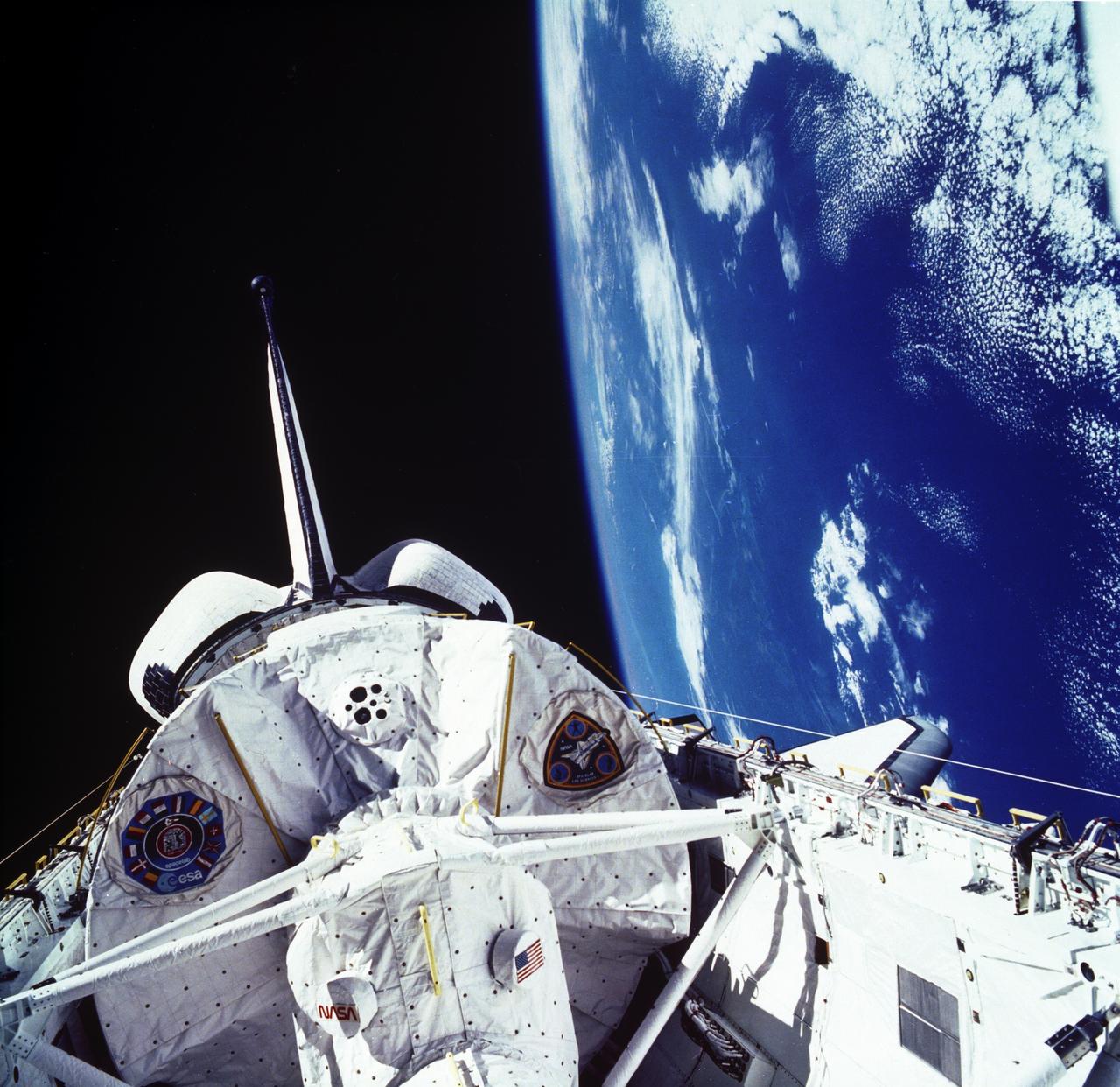
The laboratory module in the cargo bay of the Space Shuttle Orbiter Columbia was photographed during the Spacelab Life Science-1 (SLS-1) mission. SLS-1 was the first Spacelab mission dedicated solely to life sciences. The main purpose of the SLS-1 mission was to study the mechanisms, magnitudes, and time courses of certain physiological changes that occur during space flight, to investigate the consequences of the body's adaptation to microgravity and readjustment to Earth's gravity, and to bring the benefits back home to Earth. The mission was designed to explore the responses of the heart, lungs, blood vessels, kidneys, and hormone-secreting glands to microgravity and related body fluid shifts; examine the causes of space motion sickness; and study changes in the muscles, bones and cells. The five body systems being studied were: The Cardiovascular/Cardiopulmonary System (heart, lungs, and blood vessels), the Renal/Endocrine System (kidney and hormone-secreting organs), the Immune System (white blood cells), the Musculoskeletal System (muscles and bones), and the Neurovestibular System (brain and nerves, eyes, and irner ear). The SLS-1 was launched aboard the Space Shuttle Orbiter Columbia (STS-40) on June 5, 1995.
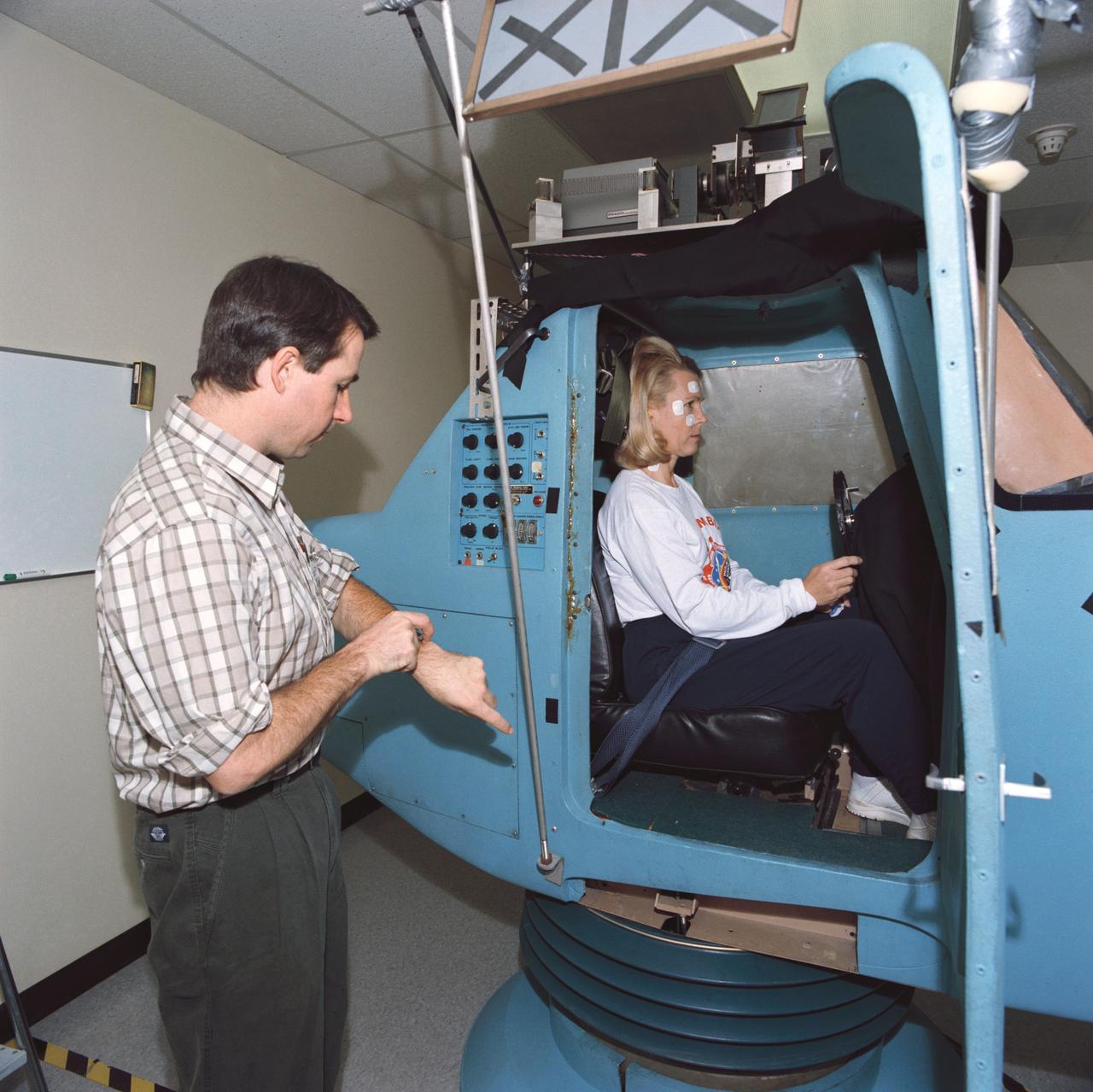
S93-45373 (29 Sept 1993) --- Astronaut Rhea Seddon, STS-58 payload commander, is in a piloting simulator as part of a pre-flight data collection project for neurovestibular functions. The seven Spacelab Life Sciences (SLS-2) crew members devoted a full day to miscellaneous biomedical data collection in preparation for next month's two week mission aboard Columbia.
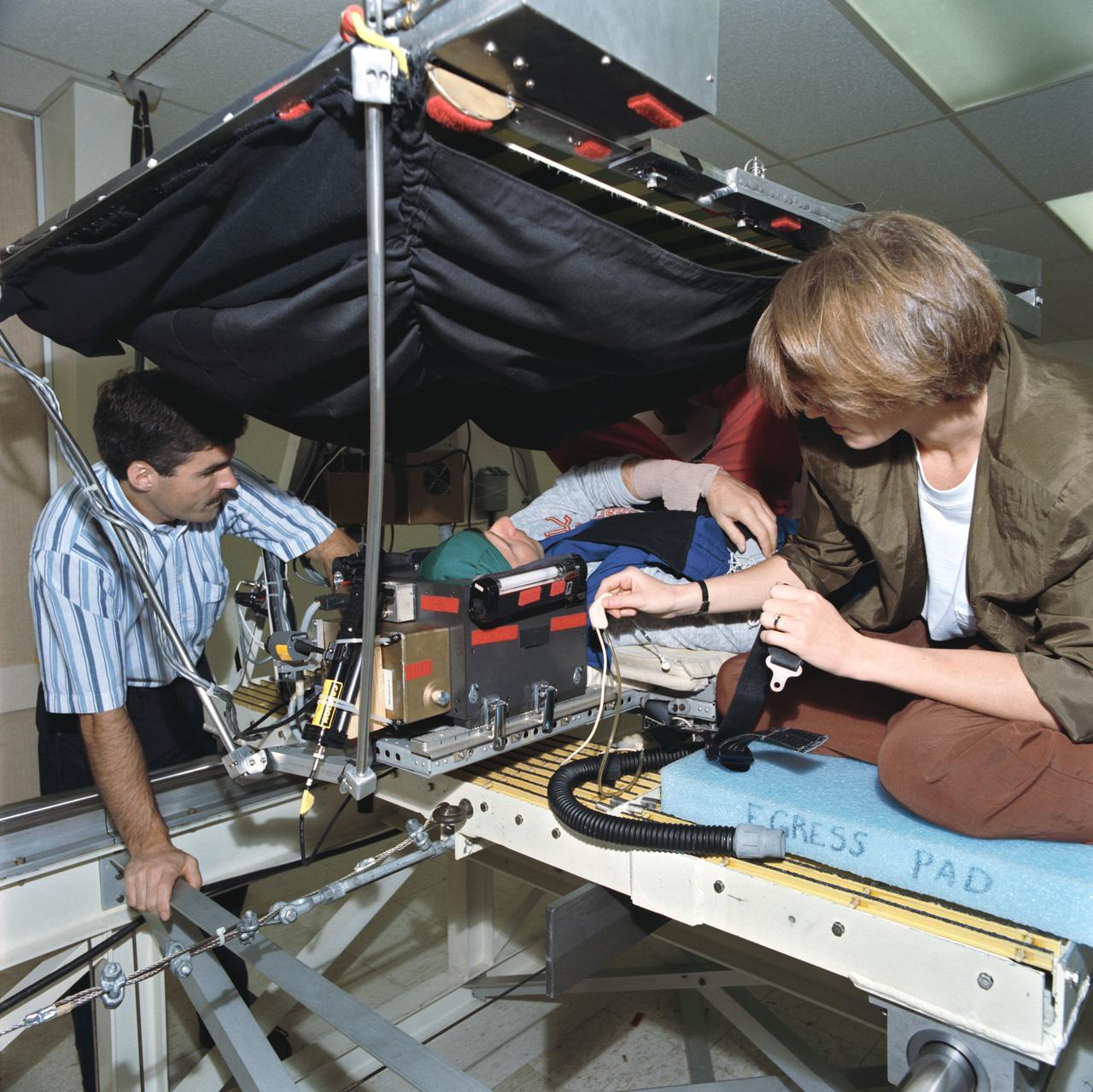
S93-45363 (29 Sept 1993) --- Payload specialist Martin J. Fettman, in an oscillating sled device, participates in a data collection project for neurovestibular functions. The seven Spacelab Life Sciences (SLS-2) crewmembers devoted a full day to miscellaneous biomedical data collection in preparation for next month's two week mission aboard Columbia.
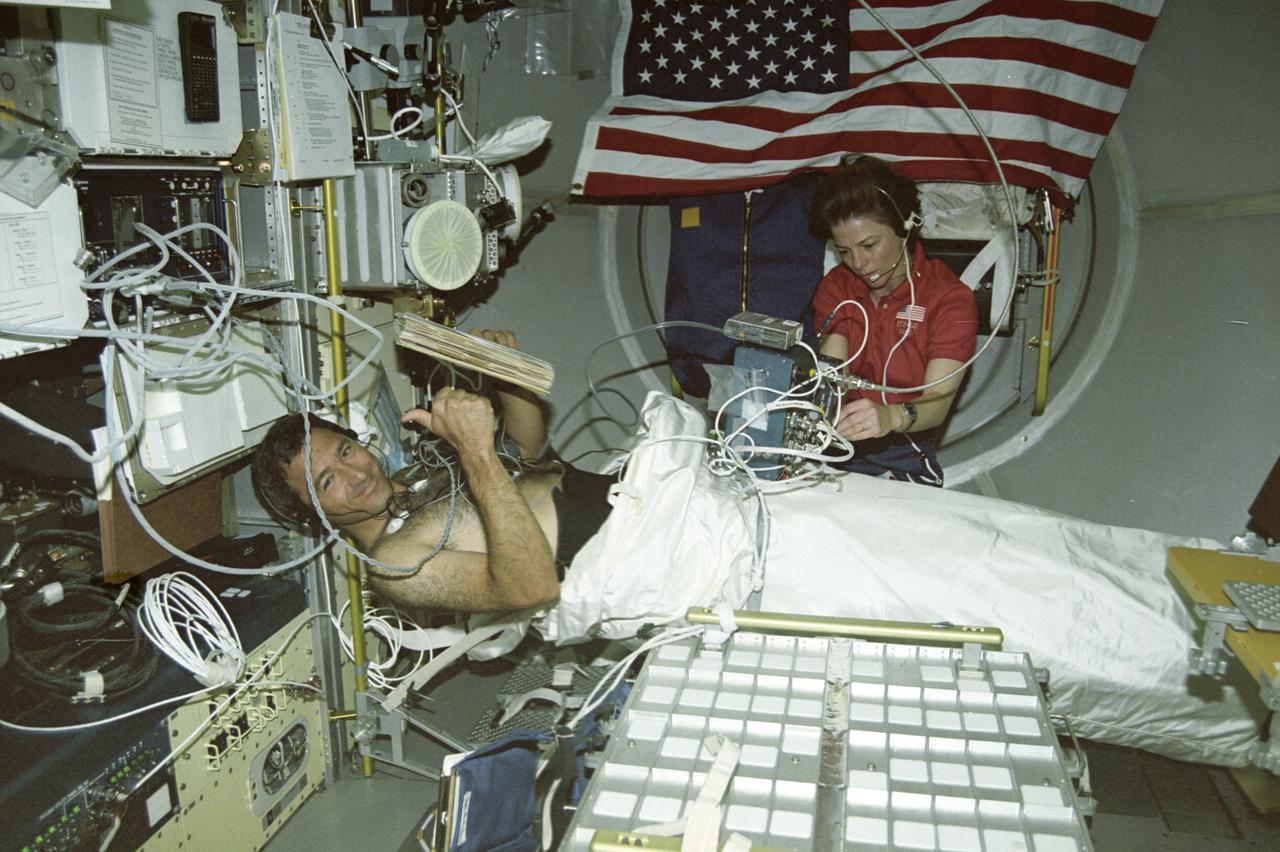
The first United States Microgravity Laboratory (USML-1) flew in orbit inside the Spacelab science module for extended periods, providing scientists and researchers greater opportunities for research in materials science, fluid dynamics, biotechnology (crystal growth), and combustion science. In this photograph, Astronaut Bornie Dunbar and Astronaut Larry DeLucas are conducting the Lower Body Negative Pressure (LBNP) experiment, which is to protect the health and safety of the crew and to shorten the time required to readapt to gravity when they return to Earth. When humans go into space, the lack of gravity causes many changes in the body. One change is that fluids normally kept in the lower body by gravity, shift upward to the head and chest. This is why astronauts' faces appear chubby or puffy. The change in fluid volume also affects the heart. The reduced fluid volume means that there is less blood to circulate through the body. Crewmembers may experience reduced blood flow to the brain when returning to Earth. This leads to fainting or near-fainting episodes. With the use of LBNP to simulate the pull of gravity in conjunction with fluids, salt tablets can recondition the cardiovascular system. This treatment, called "soak," is effective up to 24 hours. The LBNP uses a three-layer collapsible cylinder that seals around the crewmember's waist which simulates the effects of gravity and helps pull fluids into the lower body. The data collected will be analyzed to determine physiological changes in the crewmembers and effectiveness of the treatment. The USML-1 was launched aboard the Space Shuttle Orbiter Columbia (STS-50) on June 25, 1992.
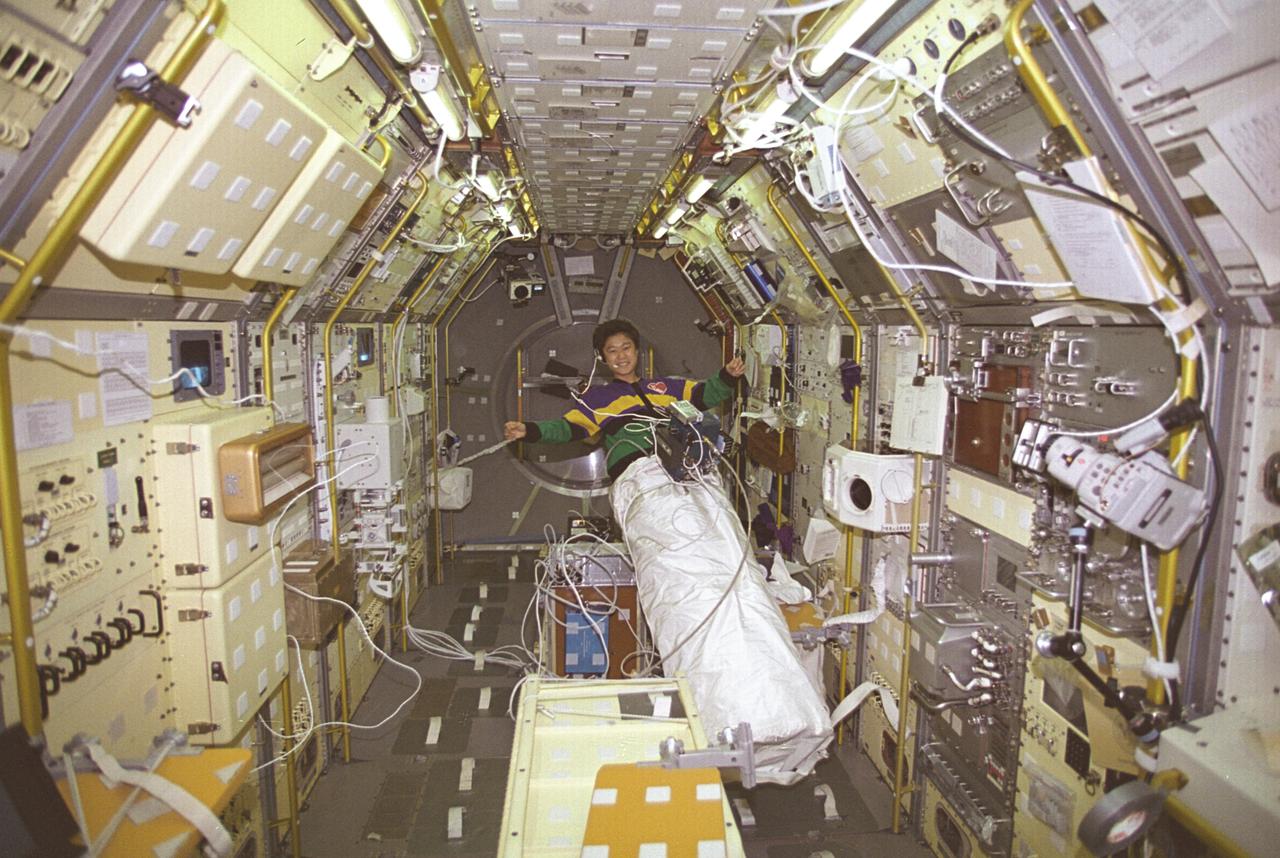
Astronaut Chiaki Mukai conducts the Lower Body Negative Pressure (LBNP) experiment inside the International Microgravity Laboratory-2 (IML-2) mission science module. Dr. Chiaki Mukai is one of the National Space Development Agency of Japan (NASDA) astronauts chosen by NASA as a payload specialist (PS). She was the second NASDA PS who flew aboard the Space Shuttle, and was the first female astronaut in Asia. When humans go into space, the lack of gravity causes many changes in the body. One change is that fluids normally kept in the lower body by gravity shift upward to the head and chest. This is why astronauts' faces appear chubby or puffy. The change in fluid volume also affects the heart. The reduced fluid volume means that there is less blood to circulate through the body. Crewmembers may experience reduced blood flow to the brain when returning to Earth. This leads to fainting or near-fainting episodes. With the use of the LBNP to simulate the pull of gravity in conjunction with fluids, salt tablets can recondition the cardiovascular system. This treatment, called "soak," is effective up to 24 hours. The LBNP uses a three-layer collapsible cylinder that seals around the crewmember's waist which simulates the effects of gravity and helps pull fluids into the lower body. The data collected will be analyzed to determine physiological changes in the crewmembers and effectiveness of the treatment. The IML-2 was the second in a series of Spacelab flights designed by the international science community to conduct research in a microgravity environment Managed by the Marshall Space Flight Center, the IML-2 was launched on July 8, 1994 aboard the STS-65 Space Shuttle Orbiter Columbia mission.