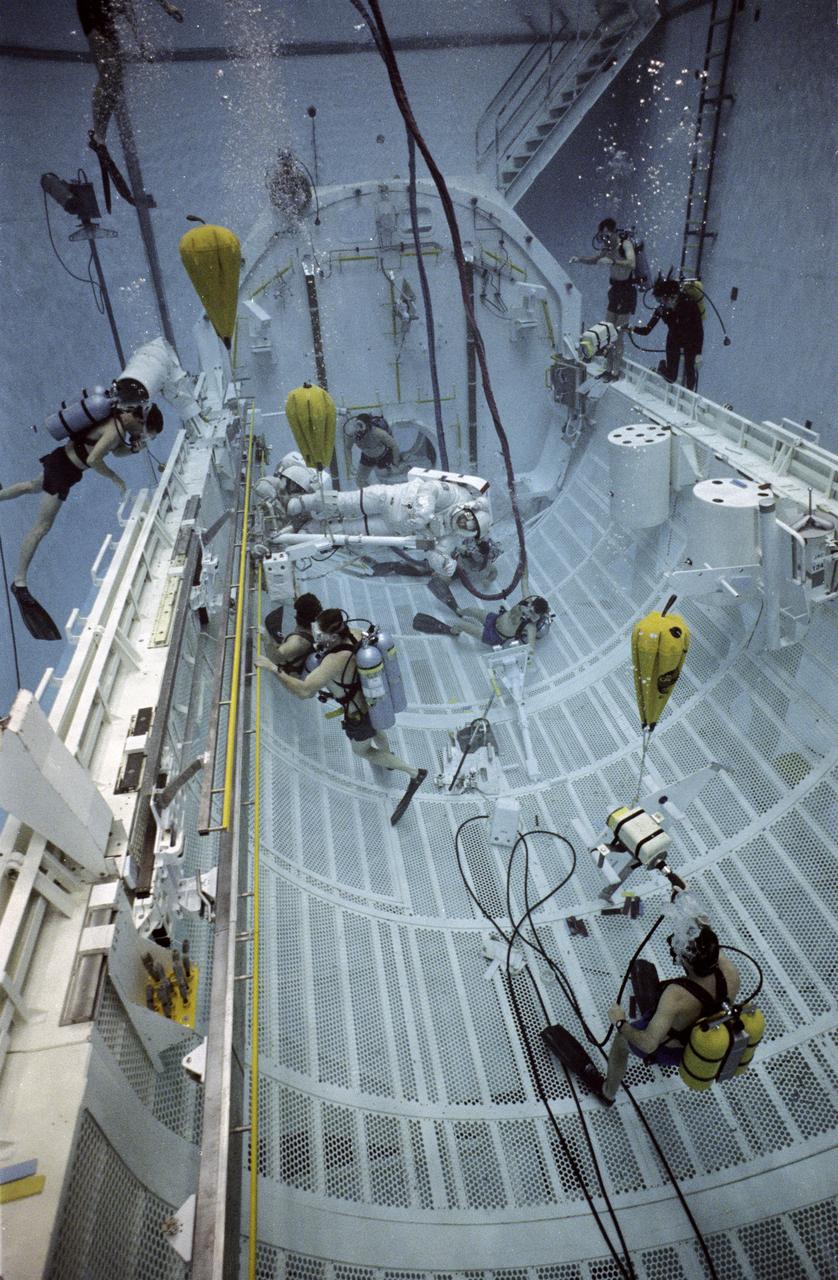
STS-37 Atlantis, Orbiter Vehicle (OV) 104, Mission Specialist (MS) Jerry L. Ross generates electrical power using hand pedals to move crew and equipment translation aid (CETA) cart along a rail during underwater session in JSC's Weightless Environment Training Facility (WETF) Bldg 29. Wearing an extravehicular mobility unit (EMU), Ross operates CETA electrical cart as MS Jerome Apt holds onto the back of the cart. The two crewmembers are practicing a extravehicular activity (EVA) spacewalk they will perform in OV-104's payload bay during STS-37. CETA is a type of railroad hand cart planned as a spacewalker's transportation system along the truss of Space Station Freedom (SSF). SCUBA divers monitor astronauts' underwater activity.
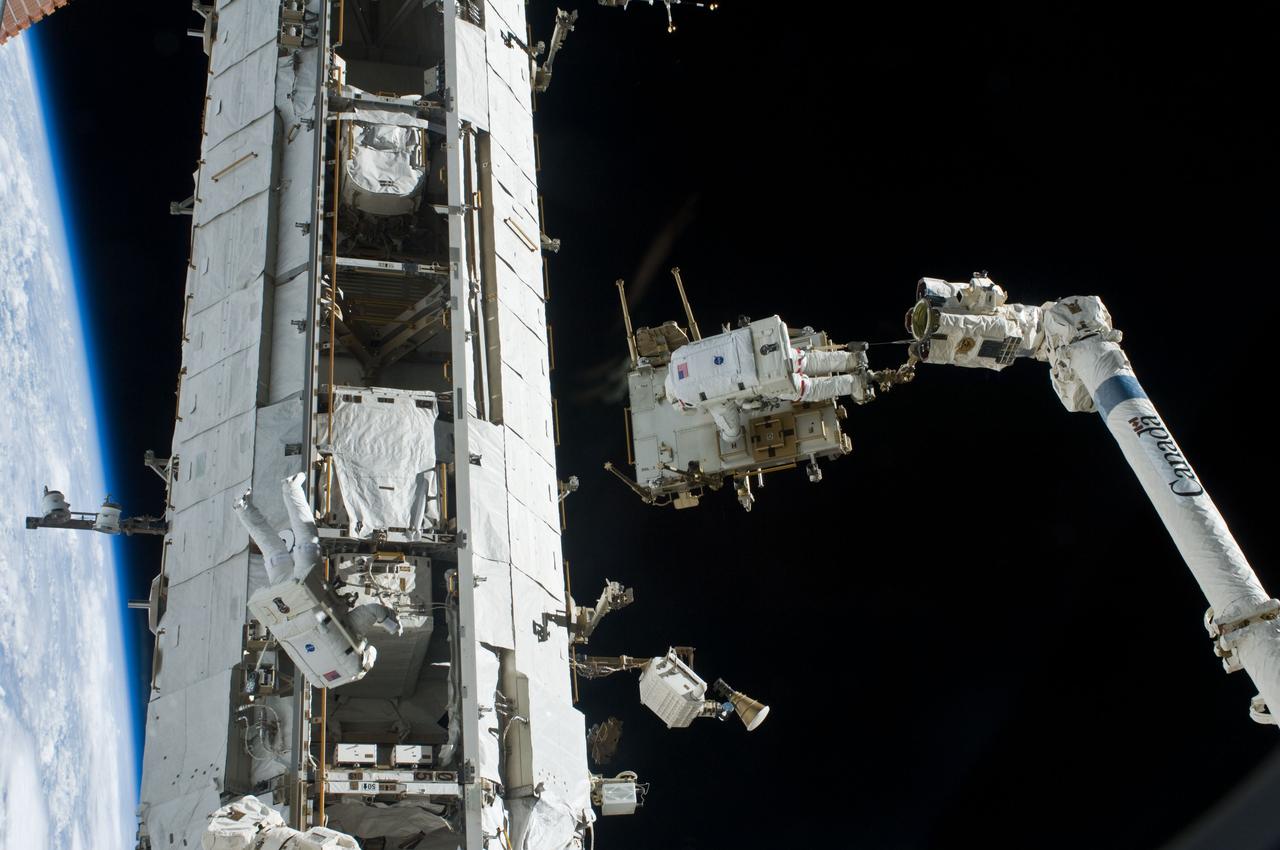
S119-E-007259 (23 March 2009) --- Astronauts Richard Arnold (left) and Joseph Acaba, both STS-119 mission specialists, participate in the mission's third scheduled session of extravehicular activity (EVA) as construction and maintenance continue on the International Space Station. During the six-hour, 27-minute spacewalk, Arnold and Acaba helped robotic arm operators relocate the Crew Equipment Translation Aid (CETA) cart from the Port 1 to Starboard 1 truss segment, installed a new coupler on the CETA cart, lubricated snares on the "B" end of the space station's robotic arm and performed a few "get ahead" tasks.
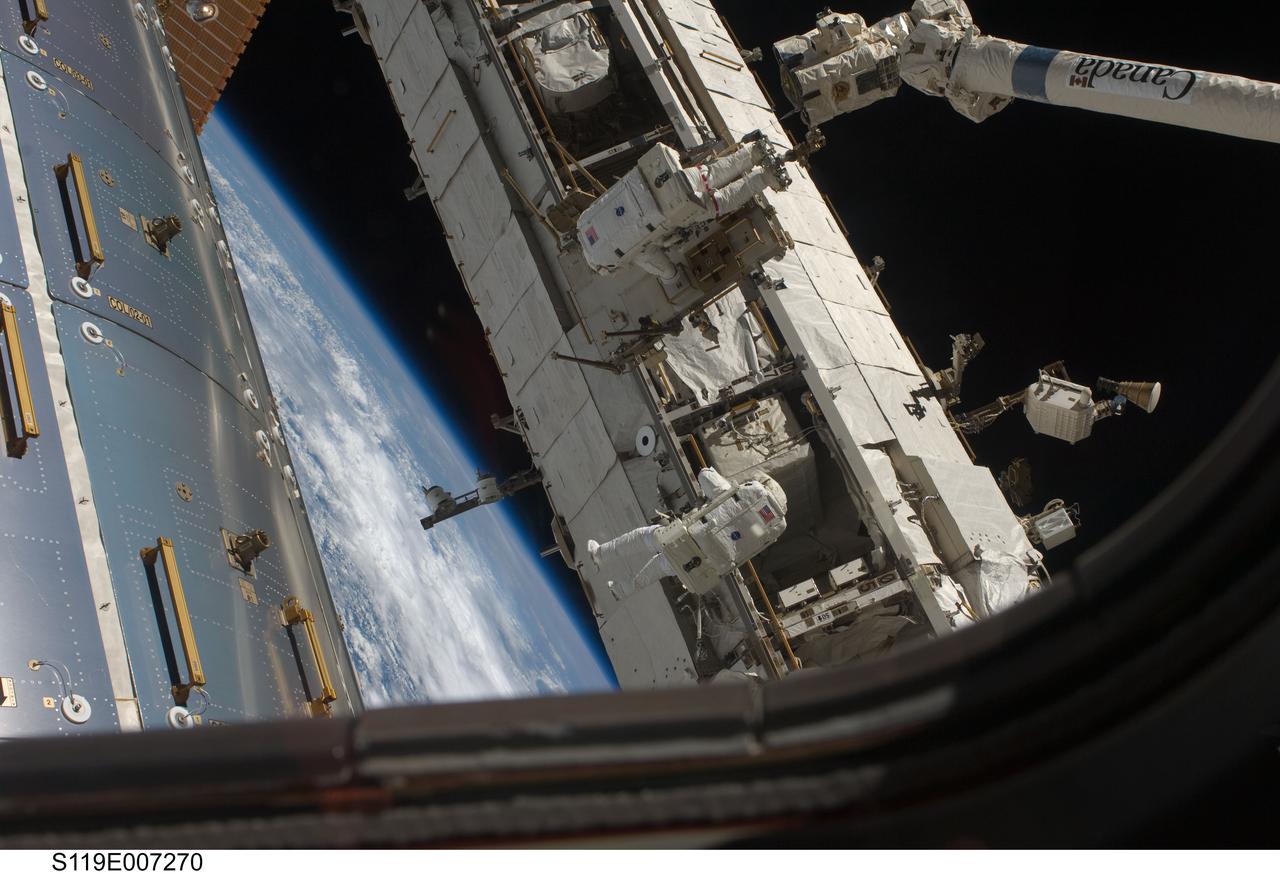
S119-E-007270 (23 March 2009) --- Astronauts Richard Arnold (bottom) and Joseph Acaba, both STS-119 mission specialists, participate in the mission's third scheduled session of extravehicular activity (EVA) as construction and maintenance continue on the International Space Station. During the six-hour, 27-minute spacewalk, Arnold and Acaba helped robotic arm operators relocate the Crew Equipment Translation Aid (CETA) cart from the Port 1 to Starboard 1 truss segment, installed a new coupler on the CETA cart, lubricated snares on the "B" end of the space station's robotic arm and performed a few "get ahead" tasks.
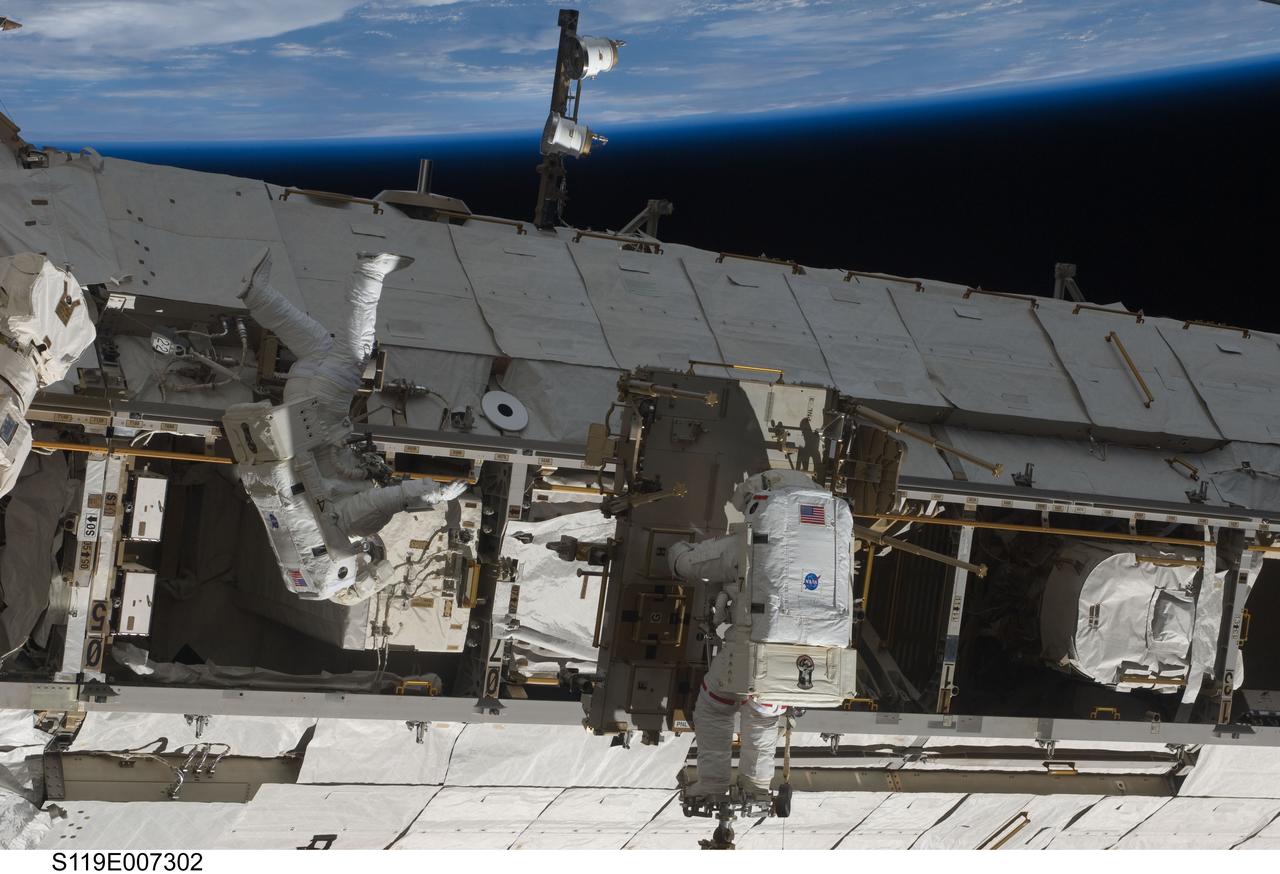
S119-E-007302 (23 March 2009) --- Astronauts Richard Arnold (left) and Joseph Acaba, both STS-119 mission specialists, participate in the mission's third scheduled session of extravehicular activity (EVA) as construction and maintenance continue on the International Space Station. During the six-hour, 27-minute spacewalk, Arnold and Acaba helped robotic arm operators relocate the Crew Equipment Translation Aid (CETA) cart from the Port 1 to Starboard 1 truss segment, installed a new coupler on the CETA cart, lubricated snares on the "B" end of the space station's robotic arm and performed a few "get ahead" tasks.
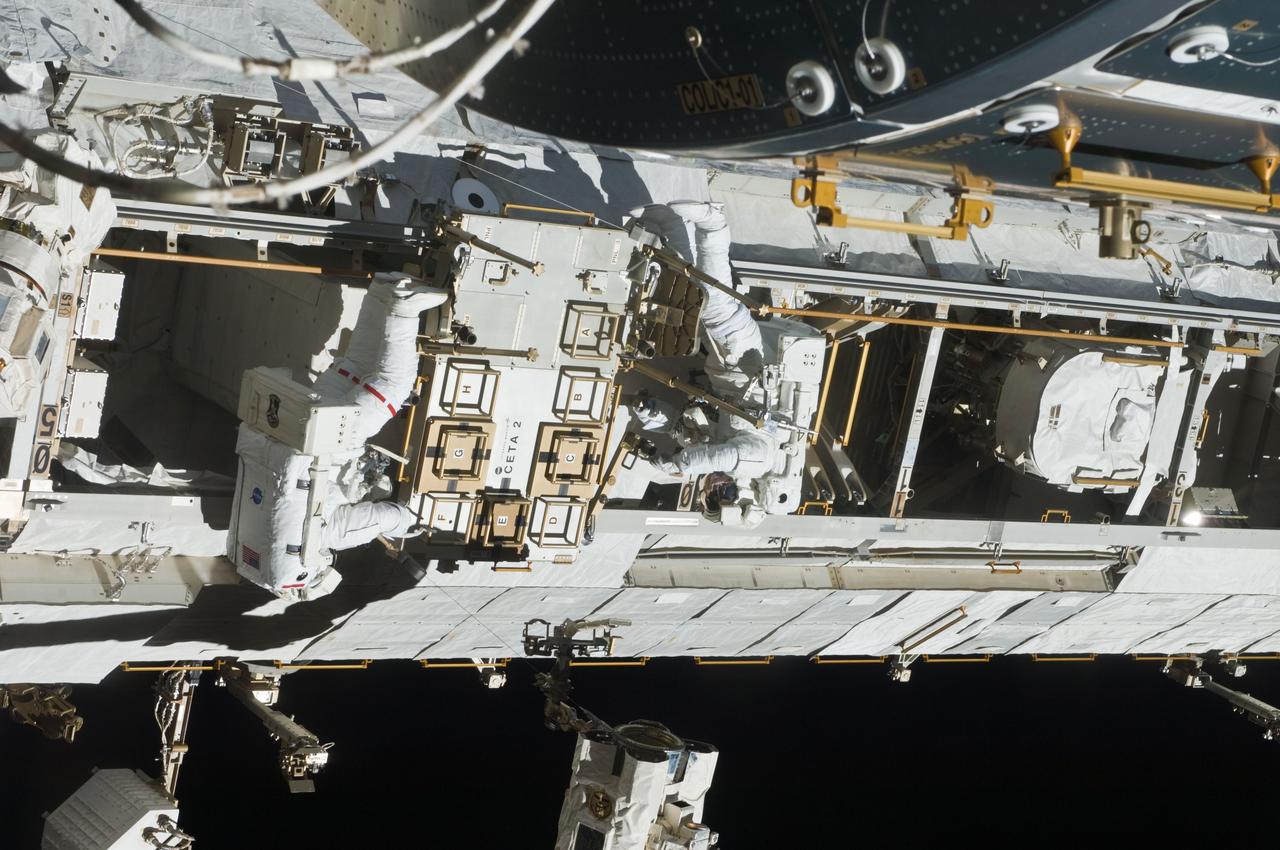
S119-E-007332 (23 March 2009) --- Astronauts Richard Arnold (right) and Joseph Acaba, both STS-119 mission specialists, participate in the mission's third scheduled session of extravehicular activity (EVA) as construction and maintenance continue on the International Space Station. During the six-hour, 27-minute spacewalk, Arnold and Acaba helped robotic arm operators relocate the Crew Equipment Translation Aid (CETA) cart from the Port 1 to Starboard 1 truss segment, installed a new coupler on the CETA cart, lubricated snares on the "B" end of the space station's robotic arm and performed a few "get ahead" tasks.
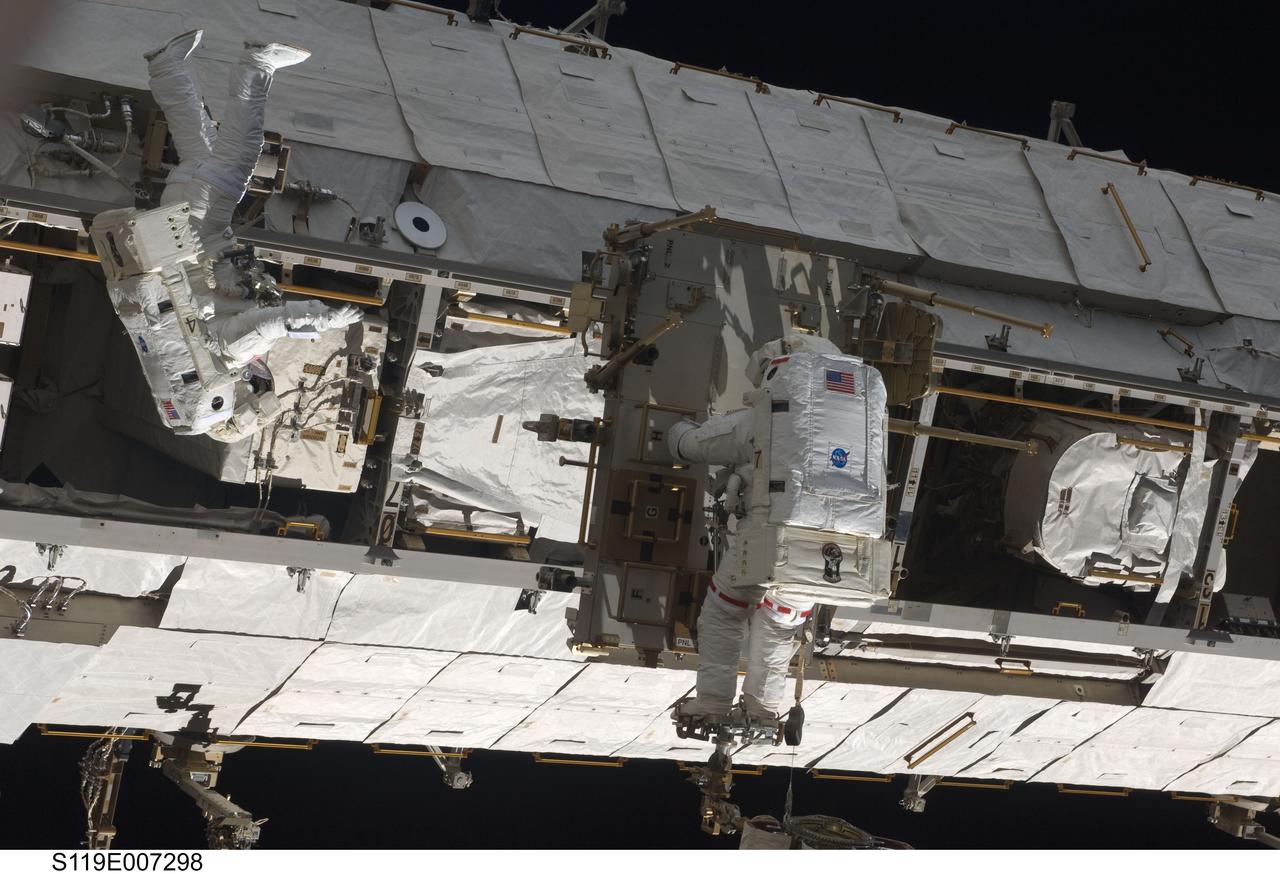
S119-E-007298 (23 March 2009) --- Astronauts Richard Arnold (left) and Joseph Acaba, both STS-119 mission specialists, participate in the mission's third scheduled session of extravehicular activity (EVA) as construction and maintenance continue on the International Space Station. During the six-hour, 27-minute spacewalk, Arnold and Acaba helped robotic arm operators relocate the Crew Equipment Translation Aid (CETA) cart from the Port 1 to Starboard 1 truss segment, installed a new coupler on the CETA cart, lubricated snares on the "B" end of the space station's robotic arm and performed a few "get ahead" tasks.
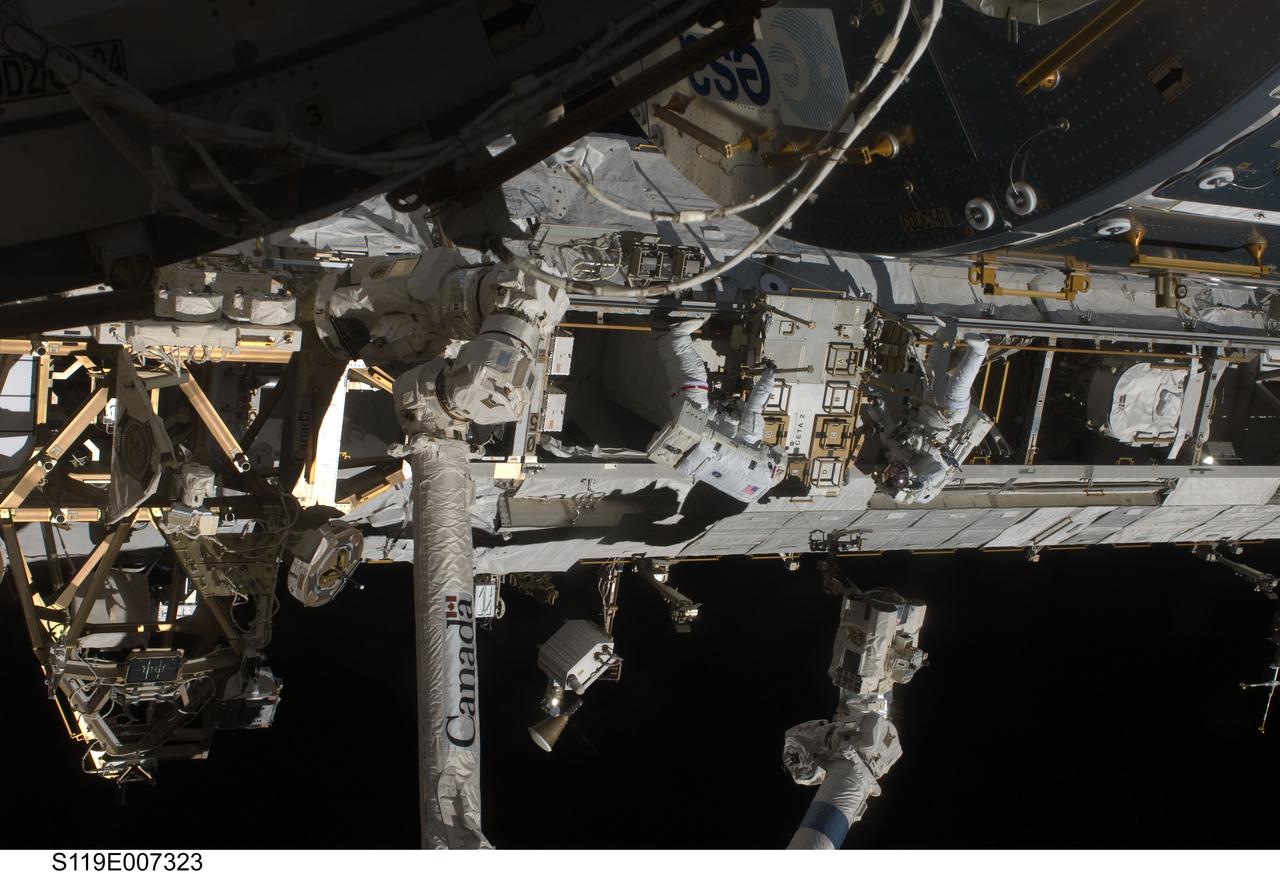
S119-E-007323 (23 March 2009) --- Astronauts Richard Arnold (right) and Joseph Acaba, both STS-119 mission specialists, participate in the mission's third scheduled session of extravehicular activity (EVA) as construction and maintenance continue on the International Space Station. During the six-hour, 27-minute spacewalk, Arnold and Acaba helped robotic arm operators relocate the Crew Equipment Translation Aid (CETA) cart from the Port 1 to Starboard 1 truss segment, installed a new coupler on the CETA cart, lubricated snares on the "B" end of the space station's robotic arm and performed a few "get ahead" tasks.
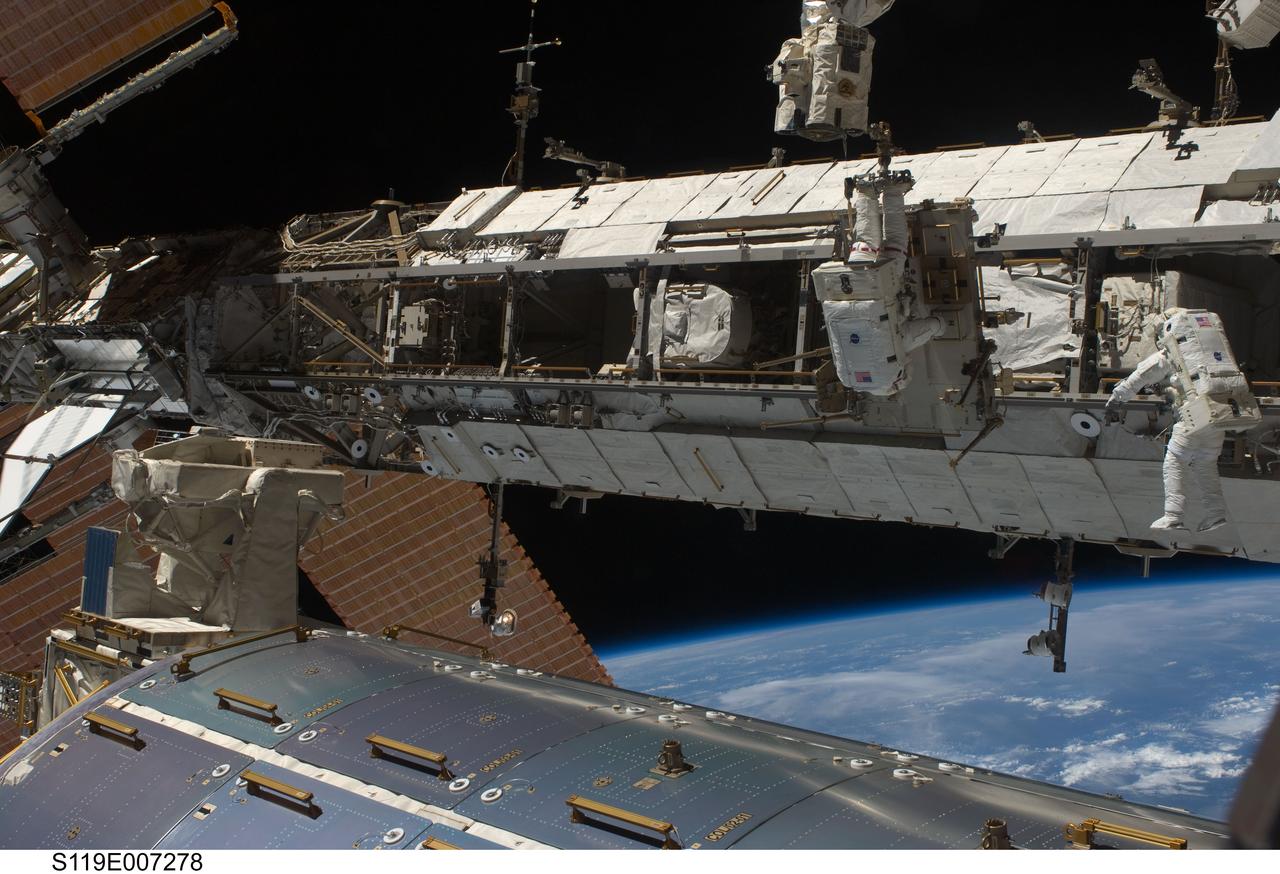
S119-E-007278 (23 March 2009) --- Astronauts Richard Arnold (right) and Joseph Acaba, both STS-119 mission specialists, participate in the mission's third scheduled session of extravehicular activity (EVA) as construction and maintenance continue on the International Space Station. During the six-hour, 27-minute spacewalk, Arnold and Acaba helped robotic arm operators relocate the Crew Equipment Translation Aid (CETA) cart from the Port 1 to Starboard 1 truss segment, installed a new coupler on the CETA cart, lubricated snares on the "B" end of the space station's robotic arm and performed a few "get ahead" tasks.
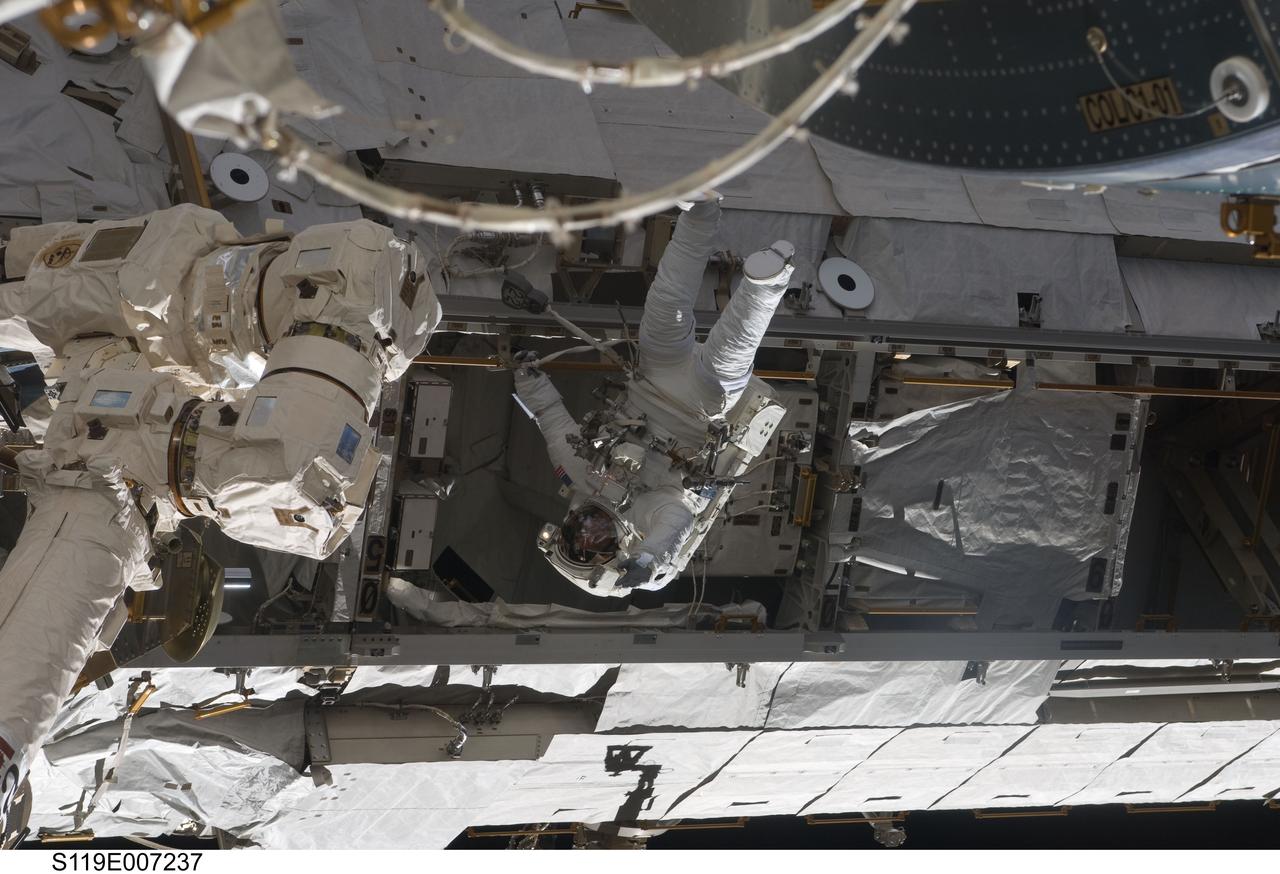
S119-E-007237 (23 March 2009) --- Astronaut Richard Arnold, STS-119 mission specialist, participates in the mission's third scheduled session of extravehicular activity (EVA) as construction and maintenance continue on the International Space Station. During the six-hour, 27-minute spacewalk, Arnold and Joseph Acaba (out of frame), mission specialist, helped robotic arm operators relocate the Crew Equipment Translation Aid (CETA) cart from the Port 1 to Starboard 1 truss segment, installed a new coupler on the CETA cart, lubricated snares on the "B" end of the space station's robotic arm and performed a few "get ahead" tasks.
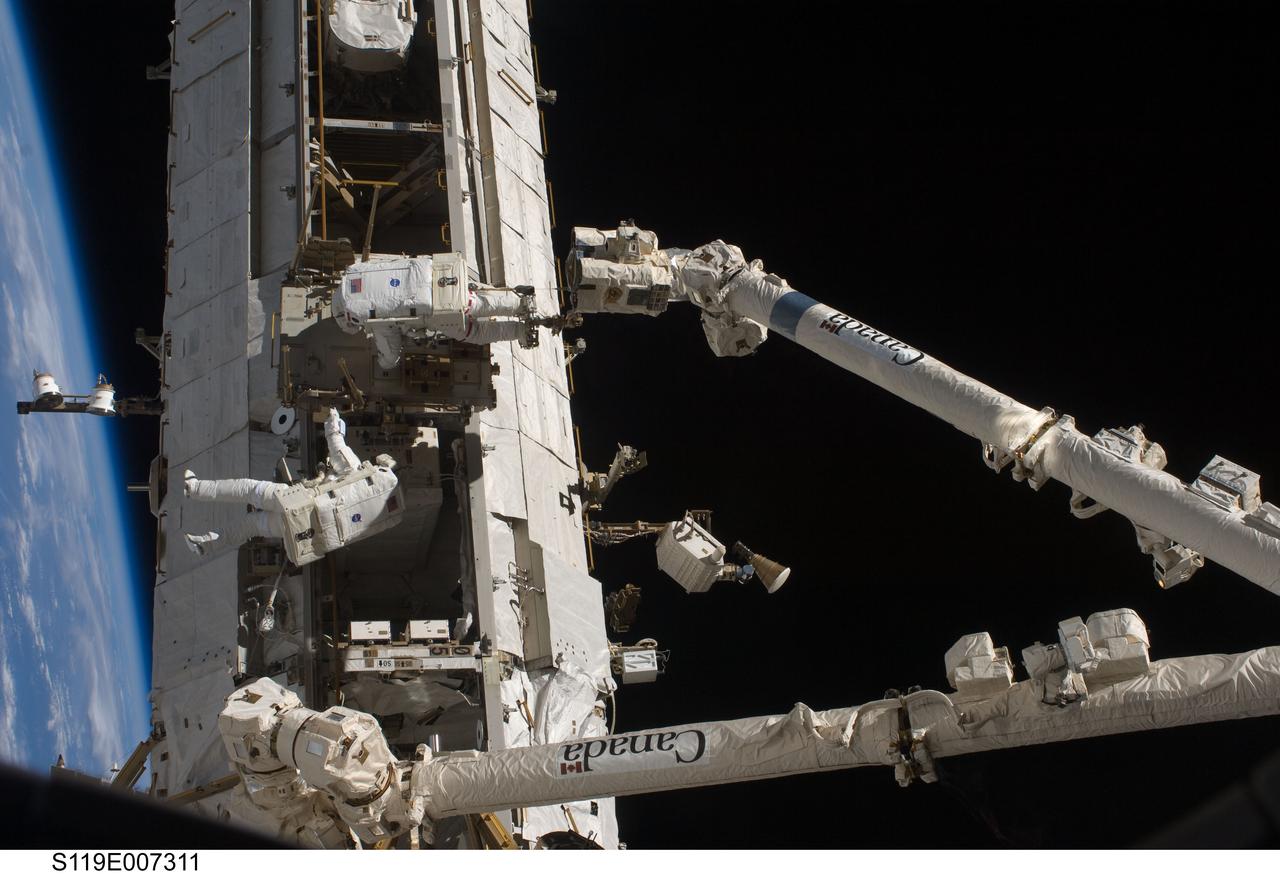
S119-E-007311 (23 March 2009) --- Astronauts Richard Arnold (bottom) and Joseph Acaba, both STS-119 mission specialists, participate in the mission's third scheduled session of extravehicular activity (EVA) as construction and maintenance continue on the International Space Station. During the six-hour, 27-minute spacewalk, Arnold and Acaba helped robotic arm operators relocate the Crew Equipment Translation Aid (CETA) cart from the Port 1 to Starboard 1 truss segment, installed a new coupler on the CETA cart, lubricated snares on the "B" end of the space station's robotic arm and performed a few "get ahead" tasks.
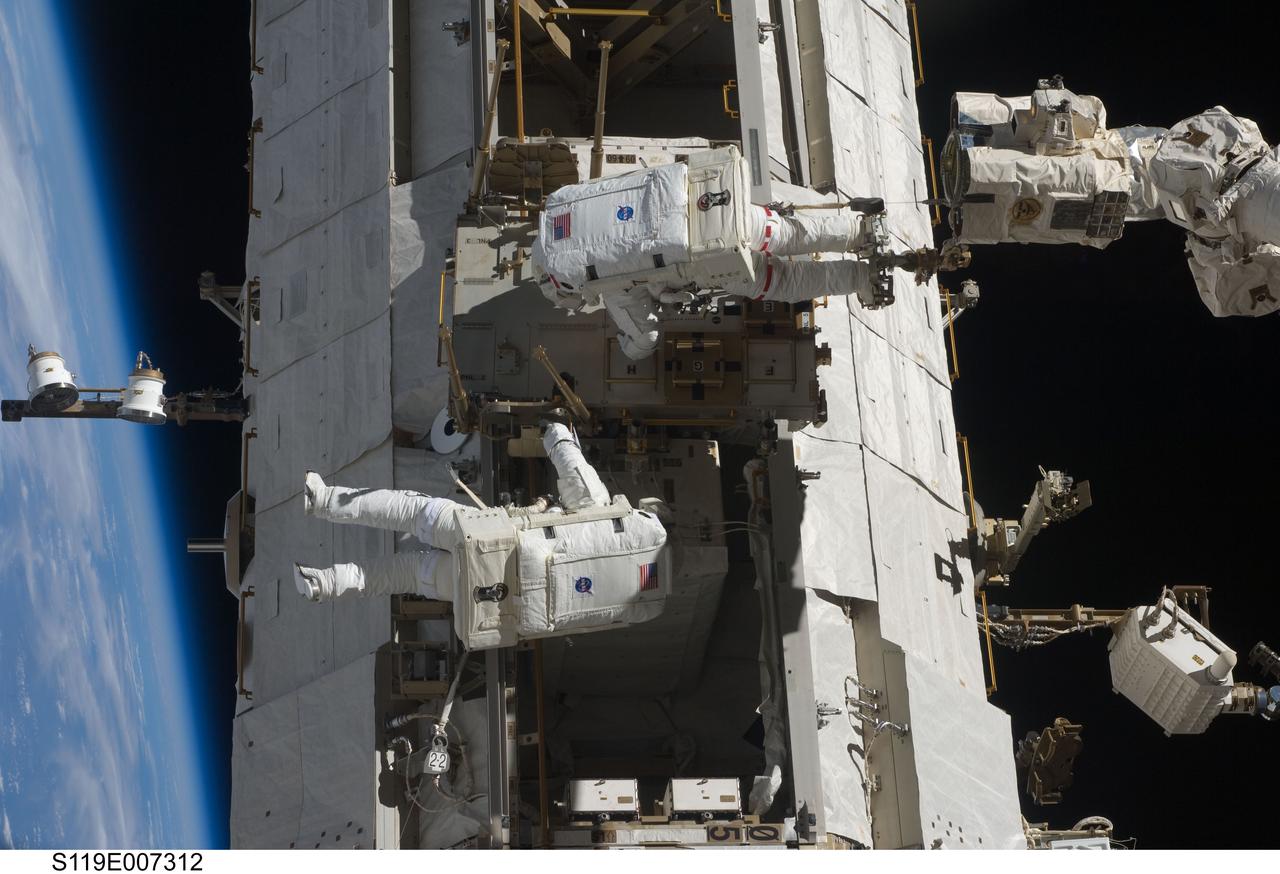
S119-E-007312 (23 March 2009) --- Astronauts Richard Arnold (bottom) and Joseph Acaba, both STS-119 mission specialists, participate in the mission's third scheduled session of extravehicular activity (EVA) as construction and maintenance continue on the International Space Station. During the six-hour, 27-minute spacewalk, Arnold and Acaba helped robotic arm operators relocate the Crew Equipment Translation Aid (CETA) cart from the Port 1 to Starboard 1 truss segment, installed a new coupler on the CETA cart, lubricated snares on the "B" end of the space station's robotic arm and performed a few "get ahead" tasks.
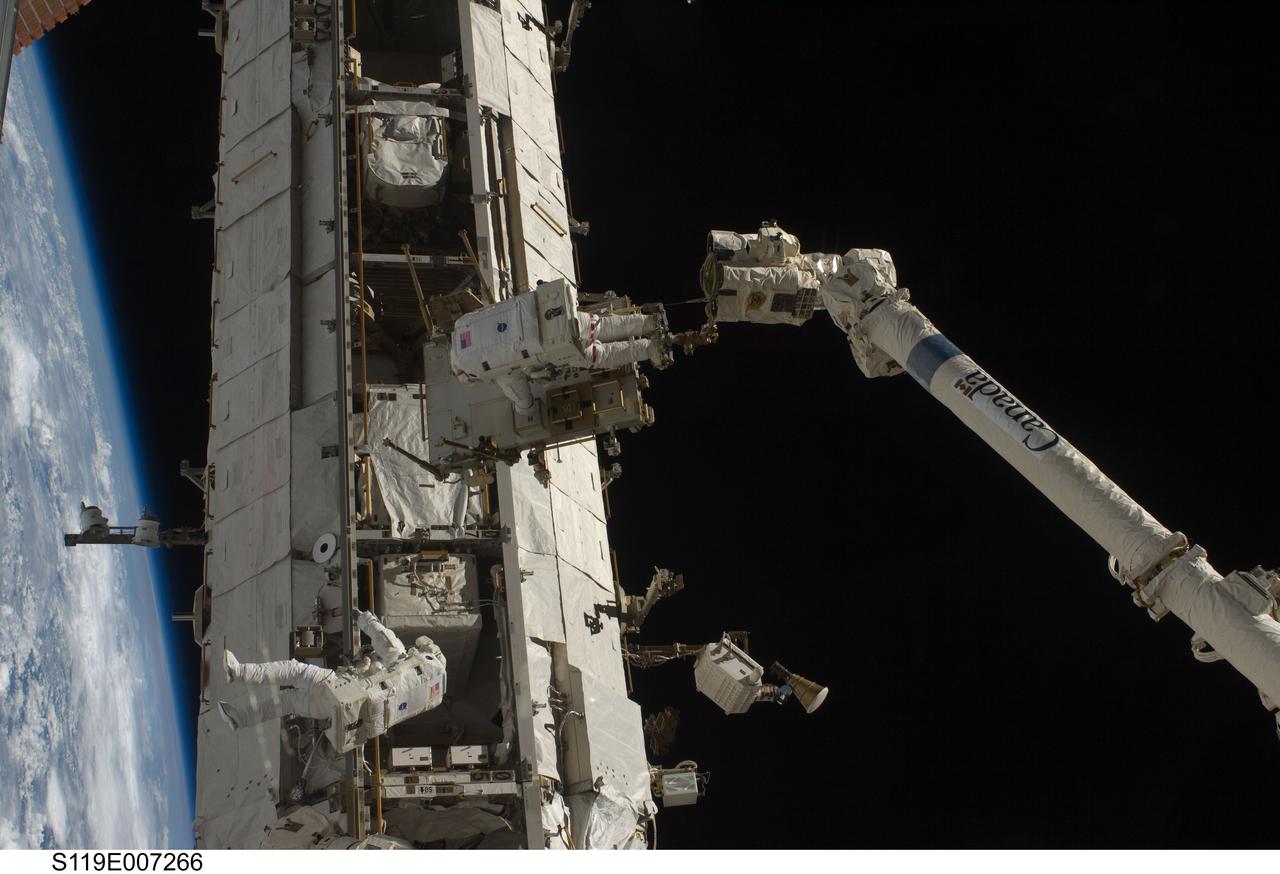
S119-E-007266 (23 March 2009) --- Astronauts Richard Arnold (bottom) and Joseph Acaba, both STS-119 mission specialists, participate in the mission's third scheduled session of extravehicular activity (EVA) as construction and maintenance continue on the International Space Station. During the six-hour, 27-minute spacewalk, Arnold and Acaba helped robotic arm operators relocate the Crew Equipment Translation Aid (CETA) cart from the Port 1 to Starboard 1 truss segment, installed a new coupler on the CETA cart, lubricated snares on the "B" end of the space station's robotic arm and performed a few "get ahead" tasks.
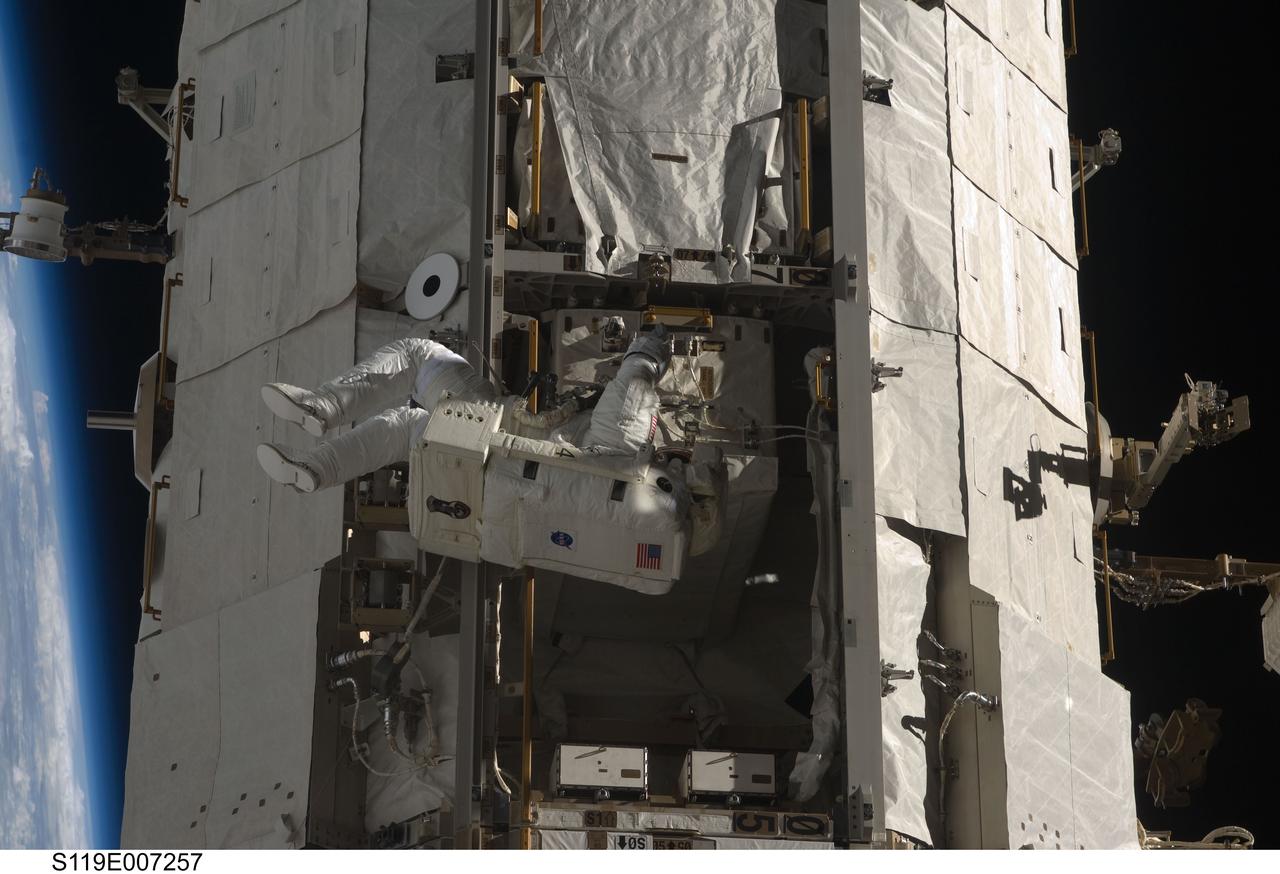
S119-E-007257 (23 March 2009) --- Astronaut Richard Arnold, STS-119 mission specialist, participates in the mission's third scheduled session of extravehicular activity (EVA) as construction and maintenance continue on the International Space Station. During the six-hour, 27-minute spacewalk, Arnold and Joseph Acaba (out of frame), mission specialist, helped robotic arm operators relocate the Crew Equipment Translation Aid (CETA) cart from the Port 1 to Starboard 1 truss segment, installed a new coupler on the CETA cart, lubricated snares on the "B" end of the space station's robotic arm and performed a few "get ahead" tasks.
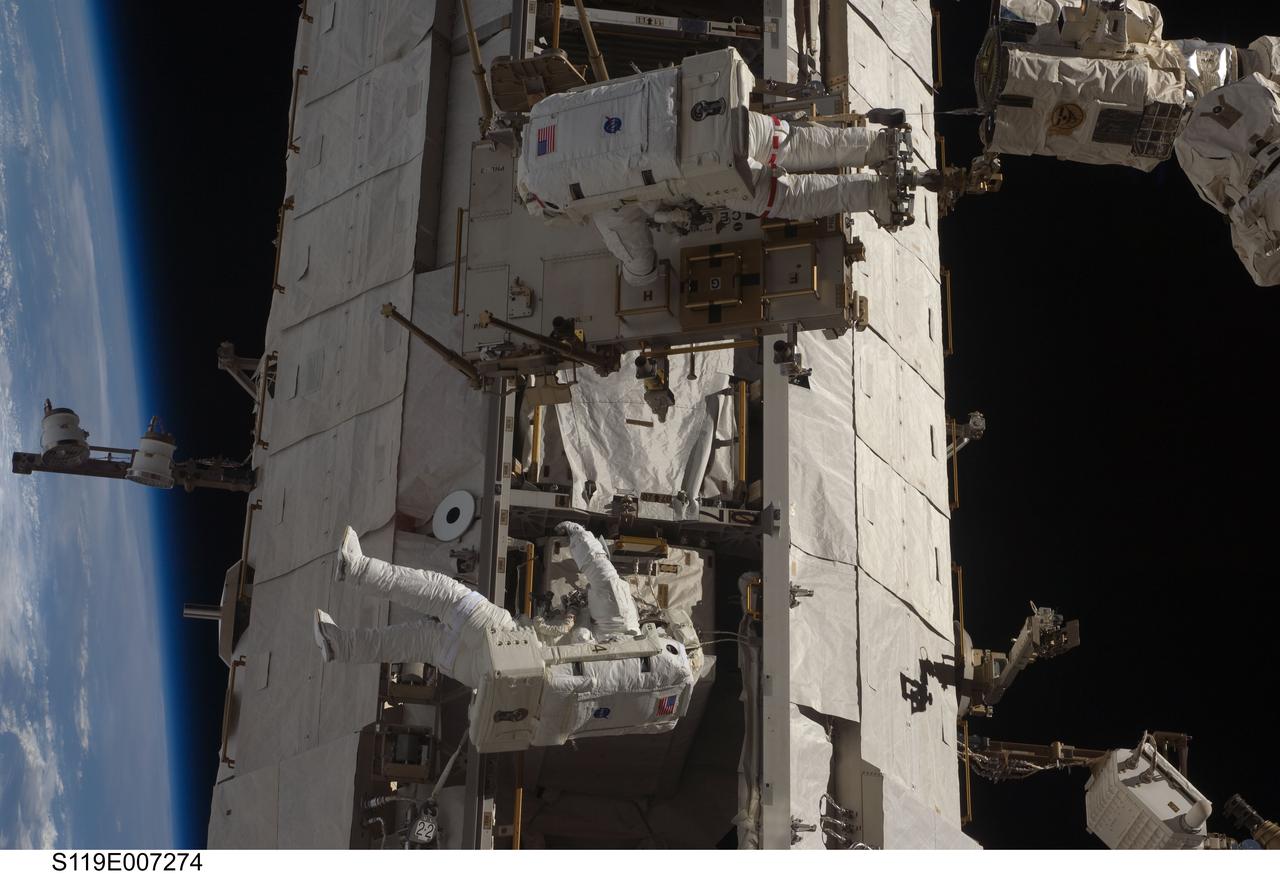
S119-E-007274 (23 March 2009) --- Astronauts Richard Arnold (bottom) and Joseph Acaba, both STS-119 mission specialists, participate in the mission's third scheduled session of extravehicular activity (EVA) as construction and maintenance continue on the International Space Station. During the six-hour, 27-minute spacewalk, Arnold and Acaba helped robotic arm operators relocate the Crew Equipment Translation Aid (CETA) cart from the Port 1 to Starboard 1 truss segment, installed a new coupler on the CETA cart, lubricated snares on the "B" end of the space station's robotic arm and performed a few "get ahead" tasks.
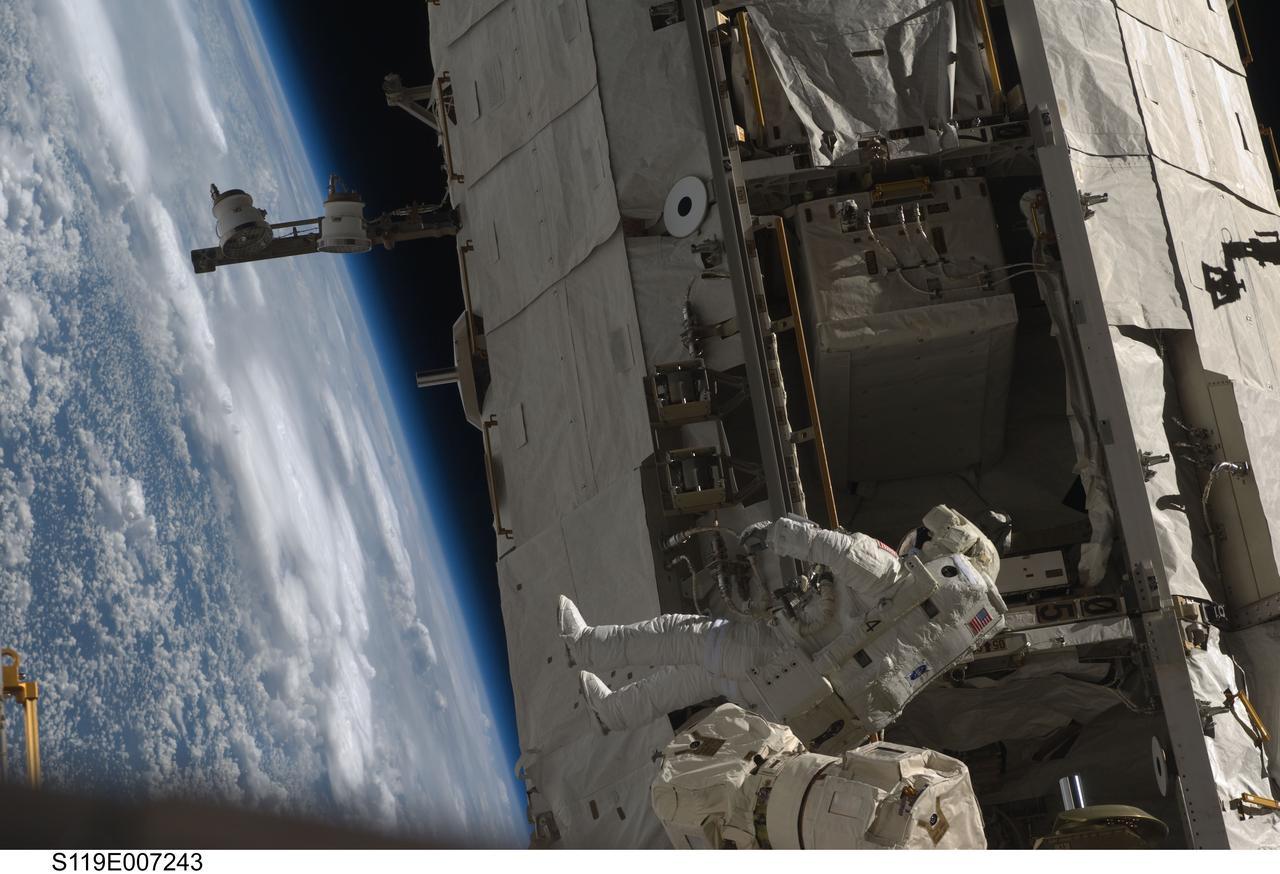
S119-E-007243 (23 March 2009) --- Astronaut Richard Arnold, STS-119 mission specialist, participates in the mission's third scheduled session of extravehicular activity (EVA) as construction and maintenance continue on the International Space Station. During the six-hour, 27-minute spacewalk, Arnold and Joseph Acaba (out of frame), mission specialist, helped robotic arm operators relocate the Crew Equipment Translation Aid (CETA) cart from the Port 1 to Starboard 1 truss segment, installed a new coupler on the CETA cart, lubricated snares on the "B" end of the space station's robotic arm and performed a few "get ahead" tasks.
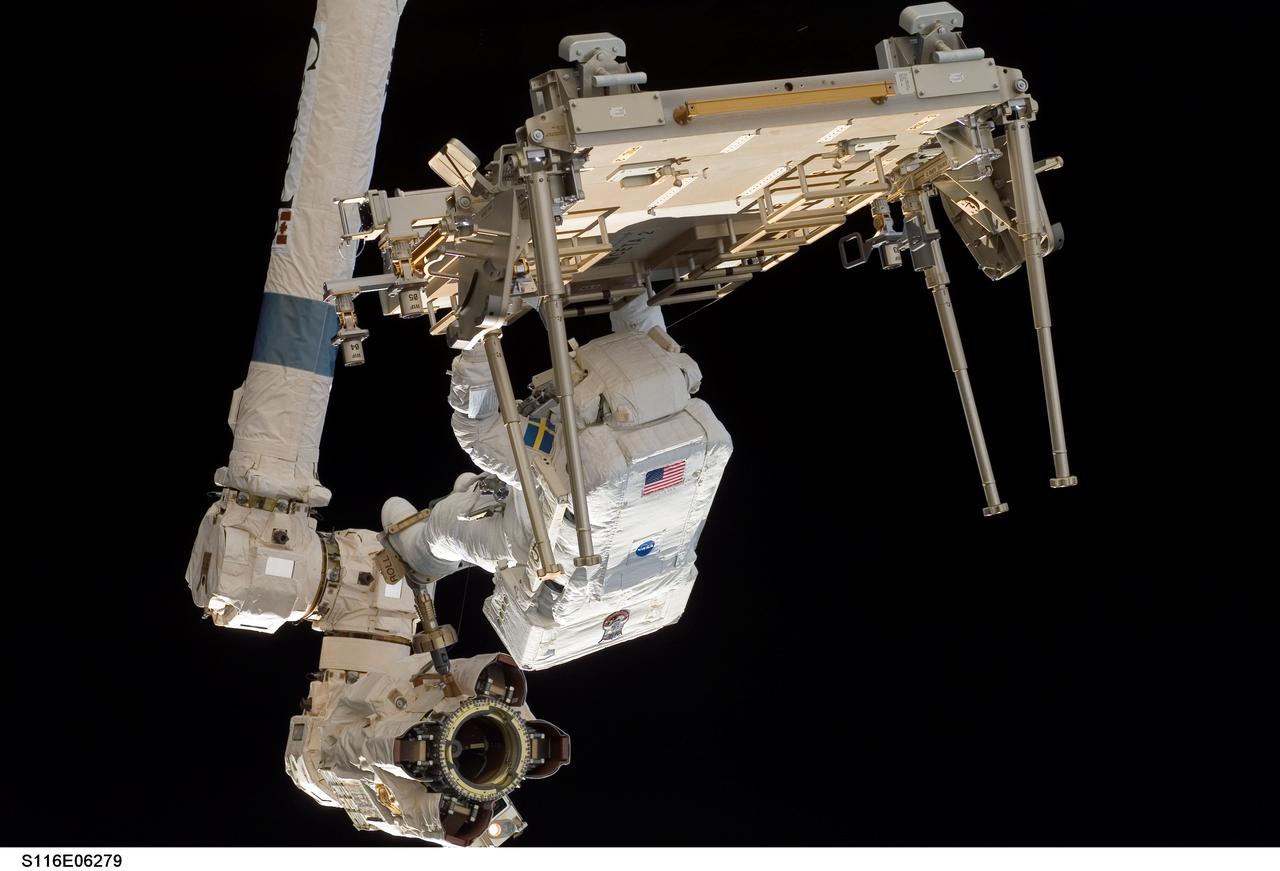
S116-E-06279 (14 Dec. 2006) --- With his feet secured on the Canadarm2, European Space Agency astronaut Christer Fuglesang, STS-116 mission specialist, works to relocate one of the two Crew Equipment Translation Aid (CETA) carts during EVA 2 on Dec. 14. Astronaut Robert L. Curbeam Jr., who is sharing two spacewalks with Fuglesang on this flight, is out of frame.
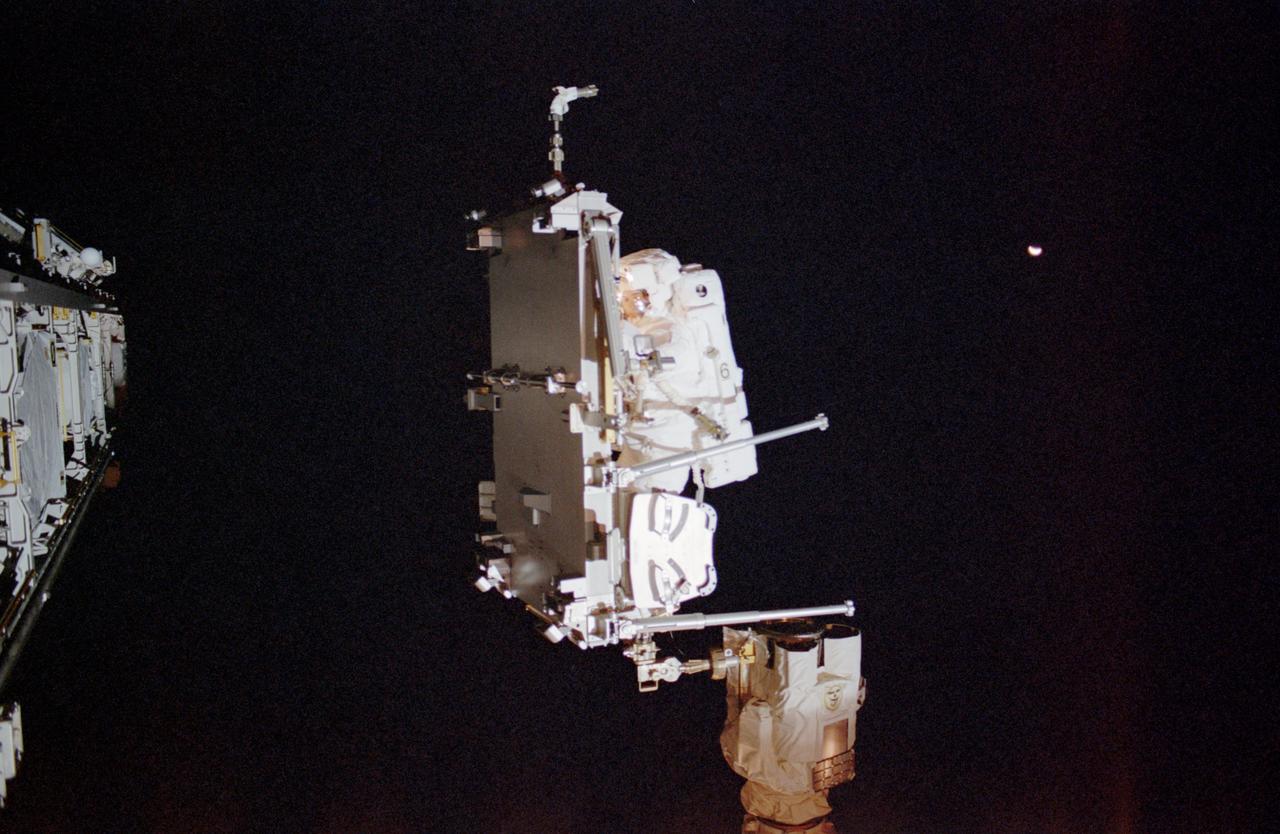
STS113-310-023 (28 November 2002) --- Astronaut John B. Herrington, STS-113 mission specialist, anchored on the mobile foot restraint on the International Space Station’s (ISS) Canadarm2, moves the Crew and Equipment Translation Aid (CETA) during the mission’s second scheduled spacewalk. The final major task of the spacewalk was the relocation of the CETA cart from the Port One (P1) to the Starboard One (S1) Truss, which will allow the Mobile Transporter to move along the P1 to assist in upcoming assembly missions.
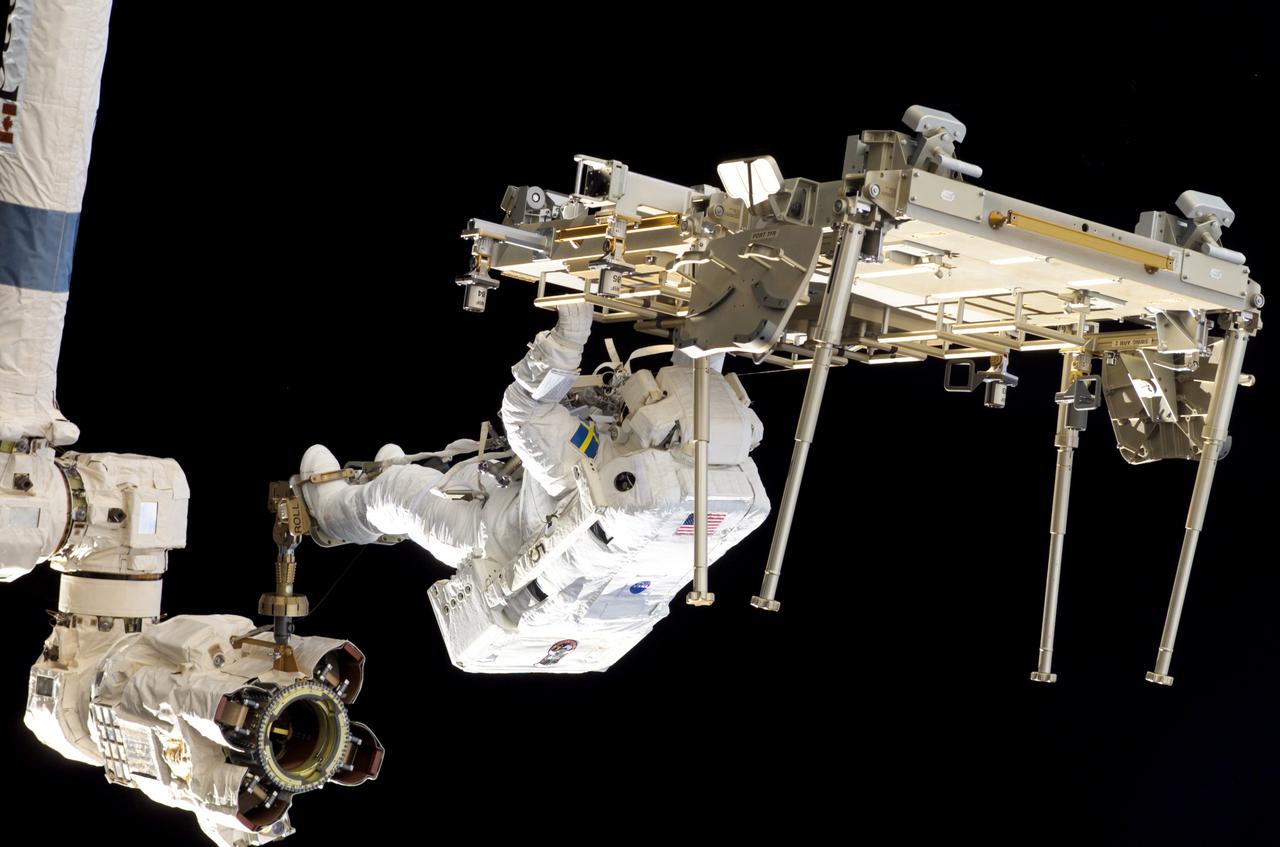
S116-E-06275 (14 Dec. 2006) --- With his feet secured on the Canadarm2, European Space Agency astronaut Christer Fuglesang, STS-116 mission specialist, works to relocate one of the two Crew Equipment Translation Aid (CETA) carts during EVA 2 on Dec. 14. Astronaut Robert L. Curbeam Jr., who is sharing two spacewalks with Fuglesang on this flight, is out of frame.
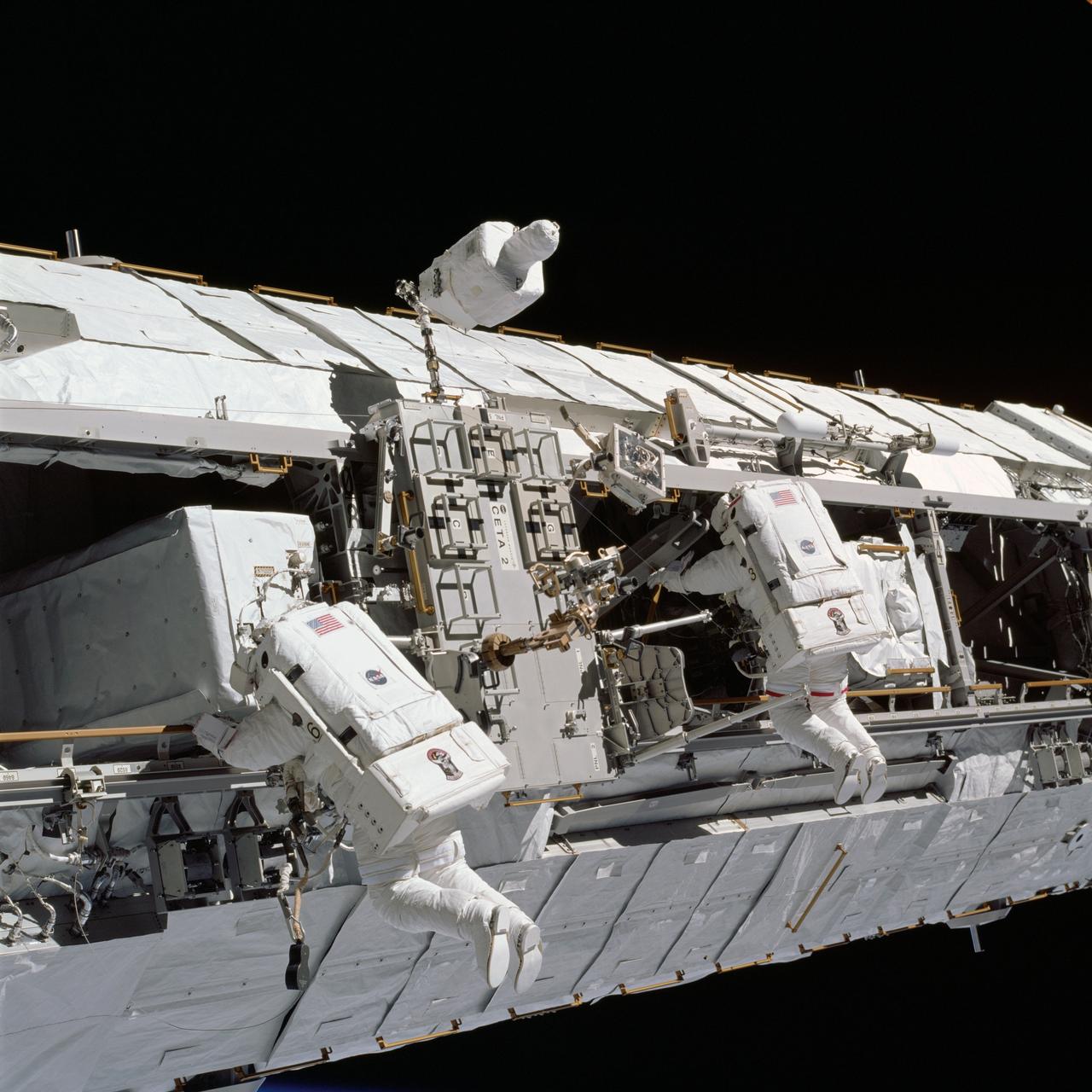
STS113-714-033 (26-30 November 2002) --- Astronauts Michael E. Lopez-Alegria (right) and John B. Herrington, STS-113 mission specialists, work near the Crew and Equipment Translation Aid (CETA) cart on a truss on the International Space Station (ISS) during a scheduled spacewalk for the mission.
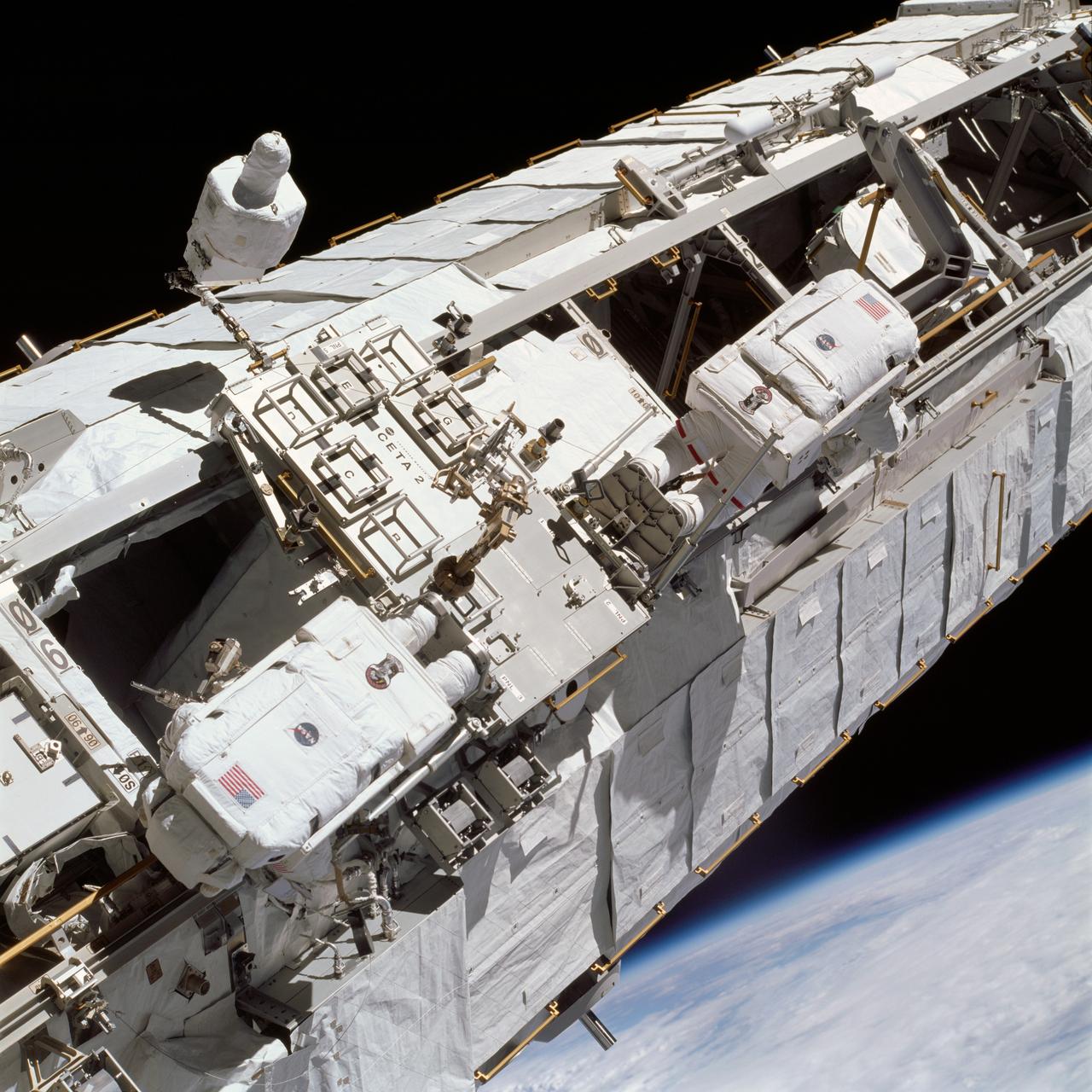
STS113-714-024 (26-30 November 2002) --- Astronauts Michael E. Lopez-Alegria (right) and John B. Herrington, STS-113 mission specialists, work near the Crew and Equipment Translation Aid (CETA) cart on a truss on the International Space Station (ISS) during a scheduled spacewalk for the mission.
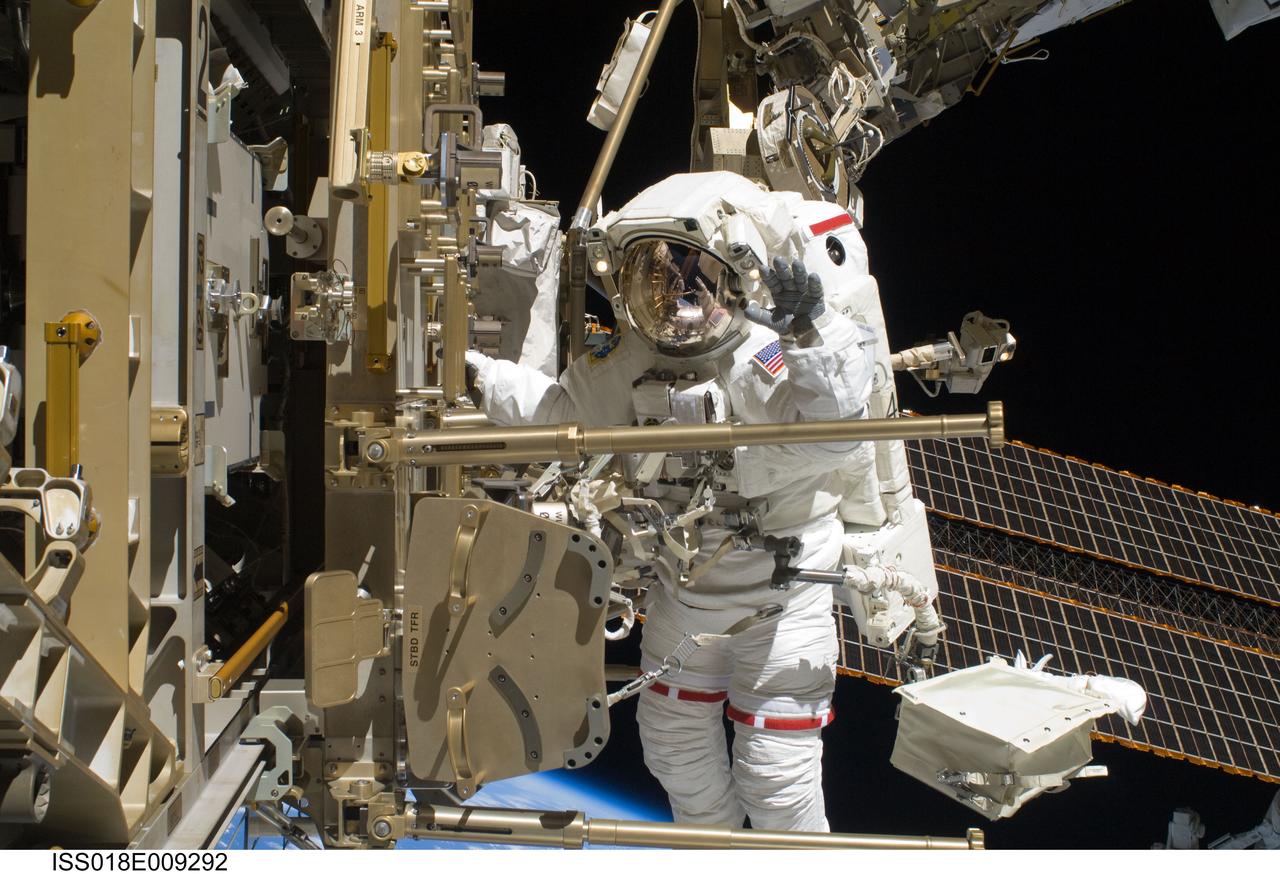
ISS018-E-009292 (20 Nov. 2008) --- Astronaut Shane Kimbrough, STS-126 mission specialist, participates in the mission's second scheduled session of extravehicular activity (EVA) as construction and maintenance continue on the International Space Station. During the six-hour, 45-minute spacewalk, Kimbrough and astronaut Heidemarie Stefanyshyn-Piper (out of frame), mission specialist, continued the process of removing debris and applying lubrication around the starboard Solar Alpha Rotary Joint (SARJ), replaced four more of the SARJ's 12 trundle bearing assemblies, relocated two equipment carts and applied lubrication to the station's robotic Canadarm2.
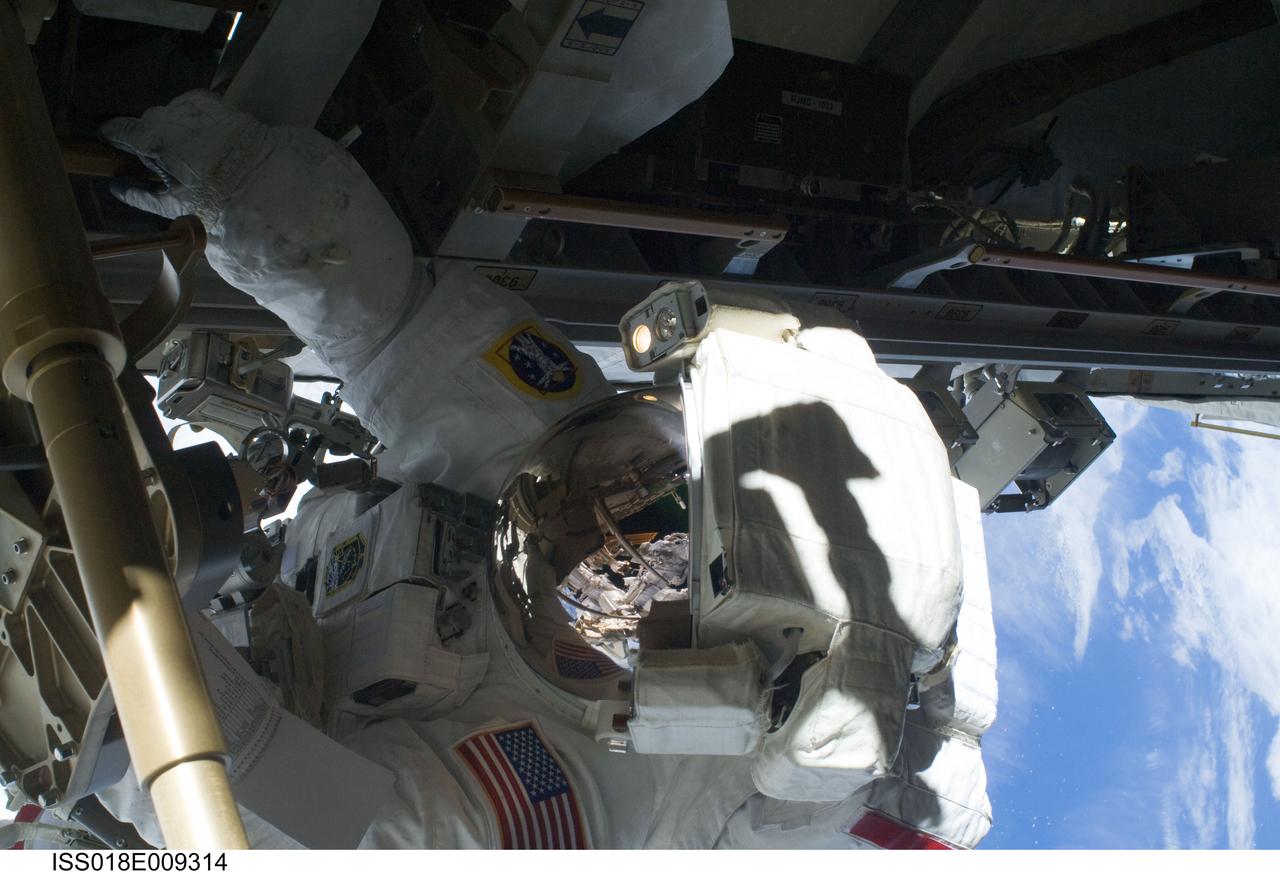
ISS018-E-009314 (20 Nov. 2008) --- Astronaut Shane Kimbrough, STS-126 mission specialist, participates in the mission's second scheduled session of extravehicular activity (EVA) as construction and maintenance continue on the International Space Station. During the six-hour, 45-minute spacewalk, Kimbrough and astronaut Heidemarie Stefanyshyn-Piper (out of frame), mission specialist, continued the process of removing debris and applying lubrication around the starboard Solar Alpha Rotary Joint (SARJ), replaced four more of the SARJ's 12 trundle bearing assemblies, relocated two equipment carts and applied lubrication to the station's robotic Canadarm2.

KENNEDY SPACE CENTER, FLA. - The afternoon sun casts a shadow on Space Shuttle Atlantis as it launches on its journey to the International Space Station. Liftoff occurred on time at 3:46 p.m. EDT. Along with a crew of six, Atlantis carries the S1 Integrated Truss Structure and the Crew and Equipment Translation Aid (CETA) Cart A. The CETA is the first of two human-powered carts that will ride along the ISS railway, providing mobile work platforms for future spacewalking astronauts. On the 11-day mission, three spacewalks are planned to attach the S1 truss and CETA cart.
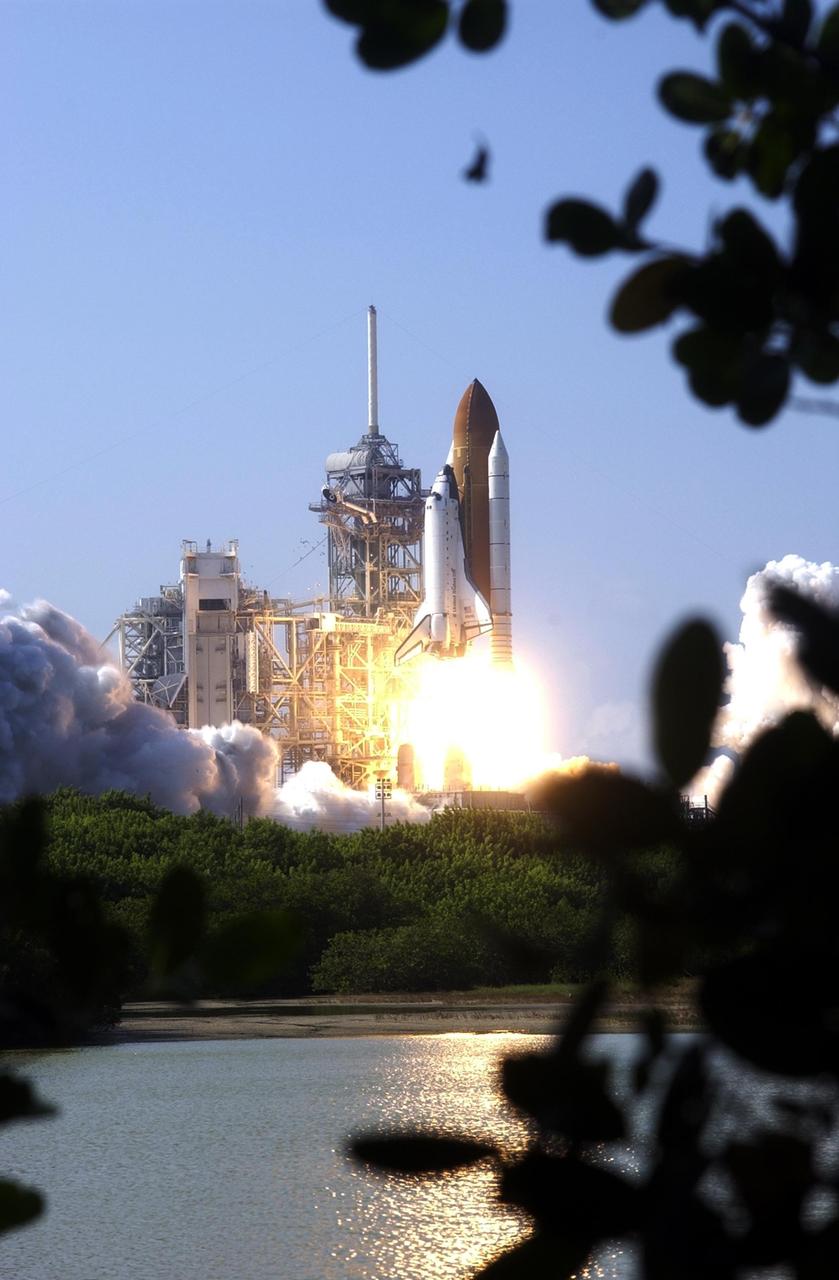
KENNEDY SPACE CENTER, FLA. - A distant view creates a frame of leaves around the launch of Space Shuttle Atlantis on mission STS-112. Liftoff occurred on time at 3:46 p.m. EDT. Along with a crew of six, Atlantis carries the S1 Integrated Truss Structure and the Crew and Equipment Translation Aid (CETA) Cart A. The CETA is the first of two human-powered carts that will ride along the ISS railway, providing mobile work platforms for future spacewalking astronauts. On the 11-day mission, three spacewalks are planned to attach the S1 truss and CETA Cart A.
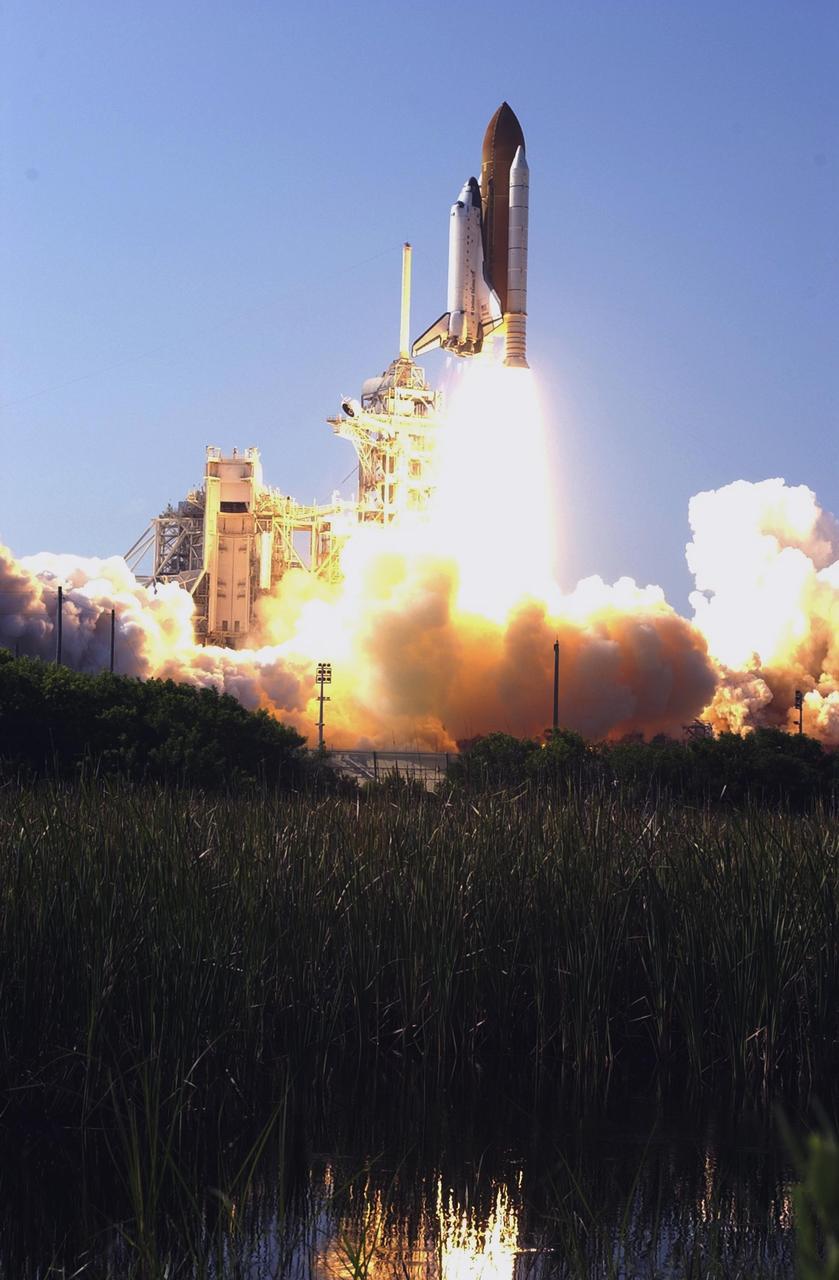
KENNEDY SPACE CENTER, FLA. -- The brilliance of the launch of Space Shuttle Atlantis is reflected in nearby waters. Liftoff of the Shuttle on mission STS-112 occurred on time at 3:46 p.m. EDT. Along with a crew of six, Atlantis carries the S1 Integrated Truss Structure and the Crew and Equipment Translation Aid (CETA) Cart A. The CETA is the first of two human-powered carts that will ride along the ISS railway, providing mobile work platforms for future spacewalking astronauts. On the 11-day mission, three spacewalks are planned to attach the S1 truss.
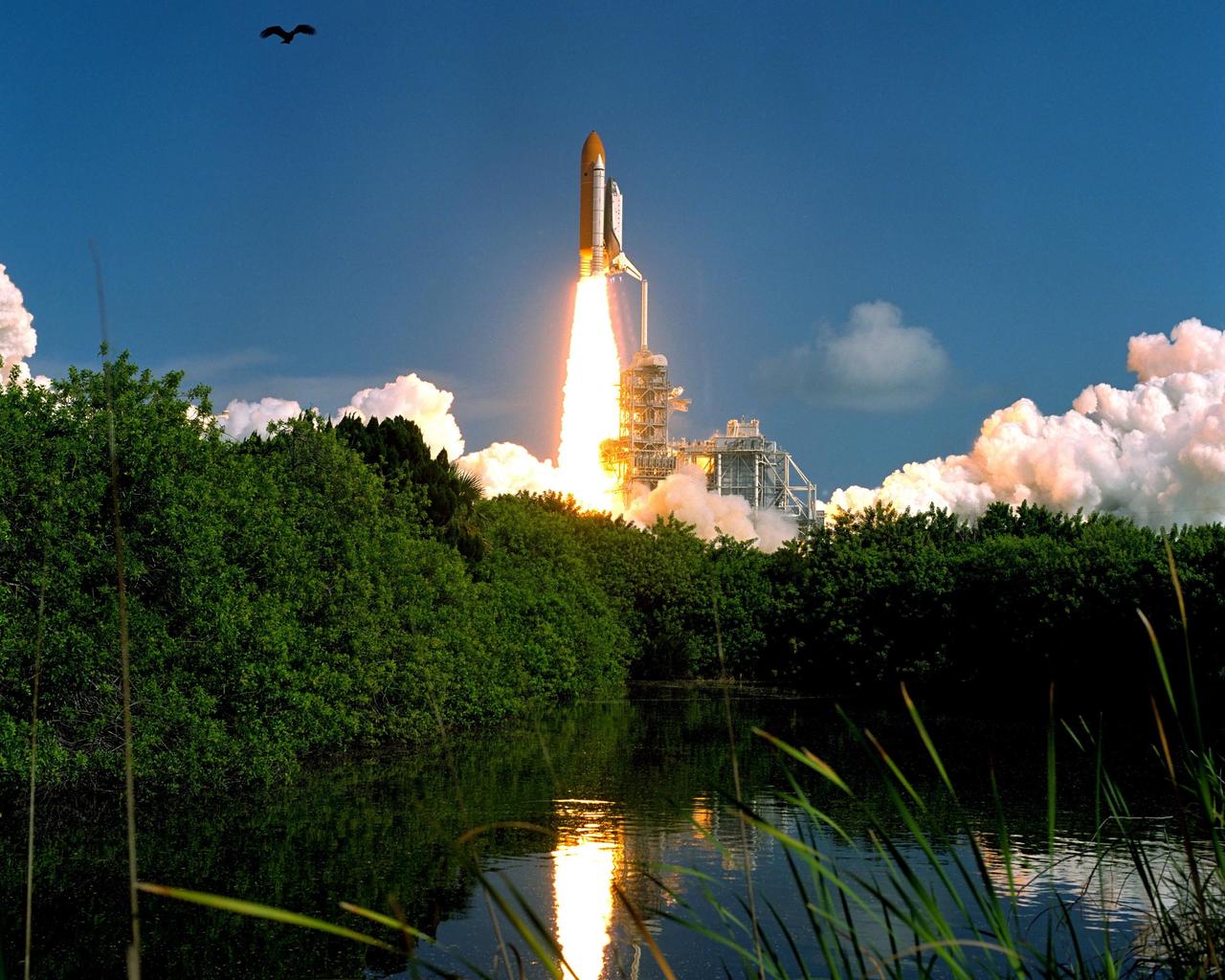
KENNEDY SPACE CENTER, FLA. -- The brilliance of the launch of Space Shuttle Atlantis is reflected in nearby waters. Liftoff of the Shuttle on mission STS-112 occurred on time at 3:46 p.m. EDT. Along with a crew of six, Atlantis carries the S1 Integrated Truss Structure and the Crew and Equipment Translation Aid (CETA) Cart A. The CETA is the first of two human-powered carts that will ride along the ISS railway, providing mobile work platforms for future spacewalking astronauts. On the 11-day mission, three spacewalks are planned to attach the S1 truss.
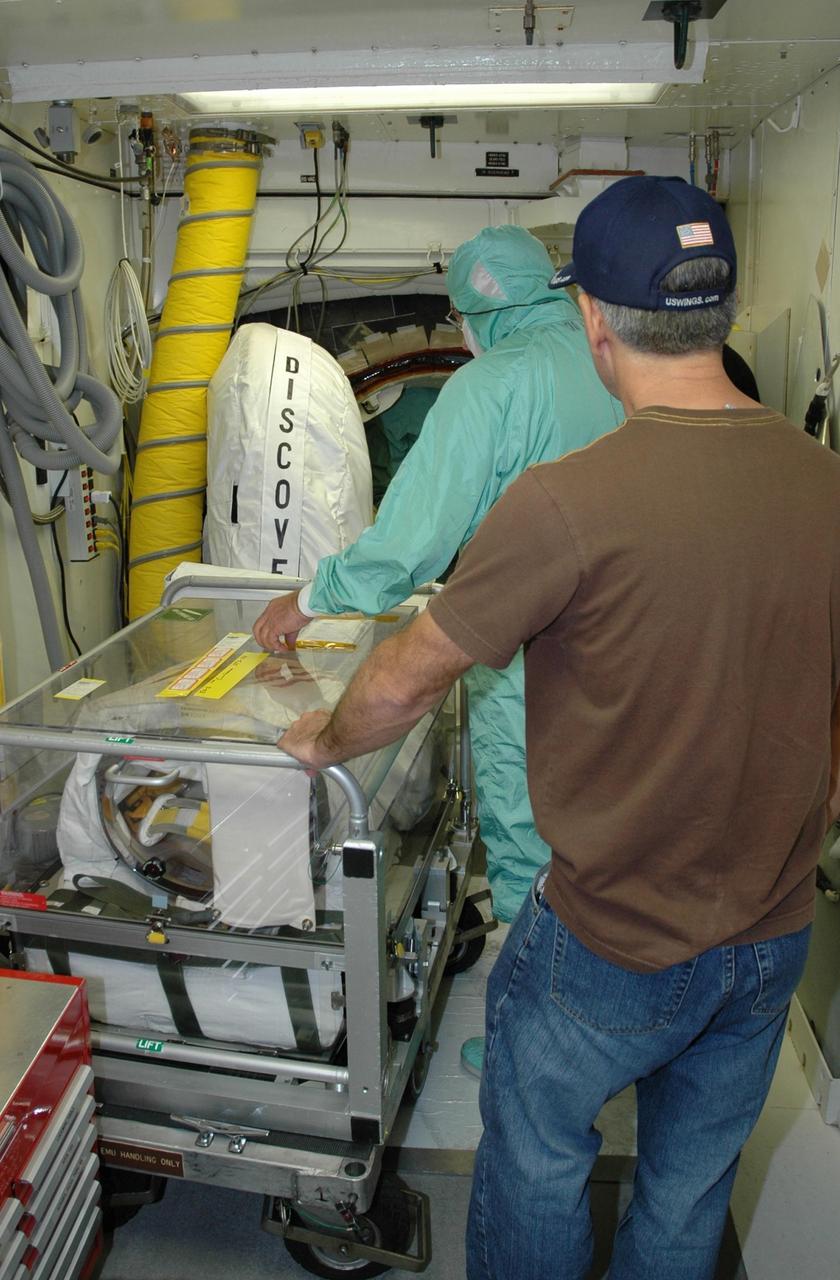
KENNEDY SPACE CENTER, FLA. -- Inside the White Room on Launch Pad 39B, the worker in the foreground hands off the cart to another worker in a protective suit who will move it inside Space Shuttle Discovery for storage. The cart contains the extravehicular mobility units (or spacewalk suits) to be used on mission STS-116. Launch of Discovery is scheduled for 9:35 p.m. Dec. 7. The crew will deliver the P5 integrated truss to the International Space Station and install it during one or more extravehicular activities. Photo credit: NASA/Jack Pfaller
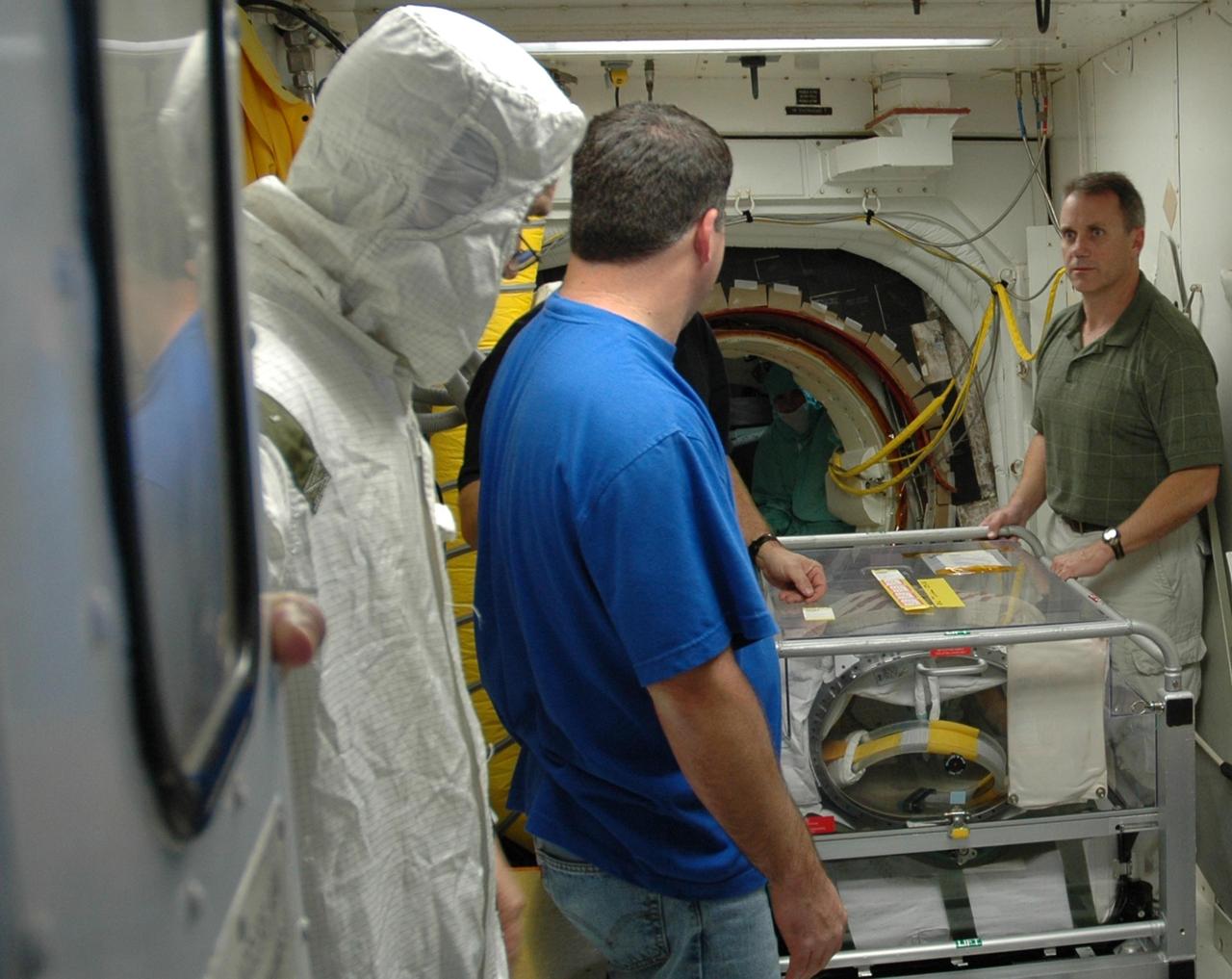
KENNEDY SPACE CENTER, FLA. -- Inside the White Room on Launch Pad 39B, workers get ready to move a cart through the hatch into Space Shuttle Discovery. The cart contains the extravehicular mobility units (or spacewalk suits) to be used on mission STS-116. The suits will be stored inside Discovery. Launch of Discovery is scheduled for 9:35 p.m. Dec. 7. The crew will deliver the P5 integrated truss to the International Space Station and install it during one or more extravehicular activities. Photo credit: NASA/Jack Pfaller
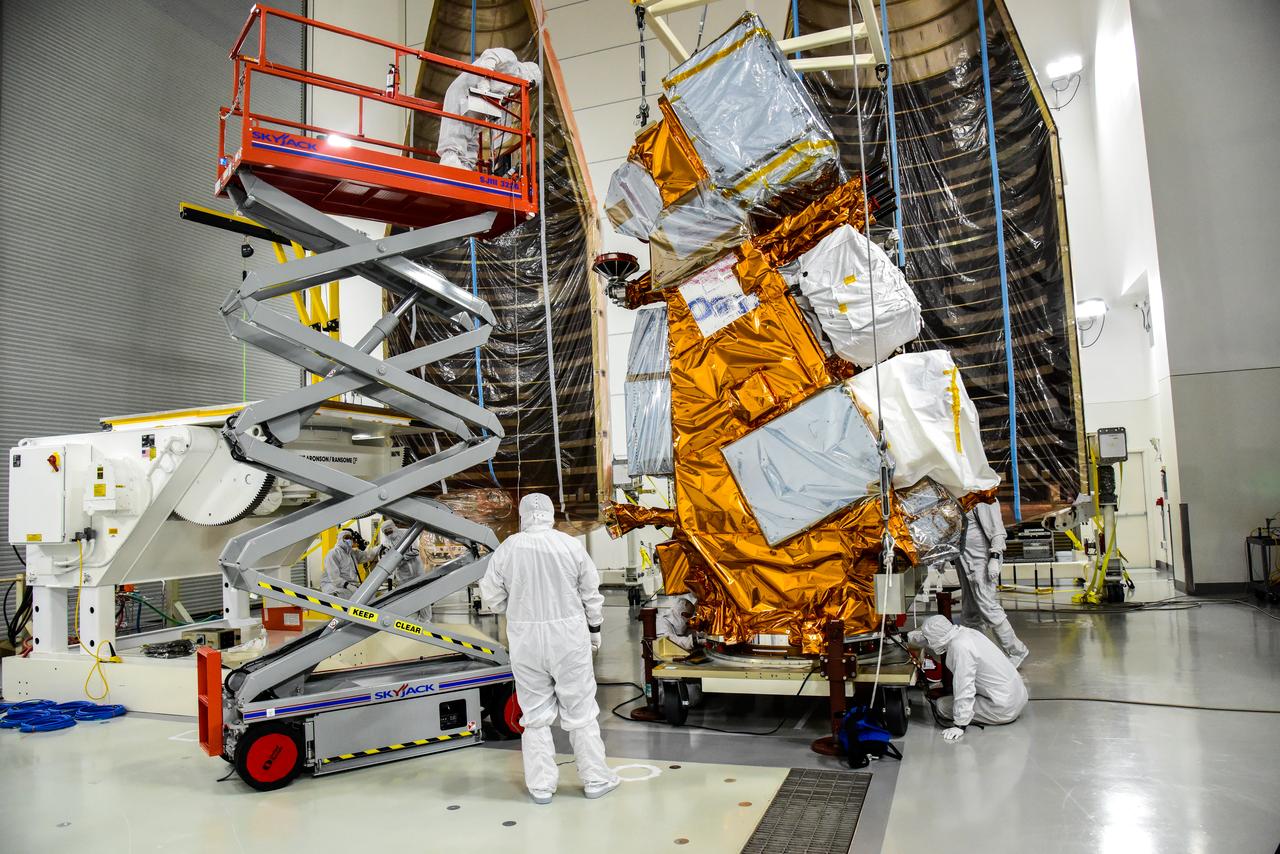
Technicians help transfer NASA and the National Oceanic and Atmospheric Administration’s (NOAA) Joint Polar Satellite System-2 (JPSS-2) satellite onto an integration and testing cart inside the Astrotech Space Operations facility at Vandenberg Space Force Base in California on Aug. 22, 2022. JPSS-2 is the third satellite in the Joint Polar Satellite System series. It is scheduled to lift off from VSFB on Nov. 1 from Space Launch Complex-3. JPSS-2, which will be renamed NOAA-21 after reaching orbit, will join a constellation of JPSS satellites that orbit from the North to the South pole, circling Earth 14 times a day and providing a full view of the entire globe twice daily. The NOAA/NASA Suomi National Polar-orbiting Partnership (Suomi NPP) satellite, and NOAA-20, previously known as JPSS-1, are both already in orbit. Each satellite carries at least four advanced instruments to measure weather and climate conditions on Earth. A secondary payload on the mission is the Low-Earth Orbit Flight Test of an Inflatable Decelerator (LOFTID), and is dedicated to the memory of Bernard Kutter. LOFTID will demonstrate inflatable heat shield technology that could enable a variety of proposed NASA missions to destinations such as Mars, Venus, and Titan, as well as returning heavier payloads from low-Earth orbit.
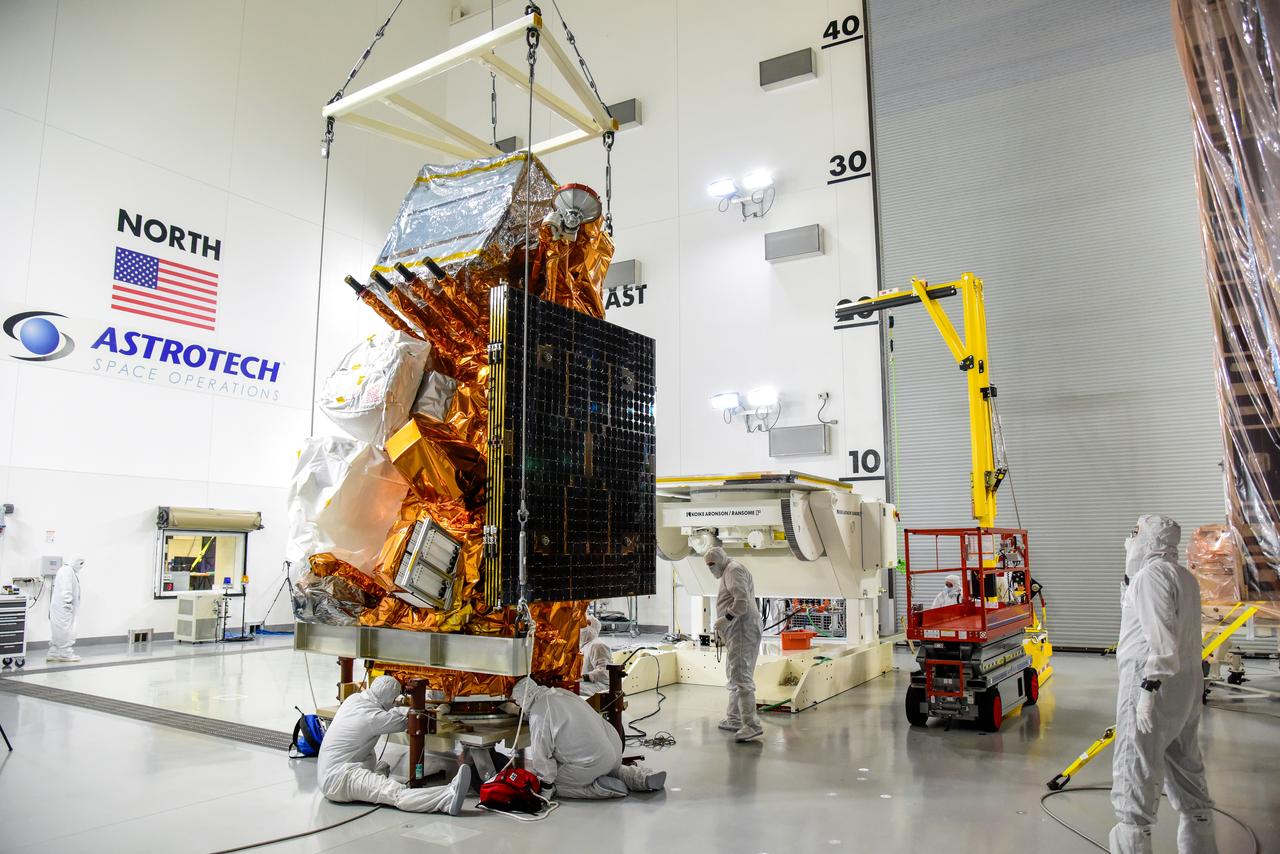
Technicians help secure NASA and the National Oceanic and Atmospheric Administration’s (NOAA) Joint Polar Satellite System-2 (JPSS-2) satellite onto an integration and testing cart inside the Astrotech Space Operations facility at Vandenberg Space Force Base in California on Aug. 22, 2022. JPSS-2 is the third satellite in the Joint Polar Satellite System series. It is scheduled to lift off from VSFB on Nov. 1 from Space Launch Complex-3. JPSS-2, which will be renamed NOAA-21 after reaching orbit, will join a constellation of JPSS satellites that orbit from the North to the South pole, circling Earth 14 times a day and providing a full view of the entire globe twice daily. The NOAA/NASA Suomi National Polar-orbiting Partnership (Suomi NPP) satellite, and NOAA-20, previously known as JPSS-1, are both already in orbit. Each satellite carries at least four advanced instruments to measure weather and climate conditions on Earth. A secondary payload on the mission is the Low-Earth Orbit Flight Test of an Inflatable Decelerator (LOFTID), and is dedicated to the memory of Bernard Kutter. LOFTID will demonstrate inflatable heat shield technology that could enable a variety of proposed NASA missions to destinations such as Mars, Venus, and Titan, as well as returning heavier payloads from low-Earth orbit.
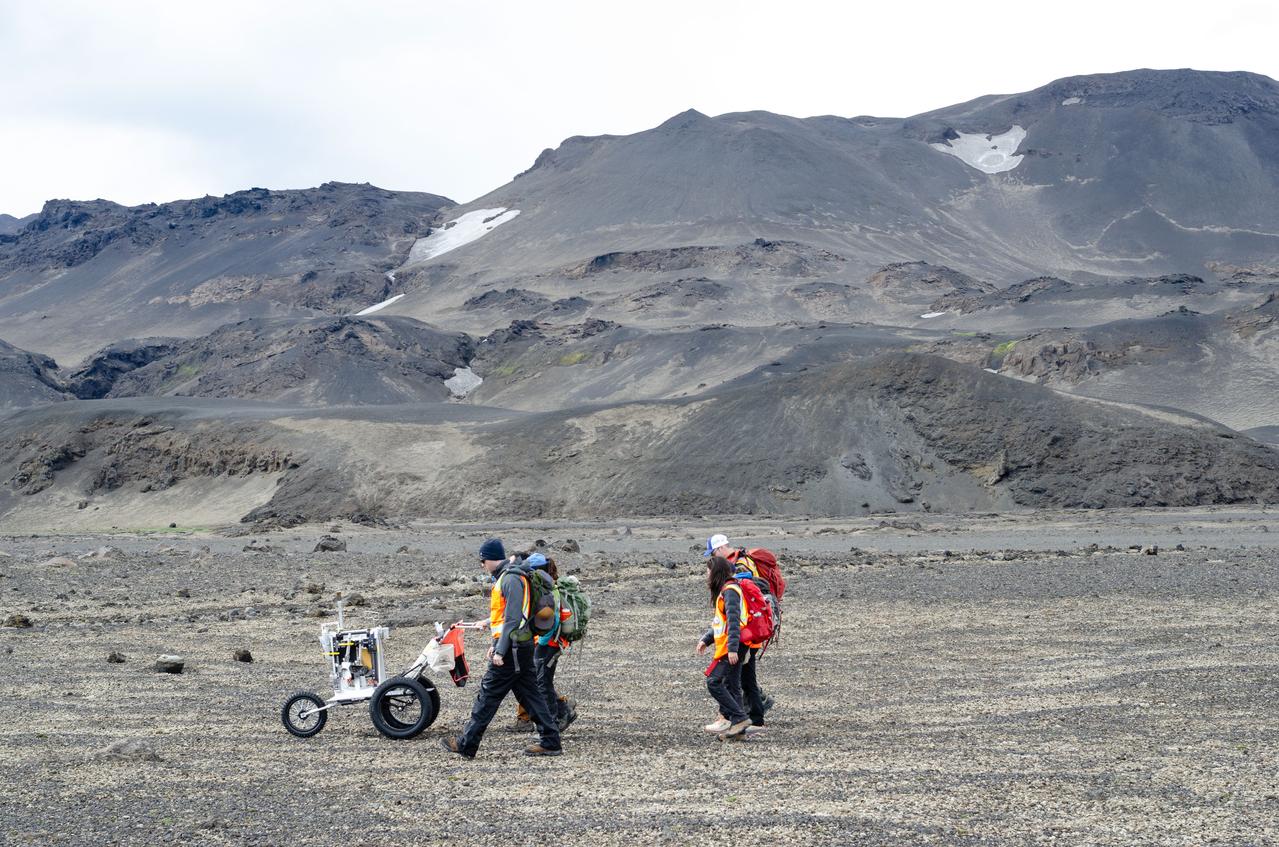
jsc2023e041422 --- Artemis II science trainers push a lunar tool cart across the lunar-like landscape of Iceland during an Artemis II crew geology field training.
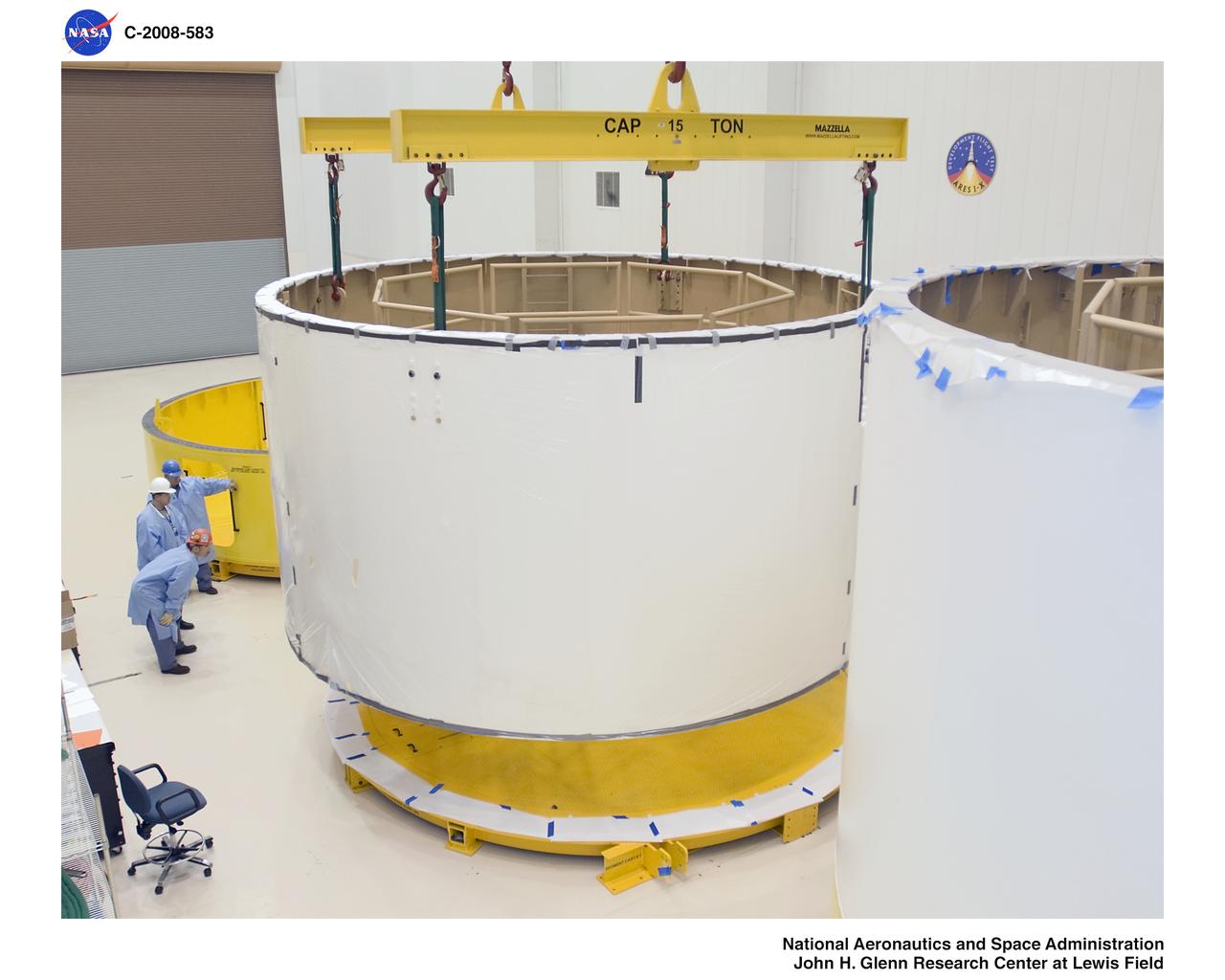
Ares 1-X segment US-3 being lifted onto the cart prior to being stacked onto US-2 to start forming the Ares 1-X USS Super Stack
![KENNEDY SPACE CENTER, FLA. -- Twin columns of white flames from the solid rocket boosters propel Space Shuttle Atlantis toward space after an on-time liftoff of 3:46 p.m. EDT on mission STS-112. Along with a crew of six, Atlantis carries the S1 Integrated Truss Structure and the Crew and Equipment Translation Aid (CETA) Cart A. The CETA is the first of two human-powered carts that will ride along the ISS railway, providing mobile work platforms for future spacewalking astronauts. On the 11-day mission, three spacewalks are planned to attach the S1 truss. [Photo courtesy of Scott Andrews]](https://images-assets.nasa.gov/image/KSC-02pd1463/KSC-02pd1463~medium.jpg)
KENNEDY SPACE CENTER, FLA. -- Twin columns of white flames from the solid rocket boosters propel Space Shuttle Atlantis toward space after an on-time liftoff of 3:46 p.m. EDT on mission STS-112. Along with a crew of six, Atlantis carries the S1 Integrated Truss Structure and the Crew and Equipment Translation Aid (CETA) Cart A. The CETA is the first of two human-powered carts that will ride along the ISS railway, providing mobile work platforms for future spacewalking astronauts. On the 11-day mission, three spacewalks are planned to attach the S1 truss. [Photo courtesy of Scott Andrews]
![KENNEDY SPACE CENTER, FLA. -- The brilliance of the launch of Space Shuttle Atlantis is reflected in nearby waters. Liftoff of the Shuttle on mission STS-112 occurred on time at 3:46 p.m. EDT. Along with a crew of six, Atlantis carries the S1 Integrated Truss Structure and the Crew and Equipment Translation Aid (CETA) Cart A. The CETA is the first of two human-powered carts that will ride along the ISS railway, providing mobile work platforms for future spacewalking astronauts. On the 11-day mission, three spacewalks are planned to attach the S1 truss. [Photo courtesy of Scott Andrews]](https://images-assets.nasa.gov/image/KSC-02pd1464/KSC-02pd1464~medium.jpg)
KENNEDY SPACE CENTER, FLA. -- The brilliance of the launch of Space Shuttle Atlantis is reflected in nearby waters. Liftoff of the Shuttle on mission STS-112 occurred on time at 3:46 p.m. EDT. Along with a crew of six, Atlantis carries the S1 Integrated Truss Structure and the Crew and Equipment Translation Aid (CETA) Cart A. The CETA is the first of two human-powered carts that will ride along the ISS railway, providing mobile work platforms for future spacewalking astronauts. On the 11-day mission, three spacewalks are planned to attach the S1 truss. [Photo courtesy of Scott Andrews]

KENNEDY SPACE CENTER, FLA. - -- Space Shuttle Atlantis leaves a billowingclouds of smoke and steam behind just after liftoff from Launch Pad 39B on mission STS-112. Liftoff occurred on time at 3:46 p.m. EDT. Along with a crew of six, Atlantis carries the S1 Integrated Truss Structure and the Crew and Equipment Translation Aid (CETA) Cart A to the International Space Station (ISS). The CETA is the first of two human-powered carts that will ride along the ISS railway, providing mobile work platforms for future spacewalking astronauts. On the 11-day mission, three spacewalks are planned to attach the S1 truss.
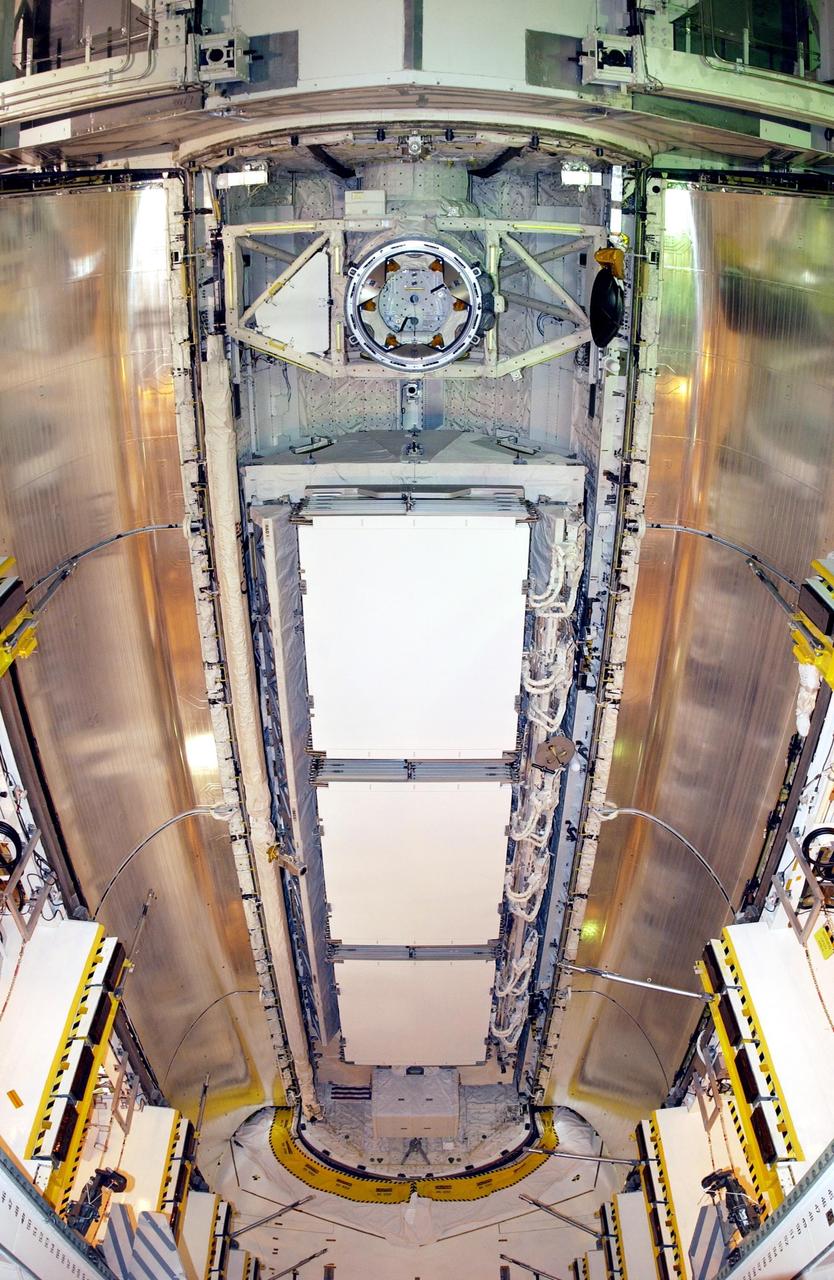
KENNEDY SPACE CENTER, FLA. -- The payload for mission STS-112 rests inside the payload bay of Space Shuttle Atlantis. The Shuttle is carrying the S1 Integrated Truss Structure, the first starboard truss segment, to be attached to the central truss segment, S0, plus the Crew and Equipment Translation Aid (CETA) Cart A. The CETA is the first of two human-powered carts that will ride along the ISS railway, providing mobile work platforms for future spacewalking astronauts. Launch of Atlantis is scheduled for Oct. 2 with a crew of six. The 11-day mission includes three spacewalks.
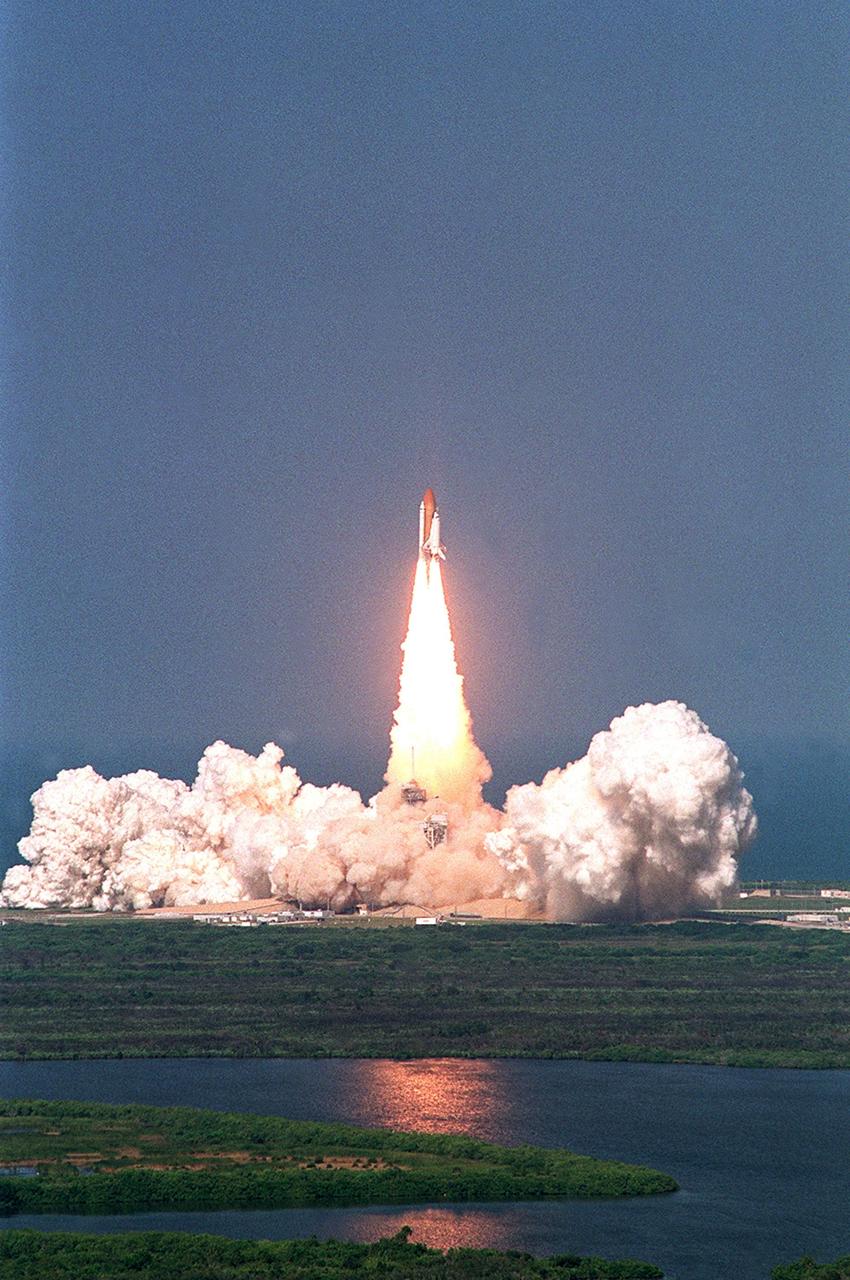
KENNEDY SPACE CENTER, FLA. - Space Shuttle Atlantis leaps clear of the billowing steam and smoke on Launch Pad 39B after an on-time liftoff of 3:46 p.m. EDT on mission STS-112. Along with a crew of six, Atlantis carries the S1 Integrated Truss Structure and the Crew and Equipment Translation Aid (CETA) Cart A. The CETA is the first of two human-powered carts that will ride along the ISS railway, providing mobile work platforms for future spacewalking astronauts. On the 11-day mission, three spacewalks are planned to attach the S1 truss.
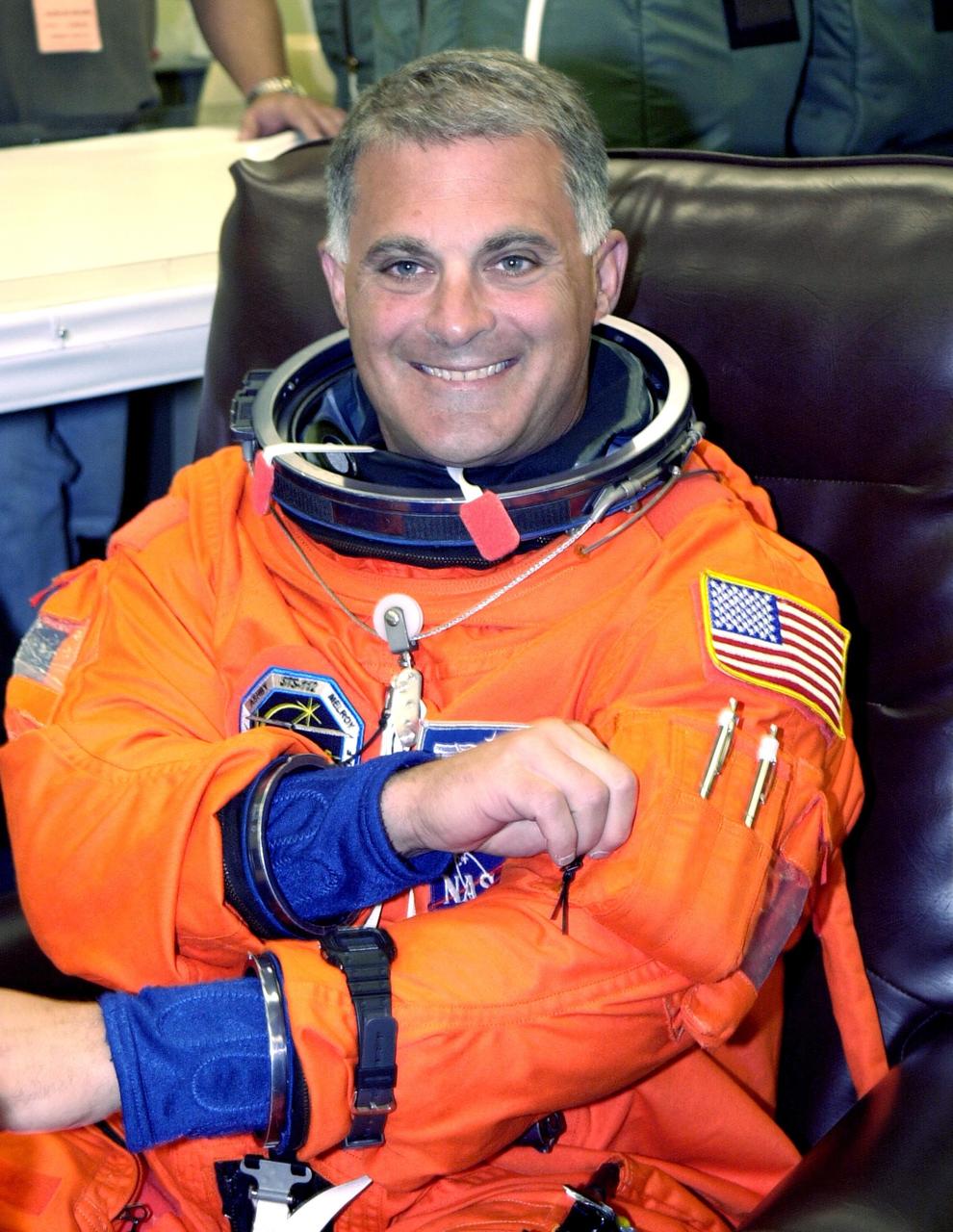
KENNEDY SPACE CENTER, FLA. -- STS-112 Mission Specialist David Wolf suits up for launch, just hours away. STS-112 is the 15th assembly flight to the International Space Station, carrying the S1 Integrated Truss Structure and the Crew and Equipment Translation Aid (CETA) Cart A. The CETA is the first of two human-powered carts that will ride along the ISS railway, providing mobile work platforms for future spacewalking astronauts. On the 11-day mission, three spacewalks are planned to attach the S1 truss to the Station. Launch is scheduled for 3:46 p.m. EDT from Launch Pad 39B. .
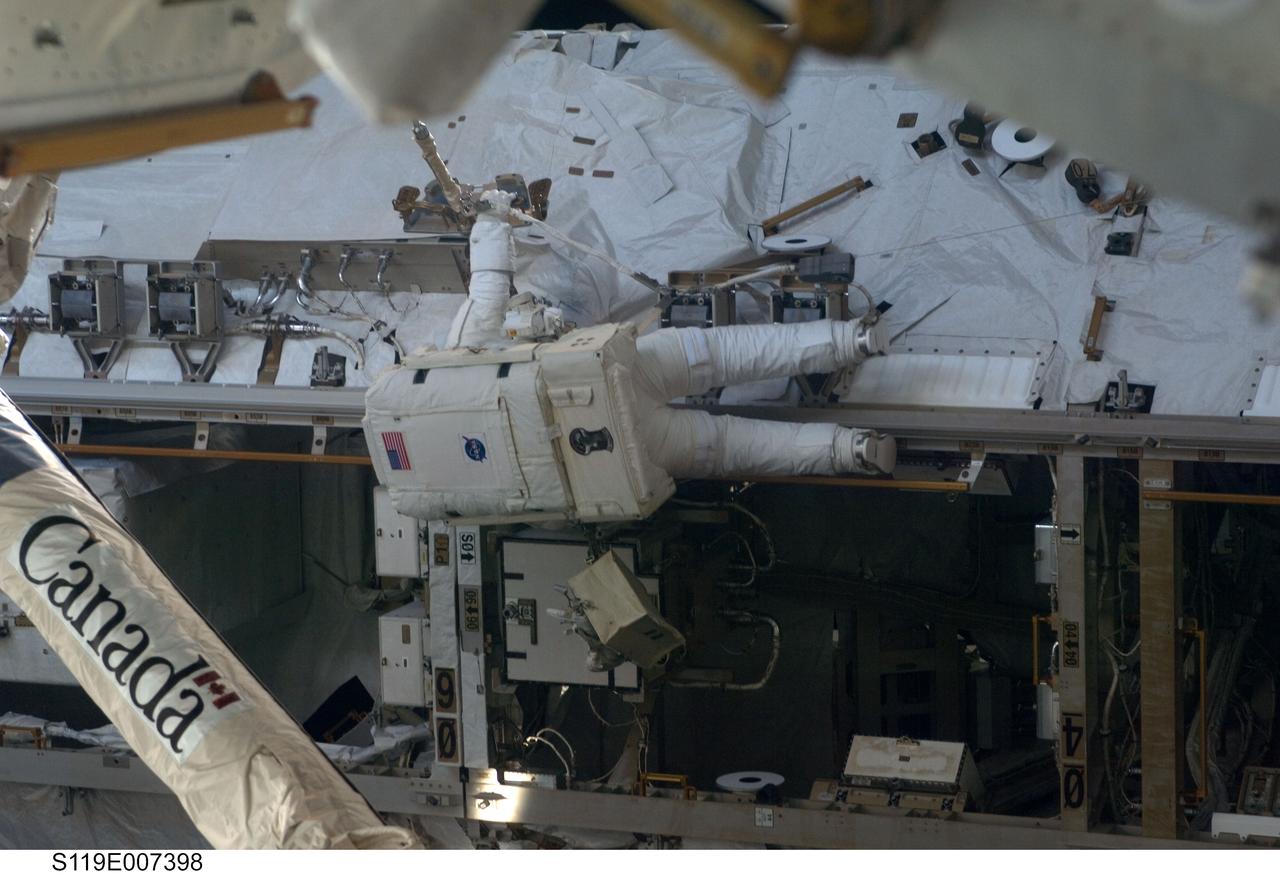
S119-E-007398 (23 March 2009) --- Astronaut Richard Arnold, STS-119 mission specialist, participates in the mission's third scheduled session of extravehicular activity (EVA) as construction and maintenance continue on the International Space Station. During the six-hour, 27-minute spacewalk, Arnold and Joseph Acaba (out of frame), mission specialist, helped robotic arm operators relocate the Crew Equipment Translation Aid (CETA) cart from the Port 1 to Starboard 1 truss segment, installed a new coupler on the CETA cart, lubricated snares on the "B" end of the space station's robotic arm and performed a few "get ahead" tasks.
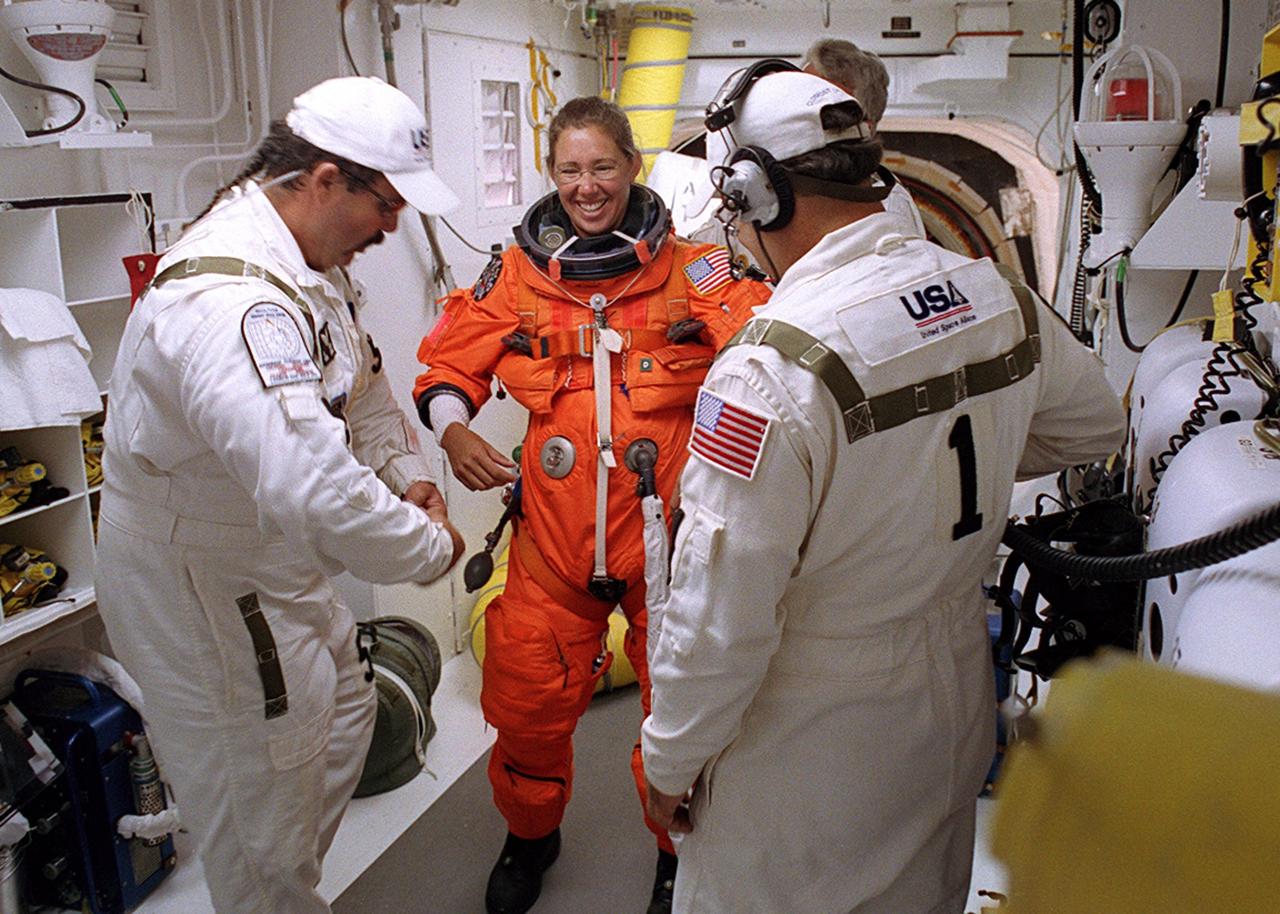
KENNEDY SPACE CENTER, FLA. - -- In the White Room at Launch Pad 39B, STS-112 Mission Specialist Sandra H. Magnus, Ph.D., receives assistance with her spacesuit before boarding Space Shuttle Atlantis. Liftoff is schedued for 3:46 p.m. EDT. Along with a crew of six, Atlantis will carry the S1 Integrated Truss Structure and the Crew and Equipment Translation Aid (CETA) Cart A to the International Space Station (ISS). The CETA is the first of two human-powered carts that will ride along the ISS railway, providing mobile work platforms for future spacewalking astronauts. On the 11-day mission, three spacewalks are planned to attach the S1 truss.
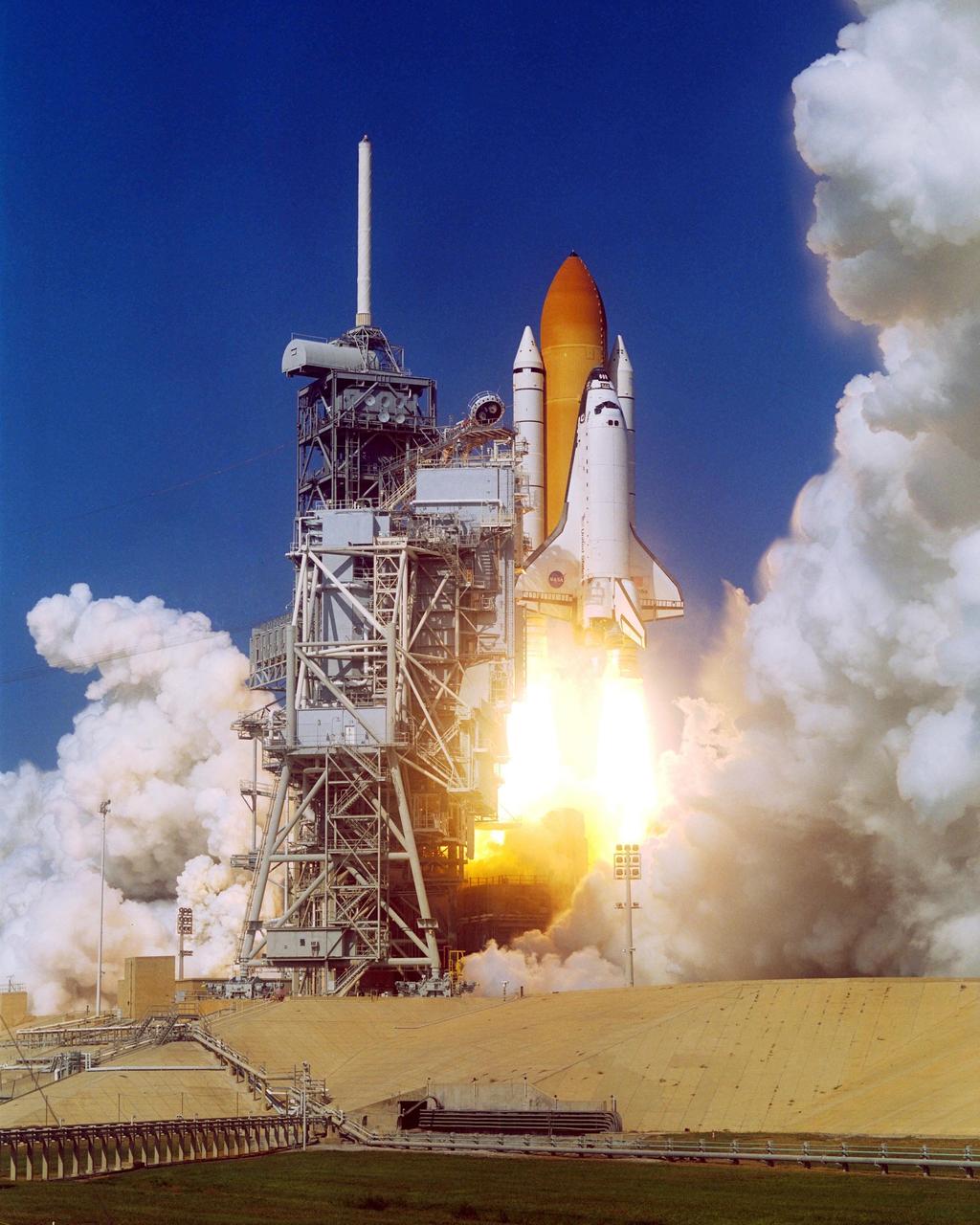
KENNEDY SPACE CENTER, FLA. - -- Space Shuttle Atlantis begins its journey to the International Space Station (ISS) as it lifts off from Launch Pad 39B on mission STS-112. Liftoff occurred on time at 3:46 p.m. EDT. Along with a crew of six, Atlantis carries the S1 Integrated Truss Structure and the Crew and Equipment Translation Aid (CETA) Cart A to the Space Station. The CETA is the first of two human-powered carts that will ride along the ISS railway, providing mobile work platforms for future spacewalking astronauts. On the 11-day mission, three spacewalks are planned to attach the S1 truss.
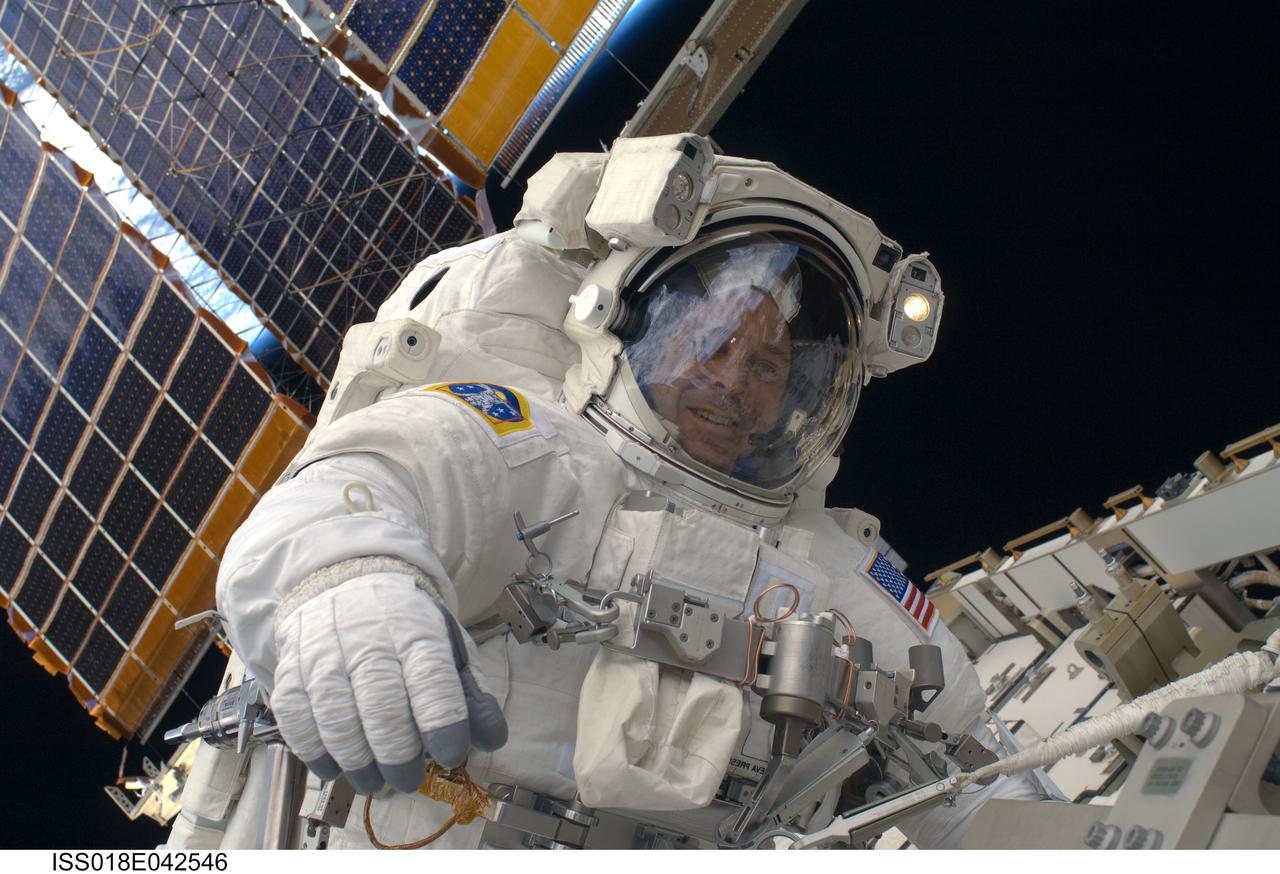
ISS018-E-042546 (23 March 2009) --- Astronaut Richard Arnold, STS-119 mission specialist, participates in the mission's third scheduled session of extravehicular activity (EVA) as construction and maintenance continue on the International Space Station. During the six-hour, 27-minute spacewalk, Arnold and Joseph Acaba (out of frame), mission specialist, helped robotic arm operators relocate the Crew Equipment Translation Aid (CETA) cart from the Port 1 to Starboard 1 truss segment, installed a new coupler on the CETA cart, lubricated snares on the "B" end of the space station's robotic arm and performed a few "get ahead" tasks.
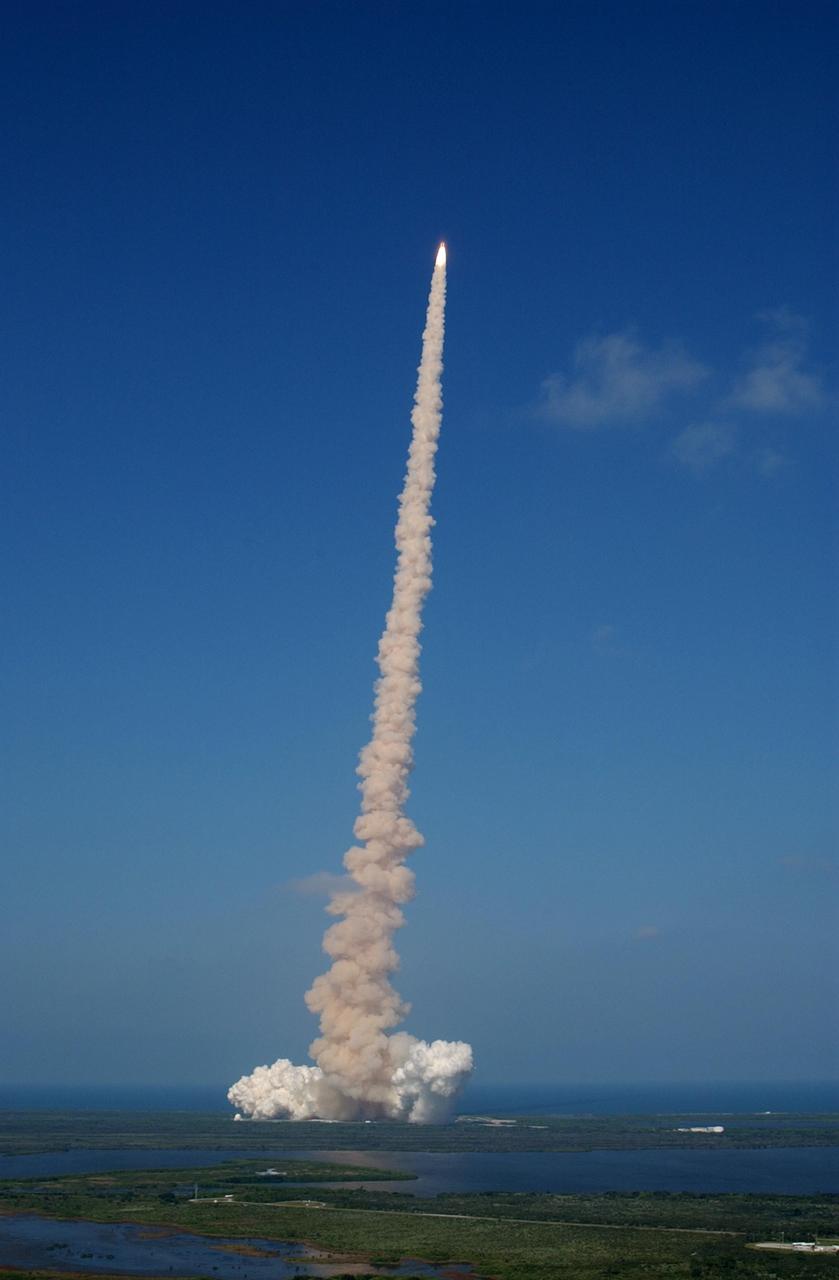
KENNEDY SPACE CENTER, FLA. - Looking like a star balanced on a stem of smoke, Space Shuttle Atlantis shoots through the clear blue sky after launch on mission STS-112, the 15th assembly flight to the International Space Station. Liftoff from Launch Pad 39B occurred at 3:46 p.m. EDT. Atlantis carries the S1 Integrated Truss Structure and the Crew and Equipment Translation Aid (CETA) Cart A. The CETA is the first of two human-powered carts that will ride along the ISS railway, providing mobile work platforms for future spacewalking astronauts. On the 11-day mission, three spacewalks are planned to attach the S1 truss.
![KENNEDY SPACE CENTER, FLA. - Space Shuttle Atlantis leaps clear of the billowing steam and smoke on Launch Pad 39B after an on-time liftoff of 3:46 p.m. EDT on mission STS-112. Along with a crew of six, Atlantis carries the S1 Integrated Truss Structure and the Crew and Equipment Translation Aid (CETA) Cart A. The CETA is the first of two human-powered carts that will ride along the ISS railway, providing mobile work platforms for future spacewalking astronauts. On the 11-day mission, three spacewalks are planned to attach the S1 truss. [Photo courtesy of Scott Andrews]](https://images-assets.nasa.gov/image/KSC-02pd1457/KSC-02pd1457~medium.jpg)
KENNEDY SPACE CENTER, FLA. - Space Shuttle Atlantis leaps clear of the billowing steam and smoke on Launch Pad 39B after an on-time liftoff of 3:46 p.m. EDT on mission STS-112. Along with a crew of six, Atlantis carries the S1 Integrated Truss Structure and the Crew and Equipment Translation Aid (CETA) Cart A. The CETA is the first of two human-powered carts that will ride along the ISS railway, providing mobile work platforms for future spacewalking astronauts. On the 11-day mission, three spacewalks are planned to attach the S1 truss. [Photo courtesy of Scott Andrews]

KENNEDY SPACE CENTER, FLA. -- The payload bay doors of Space Shuttle Atlantis close on the primary payloads for mission STS-112. The Shuttle is carrying the S1 Integrated Truss Structure, the first starboard truss segment, to be attached to the central truss segment, S0, plus the Crew and Equipment Translation Aid (CETA) Cart A. The CETA is the first of two human-powered carts that will ride along the ISS railway, providing mobile work platforms for future spacewalking astronauts. Launch of Atlantis is scheduled for Oct. 2 with a crew of six. The 11-day mission includes three spacewalks.
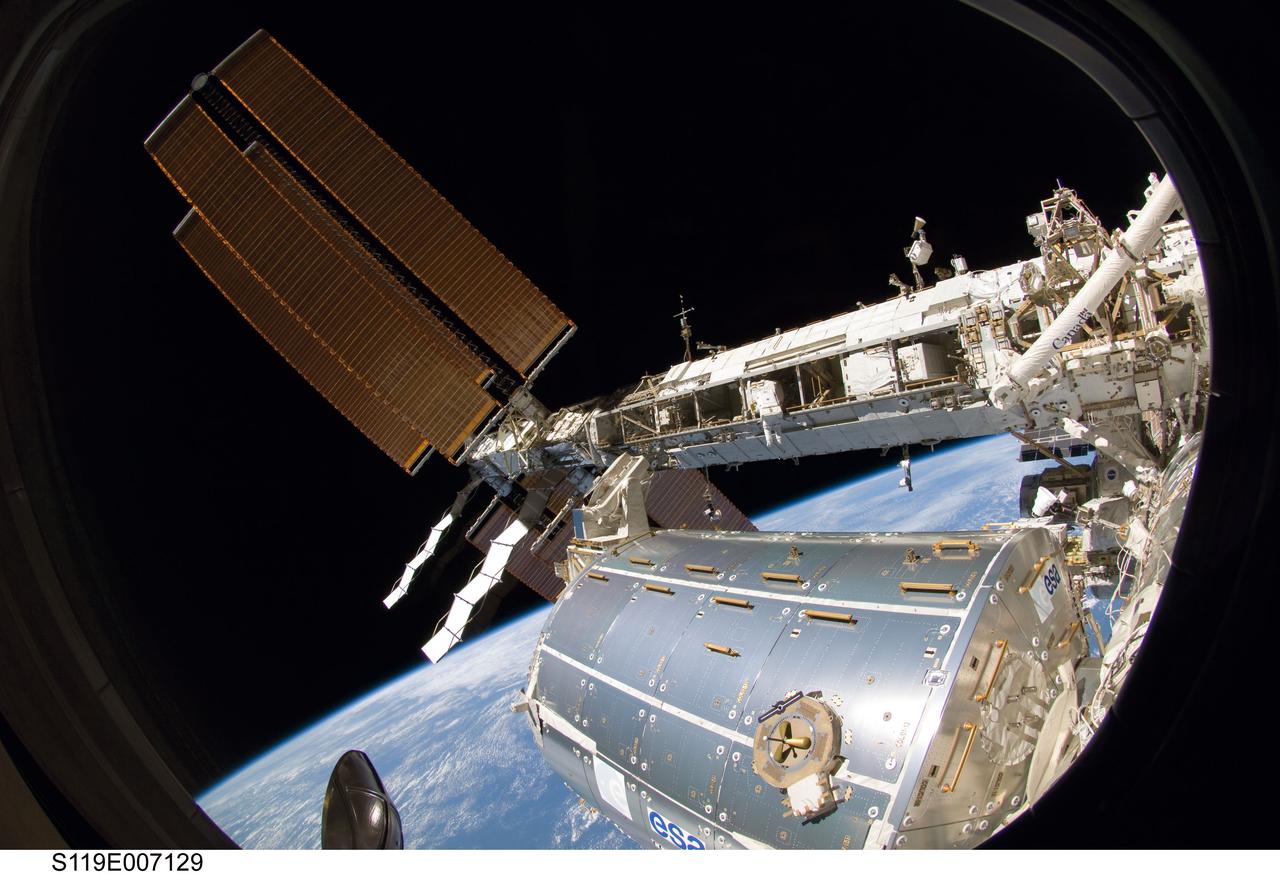
S119-E-007129 (23 March 2009) --- Astronaut Joseph Acaba, STS-119 mission specialist, participates in the mission's third scheduled session of extravehicular activity (EVA) as construction and maintenance continue on the International Space Station. During the six-hour, 27-minute spacewalk, Acaba and Richard Arnold (out of frame), mission specialist, helped robotic arm operators relocate the Crew Equipment Translation Aid (CETA) cart from the Port 1 to Starboard 1 truss segment, installed a new coupler on the CETA cart, lubricated snares on the "B" end of the space station's robotic arm and performed a few "get ahead" tasks.
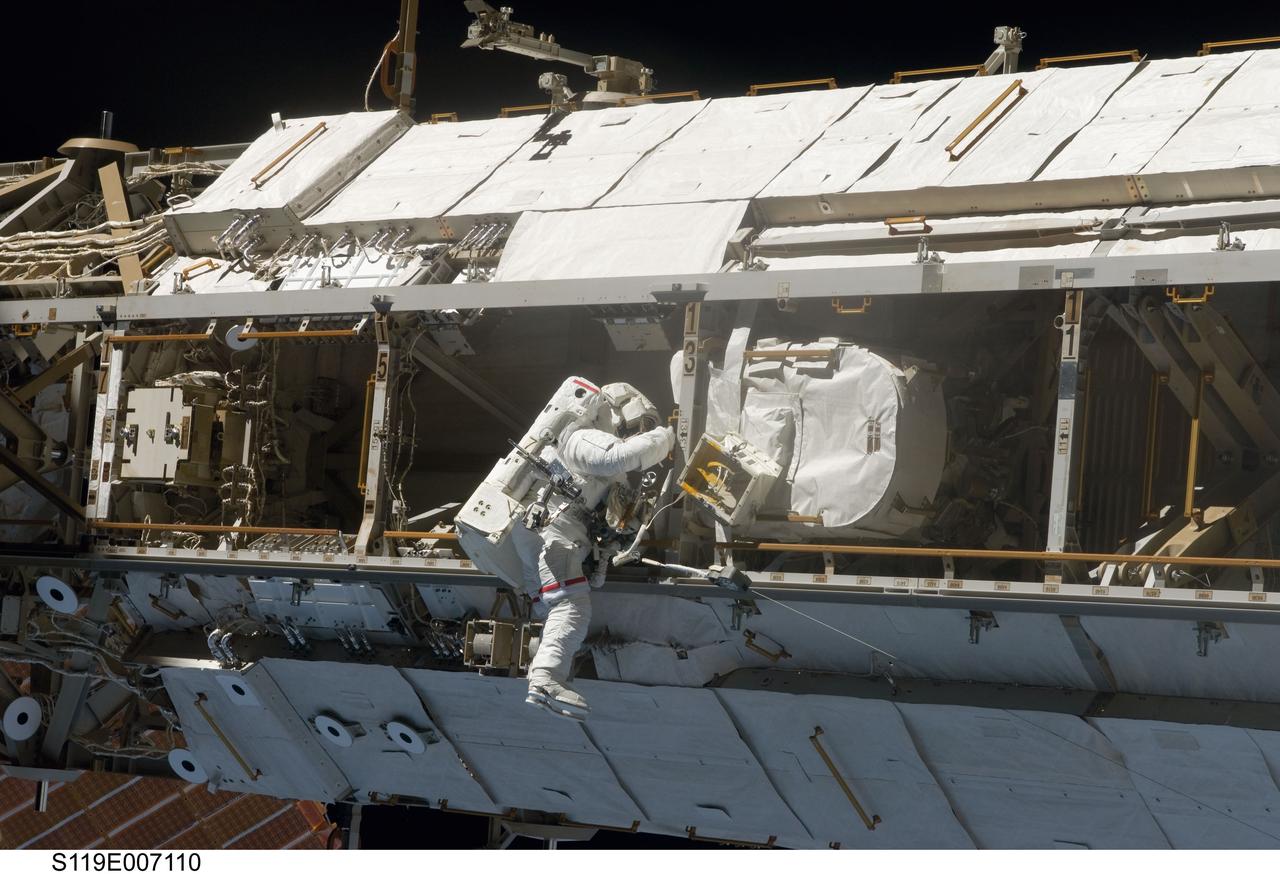
S119-E-007110 (23 March 2009) --- Astronaut Joseph Acaba, STS-119 mission specialist, participates in the mission's third scheduled session of extravehicular activity (EVA) as construction and maintenance continue on the International Space Station. During the six-hour, 27-minute spacewalk, Acaba and Richard Arnold (out of frame), mission specialist, helped robotic arm operators relocate the Crew Equipment Translation Aid (CETA) cart from the Port 1 to Starboard 1 truss segment, installed a new coupler on the CETA cart, lubricated snares on the "B" end of the space station's robotic arm and performed a few "get ahead" tasks.
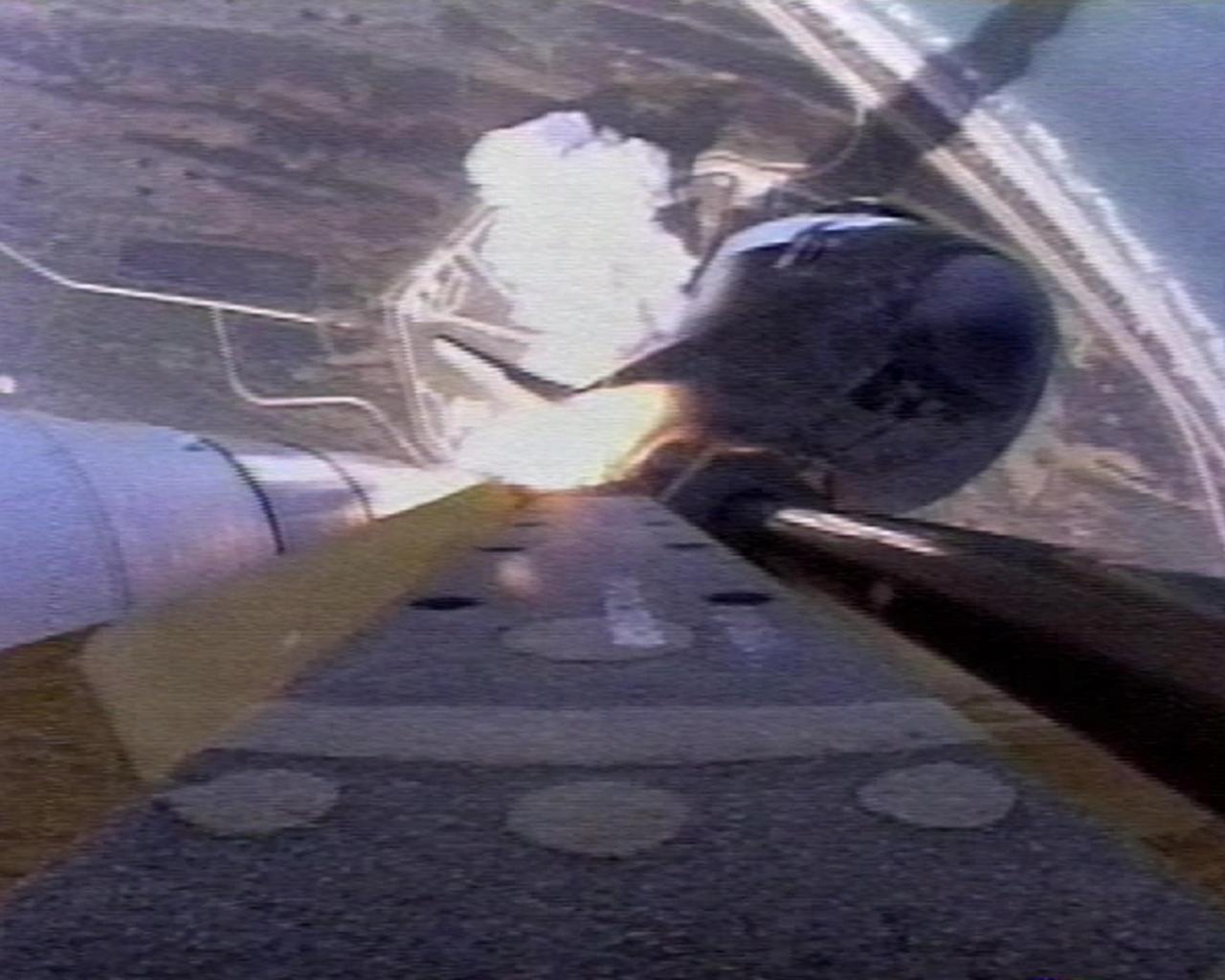
KENNEDY SPACE CENTER, FLA. -- The view from the External Tank camera shows a cloud of smoke and steam on the pad below as Space Shuttle Atlantis hurtles into space on mission STS-112. The Atlantic Ocean laps the shore on the right. Liftoff from Launch Pad 39B occurred at 3:46 p.m. EDT. Atlantis carries the S1 Integrated Truss Structure and the Crew and Equipment Translation Aid (CETA) Cart A. The CETA is the first of two human-powered carts that will ride along the ISS railway, providing mobile work platforms for future spacewalking astronauts. On the 11-day mission, three spacewalks are planned to attach the S1 truss.
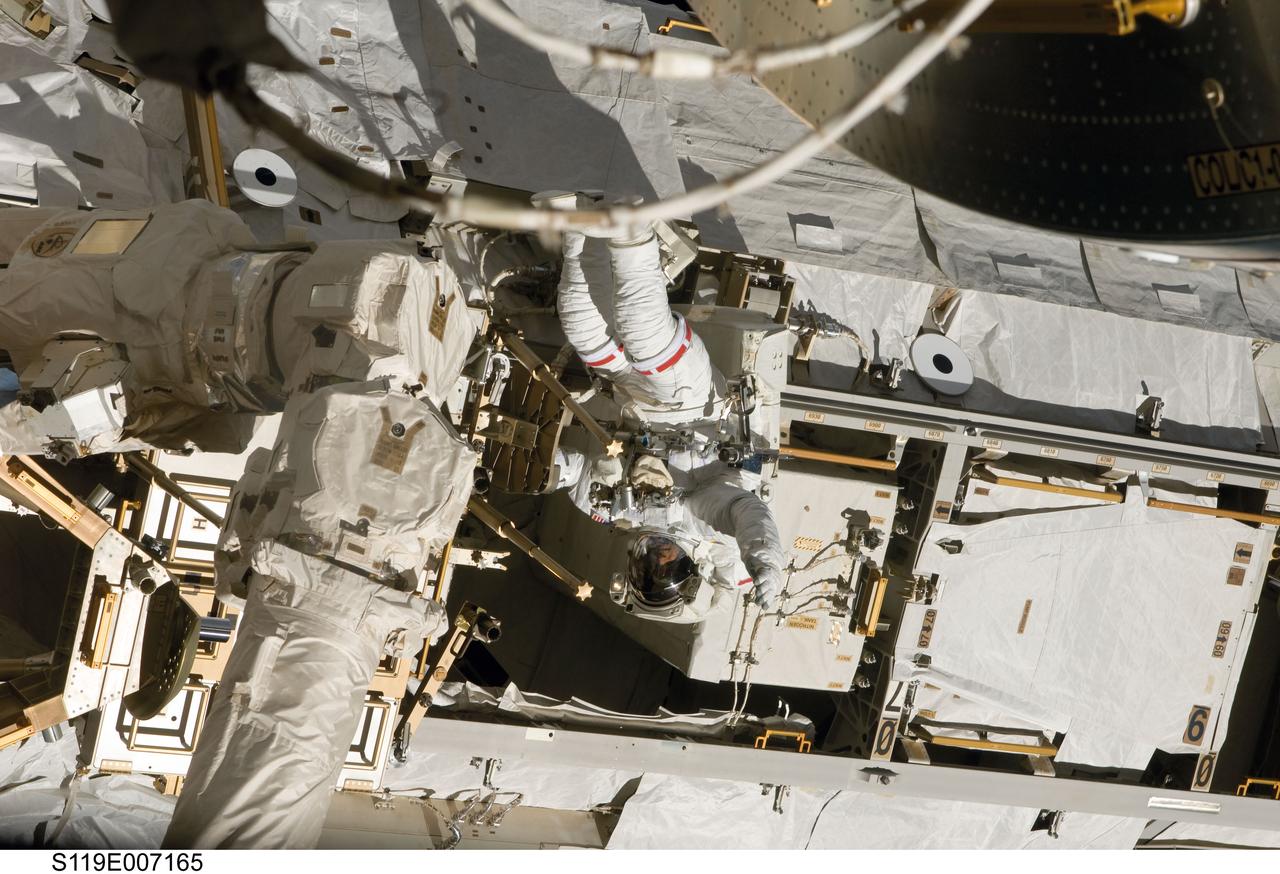
S119-E-007165 (23 March 2009) --- Astronaut Joseph Acaba, STS-119 mission specialist, participates in the mission's third scheduled session of extravehicular activity (EVA) as construction and maintenance continue on the International Space Station. During the six-hour, 27-minute spacewalk, Acaba and Richard Arnold (out of frame), mission specialist, helped robotic arm operators relocate the Crew Equipment Translation Aid (CETA) cart from the Port 1 to Starboard 1 truss segment, installed a new coupler on the CETA cart, lubricated snares on the "B" end of the space station's robotic arm and performed a few "get ahead" tasks.
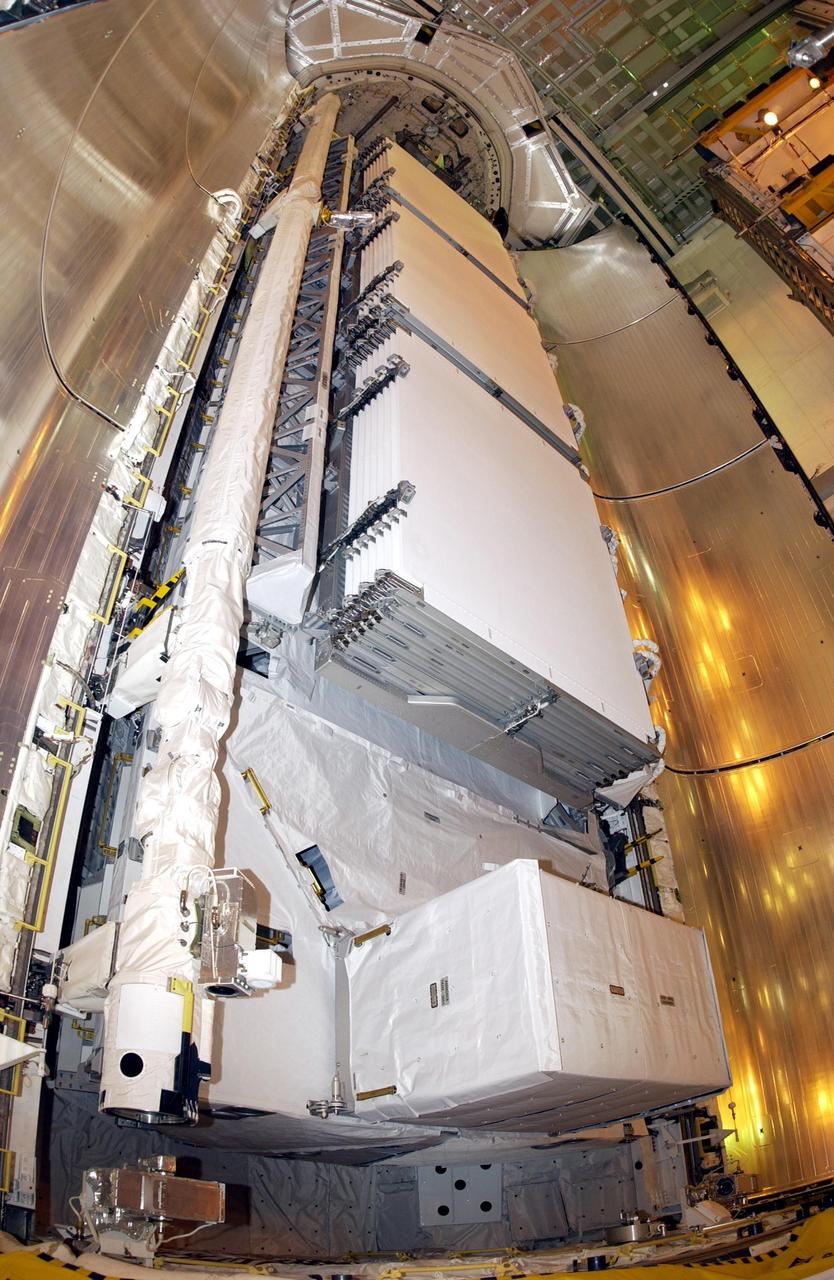
KENNEDY SPACE CENTER, FLA. -- -- The payload for mission STS-112 rests inside the payload bay of Space Shuttle Atlantis. The Shuttle is carrying the S1 Integrated Truss Structure, the first starboard truss segment, to be attached to the central truss segment, S0, plus the Crew and Equipment Translation Aid (CETA) Cart A. The CETA is the first of two human-powered carts that will ride along the ISS railway, providing mobile work platforms for future spacewalking astronauts. Launch of Atlantis is scheduled for Oct. 2 with a crew of six. The 11-day mission includes three spacewalks.
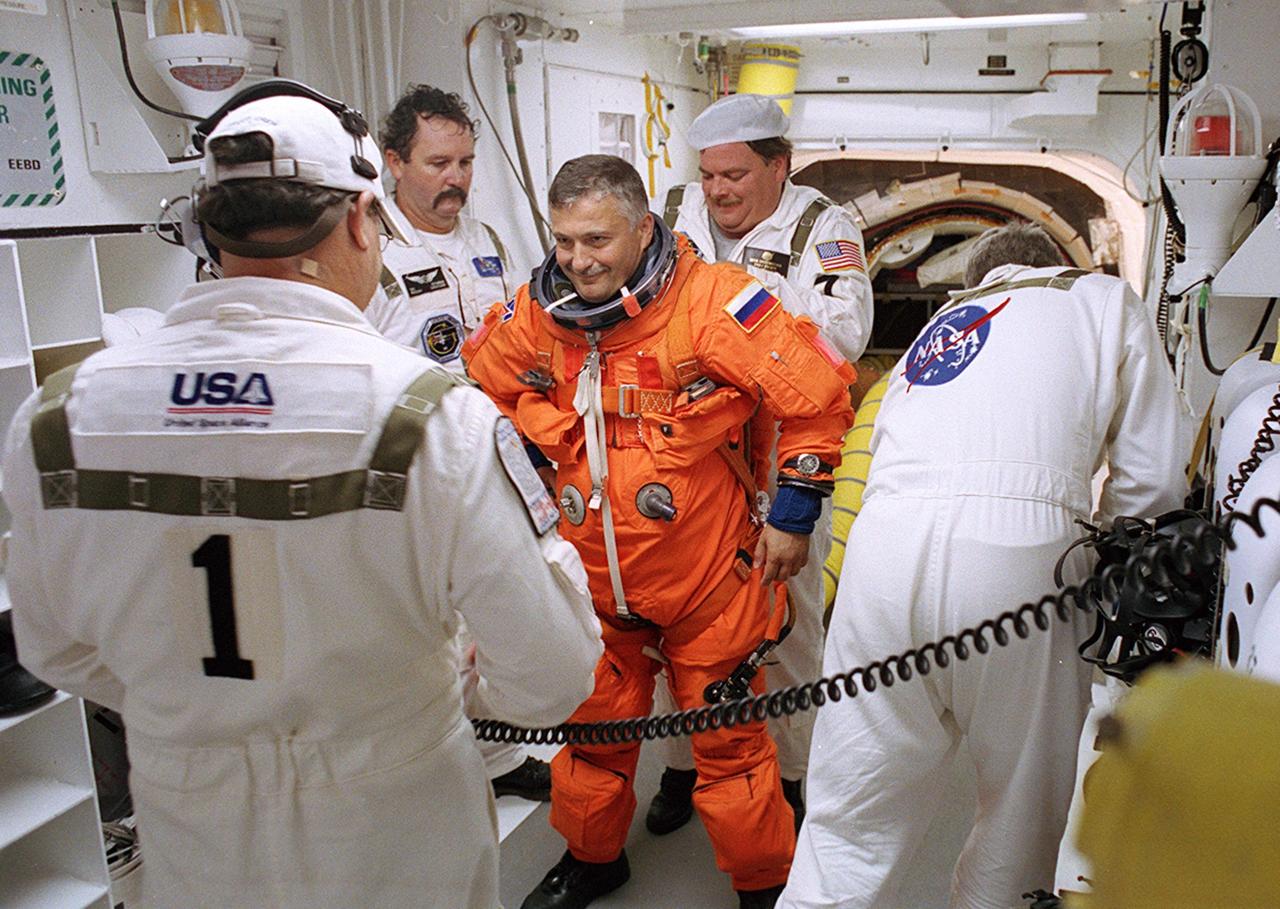
KENNEDY SPACE CENTER, FLA. - -- In the White Room at Launch Pad 39B, STS-112 Mission Specialist Fyodor N. Yurchikhin, Ph.D., a cosmonaut with the Russian Space Agency, receives assistance with his spacesuit before boarding Space Shuttle Atlantis. Liftoff is schedued for 3:46 p.m. EDT. Along with a crew of six, Atlantis will carry the S1 Integrated Truss Structure and the Crew and Equipment Translation Aid (CETA) Cart A to the International Space Station (ISS). The CETA is the first of two human-powered carts that will ride along the ISS railway, providing mobile work platforms for future spacewalking astronauts. On the 11-day mission, three spacewalks are planned to attach the S1 truss.
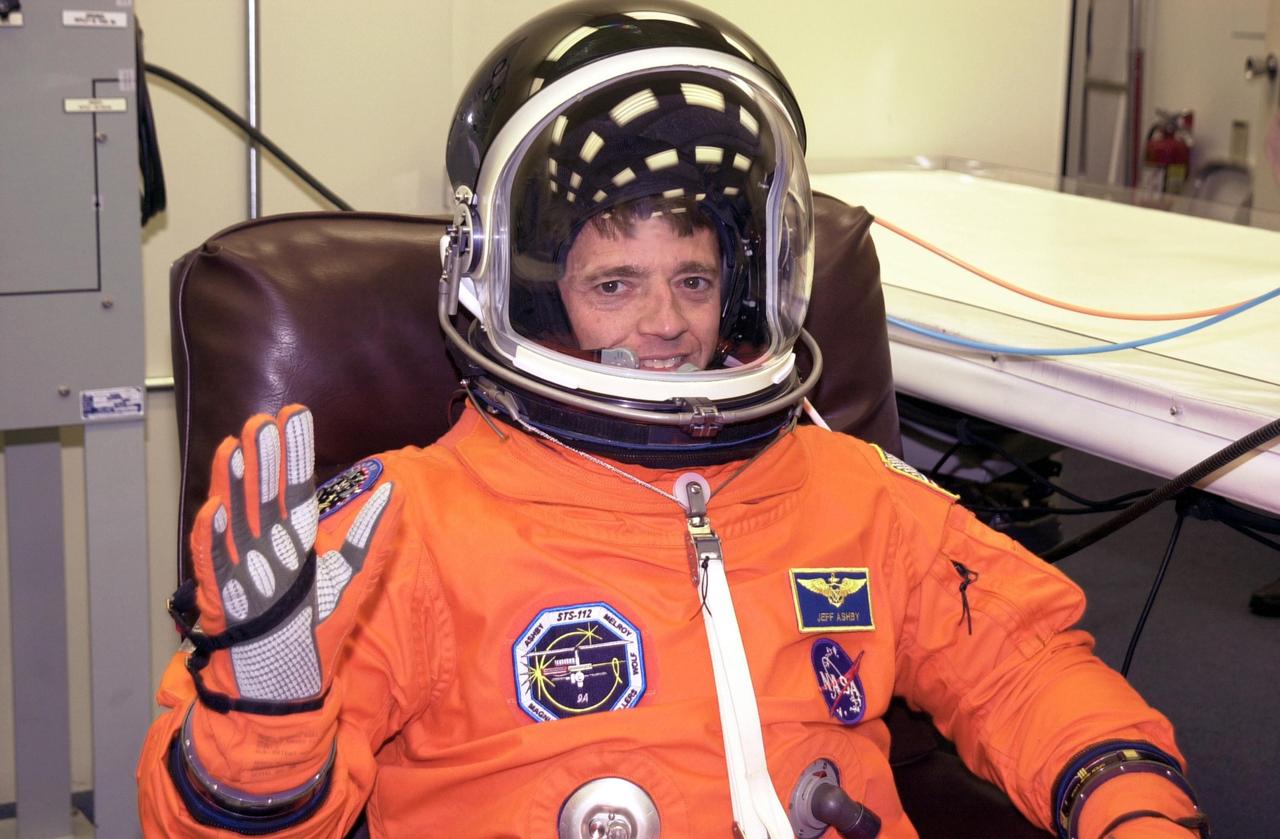
KENNEDY SPACE CENTER, FLA. -- STS-112 Commander Jeffrey Ashby finishes suiting up for launch. STS-112 is the 15th assembly flight to the International Space Station, carrying the S1 Integrated Truss Structure and the Crew and Equipment Translation Aid (CETA) Cart A. The CETA is the first of two human-powered carts that will ride along the ISS railway, providing mobile work platforms for future spacewalking astronauts. On the 11-day mission, three spacewalks are planned to attach the S1 truss to the Station. Launch is scheduled for 3:46 p.m. EDT from Launch Pad 39B.
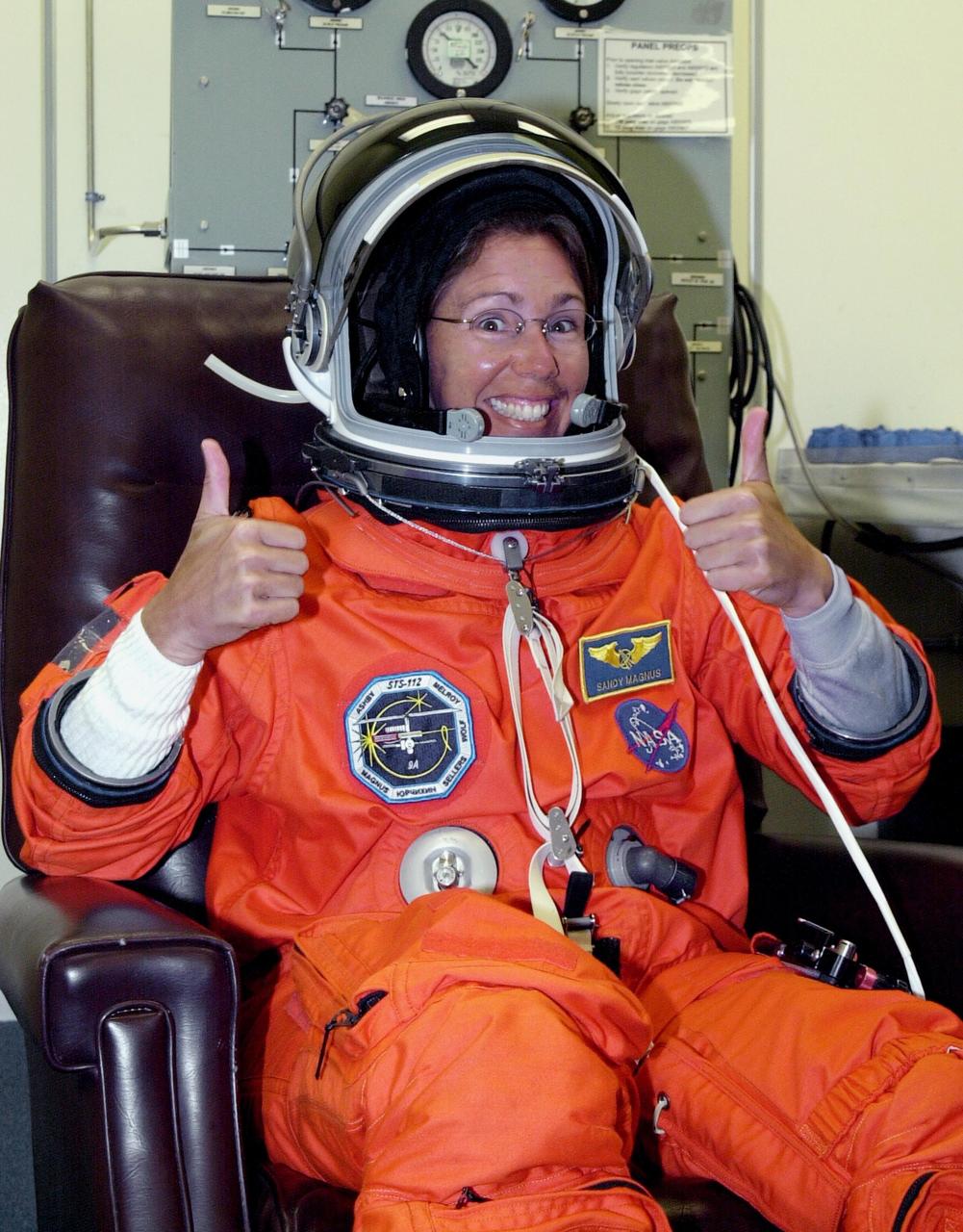
KENNEDY SPACE CENTER, FLA. - STS-112 Mission Specialist Sandra Magnus finishes suiting up before launch. STS-112 is the 15th assembly flight to the International Space Station, carrying the S1 Integrated Truss Structure and the Crew and Equipment Translation Aid (CETA) Cart A. The CETA is the first of two human-powered carts that will ride along the ISS railway, providing mobile work platforms for future spacewalking astronauts. On the 11-day mission, three spacewalks are planned to attach the S1 truss to the Station. Launch is scheduled for 3:46 p.m. EDT from Launch Pad 39B.
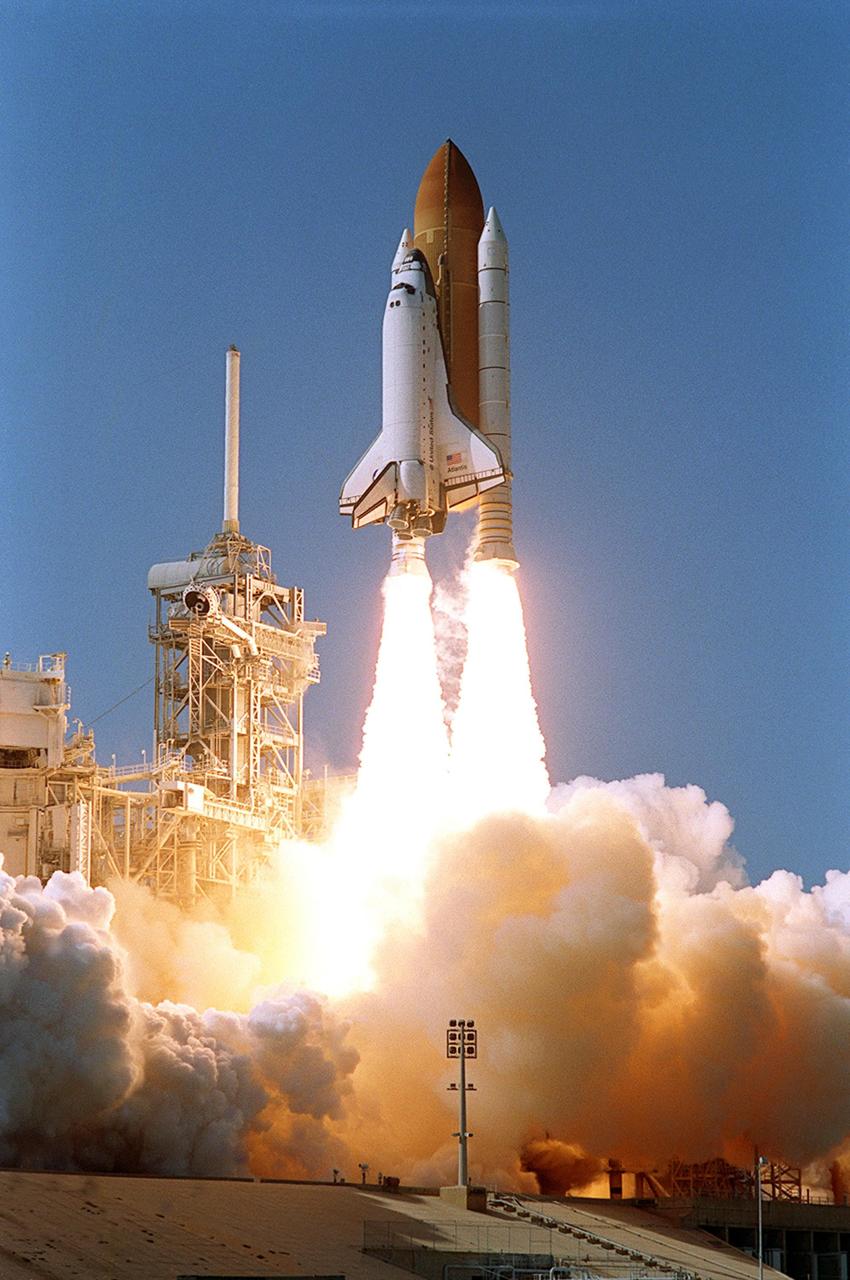
KENNEDY SPACE CENTER, FLA. - Space Shuttle Atlantis leaps from the steam and smoke billowing across Launch Pad 39B after an on-time liftoff of 3:46 p.m. EDT on mission STS-112. Along with a crew of six, Atlantis carries the S1 Integrated Truss Structure and the Crew and Equipment Translation Aid (CETA) Cart A. The CETA is the first of two human-powered carts that will ride along the ISS railway, providing mobile work platforms for future spacewalking astronauts. On the 11-day mission, three spacewalks are planned to attach the S1 truss.
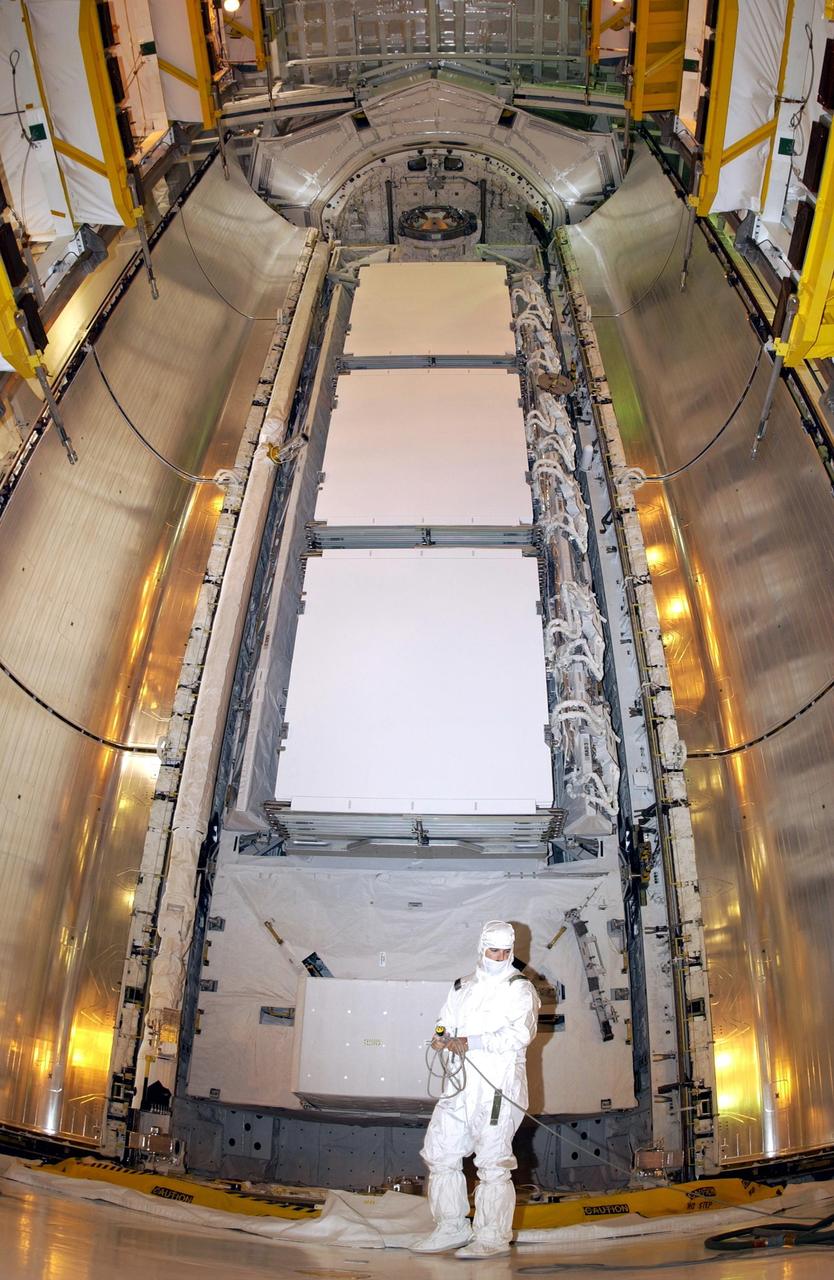
KENNEDY SPACE CENTER, FLA. -- The payload for mission STS-112 rests inside the payload bay of Space Shuttle Atlantis. The Shuttle is carrying the S1 Integrated Truss Structure, the first starboard truss segment, to be attached to the central truss segment, S0, plus the Crew and Equipment Translation Aid (CETA) Cart A. The CETA is the first of two human-powered carts that will ride along the ISS railway, providing mobile work platforms for future spacewalking astronauts. Launch of Atlantis is scheduled for Oct. 2 with a crew of six. The 11-day mission includes three spacewalks.
![KENNEDY SPACE CENTER, FLA. -- With a tail of flame burning white hot, Space Shuttle Atlantis leaps from the billowing steam and smoke on Launch Pad 39B after an on-time liftoff of 3:46 p.m. EDT on mission STS-112. Along with a crew of six, Atlantis carries the S1 Integrated Truss Structure and the Crew and Equipment Translation Aid (CETA) Cart A. The CETA is the first of two human-powered carts that will ride along the ISS railway, providing mobile work platforms for future spacewalking astronauts. On the 11-day mission, three spacewalks are planned to attach the S1 truss. [Photo courtesy of Scott Andrews]](https://images-assets.nasa.gov/image/KSC-02pd1458/KSC-02pd1458~medium.jpg)
KENNEDY SPACE CENTER, FLA. -- With a tail of flame burning white hot, Space Shuttle Atlantis leaps from the billowing steam and smoke on Launch Pad 39B after an on-time liftoff of 3:46 p.m. EDT on mission STS-112. Along with a crew of six, Atlantis carries the S1 Integrated Truss Structure and the Crew and Equipment Translation Aid (CETA) Cart A. The CETA is the first of two human-powered carts that will ride along the ISS railway, providing mobile work platforms for future spacewalking astronauts. On the 11-day mission, three spacewalks are planned to attach the S1 truss. [Photo courtesy of Scott Andrews]
![KENNEDY SPACE CENTER, FLA. -- The brilliance of the launch of Space Shuttle Atlantis is reflected in nearby waters. Liftoff of the Shuttle on mission STS-112 occurred on time at 3:46 p.m. EDT. Along with a crew of six, Atlantis carries the S1 Integrated Truss Structure and the Crew and Equipment Translation Aid (CETA) Cart A. The CETA is the first of two human-powered carts that will ride along the ISS railway, providing mobile work platforms for future spacewalking astronauts. On the 11-day mission, three spacewalks are planned to attach the S1 truss. [Photo courtesy of Scott Andrews]](https://images-assets.nasa.gov/image/KSC-02pd1466/KSC-02pd1466~medium.jpg)
KENNEDY SPACE CENTER, FLA. -- The brilliance of the launch of Space Shuttle Atlantis is reflected in nearby waters. Liftoff of the Shuttle on mission STS-112 occurred on time at 3:46 p.m. EDT. Along with a crew of six, Atlantis carries the S1 Integrated Truss Structure and the Crew and Equipment Translation Aid (CETA) Cart A. The CETA is the first of two human-powered carts that will ride along the ISS railway, providing mobile work platforms for future spacewalking astronauts. On the 11-day mission, three spacewalks are planned to attach the S1 truss. [Photo courtesy of Scott Andrews]
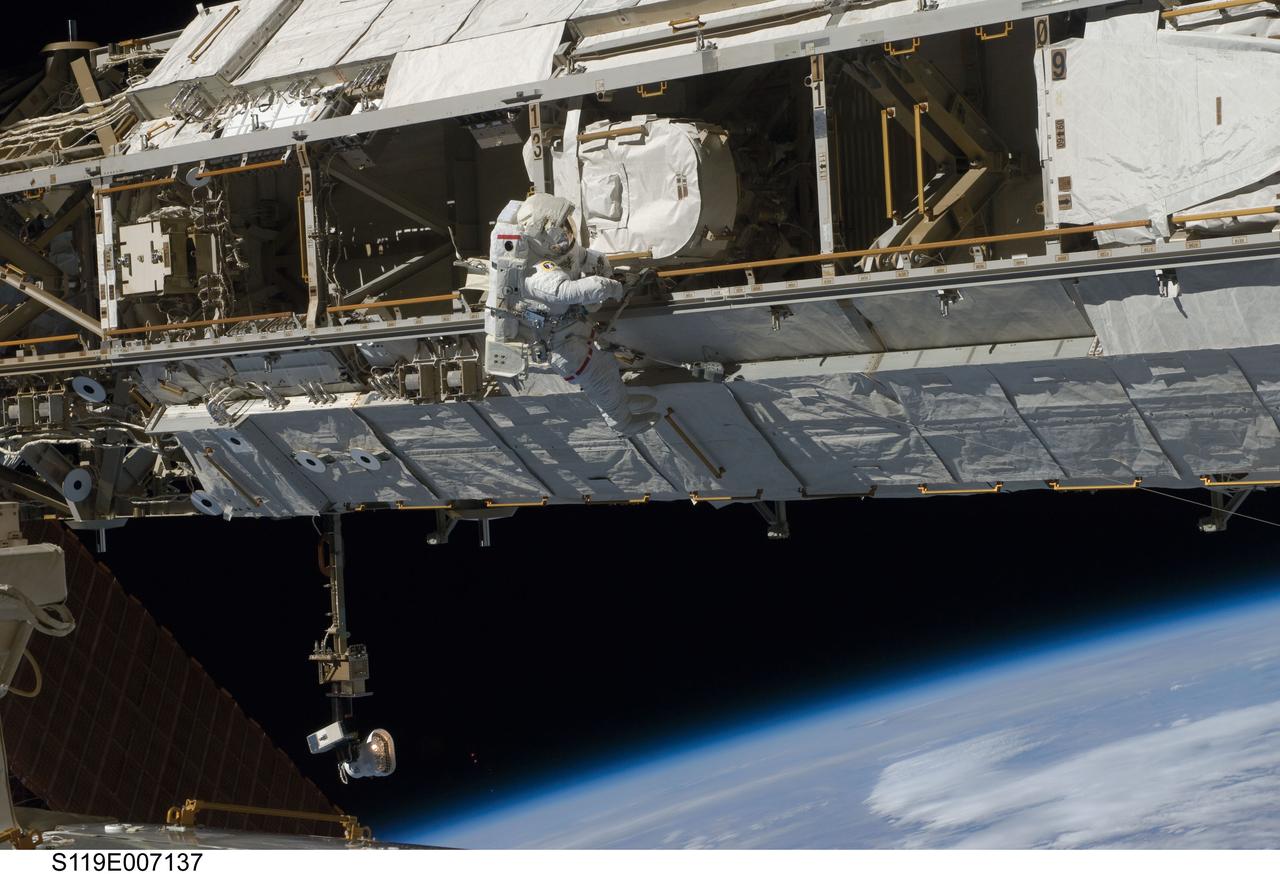
S119-E-007137 (23 March 2009) --- Astronaut Joseph Acaba, STS-119 mission specialist, participates in the mission's third scheduled session of extravehicular activity (EVA) as construction and maintenance continue on the International Space Station. During the six-hour, 27-minute spacewalk, Acaba and Richard Arnold (out of frame), mission specialist, helped robotic arm operators relocate the Crew Equipment Translation Aid (CETA) cart from the Port 1 to Starboard 1 truss segment, installed a new coupler on the CETA cart, lubricated snares on the "B" end of the space station's robotic arm and performed a few "get ahead" tasks.
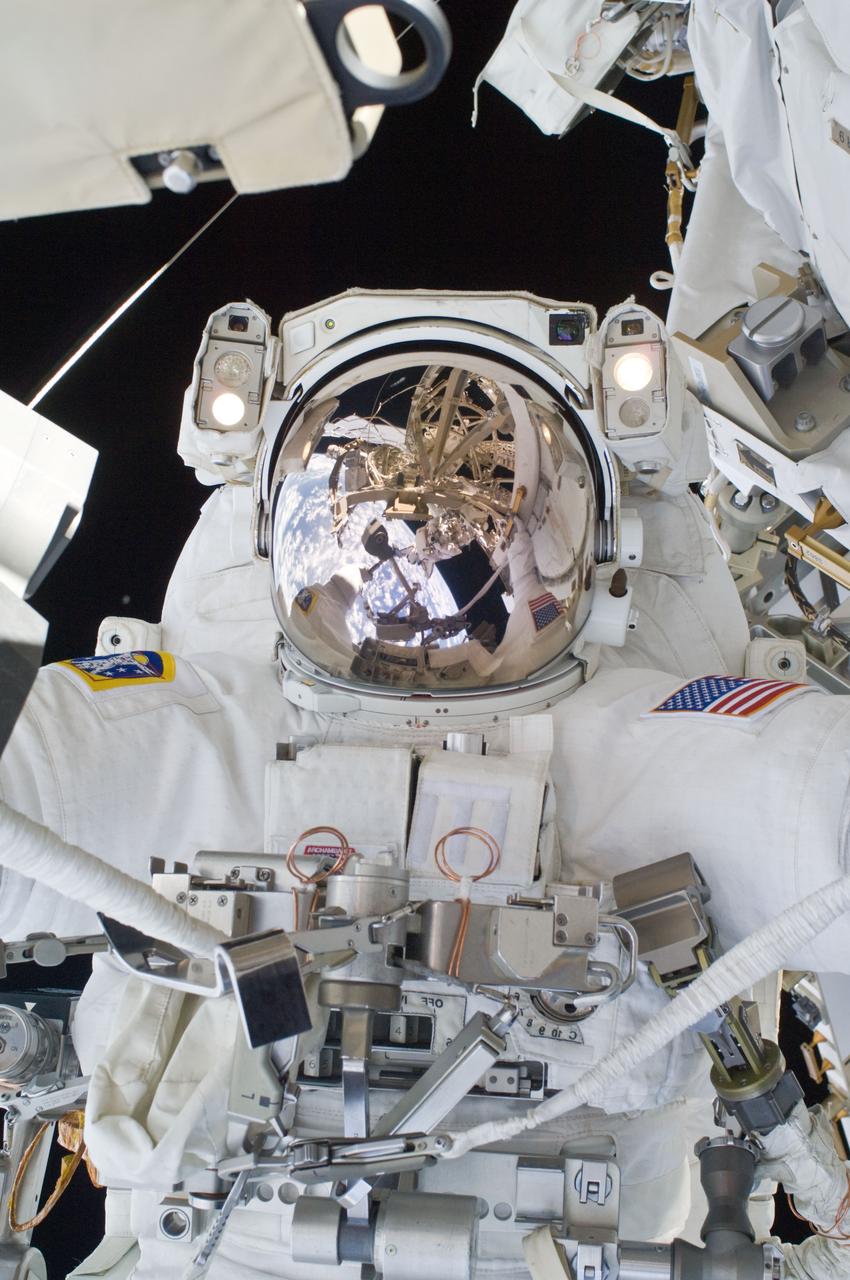
ISS018-E-042523 (23 March 2009) --- Astronaut Richard Arnold, STS-119 mission specialist, participates in the mission's third scheduled session of extravehicular activity (EVA) as construction and maintenance continue on the International Space Station. During the six-hour, 27-minute spacewalk, Arnold and Joseph Acaba (out of frame), mission specialist, helped robotic arm operators relocate the Crew Equipment Translation Aid (CETA) cart from the Port 1 to Starboard 1 truss segment, installed a new coupler on the CETA cart, lubricated snares on the "B" end of the space station's robotic arm and performed a few "get ahead" tasks.
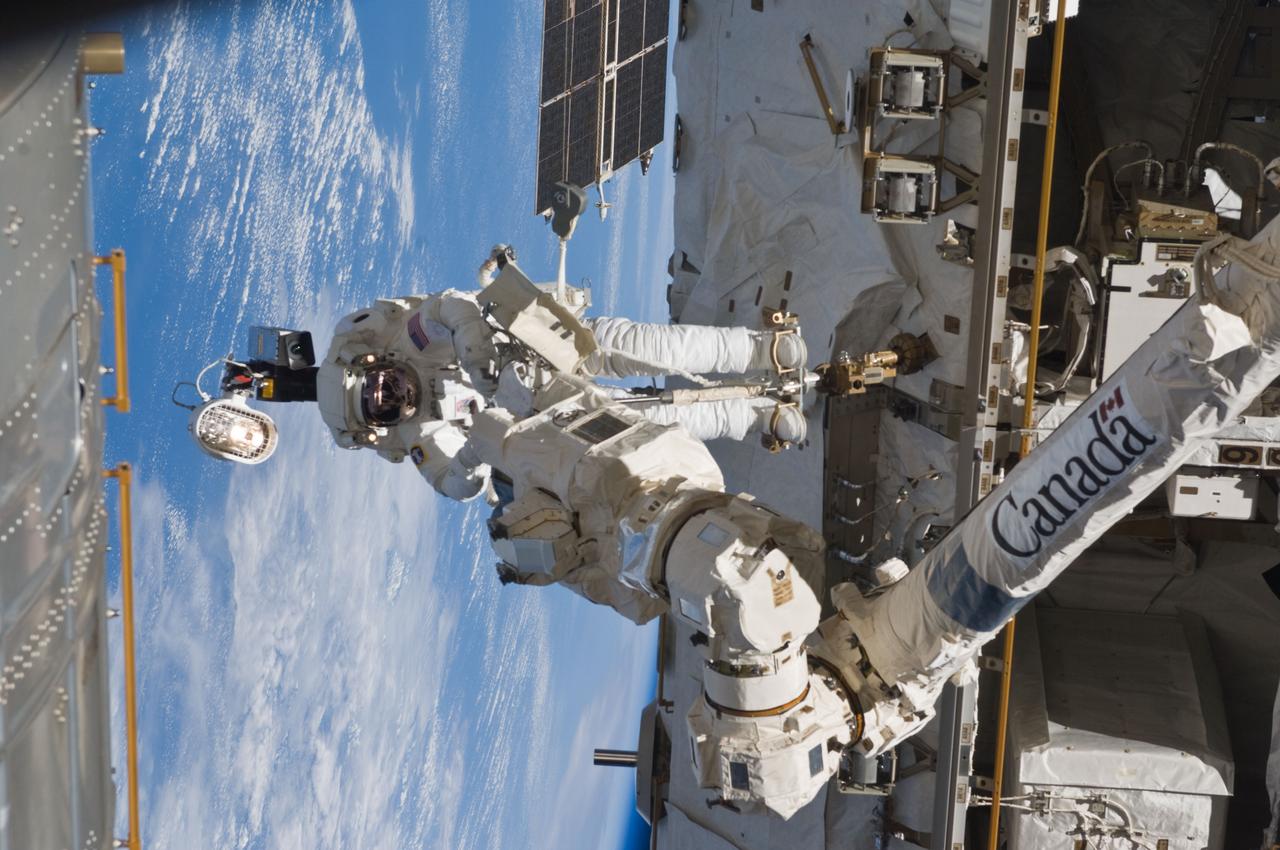
S119-E-007105 (23 March 2009) --- Astronaut Richard Arnold, STS-119 mission specialist, participates in the mission's third scheduled session of extravehicular activity (EVA) as construction and maintenance continue on the International Space Station. During the six-hour, 27-minute spacewalk, Arnold and Joseph Acaba (out of frame), mission specialist, helped robotic arm operators relocate the Crew Equipment Translation Aid (CETA) cart from the Port 1 to Starboard 1 truss segment, installed a new coupler on the CETA cart, lubricated snares on the "B" end of the space station's robotic arm and performed a few "get ahead" tasks.
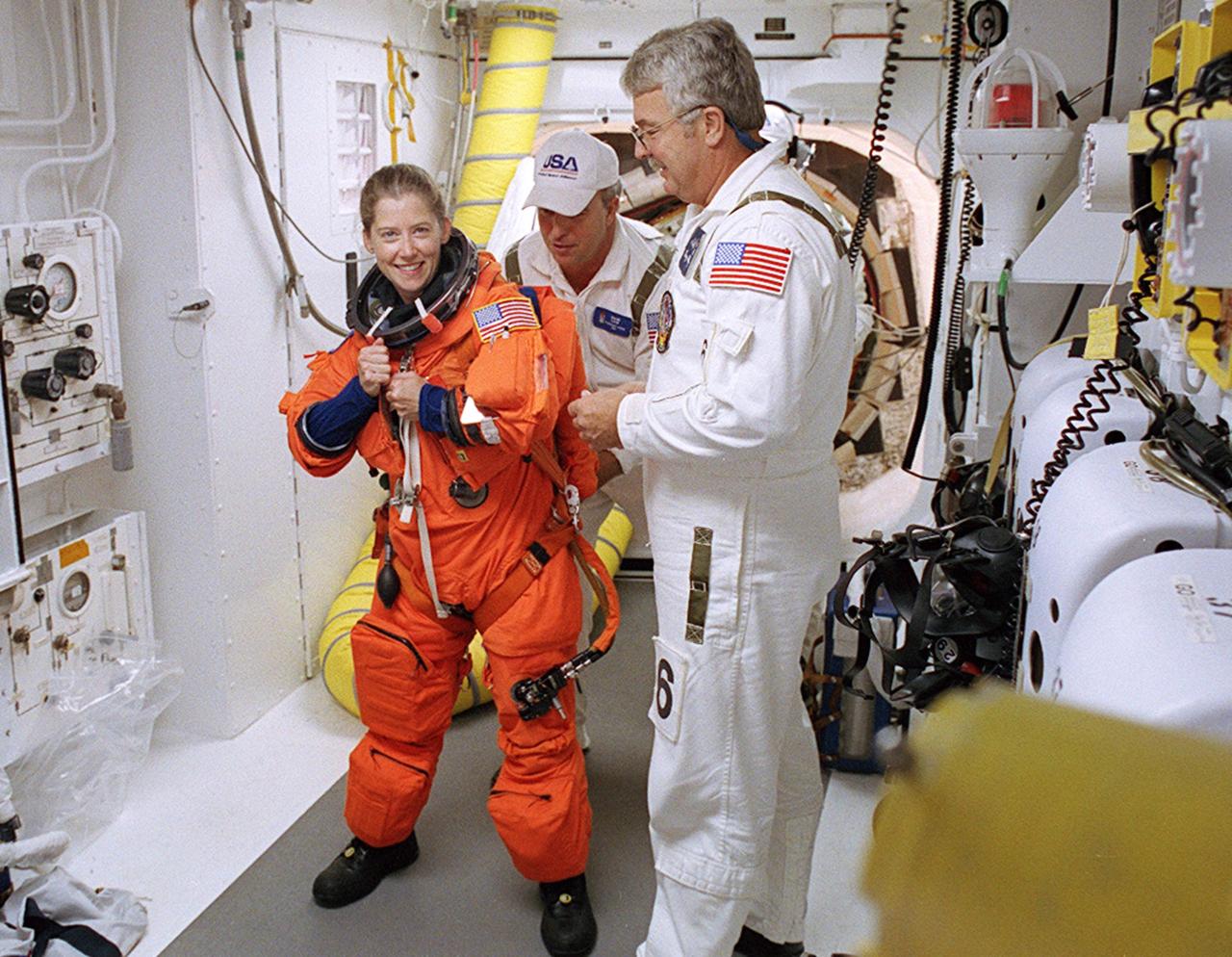
KENNEDY SPACE CENTER, FLA. - -- In the White Room at Launch Pad 39B, STS-112 Pilot Pamela Ann Melroy receives assistance with her spacesuit before boarding Space Shuttle Atlantis. Liftoff is schedued for 3:46 p.m. EDT. Along with a crew of six, Atlantis will carry the S1 Integrated Truss Structure and the Crew and Equipment Translation Aid (CETA) Cart A to the International Space Station (ISS). The CETA is the first of two human-powered carts that will ride along the ISS railway, providing mobile work platforms for future spacewalking astronauts. On the 11-day mission, three spacewalks are planned to attach the S1 truss.
![KENNEDY SPACE CENTER, FLA. -- Space Shuttle Atlantis leaps from the steam and smoke billowing across Launch Pad 39B after an on-time liftoff of 3:46 p.m. EDT on mission STS-112. Along with a crew of six, Atlantis carries the S1 Integrated Truss Structure and the Crew and Equipment Translation Aid (CETA) Cart A. The CETA is the first of two human-powered carts that will ride along the ISS railway, providing mobile work platforms for future spacewalking astronauts. On the 11-day mission, three spacewalks are planned to attach the S1 truss. [Photo courtesy of Scott Andrews]](https://images-assets.nasa.gov/image/KSC-02pd1462/KSC-02pd1462~medium.jpg)
KENNEDY SPACE CENTER, FLA. -- Space Shuttle Atlantis leaps from the steam and smoke billowing across Launch Pad 39B after an on-time liftoff of 3:46 p.m. EDT on mission STS-112. Along with a crew of six, Atlantis carries the S1 Integrated Truss Structure and the Crew and Equipment Translation Aid (CETA) Cart A. The CETA is the first of two human-powered carts that will ride along the ISS railway, providing mobile work platforms for future spacewalking astronauts. On the 11-day mission, three spacewalks are planned to attach the S1 truss. [Photo courtesy of Scott Andrews]
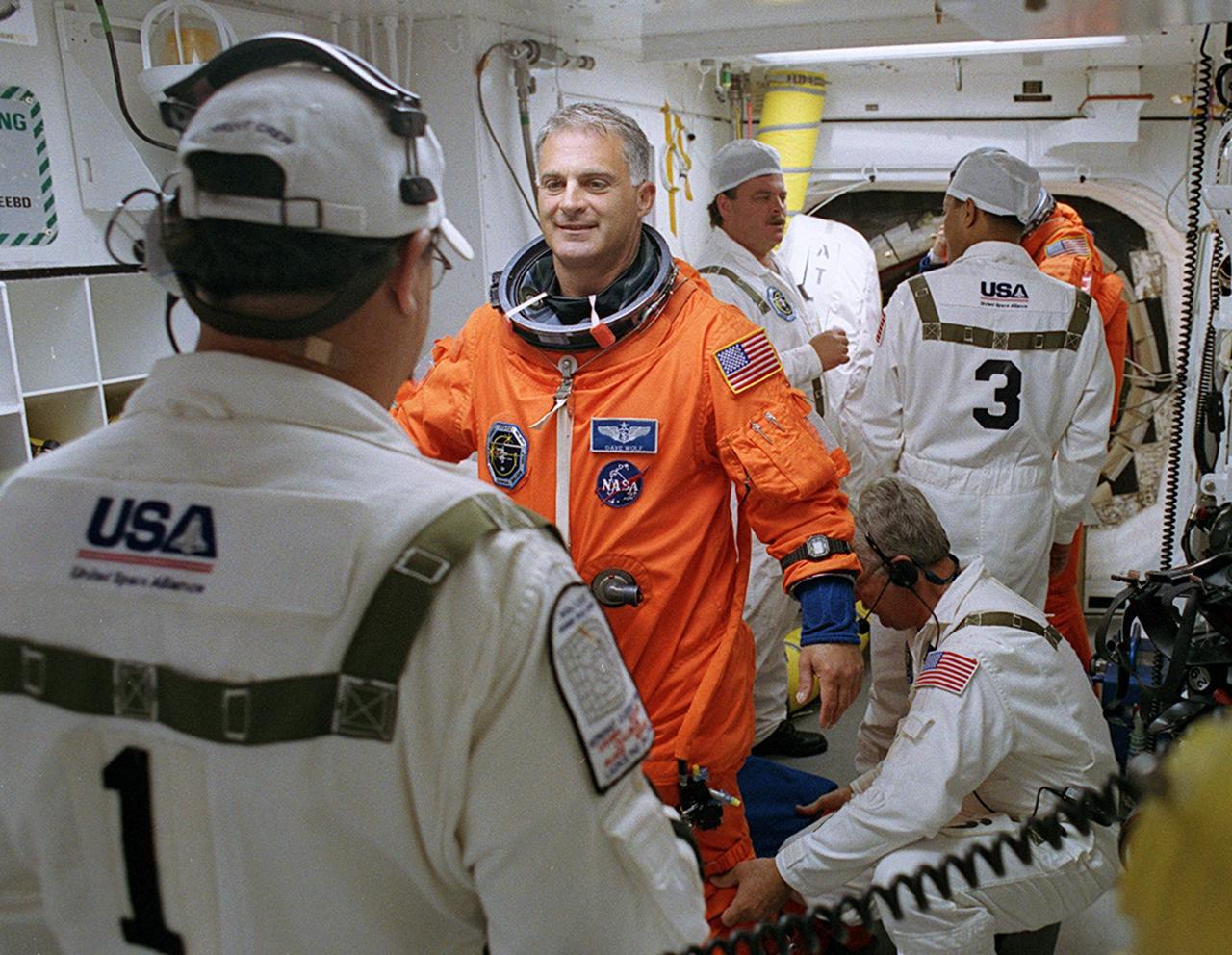
KENNEDY SPACE CENTER, FLA. - -- In the White Room at Launch Pad 39B, STS-112 Mission Specialist David A. Wolf, M.D., receives assistance with his spacesuit before boarding Space Shuttle Atlantis. Liftoff is schedued for 3:46 p.m. EDT. Along with a crew of six, Atlantis will carry the S1 Integrated Truss Structure and the Crew and Equipment Translation Aid (CETA) Cart A to the International Space Station (ISS). The CETA is the first of two human-powered carts that will ride along the ISS railway, providing mobile work platforms for future spacewalking astronauts. On the 11-day mission, three spacewalks are planned to attach the S1 truss.
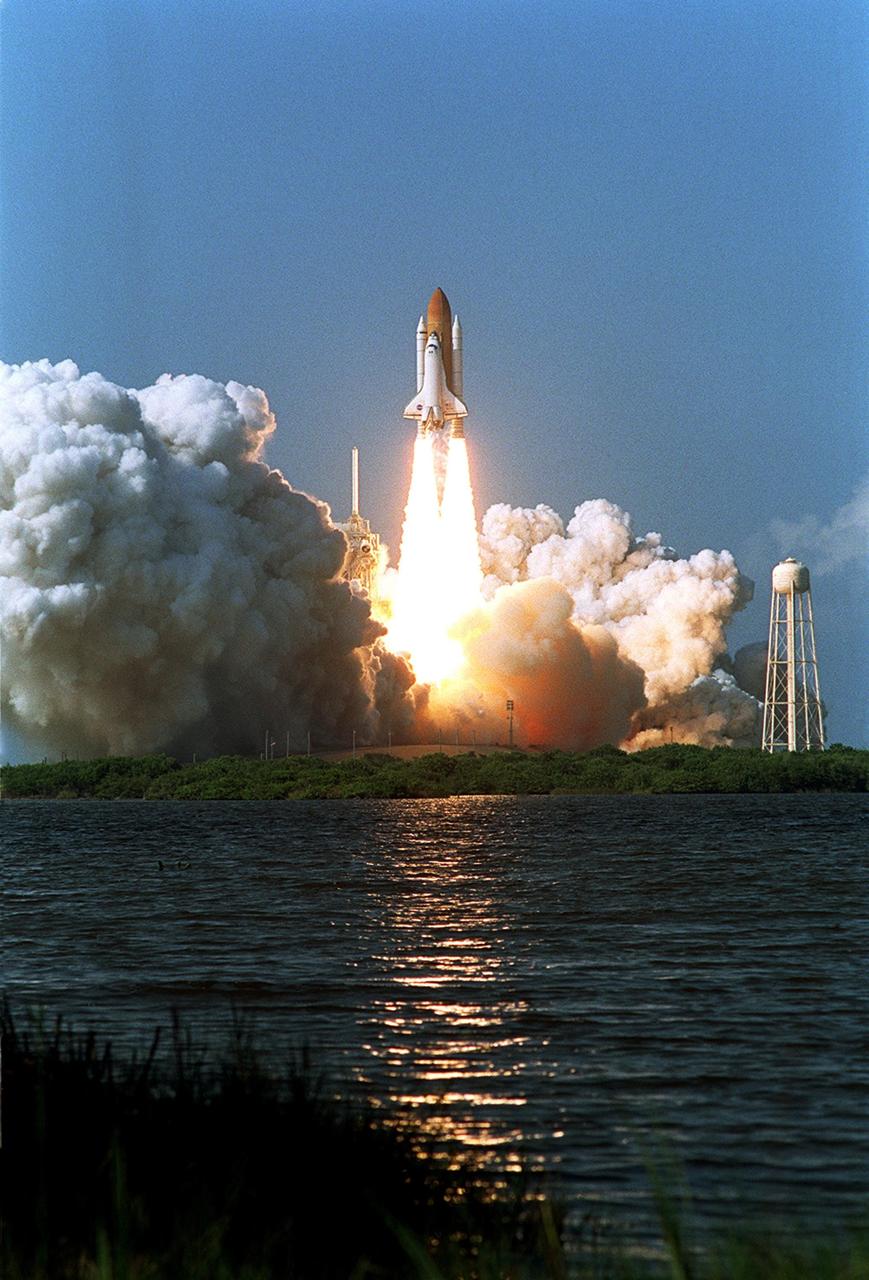
KENNEDY SPACE CENTER, FLA. - Space Shuttle Atlantis leaps from the steam and smoke billowing across Launch Pad 39B after an on-time liftoff of 3:46 p.m. EDT on mission STS-112. Along with a crew of six, Atlantis carries the S1 Integrated Truss Structure and the Crew and Equipment Translation Aid (CETA) Cart A. The CETA is the first of two human-powered carts that will ride along the ISS railway, providing mobile work platforms for future spacewalking astronauts. On the 11-day mission, three spacewalks are planned to attach the S1 truss.
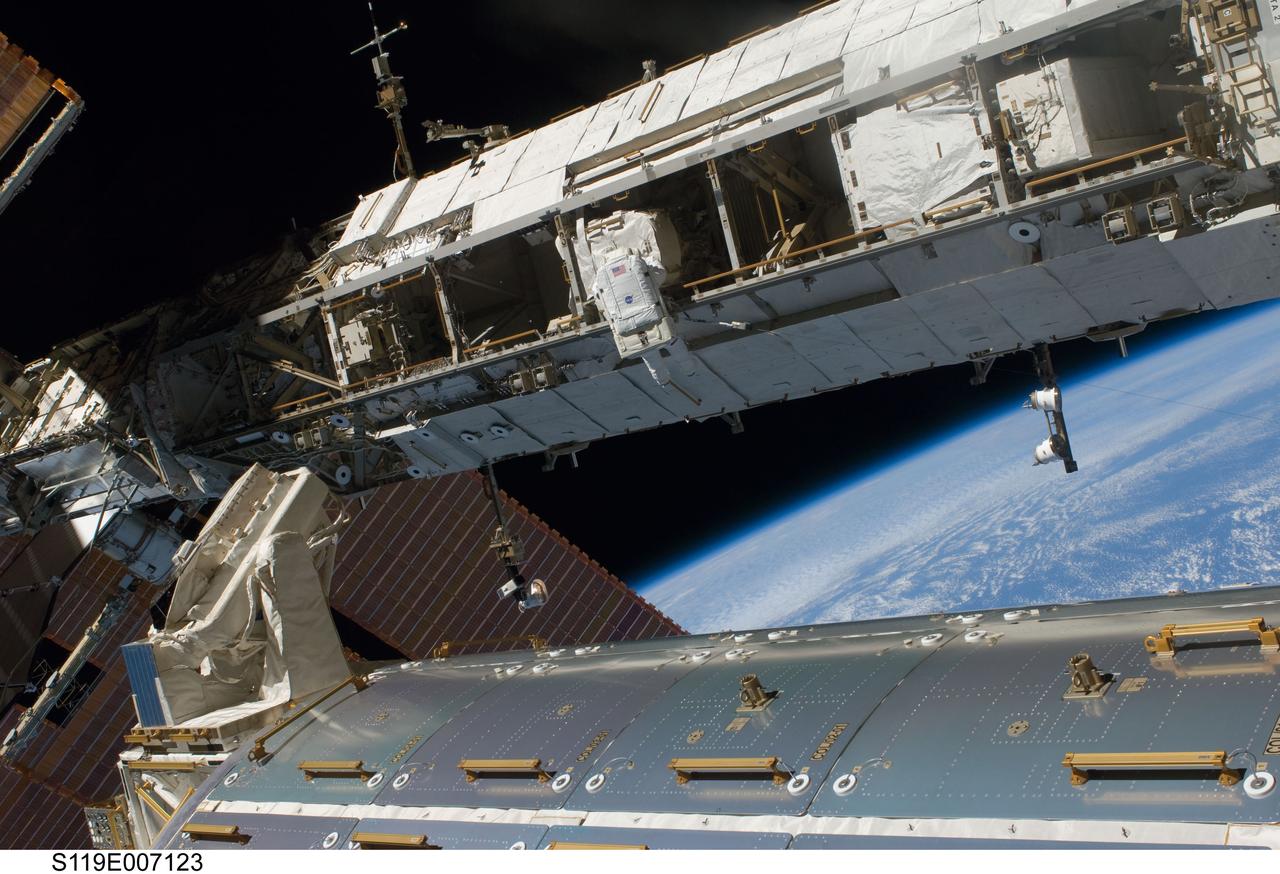
S119-E-007123 (23 March 2009) --- Astronaut Joseph Acaba, STS-119 mission specialist, participates in the mission's third scheduled session of extravehicular activity (EVA) as construction and maintenance continue on the International Space Station. During the six-hour, 27-minute spacewalk, Acaba and Richard Arnold (out of frame), mission specialist, helped robotic arm operators relocate the Crew Equipment Translation Aid (CETA) cart from the Port 1 to Starboard 1 truss segment, installed a new coupler on the CETA cart, lubricated snares on the "B" end of the space station's robotic arm and performed a few "get ahead" tasks.
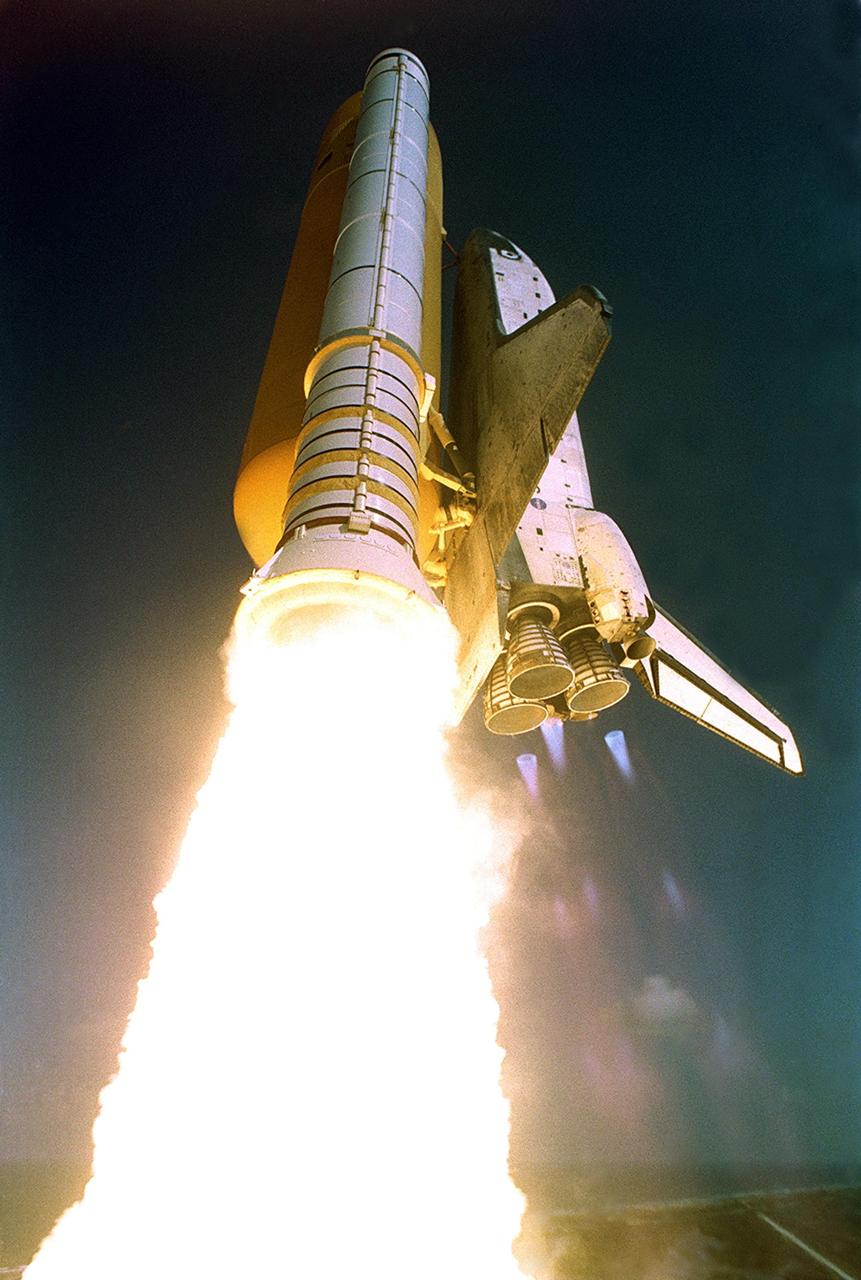
KENNEDY SPACE CENTER, FLA. - A tracking camera on Launch Pad 39B captures the flames of Space Shuttle Atlantis' three main engines as Altantis hurtles into space on mission STS-112. The shoreline of the Atlantic Ocean is visible in the background. Liftoff occurred at 3:46 p.m. EDT. Atlantis carries the S1 Integrated Truss Structure and the Crew and Equipment Translation Aid (CETA) Cart A. The CETA is the first of two human-powered carts that will ride along the ISS railway, providing mobile work platforms for future spacewalking astronauts. On the 11-day mission, three spacewalks are planned to attach the S1 truss.
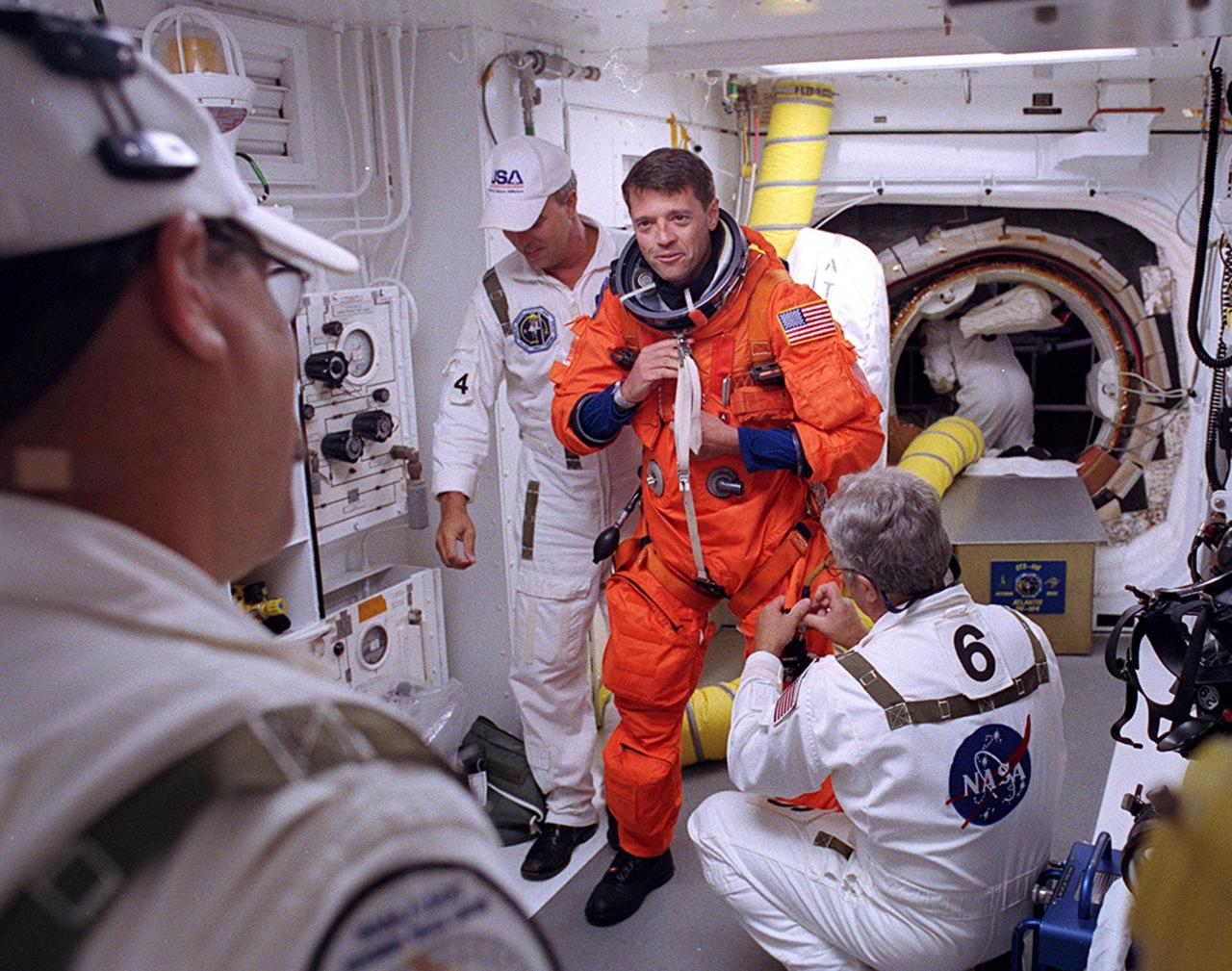
KENNEDY SPACE CENTER, FLA. - -- In the White Room at Launch Pad 39B, STS-112 Commander Jeffrey Ashby receives assistance with his spacesuit before boarding Space Shuttle Atlantis. Liftoff is schedued for 3:46 p.m. EDT. Along with a crew of six, Atlantis will carry the S1 Integrated Truss Structure and the Crew and Equipment Translation Aid (CETA) Cart A to the International Space Station (ISS). The CETA is the first of two human-powered carts that will ride along the ISS railway, providing mobile work platforms for future spacewalking astronauts. On the 11-day mission, three spacewalks are planned to attach the S1 truss.
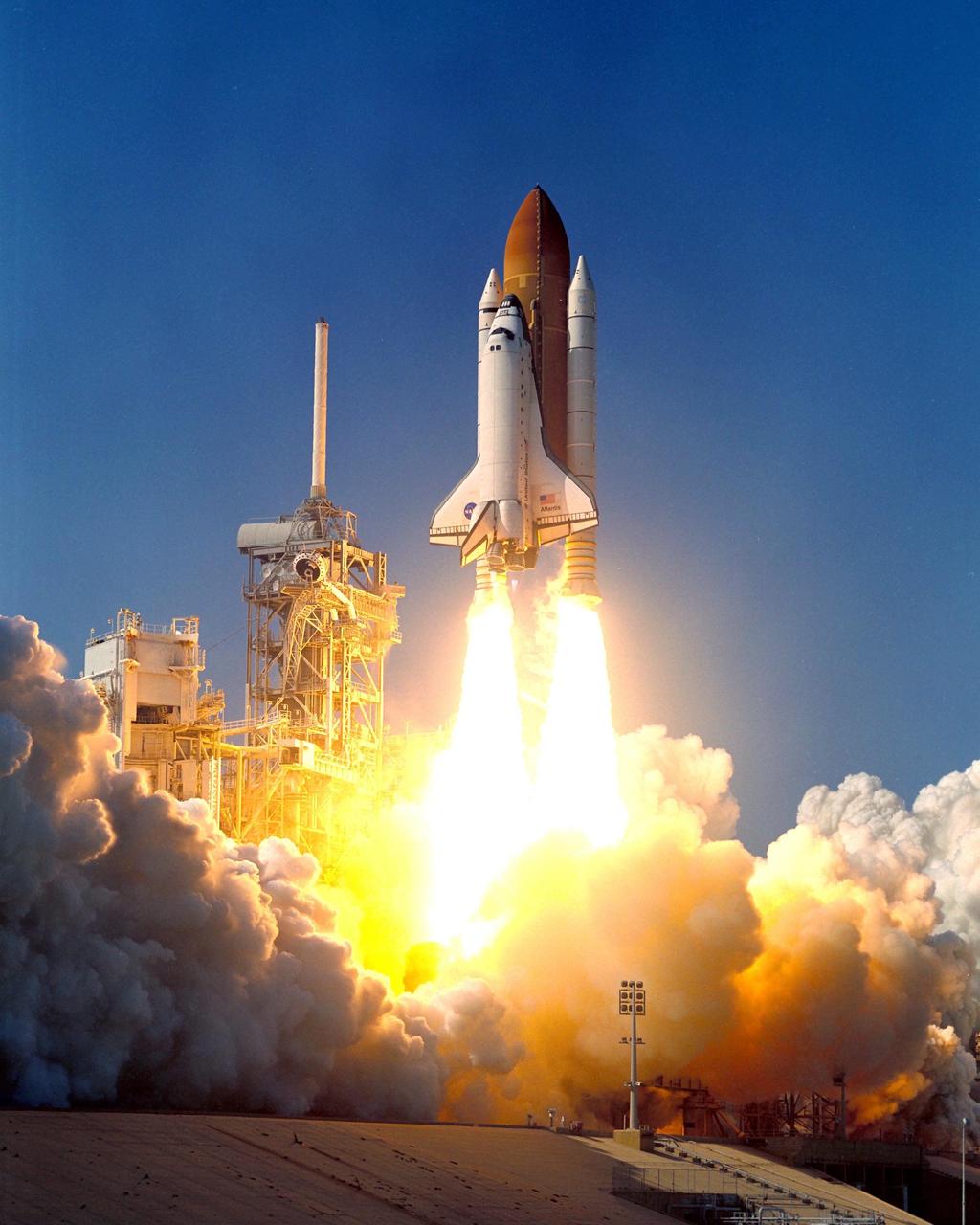
KENNEDY SPACE CENTER, FLA. - -- Space Shuttle Atlantis roars toward the clear blue sky and space as it begins its journey to the International Space Station (ISS) on mission STS-112. Liftoff occurred on time at 3:46 p.m. EDT. Along with a crew of six, Atlantis carries the S1 Integrated Truss Structure and the Crew and Equipment Translation Aid (CETA) Cart A to the Space Station. The CETA is the first of two human-powered carts that will ride along the ISS railway, providing mobile work platforms for future spacewalking astronauts. On the 11-day mission, three spacewalks are planned to attach the S1 truss.
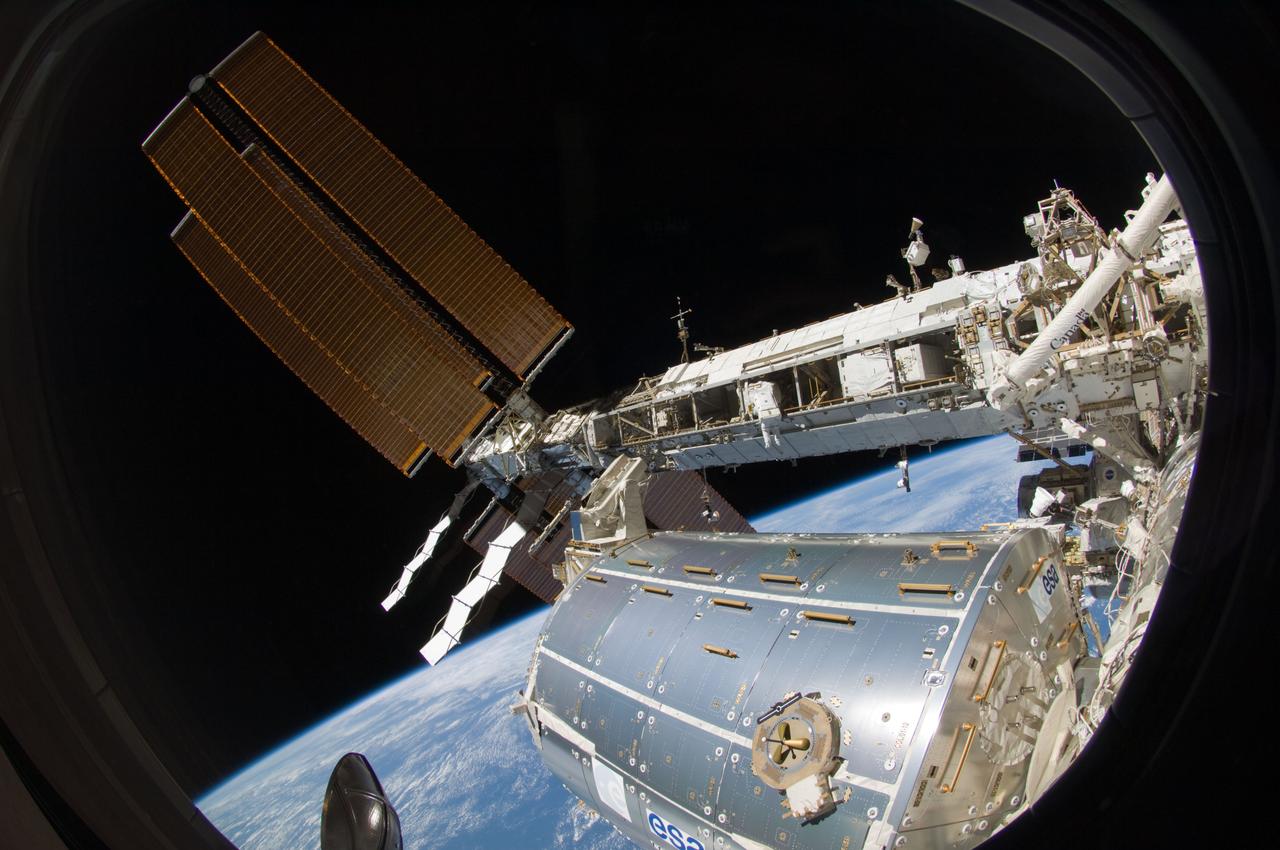
S119-E-007128 (23 March 2009) --- Astronaut Joseph Acaba, STS-119 mission specialist, participates in the mission's third scheduled session of extravehicular activity (EVA) as construction and maintenance continue on the International Space Station. During the six-hour, 27-minute spacewalk, Acaba and Richard Arnold (out of frame), mission specialist, helped robotic arm operators relocate the Crew Equipment Translation Aid (CETA) cart from the Port 1 to Starboard 1 truss segment, installed a new coupler on the CETA cart, lubricated snares on the "B" end of the space station's robotic arm and performed a few "get ahead" tasks.

KENNEDY SPACE CENTER, FLA. - -- Space Shuttle Atlantis races toward space just after liftoff from Launch Pad 39B on mission STS-112. Liftoff occurred on time at 3:46 p.m. EDT. Along with a crew of six, Atlantis carries the S1 Integrated Truss Structure and the Crew and Equipment Translation Aid (CETA) Cart A to the International Space Station (ISS). The CETA is the first of two human-powered carts that will ride along the ISS railway, providing mobile work platforms for future spacewalking astronauts. On the 11-day mission, three spacewalks are planned to attach the S1 truss.
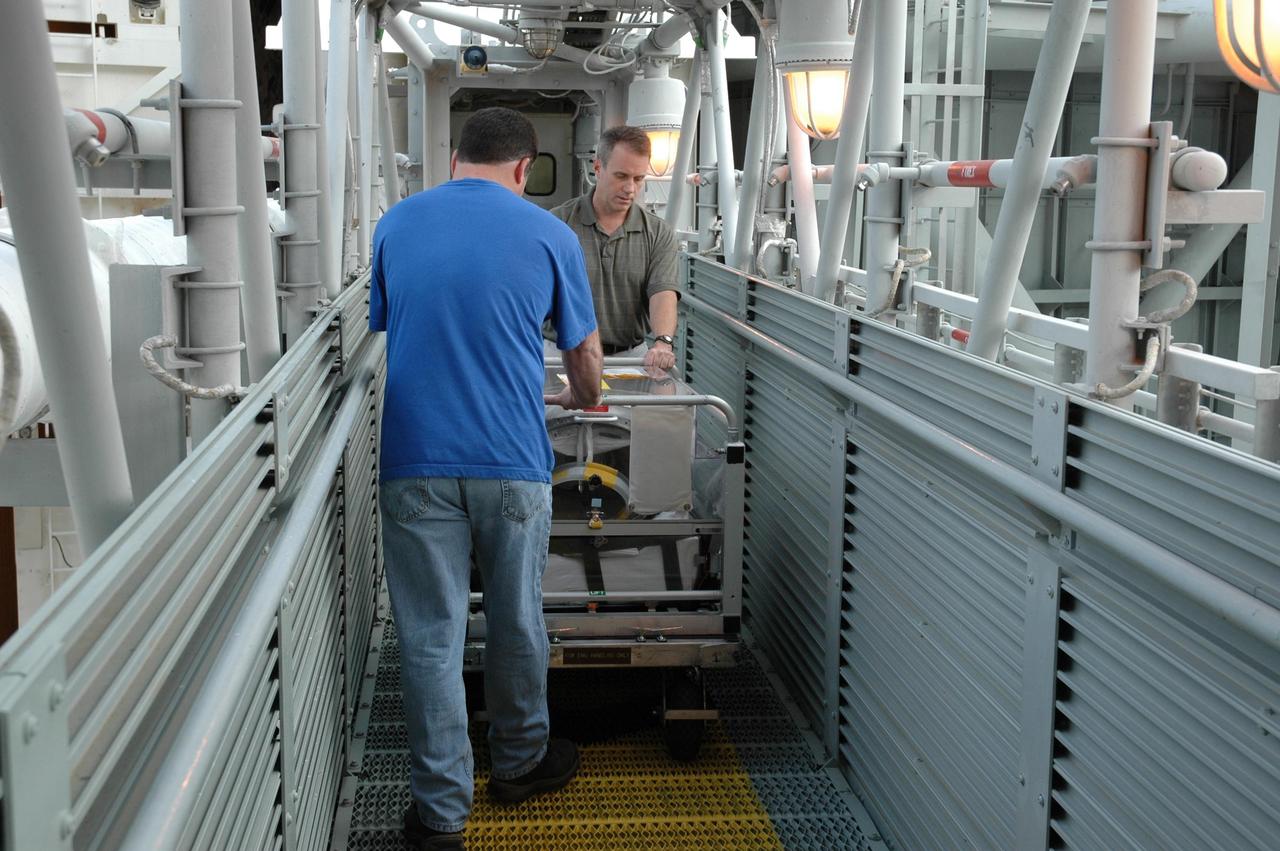
KENNEDY SPACE CENTER, FLA. -- Two workers on Launch Pad 39B maneuver a cart along the orbiter access arm toward the White Room. The cart contains the extravehicular mobility units (or spacewalk suits) to be used on mission STS-116. The suits will be stored inside Space Shuttle Discovery, which has access from the White Room. Launch of Discovery is scheduled for 9:35 p.m. Dec. 7. The crew will deliver the P5 integrated truss to the International Space Station and install it during one or more extravehicular activities. Photo credit: NASA/Jack Pfaller
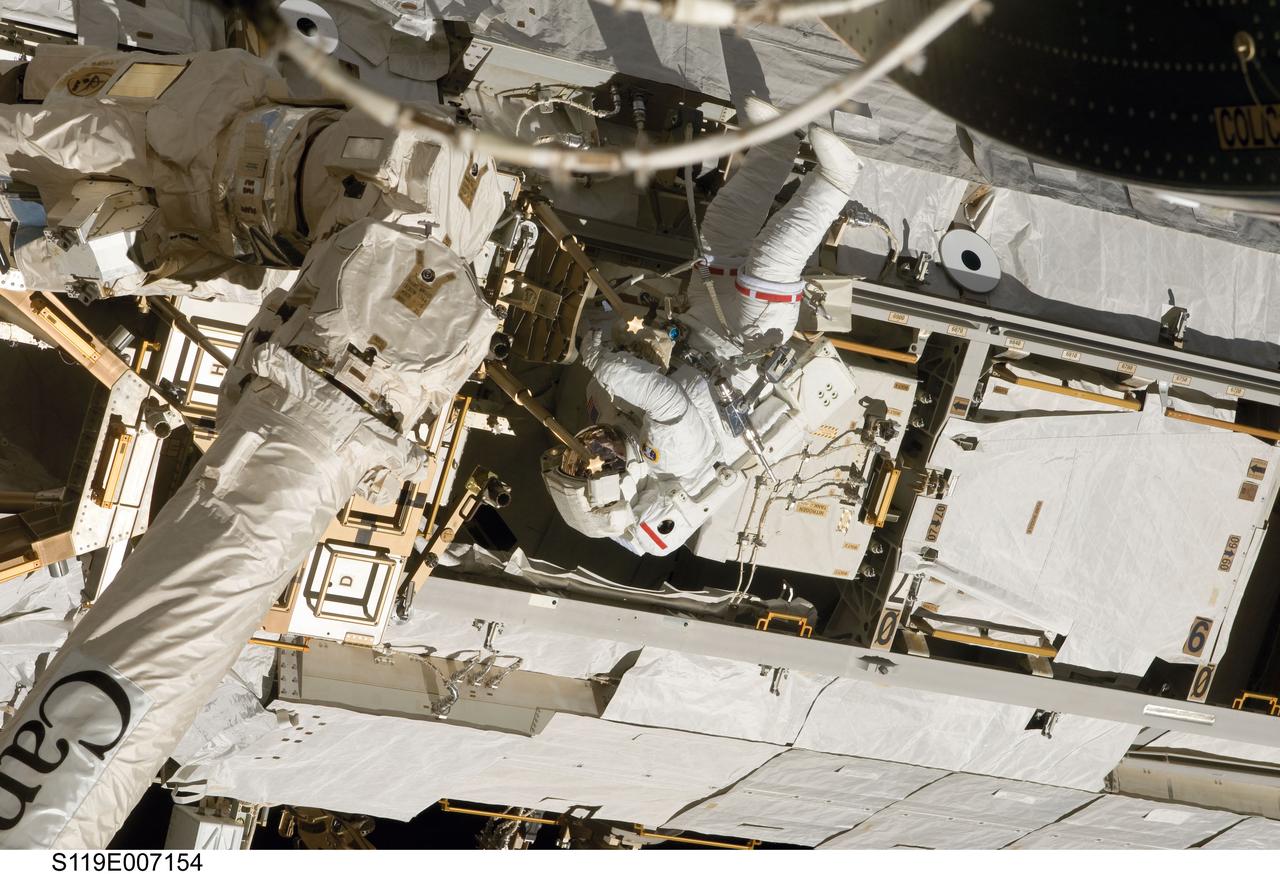
S119-E-007154 (23 March 2009) --- Astronaut Joseph Acaba, STS-119 mission specialist, participates in the mission's third scheduled session of extravehicular activity (EVA) as construction and maintenance continue on the International Space Station. During the six-hour, 27-minute spacewalk, Acaba and Richard Arnold (out of frame), mission specialist, helped robotic arm operators relocate the Crew Equipment Translation Aid (CETA) cart from the Port 1 to Starboard 1 truss segment, installed a new coupler on the CETA cart, lubricated snares on the "B" end of the space station's robotic arm and performed a few "get ahead" tasks.

KENNEDY SPACE CENTER, FLA. - With a tail of flame burning white hot, Space Shuttle Atlantis leaps from the billowing steam and smoke on Launch Pad 39B after an on-time liftoff of 3:46 p.m. EDT on mission STS-112. Along with a crew of six, Atlantis carries the S1 Integrated Truss Structure and the Crew and Equipment Translation Aid (CETA) Cart A. The CETA is the first of two human-powered carts that will ride along the ISS railway, providing mobile work platforms for future spacewalking astronauts. On the 11-day mission, three spacewalks are planned to attach the S1 truss.
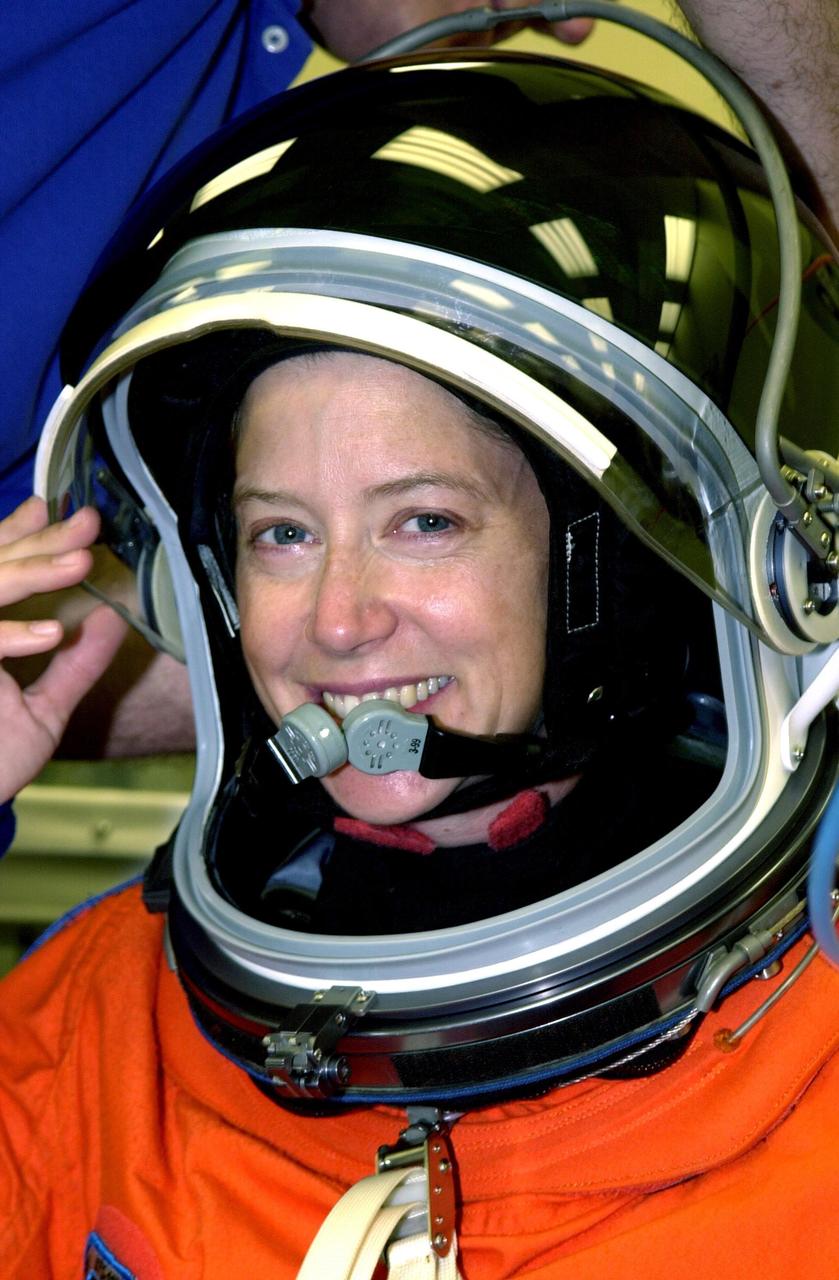
KENNEDY SPACE CENTER, FLA. -- STS-112 Pilot Pamela Melroy finishes suiting up for launch. STS-112 is the 15th assembly flight to the International Space Station, carrying the S1 Integrated Truss Structure and the Crew and Equipment Translation Aid (CETA) Cart A. The CETA is the first of two human-powered carts that will ride along the ISS railway, providing mobile work platforms for future spacewalking astronauts. On the 11-day mission, three spacewalks are planned to attach the S1 truss to the Station. Launch is scheduled for 3:46 p.m. EDT from Launch Pad 39B. .
![KENNEDY SPACE CENTER, FLA. -- Rising clouds of smoke and steam appear to surround Space Shuttle Atlantis as it hurtles toward space on mission STS-112. Liftoff occurred on time at 3:46 p.m. EDT. Along with a crew of six, Atlantis carries the S1 Integrated Truss Structure and the Crew and Equipment Translation Aid (CETA) Cart A. The CETA is the first of two human-powered carts that will ride along the ISS railway, providing mobile work platforms for future spacewalking astronauts. On the 11-day mission, three spacewalks are planned to attach the S1 truss. [Photo courtesy of Scott Andrews]](https://images-assets.nasa.gov/image/KSC-02pd1465/KSC-02pd1465~medium.jpg)
KENNEDY SPACE CENTER, FLA. -- Rising clouds of smoke and steam appear to surround Space Shuttle Atlantis as it hurtles toward space on mission STS-112. Liftoff occurred on time at 3:46 p.m. EDT. Along with a crew of six, Atlantis carries the S1 Integrated Truss Structure and the Crew and Equipment Translation Aid (CETA) Cart A. The CETA is the first of two human-powered carts that will ride along the ISS railway, providing mobile work platforms for future spacewalking astronauts. On the 11-day mission, three spacewalks are planned to attach the S1 truss. [Photo courtesy of Scott Andrews]
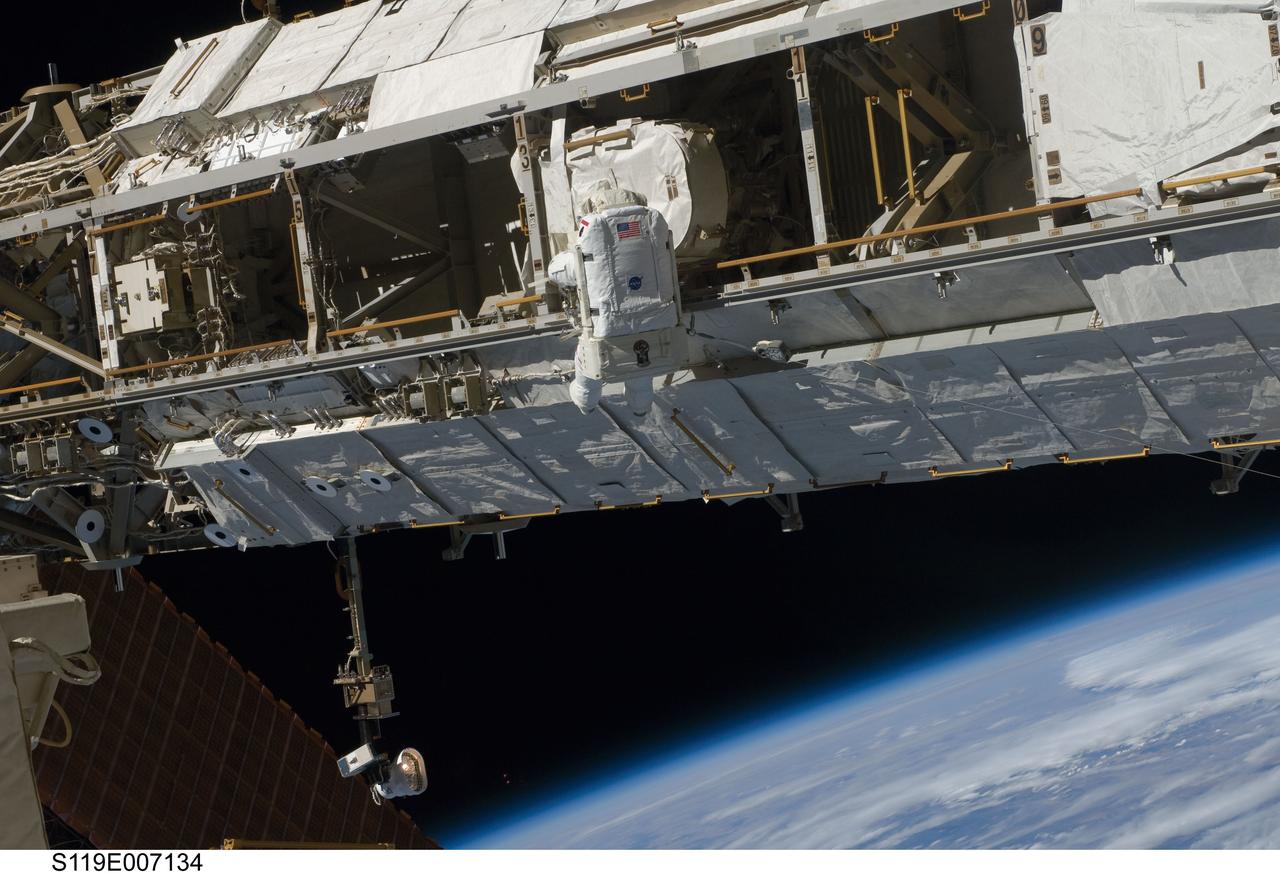
S119-E-007134 (23 March 2009) --- Astronaut Joseph Acaba, STS-119 mission specialist, participates in the mission's third scheduled session of extravehicular activity (EVA) as construction and maintenance continue on the International Space Station. During the six-hour, 27-minute spacewalk, Acaba and Richard Arnold (out of frame), mission specialist, helped robotic arm operators relocate the Crew Equipment Translation Aid (CETA) cart from the Port 1 to Starboard 1 truss segment, installed a new coupler on the CETA cart, lubricated snares on the "B" end of the space station's robotic arm and performed a few "get ahead" tasks.

ISS018-E-042538 (23 March 2009) --- Astronaut Joseph Acaba, STS-119 mission specialist, participates in the mission's third scheduled session of extravehicular activity (EVA) as construction and maintenance continue on the International Space Station. During the six-hour, 27-minute spacewalk, Acaba and Richard Arnold (out of frame), mission specialist, helped robotic arm operators relocate the Crew Equipment Translation Aid (CETA) cart from the Port 1 to Starboard 1 truss segment, installed a new coupler on the CETA cart, lubricated snares on the "B" end of the space station's robotic arm and performed a few "get ahead" tasks.
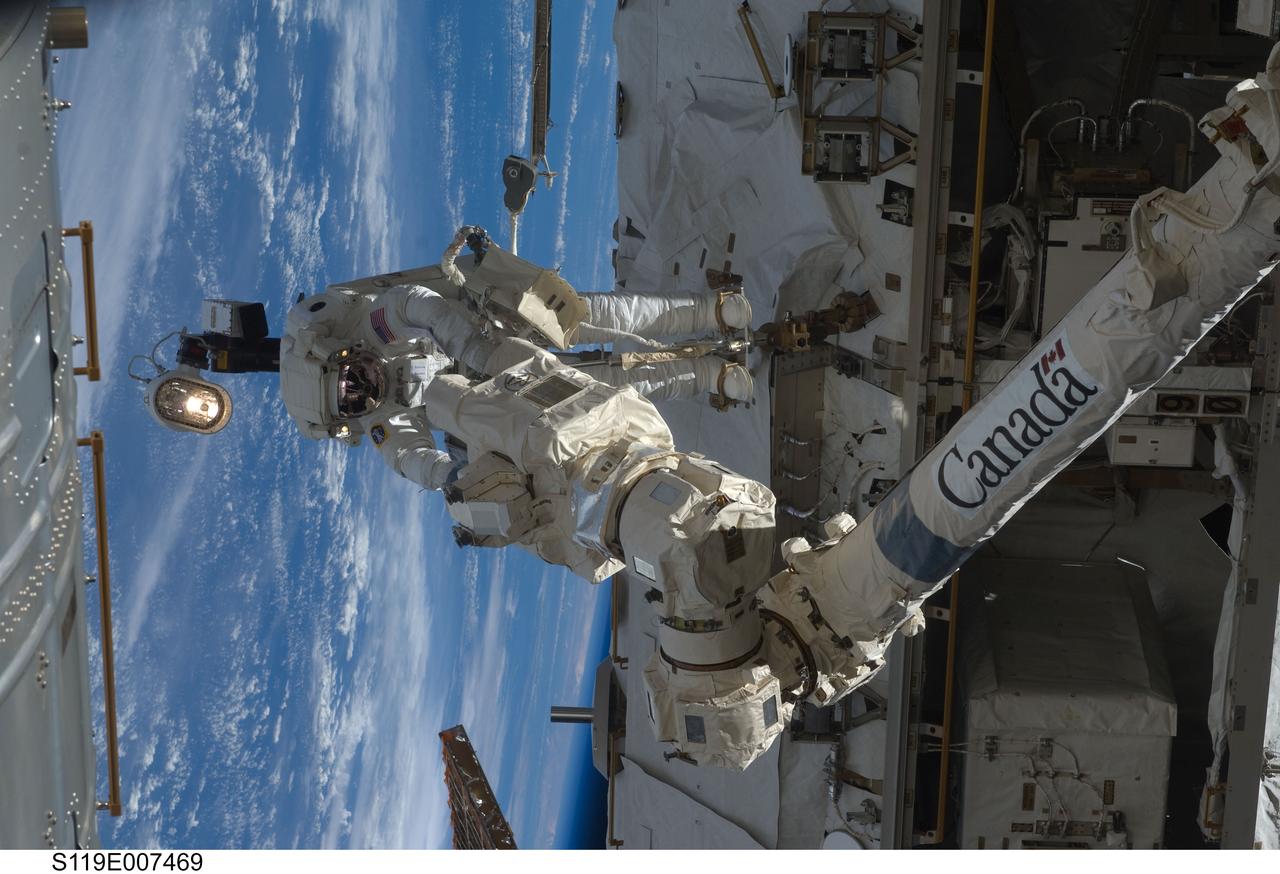
S119-E-007469 (23 March 2009) --- Astronaut Richard Arnold, STS-119 mission specialist, participates in the mission's third scheduled session of extravehicular activity (EVA) as construction and maintenance continue on the International Space Station. During the six-hour, 27-minute spacewalk, Arnold and Joseph Acaba (out of frame), mission specialist, helped robotic arm operators relocate the Crew Equipment Translation Aid (CETA) cart from the Port 1 to Starboard 1 truss segment, installed a new coupler on the CETA cart, lubricated snares on the "B" end of the space station's robotic arm and performed a few "get ahead" tasks.
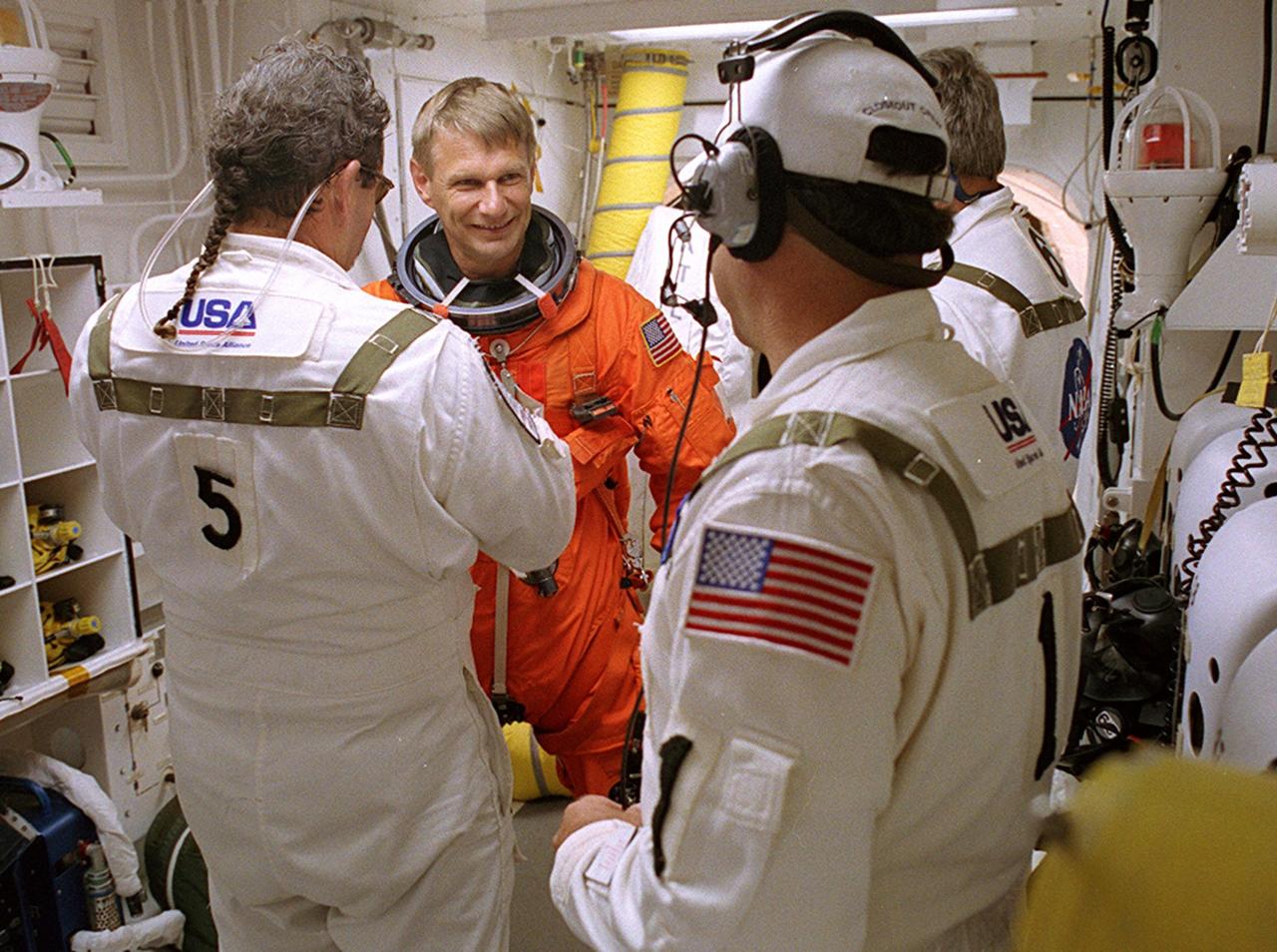
KENNEDY SPACE CENTER, FLA. - -- In the White Room at Launch Pad 39B, STS-112 Mission Specialist Piers J. Sellers, Ph.D., receives assistance with his spacesuit before boarding Space Shuttle Atlantis. Liftoff is schedued for 3:46 p.m. EDT. Along with a crew of six, Atlantis will carry the S1 Integrated Truss Structure and the Crew and Equipment Translation Aid (CETA) Cart A to the International Space Station (ISS). The CETA is the first of two human-powered carts that will ride along the ISS railway, providing mobile work platforms for future spacewalking astronauts. On the 11-day mission, three spacewalks are planned to attach the S1 truss.
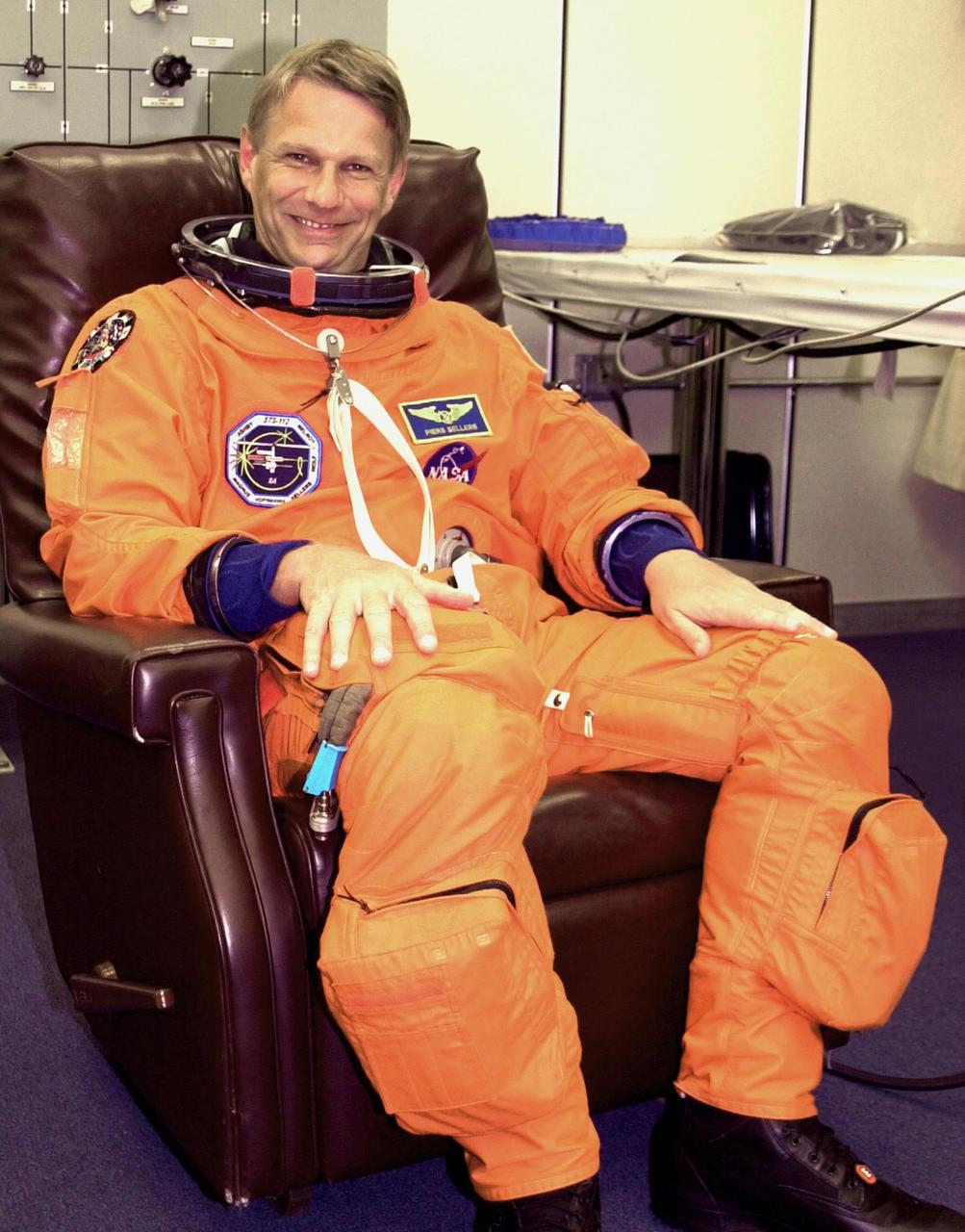
KENNEDY SPACE CENTER, FLA. - During suitup for launch, STS-112 Mission Specialist Piers Sellers smiles in anticipation of his first Shuttle flight. STS-112 is the 15th assembly flight to the International Space Station, carrying the S1 Integrated Truss Structure and the Crew and Equipment Translation Aid (CETA) Cart A. The CETA is the first of two human-powered carts that will ride along the ISS railway, providing mobile work platforms for future spacewalking astronauts. On the 11-day mission, three spacewalks are planned to attach the S1 truss to the Station. Launch is scheduled for 3:46 p.m. EDT from Launch Pad 39B.
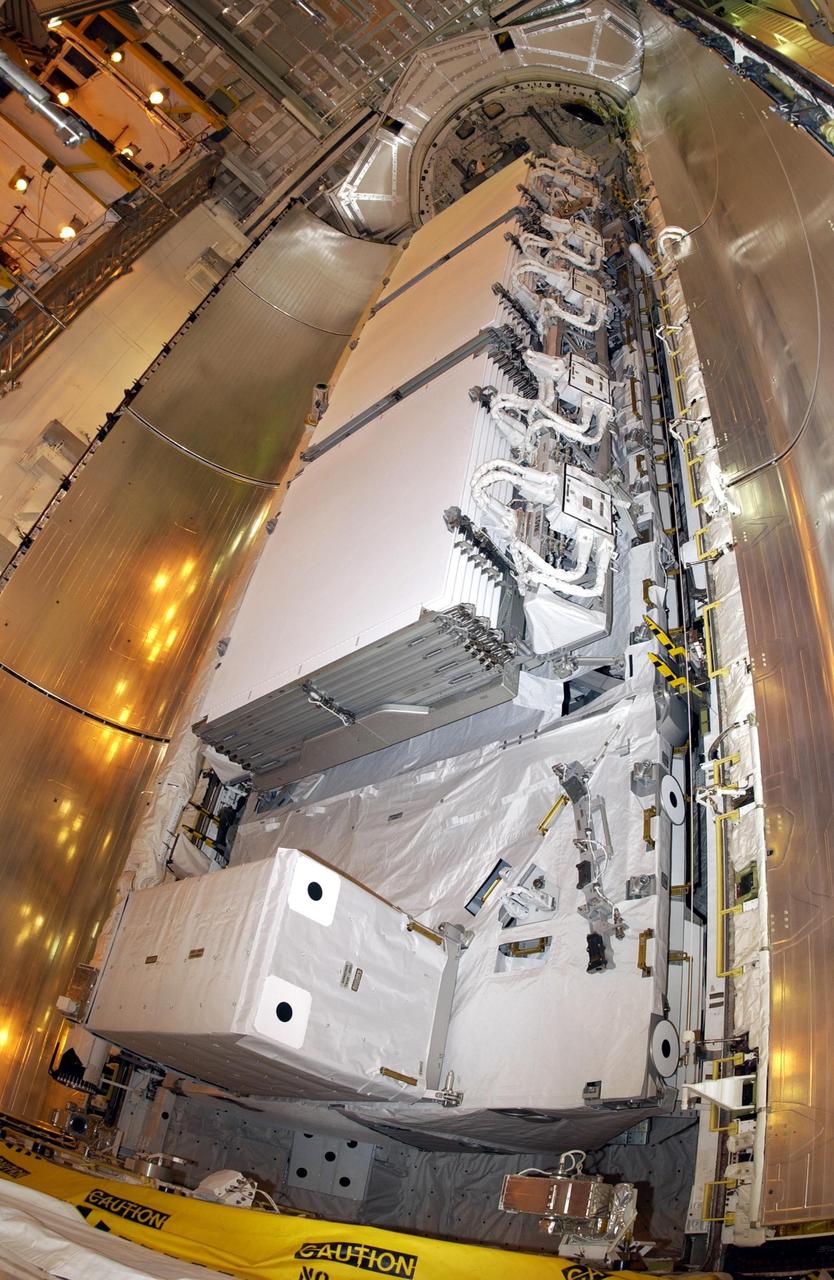
KENNEDY SPACE CENTER, FLA. -- -- The payload for mission STS-112 rests inside the payload bay of Space Shuttle Atlantis. The Shuttle is carrying the S1 Integrated Truss Structure, the first starboard truss segment, to be attached to the central truss segment, S0, plus the Crew and Equipment Translation Aid (CETA) Cart A. The CETA is the first of two human-powered carts that will ride along the ISS railway, providing mobile work platforms for future spacewalking astronauts. Launch of Atlantis is scheduled for Oct. 2 with a crew of six. The 11-day mission includes three spacewalks.
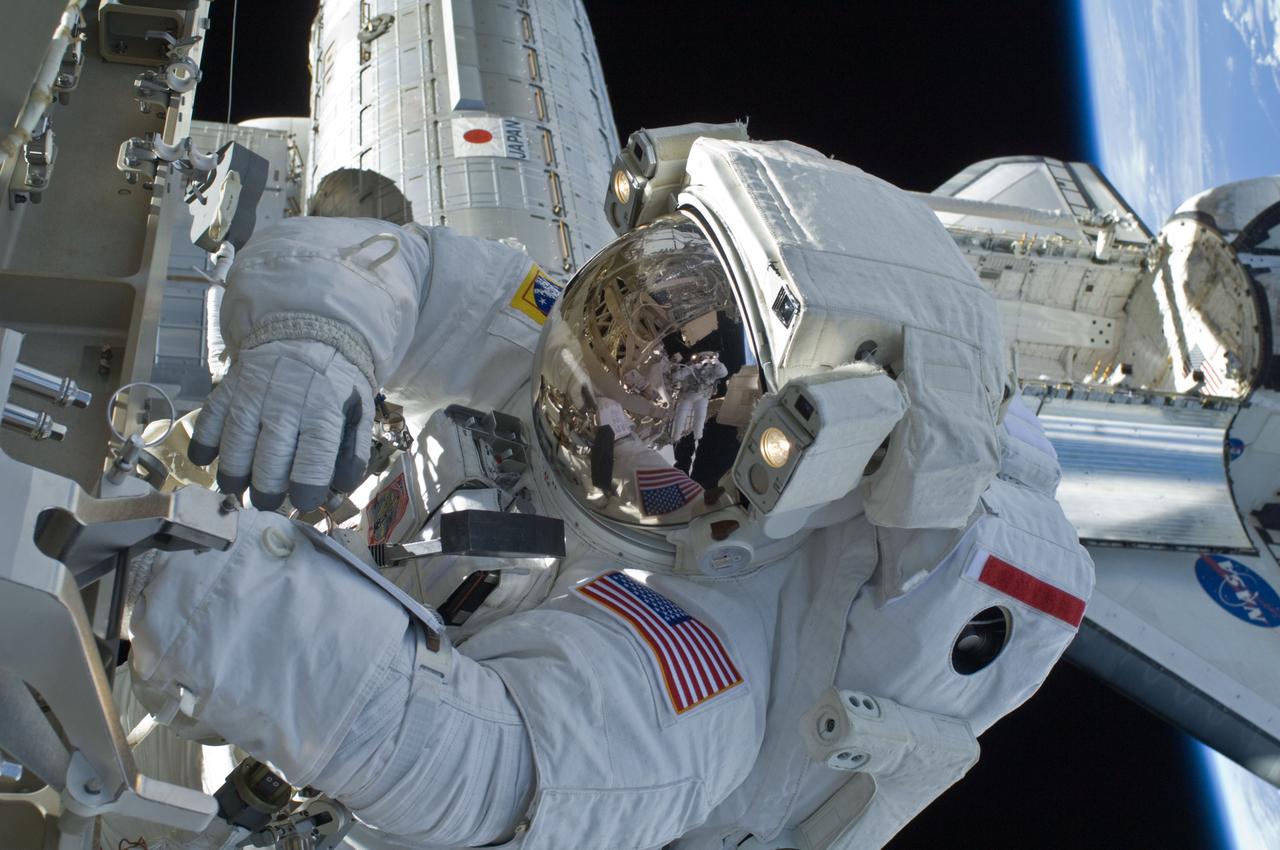
ISS018-E-042502 (23 March 2009) --- Astronaut Joseph Acaba, STS-119 mission specialist, participates in the mission's third scheduled session of extravehicular activity (EVA) as construction and maintenance continue on the International Space Station. During the six-hour, 27-minute spacewalk, Acaba and Richard Arnold (out of frame), mission specialist, helped robotic arm operators relocate the Crew Equipment Translation Aid (CETA) cart from the Port 1 to Starboard 1 truss segment, installed a new coupler on the CETA cart, lubricated snares on the "B" end of the space station's robotic arm and performed a few "get ahead" tasks.
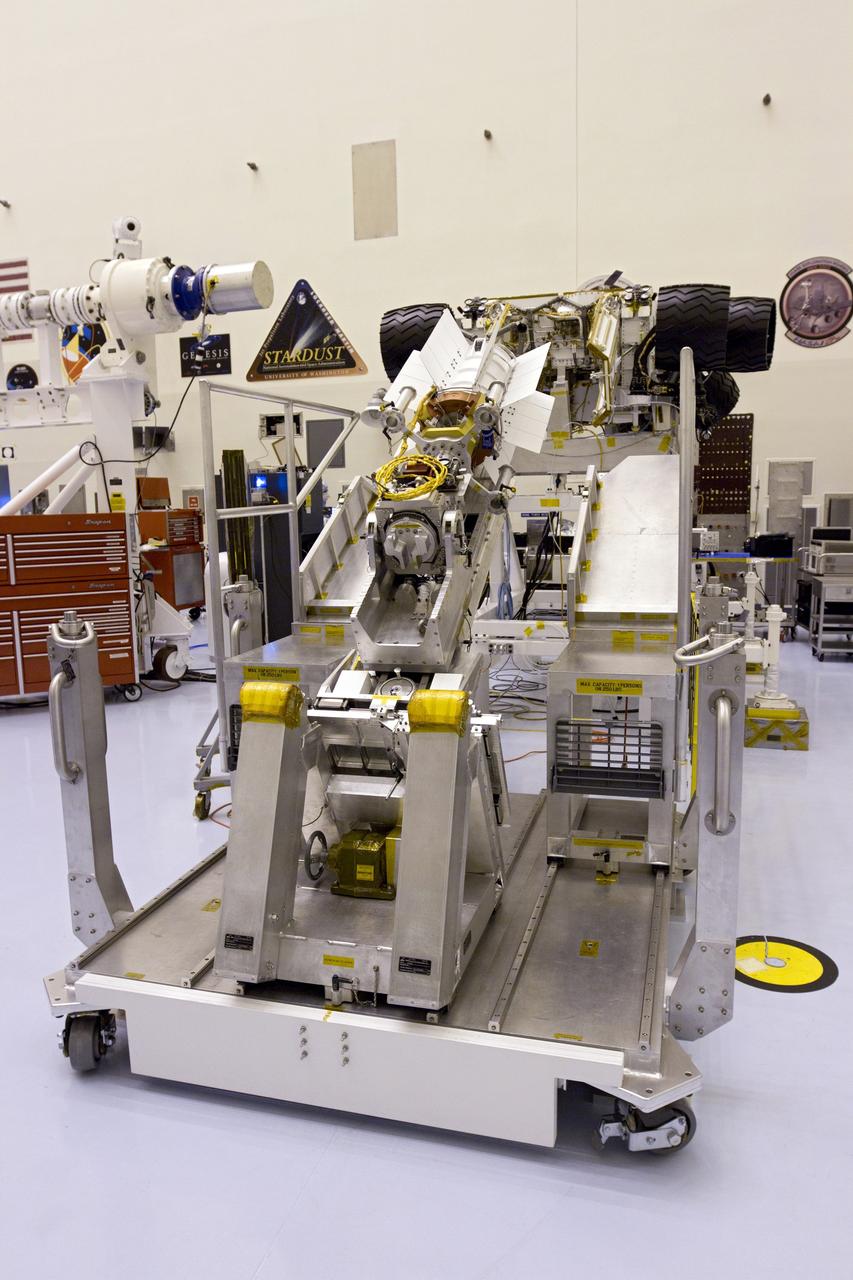
CAPE CANAVERAL, Fla. -- In the high bay of the Payload Hazardous Servicing Facility (PHSF) at NASA's Kennedy Space Center in Florida, the multi-mission radioisotope thermoelectric generator (MMRTG) for NASA's Mars Science Laboratory (MSL) mission is attached to the MMRTG integration cart. The cart will be used to install the MMRTG on the Curiosity rover for a fit check. The wheels of the rover appear to stick out on either side of the cart. The MMRTG will be installed on the rover for launch at the pad. The MMRTG will generate the power needed for the mission from the natural decay of plutonium-238, a non-weapons-grade form of the radioisotope. Heat given off by this natural decay will provide constant power through the day and night during all seasons. Curiosity, MSL's car-sized rover, has 10 science instruments designed to search for signs of life, including methane, and help determine if the gas is from a biological or geological source. Waste heat from the MMRTG will be circulated throughout the rover system to keep instruments, computers, mechanical devices and communications systems within their operating temperature ranges. Launch of MSL aboard a United Launch Alliance Atlas V rocket is planned for Nov. 25 from Space Launch Complex 41 on Cape Canaveral Air Force Station. For more information, visit http://www.nasa.gov/msl. Photo credit: NASA/Cory Huston
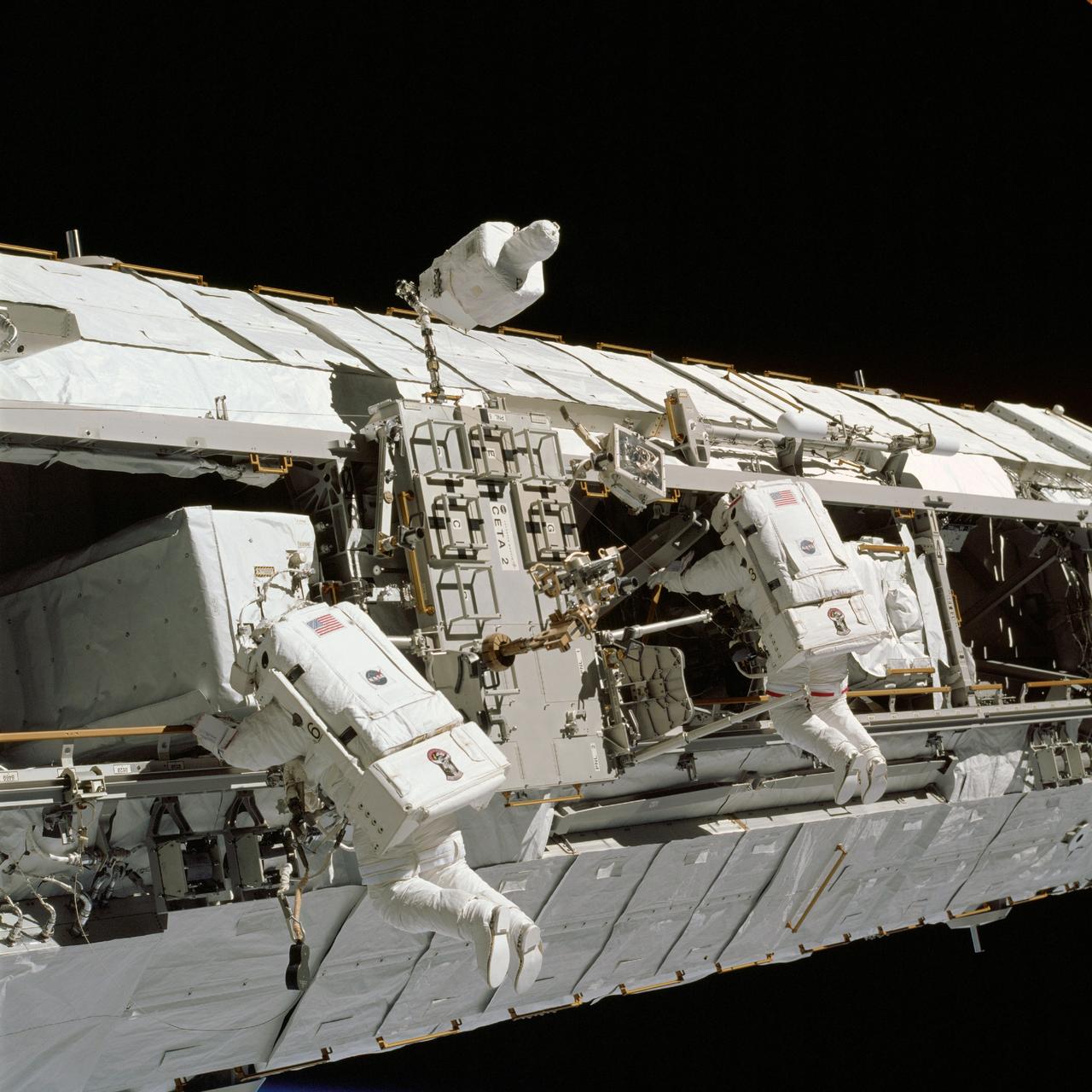
The 16th American assembly flight and 112th overall American flight to the International Space Station (ISS) launched on November 23, 2002 from Kennedy's launch pad 39A aboard the Space Shuttle Orbiter Endeavour STS-113. Mission objectives included the delivery of the Expedition Six Crew to the ISS, the return of Expedition Five crew back to Earth, the delivery of the Crew and Equipment Translation Aid (CETA) cart, and the installation and activation of the Port 1 Integrated Truss Assembly (P1). The first major component installed on the left side of the Station, the P1 truss provides an additional three External Thermal Control System radiators. Weighing in at 27,506 pounds, the P1 truss is 45 feet (13.7 meters) long, 15 feet (4.6 meters) wide, and 13 feet (4 meters) high. Three space walks, aided by the use of the Robotic Manipulator Systems of both the Shuttle and the Station, were performed in the installation of P1. In this photograph, astronauts and mission specialists John B. Herrington (left) and Michael E. Lopez-Alegria (right) work near the CETA cart on a truss on the ISS during a scheduled space walk for the mission. The final major task of the space walk was the relocation of the CETA cart from the Port One (P1) to the Starboard One (S1) Truss, which will allow the Mobile Transporter to move along the P1 to assist in upcoming assembly missions.
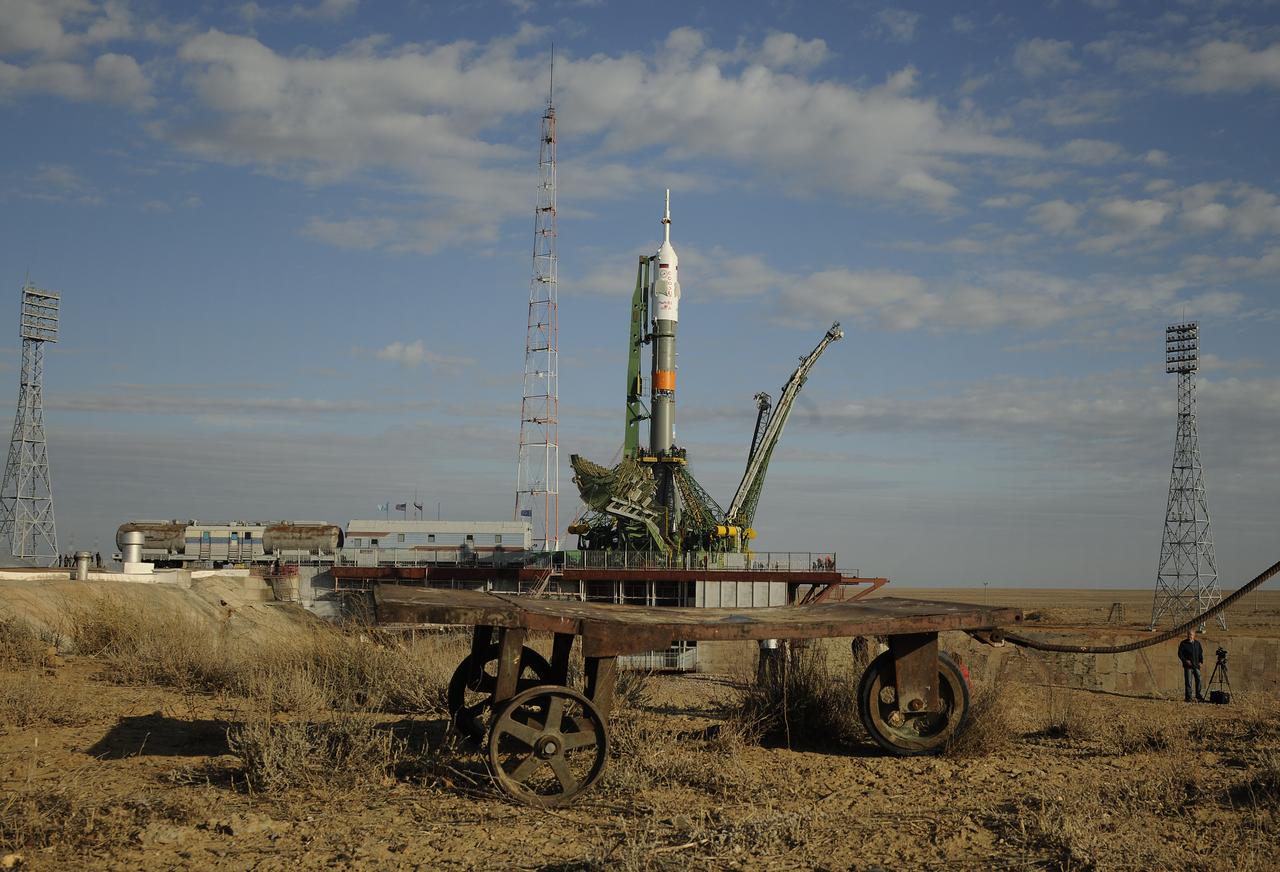
A cart is seen in front of the Soyuz TMA-01M spacecraft as it sits on the launch pad at the Baikonur Cosmodrome in Kazakhstan on Tuesday, Oct. 5, 2010. The TMA-01M is scheduled to launch the crew of Expedition 25 to the International Space Station on Friday, Oct. 8 at 5:10 a.m. local time. Photo Credit: (NASA/Carla Cioffi)
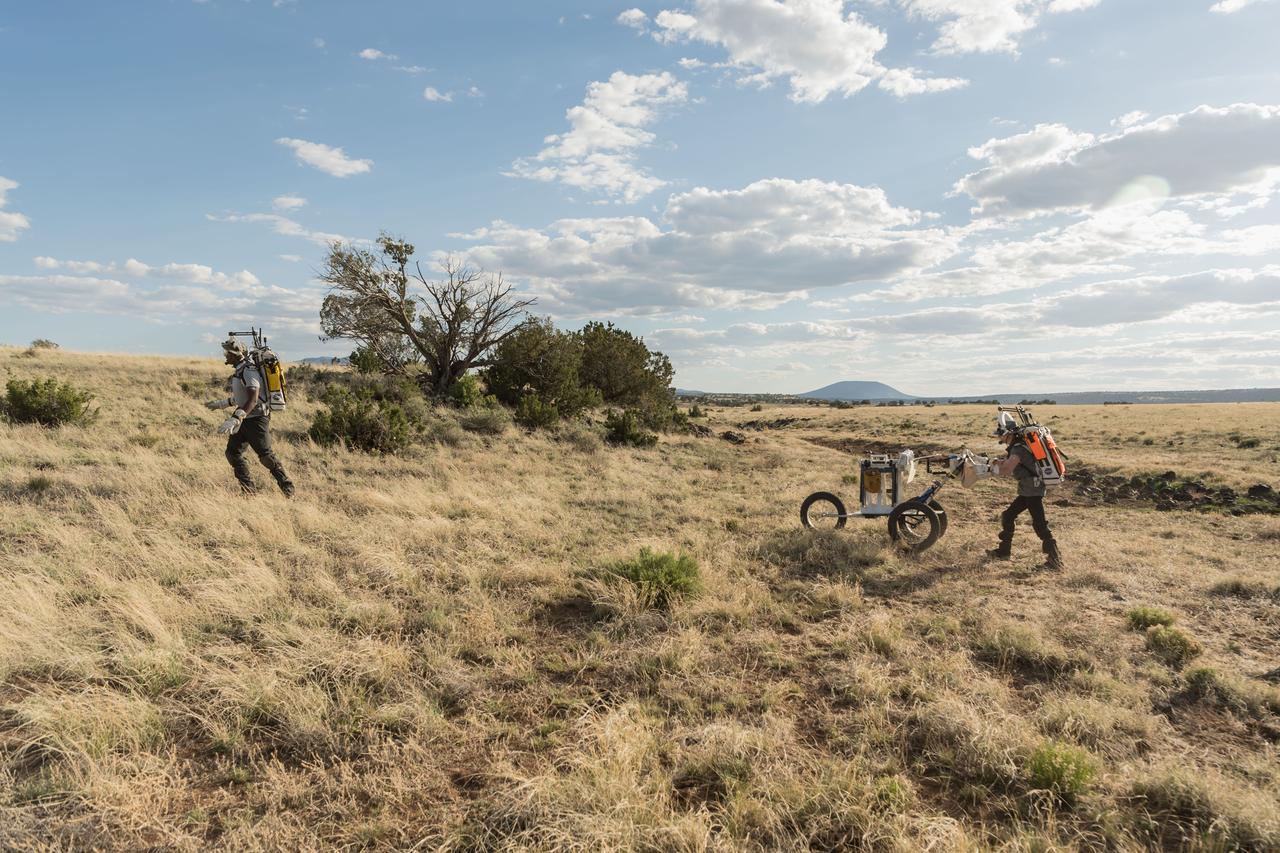
NASA astronaut Andre Douglas leads the way while NASA astronaut Kate Rubins follows behind with a lunar tool cart during a simulated moonwalk in the San Francisco Volcanic Field in Northern Arizona on May 17, 2024. Credit: NASA/Josh Valcarcel
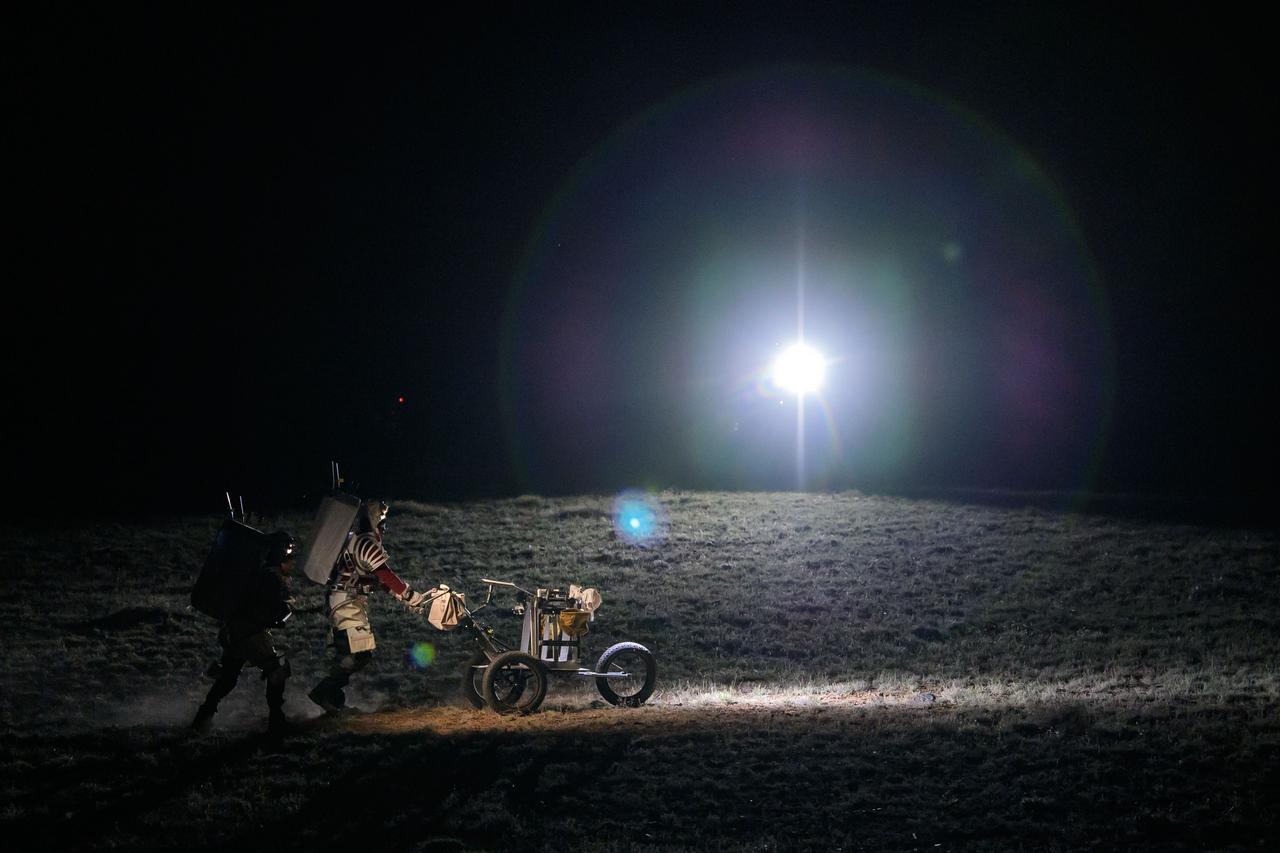
NASA astronaut Andre Douglas pushes a tool cart across the lunar-like landscape while NASA astronaut Kate Rubins follows close behind during a¬¬ nighttime simulated moonwalk in the San Francisco Volcanic Field in Northern Arizona on May 16, 2024. Credit: NASA/Josh Valcarcel
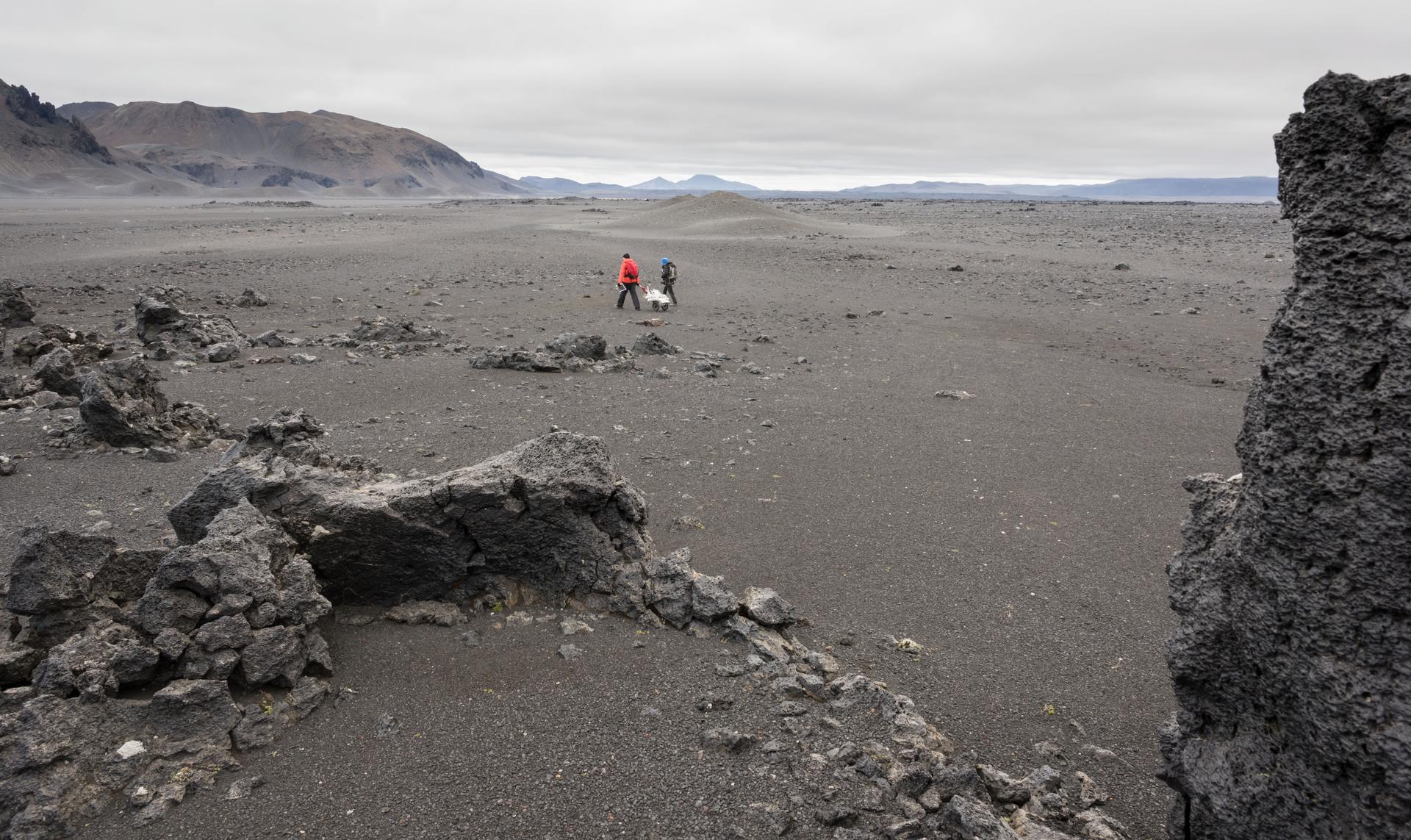
Participants in Artemis geology field training expedition walk a tool cart across a volcanic landscape in Iceland. Iceland’s diverse volcanic terrain is an excellent stand-in for lunar and planetary processes and provides an ideal environment in which to simulate surface science operations. Credit: NASA/James Blair
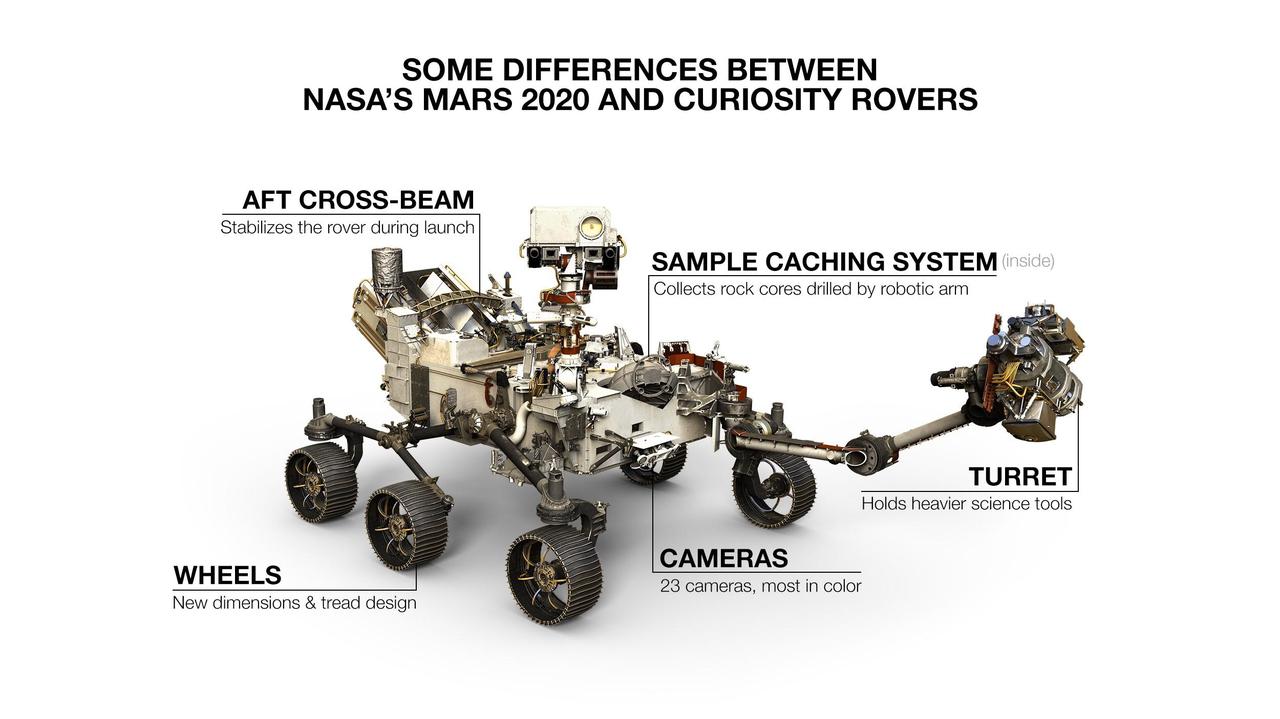
NASA's Mars 2020 rover looks virtually the same as Curiosity, but there are a number of differences. One giveaway to which rover you're looking at is 2020's aft cross-beam, which looks a bit like a shopping cart handle. https://photojournal.jpl.nasa.gov/catalog/PIA23516
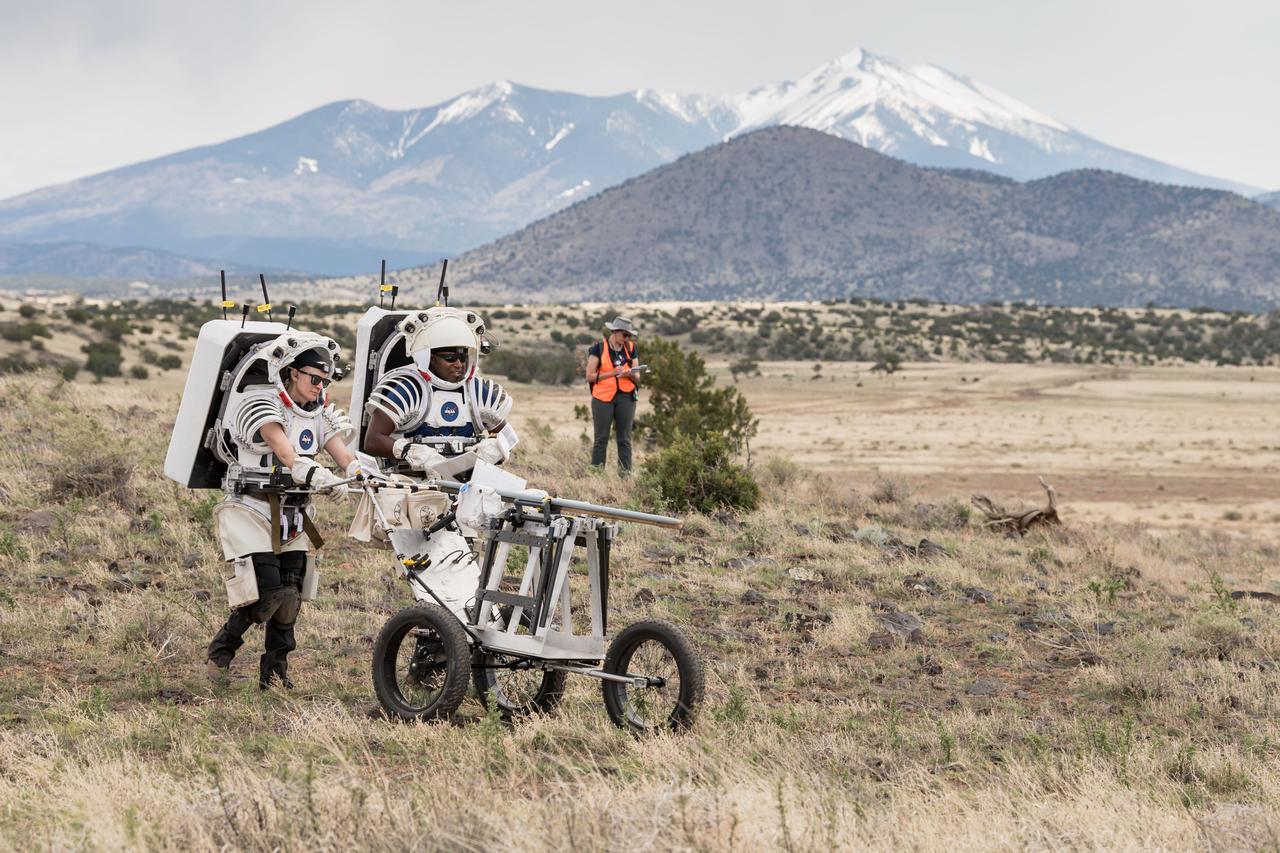
NASA astronauts Kate Rubins and Andre Douglas push a tool cart loaded with lunar tools through the San Francisco Volcanic Field north of Flagstaff, Arizona, as they practice moonwalking operations for Artemis III on May 13, 2024. Credit: NASA/Josh Valcarcel
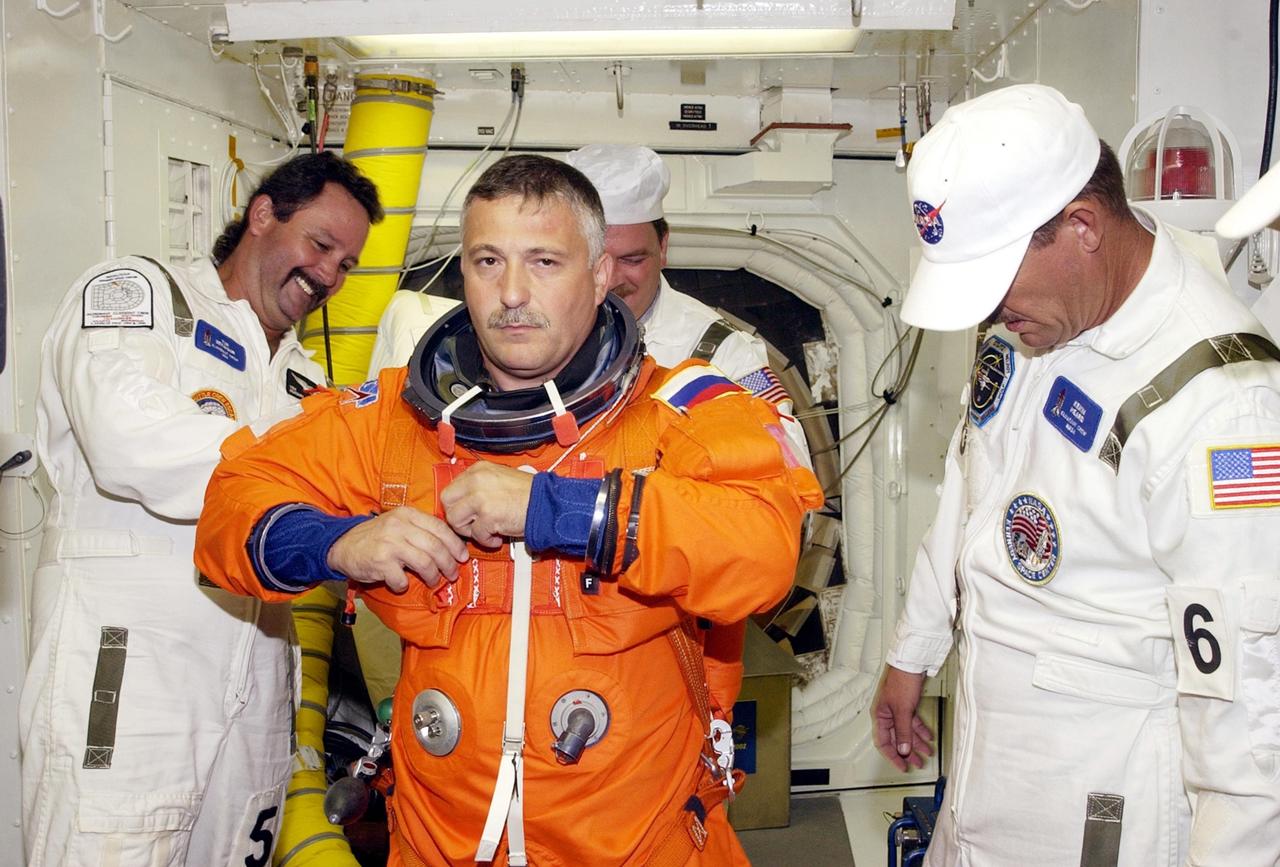
KENNEDY SPACE CENTER, FLA. -- In the White Room at Launch Pad 39B, STS-112 Mission Specialist Fyodor Yurchikhin, Ph.D., a cosmonaut with the Russian Space Agency, receives assistance with his spacesuit during a simulated launch countdown, part of Terminal Countdown Demonstration Test activities, a dress rehearsal for launch. Launch of STS-112 aboard Space Shuttle Atlantis is scheduled for Oct. 2, between 2 and 6 p.m. EDT. STS-112 is the 15th assembly mission to the International Space Station. Atlantis will be carrying the S1 Integrated Truss Structure, the first starboard truss segment, which will be attached to the central truss segment, S0, and the Crew and Equipment Translation Aid (CETA) Cart A. The CETA is the first of two human-powered carts that will ride along the ISS railway, providing mobile work platforms for future spacewalking astronauts.
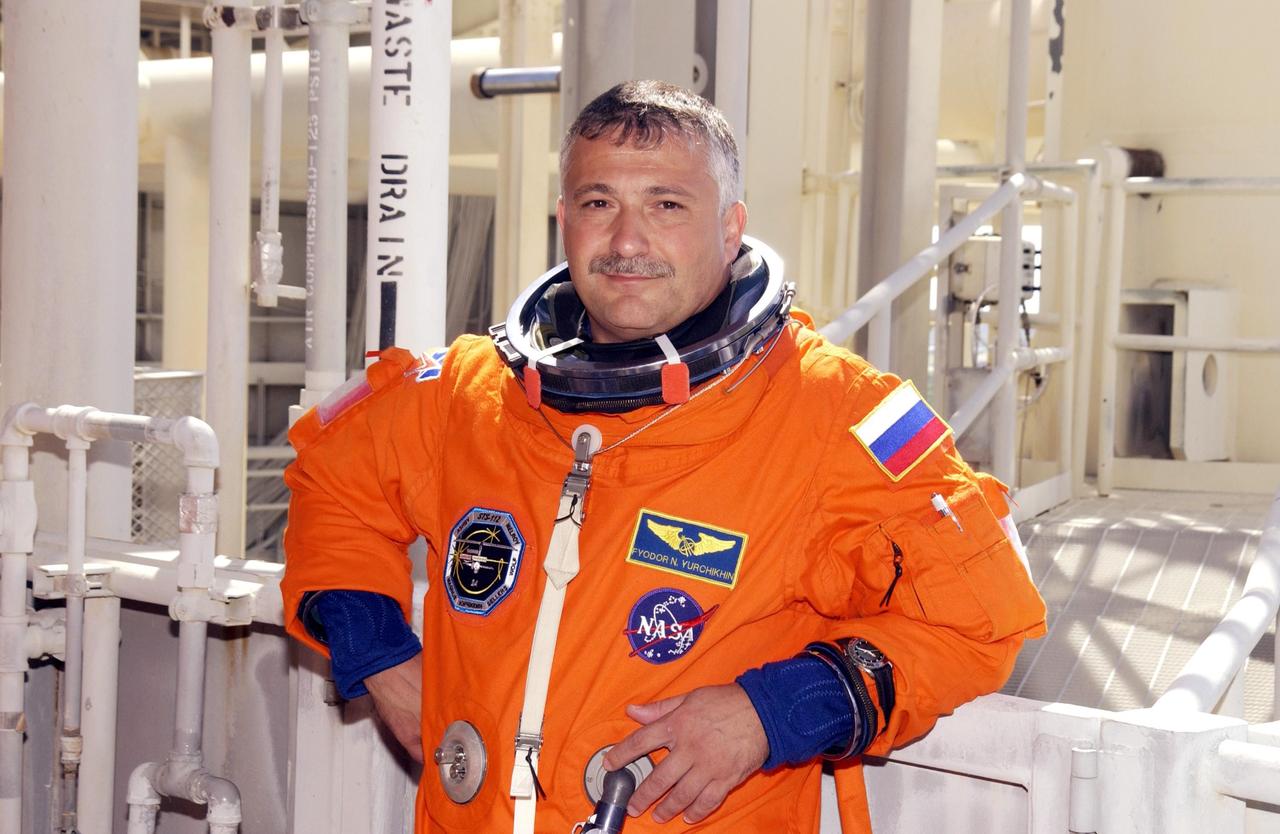
KENNEDY SPACE CENTER, FLA. - STS-112 Mission Specialist Fyodor Yurchikhin (with the Russian Space Agency) takes a break during emergency egress practice on the 195-foot level of the Fixed Service Structure, Launch Pad 39B. He and the rest of the crew are taking part in Terminal Countdown Demonstration Test activities, which include a simulated launch countdown. Mission STS-112 aboard Space Shuttle Atlantis is scheduled to launch no earlier than Oct. 2, between 2 and 6 p.m. EDT. STS-112 is the 15th assembly mission to the International Space Station. Atlantis will be carrying the S1 Integrated Truss Structure, the first starboard truss segment, to be attached to the central truss segment, S0, and the Crew and Equipment Translation Aid (CETA) Cart A. The CETA is the first of two human-powered carts that will ride along the ISS railway, providing mobile work platforms for future spacewalking astronauts.

KENNEDY SPACE CENTER, FLA. -- The STS-112 crew pauses for a photo after their arrival at the KSC Shuttle Landing Facility. Standing, left to right, are Mission Specialist Piers Sellers, Pilot Pamela Melroy, Commander Jeffrey Ashby, and Mission Specialists David Wolf, Sandra Magnus and cosmonaut Fyodor Yurchikhin. Sellers, Magnus and Yurchikhin are making their first Shuttle flights. STS-112, aboard Space Shuttle Atlantis, is the 15th assembly mission to the International Space Station. Atlantis will be carrying the S1 Integrated Truss Structure, the first starboard truss segment, to be attached to the central truss segment, S0, and the Crew and Equipment Translation Aid (CETA) Cart A. The CETA is the first of two human-powered carts that will ride along the ISS railway, providing mobile work platforms for future spacewalking astronauts. The 11-day mission includes three spacewalks. Launch is scheduled for Oct. 2 between 2 and 6 p.m.
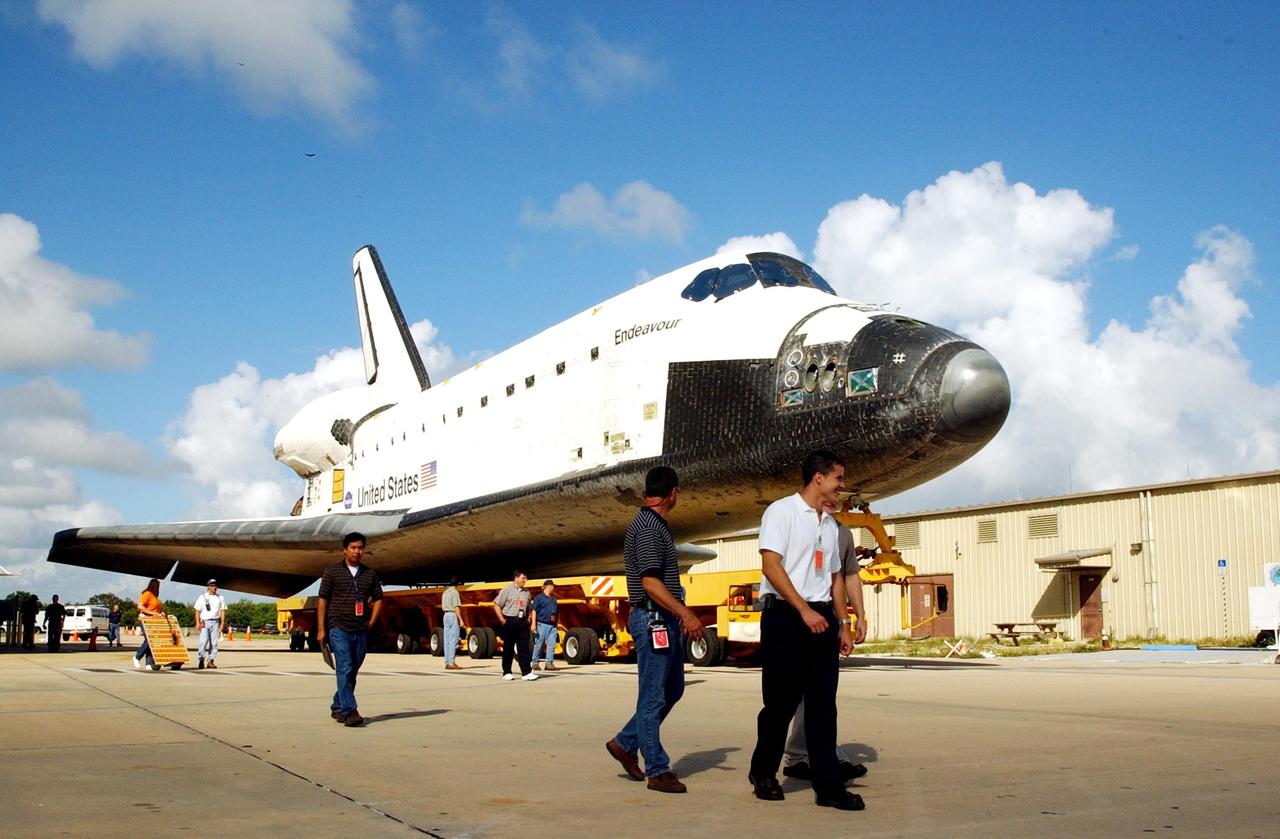
KENNEDY SPACE CENTER, FLA. - Workers walk alongside orbiter Endeavour as it rolls over to the Vehicle Assembly Building for continued launch preparations. Endeavour is scheduled to launch Nov. 10 on mission STS-113, the 16th assembly flight to the International Space Station. The primary payloads on mission STS-113 are the first port truss segment, P1 Truss and the Crew and Equipment Translation Aid (CETA) Cart B. Once delivered, the P1 truss will remain stowed until flight 12A.1 in 2003 when it will be attached to the central truss segment, S0, on the Space Station. The CETA Cart B can be used by spacewalkers to move along the truss with equipment The mission will also deliver the Expedition 6 crew to the Station and return Expedition 5 to Earth.

STS112-S-007 (7 October 2002) --- An automated camera records the launch of mission STS-112, the 15th assembly flight to the International Space Station. Liftoff from Launch Pad 39B occurred at 3:46 p.m. (EDT), October 7, 2002. Atlantis carried the S1 Integrated Truss Structure and the Crew and Equipment Translation Aid (CETA) Cart A. The CETA is the first of two human-powered carts that will ride along the ISS railway, providing mobile work platforms for future spacewalking astronauts. On the 11-day mission, three spacewalks were successful in attaching the S1 truss to the Station and performing other scheduled ISS work. The STS-112 crew members of Atlantis are Jeffrey S. Ashby, commander; Pamela A. Melroy, pilot; and David A. Wolf, Piers J. Sellers, Sandra H. Magnus and Rosaviakosmos' Fyodor N. Yurchikhin, all mission specialists.

STS112-S-006 (7 October 2002) --- A distantly-positioned camera records the launch of mission STS-112, the 15th assembly flight to the International Space Station. Liftoff from Launch Pad 39B occurred at 3:46 p.m. (EDT), October 7, 2002. Atlantis carried the S1 Integrated Truss Structure and the Crew and Equipment Translation Aid (CETA) Cart A. The CETA is the first of two human-powered carts that will ride along the ISS railway, providing mobile work platforms for future spacewalking astronauts. On the 11-day mission, three spacewalks were successful in attaching the S1 truss to the Station and performing other scheduled ISS work. The STS-112 crew members of Atlantis are Jeffrey S. Ashby, commander; Pamela A. Melroy, pilot; and David A. Wolf, Piers J. Sellers, Sandra H. Magnus and Rosaviakosmos' Fyodor N. Yurchikhin, all mission specialists.
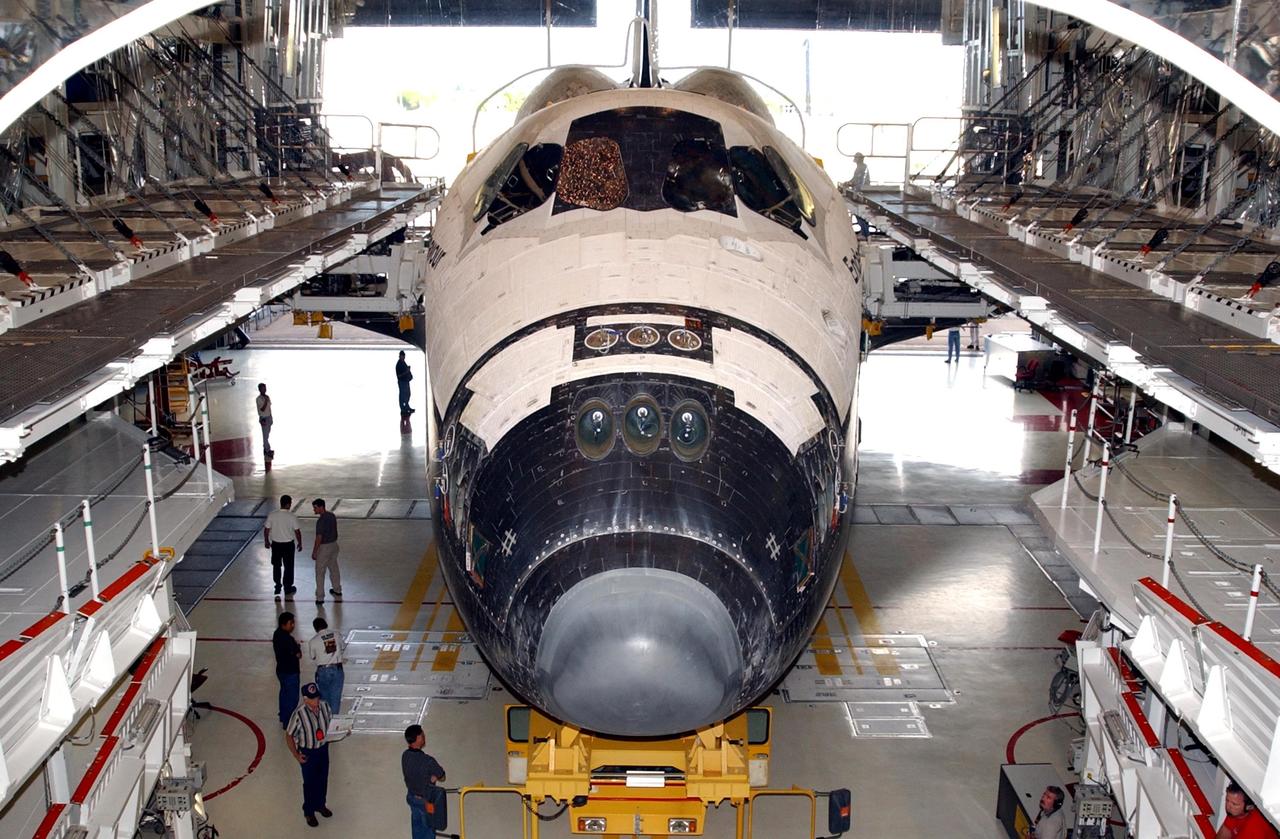
KENNEDY SPACE CENTER, FLA. -- Orbiter Endeavour is ready for rollover to the Vehicle Assembly Building for the next stage of launch preparations. Endeavour is scheduled to launch Nov. 10 on mission STS-113, the 16th assembly flight to the International Space Station. The primary payloads on mission STS-113 are the first port truss segment, P1 Truss and the Crew and Equipment Translation Aid (CETA) Cart B. . Once delivered, the P1 truss will remain stowed until flight 12A.1 in 2003 when it will be attached to the central truss segment, S0, on the Space Station. The CETA Cart B can be used by spacewalkers to move along the truss with equipment The mission will also deliver the Expedition 6 crew to the Station and return Expedition 5 to Earth.
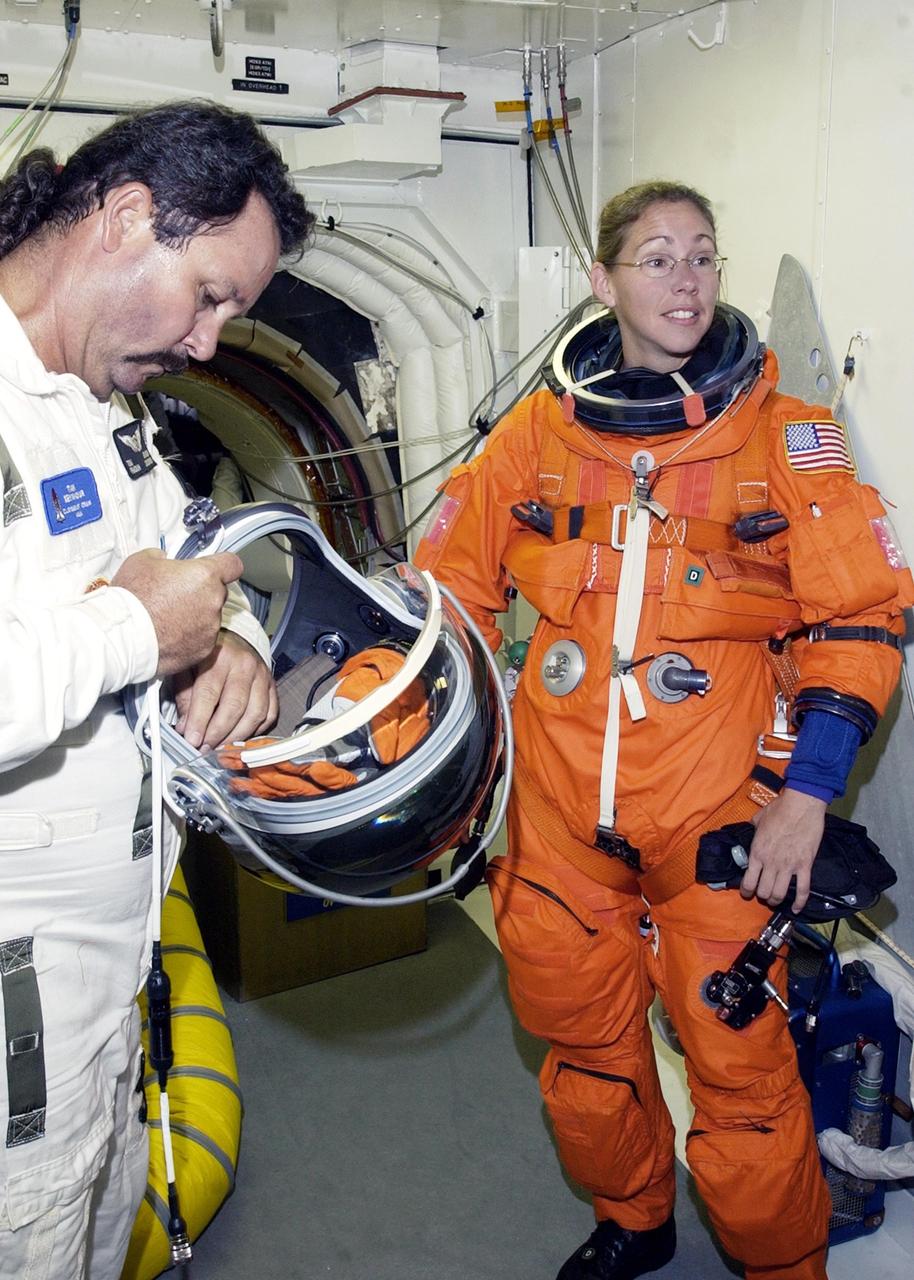
KENNEDY SPACE CENTER, FLA. -- In the White Room at Launch Pad 39B, STS-112 Mission Specialist Sandra Magnus, Ph.D., receives assistance with her spacesuit during a simulated launch countdown, part of Terminal Countdown Demonstration Test activities, a dress rehearsal for launch. Launch of STS-112 aboard Space Shuttle Atlantis is scheduled for Oct. 2, between 2 and 6 p.m. EDT. STS-112 is the 15th assembly mission to the International Space Station. Atlantis will be carrying the S1 Integrated Truss Structure, the first starboard truss segment, which will be attached to the central truss segment, S0, and the Crew and Equipment Translation Aid (CETA) Cart A. The CETA is the first of two human-powered carts that will ride along the ISS railway, providing mobile work platforms for future spacewalking astronauts.

KENNEDY SPACE CENTER, FLA. -- A closeup of Endeavour as it rolls over to the Vehicle Assembly Building for continued launch preparations. Endeavour is scheduled to launch Nov. 10 on mission STS-113, the 16th assembly flight to the International Space Station. The primary payloads on mission STS-113 are the first port truss segment, P1 Truss and the Crew and Equipment Translation Aid (CETA) Cart B. . Once delivered, the P1 truss will remain stowed until flight 12A.1 in 2003 when it will be attached to the central truss segment, S0, on the Space Station. The CETA Cart B can be used by spacewalkers to move along the truss with equipment The mission will also deliver the Expedition 6 crew to the Station and return Expedition 5 to Earth.

KENNEDY SPACE CENTER, FLA. -- STS-112 Commander Jeffrey Ashby takes a break during emergency egress practice on the 195-foot level of the Fixed Service Structure, Launch Pad 39B. He and the rest of the crew are taking part in Terminal Countdown Demonstration Test activities, which include a simulated launch countdown. Mission STS-112 aboard Space Shuttle Atlantis is scheduled to launch no earlier than Oct. 2, between 2 and 6 p.m. EDT. STS-112 is the 15th assembly mission to the International Space Station. Atlantis will be carrying the S1 Integrated Truss Structure, the first starboard truss segment, to be attached to the central truss segment, S0, and the Crew and Equipment Translation Aid (CETA) Cart A. The CETA is the first of two human-powered carts that will ride along the ISS railway, providing mobile work platforms for future spacewalking astronauts.