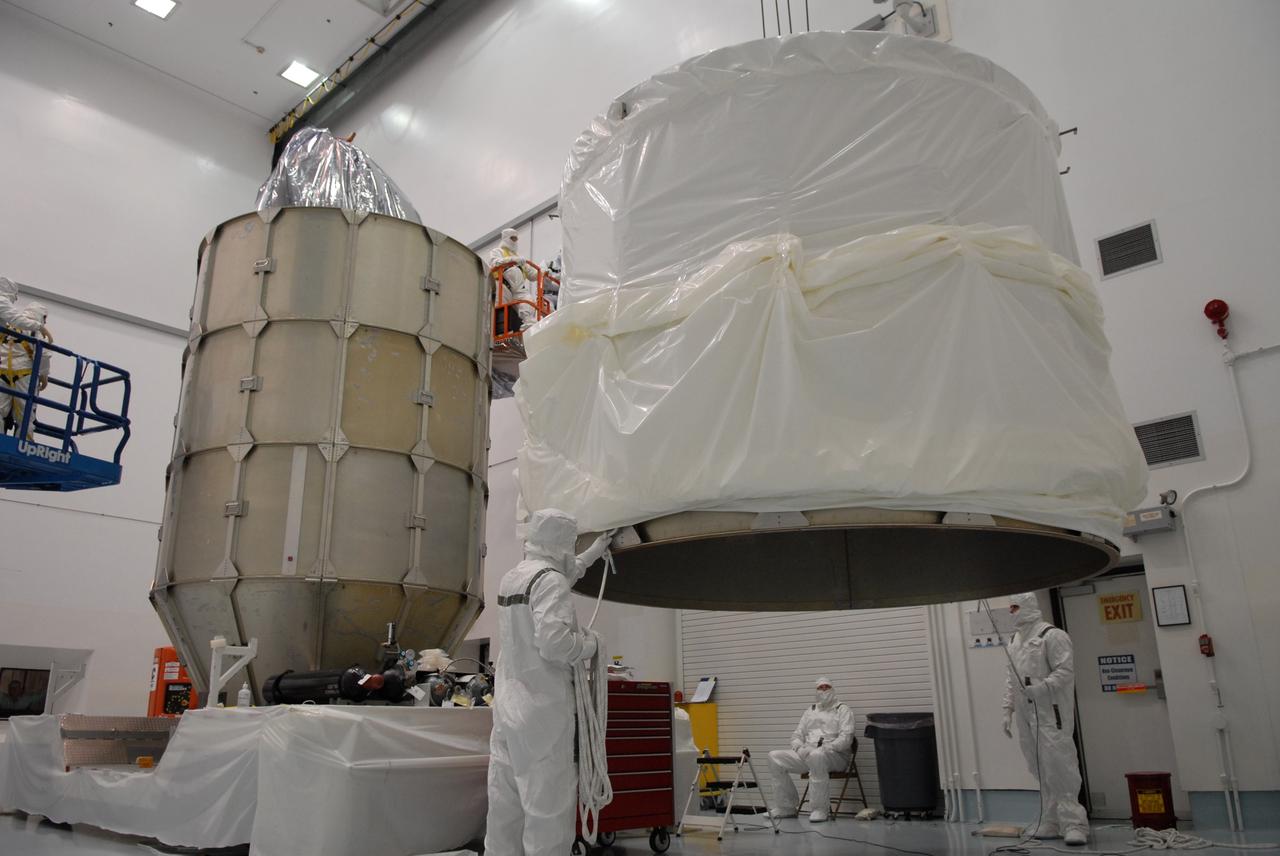
CAPE CANAVERAL, Fla. – At the Astrotech payload processing facility in Titusville, Fla., the top of the canister is lifted for a move to the unfinished canister at left. The canister surrounding NASA's Kepler spacecraft provides protection during the spacecraft's transport to the pad. The liftoff of Kepler aboard a Delta II rocket is currently targeted for 10:48 p.m. EST March 5 from Pad 17-B. Kepler is designed to survey more than 100,000 stars in our galaxy to determine the number of sun-like stars that have Earth-size and larger planets, including those that lie in a star's "habitable zone," a region where liquid water, and perhaps life, could exist. If these Earth-size worlds do exist around stars like our sun, Kepler is expected to be the first to find them and the first to measure how common they are. Photo credit: NASA/Troy Cryder
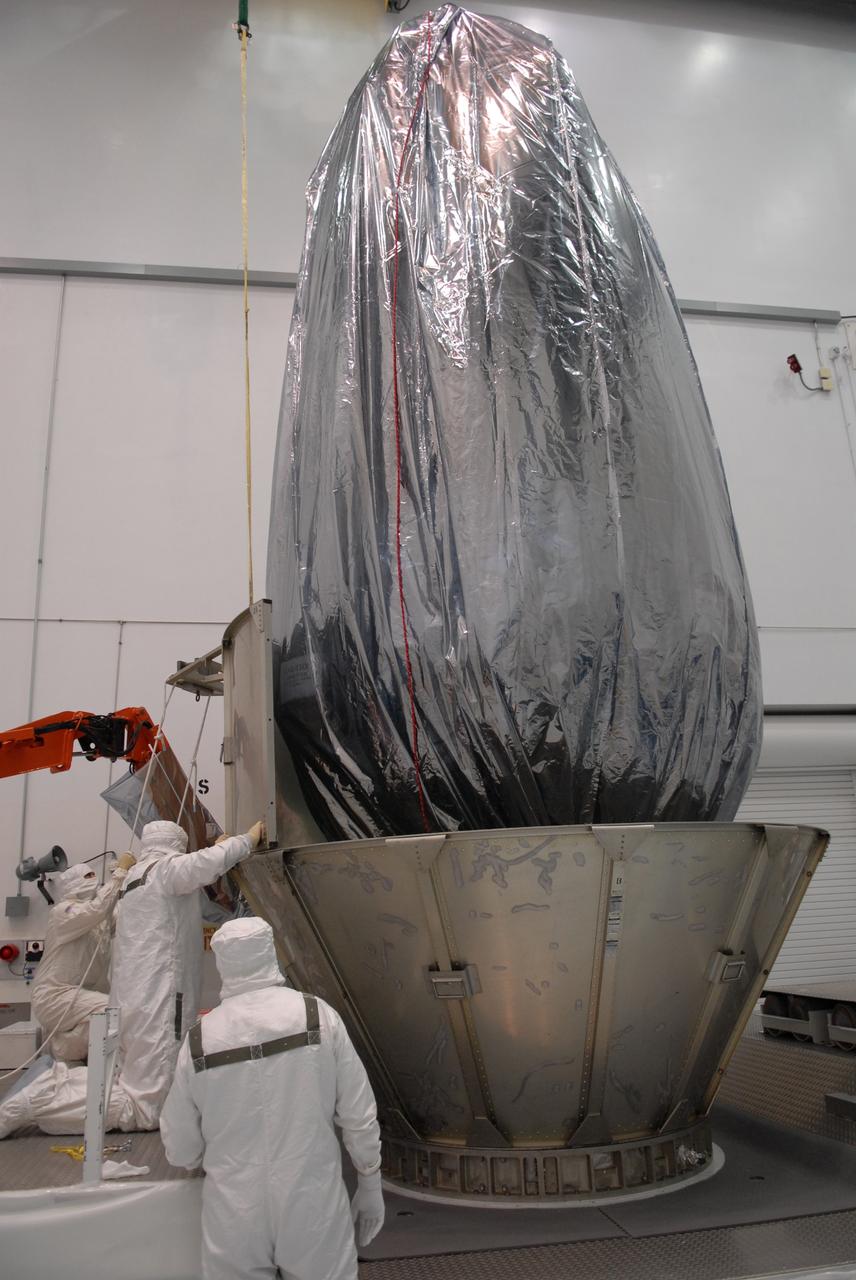
CAPE CANAVERAL, Fla. – At the Astrotech payload processing facility in Titusville, Fla., workers place the second row of canister segments around NASA's Kepler spacecraft. The "canning" provides protection during the spacecraft's transport to the pad. The liftoff of Kepler aboard a Delta II rocket is currently targeted for 10:48 p.m. EST March 5 from Pad 17-B. Kepler is designed to survey more than 100,000 stars in our galaxy to determine the number of sun-like stars that have Earth-size and larger planets, including those that lie in a star's "habitable zone," a region where liquid water, and perhaps life, could exist. If these Earth-size worlds do exist around stars like our sun, Kepler is expected to be the first to find them and the first to measure how common they are. Photo credit: NASA/Troy Cryder
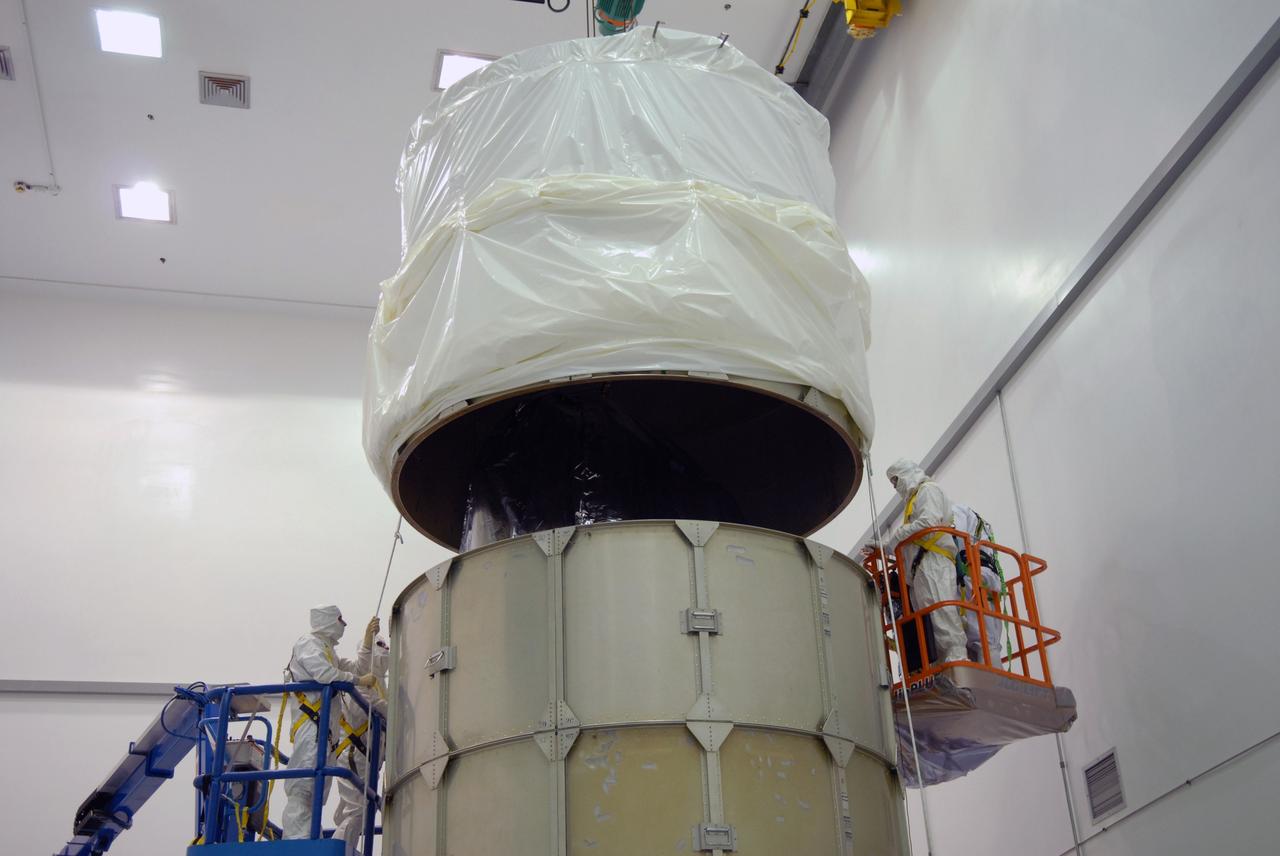
CAPE CANAVERAL, Fla. – At the Astrotech payload processing facility in Titusville, Fla., the top of the canister is lowered over NASA's Kepler spacecraft where it will be attached to the lower segments. The canister surrounding Kepler provides protection during the spacecraft's transport to the pad. The liftoff of Kepler aboard a Delta II rocket is currently targeted for 10:48 p.m. EST March 5 from Pad 17-B. Kepler is designed to survey more than 100,000 stars in our galaxy to determine the number of sun-like stars that have Earth-size and larger planets, including those that lie in a star's "habitable zone," a region where liquid water, and perhaps life, could exist. If these Earth-size worlds do exist around stars like our sun, Kepler is expected to be the first to find them and the first to measure how common they are. Photo credit: NASA/Troy Cryder
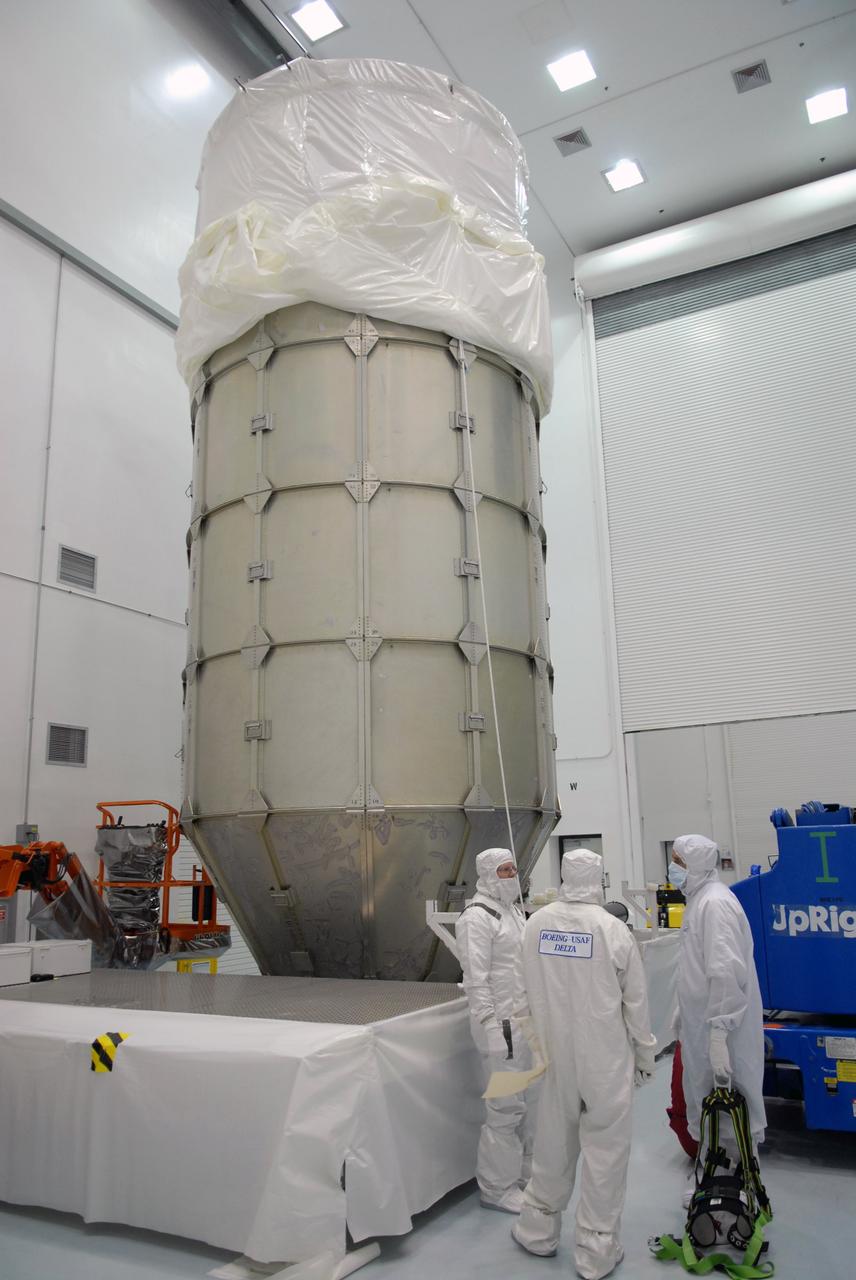
CAPE CANAVERAL, Fla. – At the Astrotech payload processing facility in Titusville, Fla., the top of the canister has been attached to the lower segments encasing NASA's Kepler spacecraft. The canister surrounding Kepler provides protection during the spacecraft's transport to the pad. The liftoff of Kepler aboard a Delta II rocket is currently targeted for 10:48 p.m. EST March 5 from Pad 17-B. Kepler is designed to survey more than 100,000 stars in our galaxy to determine the number of sun-like stars that have Earth-size and larger planets, including those that lie in a star's "habitable zone," a region where liquid water, and perhaps life, could exist. If these Earth-size worlds do exist around stars like our sun, Kepler is expected to be the first to find them and the first to measure how common they are. Photo credit: NASA/Troy Cryder
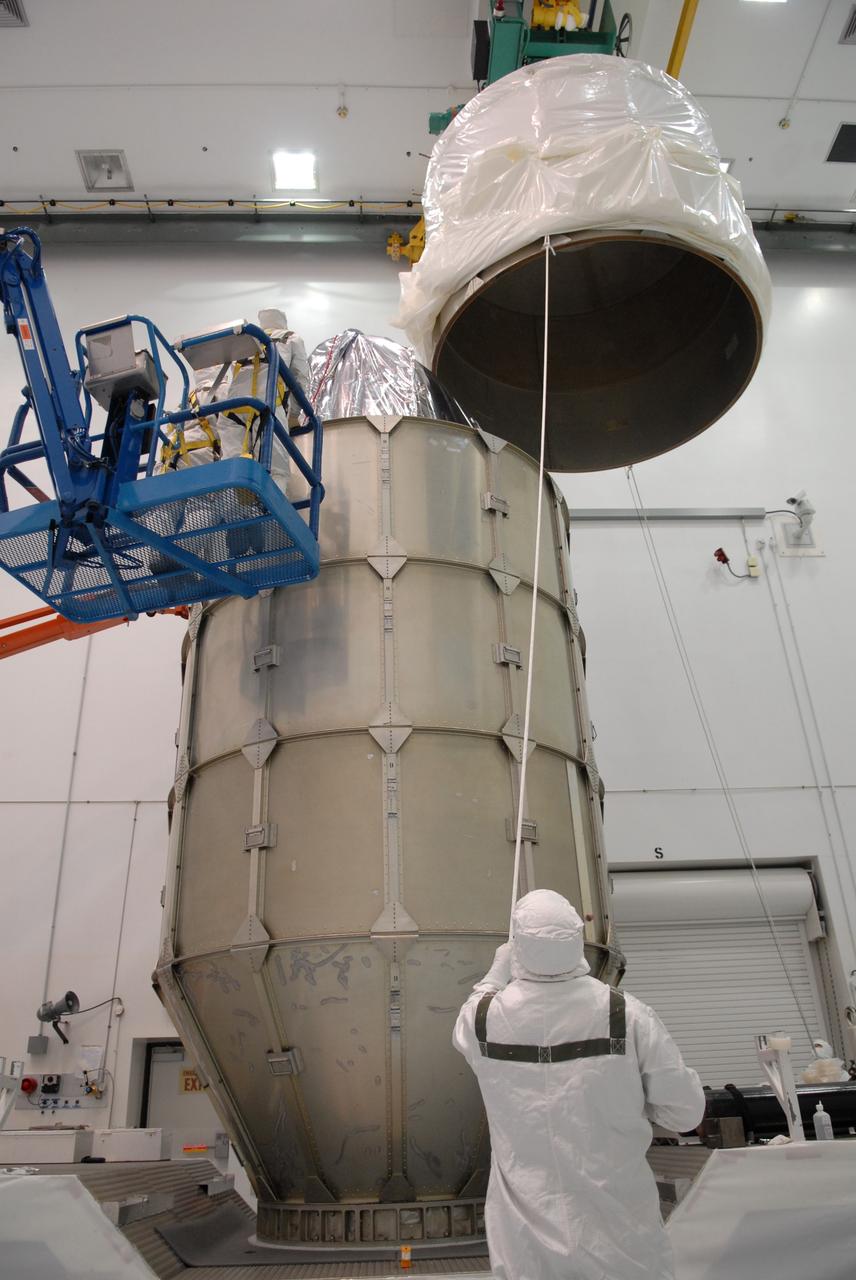
CAPE CANAVERAL, Fla. – At the Astrotech payload processing facility in Titusville, Fla., the top of the canister is lifted over NASA's Kepler spacecraft where it will be attached to the lower segments. The canister surrounding Kepler provides protection during the spacecraft's transport to the pad. The liftoff of Kepler aboard a Delta II rocket is currently targeted for 10:48 p.m. EST March 5 from Pad 17-B. Kepler is designed to survey more than 100,000 stars in our galaxy to determine the number of sun-like stars that have Earth-size and larger planets, including those that lie in a star's "habitable zone," a region where liquid water, and perhaps life, could exist. If these Earth-size worlds do exist around stars like our sun, Kepler is expected to be the first to find them and the first to measure how common they are. Photo credit: NASA/Troy Cryder
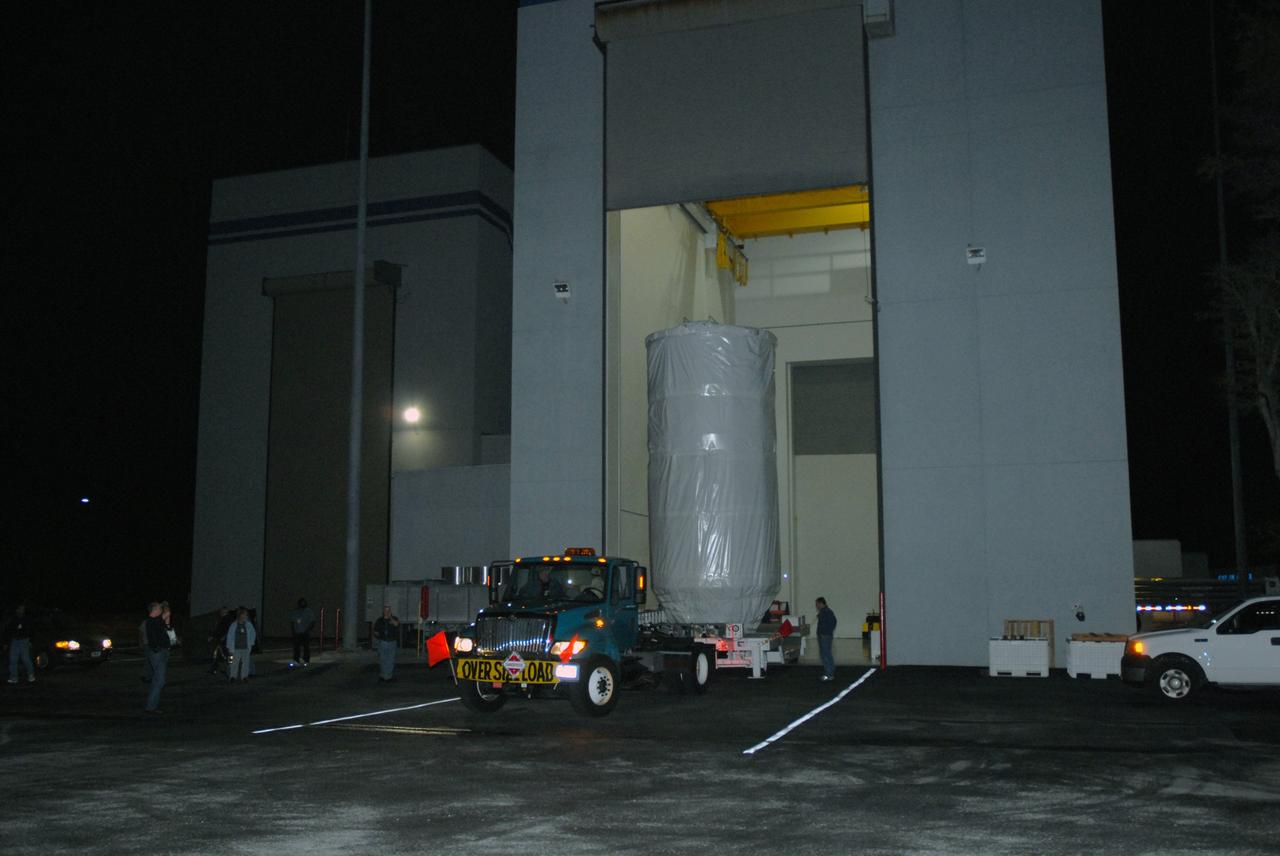
CAPE CANAVERAL, Fla. – NASA's Kepler spacecraft, enclosed in a canister and protective cover, leaves the Astrotech payload processing facility in Titusville, Fla. Kepler is being moved to Launch Pad 17-B at Cape Canaveral Air Force Station.The liftoff of Kepler aboard a Delta II rocket is currently targeted for 10:48 p.m. EST March 5 from Pad 17-B. Kepler is designed to survey more than 100,000 stars in our galaxy to determine the number of sun-like stars that have Earth-size and larger planets, including those that lie in a star's "habitable zone," a region where liquid water, and perhaps life, could exist. If these Earth-size worlds do exist around stars like our sun, Kepler is expected to be the first to find them and the first to measure how common they are. Photo credit: NASA/Jack Pfaller
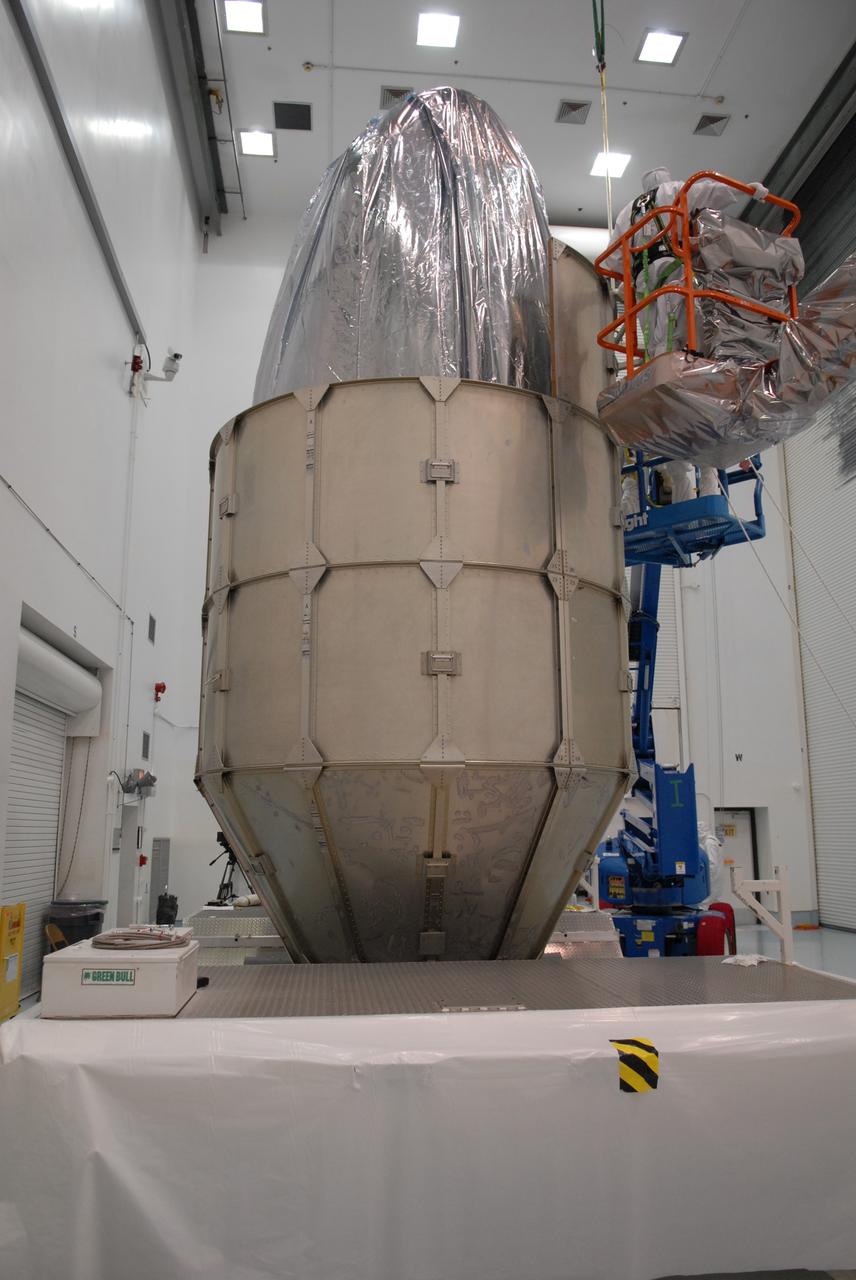
CAPE CANAVERAL, Fla. – At the Astrotech payload processing facility in Titusville, Fla., another segment of the canister is added to the stack around NASA's Kepler spacecraft. The "canning" provides protection during the spacecraft's transport to the pad. The liftoff of Kepler aboard a Delta II rocket is currently targeted for 10:48 p.m. EST March 5 from Pad 17-B. Kepler is designed to survey more than 100,000 stars in our galaxy to determine the number of sun-like stars that have Earth-size and larger planets, including those that lie in a star's "habitable zone," a region where liquid water, and perhaps life, could exist. If these Earth-size worlds do exist around stars like our sun, Kepler is expected to be the first to find them and the first to measure how common they are. Photo credit: NASA/Troy Cryder

CAPE CANAVERAL, Fla. – The truck carrying NASA's Kepler spacecraft, enclosed in a canister and protective cover, arrives at Launch Pad 17-B at Cape Canaveral Air Force Station. The liftoff of Kepler aboard a Delta II rocket is currently targeted for 10:48 p.m. EST March 5 from Pad 17-B. Kepler is designed to survey more than 100,000 stars in our galaxy to determine the number of sun-like stars that have Earth-size and larger planets, including those that lie in a star's "habitable zone," a region where liquid water, and perhaps life, could exist. If these Earth-size worlds do exist around stars like our sun, Kepler is expected to be the first to find them and the first to measure how common they are. Photo credit: NASA/Jack Pfaller
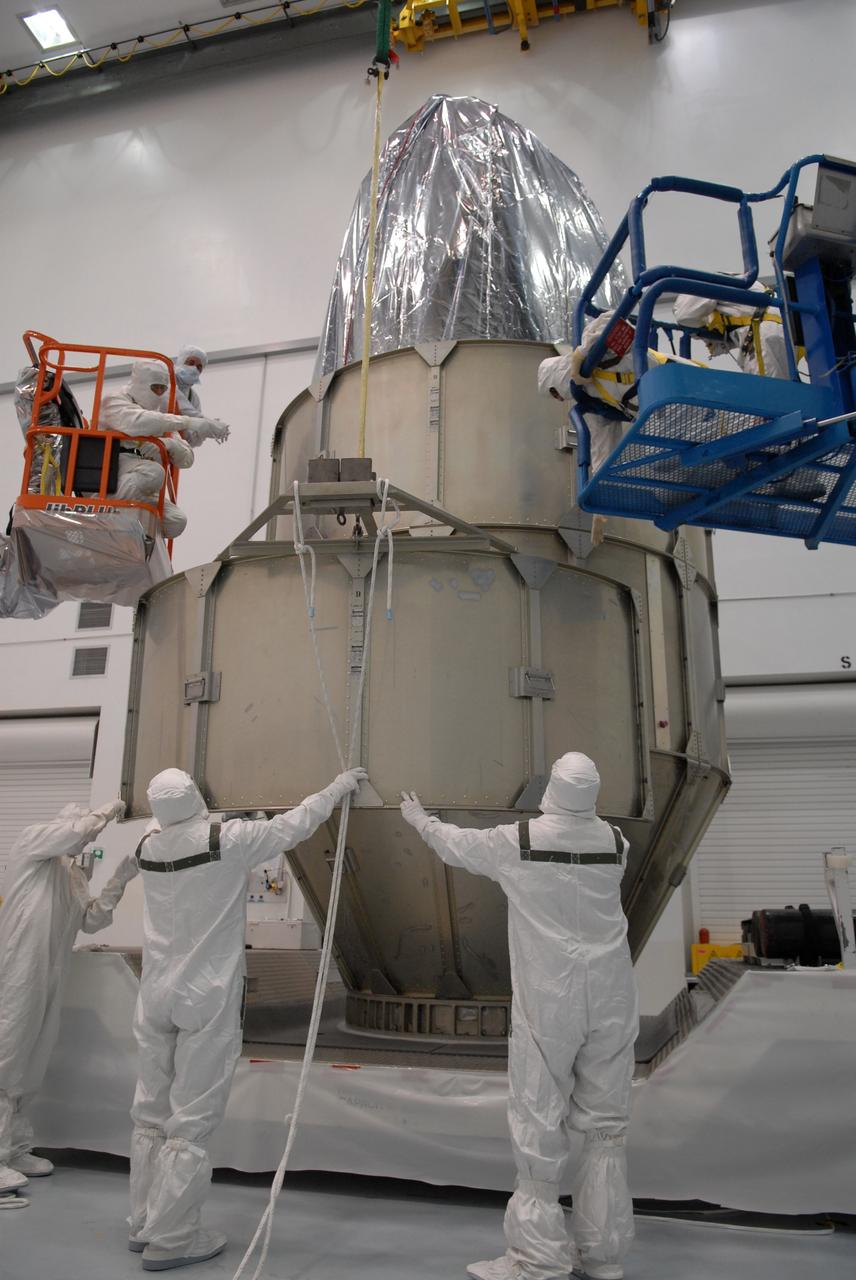
CAPE CANAVERAL, Fla. – At the Astrotech payload processing facility in Titusville, Fla., workers help guide the canister segment for NASA's Kepler spacecraft as it is lifted toward workers above. The segment will be added to the stack around Kepler. The "canning" provides protection during the spacecraft's transport to the pad. The liftoff of Kepler aboard a Delta II rocket is currently targeted for 10:48 p.m. EST March 5 from Pad 17-B. Kepler is designed to survey more than 100,000 stars in our galaxy to determine the number of sun-like stars that have Earth-size and larger planets, including those that lie in a star's "habitable zone," a region where liquid water, and perhaps life, could exist. If these Earth-size worlds do exist around stars like our sun, Kepler is expected to be the first to find them and the first to measure how common they are. Photo credit: NASA/Troy Cryder

CAPE CANAVERAL, Fla. – At the Astrotech payload processing facility in Titusville, Fla., workers place the lower segments of the canister around NASA's Kepler spacecraft. The "canning" provides protection during the spacecraft's transport to the pad. The liftoff of Kepler aboard a Delta II rocket is currently targeted for 10:48 p.m. EST March 5 from Pad 17-B. Kepler is designed to survey more than 100,000 stars in our galaxy to determine the number of sun-like stars that have Earth-size and larger planets, including those that lie in a star's "habitable zone," a region where liquid water, and perhaps life, could exist. If these Earth-size worlds do exist around stars like our sun, Kepler is expected to be the first to find them and the first to measure how common they are. Photo credit: NASA/Troy Cryder
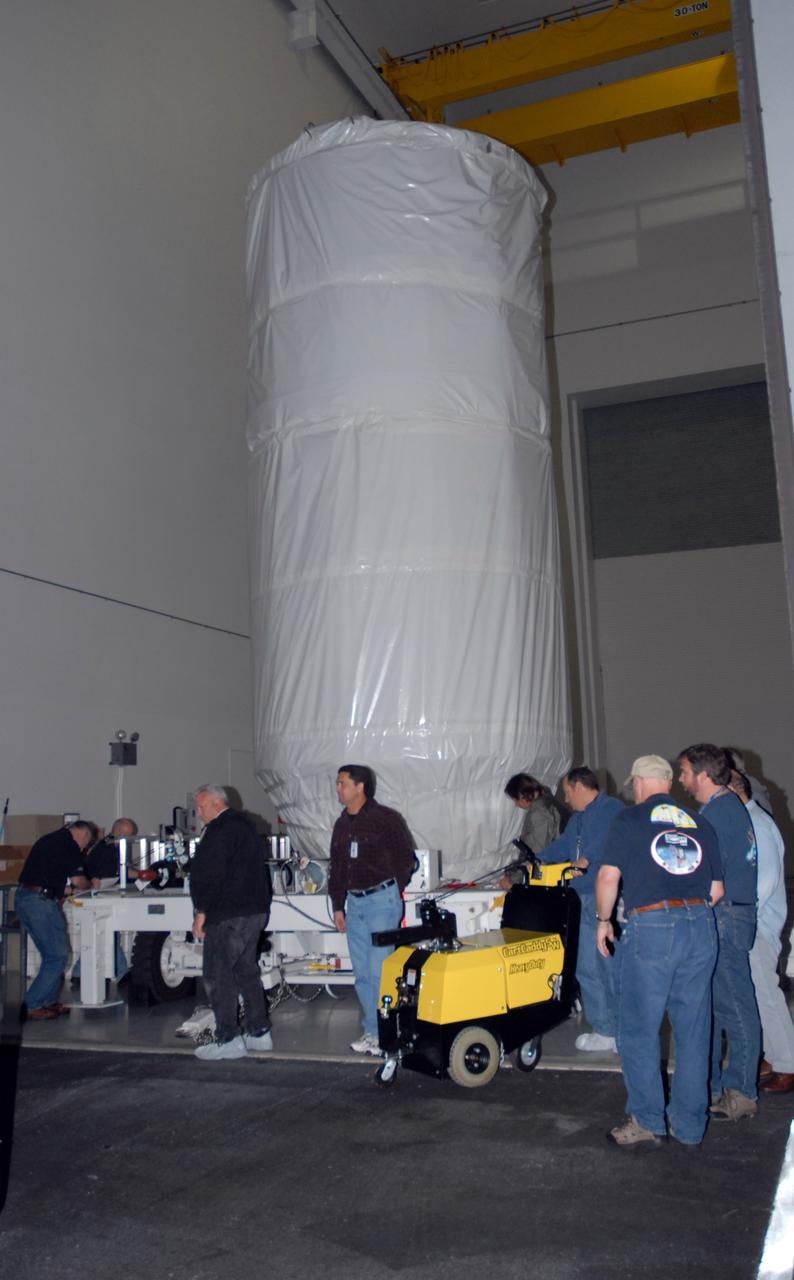
CAPE CANAVERAL, Fla. – NASA's Kepler spacecraft, enclosed in a canister and protective cover, is ready to leave the Astrotech payload processing facility in Titusville, Fla. Kepler is being moved to Launch Pad 17-B at Cape Canaveral Air Force Station. The liftoff of Kepler aboard a Delta II rocket is currently targeted for 10:48 p.m. EST March 5 from Pad 17-B. Kepler is designed to survey more than 100,000 stars in our galaxy to determine the number of sun-like stars that have Earth-size and larger planets, including those that lie in a star's "habitable zone," a region where liquid water, and perhaps life, could exist. If these Earth-size worlds do exist around stars like our sun, Kepler is expected to be the first to find them and the first to measure how common they are. Photo credit: NASA/Jack Pfaller
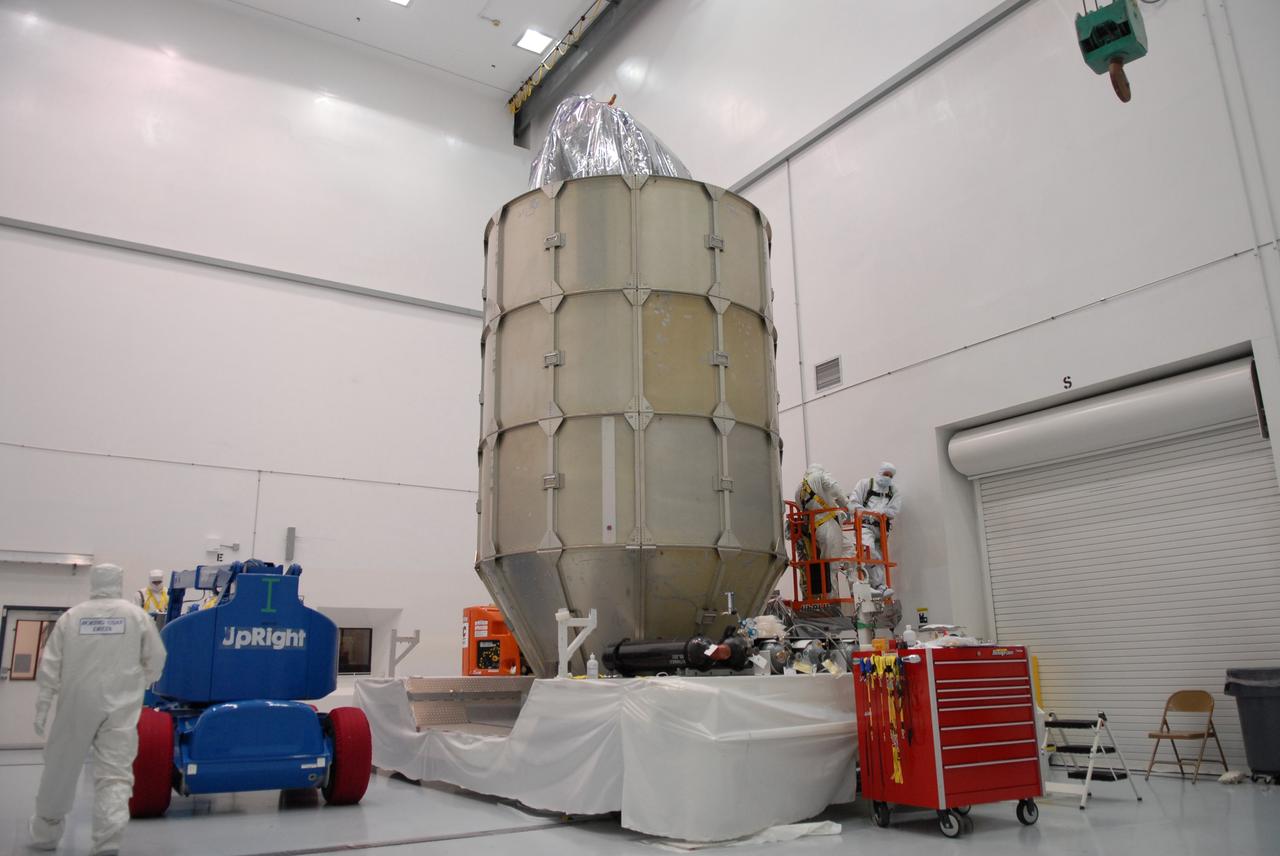
CAPE CANAVERAL, Fla. – At the Astrotech payload processing facility in Titusville, Fla., four levels of canister segments have been installed around NASA's Kepler spacecraft. The "canning" provides protection during the spacecraft's transport to the pad. The liftoff of Kepler aboard a Delta II rocket is currently targeted for 10:48 p.m. EST March 5 from Pad 17-B. Kepler is designed to survey more than 100,000 stars in our galaxy to determine the number of sun-like stars that have Earth-size and larger planets, including those that lie in a star's "habitable zone," a region where liquid water, and perhaps life, could exist. If these Earth-size worlds do exist around stars like our sun, Kepler is expected to be the first to find them and the first to measure how common they are. Photo credit: NASA/Troy Cryder
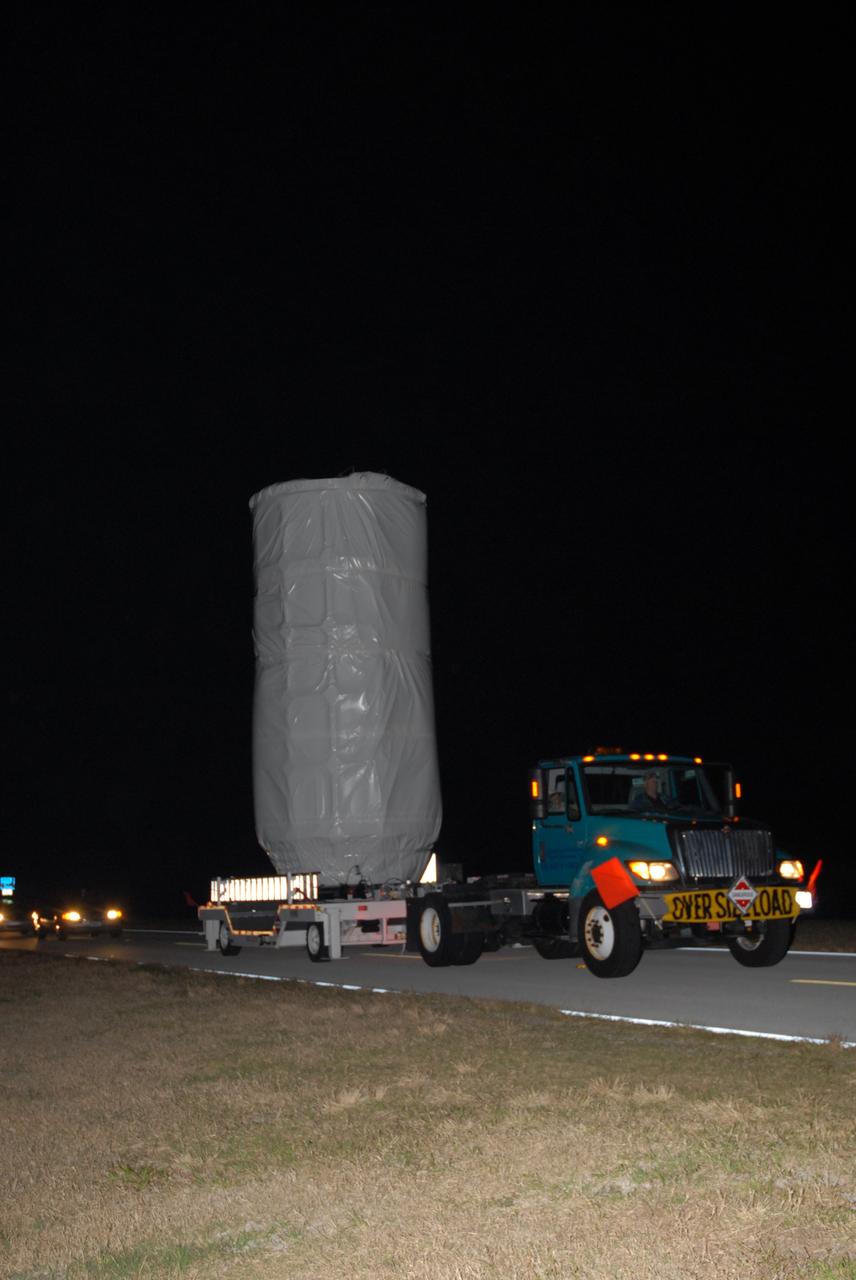
CAPE CANAVERAL, Fla. – NASA's Kepler spacecraft, enclosed in a canister and protective cover, travels by truck to Launch Pad 17-B at Cape Canaveral Air Force Station. The liftoff of Kepler aboard a Delta II rocket is currently targeted for 10:48 p.m. EST March 5 from Pad 17-B. Kepler is designed to survey more than 100,000 stars in our galaxy to determine the number of sun-like stars that have Earth-size and larger planets, including those that lie in a star's "habitable zone," a region where liquid water, and perhaps life, could exist. If these Earth-size worlds do exist around stars like our sun, Kepler is expected to be the first to find them and the first to measure how common they are. Photo credit: NASA/Jack Pfaller