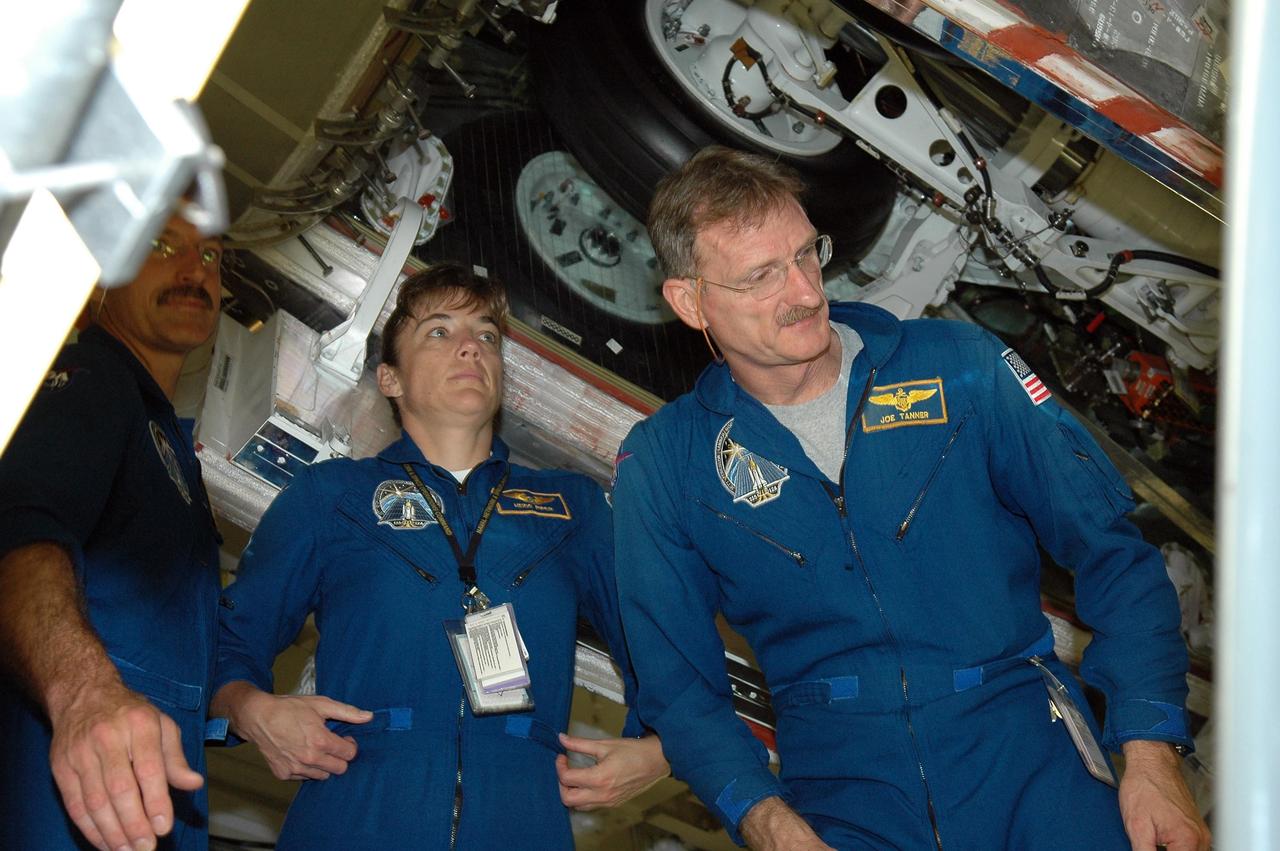
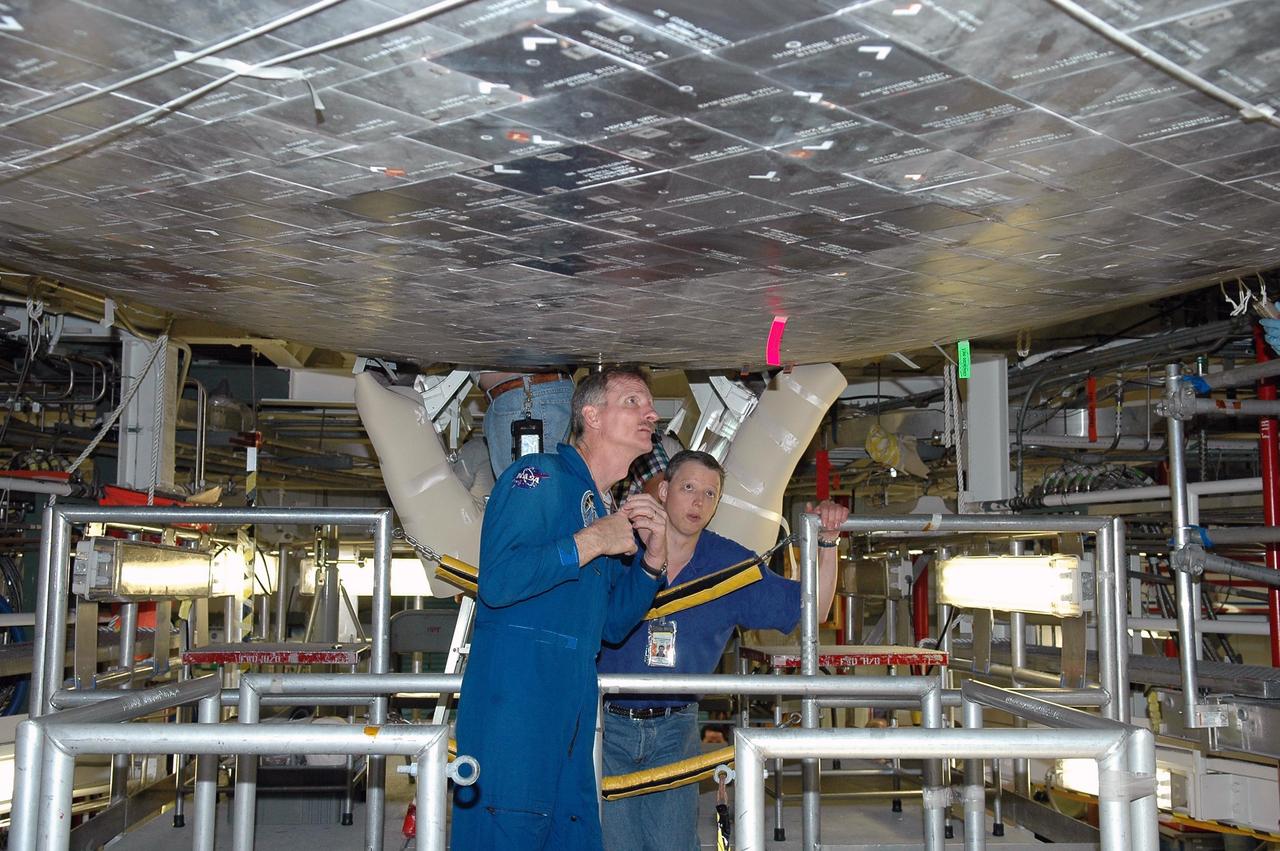
KENNEDY SPACE CENTER, FLA. - In the Orbiter Processing Facility, STS-115 crew members are examining the orbiter Atlantis, the designated launch vehicle for their mission. From left are Mission Specialists Daniel Burbank, Heidemarie Stefanyshyn-Piper and Joseph Tanner. The crew is at the center for Crew Equipment Interface Test activities, which involves equipment familiarization, a routine part of astronaut training and launch preparations. The mission will deliver the second port truss segment, the P3/P4 Truss, to attach to the first port truss segment, the P1 Truss, as well as deploy solar array set 2A and 4A. Launch on Space Shuttle Atlantis is scheduled for late August. Photo credit: NASA/Kim Shiflett
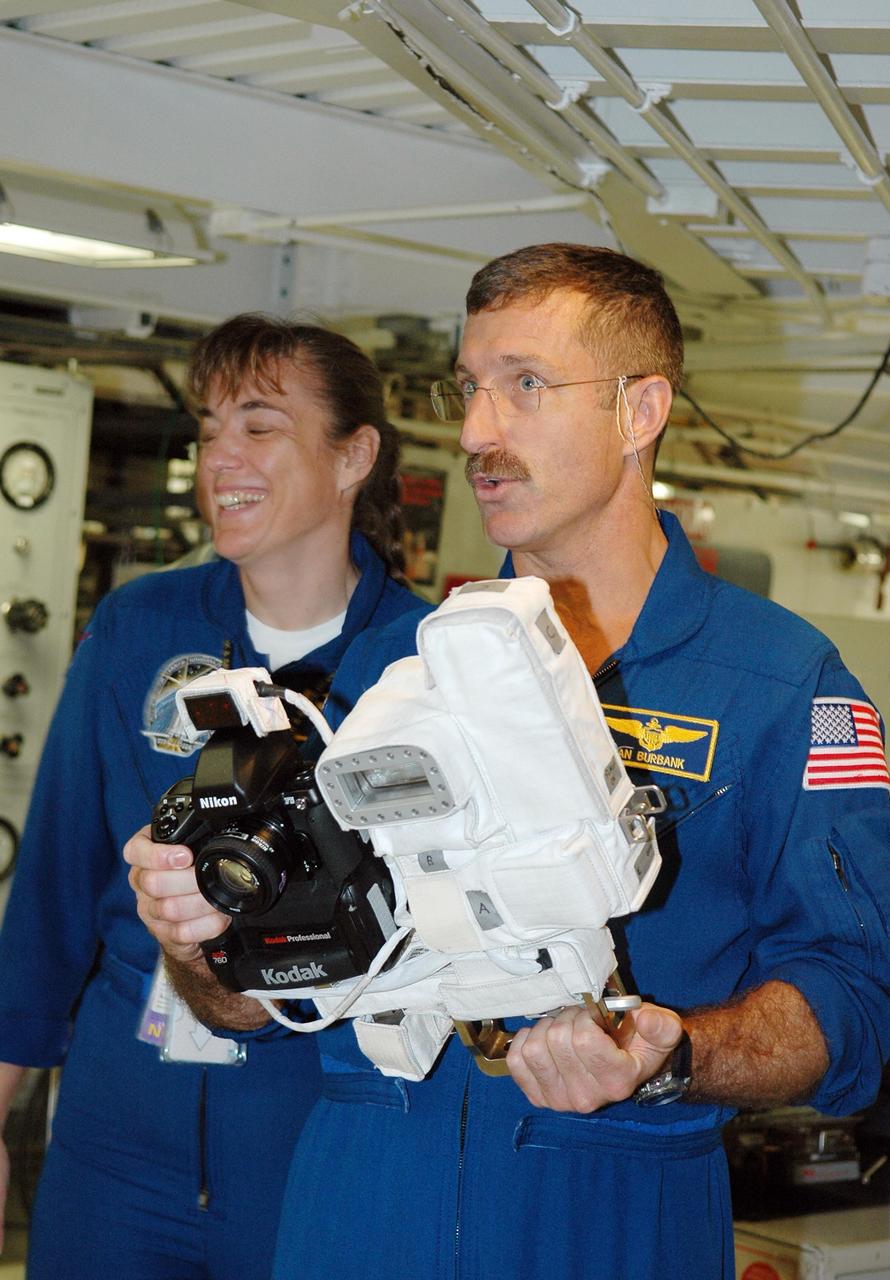
KENNEDY SPACE CENTER, FLA. - In the Orbiter Processing Facility, STS-115 Mission Specialist Daniel Burbank holds a camera that is a mockup of one the crew will use to take photographs on-orbit. At left is Mission Specialist Heidemarie Stefanyshyn-Piper. The crew is at the center for Crew Equipment Interface Test activities, which involves equipment familiarization, a routine part of astronaut training and launch preparations. The mission will deliver the second port truss segment, the P3/P4 Truss, to attach to the first port truss segment, the P1 Truss, as well as deploy solar array set 2A and 4A. Launch on Space Shuttle Atlantis is scheduled for late August. Photo credit: NASA/Kim Shiflett
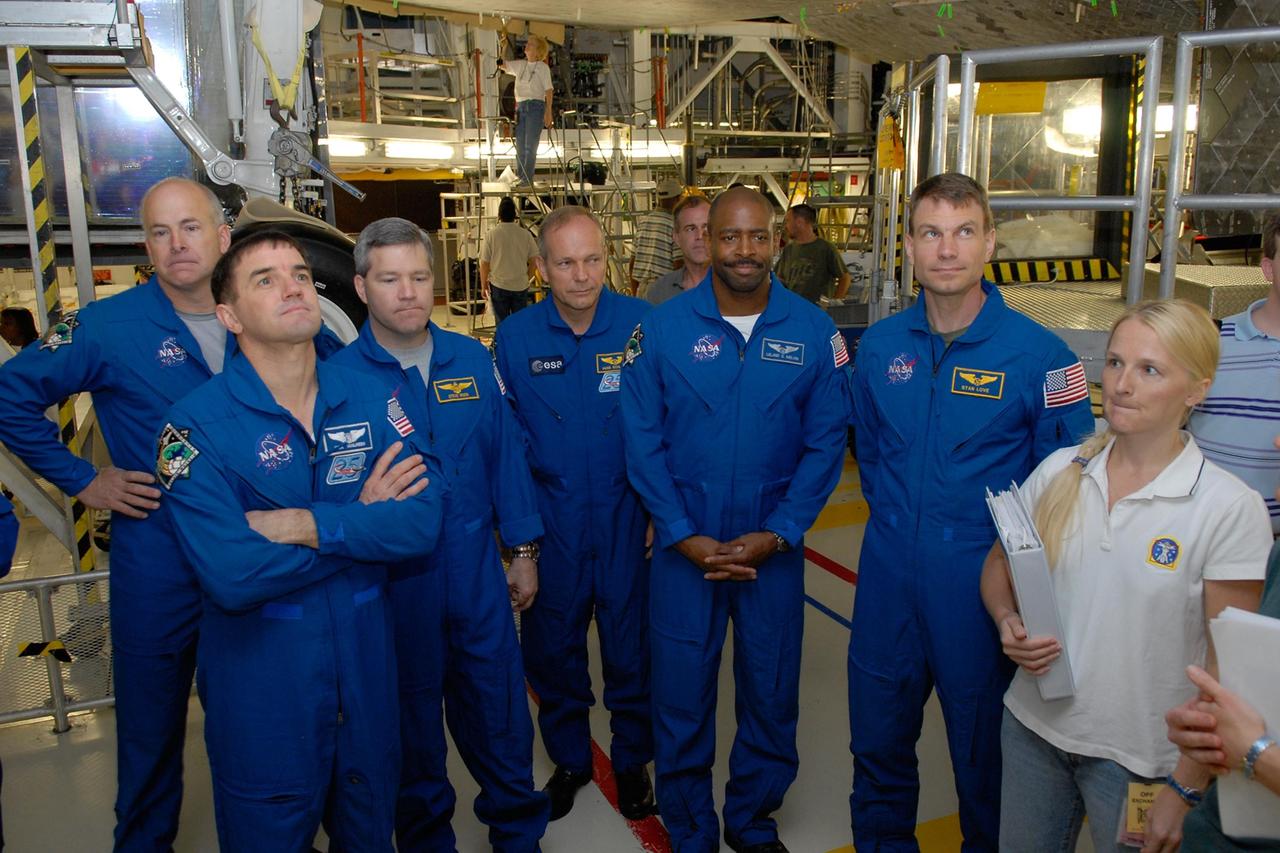
KENNEDY SPACE CENTER, FLA. -- In the Orbiter Processing Facility, members of the STS-122 crew get information about the thermal protection system on space shuttle Atlantis (overhead). From left are Pilot Alan Poindexter, Mission Specialists Rex Walheim, Commander Stephen Frick, and Mission Specialists Hans Schlegel, Leland Melvin and Stanley Love. Schlegel represents the European Space Agency. The crew is at Kennedy to take part in a crew equipment interface test, or CEIT, which helps familiarize them with equipment and payloads for the mission. Among the activities standard to a CEIT are harness training, inspection of the thermal protection system and camera operation for planned extravehicular activities, or EVAs. STS-122 is targeted for launch in December. Photo credit: NASA/Kim Shiflett
KENNEDY SPACE CENTER, FLA. -- During crew equipment interface test activities at KSC, STS-118 Mission Specialists Dr. Dafydd Williams (standing in the lift) and Tracy Caldwell (seated at right) look over the shuttle arm in Endeavour's payload bay. The STS-118 mission will be delivering the third starboard truss segment, the ITS S5, to the International Space Station, as well as the SPACEHAB single cargo module filled with supplies and equipment. Launch aboard Space Shuttle Endeavour is targeted for Aug. 9. Photo credit: NASA/Kim Shiflett
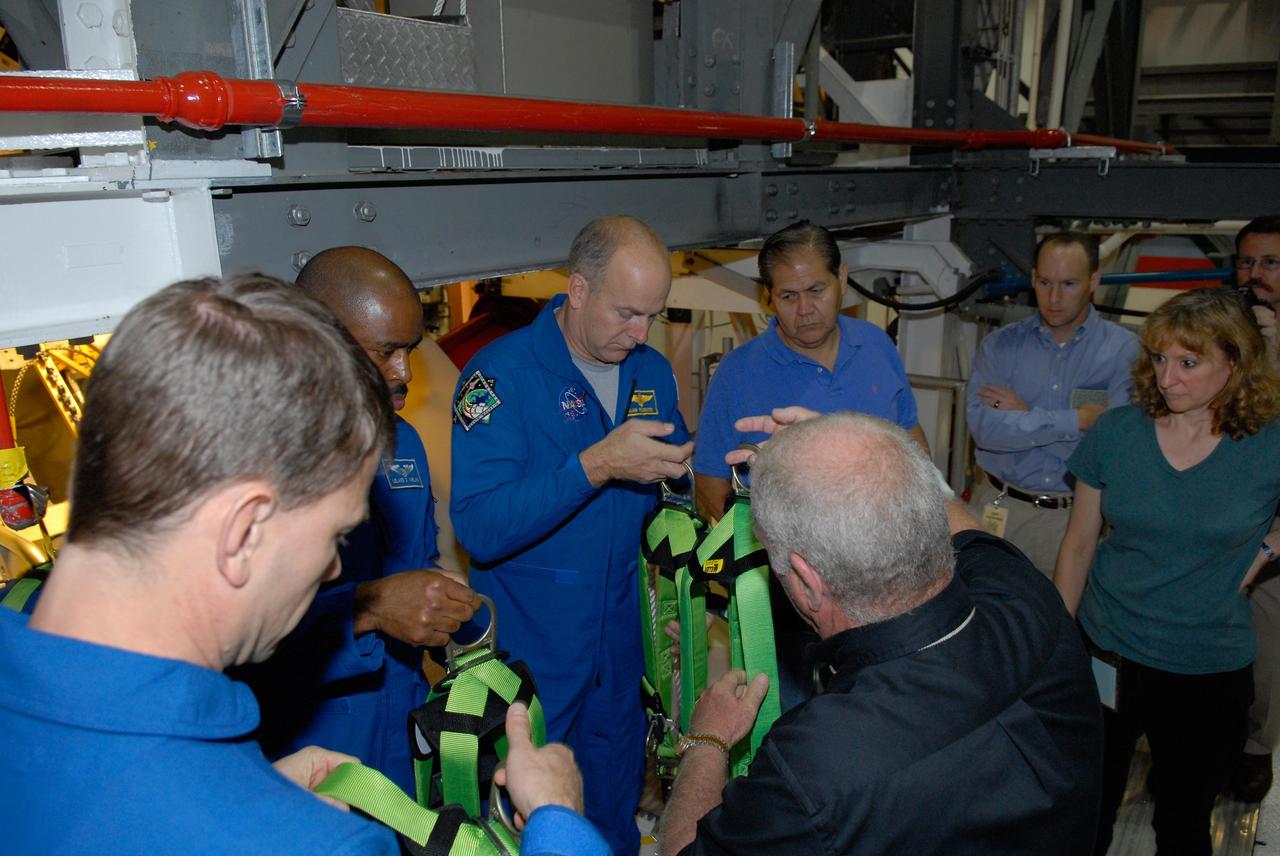
KENNEDY SPACE CENTER, FLA. -- Members of the STS-122 crew take part in harness training in the Orbiter Processing Facility at NASA's Kennedy Space Center. Seen from left are Mission Specialists Stanley Love and Leland Melvin and Pilot Alan Poindexter. The crew is at Kennedy to take part in a crew equipment interface test, or CEIT, which helps familiarize them with equipment and payloads for the mission. Among the activities standard to a CEIT are harness training, inspection of the thermal protection system and camera operation for planned extravehicular activities, or EVAs. STS-122 is targeted for launch in December. Photo credit: NASA/Kim Shiflett
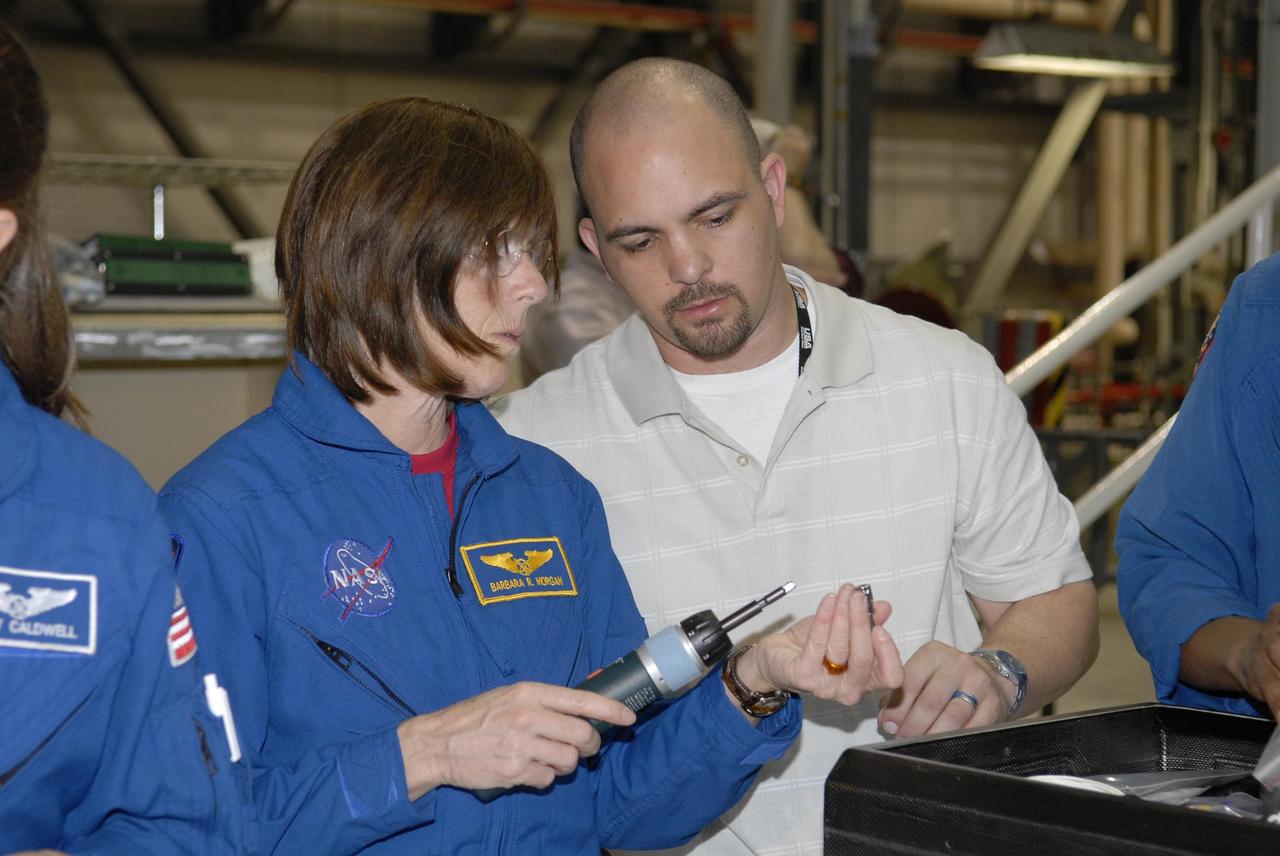
KENNEDY SPACE CENTER, FLA. -- During crew equipment interface test activities in Orbiter Processing Facility bay 3 at KSC, STS-118 Mission Specialist Barbara Morgan gets hands-on practice with tools she may use during the flight. The STS-118 mission will be delivering the third starboard truss segment, the ITS S5, to the International Space Station, as well as the SPACEHAB single cargo module filled with supplies and equipment. Launch aboard Space Shuttle Endeavour is targeted for Aug. 9. Photo credit: NASA/Kim Shiflett
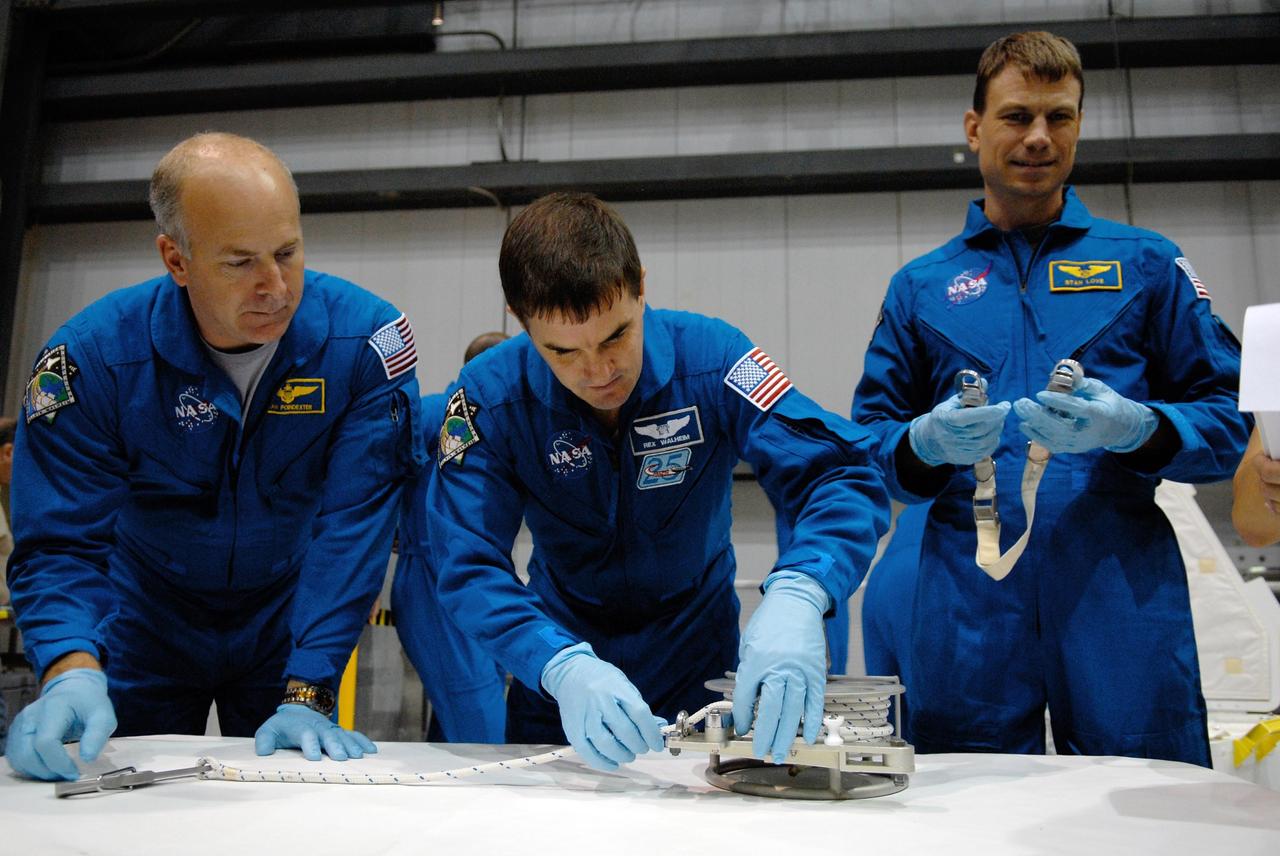
KENNEDY SPACE CENTER, FLA. -- In the Orbiter Processing Facility, STS-122 Pilot Alan Poindexter and Mission Specialists Rex Walheim and Stanley Love practice working with equipment for the mission. The crew is at Kennedy Space Center to take part in a crew equipment interface test, which includes equipment familiarization. The mission will carry and install the Columbus Lab, a multifunctional, pressurized laboratory that will be permanently attached to Node 2 of the space station to carry out experiments in materials science, fluid physics and biosciences, as well as to perform a number of technological applications. It is Europe’s largest contribution to the construction of the International Space Station and will support scientific and technological research in a microgravity environment. STS-122 is targeted for launch in December. Photo credit: NASA/Kim Shiflett
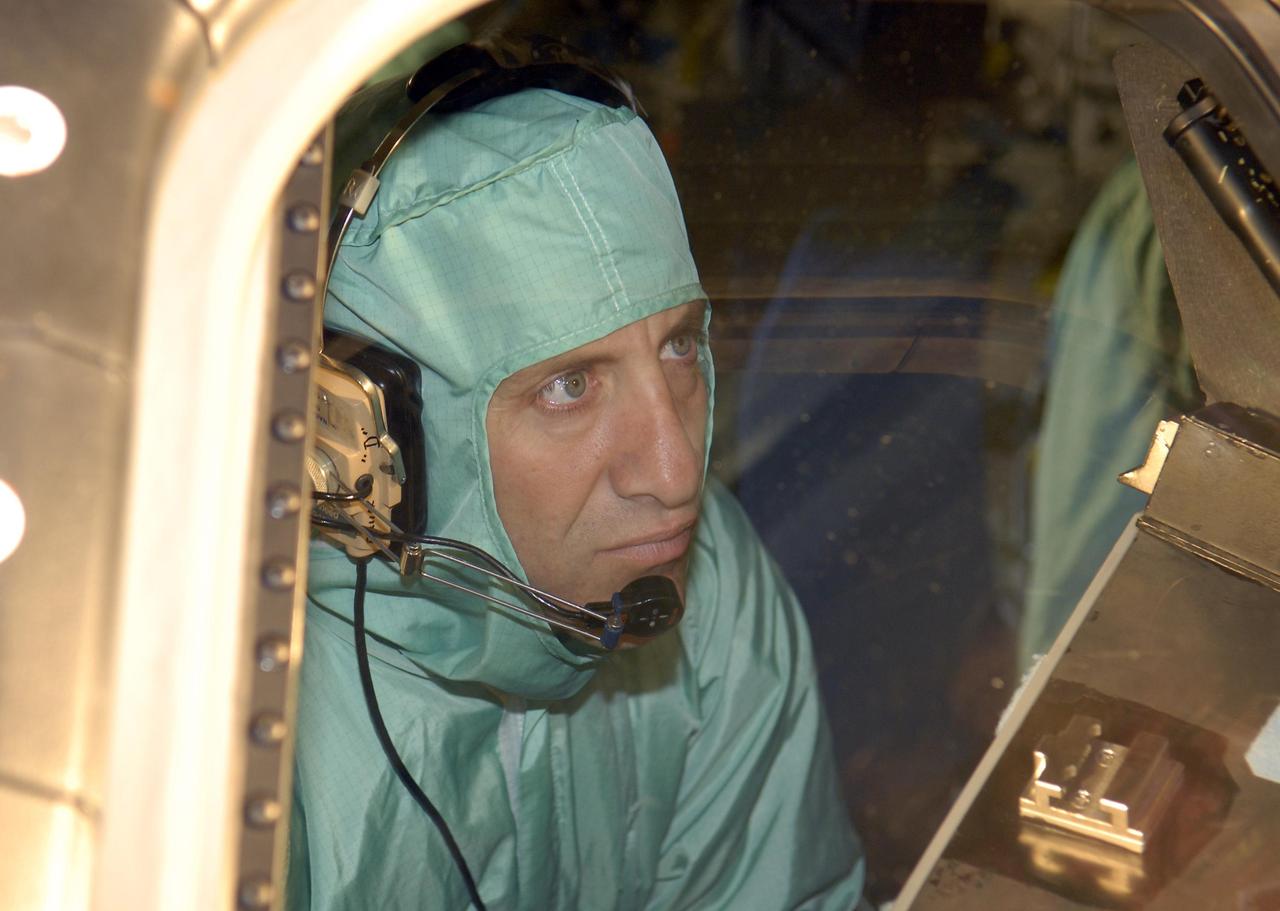
KENNEDY SPACE CENTER, FLA. -- During crew equipment interface test activities at KSC, STS-118 Pilot Charles Hobaugh checks the cockpit windshield of orbiter Endeavour, which is in Orbiter Processing Facility bay 3. The STS-118 mission will be delivering the third starboard truss segment, the ITS S5, to the International Space Station, as well as the SPACEHAB single cargo module filled with supplies and equipment. Launch aboard Space Shuttle Endeavour is targeted for Aug. 9. Photo credit: NASA/Kim Shiflett

KENNEDY SPACE CENTER, FLA. -- During crew equipment interface test activities at KSC, STS-118 Commander Scott Kelly checks for sharp edges on the port cockpit window of orbiter Endeavour, which is in Orbiter Processing Facility bay 3. The STS-118 mission will be delivering the third starboard truss segment, the ITS S5, to the International Space Station, as well as the SPACEHAB single cargo module filled with supplies and equipment. Launch aboard Space Shuttle Endeavour is targeted for Aug. 9. Photo credit: NASA/Kim Shiflett
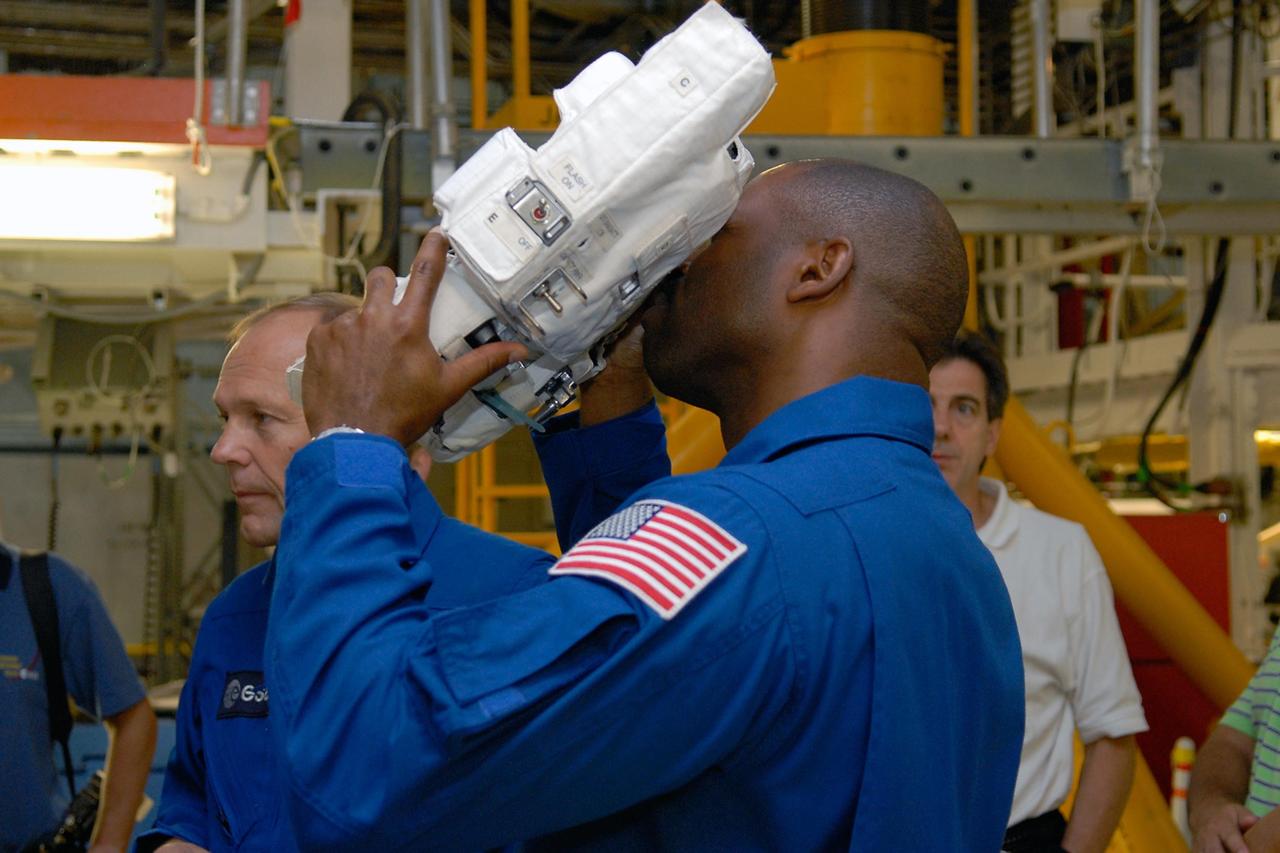
KENNEDY SPACE CENTER, FLA. -- In the Orbiter Processing Facility, members of the STS-122 crew practice handling cameras that will be used during the mission. With the camera is Mission Specialist Leland Melvin. At left is Mission Specialist Hans Schlegel, who represents the European Space Agency. The crew is at Kennedy Space Center to take part in a crew equipment interface test, which helps familiarize them with equipment and payloads for the mission. Among the activities standard to a CEIT are harness training, inspection of the thermal protection system and camera operation for planned extravehicular activities, or EVAs. The mission will carry and install the Columbus Lab, a multifunctional, pressurized laboratory that will be permanently attached to Node 2 of the space station to carry out experiments in materials science, fluid physics and biosciences, as well as to perform a number of technological applications. It is Europe’s largest contribution to the construction of the International Space Station and will support scientific and technological research in a microgravity environment. STS-122 is targeted for launch in December. Photo credit: NASA/Kim Shiflett
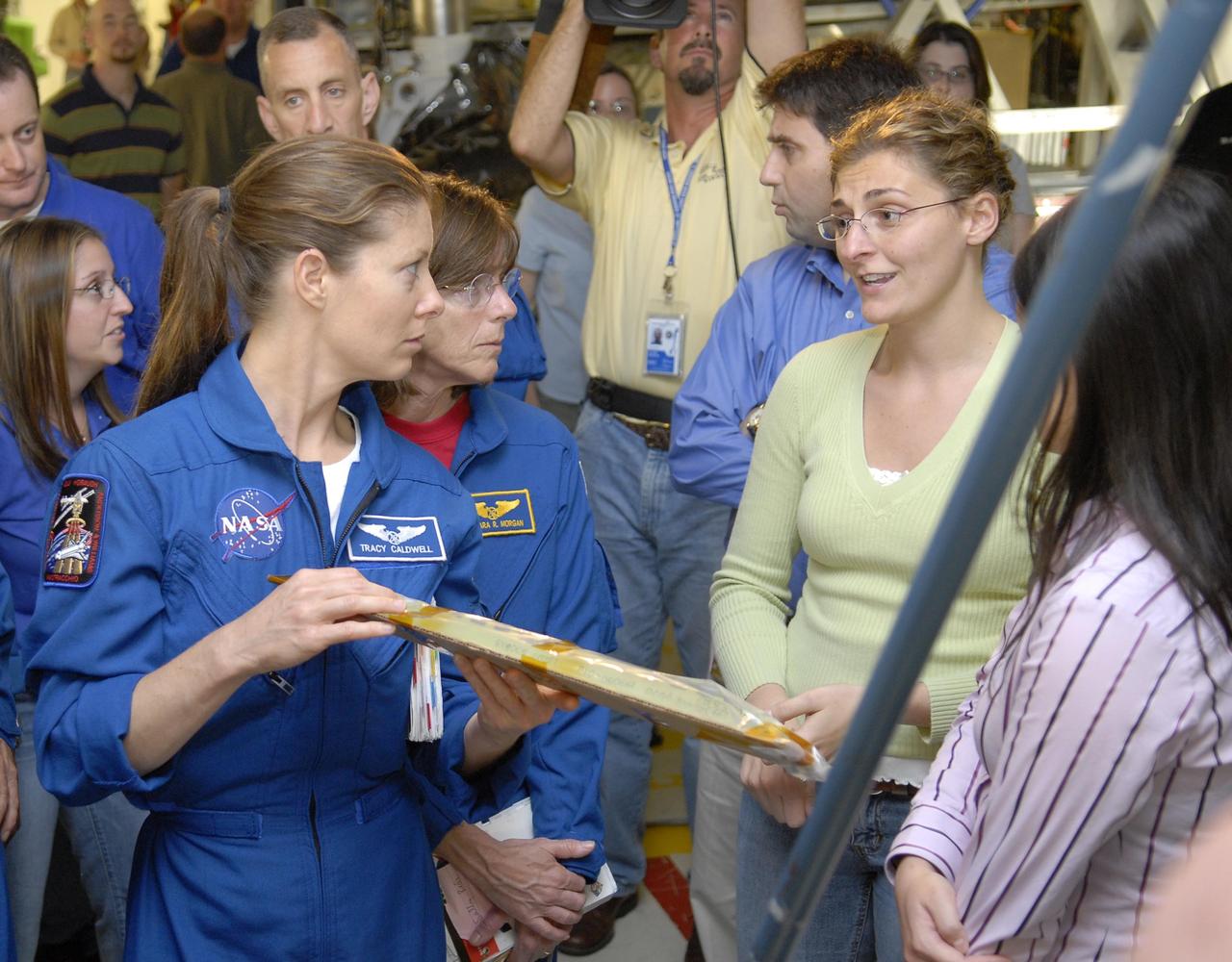
KENNEDY SPACE CENTER, FLA. -- During crew equipment interface test activities, members of the STS-118 crew address a piece of equipment with a worker in Orbiter Processing Facility bay 2. Mission Specialist Tracy Caldwell holds the package; next to her is Mission Specialist Barbara Morgan. Behind Caldwell is Pilot Charles Hobaugh. The STS-118 mission will be delivering the third starboard truss segment, the ITS S5, to the International Space Station, as well as the SPACEHAB single cargo module filled with supplies and equipment. Launch aboard Space Shuttle Endeavour is targeted for Aug. 9. Photo credit: NASA/Kim Shiflett
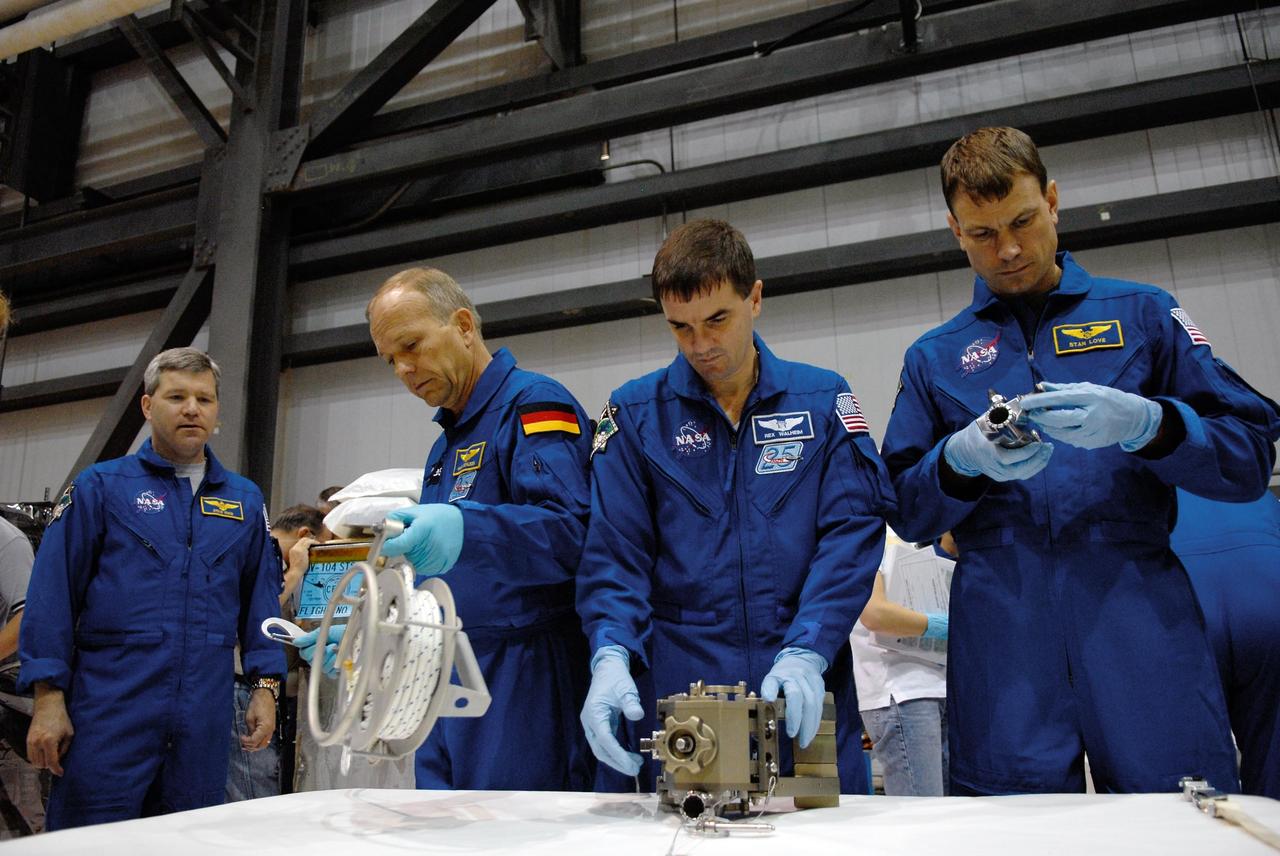
KENNEDY SPACE CENTER, FLA. -- In the Orbiter Processing Facility, STS-122 crew members practice working with equipment for the mission. From left are Commander Stephen Frick and Mission Specialists Hans Schlegel, Rex Walheim and Stanley Love. Schlegel represents the European Space Agency. The crew is at Kennedy Space Center to take part in a crew equipment interface test, which includes equipment familiarization. The mission will carry and install the Columbus Lab, a multifunctional, pressurized laboratory that will be permanently attached to Node 2 of the space station to carry out experiments in materials science, fluid physics and biosciences, as well as to perform a number of technological applications. It is Europe’s largest contribution to the construction of the International Space Station and will support scientific and technological research in a microgravity environment. STS-122 is targeted for launch in December. Photo credit: NASA/Kim Shiflett
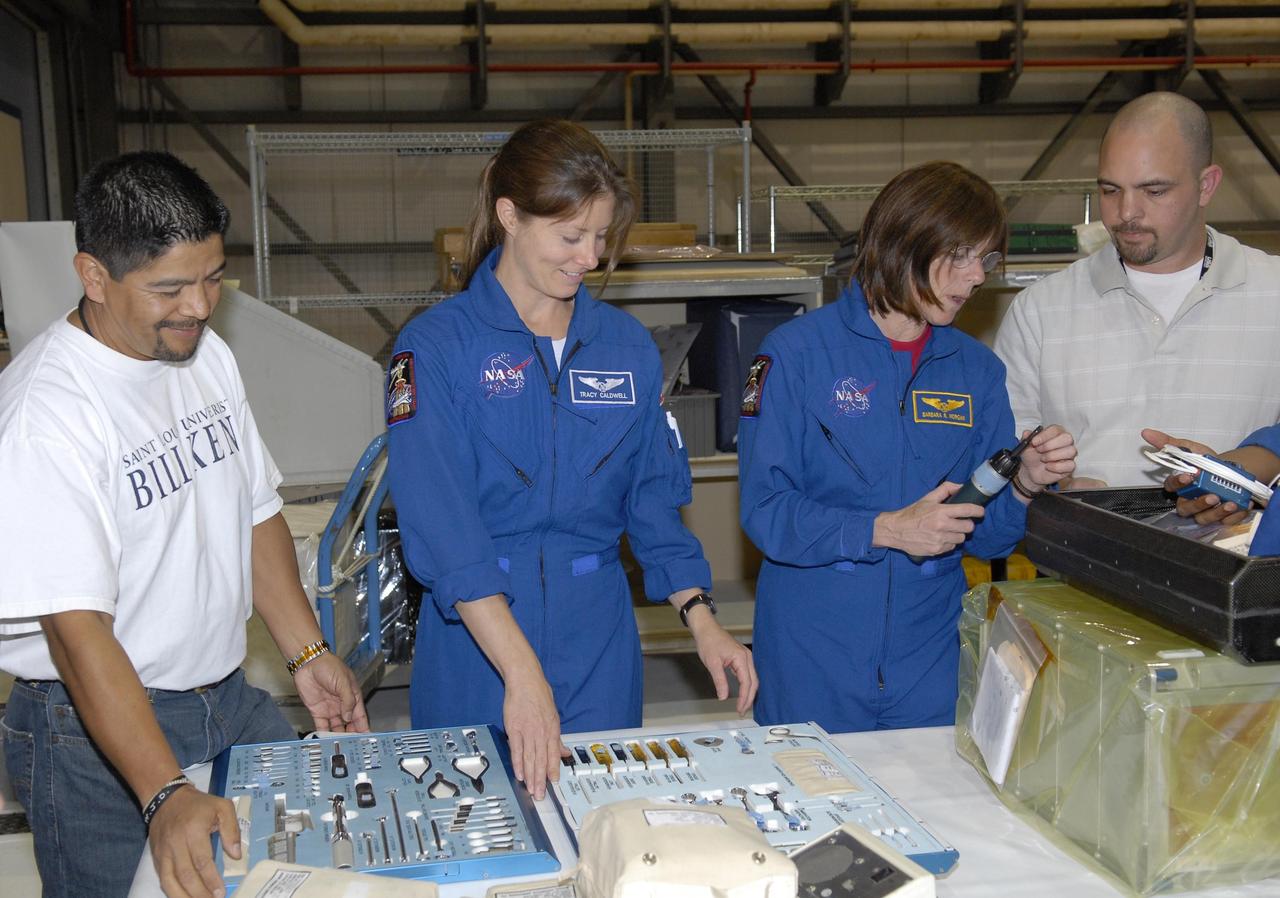
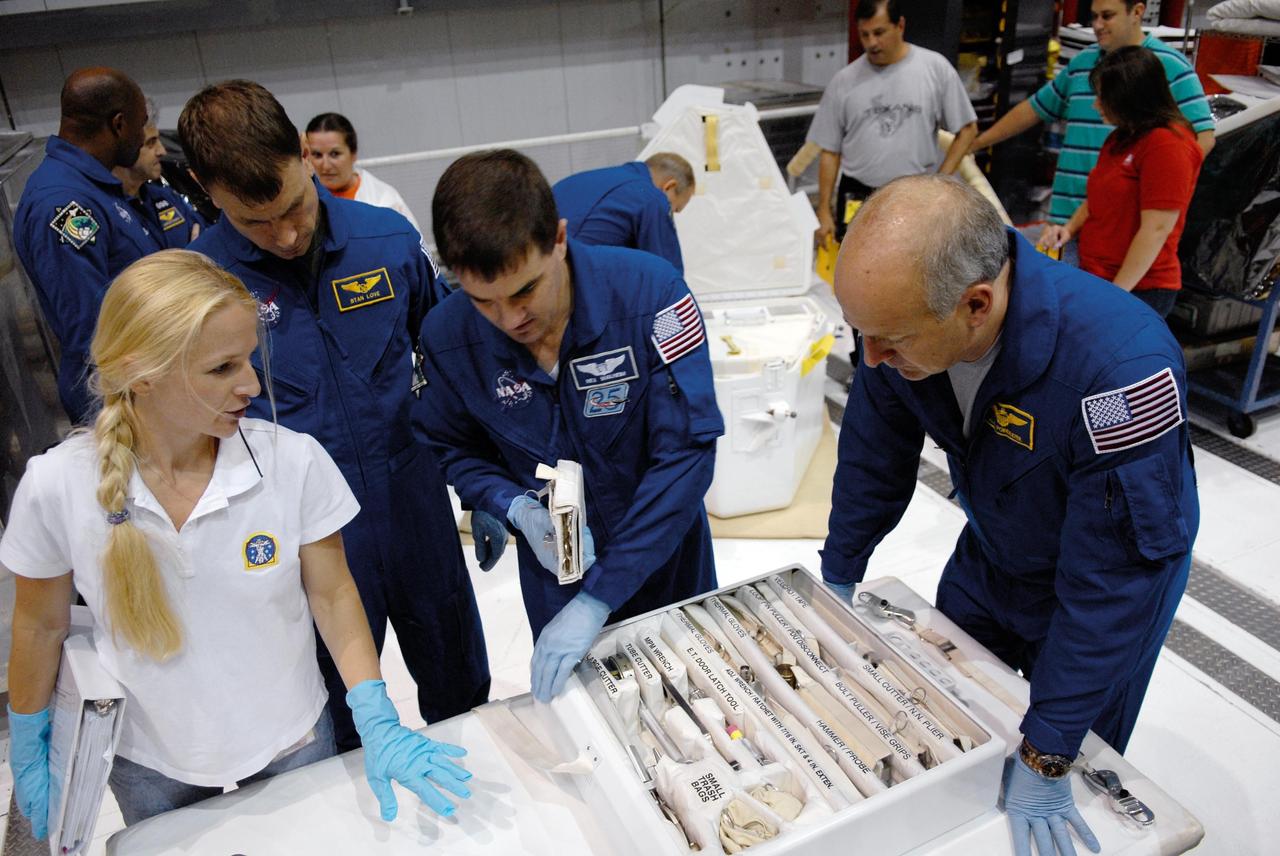
KENNEDY SPACE CENTER, FLA. -- During crew equipment interface test activities in Orbiter Processing Facility bay 3 at KSC, STS-118 crew members get a close look at equipment they will use on their flight. Seen here at center are Mission Specialists Tracy Caldwell and Barbara Morgan. The STS-118 mission will be delivering the third starboard truss segment, the ITS S5, to the International Space Station, as well as the SPACEHAB single cargo module filled with supplies and equipment. Launch aboard Space Shuttle Endeavour is targeted for Aug. 9. Photo credit: NASA/Kim Shiflett
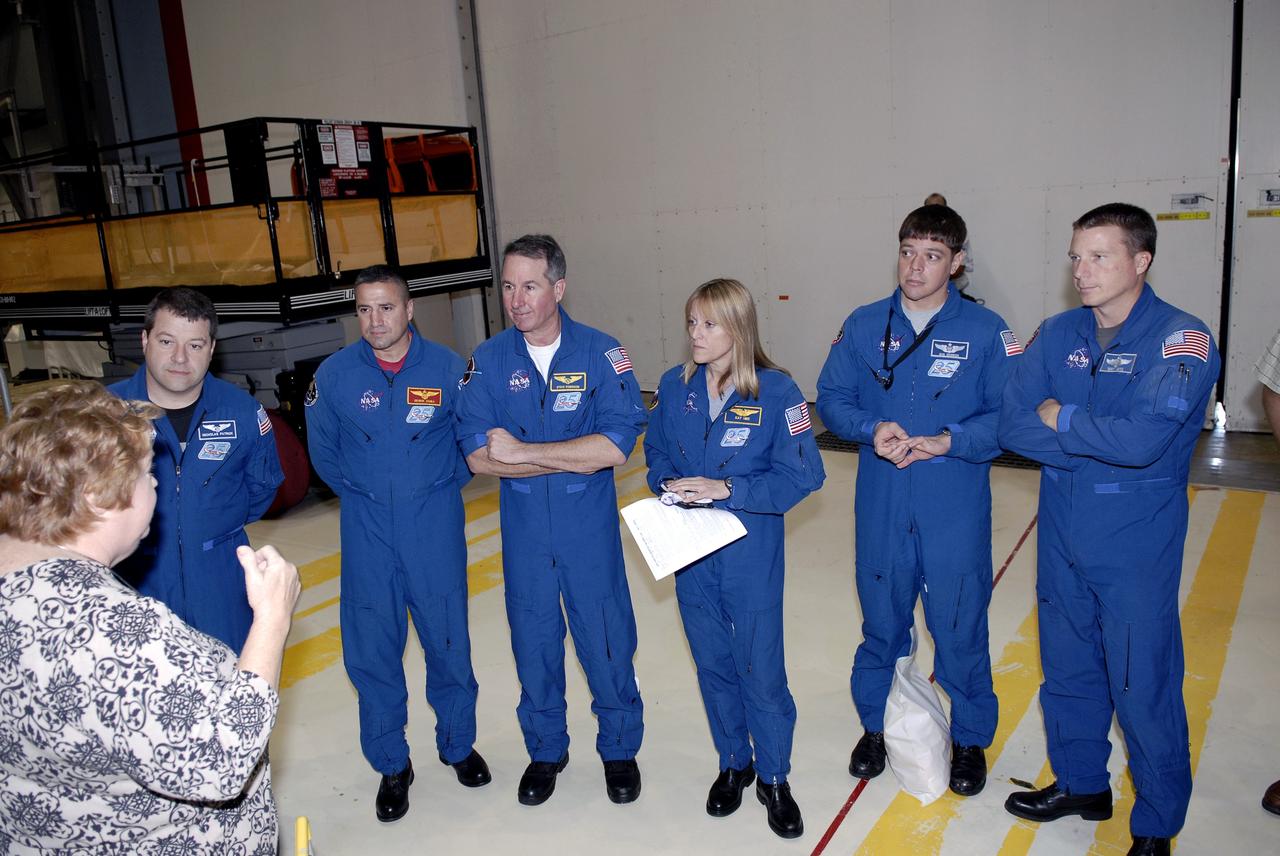
CAPE CANAVERAL, Fla. – In Orbiter Processing Facility-3 at NASA's Kennedy Space Center in Florida, members of the STS-130 crew receive a briefing about the processing of space shuttle Endeavour. From left are Mission Specialist Nicolas Patrick; Commander George Zamka; Mission Specialists Stephen Robinson, Kathryn "Kay" Hire and Robert Behnken; and Pilot Terry Virts Jr. The crew is at Kennedy for a crew equipment interface test, or CEIT, which provides hands-on training and observation of shuttle and flight hardware. The STS-130 flight will carry the Tranquility pressurized module with a built-in cupola to the International Space Station aboard Endeavour. Launch is targeted for Feb. 4, 2010. Photo credit: NASA/Steven Durnin

KENNEDY SPACE CENTER, FLA. -- In Orbiter Processing Facility bay 2, during crew equipment interface test activities, STS-118 Mission Specialist Tracy Caldwell gets a close look at one of the orbiter Endeavour's main engines. The STS-118 mission will be delivering the third starboard truss segment, the ITS S5, to the International Space Station, as well as the SPACEHAB single cargo module filled with supplies and equipment. Launch aboard Space Shuttle Endeavour is targeted for Aug. 9. Photo credit: NASA/Kim Shiflett
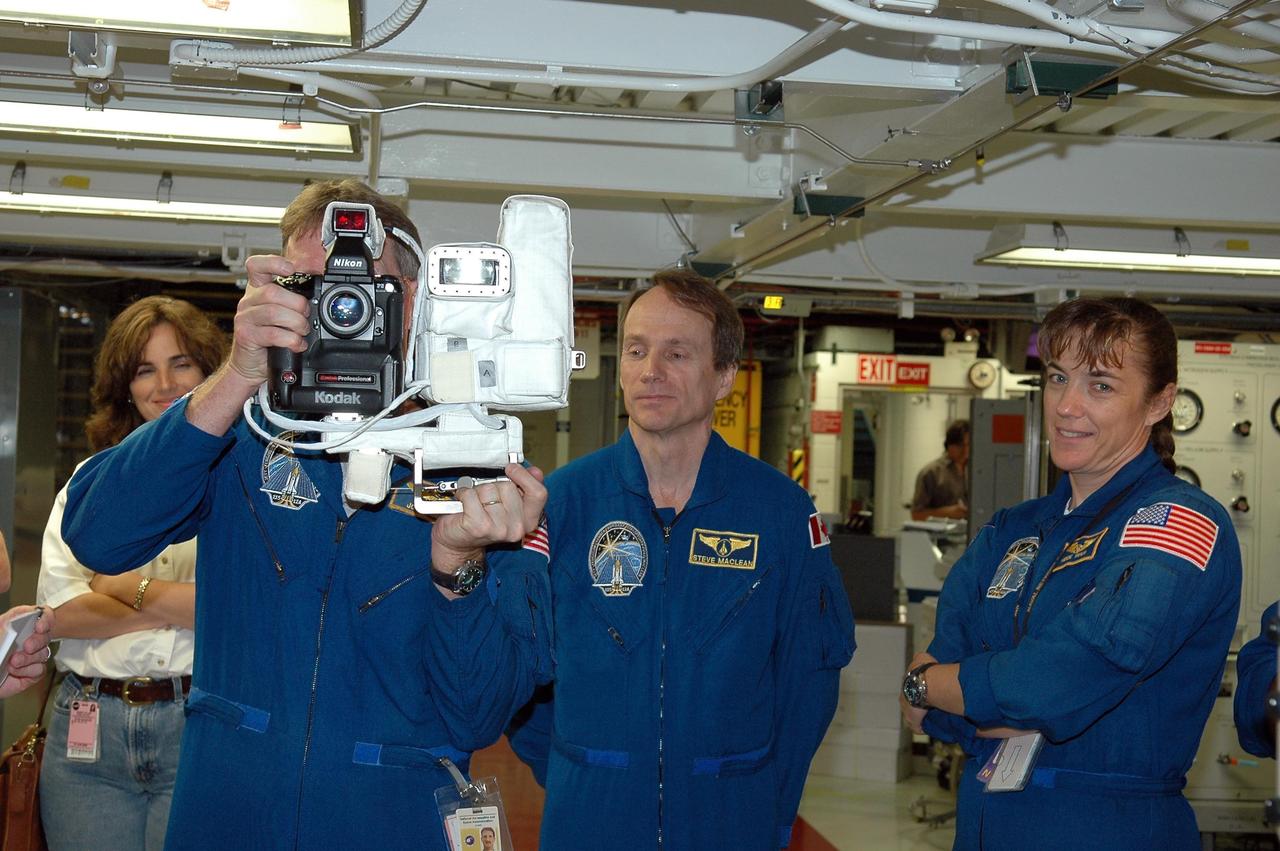
KENNEDY SPACE CENTER, FLA. - In the Orbiter Processing Facility, STS-115 Mission Specialist Joseph Tanner practices using a camera that is a mockup of one the crew will use to take photographs on-orbit. With him are Mission Specialists Steven MacLean, who represents the Canadian Space Agency, and Heidemarie Stefanyshyn-Piper. The crew is at the center for Crew Equipment Interface Test activities, which involves equipment familiarization, a routine part of astronaut training and launch preparations. The mission will deliver the second port truss segment, the P3/P4 Truss, to attach to the first port truss segment, the P1 Truss, as well as deploy solar array set 2A and 4A. Launch on Space Shuttle Atlantis is scheduled for late August. Photo credit: NASA/Kim Shiflett

KENNEDY SPACE CENTER, FLA. - In the Orbiter Processing Facility, STS-115 crew members examine tiles on the orbiter Atlantis, the designated launch vehicle for their mission. From left are Mission Specialists Joseph Tanner, Daniel Burbank and Steven MacLean, who represents the Canadian Space Agency. The crew is at the center for Crew Equipment Interface Test activities, which involves equipment familiarization, a routine part of astronaut training and launch preparations. The mission will deliver the second port truss segment, the P3/P4 Truss, to attach to the first port truss segment, the P1 Truss, as well as deploy solar array set 2A and 4A. Launch on Space Shuttle Atlantis is scheduled for late August. Photo credit: NASA/Kim Shiflett
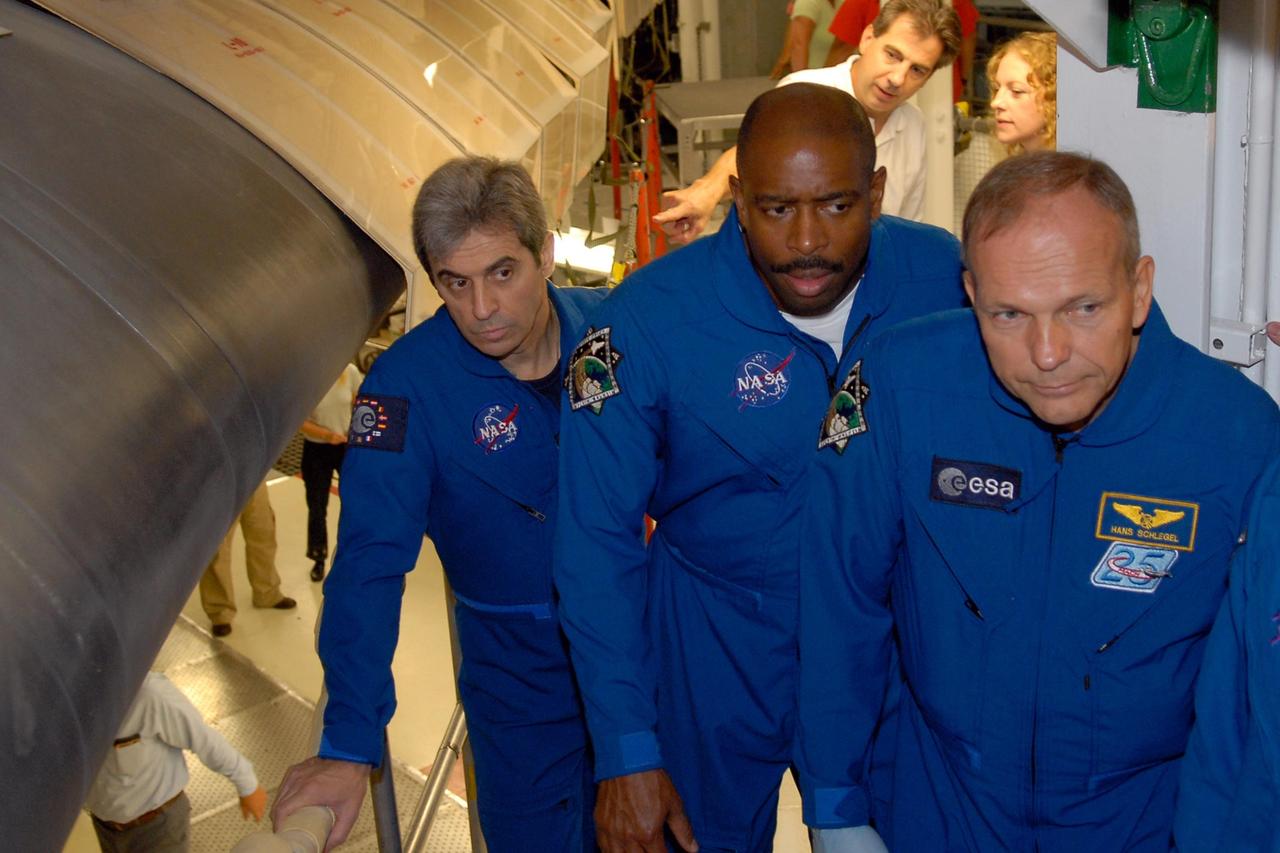
KENNEDY SPACE CENTER, FLA. -- In the Orbiter Processing Facility, STS-122 crew members stand next to the space shuttle Atlantis, which is being processed for launch on STS-122. From left are European Space Agency astronaut Leopold Eyharts and Mission Specialists Leland Melvin and Hans Schlegel, who also represents ESA. Eyharts will be traveling to the International Space Station to join the Expedition 16 crew as a flight engineer. The crew is at Kennedy to take part in a crew equipment interface test, or CEIT, which helps familiarize them with equipment and payloads for the mission. Among the activities standard to a CEIT are harness training, inspection of the thermal protection system and camera operation for planned extravehicular activities, or EVAs. STS-122 is targeted for launch in December. Photo credit: NASA/Kim Shiflett
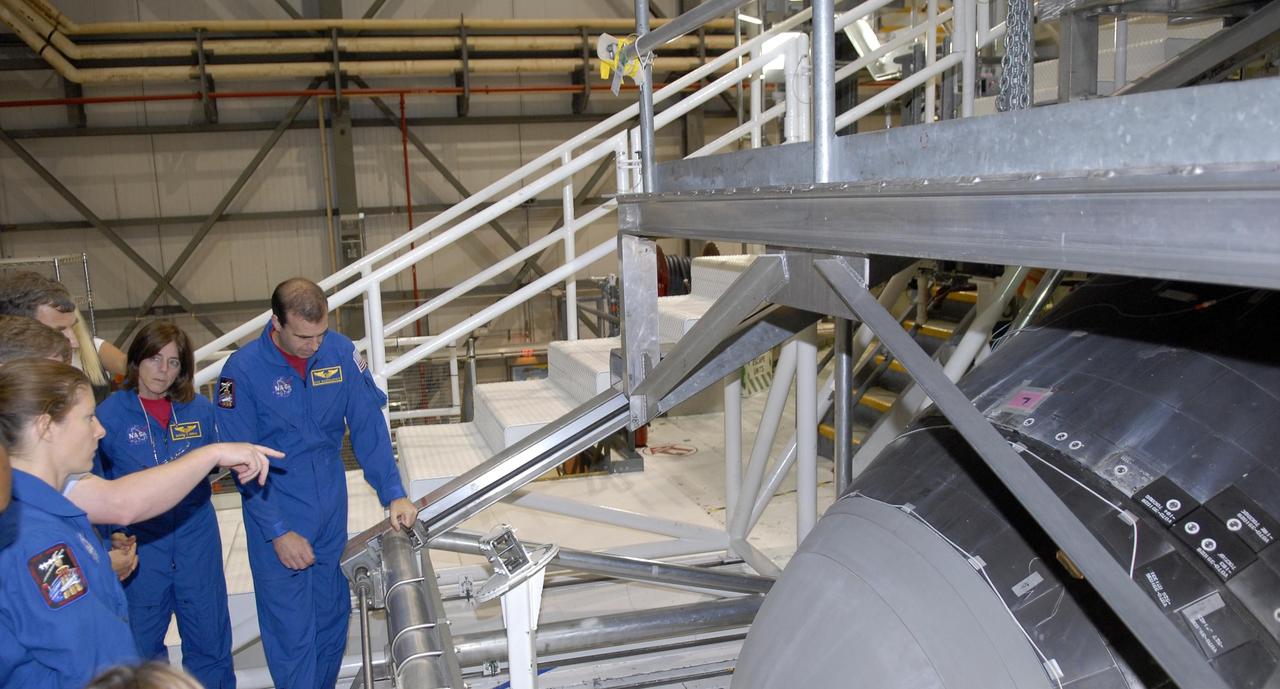
KENNEDY SPACE CENTER, FLA. -- During crew equipment interface test activities, members of the STS-118 crew look over the orbiter Endeavour in Orbiter Processing Facility bay 2. Seen here are (from left), Mission Specialists Tracy Caldwell, Barbara Morgan and Richard Mastrocchio. The STS-118 mission will be delivering the third starboard truss segment, the ITS S5, to the International Space Station, as well as the SPACEHAB single cargo module filled with supplies and equipment. Launch aboard Space Shuttle Endeavour is targeted for Aug. 9. Photo credit: NASA/Kim Shiflett
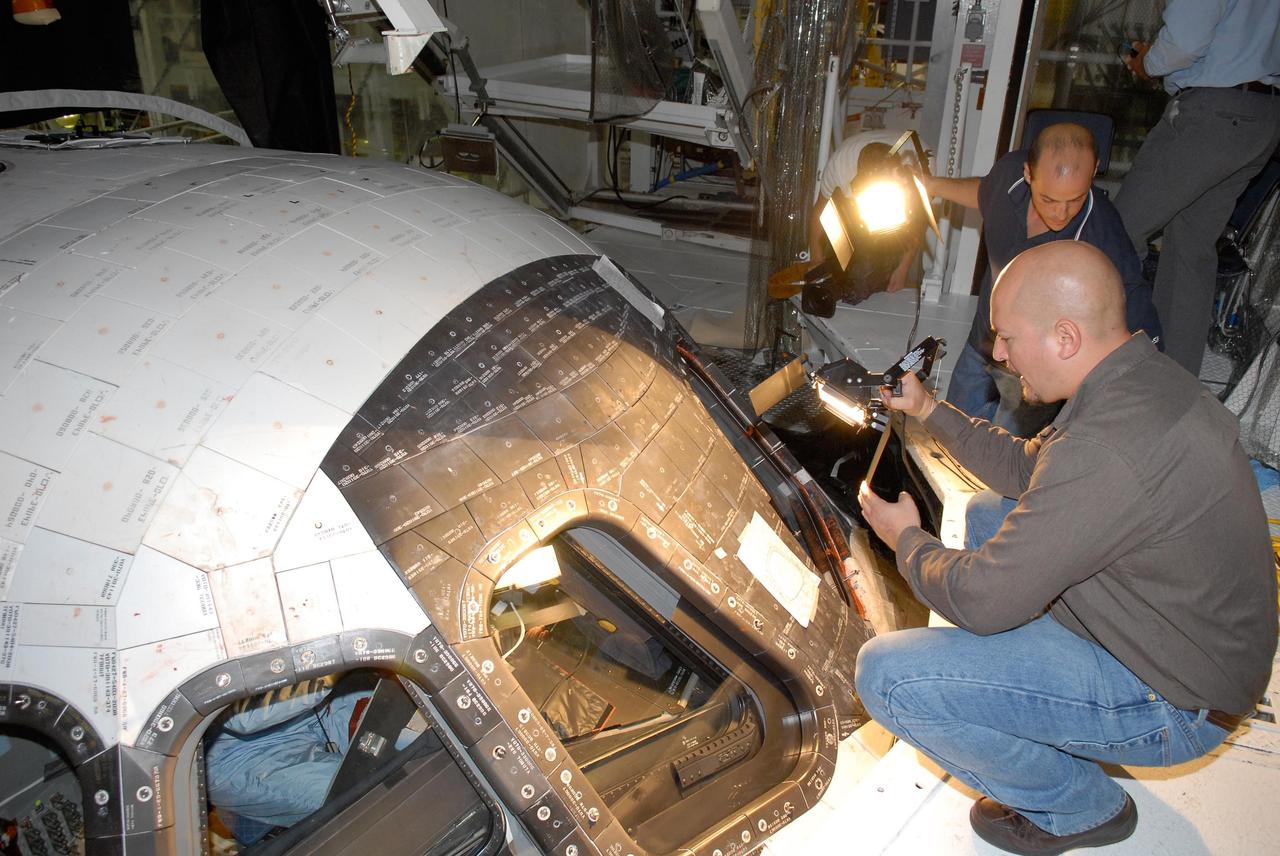
KENNEDY SPACE CENTER, FLA. -- In the Orbiter Processing Facility, United Space Alliance technicians provide lights over the space shuttle Atlantis' cockpit. STS-122 Commander Stephen Frick is inside checking the cockpit for launch readiness. The crew is at Kennedy Space Center to take part in a crew equipment interface test, which helps familiarize them with equipment and payloads for the mission. Among the activities standard to a CEIT are harness training, inspection of the thermal protection system and camera operation for planned extravehicular activities, or EVAs. The mission will carry and install the Columbus Lab, a multifunctional, pressurized laboratory that will be permanently attached to Node 2 of the space station to carry out experiments in materials science, fluid physics and biosciences, as well as to perform a number of technological applications. It is Europe’s largest contribution to the construction of the International Space Station and will support scientific and technological research in a microgravity environment. STS-122 is targeted for launch in December. Photo credit: NASA/Kim Shiflett
KENNEDY SPACE CENTER, FLA. -- During crew equipment interface test activities at KSC, STS-118 Mission Specialists Tracy Caldwell (left) and Richard Mastrocchio look inside the orbiter Endeavour, which is in Orbiter Processing Facility bay 3. The STS-118 mission will be delivering the third starboard truss segment, the ITS S5, to the International Space Station, as well as the SPACEHAB single cargo module filled with supplies and equipment. Launch aboard Space Shuttle Endeavour is targeted for Aug. 9. Photo credit: NASA/Kim Shiflett
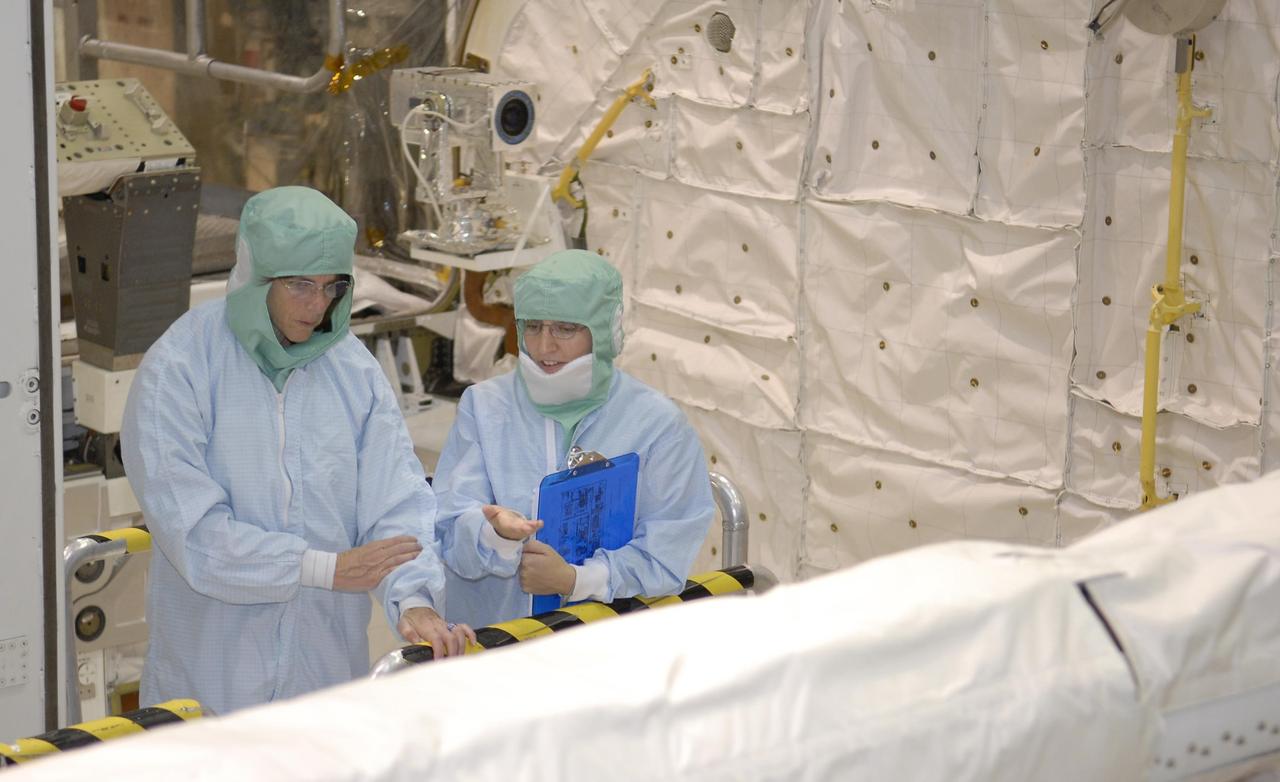
KENNEDY SPACE CENTER, FLA. -- In Endeavour's payload bay in Orbiter Processing Facility bay 2, STS-118 Mission Specialist Barbara Morgan gets some details about the orbiter boom sensor system in front of her. She and other crew members are at KSC for crew equipment interface test activities. The STS-118 mission will be delivering the third starboard truss segment, the ITS S5, to the International Space Station, as well as the SPACEHAB single cargo module filled with supplies and equipment. Launch aboard Space Shuttle Endeavour is targeted for Aug. 9. Photo credit: NASA/Kim Shiflett
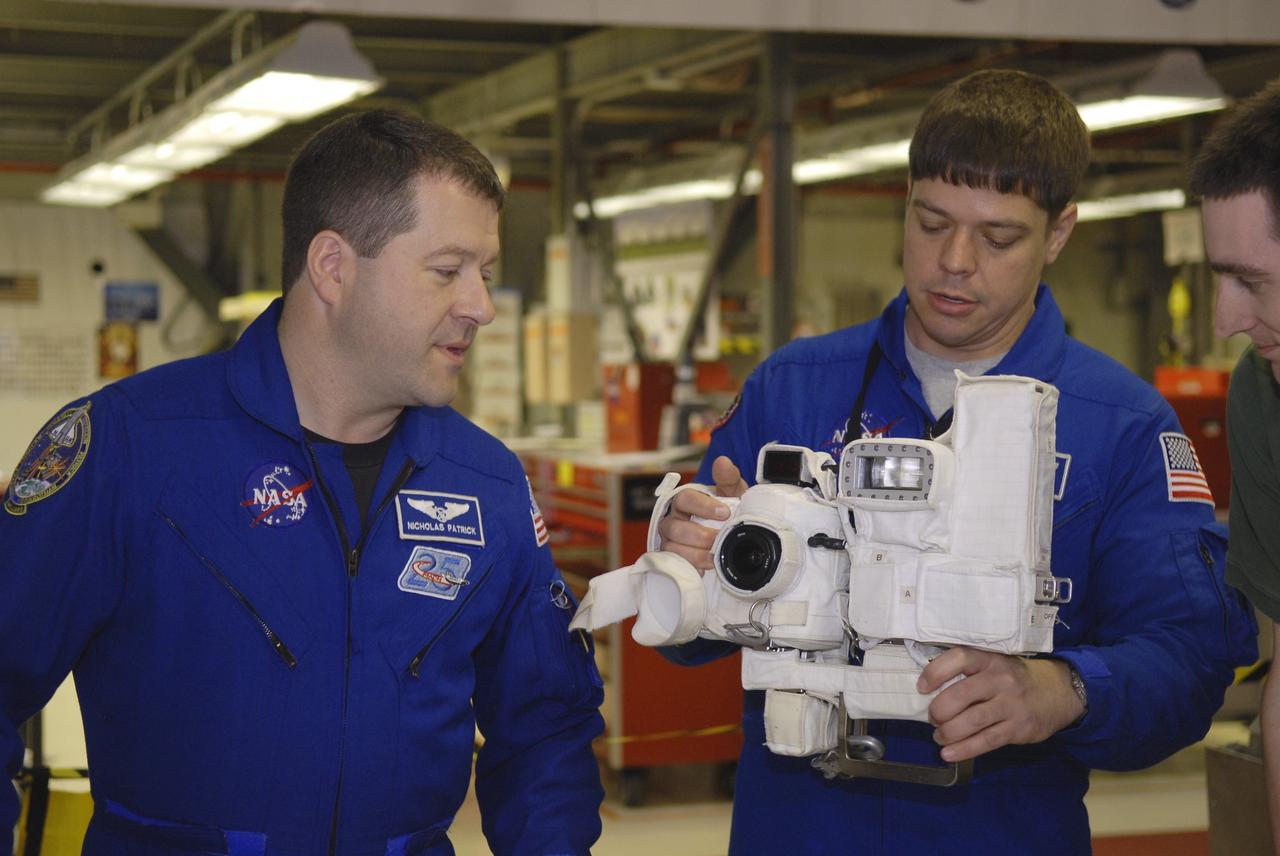
CAPE CANAVERAL, Fla. – In Orbiter Processing Facility-3 at NASA's Kennedy Space Center in Florida, STS-130 Mission Specialist Nicolas Patrick, left, discusses the operation of a camera that will fly on space shuttle Endeavour with his crewmate, Mission Specialist Robert Behnken. The crew is at Kennedy for a crew equipment interface test, or CEIT, which provides hands-on training and observation of shuttle and flight hardware. The STS-130 flight will carry the Tranquility pressurized module with a built-in cupola to the International Space Station aboard Endeavour. Launch is targeted for Feb. 4, 2010. Photo credit: NASA/Kim Shiflett
KENNEDY SPACE CENTER, FLA. - In the Orbiter Processing Facility, STS-115 Mission Specialist Joseph Tanner (foreground) examines tiles on the orbiter Atlantis, the designated launch vehicle for the mission. The crew is at the center for Crew Equipment Interface Test activities, which involves equipment familiarization, a routine part of astronaut training and launch preparations. The mission will deliver the second port truss segment, the P3/P4 Truss, to attach to the first port truss segment, the P1 Truss, as well as deploy solar array set 2A and 4A. Launch on Space Shuttle Atlantis is scheduled for late August. Photo credit: NASA/Kim Shiflett
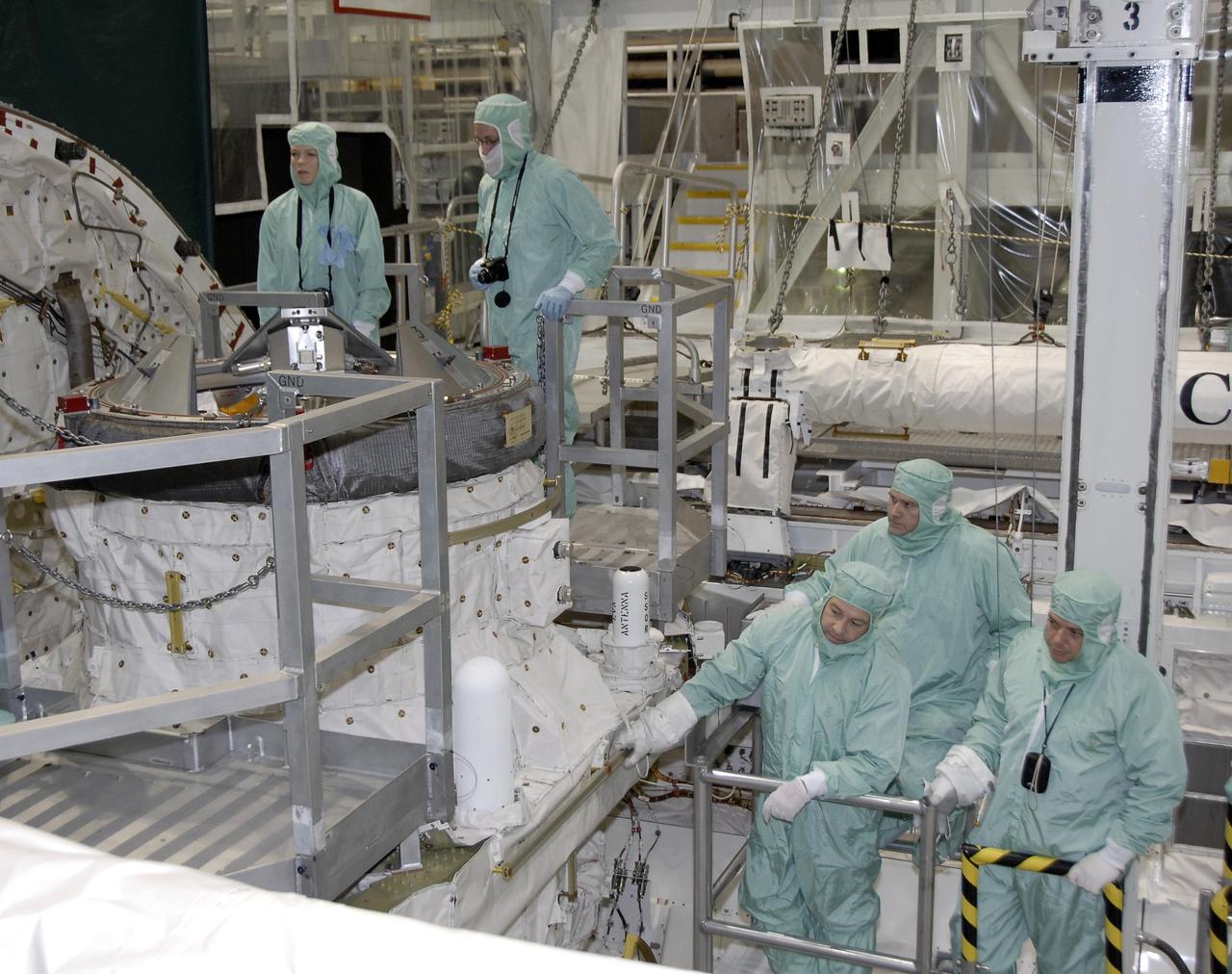
CAPE CANAVERAL, Fla. – In Orbiter Processing Facility-3 at NASA's Kennedy Space Center in Florida, members of the STS-130 crew inspect space shuttle Endeavour's payload bay. In the right corner, from left are Commander George Zamka, Pilot Terry Virts Jr. and Mission Specialist Robert Behnken. The crew is at Kennedy for a crew equipment interface test, or CEIT, which provides hands-on training and observation of shuttle and flight hardware. The STS-130 flight will carry the Tranquility pressurized module with a built-in cupola to the International Space Station aboard Endeavour. Launch is targeted for Feb. 4, 2010. Photo credit: NASA/Kim Shiflett
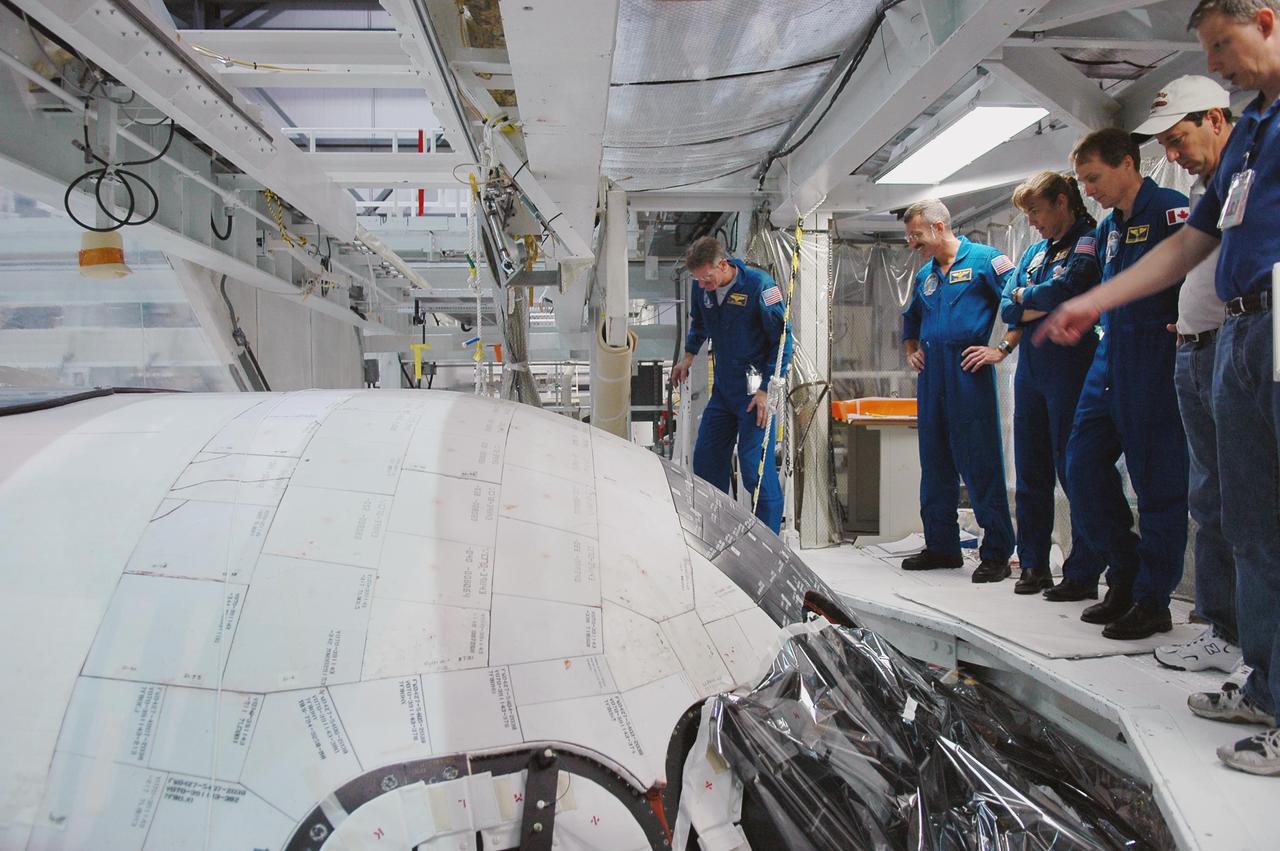
KENNEDY SPACE CENTER, FLA. - In the Orbiter Processing Facility, STS-115 Mission Specialist Joseph Tanner takes a closer look at the orbiter Atlantis, the designated launch vehicle for the mission.. Looking on (from left) are Mission Specialists Daniel Burbank, Heidemarie Stefanyshyn-Piper and Steven MacLean, who represents the Canadian Space Agency. The crew is at the center for Crew Equipment Interface Test activities, which involves equipment familiarization, a routine part of astronaut training and launch preparations. The mission will deliver the second port truss segment, the P3/P4 Truss, to attach to the first port truss segment, the P1 Truss, as well as deploy solar array set 2A and 4A. Launch on Space Shuttle Atlantis is scheduled for late August. Photo credit: NASA/Kim Shiflett
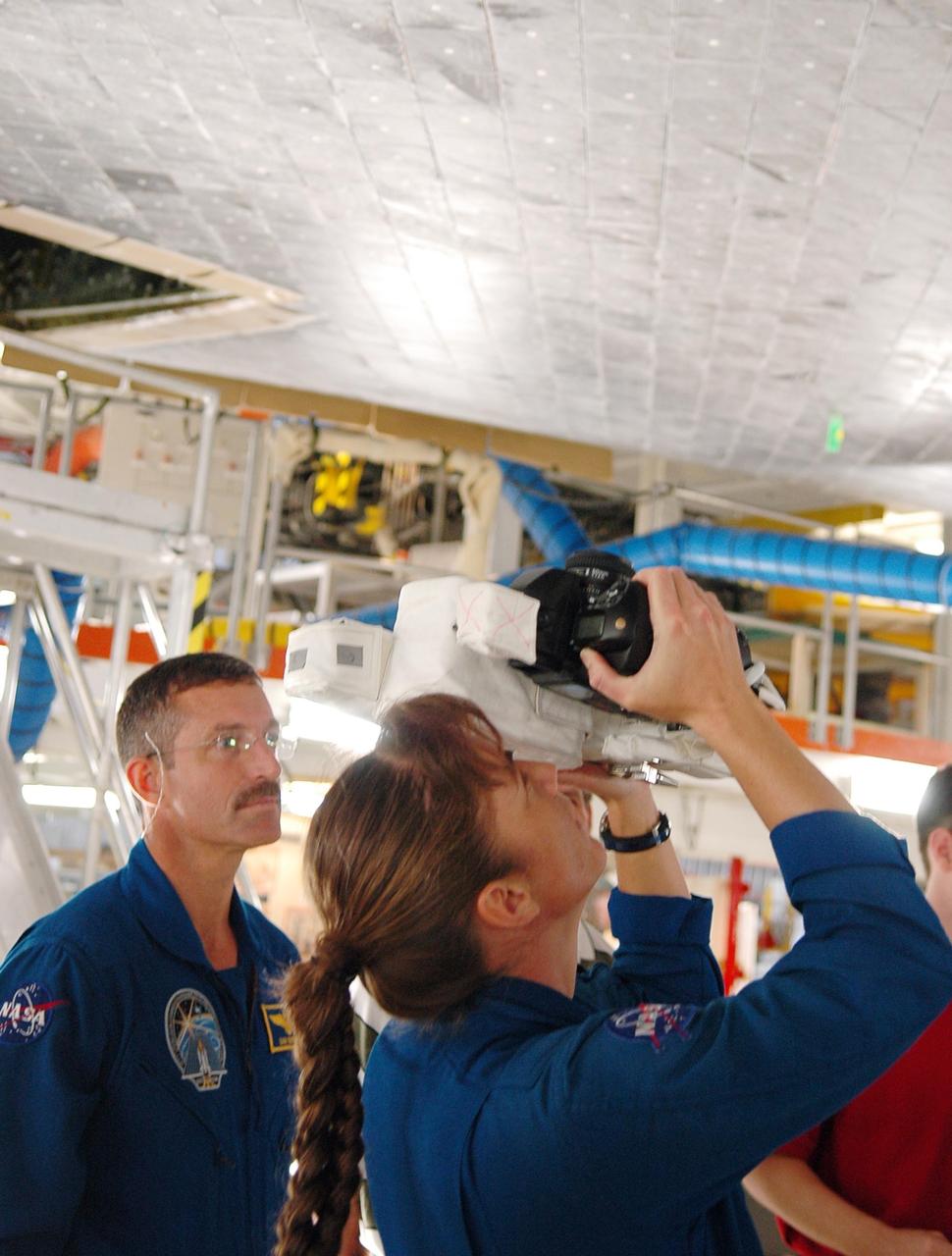
KENNEDY SPACE CENTER, FLA. - In the Orbiter Processing Facility, STS-115 Mission Specialist Heidemarie Stefanyshyn-Piper practices using a camera that is a mockup of one the crew will use to take photographs on-orbit. At left is Mission Specialist Daniel Burbank. The crew is at the center for Crew Equipment Interface Test activities, which involves equipment familiarization, a routine part of astronaut training and launch preparations. The mission will deliver the second port truss segment, the P3/P4 Truss, to attach to the first port truss segment, the P1 Truss, as well as deploy solar array set 2A and 4A. Launch on Space Shuttle Atlantis is scheduled for late August. Photo credit: NASA/Kim Shiflett
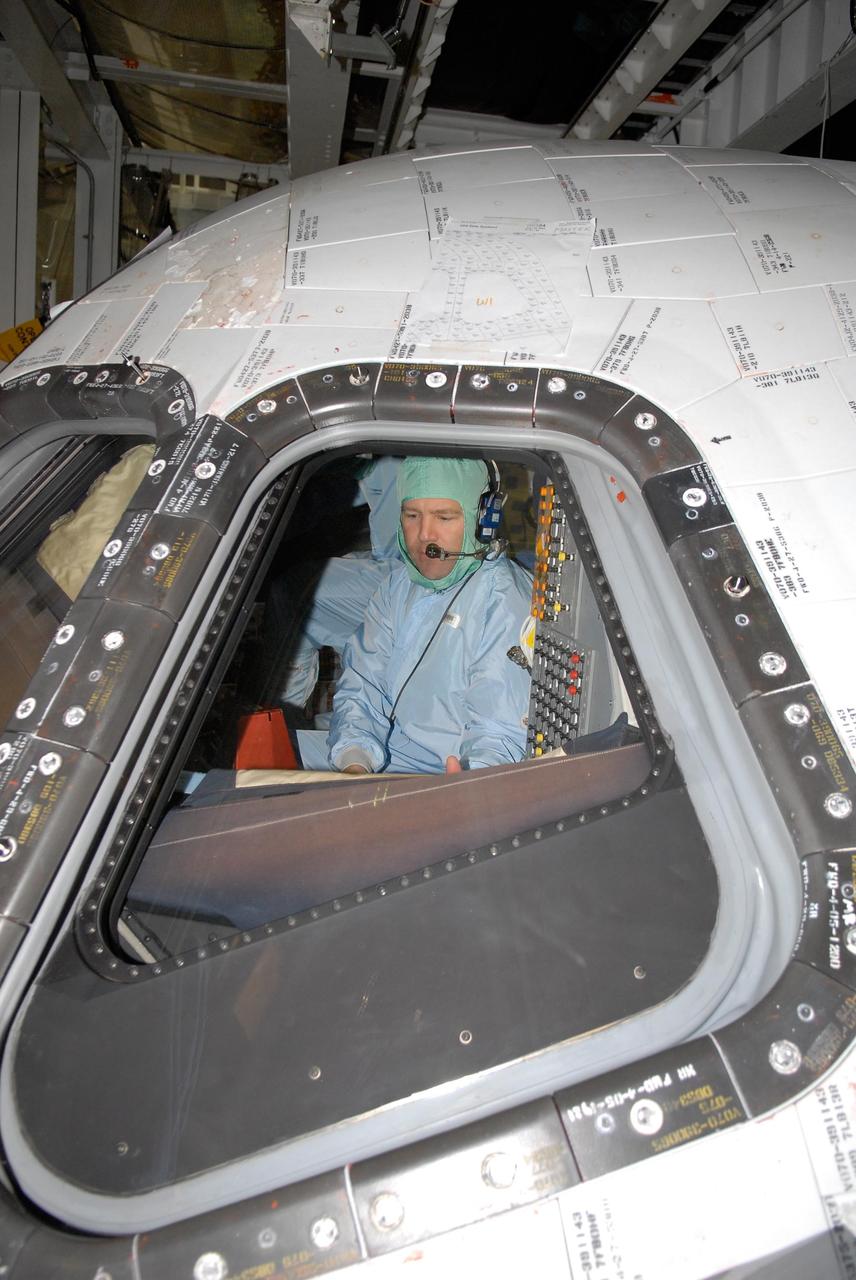
KENNEDY SPACE CENTER, FLA. -- In the Orbiter Processing Facility, STS-122 Commander Stephen Frick checks out the cockpit on space shuttle Atlantis. He and other crew members are at Kennedy Space Center to take part in a crew equipment interface test, which helps familiarize them with equipment and payloads for the mission. Among the activities standard to a CEIT are harness training, inspection of the thermal protection system and camera operation for planned extravehicular activities, or EVAs. The mission will carry and install the Columbus Lab, a multifunctional, pressurized laboratory that will be permanently attached to Node 2 of the space station to carry out experiments in materials science, fluid physics and biosciences, as well as to perform a number of technological applications. It is Europe’s largest contribution to the construction of the International Space Station and will support scientific and technological research in a microgravity environment. STS-122 is targeted for launch in December. Photo credit: NASA/Kim Shiflett

KENNEDY SPACE CENTER, FLA. -- From a lower level in the Orbiter Processing Facility, members of the STS-122 crew check out the landing gear on space shuttle Atlantis, overhead. Dressed in their blue suits are Mission Specialist Leland Melvin, Commander Stephen Frick, European Space Agency astronaut Leopold Eyharts and Pilot Alan Poindexter. Eyharts will be traveling to the International Space Station to join the Expedition 16 crew as a flight engineer. The crew is at Kennedy to take part in a crew equipment interface test, or CEIT, which helps familiarize them with equipment and payloads for the mission. Among the activities standard to a CEIT are harness training, inspection of the thermal protection system and camera operation for planned extravehicular activities, or EVAs. STS-122 is targeted for launch in December. Photo credit: NASA/Kim Shiflett

KENNEDY SPACE CENTER, FLA. -- In the Orbiter Processing Facility, members of the STS-122 crew practice handling cameras that will be used during the mission. Holding the camera at left is Mission Specialist Hans Schlegel. Next to him, from left, are Mission Specialists Leland Melvin, Rex Walheim and Stanley Love. The crew is at Kennedy Space Center to take part in a crew equipment interface test, which helps familiarize them with equipment and payloads for the mission. Among the activities standard to a CEIT are harness training, inspection of the thermal protection system and camera operation for planned extravehicular activities, or EVAs. The mission will carry and install the Columbus Lab, a multifunctional, pressurized laboratory that will be permanently attached to Node 2 of the space station to carry out experiments in materials science, fluid physics and biosciences, as well as to perform a number of technological applications. It is Europe’s largest contribution to the construction of the International Space Station and will support scientific and technological research in a microgravity environment. STS-122 is targeted for launch in December. Photo credit: NASA/Kim Shiflett
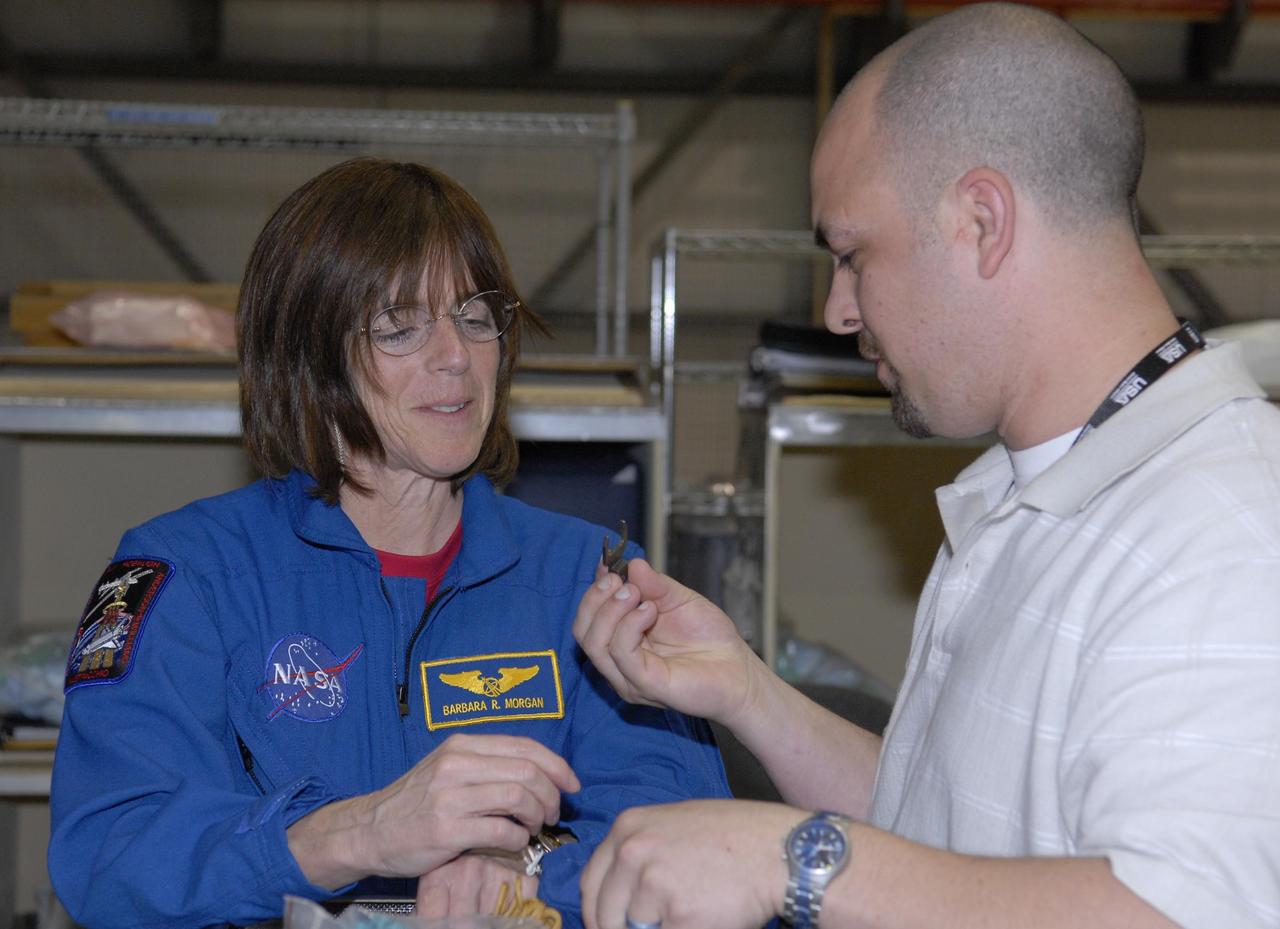
KENNEDY SPACE CENTER, FLA. -- During crew equipment interface test activities in Orbiter Processing Facility bay 3 at KSC, STS-118 Mission Specialist Barbara Morgan learns about a tool that is part of the equipment on the flight. The STS-118 mission will be delivering the third starboard truss segment, the ITS S5, to the International Space Station, as well as the SPACEHAB single cargo module filled with supplies and equipment. Launch aboard Space Shuttle Endeavour is targeted for Aug. 9. Photo credit: NASA/Kim Shiflett
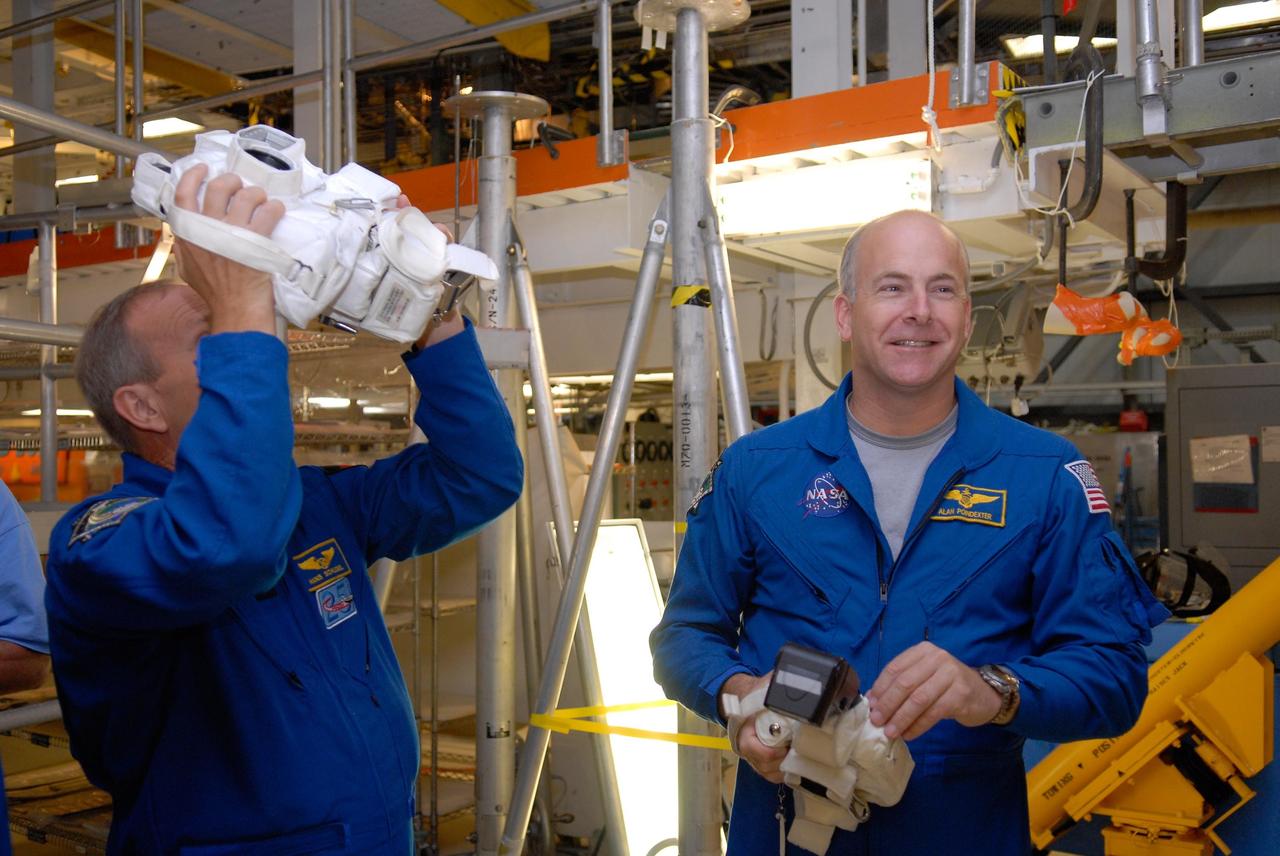
KENNEDY SPACE CENTER, FLA. -- In the Orbiter Processing Facility, members of the STS-122 crew practice handling cameras that will be used during the mission. At left is Mission Specialist Hans Schlegel. At right is Pilot Alan Poindexter. Schlegel represents the European Space Agency. The crew is at Kennedy Space Center to take part in a crew equipment interface test, which helps familiarize them with equipment and payloads for the mission. Among the activities standard to a CEIT are harness training, inspection of the thermal protection system and camera operation for planned extravehicular activities, or EVAs. The mission will carry and install the Columbus Lab, a multifunctional, pressurized laboratory that will be permanently attached to Node 2 of the space station to carry out experiments in materials science, fluid physics and biosciences, as well as to perform a number of technological applications. It is Europe’s largest contribution to the construction of the International Space Station and will support scientific and technological research in a microgravity environment. STS-122 is targeted for launch in December. Photo credit: NASA/Kim Shiflett

KENNEDY SPACE CENTER, FLA. - In the Orbiter Processing Facility, STS-115 crew members examine tiles on the orbiter Atlantis, the designated launch vehicle for their mission. From left are Mission Specialists Heidemarie Stefanyshyn-Piper, Joseph Tanner and Steven MacLean, who represents the Canadian Space Agency. The crew is at the center for Crew Equipment Interface Test activities, which involves equipment familiarization, a routine part of astronaut training and launch preparations. The mission will deliver the second port truss segment, the P3/P4 Truss, to attach to the first port truss segment, the P1 Truss, as well as deploy solar array set 2A and 4A. Launch on Space Shuttle Atlantis is scheduled for late August. Photo credit: NASA/Kim Shiflett
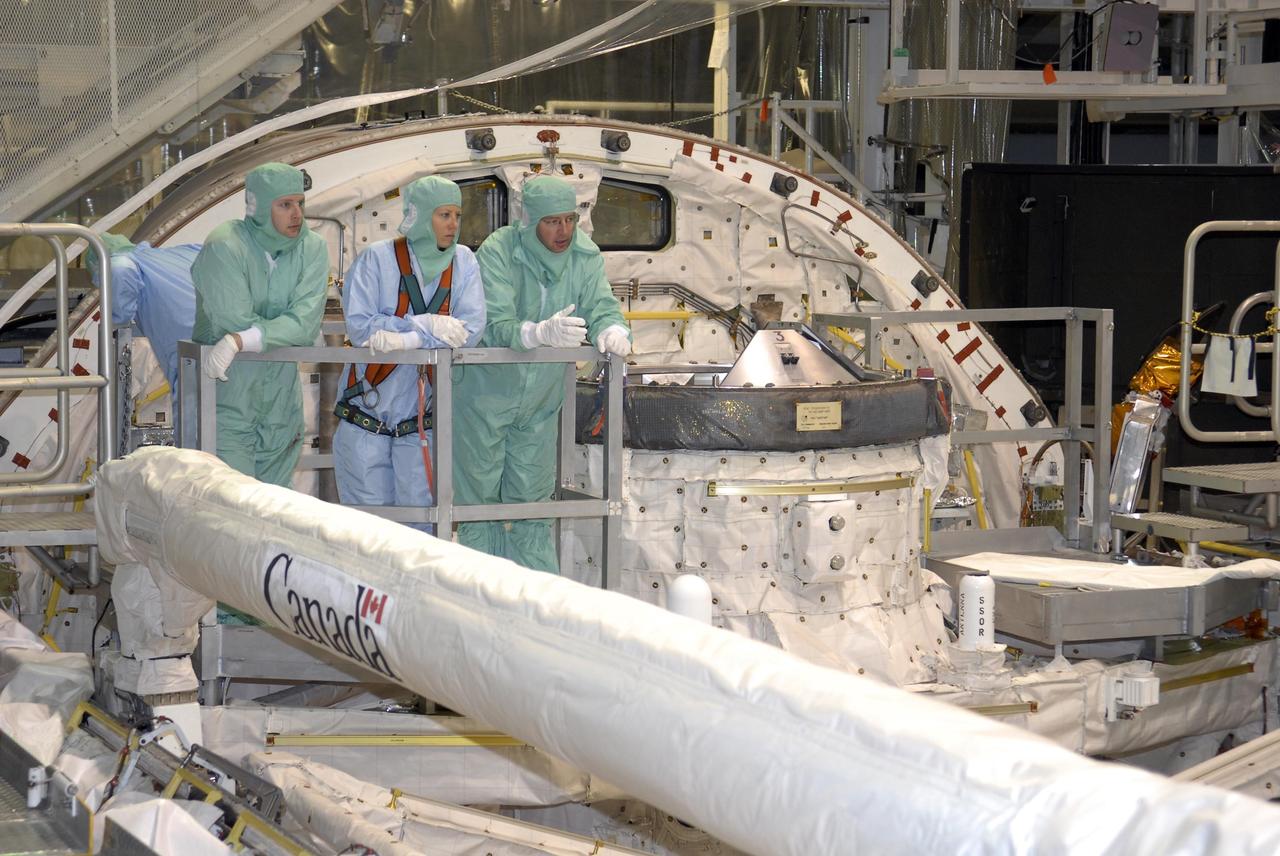
KENNEDY SPACE CENTER, FLA. -- During crew equipment interface test activities at KSC, STS-118 Mission Specialists Tracy Caldwell (center) and Dr. Dafydd Williams (right) look over the interior of the payload bay of orbiter Endeavour. The STS-118 mission will be delivering the third starboard truss segment, the ITS S5, to the International Space Station, as well as the SPACEHAB single cargo module filled with supplies and equipment. Launch aboard Space Shuttle Endeavour is targeted for Aug. 9. Photo credit: NASA/Kim Shiflett
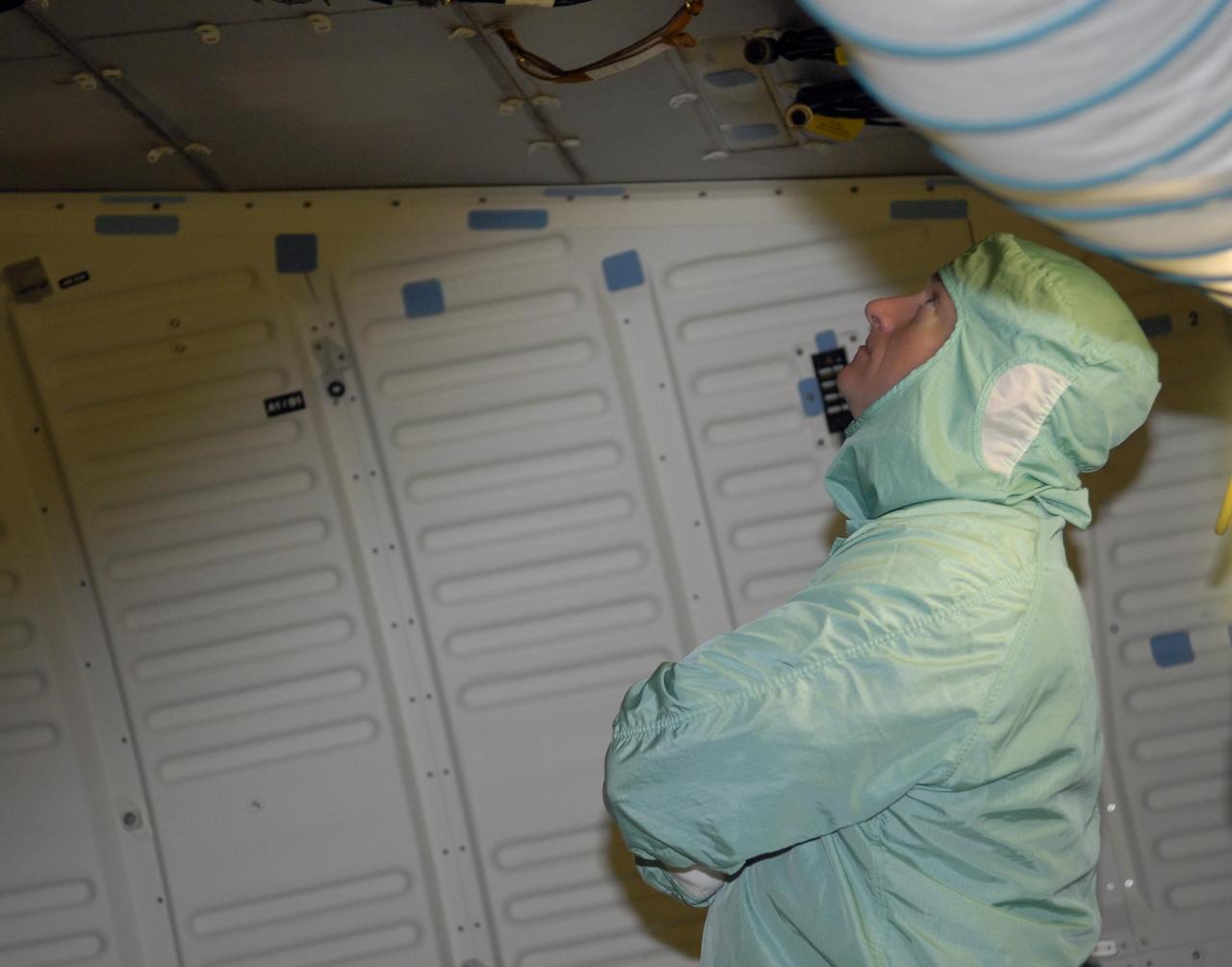
KENNEDY SPACE CENTER, FLA. -- During crew equipment interface test activities at KSC, STS-118 Commander Scott Kelly checks out the midbody of orbiter Endeavour, which is in Orbiter Processing Facility bay 3. The STS-118 mission will be delivering the third starboard truss segment, the ITS S5, to the International Space Station, as well as the SPACEHAB single cargo module filled with supplies and equipment. Launch aboard Space Shuttle Endeavour is targeted for Aug. 9. Photo credit: NASA/Kim Shiflett

KENNEDY SPACE CENTER, FLA. -- During crew equipment interface test activities, members of the STS-118 crew look over the orbiter Endeavour in Orbiter Processing Facility bay 2. Seen here are Mission Specialists Barbara Morgan (standing), Richard Mastrocchio and Dr. Dafydd Williams (background) and Tracy Caldwell (foreground). The STS-118 mission will be delivering the third starboard truss segment, the ITS S5, to the International Space Station, as well as the SPACEHAB single cargo module filled with supplies and equipment. Launch aboard Space Shuttle Endeavour is targeted for Aug. 9. Photo credit: NASA/Kim Shiflett
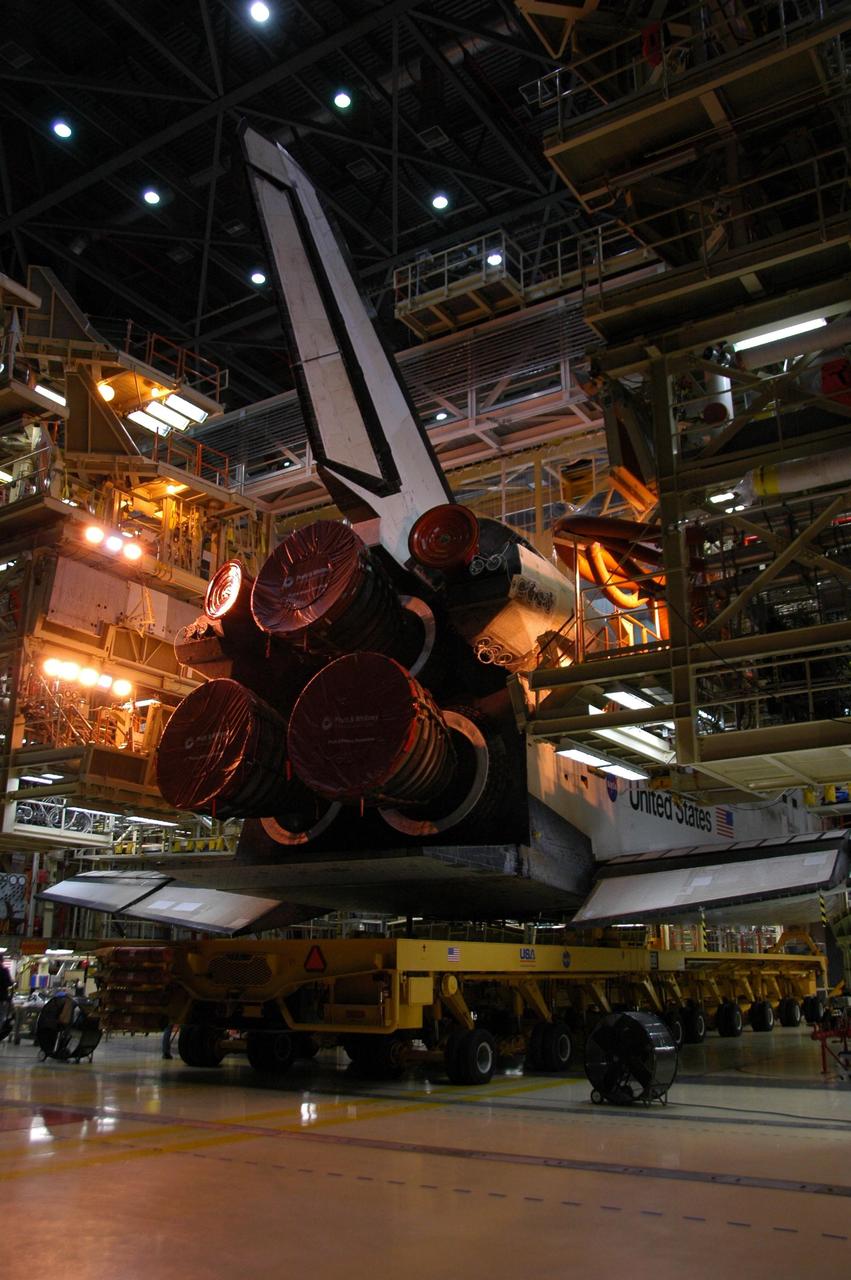
KENNEDY SPACE CENTER, FLA. -- Space shuttle Discovery is ready to roll out of the Orbiter Processing Facility bay 3 on its transporter for the short trip to the Vehicle Assembly Building. In the VAB, the shuttle will be lifted and mated with the external tank and solid rocket boosters on the mobile launcher platform. Discovery is targeted for launch to the International Space Station for mission STS-120 on Oct. 23. The crew will be delivering and installing the Italian-built U.S. Node 2, named Harmony. The pressurized module will act as an internal connecting port and passageway to additional international science labs and cargo spacecraft. In addition to increasing the living and working space inside the station, it also will serve as a work platform outside for the station's robotic arm. Photo credit: NASA/Amanda Diller
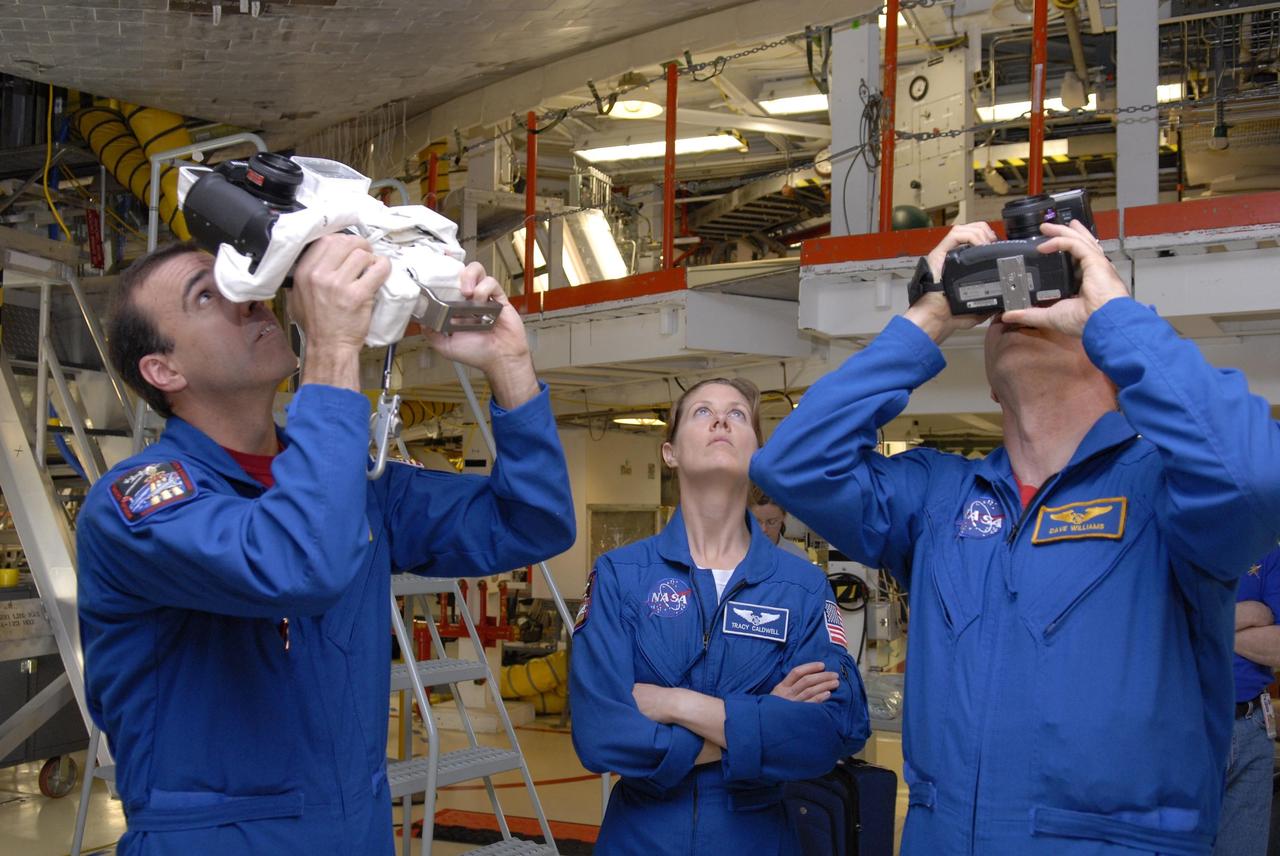
KENNEDY SPACE CENTER, FLA. -- In Orbiter Processing Facility bay 2, during crew equipment interface test activities, STS-118 Mission Specialists Dr. Dafydd Williams (left) and Richard Mastrocchio (right) practice photographing the underside of the orbiter Endeavour, which they may do on the flight. At center is Mission Specialist Tracy Caldwell, who will also practice with the cameras. The STS-118 mission will be delivering the third starboard truss segment, the ITS S5, to the International Space Station, as well as the SPACEHAB single cargo module filled with supplies and equipment. Launch aboard Space Shuttle Endeavour is targeted for Aug. 9. Photo credit: NASA/Kim Shiflett
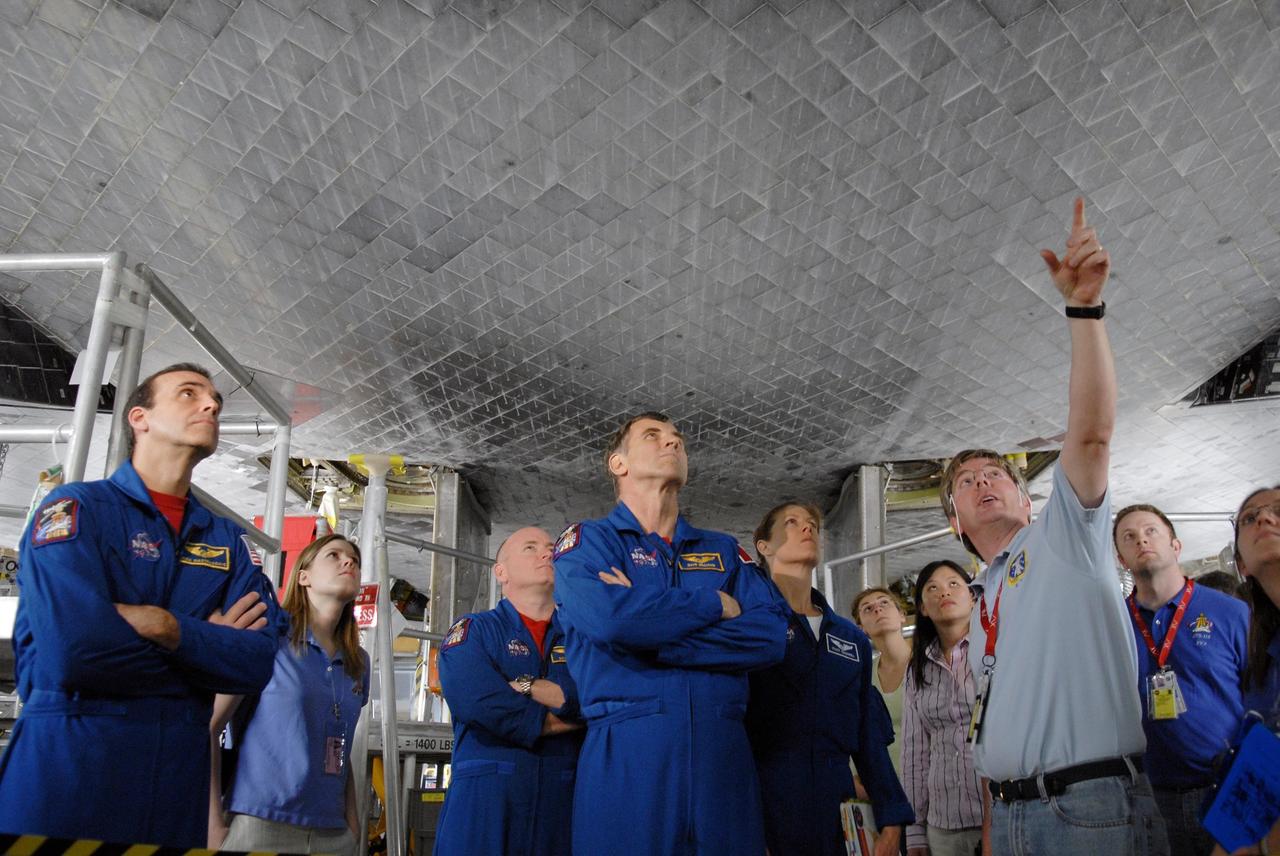
KENNEDY SPACE CENTER, FLA. -- During crew equipment interface test activities, members of the STS-118 crew look over the orbiter Endeavour in Orbiter Processing Facility bay 2. At left is Mission Specialist Richard Mastracchio; in the center are Commander Scott Kelly and Mission Specialists Dr. Dafydd Williams and Tracy Caldwell. The STS-118 mission will be delivering the third starboard truss segment, the ITS S5, to the International Space Station, as well as the SPACEHAB single cargo module filled with supplies and equipment. Launch aboard Space Shuttle Endeavour is targeted for Aug. 9. Photo credit: NASA/Kim Shiflett
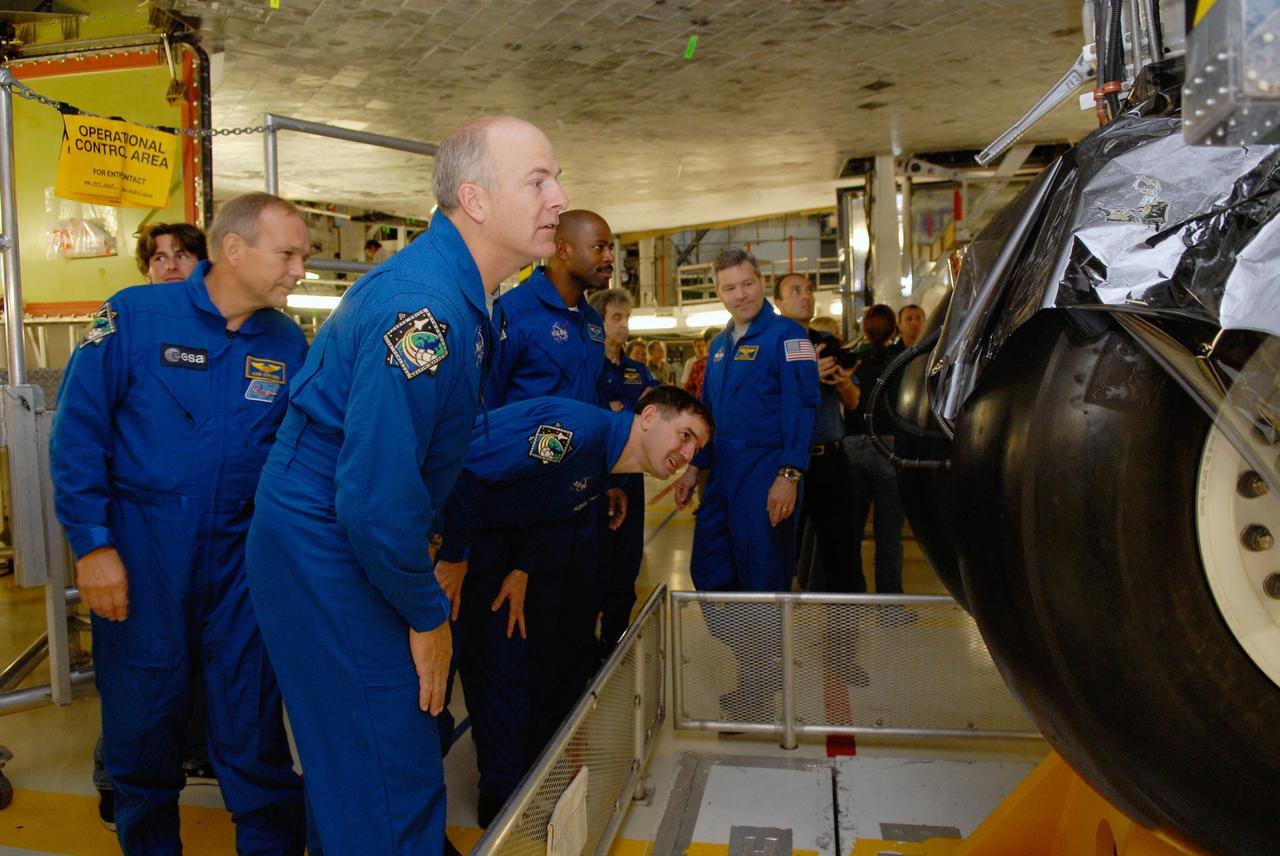
KENNEDY SPACE CENTER, FLA. -- In the Orbiter Processing Facility, members of the STS-122 crew get a close look at the landing gear on space shuttle Atlantis. From left are Mission Specialist Hans Schlegel, Pilot Alan Poindexter, Mission Specialists Rex Walheim and Leland Melvin and Commander Stephen Frick. Schlegel represents the European Space Agency. The crew is at Kennedy to take part in a crew equipment interface test, or CEIT, which helps familiarize them with equipment and payloads for the mission. Among the activities standard to a CEIT are harness training, inspection of the thermal protection system and camera operation for planned extravehicular activities, or EVAs. STS-122 is targeted for launch in December. Photo credit: NASA/Kim Shiflett

KENNEDY SPACE CENTER, FLA. -- In the Orbiter Processing Facility, STS-122 crew members are introduced to part of the LESS. From left are Mission Specialists Stanley Love, Hans Schlegel and Rex Walheim. The crew is at Kennedy to take part in a crew equipment interface test, or CEIT, which helps familiarize them with equipment and payloads for the mission. Among the activities standard to a CEIT are harness training, inspection of the thermal protection system and camera operation for planned extravehicular activities, or EVAs. STS-122 is targeted for launch in December. Photo credit: NASA/Kim Shiflett
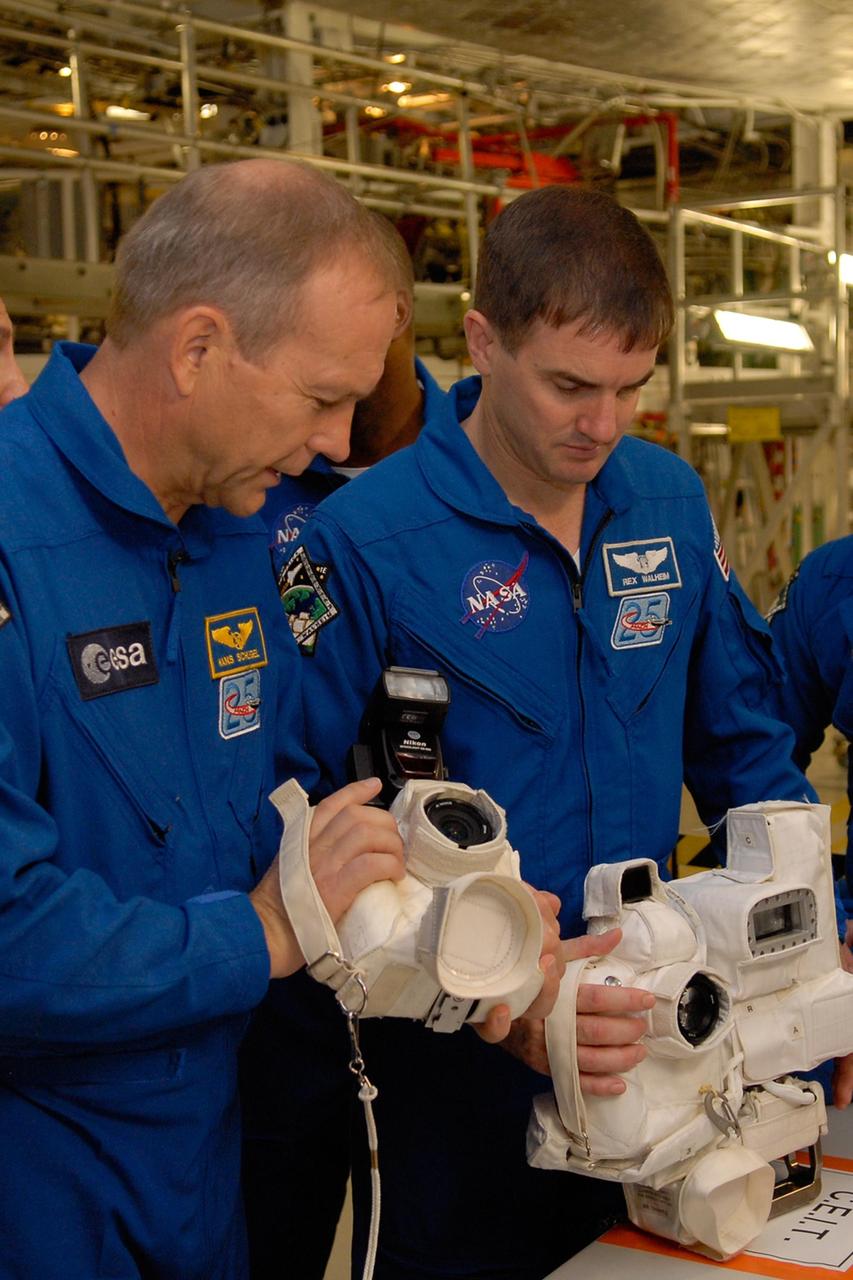
KENNEDY SPACE CENTER, FLA. -- In the Orbiter Processing Facility, members of the STS-122 crew look over cameras that will be used during the mission. From left are Mission Specialists Hans Schlegel and Rex Walheim. Schlegel represents the European Space Agency. The crew is at Kennedy Space Center to take part in a crew equipment interface test, which helps familiarize them with equipment and payloads for the mission. Among the activities standard to a CEIT are harness training, inspection of the thermal protection system and camera operation for planned extravehicular activities, or EVAs. The mission will carry and install the Columbus Lab, a multifunctional, pressurized laboratory that will be permanently attached to Node 2 of the space station to carry out experiments in materials science, fluid physics and biosciences, as well as to perform a number of technological applications. It is Europe’s largest contribution to the construction of the International Space Station and will support scientific and technological research in a microgravity environment. STS-122 is targeted for launch in December. Photo credit: NASA/Kim Shiflett
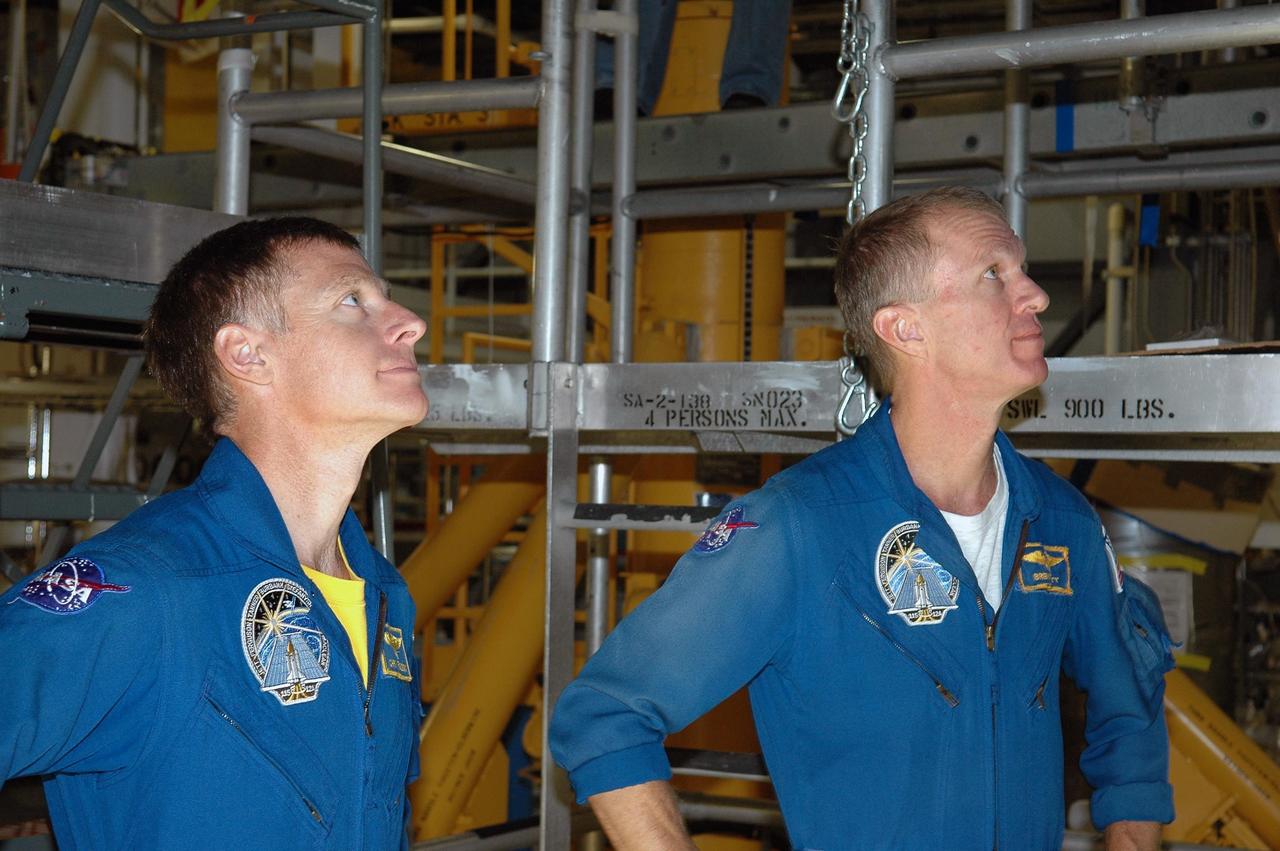
KENNEDY SPACE CENTER, FLA. - In the Orbiter Processing Facility, STS-115 crew members examine tiles on the orbiter Atlantis, the designated launch vehicle for their mission. From left are Pilot Christopher Ferguson and Commander Brent Jett. The crew is at the center for Crew Equipment Interface Test activities, which involves equipment familiarization, a routine part of astronaut training and launch preparations. The mission will deliver the second port truss segment, the P3/P4 Truss, to attach to the first port truss segment, the P1 Truss, as well as deploy solar array set 2A and 4A. Launch on Space Shuttle Atlantis is scheduled for late August. Photo credit: NASA/Kim Shiflett
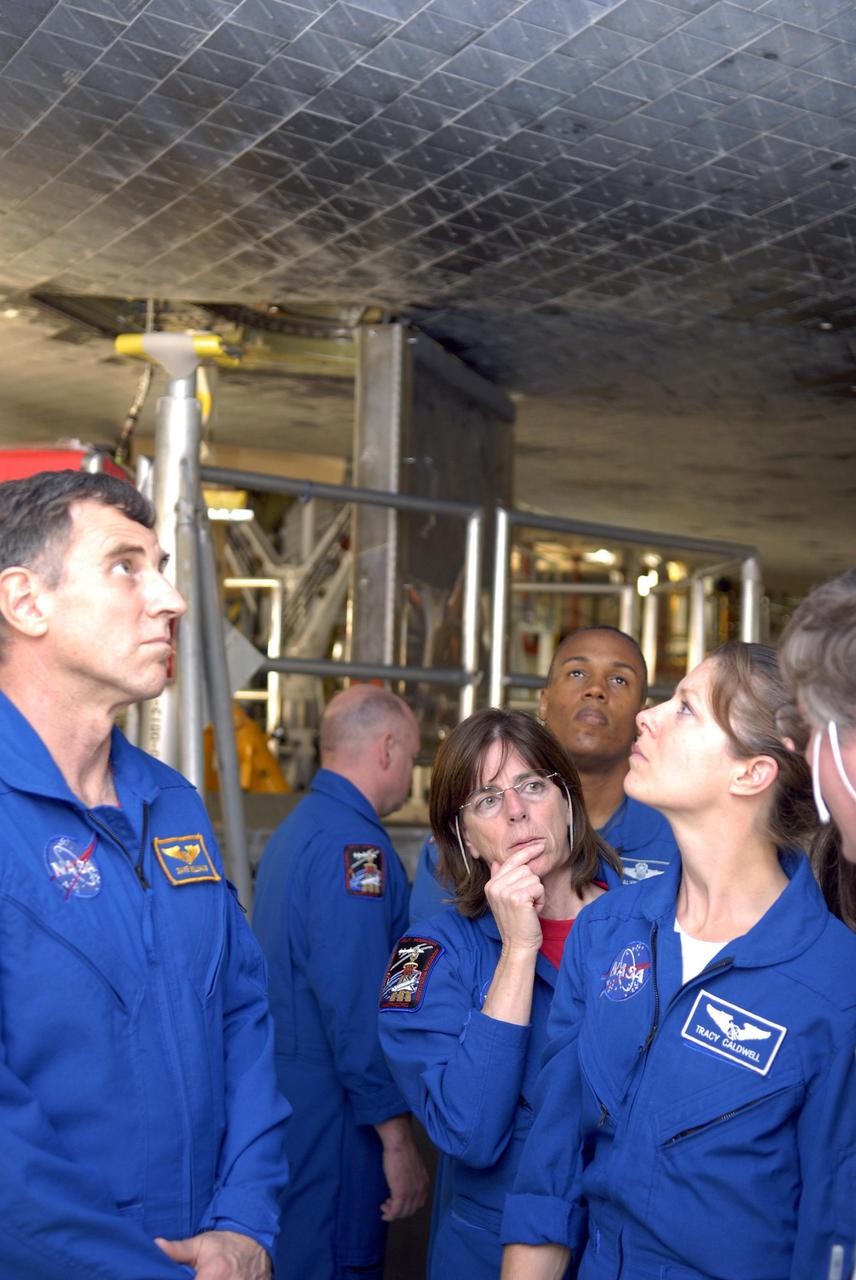
KENNEDY SPACE CENTER, FLA. -- During crew equipment interface test activities, members of the STS-118 crew look over the orbiter Endeavour in Orbiter Processing Facility bay 2. From left are Mission Specialist Dr. Dafydd Williams, Commander Scott Kelly, and Mission Specialists Barbara Morgan, Benjamin Drew and Tracy Caldwell. The STS-118 mission will be delivering the third starboard truss segment, the ITS S5, to the International Space Station, as well as the SPACEHAB single cargo module filled with supplies and equipment. Launch aboard Space Shuttle Endeavour is targeted for Aug. 9. Photo credit: NASA/Kim Shiflett
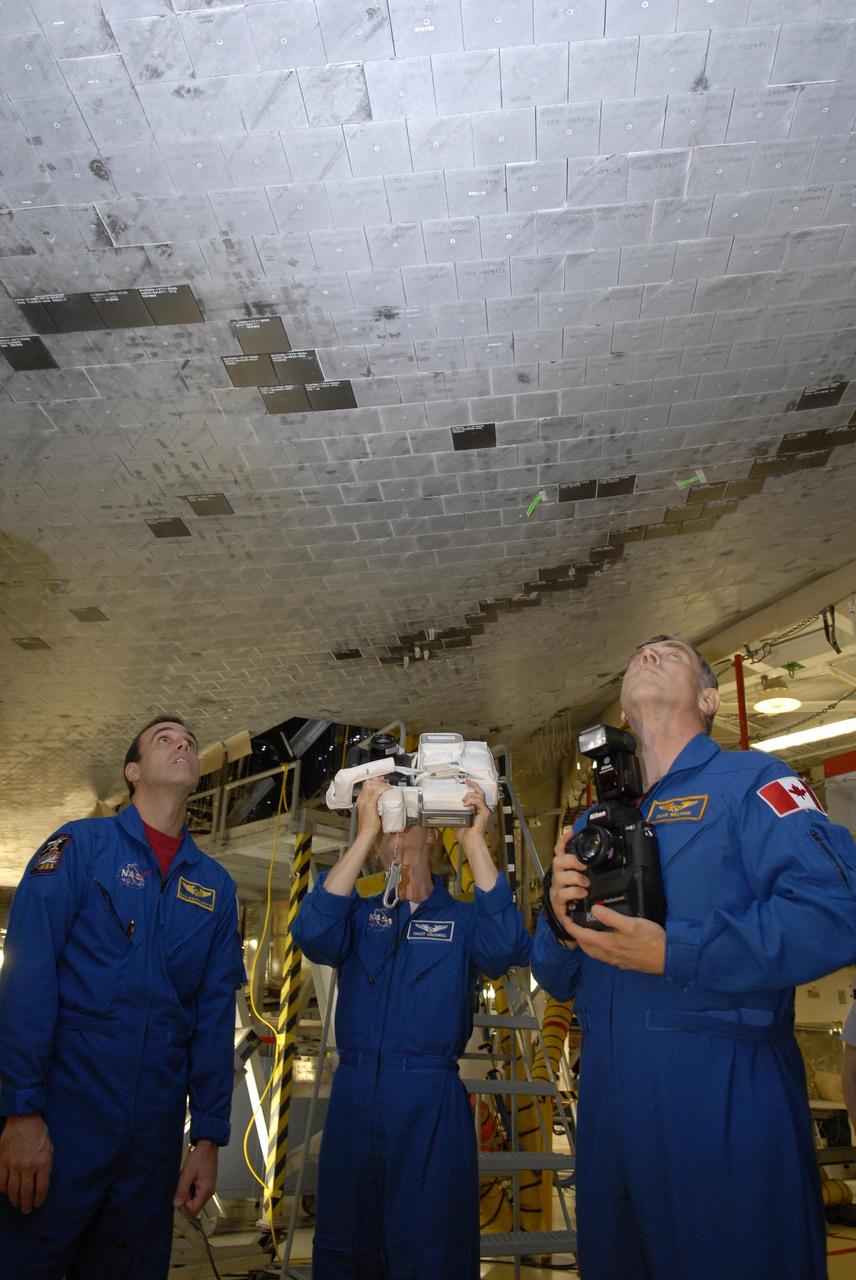
KENNEDY SPACE CENTER, FLA. -- In Orbiter Processing Facility bay 2, during crew equipment interface test activities, STS-118 Mission Specialists Dr. Dafydd Williams, Tracy Caldwell and Richard Mastrocchio are getting practice photographing the underside of the orbiter Endeavour, which they may do on the flight. The STS-118 mission will be delivering the third starboard truss segment, the ITS S5, to the International Space Station, as well as the SPACEHAB single cargo module filled with supplies and equipment. Launch aboard Space Shuttle Endeavour is targeted for Aug. 9. Photo credit: NASA/Kim Shiflett
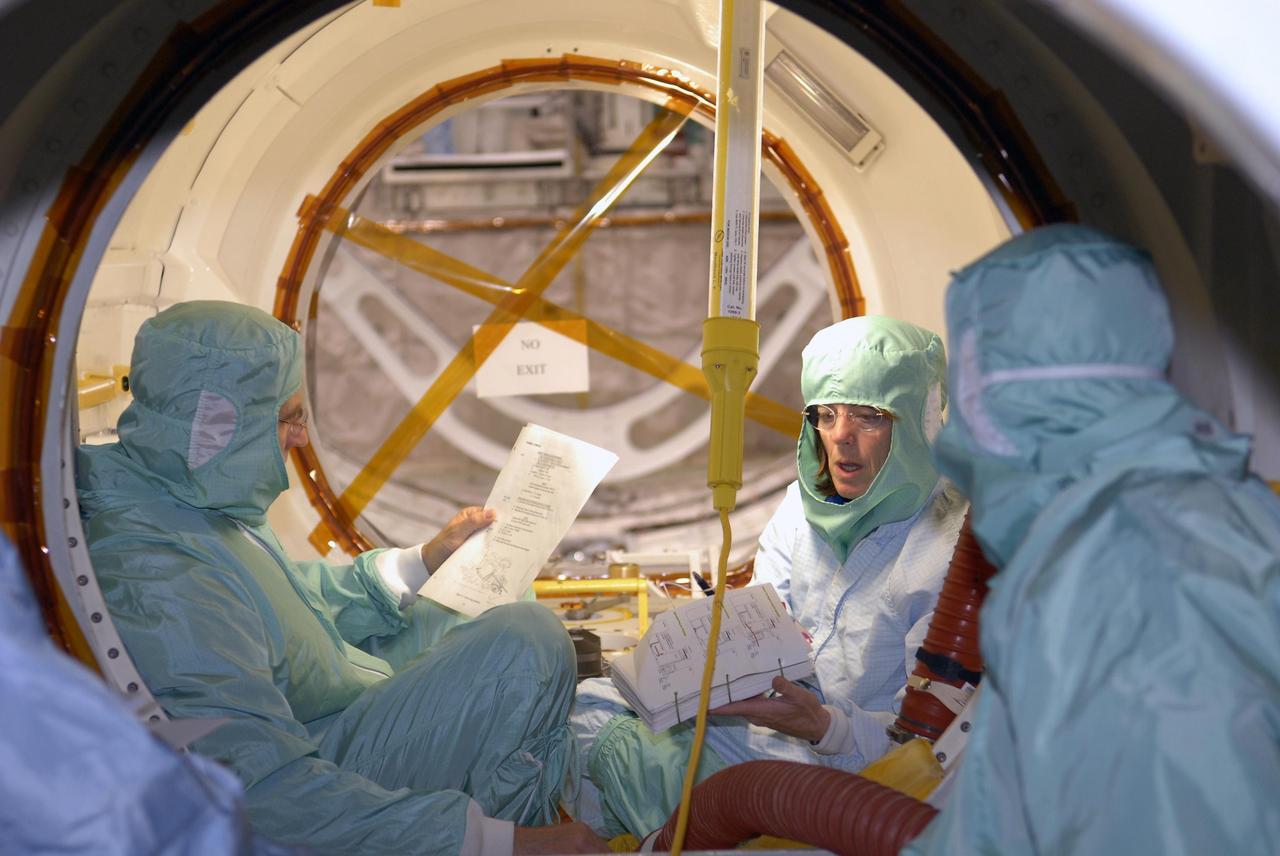
KENNEDY SPACE CENTER, FLA. -- During crew equipment interface test activities at KSC, STS-118 Mission Specialists Dr. Dafydd Williams and Barbara Morgan check data inside the orbiter Endeavour, which is in Orbiter Processing Facility bay 3. The STS-118 mission will be delivering the third starboard truss segment, the ITS S5, to the International Space Station, as well as the SPACEHAB single cargo module filled with supplies and equipment. Launch aboard Space Shuttle Endeavour is targeted for Aug. 9. Photo credit: NASA/Kim Shiflett

KENNEDY SPACE CENTER, FLA. -- In the Orbiter Processing Facility, STS-122 Mission Specialist Rex Walheim practices working with equipment for the mission. In the background, at right, is European Space Agency astronaut Leopold Eyharts, who will be on the mission and joining the Expedition 16 crew as flight engineer on the International Space Station. The crew is at Kennedy Space Center to take part in a crew equipment interface test, which includes equipment familiarization. The mission will carry and install the Columbus Lab, a multifunctional, pressurized laboratory that will be permanently attached to Node 2 of the space station to carry out experiments in materials science, fluid physics and biosciences, as well as to perform a number of technological applications. It is Europe’s largest contribution to the construction of the International Space Station and will support scientific and technological research in a microgravity environment. STS-122 is targeted for launch in December. Photo credit: NASA/Kim Shiflett
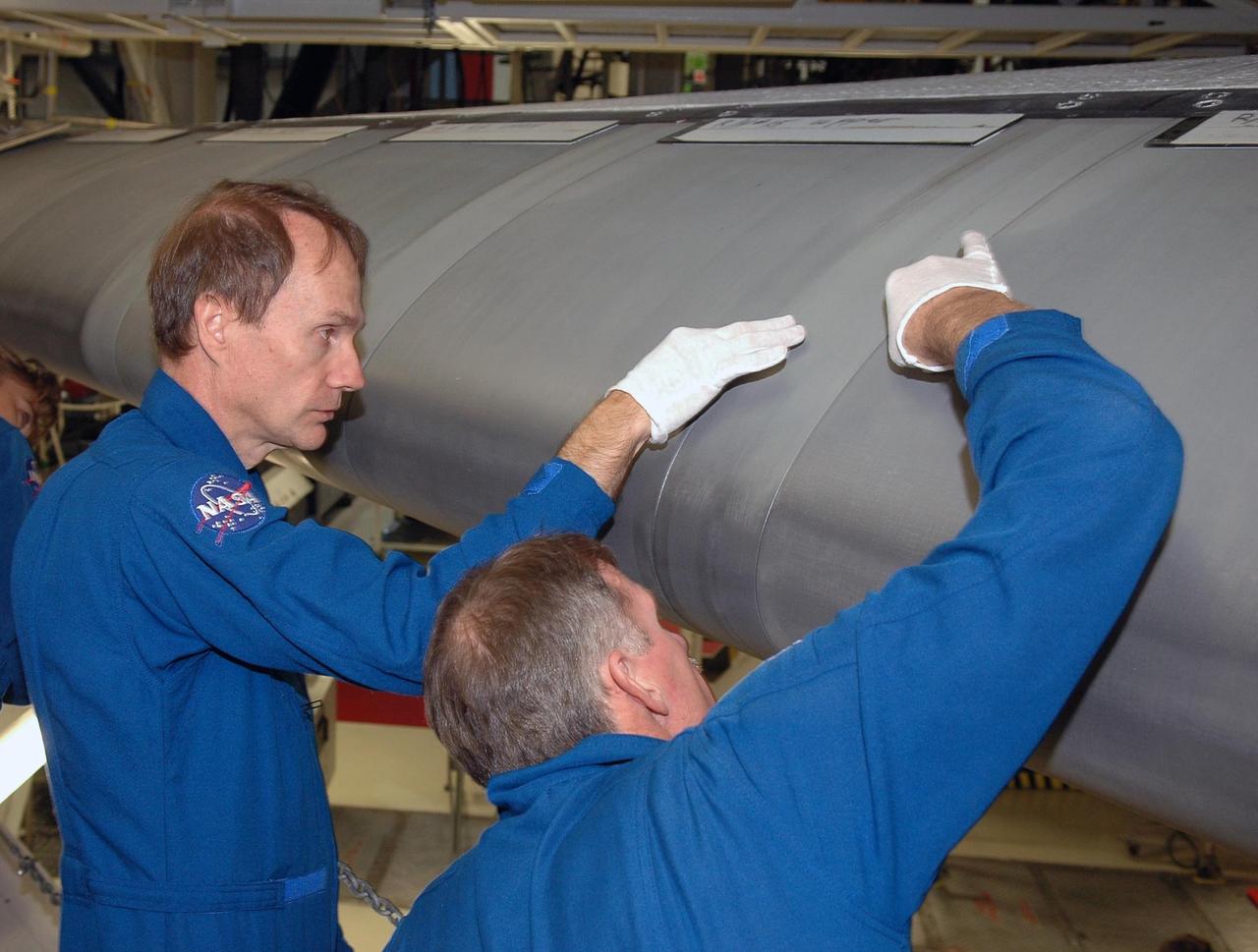
KENNEDY SPACE CENTER, FLA. - In the Orbiter Processing Facility, STS-115 crew members examine the edge of the wing on the orbiter Atlantis, the designated launch vehicle for their mission. From left are Mission Specialists Steven MacLean, who represents the Canadian Space Agency, and Joseph Tanner. The crew is at the center for Crew Equipment Interface Test activities, which involves equipment familiarization, a routine part of astronaut training and launch preparations. The mission will deliver the second port truss segment, the P3/P4 Truss, to attach to the first port truss segment, the P1 Truss, as well as deploy solar array set 2A and 4A. Launch on Space Shuttle Atlantis is scheduled for late August. Photo credit: NASA/Kim Shiflett

KENNEDY SPACE CENTER, FLA. -- In the Orbiter Processing Facility, STS-122 crew members are introduced to part of the LESS. From left are Mission Specialists Hans Schlegel, Rex Walheim and European Space Agency astronaut Leopold Eyharts, Commander Stephen Frick, Mission Specialist Leland Melvin and Pilot Alan Poindexter. The crew is at Kennedy to take part in a crew equipment interface test, or CEIT, which helps familiarize them with equipment and payloads for the mission. Among the activities standard to a CEIT are harness training, inspection of the thermal protection system and camera operation for planned extravehicular activities, or EVAs. STS-122 is targeted for launch in December. Photo credit: NASA/Kim Shiflett
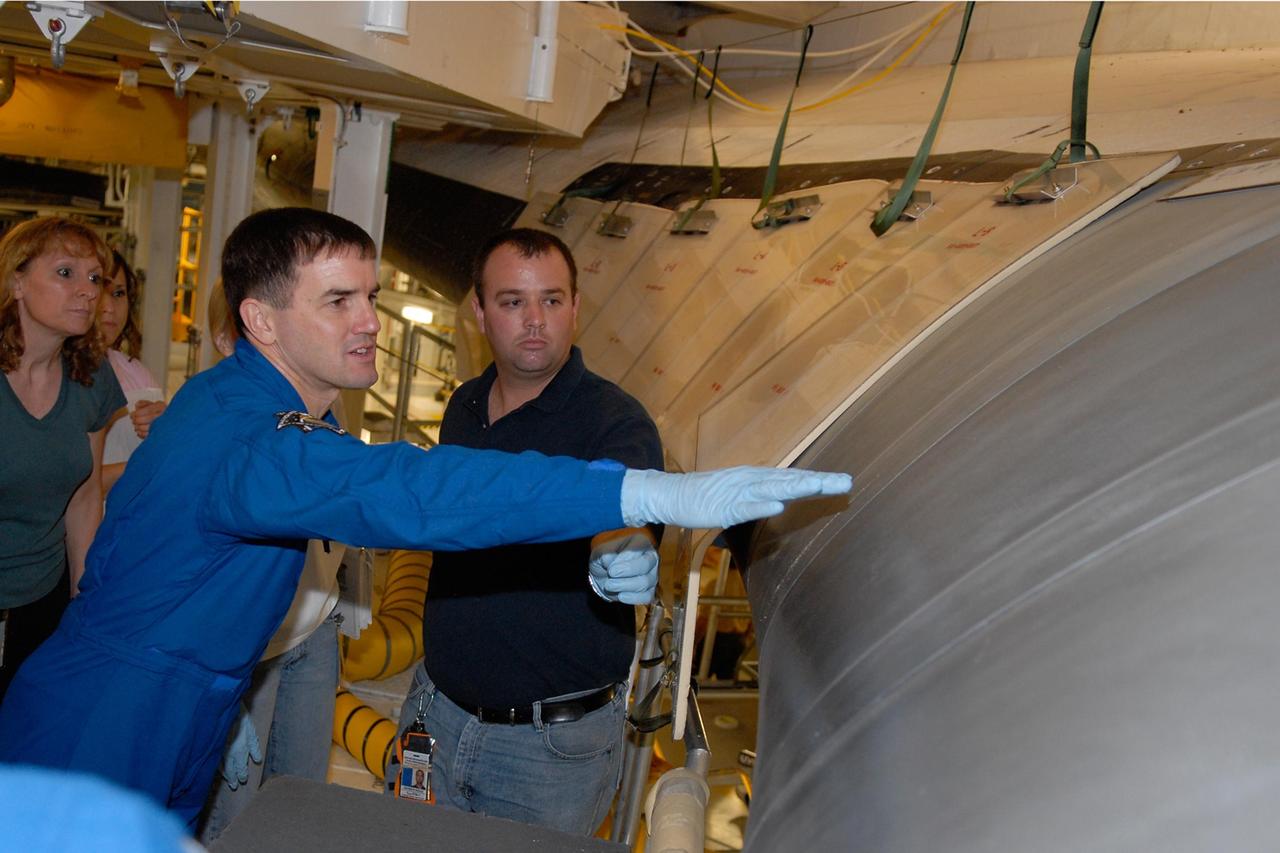
KENNEDY SPACE CENTER, FLA. -- In the Orbiter Processing Facility, STS-122 Mission Specialist Rex Walheim reaches toward the wing of space shuttle Atlantis. The crew is at Kennedy to take part in a crew equipment interface test, or CEIT, which helps familiarize them with equipment and payloads for the mission. Among the activities standard to a CEIT are harness training, inspection of the thermal protection system and camera operation for planned extravehicular activities, or EVAs. STS-122 is targeted for launch in December. Photo credit: NASA/Kim Shiflett
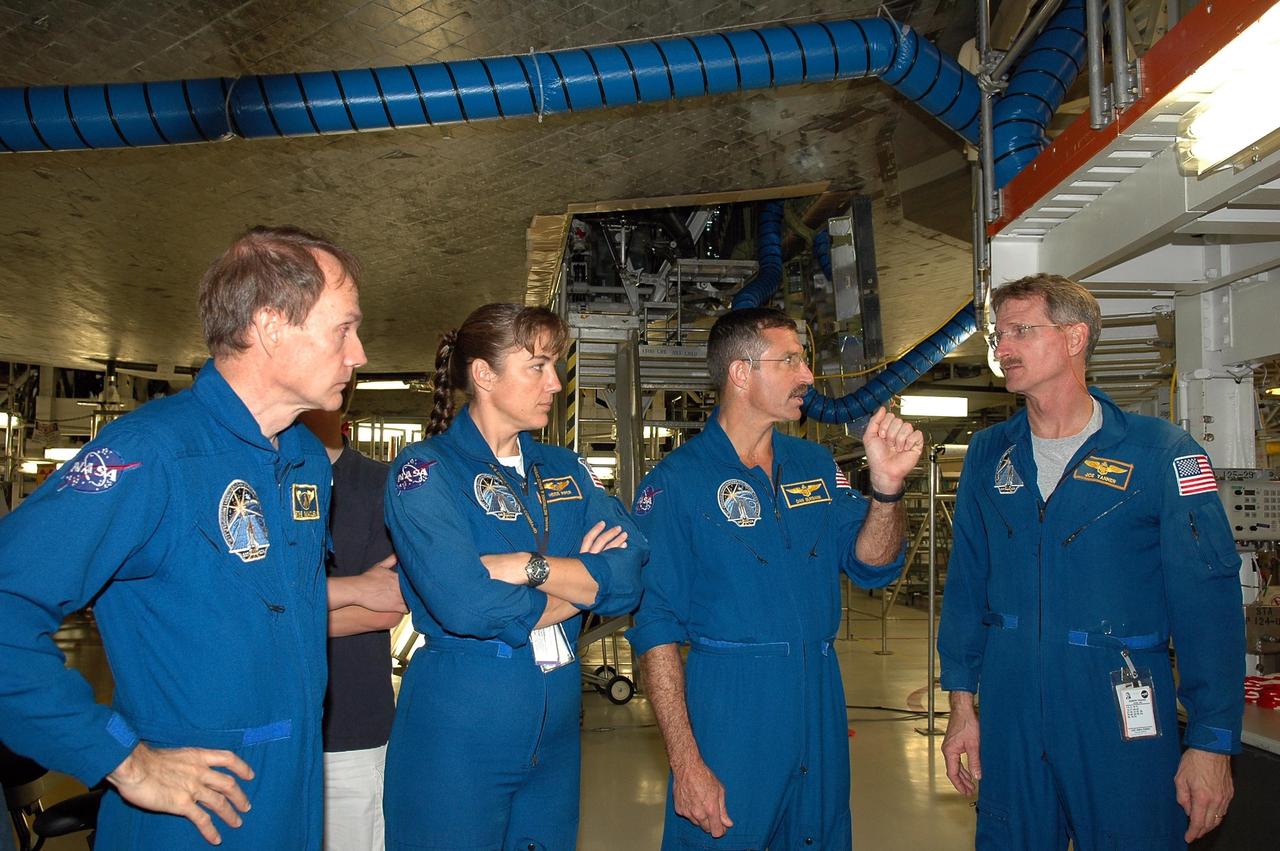
KENNEDY SPACE CENTER, FLA. - In the Orbiter Processing Facility, STS-115 crew members discuss their examination of the orbiter Atlantis, seen above them. From left are Mission Specialists Steven MacLean, who represents the Canadian Space Agency, Heidemarie Stefanyshyn-Piper, Daniel Burbank and Joseph Tanner. The crew is at the center for Crew Equipment Interface Test activities, which involves equipment familiarization, a routine part of astronaut training and launch preparations. The mission will deliver the second port truss segment, the P3/P4 Truss, to attach to the first port truss segment, the P1 Truss, as well as deploy solar array set 2A and 4A. Launch on Space Shuttle Atlantis is scheduled for late August. Photo credit: NASA/Kim Shiflett

KENNEDY SPACE CENTER, FLA. -- In the Orbiter Processing Facility, STS-122 Commander Stephen Frick checks out the cockpit on space shuttle Atlantis. He and other crew members are at Kennedy Space Center to take part in a crew equipment interface test, which helps familiarize them with equipment and payloads for the mission. Among the activities standard to a CEIT are harness training, inspection of the thermal protection system and camera operation for planned extravehicular activities, or EVAs. The mission will carry and install the Columbus Lab, a multifunctional, pressurized laboratory that will be permanently attached to Node 2 of the space station to carry out experiments in materials science, fluid physics and biosciences, as well as to perform a number of technological applications. It is Europe’s largest contribution to the construction of the International Space Station and will support scientific and technological research in a microgravity environment. STS-122 is targeted for launch in December. Photo credit: NASA/Kim Shiflett
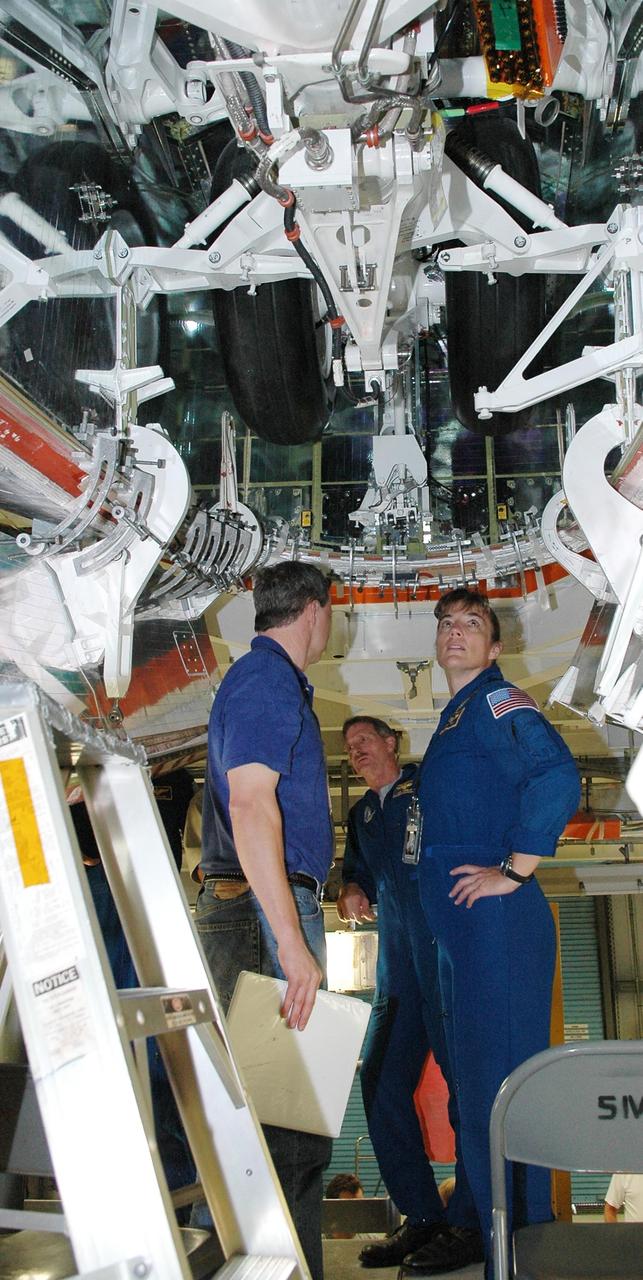
KENNEDY SPACE CENTER, FLA. - In the Orbiter Processing Facility, STS-115 crew members examine the wheel well on the orbiter Atlantis, the designated launch vehicle for their mission. At center is Mission Specialist Joseph Tanner; at right is Mission Specialist Heidemarie Stefanyshyn-Piper. The crew is at the center for Crew Equipment Interface Test activities, which involves equipment familiarization, a routine part of astronaut training and launch preparations. The mission will deliver the second port truss segment, the P3/P4 Truss, to attach to the first port truss segment, the P1 Truss, as well as deploy solar array set 2A and 4A. Launch on Space Shuttle Atlantis is scheduled for late August. Photo credit: NASA/Kim Shiflett
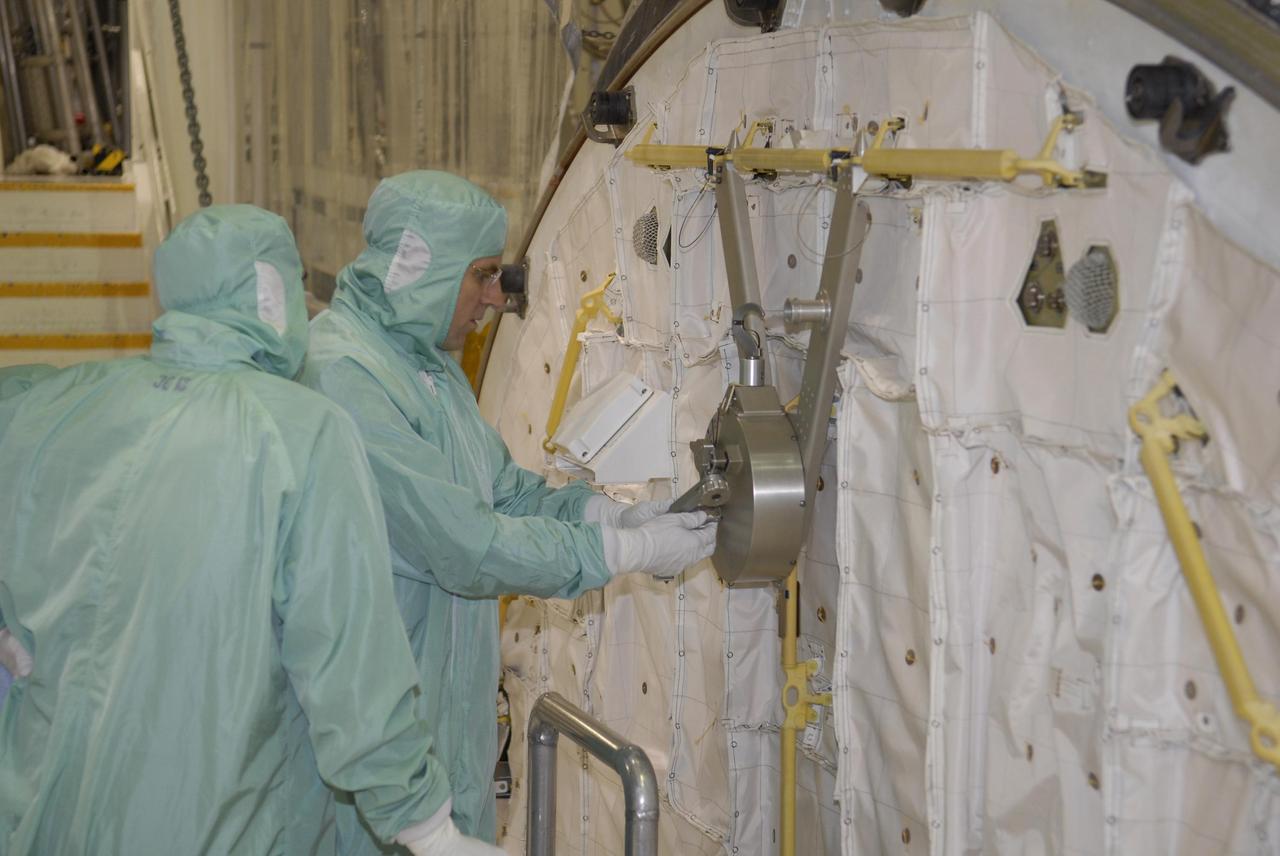
KENNEDY SPACE CENTER, FLA. -- During crew equipment interface test activities at KSC, STS-118 Mission Specialist Dr. Dafydd Williams (right) maneuvers the latch on the crew airlock module. The airlock is located in the middeck. The airlock and airlock hatches permit flight crew members to transfer from the middeck crew compartment into the payload bay for extravehicular activities in their space suits without depressurizing the orbiter crew cabin. The airlock is sized to accommodate two fully suited flight crew members simultaneously. The STS-118 mission will be delivering the third starboard truss segment, the ITS S5, to the International Space Station, as well as the SPACEHAB single cargo module filled with supplies and equipment. Launch aboard Space Shuttle Endeavour is targeted for Aug. 9. Photo credit: NASA/Kim Shiflett
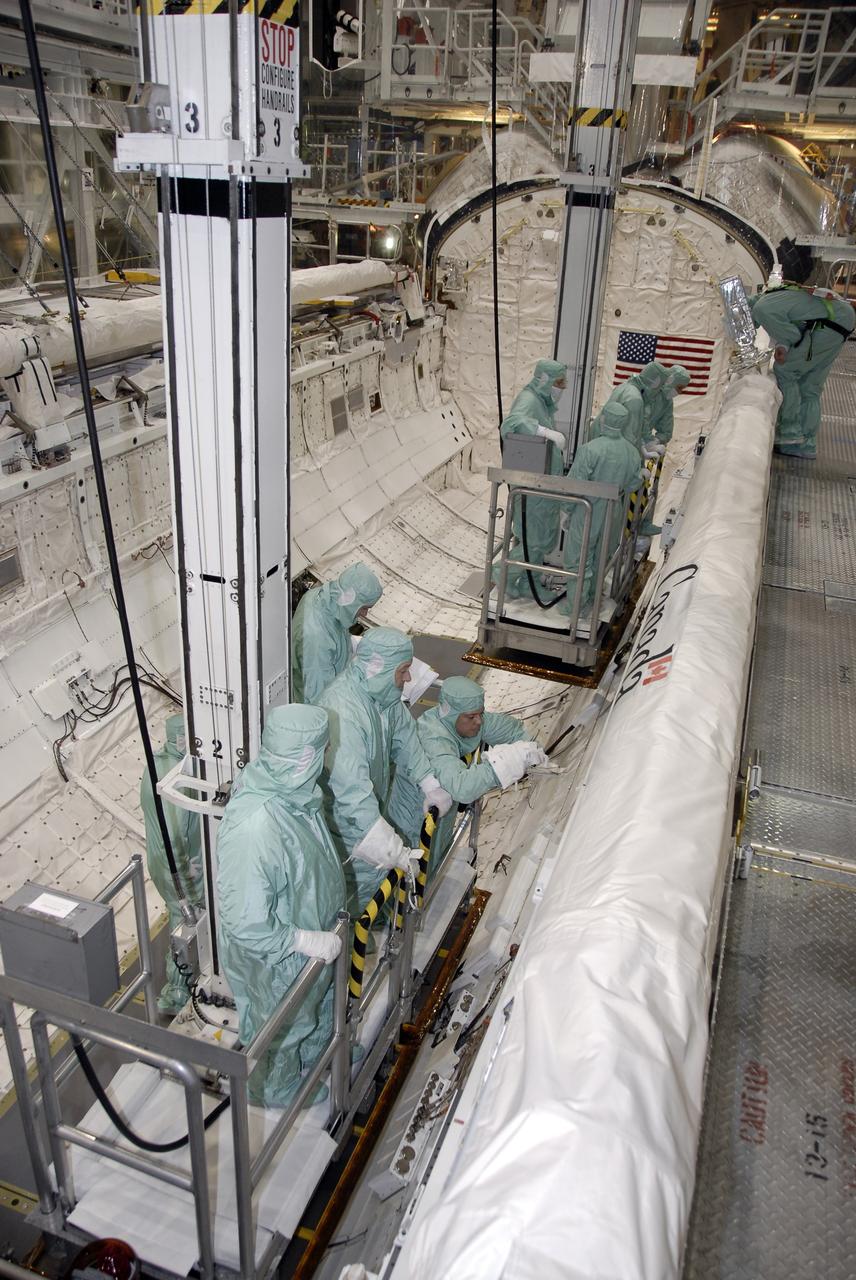
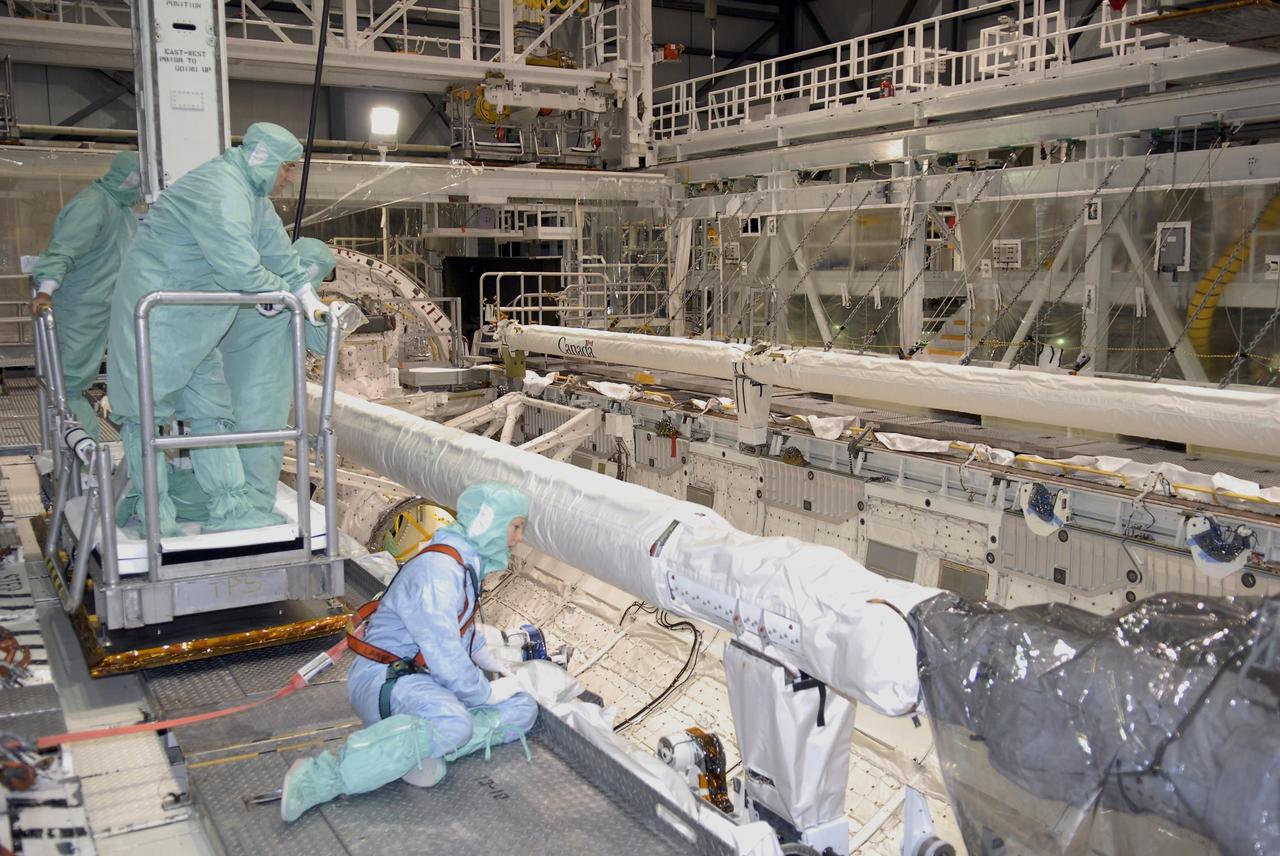
CAPE CANAVERAL, Fla. – In Orbiter Processing Facility-3 at NASA's Kennedy Space Center in Florida, members of the STS-130 crew check out the placement of the Canadian-built robotic arm in space shuttle Endeavour's payload bay. The crew is at Kennedy for a crew equipment interface test, or CEIT, which provides hands-on training and observation of shuttle and flight hardware. The STS-130 flight will carry the Tranquility pressurized module with a built-in cupola to the International Space Station aboard Endeavour. Launch is targeted for Feb. 4, 2010. Photo credit: NASA/Kim Shiflett
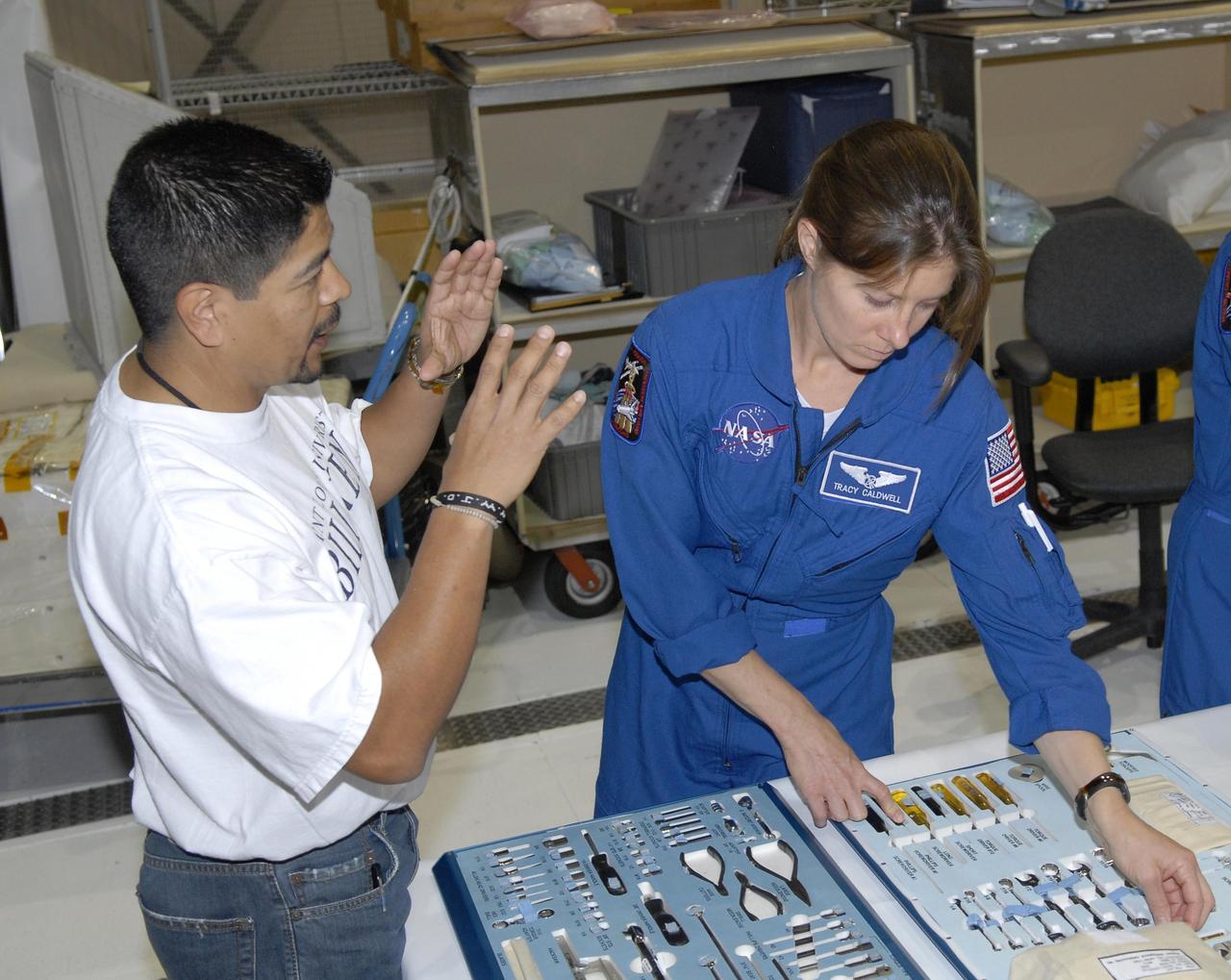
KENNEDY SPACE CENTER, FLA. -- During crew equipment interface test activities in Orbiter Processing Facility bay 3 at KSC, STS-118 Mission Specialist Tracy Caldwell gets hands-on experience with tools she may use during the flight. The STS-118 mission will be delivering the third starboard truss segment, the ITS S5, to the International Space Station, as well as the SPACEHAB single cargo module filled with supplies and equipment. Launch aboard Space Shuttle Endeavour is targeted for Aug. 9. Photo credit: NASA/Kim Shiflett
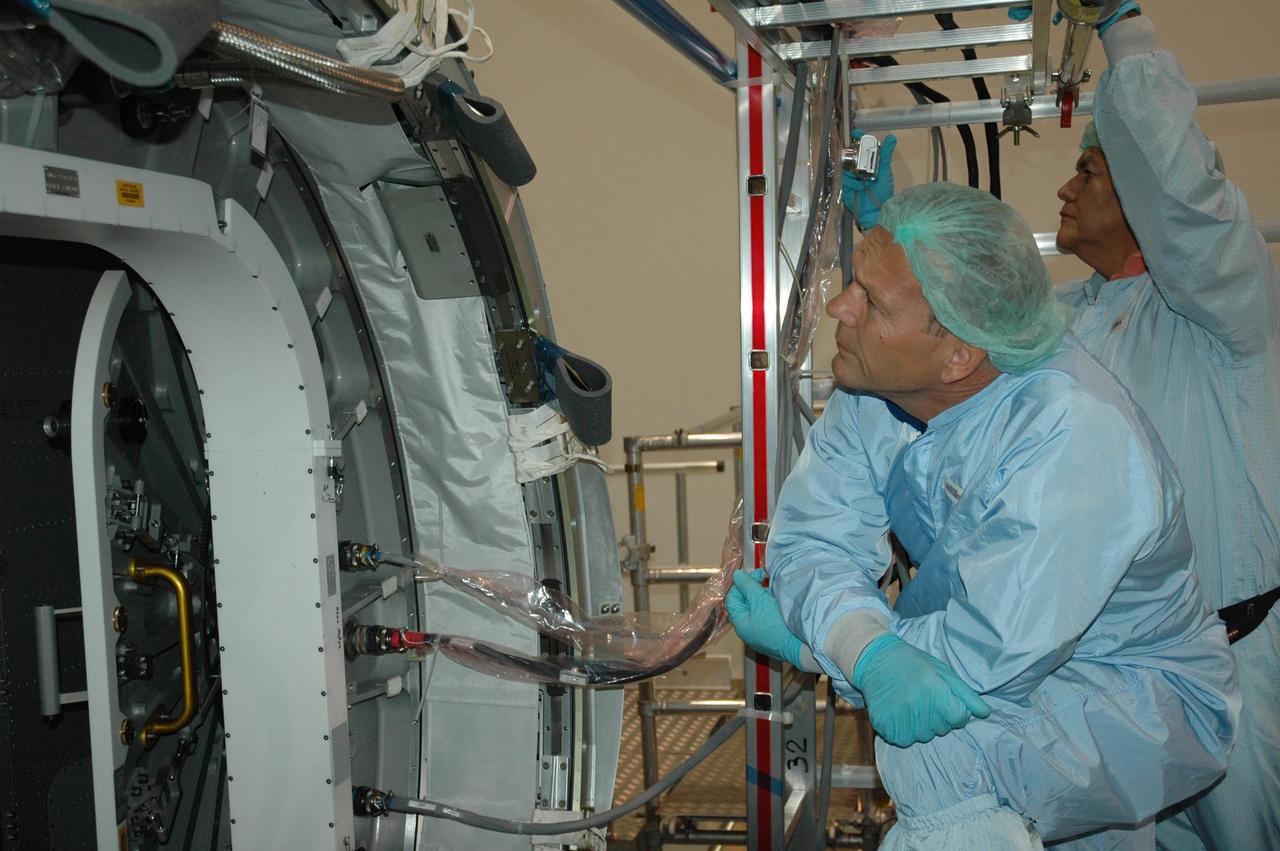
KENNEDY SPACE CENTER, FLA. STS-122 Mission Specialist Hans Schlegel looks closely at the hatch on the Columbus Research Laboratory in the Space Station Processing Facility. Schegel represents the European Space Agency. The crew is at Kennedy to take part in a crew equipment interface test, which helps familiarize them with equipment and payloads for the mission. Among the activities standard to a CEIT are harness training, inspection of the thermal protection system and camera operation for planned extravehicular activities, or EVAs. The Columbus Lab is Europe’s largest contribution to the construction of the International Space Station. It will support scientific and technological research in a microgravity environment. Columbus, a program of ESA, is a multifunctional, pressurized laboratory that will be permanently attached to Node 2 of the space station to carry out experiments in materials science, fluid physics and biosciences, as well as to perform a number of technological applications. STS-122 is targeted for launch in December. Photo credit: NASA/Jim Grossmann
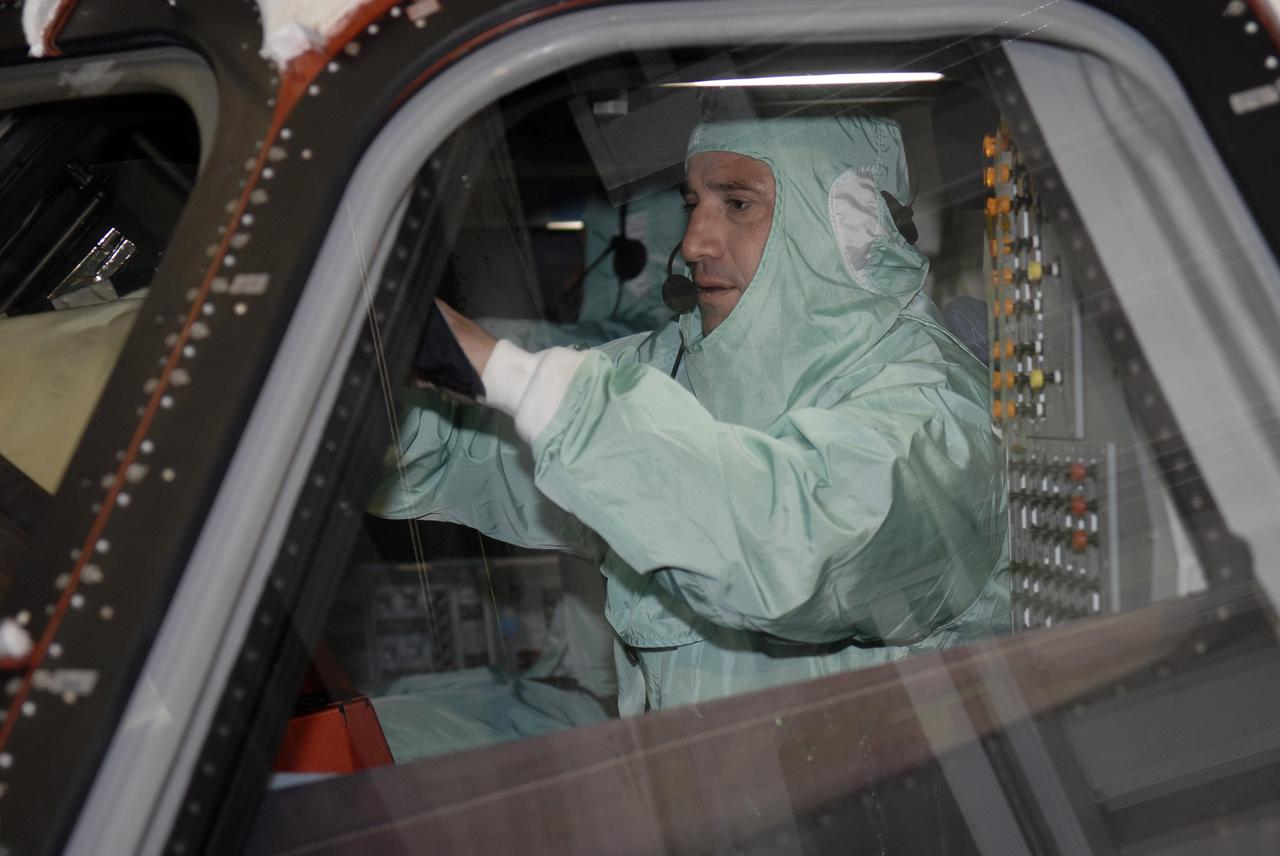
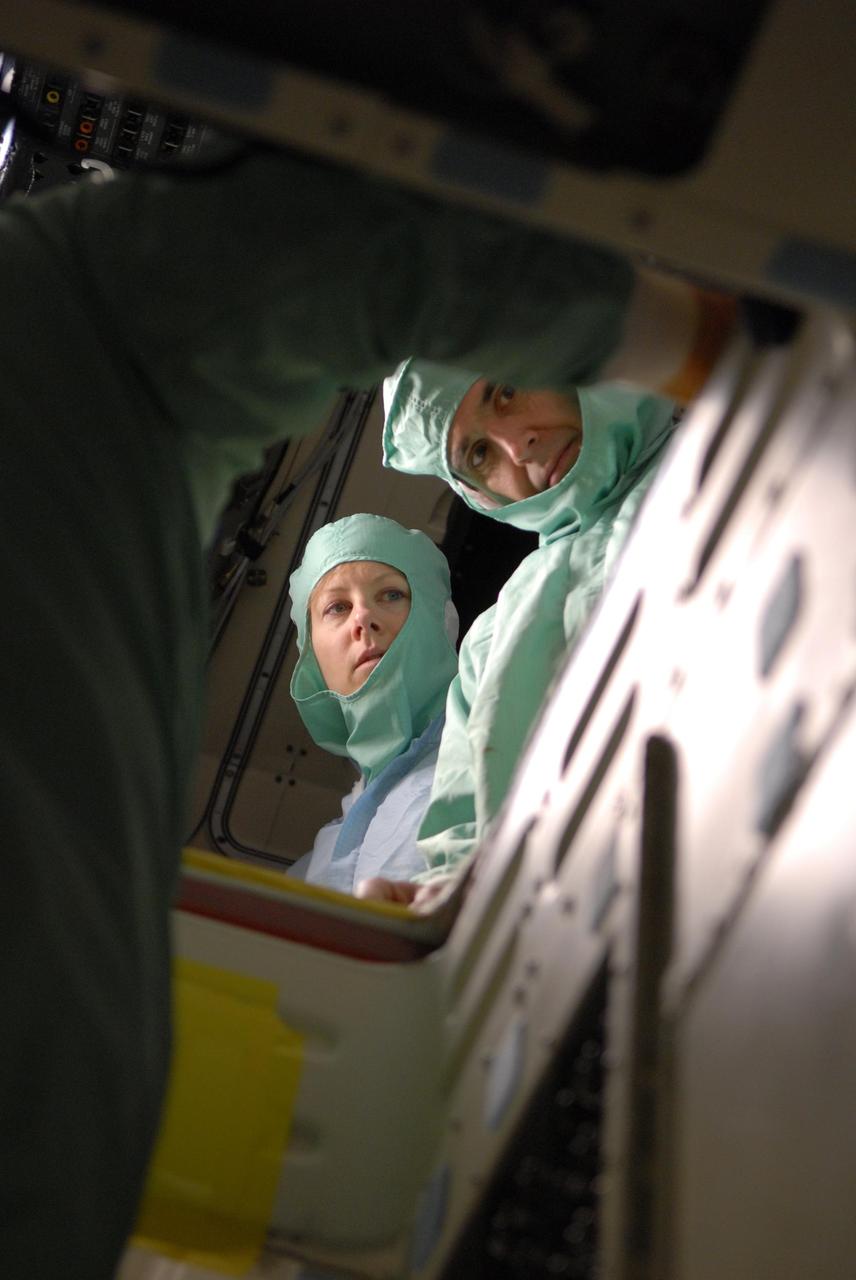
CAPE CANAVERAL, Fla. – In Orbiter Processing Facility-3 at NASA's Kennedy Space Center in Florida, STS-130 Commander George Zamka dressed in clean-room attire, known as a "bunny suit," gets the feel of the cockpit of space shuttle Endeavour. The crew is at Kennedy for a crew equipment interface test, or CEIT, which provides hands-on training and observation of shuttle and flight hardware. The STS-130 flight will carry the Tranquility pressurized module with a built-in cupola to the International Space Station aboard Endeavour. Launch is targeted for Feb. 4, 2010. Photo credit: NASA/Kim Shiflett
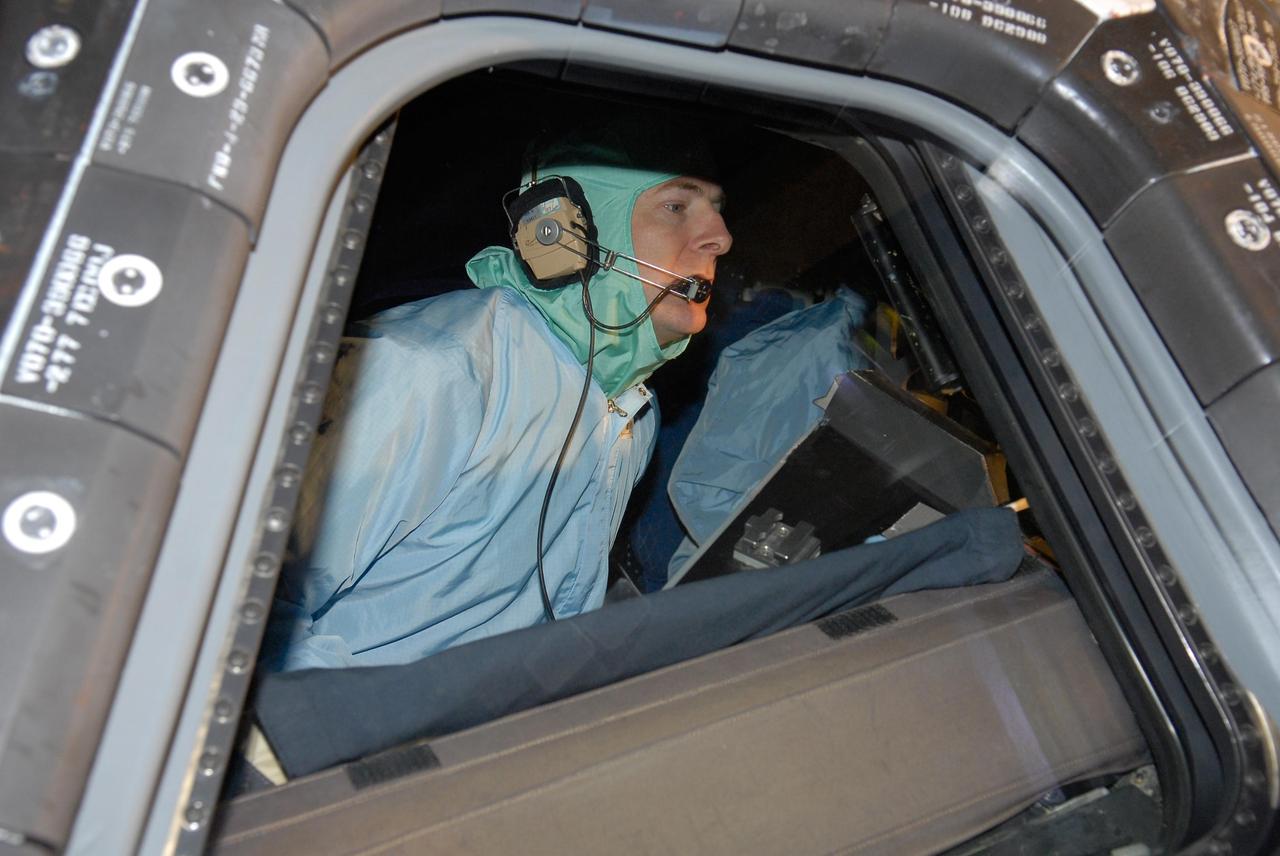
KENNEDY SPACE CENTER, FLA. -- In the Orbiter Processing Facility, STS-122 Pilot Alan Poindexter checks out the cockpit on space shuttle Atlantis. The crew is at Kennedy Space Center to take part in a crew equipment interface test, which helps familiarize them with equipment and payloads for the mission. Among the activities standard to a CEIT are harness training, inspection of the thermal protection system and camera operation for planned extravehicular activities, or EVAs. The mission will carry and install the Columbus Lab, a multifunctional, pressurized laboratory that will be permanently attached to Node 2 of the space station to carry out experiments in materials science, fluid physics and biosciences, as well as to perform a number of technological applications. It is Europe’s largest contribution to the construction of the International Space Station and will support scientific and technological research in a microgravity environment. STS-122 is targeted for launch in December. Photo credit: NASA/Kim Shiflett
KENNEDY SPACE CENTER, FLA. --In the Orbiter Processing Facility, STS-122 crew members get a close look at some of the equipment for the mission. From left, in the foreground, are Mission Specialists Stanley Love and Rex Walheim and Pilot Alan Poindexter. In the background at left is Mission Specialist Leland Melvin; at right is European Space Agency astronaut Leopold Eyharts, who will be on the mission and joining the Expedition 16 crew as flight engineer on the International Space Station. The crew is at Kennedy Space Center to take part in a crew equipment interface test, which includes equipment familiarization. The mission will carry and install the Columbus Lab, a multifunctional, pressurized laboratory that will be permanently attached to Node 2 of the space station to carry out experiments in materials science, fluid physics and biosciences, as well as to perform a number of technological applications. It is Europe’s largest contribution to the construction of the International Space Station and will support scientific and technological research in a microgravity environment. STS-122 is targeted for launch in December. Photo credit: NASA/Kim Shiflett
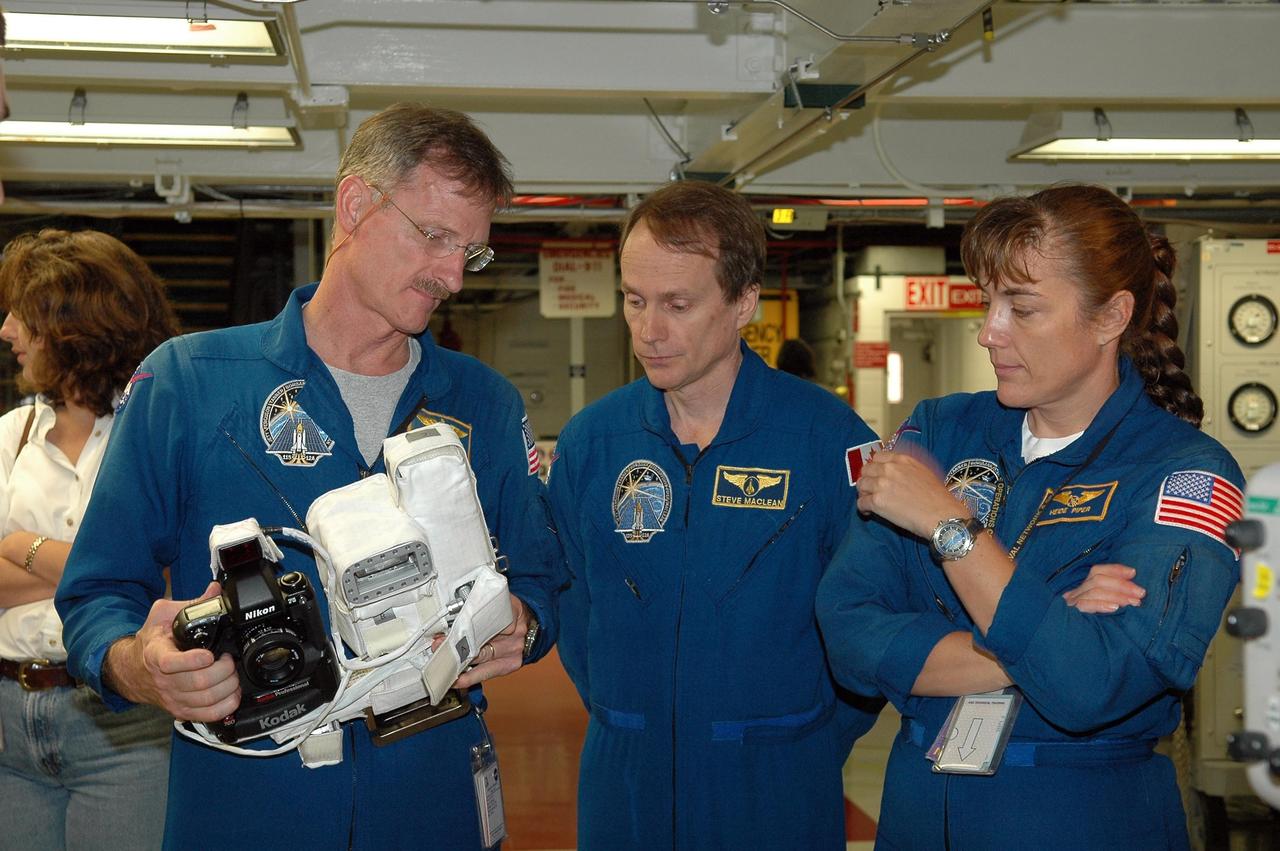
KENNEDY SPACE CENTER, FLA. - In the Orbiter Processing Facility, STS-115 Mission Specialist Joseph Tanner gets familiar with a camera that is a mockup of one the crew will use to take photographs on-orbit. With him are Mission Specialists Steven MacLean, who represents the Canadian Space Agency, and Heidemarie Stefanyshyn-Piper. The crew is at the center for Crew Equipment Interface Test activities, which involves equipment familiarization, a routine part of astronaut training and launch preparations. The mission will deliver the second port truss segment, the P3/P4 Truss, to attach to the first port truss segment, the P1 Truss, as well as deploy solar array set 2A and 4A. Launch on Space Shuttle Atlantis is scheduled for late August. Photo credit: NASA/Kim Shiflett
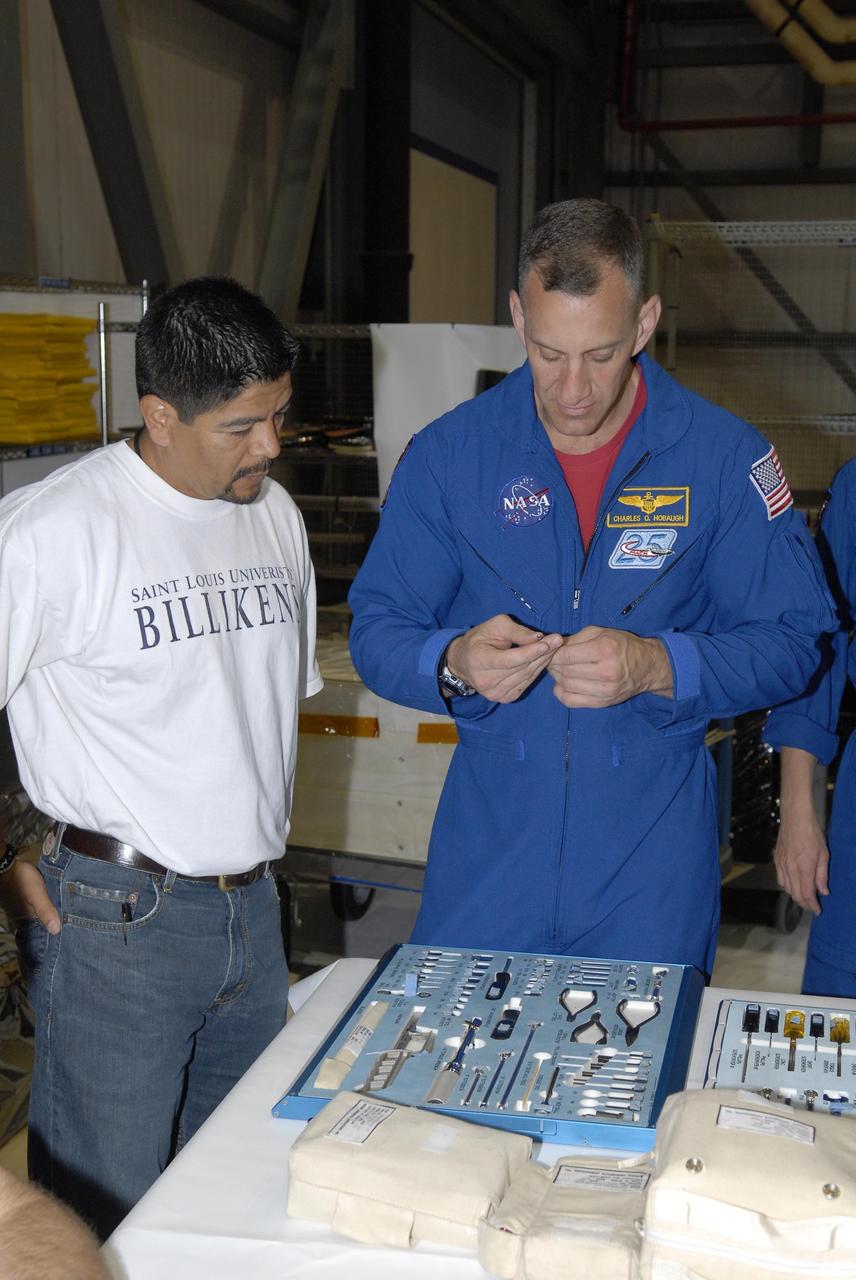
KENNEDY SPACE CENTER, FLA. -- During crew equipment interface test activities in Orbiter Processing Facility bay 3 at KSC, STS-118 crew members get a close look at equipment they will use on their flight. Seen here is Pilot Charles Hobaugh. The STS-118 mission will be delivering the third starboard truss segment, the ITS S5, to the International Space Station, as well as the SPACEHAB single cargo module filled with supplies and equipment. Launch aboard Space Shuttle Endeavour is targeted for Aug. 9. Photo credit: NASA/Kim Shiflett
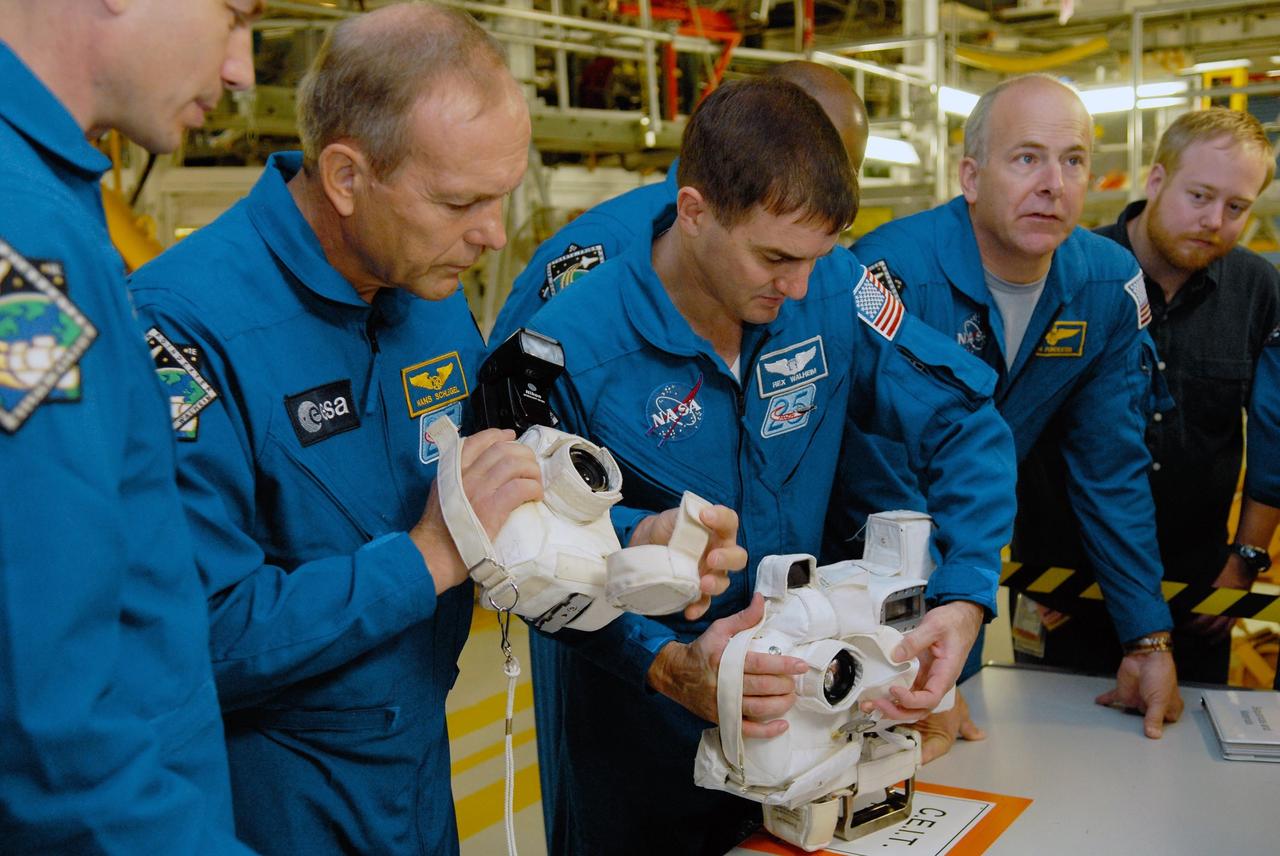
KENNEDY SPACE CENTER, FLA. -- In the Orbiter Processing Facility, members of the STS-122 crew look over cameras that will be used during the mission. From left are Mission Specialists Stanley Love, Hans Schlegel and Rex Walheim and Pilot Alan Poindexter. The crew is at Kennedy Space Center to take part in a crew equipment interface test, which helps familiarize them with equipment and payloads for the mission. Among the activities standard to a CEIT are harness training, inspection of the thermal protection system and camera operation for planned extravehicular activities, or EVAs. The mission will carry and install the Columbus Lab, a multifunctional, pressurized laboratory that will be permanently attached to Node 2 of the space station to carry out experiments in materials science, fluid physics and biosciences, as well as to perform a number of technological applications. It is Europe’s largest contribution to the construction of the International Space Station and will support scientific and technological research in a microgravity environment. STS-122 is targeted for launch in December. Photo credit: NASA/Kim Shiflett
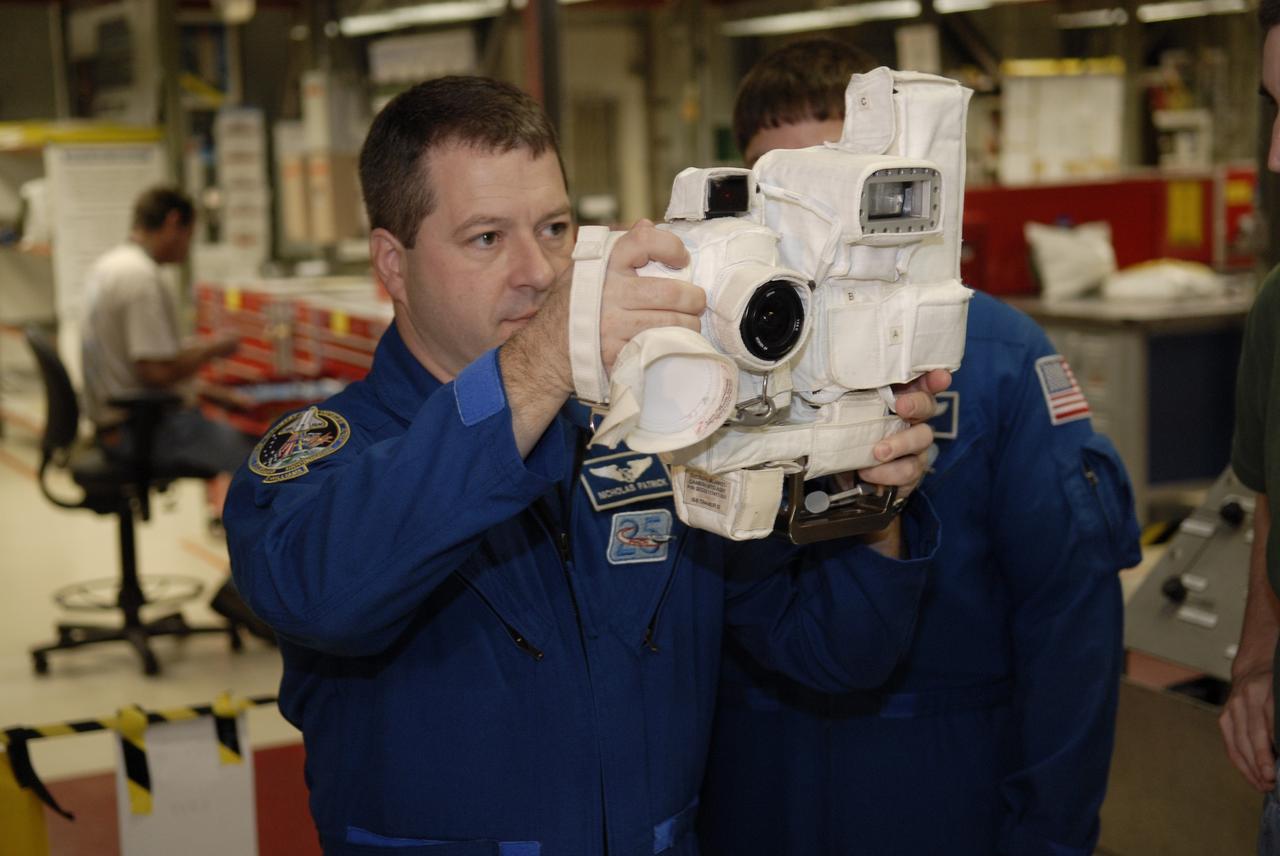
CAPE CANAVERAL, Fla. – In Orbiter Processing Facility-3 at NASA's Kennedy Space Center in Florida, STS-130 Mission Specialist Nicolas Patrick takes an opportunity to operate a camera that will fly on space shuttle Endeavour. The crew is at Kennedy for a crew equipment interface test, or CEIT, which provides hands-on training and observation of shuttle and flight hardware. The STS-130 flight will carry the Tranquility pressurized module with a built-in cupola to the International Space Station aboard Endeavour. Launch is targeted for Feb. 4, 2010. Photo credit: NASA/Kim Shiflett
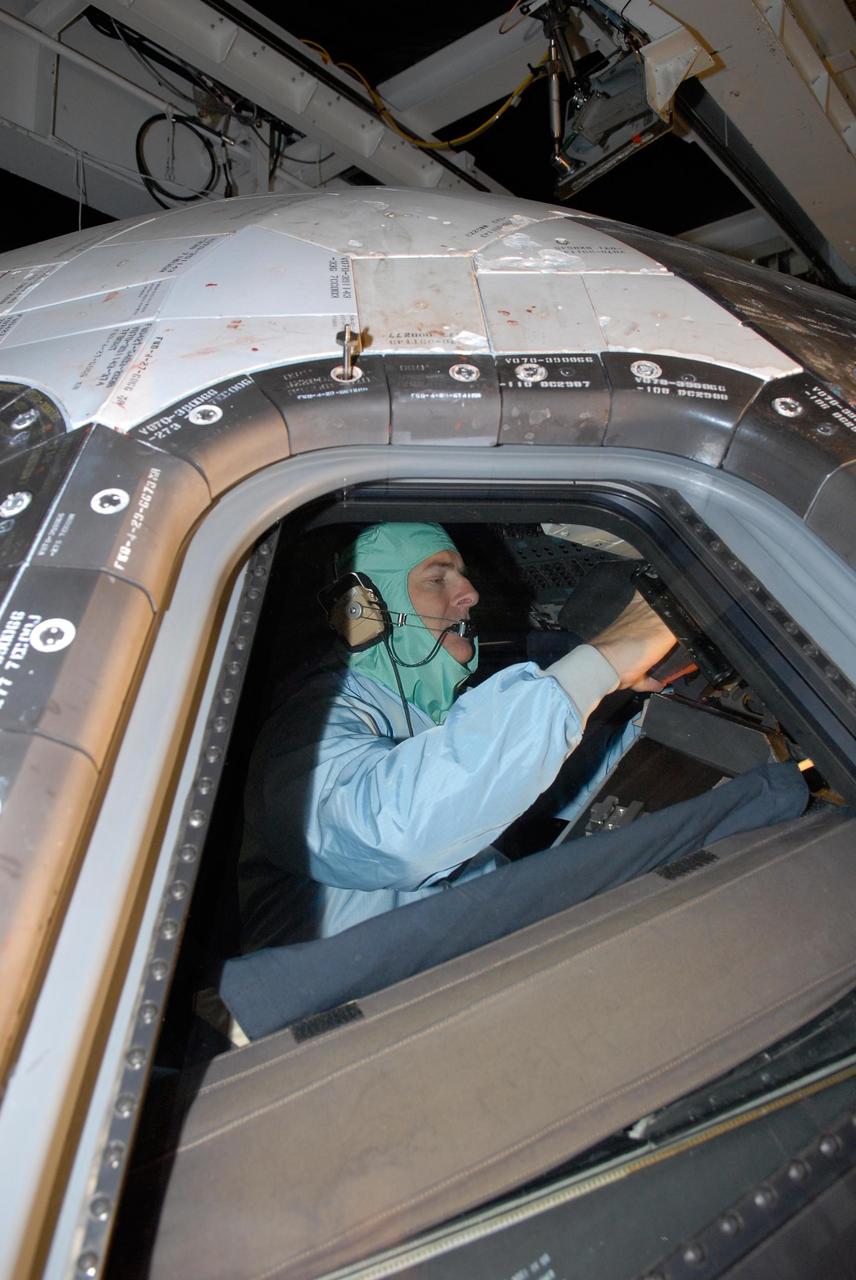
KENNEDY SPACE CENTER, FLA. -- In the Orbiter Processing Facility, STS-122 Pilot Alan Poindexter checks out the cockpit on space shuttle Atlantis. The crew is at Kennedy Space Center to take part in a crew equipment interface test, which helps familiarize them with equipment and payloads for the mission. Among the activities standard to a CEIT are harness training, inspection of the thermal protection system and camera operation for planned extravehicular activities, or EVAs. The mission will carry and install the Columbus Lab, a multifunctional, pressurized laboratory that will be permanently attached to Node 2 of the space station to carry out experiments in materials science, fluid physics and biosciences, as well as to perform a number of technological applications. It is Europe’s largest contribution to the construction of the International Space Station and will support scientific and technological research in a microgravity environment. STS-122 is targeted for launch in December. Photo credit: NASA/Kim Shiflett
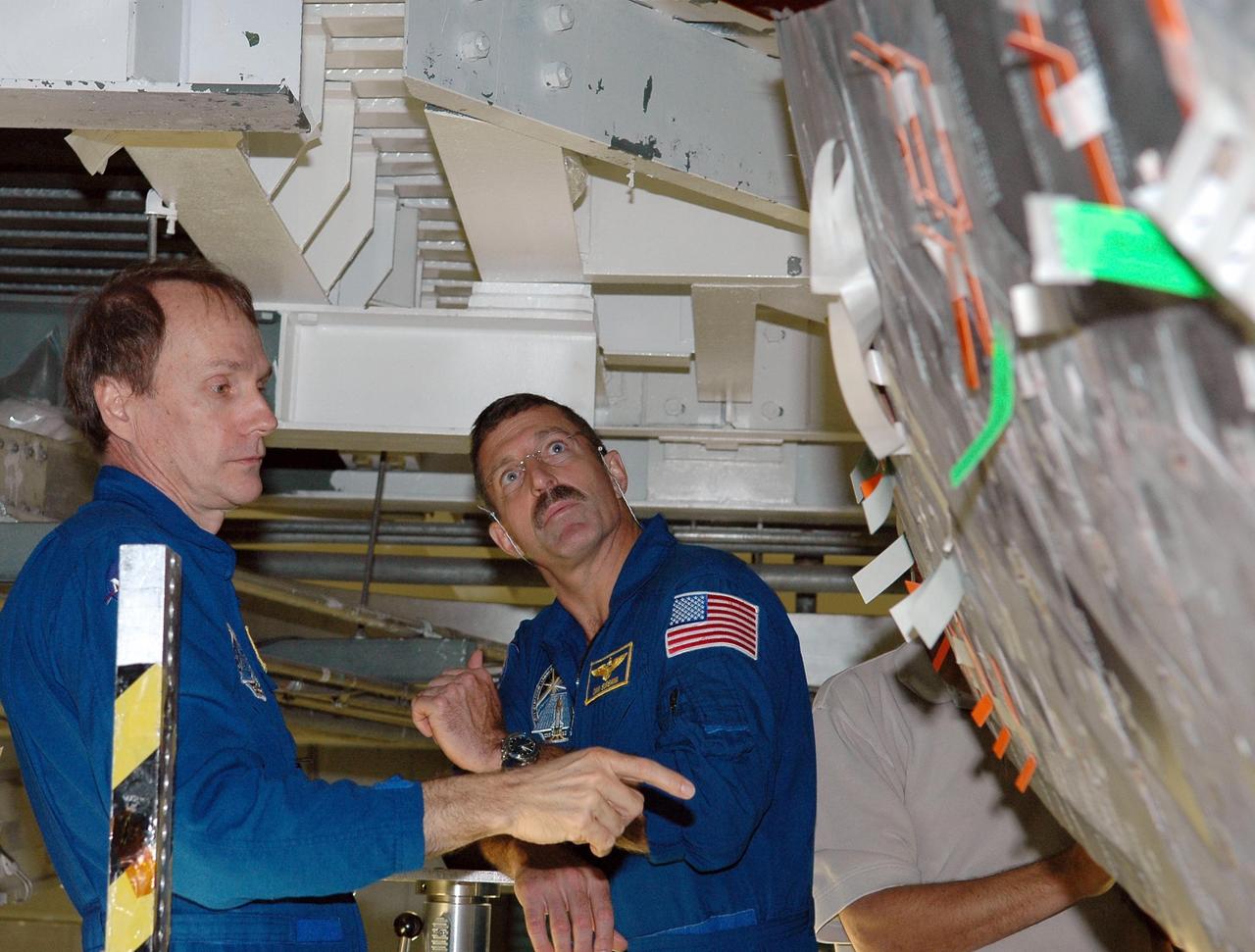
KENNEDY SPACE CENTER, FLA. - In the Orbiter Processing Facility, STS-115 crew members examine tiles on the orbiter Atlantis, the designated launch vehicle for their mission. From left are Mission Specialists Steven MacLean and Daniel Burbank. MacLean represents the Canadian Space Agency. The crew is at the center for Crew Equipment Interface Test activities, which involves equipment familiarization, a routine part of astronaut training and launch preparations. The mission will deliver the second port truss segment, the P3/P4 Truss, to attach to the first port truss segment, the P1 Truss, as well as deploy solar array set 2A and 4A. Launch on Space Shuttle Atlantis is scheduled for late August. Photo credit: NASA/Kim Shiflett
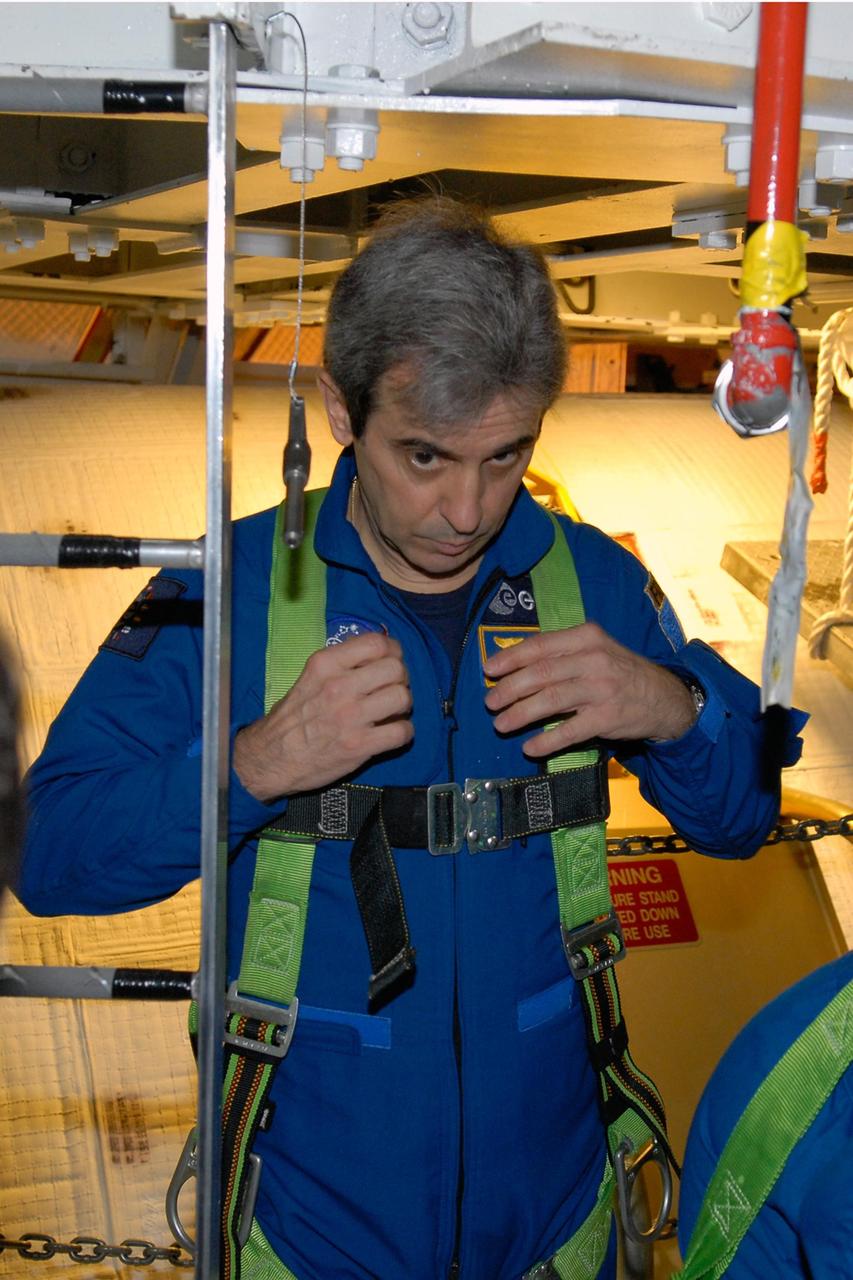
KENNEDY SPACE CENTER, FLA. -- Astronaut Leopold Eyharts, who represents the European Space Agency, tries on a harness in the Orbiter Processing Facility. Eyharts will be traveling to the International Space Station to join the Expedition 16 crew as a flight engineer. The crew is at Kennedy to take part in a crew equipment interface test, or CEIT, which helps familiarize them with equipment and payloads for the mission. Among the activities standard to a CEIT are harness training, inspection of the thermal protection system and camera operation for planned extravehicular activities, or EVAs. STS-122 is targeted for launch in December. Photo credit: NASA/Kim Shiflett
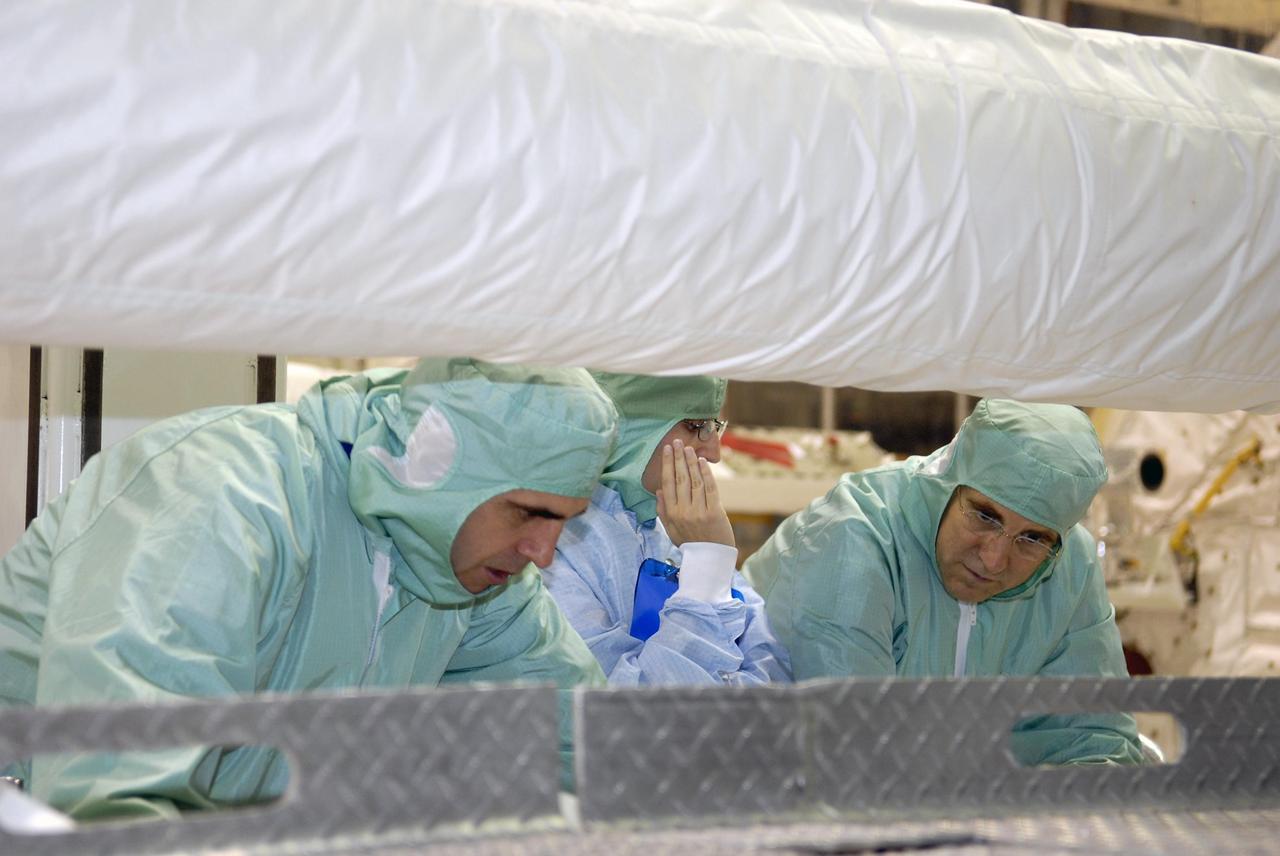
KENNEDY SPACE CENTER, FLA. -- During crew equipment interface test activities at KSC, STS-118 Mission Specialists Richard Mastrocchio (left) and Dr. Dafydd Williams (right) look over the shuttle arm in Endeavour's payload bay. The STS-118 mission will be delivering the third starboard truss segment, the ITS S5, to the International Space Station, as well as the SPACEHAB single cargo module filled with supplies and equipment. Launch aboard Space Shuttle Endeavour is targeted for Aug. 9. Photo credit: NASA/Kim Shiflett

KENNEDY SPACE CENTER, FLA. -- During crew equipment interface test activities in Orbiter Processing Facility bay 3 at KSC, STS-118 crew members get a close look at equipment they will use on their flight. Seen here at center are Mission Specialists Tracy Caldwell and Barbara Morgan. The STS-118 mission will be delivering the third starboard truss segment, the ITS S5, to the International Space Station, as well as the SPACEHAB single cargo module filled with supplies and equipment. Launch aboard Space Shuttle Endeavour is targeted for Aug. 9. Photo credit: NASA/Kim Shiflett
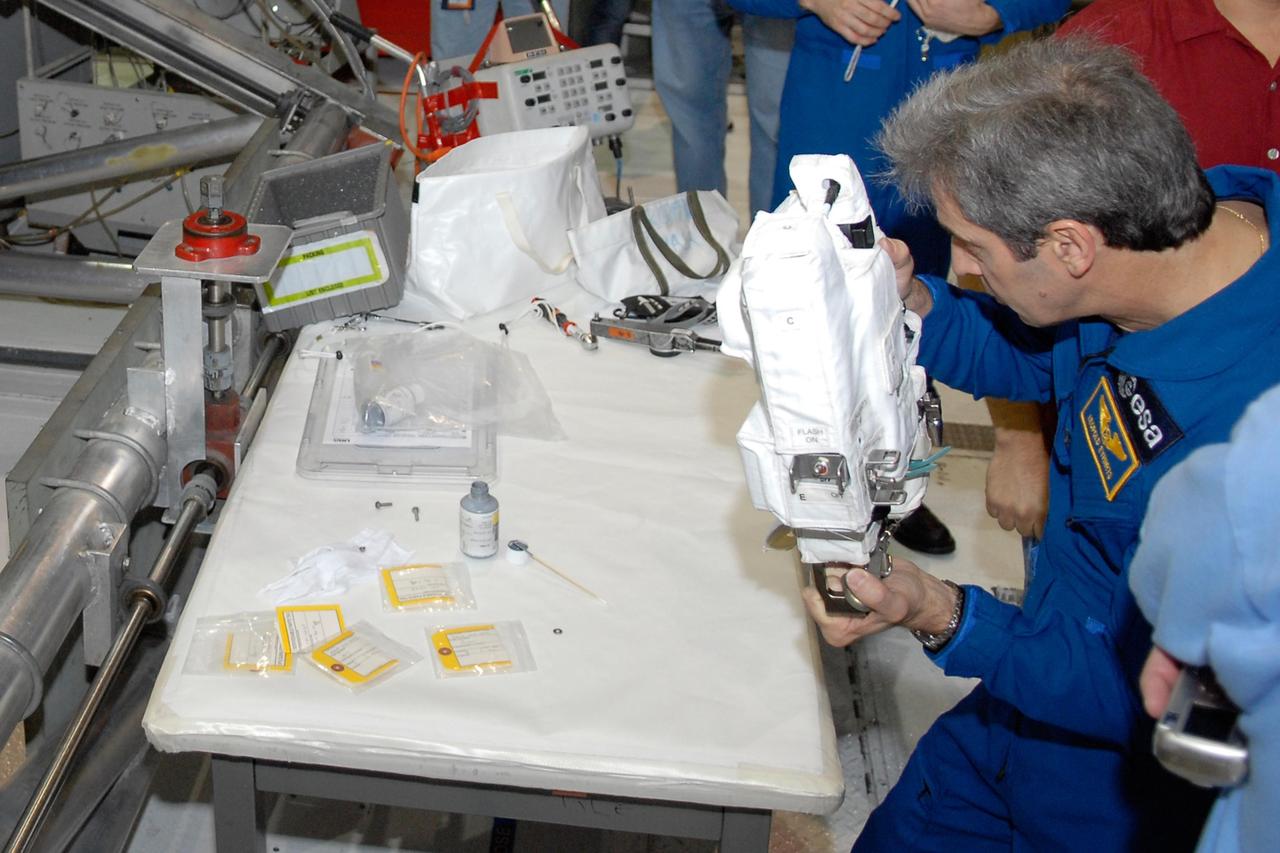
KENNEDY SPACE CENTER, FLA. -- In the Orbiter Processing Facility, members of the STS-122 crew practice handling cameras that will be used during the mission. Holding the camera is astronaut Leopold Eyharts, with the European Space Agency. He will be joining the Expedition 15 crew on the International Space Station. The crew is at Kennedy Space Center to take part in a crew equipment interface test, which helps familiarize them with equipment and payloads for the mission. Among the activities standard to a CEIT are harness training, inspection of the thermal protection system and camera operation for planned extravehicular activities, or EVAs. The mission will carry and install the Columbus Lab, a multifunctional, pressurized laboratory that will be permanently attached to Node 2 of the space station to carry out experiments in materials science, fluid physics and biosciences, as well as to perform a number of technological applications. It is Europe’s largest contribution to the construction of the International Space Station and will support scientific and technological research in a microgravity environment. STS-122 is targeted for launch in December. Photo credit: NASA/Kim Shiflett

KENNEDY SPACE CENTER, FLA. -- In Endeavour's payload bay in Orbiter Processing Facility bay 2, STS-118 crew members get a close look at components in the bay. In front, at right, is Commander Scott Kelly. Behind him is Mission Specialist Barbara Morgan. They and other crew members are at KSC for crew equipment interface test activities. The STS-118 mission will be delivering the third starboard truss segment, the ITS S5, to the International Space Station, as well as the SPACEHAB single cargo module filled with supplies and equipment. Launch aboard Space Shuttle Endeavour is targeted for Aug. 9. Photo credit: NASA/Kim Shiflett
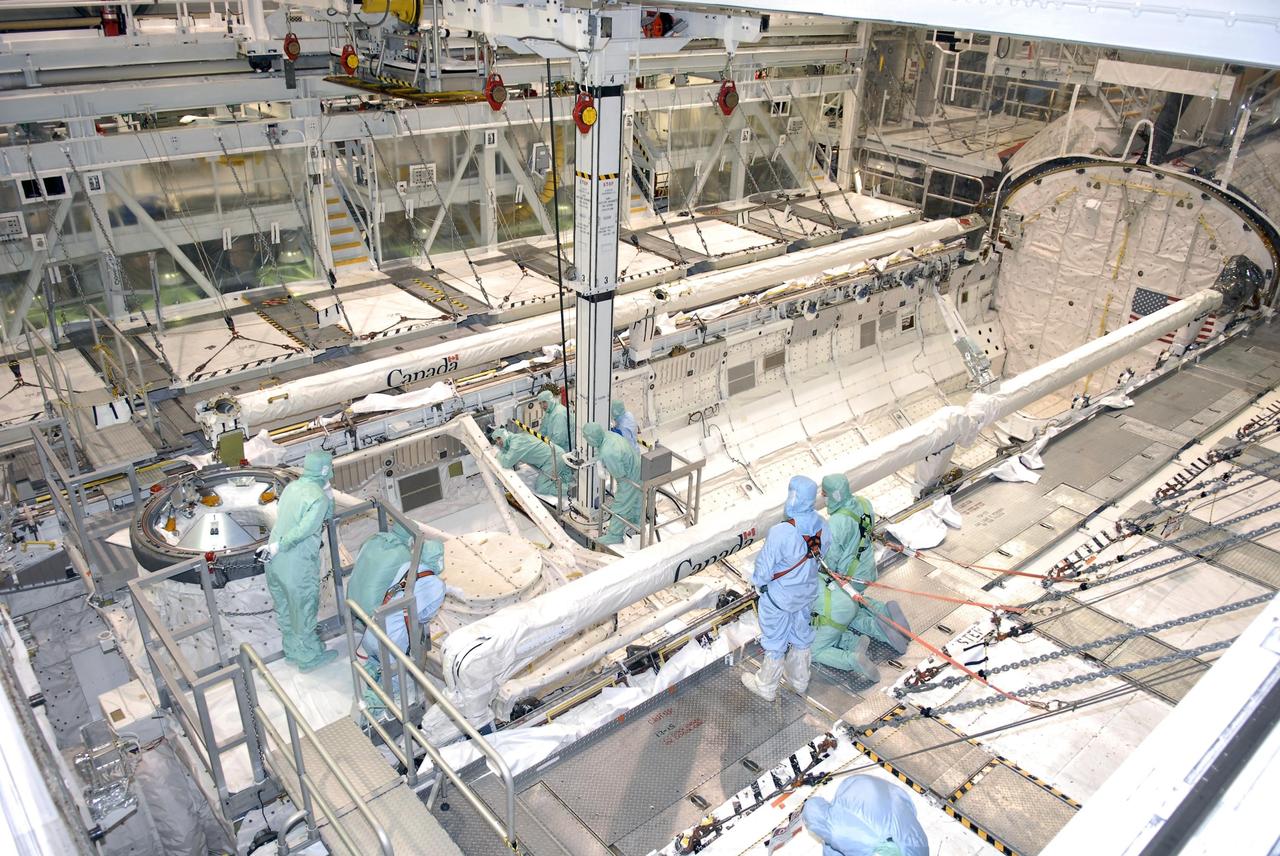
KENNEDY SPACE CENTER, FLA. -- During crew equipment interface test activities at KSC, STS-118 crew members get a close look at equipment inside Endeavour's payload bay. The crew comprises Commander Scott Kelly, Pilot Charles Hobaugh, and Mission Specialists Dr. Dafydd Williams, Barbara Morgan, Richard Mastracchio, Tracy Caldwell and Benjamin Drew. The STS-118 mission will be delivering the third starboard truss segment, the ITS S5, to the International Space Station, as well as the SPACEHAB single cargo module filled with supplies and equipment. Launch aboard Space Shuttle Endeavour is targeted for Aug. 9. Photo credit: NASA/Kim Shiflett
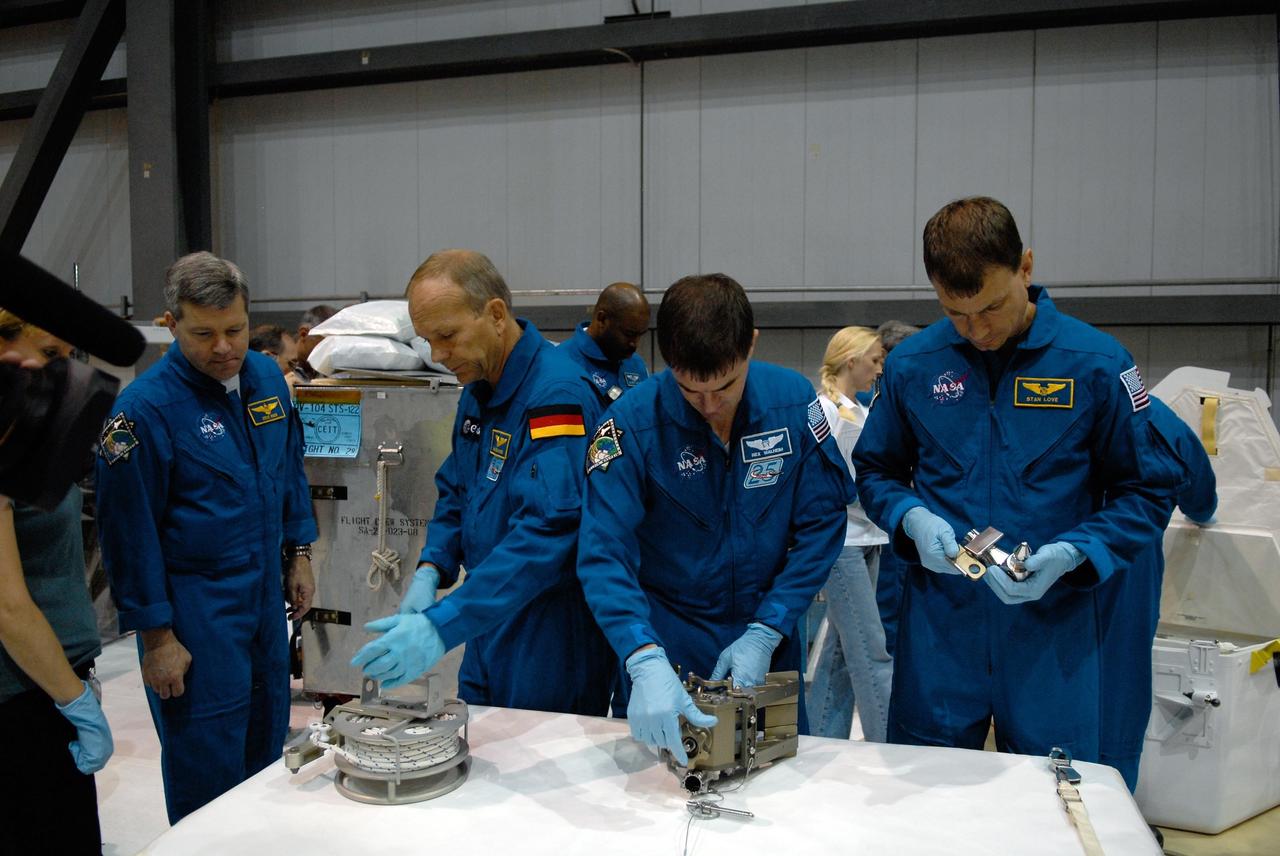
KENNEDY SPACE CENTER, FLA. -- In the Orbiter Processing Facility, STS-122 crew members practice working with equipment for the mission. From left are Commander Stephen Frick and Mission Specialists Hans Schlegel, Leland Melvin (behind), Rex Walheim and Stanley Love. Schlegel represents the European Space Agency. The crew is at Kennedy Space Center to take part in a crew equipment interface test, which includes equipment familiarization. The mission will carry and install the Columbus Lab, a multifunctional, pressurized laboratory that will be permanently attached to Node 2 of the space station to carry out experiments in materials science, fluid physics and biosciences, as well as to perform a number of technological applications. It is Europe’s largest contribution to the construction of the International Space Station and will support scientific and technological research in a microgravity environment. STS-122 is targeted for launch in December. Photo credit: NASA/Kim Shiflett
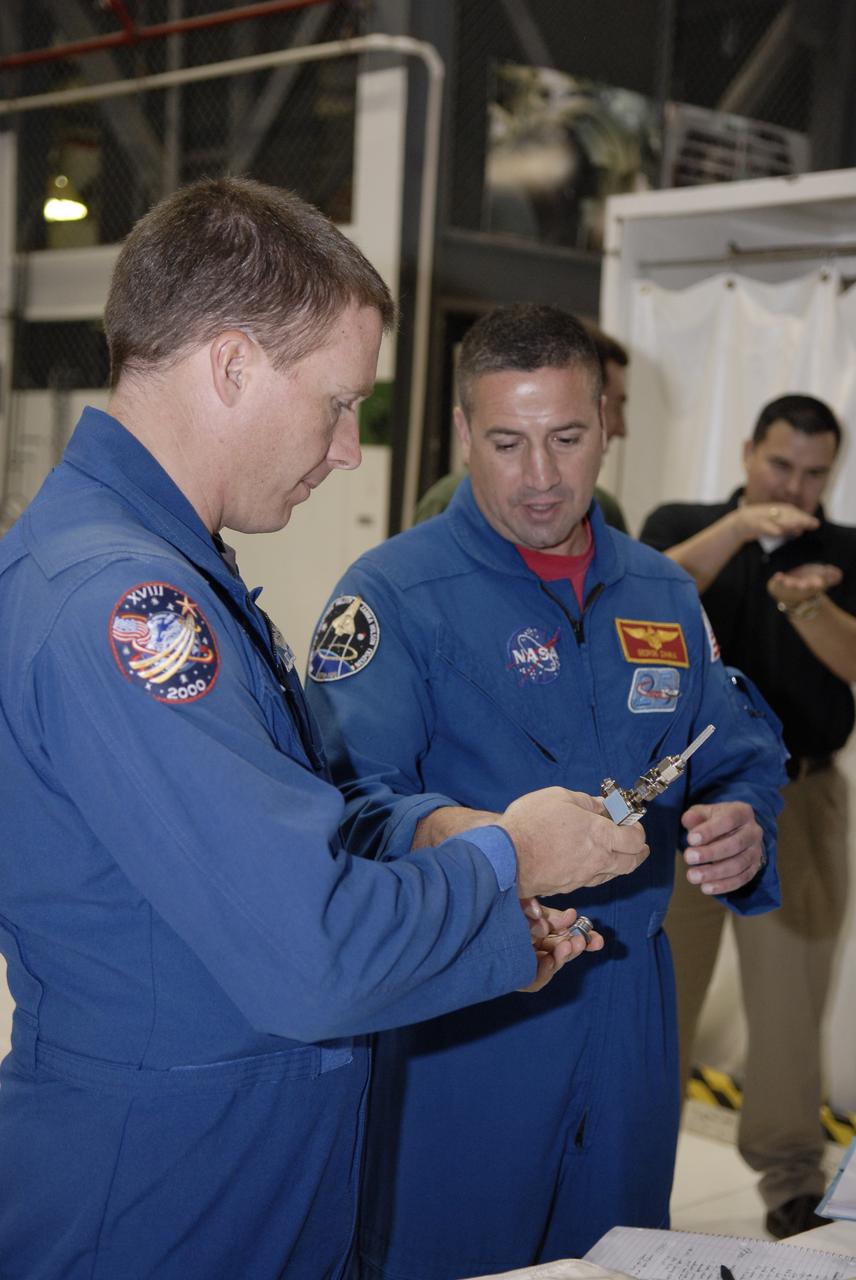
CAPE CANAVERAL, Fla. – In Orbiter Processing Facility-3 at NASA's Kennedy Space Center in Florida, STS-130 Pilot Terry Virts Jr., left, handles a piece of hardware that will fly on space shuttle Endeavour as his commander, George Zamka, looks on. The crew is at Kennedy for a crew equipment interface test, or CEIT, which provides hands-on training and observation of shuttle and flight hardware. The STS-130 flight will carry the Tranquility pressurized module with a built-in cupola to the International Space Station aboard Endeavour. Launch is targeted for Feb. 4, 2010. Photo credit: NASA/Kim Shiflett
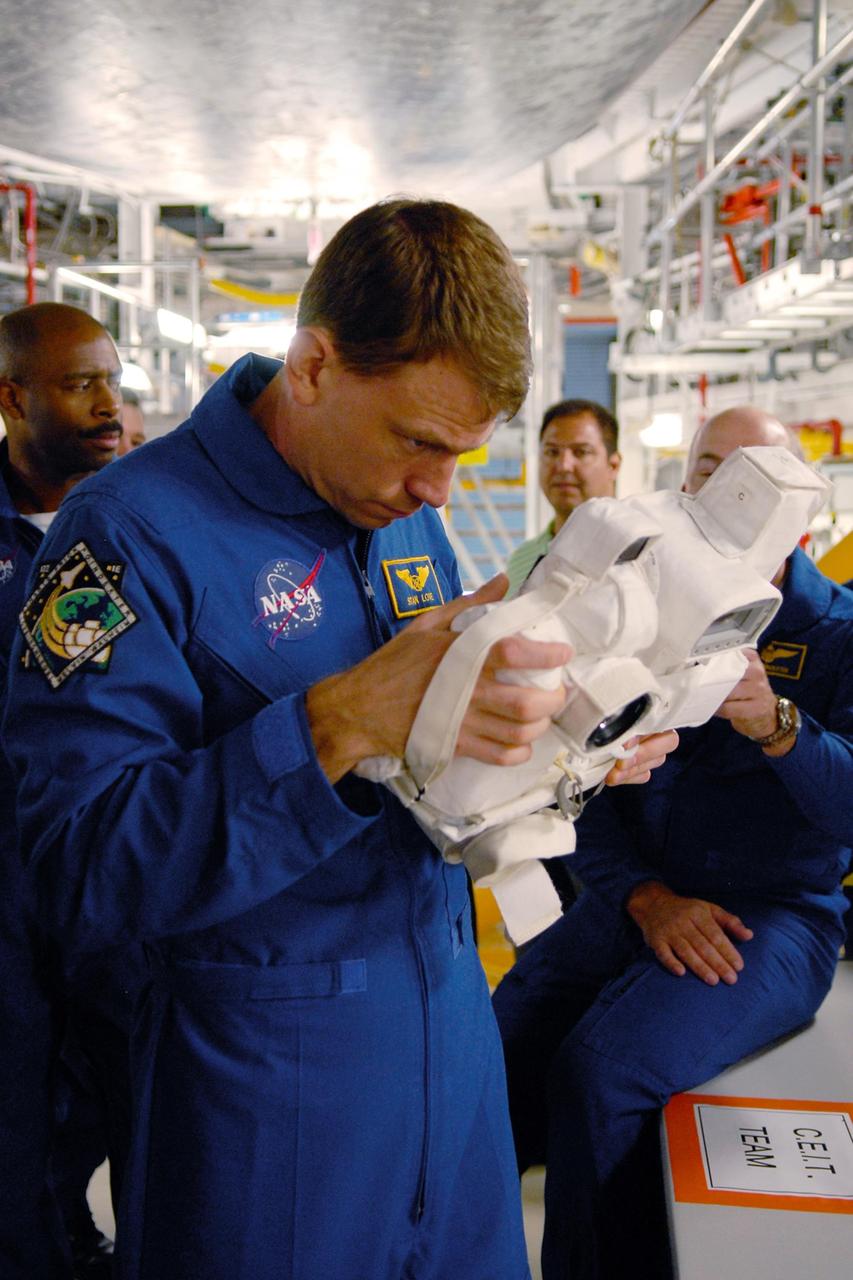
KENNEDY SPACE CENTER, FLA. -- In the Orbiter Processing Facility, members of the STS-122 crew practice handling cameras that will be used during the mission. In the foreground is Mission Specialist Stanley Love. Behind him at left is Mission Specialist Leland Melvin; at right is Pilot Alan Poindexter. The crew is at Kennedy Space Center to take part in a crew equipment interface test, which helps familiarize them with equipment and payloads for the mission. Among the activities standard to a CEIT are harness training, inspection of the thermal protection system and camera operation for planned extravehicular activities, or EVAs. The mission will carry and install the Columbus Lab, a multifunctional, pressurized laboratory that will be permanently attached to Node 2 of the space station to carry out experiments in materials science, fluid physics and biosciences, as well as to perform a number of technological applications. It is Europe’s largest contribution to the construction of the International Space Station and will support scientific and technological research in a microgravity environment. STS-122 is targeted for launch in December. Photo credit: NASA/Kim Shiflett
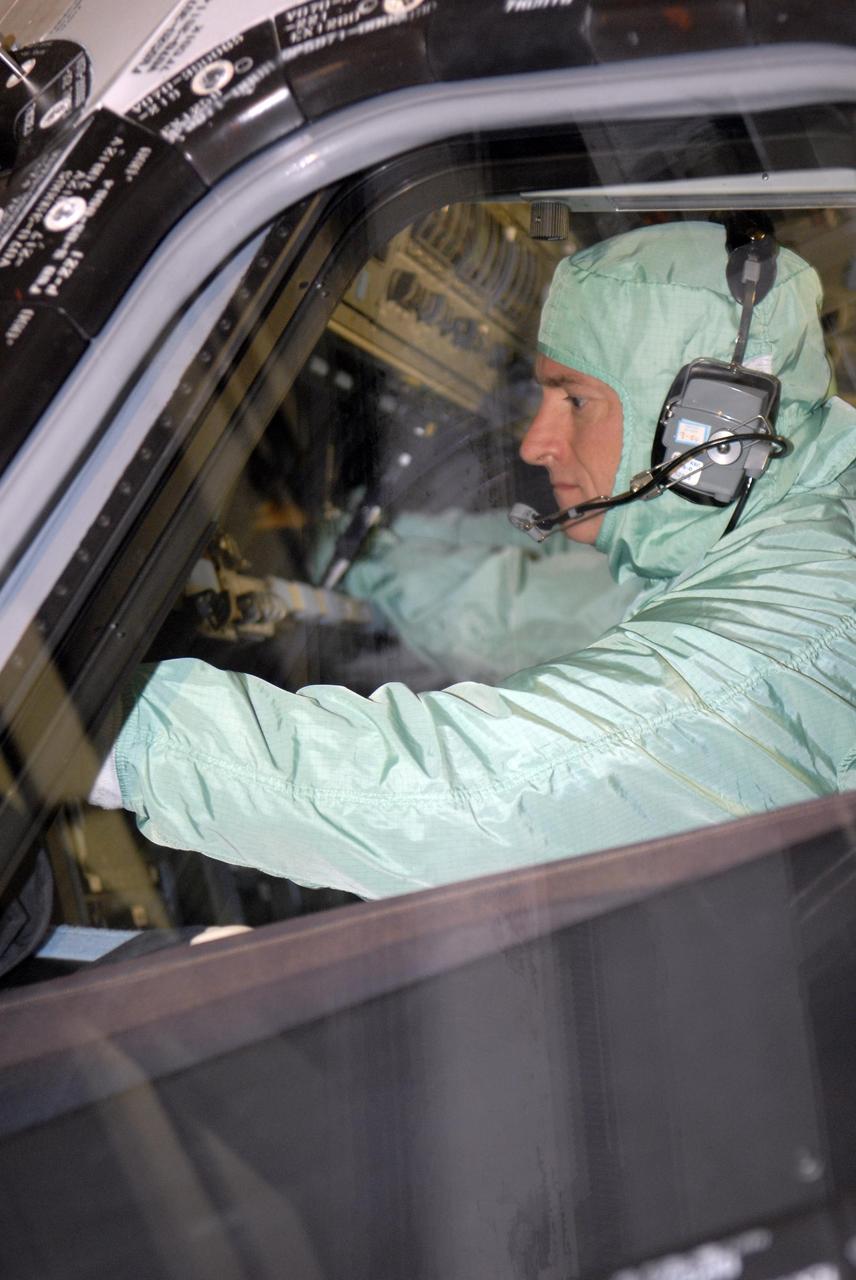
KENNEDY SPACE CENTER, FLA. -- During crew equipment interface test activities at KSC, STS-118 Commander Scott Kelly checks the cockpit windshield of orbiter Endeavour, which is in Orbiter Processing Facility bay 3. The STS-118 mission will be delivering the third starboard truss segment, the ITS S5, to the International Space Station, as well as the SPACEHAB single cargo module filled with supplies and equipment. Launch aboard Space Shuttle Endeavour is targeted for Aug. 9. Photo credit: NASA/Kim Shiflett
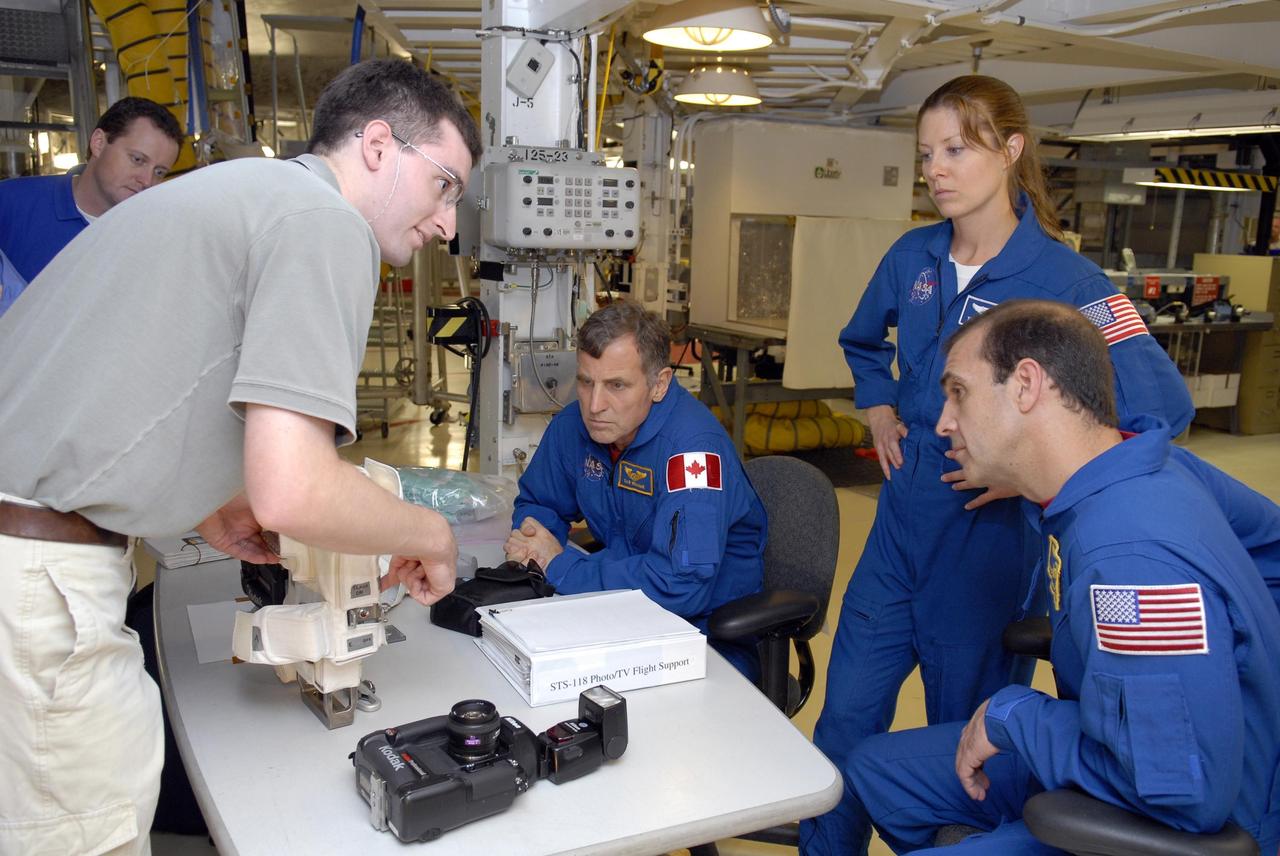
KENNEDY SPACE CENTER, FLA. -- In Orbiter Processing Facility bay 2, during crew equipment interface test activities, STS-118 Mission Specialists Dr. Dafydd Williams, Tracy Caldwell and Richard Mastrocchio get instructions on using photo equipment for their flight. The STS-118 mission will be delivering the third starboard truss segment, the ITS S5, to the International Space Station, as well as the SPACEHAB single cargo module filled with supplies and equipment. Launch aboard Space Shuttle Endeavour is targeted for Aug. 9. Photo credit: NASA/Kim Shiflett
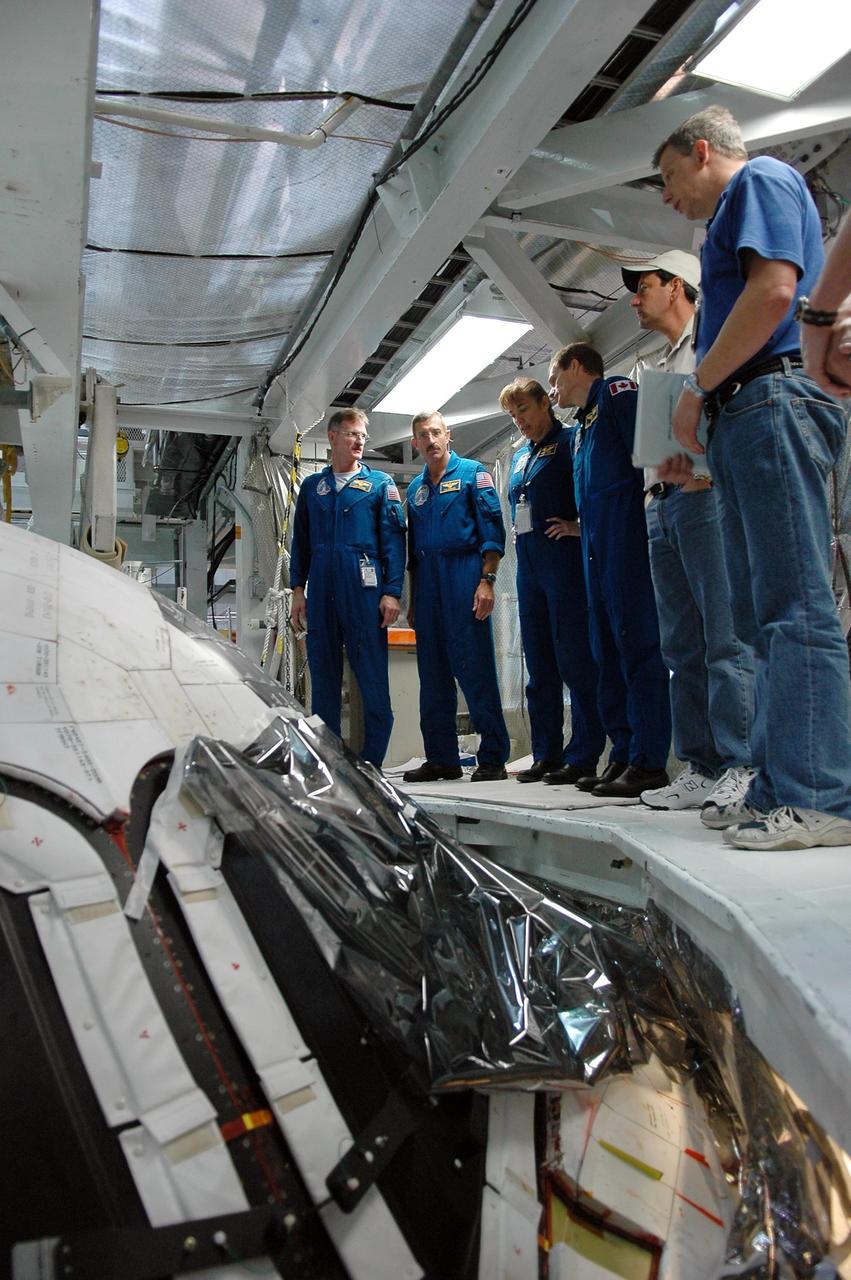
KENNEDY SPACE CENTER, FLA. - In the Orbiter Processing Facility, STS-115 crew members look over the cockpit on the orbiter Atlantis, the designated launch vehicle for their mission. From left are Mission Specialists Joseph Tanner, Daniel Burbank, Heidemarie Stefanyshyn-Piper and Steven MacLean, who represents the Canadian Space Agency. The crew is at the center for Crew Equipment Interface Test activities, which involves equipment familiarization, a routine part of astronaut training and launch preparations. The mission will deliver the second port truss segment, the P3/P4 Truss, to attach to the first port truss segment, the P1 Truss, as well as deploy solar array set 2A and 4A. Launch on Space Shuttle Atlantis is scheduled for late August. Photo credit: NASA/Kim Shiflett
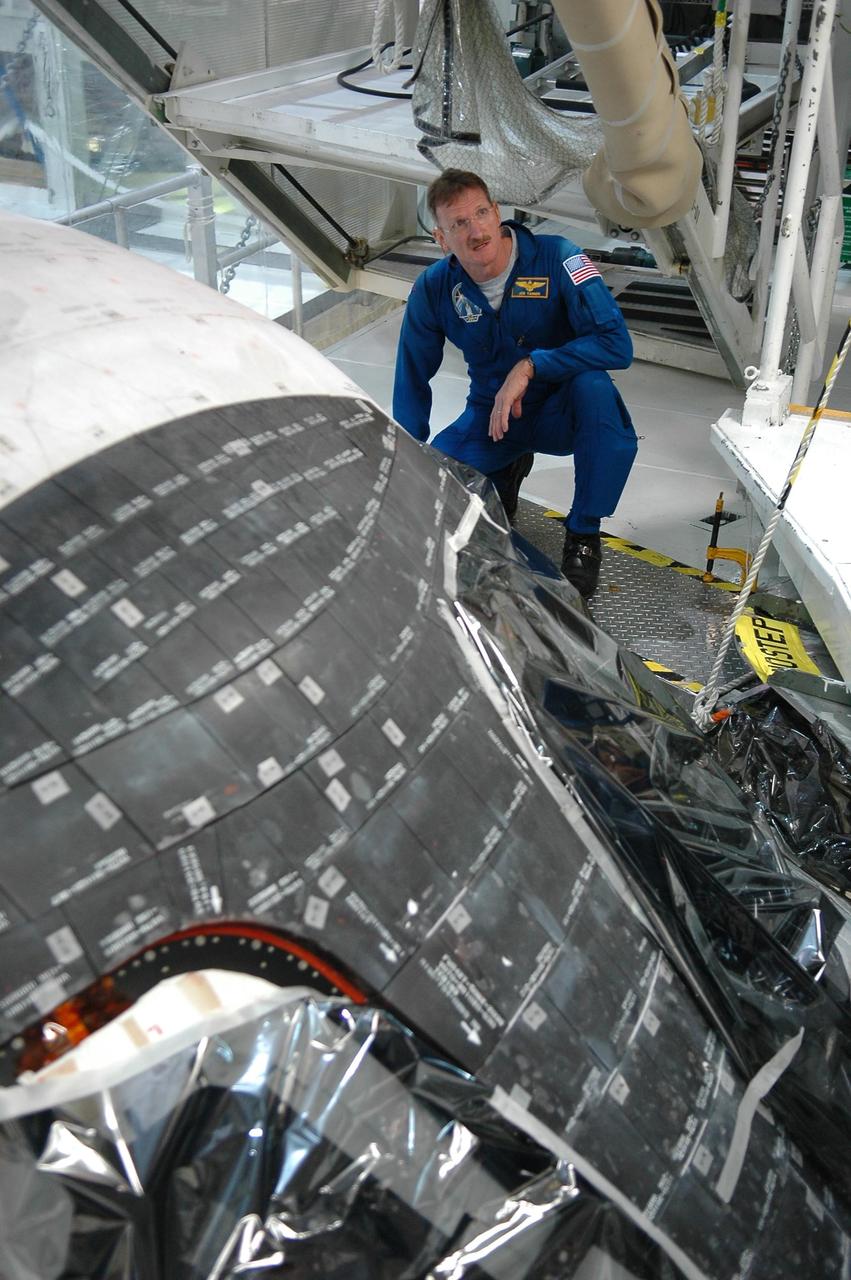
KENNEDY SPACE CENTER, FLA. - In the Orbiter Processing Facility, STS-115 Mission Specialist Joseph Tanner takes a closer look at the orbiter Atlantis, the designated launch vehicle for the mission The crew is at the center for Crew Equipment Interface Test activities, which involves equipment familiarization, a routine part of astronaut training and launch preparations. The mission will deliver the second port truss segment, the P3/P4 Truss, to attach to the first port truss segment, the P1 Truss, as well as deploy solar array set 2A and 4A. Launch on Space Shuttle Atlantis is scheduled for late August. Photo credit: NASA/Kim Shiflett
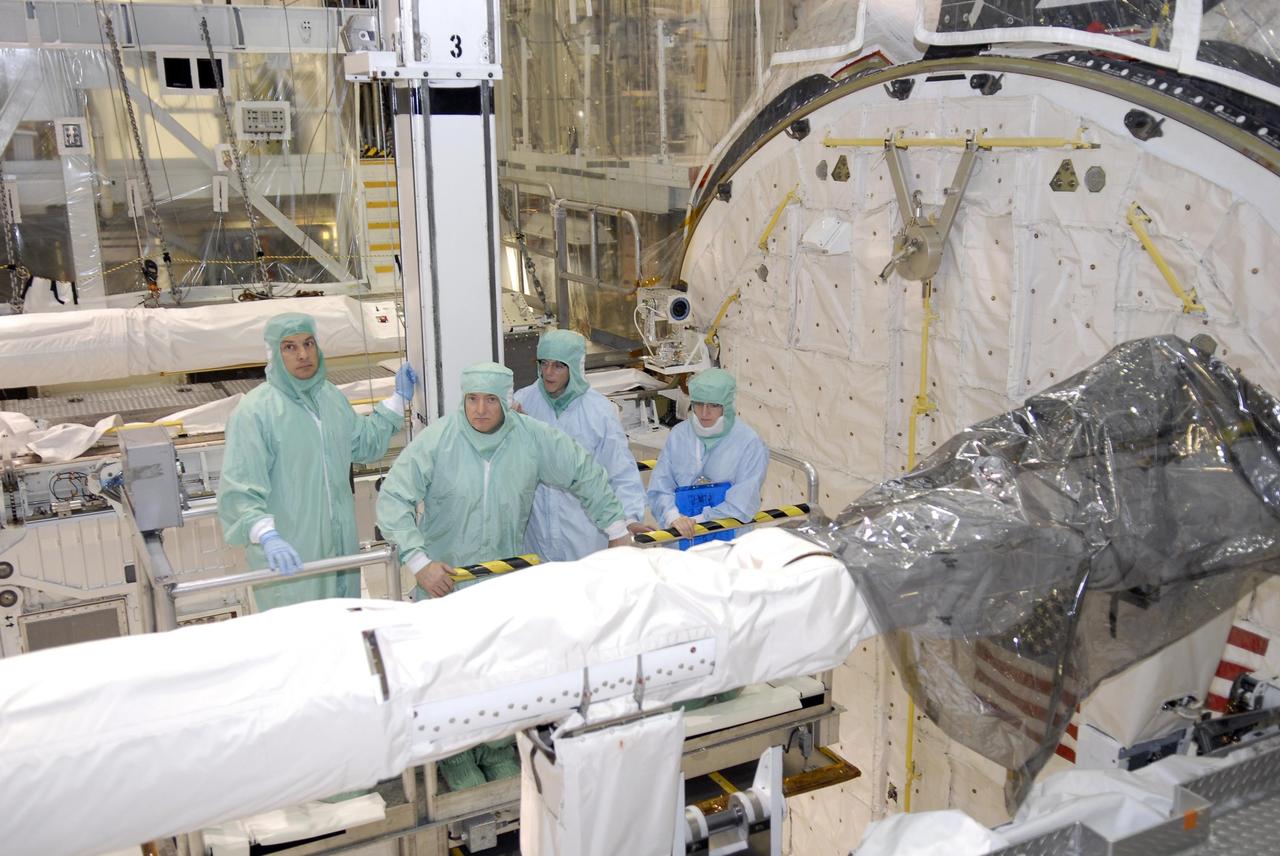
KENNEDY SPACE CENTER, FLA. -- In Orbiter Processing Facility bay 2, during crew equipment interface test activities, STS-118 crew members get a close look at the orbiter boom sensor system in Endeavour's payload bay. At center are Commander Scott Kelly and Mission Specialist Barbara Morgan. The STS-118 mission will be delivering the third starboard truss segment, the ITS S5, to the International Space Station, as well as the SPACEHAB single cargo module filled with supplies and equipment. Launch aboard Space Shuttle Endeavour is targeted for Aug. 9. Photo credit: NASA/Kim Shiflett
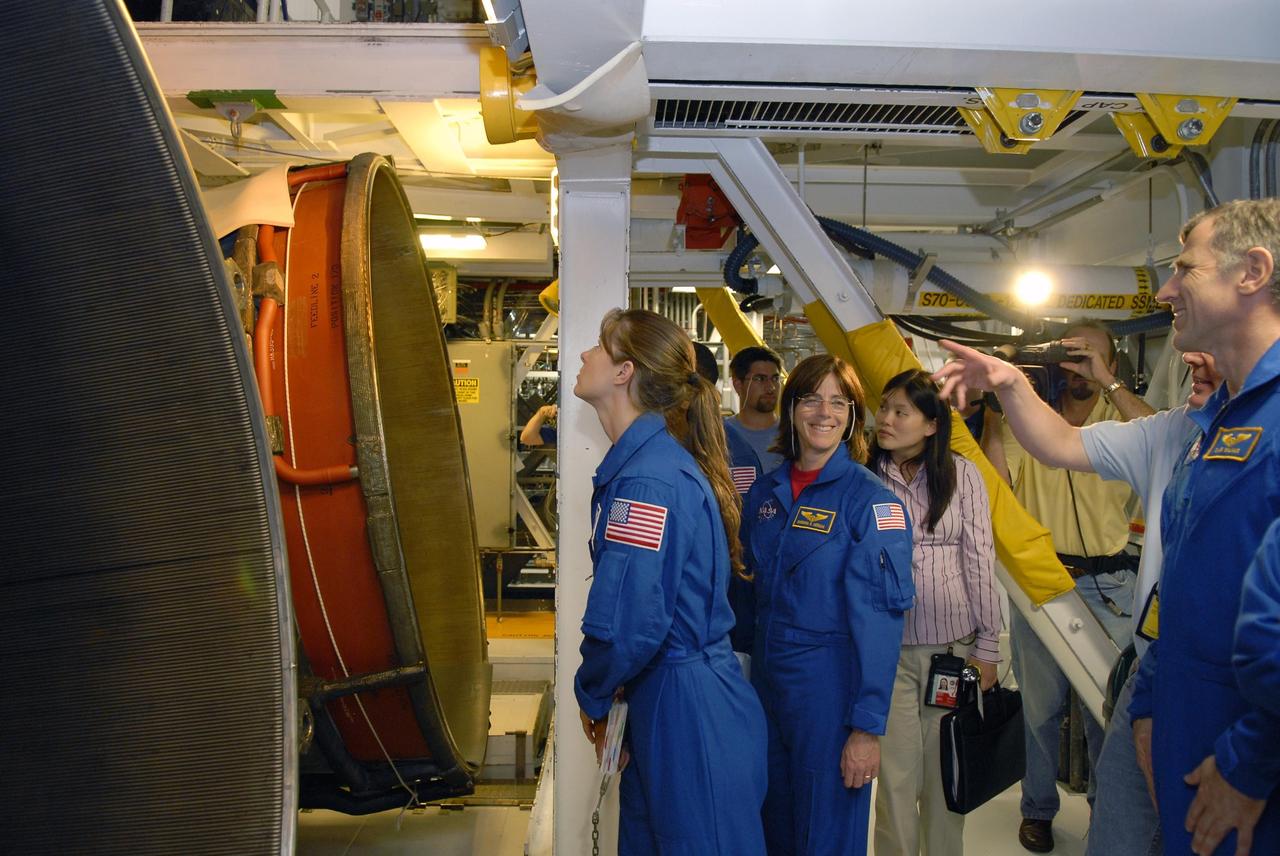
KENNEDY SPACE CENTER, FLA. -- In Orbiter Processing Facility bay 2, members of the STS-118 crew look at the main engines on the orbiter Endeavour during crew equipment interface test activities. Seen here are (from left) Mission Specialists Tracy Caldwell, Barbara Morgan and (far right) Dr. Dafydd Williams. The STS-118 mission will be delivering the third starboard truss segment, the ITS S5, to the International Space Station, as well as the SPACEHAB single cargo module filled with supplies and equipment. Launch aboard Space Shuttle Endeavour is targeted for Aug. 9. Photo credit: NASA/Kim Shiflett
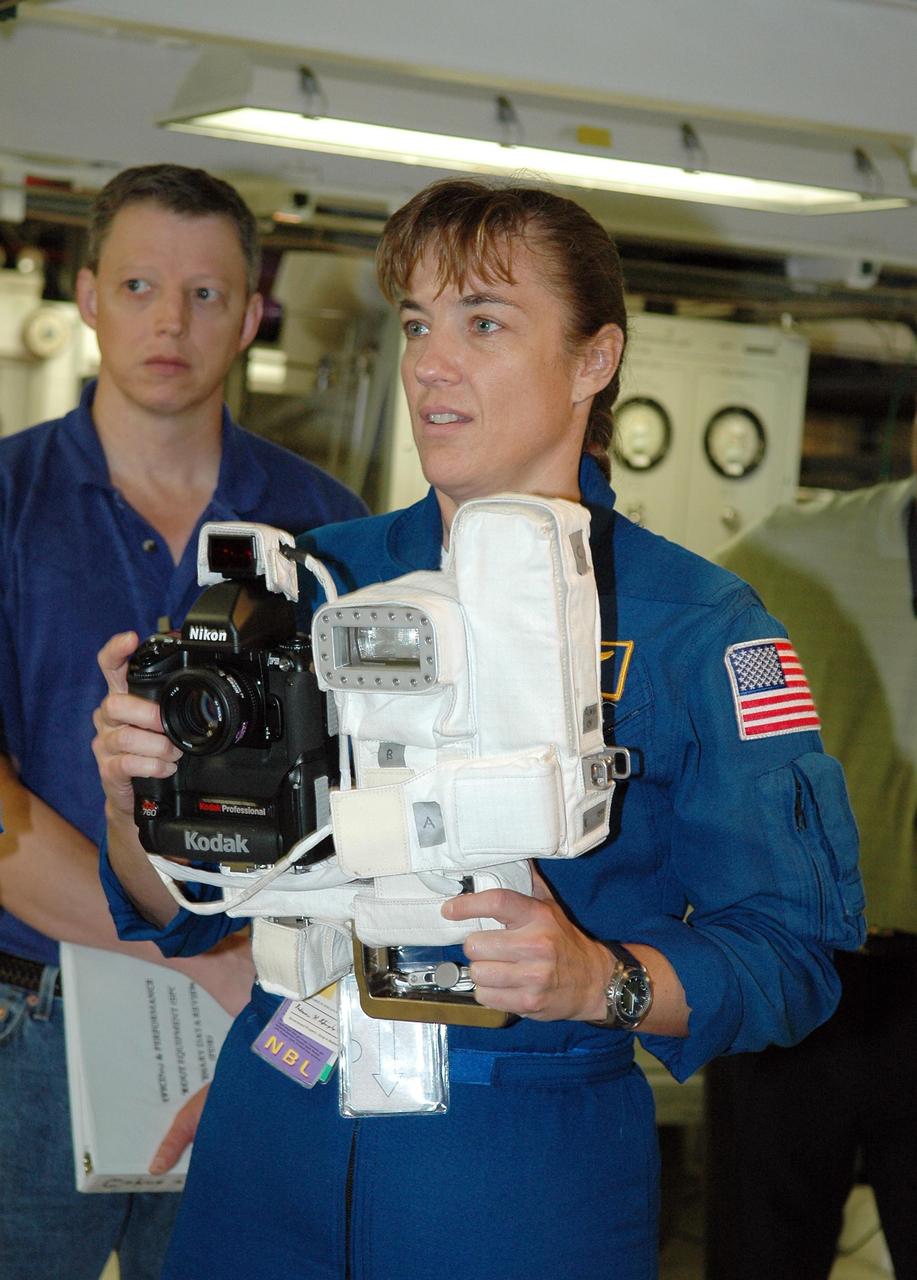
KENNEDY SPACE CENTER, FLA. - In the Orbiter Processing Facility, STS-115 Mission Specialist Heidemarie Stefanyshyn-Piper takes her turn at using a camera that is a mockup of one the crew will use to take photographs on-orbit. The crew is at the center for Crew Equipment Interface Test activities, which involves equipment familiarization, a routine part of astronaut training and launch preparations. The mission will deliver the second port truss segment, the P3/P4 Truss, to attach to the first port truss segment, the P1 Truss, as well as deploy solar array set 2A and 4A. Launch on Space Shuttle Atlantis is scheduled for late August. Photo credit: NASA/Kim Shiflett
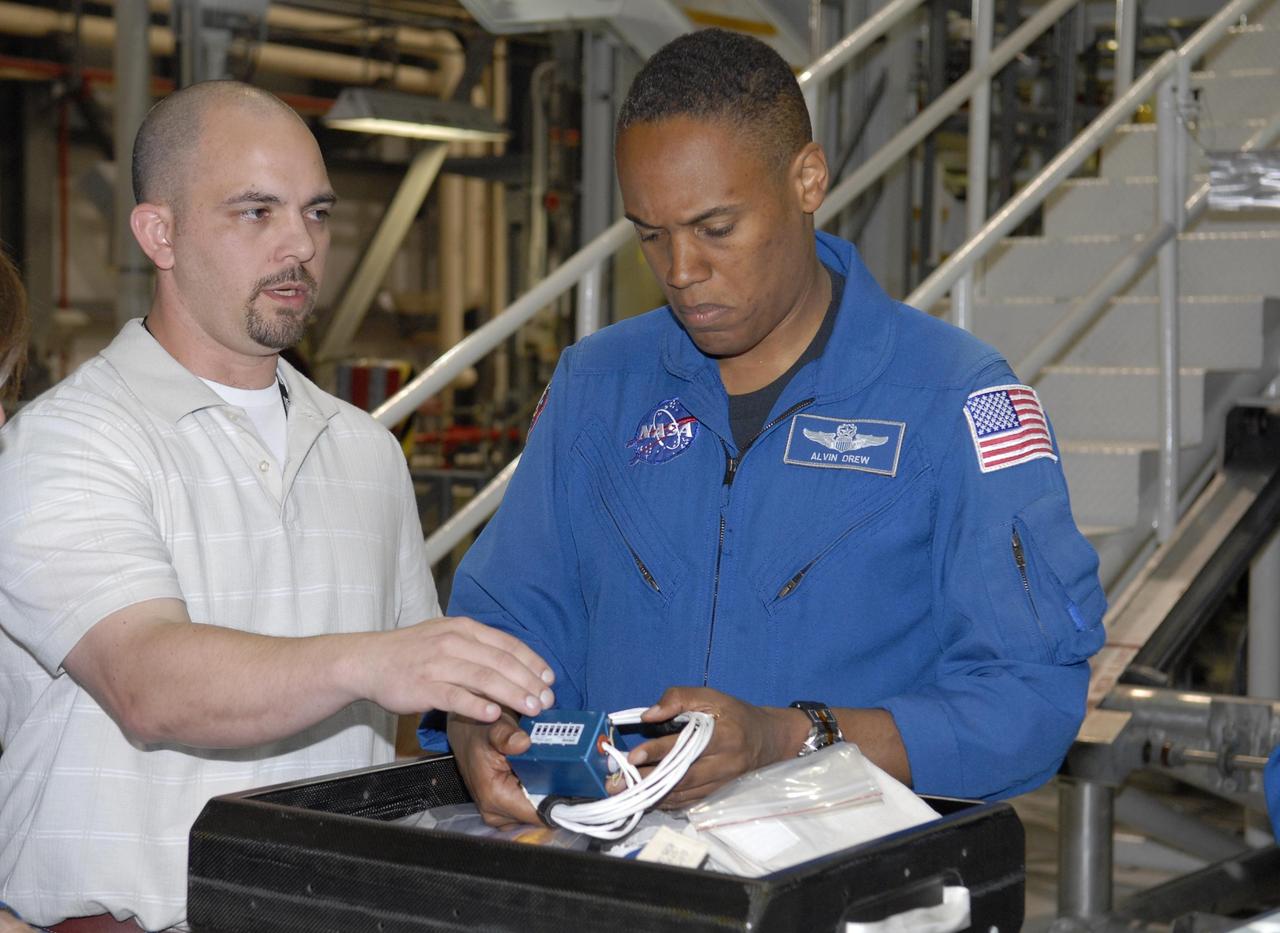
KENNEDY SPACE CENTER, FLA. -- During crew equipment interface test activities in Orbiter Processing Facility bay 3 at KSC, STS-118 Mission Specialist Benjamin Drew gets a close look at equipment that will be used on the flight. The STS-118 mission will be delivering the third starboard truss segment, the ITS S5, to the International Space Station, as well as the SPACEHAB single cargo module filled with supplies and equipment. Launch aboard Space Shuttle Endeavour is targeted for Aug. 9. Photo credit: NASA/Kim Shiflett
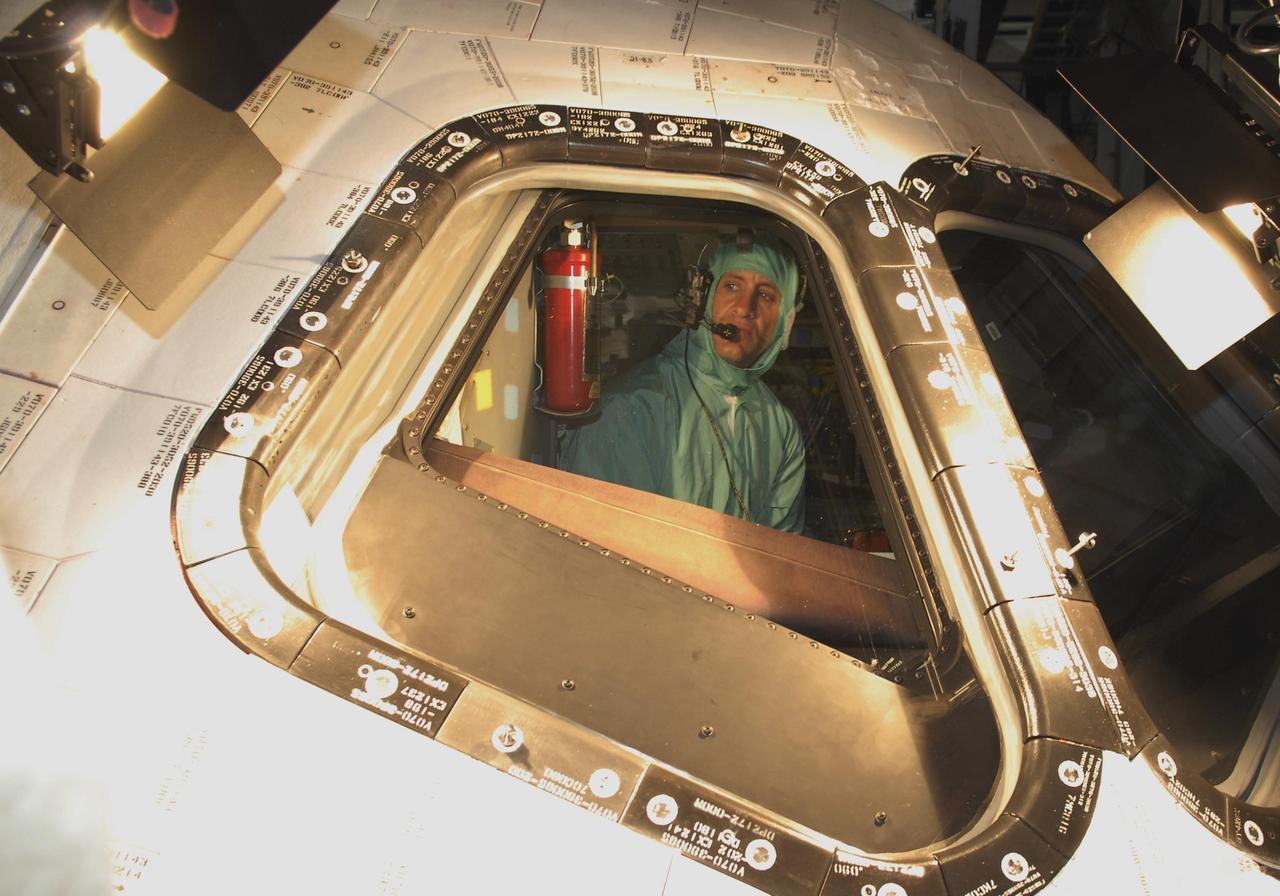
KENNEDY SPACE CENTER, FLA. -- During crew equipment interface test activities at KSC, STS-118 Pilot Charles Hobaugh looks out the starboard cockpit window of orbiter Endeavour, which is in Orbiter Processing Facility bay 3. The STS-118 mission will be delivering the third starboard truss segment, the ITS S5, to the International Space Station, as well as the SPACEHAB single cargo module filled with supplies and equipment. Launch aboard Space Shuttle Endeavour is targeted for Aug. 9. Photo credit: NASA/Kim Shiflett
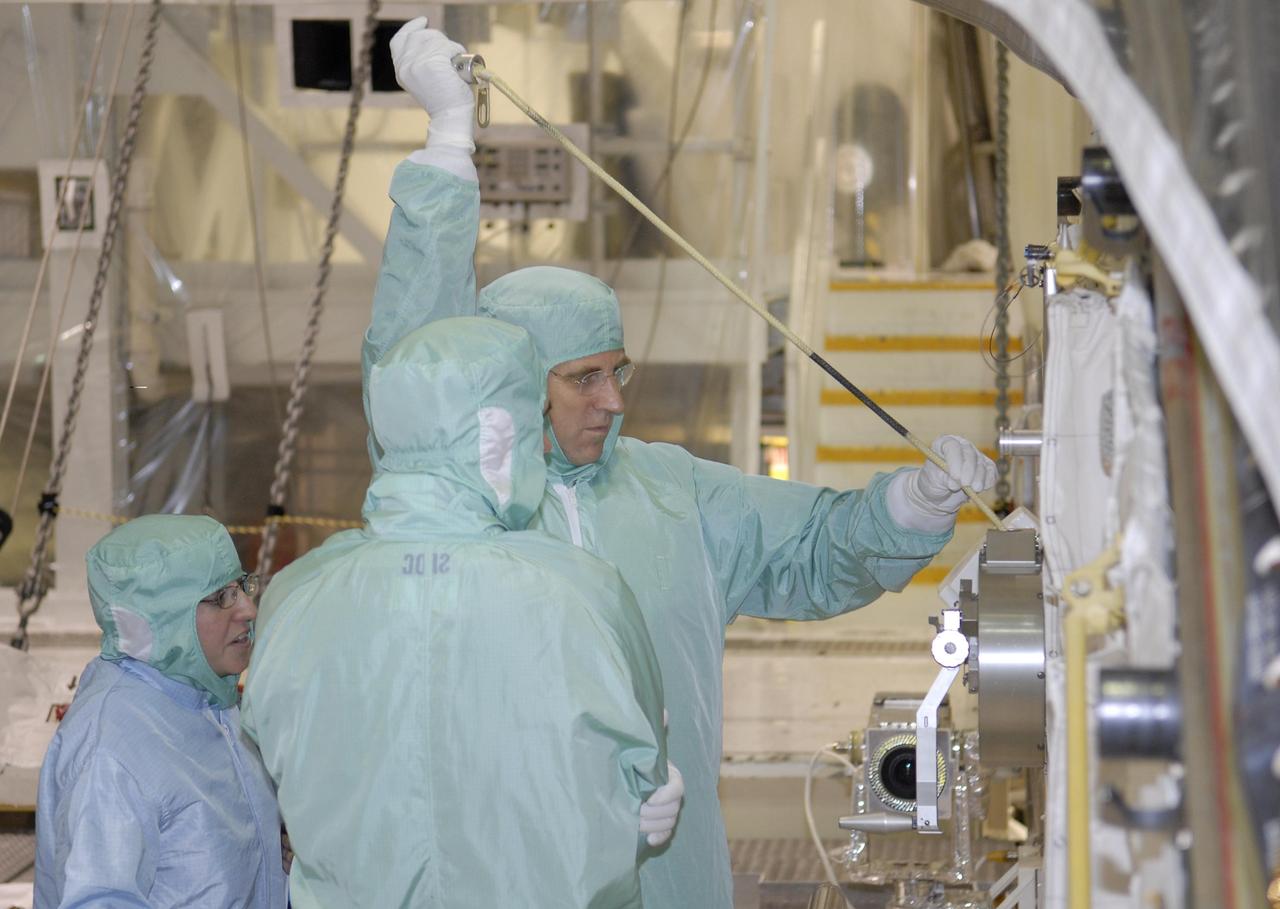
KENNEDY SPACE CENTER, FLA. -- During crew equipment interface test activities at KSC, STS-118 Mission Specialist Dr. Dafydd Williams (right) maneuvers the latch on the crew airlock module. The airlock is located in the middeck. The airlock and airlock hatches permit flight crew members to transfer from the middeck crew compartment into the payload bay for extravehicular activities in their space suits without depressurizing the orbiter crew cabin. The airlock is sized to accommodate two fully suited flight crew members simultaneously. The STS-118 mission will be delivering the third starboard truss segment, the ITS S5, to the International Space Station, as well as the SPACEHAB single cargo module filled with supplies and equipment. Launch aboard Space Shuttle Endeavour is targeted for Aug. 9. Photo credit: NASA/Kim Shiflett
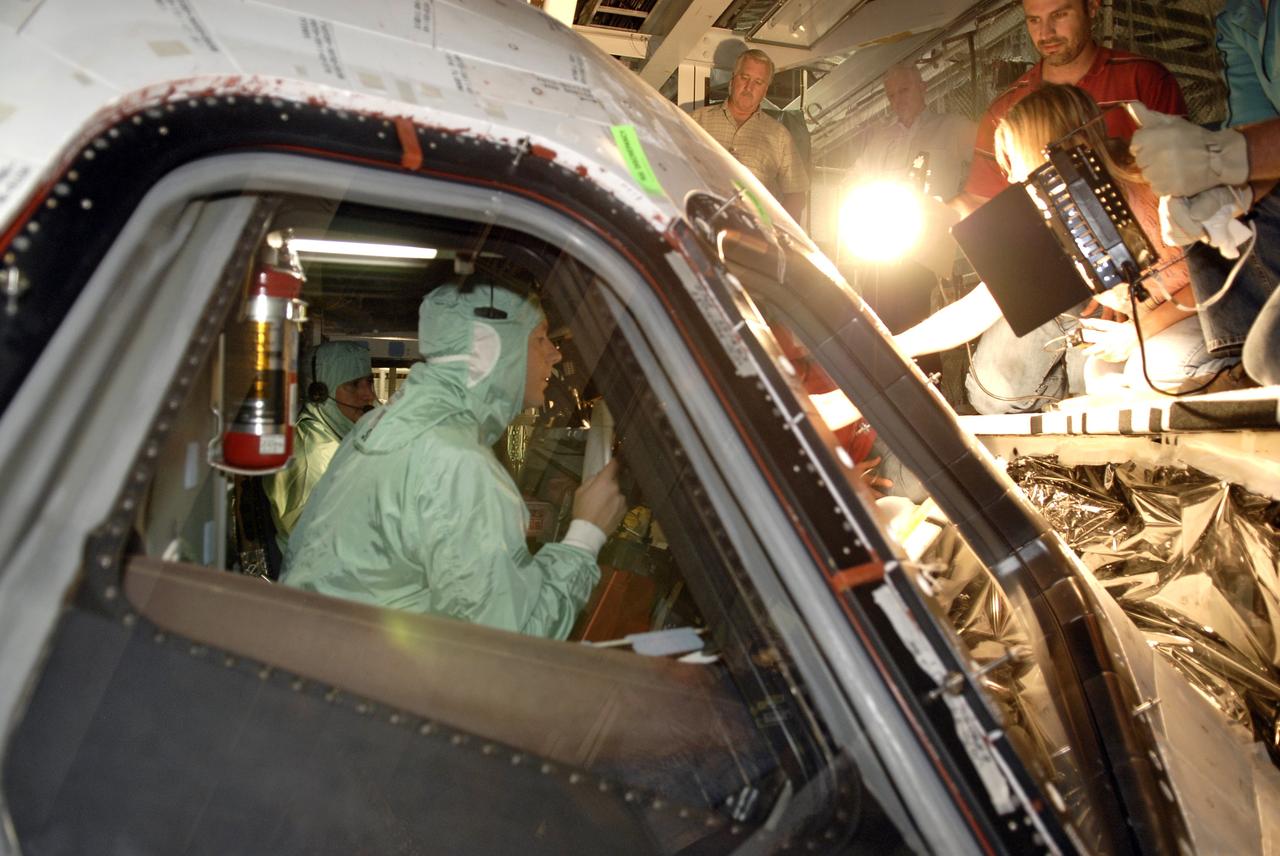
CAPE CANAVERAL, Fla. – In Orbiter Processing Facility-3 at NASA's Kennedy Space Center in Florida, STS-130 Pilot Terry Virts Jr. dressed in clean-room attire, known as a "bunny suit," tries out the cockpit of space shuttle Endeavour. The crew is at Kennedy for a crew equipment interface test, or CEIT, which provides hands-on training and observation of shuttle and flight hardware. The STS-130 flight will carry the Tranquility pressurized module with a built-in cupola to the International Space Station aboard Endeavour. Launch is targeted for Feb. 4, 2010. Photo credit: NASA/Kim Shiflett
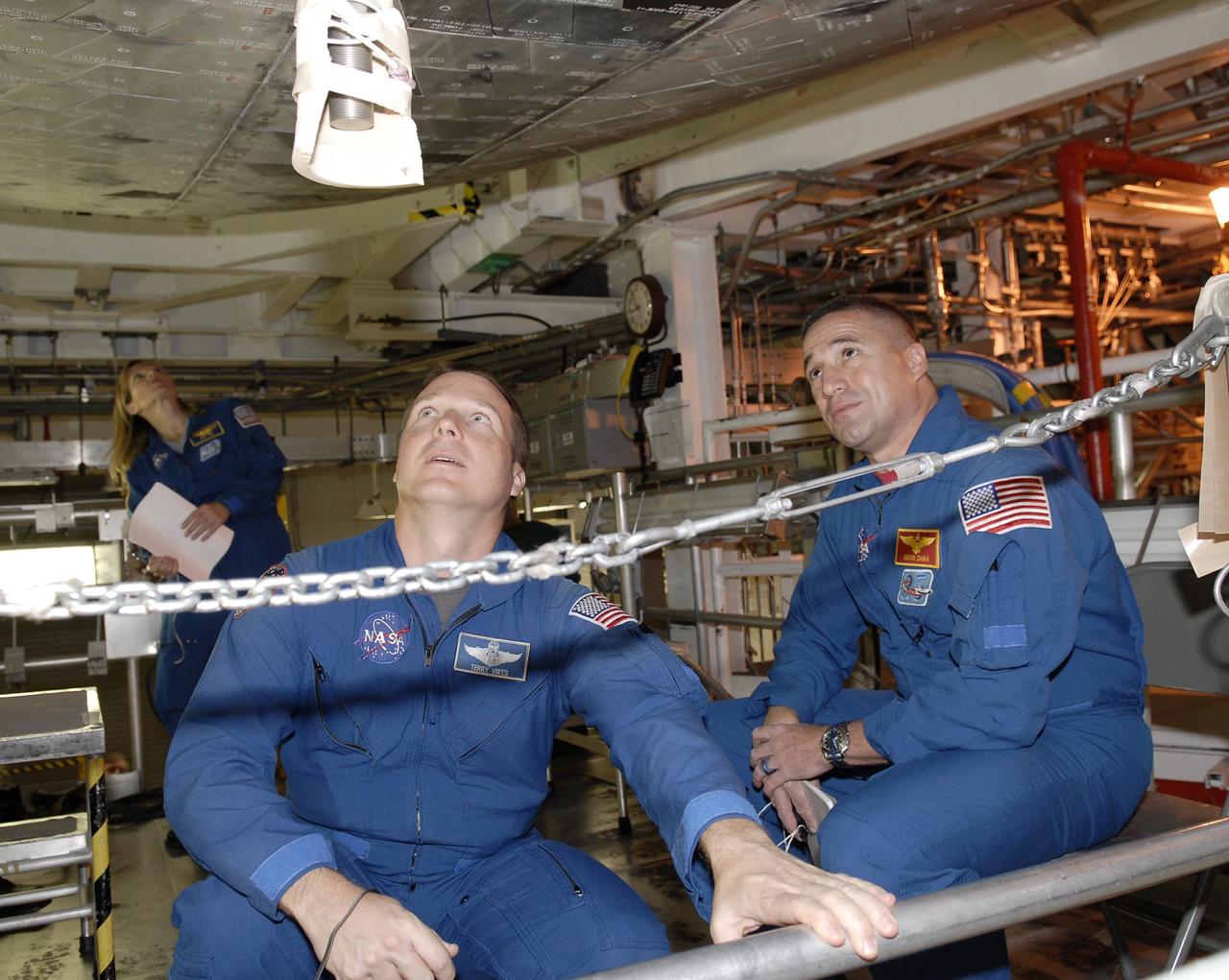
CAPE CANAVERAL, Fla. – In Orbiter Processing Facility-3 at NASA's Kennedy Space Center in Florida, STS-130 Pilot Terry Virts Jr., left, and Commander George Zamka inspect the thermal protection system beneath space shuttle Endeavour as Mission Specialist Kathryn "Kay" Hire does the same in the background. The crew is at Kennedy for a crew equipment interface test, or CEIT, which provides hands-on training and observation of shuttle and flight hardware. The STS-130 flight will carry the Tranquility pressurized module with a built-in cupola to the International Space Station aboard Endeavour. Launch is targeted for Feb. 4, 2010. Photo credit: NASA/Kim Shiflett
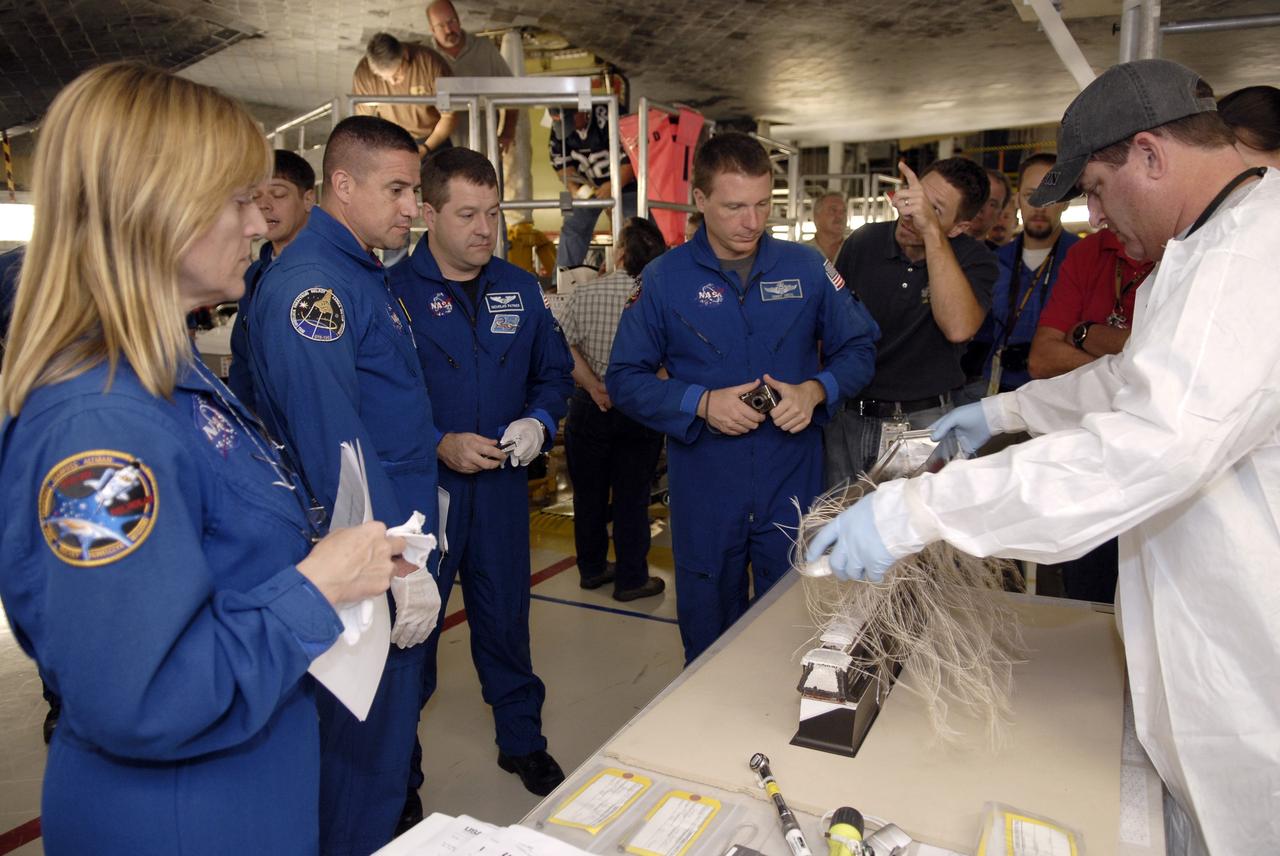
CAPE CANAVERAL, Fla. – In Orbiter Processing Facility-3 at NASA's Kennedy Space Center in Florida, members of the STS-130 crew view a demonstration on the upkeep of space shuttle Endeavour's thermal protection system. From left are Mission Specialist Kathryn "Kay" Hire, Commander George Zamka, Mission Specialist Nicolas Patrick and Pilot Terry Virts Jr. The crew is at Kennedy for a crew equipment interface test, or CEIT, which provides hands-on training and observation of shuttle and flight hardware. The STS-130 flight will carry the Tranquility pressurized module with a built-in cupola to the International Space Station aboard Endeavour. Launch is targeted for Feb. 4, 2010. Photo credit: NASA/Kim Shiflett
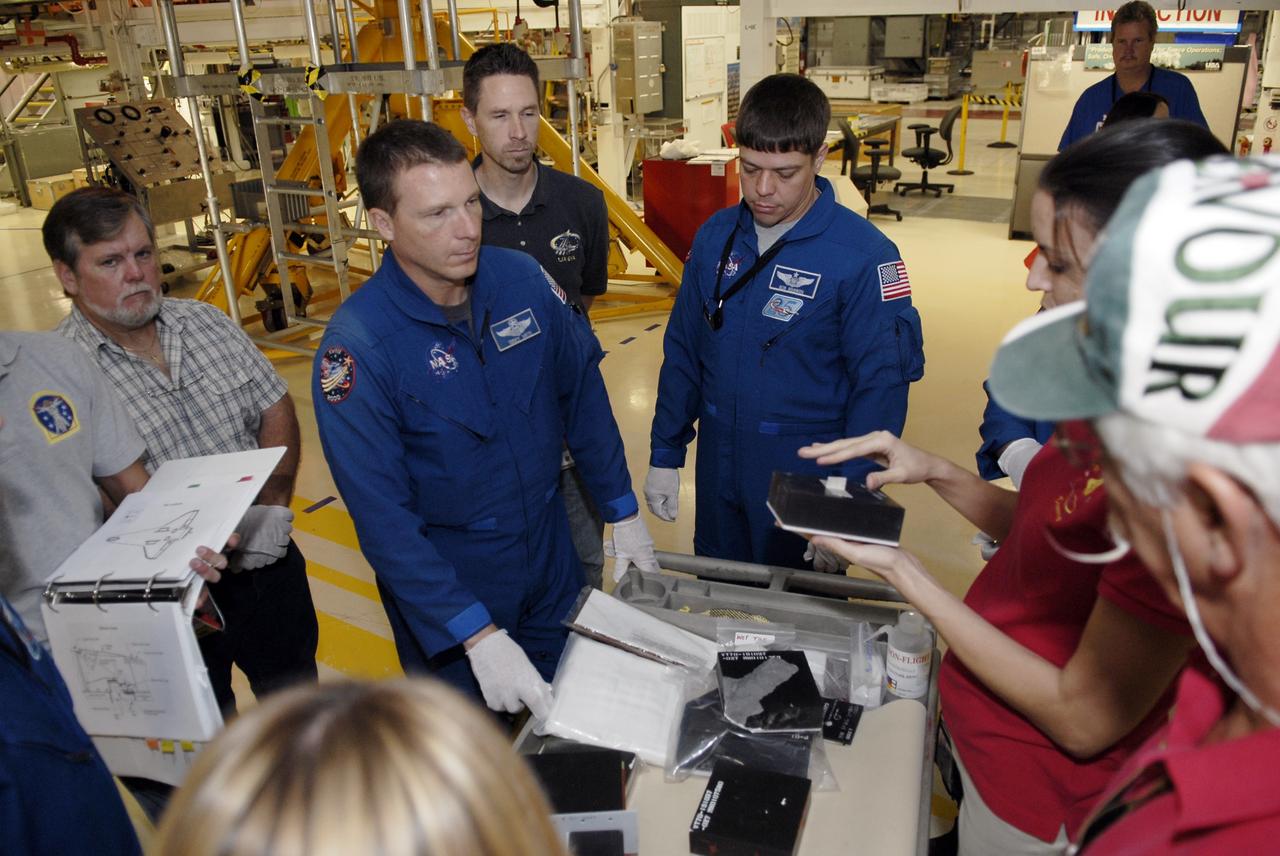
CAPE CANAVERAL, Fla. – In Orbiter Processing Facility-3 at NASA's Kennedy Space Center in Florida, STS-130 Pilot Terry Virts Jr., left, and Mission Specialist Robert Behnken receive a briefing on space shuttle Endeavour's thermal protection system. The crew is at Kennedy for a crew equipment interface test, or CEIT, which provides hands-on training and observation of shuttle and flight hardware. The STS-130 flight will carry the Tranquility pressurized module with a built-in cupola to the International Space Station aboard Endeavour. Launch is targeted for Feb. 4, 2010. Photo credit: NASA/Kim Shiflett
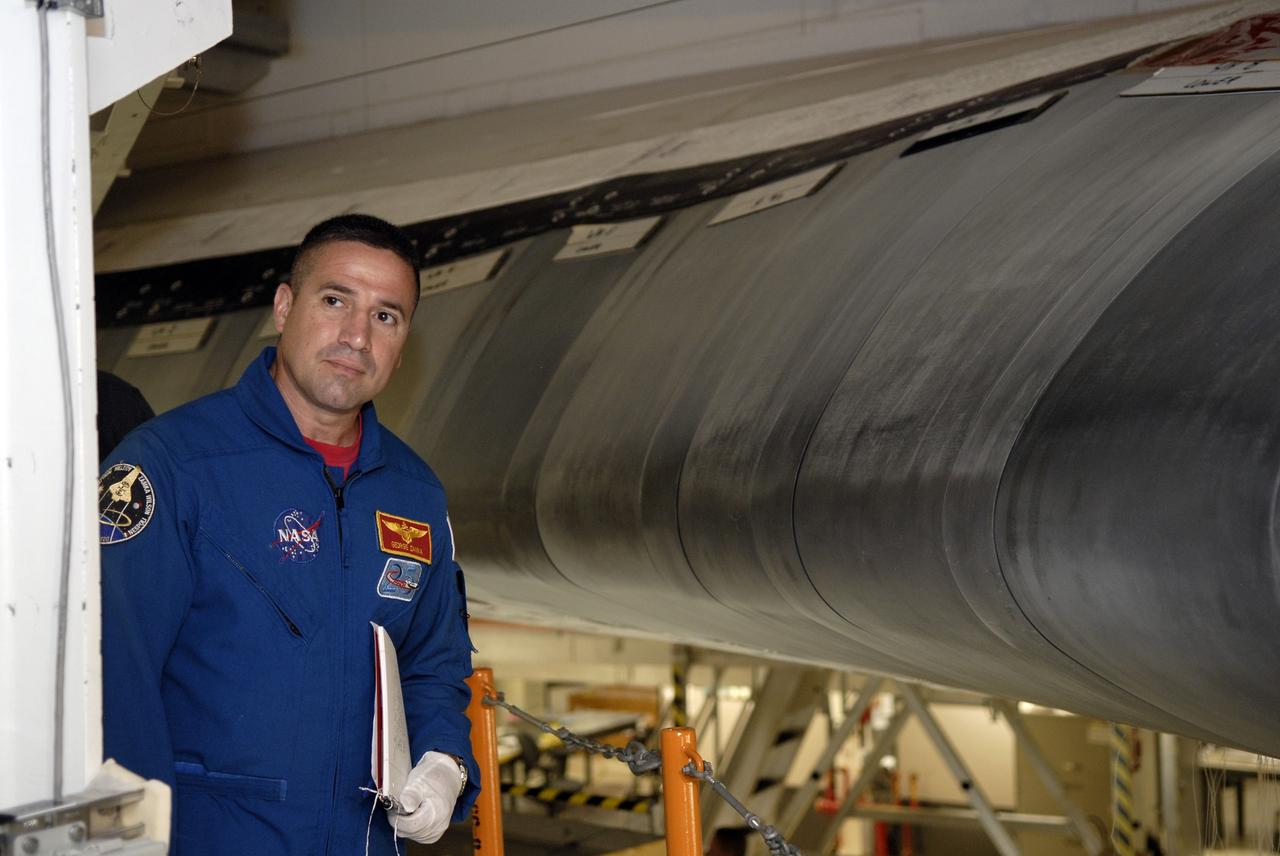
CAPE CANAVERAL, Fla. – In Orbiter Processing Facility-3 at NASA's Kennedy Space Center in Florida, STS-130 Commander George Zamka is briefed on the reinforced carbon carbon panels, part of the thermal protection system, on the leading edge of the wing of space shuttle Endeavour. The crew is at Kennedy for a crew equipment interface test, or CEIT, which provides hands-on training and observation of shuttle and flight hardware. The STS-130 flight will carry the Tranquility pressurized module with a built-in cupola to the International Space Station aboard Endeavour. Launch is targeted for Feb. 4, 2010. Photo credit: NASA/Kim Shiflett

KENNEDY SPACE CENTER, FLA. -- In Orbiter Processing Facility (OPF) bay 2 during Crew Equipment Interface Test (CEIT), members of the STS-97 crew look over the Orbital Docking System in Endeavour’s payload bay. In the center, standing, is Mission Specialist Joe Tanner. Kneeling (at right) is Mission Specialist Carlos Noriega. The others are workers in the OPF. The CEIT provides an opportunity for crew members to check equipment and facilities that will be on board the orbiter during their mission. The STS-97 mission will be the sixth construction flight to the International Space Station. The payload includes a photovoltaic (PV) module, providing solar power to the Station. STS-97 is scheduled to launch Nov. 30 from KSC for the 10-day mission
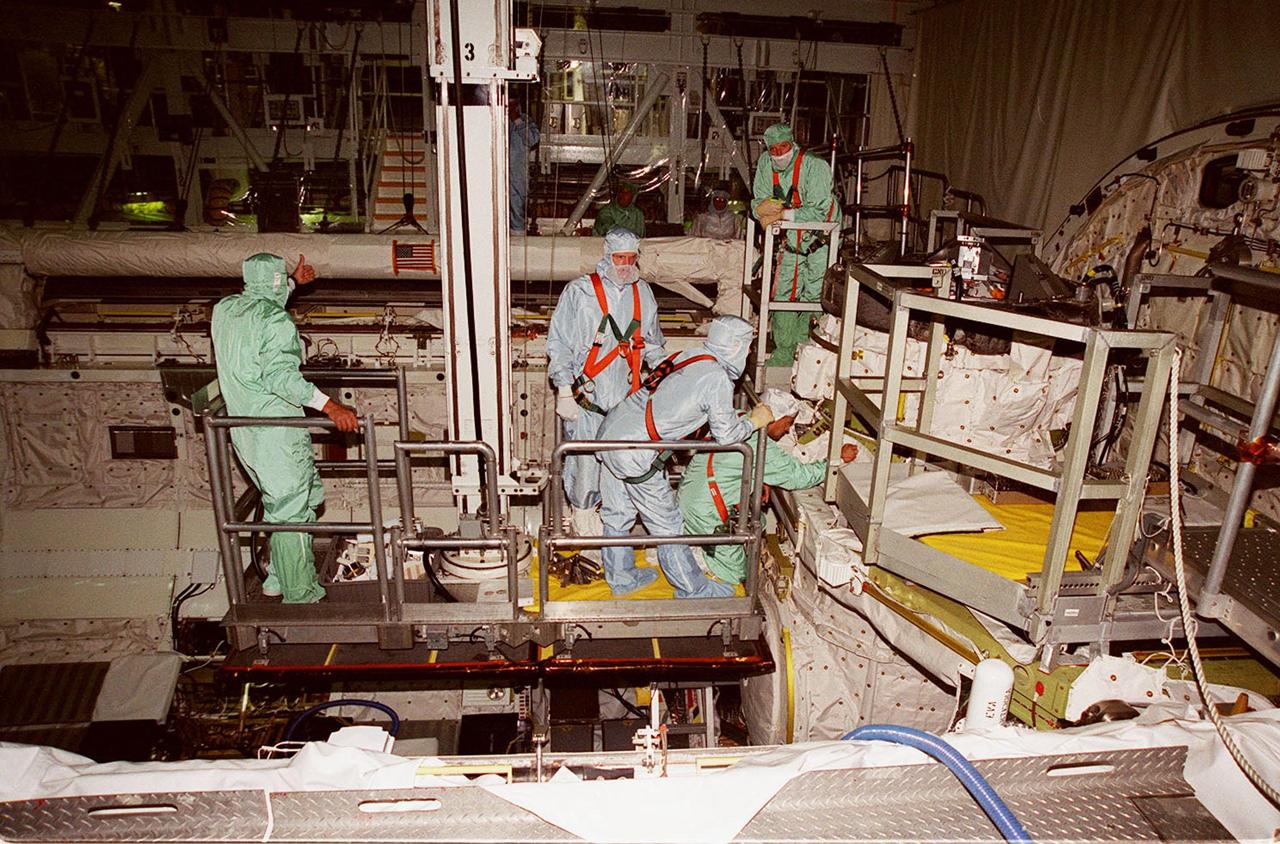
KENNEDY SPACE CENTER, FLA. -- In Orbiter Processing Facility (OPF) bay 2 during Crew Equipment Interface Test (CEIT), members of the STS-97 crew look over the Orbital Docking System in Endeavour’s payload bay. In the center, standing, is Mission Specialist Joe Tanner. Kneeling (at right) is Mission Specialist Carlos Noriega. The others are workers in the OPF. The CEIT provides an opportunity for crew members to check equipment and facilities that will be on board the orbiter during their mission. The STS-97 mission will be the sixth construction flight to the International Space Station. The payload includes a photovoltaic (PV) module, providing solar power to the Station. STS-97 is scheduled to launch Nov. 30 from KSC for the 10-day mission
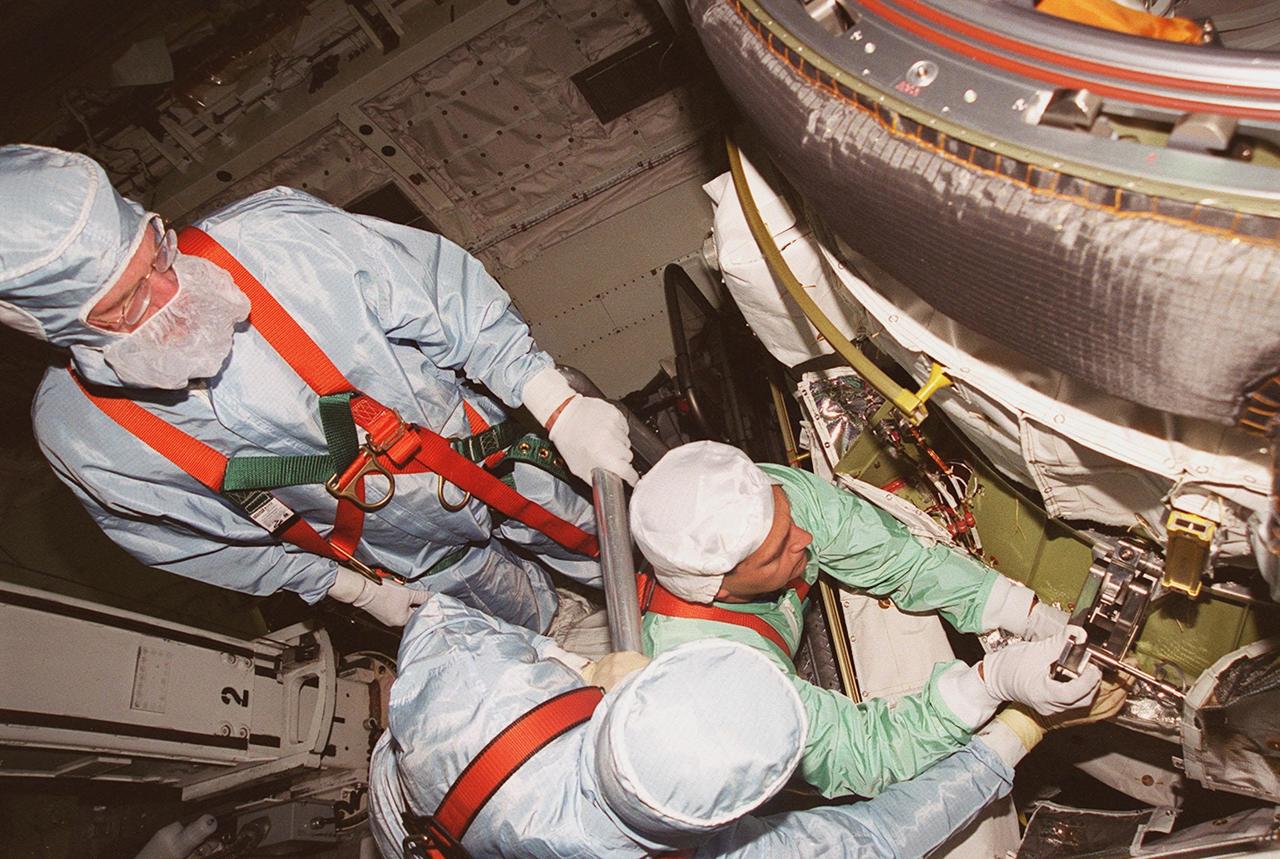
KENNEDY SPACE CENTER, FLA. -- In Orbiter Processing Facility (OPF) bay 2 during Crew Equipment Interface Test (CEIT), members of the STS-97 crew look over the Orbital Docking System (ODS) in Endeavour’s payload bay. At left, standing, is Mission Specialist Joe Tanner. At right is Mission Specialist Carlos Noriega, with his hands on the ODS. The others are workers in the OPF. The CEIT provides an opportunity for crew members to check equipment and facilities that will be on board the orbiter during their mission. The STS-97 mission will be the sixth construction flight to the International Space Station. The payload includes a photovoltaic (PV) module, providing solar power to the Station. STS-97 is scheduled to launch Nov. 30 from KSC for the 10-day mission
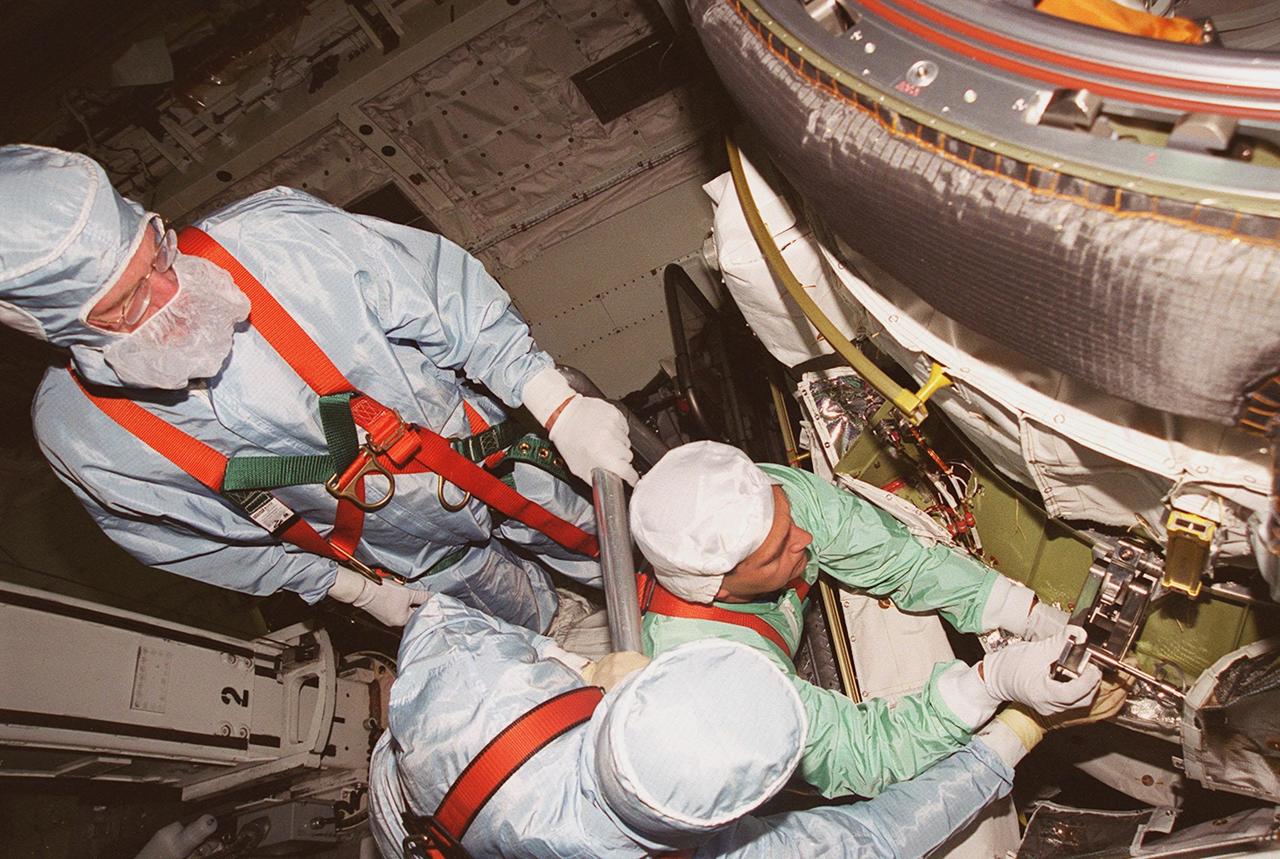
KENNEDY SPACE CENTER, FLA. -- In Orbiter Processing Facility (OPF) bay 2 during Crew Equipment Interface Test (CEIT), members of the STS-97 crew look over the Orbital Docking System (ODS) in Endeavour’s payload bay. At left, standing, is Mission Specialist Joe Tanner. At right is Mission Specialist Carlos Noriega, with his hands on the ODS. The others are workers in the OPF. The CEIT provides an opportunity for crew members to check equipment and facilities that will be on board the orbiter during their mission. The STS-97 mission will be the sixth construction flight to the International Space Station. The payload includes a photovoltaic (PV) module, providing solar power to the Station. STS-97 is scheduled to launch Nov. 30 from KSC for the 10-day mission
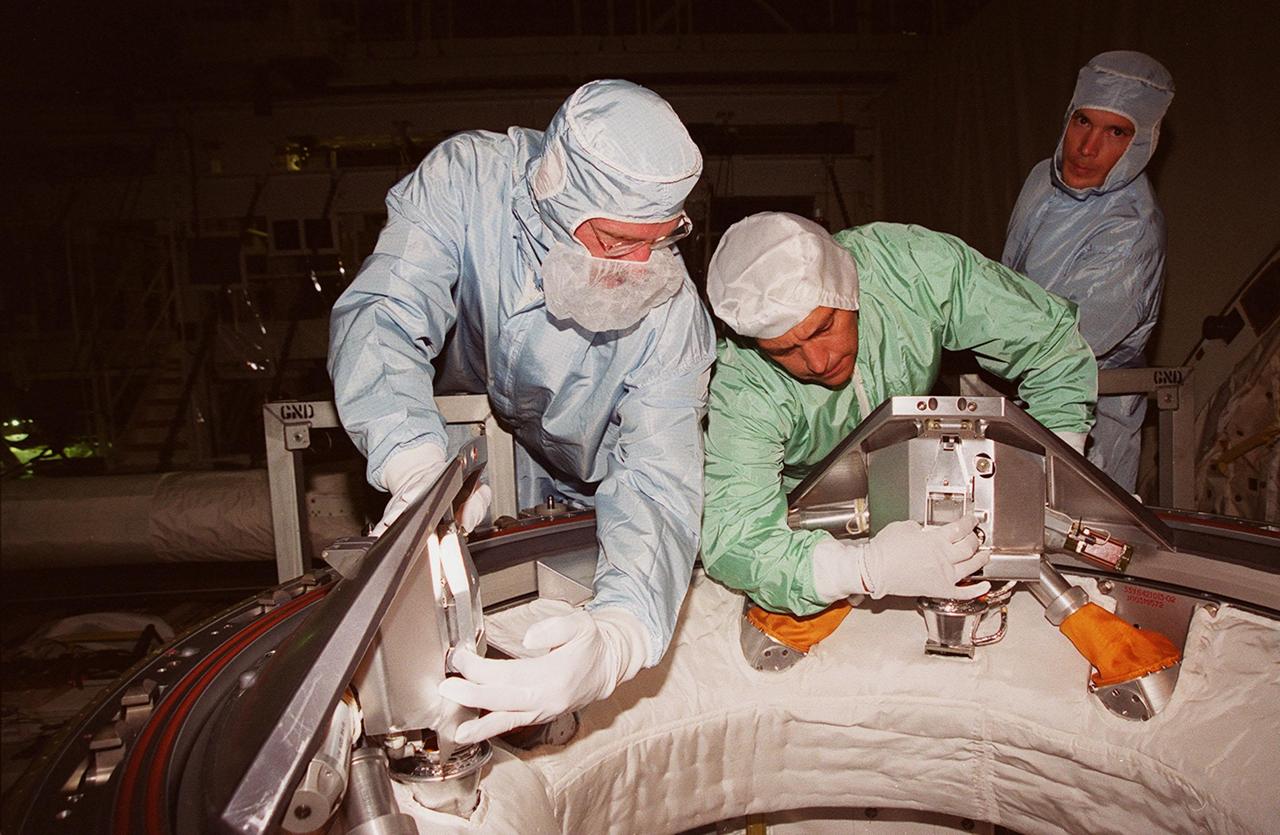
KENNEDY SPACE CENTER, FLA. -- In Orbiter Processing Facility (OPF) bay 2 during Crew Equipment Interface Test (CEIT), Mission Specialists Joe Tanner (left) and Carlos Noriega (right) practice working parts of the Orbital Docking System (ODS) in Endeavour’s payload bay. The CEIT provides an opportunity for crew members to check equipment and facilities that will be on board the orbiter during their mission. The STS-97 mission will be the sixth construction flight to the International Space Station. The payload includes a photovoltaic (PV) module, providing solar power to the Station. STS-97 is scheduled to launch Nov. 30 from KSC for the 10-day mission
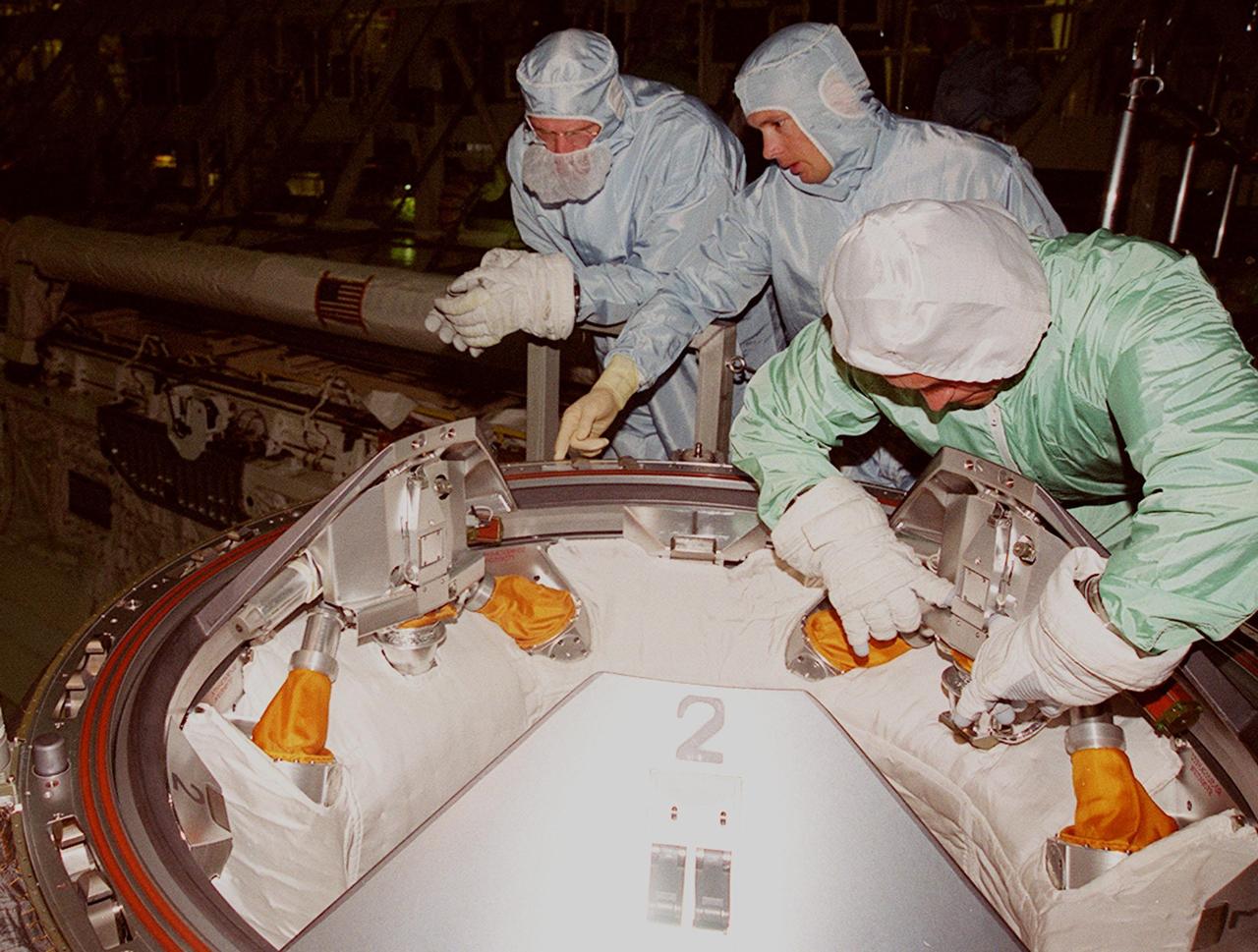
KENNEDY SPACE CENTER, FLA. -- In Orbiter Processing Facility (OPF) bay 2 during Crew Equipment Interface Test (CEIT), Mission Specialist Joe Tanner (left) gets instruction from a worker while Mission Specialist Carlos Noriega (right) practices working latches on the Orbital Docking System in Endeavour’s payload bay. The CEIT provides an opportunity for crew members to check equipment and facilities that will be on board the orbiter during their mission. The STS-97 mission will be the sixth construction flight to the International Space Station. The payload includes a photovoltaic (PV) module, providing solar power to the Station. STS-97 is scheduled to launch Nov. 30 from KSC for the 10-day mission
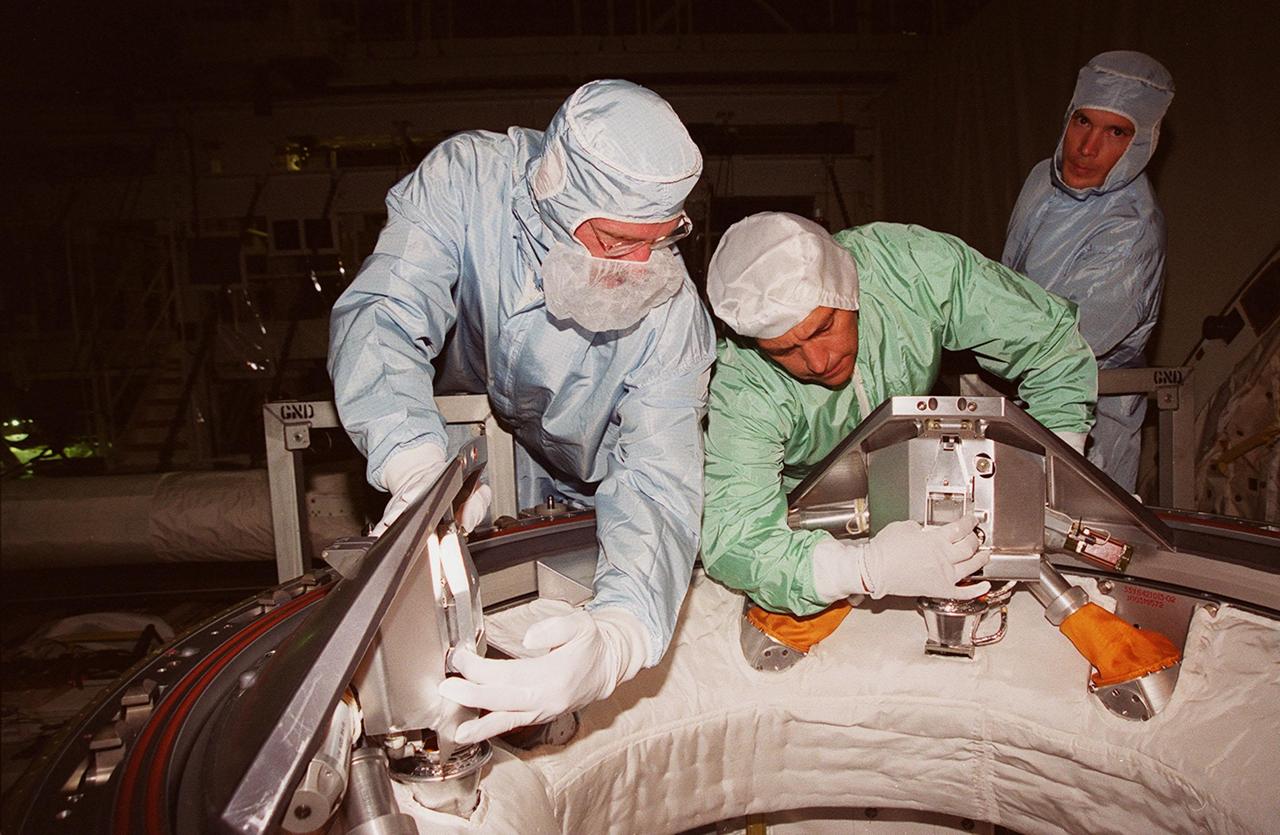
KENNEDY SPACE CENTER, FLA. -- In Orbiter Processing Facility (OPF) bay 2 during Crew Equipment Interface Test (CEIT), Mission Specialists Joe Tanner (left) and Carlos Noriega (right) practice working parts of the Orbital Docking System (ODS) in Endeavour’s payload bay. The CEIT provides an opportunity for crew members to check equipment and facilities that will be on board the orbiter during their mission. The STS-97 mission will be the sixth construction flight to the International Space Station. The payload includes a photovoltaic (PV) module, providing solar power to the Station. STS-97 is scheduled to launch Nov. 30 from KSC for the 10-day mission
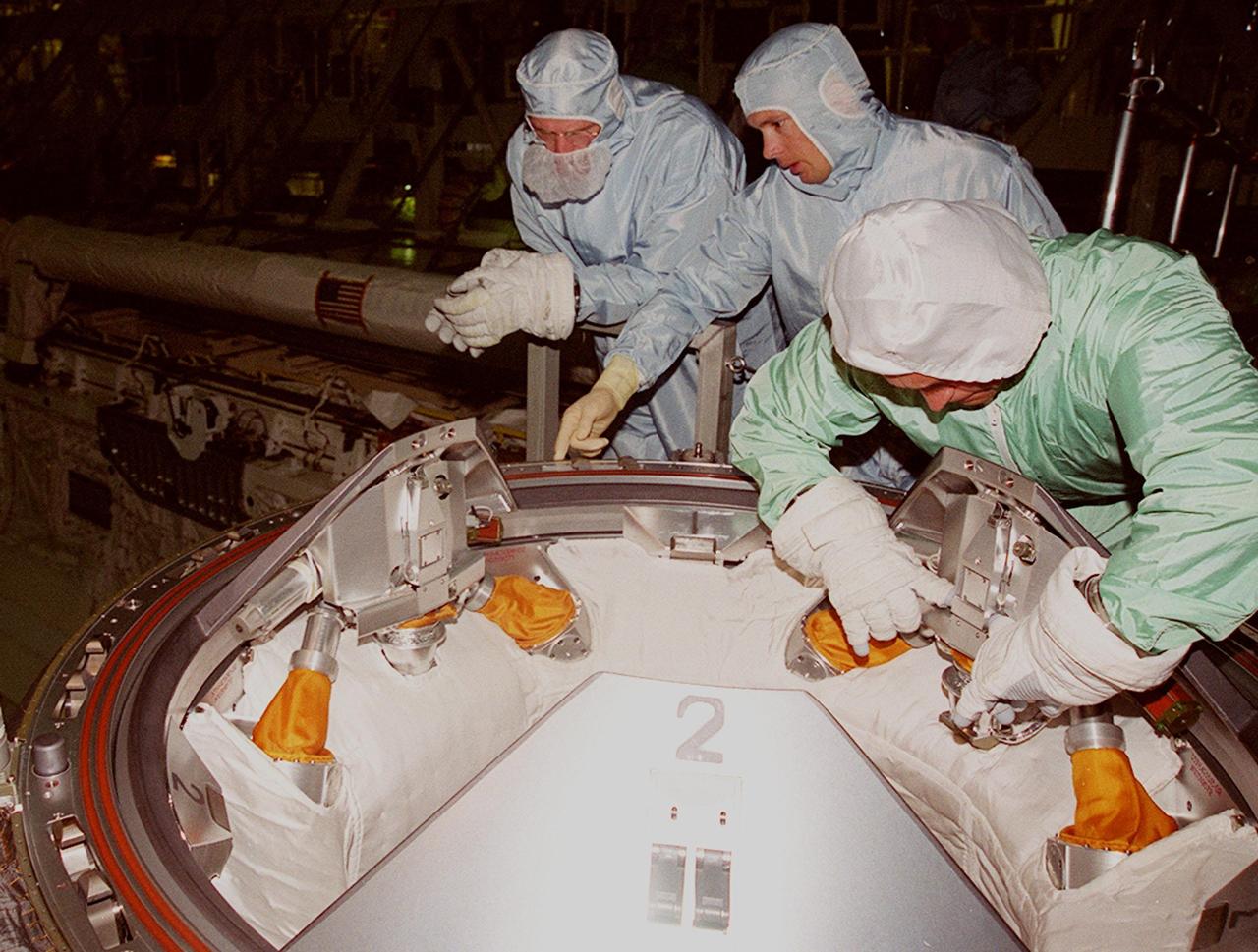
KENNEDY SPACE CENTER, FLA. -- In Orbiter Processing Facility (OPF) bay 2 during Crew Equipment Interface Test (CEIT), Mission Specialist Joe Tanner (left) gets instruction from a worker while Mission Specialist Carlos Noriega (right) practices working latches on the Orbital Docking System in Endeavour’s payload bay. The CEIT provides an opportunity for crew members to check equipment and facilities that will be on board the orbiter during their mission. The STS-97 mission will be the sixth construction flight to the International Space Station. The payload includes a photovoltaic (PV) module, providing solar power to the Station. STS-97 is scheduled to launch Nov. 30 from KSC for the 10-day mission
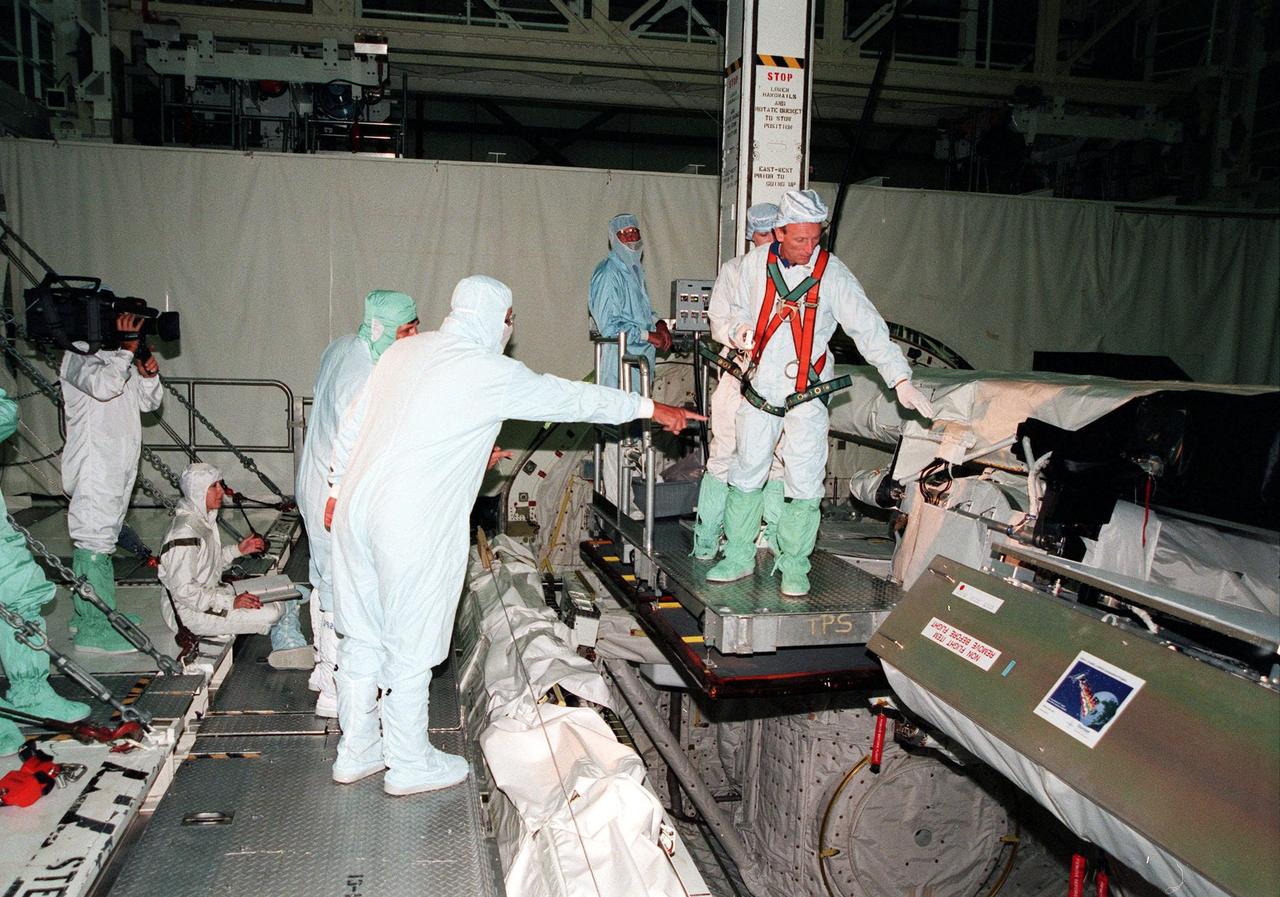
KENNEDY SPACE CENTER, FLA. -- In the Orbiter Processing Facility (OPF), the STS-99 crew take part in a Crew Equipment Interface Test (CEIT). Facing the camera and pointing is Mission Specialist Gerhard P.J. Thiele, who is with the European Space Agency. Other crew members in the OPF are Commander Kevin R. Kregel, Pilot Dominic L. Pudwill Gorie, and Mission Specialists Janet Lynn Kavandi (Ph.D.), Janice Voss (Ph.D.), and Mamoru Mohri, who is with the National Space Development Agency (NASDA) of Japan. The CEIT provides an opportunity for crew members to check equipment and facilities that will be aboard the orbiter during their mission. The STS-99 mission is the Shuttle Radar Topography Mission (SRTM), a specially modified radar system that will gather data for the most accurate and complete topographic map of the Earth's surface that has ever been assembled. SRTM will make use of radar interferometry, wherein two radar images are taken from slightly different locations. Differences between these images allow for the calculation of surface elevation, or change. The SRTM hardware will consist of one radar antenna in the shuttle payload bay and a second radar antenna attached to the end of a mast extended 60 meters (195 feet) out from the shuttle. STS-99 is scheduled to launch Sept. 16 at 8:47 a.m. from Launch Pad 39A
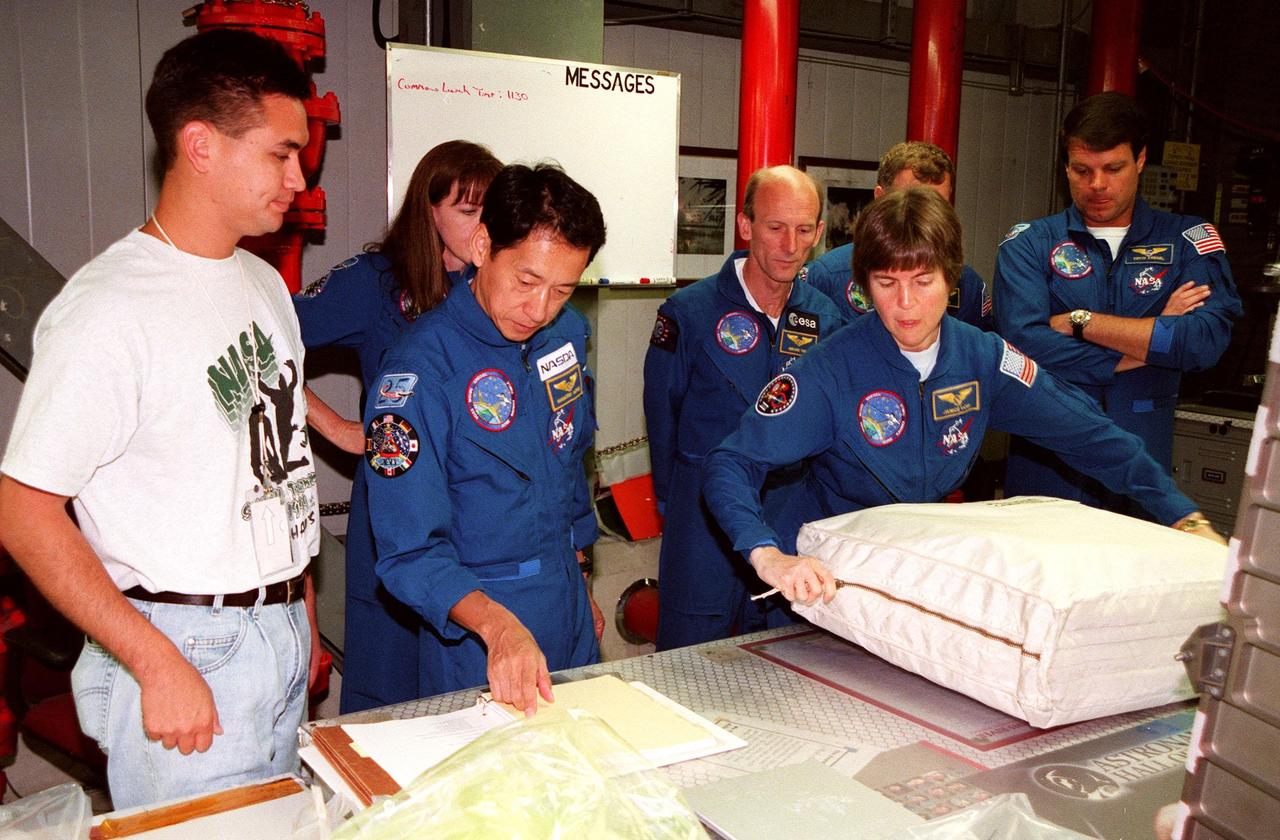
In the Orbiter Processing Facility (OPF) Bay 2, under the watchful eyes of a KSC worker (far left) the STS-99 crew look over equipment as part of a Crew Equipment Interface Test (CEIT). From left (second from right) are Mission Specialists Janet Lynn Kavandi (Ph.D.), Mamoru Mohri, Gerhard P.J. Thiele, and Janice Voss (Ph.D.); behind Voss are Pilot Dominic L. Pudwill Gorie and Commander Kevin R. Kregel. Mohri is with the National Space Development Agency (NASDA) of Japan, and Thiele is with the European Space Agency. The CEIT provides an opportunity for crew members to check equipment and facilities that will be aboard the orbiter during their mission. The STS-99 mission is the Shuttle Radar Topography Mission (SRTM), a specially modified radar system that will gather data for the most accurate and complete topographic map of the Earth's surface that has ever been assembled. SRTM will make use of radar interferometry, wherein two radar images are taken from slightly different locations. Differences between these images allow for the calculation of surface elevation, or change. The SRTM hardware will consist of one radar antenna in the shuttle payload bay and a second radar antenna attached to the end of a mast extended 60 meters (195 feet) out from the shuttle. STS-99 is scheduled to launch Sept. 16 at 8:47 a.m. from Launch Pad 39A