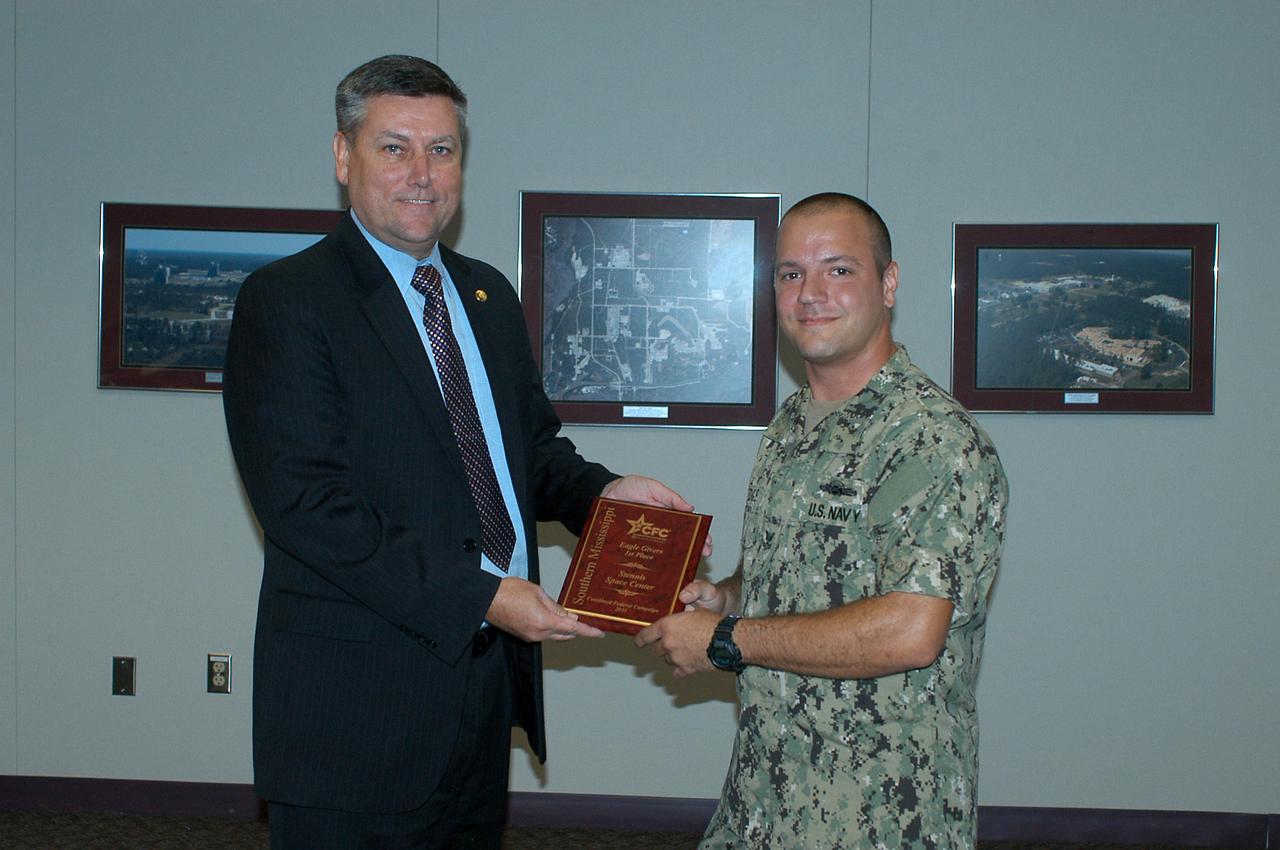
U.S. Navy HT 2 Ryan Vinnedge (right) presents a Combined Federal Campaign award to Stennis Space Center Director Patrick Scheuermann during a May 16, 2012, ceremony. Stennis employees led the way in two categories in the 2011 Southern Mississippi CFC effort, ranking first in the number of Eagle Givers (more than $480 each) and in dollar increase of contributions. Stennis Space Center employees contributed $221,000 through the campaign.
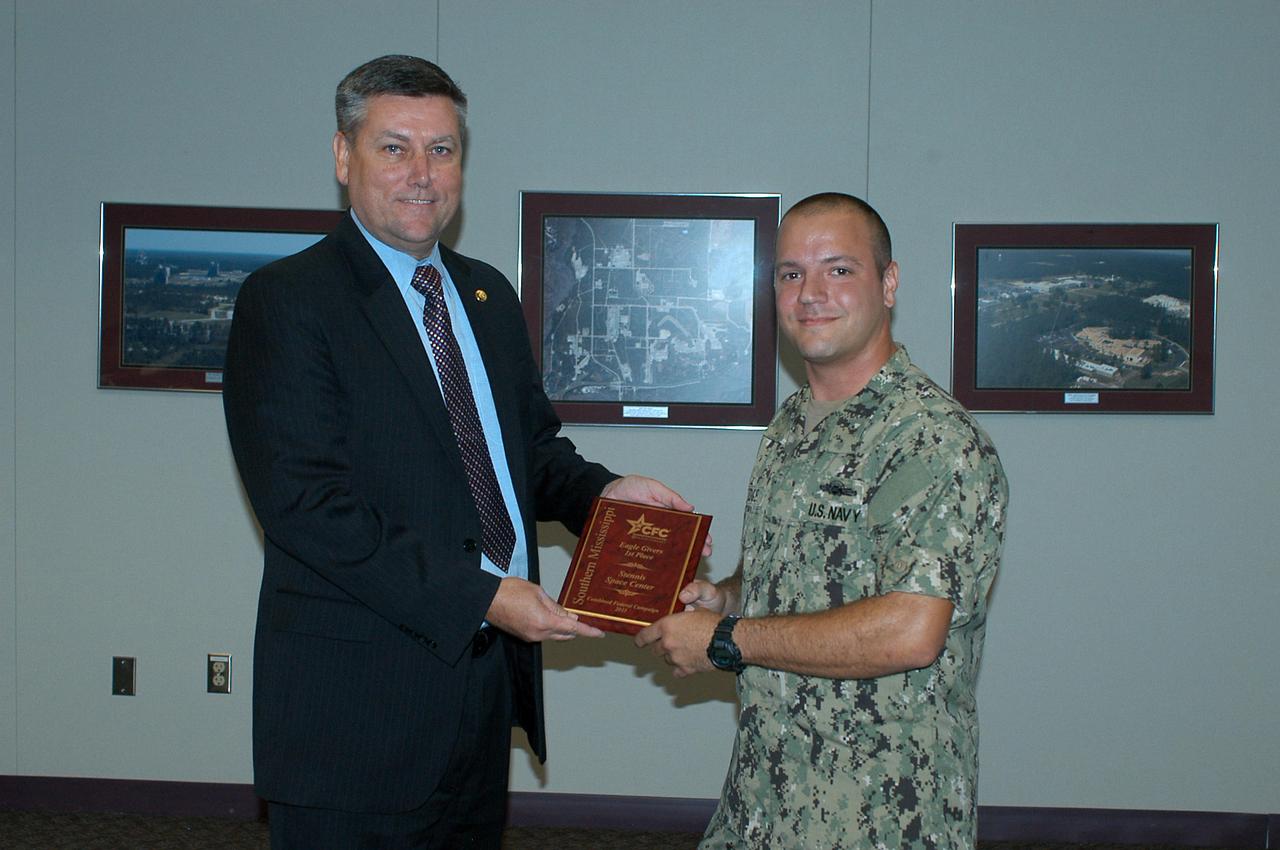
U.S. Navy HT 2 Ryan Vinnedge (right) presents a Combined Federal Campaign award to Stennis Space Center Director Patrick Scheuermann during a May 16, 2012, ceremony. Stennis employees led the way in two categories in the 2011 Southern Mississippi CFC effort, ranking first in the number of Eagle Givers (more than $480 each) and in dollar increase of contributions. Stennis Space Center employees contributed $221,000 through the campaign.
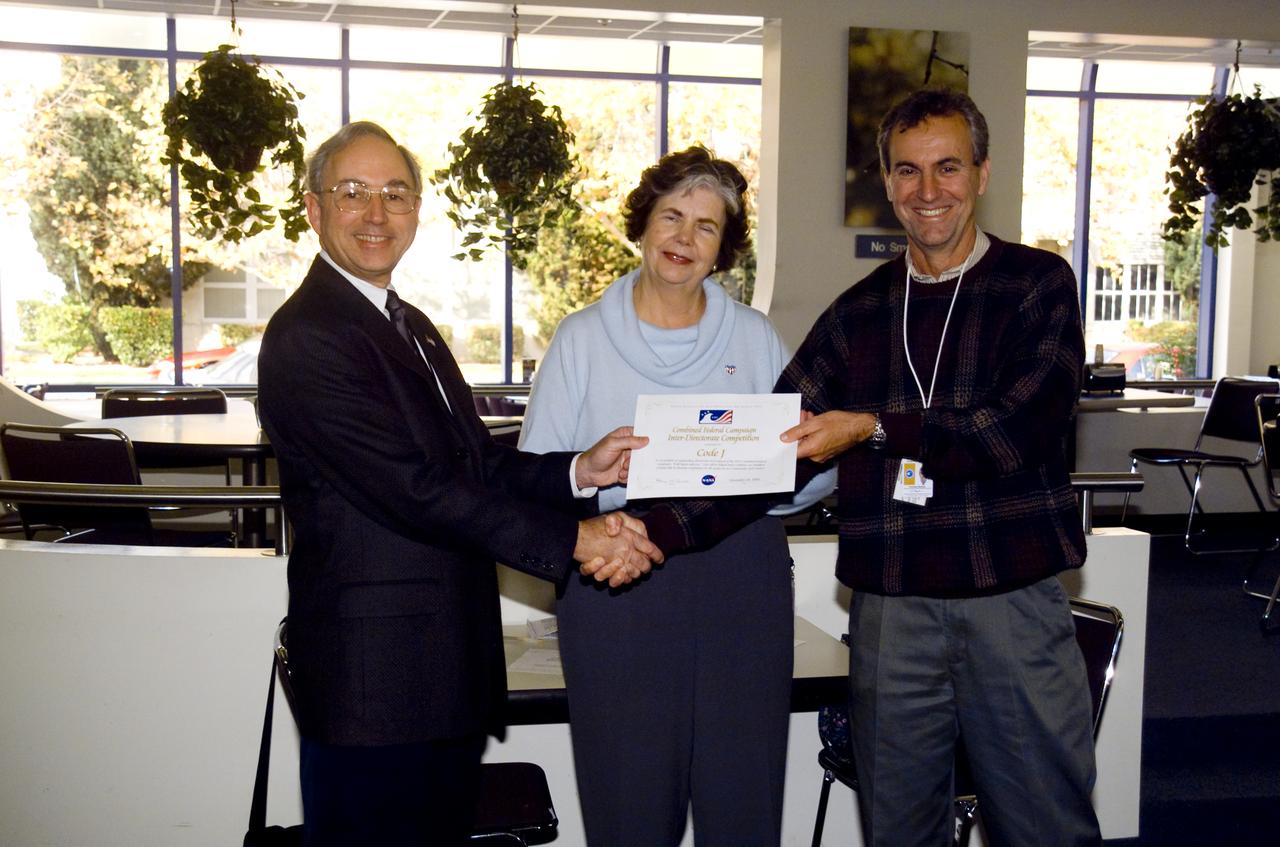
CFC Awards ceremony: William, Ames Deputy Director (L) Grace Ann Weiler, Ames 2001 CFC chairperson (C) and Tom Moyles, Director of Center Operations accepts CFC Inter-Directorate Competition Outstanding Participation plaque .
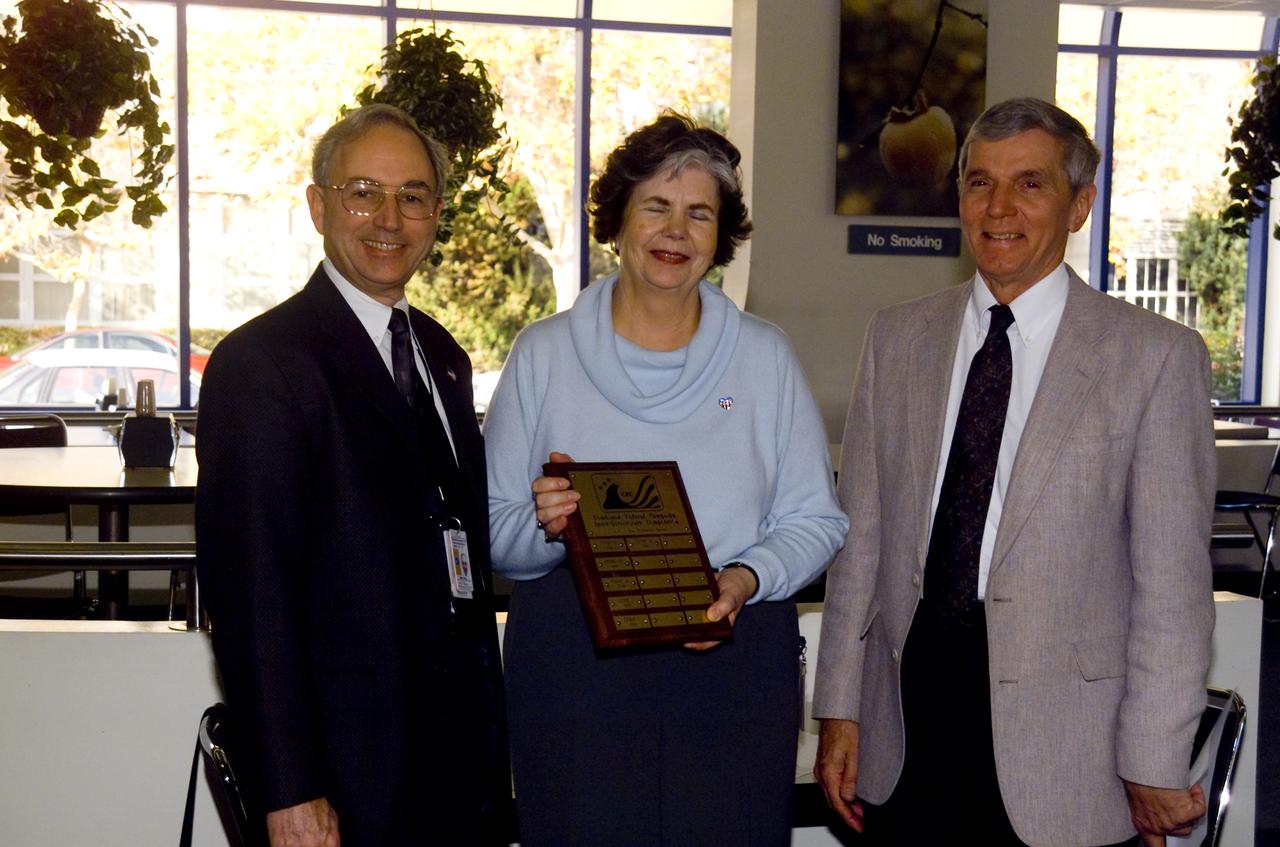
CFC Awards ceremony: (L) Bill Berry, Grace Ann Weiler (C) Ames 2001 CFC chairperson and 'Skip' Fletcher, Aerospace Directorate.
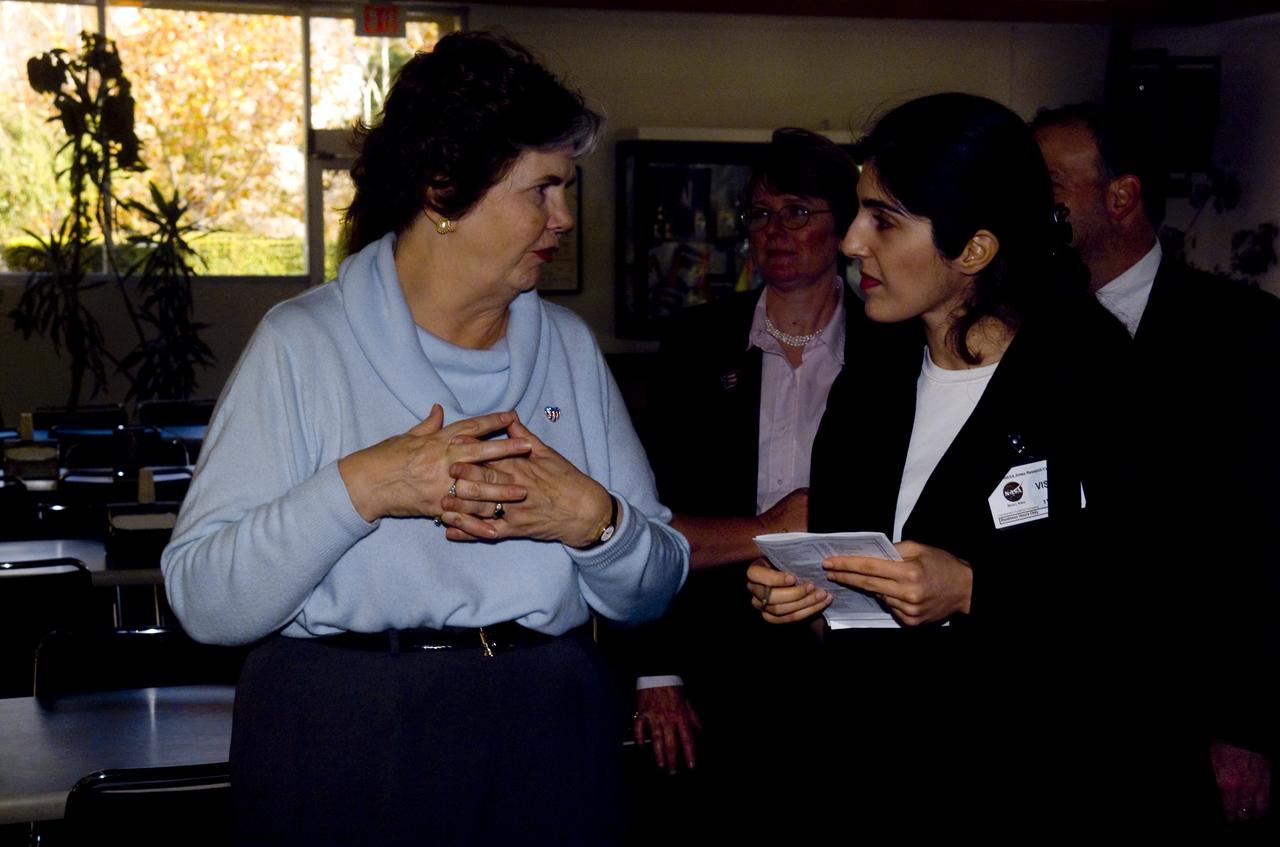
CFC Awards ceremony: Grace Ann Weiler (L) Ames 2001 CFC chairperson and Nilou Nouri, campaign manager for Santa Clara/San Benito Counties Combined Federal Campaign
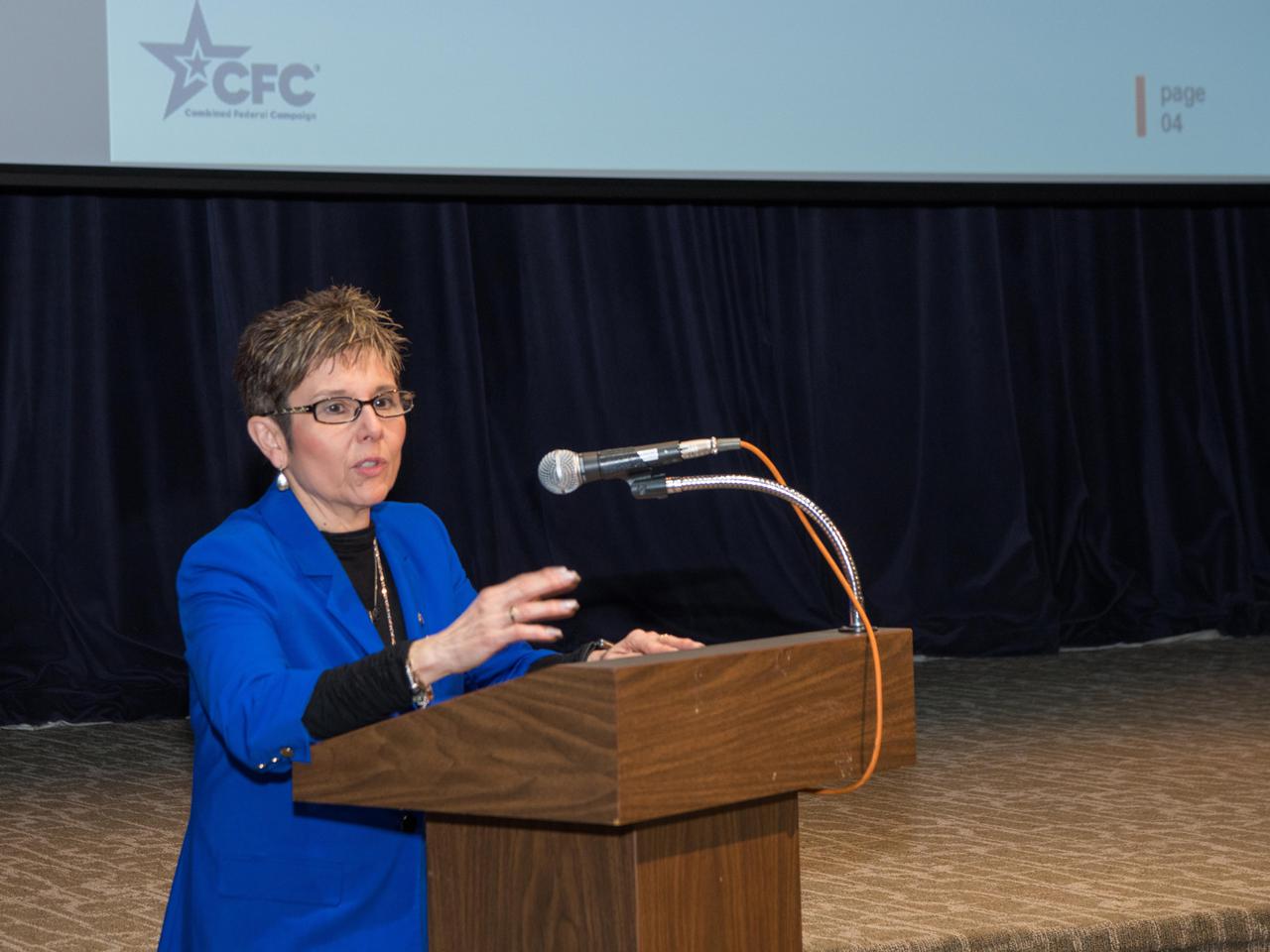
Combined Federal Campaign, CFC Appreciation and Awards Event
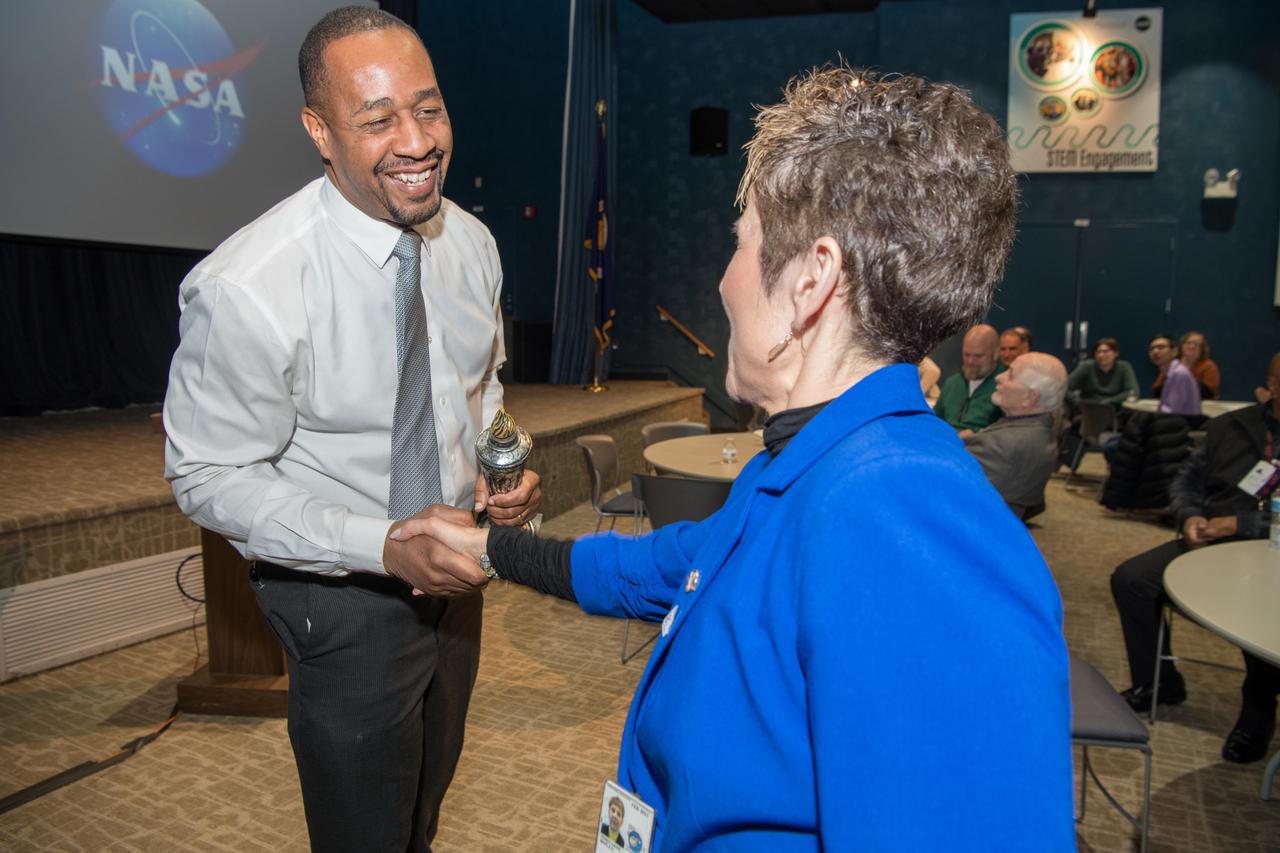
Combined Federal Campaign, CFC Appreciation and Awards Event
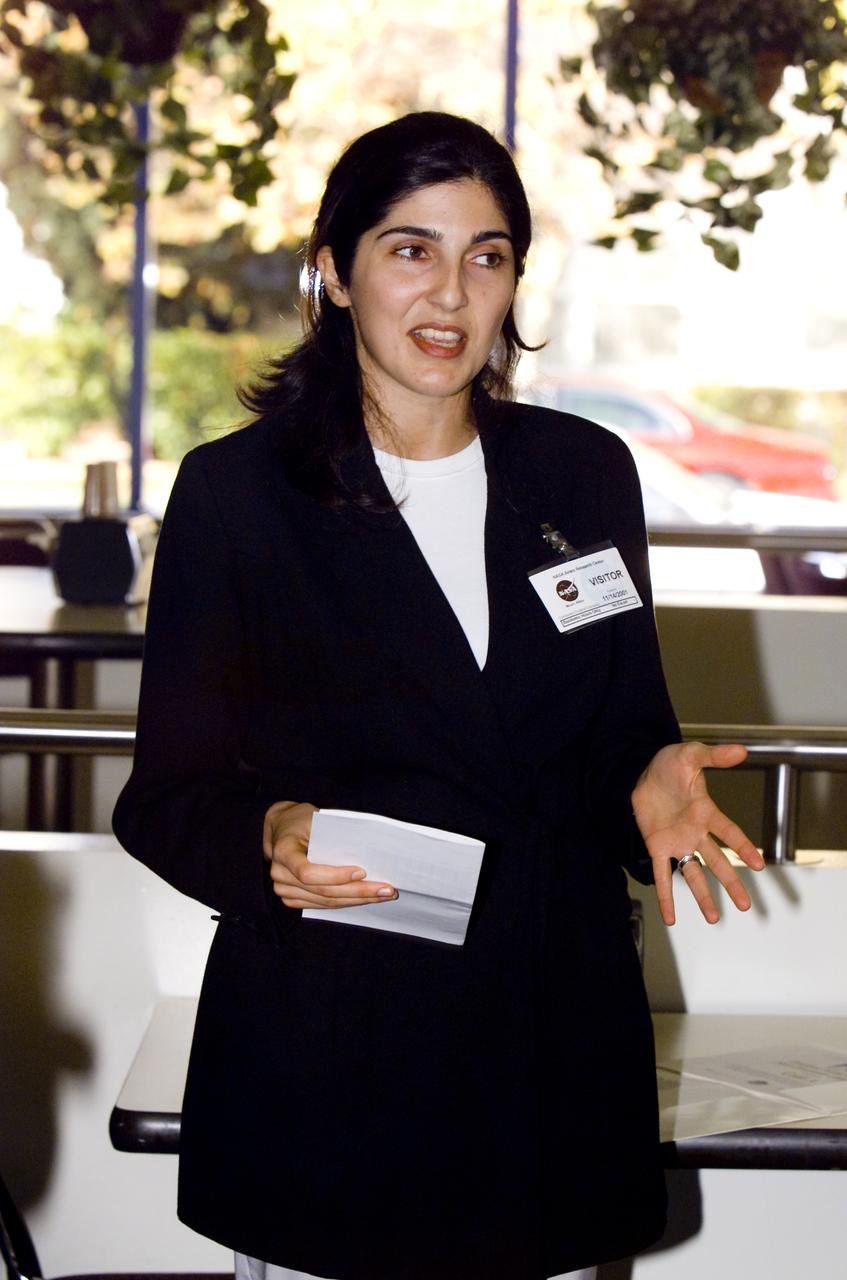
CFC Awards ceremony: Nilou Nouri, campaign manager for Santa Clara/San Benito Counties Combined Federal Campaign
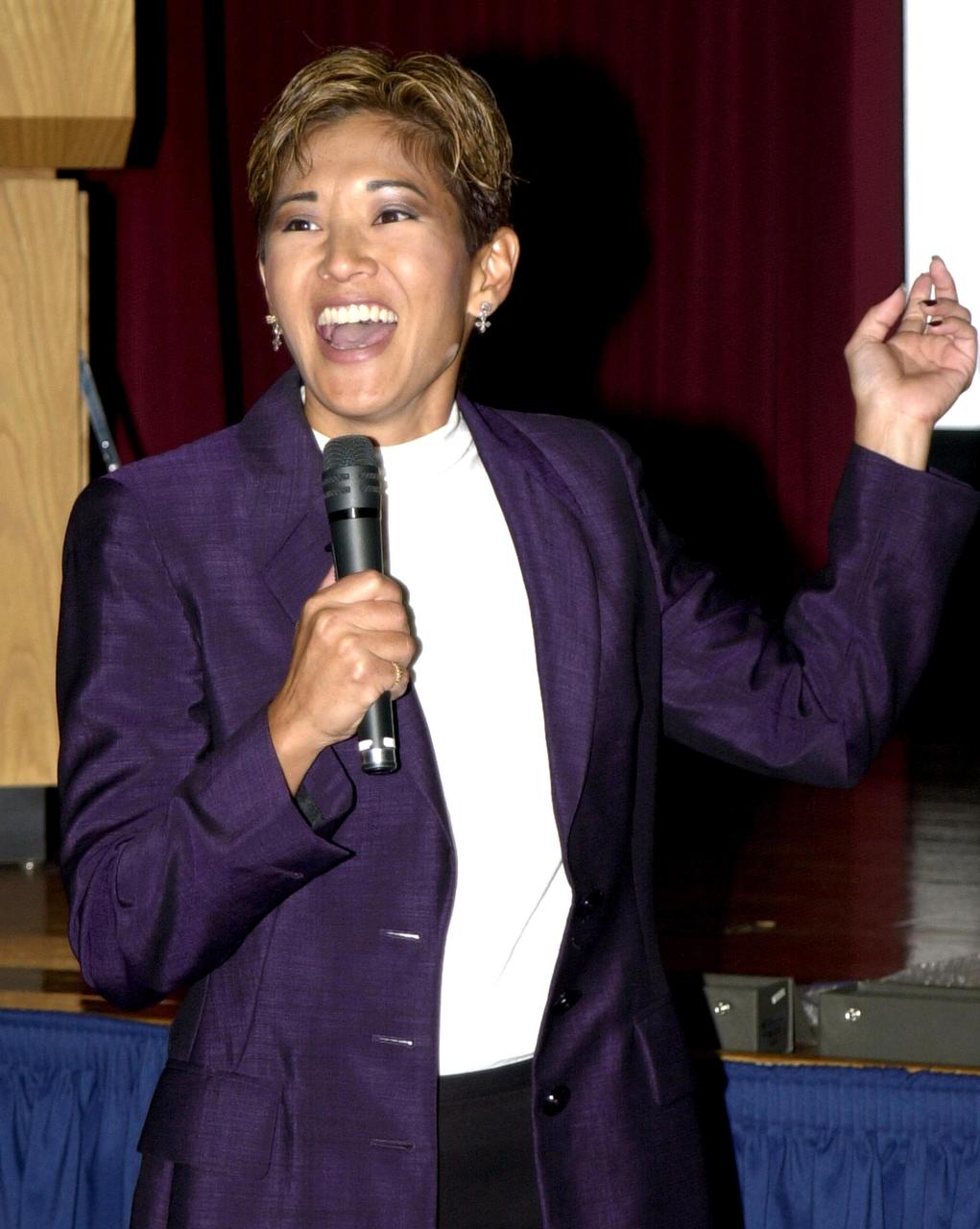
WESH-TV 2 News Anchor Wendy Chioji speaking at CFC kickoff
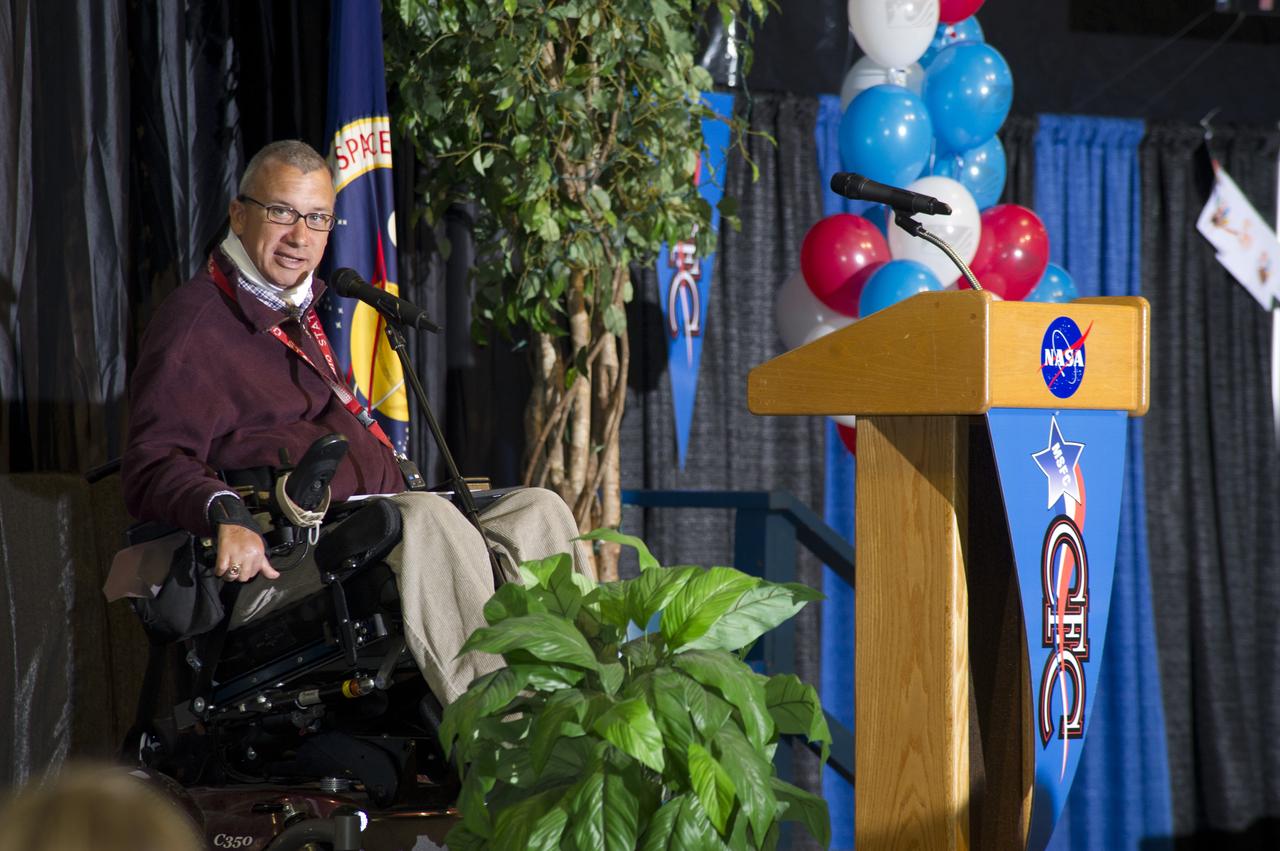
JIM DUFFY, 2011 CFC CHAIRPERSON ADDRESSES CROWD AT "THANKS FOR GIVING" PROGRAM
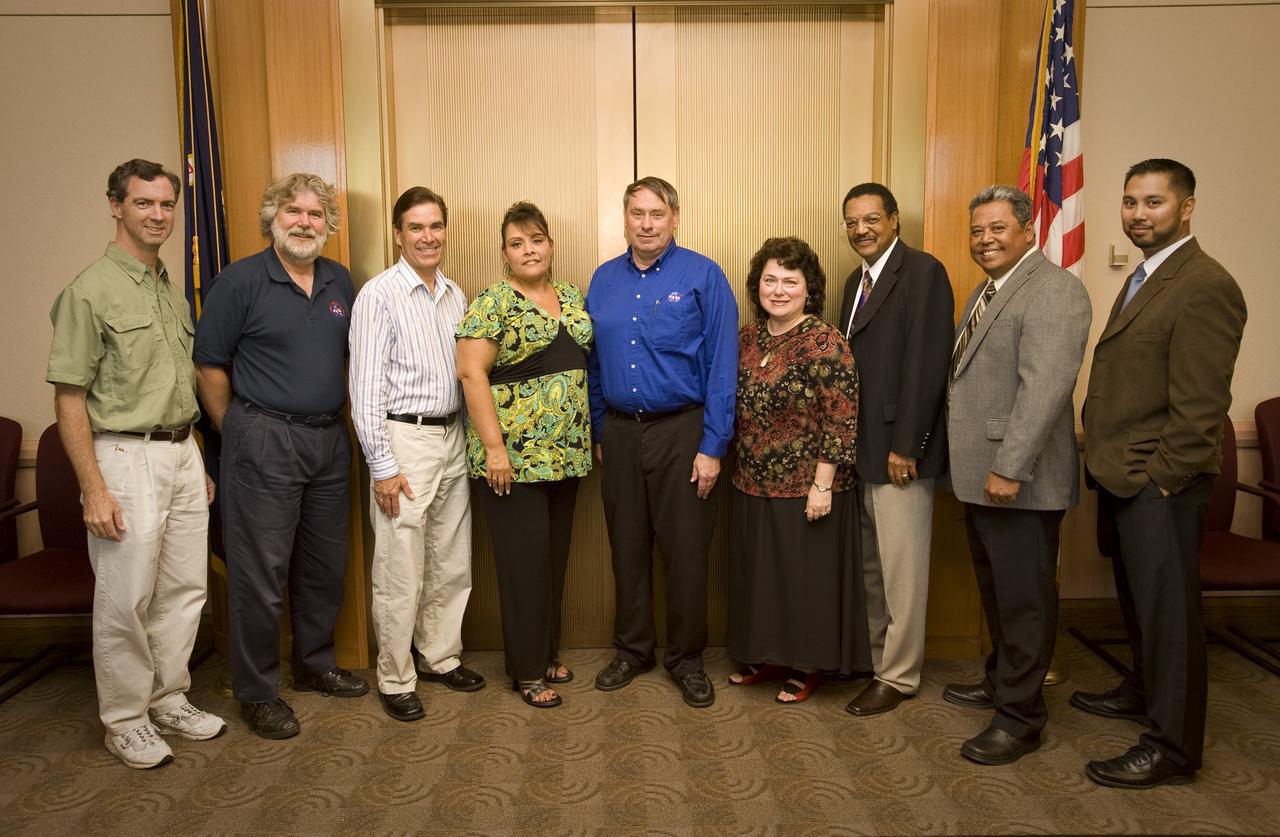
2008 Combined Federal Campaign (CFC) Team: (L-R)Don Durston, Jeff Cross, Paul Espinosa, Lupe Sanchez, Pete Worden, Miriam Glazer, Lew Braxton, Paul Pinaula, Gerald DePerio
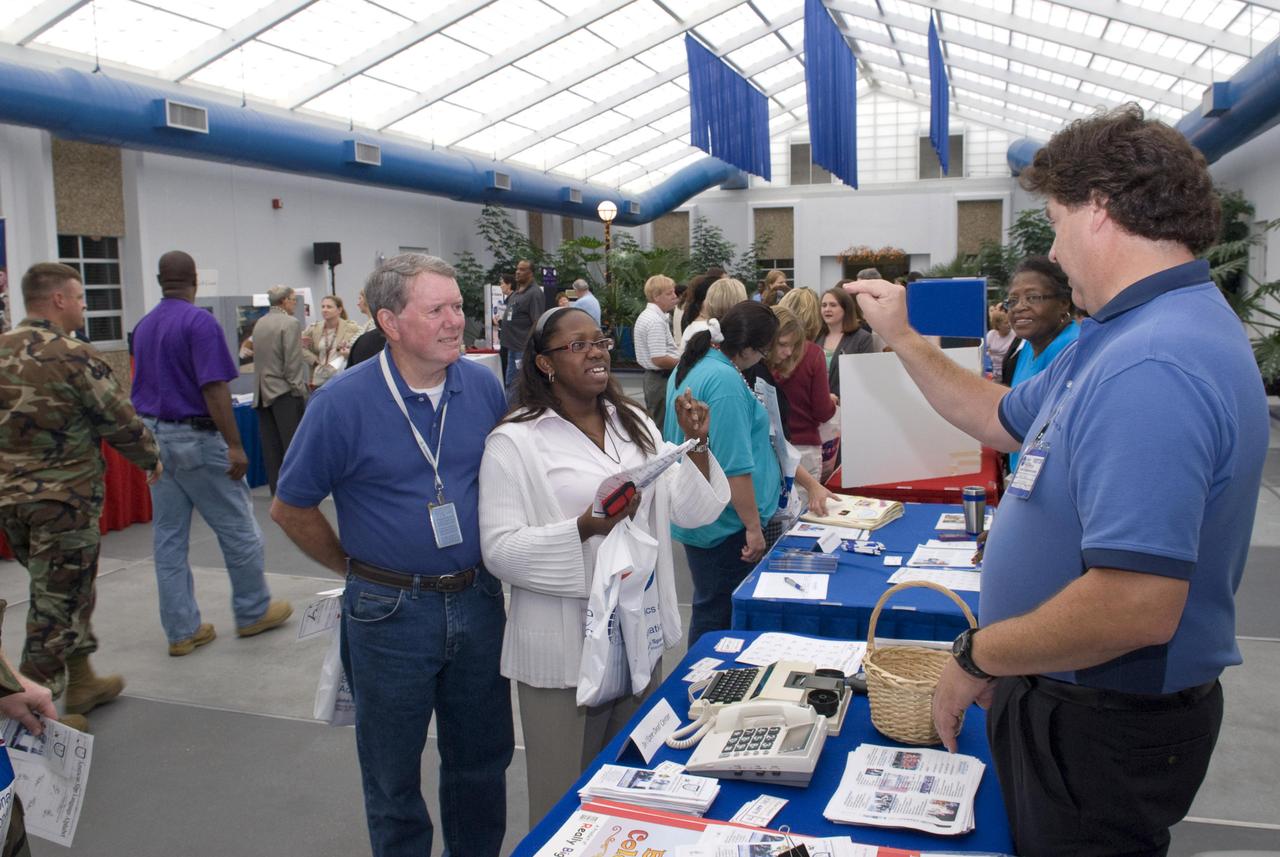
Using American sign language, Greg Crapo, right, director of de l'Ep e Deaf Center Inc. in Biloxi , Miss., helps Shanda Bennett of the Environmental Protection Agency at NASA's John C. Stennis Space Center spell out her name. Bennett is joined by colleague Charles Kennedy during a tour of charitable organization displays for the kickoff of the Stennis portion of the 2009 Combined Federal Campaign emphasis on Oct. 29. The CFC is the world's largest annual workplace charity effort. Contributions to the campaign support organizations providing health and human service benefits throughout the world. Stennis employees give tens of thousands of dollars through the campaign each year, including a $198,000 in gifts in 2008. This year, the Stennis goal is $200,000. For the kickoff, a number of charitable organizations provided displays at Stennis, providing employees an opportunity to see - and choose - where their contributions can be directed.
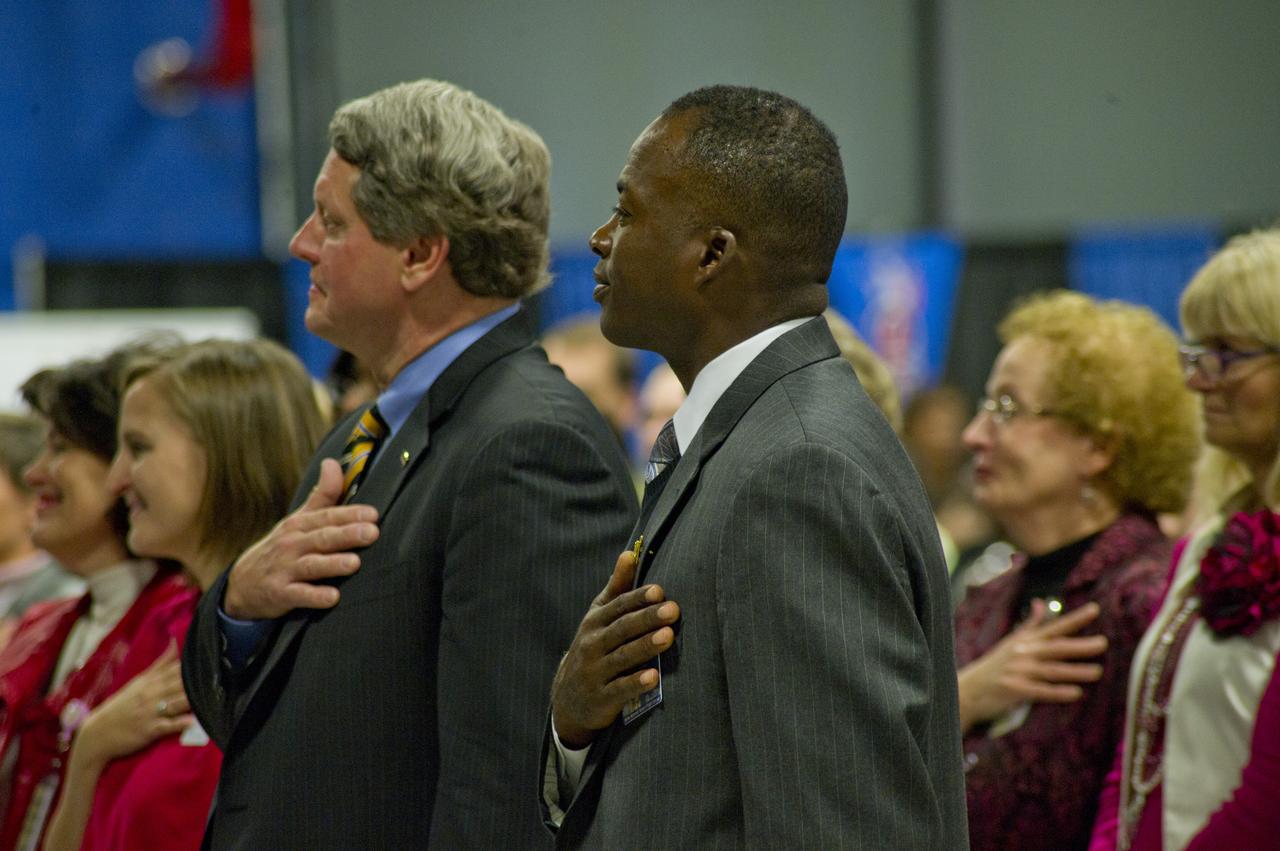
MSFC DEPUTY DIRECTOR GENE GOLDMAN AND SIRAN STACY, KEYNOTE SPEAKER FOR CFC "THANKS FOR GIVING" PROGRAM, WITH HANDS ON HEART DURING SINGING OF NATIONAL ANTHEM

KENNEDY SPACE CENTER, FLA. - Kennedy Space Center Director, Roy D. Bridges Jr. (left), congratulates Richard Gonzales (center) of the Chief Counsel Office for his 2002 Combined Federal Campaign (CFC) winning slogan, as Robert Mott, Shuttle Processing Directorate and CFC chairperson, presents Gonzales with a certificate of commendation during the CFC kickoff rally at the Training Auditorium, Oct. 1, 2002. This year’s slogan is “Promoting Hope…through Generosity.” The CFC is NASA’s Centerwide annual employee giving campaign that will run through Oct. 31, 2002.

2009 Combined Federal Campaign (CFC) Car Show and Ice Cream Social
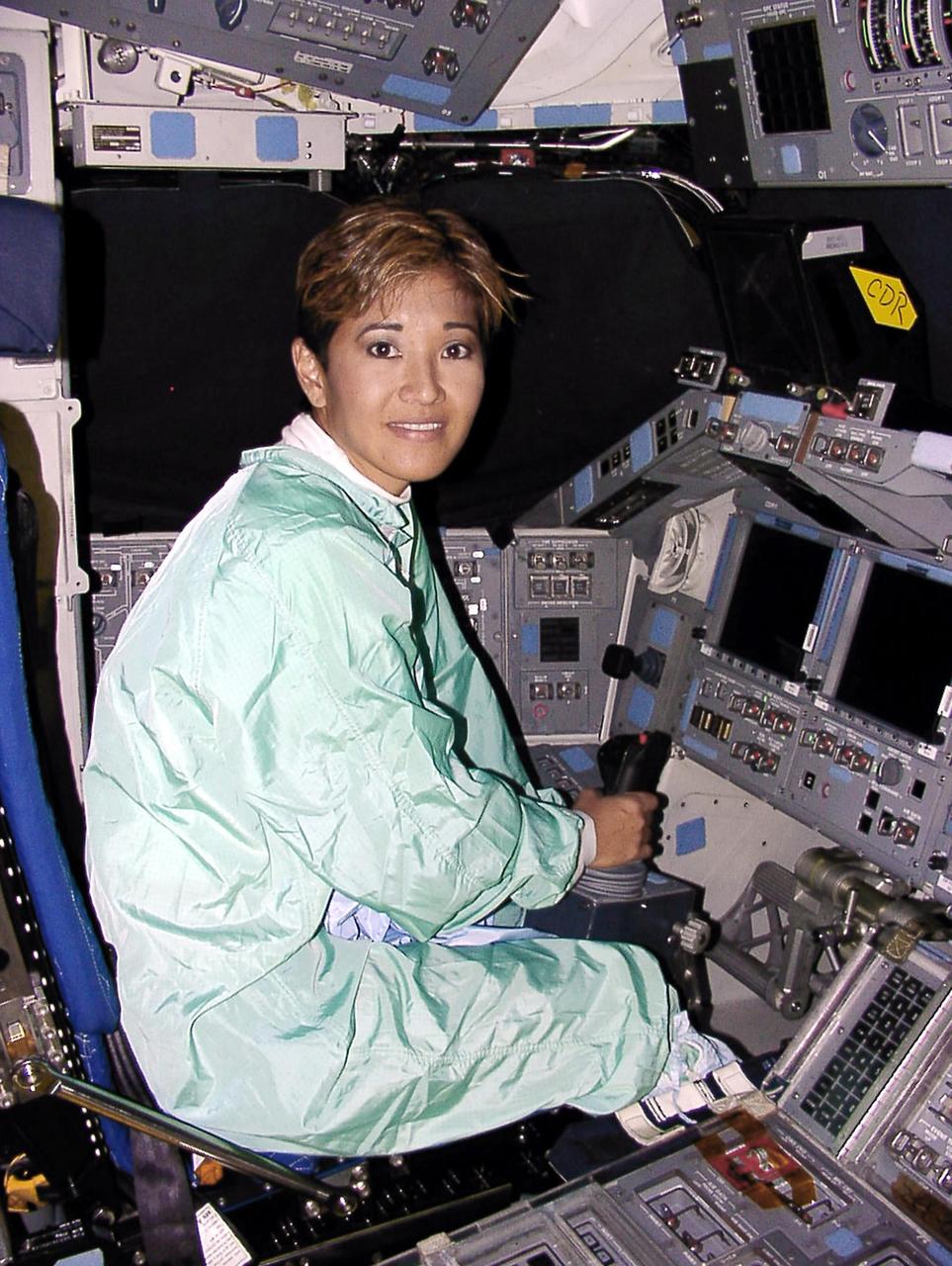
WESH-TV 2 News Anchor Wendy Chioji sits in the cockpit of a space shuttle while touring Kennedy Space Center.
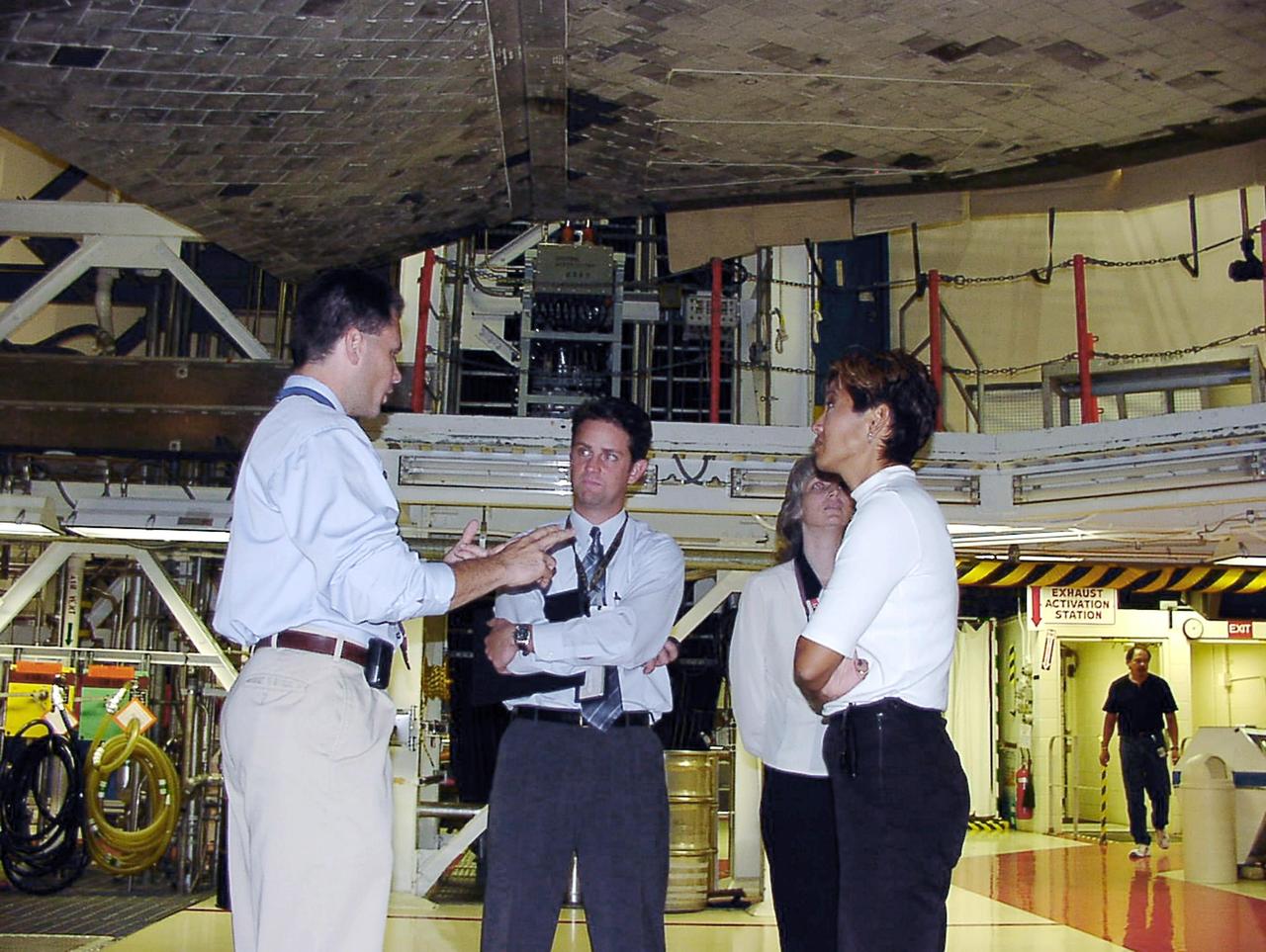
WESH-TV 2 News Anchor Wendy Chioji tours the Orbiter Processing Facility.
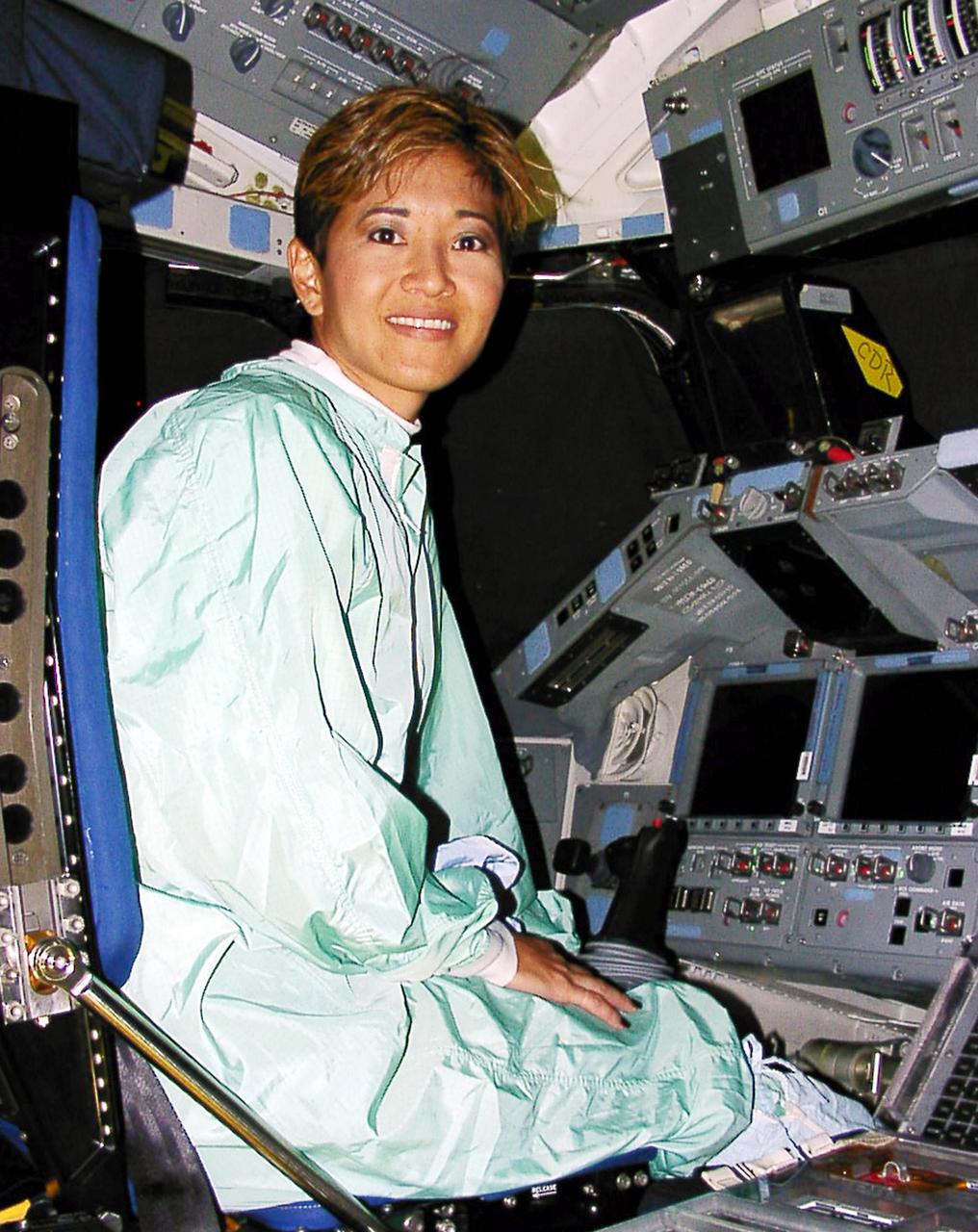
WESH-TV 2 News Anchor Wendy Chioji sits in the cockpit of a space shuttle while touring Kennedy Space Center.

Joann Morgan with WESH-TV 2 News Anchor Wendy Chioji
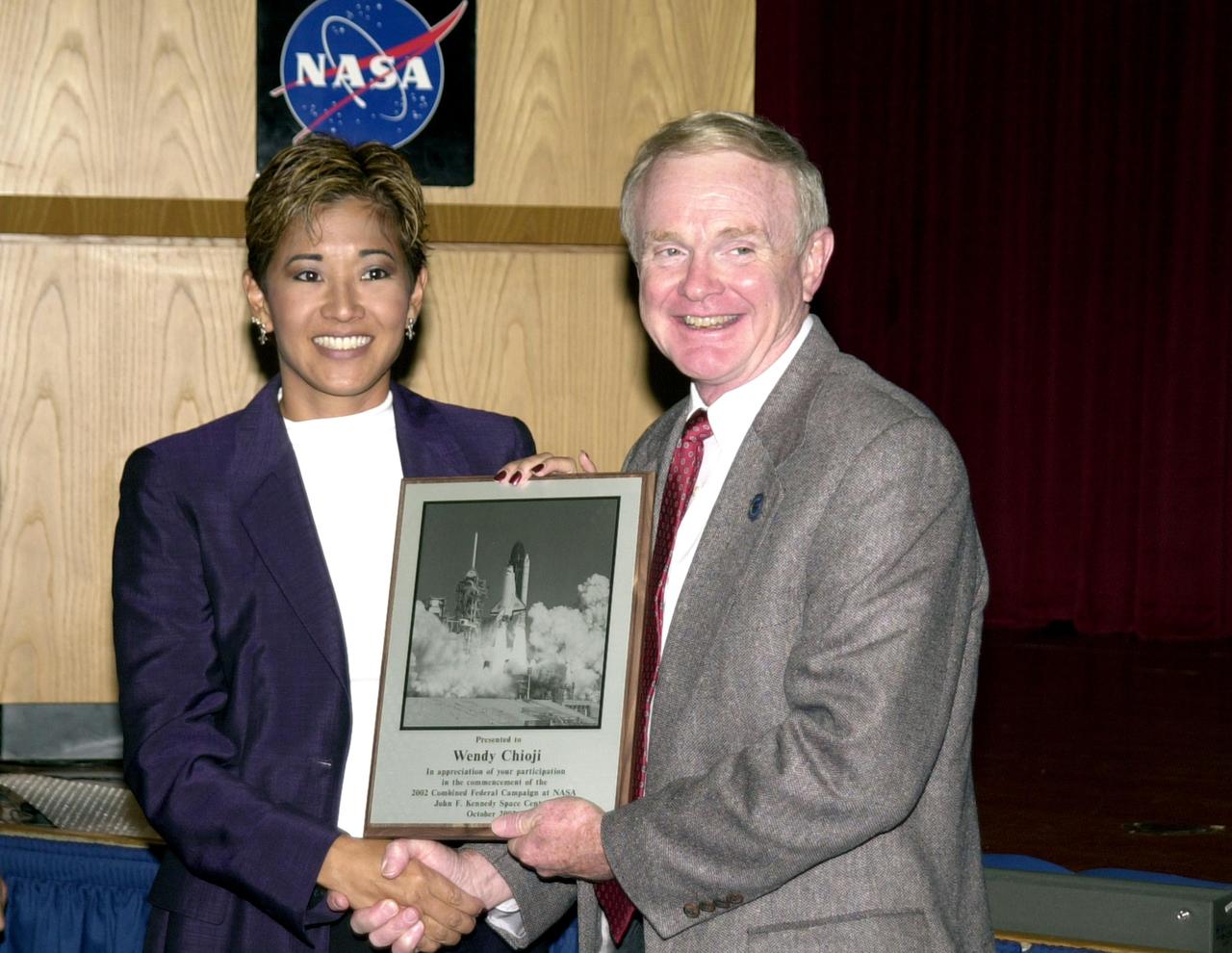
WESH-TV 2 News Anchor Wendy Chioji with Kennedy Space Center Director Roy Bridges
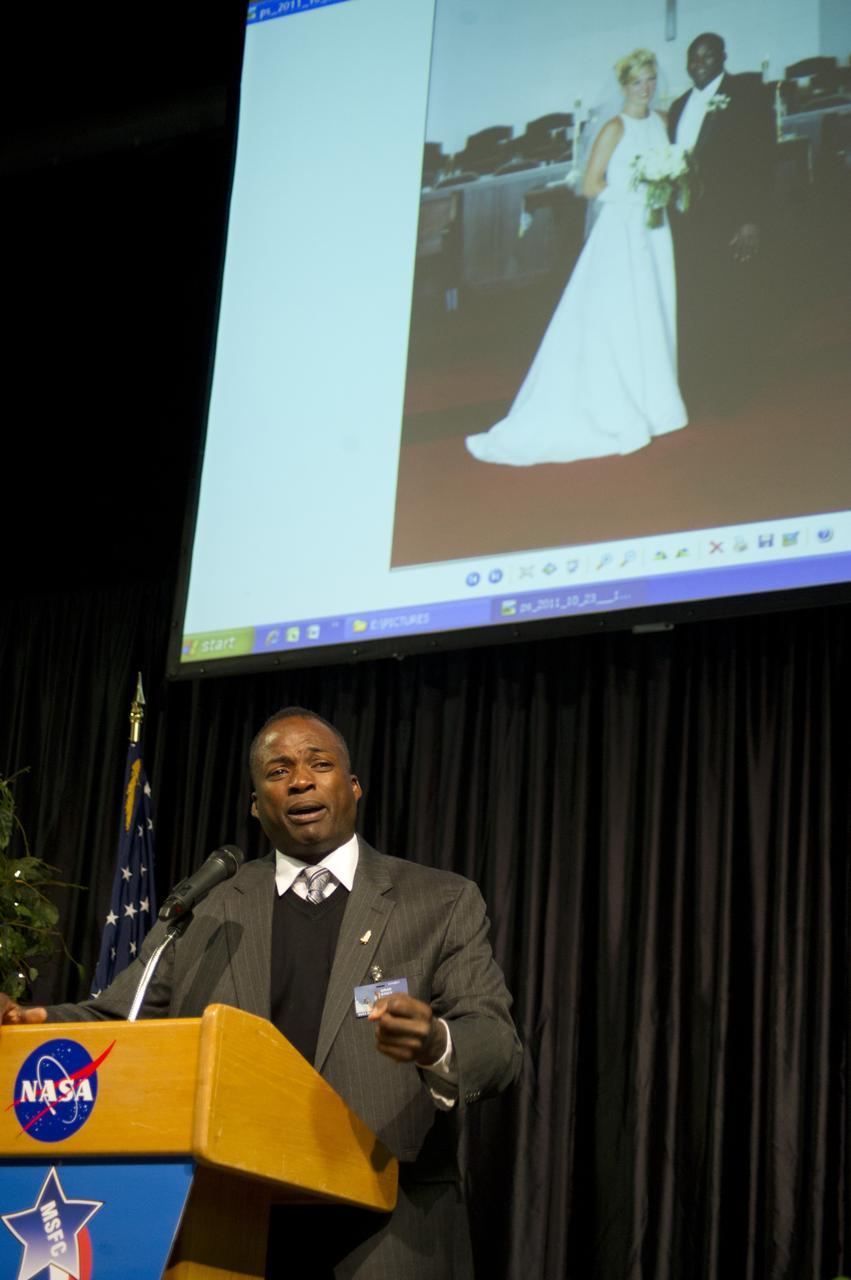
SIRAN STACY RELATES DETAILS OF HIS PERSONAL LOSSES DURING "THANKS FOR GIVING" PROGRAM
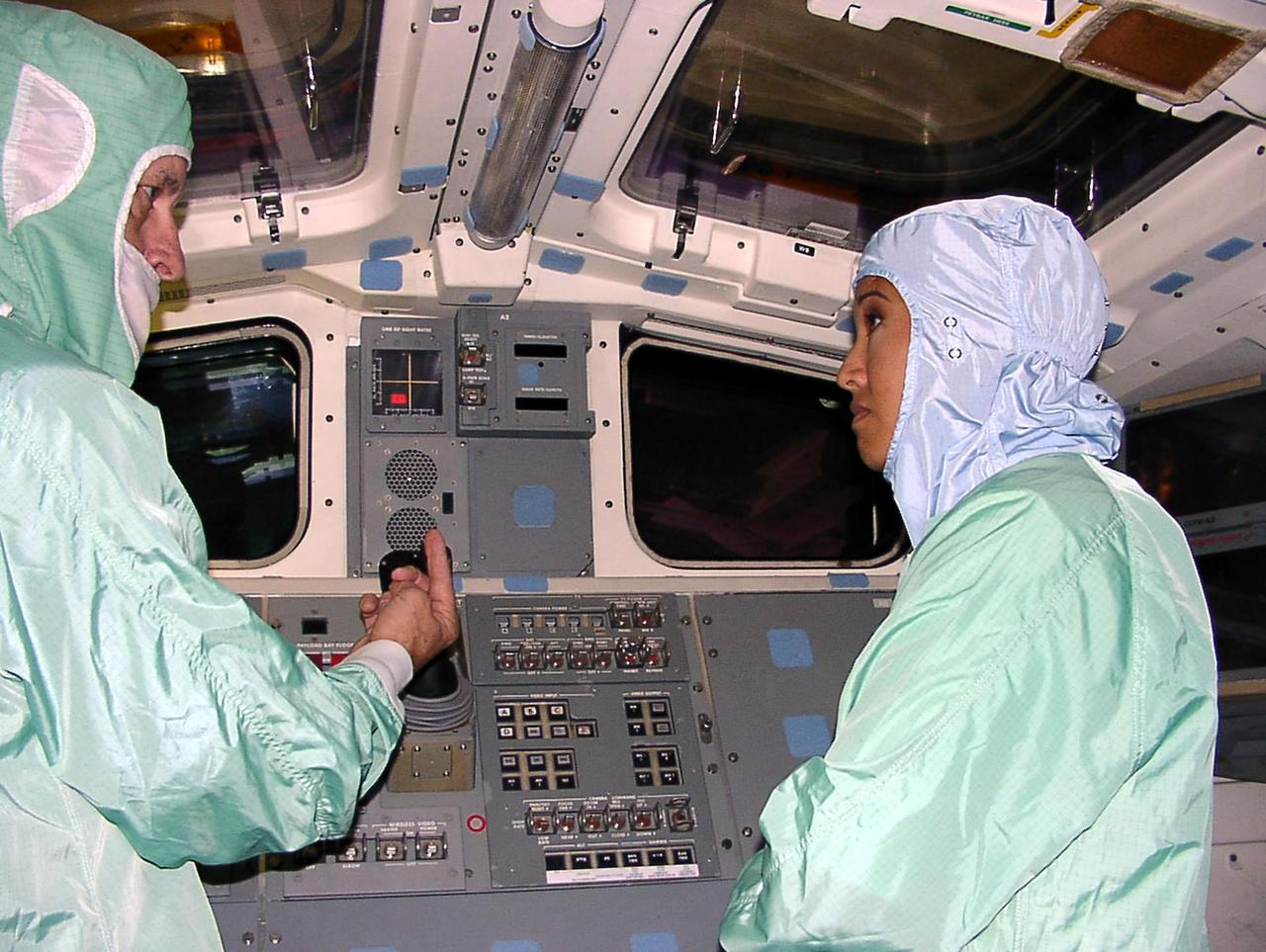
KENNEDY SPACE CENTER, FLA. -- WESH-TV 2 News Anchor Wendy Chioji (right) is given a briefing on how to pilot a Space Shuttle orbiter during a tour inside the cockpit of an orbiter. Chioji was at KSC to speak at the 2002 Combined Federal Campaign (CFC) kickoff rally.
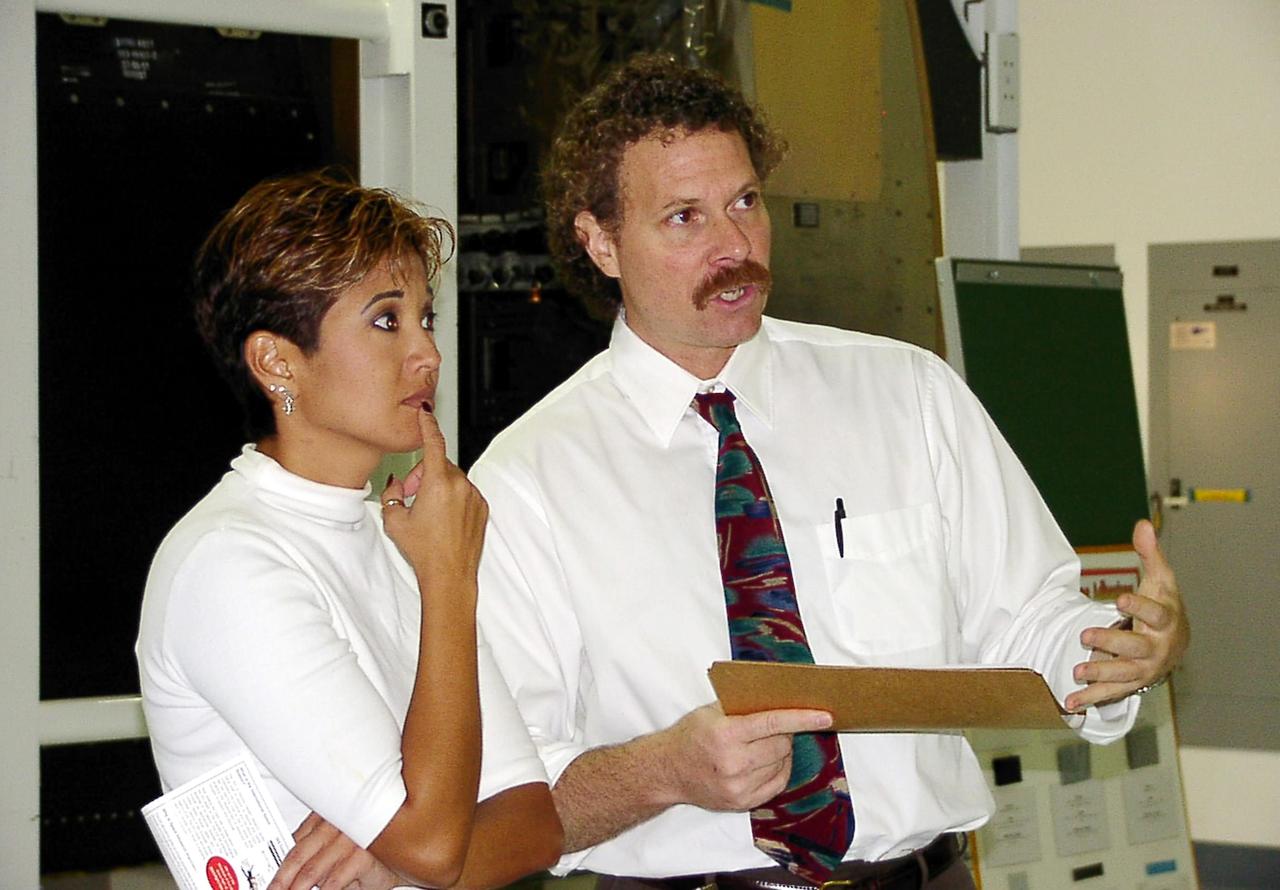
KENNEDY SPACE CENTER, FLA. -- WESH-TV 2 News Anchor Wendy Chioji (left) is given a tour of the Space Station Processing Facility by Russell Romanella, Deputy Director for Program Management in the International Space Staton / Payloads Processing Directorate. Chioji was at KSC to speak at the 2002 Combined Federal Campaign (CFC) kickoff rally.
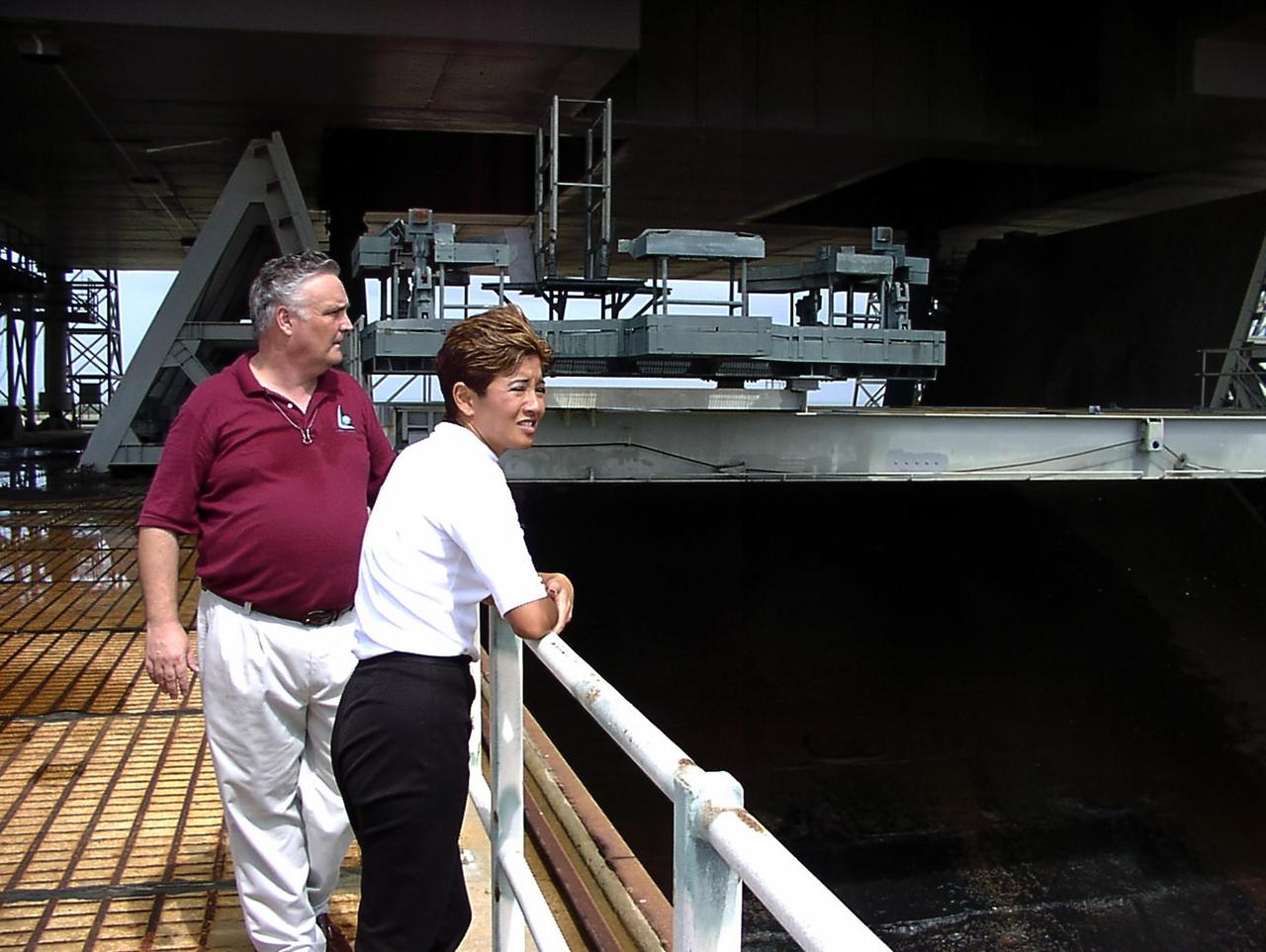
KENNEDY SPACE CENTER, FLA. -- WESH-TV 2 News Anchor Wendy Chioji (right) is given a tour of Launch Complex 39B by NASA's Stephen Bulloch. Chioji was at KSC to speak at the 2002 Combined Federal Campaign (CFC) kickoff rally.
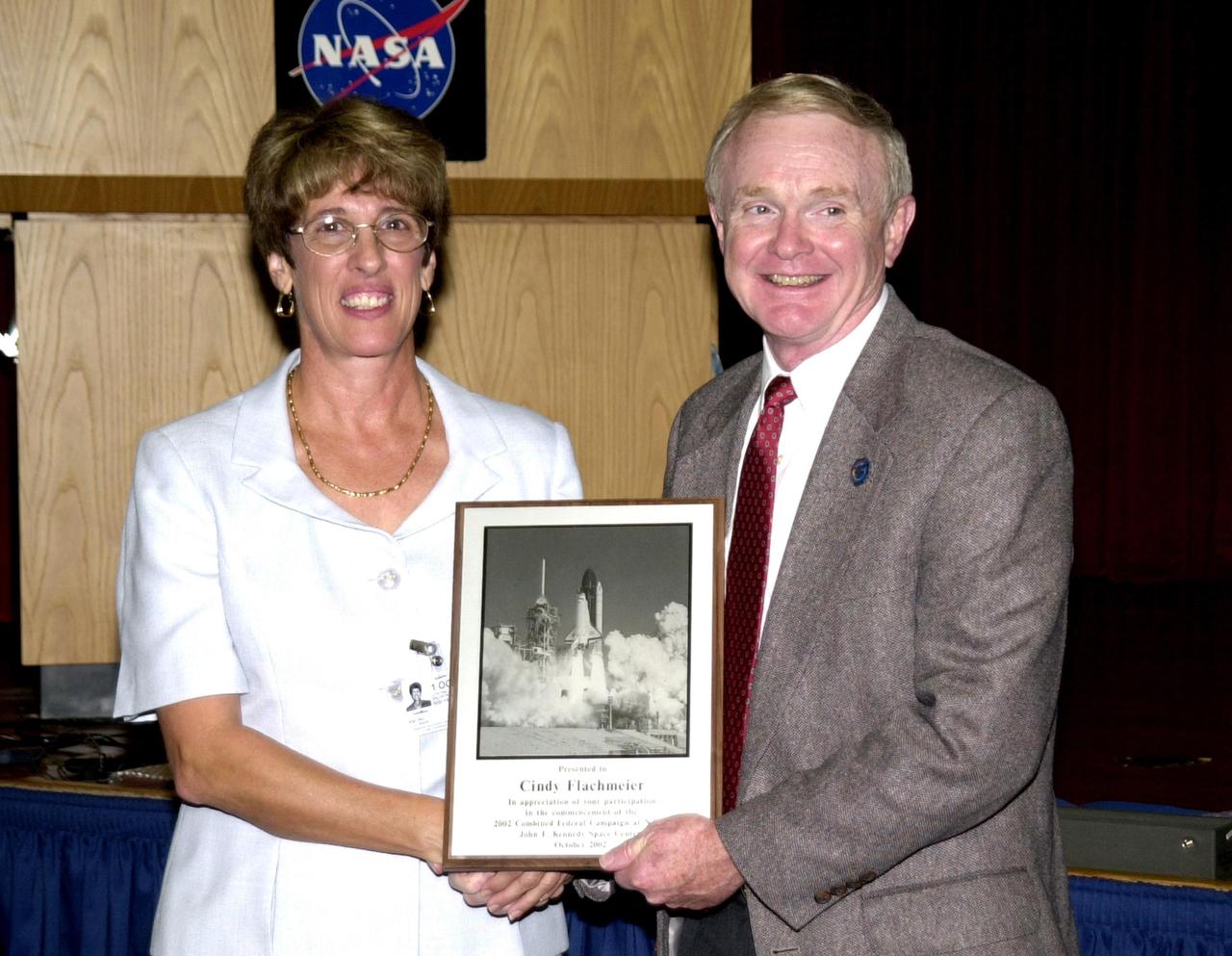
KENNEDY SPACE CENTER, FLA. - During Kennedy Space Center’s 2002 Combined Federal Campaign kickoff rally at the Training Auditorium, Oct. 1, 2002, Center Director, Roy D. Bridges Jr., presented guest speaker Cindy Flachmeier, program coordinator, Domestic Violence Program, Salvation Army of North/Central Brevard, with an appreciation plaque. The CFC is NASA’s agencywide annual fundraising campaign for approved worthy causes that runs through Oct. 31, 2002. This year’s slogan is “Promoting Hope…through Generosity.”

KENNEDY SPACE CENTER, FLA. -- WESH-TV 2 News Anchor Wendy Chioji (right) is given a tour of Launch Complex 39B by NASA's Stephen Bulloch. Space Shuttle Atlantis awaits launch on mission STS-112 to the International Space Station in the background. Chioji was at KSC to speak at the 2002 Combined Federal Campaign (CFC) kickoff rally.
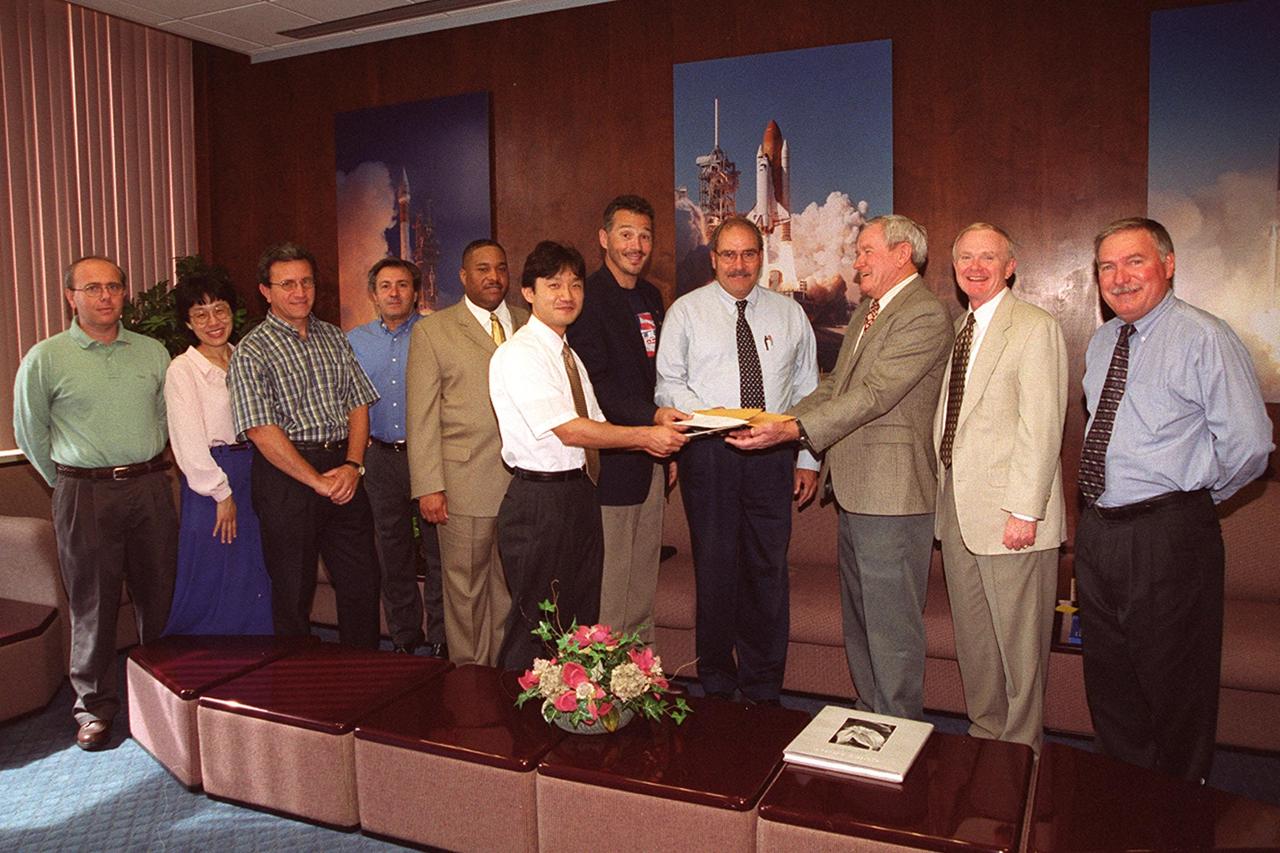
KENNEDY SPACE CENTER, Fla. -- In a special presentation, ISS International Partners donate funds to the Combined Federal Campaign and United Way at KSC to benefit the Sept. 11 recovery efforts. From left are Francesco Santoro of Alenia (Italian Space Agency contractor), Minako Holdrum of the Natinal Space Development Agency of Japan (NASDA), Michele Tripoli and Guiseppe Mancuso of Alenia, Todd Arnold, NASA KSC, Shimpei Takahashi of NASDA, Steve Mozes of the Canadian Space Agency, Agostino Verghini of the Italian Space Agency, Frank Ramsey of United Way/CFC, Center Director Roy D. Bridges Jr. and Director of International Space Station/Payload Processing Tip Talone
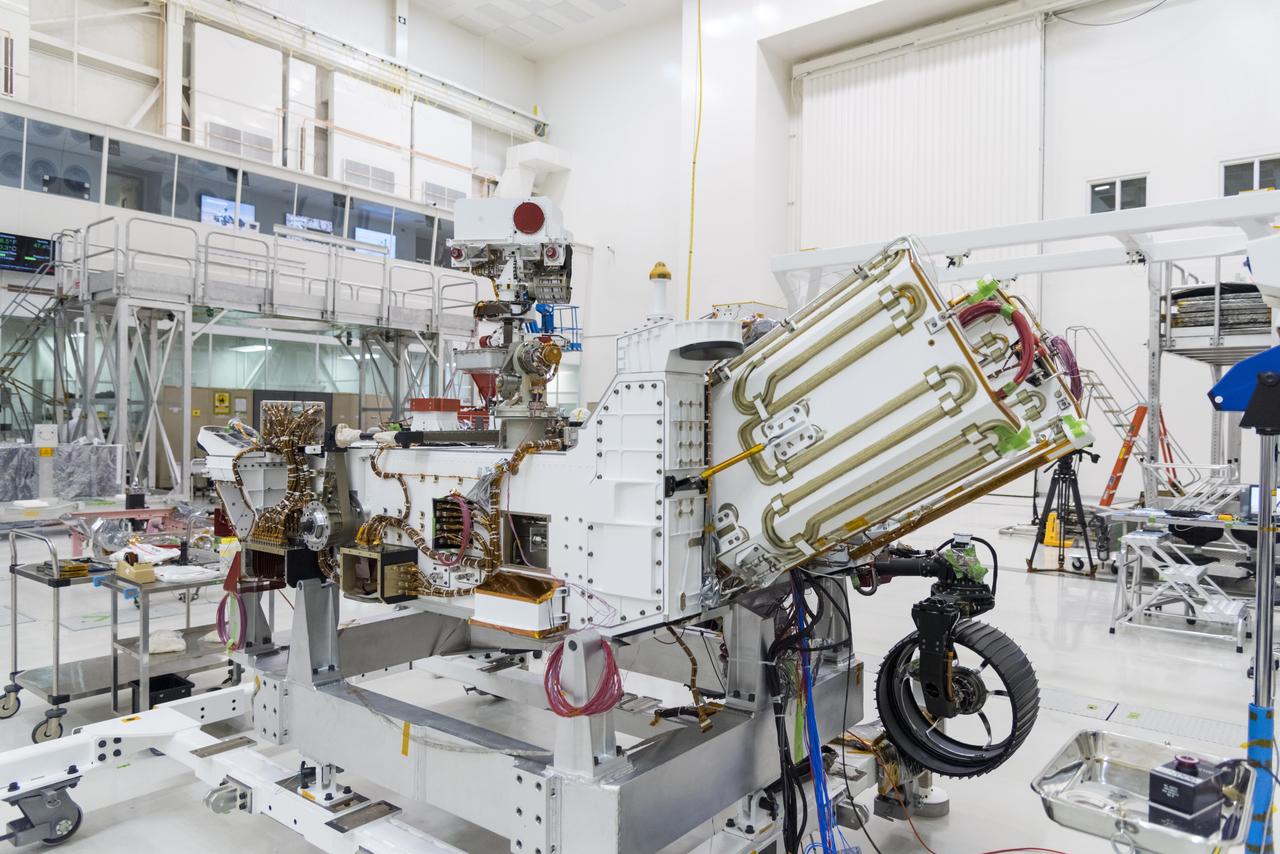
The electricity needed to operate NASA's Mars 2020 rover is provided by a power system called a Multi-Mission Radioisotope Thermoelectric Generator, or MMRTG. The MMRTG will be inserted into the aft end of the rover between the panels with gold tubing visible at the rear, which are called heat exchangers. Essentially a nuclear battery, an MMRTG uses the heat from the natural radioactive decay of plutonium-238 to generate about 110 watts of electricity at the start of a mission. Besides generating useful electrical power, the MMRTG produces heat. Some of this heat can be used to maintain the rover's systems at the proper operating temperatures in the frigid cold of space and on the surface of Mars. Some of it is rejected into space via the rover's Heat Rejection System. The gold-colored tubing on the heat exchangers form part of the cooling loops of that system. The tubes carry a fluid coolant called Trichlorofluoromethane (CFC-11) that helps dissipate the excess heat. The same tubes are used to pipe some of the heat back into the belly of the rover. MMRTGs are provided to NASA for civil space applications by the U.S. Department of Energy (DOE). The radioisotope fuel is inserted into the MMRTG at the DOE's Idaho National Laboratory before the MMRTG is shipped to the launch site. Electrically heated versions of the MMRTG are used at JPL to verify and practice integration of the power system with the rover. https://photojournal.jpl.nasa.gov/catalog/PIA23305

Image acquired September 12, 2010 The yearly depletion of stratospheric ozone over Antarctica – more commonly referred to as the “ozone hole” – started in early August 2010 and is now expanding toward its annual maximum. The hole in the ozone layer typically reaches its maximum area in late September or early October, though atmospheric scientists must wait a few weeks after the maximum to pinpoint when the trend of ozone depletion has slowed down and reversed. The hole isn’t literal; no part of the stratosphere — the second layer of the atmosphere, between 8 and 50 km (5 and 31 miles) — is empty of ozone. Scientists use "hole" as a metaphor for the area in which ozone concentrations drop below the historical threshold of 220 Dobson Units. Historical levels of ozone were much higher than 220 Dobson Units, according to NASA atmospheric scientist Paul Newman, so this value shows a very large ozone loss. Earth's ozone layer protects life by absorbing ultraviolet light, which damages DNA in plants and animals (including humans) and leads to skin cancer. The Ozone Monitoring Instrument (OMI) on NASA’s Aura satellite acquired data for this map of ozone concentrations over Antarctica on September 12, 2010. OMI is a spectrometer that measures the amount of sunlight scattered by Earth’s atmosphere and surface, allowing scientists to assess how much ozone is present at various altitudes — particularly the stratosphere — and near the ground. So far in 2010, the size and depth of the ozone hole has been slightly below the average for 1979 to 2009, likely because of warmer temperatures in the stratosphere over the far southern hemisphere. However, even slight changes in the meteorology of the region this month could affect the rate of depletion of ozone and how large an area the ozone hole might span. You can follow the progress of the ozone hole by visiting NASA’s Ozone Hole Watch page. September 16 is the International Day for the Preservation of the Ozone Layer, a commemoration of the day in 1987 when nations commenced the signing of the Montreal Protocol to limit and eventually ban ozone-depleting substances such as chlorofluorocarbons (CFCs) and other chlorine and bromine-containing compounds. The ozone scientific assessment panel for the United Nations Environment Program, which monitors the effectiveness of the Montreal Protocol, is expected to release its latest review of the state of the world’s ozone layer by the end of 2010. (The last assessment was released in 2006.) Paul Newman is one of the four co-chairs of the assessment panel. NASA image courtesy Ozone Hole Watch. Caption by Michael Carlowicz. Instrument: Aura - OMI To learn more go to: <a href="http://ozonewatch.gsfc.nasa.gov/" rel="nofollow">ozonewatch.gsfc.nasa.gov/</a> Credit: <b><a href="#//earthobservatory.nasa.gov/" rel="nofollow"> NASA’s Earth Observatory</a></b> <b><a href="http://www.nasa.gov/centers/goddard/home/index.html" rel="nofollow">NASA Goddard Space Flight Center</a></b> is home to the nation's largest organization of combined scientists, engineers and technologists that build spacecraft, instruments and new technology to study the Earth, the sun, our solar system, and the universe. <b>Follow us on <a href="http://twitter.com/NASA_GoddardPix" rel="nofollow">Twitter</a></b> <b>Join us on <a href="http://www.facebook.com/pages/Greenbelt-MD/NASA-Goddard/395013845897?ref=tsd" rel="nofollow">Facebook</a></b>