
41G-121-099 (5-13 Oct. 1984) --- Hurricane Josephine was photographed with a medium format camera aimed through the space shuttle Challenger's aft flight deck windows during NASA's 41-G mission. The hurricane's eye can be seen below the orbiter's vertical stabilizer. The large storm off the Florida coast did not prevent the spacecraft with its record of seven crew members aboard from landing safely at the KSC landing facility. Photo credit: NASA
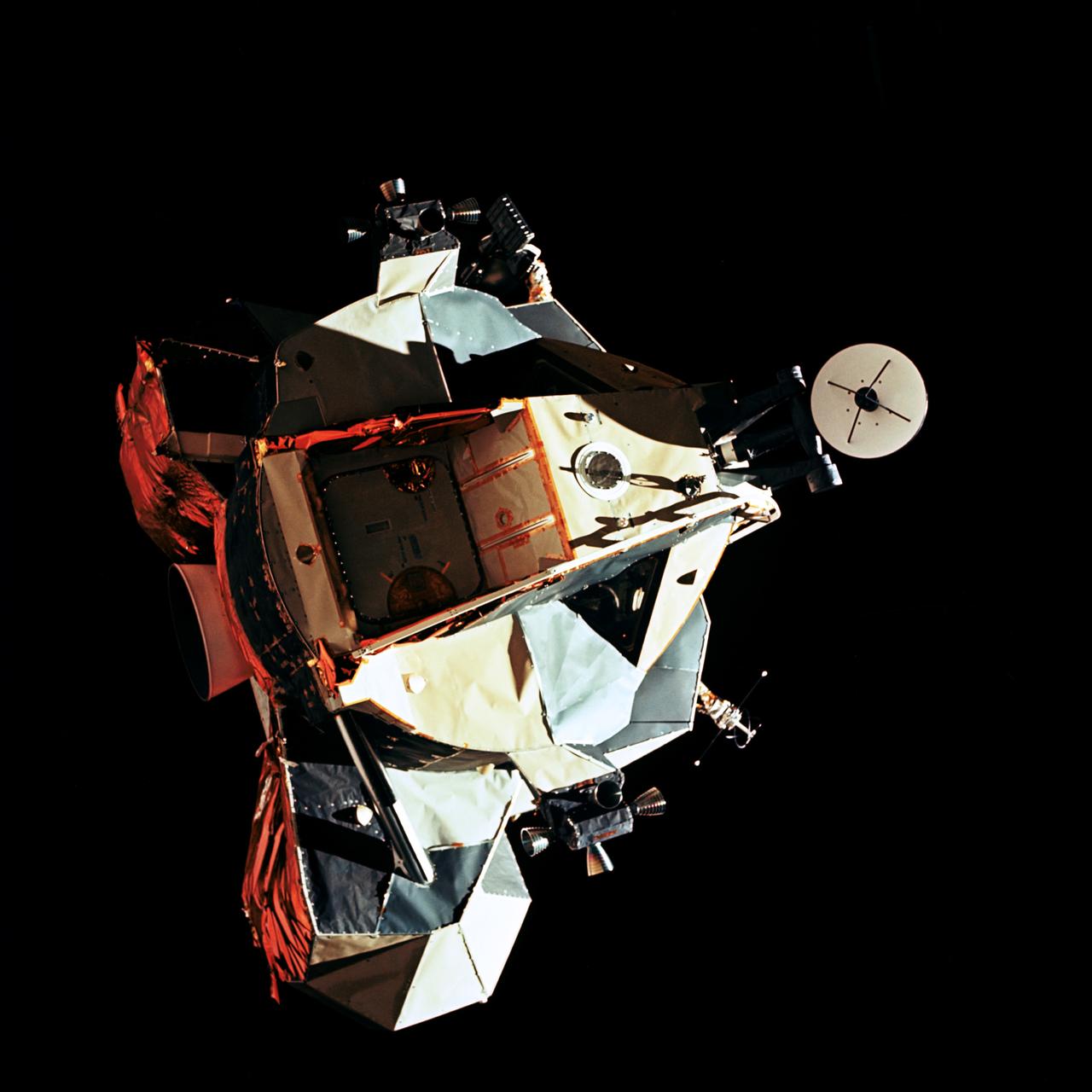
AS17-149-22857 (14 Dec. 1972) --- This 70mm view of the Lunar Module (LM) "Challenger" in lunar orbit before rendezvous with the Apollo 17 Command and Service Modules (CSM). While astronauts Eugene A. Cernan, commander, and Harrison H. Schmitt, lunar module pilot, descended in the Challenger to explore the Taurus-Littrow region of the moon, astronaut Ronald E. Evans, command module pilot, remained with the CSM "America" in lunar orbit.
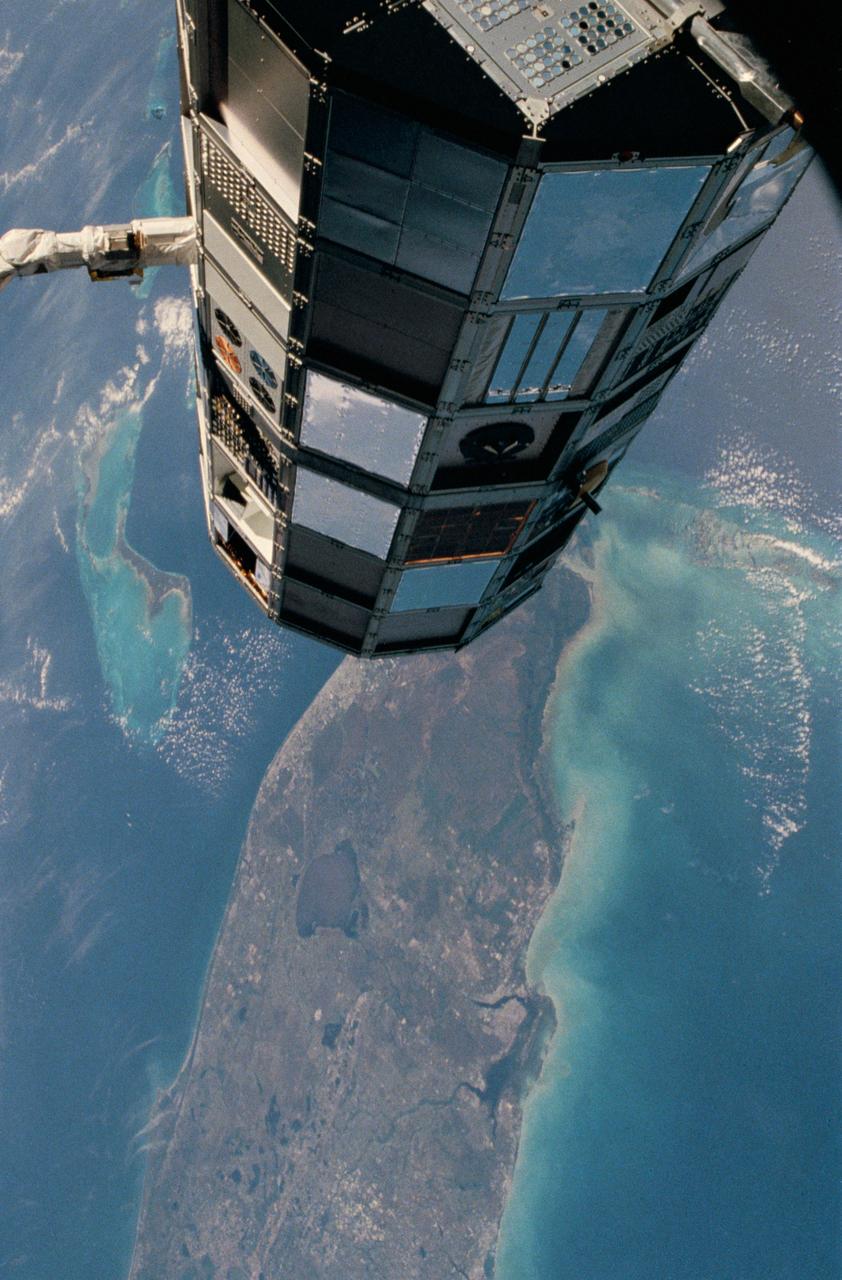
41C-02-067 (6-13 April 1984) --- One of the first major accomplishments of Flight 41-C?s crew aboard the Challenger was to place this giant satellite into Earth orbit. Still attached to the remote manipulator system (RMS) end effector, the Long-Duration Exposure Facility (LDEF) is backdropped against Florida, the Bahama Bank, the Gulf of Mexico and Atlantic waters. The multi-colored cylinder carries 50-odd passive scientific experiments representing 194 investigators from around world. The LDEF program is directed by the Langley Research Center in Hampton, Virginia. The facility will be retrieved in a little less than a year by a Space Shuttle crew. This frame was one of the visuals used by the 41-C astronauts for their April 24, 1984 post-flight press conference. Cape Canaveral, where this seven-day mission got its start, and Lake Okeechobee, are easily recognized in the frame, photographed shortly before 11:30 a.m. (CST), April 7, 1984.
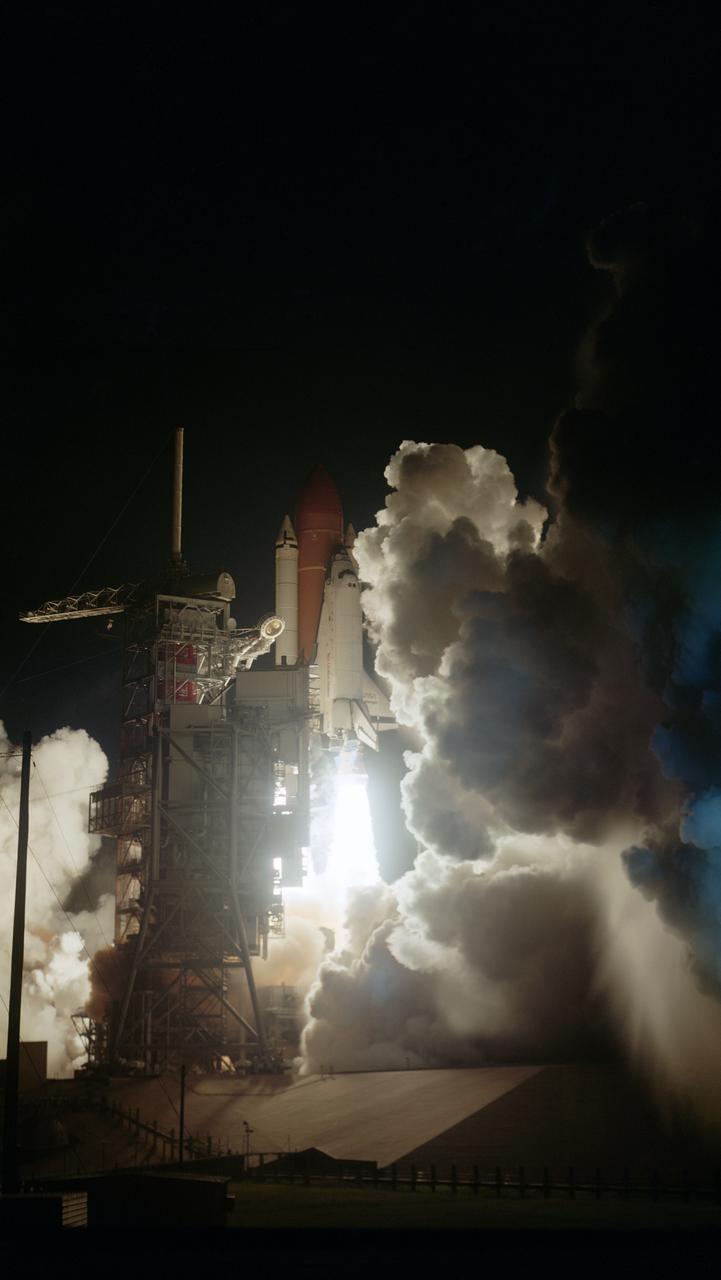
View of the early morning launch of STS 41-G Challenger. The dark launch complex is illuminated by spotlights as the orbiter begins its ascent from the pad. The light is reflected off the clouds of smoke from the orbiter's engines.
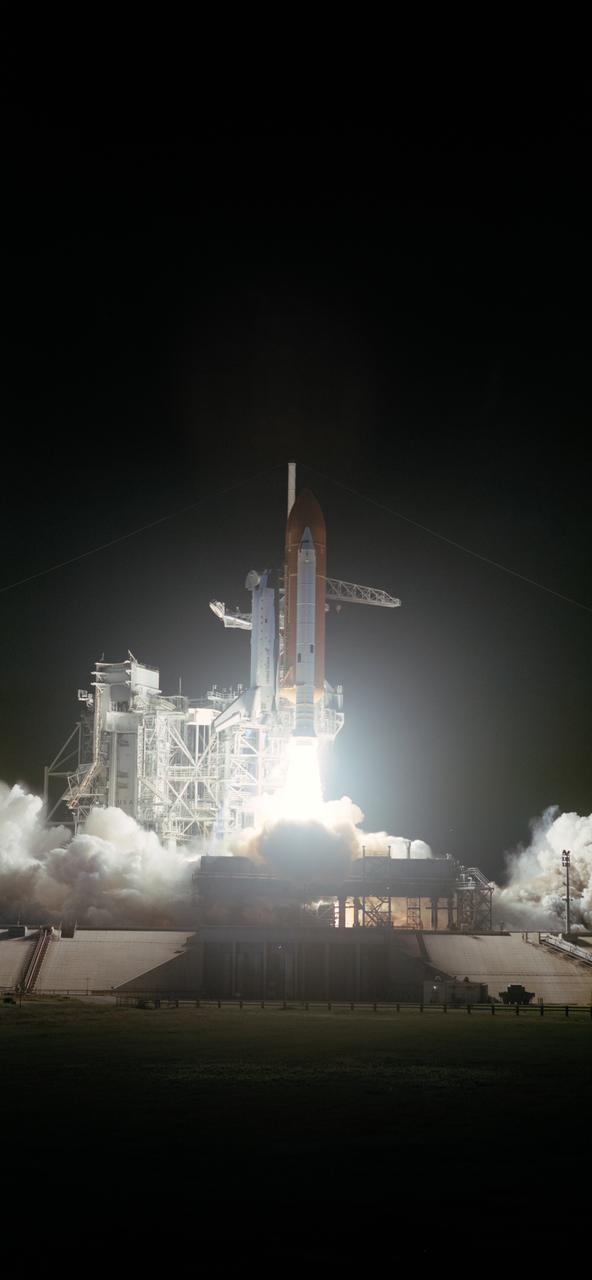
View of the early morning launch of STS 41-G Challenger. The dark launch complex is illuminated by spotlights as the orbiter begins its ascent from the pad.
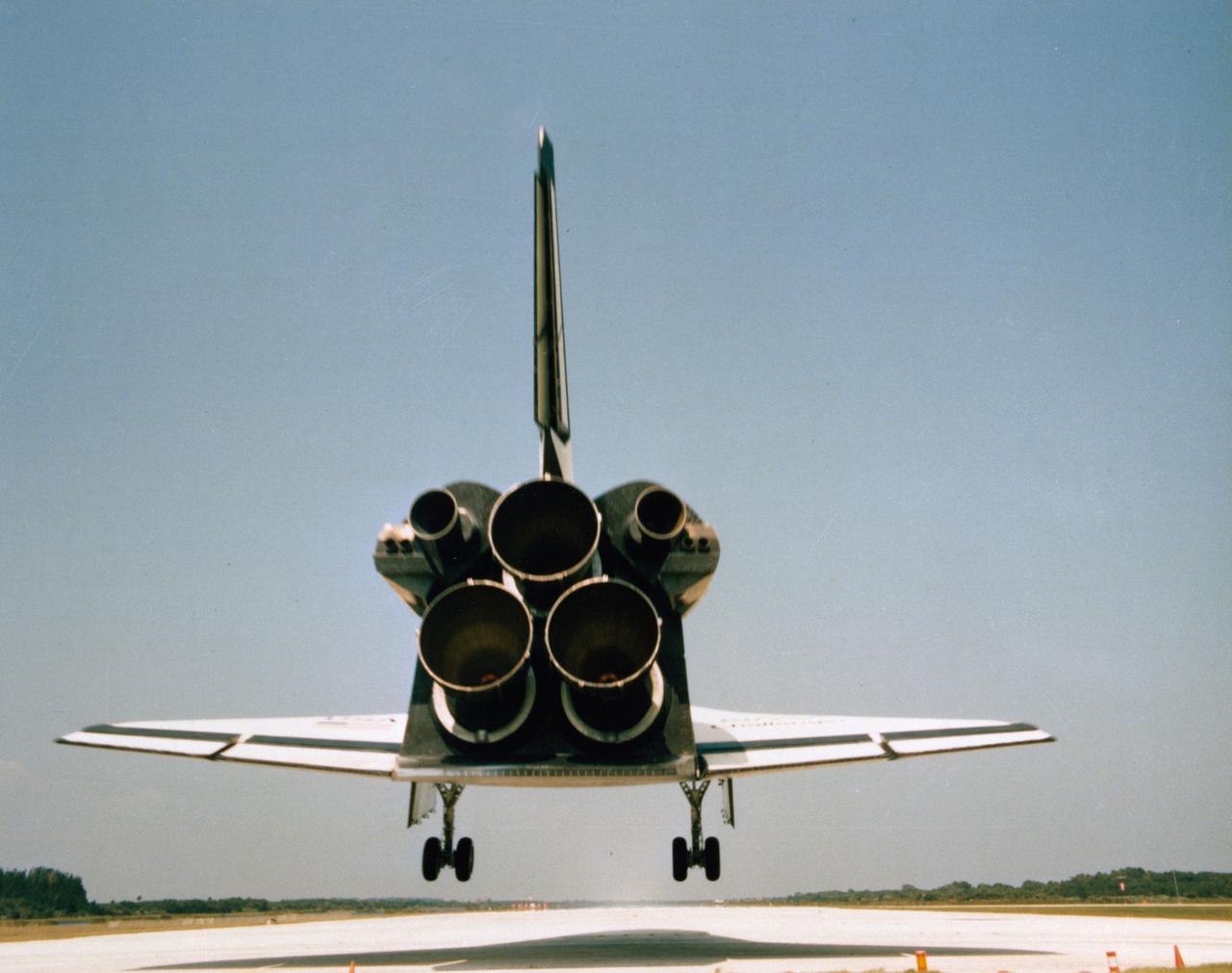
Landing of Orbiter Challenger at KSC at completion of 41G mission. View of the rear of the Orbiter as it approaches the runway with its landing gear extended. The main engines are clearly visible. The KSC Alternative Photo Number is 108-KSC-84PC-654 (43896). KSC, FL
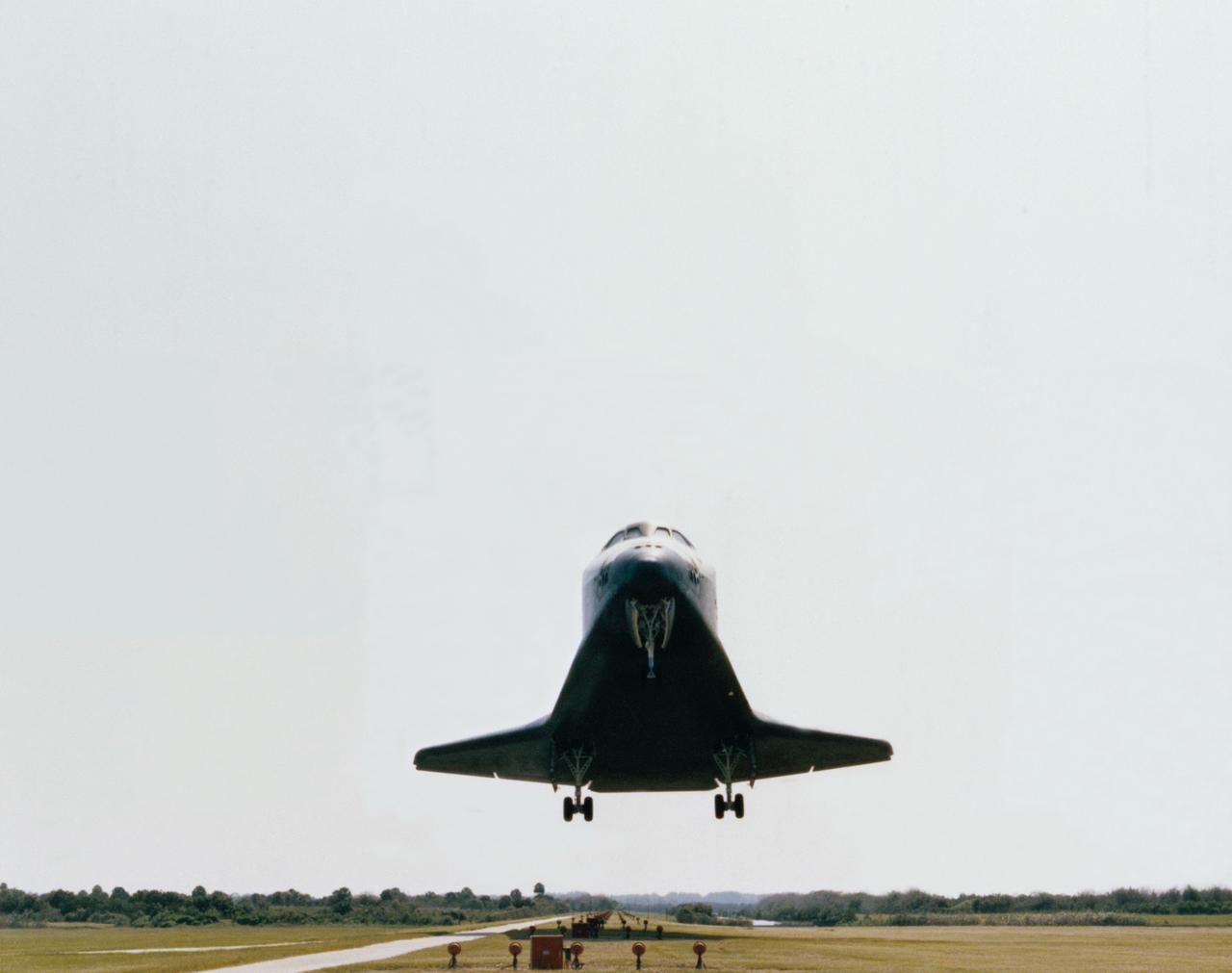
Landing of Orbiter Challenger at KSC completion of 41G Mission. Views closeup front view of the Orbiter approaching the runway, its landing gear extended in preparation for touchdown. The KSC Alternative Photo Number is 108-KSC-84PC-639. KSC, FL
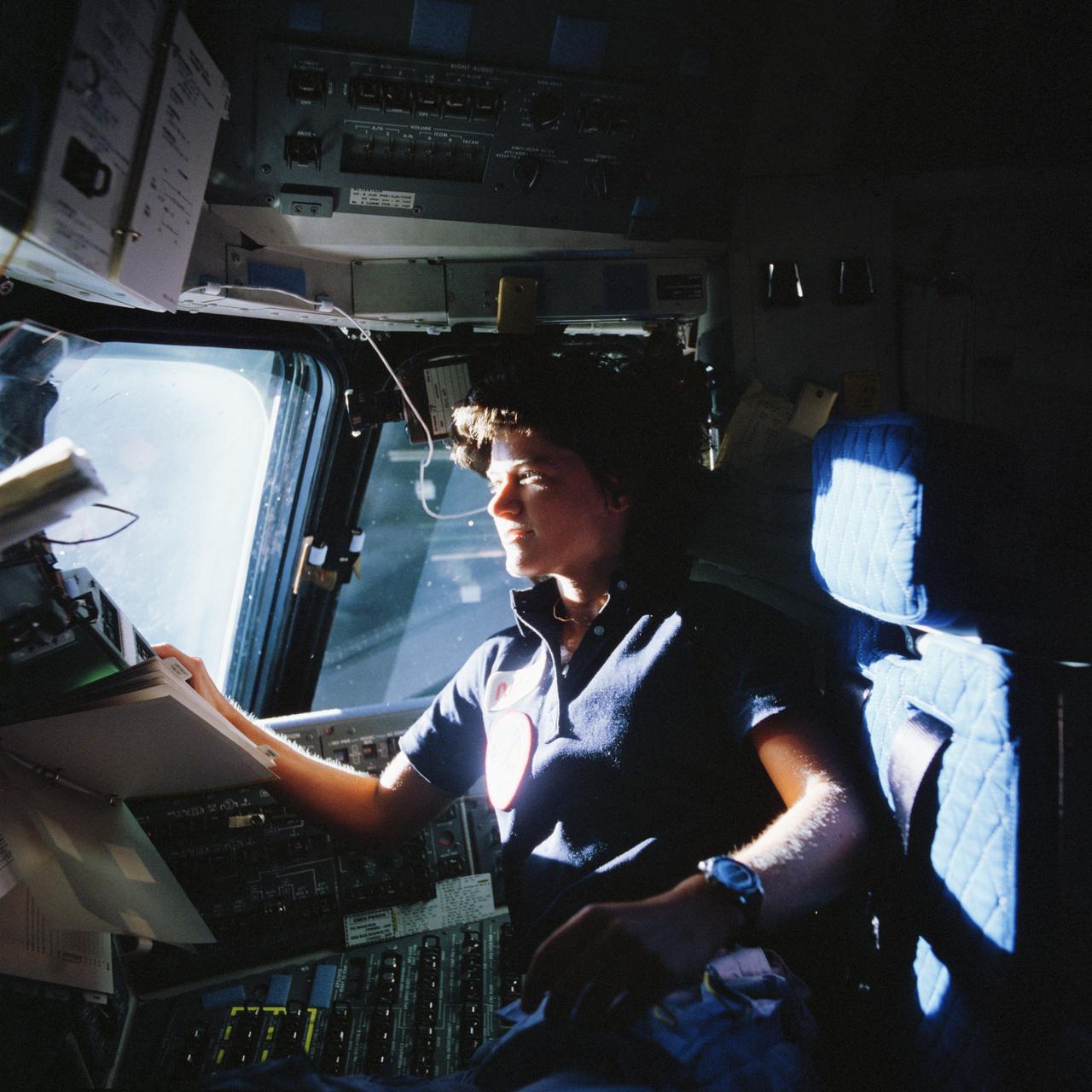
S83-35783 / STS007-05-029 (18-24 June 1983) --- Astronaut Sally K. Ride, mission specialist, is shown here sitting in the front seat and looking out the windows of the Earth-orbiting Space Shuttle Challenger. Ride and four other crew members are onboard the Challenger.
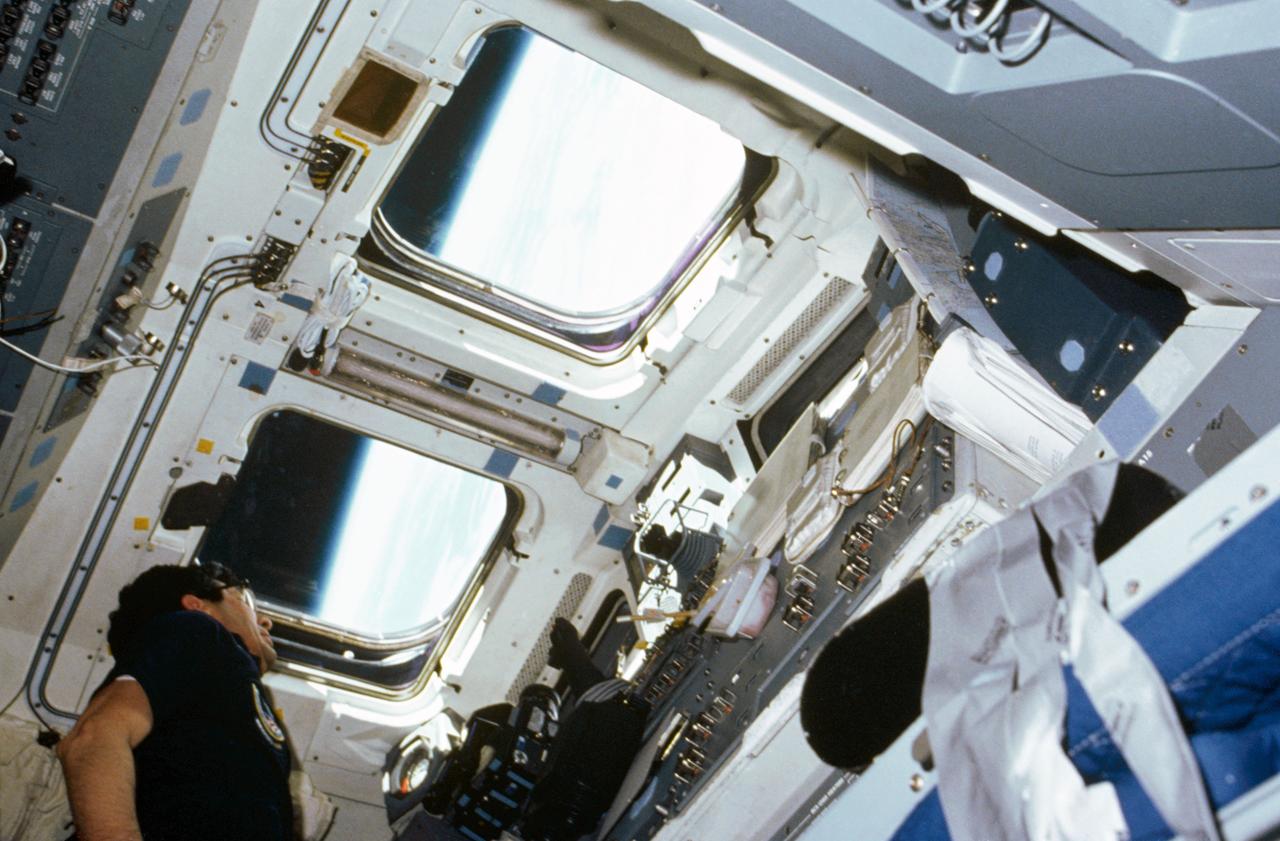
In this low-angle photo Payload specialist Lodewijk van den Berg, one of two payload specialists, looks out aft flight deck window aboard the shuttle orbiter Challenger.
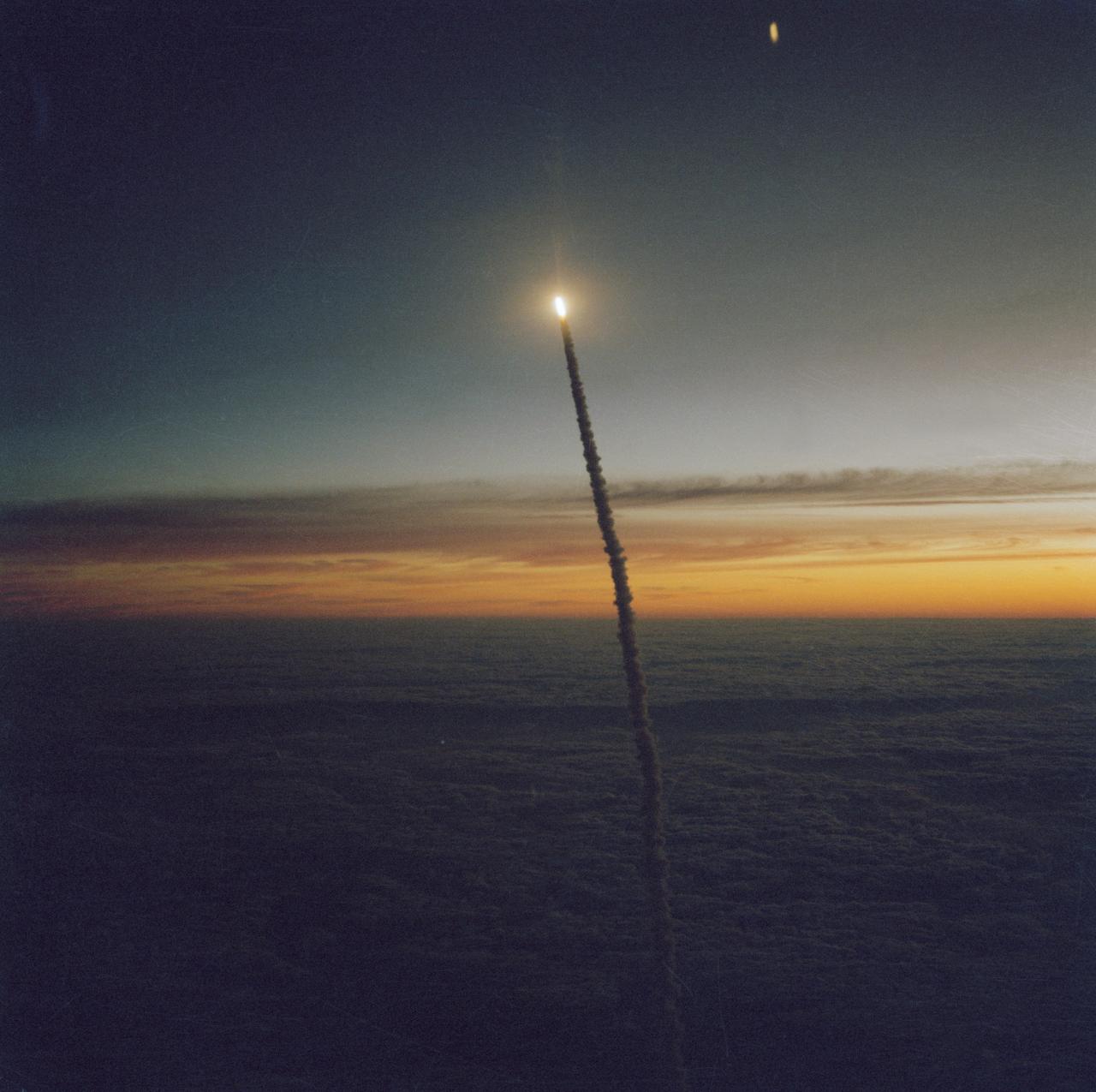
41G-90139 (5 October 1984) --- A Florida dawn scene forms the backdrop for the climbing Space Shuttle Challenger, its two solid rocket boosters and external fuel tank. Seven crewmembers, a space record, head for a busy eight-day stay in Earth orbit. The scene was photographed by astronaut Paul J. Weitz, who was piloting the Shuttle training aircraft (STA).
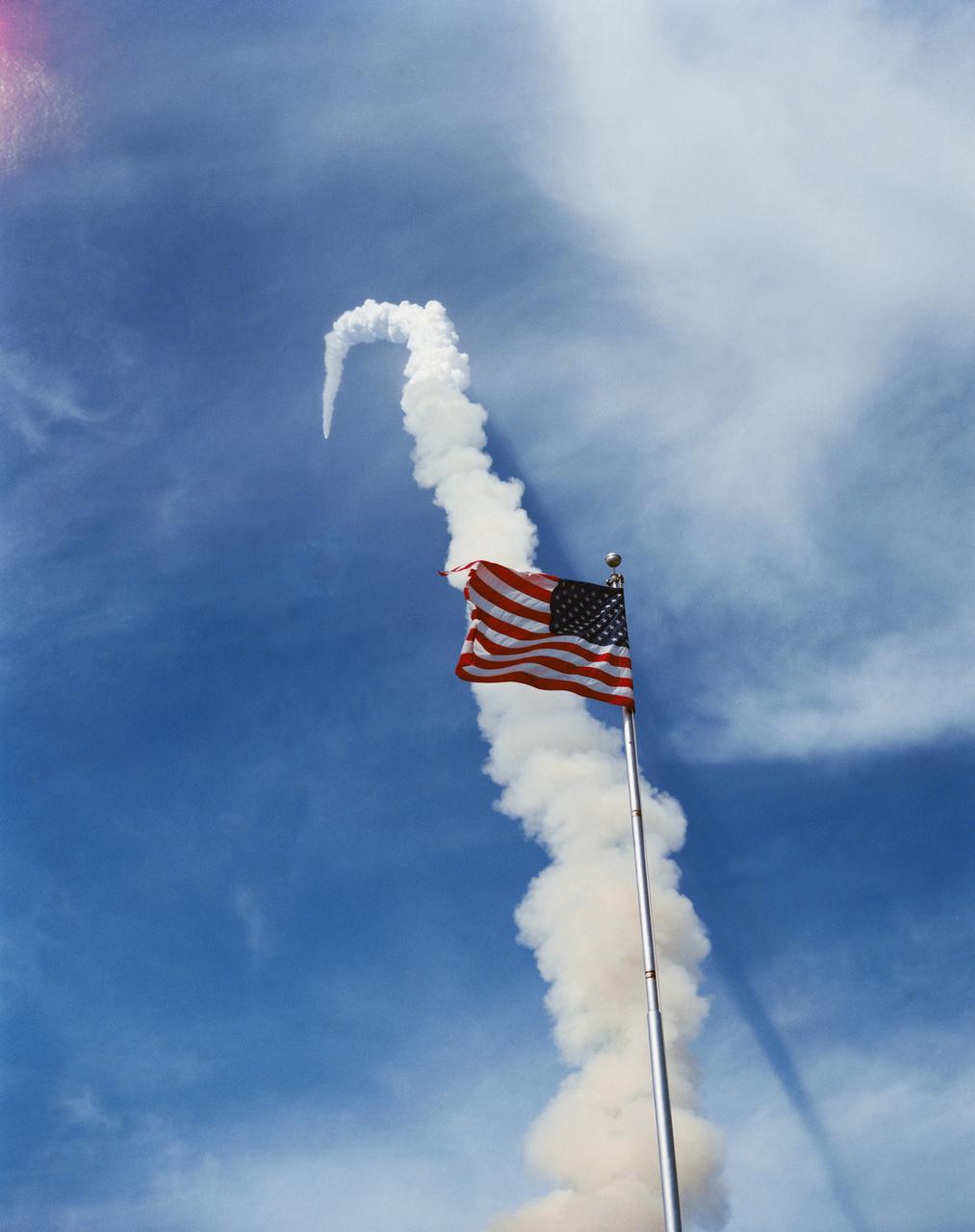
51F-S-068 (29 July 1985) --- The Space Shuttle Challenger heads toward Earth-orbit with the Spacelab-2 experiment pallet and a team of astronauts and scientists onboard. This photograph was taken by Otis Imboden of the National Geographic Society for NASA from the press site at Kennedy Space Center (KSC).
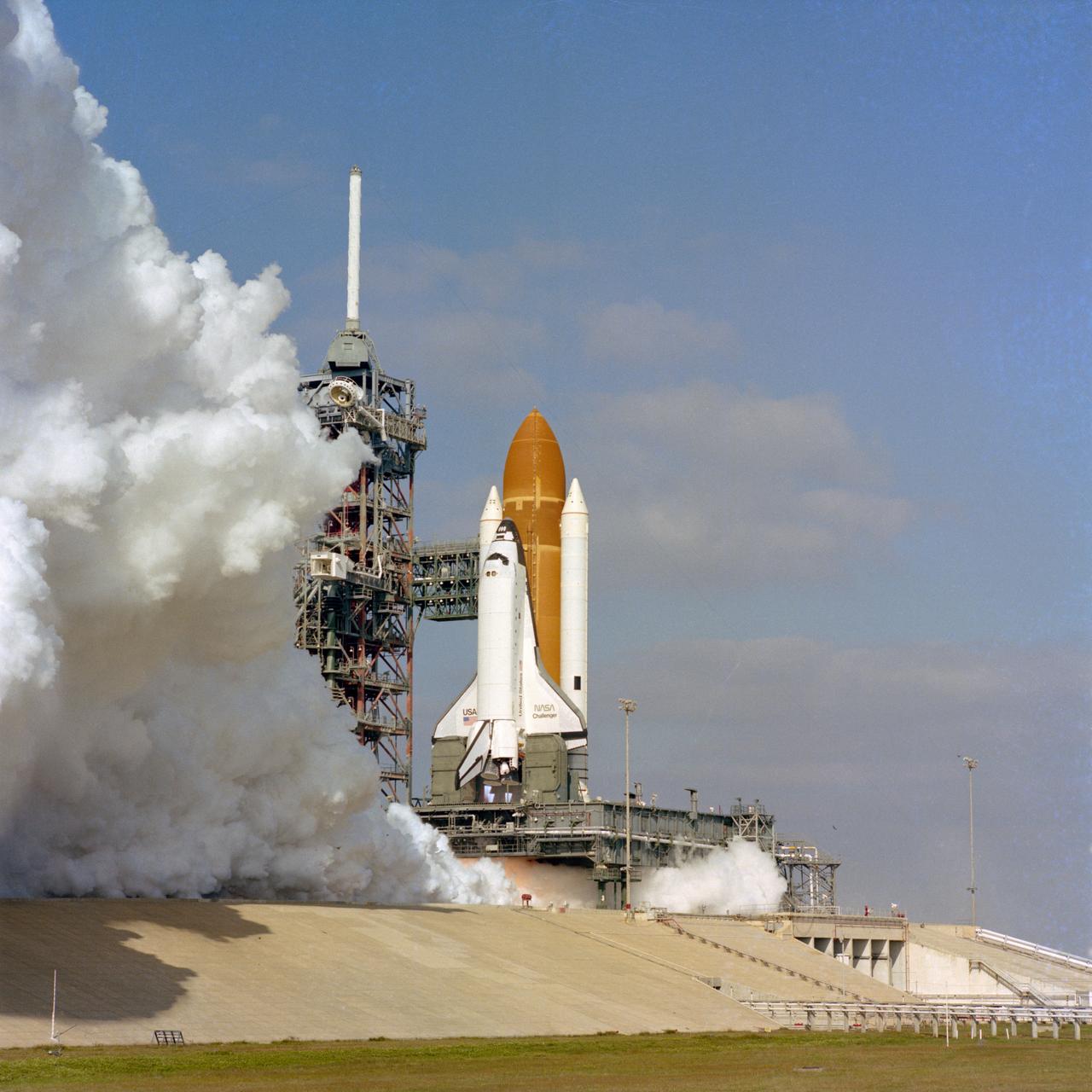
The Space shuttle orbiter Challenger is given a 20-second test firing of its new main engines on December 18, 1982 on pad 39A at the Kennedy Space Center. This test was the first time these engines ahd been tested in the clustered flight configuration.

STS007-06-0314 (18-24 June 1983) --- Astronaut John M. Fabian, STS-7 mission specialist, sleeps in a zip-up blue sleep restraint device in the locker area of the Earth-orbiting space shuttle Challenger's middeck. The frame was exposed with a 35mm camera. Photo credit: NASA
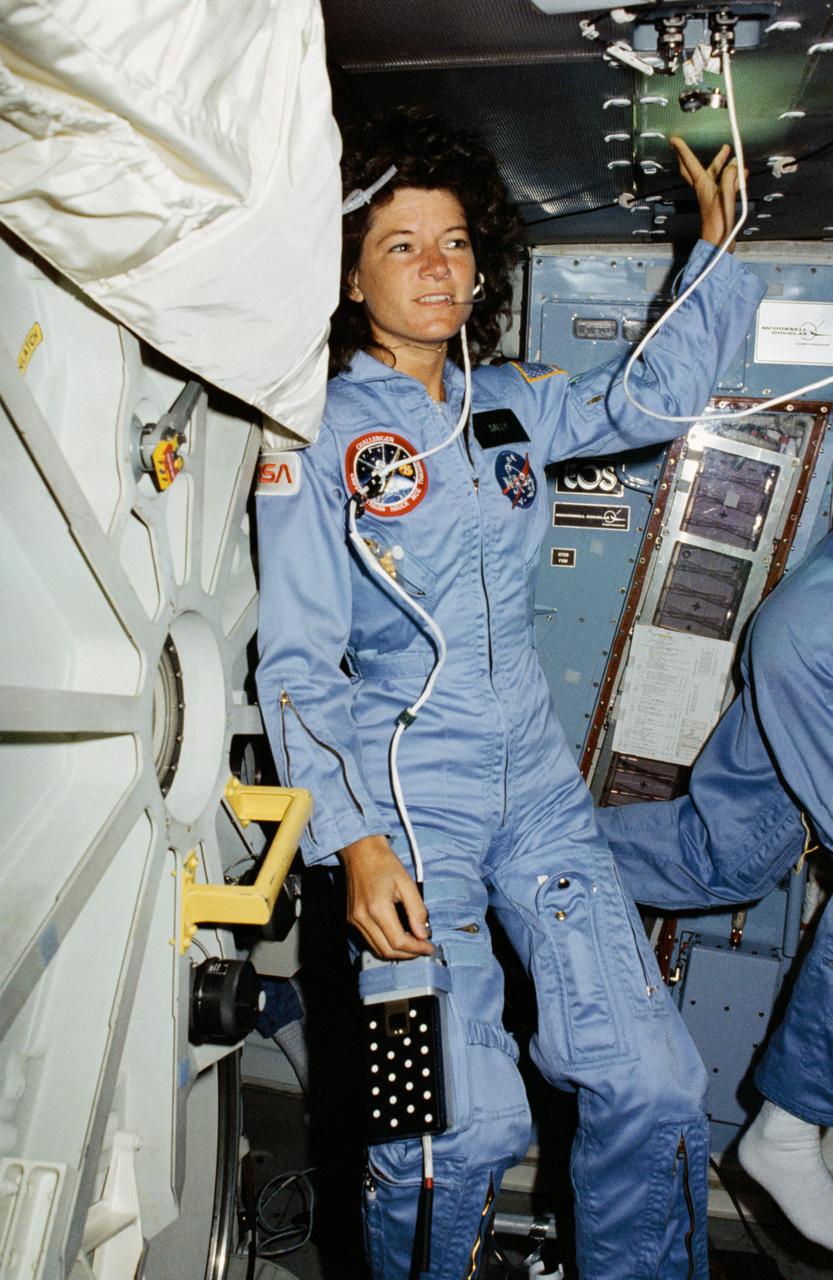
STS007-02-020 (21 June 1983) --- Astronaut Sally K. Ride, STS-7 mission specialist, STS-7 mission specialist, stands in the mid deck of the orbiting Space Shuttle Challenger near one of the experiment with which she has devoted a great deal of time. The continuous flow electrophoresis system (CFES) experiment, about the size of a household refrigerator, stands nearby. One of her fellow crewmembers moves partially out of frame in the background. The tube on her face is part of a communications system linking Dr. Ride to ground controllers in Houston.
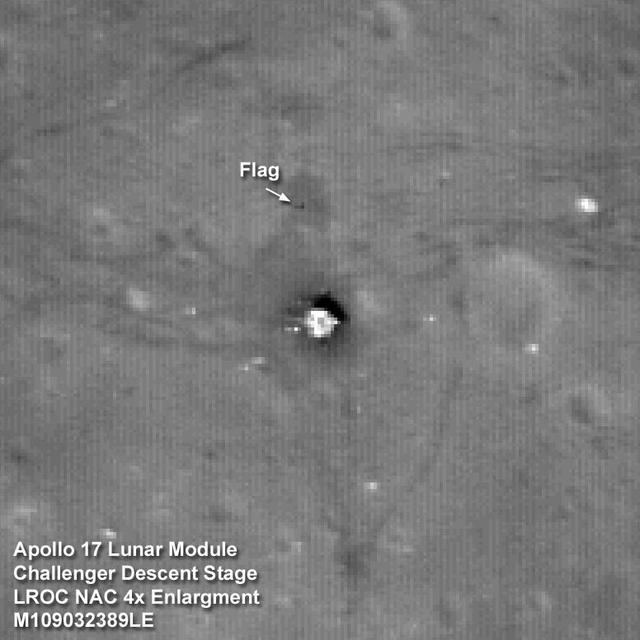
The Apollo 17 Lunar Module Challenger descent stage comes into focus in this image taken by NASA Lunar Reconnaissance Orbiter.
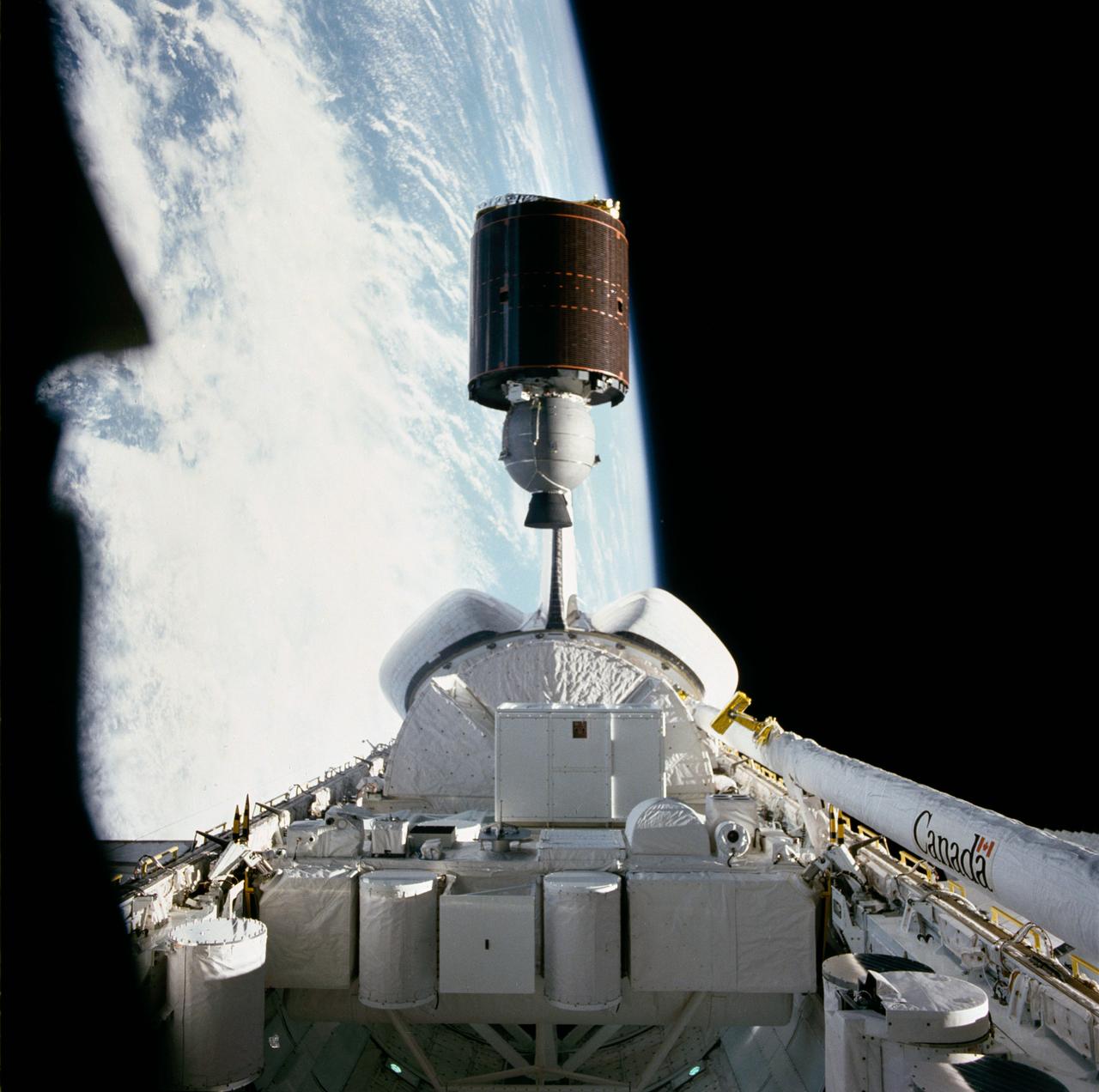
STS007-18-770 (18-24 June 1983) --- Telesat-F communications satellite is just about to clear the vertical stabilizer of the Earth-orbiting Space Shuttle Challenger to begin its way toward its Earth-orbital destination.
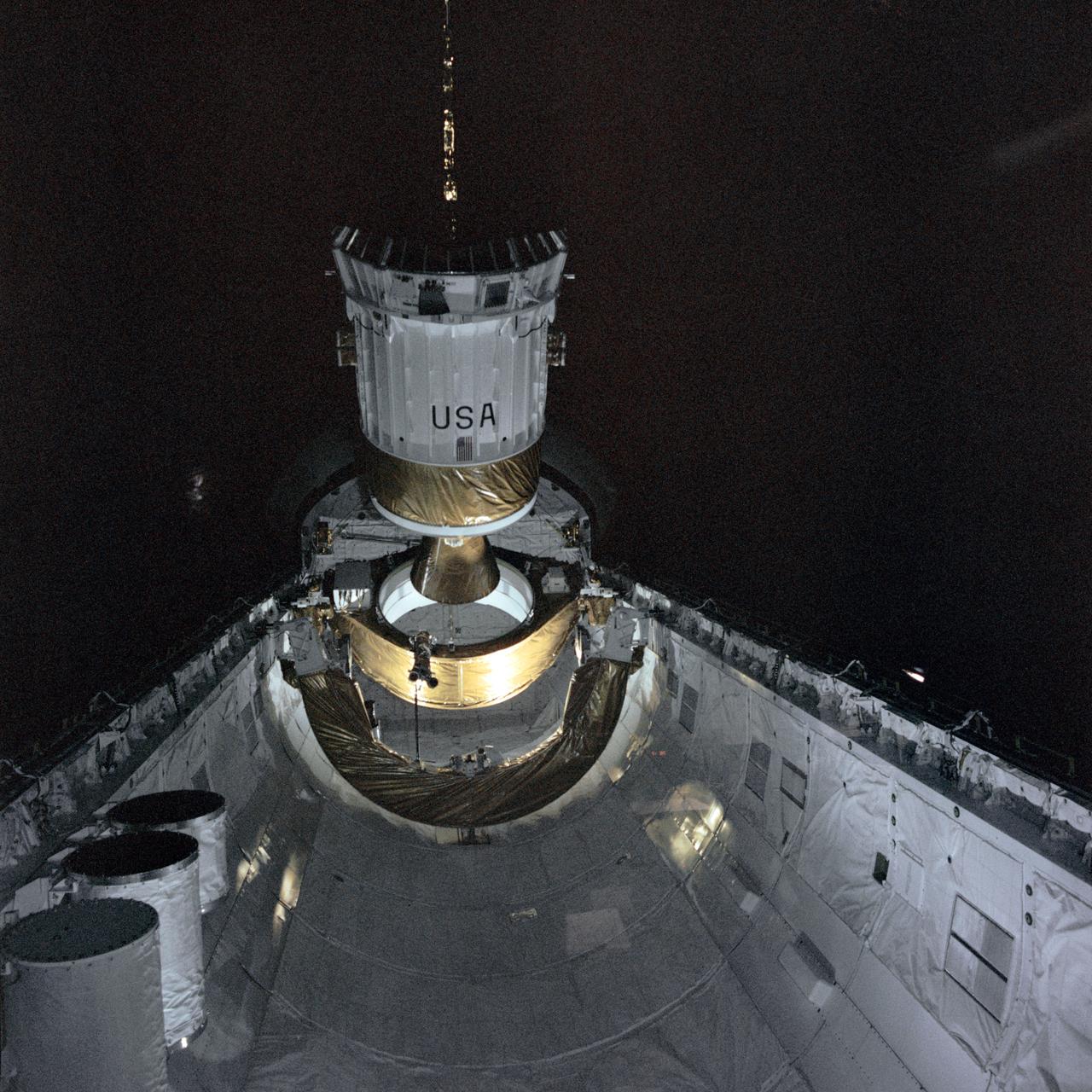
STS006-38-894 (4 April 1983) --- The tracking and data relay satellite (TDRS) leaves the 18-meter (60-ft) long cargo bay of the Earth-orbiting space shuttle Challenger about ten hours following launch of NASA’s second reusable space vehicle. The inertial upper stage (IUS) which gives power necessary to place the TDRS in its desired orbit is clearly seen in this view, photographed with a 70mm camera aimed through the aft flight deck windows of the Challenger. The cylindrical canisters in the left foreground contain scientific experiments from subscribers to NASA’s getaway special (GAS) program. Photo credit: NASA
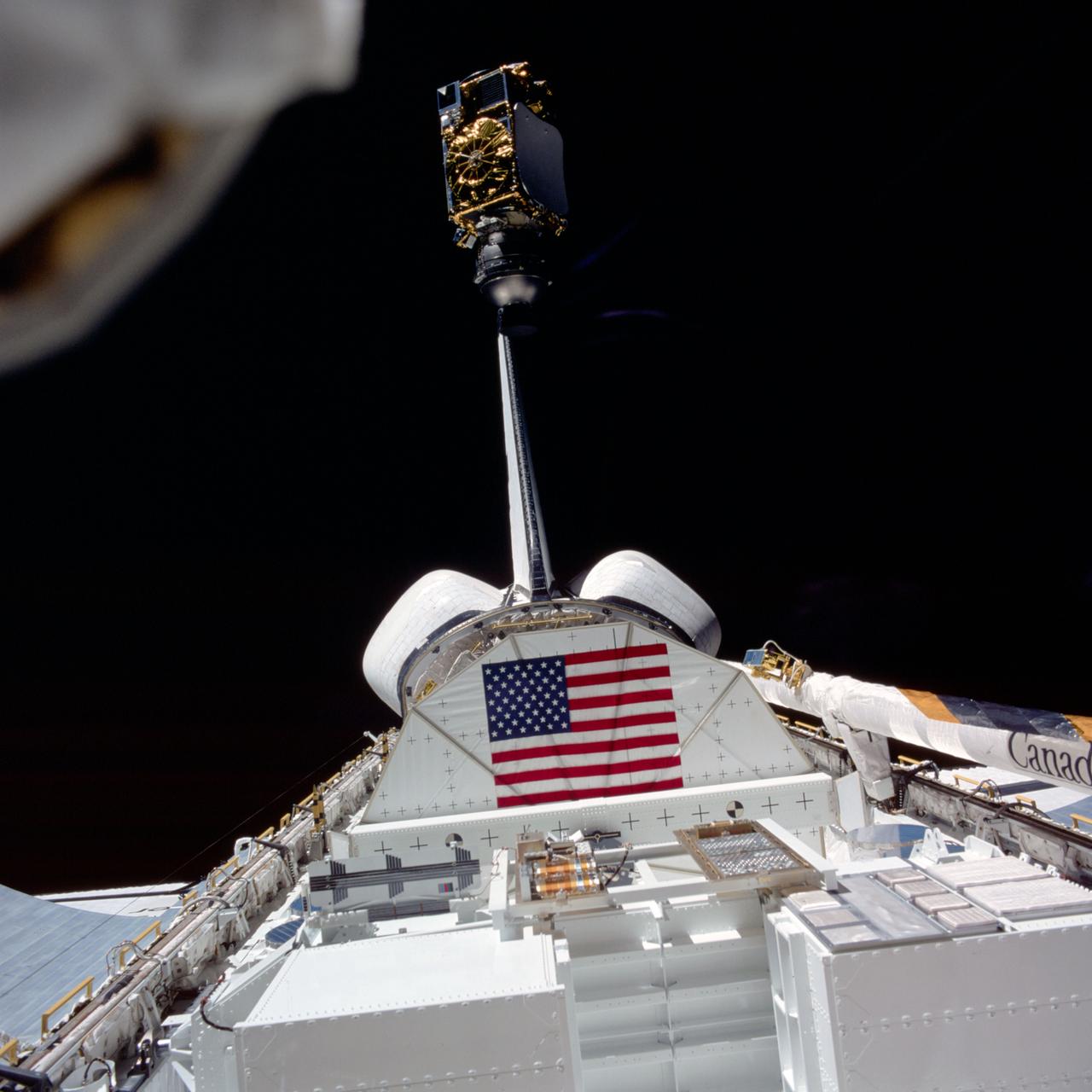
STS008-49-1724 (31 Aug 1983) --- The Indian National Satellite (INSAT) is about to clear the vertical stabilizer of the Earth-orbiting Space Shuttle Challenger and on its way to a higher orbit. The STS-8 mission's Payload Flight Test Article (PFTA) displays the U.S. flag in the middle of the cargo bay, as the Canadian built Remote Manipulator System (RMS) appears to be waiting for its busy agenda of activity with the barbell-shaped test device. This 70mm frame was exposed by a crewmember using a handheld Hasselblad inside Challenger's cabin.
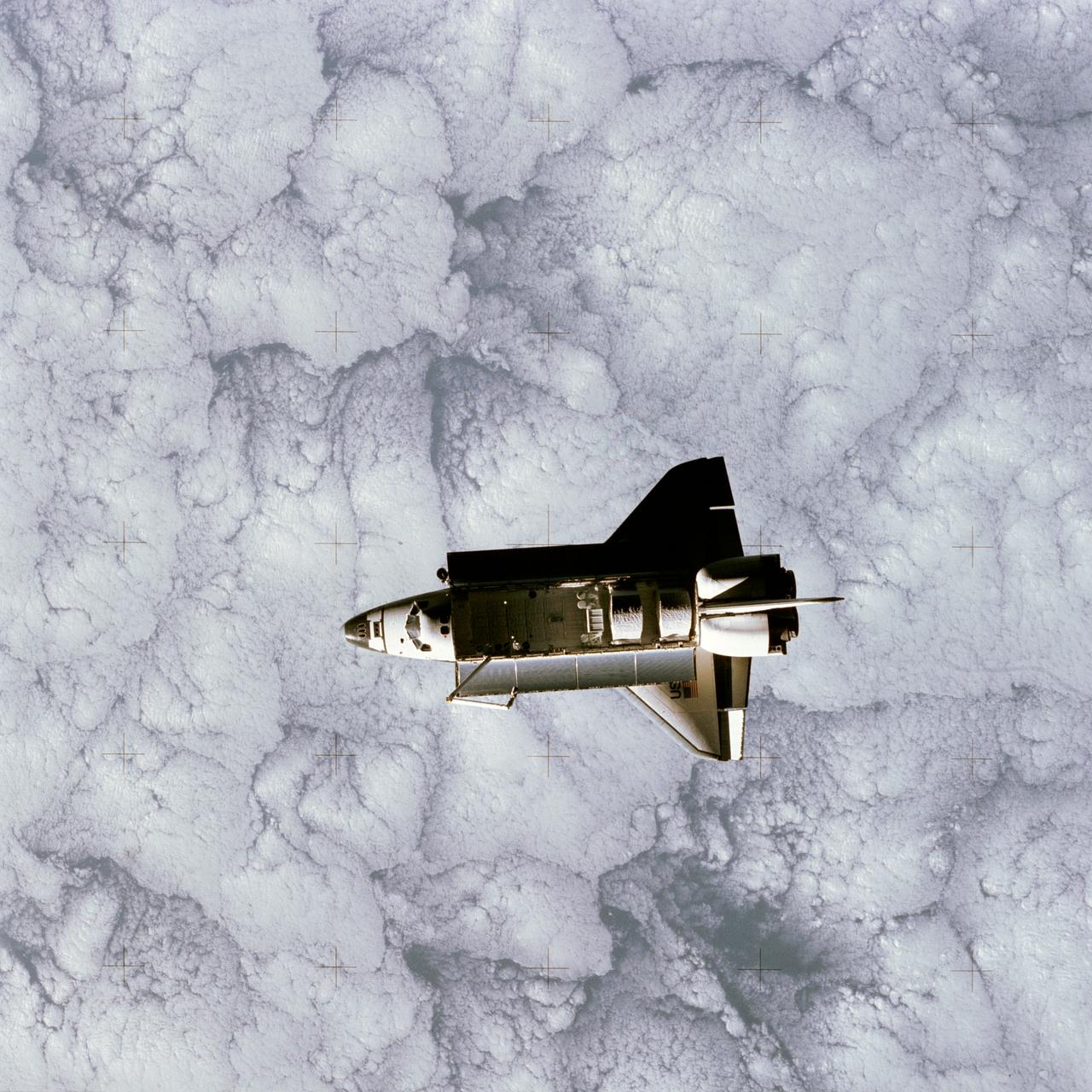
STS007-32-1667 (22 June 1983) --- The Earth-orbiting Space Shuttle Challenger over a heavily cloud-covered portion of the Earth was captured by a 70mm camera onboard the temporarily free-flying Shuttle Pallet Satellite (SPAS-01) during a busy Day 5 on the STS-7 mission. Visible in the cargo bay are the protective cradles for the now vacated Telesat Anik C2 and Palapa-B communications satellites, the pallet for the NASA Office of Space and Terrestrial Applications (OSTA-2); the Remote Manipulator System (RMS) and the KU-Band antenna. The STS-7 astronaut crew and the RMS arm later retrieved the SPAS and returned it to a stowed position in the cargo bay of the Space Shuttle Challenger for the return to Earth.
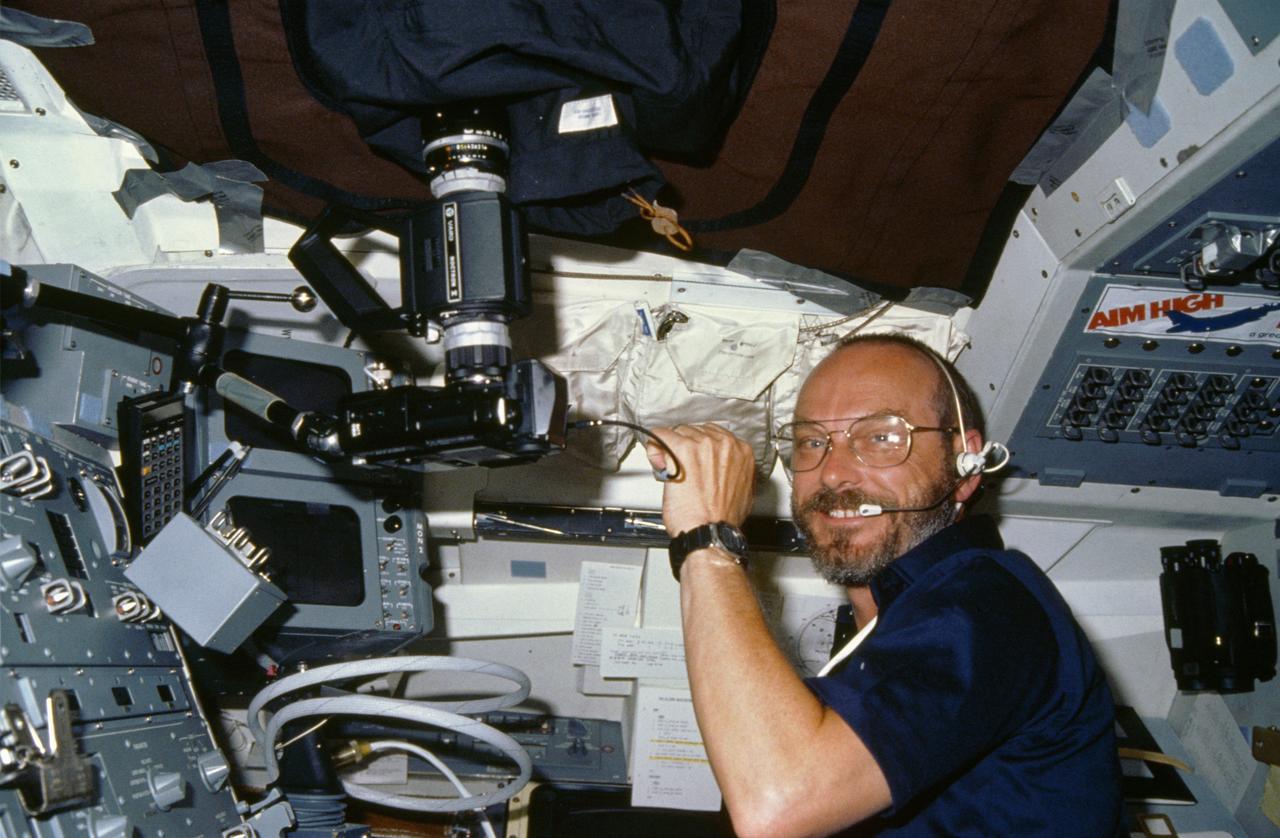
51F-17-011 (29 July-6 Aug 1985) --- Loren W. Acton, 51-F payload specialist, triggers a 35mm camera recording stellar imagery through the aft flight deck overhead windows aboard the Earth-orbiting Space Shuttle Challenger. The extension on the camera's lens is an image intensifier.
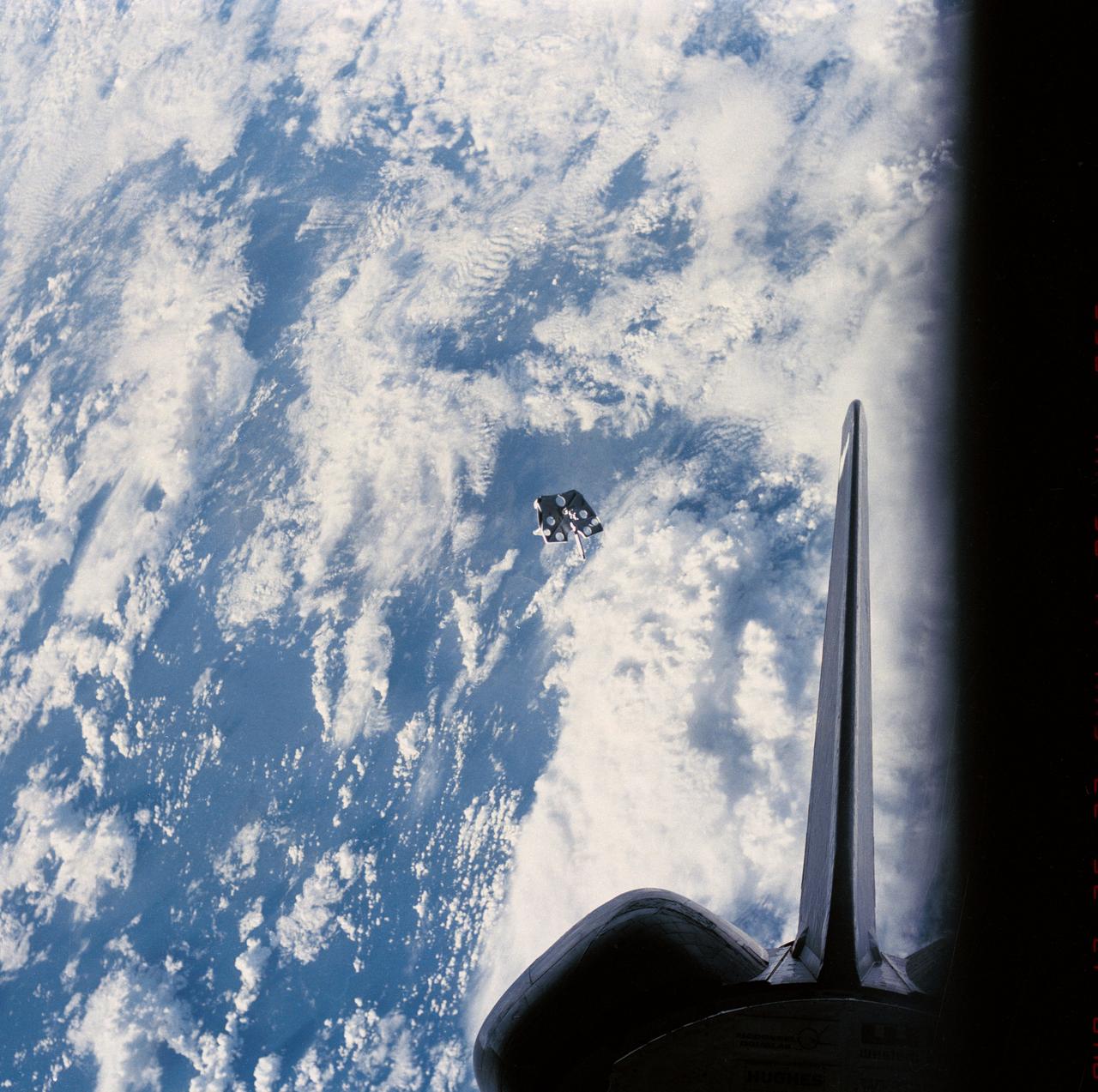
S84-27024 (7 Feb 1984) --- This 70mm frame centers on a foot restraint that strayed from the Earth-orbiting Space Shuttle Challenger during the February 9, 1984 extravehicular activity (EVA) session of astronauts Bruce McCandless II and Robert Stewart. As seen in JSC photograph frame number S84-27025, McCandless goes after the piece. Not pictured is Vance D. Brand, crew commander, who moved the spacecraft nearer the object.

STS007-26-1439 (18-24 June 1983) --- Astronaut John M. Fabian, STS-7 mission specialist, is captured with a 35mm camera at his sleep station in the middeck of the Earth-orbiting space shuttle Challenger. This scene was selected by the five-member astronaut crew for showing at its July 1, 1983 Post Flight Press Conference (PFPC) at the Johnson Space Center's (JSC) main auditorium. Photo credit: NASA

STS006-46-617 (4-9 April 1983) --- This view of sunset over the Amazon Basin was photographed with a 35mm camera from the Earth-orbiting space shuttle Challenger. The reusable vehicle was making its first trip into space and carried a crew of astronauts Paul J. Weitz, Karol J. Bobko, F. Story Musgrave and Donald H. Peterson. Photo credit: NASA
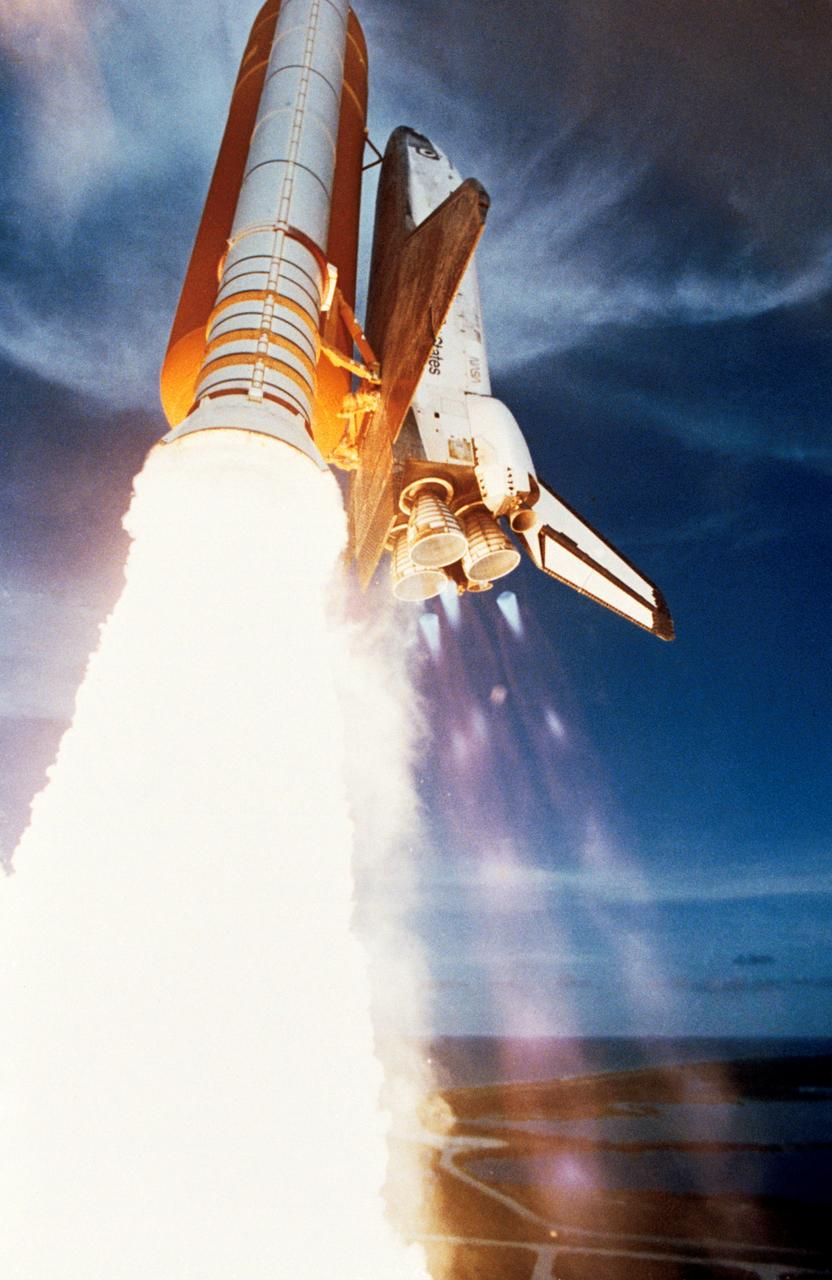
51F-S-157 (29 July 1985) --- Just moments following ignition, the Space Shuttle Challenger, mated to its two solid rocket boosters and an external fuel tank, soars toward a week-long mission in Earth orbit. Note the diamond shock effect in the vicinity of the three main engines. Launch occurred at 5:00 p.m. (EDT), July 29, 1985.
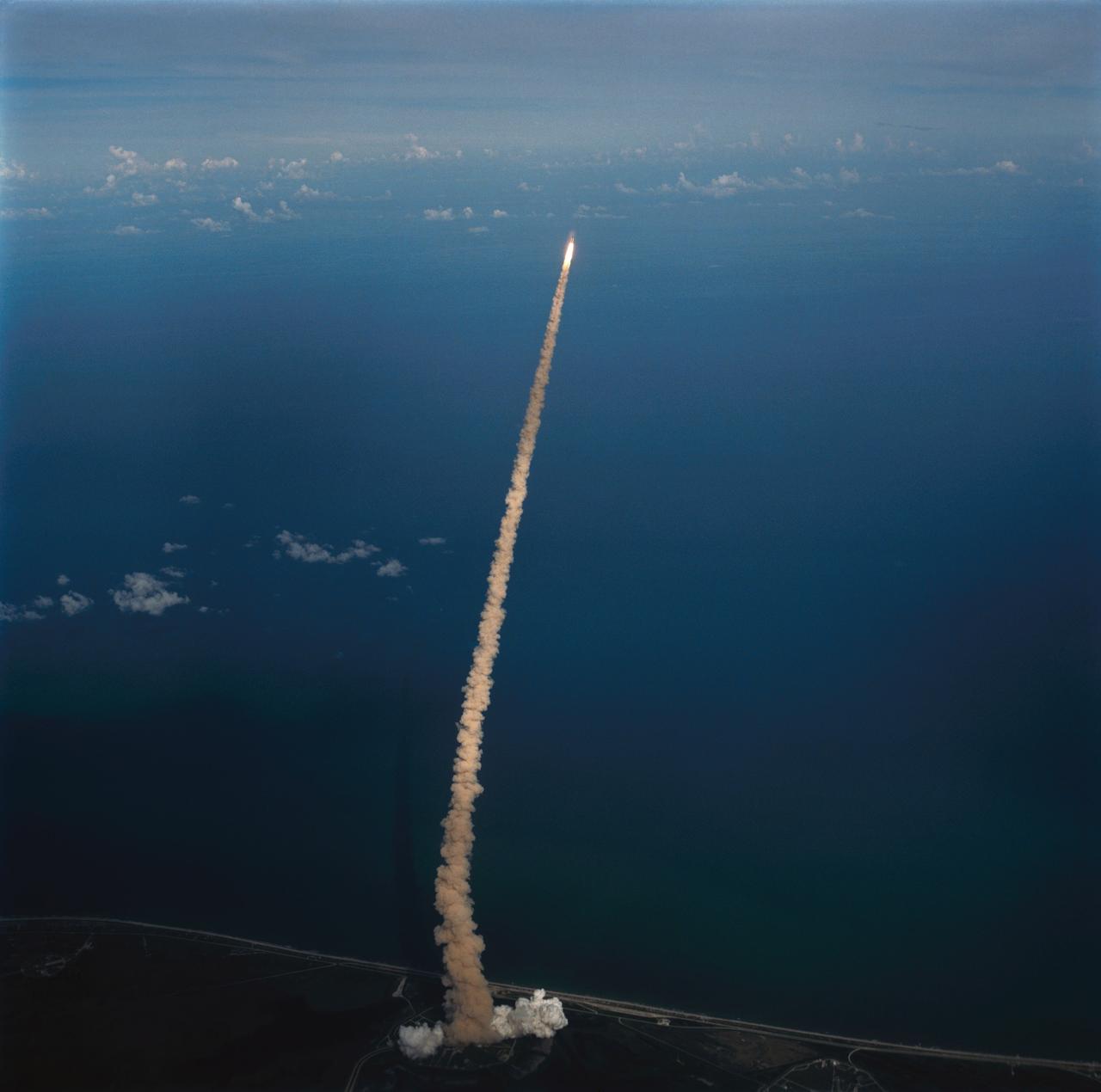
51F-S-038 (29 July 1985) ---An air-to-air view of the Space Shuttle orbiter Challenger, its two solid rocket boosters and external fuel tank moments after launch from Pad 39A at Kennedy Space Center (KSC). Astronaut John W. Young, veteran of two Shuttle flights and four other NASA missions, took the photograph with a handheld camera while piloting the Shuttle training aircraft. Launch occured at 5:00:00:423 p.m. (EDT), July 29, 1985.

41C-3029 (6 April 1984) --- The space shuttle Challenger and its five-member astronaut crew leave the launch pad at the Kennedy Space Center to begin a six-day stay in space. Astronaut John W. Young, a veteran of two shuttle missions and six spaceflights overall, recorded the image with a handheld 70mm camera from the shuttle training aircraft which he was using to monitor environmental conditions around Florida. This is the eighth mission on which Young photographed one of NASA's orbiter vehicles beginning its orbital stay. Photo credit: NASA
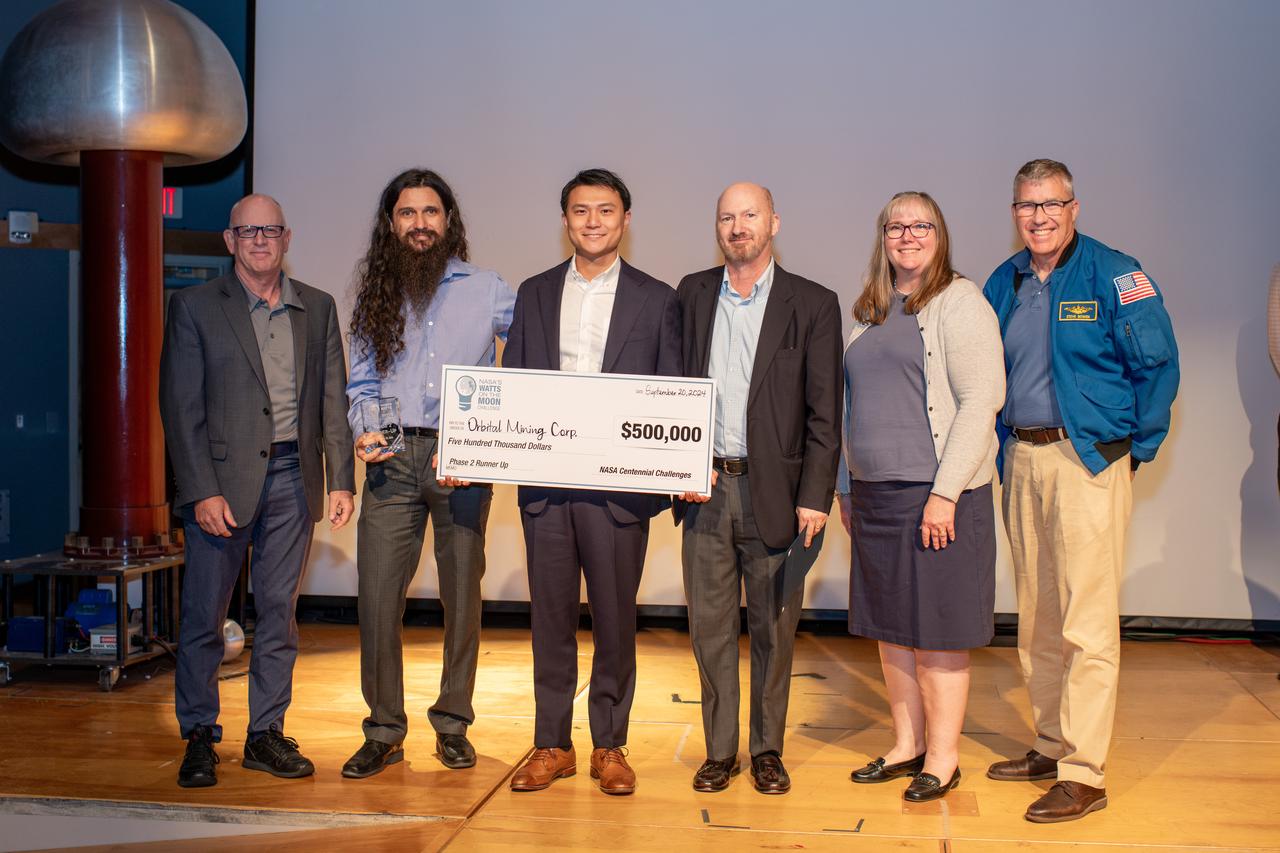
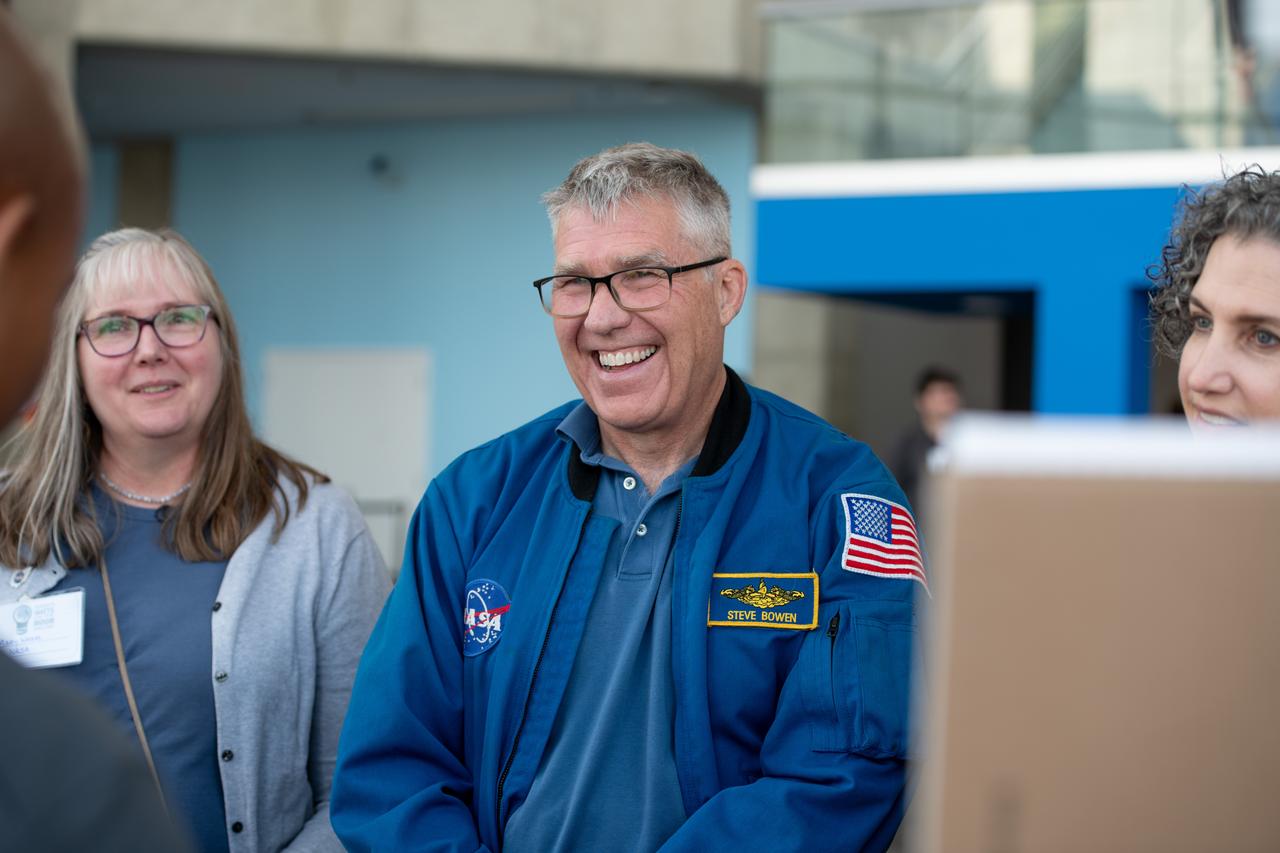
Individuals from Orbital Mining Corporation of Golden, Colorado pose with Robert Button, Mary Wadel and Astronaut Stephen Bowen. NASA has awarded a total of $1.5 million to two U.S. teams for their novel technology solutions addressing energy distribution, management, and storage as part of the agency’s Watts on the Moon Challenge. The innovations from this challenge aim to support NASA’s Artemis missions, which will establish long-term human presence on the Moon. This two-phase competition has challenged U.S. innovators to develop breakthrough power transmission and energy storage technologies that could enable long-duration Moon missions to advance the nation’s lunar exploration goals. The final phase of the challenge concluded with a technology showcase and winners’ announcement ceremony Friday at Great Lakes Science Center, home of the visitor center for NASA’s Glenn Research Center in Cleveland. Team H.E.L.P.S. (High Efficiency Long-Range Power Solution) from The University of California, Santa Barbara won the $1 million grand prize in NASA’s Watts on the Moon Challenge. Their team developed a low-mass, high efficiency cable and featured energy storage batteries on both ends of their power transmission and energy storage system. Second prize ($500,000): Orbital Mining Corporation of Golden, Colorado
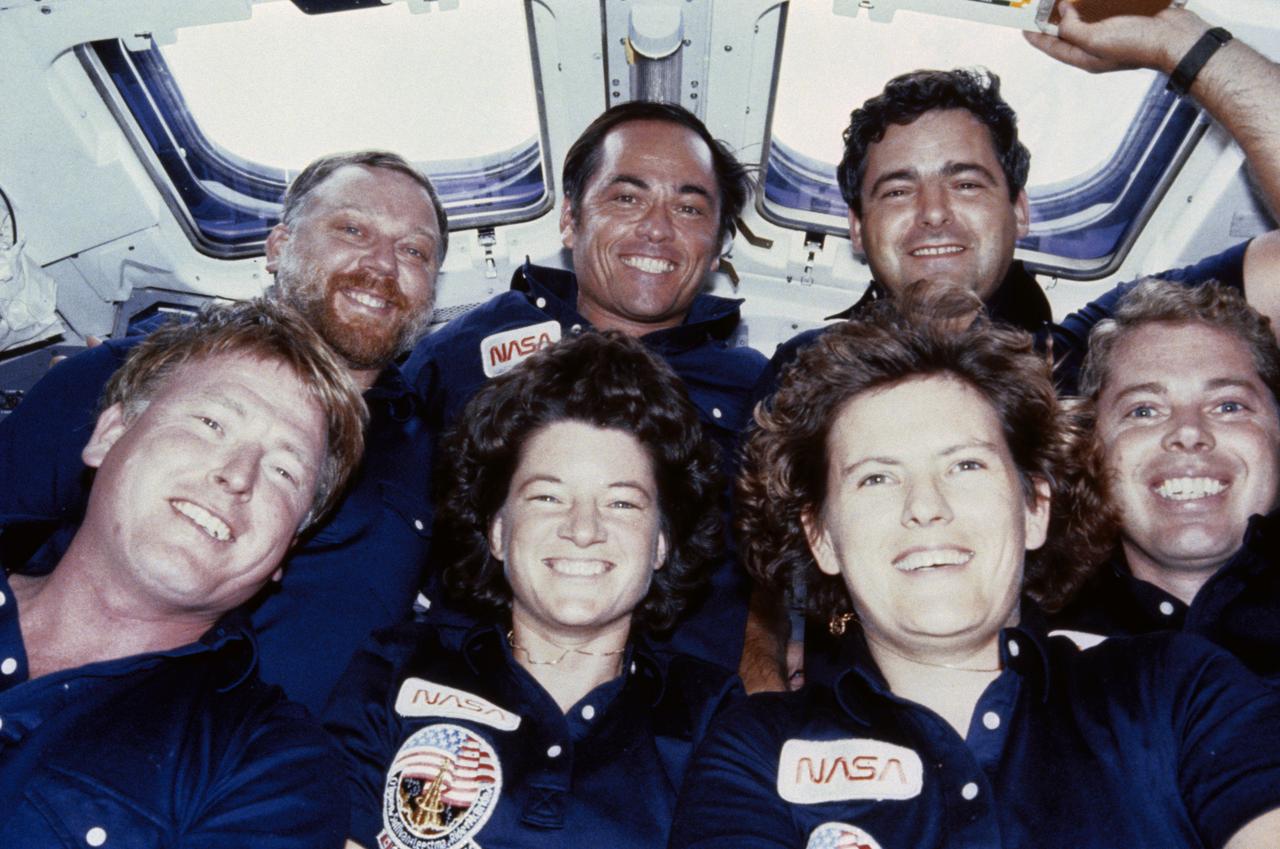
41G-19-006 (5-13 Oct. 1984) --- The seven-member 41-G crew assembles for a group shot on the flight deck of the Earth-orbiting space shuttle Challenger. Robert L. Crippen, commander, is in center of the back row. Others pictured are (front row, l.-r.) Jon A. McBride, pilot; Sally K. Ride, Kathryn D. Sullivan and David C. Leestma, all mission specialists; and Paul D. Scully-Power (left) and Marc Garneau, both payload specialists, on the back row. Garneau represents the National Research Council of Canada and Scully-Power is a civilian oceanographer with the U.S. Navy. Photo credit: NASA
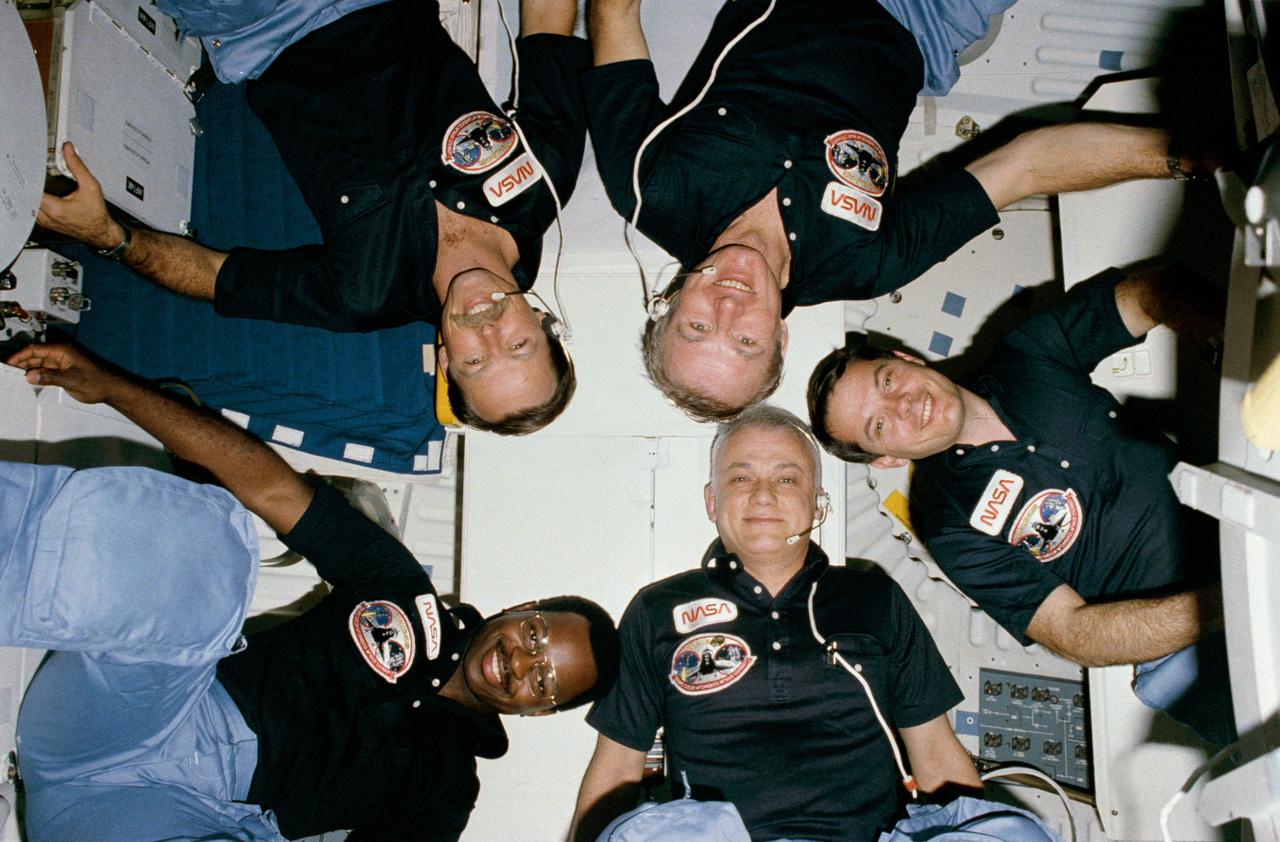
S84-27026 (3-11 Feb. 1984) --- The "star burst" type informal portrait of Space Shuttle crews has become somewhat of a tradition and the five-member STS-41B crew is no exception. HOLD PICTURE WITH SEMI-CIRCLE AT LOWER RIGHT CORNER. Counter clockwise from the lower left are Astronauts Vance D. Brand commander; Robert L. Gibson, pilot; and Dr. Ronald E. McNair; Bruce McCandless II and Robert L. Stewart, all mission specialists. The five are on the mid-deck of the Earth-orbiting Challenger. The "semi-circle" is actually part of the monodisperse latex reactor (MLR) experiment. A pre-set 35mm camera was triggered automatically to expose the frame.
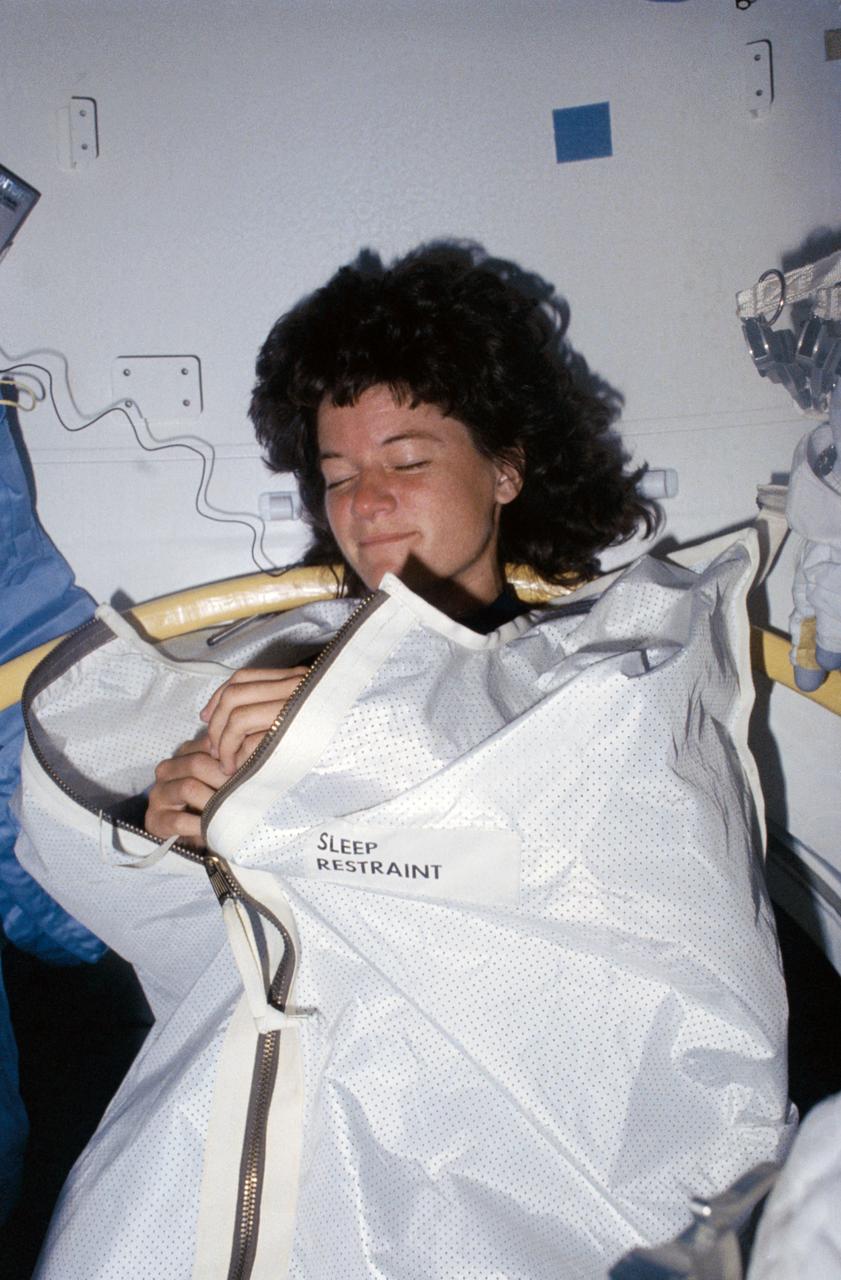
STS007-26-1438 (18-24 June 1983) --- Astronaut Sally K. Ride, mission specialist, was captured at her sleep station in the Space Shuttle Challenger's middeck by a fellow crew member using a 35mm camera. This method of sleep is just one used by the 20 astronauts who have now flown aboard NASA's first two Space Shuttle Orbiters. Some astronauts choose to sleep in various positions with either their feet or upper bodies or both anchored and others elect to use the sleep restraint device demonstrated here by Dr. Ride.

S83-35782 (18 June 1983) --- An Orbital Maneuvering System (OMS) engine firing caused this bright glow at the aft end of the Earth-orbiting space shuttle Challenger on June 18, 1983. Also visible in the 70mm exposure are parts of the Shuttle Pallet Satellite (SPAS-01). The experiment package for NASA's Office of Space and Terrestrial Applications (OSTA-2), the protective cradles for the Indonesian Palapa-B and Telesat Canada Anik C2 satellites, some getaway special (GAS) canisters and the Canadian-built Remote Manipulator System (RMS). The firing took place less than an hour after deployment of Anik. Photo credit: NASA
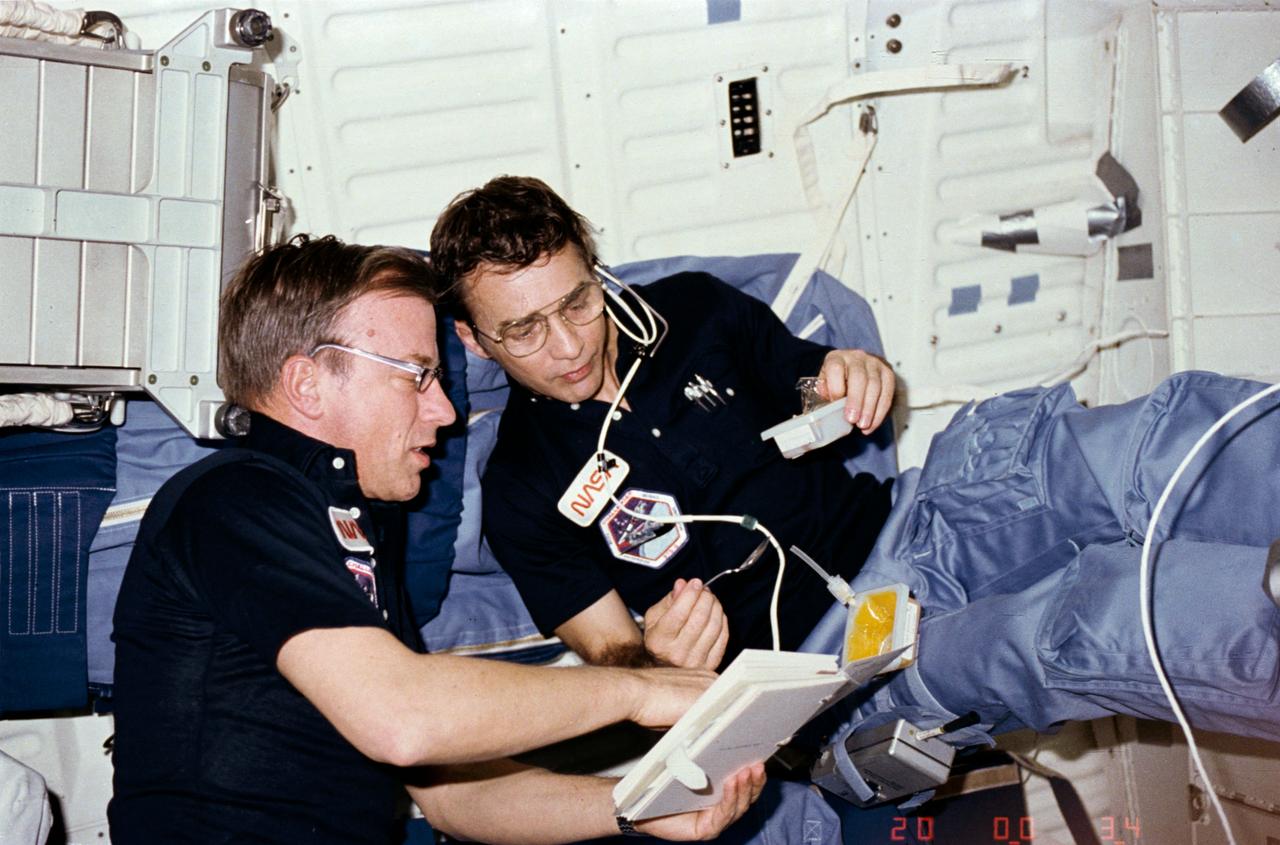
STS006-06-456 (4-9 April 1983) --- Astronaut Paul J. Weitz, STS-6 commander, points out an item in the crew activity plan (CAP) to astronaut Donald H. Peterson as the mission specialist uses a spoon to eat a meal aboard the Earth-orbiting space shuttle Challenger. The two are on the middeck. They are wearing the shirt and trouser portions of the blue cotton multi-piece constant wear garments. This frame was photographed with a 35mm camera. Photo credit: NASA
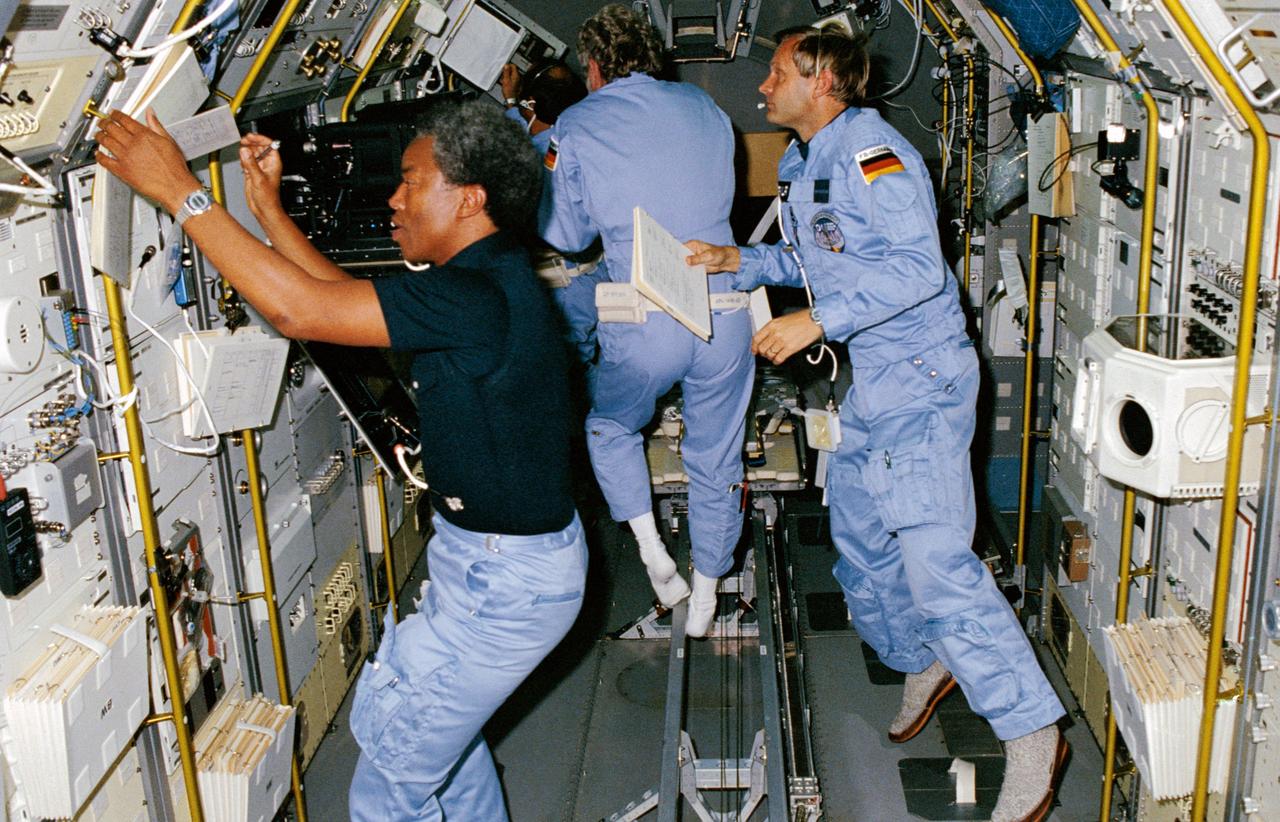
61A-01-030 (30 Oct.-6 Nov. 1985) --- Mission specialist Guion S. Bluford prepares to perform a physics experiment onboard the D-1 science module in the cargo bay of the earth-orbiting Space Shuttle Challenger. In the backgroud, three European payload specialists busy themselves with experiment chores: (L-R) Wubbo J. Ockels (partially obscured), Reinhard Furrer and Ernst Messerschmid.
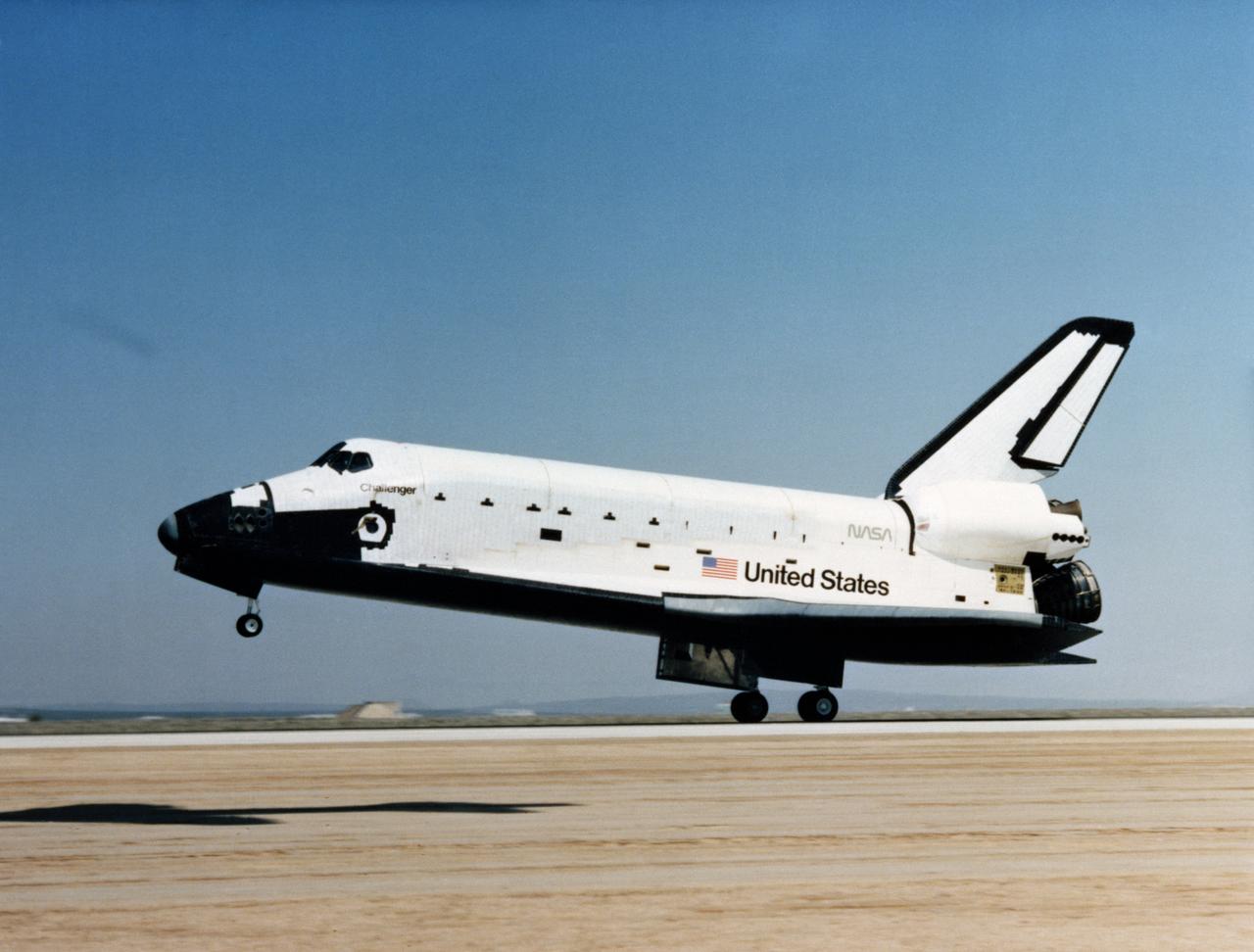
S83-30220 (9 April 1983) --- The space shuttle Challenger makes its first landing shortly before 11 a.m. (PST) on April 9, 1983, on Runway 22 at the Edwards Air Force Base in Southern California. Onboard the reusable spacecraft, having just completed a successful five-day mission, are astronauts Paul J. Weitz, Karol J. Bobko, F. Story Musgrave and Donald H. Peterson. Photo credit: NASA
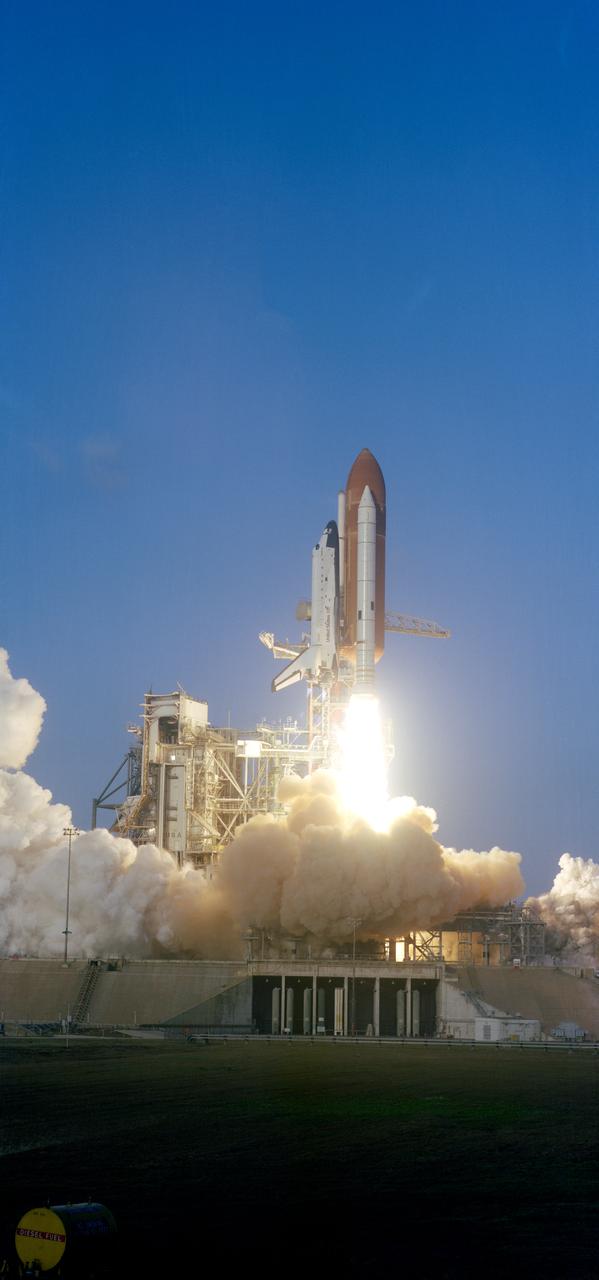
S84-26327 (3 Feb. 1984) --- Beginning a busy year, NASA's space shuttle Challenger, attached to two solid rocket boosters and an external fuel tank which it will later jettison, blasts off from Pad A at Kennedy Space Center's Launch Complex 39 at 8:00 a.m. (EST), Feb. 3, 1984. Inside the STS 41-B spacecraft are astronauts Vance D. Brand, Robert L. Gibson, Bruce McCandless II, Ronald E. McNair and Robert L. Stewart. Brand is making his first trip in the Challenger but his second STS flight and third spaceflight overall. The rest of the crew members are experiencing space travel for the first time. Marking a space first, this flight will be landing at KSC. Photo credit: NASA
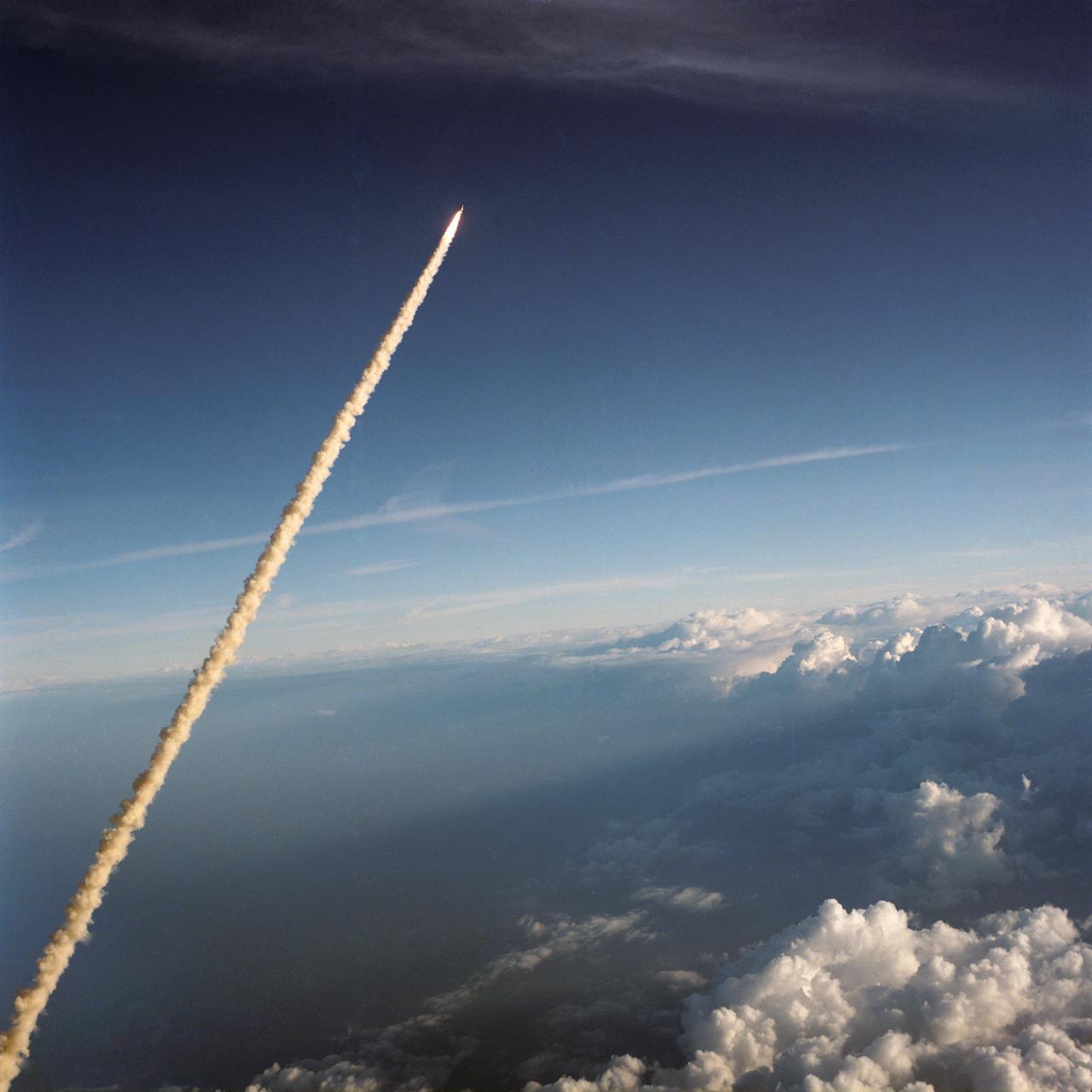
S84-26294 (3 Feb 1984) --- This scenic panorama of billowy clouds over the Atlantic and Florida and the contrasting addition of mankind's technology into the picture was provided by astronaut John W. Young and a handheld camera in the cockpit of NASA's Shuttle Training Aircraft (STA) moments after the 226 tons of spacecraft hardware were lifted off Kennedy Space Center's (KSC) Launch Pad 39A. Inside the Space Shuttle Challenger (STS 41-B), attached here to its two Solid Rocket Boosters (SRB) and External Fuel Tank (ET), were astronauts Vance D. Brand, Robert L. Gibson, Ronald E. McNair, Bruce McCandless II and Robert L. Stewart.
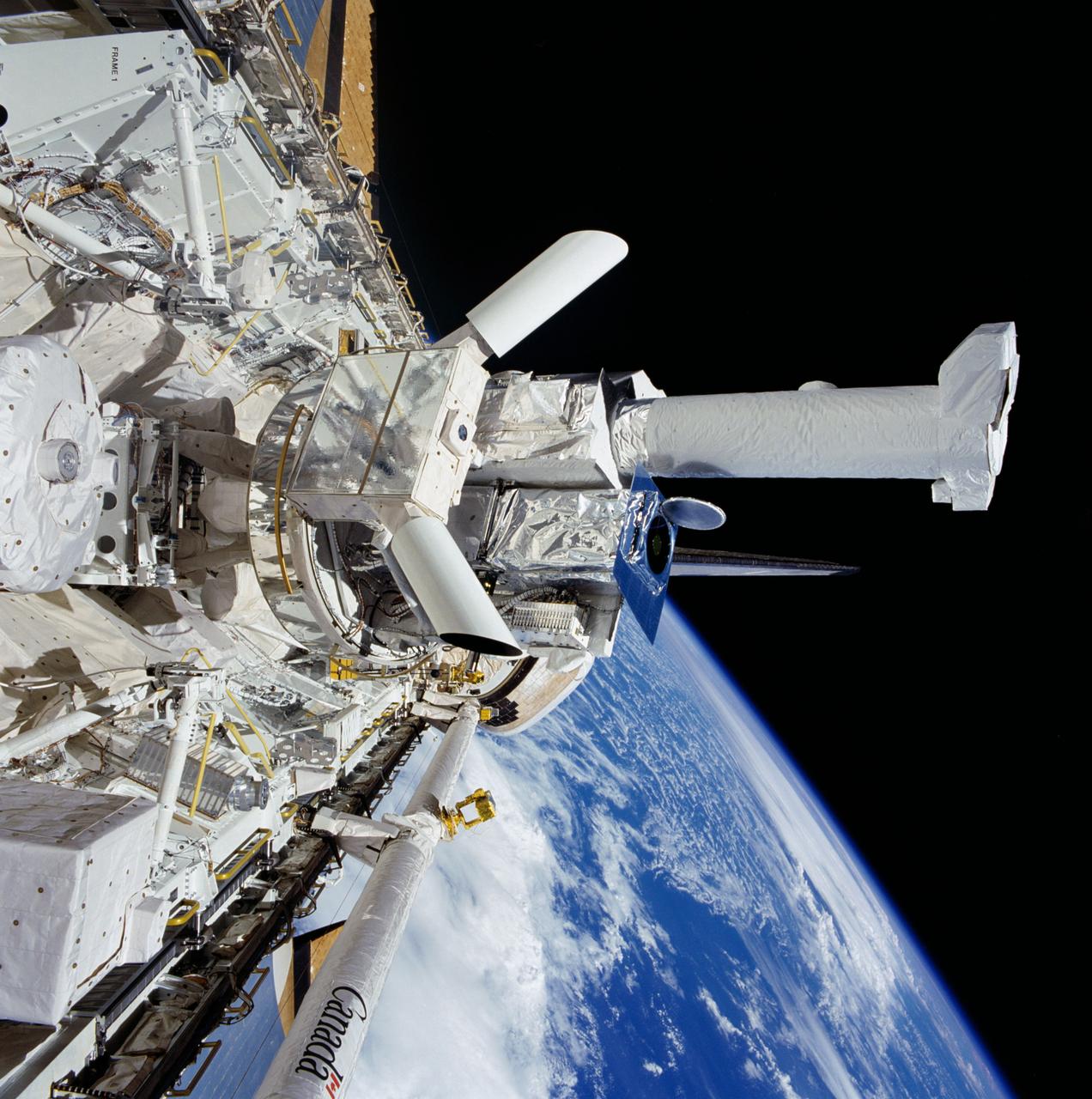
51F-42-069 (29 July-6 Aug 1985) --- The solar optical universal polarimeter (SOUP) experiment is visible among the cluster of Spacelab 2 hardware in the cargo bay of the Earth-orbiting Space Shuttle Challenger, backdropped against a curtain of white clouds over ocean waters. Various components of the instrument positioning system (IPS) are conspicuous at the center of the frame. Now resting, the remote manipulator system (RMS) was used at various points during the mission with the plasma diagnostics package (PDP) and as a support service structure for television cameras covering various activities of the busy science-oriented Spacelab 2 mission.
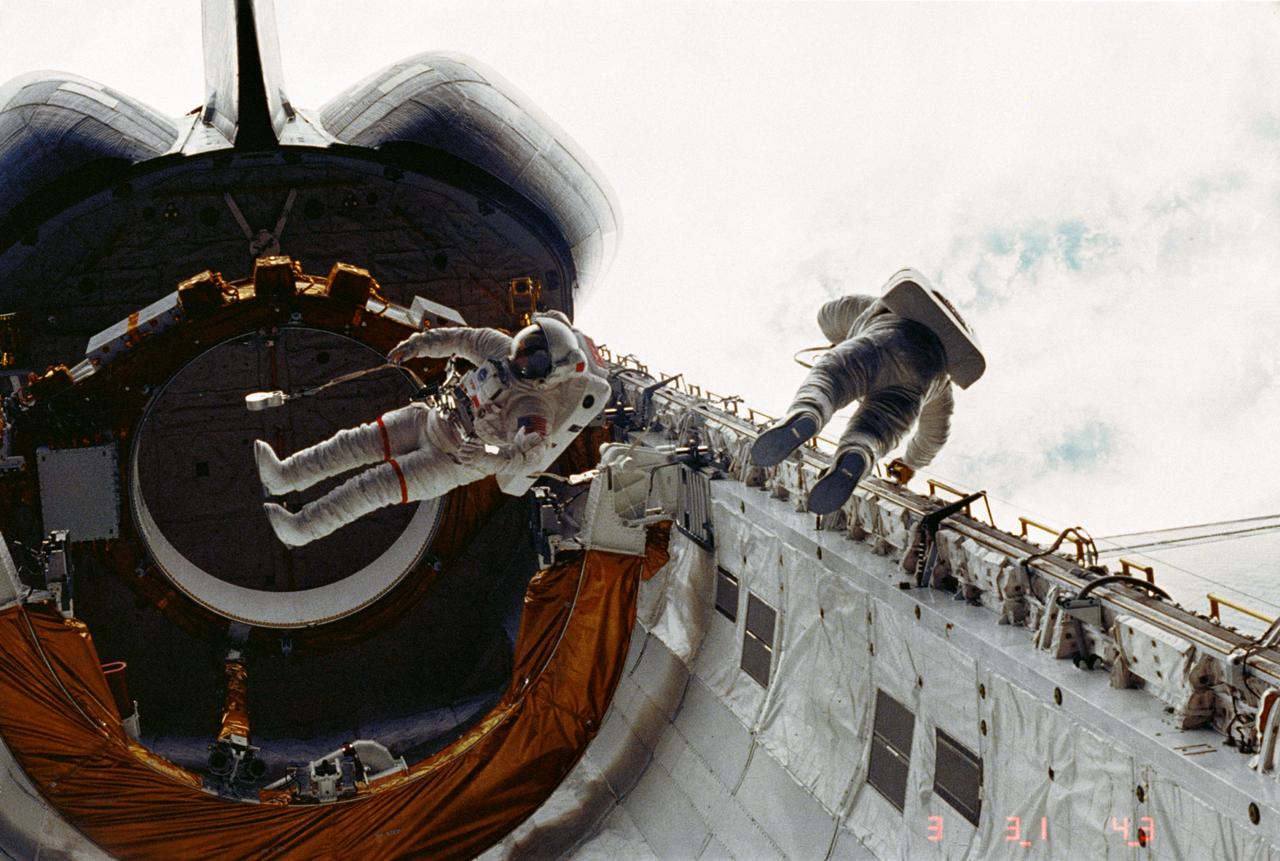
STS006-10-417 (7 April 1983) --- Astronauts F. Story Musgrave, left, and Donald H. Peterson float about in the cargo bay of the Earth-orbiting space shuttle Challenger during their April 7, 1983, extravehicular activity (EVA). Their "floating about" is restricted via tethers to safety slide wires. Thanks to the tether/slide wire combination, Peterson is able to translate along the port side hand rails. Musgrave is near the Airborne Support Equipment (ASE) for the now vacated Inertial Upper Stage (IUS). Clouds can be seen in the background. Photo credit: NASA
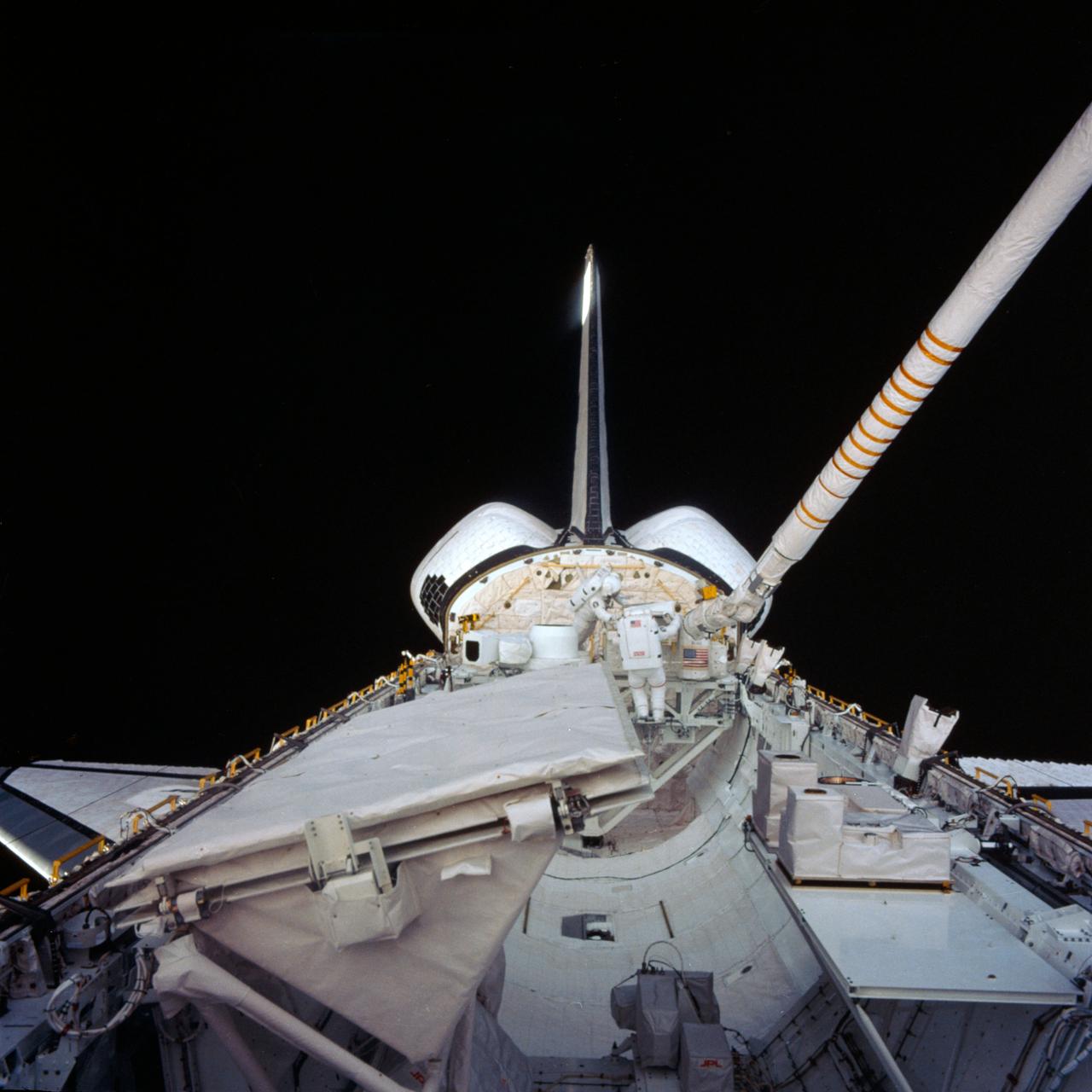
S84-43432 (11 Oct. 1984) --- Appearing small in the center background of this image, astronauts Kathryn D. Sullivan, left, and David C. Leestma, both 41-G mission specialists, perform an in-space simulation of refueling another spacecraft in orbit. Their station on the space shuttle Challenger is the orbital refueling system (ORS), positioned on the mission peculiar support structure (MPR ESS). The Large Format Camera (LFC) is left of the two mission specialists. In the left foreground is the antenna for the shuttle imaging radar (SIR-B) system onboard. The Canadian-built remote manipulator system (RMS) is positioned to allow close-up recording capability of the busy scene. A 50mm lens on a 70mm camera was used to photograph this scene. Photo credit: NASA
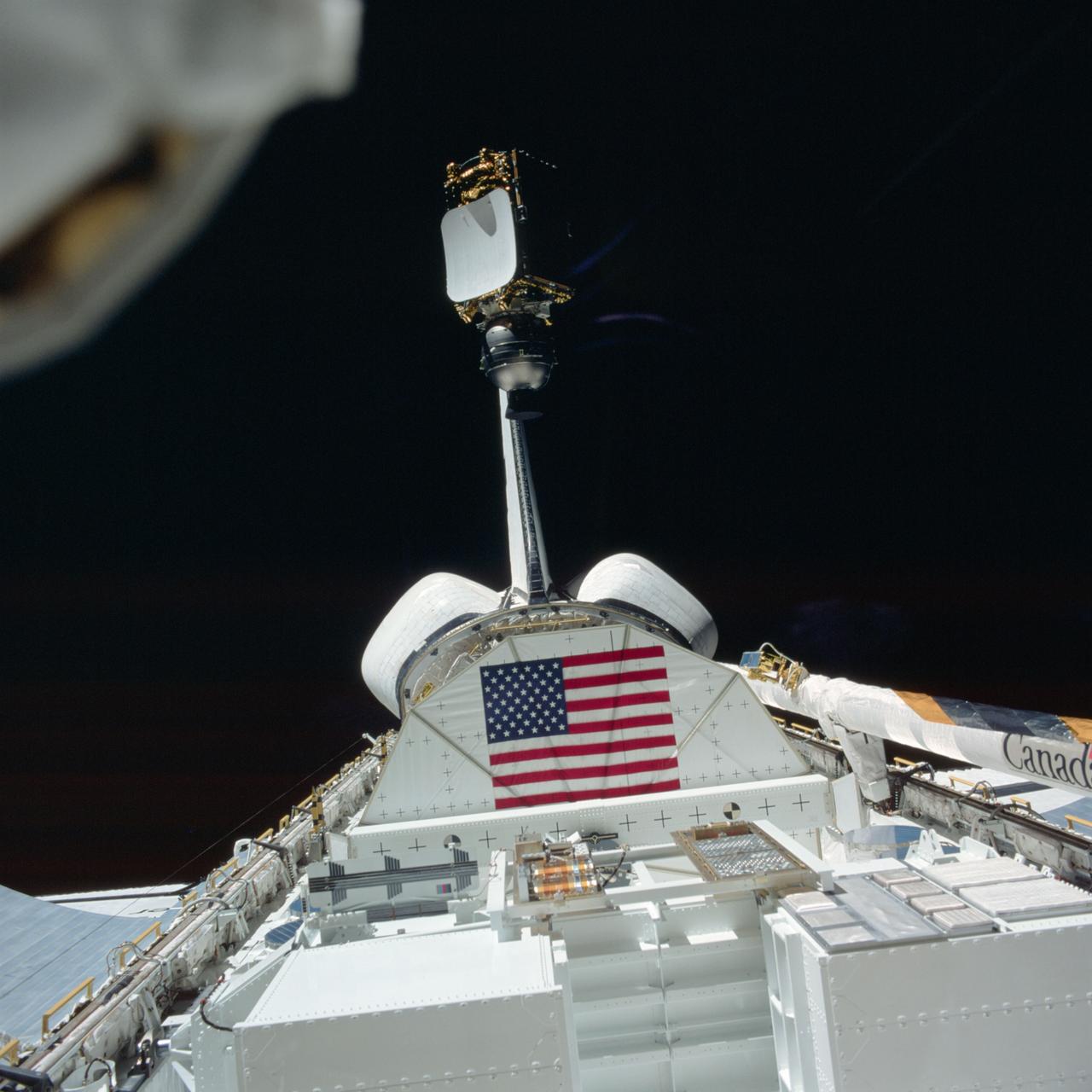
STS008-49-1722 (30 Aug-5 Sept 1983) --- The Indian National Satellite (INSAT) is about to clear the Earth-orbiting Space Shuttle Challenger this 70mm frame exposed with a handheld camera from the aft flight deck. The Payload Flight Test Article (PFTA) displays the United States flag in the middle of the cargo bay and the Canadian built Remote Manipulator System (RMS) appears to be waiting for its busy agenda of activity with the barbell-shaped test device.
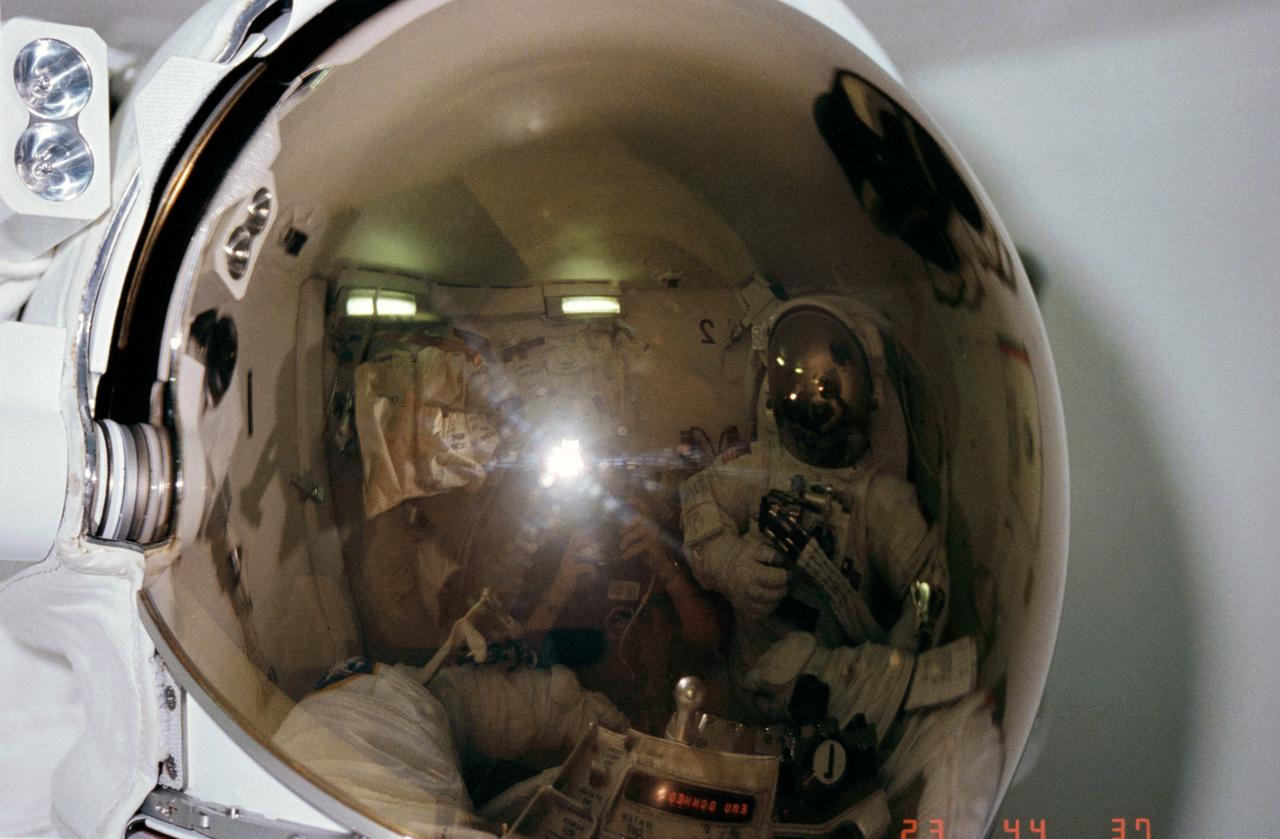
STS006-06-465 (7 April 1983) --- Three-fourths of the STS-6 astronaut crew appears in this unusual 35mm frame exposed in the airlock of the Earth-orbiting space shuttle Challenger. Astronaut F. Story Musgrave’s helmet visor encompasses all the action in the frame. Dr. Musgrave and astronaut Donald H. Peterson (reflected on right side of the visor) were fully suited in their Extravehicular Mobility Unit (EMU) spacesuits and were participating in EVA preparation exercises. Astronaut Karol J. Bobko, STS-6 pilot, wearing conventional onboard shuttle clothing, photographed the two during their procedures and appears at center of frame. The reversed number (1 and 2 in the mirrored image represent the EVA designations for the two mission specialists. Photo credit: NASA
![STS-7, Orbiter Challenger in orbit, taken from camera aboard Shuttle Pallet Satellite (SPAS) [Germany]](https://images-assets.nasa.gov/image/335891/335891~medium.jpg)
STS-7, Orbiter Challenger in orbit, taken from camera aboard Shuttle Pallet Satellite (SPAS) [Germany]
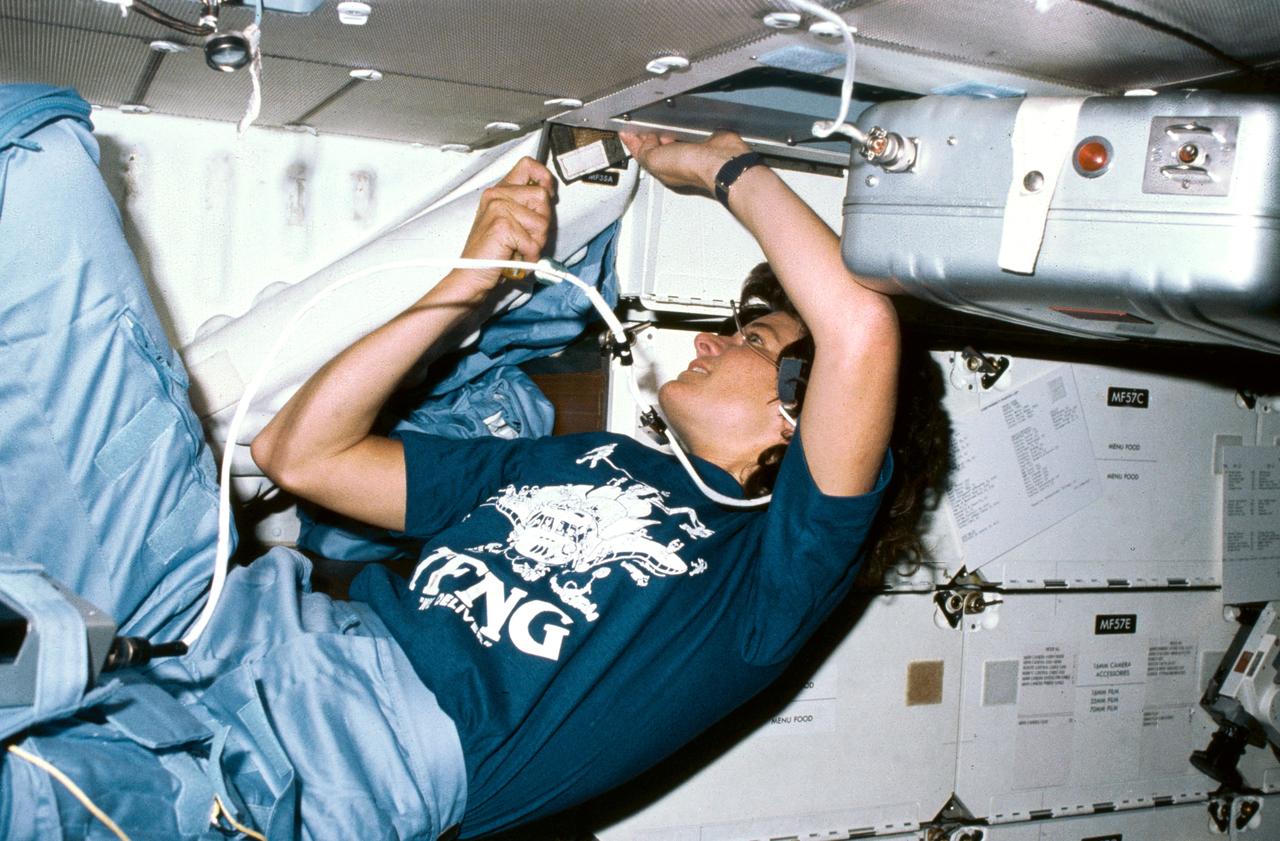
S83-35768 (18-24 June 1983) --- Astronaut Sally K. Ride, mission specialist for STS-7, uses a screw driver in order to clean out an air filtering system in the mid-deck of the Earth-orbiting Space Shuttle Challenger. Dr. Ride's constant wear garment bears some extras -- a cartoon of 35 busy astronauts around a Space Shuttle and the acronym TFNG, below which is written, "We deliver!" TFNG stands for thirty-five new guys, referring to the 1978 class of astronaut candidates (ASCAN) from which Dr. Ride and three of her crew members hail. The tiny two-word declarative in white lettering refers to the successful deployment of two communications satellites. This photograph was made with a 35mm camera.
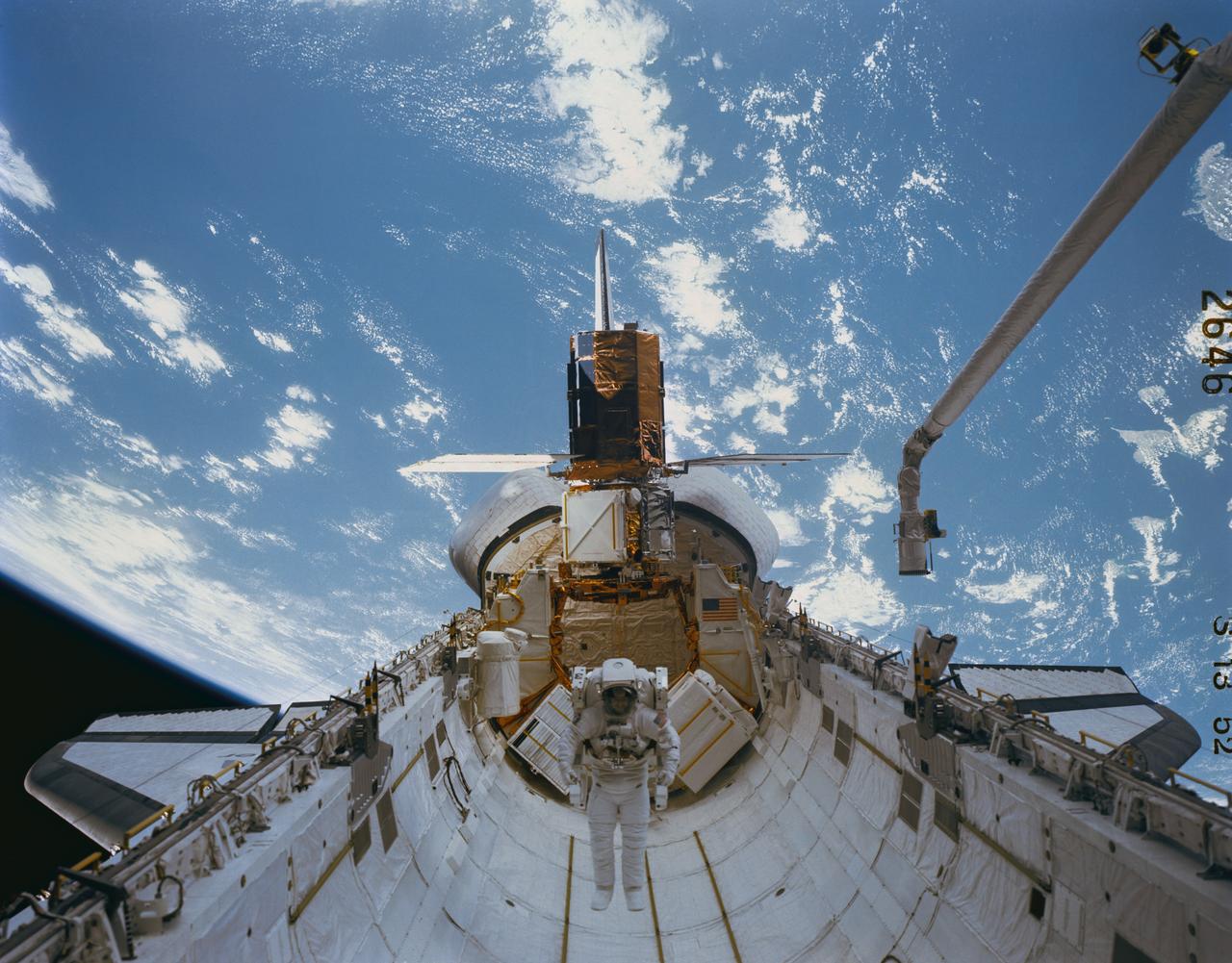
41C-52-2646 (11 April 1984) --- Astronaut James D. van Hoften and a repaired satellite are in a wide panorama recorded on film with a Linhof camera, making its initial flight aboard the Space Shuttle Challenger. Dr. van Hoften is getting in his first "field" test of the Manned Maneuvering Unit (MMU) after months of training in an underwater facility and in a simulator on Earth. The Solar Maximum Mission Satellite (SMMS), revived and almost ready for release into space once more, is docked at the Flight Support System (FSS). The Remote Manipulator System (RMS) is backdropped against the blue and white Earth at frame's edge. Outside of pictures made of the Earth from astronauts on the way to the Moon, this frame showing the planet from 285 nautical miles represents the highest orbital photography in the manned space program.
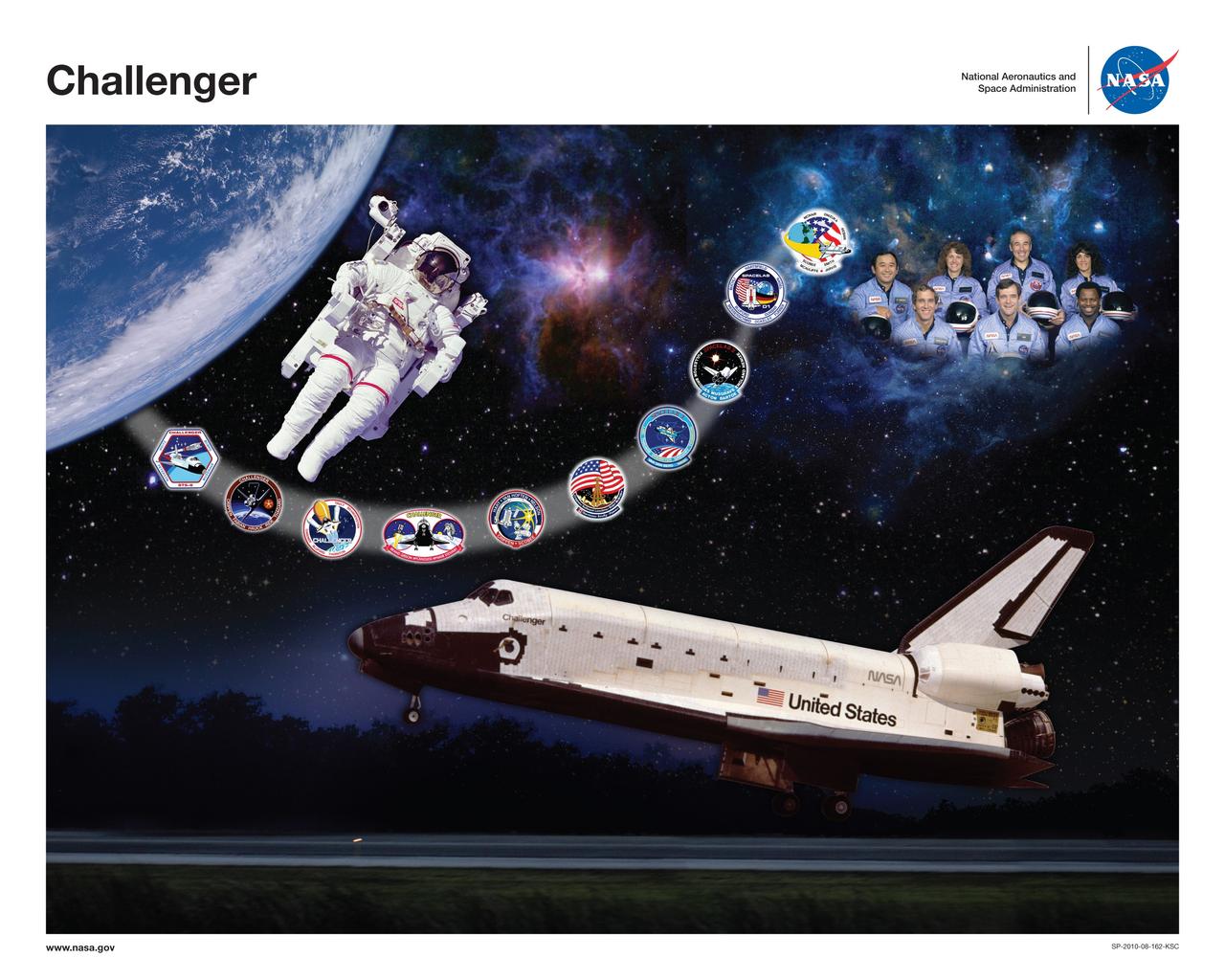
CAPE CANAVERAL, Fla. -- This is a version of space shuttle Challenger's orbiter tribute, or OV-099, which hangs in Firing Room 4 of the Launch Control Center at NASA's Kennedy Space Center in Florida. Challenger's accomplishments include the first night launch and first African-American in space, Guion Bluford, on STS-8, the first in-flight capture, repair and redeployment of an orbiting satellite during STS-41C, the first American woman in space, Sally Ride, on STS-7, and the first American woman to walk in space, Kathryn Sullivan, during STS-41G. Challenger is credited with blazing a trail for NASA's other orbiters with the first night landing at Edwards Air Force Base in California on STS-8 and the first landing at Kennedy on STS-41B. The spacewalker in the tribute represents Challenger’s role in the first spacewalk during STS-6 and the first untethered spacewalk on STS-41B. Crew-designed patches for each of Challenger’s missions lead from Earth toward a remembrance of the STS-51L crew, which was lost 73 seconds after liftoff on Jan. 28, 1986. Five orbiter tributes are on display in the firing room, representing Atlantis, Challenger, Columbia, Endeavour and Discovery. Graphic design credit: NASA/Lynda Brammer. NASA publication number: SP-2010-08-162-KSC
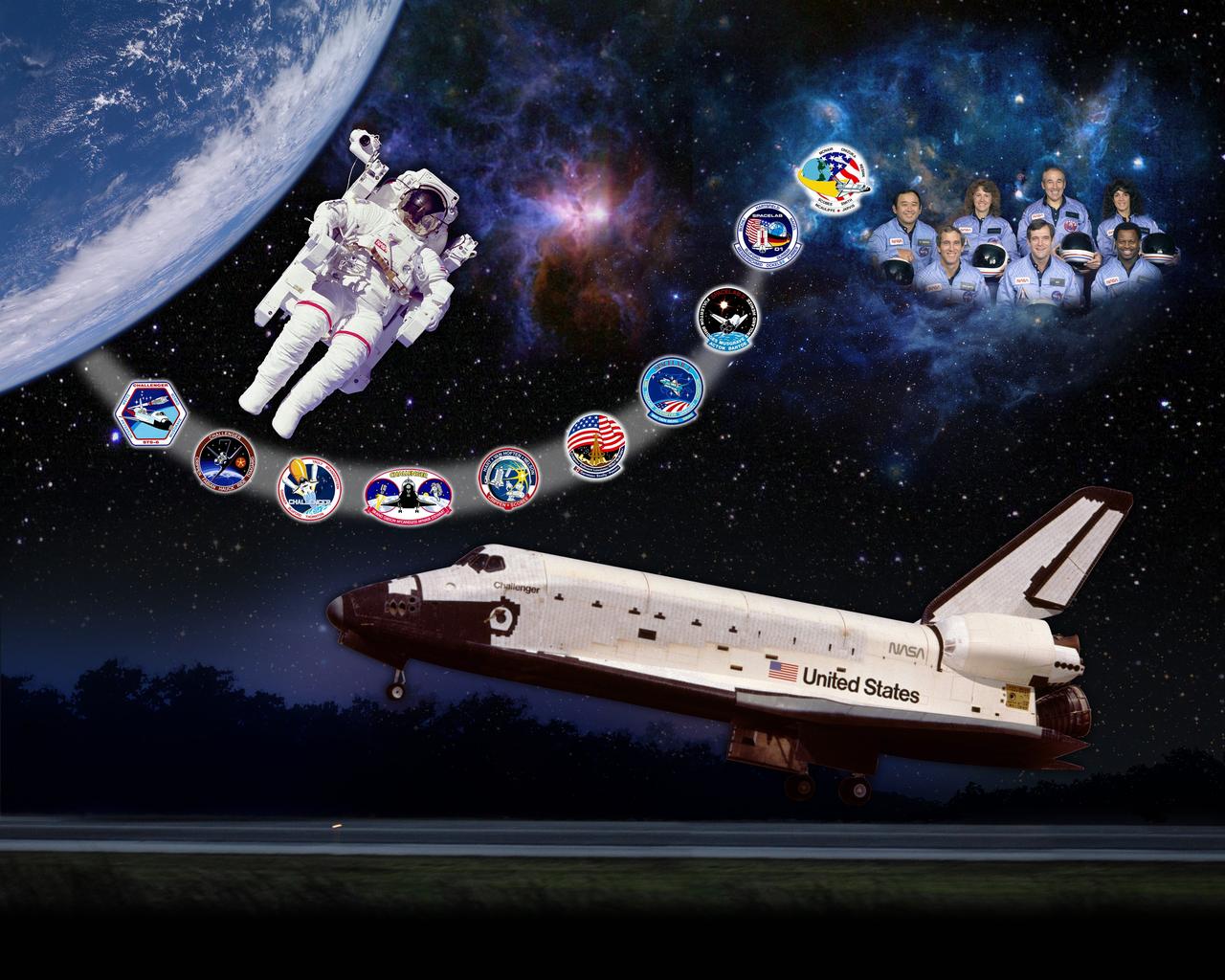
CAPE CANAVERAL, Fla. -- This orbiter tribute of space shuttle Challenger, or OV-099, hangs in Firing Room 4 of the Launch Control Center at NASA's Kennedy Space Center in Florida. Challenger's accomplishments include the first night launch and first African-American in space, Guion Bluford, on STS-8, the first in-flight capture, repair and redeployment of an orbiting satellite during STS-41C, the first American woman in space, Sally Ride, on STS-7, and the first American woman to walk in space, Kathryn Sullivan, during STS-41G. Challenger is credited with blazing a trail for NASA's other orbiters with the first night landing at Edwards Air Force Base in California on STS-8 and the first landing at Kennedy on STS-41B. The spacewalker in the tribute represents Challenger’s role in the first spacewalk during STS-6 and the first untethered spacewalk on STS-41B. Crew-designed patches for each of Challenger’s missions lead from Earth toward a remembrance of the STS-51L crew, which was lost 73 seconds after liftoff on Jan. 28, 1986. Five orbiter tributes are on display in the firing room, representing Atlantis, Challenger, Columbia, Endeavour and Discovery. Graphic design credit: NASA/Lynda Brammer
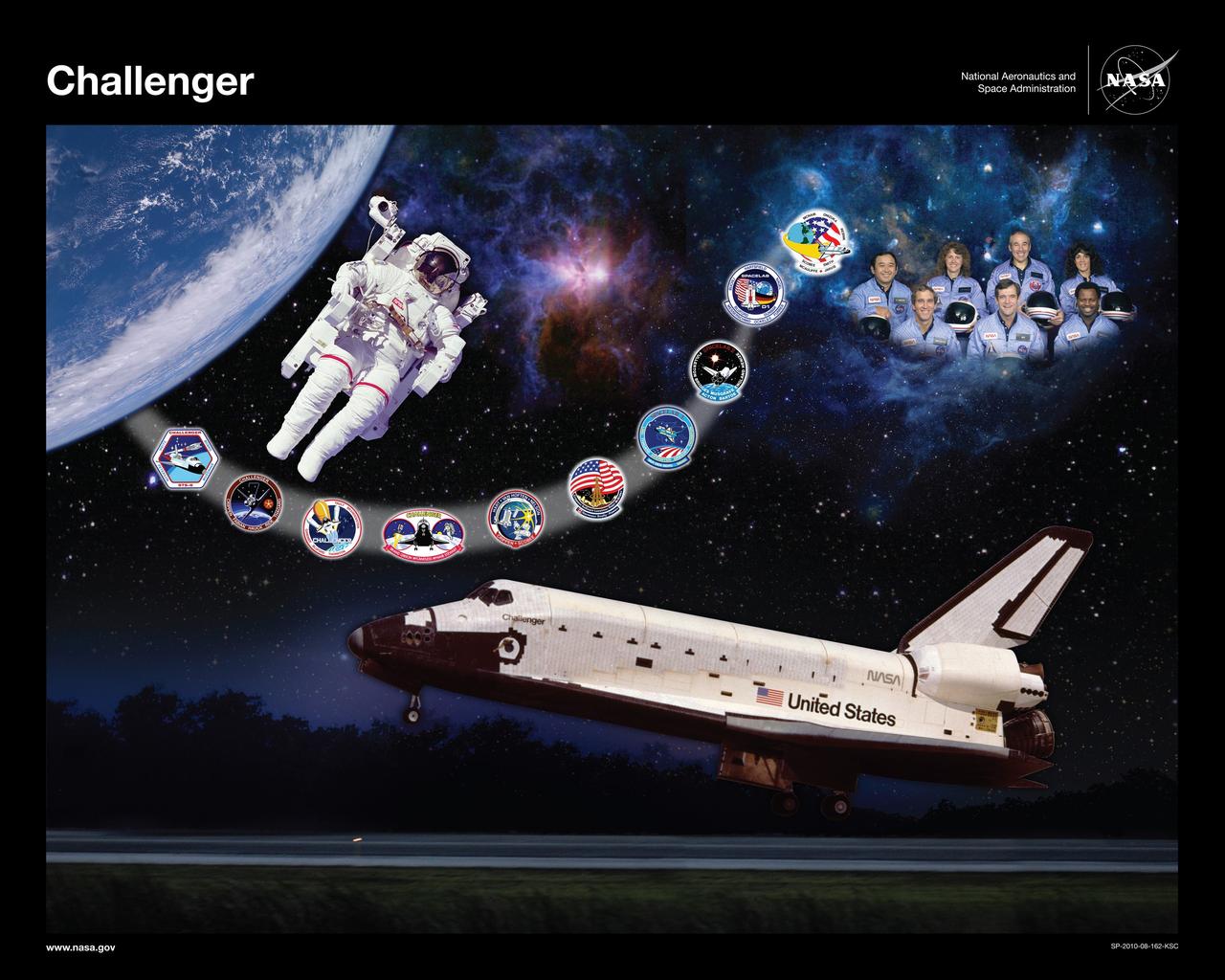
CAPE CANAVERAL, Fla. -- This is a printable version of space shuttle Challenger's orbiter tribute, or OV-099, which hangs in Firing Room 4 of the Launch Control Center at NASA's Kennedy Space Center in Florida. Challenger's accomplishments include the first night launch and first African-American in space, Guion Bluford, on STS-8, the first in-flight capture, repair and redeployment of an orbiting satellite during STS-41C, the first American woman in space, Sally Ride, on STS-7, and the first American woman to walk in space, Kathryn Sullivan, during STS-41G. Challenger is credited with blazing a trail for NASA's other orbiters with the first night landing at Edwards Air Force Base in California on STS-8 and the first landing at Kennedy on STS-41B. The spacewalker in the tribute represents Challenger’s role in the first spacewalk during STS-6 and the first untethered spacewalk on STS-41B. Crew-designed patches for each of Challenger’s missions lead from Earth toward a remembrance of the STS-51L crew, which was lost 73 seconds after liftoff on Jan. 28, 1986. Five orbiter tributes are on display in the firing room, representing Atlantis, Challenger, Columbia, Endeavour and Discovery. Graphic design credit: NASA/Lynda Brammer. NASA publication number: SP-2010-08-162-KSC
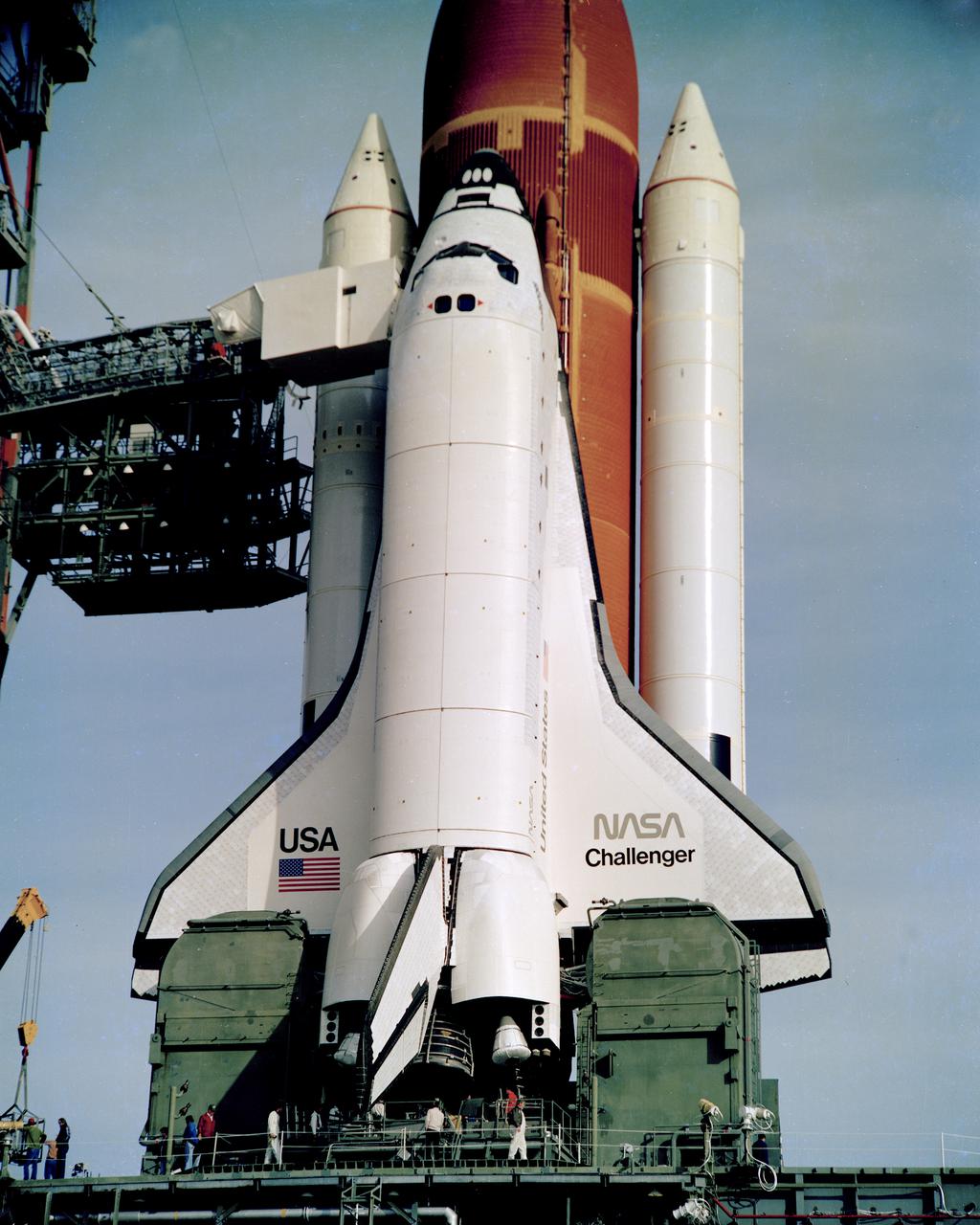
CAPE CANAVERAL, Fla. – STS-6 orbiter Challenger on Complex 39A with rotating service structure retracted. Photo credit: NASA
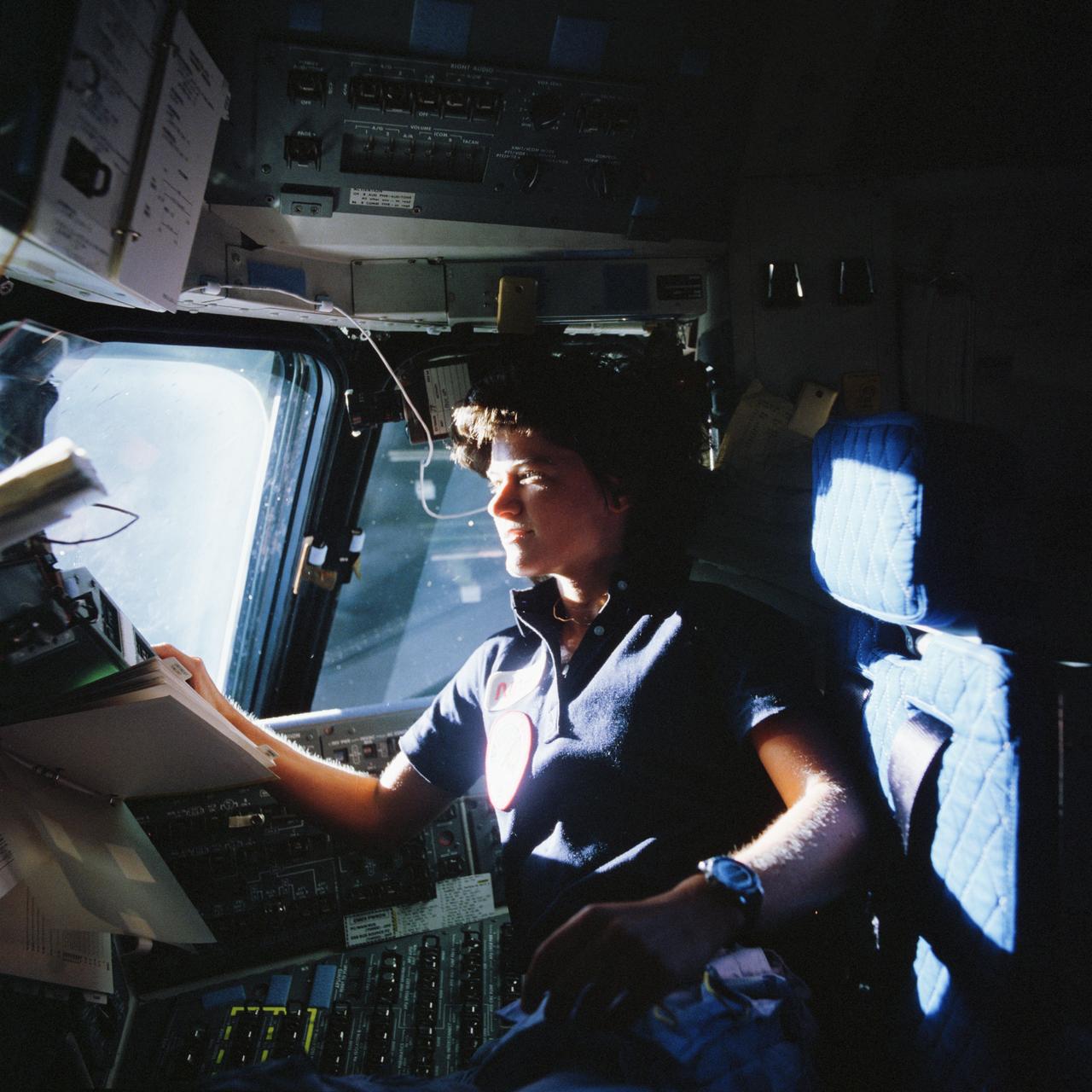
STS007-05-029 / S83-35783(5-13 Oct 1984) --- Astronaut Sally K. Ride, mission specialist, is shown here sitting in the front seat and looking out the windows of the Earth-orbiting Space Shuttle Challenger. Ride and four other crew members are onboard the Challenger.
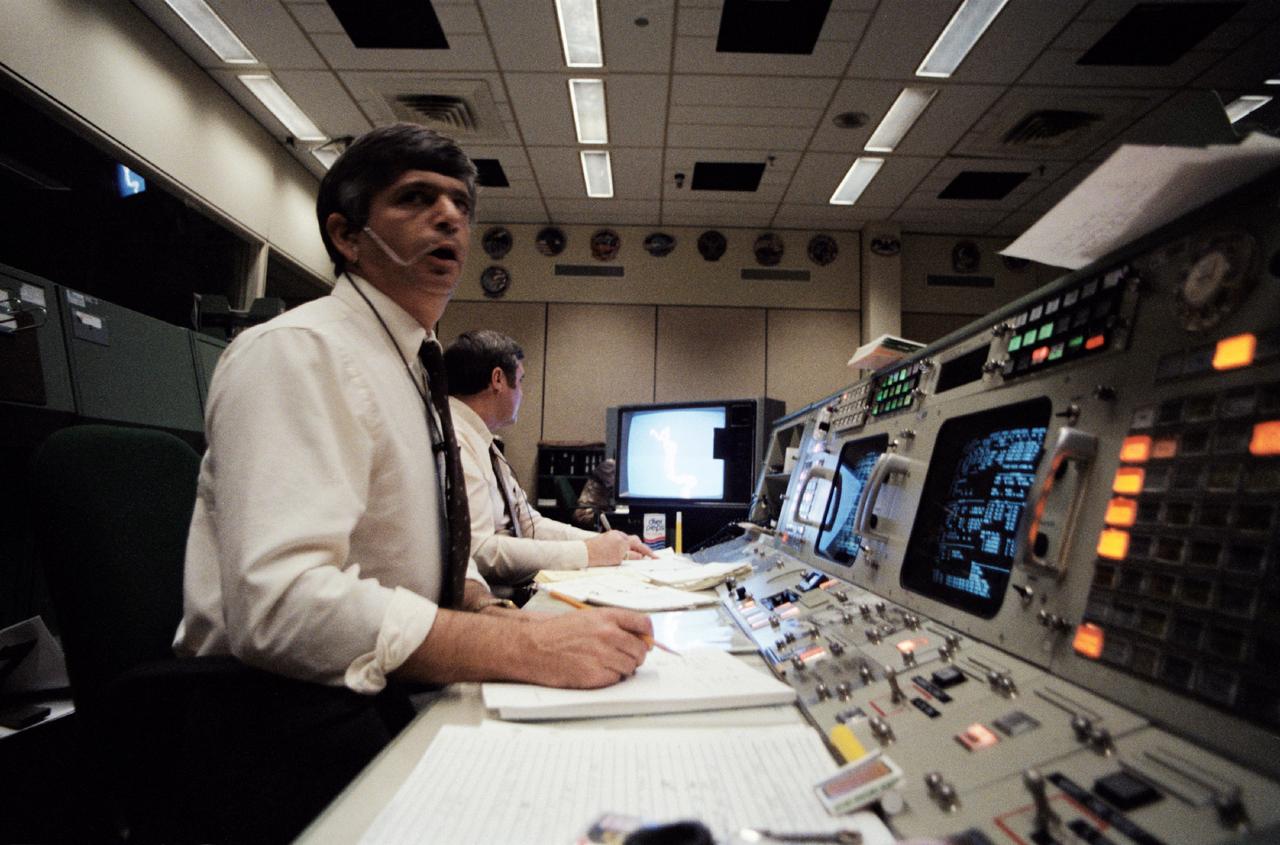
51L-S-002 (28 Jan. 1986) --- Flight directors Jay H. Greene (foreground) and Alan L. (Lee) Briscoe study data on monitors at their consoles in the flight control room (FCR) of the Johnson Space Center's Mission Control Center. The photo was made just moments after the announcement came that Challenger's launch phase was not nominal. Photo credit: NASA
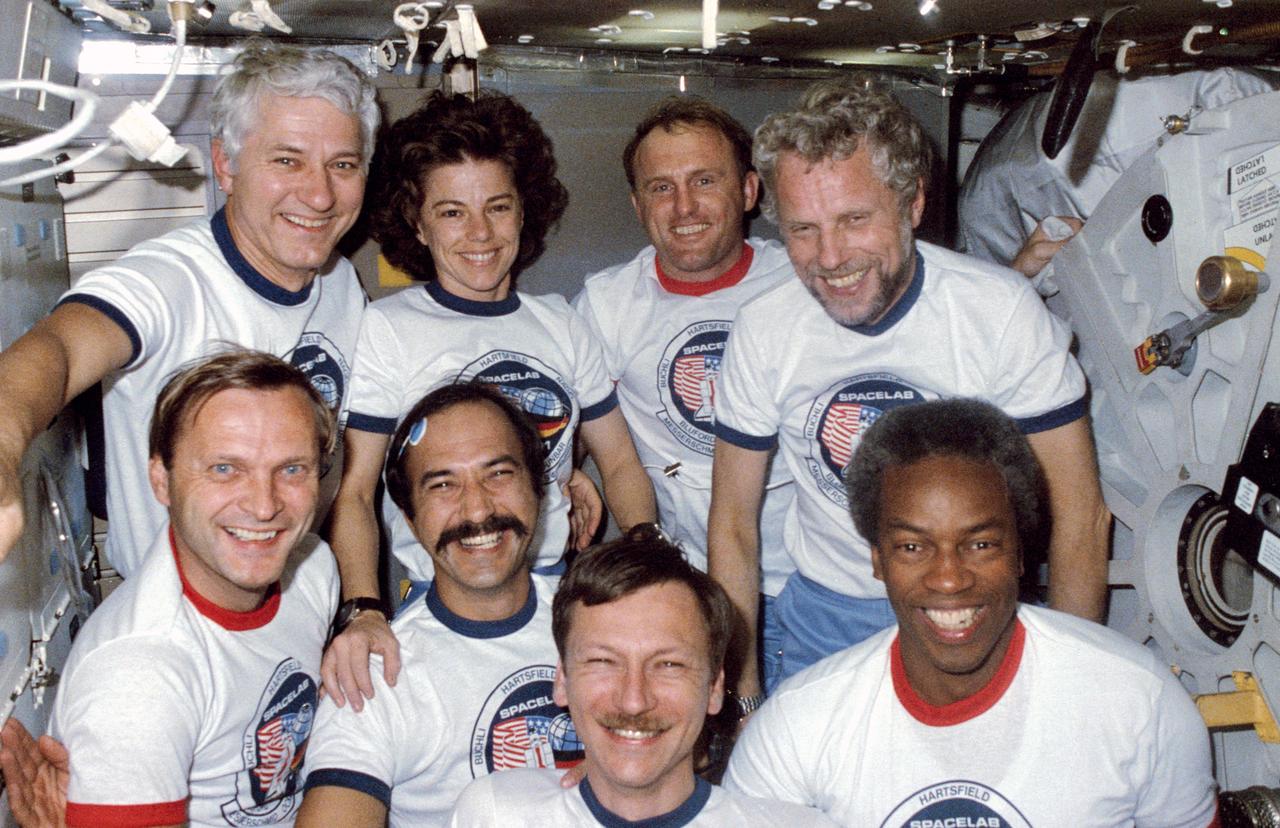
61A-117-019 (30 Oct.-6 Nov. 1985) --- Traditional in-flight portrait of all eight STS-61A crew members was made with an automatic exposure of a 35mm camera. Left to right, back row, Henry W. Hartsfield Jr., commander; Bonnie J. Dunbar, mission specialist; James F. Buchli, mission specialist; and Reinhard Furrer, payload specialist. Left to right, front row, Ernst Messerschmid, payload specialist; Wubbo J. Ockels, payload specialist representing the European Space Agency (ESA); Steven R. Nagel, pilot; and Guion S. Bluford Jr., mission specialist. Photo credit: NASA
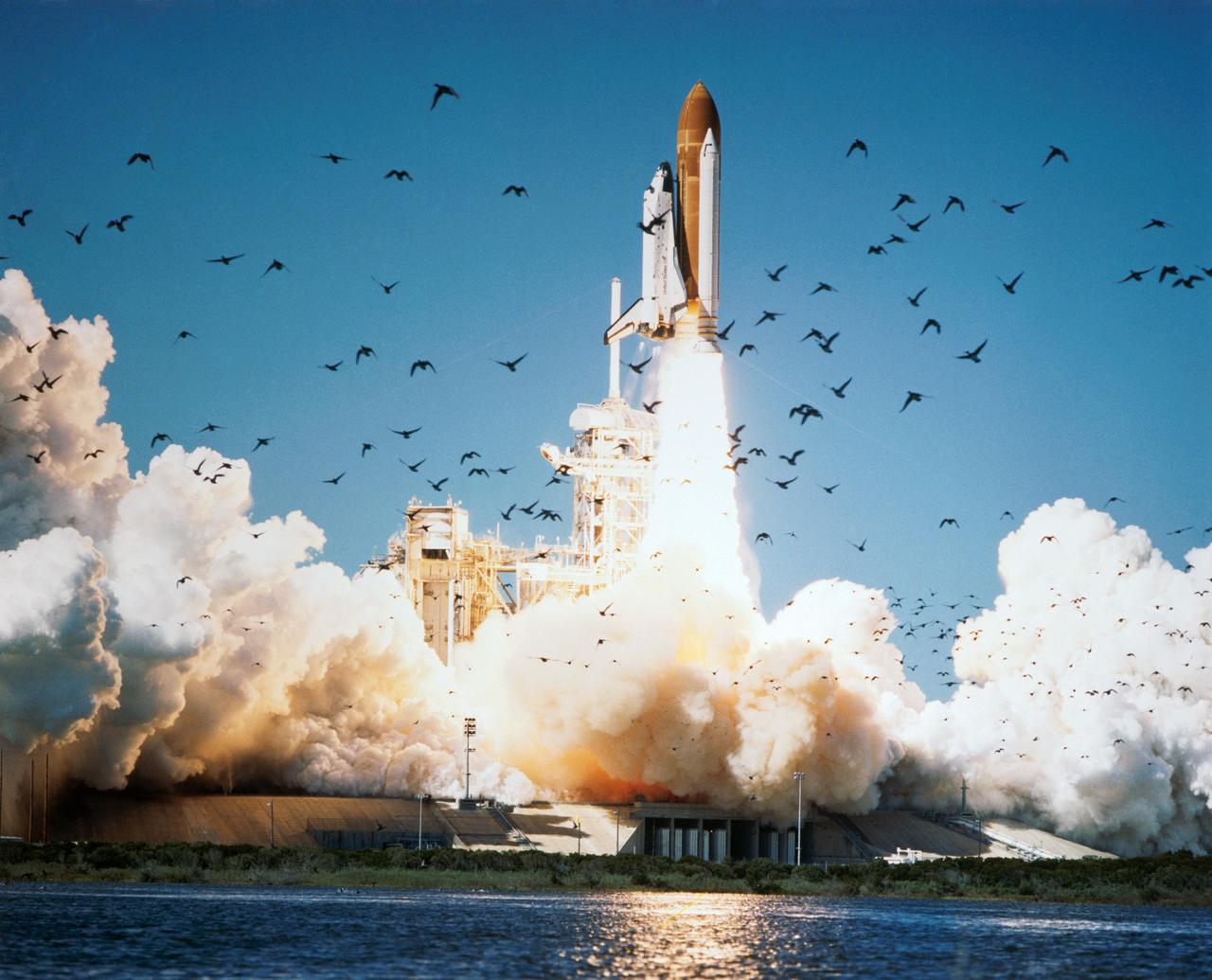
51L-S-156 (28 Jan. 1986) --- The space shuttle Challenger lifted off from Pad 39B Jan. 28, 1986 at 11:38 a.m. (EST) with a crew of seven astronauts and the Tracking and Data Relay Satellite (TDRS). An accident 73 seconds after liftoff claimed both crew and vehicle. Photo credit: NASA
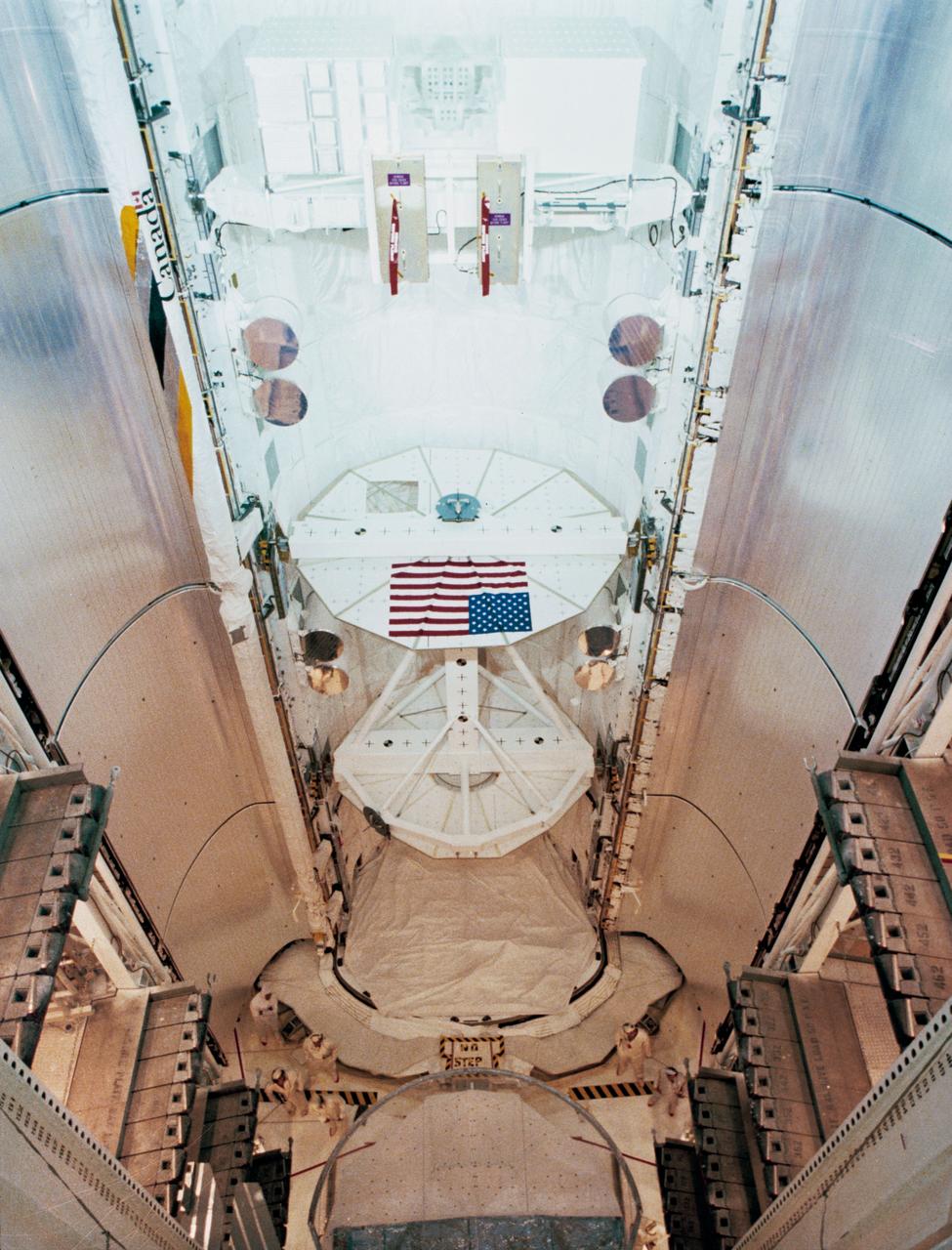
View of the Payload Flight Test Article (PFTA) installed into Challenger's cargo bay in the Payload Changeout Room at Pad 39A at the Kennedy Space Center (KSC). The American flag is visible on one side of the PFTA in the cargo bay. The Kennedy Space Center alternative photo number is KSC-108-83PC-566.

51B-116-005 (29 April - 6 May 1985) --- Astronaut Don L. Lind, mission specialist, termed this scene of an aurora in the Southern Hemisphere as "spectacular," during a TV down link featuring discussion of the auroral observations on the seven-day flight. This scene was captured by astronaut Robert F. Overmyer, crew commander, using a 35mm camera. Dr. Lind, monitoring activity in the magnetosphere at various points throughout the flight, pinpointed the spacecraft's location as being over a point halfway between Australia and the Antarctic continent. There are moonlit clouds on Earth. The blue-green band and the tall red rays are aurora. The brownish band parallel to the Earth's horizon is a luminescence of the atmosphere itself and is referred to as airglow. Dr. T. Hallinan of the Geophysical Institute of Fairbanks serves as principal investigator for the auroral observations experiment and spent a great deal of time with Dr. Lind in preparation for the flight. Photo credit: NASA

KENNEDY SPACE CENTER, FLA. - Liftoff of STS-6, Orbiter Challenger, from Complex 39A carrying astronauts Paul Weitz, Karol J. Bobko, Donald H. Peterson and Dr. Story Musgrave.
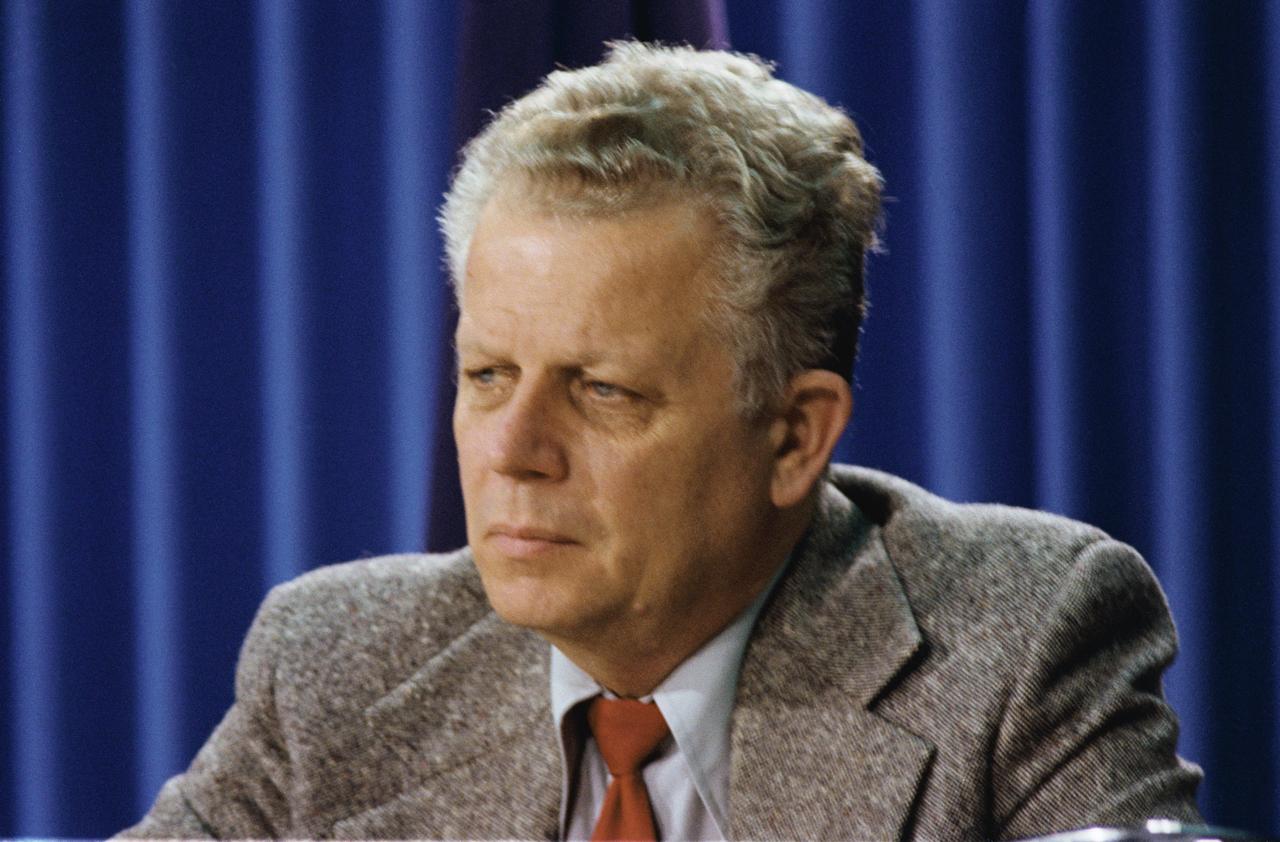
Terry White during a change-of-shift briefing in the JSC public affairs facility briefing room. White acted as one of the on-orbit public affairs officers and the landing PAO during the Challenger's STS-6 flight.
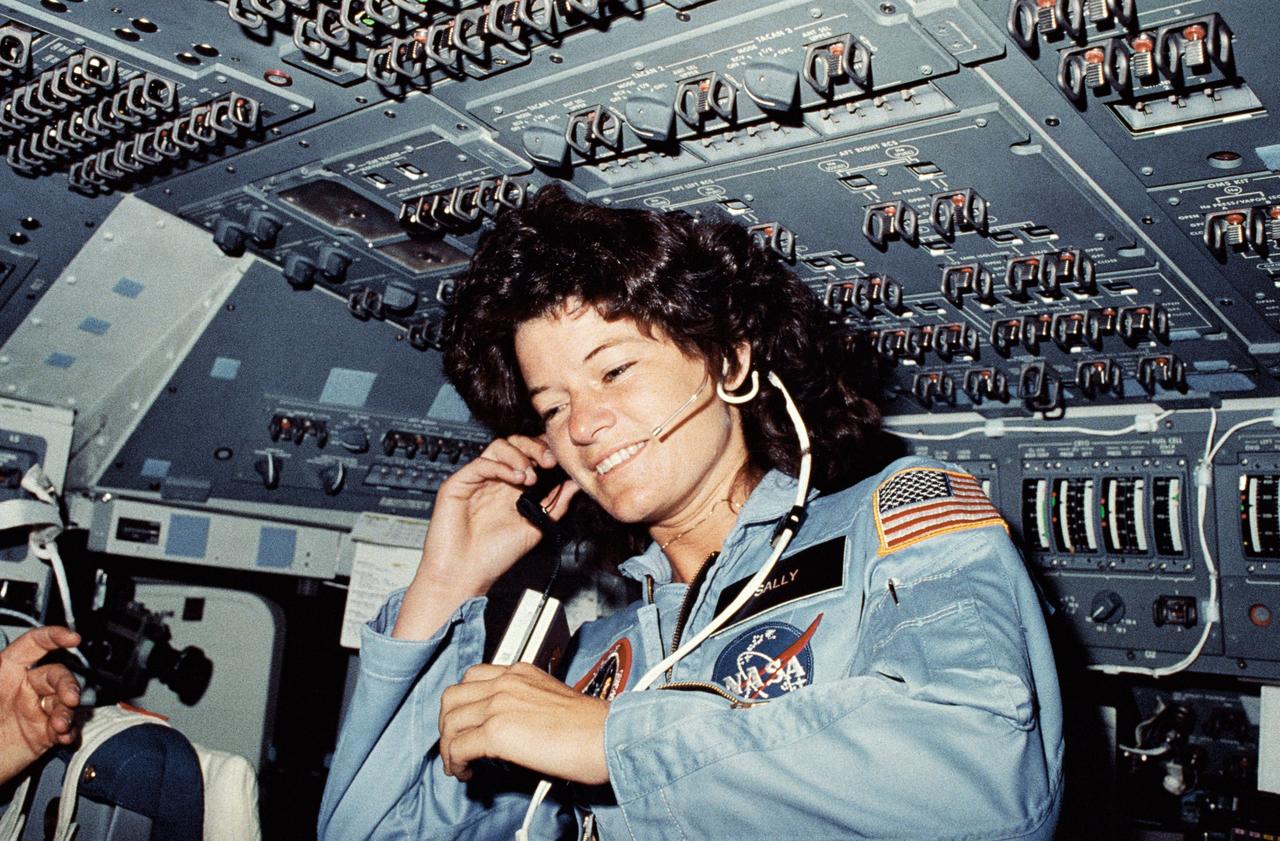
STS007-02-027 (21 June 1983) --- Astronaut Sally K. Ride, STS-7 mission specialist, communicates with ground controllers from the flight deck of the Earth-orbiting Space Shuttle Challenger.
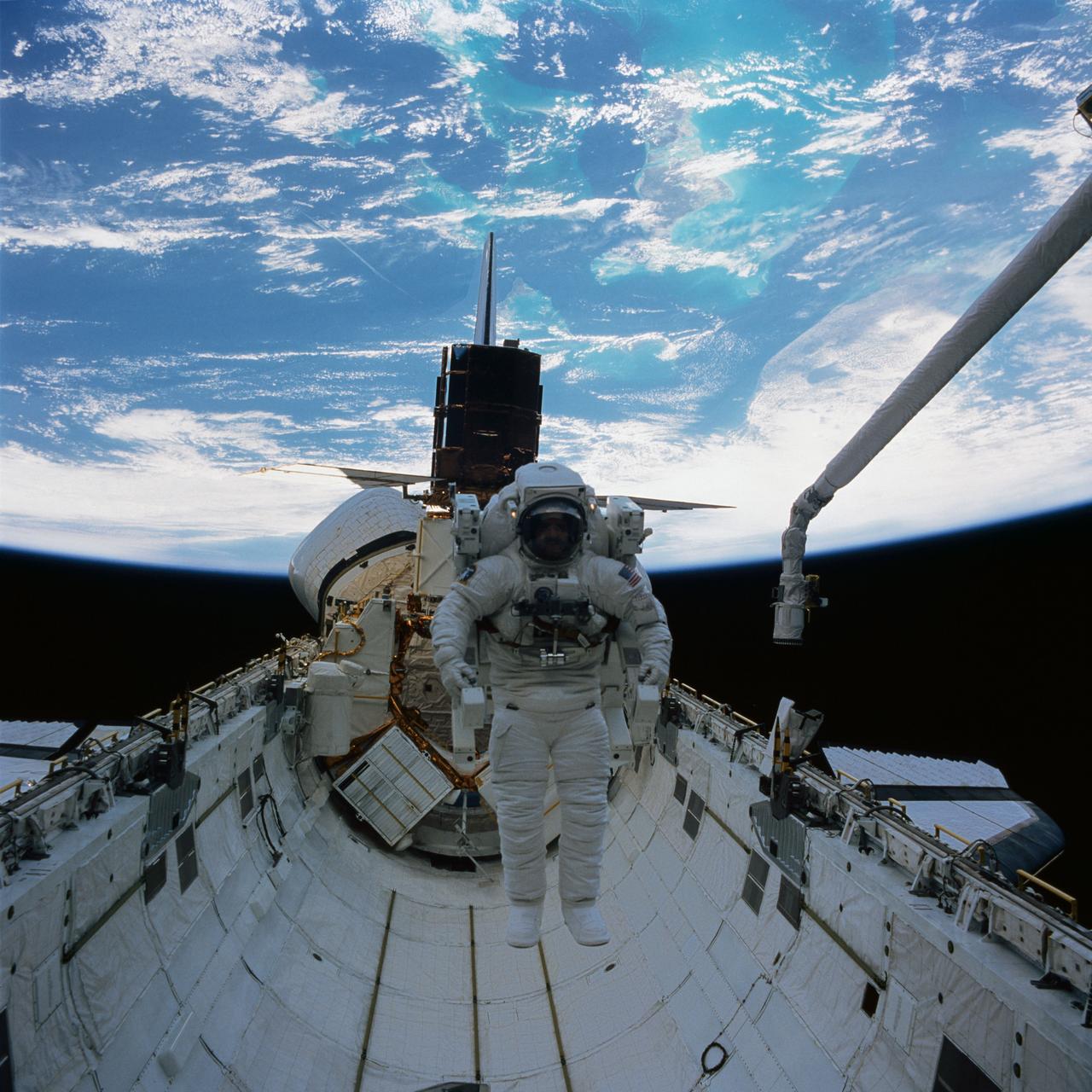
41C-37-1718 (11 April 1984) --- Astronaut James D. van Hoften and a repaired satellite are captured by a Hasselblad camera aimed through Challenger's aft cabin windows toward the cargo bay of the Earth orbiting Challenger. Dr. van Hoften is getting in his first "field" test of the manned maneuvering unit (MMU) after months of training in an underwater facility and in a simulator on Earth. The Solar Maximum Mission Satellite (SMMS), revived and almost ready for release into space once more, is docked at the flight support system (FSS).
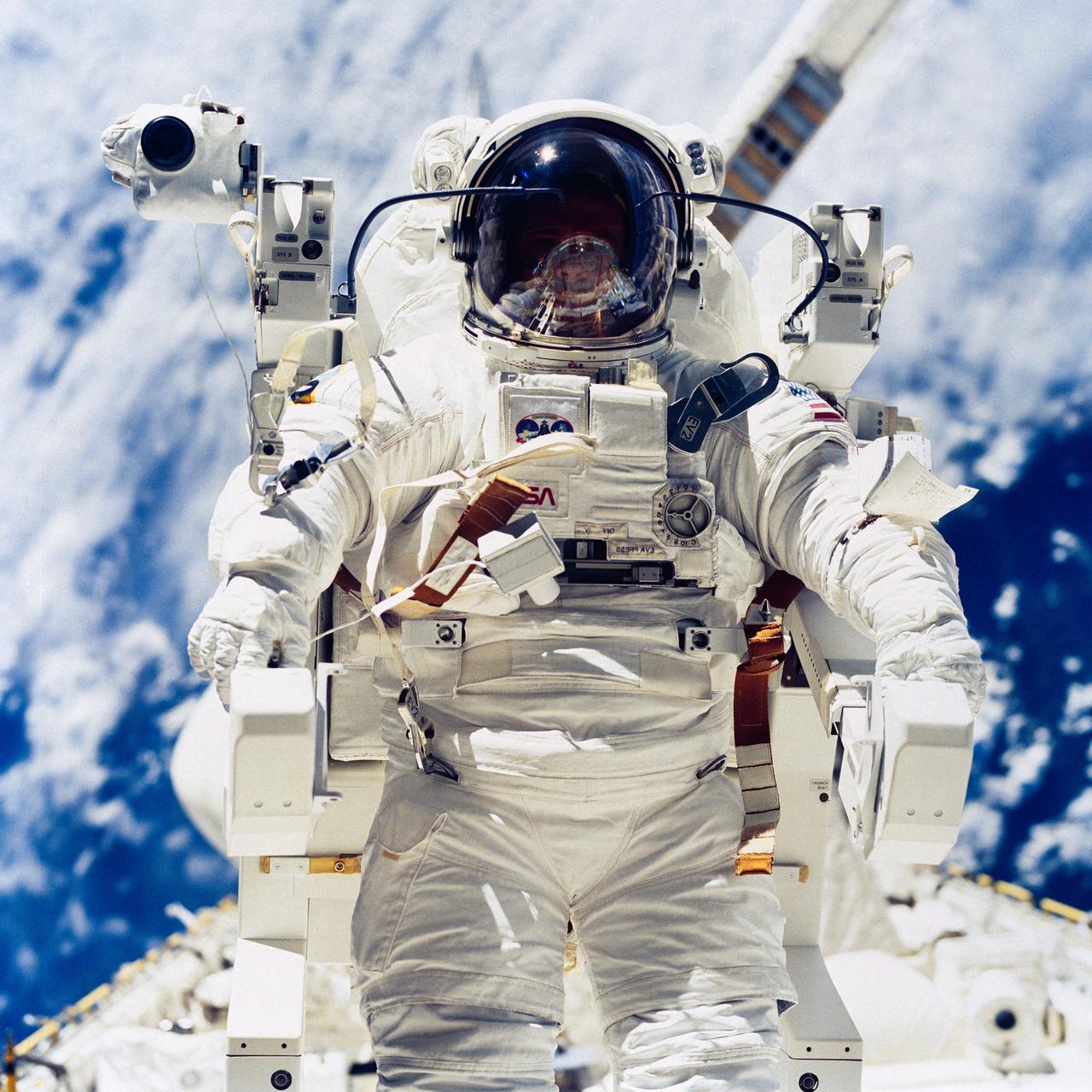
S84-27034A (9 Feb. 1984) --- Astronaut Robert L. Stewart appears to glide a few meters above the Earth-orbiting Space Shuttle Challenger's cargo bay during the second of two extravehicular activity (EVA) session on the Challenger's fourth flight in space. Astronauts Stewart and Bruce McCandless II, two of NASA's three mission specialists on flight STS-41B, earlier made another EVA, testing another manned maneuvering unit (MMU).
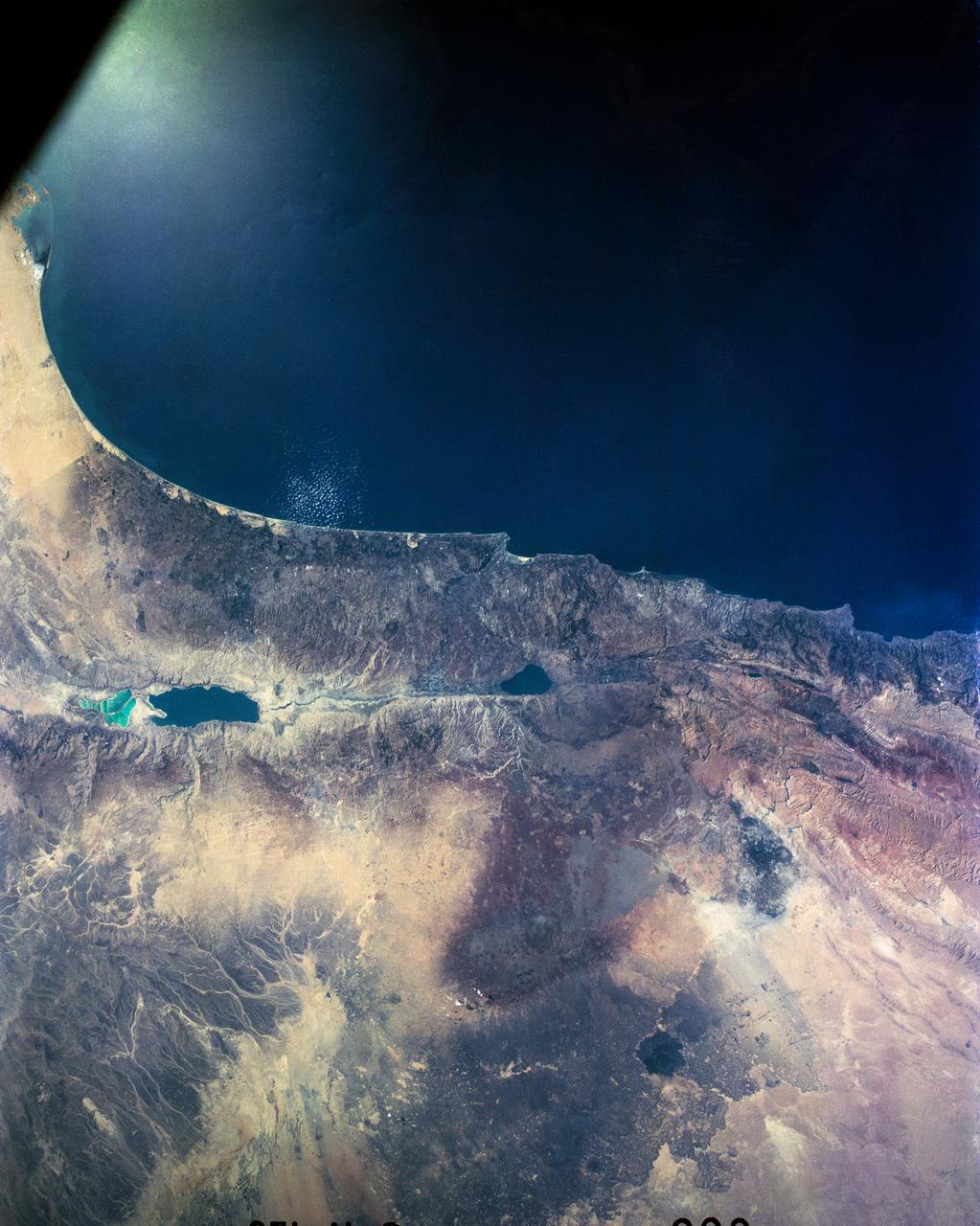
41G-120-056 (October 1984) --- Parts of Israel, Lebanon, Palestine, Syria and Jordan and part of the Mediterranean Sea are seen in this nearly-vertical, large format camera's view from the Earth-orbiting Space Shuttle Challenger. The Sea of Galilee is at center frame and the Dead Sea at bottom center. The frame's center coordinates are 32.5 degrees north latitude and 35.5 degrees east longitude. A Linhof camera, using 4" x 5" film, was used to expose the frame through one of the windows on Challenger's aft flight deck.
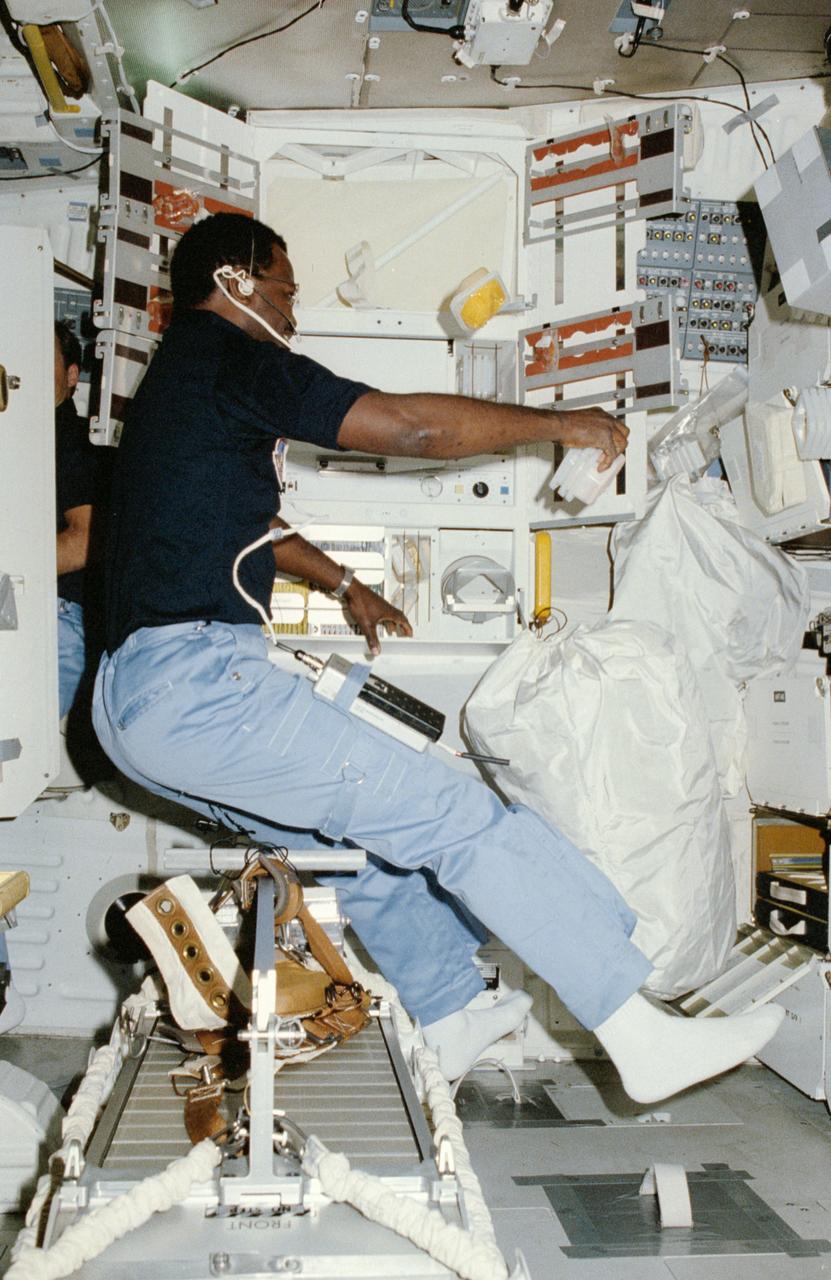
S84-27204 (3-11 Feb 1984) --- Astronaut Ronald E. McNair, STS 41-B mission specialist, prepares to assemble meal items aboard the Earth-orbiting Space Shuttle Challenger. The galley is located in the mid deck. The number of items in the area signals how busy it is. Later Dr. McNair died on January 28, 1986 on his next space flight STS 51-L when the Space Shuttle Challenger exploded after launch from the Kennedy Space Center, Florida.

51F-S-061 (29 July 1985) --- The 19th Space Shuttle mission gets off to a beginning as the Challenger soars toward earth orbit where it is scheduled to spend a week for a series of mostly scientific tasks. Challenger carries seven crewmembers and Spacelab 2 science pallets. A number of photographers record the event on camera. Launch occurred at 5:00 p.m. (EDT), July 29, 1985. The photo was taken by Otis Imboden.
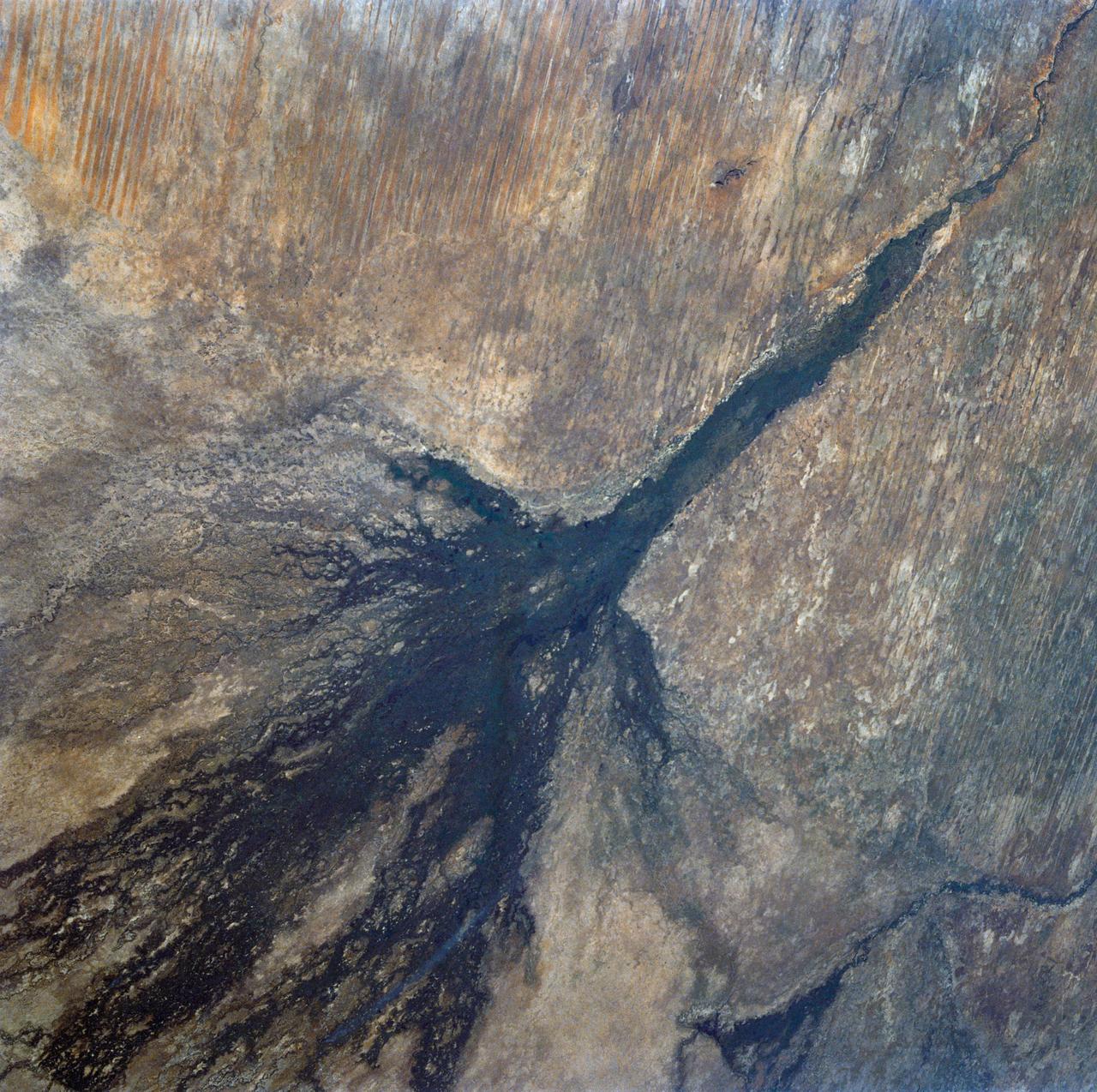
61A-43-029 (2 Nov 1985) --- This view, photographed from the Earth orbiting Challenger, features a vertical view of the Okavango Swamp in Botswana. Center coordinates are 19.0 degrees south latitude and 22.5 degrees east longitude. The Challenger was flying at an altitude of 177 nautical miles when the photo was taken with a 70mm handheld Hasselblad camera.
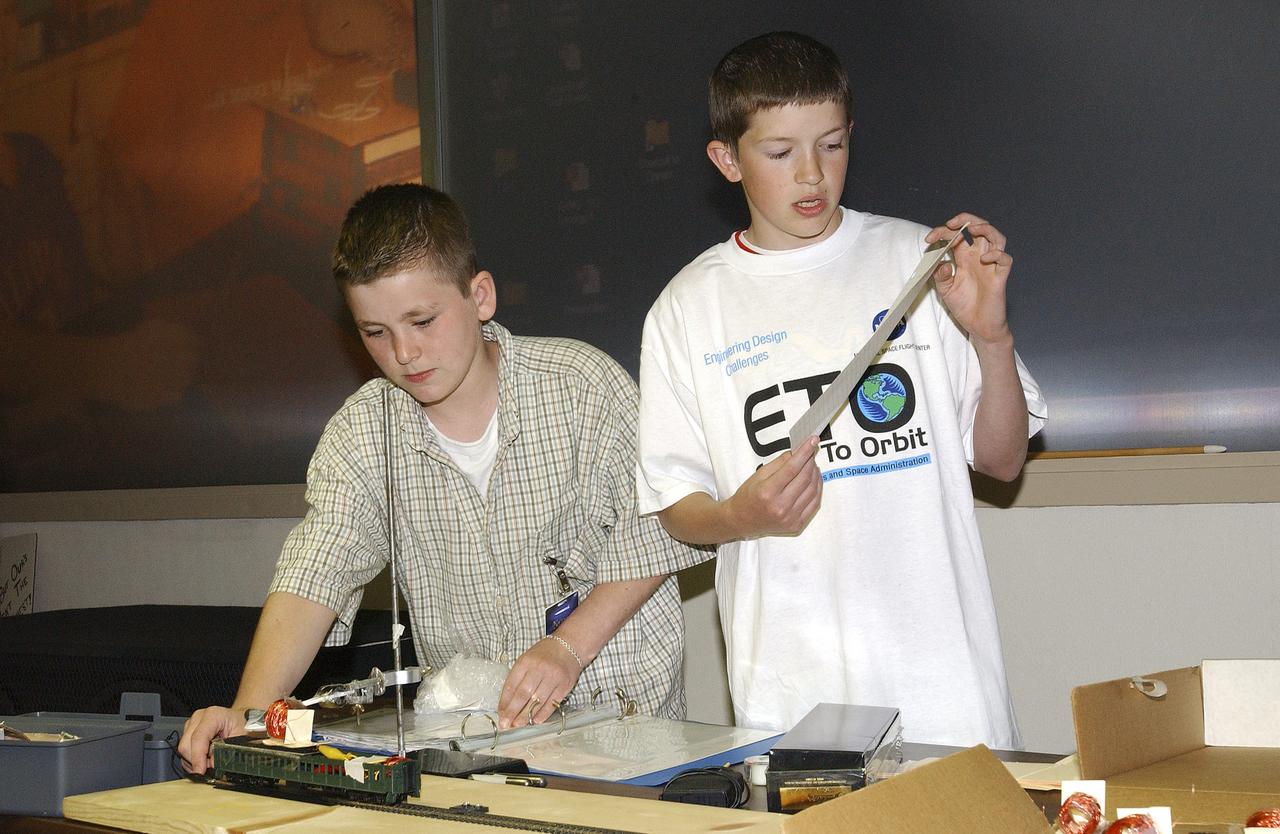
In this photograph, Jeff Alden (left) and Justin O'Cornor, two middle school students at Lane Middle School in Portland, Oregon are demonstrating their Earth-to-Orbit (ETO) Design Challenge project at NASA Marshall Space Flight Center (MSFC) in Huntsville, Alabama. Jeff and Justin, who are just a couple of "typical teens," have been spending their time tackling some of the same challenges NASA engineers face when designing propulsion systems at MSFC. The ETO Design Challenge is a hands-on educational program, targeted to middle school students, in which students are assigned a project engaging in related design challenges in their classrooms under the supervision of their teachers. The project is valuable because it can be used by any student and any teacher, even those without technical backgrounds. Students in 12 states: Alabama, Arkansas, California, Colorado, Illinois, Missouri, Montana, New York, Ohio, Tennessee, Virginia, and Washington, are taking part in the MSFC's Earth-to-Orbit program. NASA uses such programs to support educational excellence while participating in educational outreach programs through centers around the country. The Oregon students' teacher, Joanne Fluvog, commented, "the biggest change I've seen is in the students' motivation and their belief in their ability to think." Both Justin and Jeff said being involved in a real engineering project has made them realize that "science is cool."
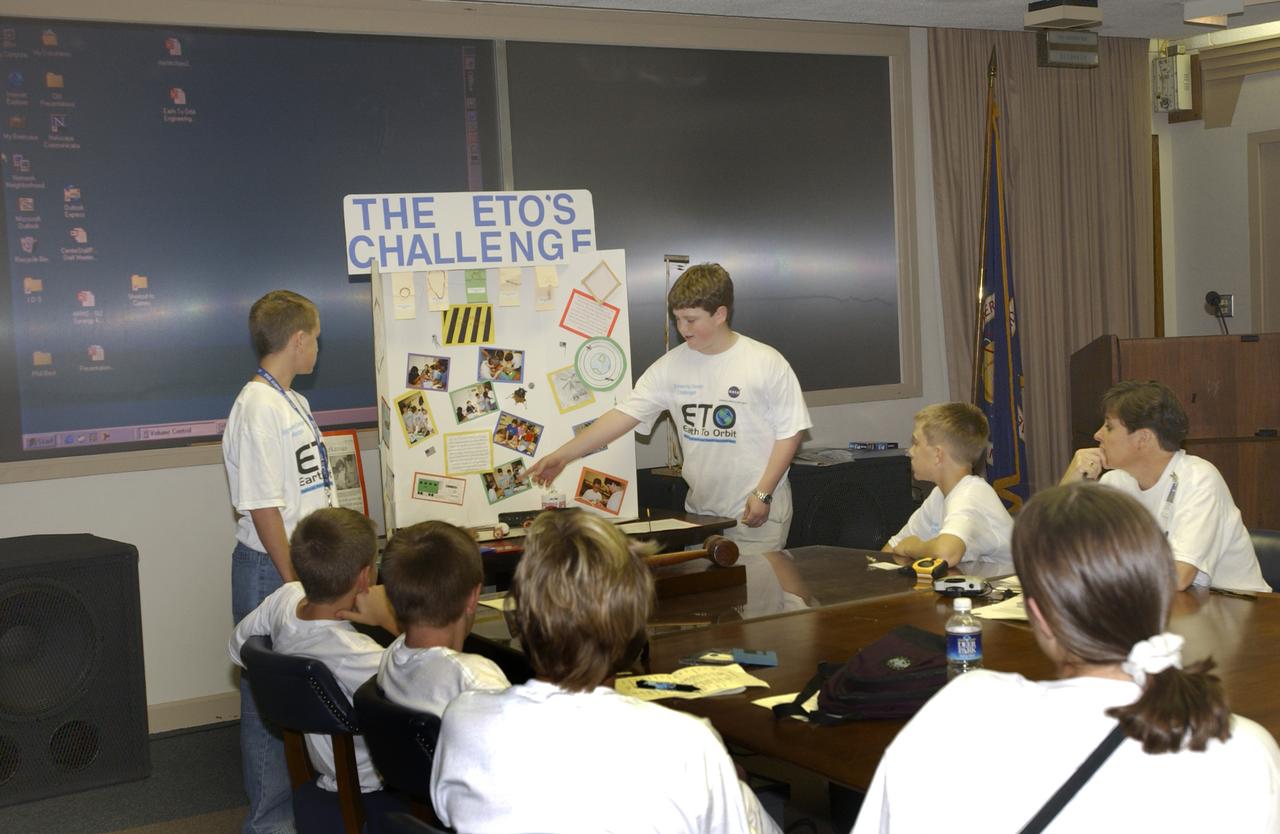
In this photograph, students from all over the country gathered and discussed their Earth-to-Orbit (ETO) Design Challenge project at NASA Marshall Space Flight Center in Huntsville, Alabama. These students who are just "typical teens," have been spending their time tackling some of the same challenges NASA engineers face when designing propulsion systems at MSFC. The ETO Design Challenge is a hands-on educational program, targeted to middle school students, in which students are assigned a project engaging in related design challenges in their classrooms under the supervision of their teachers. The project is valuable because it can be used by any student, and any teacher, even those without technical backgrounds. Student in 12 states: Alabama, Arkansas, California, Colorado, Illinois, Missouri, Montana, New York, Ohio, Ternessee, Virginia, and Washington, are taking part in MSFC's Earth-to-Orbit program. NASA uses such programs to support educational excellence while participating in educational outreach programs through centers around the country. One of the students' teachers, Joanne Fluvog, commented, "the biggest change I've seen is in the students' motivation and their belief in their ability to think." Justin O'Connor and Jeff Alden, students of Lane Middle School in Portland, Oregon, participated in the ETO program and said being involved in a real engineering project has made them realize that "science is cool."
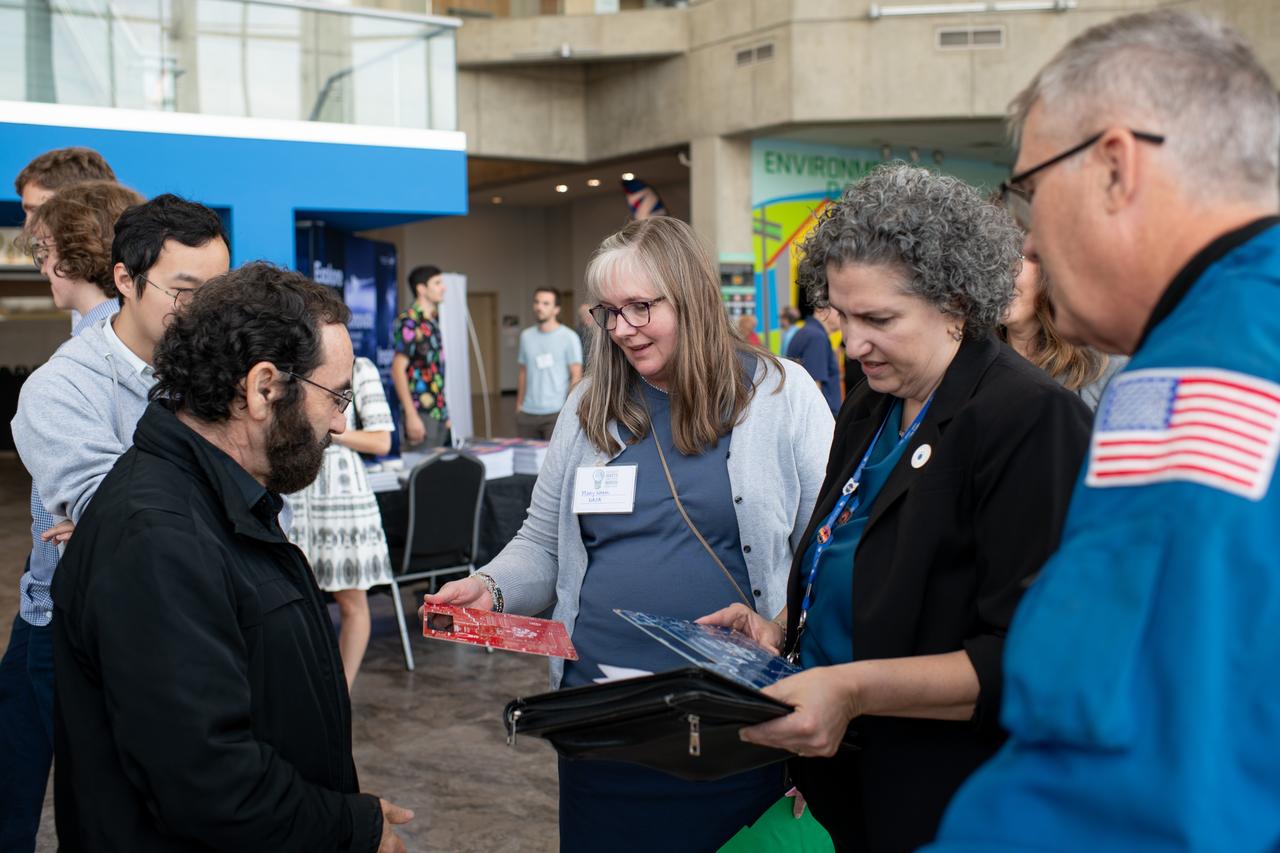
Philip Lubin from Team H.E.L.P.S. (High Efficiency Long-Range Power Solution) explains his project to Mary Wadel, Kirsten Ellenbogen and Stephen Bowen. NASA has awarded a total of $1.5 million to two U.S. teams for their novel technology solutions addressing energy distribution, management, and storage as part of the agency’s Watts on the Moon Challenge. The innovations from this challenge aim to support NASA’s Artemis missions, which will establish long-term human presence on the Moon. This two-phase competition has challenged U.S. innovators to develop breakthrough power transmission and energy storage technologies that could enable long-duration Moon missions to advance the nation’s lunar exploration goals. The final phase of the challenge concluded with a technology showcase and winners’ announcement ceremony Friday at Great Lakes Science Center, home of the visitor center for NASA’s Glenn Research Center in Cleveland. Team H.E.L.P.S. (High Efficiency Long-Range Power Solution) from The University of California, Santa Barbara won the $1 million grand prize in NASA’s Watts on the Moon Challenge. Their team developed a low-mass, high efficiency cable and featured energy storage batteries on both ends of their power transmission and energy storage system. Second prize ($500,000): Orbital Mining Corporation of Golden, Colorado Photo Credit: (NASA/Sara Lowthian-Hanna)
NASA has awarded a total of $1.5 million to two U.S. teams for their novel technology solutions addressing energy distribution, management, and storage as part of the agency’s Watts on the Moon Challenge. The innovations from this challenge aim to support NASA’s Artemis missions, which will establish long-term human presence on the Moon. This two-phase competition has challenged U.S. innovators to develop breakthrough power transmission and energy storage technologies that could enable long-duration Moon missions to advance the nation’s lunar exploration goals. The final phase of the challenge concluded with a technology showcase and winners’ announcement ceremony Friday at Great Lakes Science Center, home of the visitor center for NASA’s Glenn Research Center in Cleveland. Team H.E.L.P.S. (High Efficiency Long-Range Power Solution) from The University of California, Santa Barbara won the $1 million grand prize in NASA’s Watts on the Moon Challenge. Their team developed a low-mass, high efficiency cable and featured energy storage batteries on both ends of their power transmission and energy storage system. Second prize ($500,000): Orbital Mining Corporation of Golden, Colorado
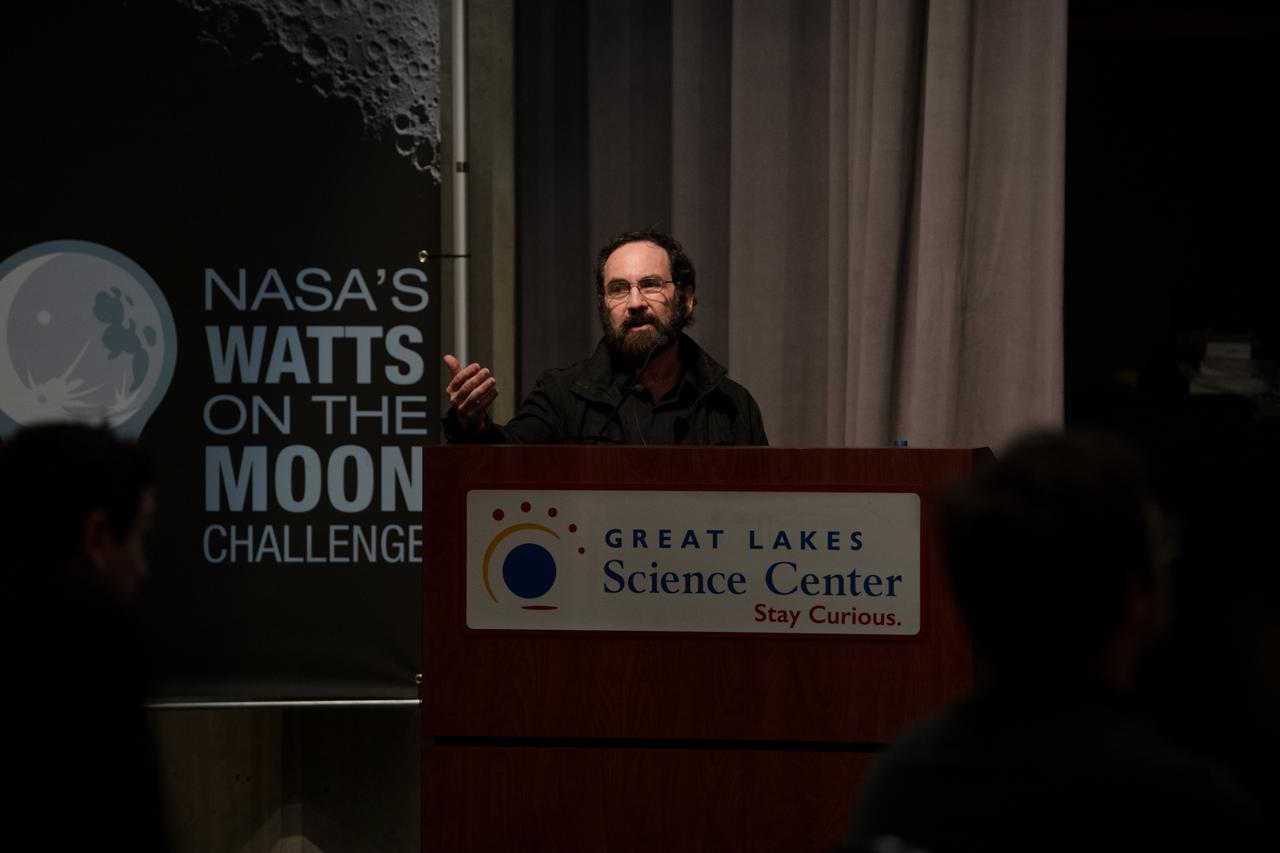
Philip Lubin from H.E.L.P.S. (High Efficiency Long-Range Power Solution) from The University of California gives their presentation. NASA has awarded a total of $1.5 million to two U.S. teams for their novel technology solutions addressing energy distribution, management, and storage as part of the agency’s Watts on the Moon Challenge. The innovations from this challenge aim to support NASA’s Artemis missions, which will establish long-term human presence on the Moon. This two-phase competition has challenged U.S. innovators to develop breakthrough power transmission and energy storage technologies that could enable long-duration Moon missions to advance the nation’s lunar exploration goals. The final phase of the challenge concluded with a technology showcase and winners’ announcement ceremony on September 11, 2024 at Great Lakes Science Center, home of the visitor center for NASA’s Glenn Research Center in Cleveland. Team H.E.L.P.S. (High Efficiency Long-Range Power Solution) from The University of California, Santa Barbara won the $1 million grand prize in NASA’s Watts on the Moon Challenge. Their team developed a low-mass, high efficiency cable and featured energy storage batteries on both ends of their power transmission and energy storage system. Second prize ($500,000): Orbital Mining Corporation of Golden, Colorado. Photo Credit: (NASA/Sara Lowthian-Hanna)
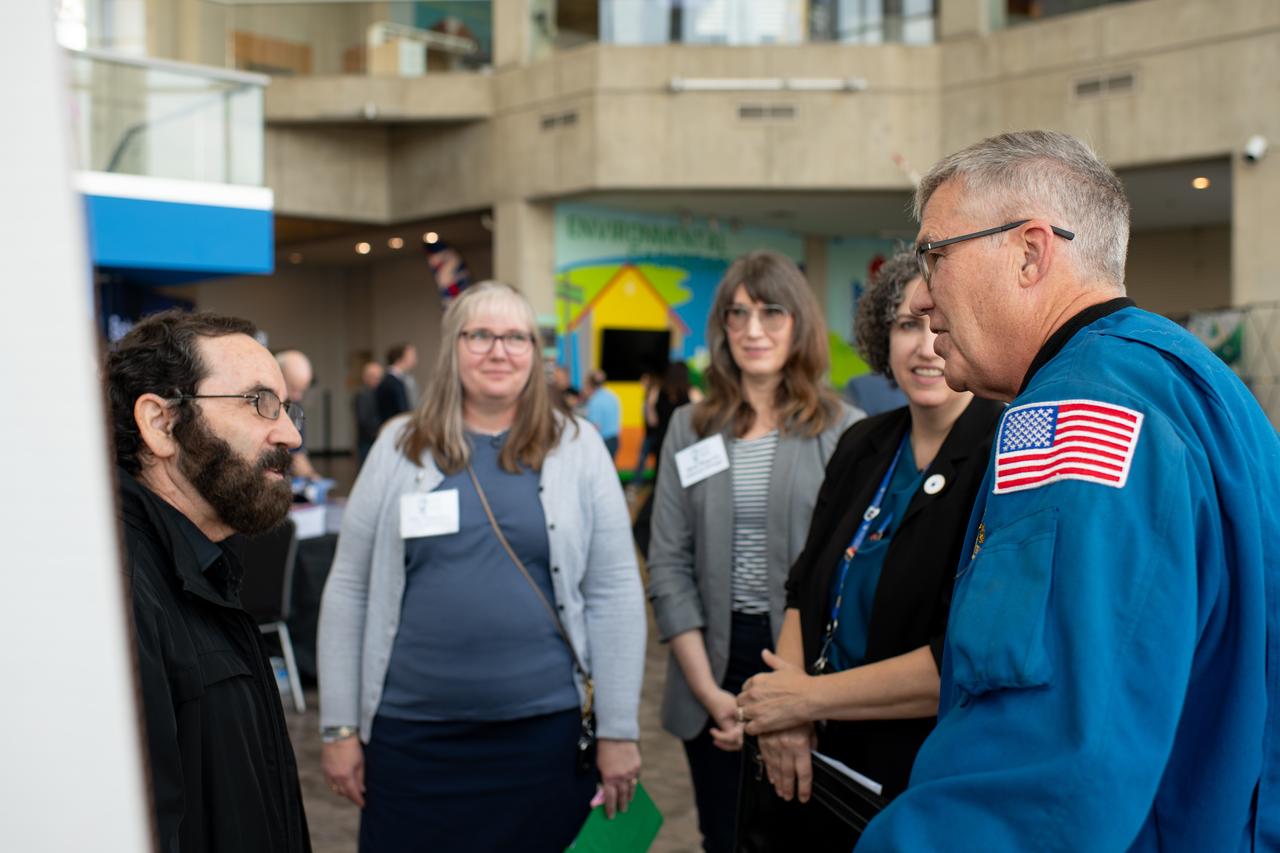
Philip Lubin from Team H.E.L.P.S. (High Efficiency Long-Range Power Solution) explains his project to Mary Wadel, Lisa Ferguson, Kirsten Ellenbogen and Stephen Bowen. NASA has awarded a total of $1.5 million to two U.S. teams for their novel technology solutions addressing energy distribution, management, and storage as part of the agency’s Watts on the Moon Challenge. The innovations from this challenge aim to support NASA’s Artemis missions, which will establish long-term human presence on the Moon. This two-phase competition has challenged U.S. innovators to develop breakthrough power transmission and energy storage technologies that could enable long-duration Moon missions to advance the nation’s lunar exploration goals. The final phase of the challenge concluded with a technology showcase and winners’ announcement ceremony on September 20, 2024 at Great Lakes Science Center, home of the visitor center for NASA’s Glenn Research Center in Cleveland. Team H.E.L.P.S. (High Efficiency Long-Range Power Solution) from The University of California, Santa Barbara won the $1 million grand prize in NASA’s Watts on the Moon Challenge. Their team developed a low-mass, high efficiency cable and featured energy storage batteries on both ends of their power transmission and energy storage system. Second prize ($500,000): Orbital Mining Corporation of Golden, Colorado. Photo Credit: (NASA/Sara Lowthian-Hanna)
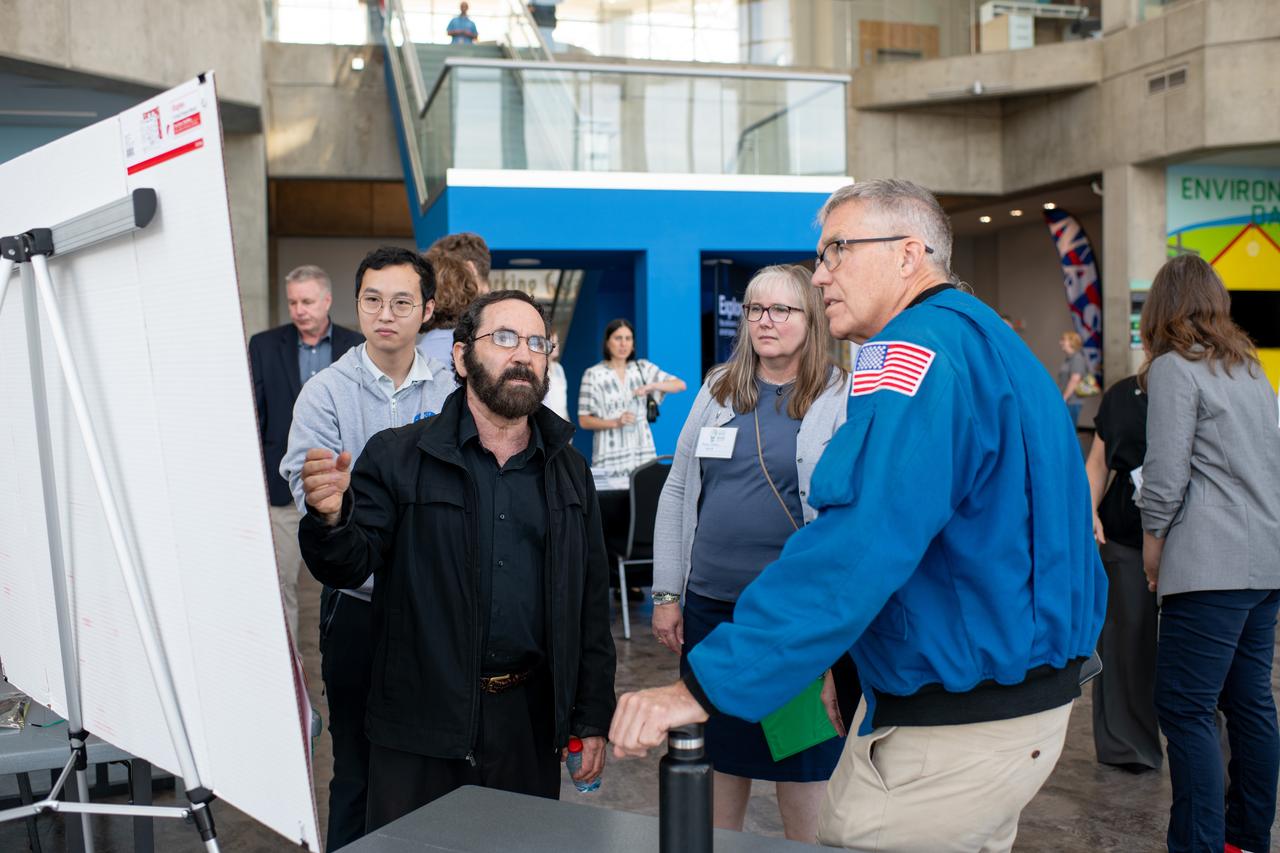
Philip Lubin from Team H.E.L.P.S. (High Efficiency Long-Range Power Solution) explains his project to Mary Wadel and Stephen Bowen. NASA has awarded a total of $1.5 million to two U.S. teams for their novel technology solutions addressing energy distribution, management, and storage as part of the agency’s Watts on the Moon Challenge. The innovations from this challenge aim to support NASA’s Artemis missions, which will establish long-term human presence on the Moon. This two-phase competition has challenged U.S. innovators to develop breakthrough power transmission and energy storage technologies that could enable long-duration Moon missions to advance the nation’s lunar exploration goals. The final phase of the challenge concluded with a technology showcase and winners’ announcement ceremony on September 20, 2024 at Great Lakes Science Center, home of the visitor center for NASA’s Glenn Research Center in Cleveland. Team H.E.L.P.S. (High Efficiency Long-Range Power Solution) from The University of California, Santa Barbara won the $1 million grand prize in NASA’s Watts on the Moon Challenge. Their team developed a low-mass, high efficiency cable and featured energy storage batteries on both ends of their power transmission and energy storage system. Second prize ($500,000): Orbital Mining Corporation of Golden, Colorado. Photo Credit: (NASA/Sara Lowthian-Hanna)

Astronaut Stephen Bowen speaks during the award ceremony. NASA has awarded a total of $1.5 million to two U.S. teams for their novel technology solutions addressing energy distribution, management, and storage as part of the agency’s Watts on the Moon Challenge. The innovations from this challenge aim to support NASA’s Artemis missions, which will establish long-term human presence on the Moon. This two-phase competition has challenged U.S. innovators to develop breakthrough power transmission and energy storage technologies that could enable long-duration Moon missions to advance the nation’s lunar exploration goals. The final phase of the challenge concluded with a technology showcase and winners’ announcement ceremony Friday at Great Lakes Science Center, home of the visitor center for NASA’s Glenn Research Center in Cleveland. Team H.E.L.P.S. (High Efficiency Long-Range Power Solution) from The University of California, Santa Barbara won the $1 million grand prize in NASA’s Watts on the Moon Challenge. Their team developed a low-mass, high efficiency cable and featured energy storage batteries on both ends of their power transmission and energy storage system. Second prize ($500,000): Orbital Mining Corporation of Golden, Colorado
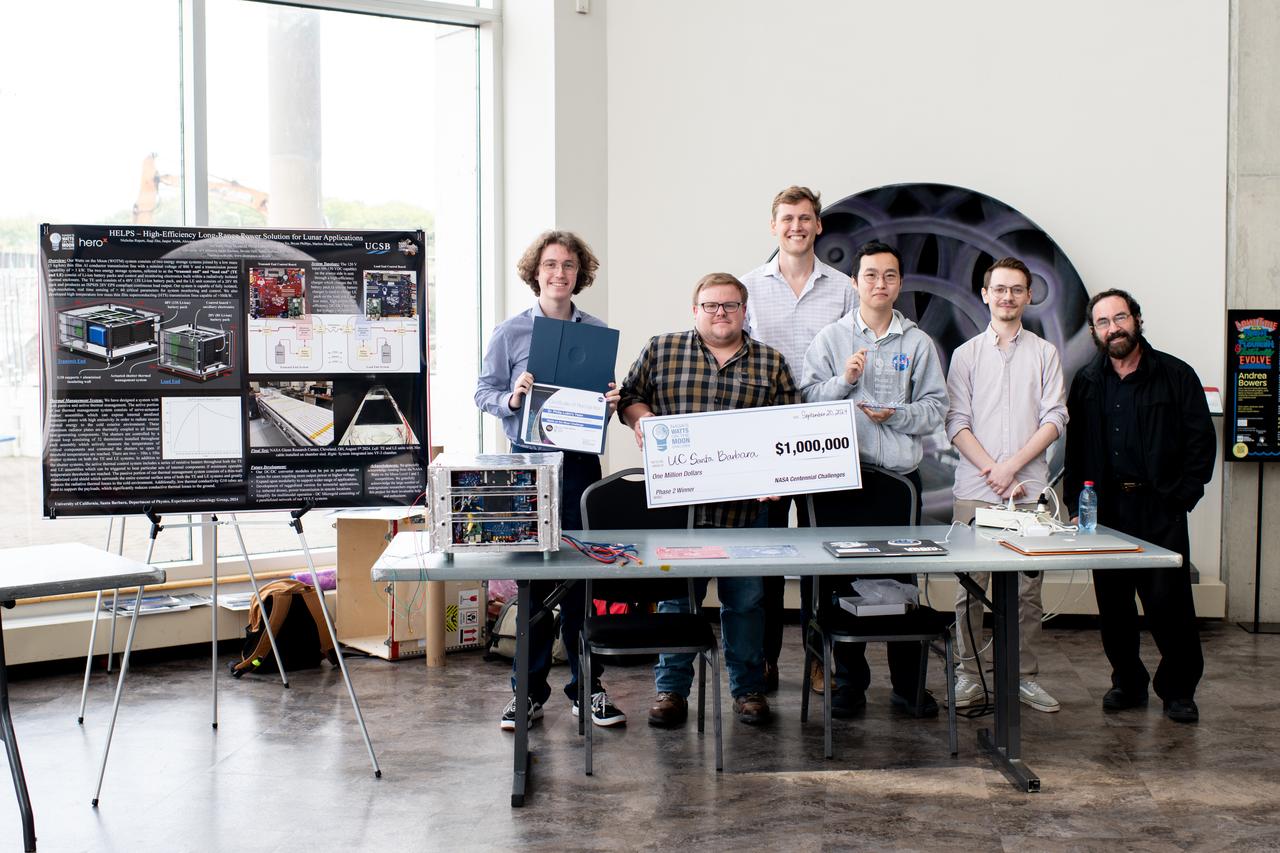
NASA has awarded a total of $1.5 million to two U.S. teams for their novel technology solutions addressing energy distribution, management, and storage as part of the agency’s Watts on the Moon Challenge. The innovations from this challenge aim to support NASA’s Artemis missions, which will establish long-term human presence on the Moon. This two-phase competition has challenged U.S. innovators to develop breakthrough power transmission and energy storage technologies that could enable long-duration Moon missions to advance the nation’s lunar exploration goals. The final phase of the challenge concluded with a technology showcase and winners’ announcement ceremony Friday at Great Lakes Science Center, home of the visitor center for NASA’s Glenn Research Center in Cleveland. Team H.E.L.P.S. (High Efficiency Long-Range Power Solution) from The University of California, Santa Barbara won the $1 million grand prize in NASA’s Watts on the Moon Challenge. Their team developed a low-mass, high efficiency cable and featured energy storage batteries on both ends of their power transmission and energy storage system. Second prize ($500,000): Orbital Mining Corporation of Golden, Colorado
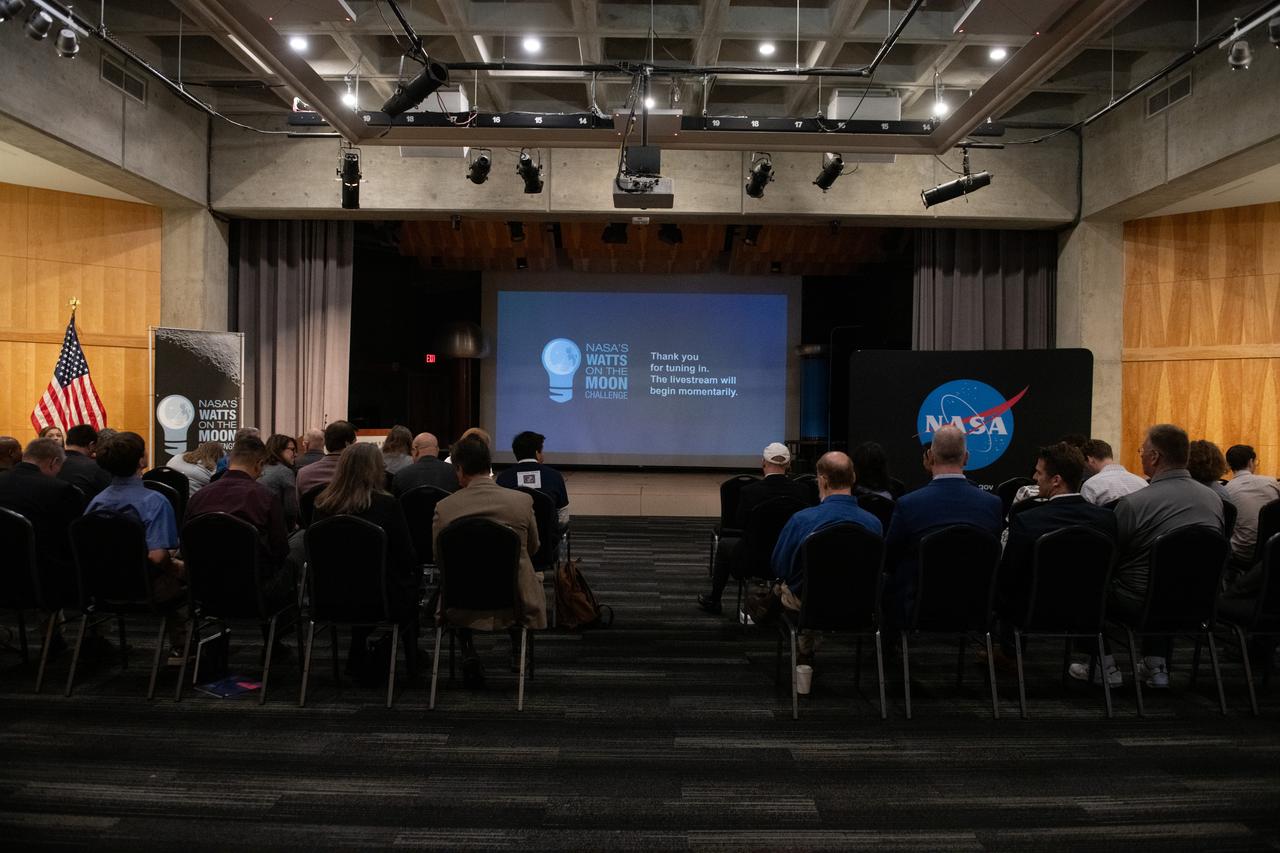
NASA has awarded a total of $1.5 million to two U.S. teams for their novel technology solutions addressing energy distribution, management, and storage as part of the agency’s Watts on the Moon Challenge. The innovations from this challenge aim to support NASA’s Artemis missions, which will establish long-term human presence on the Moon. This two-phase competition has challenged U.S. innovators to develop breakthrough power transmission and energy storage technologies that could enable long-duration Moon missions to advance the nation’s lunar exploration goals. The final phase of the challenge concluded with a technology showcase and winners’ announcement ceremony Friday at Great Lakes Science Center, home of the visitor center for NASA’s Glenn Research Center in Cleveland. Team H.E.L.P.S. (High Efficiency Long-Range Power Solution) from The University of California, Santa Barbara won the $1 million grand prize in NASA’s Watts on the Moon Challenge. Their team developed a low-mass, high efficiency cable and featured energy storage batteries on both ends of their power transmission and energy storage system. Second prize ($500,000): Orbital Mining Corporation of Golden, Colorado
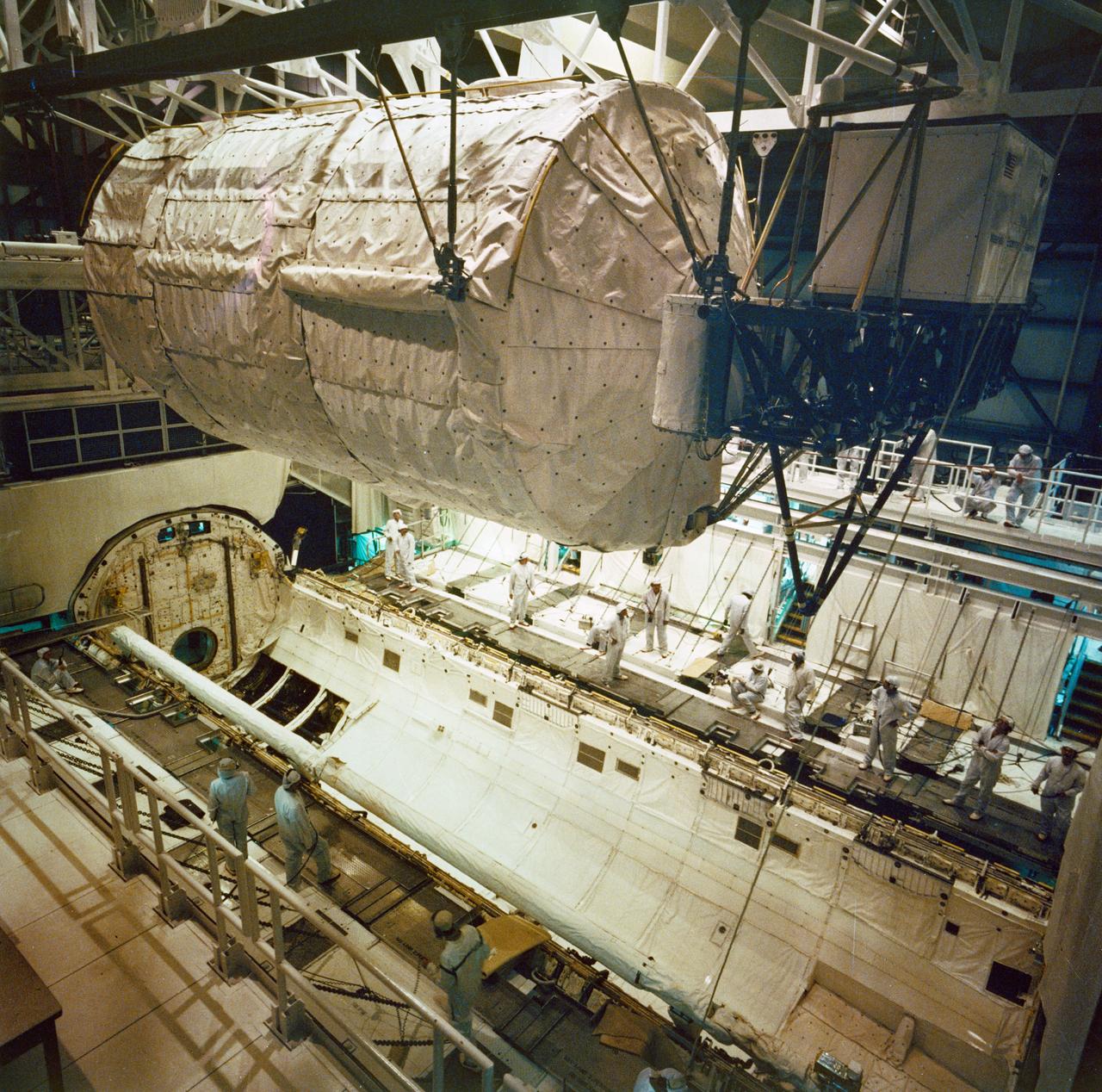
S85-43138 (20 Sept 1985) --- Spacelab D-1, the first payload dedicated to a German mission, is installed into the Space Shuttle Challenger in the orbiter processing facility (OPF) at the Kennedy Space Center. Launch for the 61-A eight crewmembers and their extensive scientific experiments is scheduled for no earlier than Oct. 30.

STS007-03-058 (18-24 June 1983) --- The Island of Madagascar in the Indian Ocean off the coast of Africa. The colorful area is the mouth of the Betsiboka River near the city of Majunga. The photograph was taken with a 70mm handheld camera aimed through the aft flight deck?s overhead windows on the Earth-orbiting Space Shuttle Challenger.
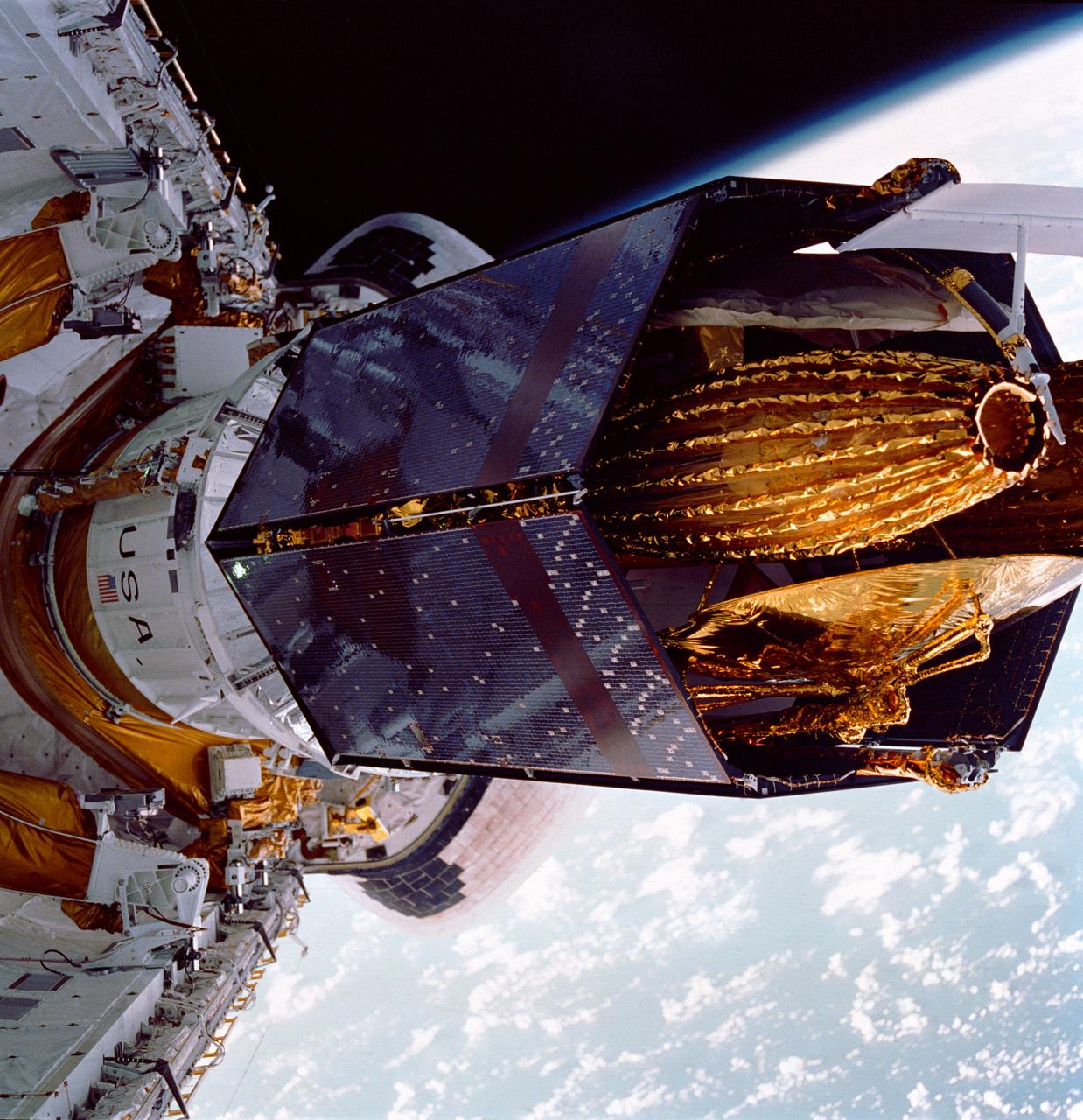
S26-31-012 (29 Sept. 1988) ) --- Discovery was used for NASA's Return to Flight Mission following the Challenger accident, during which the STS-26 crew delivered the TDRS-C satellite to Earth orbit. Photo credit: NASA or National Aeronautics and Space Administration
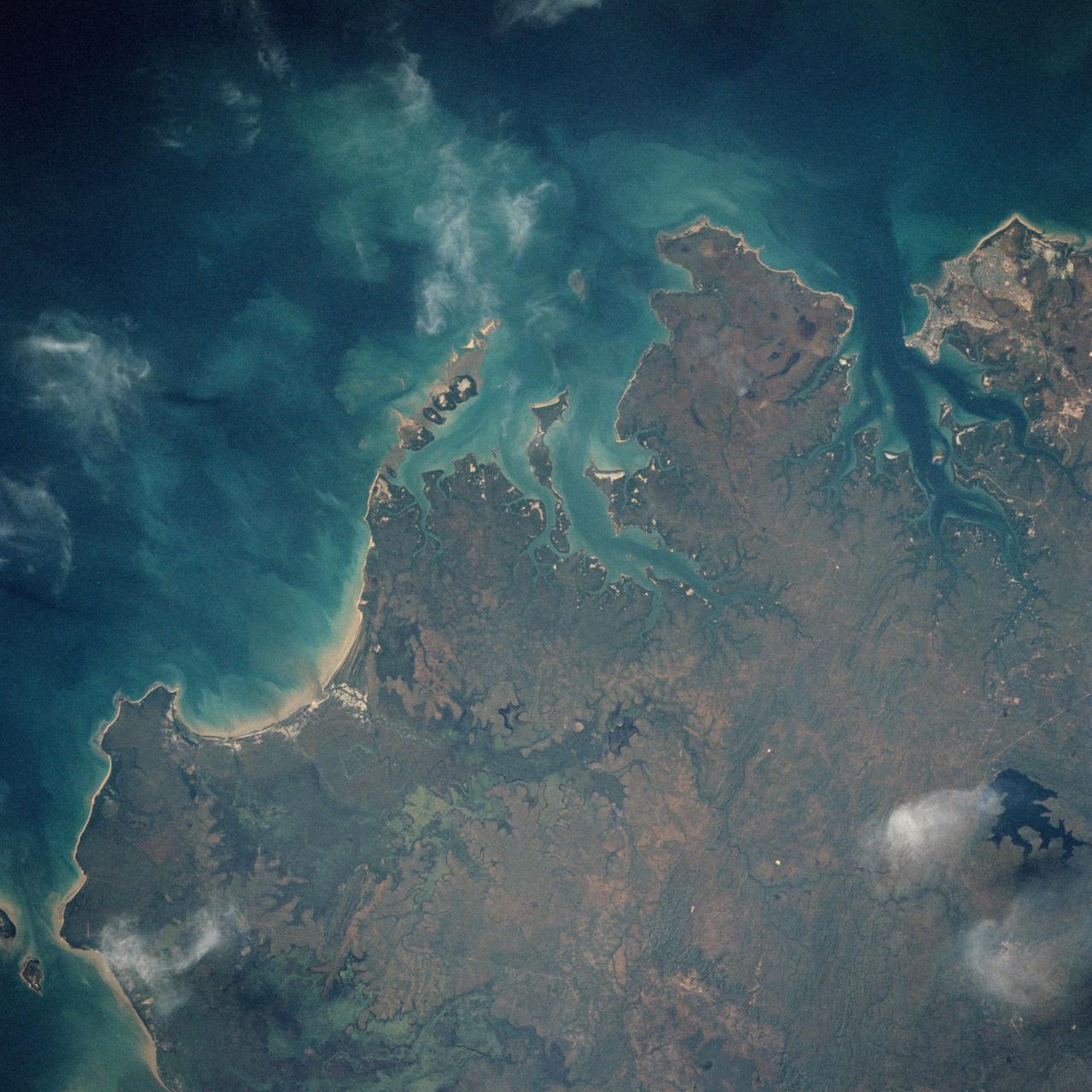
41C-34-1417 (6-13 April 1984) --- Darwin and Fog Bay, Australia are featured in this 70mm frame photographed from mission 41C's 42nd orbit of the Space Shuttle Challenger in April of 1984. Center-point coordinates are 12.5 degrees south latitude and 130.5 degrees east longitude.
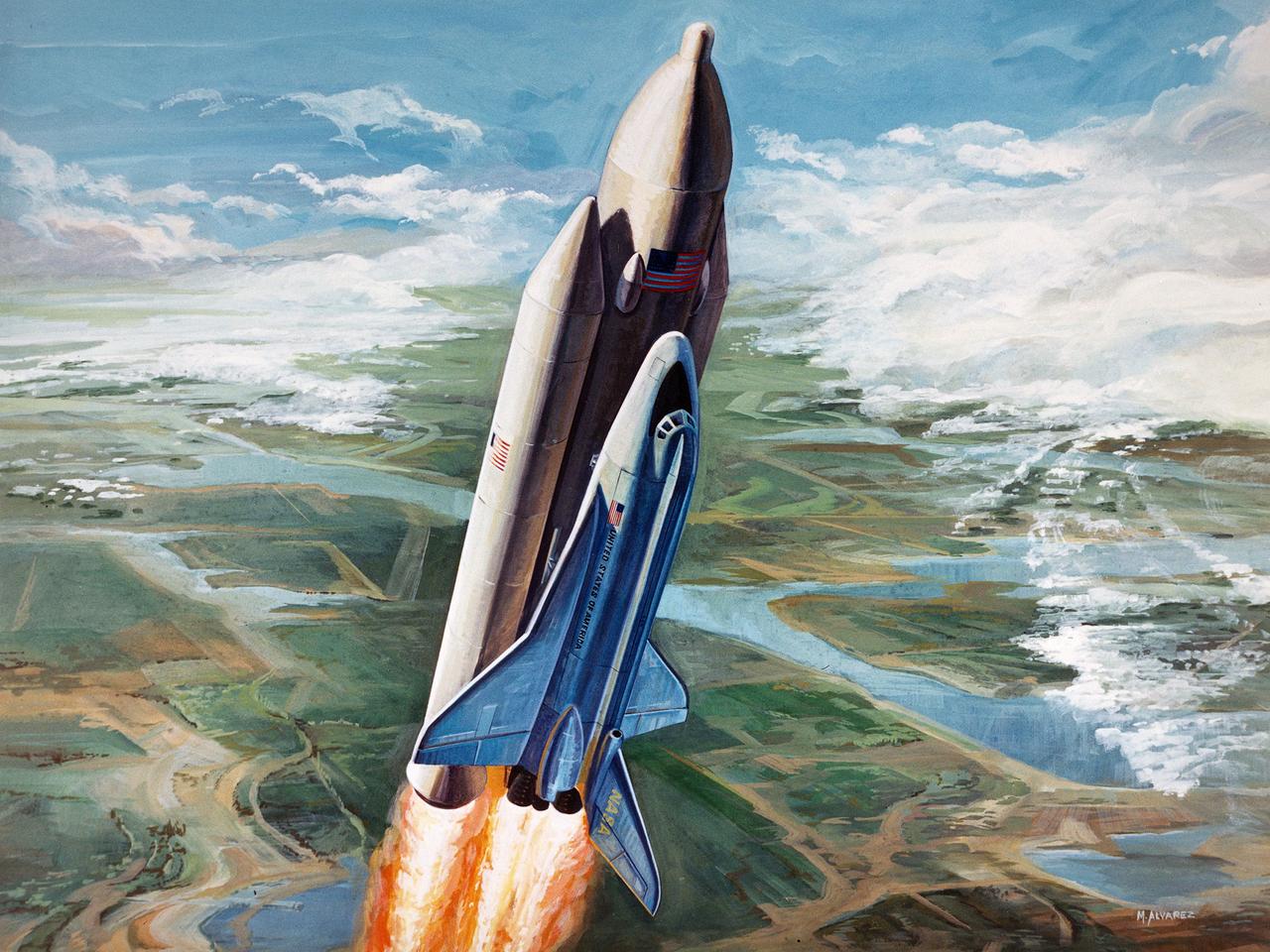
An unidentified illustration of the National Aeronautics and Space Administration’s (NASA) space shuttle. The space shuttle fleet flew 135 missions and helped construct the International Space Station between the first launch on April 12, 1981 and the final landing on July 21, 2011. There were five orbiters: Columbia, Challenger, Discovery, Atlantis and Endeavour.
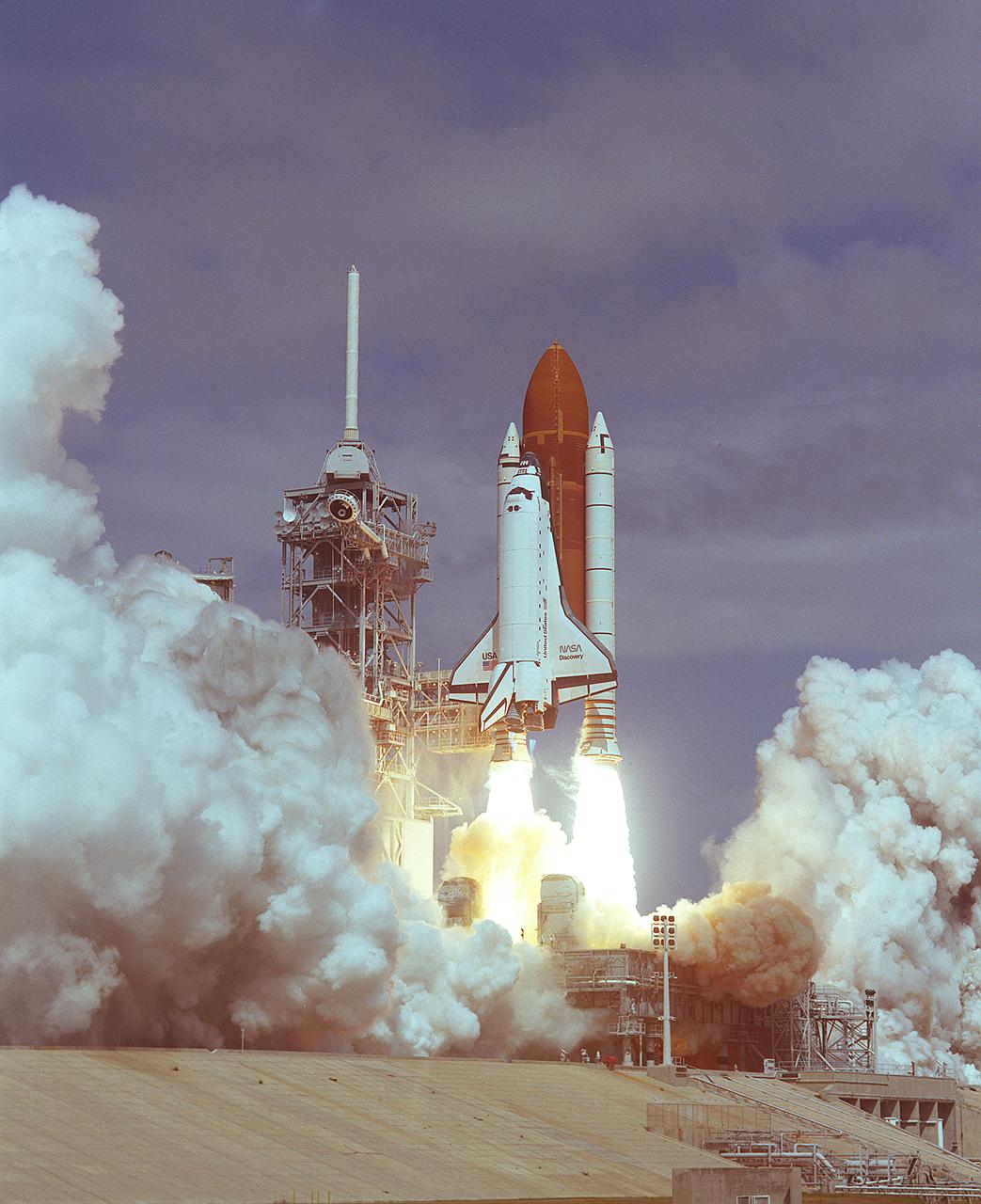
On September 29, 1988, after a 32-month hiatus in the Space Shuttle program that followed the Challenger accident, orbiter Discovery roared upward on the strength of its Marshall-managed solid rocket boosters, external tank, and Space Shuttle main engines.

STS008-18-468 (30 Aug-5 Sept 1983) --- Astronaut William E. Thornton, right conducts an audiometry test on Astronaut Dale A. Gardner in the mid deck of the Earth-orbiting Space Shuttle Challenger. Both men are mission specialists for the reusable spacecraft’s second five-person crew. This frame was shot with a 35mm camera.
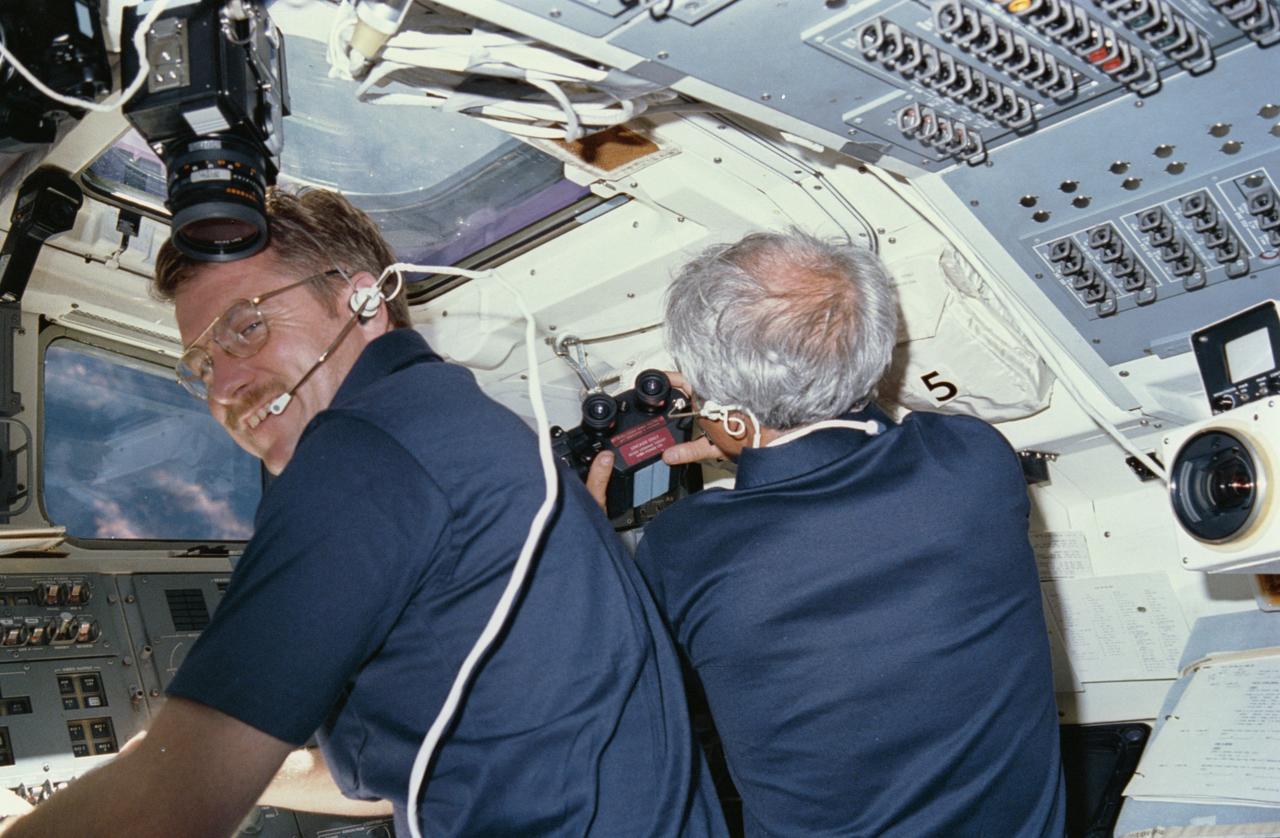
51F-05-003 (29 July-6 Aug 1985) --- Astronaut Anthony W. England, 51-F mission specialist, talks to ground controllers in Houston from the flight deck of the Earth-orbiting Challenger while Payload Specialist John-David Bartoe prepares to use binoculars through aft flight deck windows.
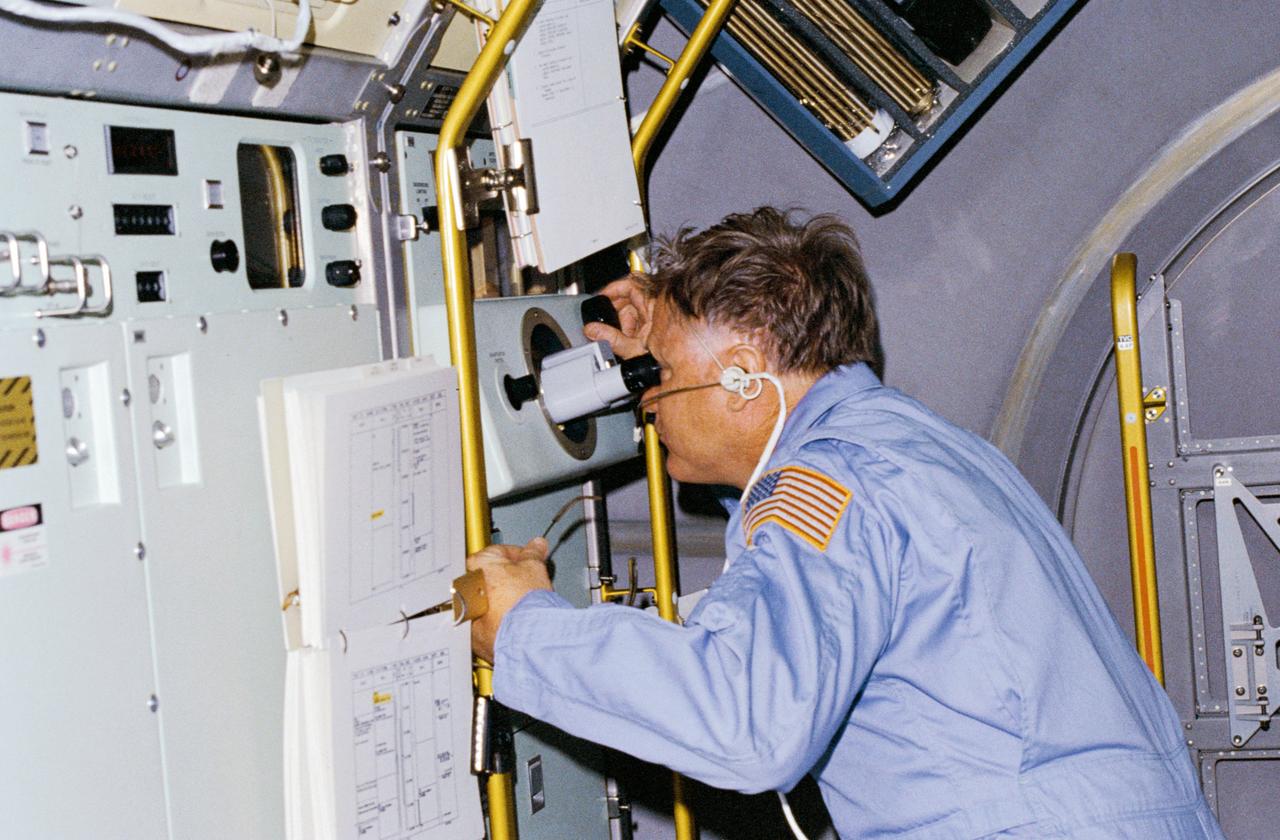
51B-01-007 (30 April 1985) --- Astronaut Don L. Lind, 51-B Spacelab 3 mission specialist, observes the growth of mercuric iodide crystal in the vapor crystal growth system (VCGS) on the Spacelab 3 science module aboard the orbiter Challenger.
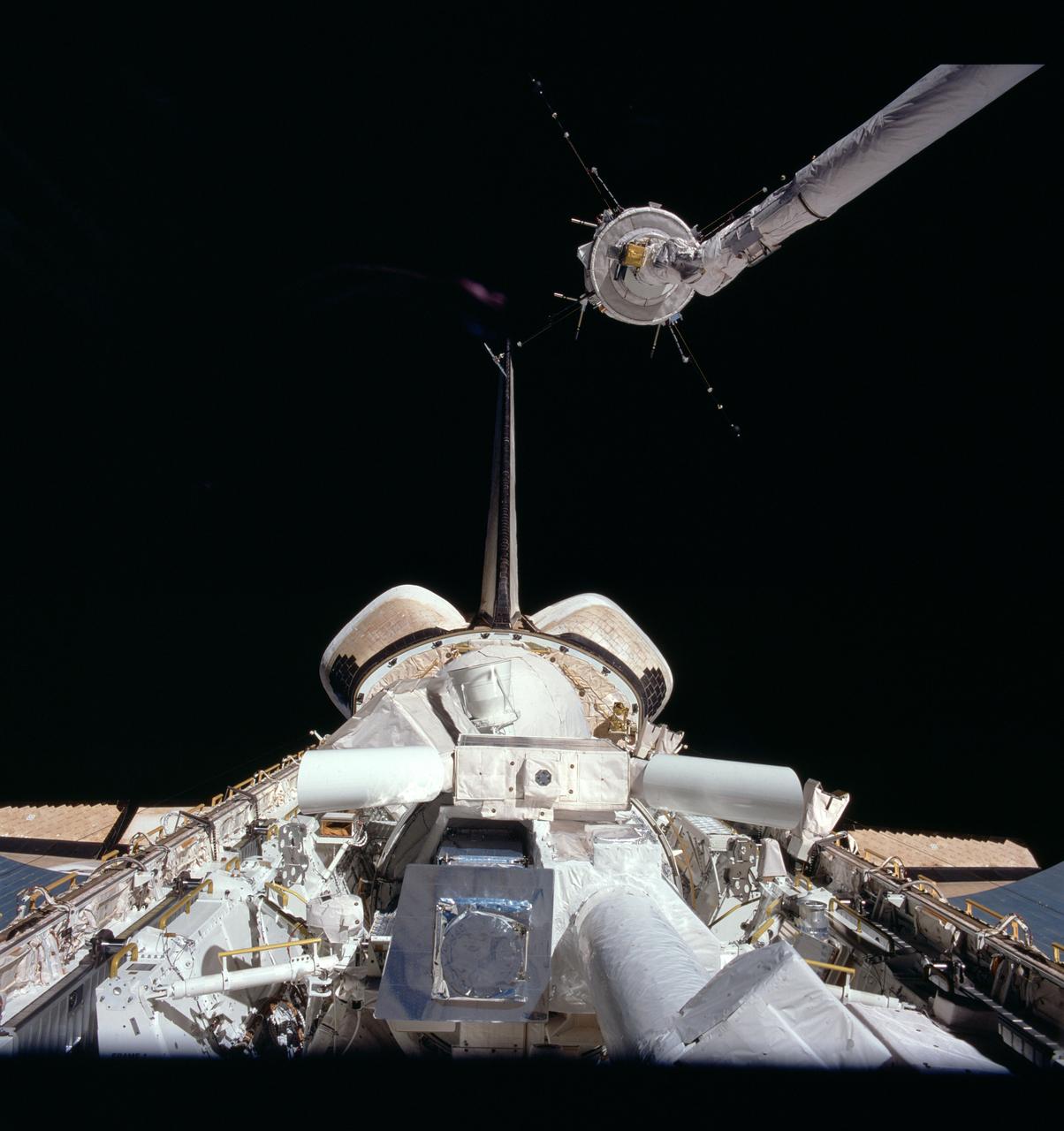
51F-33-024 (29 July-6 Aug 1985) --- The Challenger's remote manipulator system (RMS) arm grasps the plasma diagnostics package (PDP) over the experiment-laden cargo bay of the earth orbiting spacecraft. The instrument pointing system, in a resting mode here, is prominent in the bay.
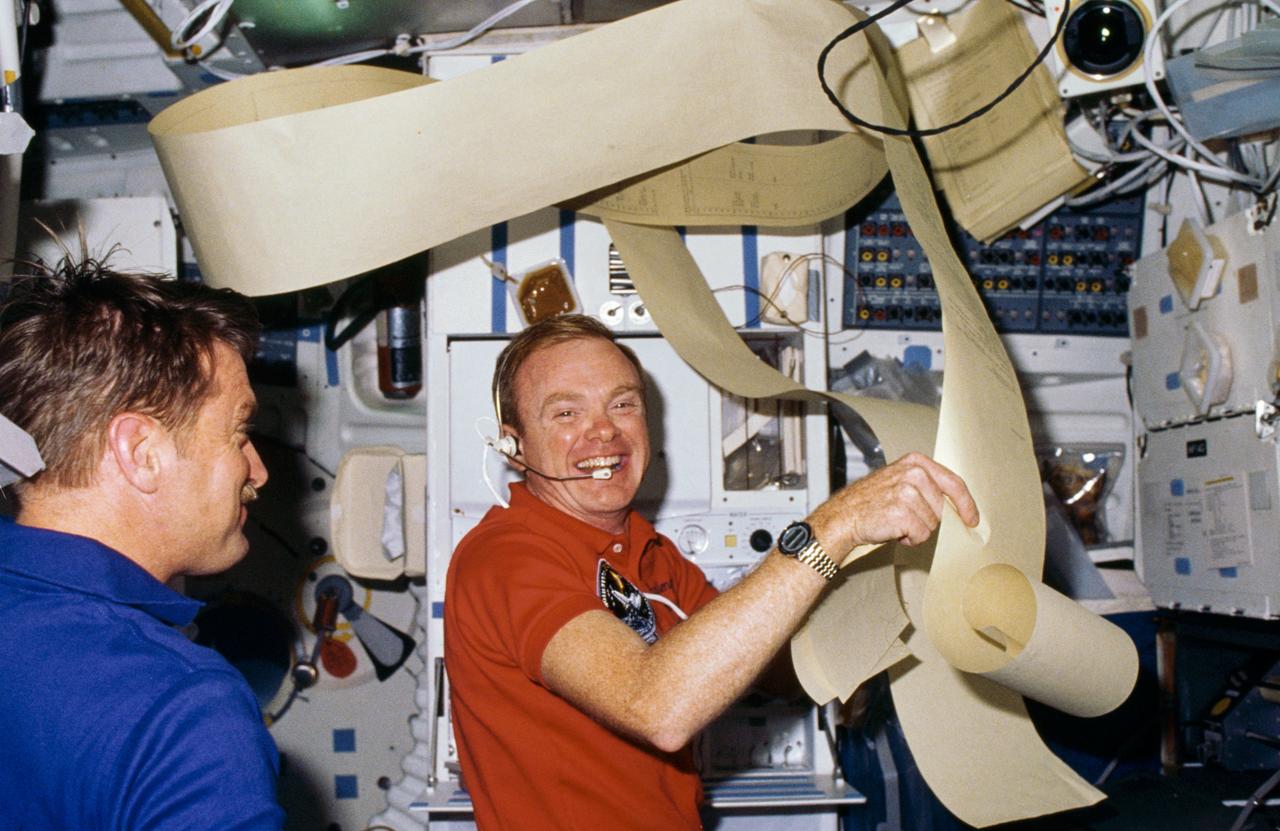
51F-03-024 (29 July-6 Aug 1985) --- Astronauts Anthony W. England, left, and Roy D. Bridges are surrounded by some of the prolific teleprinter copy transmitted from ground controllers to the Earth-orbiting Challenger. Eventually the equivalent of several football fields' length of paper was filled with data from flight controllers.
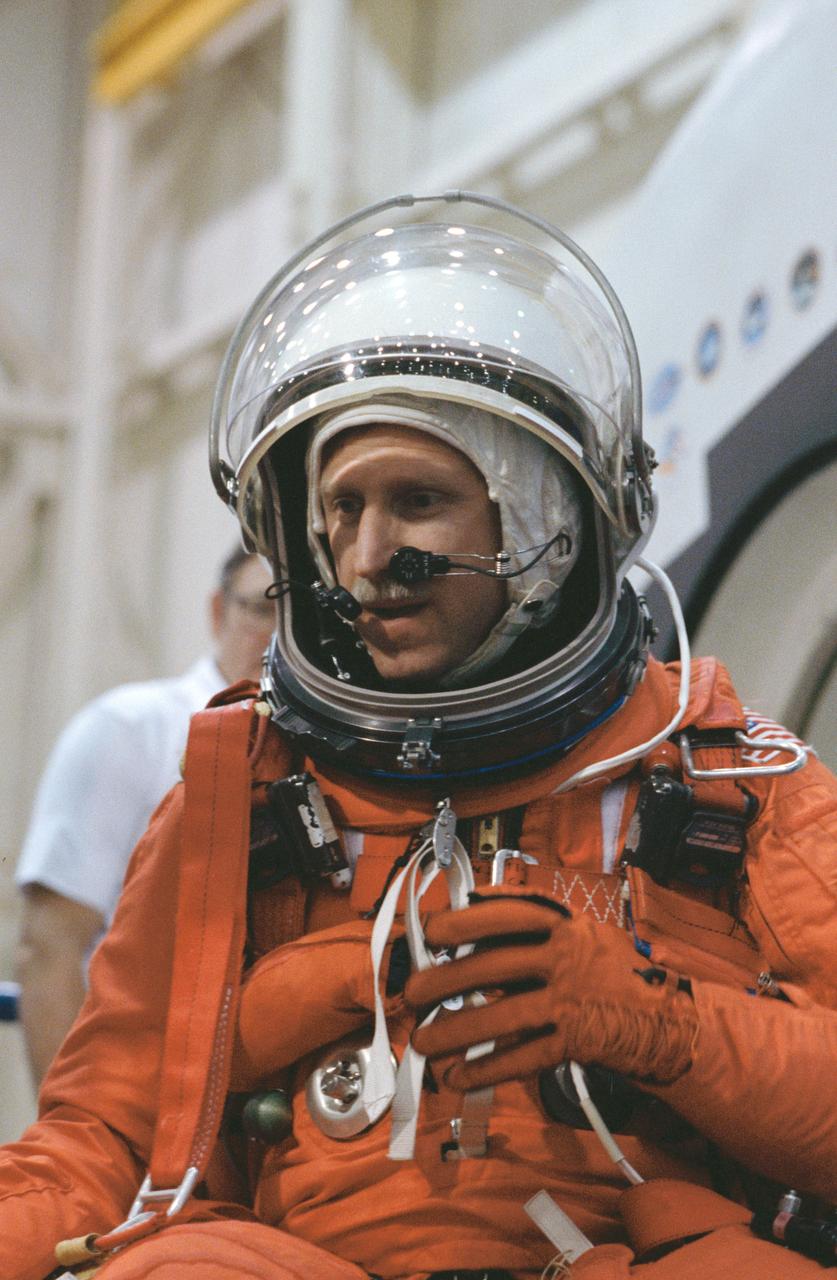
S90-38948 (9 March 1990) --- Astronaut Richard O. Covey, STS-38 commander, is seen in a close-up view during training exercises with a special escape pole. The device was designed and deployed on all active orbiters following the January 1986 Challenger accident.

STS008-18-481 (30 Aug-5 Sept 1983) --- Astronaut Daniel C. Brandenstein, STS-8 pilot, communicates with ground controllers form the flight deck of the Earth orbiting Space Shuttle Challenger. This frame was shot with a 35mm camera.
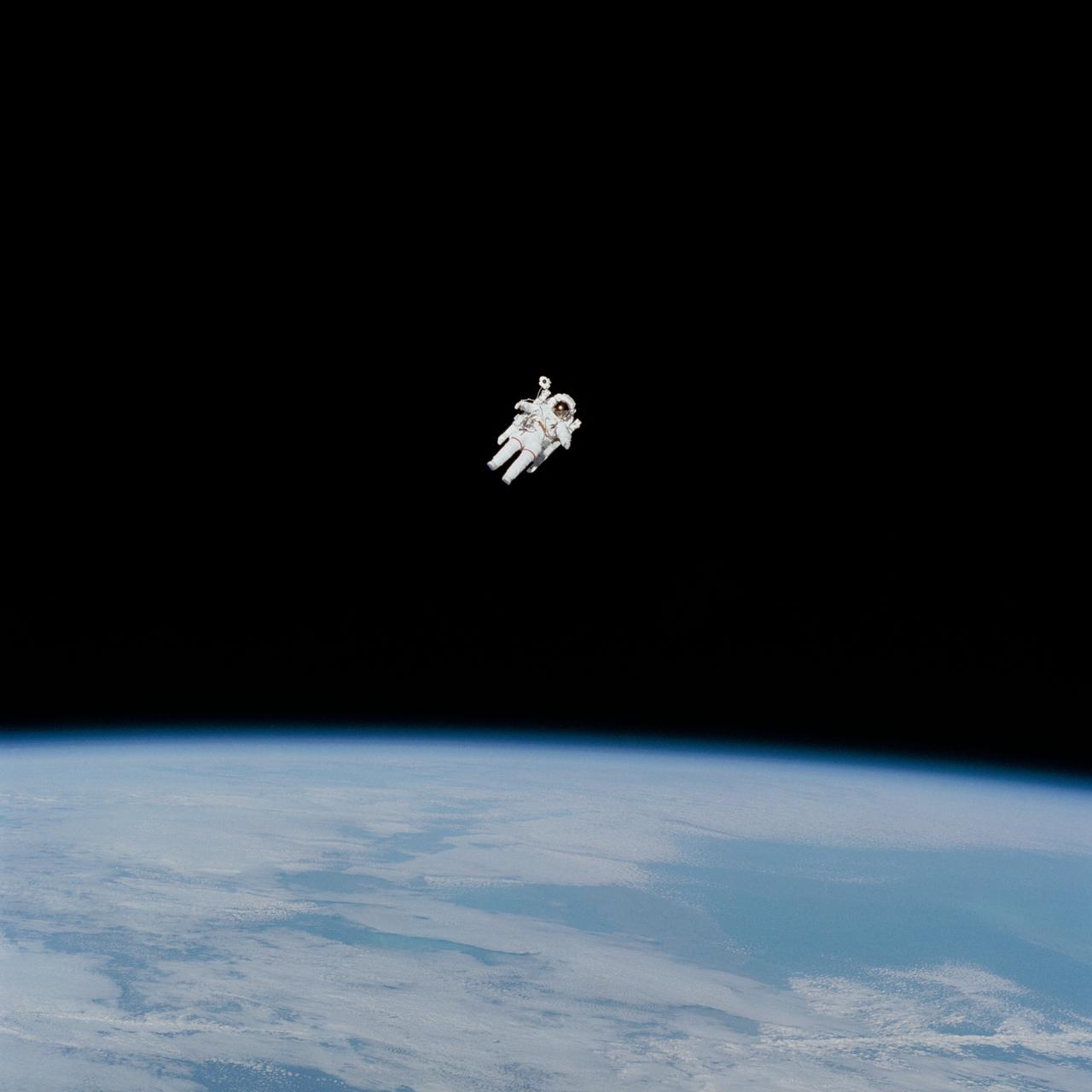
S84-27018 (7 Feb 1984) --- Astronaut Bruce McCandless II approaches his maximum distance from the Earth-orbiting Space Shuttle Challenger in this 70mm frame photographed by his fellow crewmembers onboard the reusable vehicle. McCandless is in the midst of the first "field" tryout of the nitrogen-propelled, hand-controlled back-pack device called the manned maneuvering unit (MMU). Astronaut Robert L. Stewart got a chance to test the same unit a while later in the lengthy EVA session while the two spacewalkers were photographed and monitored by their fellow crewmembers in Challenger's cabin. Those inside were Astronauts Vance D. Brand, Robert L. Gibson and Dr. Ronald E. McNair.
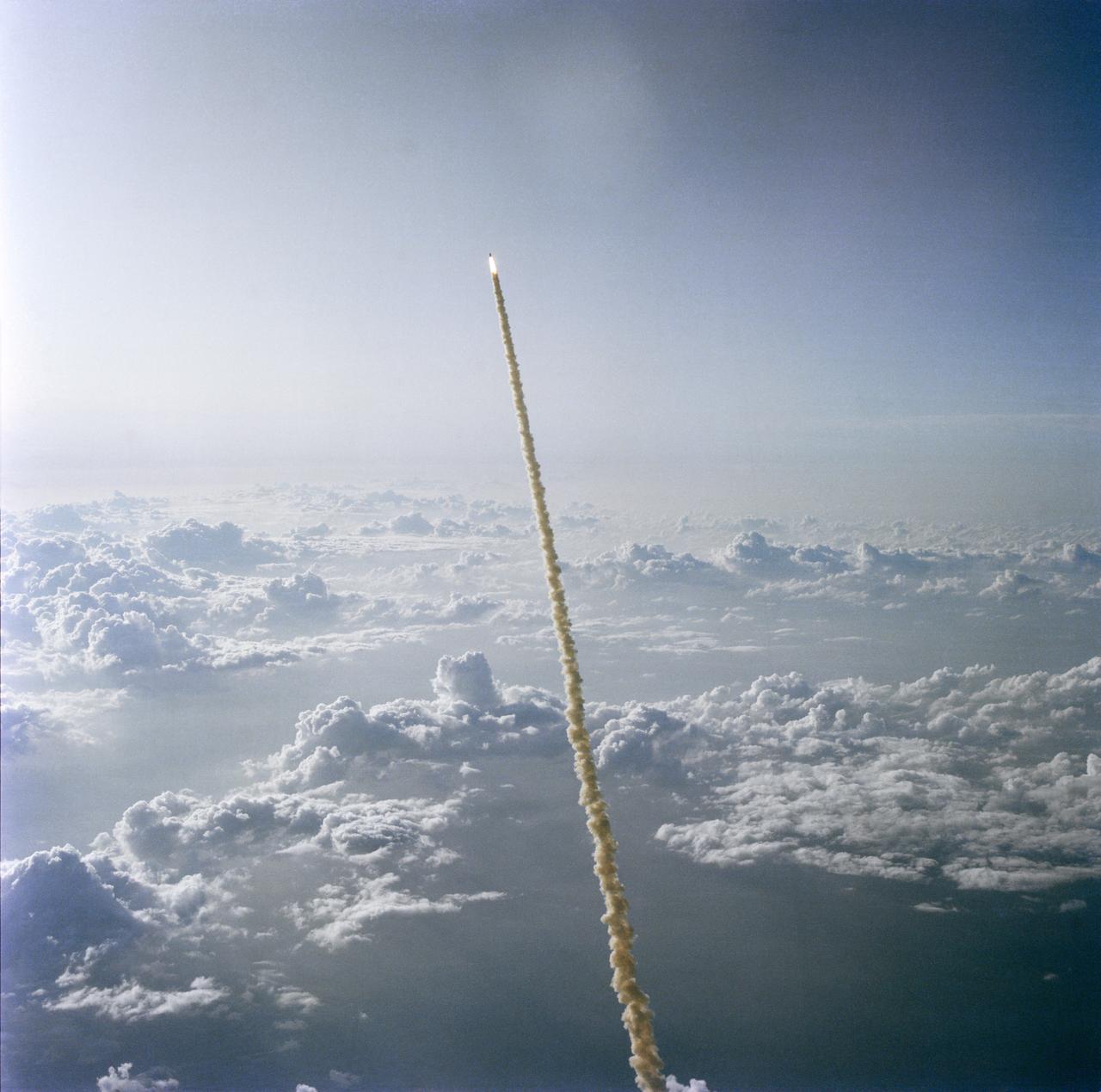
S83-35620 (18 June 1983) --- The space shuttle Challenger, its two solid rocket boosters and an external fuel tank carry the five-member STS-7 astronaut crew toward a six-day mission in Earth orbit. This high-angle view of the liftoff, a lengthy stretch of Florida Atlantic coastline and a number of large cumulus clouds was photographed with a handheld 70mm camera by astronaut John W. Young. Young usually pilots the Shuttle Training Aircraft (STA) for weather monitoring at launch and landing sites for STS missions. The Challenger?s second launch occurred at 7:33 a.m. (EDT) on 18 June 1983. Photo credit: NASA

CAPE CANAVERAL, Fla. -- The crew of 41B STS-11, the first spaceflight in history to begin and conclude a mission at the same site, leave the flight deck of orbiter Challenger to be greeted by George Abbey, director of Flight Crew Operations. In ascending order, the crew members are Vance Brand, mission commander mission Pilot Robert L.'Hoot' Gibson and Mission Specialists Robert L. Stewart, Ronald E. McNair and Bruce McCandless II. Challenger touched down at 7:15:55 a.m. EST on Feb. 11, rolling 10,700 feet before coming to a stop on the Kennedy Space Center's 15,000-foot-long runway. Photo credit: NASA
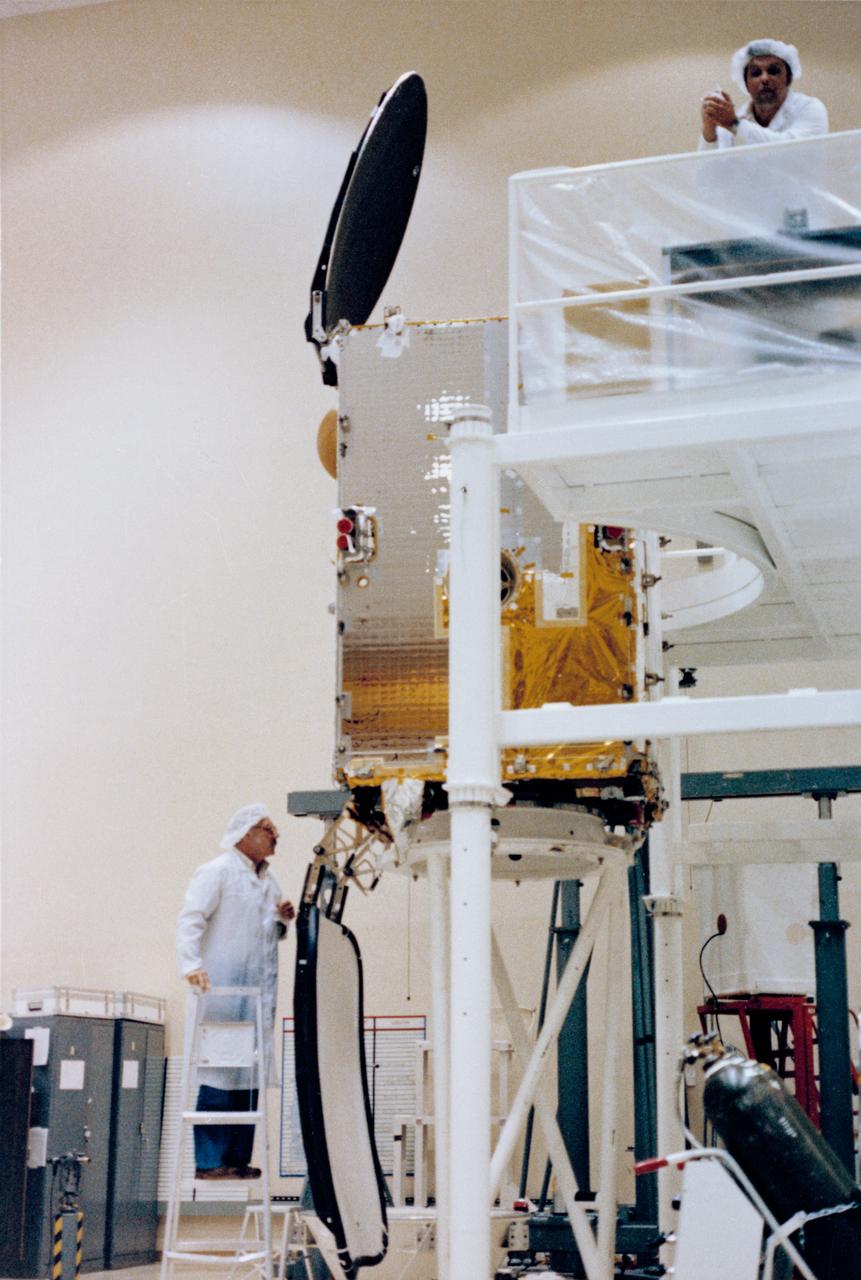
S83-36307 (2 June 1983) --- INSAT 1-B is being prepared for its trip aboard the space shuttle Challenger and its deployment for geosynchronous orbital duties at the Cape Canaveral Air Force Station and at NASA's Kennedy Space Center (KSC). The Indian National Satellite is the second such Indian communications/meteorological spacecraft, the first having been sent into space via a Delta launch vehicle. The STS-8 astronaut crew members and a payload assist module (PAM) will aid the newest INSAT in its deployment steps during NASA?s third Challenger flight in August of this year.
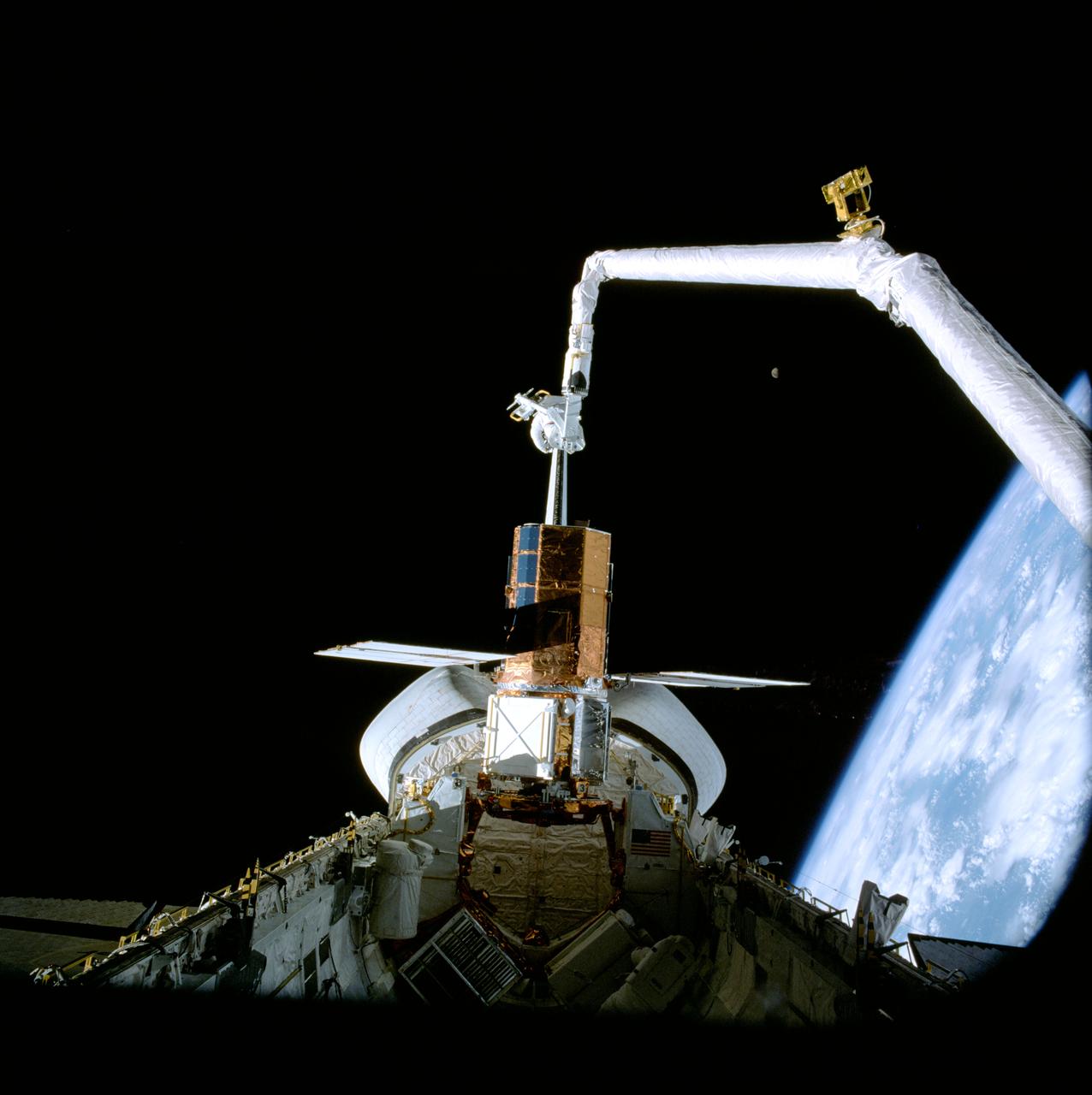
41C-37-1715 (11 April 1984) --- A scenic panorama is captured by an onboard 70mm handheld camera during the April 11, 1984, Solar Maximum Mission Satellite (SMMS) repair job aboard the Earth-orbiting Space Shuttle Challenger. The SMMS is temporarily docked at the Challenger's Flight Support System (FSS) so that astronauts George D. Nelson and James D. van Hoften could perform a series of repair tasks. The Remote Manipulator System (RMS) arm was used to move the astronauts into position for their series of chores. Note the gibbous Moon to the right of center and the horizon of the blue and white Earth in the lower right quadrant.
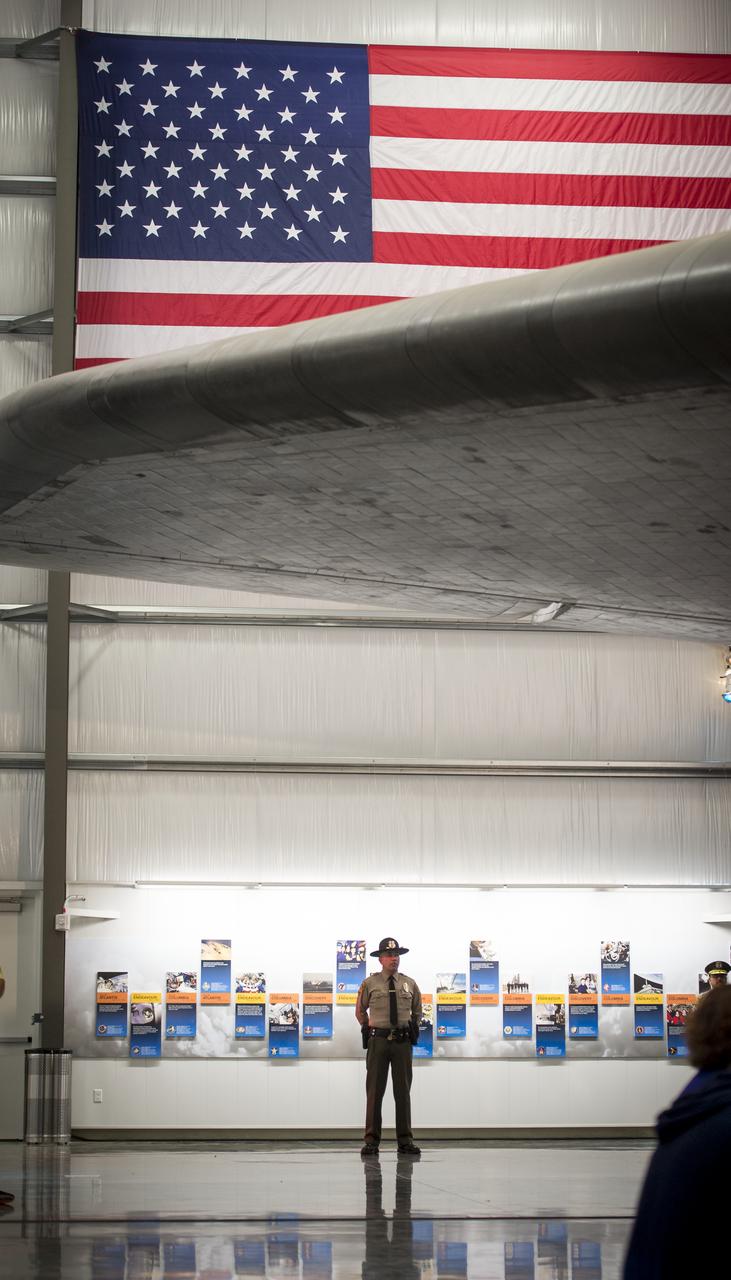
A police officer is seen underneath the wing of the space shuttle Endeavour during the grand opening ceremony for the California Science center's Samuel Oschin Space Shuttle Endeavour Display Pavilion, Tuesday, Oct. 30, 2012, in Los Angeles. Endeavour, built as a replacement for space shuttle Challenger, completed 25 missions, spent 299 days in orbit, and orbited Earth 4,671 times while traveling 122,883,151 miles. Photo Credit: (NASA/Bill Ingalls)
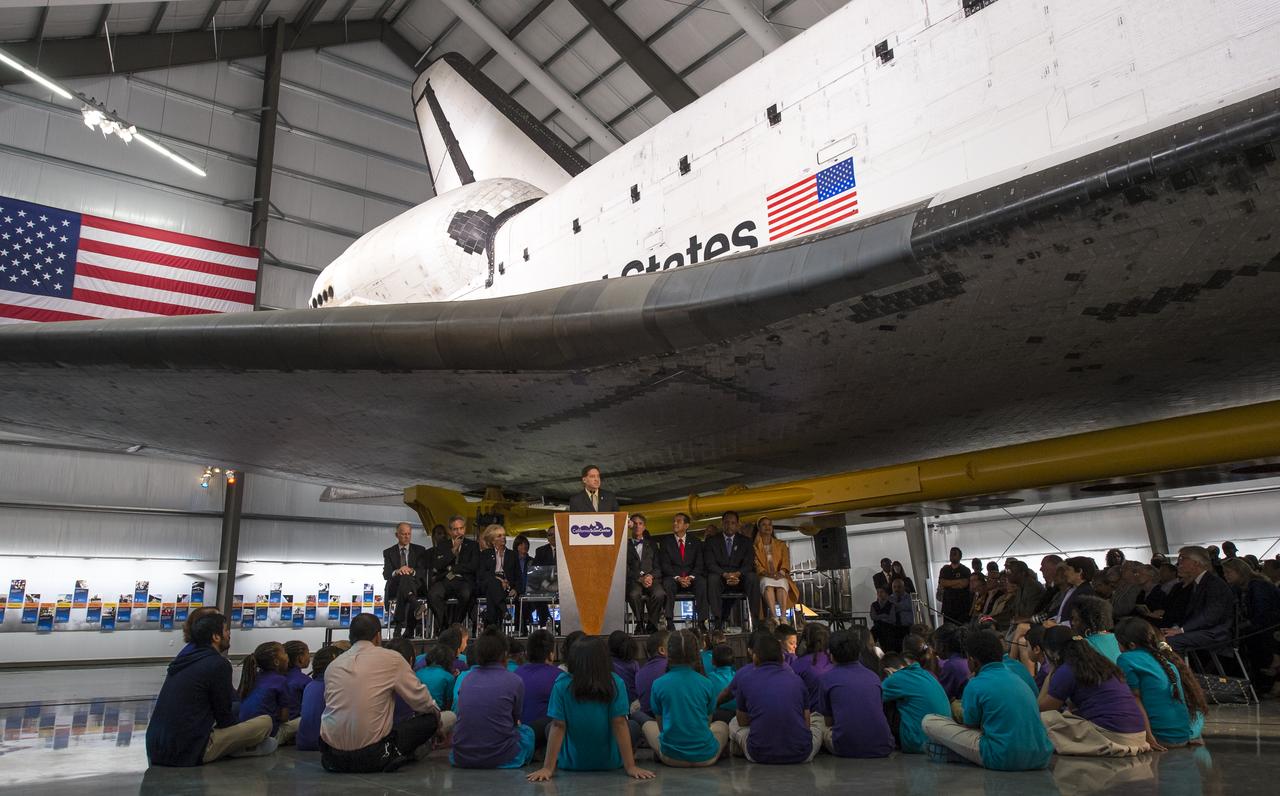
President and CEO of the California Science Center Jeffrey N. Rudolph speaks from a podium underneath the space shuttle Endeavour during the grand opening ceremony for the center's Samuel Oschin Space Shuttle Endeavour Display Pavilion, Tuesday, Oct. 30, 2012, in Los Angeles. Endeavour, built as a replacement for space shuttle Challenger, completed 25 missions, spent 299 days in orbit, and orbited Earth 4,671 times while traveling 122,883,151 miles. Photo Credit: (NASA/Bill Ingalls)
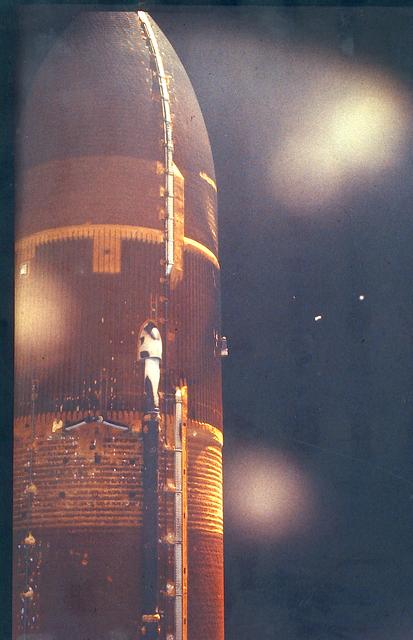
JSC2003-E-15408 (18 June 1983) --- A 35mm still camera located in the umbilical well of the space shuttle Challenger took this photograph of the external fuel tank (ET) after it was dropped from the launch stack as the shuttle headed for Earth orbit on June 18, 1983. The camera was located in the LO2 umbilical near the aft end of the orbiter (right side as you view the ET). Photo credit: NASA
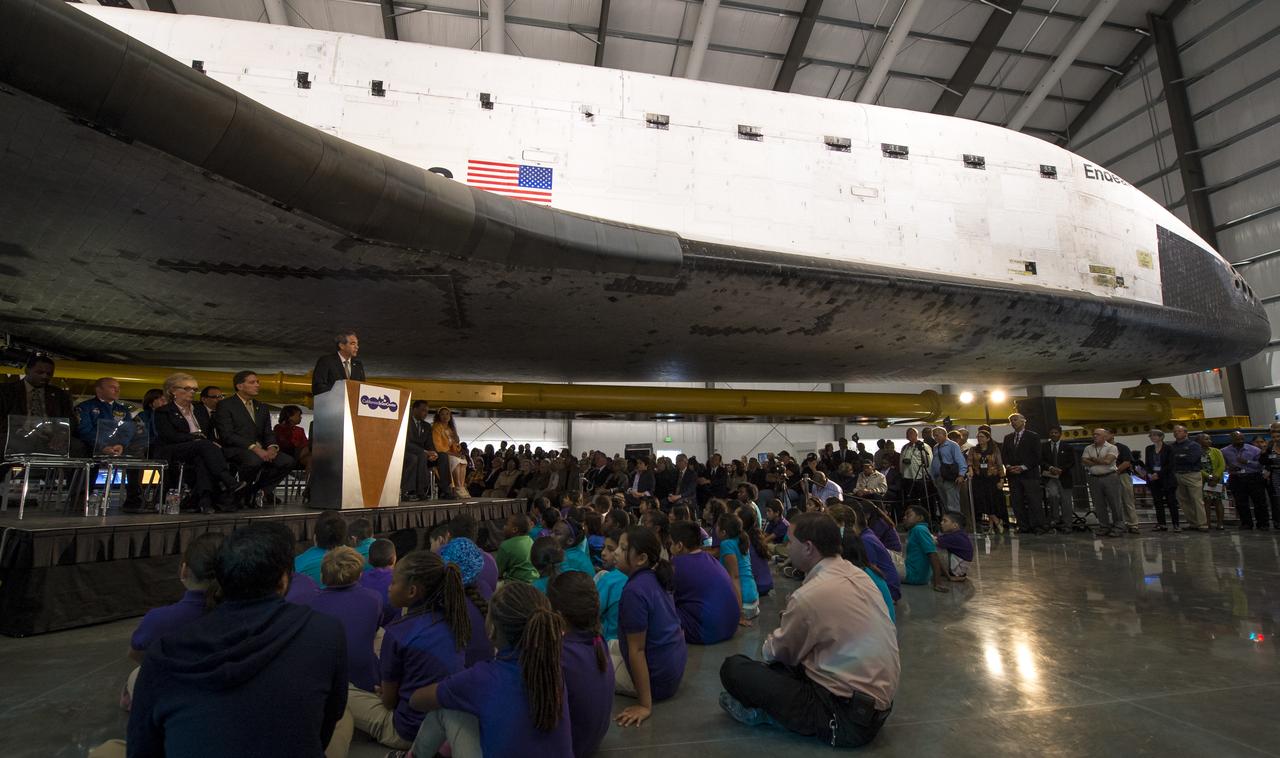
David D. McBride, director of NASA's Dryden Flight Research Center, speaks from a podium underneath the space shuttle Endeavour during the grand opening ceremony for the California Science center's Samuel Oschin Space Shuttle Endeavour Display Pavilion, Tuesday, Oct. 30, 2012, in Los Angeles. Endeavour, built as a replacement for space shuttle Challenger, completed 25 missions, spent 299 days in orbit, and orbited Earth 4,671 times while traveling 122,883,151 miles. Photo Credit: (NASA/Bill Ingalls)
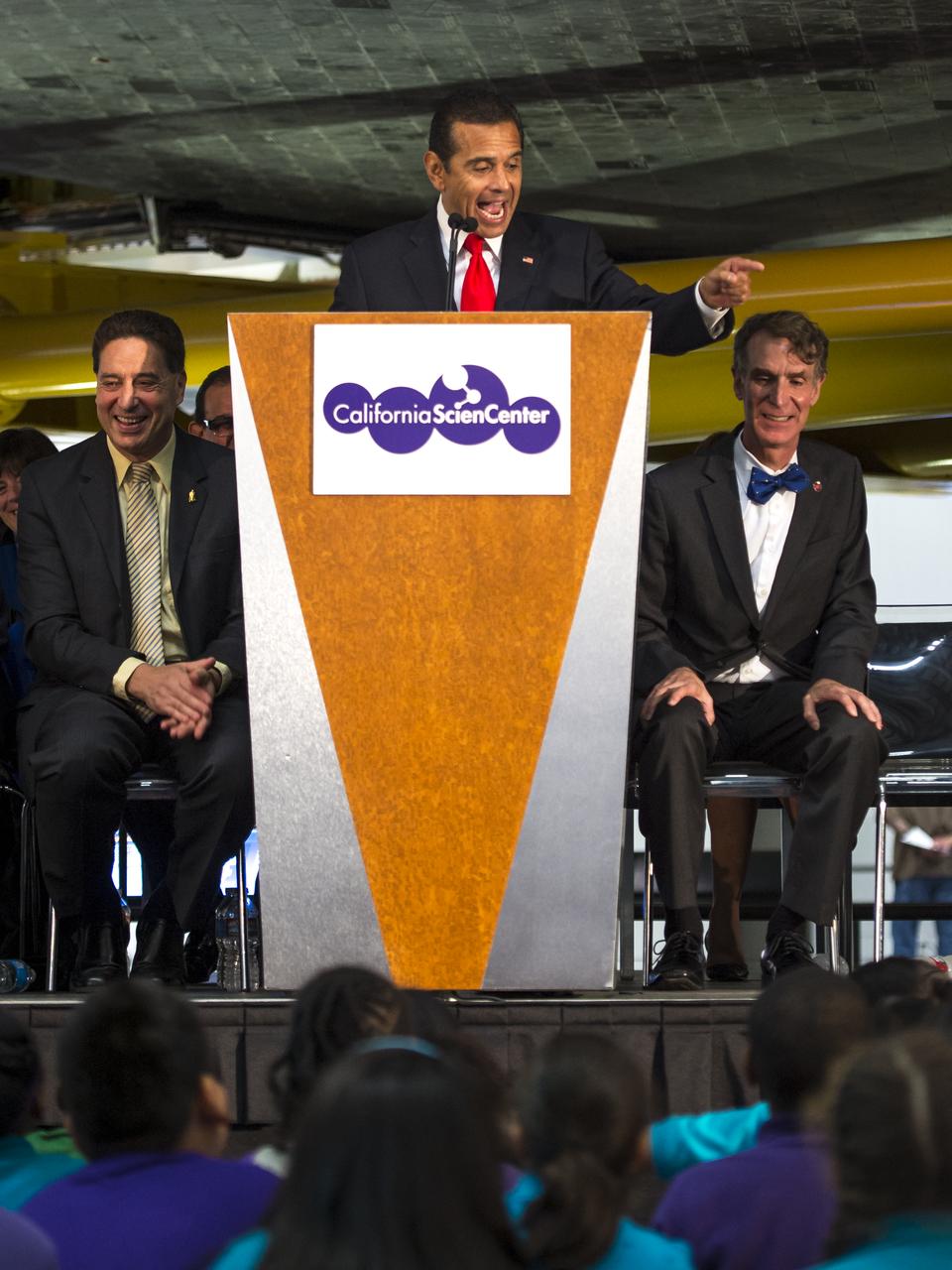
Mayor of Los Angeles Antonio Villaraigosa addresses a class of fourth graders during the grand opening ceremony for the California Science center's Samuel Oschin Space Shuttle Endeavour Display Pavilion, Tuesday, Oct. 30, 2012, in Los Angeles. Endeavour, built as a replacement for space shuttle Challenger, completed 25 missions, spent 299 days in orbit, and orbited Earth 4,671 times while traveling 122,883,151 miles. Photo Credit: (NASA/Bill Ingalls)

The space shuttle Endeavour is seen as it traverses through Inglewood, California on Friday, Oct. 2012. Endeavour, built as a replacement for space shuttle Challenger, completed 25 missions, spent 299 days in orbit, and orbited Earth 4,671 times while traveling 122,883,151 miles. Beginning Oct. 30, the shuttle will be on display in the CSC’s Samuel Oschin Space Shuttle Endeavour Display Pavilion, embarking on its new mission to commemorate past achievements in space and educate and inspire future generations of explorers. Photo Credit: (NASA/Carla Cioffi)
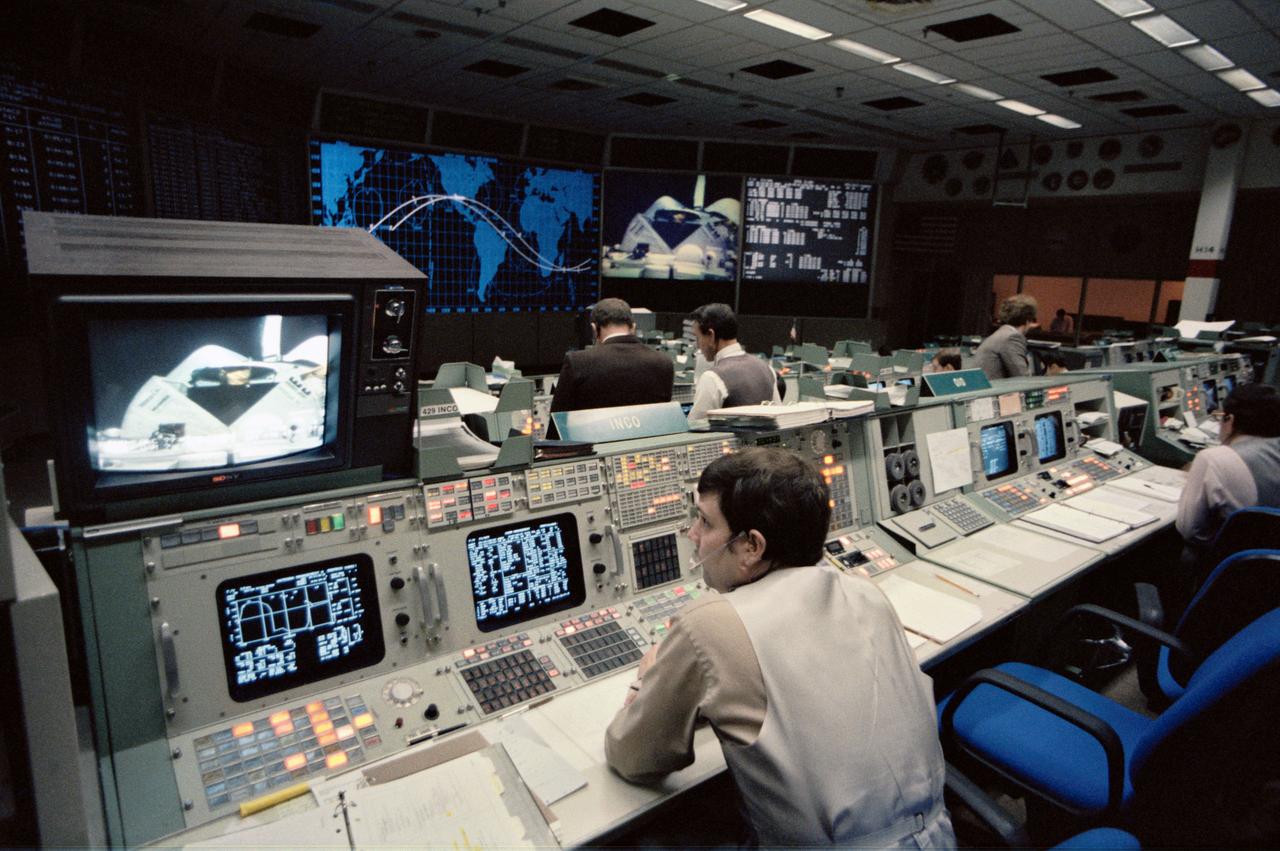
S84-26332 (3 Feb 1984) --- Robert E. Castle, integrated communications officer (INCO), plays an important role in the first television transmission from the Earth-orbiting Space Shuttle Challenger. Castle, at a console in the Johnson Space Center?s mission operations control room (MOCR) in the mission control center, is responsible for ground controlled television from the orbiter on his shift. Here, the Westar VI satellite is seen in the cargo bay just after opening of the payload bay doors.
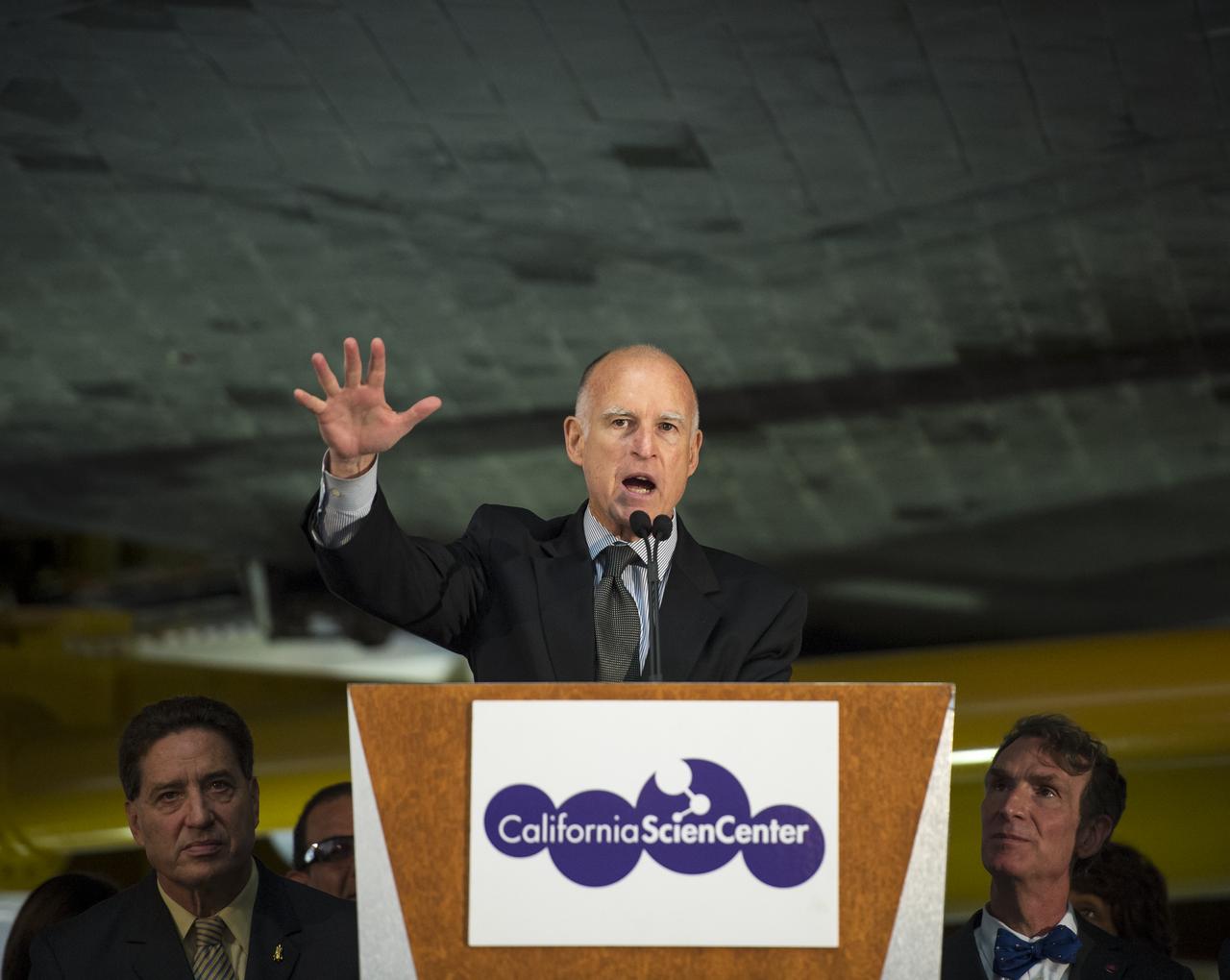
California Governor Jerry Brown speaks from a podium underneath the space shuttle Endeavour during the grand opening ceremony for the California Science center's Samuel Oschin Space Shuttle Endeavour Display Pavilion, Tuesday, Oct. 30, 2012, in Los Angeles. Endeavour, built as a replacement for space shuttle Challenger, completed 25 missions, spent 299 days in orbit, and orbited Earth 4,671 times while traveling 122,883,151 miles. Photo Credit: (NASA/Bill Ingalls)
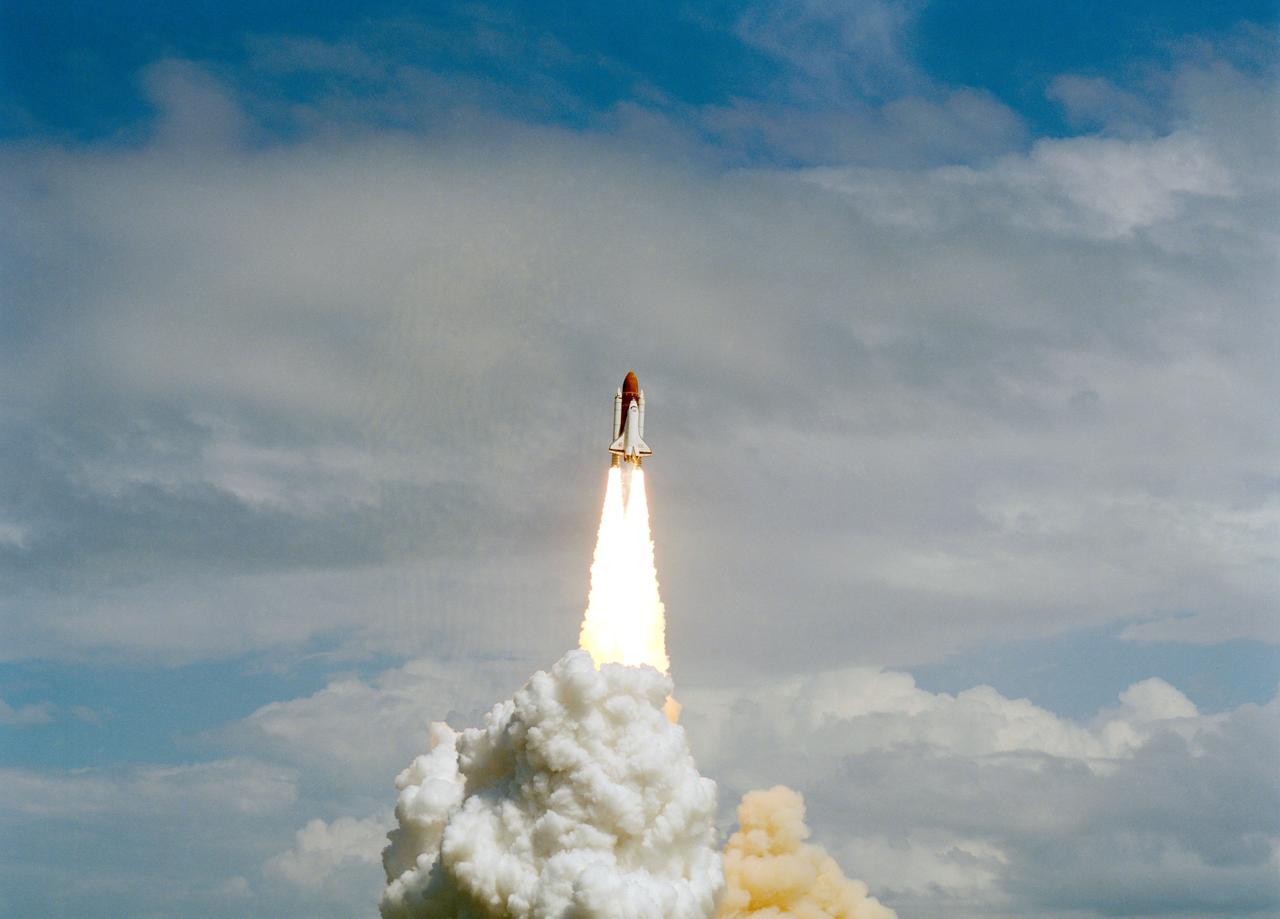
STS-26 Discovery, Orbiter Vehicle (OV) 103, rises into a cloudy sky and heads for Earth orbit atop the external tank (ET) as exhaust plumes billow from the two solid rocket boosters (SRBs) during liftoff from Kennedy Space Center (KSC) Launch Complex (LC) pad 39B. STS-26 marks OV-103's first flight since September 1985 and NASA's first manned mission since 51L Challenger accident, 01-28-86.