
jsc2025e060531 (6/24/2025) --- Logo is shown for the Huntsville/Madison Chamber of Commerce. The Chamber of Commerce collaborates with Rhodium Scientific on the Rhodium SpaceAg Veterans investigation. Image courtesy of the Huntsville/Madison Chamber of Commerce.
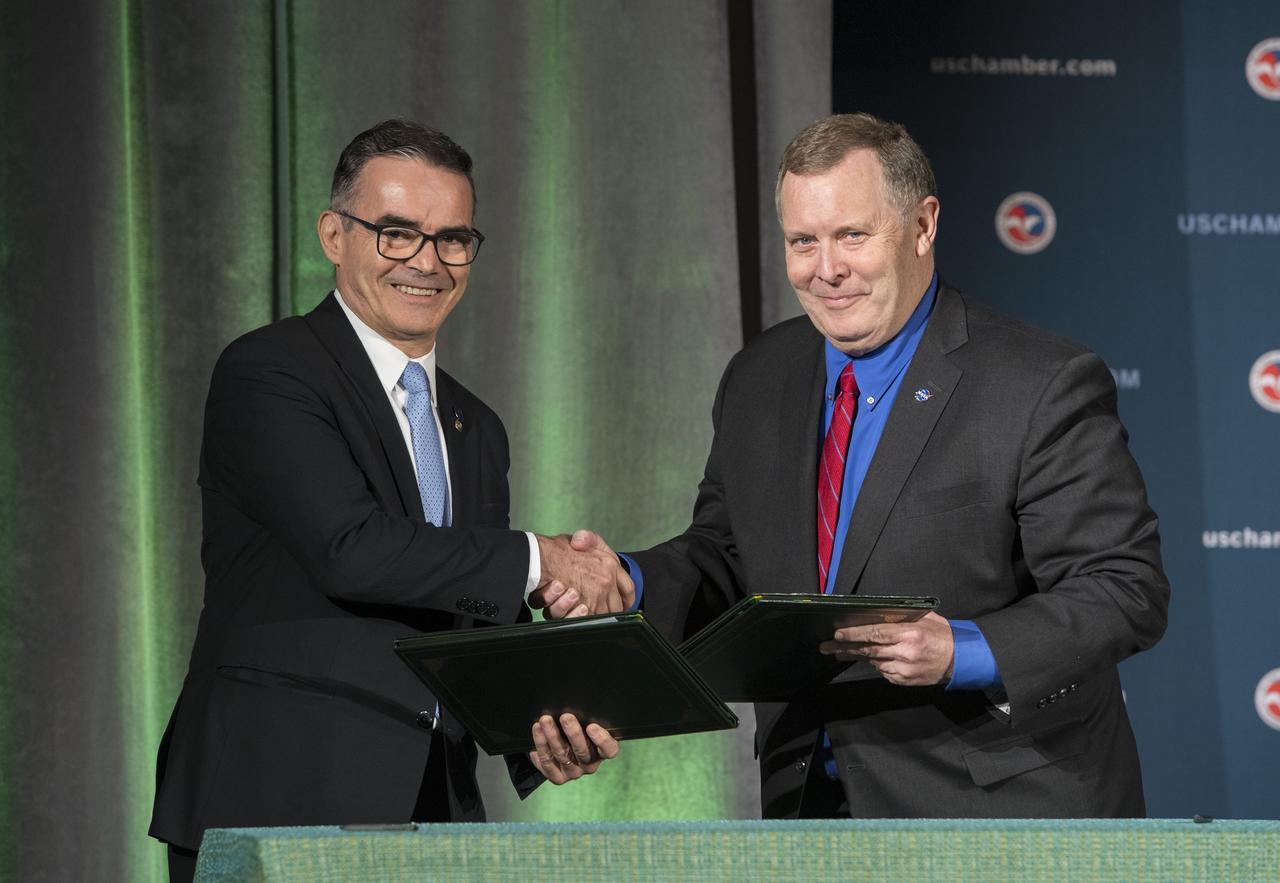
NASA Deputy Administrator James Morhard, right, shakes hands with President of the Brazilian Space Agency (AEB) Carlos Augusto Teixeira de Moura, left, after signing an agreement for cooperation on the Scintillation Prediction Observations Research Task (SPORT), an upcoming NASA-AEB heliophysics CubeSat partnership, Monday, March 18, 2019, at the U.S. Chamber of Commerce in Washington. The SPORT CubeSat will investigate two ionospheric phenomena, equatorial plasma bubbles and scintillation, that disrupt radio communication systems, satellite technologies, and Global Positioning System (GPS) signals. SPORT is currently projected to launch in the 2020 timeframe. Photo Credit: (NASA/ Aubrey Gemignani)
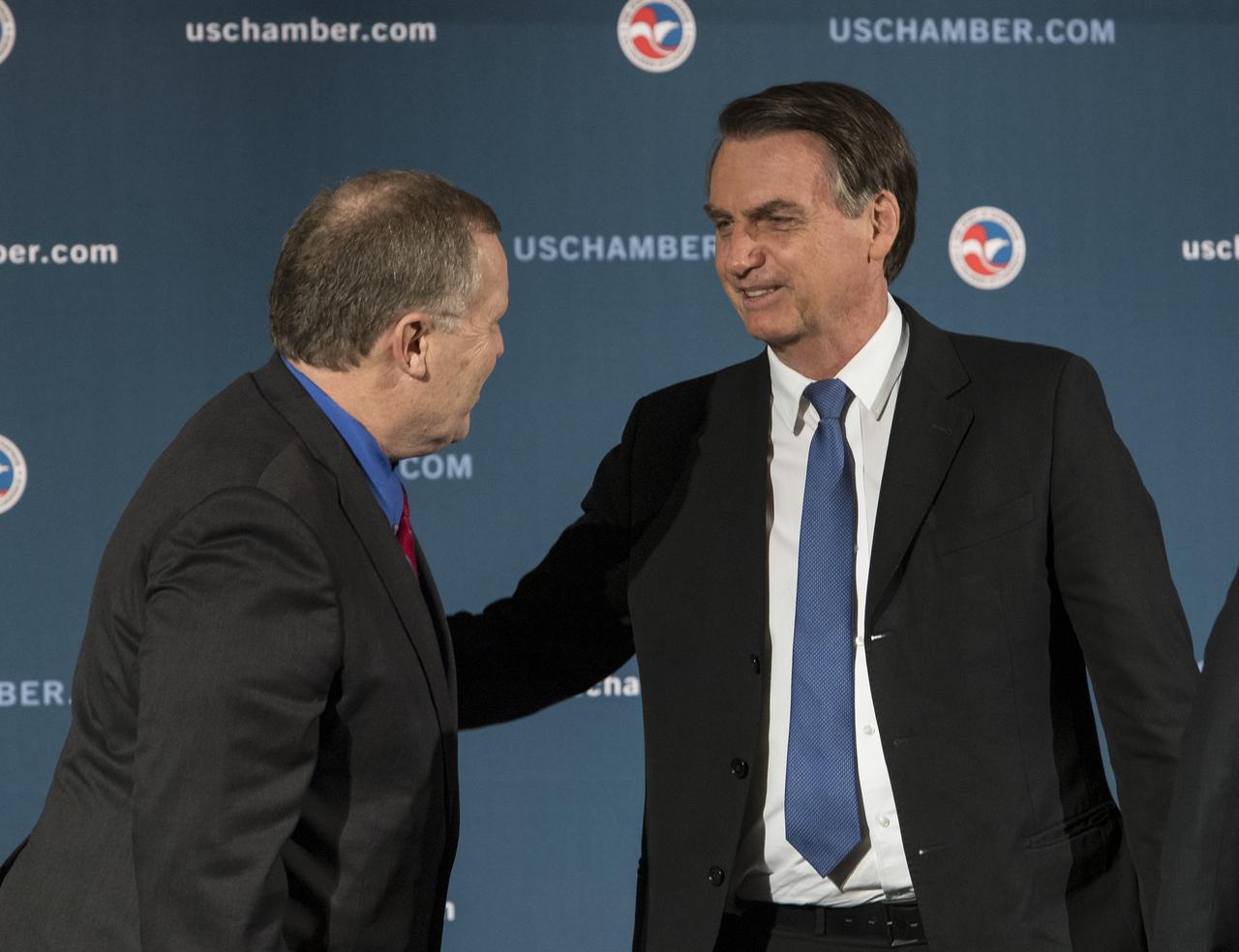
NASA Deputy Administrator James Morhard, left, speaks with H.E. President Jair Bolsonaro of Brazil, just before signing an agreement with President of the Brazilian Space Agency (AEB), Carlos Augusto Teixeira de Moura, for cooperation on the Scintillation Prediction Observations Research Task (SPORT), an upcoming NASA-AEB heliophysics CubeSat partnership, Monday, March 18, 2019, at the U.S. Chamber of Commerce in Washington. The SPORT CubeSat will investigate two ionospheric phenomena, equatorial plasma bubbles and scintillation, that disrupt radio communication systems, satellite technologies, and Global Positioning System (GPS) signals. SPORT is currently projected to launch in the 2020 timeframe. Photo Credit: (NASA/ Aubrey Gemignani)
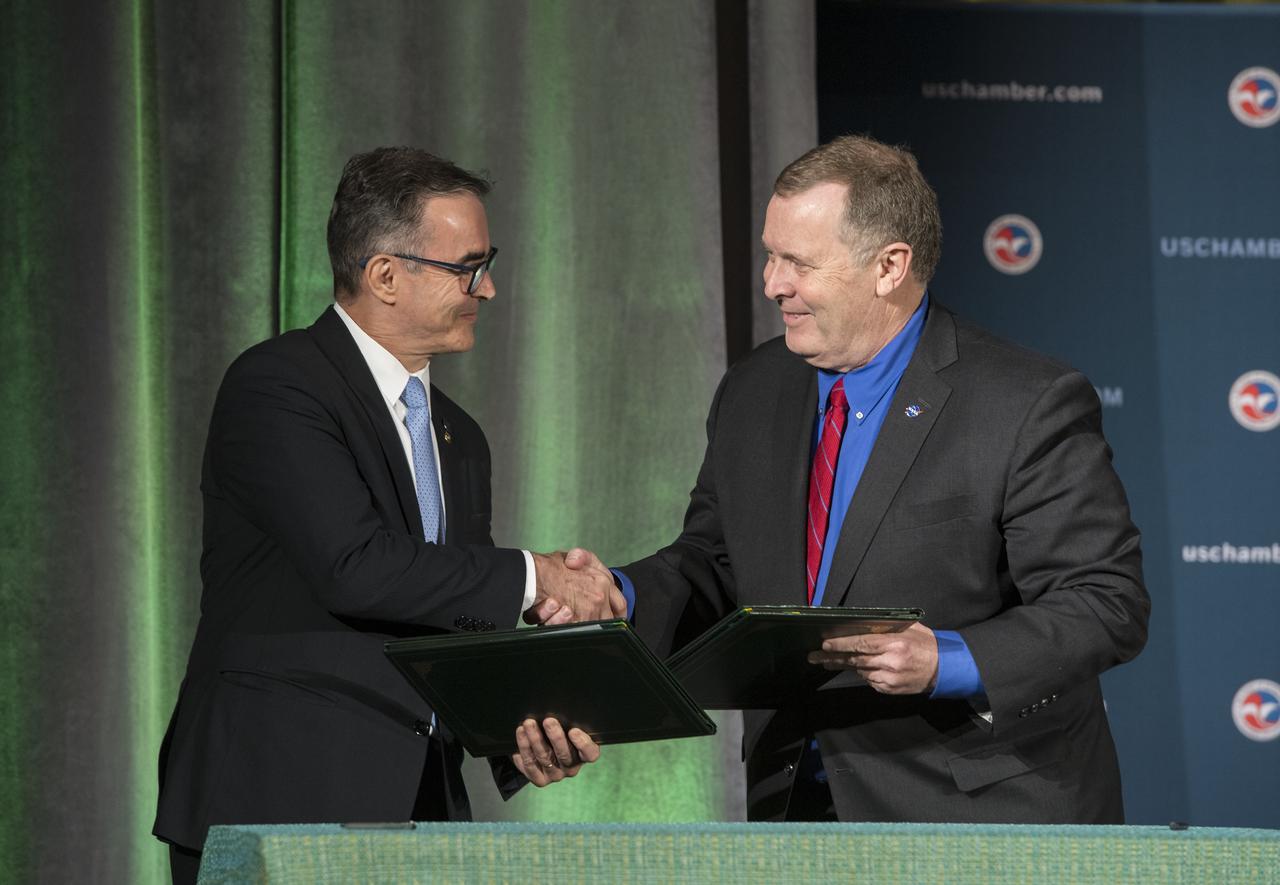
NASA Deputy Administrator James Morhard, right, shakes hands with President of the Brazilian Space Agency (AEB) Carlos Augusto Teixeira de Moura, left, after signing an agreement for cooperation on the Scintillation Prediction Observations Research Task (SPORT), an upcoming NASA-AEB heliophysics CubeSat partnership, Monday, March 18, 2019, at the U.S. Chamber of Commerce in Washington. The SPORT CubeSat will investigate two ionospheric phenomena, equatorial plasma bubbles and scintillation, that disrupt radio communication systems, satellite technologies, and Global Positioning System (GPS) signals. SPORT is currently projected to launch in the 2020 timeframe. Photo Credit: (NASA/ Aubrey Gemignani)
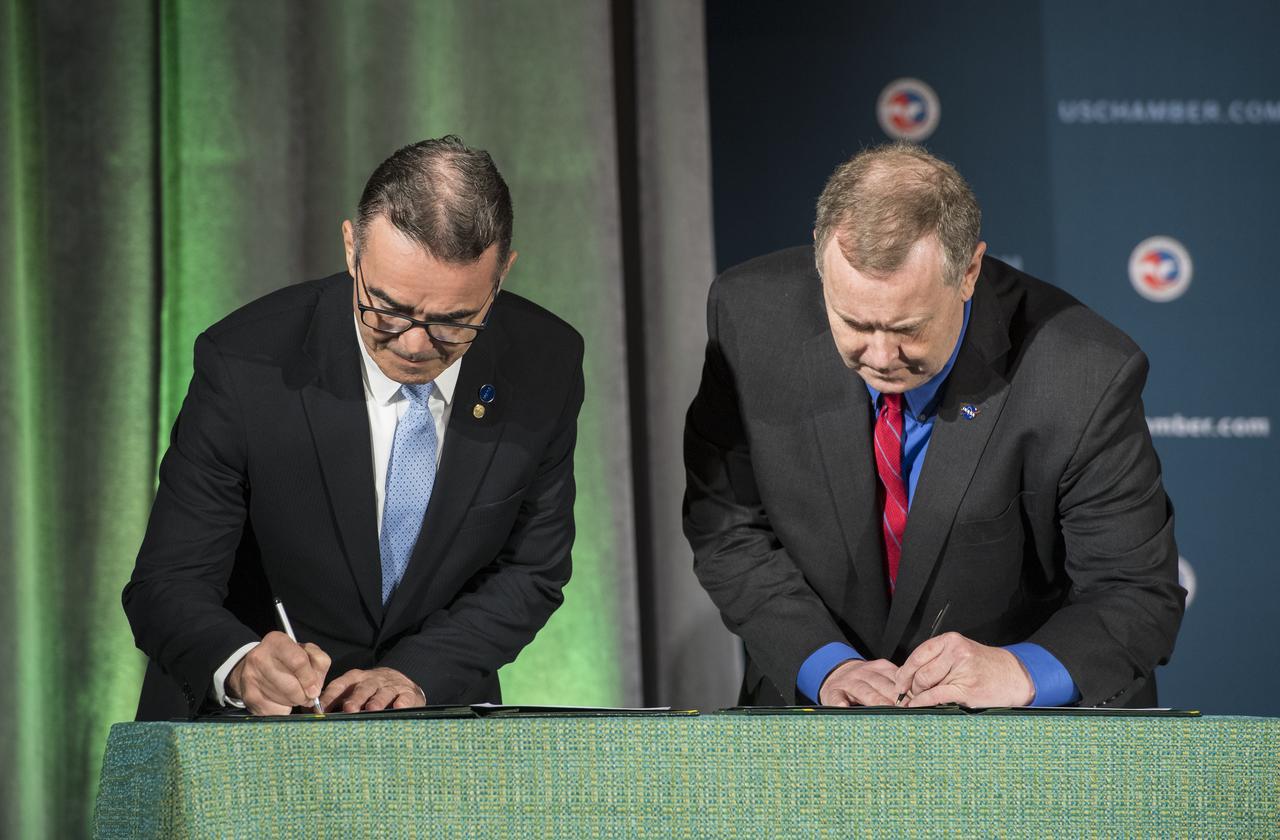
NASA Deputy Administrator James Morhard, right, and President of the Brazilian Space Agency (AEB) Carlos Augusto Teixeira de Moura, left, sign an agreement for cooperation on the Scintillation Prediction Observations Research Task (SPORT), an upcoming NASA-AEB heliophysics CubeSat partnership, Monday, March 18, 2019, at the U.S. Chamber of Commerce in Washington. The SPORT CubeSat will investigate two ionospheric phenomena, equatorial plasma bubbles and scintillation, that disrupt radio communication systems, satellite technologies, and Global Positioning System (GPS) signals. SPORT is currently projected to launch in the 2020 timeframe. Photo Credit: (NASA/ Aubrey Gemignani)
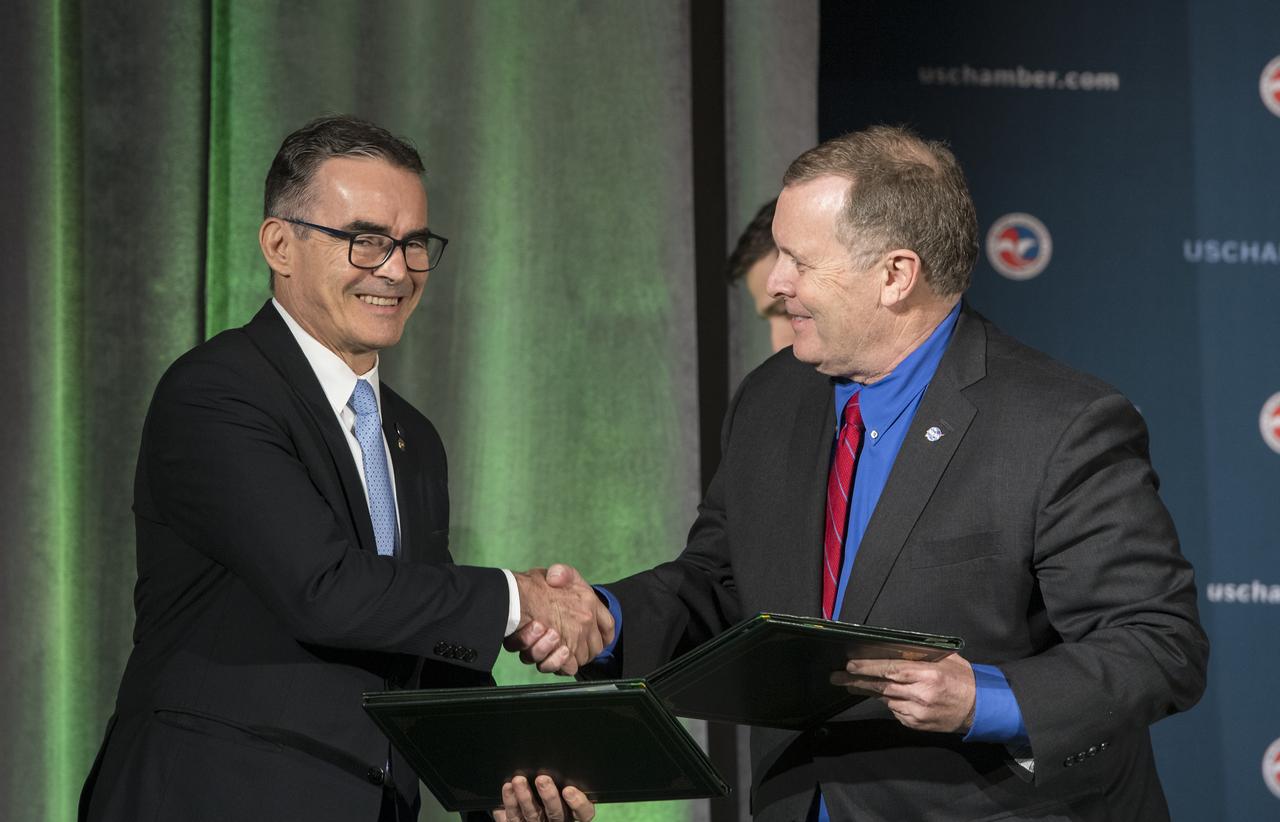
NASA Deputy Administrator James Morhard, right, shakes hands with President of the Brazilian Space Agency (AEB) Carlos Augusto Teixeira de Moura, left, after signing an agreement for cooperation on the Scintillation Prediction Observations Research Task (SPORT), an upcoming NASA-AEB heliophysics CubeSat partnership, Monday, March 18, 2019, at the U.S. Chamber of Commerce in Washington. The SPORT CubeSat will investigate two ionospheric phenomena, equatorial plasma bubbles and scintillation, that disrupt radio communication systems, satellite technologies, and Global Positioning System (GPS) signals. SPORT is currently projected to launch in the 2020 timeframe. Photo Credit: (NASA/ Aubrey Gemignani)
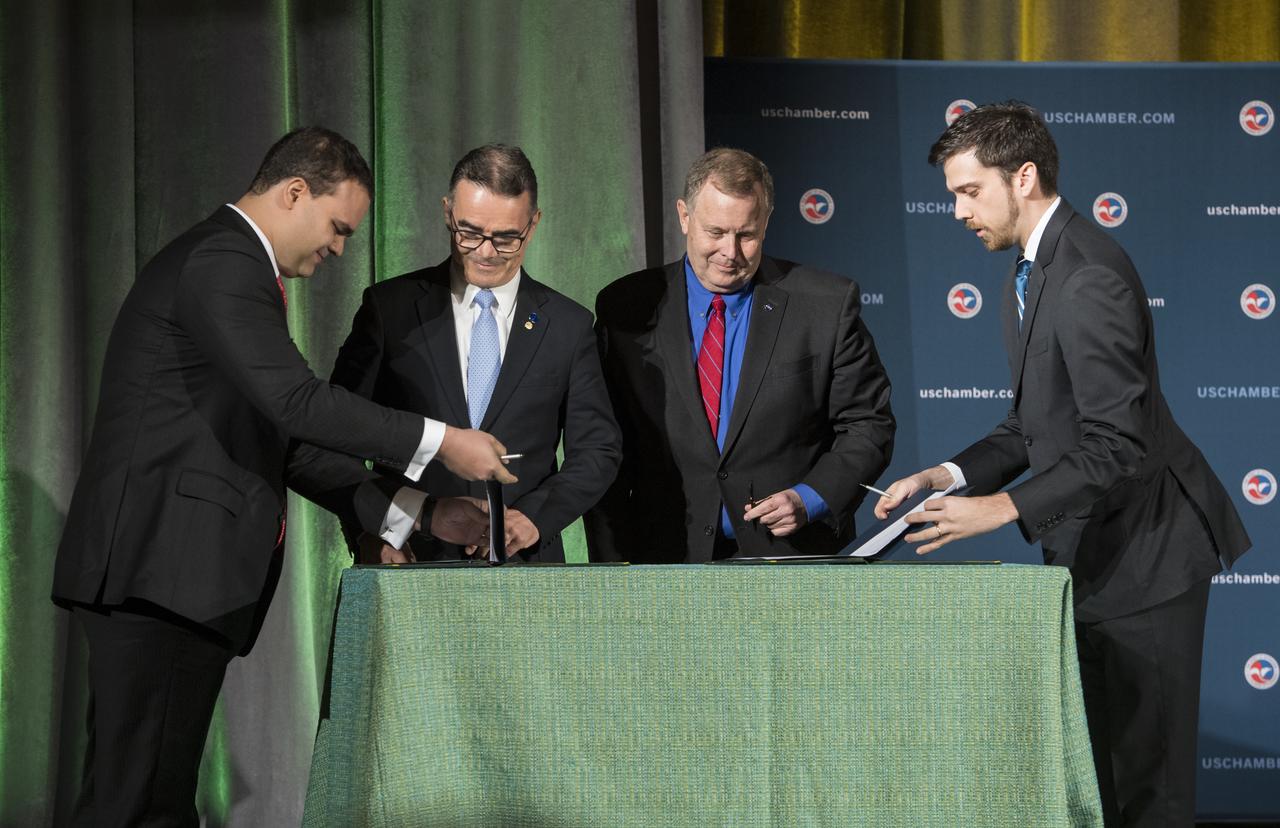
NASA Deputy Administrator James Morhard, center right, and President of the Brazilian Space Agency (AEB) Carlos Augusto Teixeira de Moura, center left, prepare to sign an agreement for cooperation on the Scintillation Prediction Observations Research Task (SPORT), an upcoming NASA-AEB heliophysics CubeSat partnership, Monday, March 18, 2019, at the U.S. Chamber of Commerce in Washington. The SPORT CubeSat will investigate two ionospheric phenomena, equatorial plasma bubbles and scintillation, that disrupt radio communication systems, satellite technologies, and Global Positioning System (GPS) signals. SPORT is currently projected to launch in the 2020 timeframe. Photo Credit: (NASA/ Aubrey Gemignani)
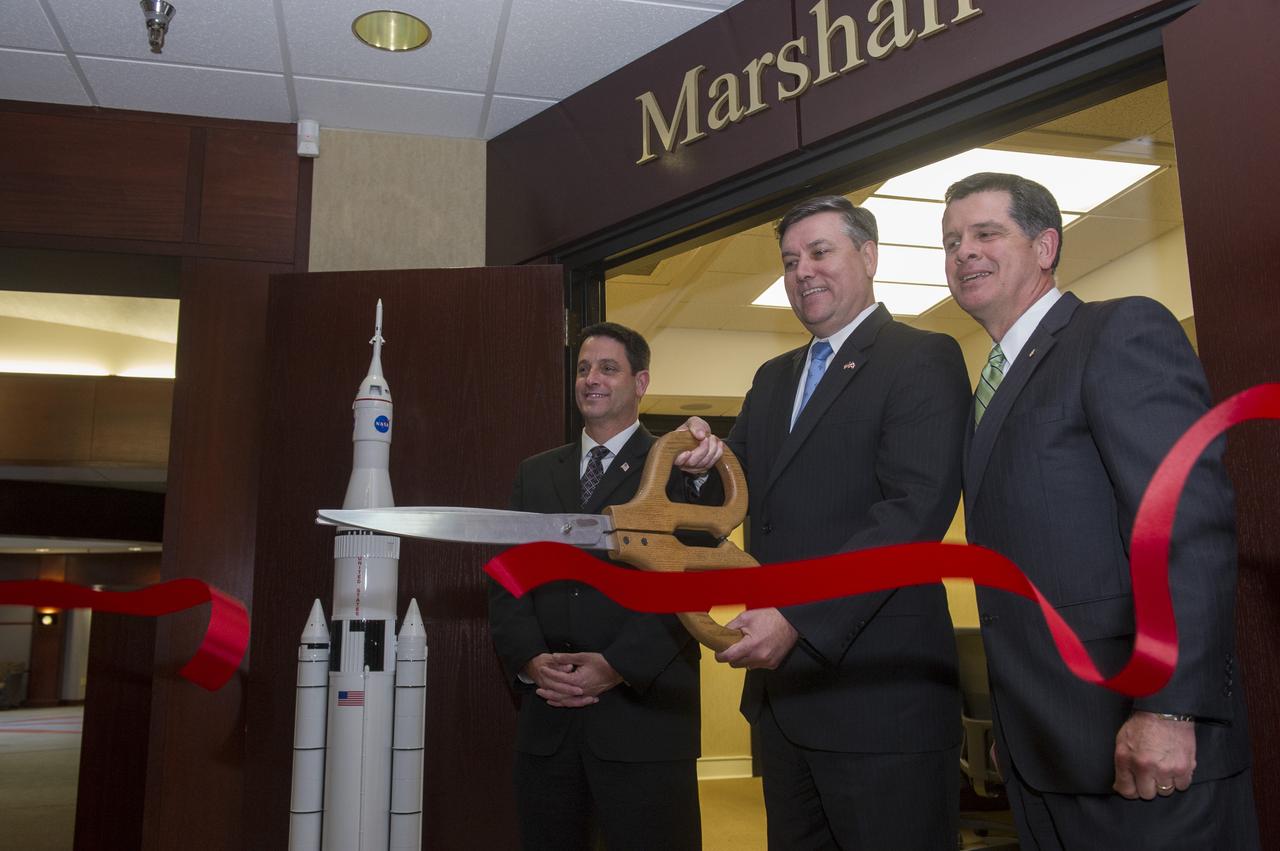
MSFC DIRECTOR PATRICK SCHEUERMANN CUTS RIBBON AT DEDICATION OF MARSHALL ROOM AT HUNTSVILLE-MADISON COUNTY CHAMBER OF COMMERCE, 3/11/13. TROY TRULOCK (L), MAYOR OF MADISON, AL AND RON POTEAT, (R), BOARD CHAIR, CHAMBER OF COMMERCE
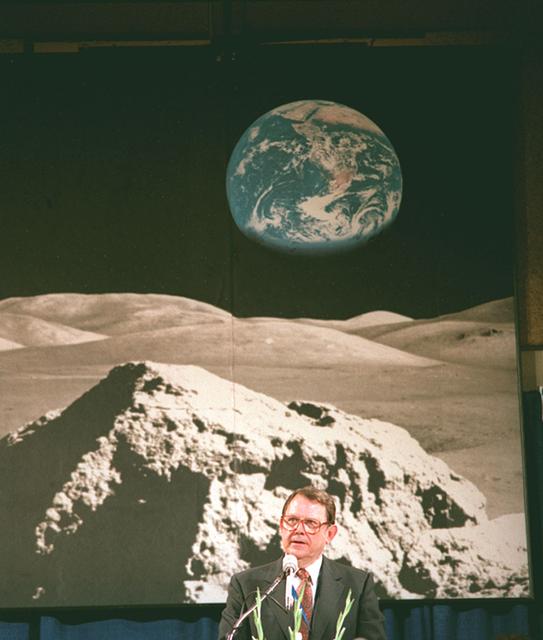
Dr. William R. Lucas, Marshall's fourth Center Director (1974-1986), delivers a speech in front of a picture of the lunar landscape with Earth looming in the background while attending a Huntsville Chamber of Commerce reception honoring his achievements as Director of Marshall Space Flight Center (MSFC).
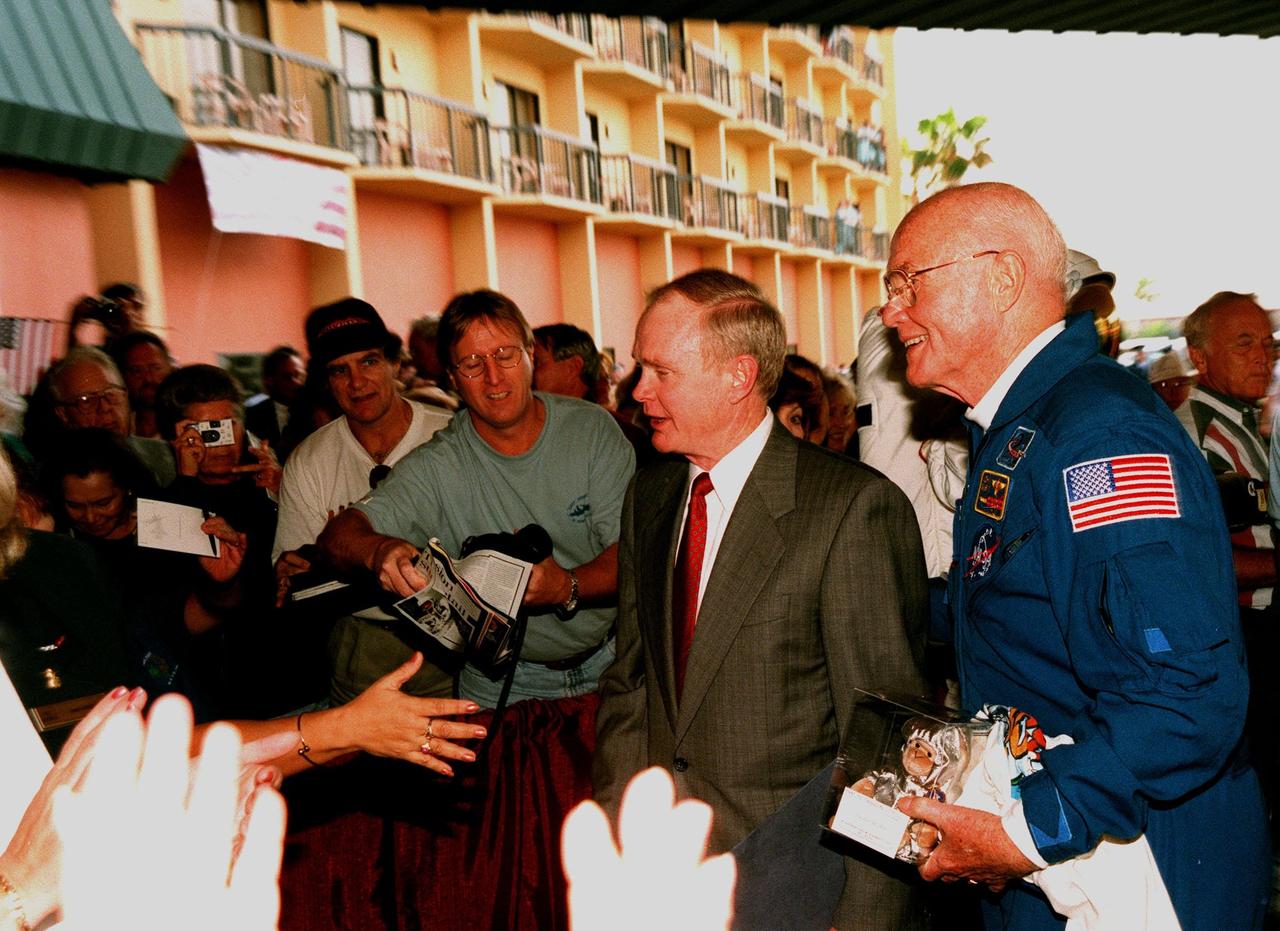
Center Director Roy Bridges and STS-95 Payload Specialist John H. Glenn Jr. greet well-wishers at a reception at the Double Tree Oceanfront Hotel following a parade down State Road A1A in nearby Cocoa Beach. Organizers of the parade included the Cocoa Beach Area Chamber of Commerce, the Brevard County Tourist Development Council, and the cities of Cape Canaveral and Cocoa Beach. The parade is reminiscent of those held after missions during the Mercury Program
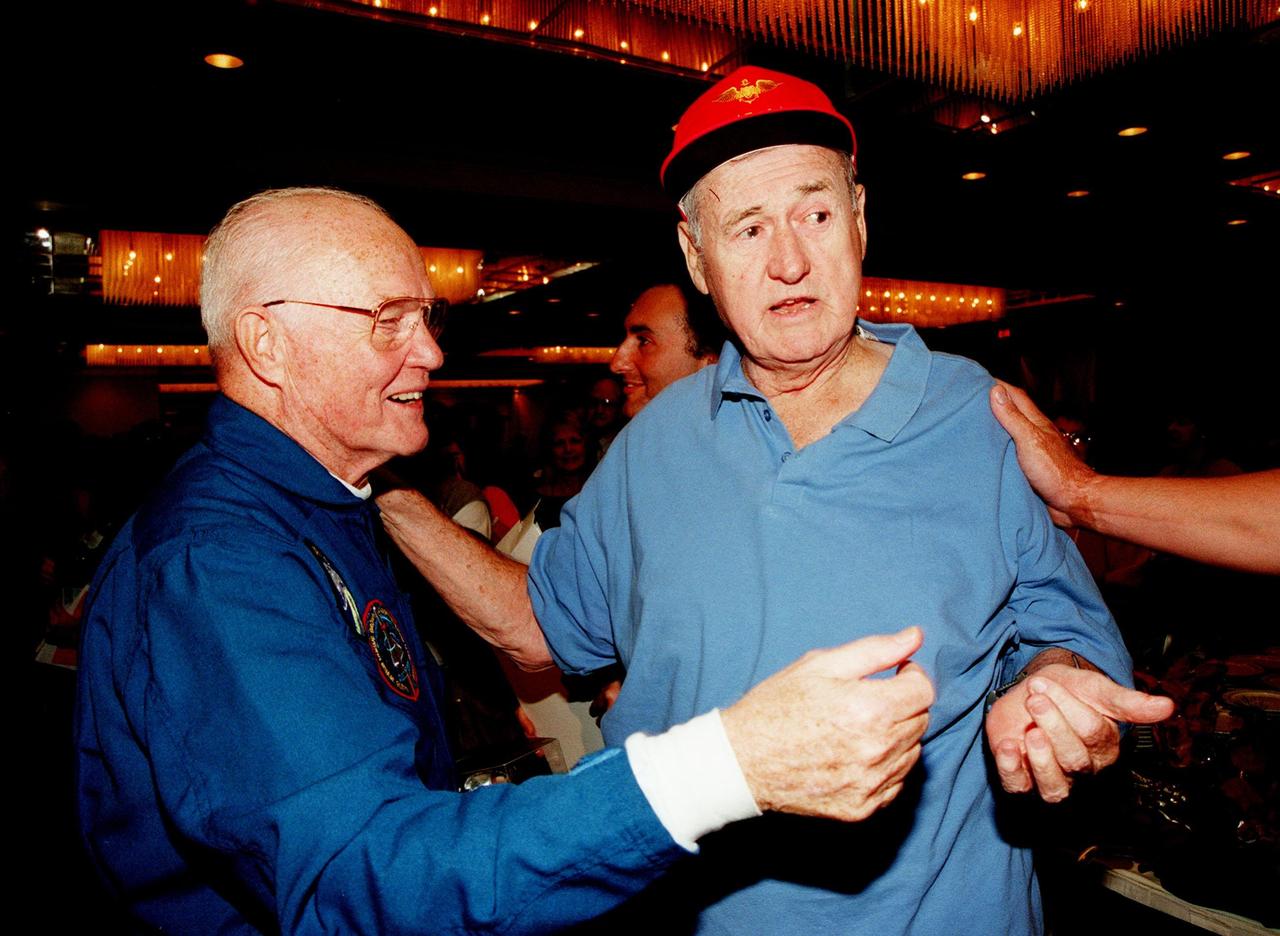
STS-95 Payload Specialist John H. Glenn Jr. (left) greets baseball legend Ted Williams at a reception at the Double Tree Oceanfront Hotel following a parade down State Road A1A in nearby Cocoa Beach. Organizers of the parade included the Cocoa Beach Area Chamber of Commerce, the Brevard County Tourist Development Council, and the cities of Cape Canaveral and Cocoa Beach. The parade is reminiscent of those held after missions during the Mercury Program
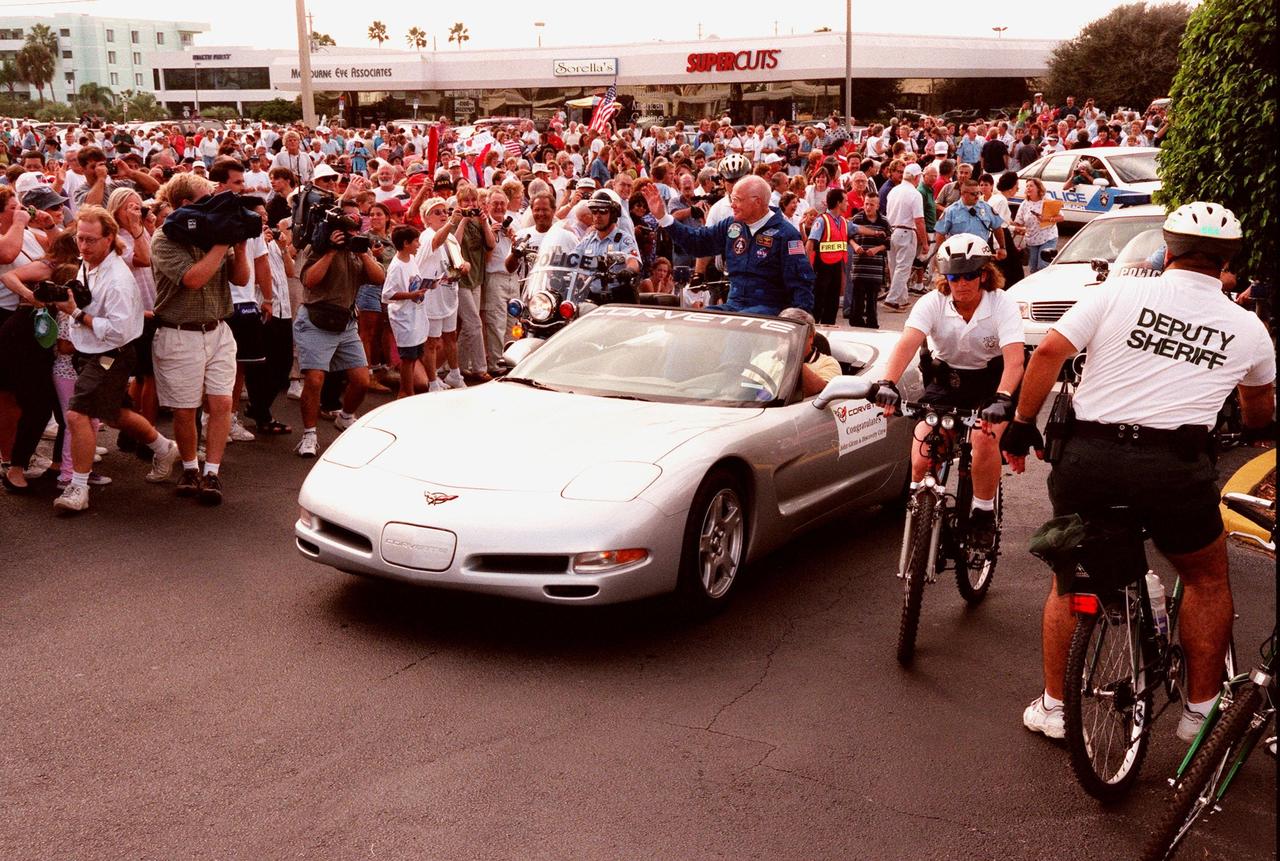
STS-95 Payload Specialist John H. Glenn Jr. waves to a dense crowd of well-wishers from the back of a silver 1999 C-5 Corvette convertible during a parade down State Road A1A in nearby Cocoa Beach. Organizers of the parade include the Cocoa Beach Area Chamber of Commerce, the Brevard County Tourist Development Council, and the cities of Cape Canaveral and Cocoa Beach. The parade is reminiscent of those held after missions during the Mercury Program
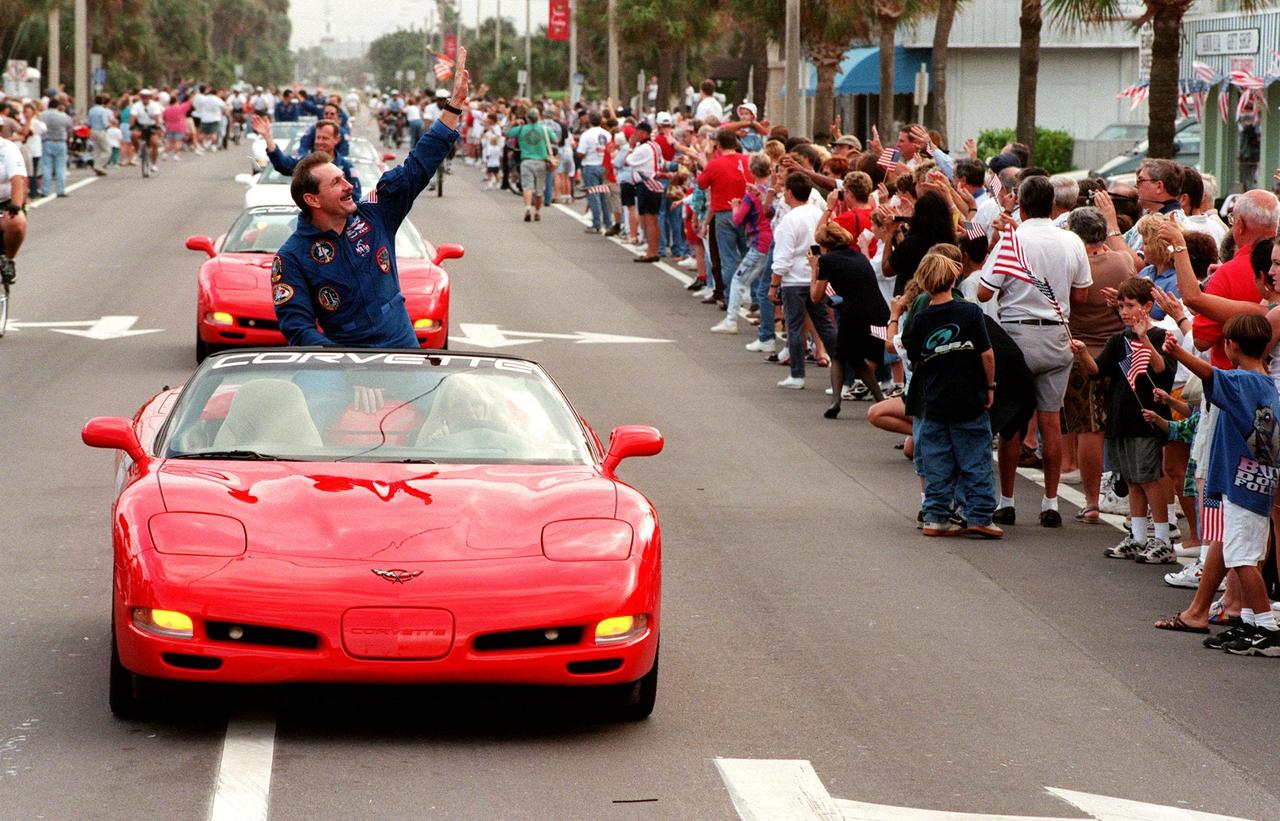
STS-95 Commander Curtis L. Brown Jr. (in front), along with the other crew members behind him, waves to the crowd as he leads a parade of 1999 C-5 Corvette convertibles down State Road A1A in nearby Cocoa Beach. Organizers of the parade include the Cocoa Beach Area Chamber of Commerce, the Brevard County Tourist Development Council, and the cities of Cape Canaveral and Cocoa Beach. The parade is reminiscent of those held after missions during the Mercury Program
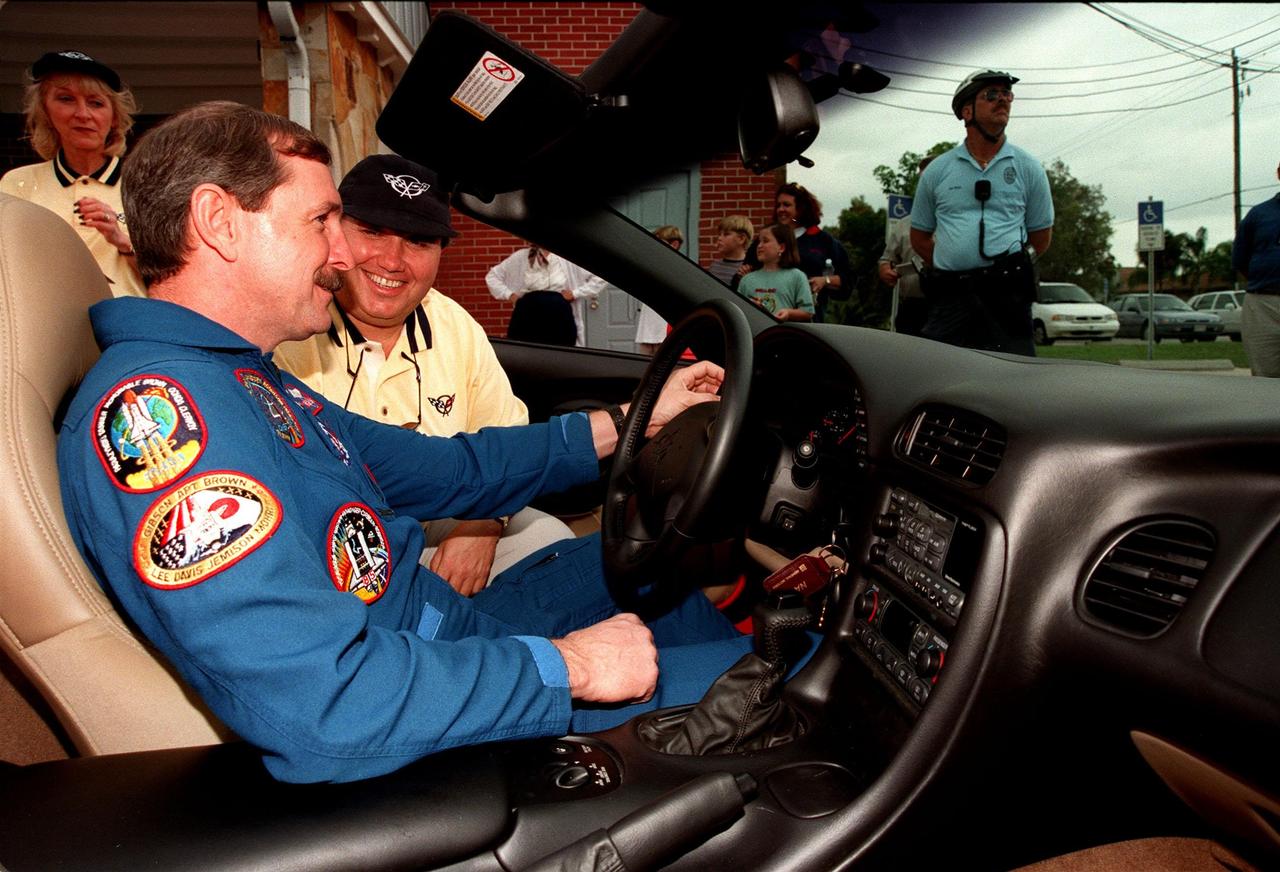
STS-95 Commander Curtis L. Brown Jr. examines the heads up display in the 1999 C-5 Corvette convertible in which he will be riding during a parade down State Road A1A in nearby Cocoa Beach as Dan Adovasio, a parade coordinator, looks on. Organizers of the parade include the Cocoa Beach Area Chamber of Commerce, the Brevard County Tourist Development Council, and the cities of Cape Canaveral and Cocoa Beach. The parade is reminiscent of those held after missions during the Mercury Program
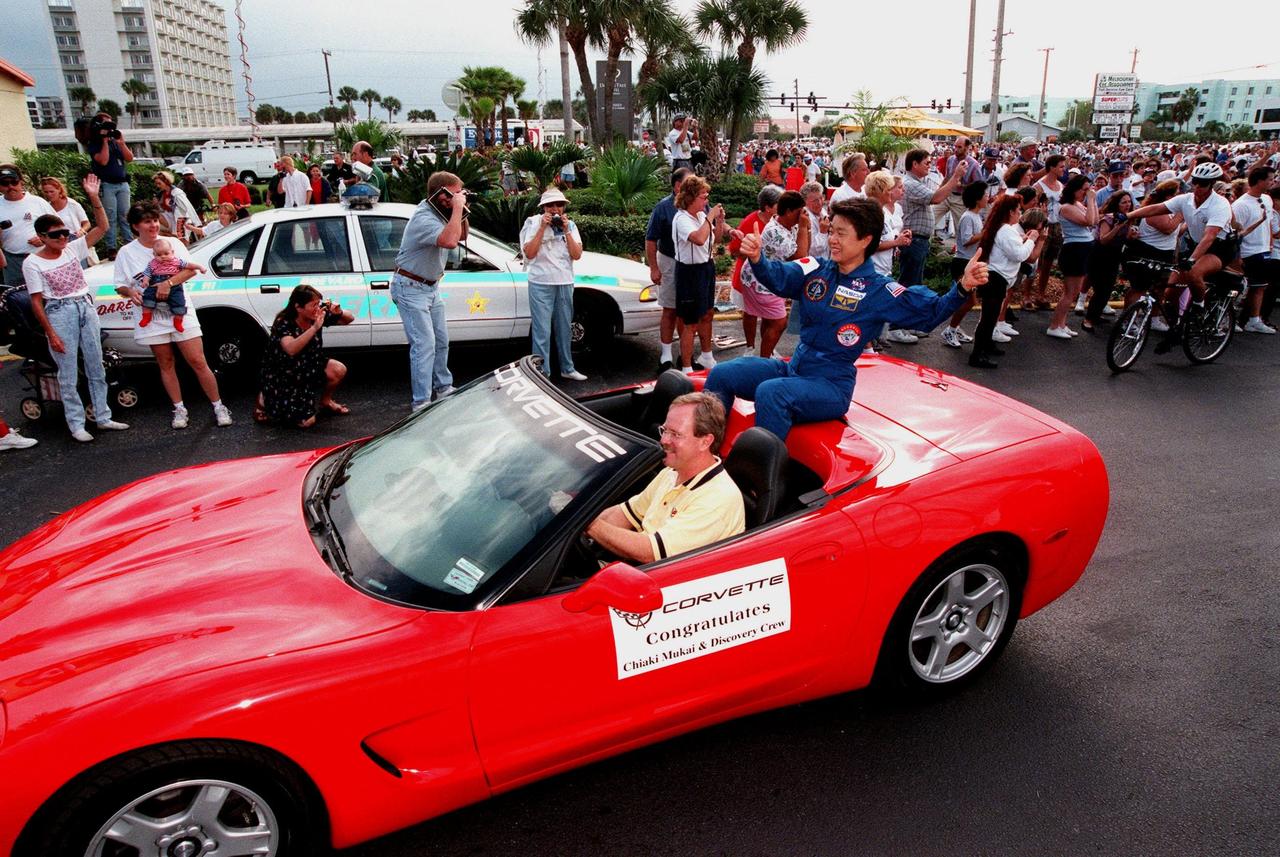
STS-95 Payload Specialist Chiaki Mukai is perched on the back of a red 1999 C-5 Corvette convertible during a parade down State Road A1A in nearby Cocoa Beach. Organizers of the parade include the Cocoa Beach Area Chamber of Commerce, the Brevard County Tourist Development Council, and the cities of Cape Canaveral and Cocoa Beach. The parade is reminiscent of those held after missions during the Mercury Program
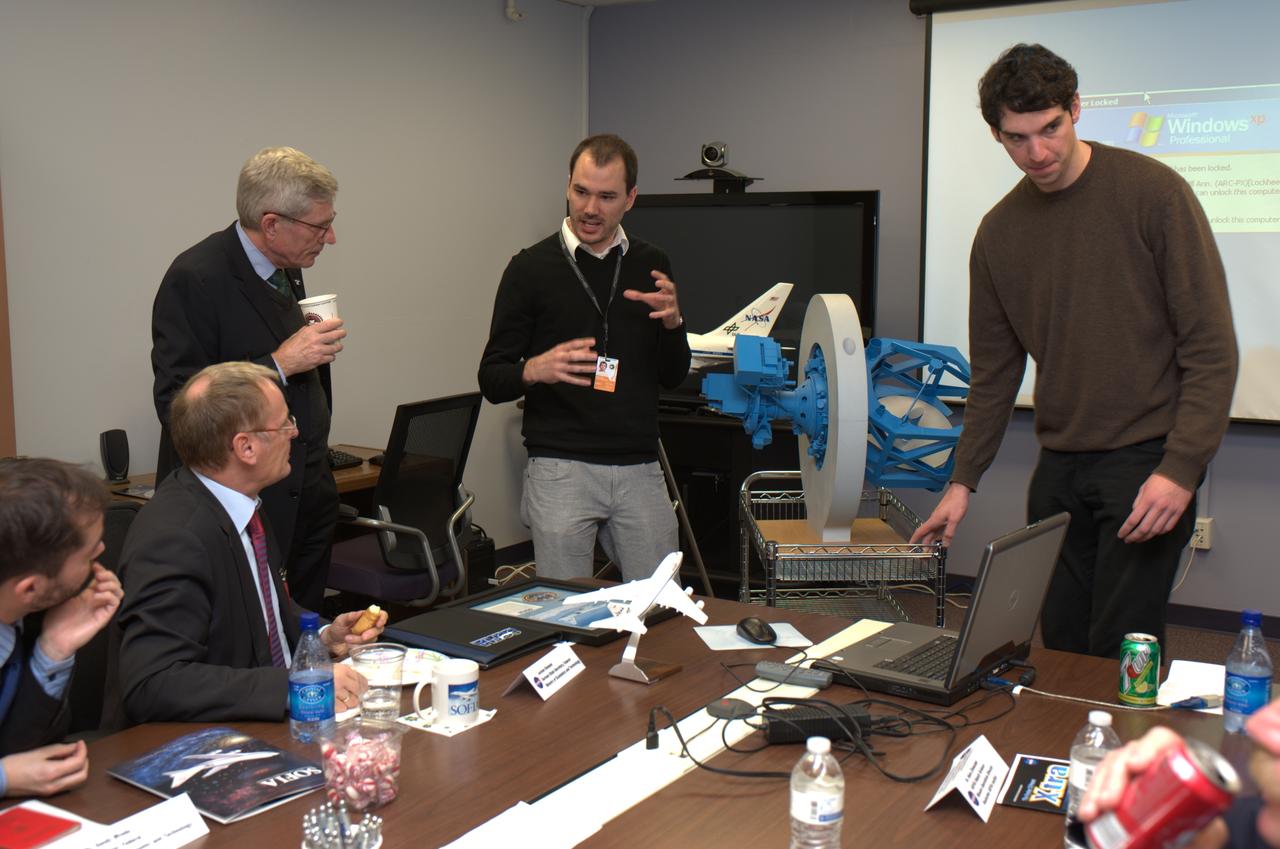
German Deligation visits Ames SOFIA Science Office for briefing. Left to right Jochen Homann, German State Secretary Federal Ministry of Economics and Technology, Dr. Benno Bunse, President & CEO, German American Chamber of Commerce, New York, Manuel Wiedemann, post-doctorate student from the Deutsches SOFIA Institute, University of Stuttgart.
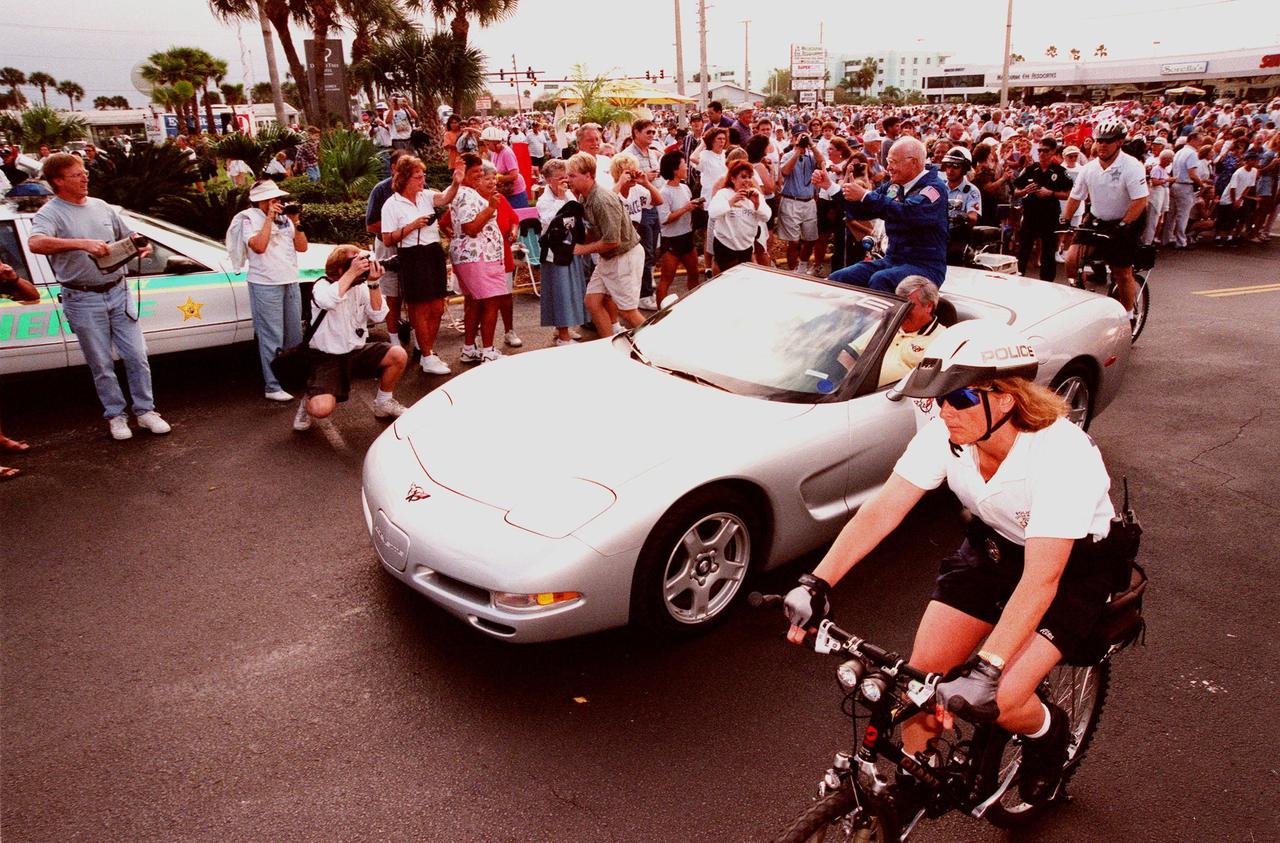
STS-95 Payload Specialist John H. Glenn Jr. waves to spectators from the back of a silver 1999 C-5 Corvette convertible during a parade down State Road A1A in nearby Cocoa Beach. Organizers of the parade include the Cocoa Beach Area Chamber of Commerce, the Brevard County Tourist Development Council, and the cities of Cape Canaveral and Cocoa Beach. The parade is reminiscent of those held after missions during the Mercury Program
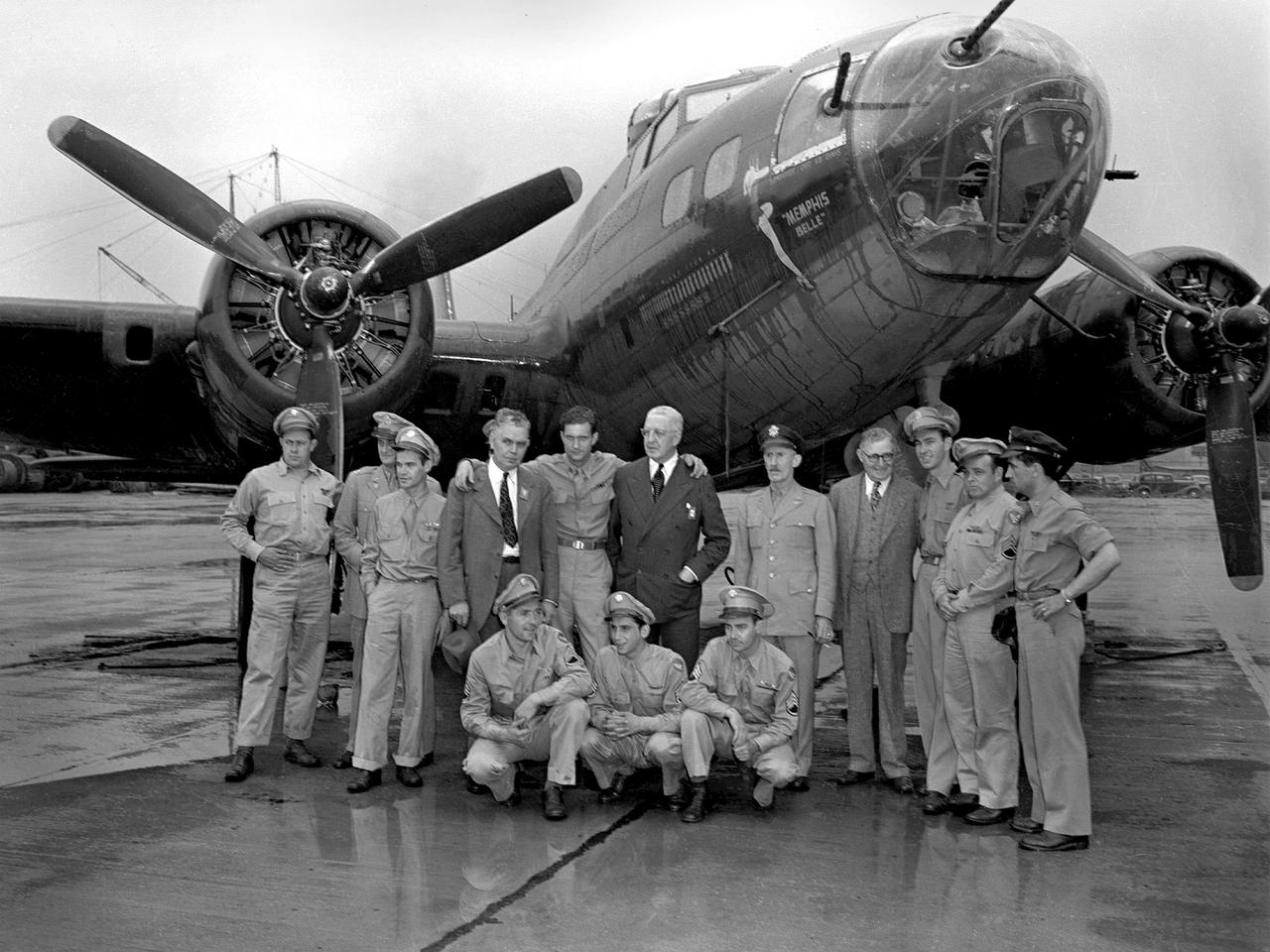
Captain Robert Morgan and the rest of the Memphis Belle crew arrive in Cleveland on a rainy July 7, 1943, for three-day publicity visit. This B–17 Flying Fortress had recently become the first U.S. bomber to complete 25 missions over Germany and France. The lack of long distance escort fighters made the feat even more remarkable. The Memphis Belle and its crew returned to the United States in June and were immediately thrown into a three-month-long war bond tour. While in Cleveland the crew toured the National Advisory Committee for Aeronautics (NACA) Aircraft Engine Research Laboratory, the Cleveland Bomber Plant, and Thompson Products. In the evenings they were feted downtown by the Chamber of Commerce at the Hotel Cleveland. A local company brought Morgan’s family and his fiancé—the Memphis Belle’s inspiration—to Cleveland to participate in the activities. The bomber was on display to the public near the airport’s fenceline and stored in the NACA’s hangar overnight. Pictured in this photograph from left to right: Robert Hanson, Vincent Evans, Charles Leighton, NACA Manager Raymond Sharp, Robert Morgan, William Holliday of the Chamber of Commerce, Army Liaison Officer Colonel Edwin Page, Airport Commissioner Jack Berry, Cecil Scott, John Quinlan and James Verinis. Kneeling are Harold Loch, Casimer Nastal and Charles Wichell.
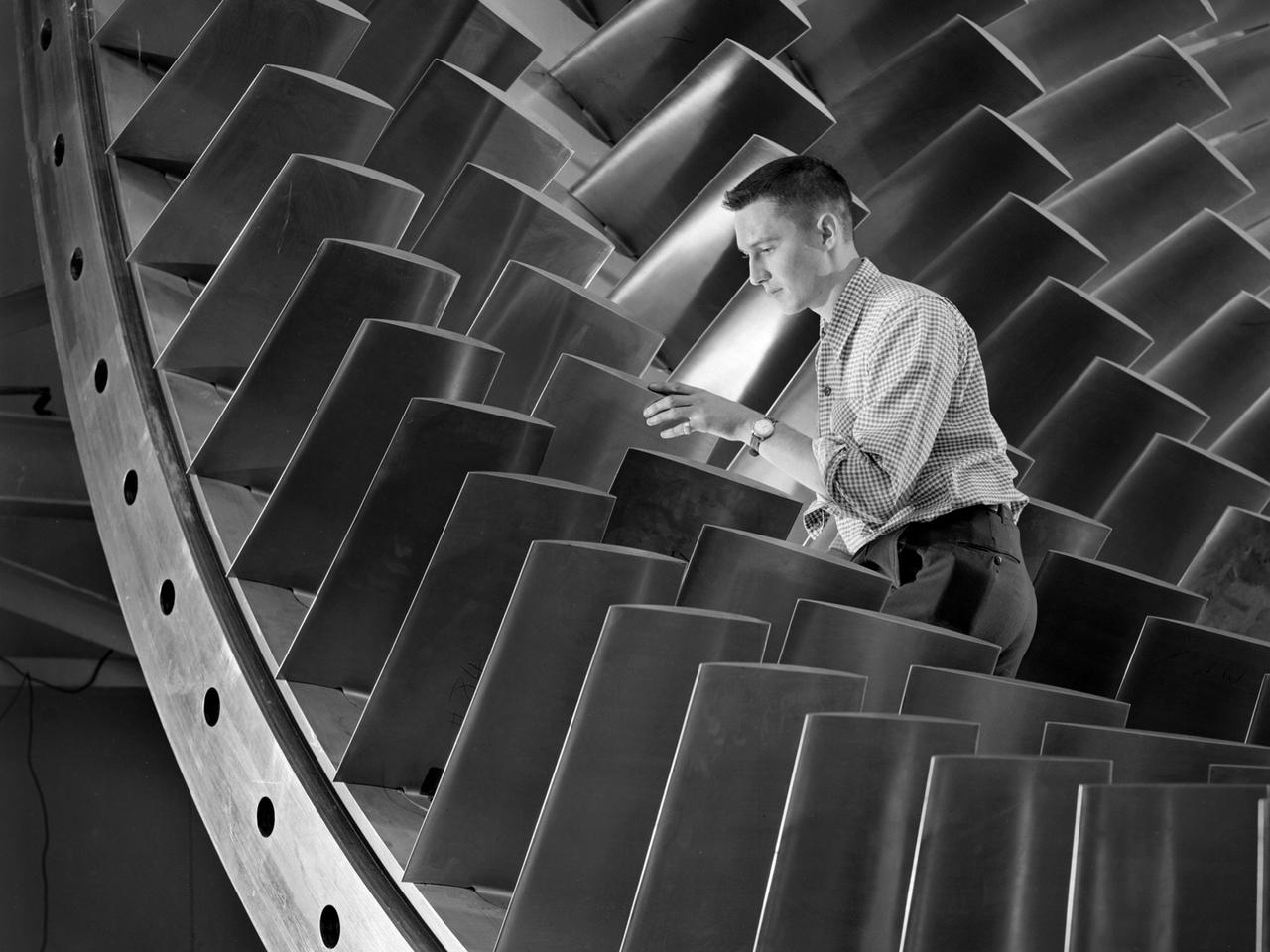
An engineer examines the main compressor for the 10- by 10-Foot Supersonic Wind Tunnel at the National Advisory Committee for Aeronautics (NACA) Lewis Flight Propulsion Laboratory. The engineers were preparing the new wind tunnel for its initial runs in early 1956. The 10- by 10 was the most powerful propulsion wind tunnel in the nation. The facility was part of Congress’ Unitary Plan Act which coordinated wind tunnel construction at the NACA, Air Force, industry, and universities. The 10- by 10 was the largest of the three NACA tunnels built under the act. The 20-foot diameter eight-stage axial flow compressor, seen in this photograph, could generate air flows up to Mach 2.5 through the test section. The stainless steel compressor had 584 blades ranging from 1.8 to 3.25 feet in length. This main compressor was complemented by a secondary axial flow compressor. Working in tandem the two could generate wind streams up to Mach 3.5. The Cleveland Chamber of Commerce presented NACA Lewis photographer Bill Bowles with a second place award for this photograph in their Business and Professional category. The photograph was published in October 1955 edition of its periodical, The Clevelander, which highlighted local professional photographers. Fellow Lewis photographer Gene Giczy won second place in another category for a photograph of Cleveland Municipal Airport.
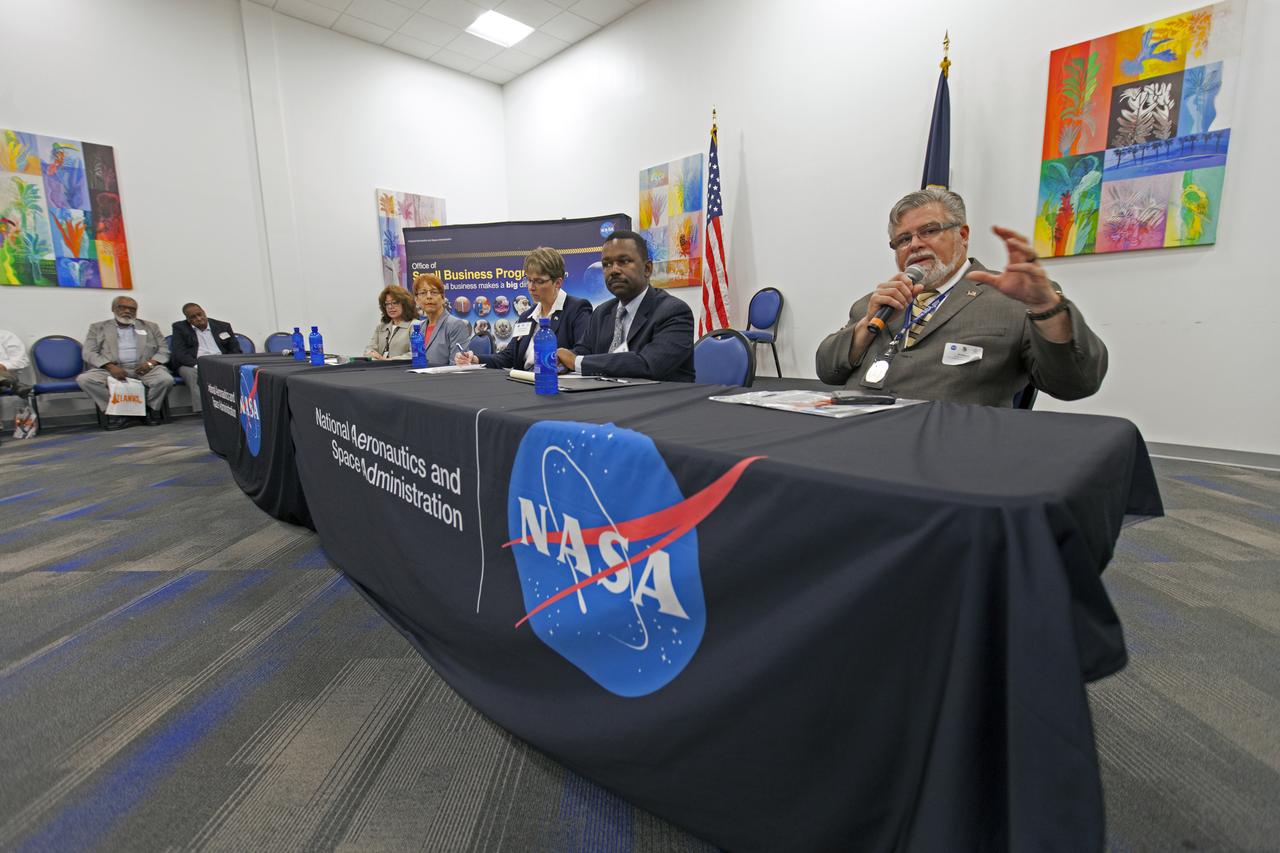
A Small Business panel discussion was held during Kennedy Space Center's 27th Business Opportunities Expo held at Cruise Terminal 5 at Port Canaveral in Florida. Seated at the table, from left, are Ileana Serrano, data dissemination specialist, U.S. Census Bureau; Margot Dorfman, chief executive officer, U.S. Women's Chamber of Commerce; Valerie Muck, Small Business director; U.S. Air Force; Andrew Harold, co-founder and board chairman, Florida 8(a) Alliance; and Eduardo Ramos, senior area manager, U.S. Small Business Administration. The event featured more than 180 businesses, large and small, and government exhibitors from throughout the Space Coast and the nation. The Business Opportunities Expo is sponsored by the NASA KSC Prime Contractor Board, KSC Industry Assistance Office, 45th Space Wing and Canaveral Port Authority. Exhibitors included vendors from a variety of product and service areas, such as computer technology, engineering services, communication equipment and services, and construction and safety products, to name a few. Representatives from the 45th Space Wing, KSC prime contractors, NASA and many more agencies and organizations were on hand to provide information and answer questions.
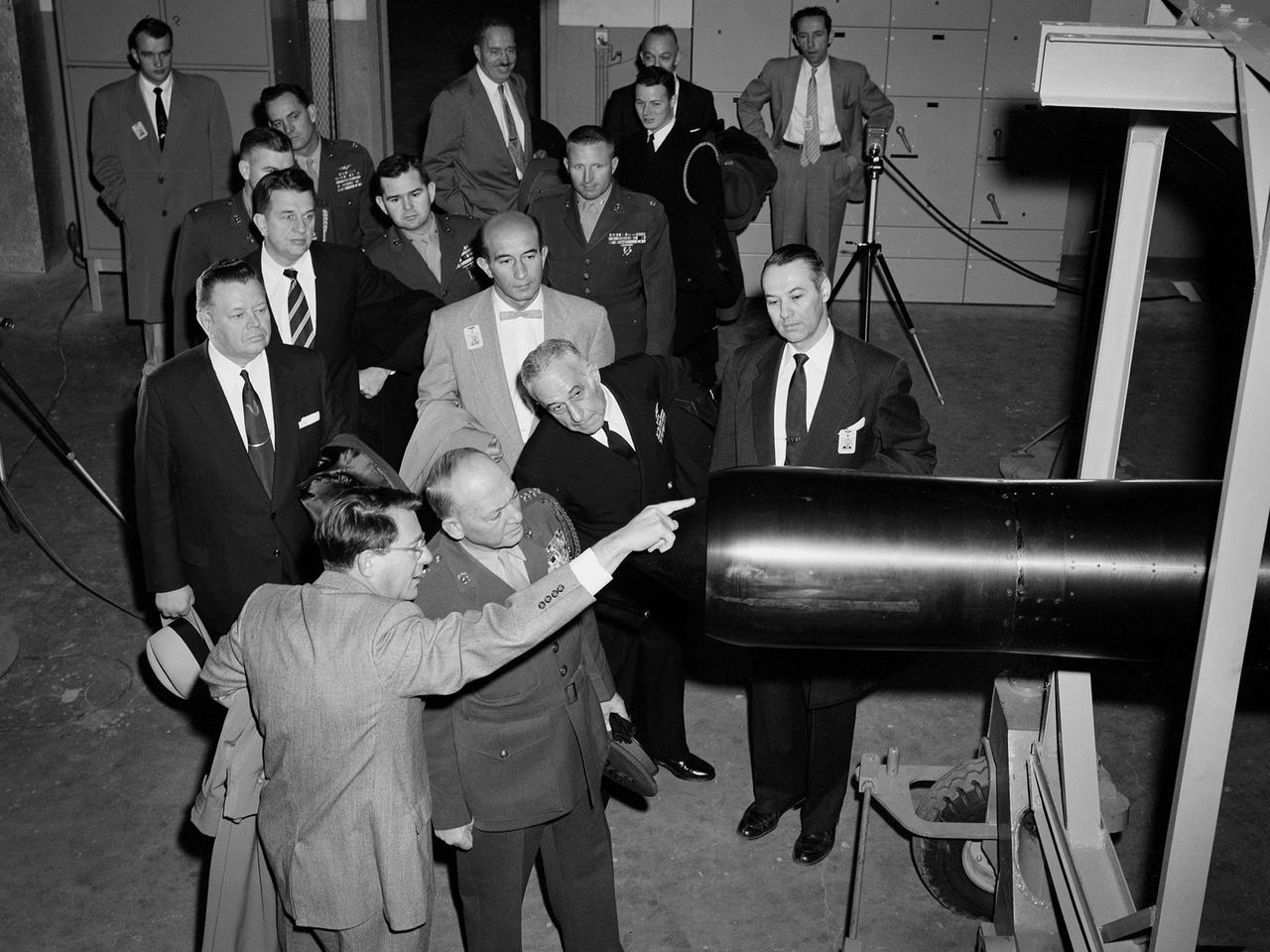
Abe Silverstein, Associate Director of the National Advisory Committee for Aeronautics (NACA) Lewis Flight Propulsion Laboratory, provides a personal tour of the new 10- by 10-Foot Supersonic Wind Tunnel for US Senator George Bender (hat in hand) and General Lemuel Shepherd. Shepherd was Commandant of the Marine Corps and had served in World War I, World War II, and the Korean War. The general was accompanied by Admiral Herbert Leary, in dark uniform. Bender was a Republican Senator from Ohio. Behind Bender is President of the Cleveland Chamber of Commerce Curtis Smith. NACA Lewis managers Eugene Manganiello and Wilson Hunter assist with the tour. Abe Silverstein oversaw all research at the laboratory. Upon taking his post in 1952 he reorganized the research staff and began shifting the focus away from airbreathing aircraft engines to new fields such as high energy fuels, electric propulsion, and nuclear power and propulsion. He was an early advocate of the NACA’s involvement in the space program and crucial to the founding of National Aeronautics and Space Administration in 1958. Silverstein began his career helping design and conduct research in the Full Scale Tunnel in 1929 at the Langley Memorial Aeronautical Laboratory. Silverstein advocated a series of increasingly large supersonic wind tunnels after the war, culminating in the 10- by 10.
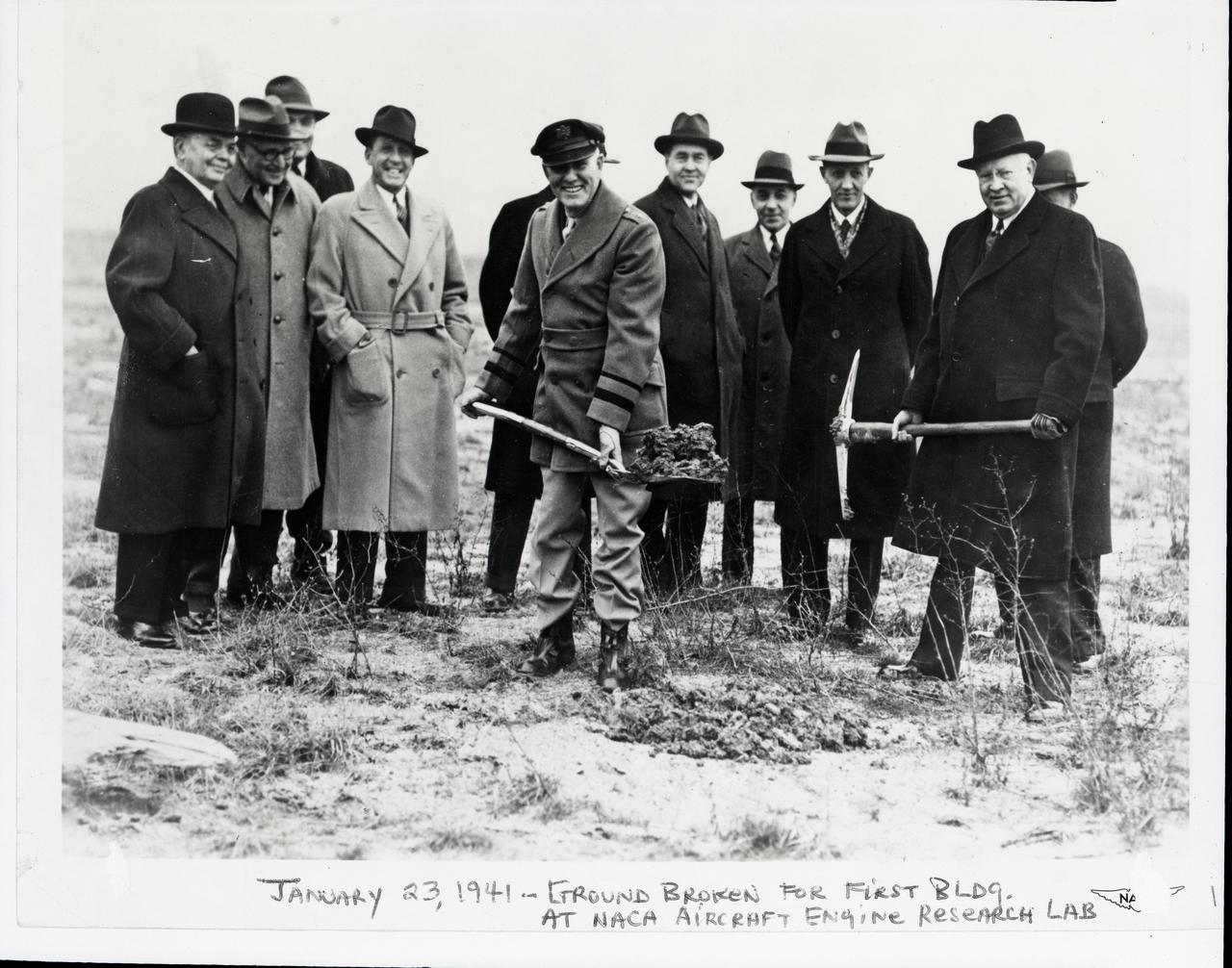
January 23, 1941 groundbreaking ceremony at the NACA Aircraft Engine Research Laboratory: left to right (does not include two individuals obscured from view behind Maj. Brett and Dr. Lewis): • William R. Hopkins – Cleveland City Manager from 1924-1930, was personally responsible for planning and acquiring the land for the Cleveland Airport. The airport’s huge capacity for handling aircraft was one factor in selecting Cleveland for the site of the research center. The Cleveland Airport was renamed Cleveland Hopkins airport in his honor in 1951. • Major John Berry – Cleveland Airport Manager • Edward R. Sharp – GRC’s first director, serving from 1942 to his retirement in 1961. He came to Cleveland in 1941 as the construction manager for the new facility. • Frederick C. Crawford – President of Thompson Products, which became the Thompson-Ramo-Woolridge Corporation (TRW) in 1958. Crawford was, at the time, also president of the Cleveland Chamber of Commerce. He began in 1939 to campaign for Cleveland as the location for the new NACA facility. • Major George H. Brett – A Cleveland native, Brett served in WWI and was commanding officer at Wright Field in Dayton, Ohio before becoming chief of the Army Air Corps. • Dr. Edward P. Warner – Acting chairman of the NACA. • Captain Sydney M. Kraus – Officer in charge of Navy procurement • Edward Blythin – Mayor of Cleveland • Dr. George Lewis – Director of Aeronautical Research for the NACA from 1924-1947, Lewis devoted his life to building a scientific basis for aeronautical engineering. The Cleveland laboratory was renamed the Lewis Flight Propulsion Laboratory in his honor in 1948. A description of the event, based on newspaper accounts and later NASA publications is as follows: On January 23, 1941, a brief groundbreaking ceremony at the site marked the start of construction. Dr. George W. Lewis, director of research for the NACA, loosened the soil with a
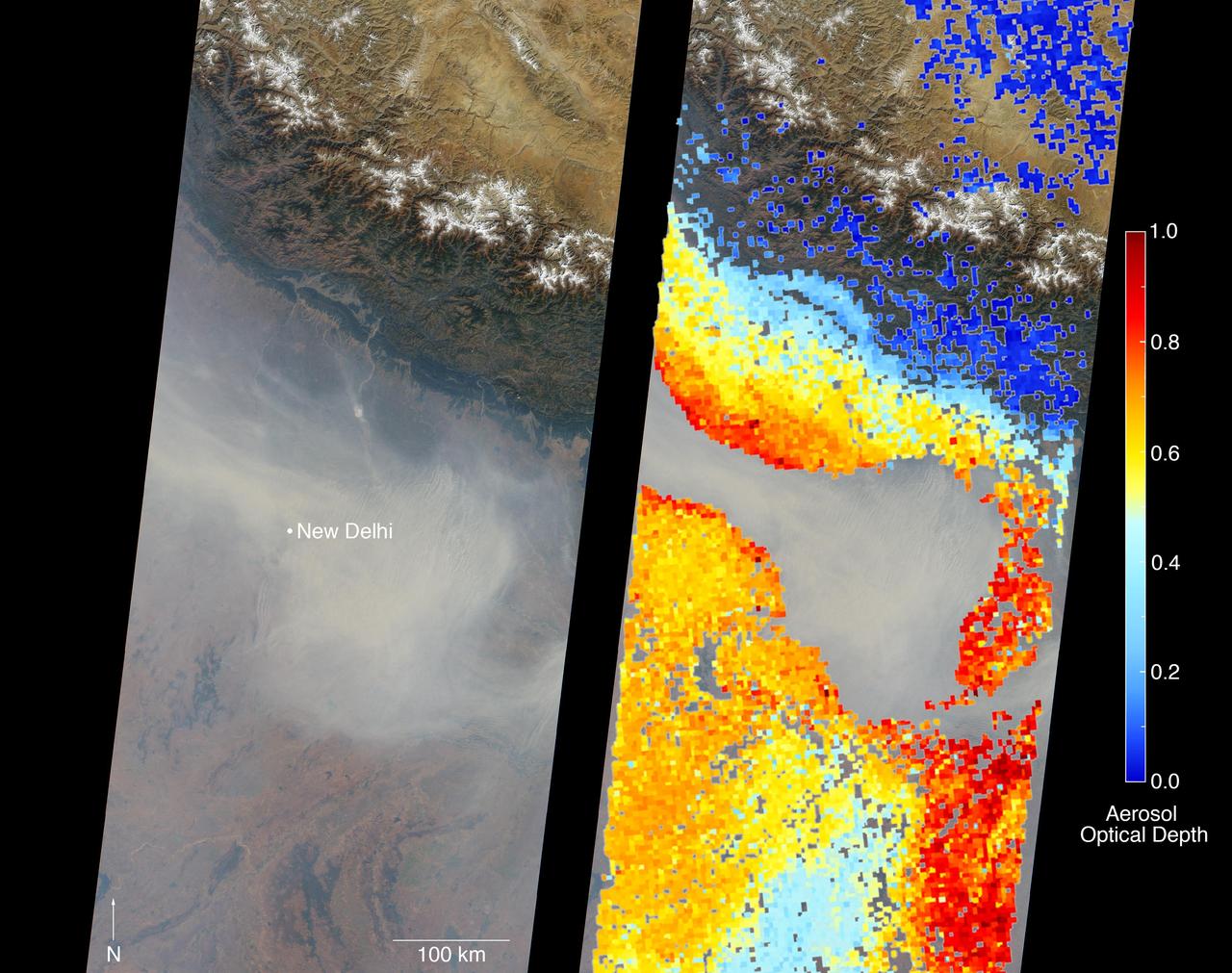
New Delhi, India's capital city, is currently suffering though a period of particularly poor air quality. In early November 2016, monitors at various locations in the area posted air quality index measurements as high as the 900s (the most severe ranking, "hazardous," is any air quality index measurement over 300). Thousands of schools have been closed, and a survey by the Associate Chambers of Commerce and Industry of India reports that 10 percent of the city's workers called in sick due to air-pollution-related health issues. According to several published news reports, the extreme air pollution may be due to a combination of nearby agricultural burning after harvest, urban construction and solid-waste burning, as well as remnants of firecracker smoke and additional car emissions after the celebration of Diwali, the Hindu festival of lights, on October 30. The Multi-angle Imaging SpectroRadiometer (MISR) instrument aboard NASA's Terra satellite passed over the region on Saturday, Nov. 5, 2016, at around 11:05 a.m. local time. At left is an image acquired from MISR's vertical viewing camera. The Himalayas stretch across the northern portion of the image. This towering mountain range tends to concentrate pollution in the region immediately to the south, including New Delhi, by preventing pollutants from blowing northwards. New Delhi, whose location is indicated on the image, is under a patch of especially thick haze. At 6:00 a.m. local time on that date, the U.S. Mission India NowCast Air Quality Index for New Delhi was reported at 751, more than twice the threshold for hazardous air quality. At right, a map of aerosol optical depth is superimposed on the image. Optical depth is a quantitative measure of the abundance of aerosols (tiny particles in the atmosphere). Optical depths for the area around New Delhi have not been calculated because the haze is so thick that the algorithm has classified the area as a cloud. In the region immediately surrounding the thick haze, optical depths approach 1.0. An optical depth of 1.0 means that only about 37 percent of direct sunlight reaches the surface due to interactions with particles in the atmosphere. These data were acquired during Terra orbit 89805. Other MISR data are available through the NASA Langley Research Center; for more information, go to https://eosweb.larc.nasa.gov/project/misr/misr_table. MISR was built and is managed by NASA's Jet Propulsion Laboratory, Pasadena, California, for NASA's Science Mission Directorate, Washington, D.C. The Terra spacecraft is managed by NASA's Goddard Space Flight Center, Greenbelt, Maryland. The MISR data were obtained from the NASA Langley Research Center Atmospheric Science Data Center, Hampton, Virginia. JPL is a division of the California Institute of Technology in Pasadena. http://photojournal.jpl.nasa.gov/catalog/PIA21100